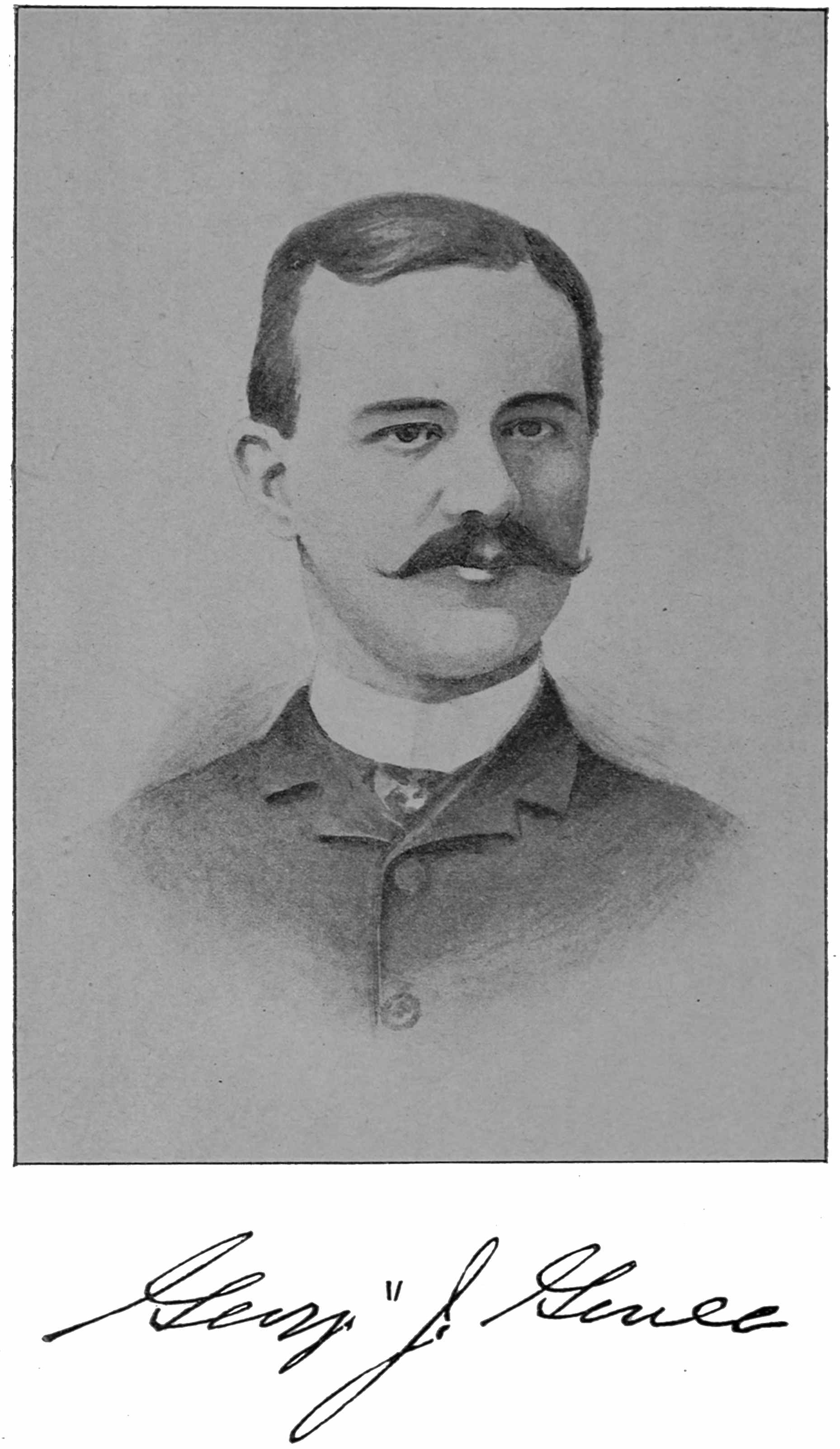
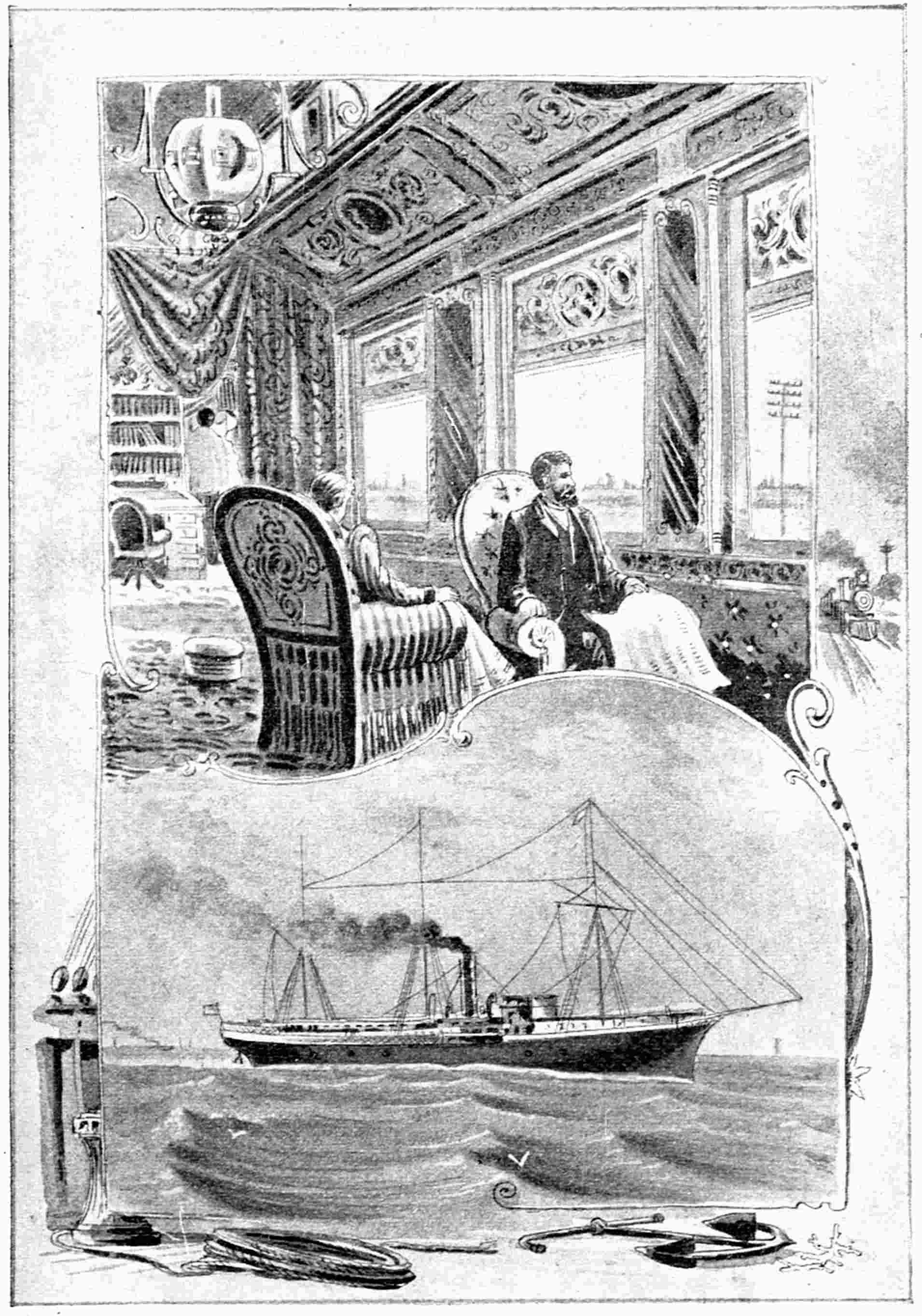
Larger versions of most illustrations may be seen by right-clicking them
and selecting an option to view them separately, or by double-tapping and/or
stretching them.
THE Wizard of Wall Street AND HIS WEALTH,
Jay Gould
OR
THE LIFE AND DEEDS OF JAY GOULD
BY
TRUMBULL WHITE.
JOHN C. YORSTON & CO.,
PHILADELPHIA, PA.
1893.
Copyright, 1892,
By MID-CONTINENT PUBLISHING CO.
PREFACE.
The history of any man who had been able to
distinguish himself by acquiring in his lifetime the
greatest amount of wealth ever accumulated by one
man, would necessarily be of interest, even if his
success had been won by the most ordinary of
methods or the most marvelous succession of good
fortune. But when that man is one whose career
was full of the most dramatic incidents; when
he won his wealth by feats of financial daring
which astounded the world; when, in short, that
man is Jay Gould, “The Wizard of Wall Street,” then,
indeed, the interest is most absorbing. Jay Gould
has been more prominently before the people of
the country for the last few years than has any other
man whose prominence depended upon the magnitude
of his fortune. In his history is much to be
learned, both for imitation and avoidance, by every
American. This volume contains, not only a complete
account of the life and deeds of Jay Gould
for the general reader, but also much for the
student of financial affairs and Wall street methods.
The particular effort of the author has been to secure
its absolute accuracy and to make it entirely
reliable. The present absorbing interest in the
career of the great financier, and the fact that every
source of information concerning him is being
sought most eagerly, makes the work particularly
timely.
In every walk of human life, in every imaginable
human occupation, that man who stands at the
very top, who is superior to all others in that particular
occupation, is of necessity a great man. No
matter how humble that occupation may be, absolute
superiority in it, in itself means greatness. The
time once was when commercial eminence was considered
to belong rather to the lower classes, and
was, indeed, despised by those who thought themselves
to be of knightlier blood than their fellows.
The Crusades, the Renaissance, the discovery of
America, and the impetus these gave to voyage and
trade and commerce, were potent factors in changing
all of this. For the last few centuries, commercial
ability, financial capacity, knowledge of how to
manipulate men and measures in a way to increase
fortune, and so to secure more of what fortune will
buy, have been more and more appreciated, until
to-day aristocracy and royalty clip coupons, families
whose ancestors trace from the Conqueror invest in
stocks and draw dividends, and the bluest blooded
of all great families engage with avidity in the struggle
for business and wealth.
Since royalty and aristocracy thus deign to enter
the lists of business competition, does it not become
more true that that man is really great, who excels
in money-making capacity every other individual in
the world, who wins the prize from all his high competitors,
and in his lifetime, by his own acumen and
manipulation, creates a greater fortune, adds more
to his wealth, than has ever any other person in the
world? That is what has been done by Jay Gould,
“The Wizard of Wall Street,” who has just been
taken from the possession of this enormous wealth,
and whose death has awakened such universal interest
in his life, his history and his personality.
It is hard to realize what an enormous distinction
is in the fact of being the richest man in the world.
For Gould not only created his fortune, but he made
it greater than is possessed by any other individual
in the world. It is true that there are families, the
Vanderbilts, the Astors, and the Rothschilds, whose
aggregated wealth far exceeds the fortune left by
Mr. Gould. But no individual of one of those families
possesses an amount nearly equal to that represented
by the Gould properties. Mr. Gould has
been absolutely unrivaled in his position as a money-maker.
Though he has met with reverses at times,
and was once on the verge of actual bankruptcy,
these have been due, in slight degree, to the action
of his opponents in the market, but rather to some
relaxation of his own energies, or some unforeseen
combination of circumstances. The men who have
been against him, with few exceptions, have lost
while he has won. To be wealthy and to play with
the Gould securities, it has been necessary to follow
him, not to oppose.
In downright dramatic interest, in its exhibition
of results achieved through the exercise of intellectual
qualities which were themselves an achievement,
and in the examples which it furnishes of the consistent
development of traits which can scarcely be
considered as the dower of heredity, and yet were
already apparent at the outset, the life story of Jay
Gould surpasses by far the histories of the great financiers,
speculators and railway managers with whom
he was either directly or remotely associated in a
career which practically embraced the whole modern
phase of financial operation. Like Drew, Vanderbilt
and Fisk, he was of humble origin and began at
an early age to carve out his fortunes on lines which
lay far from those to which his youthful surroundings
seemed to direct him. But his first exhibitions
of independent and original activity were directed
toward the acquiring of an intellectual equipment
of an entirely different order from that which his
great rivals in Wall street boasted. Nothing is
plainer than that he was a born money-maker, but it
is easily possible that if early success in this direction
had not encouraged him to bend his energies
solely to the acquisition of wealth, he might have
devoted himself not only successfully, but much to
his own satisfaction, to higher pursuits. Though he
was an absolutely tireless worker in the field of
money-getting, one can scarcely study his operations,
whether as a mere speculator or as the creator
and developer of great industrial enterprises, without
becoming convinced that the incitement to many
of his colossal operations was quite as much a love
for intellectual occupation as for money. Human
nature is generally set down as a universal possession,
and Mr. Gould was yet a young man when the
scope of his financial operations was such as to give
clear evidence that the material things of this world
were abundantly cared for in his possessions. He
had, of course, the instincts of a born speculator,
yet his was not the disposition to let results depend
simply on the accidental fall of the dice, or the turn
of a card. He loved hazard, but he loved better to
compel chance to enter the channels he had dug for
it. It would be folly to deny the vast value of his
work in the development of the Western and Southwestern
States, but perhaps as great a folly to attribute
a philanthropic or patriotic motive to it.
In a history of the life of such a man as Jay
Gould, it is well that certain of his personal characteristics
and certain of the chief events of his career
be summarized before a complete study of his biography
and character is made. It is thus possible better
to understand both events and personal qualities.
The education which Jay Gould acquired through
his own energies as a youth, found its best application
in this work of development. In his purely
speculative adventures he was aided by a disposition
whose traits, as has already been intimated, were
formed in his youth or early manhood. It is impossible
to contemplate without astonishment and even
admiration, the spectacle of so stable a character as
one must admit Mr. Gould’s to have been, fixed in boyhood
and remaining unchanged all through a career
which extended from a condition of the most modest
kind (not to call it absolute poverty) to a position
from which practically he ruled the financial world
of this continent and materially affected the fortunes
of the other. With untold wealth at his command,
he was as simple in tastes, as unaffected in
manner, as abstemious in habits, as industrious, as
self-dependent and self-reliant, as when he set out in
boyhood to make himself a rich man. Nor did any
of his less amiable characteristics undergo a less
change. In some of his first business ventures, can
be read the same disposition for silent intrigue, the
same secretiveness touching his intentions, the same
subtlety and elaborateness of plan, and the same indifference
to the feelings or comments of others, as
marked the tremendous operations which are the
climaxes of his purely speculative career—the war
over Erie and the gold operations which culminated
in that memorable and deplorable day which is written
in history as “Black Friday.”
There was, perhaps, never a time in Jay Gould’s
career when it was possible to estimate his wealth
with anything approaching correctness. His secretive
disposition stood in the way of a general acquaintance
with the outcome of his many ventures.
Long after he had gained control of the Wabash
system of Railways, the Manhattan Elevated and
the Western Union Telegraph Company, during a
little flurry in Wall street, in which everybody
thought the finger of Jay Gould was hidden, but
nobody knew, a broker sagely observed, “Mr. Gould
has many properties, but a brass band is not one of
them.” He never went forth trumpeting his affairs.
Moreover, his wealth always consisted of stocks and
bonds which were subject to the fluctuations of the
market, and which unquestionably derived a considerable
proportion of their value from the fact that
he controlled the property which they represented.
Once, however, he put aside his natural secrecy and
made an exhibition of his wealth in order to quiet
some annoying reports that were current touching
his financial condition. This was in March, 1882,
when he spread the contents of his strong box
before his astonished visitors.
Mr. Gould’s secretiveness was exhibited quite as
strikingly in his benefactions as his speculations.
He never achieved a reputation as one in the habit
of doing good to his fellowmen, and yet few rich
men were more charitable than he. Only once did
he forego his customary reticence, and then it was
in a time of great public calamity. Yellow fever
was raging in Memphis, and subscriptions were
being raised in all the large cities of the country.
Gould did not wait, but telegraphed to the authorities
of Memphis to draw on him for all the money
they needed. As a rule, like William H. Vanderbilt,
he dispensed his benefactions through a trustee.
This, during the last few years of his own life, was
Thurlow Weed.
“I am Mr. Gould’s philanthropical adviser,” said
this remarkable man on one occasion in 1879;
“whenever a really deserving charity is brought to
my attention, I explain it to Mr. Gould. He always
takes my word as to when and how much to contribute.
I have never known him to disregard my
advice in such matters. His only condition is that
there shall be no public blazonry of his benefactions.
He is a constant and liberal giver, but doesn’t let
his right hand know what his left hand is doing.
Oh, there will be a full page to his credit when the
record is opened above.”
It should also be added to the list of his virtues,
that he abstained absolutely from spirituous liquors,
including wine, and never used tobacco. He was,
however, fond of highly-spiced food, and it is said
that indulgence in such viands caused the stomachic
disarrangements which forced him to devote himself
in 1888 to the pursuit of health. He loved flowers
exceedingly, and in his country seat at Irvington-on-the-Hudson
built up one of the finest conservatories
in the world.
Jay Gould’s career was not a colorless one, but
was full of episode and variety. He was a genuine
American in that he had engaged, before he was
out of his teens, in some dozen pursuits, which number
he doubled in the next few years. Milking
twenty cows in his father’s dairy; clerking in a
country store; running a hardware shop; learning
the tinner’s trade; working in a country newspaper
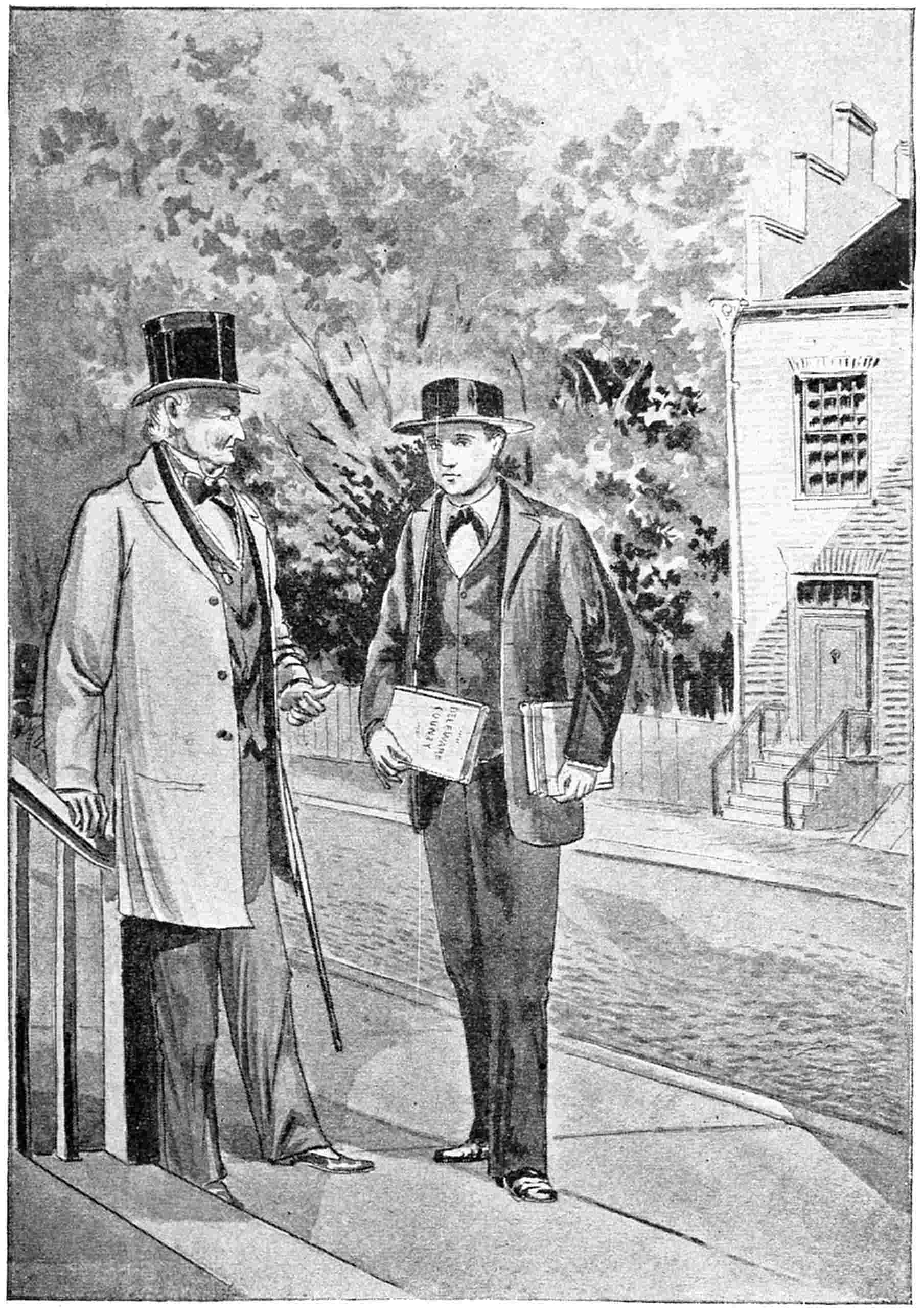
office, and writing a history of Delaware county,
were among his earlier employments. And then
came his enlistment in a surveying corps and his
experience in map drafting, which led up to the
leather industry. This chapter in Mr. Gould’s
career is a sensational one. His enlargement of
the tannery business in Pennsylvania, his establishment
of a village named for himself, Gouldsborough,
and of a bank of which he was director, were the
business portions of the sensation. The suicide of
his partner and the war for possession of the tannery,
between two bands of roughs fighting one for
Gould and one for his partner’s estate, were sensations
of another kind. Next Mr. Gould went into
the railroad business, drifting there by the aid of his
father-in-law, who wanted to make the best of a
marriage which he had opposed. From that time
to this, Mr. Gould has been prominently before the
public in financial operations, and his history is the
history of Wall street. Opinions of Mr. Gould
have been just as varied as his own pursuits. There
are those who laud him to the skies for the success
he had in creating his enormous fortune, and who
think him the sum of all good things. There are
many others who think of him as being simply a
close-fisted, unscrupulous, selfish business man of
undoubted ability, but with no thought except to
add to his wealth by whatever means might be
necessary at the expense of others. And there is
another large class of those who consider Mr. Gould
to have been a type of all that is worst in Americans,
a man who wrecked fortunes and honor of
others to add to his own, who purchased legislatures
at will whenever he had anything to desire from
them, and who had absolutely no redeeming traits
of character. It will be our effort to show what
justification there may be for each opinion. Whatever
other merit may be claimed for this modest
biography of a rich man, it is certainly to be considered
as entirely fair, with no bias for or against
its subject, and no inclination to do anything but
justice to his memory. No effort has been spared
to secure reliable, accurate and exhaustive information
on the history and personal characteristics of
Jay Gould. Inasmuch as great influence is exerted
on every man’s life by those business associates
most closely connected with him, attention has been
given to those other noted financiers whose association
with the “wizard” have been the nearest. The
ever-present influence of ancestry and immediate
family make that subject also an essential one to
the true understanding of the man. The history of
“Black Friday” and its disastrous consequences are
treated in full, also the investigation of the Senatorial
Committee and Gould’s connection with Missouri
Pacific and Western Union. His domestic life,
his yacht, his home on the Hudson, his magnificent
conservatory, all indications of the spirit and tastes
of the man, are also given careful attention.
The early life of such a man must perforce afford
an interesting study, and no apology is necessary
for a pretty full account of Jay Gould’s boyhood,
youth and early manhood.
CHAPTER II. YOUTH AND ANCESTRY OF JAY GOULD.
Many who knew Mr. Gould intimately are in the
habit of asserting that his origin must have been
Hebraic. No one pretends to say how many generations
back the Jewish blood was in the family, or
that Mr. Gould was aware of its existence in him.
But both his names, Jason, or Jay, and Gould, served
to strengthen this belief in those who held it. The
twisted form, “Gould,” was suspected of being
changed from “Gold,” which is a common prefix in
the names of inanimate and natural objects which
certain Jews in Europe were compelled to adopt as
surnames in one period of their history. His habits
of thought and his extraordinary intellect were both
Jewish, these people assert, with how much or how
little basis in the actual fact of his origin, no one
can ever decide.
Mr. Gould was certainly American in the character and
extent of his self-creation and success. Born
of poor parents, on a poorer farm, he began to make
money to pay his way through school, and he was a
partner in business enterprises while yet a lad.
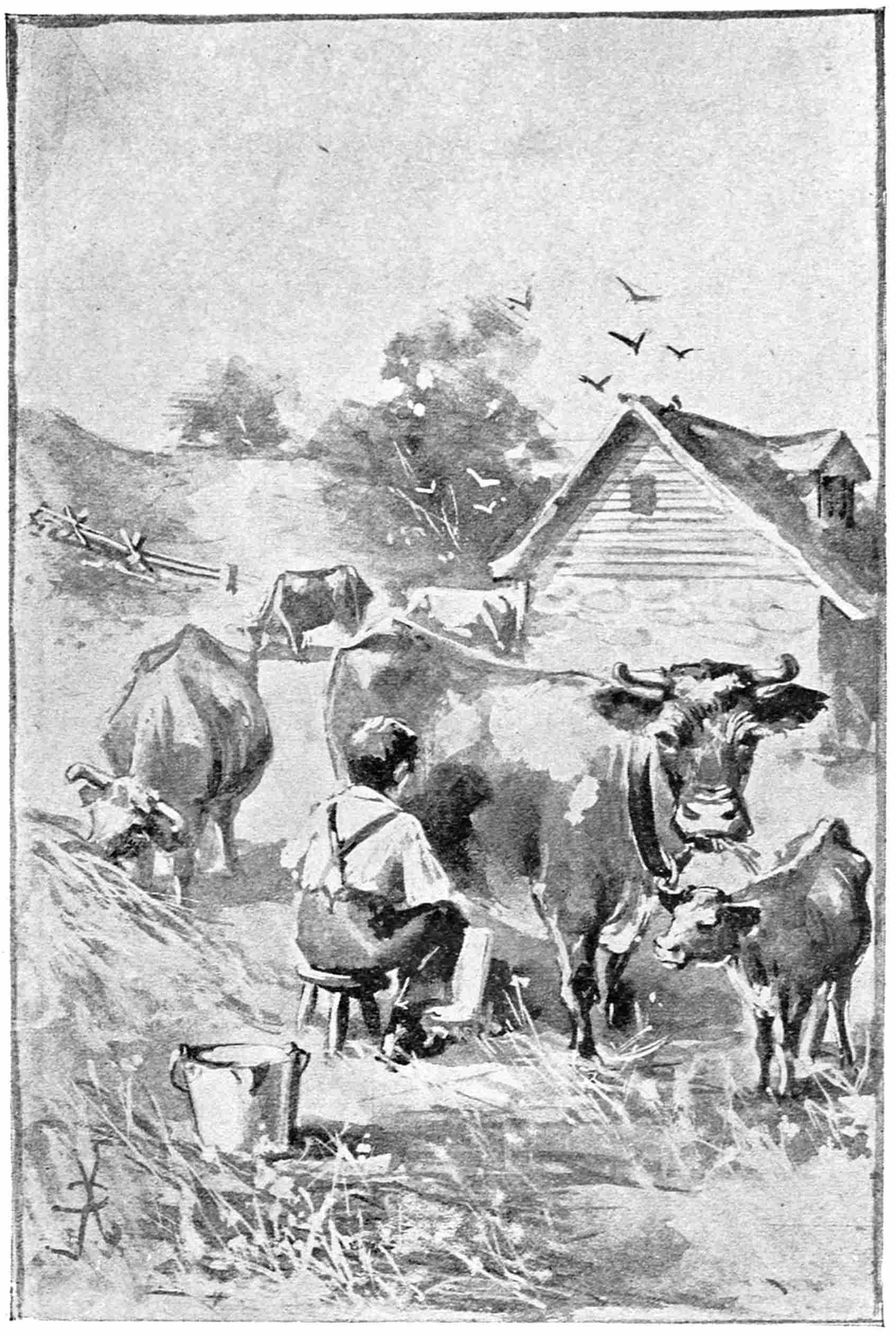
YOUNG GOULD IN HIS FATHER’S DAIRY.
But so far as Mr. Gould himself has been able
to decide, he came of Puritan stock than which none
is more diametrically removed from the Hebraic.
He was born on May 27, 1836, in the little post-village
of Roxbury, Delaware county, New York
state. Nearly half a century before, while Delaware,
Ulster and Otsego counties were yet one, his
grandfather came with half a dozen Puritan families
from Fairfield county, Connecticut, and took up
land near the land which became Jay Gould’s birth-place.
This grandfather was Captain Abram Gould.
He had been a Revolutionary soldier and was
described as a “grim, earnest, honest man.” To him
was born in 1792, a son who was named John B.
Gould, the first male child born in the new settlement.
John B. grew to manhood, was three times
married, and Jay was his son by his first wife. The
boy’s mother was a pious woman, a regular attendant
of the Methodist services held in the “yaller meetin’
house,” where Jay also imbibed such religious notions
as found a foothold in a nature not much given to
the contemplation of spiritual things. The father
was a small farmer and kept a dairy of twenty cows.
Until he was fourteen years old Jay lived on the
farm, picking up such a meager education as attendance
from four to five years at a district school,
which was closed during the greater part of the
year, afforded. This school was finally closed altogether
by the breaking out of the “Anti-rent War,” as
it was called, an uprising of the farmers against the
efforts of persons who claimed to have bought the
land from the Indians to collect an annual rental.
Jay was dissatisfied with farm life, which indeed
offered nothing, under the circumstances, to satisfy
his boyish ambitions. The reasons of his dissatisfaction
he once set forth as follows:
“As I was the boy of the family I generally
brought the cows in the morning and assisted my
sister to milk them and drove them back, and went
for them again at night. I went barefooted and I
used to get thistles in my feet, and I did not like
farming in that way. So I said one day to my
father that I would like to go to a select school that
was some twelve or fifteen miles from there. He
said all right, but that I was too young. I said to
him that if he would give me my time, I would try
my fortune. He said all right, that I was not worth
much at home and I might go ahead. So next day
I started off. I showed myself up at this school,
and finally I found a blacksmith who consented to
board me, as I wrote a pretty good hand, if I could
write up his books at night. In that way I worked
myself through this school.”
During these years of the embryo financier, he
was a pale, slender, delicate little fellow, studiously
inclined and disliking the customary sports as much
as the toil of the people around him. It is remembered
of him that he was different from the other
boys with whom he associated in school. He was not
what is generally termed a manly boy. He kept out
of the rough good-natured games. He preferred to
remain indoors, and at noontime cuddled up in
some remote corner of the school-house, busy about
nobody knew what. When approached by the
others with invitations to come and join them, he
would refuse. If in banter the boys attempted to
force him to join them, he would make a great outcry,
and breaking away from them, would sit and
mope until the school was called to order. Then he
would go to the master’s chair and enter a tearful
complaint against his enemies. The master would
thrash the other fellows, and little Gould would be
tickled.
It was because his father became unpopular in
the village by opposing the anti-rent movement at
that time, that young Gould was obliged to leave
the school nearest his home. He waited until he was
fourteen years old. Then, after pondering over his
prospects, he formed a resolution, and at once put
it into practice by asking his father’s permission to
leave home, saying that he was confident in his
ability to take care of himself. His father was inclined
to be amused at the boy’s request, which was
made with much earnestness, and thinking that it
was a mere passing whim, returned a careless
affirmative. The family were astounded, however,
the next morning, when little Jay entered the breakfast
room equipped for his journey out into the
world. He ate his breakfast quietly and, arising
from the table, held out his hand to his father with
a hearty “good-bye, father.” His father was amazed
at his determination, and his stepmother and sisters
entreated him tearfully to remain at home. Unshaken
in purpose, however, the future “Wizard of
Wall Street” hastily caught up his little bundle and
left his parent’s house. His bundle contained a
spare suit of clothes, and he had fifty cents in his
pocket.
Young Jay trudged hopefully through the
mountainous road between Roxbury and Hobart,
where there was an academy that he had long desired
to enter. He went directly to the principal of
the academy and told him of his anxiety to obtain
an education and his desire to get employment that
he might earn money to pay the tuition fees. The
principal became interested in the boy and secured
for him the position of bookkeeper in a store kept
by the village blacksmith. This school was kept by
Mr. Oliver, and Jay’s course there was completed in
1851. During this year, however, he must have
made considerable progress in mathematics, in spite
of the fact that it used to be related of him in the
neighborhood that he grew tired once of going to
school, and was locked up one morning in the cellar
by his father as a measure of correction, and forgotten
until his non-return in the evening caused
comment. The taste for mathematics it was that
opened up to him the first steadily lucrative employment
in which he became engaged, and also led
him, by easy steps, into the career which destiny
seemed to have marked out for him.
On leaving school he got a place as a clerk in a
tin shop in Hobart, and at fifteen years of age was a
partner in and manager of the business. Not only
that, but this amazing boy was up at daybreak every
day to pursue the study of surveying and such engineering
as he found books and instruments to help
him to. Moreover, when the elder Gould sold his
farm, young Jay took him into the tin shop on a
salary.
Innumerable anecdotes are related of Jay’s early
life. All the world has heard the mouse-trap story.
It was in 1853, when the World’s Exhibition was
held in New York, that young Gould, then about
seventeen years of age, is said to have made his
first visit to the metropolis in which he was to become
such a power. He carried with him a showy
mahogany case, containing an invention which the
boy hoped would bring him fame and fortune. The
invention was a mouse-trap. He entered a horse-car
and, leaving his valuable model on the seat,
stepped outside and stood on the platform, where
he could view the glories of the great city. The box
was picked up by a thief, but not without the observation
of young Gould, who pursued the rascal and
captured him. This exploit was related next day
in the Herald, this being the first newspaper reference
to Gould, whose renown has since filled columns
of the daily press for years. The mouse-trap was a
success, but its inventor has been far more successful
with his future traps, which he laid for speculative
mice, and with which he caught them all his life.
That Gould’s great fortune was not the result of
a streak of luck, but of strict attention to business
and hard work, is clearly proved in all the events
of his life. His plans were the result of careful
thought and they were carried out by hard work.
The man in whose family young Gould worked for
his board when going to school thus speaks of his
conduct at that early date:
“He was an excellent boy. His habits were
good and he devoted most of his evenings to study.
He was always the first one up in the morning, and
he had the fire burning and the tea-kettle boiling
by the time my wife was ready to prepare breakfast.”
It was while working in the tin store, shortly after
this, that Gould took part in a transaction in which one
cannot fail to recognize one of the distinctive traits
of his future business career. If the king of Wall
street never went hunting for snipes with a brass
band, neither did the country lad. The merchant
for whom he was working also did a real-estate business.
His employer was negotiating for the purchase
of some property belonging to an estate in
chancery, and Jay carried on the correspondence for
him. By virtue of his position he thus learned the
particulars of a bargain which his employer desired
to make on the piece of land. The executor demanded
twenty-five hundred dollars, but the would-be
purchaser offered only two thousand dollars. Jay
undertook a little investigation on private account,
and became convinced that the property was bound
to appreciate in value. While the negotiations were
in progress, Jay borrowed twenty-five hundred
dollars of his father, and outbidding his employer,
quietly scooped in the property. He had the deed
made out in his father’s name, and within two weeks
sold out for four thousand dollars. It is said that
his employer looked at the transaction in the light
of a breach of confidence. The result was that it
caused a separation between the merchant and his
clerk, and broke up a little romance which is said to
have existed between the young speculator and a
young female member of his employer’s family.
This was practically the end of his life and associations
with the little villages, Roxbury and Hobart,
though his map work and surveying, in the
following years, were largely done in the surrounding
counties. As a matter of fact, he had exhausted
the possibilities for him in those country villages.
He had squeezed what knowledge and profits were
to be obtained there, and was ready to seek new
worlds to conquer. While the little towns furnished
him no inducements for permanent residence, and
but little of the start toward his colossal fortune,
nevertheless, the influences that the towns and their
people exerted on his early life must be credited
with much of the better business qualities, of perseverance
and method that gave much of his success
in later years.
Gould’s mother died in 1841, when he was but
five years old. His father died in 1866, and some
years ago their distinguished son erected over their
graves a handsome monument in the village cemetery.
The elder Gould had a farm of about one
hundred and fifty acres, and was esteemed by his
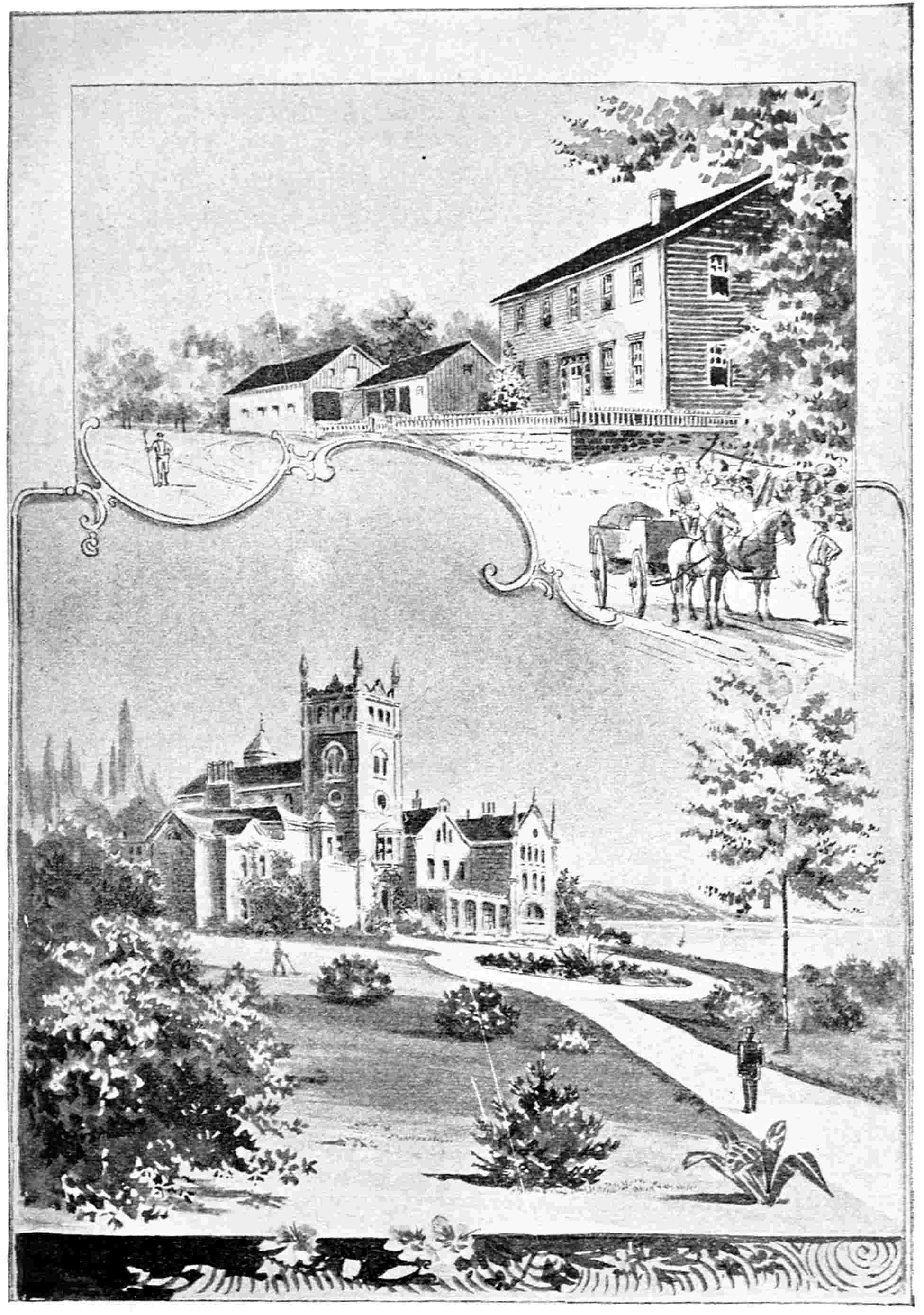
neighbors as a worthy citizen. The house in which
Jay was born and spent his boyhood is described as
a “two-story, box-like frame building covered with a
coating of white paint.” In July, 1880, Jay Gould
visited his birth-place and also Hobart, where he went
to school. He used to walk the entire distance to
school every Monday morning, returning Saturdays.
He was enthusiastically received by the inhabitants
at the time of his visit, as the most noted man ever
born in that region. When he visited the old house,
it is to be wondered if he recalled the first instance
in which he ever showed a combative spirit of bravery.
It was during the Anti-rent War, when a party
of anti-renters visited his father’s house to compel
him to cease paying rent, John B. Gould and a
neighbor, Hiram Moore, belonging to the conservative
farmers, known as “high-renters.” The “rebels”
were masked and in bad temper, but John B. Gould
stood out stoutly for his rights, while ten-year-old
Jay, who stood in the doorway at his side, urged his
father to shoot his assailants down. John B., like
the son in manhood, was small of stature, and had
the additional misfortune of having one leg shorter
than the other, but he probably inherited some of
the rugged qualities of grim Captain Abram, and
these were likely to be accentuated by the struggle
for existence in the rough sterile country of their
habitation. The vigilance committee, at any rate, left
the little man unharmed, though they promptly proceeded
to tar and feather his neighbor, Hiram Moore.
These anti-rent troubles were caused by the refusal
of the occupants of certain large tracts of land
in Delaware and adjacent counties, to pay an annual
rental to persons who claimed to have purchased
the land from the Indians. Such rentals had been
paid with a fair degree of regularity up to 1844,
when the farmers rebelled, declaring that the exactions
were oppressive and unlawful. In some cases
the rent exacted had consisted of so many bushels of
wheat, a certain number of fowls or a few days’ labor
per year. In other cases cash payments were demanded.
Secret organizations were formed in Delaware
county, and some of the aggressive movements were
particularly directed toward John B. Gould, who declined
to join the anti-rent party. The officers of the
law were resisted in their attempts to levy on or sell
property for non-payment of rent. The anti-rent
men claimed that the land really belonged to the
Indians, and they armed themselves and went about
the country disguised as Indians. They carried
tomahawks and applied tar and feathers to several
men whom they accused of persecuting them. Mr.
Gould had in his possession for many years one of
the tomahawks that was brandished by the Roxbury
“Indians,” and he could readily recall the
events that preceded and followed the battle of
Shacksville, in which a body of armed anti-renters, in
resisting a sheriff’s posse, killed several men. Gov.
Silas Wright was then obliged to declare several
counties in a state of insurrection and many arrests
were made. The state authorities overcame armed
resistance, but the anti-rent men carried their grievance
into politics and succeeded in electing John
Young for Governor over Silas Wright.
Mr. Gould used to tell his intimate friends that
whatever nerve he possessed he inherited from his
father.
While working at the tin shop, young Gould
retained all his fondness for mathematics, and
mastered several of the best authorities on surveying,
trigonometry and engineering, besides reading
a course of history. He rose at four in the morning,
and devoted the time he could call his own to reading
and study. Having made a particularly nice tin
whistle, he invited the boys of the town to join him
in amateur surveying expeditions, and with a borrowed
compass and other necessary instruments, the
boys acting as flagmen and chain-bearers, he soon
became an expert surveyor. In the tin business he
made himself so useful that at the age of fifteen he
was a full partner in the concern, and when he
visited Albany and New York to purchase material,
he succeeded in opening accounts with Phelps,
Dodge & Co. and other firms well-known to the
public.
It was at this point in young Gould’s career that
the unvarying routine of life in a tin shop became too
monotonous, and he abandoned it for a pursuit that
would at least enable him to see something of the
surrounding country, and possibly be more profitable.
He decided to make use of the knowledge that he
had gained and become a surveyor.
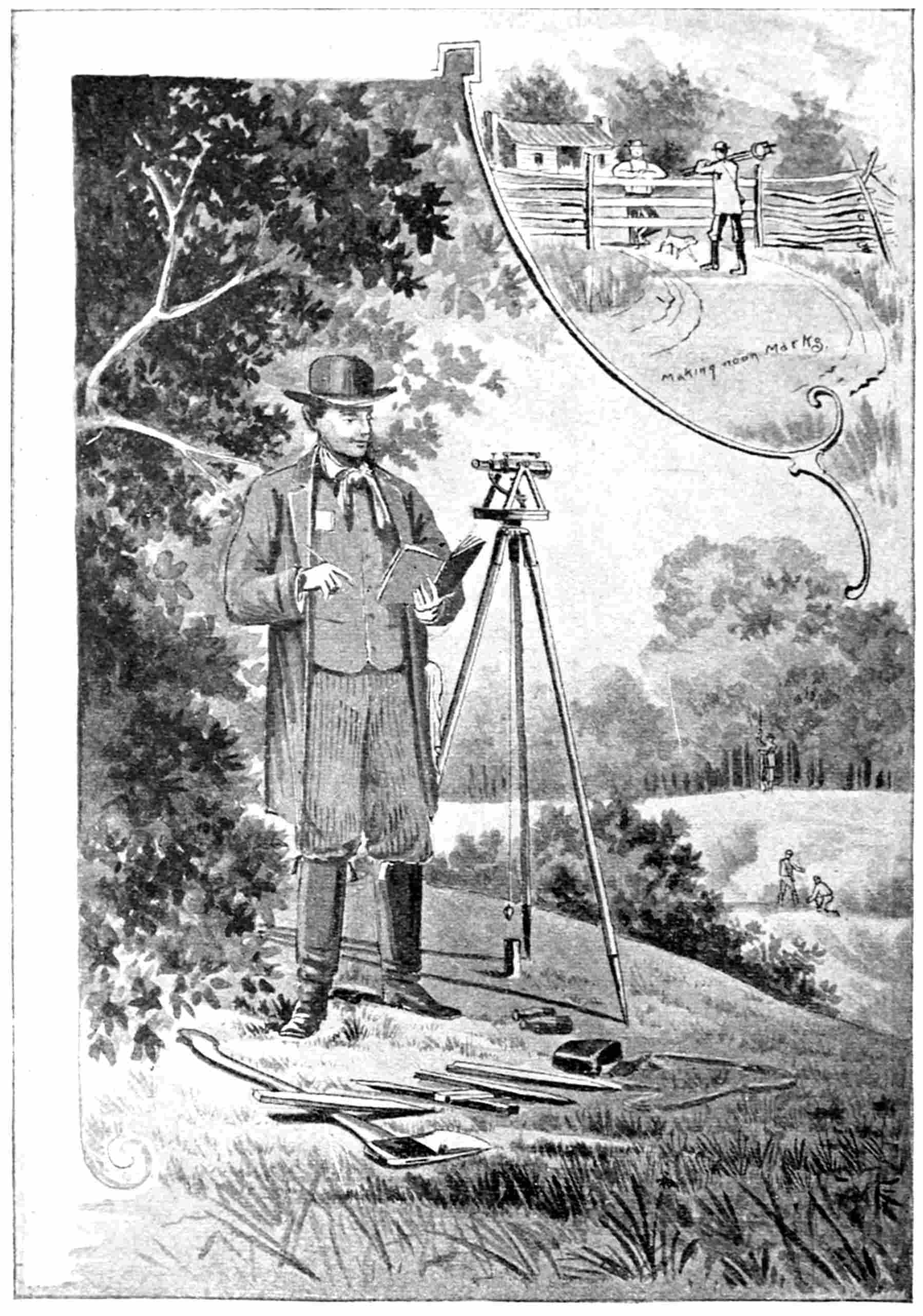
JAY GOULD AS A SURVEYOR.
CHAPTER III. GOULD AS SURVEYOR AND HISTORIAN.
The tin shop was profitable but slow, and with an
outcropping of the avidity which he afterward
showed, he sought for something more lucrative. In
1852 he transferred his interest to his father and
arranged to take charge of a surveying party at
twenty dollars a month. Gould had heard of a man
in Ulster county who was looking for an assistant.
He was making a map of that county and Gould
wrote to him. When he left home to take the
position, his father offered him money, but he left
all his capital in the store, burned his ships behind
him, and took only money enough to pay his fare
to the place where the new position was to begin.
His new employer started him out to make the
surveys, to see where the roads were and to locate
the residences. He also instructed young Gould to
get trusted for his living expenses along the way,
and that he would pay them following after him.
Two or three days later, Gould ran against the first
objection to this arrangement from one of his entertainers,
who knew that the employer had already
failed three times. He agreed to trust young Gould
but would not trust the employer. The boy
wandered on after this rebuff until three o’clock,
before making an effort to get his dinner. His
wretchedness and its relief are interestingly told in
a letter that Mr. Gould wrote to a friend some years
later.
“I was out of money—that is to say, every cent I
had at my command was a ten-cent piece, with
which I had determined not to part. Fall was approaching,
and, unless our surveys were completed
before winter set in, the final completion of our
enterprise would be necessarily delayed until
another season, subjecting us to additional expense,
which I feared would prove hazardous to the enterprise.
I was among entire strangers and consequently
without credit. I could not spare time to
go to Delaware county after funds, and I had not
money to reach there. If tears had been coin my
empty coffers would soon have been amply replenished.
In this emergency a welcome expedient
accidentally presented itself. I was prosecuting my
surveys at this time in the town of Shawangunk,
and, while the tears were even trickling down my
cheek, a farmer came running after me and asked
me if I would not return with him to dinner and
make a ‘noon mark,’ which is a north and south
line, to indicate, by the shadow caused by the rays
falling against an upright object and striking the
line, the hour of midday. I accepted the invitation
with pleasure, as a couple of crackers was all I
had eaten since the preceding night, and I had
been working since daylight and was consequently
hungry and faint. After dinner I made the noon
mark, and, turning to leave, the farmer asked me
my bill. I replied that he ‘was welcome.’ He
insisted, however, on paying me a half dollar, which
he assured me a neighbor had paid for one, which I
accepted, and started on my way, and had I that
moment discovered a continent it would have
afforded me less joy. I saw that I could turn this
discovery to practical account, and I felt already
half rich, and I prosecuted my labors with a lighter
step than for many a day. The fame of my noon
marks preceded me, and the applications from the
farmers were numerous. By this means I paid all
the expenses of the surveys and came out at the
completion with six dollars in my pocket.”
In the early part of this embarrassment he had
no overcoat and sometimes traveled forty miles a
day on foot. His employer failed completely and
Gould continued the business for himself. Jay proposed
to the two other young surveyors, who had
also been engaged on the work, to complete it on
their own account. The other two young fellows
had money, and when the map was ready for the
engraver, Jay, finding his colleagues anxious to put
their names on it, sold his interest to them for $500.
With that capital he undertook similar surveys of
Albany and Delaware counties, and was successful
in turning out satisfactory maps of those regions.
He sold enough maps to bring his capital up to
$5,000. The accuracy of his survey of Ulster county
in the meantime, had attracted the attention of John
Delafield, in Albany, who applied to the Legislature
for aid in the completion of a topographical survey
of the entire state by Mr. Gould. Mr. Delafield
died before any material progress was made in this
work. His application to the Legislature was not
successful. Some particulars of interest in regard to
the map-making business are related by Oliver J.
Tillson, one of his partners in the map-making enterprise,
after the failure of the man who had first
employed him in the business. Mr. Tillson confirms
Mr. Gould’s account and tells of the bargain in
which the latter sold out to his partners. Here is a
copy of a receipt given by Gould on that occasion:
December 27, 1852.
Received of Oliver J. Tillson and Peter H. Brink ninety
dollars and wheel in full of all debts and demands and dues
against them and the Ulster county map.
Jason Gould,
for John B. Gould.
It will be observed that he signed his name
“Jason,” not Jay. He was christened “Jason,” but
about this time began to change it to Jay, by which
he was ever after known. “There wasn’t any foolishness
in Jason’s books,” says Mr. Tillson, referring to
the books in which Gould had made his notes of the
surveys. “He was all business in those days, as he
is now. Why, even at meal times he was always
talking map. He was a worker, and my father used
to say: ‘Look at Gould; isn’t he a driver?’”
CANVASSING FOR HIS BOOK “HISTORY OF DELAWARE COUNTY.”
This, in fact, is the testimony of all his contemporaries.
From his earlier years he was absorbed in
schemes for making money, and his whole aim in
life was to “get on.” With every passing year his
ambition broadened, until it enveloped a continent.
It is a striking coincidence that young Gould
and his two partners in the map business were sued
by the man who first employed the former in the
project, and they placed their case in the hands of
Lawyer T. R. Westbrook, who succeeded in having
the suit dismissed. Westbrook afterward became
(and this is the coincidence) the supreme court judge,
who years after scandalized the legal profession by
holding court in Jay Gould’s private office and issuing
an order in one of the Manhattan railway litigations.
He and his cousin, with whom he entered into
partnership at Albany, increased the map business
to the extent of sending surveyors into various portions
of Ohio, Pennsylvania and Michigan, but afterward
the contracts were transferred to a surveyor in
Philadelphia.
From this time he was continuously employed
as a surveyor, until a severe attack of typhoid
fever compelled him to give up outdoor exposure.
He had determined to make a complete survey of
the entire state of New York, and he did complete
maps of Albany county, the village of Cohoes, the
Albany and Niscayuna Plank road and Delaware
county. He also surveyed Lake and Geauga counties
in Ohio, Oakland county in Michigan, and a proposed
railroad from Newburg to Syracuse. Then
he was seriously ill for several months, but his
money was not used up, and he wrote with some
degree of interest and also profit a history of Delaware
county and partial histories of Greene, Ulster
and Sullivan counties.
Gould had gathered his ideas of casual writing
from a brief experience in a country newspaper
office, where he had worked gratuitously. The
history of Delaware county was four hundred pages
long, and is said to have been an exceedingly creditable
performance, both as an example of diligence
and care in the collection of facts and skill and taste
in the literary presentation of them. It never came
into general circulation, however, probably because
the printer, who lived in Philadelphia, insisted, in
spite of “copy” and proof corrections, in spelling
the name of the author “Gold.” When the books
arrived in Roxbury and the young historian discovered
the blunder he shipped them all back to the
manufacturer and would have nothing more to do
with them.
Gould’s taste of money and profits had acted
upon him almost as does the taste of blood to a
lion. By this time he was making enough money
to furnish himself a realization of what money could
do and to make him want it with an insatiable
desire. His child life had been a short one, and he
was a man in business and responsibility at an age
when most persons of no greater age are considered
to be but the merest children. And what there was
of his child life had been cold, and not of a character
to teach him, what few yet know, that money is
the least important thing in the world. All his life
he had felt the lack of it. He had been needy.
He had been compelled to struggle to supply his
physical necessities, and then at times they were
but scantily supplied. One favorite sister, his elder
one, who was his first teacher of mathematics, was
almost the only person whose recollection at home
was any delight to the boy and young man. So,
now that his well-applied and earnest labors have
brought fruit to the extent of several thousand
dollars of cash capital available to him, it is not
strange that he sought for some enterprise in which
the profits would be certain and large. This opportunity
opened before him and he grasped it.
It is very doubtful if, at that period in his career,
young Gould had ever read the works of Shakespeare,
but be that as it may, he followed that great
bard in the opportunity which was now his. Shakespeare
says:
“There is a tide in the affairs of man
“Which, taken at the flood leads on to fortune.
“Omitted, all the voyage of our life
“Is bound in shallows and in miseries.
“On such a full sea are we now afloat,
“And we must take the current when it serves,
“Or lose our ventures.”
Gould’s tide was in; it was turning, and the chance
of his life was waiting to be taken. It was this
same faculty of being able to recognize what was
the right thing to do, that all his life stood him in
good play. He recognized it now, and changed the
whole current of his life.
The lessons to be learned from this early period
of the life of the one who was in future time to be
the “Wizard of Wall Street,” are not in anything
obscure. Unceasing vigilance and unflagging energy
were the qualities that were most prominently developed
in him from his very youth. These qualities
properly directed and controlled, are in this age
bound to win success for any young man. Gould
never lost an opportunity to make more money by
increased efforts. He was not afraid to assume any
amount of extra work if he saw in it a just amount
of remuneration. From the time when he left his
father’s house and started out into the world to take
care of himself and make his own living, there was
never a man with whom he came in contact who did
not consider the young fellow a valuable person to
have attached to his business. Gould always made
it a point to prove himself valuable. He made his
employer’s interests his own, and was always ready
for whatever appeared necessary to be done. In all
of this, his example is most worthy of emulation.
And while it is not to be expected that the same
efforts will bring to every one equal results, one
may rest assured that they will amply repay for their
adoption.
THE TANNERY WAR IN PENNSYLVANIA.
CHAPTER IV. GOULD AND THE TANNERY WAR.
From the mildly humdrum life of school boy,
tinker, surveyor and bookseller, Gould’s career
now changes to an intensely dramatic period. While
pursuing his avocation as a surveyor, he made the
acquaintance of Zadock Pratt, a local celebrity who
lived at Prattsville not far from Roxbury, for whom
he had done some surveying. Pratt is described as
an ignorant man who had amassed what at that
time and in that section was considered an immense
fortune. He was worth a hundred thousand dollars,
and had the largest tannery in the country. He had
also been to Congress, and, as is usual with such
district nabobs, he was a very vain man. How he
happened to become attached to Jay Gould does
not appear. Mr. Gould himself once said: “While
I was carrying on these surveys, I met a gentleman
who seemed to take a fancy to me.” Zadock Pratt
was a famous man in his days. He was not only
the biggest tanner in the country, but he was also a
power in the politics in the state. During his ten
years’ service in Congress, at least one of his
speeches attracted widespread attention. He was
one of the earliest advocates of cheap postage, and
he moved the establishment of the Bureau of Statistics,
which has since developed into the Department
of the Interior. He also moved the first survey
of the Pacific railroad line. When he ceased
his Prattsville tannery in 1845 he estimated that in
twenty years he had used one hundred and fifty
thousand cords of bark and wood, had employed
thirty thousand men, had cleared twelve thousand
acres of land and tanned over one million sides of
sole leather. He was, however, nearly seventy years
old when he interested himself in Gould. The latter
was fortunate in obtaining the confidence of this
man. The history of his association with Pratt, and
later with Leupp, is not contained in legislative and
law reports, as are other portions of Gould’s career,
but there are several very circumstantial accounts
extant based on the testimony of eye-witnesses,
some of whom may still be living.
One story has it that the young historian had
artfully flattered Pratt in his “History of Delaware
County,” and so won his good opinion. However
this may be, certain it is that Pratt asked the young
man who had surveyed his place in Prattsville to
embark with him in the business of tanning leather.
Gould agreed and immediately demonstrated his
capacity for managing the new venture by going
over the Delaware and Lackawanna railway, then
recently completed, into Pennsylvania, on a search
for a site of the proposed new tannery. He found
a large tract of land growing hemlock in Lackawanna
county and reported the fact to Mr. Pratt.
Soon after he started for the hemlock woods again,
and this time he made contracts of purchase with
their owners. In his next expedition into Pennsylvania
he took fifty or sixty men with him to build
the tannery. The site chosen was in the midst of
the forest, fifteen miles away from the nearest village.
The men took with them a portable sawmill.
Gould went in and chopped down the first tree
which was sawed up, and transferred it into a blacksmith
shop, under the roof of which Jay Gould
passed the first night, sleeping on a bed of hemlock
boughs. Thus the tannery, “a very large one, the
largest in the country at that time,” to use Mr.
Gould’s own words, was built. Near it there soon
sprung up a village which was called Gouldsboro,
and in this village Gould established a bank of
which he elected himself director by means of
proxies obtained from relations whom he had persuaded
to take stock.
Pratt was taken with young Gould’s snap and
energy and considered him just the kind of material
to use in pushing a new enterprise. Pratt furnished
all the capital and Gould conducted the active operation.
The capital of the firm was $120,000, and
the tannery at Gouldsboro, Pennsylvania, became
the biggest concern of its kind in the country.
Gould threw the whole energy of his being into the
enterprise. Pratt made occasional visits to Gouldsboro,
but the business was left practically in Gould’s
hands and it grew rapidly. After a while Mr. Pratt
became dissatisfied with the condition of affairs.
Apparently a rushing business was being done from
which there was no adequate return. After awhile,
Mr. Pratt having invested $55,000, sent an agent to
Gouldsboro to investigate affairs.
The books seemed to be so mixed that it was
quite impossible to ascertain just how the firm stood.
Gould soon saw that his partner was becoming suspicious
and determined to be ready for him. On
the growth of the business Gould had, of course,
occasion to frequently visit New York, where he
became acquainted with most of the merchants in
the “Swamp,” then, as now, the center of the leather
trade. Among others, he became acquainted with
Charles M. Leupp, a merchant of the old school,
honorable and correct in all his dealings. He was a
man of great refinement and of poetic temperament,
and possessed many literary and artistic tastes. He
was a man of wealth and owned a fine mansion on
the corner of Madison avenue and Twenty-fifth
street. This mansion is still standing, but has been
altered into an apartment house. In Mr. Leupp’s
time it was probably the handsomest and best constructed
private dwelling in the city and cost about
$150,000.
It was an evil day for Mr. Leupp when Gould
came to him and proposed that he advance the
money to purchase Mr. Pratt’s interest in the tannery.
That was the beginning of Mr. Leupp’s
troubles, but at that time he considered the proposition
an advantageous one and he consented to
advance the cash. Gould never seems to have
had at any period in his career any difficulty in
interesting the wealthiest and most powerful men
in his schemes. He has himself said that it is just
as easy to obtain the acquaintance and secure the
friendship of the most powerful as of the most
insignificant if only one will set about it in the
right way. Well, Gould returned to Gouldsboro
with Leupp’s backing. He found Pratt looking
over the books and puzzled by their intricacies. He
discovered that Gould had started a private bank at
Stroudsburg in his own name, and he became suspicious
that the firm’s funds were used in the bank.
Pratt then demanded an explanation and finally
threatened to close up the tannery and dissolve the
partnership. Gould protested that this would ruin
him, when Pratt said that he must buy or sell. This
was what Gould was waiting for, and he told Mr.
Pratt to make him an offer. Pratt gave his energetic
young partner the choice of two alternatives,
either to take $10,000 for his interest in the business
and retire from the firm, or pay $40,000 for the interest
of the senior partner. Gould got ten days’ time
in which to make up his mind, and at the expiration
of that period surprised Mr. Pratt by buying him
out on his own terms.
Of course he drew on Leupp for the money.
This made Gould a partner of Leupp with full
powers. He continued with Leupp the policy he
had begun with Pratt. He branched out in many
speculations in Leupp’s name, but without his
knowledge. It is said that he bought another tannery,
attempted to get up a “corner” in hides, and in
other ways entered into many hazardous enterprises.
He continued to draw on Leupp for money
and to display his incapacity as a bookkeeper until
Leupp became suspicious, just as Pratt had. Meanwhile
the panic of 1857 had swept over the country
and unsettled all business operations, and when
Leupp discovered the extent in which he had been
involved in Gould’s speculations he thought that he
was ruined. He went to his magnificent home one
night and, in a fit of despondency, shot himself dead.
It is not certain but that Gould’s schemes would
have turned out all right, and to Leupp’s, as well as
to Gould’s advantage, but it is a fact that Leupp’s
partners and heirs have always felt very bitter
against Gould, and could not help believing that he
was indirectly the cause of Leupp’s sad and untimely
end.
Mr. Leupp’s old-fashioned notions had been
terribly shocked, for Gould had gone into corners
in hides and other tanneries which might and might
not have turned out well. When he found that his
partner had bought not only all the hides then in
the market but all that were to arrive in the ensuing
six months, he literally lost his reason, and his
suicide occurred after a stormy interview with
Gould, who remained imperturbably cool and
simply turned on his heel and left the office.
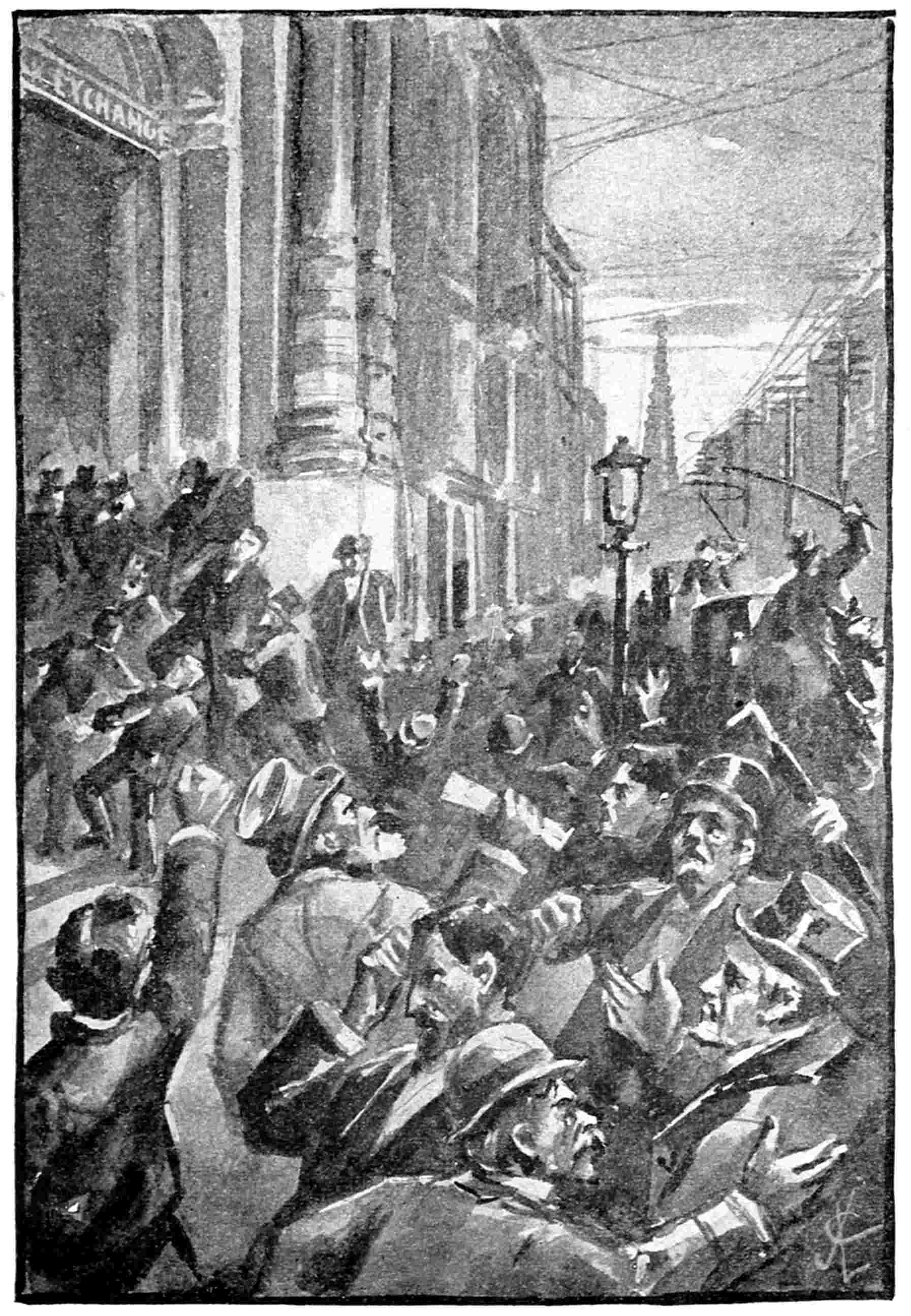
It is related that in the excitement and passion
of Black Friday when a mob surged through Wall
street, a voice was heard above the tumult shouting
the awful question:
“Who killed Leupp?”
And the answer is said to have come from a
hundred throats:
“Jay Gould!”
Prior to the fatal shot, Gould had arranged with
Congressman Alley, of Massachusetts, to take the
works and thus relieve Luepp and Lee, who was
also a partner. But the suicide of the senior partner
stopped the final consummation of this plan, and,
Gould always insisted, stopped the way to a profitable
continuance of the works.
Mr. Gould then negotiated with Leupp’s daughters
for the control of the tannery. It is stated that
they demanded sixty thousand dollars, the amount
Leupp had originally advanced. Gould agreed to
this, but proposed a plan by which the payments
should extend over a term of years—ten thousand
dollars cash and a like amount every year until the
entire indebtedness had been liquidated. When the
papers were drawn up it was found Gould had made
no provision for paying interest. Negotiations
were broken off, and Mr. Lee, a relative and partner
of Leupp, hastened to Gouldsboro and took possession
of the tannery in the name of Leupp’s heirs,
taking the precaution to hire a lot of men to help
him barricade and guard it. Gould arrived a day or
two later and determined to capture the tannery at
all hazards. Gouldsboro was a village of about
three hundred inhabitants, situated some distance
from the railway station, and besides the tannery
the most important building was the hotel. Mr.
Lee, who, like Mr. Leupp, is described as an honorable,
warm-hearted man, but with more courage and
grit, had the tannery guarded by about thirty or
forty men whom he had hired at Scranton.
Gould, as soon as he arrived, began active operations.
He interested nearly the entire population
of the place in his behalf. They knew him and Lee
was a comparative stranger. Gould told every
one he met that he owned the tannery, that Lee
and his cutthroats were endeavoring to get the
property away from him, and that if they succeeded
the business would go to wreck and ruin and the
place would suffer a big loss. He had soon an
armed gang of about 150 men around him prepared
to fight for him. They were a tough looking set of
men. He took them to the hotel, where he gave
them an oyster supper, and then mounting an empty
box addressed his forces, telling them to use no
unnecessary violence, but to “be sure and get the
tannery.” This was probably the first and only
speech Gould ever made in all his life. Filled with
oysters and whisky, the men made a determined
charge on the tannery, Gould directing everything,
but prudently keeping in the background, for he
heard that Lee had a loaded musket ready for him.
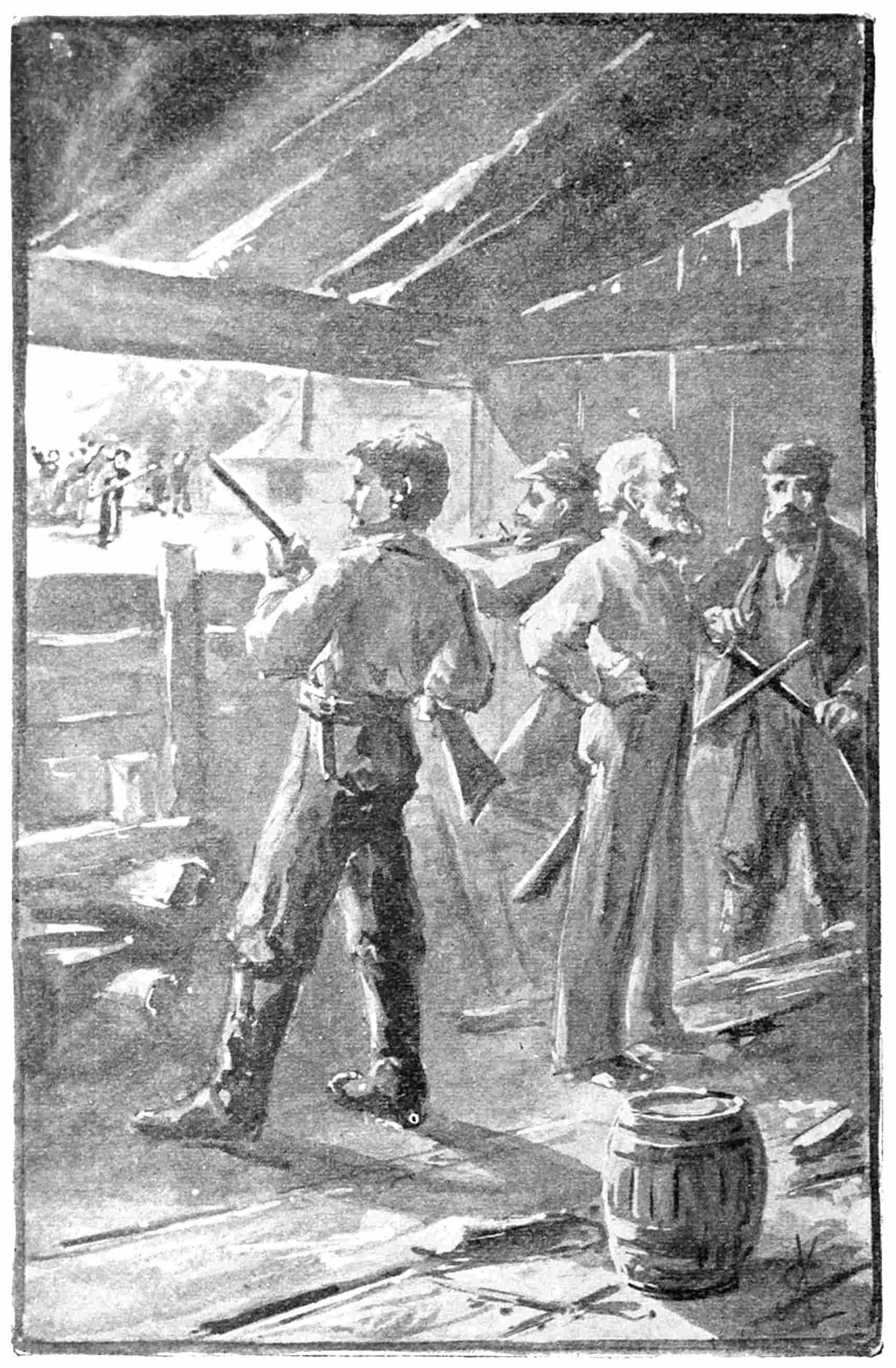
The battle was fierce but short. The barricaded
doors were battered in and Lee’s men were driven
from the tannery. Two men were badly wounded.
One of Lee’s party was shot through the breast.
Warrants were issued for the arrest of all concerned.
Many of the men fled from the place never to return.
Those arrested were afterward released on bail.
Gould was left in possession of the property, but it
did him little good. Lee began legal proceedings
against him and Gould brought counter-suits, and
this litigation was continued until the business was
destroyed and the tannery abandoned.
In the New York Herald of March 16, 1860, is
given the following account of the battle:
TANNERY INSURRECTION IN PENNSYLVANIA.
BATTLE BETWEEN THE FORCES OF THE SWAMP LEATHER DEALERS—
THE LEUPP AND LEE TANNERY, IN GOULDSBORO, ATTACKED
AND DEFENDED—SIDES OF LEATHER USED FOR BREAST-
WORKS—INSURGENTS TWO HUNDRED STRONG—
THE TANNERY TAKEN—FLIGHT OF THE
DEFENDERS—WOUNDED
FOUR.
About half-past ten o’clock on Tuesday morning
the lock was wrenched from the stable, the men
having been concentrated into the tannery and the
stable being unguarded. A little past twelve the
tannery itself was attacked by a mob variously estimated
at from one hundred and eighty to two
hundred and fifty men, armed with axes, muskets,
rifles and other weapons. Without a demand
of possession or summons to surrender, the
doors were beaten in, and but a few blows had been
struck by the assailants before they began to fire
ball and buckshot through the building, raking it in
every direction. As vigorous a defense was made,
by a force of fifteen men in the story attacked, with
tannery sticks, stones and four revolvers, as was
possible against such overwhelming odds. The tannery
was finally carried on all sides, and those who
did not escape were violently flung from the windows
and doors, while the assailants rushed through
the buildings, yelling like Indians, pursuing the
fugitives with their guns in every direction. In the
action many contusions were received and four gunshot
wounds, and had it not been for the large number
of sides of leather hung up the lofts, very few of
the defending party would have escaped without
wounds.
Mr. Jay Gould, in his version of the affair, in
which he endeavors to exculpate himself, says:
“I quietly selected fifty men, commanding the
reserve to keep aloof. I divided them into two companies,
one of which I despatched to the upper end
of the building, directing them to take off the boards,
while I headed the other to open a large front door.
I burst open the door and sprang in. I was immediately
saluted with a shower of balls, forcing my
men to retire, and I brought them up a second and
third time and pressed them into the building, and
by this time the company at the upper end of the
tannery had succeeded in effecting an entrance and
the firing now became general on all sides and the
bullets were whistling in every direction. After a
hard contested struggle on both sides we became
the victors, and our opponents went flying from the
tannery, some of them making fearful leaps from
the second story.”
After this depreciation of value in the tannery
property, Gould’s ready resources were so exhausted
that it is related that he had to borrow the money
to pay his railroad fare to New York. It is probable
that no man in this or any other country has
ever been a party to so many lawsuits as Gould.
From the time of the contest over the map business
there was scarcely a day during his whole life that
he did not have some litigation on his hands. This
ends the early chapters of Gould’s life. He now
entered upon that career in the metropolis which
has made his name familiar around the globe.
It is doubtful if many young men, before the age
of twenty-four years, have passed through as many
and as varied experiences as these of Jay Gould.
All his training now for several years had been in
the line, first, of competition with others in the same
business as his own, and then in direct conflict and
war with those who had been his associates. He
had learned not only to conquer his enemies, but to
conquer his friends. He had thoroughly developed
and made apparent to every one who came in contact
with him that spirit that remained with him through
all his life, the mania for the aggrandizement of his
own fortune, no matter whose money must be lost
for him to gain it. The last chapter of his tannery
experiences was a dark one, and there is nothing in
it to be held up for admiration by any one, but
rather as an example of the first notable evil in the
nature of financial wrecking of the many that are
found in a complete retrospect of his life. Gould
himself always realized the discreditability of his
actions in the tannery matter, as is evidenced by the
way in which he tried to smooth it over before the
investigating committee ten years later. As a matter
of fact, he probably realized and recognized
whatever else he did that was evil in his far greater
financial operations during the next three decades,
but if he did, he gave no sign nor did he ever indicate
that he had any regrets in his career.
GOULD’S FIRST GLIMPSE OF HIS FUTURE WIFE.
CHAPTER V. GOULD’S ROMANTIC MARRIAGE AND HIS FIRST RAILROAD.
When Jay Gould reached New York in 1860,
after the tannery war, he was almost impoverished.
He settled down at the Everett House, a comfortable
hotel, and there he lived for a little time
while waiting for something to turn up. Gould was
not very busy just then and used to wander around
the city, up town and down town, through Wall
street and Lower Broadway, where in later years he
became such a power; maybe, even then, wondering
if he would ever reach the point in wealth and
influence that belonged to the men he met, and
figuring, as every one does at times, what he would
do if he were a millionaire. He knew the tannery
business thoroughly and had many influential acquaintances
in “The Swamp,” which was the seat
then, as it is now, of the leather trade in New York.
But he most wanted to get into the railroad business.
He believed that greater opportunities were there
than in any other occupation for the acquiring of
wealth and influence. So he bent all his energies in
that direction.
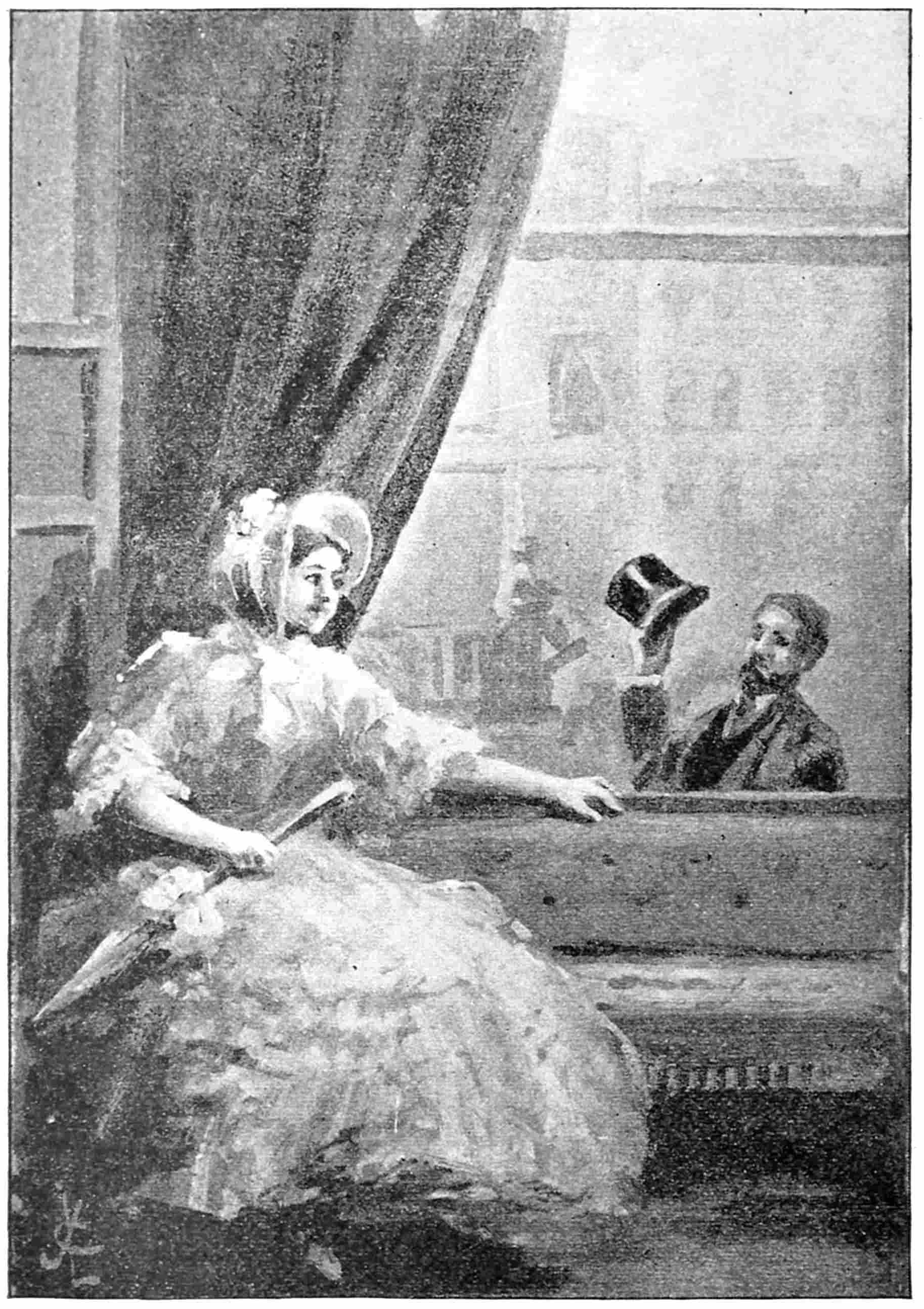
One day just before the war, Gould came walking
down the street toward his hotel, and looking
up toward the window of the parlor, he saw seated
there, looking toward him, a most charming young
lady. He was not by any means inclined toward
flirtation, but he could not avoid an appearance of
interest in her, and he passed on into the hotel.
Soon after that the same episode was repeated. By
a little investigation, Mr. Gould learned that the
young lady was Miss Ellen Miller, whose father, a
wealthy New York merchant, was a member of the
grocery house of Philip Dater & Co. She lived in a
house across the street, and a delightful flirtation
with the girl whose pretty face appeared at the window
preceded any formal acquaintance. Circumstances,
however, permitted them to meet socially,
and they became excellently well acquainted. After
a few weeks, the acquaintance became more and
more intimate and finally ripened into love. Miss
Miller’s father indicated opposition to their marriage,
their desire for which they made evident, and
they were compelled to seek some roundabout way
to accomplish their purpose. The result was, that
after trying several ways to circumvent the unsympathetic
parent, they decided upon a secret marriage,
and this was actually accomplished. There were no
runaway features about the match, except that to
avoid the opposition that they were certain would
come, they simply walked to a minister’s, a short
distance from their home, and were married without
letting any one know of it. When they returned,
Mr. Miller indicated no ill-will at their action, and
went to work to make the best of it all. He did
this by giving the famous financier his first introduction
into the railroad business. Mr. Miller
owned some shares in the Rutland and Washington
railroad. He asked his son-in-law to look the property
over and see if anything could be done to save
the investment. The road was sixty-two miles long,
running from Troy, New York, to Rutland, Vermont.
The panic of 1857 had left this road in a demoralized
condition, and Gould found that he could buy a
majority of the first mortgage bonds at ten cents on
the dollar. He had now found the true field for his
peculiar talent. He made himself president, treasurer
and general superintendent of the road, studied
the business of railroading on the ground, developed
the local traffic, and finally effected the Rensselaer
and Saratoga Consolidation. By this time, both
bonds and stocks were good and he sold the latter
for one hundred and twenty dollars.
There has been no time when it was possible
to estimate the wealth of Mr. Gould, and as he was
secretive in those early days as in his later, there
was no saying what he was worth when in 1860 he
came into Wall street. One statement has it that
when the firm of Smith, Gould & Martin was organized,
Mr. Gould’s possessions amounted to thirty
thousand dollars in cash. Another is that when he
sold out his holdings in the Rensselaer and Saratoga
Consolidation, he was worth seven hundred and
fifty thousand dollars.
With a mind peculiarly alert to all the influences
which affected the values of railway securities, with
habits of great industry, with phenomenal tenacity
of purpose, with a fair amount at least of capital to
back him, it is not surprising that Mr. Gould profited
largely by his speculation in railway stocks and
gold during the war of the rebellion. The keen-sighted,
intelligent men in “the Street” at that time
nearly all made money, and Mr. Gould was at least
a millionaire when the Confederacy fell. What his
methods were at the time it is useless to speculate
about. It was before the day when by absolute
mastery of gigantic railway and telegraph systems
he could at his will depress the value of almost any
institution on which he fixed his eye by setting on
foot a ruinous war in rates until he had made it to
be his own interest to restore a more normal and
healthful condition of affairs by ceasing his antagonism
and building up the property which he had
acquired cheaply during the period of depression.
But the details of his operations were always so subtle
as to be shut out from the discovery of either
friend or foe.
Gould was now fairly on the way toward his
colossal fortune. Though friends warned him against
entering into the whirlpool of blasted hopes and
ruined fortunes of Wall street, his inclinations in
that direction were too strong to be resisted. Gould
was a born speculator. It is true that his great fortune
was created mainly in hazardous enterprises
outside of Wall street, and that in stock speculations,
pure and simple, he was not always so successful
or so infallible as many have supposed, but by
nature and habit Gould was at this time of his life a
commercial gambler, and it was as natural that he
should enter Wall street as for a duck to take to
water. It was in 1859 or 1860 that Gould first entered
Wall street. It was not very long before he
stepped to the front rank. What a long list of
brainy and courageous men do Gould’s contemporaries
in the street make! With most of them Gould
has been at sword’s point, with a few he has been
an ally, with some he has been both ally and enemy.
Most of them are no longer powers in the speculative
world. Some of them are dead. Not a few
have been overwhelmed in the swift, resistless torrent
of stock speculation. Three or four yet remain
with power in their hands and millions in their
vaults. The Vanderbilts—the commodore, his son
and grandsons—Daniel Drew, James Fisk, Jr., the
Beldens, Commodore Garrison, Henry N. Smith,
James R. Keene, William Heath, George I. Seney,
Gen. Thomas, Calvin S. Brice, D. O. Mills, Horace
F. Clark, Alfred Sully, Addison Cammack, C. F.
Woerishoffer, the Rockefellers, S. M. Kneeland, C. J.
Osborn, D. P. Morgan, H. S. Ives, C. P. Huntington,
Russell Sage, Cyrus W. Field, John W. Garrett,
Robert Garrett, J. P. Morgan, the Seligmans, Brown
Bros., Jay Cooke, Hugh J. Jewett, Lathrop, Little
and Austin Corbin, Henry Clews, Washington E.
Connor, Burnham, Gen. E. F. Winslow, Edward S.
Stokes, S. V. White, William Dowd, Solon Humphreys,
William R. Travers, Rufus Hatch, Samuel
Sloan—these were some of the men identified with
various Wall street interests with whom Gould has
been allied or at enmity, or both, during his long
career in the street. That he has been able among
all these financial giants to make himself the leader
is the highest evidence that can be given of his
genius in speculation and railroad financiering. As
we read some of these names there arise before our
eyes the visions of murder, of suicide, of bankruptcy,
of the debtor’s prison, of the felon’s cell, of ruined
fortunes and blasted reputations. Others of the
men have achieved wealth and honorable names. It
is interesting to note that at the time Gould first
entered the street one of his fellow-boarders at the
Everett House was James Gordon Bennett, the
elder, with whose son and successor he became engaged
in such bitter business and personal antagonisms.
Gould not only gambled in Wall street, but he
defended the operation. “People,” he told a State
Senate Committee which was investigating into stock
and grain corners, “will deal in chance. Your minister,
doctor and barber all have the same interest in
speculation. Would you not, if you stopped it, promote
gambling?”
Jay Gould was twenty-three years old when he
went into Wall street as a broker. In addition to
whatever amount of money he had, he had the confidence
of two or three large capitalists, which is the
best capital of all for beginning a business of speculation.
He started on his Wall street career in a
small office and frequently took his stand with the
“curb-stone” brokers. He made money right along.
In 1860 he became intimately acquainted with Henry
N. Smith, who was then one of the big men in Wall
street. Soon the firm of Smith, Gould & Martin was
formed and it was prosperous from the start. Gould
made a careful study of the railroad situation and
became an expert in the manipulation of railroad
securities in the speculative market. He paid the
closest attention to business, allowing himself few
of the social pleasures of which young men are
usually fond. He had no small vices, being a teetotaler.
During the war of the rebellion, the firm did a
large business in railway securities, and also made a
great deal of money speculating in gold. Gould had
private sources of information in the field, and he
was able to turn almost every success or defeat of
the Union army to profitable account.
At last Gould had found his exact niche, the corner
in which the railroads were put away. That
“corner” was ever after the one in which he found
both his labor and his recreation, his fortune bad
and good. He was a natural railroad magnate.
Almost always he won, and when he did not, it was
simply because he attempted schemes that would
have seemed to any other man entirely beyond possibility.
From this time his history never loses its
intense dramatic interest and never goes back to the
humdrum life that he had abandoned. From this
time, there could be no night in which Jay Gould
could sleep in dreamless rest, with no thought of the
morrow. From this time, there could be never a day
of freedom from the intensest strain of business
anxiety. He had chosen speculation for a life work,
and its cares must sit upon him. His could not be
the experience of the man in mercantile life, or of
the man of smaller affairs, who finishes his work in
the evening and goes to his home with never a
thought of the cares to-morrow will bring. Great
enterprises make great responsibilities. From this
time the enormous weight of the responsibilities
upon Jay Gould’s shoulders could never again lessen.
Did he ever, in those years of scheming and
fighting for wealth, cast his recollection backward
to the old days at Roxbury, when he was but a barefoot
farmer’s boy, with nothing more oppressive on
his mind than the necessity to go through the rain
for the cows, or to find the nest that the blue hen
had hidden away some place in the hay-mow?
There was little in the associations that he made
during these first Wall street years to remind him of
those days. For while many of the men with whom
he came in contact had been like himself, the sons
of farmers with the first years of their lives spent far
from the city, yet from this time, all their “watering”
of stock was entirely in the direction of stocks
which represented the value of railroads and other
properties, and all their knowledge of farm products
was devoted to the manipulation of grain markets.
As Gould’s acquaintance grew larger, and his
success in ordinary small ventures became assured,
his disposition began to demand something of
greater magnitude, something with more satisfaction
in it for that appetite that was already becoming
insatiable. A few small railroad ventures were carried
through in a manner bordering upon perfection,
and this increased the confidence in him of those
speculators who were already his acquaintances.
The way opened for him to enter into the manipulations
of Erie, and, as before, when opportunity came
he recognized and grasped it.
CHAPTER VI. GOULD’S ASSAULT UPON ERIE.
The most thrilling, the most discreditable portion
of Gould’s career, is contained in the ten years
following the close of the war of the rebellion. The
blackest pages in the history of American railways
comprise the chapter relating to the Erie and the
most shameful efforts to wreck the fortunes of a
thousand men for the aggrandizement of the fortunes
of a few, were made in connection with the
schemes that resulted in “Black Friday.”
Nothing in the Credit Mobilier and the history
of the rise of the Pacific railroads equals in downright
violation of sacred trusts, in absolute plunder
of vast properties, and in wholesale bribery and
corruption, the record of Erie. Even Mr. Gould, in
his sworn autobiography in that celebrated investigation
before the committee on labor and education,
while careful to give minute details about other
periods of his history, significantly preserved an
entire silence as to Erie and “Black Friday”—two
incidents in his career which nothing but an effort
to conceal could explain his silence regarding.
That this is no exaggeration of language, an examination
of the facts will show. There is no intention
to speak maliciously of Gould. Beside an open
grave, charity and forgetfulness stand guard on
either side. But the lesson of Gould’s career would
be lost, if even at this time the facts were not plainly
and openly told. To say that Gould ruthlessly
plundered the Erie railway is to speak the plain
truth.
Fortunately the record of Erie, notwithstanding
Mr. Gould’s silence, can be told from authoritative
testimony. In his famous “Chapter of Erie,” published
in the North American Review, in 1869,
Charles Francis Adams gives a thrilling account of
Erie from the time Daniel Drew engaged in his
famous war with Commodore Vanderbilt, to the
time when that unfortunate road was in complete
control of Jay Gould and James Fisk, Jr. Mr.
Adams’ history stopped short in the middle of the
story, but the record of Erie, from 1869 till Mr.
Gould was driven from power in 1872, is given in
the report of the legislative inquiry in 1873, and of
the Hepburn investigation of 1879.
It is a curious fact that years after writing this
“chapter” Mr. Adams, having become president of
the Union Pacific, sat in the same Board of Directors
with Gould, but only for a comparatively brief
period, and Mr. Adams never repudiated or recalled
his early history of Gould in Erie. It is a striking
illustration, however, of the power of millions that
Gould should live to sit in the same board with the
representative of the aristocratic Adams family,
which furnished two Presidents to the United States;
that after an effort to involve the administration of
President Grant in the disgrace of Black Friday, he
should, in after years, be joined with him in business
enterprises; that after having been publicly branded
as an unscrupulous gambler in a Congressional
report written by James A. Garfield, he should be
sought for to render aid to secure Garfield’s election
as president, and that, though not seeking to join
the social circles in which the Astors are leaders, he
was able to induce John Jacob Astor to sit with him
in the Western Union Board of Directors.
Twenty years ago, after Mr. Adams wrote his
“Chapter of Erie,” he was himself president of the
Union Pacific, and it must have given Mr. Gould the
keenest satisfaction to have been the occasion of his
retirement from that position. The railway was in
a bad way financially—had a big floating debt—and
Mr. Gould and his friends stepped in, gained control
of the property the second time, retired Mr. Adams
from the presidency and secured an adjustment of
the floating debt. It was suggested to Mr. Gould at
this time that he might write a “Chapter of Union
Pacific” covering the history of the Adams administration.
But whatever there may have been lacking
in administrative vigor in Mr. Adams’ presidency,
he retired without any blot on the family escutcheon.
When Gould entered Wall street Erie was one of
the most active stocks on the list of the Stock Exchange.
It was natural that he should drift into its
speculation, and his connection with the Cleveland
and Pittsburg led him naturally into Erie. His old
acquaintances were surprised to hear one day that
he had become a director and a controlling spirit of
this great road. This was in 1867.
But now let us quote a little plain language from
Charles Francis Adams in order to get into the
atmosphere of Erie at this time:
“Yet freebooters are not extinct,” he wrote.
“They have only transferred their operations to the
land, and have conducted them in more or less
accordance with the forms of law, until at last so
great a proficiency have they attained that the commerce
of the world is more equally but far more heavily
taxed in their behalf than would ever have entered
into their wildest hopes, while outside the law they
simply make all comers stand and deliver. * * *
Gambling is a business now, where formerly it was a
disreputable excitement. Cheating at cards was
always disgraceful. Transactions of a similar character
under the euphemistic names of ‘operating,’
‘cornering’ and the like are not so regarded. * * *
No better illustration of the fantastic disguises which
the worst and most familiar evils of history assume
as they meet us in the actual movement of our own
day could be afforded than was seen in the events
attending what are known as the Erie wars of the
year 1868.”
In these wars Gould was an active spirit; and if
Mr. Adams had written in 1873 instead of 1869 he
would have made his language still stronger.
Before his entrance into Erie Gould had become
acquainted with James Fisk, Jr., and the former,
with that unerring judgment of men which was
always one of the elements of his success, soon perceived
in Fisk the qualities which supplied his own
deficiencies. Fisk was the son of a Vermont peddler
and followed the calling himself for some time, and
in it learned the great art of driving a hard and
shrewd bargain. Wholly uneducated, his natural
ability in the line of making money was very great.
Gould was timid and shrank from publicity. Fisk
was bold and loved notoriety. Gould had many
refinements of mind and was of a domestic nature.
Fisk was coarse, sensual and fond of display. He
became the colonel of a militia regiment, and with
great delight used to put on his uniform and ride in
front of his command. He used to create a sensation
by riding in a carriage with six horses in questionable
female company. He considered it one of
the choisest prerogatives of his position of vice-president
and comptroller of Erie to direct the theater
that adjoined the railway offices in the Grand Opera
House. While Gould did not have the inclination
or courage to do these things he did not hesitate
to use Fisk in every available way and to hide his
own personality behind that of his partner. In those
days Fisk seemed to play the more prominent part,
and Gould, in public estimation, was a secondary
character. When anything was done it was Fisk
that bore the brunt of popular criticism and indignation.
Yet the facts as they are now known show
that Gould’s was the master mind; Fisk was simply
his right arm. “With Gould to plan and Fisk to
act,” said Gen. Francis Barlow, in 1872, “they were a
strong team.”
At the time Gould and Fisk entered into Erie,
Daniel Drew was the master of that great trunk line.
Drew was one of the most extraordinary characters
in Wall street history. Both pious and unscrupulous,
he founded a theological seminary and wrecked
a railroad with equal fervor. He was a director and
treasurer of Erie, and used these positions simply
for speculative purposes. He was known in his day
as “the great speculative director.” His biggest
piece of “financiering” was to get himself apparently
cornered in Erie stock, and then to appear in the
street with a block of stock which had been converted
from bonds issued with an obscure provision entitling
the holders to convert them into stock. Gould
later on repeated this trick with success, both in
Erie and Jersey Central.
Soon after Gould and Fisk entered Erie, Drew became
engaged in his celebrated contest with Commodore
Vanderbilt, and in this contest he had their able
assistance. The first and great Vanderbilt was cast
in a larger mould than Drew. The latter was simply
a speculator. Vanderbilt was a creator of property.
He was the first of the line of railroad kings. Laying
the foundations of his great wealth in the steamboat
and steamship business, he soon drifted into railroad
operations, clearly seeing that in the development
in the great inland commerce of America there were
larger and quicker profits to be obtained than in the
export trade.
Vanderbilt had obtained control of the Harlem
and Hudson River roads; he now aimed at the
ownership of Erie. Space will not permit the telling
of the story of this famous contest. It can be found
in detail in Mr. Adams’ interesting chapter. It is a
story of extraordinary stock operations, of millions
lost and won; of securities issued by the bushel and
with little or no regard for law or equity; of large
and intricate litigation; of judges bought, legislators
bribed, of directors defying injunctions and fleeing
to another state to escape arrest. Vanderbilt, having
been defeated in other efforts to get his fingers
on the Erie road, resolved, if possible, to buy a controlling
interest, and his brokers were set at work on
this difficult job. Drew resolved to let Vanderbilt
have as much stock as he wanted, but entered into a
bargain with Gould and Fisk by which the railroad
king should be defeated by issuing and marketing an
unlimited number of new securities. So Drew sold
and Vanderbilt bought. The latter, having in
remembrance Drew’s famous convertible stock trick,
resorted to the courts to prevent him from issuing
any more stock. Injunctions were issued enjoining
Drew and all the directors of the road from issuing
any stock. Counter-injunctions were obtained by the
Drew-Gould party. One judge would issue an order
commanding certain things to be done which another
judge simultaneously commanded should not
be done. Judges in New York, Brooklyn, Albany
and Binghamton issued contradictory injunctions.
Such a legal pandemonium has never been seen
before or since. The courts ran riot and law became
another name for plunder. In this scene—the blackest
in the history of American jurisprudence—the
notorious Judge Barnard loomed up conspicuously,
and a little later Judge Cardoza, shrewd, learned,
crafty and venal—the modern Lord Bacon—appeared
on the scene. At first Barnard was Vanderbilt’s
judge. Later, when Vanderbilt had no further
use for him, he became Gould’s judge. His other
master was Tweed.
In the meantime, regardless of injunctions, Drew
and his aides calmly proceeded to carry out their
carefully matured plans to issue new stock. It was
agreed that fifty thousand shares of new stock should
be delivered to the Wall street firms of which Gould
and Fisk were members. Without going into the
details of the intrigue, it is sufficient to say that it
was, at least for the time being, successful. When
the fifty thousand shares were thrown on the market
the price of Erie fell from eighty-three to seventy-one.
Vanderbilt found that he had bought at high
figures a lot of Erie stock, but that he was no nearer
control than ever. Drew raked in about seven
million dollars of Vanderbilt’s money, and Gould
and Fisk shared in the profits. Then orders were
issued to arrest the Drew directors for contempt of
court. Receiving intelligence of this, they hastily
packed up their papers and securities, and thrusting
them into their pockets and valises, they beat a
hasty retreat to Jersey City. Over six million
dollars in securities were carried in one coach.
Among this precious company, of course, were Gould
and Fisk. In Jersey they were safe from the operation
of New York law. They calmly proceeded to
have the Erie incorporated as a New Jersey institution,
at the same time laboring to get the New York
legislature to pass a bill to legalize the issue of fifty
thousand shares of stock, a transaction which some
one at that time likened to an attempt “to legalize
counterfeit money.” It was not conscientious scruples
which caused the legislature to hesitate to pass this
bill; it was simply a question of cash. Vanderbilt
was still in the fight to protect his interests, and it
was a question of who had the biggest purse. Meanwhile,
Peter B. Sweeny—the brains of the Tweed
ring—had been made, temporarily, receiver of the
road, and though he never actually did anything in
that position, Judge Barnard ordered that he be paid
one hundred and fifty thousand dollars for his
services. Poor Erie had to foot the bill.
The Erie people needed a first-class representative
at Albany to watch their interests before the
legislature. Gould was selected as the fittest man
to act in the capacity of a lobbyist. First giving
out that he was going to Ohio, Gould quietly
slipped up to Albany, with five hundred thousand
dollars of Erie cash in his pocket. Here in a day
or two he was arrested, but released on five hundred
dollars bail to appear in a New York court on
Saturday. He appeared on that day, but his
attorneys secured a postponement, and he was
allowed to return to Albany in charge of an undersheriff.
Arriving in Albany Mr. Gould was conveniently
taken sick, and unable to return to New
York to attend the court proceedings, though he
drove to the capitol in a snowstorm. The officer
reported him to the court as a “runaway,” but the
matter was afterward settled, and, in the language
of Mr. Adams, he “assiduously cultivated a thorough
understanding between himself and the legislature.”
In this he was materially aided by the cash with
which his pockets were so liberally filled. Corruption
ran high. One senator was recorded to have
accepted seventy-five thousand dollars from one
side and one hundred thousand dollars from the
other. One man was paid five thousand dollars by
Gould “just,” as Mr. Gould remarked, “to smooth
him over.” The corruption at this session was
investigated by a legislative committee in 1869.
Gould was a witness, but he endeavored to conceal
the facts as much as possible. In the famous Erie
investigation of 1873, however, Mr. Gould testified
as follows:
“I was first elected President of the Erie railroad
in 1868, and I was President in 1869, 1870 and 1871.
I do not remember whether I approved payment to
William M. Tweed of money for legal services while
he was Senator. I do not know whether he is a
lawyer. He was a director of Erie and a member
of its executive committee. I would not have
allowed pecuniary transactions with Mr. Tweed to
be put in the shape of legal services if my attention
had been called to them. The name of William M.
Tweed is in my handwriting. The words in my
handwriting are: ‘William M. Tweed, legal disbursements
as per order, J. G., $35,000, April 25, 1871.’
The approval of voucher, April 5, 1869. He was
Senator in 1869, also in 1871 and 1872. The ‘legal
account, was of an india-rubber character. I gave
large amounts in 1869, 1870, 1871 and 1872 in the
senatorial and assembly districts. It was what
they said would be necessary to carry the day in
addition to the amount forwarded by the committee,
and contributed more or less to all the districts
along the line of the road. We had to look after
four states—New York, New Jersey, Pennsylvania
and Ohio. It was the custom when men received
nominations to come to me for contributions, and I
made them and considered them good paying investments
for the company. In a republican district
I was a strong republican; in a democratic district
I was a democrat, and in a doubtful district I
was doubtful. In politics I was an Erie railroad
man all the time. We had friends on both sides—friends
in a business way. The amounts contributed
for the elections were large, but I could not give
any definite estimate. No names occur to me at
the moment. I am a poor hand to remember names.
I had relations in several states. I did not keep
separate what I paid out in New Jersey from what I
paid out in New York. We had the same ground to
go over there, and there has been so much of it—it
has been so extensive—that I have no details now
to refresh my mind. You might as well go back
and ask me how many cars of freight were moved
on a particular day.”
This confession so charmingly frank relates to
payments before elections, but there is every reason
to believe that the payments were continued after
election.
The state of things unearthed by this investigation
was officially described in the report of the legislative
committee as follows:
“It is further in evidence that it has been the
custom of the managers of the Erie railway, from
year to year in the past, to spend large sums to control
elections and to influence legislation. In the
year 1868 more than one million ($1,000,000) was
disbursed from the treasury for ‘extra and legal services.’
“Mr. Gould; when last on the stand, and examined
in relation to various vouchers shown him,
admitted the payment during the three years prior
to 1872 of large sums to Barber, Tweed and others,
and to influence legislation or elections; these
amounts were charged in the ‘India-rubber account.’
The memory of this witness was very defective as to
details, and he could only remember large transactions,
but could distinctly recall that he had been in
the habit of sending money into the numerous districts
all over the state, either to control nominations
or elections for Senators and members of
Assembly. Considered that, as a rule, such investments
paid better than to wait till the men got to
Albany, and added the significant remark, when
asked a question, that it would be as impossible to
specify the numerous instances as it would to recall
to mind the numerous freight-cars sent over the Erie
road from day to day.”
The report of the committee concludes as follows:
“It is not reasonable to suppose that the Erie
railway has been alone in the corrupt use of money
for the purposes named; but the sudden revolution
in the direction of this company has laid bare a
chapter in the secret history of railroad management
such as has not been permitted before. It
exposes the reckless and prodigal use of money,
wrung from the people, to purchase the election of
the people’s representatives and to bribe them when
in office. According to Mr. Gould, his operations
extended into four different states. It was his
custom to contribute money to influence both
nominations and elections.”
Mr. Adams did not have this report before him
when he wrote his “chapter.” His record closes in
1868, soon after Mr. Gould had been elected president
of the road. This had been brought about in
the following manner: While Gould was engaged
in “fixing” the legislature, and the courts were filled
with Erie suits, the various parties in interest got
together and effected a compromise. Vanderbilt
got rid of the useless stock he had bought at high
figures. Drew pocketed his profits and returned
from exile in Jersey. The Boston, Hartford and
Erie crowd which had figured in these transactions,
having got all they could out of Erie for the benefit
of their own bankrupt road, withdrew. All litigation
was stopped and injunctions revoked. Bills were
rushed through the legislature favorable to both
Vanderbilt and Erie. Drew resigned from the road;
Vanderbilt relinquished his ambition for control,
and the property was turned over to Gould and
Fisk. Drew may have thought that by this time the
poor old road was a squeezed lemon, but if so he
was mistaken, for Gould and Sage found that the
property had not yet been worked for all that was
in it. What their administration cost the road is
very plainly set forth in the testimony given before
the Hepburn Committee of 1879, by J. W. Guppy,
assistant general superintendent under Gould, and
for many years connected with the road into whose
service he first entered as a telegraph operator.
When Gould was ousted from the control in March,
1872, the total stock was $86,536,910, the funded
debt $26,395,000 and the floating debt $2,517,301, a
total of $115,449,211, an increase during the time of
Gould’s identification with the road of $64,383,268.
Yet Mr. Guppy testified that not a dollar of this
vast sum was represented by any additions to the
road.
At the time that the Gould-Fisk ring was sucking
the life-blood of Erie, the Tweed-Sweeny ring
was plundering the city of New York. The two
were really one. From Mr. Gould’s testimony just
quoted and from other facts here presented, it will
be seen how closely allied they were. Tweed was
one of the executive committee of the Erie and was
paid large sums for so-called “legal” services. This
was a great day for the spoilsmen. It was a long
feast of corruption. Dishonesty walked openly in
the streets, bribery influenced elections and controlled
legislatures, and plundering was a fine art.
Great as was Tweed at this time, his prosperity was
soon to end in flight, capture, imprisonment, disgrace
and death, but Gould survived the exposure
and lived to enjoy his wealth and power.
CHAPTER VII. GOULD’S VICTORY AND FINAL DEFEAT IN ERIE.
During these years of Erie conflicts, Gould not
only fought his enemies most bitterly, but hardly
appreciated the usual feelings of men to be true
to their friends. Gould and Fisk now had practical
control of Erie. They saw the October election
coming, and they were nervous. But the
crops were good and Erie’s traffic brought in good
returns. Englishmen had become strangely fascinated
with the stock, and had bought over 100,000
shares. On August 19th the stock had dropped to
44, and then to the astonishment of Wall street,
the transfer books were closed, preparatory to the
annual election on October 13th. The election went
off well for Mr. Gould and his friends. Peter B.
Sweeny and William M. Tweed were among the
new directors. Then, it is said Mr. Gould began a
system of locking up money. This culminated on
October 27th, when members of the New York Stock
Exchange waited on Mr. Gould, who had obtained
large loans on Erie. Mr. Gould told the committee
that $10,000,000 of convertible bonds had been issued,
half of which had been converted into stock and the
rest would be. This was a new issue. The money,
he said, had been used to purchase the $5,000,000 of
Boston, Hartford and Erie. The committee was
not satisfied. It wanted to know if more stock would
be issued. Gould replied: “In certain contingencies,”
meaning for his loans. The Secretary of the
Exchange afterward said that the stock of the corporation
had been increased from $34,265,300 on July 1,
1868, to $57,766,300 on October 24th, or by 235,000
shares within four months. These new issues forced
Erie to 35. There was over $12,000,000 in greenbacks
locked up and all values were depressed. The situation
was so serious that Secretary McCulloch of
the treasury, a contractionist, was compelled to announce
that if necessary $50,000,000 additional currency
would be forthcoming for the relief of the
community.
Their next achievement, after securing entire
possession, was to corner their old associate Daniel
Drew. The latter, after a short retirement from the
street, returned to speculation and naturally drifted
into Erie, but this time from the outside. He was
caught just as many times he had caught others.
And Gould repeated, only in a more aggravated
way, his trick of issuing new stock and flooding Wall
street with it. This new stock was issued by Gould
and Fisk without even going through the form of
consultation with the other directors. Mr. Adams
calls this “the most extraordinary feat of financial
legerdemain which history has yet recorded.” Drew
found that even he, old and experienced in all the
tricks of his trade, was no match for Gould. He
appealed to the courts for relief, but Mr. Gould
fought him in the same way. Realizing that he had
no other avenue of escape, Drew actually called on
Gould and Fisk one night and appealed piteously
to be permitted to get out without loss, though his
companions in loss might be squeezed to Gould’s
heart’s content. Gould and Fisk bowed their aged
associate out without satisfaction and smiled as they
closed the door on the old man.
That was on a Sunday. Next day, in the name
of August Belmont, Justice Sutherland was asked to
enjoin the issue of any more new Erie stock and to
appoint a receiver. Drew signed the affidavits, but,
to his chagrin, Gould was ahead of him by two
hours. On the petition of one McIntosh, a man in
Gould’s employ, Justice Barnard restrained all suits
and appointed Gould the receiver of the railroad.
Erie stock fell only to 48.
Justice Barnard allowed Mr. Gould to buy and
cancel 200,000 shares of Erie. This was intended to
crush Daniel Drew, who had to have 70,000 shares to
deliver in a few days. Gould’s purchases rushed
the stock to 62, and then it turned out that thousands
of shopkeepers and barbers, tailors, and all sorts of
people, had a share or ten shares of Erie and wanted
to realize on them. Gould could not meet the rush
of shares these people had to sell. He and Fisk
fought like tigers, but they could not stand the
drain, and Drew settled his contracts at 57, losing
$1,500,000. Then Erie fell to 42. The Open Board
of Brokers refused to deal in Erie unless the stock
was registered at a reputable banker’s. Erie was
knocked off the list and Gould organized a new
Board of his own, where trading in Erie went on as
before.
Gould at this time actually posed as an anti-monopolist
before the public. All his extraordinary
acts as president of the Erie were defended on the
ground that he was endeavoring to protect the system
against consolidation or affiliation with other
trunk lines, and there were some honorable persons
who really put faith in this statement. “Gould,”
said Mr. Adams, “posed as a public benefactor, with
unspeakable effrontery.”
There was more fighting in the courts over Erie.
Justice Sutherland vacated Barnard’s order making
Gould receiver, and Noah Davis was made receiver.
Barnard stayed Sutherland, and Sutherland granted
a motion to show cause why Barnard’s stay should
not be vacated. Gould and Fisk sued August Belmont
for $1,000,000 damages, and Frank Work and
Richard Schell for $429,250, paid to them at the
time of the settlement with Vanderbilt. Gould and
Fisk even went to the United States District Court,
and on a petition of one of Gould’s clerks, Henry D.
Whelpley, a stockholder, Judge Blatchford appointed
Gould receiver, and directed the Erie company
to place $8,000,000 in his hands to protect the
rights of the plaintiff, Whelpley, who protested that
he had been injured by certain issues of stock.
The marvelous business acumen displayed by
the manipulators of these properties was aided by
the blind zeal of certain foreign investors for American
securities then as prevalent as now. The wonderful
financial operations of the Drew and Gould
regimes in Erie could not have been possible but
for the extraordinary fascination which the stock
possessed for English capitalists. While Americans
looked with more than suspicion on the Erie securities,
England was possessed of an irresistible craze
to get as many of them as possible. English capitalists
would not take the United States bond even
when selling below par, but they bought with avidity
every share of Erie they could get hold of. At
last, however, the eyes of the English stockholders
were opened to the true condition of affairs, and
under the lead of James McHenry they organized
to get the control of the property. At this time
Gen. Daniel E. Sickles, one of the heroes of Gettysburg,
was Minister to Spain. He was engaged to
lead the anti-Gould forces against the Erie strongholds.
He did his work well, and it is said was
paid a very big fee for his labors. He obtained a
leave of absence from Madrid and returned home to
conduct the operations in person on the ground.
This was the last of the Erie wars.
It should be recorded at this time, however, that
the famous partnership of Gould and Fisk had been
dissolved by death. Fisk, late in 1871, had been shot
by Edward F. Stokes, and after a few days had died
from the wound. He and Stokes had at one time
been friends but had quarreled over business matters
and about a woman—the beautiful, but notorious
Josie Mansfield—and the quarrel led to the
murder. It will surprise no one who has read this
history thus far that in the course of the Erie litigations
a Supreme Court judge once held court and
issued orders from Josie Mansfield’s apartments.
Stokes was tried three times. Once the jury disagreed.
Once he was convicted of murder in the
first degree and sentenced to be hanged by Judge
Noah Davis. This verdict being overruled by the
Court of Appeals, he was tried again and convicted
of manslaughter in the third degree. After serving
a few years in Auburn prison Mr. Stokes returned to
New York, where he soon became a prosperous
business man, intimate for a long time with John A.
Mackay, the California millionaire, and president of a
telegraph system competing with Gould’s Western
Union.
Before his death the belief is that Gould and
Fisk had substantially parted company. The New
York World of that day gives an account of an interview
between Gould and Fisk, in which the former
asked Fisk for his resignation as vice-president and
comptroller of Erie. Fisk is represented as saying
to a friend who was about to leave for Europe: “I
would like you to do me a favor. If you find in
Europe a mean man who can do a meaner thing to
his best friend or tell a bigger lie than Jay Gould, I
want you to telegraph me at once.” After Fisk’s
death, however, Gould acted handsomely by his
widow. Whatever else may be said of Fisk, he was
certainly a more popular man than Gould, and after
the former’s death Gould did not long remain at the
head of Erie. “The feeling against Gould,” said
Gen. Barlow, at the time of the anti-Gould revolution,
“grew in great part since Fisk’s death. Fisk
was always popular with the people of the road and
in the office. Had he been alive we should have
had more trouble, or perhaps the move would never
have been made.”
Besides Barlow, Gen. Sickles had other efficient
aid, and the anti-Gould movement was strengthened
by such names as Gen. John A. Dix, who in
the same year was elected governor of New York,
Gen. George B. McClellan and William R. Travers.
In March, 1872, the blow was struck. A man
named Archer had been elected vice-president in
place of Fisk, and with his aid the revolution was
accomplished. Gould had made him vice-president
with the view of conciliating the opposition. Nine
members of the Board of Directors had been won
over to the opposition. These wrote to Gould, asking
him to call a meeting of the board. As Gould
did not respond, Vice-President Archer called the
meeting. The revolutionists assembled at Barlow’s
house and prepared to carry the Grand Opera House
by storm. Gould had this barricaded by his men,
with instructions to permit no one to pass in. But
the revolutionists succeeded in passing the picket
line and passed in, and Mr. Archer called the meeting
to order. Then ensued an extraordinary scene
which lasted all night. Gould ordered the “conspirators,”
as he called them, to leave the building.
They refused. Gould at this time had the benefit of
the legal advice of David Dudley Field and Thomas
G. Shearman. Mr. Field was long one of the leaders
of the New York bar. One of his brothers sat
on the Supreme Court bench of the United States,
and the other, Cyrus W. Field, was the father of the
Atlantic cable, and soon one of the closest of
Gould’s business associates. Mr. Shearman, who
afterward became famous in the defense of Henry
Ward Beecher, had before this time published an
article on the corruption of the New York judiciary,
which attracted widespread attention, but he was
now counsel to a man who owned two or three Supreme
Court judges and a few months later publicly
admitted the distribution of a corruption fund.
Space will not permit the telling of all the incidents
of that night. Shearman appeared with forty
policemen and ordered the revolutionists to leave,
but they shut themselves up in their rooms and refused
to do so. Gould obtained from Judge Ingraham
a temporary injunction to restrain Archer and
the other directors from acting, but they calmly
proceeded to elect new officers and directors. Field
and Shearman declared that Gould’s legal position
was absolutely perfect, but notwithstanding this he
was finally obliged to give in. The opposition
elected Gen Dix as president and Gen. McClellan
as one of the directors.
The World of March 11, 1872, thus describes this
memorable night:
“The scene at the Grand Opera House was one
to be remembered. Gould and Eldridge, with their
counsel, in one room and the newly chosen directors
in another, the doors of both rooms barred, opening
to no one but an avowed friend, each fearful of orders
of arrests being served on them, every spare
room in the offices filled with blue-coated officers of
the peace, sitting in all the chairs and on all the
tables and lying on the floors, and an intense sense
of subdued excitement pervading the heavy air of
the place.
The only communication between the two hostile
parties was by means of Peter B. Sweeney, who
acted as go-between.
Finding that he was defeated, Gould then resorted
to one of those acts of audacity with which
at different periods in his career he has surprised
the public. In a public letter he offered to leave all
the questions in dispute to arbitration by Horace
Greeley. Thus he attempted to place himself in
favorable light before the public. But it should not
be supposed that Greeley was in any sense a friend
of Gould. On the contrary, the Tribune of that day
shows how severely he criticised Gould.
The battle lasted one night and then Gould surrendered.
He remained as a director for a time,
but his power was gone and Erie passed out of his
hands forever. The property has never fully recovered
from the condition into which it was thrown by
the Drew-Gould regime. Though one of the most
important systems in the country and enjoying an
immense business, it is crippled with its enormous
stock and bond liabilities, and not until 1891 did it
pay a dividend. For many years it remained in the
hands of a receiver.
The testimony of J. W. Guppy before the Hepburn
Committee, already referred to, gives some
interesting details of Gould’s management of the
Erie. Among the roads which Erie leased were
the Chemung railroad and the Canandaigua and
Elmira. These leases were very profitable to Erie,
but Gould, as an individual, after quietly purchasing
a majority of their capital stocks, as president of
Erie refused to pay the rentals, thus abrogating the
leases. Then he sold the roads to the Northern
Central of Pennsylvania at a big profit. Gould and
Fisk organized a number of auxiliary companies
whose plant was usually paid for by Erie, but whose
stock went into the pockets of Gould, Fisk and their
associates. Among these companies was the National
Stock Yard Company. The land was purchased and
the improvements made by Erie, but the stock was
divided as so much spoils, 800 shares finding their
way into the pockets of Judge Barnard. The Erie
Emigrant Company, the Jefferson Railroad Company,
the Blackford Company and the Greenwood Coal
Company were the names of some of the companies
practically saddled upon Erie, but whose stock was
issued to Gould and Fisk without consideration.
August Stein, who made an examination into the
records, told the Hepburn Committee that the
amount of Gould’s wrong-doing in Erie was about
$12,000,000. By this was meant the amount which
he wrongfully appropriated.
Mr. Gould’s smartness was never made more
apparent than in his manner of pretending to restore
the money which he had misappropriated. He had
to make restitution of this stolen money—“stolen”
is the word used by the Hepburn Committee. After
he had left Erie, the new management sought to
ascertain how large was the plunder carried away by
Gould. This information could be obtained with
complete accuracy only from Morosini, the auditor
of the company, and he refused to make up the
accounts, leaving Erie to join his fortunes with those
of Gould. Morosini now became inseparable from
Gould and a notable figure in Wall street. He was
a tall, athletic Italian, shrewd and faithful, an ideal
private secretary. He had served with Garibaldi
in the wars for Italian liberty, and was proud of his
service under the great Italian patriot. He had
been a sailor, too, and had a wide experience with
the world, which, while not making him overscrupulous
in his methods, made him invaluable to a man
like Gould. When the firm of W. E. Connor & Co.,
of which Gould was a special partner, was founded,
Morosini became partner, and when the firm dissolved,
and Morosini retired from business, Gould
said that his private secretary was worth $2,000,000
or $3,000,000.
A way was opened, however, by which the new
Erie management gained some proof of Gould’s
wrong-doing. Gould, in company with Horace F.
Clark, had engineered a corner in Northwestern
stock, one of the most famous and successful corners
in Wall street history. In after years, Gould
gave a unique account of this corner to a legislative
committee which was investigating corners. “I was
interested,” said Mr. Gould, with that charming
frankness which he sometimes assumed, “in the Chicago
& Northwestern corner. The stock was selling
at seventy to eighty. I considered it very cheap,”
so he bought. He soon had bought a great deal
more than there really was to deliver, and the shorts
were cornered. The price went up to $250. “I was
induced,” said Mr. Gould, with most exquisite
humor, “to part with some at that price.”
Among the shorts caught in this famous corner
was Henry N. Smith, who only a short time before
had been Gould’s partner in the firm of Smith, Gould
& Martin, and who had supported Gould in his great
conspiracy to corner gold. Smith is another noted
Wall street character, whose life is linked in that of
Gould. He was something of an “exquisite,” and
had the reputation of wearing corsets, but he was
for many years remarkably successful in Wall street.
After renewing his relations with Gould he became
chiefly distinguished as one of the bear leaders, and
was thus continually in antagonism with Gould.
Woerlshoffer, Cammack and Smith were a trio that
once nearly drove Gould to the wall, but the latter
lived to see one dead, the second his associate in
certain speculations, and the third involved in irretrievable
bankruptcy.
It was not in the Northwest corner that Smith
was ruined, but in it he lost a very large sum, which
found its way into Gould’s pockets. Smith was not
slow in getting his revenge. The books of the late
firm of Smith, Gould & Martin were in his possession,
and he handed them over to Mr. Barlow, of the
Erie, who quickly discovered in them the evidence
on which to obtain an order of arrest for Gould
and to establish a suit for the recovery of $12,803,059,
the proceeds of bonds converted into stock to
the extent of 407,347 shares, which were sold by
Mr. Gould’s firm and the proceeds transferred to
his pocket. That was the charge, and Gould was
arrested and placed under very heavy bonds, which
he furnished. Here Mr. Gould’s genius displayed
itself. He actually entered into a big speculation
based on his restitution of this plunder. Gen. Dix,
it should be recorded, remained as president of Erie
for only a few months, and was succeeded by President
Watson, a man who owed his position mainly to
Horace F. Clark, who, as has been seen, was in intimate
business relations with Gould. Clark undertook
to arrange a compromise between Watson and
Gould, and all three evidently united to “rig” the
stock market by the operation. One day it was reported
that Gould intended to restore his plunder,
and the price of Erie advanced with a bound. A
day or two later a denial of the report would come,
and down would go the price. This was repeated
two or three times and Gould, of course, bought at
the low figures and sold at the top, and the profits
must have been big. Finally the restitution, so-called,
was announced with a flourish of trumpets.
On the face of the agreement Gould made over to
Erie an immense amount of property and all suits
were withdrawn and Gould released from all criminal
responsibility. A clause in the agreement said that
in making this transfer of property Gould expressly
stipulated that it should not be considered as an admission
of wrong-doing. The Opera House and
adjoining buildings and other real estate, with the
exception of Gould’s Fifth avenue mansion, were
made over to the Erie, and, in addition, a mass of
stocks of the par value of about $6,000,000. As a
matter of fact most of these stocks were worthless.
J. G. Guppy told the Hepburn Committee that he
would not give $200,000 for the entire lot. Among
the securities were $1,000,000 of United States
Express stock to be issued, and which Gould guaranteed
to be issued, but which, as a matter of fact,
never was. When Hugh J. Jewett became receiver
of Erie he discovered the utter sham of this alleged
restitution. He told the Hepburn Committee:
“Mr. Watson had made a settlement with Mr. Gould,
in which he received in liquidation of this account,
or such portion of it as he supposed he could recover,
certain assets. When I came here I sought to realize
on these assets. I found many of them totally
worthless, and some which were of value were encumbered
by existing liens.”
By the closing of these transactions Mr. Gould
was entirely freed from all connection with Erie and
was enabled to seek new fields for cultivation. It
had been a few years before, during the Erie troubles,
that Gould and his coadjutors originated the scheme
for cornering gold, which consummated on the day
which is now remembered as “Black Friday,” the
other most disgraceful of the conspiracies of his
life.
CHAPTER VIII. THE GOLD CONSPIRACY.
“Black Friday,” that darkest day in the financial
history of America, was not the creation
of sudden circumstance, but the culmination of a plan
conceived by Gould and his associates, with all its
details arranged for weeks before. Whether the
whole truth has ever been written about Mr. Gould’s
gold operations is open to doubt. The explanation
given by Henry Clews, in his noted work, “Twenty-eight
years in Wall Street,” seems a trifle naive
to those who are not so deeply initiated in Wall
street methods. He says:
“In the year 1869, this country was blest with
abundant crops far in excess of our needs, and it was
apparent that great good would result from any
method that could be devised to stimulate exports
of a part, at least, of the surplus.
“Letters poured into Washington by the thousand
from leading bankers, merchants and business
men, urging that the Treasury department abstain
from selling gold, as had been the practice for some
time, so that the premium might, as it otherwise
would not, advance to a figure that would send our
products out of the country, as the cheapest exportable
material in place of coin, which, at its then artificially
depressed price, was the cheapest of our
products, and at the same time the only one undesirable
to part with. So the government decided to
suspend gold sales indefinitely.
“Jay Gould and others, being satisfied that this
was to be the policy of the administration, commenced
at once buying large amounts of gold,
actuated, doubtless, by the purest of patriotic motives,
namely, to stimulate cotton and cereal exports.
They succeeded in accumulating a considerable
amount of gold at prices ranging from 135 to 140,
covering a period of three months’ steady buying.
“This was the honest foundation on which the
great ‘Black Friday’ speculative deal was erected.
“The eruption on ‘Black Friday’ was really caused
by the erratic conduct of James Fisk, Jr., who
actively joined the movement on Thursday, the day
before, and became wild with enthusiasm on the
subject of high gold.”
The Men of Black Friday.
1.—Jay Gould. 2.—Jim Fisk, Jr. 3.—Daniel Drew.
4.—Commodore Vanderbilt. 5.—Peter B. Sweeny. 6.—E. R. Stokes.
The “Black Friday” scheme was the most gigantic
one that Wall street had ever seen. This gold
conspiracy was investigated in 1870 by a committee
of Congress, of which James A. Garfield, afterward
President, was chairman, and S. S. Cox, a member.
The investigation undertaken went far enough to
show how zealously the conspirators labored to get
Grant within their toils and implicated persons near
to him. Unfortunately, too, the President had innocently
enough permitted himself to be put in a suspicious
position, and it was long before he was
completely purged of the scandal.
The report of the committee, with the accompanying
testimony, is absorbingly interesting:
“Gould, the guilty plotter of all these criminal
proceedings,” is the language of James A. Garfield,
the author of this report.
Gould some years before had formed a co-partnership
with H. N. Smith and others under the name
of Smith, Gould, Martin & Co. “He was a broker,”
says Henry Adams in his history of the gold conspiracy,
“and a broker is almost by nature a gambler,
perhaps the very last profession suitable for a
railway manager. In character he was strongly
marked by his disposition for silent intrigue. He
preferred, as a rule, to operate on his own account
without admitting other persons into his confidence,
and he seemed never to be satisfied except when
deceiving everyone as to his intentions. There was
a reminiscence of the spider in his nature. He spun
huge webs in corners and in the dark, which were
seldom strong enough to resist a serious strain at the
critical moment. His disposition to this subtlety
and elaboration of intrigue was irresistible. It is
scarcely necessary to say that he had not a conception
of a moral principle. In speaking of this class
of men, it must be fairly assumed at the outset that
they do not, and can not, understand how there can
be a distinction between right and wrong in matters
of speculation, so long as the daily settlements are
punctually effected. In this respect, Mr. Gould was
probably as honest as the mass of his fellows, according
to the moral standard of the street; but without
entering upon technical questions of roguery, it is
enough to say that he was an uncommonly fine and
unscrupulous intriguer, skilled in all the processes of
stock gambling, and indifferent to the praise or censure
of society.”
It was one of Mr. Gould’s peculiarities that he
rarely entered into any large speculation without
furnishing the public with a plausible reason for
assisting him in his operations. This was certainly
the case in the gold conspiracy. The plausible
reason was in this case suggested to Mr. Gould by
James McHenry, who was then training with Mr.
Gould in Erie. The latter spared no pains to dress
the reason up in the best shape and give it to the
public. Mr. Gould argued with much apparent
force, but actual sophistry, that an advance in the
price of gold would benefit the Western farmers in
giving them a bigger price for their grain, and Mr.
Gould backed up this theory with many facts and
figures. Gen. Grant had just become President.
His Secretary of the Treasury was George F. Boutwell.
The key to the situation was the financial
policy of the government. No successful corner in
gold could be established if the Treasury should sell
gold with a liberal hand. It should be explained
that the war had caused a lively speculation in gold,
which continued after the war until the resumption
of specie payments made the greenbacks equal in
value to gold. Speculation in gold was carried on
in the gold-room, an institution separate from the
Stock Exchange.
It became essential to the success of Mr. Gould’s
plans that the Grant administration should either
become a party to the speculation or else an honest
believer in his crop theory. Failing in both of these,
the public must at least be impressed with the idea
that the administration was in the deal whether it
was or not. So Gould began to lay systematic siege
around the administration. He seems to have
entered alone into this speculation. It was only
when he was unable to carry the burden alone that
he took in others, and it was not until late in the
game that Fisk entered, Gould found a brother-in-law
of President Grant a convenient tool in his
operations. The name of this brother-in-law was
A. R. Corbin, who had been something of an adventurer
all his life, and whose chief hold on respectability
was his relationship to the President. Gould
unfolded enough of his plans to Corbin to enlist him
in his service and to bind him by interest to the
speculation. Gould bought for Corbin $1,500,000 of
gold, and promised him that all the profits should
be turned over to him. Every rise of one per cent.
in the price of gold made Corbin $15,000 richer.
Corbin claimed to have great influence with the
President, and Gould evidently placed much reliance
in him. “I am right behind the throne,” said Corbin
to Gould at one stage of the proceedings.
“Give yourself no uneasiness. All is right.”
Mr. Henry Adams, in his celebrated chapter, “The
New York Gold Conspiracy,” makes the following
interesting explanation of circumstances preliminary
to “Black Friday:” “In order to explain the operation
of a so-called corner in gold to ordinary
readers with the least possible use of slang or technical
phrases, two preliminary statements are necessary.
In the first place, it must be understood that
the supply of gold immediately available for transfers
is limited within distinct bonds in America.
New York and the country behind it contain an
amount usually estimated at about $20,000,000. The
national government commonly holds from $75,000,000
to $100,000,000, which may be thrown bodily on
the market if the President orders it. To obtain
gold from Europe, or other sources, requires time.
“In the second place, gold in America is a commodity
bought and sold like stocks. In gold, as in
stocks, the transactions are both real and speculative.
The real transactions are mostly purchases or
loans made by importers who require coin to pay
custom on their imports. The speculative transactions
are mere wagers on the rise or fall of price,
and neither require any actual transfer of gold, or
even imply its existence, although in times of excitement
hundreds of millions nominally are bought,
sold and loaned.
“Under the late administration, Mr. McCulloch,
then Secretary of the Treasury, had thought it his
duty at least to guarantee a stable currency, although
Congress forbade him to restore the gold
standard. During four years gold had fluctuated
little and principally from natural causes, and the
danger of attempting to create an artificial scarcity
in it had prevented the operators from trying an
experiment which would have been sure to irritate
the government. The financial policy of the new
administration was not so definitely fixed, and the
success of the speculation would depend on the
action of Mr. Boutwell, the new secretary, whose
direction was understood to have begun by a marked
censure on the course pursued by his predecessor.
“Of all financial operations, cornering gold is the
most brilliant and the most dangerous, and possibly
the very hazard and splendor of the attempt were
the reasons of its fascination to Mr. Jay Gould’s
fancy. He dwelt upon it for months and played
with it like a pet toy. His fertile mind even went
so far as to discover that it would prove a blessing
to the community, and on this ingenious theory,
half honest and half fraudulent, he stretched the
widely extended fabric of the web in which all mankind
was to be caught. This theory was in itself
partially sound. Starting from the principle that
the price of grain in New York is regulated by the
price in London, and is not effected by currency
fluctuations, Mr. Gould argued that if it were possible
to raise the premium on gold from 30 to 40
cents at harvest time, the farmer’s grain would be
worth $1.40 instead of $1.30, and as a consequence
the farmer would hasten to send all his crop to New-York
for export over the Erie railway, which was
sorely in need of freight. With the assistance of
another gentleman, Mr. Gould calculated the exact
premium at which the western farmer would consent
to dispose of his grain, and thus distance the three
hundred sail which were hastening from the Danube
to supply the English market. Gold, which was
then heavy at 34, must be raised to 45.
“This clever idea, like all the other ideas of these
gentlemen of Erie, seems to have had the single
fault of requiring that some one somewhere should
be swindled. The scheme was probably feasible;
but sooner or later the reaction from such an artificial
stimulant must have come, and whenever it
came, some one must suffer. Nevertheless, Mr.
Gould probably argued that so long as the farmer
got his money, the Erie railway its freights, and he
himself his small profits on the gold he bought, it
was of little consequence who else might be injured;
and indeed by the time the reaction came, and gold
was ready to fall as he expected, Mr. Gould would
probably have been ready to assist the process by
speculative sales in order to enable the Western
farmer to buy his spring goods cheap, as he had
sold his autumn crops dear. He himself was equally
ready to buy gold cheap and sell it dear on his private
account, and as he proposed to bleed New York
merchants for the benefit of the Western farmer, so
he was willing to bleed Broad street for his own.
The patriotic object was, however, the one which,
for obvious reasons, Mr. Gould preferred to put forward
most prominently and on the strength of which
he hoped to rest his ambitious structure of intrigue.”
Here is the story in brief: In March, 1869, the
price of gold touched 130¼, which was the lowest
figure that it had reached in three years. Jay Gould,
as president of the Erie railway and the principal
owner of the Tenth National Bank, had the command
of large sums of money. He proposed to Fisk
that they take advantage of the low price of gold
and “corner” it. Fisk did not think the scheme
practicable, and declined at first to go in. Subsequently
he reconsidered his determination and joined
in the undertaking zealously. Gould bought $7,000,000
of gold at 132 and put up the price to 140. He
induced other brokers to buy heavily, and within a
few days gold advanced to 144. It soon dropped
back to 136. The element of uncertainty in Mr.
Gould’s plan was the policy of the government with
reference to gold sales. Should the government at
any time release some of the millions stored in the
Sub-Treasury here, no “corner” could be successful.
The first step in the conspiracy after the bribing
of Corbin and the purchase of a large quantity of
gold was to secure the appointment of the right sort
of man as Assistant Treasurer at New York. Though
nominally a subordinate officer and having no original
authority, the assistant treasurer draws the salary
of a cabinet officer, and his influence is large.
Corbin undertook this part of the scheme and
secured the appointment of Gen. Butterworth,
who seemed to give great satisfaction to Gould.
Butterworth was afterward exonerated by Congress
of all guilty connection with the gold conspiracy,
but Gould purchased for his account $1,000,000 of
gold. But then Gould also had the effrontery at
one stage of the negotiations to buy $500,000 of gold
for Gen. Porter, the President’s private secretary,
which that gentleman promptly declined. It was
said, also, that $500,000 was purchased in the name
of Mrs. Grant, but she never received any of the
profits and had no connection with the conspiracy.
Butterworth secured, it was necessary to make
an impression on the President. Says Mr. Adams:
“On the 15th of June, 1869, the President came
to New York, and was there the guest of Mr. Corbin,
who urged Mr. Gould to call and pay his respects to
the chief magistrate. Mr. Gould had probably
aimed at precisely this result. He called, and the
President of the United States not only listened to
the president of Erie, but accepted an invitation to
Mr. Fisk’s theatre, sat in Mr. Fisk’s private box,
and the next evening became the guest of these
two gentlemen on their magnificent Newport
steamer.”
The President was to be sounded in regard to his
financial policy on the occasion of this memorable
trip to Boston, and when the selected guests sat
down at nine o’clock to supper the conversation was
directed to the subject of finance. “Some one,” says
Mr. Gould, “asked the President what his view was.”
The “some one” in question was, of course, Mr.
Fisk, who alone had the impudence to put such an
inquiry. The President bluntly replied that there
was a certain amount of fictitiousness about the
prosperity of the country, and that the bubble might
as well be tapped in one way as another. The
remark was fatal to Mr. Gould’s plans and he felt it,
in his own words, “as a wet blanket.”
Mr. Fisk, in his testimony, frankly said:
“On our passage over to Boston with Gen.
Grant we endeavored to ascertain what his position
in regard to finances was. We went down to dinner
about nine o’clock, intending, while we were there,
to have this thing pretty thoroughly talked up, and,
if possible, to relieve him from any idea of putting
the price of gold down.”
Mr. Gould in his testimony said of the President:
“He was our guest. At this supper the question
came up about the state of the country, the crops,
and the prospects ahead. The President was a
listener; the other gentlemen were discussing. Some
were in favor of Boutwell’s selling gold, and some
were opposed to it. After they had all interchanged
their views, some one asked the President
what his view was. He remarked that he thought
there was a certain amount of fictitiousness about
the prosperity of the country, and that the bubble
might as well be tapped in one way as another.
That was about the substance of his remark. He
then asked me what I thought about it. I remarked
that I thought if that policy was carried out it would
produce great distress, and almost lead to civil war.”
However, Gould was already in, and he was not
a man to back out as long as he saw any chance for
success, and he finally succeeded in really impressing
on the President’s mind that in order to move
the crops it was necessary that gold should sell at
145. Gould’s first purchases had been made as low
as 130¼, which was about the normal price.
But it should be said at the outset that there is
not a particle of evidence that Gen. Grant was ever
personally concerned in the speculation or that he
winked at members of his official household being
so. On the contrary, the evidence is all the other
way. Grant never seemed to like Gould. When
the latter succeeded in getting his first interview
with the President, Gen. Grant reprimanded his
servant for allowing him so easy an access to his
person, and at a later day the President remarked
to his Secretary that he did not like to have that
man—referring to Gould—around so much. “He
is always trying to get something out of me,” was
the President’s remark.
After the party returned to New York, Gen.
Grant, Mr. Gould and Mr. Corbin had private interviews
on the gold question at Mr. Corbin’s house.
As a result of these interviews, according to Mr.
Gould’s testimony, the President remarked that the
government would do nothing during the fall
months to put down the price of gold or to make
money tight. Just after those interviews Mr. Gould
purchased two millions in government bonds for
Mr. Corbin’s account. The next interview with
President Grant on this great subject was at Newport,
where James Fisk, Jr., followed him.
Fisk testified that Corbin told him that Mrs.
Grant had an interest in the gold speculations; that
five hundred thousand of gold had been taken by
Mr. Gould at 131 and 132, which had been sold at
137; that Mr. Corbin held for himself about two millions
of gold, five hundred thousand of which was for
Mrs. Grant and five hundred thousand for “Porter.”
The story of the conspiracy, as Mr. Clews tells it,
is interesting as well, and has certain points of difference
from the others. He says:
“Although the policy of stopping the sale of gold
had been agreed upon in deference to the views of
the best financiers of the country, yet Mr. Gould and
his fellow strategists thought it was best to make
assurance doubly sure on this point, in order that
nothing might stand in the way of the great speculative
intrigue to get a “corner” in gold. President
Grant was conservative on the subject. The conspirators,
therefore, conceived the design of arranging
things so that Secretary Boutwell could not depart
from this policy, no matter what emergency might
arise.
“This bold and wicked strategy could only be
successful by first getting President Grant convinced
that the theory of stopping the gold sales was the
only commercial salvation for the country, in the
then condition of business stagnation and the possible
panic threatened. The theory was then to impress
him with the necessity of giving Secretary Boutwell
an absolute order not to sell gold, and afterward to
fix things so that it would be impossible for the
President to revoke that order until the brilliant speculative
purposes of the clique in cornering gold
should be accomplished.
“The scheme was but little short of treason,
regarded from a patriotic point of view, and it is very
questionable if the perpetrators would have stopped
short of this dastardly act had they not been convinced
that their purpose was fully compassed by a
method less villianous and shocking. It was considered
indispensable by the conspirators for the consummation
of their plans that Grant should be got out
of the way by some means or other. Fortunately
for him and for the honor of the nation, the plan
succeeded without the necessity of offering him any
violence.
“It was arranged that Gen. Grant should accompany
a party one beautiful evening in the
middle of June, who were going to attend the great
Peace Jubilee of Patrick Sarsfield Gilmore in Boston.
Jim Fisk did the executive work in the arrangement.
There was a fine champagne supper on board
the Boston boat and several gentlemen were present
who were thoroughly conversant with financial
question’s and could talk glibly on the state of the
country. Mr. Gould said, in his testimony: ‘I took
the ground that the government ought to let go of
the loan and let it find its commercial level; that in
fact it ought to facilitate an upward movement in
gold in the fall.’
“This reference to ‘its commercial level’ is rich,
coming from the head center of the plotters who
wanted to put the article up to 200.
“About the time the above events were transpiring,
the Assistant Secretary of the Treasury, Mr. H.
H. VanDyck, resigned his office in this city. Mr.
Gould’s chief ambition was to name his successor in
order that he might be able to control the treasury
when the time to get a corner in gold should be
ripe. Mr. Abel R. Corbin came in quite handy at
this juncture to help to further the designs of Mr.
Gould. He was a man of fair education and considerable
experience both in business and politics.
He had been a lobbyist in Washington for some
years. He was well informed on financial matters,
a pretty good writer, and could talk like a book.
His wife was a sister of Mrs. Grant and he had good
opportunities for reaching the presidential ear, which
he employed to the best advantage.
“A gentleman named Robert B. Catherwood, who
was married to a step-daughter of Mr. Corbin, was
approached by Gould and Corbin on the subject of
the Assistant Treasurership. They were anxious that
Mr. Catherwood should take the office and told him
that he would make a great deal of money in a perfectly
legitimate manner if he were once installed.
“So Mr. Catherwood stated in his testimony
before the investigating committee, but he adds:
‘My ideas differed from theirs in what constituted a
legitimate manner and I declined the office.’
“The office then sought another man in the person
of Gen. Daniel Butterfield. He received the
intimation of his appointment in a very different
spirit from Mr. Catherwood, showing that he was
fully equal to the occasion. He wrote a letter to
Mr. Corbin, thanking him kindly for the offer, saying
that he was under numerous obligations to him,
and expressing a hope that he would be eminently
successful in his undertaking. Gen. Butterfield received
his commission in due course.
“Corbin talked with Grant until he received a
positive assurance that Boutwell was not to sell any
more gold. At a meeting in Grant’s house, where
Gould and Corbin were present, the President said:
‘Boutwell gave an order to sell gold, and I heard of
it and countermanded the order.’
“It was not until Gould had received positive
assurance from the President’s own lips, that he considered
his scheme perfect. But the links of this
strategic chain were now nearly all forged. The
bankers and merchants were largely in his favor
through commercial necessity, the Sub-Treasury was
‘fixed,’ as he thought, and the executive fiat had
placed the Treasury of the United States itself where
it could not spoil the deal if Grant did not change
his mind. There were reasons, of course, to apprehend
that he would do so in case of an emergency;
for he never was privy to the scheme, no matter
what his traducers and political enemies may have
said.
“To insure perfect safety, then, Grant must be
put out of the way temporarily. This was the
crowning effort of the conspirators. After the
Boston Peace Jubilee, this Cabal spent the remaining
part of the summer in maturing its designs.
“It seemed necessary that all the members of the
Cabal should be fully acquainted with the combination
to Grant’s purposes as regarded his orders to
Boutwell, and that his ideas should remain fixed on
the theory of increasing exportation for the country’s
safety. Accordingly, it was arranged that Jim
Fisk should visit the President at Newport, where he
was on a visit, some time about the middle of August,
a month or so prior to Black Friday. It would
seem that Grant at this date was still wavering and
adhering to his policy of selling gold, in spite of the
order which he had given Boutwell. He may have
been suspecting that the anxiety of Gould, Corbin
& Co. for the prosperity of the country was not altogether
genuine. The necessity of bringing further
pressure to bear upon him was, therefore, clearly
manifest.
“Referring to the interview at Newport, Fisk said:
‘I think it was some time in August that General
Grant started to go to Newport. I then went down
to see him. I had seen him before, but not feeling
as thoroughly acquainted as I desired for this purpose,
I took a letter of introduction from Mr. Gould,
in which it was stated that there were three hundred
sail of vessels then on the Mediterranean, from the
Black Sea, with grain to supply the Liverpool market.
Gold was then about thirty-four. If it continued at
that price, we had very little chance of carrying
forward the crop during the fall. I know that we
felt nervous about it. I talked with Gen. Grant
on the subject and endeavored, as far as I could, to
convince him that his policy was one that would
only bring destruction on us all. He then asked me
when we should have an interview, and we agreed
upon the time. He said: ‘During that time I will
see Mr. Boutwell, or have him there.’
“The President was carefully shadowed after
this by the detectives of the clique, and great care
was taken to throw men across his path who were
fluent talkers on the great financial problem of the
day, the absolute necessity of stimulating the export
trade and raising the premium upon gold for that
patriotic purpose. In this way, President Grant
began to think that the opinion of almost everybody
he talked with on this subject was on the same side,
and must, therefore, be correct.
“About the first of September, it was considered
that the opinions of the President had been worked
up fairly to the sticking point, and Gould bought
$1,500,000 in gold at 132½ for Corbin. Gould, however,
was timid in his purchasing at first, as he had
heard that a number of operators who were short of
gold were making arrangements to give Secretary
Boutwell a dinner. On further assurance from Corbin
that the President had written Boutwell to sell
no gold without consulting him, Gould prepared to
go ahead with the execution of his great scheme.
Nothing remained to be done in the completion of
the plot except to stow away the President in a
place of safety until the financial storm should blow
over.”
CHAPTER IX. CULMINATION OF CONSPIRACY—BLACK FRIDAY.
September is the memorable month of the gold
conspiracy in Wall street. Between the 20th of
August and the first of September, Gould, in company
with Woodward and Kimber, two large speculators,
made a pool to raise the premium on gold,
and some ten or fifteen millions were bought, but
with very little effect on the price.
“BLACK FRIDAY” IN WALL STREET.
An event now took place which would have
seemed to justify the implicit belief of an Erie
treasurer in the corruptibility of all mankind. The
unsuspicious President again passed through New
York, and came to breakfast at Mr. Corbin’s house
on the 2d of September. He saw no one but Mr.
Corbin while there, and the same evening at ten
o’clock, departed for Saratoga. Mr. Gould declared
afterward, however, that he was told by Mr. Corbin
that the President, in discussing the financial situation,
had shown himself a convert to the Erie theory
about marketing the crops, and had stopped in the
middle of a conversation in which he had expressed
his views and written a letter to Secretary Boutwell.
In regard to this letter, Secretary Boutwell
testified as follows:
“I think on the evening of the 4th of September
I received a letter from the President, dated at New
York, as I recollect it; I am not sure where it was
dated. In that letter he expressed an opinion that
it was undesirable to force down the price of gold.
He spoke of the importance to the West of being
able to move their crops. His idea was that if gold
should fall, the West should suffer and the movement
of the crop would be retarded. The impression
made on my mind by the letter was that he had
rather a strong opinion to that effect. Upon the
receipt of the President’s letter, I telegraphed to
Judge Richardson, ‘Send no order to Butterfield as
to sales of gold until you hear from me.’”
Mr. Gould had therefore succeeded in reversing
the policy of the National Government, but this was
not all. He knew what the government would do
before any officer of the government knew it. Mr.
Gould was at Corbin’s house on the 2d of September,
and it seems certain that he saw Corbin
privately, unknown to the President, within an hour
or two after this letter to Mr. Boutwell was written,
and that it was at this interview, while the President
was still in the house, that Mr. Corbin gave him the
information about the letter, perhaps showed him
the letter itself. It was immediately at this time
that Gould bought $1,500,000 worth of gold for
Corbin.
No time was lost, and from this day Gould bought
largely of gold. He did everything to give the public
the impression that the government was behind
the “deal.” An article written by Corbin was published
as an editorial in the Times and attracted attention,
as the editor, John Bigelow, had just had a
conversation with the President and was supposed to
speak with authority. Notwithstanding the authorship
of the article, it is just to say that the Times
detected the odor of Wall street about it and quarantined
the article before making it public. Its
effectiveness for Gould was much lessened. Gould
wrote to Boutwell with a view of obtaining an
official statement from him, but received a reply
that said little and that diplomatically. Meanwhile
Gould had been buying millions in gold and had
formed a pool that bought millions more. That the
movement was fictitious is shown by the fact that
the impression on prices was comparatively small.
Fisk looked on incredulously. “The country is
against you,” was his criticism of the scheme.
Down to this moment Jim Fisk had not appeared
in the affair. It was not until after September
10th that Gould appears to have decided that there
was nothing else to be done but to take him into
confidence. Fisk immediately bought seven or
eight millions and the market began to respond
slowly to these enormous purchases.
“Meanwhile Mr. Gould had placed another million
and a half of gold to the account of Gen. Butterfield
and notified him of the purchase; so Mr. Gould
swears, in spite of Gen. Butterfield’s denial. The date
of this purchase is not fixed. Through Mr. Corbin a
notice was also sent by Gould about the middle
of September to the President’s private secretary,
Gen. Porter, informing him that half a million was
placed to his credit. Gen. Porter instantly wrote
to repudiate his purchase, but it does not appear
that Butterfield took any notice of Gould’s transaction
on his account. On the 10th of September the
President had again come to New York, where he
remained his brother-in-law’s guest till the 13th, and
during this visit Mr. Gould appears again to have
seen him, although Mr. Corbin avers that on this
occasion the President intimated his wish to the
servant that this should be the last time Mr. Gould
obtain admission.
“Things were now so managed that the President
was placed in a position that his honor was seriously
in danger of being compromised, yet so ably was
the matter engineered that he was perfectly unconscious
of the designs of the plotters. He was prevailed
upon to go to a then obscure town in Pennsylvania,
named Little Washington. The thing was so arranged
that his feelings were worked upon to visit
that place for the purpose of seeing an old friend
who resided there. The town was cut off from telegraphic
communications, and the other means of
access were not very convenient. The President
set out on his journey on the morning of the 13th,
and there he was ensconced to remain for a week or
so, about the time the Cabal was fully prepared for
action.
“Gould then said to Fisk: ‘This matter is all
fixed up. Butterfield is all right. Corbin has got
Butterfield all right and Corbin has got Grant fixed
all right, and in my opinion they are all interested
together.’
“This was patriotism with a vengeance. Just
think of the audacity of it! Gould enters into a
scheme to place the President in a position where
he could not interfere with the plan of getting a
‘corner’ on gold, and then he turns around and accuses
the first magistrate of the republic with being
privy to a plot that was calculated to create a panic
and cause widespread disaster in business circles and
make him an object of universal contempt.”
Some of the members of the pool got frightened
and sold out, but Gould continued to buy. “I had
to buy,” testified Gould afterward, “or show the
white feather. The other fellows deserted me like
rats.” Gould had the material aid of the Tenth
National Bank, an institution which he owned and
which he used as an adjunct to his speculative operations.
The extent to which he used it in the gold
conspiracy was shown by the fact that it in one day
overcertified Gould’s checks to the amount of
$7,500,000. Garfield called this bank “a manufactory
of certified checks.”
As Gould bought the bears sold “short” and the
battle became intensely exciting.
Fisk’s assistance was as valuable as Gould
expected it to be. He took no stock in the crop
theory, but the idea of making the administration a
partner in the diabolical enterprise seems to have
attracted him. “Nothing,” said Garfield in his report
to Congress, “nothing but the scent of corruption
could sharpen the appetite of Fisk for the game his
leader (Gould) was pursuing. The compounded
villainy presented by Gould and Corbin was too
tempting a bait.” So Fisk was drawn into the
movement when his aid was most needed. This
corner was a glittering edifice built on a foundation
of deceit and corruption. It could not long stand.
The most that Gould and Fisk could do was to
frighten the “shorts” into covering before Grant
awakened to the realization of how he was being
used and issue orders to sell gold. Wall street was
soon filled with rumors that the administration was
in the deal and the excitement ran high.
“The malign influence,” says the Congressional
report already quoted, “which Cataline wielded over
the reckless and abandoned youth of Rome finds a
fitting parallel in the power which Fisk held in Wall
street when, followed by the thugs of Erie and the
debauchees of the opera, he swept into the gold-room
and defied both the street and the Treasury.”
The magnitude of the conspiracy is shown by the
fact that before Black Friday Gould had employed
fifty to sixty brokers to make his purchases, and
$50,000,000 to $60,000,000 of gold had been bought
by William Heath & Co., Woodward, H. K. Enos,
E. K. Willard, and others of the brokers. He required
all this to advance the price of gold from
135½ to 140½.
Fisk’s entrance into the game was a powerful
help to Gould, for it not only furnished another
purchaser for gold, but directed public attention
from himself to Fisk. The ex-peddler loved to bask
in the sun of public notoriety. Gould was timid,
but Fisk had the brazen courage of a courtesan.
Gould and Fisk now became exceedingly nervous
over the firmness of the President’s policy.
He induced Mr. Corbin to write a letter directly to
the President himself. This letter, written on the
seventeenth, under the influence of Gould’s anxiety,
was instantly sent away by a special messenger of
Fisk’s, who rode twenty-eight miles on horseback from
Pittsburg, and delivered it in person to the President.
He read the letter, and had his suspicions at once
aroused. He said laconically to the messenger: “It
is satisfactory; there is no answer.” He began to
see through the game, and at once desired Mrs.
Grant to write to Mrs. Corbin requesting her
husband to have nothing more to do with the Gould-Fisk
gang.
The messenger telegraphed “All right” to the
conspirators.
“We now come to the week which was to witness
the explosion of all this elaborately constructed
mine. On Monday the 20th, gold again rose.
Throughout Tuesday and Wednesday, Fisk continued
to purchase without limit and forced the
price up to 40. At this time, Gould’s firm of Smith,
Gould & Martin, through which the operation was
conducted, had purchased some $50,000,000, and yet
the bears went on selling, although they could only
continue the contest by borrowing Gould’s own
gold. Gould, on the other hand, could no longer
sell and clear himself, for the reason that the sale of
$50,000,000 would have broken the market to nothing.
The struggle had become intense. The whole
country was looking on with astonishment at the
battle between the bulls and the bears. All business
was deranged and all values unsettled. There were
indications of a panic in the stock market; and the
bears, in their emergency, were vehemently pressing
the government to intervene. Gould now wrote to
Mr. Boutwell a letter so inconceivably impudent
that it indicates desperation and entire loss of his
ordinary coolness:
“Sir: There is a panic in Wall street, engineered
by a bear combination. They have withdrawn currency
to such an extent that it is impossible to do
ordinary business. The Erie company requires
$800,000 to disburse. Much of it in Ohio, where an
exciting political contest was going on and where
we have about ten thousand employed, and the
trouble is charged on the administration. Cannot
you consistently increase your line of currency?”
From a friend, such a letter would have been an
outrage, but from a member of the Tammany ring,
the principal object of detestation to the government,
such a threat or bribe, whichever it may be
called, was incredible. Mr. Gould was, in fact, at
his wits’ end. He dreaded a panic and felt that
it could no longer be avoided.
The conspirators interpreted the telegram from
their messenger, reading “all right” to mean a
favorable answer to the letter, and they were much
elated. But the President, supposing that the messenger
was only a clerk from the post-office, had
said “all right” merely to indicate that he had
received the letter and required his presence no
longer. His suspicions were aroused after the
messenger had left, when he ascertained that he had
brought the letter at post-haste all the way from
New York. That night Mrs. Grant wrote to Mrs.
Corbin a note stating that the President had heard
that Mr. Corbin was engaged in Wall street speculations,
and if it were true he desired that he should
immediately dissociate himself from them. This
letter filled Gould with consternation. He and
Corbin sat in the latter’s house all night reading
and rereading the note and endeavoring to grasp
the meaning between the lines. “If you show that
note,” said Gould, finally, “I am a ruined man.”
Corbin said he must obey orders and leave the
street, but he insisted Gould should first take up the
gold held in Corbin’s name and pay him the profits.
Corbin had already received a check for $25,000.
But Gould had already all the gold he wanted, and
after standing for a while in silence by the door, his
brow black with mystery, he left the house.
The game was up. One stroke of a woman’s
pen had punctured the dazzling bubble. A word
from the President was sufficient to collapse the
biggest corner on record. How to save himself?
That was the question which, with knit brow and
lips compressed with hidden excitement, Gould debated
as he returned home that night. No thought
for others who were deep in the game with himself.
No thought for Fisk, his friend and associate. His
mind labored for himself alone. He soon reached
a conclusion. While there was yet time he would
dump his heavy load of gold on the market and let
others take what he could not carry. His only capital
now was the early information he possessed of
the President’s aroused suspicions; of his change of
purpose. He did not tell even Fisk of Mrs. Grant’s
letter to Mrs. Corbin, but let Fisk continue his purchases
in ignorance of the real situation. He only
remarked to Fisk that Corbin was getting weary and
wanted his profits, or something to that purpose.
Thursday—the day preceding Black Friday—Gould
began his dumping process. “I sold that day,” he
testified afterward, “and only bought enough to
make the street think I was still a bull.”
Here is Mr. Clews’ story of days immediately
preceding the fatal Friday.
“On Wednesday, the 22d of September, two
days preceding ‘Black Friday,’ the clique, it is
believed, owned several millions more gold than
there was in the city, outside the vaults of the sub-treasury.
Belden bought about eight millions of
gold on that day, while Smith, Gould, Martin & Co.
were also heavy purchasers. The clique held a caucus
in the office of Wm. Heath & Co. in Broad street
and concluded that it had gold enough to put the
price to 200 if it could carry the gold without lending
and compel the shorts to purchase. But the
idea of finding a market for over thirty millions of
gold was also a gigantic problem, and they felt the
risk of being ground between the upper and the
nether millstones of their scheme.
“On the morning of Thursday another council of
war was held in the office of Belden & Co., on Broadway.
At this meeting, Gould, Fisk, Henry N. Smith
and William Belden were present. The proceedings
of this meeting were kept a profound secret, but one
result of it was that Belden gave his clerk the famous
order to put gold to 144 and keep it there. On that
day Belden purchased about twenty millions of gold,
the price opening at 141½ and closing at 143½.
“The chiefs of the Cabal had another private
meeting up town that evening. The great question
of closing up the transactions on the following day
was the chief topic of discussion. These operators
held contracts for over $100,000,000 in gold. Gould
said that the ‘short’ interest was $250,000,000. The
total amount of gold in the city did not exceed $25,000,000,
and the difference between this and the
aggregate amount of the contracts of the clique was
the enormous amount that would have to be settled
in the event of a ‘corner.’
“Fisk proposed that the clique show its hand,
publish the state of affairs, and offer to settle with
the shorts at 150. His plan was rejected by his
brother conspirators.”
And now opens that remarkable day in September,
1869, known as “Black Friday.” Wall street
has passed through other days of excitement and
calamity, but even the panic days of 1873 and 1884
pale before the awful passion and fury of Black
Friday.
The New York World of September 25, 1869, thus
describes the day:
“The scene during the conflict almost beggars
description and exceeds anything ever before witnessed
in Wall street. It was a tussle of enormous
magnitude, fierce and desperate. It was a day long
to be remembered and not easily forgotten by those
who witnessed it or were caught in the maelstrom
that carried everything before it.”
The conspirators were early in the street, and
the offices of Smith, Gould & Martin, Fisk & Belden
and William Heath & Co. were the center of enormous
excitement. William Belden, who was Fisk’s
partner, played a conspicuous part in this day’s history.
He was a man cool and daring—the fit companion
of such men as Gould and Fisk. The day,
however, left a stain on his record that could never
be obliterated, and when, in 1888, Belden formed a
co-partnership with a member of the Stock Exchange,
the governing committee of the institution stated
that unless the member severed his partnership with
Belden he must leave the Exchange.
Gould, Fisk, Belden and their brokers held a
counsel of war and laid out the work of the day.
Heath was to look after this, Willard was to attend
to that, Belden was to direct this and Fisk was to direct
that, while “Gould”—the language of the Congressional
report is now quoted—“Gould, the guilty
plotter of all these criminal proceedings, determined
to betray his own associates, and silent and imperturbable,
by nods and whispers directed all.” “I
determined,” said Mr. Gould afterward, “not to
open my mouth that day, and I did not.”
What a study for a dramatic painter Gould would
have made that day!
There was undoubtedly some secret understanding
between Fisk and Belden to which Gould was a
party, by which all the orders given that day could
be repudiated if the market went against them. A
ready tool was found in Albert Speyer, who accepted
verbal orders from Belden in the presence of Gould
and Fisk to buy, and who went into the board-room
and did buy immense quantities of gold at the highest
prices. The street was filled with the wildest
rumors. Prices rapidly advanced to 165. The shorts
trembled before the rising tide that seemed about
to sweep over them. Many were frightened into
covering their contracts. Gould continued to sell.
Fisk and Belden continued to buy. The excitement
rose point by point to the wildest pitch. Old operators
lost their heads, men rushed hatless and half
crazy through the streets, their eyes bloodshot, their
faces pale with anxiety, their brains on fire. There
came rumors of contemplated selling of gold by the
Treasury, and the street went mad. Where these
rumors started no one ever knew, but they were the
forerunners of actual fact. James Brown, the Scotch
banker, appeared in the board and began to offer
gold at declining figures. Then the earthquake
started, and the golden edifice built by Gould began
to tumble. Soon the Treasury order to sell $4,000,000
of gold appeared, and then the terrible collapse.
Prices fell from 165 to 133½. The board-room was
the scene of contending furies. Albert Speyer completely
lost control of himself; his hair is said to
have turned white that night after he went home a
ruined man. Wall and Broad streets were filled
with men wild with excitement. Infuriated mobs
surrounded the offices of Fisk & Belden and Smith,
Gould & Martin. Threats of violence were made.
Speyer went about saying: “Some one has threatened
to shoot me. Let him shoot.” The Gold Exchange
Bank was obliged to suspend operations. Its clearances
that day amounted to over $300,000,000 of
gold. Trading was stopped in the Gold Board. Fisk
& Belden suspended and their contracts were repudiated.
The fortunes of hundreds were swept away
in that day’s battle. Several firms were driven to
the wall and announced their failures. The administration
was involved in suspicion which it took
years to remove. The nation was disgraced and its
credit was broken.
But Gould, “the guilty plotter of all these criminal
proceedings,” went home saved. What he made
or what he lost in that struggle is unknown, but
though he had involved others in ruin and had
betrayed others, he had saved himself from overthrow.
To have gone down in the fight would have
been a display of heroism. To save himself alone
from the wreck was dishonor.
It is not strange that in his sworn autobiography
delivered to the Committee on Labor and Education,
Mr. Gould omitted all mention of Black Friday, but
when as a witness before the Committee on Corners
he was asked about the Black Friday panic, he calmly
said that it was the “result of overtrading,” and that
its real cause was “the fluctuations in the price of
gold caused by the war!” It is a singular coincidence
that exactly twenty-two years after Black Friday,
on the very anniversary of the day in 1891, Gould
caused another big flurry in Wall street. After several
years of depression, a “boom” in stocks was in
progress, when the sudden announcement was made
that the Missouri Pacific, of which Gould was president,
would pass its dividend. The announcement
caused a revolution in prices and the “boom” completely
collapsed.
Mr. Clews tells a graphic story of what he saw:
“On the morning of the fatal day, Belden and
William Heath had an early breakfast together at
the Fifth Avenue Hotel, and repaired immediately
to their offices. Belden announced that gold was
going to 200. ‘This will be the last day of the
Gold Room,’ he added. Moved by Belden’s threat,
a large number rushed to cover. In the language
of Henry N. Smith, ‘They came on with a rush to
settle.’ He was settling in the office of Smith,
Gould & Martin, at 150 to 145, while Albert Speyer,
acting as broker for Fisk and Gould, was bidding
up to 160 for a million at a time. It was only when
the price came down to 133 that Speyer realized the
humorous absurdity of his position. He had then
bought 26 millions since morning at 160.
“A voracious demand for margins about midday
brought the work to a crisis. The scene at the office
of Heath was indescribable when Belden went there
to see Gould and his confederates, to find out what
was to be done next with the frenzied purchasers.
An eye-witness thus describes the scene at Heath’s
office: ‘I went outside while Belden went in. I
walked up and down the alley-way waiting for him
to come out. Deputy sheriffs, or men appearing to
be such, began to arrive and to mount guard at
Heath’s office to keep out visitors. After waiting a
prodigious long time, as it seemed to me, Jay Gould
came creeping out of the back door, and looking
round sharply to see if he was watched, slunk off
through a private rear passage behind the buildings.
Presently came Fisk, steaming hot and shouting.
He took the wrong direction at first, nearly ran into
Broad street, but soon discovered his error and followed
Gould through the rear passage. Then came
Belden, with hair disordered and red eyes, as if he
had been crying. He called: ‘Which way have they
gone?’ and upon my pointing the direction, he ran
after them. The rear passage led into Wall street.
At its exit the conspirators jumped into a carriage
and fled the street.”
They did not fly the street, however, but went to
the Broad street office of Smith, Gould & Martin,
where the crowd assembled, evidently with riotous
intent, apparently bent upon an application to Judge
Lynch for justice; and had any of the gentlemen
appeared outside the confines of the front wall, the
chances were that the lamp-post near by would have
very soon been decorated with a breathless body.
To insure their safety inside, however, a small police
force kept guard outside, which made the barricade
complete. These gentlemen remained under this
shelter until the small hours of the morning, busily
endeavoring to find out where they stood in the result
of the gold deal; and the more they pondered
over it, the greater grew the doubt in their minds
whether they were standing on their heads or their
heels.”
The story told by Mr. Adams is also worthy of
repetition as a graphic description of the terrors of
the day. Beginning with the morning before, he
says:
“It was the morning of Thursday, the 3d; Gould
and Fisk went to Broad street together, but as usual
Gould was silent and secret, while Fisk was noisy
and communicative. There was now a complete
separation in their movements. Gould acted entirely
through his own firm of Smith, Gould & Martin,
while Fisk operated principally through his old partner,
Belden. One of Smith’s principal brokers testifies:
‘Fisk never could do business with Smith, Martin
& Gould very comfortably. They would not do
business for him. It was a very uncertain thing, of
course, where Fisk might be. He is an erratic sort
of genius. I don’t think anybody would want to
follow him very long. I am satisfied that Smith,
Gould & Martin controlled their own gold and were
ready to do as they pleased with it without consulting
Fisk. I do not think there was any general
agreement. None of us who knew him cared to
do business with him. I would not have taken an
order from him nor had anything to do with him.’
Belden was considered a very low fellow. ‘I never
had anything to do with him or his party,’ said one
broker employed by Gould. ‘They were men I had
a perfect detestation of; they were no company for
me. I should not have spoken to them at all under
ordinary circumstances.’ Another says, ‘Belden is
a man in whom I never had any confidence in any
way. For months before that I would not have taken
him for a gold transaction.’
“And yet Belden bought millions upon millions
of gold. He himself says he had bought twenty
millions by this Thursday evening, and this without
capital or credit except that of his brokers. Meanwhile
Gould, on reaching the city, had at once given
secret orders to sell. From the moment he left
Corbin he had but one idea, which was to get rid of
his gold as quietly as possible. ‘I purchased merely
enough to make believe I was a bull,’ says Gould.
This double process continued all that afternoon.
Fisk’s wild purchases carried the price up to 144,
and the panic in the street became more and more
serious as the bears realized the extremity of their
danger. No one can tell how much gold which did
not exist they had contracted to deliver or pay the
difference in price. One of the clique brokers swears
that on this Thursday evening the street had sold
the clique one hundred and eighteen millions of
gold, and every rise of one per cent, on this sum
implied a loss of more than one million dollars to
the bears. Naturally the terror was extreme, for
half Broad street and thousands of speculators would
have been ruined if compelled to settle gold at 150
which they had sold at 140. It need scarcely be
said that by this time nothing more was heard in
regard to philanthropic theories of benefit to the
western farmer.
“Mr. Gould’s feelings can easily be imagined.
He knew that Fisk’s reckless management would
bring the government upon his shoulders, and he
knew that unless he could sell his gold before the
order came from Washington he would be a ruined
man. He knew, too, that Fisk’s contracts must inevitably
be repudiated. This Thursday evening he
sat at his desk in the Erie offices at the opera house,
while Fisk and Fisk’s brokers chattered about him.
‘I was transacting my railroad business. I had my
own views about the market and my own fish to fry.
I was all alone, so to speak, in what I did, and I did
not let any of those people know exactly how I
stood. I got no ideas from anything that was said
there. I had been selling gold from 35 up all the
time, and I did not know till the next morning that
there would probably come an order about twelve
o’clock to sell gold.’ He had not told Fisk a word
in regard to Corbin’s retreat nor his own orders to
sell.
“When the next day came, Gould and Fisk went
together to Broad street and took possession of the
private back office of a principal broker, ‘without
asking the privilege of doing so,’ as the broker
observes in his evidence. The first news brought to
Gould was a disaster. The government had sent
three men from Washington to examine the bank
which Gould owned, and the bank sent word to Mr.
Gould that it feared to certify for him as usual, and
was itself in danger of a panic, caused by the presence
of officers, which created distrust of the bank.
It barely managed to save itself. Gould took the
information silently, and his firm redoubled sales of
gold. His partner, Smith, gave the orders to one
broker after another—‘Sell ten millions!’ ‘The order
was given as quick as a flash, and away he went,’
says one of these men. ‘I sold only eight millions.’
‘Sell, sell, sell! do nothing but sell!—only don’t sell
to Fisk’s brokers,’ were the orders which Smith himself
acknowledges. In the gold-room Fisk’s brokers
were shouting their rising bids, and the packed
crowd grew frantic with rage and terror as each successive
rise showed their increasing losses. The
wide streets outside were thronged with excited
people; the telegraph offices were overwhelmed with
messages ordering sales or purchases of gold or
stocks; and the whole nation was watching eagerly to
see what the result of this convulsion was to be.
All trade was stopped, and even the President felt
that it was time to raise his hand. No one who has
not seen the New York gold-room can understand
the spectacle it presented; now a perfect pandemonium,
now silent as the grave. Fisk, in his dark
back office across the street, with his coat off, swaggered
up and down, ‘a big cane in his hand,’ and
called himself the Napoleon of Wall street. He
really believed that he directed the movement, and
while the street outside imagined that he and Gould
were one family, and that his purchases were made
for the clique, Gould was silently flinging away his
gold at any price he could get for it.
“Whether Fisk really expected to carry out his
contract, and force the bears to settle or not, is
doubtful, but the evidence seems to show that he
was in earnest and felt sure of success. His orders
were unlimited. ‘Put it up to 150,’ was one which he
sent to the gold-room. Gold rose to 150. At length
the bid was made—‘160 for any part of five millions,’—‘162
for five millions.’ No answer was made and
the offer was repeated—‘162 for any part of five
millions.’ A voice replied, ‘Sold one million at 62,’
The bubble suddenly burst, and within fifteen
minutes, amid an excitement without parallel even
in the wildest excitements of the war, the clique
workers were literally swept away and left struggling
by themselves, bidding still 160 for gold in millions
which no one would any longer take their word for,
while the premium sank rapidly to 135. A moment
later the telegraph brought the government order
from Washington to sell, and the result was no
longer possible to dispute. Mr. Fisk had gone too
far, while Mr. Gould had secretly weakened the
ground under his feet.
“Gould, however, was saved. His fifty millions
were sold; and although no one yet knows what his
gains or losses may have been, his firm was now
able to meet its contracts and protect its brokers.
Fisk was in a very different situation. So soon as it
became evident that his brokers would be unable to
carry out their contracts, every one who had sold gold
to them turned in wrath to Fisk’s office. Fortunately
for him it was protected by armed men whom he
had brought with him from his castle of Erie; but
nevertheless the excitement was so great that both
Mr. Fisk and Mr. Gould thought it best to retire as
rapidly as possible to a back entrance leading into
another street, and seek the protection of the
opera house. There nothing but an army could disturb
them; no civil mandate was likely to be served
without their permission within these walls, and few
men would care to face Fisk’s ruffians in order to
force an entrance.
“The subsequent winding up of this famous conspiracy
may be stated in few words. But no account could
possibly be complete which failed to reproduce in
full the story of Mr. Fisk’s last interview with Mr.
Corbin, as told by Fisk himself. ‘I went down to
the neighborhood of Wall street Friday morning,
and the history of that morning you know. When I
got back to our office, you can imagine I was in no
enviable state of mind, and the moment I got up
street that afternoon I started right around to old
Corbin’s to rake him out. I went into the room and
sent word that Mr. Fisk wanted to see him in the
dining-room. I was too mad to say anything civil,
and when he came into the room, said I, ‘You
damned old scoundrel, do you know what you have
done here, you and your people?’ He began to
wring his hands, and ‘Oh!’ he says, ‘this is a horrible
position. Are you ruined?’ I said I didn’t know
whether I was or not; and I asked him again if he
knew what had happened? He had been crying,
and said he had just heard; that he had been sure
everything was all right, but that something had occurred
entirely different from what he had anticipated.
Said I, ‘That don’t amount to anything; we know
that gold ought not to be at 31, and that it would not
be but for such performances as you have had this
last week; you know damned well it would not if
you had not failed.’ I knew that somebody had
run a saw right into us, and said I, ‘This whole
damned thing has turned out just as I told you it
would.’ I considered the whole party a pack of
cowards, and I expected that when we came to clear
our hands they would sock it right into us. I said
to him, ‘I don’t know whether you have lied or not,
and I don’t know what ought to be done with you.’
He was on the other side of the table, weeping and
wailing, and I was gnashing my teeth. ‘Now,’ he
says, ‘you must quiet yourself.’ I told him I didn’t
want to be quiet. I had no desire to ever be quiet
again, and probably never should be quiet again.
He says, ‘But, my dear sir, you will lose your reason.’
Says I, ‘Speyers’ (a broker employed by him that
day) ‘has already lost his reason; reason has gone
out of everybody but me.’ I continued, ‘Now what
are you going to do? You have got us into this
thing, and what are you going to do to get out of it?’
He says, ‘I don’t know. I will go and get my wife.’
I said, ‘Get her down here.’ The soft talk was all
over. He went up stairs and they returned, tottling
into the room, looking older than Stephen Hopkins.
His wife and he both looked like death. He was
tottling just like that. (Illustrated by a trembling
movement of the body.) ‘I have never seen him
from that day to this.’
“This is sworn evidence before a committee of
Congress, and its humor is perhaps the more conspicuous
because there is every reason to believe
that there is not a word of truth in the story from
beginning to end. No such interview ever occurred,
except in the unconfined apartments of Mr. Fisk’s
imagination. His own previous statements make it
certain that he was not at Corbin’s house at all that
day, and that Corbin did come to the Erie offices
that evening and again the next morning. Corbin
himself denies the truth of the account without
limitation; and adds that when he entered the Erie
offices the next morning, Fisk was there. ‘I asked
him how Mr. Gould felt after the great calamity of
the day before.’ He remarked, ‘Oh, he has no courage
at all. He has sunk right down. There is
nothing left of him but a heap of clothes and a pair
of eyes.’ The internal evidence of truth in this
anecdote would support Mr. Corbin against the
world.
“In regard to Mr. Gould, Fisk’s graphic description
was probably again inaccurate. Undoubtedly
the noise and scandal of the moment were extremely
unpleasant to this silent and impenetrable intriguer.
The city was in a ferment, and the whole
country pointing at him with wrath. The machinery
of the gold exchange had broken down, and he
alone could extricate the business community from
the pressing danger of a general panic. He had
saved himself, it is true; but in a manner which
could not have been to his taste. Yet his course
from this point must have been almost self-evident
to his mind, and there is no reason to suppose that
he hesitated.”
“His own contracts were all fulfilled. Fisk’s
contracts all except one, in respect to which the
broker was able to compel a settlement, were repudiated.
Gould probably suggested to Fisk that
it was better to let Belden fail, and to settle a handsome
fortune on him than to sacrifice something
more than $5,000,000 in sustaining him. Fisk, therefore,
threw Belden over, and swore that he had
acted only under Belden’s order. One of the first
acts of the Erie gentlemen after the crisis was to
summon their lawyers and set in action their judicial
powers. The object was to prevent the panic-stricken
brokers from using legal process to force
settlements and to render the entanglement inextricable.
Messrs. Field & Shearman came and
instantly prepared a considerable number of injunctions,
which were sent to their judges, signed at
once, and immediately served. Gould then was able
to dictate the terms of settlement, and after a week
of complete paralysis, Broad street began at last to
show signs of returning life.
“The fate of the conspirators was not severe.
Mr. Corbin went to Washington, where he was
snubbed by the President, and at once disappeared
from public view, only coming to light again before
the congressional committee. General Butterfield,
whose share in the transaction is least understood,
was permitted to resign his office without any investigation.
Speculation for the next six months was
at an end. Every person involved in the affair
seemed to have lost money, and dozens of brokers
were swept from the street. But Mr. Jay Gould and
Mr. James Fisk, Jr., continued to reign over Erie,
and no one can say that their power or their credit
was sensibly diminished by a shock which, for the
time, prostrated all the interests of the country.”
CHAPTER X. GOULD AND THE WESTERN RAILWAY SYSTEMS.
After Mr. Gould was ousted from Erie, he
entered into that career of acquisition which
made him the master of several of the most important
railroads in the United States, of the Yale system
of telegraph and of the chief line of transportation
in New York city. In nearly all his railroad
operations he repeated, to a greater or less extent,
his career in Erie. His scheme was to buy up cheap
and bankrupt roads, reorganize them, issue new stock
and bonds, unload on some other road, or else, by
the payment of dividends, get the public interested
in the property and sell at big profits. Or he would
reverse the operation and take a great property and
squeeze it like a lemon. His career in Union Pacific
comes naturally first in order. For ten years he was
master of this great system which, with the Central
Pacific, constitutes the first and most important of
the lines leading to the Pacific coast. His record in
this road has been a matter of official investigation,
and this part of Mr. Gould’s history, as well as that
of the Erie and Black Friday periods, is based on
sworn testimony. But first, it is but fair that Mr.
Gould’s own account of his connection with Union
Pacific, as stated in his testimony before the Senate
Committee on Labor and Education, should be given.
Having omitted all mention of Erie Mr. Gould
said:
GOULD BEFORE THE CONGRESSIONAL COMMITTEE.
“I then went into the Union Pacific road. I met
Horace Clark and Augustus Schell out West, and
they gave me so good an account of the road that I
concluded I would buy in it. I telegraphed to New
York an order to buy at a certain price. When Mr.
Clark got home he was taken ill, and as soon as his
brokers learned that his illness was to be fatal, they
sold out his stock. That broke the market and filled
orders which I had sent at a price lower than I ever
expected. When I got home I found myself the
owner of a large amount of this property, and at
once inquired into its condition. I learned that it
was saddled with a large floating debt, and that
there were ten million dollars of bonds coming due
within a month. It was in rather a blue condition.
The directors were consulting who should be the
receiver. I made up my mind that I would carry it
through, and I told them that if they would furnish
half of the money to pay the debt, I would furnish the
other half. The stock went down to 15. It was a
large loss, but still I kept right on buying, so when
the turn came there did not seem to be any top to it.
It went up to 75, and I immediately went to work to
bring the road up. I went out over it, started coal
mines, and to the surprise of everybody it soon began
to pay dividends and has never passed a dividend
since.
“Well,” continued Mr. Gould, “when this road began
to be a financial success and developed other
ways there arose quite a clamor, and it was said to
be Jay Gould’s road, as though it were a dangerous
thing to have one man control a road. I thought
that it was better to bow to public opinion, so I took
the opportunity when I could to place the stock in
the hands of investors. In the course of a very few
months, instead of owning control of the road I was
entirely out of it, and the stock was 20 per cent.
higher than I had sold it for. Instead of being
thirty or forty stockholders, there were between six
and seven thousand, representing the savings of
widows and orphans. There were also a great many
lady stockholders. That was about four years ago,
after Congress enacted very harsh legislation, after
they had broken the bargain they had made to get
the road through in its early stages.”
“You refer to the Thurman act?” asked the chairman.
“Yes, and that closed my connection with the
Union Pacific road.”
This is a very beautiful picture and it makes out
Mr. Gould to be a most public-spirited and generous
man—one ready to sacrifice his own interests in
obedience to the demand of public opinion. But,
having looked on this picture, look upon that
drawn by the Pacific Railroad Commission, appointed
by President Cleveland in 1887, and composed
of ex-Gov. Pattison, of Pennsylvania; E. Ellery
Anderson, of New York, and David Littler, of Illinois.
The commission made two reports, agreeing
substantially, only that of ex-Gov. Pattison was more
severe in its conclusions.
In the majority report, by Messrs. Anderson and
Littler, the purchase of a controlling interest by Jay
Gould in 1873, the subsequent increase in the capital
stock to 200,000 shares, the inauguration of the
policy of constructing branch lines in 1877 and the
commencement of the action by the United States
against the directors of the Union Pacific for misappropriating
the assets of the company were detailed
and the report went on to say: “It appears from the
minutes of the company that while this litigation
was pending certain proceedings were taken by the
directors, whereby by their own acts and votes they
undertook to release themselves from any obligations
or liabilities to the company.” The Kansas
Pacific’s financial operations from 1864 to 1880 were
also taken up and the circumstances leading up to
its consolidation in the Union Pacific system were
detailed at great length. The acquisition by Jay
Gould in 1877, at nominal figures, of several millions
of securities of the Kansas Pacific was spoken of,
and the reorganization of that company under the
control of Gould was detailed and the methods
severely condemned. The effect of the consolidation
was to increase the stock of the Union Pacific
from $38,000,000 to $50,000,000, and the bonded indebtedness
from $88,000,000 to $126,000,000, and the
other indebtedness from $4,000,000 to nearly $10,000,000.
It was declared that “the three years following
the consolidation were years of great business
activity, and the receipts of the Union Pacific
for 1880, 1881, 1882 and 1883 were largely increased,”
but “in the face of a very large and apparently
profitable business” the company found itself early in
1884 on the verge of bankruptcy.” Competition, the
burden of its fixed charges, the extravagant sums
paid for branch railroads of little or no earning
power bought by Mr. Gould, and the “lavish and
reckless distribution of the assets of the company in
dividends, all combined to produce this result.”
After stating that Gould’s connection with the road
ceased in 1883, the report says: “It is with a sense
of great relief that the commission turns from the
history of this company from 1873 to 1883 [the period
of Gould’s control—Ed.] to the conservative,
energetic and intelligent management that has characterized
the management from the opening of 1884
to the present time.”
Ex-Gov. Pattison, in his report, said:
“The Union Pacific company has received $176,294,793.53
in surplus earnings and land sales during
eighteen years, and if its stock had been fully paid,
as Congress required that it should be and as its officers
certified under oath that it was, nearly all of
that money would be applicable to-day to the payment
of the government debt. The company has
paid out $28,650,770 in dividends, and $82,742,850 in
interest on bonds, nearly all of which were distributed
to shareholders without consideration. It has
sunk over $10,000,000 in Denver, South Park and
Pacific; it paid out $10,000,000 to Jay Gould and his
associates for branch lines and other investments
which were worthless, and which were unloaded
upon the Union Pacific because of the faithlessness
of the management of the company. The gross
mismanagement of the Union Pacific and the other
Pacific railroads has injured the credit of foreign
investors to such an extent that hundreds of millions
of dollars, which otherwise would have been sent
here for investment and aided in the development
of the country, have been locked up abroad.”
Every line of this indictment is directed at
Gould. Yet Charles Francis Adams, the author of
“A Chapter in Erie,” and who became president
of the Union Pacific about the time Gould retired,
told the commission that he believed from careful
scrutiny that Mr. Gould had always been more than
fair to the company. But the commission, with all
the facts before it, rejected his view of the case.
When Mr. Gould secured possession of the Union
Pacific, Sidney Dillon was president of it, and they
with other large stockholders agreed upon a plan to
fund the floating debt in bonds, of which Mr. Gould
took $1,000,000. Mr. Gould remained in practical
control of the property until about 1880, when public
opinion clamored for a change, and as Mr. Gould
said to one of the numerous investigating committees
before which he was called upon during his busy
life to testify: “I bowed to public opinion. I let
outside parties in and soon, instead of thirty or forty
stockholders, there were 6,000 or 7,000.” Mr. Charles
Francis Adams succeeded Sidney Dillon as president,
and in a short time an astonished public beheld
the spectacle of the author of the scathing “Chapter
of Erie” standing sponsor for the man he had denounced.
Mr. Gould managed to persuade Mr.
Adams to view the future of Union Pacific through
his (Gould’s) eyes, and in consequence Mr. Adams
unconsciously assisted Mr. Gould in disposing of
large blocks of the stock to good advantage. In
1891 Mr. Gould again got control of the Union
Pacific road, owing to peculiar Wall street conditions,
and he calmly turned Mr. Adams out of the
presidency and put Sidney Dillon back there.
“In 1876 Mr. Gould began buying Kansas Pacific
stock because it was cheap. At that time stock speculators
did not regard the stock as being worth anything.
Mr. Gould, however, was looking away ahead,
and he bought largely of Denver Pacific securities
and stock and bonds of the St. Joe and Western, the
Kansas Central, and Central Branch roads. All of
these securities he got at a very low price, and he
realized an enormous profit when they were all turned
in under the famous Union Pacific consolidation
scheme in 1880. For his Central Branch stock alone
he received $239 per share. Mr. Gould was one of
the first to suggest the consolidation of the Kansas
Pacific and its subsidiary roads with the Union Pacific.
He employed Solon Humphreys and Gen. Dodge to
go West, look over the situation, and make a report
on the practicability of the consolidation.
In 1879 a consolidated mortgage was issued by
the Kansas Pacific to wipe out the innumerable securities
bearing different rates of interest which
were then burdening the road. Jay Gould and Russel
Sage were then directors of both the Union and
the Kansas Pacific roads, and they were made trustees
of this mortgage. Among the assets covered by
this mortgage were 30,000 shares of the Denver Pacific
railroad, then of little value, but which, under
the plan of consolidation which Gould was then
maturing, would become of great value. Sidney
Dillon, who was associated with Gould and Sage in
all three roads, asked them to release these stocks
from the lien of the mortgage. Gould and Sage sat
down at the same desk at which Dillon had written
this modest request, and wrote suggesting that an
action should be brought against them in the courts
for the release of the stock. The action was immediately
brought before Judge Donohue, to which
Gould and Sage made no defense. Dillon testified
that the stock was worth only $200,000 or $300,000.
The order was given, the stock released, and the day
after the consolidation was effected which made the
stock worth its face value, or $3,000,000.
Stoop & Rens, of Amsterdam, claiming to be
holders of the bonds, brought the charge against
Mr. Gould and Mr. Sage that they had, without consulting
with the other bondholders, appropriated to
themselves the trust asset of $3,000,000.
This revelation was made October 17, 1877,
and an effort was made to secure the indictment
of Messrs. Sage and Gould. It was a matter
which at once attracted the widest interest. District
Attorney Martine was asked to send the complaints
before the Grand Jury, but pending any action on
his part, Mr. Gould started on a trip abroad on his
yacht Atalanta. Then followed probably the longest
rest and only complete rest Jay Gould ever enjoyed
from the time he took up and pushed through the
abandoned survey of Ulster county in 1852.
He went first to Gibraltar, then to Marseilles,
cruised along the Mediterranean, going to Egypt
and Italy. While he was absent the legal war
against him at home continued. His enemies in
the Kansas Pacific still clamored for his indictment;
the commissioners appointed by President Cleveland
to investigate the affairs of the Pacific railroads
made a thundering report against the management
of those corporations, showing that they had received
in aid from the government the sum of
$447,000,000. Congressman Anderson offered a
resolution in the House of Representatives recommending
that suit be begun against Mr. Gould and
others to enforce the Thurman act.
In March, 1888, the Grand Jury failed to indict,
and on that very day Mr. Gould was complacently
strolling about the streets of Algiers. Three weeks
later Mr. Gould landed from his yacht at Jacksonville,
Fla., and in a very short time he was at his
desk looking after his great financial interests and
manipulating the stock market.
On his return he attacked his prosecutors with a
virulence which he had never displayed before, and
filled the columns of the newspapers with interviews.
In one of these he declared that the attack upon him
was the result of a conspiracy and blackmail, and
that the powers behind the criminal proceedings
were “a newspaper” (meaning the Herald), “a cable
company” (referring to the Mackey-Bennet Company),
“and a woman.” The latter was understood
to be the wife of an officer of one of Mr. Gould’s
railroads who had brought suit for divorce. This
bringing of a woman into the case created a great
sensation. A few days later Gould made a bitter
personal attack on James Gordon Bennet, of the
Herald, calling in question his personal and social
character, and reciting incidents unfit for publication.
This was the first time in his life that Gould
appeared to be thoroughly “rattled;” the first time
that he let down the curtain of mystery with which
he had so long covered himself, and the first time
that he broke that silence which was his best
weapon.
This is a good place to quote from Gould’s testimony
before the Pacific Railroad Commission, as it
gives an insight into his theory of railroad operations.
“I consider,” he said, “the past a good thing to
judge a road by, but the future more. I have been
all my life dealing in railroads; that is, since before
I came of age. I always bought on the future;
that’s how I made my money. The bonds on the
first road I bought were down to ten cents. I built
up the road and sold them for $125. That’s the reason
I went into the Kansas Pacific and the Union
Pacific. But I saw the Kansas Pacific was going to
develop faster than the Union Pacific.”
Mr. Gould’s railroad operations were entirely too
numerous to be followed in all their details, especially
as enough has already been given to indicate
the character of his enterprises. But no life of Mr.
Gould would be complete without an account of his
connection with Wabash. On this road, however,
he simply repeated, though to a less degree, his
tactics in Erie, and the result is a corporation almost
hopelessly burdened with enormous obligations.
In the North American Review of February, 1888,
will be found a full history of this unfortunate road.
The writer says that “Mr. Gould remains the leading
figure in the chapter of Wabash as he was of Erie.”
There is, he says, a “relative disappearance of the
special forms of judicial usurpation and misconduct
which lent such a lurid aspect to Mr. Adams’ story,
and in their place will be noted one sweeping judicial
act followed by two or three supplementary acts
which accomplished the designs of the actors with
complete effectiveness.” Gould gained control of
the road in 1879 and became president in 1881. The
writer of the Review article sums up the history of
Wabash as follows:
“The Wabash system arose from the absorption
and consolidation of sixty-eight separate original
corporations; when thus consolidated the system
owned and controlled in 1883 about 4,814 miles of
railroad in the six states of Ohio, Michigan, Indiana,
Illinois, Missouri and Iowa; its capital stock was increased
between 1877 and 1883 from $40,000,000 to
$50,174,700; its funded or mortgaged debt was increased
during the same period from $20,311,570.60
to $76,394,075; three quarterly ‘dividends’ were paid
on the entire preferred stock in 1881—the year after
the issue of the general mortgage in 1880—amounting
to $1,036,529; within two years and a half after
these ‘dividends’ the company made default on the
interest of all its mortgaged debt; in May, 1884, the
entire property was, on the application of the debtor
company alone, secretly placed in the hands of
Humphreys and Tutt, two of its former directors and
officers, men without any special qualifications for
railroad management, and who had been part of the
directorate which had brought the system to bankruptcy;
immediately after the appointment of Humphreys
and Tutt, the Circuit Court of the eastern
district of Missouri directed the issue of $2,300,000
of receiver’s obligations to ‘protect’ the indorsements
of Wabash notes by Gould, Dillon, Sage and Humphreys;
the same court, six days later, directed the
further issue of $2,000,000 of receivers’ certificates—made
a first lien on all the Wabash property—to pay
so-called Wabash indebtedness, which by the terms
of its lease to the Iron Mountain, which had been,
in turn, leased to the Missouri Pacific, was the indebtedness
of the Missouri Pacific; as the result of
two years and a half of this receivership, there was
paid out of the receivers’ earnings, on account of
liabilities incurred prior to the receivership, $3,260,519.23,
leaving $500,000 still due; as the grand result
of the receivership of Humphreys and Tutt, interest
has accrued to the amount of $4,390,000, all due and
unpaid, and of receivers’ obligations, $3,200,000, a
total during two years and a half of $7,590,000, with
$290,000 of cash in hand. The property being sold
to a purchasing committee, of which the chairman,
Joy, was a former Wabash director, and another
member, Ashley, was the secretary of the receivers,
a demand was made of the prior mortgage bondholders
to fund into new Wabash bonds their past
due interest and to reduce the interest on their bonds
for the future from 6 and 7 per cent. to 5 per cent.
Upon application of prior mortgage bondholders
the United States Circuit Court at Chicago removed
Humphreys and Tutt for misconduct as receivers
and appointed a new and separate receiver for the
Wabash lines east of the Mississippi river.”
This removal was upon order of Judge Gresham,
who has made such a high reputation as a judge
who can be depended upon not to be easily influenced
in favor of corporations. This order was called
at the time “one of the bravest acts in the history of
justice.” On rendering decision he spoke in terms
of great severity of the managers and the Gould
receivers, and appointed in place of the latter Judge
Cooley, who was afterward made railroad commissioner
by President Cleveland. In commenting on
this decision, Gould defended himself by attacking
Gresham, who he declared was suffering from a severe
attack of “the presidential fever.”
The Gould purchase of the Missouri Pacific railway
has a refreshing novelty in it on account of the
manner in which it was bought. The road was
owned in 1880 by Commodore Garrison, who was
not friendly to Mr. Gould. The latter sent Russell
Sage to find out how much the commodore would
take for his interest in the Missouri Pacific. The
commodore said that $2,000,000 would be about right.
Sage offered $1,500,000 and Garrison shook his head
brusquely. The next day Sage returned and offered
to close the bargain at $2,000,000. “No,” said the
commodore, “the price has advanced to $2,800,000.”
“Pooh, pooh!” said Sage, and he went back and
reported to Mr. Gould. The next day Gould went himself
and told Garrison that he would take his stock
at $2,800,000. The commodore replied that the stock
had advanced in price to $3,800,000, and it would
continue to go up $1,000,000 a day. Gould closed
the bargain on the spot, giving Garrison his check
for $3,800,000. The Missouri Pacific stock subsequently
became very much depressed in the stock
market, and a great many weak stockholders were
obliged to let go. Gould was always ready to buy.
After a while he consolidated the Missouri Pacific
with the Iron Mountain and the International and
Great Northern, and Missouri Pacific stock went up
rapidly. The Iron Mountain was a first-class
money-earning road. This consolidation gave Mr.
Gould a southwestern railroad system of more than
5,000 miles, which he subsequently extended largely.
Gould’s testimony in regard to this portion of
his career, before the Senate committee, was as
follows:
“The next great enterprise, if I may call it great,
that I engaged in was the Missouri Pacific. I
bought it one day of Commodore Garrison, or rather
the control of it. I had a very short negotiation
with him; he gave me his price, just as we are talking
here, and I said: ‘All right; I will take it,’ and
I gave him a check for it that day. At that time I
did not care about the money made; it was a mere
plaything to see what I could do. I had passed the
point where I cared about the mere making of
money. It was more to show that I could make a
combination and make it a success. I took this
road and began developing it, bringing in other
lines which should be tributary to it. I developed
new parts of the country—opened up coal mines,
etc., and continued until, I think, we have now 10,000
miles of road.
“When I took the property it was earning $70,000
a week. I have just got the gross earnings for
the last month, and they amount to $5,100,000, and
we have accomplished that result by developing the
country; and while we have been doing this we have
made the country rich, developing coal mines and
cattle-raising, as well as the production of cotton.
We have created this earning power by developing
the system. All this 10,000 miles is fully built. The
roads pass through the states of Ohio, Illinois, Michigan,
Iowa, Missouri, Kansas, Nebraska, Arkansas,
Texas, Louisiana and the Indian Territory, and we
go into Mexico.”
“Are there other railroad enterprises that you
are connected with?”
“I am director in various roads, but I put my
whole strength into this system. I don’t like to
scatter around.”
“What you do you do well, or try to?”
“I certainly try to do all things well.”
“What other business enterprises of the country
have you now or formerly had connection with?”
“I am a director in the Chicago and Northwestern
road, Chicago and Rock Island, Delaware,
Lackawanna and Western, New York and New
England and a good many other small roads.”
Mr. Gould’s Southwestern system, of which he
speaks in terms so glowing, was composed of the
Missouri Pacific, that was the main stem, and grafted
onto it was the Wabash, of which an account has
already been given; the Missouri, Kansas and Texas;
the St. Louis and Iron Mountain, and the Texas
Pacific. The directors of all the roads were substantially
the same, Mr. Gould being the president,
and his son George, Russell Sage, A. L. Hopkins
and others of his intimate associates being the
directors. The most striking feature about the
management of these roads is that while all the others
were driven into bankruptcy, or to the verge of it,
the Missouri Pacific was made a big dividend-paying
property. Mr. Gould attributed this to the comparatively
small indebtedness of the Missouri Pacific,
making it, in his own language, “the snuggest property
on the continent;” but his enemies attributed
the fact to another reason, namely, Mr. Gould’s own
management, by which he was alleged to have
starved the other properties to feed the Missouri
Pacific. His holdings of the latter’s stock were immense,
while his pecuniary interest in the others
was comparatively small; indeed, he held but a few
hundred shares of Missouri, Kansas and Texas,
though its president. His purpose was evidently to
swell the earnings of the Missouri Pacific to such an
extent that he could declare big dividends and sell
his stock at high figures. He succeeded in pushing
the price up to 112 in May, 1887, but it subsequently
fell to 70¼ in March, 1888. The lack of public confidence
in Gould’s railroad methods is strikingly
exhibited in the fact that though Missouri Pacific
paid 6 to 7 per cent. annual dividends, Gould found it
almost impossible to keep the price at par except by
the pegging process, while other equal dividend-payers
brought from 110 to 130 in the market without
manipulation. The same fact was also strikingly
exhibited in Western Union, which paid dividends,
but sold at from 70 to 80.
Finally the stockholders of the Missouri, Kansas
and Texas became indignant at the destruction of
their property. Much of the stock was held abroad
and was only worth $13 to $15 per share of $100.
They engaged E. Ellery Anderson, the same who
had been a member of the Pacific Railroad Commission,
and Simon Sterne, who had been the counsel
for the Hepburn Committee, to represent them,
and in connection with such Wall street men as
W. L. Bull, shortly after elected president of the
Stock Exchange, they hurled the Gould management
from power. They publicly charged Mr. Gould with
having used the road simply as a feeder to the Missouri
Pacific. Mr. Gould succeeded, at least in part,
with his plans in regard to Missouri Pacific, and is
understood to have marketed a large block of his
holdings in 1888. Shortly after that the road reduced
its dividend and had to borrow money to
pay it.
One of the most memorable events connected
with Gould’s management of the Missouri Pacific
was the great Knights of Labor strike in 1885, which
disabled the road for a long time. An interesting
feature of the strike was a Sunday conference at Mr.
Gould’s house between him and General Master
Workman Powderly, at which negotiations for a
settlement were entered into. The foremost representatives
of capital and labor thus met to settle
vital questions at issue affecting the wealth of the
capitalists and the livelihood of the workingmen.
Mr. Gould said to the Senate Committee on Labor
and Education:
“I have been all my life a laborer or an employer
of laborers. Strikes come from various causes, but
are principally brought about by the poorest and,
therefore, the dissatisfied element. The best workers
generally look forward to advancement in the ranks
or save money enough to go into business on their
own account. Though there may be few advanced
positions to be filled, there is a large number of
men trying to get them. They get better pay here
than in any other country, and that is why they
come here. My idea is that if capital and labor are
let alone they will mutually regulate each other.
People who think they can regulate all mankind and
get wrong ideas which they believe to be panaceas
for every ill, cause much trouble to both employers
and employes by their interference.”
To the Congressional Committee which investigated
the Missouri Pacific strike he said: “I am in
favor of arbitration as an easy way of settling differences
between corporations and their employes.”
CHAPTER XI. GOULD AND THE TELEGRAPH MONOPOLY.
The manipulation of values and the methods of
running the railroad and telegraph systems of the
United States effect more nearly the personal interests
of every individual than do any of the other
great enterprises of the country. It is for that reason
that Jay Gould’s actions in his railroad properties
and his telegraph companies are such an important
factor of interest in the events of his life.
Mr. Gould’s connection with the Western Union
Telegraph Company began in the early part of 1881.
For a number of years, with the aid of the American
Union and the Atlantic and Pacific telegraph companies,
which he controlled, he was able to advance
and depress the stock of the Western Union at will.
He was simply playing a great game with his larger
rival and waiting the chance when he would take
possession and unite all the lines.
One example of Mr. Gould’s finesse in connection
with the Western Union will show his methods.
By 1880 his American Union company had become
a constant menace to the other company. Rates to
every competing point had been cut, and his lines
reached to the Pacific. Western Union at one period
was up to 116. The wires of the Western Union
were taken from the lines of the Union Pacific and
other great railroad systems controlled by Mr.
Gould and those of the American Union were substituted.
The stock of the older corporation fell to
88. It was said at the time that Mr. Gould was
short 30,000 shares of Western Union, and if that
was so he made $840,000.
But in 1881 Mr. Gould and his associates had
practically secured control of the Western Union.
It was proposed to sell and transfer the entire assets
and property of the American Union and the American
and Pacific to the Western Union directors.
Rufus Hatch, as a stockholder of the American
Union, obtained an injunction restraining the consolidation,
but on February 4, 1881, Judge Barrett refused
to continue the injunction, and by the time he
had concluded his opinion the papers were drawn
up, the consolidation was ratified by the directors of
the three companies, and almost before the country
knew it there was one telegraph company where
there had been three before.
The stock of the Western Union Telegraph Company
was at once “watered” $40,000,000, or thirty-seven
per cent. and Mr. Gould became the leading
spirit in that company, directing its affairs from his
offices, which were in that building.
Nothing Mr. Gould ever did in his life so arrayed
public sentiment against him as this creation of the
telegraphic monopoly. Eventually the Western
Union acquired the Baltimore and Ohio telegraph,
which Robert Garrett was glad to sell in order to get
money to help the Baltimore and Ohio railroad out
of the difficulties into which it had fallen.
Repeated efforts were made by the stockholders
of the American Union to secure the interference of
the attorney-generals of various states, but the consolidation
stood. In May, 1882, the Western Union
secured control of all the European cables, and no
little comment was aroused soon thereafter when it
was charged that Mr. Gould was making an effort to
secure control of the New York Associated Press,
or, at least, of the news which it sent out. He was
reputed to control at that time three of the seven
newspapers constituting the corporation, and something
of a sensation was caused by the charge. The
Western Union’s control of the cables became so
absolute that the Mackay-Bennett cables were laid
and gave a competing service to Europe, which was
afterward largely extended to other parts of the
world.
In probably no other country of the world would
one man be permitted to control its telegraph system.
But Gould became the absolute dictator of
the Western Union and successfully overcame every
competitor that arose. His record in Western
Union, like that in his other properties, is that of a
tremendous increase of securities. Like the wicked
milkman, Gould always skimmed off the cream and
poured water into all his properties. The comic
papers delighted to picture him with a watering-pot
in his hand.
The mainspring of the Western Union is monopoly.
Its condition is such that it cannot exist with
profit to its stockholders with a strong competition
in the field. Thus it is a grand aggregation of small
companies. It has absorbed and will probably continue
to absorb every rival in the field. Gould himself
rode into control on the back of a competing
company. This was early in 1881. His version of
the story is given in his testimony to the Senate
Committee on Labor and Education.
“I am interested in the telegraph,” he told the
committee, “for the railroad and telegraph systems
go hand in hand, as it were, integral parts of a great
civilization. I naturally became acquainted with
the telegraph business and gradually became interested
in it. I thought well of it as an investment,
and I kept increasing my interests. When the
Union Pacific was built I had an interest in a company
called the Atlantic and Pacific, and I endeavored
to make that a rival to the Western Union. We extended
it considerably, but found it rather uphill
work. We saw that our interest lay more with
the Western Union. Through that we could reach
every part of the country, and through a small
company we could not; so we made an offer to sell
to Western Union the control of the Atlantic and
Pacific. At that time a very dear friend of mine was
the manager, and I supposed that he would be made
the manager of the Western Union; but after the
consolidation was perfected it was not done, and I
made up my mind that he should be at the head of
as good a company as I had taken him from. The
friend was Gen. Eckert, and for him I started
another company, the American Union—and we
carried it forward until a proposition was made to
merge it also into the Western Union. As the stock
of the latter went down, I bought a large interest in
it, and found that the only way out was to put the
two companies together. Gen. Eckert became
general manager of the whole system. Meantime, I
bought so much of its property and its earning
power that I have kept increasing my interest. I
thought it better to let my income go into the things
that I was in myself, and I have never sold any of my
interests, but have devoted my income to increasing
them. This is the whole history of it.”
This beautiful account of Gould’s devotion to a
friend, to the extent of starting a telegraph company
for him, does not, however, tell the whole story.
Gould’s policy in regard to the American Union was
twofold. It was to establish a competing company
so strong that the Western Union would have to absorb
it, or else it would absorb the Western Union.
The result was that the Western Union did absorb
the American Union and Gould absorbed the Western
Union! By the aid of his rival company Gould
kept hammering at the stock of the Western Union,
then controlled by Vanderbilt. By every art known
to Wall street speculation he forced the price down
as low as he could. He sold the stock “short” in
large amounts, and in buying to cover bought
enough additional to place him in control. Then
he consolidated the two companies and 100,000
shares of American Union, which represented a
comparatively small outlay of capital on the part
of Gould, went into the Western Union at par and
Gould’s immense holdings of Western Union were
thus acquired at a low figure. Of course, if he had
attempted to market his holdings in one lump his
profits would have been wiped out, but by carrying
the load and letting the stock out by driblets
his profits were large, even if he sold under the
market price, which was nearly always below par.
On Jan. 11, 1881, it became known in Wall street
that the consolidation was probable and the price of
Western Union rose from 78 to 103 and the next day
to 114½. The consolidation increased the capitalization
of the Western Union to $80,000,000, and
this amount has increased later by the capitalization
of scrip dividends and by the acquisition of
the Baltimore and Ohio telegraph. After Gould
became the master of the system the Mutual Union
was started as a rival concern. Gould soon gobbled
it up and leased it to the Western Union. Then
Robert Garrett developed the wires owned by the
Baltimore and Ohio railroad into a competing telegraph
system, and under the management of Mr.
Bates, who had formerly been with Gould in American
Union and Western Union, it became a big system,
stretching far west and south. But Garrett
soon got into deep waters. He had not the genius
of his father, the famous John W. Garrett, and a
struggle with Gould was beyond his strength. The
Baltimore and Ohio railroad, nominally a Gibraltar
of strength, was intrinsically weak. Garrett entered
into negotiations to sell a controlling interest in the
property. His desire was to place it in hands hostile
to Gould, but the latter used his power in the stock
market to frustrate his plans. Garrett contracted to
deliver the control to Henry S. Ives, a young speculator
who was modeling his life after the Gould
pattern, but in the end Garrett was not able to deliver,
nor was Ives able to receive. The B. and O.
system was dismembered, and the telegraph fell into
Gould’s hands. Gould had previously announced to
the public that “the Western Union does not intend
to buy any more rival telegraph companies,” but
when he found he could get the B. and O. cheap, a
little declaration of that kind did not stand in the
way. In fact it was intended only to mask his intention
to buy.
Gould drew around him in Western Union a
powerful body of men. His board of directors included
Norvin Green, Harrison Durkee, Alonzo B.
Cornell (who when governor of the state from 1880
to 1883 posed as an anti-Gould and anti-monopoly
governor), Cyrus W. Field, Robert L. Kennedy,
Hugh J. Jewett (whose testimony in regard to Erie
has already been quoted), J. Pierpont Morgan, of
Drexel, Morgan & Co.; C. P. Huntington, R. C.
Clowry, Henry Weaver, Erastus Wiman, of R. G.
Dun & Co.; John Jacob Astor, Frank Work, George
B. Roberts, president of the Pennsylvania railroad,
the leading railroad system of the world; George D.
Morgan, John Hoy, W. D. Bishop and J. W. Clendenin.
The management, however, was in the hands
of an executive committee composed of Gould’s
immediate associates. The Western Union, besides
its land system, owns ocean cables and has a big
interest in the telephone and stock “ticker” systems,
and Gould’s power as the master of this company
can scarcely be estimated.
It is believed that Mr. Gould’s real ambition, so
far as concerned the Western Union, was to sell it
to the government. But so long as the country
believed that Jay Gould desired to sell there could
be no public opinion aroused in favor of purchasing
it. So Gould, if such was his real desire, masked
his purpose behind a display of indifference or opposition,
in the hope that if it was thought he did not
wish to sell the country would be all the more eager
to buy. Thus he told the Committee on Labor and
Education:
“I think the control by the government is contrary
to our institutions. The telegraph system,
of all other business, wants to be managed by skilled
experts, while the government is founded on the
idea that the party in power shall control the
patronage. If the government controlled it the
general managers’ heads would come off every four
years and you would not have any such efficient service
as at present. The very dividend of the Western
Union is based upon doing business well, keeping
her customers and developing her business. If the
Democrats were in power there would be a Democratic
telegraph; if the Republicans came into power
there would be a Republican telegraph, and if the
reformers came in I don’t know what there would
be. (Laughter.) I think it would be a mere political
machine. I would be perfectly willing, so far as
I am concerned, to allow the government to try it,
to sell out our property, but it would be very unjust
to take it away, the property of our own citizens, and
make it valueless.”
“Have you any idea what the government ought
to pay?”
“I think that it ought to pay what it is worth
and no more. I think that the method that was
provided in the law is a very just one, and I would
be perfectly willing to let the government take it on
those terms.”
“What, in your opinion, is the Western Union
property worth?”
“Well, I judge of property myself by its net
earning power; that is the only rule I have been
able to get. If you show me a property that is paying
no more than the taxes, I don’t want it. I want
property that earns money. You might say that
there is water in Western Union, and so there is.
There is water in all this property along Broadway.
This whole island was once bought for a few strings
of beads. But now you will find this property
valued by its earning power, by its rent power, and
that is the way to value a railroad or a telegraph.
So it is worth what it earns now, a capital that pays
seven per cent.”
“That would be $100,000,000?”
“Yes, and it is worth much more than that,
because there are a great many assets.”
GOULD FAINTING AT DIRECTORS’ MEETING IN RUSSELL SAGE’S OFFICE.
CHAPTER XII. GOULD AND THE MANHATTAN ELEVATED.
Jay Gould was not an originator of systems.
Others with ideas secured charters, began railroads
and other schemes, and then, when money
was needed, Gould would step in and profit by their
energies by purchase at low figures. This was never
more forcibly illustrated than by his connection
with the elevated railroad system of New York City.
He had nothing to do with their construction.
In fact, Gould’s name is unidentified with any great
public undertaking original with himself. Other
men planned and built. He grabbed. He did, it
is true, start a telegraph company, and put up poles
and wires, but it was only as a part of his plan to
capture a system already constructed. So the
elevated roads—the measurable solution of the
problem of rapid transit in the metropolis and an
inestimable boon to the city—are not due to the
foresight, pluck and energy of Gould. Other men
were the pioneers, but they were driven to the wall
and forgotten, while he plucked the fruits of their
labors.
Gould, naturally enough, came into control of
this great system, which carries 600,000 passengers
every day, through a consolidation and the “watering”
of stock. There were three elevated roads—the
Metropolitan (formerly the “Gilbert,” named
after its originator, Dr. Gilbert), of which S. H.
Kneeland was president; the second, the New York,
of which Cyrus W. Field was president and of which
Samuel J. Tilden was once a heavy stockholder, and
the third, the Manhattan, of which Jay Gould and
Russell Sage were the owners. The Metropolitan
and the New York were bona-fide companies,
actually owning railroads and rolling stock, but the
Manhattan was a “paper” company, having a
nominal charter and an organization, but not one
inch of road. Yet these three companies were consolidated
on equal terms, and Gould, Sage and Field
became the owners. Later the control narrowed
down to Gould and Sage.
Sage, Field and Kneeland are remarkable characters
in Wall street history, and their names are
intimately identified with Gould’s—Sage and Field
as associates, and Kneeland as an unpurchasable
opponent. Russell Sage is one of the richest men
of his generation. He came originally from Troy,
where he ran a bank, and whose district he represented
in Congress, before the war, for one or two
terms. Then he entered Wall street. His great
distinguishing trait was avarice. He worshipped
the mighty dollar. Money-getting was his passion—not
for the power and luxury which money can
purchase, but for the mere pleasure of acquisition.
He lived, it is true, on Fifth avenue, and gave somewhat
to charity, but his habits were economical
almost to the point of penuriousness, and once a
dollar got into his hands it did not easily slip through
them. It should be said of him, however, that he
was as careful of other people’s money as of his own.
This was the man who for many years was Gould’s
most intimate business associate, a director in all
his companies and a partner in all his schemes.
Gould estimated Sage’s wealth at $50,000,000 and
their combined capital was thus enormous. Sage
was chiefly a money-lender in Wall street. He carried
an immense amount of ready cash and was of
incalculable aid to Gould in all his undertakings.
It is indeed one of the traditions of the street that
Sage saved Gould from ruin at a time when he was
hotly pressed by James R. Keene and other bear operators.
Field was a different kind of a man. He
liked money but only as a means to an end, and he
had not the heart or mind to roll up a colossal fortune
in the way that Gould and Sage did, though he
shared for a time in their enterprises. But at one
time he was worth millions. Field’s passion was
love of fame. His brothers all gained distinction in
the professions; he sought and obtained distinction
in commercial life. One of his brothers sat on the
Supreme Bench of his country. Another was a
leader of the New York Bar. A third was a noted
clergyman, editor and traveler. Cyrus W. Field
began his business life as a rag merchant, but with
indomitable pluck, energy and foresight he finally
succeeded in constructing the first Atlantic cable,
and was honored both in London and New York.
Mr. Field sought almost equal distinction in connection
with the elevated railroads, whose great importance
he comprehended, and he made a bid for
popularity by insisting on a reduction of the fares
from 10 to 5 cents against the wishes of Gould and
Sage. Sage first became acquainted with Gould in
Troy. Field first became identified with him in 1879,
when he (Field) was president of the Wabash railroad,
though we have seen him as a guest at the
famous banquet given to President Grant on “Jim”
Fisk’s steamboat in 1869.
Mr. Gould turned his attention to the elevated
railroads in this city early in 1881. The Manhattan
company was then in control of all the lines as lessee,
and to Mr. Gould’s keen vision that company presented
the appearance of being on the verge of
financial disaster. The Manhattan company had
issued $13,000,000 of stock—pure water—and had
divided the same equally between the Metropolitan
and the New York companies. There was much criticism
of the action of the Manhattan corporation in
issuing so large a quantity of stock which was
wholly unrepresented by property. The attorney-general
of this state, Hamilton Ward, obtained permission
from Judge Donohue, May 18, 1881, to begin
a suit for the dissolution of the Manhattan company’s
charter and the appointment of a receiver. Other
suits were begun about the same time to restrain the
Manhattan company from paying any dividends on
its stock. Of course these suits tended to depress
Manhattan stock in the stock market.
Gould, Sage and Field agreed together to consolidate
the three elevated railroad companies.
They were, however, met by the determined opposition
of President Kneeland, of the Metropolitan
road. Nothing could induce him to waver in his
opposition. His associates in the Metropolitan deserted
him, and one by one they went over to Gould,
but he stood firm to the very last, and his persistency
caused a celebrated litigation, which proved
so protracted and costly that Kneeland was finally
defeated, though his spirit was unsubdued.
At that period Mr. Gould was the owner of the
New York World, and for several months in 1881
that newspaper was greatly exercised over the bad
management and “financial rottenness” of the Manhattan
company. Scarcely a day would pass that
the World did not contain an editorial or a news paragraph
attacking Manhattan. The stock kept dropping
two, three and five points at a time. With the
beginning of July, 1887, suits were pending against
the three elevated railroad companies in all of the
state courts in which they could be brought. Mr.
Gould became a stockholder in the Metropolitan
company on the 1st of that month, 100 shares of
stock having been transferred to him by Russell
Sage. On July 8th, Mr. Gould, Mr. Connor, Mr.
Navarro, and other friends of Mr. Gould were elected
directors of the Metropolitan company. On the
same day Attorney-General Ward entered an order
discontinuing his suit against the Manhattan company
in this judicial district. He immediately, however,
applied to Judge Westbrook at Kingston, and
obtained an order appointing ex-Judge John F. Dillon
and Albert L. Hopkins receivers of the Manhattan
company. A few days afterward Cyrus W.
Field began a suit to take the New York company’s
roads out of the hands of the Manhattan company,
and later an application was made to the receivers
to sue the New York and Manhattan companies for
the $13,000,000 of stock issued without consideration.
In the meantime the World kept up an incessant fire
of criticism and denunciation of the Manhattan company.
The price of the stock naturally kept dropping
until it got as low as 16.
Early in October Mr. Gould went into the Manhattan
company, and it was proclaimed that he and
his friends had obtained control. They held more
than 70,000 shares, nearly all of which they had been
able to pick up in the stock market at prices ranging
from 20 to 16 cents on the dollar. All of the timid
original stockholders had been scared into sacrificing
their holdings by the confusing cloud of litigation
and the attacks of Mr. Gould’s newspaper.
For a while after Mr. Gould got control of the
Manhattan company there was some show of fight
between him and Cyrus W. Field, who represented
the stockholders of the New York company. Soon
Gould, Field and Sage came together and had an
amicable understanding. An opinion was obtained
from Judge Westbrook, who held court in Jay
Gould’s private office, denying the application of
the New York company to get its road out of the
hands of the Manhattan company, and in the latter
part of October the Gould-Field-Sage party entered
into an agreement in behalf of the three companies
by which the Manhattan stockholders were to receive
only 6 per cent. dividend on their stock instead of
10 per cent. Next came an order from Judge Westbrook
taking the Manhattan company out of the
hands of the receivers, and that corporation, which
was absolutely under Gould’s control, proceeded to
rivet its hold upon the entire elevated railway system
of this city. Immediately following Judge Westbrook’s
action the Manhattan stock went above 52,
and on November 9th, the day that Jay Gould was
elected president of the company, the stock was
quoted at 55.
The steps which Gould and his associates took
to “freeze out” the original stockholders of the Metropolitan
company were exposed by the New York
Times in a series of articles beginning in December,
1881, and continuing until the Legislature ordered a
special investigation into the matter in April, 1882.
Specific charges were made against Hamilton Ward,
as attorney general, and Justice Theodoric R. Westbrook
of the Supreme Court for their part in the elevated
railroad proceedings, and the Judiciary Committee
of the Assembly spent several weeks in taking
testimony. Jay Gould and others were examined,
and letters and telegrams from Judge Westbrook to
Gould’s lawyers were produced in evidence, showing
that Westbrook had a very friendly understanding
with Mr. Gould. It was also proved that on two
occasions Judge Westbrook exercised his judicial
functions in Gould’s private office. The committee
was divided in its conclusions and Westbrook just
escaped impeachment. The effective lessons of the
exposure and the official investigation, however, put
a stop to further “freeze-out” tactics in dealing with
the honest stockholders of the Metropolitan Elevated
Railroad Company. Those who had refused
to be shaken off by the bearish assaults on the property
finally received satisfactory compensation for
their property from Mr. Gould and his associates.
After obtaining full control of the elevated railroad
system, Gould and his associates voted to
double the capital stock, making it $26,000,000. In
opposing the reduction of the fare from 10 cents to
5 cents, they argued that a 5 cent fare would not enable
them to pay dividends on their $26,000,000. A
member of the Senate committee suggested that
they might reduce their capitalization. Mr. Field
became identified with all of Mr. Gould’s properties,
but gave most of his attention to the development
of the elevated roads. In 1886 he inaugurated
the big bull movement in Manhattan stock. He
“boomed” the stock in every possible way, and
bought immense quantities, and publicly predicted
that it would sell at 200. He succeeded in pushing
the price to 175. Like almost all artificial corners
this movement collapsed suddenly and Mr. Field
was nearly buried in the ruins. Many believed at
the time that this collapse was precipitated by
Gould and Sage. It might have come about by
other causes, but Gould gave the tottering structure
the push that leveled it to the ground. There were
many reasons, it was argued, for his action. First,
Field was no longer necessary, but on the contrary
a hindrance to Gould and Sage, and they therefore
wanted to get rid of him; and second, Field was conducting
his bull movement independently of them.
They would profit by his fall, while if he succeeded
the system might pass into his hands. So in June,
1887, came the collapse. Mr. Field never charged
Gould with having precipitated it, and Gould himself
claimed that he came to the rescue of Field
and saved him from bankruptcy. It was, however,
a remarkable deal and one by which Gould made
himself absolutely master of the elevated system,
of which in 1891 he made his eldest son vice-president,
and another son a director. Field was carrying
an immense amount of stock on margins and
was consequently a heavy borrower of money.
Gould and Sage were lenders. The bank reserves
were low. Gould and Sage called in their loans and
Gould found it impossible to negotiate loans and
was thus obliged to throw over his stock at a sacrifice.
The price of Manhattan fell from 160 to 120
and Gould purchased from Field 78,000 shares at
prices understood to have ranged from par to 120.
Field saved his real estate and other property, but
his power in the street was gone. His later history
was a tragedy. In 1891, within a few weeks, he lost
his wife and his son became a disgraced bankrupt.
A few months ago Field died, broken hearted.
CHAPTER XIII. THE LIFE OF A WALL STREET KING.
While it is true that the story of Jay Gould’s
career in Wall street is closely allied with
his outside operations, a full account of which has
already been given, there still remain many other
incidents connected directly with his work on the
street of unusual interest. Out of this mass of material
but two or three incidents of the most commanding
interest can be used.
GOULD’S BIRTHPLACE, AND HIS PALACE ON THE HUDSON.
The most dramatic of these was the pommeling
of Jay Gould by Major A. A. Selover in August,
1877. Selover was a Californian, a six-footer, a
blond, muscular and vigorous. He first attained
prominence in Wall street when James R. Keene
came East after his successful mining operations in
San Francisco, by which he achieved a fortune of
$8,000,000. Keene was a daring, almost foolhardy
stock gambler. He always played for big
stakes and took enormous chances. His success in
San Francisco had been so great that he entered
Wall street with the idea of clearing all before him.
He tackled Gould as the biggest animal in the
arena, but found to his sorrow that he had to deal
with a man more able than he, scarcely less daring
but far more cautious. In a few short years Keene’s
wealth had dwindled away, and early in 1884 he
failed, owing hundreds of thousands of dollars in
the shape of “puts,” “calls” and “straddles.” He
dropped at the rate of about a million dollars a year
in Wall street, and no small proportion of this found
its way into the pockets of Gould. Yet Keene at
one time was thought to have outmatched Gould.
Selover introduced Keene to Gould, and acted as
go-between for them in certain operations in which
both were interested. Early in 1877 the two men
combined forces in one deal. That is to say, they
joined in one enterprise and fought each other behind
each other’s back. It was a case of diamond
cut diamond. Keene formed a big pool, and, beginning
to fight Gould, finally went over to him,
being led into this change largely through the
instrumentality of Selover. Both Keene and Selover
then operated on an understanding with Gould,
but soon found, as they charged, that Gould was
secretly selling them out. Gould and Keene had a
stormy scene in Russell Sage’s office, when the
latter is said to have brandished a pistol in
Gould’s face. The deal had been mainly in Western
Union, which Gould did not then control,
and Atlantic and Pacific, which he did control.
Gould’s double-dealing not only made Keene very
mad, but made Selover very desperate. He had
placed reliance in Gould’s statements and had suffered
loss, and resolved upon revenge. Accordingly,
on the 2d of August, 1877, while walking down
Exchange place from Broadway, Selover, meeting
Gould walking up to the office of Belden & Co.,
No. 80 Broadway, of which he was then a partner, first
engaged him in what appeared to be an amicable
conversation, but soon resulted in an assault. Selover
first struck Gould in the face and then dropped
him over an areaway at No. 65 Exchange place,
which was seven or eight feet deep. Mr. Gould was
a good deal shaken up, but not seriously injured.
Selover left to go to his brokers and Gould proceeded
to transact his business as usual. He was
assisted from the areaway, singularly enough, by
George Crouch, who has been identified with several
incidents in Gould’s career from the days of Erie
and Black Friday to the Kansas Pacific criminal
prosecution, and who was one-third artist, one-third
newspaper man and one-third speculator. The Selover
incident created an immense sensation at the
time, and the newspapers printed columns about it.
Selover became quite a hero, for while there was
nothing very courageous in his assault from a physical
point of view, as he was more than a match for
timid Mr. Gould, yet to attack Gould was considered
by many an act of moral bravery. Selover declared
that he had attacked Gould because Gould had been
guilty of fraud, lying and duplicity. Gould, he said,
had made arrangements with him to go short on
Western Union, and while he (Selover) was selling
accordingly in good faith he discovered that Gould
was buying heavily. When he learned of this he
determined to punish him the first time he met him,
and so he had charged him with the fraud and slapped
his face. “I attacked him on my own account alone,”
he added, “and regardless of the fact that he had
played Jim Keene the same trick. He is notoriously
treacherous, and this is not the first time he has been
punished for the same offense.” Poor Mr. Selover
never amounted to very much in Wall street after
this, though he continued to be seen there daily.
Gould, after this incident, rarely appeared in the
street unless accompanied by stalwart G. P. Morosini.
It is related that not long after this Keene came
near getting his revenge on Gould. The latter was
putting all his energies into Union Pacific, and carrying
$22,000,000 of the stock, mostly in margins.
Keene organized an opposition party and nearly
succeeded in breaking Gould. Sage, however, came
to the latter’s assistance with $2,000,000 of much-needed
cash, and Gould was saved. Keene’s purpose
was to drive Gould from the street forever, but
he not only failed, but in a few years he was himself
a bankrupt, with Gould more powerful and richer
than ever.
Rumors of Gould’s death and of his impending
bankruptcy were not infrequently circulated in Wall
street. Rumors of death could be easily disproved,
but once, at least, the street was firmly convinced
that Gould was in financial difficulties, and Gould
was obliged to exhibit his wealth in order to prove
that he was solvent. On March 13, 1882, Gould exhibited
to Sage, Field and Frank Work his box of
securities, to show that he was not only solid, but
also had not been a seller of stocks. He exhibited
to the astonished vision of these associates $23,000,000
of Western Union, $12,000,000 of Missouri
Pacific, and $19,000,000 of other stocks. Russell Sage
said: “There is not another man in America except
Vanderbilt who could make such a display of stock
as that.” In 1884 Gould made another exhibition of
his securities to John T. Terry and others, and the
display was even bigger than two years before.
The panic of 1884 is believed to have caused Mr.
Gould much anxiety. It came suddenly and without
warning. There had been earlier in the year, it
is true, the collapse and resignation of Henry Villard,
soon followed by the failure of James R. Keene,
but these disasters would not have produced the
financial earthquake that shook Wall street in May.
The failure of the Marine Bank and Grant & Ward,
with the revelations which followed of embezzlement
on a scale never before witnessed in the street,
and the suspension on the memorable 13th and 14th
of the month of the Metropolitan Bank, George I.
Seney and seven or eight prominent banking-houses
in this city and two banks in Brooklyn and Newark,
caused a panic like that of 1869 and 1873, and from
the depressing effects of which the street did not
rally for several years. Gould’s fortune melted like
snow in the decline of values which accompanied
this panic. He came out of it probably $20,000,000
poorer than when it began. But this loss, it is true,
was chiefly on paper. He was able to hold most of
his securities, the value of which afterward increased.
But it is believed that he was at one time
very hotly pressed. His associate, Russell Sage,
lost millions in the decline by his operations in puts
and calls. His office was besieged by a mob clamorous
for their profits. The old man reluctantly
paid up, and, badly scared and sick at heart, retired
from the street for a while, hoarding the $40,000,000
or $45,000,000 which was still left to solace him.
The men who chiefly profited by the great decline
were Charles F. Woerishoffer and Addison
Cammack, the leaders of a small but powerful bear
party, which for several years had been preparing
for this depression, and by all the bear tactics, of
which they were masters, assisting in the downward
movement. They were two men of mark. Woerishoffer
was the superior in mind and nerve. When
he died in 1886, while under forty years of age, he
was worth, it is said, $8,000,000 to $10,000,000, the
result of his daring speculation. He was probably
the ablest stock speculator Wall street has ever
seen, not excepting Gould, whose principal success,
it should be remembered, was in operations outside
of the street. Woerishoffer was by birth a German,
and was the son-in-law of Oswald Ottendorfer.
Some of the most successful men in Wall street, it
may be remarked, are Germans or of German
descent, as for instance Villard, who after his collapse
in 1884 had recovered in 1888 the ground he
had lost; August Belmont, the banker, the Wormsers
and the Seligmans. Cammack was a man of much
coarser nature than Woerishoffer. He came originally
from the South, and the Wall street tradition
was that he had been a slave-driver by profession.
Gruff in his manner, uncouth in his language, he yet
had qualities as a speculator which made him a
power in the street. These two men, with their following,
are believed to have very nearly driven
Gould to the wall in 1884, and the story is that
Gould might have gone down if Cammack, of all
men, had not relented. This story, like many others
told in Wall street, probably has a mixture of
truth and fiction. In 1887 and 1888 Cammack was
very evidently in alliance with Gould in stock operations.
Gould was not a member of the Stock Exchange,
though he was often the biggest customer the institution
had. He was, however, almost always in general
or special partnership with some member of the
Exchange and thus obtained all the advantages
of personal membership. After the dissolution of
the house of Smith, Gould & Martin, Gould became
the silent partner in the firm of William Belden &
Co. This was succeeded by the famous house of
W. E. Connor & Co., which lasted about ten years
and which engineered some of Mr. Gould’s most
successful deals. At the time Mr. Gould retired
from the firm, in 1886, it was composed of himself
as special partner and of Washington E. Connor,
G. P. Morosini and George J. Gould, the great operator’s
eldest son. Mr. Connor was the ideal broker
and perhaps the most valuable lieutenant Mr. Gould
ever had. Not overscrupulous in carrying out the
interests of his master, he was faithful to the last
minute to him. Tempting offers were made to buy
him off at various times, and he might have made
several fortunes in betraying the confidences of his
chief, but it is believed he was always true. Like
Morosini, he allied his interest to those of Gould
and profited by the connection. When the firm dissolved,
Gould said of his partners: “Both are very
rich men. Mr. Connor is worth at least a million and
Mr. Morosini two or three times as much. The new
firm will have my heartiest good will in whatever it
undertakes. Between Mr. Connor, Mr. Morosini and
myself there has never been an interruption of good
feeling.”
Mr. Connor was not only faithful, but quick and
shrewd in his judgments. Upon him rested nearly
all the details of the best operations of the house.
These operations often required the assistance of
fifty or sixty brokers. Often these brokers did not
know that they were working for the same client.
Sometimes they were ignorant even of the fact that
Gould was their client. The prime necessity in
great stock operations is to conceal one’s movements.
Sometimes a part of the brokers might be
selling and a part might be buying. Gould and
Connor alone held the strings of the intricate operations.
One of the first great successful movements
the house undertook was in Kansas Pacific in 1879.
The stock within a period of a few months shot up
from 8 to 97, and the bonds from 10 to 110. Gould
cleared nearly $10,000,000 by this operation. The
most brilliant feat accomplished by the house was
performed when Gould acquired Western Union.
Mr. Gould for a long time, as has been related, had
been an uncompromising bear on the stock. The
whole street was aware that he and his firm were heavily
short of the stock. Suddenly the stock began to
rush up. Gould was caught for once, it was said.
The truth was that Connor had engineered the movement
and Gould had not only bought in all his shorts
but purchased enough stock to give him control of
the company. It was also this house that pushed
Western Union up from 78 to 91 and pushed Henry
Smith and other bears to cover their shorts at a
heavy loss. It also handled the elevated railway
deals.
While Gould and the Beldens were in partnership
at No. 80 Broadway, Connor had a small office
in the rear. He was bright, sharp, sagacious,
reticent and nearly as well informed as Gould himself.
Gould was drawn to Connor naturally, and
when the former fell out with the Beldens he and
Connor formed a co-partnership. Mr. Morosini for
many years had been Mr. Gould’s man Friday, and
was invariably seen with a large canvas bag following
his employer to the safe deposit vaults and
protecting him against any repetition of the Selover
attack. Morosini went into the new firm, whose
limitation only ran from year to year. Connor and
Morosini put in $100,000 each, and Gould, as special
partner, $250,000. George Gould was admitted in
1881, but without paying in a cent. Although the
nominal capital of the house at all times has been
$450,000, the actual capital, at times of great activity
on ’Change, ran up into the millions.
But Mr. Connor was not Gould’s only broker.
Charles J. Osborn was for years one of Gould’s closest
lieutenants and associates, and a more dashing broker
never stepped into the Stock Exchange. William
Heath, “the antelope of Wall street,” as he was called
because of his long legs and slender body, was also
long a favorite with Gould. Heath was a master at
keeping secrets. None of his customers could ever
learn what his other customers were doing. His
faithfulness, experience and ability, however, availed
him little in the end. He assisted Gould in Black
Friday and helped him in many a risky transaction.
When Heath failed with Henry N. Smith in 1885,
Mr. Gould, though, with Morosini, the principal creditor,
did not come to his assistance. It was thought
that Gould would put him on his feet again, but he
did not do so, and Heath—alone, broken in spirit
and in fortune—died shortly after in Staten Island,
but not until he had been lodged for a while in
Ludlow street jail, a prisoner for debt.
On the dissolution of W. E. Conner & Co., Dec.
31, 1885, Mr. Gould announced his permanent retirement
from the street. That perhaps was his intention
(though he was as prolific in retirements as
Charlotte Cushman), but it was not long before his
presence was again felt in the Stock Exchange.
Gould had other personal encounters besides the
one with Major Selover. Once, while lunching in
Delmonico’s, a lawyer named Marrin addressed him
and asked him to accompany him to a private room.
Mr. Gould declined. Marrin struck him in the face,
saying: “If you have no time to see me, take that!”
Mr. Gould quietly continued his lunch. Mr. Marrin
was summoned before a magistrate and compelled
to give $500 bonds.
It was his habit to have duplicated reports from
corporation officers before the originals were presented.
He was now and then cheated, but not
often. On one occasion a leading editorial severely
animadverting on him and Fisk was shown to him
before any considerable part of the paper’s edition
had gone to press. He handed the party who
brought him the paper $10,000 in greenbacks and the
edition appeared without the disturbing criticism.
His enemies were numerous, not that he hated any
one himself, but his operations necessarily involved
men of small means and often ruined them outright.
Congressman John B. Alley is said to have remarked
of him at twenty-four: “I won’t go into
anything with that lad. He is the only person I
ever saw who inspires me with fear.” Vanderbilt
said, “His face is a scoundrel’s.” He was often
accused of “milking the street,” “forcing quotations,”
“washing,” and “covering his shorts,” but on
the other hand, when he agreed to enter a pool he
acted squarely with his associates unless he caught
them at treachery, and then he quietly waited for
an opportunity to pay them off. He was a special
partner in several firms of brokers and carefully
concealed from each his operations with the others.
JAY GOULD’S DEATHBED.
CHAPTER XIV. THE KING IS DEAD.
Enormous wealth, power in the world of
finance, every luxury that is at the command of
man except health, that Jay Gould possessed. On
Friday morning, December 3, 1892, at 9:15 o’clock,
his wonderful career was ended. It was a perfect
December morning when the soul of the magnate
went to the undiscovered country, whither it had
been trending for so many months. He died, not as
he had feared to die, by the hand of the assassin or
the dynamite crank, but as peacefully as any babe
whose lamp of life has dwindled to a spark ere it
flickers and goes out. He died surrounded by his
children, in the plain, rear-extension bedroom, with
its window looking down upon the conservatory. It
was the room in which his wife died before him, and
which he had since occupied whenever he was in
the city. It led to the little study where only his
most intimate friends were admitted. Here the last
remnant of his strength ebbed away, and even while an
attendant turned him, he was gone, and $100,000,000
were without a master. All the members of his
family were at his bedside. There were George J.
Gould and his wife, who was Edith Kingdon. There
were Edwin Gould and the young woman, Dr.
Shrady’s daughter, to whom he was so lately married.
There was Miss Helen Miller Gould, named
after her mother, who had taken her mother’s place
as head of her father’s household. There were Miss
Anna and Howard and Frank Gould, the younger
children, and there, too, was Dr. John P. Munn, Jay
Gould’s medical adviser. Mr. Gould’s sons and
daughters had remained by his side until one o’clock
the previous morning. Then he fell asleep, and his
children, worn out, went to bed. They were around
his bed again very early. There lay the Alexander
of speculation, the man who sought new financial
worlds to conquer, who founded possessions on
ruins and wrecks—there lay that man, helpless,
weak as a baby. Always physically frail, the wasting
disease with which he had suffered had greatly
emaciated him. His nose was pinched, his face,
half hidden by his grey-black beard, was almost as
white as the pillow on which it rested. His hands
were like wax, and his languid eyes, dimmed by the
shadows that were falling across his brain, moved
lazily here and there. For although he had fallen
into a stupor during the night, Jay Gould was conscious
in the morning. He knew he was about to
die. He knew the moment was near that he had
fought to delay, fought not through fear of death,
but with a mighty pride that abhorred the thought
that even death should overthrow him.
For two years or more the great financial manipulator
had been battling with the knowledge that in
his system lurked the seeds of man’s most insidious
foe—consumption. He had phthisis pulmonaris in
both lungs. He battled with the knowledge, and he
took no man into his confidence besides his private
physician, who became a sort of trained body servant
to him, and was always within easy call to
watch him when he had acute attacks, and his two
elder sons, George J. Gould and Edwin. A very
master of silence himself, he imposed silence upon
these confidants, and it became their bounden duty
to deceive all others as to the giant which had laid
its grip upon his life.
And so the story went forth that Jay Gould was
afflicted with nervous dyspepsia merely, and every
now and then he had a bilious attack which “was not
dangerous,” a cry which was repeated even when he
had entered the shadow of the dark valley. Up to
within twelve hours of his death the same cry was
repeated. And even after death there were strenuous
efforts made for some inexplicable reason to shroud
the cause in mystery—a mystery which could have
wrought no good to the dead man’s peace and that
of his surviving family.
But it was not dyspepsia which sent him to the
South of France, in the Atalanta, under the watchful
eye of his medical guardian, Dr. John P. Munn,
whose occupation is gone indeed. It was not
dyspepsia which sent him to Florida and Southern
California, and El Paso, and the grand resorts of
Colorado, nor which caused him not less than two
weeks ago to plan a trip to Mexico—for he did not
think he was going to die, even then, and no man
ever clung to life more fiercely than this frail and
silent embodiment of intellect.
He knew the truth, but he bit his teeth upon it.
He would not let men into the secret, and sometimes
put himself to actual pain in order to conceal the
truth, as when, only a few weeks ago, on October 26,
he appeared among the guests at Dr. Shrady’s
house and took a quiet part in the Gould-Shrady
wedding, which had been somewhat hurried at his
request.
This was his last appearance in public, unless you
can count a visit or two to his office in the Western
Union building, to which he went from his home in
a closed carriage, and dodged in by way of the basement
office before any one could see him. No one
who saw him at the wedding would have suspected
that he was so near death, and perhaps he would not
have been had not an injudicious ride, in company
with Dr. Munn, on the day before Thanksgiving,
caused a cold which settled on his lungs, brought on
a hemorrhage and paved the way to death.
The story of Mr. Gould’s last night on earth is
one easily told. It was as simple as any tale could
be. He was prepared, and so were all the members
of his family. His going off was merely a question
of time. All understood how it would be. He had
laid his earthly house in order, had explained to his
older sons exactly what his property was, how he
had made it, and what he should do to develop it if
he lived.
He had passed the distressing stage of his disease
and he coughed but little, and that weakly.
The beard upon his face hid to some extent the
terrible emaciation, but the chalky pallor of the
swarthy skin was sharp and startling. He dozed at
times, but never seemed to lose consciousness. He
did not suffer physically. There was nothing to
fight against now but the lassitude of utter exhaustion,
and this the doctors—Munn and Janeway—did
with the most powerful stimulants, thus prolonging
life by a few hours, but doing no good that could be
measured.
Several times during the night it was thought
that he was going, and the family were hastily summoned
to the bedside. But he rallied each time
with wonderful vitality, and his will remained strong
and under control to the last.
Those in the house besides the medical attendants
and nurses were the children—George J. Gould,
who is already enthroned as his father’s successor
in business; Edwin, the second son; Helen Miller
Gould, the young heiress, who was the apple of her
father’s eye; Howard, who is just coming into
manhood; the schoolgirl daughter Anna and the
youthful Frank, with Mrs. George Gould, Mrs.
Edwin Gould and a lady intimately connected with
the family.
Daylight brought an apparent renewal of the
lease of life. It was not much of a rally, but it was
enough to give hope that the invalid would struggle
along through a great part of the day. Windows
were raised and curtains drawn in parts of the
house, giving it an animated and lively look which
it had not worn when all the shades were down.
Shortly after the night-watch of newspaper men
had gone away young Mrs. Gould appeared and
drove away, in her carriage for a brief stay. She
said that her father-in-law was much the same as he
had been and perfectly conscious. An early caller
was General Manager Hain, of the “L” road system.
He stayed but a moment, and when he resumed his
trip down town he little realized that the message of
death, which was to be followed by the draping of
all the “L” road engines, would reach the office
almost as soon as he.
The December sun came up and gilded the roof
of the extension in which the multi-millionaire lay
gasping out the remnant of his life. It caught in the
glass of the conservatory and sent baffling lights
into the eyes of passers gazing curiously up at the
windows which shrouded the drama of life and death
within. Audacious, it trickled in between the shutters
until a hand closed them tight, and it saw, what
few have seen, the great magician of Wall street
bent low by a power greater than his own.
Just then, as if moved by some sympathetic force,
all of the raised shades were lowered and the great
house assumed a somber aspect. This was just after
nine o’clock in the morning. A few moments later
a messenger boy came out of the house bearing a
telephone message from Dr. Munn to his wife, stating
that Mr. Gould had died at a quarter past nine
o’clock. And thus the news that a king was dead
trickled out unwillingly, as it were, through the
massive oaken doors that front his palace. If Jay
Gould’s secret could have been longer kept it doubtless
would have been, but Death sounds a tocsin
which even a master of silence cannot muffle.
In all the spacious palace where this rich man
died there was no room more plain and simple than
his own. There was nothing garish, nothing to attract
or astonish the eye, none of the rare and beautiful
bric-a-brac or articles of toilet which have made
Miss Helen’s boudoir famous in the social world.
The furniture was massive, but simple; the colors
were subdued. Through the open door the railroad
manipulator could see his beloved study—a study,
indeed, where he has pored with such relentless zeal
by day and night over law books and other weighty
tomes, planning the campaigns which made him a
Napoleon in his line, and which were so disastrous
to those who opposed him. They were fading now
from his sight. He should plan no more.
He indicated with a whisper and a gesture that
he was glad his children were all there. And then
he showed a wish to change his position, and as the
attendant turned him over, the spark of his life went
out as if some breath had blown it.
With the slightest echo of a rattle in his throat
Jay Gould was dead.
As soon as all was over George and Edwin took
charge of matters and began to prepare for the
funeral. Messages were sent to Mrs. Palm, of Camden,
N. J., and Mrs. Harris, of Philadelphia, Mr.
Gould’s sisters, and to other friends, apprising them
of the death; and a telephone message summoned
the undertaker and his assistants who had been waiting
the word from their headquarters in Forty-fourth
street. Vice-President Clark, of the Union Pacific
road, who had been waiting for a week at the Windsor
to confer with his chief, dropped over to the
hotel and sent a number of messages.
Then a huge cravat of black crape was placed
upon the door-bell to warn passersby that Death
had entered at the door. One by one the flags on
the hotels of the city, on the Western Union and
some other buildings were raised to half mast. The
“L” road engines were draped in black, and soon the
voices of the newsboys crying their extras spread
the tidings through the city.
Persons loitered about the house where death was
master and gazed up curiously at the windows.
There was but one Jay Gould, and in his going out
lay an infinity of food for curiosity and comment.
During the day carriages continued to stop at
the mansion and at the house of Edwin Gould,
1 East Forty-seventh street. The Rev. Dr. Paxton
called again in the afternoon, and Chancellor MacCracken
was among those admitted. The members
of the family were, however, entirely inaccessible to
any except their most intimate friends. Cards presented
at the house or at the houses of either of the
sons, with a view to seeing members of the family,
met with the answer that they could not be seen.
In the afternoon, when the usual parade of carriages
was moving up and down the avenue, there
was quite a jam in front of the Gould house. Ladies
would order their coachmen to stop and would peer
inquisitively out of their carriage windows. Pedestrians,
too, would linger on the corners for a few
minutes to look at the house and comment with
each other.
As might have been expected, the “cranks” were
on hand. Whenever they began to air their ideas
too freely a policeman made them move on. One
of these cranks started to expound at length on the
singular coincidence that it was on the first Friday
in December, one year ago, that the bomb thrower
Norcross blew up Russell Sage’s office, and that on
the first Friday of December Jay Gould had died.
The Rev. Dr. Paxton, in speaking of Mr. Gould’s
last hours, said: “He had been unconscious for a
number of hours, but as the end approached consciousness
returned. He opened his eyes, and they
wandered around the room where the family was
gathered. He clearly recognized them, and at his
whispered request they went to his bedside. To
each of them in turn he whispered a few words of
farewell. Vitality enough for this was vouchsafed
him. When he had spoken to the last one he
became unconscious again, and in a few minutes
more he passed away.”
The mystery as to the nature of the ailment
which wrecked Mr. Gould’s health was one of the
features of his last illness. It may be stated as a
peculiar fact that his most trusted friends, and even
the members of his family, were not aware of the
disease from which he was suffering until it became
evident that he could only a little longer withstand
its ravages.
Mr. Gould was variously reported as a victim of
neuralgia, of nervous dyspepsia, and of severe
bilious attacks, and the announcement that what
caused his death was consumption will be received
with a great deal of surprise. But the statement is
true.
It is further said, that the disease was of several
years’ standing; that Mr. Gould was aware that he
had it, and that his instructions to his physician,
Dr. Munn, were that it should be kept a secret
between them as long as possible. When, therefore,
inquiries, no matter by whom, were made
of Dr. Munn as to Mr. Gould’s ailment, he replied
that it was nervous dyspepsia, and truthfully, for all
consumptives suffer more or less from that complaint.
To aid his physician in concealing all signs of
the disease, the somewhat extravagant assertion is
made that Mr. Gould was able to prevent himself, by
an effort, from coughing.
The secret was well kept, and until a couple of
weeks ago Mr. Gould is said to have had confidence
that Dr. Munn’s efforts to delay the progress of the
disease would be attended with some measure of
success, and that he would be able to keep up and
get around for some years. But when he came
down from Irvington some weeks ago he was not so
confident. A slight hemorrhage was followed by
several more severe.
Mr. Gould attended the wedding of his son and
Miss Shrady, at Dr. Shrady’s house on November 26,
and that was the last time he went out. He became
so weak that he took to his plain oak bed in his plain
bedroom in the extension over the conservatory,
where he died.
Dr. John P. Munn, Mr. Gould’s physician, is
probably the one man in the world who knew Mr.
Gould really well. He is about forty-five years old
and stoutly built. He wears long, black side
whiskers.
There is a story that Dr. Munn’s acquaintance
with Mr. Gould was the result of accident. He had
come to this city to practice after graduating from
a medical school in the interior of the state, and
put up his sign near Mr. Gould’s house. One day
Mr. Gould was taken ill, and, his family physician
not being at home, the young Dr. Munn was called
in. His treatment was quickly efficacious, and Mr.
Gould, liking him, a few months later made him a
flattering offer to look after his physical welfare all
the time. The doctor agreed, and has not now,
therefore, a very extensive general practice. But as
compensation for that loss, he has seen many parts
of the world from the bridge of Mr. Gould’s yacht,
and by following hints dropped from the lips of the
great manipulator he has acquired a beautiful home
on West Fifty-eighth street and a handsome income
to keep it going.
Mr. Gould had every confidence in Dr. Munn,
and liked him personally, and, by way of showing
his esteem for him, he had him made, a few years
ago, a director in the Western Union Telegraph
Company.
FUNERAL OF JAY GOULD FROM HIS NEW YORK RESIDENCE.
CHAPTER XV. GOULD LAID TO REST.
The first intention, after the death of Jay Gould,
was that the funeral services over his remains
should be as public as the limited accommodations
of the house would permit. Ex-Judge John T. Dillon,
who had been one of the legal advisers of Mr.
Gould, and Dr. Munn, Mr. Gould’s personal and
private physician, met nearly all of the members of
the family and agreed upon funeral arrangements
with that understanding. But it was soon discovered
that the probable result of a public funeral would
be a blockade of Fifth avenue, and the intention
was consequently abandoned.
The funeral services were held in the mansion
where he had lived and died, at four o’clock Monday
afternoon, December 5, 1892.
They were heard by his children, whom he had
loved, and by many others whom he had known
well in life, and some tears fell as they were uttered—not
so many, perhaps, as have fallen at the funerals
of other men who have attained prominence—and
on his coffin were lying flowers, placed there by
the hands of affection and of friendship, tokens of
sorrow, clearly sincere and deep, that those who
gave them would see him no more.
Outside of the house Fifth avenue and Forty-seventh
street were crowded with inquisitive men
and women, who were grievously disappointed because
they were not allowed to enter to look at the
face of the dead and to stare at the trappings of
wealth. But the policemen who guarded the entrance
were inexorable, and there was nothing to do
but to stand on the pavement and gaze at those
who entered and at the walls and windows.
In the early morning there were many callers at
the house. Most of them were from out of town,
and had come to attend the funeral services. They
were met at the door by George Gould. Those who
desired were permitted to go upstairs and look at
the face of the dead. The body was in the rear bedroom
on the second floor. It had not been disturbed
since it was first lifted from the bed where
Mr. Gould died on Friday morning. It was in a
mahogany box surrounded by flowers and covered
with a black cloth. A servant stood at the head
and lifted the cloth for each visitor. None of the
callers stayed more than a few minutes. They went
across the street to the Windsor Hotel to await the
hour for the holding of the services.
About 10 o’clock Undertaker Main called with
two assistants. A moment later a wagon drove up
to the Forty-seventh street basement entrance, and
the coffin was carried into the house and up to the
room where the body was. The wagon stood there
an hour, and then the men who had gone in with
Undertaker Main carried out the mahogany case and
pushed it into the vehicle and drove away. A little
later Undertaker Main came out. He said the body
had been carried down stairs and was in the parlor,
where it would lie while the services were held.
While he was talking two wagon loads of camp
chairs arrived. One contained twelve and the other
fifteen dozen. They were carried into the house.
Even at this hour in the morning the people in the
street showed a disposition to stop, and had it
been permitted there would have been a crowd in
front of the house that would have blocked the street
from curb to curb.
When it was announced that the funeral would
be public Capt. Reilly arranged to have one hundred
policemen on the spot from early morning, but the
later decision to admit only the intimate friends of
the family made the captain change his plan. Until
noon only four uniformed men were on duty. One
of these was in Forty-seventh street. Two were on
the east and one on the west side of Fifth avenue.
They pushed along any one who stopped more than
a moment. Some were indignant, and talked back
at the officers. Their talk generally resulted in a
gentle push and an order to “Come now, hurry up.
You can’t stand here.” About noon, two policemen,
Sergeant Kelly and Roundsman Bingham came, and
a few minutes later a dozen men from the Central
office in citizen’s dress. Four of them were detailed
to do service inside the house, and the others were
to mix in the small crowd that was to be permitted
to gather. They had orders to get together at the
very first word that indicated a disturbance and
squelch the offender on the spot. As a reserve force
in case anything should happen, Capt. Reilly had
twenty-five men in their rooms at the station-house
ready to march on the double quick.
The first of the party who arrived at the house
to attend the funeral were three women in deep
mourning, an elderly man and two young men.
They came about noon. They were Mr. Gould’s
sisters, Mrs. Northrup and Mrs. Palen, and Mrs.
Northrup’s daughter and two sons, and Mr. Abraham
Gould, Mr. Jay Gould’s brother. They came
from Philadelphia on an early train, and went direct
to the house. The police vigilance to prevent the
gathering of any crowd was kept up until 1 o’clock,
when Capt. Reilly arrived. He said that people
might gather half a dozen deep on the west side curb
and above and below the house on the east side,
but wide passages must be kept open. Sergeant
Kelly and Roundsman Bingham were put on duty
on the steps of the Gould house. Dr. Munn talked
with them a few moments in the vestibule. He told
them they were to question everybody and were not
to let anybody pass who did not convince them of
his right to enter the house. They were also to
keep the steps clear. Five minutes after Capt.
Reilly issued his order to let the little crowd gather,
every inch of space he had allotted to them was
taken. At first it was a crowd composed exclusively
of poor people. They were poorly dressed
and many of them looked poorly fed. Curiosity
only had induced them to come. They had not
hoped to get into the house. While this crowd
stood in the street there was a hurry and bustle in
the corridor of the Windsor Hotel. The men the
poorer people came to see were forming parties.
The directors of the great railroad companies, the
Union Pacific, the Missouri Pacific, and the others,
were getting together. Frank Hain, Julien T.
Davies, and Charles A. Gardener, representing the
Manhattan Elevated railroad, were among them.
William C. Whitney had charge of one party.
Once, early in the afternoon, there was what
appeared to be a concerted rush for the steps. A
number of persons who were evidently under the
impression that the public was to be admitted at 3
o’clock made a start at that hour, and two or three
hundred others followed. Up they rushed, and,
although the policemen shouted, “Get back! You
can’t go in,” a few did make their way into the house.
They were quickly ejected, however, and thereafter
only individual efforts were made to get in. Some
of these were persisted in stubbornly, but without
success.
Oddly enough, women pleaded the hardest to be
allowed to pass through the big oak door, women of
more than middle age, most of them, who could give
no better reason for wanting to see the face of the
dead railway king than that they “just wanted to see
it.” Some declared that they had come from great
distances for that purpose alone. They went away
and returned to beg again. Yet all of them admitted
finally that they had never known Mr. Gould or any
of the family. His children glanced furtively out of
the windows at the motley crowd and gave thanks
that the early intention to admit the public had been
abandoned.
The throngs began to gather as early as noon, and
by 1 o’clock there were 500 or 600 persons near the
house. For some time the policemen kept them on
the west side of the street, where there was no sunshine
and where it was chilly. Yet they held their
positions.
In the house during the early afternoon Undertaker
Main’s assistants were busy arranging camp
chairs in the two parlors, in the dining-room in the
rear of the house, and in the spacious hallway which
runs from the entrance to the dining-room.
The body of Mr. Gould was taken from the temporary
receptacle in which it had been lying since
Friday, and placed in the oak casket covered with
black broadcloth. At 3 o’clock it was carried down
stairs and placed with head toward the east on a
standard in front of a broad mirror on the south
wall that reached from floor to ceiling.
In the hallway, just back of the reception room,
to the left of the entrance and alongside the staircase,
was placed a small organ, in front of which the
choir of Dr. Paxton’s church was to stand.
Dr. John P. Munn, Mr. Gould’s physician, took
up his position in the vestibule soon after 3 o’clock.
No one could enter unless he knew them or unless
they presented credentials which were not to be
questioned. Owing to the sagacity of Roundsman
Bingham of the East Fifty-first street police station
and a number of central office detectives and police
men in citizen’s dress, not a great many reached the
doctor whom he had to turn away.
One gray-haired woman, by exhibiting a card,
got by the policeman and reached Dr. Munn. To
him she said, smiling agreeably, that she had no
wish to be intrusive, and then the door being open
she sought to push by him. Detective McCloskey,
of the central office, who was attending the door,
closed it, and a policeman appeared just then and
escorted the woman down to the street.
Although the services were not to begin until 4
o’clock the friends began to come before 3. After
passing the policemen at the entrance and Dr.
Munn, four detectives from police headquarters were
encountered. Detective Sergeant Heidelberg stood
in the vestibule, Detective Sergeant McCloskey in
the inner hall and Detectives Frink and Titus near
the dining-room. As the guests were admitted
they were shown through the hall to the drawing-room.
There they formed in line and passed by the
coffin slowly, so that each could get a view of the
body, and then passed into the second drawing-room
or through the latter to the hall or dining-room.
Three ushers found seats for them. None
of the family was visible. George Gould had been
down earlier in the day and had received some
callers, but he retired before the first of the funeral
guests arrived. He and the other members of the
immediate family, Abraham Gould, Mrs. Northrup
and Mrs. Palen, and their children, were gathered in
the hall of the second story, where they could hear
the music and prayers without being seen by those
below. Some remoter relatives and their friends
sat in the rear of the second drawing-room. The
dining-room was filled first, and here the directors
of the Union Pacific, the Manhattan Elevated and
the Missouri Pacific railroads and the Western
Union Telegraph Company were seated.
The shades were drawn in all the rooms and the
electric lights were turned on. At 3:30 o’clock the
second drawing-room, the dining-room and the hall
were filled. Everybody sat silent during the half
hour that elapsed before the services began. The
only man who spoke at all, and he confined himself
to whispers, was Russell Sage. Except the coffin,
the object that attracted the most attention was the
oil portrait of Jay Gould, which hung against the
rear wall of the dining-room. All in that room and
many in the hall could see it, and their eyes were
turned toward it a large part of the time. It had
been painted before Mr. Gould’s illness, and looked
utterly unlike the face in the coffin. Instead of the
expression of peace and indifference which marked
the latter, there shown out from the countenance of
the portrait a look of triumph. The face of the
dead man was commonplace beside that in the gilt
frame.
WHERE JAY GOULD RESTS.
The hour set for the beginning of the services,
four o’clock, was indicated to those seated in the
parlors and halls and to the members of the family
who were on the second floor, first by four cheerful,
jingling strokes of a Swiss clock in the dining-room,
and then by four sonorous and vibrating sounds from
the large clock in the rear parlor.
Pastor John R. Paxton walked to the reception
room and escorted the Rev. Roderick Terry, pastor
of the South Reformed church, which Mrs. Jay
Gould attended, and Chancellor MacCracken of the
University of the City of New York, to seats near the
doorway of the parlor, about half way down the hall.
Dr. Paxton took his place in this doorway, facing
those in the hall. At his right, and at the head of
those who sat in the hall, were Chauncey M. Depew,
who observed the ceiling contemplatively during
the ceremony, and Collis P. Huntington, who wore
a skull cap and looked steadily and intently at the
hall carpet.
The opening strains of the anthem, “There is a
Land Immortal,” were played by Organist and Musical
Director P. A. Schnecker at 4:05 p. m., and the
singing was by Mrs. Charles Herbert Clarke, soprano,
who took the place of Mme. Clementine De
Vere-Sapio, the regular choir soprano, who was indisposed;
Mrs. Carl Alves, contralto; Charles Herbert
Clarke, tenor, and Ericcson F. Bushnell, bass.
Extemporaneous prayer, in which only the Presbyterian
service differs from that of the Episcopal
church, was offered by Dr. Paxton in these words:
“Oh, eloquent, just and mighty Death, whom
none couldst outwit thou takest in thy toils; whom
none could convince thou persuadeth; whom none
could overthrow thou subdueth—mighty Death!
“Dire discouragement of human end, we bless God
for our Christian faith in which Jesus Christ hath
abolished death. We bless Thee that He plucked
the stain from sin, that He robbed the grave of its
victory, and that He filled the heavens with the
ministrations of our heavenly hope in this splendor,
where we hope to renew life beyond the tomb.
“We bless Thee, Heavenly Father, for Thy Son
our Lord Jesus Christ, for our knowledge that the
grave is not a dungeon but a door opening into other
worlds and a new and higher life. We bless Thee
that the grave is not a terminus, the final resting place,
the be-all and end-all of man, but that it is only the
stopping place, an inn where we humble travelers
sleep the long sweet sleep on our way to the New
Jerusalem.
“May the Divine Spirit be present with us in
these sad solemn services, and may the light of the
resurrection morn shine into this darkened and
bereaved house, and may comfort, that with which
God comforteth His own, touch with heavenly and
hopeful grace the hearts of our friends here, wounded
and bleeding still for the loss of him they all loved
so well. Amen.”
Dr. Paxton read that part of the service beginning,
“I am the resurrection and the life,” and the
quartet sang the beautiful hymn of Cardinal Newman,
“Lead, Kindly Light, Amid the Encircling
Gloom.” Then the Rev. Mr. Terry read the second
part of the burial service, at the conclusion of which
Chancellor MacCracken offered prayer as follows:
“O, Father, Thou only art perfectly wise, kind,
just, true and good. Therefore it is that our hearts
turn to Thee in this trying hour. Strengthen us now.
Quicken our hearts in faith, that we may strive to
be like Thee. Make us, as Thou hast commanded us
to be, steadfast and immovable, and always abounding
in the work of the Lord.
“O Father, pity those that mourn here. Have
special compassion on the children of this home,
whom Thou hast sorely grieved. Because Thou hast
taken from the children of this family both father
and mother, do Thou comfort them, Thou Divine
Comforter. Grant unto them faith, hope and love,
Thy Divine special gifts. Grant unto these bereaved
ones the peace which this world, with all its treasures,
does not give.”
“Nearer, My God, to Thee” was then sung, after
which Dr. Paxton announced that the services would
be concluded at the grave in Woodlawn cemetery
the following day by Chancellor MacCracken.
He invited those present to take a look at their
departed friend, whose soul had gone to its Maker.
The line formed in the rear of the parlor and marched
slowly by the casket, the upper part of the cover of
which had been removed.
Among those who attended the services were the
following:
Representing the Manhattan Elevated Company—Second
Vice-President and General Manager F.
K. Hain, Secretary and Treasurer D. W. McWilliams,
Julien T. Davies and Charles A. Gardiner, the company’s
counsel.
Representing the Western Union Telegraph Company—President
Norvin Green, Vice-President and
General Manager Thomas T. Eckert, Vice-Presidents
John Van Home and Robert C. Clowry, Treasurer
R. H. Rochester, and William B. Somerville, Superintendent
of the Press Service.
Representing the Missouri Pacific Railroad Company—First
Vice-President and General Manager
S. H. H. Clark, Assistant General Manager George
C. Smith, Secretary and Treasurer A. H. Calef, Local
Treasurer D. S. H. Smith, General Auditor C. G.
Warner, General Attorney for Western States B. P.
Waggener, General Solicitor A. G. Cochran, and
John C. Wands.
Representing the Union Pacific—Vice-President
E. F. Atkins, Director Frederick L. Ames, Secretary
Alexander Miller, Treasurer James G. Harris, and
Controller Oliver W. Mink of Boston, and Director
Joseph H. Millard of Omaha.
J. B. Houston, Vice-President of the Pacific Mail
Steamship Company, and Mrs. Houston; Austin
Corbin, President of the Long Island Railroad Company
and a Western Union Director; S. W. Fordyce,
President of the St. Louis Southwestern Railway
Company; John G. Moore, a Director of the Missouri
Pacific road; Henry B. Hyde, President of the
Equitable Life Assurance Society and a Union Pacific
Director; George G. Williams, President of the
Chemical National Bank; J. Edward Simmons,
President of the Fourth National Bank; Edward H.
Perkins, Jr., President of the Importers’ and Traders’
National Bank; A. S. Frissell, President of the Fifth
Avenue National Bank; ex-Judge John F. Dillon;
W. B. Doddridge, a Director of the St. Louis Southwestern
Railway; Washington E. Connor, Gould’s
former partner; Samuel Sloan, President of the Delaware,
Lackawanna and Western Railroad Company
and a Director of the Missouri Pacific and Western
Union companies.
Chauncey M. Depew, President, and H. Walter
Webb, Third Vice-President, of the New York Central
and Hudson River Railroad; H. G. Marquand,
Collis P. Huntington, a Director of the Western
Union Telegraph Company; John Bigelow, Addison
Cammack, Henry Villard, Henry Clews, Simon
Wormser, a Director of the Manhattan Elevated
Company; Herbert H. Dickson, Mr. Gould’s personal
lawyer; J. Pierpont Morgan, a Western Union
Director; William H. Blackford, representative of
Charles F. Mayer, President of the Baltimore and
Ohio Railroad; Whitelaw Reid, John H. Inman,
William D. Bishop, of New Haven, a Western Union
Director; Jesse Seligman, Mr. and Mrs. James Seligman,
Mrs. Helman, Dr. Virgil P. Gibney and mother,
Dr. Jarrett Baldwin, Mrs. B. S. Clark, ex-Senator and
Mrs. John J. Kiernan, Judge Rufus B. Cowing, of the
Court of General Sessions; Dr. Matthew D. Field,
Sidney Dillon Ripley, William H. Kissam, J. Seaver
Page, ex-Governor Alonzo B. Cornell, a Western
Union Director; J. H. Villard, Alexander Miller,
Frank Kernan, J. M. Morgan, James Gurnie, John
D. Crimmins, J. C. Pierce, Gen. G. M. Dodge, A. S.
Hopkins, Gen. Louis Fitzgerald,. Ogden Mills, C. C.
Baldwin, F. K. Sturgis, Cornelius N. Bliss, Benjamin
Brewster, William Rockefeller, E. P. Vining, Maughan
Carter, a relative of Mrs. Gould, and Reid
Northrup and Daniel Northrup, nephews of Mr.
Gould.
Every one of those who saw the face remarked
afterward upon its extreme naturalness. The beard
had been cut rather shorter than Mr. Gould wore it
in life, and that and the displacement of the swarthiness
of his complexion by the death pallor were the
only changes in his appearance. The many rare
flowers were placed surrounding the casket. The
most beautiful was a floral cross which Miss Helen
Gould had ordered. It was composed of pink
orchids tied with a silk ribbon, and was placed on
top of the coffin. Next to it was a bunch of bride
roses from Howard Gould. A five-foot broken
column of white roses, crowned by violets, with the
word “Father” in violets at the base, stood at the
head of the coffin on a table. It was from George
Gould. Miss Annie Gould sent a bunch of white
orchids, Edwin Gould a wreath of lilies of the valley,
bride roses and orchids; Frank Gould a bunch of
lilies of the valley and orchids, and George Gould’s
children an enormous pillow of orchids, roses, lilies
of the valley and violets, with the word “Grandpa”
in the center. This rested on the floor beneath the
coffin.
A handsome wreath of lilies of the valley,
orchids and bride roses was received from Mrs.
Hall of 559 Fifth avenue. Mrs. Herbert sent a
bunch of lilies of the valley and roses. Gen. Thomas
Eckert sent a wreath of orchids and roses. Mrs.
Dillon Brown sent a bunch of lilies of the valley and
orchids. J. B. Houston sent a full-rigged ship made
of lilies of the valley, roses and violets, with two
flags flying and this inscription in violets: “The
Voyage Ended—Safe in Port.” The ship was placed
on a gilt cabinet in the northeast corner, and the
other pieces were disposed about the room. A large
number of persons had been expected, and arrangements
had been made accordingly. Many camp
chairs had been piled up in the hall, the second
drawing-room and the dining-room.
After all the visitors had gone, the members of
the family, including Mr. Gould’s brother, Abraham,
and his sisters, Mrs. Palen and Mrs. Northrup, took
a last look at the features, and the casket was
closed.
Although it grew bitterly cold in the late afternoon,
the crowd outside did not diminish while the
services were in progress. Occasionally the onlookers
crowded up to the gates so that the four uniformed
policemen had to get together and push
them back. A picturesque feature, but by no means
a pleasant one, was the presence of several unwashed,
long-haired individuals, supposedly Anarchists, raggedly
clothed and with red cotton neckerchiefs, who
stood muttering and cursing to themselves and glaring
fixedly upon the house.
A wily speculator had obtained possession of
some visiting cards of Edwin Gould, and had sold
them at a premium. Many of his customers presented
these to the policemen, and they seemed
quite surprised and chagrined when they were told
they would not be recognized.
One elderly woman, in a black bombazine dress,
with an old-fashioned bonnet, became extremely
indignant because she was not allowed to enter the
mansion. She said she lived “up in the state,” and
that she had traveled sixty miles especially to attend
the funeral of Jay Gould. “It is a shame,” she cried,
waving a rusty parasol and speaking to the crowd in
the street. “They’re rich enough. Why didn’t they
hire a church?”
Another peculiarity about the sidewalk spectators
was that nearly all the men and boys were
either German or Russian, while the greater part of
the women were also foreigners. The crowd climbed
up the stoops of the adjoining and neighboring residences
until they were driven away by servants
with the aid of the police. Every time the great
glass doors opened at the Gould residence there was
a craning of necks and a rush for the stoop. There
was absolutely nothing to be seen except the undertaker’s
assistants.
One woman told a little circle around her that
she had seen the casket, and seemed very proud of
her achievement and the distinction which it conferred
upon her in the eyes of her auditors.
During all this time Fifth avenue was crowded
with handsome equipages of all kinds going to and
from the park. Among those who drove by were
John Jacob Astor and his wife in a stylish drag.
Neither the Anarchists nor the other spectators
recognized them, or there might have been, judging
from the character of the crowd, some unpleasant
demonstration. The police, however, were
very alert, and kept a watchful eye upon every
movement of the crowd.
The majority of the men who attended the funeral
walked to and from the house. When the
services were over and the doors were opened, the
first to step out were H. Walter Webb and Chauncey
M. Depew. Mr. Depew was, of course, recognized,
but Whitelaw Reid, who followed him, was not.
As the guests came out of the house the police still
had some difficulty in keeping the crowd back. A
number of women fell into line, expecting that they
would be admitted to the house as soon as the invited
guests had departed. Finding that this was
not the case, they lingered for a few minutes and
then slowly went their way. In fifteen minutes the
crowd disappeared entirely, and the avenue resumed
its normal appearance.
The following morning the remains of Jay Gould
were placed beside those of his wife in the mausoleum
in Woodlawn cemetery. They were placed
in a catacomb at just half past twelve. Barring the
irreverent chatter of the idle onlookers, nearly all of
whom were women, no words were uttered except
by Chancellor MacCracken. A crowd gathered in
front of the Gould residence early this morning.
Two policemen kept them back, and they stood
around and looked angry. At 9:30 the flowers were
taken to the cemetery. Soon after 10 o’clock the
hearse and eight carriages appeared. It was an
extremely plain hearse and the carriages, except
George Gould’s smart brougham, were of the ordinary
four-wheeled funeral variety. The immediate
members of the family entered them and Undertaker
Main, alone in a carriage, led the way up Fifth avenue
to the cemetery. After the brief services were over
the mourners departed.
The mausoleum in Woodlawn cemetery in which
the dead multi-millionaire is resting is more magnificent
and costly than the homes of many people
whose money paid for it. The station on the New
York and Harlem river railroad is near the northeast
corner of the cemetery. Central avenue goes
by the office of the superintendent and winds
through the snowy slopes for about half a mile.
About fifty feet from this avenue rises a mound
crowned by a tiny Greek temple. That is Jay
Gould’s tomb.
The plot of ground is circular and contains 30,000
square feet. The price of ground in such a select
location is $2 per square foot, so the space alone
cost $60,000.
Before the work began Mr. Gould made three
stipulations about the construction of the mausoleum.
First, that it should be built as strongly and as massively
as possible; second, that it should not be pretentiously
large; third, that as great simplicity as
possible in the construction should be observed.
Upon this last point Mr. Gould laid the greatest
stress.
The mausoleum is built throughout of westerly
granite. It is thirty-three feet long, twenty-two feet
wide and twenty feet high to the apex of the roof.
It is often said to be a copy of the Parthenon, but that
is not true. The Parthenon was a Doric structure; this
is Ionic. The technical name of the building would
be a Greek hexastyle, peripteral temple. It has six
columns in front and eleven columns on each side
in single rows. In its proportions and many of its
details it is more like the old temple of Theseus, at
Athens, than any ancient building extant.
Three rows of steps run up to the temple on all
sides and form its base. Between the columns and
the walls of the temple is a considerable space.
Columns and walls are bare, without the faintest
attempt at ornamentation.
In the center of the row of columns facing the
south it looks as if a column had been removed to
make a broad passageway. Facing this opening is
the double door of the tomb. Each section of this
door is eight feet high and two feet wide, and weighs
a ton. The doors are of heavy bronze, and the
lower part is paneled and ornamented on the outside
with two dragons’ heads, a big iron ring swinging
in the mouth of each dragon. The upper part
of the doors is a fretwork of cherubs and vines,
through the opening of which the interior of the
crypt can be seen.
Peering through the interstices one may see the
narrow hall lined with polished Tennessee marbles.
The pavement is of tesselated marble in three shades,
a creamy yellow, a pale pink and a pale violet. The
body of the floor is in the pale violet, with two
brands of the pink and yellow crossing it.
The interior is 20 feet long, 7 feet wide and 13
feet high. Its roof is a solid slab of granite, which
weighs six tons. The border of the ceiling is paneled
with egg and dart moulding. The floor is one plain
marble slab. Along the sides of the interior are the
catacombs. Of these there are twenty, ten on each
side, in double rows. The rows are separated from
each other by granite slabs. Each catacomb is 7½
feet long and 2½ feet wide. Between the lower end
of the catacombs and the outside of the wall of the
tomb is a thickness of 18 inches. The outer part of
this thickness is, of course, granite, but facing the
interior the walls are of light pink and cream-colored
Tennessee marble, highly polished. The light
enters the crypt through a stained glass window in
the back. This window, which is 6 feet high and 3
feet wide, pictures a choir of angels.
The roof of the mausoleum consists of granite
slabs 32 feet long, each weighing 15 tons, and so
placed together that they overlap, making the roof
waterproof. The whole temple weighs about 300
tons, and rests on a solid concrete foundation 8 feet
thick.
The second rear catacomb from the bottom, on
the left-hand side entering the tomb, is that of Mrs.
Gould, who died January 13, 1889, and was interred
January 16th. The letters “Emily Day Miller, wife of
Jay Gould,” with the dates of her birth and death,
are in high relief on the polished slab. Mrs. Gould’s
body is the only one in the mausoleum.
The tomb was completed in 1883, and cost $50,000.
Land and all it cost $110,000.
CHAPTER XVI. PERSONAL CHARACTERISTICS OF JAY GOULD.
Much of the interest in the life and career of
Mr. Gould is in regard to his personal characteristics
and qualifications, and much that is to be
learned from his life is to be gained from the study
of the same circumstances. The varying opinions
regarding him are perhaps more widely different
than those concerning any other great financier.
As has been said, there are those who see in him all
that was ideal in the character of a powerful money
monarch. There are more whose criticisms can not
be made too scathing, whose denunciations can not
be made too strong. In an impartial history, all
such opinions must be represented.
It is a relief to turn from the record of Gould’s
public career to the contemplation of his private
life. As has already been said, in all his domestic
relations Gould was a model man. He had no
habits but that of hard work and home enjoyments.
He did not use tobacco in any form. He rarely, if
ever, sipped a glass of wine. Social scandal never
attached to his name. He loved his home. When
not in his office he was with his family. He owned
a box at the opera, but when he attended his family
always accompanied him. He belonged to no social
clubs. He did not add the excitement of the turf
to the excitement of the Stock Exchange. On his
return from a journey his first questions were of the
welfare of his family. He made his home as beautiful
as wealth, refinement and purity could make it.
He loved his children, the sweet discourse of the
fireside and the companionship of books and flowers.
There was no attempt at display, but everything he
possessed was the best. Neither he nor his wife
had any ambition for society distinction. They
gave no great balls and rarely were they present at
“society events.” They had none of the vulgar
traits of the parvenu or prejudices of the aristocrat.
When his son wished to marry an actress Mr. Gould
interposed no objection, and even approved the
choice, declaring his pleasure that his son had selected
a respectable woman who was able to earn her
own living. Perhaps his devotion to his family was
due in part to the fact that his public career placed
him apart from other men and made him an object
of fear and hatred. He was an exile from the
sympathies of his fellowmen. But he uttered no
complaint, and found in his family full solace for
any loss of friendships he may have incurred. The
members of his family were his only intimate
friends.
Mr. Gould was never a robust person. He was
below medium height, thin, nervous and reticent.
His hair, beard and eyes were jet black. He was
fastidious in dress, and never approached the
gaucheries that marked and marred his lieutenant,
Fisk. Gould was all brain and nerve, Fisk all drive
and muscle. Although quiet, imperturbable and
indisposed to confidences, Mr. Gould’s expression
was by no means unpleasant. On the contrary he
was, in a sense, companionable. He was extremely
fond of home comforts and never permitted business
to interfere with his two o’clock dinner or his
afternoon drive. In manner he was kind and gentle.
Never averse to give an opinion, unless it interfered
with a plan, he was careful not to obtrude one. He
was not accessible to strangers for obvious reasons,
but his family and friends testify to the unvarying
courtesy of his manner and the rare beauty of his
temper. He was always more or less troubled with
sleeplessness and often paced the floor, tearing letters
or papers to bits, as he thought out schemes
for making money. Making money was his passion.
He was not ostentatious in living and spent comparatively
little. He rarely put his name on subscription
papers and, justly or not, he did not enjoy the
reputation of liberality. He was often seen in the
park with his wife, his son or driver, and invariably
looked straight ahead. He ate moderately and never
drank wine save at dinner. Now and then he
attended the opera, and in the days of Sweeny and
Tweed would occasionally join them in the recesses
of a private box. Mr. Gould was not exactly a
selfish man. He was too intelligent to hate and too
unsympathetic to love very strongly. He produced
the impression of extreme intellectuality; indeed,
leaving out the affectionate element, he was feminine
in nature, with marked intuitive perceptions.
Slight of stature and frame, and feeble in body,
with a high-strung, nervous organization, a rebellious
stomach and flesh-plagued with the neuralgia—such
was Mr. Gould as he appeared in the later years of his
life. His deceit and far-reaching were the result,
largely, of his frailty and timidity. In appearance
what a meek, mild-looking man he was! Strangers
to whom he was pointed out would exclaim:
“What, that Jay Gould! Well, I never would have
thought it.” About five feet six inches in height
and of slender figure, he was not an imposing personage.
His complexion was swarthy, his eyes
dark and piercing; his closely-trimmed whiskers
black and streaked with gray; his forehead dome-shaped
and his hair rather thin—such was Jay Gould.
His voice was very low and mild. When a witness
in courts and before committees, as he frequently
was, it was with the greatest difficulty that he could
be heard. But when once in close contact with him one
soon came under the spell of his intellect. His comprehension
was wide, his intuition wonderful, his judgment
almost unerring. He was a close student when
once he took up a subject. He never ceased until
he had thoroughly mastered it in every detail. This
was the secret of his success. Henry Ward Beecher
once defined genius as the power and willingness to
work long and hard, and under this definition Mr.
Gould was a man of genius. Though not by any
means wholly bad, he was a dangerous man. His
life was a menace to his country. His successes
were demoralizing to the young. He looked like a
premium on dishonesty, a reversal of the old adage
that “honesty is the best policy.”
No just estimate of Mr. Gould can be formed without
taking into consideration the fact that he lived in a
time and country in which corruption in politics and
business was widespread. The great mass of the people
were honest, but municipal government was the
most corrupt ever known. Bribery walked the streets
of the national and state capitals, and “jobs” were
behind nearly every public undertaking. It was a
period, on the one hand, of glorious achievement and
extraordinary development, and, on the other hand,
of venality, deceit and dishonesty. The besetting
temptation of the times was the desire to get rich—enormously
rich—suddenly. Mr. Gould may be
said to have been little if any worse than most of his
contemporaries in business. His triumphs were, for
the most part, over men who would have ruined him
if he had not ruined them.
In regard to himself, he once said when told that
he was the most unpopular man in the United States:
“I never notice what is said about me. I am
credited with things I have never done and abused
for them. It would be idle to attempt to contradict
newspaper talk and street rumors. As to enemies,
any man in my position is likely to have them.
With me the bitterest enemies have always proved
to be men to whom I had rendered services. As a
general thing, I do my best to be on good terms
with everybody I come in contact with. I am not
of a quarrelsome disposition. But, on the other
hand, I have the disadvantage of not being sociable.
Wall street men are fond of company and sport.
A man makes $100,000 there and immediately buys
a yacht, begins to drive fast horses, and becomes a
sport generally. My tastes lie in a different direction.
When business hours are over I go home and
spend the remainder of the day with my wife, my
children, and the books of my library. Every man
has natural inclinations of his own. Mine are
domestic. They are not calculated to make me particularly
popular in Wall street, and I cannot help
that.”
The day after his death, his friends had only one
word to say as to the qualities in the dead man
which commanded a tribute from them—his ability,
his foresight, his wonderful patience in the working
out of his aims, his fidelity to friends, his good faith
with his business associates and his generosity to
subordinate workers. Mr. Morosini, speaking of
his dead friend and former employer, with whom
he had been associated for a longer period, and perhaps
more continuously and in some respects more
intimately, than any other man in New York, said:
“Mr. Gould was one of the most lovable men I
ever knew. It was a pleasure to serve him. He
was very appreciative, and never imposed a needless
task upon any one. In the office he always took things
easily and coolly. There was never any hurry or
confusion. In his family he was the best of husbands,
and I never knew a man who loved his children
with such intensity as he did. He seemed to
worship them all. He was a very companionable
man, and there was a great deal of humor in his disposition.
While he was not given to telling stories
or cracking jokes himself, he enjoyed hearing others
do so and would laugh as heartily as the rest. He
was very abstemious in his habits, but was exceptionally
fond of coffee. Now and then he would
sip a little wine, but he rarely took more than a
spoonful at any time. My opinion is that his system
gave way under the great strain resulting from
the consciousness of his immense wealth. It was a
tremendous care, and he was always weighed down
with the anxiety and excitement of protecting his
properties.
“Mr. Gould was the most generous of men, and
he made a great many other men rich by his own
generosity. I could give you hundreds of instances
where in return for some slight service to him he has
started men in the way of making fortunes. There
is one which just comes to mind while I am talking
which is a good illustration. Once there was a man
out West who did some little work for Mr. Gould in
a railroad matter there. The man was of the ordinary
type of a Westerner on the frontier. Mr. Gould
said to me: ‘I ought to do something for him; what
would you suggest?’ I replied, ‘Buy him a thousand
shares of stock for a rise.’ He said, ‘All right,’ and
ordered the purchase of 1,000 shares of Denver and
Rio Grande. The stock was then about 29. We
carried it along until it reached a very high point
and looked like going off, and then we sold it. The
profit was $65,000 and I paid that money, all of it,
sixty-five bills of $1,000 each, to that man myself.
Mr. Gould had ordered that transaction for that particular
purpose. He took none of the profit himself,
but directed that the man should have it all.
“There were many instances,” continued Mr.
Morosini, “of just that sort, and many in which
he greatly helped men there in Wall street from
going down—men whom he was under no obligation
to help, but he assisted them under an impulse of
generosity.”
In regard to Mr. Gould’s business methods, Mr.
Morosini said: “Of course, he was very reserved.
He never let the left hand know what the right hand
did. His motto was never to say ‘cat’ until you had
him in the bag. For instance, he asked me one day
to call in about $8,000,000—which we had loaned
out. I followed his instructions; the money was
collected; he said nothing to anybody about why he
had called it in. I kept the money for nearly a
month, when one day he told me that I might loan it
out again, as he had no more use for it; that he
had intended it for use in buying the Reading road,
but the deal had fallen through and therefore it
might as well be drawing interest. That was the
first I knew of what he had in contemplation when
he called the money in. Then again, when he
bought the Missouri Pacific, his negotiations with
Commodore Garrison were carried on for three
months, and it was only when he asked me to draw
checks and told me to whom they should be drawn
that the whole thing came out.”
Continuing, Mr. Morosini said: “Mr. Gould could
enjoy immensely anything funny or ludicrous. We
used to have a small window in the office through
which I would talk to some of the unimportant
callers, and through which Mr. Gould would also
talk to people whom it was not necessary to bring
into the inner room. One day a man came to the
window and said, ‘I want to see Mr. Gould.’ I told
him he could not see Mr. Gould unless he told me
what he wanted. He replied, ‘I have an invention
here, and there’s millions to be made out of it.’ Mr.
Gould was in the next room, and he said, ‘Morosini,
what is it the man wants?’ and I told him, whereupon
he got up and came to the window to talk to the
man.
“When Mr. Gould appeared, the man put his hand
under his coat as if to pull something out. I saw it
glisten, and thinking it was a blunderbuss, I dodged
down under the counter, and Mr. Gould seeing me
go down dropped down also. ‘Shoot high, you son
of a gun,’ I yelled out. Then the man laughed and
said there was nothing to fear, and began to explain
the nature of his invention. We got up and looked
at it, and what do you think it was? He had a sort
of a brass cylinder, and he said it was a patent portable
churn. It was to be filled with cream in the
morning when a man was starting away from home,
and slung by a strap over his shoulder under his coat.
The motion of the body while walking would keep
the cream stirring, and then besides there was a sort
of piston with a handle on the top. Every now and
then you were to give that a jerk, so that by the time
the man reached home at night he could turn out
on a plate for his wife a pound or two of fresh butter.
“I said to the man when he had explained what
the thing was, ‘I will give you thirty days in the
penitentiary,’ and you ought to see him get out. It
would have done you good to see Mr. Gould laugh
over our dropping down behind that counter at the
sight of that portable churn.”
Mr. Morosini illustrated Mr. Gould’s peculiar tactics
in operations in some particular stock in the
Exchange with another anecdote. Said he:
“At one time Mr. Gould was short on Pacific Mail,
and he bought and sold, bought and sold, bought
and sold until the commissions paid brokers amounted
to about $36,000. Then the account was finally
made up and showed to the credit of Mr. Gould on
the entire transaction the sum of fourteen cents. A
rumor was in circulation that Mr. Gould had made
a great deal of money in the stock. One afternoon,
just about that time, I was at Mr. Gould’s house
when William H. Vanderbilt called to see him about
some matter of business. He congratulated Mr.
Gould on having made so much money on the stock.
Mr. Gould turned to me and said, ‘Morosini, how
much have we made on that deal in Pacific Mail?’
“I answered, ‘$140,000.’
“‘What,’ he exclaimed, and looked at me in a
queer way. After Mr. Vanderbilt had gone Mr.
Gould said, ‘When I asked you what we had made
on that Pacific Mail transaction why did you say we
had made $140,000?’ I answered, ‘Did we want to
disgrace ourselves by saying fourteen cents? Why
not let them know that we can make money as well
as they can?’ Mr. Gould was very much amused.”
Those men who of late have been most intimately
associated in business with Mr. Gould, and those
directly connected with the business enterprises of
which he was the commanding power, invariably
speak of him in the highest terms. The directors of
the Manhattan Elevated Railway, the Western
Union Telegraph Company, the Missouri Pacific
System, and other great corporations in which Mr.
Gould’s holdings of stock were the controlling interests,
have been lavish in the compliments and admiration
which they express.
Newspapers throughout the country, in their
editorials, seem to have made every effort to be
kind, even while expressing, most of them, detestation
for Mr. Gould’s methods. In the public press,
however, he has had few compliments except for
his shrewdness and his family life, while criticisms
have been very severe on all of the prominent
features of his career.
A great number of clergymen, too, have taken
occasion to preach sermons on the death of Mr.
Gould, some of them very bitter in their denunciation
of him. A few have been charitable enough to
object entirely to the fact that he made little application
of his wealth toward benevolences, and have
said little about his methods of acquiring it.
It is true, however, that the weight of the consensus
of opinion has been that Jay Gould’s life was
that of a wrecker of fortunes and of honor, that the
good that he is done falls far short of balancing the
account, and that his loss will be felt less by the
world at large than would that of any other man of
equal prominence.
CHAPTER XVII. THE FAMILY OF GOULD.
Jay Gould had no social ambition whatever.
He was the most domestic of men, and his affection
and attention to his own immediate family was
so deep as to apparently leave no place for outside
social influences.
Mr. Gould was greatly stricken by the death of
his wife, which occurred January 13, 1889, after a long
and painful illness. When she died there were
present besides her husband and Mr. and Mrs.
George Gould, her sons, Howard and Edwin; her
daughters, Helen and Anna, and her sisters, Mrs.
Harris, Mrs. Noyes and Mrs. Dickinson. Mrs. Gould
was practically unknown in society, for the reason
that she seldom cared to go into the fashionable
world. Her home was world enough for her, and
she made it a happy one. She was the idol of her
children. Many stories are told of the private
charities of this modest woman.
A FAMILY GROUP.
It was in the winter of 1862 that Jay Gould married
Miss Helen D. Miller, the daughter of Daniel G.
Miller, of the produce and grocery firm of Lee, Dater
& Miller. Miss Miller was then twenty-three years old
and lived with her parents at 33 East Seventeenth
street, now the site of the Century building. The house
was one of those old-time mansions, few of which still
exist in New York. In this house they lived for several
years and here, on February 6, 1864, the first child,
George Jay Gould, was born. Here also, Edwin, the
second, was born two years later. Helen Gould, the
oldest daughter, was born in 1870. Howard was
born a year later. Their other children are Anna,
who is now fifteen, and Frank, who is still a young
boy.
George Jay Gould, the eldest son, instead of going
to college went into business with his father, and
has himself amassed a considerable fortune. He
lived with his father until his marriage to Miss Edith
Kingdon, once a member of the company at Daly’s
theater, which took place several years ago. He
has three children, two boys, Kingdon and Jay, and
one little girl. After his marriage George bought
the house, No. 1 East Forty-seventh street, adjoining
the rear of his father’s home, from Amos Lawrence
Hopkins. A passageway was built connecting the
house with the Fifth avenue mansion. George Jay
Gould lived there until about a month ago, when he
moved to the house which he purchased from Jacob
H. Schiff, at Fifth avenue and Sixty-seventh street.
Edwin Gould then moved into the Forty-seventh
street house. He is twenty-six years old and a
graduate of Columbia college in the class of ’88.
Edwin Gould, the second son, was married October
27, 1892, to Miss Sarah Cantine Shrady, step-daughter
of Dr. George F. Shrady, of No. 8 East
Sixty-sixth street. The ceremony was performed by
the Rev. Robert Collyer, at the house of the bride’s
father. The presents received by the young couple
were very costly and numerous. Mr. Gould sent
besides the diamond pendant which the bride wore
at the ceremony, 200 pieces of silver in a fine oak
chest. After a short wedding trip Mr. and Mrs.
Gould took up their residence at No. 1 East Forty-seventh
street.
Edwin, though not so widely known as his
brother, has an active interest in many of his father’s
enterprises. He is a director of the Western Union
Telegraph Company and of the Manhattan Elevated
railroad. He is very fond of athletic sports, and
belongs to the New York Athletic Club. He has
been a member of Troop A, but resigned when he
was appointed Inspector of Rifle Practice.
Miss Helen Miller Gould is about twenty-three
years old. She is an active church-worker and a
member of Dr. Paxton’s church. To her interest
in missionary work has often been attributed the
minister’s meeting at Mr. Gould’s house and the
millionaire’s gift of $10,000 for missions. Howard
Gould is twenty-one years old, Anna is a schoolgirl,
and the youngest, Frank, is thirteen years old.
About a year ago cards were sent out by Mr. Jay
Gould, which read simply:
Mr. Jay Gould
and Miss Gould
At Home
Saturday, Dec. 26, from 3 until 7.
As many as 3,000 of these were sent out, and
every person in the social set was asked. This was
nothing very unusual, as general invitations are frequently
extended by people of personal prominence
in this way. During the first couple of hours of the
“at home” there were but few callers at the Gould
house, but later they came in a steady stream.
The mothers of marriageable youths were very
kindly disposed toward Miss Gould. Whether she
was to achieve a social success has never yet been
determined, for almost immediately after the coming
out reception she left town with her father, who
went away for his health. Social leaders say that
with his great wealth Mr. Gould might easily have
arranged for his daughter’s marriage to a man of
great social rank. But Mr. Gould didn’t care to encourage
the quest for his daughter’s hand on the
part of men of great social rank. This was evidenced
by the hearty consent he gave to the recent
marriage of his son Edwin to Miss Shrady, the
adopted daughter of Dr. Shrady.
When George J. Gould married Edith Kingdon,
the actress, it was said there was opposition to it on
the part of Mr. and Mrs. Gould, but if such was the
case it never developed into anything definite. In
fact the Goulds made much of their daughter-in-law
when they came to know her. When Jay Gould
became a grandfather he manifested the greatest
interest in the children of his son. There are three
of them at the present time.
Edwin Gould, the second son, takes after his
father more than the other children in the matter of
characteristics. He took a course at Columbia and
rowed in the freshmen crew. As to how the elder
Gould regarded the two boys, George and Edwin,
an old financier, who knew Gould intimately, said:
“Either Jay Gould loves his sons George and
Edwin to the point of indiscretion, or he has weighed
them up in his keen way and thinks there’s a lot of
sand in them.”
Mr. and Mrs. Gould were a couple happily married
in the fullest sense of the term. Mr. Gould
was exceedingly domestic in his tastes. He never
cared much about going into society. His wife
died some years ago.
Mrs. Gould had been fond of society, but gradually
gave it up.
The pleasures of Jay Gould’s life were simple and
few. With vast wealth at his command, he seldom
sought recreation away from his immediate home.
To a certain extent money-getting seemed to be a
pleasure to him. In the many deals engineered by
his master hand he felt the thrill of a nervy gambler
who stakes his money on the turn of a card. It was
not making money that worried him. It was keeping
what he made and holding his own in the thousand
and one schemes concocted to get the better of
him.
His life was a continual game of chance, and in this
game for many years he found his chief enjoyment
in existence. It is not recorded that in the earlier
years of his career Mr. Gould ever sought any physical
relaxation in the way of sport or pastime. His
whole mind, heart and soul lay between Wall street
and his uptown home. Finally, however, money-making
became an old story. Time and again he
had milked Wall street dry, and his fortune had
rolled up into the tens of millions. Then, observing
an occasional smile on the faces of other millionaires,
and hearing the laughter of light hearts all about
him, he began to wonder if there were not other
pleasures in the world outside of cent per cent. and
the dull, eternal rows of figures that stood for stocks
and bonds.
So one day he turned his back on the dingy
office that represented his paradise and took a New
York Central train for Irvington. Here he met Mr.
Merritt, and was driven to the residence of the latter,
a mile or so north of the old river town and
close to the shore. Mr. Gould was very quiet and
very reserved, but his keen eye took in all the possibilities
of the place at a glance. When he returned
to New York on the evening train he had closed a
bargain with Mr. Merritt, by which the estate
became his for a consideration of a quarter of a million
of dollars.
A small army of builders and decorators and
glaziers was employed, and out of the general chaos
of bush and bramble arose the minarets of a modern
palace, with wide, well-ordered grounds and every
comfort one could wish for. Mr. Gould seemed to
take great pleasure in planning the arrangements
for his future country residence. For awhile all but
the general detail of his business was put in the
background. Every few days he would journey up
to Irvington to see how matters were progressing.
It may be safely said that these were the first leisure
days of Mr. Gould’s life. His eyes grew brighter,
his step more buoyant, and he began to look upon
these little excursions as a pleasant diversion.
Sometimes he would take his younger children
with him, and their unaffected happiness was
another source of relaxation for the care-worn millionaire.
Previous to this time money-making had
been Mr. Gould’s exclusive thought. Thereafter it
became to a certain degree intermittent.
Mr. Gould’s house on the Hudson, above Irvington,
was called Lyndhurst. It is a stone structure
of Elizabethan architecture, situated on a high green
bluff overlooking the river and surrounded with a
well-kept park. The entrance to the park is about
a mile from Irvington, and is marked by two tall
granite posts. A stone porter’s lodge is by the gate.
Passing into the grounds one sees on every side the
marks of the gardener’s care and the skill of the
landscape gardener. There are not too many trees,
only enough, and they are so grouped that while
they make the house at the end of the driveway
seem retired, they yet afford vistas through which
glimpses can be caught of the stone towers and
gables of the mansion.
Beyond the limits of the park lie fruitful and
well-cultivated farmlands and orchards belonging to
the Gould estate. One opening among the trees
shows a gray tower and slender minarets. These
mark the dog kennels. The driveway is broad and
smooth, and winds over the undulating surface of
the park toward the house. Some of the trees
through which it runs are old oaks which have not
been interfered with in the general plan of the
grounds, but have been brought into stranger effect
by the arrangement of the newer trees and the
shrubbery. The road descends a little before it
reaches the house and passes through a grove of
evergreens. As one comes out of the dark grove,
the beautiful house bursts at once on the sight of
the visitor. Trim lawns surround it and beyond it
the view is closed by the broad Hudson and the
palisades beyond.
The central tower of the house rises high, bearing
turrets at each of its four corners. The house is
built of greystone, which is shot with bluish tints.
It covers a large area and its many parts are
grouped together so as to give an appearance which
is at once beautiful and imposing. There are multitudes
of graceful angles, mullioned windows, turrets
and spires, all in harmony, and forming a picture
delightful to look upon. Here and there are
verandas with great windows opening upon them,
and now and then a stone balcony high up. The
great double doors of the main entrance are of stone
even to the sashes of the diamond-paned windows at
their top.
Inside the house there is a great hall in the center.
On the right from the main entrance is the
dining-room and on the left a large drawing-room.
Everywhere are works of art, statuary and paintings.
The house has a multitude of rooms in it and is built
on a generous plan throughout. It is an ideal country
home. Every window commands a beautiful
view, but those on the west front have the finest.
The Hudson can be seen for miles to the south and
north. The palisades are seen in a magnificent
sweep across the river, and the town of Nyack looks
like a toy city on the further shore of the river. To
the north are the mountains of the Highlands. The
lawn at the west of the house slopes down to the
edge of the bluff. Then there is a steep descent to
the railroad track, which is hidden from view by
thickly planted trees and shrubs growing on the
declivity. A path leads down to a bridge over the
track and a short distance on the other side brings
one to the little wharf and boathouse. It was off
this wharf that the Atalanta used to lie when Mr.
Gould was at Lyndhurst.
The library in the house contains a splendid collection
of books, which Mr. Gould bought from a
man who had spent many years and much money in
collecting them in all the markets of the world.
He erected a short distance away one of the
largest and most handsomely equipped conservatories
in the country. It covers nearly four acres,
and from a distance looks like the fabled palace of
Kubla Khan. Here there was another source of
pleasure for the weary financier. He employed Ferdinand
Mangold, Mr. Merritt’s former gardener, to
take charge of the conservatory, and gave him carte
blanche to procure the rarest flowers and exotics
from all over the world. Mangold performed his
work well. When the leaves grew yellow around
Lyndhurst the autumn following the conservatory
contained the finest palm garden on the Western
hemisphere.
There are over 250 varieties, from the size of a
maidenhair fern to great shadowy trees, thirty feet
high and with leaves as wide as the jib of a pilot
boat. They range in value from $20 to $500; but
what is money to a millionaire in pursuit of the butterfly
of pleasure. These palms were brought from
Africa, Central and South America, Samoa, the Sandwich
Islands, the heart of India and from beyond
Trebizonde, for the simple purpose of wooing Mr.
Gould’s pale face into a smile. There were Viridifolium,
Hyophorbe Americanlis and Plectocomia Assamica
palms without number, and Mr. Gould knew
every one of them by name.
In another apartment was a wilderness of roses,
pink and white, and gold and Guelder, Burgundy and
Austrian in an endless tangle of color and a delirious,
odorous atmosphere that would have enraptured the
soul of a lotus eater. No wonder that Mr. Gould
abandoned care when he entered the portals of his
conservatory. He did not have many warm personal
friends, yet surely a man can not be altogether bad
who is a friend of the roses. There must be some
good in the heart of a man whose eyes grow tender
as he bends over a lily.
The conservatory became a hobby with Mr.
Gould. Every morning after breakfast he would pay
a visit to the big glass house to wander for an hour
or so among the plants and flowers. While there he
would seem to forget everything but the green, tropical
tangle about him. In the evening, on his return
from the city, he would again stroll through the
shadowy aisles of palm and vine, sometimes alone
and at others accompanied by the members of his
family.
Orchids were Mr. Gould’s especial hobby. In
this department of his conservatory he had nearly
8,000 orchid plants and over 150 varieties. For
some of these delicate, air-fed and angel-painted
blossoms Mr. Gould had paid $300—half the amount
of a poor man’s wages for a year of toil. In another
apartment were nearly 2,000 azaleas, little bits of sunset
sky cut into the shape of bells. In the fernery
were 600 varieties of ferns, giving the entire place
the appearance of a soft green cloud hemmed in
glass walls. Just the place for Titania and her fairies.
It is strange that this appreciation of pure and
poetical things should exist in the soul of a man of
such financial grimness. But it was doubtless in
Mr. Gould’s nature before his life took on its acquired
thirst for gold. When that thirst was in a
measure satiated he turned again to his fundamental
instincts and his great conservatory was the result.
Yet in the summer months Mr. Gould found
much pleasure in his open-air garden. It was a big
affair, guiltless of weeds, yet it is doubtful if Mr.
Gould ever weeded his own potato patch or hoed
his own turnips. There were beds for cantaloupes
and watermelon, cucumbers, peas, beans, parsley,
spinach, carrots, beets, lettuce and cauliflower, and
Mr. Gould knew just where to find everything.
For a short time every day he would walk through
the garden, and doubtless dream of his old barefoot,
boyhood days when he looked after his mother’s
garden in Delaware county. He was a sort of intermittent
farmer and seemed to find a transitory
pleasure in everything that pertained to a farm.
There was nothing in common, however, between
Mr. Gould’s luxurious style of farming and that of
the everyday horny-handed knight of the pitchfork
and plow.
His barnyards and meadows, situated some distance
from the conservatory, contained innumerable
blooded stock. There were 50 cows, 25 horses, a
span of oxen, 3 bulls, over a thousand chickens, 200
ducks and 500 pigeons, besides half a dozen deer.
This gave the entire estate a farmlike aspect that
was very pleasing to Mr. Gould. Over two hundred
and fifty tons of hay were harvested in the fields of
Lyndhurst every year. Mr. Gould took great pleasure
in going out to the fields on summer afternoons
to lie under the trees and watch the haying. The
far-off drone of the flying sickle came to his brain
as a soporific balm, and the sight of the sun-worn
toilers heaving away at the great, slow wagons and
the distant songs of the reapers lulled him to slumber.
In Mr. Gould’s stables there were fifteen or
twenty carriages and conveyances of one kind or
another, many of which were not used once a year.
To get rid of malaria, Mr. Gould filled in over one
hundred and twenty acres of swamp land. Mr.
Merritt spent over $1,250,000 in improving the place
and Mr. Gould spent about $1,500,000 in the same
endeavor.
Mr. Gould was a great lover of art, and was continually
purchasing statuary and paintings. Beyond
the carriage archway leading to the outer hall of the
Gould castle is a bust of Lafayette; on the other
side is one of Washington. On the right of the
inner hall is a bronze Ethiopian woman and a painting
by Perrault. There are many marble busts and
statues on onyx pedestals scattered throughout the
house, most of which were purchased by Mr. Gould.
In the picture gallery are innumerable rare paintings.
Among them are “A Forest Scene,” by Rousseau;
“A River Scene,” by Ziem; “Evening Antique
Dance,” by Corot; “A Girl,” by Fleury; “A Storm
on the Farm,” by Jacque; “Priest and Cavalier,” by
Meissonier, and “Le Loup dans la berguerie,” by
Loustaunau.
Then there are Vernets, Simonettis, Kaemmerers,
Constants, Bouguereaus and Troyons innumerable,
all of which were purchased, either directly or indirectly,
by Mr. Gould. This was in the earlier stages
of his home-making and before he had the fever of
the farm and conservatory upon him.
Mr. Gould was not a great admirer of the drama,
but he was rather fond of opera, and this formed
almost his only public diversion during the winter
months. He was seen very often at the Metropolitan
during the opera season with his daughter and
daughter-in-law.
In 1883 Mr. Gould built the big steam yacht Atalanta,
and for several years he was well known in
yachting circles. He was elected a member of the
Eastern and Larchmont yacht clubs, and applied
for membership in the New York Yacht Club. The
opposition to his name which was developed in the
club was so strong, however, that his friends withdrew
his name. This furnished a sensation at the
time. George J. Gould, who had for some time
taken an active interest in yachting, and was a
member of the club, at once resigned. Mr. Gould
at one time had an idea of making a cruise around
the world in the Atalanta, but abandoned it.
Soon after the launching of the Atalanta Mr.
Gould and others formed the American Steam Yacht
Club. The Atalanta developed remarkable speed
and is to-day the fastest large steam yacht afloat.
Mr. Gould had her built because he felt his health to
be failing, and thought yachting would be beneficial
to him. Until within the last two years he spent
much time on board of her. She was used principally
as a means of transportation between Lyndhurst,
his home on the Hudson, and the city, though
he made several extended cruises in her. It was not
often that Mr. Gould would allow the Atalanta to be
raced, but on the occasions when he did permit this
she made records.
Mr. Gould presented to the Larchmont club a
cup, called the Gould Cup, which is raced for every
year. He also contributed largely to the International
Challenge Cup, offered by the American
Yacht Club for competition by steam yachts of different
nations. He was always anxious to see a
challenge for this cup, but so far no nation has challenged,
owing to the great superiority in point of
speed of the American steam yachts.
Mr. Gould seldom entertained people on board
the Atalanta, but when he did entertain, his hospitality
was perfect. He had the happy faculty of
making his guests feel that the yacht was theirs and
he himself was a guest on board. There was an
excellently well-selected library on the yacht, and
the craft was fitted throughout with quiet and substantial
elegance.
The Atalanta is 243 feet long, 26½ feet beam and
15½ feet deep. She is built of iron and was designed
and constructed by W. Cramp & Son, of Philadelphia.
In June of 1886 she ran over the 85-knot course
of the American Yacht Club, from Milton Point to
New London, in 4 hours, 34 minutes and 57 seconds.
The house at No. 579 Fifth avenue, where Jay
Gould died, had been his city home for several years.
Before that he lived across the avenue, almost
directly opposite his present house, which before Mr.
Gould bought it was the home of George Opdyke, the
banker, who enjoyed the distinction of being one of
the few Republican mayors which New York has had.
The house stands at the northeast corner of Fifth avenue
and Forty-seventh street. It is a square, brownstone
house, about double the width of the average
house, with an extension in the rear. It is three
stories in height, with a mansard roof, which gives
another story. The main entrance is in the middle
of the Fifth avenue front, under a portico into a
deep vestibule with handsomely carved oaken doors
and mosaic floor. The hall is fifty feet long. On
the left of the hall is a small reception room with
one window facing Fifth avenue. On the other side
of the hall are the great drawing-rooms. The library
and the dining-room are in the rear. Mr. Gould had
a fine collection of standard books. The whole
house was entirely redecorated only a short time
ago, and is everywhere a model of comfort, elegance
and good taste. It is filled with most exquisite
tapestries and the finest paintings. Mr. Gould had
specimens of the work of Diaz, Rousseau, Daubigny,
Henner, Vibert, Rosa Bonheur, Voley, Jacquet,
Schreyer, Bouguereau, Dupre and Meyer von Bremen.
Attached to the house is a conservatory, which
is kept constantly filled with the finest plants from
the hot-houses in the country house at Irvington.
Mr. Gould lived quietly in his handsome house,
and few people other than intimate friends frequented
it. He was devoted to his family and spent
nearly all of his time not occupied with his financial
operations with them. They in turn were devoted
to him. Mrs. Gould for several years before her
death had been in delicate health, could not attend
church, and never took part in social pleasures. Her
trouble was a nervous one, and she could not endure
excitement. Thus the house was never given over
to festivities to any extent. Sumptuous as it was, it
did not compare in size or display with that of other
men whose fortunes rivaled Mr. Gould’s, or, in fact,
with the homes of many whose wealth was not a
tenth of his. All looked at the place with interest,
however, when it was pointed out as the retreat of
the remarkable man whose public life was so dramatic,
and whose home life was so quiet and so
peaceful.
Mr. Gould attended the recent horse show on
three afternoons, but these are the only occasions
he ever publicly exhibited any particular liking for
horses. His city stable is one of a row on West
Forty-fourth street, between the Berkeley school
building and Fifth avenue. It is a two-story, twenty-foot
front brick building trimmed with granite. It
is No. 14 West Forty-fourth street. It is a neatly
arranged stable of the old-fashioned, oak-trimmed
pattern common in the neighborhood. Mr. Gould
kept only three pairs of horses at the time of his
death, and they are all quartered in the building.
Four of the horses are cobby bays, two with docked
and two with banged tails. The other two are long-tailed
black roadsters, and the most valuable of the
lot. None of the horses would bring a fancy price
if put up at auction, but they are all of the good,
plain sort that will stand plenty of work.
Simplicity was the chief characteristic of the
carriages used by Mr. Gould. He always bought
the best and paid the prices asked without cavilling,
but the first outlay was all the carriages ever cost
him. He was careless in the extreme regarding repairs
or fresh trimmings, seldom having any work
done on any of his vehicles. Mr. Gould always
selected his carriages personally, and always bought
from the same firm. He was easy to suit, always
telling just what he wanted and taking the first carriage
that met his ideas.
James Downs is the Gould coachman. He has
served the family for over ten years. The carriages
at the stable ready for use are a brougham, landau,
victoria and a hunting wagon. The last is gaudy in
yellow and black and is the newest of the vehicles.
The others are plain in coloring and are what driving
people call old style. Jay Gould’s livery is a
dark green, and was worn on the usual occasions by
both coachman and footman.
Two years ago Mrs. George Gould was in the
habit of giving her father-in-law early morning
drives in Central Park, calling for him daily in a
neat trap of her own. With this exception he seldom
drove for pleasure in the city. At Irvington
he was occasionally seen driving on the roads near
his residence. Until the purchase of his yacht Mr.
Gould drove to and from the railroad station daily,
but since then he has only taken drives at infrequent
intervals.
None of the Gould family is especially devoted
to riding or driving. George Gould keeps six carriage
horses and a saddle horse at his stable, No.
133 West Fifty-fifth street, but they are more for
Mrs. Gould’s use than his own. His coachman,
William Willis, has eight carriages and light traps
to care for. Edwin Gould is a capital rider, and
until his promotion to a captaincy and the post of
Inspector of Rifle Practice in the Seventy-first
Regiment, was an active member of Troop A. He
always rode a long-tailed gray thoroughbred, for
which he paid a high price. Edwin Gould was
very proficient at wrestling on horseback, and few
of the cavalrymen could unseat him. The Misses
Gould drive daily during their stay at Irvington,
using the family carriages or else handling the reins
in the hunting wagon or in a mail phaeton.
George J. Gould
CHAPTER XVIII. THE GREAT FORTUNE AND ITS INHERITORS.
Five days after the death of Jay Gould, the contents
of his will, or at least the substance of it,
were made public in the press. The will itself remained
under lock and key in the safe of ex-Judge
John F. Dillon, counsel for the executors.
“The original will,” said ex-Judge Dillon, in
giving out the summary, “is dated December 24,
1885, during the lifetime of Mr. Gould’s wife. It
made various provisions for her benefit which failed
of effect by reason of her death before the death of
her husband. After and in consequence of her
death, Mr. Gould, on February 16, 1889, executed
the first codicil to his will, making such changes as
became necessary. A second and a third codicil
were executed on November 21, 1892.
“Taking the wills and codicils together the summary
I give you is accurate and complete.”
The specific legacies came first. The three sisters,
who with their brother Abraham got $25,000
and an annuity of $2,000, were Mrs. Sarah Northrup,
Mrs. Anna G. Hough and Mrs. Elizabeth Palen.
Mrs. Northrup and her daughters received in addition
the three lots of ground in Camden, N. J., on
which their dwelling is erected. The annuities were
to be paid in equal sums quarterly.
To his daughter Helen M. Gould he gave in fee-simple
absolute the house in which he lived, No.
579 Fifth avenue, and all of the furniture, books,
paintings, statuary, silver plate and household
contents therein. He also gave to his daughter
Helen, until his youngest child shall arrive at age,
the use of his residence at Irvington, commonly
called Lyndhurst, free of taxes, and of all the furniture,
books, paintings and household contents therein,
and also the sum of $6,000 per month. The will
stated that this was done in the expectation that his
minor children, Anna and Frank J., as well as his
son Howard, would during the period provided for
make their home with his daughter Helen.
The $500,000 to his namesake and grandson, Jay
Gould, son of George J. Gould, was to be held in trust
by George J. Gould, with authority to apply the
same to the support and education of the child, and
to pay one-quarter of the same to him at the age of
twenty-five, one-quarter at the age of thirty and the
remaining half at thirty-five, with power to pay the
same at earlier periods in the discretion of his father.
The bequest to his son George J. Gould was in
substantially these words:
“My beloved son, George J. Gould, having developed
a remarkable business ability, and having for
twelve years devoted himself entirely to my business,
and during the past five years taken entire
charge of all my difficult interests, I hereby fix the
value of his services at $5,000,000, payable as follows:
Five hundred thousand dollars in cash, less the
amount advanced by me for the purchase of a house
for him on Fifth avenue, New York City; $500,000
in Missouri Pacific 6 per cent. mortgage bonds;
$500,000 in St. Louis, Iron Mountain and Southern
railway company consolidated 5 per cent. bonds;
$500,000 in Missouri Pacific railway trust 5 per cent.
bonds; 10,000 shares of Manhattan railway stock;
10,000 shares of Western Union stock, and 10,000
shares of Missouri Pacific stock—all to be taken and
treated as worth par.”
He appointed as executors and trustees of his
will his sons George J. Gould, Edwin Gould and
Howard Gould, and his daughter Helen M. Gould,
with a provision that in case a vacancy should occur
by death or otherwise his son, Frank J. Gould was to
be an executor and trustee when he shall have
reached the age of twenty-one years, and in case of
another vacancy he appointed his daughter Anna
Gould, to fill such vacancy when she shall have
reached the age of twenty-one years, no bonds to be
required.
George J. Gould and Helen M. Gould were appointed
guardians of Anna Gould and Frank J.
Gould during their minority.
All the rest of his estate was devised and bequeathed
to the said executors and trustees in trust;
first, to divide the same into six equal parts or shares
and to hold and invest one of such shares for each
of his said children, George J. Gould, Edwin Gould,
Howard Gould, Frank J. Gould, Helen M. Gould
and Anna Gould, with authority to collect and receive,
pay and apply the income thereof to each
child for life, with power to each to dispose of the
same by will in favor of issue, and in case of death
without issue the share of the one so dying to go to
the surviving brothers and sisters and to the issue
of any deceased child, share and share alike, per
stirpes, and not per capita.
He directed that these trusts should be kept
separate and distinct, and that the accounts thereof
should be kept separately; that no deduction
should be made by reason of any gifts or advancements
heretofore made to or for any of his children.
In case of difference of opinion among the executors
and trustees as to holding and retaining
securities or investments in managing the estate, he
directed that so long as there shall be five executors
and trustees the decision of four should be conclusive,
and when four the decision of three should be
conclusive, with this further provision in the codicil
of November 21, 1892:
“The better to protect and conserve the values
of my properties, it is my desire, and I so direct and
provide, that the shares of any railway or other
incorporated companies at any time held by my
executors and trustees or my said trustees, shall
always be voted by them or by their proxies at all
corporate meetings as a unit; and in case my said
executors and trustees or my said trustees do not
concur as to how such stock shall be voted, then, in
view of the fact that my son George J. Gould has
for years had the management of my said properties,
and is familiar with them and with other like properties,
I direct and provide that in such event his
judgment shall control, and he is hereby authorized
and empowered to vote the said shares in person or
by proxy in such manner as his judgment shall
dictate.”
There was the usual provision that the property
of his daughters was for their sole and separate use,
free from any estate or control of their husbands,
and prohibiting all dispositions or changes by any
of the legatees by way of anticipation or otherwise.
There was a provision that if any of his children
should marry without the consent of a majority
of the executors and trustees, then the share allotted
to such child should be reduced one-half and the
other half of such share should be transferred to
such persons as under the laws of the state of New
York would take the same if the testator had died
intestate.
Who were the witnesses to the Gould will was
not divulged by ex-Judge Dillon; nor was it known
who drew the will. Judge Dillon said that he
didn’t. It was thought probable that Gen. Swayne,
who was formerly in partnership with the judge, was
the man, but he declined to say. There were many
who believed that Gould himself drew the will. A
gentleman who knew Mr. Gould very well said:
“From what I know of Mr. Gould, however, I
believe he drew it himself. He was naturally a very
secretive man, and any important undertaking he
kept to himself as much as possible. He was an
able lawyer, and certainly had sufficient knowledge
to have made the will.”
In spite of Mr. Gould’s great interests his executors
found his affairs in very trim shape. Something
less than two years ago, in conversation with
Mr. Connor and Mr. Morosini, Mr. Gould remarked:
“If I should die to-night my affairs are in such
shape that my executors could straighten everything
out in less than forty-eight hours after my death.”
Many different estimates have been made of the
amount of the fortune of Jay Gould, but nothing has
ever been told by him, nor did the will reveal anything
definite about it. Little difference does it
make whether it was $70,000,000 or $170,000,000, so
long as it was the greatest that ever one man accumulated
in his lifetime.
Mr. Gould never intended that anybody should
know while he was living, and he saw that his wishes
were carried out in the matter. Sixty millions is the
figure most frequently mentioned, but generally as
a minimum, with a round hundred millions as the
other limit.
The New York Tribune published the following
estimate of his fortune the morning after his death,
and it is probably as accurate as any that can be
made without access to the will and the records
themselves:
“There is considerable divergence in the opinions
of men who are acquainted with Mr. Gould’s affairs
as to the value of the estate which will fall to his
heirs. Although his investments have been known
to be in certain distinct lines, the reticence of Mr.
Gould with regard to many of his transactions has left
a considerable margin between maximum and minimum
estimates. The character of many of the securities
which are his is also so unsettled that there
is room for an extreme range of estimates. First in
the list of his investments are Western Union and
Manhattan, and there is little doubt that his holdings
in these two properties aggregate from $35,000,000
to $40,000,000 market value. Of Missouri
Pacific stock he may have held from $9,000,000 to
$11,000,000, and at current prices the value of his
holdings of this property probably reached $5,000,000.
The Missouri Pacific system is so complicated
with bond issues that it is difficult even for his
friends to make a trustworthy guess as to his possessions
of the various issues of bonds. Counting in
the St. Louis and Iron Mountain issues, the different
bonds of the various lines embraced in the Missouri
Pacific system and the consolidated issues on the
system were held by Mr. Gould to the extent of
$20,000,000 or more in market value. He was
credited with holding about 220,000 shares of Western
Union stock and something like 110,000 shares
of Manhattan. At the recent Stock Exchange
figures the value of these two interests may be conservatively
placed at $36,000,000. Mr. Gould’s investments
in Wabash are large, but their market
worth is not commensurate with the par value. It
would be a generous estimate to place these holdings
at a value of $10,000,000. The same amount
may represent Mr. Gould’s holdings of the securities
of the Texas and Pacific railway. It is difficult to
say how largely he was interested in Union Pacific
securities, but he was a holder of about $2,000,000
collateral trust notes of the Union Pacific, taken as
security for money advances.
Mr. Gould was never known as a large investor
in government bonds. He is said, though, to have
subscribed liberally to the debenture bonds of the
New York Central. A mass of miscellaneous securities
must be counted in the aggregate, including
bonds of coal properties on the line of the Missouri
Pacific, southern ventures and a host of bonds and
stocks of varying degrees of worth and promise.
The possessions of Mr. Gould at Irvington-on-the-Hudson
and his home in this city may be estimated
at $1,000,000. Far more than this amount
has been invested in the two properties, the decorations
of the Fifth avenue house and the extensive
conservatory alone commanding the expenditure of
important sums. It is also said that Mr. Gould owns
considerable real estate in the West. He is understood
to have considerable property in St. Louis
which is productive, and he is believed to have made
purchases of improved property in Chicago after the
World’s Fair enterprise became assured of success.
But much of his real estate investments in Texas
and other parts of the Southwest, and in Southern
California, is of a nature that does not yield immediate
returns.
There is an agreement among several men who
have means of estimating Mr. Gould’s wealth that
its aggregate value may be placed around $100,000,000.
A few estimates carry the value higher, while
the conservative view would put the sum at $80,000,000
or $90,000,000. Russell Sage estimates his
friend’s estate at $100,000,000, but Washington E.
Connor is said to have placed his estimate at a considerably
smaller figure. Another man, who has
some knowledge of Mr. Gould’s affairs, stated
that Mr. Gould had an annual income of $5,000,000,
and that, considering the character of much of
the property held by Mr. Gould, it was safe to say
that this income must be based on a principal of
$100,000,000 or more. Allowing for the difference
in estimates made by those persons who should
know the facts, it is believed that the following table
presents to as close a degree as is possible the current
value of the Gould estate, and of its principal
constituents:
Holdings.
Estimated Value.
Western Union stock
$22,000,000
Manhattan stock
14,000,000
Missouri Pacific stock
5,000,000
Missouri Pacific system bonds
20,000,000
Union Pacific stock
5,000,000
Union Pacific bonds or notes
2,000,000
Wabash stock
3,000,000
Wabash bonds
5,000,000
Texas and Pacific stock
5,000,000
Texas and Pacific bonds
5,000,000
Other securities
10,000,000
Real estate, etc.
4,000,000
Total
$100,000,000
Estimates made by other newspapers and other
financiers, however, who have equally good authorities
on which to base their opinions, vary all the way
from $50,000,000 to $150,000,000.
In calculating the amount of Mr. Gould’s estate,
the first difficulty met with lies in the fact that the
records of his various companies by no means tell
the story of his holdings in their securities. More
even than many of his rivals, he has followed the
policy of getting along without going through the
formality of letting the extent of his ownership
appear on the books of the companies. Besides,
although he reduced the number of his investments
in the last few years—at least the street says he did
so—he had interests extending over a wide field.
In only one branch of investments did Mr. Gould
do very little, and that was in real estate. His possessions
of real property were far smaller than those
of many men not one-tenth as wealthy. He had
his place at Irvington which represents $750,000
to $1,000,000, and his Fifth avenue house, worth
$300,000 to $400,000. Several years ago he bought
real estate in St. Louis, which the Missouri Pacific
expected to use for headquarters. He paid $150,000
for this piece of property, which is supposed to be
worth three times that amount now.
In spite of his policy of concentrating his holdings
in his later years, the list of companies in which
Mr. Gould had large interests is an imposing one.
The principal corporations with which he was connected
at the last include the Missouri Pacific railroad,
the St. Louis and Iron Mountain, the International
and Great Northern, Richmond Terminal,
the Texas Pacific, the Union Pacific, the Wabash,
the St. Louis Southwestern, the Manhattan Elevated
road, the Pacific Mail Steamship Company, and the
Western Union Telegraph Company.
Moreover, these corporations cover scores of
smaller and subordinate companies. Through Missouri
Pacific Mr. Gould was interested in something
like fifty companies, and the other great systems
would run the list of the subordinate concerns up
into the hundreds. As president of the Union Pacific,
Charles Francis Adams once testified that he did
not know how many presidencies he held, and Mr.
Gould would have had an excuse several times better
than Mr. Adams possessed for not having at his
finger ends the number of concerns with which he
was connected. At his office yesterday nobody
would venture to say what the list would foot up.
Mr. Gould was president of the Missouri Pacific,
the Manhattan Elevated, the Texas Pacific, the St.
Louis and Iron Mountain, the International and Great
Northern, and a director in Richmond Terminal,
Western Union and Union Pacific. He is credited
with a control of the stock of the elevated road and
a large amount of its bonds; with the largest individual
holding in Western Union stock, besides
stocks and bonds of its leased lines; a control of
Missouri Pacific stock and large amounts of its bonds,
particularly the new issues of fives; a large block of
Wabash, the amount at times running up to 40,000
shares; an interest in Union Pacific, including, perhaps,
1,000,000 of the collateral trust bonds; heavy
investments in the other lines known as Gould
properties; a block of New York and Northern
securities, and a control, with Russell Sage, of the
St. Louis Southwestern.
In Wall street the Gould will was accepted with
something akin to a vote of thanks. The satisfaction
was in the fact that there was to be no partition
sale, with the flinging upon the market of such a
batch of easily affected stocks as Jay Gould had
gathered. Even a partition of the securities in
the will would have made many owners and possibly
clashing of interests, where now one hand would
cast the vote represented by this enormous aggregate
of stocks. This voting power would rest absolutely
and individually with George, and would make
him even more than his father a power in Wall
street, at least for a time.
Just now he is getting open praise even far
beyond what appears in the will of his great business
ability. Some who know him by his acts say that
his weak points are his combative obstinacy and his
penuriousness. Stories upon stories are told of his
miserly disposition, but they come in large part from
roysterers who looked upon the eldest son of Gould
as under some sort of obligation to put up the cash
for their festivities when out in company. George
did nothing of the sort, but had a sharp account for
each penny expended, and kept himself posted in
prices of things from the highest to the lowest grade.
He has not his father’s slow-moving anger so easily
set aside for future use when an enemy was to be
crushed. Instead, the young man is apt to flare up
and show his hand to his own detriment.
When it comes to the fighting to hold his own
against competition, which will be necessary in all
of the properties left by the multi-millionaire, George
will be met by a warfare entirely different from that
directed against Gould senior. The fact that all the
wealth, so to speak, is left in one pile, simplifies the
war for its possession, and from this time on George
Gould will be one of the best watched, best courted
and very soon best hated men in America. His
training has been a very narrow one. He has not
studied finance in any large school. Schooling of
any sort has been distasteful to him, and while not
positively illiterate, he has no taste for books even
on financial questions, but has a tremendous head
for figures and loves plenty of bustle in his work.
The lack of charitable bequests did not surprise
Wall street, but there was no dearth of comment on
the matrimonial board into which four of the children
have been constituted, with the two Mrs.
Goulds as ex-officio advisory members. Bets were
offered that if the other members of the household
attempted to act as a committee of the whole when
an engagement was to be announced, that in some
shape the intervention of lawyers would be necessary,
and all the possibilities of this selection of
bride and bridegroom by arbitration were discussed.
As it stands now, an obstinate love match without
family consent may cost Howard or Frank, or Helen
or Anna, a round sum of nearly $8,000,000, and put
this amount into the other five pockets of the present
sextette.
The death of Jay Gould leaves vacant the presidency
of the Missouri Pacific railway, the Texas
Pacific, the International and Great Northern and
Manhattan Railway Company. George J. Gould, it
is expected, will take his father’s place in these
companies. In the Western Union company no
position becomes vacant, except that of a membership
of the board of directors.
George Gould is president of the Pacific Mail
Steamship Company. He is first vice-president of
the Manhattan railroad and of the Texas Pacific.
He is second vice-president of the Missouri Pacific
and the St. Louis and Iron Mountain road. He is
a vice-president of the Western Union Telegraph
Company, and a member of the executive committee
of its board of directors. He is a director in
the Wabash and the International and Great Northern.
He is a member of the Stock Exchange.
Edwin Gould, the second son, has a shorter list
of offices. He is president of the St. Louis Southwestern,
a director in Western Union and a member
of the executive committee, and a director in the
Manhattan and Missouri Pacific railroad companies.
He has done some very successful work in
finance, and has been counted a very shrewd operator
from the beginning of his business career. The
story is told of him that when he was starting out in
money-making his father decided to test his mettle,
and was highly delighted when the youth came out
of the conflict with flying colors. Edwin Gould is a
member of the Consolidated Exchange.
Howard Gould, the third son, is getting his first
experience in business. He has been given as a
start a seat in the directorate of the International
and Great Northern Railroad Company.
Considerable interest attaches to the liability of
the Gould estate for the payment of an inheritance
tax. While the terms of the will are of course not
known, and the question of public bequests is not
settled, the Wall street idea is that such bequests, if
they exist, are not likely to cut into the total to any
appreciable extent. Under the laws of 1892 property
bequeathed to Mr. Gould’s children will be liable
to a tax of 1 per cent. Section 2 of chapter 399 says:
“When the property or any beneficial interest
therein passes, by any such transfer, to or for the use
of any father, mother, husband, wife, child, brother,
sister, wife or widow of a son, or the husband of a
daughter, or any child or children adopted as such in
conformity with the laws of this state, or to any person
to whom any such decedent, grantor, donor, or
vendor for not less than ten years prior to such transfer
stood in the mutually-acknowledged relation of a
parent, or to any lineal descendant of such decedent
grantor, donor, or vendor born in lawful wedlock, such
transfer shall not be taxable under this act unless it is
personal property to the value of $10,000 or more, in
which case it shall be taxable under this act at the
rate of 1 per centum upon the clear market value of
such property.”
The next section makes the tax a lien upon the
property until it is paid. The tax is to be collected
by the controller of the county. Payment within
six months gives a discount of 5 per cent.; if it is
not made in eighteen months a penalty of 10 per
cent. is provided. The controller’s fee is 5 per cent.
on the first $50,000 of the tax, 3 per cent. on the second
$50,000, and 1 per cent. on the rest. The balance
of the tax is to be paid into the State Treasury.
A tax of 1 per cent. on the estate should yield
from $650,000 to $1,000,000, according to which of
the limits on the estimate approaches the real valuation.
The controller accordingly would figure on
a fee of from $8,000 to $13,000.
It was said at the corporation counsel’s office
that if it shall be proved that Mr. Gould has left his
personal property, especially his railroad interests, in
hands of trustees for a term of years, the interest to
go to his children, the fact that the estate is in the
hands of trustees cannot prevent the state from
levying and collecting the inheritance tax.
Said one of the assistant corporation counsels:
“If Mr. Gould could by the terms of his will, by
deed or gift or otherwise, make such a disposition
of his estate as to render the law in such cases nugatory,
his children and heirs to the remotest generation,
when they came to devise their property,
could do the same thing, and the estate would thus
be perpetually barred of its rights. I believe that
the personal estate that Mr. Gould has left for
the benefit of his children, no matter in what form,
is taxable at 1 per cent. All property left out of
lineal descent would be taxed at 5 per cent. on its
clear market value.”
In spite of Jay Gould’s many millions, he was
down on the tax-lists for very modest amounts. He
seems to have had as much ability in keeping down
his taxes as in piling up his millions. Despite his
immense accumulations, he paid taxes on only
$500,000 in personal property. The real estate on
which he paid directly was confined to the Grand
Opera House, of which he was the owner, and to his
home on Fifth avenue. At one time he also paid
the taxes on his son’s home on East Forty-seventh
street, but after that formally passed out of his possession
he was, of course, relieved from paying any
further taxes on that property.
Notwithstanding the very conservative estimate
placed upon the value of his personal holdings, Mr.
Gould tried, a few years ago, to escape paying any
personal taxes at all in this city. He urged the
familiar plea of outside residence, and because he
paid personal taxes in Westchester county on his
belongings at his country home at Irvington, insisted
that he was being unfairly treated in being compelled
to pay even on that supposititious $500,000 of personal
property in this city. He did not press the matter,
however, and continued to allow his personal property
to be placed on the tax-list at $500,000.
Commissioner Baker, of the tax department,
said that it was impossible to tell just what Mr.
Gould’s holdings in real estate in New York really
amounted to.
“Real estate,” Mr. Baker explained, “is entered
on the books of the tax department by number
only. The only way to get any idea there as to the
ownership of a piece of property is to see who paid
the taxes on it. According to this test, the real
estate on which Mr. Gould paid taxes in New York
is confined to his residence. The Manhattan Railroad
Company is a large holder of real estate, but
the company pays its own taxes, of course, and the
only place Mr. Gould’s name appears on the tax
department books is in relation to his residence and
the admitted $500,000 of personal property.”
Ex-Tax Commissioner Coleman added the opera
house property to the list that Mr. Gould paid on
personally.
“The peculiarity of the matter,” said Mr. Coleman,
“is that Gould was never really in business in
New York City. His wealth was very largely in
stocks that had no particular value by themselves
and that were not even on the market. He made
his money by taking hold of almost bankrupt companies,
getting control of the common stock that
had no particular value beyond its voting power, and
then by manipulating things to his own interest.
“Besides, his various railroad stocks, like the
Union Pacific, Wabash, Texas and Kansas Pacific,
were not assessable. The bonds that were assessable
were generally those of roads that had been
reorganized and reorganized till any estimate of value
became a pure matter of guesswork. Then he could
come in and swear down the valuations.”
The tax commissioners are compelled to take
any man’s affidavit as to the value of his personal
property, and, as Commissioner Baker put it, “Where
it’s a question of dollars and cents, we find every
man’s conscience becomes rather pliable.”
Mr. Gould seems not to have cared to pass as an
exception to so well-established a rule, and hence
the modest estimate he placed on his earthly possessions
for the purposes of the tax collector. As
a result of this trustful feature of the assessment
laws, $25,000 a year is said to be an ample estimate
for the entire amount of annual taxes Mr. Gould
paid on his variously estimated millions.
CHAPTER XIX. JAY GOULD’S RELATIONS WITH THE PUBLIC.
There are interesting features of the life of Jay
Gould regarding his relations with the public,
the church, the press and the people whom he met.
Jay Gould was not what is called a religious man.
He was a pewholder in the Presbyterian church at
Irvington and in the Rev. Dr. Paxton’s church on
West Forty-second street, but not a communicant.
If he ever expressed any religious views it was to
the Rev. Dr. Paxton. Certainly he did not to the
Rev. Dr. Henry M. MacCracken, chancellor of the
University, nor to the Rev. Roderick Terry, with
whom he was on intimate terms of friendship. Dr.
Terry said:
“There was no pretense about Mr. Gould. He
never made any public profession of Christianity
that I know of. On the subject of religion, as on so
many others, he was extremely reticent, unless he
unbosomed himself to his pastor, Dr. Paxton. He
certainly never talked with me about his feelings on
the subject of religion, though the opportunity
offered more than once.”
JAY GOULD’S PRIVATE CAR AND HIS YACHT “ATALANTA.”
Mr. Gould’s wife was a member of the South Reformed
church for many years, but afterward became
a Presbyterian. The millionaire of late years
had been a frequent attendant at the Rev. Dr. Paxton’s
church and at the Presbyterian church at
Irvington-on-the-Hudson, near his country place.
An old friend of the family said that when a very
young man Jay Gould became converted at a Methodist
revival meeting. This gentleman said:
“When Jay Gould was a young man he was converted
in a Methodist church at Roxbury, Delaware
county, N. Y. The Rev. Mr. Dutcher, father of Rev.
E. C. Dutcher, now pastor of the Methodist Episcopal
church in Nyack, Newark conference, was pastor
in charge of the Roxbury church. The elder Mr.
Dutcher was holding a series of revival meetings.
The little Delaware county church was crowded
night after night.
“At one of the meetings, after a specially earnest
appeal by the venerable preacher, young Gould went
forward to the altar and professed conversion. He
subsequently connected himself with the Presbyterians.
The late Rev. Dr. Jacob West, then corresponding
secretary of the Board of Foreign Missions
of the Dutch Reformed church, preached a number
of times in the Roxbury Reformed church. Gould
always attended, and the Rev. Dr. West frequently
said Gould was always a remarkably attentive
listener.”
Mr. Gould’s name was discussed most prominently
in connection with church work last February,
when he gave his check for $10,000 to the Rev. Dr.
John Hall. The circumstances aroused much comment
and considerable unfavorable criticism.
On Tuesday evening, February 23d, the Gould
mansion was handsomely lighted up. Over one
hundred invitations had been issued by Mr. Gould
and his daughter, Miss Helen Gould, to prominent
Presbyterians and members of the Presbyterian
Board of Church Extension. It was understood by
those receiving the invitations that the reception
was solely for the purpose of raising funds. Mr.
and Miss Gould received the guests. They were
assisted by Mrs. Russell Sage and Mrs. J. P. Munn.
The Rev. Dr. Paxton said, in the course of his opening
address to the guests:
“When I asked Mr. Gould about opening his
home for a meeting of the friends of Presbyterian
church extension, without hesitation or deliberation
he and Miss Gould said at once, and said it cordially:
‘Certainly, with great pleasure,’ and Mr.
Gould added: ‘I believe in church extension on
Manhattan Island.’ But Mr. Gould has taken
another step in the right direction, for since he
asked us here—Mr. Sage told me this—Mr. Gould,
who is superficial in nothing, wanted to know what
church extension is, and what church ought to be
extended, and so he read our confession of faith.
“I am not certain of that, for he and the revision
and new creed people would not agree; he is old
school; he believes in obeying marching orders, like
Wellington; in walking in the old paths, like the
New York Observer. But one thing, Mr. Sage told
me, our host has made up his mind on, and that was
that our form of church government was the most
just, the most republican, the best in the world.
Therefore, our host is not only in favor of church
extension but of Presbyterian church extension.
He wants no popery, no prelacy, no three orders in
a church in a land where all are equal in rights and
before the law. I am sure this information will
warm Dr. Hall’s heart and impart to his speech
increased fervor when he speaks to-night.
“We are here to face the foe, to take heart of
hope, to give our money, our prayers, our tribute,
our toil, knowing no such word as fail, to this good
cause of extending, as Mr. Gould says, the only
true, holy, catholic, American church—our old blue-bordered
Presbyterian denomination.”
“I have never met Mr. Gould but once before,”
said the Rev. Dr. Hall, “and that was many years
ago. A gentleman in Chicago wrote me regarding a
missionary, who had been called back from China
by the illness of his wife. The wife had recovered
after the missionary’s return, and the couple wanted
to return to China again. The Chicago gentleman
wanted to know if I could not secure a free pass for
the man. I went to the railroad authorities, and
was referred to Mr. Gould.
“I entered the room with fear and trembling and
with many misgivings. I had never seen Mr. Gould,
and you can all sympathize with my feelings. He
received me cordially and listened to all I had to
say. He said he thought it was a very deserving
case and asked me to leave a memorandum of it.
The next day I received a communication from him
containing a ticket for the railway journey and
another for the missionary’s passage to his destination.”
About $20,000 was subscribed at this reception,
and Jay Gould gave his check for $10,000. The
Rev. Dr. Parkhurst was among those who criticised
the affair as an ostentatious display of wealth in the
name of religion. He wanted to know where Mr.
Gould got that $10,000.
The religious side of Mr. Gould’s life, so far as
the public knew anything of it, was fully told at
this church-extension reception.
Mr. Gould was interested in the extension of the
University of the City of New York. Chancellor
MacCracken said:
“Mr. Gould was very much interested in the university
from his interest in telegraphy and telegraph
lines and the fact that in this building the first telegraph
had its home. Prof. Morse labored here fifty-five
years ago, and was assisted by two of the university’s
professors, Profs. Gail and Vail.
“I had known Mr. Gould for five years, and from
the beginning of our acquaintance he evinced an
interest in the close relation between the university
and telegraphy, and he made it a favorite subject of
conversation. He made the largest single subscription
toward our purchase of the uptown grounds,
$25,000, and he gave an additional conditional pledge
which I have never made public and shall not yet.”
In his active, tempestuous business career one
might infer that Jay Gould had little time and less
inclination to take up charitable work to any extent.
As a matter of fact, what little is known of him in
this connection became public within a very recent
period. His friends say he gave largely and was
generous to a degree when he was assured of the
genuineness of a reported case of distress. He
never, so far as can be learned, made use of any
public organization in the disbursement of funds for
any charitable object. Whatever he did he preferred
to do with his characteristic secrecy.
He was greatly influenced by his family in giving,
and through his children quite a large number of institutions
were aided by the money of the financier.
For instance, his daughter Helen, of whom he was
exceedingly fond, is interested in many organizations
engaged in charity work. Through her Jay
Gould has given frequently and largely.
A pretty story is told of the charity organization
society that existed in Mr. Gould’s own household.
Its sessions were held each morning after breakfast.
Like other rich men, he was assailed constantly with
showers of begging letters. These were regularly
sorted out every morning, and each member of the
family chose as many from the pile as desired until
none were left. If a letter appeared to describe a
case of real need it was placed in the center of the
table. The others were burned.
Then ensued quiet investigation, conducted as
secretly as the operations of the closest detective
bureau. People in want were given aid commensurate
with the needs of the particular case, but
were never able to thank the donor, for the identity
of the giver was never disclosed. In this way, it is
said, many hundreds of poor people were relieved.
Another method employed was to look up cases
of distress independent of the petitions poured in by
mail. To just what extent this charitable work was
carried on will never be known, for those conversant
with it will not speak of it.
Mr. Gould’s name is unidentified with any great
public benefactions. Astor and Tilden founded libraries,
Drew established a theological seminary,
George I. Seney distributed millions and Vanderbilt
endowed a hospital, but Gould’s purse was
never opened by any such generous ambition. He
was kind to his relatives, gave his brother a good
position in the Missouri Pacific railroad and built
his sisters a school in Camden. He gave liberally
to alleviate the suffering by the Chicago fire and by
the Memphis yellow-fever plague, made big subscriptions
to the Grant and Garfield funds, and
added eighty acres to the Mount Vernon property.
This was nearly all he did in a public way. Gould’s
politics sprang from his pocket, not from his patriotism.
He has already been quoted as saying that
“in Republican districts he was a Republican, in
Democratic districts a Democrat, and in all an Erie
man.” But Mr. Gould was more a Republican than
anything else, for he obtained, or thought he could
obtain, more recognition and protection from that
party than from the Democratic. The Republican
party was the party of large land grants, of liberal
appropriations and of corporation tendencies. In
presidential elections Mr. Gould often contributed
heavily to the Republican campaign fund, and his
check was always solicited and joyfully received.
In 1880 his money was probably part of that which
bought Indiana for the Republicans, and it was
charged that he obtained reward from President
Garfield in the appointment of Stanley Matthews as
associate justice of the Supreme Court, whose views
relative to the Pacific railroads and other corporation
questions were understood to be favorable to
Gould. This charge, of course, was hard to prove,
and may be unjust to both Garfield and Matthews.
In 1884 Gould supported Blaine. He was present
at the celebrated millionaire dinner given to Blaine
at Delmonico’s two or three evenings before the
election, and which, with the Burchard incident,
probably turned the evenly-balanced scales of public
opinion against the Maine statesman. Gould’s
money was powerful and his presence was contaminating,
and the public distrusted any of its servants
who seemed to be friendly with him.
One of the most sensational stories about Mr.
Gould’s career is told by a prominent politician now
in Washington.
“His next appearance here after the ‘Black
Friday’ excitement,” said the politician, “was when
he tried to bribe Congress to let up on the Union
Pacific railroad, which then owed the government
$1,000,000,000. He desired the passage of a bill
giving favorable terms to the railroad in adjusting
its outstanding liabilities with the government.
Huntington was here with Gould. Money was
plentiful as water. As one man who got some of it
said, ‘All that was necessary to do was to stretch
your hand and take it.’ Gould, flushed by success
with his own creatures, fancied he could buy a
majority. In fact, he thought he could buy the
entire Congress if he desired. He went into a
prominent senator’s room on Fourteenth street whom
he knew slightly. He told him he wanted to talk
to him about the pending bill. ‘Mr. Gould,’ the
senator replied, ‘if you want to see me about
public affairs, you will have to call on me at the
senate.’
“‘But I don’t want to go to the senate. I won’t
go there. I want your assistance and I desire to
make it worth your while to assist me.’
“‘Mr. Gould,’ said the senator, rising and pointing
to the door, ‘oblige me by leaving my rooms.’
“Gould, dumbfounded, went. But he was more
successful elsewhere. He needed forty votes. I
saw a list on the day the debate was to end. It contained
the names of forty-three senators who were
to vote for the bill. I called old Thurman out. I told
him he was beaten. He asked why. ‘Because,’ I
said, ‘Gould and Huntington have forty-three votes.’
He said it was impossible and I told him of the list
I had seen. He wanted the list. I doubted my
ability to get it. ‘You must get it,’ he said. I was
a correspondent, and after a while secured the list
and copied it for my paper. Then I showed it to
Thurman. He put on his glasses, took a pinch of
snuff, read the list, and exclaiming, ‘This is just what
I want,’ rushed into the senate.
“When Stanley Matthews, one of Gould’s creatures,
who was speaking, sat down, Senator Thurman
rose to close the debate. I was in the press gallery.
Gould and Huntington sat in the senators’ special
gallery with the list of their creatures in their hands
to check off every senator as he voted in order that
they might know who were faithful to their bribes.
They smiled pityingly when the old Roman began.
They did not believe in integrity. To them every
man had his price, and they had paid the price of a
majority—Thurman’s speech could not hurt them.
It was a magnificent speech. Thurman rang all the
changes and his honest face, his earnest voice, imposing
presence and piercing eyes made many a
public bribe-taker wince. His eloquence was wonderful,
and toward the last the smile of pity on
Gould’s face gave way to a look of anxiety and that
to fear. When in ending, the old Roman, rising to
his fullest height, cried out: ‘It has been charged
that mighty millionaires have purchased a majority
of this senate; that they have collars around the
necks of forty-three. There are circumstances which
suggest, if they do not prove, the correctness of
that charge. Can it be true? A list has been prepared
containing the names of the forty-three. Here
it is.’
“He took it from his pocket, and while many a
face blanched he read it. ‘And now,’ he concluded
after an almost breathless silence, ‘now we will see
if the charge be true.’
“Well, the vote was taken. Before it was half
over I knew that most of the forty-three had taken
to the woods. Blaine, Matthews and Hill, of
Georgia, I remember, stood their ground and voted
for Gould; but when the clerk footed up the vote it
was found that Gould had, instead of forty-three,
only fifteen votes. His face was black with rage,
and so was Huntington’s. It was a hard day for
them, but it was a glorious one for Thurman, and to
him the country owes a debt of gratitude.”
No man in the country had a wider audience than
Gould. Whatever he had to say was sure of publication
in every newspaper in the land. Journals that
continually denounced him would print everything he
had to say as a matter of news. Gould was always
an interesting figure. The public never tired of reading
about him, his operations, his yacht, his home,
his daily life. Every word he uttered was eagerly
reported and his movements were watched as closely
as the President’s. In his later years he was quite
accessible to newspaper men, and they found him
not averse to the process of interviewing if he had
anything to say. The Tribune and Sun were his
favorite mediums of communication with the public,
because they seldom attacked and often defended
Gould. Indeed, they were looked upon as his personal
organs during a part of his life. But Gould
would frequently give interviews to other papers.
He recognized the fact that the papers which opposed
him were of the widest circulation and influence, and
that if he had anything to say it was time to give
it to the largest circulation. The World was foremost
in denouncing his operations, but he was often
pleased to reach the public through its columns,
even if his words were accompanied with severe
editorial criticism. Mr. Gould was a good talker;
he possessed the art of saying little or much, as he
pleased. The most skillful of interviewers could not
trap him into saying something which he did not
wish to say. When he got through he would stop,
and no amount of ingenuity could induce him to
continue. Mr. Gould was fond of testifying to the
honesty and good faith of newspaper men. When
he knew his man he said he could trust him not to
betray him. But Gould almost invariably insisted
on seeing the proof-sheets of the interview before
publication.
From 1880 to 1883 Mr. Gould owned the World.
We have his own word (in an interview in the World
in June, 1883) that he purchased the control of the
paper from Col. Tom Scott, the famous Pennsylvania
railroad king, as a part of a negotiation which
included also the purchase of the Texas Pacific railroad.
Mr. Gould said that Col. Scott appealed to
him at Berne, Switzerland, in 1879, to take the road
and the paper off his hands. William Henry Hurlbert,
who was editor of the World under Gould, gave
a different version of the transaction, claiming that
the purchase from Col. Scott was the result of a negotiation
opened by Mr. Hurlbert with Mr. Gould.
The World did not thrive under the ownership of
Gould. It did not possess public confidence. The
paper was used as an instrument in Gould’s Wall
street operations. Brilliant editorials could not redeem
it from the withering influence of Gould’s name.
Its circulation had shrunk to 15,000 when Mr. Joseph
Pulitzer purchased it in May, 1883.
After church, charities, politics and the press,
the relations of Mr. Gould with his employes are interesting
to notice.
Mr. Gould was not a believer in cheap men. In
the employment of help he regarded economy as
poor policy. In the various branches of his extended
business he aimed to secure the best men
possible, and he was never known to dicker over the
amount of pay. His conspicuous success in avoiding
the legal shoals through which he was obliged
to thread his way during his eventful career was due
mainly to the fact that he always had in his employ
the very best legal talent that money could procure.
The story about Mr. Sage and his office boy has
been frequently told in Wall street, but it has never
appeared in print. Mr. Sage had an office boy who
had been with him for several years, was familiar
with his methods and moods, and understood perfectly
well the status of each of Mr. Sage’s customers.
The boy was alert, tactful and faithful, and in
due course of time received tempting offers to leave
Mr. Sage’s employ. He, however, stuck to Mr.
Sage for a long while, imbued with the false hope of
advancement.
The boy’s salary was $15 a week, and when he
told Mr. Sage one day that he had been offered $25
a week to go elsewhere, Mr. Sage coldly told him
that he had better go, and he went. Jay Gould
happened in Mr. Sage’s office a few days afterward
and casually remarked: “Why, where is John?”
“Oh! he has left me,” said Mr. Sage. “He got
extravagant notions in his head and I had to let him
go. But I’ve got a new boy and I save $3 a week on
his salary.”
“You do, eh?” remarked Mr. Gould, with undisguised
disgust. “Well, have you figured how much
you will lose on his blunders?”
When Col. F. K. Hain was made general manager
of the elevated railroads in this city, he was
unknown to Mr. Gould. It was not long, however,
before the quiet little millionaire began to take a
lively interest in him. Col. Hain possesses qualities
which excited admiration in Mr. Gould’s breast.
One day, not many years ago, Mr. Gould, as president
of the Manhattan Railway Company, received
Col. Hain’s written resignation. In great surprise
he sent for Mr. Hain and asked him to explain the
reason for his resignation.
“Mr. Gould,” said the colonel, “I have received
from the Reading Railroad Company an offer of the
position of general manager at a salary of $12,000
a year, and in justice to myself and my family I do
not think that I ought to refuse it.”
“How much are you getting here?” asked Mr.
Gould.
“Six thousand five hundred dollars a year,” replied
Col. Hain.
“Is the increase in salary your only reason for
your resignation?”
“Yes, sir.”
“Will you stay with us for $15,000 a year?” asked
Mr. Gould.
“Certainly,” responded Col. Hain.
“Very well, let it be so,” said Mr. Gould. “And,
Colonel, I am perfectly satisfied with your work.
Never let a question of money come between us.”
The loyalty of S. S. H. Clark, general manager
of the Missouri Pacific and president of the Union
Pacific, to Mr. Gould has been the subject of frequent
comment. Mr. Clark is by no means a low-priced
man, and the fact that he has long been one of Mr.
Gould’s trusted lieutenants means that he has not
worked for low pay.
It is related that the Atchison people once tried
to get Mr. Clark to enter their employ by offering
him an advance of $10,000 on the salary the Missouri
Pacific company was giving him. Mr. Clark
promptly refused the offer and said nothing. Mr.
Gould, however, heard of the matter from other
sources, and on the Christmas day following Mr.
Clark received a check for $50,000 with a short note
which read: “A merry Christmas to my loyal friend.—Jay
Gould.”
“During the big strike troubles in the Missouri
Pacific,” said one broker, “one of the employees who
stood by the company was shot and killed. I entered
Mr. Gould’s office a few days later and found
him making out a check. As I approached the desk
I saw that the check was for $5,000, drawn to the
order of the widow of the murdered man. Mr.
Gould quickly turned the paper face downward.
“‘You are too late, Mr. Gould,’ I said. ‘I unintentionally
read the check.’
“He smiled a little as he quietly remarked, ‘We
must look out for those who stand by us.’”
CHAPTER XX. A CHAPTER OF ANECDOTES.
While it is true that Gould loved to envelope
his transactions in mystery, and was a master
of the art of keeping silence, and though during
most of his life he was engaged in financial intrigues
and occult speculations, yet the main facts of his
life can be found in the official records of law cases
and the numerous legislative and congressional
investigations that were held on many of his transactions.
The facts of this volume are not to be
understood as doing Mr. Gould an injustice, for
almost the worst things that are said about him are
the ones to which he himself testified under oath.
The greatest financial transaction ever consummated
in America is believed by many people to
have been the creation of the Union Pacific Railway
Company by Jay Gould. By a stroke of financial
genius at once bold and adroit, he consolidated into
that corporation other great railroad companies,
assuming control of all. It will be remembered that
the Union Pacific Railroad Company and the Union
Pacific Railway Company are two distinct corporations.
The former was the original company.
It was in 1873 that Gould went into Union
Pacific. He bought about $10,000,000 of the stock,
had it bound into a book and put it in a safe, as he
told a friend at the time, “for his wife and family as
an investment.” In 1878 Gould conceived the idea
of a grand coup, and this was carried out so successfully
that in sixty days he had made terms which
netted him about $21,000,000 in profits.
He first ran over to Amsterdam from London,
arriving there late in the morning. At 10 A. M. that
day he notified the Dutch bondholders of the Denver
Pacific that he would be pleased to meet them at 11
o’clock. Promptly at that hour he met them, and
at 12 he left Amsterdam with his gripsack full of the
securities of the Dutch bondholders. By this means
he captured control of the Denver Pacific. Inside
of ten hours he bought out Commodore Garrison’s
interest in the Missouri Pacific. He bought out
ex-Governor Ames’ interest in the Central Branch
of the Union Pacific, and he had previously formed
a pool by which he acquired control of the Kansas
Pacific.
One day the Union Pacific directors awoke to
the alarming discovery that Mr. Gould had dropped
out of their organization and was surveying a line
from Denver to Salt Lake City. The Kansas Pacific
was utterly worthless, the Central Branch had not
earned any money for years, the Denver Pacific had
been in very bad shape; but when the Union Pacific
directors discovered the extent of Mr. Gould’s combinations
they lost no time in boarding a special car
in Boston and rushing over to New York to see him
about it. They went up to Mr. Gould’s house and
were there gathered in by him on the consolidation
of the three roads, all of their stock being exchanged
at par and merged into the new Union Pacific Railway
Company as distinguished from the Union Pacific
Railroad Company.
This incident formed one of the subjects of
inquiry committed to the Pacific Railroad Commission
in 1887. The members of the commission
appointed by President Cleveland consisted of Gov.
Pattison, of Pennsylvania; E. Ellery Anderson of
this city, and David Littler, of Illinois.
The Union Pacific railroad and the Kansas Pacific
railroad companies had received government subsidies
in bonds and lands. The bonds were received
upon the stipulation that the companies would
pay at par and accumulated interest upon their
maturity. The first of these bonds will mature in
1895. An application had been made by the Pacific
railroads to Congress to extend the time of payment,
and this commission was appointed to report
upon that matter and incidentally to furnish Congress
with information relative to these deals which
had affected the status of the corporations.
The commission began its sittings in this city, at
No. 10 Wall street. A large number of railway magnates
intimately connected with the Pacific railroads
were first examined, including Russell Sage and
Sidney Dillon. They were examined particularly
with a view to finding out exactly what had taken
place when the Union Pacific railway was created.
They seemed to know nothing about the matter.
At every point the well-directed questions of the
inquirers were adroitly turned aside. The witnesses
did not know or could not remember. No light had
yet been thrown upon the subject under examination.
But the great witness of all was reserved for
the last. This was Jay Gould. He knew it all, but
the great question was, “Would he tell?” Nobody
believed that he would tell voluntarily the facts
relating to his connection with the government
interest in the matter, but it was believed that a
severe and searching cross-examination would compel
him to divulge some of the facts.
An immense amount of labor was gone through
with in anticipation of the time when Jay Gould
should take his seat in the witness chair. Men on
the inside and familiar with the lines along which
the inquiry should be directed devoted weeks to the
study of figures and the procurement of papers upon
which to base the questions which should be asked
of Mr. Gould. Dozens of questions on the same
subject were prepared. If he answered one question
one way he was to be asked a certain question, and
if he answered another way he was to be asked
another question. In this way it was believed when
Mr. Gould took his seat that the beginning of a long
struggle was at hand.
That was on May 17, 1887. Mr. Gould wore a
plain pepper and salt suit and a shabby silk hat.
The examiners, all ready to level their batteries of
questions at him, were dumbfounded when the first
questions were asked and Mr. Gould blandly stated
his willingness and desire to afford all the information
in his power. He seemed anxious to withhold
no facts, to evade no questions, and to help the members
of the commission in their work.
There being some uncertainty as to the exact
route of some of the roads in question, Mr. Gould
even took out of his pocket a little map and kindly
enlightened the members of the commission as to
the various localities, and said: “I had anticipated
that possibly you might want to know what had been
my holdings of various securities relating to this
transaction, and so I instructed my bookkeeper to
draw off a statement, which I now submit to you.”
He then produced a little memorandum covering
about sixteen lines of writing, which covered all the
facts and gave the cue to every feature of the transaction.
Mr. Gould said he had kept books of all his
transactions.
Q. Where are the books? A. I have them.
Q. Where? A. In my possession.
Q. Are they at the service of the commission?
A. If they desire them, with the greatest of pleasure.
This willingness to show the books created a profound
sensation. Railway magnates worth many millions
and controlling thousands of miles of road had
one after another followed each other to the stand
only to show that Gould was the one who pulled the
strings, that they did not know what his intentions
were in regard to the commission, and that he made
up his mind upon a certain line of policy without
consulting them. Many of these magnates were in
the room and they sat with open mouths and plainly
evinced their astonishment when they saw Mr.
Gould giving up the hitherto carefully guarded facts.
Nothing more plainly showed the absolute mastery
of Jay Gould over all the other railway magnates of
the country.
Mr. Gould had several “doubles” who were constantly
being mistaken for him.
Broker Sam Leopold, of No. 84 Broadway, for
several years was known as Gould’s double, but
about a year ago he got tired of the distinction and
had his beard cut to a point. During the campaign
of 1884 he was offered $20,000 to impersonate Mr.
Gould. Conspiring brokers proposed that he smear
blood on his face and roll on the sidewalk near the
corner of Broad and Wall streets. Confederates
were to be on hand to keep the crowd back till an
ambulance arrived, and to say at intervals: “That’s
Jay Gould; he’s fatally injured.”
Further details of the plan were to have a carriage
near Chambers street hospital for the purpose
of taking “Mr. Gould” to his house. Of course Leopold’s
remarkably close resemblance to Gould would
be sufficient to make the scheme work well, especially
as a man was to have been posted at Irvington
to telegraph that the millionaire was in his country
home. Then the telegraph wires were to be
“grounded” for a few hours. The tremendous excitement
would naturally depress the Gould stocks,
and, in sympathy, about everything would go down
with a rush. The schemers were to take advantage
of this by selling short, and they expected to have
at least from 10 to 2 o’clock in which to work this
peculiarly daring manipulation of the market.
By the time the truth would be known the bold
plotters would turn and go long of the market, on
the recovery from the temporary shock, and at least
two or three good-sized fortunes were expected to
be realized by the double deal. Sam reluctantly
declined the tempting offer. Although he wanted
the $20,000 awfully bad, he feared that he might be
mobbed after the fright was over, and so the scheme
fell through.
Leopold knew Gould very well, and they delighted
to meet and look at each other. It is related
that whenever Sam discovered a new gray hair in
his whiskers he would hurry to Mr. Gould, only to
find that the millionaire was also keeping tab on his
white hairs, and the two accounts tallied exactly.
Some years ago Mr. Gould went to the Rocky
mountains, where he wanted some surveying done
in the neighborhood of Black Hawk in Colorado.
He employed a surveyor and described the work he
wanted done. The Indians were rather troublesome
at that time and the surveyor said:
“I will have a good chance of getting scalped.”
“Well,” replied Mr. Gould, “I want this work
done, and I want to know if you will do it.”
“It will be a bad thing for my family if I am
killed,” said the man, “but I’ll undertake the work.”
“How much money would it take to make you
independent out here?” asked Mr. Gould.
“I’d be well off if I had $5,000,” replied the surveyor.
The surveying was done, and one day, some
months later, Mr. Gould asked Mr. Morosini what
the surveyor’s name was and directed him to send the
man a check for $5,000, with the remark:
“We’ll make him the richest man in Colorado.”
One of the stories told of Mr. Gould to illustrate
his determination to die a rich man whatever happened
was this: In 1884, when it was ascertained that
Mr. Gould was in financial danger, he took from
his safe $11,000,000 worth of stock of the Manhattan
and the Missouri Pacific railroads and stowed it away
in an iron box, which he locked and sealed.
He resolved that that box should never be
opened until after his death, and that no matter
what happened the securities should not be
touched. He carried the box, it was said, to the
vaults of a safe deposit company, where it was
locked up, and the particular vault in which it was
placed was sealed, too. Instructions were given to
the officers of the company that the seal on the
vault was not to be broken until after his death, and
then only in the presence of all of his executors.
Ex-Judge John F. Dillon knew Mr. Gould intimately.
He first met the financier in 1879, and was
his legal adviser in many of his undertakings.
“There were many distinct characteristics about
Mr. Gould,” said Mr. Dillon. “I never knew him to
utter a profane word, and he was as delicate and
sensitive in temperament as a woman. Mr. Gould
wrote and spoke capital English, but he never wrote
a word that was not necessary. Judge Usher, who
was Secretary of the Interior under Lincoln, an able
and great lawyer, once said to me that he had
bought a railroad for Mr. Gould, or in his interest,
and had written out a contract covering two or three
pages of foolscap. The judge, in telling of the
incident, said: ‘I sent the contract, which I considered
a thorough document, to Mr. Gould, and he
almost immediately returned it written out on a half
page of paper of the same size. When I got the
document and found it perfect in its condensed
form, I felt ashamed of myself.’ Mr. Gould was so
self-reliant that he had little use for lawyers. He
was his own negotiator and contract maker. When
he bought the Iron Mountain road he showed me,
the next day, a contract for that great purchase. It
was a contract written out in his own handwriting
on less than two pages of social note paper.
“He concluded the contract of the purchase of
the Missouri Pacific without consulting his lawyers.
When shown the contract the next day, his counsel
told him he had bought a big lawsuit, and that title
to the whole property was in question in the Supreme
Court of the United States. He simply said, ‘I have
given my check for $3,700,000, and the thing is
closed. The seller would laugh at me if I went back
and expressed a desire to rescind.’ He thereupon
directed his attorneys to take charge of the case and
try to sustain the title of the property bought, which
after years of litigation they did.
“But great as Mr. Gould was as a financier and
railway manager, he would, if bred to the bar, have
made a greater lawyer. That is a fact. I have seen
him greatly provoked, but never saw him lose his
temper or utter a threat. Nevertheless, he had a
good memory, both for benefits received and injuries
done. He was probably, in the language of
Dr. Johnson, ‘a good hater without loquacity and
pomposity.’”
A popular error about Jay Gould is the notion
that he was invincible. In 1866 a promissory note
for $500 with his name went a-begging round Wall
street at a heavy discount, yet he left a fortune estimated
at $100,000,000. If Gould had died poor,
what would have been the general verdict on his
career? And yet, only eight years ago he was on
the verge of failure. This was after the panic of
May, 1884, one of the few times that he was tempted
into the stock market as a speculator in order to
hold up the price of stocks with which he was
burdened.
The late Charles F. Woerishoffer, Henry N.
Smith, and other operators were united in a combined
effort to bear the securities which Gould was carrying.
He had supported them for a time by obtaining
sterling bills, giving his securities as collateral
and then converting the bills into cash. But sterling
loans, like all others, come to maturity; the
bears were as unscrupulous as himself, bold and
skillful and persistent. Gould’s Western Union fell
to 49 and his Missouri Pacific to 62. He was beaten.
One morning he had his lawyers execute an assignment
of his property, and on the following day—a
beautiful Sunday morning—his yacht went down to
Long Branch, where the bear operators were summering.
Gould’s emissaries landed and held a conference
with his foes. They bore his ultimatum—a
copy of the assignment and the statement that unless
the bears made terms with him he would on
the following morning file the assignment and give
public notice that he was unable to meet his engagements.
At that time he was supposed to be borrowing
some $20,000,000, and his failure would create a
bigger panic than the one the street had just passed
through. Many of the firms with which the bear
combine had “short” contracts outstanding would
doubtless fail, and in the general crash the successful
bears themselves might be heavy losers. After a protracted
conference the bears agreed to “let up” on
Gould on condition that he should turn over to them
50,000 shares of Western Union at the current
market price, $50 per share. This enabled them to
make delivery of the shares they had sold at high
prices. In speaking of this “deal” the following
day, one of the bears expressed his confidence that
Gould would have to fail anyhow—the help he received
would be transient in its effect as a glass of
brandy given to a dying man.
He was wrong. He underestimated the fertility
of resource in Gould and his associates.
Many of the men in the financial quarter of New
York City the day of his death devoted their time to
forming estimates of Mr. Gould’s character as a man
and relating anecdotes of his life. In reference to
the general subject under discussion, Col. Henry T.
Chapman, the art connoisseur of the Stock Exchange,
said:
“Gould’s art collection was little known, for he
rarely ever figured personally in buying pictures,
and went so little into social life that the public had
no knowledge of his gallery. It is very choice,
however, consisting of about one hundred paintings.
Many of them are representative works of
the Barbizon and modern French school. He has
one of the finest examples of Corot in the country,
and masterpieces by Rousseau, De Neufville and
others.
“I purchased for him at the Stewart sale the
finest example of Knaus in the country. It is a
famous work known as ‘Knaus Children,’ and cost
$25,000. Works by that artist have brought higher
prices in this country, but no one has a finer example.
This illustrates one thing that I would like to
say about Mr. Gould. He did not buy a painting on
account of its price, but because he appreciated its
beauties. He had a fine, a highly cultivated artistic
sense, and showed a wonderful appreciation of color,
tone and treatment in a picture.
“He knew the inspirational works of an artist
from the mediocre productions, and showed a nice
discrimination in his selections. He never bought
a picture for a household decoration nor to fit a
recess in the wall, but for the love of the art it displayed
and the enjoyment it gave him. His was the
true artistic spirit.”
“The quality for which I most greatly respected
Mr. Gould,” said an acquaintance, “was his consideration
for others. This may seem a strange quality
to attribute to a man who is esteemed a ‘wrecker’
by nine-tenths of Wall street men, but it was the
thing that I often remarked in a long personal
acquaintance with the man.
“It was once my pleasure to accompany him and
some members of his family to Florida. His son
George and a young companion were of the party.
When we arrived at Palatka, Fla., Mr. Gould found
that a suite of apartments had been reserved in
Orvis’ hotel for each member of the party.
“This was not unusual on the trip, but it happened
that at Palatka there were many tourists
arriving by the same train who were unable to obtain
accommodations in consequence of the allotment of
rooms to the Gould party. Mr. Gould took in the
situation at once. ‘See here,’ said he to the proprietor,
‘why do you give me all these rooms? Others
need accommodation as well as I.’ ‘But,’ said the
man, I——’ ‘That’s all right,’ replied Mr. Gould,
‘I know all about that. These people need rooms
and should have them, and if there are not enough
here for the ladies just send those boys of mine over
to the barn.’
“George Gould and his companion,” said the
man in conclusion, “slept that night in an outbuilding,
scarcely a barn, but little better.”
“Mr. Gould,” said President Norvin Green, of
the Western Union Telegraph Company, “was a man
who, while he governed a corporation carefully, was
always ready to reward merit and the faithful performance
of duty. I remember at one of our annual
meetings one of our department men, in making his
report, appended thereto a request that his salary
be raised. He asked for a large increase—fifty per
cent. I think, from $2,400 to $3,600 a year. The
Committee on Expenses was not inclined to grant
the request. They were willing to give him a slight
increase, but nothing like he asked.
“There was something peculiar about his work—I
don’t recollect what now—but it led to a somewhat
long debate. This was terminated by Mr.
Sage, who said as he always did when in doubt:
‘Well, we will leave the matter to Mr. Gould.’ When
Mr. Gould came in the matter was referred to him
with the explanation of the debate and the points
of difference. Mr. Gould took up the report and
read it through. Then he read the request for an
increase. When he had finished he turned and said:
‘Gentlemen, is there any of you who would like to
do the work that man has done for $2,400 a year?’
“Every man shook his head. ‘Neither would I,’
remarked Mr. Gould. ‘If he can do all this work
he is certainly entitled to this $3,600 he asks, and we
get off cheaply at that in having a faithful, honest
and most capable employe.’”
Among other stories told of Mr. Gould are the
following:
Some years ago he was tendered the nomination
of Rex, the king of the Mardi Gras carnival in New
Orleans. He declined this, of course, and when
asked jokingly by a friend why he had put ambition
away, remarked dryly:
“Well, I don’t think the nomination was entirely
disinterested or that I would have reigned supreme.
I have always heard that there was ‘a power behind
the throne,’ and in this case I am sure of it.”
With this he thrust his hand into his pocket and
drew forth the letter notifying him of his selection
to the high office. Enclosed in it was a bill for
$1,000, the price of the honor. The functions of Rex
that year were performed by a St. Louis brewer.
Mr. Gould could never accustom himself to take
with equanimity the criticism and abuse that were
heaped upon his head. He was exceedingly sensitive
of ridicule and loathed the term “Little Wizard,”
by which he was not infrequently designated by the
Wall street men and the papers. He often heard
himself most grossly abused. Once, it is related,
during a particularly vexatious series of delays to a
crowded elevated railroad train in which Mr. Gould
happened to be, a tall, muscular individual broke
out into a torrent.
“It’s ridiculous,” he shouted. “The accommodations
on this road. Absurd! Scandalous! That
man Gould won’t put on an extra car. Valuable
franchise for a song, but an extra train means a dollar
less or so in profits. It’s a shame, and I’d like
to have that little rat Gould here to tell him and
then pull his nose.”
Mr. Gould stood by the blusterer’s side almost
crushed in the crowd. He said nothing, however,
and the man continued his outburst until he reached
a station, where he left the car, after pronouncing a
final malediction upon Gould’s head.
“Well, well,” said Mr. Gould, turning to an
acquaintance, “that was hot, wasn’t it? I was very
much annoyed at the delays and crowds myself and
I did want to tell the man that I was not responsible
for the limited number of trains. If he had
not been so abusive, I would have told him that it
was all Sage’s doings. He advised taking the extras
off and I suffer for it. I do wish Sage could have
been here, for I think I would have told that fellow
all about it and let Sage get his deserts.”
An illustration of the rush and hurry of Jay
Gould’s life is told among the Pennsylvania mountaineers
in the region round about Gouldsboro.
Mr. Gould’s father was superintendent of the
tannery at Canadensis, which was the property of
his son, and received therefor the salary of $20 per
week, which in those parts placed him high up in
the category of the well to do. Canadensis is four
and a half miles from the railroad station at Cresco
on the Delaware, Lackawanna and Western railroad,
and the road between is a rough mountain
road not fitted for fast speeding.
When the old man died Jay Gould was summoned
by telegraph. He reached Cresco in a great hurry.
Business matters were pressing and he had no time
to waste. He hired a rig and told the owner to drive
him over to Canadensis and back in time to catch
the next train back to New York.
The owner shook his head.
“Go ahead,” said Gould. “I’ll pay the damage.”
The horse was put to its utmost speed and Gould
had just one hour and a half to devote to preparations
for his father’s funeral. Then he drove back
to Cresco and caught his train, but he drove so fast
that the horse died from overexertion. Gould made
good the value to the owner without complaint.
Pacific Mail was always one of Mr. Gould’s speculative
favorites. He had been more or less directly
identified with it ever since the time when A. B.
Stockwell was its picturesque controller. Stockwell
is the historic gentleman who, in reciting the story
of his Wall street career, has graphically put in this
way:
“When I first came to Wall street I had $10,000,
and the brokers called me ‘Stockwell.’ I scooped
some profits, and it was ‘Mr. Stockwell.’ I got to
dealing in a thousand shares at a time, and they
hailed me as ‘Captain Stockwell.’ I went heavily
into Pacific Mail, and folks lifted their hats to ‘Commodore
Stockwell.’
“Then one day Jay Gould came along, smash
went Pacific Mail and I went with it. They did not
call me ‘Commodore Stockwell’ after that. Then it
was: ‘The red-headed son of a gun from Ohio.’”
In the course of his Pacific Mail campaigning
Mr. Gould was much more frequently a bear, than a
bull. He used to say he had never found but one
unerring bull point on Pacific Mail, and that was to
report that the company had lost one of its ships.
Perhaps his biggest drive at this stock was when he
discomfited Leonard Jerome and played smash with
the uptown corps of speculators who made up what
was a dozen years ago known as “the Fifth Avenue
Hotel party.”
Just after that famous clean-out Leonard Jerome
went abroad. In the course of his meanderings he
came upon the famed Temple of Karnak.
“There, Mr. Jerome,” quoth a companion, “are
the most remarkable ruins in the world.”
“No; oh, no; don’t tell that to me,” answered
Leonard Jerome feelingly; “you ought just to have
seen Pacific Mail last summer!”
Mr. Gould did not have any of that quality
which descriptive persons call “presence.” No
stranger would have ever been impressed by any
mere look at him that he was much of a man. He
was courteous always. In public he was never
known to get mad, or, indeed, even to say a rude
thing, except it be on one occasion, when, with
more or less quietness, he remarked to an ambitious
young gentleman who more recently became a
figure in Wall street:
“You make me feel very sorry that I am so busy.
If I had time I’d really enjoy taking a day off to
send you to State prison.”
Of course, Mr. Gould was in lots of scenes where
passion ran high. Everybody in Wall street recalls
the historic day after Black Friday when Mr.
Gould’s old partner, Henry N. Smith, shaking his
finger in Mr. Gould’s face, shouted:
“I’ll live to see the day, sir, when you have to
earn a living by going around this street with a
hand organ and a monkey.”
“Maybe you will, Henry, maybe you will,” was
the soothing response. “And when I want a
monkey, Henry, I’ll send for you.”
In the book of Mr. Clews quoted before, is found
the following: “There is a story told with several
variations, in regard to a sensational interview
between Mr. Gould and Commodore Vanderbilt.
The scene is laid in the parlor of the commodore’s
house. It was about the time that the latter was
making desperate efforts to get a corner in Erie, and
at that particular juncture when having been defeated
in his purpose by the astute policy of the able triumvirate
of Erie, Gould, Fisk and Drew, he had applied
to the courts as a last resort to get even with them.
“They had used the Erie paper-mill to the best
advantage, in turning out new securities of Erie to
supply the Vanderbilt brokers, who vainly imagined
that they were getting corner in the inexhaustible
stock. Mr. Vanderbilt was wild when he discovered
the ruse, and had no remedy but law against the perpetrators
of this costly prank. These adroit financiers
usually placed the law at defiance, or used it to their
own advantage, but this time they were so badly
caught that they had to fly from the state, and take
refuge in Taylor’s hotel in Jersey City.
“It seems that during their temporary exile beyond
the state, Gould sought a private interview one night
with the commodore, in the hope of bringing about
conciliatory measures.
“The commodore conversed freely for some time
but in the midst of his conversation he seemed to be
suddenly seized with a fainting spell, and rolled
from his seat onto the carpet, where he lay motionless
and apparently breathless.
“Mr. Gould’s first impulse was to go to the door and
summon aid, but he found it locked and no key in
it. This increased his alarm and he became greatly
agitated. He shook the prostrate form of the commodore,
but the latter was limp and motionless.
Once there was a heavy sigh and a half-suffocated
breathing, as if it were the last act of respiration.
Immediately afterward the commodore was still and
remained in this condition for nearly half an hour.
Doubtless this was one of the most anxious half
hours that ever Mr. Gould has experienced.
“If I were permitted to indulge in the latitude of
the ordinary storyteller, I might here draw a harassing
picture of Mr. Gould’s internal emotions,
gloomy prospects in a criminal court and dark forebodings.
His prolific brain would naturally be racked
to find a plausible explanation in the event of the
commodore’s death, which had occurred while they
were the sole occupants of the room; and at that time,
in the eyes of the public, they were bitter enemies.
“I can imagine that, in the height of his anxiety,
he would have been ready to make very easy terms
with his great rival, on condition of being relieved
from his perilous position. It would have been a
great opportunity, if such had been possible, for a
third party to have come in as a physician, pronouncing
it a case of heart disease. No doubt Mr. Gould
would have been willing to pay an enormous fee to
be relieved of such an oppressive suspicion.
“The object of the commodore’s feint was evidently
to try the courage and soften the heart of Mr.
Gould, who never seemed to suspect that it was a
mere hoax. His presence of mind, however, was
equal to the occasion, as he bore the ordeal with fortitude
until the practical joker was pleased to assume
his normal condition and usual vivacity. If Mr.
Gould had been a man of common excitability, he
might have acted very foolishly under these trying
circumstances, and this doubtless would have pleased
his tormentor intensely.
“There is a humorous story told of Mr. Gould’s
first yachting experience, which was recently published
in the Philadelphia Press, and its veracity
vouched for by a living witness to the event. It is
characteristic of Mr. Gould in some special respects,
and runs as follows:
“At the residence of a club man, whose reputation
as a raconteur is nearly as great as that of his
Burgundy, I noticed a pretty model of a jib and
mainsail yacht. Replying to my admiring inquiry
the club man explained:
“‘That is the model of a boat upon which were
passed some of the sunniest hours of my life. She
was owned by one of the Cruger family, of Cruger-on-the-Hudson,
and has an added interest from the
fact that upon her Jay Gould acquired his first yachting
experience, and so eventful a one that I’ll bet he
remembers it to this day.
“‘Crugers—one of the oldest and best known
families in the state, intermarried as they are with
other Knickerbockers like the Schuylers, Livingstons
and Van Rensselaers—owned all the land in the
neighborhood of the station subsequently named
after them. A portion of this property consisted of
a brick-yard, which was rented to the son of old
Schuyler Livingston. It was in 1853 or 1854, and
Jay Gould had just failed in the tannery business in
Pennsylvania.
“Young Livingston’s leased brick-yard wasn’t
paying, and he concluded that he needed a shrewd
business man at his head. He advertised for a
partner, and one day there appeared in response
a small, dark gentleman, looking scrupulously neat
in his black broadcloth. He gave his name as Jay
Gould. Pending negotiations, Mr. Gould became
the guest of the Crugers at the old mansion on the
hill. Every effort was put forth to entertain him
during his stay, the more as he seemed to regard
favorably a partnership with their young friend.
“One day Mr. Cruger invited Gould to a sail to
Newburgh, and got ready his yacht, of which that
model is the reduction. Several of us youngsters
were taken along to help work the boat. Eugene
Cruger, a nephew of the yacht’s owner, was one of
us. Peekskill was reached, and the whole party
went up to the hotel.
“All the way up the river we had noticed that
Mr. Gould was uneasy, shifting about constantly on
the deck, where he sat, and squirming and twisting
as if to find a softer spot. Nothing was said about
it, of course, but when we landed Mr. Gould himself
furnished the explanation. From the heat of the
sun, the yellow paint on the boat’s deck had become
baked and chalky, and it was not long before the
little man discovered that the dry powder was coming
off on his trousers. Hence his uneasiness. He concluded
by saying that he was afraid his broadcloth
nether garments would be, if they were not already,
ruined, and was determined to abandon the trip and
return by rail. This Mr. Cruger would not hear of,
and promised to obviate the difficulty. We all adjourned
to a general store, and Cruger bought for two
shillings and a half, a pair of jean overalls. These
Mr. Gould put on when we went aboard the boat,
and expressed his unqualified satisfaction with the
result.
“On our trip back from Newburgh, we again
called at Peekskill, and once more the party started
for the hotel. This time Mr. Gould declined the
invitation to take something, and preferred to remain
on board. About an hour was spent in the hotel,
when suddenly Mr. Cruger remembered that he
wanted some white lead, and young Eugene Cruger
and I went with him to the store to carry it down to
the boat.
“‘How’d the overalls work, Mr. Cruger?’ was the
salutation of the storekeeper. Then before answer
could be returned, he added, admiringly: ‘That friend
o’ yourn is purty shrewd.’
“‘Who, Mr. Gould? Yes, he appears to be a
thorough business man.’
“‘Well, I sh’d say so! He can drive a mighty
sharp bargain.’
“‘Drive a sharp bargain?’ repeated Cruger, all at
sea. ‘What do you mean?’
“‘Why, don’t you know he was in here ’bout
three-quarters of an hour ago and sold me back the
overalls you bought for him?’
“‘Thunder, no!’ roared Cruger in astonishment.
“‘Well, sir, he jest did that. He kem in here,
tole me he’d no fu’ther use for ’em, that they was as
good as when I sold ’em, an’ after we’d haggled
awhile he ’greed ter take two shillin’ fur ’em, which
I paid him. Here’s the overalls.’
“I can shut my eyes now,” went on the jolly club
man, with a hearty laugh, suiting the action to the
words, “and call up Mr. Cruger’s face with its
mingled expression of amazement and incredulity.
He left the store in silence. Not until we had nearly
reached the boat did he speak. Then he only said,
‘Boys, I’ll fix him for that!’ We reached home
without any reference to the incident. On the
way back Mr. Gould sat upon his pocket handkerchief.
“The same night Mr. Cruger perfected his plan.
Next day Mr. Cruger proposed a fishing party. Mr.
Gould declined to go. He had concluded, he said,
not to take an interest in young Livingston’s brick-yard,
and would return to the city on the afternoon
train. A business engagement, involving quite a
sum of money, had to be kept. His host argued
with him, but for a time to no purpose. The saturnine
little man had a tremendous amount of determination
in his composition. Finally a compromise
was effected, it being agreed that he should put
Gould off at a station in time to catch the train.
That he must catch it without fail, he most emphatically
declared.
“The day passed on and we were off Sing Sing,
when we saw the smoke of the coming train. We
had been running free before the wind, but immediately
Mr. Cruger, who was at the stick, shoved it
down; we hauled in on the sheets and headed for
the Eastern shore. Mr. Gould was by this time on
his feet, clinging to the windward coaming, the deepest
anxiety pictured on his face. Just there the
water shoals rapidly. We were within fifty feet of
the shore, opposite the railroad depot. The time
had now come for Mr. Cruger’s revenge.
“‘Let go the main and jib sheets!’ he shouted.
‘Down with your board!’
“Never was order more eagerly obeyed. The
sheets whizzed through the blocks, ready hands
slipped out the pin and jammed down the centerboard,
and in a second the yacht, with a grating shock
and shaking sails, came to a stand, fast on the sandy
bottom. There she was bound to stay until the
obstructing board was lifted again.
“‘What’s the matter?’ exclaimed Mr. Gould, anxiously.
Of course he had not detected the ruse, for
he knew no more about the working of a yacht than
a sea cow does about differential calculus.
“‘I’m afraid we’re aground,’ replied Mr. Cruger,
with a fine assumption of sadness. ‘Boys, get out
the sweeps and push her off.’
“We struggled with the long oars in a great show
of ardor, while Gould watched us in breathless suspense,
between hope and fear. But as we had taken
care to put the sweeps overboard astern, the harder
we shoved the faster we stuck. The little man’s suspicions
were not in the slightest degree aroused and
he turned in despair to Mr. Cruger.
“‘What shall I do!’ he almost wailed. ‘I’ve got
to catch that train!’
“‘Then,’ replied the joker, solemnly, ‘you’ll have
to wade or swim.’
“Already the train was in sight, two miles away,
and whatever was to be done had to be done quickly.
As I have said, there was plenty of grit in the embryo
railroad king, and quick as a wink he was out
of his sable clothes and standing before us clad only
in his aggressively scarlet undergarments. Holding
his precious broadcloth suit above his head, he
stepped into the water, which, shallow as it was,
reached to the armpits of the little gentleman.
Then he started for the shore, his short, thin legs
working back and forth in a most comical fashion as
he strove to quicken his pace. The station platform
was crowded with people, and very soon the strange
figure approaching them was descried. A peal of
laughter from 500 throats rolled over the water
to us, the ladies hiding their blushes behind parasols
and fans. The men shouted with laughter. Finally
the wader reached the base of the stone wall, and
for a moment covered with confusion and but little
else, stood upon the rock, one scarlet leg uplifted,
looking for all the world like a flamingo on the
shore of a Florida bayou, while the air was split with
shrieks of laughter, in which we now unreservedly
joined. Then came the climax of the joke, which
nearly paralyzed the unfortunate victim.
“‘Haul on your sheets, boys, and up with the
board!’ was Cruger’s order. As the yacht gathered
headway and swept by within ten feet of the astonished
Mr. Gould, we laughingly bade him good-bye,
advising a warm mustard bath when he got home.
“Then his quick mind took in the full force of the
practical joke that we had worked upon him, and
his dark face was a study for a painter. But the
train had already reached the station, taken on its
passengers, and the wheels were beginning to turn
again for its run to the city. As Gould scrambled
up the wall, his glossy black suit still pressed affectionately
to his bosom, the ‘All aboard’ had sounded
and the cars were moving. Every window was filled
with laughing faces, as he raced over the sand and
stones, and was dragged by two brakemen onto the
rear platform, panting and dripping. The last
glimpse we caught of him was as the train entered
the prison tunnel. Then, supported on either side
by the railroad men, he was making frantic plunges
in his efforts to thrust his streaming legs into his
trousers, as the platform reeled and rocked beneath
him.”
It was once suggested to Mr. Gould that he had
been fairly successful in life, and the inquirer wanted
to know if Mr. Gould wouldn’t tell the secret of it.
“There isn’t any secret,” said Mr. Gould. “I avoid
bad luck by being patient. Whenever I am obliged
to get into a fight I always wait and let the other
fellow get tired first.”
Any student of the history of Mr. Gould’s career
in the corporation world will appreciate how again
and again he found this quality of patience a prime
investment. He never seemed to be in a hurry
about anything. One of his enemies has remarked
that during the last twenty years Jay Gould spent
$1,000,000 hiring lawyers and paying court fees to
accomplish nothing except to have lawsuits postponed.
And now the great man is dead. For days after
his demise the public press was full of tales of his
career. On every editorial page have been resumes
of his life, and judgment upon him, either for
or against. Much has been found to say of him
that was good, and much that was evil. As a fitting
close to this biography, it is good to quote from the
New York World, which has published much of
interest regarding him. The paper indeed was not
his friend, but we have had much from his friends,
and this opinion probably agrees with that of more
persons than does any other:
“Look back upon his wonderful career. As sometimes
an assassin is tracked by his footsteps in
the snow or by the drops of crimson that have fallen
from his fingers, dripping with the life blood of his
victim, so the life of Jay Gould can be traced by the
dark, deep stains it has left on the records of his
time. We see him leaving his father’s farm a penniless
but determined lad, clerking in a country store
by day and studying mathematics at night. We
follow him as he becomes a map-maker and goes
forth to survey his own and adjoining counties. We
see him hungry and unable to purchase a meal,
kneeling down by the roadside and repeating his
sister’s prayer. We see him strike his first bargain.
We see him win the confidence of Zadock Pratt, the
tanner. We follow him into the forests of Pennsylvania
and hear the sound of his ax as he fells the
first tree for a great tannery. We see him scheming
for the control of the property and finally forcing
out of the concern the man who had set him up in
the business. We follow him in his partnership with
Leupp, the old-fashioned and honorable merchant, of
New York, and see him again scheming to gain control
of the entire business. We see him entering, even
at this early day, into wild speculations that involved
his partner and threatened him with ruin. We
hear the click of the pistol with which Leupp in his
despair shot himself. We see Gould still scheming
and endeavoring to drive a sharp bargain with
Leupp’s daughters and heirs. We see him leading
a gang of ruffians to drive out of the tannery the
men who were endeavoring to protect it in the interests
of Leupp’s daughters. We hear the groans of
those who were wounded in that battle. We follow
the young adventurer to New York. We see him
buy his first railroad on credit and clear a handsome
fortune out of the operation. We follow him into
Wall street, where for twenty years he was to reign
as a king and master. We see him in Erie, first as a
follower of Daniel Drew and afterward as president.
We see him at Albany bribing senators. We see
him in New York purchasing judges, defying the law,
issuing millions of securities, not a dollar of which
represented legitimate expenditures. We see him
plundering the great property of which he was nominally
the trustee. We see him and his companion,
James Fisk, Jr., the gambler and defaulter in a series of
wonderful stock operations, cornering even their former
leader, Daniel Drew, and fighting with desperation
Commodore Vanderbilt. We see him organizing
the greatest and most dastardly financial conspiracy
the world has ever seen, laying its foundation in the
actual bribery of a member of the President’s family,
and in an attempt to involve in the speculation the
President himself—America’s greatest captain. We
hear the awful crash of Black Friday’s earthquake,
from which Gould, the arch conspirator, saved himself,
but in which hundreds were involved in ruin
and the nation in dishonor. We see him now driven
out of Erie by the indignant stockholders, headed
by Gen. Sickles, Gen. Dix and Gen. McClellan. We
see him arrested for appropriating the property of
the company of which he was president, and to save
himself we see him make a pretended restitution of
the misappropriated millions. We see him cornering
Northwest and raking in the wealth of his recent
Wall street partner. We can see him now fastening
his fingers on the great Union Pacific railroad, which
for ten years he controlled. We can see him betraying
his trust as trustee for Kansas Pacific mortgages,
for which he was obliged years after to plead the
statute of limitations in order to save himself from
prosecution. We see him securing control of the
Pacific Mail, the chief American steamship line.
We see him buying for a few million dollars from
Commodore Garrison the Missouri Pacific, ‘just as a
plaything,’ but which he afterward developed into
a great railroad system covering thousands of miles
of territory. We see him repeating his old Erie
tactics in Wabash and we can hear the stinging words
of an unpurchasable judge as he turns his dummy
receivers from power. We see him organizing an
opposition against Western Union until, the favorable
moment arriving, he secures control of the
company and by a series of extraordinary consolidations
make himself the head of a telegraph monopoly
with a system covering the United States and
crossing the Atlantic Ocean. We hear the crash of
another panic. There are moments when we think
the great speculator will fall—when, lo! we see him
calmly exhibiting his millions of securities to his
friends. Others fail, among them men who had been
his partners and agents, but he is safe. We see him
living in a palace on the Hudson and ploughing the
waters of the river and the ocean with the most
splendid yacht ever constructed. We see him at
home, the personification of domestic honor and
purity, a faithful husband and a kind father, and we
see him abroad, hated, feared and detested. Despite
his record, we find the power of his millions and of
the great properties he controlled felt in every direction.
He is a factor in elections. Candidates seek
him for favors. He dictates appointments to high
offices. Honorable men who would not repeat his
methods sit with him in boards of direction and are
identified with some of his enterprises. Nothing
that the fertile imagination of Balzac, Dumas or
Gaboriau ever conceived equals in dramatic incidents
and sensational developments the career of
this extraordinary man.
“It will be observed that there were two Goulds—Gould
the man of affairs and Gould the man of
family. In all his domestic relations his life was
pure, his nature affectionate. No criticism can touch
him in his home life. There he was above reproach.
Toward the end of his life his dual nature seemed to
blend into one. He became more conservative in
business, more solicitous, apparently, of the good
will and good opinion of his fellowmen, more careful
to keep within the bounds of strict business
morality, less audacious in his methods. For should
it be forgotten that however much Gould’s public
career may be justly subject to criticism, much that
he did was indirectly for the public benefit? For
instance, he developed properties that enriched wide
sections of the country. No review of his career
would be complete without this acknowledgement.”
Jay Gould will be remembered not for the good
that he has done, not for the happiness he has given,
but for the enormity of the fortune that he acquired.
If his heirs apply to better ends than he did, the
wealth that they have received from him, they may be
better remembered. If they should dissipate the
fortune, it might then fall into the possession of
those who would do good with it. As it has been
before, the life and fortune of Jay Gould have been
a constant example always in readiness to be
brought forward by those who find evil in our financial
system. It is to be hoped that better things
will now come from it.
FINIS.
Transcriber’s Notes
Punctuation, hyphenation, and spelling were made
consistent when a predominant preference was found
in the original book; otherwise they were not changed.
Simple typographical errors were corrected; unbalanced
quotation marks were remedied when the change was
obvious, but several remain unbalanced.
Illustrations in this eBook have been positioned
between paragraphs and outside quotations. In versions
of this eBook that support hyperlinks, the page
references in the List of Illustrations lead to the
corresponding illustrations.
Page 68: “The ‘legal account, was of an
india-rubber character” was
printed that way, with a single quote mark and a
comma. Transcriber believes the comma may be a
misaligned closing single quote mark.