About nine o’clock on the morning following Mazooku’s oration, a
young lady came running up the stairs of the principal Plymouth hotel, and
burst into a private sitting-room, like a human bomb-shell of attractive
appearance, somewhat to the astonishment of a bald old gentleman who was
sitting at breakfast.
“Good gracious, Dorothy, have you gone suddenly mad?”
“O Reginald, the Conway Castle is nearly in, and I have been to
the office and got leave for us to go off in the launch; so come along,
quick!”
“What time does the launch leave?”
“A quarter to ten exactly.”
“Then we have three-quarters of an hour.”
“O please, Reginald, be quick; it might go before, you know.”
Mr. Cardus smiled, and, rising, put on his hat and coat, “to oblige
Dorothy,” he said; but, as a matter of fact, he was as excited as she
was. There was a patch of red on each of his pale cheeks, and his hand shook.
In a quarter of an hour they were walking up and down the quay by the Custom
House, waiting for the launch to start.
“After all these years,” said Mr. Cardus, “and blind!”
“Do you think that he will be much disfigured, Reginald?” “I
don’t know, dear; your brother said nothing about it.” “I can
hardly believe it; it seems so strange to think that he and Jeremy should have
been spared out of all those people. How good God is!”
“A cynic,” replied Mr. Cardus, with a smile, “or the
relations of the other people, might draw a different conclusion.”
But Dorothy was thinking how good God was to her. She was dressed in
pink that morning, and
“Oh, she looked sweet
As the little pink flower that grows in the wheat.”
Dorothy neither was, nor ever would be, a pretty woman, but she was essentially
a charming one. Her kindly puzzled face (and, to judge from the little wrinkles
on it, she had never got to the bottom of the questions which contracted her
forehead as a child), her steady blue eyes, her diminutive rounded form, and,
above all, the indescribable light of goodness which shone round her like a
halo, all made her charming. What did it matter if the mouth was a little wide,
or the nose somewhat “tip-tilted?” Those who can look so sweet are
able to dispense with such fleshly attributes as a Grecian nose or chiselled
lips. At the least, they will have the best of it after youth is past; and let
me remind you, my young and lovely reader, that the longer and dustier portion
of life’s road winds away towards the pale horizon of our path on the
farther side of the grim mile-post marked “30.”
But what made her chiefly attractive was her piquante taking manner and the
chic of her presence. She was such a perfect lady.
“All aboard, if you please,” broke in the agent. “Run in the
gangway!”and they were off towards the great gray vessel with a blue
pennant at her top.
It was a short run, but it seemed long to Dorothy and the old gentleman with
her. Bigger and bigger grew the great vessel, till at last it seemed to swallow
up their tiny steamer.
“Ease her! Look out for the line there! Now haul away! Make fast!”
It was all done in an instant, and next moment they stood upon the broad white
deck, amid the crowd of passengers, and were looking round for Ernest and
Jeremy.
But they were not to be seen.
“I hope they are here,” faltered Dorothy.
Mr. Cardus took his hat off, and wiped his bald head. He too hoped that they
were there.
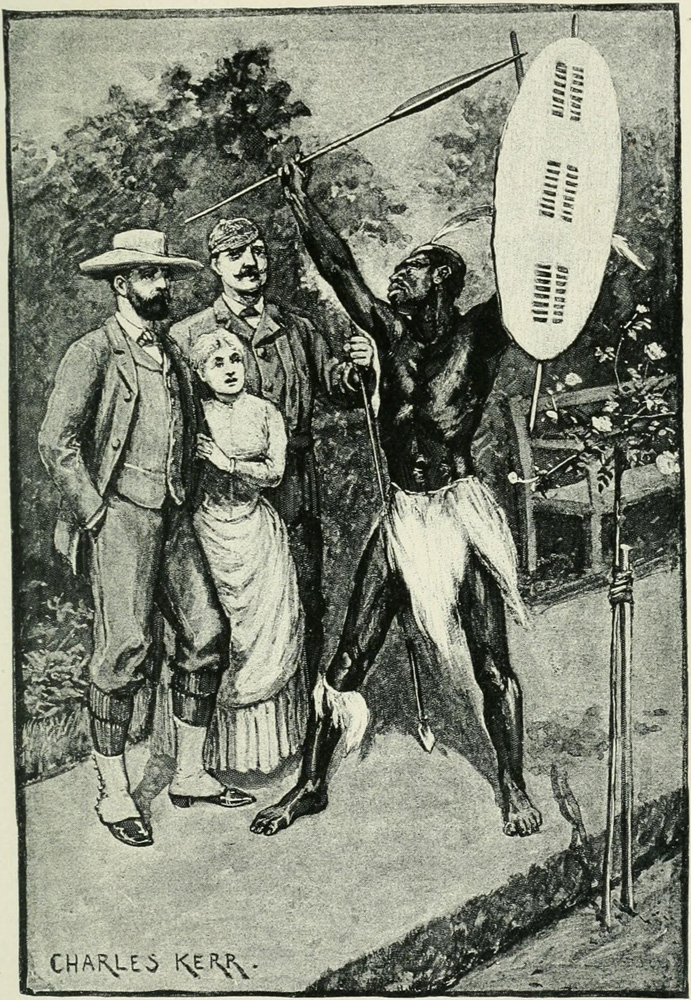
At that moment Dorothy became aware of a black man, clad in a white smock
pulled on over a great-coat, and carrying a big spear and a kerrie in his hand,
who was pushing his way towards them. Next moment he stood before them,
saluting vigorously.
“Koos!” he said, thrusting his spear into the air before Mr.
Cardus’s astonished nose.
“Inkosikaas!” (chieftainess) he repeated, going through the same
process before Dorothy. “This way, master; this way, missie. The chief
without eyes send me to you. This way; the lion bring him now.”
They followed him through the press towards the after-part of the ship, while,
giving up the unfamiliar language, he vociferated in Zulu (it might have been
Sanskrit, for all they knew):
“Make way, you low people, make way for the old man with the shining
head, on whose brow sits wisdom, and the fair young maiden, the sweet rosebud,
who comes,” &c.
At that moment Dorothy’s quick eye saw a great man issuing from a cabin,
leading another man by the hand. And then she forgot everything, and ran
forward.
“O Ernest, Ernest!” she cried.
The blind man’s cheek flushed at the music of her voice.
He drew his hand from Jeremy’s, and stretched out his arms towards the
voice. It would have been easy to avoid them—one never need be kissed by
a blind man—but she did not avoid them. On the contrary, she placed
herself so that the groping arms closed round her, while a voice said:
“Dolly, where are you?”
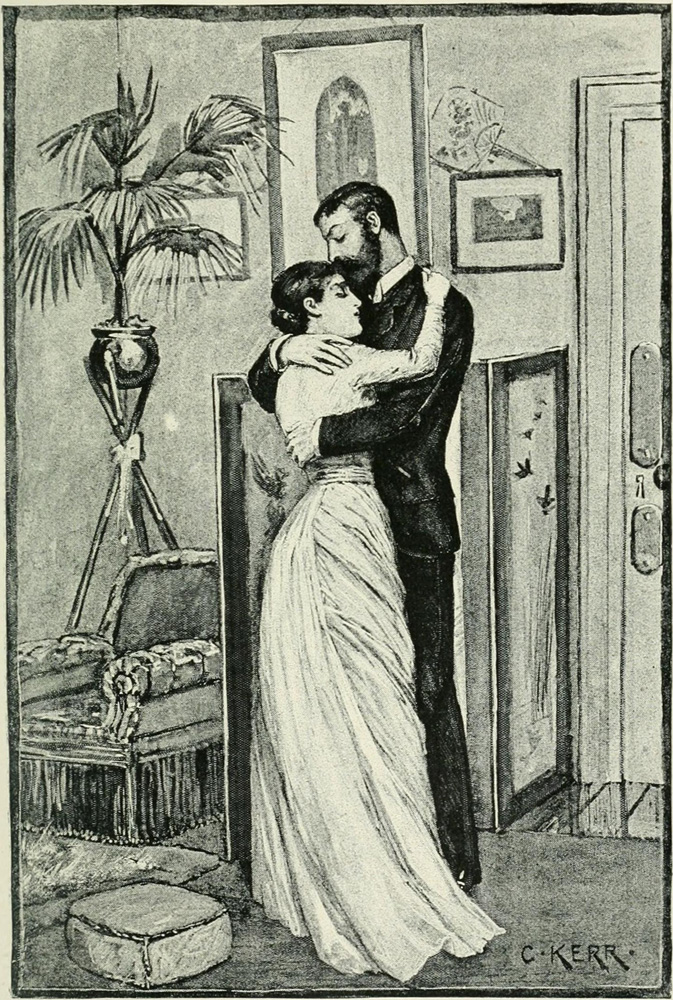
“Here, Ernest, here!” and in another moment he had drawn her to
him, and kissed her on the face, and she had returned the kiss.
Then she kissed Jeremy too, or rather Jeremy lifted her up two or three feet
and kissed her—it came to the same thing. And then Mr. Cardus wrung them
both by the hand, wringing Ernest’s the hardest; and Mazooku stood by,
and, Zulu fashion, chanted a little song of his own improvising, about how the
chiefs came back to their kraal after a long expedition, in which they had,
&c.; and how Wisdom, in the shape of a shining headed and ancient one, the
husband without any doubt of many wives, and the father of at least a hundred
children, &c.; and Beauty, in the shape of a sweet and small one, &c.;
and finally they all went very near to crying, and dancing a fling on the
quarter-deck together.
And then they all talked at once, and set about collecting their things in a
muddle-headed fashion. When these had been put in a pile, and Mazooku was
seated, assegai and all, upon the top of them, as a solemn warning to thieves
(and ill would it have gone with the thief who dared to meddle with that pile),
they started off to inspect Ernest’s great black horse, “The
Devil.”
And behold, Dorothy stroked “The Devil’s” nose, and he,
recognising how sweet and good she was, abandoned his usual habits, and did not
bite her, but only whinnied and asked for sugar. Then Ernest, going into the
box with the horse, which nobody but he and Mazooku were fond of taking
liberties with, felt down his flank till he came to a scar inflicted by an
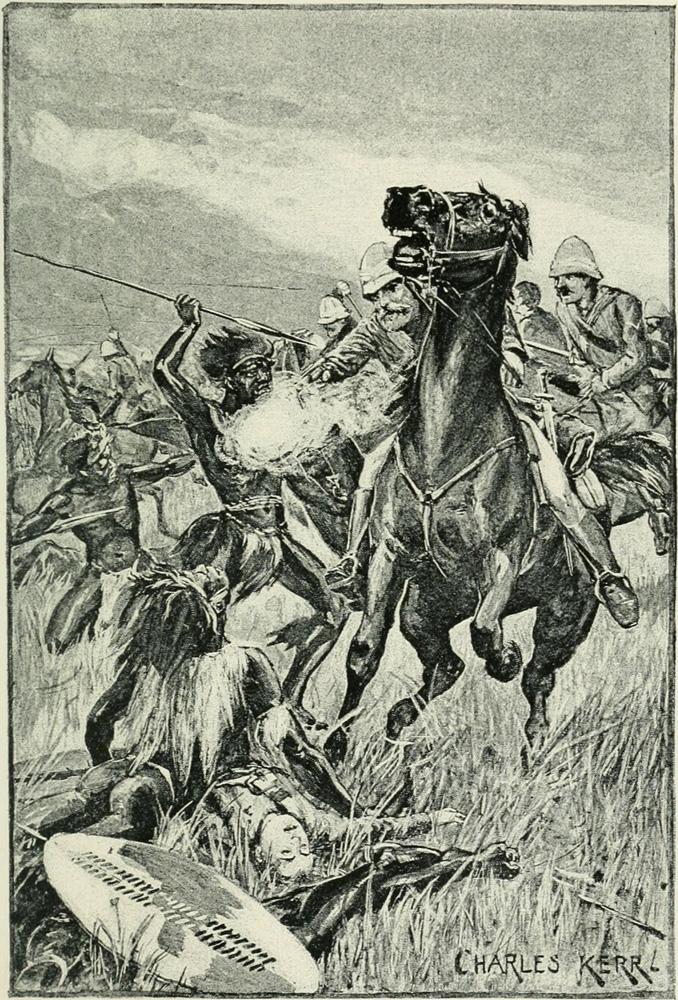
assegai in that mad charge through the Undi, and showed it to them. And
Dorothy’s eyes filled with tears of thankfulness, as she thought of what
that horse and its rider had gone through, and of the bleaching bones of those
who had galloped by their side; and she would have liked to kiss Ernest again,
only there was no excuse. So she only pressed his hand, feeling that the sorrow
of the empty years which were gone was almost atoned for by this hour of joy.
Then they went ashore to the hotel, and sat together in the pleasant
sitting-room which Dorothy had chosen, and made sweet with great bunches of
violets (for she remembered that Ernest loved violets), and talked. At length
Mr. Cardus and Jeremy went off to see about getting the things through the
Custom House, where they arrived to find Mazooku keeping half a dozen gorgeous
officials, who wanted to open a box, at bay with his knobsticks, and plastering
them with offensive epithets, which fortunately they did not understand.
“Doll,” said Ernest, presently, “it is a beautiful day, is it
not? Will you take me for a walk, dear? I should like to go for a walk.”
“Yes, Ernest, of course I will.”
“You are sure you do not mind being seen with a blind man? You must give
me your hand to hold, you know.”
“Ernest, how can you?”
Mind giving him her hand to hold, indeed! thought Dorothy to herself, as she
ran to put her bonnet on. O, that she could give it to him for always! And in
her heart she blessed the accident of his blindness, because it brought him so
much nearer to her. He would be helpless without her, this tall strong man, and
she would be ever at his side to help him. He would not be able to read a book,
or write a letter, or move from room to room without her. Surely she would soon
be able so to weave herself into his life that she would become indispensable
to it. And then, perhaps—perhaps—and her heart pulsed with a joy so
intense at the mere thought of what might follow that it became a pain, and she
caught her breath and leaned against the wall. For every fibre of her frame was
thrilled with a passionate love of this blind man whom she had lost for so many
years, and now had found again; and in her breast she vowed that if she could
help it she would lose him no more. Why should she? When he had been engaged to
Eva, she had done her best for him and her, and bitterly had she felt the way
in which he had been treated, but Eva had taken her own course, and was now no
longer in the outward and visible running, whatever place she might still hold
in the inward and spiritual side of Ernest’s nature.
Dorothy did not underrate that place; she knew well that the image of her rival
had sunk too deep into his heart to be altogether dislodged by her. But she was
prepared to put up with that.
“One can’t have everything, you know,” she said, shaking her
wise little head at her own reflection in the glass, as she tied her
bonnet-strings.
Dorothy was an eminently practical little person, and having recognised the
“eternal verity” of the saying that half a loaf is better than no
bread, especially if one happens to be dying of hunger, she made up her mind to
make the best of the position. Since she could not help it, Eva would be
welcome to the inward and spiritual side of Ernest, if only she could secure
the outward and visible side; “for after all, that is real and tangible,
and there isn’t much comfort in spiritual affection, you know,” she
said, with another shake of the head.
In short, the arguments which proved so convincing to her were not unlike those
that carried conviction home to the gentle breast of Mr. Plowden, when he made
up his mind to marry Eva in the teeth of her engagement to, and love for,
Ernest; but, putting aside the diversity of the circumstances, there was this
difference between them: Mr. Plowden recognised no higher spiritual part at
all; he did not believe in that sort of thing; he contracted for Eva as he
would have contracted to buy a lovely animal, and when he had got the given
quantity of flesh and blood he was satisfied. Of the soul—the inner
self—which the human casket held, and which loathed and hated him, he
took no account. He had got the woman, what did he care about the woman’s
soul? Souls, and spiritual parts, and affinities with what is good and high,
and the divinity of love, &c. &c., were capital things to preach about,
but they did not apply to the affairs of every-day life. Besides, if he had
been asked, he would have given it as his candid opinion that women did not
possess any of these things.
There are hundreds of educated men who think like Mr. Plowden, and there are
thousands of educated ladies who give colour to such opinions by their idle,
aimless course of life, their utter inappreciation of anything beyond their own
little daily round, and the gossip of the dozen or so of families who for them
make up what they call society and the interests of existence, and by their
conduct in the matter of marriage. Truly the great factor in the lowering of
women is woman herself. But what does it matter? In due course they have their
families, and the world goes on!
Now, Dorothy did believe in all these things, and she knew what an important
part they play in human affairs, and how they dominate over, and direct, finer
minds. So did she believe in the existence of the planets, and in the blooming
of roses in walled gardens; but she could not get near to know the beauties of
the stars, or to see the opening rosebuds, so she had to satisfy herself with
the heat that poured from the one, and the scent that came from the other. When
one is star-stricken, or mad in the matter of roses, that is better than
nothing.
And so, taking Ernest by the hand, she led him through the crowded streets with
tender care, and on to the quiet Hoe. And as they passed, the people turned to
look at the handsome young fellow who was blind, and some thought that they
would not mind a little blindness if it led to being personally conducted by so
sweet a girl.
Soon they reached the gardens.
“Now tell me about yourself, Ernest. What have you been doing all these
long years, besides growing bigger and handsomer, and getting that hard look
about the mouth?”
“A great many things, Doll. Shooting, fighting, playing the fool.”
“Pshaw! I know all that, or at least I can guess it. What have you been
doing in your mind, you know?”
“Why, thinking of you, of course, Doll.”
“Ernest, if you talk to me like that, I will go away, and leave you to
find your own way home. I know well of whom you have been thinking every day
and every night. It was not of me. Now, confess it.”
“Don’t let’s talk of her, Doll. If you talk of the
devil, you know, you sometimes raise him; not that he requires much raising in
this instance,” he laughed bitterly.
“I was so sorry for you, Ernest dear, and I did my best; indeed I did.
But I could do nothing with her. She must have been off her head, or that
man” (Dorothy always spoke of Plowden as ‘that man’)”
and Florence had some power over her; or perhaps she never really cared for
you; there are some women, you know, who seem very sweet, but cannot truly care
for anybody except themselves. At any rate, she married, and has a family of
children, for I have seen their births in the paper. Oh, Ernest, when I think
of all you must have suffered out there about that woman, I cease to be sorry
for her, and begin to hate her. I am afraid you have been very unhappy, Ernest,
all these years.”
“Ah, yes, I have been unhappy sometimes—sometimes I have consoled
myself. There, what is the use of telling lies?—I have always been
unhappy, and never so much so as when I have been in process of consolation.
But you should not hate her, poor girl! Perhaps she has her bad times too;
only, fortunately, you women cannot feel, at least not much—not like us,
I mean.”
“I don’t know about that,” put in Dorothy.
“Well, I will qualify my remark—most women. And, besides, it is not
quite her fault; people cannot help themselves much in this world. She was
appointed to be my evil destiny, that is all, and she must fulfil her mission.
All my life she will probably bring me trouble, till at last the fate works
itself out. But, Dolly, my dear, there must be an end to these things, and
Nature, always fertile in analogies, teaches us that the end of sorrow will be
happiness. It is from the darkness of night that day is born, and ice and snow
are followed by the flowers. Nothing is lost in the world, as old Alston used
to say, and it is impossible to suppose that all the grief and suffering are
alone wasted; that they are the only dull seed that will not, when their day
comes, bloom into a beautiful life. They may seem to be intangible things now;
but, after all, the difference between tangible and intangible is only a
difference of matter. We know that intangible things are real enough, and
perhaps in a future state we shall find that they are the true immortal parts.
I think so myself.”
“I think so too.”
“Well, then, Doll, you see, if once one gets the mastery of that idea, it
makes the navigation easier. Once admit that everything works to an end, and
that end a good and enduring one, and you will cease to call out under your
present sorrows. But it is hard for the little boy to learn to like being
whipped, and we are all children, Doll, to the end of our days.”
“Yes.”
“And you see, Doll, for some reason I have been picked out to catch it
pretty warm. It does seem rather hard that a woman like that should be allowed
to turn all the wine of a man’s life into vinegar; but so it often is.
Now, if she had died, that would have been bad enough; but I could have borne
it, and bided my time in the hope of joining her. Or if she had ceased to love
me, and learned to love the other man, I think I could have borne that, because
my pride would have come to my rescue, and because I know that the law of her
affections is the only law that the heart of woman really acknowledges, however
many others she may be forced to conform to; and that a woman of refined nature
who has ceased to love you, and is yet forced to live with you, is in
consequence a thing worthless to you, and dishonoured in her own eyes. Besides,
I ask no favour in such matters. I have no sympathy, as a general rule, with
people who raise a howl because they have lost the affection of their wives or
sweethearts, for they should have been able to keep them. If any man could have
cut me out, he was welcome to do so, for he would have proved himself the
better man, and as for the lady, I would not have her without her heart. But I
gather that was not quite the case with Eva.”
“O no, indeed; at least she said that she was wretched.”
“Exactly as I thought. Well, now, you will understand that it is rather
hard. You see I did love her dearly, and it is painful to think of this woman,
whose love I won, and who by that divine right and by the law of nature should
have been my wife, as forced into being the wife of another man, however
charming he may be; and I hope for her sake that he is charming. In fact, it
fills me with a sensation I cannot describe.”
“Poor Ernest!”
“Oh no, don’t pity me. Everybody has his troubles—this is
mine.”
“Oh, Ernest, but you have been unfortunate, and now your sight has gone;
but perhaps Critchett or Couper would be able to do something for that.”
“All the Critchetts and Coupers in the world will never do anything for
it, my dear. But you must remember that where I only lost my sight, many others
lost their lives, and it is supposed to be better to lose your sight than your
life. Besides, blindness has its advantages: it gives you so much more time to
think, and it humbles you so. You can have no idea what it is like, Doll.
Intense, everlasting blackness hedging you in like a wall: one long, long
night, even when the sunlight is beating on your face; and out of the night,
voices and the touching of hands, like the voices and the touchings of departed
spirits. Your physical body is as helpless and as much at the mercy of the
world as your spiritual body is in the hands of the Almighty. And things grow
dim to you too: you begin to wonder what familiar faces and sights are like, as
you wonder about the exact appearance of those who died many years ago, or of
places you have not seen for years. All of which, my dear Doll, is very
favourable to thought. When next you lie awake for five or six hours in the
night, try to reckon all the things which occupy your brain; then imagine such
wakefulness and its accompanying thoughts extended over the period of your
natural life, and you will get some idea of the depth and breadth and height of
total blindness.”
His words struck her, and she did not know what to answer, so she only pressed
his hand in token of her mute sympathy.
He understood her meaning; the faculties of the blind are very quick.
“Do you know, Doll,” he said, “coming back to you and to your
gentle kindness is like coming into the peace and quiet of a sheltered harbour
after bearing the full brunt of the storm.” Just then a cloud which had
obscured the sun passed away, and its full light struck upon his face.
“There,” he went on, “it is like that. It is like emerging
into the sweet sunshine after riding for miles through the rain and mist. You
bring peace with you, my dear. I have not felt such peace for years as I feel
holding your hand to-day.”
“I am very glad, dear Ernest,” she answered; and they walked on in
silence. At that moment, a little girl, who was trundling a hoop down the
gravel-path, stopped her hoop to look at the pair. She was very pretty, with
large dark eyes, but Dorothy noticed that she had a curious mark upon her
forehead. Presently Dorothy saw her run back towards an extremely tall and
graceful woman, who was sauntering along, followed at some distance by a nurse
with a baby in her arms, and turning occasionally to look at the beds of spring
flowers, hyacinths and tulips, which bordered the path.
“O mother!” she heard the little girl call out, in the clear voice
of childhood, “there is such a nice blind man! He isn’t old and
ugly, and he hasn’t a dog, and he doesn’t ask for pennies. Why is
he blind if he hasn’t a dog, and doesn’t ask for pennies?”
Blindness, according to this little lady’s ideas, evidently sprang from
the presence of a cur and an unsatisfied hunger for copper coin. Sometimes it
does.
The tall graceful lady looked up carelessly, saying, “Hush, dear!”
She was quite close to them now, for they were walking towards each other, and
Dorothy gave a great gasp, for before her stood Eva Plowden. There was
no doubt about it. She was paler and haughtier-looking than of yore; but it was
she. No one who had once seen her could mistake that queenly beauty. Certainly
Dorothy could not mistake it.
“What is the matter, Doll?” said Ernest, carelessly. He was
thinking of other things.
“Nothing; I hurt myself.”
They were quite close now.
And Eva, too, looked at them, and she, too, saw the face she had never thought
to see again. With all her eyes, and with her lips parted as though to cry out,
she gazed at the sight before her—slowly, slowly, taking in all it meant.
They were nearly level now.
Then there leaped up into her eyes and face—the eyes and face which a
second before had been so calm and statue-like—a wild light of love, an
intensity of passionate and jealous desire, such as is not often to be seen on
the faces of women.
“Ernest there, and Ernest blind, and being led by the hand of Dorothy,
and looking happy with her! How dared she touch her love! How dared he look
happy with her!” Those were the thoughts which flashed through her
troubled mind.
She made a step towards them, as though to address him, and the blind eyes fell
upon her lovely face, and wandered over it. It made her mad. His eyes were on
her face, and yet he could not see her. O God!
Dorothy saw the motion, and, moved by an overmastering instinct, threw herself
between them in an attitude of protection not unmixed with defiance. And so,
for a second, their eyes flashing and their bosoms heaving with emotion, the
two women stood face to face, and the blind pathetic eyes wandered uneasily
over both, feeling a presence they were unable to define.
It was a tragic, almost a dreadful scene. The passions it revealed were almost
too intense for words, as no brush can justly paint a landscape made vivid by
the unnatural fierceness of the lightning.
“Well, Doll, why do you stop?” Ernest said, impatiently.
His voice broke the spell. Eva withdrew her arm, which was half outstretched,
and touched her lips with her finger as though to enjoin silence. Then a deep
misery spread itself over her flushed face, her head sank low, and she passed
thence with rapid steps. Presently the nurse with the baby followed her, and
Dorothy noticed vaguely that this child had also a mark upon its forehead. The
whole thing had not taken forty seconds.
“Doll,” said Ernest, in a wild voice, and commencing to tremble,
“who was that passed us?”
“A lady,” was the answer.
“A lady; yes, I know that—what lady?”
“I don’t know—a lady with children.”
It was a fib; but she could not tell him then; an instinct warned her not to do
so.
“Oh, it is strange, Doll, strange; but, do you know, I felt just now as
though Eva were very near me. Come, let us go home!”
Just then the cloud got over the sun again, and they walked home in the shadow.
Apparently, too, all their talkativeness had gone the way of the sun. They had
nothing to say.