Oh, my luve's like a red, red rose,
That's newly sprung in June;
Oh, my luve's like the melodie,
That's sweetly played in tune.
As fair art thou, my bonnie lass,
So deep in luve am I;
And I will luve thee still, my dear,
Till a' the seas gang dry.
—Burns.
There are moments in every life when the soul
hovers on some dark brink. It may be the brink
of atheism, of despair, of crime, or superstition.
Outside influences go far toward impelling life's
voyager on his course. If the current takes a sudden
turn, it bears him in a different direction from
which he had intended. The human mind is inexplicable.
It is not a machine that can be taken
apart and analyzed. It is not material that can be
grasped and comprehended. It is that mysterious
knowing, feeling and willing, independent of circumstances;
that immortal, indestructible portion
of man called soul. It is governed by no known
laws, and at times seems to assume all the caprices
of chance.
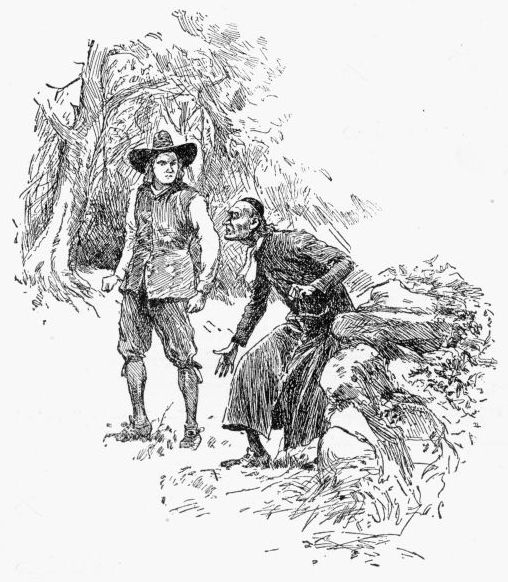
Charles Stevens was a youth of good strong, common
sense; yet he could but feel strangely impressed
by the words and the awful look of Mr.
Parris. The man was surely more than mortal.
His voice, hollow and sepulchral, seemed to issue
from the tomb. His thin, cadaverous face was
sufficient in itself to inspire wonder. Those great,
blazing eyes had within them all the fires of lunacy,
fanaticism and cunning. Mr. Parris was nothing
more than an unscrupulous bigot. He was ambitious,
as is proven by his machinations in getting
himself declared the pastor of Salem. He was
greedy, as is shown by his taking the parsonage
and lands as well as demanding an increase in his
stipend. He was revengeful, as is shown by the
way in which he persecuted those who opposed him.
He was unscrupulous in his methods, as is proven
in the means he employed. He was filled with
prejudice, as is shown in his assailing Cora Waters,
because her father was an actor; yet Mr. Parris believed
himself a righteous and holy man, walking
in the path of the just.
Charles Stevens failed to tell his mother of the
strange interview with the pastor, somehow he
could not. He unaccountably shuddered when he
thought of it, and, despite the fact that he had
little superstition in his composition, he felt at
times a strange instinctive dread at the awful warning
of the pastor.
Since the evening on which the name of Adelpha
Leisler had been mentioned, Cora Waters had been
strangely shy and reticent, so that Charles Stevens
could not tell her of the interview with Mr. Parris,
even if he would. Cora was a remarkable girl.
She united in the highest perfection the rarest of
earthly gifts—genius and beauty. No one possesses
superior intellectual qualities without knowing
it. The alliteration of modesty and merit is
pretty enough; but where merit is great, the veil
of that modesty never disguises its extent from its
possessor. It is the proud consciousness of rare
qualities, not to be revealed to the every-day world,
that gives to genius that shy, reserved and troubled
air, which puzzles and flatters you, when you encounter
it. Cora realized her beauty and genius;
but, with that charming versatility, that of right
belongs to woman, she had the faculty of bending
and modelling her graceful intellect to all whom she
met.
Her rare genius, however, could not brook the
cold reproofs of the bigoted Parris. The flower
which might have ornamented his chapel and filled
the little church with sweetest perfume was withered
by the chilling frosts of bigotry and prejudice.
A player could yield no perfume for Christ, and
the sweet, musical voice was stilled, and the heart
so full of love, emotion and religion was chilled
and driven into exile; but she lived and hoped in
her own little world. The sunlight of love was on
her heart, until the name of Adelpha Leisler shut
out that sunlight and left all in darkness and despair.
Though Cora was excommunicated for being the
child of a player, she never let go her hold on
Christ. Her father, strolling actor as he was, had
taught her to look to God for everything, and in
her hour of trial, she knelt in the seclusion of her
own room and prayed that this cup might pass from
her lips, if it be the Lord's will; but if not, she
asked God to give her strength to bear her suffering
and trials. She freely forgave Mr. Parris, for she
believed his persecution of herself and others was
through mistaken zeal.
With Charles Stevens, she was more shy than
she used to be. She kept aloof from him for two
or three days, until her conduct became noticeable,
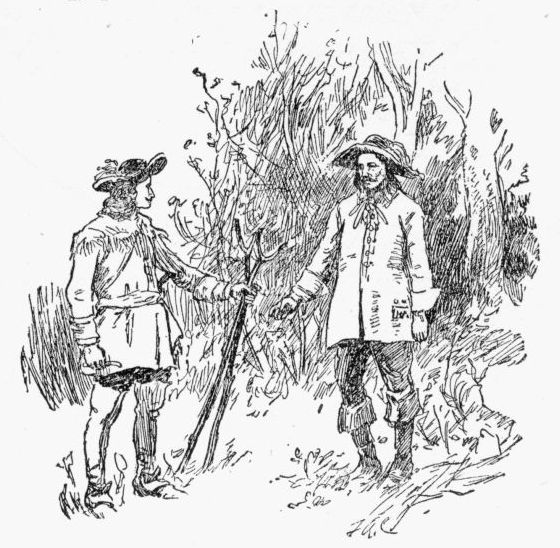
and Charles one day sought her in the garden for an
explanation.
"Have I offended you, Cora?" he asked.
She turned her frightened eyes to his for a moment
and answered:
"No."
"Then why do you avoid me? I have scarcely
seen you for three days."
She was overwhelmed with hope and confusion
for some moments; then, with a faltering voice,
she asked:
"Did you wish to see me?"
"I did, Cora. I would not give offence to you
for the world, and I feared I had in some way
wounded your feelings."
"Charles, was not Mr. Parris here the other
morning?"
"Yes."
"You went away with him; I saw you through
my window."
"I did."
"Why did he come?"
"Don't ask me about that man. He is one
whom I would to God I had never known."
"Don't speak so of him, Charles."
"Cora, he is a bad man."
"He is the pastor."
"For all that, he is cruel and bloodthirsty. I
know it. I feel it."
Cora shuddered and made a feeble effort to defend
the pastor who had persecuted her; but
Charles, who had the retaliating spirit of humanity
in his soul, declared he was a pious fraud and a
disgrace to his cloth.
On their return to the house, Mrs. Stevens met
them at the door with a glad smile on her face, and
cried:
"She has come, Charles."
"Who?" he asked.
"Adelpha Leisler."
Mrs. Stevens saw an immediate change in the
face of Cora. The features which had begun to
glow with happiness suddenly grew sad and
clouded, and the eyes drooped. Charles did not
perceive that sudden change so apparent to his
mother, for, at the announcement of the arrival of
one whom he had known in his happy childhood
days, his heart bounded with joy.
"Where is she, mother?"
"With Goody Nurse."
He hastily took leave of Cora, who, with an oppressive
weight on her heart, which seemed to almost
suffocate her, went to the little room in
which she had known so much joy and misery.
All was dark now. Her heart vibrated painfully
in her breast. Hope and joy seemed forever
banished. He was gone. She could hear
his footsteps moving away from the house, and,
throwing herself on the couch, she gave way to
a fit of weeping. Never did Cora Waters so feel
her utter insignificance and loneliness. She was
a child of an indented slave, utterly dependent
on the one whom she had had the audacity to
love.
When she realized how unworthy she was, the
unfortunate girl sobbed, half aloud:
"Oh, God, why didst thou create me with desires
and ambitions above my sphere? Why didst
thou cast me into this place, where I would meet
him, only to suffer? Father, father, come and
take me hence!"
Meanwhile, Charles Stevens, unconscious of her
suffering, was hurrying as rapidly as he could to
the home of Goody Nurse, where he was to meet
Adelpha Leisler. He reached the house and was
greeted by a tall, beautiful young woman, with
great, black eyes and hair.
The greeting she gave him was warm, almost
ardent, for, although Adelpha was an accomplished
young lady, she had all of the genial warmth of
youth. They were soon talking pleasantly of those
happy days of long ago.
Glorious past, gone like a golden dream to return
no more! The very memory of such pleasure
produces pain, because it is forever gone. Great
changes had come since last they met. His father
was living then, a handsome, strong man, noted
for his kindness of heart. Many friends, who
now existed only in pleasant remembrance, then
lived, breathed and moved upon the earth.
Then he loved Adelpha, and she loved him,
and he half hoped that this meeting in mature
life would reproduce the pleasant sensations of
childhood; but there is a love which is not the love
of the thoughtless and the young—a love which
sees not with the eyes and hears not with the ears,
but in which soul is enamoured of soul. The cave-nursed
Plato dreamed of such a love. His followers
sought to imitate it; but it is a love that is not
for the multitude to echo. It is a love which only
high and noble natures can conceive, and it has
nothing in common with the sympathies and ties
of coarse affections. Wrinkles do not revolt it.
Homeliness of features do not deter it. It demands
youth only in the freshness of emotions. It requires
only the beauty of thought and spirit.
Such a love steals on when one least suspects and
takes possession of the soul. Such a love cannot
be uprooted by admiration or fancy. Charles
Stevens found Adelpha grown so beautiful, so
witty and accomplished, that he was awed in her
presence at first; but her freedom of manner removed
all restraint, and in an hour they seemed
transported back to childhood's happy hours.
Next day they wandered as they had done in
earlier years by purling streams and mossy banks,
under cool shadows of friendly trees. Every old
playground and hallowed spot was visited once
more, and they lived over those joyous scenes of
childhood.
"I sometimes wish that childhood would last
forever," said Charles.
"Childhood brings its joys, but its sorrows as
well," Adelpha answered, as she sat on the mossy
bank at his side, her bright eyes on his face.
"One would grow weary of never advancing.
Don't you remember how, in your boyhood, you
looked forward with pleasure to the time when you
would be a man?"
"I do."
"And how you planned for a glorious future?"
"I remember it all."
"To doom you to perpetual childhood, to constantly
have those hopes of being a man blasted
would eventually bring you to endless misery.
No, Charles, childhood, to be happy and joyous,
must be brief. The youth with ambition longs to
enter man's estate. He sees life only in its rosiest
hues, and his hopes and anticipations form half his
happiness."
"Your words, Adelpha, teach me how foolish
and idle was my remark. Let us change the subject
to something more practical. Will your father,
as governor of New York, be disturbed?"
Her face grew sad.
"I have great fears."
"For what?"
"Father and Jacob Milborne may be declared
usurpers."
"But it was on the accession of William and
Mary to the throne of England that your father
became governor."
"True. It was not until Andros had been
seized in Boston, imprisoned and sent to England,
that my father suggested the seizure of Fort James.
He was made commander and afterward governor,
and so holds his office to this day. I don't know
how William and Mary, our dread sovereigns,
will be affected by this seizure of the government
of New York."
"It was in their interest."
"It was so intended; but we have all learned
not to put our trust in princes. It is quite dangerous
to do so, and I sometimes fear that trouble
will come of it."
"Surely, Adelpha, one of your happy turn of
mind would not borrow trouble. It will come
quite soon enough without, and a philosopher would
wait until it comes rather than seek it."
"You are right, Charles; let us be young again,
romp in the wood, chase butterflies and forget the
dark clouds that may be hovering over us." She
started to her feet and asked: "Charles, who is
that lovely, but shy young girl, whom I see hurrying
along the path?"
He looked in the direction indicated by Adelpha's
jewelled finger, and said:
"She is Cora Waters."
"And who is Cora Waters?"
"A very sweet and amiable girl tarrying here
for the present. Her father was a player, and he
became involved in the rebellion in England."
Charles did not care to tell all, for Cora was a
disagreeable subject to discuss with Adelpha; but
the companion of his childhood was not to be so
easily put off.
"Charles, she is very pretty. Why have you
not told me of her before?"
"I did not suppose you would be interested in
her," the young man answered.
"Not interested in her, with all the romance attached
to her. A child reared in old England, of
which I have heard so much, the daughter of a
player, perchance an actress herself. Oh, Charles,
I am very anxious to see her and talk with her."
"Adelpha, do you forget that she is a player?"
"Oh, no; we descendants of the Netherlands
look on such things in a far different light from
the fanatical Puritans of New England. I must
know this Cora Waters."
"You shall."
As Charles strolled away from the spring with
Adelpha, the face of Sarah Williams appeared
from behind some bushes. Her jet black eyes
flashed with fire, and her teeth gnashed until they
threatened to crack between her angry jaws.
"He hath another! Which of the two doth he
love most? I will know, and then—woe betide
her!"
Sarah Williams was cunning and utterly unscrupulous.
As she glared after Charles and
Adelpha, her fertile brain was forming a desperate,
wicked scheme. She watched them until they
disappeared over the hill, and then, turning about,
walked hurriedly to the parsonage.
Adelpha, who was a merry, light-hearted girl,
in love with all the world, insisted on forming the
acquaintance of Cora, until Charles, to gratify her,
granted her request, and the maids met. Cora was
distant and conventional, while Adelpha was warm-hearted
and genial. They came to like each other,
despite the fact that each looked on the other as a
rival.
Cora had given up Charles Stevens, realizing
that she was inferior and unworthy in every sense,
and certainly not capable of competing with the
daughter of the governor of New York. On the
other hand, Adelpha saw a dangerous rival in this
mysterious maid with eyes of blue and hair of gold;
but Adelpha was honest and true, as were the old
Knickerbockers who followed her. She realized
the maid's power and, in her frank and open manner,
loved her rival. Despite the fact that they
were rivals, the girls became friends, and as
Adelpha had learned more of Cora's trials, she
gave her the full sympathy of her warm, loving
heart.
Sarah Williams, who watched them with no little
interest, asked herself:
"I know he loves both. Can a man wed two?
No; he must choose between the two, so I will
stand between."
Charles, on account of his superior education,
was regarded as an extraordinary personage. He
was gloomy and sad of late, for Sarah Williams,
with her keen woman's instinct, had probed his
secret. He was troubled to know which maid he
loved most.
Cora, with her melancholy beauty, appealed to
his strong emotions; but Adelpha, with her fine
figure, her great, dark, lustrous eyes and charming
manner, seemed equally attractive. If Cora were
the stream that ran deepest, Adelpha was the one
that sparkled brightest. At one moment he was
ready to avow his love for one, and the next moment
he was willing to swear eternal fealty to the
other.
Late one afternoon, he wandered with Cora at
his side across the flowery meadow to a point of
land presenting a grand and picturesque view of
green fields, blue hills and the distant sea. They
had come to watch the sunset, and Charles wished
to be alone with Cora, that he might sound the
depths of his heart and ask himself if he really
loved her.
Her father was to come in a few days and take
her away to the far-off wilderness, so, if he spoke
the promptings of his soul, he must do it now.
Long they sat on the grassy knoll and watched the
declining sun.
"How long have you known Adelpha?" Cora
asked.
"We were children together."
"Has she always lived in New York?"
"Yes; but our grandparents knew each other.
Matthew Stevens had a Dutch friend, Hans Van
Brunt, whom he met in Holland. When Van
Brunt emigrated to New Amsterdam and Matthew
Stevens to New Plymouth they renewed their
friendship. Their descendants have always kept
up the friendship. Matthew Stevens was my
grandfather, and Hans Van Brunt was Adelpha
Leisler's great-grandfather. When quite a child,
Adelpha's mother, the wife of a prosperous New
York merchant, spent a year in Boston where I
lived. It was then Adelpha and I first became
acquainted."
Cora's eyes were on the distant blue hills; but
her thoughts seemed elsewhere. Charles would
have given much to have known what was in her
mind. Did she, in her heart, entertain hatred for
Adelpha? Her remark a moment later convinced
him to the contrary.
"Adelpha is a lovely maid and as good as she
is beautiful. Her lot is a happy one."
There was no bitterness, no regret in the remark;
yet her words were so sad, that they went to the
heart of Charles.
"Cora, there is such a difference in the lots of
people, that sometimes I almost believe God is unjust."
"Charles!" she cried, quite shocked.
"Hear me out, before you condemn me, Cora.
Here is Adelpha, who has known only sunshine
and happiness, health and prosperity. She was
born in a wealthy family, and has all the luxuries
that riches can buy——"
"She is good and deserves them," interrupted
Cora. "God has rewarded her."
"But, on the other hand, you are just as good;
yet your life has been one of bitterness. Misery
seems to steal some people at their birth; but
sometimes there come changes in the lives of people.
All may run smoothly for a while, then
storms gather about the head of the child of fortune,
while, on the other hand, to one who has
fought and struggled through storms and adversity
a peaceful harbor may open——"
Cora suddenly said:
"God forbid, Charles, that our lots should be
reversed. I would not have Adelpha Leisler drain
the cup of bitterness, as I have done; but we must
change our subject, for, see there, Adelpha and
Alice Corey are coming."
He looked up and saw the two near at hand.
Alice Corey was a bright-eyed girl of fourteen,
a niece of Goody Nurse who had been accused of
witchcraft. She was a girl of a light and happy
disposition, and, as yet, cares sat lightly on her
brow.
"Watching the sunset, are you?" said Adelpha,
breathless with rapid walking.
"We have been," answered Charles.
"Well, it is a pretty thing to see, and I wish he
would always be setting," declared Alice Corey.
"A child's wish," answered Adelpha. "What
would become of your flowers?"
"I am sure I don't know. I do so love that
red tinge over there, just where it touches the
gray."
"It is somewhat like that queer sea-shell which
Cora showed me yesterday," said Adelpha.
"What splendid paints these mermaids must use,
down in their deep sea-caves! It is a kind that
does not rub off with wetting. The shells are their
pink saucers."
"What! Do they really paint?" cried the
credulous Alice.
Charles Stevens laughed softly and answered:
"No, child. You must not believe such stories.
I will tell you a prettier one if you'll listen."
"Oh, I'll listen!" cried Alice, who, like all children,
was ever ready to give ears to a story.
Charles began:
"Once upon a time, long before Adam and Eve
lived, I believe it was, while the earth was young,
there lived on it a fair, radiant maiden, sweeter
than the breath of fresh-blown roses and more
lustrous than the morning star. All the world was
her own paradise, and she traversed it as she chose,
finding everywhere trees bearing golden fruit,
which never turned to ashes, flowers in perpetual
bloom, fountains that bubbled and birds that sang
in the linden groves, all for her. Nothing was
forbidden her. No cares, no fears, or griefs
marred her pleasures; for she had no law to consult
but her own wishes. When she would eat,
the trees bent down their boughs, and whispered,
'Choose my fruit.' When she would listen, the
birds vied with each other in their melodies.
When she would walk, the green sod was proud
to bear her, and, when weary, the gentlest flower-laden
zephyrs soothed her to rest. Thus she might
have remained always happy; but one day she
chanced to see herself in the water, and she thought
how every thing else was double. Then she became
conscious of a strange pain. Every thing
now lost its charm. She sought a companion; but
she could find none. Nothing was wanting but
the thing she most desired—the sight of her own
kin. At last, she instinctively felt that the burning
gaze of a lover was bent upon her face, and,
looking up, she saw only the sun in the sky, shining
as though myriads needed his light. 'Alas!'
she sighed, 'He is as lonely as I, and he shall be
my lover;' but the sun was coy and timid. He
gazed proudly at her from a great distance, and
veiled himself behind a cloud when she would see
him, that his brightness might not harm her; but
he never came nigh. At last, when she was worn
out with longing for a closer companionship, she
set out to find her adored sun; and as she sighed,
'Shall I find him never?' some one from a grotto
near by answered, 'Ever?' 'Who are you?' cried
the maid. 'I am a bodiless spirit,' was the answer,
'the voice of one that is gone. I tell impossible
things. I am the shadow of the past, the
substance of events to come. Man is a mocker.'
'Can you tell me where to find my lover?' asked
the maid. Echo told her not to look up for him,
for he was too high above her, not to seek him in
the east, for then he was hastening away; but to
seek him in the west, where he laid himself
and rested at night, for the night was made for
lovers. Then she hastened joyously, till she
came to the extreme west, to the very edge of the
world."
"How could she get to the edge, when it is
round?" interrupted Alice.
"Probably the world was not round at that
time," explained Adelpha.
Charles went on:
"The maid summoned all the powers of nature
and the air, and bade them build a palace. It
was not like other palaces. There were no jewels
there; but every thing was warm and crimson and
ruddy. The gates were parallel bars of cloud,
with the west wind for warden. Crystals of rain-drops
paved the court-yard. The architecture was
floating mists and delicate vapors, filled with a
silent music, that waited only for the warm touch
of the player to melt it into soul-subduing harmonies;
and along the galleries ran a netted fringe of
those tender whispers, which only the favored may
hear. So she built her palace and filled it with
all things such as she thought the sun would like,
not forgetting an abundance of fire to warm him,
lest even her love would prove insufficient for one
of so fiery a nature. Then she dismissed her attendants
and sat down alone to wait his coming.
The day seemed long and drear and weary; but
she had seen him watching her, and he was coming
at last. Down the slope he glided, holding his
fiery steeds in check. There was joy for the desolate
one, for her lover was coming; but the pitiless
sun descended and swept by, scorning the open
gates, and her siren voice, that would have wooed
him thither. The next day passed, and the next,
and the next, and she was still disappointed; but
she could not believe that all her labor had been
in vain, and still she nursed her sickly, dying
hope. Though that sun has set thousands of times
since then, she hopes for their union still. In the
day time the palace is dark like the clouds; but,
as evening approaches, she lights it up for his
coming. Then we see those glorious tints of crimson
and gold and purple and dun, dimming till
they mingle with the white clouds above, and, were
we near enough, we might possibly hear the tones
of the reviving music, as it melts; but as the sun
goes fairly down, the music hushes, the beautiful
tints fade and die, the palace becomes a dark spot
again, and the poor little watcher within sighs
forth her disappointment and composes herself to
wait for another sunset."
"I don't believe your story, Charles Stevens,"
said Alice, at the conclusion, "and I don't see
what good it does, anyhow, to make up such a
one as that."
"The moral in it is man's faithlessness and woman's
constancy," put in Cora Waters, who had,
for a long time, been silent.
Adelpha, who had watched the sun sink beneath
the distant blue hills, as she listened to Charles, now
chanced to glance over her shoulder at the sea behind,
with the moon just rising above the watery horizon,
and with a merry peal of laughter she added:
"Charles, your heroine is more dull than modern
maids, or, when the sun jilted her, she would have
wooed the moon."
Alice, rising, said, "It is growing dark. Let
us go home."
"Alice, are you afraid of the witches, which
seem to disturb Mr. Parris and Cotton Mather?"
asked Adelpha.
"There are no witches," Alice Corey answered
with a shudder. "Father and mother both deny
that there are any witches, and it is wrong to cry
out against my aunt, Goody Nurse."
"I dare say it is. The evening grows chill.
Let us go home."
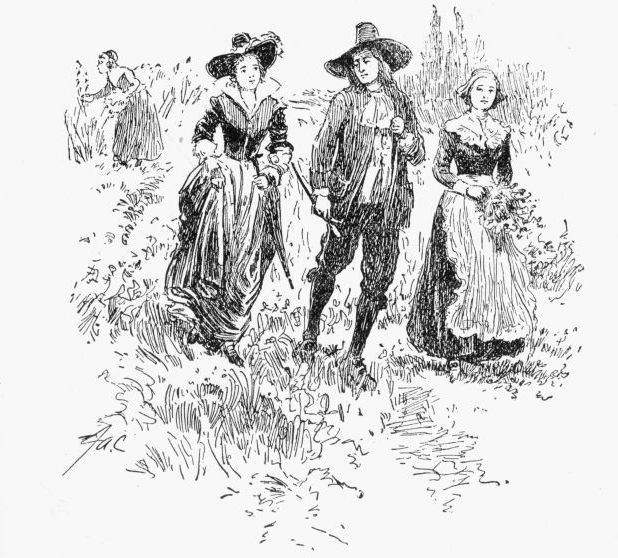
As the four wended their way across the fields
and meadows, Charles Stevens, who walked between
Cora and Adelpha, cast alternately furtive
glances at each, sorely troubled to decide which
he liked best.
"Both are beautiful," he thought. "Ere long
I must wed, and which of the twain shall it be?
Both are beautiful, and both are good; but, unfortunately,
they are two, and I am one."
The child, who had lingered behind to pluck a
wild flower, at this moment came running after
them, calling:
"Wait! wait! I implore you, wait for me!"
"What have you seen, Alice?"
"A black woman."
The girls were almost ready to faint; but
Charles, who was above superstition, bade them be
calm and hurried through the deepening shades of
twilight to the trees on the hill where the woman
had been seen. He came in sight of the figure of
a woman clothed in black, sitting at the root of an
oak.
"Who are you?" he asked, advancing toward
her.
"Charles Stevens!" she gasped, raising her head.
"Sarah Williams, what are you doing here?"
"Prythee, what are you doing?" she asked.
"This is unaccountable."
She rose and, turning her white face to him,
said:
"Charles Stevens, which of the twain do you
love best?" and she pointed to Cora and Adelpha.
He made no answer. "Which of the twain is it?"
she repeated. "Aye, Charles Stevens, you shall
never wed either. Do you hear?"
"Which of the twain shall it be?"
"Woman, what mean you?"
"You cannot decide which you love most.
Wed neither, Charles. Wed me!"
"You!" he cried, in astonishment.
"Yes, why not?"
"You already have a husband."
"No; he is dead, he was lost at sea. I am still
young and fair, and wherefore not choose me?"
Charles Stevens burst into a laugh, half merriment
and half disgust, and turned from the bold,
scheming woman. She followed him for a few
paces, saying in tones low but deep:
"Verily, Charles Stevens, you scorn me; but I
will yet make you repent that you ever treated my
love with contempt. You shall rue this day."
He hurried away from the annoyance, treating
her threats lightly, and little dreaming that they
would be fulfilled.
Winter came and passed, and Adelpha Leisler
still lingered at Salem. Rumors of trouble came
to her ears from home; but the light-hearted girl
gave them little thought. One morning in May,
1691, Charles met her coming to seek him. Her
face was deathly white, and her frame trembling.
"What has happened, Adelpha?"
"There is trouble at home, Charles," she cried.
"Father and Milborne have been arrested and
imprisoned and I fear it will fare hard with them.
I want to set out for New York at once. Will
you accompany me?"
"I will."
They found his mother and Cora and told them
all. He implored Cora to remain with his mother,
until he returned, which she consented to do.