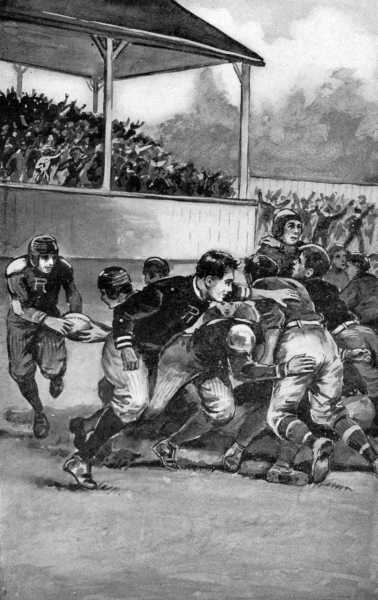
What a crowd there was! It seemed to surge
all over the grandstands, hiding the boards from
sight, so that the structure looked like a solid
mass of human beings. Old men there were, and
elderly ladies, too, and young men—and maidens—girls,
girls, girls, everywhere, their pretty hats
and bright wraps making the otherwise dull and
cloudy day seem like a fairy garden.
Nearly everyone from Fairview Institute was
on hand, and the girls sat together, chanting songs—sometimes
for Randall and sometimes for
Boxer Hall. The former contingent was led by
the friends of our heroes, Miss Tyler, Miss Harrison
and Miss Clinton.
It was almost time for the game to start, and
Bean Perkins had led his crowd of shouters, cheerers
and singers in various calls and melodies. Out
on the field were the players, nearly two score of
them, for each college had plenty of substitutes.
“It’s going to be a game for blood, all right,”
murmured Tom, who, standing with his three
chums, watched Boxer Hall at practice. “Look
how they get into play on the jump.”
“Oh, we can do it, too,” declared Phil.
“They’ve got some good kickers,” announced
Sid, critically.
“So have we,” fired back Phil, who seemed to
resent any implied slight of the Randall team.
“Have you heard where Langridge is going to
play?” asked Frank Simpson.
“Against me, someone said,” replied Tom.
“He’s been shifted to right end, I hear, and I
wish he wasn’t. There’ll be some scrapping,
sure.”
“Don’t let him get your goat,” advised Phil.
Speculation as to the position of the players
was soon set at rest, when the list was announced
This was the lineup.
| BOXER HALL |
POSITION |
RANDALL |
| Ford Enderby |
Left end |
Tom Parsons |
| Dave Ogden |
Left tackle |
Bert Bascome |
| George Stoddard |
Left guard |
Frank Simpson |
| Paul Davenport |
Centre |
Holly Cross |
| Lynn Railings |
Right guard |
Billy Housenlager |
| Ed Dwight |
Right tackle |
Dan Woodhouse |
| Fred Langridge |
Right end |
Jerry Jackson |
| Tom Miller |
Quarter-back |
Phil Clinton |
| Fred Cooper |
Right half-back |
Pete Backus |
| Charles Baker |
Left half-back |
Sid Henderson |
| William Cook |
Full-back |
Joe Jackson |
It was stated that two halves of thirty minutes
each would be played, and it was also known that
some of the old-time rules, as regarded play,
would be used, for the Tonaka Lake League had
their own ideas on this subject.
The crowd continued to increase, and when
Captain Miller, of Boxer Hall, and Captain
Woodhouse, of Randall, met for a conference,
the stands had overflowed into the field, where
the officers had trouble keeping the crowd back
of the ropes.
Boxer won the toss, and there was a momentary
feeling of disappointment at this, but it soon
passed away, for there was no wind, and little
advantage to be gained by selecting a goal.
“I’m glad we’ve got ’em on our own grounds,”
remarked Tom, in a low voice.
“Yes, that’s one advantage,” agreed Phil.
“Oh, if we can only win, old man—if we only
can! Then Randall will come into her own again,
and down all her enemies.”
“We’re going to win,” said Tom, simply, as if
that settled it.
Boxer elected to defend the south goal, which
gave the ball to Randall to be kicked off. Holly
Cross topped it on a little mound of dirt. He
looked to Kindlings for a confirmatory nod, which
the captain gave, after a glance at his men. The
Boxer Halls were on the alert. The whistle of
the referee blew, and Holly’s toe made a dent in
the new yellow ball. Away it sailed far into
Boxer’s territory. Langridge made the catch, and
started over the chalk marks with speed, protected
by good interference. But with a fierceness
which it seemed that nothing could stop, Tom
Parsons circled in, and made one of the best
tackles of his career, as he brought his old enemy
down with a thud to the ground, on Boxer’s thirty-eight
yard line.
“Now the real battle begins,” murmured Tom,
as he ran to his place, while the opponents of
Randall lined up, the quarter-back singing out his
signal.
Fred Cooper was given the ball, and made a
try at getting around Randall’s right end, but
Jerry Jackson and his support were right there,
and Cooper was nailed, after a gain of about four
yards. It was a splendid defense on the part of
Randall, and her cohorts were glad, for Boxer
had some big players that year, and there was
fear that she would smash through. In fact, so
fearful was Captain Miller after that first try that
he called for a kick.
It was well done, and Cook sent the pigskin
sailing far back toward Randall’s goal posts. Joe
Jackson caught it, and began a run which brought
the crowd to its feet as if by magic, while thousands
of throats yelled encouragement, and Bean
Perkins broke his cane to slivers, in his excitement.
Past man after man of the Boxer team did
Joe dodge, until he was nearly in the centre of
the field before he was downed.
“Now’s our chance,” murmured Phil, as he
knelt to take the pigskin when Holly should snap it
back.
Phil signaled for Sid Henderson to take the
ball, and take it Sid did, smashing through the
Boxer line for five yards. Joe Jackson was next
called upon, and proved a good ground-gainer.
Then came the turn of Pete Backus, who got into
action on the jump. In less than three minutes of
play Randall had ripped out seventeen yards
through the hardest sort of a defense, and this
exhibition of skill, pluck and line-smashing was a
revelation to those who had feared for their
favorite college. It was disheartening to Boxer
Hall. Randall had had no need to kick.
Another signal came, and Frank Simpson, with
a tremendous heave, opened up a big hole for Joe
Jackson to dart through. Then, and not until
then, did Boxer prove that she could hold, for, in
response to the frantic appeals of her captain, his
men stopped Joe, after a small gain.
Then came some kicking, and Boxer had the
ball again. With desperate energy she began at
her smashing tactics once more, and to such advantage
that she was advancing the leather well
up the field. Something seemed to be the matter
with Randall. She was giving way—a slump.
“Hold! hold! Hold ’em!” pleaded Dan
Woodhouse.
His men braced, but either they did not work
together, or they braced at the wrong moment,
for on came Boxer Hall. Right up the field they
went, until they were only twenty yards away
from the Randall goal line.
There were glum feelings in the hearts of the
supporters of the yellow and maroon, and wild,
delirious joy in the ranks of the enemies, for the
stands were rioting with cheers and songs, while
above all came the deep-throated demand for:
“Touchdown! Touchdown!”
“And they’ll get it, too, if we don’t stop ’em,”
thought Tom, in despair. He had been playing
well, and taking care of all the men who came his
way, but that was all he could do.
Then Randall braced, and, in the nick of time,
and held to such advantage that Boxer had to
kick. Joe Jackson caught the ball, and was gathering
himself for a run back, when Langridge,
who had broken through with incredible swiftness,
tackled him, almost in the very spot where
the Randall full-back had grabbed the pigskin.
Langridge and Joe went down in a heap, and how
it happened, Joe, with tears in his eyes, later,
could not explain. But the leather rolled away
from him.
Like a flash Langridge was up, had picked the
ball from the ground, and amid a perfect pandemonium
of yells, was sprinting for Randall’s goal,
with not a man between him and the last chalk
mark.
It was almost a foregone conclusion that he
would touch down the ball, and he did, though
Tom sprinted after him, with such running as he
had seldom done before. But to no avail.
To the accompaniment of a whirlwind of
cheers, Langridge made the score, and then calmly
sat on the ball, while the others rushed at him.
But he was safe from attack.
Oh, the bitterness in the hearts of the Randall
lads! It was as gall and wormwood to them,
while they lined up behind their goal posts and
watched Lynn Railings kick the goal.
“Six to nothing against us,” murmured Phil,
with a sob in his throat. “Oh, fellows——”
He could not go on, but walked silently back
to the middle of the field.
“Now, boys, give ’em the ‘Wallop’ song!”
cried Bean Perkins, with a joyousness that was
only assumed, and the strains of that jolly air
welled out over the field, mingling with the triumphant
battle cries of Boxer.
But the Randall players heard, and it put some
heart into them. The game went on, with slight
gains on either side, for ten minutes more. There
were forward passes and on-side kicks tried, and
an exchange of punts. Once Randall was penalized
for holding, and twice Boxer had the ball
taken from her for off-side plays. The leather
was kept near the middle of the field, and it was
evident that a most stubborn battle would mark
the remainder of the championship game. Yet
the advantage of first scoring was with Boxer, and
it gave them additional strength, it seemed.
“Fellows, we must get a touchdown!” declared
Kindlings, with tears in his eyes, when time was
called, as Charles Baker was knocked out, and
Ted Sanders went in as the Boxer left half.
Randall had the ball, and with the energy of
despair, was rushing it down the field. The loss
of Baker, who was one of the mainstays of the
Boxer team, seemed to affect Randall’s opponents,
for they appeared to crumple under the smashing
attack directed at them. In turn, Sid, Pete and
Joe rushed through the holes torn for them.
They seemed resistless, and the sight brought
forth a round of cheers.
“Now for the ‘Conquer or Die’ song,” called
Bean, hoarsely, leaping to his feet and waving
his battered cane and the tattered ribbons.
“Now’s the time. We need that touchdown
they’re going to get!”
His voice carried to the struggling players, for
there was a moment of silence. Then, as the
grand Latin strains broke forth, they seemed to
electrify Tom and his chums. The players fairly
jumped at the opposing line.
Within two yards of the goal chalk mark Pete
Backus was given the ball. With tremendous
strength, the big Californian opened a hole for
him. Pete slipped through, and staggered forward.
Cook, the Boxer full, tried to tackle him,
and did get him down, but, with a wiggle and a
squirm, Pete was free, and the next instant had
made the touchdown.
Randall’s supporters went wild with delight,
and Bean could not shout for some time after the
fearful and weird yells he let loose. He had to
take some throat lozenges to relieve the strain.
There was some disappointment when the goal
was missed, leaving the score six to five, in favor
of Boxer. But Randall felt that she now had the
measure of her opponents.
The rest of the half was finished, with neither
side scoring again, and then came a period of
much-needed rest, for the lads had played with
fierce energy.
The opening of the second half was rather
slow. The ball changed hands several times, and
it seemed as if both sides were playing warily for
an opening.
“Fellows, we’ve just got to get another touchdown,”
declared Kindlings. “That one point may
beat us.”
“We’ll get it,” asserted Phil, when time was
being taken out to enable Sid Henderson to get
back his wind, for he had been knocked out by
a fierce tackle.
Then the battle was resumed. Up to now, Tom
and his old enemy, Langridge, had not clashed
much, though Langridge kept up a running fire of
low-voiced, insulting talk against Tom, to which
our hero did not reply.
“He’s only trying to get my goat,” Tom explained
to Frank Simpson. Then came a play
around Tom’s end, when Boxer had the ball, and
Langridge deliberately punched his opponent.
Like a flash, Tom drew back his arm to return
the blow, and then he realized that he was in the
game, and he got after the man with the ball.
Following the scrimmage, he said, with quiet determination:
“Langridge, if you do that again, I’ll smash
you in the eye,” and from the manner of saying it,
Langridge knew he would carry it out. Thereafter
he was more careful.
Try as Randall did, she could not seem to get
the ball near enough to make an attempt for a
field goal, or to rush it over for a touchdown.
On the other hand, Boxer was equally unable to
make the needful gains. There was much kicking,
and the time was rapidly drawing to a close.
“We’ve got to do it! We’ve got to do it!
We’ve got to do it!” said the captain over and
over again. He begged and pleaded with his
men. The coach urged them in all the terms of
which he was master.
There were but two minutes more of play, and
Randall had the ball. It was within twenty-five
yards of the Boxer goal, and one attempt to rush
it through guard and tackle had resulted in only a
little gain.
It was a critical moment, for on the next few
plays depended the championship of the league.
Phil was doing some rapid thinking. Sid had just
had the ball, and had failed to gain. In fact, the
plucky left half-back had not fully recovered from
the effects of a fierce tackle.
“They won’t expect him to come at them
again,” thought Phil. “But I wonder if old Sid
can do it. I’m going to try him.”
The quarter-back was rattling off the signal.
Somewhat to his surprise, Sid heard himself called
upon for another trial. He almost resented it,
for he was very weary, and his ears were buzzing
from weakness.
And then he heard that song—the song that
always seemed to nerve Randall to a last effort.
The Latin words came sweetly over the field from
the cohorts on the big stand—“Aut Vincere, Aut
Mori!”—“Either We Conquer, or We Die!”
“Might as well die, as to be defeated,” thought
Sid, bitterly. The ball came back to him. Like a
flash he was in motion. The big Californian, as
he had done before several times in the game,
opened a hole so fiercely that the opposing players
seemed to shrink away from him.
Forward leaped Sid, with all the power of despair.
Forward! Forward!
“There! See!” cried Bean Perkins. “He’s
through the line! He’s going to make a touchdown—the
winning touchdown!”
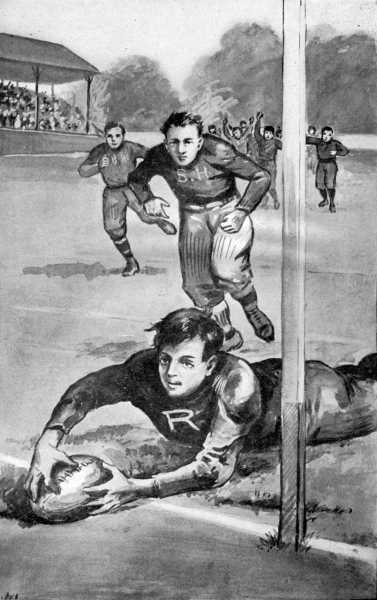
Sid was through. Staggering and weak, but
through. Between him and the coveted goal line
now was but one player—the Boxer full-back—William
Cook. He crouched, waiting for Sid,
but there were few better dodgers than this same
Sid. On he came, wondering if his wind and legs
would hold out for the race he had yet to run—a
race with glory at the end—or bitter defeat on
the way.
Cook was opening and shutting his hands, in
eager anticipation of grasping Sid. His jaw was
set, his eyes gleamed. On came the half-back,
gathering momentum with every stride, until, just
as Cook thought he had him, Sid dodged to one
side, and kept on. There was now a clear field
ahead of him, and he was urged forward by the
frantic yells of his fellow players and the wild,
shouting crowds on the stands. Not a person was
seated. They were all standing up, swaying, yelling,
imploring, or praying, that Sid would keep
on—or fall or be captured before he crossed that
magical white line.
Sid kept on. Then there came a different yell.
It was from the Boxer stands. Tom, picking himself
out from a heap of players, saw Langridge
sprinting after Sid. And how the former bully of
Randall did run!
“Oh, Sid! Go on! Go on!” implored Tom,
in a whisper, as if the youth could hear him.
And Sid went on. After him, fiercely, came
Langridge. The distance between them lessened.
Sid was staggering. His brain was reeling. His
legs tottered. The ball seemed about to slip from
his grasp, and he found himself talking to it, as to
a thing alive.
“Stay there, now—stay there—don’t fall out.
And—and you legs—don’t you give way—don’t
you do it! Keep on, old man, keep on! You can
do it! You can do it!”
Thus Sid muttered to himself. He heard the
patter of the running feet behind him. He did
not look to see who was coming—he dared not.
He felt that if he took his eyes off the last
white line ahead of him that he would stagger
and fall.
The line was like the crystal globe that hypnotizes
one. It held his gaze.
On, and on, and on——
Sid fell in a heap. His breath left him. There
was a darkness before him. Down he went
heavily.
But, oh, what a shout came dimly to his ears!
What a wild riot of cries! He tried to look down
and see whether he had crossed the line before he
stumbled, but he could only see the brown earth
and green grass. He heard someone still running
after him. He lifted his head. There, just
before him, was the goal line.
With the energy of despair, he raised the ball
in his arms, and placed it over the chalk mark,
holding it there with all his remaining strength,
when someone threw himself fiercely upon him.
It was Langridge, eager, wrathful and almost
beside himself with rage. But he was too late.
The ball was well over the last line, and, knowing
from the attitude of the Boxer player that it was
there, the great throng of Randall men and
women, young men and maidens, joined in one
great cry:
“Touchdown! Touchdown!”
It was—the winning touchdown, for, as the
other players, some fearful, some hoping, came
rushing up, the final whistle blew, ending the contest
that had resulted in championship for Randall.
And then, welling over the field once more,
came softly the song: “Either We Conquer, or
We Die!”
There were bonfires that night at Randall—bonfires
in which the football suits were burned,
for the eleven broke training in a blaze of glory.
Also there were feastings, for there was no ban
on eating now. And, likewise, there was much
rejoicing. For was not Randall champion again?
Had not her loyal sons again won a victory on
the gridiron? Therefore, let the gladness go
on!
Sid was the lion of the hour. It was his great
run—his struggle against long odds—that had
won the big game, and he was carried on the
shoulders of his mates, and his name was heralded
in song and story.
“Oh, it was great, old man, great!” cried Tom,
as they walked together from the gymnasium,
where there had been a sort of impromptu joy-meeting
after the feast.
“Nothing like it ever seen at Randall,” declared
Phil.
“Nothing like it ever seen anywhere,” put in
the big Californian.
“I never could have done it, if you hadn’t
opened the hole for me, Frank,” spoke Sid,
gratefully.
“I just had to open that hole,” was the retort.
“I felt that I’d tear those fellows limb from
limb if they didn’t give way, and——”
“They did,” finished Phil, with a laugh.
They had met their girl friends after the game,
and had received their congratulations. Then
had come a happy time, walking with them, then
the feasting, and now our friends were on their
way to their room.
“There are only two things that are bothering
me,” remarked Tom, thoughtfully.
“What’s that—Langridge?” asked Phil. “Say,
he must have felt sick when he got to where Sid
was, and saw that it was a touchdown, all right!
Did he hurt you, Sid?”
“Well, he knocked the wind out of me—that
is, what there was left to knock. But I guess he
didn’t mean to.”
“Oh, he meant it, all right,” declared Tom.
“But I wasn’t thinking of Langridge. I was going
to say that the two things that bothered me was
the mystery of the chair and the clock.”
“That’s so,” came from Phil. “I wonder who
that fellow was, and how the deed came to be in
his chair?”
“We must tell Prexy about it,” decided Sid.
“It may have a bearing on the case.”
They were deep in a discussion of possible explanations
of the various problems that vexed
them, when they turned down the corridor that
led to their room. There was so much noise
going on out on the campus—shouts and yells, and
the students circling about the bonfires—that the
footsteps of our friends made no sound. That
is why they were close upon a figure crouched in
front of their door before the kneeling one was
aware of their presence. Then the figure started
away. But Phil was too quick, and grabbed it.
“I’ve caught you!” cried the quarter-back. “So
you sneaked back, to see if you could find the deed,
eh?” for he thought he had the stranger who had
before visited them.
“By Jove, it’s Lenton!” cried Tom, catching a
glimpse of the face of the captive. And indeed
it was the odd student who was such an expert
with the file.
“And he’s got a false key!” added Sid, as he
saw a bit of brass in the lad’s hand. “Here, you
little shrimp, what do you mean?” and Sid shook
the lad.
“I—please—I didn’t mean anything,” was the
stammering answer.
“Weren’t you trying to get into our room?”
demanded Tom.
“Yes, I—I was, but——”
“Where’s our chair?” came fiercely from Phil.
“I haven’t got it! I never had it.”
“Did you take our clock, and afterward exchange
it?” asked Tom, determined to solve part
of the mystery, if not all.
“Yes, I had it, and I—I was coming back to
borrow it again,” answered the odd student.
“Borrow it?” repeated Sid.
“Yes, that’s all I did with your alarm clock.
Oh, fellows, I didn’t mean anything wrong. I’ll
tell you all about it.”
“You’d better,” said Phil, keeping a hold of the
intruder’s collar. “Come inside.”
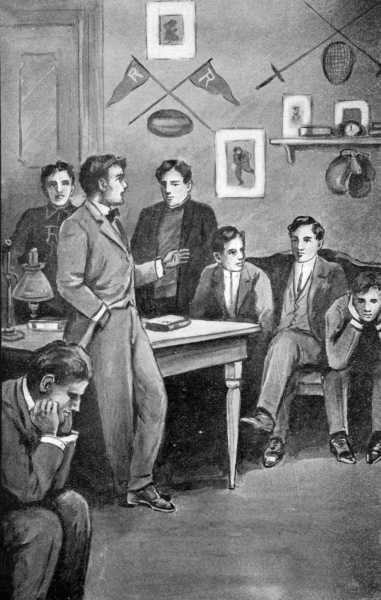
They entered the room, and Tom locked the
door.
“Well?” asked Phil, suggestively, as he pointed
out a chair to Lenton. “We’re ready to hear
you.”
“I borrowed your clock to take a wheel out,”
said the odd student, simply.
“To take a wheel out?” repeated Sid, in amazement.
“Yes. In an alarm clock there is a certain size
cog wheel that I could find nowhere else. Fellows,
I am making a new kind of static electric machine,
and I needed a certain sized wheel. I tried
everywhere to get one, and I couldn’t afford to
pay for having one made. Then, one day, I happened
to see your alarm clock in here. I thought,
perhaps, that it would have in it the wheel I
wanted. I made a false key, sneaked in, and took
the clock out. Then I happened to think you’d
want a timepiece, so I brought in that mahogany
one—it was a present to me from a friend in Chicago,
but I didn’t care for it. The wheels weren’t
right.”
“I guess you’ve got wheels,” murmured Phil.
“Your alarm clock had just the right size wheel
in it,” went on the odd student, “so I took it out,
and made my electrical machine. Then I made
another wheel that would answer as well in your
clock, and I made the exchange back again. Now
my electrical machine is broken, and I need another
wheel from your clock, and——”
“You were going to sneak in again and take it,”
broke in Sid.
“Yes. I made another false key, for I accidentally
left the first one in the door when you came
and surprised me, the day I brought your clock
back.”
“Why didn’t you ask us for the clock?” inquired
Tom.
“Because I was afraid you wouldn’t let me take
it. I heard the fellows say how fond you were
of it. I thought you wouldn’t miss a wheel from
it, if I gave you a better clock.”
“Another one—not a better,” insisted Phil.
“But did you drop a letter in here one day?”
“Yes, I did, to Bert Bascome, and I wondered
what had become of it.”
“We found it,” said Tom. “Was there something
in it about a clock?”
“Yes, I bought an expensive alarm clock from
Bert, but I wrote rather sharply to tell him it
wasn’t any good. It had the wrong kind of
wheels. Bascome was mad at me for not keeping
it to pay off some of the money he owes me.
That’s all there is to tell.”
“And it’s enough,” declared Sid. “I guess
that explains everything. Bascome’s denial was
justified.”
“And we thought Langridge had a hand in it,”
went on Phil. “But there is still the chair and
deed to be explained.”
“I don’t know anything about the chair,” insisted
Lenton, and they believed him. “But could
I have——” he hesitated.
“Do you want the clock?” asked Tom.
“I—I just want to take out one of the wheels.
I’ll put in another just as good,” promised Lenton,
eagerly. And they let him have the battered
timepiece.
“Now, if we could only explain the chair matter
as easily, all would be well,” commented Phil,
when Lenton had gone.
They had not long to wait. A little later a
message summoned them to the office of Dr.
Churchill. The president greeted them pleasantly.
“I have just had the lawyers here,” he said,
“and they state that the quit-claim deed which you
boys found is genuine, and the very one that was
missing. It brings to an end the suit against the
college, and I wish to once more thank you lads.
The prohibition of silence is now removed, and
you are at liberty to tell your friends the good
news.”
“But you have not heard it all,” said Tom, and
he told about the visit of the excited stranger just
before the game.
“I think I can explain that,” went on the president,
with a smile, “and also tell you where to
find your chair.”
“Can you?” cried the three, eagerly.
“Your visitor was a Mr. James Lawson,” continued
Dr. Churchill, “and he was the one who
made the claim against the college, being a distant
heir of Simon Hess. Without the quit-claim
deed being available to us, he was the ostensible
owner of our property. How he got possession
of the deed he would not say, though the lawyers
and I questioned him.”
“Was he here?” asked Phil.
“Yes, your actions evidently frightened him,
for he called a little while ago to say that he gave
up all claims to the land. He stated that he
thought he had a right to the deed.”
“How did it get in the old chair?” asked Tom.
“Being an heir of Simon Hess,” went on the
doctor, “this Mr. Lawson had some of the old
family furniture. Among the pieces was a chair,
similar to yours, which I understand was also a
Hess heirloom. Your chair was taken by a man
whom we engaged temporarily to do some janitor
work. He sold it to a second-hand dealer, and I
have only to-night learned his name and address.
The janitor was dismissed shortly after being
hired, as it was found that he was dishonest.
To-day I received a letter from him, begging forgiveness,
and telling about the chair he sold from
your room. But he did not mention a clock, for
I understand you also lost a timepiece.”
“Oh, we have that back,” said Tom. “But
about the chair?”
“I’ll come to that, and tell you where to get
yours. It seems that Mr. Lawson retained possession
of the quit-claim deed, which he would not
tell how he obtained.
“One night, when looking it over in his home,
near Rosedale, he was interrupted by an unexpected
visitor. Not wishing his caller to see the
deed, he slipped it under the lining of the seat of
the old chair. Business matters came up immediately
afterward, and he went out, forgetting
about the document, which was left in the seat.
“The next day his wife, who liked new instead
of old furniture, sold the old armchair to a second-hand
dealer, deed and all, though, of course, she
did not know of the paper. Naturally, when Mr.
Lawson heard of his loss, he was frantic, for
on the deed his whole claim depended. He intended
to destroy the document to prevent it ever
being found by anyone so that it would benefit
Randall. But he reckoned without fate, which
stepped in most opportunely. He sought the old
chair, but it had gone from dealer to dealer,
until finally a Mr. Rosenkranz got it.
“You obtained it from him just before Mr.
Lawson called to claim his furniture, and later
he came on to the college. The rest fits in with
what you already know.”
“Well, wouldn’t that——” began Tom, and
then he happened to remember that he was in the
president’s presence, and he stopped.
“Your old chair is at this place,” went on Dr.
Churchill, giving the address of a small dealer in
a nearby city. “You may go and get it any time
you like,” the good doctor concluded. “And now
I think that this clears up the mystery. But, before
you go, let me congratulate you on the magnificent
victory of this afternoon. The nine did
exceedingly well.”
The president smiled benignly, unconscious of
the “break” he had made in calling the eleven a
“nine,” and the boys, joyful over the prospect of
an early recovery of their chair, left the office.
At last the mystery was ended.
There was more rejoicing in Randall when the
facts regarding the quit-claim deed became
known, and the next day formal notice of the
withdrawal of the suit was filed. There was some
talk about prosecuting Mr. Lawson, but there was
a doubt as to his real criminality, so nothing was
done.
And thus ended the troubles of Randall, not
only from a legal standpoint, but also from an
athletic, for her title to the championship of the
gridiron was firmly established. But there were
other battles of the field to come, and those who
are interested in them may read thereof in the
next volume of the series, to be called: “For the
Honor of Randall; a Story of College Athletics.”
“They look like twins, don’t they?” remarked
Tom, a few evenings later, when, having recovered
their own chair, it was placed beside the one
left by Mr. Lawson, for he did not come to claim
it.
“Yes, if we had two more, we’d have a collection,
and there’d be one apiece,” added Phil.
“Oh, the sofa’s good enough for me,” came
from Sid. “I hope nobody borrows that to take
out a wheel, or some of the stuffing.”
“And the clock ticks as naturally as it always
did,” commented Phil, as he took a seat in one
of the easy chairs, for Lenton had returned the
timepiece.
“And they lived happily forever after,” murmured
Tom, now half asleep, for it was warm
in the room. “I say, are you fellows going to
the next Fairview frat. dance?”
“Are we? Wild horses can’t hold us back!”
cried Sid, with energy.
“Good!” murmured Tom, still more sleepily,
and then, as the chums lapsed into silence, there
sounded the loud and insistent ticking of the battered
alarm clock.
THE END
THE BASEBALL JOE SERIES
By LESTER CHADWICK
12mo. Illustrated. Price 50 cents per volume.
Postage 10 cents additional.
- BASEBALL JOE OF THE SILVER
STARS
or The Rivals of Riverside
- BASEBALL JOE ON THE SCHOOL
NINE
or Pitching for the Blue Banner
- BASEBALL JOE AT YALE
or Pitching for the College Championship
- BASEBALL JOE IN THE CENTRAL
LEAGUE
or Making Good as a Professional Pitcher
- BASEBALL JOE IN THE BIG LEAGUE
or A Young Pitcher’s Hardest Struggles
- BASEBALL JOE ON THE GIANTS
or Making Good as a Twirler in the Metropolis
- BASEBALL JOE IN THE WORLD SERIES
or Pitching for the Championship
- BASEBALL JOE AROUND THE WORLD
or Pitching on a Grand Tour
- BASEBALL JOE: HOME RUN KING
or The Greatest Pitcher and Batter on Record
- BASEBALL JOE SAVING THE LEAGUE
or Breaking Up a Great Conspiracy
- BASEBALL JOE CAPTAIN OF THE TEAM
or Bitter Struggles on the Diamond
- BASEBALL JOE CHAMPION OF THE LEAGUE
or The Record that was Worth While
- BASEBALL JOE CLUB OWNER
or Putting the Home Town on the Map
- BASEBALL JOE PITCHING WIZARD
or Triumphs Off and On the Diamond
Send for Our Free Illustrated Catalogue.
CUPPLES & LEON COMPANY, Publishers New York
THE MOTOR BOYS SERIES
By Clarence Young
12mo. illustrated.
Price per volume, 50 cents.
Postage, extra, 10 cents.
Bright up-to-date stories, full of information
as well as of adventure. Read
the first volume and you will want all
the others written by Mr. Young.
- THE MOTOR BOYS
or Chums through Thick and Thin
- THE MOTOR BOYS OVERLAND
or A Long Trip for Fun and Fortune
- THE MOTOR BOYS IN MEXICO
or The Secret of the Buried City
- THE MOTOR BOYS ACROSS THE PLAINS
or The Hermit of Lost Lake
- THE MOTOR BOYS AFLOAT
or The Cruise of the Dartaway
- THE MOTOR BOYS ON THE ATLANTIC
or The Mystery of the Lighthouse
- THE MOTOR BOYS IN STRANGE WATERS
or Lost in a Floating Forest
- THE MOTOR BOYS ON THE PACIFIC
or The Young Derelict Hunters
- THE MOTOR BOYS IN THE CLOUDS
or A Trip for Fame and Fortune
- THE MOTOR BOYS OVER THE ROCKIES
or A Mystery of the Air
- THE MOTOR BOYS OVER THE OCEAN
or A Marvelous Rescue in Mid-Air
- THE MOTOR BOYS ON THE WING
or Seeking the Airship Treasure
CUPPLES & LEON COMPANY, Publishers New York
THE JACK RANGER SERIES
By CLARENCE YOUNG
12mo. Cloth. Illustrated. Jacket in Colors.
Price 75 cents per volume. Postage 10 cents additional.
Lively stories of outdoor sports and adventure
every boy will want to read.
- JACK RANGER’S SCHOOL DAYS
or The Rivals of Washington Hall
You will love Jack Ranger—you simply can’t
help it. He is bright and cheery, and earnest
in all he does.
- JACK RANGER’S WESTERN TRIP
or From Boarding School to Ranch and Range
This volume takes the hero to the great West. Jack is anxious
to clear up the mystery surrounding his father’s disappearance.
- JACK RANGER’S SCHOOL VICTORIES
or Track, Gridiron and Diamond
Jack gets back to Washington Hall and goes in for all sorts of
school games. There are numerous contests on the athletic field.
- JACK RANGER’S OCEAN CRUISE
or The Wreck of the Polly Ann
How Jack was carried off to sea against his will makes a “yarn”
no boy will want to miss.
- JACK RANGER’S GUN CLUB
or From Schoolroom to Camp and Trail
Jack organizes a gun club and with his chums goes in quest of
big game. They have many adventures in the mountains.
- JACK RANGER’S TREASURE BOX
or The Outing of the Schoolboy Yachtsmen
Jack receives a box from his father and it is stolen. How he regains
it makes an absorbing tale.
Send for Our Free Illustrated Catalogue.
CUPPLES & LEON COMPANY, Publishers New York
THE BOY RANCHERS SERIES
By WILLARD F. BAKER
12mo. Cloth. Illustrated. Jacket in full colors.
Price per volume, 65 cents, postpaid.
Stories of the great west, with cattle ranches as
a setting, related in such a style as to captivate
the hearts of all boys.
- THE BOY RANCHERS
or Solving the Mystery at Diamond X
Two eastern boys visit their cousin. They
become involved in an exciting mystery.
- THE BOY RANCHERS IN CAMP
or The Water Fight at Diamond X
Returning for a visit, the two eastern lads learn, with delight, that
they are to become boy ranchers.
- THE BOY RANCHERS ON THE TRAIL
or The Diamond X After Cattle Rustlers
Our boy heroes take the trail after Del Pinzo and his outlaws.
- THE BOY RANCHERS AMONG THE INDIANS
or Trailing the Yaquis
Rosemary and Floyd are captured by the Yaqui Indians.
- THE BOY RANCHERS AT SPUR CREEK
or Fighting the Sheep Herders
Dangerous struggle against desperadoes for land rights.
- THE BOY RANCHERS IN THE DESERT
or Diamond X and the Lost Mine
One night a strange old miner almost dead from hunger and hardship
arrived at the bunk house. The boys cared for him and he told
them of the lost desert mine.
- THE BOY RANCHERS ON ROARING RIVER
or Diamond X and the Chinese Smugglers
The boy ranchers help capture Delton’s gang who were engaged in
smuggling Chinese across the border.
- THE BOY RANCHERS IN DEATH VALLEY
or Diamond X and the Poison Mystery
The boy ranchers track mysterious Death into his cave.
Send For Our Free Illustrated Catalogue
CUPPLES & LEON COMPANY, Publishers New York
THE BOMBA BOOKS
By ROY ROCKWOOD
12mo. Cloth. Illustrated. With colored jacket.
Price 50 cents per volume.
Postage 10 cents additional.
Bomba lived far back in the jungles of the
Amazon with a half-demented naturalist
who told the lad nothing of his past. The
jungle boy was a lover of birds, and hunted
animals with a bow and arrow and his trusty
machete. He had a primitive education in
some things, and his daring adventures will
be followed with breathless interest by thousands.
- BOMBA THE JUNGLE BOY
or The Old Naturalist’s Secret
- BOMBA THE JUNGLE BOY AT THE MOVING MOUNTAIN
or The Mystery of the Caves of Fire
- BOMBA THE JUNGLE BOY AT THE GIANT CATARACT
or Chief Nasconora and His Captives
- BOMBA THE JUNGLE BOY ON JAGUAR ISLAND
or Adrift on the River of Mystery
- BOMBA THE JUNGLE BOY IN THE ABANDONED CITY
or A Treasure Ten Thousand Years Old
- BOMBA THE JUNGLE BOY ON TERROR TRAIL
or The Mysterious Men from the Sky
- BOMBA THE JUNGLE BOY IN THE SWAMP OF DEATH
or The Sacred Alligators of Abarago
- BOMBA THE JUNGLE BOY AMONG THE SLAVES
or Daring Adventures in the Valley of Skulls
Send for Our Free Illustrated Catalogue.
CUPPLES & LEON COMPANY, Publishers New York
The Speedwell Boys
Series
By ROY ROCKWOOD
Author of “The Dave Dashaway Series,” “Great Marvel Series,” etc.
12mo. Illustrated. Price per volume, 65 cents, postpaid.
All boys who love to be on the go will welcome the Speedwell
boys. They are clean cut and loyal lads.
The Speedwell Boys on Motor Cycles
or The Mystery of a Great Conflagration
The lads were poor, but they did a rich
man a great service and he presented them
with their motor cycles. What a great fire
led to is exceedingly well told.
The Speedwell Boys and Their Racing Auto
or A Run for the Golden Cup
A tale of automobiling and of intense rivalry on the road.
There was an endurance run and the boys entered the contest.
On the run they rounded up some men who were wanted by
the law.
The Speedwell Boys and Their Power Launch
or To the Rescue of the Castaways
Here is an unusual story. There was a wreck, and the lads,
in their power launch, set out to the rescue. A vivid picture
of a great storm adds to the interest of the tale.
The Speedwell Boys in a Submarine
or The Lost Treasure of Rocky Cove
An old sailor knows of a treasure lost under water because
of a cliff falling into the sea. The boys get a chance to go
out in a submarine and they make a hunt for the treasure.
The Speedwell Boys and Their Ice Racer
or The Perils of a Great Blizzard
The boys had an idea for a new sort of iceboat, to be run
by combined wind and motor power. How they built the craft,
and what fine times they had on board of it, is well related.
CUPPLES & LEON CO., Publishers, NEW YORK
THE BOB DEXTER SERIES
By WILLARD F. BAKER
12mo. Cloth. Illustrated. Jacket in Colors.
Price per volume, 65 cents, postpaid.
This is a new line of stories for boys, by
the author of the Boy Ranchers series. The
Bob Dexter books are of the character that
may be called detective stories, yet they
are without the objectionable features of the
impossible characters and absurd situations
that mark so many of the books in that class.
These stories deal with the up-to-date adventures
of a normal, healthy lad who has
a great desire to solve mysteries.
- BOB DEXTER AND THE CLUB-HOUSE MYSTERY
or The Missing Golden Eagle
This story tells how the Boys’ Athletic Club was despoiled of its
trophies in a strange manner, and how, among other things stolen,
was the Golden Eagle mascot. How Bob Dexter turned himself into
an amateur detective and found not only the mascot, but who had
taken it, makes interesting and exciting reading.
- BOB DEXTER AND THE BEACON BEACH MYSTERY
or The Wreck of the Sea Hawk
When Bob and his chum went to Beacon Beach for their summer
vacation, they were plunged, almost at once, into a strange series of
events, not the least of which was the sinking of the Sea Hawk.
How some men tried to get the treasure off the sunken vessel, and
how Bob and his chum foiled them, and learned the secret of the
lighthouse, form a great story.
- BOB DEXTER AND THE STORM MOUNTAIN
MYSTERY
or The Secret of the Log Cabin
Bob Dexter came upon a man mysteriously injured and befriended
him. This led the young detective into the swirling midst of a series
of strange events and into the companionship of strange persons, not
the least of whom was the man with the wooden leg. But Bob got
the best of this vindictive individual, and solved the mystery of the
log cabin, showing his friends how the secret entrance to the house
was accomplished.
Send For Our Free Illustrated Catalogue
CUPPLES & LEON COMPANY, PUBLISHERS New York
The Fred Fenton
Athletic Series
By ALLEN CHAPMAN
Author of “The Tom Fairfield Series,” “The Boys of Pluck Series” and
“The Darewell Chums Series.”
12mo. Illustrated. Price per volume, 65 cents, postpaid.
A line of tales embracing school athletics. Fred is a true
type of the American schoolboy of to-day.
Fred Fenton the Pitcher
or The Rivals of Riverport School
When Fred came to Riverport none of
the school lads knew him, but he speedily
proved his worth in the baseball box. A
true picture of school baseball.
Fred Fenton in the Line
or The Football Boys of Riverport School
When Fall came in the thoughts of the
boys turned to football. Fred went in the line, and again
proved his worth, making a run that helped to win a great
game.
Fred Fenton on the Crew
or The Young Oarsmen of Riverport School
In this volume the scene is shifted to the river, and Fred
and his chums show how they can handle the oars. There are
many other adventures, all dear to the hearts of boys.
Fred Fenton on the Track
or The Athletes of Riverport School
Track athletics form a subject of vast interest to many
boys, and here is a tale telling of great running races, high
jumping, and the like. Fred again proves himself a hero in
the best sense of that term.
Fred Fenton: Marathon Runner
or The Great Race at Riverport School
Fred is taking a post-graduate course at the school when
the subject of Marathon running came up. A race is arranged,
and Fred shows both his friends and his enemies what he can
do. An athletic story of special merit.
CUPPLES & LEON CO., Publishers, NEW YORK
Transcriber’s Note:
A List of Illustrations has been provided for the convenience of
the reader.
Punctuation and spelling inaccuracies were silently corrected
except as noted below.
Archaic and variable spelling has been preserved.
Variations in hyphenation and compound words have been preserved.
Changed “Haddonville” (p. 257) to “Haddonfield”, the name of the
town nearest Randall College.