Larger versions of most illustrations may be seen by right-clicking them
and selecting an option to view them separately, or by double-tapping and/or
stretching them.
BY ARABELLA B. BUCKLEY, AUTHOR OF “THE FAIRYLAND OF SCIENCE,” ETC.
NEW YORK: D. APPLETON AND COMPANY, 1, 3, AND 5 BOND STREET,
1883.
PREFACE.
Although the present volume, as giving an account
of the vertebrate animals, is a natural sequel to, and
completion of, my former book, Life and her Children,
which treated of invertebrates, yet it is a more
independent work, both in plan and execution, than
I had at first contemplated.
This arises from the nature of the subject. The
structure and habits of the lower forms of life are
sufficiently simple to be treated almost without reference
to geological history. When, however, I began
to sketch out the lives and structure of the vertebrate
animals, which are so closely interlinked one with
another and yet so sharply separated into groups, I
soon found that I must carry my readers into the
past in order to give any intelligible account of the
present.
I have therefore endeavoured to describe graphically
the early history of the backboned animals, so
far as it is yet known to us, keeping strictly to such
broad facts as ought in these days to be familiar to
every child and ordinarily well-educated person, if
they are to have any true conception of Natural
History. At the same time I have dwelt as fully
as space would allow, upon the lives of such modern
animals as best illustrate the present divisions of the
vertebrates upon the earth; my object being rather
to follow the tide of life, and sketch in broad outline
how structure and habit have gone hand-in-hand in
filling every available space with living beings, than
to multiply descriptions of the various species. If
my younger readers will try and become familiar
with the types selected, either alive in zoological
gardens or preserved in good museums, they will, I
hope, acquire a very fair idea of the main branches
of the Backboned Family.1
In order to treat so vast a subject simply and
within narrow limits, it has often been necessary to
pass lightly over new and startling facts. I trust,
however, it will not be inferred that such passages
have been lightly or carelessly written, for in all
cases I have sought, and most gratefully acknowledge,
the assistance of some of our best authorities;
and I have endeavoured that what little is said upon
difficult subjects shall be a true foundation for wider
knowledge in the future.
Among the many friends who have rendered me
valuable assistance, I cannot sufficiently express my
obligations to Professor W. Kitchen Parker for his
unwearying kindness in explaining obscure points of
anatomical structure, and to my friends Mr. Alfred
R. Wallace, Professor A. C. Haddon of Dublin, and
Mr. Garnett of the British Museum, for constant
suggestion and encouragement. I am also indebted
to Mr. J. P. Anderson of the British Museum for
aid in the arrangement of the Index.
The geological restorations given as picture-headings
(some of which are here attempted, I
believe, for the first time) have been most carefully
considered, though the exact forms of such strange
and extinct animals must necessarily be somewhat
conjectural. My thanks are due to the artist, Mr.
Carreras, jun., for the patience and care with which
he has followed my instructions regarding them, and
also to Mr. Smit for his masterly execution of the
frontispiece.2
I have been asked why, in this and the former
work, I have not given genealogical tables to help
the reader to follow the relations of the various
groups. My reason is, that it is impossible to construct
tables of this kind without giving a false idea
of the fixity of natural divisions and of the extent of
our knowledge. To men of science, who know how
provisional such tables are, they have a certain value,
but they would be positively harmful in a work of this
kind, which will have fully accomplished its purpose
if it only awakens in young minds a sense of the
wonderful interweaving of life upon the earth, and a
desire to trace out the ever-continuous action of the
great Creator in the development of living beings.
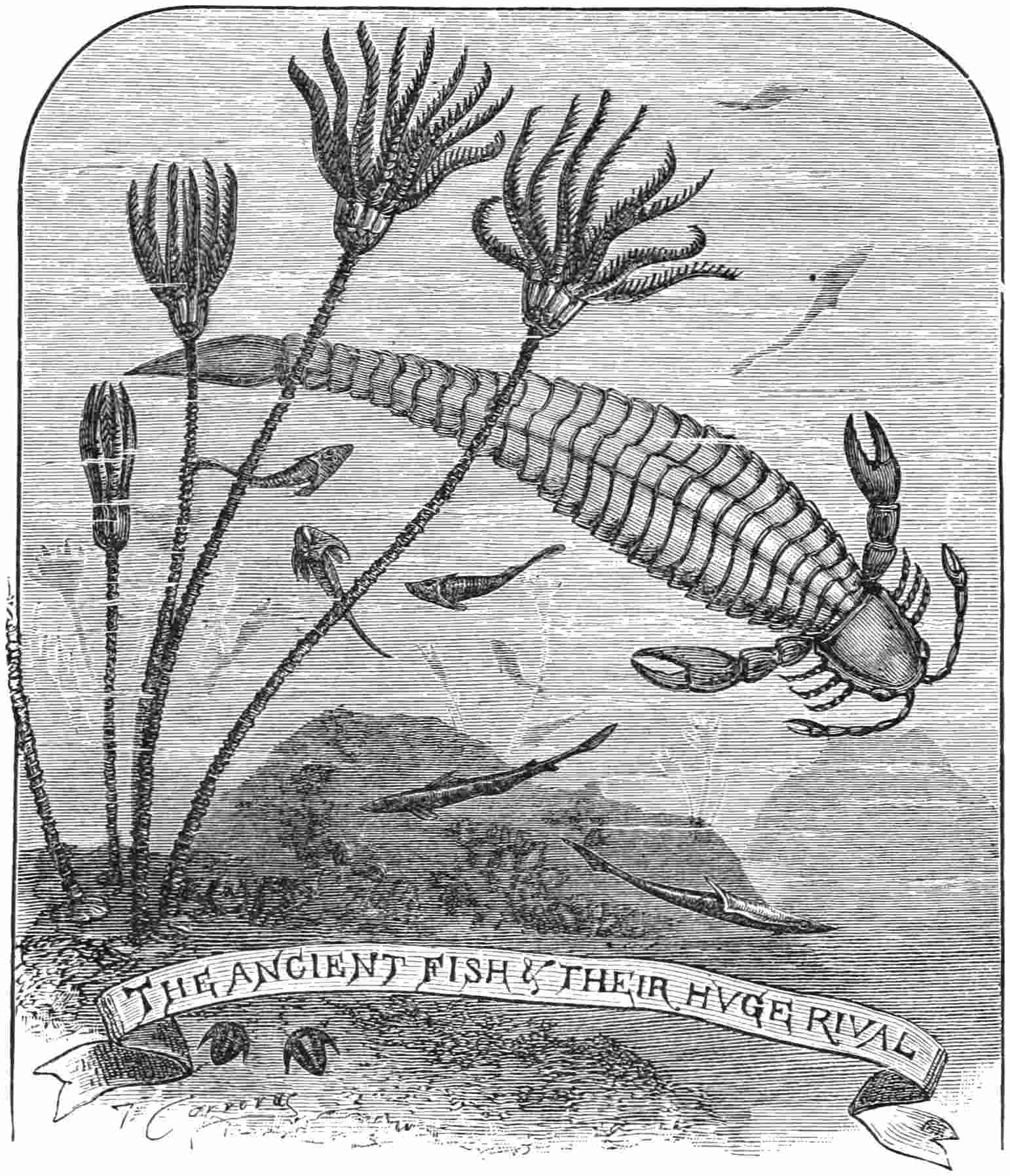
Picture-Heading—Ideal restoration of Pterygotus, the huge extinct sea-scorpion nine feet long; with the earliest known fish Pteraspis, Cephalaspis, and small shark-like animals swimming among Stone-lilies, Trilobites, etc. (From various sources.)
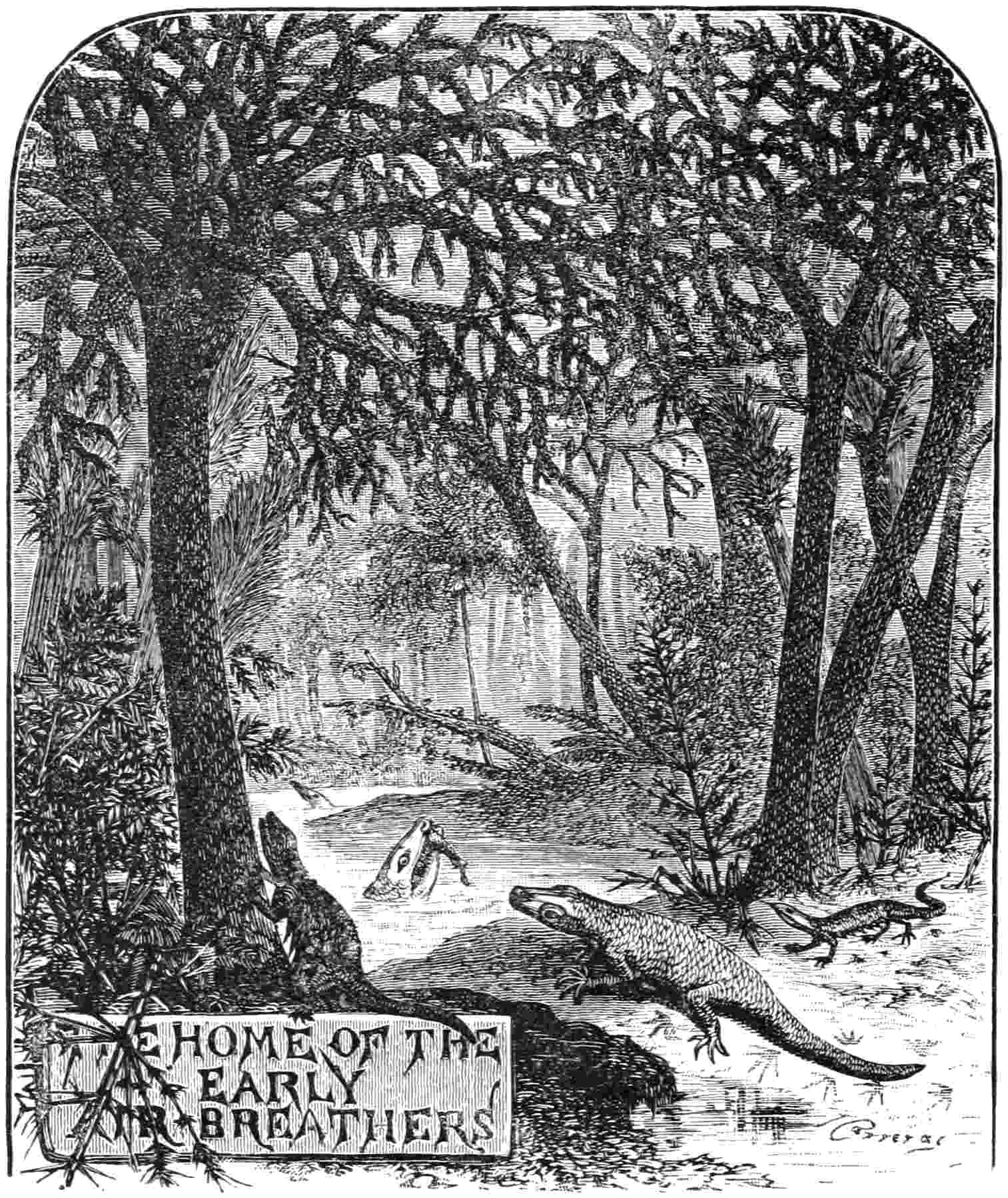
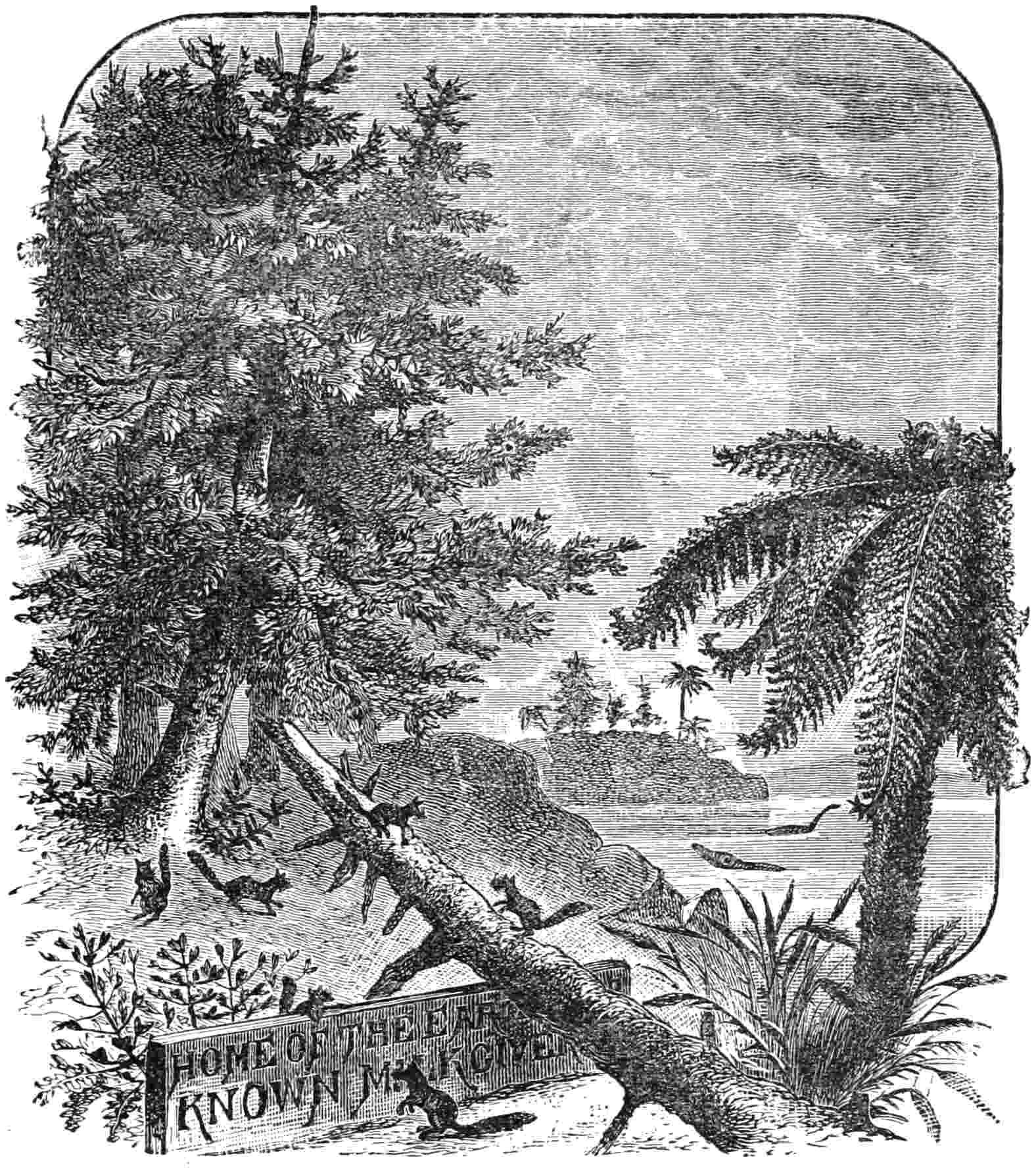
Picture-Heading—A Carboniferous Forest with ancient Amphibians (Labyrinthodonts). In the water Baphetes; on land Dendrerpeton, Hylonomus, and Hylerpeton. (Animals taken from Dawson’s Air-Breathers of the Coal.)
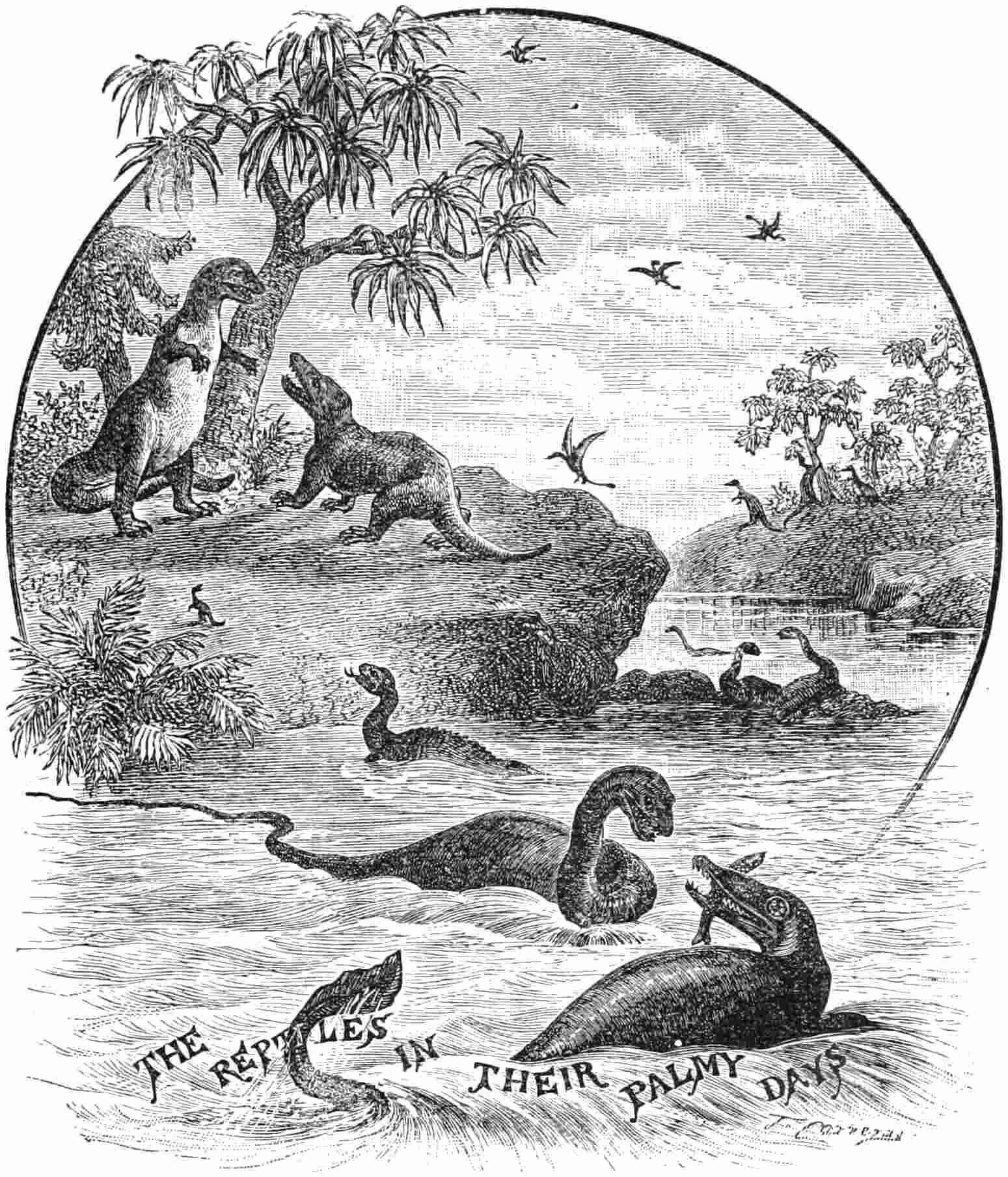
Picture-Heading—Reptiles of the Cretaceous Period. On land Iguanodon, 20 feet high, attacked by Megalosaurus; in the air Pterodactyls, or flying lizards; in the water Ichthyosaurus, Mosasaurus, and Teleosaurus, with Plesiosaurus in the background. (From various sources.)
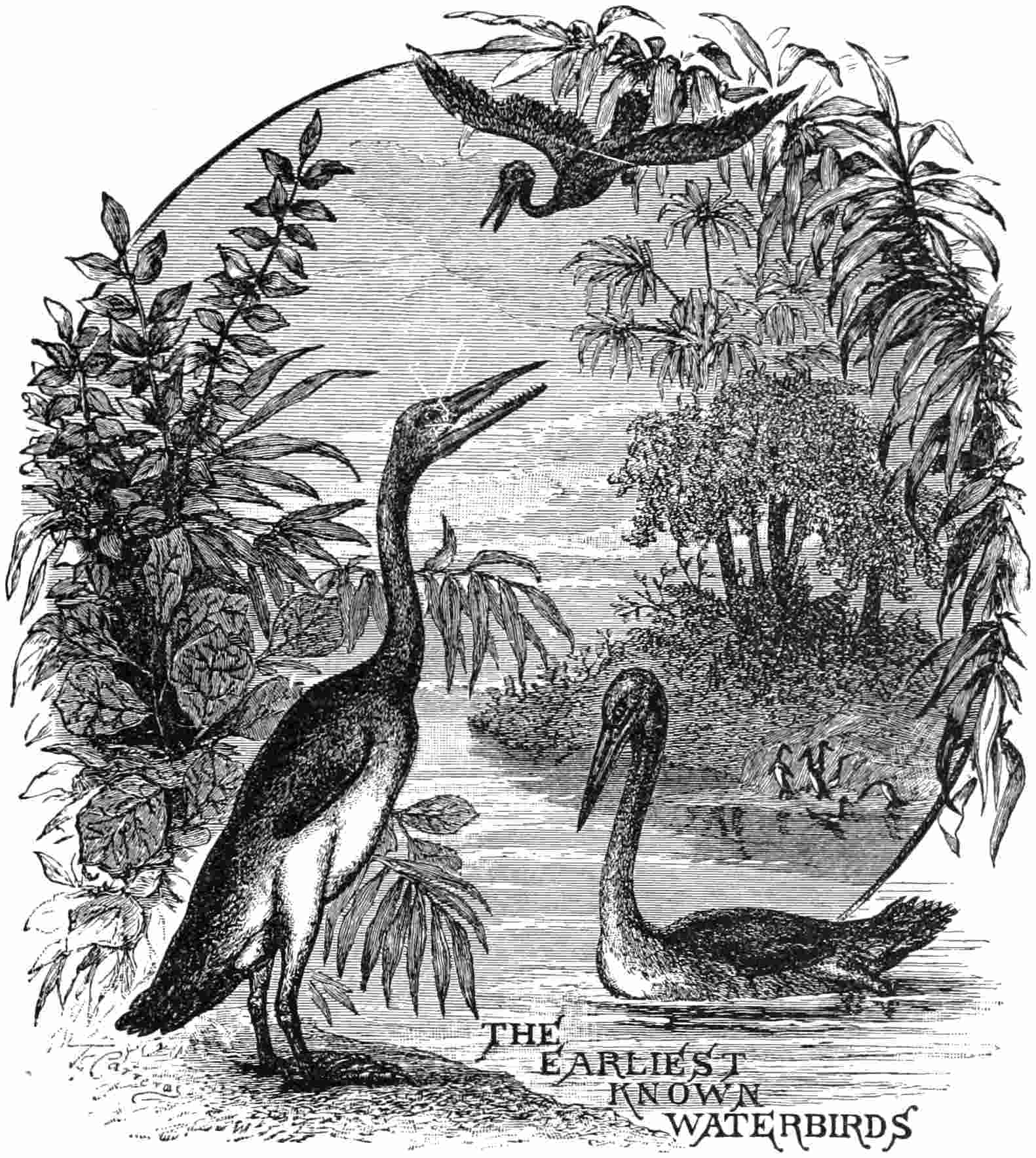
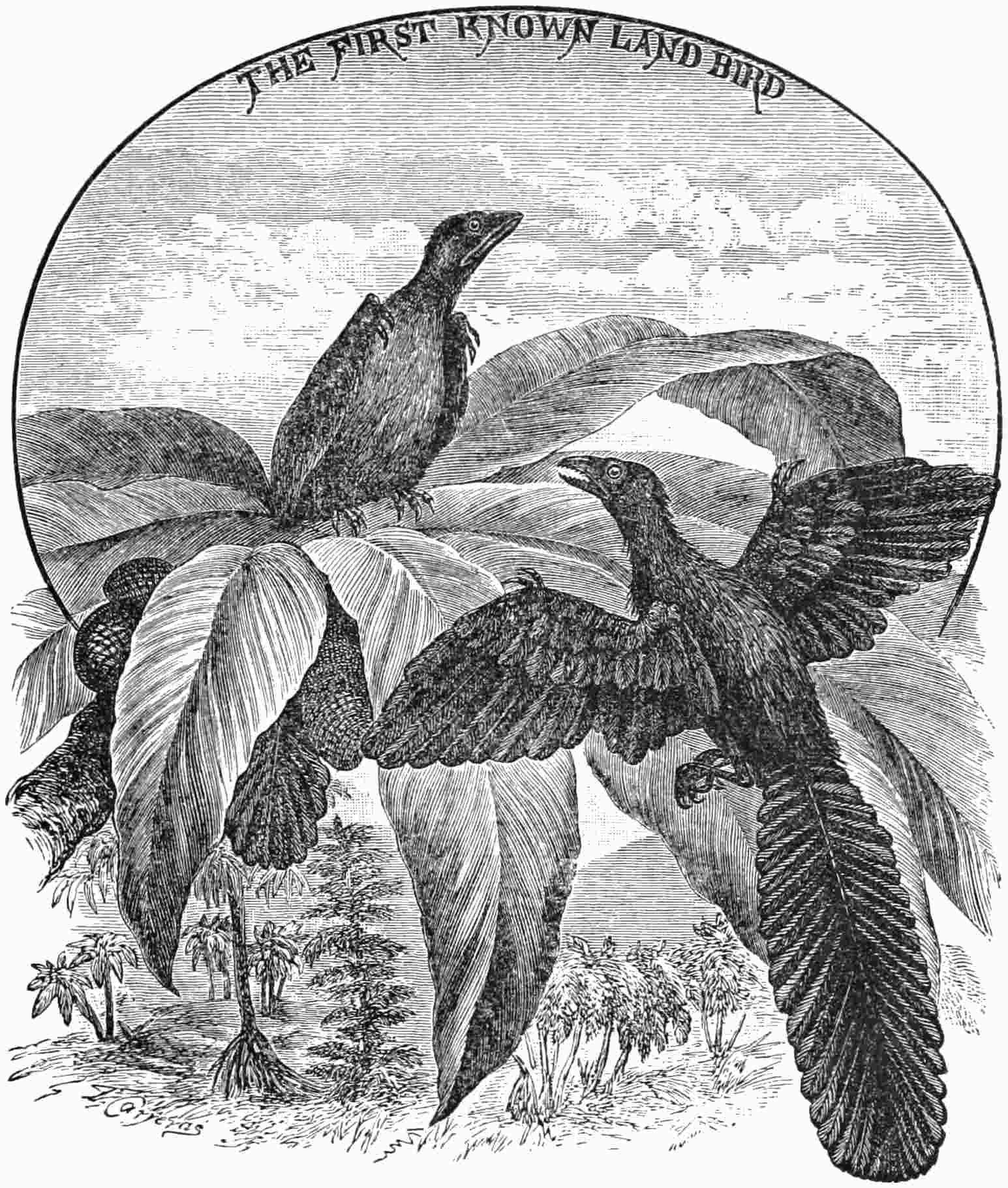
Picture-Heading—Toothed Water-birds of the Cretaceous Period. Swimming and standing, Hesperornis; flying, Ichthyornis. (Restored from Marsh’s Skeletons.)
Picture-Heading—Scene in the Triassic Period, with small Marsupials Microlestes, whose remains are found earlier than the toothed birds. (Restored conjecturally from the nearest living representative, Myrmecobius.) In the water large swimming reptiles.
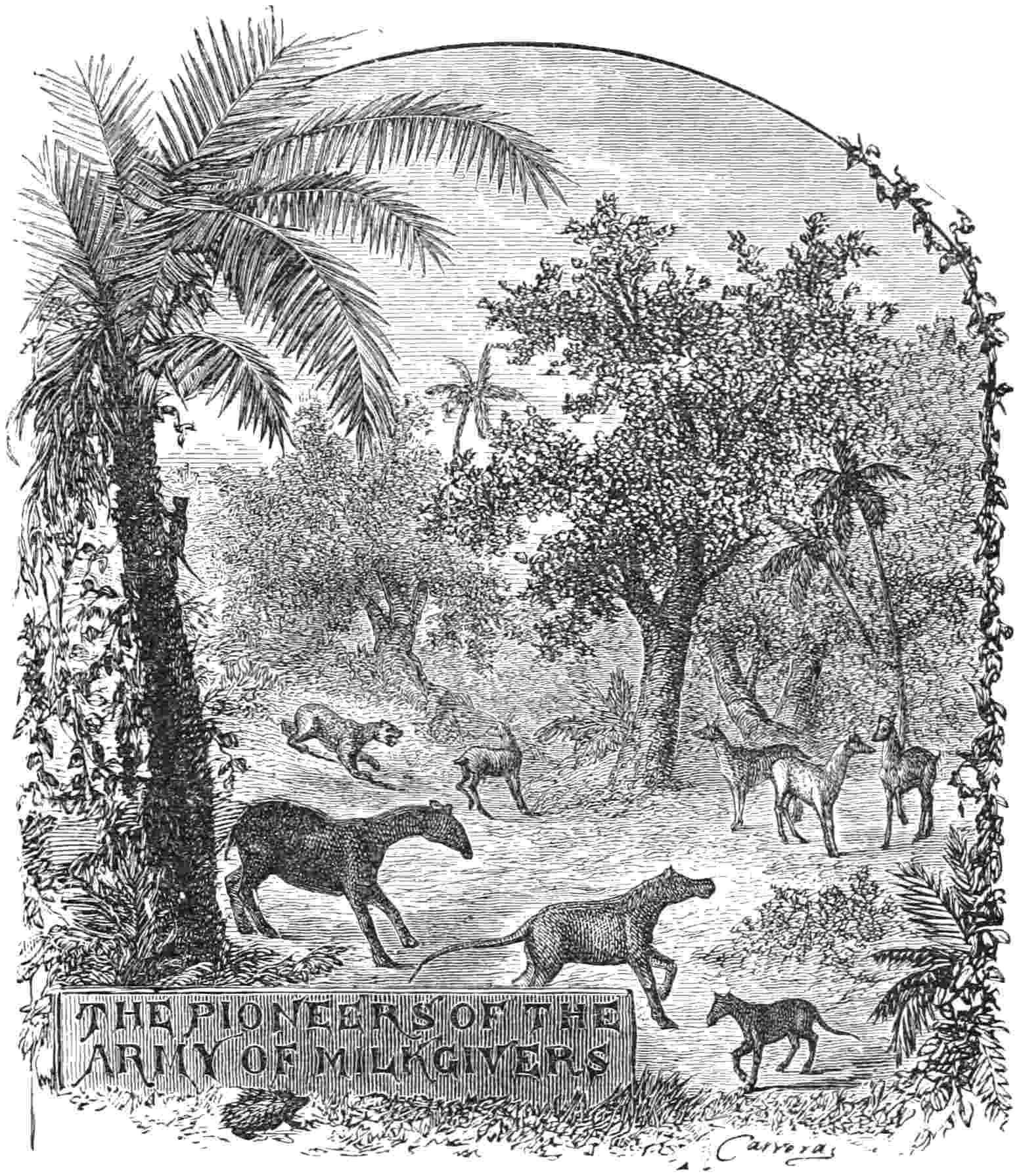
Picture-Heading—Ideal forms of the early Herbivora and Carnivora. In the foreground Paleotherium, Anoplotherium, and Eohippus (this last only restored conjecturally); in the background, Xiphodon and Arctocyon (this last also only an approximation); on the tree, a small lemur; and in front, a hedgehog.
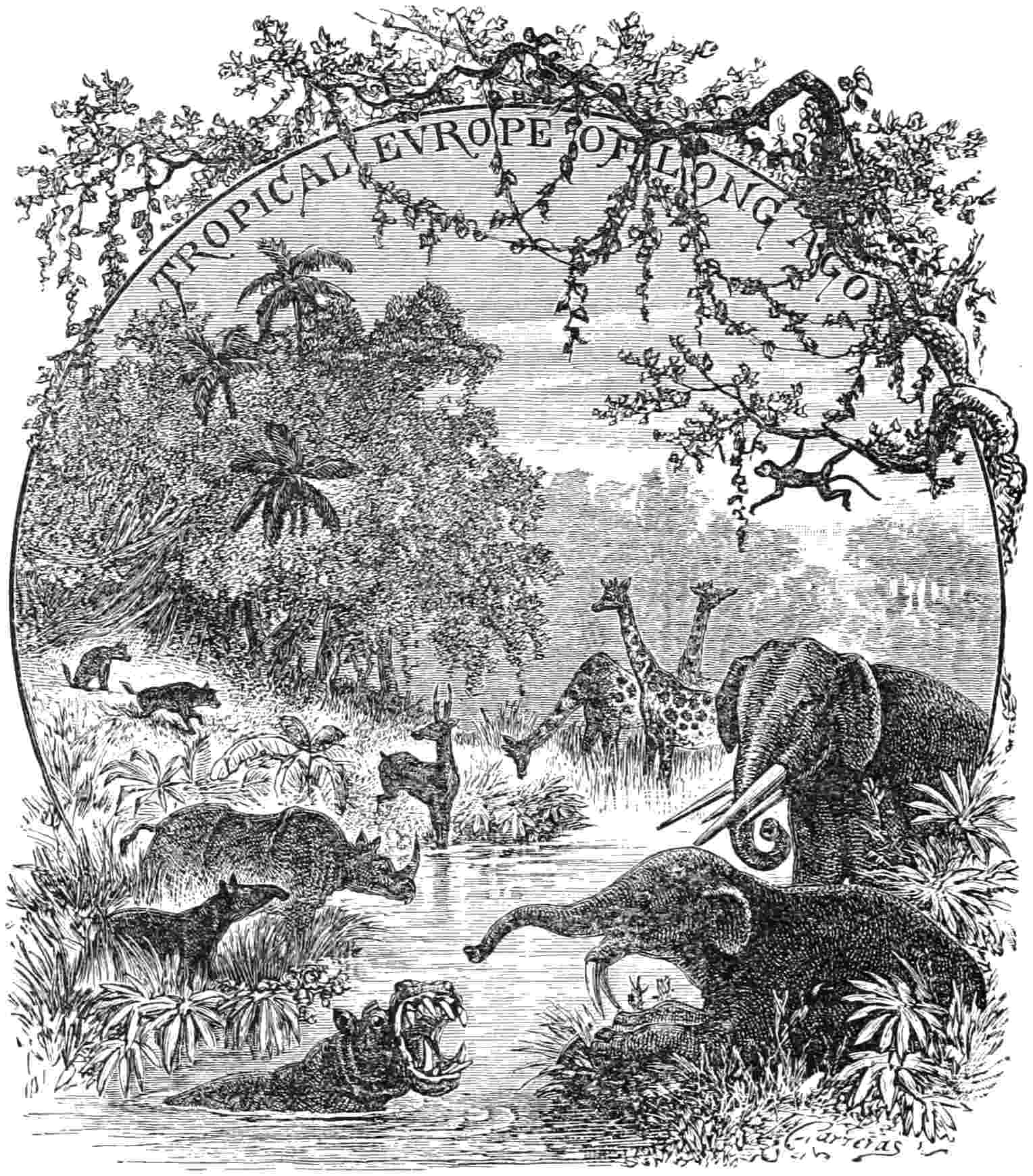
Picture-Heading—Animals which lived in Europe during the warm periods before the Glacial Cold. On the right, Deinotherium, Mastodon; in background, Helladotherium, ancient giraffes; on the left, Hippopotamus, Tapir, Rhinoceros, Hyæna; in the tree, Pithecus pentelicus. All these animals, except the giraffe, were living in England in the late Tertiary Period. (From various sources.)
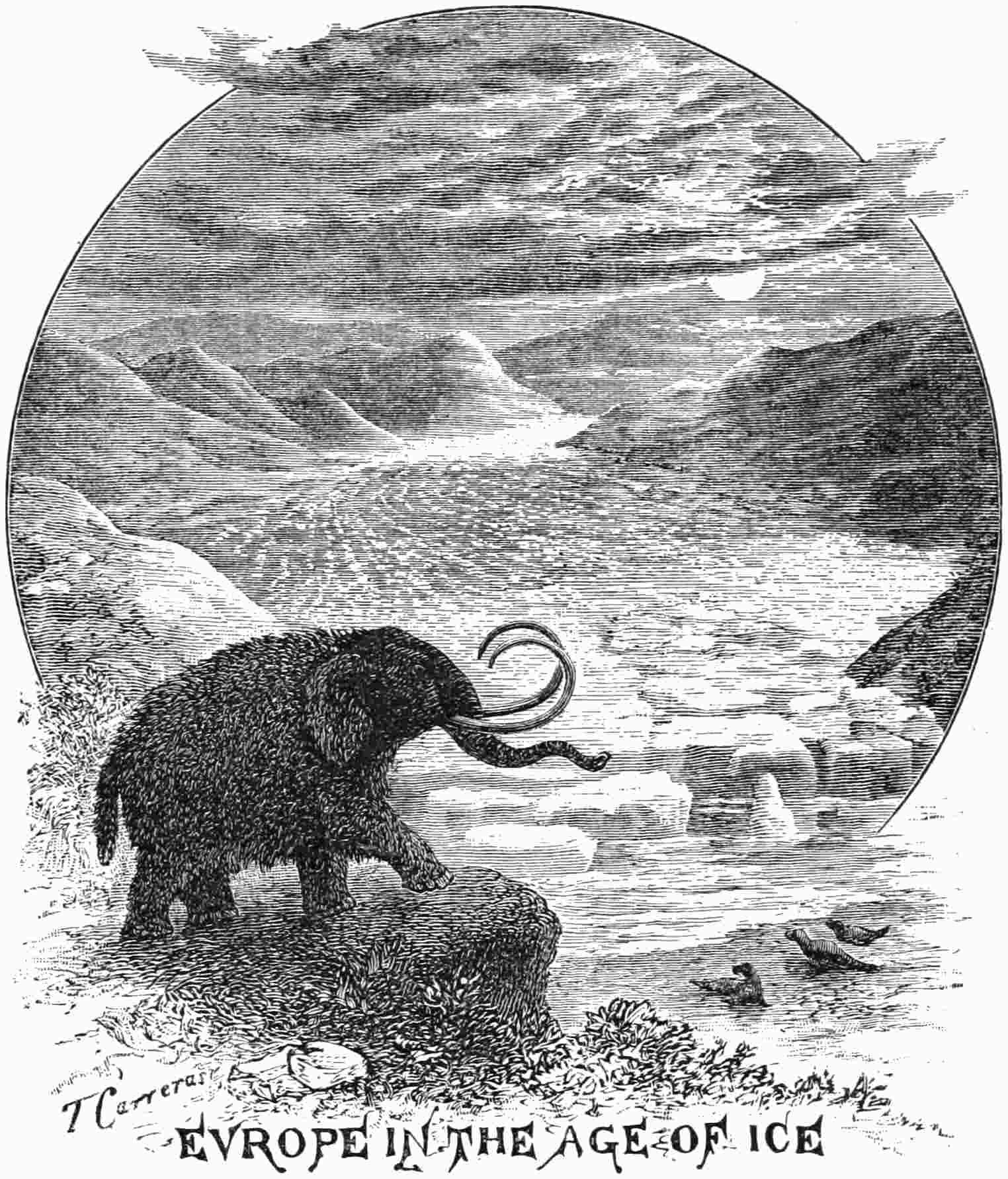
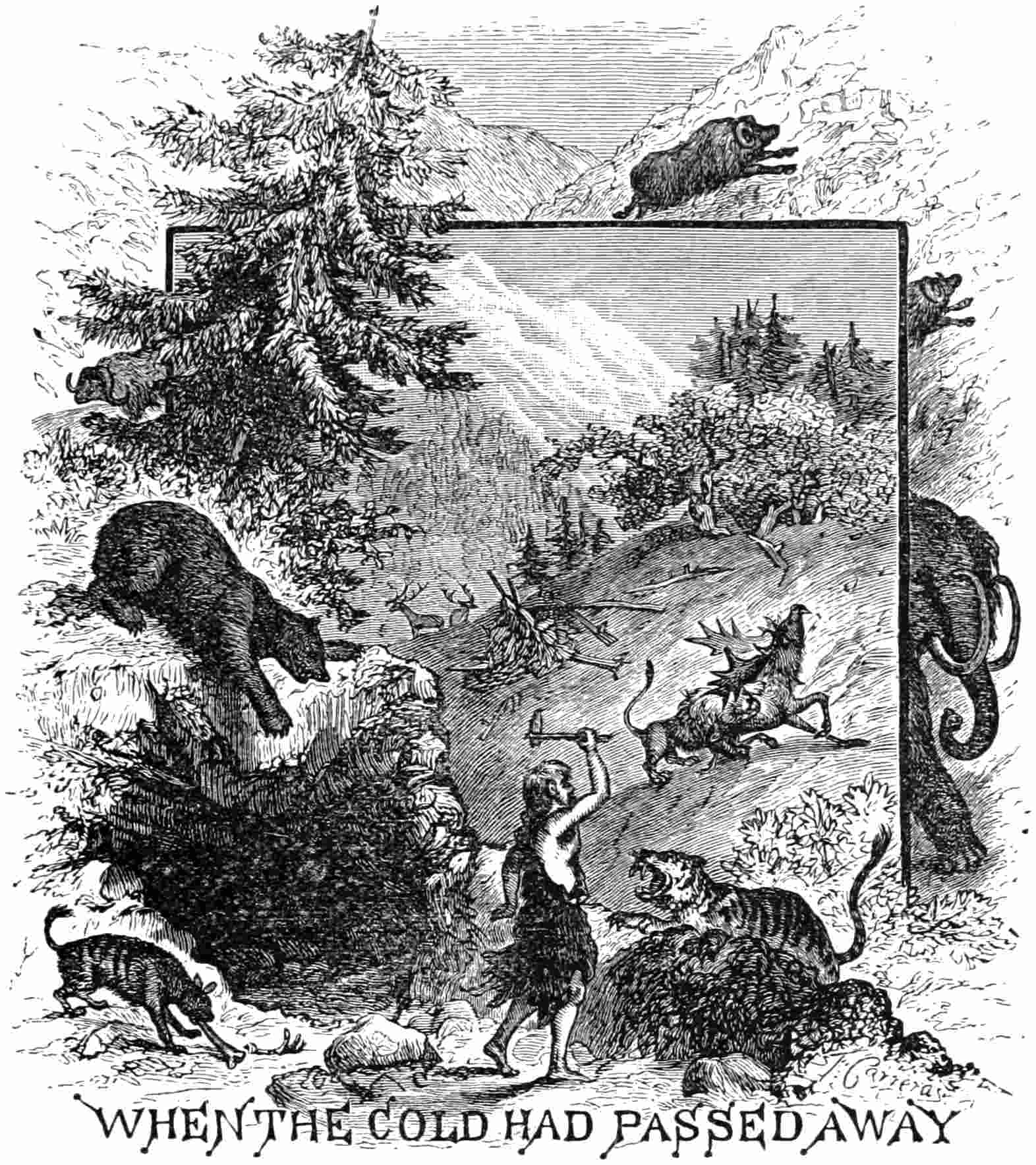
Picture-Heading—Man as he lived in caves after the Glacial Period, among animals of species many of them now extinct—the cave bear (Ursus spelæus), cave lion, cave hyæna (Hyæna spelæa), elk, musk-sheep (Ovibos moschatus), mammoth (Elephas primigenius), and the sabre-toothed tiger (Machairodus), fighting with the man.
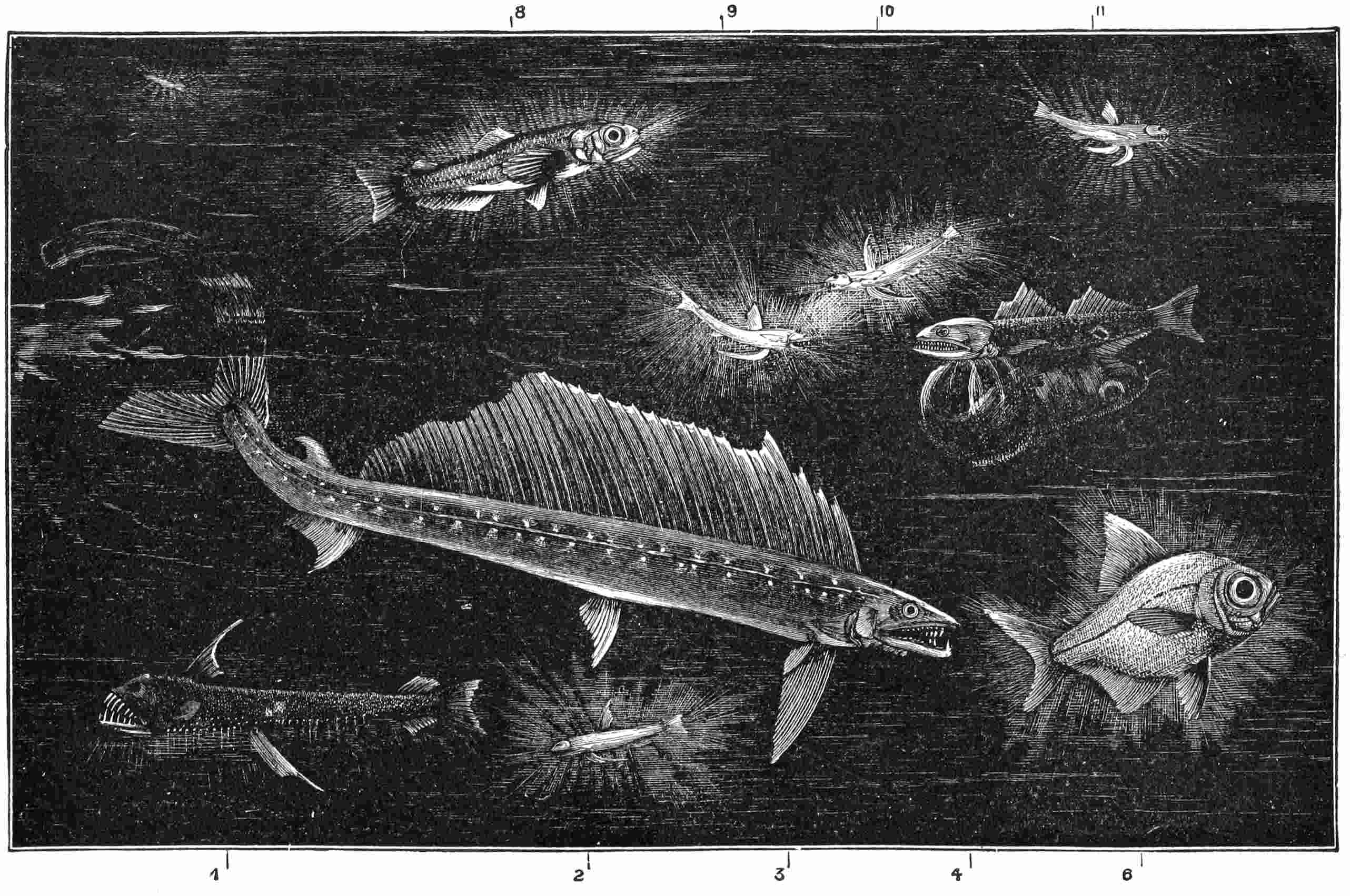
Frontispiece.Fish of the Deep Sea—1. Chauliodus, one foot long;
2, 9, 10, 11. Harpodon or Bombay Duck, six inches; 3. Plagiodus,
six feet; 4. Chiasmodus, one foot, with Scopelus in its
stomach; 6. Beryx, one foot and a half; 8. Scopelus, one foot.
Life, life, everywhere life! This was the cry with
which we began our history of the lowest forms of
Life’s children, and although we did not then pass
on to the higher animals, is it not true that before
we reached the end we were overwhelmed with the
innumerable forms of living beings? The microscopic
lime and flint builders, the spreading sponges,
the hydras, anemones, corals, and jelly-fish filled
the waters; the star-fish, sea-urchins, crabs, and
lobsters crowded the shores; the oysters, whelks, and
periwinkles, with their hundreds of companions,
struggled for their existence between the tides; while
in the open sea thousands of crustaceans and molluscs,
with cuttle-fish and terribly-armed calamaries,
roamed in search of food. Upon the land the snails
and slugs devoured the green foliage, while the vast
army of insects filled every nook and cranny in the
water, on the land, or in the air. Yes! even among
these lower forms we found creatures enough to stock
the world over and over again with abundant life, so
that even if the octopus had remained the monarch
of the sea, and the tiny ant the most intelligent
ruler on the land, there would have been no barren
space, no uninhabited tracts, except those burning
deserts and frozen peaks where life can scarcely
exist.
Yet though the world might have been full of these
creatures, they would not have been able to make the
fullest use of it, for all animal life would have been
comparatively insignificant and feeble, each creature
moving within a very narrow range, and having but
small powers of enjoyment or activity. With the
exception of the insects, by far the greater number
would, during their whole lives, never wander more
than a few yards from one spot, while, though the
locust and the butterfly make long journeys, yet the
bees and beetles, dragon-flies and ants, would not
cross many miles of ground in several generations.
What a curious world that would have been in
which the stag-beetle and the atlas-moth could boast
of being the largest land animals, except where perhaps
some monster land snail might bear them company;
while cuttle-fish and calamaries would have been the
rulers of the sea, and the crabs and lobsters of the
shores! A strangely silent world too. The grasshopper’s
chirp as he rubbed his wings together, the
hum of the bee, the click of the sharp jaws of the grub
of the stag-beetle, eating away the trunk of some old
oak tree, would have been among the loudest sounds
to be heard; and though there would have been plenty
of marvellous beauty among the metallic-winged
beetles, the butterflies, and the delicate forms of the sea,
yet amid all this lovely life we should seek in vain for
any intelligent faces,—for what expression could there
be in the fixed and many-windowed eye of the ant
or beetle, or in the stony face of the crab?
These lower forms, however, were not destined to
have all the world to themselves, for in ages, so long
ago that we cannot reckon them, another division of
Life’s children had begun to exist which possessed
advantages giving it the power to press forward far
beyond the star-fish, the octopus, or the insect. This
was the Backboned division, to which belong the fish
of our seas and rivers; the frogs and toads, snakes,
lizards, crocodiles, and tortoises; the birds of all
kinds and sizes; the kangaroos; the rats, pigs, elephants,
lions, whales, seals, and monkeys.
Is it possible, then, that all these widely different
creatures, which are fitted to live not only in all
parts of the land, but also in the air above, and the
seas and rivers below, and which are, in fact, all those
popularly known as “animals,” only form one division
out of seven in the real animal kingdom?
Can it be true that while the chalk-builders have
one division all to themselves, the sponges forming a
transition group, the lasso-throwers another division,
the prickly-skinned animals a third, the mollusca a
fourth, the worms a fifth, and the insects a sixth,
yet the innumerable kinds of birds and beasts, reptiles
and fishes, are all sufficiently alike to be included
in one single division—the seventh? It seems
at first as if this arrangement must be unequal and
unnatural; but let us go back for a moment to the
beginning, and we shall see that it is not only true,
but that quite a new interest attaches to the higher
animals when we learn how wonderfully life has built
up so many different forms upon one simple plan.
Starting, then, with the first glimmerings of life,
we find the minute lime and flint builders, without
any parts, making the utmost of their little lives,
filling the depths of the sea, and wandering in pools
and puddles on the land; acting, in fact, as scavengers
for such matter as is left them by other animals. But
here their power ends; to take a higher stand in life a
more complicated creature is needed, and the sponge-animal,
with its two kinds of cells and its numerous
eggs, is the next step leading on to the curious division
of lasso-throwers. These, in their turn, do their
utmost to spread and vary in a hundred different
ways. Possessed of a good stomach, of nerves,
muscles, powerful weapons, and means for producing
eggs and young ones, they fill the waters as hydras,
sea-firs, jelly-fish, anemones, and corals. But here
they too find their limit, and, without advancing
any farther, continue to flourish in their lowly fashion.
Meanwhile the tide of life is flowing on in two other
channels, striving ever onwards and upwards. On
the one hand, the walking star-fish and sea-urchin
push forward into active life under the sea, forming,
with their relations, a strange and motley group,
but one which could scarcely be moulded into higher
and more intelligent beings. On the other hand, the
oyster and his comrades, with their curious mantle-working
secret protect their soft body within by a
shelly covering, and by degrees we arrive at the
large army of mollusca, headed by the intelligent
cuttle-fish. And here this division too ceases to
advance. The soft body in its shelly home does
not lend itself to wide and great changes, and it
was left for other channels to carry farther the swelling
tide of life. These take their rise in the lowly,
insignificant division of the worms, which may, perhaps,
have had something to do with the earliest
forms even of the star-fish and mollusca, but which
soon shot upwards, on the one hand along a line of
its own, while, on the other, we have seen3 how, in
its many-ringed segments, each bearing its leg-like
bristles and its line of nerve-telegraph, the worm
foreshadowed the insects and crustacea, or the jointed-footed
animals of sea and land, forming the sixth
division.
Here surely at last we must have reached animals
which will answer any purposes life can wish to fulfil.
We find among them numberless different forms,
spreading far and wide through the water and over
the land, and it would seem as if the sturdy crab and
fighting lobster need fear no rival in the sea, while the
intelligent bee and ant were equal to any emergency
on dry ground. But here the tide of life met with
another check. It must be remembered that the
jointed-footed animals, whether belonging to land or
water, carry their solid part or skeleton outside them;
their body itself is soft, and cased in armour which
has to be cast off and formed afresh from time to
time as they grow. For this reason they are like
men in armour, heavily weighted as soon as they
grow to any size, while the body within cannot become
so firmly and well knit together as if all the
parts, hard and soft, were able to grow and enlarge
in common. And so we find that large-sized armour-covered
animals, such as gigantic crabs and lobsters,
are lumbering unwieldy creatures, in spite of
their strength, while the nimble intelligent insects,
such as the ant and bee, are comparatively small
and delicate.
It would be curious to try and guess what might
have happened if the ant could have grown as large
as man, and built houses and cities, and wandered
over wide spaces instead of being restricted to her
ant-hills for a home, and few acres for her kingdom;
but she too has found the limit of her powers in the
impossibility of becoming a large and powerful creature.
Thus it remained for Life to find yet another
channel to reach its highest point, by devising a plan
of structure in which the solid skeleton should be—not
a burden for the soft body to carry, as in the
sea-urchins, snails, insects, and crabs—but an actual
support to the whole creature, growing with it and
forming a framework for all its different parts.
This plan is that of the backboned animals. They
alone, of all Life’s children, have a skeleton within their
bodies embedded in the muscular flesh, and formed, not
of mere hardened, dead matter, but of bones which have
blood-vessels and nerves running through them, so that
they grow as the body grows, and strengthen with its
strength. This is a very different thing from a mere
outer casing round a soft body, for it is clear that
an animal with a living growing skeleton can go on
increasing in size and strength, and its framework
will grow with the limbs in any direction most useful
to it.
Here, then, we have one of the secrets why the
backboned animals have been able to press forward
and vary in so many different ways; and especially
useful to them has been that gristly cord stretching
along the back, which by degrees has become hardened
and jointed, so as to form that wonderful piece
of mechanism, the backbone.
Look at any active fish darting through the water
by sharp strokes of its tail,—watch the curved form
of a snake as it glides through the grass, or the
graceful swan bending his neck as he sails over the
lake,—and you will see how easily and smoothly the
joints of the backbone must move one upon the
other. Then turn to the stag, and note how jauntily
he carries his heavy antlers; look at the powerful
frame of the lion, watch an antelope leap, or a
tiger bound against the bars of his cage, and you
will acknowledge how powerful this bony column
must be which forms the chief support of the body,
and carries those massive heads and those strong
and lusty limbs.
Nor is it only by its flexibility and strength that
this jointed column is such an advantage to its possessors;
the backbone has a special part to play as
the protector of a most valuable and delicate part of
the body. We have already learnt in Life and her
Children to understand the importance of the nerve-telegraph
to animals in the struggle for life. We
found its feeble beginnings in the jelly-fish and the
star-fish; we saw it spreading out over the body of
the snail; we traced it forming a line of knots in the
worm, with head-stations round the neck, which became
more and more powerful in the intelligent
insects. But in all these creatures the stations of
nerve-matter from which the nerves run out into the
body are merely embedded in the soft flesh, and
have no special protection, with the exception of a
gristly covering in the cuttle-fish. We ourselves,
and other backboned animals, have unprotected nerve-stations
like these in the throat, the stomach, and the
heart, and cavity of the body. But we have something
else besides, for very early in the history of the
backboned animals the gristly cord along the back
began to form a protecting sheath round the line of
nerve-stations stretching from the head to the tail,
so that this special nerve-telegraph was safely shut
in and protected all along its course.
A careful examination of the backbone of any
fish, after the flesh has been cleared off, will show
that on the top of each joint (or vertebra) of the
backbone is a ring or arch of bone; and when
all the joints are fastened together, these rings
form a hollow tube or canal, in which lies that
long line of nervous matter called the spinal cord,
which thus passes, well protected, all along the body,
till, when it reaches the head, it becomes a large
mass shut safely in a strong box, the skull, where it
forms the brain.
Here, then, besides the unprotected nerve-stations,
we have a much more perfect nerve-battery, the
spinal cord, carried in a special sheath formed of the
arches of the backbone, which is at once strong and
yielding, so that the delicate telegraph is safe from
all ordinary danger. Now when we remember how
important the nerves are,—how they are the very
machinery by which intelligence works, so that without
them the eye could not see, the ear hear, nor the
animal have any knowledge of what is going on around
it,—we see at once that here was an additional power
which might be most valuable to the backboned division.
And so it has proved, for slowly but surely
through the different classes of fish, amphibia (frogs
and newts), reptiles, birds, and mammalia, this cord,
especially that larger portion of it forming the brain,
has been increasing in vigour, strength, and activity,
till it has become the wonderful instrument of
thought in man himself.
We see, then, that our interest in the backboned
or vertebrate animals will be of a different kind from
that which we found in the boneless or invertebrate
ones. There we watched Life trying different plans,
each successful in its way, but none broad enough
or pliable enough to produce animals fitted to take
the lead all over the world. Now we are going to
trace how, from a more promising starting-point, a
number of such different forms as fish, reptile, bird,
and four-footed beast, have gradually arisen and
taken possession of the land, the water, and the air,
pressing forward in the race for life far beyond all
other divisions of animal life.
On the one hand, these forms are all linked
together by the fact that they have a backbone protecting
a nerve-battery, and that they have never
more than two pair of limbs; while every new discovery
shows how closely they are all related to
each other. On the other hand, they have made
use of this backbone, and the skeleton it carries,
in such very different ways that out of the same
bones and the same general plan unlike creatures
have been built up, such as we should never think
of classing together if we did not study their
structure.
What the lives of these creatures are, and what
they have been in past time, we must now try to
understand. And first we shall naturally ask, Where
did the backboned animals begin? Where should
they begin but in the water, where we found all the
other divisions making their first start, where food is
so freely brought by passing currents, where movement
from place to place is much easier, and where
there are no such rapid changes as there are on the
land from dry to damp, from heat to cold, or from
bright leafy summer, with plenty of food, to cold
cheerless winter, when starvation often stares animals
in the face?
It is not easy to be sure exactly how the backboned
animals began, but the best clue we have to
the mystery is found in a little half-transparent
creature about two inches long, which is still to be
found living upon our coast. This small insignificant
animal is called the “Lancelet,”4 because it is
shaped something like the head of a lance, and it is
in many ways so imperfect that naturalists believe
it to be a degraded form, like the acorn-barnacle;
that is to say, that it has probably lost some of the
parts which its ancestors once possessed. But in
any case it is the most simple backboned animal we
have, and shows us how the first feeble forms may
have lived.
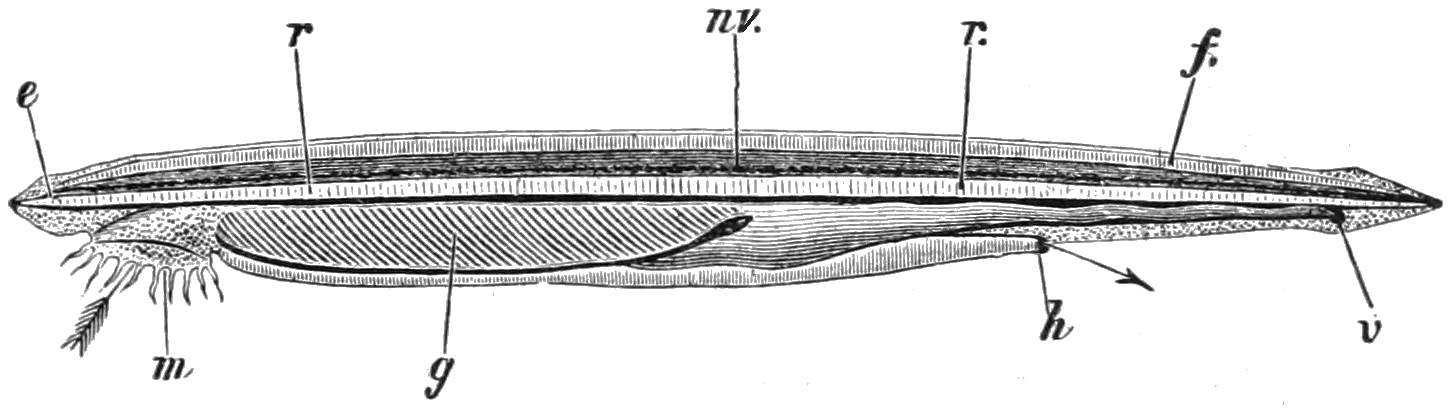
Fig. 1.
The Lancelet, the lowest known fish-like form.
m, mouth. e, eye-spot. f, fin. r, rod or notochord, the first
faint indication of a backbone. nv, nerve cord. g, gills. h, hole
out of which water passes from the gills. v, vent for refuse of food.
Flitting about in the water near the shore, eating
the minute creatures which come in his way, this
small fish-like animal is so colourless, and works his
way down in the sand so fast at the slightest alarm,
that few people ever see him, and when they do are
far more likely to take him, as the naturalist Pallas
did, for an imperfect snail than a vertebrate animal.
He has no head, and it is only by his open mouth
(m), surrounded by lashes with which he drives in the
microscopic animals, that you can tell where his head
ought to be. Two little spots (e) above his mouth
are his feeble eyes, and one little pit (n) with a nerve
running to it is all he has to smell with. He has
no pairs of fins such as we find in most fishes, but
only a delicate flap (f) on his back and round his tail;
neither has he any true breathing-gills, but he gulps
in water at his mouth, and passes it through slits in
his throat into a kind of chamber, and from there
out at a hole (h) below. Lastly, he has no true heart,
and it is only by the throbbing of the veins themselves
that his colourless blood is sent along the bars
between the slits, so that it takes up air out of the
water as it passes.
But where is his backbone? Truly it is only by
courtesy that we can call him a backboned animal,
for all he has is a cord of gristle, r r, pointed at both
ends, which stretches all along the middle of his body
above his long narrow stomach, while above this
again is another cord containing his nerve-telegraph
(nv.) All other backboned animals that we know of
have brains; but, as we have seen, he has no head,
and his nerve-cord has only a slight bulge just before
it comes to a point above his mouth. Now when
the higher backboned animals are only just beginning
to form out of the egg, their backbone (which afterwards
becomes hard and jointed) is just like this
gristly rod or notochord (r r) of the lancelet, with
the spinal cord (nv) lying above it; so that this
lowest backboned animal lives all his life in that
simple state out of which the higher animals very
soon grow.
This imperfect little lancelet has a great interest
for us, because of his extremely simple structure
and the slits in his throat through which he
breathes. You will remember that when we spoke
of the elastic-ringed animals in Life and her Children,
we found that the free worms were very active sensitive
creatures, whose bodies were made up of segments,
each with a double pair of appendages; the
whole being strung together, as it were, upon a feeding
tube and a line of nerve-telegraph, but without
any backbone. Now among these worms we find
many curious varieties; some have the nerve-lines at
the sides instead of below, and one sea-worm, instead
of breathing by outside gills like the others, has slits
in its throat through which the water can pass, and
so its blood is purified.
You may ask, What this has to do with backboned
animals? Nothing directly, but these odd
worms are like fingerposts in a deserted and grass-grown
country, showing where roads may once
have been. The lancelet, like the worm, has a
line of nerve-telegraph and a feeding-tube, only
with him the nerve-telegraph lies above instead of
below. He has also slits in his throat for breathing,
only they are covered by a pouch. Thus he is so
different from the worms that we cannot call them
relations; but at the same time he is in many
ways so like, that we ask ourselves whether his
ancestors and those of the worms may not have
been relations.
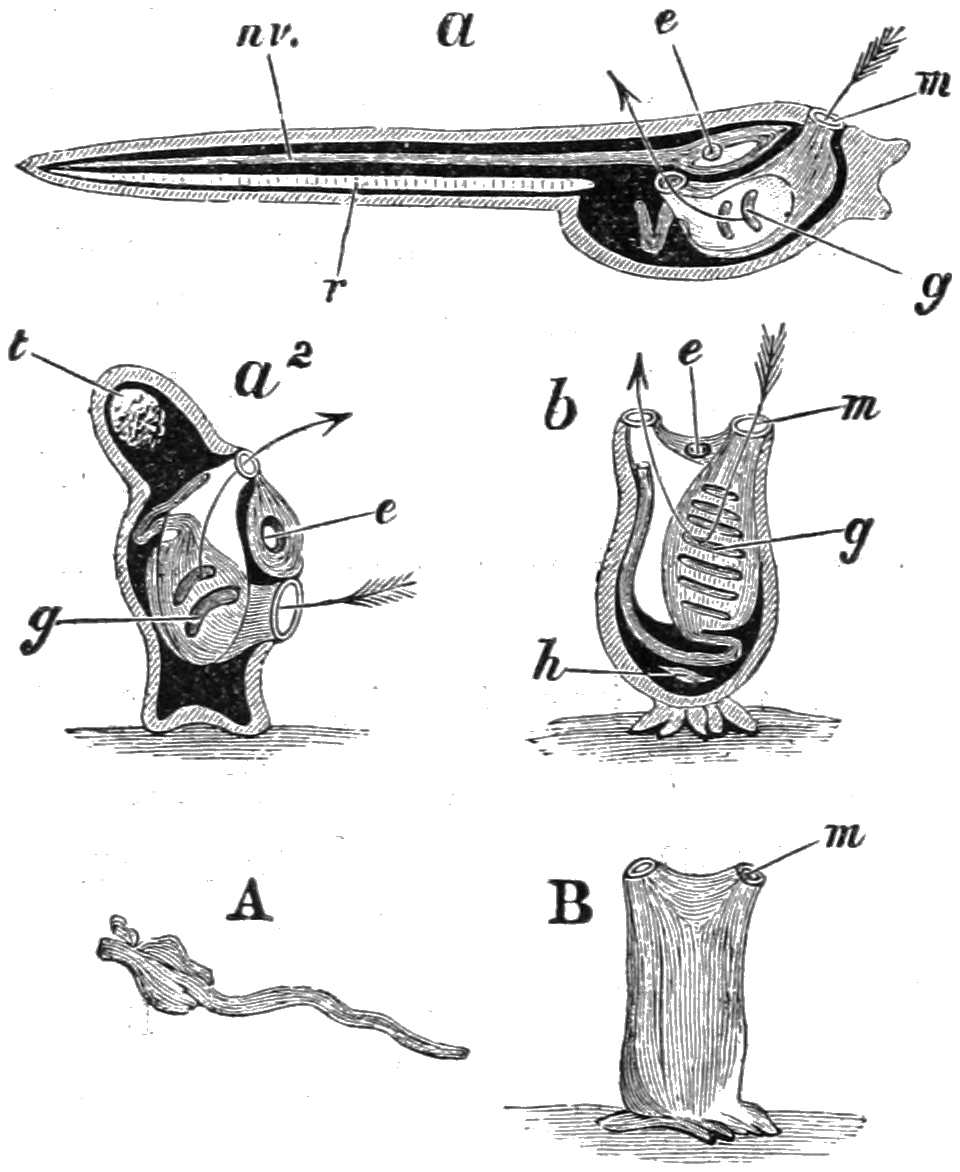
Fig. 2.
Diagram of the growth of a Sea-Squirt or
Ascidian.
A a, Young free swimming stage. a²,
Intermediate stage when first settling down.
B b, Full-grown Sea-Squirt.
m, mouth; e, hollow brain with eye; g,
gill slits; h, heart; r, rod of gristle in free
swimming form; nv, nerve cord in same;
t, tail in process of absorption in intermediate
form.
But you will say he is quite different in having a
gristly cord. True—but we shall find that even this
does not give us a sharp line of division. By looking
carefully upon the seaweed and rocks just beyond
low tide, we may often find some curious small creatures
upon them, called Sea-Squirts or Ascidians
(B, Fig. 2).5 These creatures are shaped very like
double-necked bottles, and they stand fixed to the
rock with their necks stretching up into the water.
Through one neck
(m) they take water
in, and after filtering
it through a
kind of net so as
to catch the microscopic
animals in
it and taking the
air out of it, they
send it out through
the other neck, thus
gaining the name
of sea-squirts. So
far, they are certainly
boneless animals.
But they
were not always
stationary, as you
see them fixed to
the rock. In their
babyhood they
were tiny swimming
creatures with
tails (A and a), and
in the tail was a
gristly cord (r), with a nerve cord (nv) above it, like
those we find in the lancelet. For this reason we
were obliged to pass them by among the lower
forms of life, because, having this cord (r), they
did not truly belong to the animals without backbones;
and yet now we can scarcely admit them
here, because when they are grown up they are not
backboned animals. They belong, in fact, to a kind
of “No Man’s Land,” behaving in many ways like
the lancelet when they are young, as if they had
once tried to be backboned; and yet they fall back
as they grow up into invertebrate animals.
So we begin to see that there may have been a
time when backbones had not gained quite a firm footing,
and our lancelet, with his friends the sea-squirts,
seems to lie very near the threshold of backbone life.
And now that we are once started fairly on our
road, let us turn aside before beginning the history of
the great fish-world and pay a visit to a little creature
whose name, at least, we all know well, and which
stands half-way between the lancelet and the true fish.
This is the Lamprey, represented by two kinds; the
large Sea-Lamprey, caught by the fishermen for bait
as it wanders up the rivers to lay its eggs, and the
true River-Lamprey or Lampern, which rarely visits
the sea.
What country boy is there who has not hunted
in the mud of the rivers or streams for these bright-eyed
eel-like fish, with no fins, and a fringe on
back and tail? If you feel about for them in the
mud they will often come up clinging to your hand
with their round sucker-mouth, while the water
trickles out of the seven little holes on each side of
their heads. The small river-lampreys do not hurt
in the least as they cling, though the inside of their
mouth is filled with small horny teeth. But the
larger sea-lamprey uses these teeth as sharp weapons,
scraping off the flesh of fish for food as he clings
to them.
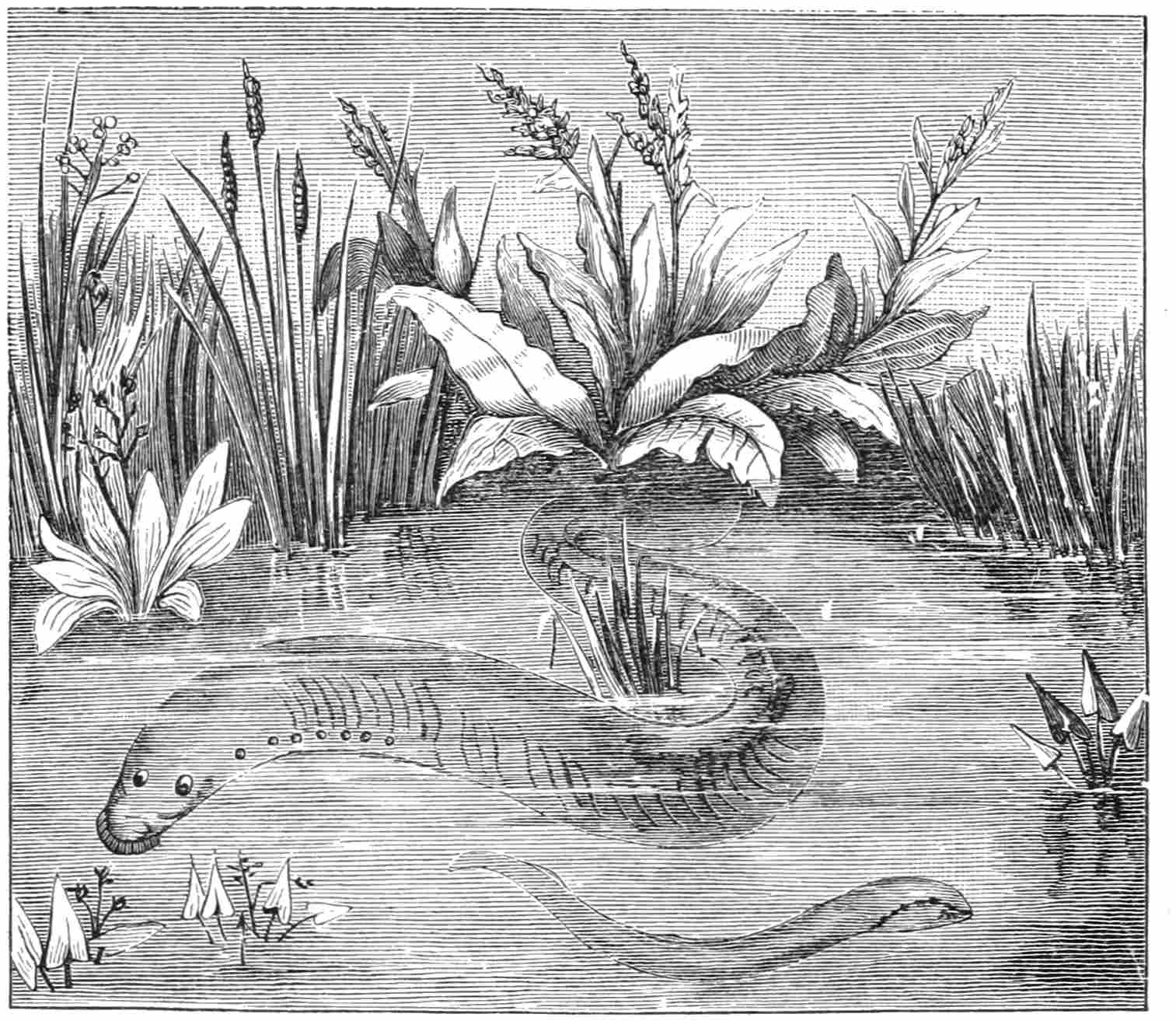
Fig. 3.
Figure of a full-grown Lamprey6 and of the young Lamprey, formerly
called Ammocœtes.
Showing the seven holes through which it takes in water to breathe.
These Lampreys, together with some strange creatures,
the “Hags” or “Borers,”7 belong to quite a
peculiar family, called the Round-mouthed fishes,8
and, though they stand much higher in the world
than the lancelet, yet they are very different from
true fish. Like the lancelet they have only a gristly
cord for a backbone, but this cord has begun to form
arches over the nerve battery, and it swells out at the
end into a gristly skull covering a true brain. They
have clear bright eyes too, and ears, which if not
very sharp, are at least such as they can hear with;
they have only one nostril, and their mouth is both
curious and useful. When it is shut it looks like a
straight slit, but when it is open it forms a round
sucker with a border of gristle, and this sucker clings
firmly to anything against which it is pressed, so
that a stone weighing twelve pounds has been lifted
by taking a lamprey by the tail. Inside the mouth
the palate and tongue are covered with small horny
teeth, and these are the lamprey’s weapons.
Salmon have been caught in the rivers with
lampreys hanging to them, and where the mouth has
been the salmon’s flesh is rasped away, though he
does not seem much to mind it.
Lastly, the lamprey has a peculiar way of breathing.
He has seven little holes on each side of his
head, reminding us of the slits in the worm’s throat
and those hidden under the skin of the lancelet, and
behind these holes are seven little pouches lined with
blood-vessels, which take up air out of the water.
These pouches are all separate, but they open by
one tube into his throat. When the lamprey is
swimming about it is possible that he may gulp
water in at his mouth and send it out at the slits.
But when he is clinging to anything he certainly
sends water both in and out at the slits, so that he
can still breathe, though his mouth is otherwise
occupied.
And now, what is the history of his life? For
three years he lives as a stupid little creature, with a
toothless mouth surrounded by feelers, and tiny eyes
covered over with skin, and he is so unlike a lamprey
that for a long time naturalists thought he was a different
animal and called him Ammocœtes. But at the
end of the three years he changes his shape, and then
he is as bright and intelligent as he was dull and
heavy before. His one thought is to find a mate and
help her to cover up her eggs. To do this a number
of lampreys find their way up the river and set to
work. Sometimes one pair go alone, sometimes
several together, and they twirl round and round so
as to make a hole in the sand, lifting even heavy
stones out with their mouths if they come in the way.
Then they shed the spawn into the hole, where it is
soon covered with sand and mud, to lie till it is safely
hatched, and when this is done the marine lampreys
swim out to sea to feed on the numberless small creatures
in it, or to fasten upon some unfortunate fish.
But there are round-mouthed fishes even more
greedy than these. It is not only among the lower
forms of life that some creatures, such as worms,
which are driven from the outer world, find a refuge
inside other animals. But here again we meet with
the same thing, for those relations of the lampreys,
the hags or borers, which we mentioned above, use
their sharp teeth to bore their way into other fish so
as to feed upon them. These greedy little creatures
actually drill holes in the flesh of the cod or
haddock and other fish, and eat out the inside of
their bodies, so that a haddock has been found with
nothing but the skin and skeleton remaining while
six fat hags lay comfortably inside.
So the round-mouthed fishes, feeble though they
are, hold their own in the world. How long ago it
is since they first began the battle of life we shall
probably never know for certain; but if some little
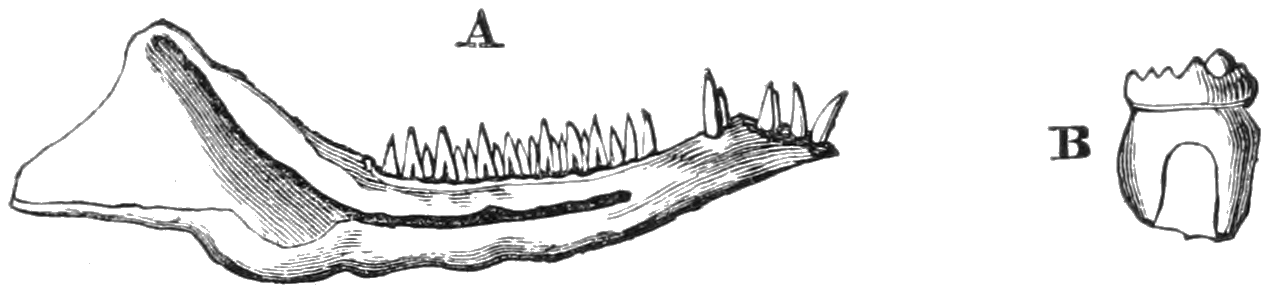
horny teeth9 found in very ancient rocks belong to
their ancestors, they were most likely among the
first backboned animals on our globe. At any rate
they are very interesting to us now, for they have
wandered far away from the true fishes, and give us
a glimpse of some of the strange by-paths which the
backboned animals have followed in order to win for
themselves a place in the race for life.
CHAPTER II. HOW THE QUAINT OLD FISHES OF ANCIENT TIMES HAVE LIVED ON INTO OUR DAY.
THE ANCIENT FISH & THEIR HUGE RIVAL
Note.—For description of the Picture-Headings see the Table of
Contents.
Who is there among my readers who wishes to
understand the pleasures, the difficulties, and the
secrets of fish life? Whoever he may be he must
not be content with merely looking down into the
water, as one peeps into a looking-glass, or he may,
perchance, only see there the reflection of his own
thoughts and ideas, and learn very little of how the
fishes really feel and live. No! if we want really
to understand fish-life we must forget for a time that
we are land and air-breathing animals, and must
plunge in imagination into the cool river or the
open sea, and wander about as if the water were our
true home. For the fish know no more about our
land-world than we do about their beautiful ocean-home.
To them the water is the beginning and end
of everything, and if they come to the top every now
and then for a short air-bath they return very quickly
for fear of being suffocated. Their great kingdom
is the sea—the deep-sea, where strange phosphorescent
fish live, lying in the dark mysterious valleys
where even sharks and sword-fish rarely venture;—the
open sea, where they roam over wide plains when
the ocean-bottom makes a fine feeding-ground, or
where they thread their way through forests of seaweed,
while others swim nearer the surface and come
up to bask in the sun or rest on a bank of floating
weed;—and the shallow sea, where they come to lay
their eggs and bring up their young ones, and out
of which many of them venture up the mouths of
rivers, while others have learnt to remain in them
and make the fresh water their home.
The tender little minnows that bask in the sunny
shallows of the river have never even seen the sea,
their ancestors left it so long long ago; yet to
them, too, water is life and breath and everything.
The green meadow through which the river flows
is just the border of their world and nothing more,
and the air is boundless space, which they never visit
except for a moment to snap at a tiny fly, or when
they jump up to escape the jaws of some bigger fish.
Every one knows the minnow, and we cannot do
better than take him as our type of a fish in order
to understand how they live and move and breathe.
Go and lie down quietly some day by the side of
the clear pebbly shallows of some swiftly-flowing
river where these delicate little fish are to be seen;
but keep very still, for the slightest movement is instantly
detected. There they lie
“Staying their wavy bodies ’gainst the streams
To taste the luxury of sunny beams
Tempered with coolness. How they ever wrestle
With their own sweet delight, and ever nestle
Their silver bellies on the pebbly sand!
If you but scantily hold out the hand,
That very instant not one will remain;
But turn your eye and they are there again.”
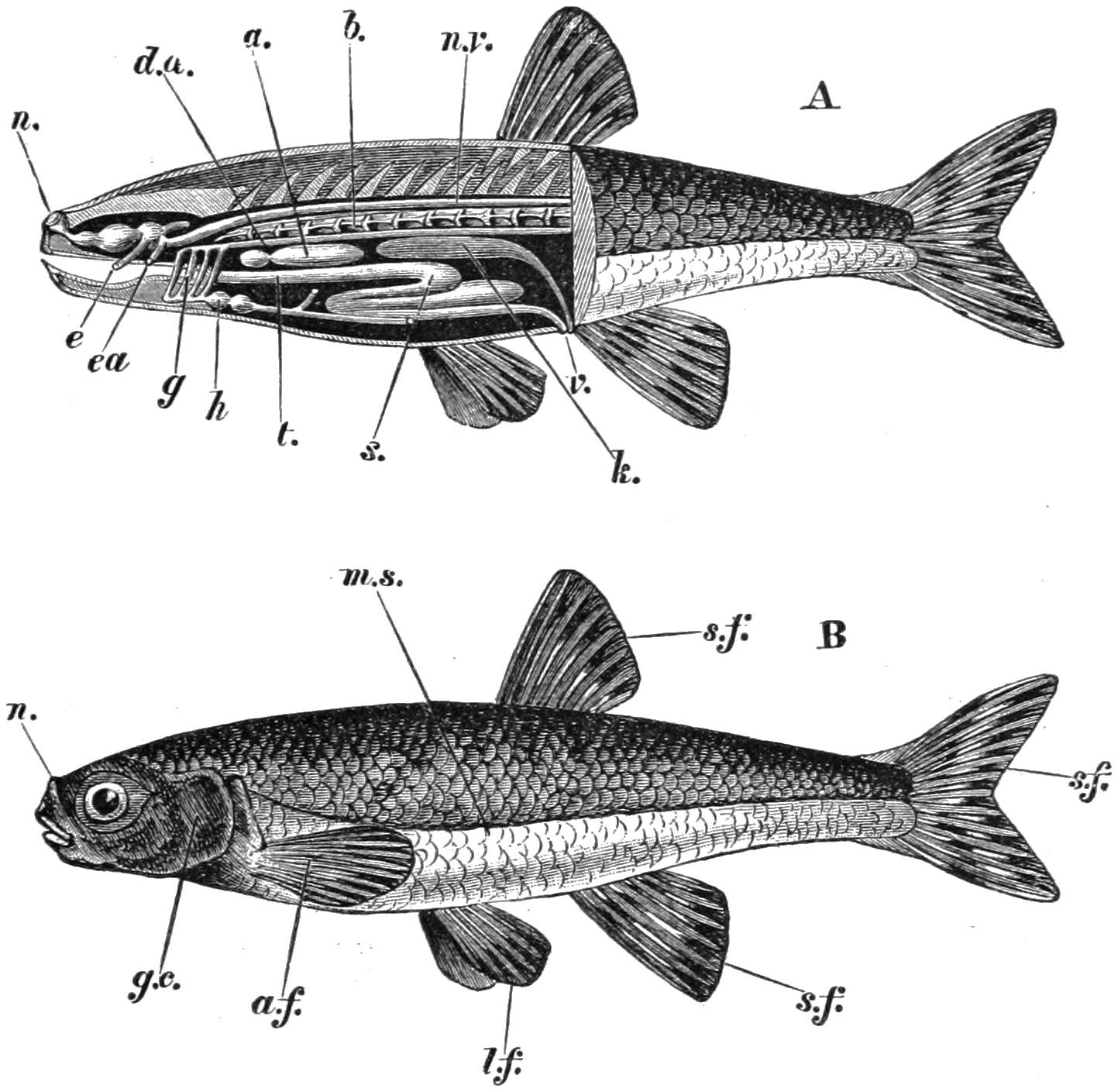
Fig. 4.
The structure of the Minnow and the living fish.
A n, nose-pit; e, eye-nerve; ea, ear-nerve; g, gills; h, heart;
t, food-tube; s, stomach; k, kidney; v, vent; da, dorsal-artery.
a, air-bladder; b, backbone; nv, nerve cord or spinal cord.
B n, nose; gc, gill cover; af, arm-fin; lf, leg-fins; sf, single
fins; ms, mucous scales.
If you can be motionless and not frighten them you
may see a good deal, for while some are dashing to
and fro, others, with just a lazy wave of the tail and
the tiny fins, will loiter along the sides of the stream,
where you may examine their half-transparent bodies.
Look first at one of the larger ones, whose parts are
easily seen, and notice how every moment he gulps
with his mouth, while at the same time a little scaly
cover (g c, B, Fig. 4) on each side of the head, just behind
the eye, opens and closes, showing a red streak
within. This is how he breathes. He takes in water
at his mouth, and instead of swallowing it passes it
through some bony toothed slits (g, A Fig. 4) in his
throat into a little chamber under that scaly cover;
in that chamber, fastened to the bony slits, are a
number of folds of flesh full of blood-vessels, which
take up the air out of the water; and when this is
done he closes the toothed slits and so forces the bad
water out from under the scaly cover back into the
river again. It is the little heart (h), lying just behind
the gills, which pumps the blood into the channels in
those red folds, and as it keeps sending more and
more, that which is freshened is forced on and flows
through the rest of the body. It goes on its way
slowly, because a fish’s heart has only two chambers
instead of four as we have, and these are both employed
in pumping the blood into the gills, so that for the
rest of the journey through the body it has no further
help. For this reason, and also because taking up
air out of the water is a slow matter, fish are cold-blooded
animals, not much warmer than the water
in which they are.
But while our minnow breathes he also swims. He
is hardly still for a moment, even though he may give
only the tiniest wave with his tail and fins, and he
slips through the water with great ease, because his
body is narrow and tapers more or less at both ends
like a boat. At times, too, if he is frightened, he
bounds with one lash of his tail right across the river;
and if you look at one of the small transparent minnows
you will see that he has power to do this because
his real body, composed of his head and gills, heart
and stomach, ends at half his length (see Fig. 4, A),
and all the rest is tail, made of backbone and strong
muscles, with which he can strike firmly. This is
one great secret of fish strength, that nearly one
half of their body is an implement for driving them
through the water and guiding them on their way.
Still although the tail is his chief propeller, our minnow
could not keep his balance at all if it were not for
his arm and leg fins. You will notice that it is the
pair of front fins (af) which move most, while the
under ones (lf) are pressed together and almost still.
Besides these two pairs he has three single fins (sf),
one under his body, one large V-shaped one at the
end of his tail, and another single one upon his back.
All these different fins help to guide him on his way;
but while the single ones are fish-fringes, as it were,
like the fringe round the lancelet’s body, only split into
several parts, the two pair under his body are real
limbs, answering to the two pair of limbs we find in
all backboned animals, whether they are all four fins,
or all four legs, or wings and legs, or arms and legs.
These paired wings are most important to the
minnow, for, if his arm-fins were cut off, his head
would go down at once, or, if one of them was
gone he would fall on one side, while, if he had lost
his fins altogether, he would float upside down as a
dead fish does, for his back is the heaviest part of
his body. It is worth while to watch how cannily
he uses them. If you cannot see him in the stream
you can do so quite well in a little glass bowl, as I
have him before me now. If he wants to go to the
left he strikes to the right with his tail and moves
his right arm-fin, closing down the left, or if he wants
to go to the right he does just the opposite; though
often it is enough to strike with his tail and single
fin below, and then he uses both the front fins at
once to press forward.
But how does he manage to float so quietly
in the water, almost without moving his fins? If
your minnow is young and transparent you will
be able to answer this question by looking at his
body just under his backbone, and between it and
his stomach. There you will see a long, narrow,
silvery tube (a, Fig. 4) drawn together in the middle
so that the front half near his eyes looks like a large
globule of quicksilver, and the hinder half like a tiny
silver sausage. This silvery tube is a bladder full of
gas, chiefly nitrogen, and is called the air-bladder.
Its use has long been a great puzzle to naturalists,
and even now there is much to be learnt about
it. But one thing is certain, and that is, that fish
such as sharks, rays, and soles, which have no air-bladders,
are always heavier than the water, and must
make a swimming effort to prevent sinking. Fish, on
the contrary, which have air-bladders, can always find
some one depth in the water at which they can remain
without falling or rising, and we shall see later on that
this has a great deal to do with the different depths at
which certain fish live. Our minnow floats naturally
not far from the top, and, even if he were forced to
live farther down, the gas in his bladder would accommodate
itself after a few hours if the change was not
too great, and he would float comfortably again.
And now the question remains, What intelligence
has the minnow to guide him in all these movements?
If you will keep minnows and feed them yourself
every day you will soon find out that they see,
smell, and feel very quickly, though their hearing
and taste are not so acute. They are cunning
enough too, and will often steal a march upon
heavier and slower fish, snatching delicate morsels
from under their very noses. For our little minnow
can boast of a real brain, though it is a small one in
comparison with his size. All along, above his delicate
backbone, the thread of nerve telegraph (nv, Fig. 4)
runs under protecting bony arches, and sends
out nerves on all sides to the body and fins; and when
it reaches the head it swells out, under a bony covering,
into a small brain, sending out two nerves to the
ears (ea), in front of which is a second part, with two
nerve-stations (e) for the eyes, and beyond this a
third part, with two more for the nostrils, besides
others which go to the face. Look on the top of
a minnow’s head and you will see two little raised
bumps (n). These are its nostrils, but remember
they have nothing to do with breathing; they have not
even any connection with the mouth, but are simply
little covered cups, each with two openings for water
to flow in and out, and they are lined with nerves, which,
tickled by good or bad scents in the water, carry to
the brain a warning, or a promise of good things.
Such, then, is our little minnow, and the different
parts of his body are supported by a slender bony-jointed
backbone, with ribs growing from it, supporting
a strong mass of flesh on his sides. He is a
delicate tender creature, but is protected and buoyed
up by the water, out of which he never attempts to go.
The thin, rounded, transparent scales which cover his
body, growing out of little pockets in his skin, just like
our nails on the tips of our fingers, protect this skin
from the water and from rough treatment; while they
themselves are kept soft by a slimy fluid which oozes out
from under them, and especially through the dark line
of larger scales (ms.Fig. 4) running along his body.
* * * * *
Now the minnow is a bony fish, and from it we can
learn very fairly what bony or modern fishes are like.
But these fish were not the founders of the race; long
before they existed there was another very ancient group
of fishes in the world, which were in many ways more
like the lancelet and the lamprey; and to find such
descendants of this ancient group as are now living we
must leave the river and find our way into the open sea.
If we do this, we shall travel not many miles from
the shore in summer, wending our way through
shrimps and lobsters, gurnards, cod-fish, soles, and
turbot, before we may chance to come across a great
Blue shark, with his slaty-coloured back and fins,
swimming heavily but strongly through the water,
and turning sharply from time to time to seize a
passing fish, his white belly gleaming like a flash of
light as it comes uppermost, and then disappearing
again in the dark water.
“His jaws horrific, armed with threefold fate,
Here dwells the direful shark.”
Or if this formidable monster does not happen to
be in the neighbourhood another kind, the Dogfish,
may cross our path, perhaps the Smooth hound, crushing
the crabs and lobsters in his tooth-lined mouth, or
the Rough hound fastening her purse-like egg to the
seaweed by its long string-like tendrils; or, farther
out still, we may perhaps see the Thresher shark lashing
the water with his long pointed tail, to drive the
frightened fish within his reach; or, if we were off the
west coast of Ireland, the huge but harmless Basking
shark might be floating calmly by in the warm sunshine.
For sharks travel all over the ocean, and though they
prefer the warm seas, where they sometimes reach a
size of forty feet long and more, yet many of the
smaller kinds visit our coasts in summer.
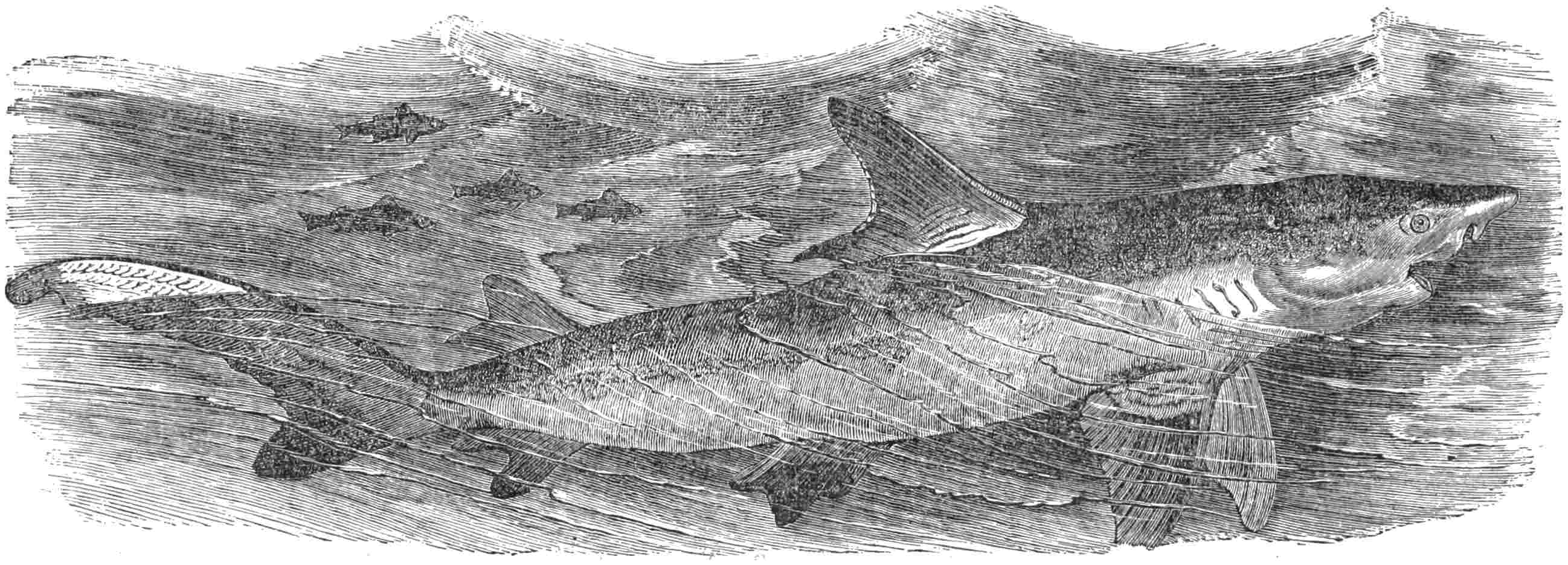
To show the five slits in the neck, the uneven tail, and the mouth opening under the pointed snout.
Now, at first sight we might imagine that these
huge monsters, the terrible tyrants of the sea, must
be the last and most finished production of fish-life;
but if we look a little closer we shall be undeceived.
Examine a shark in any good museum, and you
cannot fail to be struck with his strange form.
Look first at
his tub-like
body, so different
from
the narrow
wedge-shape
of the minnow,
the herring,
or the
salmon. Then
observe his
skin, which
is either
tough, more
like that of
other animals,
or
thickly covered
with
short blunt
teeth, which
sometimes,
especially in
front of the
fins, become
long pointed
spines. There
is no trace
of fish-scales
here. Look
at his mouth
opening under
his pointed
snout, and you will see that as the skin turns
over the lips these blunt teeth line his mouth, so
that he has several rows fit for biting, and they
are sometimes so formidable that they can cut a
man in two at one snap. Then look more especially
at the sides of his throat, and there you will see
on each side from five to seven slits, reminding you
at once of the slits of the lamprey, though they are
long instead of round. For the shark has never
arrived at having true gills under a horny cover
like the minnow, but still breathes by pouches and
slits somewhat after the way of the lowly round-mouthed
fishes. Lastly, observe his curious tail.
In nearly all living fish the tail is even11 or V-shaped,
but in the sharks the top point is usually longer
than the lower one,12 and in some, such as the
Thresher, it is very remarkably so.
This uneven tail is the badge of a very ancient
race; out of the shark family we scarcely find it
anywhere now except among the sturgeons, who, we
shall see, are old-fashioned too.
And now when we inquire into the growth of the
shark and the kind of backbone he has, we find that
he has still more links with the lower fish-like animals.
For when he is young he has nothing but a rod of
gristle or cartilage running between the long narrow
feeding-tube and the spinal cord; but this rod is
flattened in front, and as the young shark grows
up the flat part enlarges so as to form a boat-like
box—the skull, round the swollen end of the nerve
telegraph—the brain. Meanwhile the rod becomes
divided into rings, and from each ring an arch of
gristle growing upwards surrounds the nerve cord so
as to protect it from injury, and the whole skeleton
becomes firm and strong. But though the shark is
one of the strongest of sea-animals he never loses this
gristly state of his backbone or his skeleton; however
much he may strengthen it by hard matter it never
becomes true bone, but remains quite distinct from
the skeleton of the bony or osseous fish.
We see, then, that there is a race of gristly or
cartilaginous fishes, which, though they have grown
strong and powerful, still hold to many primitive
habits in forming both their body and skeleton. Nor
do the sharks stand alone, for the large sturgeons,
which live partly in the sea and partly in fresh water,
crowding up the rivers of Russia and America to
grope in the river mud for food, and to lay their
millions of eggs, are also remnants of the ancient type.
It is true that with them the slits in the neck are
covered by a horny flap like the bony fish, and like
them too they have an air-bladder under the backbone.14
But they too have a gristly skeleton, and the
gristly rod more or less hardened runs right along
their back. In other respects they are perhaps even
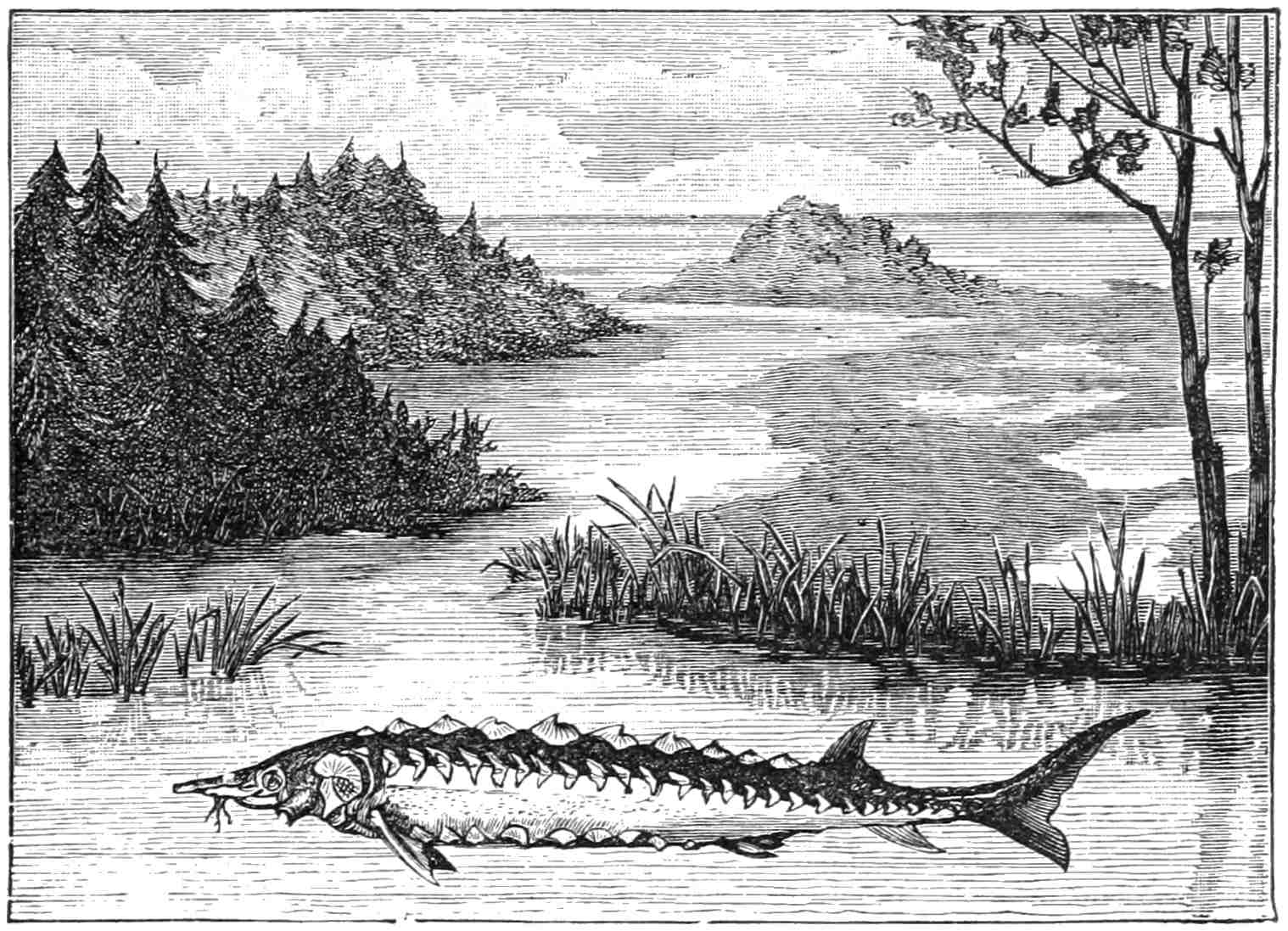
more peculiar than the sharks; for the sturgeon’s
head is covered with hard bony shields, and five rows
of bony bucklers are arranged along his body. We
seem almost to have got back among the armour-covered
animals as we look at his shiny plates, reminding
us that with a mere gristly skeleton within, it
may have been wise for the
early types of fish to wear
some outward protection.
His snout is long and
pointed, with four delicate
feelers hanging down from
it, and his mouth, which
is quite under his head, is
a soft open tube without teeth, which he can draw up
or push out to suck up fish or any animal matter he
finds in the mud.
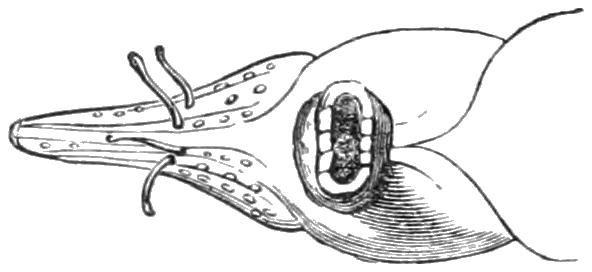
Fig. 7.
The Sturgeon’s head seen from below, showing the tube-like mouth
and the four barbels or feelers.
Clearly the sturgeon is an old-fashioned fellow,
as you may see for yourself, when specimens caught
at the mouths of our rivers are shown in the
fishmongers’ shops. I have often wondered, when
standing looking at him and at the sharks in the
British Museum, whether the people who stroll by
have any idea what a strange history these quaint
old fishes have, or how they stand there among the
scaly and bony fishes lying in the cases around,
just as an Egyptian and a Chinaman might stand in
an English crowd, descendants of old and noble races
of long long ago, whose first ancestors have been lost
in the dim darkness of ages, whose day of strength
and glory was at a time when the modern races had
not yet begun to be, and whose representatives now
live in a world which has almost forgotten them.
In the silent depths of the large lakes of North
America there is a fish called the Bony pike,15 a
huge fellow often six feet long, with a long beak-shaped
mouth, which he snaps as he goes, devouring
everything that comes in his way. This fish has his
body covered with lozenge-shaped, bony, enamelled
scales, like the fish of long ago, and so too has the
strange Bichir,16 which wanders above the cataracts of
the Nile, with its row of eight to eighteen fins raised
upon its back like tiny sails. Then again there are
the curious calf-fish of North America,17 of the
Amazons,18 of the Nile,19 and of the rivers of Queensland
in Australia.20 These all have gristly skeletons,
and together with the sharks and sturgeons make
up all that remains of those strange shadows of the
past moving among the bony fishes of to-day.
The mud-fishes are indeed the most curious
of all, for they breathe both water and air, and
in the Nile and Gambia often coil themselves round
in the mud when the water goes down, and, lining
their bed with slime, sleep comfortably till the
rains refill the pools with water.21 The fact is they
have two quite separate ways of breathing. They have
gills with which they can take air out of the water like
other fish, and these they always use when they can.
But they have a tube in their throat leading into the air-bladder
lying under their backbone, and through this
they can breathe in air when they cannot get it from
the water. In Amia especially, which is a true enamel-scaled
fish, this air-bladder is divided into numerous
cells, and it breathes with it just as with a lung.
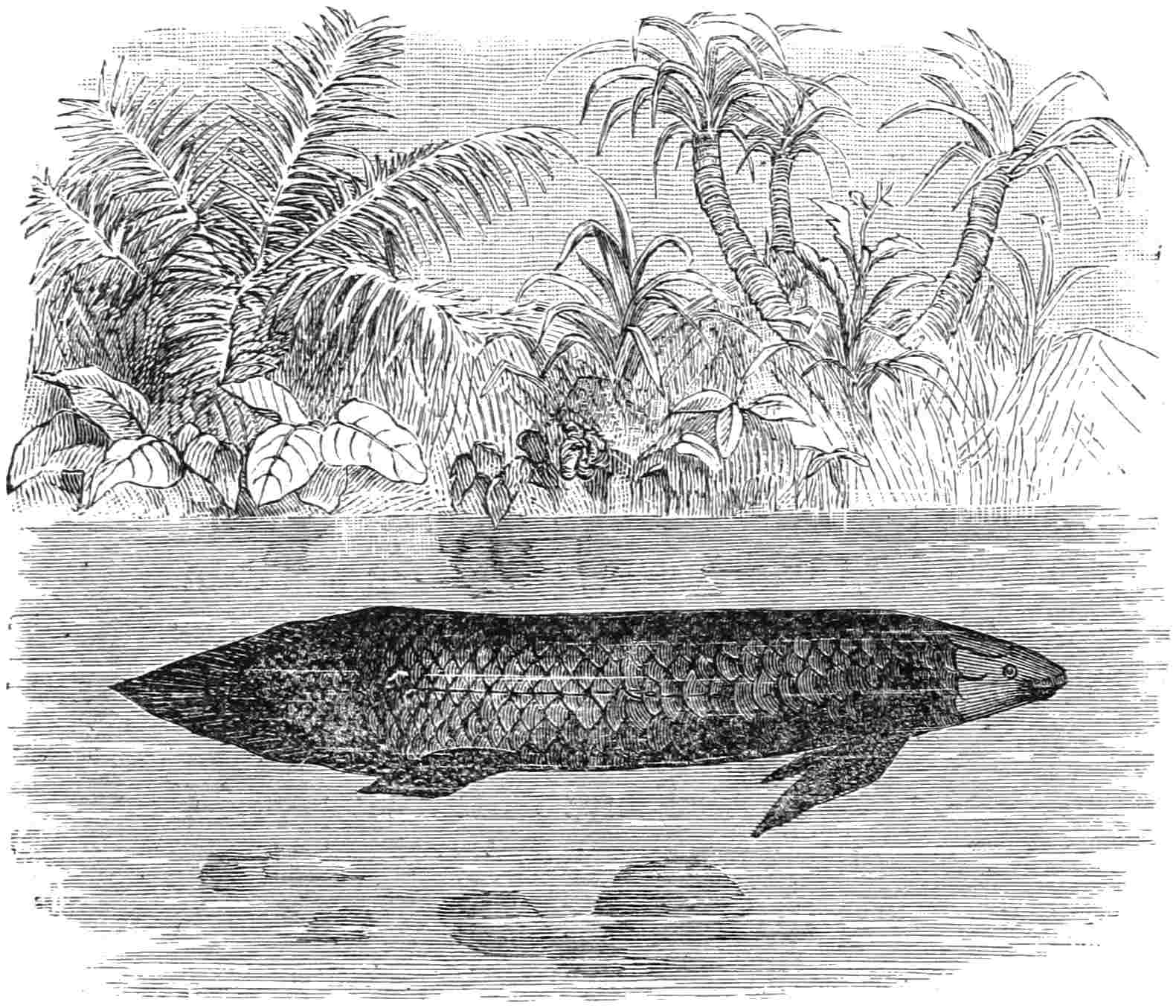
Fig. 8.
The Ceratodus of Queensland, an air-breathing and water-breathing
mud-fish of the ancient type, with paddle-fins.
It was in the year 1870 that the Ceratodus, or
the “Barramunda,” as the Australian natives call
him, was discovered in the rivers of Queensland; and
since then he has become very famous, for, more than
any of the others, he is like the fishes of long ago.
He is a lumpy fish, sometimes as much as six feet
long, with a gristly cord for a backbone. His body
is covered with large rounded scales, and he has a
broad fringe round his pointed tail. His fins are
more like paddles than fish fins, having several joints,
and he uses them, together with his fringed tail, to
flap along in the water, or even to wander over the
reedy flats at night, chewing the weeds with his
broad ridged teeth. And as he flaps along, from
time to time, when the water is too muddy for his
liking, he comes up to the top, and with a great gulp
swallows air into the air-chamber. But before he can
do this he must send out the bad air within, and in doing
so he gives a grunt which is often heard far away at
night in those still Australian wilds. He need not
come up for air-breathing, however, if the water is pure,
for, strange to say, the whole course of his blood can
be altered to suit his wants. When he can get clear
water to breathe through his gills the blood flows to
them to be freshened, and his air-bladder simply takes
in gas from the body as it does in other fishes, and
wants feeding with good blood. But when he comes
up to breathe then the blood is carried the other
way, and comes to the air-bladder to be freshened.
And now if we want to read the history of all
these strange forms, you must let me take you by
the hand and lead you in imagination back, back
through millions of years, to a time so long ago that
we cannot even count the ages between. As we
recede from our own day we shall leave behind us
all the kinds of plants and animals we now know so
well, and meet with strange kinds only bearing a
general resemblance to them. After a long journey
of thousands and thousands of years, in which the
plants and animals, and even the very shape of the
continents and islands, have gone through many
changes, we shall get back to the time when the
lime-builders were forming thin layers of chalk at
the bottom of the sea, which were afterwards to
become our enormous chalk hills. Still backwards
we must go through all that long period, and then
through three others quite as long, with ever-changing
scenes of life and climate and geography, till we find
ourselves in those grand old forests whose trees and
plants we now dig out as coal.
Even then we must not stop to rest, though we
are getting back to the dim ages of the world, for
the journey is not yet ended. On, on, backwards
through countless years, till we lose sight not only
of beasts and birds and reptiles, but even of insects
and flowering plants, which, at the time we are
reaching, had not yet begun to be. At last we lose
almost all life upon the land, so far as we can tell,
and after another long period has passed before us we
find ourselves in a scene of water, water everywhere.
True, there is a line of shore where strange ferns and
unknown club-mosses and reed-like plants are growing;
but these only border the vast water-world, and
we have reason to believe that no living animal wanders
over that wild and barren country. But the water
itself is full of life, though its inhabitants are of low
kinds, as if Nature herself was as yet only half-awake.
Rich and rare seaweeds carpet the floor of the
ocean, mingled with delicate flint-sponges and old
massive corals; beautiful feather-stars in the form of
rooted stone-lilies wave their slender arms; greedy
star-fish, grazing sea-urchins, and all their many
relations, grope upon the rocks; and sea-snails crawl
or float in countless numbers. The Nautilus, too, is
there, with curious half-uncoiled companions of forms
we have never seen before; and huge sea-woodlice,
the Trilobites of olden time with their three-ridged
shields, burrow in the sand, or roll themselves up at
the bottom of the water. And above all these, among
many kinds of armour-covered animals, a huge form,
nine feet long, like a lobster, with an imperfect head,
rows himself along with his oar-like hind feet, seizing
the smaller creatures with his long nipping claws in
front. For we have travelled back to a time when
the crustaceans were the most powerful animals in
the world, and the huge lobster-like Pterygotus was
the monarch of the seas.
It was in the midst of a scene such as this that
we first find the feeble ancestors of the Sturgeon and
the Shark beginning to make their way in the world.
It may be that creatures such as the sea-squirts, the
lancelet, and the lamprey, were there to bear them
company, but these soft animals could leave no trace
behind except the tiny teeth of the lampreys; for
they had no enamelled plates like the plated fish, no
hard teeth-spines like the sharks, which could become
buried in the soft mud when they died, and
remain, together with the hard shell of their enemy
the Pterygotus, to be dug out now in our day
and bear witness to the fight they fought. But
the plated-scaled fish had something to leave behind,
and from their remains we can picture to ourselves a
group of clumsy fish scarcely a foot long, with hind
fins like paddles and single-fringe fins on their back,
with enamelled lozenge-shaped plates on their bodies
and unevenly pointed tails. These fish would keep
well out of the way of the Pterygotus, because they
were small and weak and he was large and strong.
We may imagine them gliding among the seaweeds,
and hugging the shore as they chewed the plants with
their flat-ridged teeth, for their skeletons were probably
feeble and their armour-like shields were heavy,
and they would not be so active as the little shark-like
animals, not bigger than a half-pound perch, with
tough skins and sharp spines, which swam more boldly
out to sea. These more active fish were the founders
of the shark group, and those sharp spines, together
sometimes with the tough skin, remained buried in
the mud, and have come down to us as fossils.22
We should find it difficult to say exactly to what
class all these early fish belonged, for there were very
few kinds, and therefore fewer distinctions, between
them in those days; and many peculiarities which afterwards
appear in different groups either did not exist or
were united in one fish. It is enough for us that they
were the ancestors of our sharks and sturgeons and
mud-fish of to-day; and though they were but small
and weak, yet they were the beginning of a powerful
race of creatures, for they had the great advantage
of a growing inside skeleton, which could vary and
strengthen with their bodies from generation to generation,
while their rivals, the Pterygotus and his companions,
had only their heavy cumbrous armour with
a mass of soft flesh inside, and were but lumbering
creatures at best.
And so we find that as thousands and thousands
of years rolled by, the descendants of the enamel-shielded
fish began to improve, and became larger
and more powerful as the generations passed on, till
they became masters of the shallow seas, and after
awhile of the rivers and lakes. By the time that the
first air-breathing creatures, the May-flies and Dragon-flies,
had found their way out of the water into the
forests of pines and tree-ferns on the land, and left
their tender wings in the soft ground of the ponds and
lakes, large fishes23 whose tails were uneven-pointed
like the sturgeon,—whose bodies were covered with
lozenge-shaped enamelled scales and their heads with
shields,—were grazing along the shores and in the
rivers and bays, with probably swarms of smaller
kinds which have left no traces behind.
These were peaceable fish which fed upon plants,
and among them were some curious forms with
paddle-like fins and broad-ridged teeth, which, as
they swam under the shade of the huge forest trees,
would come to the top and take in air through their
mouth. These were the distant ancestors of our
present mud-fishes, and through all the passing ages,
from the time of the coal forests till now, they have
kept their fish-like form, so that we have their
descendants among us now in the Australian Ceratodus
and the mud-loving Protopterus of the Nile.
But besides these gentle vegetarians there were
in the sea huge enamel-scaled monsters, with terrible
jaws and gigantic teeth, floundering about and
making great havoc among the crab-like animals.
One of these, whose head-shield has been found in
the ancient rocks of Ohio in America,24 must have
been at least fifteen feet long, with a huge head,
three feet long and a foot and a half broad; and
no doubt there were many others like him, having a
fine time of it now that they were the strongest creatures
living. For this was the Golden Age of fishes,
just before the time when the coal-forests grew; and
the clumsy crab-like animals, and the trilobites, which
had had their innings when the fish were small, now
began gradually to be exterminated by their powerful
enemies. Little by little they gave up the battle
of life, and the larger ones died out altogether, leaving
only those smaller crustaceans which did not clash
with the fish.
So time passed on. The coal-forests grew, and
died away and were buried; and as the ages rolled
by a still stronger class of animals began to grow
up which was to pay back upon the enamel-scaled
fish the vengeance they had wreaked upon the
crustaceans. For in the coal forests we first meet
with creatures like our newts and salamanders, and
after these came the true air-breathing reptiles (see
Chap. v.), which swarmed over land and sea. There
were the fish-lizards, with their strong swimming
paddles and sharp teeth, and the swan-like lizards,
with their long necks, which enabled them to strike
their prey in the water; and these, together with the
flying-lizards, and the huge dragon-like reptiles
which haunted the shore, made the life of the
heavily-moving enamelled fish a burden to them.
So they, in their turn, began to give way, and became
smaller and rarer as the history went on, till
at the time when the chalk-building animals were at
work at the bottom of the sea we begin to lose sight
of all but those few forms which linger still. It was
about this time that the Sturgeon, as we now know
him, became the chief representative of these old cartilaginous
fishes, and to this day he and his children
go on travelling up the rivers of Europe, Asia, and
America, or crossing from sea to sea—a living example
of those ancient races which ruled the seas of long ago.
The history of the small shark-like animals was
rather different. They too grew strong and powerful
before the reptiles came, and they did not afterwards
lose much of their greatness. With the wide
ocean for their home, and not troubled with the
heavy enamelled plates of their companions, they
kept clear of the monster reptiles, or struggled with
them bravely. Some took to the open sea, and
from them are descended the giant sharks of to-day
which still remain masters of the ocean. Others
still lingered near the shore, where we find quite
new forms springing up; some, like the Chimæra
or “King of the Herrings,” formed a group of their
own, half-way between sharks and sturgeons; and
some, slightly flattened like the huge Monk-fish,
hide themselves in the loose sand when seeking their
prey. Others, the Skates and Rays, with flat bodies,
and long tails serving as rudders, shoved smoothly
along with a wavy flapping motion of their broad
arm-fins. These too lie chiefly at the bottom of the
sea, where their dusky colour hides them both from
the fish they would wish to attack and those that
would attack them; for while the sharks trust to their
strength, the skates and rays trust to stratagem, and,
coming along stealthily in the shadow, flap rapidly
over their prey and suck them into their open
mouth below. And for further protection we find
some of them, such as the Sting-rays, armed with
barbed spines; others, such as the Torpedo-fish,
with electric batteries in their heads, which they can
use to stun and kill their enemies; while others
again, such as the Saw-fishes of the Tropics, have
the front part of their skull lengthened out in a long
bony weapon, armed with teeth, which they use to
rip open the bodies of their prey.
All these formidable fish are descendants of the
shark family, which, with powerful gristly backbones,
strong fins and tails, and highly developed brains,
refused to be suppressed as their plated companions
were, but found room in the wide ocean to do battle
for themselves, and improve in many ways upon their
ancestors. They do not, like the sturgeon and the
bony fish, lay their thousands of eggs, but are content
with one or two at a time, such as the leathery purse-eggs
of the skate and the rough hound shark; or give
birth to a dozen or twenty living young ones. Yet
they are so well fitted for their life that they flourish
and keep their ground, so that while the enamel-scaled
fish and the mud-fish are small groups, many of
them fading away, the sharks and rays bid fair to
be the race which will keep up the traditions of
those quaint old Fishes of ancient times, which were
once the masters of the world.
CHAPTER III. THE BONY FISH, AND HOW THEY HAVE SPREAD OVER SEA AND LAKE AND RIVER
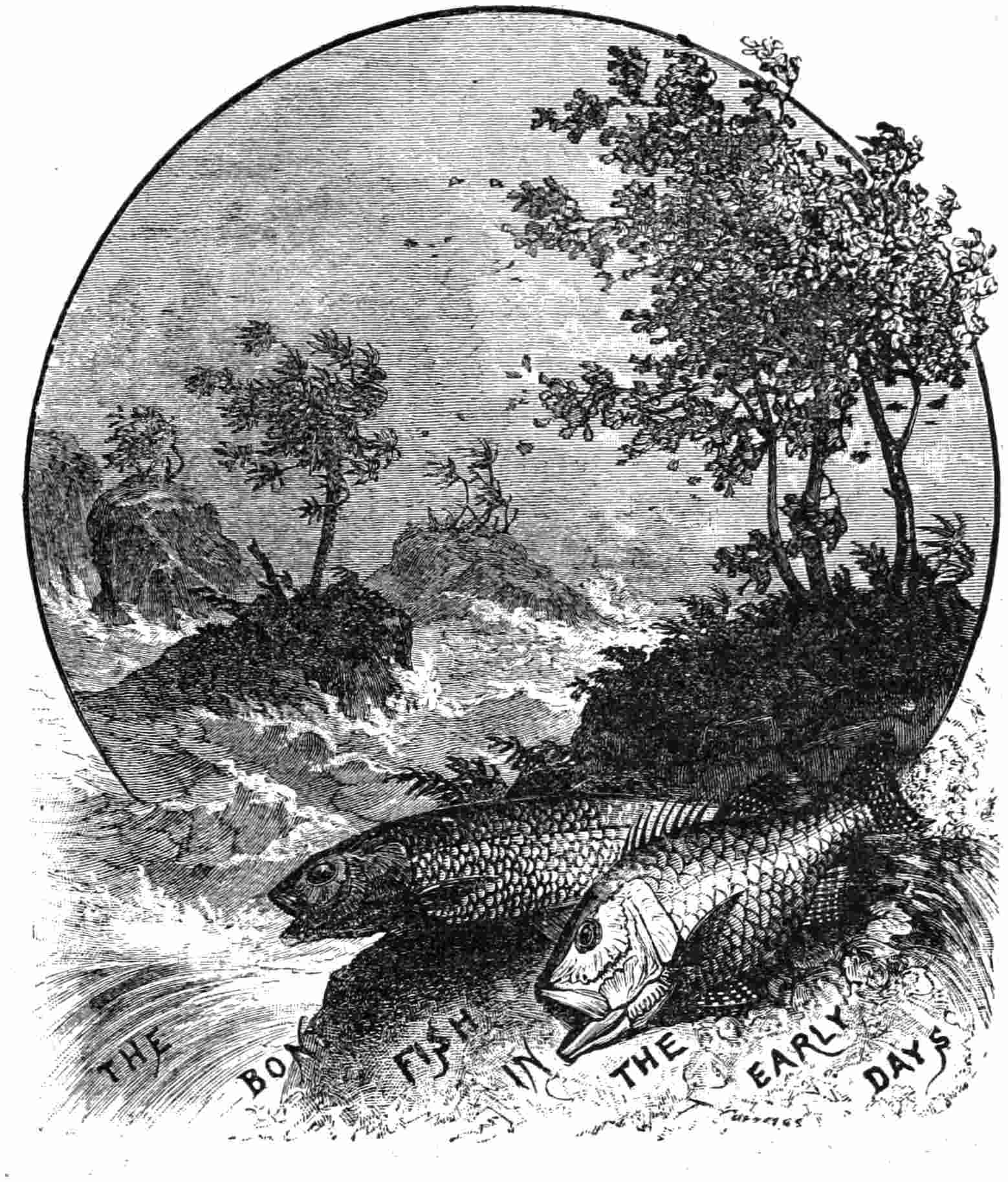
THE BONY FISH IN THE EARLY DAYS
When the palmy days of the enamel-scaled fish had
passed away, and the sharks and rays had taken up
their various quarters in different parts of the sea,
there still remained vast tracts and many snug nooks
and bays admirably fitted for fish-life. But these
were not empty, for long before this time another
order of fish—light, strong, and active,—had been
pressing forward to take possession of every vacant
space.
If we could dive under the water and watch the
fishes at home we should see at once how much more
agile and easy the bony fish are in their movements
than their gristly companions. Look at a shoal of
silvery herrings as they swim and leap and gambol,
or a fine salmon sailing up the river or springing
over a waterfall, or a tiny stickleback darting across
the stream, and compare their graceful motion with
the ponderous though powerful movements of an
unwieldy shark. Any one who has done this will
feel at once that though the sharks have still kept
their power as tyrants of the sea, because they are so
strong and big, yet these light skirmishers are much
more at their ease, and move with much less effort
in the water, so that it is natural they should have
made their way into all parts of the rivers and seas.
But where have they come from? We know very
little of their early history, but what little we do
know leads us to think that long ago they branched
off from the enamel-scaled fish, and struck out a path
of their own to make the most of the watery world.
Turn back for a moment to our little minnow, and
recall his tender backbone made of joints hollowed
out before and behind, with cushions of gristle
between; those cushions, when the minnow was
growing out of the minnow egg, were one long gristly
cord, like the cord of the sturgeon, and it was only as
the minnow grew that the bony joints hardened round
it and separated it. Moreover, that huge bony pike
which we find now wandering in the American lakes
has bony joints hollowed out like the minnow’s,
although by his enamel-scales and uneven tail we
know him to be one of the ancient fishes. Some
time or other, then, the sturgeon, the bony pike, and
the modern minnow, must have had a common
ancestor, though we should have to reach him through
millions of generations. In the same way, too, we
find the red-folded gills covered by a scaly lid, both
in the sturgeon and the minnow, though in other
ways they are not exactly alike; while even the
V-shaped tail of the modern fish is not so different
from the ancient shape as it seems, for the end of
the backbone runs up into the top branch of the
fork as it does in the uneven tails of the olden fish.
Lastly, the delicate rounded scales on our minnow’s
body are not entirely the property of bony fishes,
for we find such scales on the mud-fishes, the Amia
and Ceratodus (see p. 33); while the little modern
stickleback, on the other hand, has bony plates, reminding
us of those of olden times. We see, then,
that the bony fish still carry upon them many signs
of their origin from the older fish, and when once the
coast was left clear, and they got a fair start, we can
easily imagine that the fish of this younger race
which was still in its childhood, and easily moulded
to suit different kinds of life, would press forward in
every direction and make the most of every chance.
And so we find that little by little, from the time
of those chalk seas till now, the remains of enamel-scaled
fish grow rarer and rarer in the hardened mud,
and the bones and scales of modern fish take their
place, till this bony race has spread so far and wide
that in our own day, if we were to start from the head
of a river and swim down into the open sea of the
Atlantic or Pacific, we should meet on our way bony
fish of all shapes and sizes and habits of life. River-fish
and lake-fish and sea-fish; shore-fish, surface-swimming
fish, and fish of the deep sea; flat-fish
like the sole, half hidden in the sand, and long
rounded fish like the eel, threading their way through
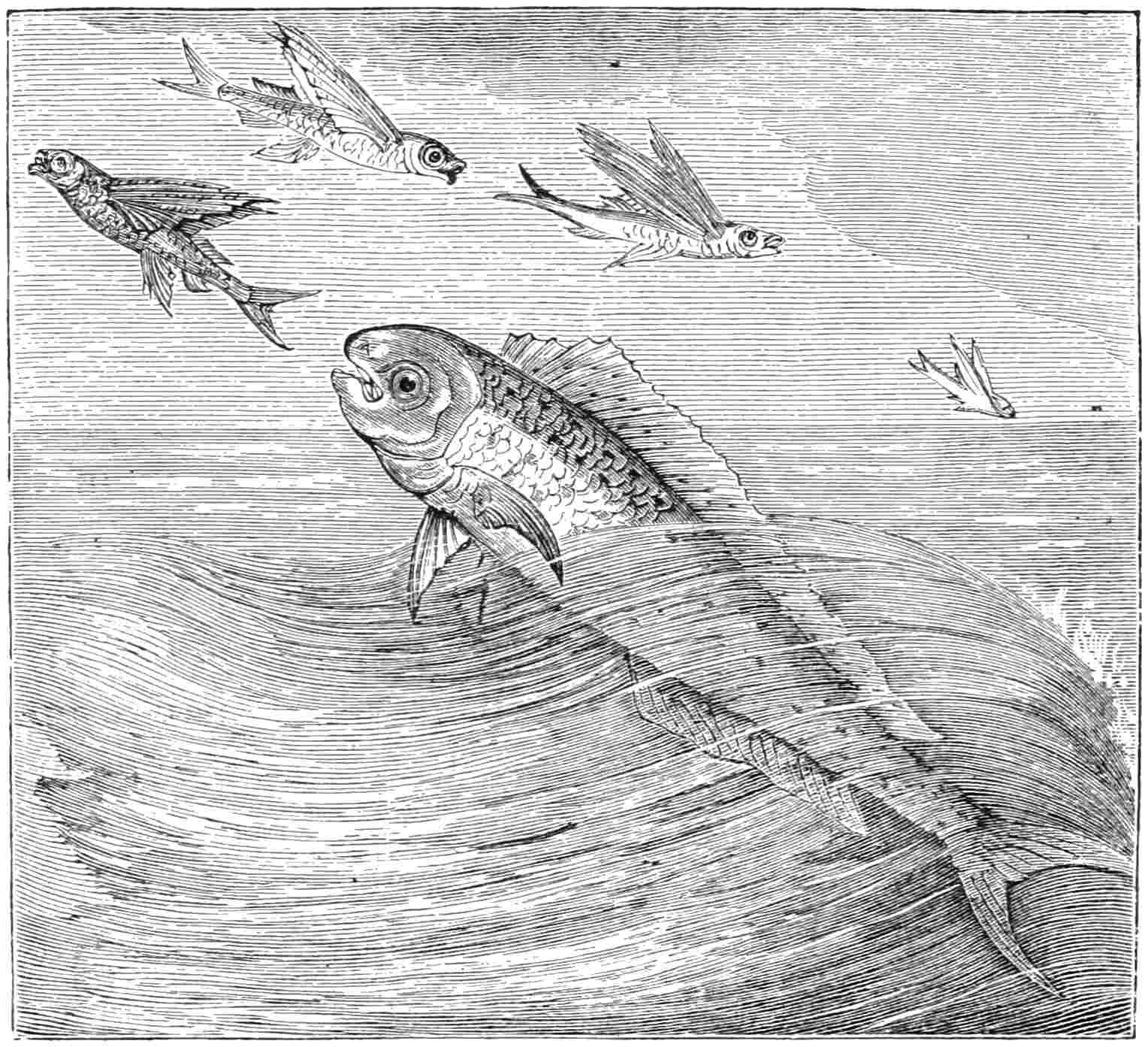
holes and passages all over the world; flying fish
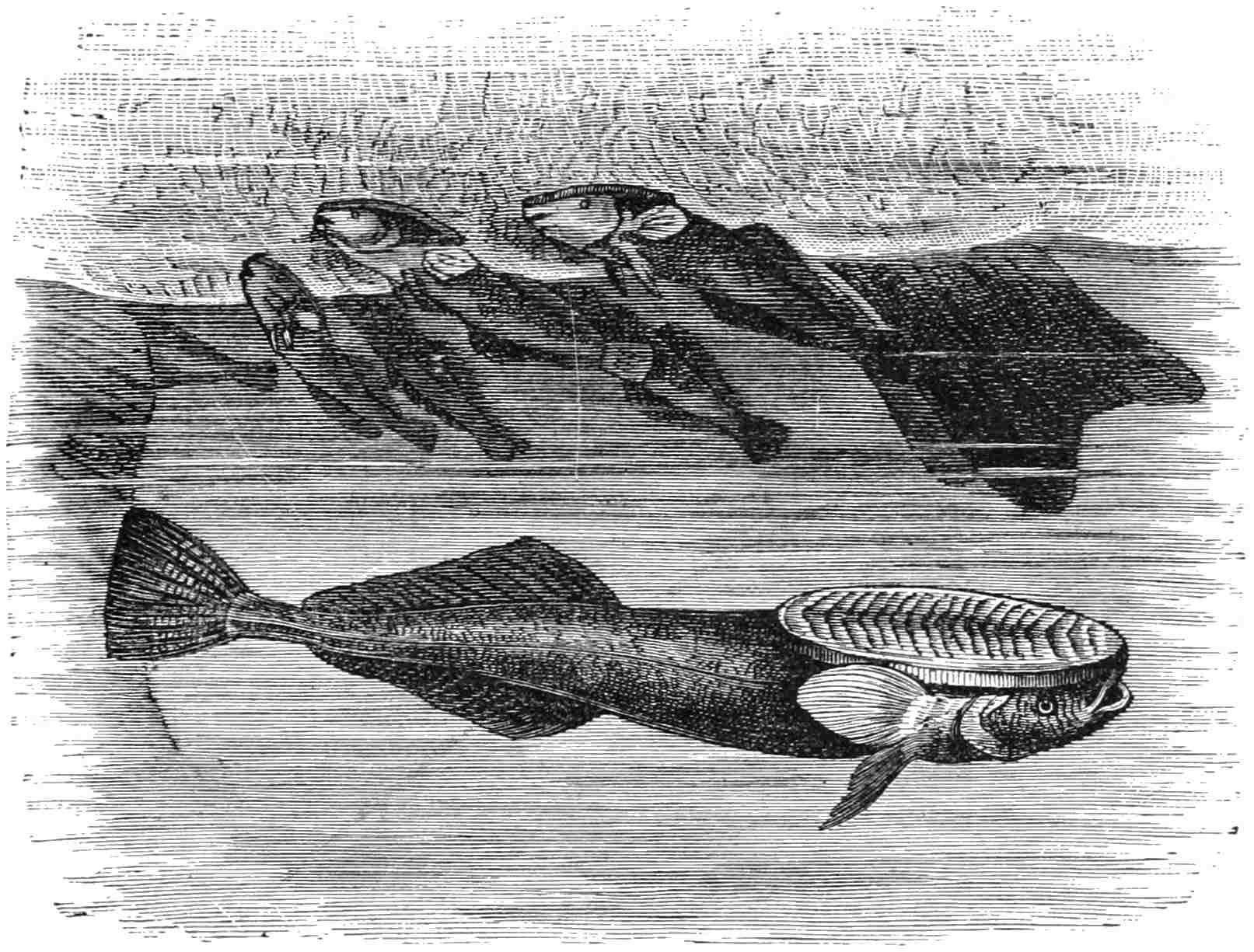
with long arm-fins, and clinging fish whose fins form
a sucking disk; nay, even so strange a thing as an
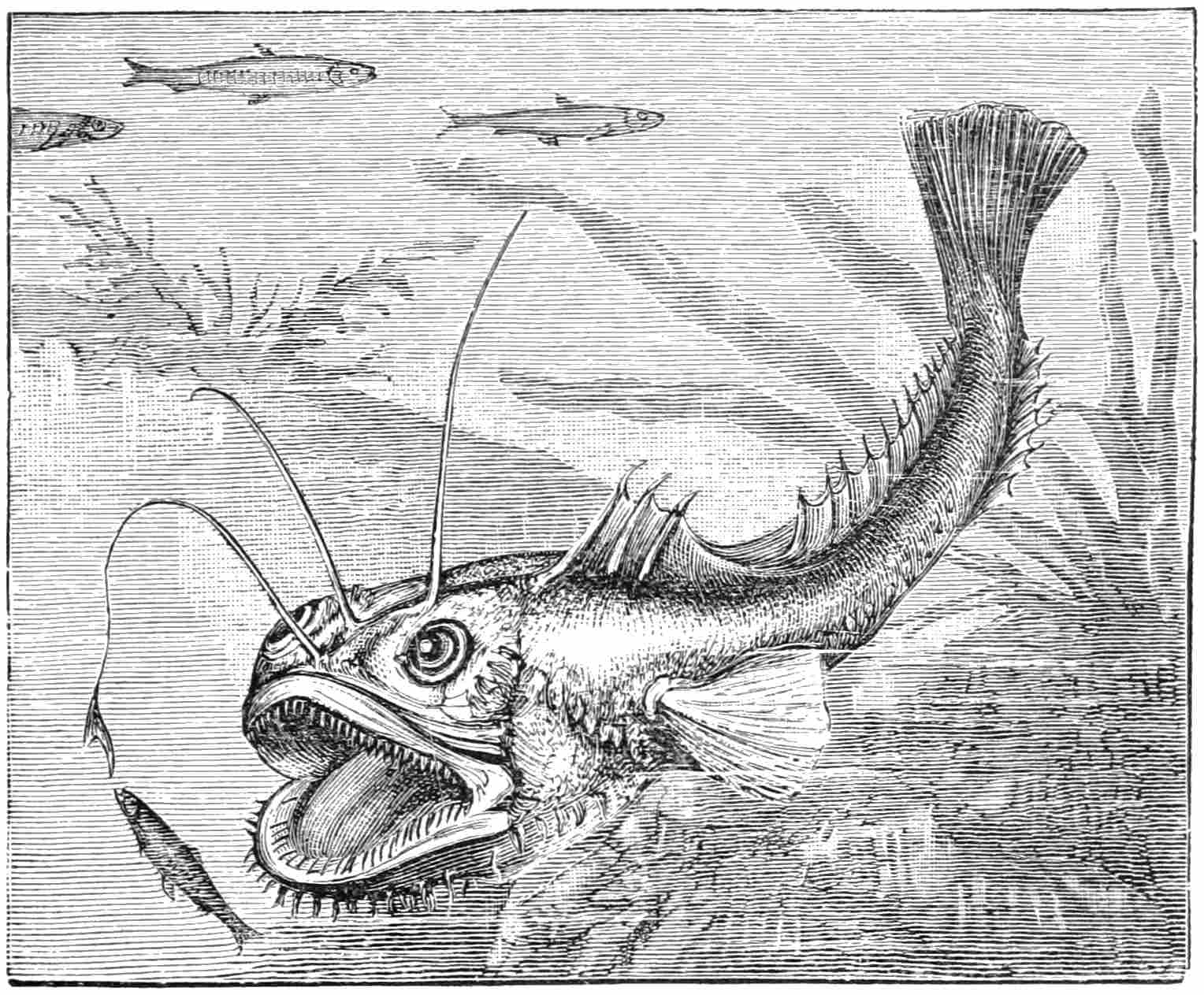
angling-fish, whose back fin is turned into a fishing-rod
to attract his prey.
All these, during the long ages since they first
started in life, have been learning to make use of
some area in the wide expanse of water spread over
our globe, and it remains for us now to see how they
have succeeded. Where shall we make our start?
If we begin at home in the rivers we should have to
work, as it were, backwards, for the sea is the chief
home of fishes, and the rivers only the refuge of a
few stray kinds. The sea-shore would be, perhaps,
our truest starting-point, but then we should have to
travel two different ways. Will it not be best to
dive down first into the silent depths of the ocean,
and learn what little is known of those which have
taken refuge there? Thence we can rise up to the
open sea, from there swim in to the shore, and then
up the rivers and back to our own land-home.
It makes but little difference where we take our
plunge into the deep sea, for changes of climate are
scarcely or not at all known there, and the fish seem to
wander over every part. Wherever it may be, then,—let
us say in the seas of the Tropics, which have
given us most of our specimens—let us dive down,
down, till we reach about 1800 feet (300 fathoms).
... “For who can know
What creatures swim in secret depths below,
Unnumber’d shoals glide thro’ the cold abyss
Unseen, and wanton in unenvied bliss.”
We shall be groping more and more in darkness as
we go, for the sunlight scarcely reaches beyond 1000
feet, and we have left its last rays behind us, and the
water is growing icy cold. How strange, then, that
the first fish we meet should have large wide-open
eyes! This is the Beryx,25 shaped something like
a perch, but about a foot and a half long, and genealogists
ought to look at him with respect, for his
ancestors (see heading of Chapter) are almost the
oldest known bony fish, and lived in the chalk seas.
Has he come down here because the upper world
was too rough for him? If so, he has found comparative
stillness, for he is far beneath the turmoil
of the waves, and only the slowly creeping currents
make any movement around him. But he has not
escaped from the struggle for life, for not only is a
good-sized shark coming his way, but a huge monster
of the bony race, six feet long,25 with wide-opened
jaw, sharp pointed teeth, and large keen eyes, is
wandering near in search of prey, devouring large
and small fish with great impartiality.
Still in the dense darkness the Beryx must surely
escape? No! for, strangely enough, lights are travelling
about in this midnight region. The monster
himself carries lamps upon his body, and a shoal of
small oblong fish, something of the size and shape of
a gudgeon, come swimming by, carrying on their sides
whole rows of shining spots giving out phosphorescent
light; while not far off another fish, called in India the
Bombay duck, glows all over, as if his whole body had
been rubbed in phosphorus. Nay! so far as we know
the Beryx himself is probably gleaming with light, for
his body is covered with a large quantity of the same
slimy fluid which makes the “Bombay duck” phosphorescent
when he is freshly drawn out of the sea.
So these curious fish, living in eternal darkness
except when they make an expedition to the surface,
carry many of them their own lights; and as we go
deeper still more and more of them are found with
shining mother-of-pearl-like spots on their head, or
sides, or tail, so that the very darkness is alive with
light. What slaughter and hunting there is among
them! for they all eat each other, and even their own
young, there being no plants for any of them to feed
on. There are the deep-sea cod-fish; strange forms
with large heads, long tapering tails, and thread-like
fins, chasing the smaller fish, and falling victims
themselves to the fierce Stomias which comes sailing
along with its row of glowing lights, and its huge
sharp teeth, ready to seize its prey. Both these fish
go down as deep as ten thousand feet and more,
accompanied by another fish quite as ferocious,
though only a foot long, with large teeth sticking
out of its mouth like the tusks of a boar, and curious
round spots, with lenses in them, on its side, which
may be eyes, or may be lanterns to light it on its
road; and among these luminous fishes are wriggling
along the deep-sea Conger eels, with toothless mouths
and elastic stomachs, swallowing large fish whole;
while another curious cod-like fish, whose stomach
can stretch to more than four times its natural size,
draws itself over its prey just as a snake does, and
carries it in the hanging bag till it is digested. And
deeper yet in the dead calm water roam many fishes
with delicate feelers hanging from their mouths, while
their fins are slender and tapering, so that they feel
their way along the still depths. Among these are the
Ribbon-fish, twenty feet long but only a foot deep,
and never more than two inches thick in any part,
with their long rosy fins floating like ribbons back
from their heads and from under the body.26
Strange monsters are all these deep-sea fish, some
of them living as much as 16,000 feet under the surface
of the sea, so that if Switzerland were turned
upside down in mid-ocean, the peak of Mont Blanc
would not reach down to where they swim. Yet
they are only modified forms of ordinary fish from
the world above, which have become fitted to live
under that vast pressure of water. Their skeletons,
though bony and well-knit together at that depth,
are fibrous and slight compared to those of their surface
relations, for although they have to resist a weight
of from two to sixteen tons pressing all round them, a
ton weight being added for every thousand feet, no
special strength is required, because the dense water
permeates their whole structure, and the pressures
are everywhere equal. It is the same with them as
with the most delicate and fragile insects living in
our atmosphere, the pressure of which would tear
them to pieces if unbalanced by equal pressures
within and without.
But when these deep-sea fishes are brought up
quickly to the surface, the outside pressure no longer
balances that inside, and so their tissues loosen
and their whole framework starts apart, so that they
almost fall to pieces at a touch; and their air-bladder,
if they have one, expands so much as to
force the stomach out of the mouth, turning them
almost inside out. Neither are their lanterns a
special creation for their use, but merely adaptations
of that slimy fluid which we saw oozing from the
scales of the minnow. In some of the deep-sea fish
even the outer bones are filled with this fluid, and
the line of scales along the side has large openings,
so that the body is bathed in glowing slime. In
others it collects in glands on the sides, making the
phosphorescent spots.
In this way the deep-sea fish have become fitted
to make a home in the very heart of the ocean.
Some with large eyes, seeing by means of their own
and their neighbours’ light, others with small eyes
and delicate feelers, testing each step as they go, and
feeding, probably, on the shower of minute sea-animals
that falls continually from above; while some,
like the Beryx, the Bombay Duck, and the light-carrying
Scopelus, which live nearer the top, come
up on still nights to feed at the surface of the sea.
Fig. 9.
Remoras27 clinging by their sucking-disk to the under part of a
shark.—(Adapted from Brehm.)
And now, as we rise again from the dark still
depths up to warm layers of the tropical seas into
which the sun is pouring his penetrating rays, it may
happen that a large dark body moves between us
and the surface, as the Great Blue Shark, or one of
his smaller relations, ploughs his way through the
water. But what are these little dark brown fish,
with round gaping mouths, which are hanging by the
top of their head and back from under the shark’s
belly? (see Fig. 9). Where he goes they go with him,
and, as they are borne along, they feed upon the tiny
sea-animals among which they are carried so easily.
These cunning passengers, of whose very existence
the shark seems unconscious, are the Remoras, or
sucking-fish. You would scarcely think that they
belong by descent to the mackerel tribe, a strong-swimming,
active, and almost warm-blooded group of
fish, with a large supply of nerves and blood-vessels
to their muscles, so that they swim boldly out to sea,
and make more use of the open ocean than almost
any other group. But among all tribes there will be
some weak members, and these must live by stratagem.
The little remora is a feeble swimmer, and, having
to live out at sea, has acquired a curious sucker
by which he clings to sharks, and whales, and even
ships, so that he is carried along without exertion. Yet
this sucker, again, is only a special adaptation of the
back-fin, which, instead of being single, as in other
mackerel, has its spines divided and bent, one set to
the left, the other to the right, and joined by a double
set of plates, surrounded by a fringe of skin. This
forms an oval disk, and, as the remora glides along
under the shark’s belly, he presses the damp membrane
against the fish, and, drawing together the
muscles of the plates, clings as firmly as a limpet to
a rock.
Nor is the remora the only companion of the
shark—
“Bold in the front the little Pilot glides,
Averts each danger, every movement guides;”
for the little steel-blue striped Pilot-fish,28 another
distant connection of the mackerel tribe,29 is hovering
around, feeding upon the scraps of the shark’s food,
and finding protection in his neighbourhood, though
in olden times he was supposed to protect the shark.
A brave little fish this, which has succeeded in making
the shark his friend: while near him he is safe from
other fishes.
And now, as we continue our way in the open
sea, it is nearly always forms more or less related
to the mackerel tribe which cross our path. The
slender Bonito30 and the heavier Tunny31 sometimes
ten feet long, are hunting below or on the surface,
and the beautiful Dorados,32 or gold-mackerel,
as the Germans call them, with their silvery blue
backs tinged with a sheen of gold, their dull-coloured
fins, and their golden eyes, are driving by in large
shoals in pursuit of the flying-fish. All these are powerful
swimmers, and they have no air-bladder, which is
an advantage to such active hunters which wish to
turn rapidly, to go down deep or rise to the top, and
change their position at every moment; for in all
these movements a natural float inside is a hindrance
to be overcome. And so we find that in fish, even
of the same family, some have lost the air-bladder,
while others have it enlarged to meet their wants,
as in the case of the lovely blue and silver sun-fish33
for example, which, though quite near relations of
the dorado, have very large air-bladders, enabling
them to float quietly on the top of the water, waving
their deep scarlet fins.
But while we are watching all these large and strong
swimmers an active and bloodthirsty struggle is going
on, for the bonitos and the dorados are looking to make
their meal upon the little Flying-fish, which are straining
every nerve to escape them, while here and there
one drops down into their very mouths. Lovely little
creatures these are, of the Pike family, which have
taken to the open sea, where they rise with a stroke
of the tail many feet out of the water, their bright
purple backs and silvery sides gleaming in the sun, as,
with their long transparent arm-fins outspread, they
float for as much as two hundred yards before they
fall back, to spring up again with another stroke.
Their air-bladder, which is half as long as their body,
and contains in a six-inch fish as much as three and
a half cubic inches of gas, stands them in good stead,
and they rise and fall with quick rapid flights out of
the reach of their foe, so that in the open sea they do
fairly well on the whole, though, if they venture near
land, the sea-birds persecute them in the air. Nor
do they stand alone in this curious habit of flying,
or rather floating, in the air, for a larger fish of quite
another family, the “Flying Gurnards,”36 with a smaller
but still ample air-bladder, and long arm-fins, may
also be seen rising in the Mediterranean and tropical
seas, out of reach of the fish-hunters of the water.
And now we must leave the open sea and steer
for the shore. It is true that many other fish are
wandering in the broad watery main, but many of
them, such as the globe-fish, feeding on the small
crustaceans and the sea-horses,37 whom we shall meet
nearer shore, are feeble forms carried hither and
thither by currents or on floating banks of seaweed,
while others have no special interest. The sharks,
the mackerel, and the flying-fish, are the most remarkable
colonisers of the ocean-surface, for even
the enormous Sword-fish,38 which attacks the bonitos
and whales with its long wedge-shaped bony jaw,
and is said to sail by raising his back-fin, is a distant
off-shoot of the mackerel tribe.
So we cannot do better than follow our own
common Mackerel, as they migrate in shoals out of
the deep sea to feed on the fry of the herring or the
pilchard in shallower water, or to leave their eggs
floating not many miles from land, so that the tiny
mackerel, when hatched, may live in the quiet bays
till their strength comes.
But stop! Long before we have come so far as
this, and while we are still a hundred miles or more
from the shore, let us peep down into the sea-valleys,
where forests of seaweed and marine plants are
growing, and myriads of tiny sea-lice and crustaceans
throng the water. What is that army of thin spindle-shaped
forms rising and falling in such numbers?
It is a shoal of herring, which have come there to
feed upon the sea-animals, keeping out of sight of the
sea-birds above, and the cod and sharks and ravenous
fish which hunt them without mercy, so that they
only venture to come to the surface on calm dark
nights. It was in valleys such as these that the herrings
were living when the older naturalists thought
they were gone away to the Polar Seas, because they
only saw them in spring and autumn, when they
come into shallower water to drop their myriads of
eggs,39 which sink down, and stick to the seaweed
and stones below.
But now they are revelling in the deep ocean,
rising and falling with ease, for their air-bladder has
two openings, one to the stomach and one to the outside
of the body, so that the gas can adjust itself to
their movements; and surely if the shark is the type
of the old, lumbering, powerful, slow-breeding fish,
the herring, with its narrow lissome body, light playful
movements, and myriads of young, is the type of
the new and active race. They are as truly social
animals as any herds on land, for they travel in shoals
of many hundreds of millions; and as they can squeak,
and have a very good apparatus for hearing, it is
more than likely that they call to each other. They
make both the salt and fresh water their own; for
when the eggs are hatched at the mouths of rivers
the tiny fish take refuge there from the violent persecutions
of the cod and mullet and haddock, flat-fish
and whiting, and, together with the small fry of other
fish, stroll up the rivers, where we call them “white-bait.”
And now, as we come nearer to the shore, where
countless numbers of small fry are filling the water,
and all creatures are struggling together to accomplish
three objects, namely, to get food, to avoid
being turned into food, and to lay their eggs, we find
many strange weapons and devices adopted by the
different fish for protection and attack.
... “Each bay
With fry innumerable swarms, and shoals
Of fish, that with their fins and shining scales
Glide under the green waves, in sculls that oft
Bank the mid sea.”
There are the Mullets,40 with tender feelers under their
chin, with which they brush the ground lightly as
they swim, feeding on the tiny creatures. There are
the walking fish, the Gurnards,41 which have three of
the spines of their arm-fins separate, and moved by
strong muscles and nerves, so that they can walk on
the sea-bottom, feeling their way, while the stiff, spiny
rays of their back-fin stand up to wound any enemy
attacking them from above. There are the tiny
Blennies which walk too, but by means of the few
rays which alone remain of their leg-fins growing
close under the head. Then there are the clinging-fish,
the Gobies,42 living on the rocky shores, where
the waves beat and roar, and they have their leg-fins
joined together, so as to form a kind of funnel under
their throat, with which they cling to the rocks and
then dart across the waves to feed, coming to anchor
again out of the dash of the water; some of these
little fellows make nests and guard their eggs after
the mother has left them, till the young can shift for
themselves. More curious still, the Lumpsucker43 has
its arm-fins and leg-fins all joined together into a
round disk under the throat, and so holds on bravely
against the dashing tide, defending the eggs which
have been laid in the seaweed near the shore, and
even remaining to take up the young ones when
hatched, and carry them safely back into deep water
as they cling to his sides.
Meanwhile, close down upon the sand are the
hiding-fish, the Weevers, the Anglers, and the Flat-fish.
The weevers44 are the most dangerous. Their
shaded yellow colour hides them from view, while the
sharp spines of their back-fins, which they keep raised,
will inflict very severe, if not poisonous, wounds on
any creature striking against them. Nor is this
all, for behind the cheeks, fastened on to the horny
gill cover, are daggers with which they can strike,
deliberately jerking them back so as to give a sharp
blow. These are fighting aggressive fish, waging the
war that goes on so sharply all round our coasts.
But there is one even more cunning than they,
lying hidden in the seaweed or the sand—a large,
flat, soft fish, about three feet in length, and quite
half as broad as he is long, with a soft stumpy
tail, stretching out behind, and a kind of wrist-joint
to arm and leg fins, by which he can creep
noiselessly along. His wide mouth is gaping open,
so that a two-foot rule could be passed crossways
into it, and his pointed teeth are bent back to
allow his prey to enter. But how is this prey to be
caught, for he is not going to move to fetch it?
Notice all round his head and his body, the skin is
fringed like blades of seaweed and plays about in
the water; while above his head and back the spines
of his fin stand up quite separate, and the front one
is tapering and long like a fishing-rod, with a lappet
at the end like a bait. And now, as the shallow
water ripples over his head, the lappet plays to and
fro, and the unwary fish come up to nibble at it,
lower and lower he waves it, and the nibblers follow,
till, opening his wide gape, he gulps them down, even
if they are as large as himself, and lies passive with
his swollen stomach till they are digested. This is
our own Fishing-frog,46 of which one was once found
with seventy herrings in his stomach. He has relations
all over the world—in the open sea and down
in its depths, and all of them more or less follow his
fishing habits. Yet there is no creation of special
parts for these strange weapons; the altered back-fin
and the jagged skin do all the work, just as in some
curious fish of the weever family in the tropics,
called the Stargazers,47 the feelers on their lips,
longer than those of other fishes, and a lengthened
thread from below the tongue, play in the watery
currents and attract the small animals, while the fish
with upturned eyes watches them as they are lured
to destruction.
Lastly, among all these curious forms upon our
shores there is an abundance of flat-fish—soles
and turbot, brill and plaice—flapping along at the
bottom, covering themselves with sand, or rising up
with that strange wavy movement of the whole body
in which they use what look like long side-fins, but
which are really the back-fin and the belly-fin.
Above are two small soles as they swim when young. At that time
they are not larger than a grain of rice.—(Adapted from Figuier and
Malm.)
If we wanted to pick out the strangest and strongest
proof of how the shape of fish is altered to suit
their wants, we need seek no further than the flat-fish.
When we were speaking of the shark order we saw
that the rays and skates are flattened forms suited to
hide in the sand, and these fish are truly spread out
as if they had been squeezed under a heavy weight,
their broad arm-fins edging the sides of their body.
But the bony flat-fish, the Soles and Turbot, have a
far stranger history. The young sole, when it comes
out of the egg, is not flat like the young skate, but a
very thin spindle-shaped fish, something like a
minnow. He is then about the size of a grain of
rice, very transparent, and lives at the top of the sea.
He has one eye on each side, like other fish, only one
eye is higher up than the other, and the single fin
on its back and the one under its body reach almost
from head to tail. In this way he swims for about a
week, but he is so thin and deep, and his fins are so
small, that swimming edgeways is an effort, and soon
he falls down on one side, generally the left, to the
bottom of the sea. Many times he rises up again,
especially at first, till he has got used to breathing at
the muddy bottom, and meanwhile the eye that lies
underneath is gradually working its way round to
the upper side, his forehead wrinkles so as to draw
the under eye up, while his whole head and mouth
receive a twist which he never afterwards loses. His
skeleton, it must be remembered, is still very soft,
and the bones of his face are easily bent; and at last
this eye is screwed round, and as he lies at the
bottom he can look upwards with both eyes and save
the under one from getting scratched by the sand, as
it must have done if it had remained below.
Nor is this all, for while his under side, shaded
from the sunlight, remains white and colourless, his
upper side gradually becomes coloured like the sand in
which he lies, and he is safely hidden from attack as
he flaps along, feeding on worms and other animals.
And now when he swims he no longer uses his arm and
leg fins, which are quite small and insignificant, but
bends his whole body, using the back and belly fins to
help him. What we then call the top of the sole is
really his side, where you may see the dark line of
scales running along the middle, and one arm-fin lying
close to his head. Yet he can swim strongly and to
far distances, for in the winter the soles, too, migrate
into the open sea, where they may be found in the
deep water of the Silver Pit, between the Dogger Bank
and the Well Bank.
Fig. 13.
Hippocampus, a fish commonly called
the Sea-Horse.
And now, before we leave the shore, we must
glance at a curious weakly little fellow clinging by
his curly tail to the seaweed, whom you will certainly
not take for a fish, even if you can find him out, so
entangled is he generally in weeds of the same colour
as himself. Yet the Sea-horse49 is a true fish, covered
not with scales but
with plates, with
which he makes a
clicking noise by
scraping them together.
What look
like large ears are
really his arm-fins,
while at the end of
his long snout is a
mouth shaped like
an ordinary fish’s
mouth, but toothless,
and he breathes with
fish’s gills arranged
in round tufts instead
of folds. What
the use of his
strange shape is to
him we cannot tell,
but at any rate
his fleshless bony body must protect him from
other fish, while his power of clinging causes him
to be often carried by floating weed even into the
open ocean, and make up for his feeble powers. In
one thing he surpasses most other fishes, for he is
a most careful father, carrying the mother’s eggs in a
little pouch under his body till the young ones escape.
There is one form of these sea-horses in tropical seas
which has long red fringes floating from its body, so
that it cannot be distinguished from the seaweed in
which it hides.
So we see that the deep sea, the open sea, and
the shore, are filled so full of different forms that
there are enough not only to make use of every
part, but also to provide food for each other, and
we also see that by far the larger number even of
widely-spread fish come near to the shore to leave
their spawn, while the young ones often make their
way into the brackish water at the mouths of rivers,
and spend their youth in the shelter of the still fresh
water.
Now it is very natural that many such fish
should learn to remain in this quiet refuge, and in
time to live there altogether. And because fish-life
in the rivers is comparatively uneventful and
little varied, we find much fewer peculiarities in river-fish.
Many of them are very near relations of sea
forms. There is the salmon, a true sea-fish, which
wanders up the river to spawn in the pebbly shallows;
and there are the trout, his near relations, which have
learned to live entirely in the rivers. There are the
sea-perches, large strong fish, and the smaller river
perch, which have made their homes very successfully
in the rivers, for their spines are so sharp that even
the greedy pike hesitates to swallow them. There are
the sea-sticklebacks, and the little river-stickleback.50
This last is a very clever little fish, which hollows
out the foundation of his nest very carefully in the
bed of the river, and then builds it up for several
inches with blades of grass and weeds (Fig. 14),
gumming them together with the slime of his body.
Then, when all is ready, he swims about to drive and
coax the mother to the nest, sending her in to lay
her eggs, and then driving her right through and out
at the other side, so that a stream of water flows constantly
over the eggs till they are hatched. Nay, his
care does not end here, for when the young fish come
out of the egg with a bag of yelk hanging under the
body, as all young fish have at first, and so cannot
swim easily and escape their enemies, the courageous
little father will defend them and fight fiercely with
any fish which thinks to make a meal upon them, not
leaving them till all the yelk is absorbed, and they
are able to swim and feed themselves.
Fig. 14.
STICKLEBACKS AND THEIR NEST. (Gasterosteus aculeatus.)
Besides these active river-fish there are the
little stupid Miller’s Thumbs,51 hiding under the
stones to feed on tiny animals; they are feeble
relations of the gurnards which we saw walking on
the bottom of the sea. Then there are the purely
freshwater fish, the Pike and the large Carp family,
with its many branches, the Roach, and Dace, and
Gudgeon, and Minnow; and the enormous family
of Cat-fish and Sheat-fish,52 of which we have none
in England, but plenty in America and other parts of
the world, a family in which the fathers sometimes
carry the eggs in their mouths till hatched. And last
but not least among the freshwater forms is that irrepressible
family of the Eels which we saw wandering
in the deep sea, and which are also to be found
near the shores all over the world. These fish will
even travel through pipes and into cisterns; and will
climb up trees so as to drop into neighbouring
streams and continue their wanderings; they sleep
in the mud in winter; and even after being frozen
come to life again; and in the spring they go to the
sea to spawn, giving rise to those shoals of young
ones from three to five inches long which come in
incredible numbers up the rivers in summer, making
the eel-fairs,53—
“The silver eel, in shining volumes rolled,”
so much spoken of in old books, when the eels will
often climb high banks, nay, even pass over miles
of dry land, closing down their narrow gill-openings,
and so shutting in water to serve them as they
go.
All these, and many other freshwater families,
show us how the fish have wandered into every possible
nook of the waters, so that even in those inland
salt lakes of North America and Asia into which no
rivers flow fish-life is abundant; and we can only
suppose that the eggs must have been carried by
water-birds in their flight, or by gusts of wind,
or have arrived there in ages long ago, before
these lakes were cut off from the rest of the watery
world.
Yet some few fish besides the eels have been
known to travel over land to find watery “pastures
new;” the Climbing Perch54 of India and the Doras
of Tropical America will both travel many miles when
their own ponds are dried, the perch breathing by
the help of a special apparatus, and the doras probably
shutting water into its gills; for necessity, even
in fishes, proves the “mother of invention,” and in
special works on fish you will find accounts of numberless
strange devices and adaptations by which
they manage to survive in the struggle for life.
And now, collecting together all we have learned,
let us in conclusion form a rough picture of the
history of the fish-world. All over our globe, from
pole to pole, and from the Indian Ocean round to
the east, back to the Indian Ocean again, is one vast
world of waters, with inlets and land-locked seas
bordering its margins, and rivers pouring into its
depths. In the past ages of the world these rivers
and coasts and inlets have varied innumerable times,
but the great ocean-mother has always been there
to bear the increasingly-varied forms in her bosom,
and to enable them to wander where best they could
preserve life.
And so from their beginning, when they were
probably as feeble as the lancelet, these earliest and
simplest backboned animals with their two pair of
limbs as yet very variable both in their position and
shape, have been spreading far and wide over the
watery three-quarters of the globe. We have seen
how the enamel-scaled fish had their time of glory, but
were not able to hold their ground, because they were
not agile and fish-like enough to escape their foes;
and how the sharks by their strength and boldness
remain monarchs of the sea to the present day.
Then we have seen that in old chalk seas the new
and active race of bony fish appear in force; some
like the herring and the carp, with air-bladders,
which had openings like the enamel-scaled fish, and
these can dart from heights to depths; while others
had closed air-bladders, and these remain with most
ease at one level, and can sometimes, if necessary, use
the gas in their bladder for breathing, if they are
oppressed with muddy water; and lastly, some, such
as the dorado, have lost their air-bladder altogether,
and gain in freedom of action what they lose in
lightness and buoyancy. And during the ages that
have passed since this bony race began, different
branches each in their own way have thrown out
curious weapons and developed strange organs to
help them in the battle of life, so that now we have
deep-sea fish carrying their own light; fish with distensible
stomachs swallowing prey larger than themselves;
fish with large air-bladders and long arm-fins
springing out of their own element and floating
in air; angling-fish, walking-fish, clinging-fish, and
hiding-fish; and even those whose shape is distorted,
like the sole, to enable them to hide and hunt in
safety; while, when the sea is full, we find new varieties
pressing their way into every river and tiny stream,
and even overland into enclosed waters. Nay! when
we descend into the recesses of the earth and visit
the underground pools of the dark caverns of Kentucky,
there we come upon fish which have found a
refuge in eternal darkness, and have lost not only
the power of sight but actually the eyes themselves.
And here we must leave them to go to higher
vertebrate animals. Although but little is known
of fish-life, a very small part even of that little
has been given here, and yet we take leave of
it with the feeling that its changes and chances
are greater than we can ever thoroughly learn.
How much pleasure these creatures have in their
water-world it would be difficult for us to say;
but since we find them playing together, hunting
together, sporting in the warm sunshine, and diving
and gambolling in the open sea, and sometimes
even calling to one another, we cannot but think
that life has great charms for them in spite of the
many dangers surrounding them. And when, low
though they are in the scale of life, we find them
(though curiously enough always the fathers) carrying
the eggs, building nests for them, and defending the
young, we see that even here, in the very beginning
of backboned life, we touch the root of true sympathy,
the love of parent for child.
CHAPTER IV. HOW THE BACKBONED ANIMALS PASS FROM WATER-BREATHING TO AIR-BREATHING, AND FIND THEIR WAY OUT UPON THE LAND.
THE HOME OF THE EARLY AIR BREATHERS
So the backboned animals, as fish, have peopled the
seas and rivers, and, as the ages have past on, have
become more and more fitted to their watery life,
little dreaming of another and different life in the
world of air above them. And yet in the same
pond with the little stickleback, so busy building
his nest, there is a creature which could tell him
that it is possible to live in both worlds, if only you
have the proper machinery to do it with.
It is clear that if the backboned animals were
ever to live upon land, after they had begun their
career in the water, there must have been some
among them which learned gradually to give up
water-breathing, and to make use of free air; and
we shall not have far to seek for creatures which
will help us to guess how they managed it.
From almost every country pond, or ditch, or
swamp, a chorus of voices rises up in the springtime
of the year, calling to us to come and learn how Life
has taught her children to pass from the water to the
air; for it is then that the frogs lay their eggs, and
every tadpole which grows up into a frog carries us
through the wonderful history of an animal beginning
life as a fish with water-breathing gills, and ending
it as a four-legged animal with air-breathing lungs.
Come with me, then, to some stagnant pool in a
country lane, towards the end of March, and there
we shall no doubt find a whole company of frogs,
croaking to their hearts’ content after their long
winter sleep in the mud at the bottom of the pond.
They are wide awake now, and are actively employed
laying their eggs. Look carefully around
the edges of the pond, especially in that part where
the wind has driven the scum to the side, and you
will doubtless find in some still corner a gluey mass
(e, Fig. 15), which looks like a lump of jelly with
dark specks in it. Take this up carefully, for it is
frog spawn; carry it home together with some weeds
from the pond; put it in a glass bowl with water;
and then from day to day you may study the
history of a frog’s life.
Fig. 15.
Metamorphosis of the Frog.
e. Eggs. 1. Tadpoles just out of the egg. 2. With outside gills.
3. With gills hidden, and beak-like mouth. 4. Hind legs appearing.
5. All legs grown, but fish-tail remaining. 6. Putting on Frog appearance;
tail being absorbed. 7. Young perfect Frog.
That jelly-like mass is a collection of frog’s eggs.
When they were laid, each egg was a small round
dark body in a gluey covering, and they all fell to
the bottom of the pond, where, by degrees, the
water oozing through the envelope swelled each egg,
till they clung altogether in a mass, and, rising,
floated at the top. Then very soon each round dot
lengthened out into a long streak, and in a few days
an eyeless head appeared at one end with a soft
closed mouth under it, and at the other a tail, with
a soft fin round it like the tail of the lancelet; so
that by the time you find the spawn, you may, most
likely, be able to see the tiny creature wriggling
every now and then in its watery bed. This will
go on for some time, and a week or two may pass
before the moving tadpole breaks through its egg
skin, and coming out into the world, fastens on to a
piece of weed (1, Fig. 15) by two little suckers
behind its mouth. And now that it is out of the
egg the interest begins. Look carefully day after
day and you will see some branching tufts (2, Fig. 15)
growing larger and larger on each side of its head.
What are these? We have not seen them in any
fish. No! but if you take a young hound-shark
out of his leathery egg before his time, you will find
that he has outside gills much like these, only he loses
them before he comes out into the world, whereas
the tadpole keeps them to breathe with a little
longer. If you put the tadpole, at this stage, under
the microscope, you can see the red blood flowing
through these gills to take up air out of the water.
Meanwhile the tadpole’s lips are gradually forming
into a round mouth, much like the lamprey’s,
and by-and-by the inner part of this mouth is
covered with two little horny jaws, forming a sharp
beak (3, Fig. 15) with which he will nip off pieces
of weed for food. Meanwhile, as he grows larger
and larger, and eyes, nostrils, and flat ears form in
the head, a covering begins to grow back over the
sides of the neck, and little by little the branching
tufts disappear (3, Fig. 15). How, then, can he
breathe now? Watch carefully and you will see
that he gulps every moment as we saw the minnow
doing (p. 23). The fact is that the outside tufts
have faded away, and under the cover the tadpole
has six slits in his throat, like the slits of the lamprey,
which are covered in somewhat similar fashion
to those of the amphioxus (see p. 11), and he
breathes through them.
Here is our tadpole, then, to all intents and purposes
a fish. He swims with a fish’s tail; he gulps
in water at his mouth, passing it out at the slits in
his throat after it has poured over his fish’s gills.
Moreover, he has a fish’s heart, of two chambers only,
like the minnow’s (p. 23), which pumps the blood into
these gills to be freshened, while, like the lamprey,
he has a gristly cord, enlarged at the end to form a
gristly skull, a round sucking mouth, and no limbs.
All this time, however, though he has a fish’s fin
round his tail, he has no arm or leg fins. Wait
a while and you will see that under his tender skin
far more useful limbs are being prepared. As he
grows bigger and more active week by week, wriggling
among the weeds and feeding greedily, two little
bumps appear one on each side of his now bulky
body, just where it joins the tail. These bumps grow
larger every day, until, lo! some morning they have
pierced through the skin, and two tiny hind legs
(4, Fig. 15) are working between the body and the
tail. The two front legs are longer in coming, for
they are hidden under the cover which grew over the
gills, but in about another week they too appear, and
we have a small four-legged animal with a lamprey’s
tail (5, Fig. 15). These legs are something far in advance
of fish fins, for they have shoulders and thighs,
arm and leg bones, wrist and ankle bones, hand and
foot bones; and instead of the large number of rays
in a fish’s fin they have four fingers on their short
front legs, and five toes at the end of long hind ones;
the toes being joined together by a web, which helps
him wonderfully in striking the water as he swims.
The tadpole has now become fitted to jump and
leap on the land or swim by his legs in the water;
and, moreover, while these legs have been growing,
another change has been taking place. You will
notice by careful watching that at first he still gulps
in water as he used to do, but he comes more often
to the top, and, poising himself so that his mouth is
out of the water, gives out a bubble of bad air, draws
in some fresh, and goes down again. Why does he
do this? Have you any recollection of another fish-like
animal which comes up to take in air? Look
back at our friends the mud-fishes (p. 34), and read
how the Ceratodus fills his air-bladder when he is
short of good air in the water. When you have
re-read this, you will suspect that the tadpole, too,
has something like an air-bladder, which he fills from
time to time. And so he has. While his legs are
growing a bag has been forming inside at the back
of his throat, which afterwards divides into two, and
he fills these by shutting his mouth, drawing air in
at his nostrils, putting up the back of his tongue to
shut it in, and then swallowing it down into the
lungs; so that he is now a truly double-breathing
animal, using his gills when below water and his
lungs when above. Moreover, if you could watch
inside his body, you would now see that little by
little the blood-vessels going to the gills grow smaller
and smaller, and those going to the lungs grow larger
and larger; while the fish’s two-chambered heart
divides into three chambers, one to receive the blood
from the body, another to receive it from the lungs,
and one to drive this blood back again through the
whole animal. And when at last this change is so
complete that all the blood goes to the lungs to be
freshened, the gills shrivel up and disappear, and
our tadpole is a true air-breathing animal.
Notice, though, that he is still cold and clammy,
not warm like a mouse or a bird. For his blood still
moves slowly, and as he has only three chambers to
his heart instead of four, as warm-blooded animals
have, the good blood from the lungs and the worn-out
blood from his body become mixed each time they
come round, so that his breathing work is still of a low
kind all his life. And now that he can leap and swim
with his legs, his tail is no longer of use to him, and
it is gradually sucked in, growing shorter and shorter
till it disappears, and the young frog is complete.
Thus our backboned animal has succeeded in
getting out of the water on to the land, and in doing
so he has quite changed his habits. A peaceful
vegetarian before, he is now a greedy eater of
insects, slugs, and other animals. His horny beak
has been pushed off; his lips have stretched back
farther and farther, till they now open right back as
far as his flat little ear; and he is a gaping, wide-mouthed,
leaping frog55—
... “Hoarse minstrel of a strain
Aquatic, leaping lover of the rain;”
(7, Fig. 15), with teeth in the roof of his mouth. But
perhaps his tongue is the most curious of all, for instead
of being fixed at the back, and free in the front,
as in most other animals, the root of it is fastened to the
front of his lower jaw, and the tip lies back in his mouth,
so that when he wishes to catch an insect he throws
his tongue quickly forward, captures his prey on the
sticky point, and flings it back down his throat.
So he hops about the summer long, if he can only
escape from ducks and rats and other frog-eating
animals. He often takes to the water, for he can fill
his lungs with air and use it very slowly, and, moreover,
his soft skin is of great use to him in still breathing in
the water or in the moist air; and when winter comes
he takes refuge with many others at the bottom of the
pond, and sinks into a state of torpor, till the spring
brings croaking and egg-laying time round again.
Fig. 16.
The Common Smooth Newt56—male and young in the water;
female on the bank.
Our little frog, then, is truly an animal with a
double life, a genuine amphibian,57 meaning by this,
not merely an animal that can swim in the water and
move on land, for seals and water-rats, white bears and
hippopotamuses, can do this, but one that in the early
part of its life would die if taken out of the water,
while afterwards it lives and breathes in the air.
Fig. 17.
Proteus of the Carniola caverns,58 with its external breathing gills.—(Adapted
from Brehm.)
Have these double-lived creatures, then, such a
great advantage over real water animals, or how
can we account for their having adopted this strange
life? If we only look upon them as they are now,
we can scarcely call them particularly successful,
compared to other animals. For though there are
plenty of them, yet they are comparatively small
and insignificant; and when we find large ones
like the gigantic salamander of Japan, they are
sluggish and feeble. Look at the common newts,
or water-salamanders of our ponds, with their weak
crawling limbs, as they wander round the edges of
a pond, feeding on water-insects and tadpoles, the
male with his crested back, the smooth mother,
and the young eft-tadpole with its branching
tufted gills (Fig. 16). They are much less active
than the frog, for they never lose their tails, and
they come less often out of the water, although they
are true air-breathing animals. Then, when we go
to other countries, there is the Proteus (Fig. 17), that
curious half-transparent newt, with a round body and
tiny helpless legs, which lives in eternal darkness in
the still underground pools of the Carniola caverns
near Adelsberg. He has become well fitted for his
dismal life, for his tiny eyes are grown over with
skin, and he never loses the feathery gills on each
side of his neck, but lives like a tadpole all his life,
although he has true lungs. Again, in America we
have the Siren, with its long snake-like body, and
only front legs, with which it cannot walk. It, too,
keeps its gills as it wanders about the stagnant
waters of South Carolina, feeding on worms and
insects. Then in the Mexican lakes there are the
curious Axolotls, which also wear outside gills, as a
rule, all their lives, and fathers, mothers, and children
remain breathing in the water together, although
they have real lungs. But about twenty years ago,
some of those axolotls, which were kept in the Jardin
des Plantes in Paris lost their gills, came out upon
the land, and astonished people by becoming true
land salamanders, like some already well known and
called Amblystomes, breathing only with their lungs.
It was difficult for some time to make the world believe
that grown-up water-breathing creatures which
could lay eggs were able to turn into other creatures
without gills. But at last a lady, Fraulein Marie
von Chauvin, took some axolotls when they were full-grown,
and kept them on land in wet moss, washing
and feeding them every day, and thus succeeded in
teaching them to breathe air, so that their gills
shrivelled up and disappeared. Then there could
no longer be any doubt that the axolotl is only the
lower water-form of the amblystoma, which in the
Mexican lakes, owing to the increased dryness of
the surrounding country, has lost the habit of coming
out on to the land, and remains in the water with its
little ones all its life; but which, when brought to a
moist climate where it can breathe comfortably on
land, sometimes returns to its old double life.
Fig. 18.
Axolotl, a creature living and breeding for generations in the water.
Amblystoma coming out of the water,—an axolotl which has lost the
gills and acquired lungs.
We have, in fact, in Europe real land salamanders,
which live in cool damp places, looking like
lumpy soft-skinned lizards, but going down to the
water to lay their eggs, that their little ones may
go through their tadpole life—and one of these, the
black salamander,59 which lives high up in the mountains
of Germany, France, and Switzerland, does not
even go to the water, but carries the young tadpoles
in her body till they can breathe air and run alone;
and yet they are still true amphibia, for if they
are taken out of their mother and put in water, they
go through all their changes like common efts and
newts.
Lastly, there is a strange group of legless creatures
called Cæcilians, which have taken refuge
underground, burrowing like worms, though they are
true amphibians and their young have gills in their
babyhood hidden under a slit in the neck. These
cæcilians are the only amphibians which have scales
something like fishes, yet they never live in the
water, but in the marshy ground of tropical countries,
feeding on worms and insects.
* * * * *
Now when we think that these sluggish newts,
and salamanders, and cæcilians, with their more
nimble but comparatively unprotected relations, the
frogs, are all the amphibians now living, we cannot
but wonder how Life came to produce such a feeble
set of creatures to fight the battle of existence.
But if we glance back to that far-off time when
the ancient fishes were wandering round the shores
and in the streams of the coal-forests, we shall be
better able to read the riddle. For in those days
it was a great step for an animal to get out of the
water at all, and those that did so had a much better
time of it than our frogs and newts have now, when
the country is full of land enemies.
And so we find that the amphibia were not then
the small scattered groups they are now, but strong
lusty animals, with formidable weapons. In the
hardened mud, which in those days formed the soft
swampy ground of the coal-forests, but is now
stiffened into the roofs and floors of our coal-mines,
footprints have been left which tell us of large and
formidable creeping animals, with toed feet and long
flat tails, dragging themselves over the marshes of
the coal-forests, and finding their way to many
places which even the mud-fish with their paddles
could not reach; and from time to time, in these
same roofs and floors of our mines, both here and in
America, we find the bones and coverings of these
amphibia, buried in Nature’s catacombs for ages, and
only brought to light by the rude hand of man.
These remains remind us that
“A monstrous eft was of old the lord and master of earth,
For him did the high sun flame, and his river billowing ran.
And he felt himself in his force to be Nature’s crowning race;”
for they show us huge and powerful creatures60 which
sported in the water or wandered over the land with
sprawling limbs, long tails, and bones on which gills
grew, while their heads were covered with hard bony
plates, and their teeth were large, with folds of hard
enamel on the surface. Some of these were fish-like,
with short necks and broad flat tails, but they
had true legs and toes; others, more like crocodiles,
and sometimes ten feet long, were able to walk firmly,
but still dragging their bodies and long tails over
the swampy ground on which their footprints are
still found; some were small and more like lizards,
with simple teeth, scaly armour, and light nimble
bodies; and these, probably, ran about quickly on
the land, and have sometimes left their skeletons in
the hollow trunks of the old coal-forest trees.
All these plated and formidable creatures were
amphibia or double-lived animals, and this was their
Golden Age, as they preyed upon the fishes in the
swamps and ponds, probably not sparing even their
nearest connections, the mud-fishes, who, less fortunate
than themselves, had followed the road of
fish-life instead of coming out upon the land. They
lived so long ago that we can tell but little of
their daily lives, but it is clear that they played a
very different part from our small frogs and newts
of to-day, and in their well-formed limbs were worthy
forerunners of land and air-breathing animals.
But like the old race of fishes these large amphibians
were only to have their day, for as other
branches of the family tree grew up, and reptiles grew
strong and mighty, and other true land animals began
to flourish, these huge plated forms dwindled away,
and we lose sight of them; and when we find any
of their relations again it is only as our present
frogs and newts, salamanders and cæcilians, which
have taken up their refuge in lakes, ponds, ditches,
underground waters, or damp mud. And, curiously
enough, those forms of to-day which are most like
the huge Labyrinthodonts,61 as they are called, of the
old coal-forests, are the feeble cæcilians, with their
horny scales and their numerous ribs, although they
have now fallen the lowest of all amphibians, and,
with their sightless eyes and ringed and legless bodies,
have taken to burrowing in the ground like worms.
Not so the frogs, which, like the bony fishes,
began their career in later times, and have known
how to fit themselves into many nooks and corners
in life. In almost all countries of the globe they
hop merrily about the ponds and ditches, never
wandering far from the water, into which they
jump and dive whenever danger threatens. It is
true they are eaten by thousands, both as tadpoles and
frogs, by birds, snakes, water-rats, and fish, and even
by each other, but they multiply fast enough to keep
up the supply, and find plenty of insects both in and
out of the ponds. Nor have they kept entirely to a
watery life, for their near relations, the toads, which
have toothless mouths and toes less webbed, have
ventured much farther on to the land, protected
partly, no doubt, by the disagreeable acrid juice
which they can throw out from a gland behind the
eye whenever they are attacked.
It is curious to notice the quiet leisurely waddle
of the sluggish toad, as he spreads out his short fat
legs and puffs out his warty skin, and to compare
him with the nervous, anxious, little frog, starting at
every danger. And still more curious is it to see
him getting out of his skin, as he does several times
a year. For his skin does not peel off in pieces as
it does in the watery frogs, but splits along his back;
then he wriggles about till it lies in folds on his sides
and hips, and, putting one of his hind feet between
the front ones, draws the skin off the leg like a
stocking off a foot. With the other leg he does the
same, and then, drawing out his front legs, pulls the
whole skin forward, and stripping it over his head,
swallows it; thus deliberately putting his old coat
inside him, and appearing in one that is glossy, fresh,
and new. The toad has many enemies in spite of
his acrid taste, and he shows his wisdom by hiding
in walls and under stones in the daytime, and coming
out in the dusk of evening to hunt the beetles and
grubs so often out of reach of the water-loving frog.
But the toad is not the only land relation of
the frog; there are others of the group that venture
even farther from water; for in most parts of the world
(though not in England), tree-frogs, with sucking disks
at the ends of their toes and fingers, climb the trees
and hunt for insects among the leaves and branches;
while in Borneo Mr. Wallace found one (Fig. 19) with
webbed feet, which it spread out, and so flew down
from the trees. There are plenty of the ordinary tree-climbing
frogs to be seen in the south of France, their
small green bodies peeping out from under the dull
gray olive-leaves; and to be heard, too, in an endless
chorus all night long when the spring arrives.
But how can these tree-dwellers bring up their little
ones in water? Some of them come down and lay
their eggs in the ponds, and even sleep down in the
mud in winter. Others lay their eggs in little puddles
of water in the hollows of the trees, and there the
young ones live their tadpole life; while in one curious
tree-frog of Mexico, called the Nototrema, the mother
has a pouch in her back, and the father places the eggs
in it for the little tadpoles to live in a moist home till
they leap out as perfect frogs.
Nor is this the only case in which fathers and
mothers take care of their young. In one species of
frogs living near Paris, the father63 winds the long
string of gluey eggs round his thighs, and buries
himself in the ground till the young tadpoles are
ready to come out, and then he leaps into the water.
And in one of the tongueless toads, the Surinam
toad,64 the mother’s soft skin swells up, forming
ridges and hollows, and when her eggs are laid the
father clasps them in his feet, and, leaping on her
back, puts an egg into each hollow. Then the
mother goes into the water, and remains there while
each tadpole completes its changes in its own hole,
jumping out at last a finished toad.
Yet, in spite of curious habits such as these,
the frogs and their companions on the whole lead
a very monotonous life. They are, it is true,
more intelligent than fish, and have learned to
know more of the world, but in the long ages
that have passed since their ancestors roamed in
the coal-forest marshes, other and higher animals
have taken possession of the land, and left room
only for a few scattered groups of amphibia. Still,
however, they remain hovering between two lives,
and filling such spots as neither the fishes nor the
land animals can occupy; and when we hear them
croaking in the quiet night, or see them leaping on
the marshy ground, they remind us that we have
still living in our day, a link between the fish whose
world is a world of waters, and the air-breathing
animals which have become masters of the land.
CHAPTER V. THE COLD-BLOODED AIR-BREATHERS OF THE GLOBE IN TIMES BOTH PAST AND PRESENT.
THE REPTILES IN THEIR PALMY DAYS.
And now the transformation is complete, for when
we pass on to the next division of backboned
animals, the “Reptiles,” we hear nothing more of
gills, nor air taken from the water, nor fins, nor
fishes’ tails. From this time onward all the animals
we shall study live with their heads in the air, even
if their bodies may be in the water; they swim with
their legs or, as in the case of the snakes, with their
wriggling bodies, and they lay their eggs on the
land where their young begin life at once as air-breathers.
Yet they can often remain for a long time both
under water and under ground, for they are still
cold-blooded animals, breathing very slowly, and
easily falling into a state of torpor when the air
around them is cold and chill. They are but the
first step, as it were, to active land-animals; yet
they have played a great part in the world, and
when we know their history we shall be surprised
to find how much Life has been able to make of
her cold-blooded children.
To learn how this has been, however, we must
travel away from home and our own surroundings.
The tiny brown lizard which runs over our heaths,
while its legless relation, the slowworm, burrows in
the ground,—the few snakes which glide through
the grass of our meadows, and the stray turtles
thrown at rare intervals on our shores,—tell us very
little about true reptile life. It is to Africa, India,
South America, and other warm countries, that we
must go to find the formidable crocodiles, huge
tortoises, large monitor-lizards, and dangerous boa-constrictors,
cobras, and rattle-snakes. And even
then, strong and powerful as some of these creatures
are, they do not tell us half the history of the cold-blooded
air-breathers. For the day of reptile greatness,
like that of the sharks and enamel-scaled fish,
was long long ago.
Now that we know how frogs pass from water-breathing
to air-breathing, and how axolotls, accustomed
to live all their life in the water, can lose
their gills and become land-animals, we can form an
idea how in those ancient days, while still the huge-plated
newts were wandering in the marshes, some
creatures which had lost their gills would take to
the land, and their young ones starting at once as air-breathers,
as the black salamanders do now (see p.
80), would in time lose all traces of the double or
amphibian life, and become true air-breathing reptiles.
At any rate, there we find them appearing soon
after the coal-forest period passed away, at first few
and far between, in company with the large amphibians,
but spreading more and more as the ages passed
on, till they in their turn became monarchs of the
globe. Already, when the coal-forests had but just
passed away, a lizard,65 in some points like the monitors
that now wander on the banks of the Nile, was
living among his humbler neighbours; and from that
time onwards we find more and more reptiles, till
just before the time when our white chalk was being
formed by the tiny slime-animals at the bottom of
the sea, we should have seen strange sights if we could
have been upon the globe. For the great eft was no
longer
“... lord and master of earth.”
All over the world, and even in our own little
England, which was then part of a great continent,
cold-blooded reptiles of all sizes, from lizards a few
inches long to monsters measuring fifty or sixty feet
from head to tail, swarmed upon the land, in the
water, and in the air. There were among them a
few kinds something like our tortoises, lizards, and
crocodiles; but the greater number were forms
which have quite died out since birds and beasts
have spread over the earth, and a wonderful and
powerful set they were.
Some were vegetable-feeders, which browsed
upon the trees or fed upon the water-weeds, as our
elephants and giraffes, our hippopotamuses and sea-cows
do now. Others were ferocious animal-eaters,
and their large pointed teeth made havoc among
their reptile companions, as lions and tigers do
among beasts. Some swam in the water devouring
the fish, while others, like birds or bats, soared in
the air.
In the open ocean were the sea-lizards, some
called Fish-Lizards,66 like huge porpoises thirty feet
long, but really cold-blooded reptiles, with paddles
for legs, and long flattened tails for swimming.
Woe to the heavily-enamel-scaled fish when these
monsters came along, their pointed teeth hanging in
their widely-gaping mouths as they raised their huge
heads, with large open eyes, out of the water! Then
among these were others with long swan-like necks
and small heads,67 which would strike at the fish
below them in the water, while other slender, long-bodied
monsters,68 measuring more than seventy feet
from tip to tail, flapped along the sea-shore with
their four large paddles, or swam out to sea like
veritable sea-serpents, devouring all that came in
their way. These were all water-reptiles, while there
were also many smaller land-lizards playing about
upon the shore, and among the trees and bushes.
But the strangest of all were perhaps the “Flying
reptiles”69 of all sizes, from one as small as a sparrow
to one which measured twenty-five feet from tip to
tip of its wings. These reptiles did not fly like
birds, for they had no feathers, but only a broad
membrane, stretching from the fifth finger of their
front claw to their body, and with this they must
have flown much as bats do now, while some of them
were armed not only with claws, but also with
hooked beaks and sharp teeth, with which they
could tear their prey.
And meanwhile upon the land were wandering
huge creatures, larger than any animal now living,
which were true reptiles with teeth in their mouths,
yet they walked on their hind legs like birds, probably
only touching the ground with their short
front feet from time to time, as kangaroos do.
They had strong feet with claws, the marks of
which they have left in the ground over which they
wandered, supporting themselves by their powerful
tails as they went.
Some of them were peaceful vegetarians,70 browsing
on the tree-ferns and palms, and rearing their
huge bodies to tear the leaves from the tall pine-trees.
But others were fierce animal-feeders. Fancy
a monster thirty feet high,71 with a head four or five
feet long, and a mouth armed with sabre-like teeth,
standing upon its hind legs and attacking other
creatures smaller than itself, or preying upon those
other huge reptiles which were feeding peacefully
among the trees. Surely a battle between a lion
and an elephant now would count as nothing compared
to the reptile-fights which must have taken
place on those vast American lands of the west, or
on the European pasture-grounds, where now the
remains of these monsters are found.
But where are they all gone? We know that
they have lived, for we can put together the huge
joints of their backbones, restore their gigantic limbs,
and measure their formidable teeth, but they themselves
have vanished like a dream. As time went
on, other and more modern forms, the ancestors of
our tortoises, lizards, crocodiles, and afterwards snakes,
began to take the place of these gigantic types; while
warm-blooded animals, birds and beasts, began to
increase upon the earth. Whether it was that food
became scarce for these enormous reptiles, or whether
the birds and beasts drove them from their haunts,
we are not yet able to find out. At any rate they
disappeared, as the ancient enamelled fishes and
large newts had disappeared before them, and soon
after the beds of white chalk were formed, which
now border the south of England and north of
France, only the four divisions of tortoises, lizards,
crocodiles, and snakes, survived as remnants of the
great army of reptiles which once covered the earth.
* * * * *
Ah! if we could only have a whole book upon
reptiles to show how strangely different these four
remaining groups have become during the long
ages that they have been using different means of
defence; and how, even in a single group, they
employ so many varied stratagems to survive in the
battle of life! Look at the tortoises with their hard
impregnable shells, the crocodiles with their sharp-pointed
teeth and tough armour-plated skins, and
the silently-gliding snakes with their poisonous fangs
or powerful crushing coils. See how the tiny-scaled
lizard darts out upon an insect and is gone in the
twinkling of an eye, and then watch the solemn
chamæleon trusting to his dusky colour for protection,
and scarcely putting one foot before another in the
space of a minute.
Each of these has his own special device for
escaping the dangers of life and attacking other
animals, and yet we shall find, before we finish this
chapter, that they are all formed on one plan, and
that it is in adapting themselves to their different
positions in life that they have become so unlike
each other.
We shall all allow that the Tortoises are the
most singular of any, and it is curious that they are
also in many ways the nearest to the frogs and newts,
although they are true reptiles. Slow ponderous
creatures, with hard bony heads (Fig. 20), wide-open
expressionless eyes, horny beaks, and thick clumsy
legs, the tortoises seem at first sight to be only half
alive, as they lumber along,
“Moving their feet in a deliberate measure
Over the turf,”
carrying their heavy shell, and eating, when they
do eat, in a dull listless kind of way. They do, in
truth, live very feebly, for they can only fill their lungs
with air by taking it in at the nostrils and swallowing
it as frogs do, and then letting it drift out again as the
lungs collapse, for their hard shell prevents them from
pumping it in and out by the movement of their ribs
like other reptiles. This slowness of breathing and
the fact that they have only three-chambered hearts
like frogs (see p. 76), so that the good and bad blood
mix at every round, causes them to be very inactive,
and they digest their food very slowly, and have been
known to live months and even years without eating.
Fig. 20.
The Greek Tortoise.
This sluggishness would, indeed, certainly be
their ruin in a bustling greedy world, if it were not
for the strong box in which they live. Take in your
hand one of the small Greek72 or American73 tortoises,
so often sold as pets, and you will see how
well he can draw back out of harm’s way, while at
the same time you will, I think, be sorely puzzled
to understand how he is made. His head, his four
legs, and his tail, with their thick scaly skin, are
intelligible enough. But why do all these grow on
to the inside of his shell, so that when you trace them
up you cannot find the rest of his soft body? You
would hardly guess that his shell is the rest of his
body, or at least of his skeleton. But it is so. The
arched dome which covers his back is made of his
backbone and ribs, and the shelly plates arranged
over it are his skin hardened into horny shields,
which, in the Hawksbill turtle, form the tortoise-shell
which is peeled off for our use; while the flat shell
under his body is the hardened skin of his belly, and
the bones which belong to it.
Fig. 21.
Carapace of the Tortoise.
j, Joints of the backbone grown together; r, ribs formed into a solid
cover; sh, shoulder bones; h, hip bones covered by carapace, which has
grown over them.
Let us make this clear, for it is a strange history.
If you look at the skeleton of a lizard (Fig.
23, p. 103), it is all straight-forward enough. His
head fits on to his long-jointed backbone, which
is able to bend in all parts freely, down to the
very tip of his tail. His front legs with their
shoulder bones (s), and his hind legs with their hip
bones (h), are attached in their proper places to his
backbone, and lastly, his ribs (r) protect the inside
of his body, and by expanding and contracting
pump the air in and out of his lungs, the front ribs
being joined underneath in a breastbone. It is easy
to see, therefore, that the lizard may be active and
nimble, twisting his body hither and thither, and
escaping his enemies by his quickness. But the
tortoise is slow and sluggish, and has only managed
to baffle the numberless animals which are looking
out for a meal by fabricating a strong box to live
in. But he had to make this out of the same kind
of skeleton as the lizard, with the one difference that
he has no breastbone. Let us see how it has been
brought about. The bones of his neck are jointed
and free enough as you can see (Fig. 21), and so are
the joints of his tail, beginning from behind his hip
bones (h). But with his back it is different. The
backbone can be clearly seen inside the empty shell,
running from head to tail so as to cover the nerve-telegraph,
but the joints (j) have all grown together,
and on the top they have become flattened into hard
plates,74 while the ribs (r) which are joined to them
have also been flattened out and have grown firmly
together so as to make an arched cover or carapace.
If now you look at the back of the young tortoise
(Fig. 22), which has been taken out of the egg before
it was full-grown, you will see these plates (p) on the
side where the tortoise-shell (ts) has been peeled off.
They have not yet widened out enough to be joined
together, and the ribs (r) are as yet only united by
strong gristle. But what is that row of oblong
plates (mp) round the edge? Those are the marginal
plates, and they are mere skin bones, like the
bony plates of the crocodile, but they are all firmly
fixed together so as to bind the edges of the ribs,
while plates of the same kind form the shell under the
body, and the whole is covered by the horny skin.
Fig. 22.
Back of a Young Tortoise.—(From Rathke.)
ts, Tortoise-shell covering the whole carapace; this has been
removed on the right side; mp, marginal plates binding the edges of
the ribs; np, neck-plate; p, plates formed of the top of the backbone
joints which have grown together; r, ribs which have not yet spread
out so as to form a continuous shell; lm, lm′, front and hind leg
muscles not yet covered by the carapace.
But there still remains another great puzzle.
How come the shoulder bones and hip bones of the
tortoise to be inside his ribs instead of being outside
them, as in other animals? But look again at our
baby tortoise, and you will see that the muscles of his
front legs (lm, Fig. 22) are not covered by ribs, neither
are those of his hind legs (lm′). They stand just like
those of other animals, in front between the ribs and
the neck, and behind between the ribs and the tail.
But as the tortoise grows up, the bony plates press
forwards and backwards, and cover up the shoulders
and hips, protecting the soft legs and neck, and giving
him the curious appearance of living inside his
own backbone and ribs.
In this way, then, the tortoises have managed
to hold their own in the world. Living slowly,
so that they sometimes go on growing up to eighty
years old, wanting but little food, and escaping the
cold by sleeping the winter months away in some
sheltered nook, they ask but little from Life, while
they escape the dangers of sluggishness by growing
their skeletons so as to form a citadel which even
birds and beasts of prey can rarely break through.
They are, it is true, often eaten when young, and
the jaguar of Brazil knows how to dig the poor
American tortoise out of his shell and eat him; while
large birds are formidable enemies to our Greek tortoise,
and are said to drop it down on the rocks, and
break it to pieces. But, on the whole, they escape
most of these dangers, and wander in the woods and
dry sandy places of sunny Greece and Palestine, laying
their bullet-shaped eggs in warm spots to hatch,
seldom wandering far from home, and lying down
for their winter’s sleep under heaps of drifted leaves
or in holes of the ground.
These are true Land-tortoises,75 and so are the
gigantic tortoises which used to live in the island of
Aldabra, and others still surviving in the Galapagos
and other islands near Madagascar, which weigh at
least 200 pounds, and on whose backs Mr. Darwin
rode when he found them travelling up the island to
get water to drink, feeding on the juicy cactus as they
went. Some carapaces in our museums belonging
to these tortoises measure four feet long and three
broad; yet they were timid fellows when alive, drawing
back completely within their shells when danger was
near. We even find some smaller land-tortoises76 in
America, called the Box-tortoises, which have soft
joints in their under shell, so that they can draw it
up both in front and behind, shutting themselves
completely in.
Not so the River-tortoises,77 which are greedy
animal-feeders, and as they live in the water do not
need the same protection. Their box is much flatter
and more open at the ends, so as to allow them to
swim freely with their webbed feet; and they are
fierce and bold, the Snapping Turtle78 of the lakes and
rivers of America being a terrible fellow, tearing the
frogs and fishes in the water with his sharp claws,
and even snapping strong sticks in half with his powerful
beak. The Mud-tortoises, too, which swim swiftly
with their strong legs and long neck outstretched,
do not need a hard shell, and they have scarcely any
plate below, and only a gristly leathery covering above,
which looks very like the mud in which they hide.
Lastly the Sea-tortoises or Turtles, which swim in
the warm parts of the Atlantic and Pacific Oceans,
have only an open flat shell under which they cannot
draw their head and feet, for they strike out boldly
into the open ocean, feeding on seaweed, jelly-fish,
and cuttle-fish, rowing grandly along with their broad
paddles which they feather like oars as they go.
They have only one time of weakness—when they
come on islands, such as Ascension and the Bahama
Islands, which they choose probably because they find
fewer large animals there. There the mother turtle
arrives at night, looking fearfully around, and if all is
still comes flapping in over the sand, and, clearing a
hole with her flippers, lays about 200 soft round eggs
and covers them up and leaves them. Then in about
a month the young turtles come out and make at once
for sea, though many of them fall victims to large birds
of prey on their way. Woe, too, to the mother when
she is laying her eggs, if these large birds are near,
for she cannot defend her soft body; or, worse still, if
the natives are on the look-out; for then the Green
Turtle,79 coming ashore from the Atlantic, is tilted
over on her back and killed for food; and the
Hawk’s-bill Turtle80 from the Indian or Pacific Oceans
is cruelly stripped of its shell for ornaments. Yet
they must run these risks, for their eggs would not
hatch without the warm sun, and we see how great
is the gap between the last water-breathers and the
first air-breathers, when we remember that the frogs go
back to lay their eggs in the water, while the tortoises,
even when they live far out at sea, are forced to
come in to shore, in spite of great dangers, to lay their
eggs that their little ones may begin life upon land.
* * * * *
Fig. 23.
Skeleton of a Lizard.
sp, Spinous processes, which in the tortoise are flattened into plates;
r, ribs; s, shoulder bone; a, upper arm; e, elbow; fa, forearm; h,
hip bone; th, thigh bone; k, knee; l, bones of the leg; q, quadrate
bone between upper and lower jaw.
And now, if we leave the tortoises and turn to
the Lizards, we find them meeting life’s difficulties in
quite a different way. Here are no sluggish movements,
horny beaks, and strong boxes; but bright-eyed
creatures covered with shining scales, their mouths
filled with sharp teeth, with which even the small lizards
can bite fiercely, and having nimble lissome bodies,
which wriggle through the grass or up the trees in
the twinkling of an eye. Yet the lizards, as we have
seen, are formed on the same plan as the tortoise,
and their scales are thickenings in their outer skin,
just as his tortoise-shell is, and not true scales like
those of fish. They have learned to hold their own
by sharpness and quickness, and are probably the
most intelligent of all the cold-blooded animals,
though even they are only lively in a jerky way
under the influence of warmth. They can breathe
more easily than the tortoise, for their ribs rise and
fall, drawing in and driving out the air they need;
but they are still cold-blooded, for their heart has
only three chambers. It is when the bright sun is
shining that they love to dart about, chasing the
insects upon which they feed; and the joints of their
backbone move so easily upon each other that they
can twist and turn in all imaginable ways, keeping
their heads twisted in a most comical manner when
on the watch for flies. Nay, the very vertebræ themselves
are so loosely made that they can split in
half, and if you seize a lizard by the tail he will
most likely leave it in your hand and grow another.
They can live both in dry sandy places, where
larger animals cannot find food and water, and in
thick underwood, and marshy unhealthy places,
where more quickly-breathing animals would be
poisoned by the fetid air; and we find them swarming
in hot countries in spite of enemies, their scales
protecting them from the rough surface of the rocks
and trees on which they glide, their feeble legs
scarcely ever lifting their body from the object on
which they glide rather than walk.
Fig. 24.
Gecko and Chamæleon.
The true land-creepers, like our little Scaly Lizard,81
lurk in dry woody places, and on heaths and banks,
darting out on the unwary insects. Many of them
lay their eggs in the warm sand or earth, but the
Scaly lizard carries them till
they are ready to break,
so that the young ones come
out lively and active as the
eggs are laid. Others have
taken to the water, and
among these are the Monitors
of Africa and Australia,
which feed on frogs and fish
and crocodiles’ eggs, and are
so strong and fierce that they
often drag larger animals
under the water. Some are
tree and wall climbers, such
as the “Geckos,” with thick tongues
and
dull mottled
skins, and
they have
sharp claws
and suckers
under their
toes, so that
they can
hang or walk
upside down,
on ceilings or
overhanging
rocks, or on the smooth trunks of trees; and they
love to chase the insects in the hot sultry nights,
tracking them to their secret haunts. They are
far more active than the large gentle Iguanas or
Tree-Lizards of South America, from a few inches to
five feet long, which may be seen among the branches
of the trees of Mexico, their beautiful scales glistening
in the sun as they feed on the flowers and fruit.
They swarm on all sides in those rich forest regions,
scampering over the ground, and then clinging with
their claws to the tree-bark as they gradually mount
up into the dense foliage; and they have many
advantages, for not only can they climb to great
heights out of the reach of beasts of prey, but they
can also swim well, having been known to fling themselves
from the overhanging branches into the water
below when danger was near. They do not, moreover,
descend as gracefully as the “Flying Lizards”
of the East Indies, which have a fold of skin
stretched from the lengthened ends of their hinder
ribs, so that they sail from branch to branch as they
chase the butterflies and other insects.
But the most curious of all tree-lizards is the
Chamæleon, with his soft warty skin, his round skin-encircled
eyes, his bird-like feet, and his clinging tail.
He never hurries himself, but putting forward a leg,
at the end of which is a foot whose claws are divided
into two bundles, he very deliberately grasps the
branch, as a parrot does, loosens his tail, draws himself
forward, and then fastens on again with tail and
claws; while his eyes, each peering out of a thick
covering skin, roll round quite independently of each
other, one looking steadily to the right, while the other
may be making a journey to the left. What is he
looking for? Just ahead of him on a twig sits a fly,
but he cannot reach him yet. So once more a leg
comes out, and his body is drawn gradually forwards.
Snap! In a moment his mouth has opened, his tube-like
tongue, with clubbed and sticky tip, has darted
out and struck the fly, and carried it down his throat,
while the chamæleon looks as if he had never moved.
It is not difficult to imagine that such a slow-moving
animal, whose natural colour is a brownish green
like the leaves among which he moves, would often
escape unseen from his enemies. And when light
falls upon him, his tint changes by the movement
of the colour-cells in his skin, which seem to vary
according to the colour of the objects around, whenever
he is awake and can see them.
So by the waterside, on the land, and among the
trees, the lizard tribe still flourish in spite of higher
animals; and just as we found some legless kinds
among the amphibia burrowing in the ground, so
here, too, we find legless lizards, some with small
scaly spikes in the place of hind legs, others, like the
glass-snake of America82 and our English slowworm83
(or blindworm), which have no trace of feet outside
the skin, but glide along under grass and leaves, eating
slugs and other small creatures, though they are
true lizards with shoulder bones and breastbones
under the skin.
* * * * *
Here, then, we seem to be drifting along the road
to snake-life, but we must halt and travel first in
another direction, upwards to a higher group of
animals, which may almost be called gigantic flesh-eating
lizards, though they are far more formidable
and highly-organised creatures. These are the
Crocodiles, and no one looking at them can doubt
for a moment that they at least are well armed, so
as to have an easy time of it without much exertion.
Huge creatures, often more than twenty feet long,
with enormous heads and wide-opening mouths, holding
more than thirty teeth in each jaw, they look
formidable indeed as they drag their heavy bodies
along the muddy banks of the Nile, their legs not
being strong enough to lift them from the ground.
Their whole body is covered with strong horny
shields, and under these shields, on the back, are
thick bony plates, which will turn even a bullet aside,
and quite protect the crocodile from the fangs of
wild beasts. Their eyelids are thick and strong, and
they have a third skin which they can draw over
the eye sideways like birds; their ears, too, have flaps
to cover them, and their teeth are stronger and more
perfect than any we have yet seen, for they are set in
sockets, and new ones grow up inside the lower part
of the old ones as they are broken or worn away.
Fig. 25.
The Nile Crocodile.—(Tristram.)
But it is in the water that we see them in their
full strength; there they swim with their webbed
feet and strokes of their powerful tail, and feed
upon the fishes and water animals—monarchs of
all they survey. Nor is the crocodile content with
mere fish-diet. Often he will lie with his nostrils
just above the water and wait till some animal—it
may be a goat, or a hog, or even a good-sized calf—comes
to drink, then he will come up slowly towards
it, seize it in his formidable jaws, or sometimes
strike it with his powerful tail, and drag it under
water to drown. For he himself can shut down his
eyelids and the flaps over his ears, and he has a
valve in the back of his throat which he can close,
and prevent the water rushing down his open mouth;
and after a while he rises slowly till his nostrils are
just above the water, and he can breathe freely while
his victim is drowning, because his nose-holes are very
far back behind the valve. Then when it is dead
he brings it to shore to tear it to pieces and eat it.
Thus the crocodiles of the Nile and the Ganges,
the Gavials with their long narrow snouts, and the
Alligators of America, with their shorter and broader
heads, feed on fish and beasts, and all dead and
putrid matter, acting as scavengers of the rivers;
while they themselves are almost free from attack,
except when tigers fall upon them on land. But it
is the young crocodiles which run the most risks
when they come out of the small chalky eggs which
have been hatched in the warm sand of the shore.
True, their mother often watches over them at this
time, and even feeds them from her own mouth;
but in spite of her care many of them are eaten in
their youth by the tortoises and fishes which they
would themselves have devoured by-and-by, if they
had lived to grow up; while the monitors, ichneumons,
waterfowl, and even monkeys, devour large
numbers of crocodiles’ eggs.
* * * * *
And now, if we were to turn our backs upon the
great rivers in which these animals dwell, and wander
into the Indian jungle or the South American forest,
we might meet with enemies far more dangerous
and deadly, although they stand much lower in the
reptile world. Who would think that the huge boa
of South America, and the python and poisonous
cobra of India, or even our own little viper, whose
bite is often death to its victim, are creatures of
lower structure than the harmless little lizard or the
stupid alligator? Yet so it is. For Snakes have no
breastbone and have lost all vestiges of front legs
and shoulder bones, nor have they any hips or hind
legs except among the boas and rock-snakes; and even
these have only small traces of hips, which carry
some crooked bones, ending in horny or fleshy claws,
in the place where hind legs ought to be. They have
no eyelids (and by this we may know them from the
legless lizards), but their skin grows right over the
eyes, so that when a snake casts its skin there are
no holes where the eyes have been, but only clear
round spaces like watch-glasses, in the scaly skin.
Their ears have no drum, and are quite hidden under
the scales with which their body is so thickly covered
that they must feel very little as they glide along.
These scales, like those of the lizard, are thickened
parts of the outer skin, and if you stretch a piece
of snake-skin you can see them lying embedded in
it, the clear skin itself showing between.
Fig. 26.
Skeleton of a Snake.
sp, Spinous processes of the joints; r, ribs; q, quadrate bones,
joining upper and lower jaws; e, front of the lower jaw, where there
is an elastic band in the place of bone; b, ball end of joint, facing
the tail; c, cup end of joint, facing the head.
We must not, however, imagine that the snake
is at a disadvantage because he has lost so many
parts which other reptiles possess. On the contrary,
he has most probably lost them because he can do
better without them. The transparent tough skin
over his eye is a far better protection in narrow
rugged places, and among brakes and brambles, than
a soft movable eyelid; and if he does not see as well
as the crocodile, he has a most delicate organ of touch
in his long, narrow, forked tongue, with which he
is constantly feeling as he goes, touching now on one
side, now on the other, each object he comes near,
and drawing the tongue in at every moment to
moisten it in a sheath at the back of his throat. A
breast bone, moreover, would have been a decided
hindrance to him, for he wants the free use of all his
ribs; and as to the loss of his legs—in the place of
four he has often more than two hundred. For all
along his backbone, except just at the head and tail,
a pair of ribs grow from each vertebra, being joined to
it by a cup-and-ball joint (c and b, Fig. 26), and the
muscles between them are so elastic that the ribs
can be drawn out so that the body seems to swell,
and then drawn back towards the tail. In doing this
they strike the ground and the snake moves forwards,
just as a centipede does on its hundred legs.
It is worth while to take our harmless Ringed
Snake in your hand to feel this curious movement
to and fro of the ribs, and to notice how the creature
forces itself through your grasp. Moreover, you will
learn at the same time one use of the broad single
plates under the snake’s body (see Fig. 27), for they,
like all the scales, are loose from the skin on the
side towards the tail; and as they are fastened by
muscles to the ends of the ribs, you will find that
at each movement they stand up a little like tiles
on a roof, and their edges coming against your hand
help to drive the snake forward.
Another thing you will learn if the snake does
not know you, and that is how strangely they hiss,
often with their mouth closed, while their whole
body seems to quiver. This is very puzzling at first,
till you learn that one of their lungs has shrunk up,
and the other is a very long and narrow bag stretching
nearly the whole length of the snake’s stomach,
and the hissing sound is made by drawing in and
forcing out the air from this long bag.
Where the body is coiled the single under plates are seen.
Meanwhile, another way in which the snake will
escape from your hold unless you grasp it tightly, is
by wriggling in all directions, so that you do not know
where to expect it next; for the whole of the joints of
its backbone are joined by a succession of cups-and-balls,
the ball of one joint fitting into the cup in the
one behind it. It is easy to see how such joints can
move almost every way, since the ball can twist freely
in the cup wherever the muscles pull it (except where
checked by the spines on the top of the backbone),
and can even turn so much to one side that the
snake can coil itself round or tie itself into a knot.
A creature that can glide along so smoothly,
twist about so freely round trees, through narrow
openings and tangled brushwood, and even swim in
the water, has no small advantage in life; and the
snake can also coil itself up under a heap of dead
leaves or in a hollow trunk of a tree for safety, or to
watch for its prey when no animal would suspect it
was near. But even the harmless snakes have something
besides this, namely, the power of swallowing
animals much broader and thicker than themselves.
You will see on looking at the lizard’s skull (p. 103)
that its bottom jaw is not joined at once to the top
one, but there is a bone (q) between, which enables it
to open its mouth wider than if the two jaws touched
each other. Now this bone (q) in the snake’s jaw is
so loosely hung that it moves very easily, and the
lower jaw also stretches back far behind the upper
one, so that when the snake brings the jaw forward
it can open its mouth enormously wide. Nor is
this all; it can actually stretch the bones of its jaws
apart, for they have not their pieces all firmly fixed
together. In the front of the mouth each jaw has
elastic gristle in the place of bone, and the two halves
of the jaw can thus be forced apart from each other,
making room for a very large mouthful indeed.
Fig. 28.
The Boa Constrictor in the Forests of South America.
Now the snake’s teeth are all curved towards the
back of his mouth, and they are never used for chewing
or tearing, but only for holding and packing
down its food. So when he seizes a creature too large
to be easily swallowed, he fastens his front teeth into
it and then brings forward one side of his jaws. He
then fixes the teeth of this side into the animal, and
holds it fast while he brings forward the jaws on the
other side, fixes these teeth, then loosens and brings
forward the others, and so on. In this way he keeps
his mouth stretched over the prey and gradually forces
it down his elastic throat, moistening it well all the
time with slime from two glands, one on each side of
his mouth, and when it is swallowed he lies down and
rests while the stomach digests its heavy load.
We see, then, that even harmless snakes have
many advantages. Thus our ringed snake, feeding
on mice and lizards, frogs and fish, wanders through
the grass and bushes of warm sunny banks, feeling
this side and that with his delicate forked tongue,
and gliding so fast that the lizards and mice try
in vain to escape; while in the water he seizes
the frogs by their hind legs and jerks them into his
mouth. He does not even always stop to kill his
food, for a live frog has been known to jump out of
a snake’s mouth as it yawned after its meal. So he
lives through the summer, changing his skin several
times by loosening it first at the lips, so that two
flaps lie back over the head and neck, and then
rubbing himself through moss, bush, or bramble, so
that the skin is drawn off inside out like a glove, and
the new skin appears underneath, fresh, hard, and
bright, ready for use. Then in the warm season the
mother lays her ten or twenty soft eggs in a mass
of slime, and leaves them in some sunny spot, or
under a heap of warm manure to hatch, and she
herself wanders away, and when winter comes coils
herself up in the trunk of some hollow tree, or
under the hedge, to sleep till spring comes round
again. Life does not always, however, flow so
smoothly as this, for the snakes have their enemies;
the fox and the hedgehog love to feed upon them,
the buzzard and other birds of prey swoop down
upon them from above, and the weasels attack
them below; and this, perhaps, is partly the reason
why the ringed snake generally keeps near the
water, into which it can glide when danger threatens.
All snakes are not, however, so harmless as our
little ringed snake. The Pythons of India and the
Boas of America, though they have no poison in
their teeth, can work terrible mischief with their
powerful joints as they coil round even good-sized
animals, such as an antelope or a wild boar, and
crush them in their folds. Then it may be seen
what a terrible weapon this flexible backbone is, as
the muscles draw it tighter and tighter round the
unfortunate animal, breaking its bones in pieces, till,
when it is soft enough to be swallowed, the snake
gradually forces it down its capacious mouth, moistening
it with saliva as it goes. These large boas and
pythons would, in fact, probably devastate whole
countries if it were not that when they are young
they are devoured by other animals, so that very few
live to grow into dangerous marauders.
Other snakes have taken a still more terrible way
of killing their prey. There may be some chance of
escape from a coiling snake, unless he already holds
you with his teeth, but the poisonous Cobra85 may
strike before you know that you have startled him, and
though the Rattlesnake86 makes a sharp noise as he
shakes the loose horny plates to call his mate or to
alarm an enemy, yet when he means to strike his
prey it is too late when the sound is heard to get out
of reach of his fatal fangs. From the snake’s point of
view, however, it is clearly an advantage to be able with
one single stroke to paralyse its prey, so that it has
only to wait for the poison to do its work, and then
its meal is ready. Even our little viper (see p. 121),
needs only to strike a mouse once, and then draws
back as the poor victim springs up and falls and
dies, soon to be packed down its destroyer’s throat.
The mouth being closed, the poison fangs cannot be seen. The
tongue is perfectly harmless.
Yet this terrible poison, which acts so speedily, is
no special gift to the snake. It has only lately been
discovered by M. Gautier that we, and probably all
animals, have in our saliva some of the very poison
with which the cobra kills its prey, only with us it
is extremely diluted, and is useful in digesting our
food. The cobra, however, has the poison, which no
doubt exists in the slimy saliva of all snakes, specially
concentrated and collected in two glands, one on
each side of its jaw. From each of these glands (g)
a small canal passes under the eye to the edge of the
jaw (c), and opens immediately above a large curved
fang (f). This fang is fastened to a bone in the cheek
which moves easily, so that the poison teeth can be
shut back and lie close against the gum when they are
not wanted, and when they are wanted can be brought
quickly down again. Though the fang looks round
like ordinary teeth, it is really flattened out like a
knife-blade, and then the edges are curved forwards
so as to form a groove or, in some snakes, a closed
tube, down which the poison can run to the point.
Fig. 30.
Jaw of a Rattlesnake.
ff. Poison fangs; g, gland secreting poison; c, canal leading from
gland to base of fang; t, harmless tongue; s, saliva glands.
Now when the snake wishes to strike its prey it
raises its head, brings down the fangs and drives
them into the creature’s flesh, and at the same time
certain muscles press upon the poison gland, so that
the liquid poison is forced into the wounds. If, however,
the fang was fixed to the canal, the snake’s
weapon would be gone if the point were broken, so
we find that the canal-opening lies just above the
tube of the tooth, and behind are six small reserve
teeth, covered by a tender sheath skin, ready to grow
up and take its place when wanted.
Should we not think that with such weapons as
these the poisonous snakes would conquer every
enemy? Yet they, too, only have their fair chance
of life, for besides the destruction of their eggs other
dangers await them. The rapacious birds, with their
feathery covering, their horny and scale-covered legs
and feet, and their hard beaks, will offer battle even
to a poisonous snake. The buzzard makes short
work of our common viper or adder, whose fangs,
though fatal to small animals, are not nearly so
powerful as those of snakes of hot countries. Seizing
the viper with his claws in the middle of its body,
the buzzard takes no notice of its frantic struggles
as, winding itself about his feet, and striking wildly at
his breast, his wings, and his scaly legs, it
“... doth ever seek
Upon its enemy’s heart a mortal wound to wreak.”
Keeping his own head well back out of danger, the
bird lets the snake exhaust itself, waiting only till he
can give a fatal blow with his beak upon its upraised
head, and then, soon despatching it, tears it to pieces
for a meal. Nor is even the dreaded Cobra safe from
danger, for he finds his match in the powerful Adjutant
birds (see p. 128), and in the Indian Ichneumon or
Mungoos, which attacks the snake boldly, skilfully
dodging the fatal stroke until it has broken the neck
of its enemy; while in Africa the bold Secretary bird
is complete master of the dreaded poisonous snakes
of that country. In fact, there is little doubt that
every kind of snake, either in youth or age, falls a
victim to some kind of bird or beast; and even the
poisonous sea-snakes, which swarm in the tropical
seas, probably find their masters in the pugnacious
saw-fish and the thick-skinned shark.
Fig. 31.
Common English viper (Pelias berus), with poison-fangs showing
in the open mouth, and the soft harmless tongue outstretched to feel.
We see, then, that it is not without some struggle
that these cold-blooded reptiles have held their own
in the world, nor is it to be wondered at that only
these four types—tortoises, lizards, crocodiles, and
snakes—should have managed to find room to live
among the myriads of warm-blooded animals which
have filled the earth. These four groups have made
a good fight of it, and many of them even make use
of warm-blooded animals as food. The tortoises,
it is true, feed upon plants, except those that live
in the fresh water, and feed chiefly on fish, snakes,
and frogs, while most of the lizards are insect-feeders.
But the crocodile, as he lurks near the river’s edge,
and the snake, when he fastens his glittering eye on
a mouse or bird, are both on the look-out for animals
higher in the world than themselves.
It is, perhaps, natural that we should shrink from
cold-blooded creatures, especially as they seem to
show very little affection. Yet lizards, tortoises, and
snakes can all be made to know and care for those
who are kind to them; while, as we have seen, the
fierce crocodile watches over and feeds her young,
and the python coils herself over her eggs, and will
take no food till they are hatched. Moreover, we
can scarcely look at the quaint shell-covered tortoise,
or examine the heavily-mailed coat of the alligator,
or the poison-fangs of the snake, without admiring
the curious devices by which these animals have
managed to survive in a world which once belonged
to their ancestors, before our present swarm of warm-blooded
animals multiplied and took possession of
their kingdom.
CHAPTER VI. THE FEATHERED CONQUERORS OF THE AIR. Part I. — Their Wanderings over Sea and Marsh, Desert and Plain.
THE EARLIEST KNOWN WATERBIRDS
It is a warm sunny day in early spring, one of
those few bright days which sometimes burst upon
us in April, just after the swallows have come back
to us, searching out their old nooks under the eaves,
or their old corners in the chimneys, to build their
new nests. There they are, clinging with their sharp
claws to the edge of the cottage thatch, while the
impudent little sparrow, which has remained hopping
about all the winter long, chirrups at them from a
neighbouring apple-tree. Upon the grass-plot near
a blackbird is pecking at a worm, and from the
wood beyond a thrush trills out his clear and mellow
song, accompanied from time to time by the distant
cry of the cuckoo calling to his mate. For it is the
love-time of the birds; and as we watch them flying
merrily hither and thither in the bright sunshine, we
ask ourselves whether we must not have made a
great leap on leaving the cold-blooded snakes and
tortoises, since now we find ourselves among such
merry, warm-hearted, passionate little beings, with
their beautiful feathery plumage, their light rapid
flight, their love for each other, their skill in nest-building,
and their patient care for their little ones.
And, indeed, we have come into quite a new life,
for now we are going to wander among the conquerors
of the air, who have learned to rise far beyond
our solid ground, and to soar, like the lark, into the
clouds, or, like the eagle, to sail over the topmost crags
of the mountains, there to build his solitary eyrie.
Even the little sparrow, which flits about by the
roadside, can laugh at us with his impudent little
chirp, as he flies up out of reach to the topmost
branch of a tree. And yet a glance at his skeleton
will show us that he has the same framework as a
reptile, only it is altered to suit his mode of life.
Fig. 32.
The Sparrow.
With wings raised, as in the skeleton on next page.
True, his breastbone (b, Fig. 33) is deep and thin
instead of flat, and those joints of his backbone which
lie between his neck and tail are soldered firmly together,
more like those of the tortoise, and he stands
only upon two feet. Yet this last difference is merely
apparent, for if you look at the bones of his wings
you will find that they are, bone for bone, the same
as those in the front legs of a lizard, only they have
been drawn backwards and upwards so as to work
in the air.
Fig. 33.
Skeleton of a Sparrow (from a specimen).
q, Quadrate bone, peculiar to reptiles and birds and some amphibia;
b, breastbone; m, merrythought or collar bone; c, coracoid bone, over
which the tendon works to pull up the wing; p, ploughshare bone, on
which the tail grows.
Wing bones—a, upper arm; e, elbow; fa, fore arm; w, wrist; t,
thumb; ha, hand.
Leg bones—th, thigh bone; k, knee; l, lower part of leg; h, heel;
f, foot.
There is the upper arm (a) answering to the same
part of the lizard’s front limb (p. 103); there is the
elbow (e); then the two bones of the fore-arm (fa);
then the wrist (w), and a long hand (h), which has
lost almost all trace of separate fingers, except the
little thumb (t), which carries some feathers of its
own, known as the “bastard” wing. Now when the
sparrow is resting he draws back his elbow, folds his
wrist joint, and brings the whole wing flat to his body.
But when he wishes to fly he stretches his arms out
and beats the air with them, and as his hand moves
over most space, it is there that you will find the
longest quill feathers, which stretch right to the tip
of his wing; then next to these follow the feathers of
his fore-arm, while those of the upper arm are short
and close to his body, and over all these are the
rows of covering feathers, which make the whole
wing thick and compact.
Here, then, we have the lizard’s front legs turned
into a wonderful flying machine in the bird, and this
in quite a different way from the flying lizards which
lived long ago, and which had only a piece of membrane
to flit with, like bats. And now what has
happened to the hind legs, the only ones used as legs
by the birds? Look at the sparrow as he clasps the
bough with his toes, and you will, perhaps, be puzzled
why the first joint of his leg turns back like an
elbow and not forward like a knee. Ah! but that
joint is his ankle, and the knob behind is his heel
(h), for the bones of his foot have grown long and
leg-like; and he always stands upon his toes, the
rest of his foot forming a firm support to hold his
body up in the air. Look at the skeleton and you
will find his true knee (k) up above; and if you go
to the Zoological Gardens and watch the Adjutant
birds, you will often find them resting their whole
foot upon the ground (see Fig. 34), and comical as
it looks, it will help to explain the curious foot and
leg of a bird.
Fig. 34.
The Adjutant Bird.
Showing the foot resting from heel to toe upon the ground.
Already, then, we see that the bird is using the
same bones as a reptile, though he uses them in a different
way; and besides these resemblances between
the skeletons of birds and reptiles there are two special
ones easy enough for us to understand. We saw in
the snakes and the lizards that they have a separate
bone (9, Figs. 23 and 26) joining the lower jaw on to
the head; now you will find this same bone in the
sparrow and in all birds (see Fig. 33), but in quadrupeds
this bone is not to be found, the part representing
it being changed into one of the bones of the ear.
Again, the sparrow’s skull is joined to his backbone
by a single half-moon-shaped knob, which fits into
a groove in the first joint or vertebra. This also we
find in reptiles, while all higher animals have two
such knobs, so that although they can nod the head
upon these, they cannot turn it upon them, and
consequently the first joint turns with the skull upon
the second vertebra.
These, then, are some of the reasons why Professor
Huxley tells us that though frogs and reptiles
look in many ways so like each other, yet in truth
the frogs must be grouped with the gill-breathing
and fish-like animals;88 while the cold-blooded reptiles,
when we come to look closely into them, are
linked with such different looking creatures as the
bright and merry birds.89 But we have also another
and stronger reason for thinking that reptiles and
birds are distant connections; for in those far
bygone times (see p. 92), when the huge land-lizards
browsed upon the trees, the birds living among them
were much more like them in many ways than they
are now. From their skeletons and feathers which
we find, we know that the strange land birds90 which
then perched on the trees had not a fan-shaped tail
made of feathers, growing on one broad bone as our
birds have now (p, Fig. 33), but they had a long tail
of many joints like lizards, only that each joint carried
a pair of feathers, and like lizards too they had teeth
in their jaws, which no living bird has. They must
have been poor flyers at best, these earliest known
birds, for their wings were small and the fingers of
their hand were separate more like lizard’s toes, two
of them at least having claws upon them, while their
long hanging tail must have been very awkward compared
to the fan-shaped tail they now wear. For
some time they were the only birds we know of, but
later on we come upon the bones of water-birds91 telling
the same story. For some about the size of small
gulls,92 though they flew with strong wings and had
fan-shaped tails, still had teeth in their horny jaws,
set in sockets like those of the crocodile, while their
backbones had joints like those of fishes rather than
birds; and with them were other and wingless birds93
rather larger than our swans, but more like swimming
fish-eating ostriches, for their breastbones were flat,
not thin and sharp like the sparrow’s, and they had
scarcely any wings, short tails, long slender necks,
and jaws full of teeth, this time set in grooves like
those of lizards and snakes.
In these and many other points the early birds
came very near to the reptiles—not to the flying ones,
but to those which walked on the land. And now,
perhaps, you will ask, did reptiles then turn into
birds? No, since they were both living at the same
time, and those reptiles which flew did so like bats,
and not in any way like the birds which were their
companions. To explain the facts we must go much
farther back than this. If any one were to ask us
whether the Australian colonists came from the white
Americans or the Americans from the Australians,
we should answer, “neither the one nor the other,
and yet they are related, for both have sprung from
the English race.” In the same way, when we see
how like the ancient birds and reptiles were to each
other, so that it is very difficult to say which were
bird-like reptiles and which were reptile-like birds,
we can only conclude that they, too, once branched off
from some older race which had that bone between
the jaws, that single neck joint, and the other characters
which birds and reptiles have in common.
But long ago they must have gone off each on
their own road, the reptiles filling the world for a time,
flying and walking and swimming, till they found at
last that creeping was their most successful way of
life; the birds on the other hand becoming more
and more masters of the air and the water, so that,
while keeping the same bones and parts as the reptiles,
they have grown into quite different beings in
their form and habits, giving up the long-jointed tail
of the Archœopteryx, or ancient-winged bird, for the
compact feathered fan which helps to balance them
in their flight, and the teeth of the water-birds for
the sharp and horny beak, which, together with their
claws, is their chief weapon of attack and defence now
that they have employed their front limbs as wings.
Nor shall we have far to look for the secret of
their success in life. Just as the reptiles have an
advantage over the naked frogs and newts by having
strong scaly coverings in their skin, so the birds
have an advantage over the reptiles in that beautiful
feathery plumage which covers their body, and the
powerful muscles which work their limbs. For it is
by means of these that they have been able to move
quickly and travel far, and to develop that bright
nervous intelligence which has grown more and more
active as they have been carried into fresh scenes
and experiences, overcoming new difficulties and
enjoying new pleasures.
Remember for a moment how weak the lizard’s
limbs are, so that his body always drags upon the
ground; and then look at the bird’s tight grasp of
the bough and the rod-like legs which raise his
body above it. Watch him as he beats the air with
his wings, rising and sinking, turning and swerving
at will, and you will see that he has earned freedom,
strength, and active life, by means of the strong
muscles which move these legs and wings, and the
feathers which provide him with an instrument for
beating the air. Feel a sparrow’s fat little breast,
or see how much meat comes off the wing and breast
of a pigeon, and then, if you consider that all this
flesh is muscle used for moving his wings, you will
not wonder at his easy flight. For the muscles of a
bird’s breast often weigh more than all his other
muscles put together, and while one enormous mass
of muscle in front of the breast works to pull down
the wing, another smaller one, ending in a cord or
tendon, passing like a pulley over the top of a bone
(c, Fig. 33, p. 126), pulls it up, so that by using
these, one after the other, the bird flies.
But where have the feathers come from,—those
wonderful beautiful appendages, without which he
could not fly? They are growths of the bird’s skin,
of the same nature as the scales of reptiles, or those
on the bird’s own feet and legs; and on some low
birds such as the penguins they are so stiff and
scale-like that it is often difficult to say where the
scales end and the feathers begin. All feathers,
even the most delicate, are made of horny matter,
though it splits up into so many shreds as it grows
that they look like the finest hair, and Dr. Gadow has
reckoned that there must be fifty-four million branches
and threads upon one good-sized eagle’s feather.
When these feathers first begin to grow they are
like little grooved pimples upon the flesh, then soon
these pimples sink in till a kind of cup is formed all
round them, and into this cup the soft layer just under
the outer skin sends out fibres, which afterwards form
the pith. Round these fibres rings of horny matter
form, and then within these rings, in the grooves of
the soft pimple, the true feather is fashioned. First
the tips of the feathery barbs, then the shaft, and then
the quill appear, as the feather grows from below, fed
by an artery running up into the pimple; till at last,
when the whole is full-grown, the quill is drawn in
at the base, and rests in its socket, complete.
Some of these feathers are weak and soft, with
slender shafts and loose threads growing all round
them, and these are the downy feathers which lie
close to the body and keep the bird warm. Others,
which cover the outside and form the wings and tail
are flat, with strong quills and shafts, and a double
set of barbs growing upon each shaft; and if you
look at these wing feathers under a strong microscope
you will see that they have a special arrangement
for helping them to resist the air. For not only
have all the little featherlets or barbs rows of other
featherlets or barbules growing upon them, but these
again are covered with fine horny threads, often
hooked at the tip, which cling to the next barb, so
that the feather is woven together as it were, in a
close web, and if you strike it against the air you
will find that it resists it strongly.
Now in a bird’s wing the feathers are so arranged
that they lap one under the other from the outside of
the wing to the body, so that when the bird strikes
downwards they are firmly pressed together, and the
whole wing, which is hollow like the bowl of a spoon,
encloses a wingful of air, and as this is forced out
behind, where the tips of the feathers are yielding and
elastic, he is driven upwards and forwards. When,
however, he lifts his wing again, the feathers turn
edgeways and are separated, so that the air passes
through them, and he still rises while preparing for
the next stroke. All this goes on so rapidly that
even the heron makes 300 strokes in a minute, and
the wild duck 500, while in most birds they are so
rapid that it is impossible to count them; yet all
the while the little creature can direct his flight
where he will, can pause and direct his wings to
the breeze so as to soar, can swoop or hover,
wheel or strike, guiding himself by the outspread
tail and a thousand delicate turns of the wing.
All this complicated machinery, however, would
not have served the bird much if his body had been
as heavy, and his blood as cold, as those of the lizard
and the crocodile. But here he has made a great
step forward. In the first place, he has a heart with
four chambers, two on the right side and two on the
left; and while one of those on the right side receives
the worn-out blood from the body and pumps it to
the lungs to be refreshed, one of those on the left
side receives it from the lungs when it is refreshed,
and the other pumps it into the arteries to feed the
body. So here we see for the first time among our
backboned animals a creature whose good and bad
blood are never mixed in the heart (compare pp. 23
and 76), but it gets all the benefit possible from
its breathing, and the blood is kept fresh and pure.
Moreover, a bird’s lungs are large, and are continued
into several large air-sacs, which in their turn
open out into tubes which carry air actually into the
bones, many of which are hollow instead of containing
marrow like those of other animals.94
And now we begin to see how wonderfully these
little creatures are fitted for flying. With all this
air within them, not only is their blood kept hot by
constant purifying, but their bodies are much lighter
than if their bones were solid, and they can present a
much broader surface to float upon the air without increasing
equally in weight. Meanwhile, their feathery
covering prevents the cold air around from chilling
them, so that they are not only warm-blooded animals,
but actually warmer-blooded even than ourselves.
Thus, then, Life has spread her feathered favourites
over the world. For them there are no limits except
the extreme depths of the water below, and the
height beyond the atmosphere above. Wherever
air-breathing creatures can go, there some bird may
be found. On the dizzy ledges of inaccessible cliffs,
on the wide bosom of the open ocean, on the sandy
wastes of the desert, in the tops of the highest trees,
on the cloud-capped peaks of the mountains, diving
or swimming, flying or soaring, running, perching,
darting, or sailing for miles and miles without one
moment’s rest, they find their way everywhere, and
there is no spot from the icebound countries of the
Arctic zone to the warm bright forests of the tropics
where they do not penetrate; while their sharp eyes,
kept free from dust and harm by a third eyelid
moving rapidly sideways,95 see far into the distance,
and thus as they soar into the sky they have a
power, possessed by no other animals, of overlooking
a wide domain. Nor have they been obliged, like the
reptiles, to take up strangely different forms to suit
their various habits, for so wonderfully does their body
meet all their wants that very slight changes, such as a
broad body and webbed feet for the swimmers, long
bare legs for the waders, a long hind toe for grasping
in the perchers, and sharp claws and beak for the
birds of prey, fit each one for his work, and are some
of the chief distinctions we can find between them.
Even the heavy running birds, the Ostriches of
Africa, the Rheas of South America, and the Emus and
Cassowaries of Australia, still remain truly bird-like,
though their wings are unfit for flight. True, their
breastbones are flat instead of keel-shaped, for they
have no need of strong muscles to move their wings,
which now serve only as sails to catch the wind as
they run, and in many other ways they are an older
type than our flying birds; but their wing bones are
formed as if they were used for flying, and their
feathers, though loose and downy because they have
no little booklets, are like those of other birds.
Strong powerful creatures they are, even in confinement.
Yet how little can we picture to ourselves,
when we see the Ostrich trotting round his paddock
in the Zoological Gardens, with his wings outspread,
what he is when he courses over the free desert!—
“Where the zebra wantonly tosses his mane,
With wild hoof scorning the desolate plain;
And the fleet-footed ostrich over the waste
Speeds like a horseman who travels in haste.”
There the soft pads under the two toes of each foot
rebound from the yielding sand as his well-bent legs
straighten with a jerk one after the other, making
his body bound forward at full speed. Then he
raises his wings, sometimes on one side, sometimes
on both, to balance himself, and to serve as sails to
help him; and with this help his stride is sometimes
as great as twenty feet, and he dashes along at the
rate of twenty-six miles an hour. He is not so heavy
as he looks, for many, of his bones are hollow, his
feathers are downy and soft, and his wing-bones are
small; and it is to his featherless thighs that you
must look for the strong muscles to which he trusts
for all his speed, as with outstretched neck he bounds
across the plain.
If we go back to long bygone times, before the
lion, the leopard, and other ferocious animals found
their way into Africa, we can imagine how this great
running bird took possession of the land and became
too heavy for flight; while as time rolled on, he
gained that strength of body and leg which now is
his great protection as he dashes along, his four or
five wives following in his train. The ostriches can
travel over wide distances from one oasis to another,
feeding on seeds and fruit, beetles, locusts, and small
animals, and fighting fiercely with legs and beak if
attacked. And when the springtime comes the
wives lay their eggs in a hole scooped in the sand,
or often in some dry patch of ground surrounded by
high grass, till sixteen or twenty are ready; and then
they take their turn (the father among the rest) of
sitting upon them, at least at night, even if they
leave them to the heat of the sun by day. And
when six weeks have passed the father grows impatient,
and, pressing the large bare pad in front of
his chest against each egg in turn, breaks it, pulls
out the membranous bag with the young bird in it,
shakes him out, and, swallowing the bag, goes on to
another. In this way the whole downy brood are
soon set free, and begin picking up small stones to
prepare their gizzard or muscular second stomach for
grinding, while their parents scrape the sand and
find and break up food for them.
So the ostrich lives its life in Africa, from Algeria
right down to Cape Colony; while its smaller and
lighter-coloured relations, the Rheas, with their
three-toed feet, course over the plains of Paraguay
and Brazil, on the other side of the Atlantic, often
swimming from island to island, in the bays or
across the rivers, but quite unable to fly with their
soft hair-like feathers, though their wings are larger
than those of the ostrich. Then when we turn to
the East we find other running birds; the Cassowary,
with its three toes, its horny helmet, its five long
single feathers, and its five naked pointed quills in
the place of a wing, feeding on fruit and vegetables
in New Guinea, or sharing the dreary scrubs of
Australia with the almost wingless Emus wandering
in pairs, the only constant married couples among
the running birds.
Nor is New Zealand left without a representative
of this family, for there we have the curious little
Apteryx or Kiwi (Fig. 36), with its thick stumpy legs,
its long beak, and its soft downy body, under which
are hidden its aborted wings. Perhaps it is because he
is small and insignificant that the apteryx has lived on
till now, crouching under the bushes by day and creeping
about in the twilight, thrusting his long nose-tipped
beak into the damp ground to draw out the worms.
For long ago, though in the memory of man, as
we learn from the
traditions of the
Maories, other wingless
birds called
Moas,97 which were
six or seven feet
high, lived in New
Zealand, and had
fierce fights with
the natives. We
find their bones
now, often charred
from having been
cooked in the native
ovens, and when
they are put together
they give
us skeletons which
show that these
birds must have
been as formidable
as that great bird
of Madagascar, the Æpyornis, whose gigantic bones
and eggs, three times the size of ostrich eggs, have been
found, though the bird itself has never been seen.
Fig. 36.
Wingless birds of New Zealand.
The giant Moa (Palapteryx) and the tiny
Apteryx. The Moa is no longer to be found
alive.
But these are gone now, and their relations the
Emus are fast following them: for however well these
flightless birds may flourish on the broad plains and
deserts, where only their wild companions are around
them, they are sadly at the mercy of man. The
proud eagle can fly far beyond the reach of the
hunter’s gun; the little lark, if she be only wary
enough, may trill out her song in the blue vault
above and leave the cruel destroyer far below; but
the emu and the cassowary, the rhea and the ostrich,
have lost the power to leave the earth; and if it
were not that we prize the two last for their feathers,
they, too, like their companions, might live to rue the
day when they became runners instead of conquerors
of the air.
* * * * *
It is very different, however, with the water-birds,
for they have not only kept the power of flight, but
have gained the double advantage of also floating
safely on the water. Look at our common wild
duck. We might have taken him just as well as the
sparrow for our type of a bird, and yet while the
sparrow leads a land life in the trees, the duck’s
home is on the water, and many of his relations live
cradled on the open ocean.
See his broad boat-like body which floats without
any effort of his; notice how closely it is covered
with short thickly-grown feathers, which protect
him from the chilly water, while he keeps them
well-oiled with his beak, from an oil-gland which
all flying birds have at the base of the tail. Watch
how he swims, drawing his webbed foot together as
he brings it forward, and spreading it like a fan
to strike the water as he drives it back. Then, as
he feeds, watch him gobbling in the mud and then
shaking his head as he throws his beak up in the air.
For he, like all ducks and geese, has a set of thin
horny plates inside his broad bill, and they sift the
mud, while the tender tooth-like edges of his beak
and tongue feel out the suitable morsels.
All this time he is a water animal, but when he
rises and flies he is also master of the air, for his
strong wings carry him stoutly, so that he can migrate
from one pool to another; or in winter, when the
pools are frozen, to the open sea. He is by no
means the best flyer of his family, and yet he is
spread over Europe and North America, and even
as far east as Japan, while his ocean-loving cousin,
the eider-duck, lines her nest and lays her eggs high
up in Arctic latitudes, and dives and swims in the
open ocean. So too his relations, the wild swans
and geese which wander in the lakes and swamps
of Lapland, Siberia, and Hudson’s Bay, feeding on
water-weeds, worms, and slugs, build their nests in
the summer in the far north, and then fly thousands
of miles southwards to their winter homes, their
strong wings whirring in the air as they go.
Yet these are scarcely as true sea-birds as the
divers, the Guillemots and Puffins, the Auks and
Grebes, which swim out all round our coasts, and
dive deep down to feed on the fish below. How
clumsy they are on land and how skilful in the
water! You may see numbers of guillemots and
puffins in summer on the high cliffs of the north
of Scotland, or of Puffin Island in the Menai Straits;
the guillemots laying their eggs on the bare ledges,
and the puffins in holes which they burrow in the
cliffs face; and they sit so doggedly upon their
nests, and shuffle and hop along so awkwardly, that
men climbing up, or let down by ropes from above,
knock them over as they go. But wait till the eggs
are hatched, and the little ones have broken out of their
shelly prison, each one cracking his shell from inside
by means of a little horny knob, which all baby birds
have for this purpose at the end of their beak, and
which falls off when they are fairly born. Then
fathers, mothers, and young ones, able to take care
of themselves as soon as hatched, launch out into
the open sea in August, and there is a sight of diving
and swimming and fishing grand to behold. The
awkward legs, placed so far back on their body, now
serve as powerful oars and rudders to drive their
smooth satiny bodies through the water. Their thin
narrow legs cut through the waves like knives, while
their short stumpy wings, closely laid against their
down-covered bodies, keep them from being chilled,
and so do the air-bubbles which are entangled in
their short thick feathers, and which give their
backs the appearance of being covered with quicksilver
when they dive98 after the fish below.
And then when the winter comes, those which
have bred in the north fly and swim southwards
to our coasts, where they are joined by the true
divers and grebes which have come from the rivers
and estuaries, where they have made their nests on
some reedy bank or floating upon the water, and lived
till their young ones are strong. This is their seafaring
time; and whether near the shore, or miles
out at sea, they dive and swim and make the ocean
their home till spring comes round again.
Still all their roving is done chiefly by swimming,
and they leave it to the Gulls and Petrels, the Terns
and the powerful Cormorants and Gannets, to fly
hither and thither over the wide sea. These birds
have indeed reached the climax of a seafaring life,
with their powerful wings, their sharp and often
hooked beaks, and their short legs. They, too,
feed upon the water, coming up with a fish in their
mouth, but they do not dive under and swim like
the guillemots. On the contrary, flying is their
forte; they swoop down, and scarcely have they
gone a few feet under water than they are up again,
skimming on the waves as they swallow their prey,
which may be anything from dead floating creatures
to living fish which have ventured too near the
surface. Yet they swim well too, and though the
common gulls rarely go more than twenty miles from
the shore, they are quite at home on the open ocean,
and there is no habitable part of the globe without
them. Still more venturesome are the petrels:—
“Up and down, up and down,
From the base of the wave to the billow’s crown,
And amidst the flashing and feathery foam
The stormy petrel finds a home.”
They are smaller and lighter than the common
gulls, and are never so happy as when darting over
the foam of an angry sea, while their more delicate
relations, the Terns or sea-swallows, with their long
pointed wings and forked tails, are taking shelter in
the quiet bays.
Lastly, king among all sea-flying birds is the
gigantic petrel, the Albatross. What a grand fellow
he is when he is once on the wing, though he
has some difficulty in starting. Flying onward,
onward, without resting day or night, his pure
white body near down to the water, his large head
and short thick neck slightly bent, and his long,
narrow, black wings, often measuring ten feet from
tip to tip, widely outspread, he beats a few powerful
strokes, and then sails along, using his head
and tail as rudders to turn his wings to the wind.
Often he will follow a ship for days, sailing round
and round in circles, and yet keeping easily ahead,
while all the time his bright eye watches the water
to catch every chance of food. Jelly-fish, cuttle-fish,
and real fish of all kinds, together with any dead
creatures he may find afloat,—all is food to him, and
his powerful beak will cut through the toughest
morsel. For days and days he will fly on, never
tiring, and feeding as he goes; and if he alights for
a time upon the water he rises with difficulty, unless
the waves are high and bear him up on their crests;
and when he comes to rest it is on some island in
mid-ocean, where he seeks a mate, and brings up his
nestlings either on the low ground or on the top of
a high mountain, in a hollow lined with grass and
moss. Truly, if we look at the far-flying albatross
we must acknowledge that the wings of a bird have
given him the command of the sea as well as the land.
Fig. 38.
Albatrosses and Penguins.
He forms a strange contrast to the curious stunted
bird form which we may find in those same islands
where the mother albatross lays her eggs. For
there, in the islands of the South Pacific, close by
the side of the albatross nest, are whole groups of
strange-looking birds, the Penguins, with their fat,
white, feathered breasts, their dark head and beak,
their curious hind legs set right at the end of their
body, and their small paddle-like wings, covered with
short stiff feathers, quite useless for flight. We have
come upon a strange story here, for our penguin is
a low relation, of the guillemots and puffins whom
we left in the north, and, like the great northern auk,
which has now been extinct for many years, he has
lost the use of his wings. He has no dangerous
enemies on these rocky inaccessible islands, where
he and his companions form dense penguin rookeries
upon the ground, unless it be the large gulls or skuas
which steal the eggs. Nor has he any need for flying,
for the sea is all around him, and even if he
wishes to migrate to warmer waters in winter, he
does so by swimming. Therefore we find that his
wings are lost to him for any flying purpose, and
nothing can be more awkward than he looks, shuffling
or hopping along with outstretched arms, like a fat
baby, till he comes to the water’s edge. But when
he dives in and swims it is quite a different matter.
Then his easy wavy motion, like that of a seal,
shows at once that his stumpy imperfect wings are
excellent fins, while his feet serve him both as oars
and rudders.
Thus we have traced our swimming and web-footed
birds to their extreme types—the strongest
flyer in the albatross, and the lowest, most fish-like
bird in the penguin; while, if we were to follow the
pointed-winged frigate-bird in his flight, or see the
pouched pelican in his home, we should find another
group of these web-footed birds, no longer merely
standing upon rocks, but perching upon the boughs
of trees, and building their nests by the side of rivers
in warm countries nearly all over the world, or among
the mangrove bushes of the tropical islands.
* * * * *
And now, if we return to our northern shores and
pause upon the broad wet sands at low tide, we may
chance to find whole flocks of active little birds
hovering and running and wading in the water, or
pecking on the sands; and the double-noted whistle
of the Curlew, or the musical cry of the Peewit (or
Lapwing), tell us at once that they are “waders,”—birds
with bare legs, flat toes, and long beaks, which
drop down on the muddy flats by the sea, seeking
their food at the edge of the water. There they are,
Curlews and Dunlins and Sandpipers, Plovers and
Knots, Oystercatchers feeding on mussels and limpets,
and Turnstones tilting up the lumps of mud
to find food beneath. One and all they are running
hither and thither, to seize here a shrimp or sandhopper
or a tiny fish, there a worm or a sea-slug;
making the most of their time before the sea comes
up and covers their feeding ground.
Here we have no webbed feet or legs set far
back, but three long, flat, straight toes, well fitted
for walking on marshy ground and treading lightly
on water-plants, and slender bodies well balanced on
long thin legs, which move so quickly as they run
that you can scarcely see them; while, when they
fly, their long wings carry them lightly through the
air, with their legs stretched out behind.
Fig. 40.
The Flamingo.
A duck-billed and web-footed bird
among the waders.
What connection can there be between these
active light little beings, and the broad-bodied web-footed
swimmers? Go to the Zoological Gardens,
and look at the Flamingo, with his long legs and
curious curved beak.
He is of the true
swimming type, with
his webbed feet and
his sieve-like bill,
with its rows of
horny strainers like
the geese; yet he
feeds by wading in
salt-water lakes and
pools on the sea-shore,
raking the
bottom for food, and
showing how a
swimmer and a
wader may once
have had the same
starting-point, before
the one went
out to sea, and the
other in to shore.
And then when we
come back to our
own little waders,
and learn that they
visit the sea, and
feed upon the wet
sands from the autumn to the spring, and then fly
inland to build their nests in the damp meadows,
feeding on earthworms, slugs, and insects of the
land, we can see what an advantage this double life
must be to them.
Notice, too, how shy and timid they have become
from living among other animals, and watching for
every danger. Try to get near one, and see how it
will run on, turning its head hither and thither to
watch, and at last will rise and be out of sight in
no time. Or go and look for plover’s eggs on the
swampy grounds in our northern counties in the
early summer, when
“... from the shore
The plovers scatter o’er the heath,
And sing their wild notes to the listening waste.”
The mother will no sooner see you than she will
crouch down, running along a rut, and then move
slowly away with a drooping wing as if wounded,
hoping to make you follow her and pass by the
little earthy hollow where her precious eggs are
lying. The experience of life has made these little
ground-nesting birds very intelligent, since they have
had a land as well as a watery home, and the little
moor-hen, which, like the rails and crakes, has taken
entirely to a freshwater life in ponds, brooks, canals,
and rivers, has learned to hide her nest so skilfully,
and to dive and swim so cleverly, that even a trained
water-spaniel often loses her when close upon her
home.
And as the swimmers have their large birds in
the albatross, so the waders too have theirs in the
Herons, the Storks, and the Cranes. Who does not
know how the storks fly in flocks to the sunny south
in winter, and come back in the spring to build their
nests in the chimneys of the houses of Holland and
Germany, feeding on the banks of rivers, and in the
fens on lizards, fish, frogs, and water-snakes; or how
the cranes pass their summer in the stormy north,
and their winter among the old ruins of Egyptian
greatness? But the herons remain with us all the
year, feeding on shrimps and crabs on the weed-covered
shores, or more often in ponds and lakes
upon frogs, water-rats, and fish. How patiently you
may see a heron stand with his head slightly bent, still
and motionless, till a fish passes by! Then quick
as a flash of lightning, his head darts forward, impaling
or seizing the prey in the strong beak, and he
is off to eat it at his leisure. Thus he lives a solitary
life all the year until the springtime, when he flies
off to some group of lofty trees where for generations
his family have built their nests, and, meeting
with his fellows, piles up huge masses of sticks and
grass among the tangled boughs.
And there the young herons are hatched and fed
in the ancient heronry till they can perch and fly.
For now among the waders we have come to birds
that can perch, as we did among the swimmers (see
p. 148). The heron has no longer the three-toed
flat foot of the wader, with perhaps a slight spur
behind, but a large fourth toe, with which he can
grasp the bough; and as he flies across the country,
uttering his strange harsh cry, often rising even
higher than the hawks and falcons, and alighting on
the top of some tall tree, few people would think of
classing him among the waders, so like is he to those
true land-birds whose life is spent in the air and
whose home is in the trees.
CHAPTER VII. THE FEATHERED CONQUERORS OF THE AIR. Part II. — From Running to Flying: From Mound Laying to Nest Building: From Cry to Song.
THE FIRST KNOWN LAND BIRD
So the deserts and plains have their ostriches and
cassowaries, the open ocean its albatrosses and its
penguins, the shores their ducks, gulls, and waders,
and the little inland pools and marshes their water-birds,
which come there to build their nests and seek
for food. Yet these are after all not by any means
the larger portion of the bird world. It is in the
woods and forests, the moors and pastures, on the
solitary mountain peaks above, and in the snug
valleys nestling below, that we find the myriads of
song birds and game birds and birds of prey; of
climbing birds such as the Woodpeckers; swiftly
sailing birds such as the Swifts, cooing Wood-pigeons
and cawing Rooks; terrible Eagles and Hawks, or
sweet-singing Nightingales and Thrushes.
All these birds have had a very different education
from that of the far-sailing albatross or the running
ostrich. They have grown up in the midst of innumerable
dangers; for enemies of all kinds—beasts
and reptiles and other birds—live all round about
them, making food scarce and destroying their young,
so that of the millions born into the world thousands
upon thousands perish every year before they grow up.
We should expect, then, that these land birds would
learn many devices for protecting themselves and
their little ones. The guillemot can afford to lay
her egg on the bare rock, for few animals can climb
the high cliffs where she makes her home; and the
penguin on her solitary island may lay hers in the
mud on the ground. But the little lark must look
carefully for high grass in which to build her nest,
and the rook must weave a strong basket-work of
twigs to make a home for her nestlings in the top
of the high elm.
Moreover, the land birds cannot sleep safely on
the ground, where weasels and stoats, foxes and wild
cats, prowl by night in search of prey; they must
take their rest on the boughs of the tall trees and
cling on by their toes even when they are in the
deepest slumber. This they could not do if they
had the stumpy cushioned feet of the ostrich, the
webbed feet of the duck, or the flat three-toed feet
of the waders. It is the fourth toe turned backwards,
and growing very long in many of the perching
birds, which gives them their grasp; while a
special muscle, beginning behind the thigh (th, Fig.
33, p. 126), coming round over the front of the knee
(k), and then passing behind the heel (h), and on to
the toes, keeps them bent. Picture for a moment this
muscle sending its cords or tendons from behind the
leg over the knee, and then drawn back by the heel,
and you will see that the more heavily the bird sleeps,
pressing upon its legs, the more the knees will be bent
forward, the tighter the cord must be stretched, and
the stronger the grasp will be upon the bough.
Again, as to food, the land birds will be more
closely pressed than those which can at all times
fish in the sea. There is great scarcity of land food
in the winter, while in summer whole flocks of newly-born
fledgelings are clamouring for their daily bread.
So we shall find that every kind of eatable thing
is turned to account, and we have among land birds
seed-eaters, vegetable-feeders, and fruit-eaters; insect-devourers,
and feeders on slugs and worms and
snails; and flesh-eaters which feed on other birds, or
on mice, bats, and larger animals; while large flocks
of birds of all kinds visit different parts of the earth in
the various seasons, going north in summer to build
their nests, and south in winter, in search of food.
All these birds live chiefly in the air; while on the
ground there are the scratchers—fowls, partridges,
turkeys, and grouse, which rake out the hidden
grains, and rarely rise into the air except when they
are frightened, or to roost on the trees at night.
And between these ground birds and the true tree
birds we have the doves and pigeons, some of which
feed on fallen seed and grains, and others on fruit.
And each and all of these birds have some difference
in beak and claw, in their manner of nest building
and rearing their young, and in their habits and ways,
which enables them to make the most of their lives.
* * * * *
Even nest building does not come to all land
birds by nature, and, as we shall see, it depends very
largely on the habits and the structure of the builders.
Thus the Partridges, and their relations the Pheasants
and Grouse, lay their eggs in the thick grass of the
meadows or among the heather, and at most sometimes
scratch together a few dry grass blades for a
bed. In this they remind us much of the ostrich
family, which also scrape a hole in the ground for
their eggs and scratch food for their children; and
in fact there is a group of curious heavily-flying
birds, called Tinamous, in South America, which are
so like quails and partridges on the one hand, and
ostriches on the other, that they lead us to wonder
whether it was not from the ancestors of such birds
as these in ancient times that the heavy running
birds started on one road, while the lighter and
swifter birds took to the wing.
The wings of all the scratching birds are even
now short and round, and their flight is feeble. Their
chief home is on the ground, where they crouch
among the thick herbage when the keen-eyed hawk
is hovering overhead, never taking to their wings till
no other chance is left them. The mother partridge
runs many dangers as she sits upon her dark-coloured
eggs in some sheltered spot, for weasels
and stoats will attack her and steal her eggs if she
leaves them for a moment, or kill her herself if
they can take her unawares in the dark night. She
could never hope to rear her young ones if they did
not come out of the egg well covered with down,
and able to run and pick by her side while she and
the father scratch the ground with their short blunt
claws to get ant-cocoons, and later on worms and
insects for them.
Yet so well does scratching answer, in getting at
buried food such as other birds cannot find, that
there are a large number of these ground birds all
over the world. The Guinea fowls of Africa, the
spurred Peacocks, Pheasants, and Jungle fowls of
India (from which last our tame fowls probably
come), the wild Turkeys of America, the Quails which
live in all parts of the old world from Australia
to England, and the Ptarmigans of our northern
countries, which put on their white plumage in
winter—all these show how advantage has been
taken of every nook in which ground birds could
find shelter. We find them hiding in thick jungles
and shady woods, or even in open ground among
high grass and corn, scratching mother earth for
their daily food; washing not in water but actually
in the dust, by rolling in it, and then shaking it off;
escaping many dangers by wearing a plumage very
much the same in colour as the different grasses and
leaves among which they hide; and feeding on
insects, worms, and seeds, and whatever they can
find upon the ground or under it.
And when we travel far off to Australia, we
find ground birds which do not even sit on their
eggs, nor take care of their young, but leave them
as reptiles do to be hatched in the sun. The Brush-turkeys
and Megapodes of Australia and the islands
near, and the Maleos of Celebes—all of them scratching
birds—come out of the thick jungle and lay their
brick-red or pale-coloured eggs on the shore, never
taking any more notice of them. The maleos
simply scratch a hole in the sand and bury the eggs,
the brush turkeys and megapodes100 scratch together
all kinds of rubbish and dead leaves, carrying them
in their long curved claws, and adding them to the
heap till they have made a mound sometimes more
than seven or eight feet high, and twenty feet across
at the base; an astounding size, when we consider
that the brush turkeys are not nearly as large as a
good-sized turkey, and the megapodes not larger
than hens. It is to these mounds that the mothers
come about every ten days, and lay an egg upright,
till each has laid eight or nine, and then she
comes no more; but after many weeks the little
chicks work their way out fully fledged, and fly
away to get their own living. The probable reason,
Mr. Wallace tells us, for this curious habit of mound-building,
is that the eggs are so large that the mother
can only lay one every ten days, so that if she sat
upon them she would be worn out with fatigue and
want of proper food before they were all laid and
hatched.
* * * * *
We see then that the scratching birds live nearly
all over the world, yet, no doubt, it is a disadvantage
to them that in their ground life they have
become so heavy that they cannot fly so lightly or
so far as their near allies, the pigeons, which, like
them, feed on the ground. For the Pigeons have
already made many steps forward in life. Their
wings are strong, so that they can fly for great distances;
their toes are slender and well fitted for
perching; and though it is true that our tame pigeons
and the wild rock-pigeons from which they are
descended do not build nests, but lay their eggs in
dovecots or church towers, or, if they are wild, in
holes in the rocks, yet the beautiful blue-gray wood-pigeon,
with her pure white collar and soft cooing
note, builds a nest in the trees—
“The stock-dove builds her nest
Where the wild flowers’ odours float;”
though it is but a rough one, made, as well as her
weak feet and bill can do it, of a few stout twigs,
laid so loosely that her two little white eggs may be
seen from below, and even sometimes fall through.
Fig. 42.
Wood-pigeon on her nest.
Yet, though but a beginner in nest building, she
is a true tree bird, and her little ones are born naked
and helpless, far out of reach of the ground, and
must be fed and cared for till they can fly. So she
feeds them with infant pap from her own mouth.
The “crop” or bag in which the partridge or hen
stores the grain she picks up is large and single; but
the pigeon has two bags, one on each side of the
throat, and when she is feeding her young these bags
secrete a large quantity of milky fluid, which, mixing
with the tender shoots she has pecked off in the
spring, or with the oily seeds she has gathered for
her autumn brood, makes a soft food, which she pours
into the mouths of her nestlings till they fly and feed
themselves.
In the pigeons, then, we are gradually rising
from the ground birds,—where the father generally
has many wives101 and the young ones run as
soon as they are hatched,—to the tree birds, where
father and mother, taught by the helplessness of
their brood, share the cares of nest building and the
pleasures of love. Even the pigeons did not all at
once become tree birds, for we have them in all stages
now from the ground to the air. Many years ago,
in the island of Mauritius, there were heavy flat-breasted
pigeons, the Dodos, which lived entirely on
the ground without the power to rise, so that when
the Dutch settled there, bringing rats with them in
their ships, the Dodos soon fell victims to the intruders,
and now there is not one left. Again, in
New Guinea now, there are ground pigeons which
fly heavily and slowly, and only go to the trees
to roost. Then come our own tame pigeons, the
rock-pigeons, and the stock-dove which builds in
boles in the trees; and then our wood-dove and his
relations, with their rude nests and their mixed food
of grain and grass. And among these are the wonderful
long-winged passenger pigeons102 of America,
which fly in flocks of hundreds of thousands through
Ohio, Kentucky, and Indiana, in search of nuts and
seeds, breaking down the boughs of the trees by their
weight where they alight, and then darkening the
whole sky as they start off again in a succession of
vast multitudes to another forest where beech nuts,
acorns, and chestnuts are plentiful, or to the rice-grounds
of Carolina, to take their fill.
And, lastly, we come to the beautiful green fruit-eating
pigeons of India and the East—the feeders
on nutmegs and palm-fruits and juicy berries of all
kinds. These are true tree birds, difficult even to
find, so like are they to the colour of the leaves;
yet they still build the loose untidy nests of their
kind.
Nor need we wonder at this, for fine nest building
requires both strength and delicacy in the bill and
feet; and the next group of birds escapes it altogether
by finding or making holes in trees and banks, and
lining them with moss or leaves. This group is the
Climbers, which come, as it were, between the ground
birds and birds of active flight, for they clamber swiftly
up the trunks and over the branches of trees in search
of fruits and insects, seldom going down to the ground,
but flitting from tree to tree to find fresh hunting
grounds.
What is that green object, about as large as a
small squirrel, which we see mounting the trunk of
one of the elm trees, as we lie resting on the moss
in some quiet wood? There it goes, dodging now
to this side, now to that, with its head well lifted
and its stiff tail bent against the trunk. It is the
green woodpecker at his work. His long large feet,
with toes divided in pairs, two in front and two
behind, take firm hold of the tree with their sharp
claws; his breast, which is flatter than that of most
birds, lies close against the bark, as he mounts by a
number of rapid jumps, which are made by pressing
his strangely stiff horny tail against the trunk, while
he hops forward with both feet, making a slight
rustling noise, and moving so fast that it is difficult
to see how he does it.
Now he pauses; it is to try a suspicious place in
the bark, and tapping it with his beak he finds that
it gives a hollow sound. This tells him at once that
it is rotten, and there is an insect within; and pecking,
a hole with rapid blows of his chisel-like bill,
he inserts his narrow bill, and darts a long gluey
tongue, with barbed tip, into the dark passage,
bringing out the intruder, which is swallowed in a
moment. A strange tongue this is of the woodpecker,
for it has two long bony branches at its roots,
and each one is like a bow bent under and round the
back of the bird’s head, and as these bows are tightened
or slackened by the slender muscles the tongue
is drawn in, or thrust out to an extraordinary length.
Moreover, it has at its tip a horny covering beset
with tiny barbs, and every time it goes back to the
mouth these are bathed in gluey slime to catch the
next insect it may meet. Nor is the woodpecker
obliged always to drill for his food. The tiny ants,
as they wander up and down the trees, the beetles
and bees settling on the branches—all may fear this
gluey weapon, for all alike disappear within the long
thin beak.
And now, perhaps, our friend has flown to another
tree, and is some way up it. Where is he gone?
Climb up and look, and you will find a small round
hole, small outside but not inside, for the woodpecker
has hollowed out the soft rotten wood, and within, if
it be early summer, the mother is still sitting upon
five or seven pure white eggs, out of which the naked
little ones will soon creep. He is a clever fellow the
woodpecker, but he is by no means the chief or most
conspicuous of the climbers, for in this group we
have some of the most gaudy and remarkable of
birds. The brilliantly-coloured Barbets, the gaudy-headed
Toucans, with their clumsy bills and long
barbed tongues, and the gorgeously-tinted Parrots
and Parroquets, with their soft fleshy tongues so
well adapted for speech, are all climbers, with toes
divided two and two, and they wander about the
trees of South America and the East, feeding on
fruits and seeds.
Where in any other part of the animal kingdom
can we find so many brilliant colours crowded
together as in the plumage of birds, and especially
in birds of tropical countries? The large land
animals cannot afford to wear such bright coats lest
they should attract their enemies, nor can even birds
often put on gay plumage in our northern climates,
where the trees are bare for half the year. But in
warm sunny latitudes, where the trees are always
green and the foliage thick and heavy, and where
brilliant fruits and flowers often peep out among the
leaves, the gaily-coloured birds can wander in comparative
safety, and even the gaudy parrots are not
easily detected as they clamber from bough to bough,
using not their tail like the woodpecker, but their beak,
as a third foot to hold on by as they climb.
None of these birds build nests; indeed, they
could hardly do so with their clumsy beaks and thick
heavy feet; they either, like the ground parrots, put
together a few leaves in hollows of the earth or
in ants’ nests; or, like the fruit-eating parrots and
toucans, they lay their eggs in tree-holes, where the
bright-coloured mother is safely hidden till she is set
at liberty again. Even the cuckoos which, though
they are climbers, have taken much more to the wing
than their associates, sometimes avoid the trouble of
nest building by laying their eggs in the nests of
other birds, as our own spring visitor always does.
Some of them, however, in America and elsewhere,
have contracted better habits, and build very respectable
nests of their own.
Indeed, we shall now soon begin to make progress
in nest building, for the next group of birds, which
dart at their food with wide-gaping mouth and seize
it on the wing, have among them many clever little
architects. It is true our English kingfisher builds
in holes on the river bank, lining her nest with fishes’
bones, and the Nightjar (wrongly called the goatsucker),
with her wide-gaping mouth, lays her egg
on the ground. But both these are lowly Darters,
for the kingfisher sits on a bough close above the
water, and pounces down upon the fish or water-insects;
and the lonely nightjar, with her strange
wailing cry, flits among the bushes in the twilight,
or often even creeps after her prey.
Neither of these birds can compare in flight with
the Swifts, as they dart upon the wing from some
high pinnacle to collect a mouthful of insects, and
come back to eat them, nor to the lovely little Humming
Birds of America, which poise themselves so
deftly on the wing, while their slender bill searches
the long-tubed flowers for insects or seizes these as
they pass. These living jewels of nature build
beautiful and delicate nests of leaves and grass and
spiders’ webs interwoven like fairy cradles; while the
swift makes a far stronger home of hair and feathers,
grass and moss, glueing them together with saliva105
from his mouth, and fastening them under the eaves or
on the top of some tall waterspout. It is easy to see
why the swift chooses such lofty spots, for his slender
weak toes are ill-fitted for standing on the ground, and
he rises with great difficulty when once he has alighted
there, but from a height he can drop easily on to the
wing, and skim the air for his food.
Now the swift, which visits us only in summer to
build his nest, when insects are plentiful, and spends
the rest of his time in Africa, is a type of a whole
army of birds, lovely, bright, and gay, with short weak
feet, long wings, and a gaping mouth surrounded
by bristly hairs, which swarm in hot countries where
insects are to be found all the year round. Among
these are the beautiful little Bee-eaters and Rollers
of the East and Africa, which revel in insect food,
and sometimes visit us in the summer, coming
over to the south of Spain, or even, in the case of
the rollers, as far north as Sweden; while in South
America the dull-coloured Puff-birds, the brilliant
Jacamars with their metallic-looking feathers, the
delicate little Todies, the bright green Motmots, and
the lovely Humming-birds, swarm in countless
numbers, hiding among the dense foliage, or darting
in the bright sunshine after bee or butterfly, or other
unwary insects.
* * * * *
But we must not pause too long among these
smaller groups of birds, for the multitude of perching
birds, which form nine-tenths of the whole bird
kingdom, await us with their delicate nests and their
happy family life. Ah! now we are really coming
to nature’s feathered favourites, for what can be
sweeter than the song of the nightingale, the skylark,
or the thrush? or more touching than the fact
that the young ones learn from their father the
loving notes; that they, in their turn, may be able
to woo and win some gentle mate to share their
nests and bring up their young ones? It is for
this that they have gained that wonderful singing
instrument which they have deep down in their
throat. For they do not produce their sounds as
we do, just below the back of the mouth, but at the
lower end of the windpipe, just where it divides into
two branches, one going to each lung. There, where
the rush of the air is strongest, is found a complicated
apparatus, moved by a whole set of muscles, upon
which the little fellow plays, and seems never to be
exhausted, so much air has he in all parts of his
body. And as the song pours through the windpipe
there again he can help to give it its soft mellow tones,
for while in hoarse-crying birds, like the sea birds and
the waders, this tube is long and stiff, in the sweet
singing birds it is short, and the bony rings composing
it are thin and far apart, with soft delicate
membrane between them, which can be shortened
or lengthened to modulate the tones. And so we
hear them in the springtime pouring forth their full
tide of song to tempt a young wife to come and
help them to build a nest; or, in the full pleasure of
success, trilling out their delight in the warm bright
sunshine, and calling on all the world to be as happy
as they.
Yet it is not by any means all the perching
birds which have this wonderful gift of song. Even
among our own birds, the jay, the crow, the raven,
and others, use their musical instrument for talking
in a way that is no doubt useful to them, but
scarcely pleasant to hear; and in America there is
a whole group of songless perching birds—the bright
coloured chatterers, the fly-catching tyrant-birds, the
American ant-thrushes, which have not even developed
a true singing instrument in their throat, and
only utter shrill or bell-like cries. Yet they all
build nests and cherish their helpless young ones;
and so large and varied is the group of perching
birds, whether in the Old or New World, that they
fill all the stray nooks and corners of bird-life, often
imitating the habits of the other smaller groups so
as to get at food of all kinds. Thus, while the
Finches with their delicate matted nests, the Warblers,
and a large number of the smaller birds, lead a true
tree and bush life, feeding on fruits and insects, the
Thrushes, Blackbirds, Crows, Redbreasts, and Larks
are ground-feeders, which, though they do not scratch
with their feet like the partridges, turn up the ground
with their bills and pick out the worms and grubs.
For this reason the Song-thrushes love to build
their nest of twigs and moss lined with soft wood
chips, in some thick hedge near to a meadow or garden,
where they can drop down and pull up the unfortunate
worms before they have gone home underground
after their nightly rambles, or pounce upon
unwary snails, and, taking them in their beak, crack
the shell upon a stone, and carry off the dainty
morsel to their brood; while the Lark, with her long
hind toe, so well fitted for walking, hides her nest in
a furrow on the ground; and the greedy cunning
Magpie, feeding, as she often does, on young animals,
seems to fear the same fate for her own brood, and
builds a large egg-shaped dome of thorny branches,
with the thorns sticking out on all sides, and lined
with mud and soft roots, leaving only a small hole
for a door. Lastly, the sagacious Rooks, though
ground-feeders, build strong homes which last from
year to year, in the top of the high elms, and
set out in companies in the early morning to their
feeding grounds.
Then, as there are ground-feeders among the
perchers, so, too, there are climbers, for the Creepers,
the Wryneck, and the Nuthatch, run up and down the
trees, feeding on insects and nuts, which the nuthatch
breaks so cleverly with his beak; and we might almost
fancy them to be first cousins to the woodpeckers, if it
were not for their three toes in front and long claw
behind, and their short thick beak and tail. Even
the little Wren, with her cocked-up tail, imitates the
climbers as she creeps through the hedges and underwood,
though she is a true perching bird, and builds
one of the most perfect of nests of moss and grass,
woven into the shape of a ball, with a tiny hole for
a door. Then, to match the darting birds, we have
the Swallow and the Fly Catcher which follow insects
on the wing, so that the swallow and swift were
long confounded together, though the skeleton of
the swallow shows that it belongs to perching birds.
Again, the Shrike imitates the birds of prey, feeding
on small mice, reptiles, and birds, and impaling them
upon a sharp thorn while he tears them to pieces
with his beak. Yet he is a true percher, singing
as beautifully as many of the smaller birds, and he
is even said to use his power of song to lure victims
within reach. Lastly, and perhaps most curious of
all, the little Dipper or Water-Ouzel, with his clear
loud song, and his structure so like to the thrushes,
has actually taken to the habits of water-birds, and
dives into the depths of the river, running along
upon the bottom and feeding on water-snails and
water-insects.
All these we find among English birds; and if
we had space to speak of other countries, we should
find the same history there, for the more we study
bird-life the more we find that these Perchers are
its highest types, and have learned to make the
most of their kingdom. It is they who build the
most perfect nests, from the rough strong basket-work
of the crow or the magpie, to the wren’s
thickly-woven ball, or the finches’
matted cups; while in America
the Hang-nests weave their lovely
pear-shaped homes, and suspend
them like fruit from the tips of
the branches; and in India and
China the Tailor-birds actually
sew leaves together with cotton
fibre or cobweb threads, which
they draw through with their
slender bill and strengthen with
saliva.
The smaller the bird and
the more delicate its feet and
bill, the more closely woven, as
a rule, is its nest. Yet all are
built with care; the mother bird,
as a rule, choosing the position
and laying the twigs, while the
father helps her to collect the
materials. So rapidly do these
little creatures work, that among
our smaller English birds the
early morning sees the work begun,
and by evening it is ended. Other birds are
longer, according to the amount of material they
have to collect; but all labour industriously till the
cradle is finished, and then begins the laying, the
sitting, the tender care of the mother for her little
ones, and of the father for his wife and brood.
* * * * *
And indeed there is much need both of skill in
nest building and of watchfulness for many a long
day after, for if the perchers are the highest, they are
not by any means the strongest of birds; and while
they feed on insects and smaller creatures, they have
to guard their little ones with anxious care against
the larger birds of prey which rule as masters in
the higher regions of the air. It is on rocky pinnacles
and in the clefts of inaccessible heights among the
mountains that we must look for the nests of the
Eagle, the Vulture, and the Falcon. Strong, powerful,
and untiring in flight, they sail majestically high up
in the air, not to sing a joyful song like the lark, but
with piercing eye to search every corner for miles
around, for animals of all sizes, from the dead ox
or mule to the tiny living mouse or bird, which can
serve for a meal.
Fig. 47.
The Eagle bringing food to its young.—(From a coloured lithograph
by Keulemann.)
It needs only a glance at them to see that they
are strong destroyers, with their powerful wings, their
sharp hooked beaks, their long toes with pointed
claws, and their strong muscular thighs; and because
most men admire strength and power, we call such
birds noble, though their nobility chiefly consists in
loving their little ones, and asking neither pity nor
shelter from others, as they themselves are pitiless in
return. Those which we are apt to like the least,
the carrion-feeding Vultures of hot countries, are
really the most useful and harmless, for they feed
chiefly on dead animals and clear the land of carrion;
and for this reason neither their beak nor their claws
are as strong as those of the fighting birds. But
though they are grand in flight they are but repulsive-looking
birds when compared with the lordly eagles.
The beautiful Golden Eagle of Europe, with its dark
plumage and the golden sheen on its back and tail,
is indeed a splendid object, as
“He clasps the crag with hooked hands,
Close to the sun in lonely lands,”
or still more, as he sweeps along with steady flight,
circling round and glancing with searching eye over
the plain beneath. Suddenly his attitude changes;
he closes his wings, and, head downwards, drops to
earth slantingwise with a rushing noise, seizing in his
claws the startled fawn as it dashes by at full speed,
the frolicking rabbit darting into its hole, or the
terrified bird upon whom his choice has fallen. Then,
with a powerful stroke he rises up again, and is lost
to sight as he soars aloft and regains the rocky
peak where his eyrie is built and his children are
clamouring for food.
So, too, the dexterous Falcon swoops upon his
prey swift as an arrow, his pointed wings striking
the air, and then closing at once upon his body,
while his long rounded tail guides him in his flight.
Who would think that such a powerful and bold
robber could have anything in common with the soft
feathered owl which sits blinking its large eyes in
the hollow of the tree till the twilight falls? And
yet the Owl, with very little change in structure,
has become as fitted to follow prey at night as the
falcon is by day—
“What time the preying owl, with sleepy wing,
Sweeps o’er the cornfield, studious.”
The soft, round, broad wings, which would serve
badly for striking a quarry from on high, are exactly
fitted for gliding in the silence of the night, as, guided
by wide open eye and ear, he skims over the fields
or round the stacks in the yard to pounce noiselessly
upon the unwary mouse or to seize the flying
beetles and bats. Then the sharp claws appear
quickly from under the downy feathered feet, and
clutch the smallest prey with needle-like precision;
and away the owl flies to his nest, so quietly that even
the other animals close by are not alarmed, but in
ignorant security remain till he comes to strike again.
And as the day and the night by land have their
relentless freebooters, so the sea too has its eagle
king; for the Osprey, with its nest on a high rock,
hovers over the open sea, and, dashing into the deep,
returns with a large fish in its claws; and, as it tears
the flesh from under the glittering scales, reminds us
that there is no spot on the earth in which some bird
does not seek its prey.
We have now in very brief outline followed the
feathery tribe from the flightless penguin to the
boldly-soaring eagle, the king of the air. Those
feathers which in the swimming bird are scarcely
more than finely-divided scales, and in the ostrich
mere loose nodding plumes, have become in the
albatross, the vulture, and the soaring falcon, flying
instruments of such power and strength that the
earth and the water are as nothing to them compared
with the free ocean of air; while even the tiny
graceful swallow flies for hundreds of miles to its
winter home.
Indeed, we have here one of the great secrets of
bird success; for while most animals must roam within
limited districts, and get their food there as best they
can, thousands and tens of thousands of birds set off,
when the colder weather makes food scarce in any
one region, and travel hundreds of miles to more
genial climates, where insects are still to be found,
and the trees are still covered with fruit and leaves.
How strange it is to think that while we are making
the best of our winter, the swallow has taken her
unerring flight to Africa, the swans and cranes have
long since made their southward journey, and myriads
of small birds have gone in search of food and
warmth, to return next spring as certainly to their
old haunts, where they can breed in cool and comfortable
quarters!
If we could only get the birds to tell us how they
have learned the routes they take, and by what rules
they are guided! One thing we know, that each
kind of bird makes its nest in the coldest region
which it visits, and where, at the time its young
brood are ready, insect and other life is abundant;
so that while the wild duck and goose, the woodcock,
snipe, and field-fare, go to the far north to lay
their eggs, and come to us in the sharper weather
to feed when there is nothing but ice and snow in
the home they have left, the swallow, the cuckoo, the
swift, and the wheatear, on the other hand, visit us
in the spring to build, and when autumn comes on
take their flight to Africa and the East; and even
many of the song-thrushes and robin-redbreasts which
remain with us in England start off from Germany
to warmer climates. Others, again, such as some
of the Reed-warblers, the Stint, and the Ortolan
Bunting, only make our island a house of call between
the arctic regions where they breed in the summer
when mosquitoes are swarming there, and the south
where they winter after flying thousands of miles.
It would take too long to discuss here why and
how they go, even if we knew it with certainty; but
it is most probable that their ancestors first learned
the routes now taken when Europe and Africa had
not so wide a sea between them, and we can see that
it must be a great advantage to be able to travel
from climate to climate, so as to find a plentiful
table spread at all times of the year; while they
may return to the north to breed, not merely because
there is food there, but also because in still earlier
times, when the northern countries were much warmer
than they are now, they doubtless lived there altogether,
and, though now obliged to go south, have
never lost the tradition of their old home.
Thus the birds, with their feathery covering and
powerful wings, have left their early friends, the
reptiles, far far behind. Taught by their many
dangers, many experiences, and many joys, they
have become warmhearted, quickwitted, timid or
bold, ferocious or cunning, deliberate as the rook,
or passionate as the falcon, according to the life they
have to lead; or, in the sweet tender emotions of
the little song-birds, have learned to fill the world
with love and brightness and song. If mere enjoyment
were all that could be desired in life, where
could we expect to find it better than in the light-hearted
skylark as she rises in the early summer
morning to trill forth her song of joy, or in the
happy chuckle of the hen as her little ones gather
around her.
Yet we cannot but feel that, happy as a bird’s
life may be, it still leaves something to be desired;
and that, with their small brain and their front
limbs entirely employed in flying, they cannot make
the highest use of the world. The air they have
conquered; and among the woods and forests, over
the wide sea, and above the lofty mountains, they
lead a busy and happy existence, bringing flying
creatures to their highest development, and showing
how Life has left no space unfilled with her children.
Yet, after all, it is upon the ground, where difficulties
are many, conditions varied, and where there is so
much to call for contrivance, adaptation, and intelligence,
that we must look for the highest types of life;
and while we leave the joyous birds with regret, we
must go back to the lower forms among the four-footed
animals, in order to travel along the line of
those that have conquered the earth and prepared
the way for man himself.
CHAPTER VIII. THE MAMMALIA OR MILK-GIVERS. The Simplest Suckling Mother, the Active Pouch-bearers, and the Imperfect-Toothed Animals.
HOME OF THE EARLIEST KNOWN MILK GIVERS
Our backboned animals have now travelled far along
the journey of life. The fish, in many and varied
forms, have taken possession of the seas, lakes, and
rivers; the amphibia, once large and powerful, now
in small and scattered groups, fill the swamps and
the debateable ground between earth and water; the
reptiles, no longer masters of the world, but creepers
and skirmishers still holding their own in many
places either by agility, strength, or the use of
dangerous weapons, swarm in the tropics, and even
in colder countries glide rapidly along in the warm
sunshine, or hide in nooks and crannies, and sleep
the winter away. And the birds,—the merry,
active, warmhearted birds,—live everywhere, making
the forests echo with their song, rising into the
heights of the clear atmosphere, till the world lies as
a dim panorama below them, crowd the water’s edge
with busy fluttering life, and even wander for days
and weeks over the pathless ocean, where nothing
is to be seen but sky and water.
Yet still the great backboned division is not exhausted;
on the contrary, the most powerful if not
the most numerous group is still to come; that
group which contains the kangaroos and opossums,
the dreamy sloths, the night-loving moles and hedgehogs,
the gentle lemurs and the chattering monkeys,
the whales, seals, and walruses for the water; the
herds of wild cattle and antelopes, of noble elephants
and fleet horses, for the forests, mountains, and plains;
and the ferocious beasts of prey, which make these
gentler animals their food; while last, but not least,
comes man himself, the master and conqueror of all.
Where, then, shall we look for the beginning of
this vast multitude of warm-blooded, hairy, and four-limbed
animals? If we turn back to the past, we
get but little help; for though in that early time,
when huge reptiles overran the world and swam in
the waters, we find small animals (see Fig. 48), probably
of the marsupial or pouched family, living in
the forests, yet even if these were the earliest of their
race, which is not at all likely, they would tell us very
little about the beginning of the milk-givers, since only
their lower jaws remain, and we can only guess at
their relationship by these having that peculiar inward
bend which we still find in all pouched animals.
Fig. 48.
A, Jaw of Dromatherium; B, Tooth of Microlestes; both milk-givers,
probably marsupials, found in beds of the same age as those
containing the ancient swimming lizards.
No! for the few scattered facts about the lowest
mammalia or milk-giving animals we must inquire
of our own day, to learn something as to the causes
of their success in life. And first let us notice two
important changes which give them an advantage
over other backboned creatures. We have seen that,
as we have gradually risen in the scale of Life,
parents have taken more and more care of their
eggs and their young ones. Among the boneless
animals which we studied in Life and her Children,
it was not (with very few exceptions) till we reached
the clever, industrious, intelligent insects, that we
found them taking any thought for the weak and
helpless infants. There we did find it, for insects
in their own peculiar line stand very high among
animals; when, however, we turned back again to
begin with the first feeble representatives of the
backboned family, we found the fish casting their
eggs to the bottom of the sea, or on the pebbly
gravel of a flowing stream, and, as a rule, taking no
more thought of them. The tiny stickleback with
his nest, and the lumpsucker watching over his young
ones, were quite exceptions among the finny tribe.
So it was again with the frogs, so with the reptiles
(the turtles, lizards, and snakes), whose eggs, even
when carefully buried by the mother, are often
devoured by thousands before the little ones have
a chance of creeping out of the shell. But when we
come to the birds, there, as with the insects, we find
parental care beginning—the nest, the home, the
feeding, the education in flying, in singing, in seeking
food, the warm-hearted love which will risk death
sooner than forsake the little ones.
Yet still these same little ones have many perils
to run even before they break through the shell. In
spite of their parents’ care, more eggs probably are
eaten by snakes or weasels, field-rats, and other
creatures, than remain to be hatched; while, even if
they escape being devoured, the eggs must not be
allowed to grow cold; and should the parents be too
long away or be scared off the nest by some enemy, or
should a damp cold season spoil the warm dry home,
the young bird is killed in the egg before it has ever
seen the light.
It is not difficult to see, therefore, that if the
mother could carry the egg about with her till the
little bird was born, as we found our little common
lizard doing (see p. 105), it would be much safer than
when left in the nest exposed to so many dangers.
Now something of this kind takes place with all
that great group of animals we are going to study.
The cat and the cow, as we all know, do not lay eggs
as birds do; but the mother carries the young within
her body while they are going through all the
changes which the chicken goes through in the egg.
Thus they go wherever she goes, the food which she
takes feeds them, and they lie hidden, safe from
danger, till they are born, perfectly formed, into the
world. Nor is this all; for when at last her little
ones see the light, the mother has nourishment ready
for them; part of the food which she herself eats is
turned into milk, and secreted by special glands, so
that the newly-born calf or kitten is suckled at its
mother’s breast till it has strength to feed itself.
These two advantages, then,—namely, that the
young have no dangerous egg-stage, but are sheltered
by their mother till they are perfect, and that their
mother has milk to give them for food,—at once
divide the Mammalia or milk-giving group of animals
from the rest of the backboned family.
But how will this help us to learn where that
great group begins? Is it possible that such creatures
as these can have anything in common with
reptiles and birds? To answer these questions we
must travel to a part of the world which has long
been separated from the great continents of Europe,
Asia, Africa, and America, and where the low and
feeble milk-giving animals had a chance of still
keeping a place in the world.
Take a map and look at Australia, New Guinea,
and Tasmania, and you will see that they are separated
by a number of scattered islands from the
great continents, which are not only large in themselves,
but are all nearly joined together, with only
narrow straits dividing them. Moreover, Australasia
stands even more alone than appears at first sight;
for Mr. Wallace has pointed out that a very deep
sea separates New Guinea and Australia on the one
hand from Borneo and China on the other; so that
the land might rise several thousand feet, and yet
the Australasian islands would not be joined to the
great continents.
Now, if the milk-givers once had feeble beginnings,
and gradually branched out, as the ages went on,
into all the many forms now living, it is clear that
on the great battlefield of Europe, Asia, Africa, and
America, the first poor weak forms would gradually
be destroyed by the stronger ones that overran these
great continents. They would be crushed out, as so
many of the reptiles and newts and fishes had been
before them; and only their bones, if any remained,
would tell us that they had once lived. But if some
of them could find a refuge in a domain of their
own, where after a time they had a good open sea
between them and their stronger neighbours, they
might have a chance of living on and keeping up
the old traditions.
And this is just what we have reason to believe
has been their history; for it is exactly in Australasia
that we find that curious group of pouched animals,
the kangaroos and other Marsupials,108 as they are
called, which are different from all the other milk-giving
animals in the world, except the opossums of
America, whom we shall speak of by-and-by.
And together with these marsupials we also find
the simplest milk-giving animals now living. Come
with me in imagination to a quiet creek in one of
the rivers of East Australia. It is a bright summer
day, and the lovely acacias are hanging out their
golden blossoms in striking contrast to the tall graceful
gum-trees and dark swamp oaks in the plain
beyond. Come quietly, and do not brush the reeds
growing thickly on the bank; for the least noise will
startle the creature we are in search of, and he will
dive far out of sight. There he is, gently paddling
along among the water plants. His dark furry
body, about a foot and a half long, with a short
broad tail at the end, makes him look at first like
a small beaver. But why, then, has he a flat duck’s
bill on the tip of his nose, with a soft fold or flap of
flesh round it, with which he seems to feel as he goes?
Again, he has four paws, with which he is paddling
along; but though these paws have true claws to
them, they have also a thick web under the toes,
stretching, in the front feet (C Fig. 50), far beyond
the claws, yet loose from them, so that while it serves
for swimming it can be pushed back when the
animal is digging in the ground. His hind feet
have a much shorter web, and a sharp spur behind,
like that of a game cock.
And now, as this animal turns his head from side
to side you can see his sharp little eyes, but not his
ears, for they are small holes which he can close
quite tightly as he works along in the water, pushing
his bill into the mud of the bank, just as a duck
does, and drawing it back with the same peculiar
jerky snap; for he too has ridges in his beak like
the duck family, through which he sifts his food;
while, at the same time, he has in his mouth eight
horny mouth-plates, peculiar to himself.
What, then, is this four-footed animal with a
beaver’s fur and tail, and teeth in his mouth, and yet
with a duck’s bill and webbed feet? He is the
lowest and simplest milk-giving animal we know of
in the world—the duck-billed Platypus or Ornithorhynchus,
called by the settlers the Water-mole.
Fig. 49.
The Duck-billed Platypus109 swimming and rolled up, with its
underground nest laid open behind; on the right hand bank is an
Echidna.110
If we could search along the bank we should find,
somewhere below the water’s edge, a hole, and again, a
few feet back on the land, another among the grass
and reeds; and both of these lead into a long passage,
which ends in a snug underground nest—a dark hole
lined with dry grass and weeds—where in the summer
time (about December) we should find the mother
platypus, with two or four tiny naked young ones,
not two inches long, cuddled under her. How these
little ones begin
life we do not know.
The natives talk
about finding soft
eggs like those of
reptiles; but it
seems more likely
that these eggs
break just as they
are laid, like those
of our common lizard
(see p. 105),
and the naked little
ones come out alive
into the nest.
Fig. 50.
A, Head of Ornithorhynchus, showing
serrated bill; B, Hind foot with claw a,
found on the males only; C, Webbed fore
foot.
And how are
they fed? Their
mother has no teat,
like the cow, to put into their mouth, for she is
a very primitive creature; only in one spot amid
her fur are a number of little holes, and from these
she can force out milk for them to drink as they
press against her with their soft flat bills. So here,
in a dark underground nest, away from the world,
because she cannot, like the higher animals, carry
her little ones till they are perfect, the duck-billed
platypus, which may well be called “paradoxical”
(see Fig. 49), enables us to picture to ourselves how,
in ages long gone by, mothers first began to feed
their little ones with their own milk.
And now, perhaps, you will be struck by this
animal’s likeness to a bird, especially when you hear
that the little baby water-moles have a soft horny
knob on their nose, just where young birds have
a hard knob for breaking through the shell; and
you will ask if milk-giving animals came from
birds. Not at all; young tortoises, too, have such
a knob, and so have crocodiles; and, moreover, these
duck-billed moles have many parts of their skeleton,
especially the shoulder bone and the separate bones
of the skull, very like our living reptiles, and still
more like some which lived in ages long gone by.111
And yet at the same time they differ essentially both
from reptiles and birds in many points besides those
we have been able to mention, and in one in particular,
which we can understand now we have studied
these groups, namely, that the platypus, like all milk-giving
animals, is without that curious quadrate bone
(q, Figs. 23 and 33) which we find in all reptiles and
birds.
Now, notice the frog, which is an amphibian and
therefore lower than the reptiles, has not got this quadrate
bone, though his companions the newts have;
and he seems to tell us that among those old amphibians
which roamed in the coal-forests of ages past,
there must have been some which,—while they had
that great mass of cartilage which imperfect, unborn,
milk-giving animals have even now, out of part of
which this bone is formed,—yet never went so far as
to have the bone itself. If this is so, then here at last,
in the distant past—so remote that we cannot even
guess how long ago it may have been—we have a
point from which the earliest ancestors of the milk-giving
animals may have gone off in one direction, and
those of reptiles and birds in another. And this would
explain how it is that they have so many points in
common, while yet the mammalia are without that
special bone and other characters which are found
both in reptiles and birds.112
Be this as it may, here is our lowest mammalian
form, and he has a relation, the Echidna, very like him
in many respects, but who has made a decided step
forward; for on the sandy shores and in the rocky
gorges of Australia, creatures about a foot long, covered
with prickly spines like hedgehogs, and called by the
settlers “Porcupine Ant-eaters” (see Fig. 49), shuffle
along in the twilight, thrusting out their long thin
tongues from the small mouth at the end of their
beak-like snout, and feeding on ants and ants’ eggs.
These do not belong, however, to the real ant-eater
family, but are near relations to the platypus; and
they are well protected by their spines in the battle of
life, for when attacked they either roll themselves up
into a ball like a hedgehog, or burrow down into the
sand so fast that they seem to sink into it, leaving
only the points of their prickles sticking out to pierce
the feet of their enemy. Now these creatures have a
little fold of skin under their body, which forms two
little pouches over the milk-giving holes, and the little
echidna when very tiny is put into this pouch, and
keeps its head there while its body grows larger and
sticks out beyond. In this way the Echidna can
carry her child about with her, and she only turns it
out to shift for itself when its prickles are hard and
sharp.
* * * * *
You see, then, that though we began with the
simplest known milk-giving animal, we are, in the
Echidna, already fairly on our way to the curious
pouched creatures of Australia, the “Marsupials,”
which, instead of a small fold, have indeed a large
pouch of skin, into which they put their little ones
when they are less than two inches long, and so imperfect
that their legs are mere knobs, and they can
do nothing more than hang on to the nipple with their
round sucking mouths as if they had grown to it.
There the little ones hang day and night, and
their mother from time to time pumps milk into
their mouth, while they breathe by a peculiar
arrangement of the windpipe, which reaches up to
the back of their nose. Then, as they grow, the
pouch stretches, and by-and-by they begin first to
peep out, and then to jump out and in, and feed on
grass as well as their mother’s milk. For a long
time they take refuge in the pouch whenever there
is any danger or they are tired, and Professor Owen
has suggested that this curious pouch arrangement
may be of great use in a country where water
is often so far to seek that the little ones could not
travel to it unless the mother could carry them.
Fig. 51.
Australian Marsupials.
Kangaroos; a flying Phalanger; and the Kaola or native Bear, with
a young one on its back.
Now this race of pouched animals we find spreading
all over a land where they had none of the higher
four-footed animals to dispute the ground with them,
for there are no ordinary land mammalia in Australia,
except bats, which could fly thither; mice and
rats, which could be carried on floating wood, and
a fierce native dog, the Dingo, which was probably
brought by the earliest native settlers long after the
marsupials had spread and multiplied. And what is
more, though we find the bones of marsupials of all
sizes buried in the rocks of Australia, some of them
as large as elephants,113 showing that these creatures
too had their time of greatness, we do not find
those of ordinary mammalia.114 It would seem, then,
that for long ages the pouched animals had the
field to themselves, and they made good use of it,
filling all the different situations which in other
parts of the world are filled by ordinary four-footed
creatures.
On the plains, mountains, and red stony ridges
are the long-legged Kangaroos every child knows so
well in the Zoological Gardens. There they browse
upon the grass and leaves as our cattle do in Europe,
and some of them, such as the great gray Kangaroo,115
grow to be as much as five feet high, and
can make a good fight even against the fierce
dingo dog, hugging him in their arms and ripping
him up with the strong nail of the long middle
toe of their hind foot, which answers in them to the
hoofs of our cattle and deer. And yet they are
peaceable enough unless attacked, as they lurk among
the tall ferns and grass, and will far rather leap away
than turn and attack an enemy. Others are much
smaller, such as the Kangaroo Rats, which feed on
roots and grasses, one of them, the Tufted-Tailed
Kangaroo-Rat,116 biting off tufts of grass and carrying
them in his tail to make a soft nest to sleep in;
while the Tree Kangaroos117 of New Guinea live in
the trees, feeding on the leaves and jumping from
bough to bough.
All these, from their long hind legs and jumping
movements, we should recognise at once; but the
plump furry Wombat (see Fig. 52) looks more like
an ordinary four-footed animal, as it wanders by
night burrowing and gnawing the roots of plants.
So too do the tree-climbing animals, the Kaola or
tailless bear (Fig. 51), which often carries its young
one on its back, and the beautiful Phalangers or
“Australian Opossums,” which live in hollow trees
and come out on moonlight nights to feed upon the
leaves, hanging from the boughs by their long prehensile
tails. Yet all these animals have a pouch
for their young, and while the long-tailed furry
Phalangers play the part of the fruit-eating monkeys
in a land where monkeys have probably never been,
another group of them, the “Flying Phalangers”
(Fig. 51), with a membrane stretching between their
front and hind legs, represent the flying squirrels, and
live at the very top of the gum trees, feeding on
leaves and flowers, and taking flying leaps with their
limbs outspread.
These are all vegetable-feeders; and they leave
plenty of room for the little insect-feeders, the Myrmecobius,
with its long bushy tail, and the Bandicoots
or rabbit-rats, which feed partly on bulbs and roots,
and more often on insects, grubs, and even small mice
and vermin.
But where are the animal-eaters? Surely here,
as in other parts of the world, some of the group
have taken to feeding on their neighbours? There
are very few carnivorous animals in Australia, and
these are small, though fierce, and feed chiefly on
rats and mice; yet the bones of huge marsupials,
with long pointed teeth, found in the rocks, tell us
that dangerous animals were once there before they
were driven out, probably by the Dingo and savage
man. And when we get to Tasmania, where no
Dingos are found, there the flesh-eating marsupials
still live, as fierce as any wolves and wild cats of
Europe, and still they are pouch-bearers. Slim and
elegant as the fierce and furry Tiger-wolf (Fig. 52)
looks as he courses over the Tasmanian plains in
search of prey, yet the mother carries her young in
a pouch like the gentler wombat or the powerful
kangaroo; and so does the mother of the Native
Devil or Tiger-cat (Fig. 52), which is so fierce that
even the natives are afraid of it when it turns
at bay, and it will attack and devour large sheep,
though it is only the size of a terrier dog.
We see, then, that the marsupials in a world of
their own, cut off by the sea from the struggling
world beyond, play all parts in life; and squirrels,
monkeys, insect-eaters, gnawing animals, hoofed
animals, and beasts of prey, all have their parallel
among the pouch-bearers. But just because they are
so isolated it becomes a curious question why, when
we travel right across the wide Atlantic or Pacific
to America, we find another set of pouched animals
slightly different but belonging to the same group.
How comes it that the clever little opossums of
Guiana, Brazil, and Virginia (see Fig. 53, p. 200),
which grasp the trees with the free nailless great toe
of their hind feet and hang by their long tails, should
be marsupials, carrying their little ones in pouches,
when all their relations are thousands of miles away
over the sea?
Fig. 52.
Tasmanian Marsupials.
The two to the left of the picture are Wombats;118 the front right
hand figure the Tasmanian Devil;119 and the background figure the
Tasmanian Wolf.120
Stop a moment, and let us go back to those times
when the marsupials were living with the great flying
reptiles in Europe and North America. These forms
(see p. 183) were like the little myrmecobius now living
in Australia, and at some period, we do not know
exactly when, their descendants must have found their
way to that part of the world, where they have since
branched out into so many curious forms, gnawing,
leaping, running, and flying, and filling the place of
ordinary quadrupeds. But they must also have
lived on in the Northern Hemisphere and branched
out into other forms; for much later, when tigers and
other ferocious beasts had begun to prowl about in
the forests of Europe and America, opossums were
leaping in the trees, as we know by finding their
bones in Suffolk, under Paris, and in North America.
And so we see that when these opossums found their
way down south to Brazil and Guiana, the simile that
we used a little while ago (p. 131) probably became
literally true, and the Australian and South American
pouched animals are related to each other, not
because they come one from the other, but because
they both come from the same very ancient stock
which once lived in Europe.
This would explain how these active, furry, little
beings of all sizes, from that of a good-sized cat to a
rat, come to be sporting among the leaves of the grand
forests of Brazil or on the edges of the Virginian
swamps, sleeping during the day in the hollow trees,
and prowling by night over the plantations, and among
the rice-fields feeding on fruit and seeds, worms and
insects, and even on young birds and rats. On the
ground they walk heavily, with flat feet, but in the
trees they swing from bough to bough (see Fig. 53),
the little ones curling their tails round that of their
mother and clinging to her back as she goes. Some
of these opossums have even lost the pouch, and put
their little ones at once on to the thick fur of their back
as soon as they come out of their snug nests in the
tree-hollows. They seem to have a happy time of it,
these merry tree-climbers, and know well how to swing
out of danger, or to feign death if they cannot escape,
so that “cute as a ’possum” is a common American
proverb. One kind, living in the swamps of Guiana,
feeds almost entirely on crabs, while another, called
the Yapock, has webbed feet and dives under water,
feeding on fish and other water-animals.
But here another question presents itself. How
is it that these curious pouched animals have lived
on in America as well as in Australia when they have
been killed off in Europe and Asia? The answer
to this is not far to seek if we remember that
geology teaches us that there have been many
changes of land and sea in past times, for the neck
of land which joins South America to North America
is very low and narrow, and a change of level of
scarcely more than 2000 feet would break it up into
islands; and as we know that such changes have
taken place in past geological times, there is no doubt
that once this neck was partially under the sea, and
South America, like Australia, was a huge continental
island, where the lower animals might struggle on and
become settled, before the higher ones poured in to
interfere with them.
* * * * *
Indeed, if the opossums did not teach us this
history, we might learn it from another singularly old-fashioned
race of animals; for in the same Brazilian
forests in which our little opossums are sporting, the
dreamy Sloth, with his long arms, short legs with the
knees bent outwards, and long thick hair drooping
over his eyes, is hanging back downwards from the
boughs; while the strange Ant-bear is tearing open
the ant-hills with his strong bent claws in the damp
earth below, and licking up the insects with his long
sticky tongue; and the Armadillo, whose back is
covered with bony shields like the crocodile, issues
out of his burrow at night to dig for worms or roots
or buried animals. We may look all the world over
and we shall not find another group so strange and
old-fashioned as this one, nor even any creatures of
their kind, except the ant-eaters of the Cape and the
scaly Manises of Africa and India, which also live,
as you will notice, upon continents which jut out
into the water, and not on the great northern mass
of land.
Fig. 53.
South American pouched animal, the Opossum;121 and imperfect-toothed
animals—Sloth,122 Ant-bear,123
and Armadillo.124
In many ways these curious animals (Edentata) of
South America and Africa are more singular, though
not of so ancient a race, as the “pouch-bearers.”
Many of them, the American ant-bears and the African
Pangolins, are quite toothless, and those which like
the sloth have teeth, have very imperfect ones more
like the teeth of reptiles than those of marsupials;
again, their feet have the toes much joined together,
and the sloths have only three toes on the hind feet
and sometimes two only on the front, and the joints
of their neck are irregular in number. Thus we see
in them that variability of structure which always
points to a low order of animals; and, moreover, the
armadilloes are the only milk-giving animals which
are covered with bony plates like reptiles.
Fig. 54.
African imperfect-toothed animals—Aard-Vark or Cape Ant-eater in
the background, and scaly Manis or Pangolin in the foreground.
What, then, is the history of these old-fashioned
animals? Much the same as that of the marsupials,
so far as we can read it; for at the same time that
opossums were living in Europe, strange animals,
with imperfect rootless teeth, and toes with immense
claws, bent inwards like the claws of the ant-eaters,
were wandering over France and Greece, where we
now find their bones. Then, a little later we find,
on the shores of the Pacific in North America,
other huge imperfect-toothed creatures, which lived,
died, and were buried in the mud; and lastly, in
South America, still later, we find whole skeletons
of gigantic sloth-like animals the size of elephants,125
which had not yet such long arms as the Sloth of
to-day, but walked on four feet upon the ground and
browsed upon the trees, while huge armadillo-like
creatures,126 with solid bony shields covering their
backs, wandered in the vast forests and lived on
animal food. Making use of these facts, then, cannot
we picture to ourselves how these large unwieldy
creatures, with their stiff bent claws and their weakly
teeth, which if once broken or lost could not be
replaced by a second set, were no match for the
large tigers, bears, and other beasts of prey which
were roaming over Europe and Asia; while those, on
the contrary, which found their way from North to
South America, and were cut off from the crowded
world, just as the marsupials were, might live on and
fill the land with large creepers and burrowers. In
the old world the same would probably happen in
Africa, where the sea certainly flowed at one time
over the low-lying desert of Sahara; and so the
Cape Ant-eater and the Pangolin, both so different
from their American relations, would keep their place
in the world.
This would explain how they gained a firm footing;
but the next question is how they kept it,
when jaguars and pumas began to roam over America,
and lions and panthers over Africa? Now, if we inquire
into the history of the Aard-Vark or great Cape
ant-eater, which is in many ways much more like the
American armadilloes,—for he has like them teeth in
the back of his mouth, and walks flat-footed, though
he has a thick skin and bristles instead of armour,—we
find that he is a very timid animal, and lives almost
entirely underground, only venturing out at night to
scratch open the ant-hills with his strong claws, so
that he may thrust his long sticky tongue into the ant-galleries
to draw it back covered with food. Even
then he never ventures far from his hole, so we can
easily conjecture that it is by concealment that he
has escaped destruction.
Still more would the Pangolins flourish, for though
they are toothless and walk very clumsily, because
their front feet are bent under so that they tread on
the upper part, yet they have two means of protection.
First, like the ant-eater, they live chiefly
underground and come out at night; and secondly,
their back is covered with sharp-edged scales, which
grow from the skin as hairs do, and can be raised
into a complete cheval-de-frise as they roll themselves
up, or tuck their tail and head between their legs
when they are attacked. Thus protected, the scaly
ant-eaters not only flourish in Africa, but have even
kept their ground in India, China, and Ceylon.
In America, on the other hand, we find that the
armadilloes have gone strangely back to the bony
armour of the reptiles or the ancient Labyrinthodonts,
and have shields on their backs and heads
formed of skin-plates exactly like those of the
crocodile, so that the only delicate part of their
body is the under side, which is kept close to the
ground. When we see how well they are protected,
and also remember that they are extremely quick burrowers
and can get out of the way of dangerous enemies,
while they feed on vegetables, insects, and dead
creatures, we see why the plains and forests of South
America should abound in armadilloes of all sizes,
from the Great Armadillo, as large as a moderate-sized
pig, to the little Pichiciago, not larger than a rat.
It would be more difficult to understand how
the great hairy Ant-bear127 (p. 200), with his twisted
feet, united toes, and toothless tube-like snout, has
managed to live on in the dense forests of South
America, if we did not know that he is immensely
strong, and his sharp claws and the deadly hug of
his muscular arms are avoided even by large animals,
while the small American Ant-eaters128 live chiefly in
the trees, feeding on bees, termites, and honey. A
strange fellow is the great ant-bear as he wanders at
night slowly and heavily along the river-banks, his
long bushy tail sweeping behind him and his head
bent low; or, if it be a mother, she may be carrying
her little one clinging to her back, or pause to hold
it in her long arms as it sucks. Be this as it may,
by-and-by the ant-bear reaches a group of nests
of termites (wrongly called white ants), looming
six feet high in the dark night; at once the sharp
claws are at work tearing the hill to pieces, though
they are so strongly built that men have to open
them with a crowbar, and as the alarmed termites
rush out, the long sticky tongue wanders among
them and they are drawn into the ant-bear’s mouth
by thousands. Yet the ant-bear has his enemies,
for it may be that in his night-walk he may come
across the fierce jaguar in search of prey.
Now, D’Azara, the great traveller, doubted the
stories of the natives when they said that the ant-bear
could kill the jaguar, but Mr. Cumberland, who has
lived much in South America and has himself killed the
ant-bear, assures me that the animal is quite a match
for such a wild beast. The muscles of his shoulder
and arms are tremendous, the claws so hard and strong
and sharp that when once stuck in they never lose
their hold, and the ant-bear when attacked stands up
and gives a death-hug so dreadful that the natives
never dare to come to close quarters with him.
Moreover, he is very difficult to kill. Mr. Cumberland,
by the help of his dog and man, caught and disabled
one of these creatures so as to tie his legs together
and keep him stunned, but his skull was so hard that
repeated blows with heavy quartz rock on his nose,
the most vulnerable point, only succeeded in stunning
him, and his skin was so tough that an ordinary small
dagger-knife made no impression whatever. With
all their efforts they could not put the poor animal
to death till the following morning, when they could
get a strong and sharp knife to butcher him. Such
a creature as this need scarcely fear a jaguar or any
beast of moderate size.
Such, however, is not the case with the dull-looking
hairy forms which move among the tall
cecropia trees above the ant-bear’s head; for the
sloths, though busy enough in the trees, would fare
but badly if they were condemned to live upon the
ground. The sloth is surely one of the most curious
examples of how an animal may live and flourish by
taking to a strange way of life. We have seen (p.
202) how his ancestors, the Megatheriums, walked
upon the ground, while he himself was formerly
pitied by all travellers because his arms are so long
in comparison with his legs that if he wants to
walk he has to drag himself along upon his elbows,
and while the ankles of his hind feet are so twisted
that he can only rest on the side of the foot. But
then they forgot that he seldom or never descends
to the ground, for the buds and leaves of the trees
are his food, and they are so juicy that he does not
need to come down to drink, and when he is in his
natural place in the trees he is no longer helpless.
There, safe from prowling animals on the ground
below, he hangs like a hammock from the bough.
The long fingers of his hand (in some sloths two, in
others three, in number) and the three toes of his
twisted hind feet, all armed with long claws, seize the
branch like grappling irons; while his long flexible
neck, which in one kind of sloth has more joints than
in other mammalia, enables him to look over his
shoulder and take a wide survey around. In the
daytime he sleeps with his back in the fork of a
branch and his head bent forward on his chest, but
as the sun goes down he rouses to life and feeds
by stretching out those long arms to tear the leaves
and twigs, which he stuffs into his mouth and chews
with his few back teeth. He has no need to hurry
or disturb himself, for his long thick hair protects
him from insects; and from the very fact of his being
fitted for a tree-life he is safe from other animals
except snakes, and even they do not find him out
easily, so like is his dull matted hair to the colour of
the bark and moss. Even the young ones run very
few risks, for they are not born till they are perfect,
and then the baby sloth clings to its mother’s hair,
and goes with her wherever she travels, sucking till
it is old enough to hang on to a bough and feed
itself. So they live a completely tree-life, and sleepy
as they seem, yet they can move quickly enough
when they wish; and they often take advantage of a
time when the wind is blowing so that the branches
from tree to tree sway against each other, and by
seizing the boughs as they touch, pass along and
find new feeding-grounds.
We see, then, that while the duck-billed water-mole
and the echidna have found a comparatively
peaceful home in Australia, where the pouched
animals have reigned as monarchs, and still hold
their own in spite of the animals brought in by man;
and while the opossums, by taking to a tree-life,
revel in the forests of America: so the imperfect-toothed
animals, an old and antiquated race of
Life’s children, still remain in a few scattered forms
by reason of their power to adapt themselves to
peculiar conditions of life. What they may have been
in olden times we can scarcely guess; but one thing
is certain, namely, that before such strangely different
forms as the sloth, the ant-eater, the manis, and the
armadillo could each have settled down and taken
on their special protective armour and habits, many
others must have tried, flourished awhile, and died out.
When we look at the bones of the gigantic Ground-sloths
or Megatheriums of olden times, which walked
on four feet and are supposed to have lived by
tearing the trees up by the roots and feeding on
the branches, or when we examine the huge shield
of the monster Glyptodon, and find that it had no
movable bands between the plates such as enable
the armadillo to burrow with ease, or in some kinds
to roll up in a ball, we see that it is not always
size and strength that win in the battle of life; but
that the sloth of to-day has probably lived on because,
in taking refuge in the trees, it has secured great
advantages by those peculiarly long arms and twisted
feet for which men used to pity it; while the ant-eaters
and armadilloes in their underground homes,
and the pangolins rolled up into prickly balls, show
that passive resistance and retiring habits, especially
if fortified by a thick skin, are sometimes quite as
useful in the struggle for existence as fierce passions
and aggressive weapons.
CHAPTER IX. FROM THE LOWER AND SMALLER MILK-GIVERS WHICH FIND SAFETY IN CONCEALMENT, TO THE INTELLIGENT APES AND MONKEYS.
THE PIONEERS OF THE ARMY OF MAMMALS
Having now taken leave of the curious pouch-bearers
and the strange primitive sloths and armadilloes,
we find ourselves left to deal with an
immense multitude of modern mammalia, which have
spread in endless variety over the earth, and which
may be divided into five great groups—the Insectivora
or insect-eaters; the Rodents or gnawers; the
climbing and fruit-eating Lemurs and Monkeys;
the Herbivora or large vegetable-feeding animals;
and the Carnivora or flesh-eaters.
All these groups are very distinct now, and we
naturally turn back to ancient times to ask how
they first started each upon their own road. But
when we do this, we meet with a history so strange
that it makes us long to open the great book of
Nature still further, and by ransacking the crust of
the earth in all countries to try and find the explanation,
which will no doubt come some day to patient
explorers. The history is this. We saw in the last
chapter that in those far distant ages, when even
reptiles were only beginning to spread and multiply
by land and sea, and when, although birds probably
existed, still they did not as yet leave any traces
behind, small milk-giving and insect-eating animals,
the Microlestes and Dromatherium (see p. 183), were
already living upon the earth, and left their teeth
and jaws in the ground.
Now, as ages passed on and the reptiles increased
in strength, these little milk-giving animals evidently
flourished, for though we have not yet discovered
any of their bones in the rocks of the Chalk Period,
yet as we find them both before and after that time,
they must have lived on in some part of the world,
the rich vegetation and abundant insect life affording
them plenty of food. Meanwhile the huge reptiles,
of kinds now long extinct, reigned over land and sea
and air, and were in the height of their glory,—when
suddenly there comes a blank and their history ends.
When we look again, “a change has come o’er the
spirit of the dream,” and in the next period we find
their bones no more. From that time we meet only
with the four groups of lizards, snakes, tortoises, and
crocodiles, which still survive; and the place of the
swimming, flying, and walking reptiles is taken by
four-footed and milk-giving animals.
Some of these were still marsupials like those
that had gone before; others were of strange forms,
distantly related to them; others were curious
ancestral forms of our hyænas and bears, dogs and
civets, horses and tapirs,129 in which the characters
which distinguish these groups were not so distinct
as they are now, while others again were old forms
of moles, hedgehogs, squirrels, bats, and lemurs. In
what part of the world, then, had all these been
growing up, that we come upon them so suddenly?
Before the seas of the chalk only the small marsupials;
after them, when the areas of land began
to increase in extent, a whole army of milk-givers,
so different from each other and so well adapted
for their lives, that we even find among them such
peculiar forms as whales, with their arms converted
into paddles, and bats with their arms acting
as wings.
What an idea this gives us of the immense
period of time that must have elapsed while the
chalk was forming, the reptiles becoming extinct,
and the mammalia taking their place!
We have had a hint of this before, when we
learned in Life and her Children how infinitely
minute the shells are of which chalk is made, and
what enormous thicknesses remain of the chalk-beds.
And now we find these facts strengthened by the
great changes which then took place in the animal
world, for even if (as is likely) older forms of these
large milk-givers existed in earlier times, and we
have not yet found them, yet there are such great
differences between whales, bats, dogs, and lemurs,
that our imagination stands appalled at the time
required to account for them.
Again, where are the traces of all the forms which
must have existed between the little marsupials and
this great army of four-footed beasts? At present
no one can answer. Forty years ago we knew
nothing even of those early marsupials, and people
said there were no milk-giving animals until after the
time when the chalk was formed. Now a few jaws
have told us that milk-givers had been already in
the world for ages; and it may be that before forty
years more have passed, some child now reading
these lines, and following in the footsteps of such
patient explorers as Beckles and Gaudry, or the
American naturalists Leidy, Cope, Marsh and others,
who have such a grand field before them, may
discover bones which will unravel the history of that
crowd of mammalia which now seems to start up
like Cadmus’ army from the ground.
But for the present we can only begin with them
as we find them immediately after the Chalk Period,
and a strange motley group they appear. There,
roaming among the palms, evergreens, screw-pines
and tree-ferns, which flourished in Europe and
North America in those warmer times, were beasts
larger than oxen, with teeth partly like the tapir,
partly like the bear, and feet like the elephant,130
which may have been both animal and vegetable
feeders. With them were true vegetarians,
which could be called neither rhinoceroses, horses,
nor tapirs, but had some likeness to each.131 Others,
half-pigs half-antelopes, were thick-skinned, but
graceful and two-toed,132 while a little fellow no
bigger than a fox,133 with five toes on his front feet
and three behind, the ancestor of our horses, grazed
in the open plains. There too, moles, hedgehogs,
and dormice had already begun to make their
underground homes, and squirrels and lemurs sprang
about the trees of the forest, where bats roamed at
night in search of insects. Nor was this life without
its dangers, for beasts of prey, half-bears half-hyænas,134
were there to feed upon their neighbours,
and with them a creature half-dog half-civet,135 with
several other carnivorous animals with feeble brains
and partly marsupial characters,136 and lastly a large
flat-footed dog-bear,137 something between a dog, a
cat, and a bear, with a very small brain but plenty
of teeth, represented the most primitive flesh-eating
animal known to us.
None of these forms were of the same species as
those now living, and many of them, as we see, had
characters which we now find in two or three different
animals; showing that they had not yet specialised
the various weapons of attack and defence, and the
difference of limbs and teeth which now distinguish
their descendants. So that, for example, though
there were fierce animals of prey, none had yet the
formidable teeth of the tiger nor the muscular
strength of the lion, neither had the vegetarians the
fleetness of the horse, the horns of the deer, nor the
large brain of the elephant.
This had all to come with time, and from that
day to this their descendants have been spreading
over the earth. Some, large and powerful, have conquered
by strength; some, by superior intelligence,
have learned to herd together and protect each other
in the battle of life; some have gone back to the
water and imitated the fish in their ocean home; and
others, smaller and feebler, have lived on by means
of their insignificance, their rapid multiplication, and
their power of hiding, and feeding on prey too minute
to attract their more powerful neighbours.
Among all these there are hundreds of different
forms, branching out here and there, crossing each
other’s path and often jostling on the way; while
during the long period between our first knowledge
of them and now, they have been driven or have
travelled from one country to another, from the
northern to the southern hemisphere, or from the
Old to the New World, till in many cases it is impossible
to say what routes they have taken.
How, then, shall we get a glimpse of the nature
of these large groups? Shall we take the moles and
hedgehogs as the lowest, and the monkeys as the
highest, and then travel in a straight line through
the forms between? Scarcely, I think, for it is very
doubtful whether the lemur and the dormouse may
not be able to boast of ancestors as ancient as the
moles, while the elephant and the dog are surely as
intelligent and far nobler animals than the monkey.
No! we must make up our minds at once that the
different branches have grown side by side to much
the same height, so that our genealogical tree, if it
were possible to make one, would, like a real tree,
be a mass of entangled twigs, some of which would,
indeed, be less aspiring than others, yet on the whole
we could scarcely say that one reached nearer to the
sky than another. What perfection they have each
obtained in their own line is quite another question,
and one which we are able to trace out.
* * * * *
Thus, for example, the gnawing animals or
Rodents, and the insect-eaters or Insectivores, are
undoubtedly the lowest types next to the sloths and
armadilloes, the insect-eaters especially having very
primitive skeletons and small brains. Yet we shall
find that we pass very naturally from them to the
intelligent monkeys, while, on the other hand, the
vegetable-feeders and flesh-eaters go off upon quite
a different line of their own.
Let us, then, begin with these two lowly groups,
the Rodents and Insectivores, and see how they
have conquered their humble place in the world. One
thing is clear, that they do not hold it by strength
or audacity, for taken as a whole they are small
and weak animals; the giants among rodents, the
Capybaras of South America, where all lower kinds
of animals thrive, are only as large as good-sized
pigs, and the smallest, the “Pocket-mice” of North
America, are not bigger than large locusts; while
the insect-eaters have nothing larger than the
“Tenrecs” or soft-bristled hedgehogs of Madagascar,
about the size of a tailless cat; and the rest of
the group vary from two to eight inches all over
the world. Moreover, they are as a rule timid, and
though some of them fight fiercely among themselves,
yet they scamper away and hide at the least
alarm, and generally choose the twilight or the dark
night for their feeding time.
Stroll out some fine summer’s evening, when the
sun has set and the moon has not yet risen, and as
you wander in the fields and woods with eye and
ear open, you will scarcely have gone far before you
will be aware that there is plenty of stir going on.
Some active little field-mouse will cross your path
in her eager search for grain and seeds to lay up for
her winter store, or you may startle a hare in the
long grass and watch her run across the field, or see
her sit upright on her haunches surveying the quiet
night-world. Or, if you pass over a common, the
number of little white tips glancing in the twilight
from under the furze bushes will tell you that the
rabbits have not yet disappeared into their burrows;
while as you enter the wood the sharp little eyes of
the squirrel will peep down upon you from the beech
trees, as she watches over her little ones in their
comfortable nest in the branches.
All these are Rodents, and you may know them
by their four long chisel-like front teeth (see B, Fig.
55), which have a large gap on each side, between
them and the grinding teeth behind. These chisel
teeth have not bony roots like the teeth of most
animals, but rest in a deep socket, and continue
growing during the whole of the animal’s life; and
they have a hard coat of enamel in front, so that as
the tooth wears away behind, this enamel stands
out and forms a sharp cutting edge, and there is
perhaps no tool more efficient for gnawing a root, a
nutshell, or the solid wood of a tree, than the tooth
of a beaver or rat.
Fig. 55.
A, Skull of an insect-eating animal (Insectivore), showing the
numerous pointed teeth. B, Skull of a gnawing animal (Rodent) showing
the large chisel teeth in front, and the gap between these and the
hind teeth.
But these animals have another and quite a different
set of companions, as you will learn if you are
lucky enough, by looking carefully along the hedge,
to startle a little shrew in its quest for worms, or to
catch a hedgehog shuffling along at a sharp trot
after his nightly meal of beetles, slugs, and snails;
nay, you may even, if it be early summer, come
across a mole, or find two fighting fiercely together
for possession of the only thing they come to the
upper world to fetch—a wife.
These creatures have not the long front chisels
of the hare or the shrew; on the contrary, their
mouth is small, and crowded with a number of fine
pointed teeth (see A, Fig. 55), of which even the
back ones have sharp cusps or points, well fitted for
crushing insects. For these are Insectivora or insect-eaters;
and while the rodents are gnawing at roots
and leaves and nuts, these devourers of small fry
mingle with them very amicably; while both groups
only ask that the night-owl may not see them in
their evening wanderings, nor the weasel and his
bloodthirsty tribe attack them in their homes.
For, ever since they began the race of life, long
long ago, these two very different orders of animals
have been trying to feed without risk, and to keep
out of the way of flesh-eating birds and larger
creatures. And so it has come to pass that, though
the rodents are mostly plant-eaters, while their
associates are insect-eaters, yet, as both are trying
to conceal themselves, and get their food by
stealth, they have acquired curiously similar external
forms, weapons, and habits of life, with the
one exception of their teeth and the manner of
eating their food.
Even in our English meadows a casual observer
might easily mistake the little insect-eating shrew,
with its soft velvety coat and bare paws (Fig. 56),
for a near relation of the gnawing Harvest-mouse
nibbling the grass tips just above its head (Fig. 57);
though a nearer inspection of the shrew’s long snout,
small ears, and sharp teeth, would show the difference.
And as to their way of life, the Field-shrew and the
larger Field-mouse live like two brothers of the
same race. They both make burrows in the banks,
though the field-mouse digs the deeper hole, and
they both line their home with dry grass to bring
up their little ones. And when the winter comes
they both retreat into their homes; the shrew to
sleep away the dark days, and the mouse to wake
from time to time to feed upon his store. Only
their food is quite different, and when they come
out in the twilight of the summer’s evening, the
mouse is on the look out for acorns, nuts, grains,
and roots, which it gnaws off with its sharp chisels,
while the shrew is chasing worms and insects, or
cracking tiny snails with its pointed teeth.
Then if you lie and watch quietly by the bank of
a river, there you may see the Water-rat or Vole
(not the land-rat which sometimes hunts for prey in
the water) diving under with a splash to gnaw the
roots of the duckweed or the stems of the green
flags, and coming up to sit on the bank, and hold
them in his paws as he eats them; while not far off
a pretty little Water-shrew, this time too small and
different to be mistaken for his companion, is swimming
along with his hind feet, the air bubbles covering
his velvety back with silvery lustre as he chases
water-shrimps, or feeds on fish-spawn or young frogs.
Both these animals live in streams and rivers, and
bring up their young in holes in the bank, where
they can jump into the water if the weasel attacks
them, or the common snake pokes his head too near
their home.
These are perhaps the chief examples we shall
find in England of insect-eaters and gnawers living
near together and following the same kind of life; but
if we look over the world it is most curious how many
parallels we can draw between them, showing how
the same dangers have led to the same defences.
Fig. 56.
A group of Insect-eaters.
Common Shrew, Hedgehog, Mole, Bat.
Look among the insect-eaters at our Hedgehog
(Fig. 56), so weak and shuffling in his movements
that he would have been cleared out of the world
long ago but for the sharp elastic spines which
grow upon his back in the place of hair. There
he goes trotting along under the hedges in the
twilight, cracking the horny skins of beetles, or
sucking eggs, or devouring worms, slugs and mice
when he can get them, without a thought of fear.
For he can roll himself up in an instant if danger
be near, and his sharp spines will keep off even
dogs and foxes, unless they can catch him unawares,
and bite him underneath in his soft throat.
Nay, he can actually master a poisonous snake, and
use it for food, not suffering even from the adder’s
fangs when they pierce his tender nose.
Fig. 57.
A group of Rodents.
Harvest-mouse, Porcupine, Mole-rat.
It is curious to see how quickly he can roll
himself up by drawing together the strong band of
muscle which passes along the sides of his body
from head to tail, sending out bands of muscle to
feet, head, and legs. When he contracts this band
his limbs are all drawn in, and the spiny back
forms a kind of prickly bag all round them, even his
tender snout being safely hidden. Nor are his
spines merely sharp—they are as elastic as the hair
of which they are modifications; and the hedgehog
can drop safely from a height when he is in his ball-shape,
falling on the spines, which bend and straighten
again as though made of whalebone. So he lives
under hedges and in ditches till the winter comes,
when he settles down in a nest of moss and leaves
in a hedgebank or a hollow tree, and sleeps the cold
weather away. And when the spring comes he
takes a wife, who brings up her little ones in the
nest of moss and leaves under the hedgerow, watching
over them as long as their spines are soft.
And now where shall we look among the rodents
for a creature to match the hedgehog among insect-eaters?
Surely to the “fretful Porcupines,” which feed
on all kinds of vegetable food in Southern Europe,
Africa, Asia, and America, protecting themselves by
the formidable array of spines which they can raise
at will. Even the European porcupine, which is
about two feet long and the weakest of his tribe, is
better protected than is generally believed. It is
true that his long black and white ringed spines only
cover the hinder part of his body, but the hair of
his head and neck hides a number of short spines
which can give very sharp pricks; and though he is
a timid night-loving animal, hiding by day in burrows
and holes of the rocks, yet when attacked he
jerks himself up against his enemy, so that the long
spines wound very severely. And when we come to
the Tree-porcupines, which hang by their tails from
the palm trees in Mexico and Brazil, we find that
their short stout spines are a very efficient defence
both against birds of prey and the deadly coils of the
boa constrictor and other large snakes; while the
Western porcupine and the almost tailless Canada
porcupine, which climb trees and strip off their bark
and buds, have a clothing of such dangerous weapons
that pumas and wolves have been known to die of
inflammation from the wounds.
The porcupine among the rodents, then, like the
hedgehog among insect-eaters, has adopted prickles as
a defence. But there are many soft-haired creatures
living upon the ground in both families which have
no protection but concealment, and we find them
both gaining it by burrowing into the ground.
Among the insect-eaters the Mole is the most successful
digger, and as he works his tortuous way
through the ground in search of worms and grubs,
it is scarcely possible to imagine a miner more
usefully equipped for his work. His skeleton, it is
true, is, on the whole, more primitive and roughly
finished than that of higher animals, his ear is
almost closed, and his eye though bright is deeply
hidden; but the parts specially necessary to him are
most wonderfully fitted for the work they have to do.
His broad shovel-like front paws (see Fig. 56),
with their five strong claws, set each in a long groove
at the tip of the last finger-joint, are powerful tools for
shovelling away the earth, as he turns them outwards
and pushes with them as if he were swimming; and
they are carried on strong, short, and broad front legs,
fixed to collar-bones and a shoulder blade of unusual
strength, while the breastbone is so formed as to
throw the legs forward and bring them on a level
with his nose when he is burrowing. This nose, too,
has its part to play, for it is long and slender, with
a small bone at the tip, which helps him in pushing
his way forwards while his hind feet are planted
flat and firm on the ground behind, while it also
serves to pick out the grubs, worms, and beetles
from their narrow holes.
Here, then, we have the very best of miners,
who has secured food and safety far from the busy
world above, and spends his time hunting for grubs
and earth-worms in the dark earth below. He
is a most voracious animal, and makes the ground
above him heave and swell as he toils through it
eager for prey, pushing up every now and then with
his nose the loose earth he has excavated, thus
marking the line of his route by molehills.
But when he builds his home and fortress where
he takes his long winter’s sleep, and hides from
weasels and pole-cats, he takes care to throw no
loose rubbish above; on the contrary, he presses the
earth together so as to make the walls of his chamber
firm and hard, and carries out from it a number of
passages, by any of which he can reach his home in
safety when he is pursued too closely.
Thus by his cleverness in burrowing, and the
useful tools which he carries upon his body, the mole
has managed to find safe feeding-ground and shelter,
when no doubt many of his relations living above
ground have been killed off. Even underground he
has his enemies, for the Weasel, the Stoat, and the
Badger find him good eating, while if he meets one
of his own brothers in a narrow passage they will
fight till one is killed and eaten; yet though fierce
he is also tender-hearted, for mole-catchers say that
when a mother-mole is caught in a trap the father
may sometimes be found dead by her side.
And now if we turn to the rodents for rivals to
the mole, we are almost confounded by the multitude
of creatures which have found safety in burrowing.
Not only have we the rabbit-warrens, by which the
sandy soil of our commons is riddled in every
direction with holes, leading to burrows where the
mother lies snugly hidden with her five or six naked
little ones in a bed of her own fur; but we have
the extensive burrows of the little, long-legged, leaping,
gnawing Jerboas of Africa, which are so like
the Jumping Shrews among insect-eaters. Then
again there are the underground cities of the South
American Viscachas and Chinchillas, and the extensive
subterranean settlements of the Lemmings,—those
curious rodents, which from time to time start
off in vast swarms across Norway, over mountain and
valley, through flood and fen, over rivers and plains,
preyed upon by eagles and hawks, foxes and weasels,
on their way, but never stopping or swerving in their
course till they reach the sea, into which they plunge
and drown themselves. Again, every inhabitant of
Switzerland knows the Marmot and the burrows he
forms, scratching up the earth with his hind feet and
patting it together with his front paws and his broad
nose; while every American child has heard of the
hillocks thrown up by the “Prairie Dogs,”138 which
undermine whole plains in the far west with their
underground cities, where the burrowing owl shares
their home with them, and the rattlesnake steals
their young.
Fig. 58.
The Pyrenean Desman,141 an insect-eating water animal.
But all these come out upon the land and use
their burrows chiefly for homes and nurseries. We
can match the mole better than this among rodents,
for in Eastern Europe, India, and Africa, there are
blind creatures called Mole-rats139 (see Fig. 57), with
broad flat heads, small eyes hidden in their fur, short
tails, and feet with sharp claws, which live almost entirely
underground, burrowing subterranean galleries
in the sandy plains in search of roots, as the mole
does for worms; while the Pouched Rats140 of North
America also live in burrows, throwing up hills just
like mole-hills, and gnawing roots and buried seeds,
which they carry in their large cheek-pouches, to store
up in their underground chamber for winter food.
Nevertheless, the rodents can scarcely compete
with the mole as burrowers, and it is not till we
come to the water-animals that they begin to have
the best of it. True, the insect-eaters have the
Water-shrew and the curious West African Shrew,143
with its broad tail; while the Desman144 of Russia
and the Pyrenees (see Fig. 58), with his dense furry
coat, his broad tail, and his webbed feet, is quite a
match for the gnawing Musk-rat or Musquash of
North America, for they both live in fortresses on
the river-banks, to which hidden passages are well
contrived to elude pursuit; and while the desman,
with his curious movable snout, pokes about in the
Russian or Pyrenean streams after leeches, water-snails
and insects, the musquash in America gnaws
off the roots and stems of water-plants.
But the insect-eaters have no water-animal to
match the Beaver in sagacity, judgment, or engineering.
For here we have a creature not much larger
than a good-sized cat, cutting down trees, dragging
logs six feet long to the water’s edge, and building
with them the most elaborate log-houses and water-dams.
With hind feet webbed up to the claws, and
his broad tail as a rudder, the beaver has so much
swimming power that his fore legs are free to carry
and place the wood, while his broad orange-coloured
teeth, as sharp as chisels, which grow as fast as he
wears them away, are his cutting instruments. With
them he gnaws a deep notch in the trunk of a larch
or pine or willow, as deep as he dares without fear
of its falling, and then going round to the other side,
begins work there till the trunk is severed and falls
heavily on the side of the deep notch, and therefore
away from himself. Then, after stripping off the
bark and gnawing the trunk into pieces about six
feet long, he uses his fore-paws and his teeth to drag
them into position to build his dam. The lighter
branches he uses to make his oven-shaped lodge,
laying them down in basket-work shape, plastering
them with mud, grass, and moss, and lining the
chambers with wood-fibre, and dry grass; and the
logs he piles up to form dams, lest at any time the
stream should flow away and leave the entrances
to his home dry. These dams are very skilfully
and cunningly formed. He always makes the deep
notch in the trunk on the side near the water, so
that the tree in falling comes as near as possible
to the stream; then he does not always clear away
all the branches, but he and his companions place
the logs with these lying down the stream, so that
they act as supports to resist the current and prevent
the dam being washed away. Thus they
make a broad foundation, sometimes as much as
six feet wide, and upon this they pile logs and
stones and mud till they have made a barrier often
ten feet high and more than a hundred feet long.
In this way they clear the woods just round their
stream, as if a whole gang of wood-cutters had been
there at work; and as the dams check back the water
and form broad meres, there are soon swamps on all
sides, where peat moss grows and “beaver-meadows”
are formed.
Here the beavers live in companies, each in his
own chamber with his wife and family, though underground
passages often lead from one to the other,
and when water-plants and soft bark are scarce, they
will often travel some way inland to feed on fruits
and grain. But if among the community any are
lazy or will not take partners, they are driven out,
to find a refuge in holes of the river-banks, where
they sulk alone.
In Western Europe, indeed, where they have
been so much persecuted, most of the beavers live
alone in holes, though communities are still left in
parts of Germany, Scandinavia, and Siberia. But in
North America they still carry on their true communal
life, and those who visit their wonderful settlements
will not be surprised to learn that they possess
the largest brain for their size of any of the gnawing
animals.
Indeed, they would have no rival among rodents
if it were not for the clever sagacious rats, and these
have probably sharpened their wits by living so long
in contact with man, for they are burrowers chiefly
in human dwellings, granaries, stables, mines, ships,
and every available dwelling-place where they can
rob and plunder, and outwit even man himself by
working their way into his stores, and acting together
in carrying away his goods.
So the insect-eaters and rodents hold their own
both by land and water, penetrating, in the forms of
bats and mice even to Australia, though the rodents
are most widely spread, for except two very rare
animals145 in the West Indian Islands, there are no
Insectivora except bats in South America. The
bats, however, remind us that both these groups
have also found homes above the ground and in
the trees. There the rodents have the lovely little
Squirrels, which, with their brown red backs, white
waistcoats, and graceful bushy tails, scamper up the
trees of our English woods. It is very tempting
to dwell upon the squirrel, with his little wife, to
whom he remains faithful all his life, his beautiful
round nest, in which his young are so carefully
reared, and his pretty ways as he sits upright gnawing
beechnuts or acorns, holding them in his tiny
hands. He has made good use of his opportunities,
being almost as widely spread as the rat, for there
are squirrels of some kind all over the world, wherever
there are forests, except in Australia. Several
of them in the East and North America have folds
of skin at the side of the body, which, when tightly
stretched, by extending the four limbs, enable them
to take flying leaps from tree to tree (see Fig.
60). Even without flying, however, the squirrel
is so nimble that he manages well to escape his
enemies, except some of the birds of prey and the
fierce tree-marten and wild cat; and as in cold
countries he sleeps soundly in snug holes of a tree
till the leaves grow again to give him shelter, he is
not often detected even by these.
Fig. 60.
On the tree, the Taguan146 or flying squirrel, a rodent; Flying below,
the Colugo,147 an insectivorous animal.
Nevertheless, in tree-life and in the air it is the
turn of the insect-eaters to claim the advantage. It
is true that the insect-eating Bangsrings,148 which
scamper up the trees in Sumatra and South-East
Asia, and were long mistaken for squirrels, are a
small family and not of much importance; but what
shall we say to the Bats, the only true flying milk-givers?
Or what, again, to that curious animal the
Colugo or Flying Lemur of the Malay Islands, which
belongs to the insect-eaters, and yet has some points
like marsupials, some like fruit-bats, and some like
the true lemurs? This strange creature, which
seems like the remnant of some branch-line from
very ancient times, climbs the tree like a squirrel by
means of its claws, and then spreading out its limbs
displays a broad membrane (see Fig. 60) stretching
not only along its sides but across its tail, and from
the front of the arms to the neck as in bats, and so
sails down from one tree to another. The mother,
which Mr. Wallace examined, nurses the little one
on her breast just as the lemurs do, while large folds
of her skin protects the small, bald, naked little
creature, something after the manner of an imperfect
pouch. Lastly, while they sometimes feed on insects,
the chief diet of these colugos is fruit, like the lemurs,
to which group they were once supposed to belong.
* * * * *
But of all modified insect-eaters the most extraordinary
are the Bats, which are so different from
all the others that they have been placed in a distinct
order149 of their own. Imagine a little creature
about three inches long, with a body something like a
shrew, large ears, a protruding snout, and plenty of
sharp teeth (see Figs. 61 and 62). Let it have
a breast bone projecting more than in most milk-givers,
and covered with a large mass of muscle as
in birds, fitted to move the wings, but having nipples
to suckle its young. Let it have large shoulder-blades
and collar-bones, a strong upper arm, a very
long lower arm (fa, Fig. 61), and four immensely
long fingers to its hand (ha), and a short clawed
thumb (t). Let its hind legs be short and weak,
with a long spur behind the heel (h) of its five-toed
feet, and finally let the skin of its body grow
on over the arms and long fingers, filling in the
space between the elbows and the neck in front,
and stretching away behind, over the legs down
to the ankle, and on behind the legs, so as to enclose
the tail. This skin growing from the back above,
and the under part of the body below, will enclose the
bones of the arms, hands, and legs, like a kite with
calico stretched on both sides (see Fig. 56, p. 220),
and when the long fingers are outspread and the
legs opened, no limbs will be seen, but only a small
body and head, with an immense expanse of skinny
wing, from which the short clawed thumbs and the
four toes of the feet stick out before and behind.
Fig. 61.
Skeleton of a Bat.
(Lettered to compare with bird’s skeleton, p. 126).
Now this creature is no longer like the flying
squirrels or the colugo, which can only take floating
leaps; for though like them it has only a membrane
stretching out from its body, yet this has become a
long flexible wing, formed on a widely outstretched
arm and abnormally long hand, and moved by
powerful muscles like the wings of birds or insects.
It is essentially fitted for flitting through the air in
search of prey, while it makes but little use of the
running power which it possesses in common with
all other insect-eaters. If you see a bat moving
along the ground, you will acknowledge at once
that it is a true quadruped, yet, by its awkward
gait as it shuffles along on its clawed thumb and
toes, you will judge that it is not an earth-loving
animal. Watch it at night on the wing and it is
quite another creature; then it will flit about in and
out of cracks and crevices, under the eaves, round
the haystacks, or among the trees, and never once
strike its wings against anything, though it has been
proved that it does not trust chiefly to its bead-like
eyes to guide it.
Bats have been blinded, their ears stopped with
wool, and their noses with sponge dipped in camphor;
and yet, without sight, hearing, or smell, they
steered quite successfully between outstretched threads
or tree-branches, or found their way into a hole in
the roof. In truth, as they have become fitted to
navigate the air, they seem also to have become
sensitive to its currents. Their wings are abundantly
supplied with nerves and blood-vessels, and have little
rough points all over the surface; their ears have
generally a second ear-lobe or leaf within the outer
one, and those which have not this have leaves of
skin or membrane round their nose. With all these
they seem to feel the slightest difference in the air, so
as to detect at once whether they are in the open,
or whether any resisting object is near them.
Fig. 62.
A Bat walking.
Now it is clear that a creature of this kind, able
to chase insects in the air, even in the darkest night,
can secure much food that the running insect-eaters
can never reach. When the little common English
bat, the Pipistrelle, awakes from his day’s sleep,
which he has been taking, head downwards, hanging
by his feet in some old tree or under the roof of a
barn, he finds the gnats and flies abroad, and begins
his chase in the twilight—up and down, from side
to side he flits, and his wide-open mouth takes in
insects at every turn. And by-and-by, as the
dark nights come on, the Long-eared Bats begin
gradually to stir from their clusters in the barns
and old buildings, and, unfolding their wings so as
to display their ears as long as their bodies, commit
sad havoc among the night-moths. All night
long their shrill squeak may be heard, but before
day dawns they are away again, and may be found
hanging in dense masses by their hind legs to the
timbers of some old church belfry, or in caves, or
even under the roofs of houses, where they find an
entrance by some hole, and go in by hundreds to
hang from the rafters.
Many accounts are given in American writers of
the thousands of bats collected in the caverns which
abound in the Western States, while in the Egyptian
catacombs they hang in myriads. For of all things
a bat dreads the light when beasts of prey are abroad,
and next to that he fears any position near the
ground where weasels, wild cats, or other flesh-eating
animals may seize him in his sleep. Nay, the
smaller bats live in constant fear of the larger ones,
for they feed upon one another with evident relish.
Yet in spite of dangers the bat family, aided
by its power of flight, has spread all over the
world, from the Arctic Circle to the Equator, east,
west, north, and south. In cold countries they
hang by their feet in the winter, or sometimes
by their clawed thumbs, and sleep in dark recesses,
scarcely breathing till the warm weather and the
insects return; but in warm countries they are
active all the year, sleeping by day and feeding by
night.
In England and North America they are content
chiefly with insect food, but in South America
the Vampires, among the leaf-nosed bats, fasten on
to large animals and suck their blood. Mr. Darwin
had his servant’s horse bitten and disabled for two
days by a vampire in Chili; while Mr. Wallace,
when on the Amazon River, was himself twice
bitten, once upon the great toe, and once on the tip
of his nose while asleep! A bat is a grotesque-looking
animal at best; but some of these leaf-nosed
bats are simply hideous, with their wide-open
mouth, sharp teeth, and the skinny leaves sticking
up round their nose.
How different are the gentle-looking fruit-eating
bats of the Tropics, which seem to belong to quite
a different branch of the family. Their fox-like and
intelligent faces are a pleasure to look at, reminding
one of the lemurs, and harmonising beautifully with
their quiet peaceful life among the fig-trees, guavas,
mango-trees, and plantains of the East. There they
hang in dense masses from the tall silk-cotton trees
till night comes on, and then take wing as soon as
the sun is set, and hooking themselves by one thumb
to the fruit-trees, hold the fruit in the other as they
feed.
Fig. 63.
Fruit-bats150 hanging from the ledges of a cave in the Mauritius.
Thus we have a wide range of habits in bats,
from the insect-eaters to the blood-sucking vampires
on one hand, and the gentle fruit-bats on the other.
But one virtue the most bloodthirsty and the
most gentle have in common, and that is maternal
love. As soon as the little ones are born they
cling to their mother’s breast, and she often folds
over them the skin which covers her tail, so as to
form a kind of pouch, so that wherever she flies they
go with her, and are carefully tended and suckled
by her till they can take up the chase for themselves.
And now we have followed out the Rodents and
Insectivora in their various lines. Both lowly groups,
of simple structure and with comparatively feeble
brains, they have chiefly escaped destruction from
higher forms by means of their nocturnal and burrowing
habits or arboreal lives, and the marvellous
rapidity with which they breed, combined with their
power of sleeping without food during the winter in
all cold countries. Nevertheless, though they are
often strangely alike in outward form, they differ in
many remarkable respects. The insect-eaters now
existing are chiefly a few straggling forms of a once
widely-spread group; while the rodents, on the contrary,
are still a very numerous and varied family,
spread all over the earth, and boasting of such intelligent
forms as the squirrel, the beaver, and the rat.
But here their advantages appear to end, while the
insectivora point onwards not only to the bats, the
only flying milk-givers, but also through the colugo
to the lemurs, and thus onwards to the monkeys.
It may be, and indeed probably is true, that the
colugo started off from some very early type, more
nearly related to the pouch-bearers than the present
insect-eaters are; while the monkeys, again, branched
off long ago on another line quite separate from the
modern lemurs. But if the tiny shrew wished, like
many little people, to boast of distinguished connections,
he might with justice suggest that somewhere
among his primitive ancestors one would probably
be found whose descendants had risen far higher in
the world than himself.
* * * * *
It may perhaps seem strange to many readers
that instead of leaving the apes and monkeys to the
last, as standing at the head of the animal kingdom,
we should bring them in now, directly after such
lowly creatures as hedgehogs and mice, bats and
beavers. It must, however, be repeatedly borne in
mind that we are not following a direct line upwards,
but a family tree, which branches in all directions;
and though the gap between monkeys and insectivora
may be great, yet they have many more points
in common than the monkeys have with any of the
vegetable-feeders or carnivorous animals, and probably
we should find these links even more marked
if it were not that we know so very little of the early
history of Monkeys. The reason of this probably is
that they live and die in woods, where any remains
of their bodies not eaten by other animals decay and
crumble to dust, so that we have only here and there
a few skeletons to tell any tale of their ancestors.
And so it comes to pass that when we first meet with
the great army of milk-givers (see p. 209), lemurs,
and soon after true monkeys, existed, with thumbs on
their hands and grasping great toes on their feet.
In those times, when the climate of Europe and
North America was warm and genial, they spread
far and wide with the other animals over Germany,
England, and the United States, where forests of
palms, fig-trees, and evergreens afforded them a
congenial home. But as soon as these began to
fail and the climate of the northern countries became
cold and cheerless, we find the monkey-kingdom
growing narrower and narrower, till in our own
day, while the flesh-feeders range from the Arctic
Circle to the Equator, and the vegetarians have
their reindeers travelling over ice and snow on
the one hand, and their hippopotamuses and giraffes
wandering under the burning sun of Africa on the
other, the tender monkeys, which shiver in cold and
damp and are constant victims to consumption, have
shrunk back into the Tropics, where there is abundance
of fruit and vegetation for their food. It is true
a few kinds still linger in Japan, and one151 on the
sunny Rock of Gibraltar, while one or two wander
up the mountains of Tibet into the regions of frost
and snow; but, on the whole, monkeys are essentially
inhabitants of warm countries, where the trees are
perpetually covered with leaves and fruit, as in the
luxuriant forests of South Asia and Tropical Africa
in the Old World, and Tropical America in the New.
Though they have but a narrow kingdom, however,
there can be no doubt that they make the most
of it, and have managed to develop shrewdness and
a sense of fun and frolic which would be quite unaccountable
if it were not for one peculiarity which they
possess. This peculiarity is the grasping power of
their hands and feet, which has caused them to become
such active nimble creatures, swinging, leaping, and
running quickly along the boughs of the tangled
forests in which they live.
Yet the monkeys do not stand alone in this
grasping power, for we have seen that the opossums
have hind-thumbs among the pouch-bearers, while
among the rodents the little dormouse has a nailless
grasping toe-thumb on his hind feet. So that here
already we have some clue to possible descendants
of poor relations of the monkeys down in the lower
forms of life; and when we remember that the colugo
(see p. 232) is related on the one hand to marsupials
and insect-eaters, while on the other it leans
towards the lemurs, and through them to the monkeys,
we begin to suspect that somewhere low down
in all these groups we might find ourselves among
a family party from which all the different branches
have sprung; just as we found the birds, reptiles,
and milk-givers starting in past ages among the
amphibia.
It must, however, be very long ago since the
monkeys scrambled to the top of this family tree,
for even the Lemurs,—which are not true monkeys,
but a lower type with an irregular number of teeth
like the insect-eaters, hairy hands and fox-like
faces, without any change of expression,—have well-developed
thumbs and toe-thumbs, with nails on
hands and feet, and they have besides that free
movement of the arm and wrist which gives at once
an advantage to the Quadrumana152 or four-handed
animals.
These lemurs are a gentle and loving race of
creatures, which run on all fours like cats, and have
none of the mischievous half-reasoning pranks of
monkeys. They must have crept down long long
ago from the great battlefield of Europe and Asia,
and taken refuge in the forests of South Africa and
India, and especially in the Island of Madagascar,
where they were sheltered from the attacks of larger
and fiercer animals. They are splendid climbers,
with very sensitive tips to their fingers, which are
often of different lengths, and many of them have
eyes with pupils which expand and contract like
those of a cat, enabling them to see well by day
and night, while a quick sense of hearing warns
them of any danger near.
In India, indeed, their relations the “Lories” are
most of them slow-moving night-loving animals,
while in South Africa the “Galagos” sleep all day
in a nest of leaves, and are only active at night,
crying to each other as they leap from bough to
bough, seizing the beetles and moths in their little
hands. It was probably from such night-wanderers
as these that the general name of “lemurs”
or “ghost-like” animals was given to the group, for
the true lemurs, which live in Madagascar,—their
special home, where they have few enemies,—may
be seen by day running along the branches, snatching
the fruit, sucking birds’ eggs, and even feeding
on the young birds themselves, for they have plenty
of crushing teeth, as well as incisors for clipping the
leaves. Sometimes they sit in companies, huddled
together, wrapping their soft furry tails round each
other’s necks, for they are chilly creatures, and even
in that warm country their thick tails, which are
quite useless for clinging, seem to be a comfort to
them. More often they are running and jumping,
especially in the evening time, the mothers carrying
their naked little ones nestled in the fur of their
stomach, or, when they are older, on their backs;
and whether slow or quick, day-lovers or night-hunters,
these happy thoughtless little beings flourish
in the quiet island home they have found, cut off
from the struggling world beyond.
Fig. 64.
The Aye-Aye and a Lemur in the forests of Madagascar.
And among them at night, when the soft clear
moonlight shines down on the thick forests in the
interior of the island, comes a small ghost-like
animal, the “Aye-Aye,” with wide-staring eyes, furry
body, and long bony jointed fingers. He utters a
plaintive cry as he creeps from bough to bough,
stripping the bark off the trees with his strong
chisel-like teeth to find some worm-eaten hole into
which he thrusts his skinny fourth finger to pick
out a grub, and then moistens his meal by drawing
the same long finger rapidly through some watery
crevice, and then through his lips for drink. This
strange creature too is a kind of lemur, so far
as he can be classed at all, with his gnawing
teeth, his hind feet like a monkey’s, his large
spoon-shaped ears, and his uneven fingered hands,
with strong curved claws. At any rate he belongs
to no other group, but tells us once more the old
story of creatures in isolated countries putting on
strange shapes suited to extreme habits of life.
Now between these gentle, but low-brained and
dreamy lemurs, and the active, intelligent, mischievous
monkeys, there is a great gap. The creatures
most like them are the little Marmosets of
South America, which run like squirrels among the
forest trees of Brazil, feeding on bananas, spiders, and
grasshoppers, and making their nests in the topmost
boughs. But these marmosets are true monkeys,
with expressive faces, and the peculiar wide-spread
nostrils which we find in all the monkeys of the New
World. For it is to South America, that land of
the less advanced forms of life, that we must look
for the lower kind of quadrumana, with side-opening
nostrils,153 thumbs which move in a line with the
fingers of the hand, and not nearly so much across
the palm as in the higher apes, and thirty-six teeth
in their mouth instead of thirty-two,154 as in man
and in the Old World monkeys.
None of these American monkeys ever become
so man-like as the Apes of Africa and Asia, but in
many ways they bring monkey-life in the trees to
greater perfection, in the dense forests of Brazil and
Paraguay, and even as far north as Guatemala. The
lumbering heavy Gorilla of Africa, though higher in
the scale, is a cumbersome fellow compared to the
nimble little thumbless Spider monkeys of the
Amazons, which hang by their bare tipped tails to
the branches and to each other, chattering away like
a troop of children as they gather the bananas and
other fruits, or catch insects and young birds, or fly
screaming with fear from the stealthy puma or the
fierce eagle. With the trees for their kingdom, their
tail for a fifth hand, and the warm sun to cheer and
invigorate them, these spider-monkeys and their
quieter friends the Capucine monkeys (often seen on
London organs), and the Woolly monkeys (Fig. 65),
lead a pleasant life enough, till misfortune or old age
overtakes them. Their friends the Howler monkeys,
which also have grasping tails, seek the deep recesses
of the forest and creep quietly from tree to tree
until night comes, when hundreds of them at once
will make the woods re-echo with their deep
howling cry, which they produce by a special voice-organ
in their throat; and with them come out the
little Owl monkeys, which sleep by day in the hollows
of the trees. These, with the various kinds of
Saki monkeys, which cannot cling by their tails, but
have fairly good brains and quick intelligence, make
up the monkey population of America.
Fig. 65.
A Woolly Monkey and child (Lagothryx Humboldtii), showing
grasping tail. (Proc. Zool. Soc.)
Here, then, we have a whole group of quickwitted
tree-monkeys, which, from their structure, we
know must have started long ago on a line of their
own, wandering down into South America, where
they had but few enemies except the boas and pumas
and birds of prey, till man came to kill and eat
them. And if we wonder how they have gained
their quick mischievous intelligence in those quiet
pathless forests, we must remember that though a
grasping hand and foot seem at first sight of very
little importance, yet by means of them the monkey
moves rapidly from place to place, swinging, leaping,
running, and climbing along the boughs, which are its
paths from tree to tree. And since rapid change of
any kind makes the eye quick of sight, the ear acute,
and the brain active and alive to take in new impressions,
it is no wonder that the monkey mind has
become alert and ready during the ages that these
animals have been chasing and cheating and outwitting
each other, or tenderly rearing their young
ones among the dangers of the forest.
And now if we turn back to the Old World, it is
not so much the smaller active tree-monkeys that
interest us, for they live much the same life as their
American cousins, although they differ from them in
never having grasping tails, in having thirty-two teeth
like man, in the openings of their nostrils which turn
downwards155 like our own, and in having either cheek-pouches
to stow away their food, or stomachs with
three compartments like animals that chew the cud,
so that they can keep a store within. But in spite
of these differences they appear outwardly much
the same as the American monkeys; they leap and
jump among the trees, and it is not till we come to
the Baboons and the tailless man-like apes, that we
find ourselves studying quite another kind of life.
Imagine an undulating country of corn-fields and
rough vegetation in Abyssinia, or southwards towards
the Cape, with long ranges of rocky hills rising up
behind, and precipices leading to the narrow defiles of
the mountains, and then picture to yourself, descending
from those mountains, a troop of two hundred or
more large hairy monkeys, with short tails growing
from between bare seat-pads, dog-like faces and
something of a dog’s shape, as they gallop clumsily
along with all four feet flat upon the ground. These
are the African Baboons, and they form a goodly
company, the chiefs marching first, grand old elders
with stout hairy manes to protect them when fighting.
These come cautiously, peering over the precipices,
and climbing up rocks and stones to survey
the country round before allowing the troop to
advance; and behind them follow the young males,
and the mothers with their children on their backs,
shambling down till they reach the fertile grounds,
where sentinels are set to watch for danger, while
the multitude feed, filling their cheek-pouches and
even storing the corn under their armpits. Then
when all are satisfied, if no alarm has been given
they wander slowly back, resting by the way to
chew their food or drink at some mountain stream,
but never leaving the company till they are safe
back under the rocky ledges of the steep hillside,
where they make their home.156
For these baboons, unlike other monkeys, live in
hilly rocky places, and not in forests, and therefore
they are in much more danger from wild beasts,
especially the leopard, so that they rarely venture
abroad except in company, and lead an extremely
gregarious life. Yet though they run on all fours,
and look less human than most monkeys, even the
lowest baboon, the Mandrill (easily known by the
coloured swellings on its cheeks and hind quarters),
which has many points in its skeleton like four-footed
animals, has true thumbs on its hands and toe-thumbs
on its feet, and uses them to lift up stones to search
for scorpions and other insects; while the mother
baboons dandle their little ones, or give them a box
on the ear when troublesome, in true human fashion.
Moreover, they have developed great intelligence
in their social life, and the youngsters are soon taught
to keep silence when danger is near, to follow their
leader, and to obey the sign of command; while, in
their turn, the leaders will defend the weak and
feeble of the troop, as in the well-known case of
the brave old baboon who came down alone in the
face of the dogs to fetch away a little one only six
months old, which had been left behind crying for
help.
Still, notwithstanding their cleverness and courage,
these baboons, with their long hind legs and dog-like
faces, running on all fours, travelling in troops,
and feeding in the corn-fields and meadows, remind
us more of four-footed animals than any other of
the monkey tribe, and we must turn again to dense
forests and tangled jungles to find those large and
tailless apes which have risen highest in monkey life.
If we go back in imagination to those days when
the wild beasts of the forests, the strong elephants
and rhinoceroses, the fierce tigers, lions, and leopards,
had not yet been persecuted by man, but roamed in
great numbers over the whole tropical and temperate
world, we can easily imagine that a set of animals
which could climb along the tops of the lofty trees in
impenetrable forests would have a great advantage,
even though elephants, rhinoceroses, and buffaloes
were crashing through the underwood below, and
the fierce leopard was on the watch for them when
they ventured to descend. With their tree-loving
life, the monkeys would have every chance of escape,
climbing along the topmost boughs with wonderful
rapidity, to find refuge in gloomy recesses where they
might bring up their young in safety. And as they
grew in strength and intelligence, gradually retiring
to the thickly wooded part of Southern Asia and
tropical Africa, they might even succeed in driving
out their opponents, as the Gorilla is said to have
driven the elephant from the Gaboon country, because
he interfered with the trees which he makes
his special home.
So we must go to such tangled virgin forests as
those of Sumatra, Borneo, and Malacca, to find the
long-armed tailless Gibbons,157 which once wandered
over Europe, but now roam no further than Southern
Asia, where they swing themselves along from branch
to branch by means of their lengthy arms, which are
so out of proportion to their legs that when they
stand upright they can touch the ground with their
knuckles. These gibbons are gentle creatures, with
not too much brain, but wonderfully elegant and
agile, which is more than can be said for the intelligent
Orangutan158 or Mias which wanders in the same
forest. He has shorter arms, only reaching to the
ankle, and he climbs half upright from tree-top to
tree-top, grasping the boughs and swaying slowly
onwards, or holds on by his toe-thumbs while he
stretches up to the more slender branches to gather
the fruit and young buds.
A strange object he looks, a great red, hairy,
man-like creature, between four and five feet high,
thrusting his huge black face from out of the dense
foliage as he devours the Durian and Mangosteen
fruits, seated comfortably in a fork of the tree,
and then if disturbed he is off far more quickly
than you would suppose possible for such a heavy
creature, running, climbing, and creeping half upright
till he is lost in the forest. He rarely comes down,
except to shamble across some open space from
one wood to another, or to drink in the river,
where the natives say the crocodile attacks him,
but he beats him and carries off the victory; while
in the trees his only enemy is the python, which
tries to encircle him in its coils. Nor does he
often wander in company, for Mr. Wallace tells
us that he never saw a father and mother orangutan
together, though either of them may be seen
with the young ones. He seems to lead, on the
whole, a solitary life, and when the sun goes down
retires into a nest of leaves low down in one of the
trees, and sleeps till it is broad daylight and the dew
is dried off the leaves.
But, though the orangutan is both strong and
cunning, he is not nearly so human as the intelligent
and docile Chimpanzee, which shares with the fierce
Gorilla the dense forests of palms, amomas, and
gigantic tropical trees of Africa, where the grass
and brush grow fifteen feet or more high, and the
native man scarcely dares to venture for fear of the
man-like apes. In these endless African forests there
is quite a population of these wild creatures; bald-headed
apes which build bowers in the trees; the
Soko, a kind of gorilla, which loves to steal the native
children, and always defends himself by biting off
the fingers or paws of his enemy; the true chimpanzee,
so human in its affection and its fun when it is caught
and tamed; and the fierce gorilla, between five and
six feet high, which rules as master in Western
Africa near the equator.
Though each of these tailless apes has its own
advantages, yet the gorilla is, on the whole, most
advanced and nearest to man in structure. But his
legs are still too short and thick, and his arms long,
reaching to his knee; and the large projections on
the back of his neck bones prevent him throwing his
head well back, so that he stoops like a hunchback,
while his feet are twisted so that he treads on the outside
and not on the sole. His eye-teeth are huge, his
eyes deeply sunken, his jaws heavy and strong, but
his brain is not one-half the size of that of the
lowest races of men, and though it has foldings very
like those of the human brain, these are larger and
less complex. When he walks it is not upright
but on all fours, resting the knuckles of his hand
on the ground; but when he is in his natural home—the
trees—then his long strong arms and broad
naked palmed hands grasp the boughs with immense
power, and pull his heavy body upwards as he
climbs hand over hand, his twisted toe-thumbed
feet clutching the branches below far better than a
straight foot could do.
Fig. 66.
The Gorilla at home.
And so he lives with his wife and family in the
thick solitary parts of the West African forests, feeding
only on fruits and leaves, so that his stomach
becomes large and heavy with the amount of food
necessary to nourish him. He is more sociable than
the orangutan, for several will travel together, but he
asks for no shelter beyond the trees and the nest of
leaves, which is his home and the cradle of his young
ones, nor does he seem to attack other animals except
in self-defence, and then his gigantic strength
and his formidable teeth are his chief weapons, and
woe betide the creature that comes within his grasp.
It is strange to picture to ourselves these huge
apes, living in the depths of lonely forests and looking
like human savages to those who can catch a
glimpse of them, so that the ancient Carthaginians
landing on the shores took them for “wild men” and
“hairy women.” We know very little of their daily
life, for they are seldom seen except by those who
hunt them, and who have but little chance of watching
their habits. But all that we do know teaches
us that in their rough way they have developed into
strangely man-like though savage creatures, while at
the same time they are so brutal and so limited
in their intelligence that we cannot but look upon
them as degenerate animals, equal neither in beauty,
strength, discernment, nor in any of the nobler qualities,
to the faithful dog, the courageous lion, or the
half-reasoning elephant.
CHAPTER X. THE LARGE MILK-GIVERS WHICH HAVE CONQUERED THE WORLD BY STRENGTH AND INTELLIGENCE.
TROPICAL EUROPE OF LONG AGO
If we now glance back in imagination over the
almost endless variety of creatures which we have
met with since we started with the fish, we must
acknowledge that even if there were no other kinds
than those we have already mentioned, the world
would be very full of different living beings, and
that to succeed in the struggle for life in the midst
of such a multitude, new forms must be endowed
with great strength or armed with specially effective
weapons.
Such animals, however, we know were already
in the field, for we saw at the beginning of the last
chapter that, together with the small rodents, insect-eaters,
and lemurs, there were two groups of much
larger animals, first the Herbivora or grass-feeders,
including the hoofed animals (Ungulata) and the
elephants; and secondly, their great enemies the
Carnivora or flesh-feeders.
Now these two groups, on account of their size,
strength, and agility, have spread very widely over
the earth, especially the grass-feeders, for there is no
part of the world which has not some vegetable-feeding
animal in it, if only a few green shoots grow
there. It is true the Rodents take some part of
this green food, but then they are small and insignificant
compared to the large Rhinoceroses, Elephants,
Hippopotamuses, Oxen, Antelopes, Goats, Pigs and
Sheep, which roam over wide spaces, and are even
less restricted than the flesh-eating animals, for they
live in the open air or the thick jungle, never in
caves and holes, and their young ones are born
wherever they may happen to be, and in a few
hours run by their mother’s side, so that young and
old wander together wherever food and shelter is to
be found.
And so we shall see that these vegetable-feeders
have filled every spot where they could possibly
find a footing. In the regions of snow and ice the
reindeer in Europe, and the elk and musk-sheep in
America, rake the snow to uncover their scanty
food, while the burning deserts of North Africa
and East Asia have bred their camels and wild
asses, and those of South Africa their quaggas. On
the prairies of America the bison, and on the plains
of Asia the wild cattle, feed in herds of thousands,
while the zebra courses over the African hills.
If we look to the tops of mountains, to dangerous
crags where the merest tufts of grass are to be found,
there we meet with the goats and sheep in India and
Asia, the chamois and ibex in Europe, the big-horn
sheep in the Rocky Mountains of America; or if we
turn to the dense forests and tropical jungles, there
we find the giraffes in Africa, the elephants, rhinoceroses,
buffaloes, antelopes, and wild boars in Africa
and India, some feeding on the branches of the
trees, some grazing on the grasses and lower brushwood,
and some digging up roots and underground
food. Only the rivers remain, and here too, in
Africa, the hippopotamus has taken possession,
feeding on the water plants and wallowing on the
muddy banks.
In this way every available spot is used by one
herbivorous animal or another, and if we could only
trace out their pedigree we should be surprised to
find how wonderfully each one has become fitted for
the special work it has to do. But three things they
all require and have, though they may arrive at them
in different ways. The first of these is a long face
and freely moving under jaw, with large useful grinding
teeth to work up and chew the vegetable food;
the second, a capacious stomach to hold and digest
green meat enough to nourish such bulky bodies;
and the third, good defensive weapons to protect
themselves against each other, and against wild
beasts. Weapons of attack they do not need,
except for fighting among themselves; for being
grass-feeders they do not attack other creatures, and
this is one of the great differences between them
and the flesh-feeding or carnivorous animals.
We need not look far to see these three chief
characters of the vegetable-feeders in active work.
Look at any horse as he grazes in the meadow, and
see how his under jaw works from side to side as
soon as he has a good mouthful. A peep into his
mouth will show that he is using broad flat back
teeth to grind the grass to pulp (see Fig. 67), and
he will go on eating all day without overfilling the
large stomach which lies within his barrel-shaped
body. And as to his defences, if he is vicious, he
will soon show that his front teeth are good weapons,
while his hoofs will deal an ugly blow.
Then turn to the cow, quietly chewing the cud
by his side; you will find that she has no upper
front teeth, but only a hardened gum, upon which
her under teeth bite as she crops the grass; but she
too has broad flat teeth behind, while within she
has a stomach with four compartments, and when
she has filled one of these full of half-chewed grass,
she lies down, and with a slight hiccough returns a
ball of food to her mouth to be leisurely ground
down. It is not difficult to see that to animals, such
as wild cattle, antelopes, goats, and sheep, which often
have to go far to seek their food, an arrangement
of this kind, by which they may store provender
in a larder for quiet enjoyment by-and-by, must be
a great advantage. But the cow cannot defend
herself with her teeth since she has no upper ones
in front; in their stead she has strong horns which
are quite as dangerous, so that an angry bull is
an enemy not pleasant to meet.
Lastly, there is another fierce vegetable-feeding
animal almost as dangerous as a bull, though we
no longer come across him in England; for the
Wild Boar, as he still flourishes in the forests of
Germany, can inflict very ugly wounds with his
lower eye-teeth which grow out and project over his
upper lip, forming large tusks.
So we see that while the vegetable-feeding animals
have three characters in common, namely, large flat
grinders, a capacious stomach, and defensive weapons,
their defences, on the other hand, may be of three
different kinds, and they may depend upon horns,
hoofs, or teeth for protection.
Now in the beginning, when we first meet with
the milk-givers, these defences were not so complete
in any of the vegetable-feeders as they are now. Of
the elephants alone it may perhaps be said that they
had large and formidable ancestors.159 As to the rest,
the huge hippopotamus and sharp-tusked boar were
only represented by small animals;160 and even later,
when the hogs branched off in a line of their own,
they had at first only ordinary teeth, which did not
grow out as tusks.
So, too, the fierce horned rhinoceros had as an
ancestor a hornless tapir-like creature,161 and the graceful
hoofed horse a little creature no larger than a
fox, with five separate toes on his feet.162 Lastly,
all the horned animals which chew the cud,—oxen,
buffaloes, antelopes, and deer,—were nowhere to be
seen, and in their place were only some small elegant
creatures without horns.163
It is only at a later period when the flesh-feeding
animals grew strong and dangerous, and the vegetable-feeders
had to struggle for their lives, that we
begin to find the remains of hogs and hippopotamuses
with tusks, rhinoceroses with nose-bones, and fleet
horses which could take to their heels, or bite and
kick their enemy to death; of stags with antlers,
ever increasing in size; and of bulls and buffaloes,
goats and antelopes, with true horns. For not only
by this time were they persecuted by the flesh-feeders,
but they themselves were becoming very numerous,
and it was the strongest only that could secure
feeding-grounds or carry off wives.
* * * * *
It is very curious to see the different ways in
which the three chief lines of vegetable-feeders
secured these advantages to themselves. First, there
were the hogs and hippopotamuses. The hogs did
not grow to any enormous size, but their thick skins
were a great protection to them, and their eye-teeth
became their defence, growing out from the lower,
and sometimes from both jaws into huge tusks; while
their broad, round, flexible snouts served them to turn
up the ground, and so get at roots and underground
fruits such as other grass-feeding animals could
not find; though at the same time they did not
despise snakes or toads, and have become omnivorous
animals. And so they have spread nearly all
over the world; in Europe and Asia as wild hogs,
and their wives the sows; one peculiar form, the
Babirusa, being found only in Celebes; in Africa as
large Wart-hogs, some as big as donkeys, with two
pair of strong tusks curling out of the mouth; while
in South America the family is represented by the
small Peccaries, which travel about in herds, and
have no tusks to show; but which, nevertheless, are
bold and fearless, for they have within their lips
short lancet-shaped tusks, which inflict fearful wounds.
Only in North America, north of Texas, no wild
creature of the hog family now lives, though in
ancient times there were plenty of them.
Fig. 67.
The Babirusa; the double-tusked hog of Celebes.
Meanwhile the warmth-loving hippopotamuses,
the hog’s nearest relations, with huge grinding teeth
behind, sharp front teeth, and tusks within their
lips, took to a water-life in the Old World.164
When we look at their immensely powerful bodies,
and their short stout legs with four strong hoof-covered
toes, and learn how rapidly they can gallop
on land, and how furiously they charge an enemy in
the water, snapping their great jaws which will kill a
large animal at one crunch, we do not wonder that
they can hold their own, especially as they always
live in herds. Yet large and powerful as they are,
they have not spread far over the earth, for though
in past ages the hippopotamus swam in the river
Thames, and grazed and left his bones in the ground
upon which London streets now stand, yet after a
time they crept down to warm Africa, where they
may now be seen lazily basking on the surface of
the Nile or of the river Zambesi by day, and making
tracks by night into the swamps and jungle to feed
on the coarse rank grass. They are well fitted for
their life, for their thick naked skin, with pores which
give out a fatty oil, keeps them from chill in the
water; their eyes are set well back on their heads,
so that as they float deep they can still look around,
and the slits of their nose, and the openings of their
ears, can both be closed and made water-tight when
they dive, while their slow breathing enables them
to remain a long while under water.
The second line was that of the rhinoceroses,
tapirs, and horses, or the uneven-toed animals which
have one or three toes on the hind feet. They took
to very different means of defence. The Tapirs,165
large, heavy, and with enormously tough hides, seem
to depend chiefly upon their great strength for
defence. Starting in warm times in the Old World,
they have wandered in their day nearly all over the
globe, dying out in later times, till now one kind
is left solitary in Sumatra and Malacca, and the
remainder have found their way down to South
America, where they tear the branches from the
trees with their short movable snouts, and feed
peaceably at night unless attacked, when they make
a furious rush at their enemy and conquer by sheer
force.
The rhinoceros, the tapir’s nearest relation, is
even better defended; his skin is so thick and hard
that in the Indian rhinoceros it actually forms
a kind of jointed armour; his skull is wonderfully
strong, and his nose is supported by thick bones, on
the top of which are one or two solid horns, which
are formed by a modification of the hairs of the skin
growing matted together.165
And now notice, just as we saw that the horned
cow has no front upper teeth, so too the rhinoceros,
though his horn is of quite a different kind, has in
some cases lost his front teeth, which he does not need,
since he rushes with his horn at his enemy instead
of biting. Like the hippopotamus, the rhinoceros
once wandered all over Europe and Asia, and when
the great cold came on, the woolly species which
roamed far north was often caught in the frost and
snow of Northern Asia, where his fleshy body has
been found preserved in the ice. Now he too has
taken refuge in the warm parts of Asia and Africa,
where he either grazes on the plains or plucks the
leaves from the trees in the jungle with the fleshy
flap of his upper lip.
Fig. 68.
Skeleton of a Wild Ass.
i, incisor teeth; g, grinding-teeth, with the gap between the two
sets as in all large grass-feeders; k, knee; h, heel; f, foot; t, middle
toe of three joints carrying the hoof; s, splint, or remains of one of the
two lost toes; e, elbow; w, wrist; h, hand-bone; 1, 2, 3, joints of
the middle toe.
But of all the animals of this three-toed group
the Horse has the most interesting history, because
we can read it most perfectly. The only certainly
original wild animals of the horse tribe now living
are the Zebras, Quaggas, and Asses of Asia and
Africa; yet strange to say, it was in America that
this tribe began, for there we find that tiny pony166
not bigger than a fox, with four horn-covered toes to
his front feet (and traces of a fifth) and three toes
on his hind ones. Then, as ages went on, we meet
with forms, still in America, first with four toes on
the front foot, and then with only three toes on all
the feet, and a splint in place of the fourth on the
front ones. In the next period they have travelled
into Europe, and there, as well as in America, we
find larger animals with only three toes of about
equal size. One more step, and we find the middle
toe large and long, and covered with a strong hoof,
while the two small ones are lifted off the ground.
Lastly, in the next forms the two side toes became
mere splints; and soon after, in America and in
Europe, well-built animals with true horse’s hoofs
abounded, the one large hoof covering the strong
and broad middle toe. For what we call a horse’s
knee is really his wrist, and just below it we can still
find under the skin, those two small splints (sw) running
down the bone of the hand, while the long middle
finger or toe, with its three joints (1, 2, 3), forms
what we call the foot. It is by these small splints
the horse still reveals to us that he belongs to the
three-toed animals.167
Now while these changes in the toes were going on,
the space between the front teeth and eye-teeth gradually
increased, till we arrive at the large gap now seen
in the horse and ass (see Fig. 67). The chief bone
of the fore arm (radius) increased in size, and the other
bone (ulna) became joined to it, and the same in the
hind leg. The brain increased in size mainly in the
front part, and the body grew much larger, improving
in form and build, till the long, slender, flexible legs
became the perfection of running and galloping limbs
such as we find in the zebra of to-day, poised upon
a strong jointed toe, with its last joint broadened
into a firm pad, and covered with a thick nail—the
hoof. We have only to compare the well-proportioned
leg of a horse with the thick, strong, clumsy
leg of an elephant, to see, on the one hand, what a
shapely and beautiful limb it has become; while, on
the other hand, if we put it by the side of a giraffe’s
leg, we must acknowledge at once that it is a far
stronger and more serviceable limb than if it had
gone to the other extreme. There can be no doubt
that when the horse arrived at this point of the
strong single hoof and well-shaped body, he had a
wide range over the world, both Old and New; but
curiously enough, while in Asia and Africa the tribe
branched out into many forms, such as asses, quaggas
and zebras, in America it died out, so that till we found
the fossil-forms,168 it was thought that no horses had ever
been there till they were brought by the Spaniards.
Meanwhile, in the Old World, they must have led
as free and joyous a life as those horses do now
which have run wild in Tartary and America, galloping,
frolicking, feeding, and neighing to each other
with delight, as they roamed over the wide plains
in troops of thousands, for solitary wanderers they
would soon have fallen a prey to wolves or jaguars;
and if the mothers wished to protect their foals they
had to learn to follow one leader and act together
in time of danger.
“A thousand horse, the wild, the free,
Like waves that follow o’er the sea,
Headed by one black mighty steed
Who seemed the patriarch of his breed,”
they grew accustomed, as generations passed on, to
unite against their common foes, placing the mares
and their foals in the centre when attacked, while
the fathers met the enemy with hoofs and teeth. And
so they became intelligent and tractable even in their
wild state, to those of their own kind, and laid the
foundation of those noble qualities of which man
now reaps the benefit.
But the horses were not the only group which
combined in this way for protection. The third
great line of hoofed animals, those which have
“cloven” feet of two toes, and which “chew the
cud,” have learnt many a lesson of vigilance, fidelity,
and affection, by their social habits. Everyone has
read of the herds of antelopes or deer, where the
sentinels stand faithfully watching while their companions
feed, and stamp or whistle when danger is
near; while in the herds of wild cattle, not only will
the mothers keep a watchful look-out for danger, but
the bulls will join to protect the young ones at the
risk of their own lives. Mr. Allen relates how, in
America, a young bison, which had strayed from the
troop and was followed by wolves, was surrounded
by a number of old bulls, who, facing about, warily
conducted him across the plain till he was safely
among the dense mass of buffaloes, which the wolves
dared not attack.
Now these “ruminant” animals, with complicated
stomachs and the power of feeding at long intervals,
have spread far and wide over the earth under many
different forms, and while some are still very
numerous, others are now rare, or almost destroyed.
Take, for example, the Camel, the true “child of
the desert.” There are no wild camels left now, so
long has man conquered and tamed this useful beast
of burden. But in past ages vast numbers of camel-like
forms lived in North America, which found their
way on the one hand to the south, where the
Llamas, Alpacas, and Guanacos now feed on the
mountains of Peru and Chili, while on the other they
travelled over Northern Asia to the deserts of Africa
and Arabia, and there became those curious desert-animals
which the Arabs used and still use as their
beasts of burden. A strange old fellow is the camel,
with his two-toed hairy feet, with only nail-hoofs
upon them, and his hard pads on his thighs and
legs, on which he rests when he lies or kneels. His
curious fleshy hump, which is single in the true
camel or dromedary and double in the Bactrian
camel, serves him as a special provision of fat, and
it dwindles when he is short of food, recovering its
size and firmness when he is full-fed again; and he
is the only cud-chewing animal which has kept his
front teeth and defends himself with them, having
no horns.
Fig. 69.
The true Camel (Camelus Dromedarius).
Still more strange in some ways are the giraffes,169
of which we know very little, except that large forms
like them once wandered in Europe.170 For they, with
only the same number of bones as other animals, have
these so lengthened out that, as they wander in the
tropical forests, their slender legs raise them above
all other animals, and their long neck, which nevertheless
has only seven joints like all the milk-givers,
enables them to reach the high trees, so as to strip
off the leaves with their ribbon-like tongues.
But we should want much space to discuss such
curious forms as these, and we need not go further
than the ordinary deer of our parks to read a strange
history of how life has gradually armed her children.
The giraffe with his long neck to feed, and his wide
straggling legs to fly swiftly from danger, has only
short hairy covered knobs on his forehead for horns.
But the stag, who is obliged to fight, especially when
he wishes to secure his wives, has antlers so branched
and so heavy that it is a wonder that his neck can
carry them.
Now it is in the autumn that the stags fight and
struggle together to secure the leadership of the
does, and it is then that their antlers are finest and
strongest, and they remain so during the whole
winter. But when the early spring comes, the bone
of the antlers dries up near the head, where there
is a little ridge round it, and soon they fall off, a
skin forms over the place, and new ones begin to
grow. Then as the little knobs push forward and
increase, how lovely they are, for the skin covered
with soft hair is all over them, carrying the network
of blood-vessels which secrete the bone within. So
fast do they grow that antlers weighing seventy-two
pounds will be complete in ten weeks, and when
they are finished, the “velvet,” as this soft skin is
called, dries up, and they rip it off against a tree,
leaving the bare bone.
Fig. 70.
The Red-deer with branching antlers.171—(After Ridinger).
Thus equipped, the stag is a match for the world,
and he knows it; his bearing is proud and haughty,
and instead of flying from danger he will turn round
and fight fiercely when attacked. And now comes
the curious part of his history. In the different stags
of the world we see all kinds of antlers, from one
single spike like a stiletto in some American stags,
to the superb antlers of the Red-deer, some of which
have as many as sixty-six spikes. But when the red-deer
begins to grow his antlers, he does not get this
splendid tree in the first year, he has only a single
spike; this falls off, and the next year he grows
them with a second branch; the third year both
branches become doubled and another appears, and
so each year as he grows them afresh they are
more and more complicated, till at last the whole
branched tree grows up in a few months. Now in
thus increasing his spikes year by year, he is in his
own person most curiously retracing the steps of his
ancestors in ages past; for, as we have seen, the
first deerlike animals had no horns, then as the ages
passed on we find that they had single spikes;
later on, their descendants grew antlers of two
branches, and later still more complicated ones, so
that the race put on little by little those magnificent
antlers which now the red-deer and others carry,
and meanwhile the various species spread all
over the world, except into Australia and Africa,
south of the desert.
Still, even the stags have times in the year,
before their antlers are grown, when they are comparatively
defenceless. There remains yet another
branch of the “ruminant” family, even better provided
with weapons. These are the antelopes, wild
cattle, and buffaloes, for with them the horns never
fall off. The reason of this is that they grow in
quite a different manner from the stags’ antlers.
Instead of the bone being laid down by the skin, it
grows out as a core from the forehead, and the skin
over it hardens into horn as it grows, so that the tip
of a bull’s horns is the oldest part.
Fig. 71.
A Buffalo cow defending her calf.—(Livingstone.)
Here then we can have no branching as in the
stag, but on the other hand a firm and terrible
weapon increasing from year to year; and even the
king of the beasts, the lion, when he attacks a
large buffalo, is often seriously wounded for his pains.
We should not wonder then if these animals had
conquered the world wherever man had not destroyed
them; but strange to say, they have kept chiefly to
the old world, for none have travelled to South
America, and only the Bisons have overrun North
America with their vast herds. All the rest, buffaloes,
wild cattle, antelopes, gazelles, goats and sheep,
have made their home in Europe, Asia, and Africa,
and a fine time they must have had of it when all
Europe was one field of undulating plains and dense
forests, and the ancestors of our cattle crashed
through the tangled bushes, drank by the silent
rivers, or grazed on the wild rough herbage. Then,
where town and villages now stand, there must have
been scenes such as travellers still relate of Central
Africa, where amid dense jungle, magnificent forests,
and flat marshy grounds,
“... the elephant browses at peace in his wood,
And the river-horse gambols unscared in the flood,
And the mighty rhinoceros wallows at will,
In the fen where the wild ass is drinking his fill.”
There the huge buffaloes come down in troops out
of the forest to drink, while the great hippopotamuses
leave their watery bed to feed on the rough
grass of the swamps. Not far off, a herd of zebras
comes galloping by to drink lower down in the
river, startling the large antelopes feeding quietly
in the soft green pasture above, for they know
that this is the hour when the lions are abroad
and will fall upon any straggler with tooth and nail,
while the distant howling of the hyænas shows that
they would not be far behind in seizing upon any
weak or wounded animal. But little does the heavy
rhinoceros care for all this as he too tramps slowly
along on his way to drink, for with his size and
defences he runs but little risk of attack. Thus all
the country is alive with large milk-givers, and
we realise that when they ruled all over the world,
as they still do in Africa, they too must have had
their time of triumph and greatness like the great
fish or the monster reptiles.
But hush! as we watch this scene a heavy thud,
thud, strikes upon our ear, like the tramping of heavy
troops upon soft ground. It is the “lords of the
forest,” the large Elephants, which, after feeding all
day in the shady jungle, are coming down to drink
and bathe. What, then, is the history of these huge
antiquated animals that they have not come into our
story as yet? The reason is this: as they stand
alone now with their huge flapping ears, their column-like
legs and feet, and their long grasping trunk, so
they have stood apart from the hoofed animals
almost as long as we have any knowledge of them.
So far as we can judge by their skeleton, especially
the shoulder blade, they come nearer to the gnawers,
or rodents, than to any of the large vegetable-feeders.
Their legs are awkward and their gait clumsy, for the
thigh bones are enormously long and thick, and the
toes are enclosed in a thick pad with only the nails
to mark them; but above all it is the head and mouth
which make so strange a figure. Look at the huge
forehead, showing a skull of immense size. This
skull would be far too heavy to carry if it were not
full of hollows, making a large framework to bear
the tusks of smooth white ivory, which grow out
from the upper jaw to a length of more than six feet
on each side,172 and weigh sometimes from eighty to
one hundred pounds. Surely a wonderful size for
teeth, and we shall not wonder that they are the
only front teeth that the elephant has, and that they
go on growing all his life from a permanent pulp,
like the gnawing teeth of the rodents. But if he
opens his mouth you will see that, besides these, he
has at the back huge flat grinders, one, or never more
than two, at a time on each side; but those are
monsters, with hard enamelled ridges for grinding
his food. During his lifetime of about a hundred
years the elephant grows six of these teeth on each
side, twenty-four in all, the new ones growing up at the
back and pushing forward as the old ones wear away.
Fig. 72.
The Indian Elephant.
And, last of all, look at his wonderful trunk; see
how it grows out straight from his face, his cheeks
merging into it so that he is all nose; and then consider
that this trunk, a double-barrelled tube, ending
in a fleshy finger opposite to a thick cushion which
acts as a thumb, is the elephant’s arm and hand, with
which he feels and grasps and tests everything that
comes in his way. With it he can pick up a crumb
or root up a strong tree, gather a leaf or tear off a
branch, draw up a gallon of water to squirt over his
body when heated with the sun, or suck up the few
drops in a puddle when water is scarce; with it he
caresses those he loves, as gently as a mother strokes
her child with her hand, or uses it to dash his enemy
upon the ground, before he pierces him with his tusks
or tramples him under foot.
And yet this formidable and delicate weapon is
nothing more than a long fleshy nose and upper lip,
provided with millions of interlaced muscles, which
draw it in every direction, guided by the delicate
nerves. If we did not see it, could we have believed
that any creature could have gained so much experience,
and learned to do so many wonderful things as
elephants do, merely by possessing a movable nose?
Yet so it is, for if the elephant stands far above
all other vegetable-feeding animals in intelligence
and even reasoning power, we can only attribute it
to two causes—the long life he leads, and the delicate
implement he carries for testing things around him.
The strongest of all animals, he has reigned supreme
for ages, even the lion or the tiger often meeting a
terrible death from his trunk, his tusks, or his heavy
feet, if they venture to attack him; while everywhere,
during his hundred years of life, he has handled and
tested and tried every object he has come near with
his fleshy trunk, till now when we examine his brain
we find that though small for so large an animal it
is folded and refolded into those curious convolutions
which are always found in highly intelligent animals.
For many long ages this education must have
been going on; for already, when the monkeys and
opossums were playing about the trees in England,
an ancient elephant called the Mastodon, having
four tusks, was roaming over Europe, Asia, and
America; while soon after, the hairy Mammoth,
kept warm by his shaggy coat, wandered right up
into the snows of Siberia and the extreme of North
America, and often met his death in the ice, and
true elephants ruled the world in Europe and India,
continuing down to our day. All these had the
same delicate trunk, and gained experience as they
wandered over the wide world, till some have become
extinct and others have shrunk back into the dense
forests of Africa and India, where they often give
proofs of a power of reasoning which surprises us,
and make them seem like old patriarchs of a
bygone time, looking thoughtfully upon a world
which has grown new and strange.
* * * * *
And here we must take leave of the Herbivora,
and turn our attention to that large army of flesh-feeders
which we find throughout all past ages
harassing and destroying the vegetable-feeders on
all sides, killing their young, falling upon the
stragglers, the weak and the aged, and keeping
down their numbers by constant persecution. For,
since the whole world is teeming with life, and
countless new beings are coming into existence day
after day, there is no creature on the earth which has
not some other creature to prey upon it. Thus, for
example, the whole host of small animals, rats and
rabbits, moles, shrews, and small birds of all kinds,
have their special pursuers in long wiry-bodied civets
and ichneumons, weasels, pole-cats, ferrets, pine-martens,
and paradoxures, which can work their way
into a hole, give chase through the long grass, or
climb the trees and feed on birds’ eggs or young
birds. There is a vast multitude of these smaller
flesh-eating animals, with teeth so sharp that a weasel
will kill its prey in a second by piercing the skull
by its bite; and they make sad havoc all over the
world among young and weak creatures, while a
great many of them, such as the weasel tribe, the
pole-cat, and the skunk, are themselves protected
from larger animals of prey by their disagreeable
smell.
Fig. 73.
The Weasel173—a small, long, narrow-bodied carnivorous animal.
Then the birds again have their numbers greatly
thinned by the wild cats, tiger-cats, and racoons;
while the fox, the badger, and the glutton, do their
share in devouring partridges and all ground birds,
hares, rabbits, and even lambs and other young
creatures.
Fig. 74.
The Egyptian Ichneumon,174 a long-bodied carnivore, sucking
crocodile’s eggs.
Lastly the fish, too, have their pursuers, for the
mink and the otter, though true land animals, seek
their food in the water, the sea-otter giving us a hint
as to how such flesh-eating animals as seals, which
are the great fish-devourers, took to a watery life.
But though these smaller flesh-eaters are spread in
great numbers over the world, the civets and ichneumons
only in the Eastern Hemisphere, the racoons
only in America, and the weasels and their relations
everywhere, yet the war they carry on is but little
seen compared with the ravages of their more imposing
relations the wolves, the bears, and the lions,
tigers, and their kin. For these animals seek their
prey among the buffaloes, antelopes, horses, sheep,
and hogs, and where they go they leave the track of
blood behind them, and appear indeed as ruthless
destroyers.
And yet it would not be fair to speak of these
larger flesh-feeding animals as if they had worked
nothing but evil to their more peaceful neighbours;
for how would Life educate her children if she put
no difficulties in their way to be conquered, no sufferings
to be endured? We saw that in the beginning
the vegetable-feeders were neither so strong, so intelligent,
nor so swift of foot as they are now, while the
flesh-feeders were not nearly so well armed for
destruction as the tigers and lions of to-day.
It was in the long long struggle for life that
the animals with the largest and strongest horns
got the upper hand, that the swiftest horses or
antelopes survived and left young ones, that the
best climbers baffled their hungry pursuers, while
the most intelligent and cautious feeders learned to
herd together and watch for danger; while we must
remember that it is more often the sickly, worn-out,
and diseased animals that fall a prey to the devourers,
and their life is ended far less painfully than if they
dragged themselves into some hole to die. And
so, too, on the other hand, with the flesh-feeders
themselves. It was no wanton cruelty that taught
them to hunt for prey, to creep stealthily along and
leap upon their victims, and to take advantage of
the weak and feeble. It was pressing hunger and
the necessity of providing their young ones with
food; and they, too, have often suffered in the
struggle; so that it was only the strongest, healthiest,
and best armed, that won the victory and were able
to bring up their children.
Fig. 75.
The Wolf,175 showing the dog-like form, and long mouth full of teeth.
Moreover, it is quite a mistake to suppose that
the greater part of the life of a lion or a wolf is
spent in killing and destroying, any more than ours
is because we eat beef and mutton. The Lion, at
any rate, never attacks an animal unless he is hungry,
and even the wolf, generally considered so cruel and
bloodthirsty and pitiless, spends the greater part of
the year in some quiet place in the mountains with
wife and cubs, only hunting for their daily food
(though sometimes he is guilty of killing more than
he needs), and playing, gambolling, and resting the
remainder of the time.
It is when winter comes, and the young ones are
stronger and food is scarce, that he grows wild with
hunger, and starts off, with a number of others,
to scour the forests, so that the animals fly in terror
as they hear the howling from afar; and even the
traveller, driving his sledge across the snow, urges
his frightened horses to their utmost speed, since,
with a pack of hungry wolves, even if he has firearms,
his life is at stake.
The Wolf, with his relations, the foxes and
jackals,176 is the form of flesh-eating animals which
has become least altered from the general type of
milk-givers. He has the slim form peculiar to flesh-eaters,
but the claws of his feet cannot be drawn in
like those of tigers, nor has he those powerful hindquarters
which enable them to bound and leap, or
the strong paw and fore leg with which they give the
death-blow to their prey. Moreover, his face is long
like a sheep’s, and his jaws are full of teeth, some of
which are blunter than the tiger’s teeth, and more
fitted for grinding, for wolves and dogs are omnivorous.
But then, on the other hand, he is not so
much of a vegetarian as the bears, nor has he their
clumsy gait and cumbersome body, for he walks
upon his toes and not his flat foot; lastly, his front
teeth are large and sharp, and his fangs strong, for
they are his chief weapons, and he uses them with
wonderful effect. He is essentially a running animal,
and chases his prey, rarely leaping on it but tearing
it down with his teeth. Strong as he is, he seldom
attacks an animal larger than himself, except when
he has companions to help him, and then, indeed,
he makes little account of a horse or a buffalo, for
combination and co-operation are the great strength
of the wolf tribe. Even their cowardly cousins the
Jackals hunt in packs when they attack living
animals, feeding at other times on offal and the
remains of the lion’s feast. Yet such is the power
of numbers that there is no part of the world, except
a few islands, where some member of the wolf family
is not to be found. In Northern Europe, Asia, and
North America, the common wolves and the prairie
wolves hunt in large packs, and in South America
the Red Wolf takes their place. In Africa and
India the jackals wander with their dismal howl; and
even in Australia the wild Dingo dog, probably
brought there long ago by savage man, is the terror
of all peaceful creatures.
Nor must we forget the cunning clever Fox, with
his keen face and bushy tail; for he, curiously enough,
is the only one of the wolf family which always hunts
alone. The reason of this probably is that he contents
himself with small prey—birds, rabbits, and
game; while his burrowing habits, his cunning, and
his night-hunting, enable him to escape destruction.
He is one of the most subtle and knowing of animals
except, perhaps, the jackal; and the fact that the
pupil of his eye expands and contracts like a cat’s,
especially fits him for night-work. So, although he
has only himself to depend upon, his race has spread
from the Arctic regions, where the Blue Fox wanders
over the frozen sea to eat dead seals, down to Africa
where the tiny Fennecs feed upon dates, and South
America where the Gray Foxes follow the jaguar,
as the jackals in Africa do the lion.
And now, does it not seem strange that from a
family so fierce and bloodthirsty as the wolf family,
our own true, faithful, large-hearted dog should have
sprung? But do not let us be too hasty. Remember
that this hunting and killing is not for pleasure but
for daily bread, and that the wolf and jackal at home
are good, tender, and loving parents; and, moreover,
that they have both of them been tamed, and shown
great affection to man.
Surely we wrong the animals when we call bad
men “brutes,” for men love and forget, but a dog
will die on his master’s grave, and a tame wolf,
whose mistress went away, pined and grieved till
she returned, when, on hearing her footstep, he
bounded to meet her, and springing up upon her,
fell back dead,—his faithful heart had burst with the
shock of joy.
And then, also, we must remember that the family
of the wolf is the only one among the carnivora in
which the animals hunt in packs, so as to learn
sociable habits and to obey the will of others. And
here, perhaps, we have the reason why, though we
have tamed the cat and brought her to our homes,
she still remains half-defiant, and can never be taught
to work for man; while the dog, on the contrary, has
become our obedient servant, and will tend our sheep,
guard our homes, and defend our lives.
Fig. 76.
The Tiger.
Showing slim body, muscular thighs, strong front legs and paws,
and short face with large teeth, all with sharp edges, especially one
(the carnassial), near the back in both jaws.
Loving, and affectionate indeed, as she is, yet
the cat will probably never entirely lose the free
untamable spirit of her tribe, for if we search the
whole world over we shall not find a creature better
fitted for a hunter of prey than the wild cat, the
lion, or the tiger. Gentle and loving at home with
the wife and little ones, patting with soft paws in
which the claws are hidden, and doing no harm to
any one till food is needed, yet when they are once
out on the chase we see that every part of their
structure is of use in approaching and overcoming
their victims.
Look at the Tiger as he moves along, crouching
to spring upon his prey. Here we have no round
barrel-shaped body, with a tight-fitting skin, as in the
horse and ox, but a slim slender-waisted animal,
which is lithe and nimble, because feeding on nourishing
flesh he can do with a small stomach and short
digesting tube. So, too, his loose hanging skin,
forming a flap under his body, saves him from
wounds in his adventurous life, for, when seized by
teeth or claw, this skin wrinkles up, so that even if a
good grip be taken the tender flesh underneath may
escape. This flesh itself is firm and solid, being made
of powerful muscles, while the cords or tendons of
the body are so thick and strong that he can kill
an ox with a blow of his paw; and under this
flesh again are bones polished like ivory, far more
compact and firm than those of most animals, and
bound together by strong ligaments, the rounded
joints moving smoothly upon each other and causing
those graceful movements which enable him to
creep stealthily and spring upon his prey. Lastly,
the tips of his toes, upon which he walks, are clothed
underneath with a soft pad which breaks his fall
when he leaps, and makes his footfall silent as
he creeps through the jungle; while, nevertheless,
he has sharp claws hidden within to strike when
needful.
These movable claws are indeed peculiar to the
cat or feline tribe (though the civets and ichneumons
can draw theirs in half), and they are caused by the
second joint of the toe being grooved, while the end
joint, curved and covered with a horny claw, is
drawn back by a strong elastic band (l) till it lies in
this groove so that the outgrowing skin of the toe
covers it. There it remains so long as it is not
wanted; but when the animal bends its paw to strike,
another band or tendon (t) under the toe is tightened
and the claws are thrown forward,
burying themselves in
the flesh of the victim.
Fig. 77.
Claws of the Cat or Tiger.
A, claw held back by the
strong ligament l; B, claw
pulled forward by the tendon
t being drawn back, so that l
is stretched out.
So in shape, in limbs, and
in claws, the tiger, the lion,
and their relations, are the
perfection of hunting animals;
and when we examine
the well-formed head set upon
the strong neck, so that it
can turn widely from side to
side, ever on the watch, we
see that here too everything
is fitted for the work. Not
only are his ears so quick of
hearing that the smallest rustle in the grass startles
him at once, while his large round eyes have a special
reflecting mirror at the back to catch the faint rays of
evening light when he prowls abroad, but the whisker-like
tufts on his face are so provided with nerves at
their base that when he raises them they are the
most delicate feelers to guide him in the dark. Then,
instead of the long narrow face, flat teeth, and
sideways-moving under jaw of the horse or ox, we
find that he has a large broad brain-case with a
well-formed brain within, and a short face with rough
bony ridges upon it, to support powerful muscles
which move the lower jaw up and down, so as to
mince the food, and even crush solid bones.
Such a small mouth cannot hold many teeth, and
the front ones, though sharp and pointed, are small,
for the tiger does not fight with his teeth like the
wolf, but strikes with his heavy paw. But the eye-teeth
are immensely large, strong, and dagger-like,
to hold the prey and tear the flesh apart, and all the
double teeth behind, especially the last bottom tooth
and the one to match it above, have very sharp
cutting edges, so that, when the two jaws work
against each other they divide the flesh like a pair
of shears. Lastly, his tongue is not soft and fleshy,
so as to serve for tasting, but very rough, and covered
with horny pimples which serve to rasp the flesh
from the bones of his prey.
Thus, in all the animals of the cat tribe, such as
the lion, the tiger, the jaguar, and their relations,
every part of the body has become fitted to help
them in the work of destruction; and even their
near relation the Hyæna, though he cannot keep his
claws sharp by drawing them in, nor leap so well
because his hind legs are short, makes up for this by
his immensely strong jaw and conical teeth with
which he attacks his prey, instead of using his paw,
and which serve him to split open even the strongest
thigh bone of a horse or ox, or to gnaw the ends
to extract the marrow.
With all these advantages, we shall not wonder
that the feline family and their near relations were
the rulers of the forests and plains and mountains
till man came to conquer them, or that lions and
large cats, something like those living now, together
with the fierce sabre-toothed tiger (Machairodus),
roamed over Europe, Asia, and North and South
America, where the crowds of vegetable-feeders
offered them plenty of food. They were even
numerous in England, where the lion chased the
elk and the wild cattle, before he was driven back
to Africa, Persia, and Bengal. No doubt in those
days he scraped out his den in the valley of the
Thames, as he still does in some quiet spot in the
African plains where he hunts alone, except when
his little ones are born, and then for some time
he lives with his lioness, helping her to provide
for them, and taking out the cubs as soon as they
are a year old to teach them to hunt, to leap
upon their prey, and to strike it with their paw,
educating them like a true father in getting their
living. And when they are three years old, the
young lions will go off and meet together, two or
three in a party, till in the spring each one seeks a
wife for himself, having many a fierce battle with
other lions before he can win her, and finding then
the use of his thick mane in protecting his neck
from the teeth of his rivals.
So the “king of the beasts” lives
“On the mountains bred,
Glorious in strength;”
for though by no means so large as people generally
imagine, compared to the buffaloes, or horses,
or large antelopes which he attacks, yet his immense
strength generally secures him the victory over all but
the rhinoceros and the elephant, and he feeds in a
royal manner, sharing his hunting grounds only with
the leopard, and leaving the remains of his feast for
the hyænas and jackals following in his track.
Then just where his reign ends in Bengal, that
of the tiger begins, that splendid and ferocious cat,
larger even than the lion, which spares no animal,
and will fight till death even with those stronger
than himself. When we see our own house-cat
playing with a mouse, striking at it, letting it escape,
and at last giving it the final grip, we are watching
in miniature the cruel game which is played in the
dense jungles of Asia by the tiger with the antelopes,
young buffaloes, and other terrified animals.
Yet when we see the mother cat caressing her little
ones, this too is true to tiger life, for though the
father does not watch and care for his children as
the lion does, the tigress loves them with the utmost
devotion, and attacks all who come near them, dying
sooner than forsake her cubs.
So in Africa and Asia the lion and the leopard
reign, while the tiger is confined to Asia, ranging up
to the snowy regions in the Caucasus Mountains and
Mantchuria, where he is covered with a warm coat of
hair. Yet all these animals have but a small kingdom
now compared to olden times; and man has so
cleared the ground in other parts of the world that
we must travel away to South America to find the
other large felines, the fierce Jaguar and Puma.
There the jaguar, second only in strength to the
tiger, carries all before him, making havoc among the
peccaries and the herds of wild horses, and even fishing
in the rivers for turtles and fish; scooping the
turtles out of their shell with his sharp claws, and
conquering every animal except the great ant-bear
in whose embrace he has been found dead after he
had also killed his enemy. The puma, meanwhile,
contents himself usually with smaller prey,—sheep
and rheas, opossums and monkeys, for he can climb
like a cat, and passes much of his life in the trees.
Thus, though the cat family wander over the whole
earth, the larger kinds live chiefly in the warm parts
of the world where life is luxuriant and man has not
yet driven them out.
But these are not all the wild flesh-feeders.
There remains a third group—a lazy, easy-going,
lumbering group, which, though they spread from
the equator to the poles, have taken chiefly to temperate
and colder regions for their home, to mixed
food for their nourishment, and have gone off on a
line as far from the wolves on the one side as the
lions have on the other.
This group is the Bears, and it is a very curious
one in many ways. For, in the first place, though
they are large and strong animals, they have very
much given up eating flesh-food, and have taken to
berries and acorns, fruits, vegetables, and honey. To
get this last they even climb the trees to dig out the
comb with their paw, trusting to their thick shaggy
hair to protect them from the stings, which, however,
they sometimes receive rather heavily on the nose.
Showing how the Bear walks with the heel flat on the ground,
and the Walrus also.
A glance at a bear’s mouth will tell at once
that he is partly a vegetarian, for his hind teeth are
smoothed down, and as he eats he can move his
lower jaw slightly from side to side, so as to chew
vegetable food. Even the Polar Bear, which eats
little else but fish and seals, has these same grinding
teeth, and he can be fed for a long time upon
bread; while it is found that he keeps in better
health when in zoological gardens if he has some
grass occasionally. Still it is only the Sun Bears and
Sloth Bears in India and Malacca which never eat
flesh, for the Bruin of our northern countries often
varies his food with deer or sheep, and grows more
ferocious and flesh-feeding as he grows in years. It
would almost seem as if his very laziness and awkward
gait may have led him to take to vegetarianism
as a convenient change, when animal food was not
handy. For though a bear can trot along at a good
pace, yet his heavy lumbering body and long foot
with the whole heel touching the ground179 (see Fig.
78), make him decidedly not well fitted for a hunting
animal.
How different he looks from the slim wolf
running on the tips of his toes, and the graceful
tiger bending his long hind legs for a leap! Yet he
is a formidable animal too, for his muscles are
tremendously strong, and his firmly-planted foot
enables him to rise upon his hind legs and give
that deadly embrace which drives the breath out of
the body of his victim.
The wolf attacks with his teeth, the lion strikes
with his paw, but the bear hugs his enemy to death;
and here his long stiff claws serve him well, for
though he cannot draw them in to keep them sharp,
yet they are rough and jagged, and inflict dreadful
wounds. The great Grizzly Bear of America, which
is sometimes nine feet long, and strong enough to
drag along the carcase of a bison, sticks his front
claws into his prey while he tears the flesh with the
hind feet; he is the only one, except the polar bear,
which lives principally upon animal food.
In fact, the bears take much the same place in the
animal world that heavy phlegmatic men do among
ourselves; easy-going, but dangerous if roused, they
seem to have succeeded in life more by accommodating
themselves to things as they have found them,
than by conquering and taking by force like the wolves
and tigers. Thus a bear roams leisurely through the
thick forest, for few animals care to meddle with
him and he feeds wherever food comes easy, especially
in the autumn when fruits abound and he can
grow fat; and then he lies down to sleep in a cave
or hollow tree, or in a nest of moss and leaves, till
spring comes round again. Why should he trouble
himself to struggle with difficulties? Unless, indeed,
food is scarce, and then he sometimes has an uneasy
winter, or attacks animals he would otherwise leave
alone.
But if once he is roused, or if a she-bear is afraid
that her cubs may be attacked, then you see that
under the lazy good-nature there is plenty of pluck
and ferocity. He would rather be let alone, for he
looks upon life as a thing to enjoy and take leisurely,
but if you will have a struggle then he will see who
is master. And this kind of philosophy, somewhat
easy for strong powerful creatures, has stood Bruin
in good stead, for he has spread over all countries
where there are thick forests, except Africa and
Australia; and with his great strength and shaggy
coat must have been very safe from attack till man
came to annoy and worry him.
Even the polar bear, living amidst perpetual
snow and ice on the shores of Spitzbergen, Nova
Zembla, and Greenland, has not, on the whole, a bad
life of it, for he is master of the situation, and conquers
and devours even the tusked walrus. The
polar bear is a most interesting animal, because
he shows us the bear tribe becoming adapted to a
watery life. His body is much longer and more
flexible than that of most bears, giving him the
power to twist and turn in the water, as he swims
with strong broad feet; and his long neck, narrow
head, and small ears, are all fitted for a watery fishing
life, while he fights entirely with his teeth and
does not hug his prey. Again, the soles of his feet,
instead of being bare, are covered with long stout
hairs, giving him foothold upon the slippery ice, over
which he travels very quickly, climbing up from time
to time on the icy hummocks to see where seals are
to be found, or to scent a dead whale from afar.
He is an inveterate seal-hunter, chasing them in the
water or out of it with equal ease and great cunning,
though they are quick too, and often escape him just
when he thinks he has caught them. It is when
they are asleep with their noses upon the ice or the
land, that he has his best chance, for then he will
swim warily behind them, coming up close, till, even
if they wake, they have no choice but to be killed
where they are, or to leap out on the solid ice where
he will soon overtake them.
The polar bear, unlike his brown cousins, fishes
and hunts all the winter through, and it is only the
mothers which take refuge in caves hollowed out of
the snow, where their little ones are born in early
spring, and nestle down by her side in their icy home.
And when the cubs can run, both father and mother
care for them with true devotion, defending them
against all attacks, and pushing them before them
when pursued, even going so far as to take them in
their teeth and swim away with them when they
cannot otherwise save them.
So we see that the polar bear has become more
than half a water-animal, and gives us the first hint
that some milk-givers may take to a thoroughly
sea life. Neither among the wolves nor the felines
do we find any animals taking entirely to the water;
but in the weasel family, which comes near to the
bears, we have the otters, and among the bears
themselves their polar cousin, which reminds us that
there is another great division of flesh-feeders which
we must study in the next chapter—the walruses,
seals, and sea-bears, the porpoises, dolphins, and
whales, which with finned paddles have struck out
quite a new line of life, and imitated the fish so well
that they are often wrongly classed among them.
CHAPTER XI. HOW THE BACKBONED ANIMALS HAVE RETURNED TO THE WATER, AND LARGE MILK-GIVERS IMITATE THE FISH.
EUROPE IN THE AGE OF ICE
“On revient toujours à ses premiers amours,” says
the French song. But who would have thought
that, after rising step by step above the fish, and
tracing the history of the backboned animals through
their development in the air and over the land, till
we brought them to a stage of intelligence second
only to man, we should have to follow them back
again to the water and find the highly gifted milk-givers
taking on the form and appearance of fishes?
Nevertheless it is so, for seals and whales are as truly
flesh-eating milk-givers as bears and wolves; nor are
they much behind them in intelligence, for we all
know how teachable and affectionate seals and sea-lions
are, while what little is known of the life of
whales shows that they are devoted mothers, and
their well convoluted though small brains are a proof
that they are by no means wanting in intelligence.
Yet the whales and dolphins, at any rate, have
not only adopted a sea life, but have limbs so like
a fish’s fins that we can scarcely call them by
any other name, and they are so completely
water animals that they cannot even return to the
land.
Now we should be quite puzzled to account for
such curious forms as these warm-blooded animals,
half transformed into fish, if it were not that we
know of several land animals belonging to different
groups which have gone part of the way towards a fish
life. Thus among the reptiles we have the oceanic
turtles and the sea snakes; among birds the penguins,
whose wings have almost become fins. Then among
the milk-givers we have the web-footed Duck-billed
Platypus, the Yapock or web-footed opossum of
South America, the Desman and the Beaver, the
Polar Bear, and last but not least the Otters, web-footed
animals nearly allied to the weasels, which
seek their food entirely in the water.
The common Otter of Europe and America though
he moves quickly and actively on land, has webbed
toes with only short claws standing out beyond the
swimming foot, and he spends the greater part of his
life in the river, making his home in a hollow of the
bank beneath the overhanging roots of trees. There
he may still be seen in many of our English rivers,
his soft brown fur shining as he swims along, diving
under water for a fish, which he brings out on to the
bank to eat, holding it in his fore paws.
But there is an otter which has deserted the old
land life much more completely than this, for the
great Sea-Otters of the North Pacific, about four or
five feet long (see Fig. 79), never care even to come
on shore, but, when they have dived for their prey,
turn on their backs and float while they eat it, holding
the sea-urchins, crabs, or fish, in their front paws.
They even nurse their young ones in the same fashion,
dandling them in their arms as they lie face upwards
on the sea; and they rear them entirely on the
thick beds of kelp off the coasts of the North Pacific
Ocean, never bringing them on land.
These sea-otters may be seen in hundreds off the
coasts of Alaska and California, basking on the wet
rocks, playing, leaping, and plunging in the water, till
some alarm makes each mother seize her little one
in her teeth and dive under in an instant.
They are twice the size of the River Otter, and in
many points more like seals, for though their front
paws are short and cat-like, their hind feet are flat
flippers, with a long outer toe; their face too is broad
and short, and their teeth are neither cutting like
the weasels nor flattened like the bears, but covered
with rounded knobs, well fitted for crushing crab-shells
and the bones of the fish on which they feed.
We see, then, that it is quite possible for land-animals
to have near relations specially adapted for a
sea life. But the otter is still distinctly a four-footed
creature, with free arms and legs, and we can trace his
connection with the weasel tribe. It is quite different
with the three groups of real fin-footed animals—the
Seals and Walruses, the Manatees, and the Whales.
Though we can trace their likeness bone by bone to
the land animals, yet they have become so different
as to show that they must have branched off long long
ago; so long indeed that we cannot even guess at the
relations of the whales, while the seals have only a
distant resemblance to the bear family, and the sea-cows
or manatees to the ancestors of the hoofed
animals and elephants. Nor shall we wonder to
find the whales so much the most fitted for the sea,
when we learn that they were already living in the
water when we first meet with the great army of
milk-givers (see p. 211) just after the Chalk Period,
so that they have probably had a much longer spell
of watery life than the seals and sea-cows, whose
remains we only find later.
Yet even the seals are so much altered from anything
we see on land, that few people would believe
at first sight that they have the same skeleton as a
bear. We need not leave the British shores to study
these pretty creatures, for they still come to the
coasts of Wales, Cornwall, and Ireland; while in the
Hebrides they may be seen lying fast asleep on the
rocks at low tide out at sea, one, placed higher than
the rest, keeping awake as sentinel to give warning
at the least approach of danger.
But if we begin our study with the common seal
we shall be much puzzled, for he is very unlike a
land animal. His round neckless body tapering
away to the tail, where the hind flippers stretch out
behind like fish’s fins, reminds us far more of a
tunny fish than of a four-footed milk-giver; while
the front flippers, coming out so finlike from his side,
give us very little idea of legs (see Fig. 81). No!
in order to compare these fin-footed181 creatures with
land animals we shall do far better to travel up to
the Aleutian Islands at the entrance of Behring’s
Straits, and visit the Fur Seals and Sea Lions, from
which we get our seal-skins, and the Walruses which
sometimes lie there sleeping on the rocks, though
their real home is farther north within the Arctic
Circle, round the coasts of Nova Zembla, Spitzbergen,
and Greenland.
Fig. 80.
Skeleton of a Sea Lion.
Showing how the whole foot rests on the ground, as in the Bear
Family.
th, thigh; l, leg; h, heel; f, foot; a, upper-arm; fa, fore arm;
ha, hand.
These creatures, although they have “flippers,”
and are truly fin-footed, are much more like land
animals than the smaller seals, for they plant their
whole foot on the ground as a bear does, and walk,
or, more properly, “flop along” on all fours. A
mere glance at the skeleton of the sea lion, which is
one of these higher kind of seals with a slight outer
ear,182 shows that it is a four-footed animal, with five
toes to each foot, the great toes and the thumbs
being the largest. We can see distinctly the short
thighs and the long shanks, which give the hind
flippers their lanky appearance, and we see, too, the
broad stumpy arms, which give such strength to the
front flippers in swimming. For the eared seals and
walruses use their fore flippers very much in the
water, while the true seals swim almost entirely with
the hind flippers, and use the front ones chiefly for
guiding themselves.
And now if we turn to the living fur seal we find
that the reasons are twofold which make us forget
that his limbs are legs. In the first place, the skin
of his body comes down very low over his arms
(see Fig. 81), while the hand is encased in skin, with
only mere traces of nails upon it Then as regards
his hind legs, not only are the feet made into flippers,
in which the toes are joined by a loose flexible skin,
so that they can move them freely when swimming,
but the legs themselves are strapped back by a skin
passing right across his tail, so that his thighs are
kept flat against his side, and only the lower part of
the legs has power to move. We lose sight, then,
of the limbs, and see very little more than the feet,
which are disguised by being turned into flippers.
Now if we once think what is the object of a
seal’s life, this curious change in its body is at once
explained. For seals are the hunters of the sea;
fish-food is to them what flesh-food is to lions,
wolves, and bears, only that they have a much wider
field to hunt in, for they have the whole ocean
for their feeding ground, and no one to dispute it
with them but the sea-otter in places near the land,
and the porpoises and other fish-feeding whales out
at sea. In consequence of this we find seals of some
kind in almost all parts of the world, except the
Indian Ocean, though they evidently prefer the cooler
regions. Even the large sea lions live in the North
Pacific, as far up as the Aleutian Isles, and in the
South Pacific down to the Falkland Islands and
Kerguelen’s Land, and play about the shores of the
Cape, New Zealand, and Australia.
Fig. 81.
A Fur Seal,183 one of the Sea Lions; and a common Seal.184
Showing how the Sea Lion walks on the flat hind feet, while the
seal’s flippers lie back in a line with the body; note also the absence
of an external ear in the seal.
They have evidently been very successful in
exchanging flesh-feeding for fish-feeding, and if we
consider for a moment what changes a four-footed
land animal would wish to make in its body in order
to swim and dive in the water, we shall see that these
changes have taken place in the seals.
First, a flexible body is required to wind and
twist rapidly in the water, and this the seal arrives at
by having the cushions of gristle between its joints
very large and thick, while even its ribs are joined
to its back by gristly rods, making its whole body
very lissom. Next, a small head, offering little
resistance to the water is an advantage, and this we
find in all seals, while the short neck and extremely
sloping narrow shoulders well encased in fat, make
the body slope away gently with no jutting angles,
but a round smooth surface from head to tail where
it narrows like the tail of a fish. The next step is
to do away with long angular arms and legs, which
would impede it in diving and swimming, and here
the seal meets the difficulty, not by losing its leg
and arm bones, but by having them so shortened
and encased in the skin that only the useful broad
flippers are free, while the hind legs are set upon a
very narrow hip joint (see Fig. 80), so that they bend
backwards and work close to the body. Lastly, such
a warm-blooded animal would want clothing to prevent
it from being chilled in icy cold water, and here
we find two protections. First, under the skin is a
layer of oily fat, which, while it reminds us of the
fat accumulated by bears before they settle down to
their winter’s sleep, has become in the seals a dense
oily mass, acting like a thick blanket in keeping up
the warmth of the body; and secondly, the seal, like
its distant relations the bears, has a dense furry
covering, and over this a number of coarse long hairs,
which give it that shining oily look we notice in all
seals. No doubt every one has wondered, when
watching seals in zoological gardens, where the fur
can be which makes our sealskin muffs and jackets.
The fact is, that this under fur is quite out of sight in
the living seal, being covered by the coarse hairs; but
if we could turn these aside, even in common seals, we
should see the soft undergrowth beneath, and in the
fur seals it is much thicker. Now the roots of these
coarse hairs are deeper in the flesh than the roots of
the soft undergrowth, and when the uppermost layer
of the skin on which the fur grows is sliced off, the
coarse hairs are cut away from their deep roots below,
and can then be pulled out, leaving only the fur
behind.
The seals then, while they are in all main points
constructed like land animals, have gained many
advantages, not by having new parts, but by the old
ones becoming so modified as to make them admirably
fitted for a watery life; and when we add that they
have large eyes well adapted for seeing under water,
keen ears with little or no outer ear, which would
be useless, but a very acute hearing apparatus within,
and nostrils which will close firmly and keep the air
in and the water out when they dive, we must
acknowledge that they make good use of all parts
of their body. Indeed, their breathing apparatus is
the most curious of all, for they can remain under
water sometimes for twenty minutes, and meanwhile
the circulation of their blood is probably controlled
by large reservoirs in the veins, which prevent it
going back to the heart and lungs till it can be
purified by fresh breath.
Now, if all these changes from a land to a water-frequenting
animal have been made gradually, we
shall expect to find some forms less altered than
others, and so it is. The Walrus, which is not a
seal, but a creature with a thick hide having no fur
and only a few scattered hairs upon it, and long tusks
in his mouth, is much more of a land-animal than
the seals. He passes a great part of his life sauntering
along on the low shores of the Arctic seas, digging
up mussels, cockles, and clams with his long canine
teeth or tusks; and in accordance with this we find
that his hind legs are much freer than even those of
the sea-lions, for the skin binding them to his body
is broader and his hips are stronger, so that, as he
throws his front flippers forwards, he can also throw
out his feet and walk on all fours in a strange straddling
manner. He is remarkably fierce and strong,
and Captain Scoresby caught one once in the act of
killing and eating a large narwhal, so that they are
evidently not afraid of attacking even large animals.
The walrus is even said to stand at bay on shore and
fight his great destroyer the polar bear, throwing up
his head so as to strike forcibly with his sharp tusks,
but in this battle he is generally defeated. His tusks
alone would suggest that he lives a good deal on land
exposed to dangers, for his more aquatic relations
the seals are without tusks, and though their teeth
are sharp enough, and they fight among themselves,
yet their way of escaping the great tyrant of the ice-fields
is to slip into the water.
Beyond his tusks, and the fact that by sleeping
many weeks on the ice in autumn he reminds us of
the bears, the walrus’s life is not very interesting.
They live in large shoals in the Arctic sea, climbing
the rocks and ice with the help of their tusks, which
they drive into the crevices and so haul themselves up.
During the colder times just before our own, they
came down into much lower latitudes than now, and
we find their bones as far south as England in Europe
and Virginia in America, and even in our day one
has been seen off the west coast of Skye; but we
know very little of their daily life or how they bring
up their young ones.
Of Fur Seals and Sea Lions, however, we know a
good deal, and a singular history it is. They spend
the greater part of the year in huge shoals in the sea,
rising and falling, gambolling and diving in the water,
feeding on the fish, and probably migrating from
colder to warmer seas in the winter from either pole.
But the interesting time of their life is in the spring,
when the northern eared seals have often been watched
as they come to the shores of the Aleutian Isles to
bring up their families.
For then begins the fight which seals shall get
the most wives. Early in May the fathers begin to
arrive—strong old seals, which have gone through the
battle many years before and know the rules. They
are huge fellows six or seven feet long, with enormous
eye-teeth and cutting teeth next to them, which together
grip like a vice. They come up at first singly
and then in greater numbers, swimming powerfully
and laying hold of the rocks with their flippers so
as to haul themselves up on land, taking the best
positions they can find on the edge of the water to
watch for the arrival of the mothers. Yet still more
and more fathers arrive as time goes on, and these
are obliged to go farther inland, for all the shore
stations are soon occupied, and each sea lion defends
his own plot of ground with tooth and flipper.
Fig. 82.
Sea Lions gathered on one of the Pribylov Islands, watching for wives.
Thus, in about a month’s time, from the shore
right inland, the whole island is covered with male
seals. And now the mothers arrive, coming to the
islands that their little ones may be born. They are
very much smaller, not much more than four feet
long, lighter in colour than the fathers, gentle and
inoffensive; and as they swim up to the island each
father seal tries, by coaxing, pulling, and tugging, to
persuade a mate to come on to his rock. If he succeeds
he has then to keep her, for the sea lions behind,
which cannot reach the sea, are on the watch
to steal her.
Now he might make quite sure of his prize if he
would be content with one, but he wants several;
and the next young mother swimming up calls off
his attention, and while he is courting her his neighbour
behind tries to carry his first wife away, lifting
her by the back of the neck as a cat does a kitten.
Then often a terrible battle begins, and the poor
mothers are pulled hither and thither till one male
seal secures her, and then the whole thing begins
again. This constant fighting and lovemaking go
on for several days till all the sea lions have wives—those
on the shore many, those behind perhaps very
few. Then all settle down quietly, the little sea
lions are born, bleating like young lambs, and family
life begins. But the peace does not last long, for
no sooner are mothers able to leave their little ones
than the old contest begins again, and happy the
father who can keep his wives together through a
whole season!
And now comes the most remarkable point. As
a rule, seals are immense eaters, and they become
very fat. But from the time that the fathers land
upon the rocks till they go back to the water after
about two months, they have never been known to
leave their position to take food, so busy are they
defending their wives. And when the two months
are over, during which the little ones have been
trying their strength in the waves and learning
to swim, the fathers, which have grown thin and
meagre, having used up all their fat, swim away and
do not come back. The mothers, however, with the
children, and those young bachelors, which have not
yet taken wives, remain on the islands sporting and
enjoying themselves till autumn, when they, too,
start off for the open sea till spring comes round
again.
Such is the history of the eared seals. And now
that we have studied their form, and seen that their
skeleton is like that of other animals, though their
arms and legs are disguised as flippers, we shall
understand our own home seals better; for the chief
difference between them and the higher seals is
merely that their front legs are much shorter, and
that their hind legs are turned back so as to lie in
a line with the body (see Fig. 81), while they are
closely bound to the tail down right as far as the
heel, so that they cannot throw their hind flippers
forward nor use them in walking. Thus they have
become still more completely aquatic animals, using
their hind legs entirely in swimming, when they
serve as great oars, working something like the
screw of a steamer. The consequence is that they
are terribly awkward on land, though they get along
very fast by jerking their body forward, or sometimes
by dragging themselves by their front flippers.
This, however, matters very little to them, for
their home is the sea. True, they may often be
seen lying asleep on sandbanks or on rocks jutting
out of the water, but they rarely venture far up the
land, always remaining where they can slip back
into their true home at the least alarm. So
they live in the seas almost all over the world.
They may be known from the higher seals chiefly
by their want of outer ears, their backward-turned
legs, and their feet with both the great and little
toes larger than the inner ones; but their life is
much the same. Some live near our own shores,
especially in Scotland; some are peculiar to
Australia and New Zealand; others crowd the icy
seas of Greenland, sleeping in large herds on the
ice-fields, where the polar bear makes them his prey;
while others again live on the pack ice round the
South Pole, the huge Elephant seal, with its long
tapir-like nose, basking on the shores of Kerguelen’s
Land and the islands of the southern seas—a monster
twelve feet or more long, with his smaller wives
beside him.
* * * * *
Thus the seals are bold ocean lovers, feeding
entirely on animal food, and finding plenty of it in
the wide sea as they roam. But there is another
family of warm-blooded animals, pure vegetable-feeders,
which also must have found their way in distant
ages into the water; for they too are milk-givers,
and though they have lost their hind legs,
have still the front legs with all their proper bones,
with the hands turned into flippers.
These animals are the curious sea-cows or Manatees,
which wander under water along the east coast
of Africa and west coast of South America, feeding
in the bays and often up the rivers, on the seaweeds
and water-plants of all kinds; while another
kind with tusks, called the Dugong, feeds all along
the shores of the Indian Ocean and Australia.
It is strange that while every child knows something
about seals, very few people have heard of
these gentle grazing manatees and dugongs, the only
large vegetable-feeders of the sea. Yet they are
curious, interesting animals, and seem to be the
forms which have given rise to the popular stories
of mermaids,185 for they suckle their young ones at the
breast, clasping them with their flippers, and when
they raise their heads in the water have something the
appearance of an uncouth mother nursing her child.
Fig. 83.
The Manatee or Sea Cow grazing.
But very uncouth indeed! for they are long
barrel-shaped creatures, with a thick skin like the
elephant’s, with short stiff hairs upon it. Their
head is small, with no outer ears, and very insignificant
eyes surrounded with wrinkles; their lips are
thick, heavy, and covered with short bristles, and
above them two narrow nostrils open and close
according as they are above or under water. Their
front flippers, which are all they have, are long and
broad, with faintly-marked flat nails upon them, and
behind these their body tapers away gradually into
a thin, wide, shovel-shaped tail, not set edgewise as in
a fish, but across the body, so as to lie like a broad
leaf in the water.
Who would think that a creature like this had
anything in common with land animals? Yet so it
is, for not only do we know that his ancestors had
traces of hind legs, but his front limbs are quite as
true arms and hands as those of any of the seals.
Moreover, he has large broad grinding back teeth
like the elephant, and in front he has small cutting
teeth as a baby, though these are covered up by the
gum as he grows older. In the Australian dugong,
however, these teeth continue to grow and form
good-sized tusks in the fathers.
What, then, is this curious animal? Simply a
vegetable-feeder which has become fitted for a watery
life—a gentle, peaceable animal, which keeps near
the shore and grasps the seaweed with the sides of
its upper lip, and then nips it off by a set of horny
plates, which grow down from the roof of its
mouth, and answer to the rough wrinkles on a cow’s
palate. They may often be seen together, father,
mother, and child, wandering up the river Congo in
Africa, or the Amazons in South America, feeding
entirely under water, and only raising their heads
from time to time with a snort to take in fresh air.
In olden times they probably thronged all the
coasts on the sea-margin, for a hundred and
fifty years ago there was another group of them,
the Rhytinas, right up in the cold seas of Behring’s
Straits, where the vast submarine forests of seaweed
afforded them plenty of food. But the
sailors found them such good eating, and the fatty
blubber on their bodies was so valuable, that they
were all killed twenty-five years after Behring first
discovered them, and unless some care is taken,
the more southern sea-cows may some day be exterminated
in the same way.
* * * * *
And now that we have firmly grasped the fact
that the seals and manatees, however altered in shape,
belong to the four-footed and milk-giving group, perhaps
we shall be prepared to understand how it is that
the whales186 are not fish, though this popular delusion
is one of the most difficult to overcome. “Do you
really mean then,” exclaim nearly all people who are
not naturalists, “that a whale is not a huge fish?”
Certainly I do! A whale is no more a fish than
crocodiles, penguins, or seals, are fish although they
too live chiefly in the water.
A whale is a warm-blooded, air-breathing, milk-giving
animal. Its fins are hands with finger-bones,
having a large number of joints (see Fig. 84); its tail
is a piece of cartilage or gristle, and not a fish’s fin
with bones and rays; it has teeth in its gums even if
it never cuts them; and it gives suck to its little one
just as much as a cow does to her calf (see Fig. 85).
Nay! the whalebone whales have even the traces of
hind legs entirely buried under the skin (see Fig. 84),
and in the Greenland whale the hip-joint and knee-joint
can be distinguished with some of their muscles,
though the bones are quite hidden and useless.
Fig. 84.
Skeleton of a Whalebone Whale (Mysticete), and Section of the Mouth with Whalebone.
b, blowhole; a, upper arm; fa, fore arm; h, hand; p, th, l, small remains of pelvis or hip-bone, thigh,
and leg; r, roof of the palate; w, w, plates of whalebone; f, whalebone fringe.
We see then that the whale undoubtedly belongs
to the same type as the four-footed land animals, although
it branched off into the water so long ago that it
may have come
from some very
early milk-giver.
But why
then has it become
so like a
fish? For the
same reason
that the penguin’s
wings
have become so
fin-like, and
the seal’s arms
and legs have
become flippers,
namely,
that during
the long time
in which the
whales have
taken to a
watery life,
those which
could swim best
and float best
in the water
have been the
most successful
in the struggle
for existence;
and as a fish’s
shape is by far
the best for this
purpose the warm-blooded milk-giver has gradually
imitated it, though belonging to quite a different
order of animals.
Fig. 85.
The Humpback Whale187 suckling her young (after Scammon).
We saw this imitation already beginning in the
seals, with their bodies sloping off towards the tail
and their legs fastened back in a line with the body;
but they have not gone so far in this direction as
the whales have, since they still have hind legs and
furry bodies. The sea cows, on their line, have
gone a little farther, for they have lost their hind
legs, and their skin is smooth, with very few hairs
upon it. But it remained for the whales to take up
the best fish-form, the old spindle-shape, thinning
before and behind, with the strong fleshy tail ending
in two tail lobes, which act like a screw in driving
the body along.
Any good drawing of a whale shows at once how
admirably these animals are fitted for gliding through
the water (see Fig. 85). True, many of them have
enormous heads, but these always have long face-bones
ending in a rounded point, and even the huge
head of the sperm whale (see Fig. 87), eighteen feet
long, six feet high, and six feet wide, is rounded off
above, and gradually thins away below, like the cutwater
of a ship. The eyes are very tiny and so little
exposed, that it is difficult to find them; there are
no outer ears, though the bones within are large and
probably very useful for hearing in water; the bones
of the neck are seven, as is the rule among milk-givers,
but they are so flattened and firmly soldered
together, and so covered with blubber, that there is
not even a hollow between the head and the body;
while to crown all, the skin is perfectly smooth so as
to offer no resistance to the water. Here, however,
would be a disadvantage in the loss of the furry
covering, since most of the whales travel into cold
seas, were it not compensated by the great mass of
oily fat or blubber which fills the cells in the under
part of the skin, and keeps the whole body warm;
and thus the whale, by a covering of fat often as
much as a foot and a half thick, solves the problem
of a warm-blooded animal, with a smooth gliding
body, living in icy water without having its blood
chilled.
In every essential for swimming, then, whales are
as well provided as any fish, while their immensely
strong backbone, and the long cords or tendons running
from the mass of muscle on the body to the tail,
give them such tremendous power that a large whale
makes nothing of tossing a whole boat’s crew into
the air and breaking the boat in two. But, though
they are so far true water-animals, yet they cannot
live entirely below as fish can, for they have no
apparatus for water-breathing. The outside of their
body takes on the appearance of a fish, but inside
they have the true lungs, the four-chambered heart,
and all the complicated machinery of a warm-blooded
animal. Therefore, though a whale may dive deep
and remain below to seek its food, yet before an hour
has passed even the largest of them must come floating
up to the top again, to blow out the bad air through
the nostrils at the top of the head, and fill the capacious
lungs with a fresh supply. It is then that,
partly because of the water which has run into the
blowhole, and partly because the rush of breath
throws up spray from the sea, we see those magnificent
spouts of water which tell that a whale is below.
The older naturalists thought that these spouts were
caused by the water which the whale had taken into
its mouth; but this is not so, and Scoresby, the great
Arctic traveller, states distinctly that if the blowhole
of the whale is out of the water only moist vapour
rises with the breath, while when it makes a large
spout this comes from its blowing under water and
so throwing up a jet.
If, however, the whale is a simple air-breather
and yet swims under water with its mouth open,
how comes it that this water does not run down the
windpipe and choke the lungs? This is prevented
by a most ingenious contrivance. At the top of our
own windpipe there is a small elastic lid which shuts
when we swallow, and prevents water and food from
running down to the lungs. Now, in the whale the
gristle answering to this lid runs up as a long tube
past the roof of the mouth into the lower portion of
the nose, and is kept there tightly, being surrounded
by the muscles of the soft palate. The upper portion
of the nose cavity then opens on the forehead by
means of one or two “blowholes,” as the outside nose
holes are called; so that when the blowholes are closed
the whale can swim with its mouth open and feed
under water, and yet not a drop will enter its lungs.
A large sperm whale will often remain twelve
minutes or more at the top of the water, taking in
air at the single blowhole in the front of its head,
and purifying its blood, and then with a roll and a
tumble it will plunge down again, and remain for an
hour below, trusting to a large network of blood-vessels
lying between the lungs and the ribs to supply
purified blood to its body and retain the impure
blood till it comes up again to breathe.
But the smaller whales and porpoises, which play
about our coasts, have to come up much more often,
and even when they are not tumbling and jumping,
as they love to do, you may see them rising at
regular intervals as they swim along, their black
backs appearing like little hillocks in the water, as
they “blow” strongly from their single nose-slit, take
a quick breath in, and sink again to rise a few paces
farther on and repeat the process.
Thus provided both with swimming and breathing
apparatus, these purely air-breathing animals wander
over the wide ocean and live the lives of fish, making
such good use of food which cannot be reached by
land animals, or those which must keep near the
shore, that we shall not be surprised to find that the
whale family is a very large one.
But it is curious that the fierce animals of prey
among them should be, not the huge whales but the
smaller Dolphins, Porpoises, and Grampuses; and
this shows how different water-feeding is to land-feeding,
since, because the water is full of myriads of
small and soft creatures, the sperm whale feeding on
jelly-fish, and the large whalebone whale feeding on
soft cuttle-fish and the minutest beings in the sea,
are those which attain the largest size.
Most people have at one time or another seen a
shoal of porpoises either out at sea or travelling up
the mouth of some large river, where
“Upon the swelling waves the dolphins show
Their bending backs, then swiftly darting go,
And in a thousand wreaths their bodies throw;”
and though they are small creatures, only about five
feet long, they are very good examples of the whale
shape, with their tapering bodies, broad tails, and the
back fin, which is found in some whales and not in
others. Sometimes they swim quietly, only rising
to breathe, and then they work the tail gently from
side to side; at others they gambol and frolic, and
jump right out of the water, beating the tail up and
down, and bending like a salmon when he leaps;
and whether they come quietly or wildly, you may
generally know they are near by the frightened
mackerel and herrings, which spring out of the water
to avoid them. For the porpoises have a row of
sharp teeth in each jaw, more than a hundred in all,
and they bite, kill, and swallow in one gulp, without
waiting to divide their food, so that they make sad
havoc among the fish.
They are here to-day and gone to-morrow. A
few kinds wander up into fresh water, such as the
Ganges and the Amazons, but by far the greater
number range all over our northern seas, together
with their near relations the dolphins, and the bottle-nosed
whales, and the strange narwhal, with its two
solitary eye teeth, one only of which grows out as a
long tusk. All these roam freely through the vast
ocean home, coming into the still bays to bring up
their young ones, which they nurse and suckle tenderly,
afterwards moving off again in shoals to the
open sea. There they will follow the ships, and sport
and play, and probably we shall never know exactly
where their wanderings extend, though it seems that
they prefer the northern hemisphere.
Among all the dolphin family the most voracious
and bloodthirsty is the Grampus or Orca,189
which is commonly called the “Killer Whale,”
because it alone feeds on warm-blooded animals,
seizing the seals with its strong, sharp, conical teeth,
devouring even its own relations the porpoises, and
attacking and tearing to pieces the larger whales.
No lion or tiger could be more ruthless in its attacks
than this large-toothed whale, which is sometimes as
much as twenty-five feet long and has broad flippers.
In vain even the mother walruses try to save their
young ones by carrying them on their backs; the
cunning Orca swims below her, and coming up with
a jerk shakes the young one from its place of safety
and swallows it in a moment. Nor do they merely
fight single-handed, for many voyagers have seen
them attack large whales in a pack like wolves, and
in 1858 Mr. Scammon saw three killer whales fall
upon a huge Californian Gray Whale and her young
one, though even the baby whale was three times
their size. They bit, they tore, and wounded them
both till they sank, and the conquerors appeared with
huge pieces of flesh in their mouths, as they devoured
their prey. How much they can eat is shown by
one orca having been killed which had the remains of
thirteen porpoises and fourteen seals in its stomach!
How strange now to turn from this ravenous
hunter to the huge Sperm Whale, eighty feet long,
with a head one-third the size of its whole body and
more than a ton of spermacetic oil in its forehead,
and to think that this monster swims quietly along
in the sea, drops its long thin lower jaw, and with
wide-open mouth simply gulps in jelly-fish, small
fish, and other fry, thus without any exertion or
fuss slaying its millions of small and soft creatures
quietly, as the orca does the higher creatures with so
much battle and strife!
For the sperm whale (Fig. 87) must need a great
deal of food to feed its huge body. Though it has
forty-two teeth in the lower jaw it never cuts those
in the upper one, and seems to depend more on
sweeping its prey into its mouth than on attacking
it. And this perhaps partly explains the use of that
curious case of spermaceti which lies in its huge forehead
over the tough fat of its upper jaw. For this
oil gives out a powerful scent, which, when the whale
is feeding below in the deep water, most probably
attracts fish and other small animals, as they are also
certainly attracted nearer the surface by the shining
white lining of its mouth. This light mass is also,
however, useful in giving the head a tendency to rise,
so that when the whale wishes to swim quickly it has
only to rise to the top, so that the bulk of its head will
stand out of the water, the lower and narrow part
cutting the waves. In this position he can go at the
rate of twelve to twenty miles an hour.
But if the sperm whale is curious, as it carries its
oil-laden head through all seas from pole to pole,
chiefly in warmer latitudes, how much more so are
the whalebone whales, which are monarchs of the
colder and arctic seas, where they feed on the swarms
of mollusca, crustaceans, and jelly animals which live
there. For these large whales, though they have
teeth in their gums, never cut them, but in their
place they have large sheets of whalebone hanging
down from the upper jaw (see Fig. 84), smooth on the
outside, fringed with short hairs on the inside, and
crowded together so thickly, only about a quarter of
an inch apart, that as many as three hundred sheets
hang down on each side of the mouth of the great
Greenland whale.
Fig. 87.
The Sperm Whale.
It is easy to see the use of these whalebones
when we remember that this huge whale feeds
entirely by filling its enormous mouth with water,
and then closing it and raising its thick tongue at
the back so as to drive the water out at the sides,
straining it through the fine fringes, which fill up
all the spaces between the plates and keep back
every little shell-fish and soft animal. But it is
less easy to guess where these whalebone plates come
from, till we look back at the manatee, and remember
those horny ridges which it uses for biting, and which
are exaggerations of the rough fleshy ridges at the
top of a cow’s mouth.
Then we have a clue, for each blade of whalebone
grows from a horny white gum, being fed by a fleshy
substance below much in the same way as our nails
are, so that these blades are, as it were, a series of
hardened ridges, which grow out from the soft palate,
till they become frayed at the edges, and form that
dense fringe which is the whale’s strainer, upon which
he depends entirely for his food.
Explain it as we will, however, it is a most wonderful
apparatus. Imagine a huge upper jaw forming
an arch more than nine feet high, so that if the
whalebone were cleared away a man could walk
about inside, upon the thick tongue which lies in
the lower jaw fastened down almost to the tip so
that it cannot be put out of the mouth. And then
remember that this enormous mouth has to be filled
with food sufficient to nourish a body fifty or more
feet long. Who would ever guess that this food is
made up of creatures so small that countless millions
must go to a mouthful? Yet the whole difficulty is
solved simply by these triangular fringed plates or
mouth-ridges (see section Fig. 84, p. 318), covered
with horny matter and frayed into minute threads
like the horny barbs of a feather.
Nor are we yet at the end of the wonderful adaptation,
for while the jaw is only from nine to twelve
feet high, the long outside edge of the plates is often
eighteen feet long, and for this reason, that if they
were only as long as the jaw is deep, then when the
whale went fishing with his mouth open the animals
would escape below the fringe, while as they now
are, he may gape as wide as he will, the long curtain
will still guard the passage of the mouth and entangle
the prey in its meshes. But what, then, is to become
of this great length of whalebone when the animal
shuts his mouth? Here comes in the use of the
beautiful elasticity of the plates, for the great Arctic
whaler, Captain Gray, has shown that as the mouth
shuts the lower ends of the longer plates bend back
towards the throat and fall into the hollow formed
by the short blades behind them, so that the whole
lies compactly fitted in, ready to spring open again,
and fill the gap whenever the jaws are distended.
With this magnificent fishing-net the whalebone
whales go a-fishing in all the salt waters of the
world. They are not all of enormous size,—many
of them are not more than twenty feet long,—nor
have they all such a perfect mouthful of whalebone
as the great Polar Whale; but when the whalebone
is shorter, as in the Rorqual, and other whales with
back fins, the stiff walls of the lower lip close in the
sides of the mouth and prevent the escape of the
prey; and many of these whales have a curious
arrangement of skin folds under the lower jaw, which
stretch out and enable them to take in enormous
mouthfuls of water, so as to secure more food.
New Zealand, California, Japan, the Cape, the
Bay of Biscay, and in fact almost every shore or
sea from pole to pole, has some whale called by its
name; for these gaping fishers are everywhere, and
it is not always easy to say whether the same whale
is not called by different names in various parts of
the world. In the shallow bays and lagoons they
may be found with their newly-born young ones
very early in the year; while far out at sea ships
meet with them travelling in shoals, or “schools,”
northwards, as the summer sets in and the Arctic Sea
is swarming with life. In fact the Californian gray
whales go right up into the ice, poking their noses
up through the holes to breathe, and then they travel
far away south again into the tropics to bring up
their young ones.
And whether large or small, toothed whales or
whalebone whales, active as the dolphin and the
huge fin-whales or rorquals, which dash through
the water although some are nearly a hundred feet
long, or lazy and harmless as the Greenland whale
is unless attacked, in one thing all the whale family
betray their high place in the animal kingdom. Nowhere,
either on land or in the water, can mothers
be found more tender, more devoted, or more willing
to sacrifice their lives for their children than whale-mothers.
Scoresby tells us that the whalers, as
means of catching the grown-up whales, will sometimes
strike a young one with harpoon and line, sure
that the mother will come to its rescue. Then she
may be seen coming to the top with it encouraging
it to swim away, and she will even take it under her
fin, and, in spite of the harpoons of the whalers, will
never leave it till life is extinct. Nay, she has been
known to carry it off triumphantly, for the lash of
her tail is furiously strong when she is maddened
by the danger of her child, so that a boat’s crew
scarcely dare approach her.
And now there remains the question what enemies
besides man these strong-swimming milk-givers can
have in their ocean home? We have seen that the
orca or killer whale will turn cannibal and devour
those of its own kind, and the swordfish is said to
attack whales with its formidable spear; but these
are not their greatest enemies. With many of the
whales it is tiny creatures like those on which they
feed which hasten their death, for small parasitic
crustaceans cover their head and fins, and feed upon
their fat, so that whales which have been infested
with these animals are often found to be “dry,” or
to have lost nearly all their oil. And thus we see
the tables turned, and while the whale feeds upon
minute creatures, it is in its turn destroyed by them.
Nevertheless, as a rule, they probably live long
lives, till their teeth are worn, or their whalebone
frayed and broken, and their blubber wasted away;
and then, it may be after eighty or one hundred
years of life, they die a natural death. Therefore
they probably share with the elephant the longest
term of life of any of the warm-blooded animals;
and though their existence cannot certainly be said
to be an exciting one, yet, when undisturbed by man,
it is at least peaceful, sociable, and full of family love.
It may perhaps seem strange that we should
have taken these ocean-dwellers last in our glimpses
of animal life; but in the first place, how was it
possible to show how they are truly related to the
land mammalia until we understood the structure of
these last? And in the second place, we have as our
object to see how the backboned family have won
for themselves places in the world, and surely there
are none which have done this more successfully or
in a more strange and unexpected way than the
whales, which, while retaining all the qualities of
warm-blooded animals, have won themselves a home
in the ocean by imitating the form and habits of fish,
and so adapting themselves to find food in the great
oceans, where their land relations were powerless to
avail themselves of it.
CHAPTER XII. A BIRD’S-EYE VIEW OF THE RISE AND PROGRESS OF BACKBONED LIFE. — FOOTNOTES
WHEN THE COLD HAS PASSED AWAY
We have now sketched out, though very roughly,
the history of the various branches of the great backboned
family, and we have found that, as happens in
all families, they have each had their successes and
their downfalls, their times of triumph, and their more
sober days, when the remaining descendants have
been content to linger on in the byways of life, and
take just so much of this world’s good as might fall
to their share.
We have seen also that, as in all families of long
standing, many branches have become extinct altogether;
the great enamel-plated fish, the large armour-covered
newts, the flying, swimming, and huge erect-walking
reptiles, the toothed and long-tailed birds,
the gigantic marsupials, the enormous ground-loving
sloths, and many others, have lived out their day and
disappeared; their place being filled either by smaller
descendants of other branches of the group, or by
new forms in the great armies of fish, birds, and
milk-givers which now have chiefly possession of the
earth.
Still, on the whole, the history has been one of a
gradual rise from lower to higher forms of life; and
if we put aside for a moment all details, and, forgetting
the enormous lapse of time required, allow
the shifting scene to pass like a panorama before us,
we shall have a grand view indeed of the progress
of the great backboned family.
First, passing by that long series of geological
formations in which no remains of life have been
found, or only those of boneless or invertebrate
animals, we find ourselves in a sea abounding in
stone-lilies and huge crustaceans,190 having among
them the small forms of the earliest fish known to
us, those having gristly skeletons. Then as the scene
passes on, and forests clothe the land, we behold the
descendants of these small fish becoming large and
important, wearing heavy enamelled plates or sharp
defensive spines; some of them with enormous jaws,
two or three feet in length, wandering in the swamps
and muddy water, and using their air-bladder as a
lung. But these did not turn their air-breathing discovery
to account; they remained in the water, and
their descendants are fish down to the present day.
It is in the next scene, when already the age of
the huge extinct fishes is beginning to pass away,
and tree ferns and coal forest plants are flourishing
luxuriantly, that we find the first land animals,191
which have been growing up side by side with the
fish, and gradually learning to undergo a change,
marvellous indeed, yet similar to one which goes on
under our eyes each year in every country pond.
For now, mingling with the fish, we behold an altogether
new type of creatures which, beginning life as
water-breathers, learn to come out upon the land and
live as air-breathers in the swamps of the coal forests.
A marvellous change this is, as we can judge by
watching our common tadpole, and seeing how during
its youth its whole breathing organs are remade on
a totally different principle, its heart is remodelled
from an organ of two chambers into one of three, the
whole course of its blood is altered, some channels
being destroyed and others multiplied and enlarged,
a sucking mouth is converted into a gaping bony jaw,
and legs with all their bones and joints are produced
where none were before, while the fish’s tail, its office
abandoned, is gradually absorbed and lost.
The only reason why this completely new creation,
taking place in one and the same animal, does
not fill us with wonder is, that it goes on in the water
where generally we do not see it, and because the
most wonderful changes are worked out inside the tadpole,
and are only understood by physiologists. But
in truth the real alteration in bodily structure is much
greater than if a seal could be changed into a monkey.
Now this complete development which the tadpole
goes through in one summer is, after all, but a rapid
repetition, as it were, of that slow and gradual
development which must have taken place in past
ages, when water-breathing animals first became
adapted to air-breathing. Any one, therefore, who
will take the spawn of a frog from a pond, and
watch it through all its stages, may rehearse for
himself that marvellous chapter in the history of the
growth and development of higher life.
And he will gain much by this study, for all nature
teaches us that this is the mode in which the Great
Power works. Not “in the whirlwind,” or by sudden
and violent new creations, but by the “still small voice”
of gentle and gradual change, ordering so the laws of
being that each part shall model and remodel itself
as occasion requires. Could we but see the whole,
we should surely bend in reverence and awe before
a scheme so grand, so immutable, so irresistible in its
action, and yet so still, so silent, and so imperceptible,
because everywhere and always at work. Even
now to those who study nature, broken and partial
as their knowledge must be, it is incomprehensible
how men can seek and long for marvels of spasmodic
power, when there lies before them the greatest proof
of a mighty wisdom in an all-embracing and never-wavering
scheme, the scope of which is indeed beyond
our intelligence, but the partial working of which
is daily shown before our very eyes.
But to return to our shifting scene where the
dense forests of the Coal Period next come before
us. There, while numerous fish, small and great,
fill the waters, huge Newts have begun their reign
(Labyrinthodonts), wandering in the marshy swamps
or swimming in the pools, while smaller forms run
about among the trees, or, snake-like in form, wriggle
among the ferns and mosses; and one and all of
these lead the double-breathing or amphibian life.
In the next scene the coal forests are passing
away, though still the strange forms of the trees
and the gigantic ferns tell us we have not left them
quite behind; and now upon the land are true air-breathers,192
no longer beginning life in the water, but
born alive, as the young ones of the black salamander
are now (see p. 81). The Reptiles have begun their
reign, and they show that, though still cold-blooded
animals, they have entered upon a successful line of
life, for they increase in size and number till the
world is filled with them.
Meanwhile other remarkable forms now appear
leading off to two new branches of backboned life.
On the one hand, little insect-eating warm-blooded
marsupials scamper through the woods, having started
we scarcely yet know when or where, except that we
learn from their structure that they probably branched
off from the amphibians in quite a different line from
the reptiles, and certainly gained a footing upon
the earth in very early times. On the other hand,
birds come upon the scene having teeth in their
mouths,193 long-jointed tails,194 and many other reptilian
characters. We have indeed far more clue to the
relationship of the birds than we have of the marsupials,
for while we have these reptile-like birds,
we have also the bird-like reptiles such as the little
Compsognathus, which hopped on two feet, had a
long neck, bird-like head and many other bird-like
characters, though no wings or feathers.
The birds, however, even though reptile-like in
their beginning, must soon have branched out on a
completely new line. They for the first time among
this group of animals,195 have the perfect four-chambered
heart with its quick circulation and warm
blood; while not only do they use their fore limbs
for flying (for this some reptiles did before them), but
they use them in quite a new fashion, putting forth
a clothing of feathers of wondrous beauty and construction,
and with true wings taking possession of
the air, where from this time their history is one of
continued success.
And now we have before us all the great groups
of the backboned family—fish, amphibia, reptiles,
birds and mammalia; but in what strange proportions!
As the scenery of the Chalk Period with its
fan-palms and pines comes before us, we find that
the gristly fish, except the sharks and a few solitary
types, are fast dying out, while the bony fish196 are but
just beginning their career. The large amphibians
are all gone long ago; they have run their race,
enjoyed their life and finished their course, leaving
only the small newts and salamanders, and later on
the frogs and toads, to keep up the traditions of the
race. The land-birds are still in their earliest stage;
they have probably scarcely lost their lizard-like tail,
and have not yet perfected their horny beak, but are
only feeling their way as conquerors of the air. And
as for the milk-givers, though we have met with them
in small early forms, yet now for a time we lose sight
of them again altogether.
It is the reptiles—the cold-blooded monster reptiles—which
seem at this time to be carrying all
before them. We find them everywhere—in the
water, with paddles for swimming; in the air, with
membranes for flying; on the land hopping or running
on their hind feet. From small creatures not bigger
than two feet high, to huge monsters thirty feet in
height, feeding on the tops of trees which our giraffes
and elephants could not reach, they fill the land;
while flesh-eating reptiles, quite their match in size
and strength, prey upon them as lions and tigers do
upon the grass-feeders now.197 This is no fancy picture,
for in our museums, and especially in Professor
Marsh’s wonderful collection in Yale Museum in
America, you may see the skeletons of these large
reptiles, and build them up again in imagination as
they stood in those ancient days when they looked
down upon the primitive birds and tiny marsupials,
little dreaming that their own race, then so powerful,
would dwindle away, while these were to take possession
in their stead.
And now in our series of changing scenes comes
all at once that strange blank which we hope one
day to fill up; and when we look again the large
reptiles are gone, the birds are spreading far and
wide, and we come upon those early and primitive
forms of insect-eaters, gnawers, monkeys, grass-feeders,
and large flesh-eaters, whose descendants, together
with those of the earlier marsupials, are henceforward
to spread over the earth. We need scarcely carry
our pictures much farther. We have seen how, in
these early times, the flesh-feeders and grass-feeders
were far less perfectly fitted for their lives than they
are now;198 how the horse has only gradually acquired
his elegant form; the stag his branching antlers; and
the cat tribe their scissor-like teeth, powerful jaws,
and muscular limbs; while the same history of gradual
improvement applies to nearly all the many forms of
milk-givers.
But there is another kind of change which we
must not forget, which has been going on all through
this long history, namely, alterations in the level and
shape of the continents and islands, as coasts have
been worn away in some places and raised up or
added to in others, so that different countries have
been separated from or joined to each other. Thus
Australia, now standing alone, with its curious animal
life, must at some very distant time have been joined
to the mainland of Asia, from which it received its
low forms of milk-givers, and since then, having
become separated from the great battlefield of the
Eastern Continent, has been keeping for us, as it
were in a natural isolated zoological garden, the
strange primitive Platypus and Echidna, and Marsupials
of all kinds and habits.
So too, Africa, no doubt for a long time cut off
by a wide sea which prevented the larger and fiercer
animals from entering it, harboured the large wingless
ostriches, the gentle lemurs, the chattering monkeys,
the scaly manis, and a whole host of insect-eaters;
while South America, also standing alone, gave the
sloths and armadilloes, the ant-bears, opossums,
monkeys, rheas, and a number of other forms,
the chance of establishing themselves firmly before
stronger enemies came to molest them. These
are only a few striking examples which help us to
see how, if we could only trace them out, there are
reasons to be found why each animal or group of
animals now lives where we find it, and has escaped
destruction in one part of the world when it has
altogether disappeared in others.
* * * * *
So, wandering hither and thither, the backboned
family, and especially the milk-givers, took possession
of plains and mountain ranges, of forests and valleys,
of deserts and fertile regions. But still another
question remains—How has it come to pass that
large animals which once ranged all over Europe
and Northern Asia,—mastodons, tusked tapirs, rhinoceroses,
elephants, sabre-toothed tigers, cave-lions,
and hippopotamuses in Europe,199 gigantic sloths and
llamas in North America, and even many huge forms
in South America, have either been entirely destroyed
or are represented now only by scattered groups
here and there in southern lands? What put an end
to the “reign of the milk-givers,” and why have they
too diminished on the earth as the large fish, the
large newts, and the large lizards did before them?
To answer this question we must take up our
history just before the scene at the head of our last
chapter,200 which the reader may have observed does
not refer, as the others have done, to the animals in
the chapter itself. Nevertheless it has its true place
in the series, for it tells of a time when the great
army of milk-givers had its difficulties and failures
as well as all the other groups, only these came upon
them not from other animals but from the influence
of snow and ice.
For we know that gradually from the time of
tropical Europe, when all the larger animals flourished
in our country, a change was creeping very slowly
and during long ages over the whole northern hemisphere.
The climate grew colder and colder, the
tropical plants and animals were driven back or died
away, glaciers grew larger and snow deeper and more
lasting, till large sheets of ice covered Norway and
Sweden, the northern parts of Russia, Germany,
England, Holland, and Belgium, and in America
the whole of the country as far south as New York.
Then was what geologists call the “Glacial Period;”
and whether the whole country was buried in ice,
or large separate glaciers and thick coverings of
snow filled the land, in either case the animals, large
and small, must have had a bad time of it.
True, there were probably warmer intervals in
this intense cold, when the more southern animals
came and went, for we find bones of the hippopotamus,
hyæna, and others buried between
glacial beds in the south of England. But there
is no doubt that at this time numbers of land
animals must have perished, for in England alone,
out of fifty-three known species which lived in warmer
times, only twelve survived the great cold, while
others were driven southwards never to return, and
the descendants of others came back as new forms,
only distantly related to those which had once
covered the land.
Moreover, when the cold passed away and the
country began again to be covered with oak and
pine forests where animals might feed and flourish,
we find that a new enemy had made his appearance.
Man—active, thinking, tool-making man—had begun
to take possession of the caves and holes of the
rocks, making weapons out of large flints bound
into handles of wood, and lighting fires by rubbing
wood together, so as to protect himself from wild
beasts and inclement weather.
In America and in England alike, as well as in
Northern Africa, Asia Minor, and India, we know
that man was living at this time among animals,
many of them of species which have since become
extinct, and with his rude weapons of jagged flint
was conquering for himself a place in the world.
He must have had a hard struggle, for we find
these flint implements now lying among the bones
of hyænas, sabre-toothed tigers, cave-lions, cave-bears,
rhinoceroses, elephants, and hippopotamuses,
showing that it was in a land full of wild beasts that
he had to make good his ground.
“By the swamp in the forest
The oak-branches groan,
As the savage primeval,
With russet hair thrown
O’er his huge naked limbs, swings his hatchet of stone.
“And now, hark! as he drives with
A last mighty swing,
The stone blade of the axe through
The oak’s central ring,
From his blanched lips what screams of wild agony spring!
There’s a rush through the fern-fronds,
A yell of affright,
And the Savage and Sabre-tooth
Close in fierce fight,
As the red sunset smoulders and blackens to night.”201
Many and fierce these conflicts must have been,
for the wild beasts were still strong and numerous,
and man had not yet the skill and weapons which he
has since acquired. But rough and savage though
he may have been, he had powers which made him
superior to all around him. For already he knew
how to make and use weapons to defend himself,
and how to cover himself at least with skins as
protection from cold and damp. Moreover, he had
a brain which could devise and invent, a memory
which enabled him to accumulate experience, and a
strong power of sympathy which made him a highly
social being, combining with others in the struggle
for life.
And so from that early time till now, man, the
last and greatest winner in life’s race, has been taking
possession of the earth. With more and more powerful
weapons he has fought against the wild beasts in
their native haunts; and by clearing away the large
forests, cutting up the broad prairies and pastures,
and cultivating the land, he has turned them out
of their old feeding grounds, till now we must go
to the centre of Africa, the wild parts of Asia, or
the boundless forests of South America, to visit in
their homes the large wild animals of the great
army of milk-givers.
* * * * *
Since, therefore, these forms are growing rarer
every century, and some of them, such as the
Dodo, Epyornis, and Moa among birds, and the
northern sea-cow or Rhytina among milk-givers,
have already disappeared since the times of history,
we must endeavour, before others are gone for
ever, to study their structure and their habits.
For we are fast learning that it is only by catching
at these links in nature’s chain that we can hope to
unravel the history of life upon the earth.
At one time naturalists never even thought that
there was anything to unravel, for they looked upon
the animal kingdom as upon a building put together
brick by brick, each in its place from the beginning.
To them, therefore, the fact that a fish’s fin, a bird’s
wing, a horse’s leg, a man’s arm and hand, and the
flipper of a whale, were all somewhat akin, had no
other meaning than that they seemed to have been
formed upon the same plan; and when it became
certain that different kinds of animals had appeared
from time to time upon the earth, the naturalists of
fifty years ago could have no grander conception
than that new creatures were separately made (they
scarcely asked themselves how) and put into the
world as they were wanted.
But a higher and better explanation was soon to
be found, for there was growing up among us the
greatest naturalist and thinker of our day, that patient
lover and searcher after truth, Charles Darwin, whose
genius and earnest labours opened our eyes gradually
to a conception so deep, so true, and so grand, that
side by side with it the idea of making an animal
from time to time, as a sculptor makes a model of
clay, seems too weak and paltry ever to have been
attributed to an Almighty Power.
By means of the facts collected by our great
countryman and the careful conclusions which he
drew from them, we have learned to see that there
has been a gradual unfolding of life upon the globe,
just as a plant unfolds first the seed-leaves, then the
stem, then the leaves, then the bud, the flower, and
the fruit; so that though each part has its own
beauties and its own appointed work, we cannot say
that any stands alone, or could exist without the
whole. Surely then Natural History acquires quite
a new charm for us when we see that our task
is to study among living forms, and among the
remains of those that are gone, what has been the
education and the development of all the different
branches, so as to lead to the greatest amount of
widespreading life upon the globe, each having its
own duty to perform. With the great thought before
us that every bone, every hair, every small peculiarity,
every tint of colour, has its meaning, and has, or has
had, its use in the life of each animal or those that
have gone before it, a lifelong study even can never
weary us in thus tracing out the working of Nature’s
laws, which are but the expression to us of the mind
of the great Creator.
When we once realise that whether in attacking
or avoiding an enemy it is in most cases a great
advantage to all animals to be hidden from view,
and that each creature has arrived at this advantage
by slow inheritance, so that their colours often
exactly answer the purpose, how wonderful becomes
the gray tint of the slug, the imitation of bark in the
wings of the buff-tip moth, the green and brown hues
of the eatable caterpillars, the white coat of the polar
bear, and the changing colour of the arctic fox, the
ermine, and the ptarmigan, as winter comes on! And
when, on the other hand, we find badly-tasting creatures
such as ladybirds and some butterflies, or
stinging animals like bees and wasps, having bright
colours, because it is an actual advantage to them to
be known and avoided, we see that in studying colour
alone we might spend a lifetime learning how the
winners in life’s race are those best fitted for the circumstances
under which they live, so that in ever-changing
variety the most beautifully-adapted forms
flourish and multiply.
Then if we turn to the skeleton and the less conspicuous
framework of the body, the flippers of the
whale, the manatee, or the seal, doing the work of a
fish’s fin and yet having the bones of a hand and
arm, reveal a whole history to us when we have once
learned the secret that in the attempt to increase and
multiply no device is left untried by any group of
animals, and so every possible advantage is turned
to account.
Next, the wonderful instincts taught by long
experience give us a whole field of study. We see
how frogs and reptiles, and even higher animals such
as marmots, squirrels, shrews and bears, escape the
cold and scarcity of food in winter by burying themselves
in mud, or in holes of trees or caves of the
earth till spring returns; and while we find alligators
burying themselves in cold weather in America, we
find crocodiles, on the contrary, taking their sleep in
the hot dry weather in Egypt because then is their
time of scarcity.
Then we learn that the birds avoid this difficulty
of change of climate in quite another manner. They
with their power of flight have learned to migrate,
sometimes for short distances, sometimes for more
than a thousand miles, so that they bring up their
young ones in the cool north in summer, when caterpillars
and soft young insects are at hand for their
prey, and lead them in the winter to the sunny south
where food and shelter in green trees are always to
be found. So long indeed has this instinct of migration
been at work, that often we are quite baffled
in trying to understand why they take this or that
particular route for their flight, because probably,
when the first stragglers chose it, even the areas of
land and water were not divided as now, so that we
must study the whole history of the changing geography
of the earth to understand the yearly route
of the swallow or the stork.
And last but not least, when we look upon the
whole animal creation as the result of the long working
out of nature’s laws as laid down from the first
by the Great Power of the Universe, what new
pleasure we find in every sign of intelligence, affection,
and devotion in the lower creatures! For these
show that the difficulties and dangers of animal life
have not only led to wonderfully-formed bodies, but
also to higher and more sensitive natures; and that
intelligence and love are often as useful weapons
in fighting the battle of life as brute force and
ferocity.
Even among the fish, which, as a rule, drop their
eggs and leave them to their fate, we have exceptions
in the nest-building sticklebacks and the snake-headed
fish of Asia, which watch over and defend
their fry till they are strong, in the pipe-fish where
the fathers carry the young in a pouch, and in sharks
which travel in pairs; while a pike has been known to
watch for days at the spot where his mate was caught
and taken away, and mackerel and herrings live in
shoals and probably call to each other across the sea.
Among the other cold-blooded animals—the frogs,
newts, and reptiles—it is true we find less show of
feeling, but we must remember that these are only
poor remaining fragments of large groups which have
disappeared from the earth. Even among the amphibia
however a tame toad will become attached
to one person; while among reptiles, lizards are full
of intelligence and affection, and snakes are well-known
for their fondness for their owners. The
case of the snake which died by its master’s side
when he fell down insensible,202 if it can be relied
upon, would show that even cold-blooded animals
have tender hearts.
Yet these are all instances of affection of lower
animals to man. We must turn to the birds, that
group which has gone on increasing in strength and
numbers down to our day, to find that tender devotion
which watches over the helpless nursling, defends
the young at the risk of life, nay, like the
peewit with the dragging wing, will even run in the
face of death to lure the cruel destroyer away from
the hidden nest. Natural history teems with examples
of birds faithful to each other and pining
even till death for the loss of a mate; while many
birds, such as rooks, starlings, wild geese, swans, and
cranes, not only live in companies and exact obedience
from their members, but even set sentinels to
watch, the duties of the office being faithfully
fulfilled.
Then again it is to the higher animals, those
nearer to ourselves, that we must look for the truest
affection, and the strongest proofs of that obedience
and sympathy which lead them to unite and so
become strong in the face of danger. Among the
beasts of prey it is true that, except the wolves and
jackals, none herd together; but family love is strong
and true. No tiger is so dangerous as is the mother
tigress if any one approaches her young ones, or the
lioness whose cubs are attacked, and in our own
homes we all know the tenderness and devotion of a
cat to her kittens. Nevertheless, these animals have
very little social feeling; theirs are the narrower
virtues of courage and fidelity to home, and to the
duty of providing food for wife and children. It is
among the gentler vegetable-feeders,—the antelopes
and gazelles, the buffaloes, horses, elephants, and
monkeys,—that we find the instinct of herding
together for protection, and with this the consciousness
of the duty of obedience and fidelity to the herd
and to one another.
It is easy to see how this was necessary to protect
these feebler animals from the attacks of their
ferocious neighbours, and also what an advantage
they had when they had once learned to set sentinels
who understood the duty of watching while others
fed, as in the case of the chamois and seals, of obeying
the signal of a leader like the young baboons on
the march, or of putting the mothers and children in
the centre for protection, as horses and buffaloes do.
And there is a real significance in this gradual
education in duty to others which we must not
overlook, for it shows that one of the laws of life
which is as strong, if not stronger, than the law of
force and selfishness, is that of mutual help and dependence.
Many good people have shrunk from the
idea that we owe the beautiful diversity of animal
life on our earth to the struggle for existence, or to
the necessity that the best fitted should live, and the
feeblest and least protected must die. They have felt
that this makes life a cruelty, and the world a battlefield.
This is true to a certain extent, for who will
deny that in every life there is pain and suffering
and struggle? But with this there is also love and
gentleness, devotion and sacrifice for others, tender
motherly and fatherly affection, true friendship, and
a pleasure which consists in making others happy.
This we might have thought was a gift only to
ourselves—an exception only found in the human
race; now we see that it has been gradually developing
throughout the whole animal world, and that the
love of fathers and mothers for their young is one
of the first and greatest weapons in fighting life’s
battle. So we learn that after all, the struggle is
not entirely one of cruelty or ferocity, but that the
higher the animal life becomes, the more important
is family love and the sense of affection for
others, so that at last a fierce beast of prey with
strength and sharp tools at his command, is foiled
in attacking a weak young calf, because the elders
of the herd gather round him, and the destroyer is
kept at bay.
Surely then we have here a proof that, after all,
the highest and most successful education which Life
has given her children to fit them for winning the
race is that “unity is strength;” while the law of
love and duty beginning with parent and child and
the ties of home life, and developing into the mutual
affection of social animals, has been throughout a
golden thread, strengthened by constant use in contending
with the fiercer and more lawless instincts.
So it becomes evident that the beautiful virtue of
self-devotion, one of the highest man can practise, has
its roots in the very existence of life upon the earth.
It may appear dimly at first,—it may take a hard
mechanical form in such lowly creatures as insects,
where we saw the bees and ants sacrificing all tender
feelings to the good of the community. But in the
backboned family it exists from the very first as the
tender love of mother for child, of the father for his
mate and her young ones, and so upwards to the
defence of the tender ones of the herd by the strong
and well-armed elders, till it has found its highest
development in man himself.
Thus we arrive at the greatest and most important
lesson that the study of nature affords us. It is interesting,
most interesting, to trace the gradual evolution
of numberless different forms, and see how each
has become fitted for the life it has to live. It gives
us courage to struggle on under difficulties when we
see how patiently the lower animals meet the dangers
and anxieties of their lives, and conquer or die in the
struggle for existence. But far beyond all these is the
great moral lesson taught at every step in the history
of the development of the animal world, that amidst
toil and suffering, struggle and death, the supreme
law of life is the law of Self-devotion and Love.
1 Almost every animal mentioned in this book is to be found alive
in the London Zoological Gardens, or stuffed in the British Museum.
2 The Figures in the text, which, with exception of about twenty,
have all been drawn expressly for this book, are the work of the above-mentioned
artists, together with Mr. Coombe and Miss Suft.
5 For this drawing, and also those of Figures 1 and 4, I am indebted
to Professor A. C. Haddon; the larval form A is the young of Clavelina,
found at Torquay.
25 See Frontispiece. 1, Chauliodus; 2, 9, 10, 11, Harpodon or
Bombay Duck; 3, Plagiodus; 4, Chiasmodus, with a Scopelus in its
stomach; 6, Beryx; 8, Scopelus.
26 In drawing up this sketch of the deep sea I am almost entirely
indebted to Dr. Günther’s masterly sketch of the deep-sea fish in his
excellent work.
29 In this description I am not alluding simply to the mackerel
family Scombridæ, but to that much larger group Cotto-Scombriformes,
to which so many ocean fish belong, and even the sword-fish is allied.
94 Some chamæleons and geckos also have air-tubes passing from the
lungs into the body, and the crocodile’s skull is full of air-cells; but the
two phenomena are not connected as in birds, and other parts of the
skeleton or of the skin-covering, being heavy, have a counteracting
effect.
95 This third eyelid is a fold on the inner side of the eye; some
reptiles and amphibians have it, and so have the marsupials and many
of the higher animals.
111 Professor Owen has described a reptile from the Trias of Africa,
and Professor Cope another from the Permian of Texas, both having
characters closely resembling the Platypus.
112 This argument, which can only be stated very roughly here, must
not be supposed to rest merely on the quadrate bone, though this is the
easiest point to illustrate popularly. I am deeply indebted to Mr.
W. Kitchen Parker for a whole flood of light thrown on these early
forms, and only regret that I have neither skill nor space to do justice
to his graphic illustration of a subject of which he is pre-eminently
master.
114 The only exceptions to this are a tooth and a piece of a tusk of one
of the ancient elephants, lately found in Australia, showing that a few
straggling forms of mammalia probably reached that country in Tertiary
times.
152 Naturalists now class monkeys under the order “Primates” (or
highest forms), together with man, and they have given up the term
Quadrumana, or four-handed, because, although the feet grasp like
hands, they are true feet. Nevertheless, this term is very useful; and,
if properly understood, expresses the grasping power of the four feet
characteristic of the group.
153 Platyrrhine monkeys, from Platus broad, rhines nostrils.
154 Except the marmosets, which have a peculiar dentition of their
own.
155 Catarrhine monkeys; kata downward, rhines nostrils.
159 The Dinocerata of the Middle Eocene of America. These gigantic
extinct animals, with tusks and horns, but very small brains, are believed
by Professor Marsh to have connected the two groups the elephants and
the hoofed animals among the early milk-givers.
160 Anoplotherium; for this form and others, see p. 256.
167 The genealogy of the horse is so important, that it may be well to
give a table of the seven principal stages, though transitions are known
even between these.
176 These are united in one family, the Canidæ or Dog family; but
this name is unfortunate, as there are no original wild dogs, only those
which have run wild from man. Dogs are now almost certainly shown
to be descended from wolves and jackals.
The Winners in Life’s Race; OR, THE GREAT BACKBONED FAMILY. With numerous
Illustrations. 12mo. Cloth, gilt, $1.50
Life and Her Children.
Glimpses of Animal Life from the Amœba to the Insects.
With upward of One Hundred Illustrations. 12mo. Cloth,
$1.50.
Fairy-Land of Science.
With numerous Illustrations. 12mo. Cloth, $1.50.
“It deserves to take a permanent place in the literature of youth.”—London
Times.
“So interesting that, having once opened the book, we do not know
how to leave off reading.”—Saturday Review.
A Short History of Natural Science and the
Progress of Discovery,
FROM THE TIME OF THE GREEKS TO THE PRESENT
DAY. For Schools and Young Persons. With
Illustrations. 12mo. Cloth, $2.00.
“A most admirable little volume. It is a classified résumé of the
chief discoveries in physical science. To the young student it is a book
to open up new worlds with every chapter.”—Graphic.
“The book will be a valuable aid in the study of the elements of natural
science.”—Journal of Education.
For sale by all booksellers; or sent by mail, post-paid, on receipt of price.
New York: D. APPLETON & CO., 1, 3, & 5 Bond Street.
THE INTERNATIONAL SCIENTIFIC SERIES.
Each book complete in One Volume, 12mo, and bound in
Cloth.
I.
FORMS OF WATER: a Familiar Exposition of the Origin and Phenomena of Glaciers. By J. Tyndall, LL. D., F. R. S. With 25 Illustrations. $1.50.
II.
PHYSICS AND POLITICS; Or, Thoughts on the Application of the Principles of “Natural Selection” and “Inheritance” to Political Society. By Walter Bagehot. $1.50.
III.
FOODS. By Edward Smith, M. D., LL. B., F. R. S. With numerous Illustrations. $1.75.
IV.
MIND AND BODY: The Theories of their Relation. By Alexander Bain, LL. D. With Four Illustrations. $1.50.
V.
THE STUDY OF SOCIOLOGY. By Herbert Spencer. $1.50.
VI.
THE NEW CHEMISTRY. By Professor J. P. Cooke, of Harvard University. With 31 Illustrations. $2.00.
VII.
ON THE CONSERVATION OF ENERGY. By Balfour Stewart, M. A., LL. D., F. R. S. With 14 Illustrations. $1.50.
VIII.
ANIMAL LOCOMOTION; or, Walking, Swimming, and Flying. By J. B. Pettigrew, M. D., F. R. S., etc. With 130 Illustrations. $1.75.
IX.
RESPONSIBILITY IN MENTAL DISEASE. By Henry Maudsley, M. D. $1.50.
X.
THE SCIENCE OF LAW. By Professor Sheldon Amos. $1.75.
XI.
ANIMAL MECHANISM: A Treatise on Terrestrial and Aërial Locomotion. By Professor E. J. Marey. With 117 Illustrations. $1.75. XII. THE HISTORY OF THE CONFLICT BETWEEN RELIGION AND SCIENCE. By J. W. Draper, M. D., LL. D. $1.75.
XIII.
THE DOCTRINE OF DESCENT AND DARWINISM. By Professor Oscar Schmidt (Strasburg University). With 26 Illustrations. $1.50.
XIV.
THE CHEMICAL EFFECTS OF LIGHT AND PHOTOGRAPHY. By Dr. Hermann Vogel (Polytechnic Academy of Berlin). Translation thoroughly revised. With 100 Illustrations. $2.00.
XV.
FUNGI: Their Nature, Influences, Uses, etc. By M. C. Cooke, M. A., LL. D. Edited by the Rev. M. J. Berkeley, M. A., F. L. S. With 109 Illustrations. $1.50.
XVI.
THE LIFE AND GROWTH OF LANGUAGE. By Professor William Dwight Whitney, of Yale College. $1.50.
XVII.
MONEY AND THE MECHANISM OF EXCHANGE. By W. Stanley Jevons, M. A., F. R. S. $1.75.
XVIII.
THE NATURE OF LIGHT, with a General Account of Physical Optics. By Dr. Eugene Lommel. With 188 Illustrations and a Table of Spectra in Chromo-lithography. $2.00.
XIX.
ANIMAL PARASITES AND MESSMATES. By Monsieur Van Beneden. With 83 Illustrations. $1.50.
XX.
FERMENTATION. By Professor Schützenberger. With 28 Illustrations. $1.50.
XXI.
THE FIVE SENSES OF MAN. By Professor Bernstein. With 91 Illustrations. $1.75.
XXII.
THE THEORY OF SOUND IN ITS RELATION TO MUSIC. By Professor Pietro Blaserna. With numerous Illustrations. $1.50.
XXIII.
STUDIES IN SPECTRUM ANALYSIS. By J. Norman Lockyer, F. R. S. With Six Photographic Illustrations of Spectra, and numerous Engravings on Wood. $2.50.
XXIV.
A HISTORY OF THE GROWTH OF THE STEAM-ENGINE. By Professor R. H. Thurston. With 163 Illustrations. $2.50.
XXV.
EDUCATION AS A SCIENCE. By Alexander Bain, LL. D. $1.75.
XXVI.
STUDENTS’ TEXT-BOOK OF COLOR, OR, MODERN CHROMATICS. With Applications to Art and Industry. By Professor Ogden N. Rood, Columbia College. New edition. With 130 Illustrations. $2.00.
XXVII.
THE HUMAN SPECIES. By Professor A. de Quatrefages, Membre de l’Institut. $2.00.
XXVIII.
THE CRAYFISH: an Introduction to the Study of Zoölogy. By T. H. Huxley, F. R. S. With 82 Illustrations. $1.75.
XXIX.
THE ATOMIC THEORY. By Professor A. Wurtz. Translated by E. Cleminshaw, F. C. S. $1.50.
XXX.
ANIMAL LIFE AS AFFECTED BY THE NATURAL CONDITIONS OF EXISTENCE. By Karl Semper. With Two Maps and 106 Woodcuts. $2.00.
XXXI.
SIGHT: An Exposition of the Principles of Monocular and Binocular Vision. By Joseph Le Conte, LL.D. With 132 Illustrations. $1.50.
XXXII.
GENERAL PHYSIOLOGY OF MUSCLES AND NERVES. By Professor J. Rosenthal. With 75 Illustrations. $1.50.
XXXIII.
ILLUSIONS: A Psychological Study. By James Sully. $1.50.
XXXIV.
THE SUN. By C. A. Young, Professor of Astronomy in the College of New Jersey. With numerous Illustrations. $2.00.
XXXV.
VOLCANOES: What they Are and what they Teach. By John W. Judd, F. R. S., Professor of Geology in the Royal School of Mines. With 96 Illustrations. $2.00.
XXXVI.
SUICIDE: An Essay in Comparative Moral Statistics. By Henry Morselli, M. D., Professor of Psychological Medicine, Royal University, Turin. $1.75.
XXXVII.
THE FORMATION OF VEGETABLE MOULD, THROUGH THE ACTION OF WORMS. With Observations on their Habits. By Charles Darwin, LL.D., F. R. S., author of “On the Origin of Species,” etc., etc. With Illustrations. $1.50.
XXXVIII.
THE CONCEPTS AND THEORIES OF MODERN PHYSICS. By J. B. Stallo. $1.75.
XXXIX.
THE BRAIN AND ITS FUNCTIONS. By J. Luys. $1.50.
XL.
MYTH AND SCIENCE. An Essay. By Tito Vignoli. $1.50.
XLI.
DISEASES OF MEMORY: An Essay in the Positive Psychology. By Th. Ribot, author of “Heredity.” From the French, by William Huntington Smith. $1.50.
XLII.
ANTS, BEES, AND WASPS. A Record of Observations on the Habits of the Social Hymenoptera. By Sir John Lubbook, Bart., F. R. S., D. C. L., LL. D., etc.
New York: D. APPLETON & CO., 1, 3, & 5 Bond Street.
THOMAS H. HUXLEY’S WORKS.
Science and Culture, and other Essays. 12mo.
Cloth, price, $1.50.
The Crayfish: An Introduction to the Study of Zoölogy.
With 82 Illustrations. (“International Scientific Series.”)
12mo. Cloth, $1.75.
More Criticisms on Darwin, and Administrative
Nihilism. 12mo. Limp cloth, 50 cents.
Manual of the Anatomy of Vertebrated Animals.
Illustrated. 12mo. Cloth, $2.50.
Manual of the Anatomy of Invertebrated Animals.
12mo. $2.50.
Lay Sermons, Addresses, and Reviews. 12mo.
Cloth, $1.75.
Critiques and Addresses. 12mo. Cloth, $1.50.
American Addresses; with a Lecture on the Study of
Biology. 12mo. Cloth, $1.25.
Physiography: An Introduction to the Study of Nature.
With Illustrations and Colored Plates. 12mo. Cloth, $2.50.
Huxley and Youmans’s Elements of Physiology
and Hygiene. By T. H. Huxley and W. J. Youmans.
12mo. $1.50.
For sale by all booksellers; or sent by mail, post-paid, on receipt of
price.
D. APPLETON & CO., Publishers, 1, 3, & 5 Bond Street, New York.
CHARLES DARWIN’S WORKS.
Origin of Species by Means of Natural Selection, or the
Preservation of Favored Races in the Struggle for
Life. New and revised edition, with Additions. 12mo. Cloth,
$2.00.
Descent of Man, and Selection in Relation to Sex. With
many Illustrations. A new edition. 12mo. Cloth, $3.00.
Journal of Researches into the Natural History and Geology
of the Countries visited during the Voyage of H. M. S.
Beagle round the World. A new edition. 12mo.
Cloth, $2.00.
Emotional Expressions of Man and the Lower Animals.
12mo. Cloth, $3.50.
The Variations of Animals and Plants under Domestication.
With a Preface, by Professor Asa Gray. 2 vols. Illustrated.
Cloth, $5.00.
Insectivorous Plants. 12mo. Cloth, $2.00.
Movements and Habits of Climbing Plants. With Illustrations.
12mo. Cloth, $1.25.
The Various Contrivances by which Orchids are Fertilized
by Insects. Revised edition, with Illustrations. 12mo.
Cloth, $1.75.
The Effects of Cross and Self Fertilization in the Vegetable
Kingdom. 12mo. Cloth, $2.00.
Different Forms of Flowers on Plants of the same Species.
With Illustrations. 12mo. Cloth, $1.50.
The Power of Movement in Plants. By Charles Darwin,
LL. D., F. R. S., assisted by Francis Darwin. With Illustrations.
12mo. Cloth, $2.00.
The Formation of Vegetable Mould, through the Action
of Worms. With Observations on their Habits. With Illustrations.
12mo. Cloth, $1.50.
For sale by all booksellers; or sent by mail, post-paid, on receipt of price.
New York: D. APPLETON & CO., 1, 3, & 5 Bond Street.
JOHN TYNDALL’S WORKS.
Essays on the Floating Matter of the Air, in Relation
to Putrefaction and Infection. 12mo, cloth, $1.50.
On Forms of Water, in Clouds, Rivers, Ice, and Glaciers.
With 35 Illustrations. 12mo, cloth, $1.50.
Heat as a Mode of Motion. New edition. 12mo,
cloth, $2.00.
On Sound: A Course of Eight Lectures delivered at the
Royal Institution of Great Britain. Illustrated. 12mo.
New edition. Cloth, $2.00.
Fragments of Science for Unscientific People. 12mo.
New revised and enlarged edition. Cloth, $2.50.
Light and Electricity. 12mo, cloth, $1.25.
Lessons in Electricity, 1875-’76. 12mo, cloth, $1.00.
Hours of Exercise in the Alps. With Illustrations.
12mo, cloth, $2.00.
Faraday as a Discoverer. A Memoir. 12mo, cloth,
$1.00.
Contributions to Molecular Physics in the Domain of
Radiant Heat. $5.00.
Six Lectures on Light. Delivered in America in 1872-’73.
With an Appendix and numerous Illustrations.
Cloth, $1.50.
Farewell Banquet, given to Professor Tyndall, at Delmonico’s,
New York, February 4, 1873. Paper, 50 cents.
Address delivered before the British Association, assembled at
Belfast. Revised, with Additions, by the author, since the
Delivery. 12mo, paper, 50 cents.
New York: D. APPLETON & CO., 1, 3, & 5 Bond Street.
APPLETONS’ READERS.
SOME DISTINGUISHING FEATURES.
Modern Methods made easy.—Education is a progressive science. Methods
of the last century must be discarded. The question “How shall we teach
reading?” is fully answered in these books, and teachers who have adopted
and followed this method have greatly improved their schools.
Word and Phonic Method.—By taking at first words with which the child
is quite familiar, and which contain sounds easily distinguished and continually
recurring, both teacher and pupil will find the sounds a great help in
reading new words as well as in acquiring a distinct articulation.
Spelling.—Words selected from the lessons are given for spelling with
each piece, thus affording the best opportunity for oral and written spelling-lessons
as well as for definitions. In the Third, Fourth, and Fifth Readers,
graded exercises in spelling analysis, together with daily lessons of words often
misspelled or mispronounced, are placed in the Appendix for constant study.
With these Readers no “Speller” will be needed.
Illustrations.—The illustrations are beautiful and attractive, and are well
adapted to serve as a basis for the language and thought lessons that are so
prominent in these books.
Helps for Teachers.—Teachers will find in these books a simple plan that
will greatly aid them; while the notes, questions, and suggestions will help the
teacher to impart the most instruction and the best culture, which makes the
reading-lesson something more than a mere naming of words.
Oral Reading.—Proper oral expression depends on the sense. Get the sense
of each extract and the correct oral expression will be an easy matter. This is
the key-note to Professor Bailey’s excellent lessons on accent, emphasis, inflection,
and general vocal expression, that are placed as reading-lessons in the
Third, Fourth, and Fifth Readers.
Selections.—The selections embrace gems of literature from leading authors.
No other Readers include such a wide range of thought, showing from the simple
stories for children in the earlier books, to the extracts from the best authors
in the Fourth and Fifth, unity of design and a just appreciation of the needs of
our schools.
Great Success.—Since the publication of these Readers, their sale has averaged
nearly a million a year, which is unprecedented in the sale of school-books.
Endorsements.—These Readers have received the endorsement of nearly
every educator of note in the United States, but the best proof of their merits is
found in the great improvement manifested everywhere they are used.
D. APPLETON & CO., Publishers,
New York, Boston, Chicago, and San Francisco.
PRIMERS
In Science, History, and Literature.
18mo. Flexible cloth, 45 cents each.
SCIENCE PRIMERS.
Edited by Professors HUXLEY, ROSCOE, and BALFOUR STEWART.
Introductory. Prof. T. H. Huxley, F. R. S.
Chemistry. Prof. H. E. Roscoe, F. R. S.
Physics. Prof. Balfour Stewart, F. R. S.
Physical Geography. Prof. A. Geikie, F. R. S.
Geology. Prof. A. Geikie, F. R. S.
Physiology. M. Foster, M. D., F. R. S.
Astronomy. J. N. Lockyer, F. R. S.
Botany. Sir J. D. Hooker, F. R. S.
Logic. Prof. W. S. Jevons, F. R. S.
Inventional Geometry. W. G. Spencer.
Pianoforte. Franklin Taylor.
Political Economy. Prof. W. S. Jevons, F. R. S.
Natural Resources of the United States. J. H. Patton, A. M.
HISTORY PRIMERS.
Edited by J. R. GREEN, M. A., Examiner in the School of Modern History at
Oxford.
Greece. C. A. Fyffe, M. A.
Rome. M. Creighton, M. A.
Europe. E. A. Freeman, D. C. L.
Old Greek Life. J. P. Mahaffy, M. A.
Roman Antiquities. Prof. A. S. Wilkins.
Geography. George Grove, F. R. G. S.
France. Charlotte M. Yonge.
LITERATURE PRIMERS.
Edited by J. R. GREEN, M. A.
English Grammar. R. Morris, LL.D.
English Literature. Rev. Stopford A. Brooke, M. A.
Philology. J. Peile, M. A.
Classical Geography. M. F. Tozer.
Shakespeare. Prof. E. Dowden.
Studies in Bryant. J. Alden.
Greek Literature. Prof. R. O. Jebb.
English Grammar Exercises. R. Morris, LL. D., and H. C. Bowen, M. A.
Homer. Right Hon. W. E. Gladstone.
English Composition. Prof. J. Nichol.
(Others in preparation.)
The object of these primers is to convey information in such a manner as
to make it both intelligible and interesting to very young pupils, and so to discipline
their minds as to incline them to more systematic after-studies. The
woodcuts which illustrate them embellish and explain the text at the same time.
New York: D. APPLETON & CO., 1, 3, and 5 Bond Street.
Punctuation, hyphenation, and spelling were made
consistent when a predominant preference was found
in the original book; otherwise they were not changed.
Inconsistent capitalization has been retained.
Simple typographical errors were corrected; unbalanced
quotation marks were remedied when the change was
obvious, and otherwise left unbalanced.
Illustrations in this eBook have been positioned
between paragraphs and outside quotations. In versions
of this eBook that support hyperlinks, the page
references in the List of Illustrations lead to the
corresponding illustrations.
The first illustration is the cover.
The index was not checked for proper alphabetization
or correct page references.
Footnotes, originally at the bottoms of the pages
on which they were referenced, have been collected,
sequentially renumbered, and placed at the end of
the main text, just before the Index.