Entered according to Act of Congress, in the year 1883,
by E. H. RIXFORD, In the Office of the Librarian of Congress,
at Washington.
C. W. Gordon,
Steam Book and Job Printer, San Francisco, Cal.
PREFACE.
In 1876 the Mission grape sold in California for from $7.50 to $10
per ton, and foreign varieties for from $14 to $18 per ton, and
consequently many vineyardists in districts remote from the market
turned their hogs into the vineyard to gather the fruit. At this
time farmers concluded that it would not pay to grow grapes, and the
vines were rooted out of many vineyards, and the land devoted to the
production of more profitable crops. In 1878, however, the prices
were better, and the Mission grape brought from $12 to $14 per ton,
and the foreign varieties from $22 to $26, and under a growing demand
for California wines, the wine makers in the counties of Sonoma and
Napa have paid during the past three seasons of 1880, 1881, and 1882,
prices ranging from $16 to $22 per ton for Mission, and from $22 to
$35 for other foreign varieties, and in some cases even as high as
$40 per ton for wine grapes of the best varieties; the extremes in
prices depending upon the activity of the competition in the different
localities. Although in California we are accustomed to speak of the
“Mission grape” and the “foreign varieties” in contradistinction, it
may not be amiss to state for the benefit of other than California
readers, that the “Mission” is undoubtedly a grape of European origin,
and was cultivated by the Spanish priests at the missions existing in
the country at the advent of the Americans, and hence the name. And
notwithstanding the existence of our grape, Vitis Californica,
the names “native” and “California grape” have been applied to the
Mission, but the word “foreign” is never used in describing it.
The increase in the price of grapes has followed closely upon the
increase in the demand for our wines, and the production has kept pace
with the demand.
The annual shipments of wine and brandy from California, commencing
with 1875, according to the reports published from time to time, are as
follows, in gallons:
Year.
Wine.
Brandy.
1875
1,031,507
42,318
1876
1,115,045
59,993
1877
1,462,792
138,992
1878
1,812,159
129,119
1879
2,155,944
163,892
1880
2,487,353
189,098
1881
2,845,365
209,677
The figures for 1882, as published, are larger than those for 1881, but
the figures furnished by Mr. Stone, the statistician of the Merchants
Exchange, give wine 2,721,428, brandy, 218,792; from which I am led to
believe that those for 1881 are too large.
The total production of wine for 1878 has been stated to be from
6,000,000 to 7,000,000 gallons, for 1879, 7,790,000, for 1880,
10,000,000 to 12,000,000 gallons. Notwithstanding the increased acreage
of our vineyards, the product in 1881 fell off one or two million
gallons, and in the second annual report of the State Viticultural
Commission, just published, the loss is estimated at one-third of the
crop, making the product 9,000,000 gallons, or a little less. That of
1882 is about 10,000,000 gallons.
In 1880 we had about 60,000 acres of vineyards in the State, and
according to Mr. Haraszthy’s report as President of the Viticultural
Commission, contained in the report of the commission last mentioned,
the increase during the first two years after the first organization
of the commission in 1880, amounts to 40,000 acres. Since the date
of his report, April 19, 1882, the acreage must have been largely
increased, and making a liberal allowance for errors, we must have at
least 100,000 acres in vineyards in the State at the present time,
which ought to produce, at a small estimate, 20,000,000 gallons of wine
in five years from now, and in five years more, with the increased
product from the greater age of the vines, and from those planted in
the meantime, the yield ought to be doubled.
Among those who are now planting vineyards are many who have had
no experience in wine making; and in order that such may have the
advantage of the experience of those of other countries who have spent
their whole lives in perfecting the art, and have had the benefit of
the knowledge derived from generations before them, the author has
prepared the following work, in which he has attempted to lay before
the reader an account of the methods followed in those portions of
Europe, especially France, where the finest wines of the world are
produced.
What is here given is the result of research on the part of the author
chiefly for his own benefit; and in going over the literature of
the subject of wine making, he failed to find a work in the English
language which is adequate to the needs of the practical wine maker, or
one who intends to become such. There are many good books in the French
language, and, in fact, the principal works on the subject are to be
found in that language. But the authors of many of them have hobbies,
and the practice indicated in a certain connection by one often differs
from that pointed out by another. It, therefore, became necessary to
compare the writings of various authors, and where they differed in
points of practice, to try and find out the reason therefor. This was
not always an easy task; but the author confidently hopes that the
beginner will always find a safe course pointed out to him in the
following pages, and that the experienced viniculturist will have
brought to his mind many things forgotten in the multitude of affairs,
and the experimentalist, to whom we all are looking for further light,
will here find many hints which may assist him in finding out what are
the best methods under the conditions in which we find ourselves in the
infancy of this absorbing industry.
What forcibly strikes one in reading the works of different authors on
the subject of vinification is, that, notwithstanding the variations
in the methods, there are but few material differences in the
practices in different localities in making a given kind of wine. It is
true that one method makes a red wine, a different one makes a white
wine, that grapes of one degree of ripeness and the corresponding
practice in vinification produces a sweet wine, and another a dry
wine, but the author is convinced that the method and practice which
will produce the best result in a given case in one locality will also
produce the best result in any other.
If it is found that in the northern and central portions of France it
is insisted that the casks be always kept full, and that in Spain they
are left with a vacant space, it will also be found that this practice
depends upon the alcoholic strength and robustness of the wine. When
the grapes of the more northern regions are artificially matured till
their saccharine strength approaches that of grapes of more southern
climes, then the wine made from their must may safely be treated
according to methods prevailing in the latter regions. If, on the
other hand, the grapes of hot countries are gathered as soon as their
must indicates a density of 20 to 24 per cent., the wine made from
them would be absolutely ruined, if treated as the wine from overripe
grapes, and it must be cared for as the weaker wines of the northern
climes.
The essentials, then, of good wine making, which include the treatment
in the cellar, are everywhere the same, and they only vary with the
varieties of wine that are to be produced.
The general climate of California corresponds in many respects with
that of the more southern wine-producing regions of Europe; and the
percentage of sugar carried in the grapes grown in the southern and
interior portions of our State is about the same as that of the musts
of those regions. The musts produced in the central coast counties and
the bay counties of the State, in average seasons, equal, if they do
not exceed, in density the musts of the central and northern portions
of France in their very best seasons.
The following tables will afford the figures necessary for a comparison
between our wines and those of other countries, as to alcoholic
strength and acidity. The first table is useful as illustrating an
advance in wine making in this State. The earlier wine makers, guided
by the experience derived from residence in the northern viticultural
regions of Europe, or by the information from writers of those
countries, allowed their grapes to arrive at an advanced state of
maturity without considering the different conditions of climate.
Musts, therefore, that were fit only for sweet wines, were treated
according to dry wine methods, and no wonder they were found heady,
used as table wines, with so high a percentage of alcohol.
The second table shows that we have learned to produce lighter wines,
which means, not only that we are growing grapes that carry less sugar
than the Mission, but chiefly that we do not allow the berries to
become overripe, dried up, under the ardent rays of our constant sun.
The first figures are from a paper read by
the late Major Snyder before the Napa Wine Growers’ Association, and
published in the Rural Press, August 3, 1871, Vol. IV, p. 66.
Color.
Name of Maker.
Year.
Vol. per cent. of Alcohol.
White
Craig
1867
Foreign grapes
14.4
“
“
1870
Mission
13.4
“
Dresel & Gundlach
1861
14.4
“
“
1870
13.3
“
“
1862
12.5
“
“
1867
13.6
“
J. R. Snyder
1865
Mission
12.5
“
“
1860
12.6
“
“
1867
13.3
“
“
1868
12.8
“
A. F. Haraszthy
1871
Foreign
11.5
“
“
1870
“
12.6
Red
Buena Vista Ass’n
1866
16.5
White
““
1871
11.5
Red
““
1871
12.6
White
H. Winkle
1869
Mission
13.2
“
“
1871
“
12.5
“
“
1871
Zinfandel
12.8
The following figures are from the Report
of the Commissioner of Agriculture of the United States, for 1880, report
of the Chemist. It will be observed that where the name is followed by
a †, it is that of the Eastern dealer, and not that of the maker.
DRY RED WINES.
Name.
Per cent. by vol. of alcohol.
Glucose.
Total acid as tartaric.
Maker.
Sonoma Mission, ’79
10.03
None
.722
Gretsch & Mayer.†
“ Zinfandel, ’79
9.78
Trace
.693
““
Mission
9.29
do
.917
B. Dreyfus & Co.
Zinfandel
11.35
do
.768
““
Zinfandel, ’78
10.30
do
.825
Dresel & Co.
Zinfandel, ’79
11.08
do
.798
““
Zinfandel
12.31
do
.814
Geo. Hamlin & Co.†
California Claret
10.56
do
.903
Zinfandel
13.24
0.18
.726
DRY WHITE WINES.
White Hock
17.37
0.09
.855
White Hock
12.87
0.09
.767
Muscatel
13.34
0.12
.767
Sonoma Hock
12.05
0.13
.422
Perkins, Stern & Co.†
Riesling
11.26
Trace
.846
Dresel & Co.
Hock
11.35
do
.785
““
Dry Muscat
11.44
do
.619
Dreyfus & Co.
Zinfandel
11.26
do
.590
““
Riesling
12.05
do
.696
““
Gutedel
11.70
do
.756
““
Hock
9.70
do
.723
““
Sonoma Mission, ’78
10.56
do
.619
Gretsch & Mayer.†
“ Riesling, ’77(?)
13.15
do
.695
““
““’79
13.15
do
.575
““
“ Mission, ’79
10.38
do
.619
““
“ Gutedel, ’79
11.87
do
.589
““
Dry Muscat ’74(?)
12.40
do
.816
““
Zinfandel, ’78
11.96
do
.761
““
“’79
11.00
do
.740
““
SWEET WINES.
PORT.
California Port
21.89
8.60
.790
“ “
20.89
5.78
.510
Kohler & Frohling.
“ “
18.88
4.49
.755
Dreyfus & Co.
“ “
19.87
5.88
.370
““
“ “
15.49
8.60
.486
Perkins, Stern & Co.
“Sunny Slope“
15.12
11.57
.433
““
Los Angeles
16.52
11.39
.508
Gretsch & Mayer.†
SHERRY.
California Sherry.
17.96
.61
.532
““
16.15
2.45
.721
Dreyfus & Co.
““
16.80
2.20
.573
““
CHAMPAGNES.
“Grand Prize“ med. dry
12.49
8.21
.821
Arpad Haraszthy.
“Eclipse,“ extra dry
11.87
6.51
.885
““
MISCELLANEOUS.
Gerke’s White
14.74
2.21
.673
Henry Gerke.
Sweet Muscatel
18.58
25.37
.753
Perkins, Stern & Co.
““
22.36
11.59
.366
Dreyfus & Co.
““
22.46
16.94
.331
““
Los Angeles Muscatel
17.08
13.44
.533
Gretsch & Mayer.†
Angelica
11.79
12.48
.489
“
13.90
13.25
.347
Perkins, Stern & Co.
“
18.14
14.81
.430
Dreyfus & Co.
“
18.78
16.20
.466
Gretsch & Mayer.†
California Malaga
17.70
8.59
.659
Henry Gerke.
What is particularly striking in the figures
last quoted, is the remarkably high percentage of acid, which far
exceeds what we had hitherto supposed the acidity of our wines to be.
Yet as a large proportion of the total acids was volatile, it may
be that the wines had contracted acidity from improper methods of keeping.
From Prof. Hilgard’s report of the work done in the viticultural
laboratory of the College of Agriculture of the University of
California, during the years 1881 and 1882, we extract Table V given
in the appendix. The figures for the averages are our own. This report
contains much valuable and interesting information regarding the work
done in the laboratory, and gives many details of the analyses of these
wines, which the limits of this volume will not permit us to give
in full. And those who wish to see the results of the most complete
analysis of California wines ever before made, are referred to the
report itself.
It will be noticed that the average total acidity of the different
wines mentioned in the table is much lower than that found by the
chemist of the Department of Agriculture. The wines in this table were
furnished by the producer in nearly every case, a few of them having
been produced at the University, and were undoubtedly pure, and in
a fair condition, as samples of badly kept wine would not likely be
furnished by the maker for the purpose of analysis; and the condition
of those analyzed by the chemist at Washington is, at least, doubtful.
From analyses by R. Fresenius and E. Borgman, tabulated in the
Journal of the Chemical Society, London, for April, 1883, from
Zeits. Anal. Chem., XXII, 46-58, we extract the following
figures, the alcoholic strength being reduced to volume per cent. as
nearly as could be done from the per cent. by weight in volume without
the specific gravity:
Red Main.
White Main.
Hocks.
White French.
Red French.
Moselle.
Alcohol
Max.
11.76
12.54
12.77
12.17
11.52
10.77
Min.
11.73
11.00
8.00
11.18
9.91
8.77
Aver.
11.75
11.76
10.83
11.67
10.58
10.02
Acid
Max.
.62
.80
1.01
.71
.58
.95
Min.
.54
.54
.48
.54
.48
.64
Aver.
.58
.69
.66
.62
.54
.79
And from the analyses given in the
work of Thudichum and Dupré, we deduce the following:
THIRTY-FIVE GERMAN WINES.
Vol. per cent. Alcohol.
Maximum
14.45
Acid as tartaric.
Maximum
.823
Minimum
9.15
Minimum
.416
Average
10.00
Average
.543
SIX FRENCH CLARETS.
Alcohol.
Maximum
12.38
Acid
Maximum
.645
Minimum
10.42
Minimum
.548
Average
10.95
Average
.593
FOUR BURGUNDIES.
Alcohol.
Maximum
14.97
Acid
Maximum
.668
Minimum
11.54
Minimum
.495
Average
12.78
Average
.562
ELEVEN SHERRIES.
Alcohol.
Maximum
22.75
Acid
Maximum
.626
Minimum
17.03
Minimum
.372
Average
20.93
Average
.476
SIX SO-CALLED NATURAL SHERRIES.
Alcohol.
Maximum
18.87
Acid
Maximum
.510
Minimum
16.60
Minimum
.397
Average
17.37
Average
.454
ELEVEN PORT WINES.
Alcohol.
Maximum
23.34
Acid
Maximum
.510
Minimum
18.04
Minimum
.398
Average
21.50
Average
.424
TEN HUNGARIAN WINES.
Alcohol.
Maximum
14.55
Acid
Maximum
.716
Minimum
11.55
Minimum
.570
Average
12.85
Average
.637
The analyses of many other wines are given, and
many other details which would be of little use to the practical man,
belonging rather to the domain of the chemistry of wines.
There is a vast field open to the wine maker of this State, for we
have differences of soil and climate suitable for the production of a
wonderful variety of wines. But every man must decide for himself what
kind of wine his soil and situation are best adapted to produce, and
his aim then should be to produce the best of that kind.
Thanks to the work of the State Viticultural Commission, we are
beginning to learn what varieties of grapes are best suited to the
different districts of the State. It is true that only a beginning
has been made, and the actual work of experimenting in this direction
can only be carried on by the practical viticulturists themselves.
It is for the Commission to bring order out of chaos, and furnish
for the information of the public the results of the labors of the
experimenters in the field.
Through the endeavors of the Commission, and especially of its chief
executive Viticultural officer, Mr. Charles A. Wetmore, who has an
extended knowledge of the different varieties of grapes grown in the
State, and where they are produced, the viticulturists are beginning
to compare notes, and an exchange of knowledge is now going on, which
without the Commission would be impossible.
It is not within the scope of this work to enter into the details of
vine planting, or to point out what particular varieties of grapes
should be planted in the different sections, and probably the time to
produce a work which would convey definite and satisfactory information
on the latter subject has not yet arrived. As fast as reliable
information is acquired, it will undoubtedly be made known by the
Commission, and every intended vine grower should carefully study its
reports, as well as to keep himself familiar with the discussions of
the local viticultural societies, and those of the general conventions.
If every grower in the State will only devote a portion of his ground
to the cultivation of the choicest varieties of grapes, making sure
that he knows what he is cultivating, will use the best methods of
vinification, preserve each kind of wine by itself, or keep a careful
record of his blends, and will age and rear the different products
according to the best and most intelligent methods, the writer
confidently expects that favored spots will be found in time which
will produce wines that will compare favorably with the fine wines of
Europe; and we may even venture to hope that some lucky individual will
find that he is possessed of a vineyard that will make his name famous
as the producer of a grand wine equal to the most renowned wines of the
world.
The writer lays claim to but very little originality in the following
pages. What the intended wine maker wants is not new, untried theories,
but the results of the experience of others who have already labored in
the field, in order that he may not spend his time in inventing methods
which, later he learns, have already been tried by the laborers before
him.
In this connection, the author makes his acknowledgments to the
following authors and their productions, as well as to others mentioned
in the body of the work. And if, in some cases, he has failed to give
credit where it is due, it is because the information remains, but the
source is forgotten.
A. Du Breuil, Les Vignobles et les Arbres
et Fruits à Cidre, Paris, 1875.
Dr. Jules Guyot, Culture de la Vigne et
Vinification, Paris, 1861.
Henri Machard, Traité Pratique sur les
Vins, Bensançon, 1874.
Raimond Boireau, Culture de la Vigne,
Traitement des Vins, Vinification, Distillation, etc., 2 vols.,
Bordeaux, 1876.
A. Haraszthy, Grape Culture, Wines,
and Wine Making, New York, 1862, including translations of Johann Carl Leuchs on Wine Making, and Dr. L. Gall, Improvement in Wine Making.
L. Pasteur, on Fermentation, Annales de
Chimie, 3 Series, Vol. LVIII, p. 330.
Joseph Boussingault, Sur la Fermentation
des Fruits á Noyau Annales de Chimie, 4 Series, Vol. VIII, p. 210.
M. Boussingault, Expériences pour
constater la perte en sucre dans le sucrage du moût de du marc de
raisin. Annales de Chimie, 5 Series, Vol. VII, p. 433.
Andre Pellicot, Le Vigneron Provençal,
Montpellier, 1866.
Henry Vizitelli, Facts about Sherry,
London, 1876; Facts about Port and Madeira, London, 1880.
J. L. W. Thudichum and August Dupre, Origin, Nature, and Varieties of
Wine, London, 1872.
N. Basset, Guide Théorique et Pratique du
Frabricant d’Alcool et du Distillateur.
J. J. Griffin, Chemical Testing of Wines
and Liquors, London.
L. F. Dubief, Traité Complet Théorique et
Pratique de Vinification ou Art de Faire du Vin, 4 Ed., Paris.
P. Schutzenberger, On Fermentation,
International Scientific Series, New York, 1876.
E. J. Maumene, Traité Théorique et
Pratique du Travail des Vins, Paris, 1874.
M. W. Maigne, Nouveau Manuel Complet du
Sommelier et du Marchand de Vins (Manuels-Roret), Paris, 1874.
Don Pedro Verdad, From Vineyard to
Decanter, a Book about Sherry, London, 1876.
Gen. E. D. Keyes, Letter to Major J. R.
Snyder, on Sherry making, published in San Francisco Daily Evening
Bulletin, May 29, 1877.
Prof. E. W. Hilgard, Report of work
done in the Viticultural Laboratory under the charge of F. W. Morse,
University of California, College of Agriculture; Report of 1882, State
Printer, Sacramento, 1883. August, 1883.
CONTENTS.
PREFACE.
Prices of grapes in California from 1876 to
1882, the Mission grape, v; annual shipments of wine and brandy from
California, annual production of wine, acreage of vines, probable
future production of wine, vi; objects of this book, want of works on
the subject in English, method of vinification varies with kind of wine
rather than with locality or climate, vii; climate of California and
density of must similar to those of southern Europe, viii; comparison
between California and European wines, viii-xiii; State Viticultural
Commission, xiii; advice to grape growers, xiv; acknowledgments by the
author, list of authorities, xv.
CHAPTER I.
GATHERING THE GRAPES—MATURITY.
Utensils for picking, number of pickers
necessary, when to commence, 1; when to gather, successive gathering,
2; sorting the grapes, requisite degree of maturity, 3; signs of
ripeness, gathering before complete maturity, 4; gathering after
complete maturity, ripeness according to required strength, 5.
CHAPTER II.
MUST.
Composition, grape sugar, 6;
must-scale, 7; testing for sugar, 8;
correcting for temperature, 10; sugar and
alcohol, alcohol in wine, 11.
CHAPTER III.
SUGARING AND WATERING MUST.
Sugaring, 13;
nothing gained by adding sugar, 15;
cost of glucose wine, 16; experiment with glucose,
the use of glucose condemned, 17;
watering, 18.
CHAPTER IV.
STEMMING AND CRUSHING.
Diversity of opinion on stemming, effect of
stemming, proper practice, 20; to estimate tannin,
stemmers, 21; how to remove the stems, crushing,
methods of crushing, 22; aerating the must,
crushers, 23; rapidity of operation,
special practice, 24.
CHAPTER V.
FERMENTATION—ITS CAUSES.
Several different kinds of fermentation,
alcoholic fermentation, the yeast plant, 25; functions of yeast,
normal conditions of the life of yeast, 26; action of various chemical
and physical agents, 28; viscous or mannitic fermentation, lactic
fermentation, 29; acetic fermentation,
30; origin of ferments, 31;
ALCOHOLIC FERMENTATION IN WINE MAKING:
vinous or alcoholic fermentation, sugar, 32; alcohol by weight and
by volume, 33; fermentation, its products, per cent., sugar to per
cent. alcohol, different authors, 34; limits of sugar and spirit,
36; temperature, 37;
fermenting houses, 38.
CHAPTER VI.
RED WINE.
Coloring matter, fermenting tanks or vats,
filling the tanks, 39; open vats, closed vats,
40; the best practice, 41;
hermetically sealed tanks, practice in the Médoc, stirring the
pomace in the vat, 42; when to draw from the
vat, 43; the objections to long vatting,
in making fine wines, 44; how to know when to draw
from the vat, method of drawing from the vat and filling the casks,
45; wine presses, 46;
pressing and press wine, special practice for fine wines,
TREATMENT OF RED WINES: insensible
fermentation, 47; ulling or filling up, 48;
summary of the rules for the treatment of new red wines, 50;
treatment of old red wines, 51; summary of rules for
the care of old red wines, 53.
CHAPTER VII.
WHITE WINE.
Made from both red and white grapes, differences
between red and white wine, hygienic effect of red and white wine,
54; process of making, the barrels, filling the barrels during
fermentation, 55; pressing and filling, different kinds of white wine,
dry white wines, mellow white wines, 56; sweet white wines, grand white
wines, 57; treatment of white wines, to keep sweet,
58; dry white wines, mellow white wines,
59; summary of rules, racking, 60.
CHAPTER VIII.
CASKS.
Different woods, oak wood, storing casks, 61;
new casks, 62; old casks, rinsing chain, visitor to examine the inside
of a cask, 63; empty casks, washing, sulphuring casks, condition to
be examined, 64; flatness in the cask, acidity, mouldy casks,
65; rottenness, brandy casks, caution as to sulphuring,
cask borers, 66; size of casks, 67.
CHAPTER IX.
SULPHURING. ARRESTING FERMENTATION.
Sulphuring casks, must and wine, sulphurous
oxide or sulphur dioxide, the sulphurer or sulphur burner, 69;
sulphur matches or bands, to sulphur a cask, 70;
to sulphur wine, sulphuring should be avoided in certain cases, 71;
arresting fermentation, unfermented must, prepared in two ways, 72;
clarification and care of unfermented must, sulphur flavor, 73;
other substances to arrest fermentation, burning alcohol, aqueous solution of
sulphurous acid, bisulphite of lime, 74;
salicylic acid, 75.
CHAPTER X.
AGING.—EFFECTS OF VARIOUS INFLUENCES.
General considerations, how new wine differs
from old, development of bouquet and flavor, old wine, characteristics
of, 76; color, aroma, flavor, influences which develop, also destroy,
influence of the air, 77; variations of temperature, influence of heat,
78; aging by heat, 79; preserving wine by heat,
80; influence of cold, treatment of frozen wine,
81; influence of light, aging by sunlight,
effect of motion of voyages, wines suitable for shipment, 82;
shipping new wine, 83; other motions, aging by fining,
aging generally, 84; wines which gain the most by aging
processes, 85.
CHAPTER XI.
GENERAL TREATMENT—CELLARS.
Unfortified or table wines, deposits, lees, etc.,
86; to prevent degeneration, CELLARS:
temperature, 87; dampness, ventilation, evaporation,
88; other precautions, supports for casks and tuns,
89.
CHAPTER XII.
RACKING.
Object of, time for, conditions indispensable for
a good racking, 91; new red wines, 92;
old red wines, new white wines, first racking, subsequent rackings,
93; care to be observed, other precautions,
94; different methods of racking, implements for tipping
the cask, 95; racking without contact with the air,
pumps and siphons, 97.
CHAPTER XIII.
CLARIFICATION—FINING.
Objects of fining, different substances employed,
gelatinous substances, 99; gelatine, its preparation, isinglass, fish
glue, or ichthyocol, 100; albuminous substances, blood, milk, white of
eggs, 101; clarifying powders, gum arabic, addition of salt, addition
of alcohol, addition of tannin, preparation, 102; method of operation,
implements for stirring, 103.
CHAPTER XIV.
SWEET WINES—FORTIFIED WINES.
Generally, to increase sugar in must, without
fermentation, care required, 105; clarification, boiling must, left
on the lees, 106; sweet muscat, pressing, marc of sweet wines, amount
of alcohol to be added, density, furmint wine, 107; straw wine,
PORT WINE in the Upper Douro: the must, lagars,
etc., 108; treading, fermentation, Vizitelli’s description,
109; lodges or storehouses, mixing, port loses color in wood,
alcoholic strength and loss by evaporation, 112;
MADEIRA: making, casks, treatment, heating house,
heating, 113; solera system, ullage, alcohol,
114; SHERRY: climate,
vintage, crushing, gypsum, 115; pressing, 116;
plastering, fermenting, adding spirit, 117; bodegas
or storehouses, changes in the wine, fino, oloroso, basto, flowers, 118;
sweet wine, vino dulce, color wine, vino de color, arrope, 119;
mature wine, THE SOLERA SYSTEM: establishing a solera,
120; standard soleras and their foundation,
121; blending for shipment, 122;
formulas, fining, 124.
CHAPTER XV.
DEFECTS AND DISEASES.
Divided into two classes, general considerations,
125; NATURAL DEFECTS: earthy flavor,
its causes, 126; how prevented, treatment, 127;
wild taste and grassy flavor, greenness, causes, 128;
prevention, treatment, 129; roughness, causes, not a fault,
disappears in time, how avoided, 130;
how removed, bitterness, causes, how prevented, treatment, taste of
the stems, 131; sourness, causes, how prevented,
treatment, 132; alcoholic weakness, how avoided, treatment,
133; want of color, causes, how guarded against, treatment,
dull, bluish, lead-colored wine and flavor of the lees, causes, 134;
treatment, 135; putrid decomposition,
causes, 136; how avoided, treatment, different defects together,
ACQUIRED DEFECTS AND DISEASES: flat wines,
flowers, causes, 137; prevention, 138;
treatment, 139; sourness, acidity, pricked wine, causes,
what wine liable to, 140; how prevented,
treatment, 141; experiment before treatment,
142; Machard’s treatment, other methods, 144;
cask flavor, barrel flavor, causes, 145; treatment,
146; mouldy flavor, causes, prevention and treatment,
foreign flavors, 147; ropiness, causes, treatment,
ropy wines in bottles, and other treatment, 148; acrity,
treatment, bitterness, 149; treatment, two
kinds according to Maumené, 150; fermentation, taste of the lees,
yeasty flavor, 151; how prevented, treatment, degeneration, putrid
fermentation, duration of different wines, 152;
treatment, 153.
CHAPTER XVI.
WINE IN BOTTLES.
When ready for bottling, how long to remain in
wood, 154; how prepared for bottling, the most favorable time for
bottling, 155; bottles, 156;
filling the bottles, 157; corks, 158;
corking machines, 159; preparation of the corks, driving in corks,
160; sealing corks, sealing wax, applying the same, coloring same,
161; capsules, capsuling, piling bottles,
162; racks and bins for bottles, 164;
treatment of wine in bottles, fermentation in bottles, 165;
deposits and turbidity, 166; bitterness and acrity, ropiness,
degeneration and putridity, 167; decantation,
168; operation, instrument, 169.
CHAPTER XVII.
CUTTING OR MIXING WINES.
Most French wines mixed, when necessary, effect
of, 171; wines of same nature should be used,
fine wines, 173; ordinary wines, must be allowed
sufficient time, large quantities, new and old wine, green wines,
174; white and red wines, diseased wines, mixing
grapes, precaution, 175.
CHAPTER XVIII.
WINE LEES, MARC, AND PIQUETTE.
Pomace and lees often placed in the still,
WINE LEES: the lees should be cared
for, quantity of wine in lees, constituents of dry lees, analysis,
vary, 176; treatment of lees, 177;
extraction of wine from the lees, 178; fining the wine
from the lees, 179; red wine from lees, white
wine from lees, pressing the sediment, 180; use of dry lees,
MARC OR POMACE—PIQUETTE: unfermented marc of
white wine or of red wine not entirely fermented, fermented marc of red
wine, washing the marc, Pezeyre’s method, 183.
CHAPTER XIX.
THE COMPOSITION OF WINE.
Generally, 185; table of substances
recognized, 186; alcohol, estimate of, 187;
ethers, sugar, estimate of, 190; mannite, mucilage and mellowness,
191; pectose, pectin, fatty matter,
glycerin, coloring matter, aldehydes, 192; acids, tartaric, malic,
citric, pectic, tannic, carbonic, 193; acetic, lactic, valeric,
succinic, total acids, the bouquet, artificial bouquet, 194;
Maumené’s experiment, 195; different substances employed, iris,
196; strawberry, gillyflower or stockgilly, 197;
vine flowers, mignonette, nutmeg, bitter almonds and fruit pits, sassafras,
198; other aromas, effects, 199.
CHAPTER XX.
GENERAL CHAPTER—MISCELLANEOUS.
Proportion of juice to marc, 200;
proportion of wine to grapes, 201; wooden and metal utensils,
202; cleanliness, 203;
different cellar utensils, 204, 205;
USEFUL RULES: to ascertain the weight of a given number of
gallons of a liquid, for reducing must, for sugaring must, 206;
for fortifying and reducing wines, to reduce with water, 207;
to reduce with weaker or fortify with stronger wine or alcohol,
PLASTERING, 208;
common practice in Spain and southern France, objects, chemical effects,
209; effects on health, 210;
plastering sherry, quantity used, 212; by adding water,
sherry flavor, 213.
APPENDIX.
Sugar tables: Table I, Balling’s degrees
(per cent. sugar), corresponding degrees Baumé, and specific gravity at 63½° F.,
215; Table II, Baumé’s degrees, corresponding
degrees Balling (per cent. sugar), and specific gravity at 63½° F.
216; Table III, Baumé’s degrees and
corresponding per cent. sugar, at 60° F. 217; Alcohol table,
Table IV, showing per cent. by volume for every one-tenth per
cent. from 0.1 to 30 per cent., corresponding per cent. by weight, and
specific gravity, 218-19; Table V,
showing amount of alcohol and acid in different California wines,
220-23.
On page 216, Table II, read 63½° F, instead of
93½° F.
On page 218, Table IV, opposite 13.6 by volume,
read 11.00 per cent. by weight, instead of 10.10.
On page 219, Table IV, opposite 17.03 by weight,
read 20.9 by volume, instead of 20.7; and opposite 23.4 by volume, read
.97251 specific gravity, instead of .96251.
On page 222 read Tienturier instead of
Tenturier.
CHAPTER I. GATHERING THE GRAPES—MATURITY.
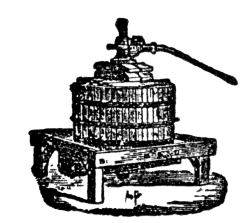
THE WINE PRESS AND THE CELLAR.
The first step in wine making proper, is the gathering of the grapes,
or “picking,” as it is usually termed in California.
Utensils for Picking.—Knives, scissors, and pruning shears
are used to cut the stems, and every one will adopt the tool that he
finds most convenient in practice; but if the berries are inclined to
drop off, scissors or pruning shears are preferable. Some authors give
minute descriptions of receptacles of various sizes and forms in which
to gather the grapes, but the practice in that respect usually followed
in this State will be found the most convenient. The grapes here are
generally picked directly into boxes holding about fifty pounds. The
box is provided with an oblong hole at each end near the top, or three
or four holes bored with an inch auger, by which the picker can easily
move it from vine to vine, and one man can carry it with both hands
to the wagon. These boxes are piled on the wagon without emptying,
transported to the wine house, and brought back empty, to be filled again.
Number of Pickers necessary—When to Commence.—There ought to
be a sufficient number of men employed in picking to fill at least one
fermenting vat in a day, in making red wine. If, however, circumstances
render this impossible, it would be well to pile up the grapes on a
good clean floor, under cover, till sufficient are gathered to fill the
tank, and then crush them, and fill the tank in one day. (See Red
Wine.) Picking ought to commence as soon as the grapes are of a
fair average ripeness, beginning with the earliest and ending with the
latest variety. In the chapter on musts, we shall endeavor to indicate
the requisite maturity of the grapes, and it will there appear that
they may become too ripe by remaining too long on the vine, so that
it is very important that a sufficient number of pickers should be
employed to finish the gathering as promptly as possible, and before
too much sugar is developed. (See Musts.)
When to Gather.—It is of little importance at what time of the
day the grapes are picked, whether in the cool of the morning or the
heat of mid-day, or whether the dew is on or off, as long as they are
ripe. In some countries, however, and in what are known as bad years,
the grapes do not arrive at complete maturity, and therefore great care
is taken to gather them only in dry weather, and after the dew has
disappeared. (See Fermentation—Temperature.) If they are picked during the heat of the day,
fermentation will commence sooner than if picked in the cool of the
morning; and for this reason, in making white wine from colored grapes,
care should be taken to pick and press them when cool, if it is
desired that the wine should be free from color; for if the slightest
fermentation sets in before pressing, as it is apt to do if the grapes
are warm, some of the coloring matter is pretty sure to be extracted
from the skins and will discolor the wine.
Successive Gathering.—It is sometimes recommended that the
grapes should be gathered as they ripen, by going over a vineyard two
or three times, and picking off not only the bunches that are ripe,
leaving the green ones, but even picking off separately three or four
grapes from each bunch where it is not evenly ripened, and this is
the practice that is followed to-day in making the great white wines
of France and Germany; but it certainly will not be adopted in this
State while labor is as dear, and wine is as cheap as it is at present.
Instead, that practice will be followed which is recommended by those
writers who advise that the grapes of each variety be left on the vines
till they are all fairly ripe, and that they be gathered clean at one
picking. Where, however, different varieties are planted in the same
vineyard, which ripen at different periods, those only should be picked
at the same time which ripen together. Gather the early ones first, and
the later ones successively as they ripen, but pick clean. The same
rule also applies to grapes of the same variety, but grown on different
soils and in different situations, as it is well known that the same
variety of vine will ripen its grapes on high land and poor soil,
earlier than on low land and rich soil.
Sorting the Grapes.—It will frequently happen, however, that
there are some bunches of green grapes, and they should always be
thrown aside, if picked with the others. Sometimes, also, there is
what is called a second crop, which ripens so much later than the
main one that two gatherings are necessary. In that case it would be
injurious to the grapes of the earlier crop to leave them on the vine
till the complete maturity of those of the second. Careful wine makers,
therefore, will find it to their advantage, either to leave the green
grapes upon the vines for a second picking, or, if all are picked
together, to throw the green ones into a separate receptacle, or to
sort them out from the ripe ones before crushing. Those who wish to
take extra care will even have the unripe, rotten, and dried berries
clipped from the bunches with scissors. These extra precautions are
those which are observed in making the great wines of Europe; but they
are not suggested here in the expectation that they will be generally
followed by the wine makers of California, but rather for the purpose
of indicating the best practices to those who may find out that on
account of the varieties they cultivate, and of the situation and soil
of their vineyards, they too can produce such wines by using the same care.
Requisite Degree of Maturity.—It is insisted by all intelligent
writers on the subject, that, with possible exceptions, which will be
mentioned, the grapes should not be gathered till they have arrived
at a state of complete maturity. Without this, wines from the finest
varieties of grapes would not possess that beauty of color, that
delicious flavor, that fragrant bouquet, and that alcoholic strength
which they possess in so eminent a degree. And if it is so necessary
that the grapes of fine varieties should be thoroughly ripe, it is
quite as important that those of the poorer varieties should be equally
so. For these latter are generally wanting in sugar, and consequently
their wines are feeble in strength, and as the sugar increases directly
with the degree of maturity of the grape, so the quantity of alcohol in
their wines increases accordingly, and thus by ripeness they make up
for their natural defects.
Signs of Ripeness.—Complete maturity of the grape is indicated
by the concurrence of the following signs:
1. The stem of the bunch changes from green to brown.
2. The bunch becomes pendant.
3. The berry has lost its firmness; the skin has become thin and
translucent.
4. The berries are easily separated from the stem.
5. The juice of the grape has acquired an agreeable flavor; has
become sweet, thick, and glutinous.
6. The seeds have become void of glutinous substances.
These are the signs given by several French authors, and are here
taken from Prof. Du Breuil, who says, nevertheless, that, under some
circumstances the grapes should be gathered before arriving at the
state of maturity indicated by these signs, and under other conditions
should be gathered even later. He says:
Gathering before Complete Maturity.—1. In certain localities
north of the viticultural region the grape hardly ever arrives at the
degree of maturity just indicated. Yet the crop must be gathered, or
otherwise it would rot on the vines. Under these circumstances, the
only thing that can be done is to leave the grapes on the vine as long
as they derive any benefit from it.
2. Grapes intended to make sparkling wine should also be gathered
before the moment of absolute maturity.
3. In the southern part of France, white grapes intended for the making
of dry wines, ought to be picked before reaching the last degree of
maturity. Otherwise, in that hot climate, the quantity of sugar in the
grape would increase to such an extent that it would be impossible to
make a dry wine. This is the practice in making the dry white wines of
Lunel, of Coudrieux, of the Hermitage, and of Saint Peray.
4. For all the ordinary red wines of the region inhabited by the
olive, if the gathering of the grapes is delayed till the last degree
of ripeness, the must will contain more sugar than can be transformed
into alcohol by fermentation. The result will be that these wines
will undergo a sort of continuous fermentation, which will make its
appearance whenever they are moved, and which will soon change into
acetic fermentation. The only way to cure this tendency and to render
the wines capable of shipment, is to strongly fortify them by the
addition of spirits. To prevent this difficulty in the first place, the
grapes should be gathered before complete maturity.
Some very respectable authors, whose experience has been confined to
the colder wine making regions, tell us that in all cases the grapes
should be allowed to remain on the vine as long as they gain in sugar,
and that in order to correct the excess that they would thus in many
cases acquire, they recommend that the must be reduced by water.
(See Watering Musts.)
Gathering after Complete Maturity.—To make sweet wines, the
grapes should remain on the vine until they have developed the greatest
possible quantity of sugar. For this purpose the grapes are not only
allowed to shrivel before gathering, but also artificial means are
resorted to, such as twisting the stem, or drying them on straw after
picking, and even applying heat to them in various ways.
(See Sweet Wines.)
Ripeness according to Required Strength.—If the wine maker will
first determine how strong in alcohol he wishes his wines to be, he
may anticipate the result approximately by testing from time to time
the amount of sugar contained in the grapes, and by gathering them
at the period when the sugar in the juice shows that, fermented, it
will produce the desired percentage of spirit. This testing is easily
performed by the use of the must-scale or the saccharometer; and for
information on this subject, the reader is referred to the chapter on
musts.
CHAPTER II. MUST. — TESTING FOR SUGAR.
Must is the name applied to the juice of the grape before fermentation.
Composition.—A good, average must, contains in 100 parts by
weight, the following ingredients, and in the proportions as indicated,
by weight, according to Dr. Guyot; but the amount of sugar would be
considered too small in California:
Pure water,
78
Grape sugar (glucose),
20
Free acids (tartaric, tannic, etc.),
00.25
Salts, or organic acids (bitartrate),
1.50
Mineral salts,
0.20
Nitrogenous, fermentive matter,
.05
Essential oils,
Mucilaginous and starchy substances,
These constituents vary, however, according to variety of grape,
degree of maturity, soil, climate, etc.; and some of them may rise in
amount to double the average quantity given, or may even, under some
circumstances, descend to the one-fourth of it. Although all these
ingredients doubtless have important effects upon the quality of the
wine produced by fermentation, the acid giving zest and freshness of
taste, and the other minor ingredients, smoothness or harshness, as
the case may be, yet the principal one that we have to deal with is
the sugar, and it is the only one that the practical wine maker will
give much attention to, although in those countries where the grape in
some seasons does not ripen, the amount of acid is an important element
to be taken into consideration in testing the specific gravity of the
must. (See Composition of Wines,
for further details.)
Grape Sugar, or glucose, as it is known in chemical language,
as already remarked, is the most important element entering into the
composition of must, and upon its quantity depends directly the amount
of alcohol contained in the wine. The intelligent wine maker, then, who
wishes to know what will be the alcoholic strength of the wine produced
by the must which he is about to subject to the action of fermentation,
will test the must to ascertain what percentage of sugar it contains.
This is very easily done by the use of an instrument prepared for the
purpose.
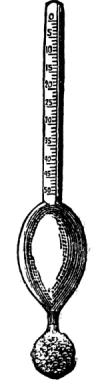
Fig. 1.
Hydrometer.
Must-Scale.—A certain quantity of sugar being heavier than
the same volume of water—pure cane sugar weighing about one and
six-tenths to one of water—it follows that the more sugar there is
added to a given quantity of water the heavier it becomes, and the
more it will bear up anything floating on it; or, as it is generally
stated, the less of the liquid will be displaced by the floating body.
On this principle, the specific gravity of liquids, or their weight as
compared with water, is ascertained. The instrument employed is known
by the general name of areometer, but it is now more commonly called
a hydrometer, and various specific names are given to it according to
the uses for which it is intended. When constructed for testing the
strength of sugar syrups it is called a syrup-scale, saccharometer,
pèse-sirop, etc., and those especially for testing musts are
called must-scales, pèse-moût, etc. These latter are constructed
on the theory that the liquid contains only cane sugar and water—the
difference in specific gravity between cane sugar and grape sugar being
disregarded—and that its density depends on the quantity of sugar;
and although the density of must is somewhat affected by other solid
matters than sugar contained in it, yet these instruments, whether
syrup-scales or must-scales proper, will give results sufficiently
accurate for the purposes of the wine maker, a small allowance being
made for the other solids, as hereafter mentioned. There are three
instruments which are the most generally used in this country:
Oechsle’s must-scale, Balling’s saccharometer or syrup-scale, and
Baumé’s syrup-scale, or pèse-sirop. The degrees of Oechsle’s
instrument indicate specific gravity in the manner mentioned under
Table I; Balling’s indicates percentages of sugar directly; and Baumé’s
degrees are arbitrary. (See Tables II and III.)
There are other instruments used in France—the gleuco-œnometer, reading upwards
for spirit and down for sugar on the same stem, corresponding in degrees to
Baumé’s—and the gleucometer, which indicates at once the percentage
of alcohol which the wine will contain after fermentation. Baumé’s and
Balling’s instruments are better suited for use in California, where
the musts often show a specific gravity higher than is indicated by
Oechsle’s scale, which frequently is graduated only up to 80 deg.,
or 19.75 per cent. of sugar. They are all made on the same general
plan, and are usually constructed of glass. The instrument consists
of a tube about the size of a pipe-stem, terminating below in a bulb
or expansion, weighted at the bottom so that it will stand upright
and float when placed in a liquid. The scale is marked on the stem,
commencing at the top and numbering downward. The first mark is zero,
and shows how far the hydrometer sinks in pure water. (Fig. 1.)
As hydrometers are not always accurate, it is safer before using one to
have it tested by a chemist or a gauger, as but few others have the
necessary skill or the instruments requisite for that purpose. If,
however, an instrument which has been tested is accessible, another one
can be easily compared with that by ascertaining if both sink to the
same point in the same sugar solutions.
Any person, provided with one of the hydrometers mentioned, can easily
ascertain the percentage of sugar contained in any must with tolerable
accuracy, providing the grapes from which it is pressed are ripe; for
if they are green, and contain an undue amount of acid, the density
will be materially affected by that. There is no occasion, however, for
making wine from green grapes in this State.
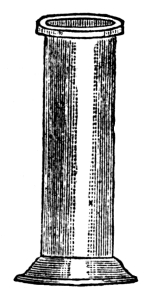
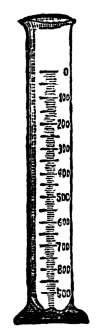
Fig. 2.
Hydrometer-Jar.
In addition to the hydrometer, it is necessary to be provided with
a thermometer with which to ascertain the temperature of the must.
Besides the hydrometer and the thermometer, the only other article
necessary is a glass tube closed at the bottom and provided with a
foot, so that it will stand upright, called the hydrometer-jar. (Fig. 2.)
This jar should have a diameter a little greater than that of the
bulb of the hydrometer, and must be of such a height that the latter
instrument will stand upright and float freely in it, when filled
with a liquid. In the absence of the hydrometer-jar, an empty fruit
jar, or a tall tin cup or can will answer its purpose. In performing
the operation, see that all the articles used are perfectly clean,
more particularly the hydrometer, for anything that would slightly
affect its weight would render the result of the test useless. Having
taken this precaution, press the juice from a small quantity of
grapes and strain it through a cloth, and pour sufficient into the
hydrometer-jar, that when the hydrometer is plunged into it, it will
just bring the level of the liquid to the upper edge of the vessel, or
to such a height that the figure on the stem can easily be read. Now
place the thermometer in the must and ascertain its temperature, for
the instruments are intended to be used at a certain degree of heat,
although three or four degrees variation either way will not materially
affect the result. Baumé’s instrument, as originally constructed,
was graduated for a temperature of 10° Reamur, which corresponds
with 54½° F.; but as constructed now-a-days, is generally graduated
for a temperature of 58° or 60° F.; and Balling’s and Oechsle’s for
a temperature of 63½° F. Some of Balling’s instruments sold in the
market are graduated for 62° F. If it is found that the temperature is
above or below the degree indicated, it may be lowered by cooling, or
raised by warming, till about the right temperature is reached. Then
the hydrometer, being clean, should be taken by the stem at the top and
gradually lowered into the must until it floats. Press it down slightly
with the finger and let it come to equilibrium, being careful that there
is not a drop of water on the stem above the surface of the liquid,
nor a bubble of air below. On looking at the stem where it meets the
surface, it will be seen that the liquid there curves upwards around
the instrument, and that the top of this curve marks one degree higher
than the general surface. If the reading is taken from the point marked
by the top of the curve (the figures reading downwards), add one
degree, or in other words, ascertain the mark on the stem corresponding
to the general surface of the liquid. If Balling’s scale is used,
the number at this mark shows the percentage of sugar which the must
contains; if Baumé’s is used, consult Table II or III, and opposite
this number will be found the corresponding per cent. of sugar. If
Oechsle’s scale is used, find from Table I or II the specific gravity
and the corresponding sugar per cent. Under Table I instructions will
be found for reading Oechsle’s scale. If Baumé’s instrument is used,
and a table is not at hand, multiply the observed figure by 1.8, and
the product will be nearly the per cent. of sugar.
Correction for Temperature.—It is known that a sugar solution
or a must expands as the temperature increases, and contracts as it
diminishes; and nice experiments have been performed to show the
amount of dilatation and contraction at different temperatures, and
the consequent variation in the specific gravity of the liquid, but
there is considerable difference in the results of the researches of
different authors, and it would seem that further experiments are
necessary; but a rule may be deduced which may be used instead of
changing the temperature of the must to make it correspond with that
for which the instrument is graduated, and although not strictly
correct, is sufficient for our purpose; and that is to add one-half per
cent. to the sugar per cent. indicated by the hydrometer for every 15°
F. above the standard temperature, and subtract ½ per cent. for every
15° below. For instance, if Baumé’s instrument shows 22½ per cent. of
sugar at 75° F., the actual strength is 23 per cent., and it would mark
that at 60°. If the same instrument shows 23½ per cent. at 45° F., the
real strength is 23 per cent. In using Balling’s scale graduated at
63½° F., the 15° in our example would make 78½° for the first supposed
case, and 48½° for the second.
In most cases the variation in temperature will be so little that it
may be disregarded; but if the test is made soon after the grapes have
been exposed to a hot sun, the must may show a temperature of 90° or
95° F., and it would indicate one per cent. less than its real sugar
strength. But the temperature would go below the freezing point of
water before the must would mark one per cent. too much.
As the must contains a small quantity of acids and extractive matter
which affect its density, some authors recommend that from one-tenth to
one-fifteenth of the figures indicating the density by Baumé should be
deducted, calling the remainder sugar, and this is about equivalent to
deducting one for every twelve per cent. of sugar. But if the grapes
are ripe and the must is strained, for all practical purposes all of
the solid matter may be called sugar, considering that we make a pretty
liberal allowance of sugar for one per cent. of alcohol. Fresh must
should always be taken for the purpose of testing for sugar, for as
alcohol is much lighter than water, if fermentation has commenced, it
will be impossible to ascertain the amount of sugar by means of the
hydrometer.
Sugar and Alcohol.—It will be shown in the chapter on
fermentation that, in actual practice, it takes about two per cent.
of sugar, as indicated by the hydrometer, to produce one per cent. by
volume of alcohol; therefore, divide the percentage of sugar contained
in the must, as shown by the hydrometer, by two, and the quotient is
approximately the per cent. of alcohol which will be contained in the
wine after complete fermentation.
Alcohol in Wine.—A good, saleable dry wine ought to contain
from eleven to twelve or thirteen per cent. of alcohol; and to produce
such a wine the must should indicate from 22 to 26 per cent. of sugar
by the hydrometer. A wine which is soon to be consumed at home does not
require that degree of strength necessary for shipment abroad and for
keeping, and may contain only ten per cent. of alcohol, and even less,
and be found a very palatable drink, and less “heady” than that of a
higher degree of spirit. And a wine may contain as much as 14 per cent.
of spirit, and be very acceptable to the wine merchant for mixing with
weaker wines.
A must which does not contain more than 24 per cent. of sugar per
hydrometer, if properly managed, will complete its fermentation, and if
it does not contain less than 22 per cent., will make a good, sound,
shipping wine, which will keep in almost any climate. Mr. Crabb, a
well known wine maker of Oakville, in this State, writes me that such
a must will ferment dry in six days, but that if it contains more
than 24 per cent. of sugar, fermentation is likely to be arrested by
the amount of alcohol, when it amounts to 12 per cent. This gentleman
is an intelligent viniculturist and a practical man, and it would be
safe to follow his advice. Mr. Arpad Haraszthy, who is noted in this
connection, in his lecture on fermentation before the convention of
wine growers, held at San Francisco in September, 1882, indicated 22
per cent. as a proper degree of sugar in the must; and it is reported
that the wine makers of Los Angeles county, in fixing the prices of
grapes in 1882, adopted 23 per cent. as the standard. Undoubtedly the
fermentation will be finished sooner, and will be less troublesome, if
the must contains sugar within the limits of 22 and 24 per cent., than
if allowed to go beyond. (See Maturity.)
If it should go to 26 per cent. and beyond, the chances are that the
fermentation will be incomplete, and that a portion of the sugar will
remain in the wine, which will cause it to ferment when exposed to
changes of temperature; it may become milk sour, and there will
be danger of rapid deterioration. From which it follows that, except
for making sweet wines, the grapes should be gathered before they
develop much more than 24 per cent. of sugar. Supposing, however, that
picking commences as soon as the must shows 22 per cent., sufficient
force should be employed to finish before it goes beyond the limit
indicated. For the writer has seen grapes gathered at the beginning of
the season and made into wine which showed 11 per cent. of alcohol,
when the wine made from grapes of the same vineyard, gathered too late,
either on account of lack of pickers or of fermenting tanks, contained
14.5 per cent., and was still sweet.
CHAPTER III. SUGARING AND WATERING MUST.
Sugaring.—As early as 1776, Macquer, in France, found that
by adding sugar to the must of green grapes, he could make wine; and
since his time many authors, notably Chaptal, Gall, and Petiot, have
recommended the addition of sugar to the must of bad years when the
grapes did not ripen; and had the practice been limited to the addition
of sufficient sugar of good quality to a must which was deficient in
that respect, but little harm would have been done. The next step,
however, was to take the must of partly ripe grapes which contained
an undue quantity of acid, and reduce it by the addition of water
till the acid corresponded in quantity to that contained in a must of
ripe grapes, and then to add sufficient sugar to bring it up again to
the necessary degree of sweetness. This may be permissible in those
countries where in some years the grapes do not ripen, and in order
to make a drinkable wine, water to reduce the acid, and sugar to give
sweetness, must be added. But this did not satisfy the greed of the
artificial wine makers; they found, so they say, that they could press
the juice from the grapes, ferment it by itself, then add to the marc
water and sugar enough to bring it back to its original quantity and
sugar strength, draw off the artificial juice slightly colored by the
skins, and repeat the operation, and so make three and four times the
quantity of wine that could otherwise be made, and all good wine.
It was thought that wine making in Europe would be revolutionized,
and untold wealth would pour into the coffers of the wine makers. It
was found, however, that cane sugar was too expensive, but artificial
glucose could be made from grain and potatoes at a very small cost,
and by reason of its cheapness its use was forthwith recommended; and
to such an extent was the matter carried, that one would suppose that
in order to make good wine, it was only necessary to soak a few grape
skins in a quantity of sweetened water and let it ferment!
The practice, however, to the extent mentioned, did not commend itself
to sensible men, and wine making did not become revolutionized. Yet it
was to some extent adopted, and the effect upon the wines of Burgundy
is shown by Dubrunfaut in his work on Sucrage de Moûts. He says
that starch-sugar (glucose) factories were established in Burgundy, and
from 1825 to 1845, this material was used to strengthen the musts. But
complaints arose in France and elsewhere against Burgundy wines; they
had a new flavor, and unexpected changes in many respects had come over
them. A congress of wine makers was held at Dijon in 1845, at which
the abandonment of the use of glucose was decreed upon the report of a
committee of merchants and proprietors of Beaune, which was in effect
as follows: that the long extolled and generally practiced system of
sugaring, and against which a reaction set in some years ago, ought to
be completely abandoned, as being fatal (funeste) to Burgundy.
He considers, however, as do some others who condemn the use of
glucose, that the use of refined cane sugar is unobjectionable if used
in small quantities and merely to fortify the must when it needs it.
There are many authors, however, who speak highly of the wines produced
by the addition of sugar and water to the skins after the juice has
been drawn off, but it does not seem reasonable that a good wine can
be made in that manner. If a good must contained only water, sugar,
and acids, then there would be reason for believing that the wine so
made would be good. But it is well known that many other ingredients
enter into the composition of the juice of the grape which, in some
unknown manner, have a very important influence upon the wine made from
it. Attempts have been made to produce an artificial must, which is
carrying the process but little farther than it is carried by some of
the writers on the subject; but Mr. Boireau says that what is produced
resembles cider rather than wine. He gives the following composition as
approaching very nearly a must for common white wine:
Refined Sugar,
25
kilog.
Tincture of tannin,
20
gr.
Crystals of tartaric acid,
500
gr.
Gum arabic,
1
kilog.
Vine leaves and fresh twigs chopped,
5
kilog.
Distilled or filtered water,
1
hectol.
The author last quoted is a practical man, and his opinion is valuable.
He says, when the fermentation of this artificial must is most active,
it has analogies with ordinary white wine, but it costs much more than
the natural wine; and when its fermentation is complete, it has not a
bad taste, and there is nothing hurtful in its composition, but that
it has not the taste of white wine; and the only time when it
has any analogy to white wine is during the tumultuous fermentation as
already mentioned. Many attempts have been made to vary the formula,
but without important results. Tolerably agreeable drinks are obtained,
but they are not wine. M. Boussingault gives his experience in
sugaring and watering must; and the wine produced lacked acid, color,
astringency, and was very inferior to the wine first made from the pure
juice; it lacked the fixed substances and aromatic principles. He says
that some would prefer it to cider, but that it only differed from
piquette in having a greater degree of alcohol.
To give even a summary of what has been written upon this subject would
occupy a volume, but the results arrived at by the more intelligent
modern writers and experimenters may be summed up as follows:
1. That good wine can be made only from the pure juice of the
grape.
2. That in case the grapes do not ripen sufficiently to make a
drinkable wine, water may be added to reduce the acid, and then sugar
enough to bring it up to the average sugar strength; but in no case
should any but the refined cane sugar be used; artificial glucose, never.
Nothing gained by adding Sugar.—Aside from the question of
quality, it may not be amiss to add a few remarks for the benefit of
intended wine makers who may have been led to believe, by mistaken
authors, that the profits of wine making may be increased by adding
sugar and water, and thereby augmenting the quantity. Assuming that it
is permissible to use only refined sugar, it can easily be shown that
it is as cheap, if not cheaper, to make wine from grapes than from
sugar, as long as grapes can be bought for $30 per ton.
A gallon of dry wine of average specific gravity, containing 10 per
cent. by weight, or 12.4 by volume, of alcohol, weighs about 8¼ pounds,
and contains about .825 of a pound of pure alcohol. To produce a pound
of alcohol requires about 2¼ lbs. of pure grape sugar, or 2.138 lbs. of
pure cane sugar, in practice, according to the chapter on fermentation;
so that to produce the .825 lbs. of alcohol in one gallon of wine,
requires about 1.80 lbs. of pure cane sugar. But refined crystalized
sugar is not pure sugar (anhydrous), as it contains about 10 per
cent. of water; so, to make our 1.8 of pure sugar, requires 2 lbs. of
ordinary refined sugar. At 10 cents per pound, which would be cheap for
this market, it would cost 20 cents to make the must for a gallon of wine.
Supposing that a ton of grapes costs $30, and produces 150 gallons of
wine, each gallon would cost 20 cents. So that there is nothing to be
gained by adding sugar at 10 cents a pound, even if a ton of grapes
costs $30 a ton, for the same facts would apply to every pound of sugar
added to a must, as well as in the case supposed, where all the sugar
was supplied.
Cost of Glucose Wine.—Supposing that artificial glucose
contains 80 per cent. of pure (anhydrous) sugar, it would require 2⅓
lbs. to make our gallon of wine; and if it could be laid down here at 5
cents a pound, the gallon of wine would cost nearly 12 cents, and this
would be equivalent to paying $18 a ton for grapes.
When we take into consideration that every pound of glucose and
water added to a must will diminish the price of every gallon of
wine produced, it is probable that but little, if anything, could be
gained even by the use of this article; for the product will not bring
the price of an honest wine, and in the long run will destroy the
reputation of our wines, and reflect injury upon every wine maker in
the State.
Experiment with Glucose.—Mr. Crabb, of Oakville, gave his
experience with glucose in a paper read before the St. Helena
Vinicultural Club, in July, 1882, as follows: I took three packages of
equal size, one containing pure grape juice, the two others containing
each equal parts of the same juice and glucose water, all showing 23
per cent. sugar by Balling’s saccharometer. The pure juice was dry in
15 days (the room being cold). One package of the mixture was dry in 30
days; the other continued in fermentation 60 days, both emitting a rank
offensive odor during the process, arising from the amount of chalk
and sulphuric acid required in its (glucose) manufacture. Racking at
this time appeared to remove the greater part of the offensive odor,
and in 30 days the wine was clear and bright enough to pass for a
two-years’-old wine. I now thought it contained a very superior fining
principle, and if a small enough quantity would answer the purpose,
it might be a valuable acquisition. But this was its most favorable
period; it had reached its zenith, and while the pure juice was now
beginning to develop its vinous properties, the mixture commenced to
deteriorate, becoming flat and insipid, as any grape juice would by
being one-half water, and the sulphuric acid and chalk (sulphate of
lime) developing a disagreeable after-taste. Notwithstanding that
I have racked it again and fined it to a perfect condition, there
is not the least improvement, and I believe as it becomes more dry
with age, that the bitter, nauseous after-taste will become more and
more pronounced, so that one glass of it will leave such a lasting
impression on the palate as to never want any more; whereas, the
package of pure juice is now vinous, sprightly, refreshing and inviting.
The use of Glucose condemned.—On the 16th day of July, 1881,
the St. Helena Vinicultural Association adopted resolutions condemning
in the strongest terms the use of glucose in the making of wine and
brandy, and promising to expose all parties importing or receiving the
substance by publishing their names, and pledging the Society to use
all honorable means to prevent the adulteration of the product of our
vineyards. The resolutions passed unanimously, and were published in
the different newspapers. One man in the district, notwithstanding the
warning, did cause to be shipped to him a quantity of glucose, and the
President and Secretary of the Society published in several different
newspapers, in December, 1881, over their own signatures, and in the
name of the Association, a notice reciting the resolutions, and stating
that a person (giving his name) “imported eighty barrels of grape
sugar, made from corn, commonly called glucose, and used the same, or
the greater part of it, in the manufacture of wine during the last vintage.”
We believe that this was an exceptional case, and that its use in this
State has been exceedingly rare.
Watering.—Another question which has been a good deal discussed
is, whether it is better to pick the grapes as soon as they develop
sufficient sugar, or leave them on the vine till they develop an
excess, and then reduce the must with water. Dr. Guyot having laid it
down as a fundamental principle in wine making in France, that the
grapes should be left on the vine as late as possible, and until they
have reached the highest point of maturity, except, perhaps,
in some of the most extreme southern portions, he is consistent in
counseling the addition of water to the must. But the only reason
given by him for it is that it is consonant with his principle
previously stated. Du Breuil is also of the same opinion. Both are
men of high authority, but it does not appear that either of them
ever made wine in a warm climate, where the grapes would develop so
much sugar as to require the addition of water, if left upon the vine
as late as possible. We have, on the other hand, the testimony of
Boireau, who, speaking on the subject, says that it is probable that
the theoreticians who are in favor of the practice have never made wine
of must too rich in sugar and of water. He says, it is true that
the quantity is increased, and fermentation is complete, but that the
wine so made is only fit for the still, will not keep and readily turns
sour. The Greeks have followed this practice from time immemorial in
the Archipelago, where he tasted their wine so made in 1865, and which
they can keep with difficulty for one year, in spite of the addition of
a large quantity of rosin, which they introduce during fermentation.
And yet, these wines are not weak, having an average of 10½ to 11 per
cent. of alcohol. He says that but few grapes give musts too rich in
sugar, if they are gathered as soon as ripe; for even in viticultural
countries situated farthest south, as the south of France, Spain,
Italy, Greece, and Africa, the grape just ripe gives a must
which does not exceed 14° Baumé, unless left on the vine until part of
the water of vegetation has evaporated.
Having alluded to both sides of the question, it would seem to be
a fair inference from the foregoing that the safest course would be,
in a hot climate, to gather the grapes as soon as fairly ripe. This
may easily be done, where each grape grower makes his own wine, and
has immediate supervision of the picking, and has sufficient men to
finish it with promptness. But in the case of large manufacturers who
buy their grapes and cannot supervise or order the gathering in the
numerous vineyards whose crops they purchase, it may sometimes be
necessary, when the grapes come in overripe, and it is not desirable to
make sweet wine, to add a small quantity of water to insure prompt and
complete fermentation. When the necessity arises, great caution should
be used, and the necessity should be avoided when possible.
CHAPTER IV. STEMMING AND CRUSHING.
Diversity of Opinion on Stemming.—There is no subject connected
with wine making upon which there is a greater difference of opinion
than that of stemming. And it would seem that the diversity of practice
is not always caused by the different conditions and exigencies of
location, variety of grapes, etc.; but among the different wine makers
in the same locality, some remove the stems, and others do not; from
which Dr. Guyot infers that the practice cannot be classed among the
essential principles governing vinification, but is a mere matter
of detail, and that stemming may be practiced or omitted without
materially affecting the wine. But Machard, a writer of the Jura, lays
it down imperiously as one of the very essentials of good wine making
that the grapes should be fermented with the stems, and calls stemming
a pernicious practice.
Effect of Stemming.—All agree, however, that the stems, during
fermentation, if not removed, yield tannin to the wine, and thereby
give it astringency. It is also said to increase fermentation, by
furnishing to the must additional germs of fermentation adhering to
the stems, and perhaps acting also in a mechanical way, by presenting
many salient points, and exposing a greater surface to the action of
the ferment.[1]
They also add a certain amount of acid to the wine, if green. It is
evident that they increase the labor of pressing, by adding to the
mass of marc.
Proper Practice.—If, therefore, by reason of the variety of
grapes cultivated, or the soil, or situation, your wine is too soft,
lacks life and astringency, ferment with all or a portion of the stems;
but if your wine is rough, too astringent, it will be found beneficial
to stem the grapes. If your grapes lack the fermentive principle, and
fermentation is slow and incomplete, leave the grapes on the stem; and
in the same way the fermentation will be assisted, if the grapes are
overripe.
When the grapes are fermented with the stems, care must be taken that
they do not remain too long in the vat, or the wine may acquire a
bitter, disagreeable flavor, called by the French goût de râpe,
or stem flavor, which is caused by the bitter principle contained
therein, and which is dissolved out by maceration.
To Estimate Tannin.—A certain amount of tannin is necessary to
the proper clearing of the wine, which is brought about by the tannin
combining with albuminous matters, and they are then precipitated, and
the wine may be drawn off, leaving them at the bottom of the cask. It
is on the application of this well known principle that Maumené gives a
very simple method of ascertaining whether the grapes should be stemmed
or not. He says: First make a small quantity of wine without the stems,
and add tannin, or, what is better, a decoction made by boiling a
quantity of stems, and if sensible precipitation is produced, it is
better to ferment with the stems, for tannin is wanting; but if the
precipitation is not formed, the grapes should be stemmed.
Fig. 3.
Wooden Stemmer.
Stemmers.—This is usually effected in California by the use of
the common hand stemmer, though some large establishments are using a
stemmer run by steam or horse-power. The common stemmer consists of an
oblong shallow box or frame, six or eight feet long by two wide, or any
convenient size, and about six inches deep, with a coarse wire netting
or grating stretched across the bottom. This grating is usually made of
heavy galvanized iron wire, with ¾ inch or inch meshes. Instead of
having the grating extend the whole length, a portion at one end may
be floored with wood, upon which a box of grapes can be placed without
injuring the grating. The only objection to this stemmer is that the
grape juice comes in contact with the metal of the grating, and it is
a well known fact that nearly, if not all, of the baser metals are
corroded by the acids; it would be better to replace the wire with a
wooden grating, as in France (Fig. 3.).
How to Remove the Stems.—The grapes are dumped from the boxes
directly into the stemmer, and the workman seizes as many as he can
easily manage with both hands, and rubs and rolls them to and fro upon
the wire grating, and the berries, as they are rubbed off, fall through
the meshes, and the stems remain in the hand. The few grapes that may
remain are removed by raising the mass of stems and forcibly throwing
them two or three times upon the grating. Sometimes the stems, with the
few grapes clinging to them, are turned over to another workman, who,
with a hay fork, tosses them about upon another grating till all the
berries are removed. The stemmer ought to be situated over the hopper
of the crusher, so that the grapes will fall directly into it, as they
are separated from the stems.
Crushing.—It is generally considered essential to crush the
grapes whether stemmed or not, although in some special cases, to be
hereafter noted, crushing is omitted.
Methods of Crushing.—It is well known that in Europe the grapes
are usually crushed by being trodden with the feet of men, usually
barefooted, but sometimes in wooden shoes, and many of the best writers
of to-day are of the opinion that the wine is better when the grapes
have been well trodden with the bare feet, for by thoroughly rubbing
the skins and pounding them into a pulp without breaking the seeds,
they think that more color and aroma are developed than can be obtained
by simply crushing them, as in a machine, and afterwards fermenting.
Although the practice of treading is the more common one in Europe,
yet there are exceptions, and in some places the crushing is done by
rollers and with satisfactory results. In California we are accustomed
to regard the treading of grapes as an antiquated practice, and a relic
of a past age, and it is almost universally discarded, being practiced
only occasionally and by Europeans, who have not yet wholly fallen into
our methods of practice. Those who are fastidious in this matter may
rest assured, that if they will drink California wine, they run but
very small risk of imbibing a liquid which a man has had his feet in.
Aerating the Must.—There seems to be some confusion on this
subject, for some claim that the must is better exposed to the air, and
prepared for fermentation, by treading. This may be true of treading
in the vat during fermentation, but simply treading the grapes to
crush them does not aerate the must as much as crushing with rollers,
for in the latter case the juice falls through a considerable distance
in a finely divided form, which thoroughly exposes it to the air.
Fig. 4.
Crusher.
Crushers.—The machine generally employed consists of two
rollers made of wood, iron, or other suitable material, 6 or 8, or
even more, inches in diameter, geared together so that they revolve in
opposite directions and towards each other, and so that the grapes will
be drawn between them from above. The rollers run near each other, but
do not touch, so that the grapes will be crushed, and the seeds remain
unbroken. It is operated by one man turning a crank, either attached to
one of the rollers or to a pinion. Figure 4 represents such
a crusher, except that in the figure the rollers are open-work, instead of solid,
as they should be. It is surmounted by a hopper which allows the grapes
to fall between the rollers as they revolve, and the whole apparatus
should be so placed that the pomace may fall into the fermenting vats,
or be easily conveyed to them or to the press, accordingly as it is to
be made into red or white wine.
Some stemmers have corrugated instead of plain rollers, but there is
no advantage in this, and unless they are very nicely adjusted to the
motion of the cog wheels, they may break the seeds, which is always
considered injurious to the wine.
Rapidity of Operation.—Five men—one to handle the boxes of
grapes, two to stem, standing on opposite sides of the stemmer, one to
operate the crusher, and one to take the stems and remove the remaining
grapes and to make himself generally useful—can stem and crush with
these hand machines twenty tons of grapes per day, enough to make three
thousand gallons of wine. And the work can be done much more rapidly by
the use of the stemmer and crusher combined, which is to some extent
used in the largest establishments.
Special Practice.—Boireau says that it has been observed that
of the Médoc wines, those made without crushing the grapes have less
color than those made from grapes of the same crop which have been
crushed, but that they have a more refined and delicate taste (plus
fins de goût), and that consequently many of the proprietors of
the grands crûs of the Médoc in those years which are favorable
to the maturity of the grape do not crush; they only do it in inferior
years, when the grapes have not become sufficiently ripe, and when they
fear that the wine may not have a suitable color. And in another place
he tells us that in those grand wines which are intended to be bottled,
a superabundance of tannin and its consequent roughness may be avoided
by complete stemming, fermenting the whole berries, and by drawing from
the fermenting vat at just the right time.
CHAPTER V. FERMENTATION—ITS CAUSES. — ALCOHOLIC FERMENTATION IN WINE MAKING.
It is with some hesitancy that I attempt to give a brief summary of
the results of scientific investigation into this subject, for fear of
going beyond the legitimate limits of a practical work, as this book
is intended preëminently for practical men. But as the work would be
incomplete without it, and as a knowledge of the general phenomena of
fermentation, and of the different influences to which it is subject,
are of vast importance to those who will intelligently apply their
principles, I give the following as but a brief resumé, and will
put it as plainly as the subject will permit. Most of the ideas given
below are extracted from Schutzenberger’s work on fermentation.
There are several different kinds of Fermentation, as (1)
vinous, alcoholic or spirituous fermentation; (2) mucous or viscous
fermentation; (3) lactic fermentation; (4) ammoniacal fermentation; (5)
butyric fermentation; (6) putrifaction; and (7) acetic fermentation, or
fermentation by oxidation, and others.
Alcoholic Fermentation is that which sugar undergoes under the
influence of the ferment or yeast; and it is now agreed that this
ferment consists principally of an aggregation of living organisms, or
an assemblage of microscopic cells.
The Yeast Plant.—Our author gives them the name of
saccharomyces cerevisiæ, following those who consider it to be
a species of fungus, and states that it is now very generally admitted
that ferments are fungi, although by some they have been considered
animal in their nature. These cells are round or oval, and are from
.00031 to .00035 of an inch in their greatest diameter. “They are
formed of a thin and elastic membrane of colorless cellulose, and of a
protoplasm, also colorless, sometimes homogeneous, sometimes composed
of small granulations.” The cells are separate or united two by two.
When they are deposited in a fermentable liquid, as a sugar solution or
a must, small prominences are seen to arise at one or rarely two
points, the interior of which is filled with protoplasm from the mother
cell; these prominences grow until they have attained the size of the
original cell, when the base contracts, forming a kind of neck, and
immediately they separate from the mother cell, and under favorable
conditions one cell produces several generations, but by degrees it
loses all its protoplasm, which at last unites in granules swimming in
super-abundant cellular juice. The cell ceases to produce, and dies;
the membrane is ruptured, and the granular contents are diffused in the
liquid. In the manufacture of beer the fermentation is of two kinds:
surface fermentation and sedimentary fermentation, depending upon a
high or a low degree of heat. The surface saccharomyces develop
more rapidly than the others, are larger, and they bud so rapidly that
the cells which issue from each other do not separate, but remain
attached, forming ramified chains of from six to twelve or more buds.
The bubbles of rising gas have a greater hold on these chaplets than
on single cells, which causes the newly formed yeast to rise to the
surface during active fermentation. These organisms or fungi produce
spores which are sown on the surface of fruits, and get into the juice
by crushing, when they commence their reproduction by budding. So
that the basis or cause of the phenomena which we call fermentation
is the growth and reproduction of yeast or ferment, which is made up
principally of the minute organisms just described.
Functions of Yeast.—Yeast is a living organism, belonging to
the family of fungi, genus Saccharomyces, destitute of
mycelium, capable of reproduction, like all the elementary fungi, by
buds and spores. Its composition singularly resembles that of other
vegetable tissues, and especially the plants of the same family. It
does not differ essentially from other elementary cells, unprovided
with chlorophyll.
Normal Conditions of the Life of Yeast.—The conditions which
our author calls normal in the life-history of yeast, are those in
which it develops itself and increases with the greatest activity and
energy. They are of two orders, physical and chemical.
With respect to physical conditions, it is only necessary to
notice the temperature. That most favorable to the nutrition of yeast,
and that which is found advantageous to other cellular vegetable
organisms, is between 25° C. and 35° C. (77° and 95° F.) Above and
below these limits, the vital manifestations do not cease until we
descend below 9° C. (48.2° F.), or rise above 60° C. (140° F.), the
temperature at which albuminoid principles begin to coagulate.
With regard to the chemical conditions, our author says
that the most favorable medium is that which contains the most
appropriate nutritive elements. And as yeast contains water, mineral
salts, especially potassium, magnesium, and calcium phosphates,
therefore water and the alkaline and alkaline-earthy phosphates will
be necessary. We find, besides, a great proportion of nitrogenous
substances, either albuminous or otherwise; and therefore the food of
yeast must contain nitrogen. It is supposed, however, that the cells
are not directly nourished by albuminoids in the juices of fruits, the
wort of beer, or yeast water, but by analogous compounds contained
in them, which have the property of passing by osmose through the
membranes; for the albuminoids themselves, it is said, cannot pass
through. Pasteur has shown by his experiments, that mineral salts are
absolutely necessary to the development and nutrition of the yeast
cell; and Mayer follows him with details as follows: Preparations
of iron, in small quantities, seem to have no influence; in larger
proportions, they are injurious. Potassium phosphate is indispensable,
and the absence of lime has little effect. Magnesium, on the contrary,
appeared to be very useful, if not indispensable. The combinations of
sodium present no material effects.
Sugar is one of the most important elements in the nourishment of the
yeast cells, and Pasteur has shown that, in alcoholic fermentation, a
part of the sugar is fixed in the yeast, in the state of cellulose or
some analogous body, for, when the fermentation is completed, it is
found that more yeast is present than at the commencement. Water is
necessary, and the yeast cell manifests its activity, develops and is
nourished within the limits of 40 and 80 per cent. of water, though
yeast, dried with precaution, may regain its power when moistened. And
the fact that a solution containing over 35 per cent. of sugar will not
ferment, is explained on the theory that such a solution takes from the
cells by osmose a sufficient quantity of water to lower their hydration
below 40 per cent. The cells of the Saccharomyces cerevisiæ,
introduced into a liquid medium, absorb oxygen with great rapidity, and
develop a corresponding quantity of carbon dioxide. This constitutes
respiration, comparable to that of animals. By careful experiments
it has been shown that yeast breathes when placed in contact with
dissolved oxygen, and the respiration is more active than that of
fishes, and it plays as important a part in the life of those minute
vegetable cells as in the higher forms of vegetable and animal life.
Oxygen is furnished by atmospheric air, and fermentation is more rapid
when a large surface of the liquid is exposed, and then the budding is
more active.
Action of various Chemical and Physical Agents.—“It has long
been known that certain chemical compounds, especially those which
coagulate albuminous substances, and disorganize the tissues, or which,
by their presence in sufficient quantities, are incompatible with
life, are opposed to fermentation; such are the acids and alkalies in
suitable proportions, silver nitrate, chlorine, iodine, the soluble
iron, copper, and lead salts, tannin, phenol, creosote, chloroform,
essence of mustard, alcohol when its strength is above 20 per cent.,
hydrocyanic and oxalic acids, even in very small quantities.
“An excess of neutral alkaline salts or sugar acts in the same
manner, by diminishing in the interior of the cell the minimum quantity
of water, which is necessary to the manifestation of its vital
activity.
“The red mercury oxide, calomel, manganese peroxide, the alkaline
sulphites and sulphates, the essences of turpentine and of lemon, etc.,
also interfere with, and destroy alcoholic fermentation.
“Phosphoric and arsenious acids are, on the contrary, inactive.”
Experiments have shown that sparks of electricity passing through
yeast do not modify its power of changing cane sugar into glucose, nor
its activity as an alcoholic ferment. Fermentation is slower in the
dark, and also in a vacuum. Flour of sulphur did not sensibly affect
fermentation, but the carbonic acid evolved contained sulphuretted
hydrogen. Sulphurous acid, however, arrests fermentation. Yeast is
always acid, but an addition of an excess of different acids arrests
the decomposition of sugar. If one hundred times the amount of acid
contained in the yeast is added, fermentation does not take place.
M. Dumas has shown the action of various salts on yeast, but the
subject has little if any interest for the wine maker.
Viscous or Mannitic Fermentation is also excited, according to
Pasteur, by special ferment acting on glucose, transforming it into a
kind of gum or dextrin, mannite, and carbon dioxide. This ferment is
also formed of small globules united as in a necklace, whose diameter
varies from .000047 to .000055 of an inch. These globules, sown in a
saccharine liquid containing nutritive nitrogenous matter and mineral
substances, always give rise to viscous fermentation. One hundred parts
of cane sugar give: mannite, 51.09; gum, 45.48; and carbon dioxide,
6.18. The liquids which are most apt to produce viscous fermentation
can also undergo lactic and butyric fermentation, but in this case the
organized forms of life which are developed in the liquid are of a
different nature. The conditions of action necessary to these gummy and
mannitic ferments are the same as those which suit alcoholic ferment.
The most favorable temperature is 30° C. (86° F.) This fermentation is
what gives rise to the disease of wines, called by the French la
graisse, or ropiness. White wine is more subject to it than red,
and it is generally due to the want of tannin.
(See Ropiness.)
Lactic Fermentation is the transformation which certain sugars,
as sugar of milk and grape sugar, undergo, and by which they are
changed into lactic acid. This takes place in the souring of milk.
The most favorable temperature for it seems to be about 95° F. This
also depends on a special ferment. Sugar solutions are also capable of
butyric fermentation and putrefaction, and we generally
see viscous, lactic, and butyric fermentation appear in succession.
Acetic Fermentation is to the wine maker and wine dealer, after
alcoholic fermentation, the most important.
Fermentable matter and ferment are also concerned in it, but oxygen
also is necessary.
It has long been known that the alcohol contained in fermented liquids,
such as wine, beer, etc., will disappear under certain circumstances,
and give place to vinegar or acetic acid, and that the air, or rather
its oxygen, plays a part in this reaction.
To the chemist the reaction is simple, and is formulated thus:
Alcohol.
Water.
Acetic Acid.
C₂H₆O +
O₂ =
H₂O +
C₂H₄O₂,
or the oxidation may take place by two reactions, with the production
of an intermediate product, aldehyde:
Alcohol.
Aldehyde.
C₂H₆O +
O =
H₂O +
C₂H₄O,
Aldehyde.
Acetic Acid.
C₂H₄O +
O =
C₂H₄O₂
According to Pasteur, the oxidation of
alcohol is the consequence of the action of a ferment or cryptogam,
Mycoderma aceti, and it makes its appearance on the surface of
liquids, while in acetic fermentation, in the form of a continuous
membrane, mother of vinegar, either wrinkled or smooth, which is
generally formed of very minute elongated cells, whose greater diameter
varies from .000059 to .000118 of an inch; these cells are united in
chains, or in the form of curved rods. Multiplication seems to be
effected by the transverse division of the fully developed cells. The
conditions of nutrition are similar to those suitable to the alcoholic
ferment, the hydro-carbon matter being supplied by dilute alcohol. It
may, however, be supplemented by the acetic acid itself; for if the
process is left too long to itself, the vinegar loses its strength by
being consumed. The most favorable temperature is between 76° and 82° F.
Antiseptic agents, which arrest the development of beer yeast, act
in the same manner on the Mycoderma aceti. Sulphurous acid is
especially active in this manner; hence the use of the sulphur match in
sulphuring wine casks.
There is another ferment, Mycoderma vini, or flowers of wine,
which is found in wine and other alcoholic liquids exposed to the
air when fermentation is over or has become languid, which resembles
in many respects the acetic ferment. It has the power of producing
alcoholic fermentation, and is supposed by some to be derived from the
Saccharomyces. Like the Mycoderma aceti, it is developed
on the surface of fermented alcoholic liquors, in the form of smooth
or wrinkled films or membranes, but thicker and more compact. It grows
with great rapidity, and it has been calculated that one cell would,
in forty-eight hours, produce about 35,378 cells. These cells are
of various forms, ovoid, ellipsoidal, and cylindrical, with rounded
extremities. The ovoid cells have their greater diameter about .000236,
and their smaller one, .000157 of an inch. The cylinders have their
diameters .00047 × .000118 in. The nutritive principles are the same
as those of the mother of vinegar: alcohol, salts and nitrogenous
compounds. It also appears capable of utilizing for nutrition the
secondary products of alcoholic fermentation, such as succinic acid and
glycerine. Its development is most active between 61° and 86° F.
(See Sherry.)
Origin of Ferments.—In order to produce the different kinds of
fermentation, the necessary ferment must be added, unless it is already
contained in the fermentable matter or in the air. In the manufacture
of beer and bread, yeast must be used; the other kinds of fermentation,
except alcoholic, can generally be produced by the ferments or their
spores furnished by the atmosphere; but Pasteur, in the course of his
investigations, never produced alcoholic fermentation from spores found
in the air. But the germs of the Saccharomyces cerevisiæ and of
Mycoderma vini seem to be found only on the surface of fruits,
and their stems.[2]
These different germs, however, are all found in the must of grapes,
and in wine, and are ready to develop whenever favorable conditions
offer themselves, and produce diseases in the wine. It is found that
these germs are killed by raising the temperature of the liquid to 140°
F., and hence the process of heating wines to preserve them (which see).
Leaving the germ theory of fermentation, we will pass to what is of
more practical importance.
Vinous or Alcoholic Fermentation transforms the juice of the
grape into wine, and, as already shown, is caused by the yeast or
ferment, which finds its way into the must; and by this fermentation
the sugar of the grape is changed principally into alcohol, and carbon
dioxide, or carbonic acid gas. And in order to show the relations
between the sugar and the alcohol produced, it is necessary to say
something about the chemical constituents of each.
Sugar.—In general terms, cane sugar may be expressed by the
chemical formula, C₁₂H₂₂O₁₁, or, in other words, one molecule contains
12 atoms of carbon, 22 of hydrogen, and 11 of oxygen.
And the general term glucose, or grape sugar, may be expressed by the
formula C₆H₁₂O₁₆, or one molecule contains 6 atoms of carbon, 12 of
hydrogen, and 6 of oxygen.
If, instead of using the word atoms, we use the word pounds, the
chemical formula may be made clear to the unscientific. Taking the
formula for cane sugar, already given, it simply means that 342 pounds
contain the following ingredients, in the following proportions:
lbs.
lbs.
12
parts
carbon, each
weighing
12,
144
22
“
hydrogen,
“
1,
22
11
“
oxygen,
“
16,
176
342
And the formula for glucose means that 180 pounds contain:
lbs.
lbs.
6
parts
of carbon,
@
12,
72
12
“
hydrogen,
“
1,
12
6
“
oxygen,
“
16,
96
180
And the formula for water means that 18 pounds contain:
lbs.
lbs.
2
parts
of hydrogen,
@
1,
2
1
part
“ oxygen,
“
16,
16
18
In fermentation, it is glucose which is immediately transformed,
although cane sugar ferments also; but, before doing so, it becomes
changed or inverted into glucose, and one molecule takes up a molecule
of water, and produces two of glucose, thus:
Cane Sugar.
Water.
Glucose.
C₁₂H₂₂O₁₁
+
H₂O =
2 C₆H₁₂O₆
342
+
18 =
2 × 180 =
360.
Or, in the production of alcohol, 100 lbs. of pure cane sugar are equal
to 105.26 lbs. of pure grape sugar.
The general formula for alcohol is C₂H₆O, and for carbonic acid CO₂.
Alcohol by Weight and by Volume.—The quantity of alcohol
contained in a given mixture of alcohol and water may be expressed
as per cent. by weight, or per cent. by volume. The first method is
usually used by chemists, and the second in commerce. If we have 100
lbs. of a mixture of alcohol and water of which 10 lbs. are alcohol and
90 lbs. water, it contains 10 per cent. of alcohol by weight.
If, however, we have 100 gallons of a mixture in which there are 10
gallons of alcohol and 90 gallons of water, we say that it contains 10
per cent. by volume of alcohol. This will serve to illustrate
the meaning of the terms per cent. by volume and by weight, although it
is well known that, owing to shrinkage, 10 gallons of alcohol and 90
gallons of water do not produce quite 100 gallons of mixture.
Whenever merchants and wine makers use the term per cent. of alcohol,
they mean per cent. by volume or measure; and whenever the expression
is used in this work, it is used in that sense, unless otherwise
expressed.
Fermentation—Its Products.—Per cent. Sugar to per cent.
Alcohol.—In theory, glucose, during the process of fermentation,
is entirely changed into alcohol and carbonic acid; the two substances
produced containing the same elements as glucose, and no others. If
there was no loss of sugar, or degeneration, as it is called, the
reaction would be exactly expressed as follows:
Glucose.
Alcohol.
Carbonic Acid.
C₆H₁O₆
=
2 C₂H₆O
+
2 CO₂
180
=
92
+
88
And the old authorities said, if 180 parts of glucose produce
92 of alcohol, 100 will produce 51.1111, thus:
180 : 92 :: 100 : x = 51.1111,
leaving the balance to be accounted for by carbonic acid
48.8889
100
And again, if it takes 100 parts of glucose to produce 51.1111 alcohol,
how much does it take to produce 1 per cent. by weight?
51.1111 : 1 :: 100 : x = 1.9565.
These figures are now true only of that part of the sugar which is
transformed into alcohol and carbon dioxide.
Different Authors.—Pasteur has shown that a portion of the
glucose was changed into succinic acid and glycerine, and as the result
of one of the experiments which he gives, out of a large number, it
appears that 100 parts of glucose produce about 48.46 of alcohol, and
it would require 2.063 to produce 1 per cent. of alcohol by weight, and
1.65 to produce 1 per cent. by volume.
But this eminent chemist’s experiments were conducted in the
laboratory, and under the most favorable circumstances, so that no loss
by evaporation could occur—conditions under which fermentation on a
large scale is never carried on.
Dr. Guyot states that it takes about 1.5 per cent. of grape sugar to
produce 1 per cent. of alcohol, which is even less than is required
according to Pasteur, and is manifestly too little. And the statement
has been made, that a must containing 20 per cent. of sugar will
produce 13 per cent. of alcohol, which is impossible.
J. J. Griffin quotes Pasteur, and estimating the average loss to be
4½ per cent. of the sugar, deduces the figures .4881 as the per cent.
by weight of alcohol produced by 1 per cent. of grape sugar. Dubief
says that it takes 1.7 per cent. of cane sugar to produce 1 per cent.
of alcohol by volume. Mr. Joseph Boussingault gives his experiments
on musts fermented in small vessels under conditions similar to those
under which fermentation is carried on in wine making on a large scale;
and the result of his researches is that the product in alcohol is
about 90 per cent. of what the chemical theory calls for: say, .46 by
weight for 1 of sugar, or 1.7 + glucose for 1 per cent. of alcohol by
volume. Mr. M. Boussingault gives it as the result of his experiment,
that it takes 1.8 per cent. of sugar to produce 1 per cent. of alcohol.
So that it is pretty safe to say that it takes on an average about
1.8 of sugar to make 1 of alcohol, making some allowance for loss by
evaporation, etc.
As has already been stated in the chapter on Musts, 1 per cent. for
every 12 should be deducted from the percentage of sugar shown by the
hydrometer for other matters than sugar.
If, therefore, we have a must which shows 24° by the saccharometer,
we will deduct two, and call the remainder 22, sugar. Although it is
not strictly correct to say that 22 divided by 1.8 will give the per
cent. of alcohol which may be expected after fermentation, owing to the
well known variation between per cent. by weight and by volume, as the
figures increase, yet it is sufficient for all practical purposes.
Let us then divide 22, the supposed sugar in the must, by 1.8, the
amount required to produce 1 per cent. of alcohol, and we obtain 12 and
a fraction. Now the total indication by the saccharometer was 24 per
cent.; if we divide this by two we get the same result in round numbers.
Hence the rule: one-half of the figure indicating the total per cent.
by the saccharometer (hydrometer) is approximately the per cent. of
alcohol to be expected in the wine.
Owing to the fact that the loss by evaporation and degeneration may
vary greatly in different cases, this will be only a rough estimate,
but it will prove as satisfactory as any method that can be adopted,
and it corresponds very closely with the statement made by N. Basset,
that in actual practice, a must of 20 per cent. gives only 7.88 per
cent. of alcohol by weight, which corresponds with 10 per cent. by
volume, nearly; and it is the rule given by Petiot and Dr. Gall for a
natural must.
It seems, however, from what follows below, that this is only true of
a normal must, but that a different rule applies to one of a very high
degree of sugar.
Limits of Sugar and Spirit.—It is said that when a solution or
a must contains over 35 per cent. of sugar, it will not ferment; nor
will a wine or other alcoholic mixture which contains 20 per cent. of
spirit ferment. Boireau says that the maximum of alcohol which a wine
can attain by the fermentation of the richest must is between 15 and
16 per cent., and those wines which show a higher degree have been
fortified. He says that the highest degree of spirit ever observed by
him in a natural red wine was 15.4 per cent., when it was a year old;
from that time the strength diminished, but the wine always remained sweet.
There is, however, a remarkable case given, and which seems to be well
authenticated, of an Australian wine which contained naturally, by
fermentation, 32.4° of British proof spirit, which is equal to about
18.21 per cent. And Vizitelli states that Mr. Ellis, of the firm of
Graham & Co., asserts that perfectly fermented Alto Douro wine will
develop 32° proof spirit, or 18 per cent. of alcohol, and when made
exclusively from the Bastardo grape, as much as 34°, or about 19 per
cent. of spirit. And Mr. Vizitelli adds that he is satisfied from what
he saw at Jerez, that sherry wines which have had merely 1 or 2 per
cent. of spirit added to them will in the course of time indicate 34°.
To produce these results would seem to require more than 35 per cent. of
sugar, according to our rule; but while it is approximately correct
to say that 2 per cent. of sugar produces 1 per cent. of alcohol as
long as we are dealing with a must of 24 or 25 per cent. and under, it
may not be true of a must of 30 to 35 per cent., for the other solid
matters probably do not increase in proportion to the sugar. Therefore,
to reconcile this high degree of alcohol with the statement that a must
containing over 35 per cent. of sugar will not ferment, we must use
Pasteur’s figures, and then we will find that by them 35 per cent. of
sugar is capable of producing over 20 per cent. of alcohol.
Temperature.—The temperature most favorable to
fermentation—that is, at which it commences most promptly, and goes
on the most rapidly—is between 77° and 95° F., and it does not cease
until the temperature descends below 49°, or rises above 140°. If
the temperature is favorable, fermentation ought to commence in ten
or twelve hours from the time the pomace is put into the vat, or the
juice into the barrel. In countries where the weather is cold at the
wine making season, it is necessary that the grapes should be gathered
in the heat of the day, or fermentation will be long in commencing;
and if the weather continues unfavorable, so that the grapes do not
become warmed by the sun, it is even necessary to heat a portion of the
must artificially, and pour it into the vats or casks, or to raise the
temperature of the fermenting house.
Mr. Maumené also recommends that the vats be surrounded with mats
of loose straw, four or five inches thick, to be kept in place by a
covering of linen cloth; and in this way the temperature produced by
the fermentation may be maintained in cool weather, without resorting
to fires in the fermenting house.
It is not necessary, however, that the temperature of the surrounding
atmosphere should be as high as that indicated as most favorable to
fermentation; for it commences readily in a temperature of about 70°,
and the liquid will soon rise to 85° or 95°, by the heat developed
during the process; and unless the surrounding temperature descends
below 65°, this heat will be maintained, and the fermentation will not
be checked. Dr. Guyot says, however, that, to make fine wines, it
should be maintained at 68°, at least; and that, in other cases, it
should not be allowed to fall below 60°.
Fermenting Houses.—It is important not only that fermentation
should commence promptly, but that it should be maintained regularly;
and although a great amount of heat is developed by fermentation, yet
the must is liable to cool during the night and cold days, unless the
vats and casks are protected from the change of temperature, whereby
the fermentation may be checked, to the injury of the wine. The natural
conclusion is that the must ought to be fermented in closed places. In
California, however, it is not necessary to construct the fermenting
house with the same care required in colder climates, where it is
deemed desirable to furnish them with double windows and doors. It
cannot be denied that good wine is made in this State, in places where
the vats remain out of doors, shaded only by trees; but the practice
is not to be encouraged, for the fermentation will be checked if the
temperature of the surrounding atmosphere goes to 60° and below. In
constructing a fermenting house, it ought to be so arranged, when
practicable, as to be on a lower level than that of the stemmer and
crusher, and higher than the cellar; for then the pomace and must
can be run immediately into the vats and casks, and, after the first
fermentation, the wine can be drawn off through a hose into the casks
in the cellar, thereby saving time and labor.
CHAPTER VI. RED WINE. — TREATMENT OF RED WINE.
Red wines are made from colored grapes, and the color is extracted from
the skins during fermentation. The coloring matter is blue, but is
changed to red by the action of the acids in the must.
(See Coloring Matter—Oenocyanine.)
In order to develop this color, the grapes are fermented, skins and
juice together, and the press is only brought into requisition after
the first fermentation is completed.
Fermenting Tanks or Vats.—The tanks or vats in which red
wine is fermented, in France are generally made of oak, sometimes of
masonry, but in this State redwood has been almost universally adopted,
and I am not aware of any serious inconveniences from its use. It is
advisable before using them the first time, to steam them for several
hours, or thoroughly soak them to extract the coloring matter of the wood.
The capacity depends upon the quantity of wine to be made in a season,
varying from 1000 gallons to 2500 gallons and more, and a sufficient
number should be provided that when wine making has commenced, it can
be carried on without interruption till the crop is worked up. The
number of workmen must be considered as well as the amount of grapes,
and everything ought to be so arranged that the fermentation will be
finished in the first tank filled, by the time the last one is full, so
that the first can be emptied and filled again, and then the second,
and so on. A hole must be bored in each vat two or three inches from
the bottom by which to draw the wine through a faucet. And some kind of
a strainer must be put over this hole inside to keep back the marc—a
piece of perforated tin, a grating of small sticks, or a bundle of
straw or vine cuttings kept in place by a stone.
Filling the Tanks.—In order that the whole mass in one tank may
be equally fermented, it should receive its full complement of grapes
in one day. By putting in part of the grapes one day and part another,
not only will some of them complete their fermentation before the
others, but the addition of fresh grapes to the fermenting mass will
interrupt the fermentation, and prove injurious to the wine. The
vats must not be filled to their full capacity, for during violent
fermentation the marc, consisting of skins and seeds, or those with the
stems, rises to the top, brought up by the bubbles of carbonic acid
which are constantly rising, and a portion of the boiling and foaming
mass may be carried over the top, and much wine thereby be lost. They
should only be filled to within a foot or a foot and a half of the top,
and a little experience will show the proper practice. Guyot says that
they should only be filled to five-sixths of their capacity at most.
Another reason for not filling the tank is that a layer of carbonic
acid gas will occupy the space left vacant by the pomace, and prevent
the contact of the air and the consequent souring of the wine, by the
changing of a portion of the alcohol into acetic acid—vinegar.
Red wine is fermented in open vats, vats loosely covered, or in vats
hermetically sealed, and good wine is made in each way.
In Open Vats, other conditions being equally favorable,
fermentation commences more promptly and is sooner ended, owing to the
free access of the air, a certain amount of oxygen, as already shown,
being necessary to fermentation. Although fermentation will continue
away from the air when once started, it will be slow. The objections to
open vats are, that although there is a layer of carbonic acid resting
above the must, yet it is liable to be disturbed and become mixed with
the air, and if the fermentation is long continued, a portion of the
wine may become sour. Those who employ open tanks should also avail
themselves of those conditions under which the wine will complete its
fermentation in a few days, and should draw off promptly.
Closed Vats.—By using closed vats fermentation will be longer
in commencing, and will proceed more slowly, but as already intimated,
the wine can with safety be left longer in them than in open tanks.
When it is necessary to develop much color, it would be advisable to
use covered tanks, for the longer the wine is left in contact with the
skins, the darker it becomes. The covering should be close enough to
prevent the immediate contact of the open air, and yet allow the escape
of gas—of close boards, but not luted, unless provided with a safety valve.
Fig. 5.
The Best Practice, however, in all cases, whether the vats
are closed or not, is to have a false head resting directly upon the
pomace, and which will keep the latter submerged during the whole
process of fermentation. In this way good color will be developed, and
the marc will be kept from the air, and the danger of souring will be
avoided. In figure 5, A represents a fermenting
vat with the front half removed, showing the false head in place.
This head is made of several pieces which can be laid one by one upon
the pomace, and maybe perforated with auger holes as represented in
C, or may be a wooden grating, D. These pieces or sections
together constitute the head B, and are kept in place by two
cross pieces, e e, which are held down by blocks bolted or
pinned to the inside of the tank. G is a stave with a block,
f, attached, and H the same, showing the cross piece,
e, slipped under it. When the tank is filled to the required
height, the false head is put in, resting on the pomace, the ends
of the cross pieces are slipped under the blocks, and everything is
ready. As soon as the fermentation becomes violent, the whole will be
submerged in the bubbling wine.
Hermetically Sealed Tanks.—Closely covered tanks must be
provided with a safety valve or pipe for the discharge of carbonic acid
gas, leading and discharging into a vessel of water, which completely
prevents contact with the air. Under pressure the fermentation is much
slower, and is not so complete. Yet great advantages are claimed for
this method by some writers who maintain that by keeping the cover cool
with wet straw or cloth, or by using a safety tube in the form of a
worm passing through a condenser on the top of the vat, the vapors are
condensed and fall back into the liquid, preventing loss of alcohol,
and increasing the aroma, and that the wine acquires a superior
fineness and velvety smoothness under the pressure of the gas. Boireau
says that this latter quality is caused by the complete dissolution of
the mucilaginous matters; and Pasteur has shown that more glycerine is
produced when the fermentation is slow, which may contribute to the
mellowness and smoothness.
Practice in the Médoc.—Mr. Boireau says that the greater part
of the grand red wines of the Médoc, the prime St. Emilion, and the
prime Graves, are fermented in closed vats; though a certain number of
the viniculturists still follow the old custom, and make their wine in
open vats.
Stirring the Pomace in the Vats.—In Burgundy, and in some other
parts of France, it is considered necessary to give the mass a thorough
stirring (foulage) during the active fermentation, in order that
all parts may be equally exposed to the action of the ferment, and also
that a good color may be developed; and for this purpose men enter into
the vats and thoroughly mix the pomace and stir it about with their
naked bodies and limbs, a practice not only disgusting in the extreme,
but dangerous for the men, who are exposed to the poisonous effects of
carbonic acid. It is by no means a general practice, and is of doubtful
utility, even if it should be done by other agents than the naked human body.
It is evident that two opposing forces are at work when the must
is stirred during fermentation. By the aeration fermentation would
naturally be increased; but Dr. Guyot shows that stirring actually
diminishes its activity, and he advocates the practice in order
that the fermentation be not too tumultuous. The temperature of the
surrounding atmosphere being lower than that of the fermenting mass,
aeration by stirring must, by lowering the temperature, diminish the
activity of the fermentation. Mr. Haraszthy, in his lecture before
the Convention of Viniculturists in 1882, recommended that the mass
be stirred when the fermentation commences to lag, on the theory that
by thus mixing again the yeast with the liquid, so exposing it again
completely to the action of the ferment, fermentation would start again
with renewed vigor. It can easily be stirred with poles provided with
shoulders or short cross pieces.
It has already been stated that the must is sufficiently aerated by
crushing the grapes with rollers, and where the vats are provided
with a false head to keep the pomace submerged, the wine will have
sufficient color without the stirring; and it would seem that the wine
would clear sooner if the lees were not stirred into it near the end
of fermentation. Where the vats are not covered, and the grapes are
not stemmed and not kept submerged, a crust or cap is formed on the
top of the fermenting mass, which sours and rots if long exposed to
the air, and the mixing of this with the liquid has a most deleterious
effect upon the wine.
When to Draw from the Vats.—When the first or active
fermentation in the vats is completed, the new wine must be drawn off
into pipes, and thus be separated from the marc, consisting of skins,
seeds, and sometimes stems, and also from the heavy lees which has
settled in the vats, and it is important to know the proper time to do this.
The duration of active fermentation depends upon several causes and
conditions as already indicated, such as heat, the amount of sugar
contained in the must, whether the vats are covered or open, the
immersion of the marc, and whether the grapes are stemmed, etc. It may
be completed in four or five days, or it may continue for fifteen or
twenty days. In case of musts poor in sugar it may rarely terminate in
twenty-four hours. In some parts of France the grapes are allowed to
macerate for weeks and even months (for they cannot ferment actively
for that length of time), and what might be good wine, thus is often spoiled.
The Objections to Long Vatting are that the marc will absorb
an undue amount of alcohol, as is shown when it is submitted to
distillation in brandy making, for marcs which have remained long in
the vats with the wine yield more spirits, and, of course, the wine is
deprived of so much strength. This objection, however, would have but
little force where the grapes are stemmed. Another and more serious
objection is, that by a long exposure to the air which is apt to take
place when the vats are not closely covered, some of the alcohol will
be changed to vinegar, and the wine will rapidly degenerate, and become
sour. Long contact with the seeds, skins and stems also produces a
foreign taste in the wine known to the French as goût de râpe,
stem flavor; and it is obvious that if the marc is allowed to remain
in the liquid till it macerates and rots, it will acquire a still more
disagreeable aroma and flavor. It is also said that some varieties
of grapes which will not produce a wine with a bouquet, when allowed
to remain long in the tank, will develop it in a vatting of short
duration. The only advantage to be gained by leaving a wine in the vat
after the active fermentation is finished, is in the way of color.
When it is desirable—if it ever is—to produce a dark-colored wine
at the expense of other good qualities, it may be left in the vat to
soak. Such wines have their use, and that is to mix with those
which lack color, but it is much better to mix in a quantity of grapes
which naturally produce good color.
In making Fine Wines, a dark color is not looked for nor
desired, but rather a bright and lively red; and they should be allowed
to remain in the vat only long enough to convert the greater part of
the sugar into alcohol.
How to Know when to Draw from the Vat.—It is said in general
terms that the wine should be drawn from the vat when the active
fermentation is finished. This is known by the taste of the wine by
those long familiar with the vinous flavor which takes the place of the
sweet taste of the sugar; it is also recognized by the cessation of the
production of carbonic acid and the consequent bubbling, the falling
of the temperature, the settling down of the marc, and by the clearing
of the liquid. If the must or new wine shows from 0° to 1° by Baumé’s
hydrometer, or from 0° to 2° by Balling’s saccharometer, nearly all
the sugar will have been converted into alcohol; I say nearly all, for
all the sugar is not converted till long after the wine is drawn from
the vat. Boireau says that the fermentation is yet incomplete when the
hydrometer marks several degrees of density, and the liquid is warm,
sweetish, and muddy. He says, moreover, that care should be taken that
active fermentation has entirely ceased before putting the wine in
pipes, for if it is still sweetish and fermenting, it will remain sweet
a long time, and ferments will often remain in suspension, which will
render the wine difficult to clear, and liable to ferment and become sour.
Method of Drawing from Vats and filling Casks.—If the pipes are
on the same level with the vat, or higher, the new wine is run from the
vat through a faucet into buckets and carried in them to the casks and
poured into these through a funnel, or is run into a large receptacle
or tub placed immediately under the faucet and pumped into the casks
by means of a force pump. But the more expeditious way is to have the
casks ranged on a level lower than the bottom of the fermenting tank,
and then to run the wine directly into them through a hose attached
to the faucet. Of course, careful men must be in attendance to watch
the operation, and close the faucet as soon as the cask is filled, and
immediately transfer the hose to an empty one, so that the wine may not
run over and waste.
Where the wine is drawn from more than one vat, it should be equally
distributed through all the casks, so that the quality may be as nearly
uniform as possible. If the press wine is to be mixed with the vat
wine, the casks should only be filled to three-fourths or four-fifths
of their capacity, in order to leave room for the former.
Fig. 6.
Wine Presses.
Wine Presses.—Wine presses are constructed in several different
forms, and the force is applied by means of a simple lever, consisting
of a long timber weighted at the end and rigged with a rope and pulley
to raise and lower it, or by means of a large screw. Hydraulic presses
are also used in large establishments. It is not necessary here to give
a detailed description of a press of either kind, for the prospective
wine maker will examine the different ones and see them in action,
and choose according to his means and necessities. Fig. 6
represents screw presses. A very simple one, however, and which can be made
by any carpenter, consists of a box two or three feet square, and a foot
or more high. This box, however, is made up of sections, each of which
is five or six inches high; and they should be constructed of strong
two-inch timber, well mortised together, and perforated with small
holes through which the wine may ooze out. The height, and consequently
the capacity of the box or receptacle will depend upon the number of
sections used. A broad board constitutes the bottom of the press and
should be larger than the receptacle itself, and be provided with a rim
open in the middle of the lower side, and having a shallow spout for
the wine to run through. This bottom is firmly placed so as to incline
slightly forward, the sections are placed on it, one on the other, till
the box is of the desired height, then the marc from the vat is filled
in and a head or follower fitted to the inside of the box is placed on
the marc, and pressure is applied with a lever. This lever is a strong
piece of timber with its fulcrum end placed in a mortise in a large
tree, or adjusted in any other suitable manner, allowing free play to
the other end to which is attached the rope and pulley to facilitate
its movement.
Pressing and Press Wine.—In the manufacture of all but fine
wines, it is the usual practice to mix the press wine with the wine
from the vat. And as the wine remaining in the pomace is about
one-fourth of the whole, it will be equally distributed among all the
casks by filling with it the vacancy left in them. If a light pressure
is first applied, the wine of the first pressing will differ but little
from the vat wine. After this, however, the marc should be spaded and
stirred and pressure applied again, and the process repeated till the
wine no longer flows. During the last pressing it is necessary to apply
so much force that a great amount of coloring matter is pressed from
the skins, and tannin from the seeds, and also from the stems when not
removed, and the advantage of color may be more than counterbalanced by
the excess of tannin. There may be danger of giving the wine too much
astringency by mixing the last pressings.
Special Practice for Fine Wines.—Mr. Boireau indicates the
practice in making common wines, as follows, as a warning to those who
can make fine wines. He says that the wine which the marc contains
is removed by pressing it almost to dryness, and that the wine thus
obtained is very muddy, very harsh, and sometimes sour, particularly
when the upper part of the crust has not been removed, where open
vats are used and the marc not submerged. The greater part of the
proprietors of the ordinary growths have the deplorable habit of mixing
the press wine, without clearing it, with the limpid part drawn from
the vat. He says that it should be kept separate, or otherwise the
better part of the wine will be made muddy and difficult to clear.
Insensible Fermentation.—After the wine has undergone its active
fermentation, has been drawn from the vat and been filled into casks,
the latter should be at once stored in a suitable place above ground
of even, moderate temperature, or in an underground cellar whose
temperature is not much below 60° F. The new wine still contains some
sugar, and a slow fermentation goes on, bubbles of gas are given off,
and sediment falls to the bottom. This is called the secondary or
insensible fermentation, and when this is finished and no more gas
arises, the wine has become clear. A good deal of the carbonic acid
that rises in bubbles is not produced by the insensible fermentation,
but has become dissolved in the wine during the active fermentation,
and is gradually given off with the new gas produced. While the gas is
produced in the cask, it must not be closely bunged, but the bung-holes
should be loosely covered with a vine leaf, a block, an inverted bung,
or a bag of sand, so that the gas may escape. Various patent bungs have
been devised with the same object.
The wine should be tasted at each filling of the cask during this
period to ascertain whether the insensible fermentation has entirely
ceased, which may be known from the fact that it has lost the peculiar
pungent flavor of the carbonic acid. As soon as this fermentation is
ended, the casks should be tightly bunged with conical bungs, which can
be easily removed during the period when it is necessary to fill up
frequently.
Ulling or Filling Up.—Owing to the escape of gas and to
evaporation, vacant spaces are rapidly formed in the casks which must
be filled with the same kind of wine as that contained in them. It is
well to keep a certain amount of the wine of each vintage in smaller
vessels, to be used for this purpose, such as barrels, kegs, demijohns,
and bottles, according to the extent of the vintage. If one vessel is
partly emptied, the remaining wine should be put into a smaller one. It
is absolutely necessary that all of the casks be kept full or the wine
will spoil. (See exceptions under Sweet Wine.)
For this purpose, during the first week they should be filled every day or
two, then two or three times the next week, and later, once a week, once in
two weeks, and finally once a month. This is governed a good deal by the
rapidity of the evaporation, which depends upon the cellar or place
of storage. This operation is performed by means of any vessel with
which the wine can easily be poured into the bung-hole; the convenient
utensil, however, is a vessel in the form of a small watering pot with
a long spout, with which the bung can easily be reached. (Figs. 7
and 8.) A good substitute is an ordinary tin funnel with a
flexible rubber tube attached to the small opening. Where the casks are piled up
in the cellar so that the bungs cannot otherwise be reached, a funnel called
the Z funnel (fig. 9) is used, which is provided with a long
spout or tube turning at right angles to the upper part, and whose tip turns
down, and which can easily be passed between the casks to the bung. If,
however, the bung cannot be reached, a small hole is bored in the upper
part of the head of the cask, and the wine put in with a Z funnel whose
tube turns at right angles but does not turn down at the tip (fig. 10.)
The vent is opened in the highest part of the bulge, and wine is poured
into the funnel whose tip is in the end hole till it rises to the vent,
which is then closed, and the funnel is removed and the hole closed.
Fig. 7.
Fig. 8.
Ulling Pots.
Fig. 9.
Z Funnel.
Fig. 10.
Z Funnel.
As some wine is liable to be lost in ulling a cask whose bung is out
of sight, to avoid this, an instrument in the form of a watering pot,
similar to figs. 7 and 8, has been devised,
but whose top is entirely covered, the wine being poured into it through a tube which
is closed with a cork when in use. The vent is near the tip of the spout on the
under side, so that the wine will run as long as the cask is not full,
but will stop as soon as the vent is covered by the wine rising in the
cask. It is convenient to have a stopcock on the spout.
Many of these implements are provided with a socket to hold a candle.
Summary of the Rules for the Treatment of New Red Wines.
1. Put the casks, well bunged, in a cellar or other well closed
place, and keep them constantly full, by frequently and regularly
filling them with wine of the same kind.
2. Rack the wine as soon as the insensible fermentation has ceased
and the wine has become limpid, i. e., about December; rack
again before the vernal equinox; towards the summer solstice; and also
near the autumnal equinox. Racking should always be done, if possible,
during cool weather. (See Racking.)
3. To prevent secondary fermentations, draw off the wine whenever by
tasting you recognize by the flavor that it is commencing to work.
If the wines are bright, avoid fining, and so preserve their fruity
flavor; but if they remain muddy after the second racking, fine them
after the third drawing off with the whites of eggs, and leave them the
shortest possible time on the finings.
Mr. Boireau says that by such treatment wines will be obtained limpid
and free from secondary fermentations, and that grand wines will so
preserve their fruity flavor; while if they are allowed to work again
after the cessation of the insensible fermentation, they will lose
their fruity flavor and mellowness, and become too dry. In order to
avoid this dryness produced by secondary fermentations, which will
considerably diminish the value of the wines, and especially of grand
wines, some wine makers place the casks with the bung on one side
after the June racking; this practice should not be followed, for the
elevation of the temperature at that season is liable to set them fermenting.
The idea is in all cases to avoid mixing the lees with the wine, and if
young wines are to be shipped before the arrival of the period of the
first racking, they should nevertheless be carefully drawn off, if they
have already become clear, for to mingle again the lees with wine,
predisposes it to secondary fermentations, and renders it difficult to
clarify.
Treatment of Old Red Wines.—Wines after the fourth racking
are treated as old wines. When they have acquired a clean taste, are
limpid and no longer ferment, the casks should be carefully filled and
tightly bunged, and they should be stored in a suitable place, with the
bung turned to one side. The bung being thus constantly wet swells and
exactly fills the hole, the wine keeps better, there is less loss by
evaporation, and constant filling up is avoided.
If it happens that by bad treatment the wines are not clear and behave
badly, they should receive the necessary treatment, and be clarified
before permanently put away with the bung at the side.
In cellars and other well closed places, old red wine, clean-tasting,
bright and quiet, stored in good, well hooped casks, need only two
rackings per year, one in March and the other in September, unless for
some reason it loses its limpidity by entering again into fermentation,
which will be discovered by tasting from time to time. In that case,
it should immediately be drawn off without regard to the date of the
former racking, and then fined.
Care should be taken not to leave ullage in the cask of old wine, by
frequent samplings and tastings. And when it occurs, in order to avoid
its effects, the wine may immediately be drawn into a smaller cask,
and this is necessary more frequently in airy storehouses where the
evaporation is greater than in cellars.
Boireau says that if these rules are carefully observed the wines will
improve, and develop all the qualities which by their nature they are
susceptible of acquiring. The greater or less degree of fineness which
they acquire by aging under proper conditions results principally from
two causes: The first is the deposit of coloring matter and divers
salts which the new wine contains in dissolution, and which become
insoluble by entering into new combinations, and which in their turn
are removed at each racking, with the lees; the second cause is the
transformation of the tannin, which gives the wine a certain degree of
roughness, into gallic acid, and its extraction in the insoluble
combinations which it forms with the different principles contained in
the wine and with the finings which are introduced. It follows that old
wine loses part of its color and soluble salts, and a great part of the
tannin which it originally contained. Its taste is more delicate, its
flavor, which was masked by these different matters, comes out better,
its bouquet commences to develop, and its mellowness is more pronounced.
These remarks are more particularly applicable to grand wines, for in
many of the ordinary ones the fruity flavor which they have when new
is lost before the end of the first year, because the mucilages and
pectine, which give them their mellowness, are either precipitated with
the lees or are destroyed by insensible fermentation. In general these
wines lack firmness, body and tannin, and many of them show a strong
tendency to lose their color.
The time necessary for wines to remain in wood in order to acquire the
highest degree of perfection which they can acquire in casks, depends
upon the quality of the wine; wines of strength and body require more
time than feeble ones.
Our author says that, on the average, the poorest wines of the Médoc
become bright about the end of two years, and if they are kept longer,
they lose their mellowness. But on the other hand, the firm and
full-bodied wines of the same localities require to remain in wood
a year longer to arrive at perfect maturity. Certain wines strongly
charged with tannin, coming from certain localities, and those made
from the verdot grape, are long in developing, but they keep so
much the longer.
When they have attained their entire development and the separation of
the lees is complete, they must be bottled, for they will lose their
qualities if left in casks. In bottles they arrive at perfection; they
acquire bouquet while they preserve their mellowness, but in casks,
they finally lose their fruity flavor and velvety smoothness, and
become dry.
And he gives the following:
Summary of Rules for the Care of Old Red Wines.
1. They should be kept in places perfectly closed, and before
turning the bung to one side, we should be satisfied that they are
perfectly bright, quiet, and well behaved.
2. They should be drawn from the lees twice a year; the casks should
be kept full; and they should be kept from secondary fermentations by
watching and opportune racking.
3. Keep down the loss by evaporation by all means possible, and
keep them in close cellars, in strong, well hooped casks, and avoid
ullage.
4. Bottle them before they lose their fruity flavor, and as soon as
they cease to deposit.
Thus will they acquire all the qualities of which by their nature they
are susceptible.
But if they are kept in places to which the air has free access, the
evaporation will be great; and if the casks are left with ullage caused
by too frequent sampling, or too infrequent racking, they will work,
become dry, lose their mellowness, and become slightly affected by
acetic acid, produced by contact with the air.
CHAPTER VII. WHITE WINE.
Made from both Red and White Grapes.—As the color of grapes
resides entirely in the skins, with the exception of a few varieties
such as the Tienturiers and the American variety Lenoir,
which have colored juice, with these exceptions, white wine may be made
from both white and colored grapes.
Differences between Red and White Wine.—Instead of putting the
pomace into fermenting vats, it is taken immediately to the press, and
the juice is fermented by itself, free from stems, skins, and seeds,
and is therefore not only free from the coloring matter contained
in the skins, but also from the numerous matters that are contained
in red wine, extracted from the pomace during fermentation. It is
true that white wine may be made from white grapes by the process
that is employed in making red wine from colored grapes, but then it
ceases to be what is commonly called white wine, and possesses all
the characteristics of red wine except its color, which of itself has
little effect upon the wine, except to change its appearance; for
when white wine has been colored by the addition of a small quantity
of very dark wine, it remains white wine still in all its other
characteristics, and the difference is readily detected by experts.
Hygienic effects of Red and of White Wine.—Dr. Guyot says that
white wines generally are diffusible stimulants of the nervous system;
if they are light, they act rapidly upon the human organism, and excite
all its functions. But they escape as readily by the skin and excretory
organs, and their effect is of short duration. Red wines, on the other
hand, are tonic and persistent stimulants of the nerves, muscles, and
digestive organs; their action is slower and more prolonged; they do
not increase perspiration or the excretions, and their action generally
is astringent, persistent, and concentrated.
Process of Making.—As the must comes from the press it is
either immediately run into casks, or is first put into a vat to
settle. In the latter case it is allowed to stand in the settling vat
from twelve to twenty-four hours, and a large portion of the yeasty
parts settle to the bottom, a thick scum rises to the surface, and the
must becomes partially cleared. The scum is then skimmed from the top,
and the liquid is drawn off into casks, leaving the heavy lees. By this
means a great part of the fermentive matter is immediately removed, and
the wine does not ferment as thoroughly nor as rapidly as it otherwise
would, and retains a portion of its sugar and its sweetness longer. In
the Champagne districts the musts for sparkling wines are thus treated.
If the weather is very warm, it may not be practicable to do this,
because fermentation will set in before the must has time to settle.
If, however, it is desired to make a dry wine, the must is not put into
a settling vat, but is run from the press directly into the casks.
The Barrels in which white wine is fermented and stored are
generally of small size, of a capacity of from 30 to 150 gallons, or
say 50 or 60 gallons on an average, and it is considered in France that
it preserves its good qualities in casks of moderate size better than
in large ones. It is to be understood, however, that it is considered
advisable in most parts of France that white wine should retain a
portion of its sweetness and be mellow rather than dry; but if it is
desirable to make a dry wine, larger casks may be used for fermenting
and storing. (But see Summary of Rules,
below, and Casks.)
Filling the Barrels during Fermentation.—A question upon which
there is some difference of opinion, is whether the casks should be
immediately filled to their full capacity and kept filled up during
the first fermentation, so that the scum and foam will be thrown out
of the bung, or whether a vacant space shall be left in each barrel,
so that all the matter thrown up by the fermentation shall remain. The
objections to allowing the wine to boil over are that much good
wine is thereby lost, and the outside of the barrels and the floor of
the fermenting house or cellar becomes foul. When the active
fermentation ceases, whatever has been thrown up in the form of a dirty
scum will settle to the bottom with the rest of the lees, and is no
more injurious than the latter. If, however, the foam is allowed to run
over by keeping the barrels full, a portion of the yeasty parts will
be thrown out, fermentation will not go on as tumultuously nor be as
complete, and the wine will longer retain a portion of its sweetness.
So that the practice in this behalf, as in most others where there is a
diversity of practices in making white wine, depends upon whether it is
desired to make a very dry wine, or one that retains a portion of its
sugar. But in the Champagne districts, although they allow the marc to
settle, they do not allow it to run over in fermenting.
Pressing and Filling.—The pomace is pressed in the same manner
as the marc of red wine, in two or three different pressings. The usual
practice is to fill the barrels with an equal amount of must from each
pressing, so that the contents of all shall be uniform in quality. If
it is known beforehand how much wine can be made from a given quantity
of grapes, the requisite number of barrels will be provided for each
lot, and the must of each pressing will be equally distributed in all.
(See General Chapter.)
Different kinds of White Wine.—Boireau divides white wines into
three classes: dry, mellow, and sweet, whose characteristics depend
essentially upon the density of their musts.
In Dry White Wines fermentation is complete, and all the sugar
that is appreciable by the taste or the hydrometer, except the small
amount changed into other substances, is transformed into alcohol and
carbonic acid. The grapes are gathered as soon as ripe, and are not
allowed to shrivel. The density of the must rarely exceeds 13° Baumé.
Mellow White Wines are those which preserve a small quantity of
sugar after the tumultuous fermentation has ceased, and which gives
them mellowness and unctuosity. To produce these wines, it is necessary
to increase the density of the must, which is accomplished in the
Gironde by leaving the grapes upon the vines until they shrivel and
turn brown (white grapes are used), and they are gathered by several
successive pickings. The density of the must is from 12° to 15° Baumé.
These wines occupy the place between dry wines and sweet wines.
White Sweet Wines (vins de liqueur) are those which
preserve a considerable portion of their sugar, which renders them very
sweet. And in order that they may retain their sweetness in aging, the
must should mark 15° to 20° Baumé.
The Grand White Wines of France and Germany do not require
any different treatment from that already described, except that the
greatest care is exercised in assorting the grapes and allowing them
to arrive at the period of greatest maturity, and, of course, they are
made from the choicest varieties.
In describing the condition in which the grapes are when gathered,
the French use the word pourris, which is usually translated
rotten. But Boireau says that it must not be supposed that the
grapes are spoiled (gâtés) because they are pourris; the
condition which is sought is a sort of natural dessication effected by
the heat of the sun, which evaporates a part of the water of vegetation
and concentrates the saccharine matter, as well as the savory and
aromatic principle, and bakes the grape, as it were. If the weather
remains dry, the grapes remain for a fortnight perfectly ripe without
any deterioration of the skin, but little by little it changes from
yellow or golden to brown, loses its consistency and rots, or
rather cracks and gives way. It is then that dessication commences; the
rays of the sun penetrate the thin pellicle and volatilize the water
of vegetation. In order to better accomplish this result a portion of
the leaves are removed from the vine when the grapes are nearly ripe.
Those grapes only are picked which are sufficiently shriveled; if only
a part of the cluster is ripe, a few grapes are removed at a picking.
The vines are usually gone over in this manner three times. At Barsac
and Sauternes the white wines are known by three different names,
indicating in their order their strength and sweetness: The first, or
sweetest, are called têtes; the second, centres; and the
third, queues; or head wines, middle wines, and tail wines. If
the must does not indicate more than 12°, 13°, or 14° Baumé, the wine
cannot be expected to preserve its sweetness and mellowness in aging.
If it is desired to make the sweet head wines, having the inimitable
flavor (goút de roti) which they get from the great maturity
of the grapes, the density must be allowed to increase till Baumé’s
instrument marks 18° to 20°. Wines from must of 16° Baumé will preserve
their sweetness for a long time, but as they develop a large amount of
alcohol, it is preferable that they be sweeter, and that the must mark
18° to 20°. As these wines do not develop more than 15 to 16 per cent.
of alcohol by fermentation, they will not bear transportation through
tropical climates with safety, and it is necessary to add spirit enough
to raise the strength to 18 per cent. If, however, they are carefully
managed, and kept in a cool cellar, they will remain sweet.
Treatment of White Wines.—During the active fermentation they
should be left in a moderately warm place of even temperature, and
until the foaming has ceased. Then, they may be stored in a cooler
place if desirable, or may be left where they are. But then the bungs
should be loosely closed with a chip or anything that will allow the
escape of gas, and the casks must be filled up every two or three days.
When the gas has ceased, they should be bunged tight, and filled up
once or twice a week, according to the rapidity of evaporation, until
the first racking. (See below.)
To keep Sweet.—If it is desired that the wine should preserve a
portion of its sweetness and remain mellow, care should be taken not to
disturb it after it has commenced depositing, for thereby the sediment
and ferment will be again mingled with the wine and its fermentation
rendered more active, all its sugar may be transformed, and the wine
become dry. Fermentation may be checked at any period by sulphuring, as
is described under the proper head (see Sulphuring and
Unfermented Must), and so the wines may be made dry or sweet at will;
but if the sweet ones contain less than 15 per cent. of alcohol they will
ferment. By sulphuring they may be kept sweet from one vintage to
another, even if the musts have not a high degree of sugar; but they
must be constantly kept under the influence of sulphurous acid and
protected from the air. But the frequent sulphuring and racking which
they must necessarily undergo gives them an odor and a flavor of
sulphur; and if they are not watched they ferment.
The care to be given to white wines after the first racking depends
upon their character.
In the Case of Dry Wines, whose sugar has all been transformed,
the same attentions are to be bestowed as in the case of new red wines,
and the rules laid down are referred to. (See Red Wine.)
Mellow White Wines, that is, those which retain a portion of
their sweetness after the tumultuous fermentation, particularly if they
do not carry 15 per cent. of alcohol, require the greatest amount of
care in order to preserve their mellowness in aging; for if left to
themselves they will again enter into fermentation, and become dry.
Such wines should be preserved against all ulterior fermentations,
and should be made perfectly bright and freed from ferments, but this
should be done with as little fining or filtration as possible, which
diminishes their mellowness.
It may be well to note that the less alcohol that mellow wines have,
the more susceptible they are to fermentation, and the consequent loss
of their mellowness.
Those which have 15 per cent. and have kept their mellowness after the
first fermentation, do not lose it as readily as those of a lesser
degree. If they have less than 15 per cent. of spirit and are sweet, to
retain their sweetness, they must be completely clarified to free them
from ferments; and in some cases it is necessary not only to rack them,
but at the same time to sulphur them, and fine them with gelatine after
adding tannin.
Such wines, not having naturally terminated their fermentation, which
was arrested by sulphurous acid, reiterated rackings, the extraction of
ferments, and the lowering of the temperature—have a natural tendency
to ferment; and the arrested fermentation readily recommences if the
wine is left to itself, if vigilance is relaxed, if the temperature
increases, or if subjected to the movement of transportation.
On the contrary, in those which have acquired the largest
amount of alcohol possible by fermentation (between 15 and
16 per cent.), no new spirit is formed at the expense of the
sugar, except in case of loss of strength by evaporation or other
enfeebling cause.
Summary of Rules for the treatment of mellow white wines,
according to Boireau:
1. They should be stored in perfectly closed places, in strong, well
hooped casks.
2. The casks should always be kept tightly bunged, and constantly
full, by frequent and regular ullings, with bright wine of the same
quality, and having the same temperature.
3. They should become bright, be protected against secondary
fermentations, and freed from the yeast which they contain by rackings
during the first year, according as their lees are deposited. Fining
should not be resorted to except when they cannot be cleared by racking
at the proper time (rigorously protected from contact with the air)
into a cask sulphured with a double square of a sulphur match.
4. When they have been three or four years in wood, if they are not
then bottled, they should be racked and transferred to tuns where they
receive the same care; the tuns should be first tempered with wines of
the same class.
5. They must be constantly watched and frequently tasted to assure
one’s self that they do not enter into fermentation; if they do, they
must be racked at once.
Racking.—When they remain calm after the insensible
fermentation is terminated, whether they are old or young, they should
be racked three times each year; first, at the sprouting of the vine in
the spring, in March, before the equinox; secondly, at the flowering
of the vine in June, before the summer solstice; and thirdly, at the
ripening of the grape in September, before the autumnal equinox.
(See Racking.)
CHAPTER VIII. CASKS.
Casks are almost universally made of oak, though other material has
been tried, but generally to be abandoned in favor of the first named.
Large, covered tanks of redwood are used to some extent in California
for storing red wine, being first well steamed to extract the coloring
matter of the wood, but they are not considered desirable, and had
better be replaced by oak casks.
Oak Wood.—In France very nice distinctions used to be made as
to the kind and nationality of the wood used, the shook from the north,
Dantzig, Lubeck, Memel, Riga, and Stettin, taking the first rank, that
from America the second, and that known as Bosnian, from the southern
provinces of Austria and the north of Turkey in Europe, the third, and
that of France the fourth. That from America is the most pliable, but
is liable to be found worm-eaten.
All kinds of oak wood contain in different proportions fourteen
different principles, several of which are dissolved by wine, and
among the most important of which are tannin, gallic acid, a bitter
extractive, mucilage, vegetable albumen, and several of pronounced
smell and taste. The Bosnian oak contains the most tannin and soluble
matter, and is suitable for highly colored wines. But now-a-days there
is not so much stress laid upon the quality of the wood as formerly.
Their extracts serve often to correct some of the defects of the wine,
and many of them are neutralized by the ingredients of the latter. By
the introduction of their tannin and albumen the clarification of wine
is facilitated; but none but new wine whose insensible fermentation is
not yet completed should be put into new casks, for they cause older
wines to lose their transparency, and give them a woody flavor which
may last a long time. Therefore, temper your new casks with new wine.
Storing Casks.—Casks should be kept in a closed place, not so
dry as to cause much shrinkage, nor so damp as to cause mould. In
California during the summer, there is no danger from the latter, but
the former should be guarded against. In winter, the reverse is the
rule. Where casks are to be kept a long time empty, they should be
sulphured and tightly bunged, and the sulphuring should be repeated
every six months. But they must be carefully washed before putting wine
into them. They are less liable to be attacked by the borer if stored
in a dark place.
New Casks.—Before putting wine into a new cask, it is
ordinarily sufficient to give it a thorough washing with boiling water.
Pour in one or two gallons of hot water, bung it up, and roll it and
shake it about till it is thoroughly rinsed, letting it rest awhile on
each end, and not only will this sufficiently cleanse the cask, but
will show if there are any leaks. When the water is nearly cold, let
it run out, and thoroughly rinse with cold water, and turn down the
bung-hole and leave till well drained.
Mr. Maigne recommends that a couple of pounds of salt be dissolved in
the first water, and that the second washing be made with a decoction
of peach leaves. Often the casks are soaked for a day with cold water,
then washed with lime water, prepared by adding four pounds of lime
to two gallons of boiling water for a 100-gallon cask. After thorough
agitation, it is washed with cold water. Sometimes, too, the cask is
washed with a gallon or so of boiling wine, but it is an unnecessary waste.
Mr. Boireau says that when it is necessary to put old or very delicate
wines into new casks, the greater part of the soluble matters can be
extracted in the following manner: Pour in about two gallons of boiling
lye made from ashes or potash, or other alkaline substance, such as
slacked lime or pulverized chalk, etc., for they will dissolve out more
of those soluble matters than pure water. After thoroughly agitating
the cask, pour out the lye, and repeat the process; afterwards rinse
with boiling water, and run it out before cold; then wash with cold
water acidulated with one-tenth part of sulphuric acid, which enfeebles
the solubility of these matters; finally, rinse with cold water and drain.
These latter operations may be avoided by first washing with hot water,
and then filling the casks with common wine of the color of that
intended to be put into them, and leaving them for about two weeks.
And before filling them with a grand red wine, it will be well to
moisten the inner walls of the cask with a glass or so of good, old brandy.
Fig. 11.
Rinsing Chain.
Fig. 12.
Visitor.
Old Casks, or those which have been in use, should be well
washed as soon as emptied, and the washings should be repeated with
clean water until it runs out perfectly clear. Oftentimes the cask
will have more or less lees adhering to its inner walls, which cannot
be removed by an ordinary washing, but it will be necessary to make
use of the rinsing chain. This chain is about six feet long,
consisting of links made of square iron whose corners will more readily
detach the lees. One end is attached to a long conical bung to keep it
from falling into the cask, and the other is armed with a square block
of iron of a size to easily go into the bung-hole (fig. 11).
After pouring in two or three gallons of boiling water, leave the cask for a
while so that the lees may become softened, then introduce the chain
by the bung-hole, and close it with the bung at the other end of the
instrument. Thoroughly roll and agitate the cask until the chain and
its iron block have removed the lees so that they will run out with the
water. Repeat the operation with clean water as often as necessary, and
rinse till the water runs out limpid, and let the cask drain.
To Examine the Inside of a Cask, an instrument called a
visitor is used. This is simply a piece of heavy wire bent into
a loop or handle at the upper end, with the lower end turned up and
bent around into the form of a small ring into which a candle can be
inserted (fig. 12). Put a piece of a candle into this
candlestick or socket, light it, and lower it into the cask through the bung,
and the interior can be inspected.
Empty Casks should not be allowed to remain long without
Washing; as soon as the lees are removed, they should be rinsed as
already mentioned, and they should not be put to drain in the sun, for
the heat will transform the alcohol remaining into vinegar in a few hours.
Sulphuring Casks.—If the cask is to be kept empty for some
time, after it has been washed and then drained for a few minutes, it
should be sulphured by burning in it a piece of sulphur match about an
inch square, and it should then be left to drain dry. After twenty-four
hours, burn in it three or four inches of the match, and bung it up
with the gas in it. Store it in a suitable place as described for new
casks, and sulphur it every three months. (See Sulphuring.)
Condition to be Examined.—In using an old cask, as well as a
new one, the first thing to ascertain is if it leaks. If the hoops are
loose, they should be driven; then pour in two or three pails of water,
and stand the cask alternately on each end, and if it is found to leak,
soak it till it is tight. If the leaks cannot be stopped by driving the
hoops and by soaking, it must be repaired.
The next thing to ascertain is, if the cask has become sour, mouldy,
or has been otherwise injuriously affected, as it is liable to be if
put away without being carefully washed and cared for. This can be
ascertained by examining with the visitor, or by smelling. If,
when the candle or a piece of lighted sulphur match is lowered into
the cask, it ceases to burn, the cask probably contains a noxious gas,
which must be expelled. This may be done by blowing in the bung-hole
with a hand-bellows till the air is changed, or by standing the cask
on its lower end with the hole in the upper head open, and the open
bung turned towards the wind. If, however, it is in the condition which
the French call eventé, which corresponds with that diseased
condition of wine called by the same name and which we call flatness,
the gas being carbonic acid, and heavier than air, will run out of its
own accord if the open bung is turned down and the cask left for a
while in that position.
Flatness in the Cask, as we will call it for want of a better
term, Boireau says, consists in the disengagement of carbonic acid gas
which is produced in the interior, and is generally found in casks
which have been bunged up without washing, and which gives them an odor
of stagnant lees with slight acidity, and will extinguish the sulphur
match. After the bad air has been expelled the cask should be well
washed with the use of the chain. A cask which has contained wine that
has become flat should receive the same treatment. If a large tun is to
be treated, the foul air should be expelled, and a man should not enter
till a light will burn in it. (See the disease, Flatness.)
Acidity will be found in the cask if it is left for several days
uncared for; the alcohol contained in the wine remaining on the inside
of the cask acidifies in contact with the oxygen of the air, and is
soon changed into acetic acid, and the change is much more rapid in a
high temperature. Instead of being simply flat, the cask is now really
sour, and smells of vinegar. The treatment consists in either removing
or neutralizing the acid. The first can be done by steam. Turn the
bung-hole down, and conduct a jet of steam into the cask either through
the faucet-hole or the bung; the water condensed from the steam charged
with acid runs out at the bung-hole, and the process must be continued
till the water no longer has an acid flavor.
Where it is not convenient to use steam, rinse the cask by using the
chain, and scald it out with hot lye made from wood ashes or potash, or
with quicklime dissolved in hot water. Give it several rinsings with
the alkaline solution without allowing it to cool, and, if possible,
fill it with cold water and let it soak three or four days, and rinse
as usual. If the water is allowed to remain longer in the cask it may
become stagnant.
Mouldy Casks.—Casks may become mouldy inside when left in a
damp place, if the bungs are left out, or if they are leaky through
defective staves or hoops, sometimes even when they have been
sulphured, and much more if they have not been. This condition is
recognized by a mouldy smell. The surest way to treat a mouldy cask is
to take out the head, and give it a thorough scrubbing with a stiff
broom and water. If after removing the mould the staves resume the
color of wine-stained wood, it is proof that the wood has not been
affected, and the head may be replaced, and the cask rinsed in the
usual way. If, however, after removing the mould, the wood is found to
be of a brown color, it is more or less rotten.
Rottenness is due to the same causes as mouldiness, and when the
inside of a cask is decayed, it is no longer fit for wine. If, however,
the mouldy cask is brown only in spots, they should be entirely scraped
off, and then it may be used. But it is best not to put good wine into
such casks, for there is danger of spoiling it.
Brandy Casks, when emptied, should simply be bunged up, without
washing, as the alcohol remaining will have a preservative effect. They
should not be kept in a place which is too damp.
Do not Sulphur Old Brandy or Whisky Casks which have recently
been emptied or in which any alcohol remains, or you may cause a
disastrous explosion. In preparing new casks for the reception of
brandy, they should be washed and left to drain for twenty-four hours
and until they are dry, and if they are to be kept some time, throw in
a glass or two of brandy, bung tightly, and roll and shake till the
inside is moistened with the liquor. If they are to be used at once,
they ought to be first soaked with water for three or four days to
remove the woody taste.
Boireau says that common wines may be put into brandy barrels, or
even oil barrels which have not become rancid (olive oil barrels, I
presume), but that fine wines should never be put into them. He also
adds that wine should not be put into casks which have been used for
rum, kirsch, vinegar, absinthe, vermouth, or any other liquor having
a strong odor, traces of which will be preserved in the pores of the
wood, even after the staves have been scraped.
Cask Borers.—There is a beetle which is very destructive of
casks in California, which Mr. J. J. Rivers, curator of the museum of
the University, describes as Sinoxlylon declive of the family of
Bostrichidae. In a paper read before the Anthrozoic Club, and
reported in the Rural Press, Vol. XX, p. 153, 1880, he states
that at the request of Mr. Schram, of Napa county, he experimented with
the insect in order to ascertain a remedy for the ruin caused by it. He
says that “Its primary mischief is caused by the habit of the parent
insect boring a hole three or more inches for the purpose of depositing
eggs. As casks are usually much less than three inches in thickness,
the beetle taps the liquid contents, and loss accrues by leakage. The
remedy I first thought of was to select some species of wood suitable
for cask making that would be unpalatable to this insect. My endeavors
in that way have resulted in failure for the reason that this beetle
appears to have no particular dislike to oak, chesnut, pine, whitewood,
and several of the eucalypti. The next step was to saturate the outside
of the cask with a strong solution of alum water applied hot, and when
dry, a coat of linseed oil, this latter to prevent the alum from being
washed out, as it would be in time. This proved a success, for all the
examples treated with the solution were untouched, while the unprepared
were riddled by the borer.” The insect is more destructive to casks
stored in light places; it is therefore better to keep them in the dark.
The Size of the Casks is a matter of a good deal of importance.
For shipping, the ordinary pipe or puncheon holding from 150 to 200
gallons is of a convenient size for handling, but for storing it is
better to use as large a vessel as possible, and where the quantity
stored is large, tuns of from 1000 to 3000 gallons or more in size
are far preferable. In the first place, it is a well known fact that
wine made at the same time, of grapes of like varieties, from the same
vineyard, and under the same apparent conditions, turns out quite
differently in different casks, and the contents of one cask may
far excel in quality that of another. In order to insure uniformity
in a large quantity of wine, it is necessary to store it in large
receptacles.
Another, and perhaps still more important consideration, is that there
is much less loss by evaporation when the wine is stored in large
casks. The evaporation in a small barrel will be almost as great as in
a cask three or four times the size, and to keep the small one full
will require about the same amount of wine at each ulling, which must
be performed nearly as often. There are two reasons for this: first,
because the staves of small casks are thinner, and secondly, because in
them a greater surface of wine is exposed to evaporation, according to
the volume, than in the case of the larger vessel.
Guyot says, however, that the larger the receptacles, other conditions
being equal, the more rapid the development of the wines, and the
sooner they go through the periods of their life, and arrive at
decrepitude. He says that the greater part of wines, especially light
wines and white wines, cannot endure a long sojourn in tuns, vats, and
cisterns. They go through the phases of their life with a rapidity
fatal to their good qualities; nevertheless, this fact may be utilized
to hasten the epoch when wine may be used or put upon the market; also
to produce dry wines, to vinify sweet ones, and to age those of good
body. If, therefore, his theory is well founded—and we know that
fermentation once established is more active, if the mass is great—the
intelligent man will act in this behalf as circumstances require. It
would seem, however, that a large mass would be less affected by sudden
changes of temperature, and therefore, better protected from their
consequent ill effects.
And Boireau recommends that white wines be stored in tuns, when mature,
as already mentioned. (See Aging.)
CHAPTER IX. SULPHURING—ARRESTING FERMENTATION.
Casks are sulphured for the purpose of destroying the activity of the
ferments contained in the lees which may remain in them, and thereby to
prevent their moulding or souring, and must and wine are sulphured to
prevent or to check fermentation, and white wine also to keep it from
turning yellow.
Sulphurous Oxide, or Sulphur Dioxide, is produced by burning
sulphur. It is a colorless gas, of a suffocating odor, and is composed
of equal weights of sulphur and oxygen, or, one part of the former
and two of the latter, SO₂, and with water becomes sulphurous acid.
It arrests fermentation in two ways: first, it absorbs oxygen with
avidity, and thereby removes what may be in the must or wine, or in
the cask, thus taking away one of the conditions necessary to the life
and activity of the ferment. (See Fermentation.)
In the second place, by the absorption of oxygen, sulphuric acid is formed from the
sulphurous acid, in a highly concentrated state, which is destructive
of the life of the ferment.
Fig. 13.
Sulphurer.
Fig. 14.
Maumené’s Sulphurer.
The Sulphurer, or Sulphur Burner, the instrument used for the
purpose indicated, consists of a wire with a hook at one end, and the
other attached to the centre of a long, conical bung (fig. 13).
It is convenient to have the upper end pass entirely through the bung,
allowing the latter to move up and down on the wire, so that the hook
can be raised or lowered, according to the position to be occupied
in the cask. This is used by attaching the sulphur match to the hook
and lowering it into the cask, after lighting it. The objection to
this form of instrument is, that the coal or cinder left on the hook,
after burning the match, may fall into the cask and give the wine an
unpleasant flavor. To avoid this, Mr. Maumené invented a sulphurer,
provided with a deep perforated porcelain cup, into which the match is
placed and in which it burns, and which retains the carbonized linen
(fig. 14). A piece of wire cloth bent into a cup of a similar
form and attached to the lower end of the wire answers the purpose very well.
Sulphur Matches or Bands may be purchased, or they may be easily
manufactured. To make them, melt roll brimstone (stick brimstone), or
what is better, flowers of sulphur, over a slow fire (sulphur melts at
115° C. or 239° F.); tear linen or cotton cloth into strips an inch
and a half wide and 10 or 12 inches long, and dip them into the melted
sulphur, and lay them aside to cool. Then dip again, and repeat the
process, dipping and cooling, till the coating of sulphur is of the
required thickness, and they should be thickly coated, or it may be
necessary to burn too much linen to get sufficient gas. If the sulphur
is overheated, the match will be dark-colored.
Sweet scented powders are often added to the sulphur, whose essential
oils are disengaged when the sulphur is burned, and the cask is
perfumed by their vapors. The substances usually employed are ginger,
cinnamon, the flowers of the stock gilly, iris, lavender, thyme,
violet, etc., and the matches prepared with the addition of them is
generally preferred.
Mr. Maumené says that the smallest amount of this volatile oil gives a
perfume to the wine, which is generally advantageous, but Boireau is
of opinion, however, that these substances check the combustion of the
sulphur, and in a measure neutralize its action, and he prefers the
sulphur pure.
To Sulphur a Cask, take a piece of the sulphur match and light
it and lower it into the middle of the cask by means of the sulphur
burner, and lightly put in the bung of the instrument. By applying the
ear to the staves, it can be ascertained if the match is burning. If
the air is foul in the cask, and the match will not burn, the noxious
gas must be expelled as described under the head of Casks. When
the fire is extinguished the burner is withdrawn, care being taken,
if the hook is used, not to drop any of the carbonized linen into the
cask. If that should happen, the cask must be washed again. As the
burning sulphur fills the cask with gas, which exerts considerable
pressure, care should be taken that the bung is not blown out into the
face of the operator.
Sometimes a strip of the sulphured cloth is lighted at one end
and lowered into the cask, the other end being secured by putting
in the bung. This is objectionable, because it leaves the debris
of the match sticking to the bung and the stave, which may give a
disagreeable flavor to the wine. As already mentioned under the head of
Casks, never burn a match in a cask containing alcohol.
To Sulphur Wine, if the cask is only partly full, operate the
same as in sulphuring an empty cask, only care must be taken not to
lower the match into the wine. Here the sulphur burner with a movable
bung comes in play. If the cask is full, the gas may be drawn in by
burning a match close to a hole bored in the head of the cask somewhat
higher than the faucet, drawing from the latter at the same time. It
is evident that while the wine runs from the lower hole, the gas will
be drawn in at the vent. Where it is necessary to leave a cask with
a vacancy in it for some time, flowers and souring may be prevented
by burning in it a piece of sulphur match and bunging it up, and the
process should be repeated every two weeks, and besides as often as the
bung is removed for any purpose. It is better always to keep the cask
full, for in time the sulphurous gas will communicate a disagreeable
taste to the wine, which it takes a long time to remove.
Sulphuring should be Avoided in Certain Cases.—Ropy wines
should not be sulphured, for the presence of oxygen is necessary in
order to help their fermentation; nor should those wines be sulphured
which it is desirable to keep in a state of effervescence. Sulphur
should be very sparingly used in connection with red wines, as it
causes them to lose a portion of their color by rendering insoluble the
coloring matter, and precipitating it; and for the same reason it is
used for bleaching white wines, and it prevents the latter from turning
yellow. Liqueur wines which are slow of fermentation should not be
sulphured, for they need all the natural aids to fermentation.
Fermentation is Arrested, sometimes, in the manufacture of white
wines, by drawing them off into well sulphured casks, using two or
three squares of the match, if the fermentation is not very tumultuous;
but if it is very active, it may be treated as mentioned below for
musts. And in most cases the proper practice is, where wine needs
sulphuring, to draw it off into the sulphured cask, and in this way the
oxygen contained in the wine is more thoroughly exposed to the action
of the gas.
Unfermented Must.—By sulphuring the must, fermentation is
prevented, and thereby is produced what the French call mute
wine; and it is the must of white grapes as it comes from the press
that is more generally subjected to the process. It is first allowed to
settle as described in the chapter on white wine, but it must be drawn
from the vat as soon as signs of fermentation appear, and bubbles of
carbonic acid rise to the surface. And to have the must clear, it must
be closely watched, for as soon as fermentation sets in, it becomes
turbid. The must should be freed from all fragments of stems, skins,
seeds, etc., and should therefore be strained as it runs from the press.
It is Prepared in Two Different Ways.—First, the cask must be
scalded, rinsed, and drained in the usual way, and then as much sulphur
must be burned in it as can be consumed, or until the match goes out
for want of oxygen. Then the cask must be rapidly made half full of
the must, and closely bunged. It should then be rolled and thoroughly
shaken until the gas has been well absorbed by the juice. The must is
then drawn off without allowing it to come in contact with the air
(See Racking), and into another cask
which has been sulphured in the same manner, and is treated as before.
While the second cask is being agitated, sulphur is again burned in the
one just emptied, until it goes out, and then the must is transferred
back in the same manner, and is again shaken. It is subjected to this
operation four times, and the cask is finally filled with must treated
in the same way, and tightly bunged. The more successful will the
operation be, the more the liquid is kept from contact with the air,
and therefore this method is preferable to the next. The second method
is as follows: burn in an empty cask matches representing a couple of
ounces of sulphur; pour in about five gallons of must, bung it up and
thoroughly shake; take out the bung and put in another lighted match;
if it will not burn for want of oxygen, the air must be renewed by
blowing in the cask with a bellows. Then burn the match in the cask,
and afterwards pour in five gallons more of must, bung and shake as
before. Continue the process till the cask lacks about five gallons of
being full. Then five gallons must be sulphured in another cask, and
the cask filled up with this and tightly bunged. Of course, the sulphur
burner must be shortened as the cask fills up.
Must treated in this manner may be kept for a long time if well
clarified, and the cask is well sulphured at each racking, or a portion
sulphured when it commences to ferment.
If it is only necessary to keep the must a short time, a portion only,
say one-third, need be sulphured. In that case there will be less odor
of sulphur, and it will soon pass away.
Clarification and Care of Unfermented Must.—It should be kept
in good, strong casks, well hooped and well bunged, in closed cellars
of a constant temperature. The casks should be filled every few days
with sulphured must; and they should be frequently racked to free them
from ferments. They should not be exposed to the air when racking, and
should be racked into well sulphured casks. Boireau says that the must
may be completely clarified before sulphuring, by introducing
about one ounce of tannin per 100 gallons of must, and pouring into the
casks before completely filling about a quart of water in which has
been dissolved about four tablets of gelatine, and which has become cold.
A Sulphur Flavor is sometimes communicated to must treated as
above, and is also sometimes acquired by wines which are put into casks
which have been sulphured for some time, without first washing them,
and also by allowing the debris of the sulphur match to fall into the
cask; this flavor is apt to pass away with time if not very pronounced,
or in that case may be removed by racking into a clean cask. But if the
wine has a very decided sulphur flavor, it must be disinfected by wood
charcoal. Several large pieces[3]
of coal well cleaned and well dried are introduced into the cask
and soaked in the wine, from which they can be withdrawn by strings
attached before putting them in the cask. Forty-eight hours are
generally sufficient to remove the flavor; but if necessary, the
process may be repeated, by changing the charcoal. In operating
on white wines, a large amount of charcoal may be used without
inconvenience, but in the case of red wine, there seems to be some
danger of depriving it of a portion of its color. Mr. Maumené says,
however, that the charcoal is liable to deprive the wine of the
carbonic acid dissolved in it, it being an absorbent of that gas, and
thereby rendering the wine more subject to the action of oxygen.
Other Substances have been recommended to Prevent Fermentation
in a Must, but notwithstanding the disagreeable flavor which is
communicated by an excessive use of sulphur, no other agent has been
found which is as satisfactory, on the whole.
By Burning Alcohol in the Cask, the oxygen may be removed,
but the ferments are not destroyed. Care must be taken to avoid an
explosion. Therefore, the spirit must not be poured into the cask and
lighted, but must be placed in a small vessel and lowered in through
the bung, as in the case of sulphuring.
The Concentrated Aqueous Solution of Sulphurous Acid has been
recommended, but Maumené says that not only is its preservation very
difficult, but its management is more difficult than the sulphur match,
and the chances of its being mixed with dangerous substances are
considerable; and therefore no one should think of using it.
The Bisulphite of Lime has been used to prevent fermentation
in wine and cider, but it does not always give satisfactory results,
and the salt is difficult to keep, and the use for wine, at least, has
generally been abandoned. In the experiments of Proust, given by
Maumené, the smallest quantity used was 15 grammes to 100 kilogrammes
of must, or about one-half ounce to 23 gallons.
Salicylic Acid has been much recommended within the past few
years, but like everything else, it affects the flavor, if sufficient
is used to prevent fermentation. The quantity necessary depends upon
the amount of alcohol, ferments, etc., contained in the wine. Prof.
Neubauer, quoted by H. Endemann in American Chemist, says
that wine which is yet fermenting should not receive any salicylic
acid, since too large quantities of the substance are required for
effective use, but that it may be used in wine when made to prevent
after-fermentation; that it will prevent disease, but will not cure
wine when diseased. Though infallible rules as to quantity cannot be
given, experiments should be made with from .02 to .06 gramme per
litre, or say from 1.165 to 3.5 grains per gallon. A solution of 2
grammes (30.864 grains) of salicylic acid to 100 c.c. (3.38 fluid
ounces) of alcohol of 80° is employed; 1 c.c. = 0.02 grammes; 3 c.c.
= 0.06 grammes; 61.44 minims or a little more than one fluidram =
1.165 grains, and 3.7 fluidrams = 3.5 grains. Salicylic acid being but
sparingly soluble in water, it is preferable to dissolve in strong
alcohol, and these are convenient proportions.
It is said that 100 grammes (3½ Ap. ounces) will stop the fermentation
of 1000 litres (about 264 gals.) of must, when nearly completed;
800 grammes are necessary when in active fermentation; and 400 will
preserve the wine when made.
But now the intelligence comes that salicylic acid has an injurious
effect upon the teeth and bones, it having an affinity for calcareous
salts (Boston Journal of Chemistry, Vol. XI, 143), and the
French Minister of Agriculture and Commerce, on the report of the
Committee of Public Hygiene, recommends that the sale of articles of
food adulterated with it be prohibited as injurious to the public
health. (Ib. Vol. XV., 45.)
CHAPTER X. AGING—EFFECTS OF VARIOUS INFLUENCES.
General Considerations.—Wines, from the time of their first
fermentation down to the time of their degeneration and decay, are
constantly undergoing change. Until they have acquired a certain age,
varying in each case with the quality and nature of the liquid, they
do not possess those qualities which make them an agreeable, healthful
beverage. The care to be bestowed upon them in their general treatment
not only includes what is necessary for their preservation, but also
what is necessary to age them by developing in them all the good
qualities of which they are susceptible, and the means of preventing
and remedying their defects and diseases.
A New Wine, when first fermented, is quite different from one
even a few months old, in respect to color, flavor, and aroma. But the
quality which it may acquire depends upon the proportion of different
substances which it contains. Some wines, poor in alcohol and deficient
in tannin, will develop their best qualities and begin to degenerate
very soon after fermentation. Such should be consumed as soon as their
insensible fermentation is completed; it is useless to attempt to age
them; while those which are stout, firm and full-bodied must be kept
several years to be completely developed.
The Bouquet and Distinctive Flavor of a wine, according to Mr.
Boireau, generally, are not perfectly developed until defecation is
complete—that is to say, until, after several months’ repose under
proper conditions, they have ceased to deposit insoluble matters, and
no longer mineral and vegetable salts, ferments, and coloring matter
are precipitated.
Old Wine, then, differs from a new wine of the same origin by
its color, its aroma, and flavor, and the difference is due to several causes.
The Color of old red wine is less dark on account of the
precipitation of a part of the coloring matter, which, rendered
insoluble by the formation of different combinations, has been carried
down with the lees. The red color becomes tawny in time.
The Aroma of old wine is more agreeable, being largely due to
ethers which are formed by a combination of the alcohol with the acids,
and because the other aromatic principles are no longer masked by the
carbonic acid which is disengaged when the wine has been recently fermented.
The Difference in Flavor is due to several causes, such as the
loss of a great part of the mineral and vegetable salts, which have
become insoluble by combination with the tartaric, acetic, and malic
acid, and their consequent precipitation, and also to the deposit of a
portion of the coloring matter.
So that when a wine is old, having been well cared for, it contains
less coloring matter, vegetable and mineral salts, acids free and combined,
tannin, ferments, mucilage, alcohol, etc., than when first fermented.
Influences which Develop, also Destroy.—Pellicot, quoting
Béchamp, says that a wine ages and improves under influences analogous
to those which spoil it, and he, himself, carries the idea a little
farther, and adds, that the influence which produces the amelioration
in a wine—which ages it—will, after having brought about the improvement,
cause it to deteriorate, unless its action is opportunely suspended.
It must also be understood that certain influences which will greatly
improve a strong, alcoholic, or a sweet wine, might in a short time
entirely ruin a weaker one, or a dry wine.
Influence of the Air.—When a wine of ordinary strength,
a table wine, comes into immediate contact with the air, a portion
of its alcohol evaporates, it loses its bouquet and flavor, and
if long exposed, a whitish scum is formed on its surface, called
flowers. These have already been described in the chapter on
fermentation as micoderma vini and micoderma aceti.
A disagreeable flavor is communicated to the wine which the French call
goût d’ évent, and the wine is said to be éventé, or
flat; and it becomes turbid, and loses its transparency. Sometimes
when the wine still contains sugar the flowers are not formed, but
a second alcoholic fermentation sets in, and it works. If the wine
is not immediately freed from contact with the air, it acidifies,
becomes pricked, and by degrees turns to vinegar. (See Acetic
Fermentation.) And if still longer exposed, putrid fermentation
sets in.
Sweet wines, whose alcoholic strength exceeds 16 per cent., and which
contain a good deal of sugar, are not so liable to be injured by
the influence of the air. Not only does their high degree of spirit
interfere with acetic and putrid fermentation, but an insensible
alcoholic fermentation sometimes takes place, and the supply of alcohol
is kept up. But in time, as the sugar disappears, the alcohol becomes
enfeebled by evaporation, and then acetic fermentation sets in, as in
the weaker wines.
In the sherry countries it is considered necessary that the wine should
be exposed to the action of the air, and therefore the casks are not
kept full, and flowers are considered a good sign. In a few instances,
where the wines are strong enough to bear it, aging may be hastened by
some exposure to the air, but great care must be taken that they are
not left too long under its influence, or disorganization may ensue. It
must, however, be laid down as an almost universal rule, that the casks
must be kept full and well bunged. (See Ulling.)
Variations of Temperature affect wines like other liquids by
contraction and expansion. When a full cask is put in a cold place, the
wine contracts and leaves a vacant space; then it must be filled up or
the wine drawn into a smaller cask. If the temperature of the wine in a
full cask is raised, the liquid expands, and is apt to cause leaks; the
sediment is liable to rise and give the wine a flavor of the lees.
Influence of Heat.—Guyot says that the higher the degree of
heat to which wines are exposed, the greater their internal activity.
Those subjected to 15, 20, 30 degrees, Celsius, (59°, 68°, 86° F.),
sooner arrive at maturity, if young, at old age, if ripe, and at
decrepitude, if old, than they would at a temperature of 10° C. (50°
F.) From which the conclusion is drawn, that wines which have nearly or
quite reached their maturity must be protected from heat, or at least
from that of an elevated temperature, and that old wines should be kept
in as cool a place as possible.
Aging by Heat.—On the other hand, if we wish to hasten the
maturity of our wines, we can do so by keeping them in a warm place
rather than in a cool cellar. The younger the wines, and the more sugar
and alcohol they contain, the more they will gain, and the less risk
will they run if subjected to a temperature of from 60° to 86° F. For
example, sweet wines which are only ripe at thirty or forty years will
mature in fifteen or twenty years, at 68° of heat, and in five or ten
years, at 86°; a Bordeaux or a Hermitage wine which at 50° would be
made in eight or ten years, would certainly be made in four or five
years at from 59° to 68°, and in two or three years at 77° or 86° of
heat. He says that a temperature between 40° and 90° C. (104° and 194°
F.) will disorganize many kinds of wine, particularly red wines and
those which have remained long in the fermenting vat, though it will
not have that effect upon all wines.
It is well known that the inhabitants of many southern countries are
accustomed to expose their wines to a considerable degree of heat to
hasten their maturity, and different methods are employed for the
purpose, and it is important to know what kind of wine will be improved
and what injured by the practice. On this subject Boireau says, that
after many experiments, he can affirm that if the heat exceeds 30°
C. (86° F.), it is injurious to the grand mellow wines of the
Gironde; also to wines of a delicate bouquet whose alcoholic strength
does not exceed 12 per cent. Fine wines which possess both an aromatic
taste and bouquet, a fruity flavor, and a pronounced mellowness, by
heat take on a certain tawny flavor of worn out wine; but they become
dry, lose their mellowness, and coolness, and acquire a cooked flavor,
which changes their nature and gives them an analogy with the wines of
the south of France. This taste covers their natural flavor and renders
them common.
He goes on to say that wines subjected to the action of heat in direct
contact with the air, loss by evaporation a part of their alcohol; the
oxygen deprives them of a part of their color, and if the influence
is prolonged, they become weak and greatly deteriorated. Exposed to
heat in imperfectly closed vessels, they deposit, and take the tawny
flavor (goût de rancio) if their alcoholic strength exceeds
16 per cent.; but if feeble in spirit, and they remain long in this
condition, the oxygen transforms a part of their alcohol into vinegar.
In receptacles kept full and well stopped, they undergo but few
constitutional changes, if the heat does not exceed 158° F.; but,
nevertheless, a small part of their coloring matter is precipitated,
and their taste is sensibly changed. A flavor of cooked wine is found,
and a slight odor of the lees, no matter how quick the heating.
Whatever the kind of wine operated upon, care must be taken not to
carry the heat too high, for it will decompose and precipitate certain
principles in dissolution in the wine, and change its natural flavor.
After cooling, voluminous deposits will be found, and the cooking
will give the wine a disagreeable flavor and an odor of the residue
of a still. The extreme limits of from 113° to 158° F. should not be
exceeded, and the greater the heat the shorter should be the exposure to it.
Generally speaking, the wines which gain the most by heating, either
by artificial means or by leaving them in casks well bunged, but in
ullage, in warm store rooms, are strongly fortified liqueur wines.
And in order that they be not injured under those conditions, they
should contain at least 18 per cent. of pure alcohol. And as they
will gradually lose a little of their spirit by evaporation, their
alcoholic strength should be taken from time to time, and they should
be kept up to the indicated degree by fortifying.
Preserving Wine by Heat.—Aside from the question of aging wine
by the effect of heat, Pasteur has attempted to show that wines can be
kept without change, if the temperature is raised for a short time to
130° or 140° F. This is on the theory that wines become flat, pricked,
turned, or rotten, owing to secondary fermentations, and that each
change is due to the action of a particular ferment, as stated in
the chapter on fermentation; and that this degree of heat destroys
the action of these ferments—in fact, kills them. It is owing to
the presence of the alcohol, that they are destroyed by this degree
of heat, for a must which has been raised to the boiling point still
ferments according to the experience of Boireau and of Pellicot. The
first named gives the results of his experiments in heating wines
according to Pasteur’s plan. The wine was in bottles, and the heat was
gradually raised to 52° C. (125.6° F.) In comparing the wines treated
with unheated wines kept under the same conditions, he found that the
wine which had been heated could support contact with the air with
less injury than the unheated, but that nevertheless it became flat,
covered with flowers, and acidified even in closed vessels which were
not completely full; also that fine wines generally are injured by the
process. The wines experimented upon had from 10 to 10½ per cent. of alcohol.
It is a costly process to subject wine to a high artificial heat, and
owing to the doubt which yet seems to attend the matter, but few are
likely to go to the expense.
Influence of Cold.—Most authors have something to say on
the subject of congealed wines, and undoubtedly the liquid may be
concentrated by freezing a portion of the water, and drawing off
the remaining liquid. Those living in cold countries can try the
experiment, but it will certainly not be practiced in California.
Mr. Boireau says that the liquid remaining acquires a flavor similar
to that possessed by wines which have been heated; that fine wines of
a delicate bouquet and flavor acquire a commoner flavor than those in
their normal state.
Treatment of Frozen Wines.—It may not be amiss to indicate what
treatment a wine should receive in case it has been frozen and has
thawed again. It becomes turbid, loses part of its color, and several
matters are precipitated, or remain in suspension, and it is liable to
ferment when the temperature rises. The last named author says that
it should be put in a place of even temperature, and if necessary, it
should be fined; in which case it should be fortified with a strong
wine of the same nature, or a small amount of brandy.
Influence of Light.—Guyot says that the direct light of the sun
causes wine to work, especially red wine, and that it has an injurious
effect upon its composition and color; and the coloring matter being
decomposed, or modified, acts upon the other elements and makes the
wine turn. And hence the wisdom of putting wine in colored bottles. It
is only the direct light of the sun, however, that is to be avoided,
for a dim light, light reflected or polarized, and moonlight and artificial
light are not sufficiently powerful to produce a sensible effect.
Aging by Sunlight.—Exposure to the rays of the sun has been
resorted to for the purpose of aging wine, but Boireau says that it
is not favorable to all, and is least suited to those whose alcoholic
strength does not exceed 15 per cent. He says that the direct rays
of the sun falling upon bottled wines will promptly precipitate the
coloring matter, and that the effect is greater where the bottles
are not completely filled and corked with the needle. If the bottles
are wrapped in paper, or if the wine is in casks, the aging is less
rapid. He shows by experiment that insolation is advantageous only to
wines of more than 15 per cent. of alcohol, to sweet wines, and wines
fortified up to 18°, intended to be treated as the wines of Madeira,
i. e., baked. But wines of about 10 per cent. of spirit will
not endure this method of aging without more or less deterioration
by souring.
Effect of the Motion of Voyages.—Wines age more rapidly if
kept in motion, and hence, in part, the good effect of a long voyage.
Strong, sweet wines, are undoubtedly greatly improved by the motion
consequent on transportation, as well as by the heat, but constant
agitation will cause weak ones to go rapidly through the periods of
their existence, and degenerate.
Wines Suitable for Shipment.—And Dr. Guyot adds that a wine
which does not contain 12 per cent. of alcohol and 6 per cent. of
sugar, crosses the equator with great difficulty, even in bottles.
In wood it should be young and contain 20 per cent. of spirit, or
sufficient sugar to make up that amount. For a voyage in Europe, or
to America direct, he says that the wines of Bordeaux, Burgundy, and
of Champagne, of 10 to 12 per cent. of spirit and 2 to 4 per cent. of
sugar, behave well if young or in bottles.
Mr. Boireau, however, says that wines proper for exportation, and which
will keep in tropical climates, where good cellars and good care are
generally wanting, are those which possess naturally or by addition a
high alcoholic title, a solid, but bright and handsome color, a clean
taste, and perfect limpidity. Sweet, fortified wines best fulfil these
conditions. He says that liqueur wines, for shipping to the tropics,
should have at least 18 per cent. of pure alcohol; below that they
ferment, their saccharine matter is transformed into alcohol, their
strength diminishes, and they end by becoming pricked. Dry wines, to
be sent to those countries, should have the same strength, unless the
casks are kept full. He adds, however, that these remarks only apply
to those wines which on their arrival do not receive the usual care,
such as filling the casks, clarifying and racking, and are not kept
in suitable places; and that a good firm wine of the south of France,
which has naturally at least 12 per cent. of alcohol, can be shipped
without fortifying.
The motion and the high temperature to which wines are subjected
in transportation also cause a loss of color by precipitation,
particularly if they lack tannin. Wines which are sufficiently strong
in alcohol, but from lack of tannin want firmness and body, are liable
to acidify. Therefore, wines too poor in tannin should not be shipped
abroad. The greater part of the wines of the Gironde having plenty of
tannin, can be safely shipped if fortified to 11 per cent., and the
grand wines of less alcohol are safe if shipped in bottles.
In Shipping a New Wine, whose sensible fermentation is finished,
the motion often causes a new disengagement of carbonic acid, and
sometimes in sufficient force to burst out a head of the cask, unless
vented. Of course, such wine should not be shipped, except under
conditions which admit of careful supervision. If transported short
distances, a small gimlet hole should be kept open near the bung, in
which three or four straws may be placed with the heads or spikes on,
or a small tin tube with a button at the top may be placed in the hole
and bent inside the stave, having sufficient play to allow the gas to
escape. Must is shipped in the same way.
Other Motion, such as Jarring and Trembling, produced by loud
noises and bypassing teams and by factories, act injuriously upon
wines, causing them to behave badly and to deteriorate. Guyot also
says what may be by some deemed fanciful, that musical sounds hasten
the development of wine; and that most old wines will turn in a cellar
transformed into a music hall.
Fining is also resorted to for the purpose of aging wine,
producing results somewhat similar to the effects of time. But it
should be performed with the care and subject to the conditions
mentioned in the proper place. (See Fining.)
Aging Generally.—Before subjecting a wine to any of the
processes for artificial aging, care should be taken, says Mr. Boireau,
to precipitate the matters held in suspension, and to render it
perfectly limpid.
Grand wines, however, should never be subjected to the treatment, for
if a premature development of bouquet is obtained, it is at the expense
of that precious quality, mellowness. For to-day, gourmets and
consumers of refined taste do not select wines which have a bouquet,
if they are also dry and harsh to the palate; such wines are only too
plenty. They esteem above all those wines which in aging have kept
their fruity flavor, their velvety smoothness, that unctuosity which
can only be preserved in keeping them in a place having a regular
temperature (averaging 60°), in well closed receptacles, by bringing
about the defecation of their lees and the deposit of their ferments by
opportune rackings without contact with the air, and by fining them as
little as possible.
If, for want of care or suitable places, the wines work, enter into
fermentation, their mellowness diminishes, and when neglected they
become dry.
The Wines which Gain the Most by the Aging Processes mentioned,
are: 1st, Wines excessively rough and overcharged with color; 2d,
fortified wines, whose minimum degree of alcohol is 18 per cent.; 3d,
sweet wines fortified to 18 or 20 per cent.
Those which remain too harsh should be fined with a strong dose of
gelatine; continued agitation after this will make them smoother.
Fortified wines, dry or sweet, age very quickly, if subjected to
agitation and afterwards to insolation, if followed by a complete
clarification; but it is important to fortify them anew, for the
alcohol evaporates, and below 15 per cent. they would sour instead of
acquiring bouquet. It is also sometimes necessary to add sugar to sweet
wines so treated.
CHAPTER XI. GENERAL TREATMENT—CELLARS. — CELLARS.
Unfortified, or Table Wines.—After what has been said in
the last chapter of the different effects produced by the various
influences to which wine may be subjected, it remains to point out
the proper care and treatment to be bestowed upon unfortified table
wines, whose alcoholic strength does not exceed 15 per cent. The three
essential conditions indicated by Mr. Boireau are:
1. They should be protected from the contact of the air.
2. They should be kept in a uniform temperature.
3. They should be freed from their lees, ferments, and deposits;
they must become perfectly clear, and their degeneration be prevented.
It is very important to taste them, and keep close watch over them by
frequent visiting, in order to prevent secondary fermentations and
their consequent injurious results, particularly in the case of mellow
wines, which thereby transform into alcohol the mucilages and pectines
which they contain, and lose their fruity flavor. (See Red Wine,
White Wine, etc.)
Deposits, Lees, etc.—It is important that they should be freed
from ferments and deposits, for muddy, troubled wines are predisposed
to secondary fermentations, alcoholic or acetic; they readily contract
the bad taste of the lees, bitterness, etc. In all wines, the work
of clearing is constantly going on; different matters, among others,
coloring matter, several mineral and vegetable salts, etc., which were
dissolved in the wine, become insoluble, and these with a portion of
the tannin are precipitated to the bottom of the vessel or remain in
suspension. It is these matters with the ferments which constitute the
lees. Wines deposit more or less, according to their nature and the
care bestowed in their making. The most voluminous deposits take place
during the first year, and they diminish in volume and consistency at
each racking, if properly cared for. When they have become well settled
and bright, and have achieved their complete development, the deposit
is almost nothing. But it increases anew when the wine declines and
begins to degenerate.
To Prevent this Degeneration, and to keep fully developed wines,
they must be put into bottles. (See Wine in Bottles.)
What has been said in the preceding chapter naturally leads us to the
subject of the proper place for storing wine after it has completed
its active fermentation. Cellars proper are constructed entirely under
ground, and should have vaulted roofs of masonry. If the cellar is
under a building, the arch can safely come within two or three feet of
the level of the ground, but if no building is over it to protect it
from the heat of the sun, it should be four or five feet under ground.
Many storehouses for wine are constructed partly above and partly below
ground, and others again, entirely above. Undoubtedly those below
ground are the best adapted for keeping wines which have arrived at
maturity, and for those of little alcoholic strength, but when it is
desired to rapidly develop and age an immature wine, it can be sooner
accomplished in a place of a higher temperature, and there also can a
strong wine be safely kept.
Temperature.—Whatever the degree of temperature, all agree
that it should be as nearly uniform as possible; and to insure this,
the cellar should face the north or east when practicable. The outer
door should not open directly into the cellar or storehouse, but it is
better to have the entrance through an outbuilding, or at least with an
outer and an inner door, at a considerable distance. If the wine house
is above ground, its walls should be of sufficient thickness and of
suitable material to prevent changes of temperature, and it should
have a loft or room above, so that the wine may be protected from the
effects of the rays of the sun falling upon the roof; and it may also
be shaded by trees. Some of the older writers say that the proper
temperature for a cellar is 50° or 52° F., but so low a degree can only
be obtained in a well constructed cellar wholly under ground, and deep,
and is not likely to be obtained in this State. Boireau, however, says
that in the Gironde the average temperature of the cellars is from
15° to 17° C., or 59° to 62½° F., and if a person can maintain the
temperature of his cellar or storehouse in this State uniformly at 60°
he will do well.
Dampness.—Formerly, when wooden hoops for casks were used, it
was necessary to guard against dampness, for they soon rotted, and
required to be frequently renewed; but now with the use of iron in
place of wood, less care is necessary in that respect. It is best,
however, that they should be sufficiently dry that mould will not form
on the cask, for a bad taste may thereby be communicated to the wine.
Therefore, cellars should not be constructed in very damp places,
should have the soil of the floor well compacted, should be well
drained, and well cemented, and if necessary, the floor may be covered
with a bed a foot deep composed of a mixture of lime, sand, and gravel,
or cinders, or the like, well beaten down, and the whole covered with
dry sand. Nothing should be left in the cellar which naturally gathers
moisture. All mould should be frequently removed, and the sand removed
and replaced with dry sand when necessary. Sawdust should not be used
on the floor. In San Francisco, the best cellars have a good asphaltum
floor, and I know of nothing better after the odor has passed away.
Ventilation is necessary at times to prevent too much dampness,
and also to change the air which may become foul. Underground cellars
can be ventilated by means of a large tube, such as is used on
shipboard, provided with a broad opening at the top which can be turned
in the direction of the wind, conducting the air into the cellar.
Storehouses may have small, movable windows. In order to keep down the
temperature, the proper time to ventilate is during the coolest part of
the night in the warmer parts of this State.
Evaporation of the Wine, however, must be guarded against, which
may vary from 3 to 10 per cent. per annum, according to whether the
place of storage is open or closed. In France the government makes an
allowance in favor of the wholesale merchant of 8 per cent., for loss.
And Boireau says that in dry storehouses where the air is continually
renewed by ventilation, the loss equals the allowed per cent., and
even exceeds it, particularly if the casks are weak and poor, hooped
in wood, and if the hoops are not driven when they become dry. The
loss may then reach 10 per cent., without extraordinary leakage. By
guarding against too free access of air and heat, not only will a very
considerable loss by evaporation be avoided, but also other defects
which may seriously affect the wine, such as acidity, bitterness, too
great dryness, etc. And moreover, in poor cellars the wines require
much more attention, such as ulling, racking, and frequent tasting, to
protect them from secondary fermentations.
Other Precautions.—From what has been said concerning the
influence of light, motion, etc., it results that wine cellars
should not be too light, nor be situated under wagon roads where
vehicles frequently pass, nor near blacksmiths’ shops, or other
noisy industries, such as boiler making, etc. The vicinity of sinks,
cesspools, sewers, and the sources of noisome odors generally, should
be avoided; and cellars should not be used for storing milk, cheese,
vinegar, or any matter liable to ferment, such as fruit, vegetables,
etc.; nor should new wines be stored there until their active
fermentation has ceased, for these things may either communicate a bad
odor and taste to the wine, or set up in it secondary fermentations.
Fig. 15.
Cask and Support.
The Casks and Tuns should be supported by strong timbers or
masonry, and should be sufficiently elevated, so that the wine may be
easily drawn off, and should be securely blocked. Fig. 15
represents a cask supported by timbers resting on brick work. Where the casks
are arranged in piles, those in the lower tier should have four blocks or
chocks each, for if they are blocked only on one side, they are liable
to be disturbed, and the outer ones should also have a large block
under the bulge. Of course, the outer blocks should be so adjusted
that they cannot be knocked out in passing by, and in rolling barrels,
etc. The casks of the upper tiers are rolled up on skids, or inclined
planes, and are then rolled along over scantlings, laid on the tier
below; and hoisting tackle is often of use in this connection. When,
however, the cellar is furnished with sufficient large tuns, the piling
of casks may be dispensed with.
CHAPTER XII. RACKING.
The Racking of Wines, or drawing off, is performed for the
purpose of freeing them from the lees. Some of the older writers
recommend that wine should be allowed to remain on the lees till
February or March, but the better practice is to draw it off as soon
as it has cleared. If it is allowed to remain long upon the lees,
variations of temperature and secondary fermentations, storms, etc.,
are apt to cause it to become troubled and muddy, and acquire a flavor
of the lees. Boireau says that he has constantly observed that wines
in general, and especially those which have been fined, if racked as
soon as well cleared, say from two weeks to a month after fining,
according to the kind of finings used, place of storage, nature of the
wine, etc., are generally more limpid, have a cleaner taste, and are
much less liable to work than if left on the finings for six months,
from one racking to another. Wines not fined, which have become clear
naturally by repose, exhibit the same results; those which are racked
as soon as bright, are, in every respect, of a quality superior to
those which have been left upon their lees from one equinox to another.
The Conditions Indispensable to Good Racking are stated by Mr.
Machard as follows:
1. To perform the operation when the weather is dry and clear, and
if possible during a north wind, for it is only during such weather
that the precipitation of the lees can be really complete.
2. To avoid the operation during damp and rainy weather, and while
violent winds are blowing from the south.
3. Not to proceed during a storm, because then the lighter parts of
the lees rise and produce fermentive movements which are always to be
guarded against.
4. Never to draw off a troubled or muddy wine, for then it must be
racked again; and in that condition the deposits are always mixed with
the wine.
5. Moreover, never rack at the following periods of the vegetation
of the vine: when the buds begin to swell, at the time of flowering,
and especially at the time when the fruit commences to change color, in
ripening.
6. Never to proceed during the heat of the day, or a south wind, but
always in the cool of the morning and during a north wind.
7. To always make use of the sulphur match.
8. Never to leave the wine long exposed to the air.
9. Not to allow the wine to fall too far, so as not to deprive it of
its carbonic acid, which exerts a conservative effect, and thus also to
avoid too great agitation, which may be prejudicial.
10. Finally, to use the greatest care to free it from the least
traces of sediment.
I have repeated nearly the language of the author quoted, at the
expense of some repetition, because the rules are laid down by him more
minutely than by the other authors who agree with him in general terms.
It is agreed that the most critical periods for wine on the lees are
the different periods of the vegetation above mentioned, which vary
somewhat in different climates, and they should therefore be racked
before these epochs arrive.
New Red Wines, says Mr. Boireau, which have been properly made,
which are clear, which do not work, and which are kept in closed
cellars, should be drawn off four times during the first year; the
first racking is performed as soon as the insensible fermentation has
ceased, and the wine has become clear, i. e., during the first
cold weather of December; the second in March, before the sprouting
of the vine, or at the vernal equinox; the third before the flowering
of the vine, in June; and the fourth at the autumnal equinox, in
September. Machard considers that no racking is so important as that of
March, and he insists upon it that it should never be omitted, and that
it should be well done, for if the lees are all removed then, it may
even go safely till the next vintage, and the June or July racking
be omitted, except in warm climates; and then, as before observed,
it should be done in the cool of the day. Instead of waiting till
September, the operation is often performed in August, when the grape
begins to turn. Of course, the periods change somewhat in different
climates, as already observed, so that the cellar-man must familiarize
himself with the conduct of the wine in his locality, and govern
himself accordingly, racking before the period arrives when the wine
usually works.
Old Red Wines are racked only twice a year, in the spring and
fall, before the equinoxes, except in case of their becoming turbid by
secondary fermentations, when they must be racked, whatever the time
of year, except also in case of certain diseases. If, however, the
wine has not been well made or properly cared for, it may show signs
of fermentation and alteration, and need racking at periods different
from those above mentioned. If the wine does not clear of itself by
the time it should be drawn off, it may be necessary to clarify it by
fining (which see). But if well made and properly cared for, it will
ordinarily clear itself.
New White Wines are racked as soon as they become clear, and
no precise epoch can be fixed for the operation, because the duration
of the fermentation depends essentially upon the density of the must
and the temperature. In any case, it is much more prolonged than
that of red wines. It often happens that it continues till the month
of February, when the must is very rich in sugar, especially if the
weather is cold late in the fall; while wines made of grapes from the
same vineyard, made in the same way, but less rich in the saccharine
principle, may terminate their fermentation in December.
The racking should always be performed before the weather becomes warm,
for the elevation of the temperature will set the wine working, and the
lees will become mixed with it. Ordinarily the most favorable time is
the month of February.
Subsequent Rackings.—White wine, new or old, requires to be
racked three times a year, as stated in the chapter on White Wine;
first, in March, at the time of the sprouting of the vine,
before the equinox; secondly, at the flowering of the vine, in
June, before the summer solstice; and thirdly, in September, at
the ripening of the grape, before the autumnal equinox. (See White
Wine, Racking.)
Care to be Observed.—Contact with the air should be carefully
avoided during the operation. The same care should be observed as in
racking red wine, and the operation is performed in the same manner,
always keeping in view that what may be essential to keep a mellow wine
in condition, may to a certain extent be neglected where dryness is desired.
A sulphur match ought always to be burned in the cask before wine,
either red or white, is racked into it, for thus the germs of
fermentation which may be in the cask will be rendered inactive by
the sulphurous acid formed, and which will also absorb with avidity
the oxygen, and thereby in two ways tend to prevent fermentation. The
cask, however, should not be sulphured till well drained, or the water
remaining will be impregnated with the gas, which is liable to give a
disagreeable sulphur taste to the wine which will not disappear for
some time. (See Sulphuring.) A cask which has
been put away sulphured must for the same reason be washed before using; and in fact
no cask should be used without washing.
Other Precautions.—Great care must be taken in all cases not
to disturb the sediment by moving the cask, by pounding on the stave
to loosen the bung, or by driving in the faucet. The latter ought to
be opened before inserting it, so as to allow the air contained in it
to escape, and not to force itself into the cask and trouble the wine,
which it is liable to do by contraction and expansion, forcing in the
faucet. It should be closed as soon as the wine begins to run. It is
hardly necessary to say that an empty bucket should be kept under, when
putting in the faucet, to catch the wine that may escape. Care must
also be taken that the cask to be filled, and all the utensils used
in and about the racking, are scrupulously clean, and buckets, hose,
funnels, siphons, etc., must be washed carefully every day, for if
allowed to stand with wine in them, they will become sour. Siphons and
short tubes can be scoured by means of a brush, such as is used for
cleaning bottles and lamp chimneys, by attaching it to a long, stiff wire.
Different Methods of Racking.—The commonest way is to draw the
wine through a faucet into a bucket, and pour it into the empty cask by
means of a funnel. The faucet is placed in a hole bored in the end of
the cask, an inch or more above the lower stave. After the faucet has
been placed in position, vent the cask of wine, but not before. When
the wine no longer runs, the cask should be slightly tipped forward,
but by a very easy and gradual movement, so as not to disturb the lees.
This may be done by a man carefully lifting the rear end. A kind of
hoisting-jack (fig. 16) is used for this purpose. The lower
end rests on the ground, near the rear end of the cask, and the upper end of the
movable rod is placed under the upper chime. On turning the crank the
cask is tipped gently forward, and a ratchet catches the pinion and
prevents the return. If there is not sufficient space between the wall
and the cask to operate in the manner stated, one end of the jack is
placed against the wall above the cask, and the power is applied to
the upper forward part of the cask by placing the other end behind a
forward hoop.
Fig. 16.
Jack for tipping a Cask.
Fig. 17.
Fork for tipping a Cask.
The fork (fig. 17) is used in the same way, being
lengthened by means of the screw. Fig. 18 represents
another contrivance for the same purpose.
If only one man is employed, a lever supported above the cask by two
legs straddling it, and forming the fulcrum, the rear end provided with
a hook which hooks under the chime, and the other end extending forward
beyond the front, may be used (fig. 19). The workman, by
bearing down on the lever, or by pulling the strap at the end, tips the cask
forward. When the wine has nearly all run out, it should frequently
be examined by holding a small quantity to the light in a small, thin
glass, and as soon as the slightest appearance of lees presents itself,
the operation should cease, and none of the muddy wine should be poured
into the other cask. This method has its advantages, in that the first
appearance of cloudiness can be detected, for the liquid is always
under the eye of the operator, but it has the disadvantage of greatly
exposing the wine to the air.
Fig. 18.
Implement for tipping a Cask.
Fig. 19.
Implement for tipping a Cask.
Another method which avoids the last objection, is to securely connect
the faucet of the cask of wine with the faucet of the empty one, to
open them both, and let the wine run from one to the other. If they
are both on the same, or nearly the same level, a portion only will be
transferred, and then the rest may be forced over by connecting the
tube of a hand-bellows tightly with the bung-hole of the cask of wine,
and blowing into it. This is easily done by attaching the bellows by
means of a hose to a long, hollow, conical bung. (See fig. 20.)
As soon as the air is heard in the tube, close the faucet, and before removing
it, bung the cask tight. The remaining wine is removed as in the first
method.
Fig. 20.
A Method of Racking.
Pumps and Siphons are very useful where wine is to be merely
transferred from one cask to another, but they are not well suited
for racking it from the lees, for it is difficult to make use of them
without disturbing the sediment, and thereby troubling the liquid.
Fig. 21.
Siphon.
Fig. 22.
Siphon.
Figs. 21 and 22 represent
two forms of siphons. They may also consist simply of a bent tube.
Fig. 21 shows an exhausting tube attached, by which
the air is sucked out with the mouth.
Fig. 23 shows a rotary force pump for transferring wine
from one cask to another. Lever force pumps are also used for the same purpose.
Fig. 23.
Rotary Force Pump.
CHAPTER XIII. CLARIFICATION—FINING.
When Necessary.—Wines do not always acquire the desirable
state of brightness and limpidity by repose and racking, and it
becomes necessary to clarify them. They may become cloudy through
secondary fermentations, which cause the lees once deposited to
rise and become again mixed with the liquid, or through changes of
temperature, by transportation, by careless racking, etc., and by
mixing different kinds together; or they may fail to clear naturally,
because not possessed of sufficient tannin or albumen to precipitate
the different matters held in suspension. Weak wines of poor years
may contain ferments in excess of their sugar, which may be removed
by clarification, and so fermentation be checked or retarded. Wines,
however, which are well made and properly cared for, ought to become
bright without recourse to clarification, and such will be found
preferable to, and will possess more fruitness, unctuosity, and color,
than those which have been clarified by several finings. And for these
reasons—although it may be necessary to fine such wines as do not
naturally clear themselves—care must be observed not to carry the
process too far, and deprive them of the tannin necessary to their
preservation, as well as of too much of their color, fruity flavor,
and mellowness.
The Different Substances Employed for Clarifying act either
chemically and mechanically, or simply mechanically. Among the latter
are blotting paper, either in sheets or in pulp, fine sand, and
powdered stone, which are placed in the cask, and which in falling,
carry down with them the matters which are held in suspension. Wine
is sometimes clarified by filtering it through woolen bags. Those
substances which act both chemically and mechanically are albumen and
gelatine, and similar substances.
Of Gelatinous Substances, two kinds are used, gelatine,
so-called, and isinglass, or fish glue, and they act in two ways.
They are not entirely dissolved in water; thin, transparent pellicles
remain in suspension, which form a sort of network in the wine, and
in settling they carry with them other insoluble matters. Thus, their
action is mechanical. The portion which is fully dissolved is pure
gelatine, and acts chemically. It combines with the tannin of the wine
and forms an insoluble substance, tannate of gelatine, which is readily
precipitated.
Gelatine, so-called, is prepared from the bones, skin, and
tendons of animals, and is sold in tablets or sheets, and is sometimes
chipped or broken into small fragments. It is one of the most powerful
of finings, and causes a loss by precipitation of a considerable
portion of the tannin and of the coloring matter of the wine. It should
not, therefore, be used in clarifying red wines, except when it is
desirable to deprive them of a portion of their roughness caused by
an excess of tannin, or of a portion of their color; and it should
always be employed with caution. It produces more sediment than the
two substances next named, and leaves a bad taste in the wine, unless
perfectly fresh matters have been used in its preparation. For the
latter reason, wine clarified with it should be racked from the finings
as soon as cleared. It may be profitably used to clarify common white
wines; and if they are difficult to clarify, tannin should be added as
described below.
Preparation.—Take about two tablets, or one ounce, for one
hundred gallons, or double the quantity, if the greatest possible
effect is desired. Dissolve it in a dish over the fire with a little
water, constantly stirring, and do not allow the water to boil. If
previously soaked a few hours in water, it will dissolve all the more
easily. Use as directed below.
Isinglass, Fish Glue, or Ichthyocol (Ichthyocolla
of the pharmacists), is prepared from the swimming bladder of the
sturgeon, and usually comes from Russia. It acts in the same way as
gelatine, mechanically, and also by combining with the tannin. This is
preëminently the fining for white wine. One ounce or more maybe used
for 100 gallons. It should be broken up by pounding it with a hammer
on a block of wood, and should be chopped into small fragments, so that
it may be easily dissolved. Put it in a vessel of crockery, and pour
over it of the wine to be clarified sufficient to cover it. Add
another glass or two of the wine in a few hours, when the first has
been absorbed. After about twenty-four hours it forms a jelly. This
should be thinned by adding more wine or warm water, and it should be
thoroughly worked with the hand until completely dissolved, and then be
strained through a piece of linen, using sufficient pressure to squeeze
out the mucilage. It should be thoroughly whipped or beaten, and more
wine is added if too thick. After being prepared, it may be kept for
some time in bottles, by adding a little brandy. In clarifying sweet
white wines, it is recommended that an ounce or two of cream of tartar
be added, which must first be dissolved in warm water.
Albuminous Substances.—Among these are mentioned the blood
of animals, dried or fresh, and it is a powerful clarifier. About
two quarts to 100 gallons are used, beaten up with an equal quantity
of wine. It is liable to deprive the wine of a portion of its color,
and sometimes conveys a disagreeable flavor, particularly unless used
when quite fresh. It should not be used to clarify old or fine wines,
but may be employed for new and common ones. It is of use in clarifying
white wines which have turned yellow, for it effectually removes this
color. It should be used sparingly, if at all, for red wines, and the
wine should be drawn from the finings as promptly as possible.
Milk is also used in the same way and in the same quantity as
blood. It is liable to sour, and a small quantity is apt to remain in
the wine. By its use sugar of milk is introduced, which is liable to
undergo lactic and butyric fermentations, and the flavor of sour milk
and rancid butter may be communicated to the wine. This may also be
used to decolor white wine which has become yellow.
The White of Eggs is the best of the albuminous substances used
for clarifying. It is coagulated by the alcohol and tannin, and forms a
precipitate heavier than the liquid, and as it falls, carries with it
the matters remaining in suspension. If the eggs are fresh, as they
always must be, there is no danger of communicating any foreign
flavor to the wine by their use; but it is not advisable to use the
yolks, for they injure the wine by decoloring it, and the sulphur
contained in them may communicate the odor of sulphuretted hydrogen.
This is preëminently the fining for red wine. It is also used for the
clarification of white wine, but Machard says that it is subject to be
condensed in the form of splinters (esquilles), which obscure
rather than clarify the liquid. The whites of ten or a dozen eggs are
used for 100 gallons. They are beaten up in a small quantity of wine or
water before using.
Clarifying Powders.—In addition to the substances mentioned,
there are special preparations in the form of powders, sold for the
purpose, which are highly recommended by some authors. They are
supposed to consist mainly of dried blood; directions for using are
given on the package.
Gum Arabic, about 10 ounces to 100 gallons, is also used, but it
is not readily precipitated, and is apt to remain in dissolution in the wine.
Salt is often added to the different finings, by first
dissolving a small handful in water. It renders them heavier, and as it
is insoluble in alcohol, it becomes precipitated, and thus acts in two
ways. Many authors recommend its use, but Boireau says it should only
be employed in clarifying common or very turbid wines.
Alcohol is added with great advantage if the wines are so weak
in spirit that the finings do not act.
Tannin, however, more frequently requires to be added, for
upon it and the alcohol depends the action of the substances employed.
If the wine is not lacking in alcohol, and the finings do not act,
sufficient tannin must be added to produce the desired effect. If the
ordinary tannic acid of commerce is employed, one-half to one ounce for
100 gallons may be used. Dissolve ½ lb. in a quart of the strongest
alcohol, 95°, by thoroughly shaking in a bottle of double the size.
After standing twenty-four hours it is filtered, and one gill of the
solution contains one ounce of tannic acid. This preparation of tannin,
which is prepared from nutgalls, is used for tannifying sparkling
wines, because it does not adhere to the inside of the bottle. It is
preferable, however, in general to employ the tannin derived from the
vine itself. For this purpose a strong decoction is made by steeping
grape seeds, which have not undergone fermentation, in water. They
should be coarsely broken, or bruised, and boiled for several hours. By
adding from one-fourth to one-fifth of its volume of strong alcohol of
85 per cent., it can be kept for future use. The liquor may be filtered
before adding the alcohol. Instead of the seeds, sometimes a handful
of stems are steeped, and the liquid is used. Tannified wine may be
prepared by soaking 50 or 60 lbs. of the bruised seeds in 100 gallons
of white wine, for one or two months. It is cared for as white wine.
If only one cask is to be treated, say 100 gallons, one-half pound of
grape seed may be reduced to powder and put in.
It is difficult to lay down a definite rule as to the amount of either
preparation to use, for the reason that the amount of tannin contained
in the wine itself varies. Three or four gallons of the tannified
wine are recommended for 100 gallons, and a much smaller quantity of
the first mentioned decoction would be equivalent in its effects, on
account of its additional strength. If, however, it is found that
sufficient has not been used, the wine must be clarified anew, and
tannin added again. By experimenting on a small quantity of the wine,
the proper quantity may be ascertained.
Fig. 24.
Fig. 25.
Fig. 26.
Implements for stirring.
Method of Operation.—After preparing the finings as described
under the head of each of the substances already mentioned, two or
three gallons of wine are drawn from the bung by the aid of a siphon,
pump, or other suitable implement, the finings are poured in, and the
wine is stirred until thoroughly mixed with them. This may be done with
a stick split at the end into three or four prongs (fig. 24),
or by a sort of brush consisting of several small bundles of bristles inserted
in a stick and at right angles to each other (fig. 25), or with a
sort of bent paddle, pierced with holes, called a whip (fig. 26).
The wine drawn out should then be replaced in the cask, which should be
completely filled, and left to rest till the wine is bright. In filling
a cask which has recently been agitated, or into which finings have
been put, a good deal of froth is frequently found which will run out
at the bung before the cask is full, and will prevent the operator from
filling it. A few smart blows on the bung stave with a bung starter
will break the bubbles and remove the foam. The time required to
clarify a cask of wine depends somewhat upon the quality of the wine
itself, and also upon the kind of finings used. The usual time is from
two weeks to a month. In no case, however, should it be allowed to
remain on the finings after it has cleared and has ceased to deposit,
for the sediment may work up again and cloud the wine, and if left too long
in contact with the deposit, the wine may acquire a disagreeable flavor.
If, after leaving the wine a suitable time, it still remains turbid and
continues to deposit, it should be racked into a clean cask and fined
again, adding tannin, if necessary.
CHAPTER XIV. SWEET WINES—FORTIFIED WINES. — PORT WINE. — MADEIRA. — SHERRY. — THE SOLERA SYSTEM.
Generally.—The French give the name vins de liqueur,
liqueur wines, to sweet wines, and it is also sometimes applied to
fortified dry wines. Sweet wines are those which, after terminating
their active fermentation, still retain a quantity of sugar. In order
to produce natural sweet wines, it is necessary that the must should
contain a large amount of sugar; Boireau says, from 16° to 25° Baumé,
or about 29 to 46 per cent. It would seem that the latter figure is too
high for a natural sweet wine, for it probably would not
ferment at all, and to make a wine from a must containing over
35 per cent. of sugar, the alcohol must be added. (See Musts.)
He goes on to say that these wines will contain from 15 to 16 per cent.
of natural alcohol, without addition; the sugar which they contain
makes them heavier than water.
To Increase Sugar.—In order to augment the amount of sugar, the
grapes are left on the vine till they become excessively ripe; in some
places the stem of the bunch is twisted on the vine to interrupt the
rising of the sap; the must is also sometimes concentrated by boiling;
sometimes the grapes are picked and exposed to the sun on screens or
straw mats, until they become shriveled, and sometimes they are dried
in ovens.
Without Fermentation.—Sometimes sweet wines are made without
allowing the must to ferment at all, by adding alcohol till it contains
18 or 20 per cent. of spirit; thus all the sugar is preserved. Again,
they are made by mixing with dry wines grape syrup or concentrated
must, and fortifying.
Care Required.—It has already been stated in the chapter on
keeping wine that these wines require less care than weaker ones. But
Mr. Boireau says that wines, whether sweet or dry, whose strength does
not exceed 16 per cent., require the same care as ordinary wines.
In order that sweet and fortified wines may be kept in storehouses
subject to great changes of temperature, in bottles upright, or in
casks in ullage—in other words, under the conditions in which brandy
can be kept, they must contain 18 or 20 per cent. of alcohol. They age
sooner in casks than in bottles. (See Aging.)
Clarification of these wines is effected by fining or by
filtering. The best finings for the purpose are those containing
albumen, such as the whites of eggs, though fresh blood may be used,
but only for the commoner wines. If they are very pasty, tannin should
be added, and then they should be clarified with a strong dose of gelatine.
Small quantities of wine may be filtered through paper or flannel, in
closed filters.
These wines should always be allowed to rest for a while, and then be
racked before shipping, for it is rare that they do not make a deposit.
(See Fining.)
Boiling Must.—Pellicot says that the common practice in making
sweet wines, is to reduce the volume of the must by one-third, or even
one-half, by boiling. They clear sooner, and retain less of the cooked
flavor if only a part is boiled, that is, if, after boiling, one-fourth
to one-third of the volume is added of must from the sweetest varieties
of grapes. In this way the wines are more agreeable, and sooner
matured. When the boiled must is taken from the cauldron, it must be
briskly stirred with a bunch of twigs, or the like, till it ceases to
smoke, in order to remove a disagreeable flavor which wines so made may
contract. He gives it as his opinion that the greater part of the sweet
wines, even of southern countries, are made by boiling the whole or a
portion of the must, in spite of allegations to the contrary; and he
considers it an innocent and legitimate operation, the only objection
being the cooked flavor, which disappears with age. He excepts,
however, wine made from very sweet varieties, which are ripened
artificially. He also recommends that when kept in a large cask, the
lees should not be removed, as they contain a good deal of sugar. As a
certain quantity is drawn off, it may be filled each year with new wine
of the same quality.
Sweet Muscat.—In making sweet Muscat, fermentation should be
checked by the addition of alcohol, for if allowed to continue too
long, the Muscat flavor will disappear. And this is usually necessary,
as before stated, to keep the wines sweet.
Pressing.—Where the grapes are quite ripe, and somewhat dry, it
may be difficult to extract the juice without a very powerful press;
under such circumstances Machard recommends that, after crushing,
the grapes be put into a vat for twenty-four or forty-eight hours,
according to the temperature, and until fermentation commences, which
fluidifies the must and makes it run more freely from the press.
The Marc of Sweet Wines is useful to mix with poor white wines
to give them more sugar and more strength.
The amount of Alcohol to be added varies from two to five per
cent., or more, depending upon the amount developed by fermentation,
and the degree of sweetness desired. If the must is not allowed to
ferment at all, it must be fortified up to 18 or 20 per cent.; if,
however, it is so sweet that it will not ferment, it may be kept
without the addition of alcohol, but it will be syrup, and not wine.
Density.—Dubief says that sweet wines should mark a density of
from 4° to 5° Baumé, and the best of them even 7°.
Furmint Wine.—The following is the method given by Pellicot as
practiced by him in making wine from the Furmint grape. He gathers the
grapes when they are very ripe, and the small berries are half dried,
and then exposes them to the rays of the sun for six or eight days,
upon screens. When ready to crush, he takes the screens to the crusher.
The dryest berries are then removed by shaking the frame, or with the
hand, and put by themselves; and the remainder are crushed in the usual
manner. Then the dry ones are crushed as well as possible, and the two
kinds are mixed together and fermented. Owing to the syrupy nature of
the must, it ferments for a long time, and without much effervescence.
When it acquires a suitable flavor, it is drawn off, and is then racked
several times till clear.
Where the grapes are trodden, it is probably necessary to separate the
dry grapes from the rest, and crush them by themselves, in order that
they may be well crushed; but if a good crusher is used, it would seem
entirely unnecessary.
Straw Wines, according to Machard, are made as follows: The
ripest bunches are chosen, and preferably from old vines. They are
gathered when the weather is warm and dry. They are spread upon straw,
or hung up in the upper room of a house. They are visited from time
to time, and the rotten berries removed. They are thus left till
February or March, the time when straw wine is usually made. Some,
however, press in December, but the wine has not the quality of that
made later.[4]
When sufficiently dried the grapes are stemmed, and the remaining
rotten berries are removed. They are then crushed and pressed. The
pressings are all mixed together. To arrive at perfection, such a wine,
he says, must be kept ten, twelve, or more years; that it need not be
racked, nor the casks made full, and that it requires no fining.
The Musts of the port wine grapes grown in the Upper Douro,
Portugal, show from 24 to 29 per cent. of sugar, according to the
variety. There are others cultivated in the district which contain less
sugar. The sweetest of all is the Bastardo. The fermentation takes
place under cover, in what is called a lagar, which is a large
stone vat, about three feet deep. According to Dr. Bleasdale, it is
necessary to gather the grapes as soon as they are completely ripe;
that the lagar or fermenting vat should be filled as promptly
as possible; that the mass should be thoroughly stirred; that the
fermentation should be tumultuous and uninterrupted, and that the wine
should be drawn off when it has developed a vinous smell and flavor,
and astringency and roughness to the taste, though all the sugar has
not been fermented. The defective grapes are picked out, and only good
ones put into the vat. As soon as the fermenting vat is filled, a
sufficient number of men enter into it to complete the treading. Three
men to each 120 gallons of must are employed, who with bare feet tread
and dance upon the grapes. If fermentation is slow in starting, more
men are put in to impart warmth, or a quantity of warm must is added.
The first treading lasts, in the instance given by Dr. Bleasdale, six
hours during the first night, and is continued next day with two men,
where three were employed the first night. Men enter again during the
active fermentation and tread to keep down the pomace, and to extract
as much coloring matter as possible. Then the treaders leave the
lagar, but the fermentation is closely watched.
The following graphic description, which differs in no essential
respect from that of Dr. Bleasdale, is from Vizitelli:
“When the mid-day meal is over, the grapes having been already spread
perfectly level in the lagar, a band of sixty men is told off to tread
them. The casa dos lagares[5]
is a long building with a low pointed roof, lighted with square
openings along one side, and contains four lagares, in the largest of
which sufficient grapes can be trodden at one time to produce thirty
pipes of wine.[6]
As is universally the case in the Upper Douro, these lagares are of
stone, and about three feet in depth. In front of each, and on a lower
level, is a small stone reservoir, called a dorno, into which the
expressed juice flows after the treading of the grapes is concluded,
and which communicates by pipes with the huge tonels[7]
in the adega below, although not beneath the lagares, being in fact in
the face of the reservoirs, but on a level some twelve feet lower, with
a long, wooden staircase leading to it. In front of the lagares runs a
narrow stone ledge, to which ascent is gained by a few steps, and here
while the treading is going on the overseers post themselves, long
staves in hand, in order to see that every one performs his share of
labor. The treaders, with their white breeches well tucked up, mount
into the lagar, where they form three separate rows of ten men each
on either side of the huge, overhanging beam, and placing their arms
on each other’s shoulders, commence work by raising and lowering
their feet alternately, calling out as they do so, ‘Direita,
esquerda!’ (Right, left!) varying this after a time with songs
and shoutings in order to keep the weaker and lazier ones up to the
work, which is quite as irksome and monotonous as either treadmill or
prison crank, which tender-hearted philanthropists regard with so much
horror. But the lagariros have something more than singing or shouting
to encourage them. Taking part with them in the treading is a little
band of musicians, with drum, fife, fiddle, and guitar, who strike up a
lively tune, while their comrades chime in, some by whistling, others
with castanets. Occasionally, too, nips of brandy are served out, and
the overseers present cigarettes all round, whereupon the treaders vary
their monotonous movements with a brisker measure. This first treading,
the ‘sovar o vinho,’ or beating the wine, as it is called, lasts, with
occasional respites and relays of fresh men, for eighteen hours. A
long interval now ensues, and then the treading or beating is resumed.
By this time the grapes are pretty well crushed, and walking over the
pips and stalks strewn at the bottom of the lagar, becomes something
like the pilgrimages of old, when the devout trudged wearily along with
hard peas packed between the soles of their feet and the soles of their
shoes. The lagariros, with their garments more or less bespattered with
grape juice, move slowly about in their mauve-colored mucilaginous
bath in a listless kind of way, now smoking cigarettes, now with their
arms folded, or thrown behind their backs, or with their hands tucked
in their waistcoat pockets, or raised up to their chins, while they
support the elbow of the one arm with the hand of the other. The fiddle
strikes up anew, the drum sounds, the fife squeaks, the guitar tinkles,
and the overseers drowsily upbraid. But all to no purpose. Music has
lost its inspiration, and authority its terrors, and the men, dead
beat, raise one purple leg languidly after the other. In the still
night time, with a few lanterns dimly lighting up the gloomy casa dos
lagares, such a scene as I have here attempted to sketch has something
almost weird about it. By the time the treading is completed, the
violent fermentation of the must has commenced, and is left to follow
its course.[8]
Accordingly, as the grapes are moderately or overripe, and the
atmospheric temperature is high or low, and it is intended that the
wine shall be sweet or dry, this fermentation will be allowed to
continue for a shorter or a longer period, varying from fifteen hours
to several days, during which time the husks and stalks of the grapes,
rising to the surface, form a thick incrustation. To ascertain the
proper moment for drawing off the wine into tonels, recourse is usually
had to the saccharometer, when, if this marks four or five degrees,
the farmer knows that the wine will be sweet; if a smaller number of
degrees are indicated, the wine will be moderately sweet, while zero
signifies that the wine will be dry. Some farmers judge the state of
the fermentation by the appearance of the wine on the conventional
white porcelain saucer, and the vinous smell and flavor which it
then exhibits. When it is ascertained that the wine is sufficiently
fermented, it is at once run off into the large tonels, holding
their 10 to 30 pipes each, the mosto extracted from the husks of the
grapes by the application of the huge beam press being mixed with the
expressed juice resulting from the treading. It is now that brandy—not
poisonous Berlin potato spirit, but distilled from the juice of the
grape—is added at the rate of 5½ to 11 gallons per pipe,[9]
if it is desired that the wine should retain its sweetness. Should,
however, the wine be already dry, the chances are that it will receive
no spirit at all. The bungs are left out of the tonels till November,
when they are tightly replaced, and the wine remains undisturbed until
the cold weather sets in, usually during the month of December. By this
time the wine has cleared and become of a dark purple hue. It is now
drawn off its lees, and returned again to the tonel, when it receives
about 5 gallons of brandy per pipe.[10]
In the following March it will be racked into pipes preparatory to
being sent down the Douro to the wine shippers’ lodges at Villa Nova de
Gaia,” a suburb of Oporto.
These Lodges or Storehouses are large, one-story buildings above
ground, dimly lighted through small windows, for Mr. Vizitelli informs
us that it is considered that ports mature less perfectly when subject
to the influence of the light. But like other fortified wines, exposure
to the air is considered beneficial to them; and in racking, they are
drawn off into a wooden pitcher holding about five gallons, and poured
into the cask to be filled, coming freely in contact with the air.
All Wines of Similar Character are Blended together at the
lodge, by mixing in large vats, sometimes stirred with a large fan
operated by machinery. The blending is also performed in casks, by
pouring into each one successively a certain number of gallons of each
kind of wine, so that the contents of all the casks will be uniform. A
small quantity of spirit is usually added at the time of cutting. After
blending the wine is racked every three months, until in a condition
for shipment, which may be in from fifteen to twenty-four months,
according to quality.
Port loses its Color rapidly in Wood, and much of its fullness,
and wines five years old cease to be regarded as shipping wines, and
are then kept in store and used to give age and character to younger
wines. It is then a valuable, old, mellow, and tawny wine, which the
merchants of Oporto themselves drink.
Port Wine Contains from 18 to 23 per cent. of absolute Alcohol
after fortifying, the amount of spirit added depending upon how much
is developed by fermentation, and the amount of sugar in the grapes.
It is customary to add a small amount whenever it is racked, and
before shipping. The object of these frequent additions is to keep up
the necessary strength, for a certain amount of alcohol is constantly
evaporating while the wine is in casks, and it may fall below the
required strength if these additions are not made.
Mr. Vizitelli has fallen into the error of stating that in dry climates
wine becomes stronger by the evaporation of its watery parts;
but this is impossible, for alcohol is more volatile than water, and
whenever there is evaporation in a wine, it becomes weaker from the
loss of alcohol; and whenever a wine gains strength by keeping, it is
because the sugar contained in it has been transformed into alcohol,
etc., by fermentation, as stated in other parts of this work.
Making.—In the island of Madeira it is the practice, according
to Mr. Vizitelli, to tread the grapes thoroughly in a large, square
wooden trough, or lagar, in which they are also pressed, as in sherry
making. A great part of the juice is extracted by treading, being
strained through a basket as it runs off into casks. After the grapes
have been thoroughly trodden, the pomace is gathered together and piled
in the centre of the lagar, and pressed and patted with the hands to
extract the must, and this is repeated three times, and finally the
pomace is again raised in a mound, wound with a rope, and pressed by
means of a heavy beam suspended over the lagar. This primitive method,
however, can have but little interest for the wine maker, as the
essential practice in making Madeira, or rather in the aging of it, is
the application of heat.
Casks, Treatment.—The must is fermented, the wine racked and
heated, in casks holding 130 gallons. After heating, it is stored in
casks holding about 400 gallons. It is fermented in these smaller
casks with the bung open, simply covered by a leaf, till the month of
November. Either before or after the fermentation, a small quantity
of brandy is added, varying in quantity according to the quality of
the must, but seldom exceeding three per cent. When the wine has well
cleared, it is racked and lotted, according to quality, and forwarded
to the heating house, or estufa.
Heating House, Heating.—One of these at Funchal, described by
Vizitelli, consists of a block of buildings of two stories, divided
into four compartments. “In the first of these, common wines are
subjected to a temperature of 140°F., derived from flues heated with
anthracite coal, for the space of three months. In the next compartment
wines of an intermediate quality are heated up to 130° for a period
of four and a half months, while the third is set apart for superior
wines, heated variously from 110° to 120° for the term of six months.
The fourth compartment, known as the ‘calor,’ possesses no flues,
but derives its heat, varying from 90° to 100°, exclusively from the
compartments adjacent; and here only high-classed wines are placed.”
They receive a further addition of spirit, after leaving the estufa,
varying in quantity from one to three gallons per cask, presumably to
supply what has evaporated during the heating. Wines are also heated by
exposing them to the rays of the sun in glass houses. In the day time a
temperature of 120° to 130° is secured, which becomes considerably less
during the night, which change is by many considered detrimental. Some
again, put the casks out of doors in the full sunshine. In the estufas
mentioned, the pipes are placed on end in stacks of four, with smaller
casks on the top, a gangway being left between the different stacks.
The casks are vented with a small hole during the process. Leaking is
common during the exposure to so great a heat, and it is necessary to
inspect the casks once during every day and once during the night.
Each compartment is provided with double doors, and after it is filled
with wine, the inner door is plastered so as to stop all the cracks. In
entering the estufa, only the outer door is opened, entrance through
the inner one being made through a small door for the purpose. The man
who examines the casks, coming out after a stay of an hour, drinks a
tumblerful of wine, and cools off in a tight room provided for the
purpose. From 10 to 15 per cent. of the wine is lost by evaporation
while it remains in the heating house.
General Treatment—Alcoholic Strength.—The solera system is
somewhat in vogue in Madeira, as in the sherry country. The practice
also of leaving the casks in ullage prevails—a vacant space of ten or
a dozen gallons is left. On the south side of the island 5 per cent. is
the largest amount of alcohol added, and on the north side a little
more, which is added at different times. Most Madeira is dry, or nearly
so, and contains about 18 per cent. of alcohol on the average.
Climate.—According to General Keyes, the climate of the sherry
districts of Spain is a trifle warmer in winter and about the same in
summer as that of Napa Valley. But the seasons are not so distinctly
wet and dry as in California, and the grapes are sometimes rained on
while growing, and are frequently wet while ripening. Neverthless, the
south of Spain is a dry country.
The Vintage begins in the early part of September, at which time
the grapes are ripe, but by no means overripe, but sweet and luscious.
The grapes are picked in the early part of the day, and spread upon
mats in the sun, where they remain till the evening of the same day,
when they are crushed. General Keyes says that they are invariably
crushed in the evening of the same day, but Mr. Vizitelli states that
they remain on the straw mats from one to three days. As both write
from observation, it would seem that the practice varies, the time of
the exposure to the sun probably depending upon the degree of maturity
when picked. The defective berries are carefully removed. The cool of
the night for crushing is preferred to the heat of the day, and to
avoid the precipitation of fermentation.
Crushing.—Mr. Vizitelli’s description is as follows:
“The pressing commenced between seven and eight o’clock, and was
accomplished in a detached building under a low tiled roof, but
entirely open in front. Passing through the gateway, and stumbling
in the dim light afforded by an occasional lamp fixed against the
wall, over a rudely paved court-yard, we found ourselves beside a row
of large, stout wooden troughs, some ten feet square and a couple
of feet deep, raised about three feet from the ground, and known in
the vernacular of the vineyards as lagares. The bottoms of these
receptacles were already strewn with grapes, lightly sprinkled over
with yeso (gypsum), which if spread over the whole of the bunches,
would not have been greatly in excess of the amount of dust ordinarily
gathered by a similar quantity of grapes conveyed in open baskets on
the backs of mules from the vineyards to the pressing places in the
towns. At Torre Breva, the sixty or more arrobas of grapes (1500 lbs.)
required to make each butt of wine, were having from two to four pounds
of yeso sprinkled over them, or about half the quantity which would
be used in a moist season. I was assured that at last year’s vintage
here not a single ounce of yeso was employed in the manufacture of
upwards of 700 butts of wine. * * * Rising perpendicularly in the
centre of each of the four lagares to a height of about seven feet,
is a tolerably powerful screw, which is only brought into requisition
after the grapes have been thoroughly trodden. A couple of swarthy,
bare-legged pisadores leap into each lagar, and commence spreading out
the bunches with wooden shovels; and soon the whole eight of them, in
their short drawers, blue-striped shirts, little caps, red sashes, and
hob-nailed shoes, are dancing a more or less lively measure, ankle-deep
in newly-crushed grapes. They dance in couples, one on each side of
the screw, performing certain rapid, pendulum-like movements which are
supposed to have the virtue of expressing the juice more satisfactorily
from the fruit than can be accomplished by mere mechanical means. Their
saltatory evolutions ended, the trodden grapes are heaped up on one
side and well patted about with the shovel, like so much newly mixed
mortar. This causes the expressed juice to flow out in a dingy, brown,
turgid stream through the spout fixed in front of the lagar, into a
metal strainer, and thence into the vat placed beneath to receive it.
Fresh grapes are now spread over the bottom of the lagar, and, after
being duly danced upon, are shoveled on one side; and this kind of
thing goes on until sufficient trodden murk has been accumulated to
make what is called a pile.”
Pressing.—His description goes on to show that the treaders
give place to the pressers, who, with wooden shovels, build up a mound
of marc under the screw, conical in form, some five feet high, which is
neatly dressed and trimmed, and then wound around with a straw rope or
band, about four inches wide, from base to summit. A circular piece of
wood is placed on the top, and the pressure is applied by means of the
screw, the must passing through the interstices of the straw band.
Treading and pressing goes on nightly for fourteen hours, with
occasional intervals for refreshment.
The wine from the press is invariably fermented separately from that
of the first run during the treading.
All agree that the grapes are crushed without stemming, but it seems
that the practice of pressing with the stems on is not uniform. General
Keyes says that he made careful inquiry on this subject, and was
informed that only a few of the larger stems were removed, while Mr.
Vizitelli states that the sherry wine maker is so much afraid of tannin
and roughness in the wine, that the stems are all removed before the
pomace is pressed. This is not important, however, as the press wine
is inferior, and is usually distilled.
It is almost a universal custom to sprinkle each pressing of grapes
with two or three handfuls of gypsum, or from two to six pounds to a
butt of wine of 130 gallons, and in wet seasons, even more. Gen. Keyes
gives an instance of one wine maker who made several casks of sherry
one year without the use of gypsum, and he found no material difference
in the product, but he still follows the custom of the country. (See
Plastering.)
Fermenting.—The must is run into casks of about 150 gallons
capacity, which are filled only to within ten or fifteen gallons of
their full capacity, and is left to ferment in a cool shed, or in a
place separate from the storehouse or bodega; new wine is not fermented
in the same room with the old.
As soon as the wine falls bright, which it does at any time from
January to April, it is racked and placed in the bodega, with still
a vacant space in the cask, and brandy is added equal to one or two
per cent. to the stronger wines, and three or four per cent. to the
commoner ones.
If the wine is deficient in sugar, it may clear by January, but if
rich, it may not become bright till April. During the active
fermentation, the bungs, of course, are left open, and in the bodega
they are left loose, or laid over the hole.
Sometimes the wine is left undisturbed in the bodega until required
for shipment, when it is racked, clarified, and again fortified. It is
considered best, however, to rack it once a year. The wine is now well
fermented, and dry, or nearly so, and the sugar that may be found in it
after shipment, has been put in by adding a small quantity of sweet wine.
The Bodegas, or Storehouses, in which these wines are stored,
are entirely above ground, have very thick walls and double doors, the
roof is covered with tiles, and the floor may consist only of a mixture
of sand and loam, which, when moistened, is not muddy, and when dry, is
not very dusty. They are kept well ventilated, even at the expense of a
good deal of loss by evaporation, and are comparatively cool, the rays
of the sun being excluded by shutters. As only old or seasoned casks
are used for shipment, the new ones are used for fermenting the must,
and so they are seasoned.
Changes in the Wine.—The young wine in the bodega now, during
the first two years, undergoes extraordinary changes. That made from
the same vineyard and of the same varieties of grapes, crushed at the
same time, placed in casks side by side, receiving apparently identical
treatment, develops totally different characters in different butts,
and is classed according to these several characters, as Fino, Oloroso,
and Basto.
The best is fino, of a delicate, soft, mellow flavor, and pale
in color, and only from ten to twenty per cent. take this form. The
fino, at times, develops into a still finer quality, producing
what is known as amontillado, the most valued of all.
Oloroso is a nutty flavored development rather deeper in
color, and of a stouter character; when old, it is of great body, and
perfectly dry.
The coarse, inferior kind is called basto.
There are still other casks which by bad behavior, poor fermentation,
or weakness, are only fit for the still.
Flowers.—Sherry produces the phenomenon known as flowers of wine
(micoderma vini), of which a writer under the assumed name of
Pedro Verdad, whom I have frequent occasion to quote, says: “At every
period, about the flowering of the vine, and at about vintage time, the
wine begins to ‘breed;’ that is, throw up a flor (flower), which
remains for some time on the surface, and then falls in sediment to
the bottom, when the wine once more becomes bright. This phenomenon is
looked for with great anxiety in the bodegas, for if it does not occur,
the wine may be assuming some other and less valued character. Strange
as it may appear,” he says, “I have seen the actual flor rise in
a bottle in England, just as in the butt in Spain.”
Vino Dulce, or Sweet Wine, is made from the sweeter kinds
of grapes, especially the Pedro Jimenes. The grapes are exposed to
the sun, sometimes for a fortnight, and till they almost become
raisins, and they then go through the ordinary modes of crushing and
fermentation. To each butt of this wine about six or seven gallons of
spirit are added, while the must of other grapes have as much as twenty
gallons mixed with each cask of must to check the fermentation, and
keep the wine sweet. One-third of the spirit is poured in as soon as
a small portion of the must has been put into the cask, a third when
the cask is half full, and a third when nearly three-quarters full.
The reason is obvious, as the spirit is lighter than the must, and
would otherwise remain on the top. Soleras of vino dulce are
of a sweet, luscious flavor, and of an oily and slightly glutinous
consistency. The finer kinds resemble a liqueur, and are of great value.
Vizitelli says that sweet wine is used to give softness and roundness
to old and pungent wines, as well as to the cruder, youthful growths,
and it is remarkable how very small a quantity suffices perceptibly to
modify these opposite characteristics. As little as one per cent. of
dulce will impart a softness to the drier wines, which otherwise they
only acquire after being several years in bottle.
Color Wine (Vino de Color) is composed of a mixture of
white wine and arrope. The latter is a must of white grapes
boiled down over a slow fire till it is reduced to one-fifth or
one-sixth of its original quantity, great care being taken to skim
it while boiling. This is a dark-colored, almost black fluid, of a
bitterish taste. It is mixed with from three to five times its volume
of white wine, and the “color” is formed.[11]
It is chiefly used for giving color to young and undeveloped wines.
With great age, the solera of this wine is very valuable, being of a
deep brown color, and a perfect essence.
Mature Wines.—When the wines have assumed their distinctive
characters—and this requires from three to five, or even more,
years—they are used to replenish the soleras. In the shippers’ bodega
are kept many soleras, each containing a given number of butts. A
solera, whether classed as fino, oloroso, or otherwise,
has its distinctive quality required in the preparation of a wine
for shipment. It has been reared and nursed for years with careful
attention; each butt has been tasted from time to time, and any cask in
which a material deterioration has been detected is rejected from the
solera, and probably fortified with spirits, or distilled.
The distinctive feature in the production of sherry is the
solera, which signifies foundation, and means old wine kept in
casks, which are never moved as long as the solera exists, and on the
foundation of which younger wines are reared.
The casks are arranged in groups, piled in tiers, and the groups into
scales. The distinctive feature of the system is a series, commencing
with a very old wine, followed by a younger one, and so on down the
scale to the youngest, so that when wine for blending and shipment is
drawn from the group of casks constituting the oldest solera, they
are replenished from the group of casks of the next younger solera,
and these again from those of the next younger, and so on through the
scale, thus keeping up the characters of the soleras.
Establishing a Solera.—The following from the address of Mr.
Pohndorff before the Viticultural Convention held at San Francisco in
September, 1882, gives a good idea of how to establish a solera:
Select the finest wines of a year’s vintage, put them away by
themselves, and carefully care for them and nurse them by racking,
etc., during the year. The next year, separate the finest wines from
the vintage, always leaving ullage in the casks of three to five
gallons, according to size, and the bungs loose, simply laid over
the hole. Go on in this way for five years. Now a fifth of this
five-year-old wine may be drawn off for, and used to establish another
solera, and the casks refilled from the four-year-old wine, which, of
course, must be as nearly as possible of the same nature. With the
younger wines, you may do the same, except those of one and two years
old, which are not yet soleras, but young wines. You have then a solera
of this five-year-old wine, which is one-fifth four-year-old wine, and
this may be called the mother solera. At the end of ten years more,
you can say that you have a solera fifteen years of age; though during
the period, you have drawn off periodically a small portion of it and
replaced it with the next younger, always providing that the younger
wine is similar, for this quality is of much greater importance than
the difference of a year or two in age, for wine a year or two younger
or older, if of the same kind, will not injure the solera, but its
character may be destroyed by mixing with it wine of a different nature.
A solera, then, really consists of a mixture of wines of different
years. The head of each cask is inscribed with the distinguishing mark
of its solera, and the number of butts of which it is composed.
“The Standard Soleras,” says Gen. Keyes, “are those from which
the wine is drawn for shipment, and their contents have rested in,
and permeated through, a series of groups called feeders”—a solera
sometimes dating back a century, it is said. “At every stage the wine
is graded, so that the best young wine passes ultimately into the
oldest and highest priced solera. When there is only a small number
of feeders, say two or three, in the group next behind the standard
solera, the wine ought not be drawn out for shipment oftener than twice
a year; but when there are many, say twelve, the wine for shipment
may be drawn out every two months. To make myself understood in this
complicated process, I must explain the principle upon which it is
founded. When wine is needed for shipment, a portion is drawn out by
siphons from the standard soleras. The amount which may be drawn out
with safety, and the kind of younger wines which are to replace it in
the old solera, requires great skill and experience, and, I may say,
a natural aptness for the business. The end in view is to draw off
from a standard solera such a number of gallons, that, being replaced
by an equal number of gallons of the younger wines, the standard of
the solera may remain intact. If too much is drawn out, or if it is
replaced from the wrong feeders, the standard may be injured, or even
destroyed. But if the proper number of gallons are drawn out and
replaced by the right sorts from the other casks, the old solera soon
transmutes the younger wines to its standard, the bodega retains its
reputation, and the owner grows rich.” He quotes Mr. Davis, of Jerez,
as follows: “The age of the first step of a solera scale depends
entirely upon the character and price of the oldest grade of that
particular solera. For instance, the first group of wine in a scale of
six, ending in a medium priced sherry, might be two years old; whereas,
the first group of wine to permeate through a scale of, say four,
ending in a wine of great age or value, would, perhaps, require to be
fifteen or twenty years old. In proportion to the number of the scale
behind the final solera, so is the frequency with which the wine can
be drawn determined. In a scale of twelve, the final solera might be
drawn, perhaps, every two months. In a scale of three feeders, perhaps
twice a year.”
Blending for Shipment.—In the cellar a book is kept in which is
recorded the blend of each shipment made, the history of the shipment,
and all the facts necessary to its identification, and a sample bottle
of every shipment is also preserved. When an order is received for a
quantity of wine of the same kind as a former shipment, reference is
made to the blend book, and recourse is had to the sample bottle, due
allowance being made for the bottle flavor acquired by the sample, and
the blend is prepared accordingly, the necessary quantity being taken
from each solera, of which there are many in a shipping bodega, and
allowance is also made for the change that may have occurred in the
solera by replenishing. It is needless to add that only experience and
natural aptitude fit a man for this delicate operation.
If the order is by a sample whose blend is not known, the sample is
brought into the tasting office, and the blend glass brought into
requisition. It is a graduated glass tube, with forty markings,
corresponding to the number of jarras, or jars, which a butt
contains, all shipments being by the butt. The shipping butt contains
130 gallons, and the cask for storing is about 20 gallons larger.
The cellar-man dips out and puts into the graduated glass amounts
corresponding to the number of jars to be taken from each solera,
sweet wine being added for sweetness, and color wine for color. As the
sugar added in the sweet wine would excite fermentation, sufficient
aguardiente, spirit, must be added to bring its alcoholic
strength up to at least 18 per cent.
The right blend having been ascertained, it is left for a while, and
tasted once or twice to make sure that it is correct. If it does not
match the sample, a little of this and that solera is added till it
exactly corresponds. The blend is then entered in the blend book, which
gives the number of butts required, and the amount to be taken from
each solera. The book is then handed in to the bodega for the execution
of the blend. Supposing it to be a ten-butt shipment, ten butts are
brought into the cellar, having been most carefully examined and rinsed
out with spirit. If ten jars are required from a solera of fifty butts,
two jars would be drawn from each of the fifty butts of the solera, and
put into the ten butts, and so on from each solera; whatever the number
of butts in a solera, an equal quantity of wine is drawn from each cask.
The following samples of blends are given by Verdad:
ORDINARY PALE SHERRY.
Pale soleras,
20
jarras
Fino soleras,
16
“
Vino dulce,
3
“
Aguardiente,
1
“
40
jarras
ORDINARY GOLDEN SHERRY.
Pale soleras,
22
jarras
Oloroso soleras,
8½
“
Vino de color,
2
“
Vino dulce,
6
“
Aguardiente,
1½
“
40
jarras
ORDINARY BROWN SHERRY.
Pale soleras,
23
jarras
Oloroso,
4
“
Vino de color,
5
“
Vino dulce,
6
“
Aguardiente,
2
“
40
jarras
Fining.—After the blend is complete, the wine is fined with the
whites of eggs and fuller’s earth, a kind of earth found at Lebrija,
near Jerez, and called Tierra de Lebrija. For a butt of wine, a
handful of this earth is made into a paste with the whites of ten eggs.
The paste is thrown into the cask, and the wine is stirred in the usual
manner. (See Fining.)
CHAPTER XV. DEFECTS AND DISEASES. — NATURAL DEFECTS. — ACQUIRED DEFECTS AND DISEASES.
These are Divided by Boireau into two classes: 1. Those
defects due to the nature of the soil, to fertilizers employed, to
bad processes in wine making, and to the abundance of common, poor
varieties of grapes. It is evident that defects of this class may exist
in the wines from the moment when they leave the fermenting vat, or the
press, and they are as follows: earthy flavor, greenness, roughness,
bitterness, flavor of the stems, acidity, want of alcohol, lack of
color, dull, bluish, leaden color, flavor of the lees, and tendency
to putrid decomposition. 2. Those vices which wines acquire after
fermentation, and of which the greater part are due to want of care,
or uncleanness of the casks, and they are: flatness, flowers, acidity
(pricked wine), cask flavor, mouldiness, bad flavors communicated by
the accidental introduction of foreign soluble matters, ropiness, bitterness,
acrity, flavor of fermentation, degeneracy, and putrid fermentation.
General Considerations.—Before entering on the subject of the
correction and cure of defects and diseases, it is proper to say, that
whatever be the nature of the malady or defect, especially if the bad
taste is very pronounced, wine once hurt, however completely cured of
the disease, will never be worth as much as a wine of the same nature
which has always had the correct flavor.
It is, therefore, wiser and more prudent, says our author, to seek to
prevent the maladies of wines, than to wait for them to become diseased
in order to cure them.
Of course, the wine maker should use every endeavor to remedy the
natural defects of his wines. And as for the wine merchant and the
consumer, they should reject all vitiated wines, unless they can be
used immediately, for they lose quality instead of gaining by keeping.
Moreover, when a wine has a very pronounced defect, it can rarely be
used alone, either because deficient in spirit or in color, or because
the vice cannot be entirely destroyed.
It would also be a mistake to suppose that the flavor of a diseased
wine would be rendered inappreciable by mixing and distributing it
throughout a large number of casks of sound wine; oftener the latter
would be more or less injured by the operation. The defect of such a
wine should first be removed by treating it by itself, and then it
should be mixed only with the commonest wine in the cellar.
Each defect and disease will be treated under its proper name, the
cause indicated, with the means to be employed to prevent, diminish,
or to remove it.
The doses in all cases, unless otherwise indicated, are according to
Mr. Boireau, who gives what is required to treat 225 litres, but we
have increased the dose to what is necessary for 100 gallons of wine in
each case.
Any one can first try the experiment on a gallon or less by taking a
proportional amount of the substances indicated, leaving the sample
corked, in a cool place, for at least two days in ordinary cases, or
for eight days in case the wine is fined.
Earthy Flavor—Its Causes.—It is a natural defect in the wine,
and consists of a bad taste by which the pulp and the skins of the
grapes are affected before fermentation. It occurs in wine made from
grapes grown on low, wet, swampy land, and on land too heavily manured,
or fertilized with substances which communicate a bad flavor. He says
that this must not be confounded with the natural flavor and bouquet of
the wine. Contrary to the opinion of those œnologues who attribute this
defective flavor to the presence of essential oils, he believes that
there is a sensible difference between the natural flavor (séve)
and the earthy flavor. In fact, the flavor and bouquet of wines made
from grapes of the same variety, but grown in different vineyards,
present considerable differences, which are due to the different
natures of the soils, to the different processes in wine making, to
climate, exposure, age of the wine, etc. On the other hand, the taste
and odor produced by the natural flavor and bouquet are not entirely
developed till the wine is old, and the clearing is complete; while
the bad taste transmitted from the soil through the sap, instead
of increasing with age, diminishes, and often finally disappears.
The reason is that this taste being communicated principally by the
coloring matters of the skins, diminishes with the deposit of these
matters, according as the wine becomes clear. It follows that certain
wines may have a good flavor, and even acquire a bouquet in aging,
which while young had a disagreeable earthy flavor.
He instances the wines of several crops, treated by him, having a fine
color, mellowness, and 10 per cent. of alcohol, which in their early
years had an earthy flavor so pronounced that it might almost have been
taken for a mouldy taste. This taste diminished gradually, with proper
care, and finally disappeared toward the third year; the natural flavor
then developed itself, and the wines acquired an agreeable bouquet in bottles.
Grapes from young vines planted in moist land, have an earthy
flavor more pronounced than those from older vines, grown in the
same situations, and this flavor is generally more developed in the
heavy-yielding common varieties than in the fine kinds.
How Prevented.—This flavor may be sometimes diminished or
destroyed by draining the soil of the vineyard, aerating the vines when
too crowded, and by avoiding the planting of trees in the vineyard. If
it comes from too much manure, less should be used, and less wood left
on the vines.
Great care should be taken to draw such wines from the fermenting vat,
as soon as the active fermentation is finished, for a long sojourn in
the tank with the stems and skins aggravates the defect.
The Treatment of wines so affected differs according to their
origin, their nature, and their promise of the future; but the
condition necessary in all cases is to promptly obtain their defecation
or clarification, and never to allow them to remain on the lees. They
should therefore be drawn off as soon as clear, and frequently racked
to prevent the formation of voluminous deposits.
Red wines, which in spite of this defect, have a future, and may
acquire quality with age, should be racked at the beginning of winter,
again in the beginning of March, and after the second racking should be
fined with the whites of 12 eggs to 100 gallons of wine; they are then
racked again two weeks after fining.
Common red wines, without a future, dull and poor in color, and weak
in spirit, are treated in the same manner, but before fining, a
little more than a quart of alcohol of 60 to 90 per cent. is added to
facilitate the coagulation of the albumen.
In treating wines which are firm, full-bodied, and charged with color,
after the two rackings, an excellent result is obtained by an energetic
fining with about three ounces of gelatine.
Earthy white wines should be racked after completing their
fermentation, and after the addition of about an ounce of tannin
dissolved in alcohol, or the equivalent of tannified white wine. After
racking, they should be fined with about three ounces of gelatine.
These rackings and finings precipitate the insoluble matters, and part
of the coloring matter, which is strongly impregnated with the earthy
taste, and the result is a sensible diminution of the flavor. When not
very pronounced, it is removed little by little at each racking. But
if it is very marked, the wine after the first racking should have a
little less than a quart of olive oil thoroughly stirred into it. After
a thorough agitation, the oil should be removed by filling the cask.
The oil removes with it a portion of those matters in the wine which
cause the bad flavor. The wine is afterwards fined as above.
Some writers recommend that wine having an earthy flavor should be
mixed with wine of a better taste, as the best method of correcting
the defect; but from what has been said in the preceding part of this
chapter, it would seem to be an unsafe practice.
The Wild Taste and Grassy Flavor are due to the same causes,
and are removed in the same way.
Greenness—Its Causes.—This is due to the presence of tartaric
acid, which it contains in excess. It gives a sour, austere taste to
the wine, which also contains malic acid, but in a less quantity. When
tasted, it produces the disagreeable sensation of unripe fruit to the
palate, sets the teeth on edge, and contracts the nervous expansions of
the mouth.
Greenness, as the term imports, is caused by want of maturity of the
grapes. We all know that acids abound in unripe fruit, and it is only
at the time of maturity, and under the influence of the heat of the
sun, that they disappear and are changed into glucose or grape sugar.
A green wine, then, is an imperfect wine, which, besides this defect,
generally lacks alcohol, body, mellowness, firmness, bouquet, and
color, because the incompletely matured grapes contain much tartaric
and malic acid, and but little grape sugar and other mucilaginous
matter, and because the matters destined to give color to the skins,
as well as the aromatic principles, are not completely elaborated.
The only way to Prevent this Defect is to resort to means
necessary to increase the maturity of the grape, or to add sugar to
the must, neither of which will scarcely ever be found necessary in
California, where the defect is not likely to exist, if the grapes are
not picked too green.
Treatment.—Where the sourness is not insupportable, the wine
may be ameliorated by adding a quart or two of old brandy for each 100
gallons.
The wine as it comes from the vat contains much more free tartaric
acid than it contains after the insensible fermentation in the cask,
because it combines with the tartrate of potash in the wine and forms
the bitartrate of potash, or cream of tartar, which is deposited with
the lees, or attaches itself to the sides of the cask. It follows that
the wine will be less green after insensible fermentation, at the first
racking, than when it was new; but if the greenness is excessive after
the insensible fermentation, the wine still contains much free acid.
The excess of acid may be neutralized in wines which are very green by
adding the proper amount of tartrate of potash, which combines with a
part of the tartaric acid to form the bitartrate, which after a few
days falls to the bottom, or adheres to the cask. The dose varies
from 10 to 24 ounces per 100 gallons of wine. Five or six gallons of
wine are drawn out of the cask, and the tartrate of potash is thrown
in by the handful, stirring the while as in the case of fining. This
treatment does not always succeed; hence, the necessity of preventing
the defect when possible.
When the greenness is not very marked, the wine may also be mixed with
an older wine, which contains but little acid and plenty of spirit.
Lime and other alkaline substances will surely neutralize the acid, but
they injure the wine and render it unhealthy, and should never be used.
Machard lays great stress upon the addition of brandy to such wines,
because, he says, the alcohol will precipitate the excess of acids,
and will also combine with them to form ethers which give a delicate,
balsamic odor to the wine, which is most agreeable.
(See Ethers, Bouquet.)
Roughness is due to the astringency given to the wine by the
tannin when in excess. Tannin is useful for the preservation and the
clarification of wines, and those which contain much, with an equal
amount of alcohol, keep much longer than those which contain less, and
undergo transportation better, and are considered more healthful.
Roughness is Not a Fault, it is rather an excess of good
quality, if the rough wines have no after-taste of the stems,
bitterness, earthy flavor, acrity, and possess a high degree of
spirit, a fruity flavor, and a good color. Such wines are precious for
fortifying, and to assist in aging those which are too feeble to keep a
long time without degenerating. When kept without cutting, they last a
long time, and end well. But they are long in developing.
The Roughness Disappears in Time, because the tannin is
transformed into gallic acid, and besides is precipitated by other
principles contained in the wine, and by finings.
An Excess of Tannin is Avoided in strong, dark-colored,
full-bodied wines by removing all the stems, and by early drawing from
the tank. If the wines are inclined to be soft, weak, and with but
little spirit, no attempt should be made to avoid roughness.
When wines are put into new casks, their roughness is increased by the
tannin derived from the oak wood of which they are made; but during
insensible fermentation a good deal of the tannin is thrown down with
the vegetable albumen contained in the new wine.
How Removed.—If the wines are of good body and color, the
roughness may be removed by fining them with a strong dose of gelatine,
two or three ounces to 100 gallons. As this removes a portion of
the color, it should only be resorted to in the case of rough and
dark-colored wines, to hasten their maturity.
Bitterness and Taste of the Stems—Causes.—Bitterness is a
disagreeable taste which, in new wines attacked by it, comes
from the dissolution of a bitter principle contained in the stems, a
principle entirely different from tannin. Sometimes it is communicated
by the skins of certain varieties of grapes.
This is Prevented by allowing the grapes to reach complete
maturity, and above all by stemming them all, and by not leaving the
wine too long in the fermenting vat.
The Treatment is the same as for the earthy flavor, and also
afterwards pouring in a quart or more of old brandy.
The bitterness here mentioned is only that met with in new wines, and
its cause is entirely different from that found in old wines, which is
described further on.
The Taste of the Stems, which often accompanies bitterness, is
due to a prolonged immersion of the stems in the wine. It is supposed
that this defect, which gives the wine a wild and common flavor, comes
from an aromatic principle contained in the stems. It is prevented
by stemming, and like natural bitterness, diminishes with time. The
treatment is the same.
An unreasonably long vatting is one of the principal causes of
bitterness and stem flavor.
Sourness—Its Causes.—Sourness, or heated flavor, as it is also
called, is due to the presence of acetic acid in the wine. All wines,
even the mellowest, the best made, and the best cared for, contain some
acetic acid, but in so small a quantity as to be inappreciable to the
taste. Acetic acid is produced in wines during their fermentation in
open tanks, and is due to the contact of the air with the crust of the
pomace. This crust or cap, formed of skins and stems, brought to the
surface by bubbles of carbonic acid rising from the liquid, is exposed
directly to the air, and the alcoholic fermentation of the liquid part
is soon completed, and under the influence of the air and ferments,
the alcohol is transformed into acetic acid. This transformation is
so rapid that when the vatting is too prolonged, and the temperature
is high, the exterior crust rapidly passes from acetic to putrid fermentation.
As long as the tumultuous fermentation continues, the crust is kept up
above the surface by the bubbles of rising gas, but when it ceases,
the cap falls, and settles down into the liquid, and the wine becomes
impregnated with the acetic acid. The wine also, by simple contact with
the crust, acquires a vinegar smell and taste.
Wines which become pricked by contact with the air after fermentation
are treated further on under the head of Pricked Wines.
How Prevented.—The formation of acetic acid during fermentation
is prevented by fermenting the wines in closed or partly closed vats,
by avoiding contact of the air, by keeping the pomace submerged, and
by confining the carbonic acid in the vat. If open vats are used, they
should be only three-fourths full, so that a layer of gas may rest
upon the pomace and protect it from the atmosphere; or the cap may be
covered with a bed of straw as soon as formed. Care should be taken to
draw off as soon as fermentation is complete.
Treatment.—Wines affected in this manner cannot be expected
to acquire good qualities with age. They may be rendered potable, but
their future is destroyed. Therefore, every precaution should be taken
to guard against the defect. They should be separated from their first
lees as soon as possible; consequently, they should be drawn off as
soon as the gas ceases to rise. If they are still turbid, they should
be clarified by an energetic fining, and they should be racked from
the finings the very moment they are clear. They should be afterwards
racked to further free them from ferments. If the wines are only
heated, the odor of acetic acid will be sensibly diminished
by the above operation; but if they are decidedly pricked, the means
to neutralize their acid when drawn from the vat, as indicated for
Pricked Wines, should be resorted to.
Alcoholic Weakness is due to a want of sufficient spirit, caused
by an excess of water of vegetation, and the consequent lack of sugar
in the grapes. In France this defect is generally found in wines coming
from young vines planted in very fertile soils, or from the common
varieties, pruned with long canes, and producing a great quantity of
large, watery grapes. When wines weak in alcohol contain but little
tannin and color, they rapidly degenerate, often commencing their decline
during their first year, and before their clarification is completed.
How Avoided.—This defect can be corrected by planting the
proper varieties of vines, and by avoiding rich soils; but in the
climate of California there is but little danger of the wines being
too weak, unless the grapes are late varieties, and grown in very
unfavorable situations.
The Treatment of weak wines is to rid them of their ferments
as soon as possible, in order to avoid acid and putrid degeneration, to
which they are quite subject. This result is obtained by drawing them
off as soon as the lees are deposited. If they remain turbid after
the second racking, they should be gently fined with the whites of
nine or ten eggs to 100 gallons. The coagulation of the albumen will
be facilitated by adding one or more quarts of strong alcohol to the
wine before fining, and by adding to the eggs a handful of common salt
dissolved in a little water. But as these wines, by themselves, are
short lived, it is necessary, in order to prolong their existence, to
mix them with firm wines, strong in body and rich in color. By adding
alcohol, they are still left dry and without fruity flavor, while if
mixed with a wine of a flavor as nearly like their own as possible,
and having a fruity flavor, and being firm and full-bodied, but not
fortified, they will acquire mellowness as well as strength.
Want of Color—Causes.—As coloring matter is not found in the
skins of grapes till they are ripe, green wines produced in years when
the grapes do not ripen well, lack color.
The amount of color may be diminished if by excess of maturity the
skins of the grapes decay.
The method of fermentation also influences more or less the richness of
the color. Those wines, in the fermentation of which the pomace is kept
constantly immersed in the liquid, dissolve out more coloring matter
than those fermented in open vats in which the crust is raised above
the surface of the must.
Some kinds of grapes naturally develop more color than others.
How Guarded Against.—It is therefore obvious, that the lack of
color may be guarded against by gathering the grapes when they are just
ripe, planting the proper varieties, and keeping the pomace submerged
during fermentation, stirring it up, if necessary.
The Treatment should be such as to avoid as much as possible
the precipitation of the coloring matter. They should, therefore, be
fined as little as possible, and gelatine should be carefully avoided.
If they must be fined, use the whites of eggs and in the quantity
mentioned for weak wines—10 to 100 gallons.
Of course, their color may be increased by mixing them with darker
colored wines, but in order not to affect their natural flavor, they
should be mixed only with wines of the same nature and of the same growth.
It is not to be supposed that any one will resort to artificial
coloring of any kind.
Dull, Bluish, Lead-colored Wine, and Flavor of the
Lees—Causes.—Certain wines remain turbid, and preserve a dull,
leaden color, even after insensible fermentation. This state may be
due to several causes. Oftentimes young wines remain turbid because,
for want of racking at proper times, and for want of storing in proper
places, secondary fermentation has set in, which has stirred up the
lees which had been deposited at the bottom of the cask. This also
takes place when new wines are moved before racking.
Treatment.—In these cases, put them into a cellar of a constant
temperature, leave them quiet for a couple of weeks, and see if they
settle naturally. If not, clarify them by using the finings appropriate
to their nature.
If they are turbid on account of an unseasonable fermentation, the
first thing to do is to stop the working by racking, sulphuring, etc.
When, in spite of all the cares that have been bestowed upon them,
they still remain dull and difficult to clarify, while undergoing no
fermentation, the cause must be sought in the want of tannin or alcohol.
If the difficulty is due simply to lack of spirit, the treatment
consists in adding two or three quarts of strong alcohol to each 100
gallons, mixing with the wine a fifth or a tenth of a good-bodied wine
of like natural flavor, and then by fining it with eggs as mentioned
for weak wines.
If the dull wine has sufficient alcohol, as shown by a pronounced
color, add about an ounce of tannin dissolved in alcohol, or the equivalent
of tannified wine, and fine it with one to two ounces of gelatine.
Bluish or violet color, accompanied by a flavor of the lees, often
occurs in wines of southern countries, and is due to an abundance of
coloring matter and a lack of tartaric acid. When the violet-colored
wine has a good deal of color, and more than nine per cent. of alcohol,
the color may be changed to red by mixing with it from one-sixth to
one-fourth of green wine, which contains an excess of tartaric acid,
the natural blue color of the grape being changed to red by the action
of the acid; then about an ounce of tannin, or the equivalent of
tannified wine, should be added, that the color may become fixed, and
that clarification may subsequently take place in a proper manner. In
default of green wine, crystalized tartaric acid may be used, which is
very soluble in wine. A small amount should be first experimented with,
in order to learn just how much to use to change the blue of the wine
to red, for we must not forget that this acid gives greenness to the
wine and thereby renders it less healthful.
If the wines are so weak in alcohol that they have but little color,
and that is blue and dull, they have a tendency to putridity. In this
case, the blue color is in fact only a commencement of decomposition.
It is due to an internal reaction which transforms a part of the
tartrate of potash into carbonate of potash. Such wines have a slightly
alkaline flavor, and left to themselves in contact with the air, they
become rapidly corrupt, without completely acidifying. These wines
are of the poorest quality. This disease, which is very rare, may be
prevented by using the proper methods of vinification, and by rendering
them firmer and full-bodied by the choice of good varieties of vines.
In the treatment of such wines, some propose the use of tartaric acid
to restore them. This will turn the blue color to red, but will not
prevent the threatened decomposition. Mr. Boireau prefers the use of
about one-sixth of green wine, which contains an abundance of the acid,
and the subsequent mixing with a strong, full-bodied wine.
Putrid Decomposition—Causes.—Wines are decomposed and become
putrid, on account of little spirituous strength and lack of tannin.
The weakness in alcohol is due to want of sufficient sugar in the
grapes—to the excess of water of vegetation. We see, then, that
wine is predisposed to putridity when it is wanting in these two
conservative principles, alcohol and tannin. Such wine quickly loses
its color; it never becomes brilliant and limpid; it remains turbid,
and never clears completely, but continues to deposit. The tendency to
decomposition is announced by a change of color, which becomes tawny
and dull, which gives it, though young, an appearance of worn out,
turbid, old wine. Its red color is in great part deposited, and it
retains only the yellow. If the defect is not promptly remedied by
fortifying, it acquires a nauseous, putrid flavor of stagnant water;
and it continues turbid, and is decomposed, without going squarely into
acetous fermentation.
How Avoided.—To avoid this tendency, which is rare, means
should be employed to increase the natural sugar in the must, and
by planting proper varieties of grapes, which will produce good,
firm wines, and by choosing proper situations for the vineyard, and
employing the best methods of vinification.
Treatment.—Decomposition may be retarded in several ways:
First, by fortifying the wines, by adding tannin to them, and by
adding a sufficient quantity of rough, firm, alcoholic wine; second,
in default of a strong, full-bodied wine, brandy may be added, or
better, the tannin prepared with alcohol, so as to give them a strength
of at least ten per cent.; third, fining should be avoided as much as
possible, especially the use of finings which precipitate the coloring
matter, such as gelatine; albumen should be used in preference, as for
weak wines; fourth, the movements of long journeys, and drawing off by
the use of pumps, should be avoided, for they are apt to increase the
deposition of the coloring matter.
The treatment mentioned will retard the decomposition, but will not
arrest it, and such wines can never endure a long voyage unless heavily
brandied.
Several Different Natural Vices and Defects may attack the same
wine, when it should be treated for that which is most prominent.
Flat Wine—Flowers—Causes.—Flowers of wine are nothing but
a kind of mould, in the form of a whitish scum or film, composed
of microscopic fungi, the mycoderma vini and mycoderma aceti,
already mentioned under the head of Fermentation, and which
develop on the surface of wine left in contact with the air. This
mould, or mother, communicates to the wine a disagreeable odor
and flavor, and also a slight acidity, which the French call
évent odor, or flavor éventé, and which may be called
flatness. The development of these organisms is due principally
to the direct exposure of the wine to the air, which favors their
growth by the evaporation of a portion of the alcohol which exists
at the surface of the liquid which is exposed, and a commencement of
oxidation of that which remains. The result is that the surface of the
wine becomes very weak in alcohol, and having lost its conservative
principle, it moulds. This mould consists, as before remarked, of a
vast number of small fungi. They have a bad flavor, and are impregnated
with an acidity which comes from the action of the oxygen of the air
upon the alcohol, converting it into acetic acid.
This disease develops more or less rapidly, according to the alcoholic
strength of the wine and the temperature of the place where it is kept.
Those common, weak wines, which have only from 7 to 8½ per cent. of
alcohol, are the first attacked; on them flowers are developed in three
or four days. Stronger wines, which contain from 10 to 11 per cent. of
spirit, resist twice as long as the weaker ones. Fine wines of an equal
strength resist better than the common kinds; and wines which contain
more than 15 per cent. are not affected. During summer they are much
sooner affected.
Machard is of the opinion that this flavor is due to the commencement
of disorganization of the ferments remaining in the wine, which, as
they begin to putrify, give off ammoniacal emanations. Maumené says
that it is due to the loss of carbonic acid.
To Prevent Flatness, all agree that wines should be protected
from the air; for this purpose they should be kept in casks constantly
full, or in well corked bottles lying in a horizontal position. When
it is necessary to leave ullage in the cask, a sulphur match must be
burned, and the cask tightly bunged. (See General Treatment,
Wine in Bottles,
Sulphuring, etc.)
In frequently drawing from the cask, the deterioration is retarded by
taking care to admit the least possible amount of air, just enough to
let the wine run, but the evil cannot be entirely prevented in this
way; and by frequent sulphuring the wine will acquire a disagreeable
sulphur flavor; therefore, ullage should never be left when it is
possible to avoid it.
Treatment.—When the wines show flowers, but have not yet become
flat, as in the case of new wines which have been neglected, and have
not been filled up for a week or more, and are only affected at the
surface, by filling up, the flowers may be caused to flow out at the
bung. The cask must then be well bunged. It must afterwards be kept
well filled, for besides the flat flavor that the flowers may give
the wine, they will render it turbid on account of the acid ferments
introduced, and cause it to become pricked in the end.
Wine badly flowered, and which has acquired a decided flavor of
flatness, without being actually sour, should be filled up, and the
flowers should be allowed to pass out of the bung; it should then be
racked into a well sulphured cask, which must be completely filled.
The flowers must not be allowed to become mixed with the wine. After
racking, two or three quarts of old brandy to each 100 gallons should
be added, or a few gallons of firm, full-bodied wine, as near as
possible of the same natural flavor. It should then be well fined,
using in preference the whites of eggs (one dozen for 100 gallons, and
a handful of salt dissolved in a little water), and then it must be
racked again as soon as clear.
The object of this treatment is to extract from the wine by racking the
mould which causes the bad taste; to replace by fortifying, the alcohol
lost by evaporation; and finally, by fining, to remove in the lees the
acid ferments, which have developed in the form of flowers.
Yet those wines which have become badly affected through negligence are
never completely restored, and if they are fine, delicate wines, they
lose a large part of their value. Therefore, great care should be taken
to prevent this disease, which in the end produces acidity, for, often,
neglected wines are at the same time flat and pricked.
Some authors recommend that such a wine should be again mixed with a
good, sound, fresh pomace, which has not been long in the vat, and
allowed to ferment a second time; this is called passing it over the
marc. Of course, this can only be done in the wine making season,
and cannot be resorted to by those who do not make wine themselves, or
who are at a distance from a wine maker.
When all else fails, they recommend that several large pieces of dry,
fresh charcoal be suspended in the wine, attached to cords to draw them
out by, Maigne says, for forty-eight hours, and Machard says, one or two
weeks, renewing the charcoal from time to time till the taste is removed.
If the wine has already become acid, charcoal will not remove the flavor.
Sourness, Acidity, Pricked Wine—Causes.—Acidity is a sour
taste caused by the alcohol of the wine being in part changed to acetic
acid by the oxygen of the air. It is due to long contact with the air,
and it is the oxygen which produces the change, as described under the
head of Acetic Fermentation, and it is the more rapid, according
as the temperature is more elevated, and the wine contains more ferments.
What Wines Liable to.—All wines whose fermentation
is completed, and which have been fermented under ordinary
circumstances—that is, those which have received no addition of
alcohol, and no longer contain saccharine matter, are subject to this
affection when left exposed to the air.
When they have been fortified up to 18 per cent. of alcohol, whether
sweet or not, they do not sour until the alcohol has been enfeebled by
evaporation.
If they contain sugar, although not fortified, a new fermentation takes
place, and they do not acidify until the greater part of the sugar has
been transformed into alcohol. Machard, however, says that wines which
contain a good deal of sugar do often acidify, and in the experience
of others, there is a continuous fermentation, which renders them very
liable to become pricked.
As the acetic acid is formed at the expense of the alcohol, the more the
wine contains of the former the less will it have of the latter.
Acidity is Prevented by giving wines proper care and attention,
and by keeping them in suitable places, and by using the precautions
indicated for flat or flowered wines, i.e., by
avoiding long contact with the air. Flowers are the forerunners of
acidity; yet they do not always appear before the wine is pricked,
especially if the temperature is elevated, and the alcoholic strength
considerable. In general, wines become pricked without producing
flowers when they are exposed to the air at a temperature of 77° to
100° F.; acidity is produced under these conditions in a very rapid
manner; and this is why extra precautions should be taken during hot
weather. It should also be remembered that this vice comes either
from the negligence of the cellar-man to guard the wines from contact
with the air, or from the bad state of the casks, and storing in
unsuitable places.
Treatment.—Acetic acid in wine may be in great part neutralized
by several alkaline substances; but, if used, there remain in solution
in the wine certain salts (acetates and tartrates) formed by the
combination of the acetic and tartaric acid with the alkaline bases
introduced. These alkaline substances not only neutralize the acetic
acid, but also the vegetable acids contained in the wine. These neutral
salts are not perfectly wholesome, being generally laxative in their
nature. Moreover, the acetic acid cannot be completely neutralized by
the employment of caustic alkalies (potash, soda, quicklime), and these
bases decompose the wine and cause the dissolution and precipitation
of the coloring matter, and render it unfit to drink by reason of the
bitterness which they communicate. It is necessary, therefore, to
choose for the treatment of pricked wines, those alkaline matters which
are the most likely to neutralize the excess of acetic acid without
altering the constitution of the wine, without precipitating their
color, and which produce by combination the least soluble and least
unwholesome salts.
Those which should be employed in preference to others are, carbonate
of magnesium, tartrate of potassium, and lime water.
The following substances should only be employed when it is impossible
to obtain those last mentioned, for the reason that the salts
remaining in solution in the wine may cause loss of color, and even
decomposition, if used in large doses, i. e., wood ashes (ashes
from vine cuttings being preferred as containing much of the salts of
potash); powdered chalk and marble (composed of the sub-carbonates of
lime, marble dust being the purer); solutions of the sub-carbonates of
potash, and of the sub-carbonates of soda, and plaster.
In Using the Substances, it is always best to experiment with
a small quantity of wine, being careful to employ a dose proportioned
to the extent of the degree of acidity. Thus, to a quart of wine add
15 or 20 grains of carbonate of magnesia (1 or 2 grammes per litre),
little by little, shaking the bottle the while; again, but only when
the wine is badly pricked, slack a suitable quantity of quicklime in
water, and let it settle till the surface water becomes clear. Then
add to the wine which has already received the carbonate of magnesia,
5 or 6 fluidrams of the lime water (2 centilitres), and shake the
mixture; then pour in 2 or 3 fluidrams of alcohol (1 centilitre), and
finally clarify it with albumen, using fresh milk in preference, from
1½ to 3 fluidrams to a quart (½ to 1 centilitre to a litre); cork the
bottle, shake it well, and let it rest for three or four days, when by
comparing the sample treated with the pricked wine, the effect will be seen.
This treatment varies according to the nature of the wine. If it is
green and pricked, add 15 grains (1 gramme per litre) of tartrate of
potassium to the magnesia; and if the wine has a dull color, after
having added the milk, put in about 3 grains (22 centigrammes) of
gelatine dissolved in about a fluidram (½ centilitre) of water; if the
wine is turbid and hard to clarify, add a little more than a grain
(8 centigrammes) of tannin in powder, before putting in the milk and gelatine.
Of course, the same proportion should be used in operating upon a
larger quantity of wine.
If carbonate of magnesium, which is preferable to all others, cannot
be obtained, the dose of lime water may be doubled, and in default of
lime, powdered chalk, or marble and vine ash may be used, but with
great prudence, and in smaller proportions, or solutions of the
sub-carbonates of potash and soda. Great care should be exercised as
to the quantity of the latter used, and they should not be employed in
treating wine slightly attacked.
Mr. Boireau prefers the carbonate of magnesium to any other alkaline
substance, because it affects the color less, and does not give
bitterness to the pricked wines, nor render them unwholesome, as do
the salts formed by alkalies with a potash, lime, or soda base. In
medicine, carbonate of magnesium is used to correct sourness of the
stomach (so also, we might add, is carbonate of sodium). For the same
reason, decanted lime water is preferred to the sub-carbonate of lime,
employed in the form of marble dust and powdered chalk; nevertheless,
lime water in large doses makes a wine weak and bitter.
Brandy is added to these wines in order to replace the alcohol lost
in the production of acetic acid. The preference given to milk for
fining is founded upon the fact that it is alkaline, and therefore
assists in removing the acid flavor of the wine while clarifying it.
It is alkaline, however, only when it is fresh; skim-milk a day old
is acid, and should not be used. Finally, the tartrate and carbonate
of potassium employed to treat green and pricked wines, are used to
neutralize the tartaric acid, and gelatine and tannin to facilitate the
clarification and the precipitation of acid ferments.
Wines whose acid has been neutralized should be clarified, and then
racked as soon as perfectly clear, according to the methods pointed out.
The acetic acid being formed at the expense of alcohol, the more acid
the less alcohol, and hence the necessity of adding spirit, or, if
the acidity is not too pronounced, of mixing with a full-bodied but
ordinary wine; but those wines should not be kept, as they always
retain acid principles, become dry, and turn again at the least contact
with the air. If they are very bad, and their alcoholic strength much
enfeebled, they had better be made into vinegar.
Machard’s Treatment.—Machard says that the most successful
treatment for sour wine employed by him, is that founded upon the
affinity of vegetable substances for acids, and that he has succeeded
beyond his hopes in completely removing the acid from a wine which was
so sour that it could not be drank without seriously disagreeing with
the person drinking it. This is his method of proceeding.
He formed a long chaplet, six feet or so in length, by cutting carrots
into short, thin pieces, and stringing them on a cord. This he
suspended in the wine through the bung for six weeks, and at the end
of the time he did not find the least trace of acetic acid, thereby
accomplishing what he had for a long time in vain attempted. He says
that this is the only treatment that succeeded with him, and he
confidently recommends it to others. But he advises that the carrots be
left in the wine at least a month and a half, protecting the wine from
the air. And he says that there is no danger of injuring the wine by
long contact with the carrots, or by using a large quantity of them.
Other Methods.—Maigne says that if the wine is only affected
at the surface from leaving ullage in the cask, the bad air should be
expelled by using a hand-bellows; when a piece of sulphur match will
burn in the cask, the air has been purified. Then take a loaf of bread,
warm as it comes from the oven, and place it upon the bung in such a
way as to close it. When the loaf has become cold, remove it, rack the
wine into a well sulphured cask, being careful to provide the faucet
with a strainer of crape or similar fabric, so as to keep the flowers
from becoming mixed with the wine. It will be observed that the bread
absorbs a good deal of the acid, and the operation should be repeated
as often as necessary.
Another plan is to take the meats of 60 walnuts for 100 gallons of
wine, break each into four pieces, and roast them as you would coffee;
throw them, still hot, into the cask, after having drawn out a few
quarts of wine. Fine the wine, and rack when clear, and if the acidity
is very bad, repeat the operation.
A half pound of roasted wheat will produce the same effect.
He also gives the following method for using marble dust.
Take of
White marble,
12
lbs.
Sugar,
18
lbs.
Animal charcoal, washed with boiling water,
6
ozs.
Take of this from 3 to 6 lbs. to 100 gallons of wine, according to the
degree of acidity; dissolve it in two or three gallons of the wine and
pour into the cask. Shake it well, and continue the agitation from time
to time, for twenty-four or thirty-six hours, till the wine has lost
its acidity, taking care to leave the bung open to allow the escape of
the carbonic acid which is generated. At the end of the time, add of
cream of tartar one-half as much as the dose employed; shake again,
from time to time, and at the end of five or six hours, draw the wine
off and fine it. If, at the end of the first twenty-four hours, the
wine is still acid, add a little more of the powder before putting in
the cream of tartar.
In answer to the objections that the charcoal removes the color and
bouquet of the wine, and that the acetate of potassium formed injures
the wine, he says that the charcoal would not hurt a white wine, and
would have but little effect upon a red wine; and as to the bouquet,
that wines which have become sour have none, and that the acetate of
potassium has no perceptible effect upon the health.
Instead of the preceding powder, the following may be employed:
White marble,
in fine powder,
12
lbs.
Animal charcoal
for ordinary wine,
4
ozs.
for fine wine,
2
ozs.
Sugar,
1
lb.
From 5 to 7 lbs. of this are used for 100 gallons of wine, and one-half
the quantity of cream of tartar in fine powder is then added, in the
manner above mentioned.
Cask Flavor, or Barrel Flavor—Causes.—This, says Mr. Boireau,
should not be confounded with the wood flavor derived from oak
wood, and which wines habitually contract when stored in new casks,
and which comes from aromatic principles contained in the oak. This
barrel flavor is a bad taste, which appears to come from an essence of
a disagreeable taste and smell, and which is the result of a special
decay of the wood of the cask. This vice is rare. It is impossible
for the cooper to prevent it, for he cannot recognize the staves so
affected, so as to reject them. For those pieces of wood which have a
disagreeable smell when worked, or show reddish veins, blotched with
white, often produce casks which give no bad taste to the wine, while
other staves selected with the utmost care, sometimes produce that
effect, and even in the latter case it is impossible to point out the
staves which cause the trouble. When such a cask is found, the only way
is to draw off the wine, and not use the cask a second time.
The Treatment for wines which have contracted a bad taste of
the cask, is to rack them into a sweet cask, previously sulphured, to
remove them from contact with the wood which has caused the trouble.
The bad taste may be lessened by mixing in the wine a quart or two of
sweet oil, and thoroughly stirring it for five minutes, first removing
a few quarts of wine from the cask to permit of the agitation. The oil
is removed from the surface by means of a taster, or pipette, as the
cask is filled up. The wine should then be thoroughly fined, either
with whites of eggs or gelatine, according to its nature, and racked at
the end of one or two weeks.
The reason for the treatment is that the fixed oil takes up the
volatile essential oil, which apparently produces the bad flavor.
The olive oil used contracts a decided flavor of the cask.
This treatment diminishes the cask flavor, but rarely entirely
removes it.
Maigne says that to succeed well by this process, the oil should be
frequently mixed with the wine, by stirring it often for two or three
minutes at a time, during a period of eight days. It is also necessary
that the oil be fresh, inodorous, and of good quality, and of the last crop.
The same author gives another process, that of mixing with the wine
sufficient sugar or must to set up active fermentation. After the
fermentation has ceased, fine and rack.
This author also mentions other methods of treatment, but as olive oil
is the remedy more generally used, it is not worth while to give them
at length; suffice it to say, that the substances recommended are, a
roasted carrot suspended in the wine for a week; a couple of pounds of
roasted wheat suspended in the wine for six or eight hours in a small
sack; the use of roasted walnuts, as mentioned for sourness; and two or
three ounces of bruised peach pits, soaked two weeks in the wine.
Mouldy Flavor—Bad Taste Produced by Foreign Matters.—Wine
contracts a musty or mouldy flavor by its sojourn in casks which have
become mouldy inside, on account of negligence and want of proper
care, as by leaving them empty without sulphuring and bunging. (See
Casks.) The mould in empty casks is whitish,
and consists of microscopic fungi, which are developed under the
influence of humidity and darkness. The bad flavor appears to be due to
the presence of an essential oil of a disagreeable taste and smell.
Prevention and Treatment.—It is prevented by carefully
examining the casks before filling them, and by avoiding the use of
those which have a mouldy smell. Wines affected by this flavor require
the same treatment as those affected with cask flavor.
Maigne says that this taste may also be corrected by applying a loaf
of warm bread to the open bung, or by suspending in the wine a half-baked
loaf of milk bread. The operation should be repeated in three or four days.
Foreign Flavors.—Wines which have contracted foreign flavors,
either by being kept in casks which have been used for liquors of
decided flavors and odors, such as anisette, absinthe, rum, etc., or
from contact with substances having good or bad odors, owe their taste
to the dissolution in them of a part of the essential oil which those
substances contain, and should be treated in the same manner. The
chief thing is to remove the cause, by changing the cask, for if the
foreign taste and smell become very marked, they cannot be completely
destroyed; they can only be rendered tolerable by mixing them with
sound wines.
Ropiness is the name applied to a viscous fermentation
which takes place in wine, making it slimy in appearance. It is met with
more particularly in white wines, which contain albuminous matters in
suspension, and but little tannin. It is not a very serious difficulty,
for it can be easily corrected. It is only necessary to tannify the
wine by adding 12 or 15 quarts of tannified wine, well stirred in with
a whip as in fining, or an ounce or two of tannin dissolved in alcohol
for each 100 gallons. The tannin combines with the viscous matter and
precipitates it, so that in removing the ropiness the wine is fined at
the same time. It should be racked from the finings after about two
weeks’ repose.
And we may add that grapes which produce wines predisposed to ropiness
ought not to be stemmed, or the must should be fermented with at least
a portion of the stems.
Mr. Machard says that this disease is also due sometimes to lack of
tartaric acid, and that it may be cured by supplying this substance,
and setting up fermentation again. For 100 gallons of wine, about a
pound of tartaric acid should be dissolved in hot water, to which the
same quantity of sugar is added, and when dissolved, the whole is
poured warm into the cask containing the ropy wine. Then replace the
bung, and give the cask a thorough rolling for six or eight minutes.
A small hole is previously bored near the bung and closed with a spigot,
which is removed after rolling the cask, to allow the gas to escape.
After resting two or three days, the wine, which we suppose to be a
white wine, should be fined with isinglass.
Ropy Wines in Bottles generally cure themselves, but they must
not be disturbed until the deposit changes color and takes a brownish
tinge. Then is the time to decant them for drinking.
Ropiness may also be Cured by passing the wine over the marc
again. But only good, fresh pomace should be used, which is but a few
days old. This is done by mixing the wine with the marc of three times
the quantity of wine, and stirring from time to time till fermentation
is established. After the fermentation, the press wine may be mixed
with the rest.
The author does not state whether this is to be done in the case of
white wine or red wine, or both, but it is apparent that it would be
subjecting a white wine to a very unusual operation. Fresh lees may
also be mixed with the wine instead of the marc. Sometimes it is only
necessary to let the wine fall into one vessel from another at a little
height, several times, or to give it a thorough agitation by stirring
it, or by driving it about for a few hours in a vehicle over a rough road.
Alum has been sometimes recommended, but it is now condemned as
unwholesome.
Other means have been suggested, but these will suffice; and it is
agreed by all that tannin is the sovereign remedy.
It is best to avoid the use of sulphur in treating ropy wines, for
fermentation is to be encouraged rather than checked.
Acrity.—An acrid taste, with which certain wines are affected
as they grow old, is a sign of degeneration. Mr. Boireau says that
he has reason to believe that this disease is due to the presence of
acetic acid, coupled with the precipitation of the mucilages which give
the mellow flavor to wine. It is more often observed in old, dry wine,
improperly cared for, and consequently deprived of its fruity flavor.
The Proper Treatment is to remove the acetic acid by using a
gramme or two per litre (60 to 120 grains to a gallon) of carbonate
of magnesium. (See Sourness,
Pricked Wines.) If the acrity is
not too great, wines may be fortified, or mixed with a strong, young,
clean-tasting wine of the same nature, after which they should be fined.
Bitterness, which is often a natural defect (which has already
been considered), becomes an accidental defect when developed in old
wines which were previously sound. It is almost always a commencement
of degeneration. This bitter taste comes principally from those
combinations which are formed by the dissolution of the coloring
matter, and by the precipitation of the mucilaginous substances, the
pectines, which give the wine unctuosity and its fruity flavor.
Treatment.—The way to diminish this bitterness is to fortify
and regenerate the bitter wine which has entered on its decline,
by mixing it with wine of the same nature, but young, stout, and
full-bodied, and which have not yet reached maturity. The mixture
should be fined with albumen, and racked after resting a fortnight. The
wine may be improved in this way, but the bitterness will reappear in a
few months. It should, therefore, be used as soon as possible.
Machard recommends the following: Fine the wine with eggs, and let it
rest till clear. Burn in a clean cask a quarter or a half of a sulphur
match (for 60 gallons), and pour in the bitter wine at once with the
smoke in the cask, after having added to each litre of the wine about
one gramme of tartaric acid (say 60 grains to the gallon), dissolved in
warm water. It must then be mixed with from a fourth to a half of old
wine, firm and well preserved. He says that a new wine to mix with it
is not suitable, not having sufficient affinity for the old.
Where there is such a difference of opinion as there is between these
two authors, one recommending the mixture of new wine, and the other
forbidding it, every one had better experiment for himself with a small
quantity, and after the cut wines have become thoroughly amalgamated, a
choice can be made.
And yet, Mr. Machard says that if the bitterness is not very great, it
is better to give them no other treatment than simply mixing them with
younger ones, but which have a tendency to become sour, or are already
slightly pricked.
Mr. Maumene Distinguishes Two Kinds of Bitterness: 1. The
nitrogenous matters, under certain circumstances not well understood,
appear to be changed into a bitter product, and entirely spoil the
best wine. This effect depends especially upon the elevation of the
temperature and the old age of the wine. He says that he knows of but
one way to remove this bitterness, and that is to add a small quantity
of lime. For example, 25 to 50 centigrammes per litre (say 15 to 30
grains per gallon). The lime should be perfectly new and fresh. It is
slacked in a little water or wine, and poured into the cask; after
stirring well, it is left to rest for two or three days, and then
racked and fined. Probably the lime combines with the nitrogenous
matters, gives an insoluble compound, which separates from the wine,
and restores to it its former flavor. The wine ought to remain acid
after this treatment. He says that it has succeeded with him a great
number of times. 2. Another cause of bitterness appears to him to be
the formation of the brown resin of ammoniacal aldehyde, under
the influence of oxygen. The ferment which adheres to the inside of the
cask gives a little ammonia by decomposition.
We see how the wine, under the influence of the air, produces a
little aldehyde, the ammoniacal aldehyde, and finally the very bitter
brown resin, whose formation was made known by Liebig. It is under
these circumstances that sulphuring may be employed as a remedy. The
sulphurous acid destroys the resinous matter in taking its oxygen to
become sulphuric. There is then made sulphate of ammonia and pure
aldehyde. These two substances by no means communicate to the wine the
disagreeable flavor of the brown resin from which they are derived.
Another origin of bitterness is given, that of the oxidation of the
coloring matter, but there is no positive proof of this any more than
there is of the two causes mentioned by him. Unfortunately, the whole
matter is hypothetical.
Fermentation and Taste of the Lees—Yeasty Flavor.—By the
term fermentation in this connection we mean the malady which
is known in different parts of France by various names, such as la
pousse, vins montés, tournés, tarés, à
l’échaud. It generally attacks those wines which are grown in low
places, which come from poor varieties of grapes, or are produced in
bad seasons, are weak, full of ferments, and thereby liable to work.
Mr. Boireau gives it the name of goût de travail, working taste,
or fermentation flavor. He says that the taste is due to the presence
of carbonic acid, disengaged during secondary alcoholic fermentation,
by reason of saccharine matter contained in the wine, or of
mucilaginous matters which give them their mellowness. The principal
cause of fermentation is the presence of these matters joined with
ferments, and takes place in an elevated temperature.
The yeasty flavor comes from the mixture in the wine of the lees
and deposits already precipitated, and which are again brought into
suspension by the movement of fermentation.
How Prevented.—Fermentation and the consequent taste of the
lees are prevented by making and fermenting the wines under proper
conditions, keeping them in an even temperature, and by separating them
from their lees by well-timed rackings, as detailed in the chapters on
General Treatment, Racking, etc.
Treatment.—The working is stopped by racking the wines into
sulphured casks, and placing them in cellars of a cool and even
temperature. (See Sulphuring, etc.)
If they have become turbid, they must be fined, and they must be
left on the finings only as long as is strictly necessary for their
clarification.
Machard recommends that about a quart of alcohol for 100 gallons of
wine, or its equivalent of old brandy, be introduced into the sulphured
cask before drawing the wine into it, and that it be fined in all cases.
Degeneration—Putrid Fermentation.—We are warned of
degeneration in wines a long time in advance, in divers manners: by
the loss of their fruity flavor, by bitterness, acrity, etc.; but the
true symptoms in old wine are, the more abundant precipitation of
their blue coloring matter, a heavy and tawny aspect, with a slightly
putrid flavor. The principal causes are the same as those mentioned in
speaking of the putrid decomposition in new wines, that is, feebleness
in alcohol, and lack of tannin.
We know that by the time the tannin is transformed into gallic acid,
the alcohol is diminished by slow evaporation, and it follows that
wines which are too old have lost a part of those principles which give
them their keeping qualities, alcohol and tannin.
The Duration of Different Wines is exceedingly unequal, and,
like animate beings, they display marked differences in constitution.
There are very feeble wines, as we have already seen, which are in the
way of degeneration the first year, while others, firm and full-bodied,
gain in quality for four, six, ten, and more years. As soon as it
is seen that a wine, by its taste and appearance, has commenced to
degenerate, it is important to arrest the degeneration at once.
Treatment.—Degeneration may be retarded by adding tannin,
but it is preferable, in most cases, to mix the wine with younger
wines of the same nature, firm, full-bodied, which are improving, and
consequently possess an excess of those qualities which are wanting in
the degenerating wine. (See Wine in Bottles.)
CHAPTER XVI. WINE IN BOTTLES.
When Ready for Bottling.—Wines should not be bottled till their
insensible fermentation is entirely completed, have become entirely
freed from deposits, excess of color, salts, and ferments, and have
become perfectly bright. If they are bottled before these conditions
are fulfilled, deposits are made in the bottles, the wines may contract
bitterness and a taste of the lees, and if fermentation is violent, the
bottles may burst. When they are bottled too young they are sure to
deposit, and then they must be decanted.
The Length of Time that They Require to Remain in Wood before
being ready for bottling, depends upon the strength and quality of the
wines, and the conditions under which they are kept.
Weak wines, feeble in color and spirit, mature rapidly, while firm,
full-bodied wines, rich in color and alcohol, require a longer time to
become sufficiently ripe to admit of bottling.
The older writers say that wines should not be put into glass until
they have become fully ripe, and have become tawny (if red), and have
developed a bouquet. But Boireau says that this is not the proper
practice. He says that wine is fit for bottling when freed from its
sediment, and when there is hardly any deposit formed in the cask at
the semi-annual racking—when its color is bright, and it has lost its
roughness or harshness, which it possesses while young, and at the same
time preserves its mellowness. If left in the cask till a bouquet is
developed, wines will often be found to be in a decline by the time
they are bottled, and will not keep as long as those bottled previous
to the development of their bouquet, and while they still possess their
fruity flavor. But greater precautions must be taken to insure their
limpidity, or they will be liable to deposit heavily in the bottle. And
Machard, who indicates aroma and color as signs of proper maturity,
though laying more stress upon the taste, says that it is always better
to be a little too soon than to wait till the wine passes the point.
Some wines are fit for the bottle at one year old, others require to
be kept from two to six years, and some even ten years, or longer, in
wood. White wine, generally speaking, matures earlier than red.
How Prepared for Bottling.—Although a wine may appear perfectly
limpid to the eye, yet, when bottled, it may make a considerable
deposit, and therefore, the only safety is to carefully rack and fine
it to get rid of the insoluble matters in suspension. If it is not
clear after one fining, it must be drawn off and the process repeated.
When fined and cleared, it is better to rack again into a cask slightly
sulphured, and allow it to rest for three or four weeks before drawing
into the bottles; for if drawn from a cask still containing the
finings, the sediment is liable to be stirred up by the movement of
the liquid. If this is not done, the faucet should be fixed in place
at the time of fining and before the wine has settled, and at the same
time the cask should be slightly inclined forward and blocked in that
position, and other precautions must be taken not to disturb the cask
after the wine has cleared. If the wine is too feeble to allow of
fining without injury, and one is sure of its perfect limpidity, the
fining had better be dispensed with. Very young wines may be bottled
after subjecting them to repeated finings, but it will deprive them of
some of their good qualities. (See Fining.)
It often happens that a well-covered, or dark-colored wine will deposit
considerable color in the bottle after one fining; such wine should be
twice fined, and twice racked before fining, say, once in December or
January, and again in March.
The Most Favorable Time for Bottling is during cool, dry
weather, but in cellars of uniform temperature, it may be done at any
time. It is better, if possible, to avoid warm or stormy weather, and
those critical periods in the growth of the vine referred to in the
chapter on Racking. Of course, the wine should not be bottled if it
shows signs of fermentation.
Fig. 27.
Bottle Washer.
Fig. 28.
Fig. 29.
Bottle Drainers.
Bottles should always be carefully washed and drained before
using. They are best washed by the use of a machine made for the
purpose, which scrubs them inside—and sometimes, also, outside—with a
brush (fig. 27). If only a small number of bottles are to
be cleaned, it may be done by using the chain made for the purpose, or by putting
in coarse sand or gravel and water, and thoroughly shaking them. Shot
must not be used, for a portion of the lead will be dissolved by the
water, and if any remains in the bottle it will be acted upon by the
wine, and lead poisoning may result. In many cases it will be necessary
only to rinse them out with clean water. Whether new or second-hand,
they must be scrupulously clean before using. After the bottles are
rinsed, they should be allowed to drain by leaving them inverted for
an hour or two in a dry place; if they are left in a damp cellar, they
are liable to contract a musty flavor within. They may be drained by
placing the necks downward through holes bored in a plank, by inverting
them in boxes or baskets, or by placing them upon pegs or nails driven
into a post, and inclining upwards sufficiently to leave the opening
of the bottle down, when the neck is slipped over the peg or nail.
Figs. 28 and 29 show devices
for the purpose. The bottles are sometimes rinsed out with wine, or if
intended to contain very poor, weak wine, with a little brandy. This is
done by pouring the liquor from one bottle to another.
It is best to use bottles uniform in size for each lot of wine, and
certainly to reject those which are cracked, have large blisters, and
those which are very thin. These latter, however, may be employed, if
but little pressure is used in corking, but they should be placed by
themselves, or on the top of the pile. No one would make use of such
bottles except to store wine for his own consumption.
Clear and transparent bottles are used for white wine, and those
of colored glass for red. Hock, however, is often put in brownish
bottles, conical in shape. White wines which are perfectly limpid show
to advantage in clear bottles, but red wines, if stored in such, are
liable to lose their color by the action of light.
It is important that the glass of which wine bottles are made should
not contain too much soda, potash, or lime, or they may combine with
the acids, and injure the wine. By the use of crude soda, alkaline
sulphites may be formed in the glass, and communicate an odor of
sulphuretted hydrogen to the wine.
Fig. 30.
Reservoir for filling Bottles.
Fig. 31.
Bung Screw.
Filling the Bottles.—If the faucet has not previously been
placed in the cask, it must now be done with great care, so as not to
disturb any lees that may have remained at the last racking. The faucet
should be put into the cask open, as for racking, and with very
light blows of the hammer. A shallow dish or bucket is placed under
the faucet in which the bottle stands. An ordinary brass faucet may be
used, or the bottles may be filled much more rapidly by drawing the
wine from the cask into a reservoir provided with as many faucets or
tubes as bottles which it is desired to fill at the same time (fig. 30).
The cask must be vented either by making a gimlet hole or two near
the bung, or the bung must be removed. The latter, however, must not
be done by blows with the bung-starter, but by using the bung screw
(fig. 31), or the lees will be stirred up. The bottle should
not be placed upright so that the wine will fall directly to the bottom, but
should be slightly inclined so as to permit the wine to trickle down
the inside, or a foam will be formed, and it will be difficult to fill
the bottle. The workman having his empty bottles within reach, allows
a little of the first wine to run into the dish, or into a bottle,
which is put aside, as there may be some impurities in the faucet.
The workman is seated in front of the cask, and the empty bottles are
placed one at a time under the faucet as described. As soon as one
bottle is filled, it is removed and another put in its place, without
closing the faucet, and without loss of wine. The sediment would be
disturbed by the shocks caused by opening and shutting the faucet.
If the needle is used in corking the bottles, they should be filled
within a little more than an inch of the top, and if corked in the
ordinary manner, only to within about two inches of the opening,
leaving an inch of vacancy below the cork; always, however, depending
somewhat upon the length of the corks used. This is continued, placing
the full bottles in a convenient place, until the wine ceases to run
at the faucet. The cask must then be slightly inclined forward, as
described in the case of racking. At this stage, great care must be
taken not to trouble the wine; and if a few bottles at the end contain
that which is not clear, they should be put aside, to be decanted after
settling. In drawing from the upper tiers of casks in piles, the basin
must be elevated sufficiently to bring the bottle placed in it up to
the faucet, or the latter may be connected with it by a hose.
Corks.—Only good corks should be used. They are supple and
uniform in texture. Poor corks are sold in the market, in which is
found a good deal of the dark, hard portion of the bark, which are not
only liable to break the bottles by the great amount of pressure
required to insert them, but also to discolor the wine, affect
its flavor, and to permit it to leak out. Straight corks are used
now-a-days, somewhat larger than the neck of the bottle, and are forced
in by means of
Fig. 32.
Corking Machines.
Corking Machines.—These machines are of different forms and
make, but are provided with a hollow cone through which the cork is
forced by a piston, compressing it so that it easily goes into the neck
of the bottle. Some work with a lever, and some with a crank. In the
small hand-machine, the piston is pushed by the hand. The bottles may
be made full enough so that the wine will touch the bottom of the cork,
leaving no vacant space, if the needle is used in corking. This
is a small, tapering, half-round, steel instrument, one-tenth of an
inch in diameter, with a groove along the flat side. By placing this in
the neck with the groove next the glass, the cork may be forced down to
the wine, the air and surplus wine escaping by the groove. After the
cork is driven home, the needle is removed. A piece of wire, provided
with a handle, will answer the purpose. The handle of the needle
(either a ring, or like that of a gimblet), is attached by a hinge, and
turns down out of the way of the tube and piston of the machine. Some
bottling machines have a needle attachment. Bottles corked by the use
of this instrument do not contain a vacant space, and the wine keeps
better, not being exposed to the action of the air, which would
otherwise remain in the neck of the bottle, and not being shaken in
transportation.
Fig. 33.
Corking Machines.
Figures 32 and 33 show corking
machines with and without needles. In fig. 33
two needles are also shown.
If the old-fashioned conical corks are used, they may be driven home
with a small mallet, or wooden paddle, but the cylindrical corks are
preferable, if the wine is to be kept long.
Preparation of the Corks.—In order to render them more supple,
they are soaked for several hours in water. What is far better,
however, is to steam them for two or three hours, or soak them in hot
water. They should be allowed to drain, and then be dipped in wine
like that to be bottled. Some dip them in alcohol to render them more
slippery, and some again, put a drop or two of sweet oil on the surface
of the water in which they are wet.
The Corks may be Driven down Flush with the opening of the
bottle, or they may be left projecting a quarter of an inch, and if much
larger than the neck of the bottle, a shoulder will be formed, as in
the case of sparkling wines. The object of leaving the corks projecting
a third of their length in bottling sparkling wines is, that they may
be forced out with an explosion; and the shoulder completely closes the
bottle, being wired down.
Sealing the Corks.—If the bottles are stored in a damp place
where the corks are liable to rot, and also if they are to be kept more
than two years, it is well to cover the ends of the corks with wax.
This also prevents attacks by insects.
The Sealing Wax used should be sufficiently adhesive, but not
too hard and brittle. Various receipts are given for its preparation,
and the following is given by Boireau: Melt common pitch or turpentine
over a slow fire, taking care not to allow it to boil over. When it
is well melted, remove whatever impurities it contains, add a little
tallow—a little less than an ounce of tallow to a pound of pitch. Its
natural color is reddish, and is used without addition of coloring
matter. Rosin may be substituted for the pitch. Instead of making this
preparation, the fruit wax of commerce may be used. About the same
quantity of tallow, however, should be added, if sealing wax is used,
or otherwise it will be too brittle. The tallow may be replaced by
beeswax with advantage.
An excellent bottle wax is said to be made by melting together two
pounds rosin, one pound Burgundy pitch, one-fourth pound yellow wax,
and one-eighth pound red wax. The wax may be replaced by three ounces
of tallow. If too much tallow is added the cement will be too soft.
The Cement is Applied Hot.—It must be melted, and the bottle
reversed and dipped into it, so that the wax will cover the end of the
cork and a small part of the neck of the bottle, say down to the ring.
It is entirely unnecessary to cover more of the neck of the bottle.
Coloring Matter may be added to these different cements, and any
desired color produced. A little more than half an ounce of the
following named substances is stirred in to one pound of the melted wax.
A brilliant red is produced by vermilion, a duller red by red ochre,
black with animal black, yellow with orpiment, dark yellow with yellow
ochre, and blue with Prussian blue. Green is made by mixing equal
parts of blue and yellow, and other shades may be made by mixing the
different colors to suit the taste.
Fig. 34.
Pincers for Removing Wax.
Fig. 35.
Capsuler.
Capsules are now much used instead of wax. In preparing the
bottled wine for shipment, where the corks have previously been waxed
for storing in the cellar, capsules are also used. In this case, the
wax is removed before the capsule is put on by means of a pair of
pincers with roughened jaws (fig. 34). These
capsules in different colors are sold by dealers in corks.
They are Put on by slipping one over the neck of the bottle as
far as it will go, and then pressing it down closely all round. For
this purpose, one turn is made around the end of the capsule with a
stout cord fastened at one end, and the bottle is pushed forward with
one hand, while the loose end of the string is pulled tight with the
other, thus sliding the loop over the capsule and the neck of the
bottle, and pressing it firmly in place. Instead of holding the cord
with one hand, it may be attached to a pedal worked by the foot. A
machine (fig. 35) is made with two posts or standards,
one solid, to which one end of the cord, A, is attached, and
the other playing on a hinge, to which the other end is fastened, and
pulled tight by a pedal, B.
Fig. 36.
Piling Bottles.
Piling of Bottles.—Bottles may be stacked on the floor of the
cellar in piles consisting of a single or a double range. The bed
should be made level by arranging the soil, or by laying down strips
of wood, and leveling them. The bottles should be laid horizontal. If
the neck is down, the deposit will be on and near the cork, and will
trouble the wine as it runs from the bottle. If the bottom is lower
than the neck, the cork will not be kept wet, and the wine is liable
to be injured by the air, as the cork is not perfectly air-tight. The
bottles should be supported at two points, the neck and the bottom; the
belly of the bottle needs no support. If two tiers of bottles are put
in a pile, the bottoms are on the outside, with the necks at the middle
of the pile. Laths are used to support the bottles, about three-eighths
of an inch thick, and one inch or more wide. The lower row of one tier
is made by laying down at the outside of the pile two laths to support
the bottom end of the bottle, and one thick strip or sufficient laths
are laid down to support the neck, inside the ring, and keep the bottle
level. The next tier may be commenced by laying one or two laths on the
necks of the bottles of the first one to support the necks of those of
the other, the necks of the bottles of one tier lapping over those of
the bottles of the other; the bottoms of those of this tier must be
sufficiently elevated by laths to keep the bottles level. The next row
of bottles is supported by laths laid on those below, one or two near
the outer end of the lower ones, and a larger number on their necks. In
this case the necks all point in, the bottoms being together (fig. 36).
The bottles of each row should be sufficiently separated to allow those
of the next row above to be supported by the laths without touching
each other, and should be blocked after adjusting the distances. The
piles may be made from three to six feet high, and must be supported at
the ends, either by the cellar walls or posts.
Each tier may be made entirely independent of the other, by supporting
the necks of the bottles of the next upper row on laths laid near the
bottoms of those of the first row, one row having the necks pointing
out, and the next one having them pointing the other way. In this case
the bottles in a row may be separated an inch or more from each other,
and blocked with bits of cork.
Fig. 37.
Bottle Rack.
Fig. 38.
Bottle Rack.
Racks and Bins for Bottles.—Instead of piling the bottles, they
may be arranged in bins constructed for the purpose. The simplest is a
frame of wood or iron of the desired length and height, and deep enough
to accommodate one or two tiers of bottles. The lower bars on which the
first row of bottles rests, should be so arranged as to support them in
a level position, as already described for piling. If only one tier is
to be made, only two bars at the bottom are necessary, but if double
ranges are to be made, the frame must be deeper, and have a middle bar
to support the necks of the bottles, the bottoms all being outside. The
bottles are piled in these frames in the manner already described.
Instead of piling them in simple frames with the use of laths, racks
are made with bars to support each row of bottles by itself, and so
that any one bottle can be taken out without disturbing the rest. If
the supports are of wood, they may be cut, or if of iron, bent in a
form to fit each bottle, that is, in small half-circles in which the
bottles rest, with smaller ones for the necks, or they may be straight.
These bins may be made portable, and of any size to suit. (Figs. 37
and 38.)
Burrow’s Patent Slider Bin, made in England, has a separate compartment
for each bottle.
Fig. 39.
Burrow’s Slider Bin.
Treatment of Wine in Bottles.—Sometimes it will be found that
wine ferments in the bottle, becomes turbid, and makes a voluminous
deposit, or may contract various maladies, such as bitterness,
harshness, ropiness, or may become putrid. These effects result
principally from bottling the wine too young, before insensible
fermentation and the natural clearing has been completed, or they may
be caused by changes of temperature, or too great age.
Fermentation in the Bottles is due to the same causes as
fermentation in casks—changes of temperature, contact of the air, etc.
It may be avoided by bottling at the proper time, carefully protecting
the wine from the air by corking the bottles hermetically by the use of
the needle, and keeping them in a cellar of even temperature. Boireau
says that sweet and mellow wines are liable to ferment in bottles,
especially if exposed to a high temperature, unless their alcoholic
strength exceeds 15 per cent. Still wines which ferment in the bottle
generally must be emptied into casks, and there treated as indicated
in the chapter on Diseases. Temporary relief may be given by
putting the bottles in a cooler place, and uncorking them for an hour
or two to allow the gas to escape.
Deposits and Turbidity.—Wine, after being some time in glass,
forms more or less deposit, according to its age, quality, and degree
of limpidity at the time of bottling. The deposits consist almost
entirely of coloring matter, and vegetable and mineral salts; sometimes
they adhere to the sides of the bottle, and in some cases they render
the wine turbid, and again they present the appearance of gravel when
the wine contains much tartar.
In wines bottled too young, or which are made by mixing those of
different natures, quite a voluminous deposit may be formed after they
have remained a few years in glass. But good, natural wines, of good
growth, well cared for, and bottled under proper conditions, scarcely
commence to deposit at the end of one or two years. The deposit,
however, will be increased, if the bottles are frequently disturbed,
are transported long distances, undergo changes of temperature, or are
kept so long that they begin to degenerate. If there is much deposit,
it is apt to give the wine a bitter or acrid flavor, or a
taste of the lees. Therefore, if the wines are of high quality,
they should be decanted.
Mr. Boireau proceeds to say that if the deposit is small, and we are
dealing with grand wines in bottles, which have contracted no bad
taste, it is better not to decant them, for the operation is liable to
cause a loss of a portion of the bouquet, especially if not done with
proper precautions.
These directions only apply to those bottled wines which have deposited
sediment, but which are nevertheless clear, and bright, and of a lively
color. Those, however, which become and remain turbid, must be fined,
and for this purpose they must be put into casks. If wines containing
sediment are brought to the table without decanting, they are kept in
nearly the same position as they occupied in the cellar, by using small
baskets contrived for the purpose. (See Decantation.)
Bitterness and Acrity, when not caused by deposits, are due
to loss of the fruitiness and mellowness of the wine, which then has
commenced to decline. The only remedy in case of fine wines which have
preserved their bouquet, is to mix them with younger wines, mellow and
perfectly bright. This should be done by decanting without contact with
the air; but if they are seriously affected, they must be put into
casks and the operation there performed; then they should be well fined
before re-bottling.
Ropiness in bottled wines, which is due to lack of tannin,
generally occurs in white wines which have been bottled before
perfectly clear, and while they contained considerable nitrogenous and
albuminous matters in suspension. The treatment is indicated elsewhere.
In most cases, if the wines are worn out, it will be necessary to put
them into casks, and mix them with younger ones of the same quality.
Degeneration and Putridity.—Wine may be kept and improved in
bottles, if properly treated, as long as its constituent principles
remain soluble and in combination; but with the lapse of time, varying
with different kinds, it begins to lose quality. This degeneration,
says the author last quoted, announces itself a long time in advance,
in the grand wines, by a loss of their unctuosity, of their fruity
flavor, and by a bitter and sometimes acrid taste; and if they are
kept for several years more, the fragrance of the bouquet is lost,
and they contract a rancio or tawny flavor, which masks their
natural flavor; they rapidly lose color, and form a deposit much more
considerable than in the earlier years of their sojourn in bottles; and
finally, when their degeneracy is advanced, they give off a slightly
putrid odor.
As soon as high priced wines have attained their entire development
in bottles, in order to prevent their decline, they should be carefully
decanted into bottles with ground glass stoppers, previously rinsed
with wine of the same kind.
Loss of color, joined with an abundant deposit, which is a sure sign
of degeneration in the wines of the Gironde, do not mean the same in
all other kinds. For instance, the red wines of Spain (and we may add,
Portugal), and the sweet wines of Roussillon, which have a very dark
color when young, almost entirely lose it after three or four years
in bottle; they become tawny, without degenerating; but, quite to the
contrary, their quality is improved.
It is observed, however, that in wines of these latter classes, whose
alcoholic strength exceeds 15 per cent., the deposit is not so great,
compared with the amount of coloring matter precipitated, as in wines
of the first mentioned growth, and that the coloring matter adheres to
the sides of the bottle, instead of falling to the bottom. Some of our
California wines deposit a good deal of color in the bottle, even when
fined. Probably a double fining would be advantageous in many cases.
As alcohol and tannin are the preservative principles of wines, those
last longest which are best provided with them.
The cause of the degeneration of wine is the decomposition of
its constituent parts, which thereby become insoluble, and are
precipitated. The loss of tannin, which in time is transformed into
gallic acid, takes from feeble wines their best conservator, and causes
precipitation of the coloring matter. And it is observed in practice
that wines which contain a great quantity of tannin last longer than
those of the same alcoholic strength having less tannin.
Decantation consists in drawing a wine from the bottle
containing it, so as to leave the sediment behind. It should be done
without exposing the wine to the air.
The bottles should be brought from the cellar without changing their
position, for if the deposit is disturbed, and the wine becomes cloudy,
the bottles must rest till it has settled again. For this purpose they
are laid in a basket, or other suitable receptacle, where they are
inclined just enough so that the wine will not run out when the cork
is removed (fig. 40). The cork must be drawn without disturbing
the sediment, by using a corkscrew, which by means of a screw or lever,
gradually removes it, and without a shock (fig. 41).
The wine is slowly run into another clean bottle previously rinsed with
the same kind of wine. If the wine is in its decline, rinse the bottles
with old brandy.
Fig. 40.
Decanting Basket.
Fig. 41.
Corkscrews.
Fig. 42.
Decanting Instrument.
The Operation may be Performed by carefully pouring the wine
into the empty bottle through a small funnel, which is provided with a
strainer. By means of a light placed below the bottle, the sediment can
be watched, and as soon as it is about to run out with the wine, the
operation must cease. The new bottle must be filled up with the same
kind of wine and immediately corked. In decanting in this manner, the
bubbling of the air passing into the bottle as the wine runs out, is
very apt to disturb the lees. This may be prevented by using a small
tube, slightly curved, which connects the air outside with the vacant
space in the bottle. In order to prevent access of the air, however,
an instrument is used consisting of two conical corks, connected by a
small rubber tube. Each cork is pierced with two holes; the one placed
in the bottle to be emptied, besides the hole which receives the rubber
hose through which the wine runs, is provided with one through which a
bent tube is placed to admit the air; the hose passes through the other
cork and conducts the wine into the other bottle, and this cork has
another hole for the escape of the air (fig. 42).
CHAPTER XVII. CUTTING OR MIXING WINES.
Most French Wines Mixed.—Maigne, speaking of the wines of
France, says, that of one hundred wines in the market, perhaps there
are not ten which are not produced by mixing several different kinds.
Without doubt, he says, we should as much as possible preserve the
products of the vine as they are given to us; but there are a multitude
of cases where it is absolutely impossible to render them drinkable
without mixing, or as wine men say, without cutting them with
other wines.
When Necessary—Effect of.—In good years, almost all wines
can be drank in their natural condition, but when the grapes have
not become sufficiently ripe, the wines, even of good growths, lack
quality, or preserve for a long time a roughness more or less marked,
and always disagreeable. It is then necessary to mix them, especially
if common wines, with better ones, to make them tolerable. It is not
always necessary, however, that the season should be bad, in order that
cutting should be proper. Wines naturally have, for a certain time,
an earthy flavor and greenness which are unpleasant, which disappear
by mixing. This is why ordinary wines of a moderate price, which have
been mixed, are preferred by a great number of consumers to others
which are higher in price but left in a state of nature. For example,
a new, very dark-colored wine of good growth is not an agreeable drink;
but if an old white wine of an inferior growth, but of good taste and
constitution be added, it will be drank with pleasure.
Mixing the wine produces results similar to those caused by mixing the
fruit, and it may be done by the wine maker as well as by the merchant.
As they come from the vat, wines manifest the qualities and defects
communicated by the vintage, and which are varied by a multitude of
circumstances, such as the nature of the soil, varieties of grapes,
temperature of the season, and the like.
Wines endowed with qualities which fit them to be kept in their natural
condition, of course, are not mixed. But those which, on the other hand
(and they are in the majority), have too much or too little color,
are weak, flat, coarse, green, pasty, rough, lacking in bouquet, too
strong, or too light, cannot be put on the market till they have been
cut with other wines capable of giving them the qualities which they
lack, and of remedying their defects. It will be understood that the
mixture of a weak wine with a stronger one, of one lacking color with
one which has too much, a light wine with a generous one, of a hard
wine with a flat one, etc., a wine will be produced superior in quality
to any one of those used.
For these reasons, in a viticultural district, when a producer cannot
sell his wine of a bad year, he mixes it with that of the following
year, if the latter is of a better quality; if he cannot mix it all, he
may use it for ullage. In the same way, if he has new white wines which
become discolored and turn yellow, he mingles them with very dark red
wines, which then become more agreeable to drink.
It is said that the tithe wines used to be of superior quality.
In certain communes of France, the inhabitants contributed to the
priest’s cask a certain amount of their new wine, and this wine
which represented a mixture of all the wines of the commune, had the
reputation of being superior to any one of the others.
And the following case, quoted by Maigne, is given for what it is
worth. A cask lay in a cellar into which they were accustomed to
throw the leavings of all kinds of wine, such as from broken bottles,
drippings, etc. It was intended to use the liquid upon diseased trees,
but it was for some time forgotten. When found and brought out, the
cellar-man tasted the singular mixture out of curiosity. It was found
to be a delicious liquor, which gave delight at dessert; and it was
with true grief that they saw its end approach!
In order to perform the operation successfully, an experienced man
is required, who will be guided by his educated taste; and therefore,
precise rules cannot be laid down, but there are certain general
principles which it may be useful to state.
Wines of the same General Nature and Flavor should be used,
and two of such wines may nevertheless be deficient in some particular
respects, so that by mixing, the defects of the two will be corrected.
Such wines are mixed, because they are said to marry better, and
produce a more homogeneous liquid than those of different natures.
Fine Wines.—All agree that fine wines which have a bouquet
and a future are best left in their natural condition, for their
distinctive character will be destroyed by mixing with wines of a
different nature and quality. Boireau says that experience proves
that if such wines are mixed while young, even with old wine of good
quality, they will never acquire that degree of fineness which they
would have obtained if left by themselves; that they sooner loose their
fruity flavor, and are more liable to make a deposit in the bottles.
There are cases, however, when cutting becomes necessary, as when the
wine from being kept too long in casks, has commenced to decline, has
lost its fruity flavor, has become acrid and dry; when made in a bad,
cold season; and when they are too poor, green, or too feeble to keep well.
When wines are too old and worn out, they should be fortified with
young wines of the same kind, produced, if possible, from the same
vineyard, one or two, or at most, three years old, and possessing great
mellowness. The amount of new wine to be used will depend upon the
degree of degeneracy and the length of time they are to be kept.
(See Degeneration.)
Poor, weak wines, whose keeping qualities are doubted, should be mixed
with young wine of a good year, firm and full-bodied, possessing as
nearly as possible the same natural flavor.
The foregoing is intended to apply to feeble, delicate wines which have
a flavor and bouquet, but which are not too green. Wines which
have a future should not be sacrificed by using them to fortify others
which are both feeble and green, for the excess of tartaric acid
contained in the latter will totally destroy the mellowness of those
used to fortify them. To mix with such wines, clean-tasting wines of
the south should be used.
If the wines are too green, a portion of the acid may be neutralized,
as described under the head of Greenness.
Ordinary Wines should be treated in such a way as to give
them as much as possible the qualities sought in fine wines, and
they should be cut with suitable wines of the same age to give them
bouquet, flavor, and mellowness, or at least to remove their excessive
dryness—a very difficult thing to do. It may be accomplished, in part,
by mixing them with wines of the same growth, but whose bouquet and
flavor are very expansive, and by adding neutral, mellow wines.
Sufficient Time Must be Given to the mixture to allow the
different wines employed to become intimately combined, or their
different flavors may be detected, which will not be the case when
thoroughly amalgamated.
When Large Quantities of wine are used, the mixture is more
nearly perfect than if mingled, cask by cask; and by operating upon the
whole amount at one time in a large vat, a perfect uniformity will be
insured.
An Entirely New Wine should not be mixed with an old one, as
there is not sufficient affinity between them.
In an old wine, says Machard, all the constituents are in a state
of complete quiet; they are well combined (melted) and homogeneous.
If there is mixed with it a wine whose principles are equally well
combined, no ulterior action will result. But if new principles are
introduced, elements of a different nature, the equilibrium will
be disturbed, there will infallibly result a reciprocal action and
disorganization.
Very Green Wines should not be mixed with those containing much
sugar for similar reasons, for the mixture is liable to be thrown
into a state of violent fermentation, which it will be difficult to
arrest. The reason given is that the green wine contains a good deal of
ferment; but if both the wines are produced in the south, where the
ferment contained in the dry wine is not abundant, the mixture may
safely be made. So that, after all, we get back to the principle, that
wines of widely different natures and origins should not be mixed, but
keeping this in mind, a sweetish and a dry wine may be used to correct
each other.
White Wines may sometimes be mixed with advantage with red ones,
as before mentioned, but the former should not be employed too liberally.
Diseased Wines must not be mixed with sound ones, except in the
few cases mentioned under Defects and Diseases. It is especially
dangerous to cut a soured or pricked wine with a sound one, for the
whole mass is liable to be lost.
Mixing Grapes.—It is doubtless always better, when practicable,
to correct defects by mixing the grapes and fermenting the different
kinds together, for then a more homogeneous wine will be formed; and,
therefore, the intelligent grape grower will find out the defects of
his wine, and remedy them by planting a sufficient quantity of other
varieties for the purpose.
Precautions.—Care, however, must always be taken not to spoil
a good wine by cutting it with a very common one, nor by mixing poor
varieties with grapes of fine kinds.
Cheap wines, however, for immediate consumption, may admit a certain
proportion of poor, common wine, into their composition, without
inconvenience. In that case, the ferments of the common sorts will not
have time to act and produce serious results.
If, however, they are to be kept for some time, or bottled, the
effect will be bad, for the ferments always abundant in wines from
the commoner varieties, are liable to become decomposed, and cause
a disagreeable, nauseating flavor.
Whenever there is a doubt in the mind of the cellar-man as to whether
certain wines should be mixed, it is always best to make a small sample
first, clarify it, and leave it for a sufficient length of time, and
judge of the result, before operating upon a large quantity.
CHAPTER XVIII. WINE LEES, MARC, AND PIQUETTE. — WINE LEES. — MARC, OR POMACE—PIQUETTE.
The Residue of Wine Making, pomace and lees, are often placed
immediately in the still, and their alcohol distilled off directly,
but the result is better if the wine is first extracted, and distilled
without putting the residue into the boiler, for it is liable to burn
and give a disagreeable burnt flavor to the brandy.
I am indebted to Mr. Boireau, so often quoted, for what follows:
The Lees should not be neglected, because, for want of proper
care, the wine which is extracted from them will contract a very
disagreeable taste, which is due to its too long sojourn on the
deposit, and which would be prevented by drawing it off in time.
Therefore, in order that the wine extracted from them should not lose
all its value, the lees should receive particular attention, and be
stored in places free from variations of temperature.
The Quantity of Wine Contained in the Lees varies from 30 to 90
per cent. From those of fined wines an average of 70 per cent. may be
extracted without pressing.
The Dry Parts of the Sediment contain a great quantity of
insoluble matters, tartar, or argol, several other vegetable and
mineral salts, divers compounds, ferments, mucilaginous matters, and
the residue of animal and vegetable matters (albumen and gelatine),
which have been employed in fining.
An Analysis of Dry Lees by Mr. Braconnot, a distinguished
chemist, establishes the presence of the following substances:
bitartrate of potash (cream of tartar), tartrate of lime, tartrate of
magnesia, nitrogenous animal matter, fatty substances, coloring matter,
gum, and tannin.
The Composition of Dry Lees varies with the age, nature, and
quality of the wine which produces them; but in all, the bitartrate
of potash or cream of tartar predominates. The lees of mellow wines
contain mucilages, and we find in the lees deposited by sweet wines
great quantities of saccharine matter which may be utilized. The
different uses to which dried lees may be put will be mentioned further
on.
Treatment of the Lees.—Lees will settle by repose, but the wine
which comes from them, if left long upon the heavy lees, contracts a
disagreeable flavor, owing to its contact with the insoluble matters
forming the sediment, and with the ferments found in the lees with the
residue of the substances used in fining. The surface wine is often
in a state of fermentation, and remains turbid, contracting at the
same time a disagreeable bitterness, unless soon withdrawn from the
influence of the ferments.
By proper care and attention, not only can all the liquid be extracted
from the lees, but the wine so extracted will have no bad flavor, no
vice, in a word, will partake of the same qualities as the wine from
which the heavy lees were deposited. The casks into which they are to
be put should be washed in the same manner as those destined to contain
limpid wine, and double the quantity of a sulphur match employed in the
case of racking new red wines, should be burned in each. As fast as
the casks are emptied in drawing off, the lees are turned into a pail,
and immediately poured into the cask intended for them. In emptying
them into the pail, care should be taken not to introduce dirt, mould,
etc., and if there is debris around the bung-hole, it should be swept
away before removing the bung. As soon as the cask is full of lees, it
should be stored, bung up, in a proper place, as mentioned, and should
then be ulled and bunged, and the date of storing may be marked on it,
with the kind and age of the wine from which it came.
When the casks are not completely filled the same day, and it is
necessary to leave them with ullage, they should be bunged tight, after
having again burned a square of a match in each, and the sulphuring
should be renewed as often as the lees are added, if left so for
several days, in order to avoid access of air, and to prevent the
action of ferments. In a word, casks containing lees, without being
full, should always be well bunged and sulphured, and guarded from
variations of temperature.
The casks, when stored, should be regularly ulled once a week with
limpid wine, and re-bunged, and after two weeks’ repose, the first
drawing off takes place, and should be renewed once or twice every
month. All the clear wine will be drawn off at each racking, by
following the precautions indicated further on. By drawing off thus
frequently, fermentation, to which such wine is subject, will be
avoided, even in summer. Thus, also, will be avoided the disagreeable
taste of the lees, of acrity and bitterness, which wine contracts when
left long on the deposit, and moreover, much more clear wine will be
withdrawn. Lees from diseased wine should not be mixed with the rest,
but should be put aside and treated according to the malady by which
the wine was affected.
Extraction of Wine from the Lees.—Lees preserved under the
conditions indicated naturally free themselves from a great part of the
foreign substances which they contain, by rest, for they are insoluble,
and specifically heavier than wine, and settle of their own accord. The
wine should not be fined till drawn from the heavy lees.
The racking off of the clear wine may be performed in two ways, either
by the use of a glass siphon or of a faucet. For the first rackings
the glass siphon is most appropriate, and by its use the boring of
holes high up in the end of the cask is avoided. It is introduced about
eight inches into the full cask, a proper vessel to catch the wine is
placed under the end, with another vessel close at hand, and the wine
is started by the breath; but the siphon must be held with the hand, or
otherwise sustained so that it will not go too deep into the cask. By
holding a candle below, it can be seen if the wine is any way clear;
and as long as it runs sufficiently limpid, the siphon is lowered into
the cask, little by little, till the level of the turbid wine is nearly
reached. When one bucket is filled, the other is slipped under the
stream without stopping it. Two men are usually required, one to attend
the siphon, and the other to empty the buckets. As soon as the wine
runs muddy, it is stopped. If the cask of lees is sufficiently
elevated, the stem of the siphon may run into a funnel placed in the
empty cask.
When the casks have all been drawn from, the remaining heavy lees are
filled into those containing the greater quantity, so as to transfer
the least quantity. Before filling, however, the casks should have a
double square of sulphur match burned in each, to prevent subsequent
fermentations.
The use of the faucet is preferred, when the lees are thick, and the
casks which contain them are near the ground, and are only used for
storing lees. In the latter case, the injury to the cask by boring
holes in the head at several heights, is of little consequence. A
greater quantity of wine may be drawn off by the use of the faucet than
with the glass siphon, but it is generally less clear than if carefully
done with the latter; and one man can do the work.
First, it is necessary to ascertain how far down the clear wine
reaches, by means of gimlet holes, and the faucet-hole should then be
bored just above the level of the heavy lees. If the faucet has been
placed too low, the sediment which runs through it at first may be put
aside.
After the drawing of the clear wine has been repeated several times,
and the thick lees united as above mentioned, the casks should not be
filled until heavily sulphured, and they must not be disturbed, for the
least agitation may stir up the sediment already formed, and cause bad
flavor in the wine, and even produce putrid fermentation, especially in
those from fined wines which contain large quantities of animal matter
introduced in the finings. Casks emptied of heavy lees should be washed
with a chain, to remove the sediment clinging to the inside, which must
not be allowed to dry on.
Fining Wines Extracted from the Lees.—These wines often are not
sufficiently clear; and they are generally more difficult to clarify
completely by the usual methods than the wines which produced the lees.
It is noticeable that these wines have less color and less alcohol than
other wines produced in the ordinary way.
The difficulty in obtaining their complete clarification arises from
the great quantity of insoluble matter which they still hold in
suspension, and their relative feebleness in alcohol and tannin.
The want of color is due to the mechanical action of the insoluble
matters which the lees contain; these matters in precipitating carry
down a part of the coloring matter remaining in solution in the liquid.
It follows that the older the lees, and the oftener the wine has been
drawn from them, the feebler the color.
Red Wines extracted from the lees, to be completely clarified,
should be fined with a heavy dose of albumen (the whites of 16 or 18
eggs to 100 gallons), previously well beaten up in a pint of water in
which half an ounce of sea salt has been dissolved to give it density.
If the alcoholic strength is below nine per cent, they should be
fortified by the addition of two or three quarts of brandy or alcohol
to each 100 gallons. Red wines from this source should not be fined
with gelatine, or it will diminish the color too much.
White Wines of this kind may be fined with albumen also, if
strong in alcohol; but otherwise, they should be fined with a heavy
dose of gelatine, three tablets. But before fining they must be
tannified by adding 4 or 5 gallons of tannified wine, or an ounce of
tannin for each 100 gallons.
Wines from lees should remain on the finings only long enough to
precipitate the matters used, about ten days; after which they must be
carefully racked, and cared for like other wines.
Pressing the Thick Sediment.—After the lees have undergone
three or four semi-monthly rackings, the rest of the wine which they
contain may be extracted by pressure, and this amounts on the average
to fifty per cent. More wine might be extracted by further racking,
but by allowing the wine to remain longer in contact with the finings
and other sediment, it will contract the disagreeable flavors already
alluded to, which may be avoided by pressing the lees after the first
three or four rackings; and an excellent result is obtained by using a
filter press after the first racking, and the wine obtained will have
no bad taste.
The pressing is performed in small sacks about eighteen inches long.
They should be made of cotton cloth, as those made from hemp, even
after being used several times, give a disagreeable flavor to the wines
passed through them.
It is not necessary to provide more than sacks enough for one cask of
lees. The cloth of which they are made should be fine, and of close and
regular texture.
To make a cheap press, one head of a cask is removed, and the pieces
of this head are fastened together by nailing on two cross pieces to keep
it in form, and enough of the wood around the edge is removed to allow
it to pass freely into the cask as a follower. The cask is then placed
upright, and a hole is bored in one of the staves close to the lower
head, into which is placed a faucet. This cask, which is to contain
the sacks, may be placed high enough to allow the wine to run from the
faucet directly into the bung of another cask to hold the wine. If the
casks containing the lees are placed on a horse or platform, the latter
may be run from the faucet-hole directly into the sacks, which may be
fastened to the chime with small hooks, and be kept open with the hand
or a small hoop. A dish should be placed under before withdrawing the
spigot. Or, to avoid fouling the outside of the sack with the lees,
they may first be run into a tub, and dipped into the sacks, the tub
being provided with a sack-holder. As soon as a sack is sufficiently
filled, it should be strongly tied with a bow-knot which can be easily
untied, and laid in the cask provided; and a few small sticks should be
placed over the inner end of the faucet so that it may not be stopped
by a sack coming in contact with it. Sacks are placed in the cask till
it is full. The faucet is left open, so that the wine, as fast as
filtered, may run through a hose into a well washed and well sulphured
cask, placed in position to receive it.
When the cask is full of sacks, the cover is placed on them and they
are allowed to drain for several hours, weights being gradually placed
upon the cover or follower. Further pressure is applied by means of a
lever rigged for the purpose, one end made firm, and the other having
weights attached.
It is best that the pressure be gradually applied, leaving the sacks to
drain for several hours, then applying the lever, but loading it with
weights several hours later, or the next day.
When the wine no longer runs, say twenty-four hours after loading the
lever, the sacks are removed.
If the lees are not very thick, but little will be found in the sacks,
and they may be refilled without removing it, and subjected to a second
pressure. Then they must be thoroughly washed with water. Lye should
not be used.
Where large quantities of lees are to be pressed, larger presses may be
used, vats being employed instead of casks.
It is impossible to obtain all the wine by simple filtration without
pressure, owing to the fact that the filters soon become foul, and the
wine ceases to pass through.
If the first wine which runs off is turbid, it may be put by itself,
and the clear wine caught separately. It is apt to run turbid when
additional weight is applied.
Use of Dry Lees.—They have a certain value, and after being
removed from the sacks they may be sold to the manufacturers of cream
of tartar, if they are virgin lees. Lees from fined wines are of
little value for this purpose. They may be dried on well-aired floors,
or in the sun. They are also used for the production of pearlash by
burning them. The ash produced is of a greenish gray color, and is
crude pearlash. Good lees, perfectly dry, produce about 30 per cent. of
this alkali.
Lees are also valuable as a fertilizer. Those from sweet wine contain
considerable sugar, which may be utilized by fermenting and distilling
the alcohol produced. This, however, will render them less valuable for
making cream of tartar, a portion of which will be dissolved by washing.
Marc, or Pomace, is the residue remaining in the vat after the
fermentation of red wine, or in the press, in making white wine. After
being pressed, it is used in many parts of France to make a weak wine
called piquette, for the use of the laborers. For this purpose
are utilized all the soluble principles remaining in the marc, by the
following treatment:
1. The Unfermented Pomace of White or of Red Wine not Entirely
Fermented, is well broken and crumbled up so as to finely divide
it, and introduced into tuns, which are then completely filled with
water, or into a fermenting vat, adding double its weight of water.
After giving it a thorough stirring and mixing, the first piquette is
drawn off. After a maceration of three or four days, renewing the water
several times, the saccharine matter and soluble salts which the marc
contains are completely removed. Piquette is fermented in casks and
cared for like new wine. The weakest is first consumed.
Or the marc may be pressed and put into barrels, keeping it in as solid
a mass as possible; the surface is then covered with sand and the casks
closed air-tight. Piquette may then be made as needed, using the marc
of one cask, washing with water till it is exhausted.
2. The Fermented Marc of Red Wine is treated as follows: After
pressing, it is immediately put into a large vat. Double its weight
of water is added, and after a complete stirring, it is allowed to
macerate one or two days at most. The first piquette is then drained
off, and water is put in several times till the soluble matters are
removed.
Pressed marc is also used for forage, mixing it with half the quantity
of hay.
The following method of washing the marc is from an article on the
Distillation of Marc, by J. Pezeyre, printed in Le Parfait Vigneron,
Almanach du Moniteur Vinicole, 1881:
Six vats or barrels are set up side by side, each provided with a
faucet, and a movable cover. The faucet is protected inside, as in the
case of the ordinary fermenting vat.
To thoroughly exhaust the marc, it should be washed with six times its
weight of water, or 100 lbs. of pomace require 72 gallons of water.
The vats being arranged, are charged with marc, which is pressed down
till it fills the vat to within about ten inches of the top. The marc
is kept submerged in the usual way, by a false, perforated head.
The first vat is filled with cold water, and left to rest for two
hours. The liquid is then drawn off and filled into vat No. 2. No. 1 is
then refilled with fresh water. When the liquid in No. 2 has remained
for two hours, it is drawn off and put into No. 3. No. 1 is then
emptied into No. 2, and filled with water a third time. The maceration
in No. 3 having continued for two hours, its liquid is drawn off and
poured into No. 4; No. 3 is filled from No. 2, and this from No. 1,
which is filled the fourth time with water. No. 5 is filled from No. 4,
and each vat is filled from the preceding one, until No. 1 has received
in water six times the weight of the marc contained in it.
The liquid from No. 5 is poured into No. 6, and after two hours is
drawn from this last vat into the still.
When the wine has been drawn from the last vat, the marc in No. 1
having been washed six times with its weight of water, is exhausted of
all its alcohol. It is then refilled with marc, and becomes No. 6 of
the series, and is filled with the liquid from No. 5. Each number is
thereby carried around the circle, becoming successively No. 6.
In this way the pomace is, little by little, deprived of its alcohol,
and the liquid coming from No. 6 is rich in spirit, and when delivered
to the still is nearly equal in strength to the original wine.
When there is but little marc to operate upon, the liquid may be drawn
off into buckets, and so filled into the vats; but time and labor may
be saved by using a pump and hose.
CHAPTER XIX. THE COMPOSITION OF WINE.
Generally.—Wine is not only composed of alcohol and water,
which are the two most prominent ingredients, but a great number of
other substances have been recognized, and others still are supposed
to exist. Some substances which are found in one wine may not exist in
another, or it may exist in a greater or less quantity. We know that
alcohol, water, and acids exist in all wines, in varying quantities;
that some are sweet, and contain sugar, and that others are dry,
thoroughly fermented, and contain none. We also know that the alcohol
in different wines may vary from 4 or 5 per cent. in piquette made
by washing the pomace with water, to 20 or 25 per cent. in the more
strongly fortified. And we know generally how a wine is modified as
to its taste and effect on the system, by such substances as water,
alcohol, sugar, and acid; but there are many substances whose effect
is but little known, and others again only known by their effects. The
science of chemistry has not yet been able to lay hold of them.
Substances Recognized.—The following table from Maumené
indicates the different substances contained in different wines, the
letter F indicating those produced by fermentation, the others existing
in the juice of the grape. It will be observed that the amount of acid
tartrate of potash (cream of tartar) mentioned is 5.5 grammes per litre
at most, and this is the quantity contained in a new wine, old wines
containing only one or two grammes per litre, and even less. This salt
is contained in the grapes, and is soluble in water, but insoluble in
alcohol, and, therefore, the greater part of it is precipitated as the
alcohol increases by fermentation, and is deposited with the lees. The
Report of the University of California, Department of Agriculture,
referred to in the preface, shows the amount contained in different
California wines and their lees.
Acid Tartrate of Alumina (simple, or with Potash.)
Acid Tartrate of Iron (simple, or with Potash.)
Racemates
Acetates, Propionates, Butyrates, Lactates, etc.
F.
— 20-30
Mineral.
Sulphates
Nitrates
Phosphates
With a base of Potash,
Silicates
Soda, Lime, Magnesia,
Chlorides
Alumina, Oxide of Iron,
Bromides
Ammonia
Iodides
Fluorides
Free Acids.—
Carbonic (2.5 grammes at most)
F.
Tartaric and Racemic (Gluco-tartaric?)
Malic
Citric
Tannic
Metapectic
F.
Acetic
F.
Lactic
F.
Succinic
F.
Butyric
F.
Valeric?
F.
1000-1000
A few of the more important ones will be briefly noticed.
Alcohol is considerably lighter than
water, and from the specific gravity of any mixture of alcohol and
pure water, the quantity of spirit contained in it can readily be
ascertained. (See Table IV.)
Fig. 43.
French Still.
To Ascertain the Alcoholic Strength of Wine, if it consisted of
a mixture of water and alcohol alone, it would only be necessary to
learn its specific gravity; but as all wines contain other substances
which affect the weight of the liquid, it becomes necessary to separate
the alcohol from the other matters by distillation; then by adding
water enough to make up the original volume of the wine assayed, we
will have simply a mixture of alcohol and water.
Small stills are sold in the market, with the necessary instruments
accompanying them, with which to perform the operation. In the
accompanying figure (43), which shows a French still,
L is a spirit lamp, B a glass boiler with a perforated stopper,
S a worm, contained in the cooler D, which is kept
filled with cold water, as a condenser; t is a rubber tube
connecting the boiler with the condenser, tightly fitted to the stopper
of the former, and also to the end of the worm. E is a small
hydrometer-jar, of glass, with a foot, for measuring the wine to be
distilled, and for catching the distillate as it runs from the worm.
It has three marks—the upper one, m, indicating the height to
which it is to be filled with the wine, and also a ½ mark and a ⅓ mark.
Sometimes it is provided with a groove along one side to carry the
thermometer. A represents the hydrometer, or alcoholometer,
being a spindle, usually of glass, similar in form to the
saccharometer (which see), except that the zero mark to which
the alcoholometer sinks in distilled water, is at the lower end of
the stem, and the degrees are numbered from zero to the upper end,
each figure representing one per cent. of alcohol. T is a
thermometer, in its place in the jar with the hydrometer; t′ is
a small glass pipette to assist in filling the jar just to the mark.
To make use of the instruments, measure in the jar, E, the wine
to be distilled, by filling it up exactly to the upper mark, m,
using the pipette, t′, by which a little of the liquid can be
sucked up, and let out, drop by drop, by increasing and diminishing
the pressure of the finger applied to the upper opening. The wine so
measured is poured into the boiler, B, draining out the last
drop, or the little remaining may be rinsed out with a little water,
which is poured into the boiler with the wine without affecting the
result. The boiler is then placed over the lamp and connected with the
condenser by means of the rubber tube, and the condenser filled with
cold water. Light the lamp, and place the now empty jar under the lower
end of the worm. The vapor of the alcohol first passing from the boiler
through the rubber tube into the condenser, will there condense, and
the liquid running from the worm into the test tube will be almost pure
alcohol, but as the process goes on, more and more water comes out
with the alcohol, till the spirit has all passed over. If the strength
of the wine does not exceed 14 or 15 per cent., the alcohol will all
have passed over when one-third of the wine has been distilled, as
will be shown when the distillate reaches the ⅓ mark on the glass. If
the strength exceeds the above limit, one-half of the wine should be
distilled. If, therefore, on testing the wine, it is found to contain
16 per cent. or more of spirit, and only one-third was distilled,
another quantity should be distilled, and about one-half allowed to
pass over. It is always safer, unless the wine is very weak, to distil
over a little more than a third. If you are operating on a wine which
foams to such an extent that a portion may pass through the tube into
the condenser, which would spoil the effect of the operation, this may
be prevented by putting into the boiler with the wine a pinch of tannic
acid. In operating on a wine which contains an appreciable amount
of acetic acid—is pricked—the acid ought to be neutralized before
distillation, as it is volatile, and will go over with the alcohol and
effect the result. This is easily done by adding to the wine caustic
soda in drops, till it completely changes color, red wine becoming
blue, and white wine, brown. These precautions, however, are generally
omitted in analyses for commercial purposes.
When the distillation is complete, add to the distillate sufficient
pure water (distilled water if possible), to make up the exact volume
of wine measured. To do this, take the jar containing the distillate
and hold it perpendicular, with the upper mark on a level with the eye,
and carefully let in the water, drop by drop, by means of the pipette.
The surface of the liquid will be seen to curve upward, owing to the
attraction of the glass, and the tube should be filled till the bottom
of the curve touches the mark; and the same precaution should be taken
in measuring the wine in the first place.
Now we have a mixture corresponding in volume with the wine, and
containing all the alcohol originally contained in the wine, and a
certain amount of water, and nothing else.
As the density of the liquid also depends upon the temperature, it
becomes necessary to have a fixed standard at which the test is made,
and this is 60° F. in this country, and I believe in all countries
except France, where it is 15° C., or 59° F. As the temperature affects
the volume, it is better to adjust it by cooling the distillate before
adding the last few drops of water, which may be done by dipping the
jar into cold water, or if it is too cold, by warming it with the hand.
The hydrometer used will be adjusted to a temperature of 60° F., or 15°
C., which is generally shown by directions accompanying the still, or
will be marked on the instrument. Let the hydrometer be perfectly clean
and dry, no moisture on the stem. Take the tip of the stem between the
thumb and forefinger and lower it into the distillate till it floats,
press it down with the finger very slightly, and let it come to
equilibrium. Place the eye on a level with the surface of the liquid,
and see where it cuts the stem, and the mark shows the percentage of
alcohol contained in the wine. Remember that the mark to be taken is
the one corresponding with the general surface of the liquid, not the
top of the meniscus, or curve. With care, a result can be obtained
sufficiently accurate for all commercial purposes.
Fig. 44.
Monitor Still.
A table is usually sold with these stills, showing the corrections
for different temperatures, so that by its use the reduction of the
temperature to the standard may be avoided.
Fig. 44 represents a still made in New York,
called the Monitor Still.
Ethers are formed by alcohol in presence of the different acids
contained in the wine, and they take names corresponding to the acids,
occurring as compound ethers, the most common one being acetic ether.
They have a powerful and characteristic odor, known as the etherous
odor, which is somewhat disagreeable in the pure ether, but becomes
agreeable and resembles the aroma of fruit and flowers when greatly
diluted.
Among the important ethers contained in wine is Oenanthic ether,
which is said to give to wine its characteristic vinous smell, which
distinguishes it from any other fermented liquor.
Sugar is contained in many wines, especially sweet wines, and
exercises an important influence upon the flavor.
To Estimate Sugar.—The quantity of sugar contained in a
sweet wine may be estimated with sufficient accuracy, for commercial
purposes, in the following manner. A certain quantity of wine is
measured in the jar, and distilled in the same manner as in the
estimation of alcohol (which see), or the wine may be placed
in a shallow dish on a stove or over a lamp, and boiled slowly
till the volume is reduced one-half, when the alcohol will be all
evaporated; then the original volume should be restored by adding
water. After it has rested for a day or so, the greater part of the
salts will crystallize and be deposited, when the sugar strength can
be ascertained by the use of the saccharometer, in the usual way
(see page 8). One degree, however,
should be deducted from the hydrometer reading.
Mannite, or the essential principle of manna, is produced
in wine when sugar undergoes viscous fermentation. Its flavor is
similar to that of sugar, and its composition is but little different
from that of the same substance.
Mucilage.—The grand red wines of the Médoc, and of some other
portions of the Gironde, and also the grand wines of Burgundy, says
Boireau, preserve in aging a pronounced fruity taste, an unctuosity, a
velvety mellowness, which, joined with their flavor and bouquet, make
these wines in good years the delight of the gourmets. This
velvety mellowness is found only in those seasons when the grapes ripen
well. In poor years, when the grapes do not become completely ripe, the
wines may have at times more or less distinctive flavor (séve),
and sometimes even a little bouquet, but they are dry, and the
mellowness is wanting.
Many ordinary wines possess while young, if they have been well made,
and are produced in favorable years, a marked fruity flavor; but in the
greater part of the wines of this kind, this mellowness does not last,
and disappears gradually with age, while in the grand wines of good
years, the unctuosity is more appreciable after the defecation of their
lees than while they are new.
The substance which in a measure produces this quality is called
mucilage by Maumené and some others. Others, again, have
given it different names. Maumené says that it seems to be a sort of
intermediary substance between cellulose and dextrin, and
that its nature is not yet known, but that it is a near neighbor of sugar.
Mr. Boireau believes that the mellowness is produced by a modification
of grape sugar, because, when not properly cared for, mellow wines
undergo an insensible fermentation, especially if they are in their
first and second years, and still contain ferments. Very often at the
end of these secondary fermentations, the unctuosity has disappeared,
and the wines have become dry. It seems, accordingly, that the
substance is capable of undergoing the same transformations as sugar
under the influence of ferments and heat.
Pectose is found in green grapes and other fruits, and by
the acids is changed into pectin, which is the gelatinizing
principle, is soluble in water, and may have some effect on the
mellowness of wine. Alcohol precipitates it in the form of jelly.
Fatty Matters have been found in wine lees, which may be
extracted from the seeds by long contact during fermentation, for it is
known that the seeds yield such matters.
Glycerin is mentioned among fatty matters, but it is known to
be produced by the fermentation of sugar, and is supposed to have its
influence on the flavor of wine.
The Coloring Matter of red wine has received the name of
œnocyanine. In its pure state it is blue, but is changed to red
by acids. The yellow and brown color of some white wines is due to
the oxidation of some of the matters contained in them. The change of
color in red wines is also due to the oxidation of the tannic acid,
thereby forming an insoluble compound, tannomelanic acid, which is
precipitated, carrying down the œnocyanine, and the wine gradually
becomes tawny.
Aldehydes are produced first in the transformation of alcohol
into an acid by oxidation, acetaldehyde occurring between alcohol and
acetic acid, as mentioned in Acetic Fermentation. When a weak wine is
exposed to the air it is gradually converted into vinegar, or acetic
acid. If free access of air is permitted, it may be converted at once
into acetic acid, but if the access of the air is very limited, or if
the wine is rich and strong, oxidation stops at the first stage, and
aldehyde is formed. It is a colorless liquid of a very suffocating
smell, having an etherous odor, and is supposed to have an important
influence on the flavor and bouquet of various wines. The strong wines
of southern countries which are kept in casks in ullage, exposed to the
action of the oxygen of the air, develop a certain amount of aldehyde
in time, and it is supposed that sherry owes some of its qualities to
this substance.
Acids.—We can only allude briefly to the acids which have
been recognized in wines. The principal one is tartaric acid,
found in considerable quantities in grapes, and is contained in the
argols, or crude cream of tartar, bitartrate of potash, which is
deposited on the inner walls of the casks in which the wine is kept.
This substance principally gives the acid taste to wine.
Malic Acid, or the acid of apples, is found; and of citric
acid, or the acid of lemons, traces have been recognized; also
pectic acid, derived from the pectose.
Tannic Acid is a very important ingredient in wine, and is
frequently mentioned in this work. (See Fining,
Tannin.)
Carbonic Acid.—It has been shown in the chapter on Fermentation
that carbon dioxide is the gas produced by fermentation. This gas,
CO₂, was known to the old chemists as carbonic acid, or carbonic acid
gas, and the latter terms are frequently used in this work in the
sense of carbon dioxide, in accordance with common usage. But modern
chemistry teaches us that carbon dioxide, CO₂, is not an acid at all,
but in connection with water it takes up a molecule of the latter,
and becomes H₂CO₃, carbonic acid proper. The gas, however, as well
as the acid, exists in all wines, and to the former, sparkling wines
owe their effervescence. Its presence is important, exercising a
preservative effect by preventing their oxidation, and also by keeping
in dissolution substances which would otherwise cloud the wine. When
the wine is first fermented it is saturated with carbon dioxide,
and while it remains so, oxygen will not be absorbed, and hence its
preservative effect. Mr. Maumené even recommends resort to artificial
means to restore it, or to re-saturate the wine in case of its loss.
If, however, the precautions heretofore indicated for keeping table
wines are observed, the wine will be well preserved.
Acetic Acid is the result of oxidation, or acetic
fermentation (which see), and lactic acid is derived
from lactic fermentation, but is regarded as accidental in wine,
probably not existing in the must, though it is found in some wines made
from grapes which have been bruised and broken a long time before using.
Butyric Acid is the product of butyric fermentation.
Valeric Acid is supposed to exist in wine from the distinctive
odor which is smelt in it under certain conditions.
Succinic Acid has been referred to as one of the products of
alcoholic fermentation.
The Total Acids in wine vary a good deal, but four or five per
mille is a fair average.
Space will not permit of more details on the various substances
contained in wine, but those who desire further information are
referred to the work of Maumené in French, and that of Thudichum and
Dupré in English.
The Bouquet proper of wines is a perfume containing different
odors, like that of a bouquet of flowers. It is very complex also in
its origin, and the matters contained in the wine which give rise to
it are but little known. It is variable, being different in different
wines, and all the odorous matters doubtless contribute to its
existence, such as œnanthic, and other ethers, the different alcohols,
aldehydes, and perhaps even certain essential oils. The varieties of
grapes, the season, and the soil, also have their effect, as well as
the method of vinification. It is believed, however, that the bouquet
is principally due to the ethers.
Artificial Bouquet.—In this connection, the experiments of Mr.
Maumené will be found interesting. He prepared one litre of a liquid
similar to wine, but without a sensible odor, by adding distilled water
to the distillate from a red wine of Bordeaux.
One drop of aldehyde produced no appreciable odor.
Six drops of acetic ether produced no sensible effect.
Nor did crystallized acetic acid change the result.
He then added 5 grs. 5 of cream of tartar, 0 gr. 18 of
succinic acid, and 20 grs. of glycerin, without producing
any odor in the liquid.
On adding certain ethers a remarkable change was produced.
By adding two small drops of œnanthic ether (obtained by
distilling fresh wine lees), the liquid instantly gave an odor of wine.
Then he added, drop by drop, one cubic centimetre (1000th part by
measure) of essence of pears, that is, the following mixture:
1 volume of valero-amylic ether.
6 volumes of alcohol of 36 per cent.
The first drops developed a bouquet which belongs to certain wines;
but by adding the whole amount mentioned, a pear odor was developed,
by which the liquid could be easily distinguished from wine. So he
prepared another litre of the liquid containing the same substances,
and added only two or three drops of essence of pears. He then added
two drops of ordinary butyric ether, and the bouquet resembled in a
remarkable degree that of a good Bouzy wine, and several persons took
it for a decolored wine. By varying the experiment, the bouquet of
wines can be imitated in a remarkable manner.
For those who are curious in such matters, I translate the following
from Boireau:
Artificial bouquets are produced by aromatic substances, or essential
oils, whose aroma is extracted or dissolved out by the help of alcohol.
The aromatic principle may be extracted either by a simple alcoholic
tincture, by digestion or distillation, by dissolving the oils
themselves, etc., and the process varies with the substance used.
The aromatic substances most frequently employed to produce artificial
bouquets in non-fortified wines, commencing with those which form
the base and whose aromas are more dominant, are: iris, strawberry,
gillyflower, the flower of the vine, mignonette, nutmeg, bitter almond,
fruit pits, sassafras, etc. The latter are rarely employed alone,
and play a secondary part by mixing with the two first, iris and
strawberry, whose aromas are quite distinctive.
Iris.—There are two varieties of this. The roots only are
employed; they are white, of an average diameter of 0 m. 02 (¾ in.),
and of a very irregular form. They are sold in pieces about 0 m. 05
(2 in.) long, with the rootlets removed. They are largely employed in
perfumery.
The root of the so-called Florence iris, which grows in Italy and the
south of France, has a pronounced violet odor. Another variety, which
grows in the north of France and in Germany, is sold under the name of
German iris. An experienced person can distinguish the two.
The perfume of the iris is with difficulty and incompletely extracted
by distillation; it is obtained by infusing the roots in alcohol, after
first reducing them to a powder by means of a grater. The operation
is long, but indispensable. The powder occurs in commerce, but in
that form the roots lose their aroma, and it is moreover liable to be
adulterated.
The tincture is prepared in the following proportions: old spirit
of wine of 85 per cent., 10 litres (2½ gallons); Florence iris, 1
kilogramme (2⅕ lb.), reduced to powder.
Bung or cork the vessel containing it, stir it about for a few minutes,
and then put it in a place of at least 68° F., but which does not go
beyond 95°. Shake it occasionally during two weeks, and then press and
filter it.
The tincture has a pronounced violet odor, and a harsh, bitter
after-taste.
It may be employed alone, in a very small dose, rarely exceeding 5
centilitres per hectolitre (13½ fluidrams to 26½ gallons). Oftener,
however, a few drops of the essential oil of gillyflower, etc., are
mixed with it.
Strawberry.—The preparation of an alcoholic infusion of
strawberries is very simple. Take fully ripe berries, pick them over
and hull them, and put them in a keg with a large bung. Ten kilogrammes
of fruit to 12 litres of old spirits of wine of 85 per cent. (22 lbs.
to 3⅛ gals.) are used. After macerating for twenty-four hours, the
liquor is drawn off and filtered. It is a rose-colored liquor of a
very pleasant aroma. Then the fruit is crushed, and brandy of 50 per
cent. is added, and the whole is allowed to macerate for a month,
and then the marc is pressed. The second tincture has an odor and
flavor inferior to the first, and has more color. It is filtered, or
what is better, distilled in a water bath. In the latter way spirit
of strawberry is obtained. It is preferable to employ the liquor
of the first infusion. This aroma is generally used alone, and is
much employed in the manufacture of sparkling wines. Sometimes a
small quantity of other aromatic substances are added, allowing the
strawberry to predominate. It is the best modifier of the aroma of
young wines.
The dose varies according to the degree of the aroma, from 2 to 10
centilitres per hectolitre (⅛ to ⅚ of a gill, or 5.4 to 27 fluidrams to
26.4 gals.)
Gillyflower, or Stockgilly.—The essential oil of this flower
may be extracted by pressure, by maceration, or by distillation, and
is found in commerce. To make the bouquet, the oil is used, or the
concentrated essence, which is produced by the distillation of the
bruised flowers with alcohol of 85 per cent., in the proportion of 300
grammes of the flowers to 5 litres of alcohol (10½ oz. to 5¼ quarts).
In the absence of an alembic, the aroma may be extracted by infusion,
as in the case of iris, by macerating 100 grammes of the bruised
flowers to 1 litre of alcohol of 85 per cent. (3½ oz. to a quart) for
eight days, and filtering. Gillyflower is rarely used alone; but by
adding a very small quantity of it to iris, a good effect is produced,
and the perfume becomes more intimately mixed with the wine, for the oil
of gillyflower is heavier than water; but this aroma should never
predominate, and is best for old wines without bouquet.
Vine Flowers are gathered and the petals infused in alcohol of
85 per cent., in the proportion of 100 grammes of flowers to 5 litres
of alcohol (3½ oz. to 5¼ quarts). After macerating for eight days, it
is distilled in a water bath. This aroma, which is very volatile, is
used in the dose of 5 centilitres to a hectolitre (13.5 fluidrams to
26.4 gals.)
Mignonette.—The perfume of the mignonette, like that of many
other flowers, is obtained by picking the flowers from their stems,
bruising them, and placing them upon layers of cotton or pieces of
linen impregnated with fresh oil, or other sweet fats; oil of ben is
preferred. The flowers are renewed every four hours, till the cotton
or the cloth is charged with perfume. The oil or fat is removed by
pressure or otherwise, and the essential oil is dissolved out with
alcohol of 85 per cent., which is afterwards separated from the fixed
oil, and filtered. The extract of mignonette so obtained is employed
in the proportion of 1 to 5 centilitres to a hectolitre (2.7 to 13.5
fluidrams to 26.4 gals.) but oftener it is mixed with other perfumes.
Nutmeg is employed in the form of spirit distilled from the
nuts over the fire, 500 grammes of nuts to 10 litres of alcohol (1
lb. to 10½ quarts), or in the form of a tincture made with the same
proportions of nuts and alcohol, or a small quantity of the essential
oil is mixed with other aromatic substances. This preparation,
particularly the tincture or the distilled spirit, has a good effect.
Being heavier than water, it assists the mixture.
Bitter Almonds and Fruit Pits.—Their oil is found in commerce,
and its aroma is due to the hydrocyanic (prussic) acid contained in it,
which is poisonous, and therefore the oil should be employed in the
smallest doses.
Sassafras.—The essential oil is extracted from the wood and
bark by distillation, and can be purchased in the market. It is heavier
than wine, and fixes the lighter perfumes. It is used only secondarily,
and in very small quantities.
Other Aromas have been tried, but they can only be used as
auxiliary to the three first named, iris, gillyflower, and strawberry,
because their odors differ essentially from the natural bouquet of
mellow wines.
Effects.—These preparations give wines a bouquet or aroma
which partakes of the substances employed, but they do not give the
distinctive flavor (séve) which characterizes fine wines, and
the result only flatters the sense of smell. These perfumes are very
volatile, and it does not require a very delicate or a much experienced
palate to distinguish them from the natural bouquet of wine, and
persons of delicate sensibilities are disturbed by them, if too
pronounced.
When a wine has been artificially perfumed, it still preserves its
taste and earthy flavor; it has simply changed its odor. Taste it
without smelling, and its distinctive flavor will be recognized. Mr.
Boireau says that, notwithstanding the contrary announcements of
interested manufacturers, they are not preserved like the natural
bouquets and flavors, but, little by little, they become enfeebled, and
are volatilized with time.
He says that the trade is inundated with the announcements of pretended
œnologists, chemists, etc., manufacturers of bouquets decorated with
such pompous names as Médoc Flavoring (Séve du Médoc), Bouquet
of Bordeaux, of Pomard, Bordeaux Extract, etc., and all these humbugs
are advertised as giving the most ordinary wines the true Médoc flavor,
etc., which, happily for the producers of Médoc, cannot be done.
It is better, as stated in the chapter on Cutting Wines, to
improve wines by mixing them with those having expansible flavors and
odors, rather than use these artificial bouquets.
CHAPTER XX. GENERAL CHAPTER—MISCELLANEOUS. — USEFUL RULES. — PLASTERING. — SHERRY FLAVOR.
The Proportion of Juice to Marc, as stated in Thudichum and
Dupré’s work, has been found in various grapes as follows:
White Chasselas, stems removed, gave by strong pressure, 97 per cent.
of juice; marc of skins and seeds, 3 per cent.
Black Pinot grapes, stems removed, gave 94.8 per cent. of juice, and
5.2 per cent. of marc.
Black Pinot, pressed with the stems, gave 91.8 per cent. of juice, and
8.2 per cent. of marc, including stems.
Black Pinot, fermented with the stems and then pressed, gave 69.6 per
cent. of wine, and 30.4 per cent. of marc.
In the latter case much wine is absorbed by the stems, which cannot be
removed by pressure.
In the first three cases the pressure must have been such as to reduce
the marc to near dryness to obtain so high a percentage of juice.
In the report of the work done in the Viticultural Laboratory of the
University, referred to in the preface, the following figures are
found, and are extracted from Table No. 1 of the report. Omitting
the two extremes—Feher Szagos, 203.2, and Lenoir, 118—we obtain
the average of 157 gallons of grape juice per ton of 2000 lbs. in
twelve white wines, and 174.8 gallons per ton in twelve red wines; the
word “red” being used in the table to designate the product obtained
by fermenting white grapes with the skins and seeds, as well as to
designate “red wine” proper.
The report says: “The red wines, of course, produce very much less
pomace, which consists largely of skins and seeds only. The white
pomace has much more of the pulp of the grape, and consequently a much
larger amount of water. During the fermentation the internal structure
of the grape is destroyed, the sugar is fermented out, and only the
fibrous structure remains; even this is to a great extent broken up,
and runs out with the wine when pressed.”
NAME.
Color of Wine.
Weight (pounds) of Grapes.
Pomace, per cent.
Stems per cent.
Air-dried Pomace per cent.
Gallons of Must.
Gallons of Must per ton of Grapes.
Mission - just ripe
Red
71.75
13.50
3.05
—
6.38
177.8
“ fully “
White
106.50
18.30
3.75
—
9.20
172.6
“ “ “
Red
101.00
11.63
3.96
—
8.98
177.8
“
White
85.80
24.10
3.07
8.71
6.84
159.4
“
Red
73.92
12.20
2.91
5.26
6.30
170.5
Zinfandel
White
84.00
27.30
5.75
—
6.20
147.6
“
Red
126.00
13.40
5.55
—
11.00
174.6
“
White
87.78
29.07
4.51
7.31
6.32
144.0
“
Red
84.26
10.96
4.02
4.04
7.30
173.4
Malvoisie
White
116.00
18.10
2.58
—
9.90
170.6
“
Red
151.00
10.92
2.65
—
14.30
189.4
Charbono
White
97.00
30.92
6.18
—
7.00
144.2
Burger
White
74.00
22.00
.97
—
6.40
172.8
“
“Red”
95.00
12.10
7.36
—
8.25
173.6
Chasselas
White
103.84
31.35
2.96
5.93
7.47
143.8
“
“Red”
70.40
13.75
2.92
3.74
5.97
169.6
Golden Chasselas
“Red”
139.70
12.28
4.56
3.15
12.90
184.6
Prolific
White
95.04
23.15
3.70
7.76
7.54
158.6
“
“Red”
86.24
11.73
3.57
4.24
7.30
169.2
Black Prince
White
108.24
25.60
5.18
9.01
8.13
150.2
“ “
Red
103.40
15.74
4.46
5.21
8.54
165.2
Feher Szagos
White
92.40
25.95
2.14
4.89
7.47
161.8
“ “
Red
77.99
9.01
2.28
2.55
7.93
203.2
Mataro
White
131.67
31.40
6.69
6.26
10.46
158.9
“
Red
90.20
12.19
5.60
5.02
7.76
172.0
Lenoir
Red
33.00
17.30
6.00
8.50
1.96
118.7
This table contradicts the opinion held by some wine makers, that the
Mission grape yields a larger percentage of stems than other varieties.
The five lots of Mission grapes analyzed give an average of nearly 3.35
per cent. of stems, which is less than the yield of every other variety
mentioned, except Malvoisie, Chasselas, and Feher Szagos.
The Proportion of Wine to Grapes.—It is generally said that it
takes about 12 lbs. of grapes to produce a gallon of wine; some give
the number of pounds as low as 10; the product, however, is must,
or new wine, for nothing is taken into consideration for loss by
evaporation, etc., while aging. Some wine dealers here consider that
it takes about 17 lbs. of grapes to produce a gallon of wine ready for
consumption.
At a meeting of the St. Helena Vinicultural Club, Napa Valley, in this
State, the following facts were stated, as reported in the newspapers.
Mr. Krug said that he had always thought that 14 lbs. of grapes would
give a gallon of good wine at the time of the second racking in March,
April, or May. Mr. Scheffler said he had made last year 135.6 gallons
of wine and 8 gallons of brandy to the ton of grapes. Counting each
gallon of brandy as equal to 5 of wine, it was equal to about 176
gallons of wine. That was about the average of Riesling, Chasselas,
Zinfandel, Malvoisie, etc. The general average was 136 gallons of wine
and 8 of brandy, or 125 gallons of good wine and 10 of brandy. Mr.
Heyman said he was glad to get 145 gallons of clear, marketable wine
on the average. Mr. Pellet said that the very best grapes would make
150 gallons of wine at the first racking, and this is probably a fair
average.
Wooden and Metal Utensils.—In European countries, and in all
properly ordered wine cellars, wooden utensils are used wherever
practicable; and it ought to be impressed upon the mind of every one
who has anything to do with the handling of the liquid, that metal
should never come in contact with wine, if it can be avoided, except it
be a precious metal like silver. The reason is that wine, on account
of the acids contained in it, has a powerful effect upon lead, copper,
zinc, iron, etc. Whenever such a metal is exposed to the influence
of the air, and of an acid liquor, the metal is readily oxidized,
and the oxide combines with the acid to form a salt. Therefore, Mr.
Maumene says that it is dangerous to keep wine for a few hours in
vessels of copper or lead, on account of the poisonous effects of their
compounds. It is bad even to leave it in iron, zinc, or tin. Among the
acids contained in wine, that which is the most capable of causing
oxidation of the metals is the tartaric acid and the crude tartar. So
the principal salts formed by the wine in metallic vessels are the
bi-tartrates of potash and the oxide of the metal. Iron wire wet with
wine, in a few days becomes covered with a very dark, brown pellicle,
the wine is reduced to a solution of tartrate of iron and potash, which
is of that color. A piece of iron in the wine produces the same result.
This salt however, is not poisonous. But if the acid acts energetically
on the iron, the water will be deprived of its oxygen, and the hydrogen
thereby set free may seriously affect the wine, by combining with
foreign bodies found in it, producing a detestable flavor and odor.
A cask of wine may be completely ruined by a nail.
The salts of iron, therefore, are not to be feared on account of any
deleterious effect upon the system, but rather on account of the ill
effect which they may have upon the color, the flavor, and odor of
the wine. On the other hand, the salts of copper and lead are highly
poisonous, and should be carefully avoided.
Zinc and galvanized iron are also affected by wine, to the extent
that when left in vessels made of either, it will cause serious
indisposition to those who drink it.
Tin is also dissolved by wine, forming stannic oxide and stannic acid,
which combine with the coloring matter and render it insoluble, making
the wine cloudy at first, and finally rendering it nearly colorless. By
long contact with tin the wine develops a fetid odor. Every wine maker
knows how soon his tin vessels used about wine wear out, and the reason
is apparent.
Cleanliness.—Whether wood or metal utensils are used, it is one
of the essentials in making good, wholesome wine, that they should be
kept scrupulously clean and neat. Stemmers, crushers, presses, buckets,
funnels, and in fact everything that comes in contact with the liquid
should be scrubbed and rinsed often enough to prevent their becoming
sour, or contracting any disagreeable flavor or odor. If metal vessels
must be used, by all means do not allow wine to stand in them.
Run water through the hose and the pumps after using, and also before
using again. For it is safe to assert that many of the bad odors and
flavors met with in wines made by inexperienced persons are often due
to want of care in these matters. The necessary care to be bestowed
upon the casks has already been mentioned in the proper place.
Different Cellar Utensils which will be found convenient are
represented in the following figures:
Fig. 45.
Fig. 46.
Tin Pitchers.
Fig. 47.
Wooden Pitcher.
Figures 45 and 46 are tin pitchers,
and 47 is of wood.
Fig. 48.
Wooden Vessels.
Fig. 49.
Wooden Funnel.
Fig. 50.
Adjustable Hoop.
Figure 48 shows wooden vessels not necessary
to describe.
Figure 49 is a wooden funnel for casks.
Figure 50 is an adjustable hoop, useful in case
of leakage in a cask caused by the breaking of hoops. It can be put
around a cask and tightened with the screw till a new hoop is put in
place. Where, however, casks are well hooped with iron, it is not
likely to be needed.
Every well ordered cellar should be provided with graduated measures
(figs. 52 and 53)
in which to measure the respective proportions to be
taken of each kind of wine for cutting. They can be had of any desired
capacity, and graduated decimally, or otherwise, as needed.
Fig. 51.
Bottle Baskets.
Figure 54, instruments of tin for drawing
from the bungs of casks in tasting.
Fig. 52.
Fig. 53.
Graduated Measures.
In the sherry districts, where the casks are not kept full; a narrow
cup attached to a stick is used to dip out the wine through the bung.
The practice of using a piece of hose for this purpose, by letting one
end into the cask and sucking on the other with the mouth till the wine
runs, as it is done in too many cellars in California, is not to be
commended to the fastidious.
Fig. 54.
Tin Tasters.
Fig. 55.
Hand Pump.
A pump in the form of figure 55 is sometimes
useful for drawing wine from casks in certain positions.
Fig. 56.
For Removing Corks.
Fig. 57.
Bucket.
Figure 56 represents wire implements for
removing corks which have been pushed inside a bottle.
To Ascertain the Weight of a Given Number of Gallons of a
Liquid, multiply 8.33 by the specific gravity of the liquid, and
the product by the number of gallons. For instance, suppose we have
1000 gallons of a must which shows 22 per cent. sugar. From Table I
we obtain the corresponding specific gravity, 1.0923 (the figure 1 is
omitted except at the top of the column), which shows how much heavier
it is than water, water being 1. Now, one gallon of water at 60° F.
weighs 8.33 lbs., and the temperature of the must should be about the
same. (See Must—Testing for Sugar.)
8.33 multiplied by 1.0923 = nearly 9.1, which is the weight in pounds
of one gallon of the must. One thousand gallons would weigh nearly
9,100 lbs. If Beaumé’s hydrometer is used, ascertain from Table II
the specific gravity corresponding to the mark on the stem. This rule
applies to all liquids whose specific gravity is known—syrup, wine,
brandy, alcohol, etc.
The specific gravity of a wine of 12 per cent. is .9843, and by our
rule, one gallon weighs about 8.2 lbs. a little less than a gallon of water.
Rule for Reducing Must from a higher to a lower percentage of
sugar: Multiply the number of gallons of the must by its specific
gravity, and the product by the difference between the given per cent.
and the required per cent., and divide by the required per cent.
Suppose that we have 1000 gallons of a must of 27 per cent., how many
gallons of water are required to reduce it to 23 per cent?
The specific gravity, by Table I, is 1.1154, and this multiplied by
1000 = 1115.4, which multiplied by 4, the difference between 27 and 23
= 4461.6, which divided by 23 gives 194 gallons, in round numbers.
Rule for Sugaring Must.—If crystallized sugar is used, dissolve
it and make a strong syrup, or sugar water, and the proposition is:
Given a must of a certain sugar per cent., and a syrup of a given per
cent., how much of the syrup for each gallon of must is required to
produce a must of any required strength, between the two?
First—Multiply the required per cent. by the
corresponding specific gravity.
Second—Multiply the per cent. of the must by
its specific gravity.
Third—Multiply the per cent. of the syrup by
its specific gravity.
Divide the difference between the first and second products by the
difference between the first and third, and the quotient will be the
fraction of a gallon required.
Suppose that we have a must of only 10 per cent. of sugar, and a syrup
of 60 per cent.; how much of the second should be added to one gallon
of the first to produce a must of 23 per cent.?
(23 × 1.0969) - (10 × 1.0401)
———————————— = 0.284 of a gallon.
(60 × 1.2899) - (23 × 1.0969)
Therefore, for every gallon of the must, we add 0.284 gallons of the
syrup.
The same rule will apply to the mixing of a strong and a weak must.
Rules for Fortifying and Reducing Wines and Weak Liquors.—In
mixing strong spirits, it is necessary to make an allowance for
contraction, and tables are prepared for the purpose, but in mixing
wines and weak spirits, it may be disregarded, and the following rules
will be found sufficient.
To Reduce with Water.—Having a wine or a weak spirit of a
certain per cent. of alcohol, how much water is required for each
gallon to reduce it to any lower per cent.?
Divide the difference between the given per cent. and the required per
cent., by the required per cent.
Suppose a wine or other alcoholic solution of 15 per cent. by volume,
how much water is required for each gallon to produce one of 10 per cent.?
15 - 10
——— = ½
10
Therefore, add one-half gallon of water for each gallon of the wine or
weak spirit.
To Reduce with Weaker Wine, or to Fortify with Stronger Wine or
Alcohol.—Having two wines or other weak liquors whose percentages
of alcohol are known, how much of the second is required for every
gallon of the first, to produce a wine of any required strength between
the two?
Divide the difference between the per cent. of the first, and the
required per cent. by the difference between the per cent. of the
second and the required per cent.
Having a wine, etc., of 18 per cent., and another of 8 per cent., how
much of the second is required for every gallon of the first to produce
one of 12 per cent.?
(18 - 12)6
———— = — = 1½
(12 - 8)4
Or one and one-half gallons of the second for every gallon of the first.
Or, suppose we have a wine of 15 per cent., how much brandy of 50 per
cent. must be used for every gallon of the first to produce a wine of
20 per cent.?
(20 - 15) 5 1
———— = — = -
(50 - 20) 30 6
Or one-sixth of a gallon of the brandy must be used for each gallon of
the wine.
It is a Common Practice in Spain and in the southern part of
France to plaster the wines, by adding more or less gypsum, or plaster
of Paris. It is either thrown upon the grapes before or after crushing,
or is added to the must. Gypsum is known to chemists, when pure, as
calcium sulphate (sulphate of lime), but contains a certain amount of
water of crystallization, and is generally found associated with other
substances, such as rock salt, and calcium carbonate, or limestone. It
is the commonest impurity found in spring water, and gives water its
permanent hardness. Much has been written for and against the practice
of plastering, and both sides of the question have strong advocates.
Objects.—There are many different reasons given for the
practice, some of which are fanciful. It is claimed that it retards
fermentation, and that red wines under its effects develop more color,
because the marc can be left longer in the fermenting vat; that the
froth of plastered wine is livelier and sooner disappears, which
pleases the merchants; and that it has a preservative effect upon the
wine. It is claimed by some that it renders the wine dryer and harsher,
as it does, if used to excess, and by others, that it unites with a
portion of the water of the juice, and renders the remaining juice
richer in sugar. Again, it is added to neutralize a portion of the acid
contained in the must.
Chemical Effects.—Maumené says that it transforms the potassium
salts of the wine into insoluble lime salts and potassium sulphate, and
this may have an important effect upon fermentation, for some chemists
attribute to the acid potassium tartrate the property of holding
ferments in solution, and that potassium sulphate, even with the
freed tartaric acid, does not possess this power; that the carbonate
of lime contained in the plaster, in neutralizing the acidity of the
tartar, without doubt contributes to the precipitation of the ferment
which this salt held in solution; and that during the neutralization,
carbonic acid is disengaged, and the evaporation of the moisture
carried up by the gas somewhat lowers the temperature. He supposes that
all these causes combined retard the fermentation.
P. Carles (J. Pharm. Chim. {5}, 6, 118-123), says that the
calcium sulphate acts on the potassium bitartrate in the juice of the
grape, forming calcium tartrate, tartaric acid, and potassium sulphate,
a large proportion of the last two bodies remaining in the wine. That
without plastering, wine contains about two grammes per litre of pure
tartaric acid, whilst after plastering, it contains double or treble
that amount, and even more, according to the quantity of potassium
bitartrate decomposed.
In order to make clear what this chemist says, in ordinary language,
we will say that the gypsum acts upon the cream of tartar in the grape
juice, sets free a portion of the tartaric acid existing in combination
in it, and also forms tartrate of lime and sulphate of potash.
At first sight, therefore, it would seem that the addition of gypsum,
or plaster of Paris, actually increases the acid, and this would be
true if the gypsum consisted of pure calcium sulphate, but it always
contains more or less calcium carbonate, and this substance, which is
but another name for chalk, limestone, or marble, precipitates the free
tartaric acid, and the carbonate of lime does what is generally claimed
for the gypsum—diminishes the acidity of the wine. But if the calcium
carbonate does not exist in sufficient quantity in the gypsum to
precipitate all the tartaric acid set free, the opposite effect would
be produced. Why not add marble dust at once?
The experiments given in Thudichum and Dupré’s work show that the
amount of water withdrawn from must by the addition of even anhydrated
plaster is so small as to be unworthy of notice, being only one-fourth
the weight of the plaster used.
Effects on the Health.—This question was examined at
Montpellier, in France, by a committee of chemists appointed by the
court, and the results of their inquiries are frequently cited by those
who are in favor of plastering:
1. That the plastered wine contains no new mineral substance.
2. That the quantity of plaster introduced into the wine may
be considered null, because it is entirely changed into potassium
sulphate, a slightly purgative salt, analogous in this respect to
tartar.
Later, however, a commission was appointed by the Conseil des
Armées, who reported as follows:
1. That by the taste, plastered wines could not be distinguished
from the natural ones.
2. That plaster diminished the intensity of the color. (This, of
course, refers to the direct effect.)
3. That the potassium bitartrate, one of the most useful principles
contained in wine, is decomposed by plaster, and that potassium
sulphate is formed, which remains in solution, and calcium tartrate,
which is precipitated.
4. That potassium phosphate, also one of the salts naturally
contained in wine, is equally decomposed by plaster.
5. That plastering profoundly modifies the nature of wines, by
substituting for the potassium bitartrate a purgative salt in the
proportion of from 3 to more than 7 grammes per litre.
And they demand the exclusion of all wine containing more than 4
grammes of the sulphate per litre.
And Mr. Carles, above quoted, concludes that, owing to the purgative
effect of this salt, potassium sulphate, the quantity present should
not exceed 2 grammes per litre, or half as much as the army commission
allow.
Still later, we have the instructions of the Minister of Justice of
France to the procureurs Généraux, issued in 1880, as follows:
After several judicial decisions relative to the sale of plastered
wines, one of my predecessors expressed to the Minister of Agriculture
and Commerce the desire that new experiments should be made in order to
establish, if in the present state of science the immunity accorded to
plastered wines by the circular of July 21, 1858, should be maintained.
Having examined the question, the consultation committee of public
hygiene issued the following notice:
1. That the absolute immunity which plastered wines enjoy on account
of the circular of the Minister of Justice dated July 21, 1858, ought
no longer to be officially allowed.
2. That the presence of potassium sulphate in the wines of commerce,
which results from, plastering the must, from the mixture of plaster
or sulphuric acid with the wine, or from cutting with plastered wines,
should only be tolerated to the maximum limit of 2 grammes per litre
(about 117 grains per gallon).
In calling my attention to this notice, my colleague of agriculture and
commerce informs me that he completely concurs.
He, therefore, instructs the officers to prosecute, under the laws
against adulterations, the dealers who shall sell wine containing more
than the quantity indicated of potassium sulphate, as dangerous to the
health of the consumers.
Plastering Sherry—Quantity Used.—Mr. Vizitelli says that
during his stay at Jerez, he paid particular attention to the
plastering question, saw the gypsum applied in almost a hundred
instances, and questioned the overseers in scores of vineyards. He
states that within his own knowledge gypsum is by no means invariably
used in the vinification of sherry, as already stated under the head
of Sherry. And although applied in the majority of cases, but
a few pounds per butt are used, say 6 lbs. at most in a dry season,
and a little more than double that quantity in years when great
dampness prevails. And he argues from the Montpellier experiment,
already mentioned, where the committee added 40 grammes of gypsum to a
litre of wine, and found only 1.240 grammes of sulphate of potash per
litre where pure calcium sulphate was used, and 1.828 grammes where
ordinary plaster was employed, that when the Spaniards add the amount
which they do to the must in sherry making, no injury to the wine can
occur. It may be proper to suggest, however, for the benefit of future
inquirers, that wine, after insensible fermentation, contains but a
small proportion of the potassium bitartrate which was contained in the
grape, the greater part of it having been deposited with the lees and
the marc. Wines do not contain tartar enough to furnish 2 grammes per
litre of potassium sulphate, nor enough to act upon 1 gramme of pure
gypsum. But it is far otherwise with grape juice. Now 6 lbs. of gypsum
to one butt of wine of 108 Imperial gallons would be the same as about
5.5 grammes per litre, and if pure, ought to produce, on being fully
satisfied with the acid potassium tartrate, as much as 8 grammes per
litre of potassium sulphate, and Mr. Carles, above quoted, says that it
does amount to from 4 to 7.5 grammes per litre in plastered wines.
Supposing the following to be the correct reaction, 1 gramme of pure
gypsum ought to produce, with 2.6 grammes of cream of tartar, 1.477
grammes of sulphate of potash; and to produce the 2 grammes per litre
of the latter would only require 1.353 of the former; and but a little
more than 1 lb. of pure gypsum could safely be added to 100 gallons of must:
CaSO₄ + 2(C₄H₅KO₆) = C₄H₄CaO₆ + C₄H₆O₆ + K₂SO₄
As the gypsum is usually added to the pomace itself, or to the grapes
before crushing, it is unsafe to argue from the effects produced by
adding it to wine.
By Adding Water to must, the effects of plastering may be
produced, if the water is hard by reason of the gypsum contained in it.
In many California wines a flavor called the “sherry flavor” is often
observed; and in the red wines may frequently be tasted what would with
equal propriety be called a “port flavor;” and the “sherry flavor”
would by some be called a “Madeira flavor.”
Mr. Pohndorff stated at the State Viticultural Convention of 1882, that
he was of the opinion that this flavor was due to the oxidation of the
wine. If this is so, the remedy would be to use greater care in its
management, and avoid exposing it to the air, in fact, observe just the
treatment indicated in this book for all but sweet and fortified wines.
Without attempting to say anything authoritative on the subject, the
author would suggest that in addition to the above cause, these flavors
are largely due, first, to our hot climate; second, to
over-maturity of the grapes; and third, to aging the wine in too
high a temperature; for these conditions all exist in southern
countries, whose wines are apt to have a peculiar flavor, called by
some writers the “cooked flavor,” which is unobjectionable in a sweet
wine. The first is not always within the control of the producer, but
the two last can always be controlled by the grape grower and the
cellar-man.
APPENDIX.
TABLE I.
Balling’s degrees (per cent. of sugar),
corresponding degrees Baumé, and specific gravity at 63½° F.—Chas.
Stammer.
Balling or per cent. sugar
Baumé
Specific Gravity
Balling or per cent. sugar
Baumé
Specific Gravity
1
0.56
1.0039
26
14.35
1.1107
2
1.11
.0078
27
14.90
.1154
3
1.67
.0117
28
15.44
.1201
4
2.23
.0157
29
15.99
.1249
5
2.78
.0197
30
16.53
.1297
6
3.34
.0234
31
17.07
.1345
7
3.89
.0278
32
17.61
.1393
8
4.45
.0319
33
18.15
.1442
9
5.00
.0360
34
18.69
.1491
10
5.56
.0401
35
19.23
.1541
11
6.11
.0443
36
19.77
.1591
12
6.66
.0485
37
20.30
.1641
13
7.22
.0528
38
20.84
.1692
14
7.77
.0570
39
21.37
.1743
15
8.32
.0613
40
21.91
.1794
16
8.87
.0657
41
22.44
.1846
17
9.42
.0700
42
22.97
.1898
18
9.97
.0744
43
23.50
.1950
19
10.52
.0787
44
24.03
.2003
20
11.07
.0833
45
24.56
.2056
21
11.62
.0878
46
25.09
.2110
22
12.17
.0923
47
25.62
.2164
23
12.72
.0969
48
26.14
.2218
24
13.26
.1015
49
26.67
.2273
25
13.81
.1061
50
27.19
.2328
Balling or per cent. sugar
Baumé
Specific Gravity
Balling or per cent. sugar
Baumé
Specific Gravity
51
27.71
1.2383
76
40.36
1.3894
52
28.24
.2439
77
40.84
.3959
53
28.75
.2495
78
41.33
.4025
54
29.27
.2552
79
41.81
.4092
55
29.79
.2609
80
42.29
.4159
56
30.31
.2666
81
42.78
.4226
57
30.82
.2724
82
43.25
.4293
58
31.34
.2782
83
43.73
.4361
59
31.85
.2840
84
44.21
.4430
60
32.36
.2899
85
44.68
.4499
61
32.87
.2958
86
45.15
.4568
62
33.38
.3018
87
45.62
.4638
63
33.89
.3078
88
46.09
.4708
64
34.40
.3138
89
46.56
.4778
65
34.90
.3199
90
47.02
.4849
66
35.40
.3260
91
47.48
.4920
67
35.90
.3322
92
47.95
.4992
68
36.41
.3384
93
48.40
.5064
69
36.91
.3446
94
48.86
.5136
70
37.40
.3509
95
49.32
.5209
71
37.90
.3572
96
49.77
.5281
72
38.39
.3636
97
50.22
.5355
73
38.89
.3700
98
50.67
.5429
74
39.38
.3764
99
51.12
.5504
75
39.87
.3829
100
51.56
.5578
Oechsle’s Must-Scale
indicates specific gravity to three decimal places. When two figures
are shown on the scale, a cipher before them must be understood. For
instance: 83 means 1.083, or 20 per cent., Balling; and 106 means
1.106, or 25 per cent., Balling.
TABLE II.
Baumé’s degrees, corresponding degrees,
Balling (per cent. sugar,) and specific gravity at 63½° F.
Baumé
Balling or per cent. sugar
Specific Gravity
Baumé
Balling or per cent. sugar
Specific Gravity
0.0
0.00
1.0000
13
23.52
1.0992
0.5
0.90
.0035
13.5
24.43
.1034
1
1.80
.0070
14
25.35
.1077
1.5
2.69
.0105
14.5
26.27
.1120
2
3.59
.0141
15
27.19
.1163
2.5
4.49
.0177
15.5
28.10
.1206
3
5.39
.0213
16
19.03
.1250
3.5
6.29
.0249
16.5
29.95
.1294
4
7.19
.0286
17
30.87
.1339
4.5
8.09
.0323
17.5
31.79
.1383
5
9.00
.0360
18
32.72
.1429
5.5
9.90
.0397
18.5
33.65
.1474
6
10.80
.0435
19
34.58
.1520
6.5
11.70
.0473
19.5
35.50
.1566
7
12.61
.0511
20
36.44
.1613
7.5
13.51
.0549
20.5
37.37
.1660
8
14.42
.0588
21
38.30
.1707
8.5
15.32
.0627
21.5
39.24
.1755
9
16.23
.0667
22
40.17
.1803
9.5
17.14
.0706
22.5
41.11
.1852
10
18.05
.0746
23
42.05
.1901
10.5
18.96
.0787
23.5
42.99
.1950
11
19.87
.0827
24
43.94
.2000
11.5
20.78
.0868
24.5
44.88
.2050
12
21.69
.0909
25
45.83
.2101
12.5
22.60
.0951
25.5
46.78
.2152
Baumé
Balling or per cent. sugar
Specific Gravity
Baumé
Balling or per cent. sugar
Specific Gravity
26
47.73
1.2203
39
73.23
1.3714
26.5
48.68
.2255
39.5
74.25
.3780
27
49.63
.2308
40
75.27
.3846
27.5
50.59
.2361
40.5
76.29
.3913
28
51.55
.2414
41
77.32
.3981
28.5
52.51
.2468
41.5
78.35
.4049
29
53.47
.2522
42
79.39
.4118
29.5
54.44
.2576
42.5
80.43
.4187
30
55.47
.2632
43
81.47
.4267
30.5
56.37
.2687
43.5
82.51
.4328
31
57.34
.2743
44
83.56
.4400
31.5
58.32
.2800
44.5
84.62
.4472
32
59.29
.2857
45
85.68
.4545
32.5
60.27
.2915
45.5
86.74
.4619
33
61.25
.2973
46
87.81
.4694
33.5
62.23
.3032
46.5
88.88
.4769
34
63.22
.3091
47
89.96
.4845
34.5
64.21
.3151
47.5
91.03
.4922
35
65.20
.3211
48
92.12
.5000
35.5
66.19
.3272
48.5
93.21
.5079
36
67.19
.3333
49
94.30
.5158
36.5
68.19
.3395
49.5
95.40
.5238
37
69.19
.3458
50
96.51
.5319
37.5
70.20
.3521
50.5
97.62
.5401
38
71.20
.3585
51
98.73
.5484
38.5
72.22
.3649
51.5
99.85
.5568
TABLE III.
Baumé’s degrees and corresponding per cent.
of sugar at 60° F.
Baumé degrees
Sugar per cent.
Baumé degrees
Sugar per cent.
Baumé degrees
Sugar per cent.
Baumé degrees
Sugar per cent.
1
1.72
11
19.88
21
38.29
31
57.31
2
3.50
12
21.71
22
40.17
32
59.27
3
5.30
13
23.54
23
42.03
33
61.23
4
7.09
14
25.34
24
43.92
34
63.18
5
8.90
15
27.25
25
45.79
35
65.19
6
10.71
16
29.06
26
47.70
36
67.19
7
12.52
17
30.89
27
49.60
37
69.19
8
14.38
18
32.75
28
51.50
38
71.22
9
16.20
19
34.60
29
53.42
39
73.28
10
18.04
20
36.40
30
55.36
40
75.35
TABLE IV.
Showing the specific gravities of mixtures of alcohol and water,
containing from 0.1 to 30 per cent. by volume, of absolute
alcohol, and corresponding per cent. by weight, for every 0.1 per
cent. by volume, compared with water at 60° F.
The specific gravity of absolute alcohol according to U. S.
standard being .7939, referred to water at its greatest density
as unity, or .79461, referred to water at 60° F.
Per cent. by volume
Per cent. by weight
Specific Gravity
Per cent. by volume
Per cent. by weight
Specific Gravity
0.1
0.08
.99986
3.8
3.04
.99460
0.2
0.16
.99972
3.9
3.12
.99445
0.3
0.24
.99957
4.0
3.20
.99431
0.4
0.32
.99943
4.1
3.28
.99417
0.5
0.40
.99929
4.2
3.36
.99403
0.6
0.48
.99915
4.3
3.44
.99388
0.7
0.56
.99901
4.4
3.52
.99374
0.8
0.64
.99886
4.5
3.60
.99360
0.9
0.72
.99872
4.6
3.68
.99346
1.0
0.80
.99858
4.7
3.76
.99332
1.1
0.88
.99844
4.8
3.84
.99317
1.2
0.96
.99830
4.9
3.92
.99303
1.3
1.04
.99815
5.0
4.00
.99289
1.4
1.12
.99801
5.1
4.08
.99276
1.5
1.20
.99787
5.2
4.16
.99263
1.6
1.28
.99773
5.3
4.24
.99250
1.7
1.36
.99759
5.4
4.32
.99237
1.9
1.44
.99744
5.5
4.40
.99224
1.9
1.52
.99730
5.6
4.49
.99211
2.0
1.60
.99716
5.7
4.57
.99198
2.1
1.68
.99702
5.8
4.65
.99186
2.2
1.76
.99688
5.9
4.73
.99173
2.3
1.84
.99673
6.0
4.81
.99160
2.4
1.92
.99659
6.1
4.89
.99148
2.5
2.00
.99645
6.2
4.97
.99135
2.6
2.08
.99631
6.3
5.05
.99123
2.7
2.16
.99617
6.4
5.13
.99110
2.8
2.24
.99602
6.5
5.21
.99098
2.9
2.32
.99588
6.6
5.29
.99086
3.0
2.40
.99574
6.7
5.37
.99073
3.1
2.48
.99560
6.8
5.45
.99061
3.2
2.56
.99546
6.9
5.54
.99048
3.3
2.64
.99531
7.0
5.62
.99036
3.4
2.72
.99517
7.1
5.70
.99024
3.5
2.79
.99503
7.2
5.78
.99011
3.6
2.88
.99488
7.3
5.86
.98999
3.7
2.96
.99474
7.4
5.94
.98986
Per cent. by volume
Per cent. by weight
Specific Gravity
Per cent. by volume
Per cent. by weight
Specific Gravity
7.5
6.02
.98974
11.2
9.03
.98530
7.6
6.10
.98961
11.3
9.11
.98519
7.7
6.18
.98949
11.4
9.20
.98508
7.8
6.26
.98936
11.5
9.28
.98497
7.9
6.35
.98924
11.6
9.36
.98486
8.00
6.43
.98911
11.7
9.44
.98475
8.1
6.51
.98899
11.8
9.52
.98463
8.2
6.59
.98886
11.9
9.60
.98452
8.3
6.67
.98874
12.0
9.69
.98441
8.4
6.75
.98861
12.1
9.77
.98430
8.5
6.83
.98849
12.2
9.85
.98419
8.6
6.91
.98837
12.3
9.93
.98408
8.7
7.00
.98824
12.4
10.01
.98397
8.8
7.08
.98812
12.5
10.10
.98386
8.9
7.16
.98799
12.6
10.18
.98375
9.0
7.24
.98787
12.7
10.26
.98364
9.1
7.32
.98775
12.8
10.34
.98352
9.2
7.40
.98762
12.9
10.42
.98341
9.3
7.48
.98750
13.0
10.51
.98330
9.4
7.57
.98737
13.1
10.59
.98319
9.5
7.65
.98725
13.2
10.67
.98308
9.6
7.73
.98713
13.3
10.75
.98297
9.7
7.81
.98700
13.4
10.83
.98286
9.8
7.89
.98688
13.5
10.92
.98275
9.9
7.97
.98675
13.6
11.00
.98264
10.0
8.05
.98663
13.7
11.08
.98253
10.1
8.14
.98652
13.8
11.16
.98242
10.2
8.22
.98641
13.9
11.24
.98231
10.3
8.30
.98630
14.0
11.33
.98220
10.4
8.38
.98619
14.1
11.41
.98209
10.5
8.46
.98608
14.2
11.49
.98199
10.6
8.54
.98597
14.3
11.57
.98188
10.7
8.62
.98586
14.4
11.65
.98178
10.8
8.71
.98574
14.5
11.74
.98167
10.9
8.79
.98563
14.6
11.82
.98156
11.0
8.87
.98552
14.7
11.90
.98146
11.1
8.95
.98541
14.8
11.98
.98135
Per cent. by volume
Per cent. by weight
Specific Gravity
Per cent. by volume
Per cent. by weight
Specific Gravity
14.9
12.07
.98125
18.7
15.21
.97733
15.0
12.15
.98114
18.8
15.29
.97722
15.1
12.23
.98104
18.9
15.37
.97712
15.2
12.32
.98094
19.0
15.46
.97702
15.3
12.40
.98083
19.1
15.54
.97692
15.4
12.49
.98073
19.2
15.62
.97682
15.5
12.57
.98063
19.3
15.70
.97671
15.6
12.65
.98053
19.4
15.78
.97661
15.7
12.73
.98042
19.5
15.87
.97651
15.8
12.82
.98032
19.6
15.95
.97641
15.9
12.90
.98021
19.7
16.04
.97631
16.0
12.98
.98011
19.8
16.12
.97620
16.1
13.06
.98001
19.9
16.20
.97610
16.2
13.14
.97990
20.0
16.29
.97600
16.3
13.22
.97980
20.1
16.37
.97590
16.4
13.31
.97969
20.2
16.45
.97580
16.5
13.39
.97959
20.3
16.51
.97569
16.6
13.47
.97949
20.4
16.62
.97559
16.7
13.55
.97938
20.5
16.70
.97549
16.8
13.63
.97928
20.6
16.79
.97539
16.9
13.71
.97917
20.7
16.87
.97529
17.0
13.80
.97907
20.8
16.95
.97518
17.1
13.88
.97897
20.9
17.03
.97508
17.2
13.96
.97887
21.0
17.12
.97498
17.3
14.05
.97876
21.1
17.20
.97488
17.4
14.13
.97866
21.2
17.28
.97478
17.5
14.21
.97856
21.3
17.37
.97467
17.6
14.29
.97846
21.4
17.45
.97457
17.7
14.38
.97835
21.5
17.53
.97447
17.8
14.46
.97825
21.6
17.62
.97437
17.9
14.54
.97814
21.7
17.70
.97427
18.0
14.62
.97804
21.8
17.78
.97416
18.1
14.71
.97794
21.9
17.87
.97406
18.2
14.79
.97784
22.0
17.95
.97396
18.3
14.87
.97773
22.1
18.03
.97386
18.4
14.96
.97763
22.2
18.12
.97375
18.5
15.04
.97753
22.3
18.20
.97365
18.6
15.12
.97743
22.4
18.28
.97354
Per cent. by volume
Per cent. by weight
Specific Gravity
Per cent. by volume
Per cent. by weight
Specific Gravity
22.5
18.37
.97344
26.3
21.55
.96950
22.6
18.45
.97334
26.4
21.64
.96939
22.7
18.53
.97323
26.5
21.72
.96928
22.8
18.62
.97313
26.6
21.81
.96017
22.9
18.70
.97302
26.7
21.89
.96906
23.0
18.78
.97292
26.8
21.98
.96896
23.1
18.87
.97282
26.9
22.06
.96885
23.2
18.95
.97272
27.0
22.15
.96874
23.3
19.04
.97261
27.1
22.23
.96863
23.4
19.12
.97251
27.2
22.32
.96853
23.5
19.20
.97241
27.3
22.40
.96842
23.6
19.29
.97231
27.4
22.48
.96832
23.7
19.37
.97221
27.5
22.57
.96821
23.9
19.54
.97200
27.7
22.74
.96799
24.0
19.62
.97190
27.8
22.82
.96789
24.1
19.71
.97180
27.9
22.91
.96778
24.2
19.79
.97170
28.0
22.99
.96767
24.3
19.87
.97159
28.1
23.07
.96756
24.4
19.96
.97149
28.2
23.16
.96745
24.5
20.04
.97139
28.3
23.24
.96733
24.6
20.13
.97129
28.4
23.33
.96722
24.7
20.21
.97118
28.5
23.41
.96711
24.8
20.29
.97108
28.6
23.50
.96700
24.9
20.38
.97097
28.7
23.58
.96689
25.0
20.46
.97087
28.8
23.67
.96677
25.1
20.55
.97076
28.9
23.75
.96666
25.2
20.63
.97066
29.0
23.84
.96655
25.3
20.71
.97055
29.1
23.93
.96644
25.4
20.80
.97045
29.2
24.01
.96632
25.5
20.88
.97034
29.3
24.10
.96621
25.6
20.97
.97023
29.4
24.18
.96609
25.7
21.05
.97013
29.5
24.27
.96598
25.8
21.13
.97002
29.6
24.35
.96587
25.9
21.22
.96992
29.7
24.44
.96575
26.0
21.30
.96981
29.8
24.52
.96564
26.1
21.39
.96970
29.9
24.61
.96552
26.2
21.47
.96960
30.0
24.69
.96541
The basis of the foregoing table is Table III
of the U. S. Manual for Inspectors of spirits, giving the respective
volumes of absolute alcohol and water in 100 volumes of spirits of
different strengths, for every 0.5 per cent. by volume, and the
specific gravities, referred to water at 60° F.
TABLE V.
Variety of Wine.
Name of Contributor.
Locality
Vintage.
Color of Wine.
Alcohol vol. per ct.
Acid as tartaric.
Mission, just ripe
Dr. J. Strentze
Martinez
1880
White
10.0
.5370
““ “
“
“
“
Red
8.5
.5400
“ fully “
“
“
“
White
12.8
.3490
““ “
“
“
“
Red
13.3
.3300
“
George West
Stockton
1881
White
11.9
.6690
“
“
“
“
Red
12.6
.5590
“
Prof. G. Husman
Napa ?
“
White
13.0
.4297
“
I. De Turk
Santa Rosa
1880
“
11.9
.3900
“
“
“
1881
“
13.1
.4500
“
Chas. Lefranc
San Jose
“
Red
12.0
.4245
“
J. De Barth Shorb
San Gabriel
1873
White
15.2
.7395
“
“
“
1881
“
12.4
.4897
“
I. De Turk
Santa Rosa
1878
“
12.0
.5347
Black Prince
George West
Stockton
1881
“
14.9
.7020
““
“
“
“
Red
15.2
.6450
Malvoisie (Malvasia?)
Chas. Krug
St. Helena
1880
White
16.7
.4270
“
“
“
“
Red
14.5
.2460
“
R. Hasty
Clayton
“
“
13.8
. . .
“
G. Husman
Napa ?
1881
White
14.0
.4635
“
“
Napa ?
“
Red
13.5
.5430
“
T. F. Eisen
Fresno
1878
White
13.7
.6622
“
“
“
1880
“
17.2
.5197
Zinfandel
Chas. Krug
St. Helena
“
“
12.6
.6000
“
“
“
“
Red
12.9
.3900
“
Geo. West
Stockton
1881
White
14.1
.4200
“
“
“
“
Red
14.3
.4370
“
Gundlach & Co.
Sacramento
. . .
“
11.9
.6750
“
I. De Turk
Santa Rosa
1879
“
13.4
.6495
“
“
“
1881
“
13.2
.6750
“
G. Husman
Napa ?
“
“
13.2
.4777
“
I. De Turk
Santa Rosa
1880
“
12.7
.6900
Variety of Wine.
Name of Contributor.
Locality
Vintage.
Color of Wine.
Alcohol vol. per ct.
Acid as tartaric.
Zinfandel
B. Dreyfus & Co.
Red
12.4
.7170
Charbono
General Naglee
San Jose
1880
White
8.1
.4750
“
“
“
“
Red
6.5
.4420
“
J. T. Doyle
Santa Clara Co. ?
“
12.5
.4320
Mataro
Chas. Lefranc
San Jose
1880
White
14.1
.4245
“
“
“
“
Red
12.4
.5250
Grenache
“
“
1876
“
11.6
.7920
“
“
“
1881
“
12.5
.3450
California Burgundy
“
“
“
10.8
.7500
Lenoir
H. W. Crabb
Oakville
1881
“
11.1
.8070
“
“
“
“
“
11.9
.5145
Chasselas
J. Gundlach
Sonoma
“
White
13.5
.6337
“
“
“
“
with skins
11.7
.6495
“
Dresel & Co.
“
White
13.5
.3375
Rose Chasselas
G. Husman
Napa ?
1881
“
12.0
.3720
Golden Chasselas
Chas. Krug
St. Helena
“
with skins
12.4
.5925
Riesling
Dresel & Co.
Sonoma
White
12.5
.6180
“
B. Dreyfus & Co.
“
12.9
.6750
“
J. De Barth Shorb
San Gabriel
1880
“
13.6
.8325
“
Kramp & Bro.
Diamond Springs
“
“
12.6
.7522
Blanc Elba (Elbling?)
J.De Barth Shorb
San Gabriel
1881
“
13.1
.6825
Feher Szagos
G. Eisen
Fresno
“
“
10.6
.5625
“
“
“
“
with skins
10.2
.5250
Prolific
Geo. West
Stockton
“
White
14.5
.6750
“
“
“
“
with skins
15.6
.5347
Sauvignon Vert
Chas. Lefranc
San Jose
1875
White
13.3
.6187
Burger
Chas. Krug
St. Helena
1880
“
9.0
.5620
“
“
“
“
with skins
9.2
.5250
“
R. Hasty
Clayton
“
White
11.5
. . .
Elvira
H. W. Crabb
Oakville
1881
“
11.9
.5145
“
Kramp & Bro.
Diamond Springs
1880
“
14.1
.5475
Variety of Wine.
Name of Contributor.
Locality
Vintage.
Color of Wine.
Alcohol vol. per ct.
Acid as tartaric.
Malaga
T. F. Eisen
Fresno
1877
White
14.6
.6525
“
“
“
1881
“
17.9
.2175
Madeira
B. Dreyfus & Co.
“
“
18.2
. . .
Muscat
I. De Turk
Santa Rosa
“
“
11.5
.5775
“
T. F. Eisen
Fresno
1876
“
16.7
.5325
“
“
“
1881
“
17.2
.2250
Port, Zinfandel
“
“
“
Red
18.4
.3450
““
“
“
1878
“
21.0
.4957
Port
J. De Parth Shorb
San Gabriel
1875
“
22.1
.3525
“
“
“
1881
“
22.9
.2048
Port, Tienturier
T. F. Eisen
Fresno
“
“
18.8
.3975
Angelica
J. De Barth Shorb
San Gabriel
1875
White
18.3
.3825
“
“
“
1881
“
21.8
.1448
Sherry (Feher Szagos)
T. F. Eisen
Fresno
1877
“
18.8
.3600
“““ dry
“
“
1878
“
16.1
.5550
Where the name of the locality is followed by (?),
it was omitted from the report.
[1]
Pasteur, in his Studies on Beer, says that the reason has not yet
been discovered, but that he has no doubt that it may be attributed,
principally, to the fact that the interstices between the grapes, and
the spaces which the bunch leaves throughout, considerably increase the
volume of air placed at the service of the germs of ferment.
[2]
Ferment cells, however, occur in considerable numbers in the
neighborhood of places where alcoholic fermentation is carried on, and
the germs, perhaps, may be found in the atmosphere near a vineyard, and
in those cases the ferments and their germs may be borne about to some
extent by the wind.
[3]
Machard says about 125 grammes to a tonneau, or 4 or 5
ounces to 250 gallons of wine.
[4]
It must be remembered that he is writing for the cold
climate of the Jura, where the grapes do not naturally acquire
that degree of maturity necessary for sweet wines.
[8]
It will be noticed that Dr. Bleasdale says that the treading is
repeated during active fermentation. Probably different practices
prevail in different localities.
[11]
Vizitelli says the arrope is mixed with nine parts of must, and
fermented to make the color, but the other authors say “white wine,”
instead of “must.”
Transcriber’s Notes:
The illustrations have been moved so that they do not break up
paragraphs and so that they are next to the text they illustrate.
Typographical and punctuation errors have been silently corrected.
The corrections listed in the ERRATA have been applied to the text.