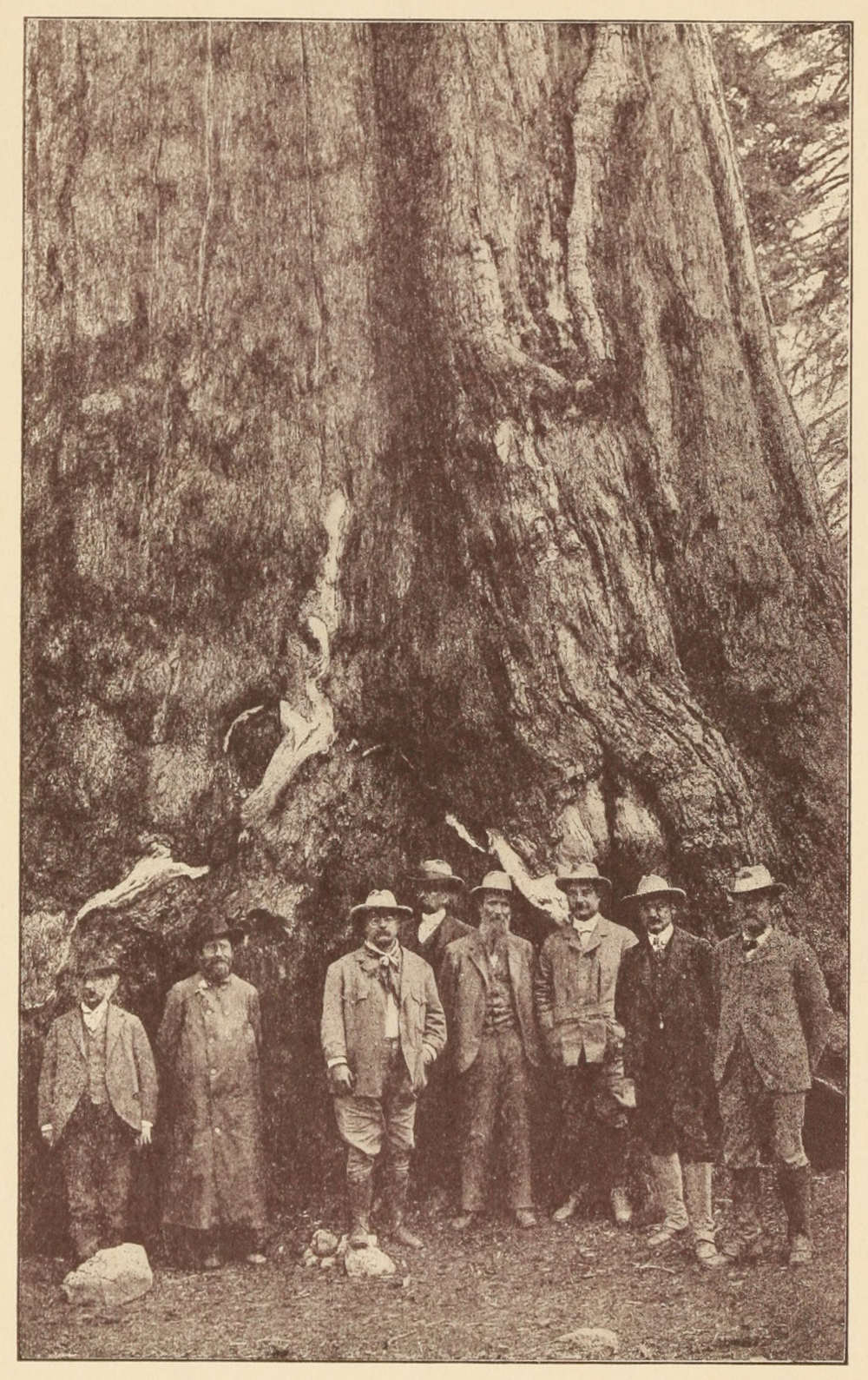
President Roosevelt and party, including Secretary Moody and Governor
Pardee, after crossing the old trail of “The Wilderness Hunter”
The Works of Theodore Roosevelt In Fourteen Volumes
Illustrated
Executive Edition
Published with the permission of the
President through special arrangement
with the century co., messrs. Charles
Scribner’s sons, and G. P. Putnam’s Sons
The Co-operative Publication Society
New York and London
Copyright 1889 ByG. P. Putnam’s Sons
This edition is published under arrangement with
G. P. Putnam’s Sons, of New York and London.
To
E. K. R.
“They saw the silences
Move by and beckon; saw the forms,
The very beards, of burly storms,
And heard them talk like sounding seas....
They saw the snowy mountains rolled
And heaved along the nameless lands
Like mighty billows; saw the gold
Of awful sunsets; saw the blush
Of sudden dawn, and felt the hush
Of heaven when the day sat down
And hid his face in dusky hands.”
—Joaquin Miller
“In vain the speeding of shyness;
In vain the elk takes to the inner passes of the woods....
... where geese nip their food with short jerks,
Where sundown shadows lengthen over the limitless prairie,
Where herds of buffalo make a crawling spread of the square miles, far and near,
Where winter wolves bark amid wastes of snow and ice-clad trees....
The moose, large as an ox, cornered by hunters, plunging with his forefeet, the hoofs as sharp as knives....
The blazing fire at night, the sweet taste of supper, the talk, the bed of hemlock boughs, and the bear-skin.”
The American Wilderness; Wilderness Hunters and Wilderness Game
The American Wilderness—Forests, Plains, Mountains—Likeness
and Unlikeness to the Old-World Wilderness—Wilderness
Hunters—Boone, Crockett, Houston,
Carson—The Trappers—The Buffalo Hunters—The
Stockmen—The Regular Army—Wilderness
Game—Bison, Moose, Elk, Caribou, Deer, Antelope—Other
Game—Hunting in the Wilderness
In the Cattle Country—Life on a Ranch—A Round-up—Branding
a Maverick—The Bad Lands—A Shot at a
Blacktail—Still-hunting the Blacktail—Its Habits—Killing
a Buck in August—A Shot at Close Range—Occasional
Unwariness of Blacktail
The Whitetail Deer; And the Blacktail of the Columbia
The Whitetail—Yields Poor Sport—Fire Hunting—Hunting
with Hounds—Shooting at Running Game—Queer
Adventure—Anecdotes of Plainsmen—Good and Bad
Shots—A Wagon Trip—A Shot from the Ranch-house
Veranda—The Columbian Blacktail
Riding to the Round-up—The Open Plains—Sights and
Sounds—Gophers, Prairie Dogs, Sharp-tail Grouse,
Antelope—The Cow-camp—Standing Night Guard—Dawn—Make
an Antelope Hunt—An Easy Stalk—A
Difficult Stalk—Three Antelope Shot—The Plains
Skylark—The Meadow-Lark—The Mocking-bird—Other
Singers—Harsher Wilderness Sounds—Pack
Rats—Plains Ferret, Its Ferocity—The War Eagle—Attacks
Antelope—Kills Jack-Rabbit—One Shot on
Wing with Rifle
Hunting the Prong-Buck—Long Shots—Misses—Winter
Weather—A Hunt in December—Riding in the Bitter
Cold—The Old Hunter’s Tepee—A Night in a Line
Camp—An Antelope Herd—Two Bucks Shot—Riding
Back to Ranch—The Immigrant Train—Hunting in
Fall—Fighting Fire—A Summer Hunt—Sufferings
from Thirst—Swimming Cattle Across a Swollen
Stream—Wagon Trip to the Black Hills—The Great
Prairies—A Prong-buck Shot—Pleasant Camp—Buck
Shot in Morning—Continue our Journey—Shooting
Sage Fowl and Prairie Fowl with Rifle
Among the High Hills; The Bighorn or Mountain Sheep
A Summer on the Ranch—Working Among the Cattle—Killing
Game for the Ranch—A Trip After Mountain
Sheep—The Bad Lands—Solitary Camp—The
Old Horse Manitou—Still-hunt at Dawn—Young
Ram Shot—A Hunt in the Rocky Mountains—An
Old Bighorn Stalked and Shot—Habits of the Game
A Trip to the Big Hole Basin—Incidents of Travel with
a Wagon—Camp Among the Mountains—A Trip on
Foot After Goats—Spruce Grouse—Lying Out at
Night—A Climb over the High Peaks—Two Goats
Shot—Weary Tramp Back—A Hunt in the Kootenai
Country—Hard Climbing Among the Wooded Mountains—Goat
Shot on Brink of Chasm—Ptarmigan for
Supper—Goat Hunting Very Hard Work—Ways and
Habits of the Goats—Not much Decrease in Numbers
A Camp on Kootenai Lake—Traveling on Foot Through
the Dense Forests—Excessive Toil—Water Shrew and
Water Thrush—Black Bear Killed—Mountain Climbing—Woodchucks
and Conies—The Indian Ammál—Night
Sounds—A Long Walk—A Caribou Killed—A
Midwinter Trip on Snowshoes in Maine—Footprints
on the Snow—A Helpless Deer—Caribou at Ease in
the Deep Drifts
A Hunt in the Bitter Root Mountains—A Trip on Foot—Two
Bull Elk Fighting—The Peacemaker—All Three
Shot—Habits of the Wapiti—Their Bugling—A
Grand Chorus—Shooting a Bull at Sunrise—Another
Killed near the Ranch—Vanishing of the Elk—Its
Antlers—The Lynx—Porcupine—Chickarees and
Chipmunks—Clark’s Crow—Lewis’ Woodpecker—Whiskey-jack—Trout—The
Yellowstone Canyon
In the Shoshones—Traveling with a
Pack-train—Scenery—Flowers—A
Squaw-man—Bull Elk Shot in Rain
while Challenging—Storm—Breaking Camp in Rain—Two-Ocean
Pass—Our Camp—A Young Ten-pointer
Shot—The Mountains in Moonlight—Blue Grouse—Snowshoe
Rabbits—Death of a Master Bull—The
Tetons—Following a Bull by Scent—Ill Luck—Luck
Changes—Death of Spike Bull—Three Bulls Killed—Traveling
Home—Heavy Snowstorm—Bucking Horse—Various
Hunts Compared—Number Cartridges Used—Still-hunting
the Elk
The Moose of the Rocky Mountains—Its Habits—Difficult
Nature of Its Haunts—Repeated Failures while
Hunting It—Watching a Marsh at Dawn—A Moose
in the Reeds—Stalking and Shooting Him—Traveling
Light with a Pack-train—A Beaver Meadow—Shooting
a Big Bull at Dawn—The Moose in Summer, in
Winter—Young Moose—Pugnacity of Moose—Still-hunting
Moose—Rather More Easy to Kill than
Whitetail Deer—At Times a Dangerous Antagonist—The
Winter Yards—Hunting on Snowshoes—A
Narrow Escape—A Fatal Encounter
Game Which Ought Not to Be Killed—Killing Black
Bear with a Knife—Sports with Rod and Shot-gun—Snowshoeing
and Mountaineering—American Writers
on Out-door Life—Burroughs—Thoreau—Audubon,
Coues, etc.—American Hunting Books—American
Writers on Life in the Wilderness: Parkman,
Irving—Cooper on Pioneer Life—American Statesmen
and Soldiers Devoted to the Chase—Lincoln,
Jackson, Israel Putnam—A Letter from Webster on
Trout-fishing—Clay—Washington—Hunting Extracts
from Washington’s Diaries—Washington as a Fox-hunter
For a number of years much of my life was
spent either in the wilderness or on the
borders of the settled country—if, indeed, “settled”
is a term that can rightly be applied to
the vast, scantily peopled regions where cattle-ranching
is the only regular industry. During
this time I hunted much, among the mountains
and on the plains, both as a pastime and
to procure hides, meat, and robes for use on
the ranch; and it was my good luck to kill all
the various kinds of large game that can properly
be considered to belong to temperate
North America.
In hunting, the finding and killing of the
game is after all but a part of the whole. The
free, self-reliant, adventurous life, with its
rugged and stalwart democracy; the wild surroundings,
the grand beauty of the scenery,
the chance to study the ways and habits of the
woodland creatures—all these unite to give to
the career of the wilderness hunter its peculiar
charm. The chase is among the best of all
national pastimes; it cultivates that vigorous
manliness for the lack of which in a nation,
as in an individual, the possession of no other
qualities can possibly atone.
No one, but he who has partaken thereof,
can understand the keen delight of hunting in
lonely lands. For him is the joy of the horse
well ridden and the rifle well held; for him
the long days of toil and hardship, resolutely
endured, and crowned at the end with triumph.
In after years there shall come forever
to his mind the memory of endless prairies
shimmering in the bright sun; of vast snow-clad
wastes lying desolate under gray skies;
of the melancholy marshes; of the rush of
mighty rivers; of the breath of the evergreen
forest in summer; of the crooning of ice-armored
pines at the touch of the winds of winter;
of cataracts roaring between hoary mountain
masses; of all the innumerable sights and
sounds of the wilderness; of its immensity and
mystery; and of the silences that brood in its
still depths.
The Wilderness Hunter — Chapter I — Chapter II — Chapter III — Chapter IV — Chapter V — Chapter VI — Chapter VII — Chapter VIII — Chapter IX — Chapter X — Chapter XI — Chapter XII — ENDNOTE — Appendix — Transcriber’s Notes
The American Wilderness; Wilderness Hunters
and Wilderness Game
Manifold are the shapes taken by the American
wilderness. In the east, from the Atlantic
Coast to the Mississippi Valley, lies a land of
magnificent hardwood forest. In endless variety
and beauty, the trees cover the ground, save only
where they have been cleared away by man, or
where toward the west the expanse of the forest is
broken by fertile prairies. Toward the north, this
region of hardwood trees merges insensibly into the
southern extension of the great sub-arctic forest;
here the silver stems of birches gleam against the
sombre background of coniferous evergreens. In
the southeast again, by the hot, oozy coasts of the
South Atlantic and the Gulf, the forest becomes
semi-tropical; palms wave their feathery fronds, and
the tepid swamps teem with reptile life.
Some distance beyond the Mississippi, stretching
from Texas to North Dakota, and westward to the
Rocky Mountains, lies the plains country. This is
a region of light rainfall, where the ground is clad
with short grass, while cottonwood trees fringe the
courses of the winding plains streams; streams that
are alternately turbid torrents and mere dwindling
threads of water. The great stretches of natural
pasture are broken by gray sage-brush plains, and
tracts of strangely shaped and colored Bad Lands;
sun-scorched wastes in summer, and in winter arctic
in their iron desolation. Beyond the plains rise the
Rocky Mountains, their flanks covered with coniferous
woods; but the trees are small, and do not
ordinarily grow very closely together. Toward the
north the forest becomes denser, and the peaks higher;
and glaciers creep down toward the valleys from
the fields of everlasting snow. The brooks are
brawling, trout-filled torrents; the swift rivers foam
over rapid and cataract, on their way to one or the
other of the two great oceans.
Southwest of the Rockies evil and terrible deserts
stretch for leagues and leagues, mere waterless
wastes of sandy plain and barren mountain, broken
here and there by narrow strips of fertile ground.
Rain rarely falls, and there are no clouds to dim the
brazen sun. The rivers run in deep canyons, or are
swallowed by the burning sand; the smaller watercourses
are dry throughout the greater part of the
year.
Beyond this desert region rise the sunny Sierras
of California, with their flower-clad slopes and
groves of giant trees; and north of them, along the
coast, the rain-shrouded mountain chains of Oregon
and Washington, matted with the towering growth
of the mighty evergreen forest.
The white hunters, who from time to time first
penetrated the different parts of this wilderness,
found themselves in such hunting grounds as those
wherein, long ages before, their Old-World forefathers
had dwelled; and the game they chased was
much the same as that their lusty barbarian ancestors
followed, with weapons of bronze and of iron,
in the dim years before history dawned. As late
as the end of the seventeenth century the turbulent
village nobles of Lithuania and Livonia hunted the
bear, the bison, the elk, the wolf, and the stag, and
hung the spoils in their smoky wooden palaces; and
so, two hundred years later, the free hunters of
Montana, in the interludes between hazardous mining
quests and bloody Indian campaigns, hunted
game almost or quite the same in kind, through the
cold mountain forests surrounding the Yellowstone
and Flathead lakes, and decked their log cabins and
ranch houses with the hides and horns of the slaughtered
beasts.
Zoologically speaking, the north temperate zones
of the Old and New Worlds are very similar, differing
from one another much less than they do from
the various regions south of them, or than these
regions differ among themselves. The untrodden
American wilderness resembles both in game and
physical character the forests, the mountains, and
the steppes of the Old World as it was at the beginning
of our era. Great woods of pine and fir, birch
and beech, oak and chestnut; streams where the chief
game fish are spotted trout and silvery salmon;
grouse of various kinds as the most common game
birds; all these the hunter finds as characteristic of
the New World as of the Old. So it is with most
of the beasts of the chase, and so also with the fur-bearing
animals that furnish to the trapper alike his
life work and his means of livelihood. The bear,
wolf, bison, moose, caribou, wapiti, deer, and bighorn,
the lynx, fox, wolverine, sable, mink, ermine,
beaver, badger, and otter of both worlds are either
identical or more or less closely kin to one another.
Sometimes of the two forms, that found in the Old
World is the larger. Perhaps more often the reverse
is true, the American beast being superior in
size. This is markedly the case with the wapiti,
which is merely a giant brother of the European
stag, exactly as the fisher is merely a very large
cousin of the European sable or marten. The extraordinary
prong-buck, the only hollow-horned ruminant
which sheds its horns annually, is a distant
representative of the Old-World antelopes of the
steppes; the queer white antelope-goat has for its
nearest kinsfolk certain Himalayan species. Of the
animals commonly known to our hunters and trappers,
only a few, such as the cougar, peccary, raccoon,
possum (and among birds the wild turkey),
find their nearest representatives and type forms in
tropical America.
Of course this general resemblance does not mean
identity. The differences in plant life and animal
life, no less than in the physical features of the land,
are sufficiently marked to give the American wilderness
a character distinctly its own. Some of the
most characteristic of the woodland animals, some
of those which have most vividly impressed themselves
on the imagination of the hunters and pioneer
settlers, are the very ones which have no Old-World
representatives. The wild turkey is in every way
the king of American game birds. Among the small
beasts the coon and the possum are those which have
left the deepest traces in the humbler lore of the
frontier; exactly as the cougar—usually under the
name of panther or mountain lion—is a favorite
figure in the wilder hunting tales. Nowhere else is
there anything to match the wealth of the eastern
hardwood forests, in number, variety, and beauty
of trees; nowhere else is it possible to find conifers
approaching in size the giant redwoods and sequoias
of the Pacific slope. Nature here is generally on a
larger scale than in the Old-World home of our
race. The lakes are like inland seas, the rivers, like
arms of the sea. Among stupendous mountain
chains there are valleys and canyons of fathomless
depth and incredible beauty and majesty. There
are tropical swamps, and sad, frozen marshes; deserts
and Death Valleys, weird and evil, and the
strange wonderland of the Wyoming geyser region.
The waterfalls are rivers rushing over precipices;
the prairies seem without limit, and the forest never
ending.
At the time when we first became a nation, nine-tenths
of the territory now included within the limits
of the United States was wilderness. It was during
the stirring and troubled years immediately preceding
the outbreak of the Revolution that the most
adventurous hunters, the vanguard of the hardy
army of pioneer settlers, first crossed the Alleghanies,
and roamed far and wide through the lonely,
danger-haunted forests which filled the No-man’s-land
lying between the Tennessee and the Ohio.
They waged ferocious warfare with Shawnee and
Wyandot and wrought huge havoc among the
herds of game with which the forest teemed. While
the first Continental Congress was still sitting, Daniel
Boone, the archetype of the American hunter, was
leading his bands of tall backwoods riflemen to settle
in the beautiful country of Kentucky, where the
red and the white warriors strove with such obstinate
rage that both races alike grew to know it as
“the dark and bloody ground.”
Boone and his fellow-hunters were the heralds of
the oncoming civilization, the pioneers in that conquest
of the wilderness which has at last been practically
achieved in our own day. Where they pitched
their camps and built their log huts or stockaded
hamlets, towns grew up, and men who were tillers
of the soil, not mere wilderness wanderers, thronged
in to take and hold the land. Then, ill-at-ease among
the settlements for which they had themselves made
ready the way, and fretted even by the slight restraints
of the rude and uncouth semi-civilization
of the border, the restless hunters moved onward
into the yet unbroken wilds where the game dwelled
and the red tribes marched forever to war and hunting.
Their untamable souls ever found something
congenial and beyond measure attractive in the lawless
freedom of the lives of the very savages against
whom they warred so bitterly.
Step by step, often leap by leap, the frontier of
settlement was pushed westward; and ever from before
its advance fled the warrior tribes of the red
men and the scarcely less intractable array of white
Indian fighters and game hunters. When the Revolutionary
War was at its height, George Rogers
Clark, himself a mighty hunter of the old backwoods
type, led his handful of hunter-soldiers to the
conquest of the French towns of the Illinois. This
was but one of the many notable feats of arms
performed by the wild soldiery of the backwoods.
Clad in their fringed and tasseled hunting-shirt of
buckskin or homespun, with coonskin caps and
deer-hide leggings and moccasins, with tomahawk
and scalping-knife thrust into their bead-worked
belts, and long rifles in hand, they fought battle after
battle of the most bloody character, both against the
Indians, as at the Great Kanawha, at the Fallen
Timbers, and at Tippecanoe, and against more civilized
foes, as at King’s Mountain, New Orleans,
and the River Thames.
Soon after the beginning of the present century
Louisiana fell into our hands, and the most daring
hunters and explorers pushed through the forests of
the Mississippi Valley to the great plains, steered
across these vast seas of grass to the Rocky Mountains,
and then through their rugged defiles onward
to the Pacific Ocean. In every work of exploration,
and in all the earlier battles with the original lords
of the western and southwestern lands, whether Indian
or Mexican, the adventurous hunters played
the leading part; while close behind came the swarm
of hard, dogged, border-farmers,—a masterful race,
good fighters and good breeders, as all masterful
races must be.
Very characteristic in its way was the career of
quaint, honest, fearless Davy Crockett, the Tennessee
rifleman and Whig Congressman, perhaps the
best shot in all our country, whose skill in the use
of his favorite weapon passed into a proverb, and
who ended his days by a hero’s death in the ruins
of the Alamo. An even more notable man was another
mighty hunter, Houston, who when a boy ran
away to the Indians; who while still a lad returned
to his own people to serve under Andrew Jackson in
the campaigns which that greatest of all the backwoods
leaders waged against the Creeks, the Spaniards,
and the British. He was wounded at the
storming of one of the strongholds of Red Eagle’s
doomed warriors, and returned to his Tennessee
home to rise to high civil honor, and become the
foremost man of his State. Then, while Governor
of Tennessee, in a sudden fit of moody anger, and of
mad longing for the unfettered life of the wilderness,
he abandoned his office, his people, and his race,
and fled to the Cherokees beyond the Mississippi.
For years he lived as one of their chiefs; until one
day, as he lay in ignoble ease and sloth, a rider from
the south, from the rolling plains of the San Antonio
and Brazos, brought word that the Texans were up,
and in doubtful struggle striving to wrest their
freedom from the lancers and carbineers of Santa
Anna. Then his dark soul flamed again into burning
life; riding by night and day he joined the risen
Texans, was hailed by them as a heaven-sent leader,
and at the San Jacinto led them on to the overthrow
of the Mexican host. Thus the stark hunter, who
had been alternately Indian fighter and Indian chief,
became the President of the new Republic, and, after
its admission into the United States, a Senator at
Washington; and, to his high honor, he remained to
the end of his days staunchly loyal to the flag of the
Union.
By the time that Crockett fell, and Houston became
the darling leader of the Texans, the typical
hunter and Indian fighter had ceased to be a backwoodsman;
he had become a plainsman, or mountain-man;
for the frontier, east of which he never
willingly went, had been pushed beyond the Mississippi.
Restless, reckless, and hardy, he spent years
of his life in lonely wanderings through the Rockies
as a trapper; he guarded the slowly moving caravans,
which for purposes of trade journeyed over
the dangerous Santa Fé trail; he guided the large
parties of frontier settlers who, driving before them
their cattle, with all their household goods in their
white-topped wagons, spent perilous months and
seasons on their weary way to Oregon or California.
Joining in bands, the stalwart, skin-clad riflemen
waged ferocious war on the Indians, scarcely
more savage than themselves, or made long raids
for plunder and horses against the outlying Mexican
settlements. The best, the bravest, the most modest
of them all was the renowned Kit Carson. He was
not only a mighty hunter, a daring fighter, a finder
of trails, and maker of roads through the unknown,
untrodden wilderness, but also a real leader of men.
Again and again he crossed and recrossed the continent,
from the Mississippi to the Pacific; he guided
many of the earliest military and exploring expeditions
of the United States Government; he himself
led the troops in victorious campaigns against
Apache and Navahoe; and in the Civil War he was
made a colonel of the Federal Army.
After him came many other hunters. Most were
pure-blooded Americans, but many were Creole
Frenchmen, Mexicans, or even members of the so-called
civilized Indian tribes, notably the Delawares.
Wide were their wanderings, many their strange
adventures in the chase, bitter their unending warfare
with the red lords of the land. Hither and
thither they roamed, from the desolate, burning
deserts of the Colorado to the grassy plains of the
Upper Missouri; from the rolling Texas prairies,
bright beneath their sunny skies, to the high snow
peaks of the northern Rockies, or the giant pine
forests, and soft rainy weather, of the coasts of
Puget Sound. Their main business was trapping,
furs being the only articles yielded by the wilderness,
as they knew it, which were both valuable and portable.
These early hunters were all trappers likewise,
and, indeed, used their rifles only to procure
meat or repel attacks. The chief of the fur-bearing
animals they followed was the beaver, which
abounded in the streams of the plains and mountains;
in the far north they also trapped otter, mink, sable,
and fisher. They married squaws from among the
Indian tribes with which they happened for the moment
to be at peace; they acted as scouts for the
United States troops in their campaigns against the
tribes with which they happened to be at war.
Soon after the Civil War the life of these hunters,
taken as a class, entered on its final stage. The
Pacific Coast was already fairly well settled, and
there were few mining camps in the Rockies; but
most of this Rocky Mountain region, and the
entire stretch of plains country proper, the vast belt
of level or rolling grass land lying between the Rio
Grande and the Saskatchewan, still remained primeval
wilderness, inhabited only by roving hunters
and formidable tribes of Indian nomads, and by the
huge herds of game on which they preyed. Beaver
swarmed in the streams and yielded a rich harvest
to the trapper; but trapping was no longer the mainstay
of the adventurous plainsmen. Foremost
among the beasts of the chase, on account of
its numbers, its size, and its economic importance,
was the bison or American buffalo; its innumerable
multitudes darkened the limitless prairies. As the
transcontinental railroads were pushed toward completion,
and the tide of settlement rolled onward
with ever-increasing rapidity, buffalo robes became
of great value. The hunters forthwith turned their
attention mainly to the chase of the great clumsy
beasts, slaughtering them by hundreds of thousands
for their hides; sometimes killing them on horseback,
but more often on foot, by still-hunting, with
the heavy long range Sharp’s rifle. Throughout the
fifteen years during which this slaughter lasted, a
succession of desperate wars was waged with the
banded tribes of the Horse Indians. All the time,
in unending succession, long trains of big white-topped
wagons crept slowly westward across the
prairies, marking the steady oncoming of the frontier
settlers.
By the close of 1883 the last buffalo herd was destroyed.
The beaver were trapped out of all the
streams, or their numbers so thinned that it no
longer paid to follow them. The last formidable
Indian war had been brought to a successful close.
The flood of the incoming whites had risen over the
land; tongues of settlement reached from the Mississippi
to the Rocky Mountains, and from the
Rocky Mountains to the Pacific. The frontier had
come to an end; it had vanished. With it vanished
also the old race of wilderness hunters, the men who
spent all their days in the lonely wilds, and who
killed game as their sole means of livelihood. Great
stretches of wilderness still remained in the Rocky
Mountains, and here and there in the plains country,
exactly as much smaller tracts of wild land are to
be found in the Alleghanies and northern New York
and New England; and on these tracts occasional
hunters and trappers still linger; but as a distinctive
class, with a peculiar and important position in
American life, they no longer exist.
There were other men besides the professional
hunters, who lived on the borders of the wilderness,
and followed hunting, not only as a pastime, but
also as yielding an important portion of their subsistence.
The frontier farmers were all hunters.
In the Eastern backwoods, and in certain places in
the West, as in Oregon, these adventurous tillers of
the soil were the pioneers among the actual settlers;
in the Rockies their places were taken by the miners,
and on the great plains by the ranchmen and cowboys,
the men who lived in the saddle, guarding
their branded herds of horses and horned stock.
Almost all of the miners and cowboys were obliged
on occasions to turn hunters.
Moreover, the regular army which played so important
a part in all the later stages of the winning
of the West produced its full share of mighty hunters.
The later Indian wars were fought principally
by the regulars. The West Point officer and his
little company of trained soldiers appeared abreast
of the first hardy cattlemen and miners. The
ordinary settlers rarely made their appearance until
in campaign after campaign, always inconceivably
wearing and harassing, and often very bloody in
character, the scarred and tattered troops had
broken and overthrown the most formidable among
the Indian tribes. Faithful, uncomplaining, unflinching,
the soldiers wearing the national uniform
lived for many weary years at their lonely little
posts, facing unending toil and danger with quiet
endurance, surrounded by the desolation of vast
solitudes, and menaced by the most merciless of
foes. Hunting was followed not only as a sport,
but also as the only means of keeping the posts
and the expeditionary trains in meat. Many of the
officers became equally proficient as marksmen and
hunters. The three most famous Indian fighters
since the Civil War, Generals Custer, Miles, and
Crook, were all keen and successful followers of
the chase.
Of American big game the bison, almost always
known as the buffalo, was the largest and most important
to man. When the first white settlers landed
in Virginia the bison ranged east of the Alleghanies
almost to the sea-coast, westward to the dry deserts
lying beyond the Rocky Mountains, northward
to the Great Slave Lake and southward to Chihuahua.
It was a beast of the forests and mountains,
in the Alleghanies no less than in the Rockies;
but its true home was on the prairies and the
high plains. Across these it roamed, hither and
thither, in herds of enormous, of incredible magnitude;
herds so large that they covered the waving
grass land for hundreds of square leagues, and
when on the march occupied days and days in
passing a given point. But the seething myriads of
shaggy-maned wild cattle vanished with remarkable
and melancholy rapidity before the inroads of the
white hunters, and the steady march of the oncoming
settlers. Now they are on the point of extinction.
Two or three hundred are left in that great
national game preserve, the Yellowstone Park; and
it is said that others still remain in the wintry desolation
of Athabasca. Elsewhere only a few individuals
exist—probably considerably less than half
a hundred all told—scattered in small parties in
the wildest and most remote and inaccessible portions
of the Rocky Mountains. A bison bull is the
largest American animal. His huge bulk, his short,
curved black horns, the shaggy mane clothing his
great neck and shoulders, give him a look of ferocity
which his conduct belies. Yet he is truly a grand
and noble beast, and his loss from our prairies and
forest is as keenly regretted by the lover of nature
and of wild life as by the hunter.
Next to the bison in size, and much superior in
height to it and to all other American game—for it
is taller than the tallest horse—comes the moose,
or broad-horned elk. It is a strange, uncouth-looking
beast, with very long legs, short thick neck, a
big, ungainly head, a swollen nose, and huge shovel
horns. Its home is in the cold, wet pine and spruce
forests, which stretch from the sub-arctic region of
Canada southward in certain places across our frontier.
Two centuries ago it was found as far south
as Massachusetts. It has now been exterminated
from its former haunts in northern New York and
Vermont, and is on the point of vanishing from
northern Michigan. It is still found in northern
Maine and northeastern Minnesota and in portions
of northern Idaho and Washington; while along the
Rockies it extends its range southward through
western Montana to northwestern Wyoming,
south of the Tetons. In 1884 I saw the fresh
hide of one that was killed in the Bighorn Mountains.
The wapiti, or round-horned elk, like the bison,
and unlike the moose, had its centre of abundance
in the United States, though extending northward
into Canada. Originally its range reached from
ocean to ocean and it went in herds of thousands
of individuals; but it has suffered more from the
persecution of hunters than any other game except
the bison. By the beginning of this century it had
been exterminated in most localities east of the Mississippi;
but a few lingered on for many years in
the Alleghanies. Colonel Cecil Clay informs me
that an Indian whom he knew killed one in Pennsylvania
in 1869. A very few still exist here and there
in northern Michigan and Minnesota, and in one or
two spots on the western boundary of Nebraska and
the Dakotas; but it is now properly a beast of the
wooded Western mountains. It is still plentiful
in western Colorado, Wyoming, and Montana,
and in parts of Idaho, Washington, and Oregon.
Though not as large as the moose it is the most
beautiful and stately of all animals of the deer
kind, and its antlers are marvels of symmetrical
grandeur.
The woodland caribou is inferior to the wapiti
both in size and symmetry. The tips of the many
branches of its long irregular antlers are slightly
palmated. Its range is the same as that of the
moose, save that it does not go so far southward.
Its hoofs are long and round; even larger than the
long, oval hoofs of the moose, and much larger than
those of the wapiti. The tracks of all three can be
told apart at a glance, and can not be mistaken for
the footprints of other game. Wapiti tracks, however,
look much like those of yearling and two-year-old
cattle, unless the ground is steep or muddy,
in which case the marks of the false hoofs appear,
the joints of wapiti being more flexible than those of
domestic stock.
The whitetail deer is now, as it always has been,
the best known and most abundant of American big
game, and though its numbers have been greatly
thinned it is still found in almost every State of the
Union. The common blacktail or mule deer, which
has likewise been sadly thinned in numbers, though
once extraordinarily abundant, extends from the
great plains to the Pacific; but is supplanted on the
Puget Sound coast by the Columbian blacktail. The
delicate, heart-shaped footprints of all three are
nearly indistinguishable; when the animal is running
the hoof points are of course separated. The
track of the antelope is more oval, growing squarer
with age. Mountain sheep leave footmarks of a
squarer shape, the points of the hoof making little
indentations in the soil, well apart, even when the
animal is only walking; and a yearling’s track is not
unlike that made by a big prong-buck when striding
rapidly with the toes well apart. White-goat tracks
are also square, and as large as those of the sheep;
but there is less indentation of the hoof points, which
come nearer together.
The antelope, or prong-buck, was once found in
abundance from the eastern edge of the great plains
to the Pacific, but it has everywhere diminished in
numbers, and has been exterminated along the eastern
and western borders of its former range. The
bighorn, or mountain sheep, is found in the Rocky
Mountains from northern Mexico to Alaska; and
in the United States from the Coast and Cascade
ranges to the Bad Lands of the western edges of
the Dakotas, wherever there are mountain chains or
tracts of rugged hills. It was never very abundant,
and, though it has become less so, it has held its own
better than most game. The white goat, however,
alone among our game animals, has positively increased
in numbers since the advent of settlers; because
white hunters rarely follow it, and the Indians
who once sought its skin for robes now use
blankets instead. Its true home is in Alaska and
Canada, but it crosses our borders along the lines of
the Rockies and Cascades, and a few small isolated
colonies are found here and there southward to California
and New Mexico.
The cougar and wolf, once common throughout
the United States, have now completely disappeared
from all save the wildest regions. The black bear
holds its own better; it was never found on the great
plains. The huge grisly ranges from the great plains
to the Pacific. The little peccary or Mexican wild
hog merely crosses our southern border.
The finest hunting ground in America was, and
indeed is, the mountainous region of western Montana
and northwestern Wyoming. In this high, cold
land, of lofty mountains, deep forests, and open
prairies, with its beautiful lakes and rapid rivers, all
the species of big game mentioned above, except
the peccary and Columbian blacktail, are to be found.
Until 1880 they were very abundant, and they are
still, with the exception of the bison, fairly plentiful.
On most of the long hunting expeditions which I
made away from my ranch, I went into this region.
The bulk of my hunting has been done in the cattle
country, near my ranch on the Little Missouri,
and in the adjoining lands round the lower Powder
and Yellowstone. Until 1881 the valley of the Little
Missouri was fairly thronged with game, and
was absolutely unchanged in any respect from its
original condition of primeval wildness. With the
incoming of the stockmen all this changed, and the
game was wofully slaughtered; but plenty of deer
and antelope, a few sheep and bear, and an occasional
elk are still left.
Since the professional hunters have vanished with
the vast herds of game on which they preyed, the
life of the ranchman is that which yields most
chance of hunting. Life on a cattle ranch, on the
great plains or among the foothills of the high mountains,
has a peculiar attraction for those hardy, adventurous
spirits who take most kindly to a vigorous
out-of-door existence, and who are therefore
most apt to care passionately for the chase of big
game. The free ranchman lives in a wild, lonely
country, and exactly as he breaks and tames his own
horses, and guards and tends his own branded herds,
so he takes the keenest enjoyment in the chase,
which is to him not merely the pleasantest of sports,
but also a means of adding materially to his comforts,
and often his only method of providing himself
with fresh meat.
Hunting in the wilderness is of all pastimes the
most attractive, and it is doubly so when not carried
on merely as a pastime. Shooting over a private
game preserve is of course in no way to be compared
to it. The wilderness hunter must not only show
skill in the use of the rifle and address in finding and
approaching game, but he must also show the qualities
of hardihood, self-reliance, and resolution needed
for effectively grappling with his wild surroundings.
The fact that the hunter needs the game, both for
its meat and for its hide, undoubtedly adds a zest to
the pursuit. Among the hunts which I have most
enjoyed were those made when I was engaged in getting
in the winter’s stock of meat for the ranch, or
was keeping some party of cowboys supplied with
game from day to day.
Hunting from the Ranch; The Blacktail Deer
No life can be pleasanter than life during the
months of fall on a ranch in the northern cattle
country. The weather is cool; in the evenings
and on the rare rainy days we are glad to sit by the
great fireplace, with its roaring cottonwood logs.
But on most days not a cloud dims the serene splendor
of the sky; and the fresh pure air is clear with
the wonderful clearness of the high plains. We are
in the saddle from morning to night.
The long, low, roomy ranch house, of clean hewed
logs, is as comfortable as it is bare and plain. We
fare simply but well; for the wife of my foreman
makes excellent bread and cake, and there are plenty
of potatoes, grown in the forlorn little garden-patch
on the bottom. We also have jellies and jams, made
from wild plums and buffalo berries; and all the milk
we can drink. For meat we depend on our rifles;
and, with an occasional interlude of ducks or prairie
chickens, the mainstay of each meal is venison,
roasted, broiled, or fried.
Sometimes we shoot the deer when we happen
on them while about our ordinary business,—indeed
throughout the time that I have lived on the ranch,
very many of the deer and antelope I killed were
thus obtained. Of course while doing the actual
round-up work it is impossible to attend to anything
else; but we generally carry rifles while riding after
the saddle band in the early morning, while visiting
the line camps, or while in the saddle among the
cattle on the range; and get many a shot in this
fashion.
In the fall of 1890 some friends came to my ranch;
and one day we took them to see a round-up. The
ox, a Texan steer-outfit, had sent a couple of wagons
to work down the river, after beef cattle, and
one of my men had gone along to gather any of my
own scattered steers that were ready for shipping,
and to brand the late calves. There were perhaps
a dozen riders with the wagons; and they were
camped for the day on a big bottom where Blacktail
and Whitetail creeks open into the river, several
miles below my ranch.
At dawn one of the men rode off to bring in the
saddle band. The rest of us were up by sunrise; and
as we stood on the veranda under the shimmering
cottonwood trees, reveling in the blue of the cloudless
sky, and drinking in the cool air before going to
breakfast, we saw the motley-colored string of ponies
file down from the opposite bank of the river, and
splash across the broad, shallow ford in front of the
ranch house. Cantering and trotting the band swept
toward the high, round horse-corral, in the open
glade to the rear of the house. Guided by the jutting
wing which stuck out at right angles, they entered
the open gate, which was promptly closed by
the cowboy who had driven them in.
After breakfast we strolled over to the corral,
with our lariats, and, standing by the snubbing-post
in the middle, roped the horses we wished for the
party—some that were gentle, and others that were
not. Then every man saddled his horse; and at the
moment of mounting for the start there was, as
always, a thrill of mild excitement, each rider hoping
that his own horse would not buck, and that his
neighbor’s would. I had no young horses on the
ranch at the time; but a number of the older ones
still possessed some of the least amiable traits of
their youth.
Once in the saddle we rode off down river, along
the bottoms, crossing the stream again and again.
We went in Indian file, as is necessary among the
trees and in broken ground, following the cattle-trails—which
themselves had replaced or broadened
the game paths that alone crossed the plateaus and
bottoms when my ranch house was first built. Now
we crossed open reaches of coarse grass, thinly
sprinkled with large, brittle cottonwood trees, their
branches torn and splintered; now we wound our
way through a dense jungle where the gray, thorny
buffalo bushes, spangled with brilliant red berry
clusters, choked the spaces between the thick-growing
box-alders; and again the sure-footed ponies
scrambled down one cut bank and up another,
through seemingly impossible rifts, or with gingerly
footsteps trod a path which cut the side of a butte
or overhung a bluff. Sometimes we racked, or
shacked along at the fox trot which is the cow-pony’s
ordinary gait; and sometimes we loped or galloped
and ran.
At last we came to the ford beyond which the
riders of the round-up had made their camp. In the
bygone days of the elk and buffalo, when our branded
cattle were first driven thus far north, this ford had
been dangerous from quicksand; but the cattle, ever
crossing and recrossing, had trodden down and settled
the sand, and had found out the firm places;
so that it was now easy to get over.
Close beyond the trees on the further bank stood
the two round-up wagons; near by was the cook’s
fire, in a trench, so that it might not spread; the
bedding of the riders and horse-wranglers lay scattered
about, each roll of blankets wrapped and corded
in a stout canvas sheet. The cook was busy about
the fire; the night-wrangler was snatching an hour
or two’s sleep under one of the wagons. Half a
mile away, on the plain of sage brush and long grass,
the day-wrangler was guarding the grazing or resting
horse herd, of over a hundred head. Still
further distant, at the mouth of a ravine, was the
day-herd of cattle, two or three cowboys watching it
as they lolled drowsily in their saddles. The other
riders were off on circles to bring in cattle to the
round-up; they were expected every moment.
With the ready hospitality always shown in a cow-camp
we were pressed to alight and take dinner, or
at least a lunch; and accordingly we jumped off our
horses and sat down. Our tin plates were soon
heaped with fresh beef, bread, tomatoes, rice, and
potatoes, all very good; for the tall, bearded, scrawny
cook knew his work, and the OX outfit always fed
its men well,—and saw that they worked well too.
Before noon the circle riders began to appear on
the plain, coming out of the ravines, and scrambling
down the steep hills, singly or in twos and threes.
They herded before them bunches of cattle, of varying
size; these were driven together and left in
charge of a couple of cow-punchers. The other men
rode to the wagon to get a hasty dinner—lithe,
sinewy fellows, with weather-roughened faces and
fearless eyes; their broad felt hats flapped as they
galloped, and their spurs and bridle chains jingled.
They rode well, with long stirrups, sitting straight
in the deep stock saddles, and their wiry ponies
showed no signs of fatigue from the long morning’s
ride.
The horse-wrangler soon drove the saddle band
to the wagons, where it was caught in a quickly improvised
rope-corral. The men roped fresh horses,
fitted for the cutting-work round the herd, with its
attendant furious galloping and flash-like turning
and twisting. In a few minutes all were in the
saddle again and riding toward the cattle.
Then began that scene of excitement and turmoil,
and seeming confusion, but real method and orderliness,
so familiar to all who have engaged in stock-growing
on the great plains. The riders gathered in
a wide ring round the herd of uneasy cattle, and a
couple of men rode into their midst to cut out the
beef steers and the cows that were followed by unbranded
calves. As soon as the animal was picked
out the cowboy began to drive it slowly toward the
outside of the herd, and when it was near the edge
he suddenly raced it into the open. The beast would
then start at full speed and try to double back among
its fellows; while the trained cow-pony followed like
a shadow, heading it off at every turn. The riders
round that part of the herd opened out and the
chosen animal was speedily hurried off to some spot
a few hundred yards distant, where it was left under
charge of another cowboy. The latter at first
had his hands full in preventing his charge from rejoining
the herd; for cattle dread nothing so much
as being separated from their comrades. However,
as soon as two or three others were driven out,
enough to form a little bunch, it became a much
easier matter to hold the “cut,” as it is called. The
cows and calves were put in one place, the beeves in
another; the latter were afterward run into the
day-herd.
Meanwhile from time to time some clean-limbed
young steer or heifer, able to run like an antelope
and double like a jack-rabbit, tried to break out of
the herd that was being worked, when the nearest
cowboy hurried in pursuit at top speed and brought
it back, after a headlong, break-neck race, in which
no heed was paid to brush, fallen timber, prairie-dog
holes, or cut banks. The dust rose in little whirling
clouds, and through it dashed bolting cattle and galloping
cowboys, hither and thither, while the air was
filled with the shouts and laughter of the men, and
the bellowing of the herd.
As soon as the herd was worked it was turned
loose, while the cows and calves were driven over
to a large corral, where the branding was done.
A fire was speedily kindled, and in it were laid the
branding irons of the different outfits represented on
the round-up. Then two of the best ropers rode into
the corral and began to rope the calves, round the
hind legs by preference, but sometimes round the
head. The other men dismounted to “wrestle” and
brand them. Once roped, the calf, bawling and
struggling, was swiftly dragged near the fire, where
one or two of the calf-wrestlers grappled with and
threw the kicking, plunging little beast, and held
it while it was branded. If the calf was large the
wrestlers had hard work; and one or two young
maverick bulls—that is, unbranded yearling bulls,
which had been passed by in the round-ups of the
preceding year—fought viciously, bellowing and
charging, and driving some of the men up the
sides of the corral, to the boisterous delight of the
others.
After watching the work for a little while we left
and rode homeward. Instead of going along the
river bottoms we struck back over the buttes. From
time to time we came out on some sharp bluff overlooking
the river. From these points of vantage we
could see for several miles up and down the valley
of the Little Missouri. The level bottoms were
walled in by rows of sheer cliffs, and steep, grassy
slopes. These bluff lines were from a quarter of
a mile to a mile apart; they did not run straight,
but in a succession of curves, so as to look like the
halves of many amphitheatres. Between them the
river swept in great bends from side to side; the
wide bed, brimful during the time of freshets, now
held but a thin stream of water. Some of the bottoms
were covered only with grass and sage brush;
others were a dense jungle of trees; while yet others
looked like parks, the cottonwoods growing in
curved lines or in clumps scattered here and there.
On our way we came across a bunch of cattle,
among which the sharp eyes of my foreman detected
a maverick two-year-old heifer. He and one of the
cowboys at once got down their ropes and rode
after her; the rest of us first rounding up the bunch
so as to give a fair start. After a sharp run one
of the men, swinging his lariat round his head,
got close up; in a second or two the noose settled
round the heifer’s neck, and as it became taut she
was brought to with a jerk; immediately afterward
the other man made his throw and cleverly
heeled her. In a trice the red heifer was stretched
helpless on the ground, the two fierce little ponies,
a pinto and a buckskin, keeping her down on their
own account, tossing their heads and backing so that
the ropes which led from the saddle-horns to her
head and hind feet never slackened. Then we
kindled a fire; one of the cinch rings was taken off
to serve as a branding iron, and the heifer speedily
became our property—for she was on our range.
When we reached the ranch it was still early, and
after finishing dinner it lacked over an hour of
sundown. Accordingly we went for another ride;
and I carried my rifle. We started up a winding
coulie which opened back of the ranch house; and
after half an hour’s canter clambered up the steep
head-ravines, and emerged on a high ridge which
went westward, straight as an arrow, to the main
divide between the Little Missouri and the Big
Beaver. Along this narrow, grassy crest we loped
and galloped; we were so high that we could look
far and wide over all the country round about. To
the southward, across a dozen leagues of rolling
and broken prairie, loomed Sentinel Butte, the chief
landmark of all that region. Behind us, beyond the
river, rose the weird chaos of Bad Lands which at
this point lie for many miles east of the Little
Missouri. Their fantastic outlines were marked
against the sky as sharply as if cut with a knife;
their grim and forbidding desolation warmed into
wonderful beauty by the light of the dying sun.
On our right, as we loped onward, the land sunk
away in smooth green-clad slopes and valleys; on
our left it fell in sheer walls. Ahead of us the sun
was sinking behind a mass of blood-red clouds; and
on either hand the flushed skies were changing their
tint to a hundred hues of opal and amethyst. Our
tireless little horses sprang under us, thrilling with
life; we were riding through a fairy world of beauty
and color and limitless space and freedom.
Suddenly a short hundred yards in front three
blacktail leaped out of a little glen and crossed our
path, with the peculiar bounding gait of their kind.
At once I sprang from my horse and, kneeling, fired
at the last and largest of the three. My bullet sped
too far back, but struck near the hip and the crippled
deer went slowly down a ravine. Running over
a hillock to cut it off, I found it in some brush a
few hundred yards beyond and finished it with a
second ball. Quickly dressing it, I packed it on my
horse, and trotted back leading him; an hour afterward
saw through the waning light the quaint,
home-like outlines of the ranch house.
After all, however, blacktail can only at times
be picked up by chance in this way. More often
it is needful to kill them by fair still-hunting, among
the hills or wooded mountains where they delight
to dwell. If hunted they speedily become wary.
By choice they live in such broken country that it
is difficult to pursue them with hounds; and they
are by no means such water-loving animals as
whitetail. On the other hand, the land in which they
dwell is very favorable to the still-hunter who does
not rely merely on stealth, but who can walk and
shoot well. They do not go on the open prairie,
and, if possible, they avoid deep forests, while,
being good climbers, they like hills. In the mountains,
therefore, they keep to what is called park
country, where glades alternate with open groves.
On the great plains they avoid both the heavily timbered
river bottoms and the vast treeless stretches
of level or rolling grass land; their chosen abode
being the broken and hilly region, scantily wooded,
which skirts almost every plains river and forms a
belt, sometimes very narrow, sometimes many miles
in breadth, between the alluvial bottom land and
the prairies beyond. In these Bad Lands dwarfed
pines and cedars grow in the canyon-like ravines and
among the high steep hills; there are also basins
and winding coulies, filled with brush and shrubbery
and small elm or ash. In all such places the blacktail
loves to make its home.
I have not often hunted blacktail in the mountains,
because while there I was generally after
larger game; but round my ranch I have killed
more of them than of any other game, and for me
their chase has always possessed a peculiar charm.
We hunt them in the loveliest season of the year,
the fall and early winter, when it is keen pleasure
merely to live out-of-doors. Sometimes we make
a regular trip, of several days’ duration, taking
the ranch wagon, with or without a tent, to some
rugged little disturbed spot where the deer are
plenty; perhaps returning with eight or ten carcasses,
or even more—enough to last a long while
in cold weather. We often make such trips while
laying in our winter supply of meat.
At other times we hunt directly from the ranch
house. We catch our horses over night, and are in
the saddle for an all-day’s hunt long before the
first streak of dawn, possibly not returning until
some hours after nightfall. The early morning and
late evening are the best time for hunting game,
except in regions where it is hardly ever molested,
and where in consequence it moves about more or
less throughout the day.
During the rut, which begins in September, the
deer are in constant motion, and are often found
in bands. The necks of the bucks swell and their
sides grow gaunt; they chase the does all night,
and their flesh becomes strong and stringy—far
inferior to that of the barren does and yearlings.
The old bucks then wage desperate conflicts with
one another, and bully their smaller brethren unmercifully.
Unlike the elk, the blacktail, like the
whitetail, are generally silent in the rutting season.
They occasionally grunt when fighting; and once,
on a fall evening, I heard two young bucks barking
in a ravine back of my ranch house, and crept up and
shot them; but this was a wholly exceptional instance.
At this time I hunt on foot, only using the horse
to carry me to and from the hunting-ground; for
while rutting, the deer, being restless, do not try
to escape observation by lying still, and on the
other hand are apt to wander about and so are
easily seen from a distance. When I have reached a
favorable place I picket my horse and go from vantage
point to vantage point, carefully scanning the
hillsides, ravines, and brush coulies from every spot
that affords a wide outlook. The quarry once seen
it may be a matter of hours, or only of minutes, to
approach it, according as the wind and cover are
or are not favorable. The walks for many miles
over the hills, the exercise of constant watchfulness,
the excitement of the actual stalk, and the still
greater excitement of the shot, combine to make
still-hunting the blacktail, in the sharp fall weather,
one of the most attractive of hardy outdoor sports.
Then after the long, stumbling walk homeward,
through the cool gloom of the late evening, comes
the meal of smoking venison and milk and bread,
and the sleepy rest, lying on the deer-skins, or sitting
in the rocking chair before the roaring fire,
while the icy wind moans outside.
Earlier in the season, while the does are still nursing
the fawns, and until the bucks have cleaned the
last vestiges of velvet from their antlers, the deer lie
very close, and wander round as little as may be.
In the spring and early summer, in the ranch country,
we hunt big game very little, and then only antelope;
because in hunting antelope there is no danger
of killing aught but bucks. About the first of August
we begin to hunt blacktail, but do not kill does
until a month later—and then only when short of
meat. In the early weeks of the deer season we frequently
do even the actual hunting on horseback instead
of on foot; because the deer at this time rarely
appear in view, so as to afford chance for a stalk,
and yet are reluctant to break cover until very closely
approached. In consequence we keep on our horses,
and so get over much more ground than on foot,
beating through or beside all likely-looking cover,
with the object of jumping the deer close by. Under
such circumstances bucks sometimes lie until almost
trodden on.
One afternoon in mid-August, when the ranch was
entirely out of meat, I started with one of my cow-hands,
Merrifield, to kill a deer. We were on a
couple of stout, quiet ponies, accustomed to firing
and to packing game. After riding a mile or two
down the bottoms we left the river and struck off
up a winding valley, which led back among the hills.
In a short while we were in a blacktail country, and
began to keep a sharp lookout for game, riding parallel
to, but some little distance from, one another.
The sun, beating down through the clear air, was
very hot; the brown slopes of short grass, and still
more, the white clay walls of the Bad Lands, threw
the heat rays in our faces. We skirted closely all
likely-looking spots, such as the heavy brush-patches
in the bottoms of the winding valleys, and the groves
of ash and elm in the basins and pockets flanking the
high plateaus; sometimes we followed a cattle trail
which ran down the middle of a big washout, and
again we rode along the brink of a deep cedar canyon.
After a while we came to a coulie with a small
muddy pool at its mouth; and round this pool there
was much fresh deer sign. The coulie was but half
a mile long, heading into and flanked by the spurs
of some steep, bare hills. Its bottom, which was
fifty yards or so across, was choked by a dense
growth of brush, chiefly thorny bullberries, while
the sides were formed by cut banks twelve or fifteen
feet high. My companion rode up the middle, while
I scrambled up one of the banks, and, dismounting,
led my horse along its edge, that I might have a clear
shot at whatever we roused. We went nearly to the
head, and then the cowboy reined up and shouted
to me that he “guessed there were no deer in the
coulie.” Instantly there was a smashing in the
young trees midway between us, and I caught a
glimpse of a blacktail buck speeding round a shoulder
of the cut bank: and though I took a hurried
shot I missed. However, another buck promptly
jumped up from the same place; evidently the two
had lain secure in their day-beds, shielded by the
dense cover, while the cowboy rode by them, and had
only risen when he halted and began to call to me
across them. This second buck, a fine fellow with
big antlers not yet clear of velvet, luckily ran up
the opposite bank, and I got a fair shot at him as he
galloped broadside to me along the open hillside.
When I fired he rolled over with a broken back. As
we came up he bleated loudly, an unusual thing for
a buck to do.
Now, these two bucks must have heard us coming,
but reckoned on our passing them by without
seeing them; which we would have done had they
not been startled when the cowboy halted and spoke.
Later in the season they would probably not have
let us approach them, but would have run as soon as
they knew of our presence. Of course, however,
even later in the season, a man may by chance stumble
across a deer close by. I remember one occasion
when my ranch partner, Robert Munro Ferguson,
and I almost corralled an unlucky deer in a
small washout.
It was October, and our meat supply unexpectedly
gave out; on our ranch, as on most ranches, an occasional
meat famine of three or four days intervenes
between the periods of plenty. So Ferguson
and I started together, to get venison; and at the
end of two days’ hard work, leaving the ranch by
sunrise, riding to the hunting grounds and tramping
steadily until dark, we succeeded. The weather
was stormy and there were continual gusts of wind
and of cold rain, sleet, or snow. We hunted through
a large tract of rough and broken country, six or
eight miles from the ranch. As often happens in
such wild weather the deer were wild too; they were
watchful and were on the move all the time. We
saw a number, but either they ran off before we
could get a shot, or if we did fire it was at such a
distance or under such unfavorable circumstances
that we missed. At last, as we were plodding drearily
up a bare valley, the sodden mud caking round
our shoes, we roused three deer from the mouth of
a short washout but a few paces from us. Two
bounded off; the third by mistake rushed into the
washout, where he found himself in a regular
trap and was promptly shot by my companion.
We slung the carcass on a pole and carried it
down to where we had left the horses; and then
we loped homeward, bending to the cold, slanting
rain.
Although in places where it is much persecuted
the blacktail is a shy and wary beast, the successful
pursuit of which taxes to the uttermost the skill and
energy of the hunter, yet, like the elk, if little molested
it often shows astonishing tameness and even
stupidity. In the Rockies I have sometimes come
on blacktail within a very short distance, which
would merely stare at me, then trot off a few yards,
turn and stare again, and wait for several minutes
before really taking alarm. What is much more extraordinary,
I have had the same thing happen to
me in certain little hunted localities in the neighborhood
of my ranch, even of recent years. In the fall
of 1890, I was riding down a canyon-coulie with
my foreman, Sylvane Ferris, and a young friend
from Boston, when we almost rode over a barren
blacktail doe. She only ran some fifty yards, round
a corner of the coulie, and then turned and stood
until we ran forward and killed her—for we were
in need of fresh meat. One October, a couple of
years before this, my cousin, West Roosevelt, and
I took a trip with the wagon to a very wild and
rugged country, some twenty miles from the ranch.
We found that the deer had evidently been but little
disturbed. One day while scrambling down a steep,
brushy hill, leading my horse, I came close on a doe
and fawn; they merely looked at me with curiosity
for some time, and then sauntered slowly off, remaining
within shot for at least five minutes. Fortunately
we had plenty of meat at the time, and
there was no necessity to harm the graceful creatures.
A few days later we came on two bucks
sunning themselves in the bottom of a valley. My
companion killed one. The other was lying but a
dozen rods off; yet it never moved, until several
shots had been fired at the first. It was directly under
me, and, in my anxiety to avoid overshooting,
to my horror I committed the opposite fault, and
away went the buck.
Every now and then any one will make most unaccountable
misses. A few days after thus losing
the buck I spent nearly twenty cartridges in butchering
an unfortunate yearling, and only killed it at all
because it became so bewildered by the firing that
it hardly tried to escape. I never could tell why I
used so many cartridges to such little purpose. During
the next fortnight I killed seven deer without
making a single miss, though some of the shots were
rather difficult.
The Whitetail Deer; And the Blacktail of the
Columbia
The whitetail deer is much the commonest game
animal of the United States, being still found,
though generally in greatly diminished numbers,
throughout most of the Union. It is a shrewd,
wary, knowing beast; but it owes its prolonged stay
in the land chiefly to the fact that it is an inveterate
skulker, and fond of the thickest cover. Accordingly
it usually has to be killed by stealth and
stratagem, and not by fair, manly hunting; being
quite easily slain in any one of half a dozen unsportsmanlike
ways. In consequence I care less for
its chase than for the chase of any other kind of
American big game. Yet in the few places where
it dwells in open, hilly forests and can be killed by
still-hunting as if it were a blacktail; or, better still,
where the nature of the ground is such that it can
be run down in fair chase on horseback, either with
greyhounds, or with a pack of trackhounds, it yields
splendid sport.
Killing a deer from a boat while the poor animal
is swimming in the water, or on snowshoes as it
flounders helplessly in the deep drifts, can only be
justified on the plea of hunger. This is also true of
lying in wait at a lick. Whoever indulges in any of
these methods, save from necessity, is a butcher pure
and simple, and has no business in the company of
true sportsmen.
Fire hunting may be placed in the same category;
yet it is possibly allowable under exceptional circumstances
to indulge in a fire hunt, if only for the
sake of seeing the wilderness by torchlight. My
first attempt at big-game shooting, when a boy, was
“jacking” for deer in the Adirondacks, on a pond or
small lake surrounded by the grand northern forests
of birch and beech, pine, spruce, and fir. I killed a
spike buck; and while I have never been willing to
kill another in this manner, I can not say that I regret
having once had the experience. The ride over
the glassy, black water, the witchcraft of such silent
progress through the mystery of the night, can not
but impress one. There is pleasure in the mere
buoyant gliding of the birch-bark canoe, with its
curved bow and stern; nothing else that floats possesses
such grace, such frail and delicate beauty, as
this true craft of the wilderness, which is as much
a creature of the wild woods as the deer and bear
themselves. The light streaming from the bark
lantern in the bow cuts a glaring lane through the
gloom; in it all objects stand out like magic, shining
for a moment white and ghastly and then vanishing
into the impenetrable darkness; while all the time
the paddler in the stern makes not so much as a ripple,
and there is never a sound but the occasional
splash of a muskrat, or the moaning uloo-oo—uloo-uloo
of an owl from the deep forests; and at last
perchance the excitement of a shot at a buck, standing
at gaze, with luminous eyeballs.
The most common method of killing the whitetail
is by hounding; that is, by driving it with
hounds past runways where hunters are stationed—for
all wild animals when on the move prefer to
follow certain definite routes. This is a legitimate,
but inferior, kind of sport.
However, even killing driven deer may be good
fun at certain times. Most of the whitetail we kill
round the ranch are obtained in this fashion. On the
Little Missouri—as throughout the plains country
generally—these deer cling to the big wooded river
bottoms, while the blacktail are found in the broken
country back from the river. The tangled mass of
cottonwoods, box-alders, and thorny bullberry bushes
which cover the bottoms afford the deer a nearly secure
shelter from the still-hunter; and it is only by
the aid of hounds that they can be driven from their
wooded fastnesses. They hold their own better than
any other game. The great herds of buffalo, and
the bands of elk, have vanished completely; the
swarms of antelope and blacktail have been woefully
thinned; but the whitetail, which were never found
in such throngs as either buffalo or elk, blacktail or
antelope, have suffered far less from the advent of
the white hunters, ranchmen, and settlers. They
are of course not as plentiful as formerly; but some
are still to be found in almost all their old haunts.
Where the river, winding between rows of high
buttes, passes my ranch house, there is a long succession
of heavily wooded bottoms; and on all of
these, even on the one whereon the house itself
stands, there are a good many whitetail yet left.
When we take a day’s regular hunt we usually
wander afar, either to the hills after blacktail or to
the open prairie after antelope. But if we are short
of meat, and yet have no time for a regular hunt,
being perhaps able to spare only a couple of hours
after the day’s work is over, then all hands turn
out to drive a bottom for whitetail. We usually
have one or two trackhounds at the ranch; true
Southern deerhounds, black and tan, with lop ears
and hanging lips, their wrinkled faces stamped with
an expression of almost ludicrous melancholy. They
are not fast, and have none of the alert look of the
pied and spotted modern foxhound; but their noses
are very keen, their voices deep and mellow, and
they are wonderfully staunch on a trail.
All is bustle and laughter as we start on such a
hunt. The baying hounds bound about, as the rifles
are taken down; the wiry ponies are roped out of
the corral, and each broad-hatted hunter swings joyfully
into the saddle. If the pony bucks or “acts
mean” the rider finds that his rifle adds a new element
of interest to the performance, which is of
course hailed with loud delight by all the men on
quiet horses. Then we splash off over the river,
scramble across the faces of the bluffs, or canter
along the winding cattle paths, through the woods,
until we come to the bottom we intend to hunt.
Here a hunter is stationed at each runway along
which it is deemed likely that the deer will pass;
and one man, who has remained on horseback, starts
into the cover with the hounds; occasionally this
horseman himself, skilled, as most cowboys are, in
the use of the revolver, gets a chance to kill a deer.
The deep baying of the hounds speedily gives warning
that the game is afoot; and the watching hunters,
who have already hid their horses carefully, look
to their rifles. Sometimes the deer comes far ahead
of the dogs, running very swiftly with neck stretched
straight out; and if the cover is thick such an animal
is hard to hit. At other times, especially if
the quarry is a young buck, it plays along not very
far ahead of its baying pursuers, bounding and strutting
with head up and white flag flaunting. If struck
hard, down goes the flag at once, and the deer
plunges into a staggering run, while the hounds yell
with eager ferocity as they follow the bloody trail.
Usually we do not have to drive more than one or
two bottoms before getting a deer, which is forthwith
packed behind one of the riders, as the distance
is not great, and home we come in triumph. Sometimes,
however, we fail to find game, or the deer take
unguarded passes, or the shot is missed. Occasionally
I have killed deer on these hunts; generally
I have merely sat still a long while, listened to the
hounds, and at last heard somebody else shoot. In
fact such hunting, though good enough fun if only
tried rarely, would speedily pall if followed at all
regularly.
Personally the chief excitement I have had in
connection therewith has arisen from some antic of
my horse; a half-broken bronco is apt to become
unnerved when a man with a gun tries to climb on
him in a hurry. On one hunt in 1890 I rode a wild
animal named Whitefoot. He had been a confirmed
and very bad bucker three years before, when I had
him in my string on the round-up; but had grown
quieter with years. Nevertheless I found he had
some fire left; for a hasty vault into the saddle on
my part was followed on his by some very resolute
pitching. I lost my rifle and hat, and my revolver
and knife were bucked out of my belt; but I kept
my seat all right, and finally got his head up and
mastered him without letting him throw himself
over backward, a trick he sometimes practiced.
Nevertheless, in the first jump when I was taken
unawares, I strained myself across the loins, and did
not get entirely over it for six months.
To shoot running game with the rifle it is always
necessary to be a good and quick marksman; for it
is never easy to kill an animal, when in rapid motion,
with a single bullet. If on a runway a man
who is a fairly skilful rifleman has plenty of time
for a clear shot, on open ground, at comparatively
short distance, say under eighty yards, and if the
deer is cantering, he ought to hit; at least I generally
do under such circumstances, by remembering
to hold well forward, in fact just in front of the
deer’s chest. But I do not always kill by any means;
quite often when I thought I held far enough ahead,
my bullet has gone into the buck’s hips or loins.
However, one great feature in the use of dogs is that
they enable one almost always to recover wounded
game.
If the animal is running at full speed a long distance
off, the difficulty of hitting is of course very
much increased; and if the country is open the value
of a repeating rifle is then felt. If the game is bounding
over logs or dodging through underbrush, the
difficulty is again increased. Moreover, the natural
gait of the different kinds of game must be taken
into account. Of course the larger kinds, such as
elk and moose, are the easiest to hit; then comes the
antelope, in spite of its swiftness, and the sheep,
because of the evenness of their running; then the
whitetail, with its rolling gallop; and last and hardest
of all, the blacktail, because of its extraordinary
stiff-legged bounds.
Sometimes on a runway the difficulty is not that
the game is too far, but that it is too close; for a deer
may actually almost jump on the hunter, surprising
him out of all accuracy of aim. Once something of
the sort happened to me.
Winter was just beginning. I had been off with
the ranch wagon on a last round-up of the beef
steers; and had suffered a good deal, as one always
does on these cold weather round-ups, sleeping out
in the snow, wrapped up in blankets and tarpaulin,
with no tent and generally no fire. Moreover, I
became so weary of the interminable length of the
nights, that I almost ceased to mind the freezing
misery of standing night guard round the restless
cattle; while roping, saddling, and mastering the
rough horses each morning, with numbed and stiffened
limbs, though warming to the blood was harrowing
to the temper.
On my return to the ranch I found a strange
hunter staying there; a clean, square-built, honest-looking
little fellow, but evidently not a native
American. As a rule, nobody displays much curiosity
about any one’s else antecedents in the Far West;
but I happened to ask my foreman who the newcomer
was,—chiefly because the said newcomer,
evidently appreciating the warmth and comfort of
the clean, roomy ranch house, with its roaring fires,
books, and good fare, seemed inclined to make a
permanent stay, according to the custom of the
country. My foreman, who had a large way of
looking at questions of foreign ethnology and geography,
responded with indifference: “Oh, he’s a
kind of a Dutchman; but he hates the other Dutch,
mortal. He’s from an island Germany took from
France in the last war!” This seemed puzzling;
but it turned out that the “island” in question was
Alsace. Native Americans predominate among the
dwellers in and on the borders of the wilderness,
and in the wild country over which the great herds
of the cattlemen roam; and they take the lead in
every way. The sons of the Germans, Irish, and
other European newcomers are usually quick to
claim to be “straight United States,” and to disavow
all kinship with the fellow-countrymen of their
fathers. Once while with a hunter bearing a German
name we came by chance on a German hunting
party from one of the Eastern cities. One of them
remarked to my companion that he must be part
German himself, to which he cheerfully answered:
“Well, my father was a Dutchman, but my mother
was a white woman! I’m pretty white myself!”
whereat the Germans glowered at him gloomily.
As we were out of meat the Alsatian and one of
the cowboys and I started down the river with a
wagon. The first day in camp it rained hard, so
that we could not hunt. Toward evening we grew
tired of doing nothing, and as the rain had become
a mere fine drizzle, we sallied out to drive one of
the bottoms for whitetail. The cowboy and our
one trackhound plunged into the young cottonwood
which grew thickly over the sandy bottom; while
the little hunter and I took our stands on a cut
bank, twenty feet high and half a mile long, which
hedged in the trees from behind. Three or four game
trails led up through steep, narrow clefts in this
bank; and we tried to watch these. Soon I saw a
deer in an opening below, headed toward one end of
the bank, round which another game trail led; and
I ran hard toward this end, where it turned into a
knife-like ridge of clay. About fifty yards from the
point there must have been some slight irregularities
in the face of the bank, enough to give the deer
a foothold; for as I ran along the animal suddenly
bounced over the crest, so close that I could have
hit it with my right hand. As I tried to pull up
short and swing round, my feet slipped from under
me in the wet clay, and down I went; while the
deer literally turned a terrified somersault backward.
I flung myself to the edge and missed a hurried
shot as it raced back on its tracks. Then, wheeling,
I saw the little hunter running toward me along
the top of the cut bank, his face on a broad grin.
He leaped over one of the narrow clefts, up which
a game trail led; and hardly was he across before
the frightened deer bolted up it, not three yards
from his back. He did not turn, in spite of my
shouting and handwaving, and the frightened deer,
in the last stage of panic at finding itself again
almost touching one of its foes, sped off across the
grassy slopes like a quarter horse. When at last
the hunter did turn, it was too late; and our long-range
fusillade proved harmless. During the next
two days I redeemed myself, killing four deer.
Coming back our wagon broke down, no unusual
incident in ranch-land, where there is often no road,
while the strain is great in hauling through quick-sands,
and up or across steep broken hills; it rarely
makes much difference beyond the temporary delay,
for plainsmen and mountain-men are very
handy and self-helpful. Besides, a mere break-down
sinks into nothing compared to having the
team play out; which is, of course, most apt to
happen at the times when it ensures hardship and
suffering, as in the middle of a snowstorm, or when
crossing a region with no water. However, the
reinsmen of the plains must needs face many such
accidents, not to speak of runaways, or having the
wagon pitchpole over on to the team in dropping
down too steep a hillside. Once after a three days’
rainstorm some of us tried to get the ranch wagon
along a trail which led over the ridge of a gumbo
or clay butte. The sticky stuff clogged our shoes,
the horses’ hoofs, and the wheels; and it was even
more slippery than it was sticky. Finally we struck
a sloping shoulder; with great struggling, pulling,
pushing, and shouting, we reached the middle of
it, and then, as one of my men remarked, “the
whole darned outfit slid into the coulie.”
These hunting trips after deer or antelope with
the wagon usually take four or five days. I always
ride some tried hunting horse; and the wagon itself
when on such a hunt is apt to lead a checkered
career, as half the time there is not the vestige of
a trail to follow. Moreover we often make a hunt
when the good horses are on the round-up, or otherwise
employed, and we have to get together a scrub
team of cripples or else of outlaws—vicious devils,
only used from dire need. The best teamster for
such a hunt that we ever had on the ranch was a
weather-beaten old fellow known as “Old Man
Tompkins.” In the course of a long career as
lumberman, plains teamster, buffalo hunter, and
Indian fighter, he had passed several years as a
Rocky Mountain stage driver; and a stage driver
of the Rockies is of necessity a man of such skill
and nerve that he fears no team and no country.
No matter how wild the unbroken horses, Old Tompkins
never asked help; and he hated to drive less
than a four-in-hand. When he once had a grip on
the reins, he let no one hold the horses’ heads. All
he wished was an open plain for the rush at the
beginning. The first plunge might take the wheelers’
forefeet over the cross-bars of the leaders, but
he never stopped for that; on went the team, running,
bounding, rearing, tumbling, while the wagon
leaped behind, until gradually things straightened
out of their own accord. I soon found, however,
that I could not allow him to carry a rifle; for he
was an inveterate game butcher. In the presence
of game the old fellow became fairly wild with excitement,
and forgot the years and rheumatism
which had crippled him. Once, after a long and
tiresome day’s hunt, we were walking home together;
he was carrying his boots in his hands,
bemoaning the fact that his feet hurt him. Suddenly
a whitetail jumped up; down dropped Old
Tompkins’s boots, and away he went like a college
sprinter, entirely heedless of stones and cactus. By
some indiscriminate firing at long range we dropped
the deer; and as Old Tompkins cooled down he
realized that his bare feet had paid full penalty for
his dash.
One of these wagon trips I remember because
I missed a fair running shot which I much desired
to hit; and afterward hit a very much more difficult
shot about which I cared very little. Ferguson
and I, with Sylvane and one or two others, had gone
a day’s journey down the river for a hunt. We
went along the bottoms, crossing the stream every
mile or so, with an occasional struggle through
mud or quicksand, or up the steep, rotten banks.
An old buffalo hunter drove the wagon, with a
couple of shaggy, bandy-legged ponies; the rest of
us jogged along in front on horseback, picking out
a trail through the bottoms and choosing the best
crossing places. Some of the bottoms were grassy
pastures; on others great, gnarled cottonwoods
with shivered branches stood in clumps; yet others
were choked with a true forest growth. Late in
the afternoon we went into camp, choosing a spot
where the cottonwoods were young; their glossy
leaves trembled and rustled unceasingly. We speedily
picketed the horses—changing them about as
they ate off the grass,—drew water, and hauled
great logs in front of where we had pitched the
tent, while the wagon stood nearby. Each man
laid out his bed; the food and kitchen kit were
taken from the wagon; supper was cooked and
eaten; and we then lay round the camp-fire, gazing
into it, or up at the brilliant stars, and listening
to the wild, mournful wailing of the coyotes. They
were very plentiful round this camp; before sunrise
and after sundown they called unceasingly.
Next day I took a long tramp and climb after
mountain-sheep and missed a running shot at a fine
ram, about a hundred yards off; or, rather, I hit him
and followed his bloody trail a couple of miles, but
failed to find him; whereat I returned to camp much
cast down.
Early the following morning Sylvane and I
started for another hunt, this time on horseback.
The air was crisp and pleasant; the beams of the
just-risen sun struck sharply on the umber-colored
hills and white cliff walls guarding the river, bringing
into high relief their strangely carved and channeled
fronts. Below camp the river was little but
a succession of shallow pools strung along the broad
sandy bed which in spring-time was filled from bank
to bank with foaming muddy water. Two mallards
sat in one of these pools; and I hit one with the rifle,
so nearly missing that the ball scarcely ruffled a
feather; yet in some way the shock told, for the bird,
after flying thirty yards, dropped on the sand.
Then we left the river and our active ponies scrambled
up a small canyon-like break in the bluffs. All
day we rode among the hills; sometimes across
rounded slopes, matted with short buffalo grass;
sometimes over barren buttes of red or white clay,
where only sage brush and cactus grew; or beside
deep ravines, black with stunted cedar; or along
beautiful winding coulies, where the grass grew
rankly, and the thickets of ash and wild plum made
brilliant splashes of red and yellow and tender green.
Yet we saw nothing.
As evening grew on we rode riverward; we slid
down the steep bluff walls, and loped across a great
bottom of sage brush and tall grass, our horses now
and then leaping like cats over the trunks of dead
cottonwoods. As we came to the brink of the cut
bank which forms the hither boundary of the river
in freshet time, we suddenly saw two deer, a doe
and a well grown fawn—of course long out of the
spotted coat. They were walking with heads down
along the edge of a sand-bar, near a pool, on the
further side of the stream bed, over two hundred
yards distant. They saw us at once, and turning,
galloped away, with flags aloft, the pictures of
springing, vigorous beauty. I jumped off my horse
in an instant, knelt, and covered the fawn. It was
going straight away from me, running very evenly,
and I drew a coarse sight at the tip of the white
flag. As I pulled trigger down went the deer, the
ball having gone into the back of its head. The
distance was a good three hundred yards; and while
of course there was much more chance than skill in
the shot I felt well pleased with it—though I could
not help a regret that, while making such a difficult
shot at a mere whitetail, I should have missed a
much easier shot at a noble bighorn. Not only I,
but all the camp, had a practical interest in my success;
for we had no fresh meat, and a fat whitetail
fawn, killed in October, yields the best of venison.
So after dressing the deer I slung the carcass behind
my saddle, and we rode swiftly back to camp through
the dark; and that evening we feasted on the juicy
roasted ribs.
The degree of tameness and unsuspiciousness
shown by whitetail deer depends, of course, upon
the amount of molestation to which they are exposed.
Their times for sleeping, feeding, and coming
to water vary from the same cause. Where
they are little persecuted they feed long after sunrise
and before sunset, and drink when the sun is
high in the heavens, sometimes even at midday;
they then show but little fear of man, and speedily
become indifferent to the presence of deserted dwellings.
In the cattle country the ranch houses are often
shut during the months of warm weather, when the
round-ups succeed one another without intermission,
as the calves must be branded, the beeves gathered
and shipped, long trips made to collect strayed animals,
and the trail stock driven from the breeding
to the fattening grounds. At that time all the menfolk
may have to be away in the white-topped wagons,
working among the horned herds, whether
plodding along the trail, or wandering to and fro
on the range. Late one summer, when my own
house had been thus closed for many months, I
rode thither with a friend to pass a week. The place
already wore the look of having slipped away from
the domain of man. The wild forces, barely thrust
back beyond the threshold of our habitation, were
prompt to spring across it to renewed possession
the moment we withdrew. The rank grass grew
tall in the yard, and on the sodded roofs of the
stable and sheds; the weather-beaten log walls of
the house itself were one in tint with the trunks of
the gnarled cottonwoods by which it was shaded.
Evidently the woodland creatures had come to regard
the silent, deserted buildings as mere out-growths
of the wilderness, no more to be feared than
the trees around them or the gray, strangely shaped
buttes behind.
Lines of delicate, heart-shaped footprints in the
muddy reaches of the half-dry river-bed showed
where the deer came to water; and in the dusty
cattle-trails among the ravines many round tracks
betrayed the passing and repassing of timber wolves,—once
or twice in the late evening we listened to
their savage and melancholy howling. Cotton-tail
rabbits burrowed under the veranda. Within doors
the bushy-tailed pack-rats had possession, and at
night they held a perfect witches’ sabbath in the
garret and kitchen; while a little white-footed mouse,
having dragged half the stuffing out of a mattress,
had made thereof a big fluffy nest, entirely filling
the oven.
Yet, in spite of the abundant sign of game, we
at first suffered under one of those spells of ill-luck
which at times befall all hunters, and for several
days we could kill nothing, though we tried hard,
being in need of fresh meat. The moon was full—each
evening, sitting on the ranch veranda, or walking
homeward, we watched it rise over the line of
bluffs beyond the river—and the deer were feeding
at night; moreover, in such hot weather they lie very
close, move as little as possible, and are most difficult
to find. Twice we lay out from dusk until
dawn, in spite of the mosquitoes, but saw nothing;
and the chances we did get we failed to profit by.
One morning, instead of trudging out to hunt I
stayed at home, and sat in a rocking-chair on the
veranda reading, rocking, or just sitting still listening
to the low rustling of the cottonwood branches
overhead, and gazing across the river. Through
the still, clear, hot air, the faces of the bluffs shone
dazzling white; no shadow fell from the cloudless
sky on the grassy slopes, or on the groves of timber;
only the faraway cooing of a mourning-dove broke
the silence. Suddenly my attention was arrested
by a slight splashing in the water; glancing up from
my book I saw three deer, which had come out of
the thick fringe of bushes and young trees across
the river, and were strolling along the sand-bars directly
opposite me. Slipping stealthily into the house
I picked up my rifle, and slipped back again. One
of the deer was standing motionless, broadside to
me; it was a long shot, two hundred and fifty yards,
but I had a rest against a pillar of the veranda. I
held true, and as the smoke cleared away the deer
lay struggling on the sands.
As the whitetail is the most common and widely
distributed of American game, so the Columbian
blacktail has the most sharply limited geographical
range; for it is confined to the northwest coast,
where it is by far the most abundant deer. In antlers
it is indistinguishable from the common blacktail
of the Rockies and the great plains, and it has
the regular blacktail gait, a succession of stiff-legged
bounds on all four feet at once; but its tail is more
like a whitetail’s in shape, though black above. As
regards methods of hunting, and the amount of
sport yielded, it stands midway between its two
brethren. It lives in a land of magnificent timber,
where the trees tower far into the sky, the giants of
their kind; and there are few more attractive sports
than still-hunting on the mountains, among these
forests of marvelous beauty and grandeur. There
are many lakes among the mountains where it
dwells, and as it cares more for water than the ordinary
blacktail, it is comparatively easy for hounds
to drive it into some pond where it can be killed
at leisure. It is thus often killed by hounding.
The only one I ever killed was a fine young buck.
We had camped near a little pond, and as evening
fell I strolled off toward it and sat down. Just after
sunset the buck came out of the woods. For some
moments he hesitated and then walked forward and
stood by the edge of the water, about sixty yards
from me. We were out of meat, so I held right
behind his shoulder, and though he went off, his
bounds were short and weak, and he fell before he
reached the wood.
On the Cattle Ranges; The Prong-Horn
Antelope
Early one June just after the close of the regular
spring round-up, a couple of wagons, with
a score of riders between them, were sent to work
some hitherto untouched country, between the Little
Missouri and the Yellowstone. I was to go as
the representative of our own and of one or two
neighboring brands; but as the round-up had halted
near my ranch I determined to spend a day there,
and then to join the wagons;—the appointed meeting-place
being a cluster of red scoria buttes, some
forty miles distant, where there was a spring of
good water.
Most of my day at the ranch was spent in slumber;
for I had been several weeks on the round-up,
where nobody ever gets quite enough sleep. This
is the only drawback to the work; otherwise it is
pleasant and exciting, with just that slight touch
of danger necessary to give it zest, and without
the wearing fatigue of such labor as lumbering or
mining. But there is never enough sleep, at least
on the spring and midsummer round-ups. The
men are in the saddle from dawn until dusk, at
the time when the days are longest on these great
northern plains; and in addition there is the regular
night guarding and now and then a furious
storm or a stampede, when for twenty hours at a
stretch the riders only dismount to change horses
or snatch a mouthful of food.
I started in the bright sunrise, riding one horse
and driving loose before me eight others, one carrying
my bedding. They traveled strung out in single
file. I kept them trotting and loping, for loose
horses are easiest to handle when driven at some
speed, and moreover the way was long. My rifle
was slung under my thigh; the lariat was looped
on the saddle-horn.
At first our trail led through winding coulies,
and sharp grassy defiles; the air was wonderfully
clear, the flowers were in bloom, the breath of the
wind in my face was odorous and sweet. The patter
and beat of the unshod hoofs, rising in half-rhythmic
measure, frightened the scudding deer;
but the yellow-breasted meadow larks, perched on
the budding tops of the bushes, sang their rich full
songs without heeding us as we went by.
When the sun was well on high and the heat of
the day had begun we came to a dreary and barren
plain, broken by rows of low clay buttes. The
ground in places was whitened by alkali; elsewhere
it was dull gray. Here there grew nothing save
sparse tufts of coarse grass, and cactus, and sprawling
sage brush. In the hot air all things seen afar
danced and wavered. As I rode and gazed at the
shimmering haze the vast desolation of the landscape
bore on me, it seemed as if the unseen and
unknown powers of the wastes were moving by and
marshaling their silent forces. No man save the
wilderness dweller knows the strong melancholy
fascination of these long rides through lonely lands.
At noon, that the horses might graze and drink,
I halted where some box-alders grew by a pool in
the bed of a half-dry creek; and shifted my saddle
to a fresh beast. When we started again we came
out on the rolling prairie, where the green sea of
wind-rippled grass stretched limitless as far as the
eye could reach. Little striped gophers scuttled
away, or stood perfectly straight at the mouths of
their burrows, looking like picket pins. Curlews
clamored mournfully as they circled overhead.
Prairie fowl swept off, clucking and calling, or
strutted about with their sharp tails erect. Antelope
were very plentiful, running like race-horses across
the level, or uttering their queer, barking grunt as
they stood at gaze, the white hairs on their rumps
all on end, their neck bands of broken brown and
white vivid in the sunlight. They were found singly
or in small straggling parties; the master bucks
had not yet begun to drive out the younger and
weaker ones as later in the season, when each would
gather into a herd as many does as his jealous
strength could guard from rivals. The nursing
does whose kids had come early were often found
with the bands; the others kept apart. The kids
were very conspicuous figures on the prairies, across
which they scudded like jack-rabbits, showing nearly
as much speed and alertness as their parents; only
the very young sought safety by lying flat to escape
notice.
The horses cantered and trotted steadily over
the mat of buffalo grass, steering for the group
of low scoria mounds which was my goal. In mid-afternoon
I reached it. The two wagons were
drawn up near the spring; under them lay the night-wranglers,
asleep; nearby the teamster-cooks were
busy about the evening meal. A little way off the
two day-wranglers were watching the horse-herd;
into which I speedily turned my own animals. The
riders had already driven in the bunches of cattle,
and were engaged in branding the calves, and turning
loose the animals that were not needed, while
the remainder were kept, forming the nucleus of
the herd which was to accompany the wagon.
As soon as the work was over the men rode to
the wagons; sinewy fellows, with tattered broad-brimmed
hats and clanking spurs, some wearing
leather shaps or leggings, others having their trousers
tucked into their high-heeled top-boots, all with
their flannel shirts and loose neckerchiefs dusty
and sweaty. A few were indulging in rough, goodnatured
horse play, to an accompaniment of yelling
mirth; most were grave and taciturn, greeting me
with a silent nod or a “How! friend.” A very talkative
man, unless the acknowledged wit of the party,
according to the somewhat florid frontier notion
of wit, is always looked on with disfavor in a cow-camp.
After supper, eaten in silent haste, we gathered
round the embers of the small fires, and the
conversation glanced fitfully over the threadbare subjects
common to all such camps; the antics of some
particularly vicious bucking bronco, how the different
brands of cattle were showing up, the smallness
of the calf drop, the respective merits of rawhide
lariats and grass ropes, and bits of rather startling
and violent news concerning the fates of certain
neighbors. Then one by one we began to turn in
under our blankets.
Our wagon was to furnish the night guards for
the cattle; and each of us had his gentlest horse
tied ready to hand. The night guards went on duty
two at a time for two-hour watches. By good luck
my watch came last. My comrade was a happy-go-lucky
young Texan who for some inscrutable reason
was known as “Latigo Strap”; he had just come
from the South with a big drove of trail cattle.
A few minutes before two, one of the guards
who had gone on duty at midnight rode into camp
and wakened us up by shaking our shoulders. Fumbling
in the dark, I speedily saddled my horse;
Latigo had left his saddled, and he started ahead
of me. One of the annoyances of night guarding,
at least in thick weather, is the occasional difficulty
of finding the herd after leaving camp, or in returning
to camp after the watch is over; there are few
things more exasperating than to be helplessly wandering
about in the dark under such circumstances.
However, on this occasion there was no such trouble;
for it was a brilliant starlight night and the herd had
been bedded down by a sugar-loaf butte which made
a good landmark. As we reached the spot we could
make out the loom of the cattle lying close together
on the level plain; and then the dim figure of a
horseman rose vaguely from the darkness and
moved by in silence; it was the other of the two
midnight guards, on his way back to his broken
slumber.
At once we began to ride slowly round the cattle
in opposite directions. We were silent, for the
night was clear, and the herd quiet; in wild weather,
when the cattle are restless, the cowboys never cease
calling and singing as they circle them, for the
sounds seem to quiet the beasts.
For over an hour we steadily paced the endless
round, saying nothing, with our greatcoats buttoned,
for the air was chill toward morning on the northern
plains, even in summer. Then faint streaks of
gray appeared in the east. Latigo Strap began to
call merrily to the cattle. A coyote came sneaking
over the butte nearby, and halted to yell and wail;
afterward he crossed the coulie and from the hillside
opposite again shrieked in dismal crescendo.
The dawn brightened rapidly; the little skylarks of
the plains began to sing, soaring far overhead, while
it was still much too dark to see them. Their song
is not powerful, but it is so clear and fresh and
long-continued that it always appeals to one very
strongly; especially because it is most often heard
in the rose-tinted air of the glorious mornings, while
the listener sits in the saddle, looking across the
endless sweep of the prairies.
As it grew lighter the cattle became restless, rising
and stretching themselves, while we continued
to ride round them.
“Then the bronc’ began to pitch
And I began to ride;
He bucked me off a cut bank,
Hell! I nearly died!”
sang Latigo from the other side of the herd. A
yell from the wagons told that the cook was summoning
the sleeping cow-punchers to breakfast; we
were soon able to distinguish their figures as they
rolled out of their bedding, wrapped and corded it
into bundles, and huddled sullenly round the little
fires. The horse-wranglers were driving in the saddle
bands. All the cattle got on their feet and started
feeding. In a few minutes the hasty breakfast at
the wagons had evidently been despatched, for we
could see the men forming rope corrals into which
the ponies were driven; then each man saddled,
bridled, and mounted his horse, two or three of the
half-broken beasts bucking, rearing, and plunging
frantically in the vain effort to unseat their riders.
The two men who were first in the saddle relieved
Latigo and myself, and we immediately galloped to
camp, shifted our saddles to fresh animals, gulped
down a cup or two of hot coffee, and some pork,
beans and bread, and rode to the spot where the
others were gathered, lolling loosely in their saddles,
and waiting for the round-up boss to assign them
their tasks. We were the last, and as soon as we
arrived the boss divided all into two parties for the
morning work, or “circle riding,” whereby the cattle
were to be gathered for the round-up proper. Then,
as the others started, he turned to me and remarked:
“We’ve got enough hands to drive this open country
without you; but we’re out of meat, and I don’t want
to kill a beef for such a small outfit; can’t you shoot
some antelope this morning? We’ll pitch camp by
the big blasted cottonwood at the foot of the ash
coulies, over yonder, below the breaks of Dry
Creek.”
Of course I gladly assented, and was speedily
riding alone across the grassy slopes. There was
no lack of the game I was after, for from every rise
of ground I could see antelope scattered across the
prairie, singly, in couples, or in bands. But their
very numbers, joined to the lack of cover on such
an open, flattish country, proved a bar to success;
while I was stalking one band another was sure to
see me and begin running, whereat the first would
likewise start; I missed one or two very long shots,
and noon found me still without game.
However, I was then lucky enough to see a band
of a dozen feeding to windward of a small butte,
and by galloping in a long circle I got within a
quarter of a mile of them before having to dismount.
The stalk itself was almost too easy; for I simply
walked to the butte, climbed carefully up a slope
where the soil was firm and peered over the top to
see the herd, a little one, a hundred yards off. They
saw me at once and ran, but I held well ahead of a
fine young prong-buck, and rolled him over like a
rabbit, with both shoulders broken. In a few minutes
I was riding onward once more with the buck
lashed behind my saddle.
The next one I got, a couple of hours later, offered
a much more puzzling stalk. He was a big
fellow in company with four does or small bucks.
All five were lying in the middle of a slight basin,
at the head of a gentle valley. At first sight it
seemed impossible to get near them, for there was
not so much cover as a sage brush, and the smooth,
shallow basin in which they lay was over a thousand
yards across, while they were looking directly
down the valley. However, it is curious how hard
it is to tell, even from nearby, whether a stalk can
or can not be made; the difficulty being to estimate
the exact amount of shelter yielded by little inequalities
of ground. In this instance a small, shallow
watercourse, entirely dry, ran along the valley, and
after much study I decided to try to crawl up it, although
the big bulging telescopic eyes of the prong-buck—which
have much keener sight than deer or
any other game—would in such case be pointed directly
my way.
Having made up my mind I backed cautiously
down from the coign of vantage whence I had first
seen the game, and ran about a mile to the mouth
of a washout which formed the continuation of the
watercourse in question. Protected by the high
clay banks of this washout I was able to walk upright
until within half a mile of the prong-bucks;
then my progress became very tedious and toilsome,
as I had to work my way up the watercourse flat on
my stomach, dragging the rifle beside me. At last
I reached a spot beyond which not even a snake
could crawl unnoticed. In front was a low bank, a
couple of feet high, crested with tufts of coarse
grass. Raising my head very cautiously I peered
through these and saw the prong-horn about a hundred
and fifty yards distant. At the same time I
found that I had crawled to the edge of a village
of prairie dogs, which had already made me aware
of their presence by their shrill yelping. They
saw me at once: and all those away from their
homes scuttled toward them, and dived down the
burrows, or sat on the mounds at the entrances,
scolding convulsively and jerking their fat little bodies
and short tails. This commotion at once attracted
the attention of the antelope. They rose
forthwith, and immediately caught a glimpse of the
black muzzle of the rifle which I was gently pushing
through the grass tufts. The fatal curiosity which
so often in this species offsets wariness and sharp
sight, proved my friend; evidently the antelope could
not quite make me out and wished to know what I
was. They moved nervously to and fro, striking
the earth with their fore hoofs, and now and then
uttering a sudden bleat. At last the big buck stood
still broadside to me, and I fired. He went off with
the others, but lagged behind as they passed over
the hill crest, and when I reached it I saw him standing,
not very far off, with his head down. Then he
walked backward a few steps, fell over on his side,
and died.
As he was a big buck I slung him across the saddle,
and started for camp afoot, leading the horse.
However, my hunt was not over, for while still a
mile from the wagons, going down a coulie of Dry
Creek, a yearling prong-buck walked over the divide
to my right and stood still until I sent a bullet into
its chest; so that I made my appearance in camp with
three antelope.
I spoke above of the sweet singing of the Western
meadow-lark and plains skylark; neither of them
kin to the true skylark, by the way, one being a
cousin of the grakles and hang-birds, and the other
a kind of pipit. To me both of these birds are among
the most attractive singers to which I have ever listened;
but with all bird-music much must be allowed
for the surroundings and much for the mood, and
the keenness of sense, of the listener. The lilt of the
little plains skylark is neither very powerful nor very
melodious; but it is sweet, pure, long-sustained,
with a ring of courage befitting a song uttered in
highest air.
The meadow-lark is a singer of a higher order,
deserving to rank with the best. Its song has
length, variety, power, and rich melody; and there
is in it sometimes a cadence of wild sadness, inexpressibly
touching. Yet I can not say that either
song would appeal to others as it appeals to me; for
to me it comes forever laden with a hundred memories
and associations; with the sight of dim hills
reddening in the dawn, with the breath of cool morning
winds blowing across lonely plains, with the
scent of flowers on the sunlit prairie, with the motion
of fiery horses, with all the strong thrill of
eager and buoyant life. I doubt if any man can
judge dispassionately the bird songs of his own country;
he can not disassociate them from the sights and
sounds of the land that is so dear to him.
This is not a feeling to regret, but it must be
taken into account in accepting any estimate of bird
music—even in considering the reputation of the
European skylark and nightingale. To both of these
birds I have often listened in their own homes; always
with pleasure and admiration, but always with
a growing belief that relatively to some other birds
they were ranked too high. They are pre-eminently
birds with literary associations; most people take
their opinions of them at second-hand, from the
poets.
No one can help liking the lark; it is such a brave,
honest, cheery bird, and, moreover, its song is uttered
in the air, and is very long-sustained. But it
is by no means a musician of the first rank. The
nightingale is a performer of a very different and
far higher order; yet though it is indeed a notable
and admirable singer, it is an exaggeration to call
it unequaled. In melody, and above all in that
finer, higher melody where the chords vibrate with
the touch of eternal sorrow, it can not rank with
such singers as the wood-thrush and hermit-thrush.
The serene, ethereal beauty of the hermit’s song,
rising and falling through the still evening, under
the archways of hoary mountain forests that have
endured from time everlasting; the golden, leisurely
chiming of the wood-thrush, sounding on June afternoons,
stanza by stanza, through sun-flecked groves
of tall hickories, oaks, and chestnuts; with these there
is nothing in the nightingale’s song to compare. But
in volume and continuity, in tuneful, voluble, rapid
outpouring and ardor, above all in skilful and intricate
variation of theme, its song far surpasses that
of either of the thrushes. In all these respects it is
more just to compare it with the mocking-bird’s,
which, as a rule, likewise falls short precisely on
those points where the songs of the two thrushes
excel.
The mocking-bird is a singer that has suffered
much in reputation from its powers of mimicry.
On ordinary occasions, and especially in the daytime,
it insists on playing the harlequin. But when
free in its own favorite haunts at night in the love
season it has a song, or rather songs, which are not
only purely original, but are also more beautiful
than any other bird music whatsoever. Once I listened
to a mocking-bird singing the livelong spring
night, under the full moon, in a magnolia tree; and
I do not think I shall ever forget its song.
It was on the plantation of Major Campbell
Brown, near Nashville, in the beautiful, fertile mid-Tennessee
country. The mocking-birds were prime
favorites on the place; and were given full scope
for the development, not only of their bold friendliness
toward mankind, but also of that marked individuality
and originality of character in which they
so far surpass every other bird as to become the most
interesting of all feathered folk. One of the mockers,
which lived in the hedge bordering the garden,
was constantly engaged in an amusing feud with
an honest old setter dog, the point of attack being
the tip of the dog’s tail. For some reason the bird
seemed to regard any hoisting of the setter’s tail as
a challenge and insult. It would flutter near the
dog as he walked; the old setter would become interested
in something and raise his tail. The bird
would promptly fly at it and peck the tip; whereupon
down went the tail until in a couple of minutes
the old fellow would forget himself, and the scene
would be repeated. The dog usually bore the assaults
with comic resignation; and the mocker easily
avoided any momentary outburst of clumsy resentment.
On the evening in question the moon was full.
My host kindly assigned me a room of which the
windows opened on a great magnolia tree, where,
I was told, a mocking-bird sang every night and all
night long. I went to my room about ten. The
moonlight was shining in through the open window,
and the mocking-bird was already in the magnolia.
The great tree was bathed in a flood of
shining silver; I could see each twig, and mark
every action of the singer, who was pouring forth
such a rapture of ringing melody as I have never
listened to before or since. Sometimes he would
perch motionless for many minutes, his body quivering
and thrilling with the outpour of music. Then
he would drop softly from twig to twig, until the
lowest limb was reached, when he would rise, fluttering
and leaping through the branches, his song
never ceasing for an instant, until he reached the
summit of the tree and launched into the warm,
scent-laden air, floating in spirals, with outspread
wings, until, as if spent, he sank gently back into the
tree and down through the branches, while his song
rose into an ecstasy of ardor and passion. His
voice rang like a clarinet, in rich, full tones, and
his execution covered the widest possible compass;
theme followed theme, a torrent of music, a swelling
tide of harmony, in which scarcely any two bars
were alike. I stayed till midnight listening to him;
he was singing when I went to sleep; he was still
singing when I woke a couple of hours later; he
sang through the livelong night.
There are many singers beside the meadow-lark
and little skylark in the plains country; that brown
and desolate land, once the home of the thronging
buffalo, still haunted by the bands of the prong-buck,
and roamed over in ever-increasing numbers by
the branded herds of the ranchman. In the brush
of the river bottoms there are the thrasher and song
sparrow; on the grassy uplands the lark finch, vesper
sparrow, and lark bunting; and in the rough canyons
the rock wren, with its ringing melody.
Yet in certain moods a man cares less for even
the loveliest bird songs than for the wilder, harsher,
stronger sounds of the wilderness; the guttural
booming and clucking of the prairie fowl and the
great sage fowl in spring; the honking of gangs of
wild geese, as they fly in rapid wedges; the bark of
an eagle, wheeling in the shadow of storm-scarred
cliffs; or the far-off clanging of many sandhill
cranes, soaring high overhead in circles which cross
and recross at an incredible altitude. Wilder yet,
and stranger, are the cries of the great four-footed
beasts; the rhythmic pealing of a bull-elk’s challenge;
and that most sinister and mournful sound,
ever fraught with foreboding of murder and rapine,
the long-drawn baying of the gray wolf.
Indeed, save to the trained ear, most mere bird
songs are not very noticeable. The ordinary wilderness
dweller, whether hunter or cowboy, scarcely
heeds them; and in fact knows but little of the
smaller birds. If a bird has some conspicuous peculiarity
of look or habit he will notice its existence;
but not otherwise. He knows a good deal about magpies,
whiskey jacks, or water ousels; but nothing whatever
concerning the thrushes, finches, and warblers.
It is the same with mammals. The prairie-dogs
he can not help noticing. With the big pack-rats
also he is well acquainted; for they are handsome,
with soft gray fur, large eyes, and bushy tails;
and, moreover, no one can avoid remarking their
extraordinary habit of carrying to their burrows
everything bright, useless, and portable, from an
empty cartridge case to a skinning knife. But he
knows nothing of mice, shrews, pocket gophers, or
weasels; and but little even of some larger mammals
with very marked characteristics. Thus I have
met but one or two plainsmen who knew anything
of the curious plains ferret, that rather rare weasel-like
animal, which plays the same part on the plains
that the mink does by the edges of all our streams
and brooks, and the tree-loving sable in the cold
northern forests. The ferret makes its home in
burrows, and by preference goes abroad at dawn
and dusk, but sometimes even at midday. It is as
bloodthirsty as the mink itself, and its life is one
long ramble for prey, gophers, prairie-dogs, sage
rabbits, jack-rabbits, snakes, and every kind of
ground bird furnishing its food. I have known one
to fairly depopulate a prairie-dog town, it being
the arch foe of these little rodents, because of its
insatiable blood lust and its capacity to follow them
into their burrows. Once I found the bloody body
and broken eggs of a poor prairie-hen which a ferret
had evidently surprised on her nest. Another
time one of my men was eye-witness to a more remarkable
instance of the little animal’s bloodthirsty
ferocity. He was riding the range, and being
attracted by a slight commotion in a clump of
grass, he turned his horse thither to look, and to
his astonishment found an antelope fawn at the last
gasp, but still feebly struggling, in the grasp of a
ferret, which had throttled it and was sucking its
blood with hideous greediness. He avenged the
murdered innocent by a dexterous blow with the
knotted end of his lariat.
That mighty bird of rapine, the war eagle, which
on the great plains and among the Rockies supplants
the bald-headed eagle of better-watered regions, is
another dangerous foe of the young antelope. It
is even said that under exceptional circumstances
eagles will assail a full-grown prong-horn; and a
neighboring ranchman informs me that he was once
an eye-witness to such an attack. It was a bleak
day in the late winter, and he was riding home
across a wide dreary plateau, when he saw two
eagles worrying and pouncing on a prong-buck—seemingly
a yearling. It made a gallant fight. The
eagles hovered over it with spread wings, now and
then swooping down, their talons out-thrust, to strike
at the head, or to try to settle on the loins. The
antelope reared and struck with hoofs and horns
like a goat; but its strength was failing rapidly, and
doubtless it would have succumbed in the end had
not the approach of the ranchman driven off the
marauders.
I have likewise heard stories of eagles attacking
badgers, foxes, bob-cats, and coyotes; but I am
inclined to think all such cases exceptional. I have
never myself seen an eagle assail anything bigger
than a fawn, lamb, kid, or jack-rabbit. It also
swoops at geese, sage fowl, and prairie fowl. On
one occasion while riding over the range I witnessed
an attack on a jack-rabbit. The eagle was soaring
overhead, and espied the jack while the latter was
crouched motionless. Instantly the great bird
rushed down through the humming air, with closed
wings; checked itself when some forty yards above
the jack, hovered for a moment, and again fell like
a bolt. Away went long-ears, running as only a
frightened jack can; and after him the eagle, not
with the arrowy rush of its descent from high air,
but with eager, hurried flapping. In a short time
it had nearly overtaken the fugitive, when the latter
dodged sharply to one side, and the eagle overshot
it precisely as a greyhound would have done, stopping
itself by a powerful, setting motion of the great
pinions. Twice this manœuvre was repeated; then
the eagle made a quick rush, caught and overthrew
the quarry before it could turn, and in another
moment was sitting triumphant on the quivering
body, the crooked talons driven deep into the soft,
furry sides.
Once while hunting mountain sheep in the Bad
Lands I killed an eagle on the wing with the rifle.
I was walking beneath a cliff of gray clay, when
the eagle sailed into view over the crest. As soon
as he saw me he threw his wings aback, and for a
moment before wheeling poised motionless, offering
a nearly stationary target; so that my bullet grazed
his shoulder, and down he came through the air,
tumbling over and over. As he struck the ground
he threw himself on his back, and fought against
his death with the undaunted courage proper to his
brave and cruel nature.
Indians greatly prize the feathers of this eagle.
With them they make their striking and beautiful
war bonnets, and bedeck the manes and tails of their
spirited war ponies. Every year the Grosventres
and Mandans from the Big Missouri come to the
neighborhood of my ranch to hunt. Though not
good marksmen they kill many whitetail deer, driving
the bottoms for them in bands, on horseback;
and they catch many eagles. Sometimes they take
these alive by exposing a bait near which a hole is
dug, where one of them lies hidden for days, with
Indian patience, until an eagle lights on the bait
and is noosed.
Even eagles are far less dangerous enemies to
antelope than are wolves and coyotes. These beasts
are always prowling round the bands to snap up the
sick or unwary; and in spring they revel in carnage
of the kids and fawns. They are not swift enough
to overtake the grown animals by sheer speed; but
they are superior in endurance, and, especially in
winter, often run them down in fair chase. A
prong-buck is a plucky little beast, and when cornered
it often makes a gallant, though not a very
effectual, fight.
Hunting the Prong-Buck; Frost, Fire, and
Thirst
As with all other American game, man is a worse
foe to the prong-horns than all their brute
enemies combined. They hold their own much better
than the bigger game; on the whole even better
than the blacktail; but their numbers have been wofully
thinned, and in many places they have been
completely exterminated. The most exciting method
of chasing them is on horseback with greyhounds;
but they are usually killed with the rifle. Owing
to the open nature of the ground they frequent the
shots must generally be taken at long range; hence
this kind of hunting is pre-eminently that needing
judgment of distance and skill in the use of the long-range
rifle at stationary objects. On the other hand
the antelope are easily seen, making no effort to escape
observation, as deer do, and are so curious that
in very wild districts to this day they can sometimes
be tolled within rifle shot by the judicious waving of
a red flag. In consequence, a good many very long,
but tempting, shots can be obtained. More cartridges
are used, relatively to the amount of game
killed, on antelope, than in any other hunting.
Often I have killed prong-bucks while riding between
the outlying line camps, which are usually
stationed a dozen miles or so back from the river,
where the Bad Lands melt into the prairie. In continually
trying long shots, of course one occasionally
makes a remarkable hit. Once I remember while
riding down a broad, shallow coulie with two of
my cow-hands—Seawell and Dow, both keen hunters
and among the staunchest friends I have ever
had—rousing a band of antelope which stood irresolute
at about a hundred yards until I killed one.
Then they dashed off, and I missed one shot, but
with my next, to my own utter astonishment, killed
the last of the band, a big buck, just as he topped
a rise four hundred yards away. To offset such
shots I have occasionally made an unaccountable
miss. Once I was hunting with the same two men,
on a rainy day, when we came on a bunch of antelope
some seventy yards off, lying down on the side
of a coulie, to escape the storm. They huddled together
a moment to gaze, and, with stiffened fingers
I took a shot, my yellow oilskin slicker flapping
around me in the wind and rain. Down went one
buck, and away went the others. One of my men
walked up to the fallen beast, bent over it, and then
asked, “Where did you aim?” Not reassured by the
question, I answered doubtfully, “Behind the shoulder;”
whereat he remarked dryly, “Well, you hit
it in the eye!” I never did know whether I killed
the antelope I aimed at or another. Yet that same
day I killed three more bucks at decidedly long shots;
at the time we lacked meat at the ranch, and were out
to make a good killing.
Besides their brute and human foes, the prong-horn
must also fear the elements, and especially the
snows of winter. On the northern plains the cold
weather is of polar severity, and turns the green,
grassy prairies of midsummer into iron-bound
wastes. The blizzards whirl and sweep across them
with a shrieking fury which few living things may
face. The snow is like fine ice dust, and the white
waves glide across the grass with a stealthy, crawling
motion which has in it something sinister and
cruel. Accordingly, as the bright fall weather passes,
and the dreary winter draws nigh, when the days
shorten, and the nights seem interminable, and gray
storms lower above the gray horizon, the antelope
gather in bands and seek sheltered places, where
they may abide through the winter-time of famine
and cold and deep snow. Some of these bands travel
for many hundred miles, going and returning over
the same routes, swimming rivers, crossing prairies,
and threading their way through steep defiles. Such
bands make their winter home in places like the
Black Hills, or similar mountainous regions, where
the shelter and feed are good, and where in consequence
antelope have wintered in countless thousands
for untold generations. Other bands do not
travel for any very great distance, but seek some
sheltered grassy tableland in the Bad Lands, or
some well-shielded valley, where their instinct and
experience teach them that the snow does not lie
deep in winter. Once having chosen such a place
they stand much persecution before leaving it.
One December, an old hunter whom I knew told
me that such a band was wintering a few miles from
a camp where two line-riders of the W Bar brand
were stationed; and I made up my mind to ride thither
and kill a couple. The line camp was twenty miles
from my ranch; the shack in which the old hunter
lived was midway between, and I had to stop there
to find out the exact lay of the land.
At dawn, before our early breakfast, I saddled a
tough, shaggy sorrel horse; hastening indoors as
soon as the job was over, to warm my numbed
fingers. After breakfast I started, muffled in my
wolfskin coat, with beaver-fur cap, gloves, and
shaps, and great felt overshoes. The windless air
was bitter cold, the thermometer showing well below
zero. Snow lay on the ground, leaving bare
patches here and there, but drifted deep in the hollows.
Under the steel-blue heavens the atmosphere
had a peculiar glint as if filled with myriads of tiny
crystals. As I crossed the frozen river, immediately
in front of the ranch house, the strangely carved
tops of the bluffs were reddening palely in the winter
sunrise. Prairie fowl were perched in the bare
cottonwoods along the river brink, showing large in
the leafless branches; they called and clucked to one
another.
Where the ground was level and the snow not too
deep I loped, and before noon I reached the sheltered
coulie where, with long poles and bark, the hunter
had built his tepee-wigwam, as Eastern woodsmen
would have called it. It stood in a loose grove of
elms and box-alders; from the branches of the nearest
trees hung saddles of frozen venison. The smoke
rising from the funnel-shaped top of the tepee
showed that there was more fire than usual within;
it is easy to keep a good tepee warm, though it is
so smoky that no one therein can stand upright. As
I drew rein the skin door was pushed aside, and the
hard old face and dried, battered body of the hunter
appeared. He greeted me with a surly nod, and
a brief request to “light and hev somethin’ to eat”—the
invariable proffer of hospitality on the plains.
He wore a greasy buckskin shirt or tunic, and an
odd cap of badger skin, from beneath which strayed
his tangled hair; age, rheumatism, and the many accidents
and incredible fatigue, hardship, and exposure
of his past life had crippled him, yet he still
possessed great power of endurance, and in his
seamed, weather-scarred face his eyes burned fierce
and piercing as a hawk’s. Ever since early manhood
he had wandered over the plains, hunting and trapping;
he had waged savage private war against half
the Indian tribes of the north; and he had wedded
wives in each of the tribes of the other half. A few
years before this time the great buffalo herds had
vanished, and the once swarming beaver had shared
the same fate; the innumerable horses and horned
stock of the cattlemen, and the daring rough riders
of the ranches, had supplanted alike the game and
the red and white wanderers who had followed it
with such fierce rivalry. When the change took
place the old fellow, with failing bodily powers,
found his life-work over. He had little taste for
the career of the desperado, horse-thief, highway-man
and mankiller, which not a few of the old
buffalo hunters adopted when their legitimate occupation
was gone; he scorned still more the life of
vicious and idle semi-criminality led by others of
his former companions who were of weaker mold.
Yet he could not do regular work. His existence
had been one of excitement, adventure, and restless
roaming, when it was not passed in lazy ease; his
times of toil and peril varied by fits of brutal revelry.
He had no kin, no ties of any kind. He would
accept no help, for his wants were very few, and he
was utterly self-reliant. He got meat, clothing, and
bedding from the antelope and deer he killed; the
spare hides and venison he bartered for what little
else he needed. So he built him his tepee in one of
the most secluded parts of the Bad Lands, where he
led the life of a solitary hunter, awaiting in grim
loneliness the death which he knew to be near at
hand.
I unsaddled and picketed my horse, and followed
the old hunter into his smoky tepee; sat down on the
pile of worn buffalo robes which formed his bedding,
and waited in silence while he fried some deer meat,
and boiled some coffee—he was out of flour. As
I ate, he gradually unbent and talked quite freely,
and before I left he told me exactly where to find
the band, which he assured me was located for the
winter, and would not leave unless much harried.
After a couple of hours’ rest I again started,
and pushed out to the end of the Bad Lands. Here,
as there had been no wind, I knew I should find in
the snow the tracks of one of the riders from the
line camp, whose beat lay along the edge of the
prairie for some eight miles, until it met the beat of
a rider from the line camp next above. As nightfall
came on it grew even colder; long icicles hung from
the lips of my horse; and I shivered slightly in my
fur coat. I had reckoned the distance ill, and it was
dusk when I struck the trail; but my horse at once
turned along it of his own accord and began to lope.
Half an hour later I saw through the dark what
looked like a spark on the side of a hill. Toward this
my horse turned; and in another moment a whinnying
from in front showed I was near the camp. The
light was shining through a small window, the camp
itself being a dugout with a log roof and front—a
kind of frontier building always warm in winter.
After turning my horse into the rough log stable
with the horses of the two cowboys, I joined the
latter at supper inside the dugout; being received
of course with hearty cordiality. After the intense
cold outside the warmth within was almost oppressive,
for the fire was roaring in the big stone fireplace.
The bunks were broad; my two friends
turned into one, and I was given the other, with
plenty of bedding; so that my sleep was sound.
We had breakfasted and saddled our horses and
were off by dawn next morning. My companions,
muffled in furs, started in opposite directions to ride
their lonely beats, while I steered for my hunting-ground.
It was a lowering and gloomy day; at
sunrise pale, lurid sundogs hung in the glimmering
mist; gusts of wind moaned through the ravines.
At last I reached a row of bleak hills, and from
a ridge looked cautiously down on the chain of
plateaus, where I had been told I should see the
antelope. Sure enough, there they were, to the
number of several hundred, scattered over the level
snow-streaked surface of the nearest and largest
plateau, greedily cropping the thick, short grass.
Leaving my horse tied in a hollow I speedily stalked
up a coulie to within a hundred yards of the nearest
band and killed a good buck. Instantly all the antelope
in sight ran together into a thick mass and
raced away from me, until they went over the opposite
edge of the plateau; but almost as soon as they
did so they were stopped by deep drifts of powdered
snow, and came back to the summit of the tableland.
They then circled round the edge at a gallop, and
finally broke madly by me, jostling one another in
their frantic haste, and crossed by a small ridge into
the next plateau beyond: as they went by I shot a
yearling.
I now had all the venison I wished, and would
shoot no more, but I was curious to see how the antelope
would act, and so walked after them. They
ran about half a mile, and then the whole herd, of
several hundred individuals, wheeled into line fronting
me, like so many cavalry, and stood motionless,
the white and brown bands on their necks looking
like the facings on a uniform. As I walked near
they again broke and rushed to the end of the valley.
Evidently they feared to leave the flats for the broken
country beyond, where the rugged hills were riven
by gorges in some of which snow lay deep even thus
early in the season. Accordingly, after galloping a
couple of times round the valley, they once more
broke by me, at short range, and tore back along the
plateaus to that on which I had first found them.
Their evident and extreme reluctance to venture
into the broken country round about made me readily
understand the tales I had heard of game butchers
killing over a hundred individuals at a time out
of a herd so situated.
I walked back to my game, dressed it, and lashed
the saddles and hams behind me on my horse; I
had chosen old Sorrel Joe for the trip because he
was strong, tough, and quiet. Then I started for
the ranch, keeping to the prairie as long as I could,
because there the going was easier; sometimes I
rode, sometimes I ran on foot, leading Sorrel Joe.
Late in the afternoon, as I rode over a roll in the
prairie I saw ahead of me a sight very unusual at
that season; a small emigrant train going westward.
There were three white-topped prairie schooners,
containing the household goods, the tow-headed
children, and the hard-faced, bony women; the tired
horses were straining wearily in the traces; the
bearded, moody men walked alongside. They had
been belated by sickness, and the others of their company
had gone ahead to take up claims along the
Yellowstone; now they themselves were pushing forward
in order to reach the holdings of their friends
before the first deep snows stopped all travel. They
had no time to halt; for there were still two or
three miles to go that evening before they could
find a sheltered resting-place with fuel, grass, and
water. A little while after passing them I turned
in the saddle and looked back. The lonely little
train stood out sharply on the sky-line, the wagons
looming black against the cold red west as they
toiled steadily onward across the snowy plains.
Night soon fell; but I cared little, for I was on
ground I knew. The old horse threaded his way at
a lope along the familiar game trails and cattle
paths; in a couple of hours I caught the gleam from
the firelit windows of the ranch house. No man
who, for his good-fortune, has at times in his life
endured toil and hardship, ever fails to appreciate
the strong elemental pleasures of rest after labor,
food after hunger, warmth and shelter after bitter
cold.
So much for the winter hunting. But in the fall,
when the grass is dry as tinder, the antelope hunter,
like other plainsmen, must sometimes face fire instead
of frost. Fire is one of the most dreaded enemies
of the ranchmen on the cattle ranges; and fighting
a big prairie fire is a work of extraordinary
labor, and sometimes of danger. The line of flame,
especially when seen at night, undulating like a serpent,
is very beautiful; though it lacks the terror
and grandeur of the great forest fires.
One October, Ferguson and I, with one of the
cow-hands, and a friend from the East, took the
wagon for an antelope hunt in the broken country
between the Little Missouri and the Beaver. The
cowboy drove the wagon to a small spring, near
some buttes which are well distinguished by a number
of fossil tree-stumps; while the rest of us, who
were mounted on good horses, made a circle after
antelope. We found none, and rode on to camp,
reaching it about the middle of the afternoon. We
had noticed several columns of smoke in the southeast,
showing that prairie fires were under way;
but we thought that they were too far off to endanger
our camp, and accordingly unsaddled our horses
and sat down to a dinner of bread, beans, and coffee.
Before we were through the smoke began to pour
over a ridge a mile distant in such quantities that
we ran thither with our slickers, hoping to find some
stretch of broken ground where the grass was sparse,
and where we could fight the fire with effect. Our
hopes were vain. Before we reached the ridge the
fire came over its crest, and ran down in a long
tongue between two scoria buttes. Here the grass
was quite short and thin, and we did our best to
beat out the flames; but they gradually gained on us,
and as they reached the thicker grass lower down
the slope, they began to roar and dart forward in a
way that bade us pay heed to our own safety. Finally
they reached a winding line of brushwood in
the bottom of the coulie; and as this burst into a
leaping blaze we saw it was high time to look to the
safety of our camp, and ran back to it at top speed.
Ferguson, who had been foremost in fighting the
fire, was already scorched and blackened.
We were camped on the wagon trail which leads
along the divide almost due south to Sentinel Butte.
The line of fire was fanned by a southeasterly breeze,
and was therefore advancing diagonally to the divide.
If we could drive the wagon southward on
the trail in time to get it past the fire before the
latter reached the divide, we would be to windward
of the flames, and therefore in safety. Accordingly,
while the others were hastily harnessing the team,
and tossing the bedding and provisions into the
wagon, I threw the saddle on my horse, and galloped
down the trail, to see if there was yet time to
adopt this expedient. I soon found that there was
not. Half a mile from camp the trail dipped into a
deep coulie, where fair-sized trees and dense undergrowth
made a long winding row of brush and timber.
The trail led right under the trees at the upper
end of this coulie. As I galloped by I saw that the
fire had struck the trees a quarter of a mile below
me; in the dried timber it instantly sprang aloft like
a giant, and roared in a thunderous monotone as it
swept up the coulie. I galloped to the hill ridge
ahead, saw that the fire line had already reached the
divide, and turned my horse sharp on his haunches.
As I again passed under the trees, the fire, running
like a race-horse in the brush, had reached the road;
its breath was hot in my face; tongues of quivering
flame leaped over my head and kindled the grass on
the hillside fifty yards away.
When I got back to camp Ferguson had taken
measures for the safety of the wagon. He had
moved it across the coulie, which at this point had
a wet bottom, making a bar to the progress of the
flames until they had time to work across lower
down. Meanwhile we fought to keep the fire from
entering the well-grassed space on the hither side
of the coulie, between it and a row of scoria buttes.
Favored by a streak of clay ground, where the grass
was sparse, we succeeded in beating out the flame as
it reached this clay streak, and again beating it out
when it ran round the buttes and began to back up
toward us against the wind. Then we recrossed
the coulie with the wagon, before the fire swept
up the further side; and so, when the flames passed
by, they left us camped on a green oasis in the
midst of a charred, smoking desert. We thus saved
some good grazing for our horses.
But our fight with the fire had only begun. No
stockman will see a fire waste the range and destroy
the winter feed of the stock without spending every
ounce of his strength in the effort to put a stop to
its ravages—even when, as in our case, the force of
men and horses at hand is so small as to offer only
the very slenderest hope of success.
We set about the task in the way customary in
the cattle country. It is impossible for any but a
very large force to make head against a prairie fire
while there is any wind; but the wind usually fails
after nightfall, and accordingly the main fight is
generally waged during the hours of darkness.
Before dark we drove to camp and shot a stray
steer, and then split its carcass in two lengthwise
with an axe. After sundown the wind lulled; and
we started toward the line of fire, which was working
across a row of broken grassy hills, three-quarters
of a mile distant. Two of us were on horseback,
dragging a half carcass, bloody side down, by
means of ropes leading from our saddle-horns to the
fore and hind legs; the other two followed on foot
with slickers and wet saddle blankets. There was
a reddish glow in the night air, and the waving,
bending lines of flame showed in great bright curves
against the hillside ahead of us.
When we reached them, we found the fire burning
in a long, continuous line. It was not making rapid
headway, for the air was still, and the flames stood
upright, two or three feet high. Lengthening the
ropes, one of us spurred his horse across the fire
line and then, wheeling, we dragged the carcass
along it; one horseman being on the burnt ground,
and one on the unburnt grass, while the body of the
steer lay lengthwise across the line. The weight and
the blood smothered the fire as we twitched the carcass
over the burning grass; and the two men following
behind with their blankets and slickers readily
beat out any isolated tufts of flame.
The fire made the horses wild, and it was not
always easy to manage both them and the ropes, so
as to keep the carcass true on the line. Sometimes
there would be a slight puff of wind, and then the
man on the grass side of the line ran the risk of
a scorching. We were blackened with smoke, and
the taut ropes hurt our thighs; while at times the
plunging horses tried to buck or bolt. It was worse
when we came to some deep gully or ravine, breaking
the line of fire. Into this we of course had to
plunge, so as to get across to the fire on the other
side. After the glare of the flame the blackness of
the ravine was Stygian; we could see nothing, and
simply spurred our horses into it anywhere, taking
our chances. Down we would go, stumbling, sliding,
and pitching, over cut banks and into holes and
bushes, while the carcass bounded behind, now catching
on a stump, and now fetching loose with a
“pluck” that brought it full on the horses’ haunches,
driving them nearly crazy with fright. The pull
up the opposite bank was, if anything, worse.
By midnight the half carcass was worn through;
but we had stifled the fire in the comparatively level
country to the eastward. Back we went to camp,
drank huge draughts of muddy water, devoured
roast ox-ribs, and dragged out the other half carcass
to fight the fire on the west. But after hours
of wearing labor we found ourselves altogether
baffled by the exceeding roughness of the ground.
There was some little risk to us who were on horseback,
dragging the carcass; we had to feel our way
along knife-like ridges in the dark, one ahead and
the other behind, while the steer dangled over the
precipice on one side; and in going down the buttes
and into the canyons only by extreme care could we
avoid getting tangled in the ropes and rolling down
in a heap. Moreover the fire was in such rough
places that the carcass could not be twitched fairly
over it, and so we could not put it out. Before
dawn we were obliged to abandon our fruitless efforts
and seek camp, stiffened and weary. From
a hill we looked back through the pitchy night at
the fire we had failed to conquer. It had been
broken into many lines by the roughness of the
chasm-strewn and hilly country. Of these lines of
flame some were in advance, some behind, some
rushing forward in full blast and fury, some standing
still; here and there one wheeling toward a
flank, or burning in a semicircle, round an isolated
hill. Some of the lines were flickering out; gaps
were showing in others. In the darkness it looked
like the rush of a mighty army, bearing triumphantly
onward, in spite of a resistance so stubborn
as to break its formation into many fragments and
cause each one of them to wage its own battle for
victory or defeat.
On the wide plains where the prong-buck dwells
the hunter must sometimes face thirst, as well as fire
and frost. The only time I ever really suffered from
thirst was while hunting prong-buck.
It was late in the summer. I was with the ranch
wagon on the way to join a round-up, and as we
were out of meat I started for a day’s hunt. Before
leaving in the morning I helped to haul the wagon
across the river. It was fortunate I stayed, as it
turned out. There was no regular ford where we
made the crossing; we anticipated no trouble, as
the water was very low, the season being dry. However,
we struck a quicksand, in which the wagon settled,
while the frightened horses floundered helplessly.
All the riders at once got their ropes on the
wagon, and hauling from the saddle, finally pulled
it through. This took time; and it was ten o’clock
when I rode away from the river, at which my horse
and I had just drunk—our last drink for over
twenty-four hours as it turned out.
After two or three hours’ ride, up winding coulies,
and through the scorched desolation of patches of
Bad Lands, I reached the rolling prairie. The heat
and drought had long burned the short grass dull
brown; the bottoms of what had been pools were
covered with hard, dry, cracked earth. The day
was cloudless, and the heat oppressive. There were
many antelope, but I got only one shot, breaking
a buck’s leg; and though I followed it for a couple
of hours I could not overtake it. By this time it
was late in the afternoon, and I was far away from
the river; so I pushed for a creek, in the bed of
which I had always found pools of water, especially
toward the head, as is usual with plains watercourses.
To my chagrin, however, they all proved
to be dry; and though I rode up the creek bed toward
the head, carefully searching for any sign of
water, night closed on me before I found any. For
two or three hours I stumbled on, leading my horse,
in my fruitless search; then a tumble over a cut
bank in the dark warned me that I might as well
stay where I was for the rest of the warm night.
Accordingly I unsaddled the horse, and tied him to
a sage brush; after a while he began to feed on the
dewy grass. At first I was too thirsty to sleep.
Finally I fell into slumber, and when I awoke at
dawn I felt no thirst. For an hour or two more I
continued my search for water in the creek bed;
then abandoned it and rode straight for the river.
By the time we reached it my thirst had come back
with redoubled force, my mouth was parched, and
the horse was in quite as bad a plight; we rushed
down to the brink, and it seemed as if we could
neither of us ever drink our fill of the tepid, rather
muddy water. Of course this experience was merely
unpleasant; thirst is not a source of real danger
in the plains country proper, whereas in the hideous
deserts that extend from southern Idaho through
Utah and Nevada to Arizona, it ever menaces with
death the hunter and explorer.
In the plains the weather is apt to be in extremes;
the heat is tropical, the cold arctic, and the droughts
are relieved by furious floods. These are generally
most severe and lasting in the spring, after the melting
of the snow; and fierce local freshets follow
the occasional cloudbursts. The large rivers then
become wholly impassable, and even the smaller
are formidable obstacles. It is not easy to get cattle
across a swollen stream, where the current runs
like a turbid mill-race over the bed of shifting quicksand.
Once five of us took a thousand head of trail
steers across the Little Missouri when the river was
up, and it was no light task. The muddy current
was boiling past the banks, covered with driftwood
and foul, yellow froth, and the frightened cattle
shrank from entering it. At last, by hard riding,
with much loud shouting and swinging of ropes, we
got the leaders in, and the whole herd followed.
After them we went in our turn, the horses swimming
at one moment, and the next staggering and
floundering through the quicksand. I was riding
my pet cutting horse, Muley, which has the provoking
habit of making great bounds where the water
is just not deep enough for swimming; once he almost
unseated me. Some of the cattle were caught
by the currents and rolled over and over; most of
these we were able, with the help of our ropes, to
put on their feet again; only one was drowned, or
rather choked in a quicksand. Many swam down
stream, and in consequence struck a difficult landing,
where the river ran under a cut bank; these we
had to haul out with our ropes. Both men and
horses were well tired by the time the whole herd
was across.
Although I have often had a horse down in quicksand,
or in crossing a swollen river, and have had
to work hard to save him, I have never myself lost
one under such circumstances. Yet once I saw the
horse of one of my men drown under him directly
in front of the ranch house, while he was trying to
cross the river. This was in early spring, soon after
the ice had broken.
When making long wagon trips over the great
plains, antelope often offer the only source of meat
supply, save for occasional water fowl, sage fowl,
and prairie fowl—the sharp-tailed prairie fowl, be
it understood. This is the characteristic grouse of
the cattle country; the true prairie fowl is a bird of
the farming land further east.
Toward the end of the summer of ’92 I found it
necessary to travel from my ranch to the Black Hills,
some two hundred miles south. The ranch wagon
went with me, driven by an all-round plainsman, a
man of iron nerves and varied past, the sheriff of
our county. He was an old friend of mine; at one
time I had served as deputy-sheriff for the northern
end of the county. In the wagon we carried our
food and camp kit, and our three rolls of bedding,
each wrapped in a thick, nearly waterproof canvas
sheet; we had a tent, but we never needed it. The
load being light, the wagon was drawn by but a
span of horses, a pair of wild runaways, tough, and
good travelers. My foreman and I rode beside the
wagon on our wiry, unkempt, unshod cattle-ponies.
They carried us all day at a rack, pace, single-foot,
or slow lope, varied by rapid galloping when we
made long circles after game; the trot, the favorite
gait with Eastern park-riders, is disliked by all peoples
who have to do much of their life-work in the
saddle.
The first day’s ride was not attractive. The heat
was intense and the dust stifling, as we had to drive
some loose horses for the first few miles, and afterward
to ride up and down the sandy river bed, where
the cattle had gathered, to look over some young
steers we had put on the range the preceding spring.
When we did camp it was by a pool of stagnant
water, in a creek bottom, and the mosquitoes were
a torment. Nevertheless, as evening fell, it was
pleasant to climb a little knoll nearby and gaze at
the rows of strangely colored buttes, grass-clad, or
of bare earth and scoria, their soft reds and purples
showing as through a haze, and their irregular outlines
gradually losing their sharpness in the fading
twilight.
Next morning the weather changed, growing
cooler, and we left the tangle of ravines and Bad
Lands, striking out across the vast sea-like prairies.
Hour after hour, under the bright sun, the wagon
drew slowly ahead, over the immense rolling
stretches of short grass, dipping down each long
slope until it reached the dry, imperfectly outlined
creek bed at the bottom,—wholly devoid of water
and without so much as a shrub of wood,—and then
ascending the gentle rise on the other side until at
last it topped the broad divide, or watershed, beyond
which lay the shallow winding coulies of another
creek system. From each rise of ground we
looked far and wide over the sunlit prairie, with its
interminable undulations. The sicklebill curlews,
which in spring, while breeding, hover above the
traveling horseman with ceaseless clamor, had for
the most part gone southward. We saw only one
small party of half a dozen birds; they paid little
heed to us, but piped to one another, making short
flights, and on alighting stood erect, first spreading
and then folding and setting their wings with a slow,
graceful motion. Little horned larks continually ran
along the ruts of the faint wagon track, just ahead
of the team, and twittered plaintively as they rose,
while flocks of long-spurs swept hither and thither,
in fitful, irregular flight.
My foreman and I usually rode far off to one side
of the wagon, looking out for antelope. Of these
we at first saw few, but they grew more plentiful as
we journeyed onward, approaching a big, scantily
wooded creek, where I had found the prong-horn
abundant in previous seasons. They were very wary
and watchful whether going singly or in small parties,
and the lay of the land made it exceedingly difficult
to get within range. The last time I had hunted
in this neighborhood was in the fall, at the height
of the rutting season. Prong-bucks, even more than
other game, seem fairly maddened by erotic excitement.
At the time of my former hunt they were in
ceaseless motion; each master buck being incessantly
occupied in herding his harem, and fighting would-be
rivals, while single bucks chased single does as
greyhounds chase hares, or else, if no does were in
sight, from sheer excitement ran to and fro as if
crazy, racing at full speed in one direction, then halting,
wheeling, and tearing back again just as hard
as they could go.
At this time, however, the rut was still some
weeks off, and all the bucks had to do was to feed
and keep a lookout for enemies. Try my best, I
could not get within less than four or five hundred
yards, and though I took a number of shots at these,
or at even longer distances, I missed. If a man is
out merely for a day’s hunt, and has all the time he
wishes, he will not scare the game and waste cartridges
by shooting at such long ranges, preferring
to spend half a day or more in patient waiting and
careful stalking; but if he is traveling, and is therefore
cramped for time, he must take his chances, even
at the cost of burning a good deal of powder.
I was finally helped to success by a characteristic
freak of the game I was following. No other animals
are as keen-sighted, or are normally as wary
as prong-horns; but no others are so whimsical and
odd in their behavior at times, or so subject to fits
of the most stupid curiosity and panic. Late in the
afternoon, on topping a rise I saw two good bucks
racing off about three hundred yards to one side; I
sprang to the ground, and fired three shots at them
in vain, as they ran like quarter horses until they
disappeared over a slight swell. In a minute, however,
back they came, suddenly appearing over the
crest of the same swell, immediately in front of me,
and, as I afterward found by pacing, some three
hundred and thirty yards away. They stood side
by side facing me, and remained motionless, unheeding
the crack of the Winchester; I aimed at the right-hand
one, but a front shot of the kind, at such a
distance, is rather difficult, and it was not until I
fired for the fourth time that he sank back out of
sight. I could not tell whether I had killed him,
and took two shots at his mate, as the latter went
off, but without effect. Running forward, I found
the first one dead, the bullet having gone through
him lengthwise; the other did not seem satisfied even
yet, and kept hanging round in the distance for some
minutes, looking at us.
I had thus bagged one prong-buck, as the net outcome
of the expenditure of fourteen cartridges.
This was certainly not good shooting; but neither
was it as bad as it would seem to the man inexperienced
in antelope hunting. When fresh meat is
urgently needed, and when time is too short, the
hunter who is after antelope in an open, flattish country
must risk many long shots. In no other kind
of hunting is there so much long-distance shooting,
or so many shots fired for every head of game
bagged.
Throwing the buck into the wagon, we continued
our journey across the prairie, no longer following
any road, and before sunset jolted down toward the
big creek for which we had been heading. There
were many water-holes therein, and timber of considerable
size; box-alder and ash grew here and
there in clumps and fringes, beside the serpentine
curves of the nearly dry torrent bed, the growth
being thickest under the shelter of the occasional low
bluffs. We drove down to a heavily grassed bottom,
near a deep, narrow pool, with, at one end, that
rarest of luxuries in the plains country, a bubbling
spring of pure, cold water. With plenty of wood,
delicious water, ample feed for the horses, and fresh
meat we had every comfort and luxury incident to
camp life in good weather. The bedding was tossed
out on a smooth spot beside the wagon; the horses
were watered and tethered to picket pins where the
feed was best; water was fetched from the spring; a
deep hole was dug for the fire, and the grass round
about carefully burned off; and in a few moments
the bread was baking in the Dutch oven, the potatoes
were boiling, antelope steaks were sizzling in
the frying-pan, and the kettle was ready for the
tea. After supper, eaten with the relish known well
to every hard-working and successful hunter, we sat
for half an hour or so round the fire, and then turned
in under the blankets, pulled the tarpaulins over us,
and listened drowsily to the wailing of the coyotes
until we fell sound asleep.
We determined to stay in this camp all day, so
as to try and kill another prong-buck, as we would
soon be past the good hunting grounds. I did
not have to go far for my game next morning, for
soon after breakfast, while sitting on my canvas bag
cleaning my rifle, the sheriff suddenly called to me
that a bunch of antelope were coming toward us.
Sure enough there they were, four in number, rather
over half a mile off, on the first bench of the prairie,
two or three hundred yards back from the creek,
leisurely feeding in our direction. In a minute or
two they were out of sight, and I instantly ran along
the creek toward them for a quarter of a mile, and
then crawled up a short shallow coulie, close to the
head of which they seemed likely to pass. When
nearly at the end I cautiously raised my hatless
head, peered through some straggling weeds, and
at once saw the horns of the buck. He was a big
fellow, about a hundred and twenty yards off; the
others, a doe and two kids, were in front. As I
lifted myself on my elbows he halted and turned
his raised head toward me; the sunlight shone
bright on his supple, vigorous body with its markings
of sharply contrasted brown and white. I
pulled trigger, and away he went; but I could see
that his race was nearly run, and he fell after going
a few hundred yards.
Soon after this a wind storm blew up so violent
that we could hardly face it. In the late afternoon
it died away, and I again walked out to hunt, but
saw only does and kids, at which I would not shoot.
As the sun set, leaving bars of amber and pale red
in the western sky, the air became absolutely calm.
In the waning evening the low, far-off ridges were
touched with a violet light; then the hues grew
sombre, and still darkness fell on the lonely prairie.
Next morning we drove to the river, and kept
near it for several days, most of the time following
the tracks made by the heavy wagons accompanying
the trail herds—this being one of the regular routes
followed by the great throng of slow-moving cattle
yearly driven from the south. At other times we
made our own road. Twice or thrice we passed
ranch houses; the men being absent on the round-up,
they were shut, save one which was inhabited by
two or three lean Texan cow-punchers, with sun-burned
faces and reckless eyes, who had come up
with a trail herd from the Cherokee strip. Once,
near the old Sioux crossing, where the Dakota war
bands used to ford the river on their forays against
the Crows and the settlers along the Yellowstone,
we met a large horse herd. The tough, shabby,
tired-looking animals, one or two of which were
loaded with bedding and a scanty supply of food,
were driven by three travel-worn, hard-faced men,
with broad hats, shaps, and long pistols in their
belts. They had brought the herd over plain and
mountain pass all the way from far distant Oregon.
It was a wild, rough country, bare of trees save
for a fringe of cottonwoods along the river, and
occasional clumps of cedar on the jagged, brown
buttes; as we went further the hills turned the color
of chalk, and were covered with a growth of pine.
We came upon acres of sunflowers as we journeyed
southward; they are not as tall as they are in the
rich bottom lands of Kansas, where the splendid
blossoms, on their strong stalks, stand as high as
the head of a man on horseback.
Though there were many cattle here, big game
was scarce. However, I killed plenty of prairie
chickens and sage hens for the pot; and as the sage
hens were still feeding largely on crickets and grasshoppers,
and not exclusively on sage, they were
just as good eating as the prairie chickens. I used
the rifle, cutting off their heads or necks, and, as
they had to be shot on the ground, and often while
in motion, or else while some distance away, it was
more difficult than shooting off the heads of grouse
in the mountains, where the birds sit motionless in
trees. The head is a small mark, while to hit the
body is usually to spoil the bird; so I found that I
averaged three or four cartridges for every head
neatly taken off, the remaining shots representing
spoiled birds and misses.
For the last sixty or seventy miles of our trip
we left the river and struck off across a great, desolate
gumbo prairie. There was no game, no wood
for fuel, and the rare water-holes were far
apart, so that we were glad when, as we toiled
across the monotonous succession of long, swelling
ridges, the dim, cloud-like mass, looming vague and
purple on the rim of the horizon ahead of us, gradually
darkened and hardened into the bold outline of
the Black Hills.
Among the High Hills; The Bighorn or Mountain
Sheep
During the summer of 1886 I hunted chiefly
to keep the ranch in meat. It was a very pleasant
summer; although it was followed by the worst
winter we ever witnessed on the plains. I was much
at the ranch, where I had a good deal of writing to
do; but every week or two I left, to ride among the
line camps, or to spend a few days on any round-up
which happened to be in the neighborhood.
These days of vigorous work among the cattle
were themselves full of pleasure. At dawn we were
in the saddle, the morning air cool in our faces;
the red sunrise saw us loping across the grassy
reaches of prairie land, or climbing in single file
among the rugged buttes. All forenoon we spent
riding the long circle with the cow-punchers of the
round-up; in the afternoon we worked the herd,
cutting the cattle, with much break-neck galloping
and dexterous halting and wheeling. Then came the
excitement and hard labor of roping, throwing, and
branding the wild and vigorous range calves; in a
corral, if one was handy, otherwise in a ring of
horsemen. Soon after nightfall we lay down, in a
log hut or tent, if at a line camp; under the open sky,
if with the round-up wagon.
After ten days or so of such work, in which every
man had to do his full share—for laggards and
idlers, no matter who, get no mercy in the real and
healthy democracy of the round-up—I would go
back to the ranch to turn to my books with added
zest for a fortnight. Yet even during these weeks
at the ranch there was some outdoor work; for I
was breaking two or three colts. I took my time,
breaking them gradually and gently, not, after the
usual cowboy fashion, in a hurry, by sheer main
strength and rough riding, with the attendant danger
to the limbs of the man and very probable ruin
to the manners of the horse. We rose early; each
morning I stood on the low-roofed veranda, looking
out under the line of murmuring, glossy-leaved
cottonwoods, across the shallow river, to see the
sun flame above the line of bluffs opposite. In the
evening I strolled off for an hour or two’s walk,
rifle in hand. The roomy, home-like ranch house,
with its log walls, shingled roof, and big chimneys
and fireplaces, stands in a glade, in the midst of the
thick forest, which covers half the bottom; behind
rises, bare and steep, the wall of peaks, ridges, and
tablelands.
During the summer in question, I once or twice
shot a whitetail buck right on this large bottom;
once or twice I killed a blacktail in the hills behind,
not a mile from the ranch house. Several times
I killed and brought in prong-bucks, rising before
dawn, and riding off on a good horse for an all
day’s hunt in the rolling prairie country twelve or
fifteen miles away. Occasionally I took the wagon
and one of the men, driving to some good hunting
ground and spending a night or two; usually returning
with two or three prong-bucks, and once with an
elk—but this was later in the fall. Not infrequently
I went away by myself on horseback for a couple
of days, when all the men were on the round-up,
and when I wished to hunt thoroughly some country
quite a distance from the ranch. I made one
such hunt in late August, because I happened to
hear that a small bunch of mountain sheep were
haunting a tract of very broken ground, with high
hills, about fifteen miles away.
I left the ranch early in the morning, riding my
favorite hunting horse, old Manitou. The blanket
and oilskin slicker were rolled and strapped behind
the saddle; for provisions I carried salt, a small bag
of hard tack, and a little tea and sugar, with a metal
cup in which to boil my water. The rifle and a score
of cartridges in my woven belt completed my outfit.
On my journey I shot two prairie chickens from
a covey in the bottom of a brush coulie.
I rode more than six hours before reaching a good
spot to camp. At first my route lay across grassy
plateaus, and along smooth wooded coulies; but
after a few miles the ground became very rugged
and difficult. At last I got into the heart of the Bad
Lands proper, where the hard, wrinkled earth was
torn into shapes as sullen and grotesque as those of
dreamland. The hills rose high, their barren flanks
carved and channeled, their tops mere needles and
knife crests. Bands of black, red, and purple varied
the gray and yellow-brown of their sides; the tufts
of scanty vegetation were dull green. Sometimes
I rode my horse at the bottom of narrow washouts,
between straight walls of clay, but a few feet apart;
sometimes I had to lead him as he scrambled up,
down, and across the sheer faces of the buttes. The
glare from the bare clay walls dazzled the eye; the
air was burning under the hot August sun. I saw
nothing living except the rattlesnakes, of which there
were very many.
At last, in the midst of this devil’s wilderness, I
came on a lovely valley. A spring trickled out of a
cedar canyon, and below this spring the narrow, deep
ravine was green with luscious grass and was smooth
for some hundreds of yards. Here I unsaddled, and
turned old Manitou loose to drink and feed at his
leisure. At the edge of the dark cedar wood I
cleared a spot for my bed, and drew a few dead
sticks for the fire. Then I lay down and watched
drowsily until the afternoon shadows filled the wild
and beautiful gorge in which I was camped. This
happened early, for the valley was very narrow and
the hills on either hand were steep and high.
Springing to my feet, I climbed the nearest ridge,
and then made my way, by hard clambering, from
peak to peak and from crest to crest, sometimes
crossing and sometimes skirting the deep washouts
and canyons. When possible I avoided appearing
on the sky-line, and I moved with the utmost caution,
walking in a wide sweep so as to hunt across
and up wind. There was much sheep sign, some of
it fresh, though I saw none of the animals themselves;
the square slots, with the indented marks of
the toe points wide apart, contrasting strongly with
the heart-shaped and delicate footprints of deer.
The animals had, according to their habit, beaten
trails along the summits of the higher crests; little
side trails leading to any spur, peak, or other vantage-point
from which there was a wide outlook
over the country roundabout.
The bighorns of the Bad Lands, unlike those of
the mountains, shift their range but little, winter or
summer. Save in the breeding season, when each
master ram gets together his own herd, the ewes,
lambs, and yearlings are apt to go in bands by themselves,
while the males wander in small parties; now
and then a very morose old fellow lives by himself,
in some precipitous, out-of-the-way retreat. The
rut begins with them much later than with deer; the
exact time varies with the locality, but it is always
after the bitter winter weather has set in. Then the
old rams fight fiercely together, and on rare occasions
utter a long grunting bleat or call. They are
marvelous climbers, and dwell by choice always
among cliffs and jagged, broken ground, whether
wooded or not. An old bighorn ram is heavier than
the largest buck; his huge, curved horns, massive yet
supple build, and proud bearing mark him as one of
the noblest beasts of the chase. He is wary; great
skill and caution must be shown in approaching
him; and no one but a good climber, with a steady
head, sound lungs, and trained muscles, can successfully
hunt him in his own rugged fastnesses. The
chase of no other kind of American big game ranks
higher, or more thoroughly tests the manliest qualities
of the hunter.
I walked back to camp in the gloaming, taking
care to reach it before it grew really dark; for in
the Bad Lands it is entirely impossible to travel, or
to find any given locality, after nightfall. Old Manitou
had eaten his fill and looked up at me with
pricked ears, and wise, friendly face as I climbed
down the side of the cedar canyon; then he came
slowly toward me to see if I had not something for
him. I rubbed his soft nose and gave him a cracker;
then I picketed him to a solitary cedar, where the
feed was good. Afterward I kindled a small fire,
roasted both prairie fowl, ate one, and put the other
by for breakfast; and soon rolled myself in my
blanket, with the saddle for a pillow, and the oilskin
beneath. Manitou was munching the grass nearby.
I lay just outside the line of stiff black cedars; the
night air was soft in my face; I gazed at the shining
and brilliant multitude of stars until my eyelids
closed.
The chill breath which comes before dawn awakened
me. It was still and dark. Through the
gloom I could indistinctly make out the loom of
the old horse, lying down. I was speedily ready,
and groped and stumbled slowly up the hill, and then
along its crest to a peak. Here I sat down and
waited a quarter of an hour or so, until gray appeared
in the east, and the dim light-streaks enabled
me to walk further. Before sunrise I was two miles
from camp; then I crawled cautiously to a high
ridge and, crouching behind it, scanned all the landscape
eagerly. In a few minutes a movement about
a third of a mile to the right, midway down a hill,
caught my eye. Another glance showed me three
white specks moving along the hillside. They were
the white rumps of three fine mountain sheep, on
their way to drink at a little alkaline pool in the
bottom of a deep, narrow valley. In a moment they
went out of sight round a bend of the valley; and I
rose and trotted briskly toward them, along the
ridge. There were two or three deep gullies to
cross, and a high shoulder over which to clamber;
so I was out of breath when I reached the bend beyond
which they had disappeared. Taking advantage
of a scrawny sage brush as cover I peeped over
the edge, and at once saw the sheep, three big young
rams. They had finished drinking and were standing
beside the little miry pool, about three hundred
yards distant. Slipping back I dropped down into the
bottom of the valley, where a narrow washout zigzagged
from side to side, between straight walls of
clay. The pool was in the upper end of this washout,
under a cut bank.
An indistinct game trail, evidently sometimes
used by both bighorn and blacktail, ran up this
washout; the bottom was of clay so that I walked
noiselessly; and the crookedness of the washout’s
course afforded ample security against discovery by
the sharp eyes of the quarry. In a couple of minutes
I stalked stealthily round the last bend, my rifle
cocked and at the ready, expecting to see the rams
by the pool. However, they had gone, and the
muddy water was settling in their deep hoof marks.
Running on I looked over the edge of the cut bank
and saw them slowly quartering up the hillside,
cropping the sparse tufts of coarse grass. I whistled,
and as they stood at gaze I put a bullet into the
biggest, a little too far aft of the shoulder, but ranging
forward. He raced after the others, but soon fell
behind, and turned off on his own line, at a walk,
with dropping head. As he bled freely I followed
his tracks, found him, very sick, in a washout a quarter
of a mile beyond, and finished him with another
shot. After dressing him, and cutting off the saddle
and hams, as well as the head, I walked back to
camp, breakfasted, and rode Manitou to where the
sheep lay. Packing it securely behind the saddle,
and shifting the blanket roll to in front of the saddle-horn,
I led the horse until we were clear of the Bad
Lands; then mounted him, and was back at the ranch
soon after midday. The mutton of a fat young
mountain ram, at this season of the year, is delicious.
Such quick success is rare in hunting sheep. Generally
each head has cost me several days of hard,
faithful work; and more than once I have hunted
over a week without any reward whatsoever. But
the quarry is so noble that the ultimate triumph—sure
to come, if the hunter will but persevere long
enough—atones for all previous toil and failure.
Once a lucky stalk and shot at a bighorn was
almost all that redeemed a hunt in the Rockies from
failure. I was high among the mountains at the
time, but was dogged by ill luck; I had seen but
little, and I had not shot very well. One morning I
rose early, and hunted steadily until midday without
seeing anything. A mountain hunter was with
me. At noon we sat down to rest, and look over the
country, from behind a shield of dwarf evergreens
on the brink of a mighty chasm. The rocks fell
downward in huge cliffs, stern and barren; from far
below rose the strangled roaring of the torrent, as
the foaming masses of green and white water
churned round the bowlders in the stream bed. Except
this humming of the wild water, and the soughing
of the pines, there was no sound. We were
sitting on a kind of jutting promontory of rock so
that we could scan the cliffs far and near. First I
took the glasses and scrutinized the ground almost
rod by rod, for nearly half an hour; then my companion
took them in turn. It is very hard to make
out game, especially when lying down, and still;
and it is curious to notice how, after fruitlessly scanning
a country through the glasses for a considerable
period, a herd of animals will suddenly appear
in the field of vision as if by magic. In this case,
while my companion held the glasses for the second
time, a slight motion caught his eye; and looking
attentively he made out, five or six hundred yards
distant, a mountain ram lying among some loose
rocks and small bushes at the head of a little grassy
cove or nook, in a shallow break between two walls
of the cliff. So well did the bluish gray of its
body harmonize in tint with the rocks and shrubbery
that it was some time before I could see it,
even when pointed out to me.
The wind was favorable, and we at once drew
back and began a cautious stalk. It was impossible,
owing to the nature of the cliffs above and
below the bighorn’s resting-place, to get a shot save
by creeping along nearly on a level with him. Accordingly
we worked our way down through a big
cleft in the rocks, being forced to go very slowly
and carefully lest we should start a loose stone; and
at last reached a narrow terrace of rock and grass
along which we walked comparatively at our ease.
Soon it dwindled away, and we then had to do our
only difficult piece of climbing—a clamber for fifty
or sixty feet across a steep cliff shoulder. Some
little niches and cracks in the rock and a few projections
and diminutive ledges on its surface, barely
enabled us to swarm across, with painstaking care—not
merely to avoid alarming the game this time,
but also to avoid a slip which would have proved
fatal. Once across we came on a long, grassy shelf,
leading round a shoulder into the cleft where the
ram lay. As I neared the end I crept forward on
hands and knees, and then crawled flat, shoving the
rifle ahead of me, until I rounded the shoulder and
peered into the rift. As my eyes fell on the ram he
sprang to his feet, with a clatter of loose stones, and
stood facing me, some sixty yards off, his dark face
and white muzzle brought out finely by the battered,
curved horns. I shot into his chest, hitting him in
the sticking place; and after a few mad bounds he
tumbled headlong, and fell a very great distance,
unfortunately injuring one horn.
When much hunted, bighorn become the wariest
of all American game, and their chase is then peculiarly
laborious and exciting. But where they
have known nothing of men, not having been molested
by hunters, they are exceedingly tame. Professor
John Bach McMaster informs me that in
1877 he penetrated to the Uintah Mountains of
Wyoming, which were then almost unknown to
hunters; he found all the game very bold, and the
wild sheep in particular so unsuspicious that he
could walk up to within short rifle range of them
in the open.
On the high mountains bighorn occasionally get
killed by a snow-slide. My old friend, the hunter
Woody, once saw a band which started such an
avalanche by running along a steep sloping snow
field, it being in the spring; for several hundred
yards it thundered at their heels, but by desperate
racing they just managed to get clear. Woody was
also once an eye-witness to the ravages the cougar
commits among these wild sheep. He was stalking
a band in the snow when he saw them suddenly scatter
at a run in every direction. Coming up he
found the traces of a struggle, and the track of a
body being dragged through the snow, together
with the round footmarks of the cougar; a little
further on lay a dead ewe, the blood flowing from
the fang wounds in her throat.
Mountain Game; The White Goat
Late one August I started on a trip to the Big
Hole Basin, in western Montana, to hunt white
goats. With me went a friend of many hunts, John
Willis, a tried mountain man.
We left the railroad at the squalid, little hamlet
of Divide, where we hired a team and wagon from
a “busted” granger, suspected of being a Mormon,
who had failed, even with the help of irrigation, in
raising a crop. The wagon was in fairly good order;
the harness was rotten, and needed patching
with ropes; while the team consisted of two spoiled
horses, overworked and thin, but full of the devil
the minute they began to pick up condition. However,
on the frontier one soon grows to accept little
facts of this kind with bland indifference; and Willis
was not only an expert teamster, but possessed
that inexhaustible fertility of resource and unfailing
readiness in an emergency so characteristic of
the veteran of the border. Through hard experience
he had become master of plainscraft and woodcraft,
skilled in all frontier lore.
For a couple of days we jogged up the valley of
the Big Hole River, along the mail road. At night
we camped under our wagon. At the mouth of the
stream the valley was a mere gorge, but it broadened
steadily the further up we went, till the rapid
river wound through a wide expanse of hilly, treeless
prairie. On each side the mountains rose, their
lower flanks and the foothills covered with the evergreen
forest. We got milk and bread at the scattered
log-houses of the few settlers; and for meat
we shot sage fowl, which abounded. They were
feeding on grasshoppers at this time, and the flesh,
especially of the young birds, was as tender and well
tasting as possible; whereas, when we again passed
through the valley in September, we found the birds
almost uneatable, being fairly bitter with sage. Like
all grouse, they are far tamer earlier in the season
than later, being very wild in winter; and, of course,
they are boldest where they are least hunted; but
for some unexplained reason they are always tamer
than the sharp-tail prairie fowl which are to be
found in the same locality.
Finally we reached the neighborhood of the Battle
Ground, where a rude stone monument commemorates
the bloody drawn fight between General Gibbons’
soldiers and the Nez Percés warriors of Chief
Joseph. Here, on the third day of our journey, we
left the beaten road and turned toward the mountains,
following an indistinct trail made by wood-choppers.
We met with our full share of the usual
mishaps incident to prairie travel; and toward evening
our team got mired in crossing a slough. We
attempted the crossing with some misgivings, which
were warranted by the result; for the second plunge
of the horses brought them up to their bellies in the
morass, where they stuck. It was freezing cold,
with a bitter wind blowing, and the bog holes were
skimmed with ice; so that we passed a thoroughly
wretched two hours while freeing the horses and unloading
the wagon. However, we eventually got
across; my companion preserving an absolutely unruffled
temper throughout, perseveringly whistling
the “Arkansaw Traveler.” At one period, when we
were up to our waists in the icy mud, it began to
sleet and hail, and I muttered that I would “rather
it didn’t storm”; whereat he stopped whistling for
a moment to make the laconic rejoinder, “We’re
not having our rathers this trip.”
At nightfall we camped among the willow bushes
by a little brook. For firewood we had only dead
willow sticks; they made a hot blaze which soon
died out; and as the cold grew intense, we rolled up
in our blankets as soon as we had eaten our supper.
The climate of the Big Hole Basin is alpine; that
night, though it was the 20th of August, the thermometer
sank to 10° F.
Early next morning we struck camp, shivering
with cold as we threw the stiff, frozen harness on
the horses. We soon got among the foothills, where
the forest was open and broken by large glades,
forming what is called a park country. The higher
we went the smaller grew the glades and the denser
the woodland; and it began to be very difficult to
get the wagon forward. In many places one man
had to go ahead to pick out the way and if necessary
do a little chopping and lopping with the axe,
while the other followed driving the team. At last
we were brought to a standstill, and pitched camp
beside a rapid, alder-choked brook in the uppermost
of a series of rolling glades, hemmed in by mountains
and the dense coniferous forest. Our tent
stood under a grove of pines, close to the brook;
at night we built in front of it a big fire of crackling,
resinous logs. Our goods were sheltered by the
wagon, or covered with a tarpaulin; we threw down
sprays of odorous evergreens to make a resting-place
for our bedding; we built small scaffolds on
which to dry the flesh of elk and deer. In an hour
or two we had round us all the many real comforts
of such a little wilderness home.
Whoever has long roamed and hunted in the wilderness
always cherishes with wistful pleasure the
memory of some among the countless camps he has
made. The camp by the margin of the clear, mountain-hemmed
lake; the camp in the dark and melancholy
forest, where the gusty wind booms through
the tall pine tops; the camp under gnarled cottonwoods,
on the bank of a shrunken river, in the
midst of endless grassy prairies,—of these, and
many like them, each has had its own charm. Of
course in hunting one must expect much hardship
and repeated disappointment; and in many a camp,
bad weather, lack of shelter, hunger, thirst, or ill
success with game, renders the days and nights irksome
and trying. Yet the hunter worthy of the
name always willingly takes the bitter if by so doing
he can get the sweet, and gladly balances failure and
success, spurning the poorer souls who know neither.
We turned our horses loose, hobbling one; and as
we did not look after them for several days, nothing
but my companion’s skill as a tracker enabled us to
find them again. There was a spell of warm weather
which brought out a few of the big bull-dog flies,
which drive a horse—or indeed a man—nearly frantic;
we were in the haunts of these dreaded and
terrible scourges, which up to the beginning of
August render it impossible to keep stock of any
description unprotected where they abound, but
which are never formidable after the first frost. In
many parts of the wilderness these pests, or else the
incredible swarms of mosquitoes, blackflies, and buffalo
gnats, render life not worth living during the
last weeks of spring and the early months of summer.
There were elk and deer in the neighborhood;
also ruffed, blue, and spruce grouse; so that our
camp was soon stocked with meat. Early one morning
while Willis was washing in the brook, a little
black bear thrust its sharp nose through the alders a
few feet from him, and then hastily withdrew and
was seen no more. The smaller wild-folk were more
familiar. As usual in the northern mountains, the
gray moose-birds and voluble, nervous little chipmunks
made themselves at home in the camp.
Parties of chickadees visited us occasionally. A
family of flying squirrels lived overhead in the
grove; and at nightfall they swept noiselessly from
tree to tree, in long, graceful curves. There were
sparrows of several kinds moping about in the
alders; and now and then one of them would sing
a few sweet, rather mournful bars.
After several days’ preliminary exploration we
started on foot for white goat. We took no packs
with us, each carrying merely his jacket, with a
loaf of bread and a paper of salt thrust into the
pockets. Our aim was to get well to one side of a
cluster of high, bare peaks, and then to cross them
and come back to camp; we reckoned that the trip
would take three days.
All the first day we tramped through dense woods
and across and around steep mountain spurs. We
caught glimpses of two or three deer and a couple
of elk, all does or fawns, however, which we made
no effort to molest. Late in the afternoon we
stumbled across a family of spruce grouse, which
furnished us material for both supper and breakfast.
The mountain men call this bird the fool-hen;
and most certainly it deserves the name.
The members of this particular flock, consisting of
a hen and her three-parts grown chickens, acted
with a stupidity unwonted even for their kind. They
were feeding on the ground among some young
spruce, and on our approach flew up and perched
in the branches four or five feet above our heads.
There they stayed, uttering a low, complaining
whistle, and showed not the slightest suspicion when
we came underneath them with long sticks and
knocked four off their perches—for we did not wish
to alarm any large game that might be in the neighborhood
by firing. One particular bird was partially
saved from my first blow by the intervening
twigs; however, it merely flew a few yards, and then
sat with its bill open,—having evidently been a
little hurt,—until I came up and knocked it over with
a better directed stroke.
Spruce grouse are plentiful in the mountain forests
of the northern Rockies, and, owing to the ease
with which they are killed, they have furnished me
my usual provender when off on trips of this kind,
where I carried no pack. They are marvelously
tame and stupid. The young birds are the only ones
I have ever killed in this manner with a stick; but
even a full plumaged old cock in September is easily
slain with a stone by any one who is at all a good
thrower. A man who has played much base-ball
need never use a gun when after spruce grouse.
They are the smallest of the grouse kind; the cock
is very handsome, with red eyebrows and dark,
glossy plumage. Moreover, he is as brave as he is
stupid and good-looking, and in the love season
becomes fairly crazy: at such time he will occasionally
make a feint of attacking a man, strutting,
fluttering, and ruffling his feathers. The flesh of
the spruce grouse is not so good as that of his ruffed
and blue kinsfolk; and in winter, when he feeds on
spruce buds, it is ill tasting. I have never been able
to understand why closely allied species, under apparently
the same surroundings, should differ so
radically in such important traits as wariness and
capacity to escape from foes. Yet the spruce grouse
in this respect shows the most marked contrast to the
blue grouse and the ruffed grouse. Of course all
three kinds vary greatly in their behavior according
as they do or do not live in localities where they
have been free from man’s persecutions. The ruffed
grouse, a very wary game bird in all old-settled
regions, is often absurdly tame in the wilderness;
and under persecution even the spruce grouse gains
some little wisdom; but the latter never becomes as
wary as the former, and under no circumstances
is it possible to outwit the ruffed grouse by such
clumsy means as serve for his simple-minded brother.
There is a similar difference between the sage
fowl and prairie fowl, in favor of the latter. It
is odd that the largest and the smallest kinds of
grouse found in the United States should be the
tamest; and also the least savory.
After tramping all day through the forest, at
nightfall we camped in its upper edge, just at the
foot of the steep rock walls of the mountain. We
chose a sheltered spot, where the small spruce grew
thick, and there was much dead timber; and as the
logs, though long, were of little girth, we speedily
dragged together a number sufficient to keep the
fire blazing all night. Having drunk our full at a
brook we cut two forked willow sticks, and then
each plucked a grouse, split it, thrust the willow-fork
into it, and roasted it before the fire. Besides this
we had salt, and bread; moreover we were hungry
and healthily tired; so the supper seemed, and
was, delicious. Then we turned up the collars
of our jackets, and lay down, to pass the night
in broken slumber; each time the fire died down
the chill waked us, and we rose to feed it with
fresh logs.
At dawn we rose, and cooked and ate the two remaining
grouse. Then we turned our faces upward,
and passed a day of severe toil in climbing over the
crags. Mountaineering is very hard work; and
when we got high among the peaks, where snow
filled the rifts, the thinness of the air forced me to
stop for breath every few hundred yards of the ascent.
We found much sign of white goats, but in
spite of steady work and incessant careful scanning
of the rocks, we did not see our quarry until early
in the afternoon.
We had clambered up one side of a steep saddle
of naked rock, some of the scarped ledges being difficult,
and indeed dangerous, of ascent. From the
top of the saddle a careful scrutiny of the neighboring
peaks failed to reveal any game, and we began
to go down the other side. The mountain fell
away in a succession of low cliffs, and we had to
move with the utmost caution. In letting ourselves
down from ledge to ledge one would hold the guns
until the other got safe footing, and then pass them
down to him. In many places we had to work our
way along the cracks in the faces of the frost-riven
rocks. At last, just as we reached a little smooth
shoulder, my companion said, pointing down beneath
us, “Look at the white goat!”
A moment or two passed before I got my eyes on
it. We were looking down into a basin-like valley,
surrounded by high mountain chains. At one end
of the basin was a low pass, where the ridge was
cut up with the zigzag trails made by the countless
herds of game which had traveled it for many generations.
At the other end was a dark gorge,
through which a stream foamed. The floor of the
basin was bright emerald green, dotted with darker
bands where belts of fir trees grew; and in its middle
lay a little lake.
At last I caught sight of the goat, feeding on a
terrace rather over a hundred and twenty-five yards
below me. I promptly fired, but overshot. The
goat merely gave a few jumps and stopped. My
second bullet went through its lungs; but fearful
lest it might escape to some inaccessible cleft or
ledge I fired again, missing; and yet again, breaking
its back. Down it went, and the next moment
began to roll over and over, from ledge to ledge.
I greatly feared it would break its horns; an annoying
and oft-recurring incident of white-goat
shooting, where the nature of the ground is such
that the dead quarry often falls hundreds of feet, its
body being torn to ribbons by the sharp crags.
However, in this case the goat speedily lodged unharmed
in a little dwarf evergreen.
Hardly had I fired my fourth shot when my companion
again exclaimed, “Look at the white goats!
look at the white goats!” Glancing in the direction
in which he pointed I speedily made out four more
goats standing in a bunch rather less than a hundred
yards off, to one side of my former line of fire.
They were all looking up at me. They stood on a
slab of white rock, with which the color of their
fleece harmonized well; and their black horns, muzzles,
eyes, and hoofs looked like dark dots on a
light-colored surface, so that it took me more than
one glance to determine what they were. White
goat invariably run up hill when alarmed, their one
idea seeming to be to escape danger by getting above
it; for their brute foes are able to overmatch them
on anything like level ground, but are helpless
against them among the crags. Almost as soon as
I saw them these four started up the mountain,
nearly in my direction, while I clambered down and
across to meet them. They halted at the foot of a
cliff, and I at the top, being unable to see them; but
in another moment they came bounding and cantering
up the sheer rocks, not moving quickly, but
traversing the most seemingly impossible places by
main strength and sure-footedness. As they broke
by me, some thirty yards off, I fired two shots at
the rearmost, an old buck, somewhat smaller than
the one I had just killed; and he rolled down the
mountain dead. Two of the others, a yearling and
a kid, showed more alarm than their elders, and ran
off at a brisk pace. The remaining one, an old she,
went off a hundred yards, and then deliberately
stopped and turned round to gaze at us for a couple
of minutes! Verily the white goat is the fool-hen
among beasts of the chase.
Having skinned and cut off the heads we walked
rapidly onward, slanting down the mountain side,
and then over and down the pass of the game trails;
for it was growing late and we wished to get well
down among the timber before nightfall. On the
way an eagle came soaring overhead, and I shot at
it twice without success. Having once killed an
eagle on the wing with a rifle, I always have a lurking
hope that some time I may be able to repeat the
feat. I revenged myself for the miss by knocking
a large blue goshawk out of the top of a blasted
spruce, where it was sitting in lazy confidence, its
crop stuffed with rabbit and grouse.
A couple of hours’ hard walking brought us down
to timber; just before dusk we reached a favorable
camping spot in the forest, beside a brook, with
plenty of dead trees for the night-fire. Moreover,
the spot fortunately yielded us our supper, too, in
the shape of a flock of young spruce grouse, of which
we shot off the heads of a couple. Immediately
afterward I ought to have procured our breakfast,
for a cock of the same kind suddenly flew down
nearby; but it was getting dark, I missed with the
first shot, and with the second must have merely
creased the neck, for though the tough old bird
dropped, it fluttered and ran off among the underbrush
and escaped.
We broiled our two grouse before our fire,
dragged plenty of logs into a heap beside it, and
then lay down to sleep fitfully, an hour or so at a
time, throughout the night. We were continually
wakened by the cold, when we had to rise and feed
the flames. In the early morning we again started,
walking for some time along the fresh trail made by
a large band of elk, cows and calves. We thought
we knew exactly the trend and outlet of the valley
in which we were, and that therefore we could tell
where the camp was; but, as so often happens in the
wilderness, we had not reckoned aright, having
passed over one mountain spur too many, and entered
the ravines of an entirely different watercourse-system.
In consequence we became entangled in a
network of hills and valleys, making circle after
circle to find our bearings; and we only reached
camp after twelve hours’ tiresome tramp without
food.
On another occasion I shot a white goat while it
was in a very curious and characteristic attitude.
I was hunting, again with an old mountain man as
my sole companion, among the high mountains of
the Kootenai country, near the border of Montana
and British Columbia. We had left our main camp,
pitched by the brink of the river, and were struggling
wearily on foot through the tangled forest and
over the precipitous mountains, carrying on our
backs light packs, consisting of a little food and
two or three indispensable utensils, wrapped in our
blankets. One day we came to the foot of a great
chain of bare rocks, and climbed laboriously to its
crest, up cliff after cliff, some of which were almost
perpendicular. Swarming round certain of the rock
shoulders, crossing an occasional sheer chasm, and
in many places clinging to steep, smooth walls by
but slight holds, we reached the top. The climbing
at such a height was excessively fatiguing; moreover,
it was in places difficult and even dangerous.
Of course it was not to be compared to the ascent
of towering, glacier-bearing peaks, such as those of
the Selkirks and Alaska, where climbers must be
roped to one another and carry ice axes.
Once at the top we walked very cautiously, being
careful not to show ourselves against the sky-line,
and scanning the mountain sides through our glasses.
At last we made out three goats, grazing unconcernedly
on a narrow, grassy terrace, which sloped
abruptly to the brink of a high precipice. They
were not very far off, and there was a little rock
spur above them which offered good cover for a
stalk; but we had to crawl so slowly, partly to avoid
falling, and partly to avoid detaching loose rocks,
that it was nearly an hour before we got in a favorable
position above them, and some seventy yards
off. The frost-disintegrated mountains in which
they live are always sending down showers of
detached stones, so that the goats are not very
sensitive to the noise; still, they sometimes pay
instantaneous heed to it, especially if the sound is
repeated.
When I peeped over the little ridge of rock, shoving
my rifle carefully ahead of me, I found that the
goats had finished feeding and were preparing to
leave the slope. The old billy saw me at once, but
evidently could not quite make me out. Thereupon,
gazing intently at me, he rose gravely on his
haunches, sitting up almost in the attitude of a dog
when begging. I know no other horned animal that
ever takes this position.
As I fired he rolled backward, slipped down the
grassy slope, and tumbled over the brink of the
cliff, while the other two, a she and a kid, after a
moment’s panic-struck pause, and a bewildered rush
in the wrong direction, made off up a little rocky
gully, and were out of sight in a moment. To my
chagrin when I finally reached the carcass, after a
tedious and circuitous climb to the foot of the cliff,
I found both horns broken off.
It was late in the afternoon, and we clambered
down to the border of a little marshy alpine lake,
which we reached in an hour or so. Here we made
our camp about sunset, in a grove of stunted spruces,
which furnished plenty of dead timber for the fire.
There were many white-goat trails leading to this
lake, and from the slide rock roundabout we heard
the shrill whistling of hoary rock-woodchucks, and
the querulous notes of the little conies—two of
the sounds most familiar to the white-goat hunter.
These conies had gathered heaps of dried plants,
and had stowed them carefully away for winter use
in the cracks between the rocks.
While descending the mountain we came on a little
pack of snow grouse or mountain ptarmigan,
birds which, save in winter, are always found above
timber line. They were tame and fearless, though
hard to make out as they ran among the rocks,
cackling noisily, with their tails cocked aloft; and
we had no difficulty in killing four, which gave us
a good breakfast and supper. Old white goats are
intolerably musky in flavor, there being a very large
musk-pod between the horn and ear. The kids are
eatable, but of course are rarely killed; the shot
being usually taken at the animal with best horns—and
the shes and young of any game should only
be killed when there is a real necessity.
These two hunts may be taken as samples of most
expeditions after white goat. There are places
where the goats live in mountains close to bodies
of water, either ocean fjords or large lakes; and in
such places canoes can be used, to the greatly increased
comfort and lessened labor of the hunters.
In other places, where the mountains are low and
the goats spend all the year in the timber, a pack-train
can be taken right up to the hunting grounds.
But generally one must go on foot, carrying everything
on one’s back, and at night lying out in the
open or under a brush lean-to; meanwhile living on
spruce grouse and ptarmigan, with an occasional
meal of trout, and in times of scarcity squirrels, or
anything else. Such a trip entails severe fatigue
and not a little hardship. The actual hunting, also,
implies difficult and laborious climbing, for the goats
live by choice among the highest and most inaccessible
mountains; though where they are found, as
they sometimes are, in comparatively low forest-clad
ranges, I have occasionally killed them with
little trouble by lying in wait beside the well-trodden
game trails they make in the timber.
In any event the hard work is to get up to the
grounds where the game is found. Once the animals
are spied there is but little call for the craft of
the still-hunter in approaching them. Of all American
game the white goat is the least wary and most
stupid. In places where it is much hunted it of
course gradually grows wilder and becomes difficult
to approach and kill; and much of its silly tameness
is doubtless due to the inaccessible nature of its
haunts, which renders it ordinarily free from molestation;
but aside from this it certainly seems as if
it was naturally less wary than either deer or mountain
sheep. The great point is to get above it. All
its foes live in the valleys, and while it is in the
mountains, if they strive to approach it at all, they
must do so from below. It is in consequence always
on the watch for danger from beneath; but it
is easily approached from above, and then, as it generally
tries to escape by running up hill, the hunter
is very apt to get a shot.
Its chase is thus laborious rather than exciting;
and to my mind it is less attractive than is the pursuit
of most of our other game. Yet it has an attraction
of its own after all; while the grandeur of
the scenery amid which it must be carried on, the
freedom and hardihood of the life and the pleasure
of watching the queer habits of the game, all combine
to add to the hunter’s enjoyment.
White goats are self-confident, pugnacious beings.
An old billy, if he discovers the presence of
a foe without being quite sure what it is, often refuses
to take flight, but walks around, stamping, and
shaking his head. The needle-pointed black horns
are alike in both sexes, save that the males’ are a
trifle thicker; and they are most effective weapons
when wielded by the muscular neck of a resolute and
wicked old goat. They wound like stilettos and
their bearer is in consequence a much more formidable
foe in a hand-to-hand struggle than either a
branching-antlered deer or a mountain ram, with his
great battering head. The goat does not butt; he
thrusts. If he can cover his back by a tree trunk
or bowlder he can stand off most carnivorous animals
no larger than he is.
Though awkward in movement, and lacking all
semblance of lightness or agility, goats are excellent
climbers. One of their queer traits is their way
of getting their forehoofs on a slight ledge, and then
drawing or lifting their bodies up by simple muscular
exertion, stretching out their elbows, much as
a man would. They do a good deal of their climbing
by strength and command over their muscles;
although they are also capable of making astonishing
bounds. If a cliff surface has the least slope,
and shows any inequalities or roughness whatever,
goats can go up and down it with ease. With their
short, stout legs, and large, sharp-edged hoofs they
clamber well over ice, passing and repassing the
mountains at a time when no man would so much
as crawl over them. They bear extreme cold with
indifference, but are intolerant of much heat; even
when the weather is cool they are apt to take their
noontide rest in caves; I have seen them solemnly
retiring, for this purpose, to great rents in the rocks,
at a time when my own teeth chattered because of
the icy wind.
They go in small flocks; sometimes in pairs or
little family parties. After the rut the bucks often
herd by themselves, or go off alone, while the young
and the shes keep together throughout the winter
and the spring. The young are generally brought
forth above timber line, or at its uppermost edge,
save of course in those places where the goats live
among the mountains wooded to the top. Throughout
the summer they graze on the short mountain
plants which in many places form regular mats above
timber line; the deep winter snows drive them low
down in the wooded valleys, and force them to subsist
by browsing. They are so strong that they plow
their way readily through deep drifts; and a flock
of goats at this season, when their white coat is very
long and thick, if seen waddling off through the
snow, have a comical likeness to so many diminutive
polar bears. Of course they could easily be
run down in the snow by a man on snowshoes, in the
plain; but on a mountain side there are always
bare rocks and cliff shoulders, glassy with winter
ice, which give either goats or sheep an advantage
over their snowshoe-bearing foes that deer and elk
lack. Whenever the goats pass the winter in woodland
they leave plenty of sign in the shape of patches
of wool clinging to all the sharp twigs and branches
against which they have brushed. In the spring
they often form the habit of drinking at certain low
pools, to which they beat deep paths; and at this
season, and to a less extent in the summer and fall,
they are very fond of frequenting mineral licks.
At any such lick the ground is tramped bare of
vegetation, and is filled with pits and hollows, actually
dug by the tongues of innumerable generations
of animals; while the game paths lead from them in
a dozen directions.
In spite of the white goat’s pugnacity, its clumsiness
renders it no very difficult prey when taken
unawares by either wolf or cougar, its two chief
enemies. They can not often catch it when it is
above timber line; but it is always in sore peril from
them when it ventures into the forest. Bears, also,
prey upon it in the early spring; and one midwinter
my friend Willis found a wolverine eating a goat
which it had killed in a snowdrift at the foot of a
cliff. The savage little beast growled and showed
fight when he came near the body. Eagles are great
enemies of the young kids, as they are of the young
lambs of the bighorn.
The white goat is the only game beast of America
which has not decreased in numbers since the arrival
of the white man. Although in certain localities
it is now decreasing, yet, taken as a whole, it
is probably quite as plentiful now as it was fifty
years back; for in the early part of the present
century there were Indian tribes who hunted it
perseveringly to make the skins into robes, whereas
now they get blankets from the traders and no
longer persecute the goats. The early trappers and
mountain-men knew but little of the animal.
Whether they were after beaver, or were hunting
big game or were merely exploring, they kept to
the valleys; there was no inducement for them to
climb to the tops of the mountains; so it resulted
that there was no animal with which the old hunters
were so unfamiliar as with the white goat. The
professional hunters of to-day likewise bother it
but little; they do not care to undergo severe toil
for an animal with worthless flesh and a hide of little
value—for it is only in the late fall and winter that
the long hair and fine wool give the robe any beauty.
So the quaint, sturdy, musky beasts, with their
queer and awkward ways, their boldness and their
stupidity, with their white coats and big black hoofs,
black muzzles, and sharp, gently curved span-long
black horns, have held their own well among the
high mountains that they love. In the Rockies and
the Coast ranges they abound from Alaska south to
Montana, Idaho, and Washington; and here and
there isolated colonies are found among the high
mountains to the southward, in Wyoming, Colorado,
even in New Mexico, and, strangest of all, in one
or two spots among the barren coast mountains of
southern California. Long after the elk has followed
the buffalo to the happy hunting grounds the white
goat will flourish among the towering and glacier-riven
peaks, and, grown wary with succeeding generations,
will furnish splendid sport to those hunters
who are both good riflemen and hardy cragsmen.
Hunting in the Selkirks; The Caribou
In September, 1888, I was camped on the shores
of Kootenai Lake, having with me as companions
John Willis and an impassive-looking Indian named
Ammál. Coming across through the dense coniferous
forests of northern Idaho we had struck the Kootenai
River. Then we went down with the current
as it wound in half circles through a long alluvial
valley of mixed marsh and woodland, hemmed in
by lofty mountains. The lake itself, when we
reached it, stretched straight away like a great fjord,
a hundred miles long and about three in breadth.
The frowning and rugged Selkirks came down sheer
to the water’s edge. So straight were the rock walls
that it was difficult for us to land with our batteau,
save at the places where the rapid mountain torrents
entered the lake. As these streams of swift water
broke from their narrow gorges they made little
deltas of level ground with beaches of fine white
sand; and the stream-banks were edged with cottonwood
and poplar, their shimmering foliage relieving
the sombre coloring of the evergreen forest.
Close to such a brook, from which we drew strings
of large silver trout, our tent was pitched, just within
the forest. From between the trunks of two
gnarled, wind-beaten trees, a pine and a cottonwood,
we looked out across the lake. The little bay
in our front, in which we bathed and swam, was
sometimes glassily calm; and again heavy wind
squalls arose, and the surf beat strongly on the
beach where our boat was drawn up. Now and
then great checker-back loons drifted buoyantly by,
stopping with bold curiosity to peer at the white tent
gleaming between the tree trunks, and at the smoke
curling above their tops; and they called to one
another, both at dawn and in the daytime, with
shrieks of unearthly laughter. Troops of noisy,
party-colored Clark’s crows circled over the tree-tops
or hung from among the pine cones; jays and
chickadees came round the camp, and woodpeckers
hammered lustily in the dead timber. Two or three
times parties of Indians passed down the lake, in
strangely shaped bark canoes, with peaked, projecting
prows and sterns; craft utterly unlike the graceful,
feather-floating birches so beloved by both the
red and the white woodsmen of the Northeast.
Once a couple of white men, in a dugout or pirogue
made out of a cottonwood log, stopped to get lunch.
They were mining prospectors, French Canadians
by birth, but beaten into the usual frontier-mining
stamp; doomed to wander their lives long, ever
hoping, in the quest for metal wealth.
With these exceptions there was nothing to break
the silent loneliness of the great lake. Shrouded as
we were in the dense forest, and at the foot of the
first steep hills, we could see nothing of the country
on the side where we were camped; but across the
water the immense mountain masses stretched away
from our vision, range upon range, until they turned
to a glittering throng of ice peaks and snow fields,
the feeding beds of glaciers. Between the lake and
the snow range were chains of gray rock peaks, and
the mountain sides and valleys were covered by the
primeval forest. The woods were on fire across the
lake from our camp, burning steadily. At night the
scene was very grand, as the fire worked slowly
across the mountain sides in immense zigzags of
quivering red; while at times isolated pines of unusual
size kindled, and flamed for hours, like the
torches of a giant. Finally the smoke grew so thick
as to screen from our views the grand landscape
opposite.
We had come down from a week’s fruitless hunting
in the mountains; a week of excessive toil, in a
country where we saw no game—for in our ignorance
we had wasted time, not going straight back
to the high ranges, from which the game had not
yet descended. After three or four days of rest,
and of feasting on trout—a welcome relief to the
monotony of frying-pan bread and coarse salt pork—we
were ready for another trial; and early one
morning we made the start. Having to pack everything
for a fortnight’s use on our backs, through an
excessively rough country we of course traveled as
light as possible, leaving almost all we had with the
tent and boat. Each took his own blanket; and
among us we carried a frying-pan, a teapot, flour,
pork, salt, tea, and matches. I also took a jacket, a
spare pair of socks, some handkerchiefs, and my
washing kit. Fifty cartridges in my belt completed
my outfit.
We walked in single file, as is necessary in thick
woods. The white hunter led and I followed, each
with rifle on shoulder and pack on back. Ammál,
the Indian, pigeon-toed along behind, carrying his
pack, not as we did ours, but by help of a forehead-band,
which he sometimes shifted across his breast.
The traveling through the tangled, brush-choked
forest, and along the bowlder-strewn and precipitous
mountain sides, was inconceivably rough and difficult.
In places we followed the valley, and when
this became impossible we struck across the spurs.
Every step was severe toil. Now we walked through
deep moss and rotting mould, every few feet clambering
over huge trunks; again we pushed through
a stiff jungle of bushes and tall, prickly plants—called
“devil’s clubs,”—which stung our hands and
faces. Up the almost perpendicular hillsides we in
many places went practically on all fours, forcing
our way over the rocks and through the dense thickets
of laurels or young spruce. Where there were
windfalls or great stretches of burned forest, black
and barren wastes, we balanced and leaped from log
to log, sometimes twenty or thirty feet above the
ground; and when such a stretch was on a steep
hillside, and especially if the logs were enveloped
in a thick second growth of small evergreens, the
footing was very insecure, and the danger from a
fall considerable. Our packs added greatly to our
labor, catching on the snags and stubs; and where
a grove of thick-growing young spruces or balsams
had been burned, the stiff and brittle twigs pricked
like so much coral. Most difficult of all were the
dry watercourses, choked with alders, where the intertwined
tangle of tough stems formed an almost
literally impenetrable barrier to our progress.
Nearly every movement—leaping, climbing, swinging
one’s self up with one’s hands, bursting through
stiff bushes, plunging into and out of bogs—was one
of strain and exertion; the fatigue was tremendous,
and steadily continued, so that in an hour every
particle of clothing I had on was wringing wet with
sweat.
At noon we halted beside a little brook for a bite
of lunch—a chunk of cold frying-pan bread, which
was all we had.
While at lunch I made a capture. I was sitting
on a great stone by the edge of the brook, idly gazing
at a water-wren which had come up from a
short flight—I can call it nothing else—underneath
the water, and was singing sweetly from a spray-splashed
log. Suddenly a small animal swam across
the little pool at my feet. It was less in size than a
mouse, and as it paddled rapidly underneath the
water its body seemed flattened like a disk and was
spangled with tiny bubbles, like specks of silver. It
was a water-shrew, a rare little beast. I sat motionless
and watched both the shrew and the water-wren—water-ousel,
as it should rightly be named. The
latter, emboldened by my quiet, presently flew by me
to a little rapids close at hand, lighting on a round
stone, and then slipping unconcernedly into the swift
water. Anon he emerged, stood on another stone,
and trilled a few bars, though it was late in the
season for singing, and then dived again into the
stream.
I gazed at him eagerly; for this strange, pretty
water-thrush is to me one of the most attractive and
interesting birds to be found in the gorges of the
great Rockies. Its haunts are romantically beautiful,
for it always dwells beside and in the swift-flowing
mountain brooks; it has a singularly sweet song;
and its ways render it a marked bird at once, for,
though looking much like a sober-colored, ordinary
woodland thrush, it spends half its time under the
water, walking along the bottom, swimming and
diving, and flitting through as well as over the
cataracts.
In a minute or two the shrew caught my eye
again. It got into a little shallow eddy and caught
a minute fish, which it carried to a half-sunken stone
and greedily devoured, tugging voraciously at it
as it held it down with its paws. Then its evil genius
drove it into a small puddle alongside the brook,
where I instantly pounced on and slew it; for I knew
a friend in the Smithsonian at Washington who
would have coveted it greatly. It was a soft, pretty
creature, dark above, snow-white below, with a very
long tail. I turned the skin inside out and put a
bent twig in, that it might dry; while Ammál, who
had been intensely interested in the chase and capture,
meditatively shook his head and said “wagh,”
unable to fathom the white man’s medicine. However,
my labor came to naught, for that evening I
laid the skin out on a log, Ammál threw the log into
the fire, and that was the end of the shrew.
When this interlude was over we resumed our
march, toiling silently onward through the wild and
rugged country. Toward evening the valley widened
a little, and we were able to walk in the bottoms,
which much lightened our labor. The hunter,
for greater ease, had tied the thongs of his heavy
pack across his breast, so that he could not use his
rifle; but my pack was lighter, and I carried it in a
manner that would not interfere with my shooting,
lest we should come unwares on game.
It was well that I did so. An hour or two before
sunset we were traveling, as usual, in Indian
file, beside the stream, through an open wood of
great hemlock trees. There was no breeze, and we
made no sound as we marched, for our feet sunk
noiselessly into the deep sponge of moss, while the
incessant dashing of the torrent, churning among
the stones, would have drowned a far louder advance.
Suddenly the hunter, who was leading, dropped
down in his tracks, pointing forward; and some
fifty feet beyond I saw the head and shoulders of
a bear as he rose to make a sweep at some berries.
He was in a hollow where a tall, rank, prickly plant,
with broad leaves, grew luxuriantly; and he was
gathering its red berries, rising on his hind legs and
sweeping them down into his mouth with his paw,
and was much too intent on his work to notice us,
for his head was pointed the other way. The moment
he rose again I fired, meaning to shoot through
the shoulders, but instead, in the hurry, taking him
in the neck. Down he went, but whether hurt or
not we could not see, for the second he was on all
fours he was no longer visible. Rather to my surprise
he uttered no sound—for bear when hit or
when charging often make a great noise—so I raced
forward to the edge of the hollow, the hunter close
behind me, while Ammál danced about in the rear,
very much excited, as Indians always are in the
presence of big game. The instant we reached the
hollow and looked down into it from the low bank
on which we stood we saw by the swaying of the
tall plants that the bear was coming our way. The
hunter was standing some ten feet distant, a hemlock
trunk being between us; and the next moment
the bear sprang clean up the bank the other
side of the hemlock, and almost within arm’s-length
of my companion. I do not think he had intended
to charge; he was probably confused by the bullet
through his neck, and had by chance blundered out
of the hollow in our direction; but when he saw the
hunter so close he turned for him, his hair bristling
and his teeth showing. The man had no cartridge
in his weapon, and with his pack on could not have
used it anyhow; and for a moment it looked as if
he stood a fair chance of being hurt, though it is
not likely that the bear would have done more than
knock him down with his powerful forepaw, or perchance
give him a single bite in passing. However,
as the beast sprang out of the hollow he poised for
a second on the edge of the bank to recover his balance,
giving me a beautiful shot, as he stood side-wise
to me; the bullet struck between the eye and
ear, and he fell as if hit with a pole axe.
Immediately the Indian began jumping about the
body, uttering wild yells, his usually impassive face
lighted up with excitement, while the hunter and I
stood at rest, leaning on our rifles and laughing.
It was a strange scene, the dead bear lying in the
shade of the giant hemlocks, while the fantastic-looking
savage danced round him with shrill whoops,
and the tall frontiersman looked quietly on.
Our prize was a large black bear, with two curious
brown streaks down his back, one on each side
the spine. We skinned him and camped by the carcass,
as it was growing late. To take the chill off
the evening air we built a huge fire, the logs roaring
and crackling. To one side of it we made our beds—of
balsam and hemlock boughs; we did not build
a brush lean-to, because the night seemed likely to
be clear. Then we supped on sugarless tea, frying-pan
bread, and quantities of bear meat, fried or
roasted—and how very good it tasted only those
know who have gone through much hardship and
some little hunger, and have worked violently for
several days without flesh food. After eating our
fill we stretched ourselves around the fire; the leaping
sheets of flame lighted the tree trunks round
about, causing them to start out against the cavernous
blackness beyond, and reddened the interlacing
branches that formed a canopy overhead.
The Indian sat on his haunches, gazing steadily and
silently into the pile of blazing logs, while the white
hunter and I talked together.
The morning after killing Bruin, we again took up
our march, heading up stream, that we might go
to its sources amid the mountains, where the snow
fields fed its springs. It was two full days’ journey
thither, but we took much longer to make it, as we
kept halting to hunt the adjoining mountains. On
such occasions Ammál was left as camp guard,
while the white hunter and I would start by daybreak
and return at dark utterly worn out by the
excessive fatigue. We knew nothing of caribou,
nor where to hunt for them; and we had been told
that thus early in the season they were above tree
limit on the mountain sides. Accordingly we would
climb up to the limits of the forests, but never found
a caribou trail; and once or twice we went on to the
summits of the crag-peaks, and across the deep
snow fields in the passes. There were plenty of
white goats, however, their trails being broad paths,
especially at one spot where they led down to a lick
in the valley; round the lick for a space of many
yards the ground was trampled as if in a sheepfold.
The mountains were very steep, and the climbing
was in places dangerous, when we were above the
timber and had to make our way along the jagged
knife-crests and across the faces of the cliffs; while
our hearts beat as if about to burst in the high, thin
air. In walking over rough but not dangerous
ground—across slides or in thick timber—my companion
was far more skilful than I was; but rather
to my surprise I proved to be nearly as good as he
when we came to the really dangerous places, where
we had to go slowly, and let one another down
from ledge to ledge, or crawl by narrow cracks
across the rock walls.
The view from the summits was magnificent, and
I never tired of gazing at it. Sometimes the sky
was a dome of blue crystal, and mountain, lake,
and valley lay spread in startling clearness at our
very feet; and again snow-peak and rock-peak were
thrust up like islands through a sea of billowy clouds.
At the feet of the topmost peaks, just above the
edge of the forest, were marshy alpine valleys, the
boggy ground soaked with water, and small bushes
or stunted trees fringing the icy lakes. In the stony
mountain sides surrounding these lakes there were
hoary woodchucks and conies. The former resembled
in their habits the alpine marmot, rather than
our own common Eastern woodchuck. They lived
alone or in couples among the rocks, their gray
color often making them difficult to see as they
crouched at the mouths of their burrows, or sat
bolt upright; and as an alarm note they uttered a
loud piercing whistle, a strong contrast to the querulous,
plaintive “p-a-a-y” of the timid conies. These
likewise loved to dwell where the stones and slabs
of rock were heaped on one another; though so
timid, they were not nearly as wary as the woodchucks.
If we stood quite still the little brown
creatures would venture away from their holes and
hop softly over the rocks as if we were not present.
The white goats were too musky to eat, and we
saw nothing else to shoot; so we speedily became
reduced to tea, and to bread baked in the frying-pan,
save every now and then for a feast on the luscious
mountain blueberries. This rather meagre diet,
coupled with incessant fatigue and exertion, made
us fairly long for meat food; and we fell off in flesh,
though of course in so short a time we did not suffer
in either health or strength. Fortunately the nights
were too cool for mosquitoes; but once or twice in
the afternoons, while descending the lower slopes of
the mountains, we were much bothered by swarms of
gnats; they worried us greatly, usually attacking us
at a time when we had to go fast in order to reach
camp before dark, while the roughness of the ground
forced us to use both hands in climbing, and thus
forbade us to shield our faces from our tiny tormentors.
Our chief luxury was, at the end of the
day, when footsore and weary, to cast aside our
sweat-drenched clothes and plunge into the icy
mountain torrent for a moment’s bath that freshened
us as if by magic. The nights were generally
pleasant, and we slept soundly on our beds of balsam
boughs, but once or twice there were sharp frosts,
and it was so cold that the hunter and I huddled
together for warmth and kept the fires going till
morning. One day, when we were on the march,
it rained heavily, and we were soaked through, and
stiff and chilly when we pitched camp; but we speedily
built a great brush lean-to, made a roaring fire in
front, and grew once more to warmth and comfort
as we sat under our steaming shelter. The only
discomfort we really minded was an occasional night
in wet blankets.
In the evening the Indian and the white hunter
played interminable games of seven-up with a greasy
pack of cards. In the course of his varied life the
hunter had been a professional gambler; and he
could have easily won all the Indian’s money, the
more speedily inasmuch as the untutored red man
was always attempting to cheat, and was thus giving
his far more skilful opponent a certain right to
try some similar deviltry in return. However, it
was distinctly understood that there should be no
gambling, for I did not wish Ammál to lose all his
wages while in my employ; and the white man stood
loyally by his agreement. Ammál’s people, just before
I engaged him, had been visited by their brethren,
the Upper Kootenais, and in a series of gambling
matches had lost about all their belongings.
Ammál himself was one of the Lower Kootenais;
I had hired him for the trip, as the Indians west of
the Rockies, unlike their kinsmen of the plains, often
prove hard and willing workers. His knowledge of
English was almost nil; and our very scanty conversation
was carried on in the Chinook jargon,
universally employed between the mountains and the
Pacific. Apparently he had three names: for he
assured us that his “Boston” (i.e. American) name
was Ammál; his “Siwash” (i.e. Indian) name was
Appák; and that the priest called him Abél—for the
Lower Kootenais are nominally Catholics. Whatever
his name he was a good Indian, as Indians go.
I often tried to talk with him about game and hunting,
but we understood each other too little to exchange
more than the most rudimentary ideas. His
face brightened one night when I happened to tell
him of my baby boys at home; he must have been
an affectionate father in his way, this dark Ammál,
for he at once proceeded to tell me about his own
papoose, who had also seen one snow, and to describe
how the little fellow was old enough to take
one step and then fall down. But he never displayed
so much vivacity as on one occasion when the
white hunter happened to relate to him a rather
grewsome feat of one of their mutual acquaintances,
an Upper Kootenai Indian named Three Coyotes.
The latter was a quarrelsome, adventurous Indian,
with whom the hunter had once had a difficulty—“I
had to beat the cuss over the head with my gun a
little,” he remarked parenthetically. His last feat
had been done in connection with a number of Chinamen
who had been working among some placer
mines, where the Indians came to visit them. Now,
the astute Chinese are as fond of gambling as any of
the borderers, white or red, and are very successful,
generally fleecing the Indians unmercifully. Three
Coyotes lost all he possessed to one of the pigtailed
gentry; but he apparently took his losses philosophically,
and pleasantly followed the victor round, until
the latter had won all the cash and goods of
several other Indians. Then he suddenly fell on the
exile from the Celestial Empire, slew him and took
all his plunder, retiring unmolested, as it did not
seem any one’s business to avenge a mere Chinaman.
Ammál was immensely interested in the tale, and
kept recurring to it again and again, taking two little
sticks and making the hunter act out the whole
story. The Kootenais were then only just beginning
to consider the Chinese as human. They knew
they must not kill white people, and they had their
own code of morality among themselves; but when
the Chinese first appeared they evidently thought that
there could not be any special objection to killing
them, if any reason arose for doing so. I think the
hunter himself sympathized somewhat with this view.
Ammál objected strongly to leaving the neighborhood
of the lake. He went the first day’s journey
willingly enough, but after that it was increasingly
difficult to get him along, and he gradually grew
sulky. For some time we could not find out the
reason; but finally he gave us to understand that he
was afraid because up in the high mountains there
were “little bad Indians” who would kill him if
they caught him alone, especially at night. At first
we thought he was speaking of stray warriors of
the Blackfeet tribe; but it turned out that he was
not thinking of human beings at all, but of hobgoblins.
Indeed the night sounds of these great stretches
of mountain woodlands were very weird and strange.
Though I have often and for long periods dwelt
and hunted in the wilderness, yet I never before so
well understood why the people who live in lonely
forest regions are prone to believe in elves, wood
spirits and other beings of an unseen world. Our
last camp, whereat we spent several days, was pitched
in a deep valley nearly at the head of the stream.
Our brush shelter stood among the tall coniferous
trees that covered the valley bottom; but the altitude
was so great that the forest extended only a
very short distance up the steep mountain slopes.
Beyond, on either hand, rose walls of gray rock,
with snow beds in their rifts, and, high above,
toward the snow peaks, the great white fields dazzled
the eyes. The torrent foamed swiftly by but
a short distance below the mossy level space on
which we had built our slight weather-shield of pine
boughs; other streams poured into it, from ravines
through which they leaped down the mountain
sides.
After nightfall, round the camp fire, or if I awakened
after sleeping a little while, I would often lie
silently for many minutes together, listening to the
noises in the wilderness. At times the wind moaned
harshly through the tops of the tall pines and hemlocks;
at times the branches were still; but the splashing
murmur of the torrent never ceased, and through
it came other sounds—the clatter of huge rocks
falling down the cliffs, the dashing of cataracts
in far-off ravines, the hooting of owls. Again, the
breeze would shift, and bring to my ears the ringing
of other brooks and cataracts and wind-stirred forests,
and perhaps at long intervals the cry of some
wild beast, the crash of a falling tree, or the faint
rumble of a snow avalanche. If I listened long
enough, it would almost seem that I heard thunderous
voices laughing and calling to one another, and
as if at any moment some shape might stalk out of
the darkness into the dim light of the embers.
Until within a couple of days of turning our faces
back toward the lake we did not come across any
caribou and saw but a few old signs; and we began
to be fearful lest we should have to return without
getting any, for our shoes had been cut to ribbons
by the sharp rocks, we were almost out of flour,
and therefore had but little to eat. However, our
perseverance was destined to be rewarded.
The first day after reaching our final camp, we
hunted across a set of spurs and hollows but saw
nothing living; yet we came across several bear
tracks, and in a deep, mossy quagmire, by a spring,
found where a huge silver-tip had wallowed only
the night before.
Next day we started early, determined to take a
long walk and follow the main stream up to its
head, or at least above timber line. The hunter
struck so brisk a pace, plunging through thickets
and leaping from log to log in the slashes of fallen
timber, and from bowlder to bowlder in crossing
the rock-slides, that I could hardly keep up to him,
struggle as I would, and we each of us got several
ugly tumbles, saving our rifles at the expense of
scraped hands and bruised bodies. We went up one
side of the stream, intending to come down the
other; for the forest belt was narrow enough to hunt
thoroughly. For two or three hours we toiled
through dense growth, varied by rock-slides, and
once or twice by marshy tracts, where water oozed
and soaked through the mossy hillsides, studded
rather sparsely with evergreens. In one of these
places we caught a glimpse of an animal which the
track showed to be a wolverine.
Then we came to a spur of open hemlock forest;
and no sooner had we entered it than the hunter
stopped and pointed exultingly to a well-marked
game trail, in which it was easy at a glance to
discern the great round footprints of our quarry.
We hunted carefully over the spur and found several
trails, generally leading down along the ridge;
we also found a number of beds, some old and some
recent, usually placed where the animal could keep
a lookout for any foe coming up from the valley.
They were merely slight hollows or indentations in
the pine needles; and, like the game trails, were
placed in localities similar to those that would be
chosen by blacktail deer. The caribou droppings
were also very plentiful; and there were signs of
where they had browsed on the blueberry bushes,
cropping off the berries, and also apparently of
where they had here and there plucked a mouthful
of a peculiar kind of moss, or cropped off some
little mushrooms. But the beasts themselves had
evidently left the hemlock ridge, and we went on.
We were much pleased at finding the sign in open
timber, where the ground was excellent for still-hunting;
for in such thick forest as we had passed
through, it would have been by mere luck only that
we could have approached game.
After a little while the valley became so high
that the large timber ceased, and there were only
occasional groves of spindling evergreens. Beyond
the edge of the big timber was a large boggy tract,
studded with little pools; and here again we found
plenty of caribou tracks. A caribou has an enormous
foot, bigger than a cow’s, and admirably adapted for
traveling over snow or bogs; hence they can pass
through places where the long, slender hoofs of
moose or deer, or the round hoofs of elk, would let
their owners sink at once; and they are very difficult
to kill by following on snowshoes—a method much
in vogue among the brutal game butchers for slaughtering
the more helpless animals. Spreading out his
great hoofs, and bending his legs till he walks almost
on the joints, a caribou will travel swiftly over
a crust through which a moose breaks at every
stride, or through deep snow in which a deer can
not flounder fifty yards. Usually he trots; but when
pressed he will spring awkwardly along, leaving
tracks in the snow almost exactly like magnified
imprints of those of a great rabbit, the long marks
of the two hind legs forming an angle with each
other, while the forefeet make a large point almost
between.
The caribou had wandered all over the bogs and
through the shallow pools, but evidently only at
night or in the dusk, when feeding or in coming
to drink; and again we went on. Soon the timber
disappeared almost entirely, and thick brushwood
took its place; we were in a high, bare alpine valley,
the snow lying in drifts along the sides. In places
there had been enormous rock-slides, entirely filling
up the bottom, so that for a quarter of a mile at
a stretch the stream ran underground. In the rock
masses of this alpine valley we, as usual, saw many
conies and hoary woodchucks.
The caribou trails had ceased, and it was evident
that the beasts were not ahead of us in the
barren, treeless recesses between the mountains of
rock and snow; and we turned back down the valley,
crossing over to the opposite or south side of
the stream. We had already eaten our scanty lunch,
for it was afternoon. For several miles of hard
walking, through thicket, marsh, and rock-slide, we
saw no traces of the game. Then we reached the
forest, which soon widened out, and crept up the
mountain sides; and we came to where another
stream entered the one we were following. A high,
steep shoulder between the two valleys was covered
with an open growth of great hemlock timber, and
in this we again found the trails and beds plentiful.
There was no breeze, and after beating through the
forest nearly to its upper edge, we began to go down
the ridge, or point of the shoulder. The comparative
freedom from brushwood made it easy to walk
without noise, and we descended the steep incline
with the utmost care, scanning every object, and
using every caution not to slip on the hemlock
needles, nor to strike a stone or break a stick with
our feet. The sign was very fresh, and when still
half a mile or so from the bottom we at last came
on three bull caribou.
Instantly the hunter crouched down, while I ran
noiselessly forward behind the shelter of a big hemlock
trunk until within fifty yards of the grazing
and unconscious quarry. They were feeding with
their heads up-hill, but so greedily that they had
not seen us; and they were rather difficult to see
themselves, for their bodies harmonized well in color
with the brown tree trunks and lichen-covered bowlders.
The largest, a big bull with a good but by
no means extraordinary head, was nearest. As he
stood fronting me with his head down I fired into
his neck, breaking the bone, and he turned a tremendous
back somersault. The other two halted a
second in stunned terror; then one, a yearling,
rushed past us up the valley down which we had
come, while the other, a large bull with small antlers,
crossed right in front of me, at a canter, his neck
thrust out, and his head—so coarse-looking compared
to the delicate outlines of an elk’s—turned
toward me. His movements seemed clumsy and
awkward, utterly unlike those of a deer; but he
handled his great hoofs cleverly enough, and broke
into a headlong, rattling gallop as he went down
the hillside, crashing through the saplings and leaping
over the fallen logs. There was a spur a little
beyond, and up this he went at a swinging trot,
halting when he reached the top, and turning to look
at me once more. He was only a hundred yards
away; and though I had not intended to shoot him
(for his head was not good), the temptation was
sore; and I was glad when, in another second, the
stupid beast turned again and went off up the valley
at a slashing run.
Then we hurried down to examine with pride and
pleasure the dead bull—his massive form, sleek coat,
and fine antlers. It was one of those moments that
repay the hunter for days of toil and hardship; that
is if he needs repayment, and does not find life in
the wilderness pleasure enough in itself.
It was getting late, and if we expected to reach
camp that night it behooved us not to delay; so we
merely halted long enough to dress the caribou, and
take a steak with us—which we did not need, by the
way, for almost immediately we came on a band of
spruce grouse and knocked off the heads of five with
our rifles. The caribou’s stomach was filled with
blueberries, and with their leaves, and with a few
small mushrooms also, and some mouthfuls of moss.
We went home very fast, too much elated to heed
scratches and tumbles; and just as it was growing so
dark that further traveling was impossible we came
opposite our camp, crossed the river on a fallen hemlock,
and walked up to the moody Indian, as he sat
crouched by the fire.
He lost his sullenness when he heard what we had
done; and next day we all went up and skinned and
butchered the caribou, returning to camp and making
ready to start back to the lake the following
morning; and that night we feasted royally.
We were off by dawn, the Indian joyfully leading.
Coming up into the mountains he had always been
the rear man of the file; but now he went first and
struck a pace that, continued all day long, gave
me a little trouble to follow. Each of us carried his
pack; to the Indian’s share fell the caribou skull and
antlers, which he bore on his head. At the end of
the day he confessed to me that it had made his head
“heap sick”—as well it might. We had made four
short days’, or parts of days’ march coming up; for
we had stopped to hunt, and moreover we knew
nothing of the country, being probably the first
white men in it, while none of the Indians had ever
ventured a long distance from the lake. Returning
we knew how to take the shortest route, we were
going down hill, and we walked or trotted very fast;
and so we made the whole distance in twelve hours’
travel. At sunset we came out on the last range of
steep foothills, overlooking the cove where we had
pitched our permanent camp; and from a bare cliff
shoulder we saw our boat on the beach, and our
white tent among the trees, just as we had left them,
while the glassy mirror of the lake reflected the outlines
of the mountains opposite.
Though this was the first caribou I had ever
killed, it was by no means the first I had ever hunted.
Among my earliest hunting experiences, when a
lad, were two fruitless and toilsome expeditions
after caribou in the Maine woods. One I made
in the fall, going to the head of the Munsungin
River in a pirogue, with one companion. The water
was low, and all the way up we had to drag the
pirogue, wet to our middles, our ankles sore from
slipping on the round stones under the rushing
water, and our muscles aching with fatigue. When
we reached the head-waters we found no caribou
sign, and came back without slaying anything larger
than an infrequent duck or grouse.
The following February I made a trip on snowshoes
after the same game, and with the same result.
However, I enjoyed the trip, for the northland
woods are very beautiful and strange in winter, as
indeed they are at all other times—and it was my
first experience on snowshoes. I used the ordinary
webbed racquets, and as the snow, though very
deep, was only imperfectly crusted, I found that for
a beginner the exercise was laborious in the extreme,
speedily discovering that, no matter how cold it
was, while walking through the windless woods I
stood in no need of warm clothing. But at night,
especially when lying out, the cold was bitter. Our
plan was to drive in a sleigh to some logging camp,
where we were always received with hearty hospitality,
and thence make hunting trips, in very light
marching order, through the heart of the surrounding
forest. The woods, wrapped in their heavy
white mantle, were still and lifeless. There were a
few chickadees and woodpeckers; now and then we
saw flocks of red-polls, pine linnets, and large, rosy
grossbeaks; and once or twice I came across a grouse
or white rabbit, and killed it for supper; but this was
nearly all. Yet, though bird life was scarce, and
though we saw few beasts beyond an occasional
porcupine or squirrel, every morning the snow was
dotted with a network of trails made during the
hours of darkness; the fine tracery of the footprints
of the little red wood-mouse, the marks which showed
the loping progress of the sable, the V and dot of
the rabbit, the round pads of the lucivee, and many
others. The snow reveals, as nothing else does,
the presence in the forest of the many shy woodland
creatures which lead their lives abroad only after
nightfall. Once we saw a coon, out early after its
winter nap, and following I shot it in a hollow tree.
Another time we came on a deer and the frightened
beast left its “yard,” a tangle of beaten paths or
deep furrows. The poor animal made but slow
headway through the powdery snow; after going
thirty or forty rods it sank exhausted in a deep drift,
and lay there in helpless panic as we walked close
by. Very different were the actions of the only
caribou we saw—a fine beast which had shed its antlers.
I merely caught a glimpse of it as it leaped
over a breastwork of down timbers; and we never
saw it again. Alternately trotting and making a succession
of long jumps, it speedily left us far behind;
with its great splay-hoofs it could snowshoe better
than we could. It is among deer the true denizen
of the regions of heavy snowfall; far more so than
the moose. Only under exceptional conditions of
crust-formation is it in any danger from a man on
snowshoes.
In other ways it is no better able to take care of
itself than moose and deer; in fact I doubt whether
its senses are quite as acute, or at least whether it is
as wary and knowing, for under like conditions it
is rather easier to still-hunt. In the fall caribou
wander long distances, and are fond of frequenting
the wet barrens which break the expanse of the
northern forest in tracts of ever-increasing size as
the sub-arctic regions are neared. At this time they
go in bands, each under the control of a master
bull, which wages repeated and furious battles for
his harem; and in their ways of life they resemble
the wapiti more than they do the moose or deer.
They sometimes display a curious boldness, the
bulls especially showing both stupidity and pugnacity
when in districts to which men rarely penetrate.
On our way out of the woods, after this hunt,
there was a slight warm spell, followed by rain and
then by freezing weather, so as to bring about
what is known as a silver thaw. Every twig was
sheathed in glittering ice, and in the moonlight
the forest gleamed as if carved out of frosted
silver.
The Wapiti or Round-Horned Elk
Once, while on another hunt with John Willis,
I spent a week in a vain effort to kill moose
among the outlying mountains at the southern end
of the Bitter Root range. Then, as we had no meat,
we determined to try for elk, of which we had seen
much sign.
We were camped with a wagon, as high among
the foothills as wheels could go, but several hours’
walk from the range of the game; for it was still
early in the season, and they had not yet come down
from the upper slopes. Accordingly we made a
practice of leaving the wagon for two or three days
at a time to hunt; returning to get a night’s rest
in the tent, preparatory to a fresh start. On these
trips we carried neither blankets nor packs, as the
walking was difficult and we had much ground to
cover. Each merely put on his jacket with a loaf
of frying-pan bread and a paper of salt stuffed into
the pockets. We were cumbered with nothing save
our rifles and cartridges.
On the morning in question we left camp at sunrise.
For two or three hours we walked up-hill
through a rather open growth of small pines and
spruces, the traveling being easy. Then we came
to the edge of a deep valley, a couple of miles across.
Into these we scrambled, down a steep slide, where
the forest had grown up among the immense bowlder
masses. The going here was difficult to a degree;
the great rocks, dead timber, slippery pine needles,
and loose gravel entailing caution at every step,
while we had to guard our rifles carefully from the
consequences of a slip. It was not much better at
the bottom, which was covered by a tangled mass of
swampy forest. Through this we hunted carefully,
but with no success, in spite of our toil; for the only
tracks we saw that were at all fresh were those of
a cow and calf moose. Finally, in the afternoon,
we left the valley and began to climb a steep gorge,
down which a mountain torrent roared and foamed
in a succession of cataracts.
Three hours’ hard climbing brought us to another
valley, but of an entirely different character. It
was several miles long, but less than a mile broad.
Save at the mouth, it was walled in completely by
chains of high rock-peaks, their summits snow-capped;
the forest extended a short distance up
their sides. The bottom of the valley was in places
covered by open woodland, elsewhere by marshy
meadows, dotted with dense groves of spruce.
Hardly had we entered this valley before we
caught a glimpse of a yearling elk walking rapidly
along a game path some distance ahead. We followed
as quickly as we could without making a
noise, but after the first glimpse never saw it again;
for it is astonishing how fast an elk travels, with
its ground-covering walk. We went up the valley
until we were well past its middle, and saw abundance
of fresh elk signs. Evidently two or three
bands had made the neighborhood their headquarters.
Among them were some large bulls, which
had been trying their horns not only on the quaking-asp
and willow saplings, but also on one another,
though the rut had barely begun. By one pool
they had scooped out a kind of a wallow or bare
spot in the grass, and had torn and tramped the
ground with their hoofs. The place smelt strongly
of their urine.
By the time the sun set we were sure the elk
were toward the head of the valley. We utilized
the short twilight in arranging our sleeping place
for the night, choosing a thick grove of spruce beside
a small mountain tarn, at the foot of a great
cliff. We were chiefly influenced in our choice by
the abundance of dead timber of a size easy to
handle; the fuel question being all-important on
such a trip, where one has to lie out without bedding,
and to keep up a fire, with no axe to cut wood.
Having selected a smooth spot, where some low-growing
firs made a wind break, we dragged up
enough logs to feed the fire throughout the night.
Then we drank our fill at the icy pool, and ate a
few mouthfuls of bread. While it was still light
we heard the querulous bleat of the conies, from
among the slide rocks at the foot of the mountain;
and the chipmunks and chickarees scolded at us.
As dark came on, and we sat silently gazing into
the flickering blaze, the owls began muttering and
hooting.
Clearing the ground of stones and sticks, we lay
down beside the fire, pulled our soft felt hats over our
ears, buttoned our jackets, and went to sleep. Of
course our slumbers were fitful and broken, for
every hour or two the fire got low and had to be
replenished. We wakened shivering out of each
spell of restless sleep to find the logs smouldering;
we were alternately scorched and frozen.
As the first faint streak of dawn appeared in the
dark sky my companion touched me lightly on the
arm. The fire was nearly out; we felt numbed by
the chill air. At once we sprang up, stretched our
arms, shook ourselves, examined our rifles, swallowed
a mouthful or two of bread, and walked off
through the gloomy forest.
At first we could scarcely see our way, but it grew
rapidly lighter. The gray mist rose and wavered
over the pools and wet places; the morning voices
of the wilderness began to break the death-like stillness.
After we had walked a couple of miles the
mountain tops on our right hand reddened in the
sun rays.
Then, as we trod noiselessly over the dense moss,
and on the pine needles under the scattered trees,
we heard a sharp clang and clatter up the valley
ahead of us. We knew this meant game of some
sort; and stealing lightly and cautiously forward
we soon saw before us the cause of the noise.
In a little glade, a hundred and twenty-five yards
from us, two bull elk were engaged in deadly combat,
while two others were looking on. It was a
splendid sight. The great beasts faced each other
with lowered horns, the manes that covered their
thick necks and the hair on their shoulders bristling
and erect. Then they charged furiously, the crash of
the meeting antlers resounding through the valley.
The shock threw them both on their haunches; with
locked horns and glaring eyes they strove against
each other, getting their hind legs well under them,
straining every muscle in their huge bodies, and
squealing savagely. They were evenly matched
in weight, strength and courage; and push as they
might, neither got the upper hand, first one yielding
a few inches, then the other, while they swayed to
and fro in their struggles, smashing the bushes and
plowing up the soil.
Finally they separated and stood some little distance
apart, under the great pines; their sides heaving,
and columns of steam rising from their nostrils
through the frosty air of the brightening morning.
Again they rushed together with a crash, and
each strove mightily to overthrow the other, or get
past his guard; but the branching antlers caught
every vicious lunge and thrust. This set-to was
stopped rather curiously. One of the onlooking elk
was a yearling; the other, though scarcely as heavy-bodied
as either of the fighters, had a finer head.
He was evidently much excited by the battle, and
he now began to walk toward the two combatants,
nodding his head and uttering a queer, whistling
noise. They dared not leave their flanks uncovered
to his assault; and as he approached they
promptly separated, and walked off side by side a
few yards apart. In a moment, however, one spun
round and jumped at his old adversary, seeking
to stab him in his unprotected flank; but the latter
was just as quick, and as before caught the rush
on his horns. They closed as furiously as ever;
but the utmost either could do was to inflict one
or two punches on the neck and shoulders of his
foe, where the thick hide served as a shield. Again
the peacemaker approached, nodding his head, whistling,
and threatening; and again they separated.
This was repeated once or twice; and I began
to be afraid lest the breeze, which was very light
and puffy, should shift and give them my wind.
So, resting my rifle on my knee I fired twice, putting
one bullet behind the shoulder of the peacemaker,
and the other behind the shoulder of one
of the combatants. Both were deadly shots, but, as
so often with wapiti, neither of the wounded animals
at the moment showed any signs of being hit.
The yearling ran off unscathed. The other three
crowded together and trotted behind some spruce
on the left, while we ran forward for another shot.
In a moment one fell; whereupon the remaining two
turned and came back across the glade, trotting to
the right. As we opened fire they broke into a lumbering
gallop, but were both downed before they got
out of sight in the timber.
As soon as the three bulls were down we busied
ourselves taking off their heads and hides, and cutting
off the best portions of the meat—from the
saddles and hams—to take back to camp, where we
smoked it. But first we had breakfast. We kindled a
fire beside a little spring of clear water and raked out
the coals. Then we cut two willow twigs as spits,
ran on each a number of small pieces of elk loin, and
roasted them over the fire. We had salt; we were
very hungry; and I never ate anything that tasted
better.
The wapiti is, next to the moose, the most quarrelsome
and pugnacious of American deer. It can
not be said that it is ordinarily a dangerous beast
to hunt; yet there are instances in which wounded
wapiti, incautiously approached to within striking
distance, have severely misused their assailants, both
with their antlers and their forefeet. I myself knew
one man who had been badly mauled in this fashion.
When tamed the bulls are dangerous to human life
in the rutting season. In a grapple they are of
course infinitely more to be dreaded than ordinary
deer, because of their great strength.
However, the fiercest wapiti bull, when in a wild
state, flees the neighborhood of man with the same
panic terror shown by the cows; and he makes no
stand against a grisly, though when his horns are
grown he has little fear of either wolf or cougar if
on his guard and attacked fairly. The chief battles
of the bulls are of course waged with one another.
Before the beginning of the rut they keep by themselves:
singly, while the sprouting horns are still
very young, at which time they lie in secluded spots
and move about as little as possible; in large bands,
later in the season. At the beginning of the fall
these bands join with one another and with the
bands of cows and calves, which have likewise been
keeping to themselves during the late winter, the
spring, and the summer. Vast herds are thus sometimes
formed, containing, in the old days when
wapiti were plenty, thousands of head. The bulls
now begin to fight furiously with one another, and
the great herd becomes split into smaller ones.
Each of these has one master bull, who has won his
position by savage battle, and keeps it by overcoming
every rival, whether a solitary bull, or the lord
of another harem, who challenges him. When not
fighting or love-making he is kept on the run, chasing
away the young bulls who venture to pay court
to the cows. He has hardly time to eat or sleep,
and soon becomes gaunt and worn to a degree. At
the close of the rut many of the bulls become so
emaciated that they retire to some secluded spot to
recuperate. They are so weak that they readily succumb
to the elements, or to their brute foes; many
die from sheer exhaustion.
The battles between the bulls rarely result fatally.
After a longer or shorter period of charging, pushing,
and struggling the heavier or more enduring
of the two begins to shove his weaker antagonist
back and round; and the latter then watches his
chance and bolts, hotly, but as a rule harmlessly,
pursued for a few hundred yards. The massive
branching antlers serve as effective guards against
the most wicked thrusts. While the antagonists are
head on, the worst that can happen is a punch on
the shoulder which will not break the thick hide,
though it may bruise the flesh underneath. It is
only when a beast is caught while turning that there
is a chance to deliver a possibly deadly stab in the
flank, with the brow prongs, the “dog-killers” as
they are called in bucks. Sometimes, but rarely,
fighting wapiti get their antlers interlocked and
perish miserably; my own ranch, the Elkhorn, was
named from finding on the spot where the ranch
house now stands two splendid pairs of elk antlers
thus interlocked.
Wapiti keep their antlers until the spring, whereas
deer and moose lose theirs by midwinter. The bull’s
behavior in relation to the cow is merely that of a
vicious and brutal coward. He bullies her continually,
and in times of danger his one thought is for
sneaking off to secure his own safety. For all his
noble looks he is a very unamiable beast, who behaves
with brutal ferocity to the weak, and shows
abject terror of the strong. According to his powers,
he is guilty of rape, robbery, and even murder. I
never felt the least compunction at shooting a bull,
but I hate to shoot a cow, even when forced by necessity.
Maternity must always appeal to any one.
A cow has more courage than a bull. She will
fight valiantly for her young calf, striking such blows
with her forefeet that most beasts of prey at once
slink away from the combat. Cougars and wolves
commit great ravages among the bands; but they
often secure their quarry only at the cost of sharp
preliminary tussles—and in tussles of this kind they
do not always prove victors or escape scathless.
During the rut the bulls are very noisy; and
their notes of amorous challenge are called “whistling”
by the frontiersmen,—very inappropriately.
They begin to whistle about ten days before they
begin to run; and they have in addition an odd kind
of bark, which is only heard occasionally. The
whistling is a most curious, and to me a most attractive
sound, when heard in the great lonely mountains.
As with so many other things, much depends
upon the surroundings. When listened to nearby
and under unfavorable circumstances, the sound resembles
a succession of hoarse whistling roars, ending
with two or three gasping grunts.
But heard at a little distance, and in its proper
place, the call of the wapiti is one of the grandest
and most beautiful sounds in nature. Especially is
this the case when several rivals are answering one
another, on some frosty moonlight night in the
mountains. The wild melody rings from chasm to
chasm under the giant pines, sustained and modulated,
through bar after bar, filled with challenge
and proud anger. It thrills the soul of the listening
hunter.
Once, while in the mountains, I listened to a peculiarly
grand chorus of this kind. We were traveling
with pack ponies at the time, and our tent was
pitched in a grove of yellow pine, by a brook in the
bottom of a valley. On either hand rose the mountains,
covered with spruce forest. It was in September,
and the first snow had just fallen.
The day before we had walked long and hard;
and during the night I slept the heavy sleep of the
weary. Early in the morning, just as the east began
to grow gray, I waked; and as I did so, the
sounds that smote on my ear caused me to sit up and
throw off the warm blankets. Bull elk were challenging
among the mountains on both sides of the
valley, a little way from us, their notes echoing like
the calling of silver bugles. Groping about in the
dark, I drew on my trousers, an extra pair of thick
socks, and my moccasins, donned a warm jacket,
found my fur cap and gloves, and stole out of the
tent with my rifle.
The air was very cold; the stars were beginning
to pale in the dawn; on the ground the snow glimmered
white, and lay in feathery masses on the
branches of the balsams and young pines. The air
rang with the challenges of many wapiti; their incessant
calling came pealing down through the still,
snow-laden woods. First one bull challenged; then
another answered; then another and another. Two
herds were approaching one another from opposite
sides of the valley, a short distance above our camp;
and the master bulls were roaring defiance as they
mustered their harems.
I walked stealthily up the valley, until I felt that
I was nearly between the two herds; and then stood
motionless under a tall pine. The ground was quite
open at this point, the pines, though large, being scattered;
the little brook ran with a strangled murmur
between its rows of willows and alders, for the ice
along its edges nearly skimmed its breadth. The
stars paled rapidly, the gray dawn brightened, and
in the sky overhead faint rose-colored streaks were
turning blood-red. What little wind there was
breathed in my face and kept me from discovery.
I made up my mind, from the sound of the challenging,
now very near me, that one bull on my
right was advancing toward a rival on my left, who
was answering every call. Soon the former approached
so near that I could hear him crack the
branches, and beat the bushes with his horns; and
I slipped quietly from tree to tree, so as to meet him
when he came out into the more open woodland.
Day broke, and crimson gleams played across the
snow-clad mountains beyond.
At last, just as the sun flamed red above the hilltops,
I heard the roar of the wapiti’s challenge not
fifty yards away; and I cocked and half raised my
rifle, and stood motionless. In a moment more, the
belt of spruces in front of me swayed and opened,
and the lordly bull stepped out. He bore his massive
antlers aloft; the snow lay thick on his mane;
he snuffed the air and stamped on the ground as he
walked. As I drew a bead, the motion caught his
eye; and instantly his bearing of haughty and warlike
self-confidence changed to one of alarm. My
bullet smote through his shoulder-blades, and he
plunged wildly forward, and fell full length on the
blood-stained snow.
Nothing can be finer than a wapiti bull’s carriage
when excited or alarmed; he then seems the embodiment
of strength and stately grace. But at ordinary
times his looks are less attractive, as he walks with
his neck level with his body and his head outstretched,
his horns lying almost on his shoulders.
The favorite gait of the wapiti is the trot, which is
very fast, and which they can keep up for countless
miles; when suddenly and greatly alarmed, they
break into an awkward gallop, which is faster, but
which speedily tires them.
I have occasionally killed elk in the neighborhood
of my ranch on the Little Missouri. They were
very plentiful along this river until 1881, but the
last of the big bands were slaughtered or scattered
about that time. Smaller bunches were found for
two or three years longer, and to this day, scattered
individuals, singly or in parties of two or three, linger
here and there in the most remote and inaccessible
parts of the broken country. In the old times
they were often found on the open prairie, and were
fond of sunning themselves on the sand bars by the
river, even at midday, while they often fed by daylight
(as they do still in remote mountain fastnesses).
Nowadays the few survivors dwell in the
timber of the roughest ravines, and only venture
abroad at dusk or even after nightfall. Thanks
to their wariness and secluseness, their presence is
often not even suspected by the cowboys or others
who occasionally ride through their haunts; and so
the hunters only know vaguely of their existence.
It thus happens that the last individuals of a species
may linger in a locality for many years after the
rest of their kind have vanished; on the Little Missouri
to-day every elk (as in the Rockies every buffalo)
killed is at once set down as “the last of its
race.” For several years in succession I myself
kept killing one or two such “last survivors.”
A yearling bull which I thus obtained was killed
while in company with my staunch friend Will Dow,
on one of the first trips which I took with that prince
of drivers, old man Tompkins. We were laying in
our stock of winter meat; and had taken the wagon
to go to a knot of high and very rugged hills where
we knew there were deer, and thought there might
be elk. Old Tompkins drove the wagon with unmoved
composure up, down, and across frightful-looking
hills, and when they became wholly impassable,
steered the team over a cut bank and up a kind
of winding ravine or wooded washout, until it became
too rough and narrow for further progress.
There was good grass for the horses on a hill off
to one side of us; and stunted cottonwood trees
grew between the straight white walls of clay and
sandstone which hemmed in the washout. We
pitched our tent by a little trickling spring and
kindled a great fire, the fitful glare lighting the bare
cliffs and the queer, sprawling tops of the cottonwoods;
and after a dinner of fried prairie-chicken
went to bed. At dawn we were off, and hunted till
nearly noon; when Dow, who had been walking to
one side, beckoned to me and remarked, “There’s
something mighty big in the timber down under
the cliff; I guess it’s an elk” (he never had seen one
before); and the next moment, as old Tompkins expressed
it, “the elk came bilin’ out of the coulie.”
Old Tompkins had a rifle on this occasion and the
sight of game always drove him crazy; as I aimed
I heard Dow telling him “to let the boss do the
shooting”; and I killed the elk to a savage interjectional
accompaniment of threats delivered at old
man Tompkins between the shots.
Elk are sooner killed off than any other game
save buffalo, but this is due to their size and the
nature of the ground they frequent rather than to
their lack of shyness. They like open woodland, or
mountainous park country, or hills riven by timber
coulies; and such ground is the most favorable to
the hunter, and the most attractive in which to
hunt. On the other hand moose, for instance, live
in such dense cover that it is very difficult to get
at them; when elk are driven by incessant persecution
to take refuge in similar fastnesses they become
almost as hard to kill. In fact, in this respect the
elk stands to the moose much as the blacktail stands
to the whitetail. The moose and whitetail are somewhat
warier than the elk and blacktail; but it is the
nature of the ground which they inhabit that tells
most in their favor. On the other hand, as compared
to the blacktail, it is only the elk’s size which puts
it at a disadvantage in the struggle for life when the
rifle-bearing hunter appears on the scene. It is
quite as shy and difficult to approach as the deer;
but its bulk renders it much more eagerly hunted,
more readily seen, and more easily hit. Occasionally
elk suffer from fits of stupid tameness or equally
stupid panic; but the same is true of blacktail. In
two or three instances, I have seen elk show silly
ignorance of danger; but half a dozen times I have
known blacktail behave with an even greater degree
of stupid familiarity.
There is another point in which the wapiti and
blacktail agree in contrast to the moose and whitetail.
Both the latter delight in water-lilies, entering
the ponds to find them, and feeding on them greedily.
The wapiti is very fond of wallowing in the mud,
and of bathing in pools and lakes; but as a rule
it shows as little fondness as the blacktail for feeding
on water-lilies or other aquatic plants.
In reading of the European red deer, which is
nothing but a diminutive wapiti, we often see “a
stag of ten” alluded to as if a full-grown monarch.
A full-grown wapiti bull, however, always has
twelve, and may have fourteen, regular normal
points on his antlers, besides irregular additional
prongs; and he occasionally has ten points when a
two-year-old, as I have myself seen with calves captured
young and tamed. The calf has no horns.
The yearling carries two foot-long spikes, sometimes
bifurcated, so as to make four points. The
two-year-old often has six or eight points on his
antlers; but sometimes ten, although they are always
small. The three-year-old has eight or ten
points, while his body may be nearly as large as
that of a full-grown animal. The four-year-old is
normally a ten or twelve pointer, but as yet with
much smaller antlers than those so proudly borne
by the old bulls.
Frontiersmen only occasionally distinguish the
prongs by name. The brow and bay points are
called dog-killers or war-tines; the tray is known
simply as the third point; and the most characteristic
prong, the long and massive fourth, is now and
then called the dagger-point; the others being known
as the fifth and sixth.
In the high mountain forest into which the wapiti
has been driven, the large, heavily furred northern
lynx, the lucivee, takes the place of the smaller,
thinner-haired lynx of the plains, and of the more
southern districts, the bobcat or wildcat. On the
Little Missouri the latter is the common form; yet
I have seen a lucivee which was killed there. On
Clark’s Fork of the Columbia both occur, the lucivee
being the most common. They feed chiefly on
hares, squirrels, grouse, fawns, etc.; and the lucivee,
at least, also occasionally kills foxes and coons, and
has in its turn to dread the pounce of the big timber
wolf. Both kinds of lynx can most easily be killed
with dogs, as they tree quite readily when thus pursued.
The wildcat is often followed on horseback,
with a pack of hounds, when the country is favorable;
and when chased in this fashion yields excellent
sport. The skin of both these lynxes is tender.
They often maul an inexperienced pack quite badly,
inflicting severe scratches and bites on any hound
which has just resolution enough to come to close
quarters, but not to rush in furiously; but a big
fighting dog will readily kill either. At Thompson’s
Falls two of Willis’ hounds killed a lucivee unaided,
though one got torn. Archibald Rogers’ dog
Sly, a cross between a greyhound and a bull mastiff,
killed a bobcat single-handed. He bayed the cat
and then began to threaten it, leaping from side to
side; suddenly he broke the motion, and rushing
in got his foe by the small of the back and killed it
without receiving a scratch.
The porcupine is sure to attract the notice of any
one going through the mountains. It is also found
in the timber belts fringing the streams of the great
plains, where it lives for a week at a time in a single
tree or clump of trees, peeling the bark from the
limbs. But it is the easiest of all animals to exterminate,
and is now abundant only in deep mountain
forests. It is very tame and stupid; it goes on
the ground; but its fastest pace is a clumsy waddle,
and on trees, but is the poorest of tree-climbers,—grasping
the trunk like a small, slow bear. It can
neither escape nor hide. It trusts to its quills for
protection, as the skunk does to its odor; but it is
far less astute and more helpless than the skunk. It
is readily made into a very unsuspicious and familiar,
but uninteresting, pet. I have known it come
into camp in the daytime, and forage round the fire
by which I was sitting. Its coat protects it against
most foes. Bears sometimes eat it when very hungry,
as they will eat anything; and I think that elk
occasionally destroy it in sheer wantonness. One
of its most resolute foes is the fisher, that big sable—almost
a wolverine—which preys on everything,
from a coon to a fawn, or even a small fox.
The noisy, active little chickarees and chipmunks,
however, are by far the most numerous and lively
denizens of these deep forests. They are very abundant
and very noisy; scolding the travelers exactly
as they do the bears when the latter dig up the caches
of ants. The chipmunks soon grow tame and visit
camp to pick up the crusts. The chickarees often
ascend to the highest pine tops, where they cut off
the cones, dropping them to the ground with a noise
which often for a moment puzzles the still-hunter.
Two of the most striking and characteristic birds
to be seen by him who hunts and camps among the
pine-clad and spruce-clad slopes of the northern
Rockies are a small crow and a rather large woodpecker.
The former is called Clark’s crow, and
the latter Lewis’ woodpecker. Their names commemorate
their discoverers, the explorers Lewis and
Clark, the first white men who crossed the United
States to the Pacific, the pioneers of that great army
of adventurers who since then have roamed and
hunted over the Great Plains and among the Rocky
Mountains.
These birds are nearly of a size, being about as
large as a flicker. The Clark’s crow, an ash-colored
bird with black wings and white tail and forehead,
is as common as it is characteristic, and is sure
to attract attention. It is as knowing as the rest of
its race, and very noisy and active. It flies sometimes
in a straight line, with regular wing-beats,
sometimes in a succession of loops like a woodpecker,
and often lights on rough bark or a dead
stump in an attitude like the latter; and it is very
fond of scrambling and clinging, often head downward,
among the outermost cones on the top of a
pine, chattering loudly all the while. One of the
noticeable features of its flight is the hollow, beating
sound of the wings. It is restless and fond of
company, going by preference in small parties.
These little parties often indulge in regular plays,
assembling in some tall tree-top and sailing round
and round it, in noisy pursuit of one another, lighting
continually among the branches.
The Lewis’ woodpecker, a handsome, dark-green
bird, with white breast and red belly, is much rarer,
quite as shy, and generally less noisy and conspicuous.
Its flight is usually strong and steady, like a
jay’s, and it perches upright among the twigs, or
takes short flights after passing insects, as often as
it scrambles over the twigs in the ordinary woodpecker
fashion. Like its companion, the Clark’s
crow, it is ordinarily a bird of the high tree-tops,
and around these it indulges in curious aërial games,
again like those of the little crow. It is fond of
going in troops, and such a troop frequently choose
some tall pine and soar round and above it in irregular
spirals.
The remarkable and almost amphibious little
water wren, with its sweet song, its familiarity, and
its very curious habit of running on the bottom of
the stream, several feet beneath the surface of the
race of rapid water, is the most noticeable of the
small birds of the Rocky Mountains. It sometimes
sings loudly while floating with half-spread wings on
the surface of a little pool. Taken as a whole, small
birds are far less numerous and noticeable in the
wilderness, especially in the deep forests, than in the
groves and farmland of the settled country. The
hunter and trapper are less familiar with small-bird
music than with the screaming of the eagle and the
large hawks, the croaking bark of the raven, the
loon’s cry, the crane’s guttural clangor, and the unearthly
yelling and hooting of the big owls.
No bird is so common around camp, so familiar,
so amusing on some occasions, and so annoying on
others, as that drab-colored imp of iniquity, the
whiskey-jack—also known as the moose bird and
camp robber. The familiarity of these birds is astonishing,
and the variety of their cries—generally
harsh, but rarely musical—extraordinary. They
snatch scraps of food from the entrances of the
tents, and from beside the camp fire; and they shred
the venison hung in the trees unless closely watched.
I have seen an irate cook of accurate aim knock
one off an elk-haunch, with a club seized at random;
and I have known another to be killed with a
switch, and yet another to be caught alive in the
hand. When game is killed they are the first birds
to come to the carcass. Following them come the
big jays, of a uniform dark-blue color, who bully
them, and are bullied in turn by the next arrivals,
the magpies; while when the big ravens come, they
keep all the others in the background, with the exception
of an occasional wide-awake magpie.
For a steady diet no meat tastes better or is more
nourishing than elk venison; moreover the different
kinds of grouse give variety to the fare, and delicious
trout swarm throughout the haunts of the
elk in the Rockies. I have never seen them more
numerous than in the wonderful and beautiful Yellowstone
Canyon, a couple of miles below where the
river pitches over the Great Falls, in wind-swayed
cataracts of snowy foam. At this point it runs like
a mill-race, in its narrow winding bed, between immense
walls of queerly carved and colored rock
which tower aloft in almost perpendicular cliffs.
Late one afternoon in the fall of ’90 Ferguson and
I clambered down into the canyon, with a couple
of rods, and in an hour caught all the fish we could
carry. It then lacked much less than an hour of
nightfall, and we had a hard climb to get out of
the canyon before darkness overtook us; as there
was not a vestige of a path, and as the climbing
was exceedingly laborious, and at one or two points
not entirely without danger, the rocks being practicable
in very few places, we could hardly have
made much progress after it became too dark to
see. Each of us carried the bag of trout in turn,
and I personally was nearly done out when we
reached the top; and then had to trot three miles to
the horses.
An Elk-Hunt at Two-Ocean Pass
In September, 1891, with my ranch-partner, Ferguson,
I made an elk-hunt in northwestern
Wyoming among the Shoshone Mountains, where
they join the Hoodoo and Absoraka ranges. There
is no more beautiful game-country in the United
States. It is a park land, where glades, meadows,
and high mountain pastures break the evergreen
forest; a forest which is open compared to the
tangled density of the woodland further north. It
is a high, cold region of many lakes and clear, rushing
streams. The steep mountains are generally of
the rounded form so often seen in the ranges of the
Cordilleras of the United States; but the Hoodoos,
or Goblins, are carved in fantastic and extraordinary
shapes; while the Tetons, a group of isolated rock-peaks,
show a striking boldness in their lofty outlines.
This was one of the pleasantest hunts I ever made.
As always in the mountains, save where the country
is so rough and so densely wooded that one must
go afoot, we had a pack-train; and we took a more
complete outfit than we had ever before taken on
such a hunt, and so traveled in much comfort. Usually
when in the mountains I have merely had one
companion, or at most a couple, and two or three
pack-ponies; each of us doing his share of the packing,
cooking, fetching water, and pitching the small
square of canvas which served as tent. In itself
packing is both an art and a mystery, and a skilful
professional packer, versed in the intricacies of the
“diamond hitch,” packs with a speed which no non-professional
can hope to rival, and fixes the side
packs and top packs with such scientific nicety, and
adjusts the doubles and turns of the lash-rope so
accurately, that everything stays in place under any
but the most adverse conditions. Of course, like
most hunters, I can myself in case of need throw the
diamond hitch after a fashion, and pack on either
the off or near side. Indeed, unless a man can pack
it is not possible to make a really hard hunt in the
mountains, if alone, or with only a single companion.
The mere fair-weather hunter, who trusts entirely
to the exertions of others, and does nothing
more than ride or walk about under favorable circumstances,
and shoot at what somebody else shows
him, is a hunter in name only. Whoever would
really deserve the title must be able at a pinch to
shift for himself, to grapple with the difficulties and
hardships of wilderness life unaided, and not only
to hunt, but at times to travel for days, whether on
foot or on horseback, alone. However, after one
has passed one’s novitiate, it is pleasant to be comfortable
when the comfort does not interfere with
the sport; and although a man sometimes likes to
hunt alone, yet often it is well to be with some old
mountain hunter, a master of woodcraft, who is a
first-rate hand at finding game, creeping upon it,
and tracking it when wounded. With such a companion
one gets much more game, and learns many
things by observation instead of by painful experience.
On this trip we had with us two hunters, Tazewell
Woody and Elwood Hofer, a packer who acted
as cook, and a boy to herd the horses. Of the latter,
there were twenty; six saddle-animals and fourteen
for the packs—two or three being spare horses,
to be used later in carrying the elk-antlers, sheep-horns,
and other trophies. Like most hunters’ pack-animals,
they were either half-broken, or else broken
down; tough, unkempt, jaded-looking beasts of
every color—sorrel, buckskin, pinto, white, bay,
roan. After the day’s work was over, they were
turned loose to shift for themselves; and about once
a week they strayed, and all hands had to spend the
better part of the day hunting for them. The worst
ones for straying, curiously enough, were three
broken-down old “bear-baits,” which went by themselves,
as is generally the case with the cast-off horses
of a herd. There were two sleeping tents, another
for the provisions,—in which we ate during bad
weather,—and a canvas tepee, which was put up with
lodge-poles, Indian fashion, like a wigwam. A
tepee is more difficult to put up than an ordinary
tent; but it is very convenient when there is rain or
snow. A small fire kindled in the middle keeps it
warm, the smoke escaping through the open top—that
is, when it escapes at all; strings are passed
from one pole to another, on which to hang wet
clothes and shoes, and the beds are made around the
edges. As an offset to the warmth and shelter, the
smoke often renders it impossible even to sit upright.
We had a very good camp-kit, including
plenty of cooking and eating utensils; and among
our provisions were some canned goods and sweet-meats,
to give a relish to our meals of meat and
bread. We had fur coats and warm clothes,—which
are chiefly needed at night,—and plenty of
bedding, including waterproof canvas sheeting and
a couple of caribou-hide sleeping-bags, procured
from the survivors of a party of arctic explorers.
Except on rainy days, I used my buckskin hunting-shirt
or tunic; in dry weather I deem it, because of
its color, its texture, and its durability, the best
possible garb for the still-hunter, especially in the
woods.
Starting a day’s journey south of Heart Lake,
we traveled and hunted on the eastern edge of the
great basin, wooded and mountainous, wherein rise
the head-waters of the mighty Snake River. There
was not so much as a spotted line—that series of
blazes made with the axe, man’s first highway
through the hoary forest,—but this we did not mind,
as for most of the distance we followed the well-worn
elk-trails. The train traveled in Indian file.
At the head, to pick the path, rode tall, silent old
Woody, a true type of the fast-vanishing race of
game hunters and Indian fighters, a man who had
been one of the California forty-niners, and who
ever since had lived the restless, reckless life of the
wilderness. Then came Ferguson and myself; then
the pack-animals, strung out in line; while from
the rear rose the varied oaths of our three companions,
whose miserable duty it was to urge forward
the beasts of burden.
It is heart-breaking work to drive a pack-train
through thick timber and over mountains, where
there is either a dim trail or none. The animals
have a perverse faculty for choosing the wrong turn
at critical moments; and they are continually scraping
under branches and squeezing between tree-trunks,
to the jeopardy or destruction of their burdens.
After having been laboriously driven up a
very steep incline, at the cost of severe exertion both
to them and to the men, the foolish creatures turn
and run down to the bottom, so that all the work has
to be done over again. Some travel too slow; others
travel too fast. Yet one can not but admire the
toughness of the animals, and the sure-footedness
with which they pick their way along the sheer
mountain sides, or among bowlders and over fallen
logs.
As our way was so rough, we found that we had
to halt at least once every hour to fix the packs.
Moreover, we at the head of the column were continually
being appealed to for help by the unfortunates
in the rear. First it would be “that white-eyed
cayuse; one side of its pack’s down!” then we
would be notified that the saddle-blanket of the “lop-eared
Indian buckskin” had slipped back; then a
shout “Look out for the pinto!” would be followed
by that pleasing beast’s appearance, bucking
and squealing, smashing dead timber, and scattering
its load to the four winds. It was no easy task
to get the horses across some of the boggy places
without miring; or to force them through the denser
portions of the forest, where there was much down
timber. Riding with a pack-train, day in and day out,
becomes both monotonous and irritating, unless one
is upheld by the hope of a game-country ahead, or
by the delight of exploration of the unknown. Yet
when buoyed by such a hope, there is pleasure in
taking a train across so beautiful and wild a country
as that which lay on the threshold of our hunting
grounds in the Shoshones. We went over mountain
passes, with ranges of scalped peaks on either
hand; we skirted the edges of lovely lakes, and of
streams with bowlder-strewn beds; we plunged into
depths of sombre woodland, broken by wet prairies.
It was a picturesque sight to see the loaded pack-train
stringing across one of these high mountain
meadows, the motley colored line of ponies winding
round the marshy spots through the bright green
grass, while beyond rose the dark line of frowning
forest, with lofty peaks towering in the background.
Some of the meadows were beautiful with many
flowers—goldenrod, purple aster, bluebells, white
immortelles, and here and there masses of blood-red
Indian pinks. In the park-country, on the edges of
the evergreen forest, were groves of delicate quaking-aspen,
the trees often growing to quite a height;
their tremulous leaves were already changing to
bright green and yellow, occasionally with a reddish
blush. In the Rocky Mountains the aspens are almost
the only deciduous trees, their foliage offering
a pleasant relief to the eye after the monotony of the
unending pine and spruce woods, which afford so
striking a contrast to the hardwood forest east of
the Mississippi.
For two days our journey was uneventful, save
that we came on the camp of a squaw-man—one
Beaver Dick, an old mountain hunter, living in a
skin tepee, where dwelt his comely Indian wife and
half-breed children. He had quite a herd of horses,
many of them mares and colts; they had evidently
been well treated, and came up to us fearlessly.
The morning of the third day of our journey was
gray and lowering. Gusts of rain blew in my face as
I rode at the head of the train. It still lacked an hour
of noon, as we were plodding up a valley beside a
rapid brook running through narrow willow-flats,
the dark forest crowding down on either hand from
the low foothills of the mountains. Suddenly the call
of a bull elk came echoing down through the wet
woodland on our right, beyond the brook, seemingly
less than half a mile off; and was answered by a
faint, far-off call from a rival on the mountain beyond.
Instantly halting the train, Woody and I
slipped off our horses, crossed the brook, and started
to still-hunt the first bull.
In this place the forest was composed of the
Western tamarack; the large, tall trees stood well
apart, and there was much down timber, but the
ground was covered with deep wet moss, over which
we trod silently. The elk was traveling up-wind,
but slowly, stopping continually to paw the ground
and thresh the bushes with his antlers. He was very
noisy, challenging every minute or two, being doubtless
much excited by the neighborhood of his rival
on the mountain. We followed, Woody leading,
guided by the incessant calling.
It was very exciting as we crept toward the great
bull, and the challenge sounded nearer and nearer.
While we were still at some distance the pealing
notes were like those of a bugle, delivered in two
bars, first rising, then abruptly falling; as we drew
nearer they took on a harsh squealing sound. Each
call made our veins thrill; it sounded like the cry
of some huge beast of prey. At last we heard the
roar of the challenge not eighty yards off. Stealing
forward three or four yards, I saw the tips of
the horns through a mass of dead timber and young
growth, and I slipped to one side to get a clean
shot.
Seeing us but not making out what we were,
and full of fierce and insolent excitement, the wapiti
bull stepped boldly toward us with a stately swinging
gait. Then he stood motionless, facing us,
barely fifty yards away, his handsome twelve-tined
antlers tossed aloft, as he held his head with the
lordly grace of his kind. I fired into his chest, and
as he turned I raced forward and shot him in the
flank; but the second bullet was not needed, for the
first wound was mortal, and he fell before going
fifty yards.
The dead elk lay among the young evergreens.
The huge, shapely body was set on legs that were as
strong as steel rods, and yet slender, clean, and
smooth; they were in color a beautiful dark brown,
contrasting well with the yellowish of the body.
The neck and throat were garnished with a mane of
long hair; the symmetry of the great horns set off
the fine, delicate lines of the noble head. He had
been wallowing, as elk are fond of doing, and the
dried mud clung in patches to his flank; a stab in the
haunch showed that he had been overcome in battle
by some master bull who had turned him out of the
herd.
We cut off the head, and bore it down to the train.
The horses crowded together, snorting, with their
ears pricked forward, as they smelt the blood. We
also took the loins with us, as we were out of meat,
though bull elk in the rutting season is not very
good. The rain had changed to a steady downpour
when we again got under way. Two or three
miles further we pitched camp, in a clump of pines
on a hillock in the bottom of the valley, starting hot
fires of pitchy stumps before the tents, to dry our
wet things.
Next day opened with fog and cold rain. The
drenched pack-animals, when driven into camp,
stood mopingly, with drooping heads and arched
backs; they groaned and grunted as the loads were
placed on their backs and the cinches tightened, the
packers bracing one foot against the pack to get a
purchase as they hauled in on the lash-rope. A
stormy morning is a trial to temper; the packs are
wet and heavy, and the cold makes the work even
more than usually hard on the hands. By ten we
broke camp. It needs between two and three hours
to break camp and get such a train properly packed;
once started, our day’s journey was six to eight
hours, making no halt. We started up a steep, pine-clad
mountain side, broken by cliffs. My hunting-shoes,
though comfortable, were old and thin, and
let the water through like a sieve. On the top of
the first plateau, where black spruce groves were
strewn across the grassy surface, we saw a band of
elk, cows and calves, trotting off through the rain.
Then we plunged down into a deep valley, and,
crossing it, a hard climb took us to the top of a
great bare tableland, bleak and wind-swept. We
passed little alpine lakes, fringed with scattering
dwarf evergreens. Snow lay in drifts on the north
sides of the gullies; a cutting wind blew the icy rain
in our faces. For two or three hours we traveled
toward the further edge of the tableland. In one
place a spike bull elk stood half a mile off, in the
open; he traveled to and fro, watching us.
As we neared the edge the storm lulled, and pale,
watery sunshine gleamed through the rifts in the
low-scudding clouds. At last our horses stood on
the brink of a bold cliff. Deep down beneath our
feet lay the wild and lonely valley of Two-Ocean
Pass, walled in on either hand by rugged mountain
chains, their flanks scarred and gashed by precipice
and chasm. Beyond, in a wilderness of jagged and
barren peaks, stretched the Shoshones. At the middle
point of the pass, two streams welled down from
either side. At first each flowed in but one bed, but
soon divided into two; each of the twin branches
then joined the like branch of the brook opposite, and
swept one to the east and one to the west, on their
long journey to the two great oceans. They ran as
rapid brooks, through wet meadows and willow-flats,
the eastern to the Yellowstone, the western to the
Snake. The dark pine forests swept down from the
flanks and lower ridges of the mountains to the
edges of the marshy valley. Above them jutted gray
rock peaks, snowdrifts lying in the rents that
seamed their northern faces. Far below us, from a
great basin at the foot of the cliff, filled with the
pine forest, rose the musical challenge of a bull elk;
and we saw a band of cows and calves looking like
mice as they ran among the trees.
It was getting late, and after some search we
failed to find any trail leading down; so at last we
plunged over the brink at a venture. It was very
rough scrambling, dropping from bench to bench,
and in places it was not only difficult but dangerous
for the loaded pack-animals. Here and there we
were helped by well-beaten elk-trails, which we could
follow for several hundred yards at a time. On
one narrow pine-clad ledge, we met a spike bull face
to face; and in scrambling down a very steep, bare,
rock-strewn shoulder, the loose stones started by
the horses’ hoofs, bounding in great leaps to the forest
below, dislodged two cows.
As evening fell, we reached the bottom, and
pitched camp in a beautiful point of open pine forest,
thrust out into the meadow. There was good shelter,
and plenty of wood, water and grass; we built
a huge fire and put up our tents, scattering them in
likely places among the pines, which grew far apart
and without undergrowth. We dried our steaming
clothes, and ate a hearty supper of elk-meat; then we
turned into our beds, warm and dry, and slept soundly
under the canvas, while all night long the storm
roared without. Next morning it still stormed fitfully;
the high peaks and ridges round about were all
capped with snow. Woody and I started on foot for
an all-day tramp; the amount of game seen the day
before showed that we were in a good elk country,
where the elk had been so little disturbed that they
were traveling, feeding, and whistling in daylight.
For three hours we walked across the forest-clad
spurs of the foothills. We roused a small band of
elk in thick timber; but they rushed off before we
saw them, with much smashing of dead branches.
Then we climbed to the summit of the range. The
wind was light and baffling; it blew from all points,
veering every few minutes. There were occasional
rain-squalls; our feet and legs were well soaked;
and we became chilled through whenever we sat
down to listen. We caught a glimpse of a big bull
feeding up-hill, and followed him; it needed smart
running to overtake him, for an elk, even while feeding,
has a ground-covering gait. Finally we got
within a hundred and twenty-five yards, but in very
thick timber, and all I could see plainly was the hip
and the after-part of the flank. I waited for a
chance at the shoulder, but the bull got my wind and
was off before I could pull trigger. It was just one
of those occasions when there are two courses to
pursue, neither very good, and when one is apt to
regret whichever decision is made.
At noon we came to the edge of a deep and wide
gorge, and sat down shivering to await what might
turn up, our fingers numb, and our wet feet icy.
Suddenly the love-challenge of an elk came pealing
across the gorge, through the fine, cold rain, from
the heart of the forest opposite. An hour’s stiff
climb, down and up, brought us nearly to him; but
the wind forced us to advance from below through
a series of open glades. He was lying on a point
of the cliff-shoulder, surrounded by his cows; and
he saw us and made off. An hour afterward, as
we were trudging up a steep hillside dotted with
groves of fir and spruce, a young bull of ten points,
roused from his day-bed by our approach, galloped
across us some sixty yards off. We were in need
of better venison than can be furnished by an old
rutting bull; so I instantly took a shot at the fat
and tender young ten-pointer. I aimed well ahead
and pulled trigger just as he came to a small gully;
and he fell into it in a heap with a resounding crash.
This was on the birthday of my eldest small son;
so I took him home the horns, “for his very own.”
On the way back that afternoon I shot off the heads
of two blue grouse, as they perched in the pines.
That evening the storm broke, and the weather
became clear and very cold, so that the snow made
the frosty mountains gleam like silver. The moon
was full, and in the flood of light the wild scenery
round our camp was very beautiful. As always
where we camped for several days, we had fixed
long tables and settles, and were most comfortable;
and when we came in at nightfall, or sometimes long
afterward, cold, tired, and hungry, it was sheer
physical delight to get warm before the roaring fire
of pitchy stumps, and then to feast ravenously on
bread and beans, on stewed or roasted elk venison,
on grouse and sometimes trout, and flapjacks with
maple syrup.
Next morning dawned clear and cold, the sky a
glorious blue. Woody and I started to hunt over
the great tableland, and led our stout horses up the
mountain-side, by elk-trails so bad that they had to
climb like goats. All these elk-trails have one striking
peculiarity. They lead through thick timber,
but every now and then send off short, well-worn
branches to some cliff-edge or jutting crag, commanding
a view far and wide over the country
beneath. Elk love to stand on these lookout points,
and scan the valleys and mountains round about.
Blue grouse rose from beside our path; Clark’s
crows flew past us, with a hollow, flapping sound,
or lit in the pine-tops, calling and flirting their tails;
the gray-clad whiskey-jacks, with multitudinous
cries, hopped and fluttered near us. Snowshoe rabbits
scuttled away, the big furry feet which give them
their name already turning white. At last we came
out on the great plateau, seamed with deep, narrow
ravines. Reaches of pasture alternated with groves
and open forests of varying size. Almost immediately
we heard the bugle of a bull elk, and saw a
big band of cows and calves on the other side of a
valley. There were three bulls with them, one very
large, and we tried to creep up on them; but the
wind was baffling and spoiled our stalk. So we returned
to our horses, mounted them, and rode a mile
further, toward a large open wood on a hillside.
When within two hundred yards we heard directly
ahead the bugle of a bull, and pulled up short. In
a moment I saw him walking through an open glade;
he had not seen us. The slight breeze brought us
down his scent. Elk have a strong characteristic
smell; it is usually sweet, like that of a herd of Alderney
cows; but in old bulls, while rutting, it is
rank, pungent, and lasting. We stood motionless
till the bull was out of sight, then stole to the wood,
tied our horses, and trotted after him. He was
traveling fast, occasionally calling; whereupon others
in the neighborhood would answer. Evidently
he had been driven out of some herd by the master
bull.
He went faster than we did, and while we were
vainly trying to overtake him we heard another very
loud and sonorous challenge to our left. It came
from a ridge-crest at the edge of the woods, among
some scattered clumps of the northern nut-pine or
pinyon—a queer conifer, growing very high on the
mountains, its multiforked trunk and wide-spreading
branches giving it the rounded top, and, at a
distance, the general look of an oak rather than a
pine. We at once walked toward the ridge, up-wind.
In a minute or two, to our chagrin, we stumbled on
an outlying spike bull, evidently kept on the outskirts
of the herd by the master bull. I thought he
would alarm all the rest; but, as we stood motionless,
he could not see clearly what we were. He
stood, ran, stood again, gazed at us, and trotted
slowly off. We hurried forward as fast as we dared,
and with too little care; for we suddenly came in
view of two cows. As they raised their heads to
look, Woody squatted down where he was, to keep
their attention fixed, while I cautiously tried to slip
off to one side unobserved. Favored by the neutral
tint of my buckskin hunting-shirt, with which my
shoes, leggings, and soft hat matched, I succeeded.
As soon as I was out of sight I ran hard and came
up to a hillock crested with pinyons, behind which I
judged I should find the herd. As I approached the
crest, their strong, sweet smell smote my nostrils.
In another moment I saw the tips of a pair of mighty
antlers, and I peered over the crest with my rifle at
the ready. Thirty yards off, behind a clump of
pinyons, stood a huge bull, his head thrown back as
he rubbed his shoulders with his horns. There were
several cows around him, and one saw me immediately,
and took alarm. I fired into the bull’s shoulder,
inflicting a mortal wound; but he went off, and
I raced after him at top speed, firing twice into his
flank; then he stopped, very sick, and I broke his
neck with a fourth bullet. An elk often hesitates in
the first moments of surprise and fright, and does
not get really under way for two or three hundred
yards; but, when once fairly started, he may go several
miles, even though mortally wounded; therefore,
the hunter, after his first shot, should run forward
as fast as he can, and shoot again and again
until the quarry drops. In this way many animals
that would otherwise be lost are obtained, especially
by the man who has a repeating-rifle. Nevertheless,
the hunter should beware of being led astray by
the ease with which he can fire half a dozen shots
from his repeater; and he should aim as carefully
with each shot as if it were his last. No possible
rapidity of fire can atone for habitual carelessness
of aim with the first shot.
The elk I thus slew was a giant. His body was
the size of a steer’s, and his antlers, though not unusually
long, were very massive and heavy. He lay
in a glade, on the edge of a great cliff. Standing
on its brink we overlooked a most beautiful country,
the home of all homes for the elk: a wilderness of
mountains, the immense evergreen forest broken by
park and glade, by meadow and pasture, by bare
hillside and barren tableland. Some five miles off
lay the sheet of water known to the old hunters as
Spotted Lake; two or three shallow, sedgy places,
and spots of geyser formation, made pale green
blotches on its wind-rippled surface. Far to the
southwest, in daring beauty and majesty, the grand
domes and lofty spires of the Tetons shot into the
blue sky. Too sheer for the snow to rest on their
sides, it yet filled the rents in their rough flanks, and
lay deep between the towering pinnacles of dark
rock.
That night, as on more than one night afterward,
a bull elk came down whistling to within two or
three hundred yards of the tents, and tried to join
the horse herd. The moon had set, so I could not
go after it. Elk are very restless and active throughout
the night in the rutting season; but where undisturbed
they feed freely in the daytime, resting for
two or three hours about noon.
Next day, which was rainy, we spent in getting
in the antlers and meat of the two dead elk; and I
shot off the heads of two or three blue grouse on
the way home. The following day I killed another
bull elk, following him by the strong, not unpleasing,
smell, and hitting him twice as he ran, at about
eighty yards. So far I had had good luck, killing
everything I had shot at; but now the luck changed,
through no fault of mine, as far as I could see, and
Ferguson had his innings. The day after I killed
this bull he shot two fine mountain rams; and during
the remainder of our hunt he killed five elk,—one
cow, for meat, and four good bulls. The two
rams were with three others, all old and with fine
horns; Ferguson peeped over a lofty precipice and
saw them coming up it only fifty yards below him.
His first two and finest bulls were obtained by hard
running and good shooting; the herds were on the
move at the time, and only his speed of foot and
soundness of wind enabled him to get near enough
for a shot. One herd started before he got close,
and he killed the master bull by a shot right through
the heart, as it trotted past, a hundred and fifty
yards distant.
As for me, during the next ten days I killed nothing
save one cow for meat; and this though I hunted
hard every day from morning till night, no matter
what the weather. It was stormy, with hail and
snow almost every day; and after working hard
from dawn until nightfall, laboriously climbing the
slippery mountain-sides, walking through the wet
woods, and struggling across the bare plateaus and
cliff-shoulders, while the violent blasts of wind
drove the frozen rain in our faces, we would come
in after dusk wet through and chilled to the marrow.
Even when it rained in the valleys it snowed
on the mountain-tops, and there was no use trying
to keep our feet dry. I got three shots at bull elk,
two being very hurried snapshots at animals running
in thick timber, the other a running-shot in the open,
at over two hundred yards; and I missed all three.
On most days I saw no bull worth shooting; the
two or three I did see or hear we failed to stalk,
the light, shifty wind baffling us, or else an outlying
cow which we had not seen giving the alarm. There
were many blue and a few ruffed grouse in the
woods, and I occasionally shot off the heads of a
couple on my way homeward in the evening. In
racing after one elk, I leaped across a gully and so
bruised and twisted my heel on a rock that, for the
remainder of my stay in the mountains, I had to
walk on the fore part of that foot. This did not interfere
much with my walking, however, except in
going down-hill.
Our ill success was in part due to sheer bad luck;
but the chief element therein was the presence of a
great hunting-party of Shoshone Indians. Split into
bands of eight or ten each, they scoured the whole
country on their tough, sure-footed ponies. They
always hunted on horseback, and followed the elk
at full speed wherever they went. Their method of
hunting was to organize great drives, the riders
strung in lines far apart; they signaled to one another
by means of willow whistles, with which they
also imitated the calling of the bull elk, thus tolling
the animals to them, or making them betray their
whereabouts. As they slew whatever they could, but
by preference cows and calves, and as they were very
persevering, but also very excitable and generally
poor shots, so that they wasted much powder, they
not only wrought havoc among the elk, but also
scared the survivors out of all the country over which
they hunted.
Day in and day out we plodded on. In a hunting
trip the days of long monotony in getting to the
ground, and the days of unrequited toil after it has
been reached, always far outnumber the red-letter
days of success. But it is just these times of failure
that really test a hunter. In the long run, common
sense and dogged perseverance avail him more than
any other qualities. The man who does not give
up, but hunts steadily and resolutely through the
spells of bad luck until the luck turns, is the man
who wins success in the end.
After a week at Two-Ocean Pass, we gathered
our pack-animals one frosty morning, and again set
off across the mountains. A two-days’ jaunt took
us to the summit of Wolverine Pass, near Pinyon
Peak, beside a little mountain tarn; each morning we
found its surface skimmed with black ice, for the
nights were cold. After three or four days, we
shifted camp to the mouth of Wolverine Creek, to
get off the hunting grounds of the Indians. We
had used up our last elk-meat that morning, and
when we were within a couple of hours’ journey of
our intended halting-place, Woody and I struck
off on foot for a hunt. Just before sunset we came
on three or four elk; a spike bull stood for a moment
behind some thick evergreens a hundred yards off.
Guessing at his shoulder, I fired, and he fell dead
after running a few rods. I had broken the luck,
after ten days of ill success.
Next morning Woody and I, with the packer,
rode to where this elk lay. We loaded the meat on
a pack-horse, and let the packer take both the loaded
animal and our own saddle-horses back to camp,
while we made a hunt on foot. We went up the
steep, forest-clad mountain-side, and before we had
walked an hour heard two elk whistling ahead of
us. The woods were open, and quite free from
undergrowth, and we were able to advance noiselessly;
there was no wind, for the weather was still,
clear and cold. Both of the elk were evidently very
much excited, answering each other continually;
they had probably been master bulls, but had become
so exhausted that their rivals had driven them from
the herds, forcing them to remain in seclusion until
they regained their lost strength. As we crept stealthily
forward, the calling grew louder and louder, until
we could hear the grunting sounds with which the
challenge of the nearest ended. He was in a large
wallow, which was also a lick. When we were
still sixty yards off, he heard us, and rushed out, but
wheeled and stood a moment to gaze, puzzled by
my buckskin suit. I fired into his throat, breaking
his neck, and down he went in a heap. Rushing in
and turning, I called to Woody, “He’s a twelve-pointer,
but the horns are small!” As I spoke I
heard the roar of the challenge of the other bull not
two hundred yards ahead, as if in defiant answer to
my shot.
Running quietly forward, I speedily caught a
glimpse of his body. He was behind some fir-trees
about seventy yards off, and I could not see which
way he was standing, and so fired into the patch
of flank which was visible, aiming high, to break the
back. My aim was true, and the huge beast crashed
down hill through the evergreens, pulling himself
on his fore legs for fifteen or twenty rods, his hind
quarters trailing. Racing forward, I broke his neck.
His antlers were the finest I ever got. A couple of
whiskey-jacks appeared at the first crack of the rifle
with their customary astonishing familiarity and
heedlessness of the hunter; they followed the
wounded bull as he dragged his great carcass down
the hill, and pounced with ghoulish bloodthirstiness
on the gouts of blood that were sprinkled over the
green herbage.
These two bulls lay only a couple of hundred
yards apart, on a broad game-trail, which was as
well beaten as a good bridle-path. We began to
skin out the heads; and as we were finishing we
heard another bull challenging far up the mountain.
He came nearer and nearer, and as soon as we
had ended our work we grasped our rifles and
trotted toward him along the game-trail. He was
very noisy, uttering his loud, singing challenge every
minute or two. The trail was so broad and firm that
we walked in perfect silence. After going only five
or six hundred yards, we got very close indeed, and
stole forward on tiptoe, listening to the roaring
music. The sound came from a steep, narrow
ravine, to one side of the trail, and I walked toward
it with my rifle at the ready. A slight puff gave the
elk my wind, and he dashed out of the ravine like
mad; but he was only thirty yards off, and my
bullet went into his shoulder as he passed behind a
clump of young spruce. I plunged into the ravine,
scrambled out of it, and raced after him. In a
minute I saw him standing with drooping head,
and two more shots finished him. He also bore fine
antlers. It was a great piece of luck to get three
such fine bulls at the cost of half a day’s light work;
but we had fairly earned them, having worked hard
for ten days, through rain, cold, hunger, and fatigue,
to no purpose. That evening my home-coming to
camp, with three elk-tongues and a brace of ruffed
grouse hung at my belt, was most happy.
Next day it snowed, but we brought a pack-pony
to where the three great bulls lay, and took their
heads to camp; the flesh was far too strong to be
worth taking, for it was just the height of the rut.
This was the end of my hunt; and a day later
Hofer and I, with two pack-ponies, made a rapid
push for the Upper Geyser Basin. We traveled
fast. The first day was gray and overcast, a cold
wind blowing strong in our faces. Toward evening
we came on a bull elk in a willow thicket; he was
on his knees in a hollow, thrashing and beating
the willows with his antlers. At dusk we halted and
went into camp, by some small pools on the summit
of the pass north of Red Mountain. The elk were
calling all around us. We pitched our cosey tent,
dragged great stumps for the fire, cut evergreen
boughs for our beds, watered the horses, tethered
them to improvised picket-pins in a grassy glade,
and then set about getting supper ready. The wind
had gone down, and snow was falling thick in large,
soft flakes; we were evidently at the beginning of
a heavy snowstorm. All night we slept soundly in
our snug tent. When we arose at dawn there was
a foot and a half of snow on the ground, and the
flakes were falling as fast as ever. There is no
more tedious work than striking camp in bad weather;
and it was over two hours from the time we rose
to the time we started. It is sheer misery to untangle
picket lines and to pack animals when the ropes are
frozen; and by the time we had loaded the two shivering,
wincing pack-ponies, and had bridled and
saddled our own riding-animals, our hands and feet
were numb and stiff with cold, though we were
really hampered by our warm clothing. My horse
was a wild, nervous roan, and as I swung carelessly
into the saddle, he suddenly began to buck before I
got my right leg over, and threw me off. My
thumb was put out of joint. I pulled it in again,
and speedily caught my horse in the dead timber.
Then I treated him as what the cowboys call a
“mean horse,” and mounted him carefully, so as
not to let him either buck or go over backward.
However, his preliminary success had inspirited him,
and a dozen times that day he began to buck, usually
choosing a down grade, where the snow was deep,
and there was much fallen timber.
All day long we pushed steadily through the cold,
blinding snowstorm. Neither squirrels nor rabbits
were abroad; and a few Clark’s crows, whiskey-jacks
and chickadees were the only living things we saw.
At nightfall, chilled through, we reached the Upper
Geyser Basin. Here I met a party of railroad surveyors
and engineers, coming in from their summer’s
field work. One of them lent me a saddle-horse and
a pack-pony, and we went on together, breaking our
way through the snow-choked roads to the Mammoth
Hot Springs, while Hofer took my own
horses back to Ferguson.
I have described this hunt at length because,
though I enjoyed it particularly on account of the
comfort in which we traveled and the beauty of the
land, yet, in point of success in finding and killing
game, in value of trophies procured, and in its alternations
of good and bad luck, it may fairly stand
as the type of a dozen such hunts I have made.
Twice I have been much more successful; the difference
being due to sheer luck, as I hunted equally
hard in all three instances. Thus on this trip I
killed and saw nothing but elk; yet the other members
of the party either saw, or saw fresh signs of,
not only blacktail deer, but sheep, bear, bison, moose,
cougar, and wolf. Now in 1889 I hunted over almost
precisely similar country, only further to the
northwest, on the boundary between Idaho and
Montana, and, with the exception of sheep, I stumbled
on all the animals mentioned, and white goat
in addition, so that my bag of twelve head actually
included eight species—much the best bag I ever
made, and the only one that could really be called
out of the common. In 1884, on a trip to the Bighorn
Mountains, I killed three bear, six elk and
six deer. In laying in the winter stock of meat for
my ranch I often far excelled these figures as far
as mere numbers went; but on no other regular
hunting trip, where the quality and not the quantity
of the game was the prime consideration, have I
ever equaled them; and on several where I worked
hardest I hardly averaged a head a week. The
occasional days or weeks of phenomenal luck are
more than earned by the many others where no
luck whatever follows the very hardest work. Yet
if a man hunts with steady resolution he is apt to
strike enough lucky days amply to repay him for
his trouble.
On this Shoshone trip I fired fifty-eight shots.
In preference to using the knife I generally break
the neck of an elk which is still struggling; and I
fire at one as long as it can stand, preferring to waste
a few extra bullets, rather than see an occasional
head of game escape. In consequence of these two
traits the nine elk I got (two running at sixty and
eighty yards, the others standing, at from thirty to
a hundred) cost me twenty-three bullets; and I
missed three shots—all three, it is but fair to say,
difficult ones. I also cut off the heads of seventeen
grouse, with twenty-two shots; and killed two ducks
with ten shots—fifty-eight in all. On the Bighorn
trip I used a hundred and two cartridges. On no
other trip did I use fifty.
To me still-hunting elk in the mountains, when
they are calling, is one of the most attractive of
sports, not only because of the size and stately beauty
of the quarry and the grand nature of the trophy,
but because of the magnificence of the scenery, and
the stirring, manly, exciting nature of the chase itself.
It yields more vigorous enjoyment than does
lurking stealthily through the grand but gloomy
monotony of the marshy woodland where dwells the
moose. The climbing among the steep forest-clad
and glade-strewn mountains is just difficult enough
thoroughly to test soundness in wind and limb, while
without the heart-breaking fatigue of white-goat
hunting. The actual grapple with an angry grisly
is of course far more full of strong, eager pleasure;
but bear hunting is the most uncertain, and usually
the least productive, of sports.
As regards strenuous, vigorous work, and pleasurable
excitement, the chase of the bighorn alone
stands higher. But the bighorn, grand beast of the
chase though he be, is surpassed in size, both of body
and of horns, by certain of the giant sheep of Central
Asia; whereas the wapiti is not only the most
stately and beautiful of American game—far more
so than the bison and moose, his only rivals in size—but
is also the noblest of the stag kind throughout
the world. Whoever kills him has killed the chief
of his race; for he stands far above his brethren of
Asia and Europe.
The Moose; The Beast of the Woodland
The moose is the giant of all deer; and many
hunters esteem it the noblest of American game.
Beyond question there are few trophies more prized
than the huge shovel horns of this strange dweller
in the cold northland forests.
I shot my first moose after making several fruitless
hunting trips with this special game in view.
The season I finally succeeded it was only after having
hunted two or three weeks in vain, among the
Bitter Root Mountains, and the ranges lying southeast
of them.
I began about the first of September by making a
trial with my old hunting friend Willis. We speedily
found a country where there were moose, but of
the animals themselves we never caught a glimpse.
We tried to kill them by hunting in the same manner
that we hunted elk; that is, by choosing a place where
there was sign, and going carefully through it
against or across the wind. However, this plan
failed; though at that very time we succeeded in
killing elk in this way, devoting one or two days
to their pursuit. There were both elk and moose
in the country, but they were usually found in different
kinds of ground, though often close alongside
one another. The former went in herds, the cows,
calves, and yearlings by themselves, and they roamed
through the higher and more open forests, well up
toward timber line. The moose, on the contrary,
were found singly or in small parties composed at
the outside of a bull, a cow, and her young of two
years; for the moose is practically monogamous, in
strong contrast to the highly polygamous wapiti and
caribou.
The moose did not seem to care much whether
they lived among the summits of the mountains or
not, so long as they got the right kind of country;
for they were much more local in their distribution,
and at this season less given to wandering than their
kin with round horns. What they wished was a
cool, swampy region of very dense growth; in the
main chains of the northern Rockies even the valleys
are high enough to be cold. Of course many
of the moose lived on the wooded summits of the
lower ranges; and most of them came down lower
in winter than in summer, following about a fortnight
after the elk; but if in a large tract of woods
the cover was dense and the ground marshy, though
it was in a valley no higher than the herds of the
ranchmen grazed, or perchance even in the immediate
neighborhood of a small frontier hamlet, then it
might be chosen by some old bull who wished to lie
in seclusion till his horns were grown, or by some
cow with a calf to raise. Before settlers came to this
high mountain region of western Montana, a moose
would often thus live in an isolated marshy tract surrounded
by open country. They grazed throughout
the summer on marsh plants, notably lily stems, and
nibbled at the tops of the very tall natural hay of the
meadows. The legs of the beast are too long and
the neck too short to allow it to graze habitually on
short grass; yet in the early spring when greedy for
the tender blades of young, green marsh grass, the
moose will often shuffle down on its knees to get at
them, and it will occasionally perform the same feat
to get a mouthful or two of snow in winter.
The moose which lived in isolated, exposed localities
were speedily killed or driven away after the
incoming of settlers; and at the time that we hunted
we found no sign of them until we reached the region
of continuous forest. Here, in a fortnight’s
hunting, we found as much sign as we wished, and
plenty of it fresh; but the animals themselves we
not only never saw, but we never so much as heard.
Often after hours of careful still-hunting or cautious
tracking, we found the footprints deep in the soft
earth, showing where our quarry had winded or
heard us, and had noiselessly slipped away from the
danger. It is astonishing how quietly a moose can
steal through the woods if it wishes: and it has
what is to the hunter a very provoking habit of
making a half or three-quarters circle before lying
down, and then crouching with its head so turned
that it can surely perceive any pursuer who may
follow its trail. We tried every method to outwit
the beasts. We attempted to track them; we beat
through likely spots; sometimes we merely “sat on
a log” and awaited events, by a drinking hole,
meadow, mud wallow, or other such place (a course
of procedure which often works well in still-hunting);
but all in vain.
Our main difficulty lay in the character of the
woods which the moose haunted. They were choked
and tangled to the last degree, consisting of a mass
of thick-growing conifers, with dead timber strewn
in every direction, and young growth filling the
spaces between the trunks. We could not see twenty
yards ahead of us, and it was almost impossible to
walk without making a noise. Elk were occasionally
found in these same places; but usually they
frequented more open timber, where the hunting
was beyond comparison easier. Perhaps more experienced
hunters would have killed their game;
though in such cover the best tracker and still-hunter
alive can not always reckon on success with really
wary animals. But, be this as it may, we, at any
rate, were completely baffled, and I began to think
that this moose-hunt, like all my former ones, was
doomed to end in failure.
However, a few days later I met a crabbed old
trapper named Hank Griffin, who was going after
beaver in the mountains, and who told me that if I
would come with him he would show me moose.
I jumped at the chance, and he proved as good as
his word; though for the first two trials my ill-luck
did not change.
At the time that it finally did change we had at
last reached a place where the moose were on favorable
ground. A high, marshy valley stretched for
several miles between two rows of stony mountains,
clad with a forest of rather small fir-trees. This
valley was covered with reeds, alders, and rank
grass, and studded with little willow-bordered ponds
and island-like clumps of spruce and graceful tamaracks.
Having surveyed the ground and found moose
sign the preceding afternoon, we were up betimes
in the cool morning to begin our hunt. Before sunrise
we were posted on a rocky spur of the foothills,
behind a mask of evergreens; ourselves unseen we
overlooked all the valley, and we knew we could see
any animal which might be either feeding away
from cover or on its journey homeward from its
feeding ground to its day-bed.
As it grew lighter we scanned the valley with
increasing care and eagerness. The sun rose behind
us; and almost as soon as it was up we made out
some large beast moving among the dwarf willows
beside a little lake half a mile in our front. In a
few minutes the thing walked out where the bushes
were thinner, and we saw that it was a young bull
moose browsing on the willow tops. He had evidently
nearly finished his breakfast, and he stood
idly for some moments, now and then lazily cropping
a mouthful of twig tips. Then he walked off
with great strides in a straight line across the marsh,
splashing among the wet water-plants, and plowing
through boggy spaces with the indifference begotten
of vast strength and legs longer than those of any
other animal on this continent. At times he entered
beds of reeds which hid him from view,
though their surging and bending showed the wake
of his passage; at other times he walked through
meadows of tall grass, the withered yellow stalks
rising to his flanks, while his body loomed above
them, glistening black and wet in the level sunbeams.
Once he stopped for a few moments on a rise of dry
ground, seemingly to enjoy the heat of the young
sun; he stood motionless, save that his ears were continually
pricked, and his head sometimes slightly
turned, showing that even in this remote land he
was on the alert. Once, with a somewhat awkward
motion, he reached his hind leg forward to scratch
his neck. Then he walked forward again into the
marsh; where the water was quite deep he broke
into the long, stretching, springy trot, which forms
the characteristic gait of his kind, churning the
marsh water into foam. He held his head straight
forward, the antlers resting on his shoulders.
After a while he reached a spruce island, through
which he walked to and fro; but evidently could
find therein no resting-place quite to his mind, for
he soon left and went on to another. Here after a
little wandering he chose a point where there was
some thick young growth, which hid him from view
when he lay down, though not when he stood. After
some turning he settled himself in his bed just
as a steer would.
He could not have chosen a spot better suited for
us. He was nearly at the edge of the morass, the
open space between the spruce clump where he was
lying and the rocky foothills being comparatively
dry and not much over a couple of hundred yards
broad; while some sixty yards from it, and between
it and the hills, was a little hummock, tufted with
firs, so as to afford us just the cover we needed.
Keeping back from the edge of the morass we were
able to walk upright through the forest, until we
got the point where he was lying in a line with this
little hummock. We then dropped on our hands
and knees, and crept over the soft, wet sward, where
there was nothing to make a noise. Wherever the
ground rose at all we crawled flat on our bellies.
The air was still, for it was a very calm morning.
At last we reached the hummock, and I got into
position for a shot, taking a final look at my faithful
45–90 Winchester to see that all was in order. Peering
cautiously through the shielding evergreens, I
at first could not make out where the moose was lying,
until my eye was caught by the motion of his
big ears, as he occasionally flapped them lazily forward.
Even then I could not see his outline; but I
knew where he was, and having pushed my rifle forward
on the moss, I snapped a dry twig to make him
rise. My veins were thrilling and my heart beating
with that eager, fierce excitement, known only to the
hunter of big game, and forming one of the keenest
and strongest of the many pleasures which with him
go to make up “the wild joy of living.”
As the sound of the snapping twig smote his ears
the moose rose nimbly to his feet, with a lightness
on which one would not have reckoned in a beast
so heavy of body. He stood broadside to me for a
moment, his ungainly head slightly turned, while his
ears twitched and his nostrils snuffed the air. Drawing
a fine bead against his black hide, behind his
shoulder and two-thirds of his body’s depth below
his shaggy withers, I pressed the trigger. He
neither flinched nor reeled, but started with his regular
ground-covering trot through the spruces; yet
I knew he was mine, for the light blood sprang from
both of his nostrils, and he fell dying on his side
before he had gone thirty rods.
Later in the fall I was again hunting among the
lofty ranges which continue toward the southeast
the chain of the Bitter Root, between Idaho and
Montana. There were but two of us, and we were
traveling very light, each having but one pack-pony
and the saddle animal he bestrode. We were high
among the mountains, and followed no regular trail.
Hence our course was often one of extreme difficulty.
Occasionally, we took our animals through
the forest near timber line, where the slopes were
not too steep; again we threaded our way through
a line of glades, or skirted the foothills, in an open,
park country; and now and then we had to cross
stretches of tangled mountain forest, making but
a few miles a day, at the cost of incredible toil, and
accomplishing even this solely by virtue of the wonderful
docility and sure-footedness of the ponies,
and of my companion’s skill with the axe and thorough
knowledge of the woodcraft.
Late one cold afternoon we came out in a high
alpine valley in which there was no sign of any
man’s having ever been before us. Down its middle
ran a clear brook. On each side was a belt of thick
spruce forest, covering the lower flanks of the mountains.
The trees came down in points and isolated
clumps to the brook, the banks of which were thus
bordered with open glades, rendering the traveling
easy and rapid.
Soon after starting up this valley we entered a
beaver meadow of considerable size. It was covered
with lush, rank grass, and the stream wound
through it rather sluggishly in long curves, which
were fringed by a thick growth of dwarfed willows.
In one or two places it broadened into small ponds,
bearing a few lily-pads. This meadow had been all
tramped up by moose. Trails led hither and thither
through the grass, the willow twigs were cropped
off, and the muddy banks of the little black ponds
were indented by hoof-marks. Evidently most of
the lilies had been plucked. The footprints were
unmistakable; a moose’s foot is longer and slimmer
than a caribou’s, while on the other hand it is much
larger than an elk’s, and a longer oval in shape.
Most of the sign was old, this high alpine meadow,
surrounded by snow mountains, having clearly been
a favorite resort for moose in the summer; but
some enormous, fresh tracks told that one or more
old bulls were still frequenting the place.
The light was already fading, and, of course, we
did not wish to camp where we were, because we
would then certainly scare the moose. Accordingly
we pushed up the valley for another mile, through
an open forest, the ground being quite free from
underbrush and dead timber, and covered with a
carpet of thick moss, in which the feet sank noiselessly.
Then we came to another beaver-meadow,
which offered fine feed for the ponies. On its edge
we hastily pitched camp, just at dusk. We tossed
down the packs in a dry grove, close to the brook,
and turned the tired ponies loose in the meadow,
hobbling the little mare that carried the bell. The
ground was smooth. We threw a cross-pole from
one to the other of two young spruces, which happened
to stand handily, and from it stretched and
pegged out a piece of canvas, which we were using
as a shelter tent. Beneath this we spread our bedding,
laying under it the canvas sheets in which it
had been wrapped. There was still bread left over
from yesterday’s baking, and in a few moments the
kettle was boiling and the frying-pan sizzling, while
one of us skinned and cut into suitable pieces two
grouse we had knocked over on our march. For
fear of frightening the moose we built but a small
fire, and went to bed soon after supper, being both
tired and cold. Fortunately, what little breeze there
was blew up the valley.
At dawn I was awake, and crawled out of my
buffalo bag, shivering and yawning. My companion
still slumbered heavily. White frost covered
whatever had been left outside. The cold was sharp,
and I hurriedly slipped a pair of stout moccasins on
my feet, drew on my gloves and cap, and started
through the ghostly woods for the meadow where
we had seen the moose sign. The tufts of grass
were stiff with frost; black ice skimmed the edges
and quiet places of the little brook.
I walked slowly, it being difficult not to make a
noise by cracking sticks or brushing against trees,
in the gloom; but the forest was so open that it
favored me. When I reached the edge of the beaver-meadow
it was light enough to shoot, though the
front sight still glimmered indistinctly. Streaks of
cold red showed that the sun would soon rise.
Before leaving the shelter of the last spruces I
halted to listen; and almost immediately heard a
curious splashing sound from the middle of the
meadow, where the brook broadened into small
willow-bordered pools. I knew at once that a moose
was in one of these pools, wading about and pulling
up the water lilies by seizing their slippery stems in
his lips, plunging his head deep under water to do
so. The moose love to feed in this way in the hot
months, when they spend all the time they can in
the water, feeding or lying down; nor do they altogether
abandon the habit even when the weather is
so cold that icicles form in their shaggy coats.
Crouching, I stole noiselessly along the edge of
the willow-thicket. The stream twisted through it
from side to side in zigzags, so that every few rods
I got a glimpse down a lane of black water. In a
minute I heard a slight splashing near me; and on
passing the next point of bushes, I saw the shadowy
outline of the moose’s hindquarters, standing
in a bend of the water. In a moment he walked
onward, disappearing. I ran forward a couple of
rods, and then turned in among the willows, to
reach the brook where it again bent back toward
me. The splashing in the water, and the rustling
of the moose’s body against the frozen twigs,
drowned the noise made by my moccasined feet.
I strode out on the bank at the lower end of a
long, narrow pool of water, dark and half frozen.
In this pool, half way down and facing me, but
a score of yards off, stood the mighty marsh beast,
strange and uncouth in look as some monster surviving
over from the Pliocene. His vast bulk
loomed black and vague in the dim gray dawn;
his huge antlers stood out sharply; columns of steam
rose from his nostrils. For several seconds he
fronted me motionless; then he began to turn, slowly,
and as if he had a stiff neck. When quarter
way round I fired into his shoulder; whereat he
reared and bounded on the bank with a great leap,
vanishing in the willows. Through these I heard
him crash like a whirlwind for a dozen rods; then
down he fell, and when I reached the spot he had
ceased to struggle. The ball had gone through
his heart.
When a moose is thus surprised at close quarters,
it will often stand at gaze for a moment or two,
and then turn stiffly around until headed in the right
direction; once thus headed aright it starts off with
extraordinary speed.
The flesh of the moose is very good; though some
deem it coarse. Old hunters, who always like rich,
greasy food, rank the moose’s nose with a beaver’s
tail, as the chief of backwood delicacies; personally
I never liked either. The hide of the moose, like
the hide of the elk, is of very poor quality, much
inferior to ordinary buckskin; caribou hide is the
best of all, especially when used as webbing for
snowshoes.
The moose is very fond of frequenting swampy
woods throughout the summer, and indeed late into
the fall. These swampy woods are not necessarily
in the lower valleys, some being found very high
among the mountains. By preference it haunts
those containing lakes, where it can find the long
lily-roots of which it is so fond, and where it can
escape the torment of the mosquitoes and deer-flies
by lying completely submerged save for its nostrils.
It is a bold and good swimmer, readily crossing
lakes of large size; but it is of course easily slain
if discovered by canoe-men while in the water. It
travels well through bogs, but not as well as the
caribou; and it will not venture on ice at all if it can
possibly avoid it.
After the rut begins the animals roam everywhere
through the woods; and where there are hardwood
forests the winter-yard is usually made among them,
on high ground, away from the swamps. In the
mountains the deep snows drive the moose, like
all other game, down to the lower valleys, in hard
winters. In the summer it occasionally climbs to
the very summits of the wooded ranges, to escape
the flies; and it is said that in certain places where
wolves are plenty the cows retire to the tops of the
mountains to calve. More often, however, they
select some patch of very dense cover, in a swamp
or by a lake, for this purpose. Their ways of life
of course vary with the nature of the country they
frequent. In the towering chains of the Rockies,
clad in sombre and unbroken evergreen forests, their
habits, in regard to winter and summer homes, and
choice of places of seclusion for cows with young
calves and bulls growing their antlers, differ from
those of their kind which haunt the comparatively
low, hilly, lake-studded country of Maine and Nova
Scotia, where the forests are of birch, beech, and
maple, mixed with pine, spruce, and hemlock.
The moose being usually monogamous is never
found in great herds like the wapiti and caribou.
Occasionally a troop of fifteen or twenty individuals
may be seen, but this is rare; more often it is found
singly, in pairs, or in family parties, composed of a
bull, a cow, and two or more calves and yearlings.
In yarding, two or more such families may unite to
spend the winter together in an unusually attractive
locality; and during the rut many bulls are sometimes
found together, perhaps following the trail of
a cow in single file.
In the fall, winter, and early spring, and in certain
places during summer, the moose feeds principally
by browsing, though always willing to vary its
diet by mosses, lichens, fungi, and ferns. In the
Eastern forests, with their abundance of hardwood,
the birch, maple, and moose-wood form its favorite
food. In the Rocky Mountains, where the forests
are almost purely evergreen, it feeds on such willows,
alders, and aspens as it can find, and also, when
pressed by necessity, on balsam, fir, spruce, and very
young pine. It peels the bark between its hard palate
and sharp lower teeth, to a height of seven or
eight feet; these “peelings” form conspicuous moose
signs. It crops the juicy, budding twigs and stem-tops
to the same height; and if the tree is too tall it
“rides” it, that is, straddles the slender trunk with
its forelegs, pushing it over and walking up it until
the desired branches are within reach. No beast is
more destructive to the young growth of a forest
than the moose. Where much persecuted it feeds
in the late evening, early morning, and by moonlight.
Where rarely disturbed it passes the day
much as cattle do, alternately resting and feeding
for two or three hours at a time.
Young moose, when caught, are easily tamed, and
are very playful, delighting to gallop to and fro,
kicking, striking, butting, and occasionally making
grotesque faces. As they grow old they are apt
to become dangerous, and even their play takes the
form of a mock fight. Some lumbermen I knew on
the Aroostook, in Maine, once captured a young
moose, and put it in a pen of logs. A few days
later they captured another, somewhat smaller, and
put it in the same pen, thinking the first would be
grateful at having a companion. But if it was it
dissembled its feelings, for it promptly fell on the
unfortunate newcomer and killed it before it could
be rescued.
During the rut the bulls seek the cows far and
wide, uttering continually throughout the night a
short, loud roar, which can be heard at a distance
of four or five miles; the cows now and then respond
with low, plaintive bellows. The bulls also
thrash the tree trunks with their horns, and paw big
holes in soft ground; and when two rivals come together
at this season they fight with the most desperate
fury. It is chiefly in these battles with one
another that the huge antlers are used; in contending
with other foes they strike terrible blows with
their fore hoofs and also sometimes lash out behind
like a horse. The bear occasionally makes a prey
of the moose; the cougar is a more dangerous enemy
in the few districts where both animals are found
at all plentifully; but next to man its most dreaded
foe is the big timber wolf, that veritable scourge
of all animals of the deer kind. Against all of these
the moose defends itself valiantly; a cow with a calf
and a rutting bull being especially dangerous opponents.
In deep snows through which the great
deer flounders while its adversary runs lightly on
the crust, a single wolf may overcome and slaughter
a big bull moose; but with a fair chance no one or
two wolves would be a match for it. Desperate
combats take place before a small pack of wolves can
master the shovel-horned quarry, unless it is taken
at a hopeless disadvantage; and in these battles the
prowess of the moose is shown by the fact that it is
no unusual thing for it to kill one or more of the
ravenous throng; generally by a terrific blow of the
foreleg, smashing a wolf’s skull or breaking its
back. I have known of several instances of wolves
being found dead, having perished in this manner.
Still, the battle usually ends the other way, the
wolves being careful to make the attack with the
odds in their favor; and even a small pack of the ferocious
brutes will in a single winter often drive the
moose completely out of a given district. Both
cougar and bear generally reckon on taking the
moose unawares, when they jump on it. In
one case that came to my knowledge a black
bear was killed by a cow moose whose calf he
had attacked.
In the Northeast a favorite method of hunting the
moose is by “calling” the bulls in the rutting season,
at dawn or nightfall; the caller imitating their cries
through a birch-bark trumpet. If the animals are
at all wary, this kind of sport can only be carried
on in still weather, as the approaching bull always
tries to get the wind of the caller. It is also sometimes
slain by fire-hunting, from a canoe, as the deer
are killed in the Adirondacks. This, however, is
but an ignoble sport; and to kill the animal while it
is swimming in a lake is worse. However, there
is sometimes a spice of excitement even in these
unworthy methods of the chase; for a truculent
moose will do its best, with hoofs and horns, to upset
the boat.
The true way to kill the noble beast, however, is
by fair still-hunting. There is no grander sport
than still-hunting the moose, whether in the vast
pine and birch forests of the Northeast, or among
the stupendous mountain masses of the Rockies.
The moose has wonderfully keen nose and ears,
though its eyesight is not remarkable. Most hunters
assert that it is the wariest of all game, and the
most difficult to kill. I have never been quite satisfied
that this was so; it seems to me that the nature
of the ground wherein it dwells helps it even more
than do its own sharp senses. It is true that I made
many trips in vain before killing my first moose;
but then I had to hunt through tangled timber,
where I could scarcely move a step without noise,
and could never see thirty yards ahead. If moose
were found in open park-like forests like those
where I first killed elk, on the Bighorn Mountains,
or among brushy coulies and bare hills, like the
Little Missouri Bad Lands, where I first killed blacktail
deer, I doubt whether they would prove especially
difficult animals to bag. My own experience
is much too limited to allow me to speak with any
certainty on the point; but it is borne out by what
more skilled hunters have told me. In the Big
Hole Basin, in southwest Montana, moose were quite
plentiful in the late ’seventies. Two or three of the
old settlers, whom I know as veteran hunters and
trustworthy men, have told me that in those times
the moose were often found in very accessible localities;
and that when such was the case they were
quite as easily killed as elk. In fact, when run
across by accident they frequently showed a certain
clumsy slowness of apprehension which amounted to
downright stupidity. One of the most successful
moose-hunters I know is Col. Cecil Clay, of the Department
of Law, in Washington; he it was who
killed the moose composing the fine group mounted
by Mr. Hornaday, in the National Museum. Col.
Clay lost his right arm in the Civil War; but is an
expert rifle shot nevertheless, using a short, light
forty-four calibre old style Winchester carbine. With
this weapon he has killed over a score of moose, by
fair still-hunting; and he tells me that on similar
ground he considers it if anything rather less easy
to still-hunt and kill a whitetail deer than it is to
kill a moose.
My friend Col. James Jones killed two moose in
a day in northwestern Wyoming, not far from the
Tetons; he was alone when he shot them and did
not find them especially wary. Ordinarily, moose
are shot at fairly close range; but another friend
of mine, Mr. E. P. Rogers, once dropped one with
a single bullet, at a distance of nearly three hundred
yards. This happened by Bridget’s Lake, near Two-Ocean
Pass.
The moose has a fast walk, and its ordinary gait
when going at any speed is a slashing trot. Its
long legs give it a wonderful stride, enabling it to
clear down-timber and high obstacles of all sorts
without altering its pace. It also leaps well. If
much pressed or startled it breaks into an awkward
gallop, which is quite fast for a few hundred yards,
but which speedily tires it out. After being disturbed
by the hunter a moose usually trots a long
distance before halting.
One thing which renders the chase of the moose
particularly interesting is the fact that there is in
it on rare occasions a spice of peril. Under certain
circumstances it may be called dangerous quarry,
being, properly speaking, the only animal of the deer
kind which ever fairly deserves the title. In a hand
to hand grapple an elk or caribou, or even under
exceptional circumstances a blacktail or a whitetail,
may show itself an ugly antagonist; and indeed
a maddened elk may for a moment take the offensive;
but the moose is the only one of the tribe with
which this attitude is at all common. In bodily
strength and capacity to do harm it surpasses the
elk; and in temper it is far more savage and more
apt to show fight when assailed by man; exactly as
the elk in these respects surpasses the common
deer.
Two hunters with whom I was well acquainted
once wintered between the Wind River Mountains
and the Three Tetons, many years ago, in the days
of the buffalo. They lived on game, killing it on
snowshoes; for the most part wapiti and deer, but
also bison, and one moose, though they saw others.
The wapiti bulls kept their antlers two months
longer than the moose; nevertheless, when chased
they rarely made an effort to use them, while the
hornless moose displayed far more pugnacity, and
also ran better through the deep snow. The winter
was very severe, the snows were heavy and the
crusts hard; so that the hunters had little trouble
in overtaking their game, although—being old
mountain-men, and not hide hunters—they killed
only what was needed. Of course in such hunting
they came very close to the harried game, usually
after a chase of from twenty minutes to three
hours. They found that the ordinary deer would
scarcely charge under any circumstances; that among
the wapiti it was only now and then that individuals
would turn upon their pursuers—though they sometimes
charged boldly; but that both the bison and
especially the moose, when worried and approached
too near, would often turn to bay and make charge
after charge in the most resolute manner, so that
they had to be approached with some caution.
Under ordinary conditions, however, there is very
little danger, indeed, of a moose charging. A
charge does not take place once in a hundred times
when the moose is killed by fair still-hunting; and
it is altogether exceptional for those who assail them
from boats or canoes to be put in jeopardy. Even
a cow moose, with her calf, will run if she has the
chance; and a rutting bull will do the same. Such
a bull when wounded may walk slowly forward,
grunting savagely, stamping with his forefeet, and
slashing the bushes with his antlers; but, if his
antagonist is any distance off, he rarely actually
runs at him. Yet there are now and then found
moose prone to attack on slight provocation; for
these great deer differ as widely as men in courage
and ferocity. Occasionally a hunter is charged in
the fall when he has lured the game to him by calling,
or when he has wounded it after a stalk. In one
well-authenticated instance which was brought to
my attention, a settler on the left bank of the St.
John, in New Brunswick, was tramped to death
by a bull moose which he had called to him and
wounded. A New Yorker of my acquaintance,
Dr. Merrill, was charged under rather peculiar circumstances.
He stalked and mortally wounded a
bull which promptly ran toward him. Between
them was a gully in which it disappeared. Immediately
afterward, as he thought, it reappeared on
his side of the gully, and with a second shot he
dropped it. Walking forward, he found to his
astonishment that with his second bullet he had
killed a cow moose; the bull lay dying in the gully,
out of which he had scared the cow by his last rush.
However, speaking broadly, the danger to the
still-hunter engaged in one of the legitimate methods
of the chase is so small that it may be disregarded;
for he usually kills his game at some little
distance, while the moose, as a rule, only attacks
if it has been greatly worried and angered, and if
its pursuer is close at hand. When a moose is
surprised and shot at by a hunter some way off,
its one thought is of flight. Hence, the hunters who
are charged by moose are generally those who follow
them during the late winter and early spring,
when the animals have yarded and can be killed on
snowshoes—by “crusting,” as it is termed, a very
destructive, and often a very unsportsmanlike
species of chase.
If the snowfall is very light, moose do not yard
at all; but in a hard winter they begin to make
their yards in December. A “yard” is not, as some
people seem to suppose, a trampled-down space,
with definite boundaries; the term merely denotes
the spot which a moose has chosen for its winter
home, choosing it because it contains plenty of
browse in the shape of young trees and saplings,
and perhaps also because it is sheltered to some
extent from the fierce winds and heaviest snowdrifts.
The animal travels to and fro across this space in
straight lines and irregular circles after food, treading
in its own footsteps, where practicable. As
the snow steadily deepens, these lines of travel become
beaten paths. There results finally a space
half a mile square—sometimes more, sometimes
very much less, according to the lay of the land,
and the number of moose yarding together—where
the deep snow is seamed in every direction
by a network of narrow paths along which a moose
can travel at speed, its back level with the snow
round about. Sometimes, when moose are very
plentiful, many of these yards lie so close together
that the beasts can readily make their way from
one to another. When such is the case, the most
expert snowshoer, under the most favorable conditions,
can not overtake them, for they can then
travel very fast through the paths, keeping their
gait all day. In the early decades of the present century,
the first settlers in Aroostook County, Maine,
while moose-hunting in winter, were frequently baffled
in this manner.
When hunters approach an isolated yard the
moose immediately leave it and run off through the
snow. If there is no crust, and if their long legs
can reach the ground, the snow itself impedes them
but little, because of their vast strength and endurance.
Snowdrifts which render an ordinary deer absolutely
helpless, and bring even an elk to a standstill,
offer no impediment whatever to a moose. If, as
happens very rarely, the loose snow is of such depth
that even the stilt-like legs of the moose can not
touch solid earth, it flounders and struggles forward
for a little time, and then sinks exhausted;
for a caribou is the only large animal which can
travel under such conditions. If there be a crust,
even though the snow is not remarkably deep, the
labor of the moose is vastly increased, as it breaks
through at every step, cutting its legs and exhausting
itself. A caribou, on the other hand, will go
across a crust as well as a man on snowshoes, and
can never be caught by the latter, save under altogether
exceptional conditions of snowfall and thaw.
“Crusting,” or following game on snowshoes, is,
as the name implies, almost always practiced after
the middle of February, when thaws begin, and the
snow crusts on top. The conditions for success in
crusting moose and deer are very different. A crust
through which a moose would break at every stride
may carry a running deer without mishap; while the
former animal would trot at ease through drifts in
which the latter would be caught as if in a quicksand.
Hunting moose on snow, therefore, may be, and
very often is, mere butchery; and because of this
possibility or probability, and also because of the
fact that it is by far the most destructive kind of
hunting, and is carried on at a season when the
bulls are hornless and the cows heavy with calf, it
is rigidly and properly forbidden wherever there are
good game-laws. Yet this kind of hunting may also
be carried on under circumstances which render it
if not a legitimate, yet a most exciting and manly
sport, only to be followed by men of tried courage,
hardihood, and skill. This is not because it ever
necessitates any skill whatever in the use of the
rifle, or any particular knowledge of hunting-craft;
but because under the conditions spoken of the
hunter must show great endurance and resolution,
and must be an adept in the use of snowshoes.
It all depends upon the depth of the snow and the
state of the crust. If when the snow is very deep
there comes a thaw, and if it then freezes hard,
the moose are overtaken and killed with ease; for
the crust cuts their legs, they sink to their bellies at
every plunge, and speedily become so worn out that
they can no longer keep ahead of any man who is
even moderately skilful in the use of snowshoes;
though they do not, as deer so often do, sink exhausted
after going a few rods from their yard.
Under such circumstances a few hardy hunters or
settlers, who are perfectly reckless in slaughtering
game, may readily kill all the moose in a district.
It is a kind of hunting which just suits the ordinary
settler, who is hardy and enduring, but knows
little of hunting-craft proper.
If the snow is less deep, or the crust not so heavy,
the moose may travel for scores of miles before it
is overtaken; and this even though the crust be
strong enough to bear a man wearing snowshoes
without breaking. The chase then involves the most
exhausting fatigue. Moreover, it can be carried
on only by those who are very skilful in the use of
snowshoes. These snowshoes are of two kinds. In
the Northeast, and in the most tangled forests of
the Northwest, the webbed snowshoes are used; on
the bare mountain-sides, and in the open forests
of the Rockies, the long narrow wooden skees, or
Norwegian snowskates, are preferred, as upon them
men can travel much faster, though they are less
handy in thick timber. Having donned his snowshoes
and struck the trail of a moose, the hunter
may have to follow it three days if the snow
is of only ordinary depth, with a moderate crust.
He shuffles across the snow without halt while daylight
lasts, and lies down wherever he happens to
be when night strikes him, probably with a little
frozen bread as his only food. The hunter thus
goes through inordinate labor, and suffers from exposure;
not infrequently his feet are terribly cut by
the thongs of the snowshoes, and become sore and
swollen, causing great pain. When overtaken after
such a severe chase, the moose is usually so exhausted
as to be unable to make any resistance; in
all likelihood it has run itself to a standstill. Accordingly,
the quality of the firearms makes but
little difference in this kind of hunting. Many of
the most famous old moose-hunters of Maine, in
the long past days, before the Civil War, when
moose were plenty there, used what were known as
“three dollar” guns; light, single-barreled smooth-bores.
One whom I knew used a flint-lock musket,
a relic of the War of 1812. Another in the course
of an exhausting three days’ chase lost the lock off
his cheap, percussion-cap gun; and when he overtook
the moose he had to explode the cap by hammering
it with a stone.
It is in “crusting,” when the chase has lasted
but a comparatively short time, that moose most
frequently show fight; for they are not cast into a
state of wild panic by a sudden and unlooked-for
attack by a man who is a long distance from them,
but on the contrary, after being worried and irritated,
are approached very near by foes from whom
they have been fleeing for hours. Nevertheless, in
the majority of cases even crusted moose make not
the slightest attempt at retaliation. If the chase
has been very long, or if the depth of the snow and
character of the crust are exceptionally disadvantageous
to them, they are so utterly done out, when
overtaken, that they can not make a struggle, and
may even be killed with an axe. I know of at least
five men who have thus killed crusted moose with
an axe; one in the Rocky Mountains, one in Minnesota,
three in Maine.
But in ordinary snow a man who should thus attempt
to kill a moose would merely jeopardize his
own life; and it is not an uncommon thing for
chased moose, when closely approached by their
pursuers, even when the latter carry guns and are
expert snowshoers, to charge them with such ferocity
as to put them in much peril. A brother of
one of my cow-hands, a man from Maine, was once
nearly killed by a cow moose. She had been in a
yard with her last year’s calf when startled. After
two or three hours’ chase he overtook them. They
were traveling in single file, the cow breaking her
path through the snow, while the calf followed close
behind, and in his nervousness sometimes literally
ran up on her. The man trotted close alongside;
but, before he could fire, the old cow spun round and
charged him, her mane bristling and her green eyes
snapping with rage. It happened that just there the
snow became shallow, and the moose gained so rapidly
that the man, to save his life, sprang up a tree.
As he did so the cow reared and struck at him, one
forefoot catching in his snowshoe and tearing it
clear off, giving his ankle a bad wrench. After
watching him a minute or two she turned and continued
her flight; whereupon he climbed down the
tree, patched up his torn snowshoe and limped after
the moose, which he finally killed.
An old hunter named Purvis told me of an adventure
of the kind, which terminated fatally. He was
hunting near the Cœur d’Alene Mountains with a
mining prospector named Pingree; both were originally
from New Hampshire. Late in November
there came a heavy fall of snow, deep enough to
soon bring a deer to a standstill, although not so
deep as to hamper a moose’s movement. The men
bound on their skees and started to the borders of
a lake, to kill some blacktail. In a thicket close to
the lake’s brink they suddenly came across a bull
moose; a lean old fellow, still savage from the rut.
Pingree, who was nearest, fired at and wounded him;
whereupon he rushed straight at the man, knocked
him down before he could turn round on his skees,
and began to pound him with his terrible forefeet.
Summoned by his comrade’s despairing cries, Purvis
rushed round the thickets, and shot the squealing,
trampling monster through the body, and immediately
after had to swing himself up a small
tree to avoid its furious rush. The moose did not
turn after this charge, but kept straight on, and
was not seen again. The wounded man was past
all help, for his chest was beaten in, and he died in
a couple of hours.
Hunting Lore
It has been my good-luck to kill every kind of
game properly belonging to the United States:
though one beast which I never had a chance to slay,
the jaguar, from the torrid South, sometimes comes
just across the Rio Grande; nor have I ever hunted
the musk-ox and polar-bear in the boreal wastes
where they dwell, surrounded by the frozen desolation
of the uttermost North.
I have never sought to make large bags, for a
hunter should not be a game butcher. It is always
lawful to kill dangerous or noxious animals, like the
bear, cougar, and wolf; but other game should only
be shot when there is need of the meat, or for the
sake of an unusually fine trophy. Killing a reasonable
number of bulls, bucks, or rams does no harm
whatever to the species; to slay half the males of
any kind of game would not stop the natural increase,
and they yield the best sport, and are the
legitimate objects of the chase. Cows, does, and
ewes, on the contrary, should only be killed (unless
barren) in case of necessity; during my last five
years’ hunting I have killed but five—one by a mischance,
and the other four for the table.
From its very nature, the life of the hunter is in
most places evanescent; and when it has vanished
there can be no real substitute in old settled countries.
Shooting in a private game preserve is but
a dismal parody; the manliest and healthiest features
of the sport are lost with the change of conditions.
We need, in the interest of the community at large,
a rigid system of game laws rigidly enforced, and
it is not only admissible, but one may almost say
necessary, to establish, under the control of the State,
great national forest reserves, which shall also be
breeding grounds and nurseries for wild game; but
I should much regret to see grow up in this country
a system of large private game preserves, kept for
the enjoyment of the very rich. One of the chief
attractions of the life of the wilderness is its rugged
and stalwart democracy; there every man stands for
what he actually is, and can show himself to be.
There are, in different parts of our country,
chances to try so many various kinds of hunting,
with rifle or with horse and hound, that it is nearly
impossible for one man to have experience of them
all. There are many hunts I long hoped to take,
but never did and never shall; they must be left for
men with more time, or for those whose homes are
nearer to the hunting grounds. I have never seen
a grisly roped by the riders of the plains, nor a black
bear killed with the knife and hounds in the Southern
canebrakes; though at one time I had for many
years a standing invitation to witness this last feat
on a plantation in Arkansas. The friend who gave
it, an old backwoods planter, at one time lost almost
all his hogs by the numerous bears who infested his
neighborhood. He took a grimly humorous revenge
each fall by doing his winter killing among
the bears instead of among the hogs they had slain;
for as the cold weather approached he regularly
proceeded to lay in a stock of bear-bacon, scouring
the canebrakes in a series of systematic hunts,
bringing the quarry to bay with the help of a big
pack of hard-fighting mongrels, and then killing it
with his long, broad-bladed bowie.
Again, I should like to make a trial at killing peccaries
with the spear, whether on foot or on horseback,
and with or without dogs. I should like much
to repeat the experience of a friend who cruised
northward through Bering Sea, shooting walrus and
polar bear; and that of two other friends who traveled
with dog-sleds to the Barren Grounds, in chase
of the caribou, and of that last survivor of the Ice
Age, the strange musk-ox. Once in a while it
must be good sport to shoot alligators by torchlight
in the everglades of Florida or the bayous
of Louisiana.
If the big-game hunter, the lover of the rifle, has
a taste for kindred field sports with rod and shotgun,
many are his chances for pleasure, though perhaps
of a less intense kind. The wild turkey really
deserves a place beside the deer; to kill a wary old
gobbler with the small-bore rifle, by fair still-hunting,
is a triumph for the best sportsman. Swans,
geese, and sandhill cranes likewise may sometimes
be killed with the rifle; but more often all three, save
perhaps the swan, must be shot over decoys. Then
there is prairie-chicken shooting on the fertile grain
prairies of the Middle West, from Minnesota to
Texas; and killing canvas-backs from behind blinds,
with the help of that fearless swimmer, the Chesapeake
Bay dog. In Californian mountains and valleys
live the beautiful plumed quails; and who does
not know their cousin bob-white, the bird of the farm,
with his cheery voice and friendly ways? For pure
fun, nothing can surpass a night scramble through
the woods after coon and possum.
The salmon, whether near Puget Sound or the
St. Lawrence, is the royal fish; his only rival is the
giant of the warm Gulf waters, the silver-mailed
tarpon; while along the Atlantic coast the great
striped bass likewise yields fine sport to the men of
rod and reel. Every hunter of the mountains and
the northern woods knows the many kinds of
spotted trout; for the black bass he cares less; and
least of all for the sluggish pickerel, and his big
brother of the Great Lakes, the muscallonge.
Yet the sport yielded by rod and smooth-bore is
really less closely kin to the strong pleasures so beloved
by the hunter who trusts in horse and rifle than
are certain other outdoor pastimes, of the rougher
and hardier kind. Such a pastime is snowshoeing,
whether with webbed rackets, in the vast northern
forests, or with skees, on the bare slopes of the
Rockies. Such is mountaineering, especially when
joined with bold exploration of the unknown. Most
of our mountains are of rounded shape, and though
climbing them is often hard work, it is rarely difficult
or dangerous, save in bad weather, or after a
snowfall. But there are many of which this is not
true; the Tetons, for instance, and various glacier-bearing
peaks in the Northwest; while the lofty,
snow-clad ranges of British Columbia and Alaska
offer one of the finest fields in the world for the
daring cragsman. Mountaineering is among the
manliest of sports; and it is to be hoped that some
of our young men with a taste for hard work and
adventure among the high hills will attempt the
conquest of these great untrodden mountains of
their own continent. As with all pioneer work, there
would be far more discomfort and danger, far more
need to display resolution, hardihood, and wisdom
in such an attempt than in any expedition on wellknown
and historic ground like the Swiss Alps; but
the victory would be a hundred-fold better worth
winning.
The dweller or sojourner in the wilderness who
most keenly loves and appreciates his wild surroundings,
and all their sights and sounds, is the man who
also loves and appreciates the books which tell of
them.
Foremost of all American writers on outdoor life
is John Burroughs; and I can scarcely suppose that
any man who cares for existence outside the cities
would willingly be without anything that he has
ever written. To the naturalist, to the observer and
lover of nature, he is of course worth many times
more than any closet systematist; and though he has
not been very much in really wild regions, his pages
so thrill with the sights and sounds of outdoor life
that nothing by any writer who is a mere professional
scientist or a mere professional hunter can
take their place, or do more than supplement them—for
scientist and hunter alike would do well to remember
that before a book can take the highest rank
in any particular line it must also rank high in literature
proper. Of course, for us Americans, Burroughs
has a peculiar charm that he can not have
for others, no matter how much they, too, may like
him; for what he writes of is our own, and he calls
to our minds memories and associations that are very
dear. His books make us homesick when we read
them in foreign lands; for they spring from our soil
as truly as “Snowbound” or “The Biglow Papers.”1
As a woodland writer, Thoreau comes second only
to Burroughs.
For natural history in the narrower sense there
are still no better books than Audubon and Bachman’s
Mammals and Audubon’s Birds. There are
also good works by men like Coues and Bendire;
and if Hart Merriam, of the Smithsonian, will only
do for the mammals of the United States what he
has already done for those of the Adirondacks, we
shall have the best book of its kind in existence.
Nor, among less technical writings, should one overlook
such essays as those of Maurice Thompson and
Olive Thorne Miller.
There have been many American hunting-books;
but too often they have been very worthless, even
when the writers possessed the necessary first hand
knowledge, and the rare capacity of seeing the truth.
Few of the old-time hunters ever tried to write of
what they had seen and done; and of those who made
the effort fewer still succeeded. Innate refinement
and the literary faculty—that is, the faculty of writing
a thoroughly interesting book, full of valuable
information—may exist in uneducated people; but
if they do not, no amount of experience in the field
can supply their lack. However, we have had some
good works on the chase and habits of big game,
such as Caton’s “Deer and Antelope of America,”
Van Dyke’s “Still-Hunter,” Elliott’s “Carolina
Sports,” and Dodge’s“Hunting Grounds of the
Great West,” besides the Century Company’s
“Sport with Rod and Gun.” Then there is Catlin’s
book, and the journals of the explorers from Lewis
and Clark down; and occasional volumes on outdoor
life, such as Theodore Winthrop’s “Canoe
and Saddle,” and Clarence King’s “Mountaineering
in the Sierra Nevada.”
Two or three of the great writers of American
literature, notably Parkman in his “Oregon Trail,”
and, with less interest, Irving in his “Trip on the
Prairies,” have written with power and charm of life
in the American wilderness; but no one has arisen
to do for the far Western plainsman and Rocky
Mountain trappers quite what Hermann Melville
did for the South Sea whaling folk in “Omoo” and
“Moby Dick.” The best description of these old-time
dwellers among the mountains and on the
plains is to be found in a couple of good volumes
by the Englishman Ruxton. However, the backwoodsmen
proper, both in their forest homes and
when they first began to venture out on the prairie,
have been portrayed by a master hand. In a succession
of wonderfully drawn characters, ranging
from “Aaron Thousandacres” and “Ishmael Bush,”
Fenimore Cooper has preserved for always the likenesses
of these stark pioneer settlers and backwoods
hunters; uncouth, narrow, hard, suspicious, but
with all the virile virtues of a young and masterful
race, a race of mighty breeders, mighty fighters,
mighty commonwealth builders. As for Leather-stocking,
he is one of the undying men of story;
grand, simple, kindly, pure-minded, staunchly loyal,
the type of the steel-thewed and iron-willed hunter-warrior.
Turning from the men of fiction to the men of
real life, it is worth noting how many of the leaders
among our statesmen and soldiers have sought
strength and pleasure in the chase, or in kindred
vigorous pastimes. Of course field sports, or at
least the wilder kinds, which entail the exercise of
daring, and the endurance of toil and hardship, and
which lead men afar into the forests and mountains,
stand above athletic exercises; exactly as
among the latter, rugged outdoor games, like football
and lacrosse, are much superior to mere gymnastics
and calisthenics.
With a few exceptions, the men among us who
have stood foremost in political leadership, like their
fellows who have led our armies, have been of stalwart
frame and sound bodily health. When they
sprang from the frontier folk, as did Lincoln and
Andrew Jackson, they usually hunted much in their
youth, if only as an incident in the prolonged warfare
waged by themselves and their kinsmen against
the wild forces of nature. Old Israel Putnam’s famous
wolf-killing feat comes strictly under this head.
Doubtless he greatly enjoyed the excitement of the
adventure; but he went into it as a matter of business,
not of sport. The wolf, the last of its kind in
his neighborhood, had taken heavy toll of the flocks
of himself and his friends; when they found the
deep cave in which it had made its den it readily
beat off the dogs sent in to assail it; and so Putnam
crept in himself, with his torch and his flint-lock
musket, and shot the beast where it lay.
When such men lived in long settled and thickly
peopled regions, they needs had to accommodate
themselves to the conditions and put up with humbler
forms of sport. Webster, like his great rival
for Whig leadership, Henry Clay, cared much for
horses, dogs, and guns; but though an outdoor man
he had no chance to develop a love for big-game
hunting. He was, however, very fond of the rod
and shotgun. Mr. Cabot Lodge recently handed
me a letter written to his grandfather by Webster,
and describing a day’s trout fishing. It may be
worth giving for the sake of the writer, and because
of the fine heartiness and zest in enjoyment which
it shows:
Sandwich, June 4,
Saturday mor’g
6 o’clock
Dear Sir:
I send you eight or nine trout, which I took yesterday, in
that chief of all brooks, Mashpee. I made a long day of it,
and with good success, for me. John was with me, full of
good advice, but did not fish—nor carry a rod.
I took 26 trouts, all weighing
17
lb.
12
oz.
The largest (you have him) weighed at Crokers
2
”
4
”
The 5 largest
3
”
5
”
The eight largest
11
”
8
”
I got these by following your advice; that is, by careful &
thorough fishing of the difficult places, which others do not
fish. The brook is fished, nearly every day. I entered it, not
so high up as we sometimes do, between 7 & 8 o’clock, & at
12 was hardly more than half way down to the meeting-house
path. You see I did not hurry. The day did not hold out
to fish the whole brook properly. The largest trout I took at
3 P.M. (you see I am precise) below the meeting-house, under
a bush on the right bank, two or three rods below the large
beeches. It is singular, that in the whole day, I did not take
two trouts out of the same hole. I found both ends, or parts
of the Brook about equally productive. Small fish not plenty,
in either. So many hooks get everything which is not hid
away in the manner large trouts take care of themselves. I
hooked one, which I suppose to be larger than any which I
took, as he broke my line, by fair pulling, after I had pulled
him out of his den, & was playing him in fair open water.
Of what I send you, I pray you keep what you wish yourself,
send three to Mr. Ticknor, & three to Dr. Warren; or
two of the larger ones, to each will perhaps be enough—& if
there be any left, there is Mr. Callender & Mr. Blake, & Mr.
Davis, either of them not “averse to fish.” Pray let Mr. Davis
see them—especially the large one.—As he promised to come,
& fell back, I desire to excite his regrets. I hope you will
have the large one on your own table.
The day was fine—not another hook in the Brook. John
steady as a judge—and everything else exactly right. I never,
on the whole, had so agreeable a day’s fishing tho’ the result,
in pounds or numbers, is not great;—nor ever expect such
another.
Please preserve this letter; but rehearse not these particulars
to the uninitiated.
I think the Limerick not the best hook. Whether it pricks
too soon, or for what other reason, I found or thought I
found the fish more likely to let go his hold, from this, than
from the old-fashioned hook.
The greatest of Americans, Washington, was
very fond of hunting, both with rifle and fowling-piece,
and especially with horse, horn, and hound.
Essentially the representative of all that is best in
our national life, standing high as a general, high as
a statesman, and highest of all as a man, he could
never have been what he was had he not taken delight
in feats of hardihood, of daring, and of bodily
prowess. He was strongly drawn to those field
sports which demand in their follower the exercise
of the manly virtues—courage, endurance, physical
address. As a young man, clad in the distinctive
garb of the backwoodsman, the fringed and tasseled
hunting-shirt, he led the life of a frontier surveyor;
and like his fellow adventurers in wilderness exploration
and Indian campaigning, he was often
forced to trust to the long rifle for keeping his party
in food. When at his home, at Mount Vernon, he
hunted from simple delight in the sport.
His manuscript diaries, preserved in the State
Department at Washington, are full of entries concerning
his feats in the chase; almost all of them
naturally falling in the years between the ending of
the French war and the opening of the Revolutionary
struggle against the British, or else in the period
separating his service as Commander-in-chief of the
Continental armies from his term of office as President
of the Republic. These entries are scattered
through others dealing with his daily duties in overseeing
his farm and mill, his attendance at the Virginia
House of Burgesses, his journeys, the drill of
the local militia, and all the various interests of his
many-sided life. Fond though he was of hunting,
he was wholly incapable of the career of inanity led
by those who make sport, not a manly pastime, but
the one serious business of their lives.
The entries in the diaries are short, and are
couched in the homely vigorous English, so familiar
to the readers of Washington’s journals and private
letters. Sometimes they are brief jottings in
reference to shooting trips; such as: “Rid out with
my gun”; “went pheasant hunting”; “went ducking,”
and “went a-gunning up the Creek.” But far
more often they are: “Rid out with my hounds,”
“went a fox hunting,” or “went a hunting.” In
their perfect simplicity and good faith they are
strongly characteristic of the man. He enters his
blank days and failures as conscientiously as his red-letter
days of success: recording with equal care on
one day, “Fox hunting with Captain Posey—catch
a Fox,” and another, “Went a hunting with Lord
Fairfax … catched nothing.”
Occasionally he began as early as August and
continued until April; and while he sometimes made
but eight or ten hunts in a season, at others he made
as many in a month. Often he hunted from Mt.
Vernon, going out once or twice a week, either alone
or with a party of his friends and neighbors; and
again he would meet with these same neighbors at
one of their houses, and devote several days solely
to the chase. The country was still very wild, and
now and then game was encountered with which the
fox-hounds proved unable to cope; as witness entries
like: “found both a Bear and a Fox, but got neither”;
“went a hunting … started a Deer & then
a Fox but got neither”; and “Went a hunting
and after trailing a fox a good while the Dogs
raized a Deer & ran out of the Neck with it & did
not some of them at least come home till the next
day.” If it was a small animal, however, it was soon
accounted for. “Went a Hunting … catched
a Rakoon but never found a fox.”
The woods were so dense and continuous that it
was often impossible for the riders to keep close to
the hounds throughout the run; though in one or
two of the best covers, as the journal records, Washington
“directed paths to be cut for Fox Hunting.”
This thickness of the timber made it difficult to keep
the hounds always under control; and there are frequent
allusions to their going off on their own account,
as “Joined some dogs that were self hunting.”
Sometimes the hounds got so far away that
it was impossible to tell whether they had killed or
not, the journal remarking “catched nothing that
we knew of,” or “found a fox at the head of the
blind Pocoson which we suppose was killed in an
hour but could not find it.”
Another result of this density and continuity of
cover was the frequent recurrence of days of ill
success. There are many such entries as: “Went
Fox hunting, but started nothing”; “Went a hunting,
but catched nothing”; “found nothing”; “found
a Fox and lost it.” Often failure followed long
and hard runs: “Started a Fox, run him four
hours, took the Hounds off at night”; “found a Fox
and run it 6 hours and then lost”; “Went a hunting
above Darrells … found a fox by two dogs but
lost it upon joining the Pack.” In the season of
1772–73 Washington hunted eighteen days and killed
nine foxes; and though there were seasons when
he was out much more often, this proportion of
kills to runs was if anything above the average.
At the beginning of 1768 he met with a series of
blank days which might well have daunted a less
patient and persevering hunter. In January and the
early part of February he was out nine times without
getting a thing; but this diary does not contain
a word of disappointment or surprise, each successive
piece of ill luck being entered without comment,
even when one day he met some more fortunate
friends “who had just catched 2 foxes.” At last,
on February 12th, he himself “catched two foxes”;
the six or eight gentlemen of the neighborhood who
made up the field all went home with him to Mt.
Vernon, to dine and pass the night, and in the hunt
of the following day they repeated the feat of a
double score. In the next seven days’ hunting he
killed four times.
The runs of course varied greatly in length; on
one day he “found a bitch fox at Piney Branch and
killed it in an hour”; on another he “killed a Dog
fox after having him on foot three hours & hard
running an hour and a qr.”; and on yet another he
“catched a fox with a bobd Tail & cut ears after 7
hours chase in which most of the Dogs were worsted.”
Sometimes he caught his fox in thirty-five
minutes, and again he might run it nearly the whole
day in vain; the average run seems to have been
from an hour and a half to three hours. Sometimes
the entry records merely the barren fact of the run;
at others a few particulars are given, with homespun,
telling directness, as: “Went a hunting with
Jacky Custis and catched a Bitch Fox after three
hours chase—founded it on ye. ck. by I. Soals”;
or “went a Fox hunting with Lund Washington—took
the drag of a fox by Isaac Gates & carrd. it
tolerably well to the old Glebe then touched now
and then upon a cold scent till we came into Col.
Fairfaxes Neck where we found about half after
three upon the Hills just above Accotinck Creek—after
running till quite Dark took off the dogs and
came home.”
The foxes were doubtless mostly of the gray kind,
and besides going to holes they treed readily. In
January, 1770, he was out seven days, killing four
foxes; and two of the entries in the journal relate
to foxes which treed; one, on the 10th, being, “I
went a hunting in the Neck and visited the plantn.
there found and killed a bitch fox after treeing it 3
t. chasg. it abt. 3 hrs.,” and the other on the 23d:
“Went a hunting after breakfast & found a Fox at
muddy hole & killed her (it being a bitch) after a
chase of better than two hours and after treeing her
twice the last of which times she fell dead out of
the Tree after being therein sevl. minutes apparently.”
In April, 1769, he hunted four days, and on
every occasion the fox treed. April 7th, “Dog fox
killed, ran an hour & treed twice.” April 11th,
“Went a fox hunting and took a fox alive after
running him to a Tree—brot him home.” April
12th, “Chased the above fox an hour & 45 minutes
when he treed again after which we lost him.”
April 13th, “Killed a dog fox after treeing him in
35 minutes.”
Washington continued his fox hunting until, in
the spring of 1775, the guns of the minutemen in
Massachusetts called him to the command of the
Revolutionary soldiery. When the eight weary
years of campaigning were over, he said good-by
to the war-worn veterans whom he had led through
defeat and disaster to ultimate triumph, and became
once more a Virginia country gentleman. Then he
took up his fox-hunting with as much zest as ever.
The entries in his journal are now rather longer,
and go more into detail than formerly. Thus, on
December 12th, 1785, he writes that after an early
breakfast he went on a hunt and found a fox at
half after ten, “being first plagued with the dogs
running hogs,” followed on his drag for some time,
then ran him hard for an hour, when there came a
fault; but when four dogs which had been thrown
out rejoined the pack they put the fox up afresh, and
after fifty minutes’ run killed him in an open field,
“every Rider & every Dog being present at the
Death.” With his usual alternations between days
like this, and days of ill-luck, he hunted steadily
every season until his term of private life again
drew to a close and he was called to the headship of
the nation he had so largely helped to found.
In a certain kind of fox-hunting lore there is
much reference to a Warwickshire squire who, when
the Parliamentary and Royalist armies were forming
for the battle at Edgehill, was discovered between the
hostile lines, unmovedly drawing the covers for a
fox. Now, this placid sportsman should by rights
have been slain offhand by the first trooper who
reached him, whether Cavalier or Roundhead. He
had mistaken means for ends, he had confounded
the healthful play which should fit a man for needful
work with the work itself; and mistakes of this kind
are sometimes criminal. Hardy sports of the field
offer the best possible training for war; but they
become contemptible when indulged in while the
nation is at death-grips with her enemies.
It was not in Washington’s strong nature to make
such an error. Nor yet, on the other hand, was
he likely to undervalue either the pleasure, or the
real worth of outdoor sports. The qualities of heart,
mind and body, which made him delight in the
hunting-field, and which he there exercised and developed,
stood him in good stead in many a long
campaign and on many a stricken field; they helped
to build that stern capacity for leadership in war
which he showed alike through the bitter woe of
the winter at Valley Forge, on the night when he
ferried his men across the half-frozen Delaware to
the overthrow of the German mercenaries at Trenton,
and in the brilliant feat of arms whereof the
outcome was the decisive victory of Yorktown.
I am under many obligations to the writings of Mr. Burroughs
(though there are one or two of his theories from
which I should dissent); and there is a piece of indebtedness
in this very volume of which I have only just become aware.
In my chapter on the prong-buck there is a paragraph which
will at once suggest to any lover of Burroughs some sentences
in his essay on “Birds and Poets.” I did not notice
the resemblance until happening to reread the essay after my
own chapter was written, and at the time I had no idea that
I was borrowing from anybody, the more so as I was thinking
purely of Western wilderness life and Western wilderness
game, with which I knew Mr. Burroughs had never been familiar.
I have concluded to leave the paragraph in with this
acknowledgment. ↩
In this volume I have avoided repeating what was
contained in either of my former books, the Hunting
Trips of a Ranchman and Ranch Life and the
Hunting Trail. For many details of life and work
in the cattle country I must refer the reader to these
two volumes; and also for more full accounts of
the habits and methods of hunting such game as deer
and antelope. As far as I know, the description in
my Ranch Life of the habits and the chase of the
mountain-sheep is the only moderately complete account
thereof that has ever been published. The
five game-heads figured in this volume are copied
exactly from the originals, now in my home; the
animals were, of course, shot by myself.
There have been many changes, both in my old
hunting-grounds and my old hunting-friends, since
I first followed the chase in the far Western country.
Where the buffalo and the Indian ranged,
along the Little Missouri, the branded herds of the
ranchmen now graze; the scene of my elk-hunt at
Two-Ocean Pass is now part of the National Forest
Reserve; settlers and miners have invaded the
ground where I killed bear and moose; and steamers
ply on the lonely waters of Kootenai Lake. Of my
hunting companions some are alive; others—among
them my staunch and valued friend, Will Dow, and
crabbed, surly old Hank Griffen—are dead; while
yet others have drifted away, and I know not what
has become of them.
I have made no effort to indicate the best kind of
camp kit for hunting, for the excellent reason that it
depends so much upon the kind of trip taken, and
upon the circumstances of the person taking it. The
hunting trip may be made with a pack-train, or with
a wagon, or with a canoe, or on foot; and the hunter
may have half a dozen attendants, or he may go absolutely
alone. I have myself made trips under all
of these circumstances. At times I have gone with
two or three men, several tents, and an elaborate
apparatus for cooking, cases of canned goods, and
the like. On the other hand, I have made trips on
horseback, with nothing whatsoever beyond what I
had on, save my oilskin slicker, a metal cup, and
some hardtack, tea, and salt in the saddle pockets;
and I have gone for a week or two’s journey on foot,
carrying on my shoulders my blanket, a frying-pan,
some salt, a little flour, a small chunk of bacon, and
a hatchet. So it is with dress. The clothes should
be stout, of a neutral tint; the hat should be soft,
without too large a brim; the shoes heavy, and the
soles studded with small nails, save when moccasins
or rubber-soled shoes are worn; but within these
limits there is room for plenty of variation. Avoid,
however, the so-called deer-stalker’s cap, which is
an abomination; its peaked brim giving no protection
whatsoever to the eyes when facing the sun
quartering, a position in which many shots must be
taken. In very cold regions, fur coats, caps, and
mittens, and all-wool underclothing are necessary.
I dislike rubber boots when they can possibly be
avoided. In hunting in snow in the winter I use
the so-called German socks and felt overshoes where
possible. One winter I had an ermine cap made.
It was very good for peeping over the snowy ridge
crests when game was on the other side; but, except
when the entire landscape was snow-covered, it was
an unmitigated nuisance. In winter, webbed snowshoes
are used in the thick woods, and skees in the
open country.
There is an endless variety of opinion about
rifles, and all that can be said with certainty is that
any good modern rifle will do. It is the man behind
the rifle that counts, after the weapon has
reached a certain stage of perfection. One of my
friends invariably uses an old Government Springfield,
a 45-calibre, with an ounce bullet. Another
cares for nothing but the 40–90 Sharps’, a weapon
for which I myself have much partiality. Another
uses always the old 45-calibre Sharps’, and yet another
the 45-calibre Remington. Two of the best
bear and elk hunters I know prefer the 32 and 38-calibre
Marlin’s with long cartridges, weapons with
which I myself would not undertake to produce any
good results. Yet others prefer pieces of very large
calibre.
The amount of it is that each one of these guns
possesses some excellence which the others lack,
but which is in most cases atoned for by some corresponding
defect. Simplicity of mechanism is very
important, but so is rapidity of fire; and it is hard to
get both of them developed to the highest degree
in the same piece. In the same way, flatness of
trajectory, penetration, range, shock, and accuracy
are all qualities which must be attained; but to get
one in perfection usually means the sacrifice of some
of the rest. For instance, other things being equal,
the smallest calibre has the greatest penetration, but
gives the least shock; while a very flat trajectory,
if acquired by heavy charges of powder, means the
sacrifice of accuracy. Similarly, solid and hollow
pointed bullets have, respectively, their merits and
demerits. There is no use of dogmatizing about
weapons. Some which prove excellent for particular
countries and kinds of hunting are useless in
others.
There seems to be no doubt, judging from the
testimony of sportsmen in South Africa and in India,
that very heavy calibre double-barreled rifles
are best for use in the dense jungles and against the
thick-hided game of those regions; but they are of
very little value with us. In 1882, one of the buffalo
hunters on the Little Missouri obtained from some
Englishman a double-barreled ten-bore rifle of the
kind used against rhinoceros, buffalo, and elephant
in the Old World; but it proved very inferior to the
40 and 45-calibre Sharps’ buffalo guns when used
under the conditions of American buffalo hunting,
the tremendous shock given by the bullet not compensating
for the gun’s great relative deficiency in
range and accuracy, while even the penetration was
inferior at ordinary distances. It is largely also
a matter of individual taste. At one time I possessed
a very expensive double-barreled 500 Express,
by one of the crack English makers; but I
never liked the gun, and could not do as well with
it as with my repeater, which cost barely a sixth as
much. So one day I handed it to a Scotch friend,
who was manifestly ill at ease with a Winchester
exactly like my own. He took to the double-barrel
as naturally as I did to the repeater, and did excellent
work with it. Personally, I have always preferred
the Winchester. I now use a 45–90, with
my old buffalo gun, a 40–90 Sharps’, as spare rifle.
Both, of course, have specially tested barrels, and
are stocked and sighted to suit myself.
End of Volume Two
New original cover art included with this eBook is granted to the public domain.