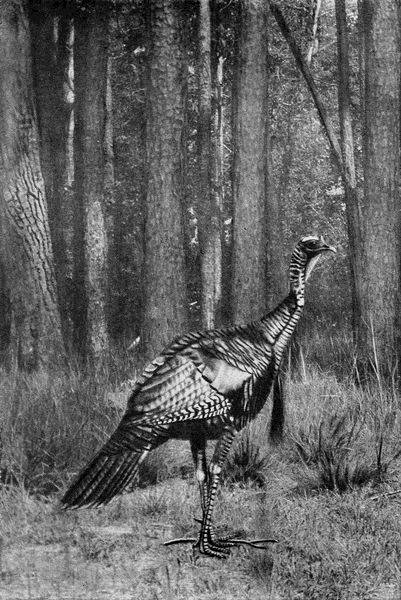
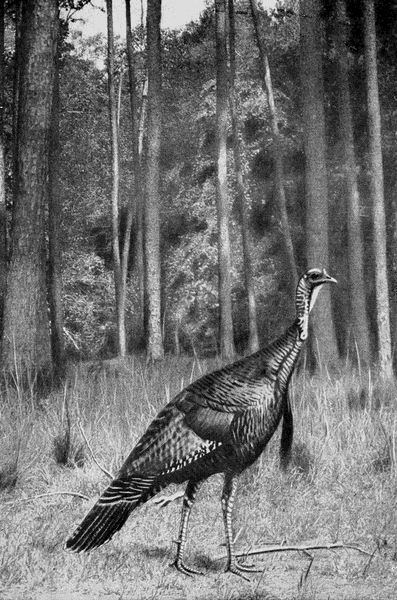
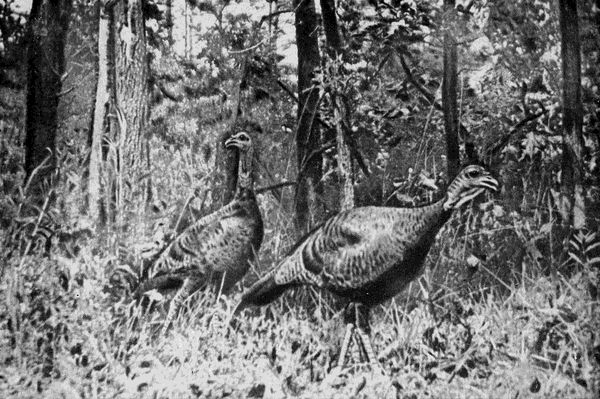
Having disposed of such records as we
have of the extinct ancestors of the
American turkeys—the so-to-speak
meleagrine records—we can now pass to what
is, comparatively speaking, the modern history
of these famous birds, although some of this
history is already several centuries old.
We have seen in the foregoing chapter that
all the described fossil species of turkeys have
been restricted to the genus Meleagris, and this
is likewise the case with the existing species and
subspecies. Right here I may say that the
word Meleagris is Greek as well as Latin, and
means a guinea-fowl. This is due to the fact
that when turkeys were first described and
written about they were, by several authors of
the early times, strangely mixed up with those
African forms, and the two were not entirely
disentangled for some time, as we shall see
further on in this chapter. In modern ornithology,
however, the generic name of Meleagris
has been transferred from the guinea-fowls to
the turkeys. These last, as they are classified
in "The A. O. U. Check-List of the American
Ornithologists' Union," which is the latest
authoritative word upon the subject, stand as
follows:
Family Meleagridæ. Turkeys.
Genus Meleagris Linnæus.
Meleagris Linnæus, Syst. Nat., ed. 10, 1, 1758, 156.
Type, by subs, desig., Meleagris gallopavo Linnæus
(Gray, 1840).
Meleagris gallopavo (Linnæus).
Range.—Eastern and south central United States,
west to Arizona and south to the mountains of Oaxaca.
a. [Meleagris gallopavo gallopavo. Extralimital.]
b. Meleagris gallopavo silvestris Vieillot. Wild Turkey
[310a].
Meleagris silvestris Vieillot Nouv., Dict. d'Hist. Nat.,
IX, 1817, 447.
Range.—Eastern United States from Nebraska, Kansas,
western Oklahoma, and eastern Texas east to central
Pennsylvania, and south to the Gulf coast; formerly
north to South Dakota, southern Ontario, and southern
Maine.
c. Meleagris gallopavo merriami Nelson. Merriam's
Turkey [310].
Meleagris gallopavo merriami Nelson, Auk, XVII,
April, 1900, 120.
(47 miles southwest of Winslow, Arizona.)
Range.—Transition and Upper Sonoran zones in the
mountains of southern Colorado, New Mexico, Arizona,
western Texas, northern Sonora, and Chihuahua.
d. Meleagris gallopavo osceola Scott. Florida Turkey
[310b].
Meleagris gallopavo osceola Scott, Auk, VII, Oct.,
1890, 376. (Tarpon Springs, Florida.)
Range.—Southern Florida.
e. Meleagris gallopavo intermedia Sennett. Rio
Grande Turkey [310c].
Meleagris gallopavo intermedia Sennett. Bull. U. S.
Geol. & Geog. Surv. Terr., V, No. 3, Nov., 1879, 428.
(Lomita, Texas.)
Range.—Middle northern Texas south to northeastern
Coahuila, Nuevo Leon, and Tamaulipas.
The presenting of the above list here does
away with giving, in the history of the wild turkeys,
any of the very numerous changes that
have taken place through the ages which led up
to its adoption. The discussion of these changes,
as a part of meleagrine history, would make an
octavo volume of two hundred pages or more.
It may be said here, however, that the word
gallopavo is from the Latin, gallus a cock, and
pavo a peafowl, while the meanings of the several
words silvestris, merriami, osceola, and intermedia
are self-evident and require no definitions.
Audubon, who gives the breeding range of the
wild turkey as extending "from Texas to Massachusetts
and Vermont" (Vol. V., p. 56), says
of them in his long account: "I have ascertained
that some of these valuable birds are still to be
found in the states of New York, Massachusetts,
Vermont, and Maine. In the winter of 1832-33,
I purchased a few fine males in the city of Boston";
and further, "At the time when I removed
to Kentucky, rather more than a fourth of a century
ago, turkeys were so abundant that the
price of one in the market was not equal to that
of a common barn-fowl now. I have seen them
offered for the sum of three pence each, the birds
weighing from ten to twelve pounds. A first-rate
turkey, weighing from twenty-five to thirty
pounds avoirdupois, was considered well sold
when it brought a quarter of a dollar."[9]
From these remarks we may imagine how
plentiful wild turkeys must have been on the
North American continent, when Aristotle wrote
his work "On Animals," over three hundred
years before the birth of Christ, upward of
twenty-three centuries ago! A good many
changes can take place in the avifauna of a
country in that time.
How these big, gallinaceous fowls ever got the
name of "turkey" has long been a matter of dispute;
and not a few ornithologists and writers
of note in the 16th and 17th centuries erroneously
conceived that the term had something to
do either with the Turks or their country. But
this idea has now been entirely abandoned, for it
has become quite clear that, during the times
mentioned, the turkey was strangely confused
with the guinea-fowl, a bird to which the name
turkey was originally applied.
Later on, both these birds became more abundant,
as more of them were domesticated and
reared in captivity, and the fact was gradually
realized that they were entirely different species
of fowls. During these times, the word turkey
was finally applied only to the New World
species, and the West African form was thereafter
called "Guinea-fowl."[10] After the word
turkey was more generally applied to the bird
now universally so known, some believe that
there was another reason as to how it came about,
and this "possibly because of its reputed call-note,"
says Newton, "to be syllabled turk, turk,
turk, whereby it may be almost said to have
named itself." (Notes and Queries, ser. 6, III,
pp. 23, 369.)[11]
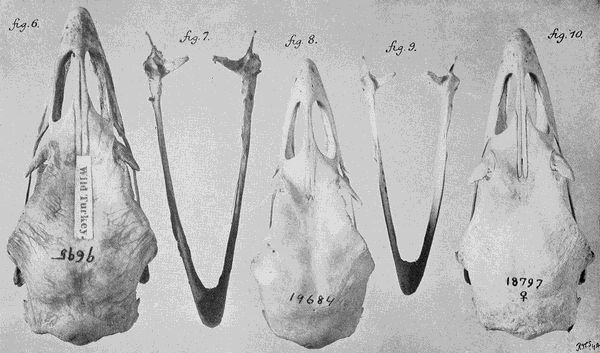
Plate II
Fig. 6. Superior view of the skull of an old male wild turkey; lower jaw removed. No. 9695, Coll. U. S. National Museum.
Fig. 7. Lower jaw or mandible of the skull shown in Fig. 6., seen from above. Fig. 8. Superior view of a skull of a wild turkey
and probably a female. Lower jaw removed and shown in Fig. 9. No. 19684, Coll. U. S. National Museum. Fig. 9. Lower
jaw of the skull shown in Fig. 8. Superior aspect. Fig. 10. Upper view of the skull of a wild Florida turkey (Meleagris g. osceola);
lower jaw removed and not figured. Female. No. 18797, Coll. U. S. National Museum. All the figures in this plate are reproductions
of photographs of the specimens made natural size by Dr. Shufeldt. Reduced about one-fourth.
So much for the origin of the name turkey; and
when one comes to search through the literature
devoted to this fowl to ascertain who first described
the wild species, the opinion seems to be
pretty general that this was done by Oviedo in
the thirty-sixth chapter of his "Summario de la
Natural Historia de las Indias," which it is
stated appeared about the year 1527.
Professor Spencer F. Baird, apparently quoting
Martin, says: "Oviedo speaks of the turkey
as a kind of peacock abounding in New Spain,
which had already in 1526 been transported in a
domestic state to the West India Islands and
the Spanish Main, where it was kept by the
Christian colonists."[12]
In an elegant and comprehensive article on
"The Wild Turkey," Bennett states: "Oviedo,
whose Natural History of the Indies contains the
earliest description extant of the bird, and whose
acquaintance with the animal productions of the
newly discovered countries was surprisingly extensive.
He speaks of it as a kind of Peacock
found in New Spain, of which a number had been
transported to the islands of the Spanish Main,
and domesticated in the houses of the Christian
inhabitants. His description is exceedingly accurate,
and proves that before the year 1526,
when his work was published at Toledo, the
turkey was already reduced to a state of Domestication."[13]
Again, in a very elaborate and now thoroughly
classical contribution, Pennant states: "The
first precise description of these birds is given
by Oviedo, who, in 1525, drew up a summary of
his greater work, the History of the Indies, for
the use of his monarch Charles V.[14] This learned
man had visited the West Indies and its islands
in person, and paid particular regard to the
natural history. It appears from him, that the
Turkey was in his days an inhabitant of the
greater islands and of the mainland. He speaks
of them as Peacocks; for being a new bird to
him, he adopts that name from the resemblance
he thought they bore to the former. 'But,'
says he, 'the neck is bare of feathers, but covered
with a skin which they change after their
phantasie into diverse colours. They have a horn
(in the Spanish Peçon corto) as it were on their
front, and hairs on the breast.' (In Purchas,
III, 995.) He describes other birds which he
also calls Peacocks. They are of the gallinaceous
genus, and known by the name of Curassao
birds, the male of which is black, the female
ferruginous."[15]
Dr. Coues, who has also written an article on
the history of the wild turkey, which, by the
way, is mainly composed of a lengthy quotation
from the above cited article of Bennett's, says:
"Linnæus, however, knew perfectly well that
the turkey was American. He says distinctly:
'Habitat in America septentrionali,' and quotes as
his first reference (after Fn. Soec. 198), the Gallopavo
sylvestris novæ angliæ, or New England
Wild Turkey of Ray. Brisson distinguished the
two perfectly, giving an elaborate description,
a copious synonomy, and a good figure of each;
and from about this time it may be considered
that the history of the two birds, so widely diverse,
was finally disentangled, and the proper
habitat ascribed to each." (Refers to first describers
of the pintado and turkey.)[16]
So much for the earliest describers of the wild
turkey, and I shall now pass on to the general
history of the bird, and, through presenting what
has been collected for us by the best authors on
the subject, endeavor to show how, after the
wild turkey was found in America by different
navigators and explorers, it was brought, from
time to time, to several of the countries of the Old
World—chiefly Spain and Great Britain—from
whence it probably was taken, upon different
occasions, into other countries of the continent.
Wild turkeys have always been easy to capture,
and we are aware of the fact that they are
quite capable of crossing the Atlantic on shipboard
in comfort and safety, landing in as good
a condition—if properly cared for during the
voyage—as when they left America. Josselyn
(1672) in his New England Rarities (p. 9) has not
a little to say on this point.
As already stated, the literature and bibliography
of the turkey is quite sufficient to fill a
good many volumes. Nothing of importance,
however, has been added to it, gainsaying what
we now have as a truthful account of the bird's
introduction into Europe. Indeed Buffon (Ois,
II, pp. 132-162), Broderip (Zool. Recreat. pp.
120-137), Pennant (Arct. Zool. pp. 291-300), and
others, practically cleared up nearly all the
points on this part of the turkey's history, making
but a few statements that are not wholly
reliable and worthy of acceptance. Pennant
very properly ignored in his work Barrington's
essay (Miscellanies, pp. 127-151) in which the
latter attempted to prove that turkeys were
known before America was discovered, and that
they were shipped over there subsequently to
its discovery!
I have already cited above Pennant's article
in the Philosophical Transactions of the Royal
Society of London (1781), and quoted from it to
some extent. It is one of the standard writings
on the wild turkey invariably referred to by
all authors when writing on the history of that
bird. As it is only accessible to the few, and so
full of reliable information, I propose to give
here, somewhat in full, those paragraphs in it
having special reference to the historical side of
our subject, and in doing so I retain the spelling
and composition of the original production.
"Belon, ('Hist. des Oys.,' 248) the earliest of
those writers," says Pennant, "who are of the
opinion that these birds were natives of the old
world, founds his notion on the description of
the Guinea-fowl, the Meleagrides of Strabo,
Athenæus, Pliny, and others of the ancients.
I rest the refutation on the excellent account
given by Athenæus, taken from Clytus Milesius,
a disciple of Aristotle, which can suit no other
than that fowl. 'They want,' says he, 'natural
affection towards their young; their head is
naked, and on the top is a hard round body like
a peg or nail; from their cheeks hangs a red piece
of flesh like a beard. It has no wattles like the
common poultry. The feathers are black, spotted
with white. They have no spurs; and both
sexes are so alike as not to be distinguished by the
sight.' Varro (Lib. III. c. 9.) and Pliny (Lib. X.
c. 26) take notice of the spotted plumage and
the gibbous substance on the head. Athenæus
is more minute, and contradicts every character
of the Turkey, whose females are remarkable for
their natural affection, and differ materially in
form from the males, whose heads are destitute
of the callous substance, and whose heels (in the
males) are armed with spurs."
"Aldrovandus, who died in 1605, draws his
arguments from the same source as Belon; I therefore
pass him by, and take notice of the greatest
of our naturalists Gesner (Av. 481.), who falls into
a mistake of another kind, and wishes the Turkey
to be thought a native of India. He quotes
Ælian for that purpose, who tells us, 'That in
India are very large poultry not with combs, but
with various coloured crests interwoven like
flowers, with broad tails either bending or displayed
in a circular form, which they draw along
the ground as peacocks do when they do not
erect them; and that the feathers are partly of a
gold colour, partly blue, and of an emerald colour.'
(De Anim. lib. XVI, c. 2.).
"This in all probability was the same bird with
the Peacock Pheasant of Mr. Edwards, Le Baron
de Tibet of M. Brisson, and the Pavo bicalcaratus
of Linnæus. I have seen this bird living. It
has a crest, but not so conspicuous as that described
by Ælian; but it has not those striking
colours in form of eyes, neither does it erect its
tail like the Peacock (Edw. II. 67.), but trails it
like the Pheasant. The Catreus of Strabo (Lib.
XV. p. 1046) seems to be the same bird. He
describes it as uncommonly beautiful and spotted,
and very like a Peacock. The former author
(De Anim. lib. XVII, c. 23.) gives more
minute account of this species, and under the
same name. He borrows it from Clitarchus,
an attendant of Alexander the Great in all his
conquests. It is evident from his description
that it was of this kind; and it is likewise probable
that it was the same with his large Indian
poultry before cited. He celebrates it also for
its fine note; but allowance must be made for the
credulity of Ælian.
"The Catreus, or Peacock Pheasant, is a native
of Tibet, and in all probability of the north of
India, where Clitarchus might have observed it;
for the march of Alexander was through that
part which borders on Tibet, and is now known
by the name of Penj-ab or five rivers."
"I shall now collect from authors the several
parts of the world where Turkies are unknown
in the state of nature. Europe has no share in
the question; it being generally agreed that they
are exotic in respect to that continent."
"Neither are they found in any part of Asia
Minor, or the Asiatic Turkey, notwithstanding
ignorance of their true origin first caused them
to be named from that empire. About Aleppo,
capital of Syria, they are only met with, domesticated
like other poultry. (Russel, 63).
In Armenia they are unknown, as well as in
Persia; having been brought from Venice by
some Armenian merchants into that empire
(Tavernier, 145), where they are still so scarce
as to be preserved among other rare fowls in the
royal menagery" (Bell's Travels, I. 128).
"Du Halde acquaints us that they are not
natives of China; but were introduced there
from other countries. He errs from misinformation
in saying that they are common in
India."
"I will not quote Gemelli Careri, to prove that
they are not found in the Philippine Islands,
because that gentleman with his pen traveled
round the world in his easy chair, during a very
long indisposition and confinement, (Sir James
Porter's Obs. Turkey, I, 1, 321), in his native
country."
"But Dampier bears witness that none are
found in Mindanao" (Barbot in Churchill's Coll.,
V. 29).
"The hot climate of Africa barely suffers these
birds to exist in that vast continent, except under
the care of mankind. Very few are found in
Guinea, except in the hands of the Europeans,
the negroes declining to breed any on account of
the great heats (Bosman, 229). Prosper Alpinus
satisfies us they are not found either in Nubia or
in Egypt. He describes the Meleagrides of the
ancients, and only proves that the Guinea hens
were brought out of Nubia, and sold at a great
price at Cairo (Hist. Nat. Ægypti. I, 201);
but is totally silent about the turkey of the
moderns."
"Let me in this place observe that the Guinea
hens have long been imported into Britain.
They were cultivated in our farm-yards; for I
discover in 1277, in the Grainge of Clifton, in the
parish of Ambrosden in Buckinghamshire, among
other articles, six Mutilones and six Africanæ
fœminæ (Kennett's Parochial Antiq. 287), for
this fowl was familiarly known by the names of
Afra Avis and Gallina Africana and Numida.
It was introduced into Italy from Africa, and
from Rome into our country. They were neglected
here by reason of their tenderness and
difficulty of rearing. We do not find them in
the bills of fare of our ancient feasts (neither in
that of George Nevil nor among the delicacies
mentioned in the Northumberland household
book begun in the beginning of the reign of Henry
VIII); neither do we find the turkey; which last
argument amounts almost to a certainty, that
such a hardy and princely bird had not found
its way to us. The other likewise was then
known by its classical name; for that judicious
writer Doctor Caius describes in the beginning
of the reign of Elizabeth, the Guinea-fowl, for the
benefit of his friend Gesner, under the name of
Meleagris, bestowed on it by Aristotle" (CAII
Opusc. 13. Hist. An., lib. VI. c. 2).
"Having denied, on the very best authorities,
that the Turkey ever existed as a native of the old
world, I must now bring my proofs of its being
only a native of the new, and of the period in
which it first made its appearance in Europe."
"The next who speaks of them as natives of
the mainland of the warmer parts of America is
Francusco Fernandez, sent there by Philip II,
to whom he was physician. This naturalist observed
them in Mexico. We find by him that
the name of the male was Huexolotl, of the female
Cihuatotolin. He gives them the title of
Gallus Indicus and Gallo Pavo. The Indians,
as well as the Spaniards, domesticated these
useful birds. He speaks of the size by comparison,
saying that the wild were twice the magnitude
of the tame; and that they were shot with
arrows or guns (Hist. Av. Nov. Hisp. 27). I
cannot learn the time when Fernandez wrote.
It must be between the years 1555 and 1598, the
period of Philip's reign."
"Pedro de Ciesa mentions Turkies on the
Isthmus of Darien (Seventeen Years Travels,
20). Lery, a Portuguese author, asserts that
they are found in Brazil, and gives them an
Indian name (In De Laet's Descr. des Indes,
491); but since I can discover no traces of them
in that diligent and excellent naturalist Marcgrave,
who resided long in that country, I must
deny my assent. But the former is confirmed
by that able and honest navigator Dampier,
who saw them frequently, as well wild as tame,
in the province of Yucatan (Voyages, Vol II,
part II, pp. 65, 85, 114), now reckoned part
of the Kingdom of Mexico."
"In North America they were observed by the
very first discoverers. When Rene de Landonniere,
patronized by Admiral Coligni, attempted
to form a settlement near where Charlestown
now stands, he met with them on his first
landing in 1564, and by his historian has represented
them with great fidelity in the fifth plate
of the recital of his voyage (Debry): from his
time the witnesses to their being natives of the
continent are innumerable. They have been
seen in flocks of hundreds in all parts from
Louisiana even to Canada; but at this time are
extremely rare in a wild state, except in the more
distant parts, where they are still found in vast
abundance."
"It was from Mexico or Yucatan that they
were first introduced into Europe; for it is certain
that they were imported into England as early
as the year 1524, the 15th of Henry VIII. (Baker's
Chr. Anderson's Dict., Com. 1, 354. Hackluyt,
II, 165, makes their introduction about the
year 1532. Barnaby Googe, one of our early
writers on Husbandry, says they were not seen
here before 1530. He highly commends a Lady
Hales of Kent for her excellent management of
these fowl, p. 166.)
"We probably received them from Spain, with
which we had great intercourse till about that
time. They were most successfully cultivated
in our Kingdom from that period; insomuch
that they grew common in every farm-yard,
and became even a dish in our rural feasts by
the year 1585; for we may certainly depend on
the word of old Tusser in his Account of the
Christmas Husbandrie Fare." (Five Hundred
Points of good Husbandrie, p. 57.)
"Beefe, Mutton, and Porke, shredpiece of the best,
Pig, Veale, Goose, and Capon, and Turkie well drest,
Cheese, Apples and Nuts, jolie carols to heare,
As then in the countrie, is counted good cheare."
"But at this very time they were so rare in
France, that we are told, that the very first which
was eaten in that Kingdom appeared at the
nuptial feast of Charles IX. in 1570 (Anderson's
Dict. Com. 1, 410)."[17]
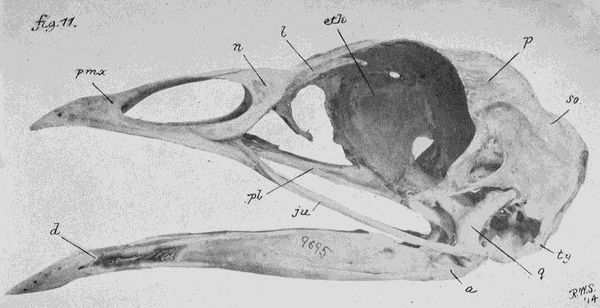
Plate III
Fig. II. Left lateral view of the skull of an old male wild turkey (Meleagris gallopavo). See Plate II, Fig. 6, No. 9695, Coll. U. S.
National Museum. Photo natural size by Dr. Shufeldt. pmx, premaxillary; n, nasal bone; l, lacrymal bone; eth, ethmoid; p, parietal;
so, supraoccipital; pl, palatine; ju, jugal; ty, tympanic; q, quadrate; a, angular of lower jaw; d, dentary. There are many more bones
in the skull than those indicated, while the latter serve to invite attention to the principal ones as landmarks.
A little later on Bartram in his travels in the
South published some notes on the wild turkey
[now M. g. osceola] as he found them in Florida
during the latter part of the eighteenth century.
The original edition of his book, which I have not
seen, appeared in 1791. I have, however, examined
the edition of 1793, wherein on page 14
he says: "Our turkey of America is a very
different species from the Meleagris of Asia
and Europe; they are nearly thrice their size
and weight. I have seen several that have
weighed between twenty and thirty pounds,
and some have been killed that have weighed
near forty."
And further on in the same work he adds
[Florida, p. 81]: "Having rested very well during
the night, I was awakened in the morning early
by the cheering converse of the wild turkey-cocks
(Meleagris occidentalis) saluting each
other from the sun-brightened tops of the lofty
Cupressus disticha and Magnolia grandiflora.
They begin at early dawn and continue till sunrise,
from March to the last of April. The high
forests ring with the noise, like the crowing of
the domestic cock, of these social sentinels; the
watchword being caught and repeated, from
one to another, for hundreds of miles around,
insomuch that the whole country is for an hour
or more in a universal shout. A little after
sunrise, their crowing gradually ceases, they
quit then their high lodging places, and alight
on the earth, where, expanding their silver-bordered
train, they strut and dance round about
the coy female, while the deep forests seem to
tremble with their shrill noise."[18]
Another of the early writers (1806), who paid
some attention to the history and distribution of
the wild turkeys was Barton. I find the following
having reference to some of his observations, viz.:
"A memoir has been read before the American
Philosophical Society in which the author has
shown that at least two distinct species of Meleagris,
or turkey, are known within the limits of
North America. These are the Meleagris gallopavo,
or Common Domesticated Turkey, which
was wholly unknown in the countries of the Old
World before the discovery of America; and the
Common Wild Turkey of the United States, to
which the author of the memoir has given the name
Meleagris Palawa—one of its Indian names.
"The same author has rendered it very probable
that this latter species was domesticated
by some of the Indian tribes living within the
present limits of the United States, before these
tribes had been visited by the Europeans. It
is certain, however, that the turkey was not domesticated
by the generality of the tribes, within
the limits just mentioned, until after the Europeans
had taken possession of the countries of
North America."[19]
Nine or ten years after Barton wrote, De Witt
Clinton, who was a candidate for President of
the United States in 1812, and a son of James
Clinton, was one of the writers of that time on
the wild turkey. He pointed out how birds,
the turkey included, change their plumage after
domestication, and, after giving what he knew
of the introduction of the turkey into Spain from
America and the West Indies, he adds: "From
the Spanish turkey, which was thus spread over
Europe, we have obtained our domestic one.
The wild turkey has been frequently tamed, and
his offspring is of a large size." (p. 126.)[20]
Nearly a quarter of a century after Clinton's
article appeared, the anatomy of the wild turkey
began to attract some attention. Among the
first articles to appear on this part of the subject
was one by the late Sir Richard Owen, who,
apparently taking the similarity of the vernacular
names into account, made anatomical
comparisons of the organs of smell in the turkey
and the turkey buzzard. Naturally, he
found them very different,—quite as different,
perhaps, as are the olfactory organs of an owl
and an ostrich, which I, for one, would not undertake
to make a comparison of for publication,
simply for the fact that in both these birds their
vernacular name begins with the letter o.[21]
Even twenty years after this paper appeared
there were those who still entertained doubts
as to the origin of the domesticated turkeys, and
believed that they had nothing to do with the
wild forms. Among the doubters, no one was
more prominent than Le Conte, who published
the following as his opinion at the time, stating:
"The conviction that these two birds were really
distinct species has long existed in my mind.
More than fifty years ago, when I first saw a
Wild Turkey, I was led to conclude that one
never could have been produced from the other."
[Bases it on differences of external characters]
(p. 179), adding toward the close of his article:
"I defy anyone to show a Turkey, even of the first
generation, produced from a pair hatched from the
eggs of a wild hen," etc. "I repeat, contrary to
the assertions of many others, that no one has
ever succeeded in domesticating our Wild Turkey,"
etc. "Thoroughly believe that the tame
and wild bird are different species, and the latter
not the ancestor of the tame one." (p. 181.)[22]
During the year 1856, the papers Gould published
on the wild turkeys attracted considerable
attention, and they have been widely quoted
since. In one of his first papers on the subject
he quotes from Martin the same paragraph which
Baird quoted in his article in the Report of the
Commissioner of Agriculture (1866 antea), while
Baird in his article misquotes Gould by saying
that the turkey was introduced into England in
1541; whereas Gould states the introduction
took place in 1524.[23]
Before passing to the more recent literature on
these birds, and what I will have to say further
on about their comparative osteology and their
eggs, it will be as well to reproduce here a few more
statements made by Bennett, whose work, "The
Gardens and Menagerie of the Zoölogical
Society Delineated," I have already quoted.[24]
Bennett was also of the opinion that "Daines
Barrington was the last writer of any note who
denied the American origin of the turkey, and he
seems to have been actuated more by a love of
paradox than by any conviction of the truth of
his theory. Since the publication of his Miscellanies,
in 1781, the knowledge that has been
obtained of the existence of large flocks of turkeys,
perfectly wild, clothed in their natural
plumage, and displaying their native habits,
spread over a large portion of North America,
together with the certainty of their non-existence
in a similar state in any other part of the globe,
have been admitted on all hands to be decisive
of the question." (p. 210).
I have already cited the evidence above to
prove that it was Oviedo who first published an
accurate description of the wild turkey,—his
work being published at Toledo in about the
year 1526, at which time the turkey had already
become domesticated. In other words, it was
the Spaniards who first reduced the bird to a
state of domestication, and very soon thereafter
it was introduced into England. Spain and England
were the great maritime nations of those
times, and this fact will amply account for the
early introduction of the bird into the latter
country. Singularly enough, however, we have
no account of any kind whatever through which
we can trace the exact time when this took place.
As others have suggested, it is just possible that
it may have been Cabot, the explorer of the then
recently discovered coasts of America, who first
transported wild turkeys into England. Baker
quotes the popular rhyme in his Chronicle:
"Turkeys, carps, hoppes, picarel and beer,
Came into England all in one year,"
that is, about 1524, or the 15th of the reign of
Henry VIII.[25]
What was said by the German author Heresbach
was translated by a writer on agricultural
subjects, Barnaby Googe, who published it in his
work. This appeared in the year 1614, and he
refers to "those outlandish birds called Ginny-Cocks
and Turkey-Cocks," stating that "before
the yeare of our Lord 1530 they were not seene
with us!"
Further, Bennett points out that "A more
positive authority is Hakluyt, who in certain
instructions given by him to a friend at Constantinople,
bearing date of 1582, mentions,
among other valuable things introduced into
England from foreign parts, 'Turkey-Cocks and
hennes' as having been brought in 'about fifty
years past.' We may therefore fairly conclude
that they became known in this country about
the year 1530."[26]
Guinea-fowls were extremely rare in England
throughout the sixteenth century, while tame
turkeys became very abundant there, forming
by no means an expensive dish at festivals,—the
first were obtained from the Levant, while
the latter were to be found in poultry yards
nearly everywhere. In one of the Constitutions
of Archbishop Cranmer it was ordered that of
fowls as large as swans, cranes, and turkey-cocks,
"there should be but one in a dish."[27]
When in 1555 the serjeants-at-law were
created, they provided for their inauguration
dinner two turkeys and four turkey chicks at a
cost each of only four shillings, swans and cranes
being ten, and half a crown each for capons. At
this rate, turkeys could not have been so very
scarce in those parts.[28] "Indeed they had become
so plentiful in 1573," continues Bennett,
"that honest Tusser, in his 'Five Hundred
Points of Good Husbandrie,'" enumerates them
among the usual Christmas fare at a farmer's
table, and speaks of them as "ill neighbors" both
to "peason" and to hops. (pp. 212, 213.)
"A Frenchman named Pierre Gilles has the
credit of having first described the turkey in this
quarter of the globe, in his additions to a Latin
translation of Ælian, published by him in 1535.
His description is so true to nature as to have
been almost wholly relied on by every subsequent
writer down to Willoughby. He speaks of it as
a bird that he has seen; and he had not then been
further from his native country than Venice; and
states it to have been brought from the New
World.
"That turkeys were known in France at this
period is further proved by a passage in Champier's
'Treatise de Re Cibaria,' published in
1560, and said to have been written thirty years
before. This author also speaks of them as having
been brought but a few years back from the
newly discovered Indian islands. From this
time forward their origin seems to have been
entirely forgotten, and for the next two centuries
we meet with little else in the writings of ornithologists
concerning them than an accumulation
of citations from the ancients, which bear
no manner of relation to them. In the year 1566
a present of twelve turkeys was thought not
unworthy of being offered by the municipality
of Amiens to their king, at whose marriage, in
1570, Anderson states in his History of Commerce,
but we know not on what authority,
they were first eaten in France. Heresbach, as
we have seen, asserts that they were introduced
into Germany about 1530; and that a sumptuary
law made at Venice in 1557, quoted by Zanoni,
particularizes the tables at which they were
permitted to be served.
"So ungrateful are mankind for the most important
benefits that not even a traditionary
vestige remains of the men by whom, or the country
from whence, this most useful bird was
introduced into any European states. Little
therefore is gained from its early history beyond
the mere proof of the rapidity with which the
process of domestication may sometimes be effected."
(pp. 213, 214.)
Some ten or more years ago, at a time when I
was the natural history editor of Shooting and
Fishing, in New York City, I published a number
of criticisms and original articles upon turkeys,
both the wild and domesticated forms.[29]
About twelve years ago, Mr. Nelson contributed
a very valuable article on wild turkeys,
portions of which are eminently worthy of the
space here required to quote them.[30] He says
among other things in this article that "All recent
ornithologists have considered the wild turkey
of Mexico and the southwestern United States
(aside from M. gallopavo intermedia) as the
ancestor of the domesticated bird. This idea
is certainly erroneous, as is shown by the series of
specimens now in the collection of the Biological
Survey. When the Spaniards first entered
Mexico they landed near the present city of
Vera Cruz and made their way thence to the
City of Mexico.
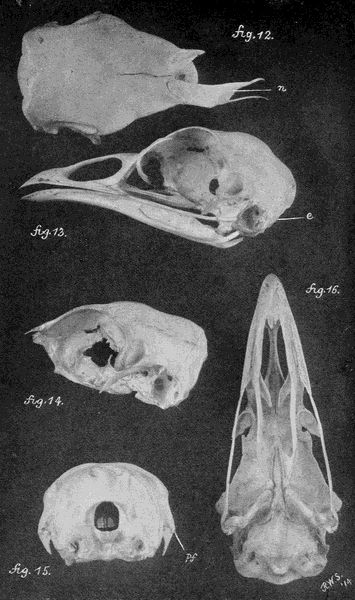
Plate IV
Fig. 12. Superior view of the cranium of a large male tame turkey, with right
nasal bone (n) attached in situ. Specimen in Dr. Shufeldt's private collection.
Fig. 13. Left lateral view of the skull of a female turkey, probably a wild one.
No. 19684, Coll. U. S. National Museum. (See Fig. 8, Pl. II.) e, bony entrance
to ear. Compare contour line of cranium with Fig. 14. Fig. 14. Left lateral
view of the cranium of a tame turkey; male. Dr. Shufeldt's private collection.
Fig. 15. Direct posterior view of the cranium of a tame turkey, probably a
female. pf, postfrontal. Specimen in Dr. Shufeldt's collection. Fig. 16. Skull of a
wild Florida turkey, seen from below (M. g. osceola). (See Fig. 10, Pl. II.) Bones
named in Fig. 18. Photo natural size by Dr. Shufeldt and considerably reduced.
"At this time they found domesticated turkeys
among the Indians of that region, and within a
few years the birds were introduced into Spain.[31]
"The part of the country occupied by the
Spanish during the first few years of the conquest
in which wild turkeys occur is the eastern slope
of the Cordillera in Vera Cruz, and there is every
reason to suppose that this must have been the
original home of the birds domesticated by the
natives of that region.
"Gould's description of the type of M. mexicana
is not sufficiently detailed to determine the
exact character of this bird, but fortunately the
type was figured in Elliot's "Birds of North
America."... In addition Gould's type
apparently served for the description of the adult
male M. gallopavo in the 'Catalogue of Birds
Brit. Mus.' (xxii, p. 387), and an adult female
is described in the same volume from Ciudad
Ranch Durango.... Thus it will become
necessary to treat M. gallopavo and M. mexicana
as at least subspecifically distinct. Whatever
may be the relationship of M. mexicana to M.
gallopavo, the M. g. merriami is easily separable
from M. g. mexicana of the Sierra Madre of western
Mexico, from Chihuahua to Colima. Birds from
northern Chihuahua are intermediate."
In this article Mr. Nelson names M. g. merriami
and gives full descriptions of the adult
male and female in winter plumage.
What has thus far been presented above on the
first discovery of the American wild turkeys,
their natural history in the New World, their
introduction into Spain, England, France, and
elsewhere, is practically all we have on this part
of our subject up to date. What I have given
is from the very best ornithological and other
authorities. Domesticated turkeys are now
found in nearly all parts of the world, while in
only a very few instances has any record been
kept of the different times of their introduction.
With the view of accumulating such data, one
would have to search the histories of all the
countries of all the civilized and semi-civilized
peoples of the world, which would be the labor of
almost a man's entire lifetime, and in only too
many instances his search would be in vain, for
the several records of the times of introducing
these birds were not made.
Apart from the description of the wild turkeys,
there is still a very large literature devoted to the
domesticated forms of turkeys as they occur in
this country and abroad, as well as descriptions
of their eggs. I have gone over a large part of
this literature, but shall be able to use only a
small, though nevertheless essential, part of it
here. This I shall complete with an account of
turkey eggs, which will be presented quite apart
from anything to do with their nests, nesting
habits, and much else which will be fully treated
in other chapters of this book. In some works
we meet with the literature of all these subjects
together, others have only a part, while still
others are confined to one thing, as the eggs.[32]
Darwin in his works paid considerable attention
to the wild and tame turkeys. He states that
"Professor Baird believes (as quoted in Tegetmeier's
'Poultry Book,' 1866, p. 269) that our
turkeys are descended from a West Indian species,
now extinct. But besides the improbability of a
bird having long ago become extinct in these
large and luxuriant islands, it appears, as we
shall presently see, that the turkey degenerates
in India, and this fact indicates that this was not
aboriginally an inhabitant of the lowlands of the
tropics.
"F. Michaux," he further points out, "suspected
in 1802 that the common domestic turkey
was not descended from the United States species
alone, but was likewise from a southern form, and
he went so far as to believe that English and French
turkeys differed from having different proportions
of the blood of the two parent-forms.[33]
"English turkeys are smaller than either wild
form. They have not varied in any great degree;
but there are some breeds which can be
distinguished—as Norfolks, Suffolks, Whites,
and Copper-Coloured (or Cambridge), all of
which, if precluded from crossing with other
breeds, propagate their kind truly. Of these
kinds, the most distinct is the small, hardy, dull-black
Norfolk turkey, of which the chickens are
black, with occasionally white patches about the
head. The other breeds scarcely differ except
in colour, and their chickens are generally mottled
all over with brownish-grey.[34]
"In Holland there was formerly, according to
Temminick, a beautiful buff-yellow breed, furnished
with an ample white topknot. Mr.
Wilmot has described a white turkey-cock with
a crest formed of 'feathers about four inches
long, with bare quills, and a tuft of soft down
growing at the end.'[35] Many of the young birds
whilst young inherited this kind of crest, but
afterwards it either fell off or was pecked out by
the other birds. This is an interesting case, as
with care a new breed might probably have been
formed; and a topknot of this nature would have
been, to a certain extent, analogous to that borne
by the males in several allied genera, such as
Euplocomus, Lophophorus, and Pavo."[36]
Darwin has further pointed out that "The
tuft of hair on the breast of the wild turkey-cock
cannot be of any use, and it is doubtful whether
it can be ornamental in the eyes of the female
birds; indeed, had the tuft appeared under domestication,
it would have been called a monstrosity.
"The naked skin on the head of a vulture is
generally considered as a direct adaptation for
wallowing in putridity; and so it may be, or it
may possibly be due to the direct action of putrid
matter; but we should be very cautious in drawing
any such inference, when we see that the skin
on the head of the clean-feeding male turkey is
likewise naked."[37]
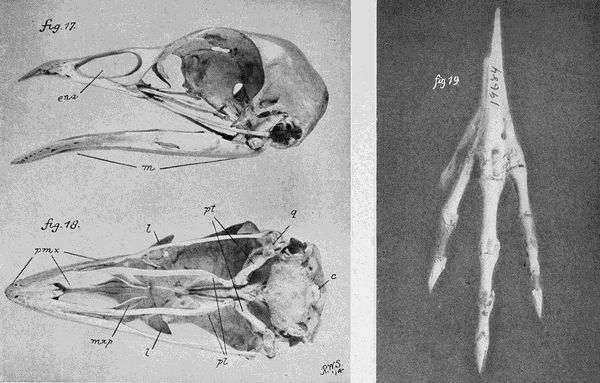
Plate V
Fig. 17. Left lateral view of the skull, including lower jaw, of a wild turkey; probably a female. No. 19684, Coll. U. S. National Museum.
(See Fig. 8, Pl. II, and Fig. 13.) ena, external narial aperture. Fig. 18. Skull of wild Florida turkey. (See Fig. 16.) pmx, premaxillary; l,
lacrymal; pt, pterygoids; q, quadrate; c, occipital condyle; mxp, maxillo-palatine; pl, palatines. Fig. 19. Skeleton of the left foot of a wild
turkey (female?) No. 19684, Coll. U. S. National Museum. Several views of the skull of this individual are given above. The shortest
toe is the hind toe or hallux, and has a claw and a joint; then there are 3, 4, and 5 phalangeal joints to the second, third, and fourth toes
respectively—that is in the inner, middle, and outer one. This count includes the distal or claw joints (ungual joints). All three
figures photo natural size by Dr. Shufeldt and considerably reduced in reproduction.
Newton has pointed out that the topknotted
turkeys were figured by Albin in 1738, and that
it "has been suggested with some appearance of
probability that the Norfolk breed may be descended
from the northern form, Meleagris gallopavo
or americana, while the Cambridgeshire
breed may spring from the southern form the M.
mexicana of Gould (P. Z. S. 1856, p. 61), which
indeed it very much resembles, especially in
having its tail-coverts and quills tipped with
white or light ochreous—points that recent
North American ornithologists rely upon as distinctive
of this form. If this supposition be
true, there would be reason to believe in the
double introduction of the bird into England at
least, as already hinted, but positive information
is almost wholly wanting." (Ibid., p. 996.).
It is an interesting fact that the males of both
the wild and tame forms of turkeys frequently
lack spurs;[38] and Henshaw has pointed out that
in the case of M. g. merriami "A few of the gobblers
had spurs; in one instance these took the
form of a blunt, rounded knob half an inch long.
In others, however, it was much reduced, and
in others still the spur was wanting; though my
impression is that all the old males had this weapon."[39]
One of the best articles which have been contributed
to the present part of our subject, appeared
several years ago from the pen of that
very excellent naturalist, the late Judge Caton of
Chicago. This contribution is rather a long one,
and I shall only select such paragraphs from it
as are of special value in the present connection.[40]
It is a well-known fact that the author of this
work made a long series of observations on wild
turkeys which he kept in confinement. He
raised many from the eggs of the wild turkey
taken in nature and hatched out by the common
hen on his own preserves. At one time he had as
many as sixty such birds, and he lost no opportunity
to study their habits. They were of the
pure stock with all their characters as in the wild
form. These turkeys became very tame when
thus raised from the eggs of the wild birds, and
they did not deteriorate, either in size or in their
power of reproduction. "This magnificent
game bird," says Caton, "was never a native of
the Pacific Coast. I have at various times sent
in all about forty to California, in the hope that
it may be acclimatized in the forests. Their
numerous enemies have thus far prevented success
in this direction, but they have done reasonably
well in domestication, and Captain Rodgers
of the United States Coast Survey has met with
remarkable success in hybridizing them with the
domestic bronze turkey. Last spring I sent
some which were placed on Santa Clara Island,
off Santa Barbara. They remained contentedly
about the ranch building and, as I am informed,
raised three broods of young which are doing
well. As there is nothing on the island more
dangerous to them than a very small species of
fox, we may well hope that they will in a few
years stock the whole island, which is many
miles in extent. As the island is uninhabited
except by the shepherds who tend the immense
flocks of sheep there, they will soon revert to the
wild state, when I have no doubt they will resume
markings as constant as is observed in the
wild bird here, but I shall be disappointed if the
changed condition of life does not produce a
change of color or in the shades of color, which
would induce one unacquainted with their history
to pronounce them specifically different
from their wild ancestors here. Results will be
watched with interest.
"My experiments in crossing the wild with the
tame have been eminently successful." (Followed
by a long account, p. 329.)
"My experiments establish first that the turkey
may be domesticated, and that each succeeding
generation bred in domestication loses
something of the wild disposition of its ancestors.
"Second, that the wild turkey bred in domestication
changes its form and the color of its
plumage and of its legs, each succeeding generation
degenerating more and more from these
brilliant colors which are so constant on the wild
turkey of the forest, so that it is simply a question
of time—and indeed a very short time—when
they will lose all of their native wildness and become
clothed in all the varied colors of the common
domestic turkey; in fact be like our domestic
turkey,—yes, be our domestic turkey.
"Third, that the wild turkey and the domestic
turkey as freely interbred as either does with its
own variety, showing not the least sexual aversion
always observed between animals of different
species of the same genus, and that the hybrid
progeny is as vigorous, as robust, and fertile as
was either parent.
"It must be already apparent that I, at least,
have no doubt that our common domestic turkey
is a direct descendant of the wild turkey of our
forests, and that therefore there is no specific difference
between them. If such marked changes
in the wild turkey occur by only ten years
of domestication, all directly tending to the
form, habits, and colorings of the domestic
turkey,—in all things which distinguish the domestic
from the wild turkey,—what might we
not expect from fifty or a hundred years of domestication?
I know that the best ornithological
authority at the present time declares
them to be of a different species, but I submit
that this is a question which should be reconsidered
in the light of indisputable facts which
were not admitted or established at the time such
decision was made.
"There has always been diffused among the
domestic turkeys of the frontiers more or less of
the blood of the wild turkey of the neighboring
forests, and as the wild turkey has been driven
back by the settlement of the country, the domestic
turkey has gradually lost the markings
which told of the presence of the wild; though
judicious breeding has preserved and rendered
more or less constant some of this evidence in
what is called the domestic bronze turkey, as the
red leg and the tawny shade dashed upon the
white terminals of the tail feathers and the tail-coverts,
the better should the stock be considered,
because it is the more like its wild ancestor.
"That the domestic turkey in its neighborhood
may be descended from or largely interbred with
the wild turkey of New Mexico, which in its wild
state more resembles the common domestic turkey
than our wild turkey does, may unquestionably
be true, and it may be also that the wild
turkey there has a large infusion of the tame
blood, for it is known that not only our domestic
turkey, but even our barnyard fowls, relapse
to the wild state in a single generation when
they are reared in the woods and entirely away
from the influence of man, gradually assuming
uniform and constant colorings. But I will not
discuss the question whether the Mexican wild
turkey is of a different species from ours or
merely a variety of the same species, only with
differences in color which have arisen from accidental
causes, and certainly I will not question
that the Mexican turkey is the parent of many
domestic turkeys, but I cannot resist the conclusion
that our wild turkey is the progenitor of
our domestic turkey."
We have now come to where we can study the
eggs of these birds, and in the same article I
have just quoted so extensively from, Judge
Caton says on page 324 of it, "The eggs of the
wild turkey vary much in coloring and somewhat
in form, but in general are so like those of the
tame turkey that no one can select one from the
other. The ground color is white, over which
are scattered reddish-brown specks. These differ
in shades of color, but much more in numbers.
I have seen some on which scarcely any specks
could be detected, while others were profusely
covered with specks, all laid by the same hen in
the same nest. The turkey eggs are more pointed
than those of the goose or the barnyard fowl,
and are much smaller in proportion to the size
of the bird."
This, in the main, is a fair description of the
eggs of Meleagris, while at the same time it may
be said that the ground color is not always
"white," nor the markings exactly what might
be denominated "specks."
Turkey eggs of all kinds, laid by hens of the
wild as well as by those of the domesticated
birds, have been described and figured in a great
many popular and technically scientific books
and other works, in this country as well as
abroad. A large part of this literature I have
examined, but I soon became convinced of the
fact that no general description would begin to
stand for the different kinds of eggs that turkeys
lay. They not only differ in size, form, and markings,
but in ground colors, numbers to the clutch,
and some other particulars. Then it is true that
no wild turkey hen, of any of the known subspecies
or species of this country, has ever laid an
egg but what some hen of the domestic breeds
somewhere has not laid one practically exactly
like it in all particulars. In other words, the eggs
of our various breeds of tame turkeys are like the
eggs of the several forms of the wild bird, that is,
the subspecies known to science in the United
States avifauna. Therefore I have not thought
it necessary to present here any descriptions of
the eggs of the tame turkeys or reproductions of
photographs of the same.
Among the most beautiful of the wild turkey
eggs published are those which appear in Major
Bendire's work. They were drawn and painted
by Mr. John L. Ridgway of the United States
Geological Survey.[41] These very eggs I have not
only examined, studied and compared, but,
thanks to Dr. Richmond of the Division of Birds
of the Museum, and to Mr. J. H. Riley, his
assistant, I had such specimens as I needed
loaned me from the general collection of the Museum,
in that I might photograph them for use
in the present connection. Dr. Richmond did
me a special kindness in selecting for my study
the four eggs here reproduced from my photograph
of them in Plate VI. These are all of M.
g. silvestris.
Of these, figures 20 and 21 are from the same
clutch, and doubtless laid by the same bird.
(Nos. 30014, 30014.) They were collected by
J. H. Riley at Falls Church, Va. Figure 20 is an
egg measuring 66 mm. x 45 mm., the color being
a pale buffy-brown, finely and nearly evenly
speckled all over with umber-brown, with very
minute specks to dots measuring a millimetre in
diameter. The finest speckling, with no larger
spots, is at the greater end (butt) for a third of
the egg.
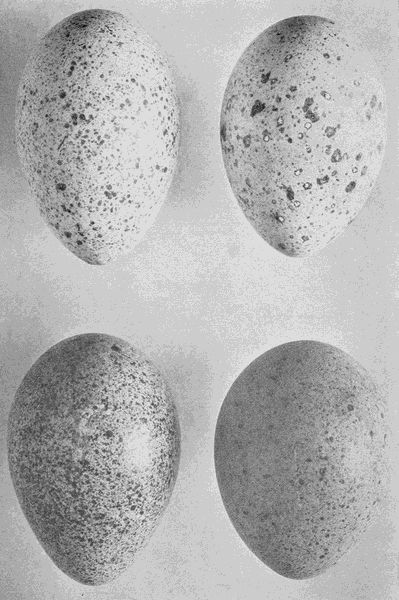
Plate VI
Eggs of wild turkey (M. g. silvestris)
Names and descriptions given in the text. All the specimens photo natural size by
Dr. Shufeldt and somewhat reduced in reproduction. Fig. 20. Upper left-hand one. Fig.
21. Upper right-hand one. Fig. 22. Lower left-hand one. Fig. 23. Lower right-hand one.
Figure 21 measures 63 mm. x 45 mm., the ground
color being a pale cream, speckled somewhat
thickly and uniformly all over with fine specks of
light brown and lavender, with larger spots and
ocellated marks of lavender moderately abundant
over the middle and the apical thirds, with
none about the larger end or remaining third.
Figure 22 (Plate VI) is No. 31185 of the collection
of the U. S. National Museum (ex Ralph Coll.); it
was collected at Bridgeport, Michigan, by Allan
Herbert (376, 4700, '77) and measures 68 x 46.
It is of a rather deep buffy-brown or ochre, very
thickly and quite uniformly speckled all over
with more or less minute specks of dark brown.
Figure 23 was collected by H. R. Caldwell
(91310), the locality being unrecorded (Coll.
U. S. Nat. Museum, No. 32407), and measures
63 x 48. It is of a pale buffy-brown or pale café
au lait color, quite thickly speckled all over with
fine dots and specks of light brown. Some few
of the specks are of noticeably larger size, and
these are confined to the middle and apical
thirds. Speckling of the butt or big end extremely
fine, and the specks of lighter color.
Referring to the wild turkey (M. g. silvestris)
Bendire says (loc. cit., p. 116): "In shape, the
eggs of the Wild Turkey are usually ovate, occasionally
they are elongate ovate. The ground
color varies from pale creamy white to creamy
buff. They are more or less heavily marked
with well-defined spots and dots of pale chocolate
and reddish brown. In an occasional set
these spots are pale lavender. Generally the
markings are all small, ranging in size from a No.
6 shot to that of dust shot, but an exceptional
set is sometimes heavily covered with both spots
and blotches of the size of buckshot, and even
larger. The majority of eggs of this species in
the U. S. National Museum collection, and such
as I have examined elsewhere, resemble in coloration
the figured type of M. gallopavo mexicanus,
but average, as a rule, somewhat smaller in size.
"The average measurement of thirty-eight
eggs in the U. S. National Museum collection is
61.5 by 46.5 millimetres. The largest egg measures
68.5 by 46, the smallest 59 by 45 millimetres."
At the close of his account of M. g. mexicanus
Bendire states that "The only eggs of this
species in the U. S. National Museum collection,
about whose identity there can be no possible
doubt, were collected on Upper Lynx Creek,
Arizona, in the spring of 1870, by Dr. E. Palmer,
whose name is well known as one of the pioneer
naturalists of that Territory.
"The eggs are ovate in shape, their ground
color is creamy white, and they are profusely
dotted with fine spots of reddish brown, pretty
evenly distributed over the entire egg. The
average measurements of these eggs is 69 by 49
millimetres. The largest measures 70.5 by 49,
the smallest 67 by 48 millimetres.
"The type specimen (No. 15573, U. S. National
Museum collection, Pl. 3, Fig. 15) is one of the
set referred to above" (loc. cit. p. 119).
This set of three eggs I have personally studied;
they are of M. g. merriami, and I find them to
agree exactly with Captain Bendire's description
just quoted.[42]
In the Ralph Collection (U. S. Nat. Mus.
No. 27232; orig. No. 10/6) I examined six (6)
eggs of M. g. intermedia. They are of a pale
ground color, all being uniformly speckled over
with minute dots of lightish brown. These eggs
are rather large for turkey eggs. They were
collected at Brownsville, Texas, May 26, 1894.
Another set of M. g. intermedia collected by
F. B. Armstrong (No. 25765, coll. U. S. Nat.
Mus.) are practically unspotted, and such spots
as are to be found are very faint, both the minute
and the somewhat large ones.
In Dr. Ralph's collection (U. S. Nat. Mus. No.
27080) eggs of M. g. intermedia are short, with the
large and fine dots of a pale orange yellow. I examined
a number of eggs and sets of eggs of M.
g. osceola, or Florida turkey. In No. 25787 the
eggs are short and broad, the ground color being
pale whitish, slightly tinged with brown. Some
of the spots on these eggs are unusually large,
in a few places, three or four running together,
or are more or less confluent; others are isolated
and of medium size; many are minute, all being
of an earth brown, varying in shades. In the
case of No. 25787 of this set, the dark-brown
spots are more or less of a size and fewer in
number; while one of them (No. 25787) is exactly
like the egg of Plate VI, Fig. 22; finally, there is a
pale one (No. 25787) with fine spots, few in number
in middle third, very numerous at the ends.
There are scattered large spots of a dark brown,
the surface of each of which latter are raised with
a kind of incrustation. Another egg (No. 27869)
in the same tray (M. g. osceola) is small, pointed;
pale ground color with very fine spots of light
brown (coll. W. L. Ralph). Still another in
this set (No. 27868) is markedly roundish, with
minute brown speckling uniformly distributed.
There are nine (9) eggs in this clutch (No. 27868),
and apart from the differences in form, they all
closely resemble each other; and this is by no
means always the case, as the same hen may lay
any of the various styles enumerated above,
either as belonging to the same clutch, or at different
seasons.
As it is not the plan of the author of the present
work to touch, in this chapter, upon the general
habits of wild turkeys—their courtship, their
incubation, the young at various stages, nesting
sites, and a great deal more having to do
with the natural history of the family and
the forms contained in it—it would seem
that what has been set forth above in regard
to the eggs of the several subspecies in our
avifauna pretty thoroughly covers this part of
the subject.
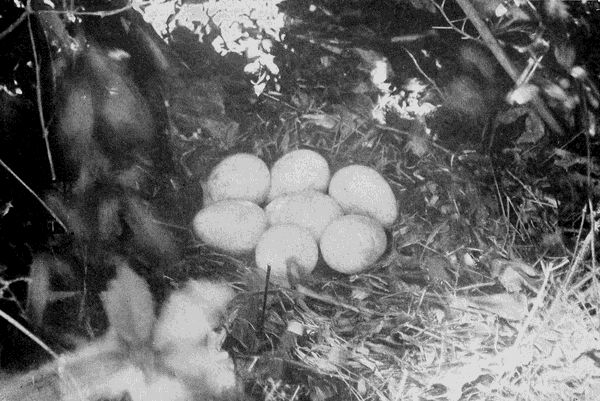
Shortly after the last paragraph was completed
I received a valuable photograph of the
nest and eggs of M. g. merriami, and this I desire
to publish here with a few notes, although in so
doing it constitutes a departure from what I
have just stated above in regard to the nests of
turkeys.
This photograph was kindly furnished me by
my friend Mr. F. Stephens of the Society of Natural
History of San Diego, California, with permission
to use it in the present connection. It
has not to my knowledge been published before,
though the existence of the negative from which
it was printed has been made known to ornithologists
by Major Bendire, who says, in his account
of the "Mexican Turkey" in his Life Histories of
North American Birds (loc. cit. p. 118): "That
well-known ornithologist and collector, Mr. F.
Stephens, took a probably incomplete set of
nine fresh eggs of this species, on June 15th, 1884.
He writes me: 'I was encamped about five miles
south of Craterville, on the east side of the Santa
Rita Mountains in Arizona; the nest was shown
to my assistant by a charcoal burner. On his
approach to it the bird ran off or flew before he
got within good range. He did not disturb it
but came to camp, and in the afternoon we both
went, and I took my little camera along and
photographed it. The bird did not show up
again. The locality was on the east slope of the
Santa Rita Mountains, in the oak timber, just
where the first scattering pines commenced, at
an altitude of perhaps 5000 feet.'
"A good photograph, kindly sent me by Mr.
Stephens, shows the nest and eggs plainly. It
was placed close to the trunk of an oak tree on a
hillside, near which a good-size yucca grew,
covering, apparently, a part of the nest; the
hollow in which the eggs were placed was
about 12 inches across and 3 inches deep.
Judging from the photograph the nest was
fairly well lined."
In order to complete my share of the work, I
will now add here a few paragraphs and illustrations
upon the skeletal differences to be found
upon comparison of that part of the anatomy of
wild and domesticated turkeys. This is a subject
I wrote upon many years ago; what I then
said I have just read over, and I find I can
do no better than quote the part contained in
the "Analytical Summary" of the work. It is
more or less technical and therefore must be
brief, though it is none the less necessary to complete
the subject of the present treatise.[43]
1. As a rule, in adult specimens of M. g. merriami,
the posterior margins of the nasal bones
indistinguishably fuse with the frontals; whereas,
as a rule, in domesticated turkeys these sutural
traces persist with great distinctness throughout
life.
2. As a rule, in wild turkeys we find the craniofrontal
region more concaved and wider across
than it is in the tame varieties.
3. The parietal prominences are apt to be
more evident in M. g. merriami than they are in
the vast majority of domesticated turkeys; and
the median longitudinal line measured from these
to the nearest point of the occipital ridge is longer
in the tame varieties than it is in the wild birds.
Generally speaking, this latter character is very
striking and rarely departed from.
4. The figure formed by the line which bounds
the occipital area is, as a rule, roughly semicircular
in a domesticated turkey, whereas in
M. g. merriami it is nearly always of a cordate
outline, with the apex upward. In the case of
the tame turkeys I have found it to average one
exception to this in every twelve birds; in the
exception, the bounding line of the area made a
cordate figure as in wild turkeys.
5. Among the domesticated turkeys, the interorbital
septum almost invariably is pierced
by a large irregular vacuity; as a rule this osseous
plate is entire in wild ones.
6. The descending process of a lacrymal
bone is more apt to be longer in a wild turkey
than in a tame one; and for the average the
greater length is always in favor of the former
species.
7. In M. g. merriami the arch of the superior
margin of the orbit is more decided than it is in
the tame turkey, where the arc formed by this
line is shallowed, and not so elevated.
8. We find, as a rule, that the pterygoid bones
are rather longer and more slender in wild turkeys
than they are among the tame ones.
9. At the occipital region of the skull, the
osseous structures are denser and thicker in the
tame varieties of turkeys; and, as a whole, the
skull is smoother, with its salient apophyses less
pronounced in them than in the wild types.
There is a certain delicacy and lightness, very
difficult to describe, that stamps the skull of a
wild turkey, and at once distinguishes it from any
typical skull of a tame one.
10. I have predicted that the average size of
the brain cavity will be found to be smaller and
of less capacity in a tame turkey than it is in the
wild one. In the case of this class of domesticated
birds, as pointed out above, this would
seem to be no more than natural, for the domestication
of the turkey has not been of such a
nature as to develop its brain mass through the
influences of a species of education; its long contact
with man has taught it nothing—quite
the contrary, for the bird has been almost entirely
relieved from the responsibilities of using
its wits to obtain its food, or to guard against
danger to itself. These factors are still in operation
in the case of the wild types, and the
advance of civilization has tended to sharpen
them.
From this point of view, then, I would say that
mentally the average wild turkey is stronger
than the average domesticated one, and I believe
it will be found that in all these long years the
above influences have affected the size of the
brain-mass of the latter species in the way above
indicated, and perhaps it may be possible some
day to appreciate this difference. Perhaps, too,
there may have been also a slight tendency on
the part of the brain of the wild turkey to increase
in size, owing to the demands made upon
its functions due to the influence of man's nearer
approach, and the necessity of greater mental
activity in consequence.
Recently I examined a mounted skeleton of
a female wild turkey in the collection of the
United States National Museum, and apart from
the skull it presented the following characters:
There were fifteen vertebræ, the last one having a
pair of free ribs, before we arrived at the fused
vertebræ of the dorsum. Of these latter there
were three coössified into one piece.
The sixteenth vertebra supports a pair of free
ribs that fail to meet the sternum, there being no
costal ribs for them. They bear uncinate processes.
Next we find four pairs of ribs that articulate
with hæmapophyses, and through them with the
sternum. There are two free vertebræ between
the consolidated dorsal ones and the pelvis; and
the pelvis bears a pair of free ribs, the costal ribs
of which articulate by their anterior ends with
the posterior border of the pair of costal ribs in
front of them.
A kind of long abutment exists at the middle
point on each, there to accommodate the articulation.
There are six free tail vertebræ plus a
long pointed pygostyle. The os furcula is rather
slender, being of a typical V-shaped pattern,
with a small and straight hypocleidium. With
a form much as we find it in the fowl, the pelvis
is characterized by not having the ilia meet the
sacral crista in front. The prepubis is short and
stumpy. The external pair of xiphoidal processes
of the sternum are peculiar in that their
posterior ends are strongly bifurcated.
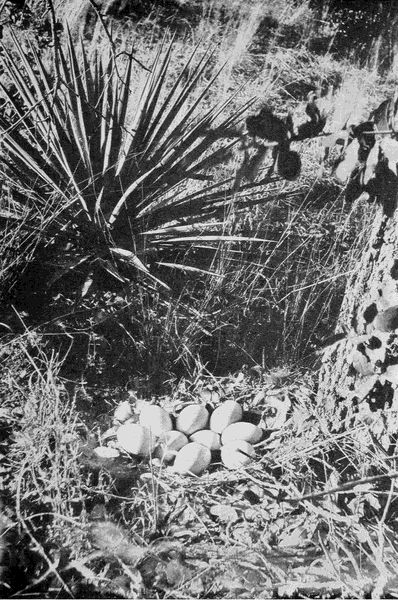
Plate VII
Fig. 24. Nest of a wild turkey in situ. (M. g. merriami.) Photo by
Mr. F. Stephens, San Diego, California.
In the skeleton of the manus, the pollex metacarpal
projects forward and upward as a rather
conspicuous process. Its phalanx does not bear
a claw, and on the index metacarpal the indicial
process is present and overlaps the shaft of the
next metacarpal behind it. In the leg the fibula
is free, and extends halfway down the tibiotarsal
shaft.
The hypotarsus of the tarso-metatarsus is
grooved mesially for the passage of tendons behind,
and is also once perforated near its middle
for the same purpose. As I have already stated,
the remainder of the skeleton of this bird is characteristically
gallinaceous and need not detain us
longer here. I would add, however, that the
"tarsal cartilages" in the turkey extensively
ossify.