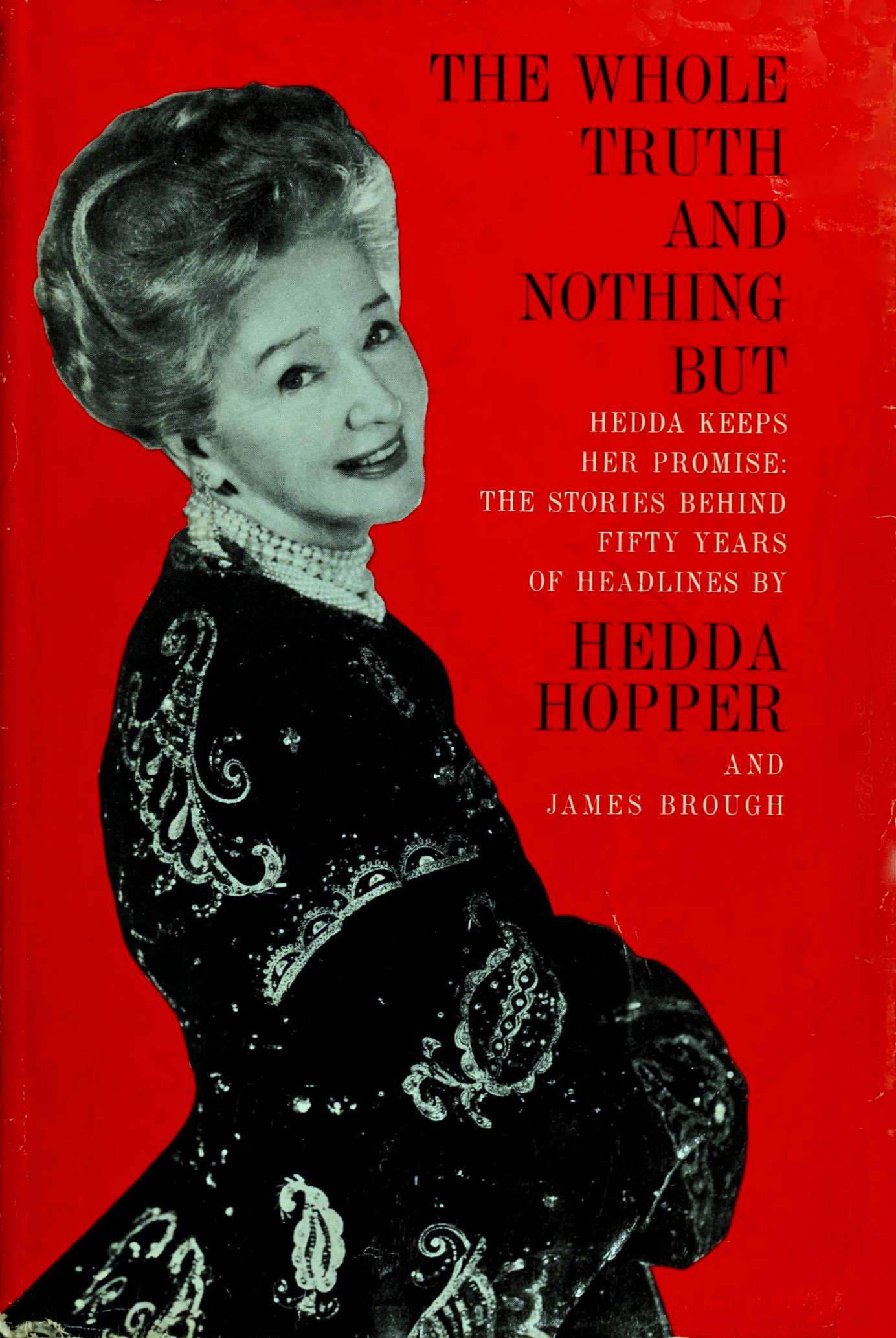
Larger versions of most illustrations may be seen by right-clicking them
and selecting an option to view them separately, or by double-tapping and/or
stretching them.
All captions are below their photographs, despite
how they may appear on some ereaders.
The Table of Contents below was added by the Transcriber, as the
original book did not have one. Other
Notes are at the end of this eBook.
To my son, Bill, who never took
any sass from his mother
and never gave her any.
I’m told that when you write a book with a title like this,
you must let your readers know something about your life.
Well, I was born into the home of David and Margaret Furry,
one of nine children. Seven of us grew up. Three of us are
still here, including my sister Margaret and brother Edgar,
who played a good game of football when he attended Lafayette
quite a while back.
I first saw the light of day in Hollidaysburg, Pennsylvania,
a beautiful suburb of Altoona, which used to live off the
Pennsylvania Railroad and its affiliates. Since railroads have
fallen on lean and hungry years, I don’t know what’s feeding
the place today.
My mother, an angel on earth whom I worshiped, named
me Elda, from a story she was reading at the time. Years
later, after I’d married DeWolf Hopper, a numerologist
changed Elda to Hedda. My husband, Wolfie, was much older
than my father and had been married four times before. The
wives’ names all sounded pretty much the same: Ella, Ida,
Edna, and Nella. His memory wasn’t as sharp as it had been,
and he couldn’t always remember that I was Elda.
As time went on, this started to irk me, so the numerologist
came up with Hedda Hopper. I asked how much. “Ten
dollars.” That’s exactly how it happened; it changed my whole
life. It was the best bargain I ever made. Wolfie never forgot
it, and I’ve never regretted it.
My sister Margaret was my father’s pet. He and I didn’t get
on well. He thought women should be the workers; I believed
my brothers should share the burden. Mother was ill for six
years after Margaret’s birth, and I took on her duties as well
as my own, since my older sister Dora had married. I had to
catch a brother by the scruff of the neck to get any help, but
they all helped themselves three times a day to the meals I
prepared. I also did the washing, ironing, cleaning, and helped
Dad in his butcher shop.
When I couldn’t take it any more, I ran away—to an uncle
in New York. I found a stage door that was open, walked in,
and got a job in a chorus, which started a career.
My family now consists of my son Bill, who plays Paul
Drake on the “Perry Mason” TV show without any help
from me. When he went off to war, he’d already attained
stature as an actor. On his return—with a medal for valor
which I’ve never seen—not one soul in the motion-picture
industry offered him a job. Hell would have frozen over before
I’d have asked anyone for help for a member of my family.
So Bill went to work selling automobiles for “Madman”
Muntz. One day he woke up to the fact that he was an actor,
got himself a part with director Bill Wellman in The High
and the Mighty—and asked Wellman not to tell anybody
who his mother was. Bill has a beautiful daughter, Joan,
who’ll be sixteen next birthday.
I don’t like to dwell on death, but when you reach my age
(and I’m still not telling) you realize it’s inevitable. I’ve left
instructions for cremation—no ceremony—with my ashes sent
to an undertaking cousin, Kenton R. Miller, of Martinsburg,
Pennsylvania. I’d wanted a friend to scatter them over the
Pacific from a plane, but California law forbids that. You have
to buy a plot.
A salesman from Forest Lawn told me they’d opened a new
section and I could rest in peace next to Mary Pickford for
a mere $42,000. “What do I get for that?” I asked.
“Well, a grave, picket fence, and a golden key for the gate.”
“How do you figure I could use it?”
“Oh, Miss Hopper, that’s for the loved ones who will
mourn you.”
That’s when I decided on my cousin.
One
I knew Elizabeth Taylor was about to dump Eddie Fisher
in favor of Richard Burton soon after Cleopatra started filming
in Rome. Because in forty years in Hollywood I’ve told the
truth—though sometimes only in part for the sake of shielding
someone or other—I wrote the story. This was in February
1962, one week before the news burst like a bomb on the
world’s front pages.
But Elizabeth, Burton, and I have something in common:
Martin Gang, a topnotch attorney, has us as clients. He saw
my column, as usual, before it appeared, and came on the
telephone in a hurry. “Oh, you couldn’t print that,” he said.
“It would be very embarrassing for me to sue you, since I
represent all three.”
I was in Hollywood at the time, not in Rome, so I was
wanting the firsthand information, the personal testimony,
which would be important in self-defense. I deferred to his
judgment—and kicked myself for doing it when the news from
the Appian Way began to sizzle.
I’ve known Elizabeth since she was nine years old, innocent
and lovely as a day in spring. I liked, and pitied, her from the
start, when her mother, bursting with ambition, brought her
to my house one day to have her sing for me. Mrs. Sara
Taylor was an actress from Iowa who had appeared just twice
on Broadway before she married Francis Taylor, who worked
for his uncle, Howard Young, as a manager of art galleries on
both sides of the Atlantic. When World War II came along,
she was in raptures to find herself with a beautiful young
daughter, living right next door to Hollywood—her husband
came to manage the gallery in the Beverly Hills Hotel.
Sara Taylor had never gotten over Broadway. She wanted
to have a glamorous life again through her child. She had the
idea at first that Elizabeth could be turned into another
Deanna Durbin, who had a glittering name in those days.
“Now sing for Miss Hopper,” she commanded her daughter
as soon as our introductions were over and we were sitting by
the baby grand in my living room.
“Do you play the accompaniment?” I asked. “I can’t.”
“No, but she can sing without any. Elizabeth!”
It struck me as a terrifying thing to ask a little child to do
for a stranger. But in a quivering voice, half swooning with
fright, this lovely, shy creature with enormous violet eyes
piped her way through her song. It was one of the most painful
ordeals I’ve ever witnessed.
I remembered seeing the four-room cottage—simple to the
point where water had to be heated on the kitchen stove—in
which Elizabeth was born. Little Swallows was its name,
and it sat in the woods of her godfather, Victor Cazelet; his
English estate, Great Swifts, was in Kent. She had a pony
there and grew to love animals like her chipmunk, “Nibbles,”
which ran up my bare arm when she brought it around on a
visit one day. I screamed like a banshee, but Elizabeth was as
patronizing as only a schoolgirl can be.
“It’s only a chipmunk; it won’t hurt you,” she promised
scornfully.
You couldn’t have wished for a sweeter child. She would
certainly have been happier leading that simple life close to
woods and wild things to be tamed, maybe through all her
years. But her mother had been bitten by the Broadway bug,
and few women recover from that.
Once the family was settled in Hollywood, Mrs. Taylor
maneuvered the support of J. Cheaver Cowden, a big stockholder
in Universal Pictures, to get a contract for her daughter
at that studio. Elizabeth was there for one year, but studio
chieftains always resent anybody who’s brought in over their
heads through front-office influence. They made sure the girl
got nowhere fast. Her mother tried everything to find her
another job, but it was her father who happened to land her at
MGM through a chance remark he made to producer Sam
Marx when they were patrolling their beat together as fellow
air-raid wardens. She was given a bit in Lassie Come Home,
then blossomed in National Velvet with Mickey Rooney.
I remember the day she cinched in her belt, which showed
her charms to perfection, and Mickey turned to me and said:
“Why, she is a woman.”
“She is fourteen,” I replied. He started toward her. I caught
him by the seat of the pants. “Lay a hand on her, and you
will have to answer to me. She is a child.”
He looked hard at me and said, “I believe you would beat
me up.”
“I sure would.”
Victor Cazelet, on a wartime mission for the British Government
to New York, wanted desperately to get to California
to see the godchild he adored. Though he was a millionaire
in his homeland, strict currency controls meant that he hadn’t
any dollars to pay the fare. He was staying as a house guest of
Mrs. Ogden Reid, owner of the New York Herald Tribune
in those days, but he had qualms about borrowing from her.
When he telephoned me, I had what I thought was a brain
wave: “What about Victor Sassoon? He’s rich as Croesus,
and he’s holed up through the war at the Garden of Allah.” I
wanted to call him at that exotic sanctuary on the Sunset
Strip, where the likes of Scott Fitzgerald, Robert Benchley,
and Humphrey Bogart used to frolic before it was demolished
to make way for Bart Lytton’s bank.
“He doesn’t do anything for anybody,” Victor warned me,
but I couldn’t be convinced until I spoke to Sassoon myself.
Lend Cazelet dollars just to visit his godchild? “Certainly
not,” growled the old tightwad. “He’s got plenty of money of
his own.”
So I booked Victor into the Ebell Theatre in Los Angeles
to give a lecture to earn his passage money west. He stayed
with the Taylors for a week, which was the last he saw of
Elizabeth. Several months later the Nazis shot down the plane
he was in, believing that Winston Churchill was aboard. They
were halfway right. Victor was on a mission for his friend
Winston Churchill.
I remember Elizabeth visiting my house with Jean Simmons
when she was on her way back from the South Seas and
the filming there of Blue Lagoon. They sat together on the
long settee in the den, bright as birds and chattering nineteen
to the dozen. I thought I had never seen two more beautiful
young girls.
As the years went by, I saw Elizabeth through many romances
and four marriages, starting with Nicky Hilton. He
was a boy, and I don’t believe he’d had too much experience.
On their European honeymoon he left her too much alone,
though everyone wanted to meet his beautiful bride. When
she came home, she took a second-story apartment in Westwood
with a back entrance on an alley. Before she had a
chance to sort out what had happened to her, the parade of
suitors began—married men, stars. Did any of them love her
and try to help? No. They used her. I’m making no excuses
for her, but I’m trying to be objective.
Then she was put into another picture. She was exhausted
from working too hard and too fast in the rat race on the
sound stages. She was swamped with advice from everybody.
She couldn’t tell true from false. Thus it went from one man
to another, one picture to another, until she fell in love with
Michael Wilding, who was twenty years older than she. Was
she unconsciously looking for a strong father? She loved her
own, but he didn’t stand up to his wife.
When I spoke to her about Michael, she exclaimed, “I love
him, I love him, I love him.”
“You don’t know what love is. You don’t know what you’re
talking about. He’s sophisticated, he’s gracious, but I beg you
not to marry him.”
She didn’t listen then or later. She drove Wilding into marriage.
“I am too old for you,” he’d argue. “It will never last,
Elizabeth.”
“I love you, and you’re going to marry me, that’s all,” she
would say.
Then Mike left for England and Liz followed him. From
that marriage came two sons, Michael and Christopher. After
each birth she had to go to work too soon. Before she could
face the cameras, she had to take off pounds in a hurry, just
as Judy Garland did, and it weakened her health.
Mike was given a contract at Metro, her studio, but when
it ran out it wasn’t renewed. During this time she bought two
homes, the second because the first wasn’t big enough for two
children, a nurse, and Mike’s eighty-six-year-old father, whom
she brought over from England to stay with them. The studio
paid for both houses, deducting the money from her salary,
which was standard practice.
I knew the marriage was over when Mike started to criticize
her in public—before strangers, before anyone. She never
stopped working. She was a lady, America’s queen of queens,
who loved her children and was a good mother to them.
She played in Giant with Jimmy Dean, whom she respected
and loved like a brother. His senseless death shattered her
nerves. Her director, George Stevens, was mad about her and
had been since she made A Place in the Sun for him.
I saw her on her good days and bad. In Raintree County
and Suddenly, Last Summer, she got to know Montgomery
Clift and admired him. Then he raced his car down the hill
from her home after a drinking bout with Wilding there, ran
into a telegraph pole, and nearly died. Elizabeth sped after
him, crawled into the wrecked car, and held his head in her
lap until the ambulance arrived. Soaked with blood, she rode
to the hospital with him and stayed long enough to know that
he’d live.
Then along came Michael Todd, who taught her an awful
lot about love and living. He was one of the most sophisticated
and ruthless men in show business. He had gone
through the jungle of Broadway and come out with many
scars.
After Mike had made Around the World in Eighty Days,
he wanted someone to help sell it. Who else but the queen of
the movies? I don’t think he needed her more than she needed
him, but they fell in love, and he taught her everything he
knew about sex, good and bad. He proposed to her in the
office MGM gave him at the studio when he was shooting
Around the World. He said: “Elizabeth, I love you, and I’m
going to marry you, and from now on you’ll know nobody but
me.” Only he didn’t say “know.”
They were married in Mexico, and they started one of the
craziest, fightingest, most passionate love matches recorded in
modern times. She appeared in the newspapers and magazines
every day, every issue. Every facet of their lives was exploited
for the benefit of love-starved fans. Gold poured into the box
office for her pictures and his Around the World.
He bought her the world, or as much of it as he could lay
hands on: a new jewel or a half dozen of them every Saturday;
a plane; a villa in France; dresses by the hundred. Whatever
she wanted, she got. He knew he was spoiling her rotten,
but he loved to see her face light up when she saw his presents.
For the Academy Award show where he expected her to collect
an Oscar for Raintree County, he bought her a diamond
tiara. “Hasn’t every girl got one?” he asked blandly. He gave
her a Rolls-Royce and a $92,000 diamond ring.
“Don’t spoil her,” I told him time and again. “She’s impossible
enough already.”
In return she gave him a daughter. Her pregnancy was
heralded like Queen Elizabeth’s or Princess Margaret’s. She
had an operation that almost took her life. She has two
vertebrae in her back that came from a bone bank. I didn’t
know about that until she told me. The baby arrived, Liza,
a dark-eyed witch who at three months could read your mind.
Mike used to say: “If you want to be a millionaire, live
like one.” For the London opening of his picture, Elizabeth
was draped in a ruby-and-diamond necklace, with bracelet and
earrings to match. It was an occasion straight out of the
Arabian Nights.
In London for all the high jinks, I watched Eddie Fisher’s
maneuvers to pay court to Elizabeth in the enormous suite
at the Dorchester where Mr. and Mrs. Michael Todd were
registered. Debbie lingered in the Fisher suite several floors
below. I had missed Elizabeth and Mike like the dickens when
they left Hollywood in advance. They made me promise I’d be
in London with them for the Around the World hullabaloo.
When I checked into the hotel, there was a message from
Mike inviting me to see them. I unpacked, changed, then
went on up to the top floor, which was taken up entirely by
their double suite. I happened to walk first into Liz’s half.
There she sat, bulgingly pregnant in a white lace robe, with
her bare feet on a coffee table, drinking Pimm’s No. 1 from
a pitcher at her side, with the diamond tiara hanging out of
a pasteboard box.
I left Elizabeth and went into Mike’s suite. He was talking
to four of the most prominent newspaper publishers in London
about the opening of the picture, and they were laying
out the seating of the theater, since royalty would attend.
Crawling around the floor were Elizabeth’s two sons, picking
caviar sandwiches off a low table and stuffing themselves. I
gathered the children up, took them back to Liz, and closed
the door firmly. Just then Eddie Fisher came in to pay his
respects to Liz. He was in and out all the time.
Mike was frantically busy with two spectacular shows to
put on, on the screen for his premiere and at Battersea Festival
Gardens, where he threw a champagne-and-fun-fair shindig
for two thousand people to celebrate his picture, scoring a
triumph that gave him every front page in London, except
The Times.
He gave us plastic raincoats, to save us from the pelting
rain, but we didn’t use them. We slithered in mud and
scooped coins by the fistful from ash cans he’d had filled to
provide fares for all the rides. The Duke of Marlborough stood
patiently in the rain with Jock Whitney, waiting to climb on
a carrousel. I rode around on my painted charger with Ali
Khan and Bettina ahead of me and, in back, a gaitered bishop
with his wife. Liz wore a Christian Dior gown in ruby red
chiffon. The Doug Fairbankses were there, Deborah Kerr,
financier Charles Glore. Debbie and Eddie showed up together.
And the Duchess of Argyll, classically understating it,
observed as the fun began: “I hear that this is going to be
just an intimate little gathering for a few friends.” The Gilbert
Millers, with Cecil Beaton, left before the fireworks. It was
too damp for them.
It was one of the few times I saw Mr. and Mrs. Fisher side
by side. Every time Mike asked me to the top floor, Eddie
would be there but never Debbie; she might just as well have
been sitting home in Hollywood.
The pitcher of Pimm’s, the white lace robe, bare feet on a
coffee table—and Eddie. That was the pattern. Eddie had
latched onto Mike. “You’re just like a son to me,” Mike used
to say, sincerely attached to the hero from Philadelphia,
happy that Liz had company during her pregnancy.
The first time I’d ever seen Eddie he’d come sauntering
into Romanoff’s, Beverly Hills, for luncheon surrounded by
ten characters who seemed more familiar with punching bags
than pianos. “Who in the name of God is that?” I asked my
table mate. “And who are those terrible-looking men with
him?”
“That’s Eddie Fisher; they’re his handlers.”
“Handlers?” said I. “Is he a prize fighter? I’d heard he was
a singer.”
I took him to the Fourth of July garden party at the United
States Embassy in London a few days after Mike’s opening.
Jock Whitney, our ambassador then, sent the invitation, and
I invited Mike. But he was too busy and suggested his
protégé, who was standing by, as usual. We were offered a glass
of champagne before leaving, but Eddie declined. “You know
I never drink,” he told Mike blandly. “Nothing but Coca-Cola.”
In my rented Rolls we drove to the embassy. Making our
way through the crowds, I introduced Eddie to Jock and
Betsy Whitney, who was looking very frail after a recent
operation. She and I sat for a few minutes chatting, while
Eddie hung around. As we walked away he asked: “Who’d you
say those people were?”
“I introduced you to Mr. and Mrs. Jock Whitney.”
“Who are they?”
“He just happens to be our Ambassador to the Court of
St. James’s.”
“Oh,” said Eddie, “oh.”
In one of the marquees put up for the occasion I was offered
some bourbon and water. “I’d like some champagne,” Eddie
told the waiter.
“Sorry, sir, but we’re not serving champagne.”
“Then I’ll take a dry martini.”
“I’m afraid we can’t mix drinks—too many people here
today, sir. We can offer you whisky, gin, vodka, or bourbon.”
“Well, then, I’ll have a scotch and soda,” said my nondrinking
companion.
As we left he walked over to the U. S. Air Force Band,
which was playing there, borrowed the baton, and conducted
the orchestra. What some of the London newspapers said the
next morning about that bit of ham-handed showmanship
would have driven a more sensitive man into a knothole.
Back in Hollywood, Liz started on another picture, Cat
on a Hot Tin Roof. Then came the spring day when the plane,
Lucky Liz, dived into the desert in New Mexico; the end of
Mike Todd was almost the end of her.
She finished the picture like a trouper only weeks later.
The following July I flew with her to New York. We sat up
aboard the airliner until 3 A.M. talking about the happiness she
had known with Mike. She showed me his wedding ring, taken
from his finger after death. “I’ll wear it always,” she said.
“They’ll have to cut it off my finger before they’ll get it off
my hand.”
I took her to the first party she went to after Mike’s death.
Though Arthur Loew, Jr., the producer, had her children in
his home, she then had a suite at the Beverly Hills Hotel.
When I went in, it looked as though a cyclone had hit her
bedroom. Every dress she owned had been pulled out of the
closets and thrown onto tables, chairs, bed or floor. She was
wailing, “What shall I wear?” as soon as I opened the door.
I picked up a red dress. “This.”
“But it’s the first time I’ve been out. I can’t wear red.”
“Wear it,” I said. On the bathroom window sill, by an
open window with no screen on it, I saw the big diamond ring
Mike had given her, left there unnoticed. I took it in to her.
“Did you miss this?”
She glanced at her fingers. “Oh yes. My ring. Thanks.”
“You’ve got to watch things like this, Elizabeth.”
There was not much else to be said then and there to do
her any good. We rolled down to Romanoff’s in her Rolls an
hour and a half late. Everybody clustered around her as
though she were a queen. I am sure she believed she was.
That night she’d taken me up to see Liza, who was quartered
in a crib in a room of Arthur Loew’s house no bigger
than a closet, with its only ventilation provided by a skylight
that could be pulled open by a thin chain. The room was
sizzling. “Good Lord, Liz,” I cried. “She can’t get enough air
in here.”
“Oh, she’s all right,” her mother said, turning on the light
to wake her. The baby woke silently—I have never heard her
cry. She opened her eyes wide and looked straight into mine.
It was impossible to believe she didn’t know what I was thinking.
My own eyes lowered in self-protection.
Liz spread the word that she was getting ready to go off on
a long vacation in Europe with Mike’s long-time Japanese
secretary, Midori Tsuji. Eddie talked about having business to
attend to that kept him in New York. Debbie Reynolds believed
both of them. Through the closeness of Mike Todd and
Eddie Fisher, Elizabeth and Debbie had become what Hollywood
called “best friends.” Liz, in fact, looked down her
nose at Debbie and usually referred to her as “that little Girl
Scout.”
Debbie and I went together to an “all young” party at
Arthur Loew’s home in a new car Eddie had bought her.
Elizabeth was away in New York, restless, without the remotest
idea of what she really wanted. One thing she was
sure of—she didn’t want Arthur Loew much longer, though
she knew he was deeply in love with her.
The only guests at that party who would acknowledge to
being middle-aged without a battle were Milton Berle and
myself. The house rocked to the blare of records by Sammy
Davis, Jr. There was nothing else to play. He had sneaked in
early and hidden every other album. Most of the girls had
squeezed themselves into Capri pants as tight as their skins
and a hundred times more brilliant.
“Wonder if they can sit down without splitting ’em back
and front?” said Milton.
“Doubt it,” said I—whoever invented Capri pants had his
mind on rape.
I left early with Debbie. “What’s keeping Eddie so long in
New York?” I asked, suspicious nature showing.
“Oh, he’ll be back here tomorrow,” she answered dutifully.
Of course he wasn’t. He took a detour by way of Grossinger’s,
that Catskill haven of rest and romance, where he had married
and honeymooned with Debbie. There, he and Liz had
arranged a rendezvous.
Then Liz arrived back in town, and every newspaperman
was combing the thickets trying to find her. Eddie, too, was
back home with his wife and two children, though reporters
camping outside their house could safely assume that the
marriage was breaking up, if the shouts they heard through
the walls were any clue. Newsmen looked in vain for Liz after
she whisked into the Beverly Hills Hotel, then ducked out
through the Polo Lounge into a waiting car. I had an idea
she would be hiding out in the house of Kurt Frings. He is
her agent, and can take credit for finishing off the revolution
begun by Myron Selznick, a pioneer in the business of squeezing
producers dry and making the stars today’s rulers of Hollywood.
I’d put an earlier call in to her, which she returned.
“Elizabeth,” I said, “this is Hedda. Level with me, because
I shall find out anyhow. What’s this Eddie Fisher business all
about? You’re being blamed for taking Eddie away from Debbie.
What have you got to say?”
I flapped a hand furiously for Pat, one of my secretaries,
who had picked up the extension, to start taking shorthand
fast. Elizabeth’s voice was innocent as a schoolgirl’s. “It’s a
lot of bull. I don’t go about breaking up marriages. Besides,
you can’t break up a happy marriage. Debbie’s and Eddie’s
never has been.”
“I hear you even went to Grossinger’s with him.”
“Sure. We had a divine time.”
“What about Arthur Loew, Jr.? You’ve known he’s been
in love with you for the past six months, and your kids are
still living in his house.”
“I can’t help how he feels about me.”
I sighed—I sometimes do. “Well, you can’t hurt Debbie like
this without hurting yourself more, because she loves him.”
“He’s not in love with her and never has been.”
“What do you think Mike would say to this?”
“He and Eddie loved each other,” she said.
“No, you’re wrong. Mike loved Eddie. Eddie never loved
anybody but himself.”
“Well,” she said calmly, “Mike’s dead and I’m alive.”
My voice was rising with my temper. “Let me tell you, my
girl, this is going to hurt you much more than it will Debbie
Reynolds. People love her more than they love you or Eddie
Fisher.”
“What am I supposed to do? Ask him to go back to her
and try? He can’t. Now if he did, they’d destroy each other.
Well, good luck to her if she can get him. I’m not taking
away anything from her because she never really had it.”
We went at each other for a minute or two longer before
we hung up. By then, she had said something that sent my
anger soaring like a rocket. I didn’t include that quote in the
story I snapped out in five minutes flat and got it out on the
news wires before I could start to simmer down. I had been
very fond of Mike Todd, who had been dead not quite six
months. This is what Elizabeth Taylor had to say that set me
alight: “What do you expect me to do? Sleep alone?”
The story ran front page in the Los Angeles Times and
many more newspapers that syndicate Hopper. The Hearst
papers, at least in Los Angeles and San Francisco, paraphrased
my scoop and lifted the quotes without giving me as much as
a nod by way of credit.
One of the first people to read it was Elizabeth. She called
the next day, naturally furious, storming over a portrait in
print which she believed pictured her as being as cruel and
heartless as a black-widow spider. I must say I had no regret.
If she’d been my own daughter, I’d have done it. Without a
sense of integrity you can’t sleep nights.
“Of course, I didn’t think you’d print it,” she said. “You
betrayed me.”
“You didn’t say it was off the record,” I answered. “And
it had to be printed.”
That was the last time we spoke to each other for a year.
At the office the mail started arriving in stacks, all in Debbie’s
favor.
Another call came that day from Debbie. She hadn’t seen a
newspaper, she said. “You can’t stick your head in the sand,”
said I.
Debbie, who is as shrewd as she is pretty, knew she had been
cheated. She needed no prodding to be frank. “Obviously,
the man loved me. We had lots of problems the first year and a
half we were married. We went to a marriage counselor for
advice. We both wanted to make it work. When he left for
New York, he kissed me good-by and we were very close. It
didn’t mean anything that my husband had to go to New
York on a business trip. I had no reason to be suspicious.”
It wasn’t the moment to tell her once again that Eddie had
never wanted to marry her. In my book, the little baritone
from Philadelphia wanted a reputation as a great lover. He
preened in the publicity that marrying her brought him, but I
believe she forced that marriage. His Svengali, Milton Blackstone,
didn’t want it—the men who steer any entertainer’s
career always scheme to keep him single because a wife is an
interfering nuisance in their plans. After Debbie had received
an engagement ring, plus barrel loads of publicity,
Eddie answered a call to Grossinger’s. A friend advised Debbie:
“Pack your wedding gown and trousseau. Get on a
plane quietly and go after him, then he’ll marry you.” She
accepted the advice, and Eddie accepted her. At least she got
what she wanted, then.
The storms continued to blow for months. Liz complained
to one reporter, Joe Hyams, that I had “betrayed” her, and
swore for the dozenth time that she wanted to quit Hollywood,
though work for the time being was “therapeutic”—and
her pay was rocketing up toward a million dollars a picture.
Debbie applied for a divorce, but that wasn’t fast enough
for Eddie. He got a quick end to their marriage in Las Vegas.
Liz and he were married in that paradise of syndicates and
slot machines on May 12, 1959, after she had embraced his
religion and dragged her parents out of the background to lend
a look of dignity to the proceedings.
Elizabeth’s hatred lasted for a year. But when she had
packed to leave for England and the first disastrous attempt
to make Cleopatra, she called. “Hedda, don’t you think we
ought to be friends again?”
“Yes, I should like that.”
“So should I. Let’s get together as soon as I’m back.”
Before she returned, she had nearly died in London with
the lining of her brain inflamed by an infected tooth. The
first of the millions that Twentieth Century-Fox was going
to pour down the drain had vanished in Cleopatra. But the
women of America, who’d been ready to all but stone her,
forgave everything because of her illness. She had been back
in town forty-eight hours when the telephone rang: “Will you
come over, Hedda?”
“I’d love to. Will Liza be there? I’m anxious to see her.”
Before I left, I wrapped a gift Mike had given me one
Christmas along with other things—a music box that played
the theme of Around the World. I took a present for each of
the two boys, too. Liz and her sons were drawing pictures for
each other when I arrived. The children accepted their gifts
graciously, then Liza wound her box, the first she’d ever seen.
After she had played the tinkling little tune over and over,
she gravely allowed each brother one turn apiece. Then she
wound it again and danced with each of them around the
room. At last it was my turn. We held hands tight and waltzed
until everyone but Liza was completely exhausted. But she
still went on winding and winding the key to play the tune
again.
Liz looked pale, quite different from the woman I’d last
seen. “You won’t know me,” she said. “I came so near death
I’m just thankful to be alive. I lie out in the sun, listen to the
birds sing, look at the blue sky, and say: ‘Thank God for
letting me live.’”
I believed her. She felt in that mood that day. Later, inevitably,
we talked about the telephone call she had made
one shattering September morning in 1958 and how she was
“betrayed.”
“I considered you my second mother,” she said. “As a matter
of fact, I loved you better than I loved my mother. You
were kinder to me than she was. That you could do what you
did nearly killed me.”
“That one line you spoke did it, Liz. I couldn’t take it.
That was why it was done.”
We had several visits after that before I went on a visit to
New York and she whirled off on a trip to Moscow. When we
were both back in Hollywood again, she was another creature
entirely, out most nights instead of resting and restoring herself
to health for her next stab at Cleopatra, in Rome this
time.
Champagne was ruled out during her convalescence, so she
drank beer. She’d send her chauffeur down to Dave Chasen’s
restaurant to pick up two quarts of chile, which she’d eat to
accompany the beer. When she left for Italy, she was too
fat to fit any of her costumes. Her doctor had to be flown out
from Hollywood to put her on a crash diet so she could be
photographed as the Serpent of the Nile in the most balled-up
motion-picture production of all time.
She won her Academy Award not for Butterfield 8 but for
nearly dying. And her studio joined in by putting on a terrific
public-relations campaign against Debbie—with planted stories
in fan magazines and loaded interviews for the newspapers—to
clinch sympathy for Liz.
* * * * *
She has become Cleopatra to the life now, and the world is
her oyster. What she wants, she takes, come hell or high
water—and this includes Richard Burton. In the huge Roman
villa which she made her home during Cleopatra’s making,
she reigned like an empress, reclining on a chaise, summoning
Eddie to bring guests up to her for an audience. The honored
guest would sit on one side of her with Eddie on the other; Liz
would delicately place a hand on her breast before she spoke
a regal word of greeting.
In the old days the scandal of the past four years would
have killed her professionally. In these changed times it seems
only to help her reputation. The million dollars and more
which her Cleopatra contract gave her was doled out, at her
insistence, in installments on every morning of shooting. She
consented to work only after the day’s check for $9000, drawn
on a United States bank, lay snugly in her hand. While he
lasted, Eddie drew $1500 a week for getting his wife to the set
on time. Yet she spends money faster than she makes it. If
Twentieth Century-Fox had gotten ruined, putting more than
$35,000,000 into the picture before there was any hope of completing
it, she didn’t give a damn.
At Liz’s say-so, Eddie had adopted Liza Todd, though
Michael Wilding wouldn’t let him take over the two boys.
Even after he knew what was going on in Rome, Eddie hung
on. Allegedly, he’s the one who told Richard Burton’s wife,
Sybil, the truth and drew the Welshman’s question: “Now
why did you have to go and spoil everything?”
Eddie wasn’t his smiling self when he flew to Rome to try
to quash the news of the romance. Liz was in the hospital
again; the newspapers said “food poisoning,” but the real
diagnosis was too many sleeping pills. Even after he landed
back in New York, he was still declaring the marriage to be a
happy one—until Liz spelled it out for him in three words over
the telephone.
At last she finished the picture and gave herself the asp, and
I predict that Burton will turn his back on her, after every
woman in the world blamed her once again for taking somebody
else’s husband. But Burton didn’t have to submit in the
first place.
Can you picture him passing up Liz and simultaneously
collecting more publicity than ever Mark Antony and Caesar
combined received in their prime? He started the romance
with Liz just as Eddie did in his day, when he was sitting at
her feet before Mike Todd was dead.
Men are supposed to be the stronger sex. I do not condone
what Liz has done. I do condemn these fellows who followed
her around like puppy dogs. They took her favors as long as
she’d give, then each and every one of them wanted more.
What’s left for Liz but to go on repeating her mistakes?
What’s to become of her? I’m not a prophet, but I have a
terrible suspicion.
Two
Right from the beginning, when Hollywood was a sleepy,
neighborly village of white frame bungalows and dusty roads
cutting through the orange groves, every top-rank woman star
has been fated to regard herself as Queen of the Movies in
person. It’s as invariable and inevitable as the law of gravity
or income taxes, so you can’t blame them for it. When an
irresistible force, which is flattery, meets a readily movable
object, which is any pretty girl who finds she’s clicked, then
she starts to behave as though draped permanently in sable
with a crown perched on her head.
She is mobbed by crowds, wooed by the world, and flattered
without shame or mercy from the time she puts her dainty
feet in the front gates of the studio in the morning to the
time she leaves at night. She’s surrounded by her own special
set of courtiers, all busy lubricating her ego—hairdresser, make-up
man, script girl, wardrobe girl, still photographer, press
agent, drama coach, and interviewers.
Liz Taylor is only one more deluded figure in the scintillating
succession that stretches back to Pola Negri, who liked
to go walking with a leopard on a golden chain, and Gloria
Swanson, who rode from her dressing room to the set in a
wheelchair pushed by a Negro boy. But I once discovered that
while movie queens aim to live like royalty, there was one
young and adorable princess who enjoyed living it up, at least
for a day, like the movie stars.
In London soon after V-E day I received an invitation to
go down to Elstree to meet Queen Elizabeth, as she is now
known, and Princess Margaret. They were going to watch
the filming of Charles Dickens’ Nicholas Nickleby, which
starred Cedric Hardwicke. I looked forward to seeing the princesses,
but I admitted to a slight bewilderment about what
I was supposed to do and how I was supposed to do it. But
there were daily columns I had to write, and the day before
the visit I was having tea in the Savoy Hotel with Jean Simmons
and her mother.
Jean, a schoolgirl of sixteen, had heard that day that she’d
been given the role of a seductive native girl in Black Narcissus,
with Deborah Kerr, and her head was spinning like a
top. “I simply can’t believe it,” she was gasping. “I simply
don’t believe it’s true,” when Noël Coward came in. Noël,
a friend for years, was reassuring. “I know the part,” he told
her, “and you’ll be darling in it.”
“Oh, I wonder,” she persisted. “I don’t think I’m old
enough.”
Noël turned blandly firm. “My dear, if they chose you, they
know you can do it. So do it. You’re going to be absolutely
wonderful, so please don’t say another word.”
I needed some of his confidence for my own venture next
day. I told him about the invitation. “What do I do when
I meet the princesses?”
“You say ‘ma’am’ and you curtsy,” said Noël with all the
authority of a prince of royal blood.
“‘Ma’am’? I’m old enough to be their grandmother, and
I’ve never curtsied in my life.”
“It’s time to learn then,” he said. “Here, I’ll show you.
Watch me, and then you try.” He got up and, with Jean and
her mother watching goggle-eyed, proceeded to stick back
his left foot, flex his knees, and bow his head as gracefully
as a dowager duchess. The next day when I was introduced,
I remembered the “ma’am” but decided that maybe I hadn’t
had as much practice as Noël, so I’d better not risk the curtsy.
Strict and stringent food rationing was in force in Britain,
yet everybody on the set had contributed ration coupons
for butter, meat, eggs, and every conceivable delicacy so that
the young visitors—Elizabeth was nineteen, Margaret fifteen—could
be served high tea.
I have never seen two girls dig into food the way they
did. You could swear they hadn’t had a decent meal in years.
There was cold lobster with mayonnaise, white-meat sandwiches
of chicken, little French pastries, strawberries big as
golf balls. The princesses tucked into the lot.
Elizabeth was already very regal and dignified, but Margaret
was not that way at all. Through the windows, we could see
a mob of people waiting outside the studio’s big iron entrance
gates. “Just look at those people out there,” I said. “Don’t you
get tired of crowds?”
“Oh, you’ve no idea,” Margaret said. “This goes on every
day. You know, because people have to be able to see us, we
can wear only white, pink, or baby blue. And I’m so sick of
baby blue and pink. I can never put on anything like black,
for instance.” She was obviously itching to try dressing like
a femme fatale.
“It’s exactly like being a movie star,” I said.
“Do movie stars have to go through this in the same way?”
“Every day. They have mobs around them wherever they
go.”
She babbled on like a brook, ignoring the icy looks her sister
flashed her across the table. “We’ve never been to a motion-picture
studio before, and I think it’s fascinating. I do hope
we’ll be allowed to come again.” She helped herself to another
strawberry. “And this tea—delicious! Do they have food like
this in the studio every day?”
I explained as tactfully as possible that everyone had donated
ration cards. “They did?” exclaimed the princess. “Well, I
don’t care. It was wonderful, and I’m glad I ate everything.”
* * * * *
The day I’d arrived in London for my first trip stays fixed
in my memory because every church bell in town was pealing.
Like the ham actress I was then—and still am—I wondered
if they were ringing for me. I wasn’t quite correct. It happened
to be the day Queen Elizabeth was born. I thought about it
when I went back to London again as a newspaperwoman
covering her coronation. Seeing the standards emblazoned
with “E.R.,” for Elizabeth Regina, that covered London, an
American acquaintance of mine, a Democrat to the hilt, remarked
appreciatively: “I didn’t realize they were so fond of
Eleanor Roosevelt over here.”
At the Savoy that coronation evening I got a telephone call
from Reuter’s. The New York Daily News was asking for a
special story on my reactions to the gilt and glamour of
London town. “Certainly,” said I. “Get your typewriter
ready.”
“Don’t you want to think about it?”
“No, I don’t have to think. I just want to tell it as I saw
it.” So I talked about the crowds who had slept in the streets,
about the pomp and pageantry of the greatest show since
P. T. Barnum. “It makes President Eisenhower’s inauguration,”
I judged—and I’d been there—“seem like sending off
your impoverished relations to the poorhouse.”
* * * * *
Hollywood’s own candidate for ermine, Her Serene Highness
Princess Grace, was much more stiff and starchy than Her
Royal Highness Princess Margaret, at least for the first five
years after marriage to Prince Rainier. Her husband was struck
well-nigh speechless by all the publicity that went with the
wedding. He took a back seat while the daughter of a millionaire
bricklayer from Philadelphia reigned as regally as Queen
Victoria in the comic-opera palace at Monaco, with its toy-soldier
guards parading solemnly outside like bit players in
an old Mack Sennet movie. Any moment I expected a fat
tenor to come out on the balcony and start singing.
In Monaco I saw Grace succeed in cooling off in one cold
spell Noël Coward, Somerset Maugham, and an assorted
press corps from England, Europe, and the United States.
We were all there to mark the Monte Carlo premiere of
Kings Go Forth with Frank Sinatra, Tony Curtis, and Natalie
Wood, which its producers had decided needed every line of
publicity it could get, since it was no great shakes as a picture.
Frank leveled the toy kingdom like a Kansas tornado. At the
movie opening, Grace, in a simple pale pink dress, couldn’t
pull her eyes off him, while he tore up “The Road to Mandalay”
and laid it down again. A champagne supper was served
afterward with the Serenities in attendance. At the top table,
where they sat among a gaggle of celebrities, there were three
empty places. Noël Coward had come from the Riviera with
Somerset Maugham, whom he’d been visiting. But Coward
and Maugham found themselves consigned to sit alone at a
side table, out of Her Serenity’s range.
Grace and Rainier danced until three in the morning. While
I was taking a turn around the floor with Jim Bacon of the
Associated Press, the prince and I felt our bumpers collide,
and he promptly marched off the floor. Lèse majesté, no
doubt.
Newsmen who’d been flown in for the opening fared worse
than Noël. Not a one was asked into the palace for as
much as a cup of tea or a handshake. Little starlets you never
heard of were nervously practicing curtsies in the hotel lobby,
but they didn’t get close enough to Grace to try them out.
A word or two about the peculiar hospitality you could
expect in Monaco, which is a beautiful spot but with its
old glamour lost forever, appeared in my column some days
later.
The next time around, three years afterward, Grace made
amends, proving that a little of the column medicine can do
a lot of good. I was amazed to be invited by Rainier and
his princess to attend the opening of a new hotel, the Son
Vida, nestled on a hilltop outside of Palma de Mallorca.
This time, she couldn’t have exercised more charm. She arrived
off Aristotle Onassis’ yacht dressed in white, carrying a
lavender parasol, looking like a billion, though I detected a
bit of restlessness in her, as if the gilt on the gingerbread was
losing its luster.
Rainier was a different man, too, outgoing and chatty where
he’d been withdrawn and shy. He had some money invested
in the place, along with Charles (Seventh Heaven) Farrell,
of the Palm Springs Racquet Club. I told the prince what
I’d heard from Howell Conant, the New York photographer
who had been taking pictures of the Serenities since they were
engaged: “A lot of people around the palace like Rainier almost
more than Grace now.” The prince loved it. We had a
high old time chuckling over that.
He told me about their children, who were entertained
aboard the train from Monaco by Winston Churchill, whom
four-year-old Caroline insisted on calling “Mussolini,” which
Britain’s grand old man took as an enormous joke.
In return I passed along Bob Considine’s account of how
he covered the wedding of Grace and Rainier in Monte Carlo.
Each group of reporters was assigned a spot to work in; Bob’s
crowd drew a showroom for bathroom equipment. “I found
it difficult,” he told me, “to peer across a bidet at Dorothy
Kilgallen and write romantically of love and marriage.”
Grace badly wanted to latch onto some favorable publicity
again. Throughout her engagement to Rainier she’d had
her own publicity agent to advise her. Rupert Allen, who had
taste plus tact, had done the same job for her while she was
at MGM. He left the studio for the engagement, sailed with
her when she went to Monaco, and stayed on at the palace.
Last spring her purpose, which may have stuck in the back
of her mind all along, showed itself: She signed to work for
Alfred Hitchcock, then canceled out because the people of
Monaco didn’t like the idea. I guess when you’ve been a
queen, if only in Hollywood, you find it hard to believe it’s
promotion to play a princess, even in Monaco.
Thanks to her own shrewd sense, or to sound advice from
outside, Grace’s timing was good. The people who go to
movies still wanted to see her. So on top of satisfying her
own ego, she could command so much money from Hitchcock
that she finally couldn’t turn him down. She has inherited
some of her father’s respect for a dollar.
I believe Grace caught the movie-making bug again after
Jacqueline Kennedy went off without John F. on her triumphant
trip to India and Pakistan. After all, if a great lady who
can’t match Grace for beauty can score a hit, why shouldn’t
Grace get back into the limelight? I’d bet that if Jackie had
the chance to star in a picture, she’d take it. Wouldn’t you
if you were in her shoes?
With one possible exception, there’s been a streak of exhibitionism
a mile wide in every actress I’ve known, starting
with Ethel Barrymore, who set my soul and ambition on fire
when I saw her play in Captain Jinks of the Horse Marines.
The possible exception is Garbo, who laid down an iron rule
that she would work only on a closely screened set, and she’d
freeze in her tracks the moment her privacy was invaded, especially
if her boss at MGM, Louis B. Mayer, dared intrude
with bankers or visitors from New York.
A movie queen has to be a born show-off before she wants
to act, and when she finds she can get paid for it too, her joy
is unconfined. Most of the breed don’t hesitate for a second if
today’s producers of soiled sex on celluloid call on them to
do a Bardot, without benefit of bath towel. I’m sure Liz enjoyed
doing her bathe-in-the-nude sequence for Cleopatra.
Jean Simmons didn’t object to playing stripped to the waist
in one Spartacus scene that Kirk Douglas ordered to be shot
in a spiced-up version for European distribution. And those
calendar poses didn’t bother Marilyn Monroe. “I was hungry,”
she explained, wide-eyed, when I asked her once why she’d
sat for them.
Even Garbo had some odd quirks when the cameras
stopped rolling. She used to go regularly to the house of some
friends who had a big, secluded pool. Before she arrived, all
the servants would be dismissed, and her host and hostess
would take themselves off for an hour or so, too. Then Garbo
undressed and, naked as a jay bird except for a floppy hat,
swam gravely round and round in the water. Katharine Hepburn
is another home nudist, presumably finding it better
than air conditioning for keeping cool in summer. After all,
it’s nature’s way. Didn’t we all come into the world stripped
to the pelt?
Under stress, the deep-down desire to show themselves to
an audience can take strange turns. Once in front of the
crowded long bar of the Knickerbocker Hotel, an actress
whose career had run into trouble—she was happily remarried
in 1958—began to strip. This was Hollywood, remember,
so hot-eyed stares were the only help she got from anybody
in the room. When she was down to her shoes and stockings,
and the rest of her clothes lay discarded on the barroom
floor, she gave a shriek and ran down the front steps out onto
Ivar Avenue. Then at last somebody remembered to telephone
the police.
More recently an agent from one of the big television studios
called at the hotel apartment of a much-married woman
whose name still spells glamour to any serviceman of World
War II. His mission was to sound her out about doing a TV
show. She greeted him in a bathrobe and asked him to run
the hot water for her before they talked business. She locked
the outside door behind him. The following morning his conscience
began to stir. “I’d better leave now,” he said. “The
office will think I died.”
“You can’t go,” she cried. “I’m so lonely.” She kept him
there three days.
The town has always been full of lonely, frustrated
women who have let their few years of basking in the sun as
movie queens blind them to reality forever. You can start
with Mary Pickford, who used to talk a blue streak about a
wonderful girl protégé whom she said she was going to make
over into a movie sensation. I had to try to disillusion her.
“You’re fooling yourself, Mary. What you should do is hire
a press agent. All you really want is to keep your name alive.”
Gloria Swanson is another who can’t see straight today
where her career as an actress is concerned. As a businesswoman
in the dress industry she’s not nearly as sharp as Joseph
P. Kennedy was when he was a movie tycoon and she
was his reigning queen. She’d made a hit in Sunset Boulevard
and her reputation was on the rise again when I suggested
she might do a movie version, written by Frances Marion,
of Francis Parkinson Keyes’ Dinner at Antoine’s. Not a
chance. “I couldn’t possibly play the mother of an eighteen-year-old
daughter,” she snapped. “The part’s too old for me.”
At the time, she was the mother of two daughters and a son,
and she had two grandchildren.
Most of the unhappy ones have no husbands. One unfailing
cause of that brand of misery is lack of female charity.
They turn their backs on the facts of life and refuse to forgive
their husbands a single act of infidelity—I believe every
man married to a movie queen deserves one break in that
department.
Barbara Stanwyck lives in a two-story mansion with her
only company an elderly maid, the books she reads by the
score, and the television set which hypnotizes her into watching
old movies into all hours of the night. You don’t see her
around town much any more because people forget to ask
her down from the ivory tower in which she’s locked herself.
When you do invite her out, there are roses from her the
next day and thank-you notes so pathetically grateful they’d
melt a stone.
Up to the day in 1951 that she divorced Robert Taylor, she
was one of the happiest women alive. He was such a handsome
slice of man, highly desirable, a full-size star. When he
went to Rome for eleven months to make Quo Vadis with
Deborah Kerr, women everywhere mobbed him. But Barbara
loved to act. The Taylors didn’t need the money, but she
worked all the time, going straight from one picture into another,
instead of taking time out to join her husband in Italy.
When he arrived home after nearly a year, Barbara disposed
of him, while he found a much younger bride, Ursula
Thiess. She has now had two children by him, although now
they’re having difficulty with an older child by a former husband.
At fifty-five, Barbara remains a talented actress and a mighty
attractive woman, though she gets thinner all the time. She’s
kept her appetite for work, but suitable parts aren’t easy to
find—I don’t rate her last role as a Lesbian madam of a New
Orleans brothel in A Walk on the Wild Side as worthy of her.
I have begged her to kiss Hollywood good-by and go to Europe.
“There’s nothing for you here. I guarantee you wouldn’t
be over there twenty-four hours without having at least two
offers for pictures.”
But Barbara stays on; with her maid, her books, and Helen
Ferguson, her press agent and one of her closest friends.
* * * * *
Dinah Shore used to say, in one of those standard quotes
that queens come up with when life is sunny, “My family
means more to me than anything in the world—nothing will
ever interfere with that.” Then George Montgomery, her
husband went off to work on his own, and seventeen years
and 362 days of a good marriage went out the window.
Her place of purgatory now is an oversized mansion, built
on a $75,000 lot, near that of Richard Nixon. There she sits
in melancholy, alone much of the time, by the pool, which
is equipped with a waterfall; or perhaps in the living room,
which is proportioned somewhat like Grand Central Station.
It’s a great spot for brooding, but nevertheless she kept on
singing on her shows “It’s Great to Have a Man Around
the House.”
On the face of it, this used to be a couple that could never
be divided. Certainly her reputation overshadowed George’s,
a situation which usually creates continual problems. It’s hard
on a husband when his house is invaded most nights by
writers and directors who’ve come to discuss the new picture
or new TV show with his wife. He has to sit and listen to
them fuss over her with: “Now, darling, you’re looking a little
tired and you have to work tomorrow, so you’d better take a
pill and go to bed early to catch up on your beauty sleep.”
George, however, didn’t resent Dinah’s success. Though he
never quite made film stardom and his own Western series
died young on TV, he had his furniture factory, where he
worked alongside his employees, and he went on making low-budget
pictures. He steered clear of the parasitic life so many
husbands enjoy when the woman is combination breadwinner,
wife, mother, and working head of the family.
When the husband carries the title of “agent” in Hollywood,
it’s a safe bet that he knows next to nothing about
the business and is living off his wife. It’s also odds that he
has a mistress to while away those long afternoons when he
isn’t at the race track or propping up a bar. What can the
wife do about it? If she wants to keep her home and family
together in some semblance of order, she’s powerless. Daddy
must be allowed to continue as “agent,” even if it ruins her.
When you’re a wife as well as an actress, you have to think
of your husband, too, not only about your career. Maybe
Dinah didn’t think hard enough. George, who in the past had
given up several jobs to travel with her, went to the Philippines
alone to make a picture and was gone three months.
While he was away, she heard rumors that he was seeing a
great deal of his leading woman. He hadn’t been back in
Hollywood long before she released the announcement that
she was filing for divorce.
Only minutes after she’d finally decided on that step, she
went on the air with no detectable strain showing as she sang
and clowned in her TV show.
She is a forty-five-year-old woman with two children still
in school. She is up to her ears in work most of the time. The
fact that good men don’t grow on trees is something most
women don’t realize until it’s too late. Chances are that a
new husband would be second-rate by comparison with
George. Could be that thought has struck home with Dinah,
too.
* * * * *
Inside the blonde head of tragedy’s child, Marilyn Monroe,
fame and misery were mixed up like tangled skeins of knitting
wool. She was an unsophisticated, overly trusting creature
whose career was always professionally and emotionally complicated
beyond her power to control it. She was used by so
many people.
She let herself be surrounded by such a clutch of nudgers,
prodders, counselors, and advisers that the poor child developed
an inferiority complex so ruinous that she was terrified
to walk onto any movie set for stark fear she’d fluff a
line or miss a cue. She never did have confidence in herself.
Toward the end of her life, she couldn’t sit and talk to you
without her fingers twisting together like live bait in a jar.
That wasn’t surprising in light of the words of wisdom her
confidantes poured into her ears: “You cannot worry about
unhappiness. There is no such thing as a happy artist. They
develop understanding of things that other people don’t understand.”
Marilyn wasn’t visibly suffering from anything the night she
stopped off at my house for a last-minute talk on her way to
Los Angeles Airport and New York for The Seven Year Itch.
Her husband of that era, and one of the real men in her life,
Joe DiMaggio, drove her over, but he wouldn’t come in. “I’ll
knock on the door when it’s time to go,” said Joe, whom I’d
known long before Marilyn.
She was wearing beige—beige fur collar on her beige coat,
beige dress, beige hair. “You look absolutely divine,” said I.
“Are you beige all over?”
She had started to lift her dress before she murmured: “Oh,
Hedda, that’s vulgar.”
“Just thought I’d ask.”
I was a booster of Marilyn’s as far back as All About Eve,
when she came on for a few minutes with George Sanders
and glowed like the harvest moon. She had an extraordinary
power of lighting up the whole screen. No one in my memory
hypnotized the camera as she did. In her brain and body, the
distinctions between woman and actress had edges sharp as
razor blades. Off camera, she was a nervous, amazingly fair-skinned
creature almost beside herself with concern about her
roles, driven to seek relief in vodka, champagne, sleeping pills—anything
to blunt the pain of her existence. When the
camera rolled, everything was as different as night from day.
Then she became an actress using her eyes, her hands, every
muscle in her body to court and conquer the camera as though
it were her lover, whom she simultaneously dominated and
was dominated by, adored and feared.
She was the original Cinderella of our times, the slavey
who’d washed dishes, swept floors, minded babies, been
pushed around from one foster home to another without anybody
caring for or loving her. But she was always as honest
about her whole ugly past as an ambitious actress can be who
smells good copy in her reminiscences. She was simultaneously
lovely and pathetic most of the time, but she kept a
sense of humor. I asked her once about a man alleged to be
looming large in her life. “Is this a serious romance?” was the
question.
“Say we’re friendly,” she said, “and put that ‘friendly’ in
quotes.”
The girl who was rated as the sex goddess supreme used to
fight tooth and nail to hang onto the career which she was
afraid might slip away from her at any moment. But there
was an air of impregnable innocence about her in those calendar
pictures. The innocence showed, too, in shots very
much like them that her first husband used to carry around
when he worked in an aircraft plant in World War II, to flash
them in front of his workmates. One of the workmates was
Robert Mitchum.
In the first great picture she made, The Seven Year Itch,
the same charm of ignorance let her spout double-meaning
lines as though she didn’t know what they implied. She had
that superb director Billy Wilder telling her what to do. “You
had the innocence of a baby,” I told her. “We knew the words
were naughty, but we didn’t think you did.”
“I didn’t know?” she said, bewildered. “But I have always
known.”
Soon after that picture, she lost the little-girl quality. She
was surrounded by people all telling her how to act. They
worked up her dissatisfaction with her studio, Twentieth Century-Fox.
It’s an old pitch that sycophants make to a star:
“You don’t need your studio. You’re bigger than they are.
You can have your own production company.” She believed
it. Basically simple women like Marilyn, who rise as fast as
she did, are pushovers for this kind of mad propaganda.
A leading figure in her new circle was Milton Greene, the
New York photographer who set up Marilyn as a one-woman
corporation to do battle with her studio, meantime driving
himself close to bankruptcy. Milton could take credit for getting
her on Ed Murrow’s “Person To Person” television program.
After that painful evening I asked her: “How could
you possibly go on TV looking like that?”
“Everybody said I looked good.”
“Everybody lied then. You were a mess. You don’t look
well in skirts and heavy sweaters because you’re too big in
the bust. On that show you should have been the glamour
girl you always are. But the glamorous one was Mrs. Milton
Greene. This kind of thing will destroy you.”
She spent part of the time during those rebellious days living
in Connecticut with the Greenes, the rest in a three-room
suite at the Waldorf Towers. She told me about the joys of
adventuring around New York in dark glasses and turban with
built-in black curls, going off on a cops-and-robbers round of
cafes, theaters, the Metropolitan Museum. Meantime stupid
rumors circulated that she was being kept in fantastic luxury
by one millionaire or another, but nobody bothered to deny
them.
“Didn’t it occur to you,” I wrote, “that great stars pursue
their careers in conventional fashion, accepting the experienced
judgment of good producers?... How did you rationalize
the idea that a photographer who’d had no experience
in making theatrical pictures could do better by you than
the men who had made you famous?”
Then along came Arthur Miller, a writer held in awe by
most of Hollywood, who ended a fifteen-year-old marriage to
marry her. They were deeply in love and happy at first. When
that ended, she came and sipped a martini in my home. He
was, she said, “a charming and wonderful man—a great
writer.” And Joe DiMaggio? “A good friend.” I believe Miller
loved her, though it was Joe who turned up trumps in the
end when she lay dead and deserted in Westwood Village
Mortuary. One other man loved her, too—Miller’s father,
Isadore.
She said: “I have only married for love and happiness. Except
perhaps my first one, but let’s don’t discuss that ever....
I still love everybody a little that I ever loved.” And about
being the ex-Mrs. Miller? “When you put so much into a
marriage and have it end, you feel something has died—and
it has. But it didn’t die abruptly. ‘Died’ isn’t the right word
for me,” she said when we talked. But I think she was already
dying inside her heart.
She went into Let’s Make Love,—it was a terrible script,
in her opinion—out of shape physically and mentally. As her
leading man, she had Yves Montand, who was Lucky Pierre
himself in getting the role, being choice number seven after
Yul Brynner, Gregory Peck, Cary Grant, Charlton Heston,
Rock Hudson, and Jimmy Stewart had all turned down the
part. Montand had performed beautifully in his own one-man
theater show, though three quarters of his American audiences
obviously hadn’t the least idea what he was talking
about, since it was all in French. Opposite Marilyn, he
thought he had only a small part after Arthur Miller had
been asked to write additional dialogue for the heroine.
During shooting I detected that something strange was happening
to Mrs. Arthur Miller, who hadn’t announced yet
that she was going to get a divorce. She was falling hard for
this Frenchman with the carefully polished charm. Between
the end of that picture and the start of her next, The Misfits,
the stories spread that he would divorce his wife, Simone
Signoret. M. Montand scored high in the publicity sweepstakes.
The gossip spread all over town, with some help from
the Twentieth Century-Fox promotion department and no
hindrance from himself.
Before the prophetically titled Misfits was finished, she became
so ill she was flown in from Reno and put into the
Good Samaritan Hospital for a week’s rest. She couldn’t even
reach Montand on the telephone, and she called him repeatedly,
day after day.
The night before he left to rejoin his wife in Paris, I received
a tip that he could be found in a certain bungalow in
the grounds of Beverly Hills Hotel. “Just knock on the door;
he’ll let you in.”
I did precisely that. He was astonished to see who had
rapped on his door, but I was invited in. The telephone
started to ring almost immediately. He wouldn’t accept the
call. “I won’t talk to her,” he told the switchboard operator.
“Why not?” said I. “You’ll probably never see her again.
Go on. Speak to her.” But he couldn’t be persuaded. He suggested
a drink, and I offered to mix them. I stirred up one hell
of a martini to get him talking.
“You deliberately made love to this girl. You knew she
wasn’t sophisticated. Was that right?”
“Had Marilyn been sophisticated, none of this ever would
have happened. I did everything I could for her when I realized
that mine was a very small part. The only thing that
could stand out in my performance were my love scenes. So,
naturally, I did everything I could to make them good.”
I’m sure that he knew what he was saying no more than
half the time. She was “an enchanting child” and “a simple
girl without any guile.” He said: “Perhaps she had a schoolgirl
crush. If she did, I’m sorry. But nothing will break up
my marriage.”
The last time I talked with Marilyn, there was no new
man in sight. She owed Twentieth Century-Fox another picture,
Something’s Got to Give, under her old contract, but
even if she’d finished it it would have paid her only $100,000,
where she could have made at least $500,000 elsewhere. Her
courtiers made her feel sore over that, though the only thing
on her mind should have been the need to make a movie
that was good for her after Let’s Make Love and The Misfits.
Three flops in a row, and anybody’s out. Marie Dressler
said it best years ago: “You’re only as good as your last picture.”
I believe Marilyn realized that the end of her acting career
was waiting for her just around the corner. The last scenes
she did in Something’s Got to Give looked as though she
was acting under water. She was sweet as ever, but vague, as if
she were slightly off center. She did little more than the near-nude
bathing shots, and she gave a still photographer who
was on the set exclusive rights to pictures of the scene because
“I want the world to see my body.” Newspaper and
magazine readers around the world were promptly granted
that opportunity, needless to say.
Arthur Miller once called her “the greatest actress in the
world.” She was far from that, in my book. In spite of all
her talk about playing Dostoevski heroines or some of Duse’s
roles, the sex-appealing blonde remained her stock in trade.
And there was something else missing among her ambitions.
She ached to have children, though she was physically incapable
of it. Twice she lost babies through miscarriages when
she was Mrs. Miller. She told friends that she longed for a
baby on whom she could shower the attention she never had.
On June 1, 1962, she reached her thirty-sixth birthday, married
three times, with still no baby and no husband. Two
months later the end came, and all the sob sisters of the
world fell to work explaining why. Of course, we shall never
know. She took that secret with her. When you’re alone and
unhappy, the past, present, and future get mixed up in your
brain. You say to yourself: “What’s the use of it all? Nobody
loves me. Perhaps I shall never find happiness again.”
She seemed to be touched by forces that few human beings
can bear, and her life turned into a nightmare of broken
dreams, broken promises, and pain. In a way, we were all
guilty. We loved her, yet left her lonely and afraid when she
needed us most. Now she is gone forever, leaving us with
bitter memories of what might have been. Dear Marilyn, may
she rest in peace!
* * * * *
One of the men I loved most above all others was Gene
Fowler. He once wrote me a letter from London. “What is
success?” he asked. “I shall tell you out of the wisdom of
my years. It is a toy balloon among children armed with
sharp pins.”
How can anyone say it better than that?
Three
Much as I regret it afterward, I all too often speak before
I think. And too many years have gone by for much to be
done about it now. For better or worse, I’m doomed to shoot
from the hip, to be a chatterbox who’ll fire off a quip if one
comes to mind, without much thought about the consequences.
I love to laugh and to make other people laugh. That’s
what we’re put in the world for. But I sometimes don’t realize
how thin some skins can be. I talked my merry way out
of a tête-à-tête with Frank Sinatra, whom I’ve always liked,
and I’ll be sorry to my dying day for what was said on the
spur of that moment.
The place was Romanoff’s penthouse; the occasion, the
crushingly dull farewell party that Sol Siegel, then head of
MGM, and his wife gave Grace Kelly before she sailed off to
be a princess.
To start with, the arrangement for welcoming guests was
peculiar, to say the least. Instead of standing beside Mr. and
Mrs. Siegel to say hello, Grace stood in solitary state in the
middle of the floor. She was dressed up, rightly, for the fray—white
gloves, a beautiful coat and dress. But she stood with
her handbag hanging over her arm as though poised for take-off
at the flash of a tiara.
Like all the rest of us, I went up alone to wish her well
for her future in Monaco. She was regal already, smiling as
benignly as Queen Mother Elizabeth opening a charity
bazaar.
“If you’ll excuse me,” said I, after three minutes of nothing
much, “I think I’ll go and have a glass of champagne.”
That party never did pick up. As the hours dragged by,
it grew stiffer and duller and colder, though the champagne
flowed and the orchestra played its head off.
Come eleven o’clock I was dancing with Frank. Confidential,
the scandal sheet which was the scourge of Hollywood
in those days, had very recently printed the doleful reminiscences
of one young woman whose expectations, she confided,
had been aroused when Frank whisked her off to his
Palm Springs hideaway. But hope had crumbled when he
spent the night constantly getting up to eat Wheaties.
As the Siegels’ guest, he was as bored as I was. “Let’s blow
this creepy party,” he said, “and go down to my Palm Springs
place.”
“Why, Frank, I couldn’t do that; I didn’t bring my Wheaties.”
The wisecrack popped out without a second’s consideration,
and he nearly fell down on the floor. So ended the
chances of getting the name of Hopper on the roll call of
Sinatra dates, which has included Marilyn Maxwell, Anita
Ekberg, Gloria Vanderbilt, Kim Novak, Lady Beatty (who
became Mrs. Stanley Donen), and, according to witnesses, a
master list of conquests among the female stars at MGM
that he used to keep behind his dressing-room door.
He continues to send me gorgeous flowers for Christmas
and Mother’s Day, so I guess I’ll be content with that. I got
asked up to his handsome new house on top of a Beverly
Hills mountain, equipped with lights that fade at the touch
of a switch and a telescope through which he studies the stars
(celestial variety) in their courses. But I haven’t been invited
to Palm Springs again.
Maybe it’s for the best. I consider Frank the most superb
entertainer of this age. When he’s in good voice and a good
mood, he’s ahead of the field, and nobody can equal his
charm. Like almost everybody, his nature has many sides to
it—more than most people, because he has more talent than
most. But on a host of subjects, we’re far apart, not omitting
politics. If I’d gone to his desert house and written about
it, we might have seen a beautiful friendship dented.
When Charles Morrison, owner of our best night club, the
Mocambo, died, he left a mourning wife, Mary, with a mountain
of debt. Like Sinatra, he’d spent it when he had it and
also when he hadn’t. Frank telephoned Mary and said he’d
like to bring in an orchestra and sing for her, free for a couple
of weeks. On opening night he caught fire, and his quips were
as good as his singing.
He never worked harder than he did for two months arranging
President Kennedy’s inaugural ball. He wanted Ethel
Merman and Sir Laurence Olivier for the show, but they were
playing on Broadway in Gypsy and Becket, respectively. So
Frank closed the two theaters for a night and refunded the
price of the tickets to every disappointed theater-goer. After
the inauguration Frank and most of his co-workers—including
Janet Leigh, Tony Curtis, Roger Edens, and Jimmy Van
Heusen—went to Joe Kennedy’s Palm Beach home for a weekend’s
rest. I don’t think the President has fully repaid Frank
for that memorable evening.
Sinatra swears his private life is his own. Until the recent
era of peace with the press dawned, he’d let fly with his fists
to prove his point with some reporters. He once told me: “If
a movie-goer spends $2.00 to see me in a motion picture, or
$10 to watch me perform in a night club, then he has the
right to see me at my best. I do not feel, however, that I
have any responsibility to that movie-goer or that night-club-goer
to tell him anything about my private life.”
He likes to quote something said by Humphrey Bogart,
one of his good friends: “The only thing you owe the public
is a good performance.” He must have remembered that when
Bogey’s widow, Betty Bacall, announced that she was going
to marry Frank. A pal with him at the time—he was staying
in Miami Beach—told me: “He was so angry he blew the
roof off the hotel.” That marked the end of that romance.
Frank has let his temper and temperament explode too
often for his relations with many newspapermen and women
to be anything but spotty. Believe it or not, that has him
chewing his fingernails sometimes. “There are a handful of
people who won’t let go of me and won’t try to be fair,” he
said, defending himself one day. “And after a thing is over
and I fly off the handle, I feel twice as bad as when I was
angry. You get to think, ‘Jeez, I’m sorry that had to happen!’”
He isn’t the man he’s usually painted to be. The brandy
drinker who shrugs off advice? He was a guest of mine at a
small dinner party for Noël Coward, along with the Bill Holdens,
Clifton Webb, and one or two others. Over the liqueurs
Noël, who’d spent the previous weekend with Sinatra at Palm
Springs, said: “I’m very worried about you, Frank. You’re the
finest singer since Al Jolson. But unless you cut down on
drinking, your career won’t keep going up—it’s going to start
running downhill.”
Frank listened as attentively as a new boy getting the business
from his headmaster. “I think you’re right, Noël,” he
said quietly. And for a long time his drinking tapered off.
Is he the headstrong egomaniac who thinks he owes nothing
to anybody? “You know, there’s one thing I wanted to
say when I accepted the Oscar for From Here to Eternity,”
he said on another day. “I wanted to thank Monty Clift
personally. I learned more about acting from Clift—well, it
was equal to what I learned about musicals from Gene Kelly.”
He sits up to take notice of his children, too, if they criticize
him. There are three of them, Nancy, Jr., Frankie, Jr.,
and Tina. He drove up to see me once in a new fish-tail
Cadillac that, he said, his son despised. “Frankie wondered
what I wanted with all that tin on the back.” Father Frank
dragged me out to take a look. I knew he couldn’t live with
the car after his boy’s jeers. He sold it one month later.
Can he be at heart the willful, adult version of Peck’s Bad
Boy that millions of women have adored since those days
when he had them swooning by their radios? Bet your boots
he can. As for example ...
Earl Warren was still governor of California when Frank
was working at Metro on Take Me Out to the Ball Game.
The studio boss was Louis B. Mayer, a big Republican with
ambitions to be bigger. Louis was thrilled to bits when a
spokesman for Warren asked if Frank could go to Sacramento
to attend a convention of governors of all the states which
was meeting there. They were eager to have him sing for them
as the sole representative of the motion-picture industry.
Warren would have his own private plane fly Frank there and
back if he’d agree to the trip.
Louis went to work on everybody who was close to Frank,
pressuring them to persuade him that the honor of Metro—and
the ambitions of Louis—demanded his presence at Sacramento.
Frank, for once, seemed reasonable about it. Be glad
to go, he said.
Louis was delighted. He gave orders that the picture was
to be closed down at two o’clock on the auspicious afternoon.
That would give Frank plenty of time to clean up and change
out of his baseball suit to catch the governor’s plane, which
would be waiting for a three o’clock take-off. “Get a picnic
basket made up,” Frank told Jack Keller, his press agent,
“with cold chicken and wine, silver and napkins and everything,
so we can eat on the plane.”
Keller and Dick Jones, Frank’s accompanist, were ready
early, waiting with the basket in his dressing room. Two-thirty
came, but no Frank. Three o’clock; not a sign of him.
A worried call to Dick Hanley, Mayer’s secretary, established
that work on the picture had stopped punctually at 2 P.M.
A check of all the gates showed that Frank hadn’t left; his
car was parked outside the dressing room.
“He’s probably up in some dame’s dressing room having a
little party,” somebody suggested. So a squad of security
guards, standing on no ceremony, went bursting in on the
stars and starlets, searching for him. Not a trace. By four-thirty
Louis was having apoplexy. By five o’clock all hope of
delivering Frank to Sacramento had vanished. An hour later
Louis was swallowing his rage and his pride, to call Governor
Warren and explain that Frank had suddenly and inexplicably
taken sick.
The following morning the mystery was solved. Sinatra,
in make-up and uniform, had decided at two o’clock that
Sacramento wasn’t for him. So he hid in the back of a workman’s
truck and rode unseen through the studio gates,
hopped off at a stop light, and flagged down a cab to take him
home.
After The Miracle of the Bells, which he made for RKO on
loan from Metro, he was ordered to San Francisco for a
charity opening of that hunk of religious baloney. Frank, who
harbors an almost fanatical resentment against being told
what to do, went to Jesse Lasky, the producer, whom he
admired, and asked: “You won’t be paying the bills?”
“Not I. RKO.”
“That’s all I want to know. I’ll go for you.”
Frank hadn’t taken off his hat and coat after checking into
his four-bedroom suite at the Fairmont Hotel before he called
room service. “Bring up eighty-eight manhattans right away.”
Jack Keller, manager George Evans, and composer Jimmy Van
Heusen, who’d all gone along on the trip, were determined
not to ask Frank why he’d ordered the cocktails, and he never
explained. Four days later, when they checked out, the eighty-eight
manhattans stood untouched on the waiter’s wagon.
Meantime, he’d taken the three of them on a shopping
spree in the most expensive men’s shop in San Francisco, to
buy them alpaca sweaters, $15 neckties, and socks by the box,
while the cash register clicked up a score of $2800 for one
member of the party alone within forty-five minutes. “Send
the lot up to the Fairmont and have ’em put it on my bill,”
Frank said.
Fog covered the city the morning they were due to leave,
and every air liner was grounded. Mad as a caged bear, Frank
tried to argue Jimmy, who is a trained pilot, into chartering a
private plane. “You think I’m nuts? Take a look outside,”
Jimmy said.
“Forget it then,” Frank snarled. “I know what to do.”
He had one of his favorite picnic baskets assembled by the
Blue Fox restaurant, then hired a car and chauffeur to drive
Jimmy and himself to Palm Springs, five hundred miles away.
But the limousine got stuck in the mountain snows and
Frank and party were marooned in a farmhouse for three
days. Jack Keller and George Evans caught a noontime plane
when the fog lifted and were home in Los Angeles by mid-afternoon.
The car-hire bill by itself ran to $795. Like everything else in
the trip, it was charged to RKO.
* * * * *
When Frank originally moved out to California, he picked
up his own bills. They ran high. He had a weakness for
showering his friends and hangers-on with such trinkets as
gold cigarette lighters lovingly inscribed. He imagined that
every thousand dollars of salary was worth that much money
in the bank, never realizing that in his tax bracket, and with
his agents’ cuts, a thousand dollars probably gave him no more
than ninety to spend. The more he made, the more he owed
the government, until the total tab ran to nearly $110,000. It
took his switch from Columbia to Capitol Records to settle
the tax score. That was part of the price Capitol paid out for
him.
His first full-length picture, Higher and Higher for RKO,
brought him out to live in the Sunset Towers apartments as
a grass widower, leading a life as respectable as a church
warden’s. No girls, no drinking except an occasional beer.
When his wife, Nancy, arrived and they bought the house at
Toluca Lake that Mary Astor once owned, they kept up the
same, small-town ways. Their wildest parties were devoted to
gin rummy at half a cent a point. Frank was as happy with
Nancy as he could be with anybody for long.
Fireworks usually start to sizzle in a marriage when the husband
pulls himself ahead and the wife lags behind. But Nancy,
the plasterer’s daughter from Jersey City, kept pace with
Frank’s growth as an entertainer. She’s maintained her patience
and her dignity over the years, saying not a malicious
word about any of the women who’ve cluttered up Frank’s
life.
The first feet of film in which he appeared were actually
shot for Columbia Pictures in a little low-budget item entitled
Reveille for Beverly. Harry Cohn, boss of Columbia,
thought so poorly of him that he let him escape without
optioning him. Frank couldn’t let him forget that.
At the Toluca Lake house, Frank, Nancy, and their friends
used to stage little Christmas Eve revues, running for an hour
and more, complete with scenery, costumes, props, original
score by Sammy Cahn and Julie Stein, sketches and performances
by anybody with a mind to pitch in and work. The
jokes were all “inside” humor, drawing a bead on the members
of the group.
One sketch set its sights on Peter Lawford, a celebrated
party-goer from the day he arrived in Hollywood and an actor
whose performances in some pictures would scarcely show up
under a microscope. On the stage built in the Sinatra living
room, he sat at a table entertaining a girl while Frank, dressed
as a waiter, served drinks to the pair. “Give me the check,”
said Peter as the skit ended. “I’ll take care of it.”
Frank’s eyeballs revolved. “You mean you’ll pay?” he
gasped as he dropped his tray on Peter’s head and staggered
offstage.
When the bigwigs at Columbia heard about the shows, they
asked Frank to put on a similar affair at Harry Cohn’s house
to celebrate his birthday. It turned out to be quite a party.
The guest list included Rita Hayworth, José Iturbi, Al Jolson,
and the Sinatra regulars. On the temporary stage, Phil Silvers
acted the part of Cohn. Al Levy, Frank’s manager who went
on to found Talent Associates, took the role of agent and
Frank played himself. “Mr. Cohn,” said Al, introducing
Frank, “I have a boy here I think has great talent.”
“Can’t use him,” growled Phil Silvers.
“But at least listen to him. Give him a chance.”
“No. Too Jewish.”
Al (bewildered): “He’s too Jewish?”
“No, you are. Get out of here.” Everybody had a wonderful
time ... except Harry Cohn, who didn’t crack a smile.
* * * * *
The woman who came within an ace of wrecking Frank
Sinatra sat on my patio fresh from Smithfield, North Carolina.
“What do you do down there?” I asked Ava Gardner, as
beautiful then as she was frank about how dirt-poor she’d
been until Hollywood whistled at her.
“Oh, I just went around picking bugs off tobacco plants,”
she said.
The earliest matrimonial picking she made was Mickey
Rooney. She was twenty and he was a year older when they
married. He had what she wanted, which included his limousine,
the first she ever rode in. Though they were separated
some frantic years later, they remained friends and he couldn’t
break old habits. They were sitting side by side and directly
behind me at a premiere after their divorce. I heard her whispering:
“Don’t do that. Stop it. People will see.”
Turning around, I spotted that he had his hand down the
low-cut neck of her dress. “Aw, let him play,” I said. “It’ll keep
him quiet.” He gave a grin as broad as a barn door and left
his hand where it was.
Frank’s passion for Ava dragged him halfway around the
world: to Mexico, Spain, Africa, England, France. It broke
up his marriage to Nancy in 1951; it plunged his spirits and
his bank balance so low that in December 1953 he had to
borrow money to buy Ava a Christmas present.
Their jealousy of each other passed the raw edge of violence.
At one point in their teeth-and-claw romance Frank was
hired to sing at the Copacabana in New York, while the two
of them stayed in Hampshire House. While he worked nights,
Ava got bored and started running around town with her
friends. She strayed one evening into Bop City, where Artie
Shaw, ex-husband number two, was starred with a jazz band.
The following afternoon, when Frank discovered where
she’d been, the fur began to fly in his hotel bedroom. When
she screamed that she was sick of his jealousy and was going
to leave him, he pulled out the .38 he carried and threatened
to blow his brains out. She stalked toward the door. He fired
twice—into the mattress of the bed. Ava didn’t turn her head;
she kept right on walking.
David Selznick, in the suite next door, heard the shots and
called the front desk. The clerk there telephoned the police.
Mannie Sachs, the king of talent scouts for RCA, who had a
permanent suite down the hall, had also been startled by the
explosions, and came running. He and Selznick hurried into
Frank’s room, listened to what had happened. Then they
grabbed the mattress with the two holes in it and toted it
down the hall, to exchange it for one on Mannie’s bed. When
the police arrived to search Frank’s suite without finding a
trace of bullets, Frank was as cool as a cat. “You’re dreaming,”
he told them. “You’re crazy.”
He had already applied to Harry Cohn for the featured
role of Maggio in From Here to Eternity when he flew to
Africa in 1952 to be with Ava while she made Mogambo with
Clark Gable and Grace Kelly. Cohn had originally doused
cold water on his ambition. “You’re nuts. You’re a song-and-dance
man. Maggio’s stage-actor kind of stuff.”
Frank had been in Africa five days—days of sitting around
with nothing to do but watch his wife work. He killed time
by building an outside shower in the woods for her. He
rounded up fifty native singers and dancers for a party for
cast and crew. He worked harder than on any sound stage to
keep from going crazy. Then his agent, Bert Allenberg of
MCA, called him back to test for Eternity. Frank told me the
whole story later:
“I left Africa one Friday night. I had a copy of the scene
and I sat up all night on the plane. Didn’t sleep the whole
trip. Monday morning I made the test. I finished at 3 P.M.
and that night flew back to Africa. My adrenalin was bubbling.
I waited five days, ten, then got a letter they were testing
five or six other guys, among them Eli Wallach.
“I’d seen him in Rose Tattoo on Broadway, and I know
he’s a fine actor. So I thought: ‘I’m dead.’ Then I got a wire
from Allenberg: ‘Looks bad.’ My chin was kicking my knees.
But Ava was wonderful. She said: ‘They haven’t cast the picture
yet. All you get is a stinking telegram, and you let it get
you down.’
“Clark would say: ‘Skipper, relax. Drink a little booze.
Everything will be all right.’ I left Africa and went to Boston
for a night-club date. I got a call another Monday morning
that they’d made the deal. I told Allenberg: ‘If you have to
pay Harry Cohn, sign the contract; I’ll pay him.’”
For Maggio, Frank’s fee was $8000 instead of the usual
$150,000. He flew off to join Ava for a few days of fun and
fury in Paris. “Then I got a cable from Harry Cohn: ‘Clift
already proficient in army drill. Seeing as how you have same
routine, suggest you get back a few days early.’ I wired back:
‘Dear Harry—will comply with request. Drilling with French
Army over weekend. Everything all right. Maggio.’ I talked
to his secretary later, and she said when she opened the wire
she screamed. But Cohn didn’t crack a smile. He had a sense
of humor like an open grave.”
Unpredictable as always, Frank went with his family to the
Academy Awards show when he collected an Oscar for Maggio.
“The minute my name was read, I turned around and
looked at the kids. Little Nancy had tears in her eyes. For a
second I didn’t know whether to go up on stage and get it or
stay there and comfort her. But I gave her a peck on the
cheek and reached for young Frankie’s hand.
“When I came back, it was late, so I got them home and
sat with them for a while. Then I took the Oscar back to my
place, where a few people dropped in. I got Nancy a little
miniature thing for her charm bracelet, a small Oscar medallion.
The kids gave me a St. Genesius medal before the
Awards, engraved with, ‘Dad, we will love you from here to
eternity.’ Little Nancy gave me a medal and said, ‘This is from
me and St. Anthony.’ That’s her dear friend. She seems to get
a lot done with St. Anthony. I guess she has a direct wire to
him.”
There’s a show-business legend that, abracadabra, Frank’s
career started going up like a skyrocket from that moment on.
It’s a legend, nothing more. Turning the corner was slow going
for him. He still had to play in such flops as Suddenly
and find he was turned down for Mr. Roberts because Leland
Hayward thought he was too old. He still had night-club tours
to make under old agreements. And he still had to work out
the switch to Capitol which eventually made him a best seller
on records.
It took him a long time, too, to recover from Ava. She
hasn’t yet recovered from him. Holed up in Spain, she has
been outcast to most Spaniards, who don’t tolerate her flouting
of their social rules. Recently she went back to work again,
talking a comeback, as so many like her do. The proof, as always,
lies in the performance they can deliver before the
cameras.
Frank came near the end of the road he’d traveled with her
when he returned unexpectedly early one day to his Palm
Springs house and overheard her talking with another woman
star whom she’d invited down there while he was away. The
subject they were discussing, I understand, was Frank’s love-making,
which they were downgrading. Those two would do
just that. “Pack up your clothes and get out,” Frank yelled.
“I don’t want to see either of you again.”
I sat in his dressing room at Paramount in December 1956
when the Ava era finally ended for him. A Hollywood reporter
had taken her out driving one night in the desert
around Palm Springs, gotten her drunk, and recorded what
she told him over a microphone hidden in his car. The magazine
story that resulted had appeared that day. Frank sat with
a copy of it in his hand, cringing silently in his chair. Ava was
quoted as complaining: “Frank double-crossed me ... made
me the heavy ... I paid many of the bills.” Even the ashes
were cold after that.
That was the year he waged a busy-beaver campaign for
Adlai Stevenson, just as he had worked for Franklin D. Roosevelt,
Harry Truman, and, four years later, would slave for
John F. Kennedy. He was in Spain, filming The Pride and the
Passion, when he was asked to assist the Democratic convention
in Chicago by singing “The Star-Spangled Banner” on
opening night. Eager to oblige, he flew for thirty-three hours
through appalling transatlantic weather and reached the convention
platform at 8 P.M., a bare thirty minutes before Sam
Rayburn, late Speaker of the House of Representatives, was
scheduled to gavel the session to order.
No more than four hundred people had filtered into their
places in the 25,000-seat auditorium when Mr. Rayburn, fortified
by bourbon, started banging away with his gavel. Frank
had no choice but sing to a virtually empty hall, while his fine
old Sicilian temper flamed.
During the anthem somebody alerted Sam Rayburn to his
error. He went over to Frank as soon as he’d finished singing
and put his hand on Sinatra’s sleeve to apologize. Frank
brushed him aside. “Keep your arm off my suit,” he snapped,
and stormed away.
When Bill Davidson wrote the story, Frank had his attorney,
Martin Gang, file suit for $2,300,000. He was armed
with a telegram from Rayburn asserting that the incident was
undiluted imagination. All Davidson had was the word of
Mitch Miller, who’d been close enough on the platform to
overhear what had gone on there. There didn’t seem to be
any other witnesses.
But on a visit to New York soon after, a Hollywood press
agent who was close to Davidson bumped into a Madison
Avenue advertising man whom he hadn’t seen for years. The
old friend happened to tell the press agent about a funny
thing he’d seen on the platform at the Democratic convention,
which he’d attended on agency business: He’d watched
Sinatra giving Rayburn the brush-off. Needless to say, the
suit was dropped.
Politics are serious business to Frank—they used to be to
me until I got tired of the game and decided to give the
young ones a chance. I was doing a bit in a picture at Las
Vegas while he was there making Oceans 11, and I wanted to
talk to him. But he was always too busy. After the 1960 conventions
came and went, he was off on the island of Maui
doing Devil at 4 O’Clock before he could keep a promise to
come over to my house.
From Maui he sent me a letter “giving you all the answers
to the questions you would have asked me if we actually did
an interview.” He’s a John F. Kennedy man and I was a Robert
Taft woman; what better subject for a letter than politics,
Sinatra version?
“Every four years,” he wrote, “the same question arises:
Should show-business personalities become involved in politics?
Should they use their popularity with the public to try
to influence votes?
“My answer has always been ‘yes.’ If the head of a big corporation
can try to use his influence with his employees, if a
union head can try to use his influence with his members, if a
newspaper editor can try to use his influence with his readers,
if a columnist can try to use his influence, then an actor has a
perfect right to try to use his influence.
“My own feeling is that those actors who do not agree with
my point of view are those who are afraid to stand up and be
counted. They want everybody to love them and want everybody
to agree with them on everything.
“I am not sure whether they are right or whether I am right.
I only know what is right for me....”
I almost tore up the letter as soon as I’d read it because of
its last paragraph: “Maybe it will make a good Sunday piece
for you. If you think so, then please don’t start to edit it.
These are my thoughts, and if you want to pass them on to
your readers, let them stand as is.” I haven’t edited; I’ve
quoted, but not all five pages. Life’s too short for that, and
you probably wouldn’t read them, anyway.
Though he’s proud to be a Democrat, he’s uneasy about
being called a “Clansman.” The Clan consists of the men
with which this mixed-up, lonely talent has surrounded himself—Dean
Martin, Sammy Davis, Jr., Joey Bishop, Peter
Pentagon Lawford.
“I hate the name of Clan,” Frank once said.
“Did you ever look the word up in a dictionary?” I said. “It
means a family group that sticks together, like the Kennedys
you’re so fond of. They’re the most clannish family in
America. I don’t like Rat Pack, but there’s nothing wrong
with the name of Clan.”
What is wrong with the Clan and the Leader, as his gang
have christened Frank, is the pull they both have over young
actors who would give their back teeth to be IN. Membership
dues include generally behaving like Mongols from the court
of Genghis Khan.
The Clan was riding high the night Eddie Fisher opened
his night-club act at the Ambassador Hotel here, before the
Cleopatra debacle got under way. I was in New York at the
time. Frank and his henchmen took over and mashed Eddie’s
performance. “This was a disgusting display of ego,” snorted
Milton Berle, sitting in an audience that included comedians
like Jerry Lewis, Danny Thomas, and Red Buttons, any one
of whom, if he’d tried, could have joined in and made the
Clan look silly. Elizabeth Taylor, on Eddie’s side that night,
raged: “He may have to take it from them, but I don’t. One
day they’ll have to answer to me for this.”
Steve McQueen was one young actor I managed to extricate
from the Clan. I took him under my wing when he was driving
racing cars around like an astronaut ready for orbit. “You
could kill yourself when you were single, and it was only your
concern. But you’ve got a family and responsibilities now.
Think of them.” Between his wife and myself, we got him
away from overpowered automobiles.
I took to Steve as soon as I saw him in “Wanted Dead or
Alive.” I liked his arrogant walk, the don’t-give-a-damn air
about him. So did Frank. When he sent Sammy Davis, Jr.,
into temporary exile for indiscreet talk to a newspaper about
other Clansmen, Frank had Sammy’s part in Never So Few
rewritten for Steve. When Frank is in a movie, he becomes
casting director, too.
He took Steve on a junket to New York when the picture
ended, and Steve took along a big bundle of Mexican firecrackers,
which he cherishes. He hadn’t previously been any
kind of drinker, but in Frank’s crowd you drink. From the
tenth floor of his hotel Steve had a ball tossing lighted firecrackers
into Central Park. When the police ran him to earth,
it took all of Frank’s influence to keep him out of jail.
As a peace offering, Steve had a live monkey delivered to
my office in advance of his return. He wasted his time. I don’t
like monkeys, so I gave it away and summoned Steve for
some Dutch-aunt lecturing when he got back. “I know all
about your trip. You were loud, boorish, and probably drunk.
You have to make up your mind whether you’ll have a big
career as Steve McQueen or be one of Frank Sinatra’s set.
Think it over.”
Twenty-four hours later he gave me his answer. “I was out
of line. I was flattered that Mr. Sinatra wanted me, but I’d
rather stand on my own feet.”
* * * * *
I sometimes wonder about the Leader. His face lit up like
a neon sign when he broke the news to me that he was going
to marry Juliet Prowse, the South African dancer to whom
he was engaged for an hour or so. “I haven’t seen that light
in your eye for ten years,” I told him.
But I suspect the men around Frank went to work against
Juliet. It’s easy enough to work the trick if you’re determined
and unscrupulous. A word dropped into the conversation here
and there will plant the doubts. “Do you think she really goes
for you, Frank?” “She’ll probably figure on keeping her career.”
“You should have met that family of hers—strictly nothing.”
Frank was convinced eventually that Juliet wasn’t for
him.
With all his talents and power, I sometimes wonder who’s
the Leader and who’s being led.
Four
When Louella Parsons heard that I’d started work on this
book, she telephoned to ask what its title was going to be.
“Come, Louella,” I said, “you don’t expect me to reveal that
to you, do you?”
“I hoped you would. And I hope you’ll be kind to me in
your book because I was very nice to you in mine.”
“You certainly were—you got the facts about me so mixed
up that I haven’t finished reading it.”
“Well, anyway, what are you going to write about?”
“I’m just going to tell the truth.”
“Oh, dear,” she wailed, “that’s what I was afraid of.”
* * * * *
In the days when I earned my living as a motion-picture actress,
I was one of Louella’s regular news contacts. I had an
insatiable curiosity about the town I’d known for years. I got
around a lot, and lots of people talked to me. I salted down
stories by the barrel load.
Louella would call up and say: “I understand you went to
so-and-so’s party last night. Tell me something about it.” I
was glad to oblige. Payment came in kind, not cash, when she
inserted my name in her column, which helped a working
actress.
She really was the First Lady of Hollywood then, for one
good reason which nobody was allowed to forget. She was
William Randolph Hearst’s movie columnist, and he was lavishing
millions of dollars and acres of publicity space on his
motion-picture properties, bent on making himself the greatest
of all impresarios and Marion Davies the greatest star.
With the Hearst newspaper empire behind her, Louella
could wield power like Catherine of Russia. Hollywood read
every word she wrote as though it was a revelation from San
Simeon, if not from Mount Sinai. Stars were terrified of her.
If they crossed her, they were given the silent treatment: no
mention of their names in her column.
When Hearst let himself be lured by Louis B. Mayer into
putting his own production company, Cosmopolitan Pictures,
under MGM’s wing, Louella’s power was apparently complete.
She could get any story she wanted front-paged in the
Los Angeles Examiner and all other Hearst papers, none of
them accustomed to making much distinction between real
news and flagrant publicity.
At San Simeon, Hearst’s $40,000,000 Shangri-La in San
Luis Obispo County, Louella mingled with the stream of
visiting celebrities, stars, and producers that poured every
weekend into the fabulous, twin-towered castle or the surrounding
marble “bungalows” at the summons of W.R. or
Marion. So did I. At the fifty-four-foot table in the Renaissance
dining hall, you’d see Garbo, John Gilbert, Errol Flynn,
Norma Shearer, Nick Schenck, Beatrice Lillie, Cissy Patterson,
Frank Knox, Bernard Baruch. Name the biggest and
they’d be there, including, on one occasion, Mr. and Mrs. Cal
Coolidge and Bernard Shaw.
Nobody would deny that Louella has talent. She showed at
her best with GBS, who was writing some articles for Hearst.
All of us invited to San Simeon that weekend had been warned
against asking Shaw for an interview. That didn’t stop Louella.
He yielded to her persuasions only on condition that he
have the right to approve every word of her article after he’d
talked to her.
When she went back with the typescript he had her read
it to him. After the first few words, he interrupted sharply:
“But I didn’t say that.”
“Oh, Mr. Shaw,” she said, batting her big brown eyes, “I’m
so nervous just being in your presence. What was it you said
before?” He repeated the sentence, which she carefully inserted,
and then read another line or two before the irate
Irishman pulled her up short again.
This performance went on for some minutes longer before
GBS took the manuscript from her hand. “Give it to me—I’ll
write it myself,” he said firmly, proceeding to do just that.
But Louella wasn’t through yet. When he handed back the
completed article to her, she asked: “Oh, Mr. Shaw, won’t
you please autograph it for me? It will be such a wonderful
keepsake for my daughter, Harriet.”
He couldn’t refuse; he was writing for Hearst, too. So Miss
Parsons scored in a triple-header. She collected the only interview
Bernard Shaw gave in the United States. She subsequently
sold the article to a Hearst magazine. And she has
the autographed interview, which someday will sell for another
tidy sum.
Some of us San Simeon regulars discovered that Louella
isn’t slow to take credit. When W.R. and Marion went abroad
on one of the many voyages they made together, we decided
to throw a party for them on their return. We intended it as
a gesture of thanks for all the parties of theirs that we’d enjoyed.
We put on a terrific evening at the Ambassador Hotel,
with its rooms crammed with flowers and cockatoos, and
split the bill between us: $175 apiece. Louella was one of the
party, and I’ll be damned if she didn’t write an article for a
national magazine taking credit for it.
She owed a lot to Marion Davies. It was an article praising
Marion in When Knighthood Was in Flower that got Louella
started with Hearst. It caught W.R.’s eye and prompted
him to hire her away from her $110 a week as movie reporter
on the New York Telegraph into working for him at more
than twice the salary. Over the years Marion shielded Louella
from boss trouble more than once. After W.R. died in
1951, she was among those who didn’t exactly hurry to give
Marion sympathy.
She did ring the doorbell, however, immediately after
Marion had appeared on my television show. She arrived at
her house bearing as a gift a photograph of herself in a heavy
silver frame. She proceeded to place it in full view on a table
in the front hall, taking star position ahead of an autographed
portrait of General Douglas MacArthur.
Marion asked me to take a look when I arrived soon after
Louella had left. I carried it back to the library, where Marion
was sitting. “Do you want this?”
“No,” she said quizzically. I took the frame home to substitute
a photograph of Marion standing beside me on the
TV show, returning the old frame and new picture to her the
following day.
* * * * *
Louella didn’t regard me as a serious rival when I got
started as a columnist in 1938. Andy Harvey, in MGM’s publicity
department, had recommended me to Howard Denby
of the Esquire syndicate: “When we want the low-down on
our stars, we get it from Hedda Hopper.” I was signed by Mr.
Denby and sold to thirteen papers straightaway, the first to
buy being the Los Angeles Times.
The betting in town after column number one appeared
was that I wouldn’t last a week. My mistake was being too
kind to everybody. I didn’t tell the whole truth—only the
good. I set out to write about my fellows in terms of sweetness
and light, not reality. I began:
Just twenty-three years ago my son was born. Since then I’ve
acted in Broadway plays. Sold Liberty Bonds in Grand Central
Station. Knitted socks for soldiers—which they wore as sweaters.
Made very bad speeches on the steps of the New York Library.
Helped build a snowman on Forty-second Street ... when
the streetcars were frozen solidly in their tracks. Earned money
for one year as a prima donna in The Quaker Girl with only two
tones in my voice, high and low—very low. Played in Virtuous
Wives, Louis B. Mayer’s first motion picture.
I’ve worked with practically every star in Hollywood. Sold real
estate here—made it pay, too, but not lately. Was a contributor
to one of the monthly magazines. Did special articles for the
Washington Herald. With a friend, wrote a one-act play. Through
pull had it produced at the Writers’ Club and was it panned! Ran
for a political job here; thank goodness the citizens had a better
idea! Coached Jan Kiepura in diction. Learned about the beauty
business from Elizabeth Arden in her Fifth Avenue salon. Made
three trips abroad, one to England on business. Put on fashion
shows. Have a radio program.
And today I begin laboring in a new field and am hoping it
will bring me as much happiness as that major event which took
place twenty-three years ago. I can only write about the Hollywood
I know. About my neighbors and fellow workers. Amazing stories
have been written—many true. Hollywood is mad, gay, heartbreakingly
silly, but you can’t satirize a satire. And that’s Hollywood....
I was green as grass, and the town jeered at me. Luckily, I
had a good friend at my side. Wonderful Ida Koverman carried
the title of executive assistant to Louis B. Mayer, but
she was the real power behind his throne. To all intent and
purpose, she ran MGM. Two months after my launching,
when I was sinking slowly in an ocean of kind words for
everybody, she gave a hen party for me. On the guest list
were Norma Shearer, Jeanette MacDonald, singer Rosa Ponselle,
Claudette Colbert, Joan Crawford, Sophie Tucker, press
people, public-relations people—every woman you could think
of. There was only one holdout—Louella.
It was a night to remember. A forest fire was blazing in the
hills, and the sky was lit with flame. I was burning, too. Ida
had just set me straight about column writing. “They’ve
laughed at you long enough. You’ve been too nice to people.
Now start telling the truth.”
That was the best advice she ever gave me. It marked a
turning point. My telephone started ringing like a fire alarm
every day soon after.
“Hedda,” the callers would moan, “how can you print such
things about me?”
“It’s true, isn’t it?”
“Yes, but you’re my friend. I didn’t think you’d tell.”
“I’m earning my living with my column. I’ve got to tell the
truth. You didn’t call when I wrote sweet nothings about
you, did you? If you can’t face facts, then I’m sorry.”
The column began to grow almost instantly, on the way up
to its present readership of 35,000,000 people, which came
about after I switched from Esquire to the Des Moines Register
& Tribune, then in 1942 to Chicago Tribune-New York
News syndication. (If I stop to think of that audience figure,
I get so scared I can’t write a line until I’ve pushed the arithmetic
out of my mind.)
Louella prepared for a fight. She had an intelligence service
that included telegraph operators, telephone switchboard
girls, beauty-parlor assistants, hotel bus boys, doctors’ and
dentists’ receptionists. Her medical-intelligence chief was her
husband, Dr. Harry Watson Martin. She called him Docky or
Docky-Wocky. He was often known as Lolly’s Pop. His special
field earlier had been venereal disease and urology, his
hobby was show business, and he retired as head of the Twentieth
Century-Fox medical department.
Docky had the friendship of everybody, along with a certain
nonchalance. He once took a dive into the Bimini Bath
pool when it lacked a single drop of water, broke his neck,
and lived to marry Louella in 1929. He displayed a similar
unconcern about water one morning when Louella, dressed
up to go ashore for Mass, made her cautious way down the
gangplank of a yacht in Catalina Harbor straight into the
sea. Docky was waiting in the dinghy, engrossed in the Sunday
papers. “Ready to go, dear?” he asked, not raising his
head until her splashing drew him to her rescue.
Leaving a party, Docky once fell flat on the floor and lay
there, comfortable enough. When a friend came forward to
hoist him up, Louella put out a restraining hand. “Oh, don’t
touch him, please. He has to operate at eight o’clock this
morning.”
Through Docky’s good offices, Louella had a tie-in with
testing laboratories, notably those making rabbit tests for
pregnancy. This private line into the womb could give her
news that a star was pregnant before the girl knew it herself.
But I had sleuths on my side, too. As an actress, I knew
directors, producers, stars, and the men and women who
worked on the other side of the cameras. One special ally was
Mark Hellinger, a hard-boiled columnist for the New York
Daily News before he became a gentle, kind, and great producer
for Warner Brothers and Universal.
He called me over to his house for an off-the-record conference
and offered to help “because you’re going to need it.”
He said: “I don’t somehow care for what Miss Parsons stands
for. Whenever I hear a story at the studio, I’ll pass it on to
you. I shan’t be able to call you through the switchboard, so
I’ll give it to you from a private booth. There won’t be time
for questions, but you’ll get the truth.”
The scoops I had on the affairs of Warner Brothers nearly
drove Jack Warner out of his cotton-picking mind. He could
never make out how it happened. When he reads this, he’ll
know.
Louella watched her monopoly start to crack. If she was
asked to a party, she’d want to know whether I was going to
be invited. If I was, she’d demand that I be excluded “or else
I certainly shan’t come.” Some timid hostesses fell for that.
I laughed in their faces for their cowardice.
Anxious to break her hold, producers were steering my way
more and more of the items that had previously been hers
alone—the news of engagements, weddings, pregnancies, and
divorces that made up a fat share of her daily diet. An engagement
announced first to Louella had been good for six
months of smiles for the happy couple. An exclusive on a
pregnancy was even better—the mother-to-be could count on
nine months’ favorable notice, which could be extended if she
gave Lolly a beat on the birth announcement, too.
The competition she was getting didn’t make her any
fonder of me. When Jean Parker was about to marry for the
second time, she telephoned me: “I want you to have this
exclusively.”
“No,” I warned her, “you must tell Louella.”
“But I don’t want her to have it.”
“You can’t afford to give it to me alone. Call her and tell
her I have the news, too. For your career’s sake, you must.”
Ten minutes later she called back, weeping. “I did what you
said and told her I’d given it to you. She said: ‘Get it back
from her, or I won’t print it.’”
“Tell her she’s got it exclusively, if it means so much to
her,” I said. “What’s one story among friends—and you’ll
need friends.”
If a studio passed along a story to me that Louella thought
she should have, she raised the roof, if necessary going over
everybody involved to the studio head himself: “Hopper was
given that. I should have had it. Don’t let it happen again.”
Even a producer as peppery as Darryl Zanuck had reservations
about doing anything that might antagonize her. Zanuck,
at that time Twentieth Century-Fox production chief,
thought nothing of squaring off and mixing it in a fist fight
with a director who argued with him. But when Bill Wellman,
after three days of shooting on Public Enemy, urged
that Eddie Wood, who was the star, should be replaced in
that gangster epic by a newcomer who had the second lead,
Jimmy Cagney, the fiery Zanuck flinched.
“My God, we can’t do it, Bill. Eddie’s engaged to Harriet
Parsons, Louella’s daughter. Parsons will raise hell.”
“You son of a bitch,” answered Bill, who’s a flinty character.
“You mean you’re going to let that decide it?”
“Damn it, no,” said Zanuck, put on his metal. “You go
and put Cagney in.” And that’s how two men with guts
turned an ex-chorus boy into a star.
Harriet married not Eddie Wood but King Kennedy. There
were more stars in attendance than there are in the Milky
Way when the two of them became man and wife at Marsden
Farms in the San Fernando Valley in September 1939. Some
of the guests were old-timers like Rudy Vallee, Billy Haines,
Aileen Pringle, Frances Marion, and myself. The photographers
ignored us completely, to the point where Billy got spitting
mad.
He went up to Hymie Fink, who had been the town’s best
still photographer since Valentino’s day. “We’ll each give you
five bucks if you’ll take a picture of us,” Billy offered. But
Hymie couldn’t do it. He had his orders, he said. After Mr.
and Mrs. Kennedy were divorced in 1944, King came to work
for me as leg man, covering the studios for a while, but I insisted
that he get Louella’s consent before I hired him.
Not many men had the courage of Bill Wellman and
Darryl Zanuck. I was in a roomful of faint hearts at a party
the Gary Coopers gave when Gene Tierney made a beeline
for me: “I’ve been trying to get you all afternoon to tell you
I’m going to have another baby.”
That was wonderful news. Louella and I both knew that
Gene’s first child, a beautiful little girl, had been born with a
sleeping mind—it was one of the many blows that life dealt
Gene, who finally cracked under the torment and needed psychiatric
care. I hustled to the telephone, but it was tied up
with a call to Henry Hathaway, who was a patient at the
Mayo Clinic in Rochester, Minnesota. By the time I got
through to the Times night desk, Gene was nowhere to be
found to verify her news for the paper. But Louella had
barged over to me and was hanging on like a limpet.
Next morning I heard what had happened. Gene’s studio
had given the story of the forthcoming baby exclusively to
Louella the previous afternoon. When she heard Gene had
told me, she had flounced over to the poor girl and delivered
a tongue lashing so violent that Gene had collapsed into
tears. Gary Cooper had been in another room and didn’t hear
it, but of the whole mob of Hollywood heroes who listened
to Louella, not one lifted a voice or a finger to help Gene.
Fear of their own precious skins kept them as dumb as mutes
at a funeral.
Even Frank Sinatra had to come to terms with Louella in
her heyday. He stood high in her disfavor for months. It
seemed there was nothing he could do to stop the attacks
she made on him. I thought I might be able to help, so I suggested
through Perry Charles, his agent, that Frank should
call Marion and arrange to meet Hearst. The meeting came
about, and Frank made a good impression. The order was
passed down from San Simeon, and Miss Parsons suddenly
discovered that Sinatra was nowhere near as black as she’d
imagined him.
Clark Gable and Carole Lombard flouted the “first to
know” rule Louella had laid down when they set their wedding
day to coincide with Louella’s absence from town—she’d
gone off on a trip to San Francisco. She was on the train
coming home when she got the news that they were married.
“It can’t be true,” she gasped. “They would have told me
first.”
But Clark had given the story to all newspapers simultaneously
to avoid any bickering over who should have first whack.
She took such a dim view of that, though, that the Gables
felt they had to make up to her by means of a distinctly unusual
present: They had her bathroom done over with mirrored
walls and brand-new plumbing.
Orson Welles is one of the few who never gave a damn for
her. When he was making Citizen Kane, a picture with a striking
resemblance to the life of William Randolph Hearst, he
persuaded Louella that the story was something entirely unconnected
with her chief. I wasn’t convinced so easily, and
Orson finally agreed to let me see the first screening of the
finished product in a private projection room of RKO. What
I saw appalled me.
W.R. had been a friend to me for years. So had Orson,
ever since I’d been a struggling actress and he’d gone out of
his way to be kind to my son Bill, who was a struggling
young actor. When Hearst learned that I’d been hired as a
columnist, he said: “Why didn’t you come to me? I didn’t
know you wanted to write a column. I’d have given you one.”
“Have I ever asked you for anything?” “No,” he said.
“What makes you think I’d ask for anything as important as
this is to me?”
“Everybody else asks for things. Why not you?”
“I don’t ask,” I said. Then he wrote me this, to which I
didn’t reply:
My dear Hedda:
I am glad you are going to do some work for the Esquire
Syndicate. The Esquire people are very clever. They produce a
fine publication and they know good stuff.
I always thought that the stuff you did for the Washington paper
was extremely good.
It was accurate, interesting, and high-grade. It appealed to intelligent
people, who like the movies—and there are lots of them.
So many moving-picture commentators write down to the level
of the movies, as they call it.
I always figure, however, that these commentators write down
because they cannot write up.
Best wishes. I will look for your column.
Sincerely,
(s) W.R.
After the screening Orson asked how I liked it. “You won’t
get away with it,” I said. But he arrogantly insisted that he
would. It was his arrogance that decided which of two friendships
had to come out ahead. I put in a call to Oscar Lawler,
a great friend of mine and one of W.R.’s attorneys, to tell
him about Citizen Kane and what Orson was up to.
As soon as word was passed along to W.R., he telephoned
Louella. When she heard I’d seen the picture already and that,
contrary to the assurances she’d given him, it had a great deal
to do with the chief’s affairs, the sky fell in on her. He commanded
her to have it screened for Oscar Lawler and herself.
After the showing she begged the attorney to go home with
her to help describe to Hearst what they had seen, but he
declined. She had to get on the telephone herself to San
Simeon, just as later she made many calls, including one to
Nelson Rockefeller, in a battle royal to keep Citizen Kane out
of Radio City Music Hall, which is part of Rockefeller Center,
and every other movie theater.
If W.R. had taken Oscar Lawler’s advice to ignore Kane,
it might never have received the attention it won when,
breaking the boycott ten months later, it was shown around
the world, won a Best Picture of the Year award, and, as late
as 1958, was named as one of the greatest movies ever made.
But on W.R.’s orders Orson Welles’ name went on the
Hearst Silent List of people about whom Louella could never
say a kind word.
The black list constantly makes its presence felt. When
Nunnally Johnson aided and abetted in a blistering article
about her that appeared in the Saturday Evening Post, she
hit back at his wife.
“I ran into Dorris Bowdon last night,” she wrote. “She
used to be such a pretty girl before she married.” Joan Crawford,
Nelson Eddy, Jimmy Cagney, and Ava Gardner have all
had the treatment.
Bette Davis and I were administered a slap on the wrist
after I tracked her down to Laguna, where she holed up, refusing
to talk to newspapers, following the birth of her May
Day baby in 1947. The door of the cottage was open, so I
walked in, and we talked for hours. The next week Louella
wrote: “Since Bette Davis has had so many unwelcome visitors,
she has had to have her gate padlocked.”
As a present for the baby, Jack Warner sent Bette an add-a-pearl
necklace with five pearls on it and space for the donor to
add another each birthday. Recently I asked Bette if her
daughter’s necklace was still growing. She gave that raucous
laugh of hers and replied: “It’s just the size it was the day you
came to visit me.”
Personally, like Louella, I’ve found that silence is the greatest
blow you can deliver to a Hollywood ego when it needs
whacking down to size. Not to mention the name of a star
drives him half out of his mind; they live and die by publicity.
Not even producers are immune, as Sam Goldwyn demonstrated.
He cabled me once from Hawaii, where my day’s
eight hundred words apparently were read so faithfully that
even when wartime restrictions limited the paper there to
four pages, I had to be squeezed in somehow. Sam complained:
NAME NOT IN COLUMN FOR WEEK STOP THEY DO NOT
THINK I’M IMPORTANT OVER HERE STOP PLEASE DO SOMETHING
ABOUT IT.
Ginger Rogers and Ronald Colman were both excommunicated
by Louella for years for their effrontery in refusing to
appear on her former radio show, “Hollywood Hotel.” As
mistress of ceremonies, she collected $2500 a week and the
stars appeared free. If any star balked, the producers hastened
to Louella’s aid by putting the pressure on until that star was
convinced of the error of his ways. Total value of the free
talent has been estimated by better mathematicians than I at
$2,000,000. For a while, her sponsor, a soup company, was
delighted to pay a weekly tab of about $12,000 for a show
which, without her, would have cost well over $30,000.
But after the soup maker had been replaced by a soap
maker and the show had been restyled as “Hollywood Premieres,”
the Screen Actors Guild plucked up its corporate
courage to do what only Ginger and Colman had dared. The
Guild ruled that Louella had to pay her guests, and thirteen
weeks later the program was off the air.
She showed her power when Mary Pickford organized a
radio spectacular, to be sponsored by a milk company, to benefit
the Motion Picture Home, where poverty drives so many
veterans of the movie business. Gable and dozens of other
stars wanted to appear, but Louella got busy on her telephones.
Mary had to back down and cancel the program with
the stars in her living room waiting to go on.
For one of my radio series I wanted to hit up the competitive
theme, which press agents had originally invented. They
rubbed their hands when I got started because, by having us
fight, they thought they could get double space and play off
one columnist against the other.
Louella didn’t seem to sense what they were up to. I said:
“Let’s take a tip from Jack Benny and Fred Allen and whip
up a feud. We could have a mountain of fun. It would increase
our audience ratings, and we might get a salary increase
out of it. Supposing on the first show we staged a
battle royal and both got carried out on stretchers....” But
Louella wouldn’t play.
Habit dies hard with her if she is invited to appear with me
for a photograph, still shot, or movie. When Charles Brackett
and Billy Wilder wanted us to appear together in Sunset
Boulevard as reporters breaking the news of the murder, they
extended the first bid to me. I began scheming a scene in
which she and I would rush for a telephone simultaneously.
Then I would trip and say sweetly: “After you, Louella.”
When she got her invitation and was told I had already
been signed, she stormed: “Get her off. I won’t be in it if she
is.” They would have none of that, so Miss Parsons did not
appear in Sunset Boulevard. And she didn’t mention the picture
in her column for months.
She didn’t know what to do when Time ran a cover story
and a cover portrait along with ten columns of some highly
flattering prose about yours sincerely. (Hopper “is a self-appointed
judge and censor of all that goes on in Hollywood,”
said Time, “and she carries out her assignment with a hey
nonny-nonny and the old one-two.”) In frustration, Louella
took to her bed.
The studios were in a panic. They couldn’t afford to have
Louella out of action. She’s too useful to them. They know
how to handle her, where I’m a tougher nut to crack. If she
lays hold of a scandal, she does not print it unless the studio
involved is willing. When scandal comes in range of my telescope,
I’ll print it so long as it’s news and true. Press agents
can’t stand it; the business they’re in should be called suppress
agentry. They’ve suppressed far more than they’ve ever
passed out as news. In the olden days, when Louella reigned
alone, there was a mighty load to suppress, too.
As she slid into a decline through sheer aggravation over
Time, her spirits were rapidly restored by a suggestion put up
by Adela Rogers St. John, the magazine writer: “Give Louella
the most wonderful dinner party Hollywood has seen,
then maybe she’ll forget about the cover story.”
Now Louella has accepted every conceivable and inconceivable
degree, doctorate, scroll, and plaque held out by college
or corporation. Testimonial dinners to her are routine,
though Eddie Cantor may have said a little more than he
meant at a Masquers Club event celebrating her thirtieth anniversary
as a columnist when he conceded: “I am here for
the same reason everybody else is—we were afraid not to
come.”
The idea of putting on a super-size testimonial caught on
with every producer who heard about it. The Ambassador
Hotel’s Cocoanut Grove was hired and treated to a face lift
for the big event. It was originally planned to collect $25 from
each of the hundreds of guests who sat among the papier-mâché
monkeys and imitation palm trees, but when Hearst
heard about it, he footed the whole bill.
Daily Variety did the evening up proud: “The guest list
was the Who’s Who of motion pictures, and even the oldest
old-timer could not recall when so many reigning stars of the
past, present, and future, in toto, as well as agents, press
agents, producers, directors, authors, distributors, studio
chiefs, maîtres d’hôtel, the mayor, and governor all got together
in one room. Flanked by industry leaders, Miss Parsons
sat on a garland-strewn dais and listened to oratory in which
no adjectives were spared.”
As a climax, Louella collected a gold plaque with an engraved
inscription to her “courage, accuracy, fairness and curiosity.”
Time’s account noted: “Such well-established stars as
Clark Gable and Cary Grant allowed themselves the liberty
of not attending.”
All I know about it, I read in the papers. I wasn’t invited.
Neither was Adela Rogers St. John.
My modest contribution to the welfare of Louella and her
family took the form of some column paragraphs that appeared
soon after the Cocoanut Grove whingding: “I Remember
Mama, and you will, too, when you have seen the film.
With all the elements of good theater and good cinema,
humor, humanity and hominess, it will be hard to forget ...
to Harriet Parsons, who found the story and produced the
picture, must go a lot of credit....”
That was the final chapter in a story that had started four
years earlier. Harriet is an only child; her father was John
Parsons, who died following the breakup of Louella’s first
marriage, before Docky came on the scene. RKO had signed
Harriet as a producer, and she set to work delving into the
studio’s files, looking for likely properties. She dug out The
Enchanted Cottage, had it prepared for the screen, arranged
a deal with Sam Goldwyn to borrow Teresa Wright as the
heroine. Then suddenly it was snatched away from her and
given to another writer-producer.
Undeterred, she went back to the files and excavated a
story called Mama’s Bank Account, which was retitled I Remember
Mama, and lined up Katina Paxinou to play in it.
That, too, was grabbed from her by RKO. At that point, I
stepped in with a column item relating Harriet’s misfortunes
and asking: “What goes on? Harriet’s clever, and I think this
is shabby treatment, even for Hollywood.”
The day after the item appeared The Enchanted Cottage
was returned to her—it was a big success when she produced
it—and she got I Remember Mama back, too. Louella had
been restored in health and spirit in time to attend the preview,
though in a seat removed from mine. “I expect Harriet’s
picture will be very good,” she confided to a friend, “but I
know one person here who won’t give it a good review.”
Harriet was in New York, where she read my notice in the
News. She telephoned her mother. “Have you read Hedda’s
column?”
“No, I never read that column,” Louella sniffed.
“She’s done what nobody else would do for me. I want you
to call her and thank her for me.” Louella did, and we arranged
a peace parley over a luncheon table at Romanoff’s
for one o’clock the following day. When she walked in, a bit
late as usual, every chin in the place dropped. Hasty telephone
calls brought in a mob of patrons who stood six deep at the
bar to witness our version of the signing of the Versailles
Peace Treaty. Nobody moved until we left arm in arm two
hours later.
Harriet, whom I’ll always like, wired: YOU AND MA WOULD
MANAGE TO TOP ME STOP YOUR HISTORIC LUNCH HAS NOW
CROWDED I REMEMBER MAMA OFF THE FRONT PAGE STOP YOU
GALS MIGHT HAVE WAITED FOR BABY. After that, she won a
ten-year contract at RKO. But peace between Louella and me
wasn’t wonderful enough to last very long.
The flames of our relationship blazed merrily one Christmas
when a studio head unwittingly poured fuel oil on. Louella
and I are on the same list for good-will offerings from
studios, which fill my living room from floor to ceiling every
season.
One Christmas just before Ernie Pyle went off on his last
visit to the South Pacific, he came to call on me with some
friends. After a few drinks in the den, I said: “Ernie, do you
want to see what fear can bring a female in this town?”
We went into my living room. He looked in wonder at the
loot and said softly: “I don’t believe it. I just don’t believe it.”
Not every female star gets carried away with generosity.
Doris Day once sent me boxes of gift-wrapped chocolate-covered
pretzels, and Rosalind Russell a fist-sized hunk of coral
such as you’d find in a fish bowl. Louella’s loot exceeds mine.
Once, I’m told, she collected an automobile.
One unlucky studio chief had bought expensive handbags
for each of us, but they got switched in delivery. When I
telephoned to thank him and included a glowing description
of the bag, I could hear his face fall. “But that’s Louella’s,” he
moaned. “Will you be a doll and send it on to her and explain?”
“Like the devil I will,” I countered crisply. Louella is certain
to this day that I got a better present than she did. Another
store’s mistake brought me two handsome cut-crystal
decanters for another Yuletide, one engraved HH, the other
LOP. “Would you return hers to me?” said their donor.
“Not for the world. It makes such a gay conversation piece
when I can ask a guest: ‘Would you like some Jack Daniels
out of Louella’s bottle?’”
I regard her ungrudgingly as a good reporter, though she
doesn’t always get her facts straight where I’m concerned.
(Nor do I sometimes.) She invariably pretends that I am published
only in the Los Angeles Times, so her followers won’t
know about the syndicate, which gives Hopper a considerable
edge in readership.
She has sometimes been tripped by her own prose. When
Warners years ago chose Alan Mowbray to play George Washington
in Alexander Hamilton, she took aim and fired: “It
seems strange to me that an Englishman would be cast as the
father of our country.” During the days when Mussolini invaded
Albania and lives were snuffed out by the thousands,
she decided: “The deadly dullness of the past week was lifted
today when Darryl Zanuck announced he had bought all rights
to The Blue Bird for Shirley Temple.”
In a reminiscent mood she noted: “I don’t know how many
of my readers remember John Barrymore and Dolores Costello
in Trilby, the George Du Maunier story, but my mind
goes back to John just loving the part of Svengali, wearing a
black beard and hypnotizing the artist’s model who could
only sing when he cast his baleful eye on her.” As Irving Hoffman
recalled: “There wasn’t a thing wrong in the story except
that the name of the picture was Svengali, not Trilby, the
leading lady was Marian Marsh, not Dolores Costello ...
du Maurier wrote it, not Du Maunier.”
Louella left me with egg on my face with her exclusive story
that Ingrid Bergman was going to have a baby by Roberto
Rossellini while she was still the wife of Dr. Peter Lindstrom.
This, a few months after I’d interviewed Bergman at the scene
of the crime and left Rome convinced by her that Italian
newspapers had lied in their linotypes when they called her
pregnant.
I will always believe that Joe Steele (the press agent employed
both by her and her studio boss, Howard Hughes)
subsequently told the truth to Louella. When her scoop appeared
and the newspapers were hunting for Joe, they couldn’t
find him. Seems she had persuaded him he was in bad shape,
made sure he didn’t suffer thirst or hunger, then kept him safe
and sound for three days away from her competitors.
After her story had been spread to the world, it seemed like
a good idea to do something to help Ingrid, who wanted a
quick divorce so that her baby could be spared at least a part
of the stigma. I thought that perhaps she could be smuggled
by plane out of Italy to some other country, where only
friends would know exactly when or if the child was born.
Plans were going beautifully when the plan was broached to
Ingrid. She refused to have anything to do with it. She would
have her child proudly, she said, and if anyone didn’t like the
idea he could lump it.
In 1951, Docky Martin died of cancer in Cedars of Lebanon
Hospital. It was a crushing blow for Louella. Not long ago,
she found herself there, too, for an operation. The feebleness
in her voice alarmed me. “I’m so tired of this place,” she said,
“and I’m so sick.”
I had a word with Harry Brand, publicity director of Twentieth
Century-Fox and a good friend to Louella and Docky:
“If you want her to live, you’d better get her out of that hospital.
Either she’s in the same room that Docky had or one
exactly like it. She’ll never recover until she’s moved.”
Nobody apparently had thought of that. She was out of
there and into the Beverly Hills Hotel the next day. Her column
power is still potent, but the times and temper of Hollywood
have changed. Though she doesn’t change, you can’t
help but feel sorry for her. She still belabors her enemies and
coos over her intimates: Mervyn LeRoy, Jimmy McHugh,
Cobina Wright, all the Catholic “A” group that includes Loretta
Young, Irene Dunne, Dolores Hope. She still pretends
not to read Hopper, but when I broke the news of Kay Gable’s
pregnancy, on the strength of a tip from a crew member on
The Misfits, Louella must have read the item and put in a call
instantly to Kay, begging to be the child’s godmother. At the
baptism her hands were so shaky we were scared stiff she’d
let young John Clark Gable fall on the floor by the font.
Louella claims that the people she writes about are all her
dear, dear friends, a total she once estimated at 312. My taste
runs closer to that of Dema Harshbarger, my manager, whom
I have known since she first put me on radio. “I have three
friends in the world,” says Dema, “and I don’t want any more.
The average Hollywood friendship today wouldn’t buy you a
ham sandwich.”
Five
One of the legends that haunts the typewriters of most of
Hollywood’s five hundred resident reporters and columnists
insists that our town is just like Podunk, a typical American
community with a heart as big as Cinerama. (Are you there,
Louella?) This is true, of course—give or take a few billion
dollars a year. Provided Podunk can muster three dozen and
more Rolls-Royces outside a movie house for a new picture
opening. And pay a good cook $500 a week to steal her away
from the best friend. And produce half a dozen houses with
built-in pipe organs and one with wood-burning fireplaces in
both the master and children’s bathrooms—it used to belong
to Maggie Sullavan and Leland Hayward but Fred MacMurray
owns it now.
If the majority of people in Podunk worship money like a
god, then there isn’t much to choose between us. Take a man
like Dean Martin. If Podunkians judge their fellows by how
many dollars they earn, then Dean would be right at home.
There was the day he got to arguing with his press agent
about Albert Einstein.
“I made $20,000 last week,” Dean said. “What do you think
he made?”
“You’re right,” said the press agent, a thoughtful soul.
“That Einstein’s a dummy. I bet he never earned more than
$12,000 a year in his whole life. He’s got to be an idiot.” Dean
had the grace to grin. In Hollywood, where the love of money
can change people’s nature every bit as fast as in Podunk, he
has a reputation for cool blood behind his beaming Italian
charm.
He isn’t alone in his class. It’s an obvious weakness among
singers. Perry Como, for instance, sets few records for making
appearances for charity. Bing Crosby, who enjoys almost nothing
about his profession except the income it brings him,
can’t be dragged to a benefit. It took his fiery little Irish
mother, Kate, to push him out of his house to one Academy
Awards show when he was at the top of his career. “You’ll
go,” she threatened, “or you’ll never hear the last of it from
me.” Kate was a woman to be reckoned with and still is. That
was the night Bing got his Oscar for Going My Way.
Jerry Lewis on one occasion begged one big star to join
him in New York on an all-night telethon to raise funds in a
muscular-dystrophy drive. “You know what you can do with
those crippled kids,” was the response he received from this
father of a big family, who has a reputation for charming
birds off trees.
Some of our inhabitants cherish the quaint idea that the
number of charity performances he gives is an accurate yardstick
for measuring an entertainer’s heart. More accurate, anyway,
than the size of his bank account. It’s easy to sing a
song or two, harder to stand up and be funny for half an hour.
Yet the comics measure up well; Jack Benny, Red Skelton,
Jerry Lewis, George Burns—all knock themselves out in the
sweet cause of charity.
Our number-one citizen on that score is Bob Hope, and
we’re proud as peacocks of him. There isn’t a place in the
world he wouldn’t fly to for charity and work without drawing
a nickel. He’s ham enough to love the publicity it brings him,
but he does a monumental amount of good. Bob has literally
made the millions that everybody believes Bing has stashed
away in the vaults.
Money is talked about in our town more than elsewhere,
perhaps, because there’s more of it around. Bob, who could
safely be called thrifty, has splurged on a private three-hole
golf course valued at more than $100,000. Elvis Presley owns
fifteen automobiles, including an all-pink Cadillac with a television
and hi-fi set. Beverly Hills High School has an oil well
on its campus which brings in $18,000 a year.
Beverly Hills is an oasis of thirty thousand inhabitants and
thirty thousand trees set in the steppes of Los Angeles. Many
of its people earn their living in the entertainment industry or
as doctors, lawyers, agents, soothsayers and headshrinkers,
living on the backs of the others. Most of the trees that line
the sidewalks are palms, though magnolias, eucalyptus, and
acacias thrive in the gardens, and the evening scent of pittosporum
drifts over the streets as sweet as the song of
nightingales.
It’s a separate community with its own schools, police, firemen,
and local government. As a contented resident, I’m
happy to say that it enjoys the lowest tax rate for miles
around. I am not so happy to report that in our town, where
there’s at least one Olympic-size pool to the block, and sometimes
five, Esther Williams found nobody she asked would
give her the regular use of one for classes in teaching blind
children to swim. She finally found a pool in Santa Monica,
thirty minutes’ drive away, two days a week.
Acting as a kind of buffer between Beverly Hills and Los
Angeles proper is Hollywood, with a population of some quarter
of a million, which is the workplace of most of the stars
who live in Beverly Hills. The rest of our population seems
to be Texans, who are flocking in and who can usually leave
the movie colony standing with dust on their faces when it
comes to worshiping the golden calf.
Up until the early days of this century, Beverly Hills saw
more coyotes than dollar bills. It was a Spanish-owned wilderness
of remote canyons and tumbleweed. Then in 1906 it was
bought for $670,000 by its American founders, who sold off
lots at $1000 apiece on the installment plan, $800 if you paid
cash; those lots sell now for $50,000. The big spending didn’t
start until soon after World War I ended, but long before
that Mary Pickford and Douglas Fairbanks had bought a
whole hilltop on Summit Drive together with the hunting
lodge that stood there. They spent hundreds of thousands on
the place that we called “The White House”—Pickfair.
Doug itched to put a wall all the way around Beverly Hills,
but he compromised by simply encircling their estate. He and
Mary literally made their home a palace. They were America’s
royalty and were treated as such in their own country and
overseas. Kings and queens entertained them; they rode in
Mussolini’s private train. At Pickfair they entertained visiting
bluebloods.
The Duke and Duchess of Alba stayed there, but they left
a week early because the duke discovered, to his chagrin, that
the armfuls of cuddly Hollywood blondes he’d been expecting
were not permitted through Pickfair’s portals.
Pickfair had some rich neighbors. Carl Laemmle, the half-pint
immigrant from Bavaria who founded Universal-International,
built an estate. So did Will Rogers, Gloria Swanson,
Charles Chaplin. Chaplin is notoriously tight-fisted. After
he’d furnished most of his home on Summit Drive, including
his own bedroom, four or five other bedrooms remained
empty. He had the head decorator of our biggest furniture
store come to see the rooms and suggest their decor. Charlie
had all the recommended furniture delivered and kept it for
six months, ignoring the bills. Finally, the store repossessed
everything it had “lent” him. He applied the same treatment
to another store, with the same final result.
During this period, a titled Englishman with wife and entourage
wired the Douglas Fairbankses that they’d be arriving
at Pickfair with ten in party; could they be accommodated?
Pickfair hadn’t room for everybody, so Mary telephoned Charlie,
who said he’d take in six of the visitors.
But he’d forgotten that the furniture in his guest bedrooms
had been carted off, leaving only an old chest of drawers and
mattresses and bedsprings on the floor of each otherwise
empty room. When the guests saw the accommodations he’d
provided for them, they were astounded; imagined he must be
some kind of crazy health faddist, and departed after one night
for a hotel.
Harold Lloyd bought his acreage direct from Mr. Benedict
himself—that’s the old-timer who put his name on Benedict
Canyon. Then Harold bought more adjoining land from
Thomas Ince until he had twenty acres of lawns and woodlands.
After he married Mildred Davis, his leading woman in
Grandma’s Boy, in 1923, he built a forty-room, Spanish-style
mansion on the place, with ten bedrooms, two elevators, a
theater seating one hundred guests, and a four-room dolls’
house complete with electric light, plumbing, and grand
piano. Around the house he had kennels for his great Danes,
a swimming pool with fountain, two reflecting pools, and a
Greek temple.
Mildred loved it all, then took a second look at the front
door and burst into tears. What was the matter? “No keyhole!”
she sobbed.
The Lloyds still live there. When he opened the grounds
for a local charity a few years ago, today’s generation of stars
gasped at this glimpse of how thick the luxury could grow before
income taxes gobbled up your pay checks. “How can he
possibly afford to keep up this place?” Frank Sinatra asked
me.
“Because he’s worth millions,” I said, “and he holds on to
them.” That afternoon, though, $69,000 was raised for the
Nursery for Visually Handicapped Children. At the suggestion
of Walter Annenberg’s mother, when things got dull, I
sold endowments for thirteen scholarships to the school at
$1000 apiece.
Harold, who is in his late sixties, believes that you can take
it with you. There is one servant, a helper and nurse for their
grandchild, on the place which used to employ twenty gardeners.
Mildred Lloyd does most of the cooking.
Stores and services soon crowded into and around Beverly
Hills, to tap the golden stream that poured into the motion-picture
industry. You could buy any kind of merchandise or
service at a price. Saks Fifth Avenue, J. W. Robinson’s, W. &
J. Sloane eventually opened up on Wilshire Boulevard. One
lady got in ahead of them with a different kind of establishment
on Sunset Strip, just beyond the town line; her girls,
dressed to the teeth, were once taken on a conducted tour
of the MGM lot. A Metro executive was appalled when, in a
moment of confidence, she showed him a wad of rubber
checks she’d been given by various male customers. They
would have been a prize package for any autograph hound.
He offered to collect the debts and split the proceeds with her.
“Oh no, I couldn’t allow that,” she said, shocked to the
marrow. “It wouldn’t be ethical.”
She had a competitor in the same line of business who one
evening telephoned a visiting English knight in the middle of
a dinner party to say she’d seen his name in the papers and
could she provide him with a steady companion for his lonely
hours.
In Beverly Hills you can call on furriers who’ll be glad to
sell a mink coat at $20,000, a chinchilla wrap for $15,000, or
an ermine-covered toilet seat. You can have your hair dressed
by George Masters, who’ll bill you up to you-name-it for a
home appointment, or a make-up by Gene Hibbs, who invented
an ingenious, invisible bit of nylon mesh with a rubber
band suspended from tiny hooks pulled up through your hair
which, for special occasions, takes more years off your looks
than plastic surgery.
If you’re a celebrity anywhere, your cost of living takes a
leap, but in our town it jumps sky high. Any star looking to
buy a house tries to keep his identity secret until closing day
or else the price will be doubled. A star of the opposite sex
will be charged $5000 by her obstetrician for delivering a baby.
When Norma Shearer was first pregnant, she was aghast to
hear what the bill would be. “Very well,” the doctor compromised,
“I’ll gamble with you. I’ll charge $5000 for a boy,
$1000 for a girl. Okay?” Norma lost the bet when Irving Thalberg,
Jr., was born.
Some of our citizens fall into the habits of European royalty
and carry no money whatever in their pockets. Shirley
MacLaine was working on The Children’s Hour when Sam
Goldwyn invited her to dine tête-à-tête with him and see a
private showing of his old-time movie, Stella Dallas. It provided
an evening out as unsophisticated as a flour sack.
She told me: “While we were looking at the picture, I
started to scratch. I was wearing a wool dress I hadn’t had
on for months and apparently it had gotten moths or something.
I was afraid he’d think I wasn’t enjoying Stella. When
we got out, he said, ‘How about a soda?’”
In his Thunderbird they drove to Will Wright’s on Sunset
Boulevard. At the next table some youngsters were having a
ball burning holes in soda straws to make improvised flutes,
then blowing tunes on them. Sam asked for a lesson and soon
sat in to play his own straw flute.
“The girl came with our orders,” Shirley reported, “and we
ate them. Then he went through all his pockets before he
finally said, ‘You got any money on you?’ But I’d left my bag
at the studio.”
He called over the waitress, who wore her name on a lapel
pin: “Nancy, have you ever been out with a male friend and
been so embarrassed because he didn’t have any money with
him?” Nancy smiled sympathetically. “How about if I sign
an I.O.U. and have my wife, Frances, come down tomorrow
to pay you?”
That was agreed. Sam leaned over confidentially toward
Shirley. “Since we’re getting ’em free, let’s have a couple
more.” They had three each before they went outside and
flagged down his chauffeur, who’d followed them in another
car.
“You go up and tell Mrs. Goldwyn what happened here tonight,”
Sam instructed. “Say Nancy had to trust us for six
sodas at thirty-five cents apiece. You come back with the
money and see if you can’t scrounge seventy-five cents for a
tip—but don’t tell Frances about the tip.”
* * * * *
Evenings were known to be gaudier in the old days. The
Basil Rathbones gave a Louis XIV masquerade, and I was set
to go as a shepherdess complete with live lamb, who had his
hoofs gilded and fleece shampooed. I didn’t get there, but
that’s a later story. Mrs. George Temple, Shirley’s mother,
went to her first and only big Hollywood party and left a new
ermine coat on a bed on top of a pile of others. When the
time came to leave, she discovered that one distinguished
guest had been taken violently ill in the bedroom with disastrous
results to the furs, her ermine suffering most of all.
For one revel at his Mulholland Drive home, Errol Flynn
imported a transvestite fairy dressed so skillfully as a girl that
nobody guessed the secret. Errol had his swimming pool lit
from below and brought on a team of high divers to brighten
the evening. When his guests went on chattering, taking not
a blind bit of notice of the performance, he dived headlong
into the water in protest and refused to speak to anybody except
the divers for the duration of the party.
“You’re so generous in many ways and so stingy in others,”
I told him, years later. “You spent thousands on those parties,
yet you wouldn’t buy a girl a box of candy or send her flowers
when you could have saved yourself at least five lawsuits with
a single rose each time.”
He worshiped John Barrymore and deliberately started the
rumor that he was John’s illegitimate offspring. They came
to a parting of the ways, however, when he invited “Father”
up to Mulholland Drive. John, who was incontinent toward
the end, forgot himself as he sat on a beautiful settee in the
lavishly furnished living room that was Errol’s pride. That
was the last time John was invited.
Water, as well as drugs and alcohol, attracted Errol. He
was sun-bathing mother-naked one day on a sailboat in the
Mediterranean when a sight-seeing craft loaded with American
schoolteachers came by. He chose that moment to stand
up and stretch. One gasping teacher fell overboard, covered
in blushes, and he promptly plunged in to retrieve her.
Errol used to live directly across the street from me during
his marriage to Lili Damita. All I had to do to pick up an item
or two for the column was sit by my bedroom window and
listen to them shrieking at each other. I got the low-down on
their separation by just lying in bed and listening. It was a
screaming, juicy bout.
I was all set to put it on the wire the next morning, when
Errol came over in dressing gown and slippers at 7 A.M., got
me out of bed, and begged me not to print it, saying they
hadn’t even talked about a property settlement. Like a fool,
I promised to keep silent until he gave me the cue. But he
couldn’t keep his own secret and told Louella, who scooped
me with my own story. I could have throttled him—but that’s
Hollywood.
The last time I saw Errol was in Paris, when he was making
The Roots of Heaven. He wanted his teen-age popsie to stay
in the room while I interviewed him. She wouldn’t go, so I
did, interview or no interview. But I kept a soft spot for him
in my heart in spite of the several kinds of ruin he brought
on himself.
* * * * *
After ten o’clock on a weekday night, Podunk would probably
look like Broadway compared with Beverly Hills, which
is strictly a roll-up-the-sidewalk community. After that witching
hour, police in prowl cars stop anyone they see out walking
to ask if they’re residents and, if they’re not and have no
good reason for being around, escort them to the nearest bus
stop.
By ten-thirty virtually every household has gone to bed.
Working actors and actresses have to be up by six or six-thirty.
Then it’s a cold shower to get the eyes open, a shampoo
and a finger wave in the case of actresses. Most women have
a shampoo every morning; blondes from necessity because
they use gold dust in their hair, brunettes to make their hair
shiny. Half a dozen eggs makes the basis of many a brunet
shampoo.
Under the dryer, the Beverly Hills workingwoman takes the
juice of a lemon and a cup of hot water. Then a look over the
script for the day’s shooting while she downs orange juice
and black coffee. After leaving instructions for the cook and
servants—and nurse, if there are young children—she drives
to the studio, where curls are combed out and make-up applied.
If she’s wearing an evening gown, she’s whitened to
the waist; it’s cold and sticky.
She’s squeezed into her costume, and a stand-by car takes
her to the sound stage. Director, crew, and rest of the cast
say their good mornings. Because their moods will be affected
by hers, she has to set the emotional climate for the
day—no headaches, heartaches, or bellyaches for her.
If she knows her lines, some other cast members may not.
So the company rehearses until everybody’s letter perfect.
Lights are set, sound adjusted, cameras roll. Then somebody
fluffs a cue or a move, and that’s contagious. “Dear God,
don’t let it happen to me,” she mutters. The same scene may
be done over forty times before the director is satisfied. Some
of them are sadists, who’ll keep their players sweating just
to prove who’s boss.
At noon, lunch is called. Her dress is usually so tight that
a cup of hot soup, green salad with cottage cheese, and more
black coffee is as much as she can stand. It’s hard to relax
after that bit of bunny food.
Maybe there’s a long-distance call waiting from some relative
who never did a lick of work, complaining that the allowance
will have to be upped because baby Peggy needs
braces or the car has to have new tires or Auntie May has
set her heart on a Florida vacation.
Then she hurries back to work. If she happens to have a
crying scene to do, it will be easy. When she comes out of it,
she catches the eye of an extra whose thoughts are as plain
as if shouted aloud: “Were you ever rotten in that! I could
show them how to handle it.” When our girl’s nose, eyes,
and mascara are all running simultaneously, the head of the
studio walks on with a banker from New York.
So it goes until six o’clock, when she goes to the projection
room to see the previous day’s rushes, then back to the dressing
room to remove make-up. If she’s a blonde, the gold dust
is brushed out, hot oil applied, and her head’s wrapped up in
a bandanna like a Christmas pudding.
Home at last, where the servants are eating high on the
hog, but she has a tray with hot broth, one lamb chop, spinach
or string beans, and perhaps a dab of apple sauce. There’s
time to play with the children for half an hour, look over
tomorrow’s script, sign dozens of checks a secretary has laid
out in a folder for her. Then a body massage, and what’s left
of her crawls to bed.
Is it any wonder that there hasn’t been a real, big-star
hostess in our town since Doug Fairbanks deserted Mary
Pickford? Hundreds have tried, but nobody’s succeeded, not
even Mary. As Mrs. Buddy Rogers, she lost the glory.
Mrs. Kirk Douglas and her friend, the present Mrs. Gregory
Peck, have their dreams along those lines. Veronique pretended
to be a writer so she could get a private interview
with Gregory when he visited Paris with his first wife, Greta,
and openly told a companion, Brenda Helser of Diplomat
magazine: “I’m going to be the next Mrs. Peck.” Her plan
worked like a charm.
The current Mrs. Edward G. Robinson would like to be a
hostess with the mostest, but she has not attained the status
of Gladys, his former wife, who entertained in great style and
set him going on his way to being a great art collector. It
was Gladys who had the knowledge and chose most of the
paintings. Collecting pictures is a neat trick for cutting down
on income tax, highly recommended by financial consultants
if you can afford it. You donate the paintings to a museum
as an act of charity, but have the pleasure of them hanging
on your walls for a lifetime.
The William Goetzes mix social ambitions with art collecting
and what may be lightheartedly called “cultural leadership.”
The walls of their home—it takes seven servants to
run it—are adorned like a museum with works by Monet,
Matisse, Roualt, Dufy, Lautrec, and a reputed Van Gogh,
which Bill bought for $50,000 in 1948 from a New York
gallery. When the painter’s nephew had doubts about its
authenticity, the Metropolitan Museum assembled a jury of
three experts. After they’d pored over the canvas, they declared
that they, too, were unwilling to accept it as an original.
A European art critic, Dr. Jacob Bart de la Faille, who had
vouched for the picture’s genuineness in the first place, insisted
that he’d made no mistake and the buyer hadn’t been
taken. Then five European experts took a look and said it
was a Van Gogh, sure enough. Where that leaves Bill Goetz,
I don’t know, because he hasn’t told me. We aren’t in each
other’s confidence and never have been.
He married Edith, Louis B. Mayer’s older daughter—Irene,
the other, became David Selznick’s wife. When Edie’s engagement
was announced, Louis put Ida Koverman in charge of
wedding arrangements, with orders to invite all the old-line
Los Angeles socialites. As Herbert Hoover’s former aide, Ida
knew them; Louis did not. Edie was always drawn by pictures
of one sort or another. She paid almost daily visits to Ida’s
office, whose walls were hung with autographed pictures from
the biggest people in America, to bombard her with fresh
instructions.
She stopped in front of the then President’s photograph
(“To my dear Ida ... Herbert Hoover”) and asked: “Have
you invited him?”
“You don’t know him,” Ida said.
“You do and father does. Send him an invitation. I’d like
to see what he sends me.”
“But he’s the President of the United States.”
“Invite him, anyway.”
Hoover didn’t attend the wedding, but Edie got a present
from him. She got presents from everybody. There must have
been twenty showers given for her. If you were on the MGM
payroll, as I was as an actress then, there was somebody to
tell you what to take or send for all occasions.
Came the night of the wedding and sit-down supper in the
Biltmore ballroom. I was seated at a side table when Ben
Meyer, a local banker, came over and asked me to join his
group at a more elevated spot. “We don’t know any of these
people,” he said. “Will you point out the stars for us?”
Partly as a result of making my first visit to the place as
DeWolf Hopper’s wife when he was an idol in the theater,
partly as a result of having Harry Lombard, the Boston
banker, and his wife as friends, I knew my way around Los
Angeles society. But I had to tell Ben Meyer: “I’ll have to
get Mr. Mayer’s permission first.”
“You’ll have to what?” he exploded.
“He employs me, remember? Social or anything else, I’ll
have to ask him.”
Louis couldn’t understand how I could have a banker asking
after me.
“These are my friends, Louis: lawyers, doctors, professional
people. They’ve no idea who your stars are because they never
see your pictures.” Permission granted, grudgingly. With the
Meyers, I sat at the gayest, most gossipy table in the room.
At the end of the evening they knew the names of all the
stars and most of their histories.
Louis and his son-in-law were thick as thieves for years.
Mayer bought race horses, Goetz bought race horses. At one
Academy Award banquet Louis put his arm around Bill: “If
you just go on the way you’re going, you’ll be a greater man
than I ever was.”
William wanted to head his own film company just like
his brother-in-law, David. With Louis behind him anything
was possible. It looked like a wide-open opportunity when
Darryl Zanuck left Twentieth Century-Fox to join the Army
in World War II. Louis began maneuvers with his partner
at Metro, Nick Schenck, of Loew’s Inc., whose brother Joe
was board chairman at Fox. Goetz would replace Zanuck
while Darryl was in Washington, D.C. in uniform.
I got wind of it and flashed a “hurry home” message to
Darryl, who was on duty in Washington. He raced back three
days before the intended change-over. Shortly thereafter it was
announced that Mr. Goetz had resigned from Twentieth Century-Fox,
to become production chief at Universal-International.
Ten years later, in 1953, he quit that job, too. A controlling
interest in the studio had been bought by Milton Rackmil,
who found in the course of negotiating a new contract for
his head of production that Goetz set his price at $5000 a
week while fellow executives got less than $2000. Later he
had a spell at Columbia, and now Bill Goetz sits on a bank’s
board, has real-estate interests. The movies lost their attraction
when he underestimated Louis, a fierce Republican, and
backed Adlai Stevenson in 1948 despite his father-in-law’s
pleas. Louis did not speak to him after that. When he died
in 1957, his will left $500,000 to his daughter Irene and similar
bequests to her sons by Selznick. He cut out Edie and
Bill Goetz and their children entirely.
* * * * *
Los Angeles society is much like the frog that wanted to
inflate himself bigger than a bull. New York, San Francisco,
Chicago, Detroit all have social leaders with recognizable
names that stand for something in America and, in some
cases, around the world. Los Angeles is different, for all its
size. Outside our city limits, its “society” with few exceptions
doesn’t mean much, primarily because our standard isn’t
“Who are you?” but “How much have you got?”
In the early days Los Angeles socialites lent their gardens
and exteriors of their houses to movie making on a business
basis, donating proceeds to charity. But they didn’t invite
picture people in to dine with them. The dividing line still
exists, though it’s narrower than it used to be. For one thing,
international leaders and celebrities don’t give a damn about
Los Angeles society when they visit here. They want to meet
and be entertained by the stars, because they give the best
parties and are more fun to be with.
Now Sam Goldwyn mingles with Mrs. Norman Chandler
and the music crowd since they’re both deeply involved in
fund raising for the music center housing the Los Angeles
Philharmonic and the San Francisco Opera Company. Danny
Kaye and Jack Benny conduct concerts for the symphony.
One that Danny did brought in $185,000. But movie people
can no more get into the Los Angeles Country Club for
either love or money than they could when Cecil De Mille
battered in vain on its doors.
Harpo Marx, whom I adore, once told me he couldn’t understand
why he couldn’t join a local country dub. “That’s
easy,” was my reply. “You belong to a different club, where
they don’t take in Christians. So in a way they’re sort of even.”
“I never thought of that,” said he. The following day,
Eddie Mannix, a feisty Irishman, joined Harpo’s country
club.
Generally speaking, Los Angeles society in the beginning
would have nothing to do with the movie crowd; now the
movie industry has little to do with Los Angeles society. In
some cases the bar went up because they worked in movies,
sometimes because they were Jews. Our town and every suburban
Podunk across the nation have something in common
with that prejudice.
Hollywood treats the subject simultaneously as a joke, a
jinx, and a business risk. Sinatra and the Clan allow themselves
the privilege of kidding each other as “wops” and
“kikes” but protest publicly against racial discrimination. One
comedy star doesn’t wince when men on his payroll refer to
him as “Super-Jew.”
When Louis B. Mayer first saw Danny Thomas, who is a
professional Lebanese, on a night-club stage, he liked everything
about him except his looks. “I would put you under
contract immediately,” he told Danny, “except you look too
Jewish. I want you to have some surgery to straighten out
your nose.”
He imagined it was doubt about the possible result that
made Danny decline with thanks. “Well, then, I understand
you have a brother. Here’s what we’ll do for you. We’ll have
his nose done first as a sample.” He was amazed when that
offer was turned down, too.
Because of his “lady complex,” I was approached by Louis,
who begged me to get his daughters into our most private
private school, whose principal was a friend of mine. There
was no point in mincing words. “Mr. Mayer,” I said, “they
don’t accept them.”
“But they’ll take my daughters,” he snapped. “Can’t you
tell the head mistress how important I am?”
“It won’t do any good. You can’t win that one. They will
not take Jews.” He had no choice but to accept the truth,
no matter how disagreeable.
When Samuel Goldwyn was preparing Guys and Dolls, I
heard he was talking about having Frank Sinatra play Nathan
Detroit, the gambling man, brilliantly played by Sam Levene
on Broadway. I bearded Samuel in his den. “Sinatra’s no more
fitted for that part than I am. He’s a great entertainer, but
not in that role. Nobody but nobody can play it like Sam
Levene. Why don’t you get him?”
“You can’t have a Jew playing a Jew,” Sam said calmly.
“It wouldn’t work on the screen.”
I couldn’t believe my ears. “What was that you said?” He
repeated his words. “I could slay you for that remark,” I exploded.
“But you won’t.”
“But someday I might,” I warned.
So in Hollywood only Christians are allowed to portray
Jews. Gertrude Berg was thrown out of A Majority of One
to make room for Rosalind Russell—Gertrude read about the
switch in the New York Times after she’d been promised the
part by Dore Schary. Otto Preminger’s casting transformed
Exodus into a Protestant epic. Anne Frank emerged as milk-and-watery
Millie Perkins. A Catered Affair served Kellys instead
of Cohens.
Sam stayed on speaking terms with me until Porgy and Bess
came along, and he hired as director Rouben Mamoulian,
who had performed the same task for DuBose Heyward’s
Porgy as a straight play, before it was converted into a musical.
During the following eight months Mamoulian had fresh arrangements
orchestrated, persuaded a distinguished list of
Negro players to forget their fears that the movie would be
an “Uncle Tom” show.
Sidney Poitier, Dorothy Dandridge, Pearl Bailey, and others
had turned down Goldwyn’s approaches. Only Sammy
Davis, Jr., had agreed to perform. Mamoulian explained individually
to each holdout how he would direct, with full
recognition of the fact that humanity has come a long way
since Porgy first saw the light of Catfish Row. Satisfied that
there’d be no reflection on their race, they signed contracts
with Sam—who decided to fire Mamoulian and hire in his
place Otto Preminger, whose style is distinctly Prussian.
He engaged Preminger before he told Mamoulian he was
through.
Outraged, I let fly at Sam in a column. I admired this
talented, foxy man from the days when he was Sam Goldfish,
an immigrant from Poland. I knew him as Jesse Lasky’s partner
when Geraldine Farrar came out from New York to make
Joan of Arc in 1915. In fact, I made a couple of silent pictures
for him. I helped get an honorary Oscar for Harold Russell,
the miraculous, handless ex-GI in Sam’s Best Years of Our
Lives. Harold also collected one as best supporting actor, thus
squeezing out Clifton Webb, who was the favorite that year
in that category.
Samuel was Mr. Charm himself then; we were friends, especially
if he’d had a tiff with Louella. But a few lines in
print ended our life-term friendship. He hasn’t spoken to me
since. It’s gall to him that Porgy and Bess was one of his
few failures, a dull, photographed opera with no heart, soul,
or finesse, where Mamoulian could have made it a thing of
beauty, like the original Porgy, which had me weeping tears
of compassion as I first saw it in a New York theater.
* * * * *
Beverly Hills is my home. I’ve lived in the same house
there for twenty-two years. When I walk my gray French
poodle, Beau Beau, a gift from Ann Sheridan, I pass the
house of Ned Washington, who wrote such scintillating songs
as “My Foolish Heart,” “I’ll Walk Alone,” “When You Wish
Upon a Star.” Across from him resides Pete Smith, retired
now, whose movie short subjects had audiences in gales of
laughter for more than a generation.
Then there’s the home of Ann and Jack Warner, with its
private golf course and tennis court. In the drawing room
hangs her portrait by Salvador Dali, the finest he’s painted....
There’s the house of Mr. and Mrs. Bruno Pagliai. We
knew her first as Merle Oberon, then as Lady Alexander
Korda. After their divorce she married Lucien Ballard, one of
our finest cinematographers. She longed for children but could
have none, even after several operations. So after her marriage
to Bruno, she adopted a boy and a girl.
Next to the Pagliais live Ketti and Kurt Frings. Ketti
adapted for the stage Look Homeward, Angel, which boosted
Tony Perkins to stardom. Kurt is the agent who got Elizabeth
Taylor the first million-dollar picture salary in our history.
Turning into Roxbury Drive, I pass the home of Lucille
Ball, who knew joy and sorrow there with Desi Arnaz and
now is happy as a lark with her new husband, Gary Morton.
Tallulah Bankhead and I were among the dinner guests in
that house once, when Tallu was appearing the following day
on “I Love Lucy.” Desi seated me on his right, a place which
Tallu insisted should be hers. But Hopper can be stubborn
as an Amish mule, and the brickbats started to fly. We
couldn’t get her out of the house until 1:30 A.M. At the
“Lucy” filming Lucille was nervous as a cat over the events
of the previous night. She forgot her lines for the first time
in her life. Tallulah, who’d been appalling during rehearsals,
sailed through her performance like Eleanora Duse.
Lucy’s neighbors are Mary and Jack Benny, who’ve never
changed marriage partners or their way of life. Jack doesn’t
stop working; Mary, like Gracie Allen, refuses to set foot on
a TV sound stage again.
Up the street, you find Jeanne Crain and Paul Brinkman
and their six children, all happy as hooligans. Better look
sharp as you pass or you’ll trip over roller skates, a tricycle, or
a baseball bat on the sidewalk.
Next door is a house of sorrow—Rosemary Clooney and
her five children live there with no husband or father to guide
them. José Ferrer moved out. Also on this street are the Ira
Gershwins; the Thomas Mitchells; Aggie Moorehead in the
house where Sigmund Romberg used to make music and feed
us every Sunday night. In this block, too, stands the Spanish
house where Liz Taylor lived with her parents when she was
making National Velvet, too young to be interested in men
or even boys.
Then I pass what was once the home of Sir Charles and
Lady Mendl, a monstrous Spanish affair that Elsie Mendl
made over into a thing of beauty. Never was an off-color joke
allowed to be told when she was present. Ludwig Bemelmans,
who had a Rabelaisian sense of humor, repaid her hospitality
by adorning the powder-room walls with some outrageous
pictures. She took one horrified look and ordered the walls
repainted immediately. Elsie, ninety-five pounds of energy,
fun, and good taste, received Sir Charles in her bedroom only
after she had granted him permission via his valet.
Charles and I used to walk by the mile together, apparently
the only residents of Beverly who applied their legs to such
purpose. Though he’d known seventeen European monarchs
in his day—including the Duke of Windsor, whom Charles
didn’t much care for—he steadfastly turned down my pleas
for him to write the Mendl memoirs.
Charles earned his knighthood as press attaché to the British
Embassy in Paris when Ramsay MacDonald was Prime
Minister. MacDonald, unsophisticated as a newborn baby,
fell into the clutches of a wise and beautiful woman. He was
indiscreet enough to write her letters that a schoolboy would
have blushed over. The problem was how to recover them
without scandal or the outlay of a mint of money.
Someone thought of Charles Mendl, who had a way with
the ladies and adored them one and all. He was delighted to
accept the assignment. The lady was so pleased with him that
she produced the letters for them to read together, roaring
with laughter. She presented them to him as a souvenir of
many happy hours, and she collected a few thousand pounds
for her trouble. The Empire was saved; Charles was knighted.
* * * * *
No wonder psychiatrists flourish in our town. There are
nearly two hundred of them. Bedford Drive and Roxbury
Drive, where their consulting rooms are concentrated, are
known as Libido Lane and Couch Canyon. Louis Mayer once
had his whole family analyzed by the same woman. I went
to her once to see how she’d react to my being a patient.
“You’d have me on the couch in nothing flat,” she said.
“Out you go.” I went.
Six
The one and only exclusive interview I had with Marlon
Brando lasted half an hour. As the minutes ticked by he sat
posed like Rodin’s “Thinker” contemplating a bust of Stanislavski.
He paid no more heed to me than if I’d been a ladybug
squatting on the back of his canvas chair. With a snap
of the fingers, I brought him out of his trance. “Have you
been listening, Mr. Brando?”
“Sure.”
“Do you care to answer my questions?”
“I don’t believe so.”
“Then may I tell you that I didn’t want this interview?
Your producer, Stanley Kramer, insisted that I do it. You
needn’t submit yourself to further agony. Thanks for nothing,
and good day.”
I walked off the set of The Men, and I haven’t set foot on
any Brando set from that day on. Every studio he has worked
for has tried to coax me back. But I can’t be insulted twice,
not if I know what’s going to happen.
I regard him as a supreme egotist, for want of a better term,
whose good performances, like those in On the Waterfront
and A Streetcar Named Desire, I recognize. I understand that
he refers to me as “The One with the Hat.” He has been
known variously as “the male Garbo” and “Dostoevski’s Tom
Sawyer.” He’s doing extremely well without my support in
piling up millions. He’s a dedicated ringleader in a current
melodrama which can be called “Viva Brando; or, The Actor’s
Revenge.”
When he originally landed here in 1950, he carried his entire
wardrobe in a canvas satchel: two pairs of blue jeans,
four T shirts, two pairs of socks, and the works of the philosopher
Spinoza, who teaches that everything is decreed by
God and is therefore necessarily good. Marlon immediately
labeled Hollywood a “cultural boneyard.”
He said then: “My objective is to submit myself to what I
think and feel until I’m in a position to think and feel as I
please.” It took ten years to do it, but he made it in spades
in Mutiny on the Bounty. He also said: “The only reason
I’m here is because I don’t yet have the moral strength to
turn down the money.”
When Stanley Kramer telephoned him in Paris about doing
The Men, Marlon had two questions: “Do you want me
for more than one film? How much will you pay?” From a
$50,000 fee for The Men, he went, via Streetcar, to $150,000
in Viva Zapata. More recently, he held out for every cent of
net profits, leaving the studio to collect nothing more than a
percentage of the gross as distributor. His asking price now
is a million dollars a performance.
The town should have known what to expect on the
strength of reports from Broadway and his nerve-racking portrayal
in the theater of Stanley Kowalski, the cave-man lover
of Streetcar. Irene Selznick, who produced the play, gave an
opening-night party at “21” which Marlon reluctantly attended.
Jerome Zerbe, the society photographer and columnist,
was there, and Irene asked if he’d invite Marlon over to
be photographed with her, not for publicity but for her personal
album.
Crossing the room, Zerbe passed on the request to Marlon,
who turned him down flat. “Why should I be photographed
with her?”
“Well, she’s your producer, after all.”
“Means nothing to me,” said the newest sensation of
Broadway, aged twenty-three. Zerbe broke the news to Irene
and exchanged no more words with Marlon until Gertrude
Lawrence and Beatrice Lillie, arriving late, picked their way
through the crowd to Zerbe and made a fuss over him.
Now Marlon could see that Jerome was socially “in”; he
made a beeline for him. “I’ll pose for that picture now,” he
offered.
Zerbe, a proud man, was halfway toward the door on his
way out. “You won’t pose for me,” he said flatly. “I wouldn’t
photograph you if you were the last man on this earth.”
I once put a question to Marlon asking his opinion of acting
as a profession. “If you’re successful,” he replied, “it’s
about as soft a job as anybody could ever wish for. But if
you’re unsuccessful, it’s worse than having a skin disease.”
Social ailments of various kinds hold a strange attraction
for him. When reporters used to ask him about some chapters
of his younger days, he would tell them he couldn’t give
an adequate answer because at the time he wasn’t feeling
too well. The favorite theme cropped up again when he was
making Mutiny on the Bounty in Tahiti. By then, the joke
was on him, but he was drawing $5000 a day overtime and
spouting another favorite thought in slightly altered words:
“After you’ve got enough money, money doesn’t matter.”
He arrived in Hollywood with a hole in the knee of his
only pair of pants, and a large-sized chip on his shoulder.
Though there were stories of such generosity as tipping a New
York shoeshine boy with a five-dollar bill “because I felt sorry
for him,” he appeared to resent spending money, even a dime.
If he could get an agent or reporter to buy him a dinner, a
drink, or even a cup of coffee, he was in a good mood for
hours. He refused to load himself down with a house, swimming
pool, convertible, fancy wardrobe, or any such items
which the “cultural boneyard” usually regards as the accompaniments
to a soaring career.
Producers, if they can, cultivate extravagance on the part
of the stars. They see to it that their puppets stagger under
piles of possessions and towering stacks of bills. Studios will
lend money so it seems easy to buy the house with the swimming
pool at $200,000. The debt becomes a sword to dangle
over the star’s head if he shows signs of resentment about
making a particular picture. Arguments about “artistic integrity”
are as effective as paper darts against a studio that
holds the mortgage.
To his credit, in more ways than one, Marlon was in no
danger on that score. “Just because the big shots were nice
to me,” he told a reporter, “I saw no reason to overlook what
they did to others and to ignore the fact that they morally
behave with the hostility of ants at picnics.”
He is turning the picnic tables with a vengeance on the
“ants.” Their one-sided admiration of Brando (they used to
call him “the best actor in the world” on weekdays and a
“genius” on Sundays) got chipped when Twentieth Century-Fox
cast him in a stinker called The Egyptian. He objected,
but they imagined they had soothed him and went ahead
building sets, making costumes, signing other players. When
the first day of shooting arrived, Brando did not. Instead,
his New York psychoanalyst sent a telegram: BRANDO VERY
SICK.
* * * * *
Breaking a contract is a refined art, which skillful performers
conduct with the finesse of brain surgeons. A classic case
is provided by Jerry Lewis after he broke with Dean Martin
when they were under contract to make three more pictures
for Hal Wallis.
Wallis had the legal right to have them complete the contract,
no matter what carnage would have resulted. Martin
and Lewis’ agents, the Music Corporation of America, talked
to him but they got nowhere. Attorneys tried to argue with
him, but Wallis is, among other things, a stubborn man. It
took a press agent to recall the time-tested formula.
“You call Mr. Wallis,” the agent told Jerry, “and invite him
to lunch at the Hillcrest Country Club. Sit him down and
say: ‘Have you ever had a picture that began, Scene one,
take eighty-five?’ Tell him that you’re ready to devote six
months of your life to his next Martin and Lewis picture;
that you understand his problem, so you’ve reserved a suite
at Mount Sinai Hospital for him as your guest. Because you
know he’s going to get a coronary from the aggravation that’s
coming to him.”
The press agent continued: “Also tell Wallis: ‘You know
my own medical history. I only pray to God we don’t get in
the middle of this thing before I have to take to my bed
again.’”
Jerry took Hal Wallis to lunch at Hillcrest and said his
piece. Wallis heard him out, then conceded: “I get your point.
I’ll start with you alone in a new picture next month.” No
further movie with Dean Martin was discussed.
Marlon didn’t get off so lightly when he tangled with Fox.
The studio pushed Edmond Purdom into The Egyptian,
which was a great mistake, and sued Brando for two million
dollars. He settled by agreeing to play Napoleon in a turgid
flop called Desirée.
The studio bosses are proof positive that you can fool yourself
most of the time over stars who, when the fancy strikes
them, delight in doing in the people who put up the money.
The producers ignore any flop these highly prized players make
and hypnotize themselves by repeating over and over: “We
can’t go wrong this time; it’s our turn to be lucky.” They
blind themselves to the fact that these stars jeer at the money
men, make fools of them, regard them deep down as their
sworn enemies with the I.Q. of idiots.
Marlon got into stride when he made One-Eyed Jacks, a
simple Western that was going to cost no more than $1,800,000
and a few months to complete. First casualty was the
director, Stanley Kubrick, who retreated in the early stages
of production and abandoned the field to Brando. On his
first day as director, Marlon threw away the script and announced:
“We’re going to improvise.” For the next half year,
he and his crew ran up production bills of $42,000 a day.
He had them spending hours on the shores of the Pacific
waiting for the water to “look more dramatic.” He’d start
the cameras, then sit with his head between his knees for
twenty minutes or more until he got in the mood. As a good
democrat, he let his actors vote for the last reel they liked
best, and that was the ending he used, though he didn’t care
for it himself.
When the front office at Paramount got uneasy and costs
passed the $6,000,000 mark, Marlon turned surly: “I’m shooting
a movie, not a schedule.” There were days, I’m sure,
when Y. Frank Freeman, head of Paramount, would have
liked to clobber him, while Marlon went on playing his favorite
mumbling, lurching, behind-scratching character—himself.
Paramount has long since given up hope of getting its
money back, much less of making a profit.
But when Mutiny came around, Metro recited the old
mumbo jumbo: “We can’t go wrong on this.” Sol Siegel, who
ran the studio, would settle for nobody but Marlon as top
star. That little decision, along with several other lulus along
the way, cost well over $20,000,000 before the picture was
wound up. Marlon enjoyed $1,250,000 for his contributions,
along with ten per cent of the gross and an incredible contract
giving him the final word on scenes taken on Tahiti.
Screen rights to the original novel by Charles Nordhoff and
James Norman Hall were bought by the late Frank Lloyd, a
fine, free-lance director, for only $12,000. In order to make
the picture and gather the cast he’d set his heart on, he was
compelled to sell those rights back to Irving Thalberg at
Metro for precisely what they had cost.
Metro’s first flash of creative genius called for Wallace
Beery to play Captain Bligh in the breath-catching tale of
eighteenth-century mutiny on the high seas aboard the British
merchantman Bounty. They envisaged the sadistic captain
as a comical old coot pursued by his wife and twelve
children. Talked out of that, Thalberg signed Charles Laughton,
who for weeks had to be rowed slowly around Catalina
Island, flat on his back on the floorboards, to teach his protesting
digestion that seasickness was not permissible during
working hours.
Louis B. Mayer didn’t think much of the script: “Where’s
the romance?” he demanded. Gable didn’t like the idea of
playing Fletcher Christian, leader of the mutineers and his
finest role up to that date. Eddie Mannix talked him around:
“You’re the only guy in the picture who gets anything to do
with a dame.” I’ll never know why they didn’t reissue the
old Mutiny after Clark’s death—it would have made $5,000,000
and saved Metro a truckload of ulcers.
Frank Lloyd’s picture was ten months in the making, from
his first background shooting on Tahiti to its presentation
in November 1935. The bills amounted to $1,700,000, the
most expensive MGM production of those days. Front-office
opposition grew stronger month by month. To satisfy Nick
Schenck, a rough cut was sent to New York with the strict
understanding that it would be run only for him to see. He
had it screened before an audience of four hundred people
and afterward delivered himself of this undying judgment:
“Tell Thalberg it’s the worst picture MGM ever made.”
* * * * *
The second version of Mutiny got under way when an
MGM expedition arrived on Tahiti at the height of the rainy
season. It had to run before the weather and go back later
for another try. The first of the thirty scripts to be completed
by five writers, including Eric Ambler and Charles Lederer,
was meantime coming hot off the typewriters.
Life on French Tahiti, where society is very proper and the
caste system very strong, livened up considerably when Marlon
debarked. He unearthed a series of hide-outs to which he
would retire when the mood came upon him. On bad days
hours would roll by while messengers tracked him down so
that filming could resume.
His taste in girls has always been off-beat, from the Hindu
impersonator, Anna Kashfi, whom he married and divorced;
through the fisherman’s daughter, Josanne Mariana-Berenger,
to a barefoot waitress whom he found on Tahiti.
The first major casualty among the company was Oscar-winning
Hugh Griffith, who was eased off the island by the
French authorities after some spectacular high jinks. Another
Briton, Sir Carol Reed, hired to direct, was replaced
when it developed that he saw Captain Bligh as the hero, not
Fletcher Christian. At the speed at which he was shooting, it
would have taken years to finish the picture.
Sir Carol had also made the basic error of believing that
when he told Marlon to do something in front of the camera,
Marlon would obey. Reed was succeeded by Lewis Milestone,
director and diplomat, who grew accustomed to handling difficult
situations with kid gloves.
There were plenty to handle. The movie makers hit the
South Seas like a typhoon. Liquor poured over the island
like the Johnstown flood. A French naval lieutenant ran off
with the second native lead halfway through filming, so that
in one version two girls mysteriously alternated in playing
the romantic scenes without a word of explanation being offered.
Marlon at one point was bowled over in a double feature
by a popular local infection and a virus, forcing him to take
to his bed for three weeks.
Aaron Rosenberg, the producer, couldn’t make a move
without being balked and countermanded by cable and telephone
from Metro’s front office, where Siegel found his reputation
at stake. On Tahiti there was panic at the lack of a
script. A succession of writers, concluding with Lederer,
worked against the clock to get out scenes, often only one
day in advance of shooting, sometimes rewriting lines at lunch
time for the afternoon shift.
“In one two-week period we shot only two small scenes,”
Richard Harris told me during filming—he came close to
stealing the picture as one of the mutineers. “That wasn’t
surprising since Brando was constantly demanding that scenes
be rewritten. You never knew where the hell you were.” Marlon
added his own seasoning to the stew by toying with the
idea at one point of abandoning the part of Christian and
taking on a different role in the picture.
Trevor Howard, playing Captain Bligh, left for home
swearing: “Never again will I take part in an epic,” and to
prove his point he turned down Cleopatra. He thought it was
“the greatest travesty in the world to allow Brando to snap
and snarl at me.”
In their steamy tents the sweating writers invented a game
to preserve their sanity. They made up imaginary labels to
hang on the cast. Trevor Howard: “a deafening answer to no
question.” Aaron Rosenberg: “the persistent marshmallow.”
For Brando, they had a tag so obscene that he brooded for
days, trying in vain to think of some way to strike back at
them.
At work, on a typical morning, he’d stand on the Bounty
deck, draw his cutlass, and yell at the ship’s company: “I
now take command of this....” At that second, his memory
would falter. The crew and other cast members filled in for
him. “Train?” somebody suggested. Marlon nodded his
thanks and take eighteen began. This time he got it right ...
“command of this ship.”
Charles Lederer insisted: “Brando is responsible for a great
deal of whatever brilliance the picture has. But neither he
nor anybody else I know can improvise and be better in five
minutes on the set than a writer with three weeks at a typewriter.”
Marlon’s enthusiasm touched rock bottom when it came
to playing scenes supposedly on Pitcairn Island, where the
Bounty mutineers landed. Rosenberg ordered him to perform.
Richard Harris related the rest of the story: “Brando fouled
it up good. He came to work for a few days, but I thought
he was acting as though he wanted to scuttle it. So I finally
told him: ‘When you’re willing to perform like a pro, I’ll be
in my dressing room.’ The picture was suspended for three
days, while they tried to get him to resume, but not a word
about it got into print—it was all suppressed.”
The cast didn’t know what they were doing most of the
time because the next scene usually contradicted whatever
they were trying to play. Harris had another clash with
Brando. He told me: “Brando said: ‘This is the final script.
I want nothing changed, not a line, not a comma.’ On the
strength of that, I memorized eight pages. We rehearsed it
in the morning, went to lunch, and prepared to shoot in the
afternoon.”
The company returned after the break, and the cameras
rolled. Then “Cut!” Harris related: “They told me I was
wrong. When I asked why, I found out they’d changed the
script during lunch. I demanded that the producer be brought
to the set.”
Aaron Rosenberg didn’t know that changes had been made.
“Actors,” said Brando to Harris, “are paid to do their jobs
without opinion.”
Harris exploded. “You like to pull the strings as though
others are puppets. This scene was changed because you demanded
it.” At that point Lewis Milestone walked off the
set. So did Harris, who’s an outspoken Irishman. “When Mr.
Brando is ready to perform, I’m available,” he said once more.
“It was a long way to my dressing room. You’d have
thought I was radioactive the way everybody backed away
from me. I lay down on my couch and closed my eyes. Presently
the director stuck his head in the door to say sotto
voce: ‘Everybody in the company wants to applaud. You were
great.’ But still no one came in until Rosenberg shook my
hand, said he was sorry this had happened, and added: ‘Thank
you.’”
Eighteen months after the start, when MGM had poured
more than $20,000,000 into this bounty on the Mutiny, Marlon
was still acting up. The final scenes, months behind
schedule, were being shot in Hollywood, costing still another
two million. With the financial future of Metro itself at stake,
with millions tied up in a picture which still had no ending,
Marlon played Fletcher Christian in such a manner that, although
the cameras turned, the film was unusable. He overplayed;
he underplayed; he mumbled; he minced. It was a
unique moment in our town’s history. Nobody before him
had dared take hold of a mammoth studio, swing it by the
tail, and make the bosses like it. The actors’ revenge was
complete.
It takes avaricious agents with calculating machines for
hearts to encourage stars like Brando to behave as they do.
Now that no studio any longer has its own roster of stars
tied by contracts, the agents and actors run Hollywood, as
they always threatened to. The studio has to go cap in hand
to the agent to sign up the big star for a single picture. No
more than a half dozen actors and actresses alive today can
attract an audience big enough to give a picture a hope of
success at the box office.
The first giant among ten per centers hated producers and
made no secret of it. Myron Selznick held it a point of honor
to wring every dollar he could get out of the studios to settle
the score for the wrong that had been done his father, Lewis
J. The louder the bosses yelled “Murder!” the harder Myron
squeezed.
Lewis J. was nicknamed “C.O.D.” for “cash on delivery”
by starlets he lured to that notorious item of studio furniture,
the casting couch. He lured plenty when he owned a $60,000,000
film corporation in the silent twenties. But as a financier
he overreached himself. His sons, Myron and David,
blamed rival movie makers for plotting the ruin that overtook
old “C.O.D.”
Myron’s first client was Lewis Milestone, who must have
smiled philosophically to himself when he saw what Brando
was doing to MGM. Acting for Milestone, Myron left his
mark on the Howard Hughes studio when, in 1927, he
squeezed out of them exactly twice the salary the then young
director had anticipated receiving. Alva Johnston recalled the
time when Myron went home rejoicing: “Remember what
those bastards did to my father? They paid more than a million
dollars for it today.”
Bill Wellman was Selznick’s second client. After him, everybody
who was anybody—Carole Lombard, William Powell,
Pat O’Brien, to name just a sample—rushed to get Myron
to do battle for them.
But neither he nor the mob of imitators who followed him
in business managed to hold the entire industry up to ransom
as it is being done today. One reason was that under the
star system of that era, contracts came up only once a year
for negotiation, not before every picture. Another reason:
producers and directors, to a great extent, could make or break
a star.
As a tribe, actors and actresses seldom know what’s good
for them. They usually judge any script solely by the number
of lines of dialogue they get. Greer Garson announced to one
and all that she wouldn’t be playing in Goodbye, Mr. Chips,
one of the finest pictures that came her way, because “I’m
only in a few scenes.”
The day before she left town for England to make the
picture, she poured out her woe to me. “I’ve sat here for
months doing nothing,” she said, “and now I’m going back
to my native land in a picture that gives me a very small
part. When I left England, I was a star there; my friends will
think I’m coming home a failure.”
I wrote the story, but before she stepped on the train the
next day, she begged me to kill it: “What if the picture’s a
hit? I’d look like a fool.” So I kept a friend by sitting on the
interview. Mr. Chips made her an international name.
Vanity takes all kinds of shapes. In one of his earliest pictures
Gary Cooper played a location scene so well that it was
shot in a single take. That night Coop went diffidently to
the director’s tent. “If you don’t mind, I’d like to do that
scene over again in the morning,” he said. “I seem to remember
at one point I picked my nose I was so nervous.”
The director knew better. “Listen,” he said. “You were so
damn nervous you were great. You keep acting that way and
you can pick your nose into a fortune.” That bit of advice
registered with Coop. After he’d belly-flopped trying to dive
into the deep end of acting with pictures like Saratoga Trunk,
he saw his old director again. “Guess I’ll have to go back to
my nose,” he said.
It took an eye doctor from South Bend, Indiana, to set up
in the agency business and put the hammer lock on Hollywood;
by comparison Myron only twisted arms. Dr. Jules
Caesar Stein is the founder and board chairman of MCA,
a flesh-peddling octopus with approximately one thousand
clients ranging from actors to zither players, before it got rid
of them all in a hurry under pressure from Washington’s trust
busters. He and his wife, Doris, are also devout collectors
of antiques; European furniture dealers used to rub their
hands when they saw them coming, but they were soon crying
in their porcelain teacups, because Jules had set up his own
antique shops.
Dr. and Mrs. Stein have climbed so high since his college
days—he worked his way through by playing the violin in little
jazz bands—that they are now helping to refurnish the White
House. Mrs. John F. Kennedy was pleased to announce last
year that the Steins, as a gift to the nation, “will contribute
pieces from their collection of eighteenth-century antiques
as well as new acquisitions.”
Soon after the Steins moved to California—they now live
in a beautiful Beverly Hills hilltop mansion—the good doctor
told me at a party: “I’m going to be king of Hollywood one
day.”
“You and who else?” I laughed. But I underestimated him.
He succeeded, thanks to the shortsightedness of the producers
when big stars are in short supply and desperate demand.
Besides Brando, MCA spoke for Marilyn Monroe, Ingrid
Bergman, Burt Lancaster, Montgomery Clift, Dean Martin,
Jack Benny. That’s just a sample. Agents used to hustle for
salary and billing. Jules Stein’s poker-faced assistants demanded
lots more than that. They often weren’t satisfied
until they got a fat slice of the picture’s profits for their
clients.
The first deal like that was made for Jimmy Stewart, whom
I originally recommended to MGM after he and I played on
Broadway together with Judith Anderson in Divided by
Three. The slice that MCA carved for him out of Universal-International’s
Winchester ’73 brought him more than $600,000.
Now he’s a millionaire on the investments he made on
the advice of a keen-brained business friend from Texas and
he’s become a sober-sided industrialist as well as a fine actor.
With Kirk Douglas as a client Jules Stein did even better
at Universal. After running up costs of $12,000,000 on
Spartacus in which Douglas starred and also produced with
Universal’s money, the huge, 400-acre studio fell into a situation
where it had to sell out, lock, stock, and acreage. MCA
bought the place for $11,250,000 and set to work churning
out television series. Now it’s called Revue Productions and
it’s the best-run studio in Hollywood. If MCA plans work
out now it has beaten the anti-trust suit—it is concentrating
on production and stripping itself of the agency business—millions
more dollars will be invested in an effort to make
Hollywood the movie capital of the world once more.
Once an actor has seen his agent put the pressure on and
turn a geyser of cash into Old Faithful itself, the sky’s the
limit where his greed for money is concerned. Everything else
is forgotten, including, of course, gratitude. William Holden,
an MCA prize winner, did mighty well with The Key, though
Trevor Howard stole the notices; and much, much better before
that from Bridge on the River Kwai, which brought him
millions. The producer of The Key was Carl Foreman.
When Foreman had another picture in the works, The Guns
of Navarone, he wanted Holden for his hero. “My price,”
Holden declared, “is now $750,000, plus ten per cent of the
gross.”
“But not with me, not after The Key,” Foreman said.
“With you or anybody else, that’s my price,” Holden replied.
Foreman had a few forceful words to say on the subject of
gratitude, then hired Gregory Peck, David Niven, and Anthony
Quinn together for less than Holden demanded. To
keep his bulging bank account safe from the hands of tax
collectors, Holden moved his family to Switzerland, that temporary
haven of fugitive American fortunes—temporary because
I understand that President Kennedy has some fancy
plans for correcting that state of inequity.
William doesn’t spend much time in his Swiss home,
though his wife, formerly Brenda Marshall, does, together
with their two sons. Her daughter by a previous marriage
preferred staying behind in Hollywood as an interior decorator.
When Brenda Marshall married, she was a happy, fun-loving
woman. The last time I saw her, at a party Norman
Krasna gave for me at Lausanne, Switzerland, her old contentment
had gone bye-bye.
* * * * *
When Tony Curtis was fourteen, he wrote me a six-page
letter from his family’s one-and-a-half-room flat in the Bronx,
where his father worked as a tailor. The boy was then Bernie
Schwartz, and he wanted to know how to become a movie
actor. He’d beaten a path to Hollywood, but he wasn’t rated
as much more than a curly haired pretty boy by most people
when MCA started to steer him. No matter how hard he
was asked to work to promote his career, he gave the same
answer: “I’d love to.” He was eager and fun to be with, and I
invited him to all my parties. There he got to know, among
others, suave, immaculate Clifton Webb, whom he looked
up to as the epitome of social form.
“You’re getting up there,” Clifton cautioned him as the
months rolled by, “so you must dress better. That suit isn’t
good enough for you, and your tie is awful.”
As soon as Tony could afford it, he bought himself a custom-tailored
suit, which he christened at another party of
mine where Webb was a guest. “Look, Hedda,” Tony said
with pride, “isn’t it wonderful? All hand-sewn.”
“Lovely,” I agreed, “and that’s a good-looking pair of shoes,
too.”
“A producer I know couldn’t wear them, so he gave them to
me. They pinch a little, but aren’t they beautiful? They cost
him $75.”
Clifton wandered over to add a word of praise for the suit.
“But you can’t wear that tie with it.”
“What kind should I wear, Mr. Webb?”
“Come over to my house tomorrow and I’ll give you some.”
Tony found a wife who was used to being kept on a tight
financial rein when he married Janet Leigh in 1951. Her
father, Fred Morrison, who ten years later took an overdose
of pills that ended his life, held the purse strings after her
career got going. I remember coming across her at Rex, the
mad hatter, where she was aching to buy a sweater for $75,
but her dad said no. When he died, she was on the French
Riviera with Mrs. Dean Martin, guests of Joe Kennedy.
Tony and Janet bought an eighteen-room house in 1958.
(“Did you ever believe I’d end up a country gentleman?” he
asked me.) They had enough money left to furnish the dining
room, but not enough to buy much else. He was around
at my house when I mentioned that I had a handsome, carved
oak chair down in the basement, which I couldn’t use. “If
you want it, take it. Go down and see.”
He came back conveying the heavy chair in his arms. “It’s
wonderful,” he said. “I’ll put it in my car.” He’d started the
motor to drive straight home before I caught him. “Come
back here. We’ve got a party going. Janet can see it when
you get home.” It still sits in their front hall, bleached and
upholstered in white brocade.
MCA maneuvered Tony’s affairs so astutely that he now
owns his own picture company, makes millions, drives a Rolls-Royce.
“I hope that in a few years I’ll have enough security
so I can drive around in an old battered station wagon if I
want to,” he says. He lost Janet Leigh after he made a picture
in South America with Yul Brynner, which featured a girl
named Christine Kaufman, to whose apartment in the
Château Marmont, in the company of her mother, Tony
would go to have coffee on his way home.
He sent me another letter after I’d criticized him in the
column last year over the postponement of Lady L. “I wonder,”
I’d asked, “if actors realize they’re killing the goose that
laid the golden eggs and are ruining their careers.”
“You might well have asked whether the studios realize
what they are doing to actors,” Tony wrote back. “Because
of the delays and stalling on this project, I have not made a
film for eight months. True, I was paid a salary for part of
that time but money alone can never make up for the fact
that I might have two films during that period, that I could
have been working in my chosen profession, could have been
improving in the only way an actor can improve—by working.
“As a star, I have the right to pick my own parts, to decide
whether or not a script is right for me. That is clearly understood
by everyone who seeks to employ me.
“If the final script does not meet my requirements, the
burden must remain with the company and not with me. The
studio did submit a script I liked, which is why I signed to
do the picture in the first place. Before we could get into
production, they began making changes and the script they
were finally ready to shoot bore little resemblance to the one
I had approved.” He was right, the picture has never been
made.
* * * * *
When press agents nudge an actor hard enough, he imagines
he can write, produce, direct, and act simultaneously, as
busy as a one-armed paper hanger. That was a delusion Clark
Gable avoided.
“Why don’t you want to direct, like everybody else?” I
asked him not long before he died.
“It’s hard enough to act without going into all those monkeyshines,”
he said. “I just want to act and get the money.
Let them take the grief.”
Clark loved money all his working life. I don’t remember
that he ever gave a party. He nursed a grievance against
Metro from the time Mayer loaned him to David Selznick
to make Gone With the Wind. Clark thought he should have
received an extra bonus for that, not simply continue on his
salary of $7000 a week, fifty-two weeks a year.
When he cast off from Metro in 1954 and entrusted his
business affairs to MCA, he boasted that he had “never really
made any big money” until then. Like the rest of the monarchs
of the movies, he wanted what they call “the most”—highest
salary, biggest percentage.
“Why do you fight so hard for those enormous salaries?”
I asked him, as I’ve asked them all. “Why can’t you put back
some investment in the industry when it’s done so much for
you?”
“I want the most because you’re only important if you get
it.”
Money helped kill Clark Gable. That and his refusal to
acknowledge that he was growing old. He couldn’t resist earning
the most he’d ever get, when the offer came along for
The Misfits; $750,000 plus $58,000 for every week the picture
ran overtime.
On location in the Nevada desert, where the heat jumps to
130 degrees, he roped and wrestled with wild horses to prove
to everybody who watched, including me, that he still had
his old virility. “This picture will prove he is America’s answer
to Sir Laurence Olivier,” said the ever-present Mrs. Paula
Strasberg. He was encouraged by John Huston, a director
with no qualms about making actors sweat. And he was outraged
by the behavior of Marilyn Monroe.
He was habitually early on the set, ready to work at 9 A.M.
Some days she wouldn’t show up until lunch time, sometimes
not at all. Though he seethed inside, Kay Gable told me, he
curbed his feelings by iron self-control. Clark was not a pretty
sight when he blew his top, as he did when The Misfits was
completed, but Huston wanted one more retake.
The retake was never shot. Huston was still working the
final cut of the picture when Clark died, nearly a million
dollars richer, leaving a beautiful widow in Kay Gable and a
handsome son he never saw.
Seven
Hollywood was always heartbreak town, though most of
the world fancied it to be Shangri-La, King Solomon’s mines,
and Fort Knox rolled into one big ball of 24-karat gold. We
used to see the hopefuls stream in from every state of the
Union, tens of thousands of them, expecting that a cute
smile or a head of curls was all it took to pick up a million
dollars. Many were old enough to know better, but not the
children.
They came like a flock of hungry locusts driven by the
gale winds of their pushing, prompting, ruthless mothers. One
look into the eyes of those women told you what was on their
minds: “If I can get this kid of mine on the screen, we
might just hit it big.” I used to wonder if there wasn’t a
special, subhuman species of womankind that bred children
for the sole purpose of dragging them to Hollywood.
Most of the women showed no mercy. They took little
creatures scarcely old enough to stand or speak and, like buck
sergeants, drilled them to shuffle through a dance step
or mumble a song. They robbed them of every phase of childhood
to keep the waves in the hair, the pleats in the dress, the
pink polish on the nails. I’ve had hundreds of them passing
through my office asking for help.
Stage mothers are nothing new. I remember as far back as
the Tartar we lovingly called “Ma” Janis, who took care of all
the cash her daughter Elsie earned. When “Ma” died, Elsie
got so lost in the tangle of her financial standing that she
wondered whether she had $100,000 or a million in the bank.
She found she had little left except a note signed by “Ma”
certifying that she owed Irving Berlin $10,000. Elsie had never
made out a check in her whole life, never had more than $5.00
in her pocketbook.
What motion pictures did was to encourage the breed and
give them better opportunities to ruin their children while
they were beneath the age of consent. Peg Talmadge, mother
of Norma and Constance, was a sweetheart. Anita Loos wrote
her book Gentlemen Prefer Blondes from choice bits that fell
from the lips of Peg, but even she ruled with a whim of iron.
We all laughed at Peg when she said these things but didn’t
have the wit to write them down. Anita did.
Jackie Coogan’s boyhood earnings were so scandalously
dissipated by his family that the law was changed to protect
child actors—but Jackie was left penniless.
When I worked for Metro, stage mothers lingered outside
the gates at the Culver City studios, waiting to catch some
dignitary’s eye or for a chance, which seldom came, to slip
past the guards into the maze of narrow streets that wound
between the big barns plastered with stucco which were called
sound stages.
Some children made it, though not by waiting like beggars
at the gates of paradise. Louis B. Mayer needed appealing
youngsters for the all-American family pictures which this
Russian-born Jew from New Brunswick delighted in making
because they earned fortunes for him. There were two children
in particular, a boy and a girl, who captured the imaginations
of all.
The boy had once had his hair dyed black by his mother
so he could get a job in two-reel silent comedies. She wanted
to change his name to Mickey Looney, but the “L” became
an “R” when he was signed on at Culver City.
The girl’s mother had seen her child walk out onto a vaudeville
stage when she was two years old to join her two older
sisters in a song-and-dance act. Mrs. Ethel Gumm took her
three children slogging through West Coast theaters for
years. Frances, the youngest, developed the hungriest drive
of them all, battling to show her big sisters that she could
sing louder and longer than either of them.
It was a cheap act, and it made very little money for anybody.
One Christmas saw the traveling Gumms chewing on tortillas
at a corner drugstore near the theater they were playing.
Frances Gumm had been rechristened Judy Garland when
Lew Brown spotted the trio playing The Lodge at Lake Tahoe
and decided she might have something.
In the typical Tinker-to-Evers-to-Chance switching that
usually makes it possible for half a dozen people to claim they
“discovered” a star, Brown put Judy and her mother in touch
with an agent named Rosen, who knew Jack Robbins, a music
publisher with offices in Culver City.
With Rosen, Judy was in Robbins’ office when he telephoned
down to Ida Koverman, who made a point of hunting
for fresh talent to keep the wheels turning at MGM. Judy was
twelve; round as a rain barrel; stringy hair; dressed in an old
blouse, blue slacks, dirty white shoes. Ida heard her sing with
a zing in her heart, and she flipped. She called Mayer, who
grudgingly came up to see what was causing all the excitement.
Ida had got hold of the words to the Jewish lament
“Eli, Eli” and coached Judy in the pronunciation. That’s
what she sang for Mayer, but he wasn’t impressed. He tossed
the ball right back at Ida. “If you want her, sign her up.”
But Ida was too knowing about the foxy ways of Mayer
to fall for that. She needed a second opinion, or else if Judy
failed, Mayer would never let Ida forget it. She had Judy sing
again, this time for Jack Cummings, a producer who just
happened to be Mayer’s nephew.
Jack was called one of the “Sons of the Pioneers,” a walking
testimonial to the fact that it never hurt to be somebody’s
relative at Metro. “A producer produces relations” was a
stock gag. Later on, however, in pictures like Seven Brides for
Seven Brothers, Jack proved that he could fly when they gave
him wings.
Long before that, he made a picture with a young girl named
Liz Taylor and a collie dog: Lassie Come Home. The picture
was sweet, sentimental, and I went all out in praise of it.
A loyal friend in Metro’s New York office wired me after
reading the review: YOU SURE STUCK YOUR NECK OUT THIS
TIME HOPPER STOP IT’S NOTHING BUT A POTBOILER. But the picture
made a fortune, got Lassie a lifetime contract, helped get
Liz National Velvet.
Cummings could see the potential appeal of Judy, a roly-poly
girl with eyes like saucers and a voice as clear as a gold
trumpet “This kid’s got it,” he told Ida. “Let’s sign her up.”
While he went off to set the legal wheels in motion, Ida took
Judy to the commissary for some ice cream.
She tried to introduce her there to Rufus Le Maire, head
of casting, but she got the brush-off. Mr. Mayer hadn’t given
the little new girl the nod, so she wouldn’t receive any favors.
He was starry-eyed over another schoolgirl MGM had signed.
Deanna Durbin was the real talent, in his book. The two
children made a musical short together, Every Sunday Afternoon,
but Deanna was the one given the big build-up. After
that, Judy had nothing to do but hang around the lot—and
get some education at the school Ida had established with
academically qualified teachers to meet the requirements of
California law.
Mayer had decided to let Judy go and keep Deanna, but
the plan turned sour. Universal, looking for a youngster to
play in Three Smart Girls, wanted Deanna. By a fluke, Metro
had let her contract lapse. Mayer was away on one of his many
trips to Europe. He knew nothing of this until he returned
and found his prize pigeon had been allowed to fly the coop.
He went berserk.
For days he ranted and raged at everybody in sight until
some anonymous prankster won revenge. In Mayer’s exclusive,
private bathroom one morning, Louis found that on every
sheet of toilet paper the face of Deanna had been printed
overnight.
Deanna got stardom and the royal treatment from Universal
with One Hundred Men and a Girl, which followed Three
Smart Girls. There was a fancy premiere, and she planted her
footprints in wet cement in the forecourt of Grauman’s Chinese
Theatre, a pastime which was one of the glorious bits of
nonsense in those days. Deanna is now quite plump and leading
a happy married life with husband and children in Paris.
Once a year newspapermen descend upon her home, but she
won’t receive them or allow photographs to be taken. She’s
had her fill of Hollywood and you couldn’t lure her back for a
million dollars. The only singing she does is with her children.
Judy was living in a little rented house with her mother.
Her father, Frank Gumm, was not in Hollywood. Judy’s
mother telephoned Ida the morning after Deanna’s big show:
“I can’t do a thing with Judy. She’s been crying all night. What
shall I do?”
“Bring her right over,” said Ida. With no children of her
own, she was a mother hen to everyone who needed her.
Judy was as close to her as a daughter. She fell into Ida’s
lap and buried her head on her shoulder, sobbing: “I’ve been
in show business ten years, and Deanna’s starred in a picture
and I’m nothing.”
Frustrated ambition has to be treated gently. “You’ll get
your feet in cement, too,” Ida soothed her. “You’ll be starred,
you’ll see. Don’t forget, I’ve told you so.”
Mayer schemed to turn the tables on Universal. Nobody
was going to laugh at him for keeping the wrong girl. “I’ll
take this fat one, Garland, and make her a bigger star than
Durbin,” he boasted to his associates. How to start was the
puzzle. He began by insisting that she be coached in acting
and dancing, though she’s never had a formal singing lesson
in her life. She still doesn’t know what key she sings in. She’ll
say, “Play some chords and I’ll pick one.” He had orders
sent down to the commissary: “No matter what she orders,
give her nothing but chicken soup and cottage cheese.”
Her one dear friend in approximately her own age group
was Mickey Rooney. They were nuts about each other. They
went to school together, along with Metro’s Jackie Cooper,
Freddie Bartholomew, and other child stars whom Mickey
rapidly eclipsed. Mickey, who remains today one of the greatest
underrated talents in entertainment, was brash, cocksure,
and growing up fast. He was doing calisthenics in the schoolyard
one day under an instructor’s eye when Frank Whitbeck,
the studio advertising director, passed by.
“Hi, Uncle Frank,” yelled Mickey. “Ain’t this the damndest
thing for a grown man to be doing?”
The crush Judy had on Mickey would have burned up a
girl twice her age. An explosive mixture of emotion and ambition
churns inside her. “I have to have a crush on somebody,”
she once cried to Ida, “but they don’t last.” Mickey had a
shield of toughness, which she lacked, and a heart as big
as Ireland, but he mostly regarded her as a kid, too young
for him.
She’d played minor roles, two of them with Mickey as star,
when The Wizard of Oz came along. Producer Mervyn LeRoy,
typically, was all set to have Shirley Temple as Dorothy,
but Twentieth Century-Fox wouldn’t release her. So he reluctantly
settled for Judy—and she had it made.
The top executive offices at Culver City are located in the
Thalberg Building, otherwise known as the “Iron Lung” by
reason of its much-envied air-conditioning system. Before it
was built, Metro tried to buy a little piece of corner property,
on which stands a long-established undertaker’s parlor. He
refused to sell, so today his establishment stands like a sore
thumb next to the handsome structure named for Irving
Thalberg. The undertaker occasionally peers into the “Iron
Lung” and says: “Well, I’ll get you all, sooner or later.” He’s
had most of the old-timers already.
From the executive offices you could look across the street
at four big twenty-four-sheet billboards standing side by side.
On them were displayed posters that shouted the claims of
the studio’s newest hits, listing names of the stars, featured
players, producer, director and, if they were lucky, the writers.
Since actors are vain, Mayer and his aides, like soft-spoken
Benny Thau and burly Eddie Mannix, could sweet-talk them
into accepting bigger billing in lieu of more money in many
a contract. With Oz, Judy’s billing grew like a mushroom.
It jumped above the picture’s title, making her technically
a star. The size of the lettering that was used to spell out her
name expanded year by year. Now she’s reached the peak,
where one name, Judy—like Garbo and Gable—does all the
selling needed to pull in an audience.
Then Metro smelled gold in billing Mickey and Judy together
for Babes on Broadway, and some of her cruelest years
opened up for her. Compared with Mickey’s greased-lightning
ability to do everything and anything and get it right instantly,
Judy was a slow study. Dance rehearsals were a torture. She
was driven frantic, dancing, singing, improvising, putting
a picture together. The director, Busby Berkeley, was a taskmaster
who extracted the last ounce of her energy.
“I used to feel,” she told me later, “as if he had a big black
bull whip, and he was lashing me with it. Sometimes I used
to think I couldn’t live through the day. Other times I’d
have my driver take me round and round the block because
I hated to go through the gates.”
I saw him work her over in one picture, where she stood
on a truck and sang. He watched from the floor, with a wild
gleam in his eye, while in take after take he drove her toward
the perfection he demanded. She was close to hysteria; I
was ready to scream myself. But the order was repeated time
and time again: “Cut. Let’s try it again, Judy.”
“Come on, Judy! Move! Get the lead out.” By now, she
was determined to keep her name in the billing, but I doubt
if she would have pretended to anyone that she enjoyed being
an actress. She was jealous of Mickey, forever running to
Ida to complain: “He got the break, I didn’t.” For all the
friendship of the two young people, she wanted to best him
in everything they did together.
The two of them sat together in the darkened theater.
On one side of them was Irene Dunne; on the other, Sonja
Henie; behind them, Cary Grant. When the house lights came
on, Judy was crying through the applause. “I know what
you’re thinking,” Mickey said. “We’re two kids from vaudeville,
and we didn’t mean a damn thing for so long, and now
it’s happened to both of us.”
Years later, after Judy had fallen into a bottomless pit and
climbed out again, the Friars Club gave a banquet at the Biltmore
Bowl and proclaimed her “Miss Show Business.” She
had just had the British eating out of her hand at the London
Palladium, played the Palace in New York for nineteen sensational
weeks; toured the United States and finished her
triumph at the Philharmonic Auditorium in Los Angeles.
Mickey’s career was running downhill. Somebody remembered
to send him an invitation to the Biltmore Bowl, but it was
to sit way over in a corner.
“Everybody was slapping each other on the back,” he reported
without bitterness, “and I said to myself: ‘Poor Judy,
how many of these people really care about you?’”
I said: “You two were like ham and eggs. You helped her
more than anybody.”
“Yeah, but the people who gave the party forgot that. That
was the only thing that hurt. Because I felt so close. I haven’t
seen her much lately. It’s all a kind of whirl.”
Adolescence can give a rough ride to any girl—and her
mother, if she’s around to share her daughter’s fears and
confidences and dry her tears. Judy’s thinned-out body was
not given time to readjust. The public idolized her. The exhibitors
couldn’t get enough Garland-Rooney musicals. She
had to go on churning them out one after another. They’d
been sent to New York for the Capitol Theatre opening of
Babes on Broadway. They went back again and broke every
house record.
“We’d been doing six, seven shows a day and having about
forty minutes between shows,” Mickey recalled. “This one
afternoon we’d just gone off stage to come back and take
a bow together, and she collapsed in the wings. I didn’t know
what to do. I filled up with tears. I felt as though something
serious had happened. I came out on stage and just felt
lost without her. She wasn’t dieting at this time. She was
just going too fast.” And with the wrong companions.
That was Louis B. Mayer’s doing. His suspicious brain
came up with the idea that Ida had too much influence over
Judy. She might be tempted to think of what was good for
the girl before she thought of the studio, so he flatly told
Ida: “You’ve got too much work to do to look after the
Garland.” By order, the old intimacy was ended.
The studio brushed off somebody else in Judy’s life, too—her
first husband, David Rose, the serious-minded, preoccupied
composer to whom she was married at nineteen. She
made two mistakes in that. She married him without consulting
Mr. Mayer beforehand, which was a fracture of MGM
protocol. Even worse was the fact that she married at all.
A star’s life was supposedly controlled twenty-four hours
a day by the studio. She was told what to do, both at work
and after working hours; where to go; what to say; whom
to mix with. Mayer didn’t want any star to marry because
that introduced a foreign influence in the control system. A
husband could often influence a star against the studio for
her own good and sometimes for his own power.
They turned on Judy like rattlesnakes. On Academy Awards
night, she had sat for years at the number-one table along
with the rest of the MGM stars. As Mrs. David Rose she
was deliberately humiliated and seated at a much less desirable
spot on the side and out of the spotlight. That year she
called to ask if I’d like to sit with her.
“Love to,” I said, then proceeded to give the tsar hell by
telephone: “Louis, you are treating her outrageously. Even
if you personally don’t like her, think of what she has done for
your company. You should be ashamed of yourself.” But he
was immune to shame or compassion. I wasted my breath.
They actually believed that she belonged to them, body
and soul. They’d created her; why couldn’t she show more
gratitude? The marriage hadn’t a chance. The studio told her
so. David Rose was the wrong man for her, said the sycophants
who clung to her like leeches. “He’s trading on your
popularity. You’re a star; he’s a struggling composer.” If they
passed the two of them in the Culver City streets, they’d
greet her but ignore him.
After Judy left him, as she inevitably did, her private life
changed in many ways. Her father had died and her mother
remarried to become Ethel Gilmore. Both sisters were married,
too. Metro assigned a publicity writer, Betty Asher, to
stay with Judy, and they lived high, wide, and not particularly
handsome.
She turned from her mother and her old friends. When
they warned her about the new set she was going with, the
rainbow girl screamed: “I’m old enough to know what I
want. When I want your advice I’ll ask for it.”
The dismal cycle of benzedrine and sleeping pills began
again. The studio kept up the illusion of Judy’s perfect health.
She plunged on, beating her thin chest and saying: “I feel
fine.” Of course, she knew she wasn’t, but she was too riddled
with ambition to let someone else take over a picture scheduled
for her.
She listened to anybody who flattered her ego. Joe Mankiewicz,
the director who suffered the tortures of the damned
on Cleopatra, was a great ego booster. “You could be the
greatest dramatic star in the world,” he told her. “Anything
Bernhardt did, you can do better. I’ll write material for
you, make you another Bernhardt.” That was something he
never did.
Metro smiled on marriage number two—to Vincent Minnelli,
who had directed her in Meet Me in St. Louis and The
Clock. They felt this gentle man would bring her under control.
Judy was married in her mother’s home. Louis Mayer
gave the bride away; Betty Asher was matron of honor; Ira
Gershwin the best man. Ida Koverman was not invited, nor
was I. Judy was then twenty-three.
Minnelli, ten years her senior, had never married before.
Though he controlled hundreds on a sound stage, he wasn’t
successful in seizing the reins as husband. He was too gentle.
She continued to mingle with her old crowd; sought and
found her sensations; quarreled with her mother.
By this time, we knew many of Judy’s problems and were
delighted to hear that she was pregnant. Maybe motherhood
would bring her back to her senses. Before Liza was born, I
wanted to give her a different kind of baby shower, with only
men invited. Judy was in a depressed mood. She bowed out
with a note: “I’d have been a dull guest of honor, but it was
a wonderful idea. Thanks for thinking of me. Forgive me,
and after March I’ll be rarin’ to go. I’ll be my old self again.”
Unfortunately motherhood rarely produces miracles.
Though the birth left Judy weakened, she scurried back to
work again. Metro issued glowing reports about her health,
but her previously ravenous appetite had strangely deserted
her, and she stayed pathetically thin. She got through her pictures
only on nervous energy and doctors’ help. She was so
near the borderline that when I visited her in her dressing
room on the set of The Pirate, in which she was co-starring
with Gene Kelly, she was shaking like an aspen leaf. She went
into a frenzy of hysteria. Everybody who had once loved her
had turned against her, she said. She had no friends.
Even her mother, Judy said, tapped her telephone calls.
“She is doing everything in her power to destroy me.”
I said: “You know that isn’t true. Nobody in the world
loves you as your mother does—and has all your life through
all your troubles.”
But she cried out against her mother; against Ida Koverman;
against all those who had helped her out of so much
potential trouble. She was carried out of the dressing room,
put in a limousine, still wearing make-up and costume, and
put to bed. But she rallied and finished the picture.
The gulf between her and Minnelli widened. He tried to
force her to eat, but she couldn’t. In fits of temperament, the
couple parted many times. But he was always on hand to help.
The road got rougher. Something desperate was happening
to her. The sad chronicle of studio suspensions began. Then
Metro bought Annie Get Your Gun for her and assigned as
director the “man with the bull whip,” Buzz Berkeley. She
went into a weeping rage when she was told she’d have to
work for him again and refused point-blank to do it. So the
studio gave her Charles Walters in his place. But then nothing
could have improved the situation for her.
She recorded the songs which are collectors’ items—I often
sit and play them in my den at night. Then day after day,
with a million dollars of Metro’s money already invested, she
didn’t show up for work. Her bosses took her off the picture.
Betty Hutton was brought in to replace her, which was one
of their biggest mistakes. They should have waited until Judy
got well.
When Judy walked into my den after hearing the news from
Mayer himself, she looked middle-aged. She stared into space,
blamed herself for her troubles. “I understand the studio’s
problems at last. I’d been there so long I’d forgotten you have
to conform to their plans. Mr. Mayer promised to take care of
me. He said he’d give me so much to live on while I’m out of
work.”
She was in the throes of another separation from Minnelli.
“I’m broke. How can anyone save money in this business?
When Vincent and I were together, I spent $70,000 decorating
our house. Since our separation I’m paying $1000 a month
rent on another. It’s tiny; no nursery for my baby. But I have
to keep working.”
I begged her to go to the Menninger Clinic. Treatments
there had done much good for Robert Walker, her co-star in
The Clock. “There’s nothing the matter with my head,” she
replied. “It’s my body that’s tired.”
A few days later she entered the Peter Brigham Hospital
in Boston, with Louis Mayer personally paying the bills, and
stayed there for several months. Back in Hollywood, fighting
to lose weight again, she finished Summer Stock with Gene
Kelly. Then, during rehearsals for Royal Wedding with Fred
Astaire, the headlines screamed that Judy Garland, suspended
for refusing to work, had cut her throat in the house she’d
spent $70,000 decorating. Stories told of her racing into the
bathroom, breaking a glass, slashing her throat. In fact, the
scratch could have been as easily made with a pin. The cut
wasn’t serious. It was more a case of nerves than anything
else.
Her mother had long since given up the hopeless task of
staying close. She was working as a theater manager in Dallas.
When she heard the news, she got in her little jalopy and
drove thirty-six hours nonstop to go to her daughter. “Judy,”
she said enigmatically, “will never kill herself.” She stayed on
in California, working in a job in an aircraft plant that Ida
Koverman helped obtain for her. She died of a heart attack
in the parking lot there. Previously, she used to plead with her
friends: “Please don’t introduce me as Judy’s mother.”
Judy has walked the rocky road back to the top of the
mountain with Sid Luft by her side for most of the miles. Sid
is her husband, “manager,” and a gambling man who can kill
$10,000 in an afternoon. He loves horses and fast motor cars.
It was Sid, with whom she has led an on-again off-again life
as Mrs. Luft, who arranged her first tour that opened at the
London Palladium, where she was an absolute sensation. She
has two more children by him: Lorna and Joe.
“I don’t think there’s any actress in the world that can produce
like she can when she’s going,” said one member of the
group that accompanied her to London. “When she’s going,
she’s the greatest thing on wheels. When you’re with a dame
that’s fantastic like that, and you don’t know if she’s going to
get on or off or anything, you’re bound to crack under the
strain.”
Many people wondered how Judy Garland got her amazing
contract from Jack Warner to make the musical version of
A Star Is Born. There was a clause in it she didn’t have to
work before 11 A.M. If she was ill they wouldn’t expect her to
work. It was a fantastic deal. Here’s the story.
When it came time for Jack’s beautiful daughter Barbara
to have her coming-out party, he promised to get her anything
she wanted. What she wanted was to have Judy Garland sing
at the party. Her father told her that was impossible. “But,
Daddy, you promised to give me anything I wanted, and I
thought you could do anything.” Then she burst into tears
and hung up the telephone.
Father went to work. He called Judy. Her answer was:
“Why would I do that? No.” He called her again: “What
would I have to give you to change your mind?”
Then it was that Sid Luft came on the phone and said:
“We want A Star Is Born,” naming an astronomical price for
Judy and special clauses in the contract. Warner had to buy
the story from David O. Selznick at a cost, I believe, of a
quarter of a million.
But Judy survived the flop that A Star Is Born proved to be,
as she has survived all the incredible excesses of her life. In
every performance—at concerts, on television, in her new pictures—she
has the power to stir an audience to the depths of
their hearts, like an old-fashioned revival meeting. “We have
all come through the fire together,” she seems to say, “and
none of us is getting any younger, but we’re here together,
and I’ll love you if you love me.”
This feeling she gives out to and gets back from an audience
may be the one crush of her life that will last. She used
to be her own worst critic. Before she went into a number for
the screen, her co-workers had to keep telling her: “You’re
wonderful, wonderful!” But she never thought she was good.
“I was awful” was her own self-judgment whenever she’d finished.
But now, as she literally tears her way through her
songs, her audiences go crazy listening to her. They crowd
around to touch her, and she believes in what she can achieve.
Ethel Barrymore, one of her greatest boosters, told me: “I
think she has a tremendous frustration. She’s always felt she
wasn’t wanted. She has a complex common among women—she
wants to be beautiful. I told her: ‘God is funny that way.
He divides these things. When you open your mouth to sing,
you can be as beautiful as anyone I’ve ever known.’ But
you’ve got to keep telling her.”
Judy suffers from nightmares concerning her mother. She
has lost something of herself somewhere along the road. But
so long as she has millions of people loving her and fighting
for her, she’ll keep the ghosts in the background.
Her performance in Carnegie Hall was one of the most
amazing things I ever witnessed. Her fans screamed and applauded
after every number. She gave encore after encore,
promised: “I’ll stay all night if you want me.” She threw her
head back and used the mike like a trumpet.
She repeated the same frenzied performance in the Hollywood
Bowl, this time in the rain, and nobody moved. You
sat enthralled because she’d cast her magic spell as she did
first when she sang “Over the Rainbow.” This was our little
Judy, who came home and persuaded the natives that skies
really were blue and that dreams really do come true.
Eight
One bright morning last spring, a fat young woman with a
baby carriage ambled along Hollywood Boulevard. First to
catch my eye were the pink Capri pants and her wabbling
derrière that was threatening to burst right out of them. Next
item I spotted was the cigarette dangling out of her mouth,
sprinkling ashes on the baby. I put on speed to catch up with
her, though I didn’t know her from Little Orphan Annie.
“I wonder if you know how you look from the rear. You
should be ashamed of yourself, and you a mother, too.”
That stopped her dead in her tracks. “And who might you
be?”
“Doesn’t matter, but you’re disgusting.” With that, I
walked on, feeling I’d done my bit for the cause. I wasn’t
exactly running any risk. Though she outweighed me by thirty
pounds, I knew she couldn’t leave the baby to come after me.
The cause is glamour, for which I’ve been fighting a losing
battle for years. Our town was built on it, but there’s scarcely
a trace left now. Morning, noon, and night the girls parade
in babushkas; dirty, sloppy sweaters; and skin-tight pants.
They may be an incitement to rape, but certainly not to marriage.
Unless the era of the tough tomboy ends soon, the institution
of matrimony is doomed to disappear forever.
The geniuses who conduct the motion-picture business
killed glamour when they decided that what the public
wanted was not dream stuff, from which movies used to be
made, but realism. They took the girls out of satin, chiffon,
velvet, and mink, put them first into gingham and then
blue jeans. So what happened? They converted the heroine
into the girl next door, and I’ve always advocated that if they
want to see the girl next door, go next door. Now they’ve
thrown the poor kid out to earn her living on the streets.
The milliners, especially the males, have helped stitch
glamour’s shroud. Deep inside whatever they call their souls,
they hate women. They made the most ridiculous concoctions
for women to wear on their heads. Hats like table doilies,
little pot holders, coal scuttles, dishpans, crash helmets, bedpans.
Husbands were ignored when they complained: “Where
in God’s name did you get that thing? Whoever made it must
hate your sex.”
Not until other women laughed at them did the glamour
pusses discard their psychotic chapeaux and go bareheaded.
By then the designers had ruined their own racket; they’d
killed the sale of hats. I can walk six blocks today in any city
and see nothing more than hair or a scarf covering anybody
else’s hair but mine.
Studio wardrobe departments that employed cutters, seamstresses,
and embroidery hands by the dozens are empty,
staffed by skeleton crews. The stock rooms were crammed
with bolts of magnificent brocades, satins, laces; now most
of the shelves are bare. One odd sight you’ll see, though—rows
and rows of realistic breasts cunningly contoured from
flesh-colored plastic, complete with pink nipples, hanging in
pairs, labeled with the name of the underprivileged star they
were created for. Some deceivers are made of rubber and
inflate to size.
Everything else in Wardrobe was real—furs, fabrics, and
feathers. The cost of sheer labor that went into making the
clothes drove the accountants cross-eyed. One costume Garbo
wore in Mata Hari took eight Guadalajaran needlewomen
nine weeks to complete. In my wardrobe I have the most
beautiful coat I have seen anywhere, which Travis Banton of
Paramount designed. The embroidery alone cost $4000.
The studio designers were brilliant men and would have
succeeded as artists, painters, decorators. One or two were
addicted to the bottle, but they all blazed with talent. Travis
at Paramount, Adrian at Metro, Omar Kiam at Goldwyn,
Orry-Kelly, now free-lancing and making more money than
ever. He designed the clothes for Marilyn Monroe in Some
Like It Hot, but she recut them to suit herself, and he refused
to do her next picture.
There are only two women associated with the movies now
who make sure they look like stars, and they both live in New
York. Joan Crawford won’t venture out of her Fifth Avenue
apartment to buy an egg unless she is dressed to the teeth.
Marlene Dietrich does more—she’s made herself a living legend
of spectacular glamour around the world.
For her opening night the first year at the Sahara in Las
Vegas I had a front-row seat. She came on in a white dress
that was poured over her. She wore layers of sheer soufflé,
infinitely finer than chiffon, but only one layer to protect her
chest from the evening air. The audience let out a gasp that
threatened to blow away the tablecloths. The next night she
wore the same gown, but she’d had two little circles of seed
pearls sewed strategically on the bodice and forever after swore
she had never appeared any more naked than that. But I’d
seen both of them.
Every year she outdoes herself. One season she succeeded
with a full-length coat of rippling swan’s-down that for sheer
beauty surpassed anything in fabulous fashion. Jean Louis
designed it, but it was made by my furrier, Mrs. Fuhrman.
In her shop one day, where the coat was kept in cold storage,
she asked me to try it on. I felt like a maharaja’s mother.
“We had a terrible time getting the swan’s-down,” said Mrs.
Fuhrman, as I preened my borrowed feathers. “You know, you
have to pull the feathers off the living swans—”
“You what?” I gulped. “I don’t want to see it again.”
Marlene was invented as a fashion plate just as Pygmalion
created Galatea. The first time Travis Banton saw her, I
thought he’d pass right out at her feet. Soon after she landed
here, as Josef von Sternberg’s protégée, she turned up at an
afternoon tea party wearing a black satin evening gown complete
with train, trimmed with ostrich feathers. Her hips were
decidedly lumpy. Except for her beautiful face and perfect
legs, which we’d seen in The Blue Angel, she could have
passed for a German housewife.
Travis, a Yale man, took her in hand, taught her everything
he knew about art, clothes, and good taste. She slimmed
down, was made over into the most strikingly dressed clothes
horse on the screen. She had some keen competition to contend
with at Paramount. Carole Lombard, Claudette Colbert,
Kay Francis, Evelyn Brent, and, later, Mae West fought
for Travis’ most stunning designs.
For one picture Mae insisted upon having only French
clothes. She had posed for a nude statue and sent it to Paris
to have the clothes fitted on it. They were beautiful clothes
that arrived back, but when they were tried on Mae, they
didn’t meet by ten inches. Everything had to be remade at
the studio.
There aren’t any Marquis of Queensberry rules when an
actress wants to win, but Marlene walked off with the
honors. She was Travis’ favorite. Nothing was too good for
her. As top star at Paramount, she allowed herself the luxury
of a raging temper unless she got her own way, but she took
care not to rage at Travis.
At Christmas time she showered him with presents by way
of thanks. He invited my son Bill and me to help trim his
tree one Christmas. I saw him unwrap twenty-two separate
packages from Marlene, covering the whole gamut of giving,
from sapphire-and-diamond cuff links with studs to match, to
Chinese jade figures and a kitchenload of copper pots and
pans.
She is a complex woman. A different side showed when she
wanted a hat, made almost entirely of black bird-of-paradise
feathers, which she was going to wear at the race track.
Trouble was that federal agents had just swooped down on
the Wardrobe Department and confiscated its entire stock of
egret and paradise feathers—$3500 worth. The law said that
importing, buying, or possessing them was forbidden, though
these particular items had been carried on the inventory for
years.
So Marlene’s precious hat had to be made of substitute
plumage by a staff of expert milliners—one of them even came
out from New York for the occasion. Marlene took one look
at the result, tried the fine feathers disdainfully on for size,
then in silence ripped them to shreds. The milliners worked
for days before they came up with a hat she’d wear.
The same perfectionism blazed again when Ouida and
Basil Rathbone announced a costume ball they were giving
at the old Victor Hugo Restaurant in Beverly Hills. This was
going to be the diamond-studded social event of the season.
Our hosts counted the invitations they’d sent out, then
thoughtfully had the restaurant install extra plumbing and
built two complete extra powder rooms, ladies’ and gents’.
Marlene, as ever, was intent on outdoing everybody. She
decided to come as Leda and the Swan. Paramount’s sewing
ladies labored for weeks on the costume. The studios in those
days took care that wherever a star appeared, she lived up to
the glittering image of a star that they—and the public—carried
in their minds. If she showed up at a private gathering
looking less than immaculate, she’d be hauled on the carpet
next morning by a head executive and advised to mend her
manners.
On the evening of the Rathbones’ party Marlene made up
at home and went to the studio at 8 P.M. to be poured into
her Leda gown. She regarded herself in the mirrors, then
cried: “It won’t do. I can’t possibly wear a swan whose eyes
match mine.” So the sewing girls fell to, and the embroidered
blue eyes were picked out and green ones substituted. Marlene
sent out for champagne and sandwiches for them all to have
an impromptu celebration in Wardrobe. She arrived at the
Rathbones’ shivaree five hours late and was the sensation of
the evening.
I’d intended to go in a borrowed brocade that had a coronation
look, with a jeweled crown to match, toting a baby
lamb with gilded hoofs on a leash. But the lamb submitted to
his pedicure for nothing. I was working on a picture with
Louise Fazenda until midnight. When I got home, I was too
tired to look at the lamb or do anything but flop into bed.
Under the swan’s-down and sequins, Marlene remains at
heart what she was in the beginning: a Hausfrau with a
mothering instinct a mile wide. She has mothered every man
in her life. They’ve loved her for that, and much more. Mike
Todd enjoyed a special place under her warm, protective wing.
A great friendship started when he went to see her in Las
Vegas to ask her to appear as a “cameo” star along with
Frank Sinatra, Red Skelton, and George Raft in the San
Francisco honky-tonk sequence in Around the World in
Eighty Days.
She agreed and instantly took on the full-time job of mothering
Mike. She saw to it that he ate regularly, and the proper
food. She helped him with advice. She bought him his first
matched set of expensive luggage when she saw the ratty collection
of cheap suitcases in which he’d been living. “You are
a very great man, Mike,” she told him; “you must look and
act like one.” He bought her nothing in return. Every dollar
he could scrape up had to go into completing his picture.
He hadn’t then met Elizabeth Taylor.
I watched Marlene play the honky-tonk scene, which wasn’t
suited to her—she could have written a much better script
herself. Then Mike drove me over to Metro, the only place
where Todd-AO equipment had been installed, to see José
Greco, David Niven, Cantinflas, and Cesar Romero in the
flamenco and bullfight sequences. I sat stunned. “If the rest
is as good as this,” I told Mike, “you’ve got one of the
greatest spectacles ever made.” Joe Schenck, who’d sat with
us, agreed. “If you need money to finish it,” he promised, “all
you have to do is come to me.”
Mike gave Marlene and me his word that we could see the
first rough cut of the complete picture. He kept his promises
with most people, certainly with us. We had a six o’clock
date to attend the screening with him before the three of us
ate a quick dinner at Chasen’s and he flew to New York. He
was late, as usual, but at six-thirty he was there to call: “Roll
’em.”
When the screening ended, Marlene and I sat in total silence.
Mike couldn’t stand it. “Why don’t you say something?
What’s the matter? I’ve never known you two broads at a loss
for words.”
“Shall I tell him?” I asked Marlene.
“Go ahead.”
I gave it to him on the chin. “Who cut this picture? A
butcher? Where are those wonderful scenes I saw in the gypsy
tavern and the bull ring? Why have they been cut to bits?”
“She’s right,” murmured Marlene. “It doesn’t make sense.”
“The cutter said they ran too long,” Mike explained.
“Well, fire him. Get the negative put back together and
start all over again. Pay him off and find yourself an artist, not
the man who did this.”
“I don’t know if I can do it. I gave him a year’s contract. It’d
cost a fortune.”
“If you don’t, it will cost you a great picture.”
“Who could I get?” he begged.
“You’ve got one friend in this town who wants to see you
succeed, not fail,” I said, “and that’s Sam Goldwyn. He has
saved his own pictures in the cutting room many a time. Go
to Sam and let him find you the finest cutter in the business.
It’s the only way you can save it. You haven’t got a picture
unless you do.”
Mike sat there churning with anger. This was his first
picture. We made a sad threesome in the restaurant, with
Mike complaining about how hard he’d worked already and
us not listening to him. “You’re going on a plane and you’ll
get no food there,” Marlene interrupted. “I’ll order dinner for
you. Hedda and I will eat later.”
He accepted that idea, then grumbled that he didn’t feel
like going to New York anyway and he’d cancel his reservation.
“You must go. You’ve got money questions to settle
there,” said Marlene, the mother again.
After he’d left, she telephoned the airport: “Mr. Michael
Todd will be a few minutes late for his flight, number ten,
TWA, for New York. Would you please hold the plane for
him? It’s very important.” Then she asked me: “Are you
hungry?” We hadn’t eaten a mouthful with him.
He went to New York. On his return he saw Sam Goldwyn,
who came through with the right cutter. The first real preview,
loaded down with Hollywood and New York big shots,
was a sensation. But by then Mike had met and been dazzled
by Liz, who arrived late at that screening nursing a highball,
and sipped her way through the performance. Marlene saw
very little of him after that, and Liz got all the glory.
On the afternoon of March 22, 1958, I was in Havana,
Cuba, bowing before Madame Fulgencio Batista, wife of the
reigning dictator, who was guest of honor at a fashion show
being staged to celebrate the opening of a new Conrad Hilton
hotel. In my outstretched hand I held a hat for presentation
to her. A newspaperman in the crowd couldn’t wait until I’d
finished. He hurried forward and whispered in my ear: “Mike
Todd’s dead—his plane crashed.”
I quickly dipped my head to Madame. “Will you excuse me?
I’ve had some very sad news.”
When I flew back to New York next day, Marlene telephoned
me at the Waldorf Towers, broken up by the news
of Mike. We talked for ninety minutes. She wept for him,
and so did I.
Over cocktails in Havana I’d met an ex-subject of my movie-making
days. Ernest Hemingway had cursed like a troop of
cavalry in 1942 when my cameraman trailed him around Sun
Valley and ruined a day’s quail hunting for him. I wanted to
bag him and the Gary Coopers on film for my series of two-reelers
called Hedda Hopper’s Hollywood. In Cuba I got very
chummy with Ernest and his lovely wife, Mary. “We should
have met twenty-five years ago,” he said gallantly.
“Yes, I think we might have made some sweet music then.”
“It’s not too late now,” the old flirt replied.
“It is for me,” I said.
He sighed. “I was boasting a bit. I guess for me, too.”
The following winter in New York I saw Mary at a Broadway
opening. “Where’s your ever-loving?” I asked.
“Out with Marlene Dietrich. He preferred dining with her
to coming to see this play.”
“Can’t blame him. But how come I never get that much
attention from your husband?”
“Because you don’t do as much for him as Marlene,” said
Mary.
* * * * *
Where Marlene was a challenge and an inspiration to Travis
Banton, Garbo was a challenge, exclamation point, to Gilbert
Adrian at Metro. Marlene loves seductive glamour in clothes,
and she finished up knowing as much as her master. The
Swede hated dressing up, enjoyed wearing only her drab
woolen skirt, turtle-neck sweater, flat-heeled shoes, and men’s
socks on her big feet.
Travis delighted in high fashion. Adrian came up with more
fantastic designs, though when femininity was in order, his
clothes dripped with it for Greer Garson, Norma Shearer,
Jeanette MacDonald. He sized up Garbo like a bone surgeon,
with his keen, kind, hazel eyes. She moved like a man, and she
had a man’s square shoulders. Her arms were muscular; her
bosom—let’s just say meager. Yet on the screen there was
a commanding presence and luminous beauty.
She had an acting secret that only a few of us who watched
her closely caught on to. In every clinch, a split second before
the leading man put his arms around her, she would reach
out and embrace him. It was one of the subconscious things
that marked the difference between a European and an American
woman—and Americans were always awed by Garbo. Her
pictures are still earning lots more praise and money overseas
than at home.
Her face hinted at sadness. She suffered her first bitter
taste of that not long after she was brought over from Stockholm
by Metro, to land in the middle of a New York heat
wave, when she spent most of her days sitting in a hotel bathtub
full of cold water. It wasn’t Garbo that the studio wanted
but Maurice Stiller, the Swedish director who had discovered
her and refused to travel without her. But Stiller was subsequently
fired by Irving Thalberg, and it was Garbo who was
given the build-up. Stiller returned to Stockholm, a defeated,
ailing giant of a man, and she was heartbroken.
She stored up bitterness against MGM. In her early days
Pete Smith, head of publicity, had her pose for cheesecake
shots wearing track shorts, to be photographed with another
Scandinavian, Paavo Nurmi, the record-breaking runner,
on the athletic fields of the University of Southern California.
When she had made her name a household word and insisted
on working in complete privacy on the set behind tall screens,
Louis B. Mayer brought six important New York stockholders
to see her. She sent them packing. “When Lillian Gish was
queen of the lot, all I was allowed to do was show my knees.
Now let these visitors bend their rusty knees to me, but they
shall not watch,” she said.
Once Arthur Brisbane, Hearst’s top editor, came on the
set to watch. When she saw him she walked out of the scene.
“If he wants to see me, he can see me in the theater.” She
went to her dressing room and wouldn’t come back until he’d
gone.
Adrian accentuated Garbo’s assets and concealed her liabilities.
For her he devised the high-necked, long-sleeved evening
gown that swept the world of fashion in the thirties. For
As You Desire Me, in which I played her sister, he invented
the pillbox hat with strings tied under her chin, which became
part of every smart woman’s wardrobe. He had her dripping
in lace and melting costume lines for Anna Karenina,
sent the dress industry off on an oriental kick with her exotic
outfits for The Painted Veil. Her costumes in Grand Hotel
could be worn today and still be high fashion.
He achieved much the same kind of fashion influence for
Crawford. Her padded halfback’s shoulders in Chained and a
dozen other movies convinced half the women of America
that this was exactly how they wanted to appear. His Letty
Lynton dress, with wide sleeves and sweetheart neck, was a
garment-center classic. “If Crawford has an apron,” we used
to say, “it has to be by Adrian.”
His new clothes for any top star were guarded like the
gold of Fort Knox. Until the premiere costumes were kept
under lock and key so manufacturers’ spies couldn’t run off
with his designs and pirate them. A new Garbo or Crawford
or Norma Shearer picture carried the fashion wallop of a Paris
opening today.
No more. The tradition that the designers fostered has
vanished. Women used to follow Hollywood fashion as avidly
as they copied Veronica Lake’s peekaboo hairdo or dreamed
that some miracle might endow them with legs like Betty
Grable or Esther Williams’ classy chassis. Now they haven’t
got much to build their diet of dreams on except Ben Casey’s
surgical smock—television doesn’t go in strong for women,
much less gals in glamorous gowns.
When I look at Jackie Kennedy these days I think: “If those
fellows were around today, what they couldn’t have done for
her!” She’d be queen of fashion the world over. Oleg Cassini
can’t hold a candle to any of them, and he never had it so
good, not even when he was married to Gene Tierney.
Who’s left in motion-picture fashions? Nobody much outside
the industry has heard of Irene Sharaff, or Helen Rose.
Edith Head started as Travis Banton’s sketch girl, and her
designs continue to follow his lead. Jean Louis is the one
designer that picture stars ask for today, just as stage stars
beg for Mainbocher.
Sometimes Jean overdresses Doris Day, but the clothes he
makes for her, at producer Ross Hunter’s insistence, have
transformed Doris from a plain Jane into a fashion plate. One
difference between Jean Louis and Adrian: Doris Day and
Lana Turner got all the clothes to keep, as a wonderful bonus
from Ross Hunter. At Metro, the dresses belonged to the
studio, and Adrian had to ignore the pleas from a New York
socialite who, after every Garbo picture, used to send him a
blank check, willing to pay anything for just one of the costumes
Garbo wore.
Metro’s meanness and lack of judgment was one reason he
quit and opened his own salon. A New York wholesale house
wanted him to design a total of thirty-five dresses a year and
offered to pay $150,000 for the job, split between him and
Metro. “What’s that to us?” his bosses said. “That’s peanuts.
No, you can’t take it, and that’s final.”
Reason number two was the reaction Adrian got from
director George Cukor to the twenty-four beautiful costumes
designed for Garbo in Two-Faced Woman. I saw them hanging
in the Wardrobe Department and drooled over them. But
Cukor made up his mind that for this picture she was going
to look as she does in reality. No glamour; two fake diamond
clips in her frizzed-up hair. No clothes to make an audience’s
eyes pop, but wool sweaters and sack frocks.
“After making her a fashion legend, you want to do this
to her?” cried Adrian. “Won’t you at least come and see the
clothes I’ve made?”
Cukor refused even that. Two-Faced Woman was the last
picture Garbo made. She respected Adrian, to the point
where she’d sometimes eat her vegetarian lunch in his office.
The picture was one of her few failures. He handed in his
notice. Metro was burned to a cinder when it had to hire
six people to replace him. He’d been in the habit of designing
clothes not only for the stars but for the whole company in
movies he worked on.
When Garbo retired from the screen, she gave only one
autograph as a souvenir. It went neither to Adrian nor Louis
Mayer. To her colored maid, the only living soul allowed in
her dressing room, whom the studio paid for, she presented
a framed photograph of herself on which she had written:
“To Ursula, from your friend, Greta Garbo.” I’ve heard of
only one similar gesture of hers. Dr. Henry Bieler, of California,
put her on a diet to which she’s clung over the years.
When he wrote a book, he asked her for an endorsement,
which she promptly sent him.
Nowadays she’s lost the passion for self-effacement that had
her masquerading as “Harriet Brown,” hidden in a floppy hat
and dark glasses. Neighbors in the New York apartment where
she lives are devoted to her. Their children exchange greetings
with her on the street. Among those neighbors are Mary Martin
and Richard Halliday. Their daughter Heller lived with
them until she eloped last year.
One day Mary’s front-door bell rang. Garbo was standing
outside. “Forgive my intrusion,” she said shyly, “but I have
often watched from my window and seen you and your family.
Sometimes going shopping. Sometimes getting into your car.
You look so happy, and I feel so alone.”
Over the tea that Mary insisted on serving for them both,
Garbo found one more friend, to add to the precious few she’s
made in her lifetime. Two others, who are devotion itself,
are the designer Valentina and her husband, George Schlee.
There was a Christmas Eve before Adrian resigned when I
was the stooge in a plot to turn him green around the edges.
Omar Kiam, who designed for Sam Goldwyn, was the one to
arrange it. Adrian had just announced his engagement to Janet
Gaynor. He was giving a party, and Omar was to be my
escort. On December 22, Omar informed me that I had to
have a new gown. But I hadn’t time to get anything, I told
him. “Then I’ll make one. You won’t even need fittings; I’ve
got your dress form at the studio. You’ve got to be dressed to
the teeth.”
At six o’clock on Christmas Eve, ninety minutes before he
was due to collect me to go to Adrian’s, Omar arrived on my
doorstep with the dress over his arm. I have never seen anything
lovelier: American Beauty red velvet, tightly fitted, with
a full, flounced skirt and train. “If this doesn’t knock their
eyes out, nothing will,” he grinned.
“It sure will,” I said. “I’ll be ready sharp on time.” But I
was still waiting at eight-thirty. Wondering what went wrong,
I telephoned Omar’s house. His butler answered: “I’m terribly
sorry, and I should have let you know. Mr. Kiam won’t be
able to come for you. He has retired for the night.”
It dawned on me then what had happened. After delivering
the gown he went home to celebrate, not wisely but too well,
and had to be put to bed. I swept into Adrian’s living room
an hour late. My red gown dimmed everything else in the
room. Ina Clair, who was there, said: “You did it on purpose.”
I still have that red velvet—as the upholstery on two French
chairs once owned by Elinor Glyn. Every morning when I
open my eyes I see a memento of Omar Kiam. He did the
clothes for both the pictures I made for Sam Goldwyn. In
one of them, Vogues of 1938, which Walter Wanger produced,
I played Joan Bennett’s mother. She and I had a
certain exchange of words some years later.
Two lines in my column brought me the gift of a skunk
from her. Here’s the story. Mothers usually had a tough time
in pictures, especially with close-ups. They came almost always
at the end of the day when you were tired and your
make-up was messy. So it was on this picture.
It was not only the end of the day but the last scene in
the picture and I was feeling desperately weary. I went to
Walter Wanger and said: “I don’t think I can do that close-up.
If you’ll let me come tomorrow morning, it won’t cost
you anything.”
He said: “You’ll have to do it—I’d have to bring the whole
crew in; it would cost a day’s salary for everyone.”
So I finished the scene and went to my dressing room and
for the first time in my life fainted. How long I lay there I
don’t know. When I woke I called for help. There wasn’t a
soul around; everybody had gone home. I finally found a telephone
and got the gateman to order me a cab, which took me
home. Then I sent for a doctor.
Years later, when Joan was playing mother to Elizabeth
Taylor in Father of the Bride, I went on the set to interview
Liz. There was Joan doing her close-up. I looked at my watch:
it was 6:30 P.M. I remembered the misery I’d once endured,
and in my column the following day, I wrote: “At last Miss
Bennett knows how it feels to get her close-up at the end of
the day and not at the beginning.”
For that she sent me a deodorized, live skunk. I christened
it Joan and gave it to the James Masons, who had been looking
for one as a companion for their nine cats.
In its rosier days, Hollywood Boulevard saw glamour by
the carload on Oscar nights. Movie fans drove in, goggle-eyed,
from every state in the Union to see the stars; a hundred
searchlights would crisscross the sky. Bleachers set up on
the sidewalk overflowed. Flashbulbs flared by the thousands
as the queens slid out of their limousines, owned or rented,
in minks and sables, which the studio would lend to dress
up the show if your wardrobe didn’t run to such luxury.
They’d glide across the sidewalk like some special, splendid
race of the beautiful and the blessed; gowns swishing, hairdos
immaculate; teeth, eyes, and diamonds gleaming together.
Just watching them walk in was as good as a ticket to a
world’s fair. They all had gowns made for those evenings,
each trying to outdo the other. They’d pester the studio designers
to find out what the other girls were getting. “You’ve
got to top them for me,” they’d all plead, and the boys would
smile the promise to do their best with sketch pads and
shears.
During World War II the women of Hollywood let the
producers talk them into surrendering every shred of glamour
even on Oscar nights. “If you go out, you mustn’t be well
dressed,” the front-office men argued, “or else the public will
be offended. What you’ve got to do is to look austere.”
I knew this was malarkey. So did they. From the mail
that poured in, it was as plain as a pikestaff that servicemen
were starving for glamour. They wanted pin-up pictures of
glamorous girls. I sent out ten thousand of them, until
the studios rebelled and pretended they couldn’t afford any
more. But they didn’t get away with that.
I waged a little guerrilla war of my own, too, to doll up
the Academy Awards when the studio chieftains still wanted
the presentation to look no dressier than a missionary’s
sewing bee. Telephone calls by the dozen worked the trick.
“What are you going to do,” I demanded, “let those clothes
rot in your closets? You’re not going to wear anything but
your most beautiful gown.”
“But nobody’s going to be dressed,” the girl at the other
end would wail.
“Then set the style. Last year you looked like spooks: sackcloth
and ashes.”
At least, we managed to re-establish the tradition that year
that women should dress for the night they hand out the
gold-plated little men who first saw life in 1927, when Cedric
Gibbon roughed in the design for them on a tablecloth at
the Ambassador Hotel.
But the Academy Awards I’ve cared about most over the
years had nothing to do with glamour. They had to do with
life, exclusively, in full measure. The first were the two
Oscars that went to the crippled veteran, Harold Russell,
who proved in The Best Years of Our Lives that a man
can lose his hands but not his courage.
The second was willed to Howard University by Hattie McDaniel,
who won hers for the best supporting role in 1939
for Gone With the Wind and died penniless in 1952 in the
Motion Picture Relief Home.
The third was won by James Baskette for Song of the
South, after a campaign in which Jean Hersholt, then
president of the Academy, and Freeman Gosden gave their
immediate support. Some members disdained my idea that
a special Oscar should go to a man for playing Uncle Remus,
a slave, and they fought at a meeting on the eve of presentation
until 4 A.M. Jean finally sent them home with this warning:
“If he doesn’t receive an Oscar, I shall stand up tomorrow
night and tell the world the whole disgraceful story.”
After he received it from the hands of Ingrid Bergman,
James Baskette carried his statuette everywhere he went, in
a black velvet bag that his wife made. At night he stood
it on his bedroom mantelpiece with a tiny spotlight shining
on it.
He was slated to play “De Lawd” in a Broadway revival
of Green Pastures when he was taken critically ill. As he lay
dying, his eyes returned time and again to Oscar. “No colored
man ever got one before,” he said, “and I’m grateful, Lord.”
Nine
Our town worships success, the bitch goddess whose smile
hides a taste for blood. She has a habit, before she destroys
her worshipers, of turning them into spitting images of herself.
She has an army of beauties in attendance at her shrine.
Not many survive the encounter with success. Wreathed
in smiles, she kills them in cars, like Jimmy Dean; or with
torment, like Marilyn Monroe; or with illness, like Jean
Harlow. She turns them into drunkards, liars, or cheats who
are as dishonest in business as in love. This is the story of
four women and what success did to them.
One of them who escaped in a single piece is Lucille Ball.
She grabbed the prizes of talent, fame, and money, and Lucy
is only slightly battered as a consequence. She even survived
after she gave Desi Arnaz, with whom she was madly in
love, the shock of his life by divorcing him.
Lucille had the sense to quit as TV’s “Lucy” when she
sat on top of the world. That show had an audience rating
so high that America took time out for half an hour every
Tuesday evening to look at that little black box. I remember
that the 1952 inauguration party that Colonel Robert McCormick
of the Chicago Tribune gave in Washington came to
a temporary halt while everybody had to watch in silence.
Lucy’s baby was being born on the program that night and
Bertie wanted to see.
But the time came when Lucy told Desi: “I won’t do any
more. The writers have run out of ideas, and I’m dead tired.”
They sold out the series to CBS for reruns and on the
proceeds bought the two RKO studios for $6,150,000. These
studios had a certain sentimental appeal on top of their commercial
value. Lucy and Desi first met at RKO in 1940 when
they were filming Too Many Girls, a prophetic title. The
former Earl Carroll chorus girl and the ex-bongo drummer
from Cuba proceeded to spread themselves over a whole pile
of enterprises that included a Palm Springs hotel, a golf
course, and a $12,000,000 production contract for Westinghouse.
Desi took to putting a few drinks under his belt as a diet,
and the fireworks started. They split up two or three times,
but Lucy always forgave him and took him back. To save
the marriage, as she hoped, she set up a trip to Europe
for them both. “We’ll take the children along, too,” she said.
I begged her not to. “If you’d just try it alone, the two of
you,” I said. “Little Desi and Lucie are too young to enjoy
a trip like that.”
But Lucy can be stubborn. “I won’t go without them,”
she said. So she took a maid along to look after them. For
the voyage, which she hoped would be a second honeymoon,
she bought clothes by the trunkload; big picture hats that
she never put on her head; a magnificent full-length sable
coat. “But it’s May now, and you’ll be running into summer
over there,” I said.
“I’ve bought it and I’m going to take it,” she said. “Besides,
Desi hasn’t seen it.”
They sailed aboard the Liberté. “We are having a wonderful
crossing—so far—weather perfect,” she wrote me. “Food
divine—too divine. Eating ourselves out of shape. Everyone
loves our kids—that makes us happy. They have even forgiven
us our forty pieces of baggage and two trunks.”
Just how wonderful the trip was I heard when she got
back, scarcely speaking to Desi. He had been weary, resenting
the presence of their children, though he’s a loving father.
He and Lucy collided head on in one quarrel after another.
“What did he think about the sable coat?” I asked.
“Never saw it,” she said. “I used it on the ship as a blanket
for the kids.”
The following Christmas, when the Westinghouse contract
had three more months to run, she asked me to appear on
a TV show on which she was making her bow as director;
it included a dozen or more players she had been training
in her school. Desi was just back from a solo trip to Europe,
shooting a picture there.
On the set, Vivian Vance and Bill Frawley, veterans of
happier “I Love Lucy” days, wanted to take cover along with
me to shelter from the storms between Lucy and Desi. It
was dreadful. “You can’t insult him before the entire company,”
I warned her in her dressing room. “You’re partly
responsible for this show, too, you know.”
It seemed we were doomed to have a flop on our hands.
As director, Lucy was lost without a compass, too mad to
see straight, and the show was going to pieces. In dress rehearsal
Desi said mildly: “Lucy, dear, will you let me see
if I can pull this thing together for you?”
“Okay, try it!” she snapped.
Desi was winning no medals as husband, but he shines
as a director and producer. In ten minutes he had that
Christmas program ticking like a clock. The New Year hadn’t
yet come around the corner before Lucy wanted to sue him
for divorce, which was something Desi had been convinced
she would never do.
“You can’t,” I told her. “You and Desi both signed the
Westinghouse contract as partners. If you walk out, they
could cancel and sue you.”
She had to listen to the same tune from me every week.
She was itching to dump Desi and so desperate to leave Hollywood
that she’d have played Uncle Tom’s Cabin if it would
take her to Broadway. Instead she took on the next best
thing—a musical called Wildcat, on which she staked money
and her reputation.
Lucy hasn’t many illusions about herself. “I’m not beautiful,
not sexy, and I don’t have a good figure,” she says. She
knows she can’t sing and she admits that too many years
have flowed under the bridge for her to dance like Cyd
Charisse. But for Wildcat she had to sing, dance, and hold
the show together. She tried to inject some sparkle by ad-libbing
wisecracks à la Lucy. The author, instead of being
grateful, was fit to be tied.
After a lot of her cash had vanished and she’d collapsed
two or three times on stage, she returned to Hollywood.
She licked her wounds and, with Desi down on his ranch
breeding horses, earned fresh medals as a businesswoman by
helping to put Desilu back on its feet.
In November 1961, I went to the wedding of Lucy and
Gary Morton, a young man she met on a blind date while
she was playing in Wildcat and he was telling jokes at the
Copacabana. He makes her happy, and she told me that he’d
be able to spend the summer at home while she started a
new television series. No, Gary would not co-star.
* * * * *
Joan Crawford has been a priestess at the shrine of success
since she was a hoofer named Lucille Le Sueur. She’s been
put to the sacrificial flames more than once, but has always
risen like Lazarus and lived to burn another day.
She’s cool, courageous, and thinks like a man. She labors
twenty-four hours a day to keep her name in the pupil of the
public eye. She’ll time her arrival at a theater seconds before
the curtain goes up and make such an entrance that the
audience sees only her through act one, scene one. The actors
on stage may hate it, but she’s having a ball. If she has a
surviving fan club in any city she’s visiting, she’ll carefully
supply its president in advance with a complete schedule
for the day, detailed to the minute, and collect such crowds
that by evening there’ll be a mob hundreds strong escorting
her.
She was called box-office poison and couldn’t get a job
for years after her Metro contract ended. Out of money,
she continued to play the star and hold her head high, and
she had the town’s sympathy. Mildred Pierce put her back
in pictures and won her an Oscar, as much for bravery under
fire as for her acting. The same gutsy quality showed when
her husband, Al Steele, died and she took on a job as traveling
ambassador for his company, Pepsi-Cola. Just before that,
he’d arranged for her to visit the Strategic Air Command
base at Omaha, Nebraska. Typically, she went through with
the visit alone. Going on from there to Hollywood, she told
me about it over dinner at the home of Billy Haines, once
a picture star, now a top decorator with Joan among his
customers.
Nothing would suit but I had to see SAC, too. She fixed
it with General Thomas Power, the commander in chief.
The Air Force flew me out from Los Angeles. Joan, who’d
meantime returned to New York, came on from there on a
commercial flight that got in an hour ahead of me. I found
her waiting at the airport, with the mayor of the city in tow.
She hadn’t yet checked into the hotel suite we were sharing,
so we went straight to SAC, where General Power took us
through the most amazing setup you could dream of. Joan
and I rode to town together in the chauffeured limousine Mr.
Mayor had put at her disposal.
She had enough luggage and hatboxes with her to fill a
department store. She carried a jewel case two feet long. “I
always travel with it,” she told us. “By the way [this to the
mayor] would you be kind enough to provide someone to
guard my jewels? I’ll need two men—one for day and one
for night.”
“Certainly, Miss Crawford,” he said, hypnotized. “Whatever
you need, just ask for it.”
Our suite consisted of a living room and two separate
bedrooms, one for Joan, and one for me. As soon as we’d
checked in, she unpacked. For our two-day visit she brought
twenty-two dresses, which she spread out all over her room,
and fourteen hats. “I don’t know what I’ll want to wear,”
she explained seriously when my eyebrows hit my hairline,
“so I brought them along in case.”
We were no sooner unpacked than she rang for an iron
and ironing board. The iron the bellboy brought wasn’t the
kind she liked, so she sent him out to buy a new one. With
it, she proceeded to press every one of the dresses and hang
each in its cellophane wrapper in her closet.
“Would you like to see my jewels?” she asked. I nodded,
speechless. She unlocked the case and—abracadabra!—it was
like peering at Aladdin’s treasure, half a million dollars’ worth;
trays and trays loaded with diamonds and emeralds and
pearls, bracelets and necklaces and earrings.
“This is the most dangerous thing you’ve ever done,” I
said. “Someday you’ll wake up with your throat cut.”
“But I always have it guarded,” she said, “and I keep it
beside me on the plane.”
“Why isn’t it in a safety-deposit box?”
“I like to look at them,” she said, as though she were
talking to an idiot.
I went into my room for a minute. When I came back
into the living room she had disappeared. “Where are you?”
Her voice came from the bathroom: “In here.” She was on
her hands and knees scrubbing the floor. “It wasn’t very
clean,” she said.
Next to the goddess in their prayers, many of the worshipers
place a compulsive kind of cleanliness. Sinatra, Jerry Lewis,
Doris Day—they’ll shower three times a day like pilgrims in
the Ganges trying to wash away their sins. But only Joan
and Garbo will personally scrub the bathroom or kitchen
floor to make sure there are no germs lingering there.
The mayor returned to make us his guests at a small dinner
party. We both wore simple dresses because Omaha doesn’t
run much to evening clothes. We were back in the hotel by
eleven-thirty and had Mr. Mayor and two or three others
up for a drink.
As soon as they had said their good nights, Joan, who
doesn’t smoke, flung every window wide open and carried
the ash trays out into the hall, where her night guard had
dutifully stationed himself outside the door. She gathered up
the glasses and washed them in the kitchenette off the living
room. She then unlocked another item of her luggage that
the bellboy had staggered under when we moved in.
It was a massive chest perhaps a yard long, packed with
ice. It contained four bottles of hundred-proof vodka, bottles
of her favorite brand of champagne, and a silver chalice,
which she took out for her bedtime ceremony. Into the
chalice she poured a split of champagne and raised it in a
simple toast, “To Al,” before she put it to her lips.
“What do you want for breakfast?” she asked when the
chalice was empty.
“Can’t we order in the morning?”
“No, I like breakfast when I get up. I’ll put our order
in tonight.” I settled for juice, coffee, and a boiled egg. That
taken care of, we agreed that eight-thirty in the morning
would suit us both as time to arise. Come the morrow, I’d
bathed when at eight-thirty sharp there was a rapping at my
bedroom door. In the living room stood a waiter ready to
serve us. Outside the front door stood a new guard, keeping
the daytime watch.
Then we spent a full, fascinating, reassuring, awe-inspiring
day at SAC; saw the H-bombers take off in a practice scramble;
again met General Power, who gave us dinner. I started
sleeping more easily from that night on as a result of what
I’d witnessed. It seemed to me to be an up-to-date necessity
in a fearful world where the best rule for America’s conduct
was advocated by Teddy Roosevelt: Speak softly and carry
a big stick. The next morning, every inch a star and clean as
a hound’s tooth, Joan flew on to Chicago, with her twenty-two
dresses, fourteen hats, jewel case, ice chest, and silver
chalice, to scrub another bathroom if she had to.
* * * * *
Some of our women can walk through the temple’s sacrificial
flames and not get as much as singed. They’re so deep-down
innocent they wouldn’t recognize the goddess if they
saw her. Ann Blyth, a devout Catholic and a darling, doesn’t
know that she’s used as regularly as tap water by people
seeking favors, charity, or a conducted tour around the
studios.
Kathryn Grayson is another, so guileless that a fat, bow-legged
producer with lust in his eyes used to arrive on her
doorstep many a morning before she’d had breakfast and
literally chase her through the house.
The most gullible of all is Mary Martin, who sees, hears,
and speaks no evil and, by a miracle, lives by it and through
it. Judge Preston Martin’s daughter was friendly as a kitten
when she drove her bright, new, yellow convertible to Hollywood
in 1936 from Weatherford, Texas, which boasted a population
of 5000 people at the time. She’d always been the girl
who sang sweetest in church, stood out in school plays,
worked the most enthusiastically in civic causes.
Her father gave her $500 as stake money on the strict understanding
that as soon as that was gone, she’d come back
home. He also saddled her with her five-year-old son, Larry,
who resulted when Mary eloped from finishing school in
Nashville, Tennessee, with a boy from Fort Worth. That
marriage lasted in fact two years, was dissolved in five. “Larry’s
your responsibility and you’ve got to take him along,” her
father insisted, figuring this was a fair means of keeping his
wide-eyed darling out of new romances and would bring her
back quicker.
Around the studios they got to calling her “Audition
Mary.” She sang for everybody, and everybody turned thumbs
down. “Nice voice, fair figure, but impossible to photograph
that face,” was the verdict. She sang for Oscar Hammerstein
II—remember South Pacific?—at his house on Benedict Canyon
at the end of my dead-end street. He knew she wasn’t
ready. Years later Mary told me he taught her how to phrase
a song, how to read lines, how to move. “In fact,” said she, “I
learned show business from Oscar Hammerstein.”
When he thought she was ready, he and Richard Rodgers
adapted a play called Green Grow the Lilacs, and she was
offered the leading role. At the same time, she had also
been offered a lead in a play produced by Vinton Freedley,
who’d given Mary her first Broadway chance in Leave It
to Me.
“I was torn between the two offers. Talking to Hammerstein
over the phone, I said: ‘Will you give me a minute?’
I tossed a coin and Freedley won. The play was a success in
Boston, but I felt certain it’d never reach Broadway—it
didn’t.”
Green Grow the Lilacs also failed and later was rewritten
for a man instead of a woman in a new version called Oklahoma!
When her $500 had melted away, she picked up what jobs
she could find. She sang for $60 at a little night spot.
She taught slew-footed stars how to get through dancing
scenes. Her voice was dubbed on sound tracks for tin-eared
girls who couldn’t sing. Then she managed to get signed by
a producer named Lawrence Schwab for a Broadway musical
he had in mind.
When she got to New York, she found that plans for the
show had come to nothing, but Schwab lent her to another
producer, Vinton Freedley, for Leave It to Me. It had a song
called “My Heart Belongs to Daddy,” by Cole Porter, which
Sophie Tucker encouraged Mary to sing with the innocence of
a lamb. That was the making of Mary. Soon she was singing
on radio, then back in Hollywood with a contract at Paramount.
Judge Martin went to his grave believing that “My
Heart Belongs to Daddy” was written especially for him.
But making movies is a cold-blooded, impersonal, highly
technical business. Some performers slowly freeze inside when
they work for staring cameras instead of for human beings
sitting in a theater waiting to burst into applause. Mary was
like that. “I beat my brains out,” she says, “and I like to hear
the echo.” She didn’t cotton to Hollywood.
Glamour and Mary were strangers in those days. The
studio put her in curls and ruffles. She arrived at one dress-up
affair in a sports suit. And make-up men hadn’t yet acquired
their present techniques, which can transform literally any
girl into a beauty queen.
Mary didn’t start to glow until Mainbocher took her over
and made her one of America’s best-dressed women. Any
woman wearing a beautiful gown can peek at herself in a
mirror and think: “My, how pretty you look in that!” The
thought itself puts a sparkle in her eye and a smile on her
lips, making her just what she fancies herself to be.
I only once saw Mainbocher cringe at the sight of his
pride and joy. That was in New Orleans, when we sat together
watching Mary’s opening in Kind Sir, produced by her long-time
friend and Connecticut neighbor, Josh Logan. I smelled
a fiasco during her rehearsals, but I did whatever was possible
to boost her morale. She poured out her gratitude in a telegram:
ONCE BEFORE ANOTHER GREAT WOMAN SOPHIE TUCKER
HELPED ME IN MY VERY FIRST SHOW STOP NOW YOU BY SOME
MIRACLE WERE SENT TO ME GOD BLESS YOU AND THANK YOU
MY LOVE ALWAYS—MARY.
But nothing helped Kind Sir. On opening night, when the
last-act curtain fell, even the flowers that were pushed into
her arms were tired. In the seat next to me, Mainbocher,
who’d done her costumes, slid down almost out of sight
so he wouldn’t be asked to take a bow. But he took it with
a smile like all the rest.
I almost made an enemy of Josh Logan by nagging him
to use Mary in the movie of South Pacific instead of Mitzi
Gaynor. “There are make-up men today who’ll make Mary
look like a young girl,” I told him. “Mitzi’s a fine entertainer,
but she’ll be only a carbon copy of Mary as Nellie Forbush.”
Josh wrote me a twelve-page letter explaining why I was
wrong. South Pacific turned out to be only a modest success
as a movie, earned around $5,000,000, but it would have
done better if Mary had starred in it.
She played Nellie in London, of course, and reported rapturously,
in red ink yet: “Dear Hedda: Look where we are!
Exactly where you said we’d be! And—oh!—it has been just as
wonderful as I had hoped and dreamed it would be. All of
it has been unbelievably perfect.”
When she came home she was bone-weary. She and her
husband, Richard Halliday, had booked passage on a slow
boat to South America. Then Leland Hayward told her: “I’m
going to do a big TV spectacular, and I can’t do it without
you.” She begged off and started on the cruise. When they
reached Brazil, Adrian talked her into buying land near the
house he and Janet Gaynor built in the middle of the jungle
that he loved.
Mary had as much need for a Brazilian hideaway as for
two heads, but she can’t go on saying no to anybody. She
and Richard, who was the only big reward she won in Hollywood,
discovered that the first jungle real estate they bought
was sold to them by a woman who didn’t own it. The local
authorities hushed that up since they couldn’t afford to have
the news leak back to the United States. So Mary, $40,000
poorer, sank another $50,000 into some other property, which
the surrounding, giant-sized greenery constantly threatens
to steal back from her.
When Leland Hayward heard about her proposed rest cure
in Brazil, he flew down ahead of the Hallidays and was waiting
for them as they landed. Brushing aside her pleas of
fatigue, he told her: “Ethel Merman says she’ll do my TV
show if you will.” Mary, as ever, couldn’t say no. After the
two of them made television history that season, she asked
Ethel casually one day: “How did Leland get you to do it?”
“At first I told him to go to hell,” said Ethel, “but then he
said you’d do it if I would, and I couldn’t refuse.”
Where Joan can’t stop washing, Mary can’t stop working.
She hasn’t a clue as to the size of her bank account, and I’ll
guarantee she never looks inside a checkbook. She waded
trustingly into ventures, often backed with her own money,
where she found herself up to her ears in problems.
“But that’s all ended,” she declares. “Never again would I
do a play that I’m not suited to and take another two and
a half years out of my life.”
But so long as she can go on flying, she’ll be happy in the
theater. As Peter Pan, which was a lifetime dream come
true, she’s the world’s most celebrated flying grandmother.
Her son, Larry, and his Swedish wife are the parents of two
children.
The other member of the Halliday family, daughter Heller,
“eloped” with her fiancé, Tony Weir, along with her parents,
his parents and family, and the twenty-six guests. They’d
planned a reception at New York’s River Club. Her bridal
gown by Mainbocher was made but never worn. Heller decided
that instead of a big wedding, she’d rather have cash
to get her household started, so Mary’s big production plans
went up in smoke.
This was an elopement with a difference. In two cars, one
Friday morning, the wedding party made for Elkton, Maryland,
without anyone remembering that the state law there
requires forty-eight hours’ residence before the knot is tied.
That made it impossible for them to get a marriage license
before Monday. Heller, Tony, and his sister Karen took one
of the cars and headed south for Alexandria, Virginia, while
the rest of the faltering band drove up to stay in Baltimore.
The bride and groom went through their blood tests in
Alexandria. Heller had to be jabbed half a dozen times before
blood could be drawn, and she finished the day with three
pieces of adhesive plaster on each arm. But they still couldn’t
get a license; Heller, short of twenty-one, needed her parents’
consent. On the following day, Saturday, the nearest license
bureau open in the state of Virginia was in Leesburg. The
doors there closed at noon. So the party took off bright and
early, covered 150 miles in waltz time, and got to Leesburg
just before the deadline.
“Our darling elopers,” Mary related, “were married there
in the first Methodist Church to be built in America. Both
mothers cried. I sat on the wrong side of the church, the
groom’s. The happy pair were, oh so happy, and we are, oh
so tired.” Heller went to work showing off wedding gowns as
a model, instead of wearing one.
* * * * *
Sometimes the first breath of success converts an otherwise
nice, well-adjusted girl into a priestess of the cult. Sometimes
it takes longer. It took eleven years, her third husband,
and a turnabout in her faith to convert Doris Day, who was
born to Wilhelm and Alma von Kappelhoff, a German-Catholic
couple in Cincinnati, on April 3, 1924, and christened
Doris because her mother rated Doris Kenyon the greatest
actress that ever breathed.
The von Kappelhoff became “Day” because band leader
Barney Rapp wanted a name that would fit on the marquee
of the Cincinnati night club where Doris, a puppy-fat sixteen-year-old
girl, earned $25 a week singing with his orchestra.
She graduated from there to sing with Les Brown and His
Band of Renown, and the goddess started to breathe harder
on her when Doris recorded her first hit, “Sentimental Journey”
with them. She was making $500 a week when she left
the band.
She was a girl who fell in love without pausing for breath.
In April 1941 she up and married Al Jorden, a trombonist
from Cincinnati who played for Jimmy Dorsey. On February
4, 1942, Doris gave birth to her son, Terry. A year later, she
went through her first divorce, left her baby in her mother’s
care, and joined up again with Les Brown, the girl singer
who sat primly in front of the band until her turn came to
go up to the microphone.
They were playing at the old Pennsylvania Hotel, which
became the Statler, on Manhattan’s Seventh Avenue, when
agent Al Levy first heard her. Struck by a funny feeling that
this girl might go someplace, he sent her a note inviting her
to join him at the table where he sat with Mannie Sachs,
who was then head of Columbia Records. “Have you ever
thought of going on your own?” he asked.
“Not really,” she said. “I’m going to get married soon.”
Eighteen months after, Les Brown was appearing at the
Palladium in Los Angeles, and Doris and her new husband,
George Weidler, a saxophonist in the orchestra, were living
in a trailer camp on Sepulveda Boulevard out toward Long
Beach. They quit Les Brown and went on living in the camp,
Doris out of work, George picking up occasional weekend
engagements. Terry was still with his grandmother.
Al Levy had trouble contacting Doris. The trailer was a
block away from the only telephone and, if anybody called
Doris, the proprietress of the camp found it easier to say
“She’s not here” than go get her. But Al managed to exchange
a few words: “Call me sometime if you get ambitious, and
we’ll talk some more.”
Mannie Sachs got her one brief job—as singer on a sustaining
radio show that starred Bob Sweeney, now a TV director,
and Hal March, who made a Broadway hit in Come Blow
Your Horn. She worked for thirteen weeks at $89 a week,
after deductions, but then she was dropped; the network
figured she had no future. So, with no money coming in, it
was time to call Al Levy. “All right, let’s see what can happen
now,” she said.
He had put $25,000 into a management agency called Century
Artists, which gave him forty per cent ownership. Dick
Dorso had started the business with a small stake from Lew
Levy, no relation of Al’s, who was manager of the Andrews
Sisters and the husband of one of them, Maxine. Lew wasn’t
acting out of undiluted generosity—he wanted to get his
brother-in-law, Marty Melcher, out from under his feet.
Marty, Patti’s husband, used to handle such chores as fixing
the lights for the sisters’ act. Marty became the second partner
in Century Artists as part of Lew’s deal with Dorso. The
agency, which took on the sisters as clients, had its offices
next to mine in the Guaranty Building on Hollywood Boulevard.
Al also assisted my manager, Dema Harshbarger, in
booking talent for my weekly radio show.
Al brought Doris to say hello as soon as he’d signed her.
She was a scared little creature, smothered in freckles, wearing
scuffed-up shoes, skirt and sweater, but not a lick of
make-up. For months she wore skirts and sweaters. When I
asked why she never wore a dress, she said: “I can only afford
skirts and sweaters.” Her first need was clothes. He found a
little dressmaker in Los Angeles to make her four evening
dresses on Century Artists’ money.
In New York, Billy Reed was opening his Little Club on
East Fifty-fifth Street, uncertain whether or not to have any
entertainer work in the squeezed-in room he’d rented, which
he was doing up with striped-silk walls. A friend of Billy’s,
Monte Proser, thought Doris might fit there. He passed the
word to Al, who persuaded Billy by telephone to try her for
two weeks at $150 a week.
Al bought train tickets to New York for Doris and himself.
Still deeply in love with George Weidler, she telephoned
him every night. For the opening of the Little Club, Billy
and Al had packed their friends in, making sure Doris got a
good hand. This was going to be her springboard. If she succeeded
here, it would be easier to make it in Hollywood.
The notices she received were encouraging. Billy engaged
her for an extra four weeks, and Al returned to California to
see what he could line up for her there. Ten days later she
telephoned him in tears: “I can’t handle the rest of my time
at the club alone. I want to get back to George. I’ve had it.”
Al took it philosophically. “Come on back then,” he said.
On the way, she stopped off in Cincinnati to see her son.
Meantime, Mike Curtiz, a sentimental Lothario from Hungary
at Warner Brothers moved in to succeed Hal Wallis,
who started in business for himself. Mike had Jack Warner
breathing down his neck to start making a musical to be
called Romance on the High Seas. Betty Hutton was supposed
to play the girl lead, but at the last minute Curtiz
wouldn’t hire her. He decided to look around for a lesser,
cheaper name, though he was growing more panicky by the
day with Warner starting to twist his arms.
Song writers Sammy Cahn and Jule Styne, who were writing
the score for Romance, had an idea that Doris might do
for the picture and suggested to Al that he ought to arrange
an audition for her. He called Doris to come home. The day
of her promised return to Los Angeles brought no news of
her, though her audition had been fixed for the following
morning. In the evening, on a hunch, Al drove out to the
Sepulveda camp. In the darkness he thumped on the trailer’s
door until Doris put her head out the window and promised
again to turn up in the morning.
When he collected her in his car, she was weeping hysterically.
Her marriage was on the rocks, she said. George Weidler
wanted out. “I can’t do the audition. You’ll have to cancel.”
“Look, if your marriage is breaking up, you’ll sure need a
job,” said Al. “It’ll get your mind off your trouble, and you’ll
have to make a living.”
She accepted the logic of that and dried her tears. He sent
out to buy her new stockings, since those she was wearing
were laddered, then took her to meet Curtiz. In the middle
of singing for him, fresh tears trickled down her cheeks at
the thought that her husband was leaving. Curtiz thought
this was one of the great acting performances of all time and
invited Al to talk contract. They settled on $500 a week for
her, and because Jack Warner regarded television as nothing
more than furniture that stares back at you, Al got her TV
rights. Doris wasn’t in a mood to care much about anything.
She was still pining for George, hoping she could bring them
back together.
Moving out of the trailer, she was so lonely that her agent
wanted some place for her to live where she could look out
the window and see people; she had no more company than
that. He put her in the Plaza Hotel across the street from
the Brown Derby and stopped by every morning to take her
to the studio. When the picture was finished, he came up
with another idea. Why not see Sinatra, for whom Al had
worked, and check whether Frank could use her on his radio
“Hit Parade”?
Frank, who knows talent, liked that fine. She went with
him to New York for the weekly shows, and life was starting
to look rosy when the blight attacked again. The sponsors,
the American Tobacco Company, decided that her singing
style was too close to Frank’s and they dumped her. Doris
was knocked off her feet again. This time she felt sure she
was finished. “I guess I can always go home to Cincinnati,”
she said.
Al was running into complaints from his partners. “Why
do you waste your time on this dame?” they demanded. “She’s
not the most beautiful girl in the world; she’s loaded with
freckles; she’s got no clothes sense; she’s going nowhere.” But
Al’s mind revolved around the memory of Alice Faye, another
girl with a voice. “People could identify themselves with
Alice, and they can with Doris,” he argued. “Because any
girl in the audience could be Doris Day, and she could be
any girl.”
So when Curtiz wanted her to work for him again but was
stuck for a story to do, Al promised rashly to think up a plot,
which he dictated to a writer as My Dream Is Yours. She
went into that with Jack Carson and Lee Bowman. Bob Hope
was also persuaded to put her on his radio show at $1250
a week.
Doris, who nowadays shies away from appearing for charity
no matter what, was more co-operative then. Hearing her
sing at a benefit in the Beverly Hills Hotel, Curtiz decided
she needed a vocal coach, and she went along with him for
a while. By now her career was beginning to move. She was
waiting for her divorce, and was going out on dates again.
She also went to her lawyer and had him draft a new contract
to be signed between Al and herself. It contained an
escalator clause giving him up to twenty-five per cent of her
earnings as they increased.
“I don’t want anybody but you to take care of me,” she
told him.
“You’re already under contract,” said Al. “This new one
isn’t necessary, but if you really want it, then fine. I’ll be
happy to sign it.”
His partners were still telling him: “You’re spending too
much time on her. You’d better get on to something new.”
Al disagreed. “If this girl hits like I think she will, we can
make a whole business around her alone.”
She decided she was secure enough now to buy a small
house in San Fernando Valley, to bring out her son and
mother. This was a taste of heaven for her, bringing her family
under one roof. Her parents had been separated when she
was twelve. In 1961, her father at the age of sixty-two married
Luvenia Williams Bennett, the forty-five-year-old Negress who
managed the bar he owned in Cincinnati. The telegram he
sent Doris to break this bit of news went unanswered.
The last benefit Al Levy asked her to do was to be held at
the Hollywood Bowl for a local disk jockey. She agreed, as
usual then, but didn’t show up for rehearsal with the band.
Her agent telephoned to ask why.
“Marty says I don’t have to do the benefit,” she answered.
“What’s he got to do with it? He hasn’t been in the picture
much so far.”
“He told me you’ll be traveling around a lot and getting
other things. He said it will be best if he starts taking care of
part of my business in case things come up when you’re
away.”
“That makes sense,” said Al. “Okay.” That was the last
time he had anything to do for Doris Day.
He left for Century Artists’ New York office with his wife,
Ruth, shortly after, to take a look at a bouncing baby called
television, switching places with Dick Dorso. When the Andrews
Sisters went to London for a big season at the Palladium,
Marty Melcher stayed home and got to know Doris
well. Later, his marriage to Patti Andrews ended in a heartbreaking
divorce for her. Marty and Doris were married on
April 3, 1951, her twenty-seventh birthday.
In New York on the Christmas Eve after he and Dorso
had exchanged assignments, Al received a call from Melcher:
“I just want to tell you that as of now you’re out of Century
Artists. Doris and I have decided we don’t need you, and
that’s it.”
After Christmas, Al Levy walked down the hall to his Hollywood
office and found a locksmith changing the lock on
the front door. Inside, Marty had his brother and sister occupying
the place to prevent Al’s moving back in. In his absence
in New York, he had been voted out of Century Artists.
He paid off the locksmith on the spot to keep the lock
unchanged. He settled with Melcher and Dorso that he would
retain the offices but not immediately take any big lump sum
out of the agency; they would pay him off on the installment
plan, sending money each month to his parents in Arizona.
Shortly before her third marriage, Doris, born a Catholic,
became a Christian Scientist. Soon after the marriage Marty,
born a Jew, also became a Christian Scientist.
Marty set out to do over Doris, making her an entirely
different kind of woman. A long list of subjects was barred
in interviews now. Questions were welcome that let the two
of them concentrate on picturing her as the girl next door
who never smokes, drinks, or cusses, and always minds her
manners. Any queries that probed into the real past were rejected.
“Doris is not a movie star,” Marty told me blandly.
“She’s a talented girl who through circumstances has been
pushed into the limelight.”
That was quite an interview, telling as much in its silences
as in its words. They came in to see me together, and that’s
how they answered, though they didn’t exactly overflow with
information. So they won’t be misjudged, I’ll quote them
verbatim:
“How does being married to you affect him?” I asked.
“He couldn’t live without me,” she said.
“Seriously, how has this marriage affected you?”
“I’ve learned an awful lot.”
Marty broke in: “That’s pretty ambiguous.”
“Let me put it this way. We’re both striving to be real
good people. Marriage has made a terrific change in Marty.”
“In what way?” I said.
“We’re very serious about our religion, but we can’t discuss
that.”
“Why not? I think it should be discussed. Do you go to
church every Sunday?”
“No, we’re not churchgoers. But we’re trying to be good
people, and we’ve come a long way. It’s helped me to be less
impatient. I used to be so impatient. Now I’m not.”
“Our religion,” Marty explained in words of one syllable,
“is being good. Take out one ‘o’ and you’ve got God. To do
good is to prove God.”
Doris hastened to explain: “For instance, we don’t gossip.
We don’t talk about people. We don’t stand in judgment of
others. We have only enough time to mind our own business.”
Minding their own business has made Mr. and Mrs.
Melcher into a ten-million-dollar corporation. They hold interests
in a motion-picture production company, recording
companies, music companies, real estate, and a merchandising
firm with plans to cash in on Doris’ new-found reputation
as a clothes horse by peddling “Doris Day” dresses and
make-up.
In spite of, or maybe because of, the dollars that come
arolling in, Doris is neurotic about her health, which can
cause mighty big problems for a Christian Scientist. When
she was sure she had cancer—she was wrong—she put off going
to a doctor in case she would be betraying her faith. Her
brother Paul, who was going to be her manager on the recording
side of her career, was a convert to the same faith;
he died of a heart condition in his early thirties.
Both the Melchers keep a tight hold on their money. Their
social life scarcely exists beyond having an occasional couple
in for an early dinner—carrot juice in place of cocktails and
desserts from Doris’ celebrated home soda fountain. She also
holds on tight to the clothes she gets from her movie roles.
When Irene Sharaff, who designed her Midnight Lace outfits,
wanted to borrow one coat to be modeled on the Academy
Award night where Irene won an Oscar nomination, she
had the devil of a time borrowing it—and it had to go back
to Doris the next morning.
As for Al Levy, he had one more bit of business to sort
out with Marty Melcher. Century Artists’ client list was
shrinking as Marty concentrated on Doris, and the decision
was made to sell the agency to MCA, who would latch onto
anything in those days that promised to increase their holdings
in the industry. There was just one cloud on the legal
title when the time came to close the deal—the contract
Doris had once insisted that Al sign with her.
“It doesn’t mean anything now,” the lawyers told Al Levy.
“So just let us have a release before the first of the year.”
“If it doesn’t mean anything, let’s forget it,” he said, by
this time deep with David Susskind in Talent Associates, the
television production company that Al founded the day after
he sent the locksmith and Marty’s relations on their way.
But the lawyers insisted that something had to be done
to satisfy Lew Wasserman, president of MCA, that Century
Artists was in the clear. “All right,” Levy told the attorneys,
“I’ve never asked Doris Day for anything in my life. Fact of
the matter is, I put more money into her than I ever took out
in commissions. So you give me a check for $3000 signed by
Doris—it’ll buy a mink coat for my wife.”
He got the check and gave it to his wife. But Ruth Levy
didn’t buy a coat. She put the money in their bank account.
1. At sixteen, in my first evening
gown, made by loving hands—my own.
2. My son, Bill, at age of five,
relaxing against me at our home
in Great Neck, Long Island.
Even at that age he loved the
Navy, or I did, because I selected
a Navy suit for him.
3. Ken Murray burping. My beloved mother, Mrs. David Furry, and her
daughter Hedda. At a picture premiere. Later at Ciro’s we were joined by Edgar
Bergen. I introduced them. She was a bit hard of hearing and said, “Who?” I whispered
in her ear, “Charlie McCarthy.” She said, “Is he now?” (Photograph copyright
Vitagraph, Inc.)
4. Clark Gable, who won the title of King and
deserved it; he was the first I was photographed with when I started my column
in 1938. And he was one of my greatest friends until the day of his death. (MGM
photo by Ed. Cronenweth)
5. Charles Laughton, Carole Lombard, and I in the good old days when
pictures were fun for everyone except the producers. (Photo by Fred Hendrickson,
Copyright 1940, RKO Radio Pictures, Inc.)
6. The beautiful Merle
Oberon, after telling me she was divorcing Sir Alexander Korda.
7. Jane Powell and I were supposed to look alike. I was once engaged
to play her mother at $5000 a week. But Louis Mayer was feuding with
me at that time. Someone else got the part, but I got the money. The boy is Vic
Damone.
8. Ida Koverman, everybody’s pet, between two of her
greatest discoveries, Bob Montgomery and Clark Gable. She fought like a tigress
to see they got the top roles at Metro.
9. Cary Grant and Randy Scott
were once young bachelors, sharing life together. (Copyright 1935, Paramount
Productions, Inc.)
10. No wonder I look sad. Errol Flynn, Marion
Davies, and Cissie Patterson have all passed away. But we were a gay quartet
when this picture was taken at San Simeon during one of William Randolph
Hearst’s birthday celebrations.
11. At the San Simeon wedding of Mary Grace (daughter of Mrs. Grace, one of
Marion’s cooks) Doris Duke and Marion Davies were bridesmaids. James Cromwell,
who was married at the time to Doris Duke, was a guest of honor and William
Randolph Hearst was the host.
12. Charlie McCarthy’s Edgar Bergen and I at a fancy-dress do. Our
mothers would never have known us.
13. I aimed for Duke Wayne, but Charles Luckman got in the way.
14. Hedda and the great Hemingway in Havana. We met too late. (Jerome
Zerbe photo)
15. Mario Lanza, the great. His voice is silent but you’ll
never forget him. He didn’t sing as well as Caruso, but his voice was much sexier.
When he’d sold a million copies of his first record, he received one made of gold
and insisted that I present it to him. (Photo by Earl Leaf)
16. With Moss Hart and Lady Elsie Mendl at the premiere of his Lady
in the Dark. When Moss and I got inside, there were no seats for us.
17. Tony Perkins, Sophia Loren, Hedda, and George Raft. This was Sophia’s first introduction
to Hollywood, a party given for her by Twentieth Century-Fox. Jayne
Mansfield almost stole the spotlight from her in a low-cut gown with a break-away
strap—it broke.
18. Designer Omar Kiam, Hedda, and Bill Hopper at the Marie Antoinette
premiere, where Norma Shearer, the great Antoinette, wore two evening gowns—one
gold, one black spangles.
19. Ingrid Bergman and Hedda Hopper
signing autographs at Hollywood Canteen during World War II, with a member
of the shore patrol looking on. This almost broke up my friendship with David
Selznick. I didn’t ask his permission for Ingrid’s appearance at the Canteen. He
called up and said: “Now you’ve got me into trouble with Louella.” My reply:
“That’s your hard luck.” (Photo by Joseph Jasgur)
20. James Shigeta, Robert
Merrill, Charles Durand, Luise
Rainer, and Ethel Barrymore
on my Hollywood radio show. I
can still close my eyes and remember
that lovely voice of
Ethel. No one like her; no one
will ever forget her. (NBC Photo
by Gerald K. Smith)
21. Stephen Boyd and Hopper
when she was handed the Foreign
Correspondents’ Golden Globe Award
by Vincent Price. (Los Angeles Times
Photo)
22. Hedda, Mrs.
Eisenhower, Mrs. Raymond Massey,
Mrs. Charles Brackett lunching at Romanoff’s
during Mamie’s visit to Hollywood.
You may notice how young
Mamie and I look. The best brush
man in Hollywood worked on our
faces and eliminated the lines. When
I thanked him, he said, “I’m now retiring
and presenting that brush to
the Hollywood Museum.” (Photo by
Twentieth Century-Fox)
23. Hedda Hopper receiving a new bonnet from Jackie Gleason, who was playing
Gigot in Paris. (Photo by Jean Schmidt, Paris)
24. Elizabeth Taylor and
Arthur Loew, Jr., her devoted admirer,
with yours truly, whose
hair needed the attention of both
Mr. Kenneth and George Masters
for this party. (Nate Cutler Photo)
25. Bob Hope and me
on Christmas, 1958, with Southern
European Task Force in Vicenza,
first U. S. Army Missile
Command Base in Italy.
26. I’ve got Bob and Lucy just where I want them—at my feet—during a visit on
their set. But don’t worry, they didn’t stay there long.
27. The conversation must have been dull, or was Darryl Zanuck
just pretending to be asleep? I almost didn’t get on the set. The picture was Roots
of Heaven, directed by John Huston, who never cared for me after my review of
Moby Dick. I felt sorry for the whale, and it was made of cement.
28. I like to think it was a draw between Betty Furness and me where hats are
concerned. But in all honesty she had an edge on me. Both of them came from
Sally Victor.
29. Henry Luce and I trying to impress each other.
Jerome Zerbe, in the background, was the winner. He remembered everything
we said, but I’ve forgotten. (Photo by Walter Daran)
30. Mrs. Bob
Considine, Gary Cooper, Hedda in Madrid, where the señoritas and señoras followed
him as if he were the Pied Piper.
31. Perry Como never did take
me seriously, and here’s a picture
to prove it. (NBC Photo by Frank
Carroll)
32. Two of my best friends: Louella Parsons and Debbie Reynolds at a shower
given for Debbie before the birth of her first child when she was Mrs. Eddie
Fisher. I bribed the photographer to hold this print. I like it.
33. Rudy Vallee, now one of the
great hits in New York in How to Succeed
in Business Without Really Trying, listening
in on a radio rehearsal of Jack Barrymore
and me.
34. What a nerve I had showing
my legs beside those of Marlene Dietrich.
35. Hedda and Elvis sharing a koala.
36. Hedda and Robert Preston in Mason City, Iowa, June 19, 1962,
when 121 high school bands paraded through the city.
37. Whenever
I see a picture of George Washington, I always try to get under it and this
time I did with Dean Martin. (MGM Photo)
38. Well, now, look
how Senator Javits and Joseph Binns have sliced off my hips, at a party at the
Waldorf for Orphans of Italy. (Photo by Helen Grant)
39. Adolph
Zukor, Hedda, Mel Ferrer, and Audrey Hepburn at Friars dinner honoring Gary
Cooper, which was his last public appearance. Coop became a star at Paramount
Studios, whose founder was Adolph Zukor. But those who arranged the dinner—and
they didn’t consult Cooper—didn’t have sense enough to place Mr. Zukor as
an honored guest on the dais. (Photo by Jules Davis)
40. Jimmy Cagney and
Hedda Hopper—all passion spent.
(Earl Theisen/Look photo)
41. Barry Goldwater
and Hedda Hopper at a luncheon
for crippled children in Scottsdale,
Arizona.
Ten
In my business I get “genius” dished out to me as regularly
as the morning mail. To believe the press agents, every dirty-shirttail
boy in blue jeans who comes over the hill from Lee
Strasberg’s classes is the biggest thing to hit the industry
since Jack Barrymore played Don Juan. Ninety-nine times
out of a hundred, the gangling lad is like a dream brought
on by eating Port-Salut cheese too late at night: if you wait
long enough, it goes away. There’s that once in a hundred,
though, when the press agent is right....
The chief public-relations man at Warners’ was as persuasive
as ever: “This one is something special. We think he’s a
genius, more or less. I want you to meet him.” So I agreed to
go over for luncheon in the commissary, and he introduced
me to Jimmy Dean, brought to Hollywood to do East of
Eden by Elia Kazan, who had been bowled over by his Broadway
performance as the Arab boy in Billy Rose’s production
of André Gide’s The Immoralist.
The latest genius sauntered in, dressed like a bum, and
slouched down in silence at a table away from mine. He
hooked another chair with his toe, dragged it close enough
to put his feet up, while he watched me from the corner of
his eye. Then he stood up to inspect the framed photographs
of Warner stars that covered the wall by his head. He chose
one of them, spat in its eye, wiped off his spittle with a handkerchief,
then like a ravenous hyena, started to gulp the food
that had been served him.
“Would you like to meet him?” said the studio press agent
who was my escort.
“No thank you, I’ve seen enough. If that’s your prize package,
you can take him. I don’t want him.”
“He doesn’t always behave like this,” said my companion
apologetically.
“Why now?”
“I don’t know. To be frank, he never acted this way before.”
I went back to my office and wrote a story describing every
heart-warming detail of James Dean’s behavior. “They’ve
brought out from New York another dirty-shirttail actor. If
this is the kind of talent they’re importing, they can send it
right back so far as I’m concerned.”
When an invitation came to see the preview of East of
Eden, nobody could have dragged me there. But I heard next
day from Clifton Webb, whose judgment I respect: “Last
night I saw one of the most extraordinary performances of
my life. Get the studio to run that movie over for you. You’ll
be crazy about this boy Jimmy Dean.”
“I’ve seen him,” I said coldly.
“Forget it—I read your piece. Just watch him in this picture.”
Warners’ cagey answer to my call was to pretend East of
Eden had been dismantled and was already in the cutting
room for further editing. I telephoned Elia Kazan: “I’m sorry
I missed the preview. I hear Jimmy Dean is electrifying as
Cal Trask—”
“When would you like to see it?” Kazan said instantly.
“Today.”
“Name the time, and I’ll have it run for you.”
In the projection room I sat spellbound. I couldn’t remember
ever having seen a young man with such power, so many
facets of expression, so much sheer invention as this actor. I
telephoned Jack Warner. “I’d like to talk with your Mr. Dean.
He may not want to do an interview with me. If he doesn’t,
I shan’t hold it against him. But I’d love to have him come
over to my house.”
Within minutes his reaction was passed back to me: “He’ll
be delighted.” A day or so later he rang my doorbell, spic
and span in black pants and black leather jacket, though his
hair was tousled and he wore a pair of heavy boots that a
deep-sea diver wouldn’t have sneezed at. He carried a silver
St. Genesius medal that Liz Taylor had given him, holding
it while we talked.
“You misbehaved terribly,” I told him after he’d chosen
the most uncomfortable chair in the living room.
“I know. I wanted to see if anybody in this town had guts
enough to tell the truth.” He stayed for two hours, sipping
scotch and water, listening to symphonic music played on the
hi-fi, pacing the floor.
We talked about everything from cabbages to kings. About
George Stevens, who ultimately directed him in Giant and
who was sizing him up at this time as a candidate to play
Charles Lindbergh. “I had lunch today with him,” said
Jimmy, “and we were discussing Antoine St.-Exupéry’s Le
Petit Prince—the writer’s escapist attitude, his refusal to adjust
to anything earthbound. Reading Exupéry, I’ve got an insight
into flying and into Lindbergh’s feeling. I like the looks
of Lindbergh. I know nothing of what he stands for politically
or otherwise, but I like the way he looks.”
“Do you fly?”
“I want an airplane next—don’t write that. When things
like that appear in print, the things you love, it makes you
look like a whore.”
We talked about Dietrich. Would he like to be introduced?
“I don’t know. She’s such a figment of my imagination. I
go whoop in the stomach when you just ask if I’d like to
meet her. Too much woman. You look at her and think,
‘I’d like to have that.’”
Grace Kelly? “To me she’s the complete mother image,
typifying perfect. Maybe she’s the kind of person you’d like
to have had for a mother.”
Gable, who took up motorcycling in his middle-age? “He’s
a real hot shoe. When you ride, you wear a steel sole that fits
over the bottom of your boot. When you round a corner,
you put that foot out on the ground. When you can really
ride, you’re called a hot shoe. Gable rides like crazy. I’ve been
riding since I was sixteen. I have a motorcycle now. I don’t
tear around on it, but intelligently motivate myself through
the quagmire and entanglement of streets. I used to ride to
school. I lived with my aunt and uncle in Fairmount, Indiana.
I used to go out for the cows on the motorcycle.
Scared the hell out of them. They’d get to running, and their
udders would start swinging, and they’d lose a quart of milk.”
We discussed the thin-cheeked actress who calls herself
Vampira on television (and cashed in, after Jimmy died, on
the publicity she got from knowing him and claimed she
could talk to him “through the veil”). He said: “I had studied
The Golden Bough and the Marquis de Sade, and I was interested
in finding out if this girl was obsessed by a satanic
force. She knew absolutely nothing. I found her void of any
true interest except her Vampira make-up. She has no absolute.”
I turned on some symphony music while he fished his official
studio biography out of his pocket, glanced at it, rolled
his eyes up toward heaven, and threw it away. While the
record played softly, he went into Hamlet’s “To be or not
to be.”
When it was over: “I want to do Hamlet soon. Only a
young man can play him as he was—with the naïveté. Laurence
Olivier played it safe. Something is lost when the older
men play him. They anticipate his answers. You don’t feel
that Hamlet is thinking—just declaiming.
“Sonority of voice and technique the older men have. But
this kind of Hamlet isn’t the stumbling, feeling, reaching,
searching boy that he really was. They compensate for the
lack of youth by declamation. Between their body responses
and reaction on one hand and the beauty of the words on
the other, there is a void.”
At that point he casually dropped his cigarette onto a rug
and said: “Call the cops.” He went over to the mantelpiece,
raised the lid of one of my green Bristol glass boxes that stand
there, and, as if speaking into a microphone, said hollowly:
“Send up Mr. Dean’s car.”
As he left I told him: “If you get into any kind of trouble,
I’d like to be your friend.”
“I’d like you to be,” he said.
“I’ll give you my telephone number, and if you want to
talk at any time, day or night, you call me.”
“You mean that?”
“I don’t say things I don’t mean.”
I learned a lot about James Byron Dean, some from him,
some from his friends. He acquired his middle name in honor
of the poet, Lord Byron, whom his mother idolized. She was
a little slip of a thing, a farmer’s daughter, who spoiled
Jimmy from the day he was born in Marion, Indiana. Five
years later, in 1936, Winton Dean, a dental technician, took
his wife, Mildred, and their only child to live in a furnished
flat in Los Angeles.
* * * * *
“When I was four or five or six, my mother had me playing
the violin; I was a goddam child prodigy,” Jimmy reported.
“My mother also had me tap dancing—not at the same time
I played the violin, though. She died of cancer when I was
eight, and the violin was buried, too. I left California—hell,
this story needs violin music.”
Jimmy rode aboard the same train that carried his mother’s
body back to Indiana, to be buried in the family plot. He
was on his way to live with his aunt and uncle, Ortense and
Marcus Winslow. “I was anemic. I don’t know whether I
went back to the farm looking for a greater source of life
and expression or for blood. Anyway, I got healthy, and this
can be hazardous.
“You have to assume more responsibilities when you’re
healthy. This was a real farm, and I worked like crazy as long
as someone was watching me. Forty acres of oats made a
huge stage. When the audience left, I took a nap, and nothing
got plowed or harrowed. When I was in the seventh or
eighth grade, they couldn’t figure me out. My grades were
high. I was doing like high school senior work. Then I met
a friend who lived over in Marion. He taught me how to
wrestle and kill cats and other things boys do behind barns.
And I began to live.”
“How old were you then?”
“About twelve or thirteen. Betwixt and between. I found
what I was really useful for—to live. My grades fell off—”
“Living without learning,” I said.
“I was confused. Why did God put all these things here
for us to be interested in?”
His Aunt Ortense was active in the Women’s Christian
Temperance Union. When he was ten, she took him along
to do dramatic readings for her ladies. “I was that tall,” he
said, indicating half his adult height, “and instead of doing
little poems about mice, I did things like ‘The Terror of
Death’—the goriest! This made me strange; a little harpy
in short pants.”
“You must have been a worse brat than I was.”
He gave me a sharp look. “I don’t know about that. I
had to prove myself, and I had the facility to do so. I became
very proficient at wielding a paintbrush and sketching. I won
the state pole-vault championship. I was the bright star in
basketball, baseball. My uncle was a tremendous athlete—he
won the Indiana state track meet all by himself. I won the
state dramatic-declamation contest doing Charles Dickens’
‘The Madman.’ When I got through, there were broken
bones lying all over the stage. If ‘Medic’ had been running
then, I’d have been a cinch for it. But let me say this: no
one helps you. You do it yourself.”
“Who would you say has helped you the most?”
He gestured toward himself in answer. “When I graduated
from high school, I came out to Los Angeles and went to
UCLA to take pre-law. I couldn’t take the [long pause] tea-sipping,
moss-walled academicians, that academic bull.”
“You sure as hell cleaned that phrase up,” I said.
He had two years at UCLA, keeping in touch with his
father, who had married again, and establishing good terms
with his stepmother, Ethel. Jimmy discovered that James
Whitmore, movie and stage actor, ran a theater group that
met once a week. “There’s always somebody in your life who
opens your eyes, makes you see your mistakes and stimulates
you to the point of trying to find your way. That was James
Whitmore. I met him around 1949, and he encouraged me
to go to New York to join Strasberg’s Actors’ Studio. I did
different things on television there and a couple of plays.
“When I came back to Warners, Battle Cry was being
made, and Whitmore was on the lot. I wanted to thank him
for his kindness and patience. He said: ‘It’s not necessary.
Someone did something for me—Elia Kazan. You will do
something for someone else.’ I’ve tried to pass it on. I feel
I’ve been of some benefit to young actors. It’s the only way to
repay Jimmy Whitmore. But you do it yourself.”
I steered him on to another subject—New York. He had a
contract with Warners calling for a total of nine pictures in
six years. He would have had 1956 completely free to go back
to Broadway. I had a feeling he’d be one of the few actors
who would, in fact, return to the theater and, what’s more,
play Hamlet. He had the urge and push to do it.
“New York’s a fertile, generous city if you can accept the
violence and decadence,” he said. “Acting is wonderful and
immediately satisfying, but my talents lie in directing and
beyond that my great fear is writing. That’s the god. I can’t
apply the seat of my pants right now. I’m too youthful and
silly. I must have much age. I’m in great awe of writing and
fearful of it. But someday....”
“How old are you now?” I asked.
“Twenty-three.”
“You’ve got a long and beautiful life ahead of you.”
“I hope the second adjective is the more abundant,” he said.
He then had almost exactly nine more months to live.
He made Rebel Without a Cause—and made a friend of
its director, Nick Ray.
Hollywood started to simmer with excitement over this
new, young talent when East of Eden was released and Jimmy
went into Rebel, causing no problems for anybody because
Nick Ray could communicate with him; they got along like
a house on fire. Then came Giant, which he should never
have gone into. The part of Jett Rink, Texas wildcatter
turned millionaire, was not right for him.
George Stevens is a martinet, a slow-moving hulk of a man
who tried to force Jimmy to conform to George’s interpretation
of the role. Now Jimmy could be led but not driven;
he’d bend like a young tree but not break. How poorly Stevens
understood him showed in his remarks after Jimmy died:
“He was just a regular kid trying to make good in Hollywood.
He was determined to reach his goal of being a topnotch
movie star at any price.”
Tremendous trouble was brewing on the set. It reached
boiling point when Jimmy went on strike and boycotted
Giant for three days. The newspaper and town gossips
started picking on him, pinning all the blame on his shoulders.
It was high time we had another talk.
“I’ve been reading some bad things about you,” I said. “I
understand you haven’t been showing up for work.”
“Right, I haven’t. Stevens has been horrible. I sat there for
three days, made up and ready to work at nine o’clock every
morning. By six o’clock I hadn’t had a scene or a rehearsal.
I sat there like a bump on a log watching that big, lumpy
Rock Hudson making love to Liz Taylor. I knew what Stevens
was trying to do to me. I’m not going to take it any
more.”
“I hold no brief for Stevens,” I said, “but what you don’t
know is that there’s a man on that set who put the whole
deal together. Henry Ginsberg, Stevens, and Edna Ferber are
partners. It took Henry two years to do it. This is the first
time in Ferber’s life she took no money, only an equal share
of the profits as they come in. If this picture goes wrong,
Stevens can walk out, and those two years of Ginsberg’s life
go down the drain.”
“I didn’t know,” Jimmy said.
“Something else. Henry has a great deal of affection for
you, but he can’t show it or else Stevens might walk off the
set.”
“I’d no idea of that. I’m sorry. It won’t happen again.
Thanks for letting me know.”
He could do anything he set his hand to. In Texas for
Giant, he had so little to occupy him that he learned to ride
and rope, until he could twirl a lariat as well as Will Rogers.
He had overpowering ambition. Like John Barrymore, whom
he might have equaled had he lived, Jimmy never thought of
consequences. There was no risk he would not take. He was
too young to know restraint, and he was marked for death.
He got even with George Stevens. I watched him play the
climactic banquet scene where Jett Rink, middle-aged and
defeated, is left alone to get drunk at the top table. He had
some marvelous lines, but he mumbled them so you couldn’t
understand them. When Stevens realized what had happened,
he wanted to retake the scene. Jimmy refused.
There was no time for Stevens to try again to talk him
into it. On the evening of Friday, September 30, 1955, Jimmy
was racing down Highway 41 in his new, 150-miles-an-hour
Porsche, which he had christened “The Little Bastard.” He
ran into another car, and Jimmy Dean was dead.
Liz Taylor had two more days’ work left on Giant, including
a call for the next morning. She was extremely fond
of Jimmy, had presented him with a Siamese cat, which he
treasured. That Friday night she telephoned George Stevens:
“I can’t work tomorrow. I’ve been crying for hours. You can’t
photograph me.”
“What’s the matter with you?” said Stevens, who had
heard the news just as she had.
“I loved that boy, don’t you understand?”
“That’s no reason. You be on that set at nine o’clock in
the morning, ready to shoot.”
She was there. When she started to rehearse, she went into
hysterics, and an ambulance had to carry her to the hospital.
She was in the hospital five days before she could finish Giant.
The body of Jimmy Dean was claimed by his father, who
rode on the same train that took the casket back for burial in
Fairmount. The only man from the Giant set who went back
to Indiana for the funeral was Henry Ginsberg.
Only once before had anything equaled the mail that deluged
my office, and that came after Rudolph Valentino
died. Letters mourning Jimmy came by the thousands week
after week. They came from young and old alike, some crisply
typewritten, some pencil scrawls, and they kept coming three
years after. He was an extraordinary boy, and people sensed
the magnetism. He stood on the threshold of manhood, the
adolescent yearning to grow, trying to find himself, and millions
knew that feeling.
I begged the Academy to award him a special Oscar, to
stand on a plain granite shaft as a headstone to his grave. The
Academy declined.
* * * * *
Another young actor often came to talk with me. The
electricity of James Dean was missing in Robert Walker, but
this gangling, shy man carried a gentle sweetness with him
that touched your heart. He sat out on the patio one day
and said: “Everybody expects miracles to come along and
get him out of drudgery and misery. Not many people can
face themselves, and the miracle, of course, rarely happens.”
He had come over alone from a new house in Pacific Palisades
into which he’d moved with his nurse and his two sons
by Jennifer Jones, Robert, Jr., and Michael. “All we have is
three beds,” he said, “a dining-room table and a refrigerator.
We’re going to furnish it like we want it.”
He was just out of the Menninger Clinic in Topeka, Kansas,
from which he had been discharged after four and a half
months of treatment for compulsive drinking and the sickness
that drove him to it—the searing melancholy that was
as much a part of him as the marrow in his bones. He wanted
to tell me about the experience.
The background is important, reaching back as far as Bob
at the age of six, when he was expelled from his first school.
Undersized then and unattractive, he was ignored by his
schoolmates, and he couldn’t stand it. One day he ran amok,
not knowing why, and raced screaming through the playground,
yanking pigtails and kicking shins.
“From childhood,” he said, “I found myself up against
mental walls. The maladjustments of that age grew and
branched out all over the place. I was always trying to make
an escape from life.”
He began running away from school when he was ten.
Finally, his Aunt Hortense, who raised him, sent him to San
Diego Military Academy. It was much the same old story.
The young cadets didn’t care for him, so he fought them. He
trailed his class in everything, but he landed the job of playing
the big bass drum in the school band, and he beat the
daylights out of it.
It was just as a matter of course that he tried out for a
part in a school play. There were several contestants, and the
teacher made a little speech before she announced the winner.
Ability and hard work always succeed, she said, and
“that’s why Bob Walker has won the role.” On the strength
of that, Aunt Hortense staked him to a course at the American
Academy of Dramatic Arts, where he met a fellow student,
a beautiful girl christened Phyllis Isley who later
changed her name to Jennifer Jones.
When they began looking for jobs, nobody wanted either
one of them. Then she had an offer to work on radio in Tulsa,
and they persuaded the station to hire them both for a total
of $25 a week. He was twenty years old when they were
married.
They put together a dollar or two and tried to crash Hollywood.
They failed, went back to New York, found a cheap
little Greenwich Village flat, and sold their car so they could
eat. A baby was on the way.
Bob and Jennifer, whom he called “Phyl” all his life, took
turns in tending Bob, Jr., while the other scoured the town
job hunting. They were poor as church mice, happy as larks.
These struggling days were bound to leave their mark on both
of them.
He broke into New York radio in time to pay the obstetrician’s
bills. He made a fair living in soap operas, so they had
another baby. They outdid each other in looking after their
two infant sons, born only a year apart.
One day Jennifer went out looking for a job, bearded David
Selznick in his den, and landed herself a contract. Letting her
go to Hollywood was almost a sacrificial blow to Bob, but
he stayed in New York with his soap operas to hold up his
end.
But lightning struck twice in the Walker household—the
only miracle he ever knew. He was offered a part in Bataan
that let him join Jennifer in California. They were wrapped
up in each other’s happiness until Selznick fell madly in love
with her; then the Walkers separated. She divorced Bob in
June 1945, after six years of marriage. David’s wife, Irene—Louis
B. Mayer’s younger daughter—was separated from her
husband two months later. She divorced David in January
1949, and David and Jennifer were married six months later.
“The breakup with Jennifer,” said Bob on my patio, “gave
me an excuse for amplifying my troubles. When I had a few
drinks, I got to thinking about Poor Me and the broken home
and all the et ceteras. Only now I can talk about it freely.
I used to refuse to discuss my breakup with Phyl because I
felt it was nobody’s business. I talk about it now because it’s
part of the story that I want to get over. So far as I’m concerned,
she is first and foremost the mother of my two
children.”
He went on working, detesting himself. “Laying oneself
open to be hurt,” he said, “is an agonizing way to be living.”
He tried another marriage—with John Ford’s daughter, Barbara,
after he’d known her eight weeks. That was two weeks
longer than they lasted together as man and wife.
He relied chiefly on liquor for survival. It was a news picture
of Bob Walker drunk in a police lockup, with fists
clenched and mouth distorted, that convinced him he needed
psychiatry. “I would rather have had a knife stuck in my
side,” he told me, “because then I should have known what
was wrong. There was terrific remorse the day after. I decided
that sometime soon I was going to end up dead. I
tried an analyst in town, but I wasn’t ready for him. My
back wasn’t yet up against the wall.”
When Dore Schary took over Mayer’s job at Metro, he had
Bob in for a talk. “I think you need help,” he said. “I want
you to go to the Menninger Clinic.”
“After I left Schary’s office,” Bob said, “fear hit me. I
thought about a mental clinic like an insane asylum. I kept
asking myself: ‘Is there something about me that others can
see and I can’t?’”
But he promised Schary that he’d try Menninger’s. With
a studio publicity man as companion, he rode the plane to
Kansas wearing a pair of dark glasses, with his hat pulled
down over his face, hoping nobody would recognize him.
“When I first hit Topeka, I couldn’t bear the thought of
people looking at me. It was as if the whole world had its
eyes focused on me. Actually, nobody gave a damn.”
Living in a hotel, he drove each day to the clinic for a
week of tests. “I hated myself and blamed myself all my life
for things I shouldn’t have blamed myself for. I felt that
everybody was against me, hated me, couldn’t understand me.
I couldn’t even understand myself. I was only moments away
from alcoholism, which is a slow form of self-destruction.”
On the basis of the tests, the clinic recommended that he
be admitted, warning his father and Dore Schary that Bob
would require at least one year of treatment, possibly two.
He returned to Hollywood and went to the desert to hide,
afraid to see people, until it was time to sign himself into
Menninger’s.
“I got the idea that the clinic was something like a country
club, so I asked for a single room and bath. First thing
I noticed was that all the doors were locked. Then everything
sharp, including my razor, was taken away from me—you
could only shave with an attendant watching. The room I
was taken to had bars on its window. When I was told:
‘You’re rooming with so-and-so,’ I said I was leaving. That
first night a patient who understood how a newcomer felt
gave up his room and bath without my knowing it, so it
would be easier on me.”
For the first four weeks he was under observation only;
no analysis. “You have to have a recreational therapist with
you even on walks over the grounds.”
He lived in one of several “lodges,” with fifteen patients
to each floor, ages varying from eighteen to sixty-five. “We
didn’t discuss our illness with each other. Most of the men
were wonderful, because it’s often the self-sacrificing, overly
kind people who take all the blame on themselves and land
up in such conditions.” His one thought was to leave the
place.
At the end of that quiet first month he was still a good
enough actor to persuade a doctor that he was perfectly capable
of going into Topeka alone one night. “Or perhaps the
clinic was trying to convince me how sick I was. Anyway,
when I went to town I got drunk, landed up taking a swing
at another cop, and smashed my fist through a window. I
was more determined than ever to get away because I was
sure the clinic had driven me to it.”
He contacted his father, begged him to come and take him
away, signing to assume responsibility. It was suggested Bob
should see one of Menninger’s analysts. “I told them I didn’t
want to. Why spend more money on an analyst when he
couldn’t do me any good? Even then, I was making excuses
to keep from facing facts.”
Soon afterward, a psychoanalyst who had been assigned
to him anyway, came to his room, said he knew Bob was
leaving, but had just stopped by to say hello. “He stretched
himself out on the bed and let me do the arguing. At the
end of about an hour I thanked him for coming, but told
him I was still going to leave. The next day I found some
excuse to ask him to visit me again. I still argued that I was
leaving. It was some time before I realized I was doing all
the talking—not him. I made up my mind to stay.”
He had one hour of analysis a day, six days a week. “For
three weeks I spoke to nobody but this doctor, keeping myself
shut up in my room, eating scarcely anything, sleeping
very little, drinking cup after cup of coffee. When I started
to get some inside on the cure, I began to work constantly
at it. Pouring out your thoughts and mind is an emotionally
exhausting experience. But you could never know the thrill
it was when I realized that hate was leaving my heart.”
In September 1949 an announcement from the clinic said
that he had completely recovered from a “nervous breakdown.”
“I came back here scared as hell,” Bob said, “and I
don’t think I’ve got the world by the tail. I haven’t worked
for over a year, and I’d like to do two or three pictures in a
hurry now and go back to the clinic for two months next
spring.”
He was in a proselytizing mood when he talked to me.
“The $64 question is where the average man can go for mental
help. They can’t afford high-priced clinics, and they can’t afford
to take the time off for what I did. People are waiting
to get into clinics, but there’s not enough public demand for
real work in this field because so many are unaware of its
importance. If you have a decayed tooth, you can go to a
dentist and have it removed. But if you have a mental stumbling
block, you’re provided with no such opportunity.”
He spoke of trying to shield his sons from the truth about
himself. They wanted to read the first newspaper interview
he’d given. “Since it mentioned several unpleasant subjects
like drinking, I hesitated. Then I decided to keep nothing
back from them. The boys read it, and I explained the things
they couldn’t understand. At night I read to them. Right now,
we’re going through Swiss Family Robinson. About once a
week we take in a show, usually a drive-in. They work two
hours a day, scraping paint off a fence and a shed, and get
fifty cents a day for it.”
I had written up his interview with me when, two days
later, he telephoned. “I’d appreciate it if you didn’t run that
story. I poured my heart out, but I wasn’t thinking enough
of my sons. I’d rather not have them read it all yet. When
they’re older they’ll understand.”
* * * * *
At six o’clock on the evening of August 29, 1951, Mrs.
Emily Buck, who was Bob’s housekeeper and nurse, called
a psychiatrist who had been treating Bob for the previous
eighteen months. Mr. Walker, she said, needed help in a hurry.
He had been drinking, and he was losing control of himself.
The doctor answered the call, and two hours later telephoned
his associate to join him at the Walker house because he
thought an injection would be necessary.
Two men among the group of friends who had gathered
at the house held Bob down while the doctor prepared the
needle. Bob was pleading: “Don’t give it to me. I’ve been
drinking. It will kill me. Please don’t give me that shot.”
The following day the doctors reported that as many as
thirty times before they had injected sodium amytal to calm
him. Seven and a half grains “is not an abnormal dose if the
patient is extremely emotional,” said the coroner’s autopsy
surgeon. Bob’s breathing had begun to fail a matter of minutes
after the shot entered his veins. The fire department
rescue squad was called at eight-thirty. Not until ninety minutes
later did they give up hope. Bob was thirty-two years old.
Jennifer Jones is still a very beautiful woman, her face unlined
by age. She is an excellent actress on her own account—not
since A Farewell to Arms, in which she starred with Rock
Hudson, has David Selznick made a picture with or without
her. She is very nervous while acting, hating to be watched
at work by anybody but the minimum necessary crew, flinching
at even routine questions when she’s interviewed.
The David Selznicks live beautifully. His income comes
largely from selling or leasing his backlog of pictures, made in
the days when David had walked out of MGM to open up as
an independent producer. The backlog does not include Gone
With the Wind, which makes a sure five or six millions every
time it’s sent on the rounds again. Under the terms of the
ruthless bargain Metro drove with him before he could have
Gable play Rhett Butler, every cent of income goes now to
that studio, not to David.
At the second gala premiere held not long ago in Atlanta,
where GWTW first opened in December 1939, he was asked:
“Don’t you feel dreadful that you don’t receive a thin dime
from all this?”
“No, I did it with my own little hatchet,” he said. “I never
regretted it.” He has his own grandiose plans to stage a musical
version of his greatest movie on Broadway, using two
separate casts, producing it in two halves on successive
evenings. Alfred Hitchcock once asked the unanswerable
question about David’s checkered career: “When you’ve produced
a picture like Gone With the Wind, what can you
do to top it?”
David still loves parties as he always did, but most always
goes alone. Instead of going with him, Jennifer stays home
and reads or applies herself to yoga, which she took up long
ago. Sometimes she takes a trip to India to meditate. She
went twice to Switzerland to see Carl Jung but was too late
the second time. He was ill and receiving nobody. “If I had
pressed it, I might have seen him,” she said. “I shall always
regret that I didn’t try harder.”
If David ever thinks about it, he must notice the contrast
between Jennifer, who is very gracious and feminine, and
Irene Mayer, who had a brain like a man, plus sound business
sense and an instinct for the theater. She was also bossy like
her father, and David rebelled against it. He would come
home tired from slaving at a studio, which he did as a habit
then, but she’d say: “Take those old clothes off, get into a
tub and dress. We have guests arriving in fifteen minutes.”
He’d grow so mad he’d toss his clothes on to the floor and
stomp on them. Then: “David, pick those things up and put
them away properly.” Louis B. Mayer used to tell me about
those scenes. “If I were married to Irene, I’d hit her,” he
said. “I love her, but I see all her faults.”
David and Jennifer have one daughter, whom they adore.
They also have the two sons she had by Robert Walker. Bob,
Jr., is twenty-five now. He looks exactly like his father. He
lives with his wife and their baby in a cottage on the Selznicks’
estate. George Seaton, the director, tells me Bob will
be as fine an actor as his father. The younger son is also following
in his father’s footsteps, cutting quite a swath with
teen-age beauties in our town. It must be easy for Jennifer to
remember and mighty hard to forget.
Eleven
Sorting out fact from fiction can be harder on the constitution
than separating milk from whipped potatoes in a cupful
of vichyssoise. And when you succeed, the results may taste
sharper than vinegar on the tongue. Let’s take the case of
Marion Davies and William Randolph Hearst.
The newspaper tycoon, with a wife and five sons, and the
golden-haired charmer from the Bronx shared many things
in life—laughter, riches, tears, disaster; everything except his
name. Mrs. William Randolph Hearst denied him the divorce
he begged for, spurned his offers of millions and anything
else she wanted. The legend is that W.R. found his golden-hearted
girl when she was a mere sixteen, skipping around in
Flo Ziegfeld’s Follies of 1917. Truth is, it happened some
years earlier.
He was fifty years old, with a long, pale face and piercing
blue eyes when he sat in the Globe Theatre and saw her
dancing in the chorus of Queen of the Movies, directed by
Julian Mitchell. She was then fourteen years old. It was January
1914.
A sister of hers was another of the six chorus girls. Marion
Cecilia Douras—she changed the name to Davies later—wanted
to be with her sister and work beside her. Neither her
father, Bernard, nor her mother, Rose, objected. Her one obstacle
was the Gary Society, whose inspectors supposedly
saved young girls from a fate worse than death, meaning sin
and exploitation in the theater, by seeing they didn’t dance
in any chorus until they were at least sixteen years old.
She took her problem to a family friend, Pat Casey, who arranged
it so that Marion would land the job, and he fibbed
about her age. To all intent and purpose, she had reached the
essential sixteenth birthday when she went into the show. On
opening night Hearst was there with a companion, a judge.
The next morning, from the Louis Cohen Ticket Agency, he
ordered two seats in Row C for every performance of the
show’s run, one for himself, the other for any friend who
wanted to see the show. Or if no friend was available, the
vacant seat was a handy place to park his hat.
Most of the cast had a hunch he had his eyes on Marion’s
sister. But after a week or two he tipped his hand by sending
a note to Marion inviting her to have supper with him in
Delmonico’s. She took the note to Casey to ask: “What
should I do? What could I possibly talk about to a man like
him?”
“Accept the invitation,” answered Pat, “but be sure you always
take a girl friend with you.”
Pat had some sound advice for another cute beginner in the
same chorus line. This other sixteen-year-old was Al Jolson’s
light of love. He had reached the point of promising to marry
her when another beauty caught his eye and he married her,
instead. The young dancer went to Pat with her troubles.
“Keep quiet and let me handle it,” he said.
He and Al had some serious talking to do. “I feel like a dog,”
said Jolson. “What can I do?”
Pat had the answer: “You can give her $100 a month as
long as she lives, plus a home in Westchester County.” Al
was happy to escape so lightly. She outlived him and collected
an additional keepsake of the glorious days that used to be. In
Jolson’s will he left her $100,000, and nobody knew who she
was, except the lawyer who drew up the document.
Measured either in love or money, Marion did much better
than that. To Hearst she was a golden, blue-eyed princess,
and he showered her with treasure until ultimately she was
worth more than $8,000,000 in her own right. When she died
she owned three skyscrapers in New York City, the Desert
Inn in Palm Springs, plus an estate in Beverly Hills.
From the moment he saw her, he fell under her spell. She
didn’t waver in the affection she gave him. Toward the end,
though, she had different feelings about his family. She had a
special reason for being pleased with her Manhattan skyscrapers.
“Wherever the Hearsts walk on the East Side, if they
ever do,” she said, “they have to pass one of my buildings—on
Fifth Avenue, Park, or down Madison.”
No princess in a picture book enjoyed such gifts as were
heaped on her by W.R., history’s most extravagant spender.
In their early days he decreed that she was to be the greatest
star in motion pictures. In New York she lived with her
family, was surrounded with instructors in every subject under
the sun that might further her career. She was cast in an
inconsequential drama, Cecilia of the Pink Roses, for a start,
and his newspapers and magazines started promoting her.
He insisted that she play only ingénue roles, though her
talent was as a comedienne. If he’d let her play comedy, she
could have been the real success he’d set his heart on. But she
worked only to please him. “I was never crazy about making
pictures,” she told me. “It was all right once we got started.
But to me it was wasting time. You live only once; you’ve
got to have fun, and you can’t work all the time.”
Another typical bit of Hearst’s fancy didn’t do Marion any
good. One cocktail was the rule for her at San Simeon. If she
wanted an extra drink, she had to sneak it. In each of the
castle’s countless powder rooms she kept a bottle of champagne
hidden in the tank of the toilet. Friends like Carole
Lombard and Frances Marion knew the secret and shared the
bubbles. I’ve seen Marion Davies drink a pint of champagne in
half a dozen gulps and walk out singing. If W.R. had been less
strict on the subject of liquor, she wouldn’t have drunk so
much.
After Cecilia, Marion had her own movie studio to reign
over. Hearst bought the River Park Casino up on 127th Street
in Harlem and converted it as the production center for his
Cosmopolitan Pictures. There all the stops were pulled out
for a hang-the-expense Tudor epic, When Knighthood Was in
Flower, designed to put her in the front rank of the movies
in a single leap. She cared no more for this sword-and-cloak
stuff than for anything else about the business she’d been
pushed into. “The only thing I liked about making pictures
was the fun we had on the side,” she said. “But there was
always somebody pulling your hair, powdering your nose, and
those hot lights!”
Hearst wasn’t a man to listen to argument, much less admit
defeat. She went on making pictures, some of them winning
enough praise from critics other than his own men to justify
his relentless ambitions for her. Little Old New York was “exquisite,”
according to the New York Times. Janice Meredith,
another costume cutup, also came in for Times approval. “No
more brilliant achievement in ambitious motion pictures ...
has ever been exhibited.”
He failed in his movie plans for Marion and himself as he
failed in many other things he attempted, except making
money. He didn’t become the greatest producer in the world;
he missed laying hands on the governorship of New York; he
never got into the White House. The biggest irony of his life
was the deal he made by telephone from San Simeon to the
Democratic convention in Chicago in 1932 to swing most of
the California delegates behind a candidate he didn’t like,
Franklin Delano Roosevelt. More than any other man, the
deeds of Roosevelt ruined Hearst. Then World War II made
Hearst another fortune.
The Shepherd of San Simeon had a long way to go before
he let Marion ease her way out of the career he had chosen
for her. The arrangement he came to with Louis Mayer and
the Cosmopolitan company brought Marion from New York
to Culver City in such style you’d imagine it was Louis XVI
transferring Marie-Antoinette from Paris to Versailles. Near
the front of the lot a fourteen-room bungalow was built for
her as a combined dressing room and summer home.
Later, when Marion left for Warners, it was transported
lock, stock, and barrel there. When she departed from
Warners, an addition was made and the whole thing moved to
Benedict Canyon in Beverly Hills. Louis Mayer bought it and
lived in it. Then it became the home of Kay and Arthur Cameron.
But they were divorced, and Cameron lived on there
alone.
San Simeon, two hundred miles from Culver City, was too
far for daily travels to Metro. Hearst built a new castle for his
princess on the gold coast of Santa Monica. This new ninety-room
Georgian mansion, with two swimming pools, three
drawing rooms, two dining rooms, and a private movie theater,
was called the “beach house.” It cost $7,000,000.
W.R., in his sixties now, and the gorgeous young girl, whose
stutter only added to her charm, had dreamed that someday,
somehow they would be man and wife. Mrs. Hearst—who
was Millicent Willson, a chorine in a group called “The
Merry Maidens” when she first met W.R.—thought otherwise.
Her husband’s hopes of marriage to Marion seemed about
ready to bloom when Millicent was being escorted by Alexander
Moore, once married to Lillian Russell and once United
States Ambassador to Spain. As an inducement to divorce,
W.R. was offering Millicent $10,000,000 together with the
huge apartment house in which they used to live.
Millicent sought advice from one of the biggest men in the
country, who was a good friend of Marion’s, too. His reasoning
prevailed with her: “Mrs. William Randolph Hearst is a
very important name in America and the world. What would
you gain if you gave it up?”
Marion made friends with Moore in later years when he was
in California very ill. She sat by his bedside during his last
days. “Before the end comes,” he murmured, “will you put
your arms around me and kiss me?” She didn’t hesitate a
moment.
She performed that same, final act of compassion for another
man, her father, long after it was clear that, in spite of
all Hearst did for her, he could never give her his name. Bernard
Douras, like the rest of Marion’s family, had shared in
W.R.’s generosity. As a result of ties with “Red Mike” Hylan,
mayor of New York, Douras had been appointed a city magistrate
and was invariably referred to in Hearst papers as
“Judge” Douras. He had been a stanch Catholic all his life.
He, too, died in Marion’s arms.
She had a heart big as the Ritz Tower, which was one of the
hunks of New York real estate W.R. owned in those days,
after taking it over from Arthur Brisbane when he couldn’t
meet the payments. Socially, in Hollywood she was the queen
bee for more than thirty years. Friends fallen on hard times
could rely on a check from Marion to see them through. A girl
who wanted to impress a producer or land a job could borrow
Marion’s best dresses, furs, and fabulous jewels—whatever the
occasion called for.
When talking pictures arrived, Marion had problems like
everybody else; she got going with Marianne and went on to
The Floradora Girl. “Somebody told me I should put a pebble
in my mouth to cure the stuttering. That goes back to the
days of the Greeks, the pebble treatment. During a scene the
first day, I swallowed the pebble, and that was the end of the
cure.”
She had no cause to worry that speech trouble would put
an end to her career. The birth of the talkies ruined many
another reputation. Two of the cruelest, most primitive punishments
our town deals out to those who fall from favor are
the empty mailbox and the silent telephone. But Marion was
a hostess who took no notice of who was in and who out of
the social swim. Her friends, rich or poor, were invited up to
San Simeon. Her parties and picnics mixed the important
guests with people you saw no other place. Mighty executives
rubbed shoulders with has-beens still living under her protective
wing. Quite a few careers were started all over again as a
result.
In her bungalow she had a complete household staff, including
a fine cook, Mrs. Grace, with a young daughter, Mary.
When Mrs. Grace fell fatally ill, as a last favor she asked
Marion to look after her Mary. The little orphan was raised
like a daughter. When she reached school age, she went away
to be educated, then returned to live with her foster mother.
Mary begged for a photograph of Marion autographed “To
my darling daughter.” And on that deceptive bit of pseudo-evidence
was built the juicy rumor that W.R. had children
by Marion. Only after some years did she retrieve the picture
from Mary Grace, but the damage had been done, prompting
Hearst in his will to testify: “I hereby declare that the only
children I have ever had are my sons....”
Marion did some matchmaking on Mary’s behalf by introducing
her to one of Hearst’s band of trouble shooters, William
Curley, publisher of the New York Journal American,
who had five children of his own by a former marriage, plus
grandchildren, and was old enough to be Mary’s grandfather.
Mary was married to William Curley at San Simeon.
Doris Duke, the tobacco heiress, was one of the bridesmaids,
and her husband of the moment, Jimmy Cromwell,
one of the guests. Before the ceremony Curley changed his
will in Mary’s favor; which later left her a rich widow. Marion
was a bridesmaid on that occasion, as on many others. I knew
how much she envied any bride.
I stayed in Hollywood largely because of her. When picture
parts grew scarce as hen’s teeth, I holed up in a three-room
basement flat with my son. I was ready to quit and return to
New York when Marion heard about it from Frances Marion
and put me into a picture of hers, Zander the Great, for which
Frances wrote the script. That also opened the door to San
Simeon for me. It was the springboard to more jobs, and that
kept me, for better or worse, in the movies.
Wealth came to mean nothing to Marion except in terms of
the good it could do. “You’re rich not because of money but
only through what you give,” she used to say. She built a
children’s wing on UCLA’s Medical Center, with a trust fund
added to maintain it. With her wry humor that remained intact
to the end, she shrugged off any fancy talk about the
building being her memorial: “It won’t do me any good; I’ll
be down below where I can’t see so high.”
This Lady Bountiful extended her warmth to Hearst’s close
family and employees. She mothered John R., Jr., the Chief’s
twelve-year-old grandson, nicknamed “Bunkie,” when he
came to live at San Simeon after his parents were divorced.
She interceded with the iron-willed man to save his sons—William,
Jr., John, David, Randolph, and George—from their
father’s wrath. She supported one of the five for years after he
had spent his inherited money as if it would last forever.
For thirty years she protected the boys from W.R.’s anger
and disapproval; covering up their sins in his eyes; lending
them money when they needed it; taking them and their
friends in under San Simeon’s roof and into her Santa Monica
home. In return, the sons behaved as if she was one of their
nearest and dearest friends. No hostility was ever shown until
after W.R.’s death.
She bestowed the same kind of favors on Hearst’s staff.
Thanks to Marion, Louella’s job was enlarged for her, with
steady increases in salary. Through Marion, she got to know
all the stars and greats of the world. Cobina Wright picked up
her stint as society columnist by Marion’s pleading on her behalf
with W.R.
Hearst’s staff treated Marion fondly during her protector’s
lifetime. Richard Berlin, the organization’s strong man who
emerged as president of Hearst Corporation, was one of the
many who scrupulously saw to it that every birthday and similar
anniversary in her life was marked by flowers and the
cordial words of congratulations.
When W.R.’s fortunes crumbled and his empire faced sudden
ruination, Marion came to the rescue. She lent him one
million dollars. “You’ll be left without a penny,” said I, always
the practical one, to her.
“What would you do?” she asked. “It came from him.
Would you deny him when he needs it?”
In 1947 the two of them took refuge from the storms that
blew increasingly around him—old age and an America entirely
changed from the land he’d left his stamp on. They
closed down San Simeon and moved into a Spanish stucco
house on North Beverly Drive in Beverly Hills. W.R. was reluctantly
facing the fact that he was no more immortal than
any other man.
For Marion herself, W.R. had a special warning—against
the wife of one of his sons. “Be careful of her,” he said in his
quavering, high-pitched voice. “She will be far more hostile
than Mrs. Hearst.”
The final act in Hearst’s eighty-eight years began on the
night of August 13, 1951, as he lay dying. Marion could
sense it, though she would not put it into words. She summoned
her nephew, the writer Charles Lederer, to the house.
She had been drinking and was on the verge of hysteria.
W.R.’s two physicians, Dr. Prinzmetal and Dr. Corday, were
already in attendance. Presumably summoned by one or the
other of them, Bill and David Hearst and Richard Berlin also
arrived at the house.
When things got too hot to handle, Lederer persuaded Dr.
Corday that Marion should be taken to her bedroom and
given sedation. The wrangling continued after she had left,
and in the course of the evening Lederer returned to his house,
close by on North Beverly Drive.
Early next morning Lederer received a telephone call that
Hearst was dead. He had died in the arms of his Catholic
valet, Henry Monahan, now with Conrad Hilton, who said
prayers for him. Two hours later the body was flown to San
Francisco.
When Marion’s nephew arrived back at the Hearst house,
he was greeted by Berlin: “Where do you think you’re going?”
“To see Marion.”
“Make sure you go to her room and nowhere else.”
“This house belongs to Marion Davies,” Lederer said, “and
I’ll go where I please.”
Marion couldn’t be roused from her drugged sleep until
after the body was being flown to San Francisco, escorted by
Bill, David, George, and Randolph Hearst. Mrs. Hearst, Bill’s
wife, “Bootsie,” and other members of the family flew from
New York for the service. Louella was one of the hundreds of
mourners who gathered in San Francisco. Marion read about
the funeral arrangements in the paper. What W.R. had
planned before his death was a quiet service in his home with
only Marion and an Episcopal minister reading from the
Bible.
The day he was buried, I sat with Marion in her dining
room. We prayed silently together. “I had him while he lived,”
she said. “They can have him now.” Though she disguised
it, she was still in a state of shock at the loss of the man she
had loved for nearly forty years.
When the announcement came, a few months later, that
she had eloped to Las Vegas with Horace Brown, a hell-for-leather
Merchant Marine captain who looked somewhat like
a younger version of William Randolph, the Hearst paper in
Los Angeles, the Examiner, reported with satisfaction: “It
was Miss Davies’ first marriage.”
* * * * *
I decided one day to write a piece about what happens to a
retired movie star and went to Marion to talk about it. With
Horace and Dennis the Menace, a small brown dachshund,
she lived in the house where W.R. died. Its long front hall retained
a touch of the beach-palace days, with life-sized portraits
of her in her leading roles hanging on the walls. In the
library there were three more pictures. On a table stood a
“Lucky Lindy” photograph of Charles Lindbergh autographed
“To Marion Davies, best wishes and many thanks.” On the
mantel were two photographs of Bernard Shaw, one of them
inscribed, “This is what is left of me—1948.” Shaw, said
Marion, was the only man that Gandhi, W.R.’s favorite dog,
didn’t try to bite. “He wanted to listen to what GBS had to
say, but Gandhi took it out on me later.”
She was wearing dark brown slacks, cinnamon-colored silk
blouse, and flat-heeled leather shoes. The blond hair looked
as though it had just been washed and set. On the coffee
table in front of her she kept a compact and two lipsticks
which, while we talked, she applied almost unconsciously,
with perfect aim.
She said: “I don’t look at motion pictures any more, most
of all my own. I used to see one every night. I have prints of
most of mine, but they’re slowly molding in a vault downstairs.
I have Little Old New York, but my projector goes too
fast to run it off.”
“Wasn’t Bill Powell in that one?”
“No, he was in When Knighthood Was in Flower. Remember
those symmetricals he wore to make his legs look pretty?
When we ran that at San Simeon, Carole Lombard was with
him. She never got over his symmetricals. He was a real villain
in that picture.”
“I saw him in Palm Springs. He said it wasn’t exciting, but
it’s adding years to his life. Would you like to make another
picture?”
“Not if they offered me Mars on a silver plate. I have other
ideas along the theatrical line. Something big, like washing
elephants.”
“What was your favorite picture?”
“The Big Parade. Long time ago, but I liked it.”
“How about Gone With the Wind?”
“I liked that, but I didn’t see much of it. I went with Carole
and Clark to the opening here. Raoul Walsh was with us, too.
A man who pretended he was Burgess Meredith picked a fight
with us. Clark was nervous and didn’t want to sit through the
picture, anyway. So we all went into the manager’s office. The
manager was off somewhere, and the phone kept ringing.
We’d pick it up and say: ‘Sorry, no reservations; all sold out
for a year.’ We thought that was funny. Carole was a lot of
fun. She liked to have a good time.”
“So did you.”
“It’s taken its toll.”
“Did you ever have any protégés?”
“I kept it all for myself. I couldn’t act.”
“Well, I know you helped Ray Milland, for instance.”
“He played my brother in Bachelor Father. The director
got impatient with him. It was his first picture and he was
nervous. Who isn’t, even on the twenty-fifth picture? So I told
him to pretend that the director wasn’t there.”
I asked her about the plush party she gave for Johnnie Ray
not long after W.R.’s death, which caught a bit of the glamour
of our yesterdays, with six hundred invited and a thousand
showing up.
“I was having my hair done when Charlie Morrison brought
him in. He didn’t know me at all. He must have been awful
young. I never saw so many people I didn’t know—I didn’t
know ninety per cent of the guests. We were in a turmoil for
weeks. They put gardenias in the bushes and moved all the
furniture.”
What was her average day? “I have business things. Then
I watch TV and read. I sleep late.”
We talked again about the old days. “Gloria Swanson always
liked to play games. So she cooked this one up at San
Simeon one night. I played the minister, off in another room.
All the men were to pick the girls they wanted to marry, then
couple by couple they came into the room where I would
perform the ceremony. Then I’d say, ‘All right, seal it with a
kiss,’ and when they started to do that, Gloria would pick up
a towel that she’d filled with ice and conk the guy on the
head.
“Everybody laughed until it was Joe Hergesheimer’s turn.
The girl he picked was Aileen Pringle. He was so serious about
it and so mad that when Gloria let him have it, he stormed
out of the house and said, ‘I’ll write about this. I’m through
with Hollywood.’”
Changing the subject: “Why did you keep making pictures
if you didn’t like it?”
“Mr. Hearst wanted me to,” she said, “and contracts had
something to do with it.”
“Did he have any eccentricities?”
“Yes, he placed his faith in the wrong people.”
Marion put on two more performances during her life. One
was for the sole benefit of the Hearsts, when she sat in Joe
Kennedy’s box at his son’s 1961 inaugural ball and rode with
Joe in the parade, so that Millicent and her sons could see
Marion undefeated and unconquerable. But she was a very
sick girl and never recovered from that trip.
She’d earned Joe’s hospitality by handing over her house to
the Kennedy clan for the Los Angeles convention of the
Democrats that nominated John F., while she paid $3500 a
month for a rented house in Santa Monica. Joe had extra
phones put in her house, installed his own servants, and
wouldn’t permit Tom Kensington, who had been with Marion
for fifteen years, to remain after he learned Tom was a former
FBI man.
She also ousted her sister out of her own house, to make
room for the Robert Kennedys, and rented another temporary
home for the sister. When Joe heard how sick Marion
really was, he sent off three specialists to see her. But Marion
paid all the bills.
Earlier, she put on a fine performance, too, to appear on
one of my television shows. By this time she was in the middle
of her three-year fight with cancer. When word got out
that I’d asked her, Kay Gable waxed indignant. “She can’t
possibly do it,” said Kay. “She’s not well enough.”
“Why do you think I asked her?” I said. “For one reason
only—to lift her morale.”
“But she looks so ill.”
“Take it from me, she’ll look beautiful.”
On the day the show was due to be filmed, I went to
Marion’s house wearing the make-up Gene Hibbs had already
given me at my home. I brushed aside her compliments:
“Wait until you see what he does for you. And George Masters
is coming, too, to do your hair.”
She was so weak that her nurse, Mrs. Mauser, had to help
her downstairs to the dressing room where the two wizards
were waiting to ply their arts. I went off to the bottom of her
garden to shoot some scenes there. When I came back, the
transformation had been worked. It was as if a magic wand
had waved lovingly over her. She looked thirty years younger
than when I’d left not more than an hour before.
She literally danced out of that dressing room and hurried
upstairs to put on a blue satin gown. Her body was so thin I
had to pin the dress in with safety pins all up the back to keep
it from falling off. Her arms were as thin as wrists. “You need
a mink stole,” I said, “to wear around your shoulders.” When
that last touch had been added, she took a long look at herself
in a mirror. “You look beautiful,” I said. She nodded
agreement, smiling like a girl on her way to her first prom.
I got Charlie Lederer on the telephone. “Come over to
Marion’s right away. I want you to see something.”
“What is it?” he said instantly, afraid as we all were that
her illness was taking a bad turn. I refused to tell him, let him
see for himself. At the first sight of Marion with her age and
sickness erased, he burst into tears and left the room.
For fear of her stutter and of fatiguing her, we’d arranged
to give her only one line to say: “Welcome to my house.” She
carried it off on the first take. “Is this all I get to do?” she demanded.
“I want more.”
“Don’t be a greedy little girl.” At five o’clock she insisted
on going visiting. She went to Pickfair to show Mary how
young she looked and then all over town, until it was time for
bed. At midnight I received a call from her: “How do I get
this stuff off my face?”
When the show was screened, she was a sensation. Thanks
to Hibbs and Masters, she enjoyed a last flurry of fame and
fun, including her trip to the inauguration, while I went off
for a month to Europe. She had two more offers for TV.
When I came home, Marion had been taken into Cedars of
Lebanon Hospital. She never came out alive. She was in a
coma for five weeks. “I don’t think she’ll recognize you,” Mrs.
Mauser said. But I went anyway. I’ll never forget my last picture
of her. Weeks of daily cobalt treatments had colored her
neck and part of her face a deep purple. It was heartbreaking,
yet she was feeling no pain.
On September 23, 1961, the Los Angeles Examiner reported
the death of Marion Davies the previous day. “The list
of Miss Davies’ close friends,” the obituary said, “was long,
impressive and diverse, reflecting her wide range of interests.
They included George Bernard Shaw, William Randolph
Hearst, Sir Thomas Lipton, Winston Churchill, Lloyd
George, Bernard M. Baruch.... Miss Davies’ only venture
into matrimony lasted until her death. She was married to
former Merchant Marine Captain Horace Brown....”
* * * * *
A letter Frances Marion wrote her earlier struck some different
notes: “Remember how we laughed even when we were
crying?... How we danced the shimmy and the Charleston
... tossed our petticoats over the windmill ... went to the
Follies to applaud A Pretty Girl Is Like a Melody and cheer
the beautiful Miss Davies, who was Miss-Miss-Miss America!
“Then the thirties ... those fabulous excursions to San
Simeon ... the long table in the dining room with W.R.
shepherding his flock (and not all of us lambs) ... nipping
champagne in the little girls’ room ... those overnight picnics
... Miss-Miss-Miss America on a gentle old nag but
looking more scared than if a mouse had run up her riding
habit ... sleeping under the stars ... W.R. pacing up and
down as he waited for his forgotten Seidlitz powders ... the
ride back in the morning, the fields dappled with wild flowers
... a lot of us wilder than the flowers but just as pretty ...
Bill Haines dressed as though for the North Pole wearing a
hood over his head and face, and mittens on his hands ...
Errol Flynn smacked in the heart by the limbs of Lili
Damita....
“All of this was ours to enjoy and be grateful for the rest of
our lives. And none of these memories could have graced our
past if it hadn’t been for you and your loving kindness.”
If anybody can sum up a life in nine words, Frances can. Of
Marion Davies she says: “She was a butterfly with glue on her
wings.”
Twelve
The lure of the almighty dollar brings two categories of people
to our community—those who work and those who prey. Like
Hamlin before the Pied Piper, we are infested with rodents,
from bookies to con men, from mobsters to panderers anxious
to supply anything a paying customer calls for. Difference between
us and Hamlin is that we’ve given up hoping for the
Piper.
Extortioners have flocked to our town since the notorious
reign of George Browne and Willie Bioff, the union racketeers,
who, in the thirties and early forties, didn’t even condescend
to visit the studios—top producers had to stop by their hotel
room and toss on to the bed wads of greenbacks for “protection.”
Now there are only lean pickings left at most studios, and
the leeches cling to individual stars. They sucker them into
accepting loans to buy the new house, the new mink, the new
car, in return for a permanent slice of income. They let them
run up bookmakers’ bills at strangulation rates of interest, collectable
every payday. By offering fat fees for night-club performances,
they entice them to Las Vegas, the sanctuary for
birds of prey, and make sure they get back every cent of salary
and more at the gambling tables.
Syndicate men have the run of Hollywood society. I don’t
know who charms whom more, the actor or the mobster. I
understand that “Lucky” Luciano could charm a bird off a
bough. Frank Sinatra, who has a weakness for such fragrant
characters as Joe Rocco and Charlie Fascetti, of Chicago fame,
is fond of boasting: “If I hadn’t made it in show business, I’d
have been a mobster myself.”
Bookies used to have priority at studio switchboards when
they made their calls to Culver City. Nowadays, Las Vegas
soaks up much more floating cash and credit. It’s fashionable
in some circles to brag about how much you lost down the
drain. Phil Silvers has shed a fortune at the tables. Gordon
MacRae has unloaded thousands at one go, so that ever-popular
pair of night-club entertainers, Gordon and Sheila MacRae,
parents of four fine children, have to smile with every
evidence of delight when they find they’ve been booked
around the country forty-three weeks out of fifty-two to make
ends meet. When Ernie Kovacs departed this vale of tears, he
left $600,000 of gambling debts.
The police departments, often reported to be openly cozy
with mobsters, have a long record of blinking at other kinds of
lawbreakers, provided a nimble press agent can get on to the
case in time. Clark Gable, returning home from a party at
Paulette Goddard’s after downing too much of the bubbly,
banged up his car in a traffic circle, but it was happily announced
that a passing motorist was really to blame.
Eddie Mannix has related how it cost a total of $90,000 to
keep the reputation of a celebrated MGM star intact when
he was caught in the same desperate situation that sent Big
Bill Tilden, the tennis ace, to prison as a homosexual.
Studio cops worked hand in glove with custodians of the
law outside the studio gates. Some days the telephones of top
public-relations men like Howard Strickling at Metro and
Harry Brand at Fox rang like a four-alarm call in the firehouse,
as police dutifully reported they had this or that star
safely locked up for speeding, drinking, or mixing it up in a
public brawl.
There’s something heady about driving in Hollywood that
got even Garbo tagged twice for speeding. One of the wildcat
drivers was Luise Rainer. She had won her Great Ziegfeld
Oscar and was going into The Good Earth as the sensation
of the industry. For the picture’s sake, the studio conspired
with minions of the law to frame her. She’d be arrested, plead
guilty, and the judge, primed in advance, would lift her license
until The Good Earth was completed. So ran the plot. But a
snag developed after the police trapped her; she clung to her
innocence and vowed to fight the case in court. So the ticket
had to be quashed, and the suppress agents had to ’fess up to
Luise. She refused to speak to them for weeks.
Since we live in an age of corruption, almost like the declining
days of ancient Rome, with the “interests” digging in
deeper all the time, I ought not have been surprised at a campaign
to build another Las Vegas right in the heart of our
community. The plan was to incorporate a separate little city
made up of the Sunset Strip, with its night clubs like Dino’s
and Jerry Lewis’ new place, and stretching from Santa Monica
Boulevard up into the hills. Like Beverly Hills, which is a
town unto itself and an extremely well-conducted one, this
new Sunset City, or whatever it was to be christened, would
have written its own rules and controlled its own life.
The idea was perfectly feasible, however unattractive. The
area involves a bit of no man’s land, bounded by the city
limits of Beverly Hills and Los Angeles, yet attached to
neither of them. This is county territory. The promoters’ objective,
among other things, was to bring in gambling, making
it as legal as Nevada. It was a choice location and could be a
perfect haven for mobsters.
Among the unsuspecting citizens of the Strip, petitions
were circulated to gather signatures as the first step to take
the proposed “city” away from county control. Whether or
not he realized the implications, one of the sponsors was Bart
Lytton, whose modernistic new savings bank stands on the
site of the old Garden of Allah at the hub of the territory. It
was he who threw one of the biggest parties in Washington,
D.C., on the night of President Kennedy’s inauguration,
which drew JFK and other members of the family. Even I
received one of the gold-engraved invitations, though I’d never
met the host.
Our local Citizen-News, which has since changed management,
broke the story of what lay behind the apparently innocent
moves to make the Strip independent. I got busy in
my column and with some letter writing to throw a monkey
wrench into the wheels.
I was amazed at the time that my words were allowed to
appear, because some exceedingly powerful individuals stood
to gain from “Sunset City.” But it worked. Our community
had seen too much of Murder, Inc. muscling in, of gangsters
receiving the lead-poisoning treatment on the streets. The petitions
died from anemia—but I am sure the backers haven’t
given up hope or forgiven me.
There was another time when the businessmen of the Strip
weren’t so slow to take up arms. In this other affray they succeeded
in putting the object of their attention behind bars,
but then she was a woman, or even a lady, and a local celebrity.
She was a tall, dignified creature with a back straight as
a ramrod, who introduced herself to me one day as we sat
under neighboring dryers in a beauty parlor. I was happy to
make her acquaintance, having heard a great deal about her.
She was a pioneer in her profession by allowing her patrons,
including some super-sized stars, to run up bills for their
pleasure, whereas cash in advance is, I gather, the almost invariable
procedure elsewhere. She accumulated a load of bad
bets as a reward for establishing her informal credit plan,
though her establishment gained a certain distinction from
the array of several Oscars which stood on her mantelpiece,
gifts from satisfied customers.
She conceived the ambition of retiring from her former calling
and opening an extremely proper and swank restaurant on
the Strip. She had the plans drawn up, which envisaged upstairs
dining accommodations for private parties, which are
not unusual among caterers. She ordered some somber but
becoming gowns to wear as hostess. The restaurateurs along
the Strip were outraged. They shuddered at the thought that
chez elle could well become the most popular, though innocent,
port of call for natives and tourists alike. She was denied
a liquor license and later arrested.
She had one stanch supporter to turn to—that friend to all
womankind, Louise Fazenda, the zany, pigtailed comedienne
of the Mack Sennett era. Mack enjoyed working late at his
studio so he could chase pretty girls between takes. Louise
found the only means of quieting an empty stomach and finding
some fleeting peace was to take a sandwich and hide it,
ready for supper, in the women’s lavatory.
Louise married Hal Wallis in 1927 and began a new career
as an angel of mercy who covered her philanthropies in secrecy.
A law student concluded that he’d have to quit school
because his girl-wife was pregnant; Louise took up all the
bills. She would go out to UCLA Medical Center to feed
young children, rock and sing them to sleep. Not all of her
charges recovered; she made a special point of seeking out the
hopeless, terminal cases because her heart was big and strong
enough to pour out its love even when a child was doomed.
And she never lost her sense of fun. There used to be a
vacant corner lot next to her small house. At night she’d wander
over the ground scattering wild-flower seeds, just for the
sake of hearing her neighbors exclaim in wonder that only a
blooming miracle could have produced the flowers that sprang
up. It was Louise’s sense of humor, matched with the need
to teach Hal and his friends a lesson, that brought the stately
brothel keeper to the Wallis’ home in the San Fernando
Valley.
Hal was in the habit of asking his men friends and associates
around for Sunday luncheon to sample his wife’s delicious
cooking. Most of his buddies seemed to think this was
something too tasty to waste on their wives, so they brought
along their girl friends. Finally, Louise’s patience ran out. One
Sunday, when the usual crowd had gathered for some home
cooking, Louise entered with her own special guest. Almost
all the men knew her instantly; some of their companions
needed no introductions either. Not a single harsh word was
spoken between Mr. and Mrs. Wallis; but from that Sunday
on, the husbands started bringing their wives.
Faced with the certainty of a prison term, the madam asked
for Louise’s help. “I’ve no place to hide my jewels, my car,
and my clothes,” she said, “and they’re all the savings I’ve got
left. If the police get their hands on them, I may never get
them back. Is there anything you can do?”
“Certainly,” Louise said. “There’s a special stall in my garage
to which this is the only key. Drive in there tomorrow,
lock the door, and keep the key until you’re free.” That is
why, when search was made of the lady’s place of business,
there were some mighty mystified investigators around, for
they could find nothing. All her valuables were safe in the
Wallises’ garage, and when Hal reads this it will be news to
him.
Crooks as well as shady ladies like to mingle with celebrities.
Bugsie Siegel’s gaudy days and nights as a man-about-Hollywood
ended on a davenport in the house at 810 Linden Drive,
Beverly Hills, that his dear friend, red-haired Virginia Hill,
rented at $500 a month. “Death at the hands of a person or
persons unknown,” said the coroner’s jury after the machine-gun
bullet holes in his back had been counted, fired (while
the watchdogs remained peculiarly silent) through a window.
Bugsie loved to socialize. He’d turn up, dressed to the nines,
to take a drink or play poker as the guest of all kinds of people.
Every two weeks he came into Beverly Hills to get his hair
cut by his favorite barber. Marie MacDonald used to dine in
his company at Las Vegas. George Raft appeared as a witness
for Bugsie when the mobster went on trial in Los Angeles.
Leo Durocher was one of many who knew Bugsie well. The
day before he was rubbed out he sent a check for $2500 to the
Lou Costello Youth Foundation, a sports center Lou and his
partner, Bud Abbott, built on East Olympic Boulevard. The
day after Bugsie departed this life, the sun-blackened peddlers
who sell maps of movie stars’ homes to tourists along Sunset
Boulevard latched onto a new sales dodge with hastily
scrawled signs that said: “See Where Bugsie Met His End.”
One old friend of his, Countess Dorothy Taylor di Frasso,
was in Europe when she heard the news. “Bugsie, Bugsie?”
she said, and eyebrows could be heard arching over the telephone.
“Why, I don’t know any Bugsie. Could you mean Mr.
Benjamin Siegel?” An amateur gentleman to the final curtain,
he would have appreciated the formality.
“I was very fond of Mr. Siegel,” the countess allowed, “but
it is utterly ridiculous to say I was in love with him.” A man
in her life that she really cottoned to was Gary Cooper. She
snaffled him up when he was worn out from too many pictures
and too much Lupe Velez. She whisked him off aboard
a slow boat to a safari in Africa.
She found our town an unplowed pasture for her type of
worldliness, mixing titles with prize fighters and topnotch actors
with show girls. At one of her parties she hid a recording
machine under a sofa in the hope of picking up some spice
from her unsuspecting guests. Jack Barrymore ruined it. He
sat there, unknowing, and delivered a monologue of tangy
reminiscences about every celebrity who entered, including
his delightful hostess. Unaware of all this, the countess
grabbed an opportunity to remove the record and summon
her closest pals up to her bedroom to hear a playback. After
it made a few revolutions on the turntable, she snatched the
record off and smashed it on the floor.
Bugsie’s darling, Virginia Hill, who’d given him a gold key
to the house on North Linden Drive, was in Paris when she
got word that he had turned his back to a window for the last
time. “It looks so bad to have a thing like that happen in your
house,” she said when she’d dried her tears.
Some months after this I was dining at a left-bank restaurant
in Paris with Lilly Daché, her husband, and Jean Daspras,
a struggling young French designer who was about to open
his own dress salon. After coffee he took us up to his roof-top
garret to show us some of his sketches. There he told us about
an American, a friend of his, who had recently arrived at the
place with a tightly wrapped shoe box.
“Please don’t open this,” said the visitor. “Just hide it
somewhere and forget it.”
Six months later the same American returned for the box,
which the young Frenchman had kept hidden under his bed.
As a favor, he was allowed to take one look inside before the
caller departed. It was filled not with shoes but with jewels—hundreds
of thousands of dollars’ worth belonging, so the
American said, to a woman named Virginia Hill; but who she
was, Jean Daspras had no idea.
Bugsie had his finger in a lot of pies. He was trying to corner
the bookmaking business as far east as St. Louis. In Los
Angeles, Reno, and Las Vegas he was cramming his race wire,
known delicately as “Trans-American News Service,” down
the throats of bookies. He had his own bookie joint at Guy
McAfee’s Golden Nugget in Las Vegas.
Siegel also had set up a milk route, as he called it, for running
raw opium, which is a popular crop in Mexican fields
just south of the United States, to cookers in Tijuana. There
it was prepared for a further trip across the California border,
for distribution and sale in Los Angeles. Rumors flew around
that Luciano was sore at the competition Bugsie was giving
him and had warned him to stay out of opium smuggling.
Forty-eight hours after the gang had lost its boss, border patrolmen
were battling smugglers near Calexico and confiscating
thousands of dollars’ worth of opium destined for Los
Angeles.
Bugsie was a big man in Vegas. He was president of Nevada
Projects Corporation which operated the Flamingo, a sprawling,
hectic-hued hotel and gambling joint built spang in the
middle of a scrubby desert at a cost of $5,600,000. He started
in as vice president when Billy Wilkerson was president.
Billy was a dapper operator who used to run two plush Los
Angeles restaurants, the Vendôme and the Trocadero, later
the Mocambo and Ciro’s, then opened a fancy haberdashery
and barbershop. When they failed, he started as publisher and
editor of the Hollywood Reporter. His greatest claim to fame
is that he discovered Lana Turner sitting on a drugstore stool,
playing hookey from Hollywood High School. He sold out
his interest in the Flamingo to Bugsie and was on vacation in
Paris when the machine gun opened fire outside 810 Linden
Drive.
Bugsie had lost a fortune running the Flamingo and was
struggling to save it from foreclosure. One police report had
it that he owed $150,000 to an eastern gangster. The police
also had a shrewd idea that he was behind some mighty big
jewel robberies in our town. Earl Warren, our governor at the
time, made the expected statement of the obvious: “One lone
gangster coming to California from another state where he
was a power doesn’t mean much, but when he becomes connected
with narcotics, gambling, bookmaking, and jewel and
fur thefts, he becomes a dangerous article.”
Whoever knocked off Bugsie got away with it; his murder
has never been solved.
One inevitable suspect was questioned but set free. “I don’t
think anybody’s gunning for me,” said slippery Mickey Cohen,
who has more friends among the movie makers than Bugsie
ever dreamed of. I accidentally found myself sitting at the
table next to Mickey in the Mocambo one night. He had a
party of ten that night, including Florabel Muir and her husband,
Denny Morrison, plus a guard sitting at each corner
with the usual bulge under his coat that denotes the presence
of concealed artillery.
I called over the captain. “I refuse to sit next to gangsters.”
Florabel turned around. “But they’re not gangsters,” she said.
“They certainly look like gangsters to me,” said I, and was
given another table in double time.
Mickey, who was finally sentenced to San Quentin for income-tax
evasion, wheedled his way into a friendship with
Red Skelton, a sentimental, unpredictable man whom I admire
very much. Red was a soft touch for Mickey; lent him
money; took him into his home, together with Janet Schneider,
a Cohen protégée whom Mickey eventually succeeded
in getting onto a Jerry Lewis television show. He tried to sell
Red the idea that he should play himself in a movie version
of his incredible life story.
Red survived the depression of the thirties as a marathon
dancer around Bayonne, New Jersey. He managed to stay on
his feet sixty days at one time to win enough money to keep
body and soul together, though not very tightly. He worked
as a circus clown—his father was one, too—and he’s never lost
that quality in his nature, a sympathy for the underdog, an
ability to picture all human frailties.
Not that he’s slow with a wisecrack when the magic moment
comes. Like the day I went to see him in the hospital
soon after the last inauguration. We talked about how much
Frank Sinatra had given of himself to stage the inauguration
party for the President. “What can Kennedy do to repay
Frank, the man who has everything?” I asked.
Red paused to consider that for a moment, then grinned:
“He can repeal the Mann Act.”
Red’s an Abraham Lincoln Republican. In fact, he’s one
of our country’s foremost experts on our greatest president,
and he’s got a Lincoln library that stirs your soul. During a
lull in rehearsal at one of his television shows on which I was
appearing, we decided to try to convert some of his crew to
our brand of politics. We both made stump speeches and got
a good round of applause. “I don’t think we changed anybody’s
mind,” I said.
“Maybe not,” he answered, “but we gave ’em something to
chew on, anyway.”
He begged Gene Fowler to cross the Atlantic as his guest
when he opened at the Palladium in the summer of 1951, following
Danny Kaye, who was cutting it up all over London
town as a buddy of Princess Margaret. Gene, an old Hearst
reporter and once editor of the New York American, went
along, principally to fend off some of the bites of the sharp-fanged
British press. He wrote to me:
Dear Sweetie:
This is the old man’s last long journey anywhere except perhaps
to the cemetery. Every citizen should be compelled by law to take
a trip abroad—all expenses paid—so as to know how to vote.
Skelton is a big hit at the Palladium notwithstanding all manner
of handicaps. It is a hot June with all kinds of sports events going,
and Danny Kaye failed to introduce him (as is the hitherto unbroken
tradition) on Sir Danny’s last night at the Palladium. Tell me,
honey, is it possible for any man to be bigger than himself? And
is momentary glory too precious to be shared with a fellow American
and a fellow trouper? It is quite true that we cannot share
personal grief, but we can and should share happiness or success.
Gene
P.S. It is not true that I have been knighted.
When they got back, Red bought Gene a car to say his
thanks, but Gene would have none of it. He clung like a
limpet to his ramshackle jalopy, growling: “I didn’t go to London
with you for a present, but because I’m a friend.”
Gene wasn’t around to help when Red and his wife,
Georgia, took their son, Richard, on his last, long journey to
see the world after doctors at UCLA Medical Center told
them the boy was doomed with leukemia. The British press
venomously accused Red of publicity seeking in taking Richard
to see the Pope. The boy read the papers and realized for
the first time that his illness was fatal. Wounded to the heart
by the stories, Red brought his family home to Brentwood,
to wait for the inevitable. Gene was one of the pallbearers at
Richard’s funeral. Mickey Cohen was among those at the
ceremony.
I was working in a television studio next to Red’s soon
after that day. In the corridor he said shyly: “Do you suppose
you could do something for me, Hedda?”
“Anything, Red.”
“My wife is mourning, just as I am. I get home tired from
working and burst into tears, and so does she. She says everybody
knows how I feel but nobody thinks of her. Could you
write something about her, how she’s having a bad time, too?”
Four years later Red has been unable to shake off his melancholy.
He sits by the hour in his garden rather than go into
the house, which holds too many memories. Though he’s
earned enough to make him a millionaire, he has gone through
so much money—diamonds for Georgia, gifts to friends—that
he has been compelled to sell the $3,500,000 TV studio he
bought in hopes of becoming a big producer like Desi Arnaz.
His health isn’t good, he sleeps poorly. Yet before the cameras
or on a night-club stage, he’ll work hard enough to break
his heart—and put a chip or two in yours.
* * * * *
Mickey Cohen had another friend among the comics in
Jerry Lewis, whom he tried to set up as producer of Red’s
movie life story. Jerry was another who lent Mickey money:
$5000 with no security “because he needed help.” In his Martin
and Lewis incarnation, Jerry came from playing night
clubs in Philadelphia, where the majority of clubs are controlled
by Frank Palumbo, no stranger to the racketeers.
When Dean and Jerry first appeared at Slapsie Maxie’s in
Hollywood, every studio in town tried to sign them. It was
Hal Wallis who succeeded. Incidentally, in their days together,
Dean and Jerry had an admirer and occasional companion
in the junior senator from Massachusetts. In show
business language, they found John F. Kennedy was a square
John who seldom caught on when they were kidding him.
Jacqueline hadn’t yet come into his life. The girl he was most
gone on was Helen O’Connell, who delivers warm jazz with
a genteel air.
Before Dean and Jerry could start work for Hal Wallis in
movies, they had some more night-club dates to fill, including
one in Philadelphia. They were joined in that City of Brotherly
Love by the actress wives of two of our better-known
Hollywood personalities, one of them a woman who had
dragged her patient husband to Slapsie Maxie’s night after
night to ogle Dean. If you can prevent catastrophe, you’re
bound to give it a try. So when I found out what was going
on in Philadelphia, I went to see Hal Wallis.
“Unless you nip this in the bud,” I said, “you’re going to
start your first Martin and Lewis picture with a couple of
divorces to contend with.”
Hal was petrified. “What can I do?” he pleaded.
“Stop it before the news gets out.”
He called his partner, Joe Hazen, in for consultation. “How
would you handle the situation?” they both asked.
“Telephone the boys right now. Tell them that unless those
women get out of Philadelphia immediately, you’ll cancel the
contract. And tell them why.”
Hal liked the idea. I sat by his desk while he made the call,
and two foot-loose actresses caught the next available plane
from Philadelphia to New York.
There is a New York night club with a deserved reputation
for high-class entertainment called the Copacabana, formerly
conducted by Jack Entratter, who became the impresario of
the Las Vegas Sands, and Monte Proser, who went on to
operate Broadway’s Lanai. For some years the Copa has enjoyed
the services of Jules Podell, who has a gravel voice and
a sharp temper.
Not long after the Martin and Lewis breakup Jerry was
visiting New York to do a television show, while Sinatra was
appearing at the Copa, drawing such crowds that they waited
outside in the winter cold for hours in lines that stretched
halfway around the block.
Jerry had played the Copa with Dean some three years
earlier and quarreled briefly with Podell in the course of the
engagement. One day Frank came down with an occupational
sore throat, and Jerry agreed to substitute at the Copa for him,
though he had no formal act and hadn’t played a night-club
date alone since his parting from Dean. He appeared that
night ad-libbing like crazy, but that was the last time the
Copa ever saw him.
Jerry had a press agent who knew the Copa and Podell well.
In a previous job, when he’d had his own public-relations
business, the agent represented the place as one of his clients.
The agent was in the bar one night watching Podell, in his
overcoat, ushering in the customers to the restaurant and
floor show downstairs. “You’re doing fantastic business with
Sinatra,” the agent said admiringly.
“I need you to tell me?” snapped Podell. “Get the hell out
of here.”
The agent snapped right back. The two fell into a shouting
match, which ended with the agent spitting at Podell and
walking out the front door, back to the Hampshire House
suite where Jerry was staying. There was no satisfying Jerry
until he’d heard the full account of the set-to. By now it was
after midnight, but Jerry picked up the telephone to get two
vice presidents of MCA out of bed, with a summons to meet
him at ten o’clock the following morning at the Brooklyn
studios where he was rehearsing his television show.
The pair of them showed up on the dot. They knew Jerry
had a contract for a future appearance at the Copa. “I want
you,” he ordered, “to write Mr. Podell a letter saying I will
never appear, never set foot there from now on. You can say
I don’t give a damn what pressure they try to put on me. I
told Podell years ago if he ever talked nasty to any one of my
people or laid a hand on one of them, he’d see the last of me.”
Over the next few days Jerry had some interesting telephone
calls from all kinds of people promising to straighten things
out with Podell. Jerry had a stock answer: “Not if I live to be
a thousand will I talk to Podell. Nobody should look to get
lucky with me. I’m not going into that place—ever.”
He made that decision stick. One side of Jerry knocks himself
out to have people like him. The other side includes a
mind like a steel trap; when he says no, he means not bloody
likely. He won’t run away from a fight, but he shies away
from people who frighten him intellectually because they’re
better educated than he is. He’s the son of show-business parents
who left school in the tenth grade after swatting a
teacher for saying: “All Jews are stupid.”
He makes $3,000,000 a year, and he can’t stand it. Money
is something he disdains. He is probably the one entertainer
in our business who has never struck out in a movie, and he’s
been twenty-six times to bat. Does he have any ideas why?
You bet your life he knows exactly:
“I appeal to the kids and ordinary people who spend all
their lives under the thumbs of authority and dignity. And I
appeal to children, who know I get paid for doing what they
get slapped for. I flout dignity and authority, and there’s nobody
alive who doesn’t want to do the same thing.
“No matter how high you go, there’s some schnook up over
you. Any General Motors vice president, for example, thinks
he can do a better job than the guy above him, except he’s
down here and his boss is up there. I’m getting even for every
little guy in the world. I’m the kid who throws snowballs
at dignity in a top hat.”
Jerry, who’ll do anything for anybody he likes, once agreed
to fill in for Sammy Davis, Jr., in Las Vegas, because Sammy
wanted a few days off over Christmas in Aurora, Illinois.
When I got the tip, I realized the fat was in the fire. It happened
that Kim Novak was also spending the holidays at her
sister’s house in Aurora.
Now Harry Cohn of Columbia, who made Kim everything
she is today, had been getting trouble from her. Her favorite
weapon was to date men that Cohn detested, either for
personal reasons or because they clashed violently with the
carefully fostered image of her as a sweet, friendly girl from
Chicago. Sammy was a heavy date. I’m sure he occupied quite
a few pages in the oversized diary which she keeps in code and
carries around with her all the time.
Kim was a girl tied hand and foot by her Columbia contract:
“I haven’t got enough money to invest,” she told me
one day. “I’ve been under contract on a straight salary for six
years. When I’m loaned out, I don’t get anything extra—the
salary goes to the studio. On Man with a Golden Arm, I was
promised a percentage of the picture, but I guess they forgot
somehow.”
“You never got a bonus?” I asked.
“One time before Vertigo my agents got me a sort of bonus.
They got me a special loan at seven per cent interest for a
year so I could buy my house. But I was on my old salary
schedule.”
“Don’t you collect for TV?”
“I can’t do TV.”
The house she bought on Tortuosa Drive in Bel Air cost
her $95,000. It contains an all-blue bedroom, an all-purple
study, an all-gray living room, an all-gray sleeping porch, and
a pool where she swims wearing a straw hat. She gets along
without a housekeeper, cooks a big pot of chile on Sundays,
and dips into it for dinner three or four times a week. “I sometimes
get stomach trouble,” she admits, to nobody’s surprise.
Sammy had been a frequent visitor at her house, but not
after he returned to Las Vegas from Aurora. Harry Cohn, who
collapsed with a fatal heart attack some months later, was
not a man who enjoyed being thwarted. His passion for keeping
his fingers on everybody’s business led him once to install
an intercom system at Columbia so that, by flicking a switch,
he could eavesdrop on conversations all over the lot.
The rumor was that it cost him $200,000 to break things up
between Kim and Sammy. Truth is that it cost him no more
than a single telephone call from his office to Las Vegas,
where Harry knew one of the mob with a certain reputation
in the business. Cohn was a man you had to stand in line to
dislike. A bitter, final jest about him alleged that two thousand
people attended his funeral, wanting to make sure it was true.
Over the telephone to Vegas, he said to the man on the
other end: “You take care of this for me, will you?”
“Sure,” said the voice on the telephone. “I’ll just say:
‘You’ve only got one eye; want to try for none?’”
Very soon after that Sammy announced his marriage to
Lorena White, a Negro show girl in Las Vegas. A few more
weeks elapsed before Sammy and Lorena started proceedings
for divorce. On November 13, 1960, Sammy married May
Britt, who gave him a daughter the following summer, and let
me tell you they’re very happy, or were when I wrote this.
Two years after the Sammy incident, Kim told me: “I guess
I never really adjusted to being in Hollywood.” She found,
she said, that her telephone hadn’t been ringing for quite a
while. “I’m not really anti-social. It’s just that I prefer smaller
parties to big ones,” she said.
With the help of a house guest, a girl who went to high
school with her, she was fixing up her patio, to make it all
turquoise. She was also building a fallout shelter in her back
yard for herself, her friend, and her dog.
Thirteen
The magic word now is “television.” It used to be “Hollywood,”
and there was no end to the miracles it could work.
It transformed plowboys into princes, peasant girls into goddesses.
The stars were American royalty and revered as such
by their subjects. The magic word would bring whole villages
out on the street to watch a star go by. It opened palace doors,
stopped trains, brought you the keys of a city or an audience
with the Pope.
Hollywood set the social style for thirty years of our history,
until TV came along. Clara Bow wore a cupid’s-bow
lipstick job; fifty million women copied her. Clark Gable
shucked off his undershirt; so did fifty million men. The
studios stuck to a simple rule and coined fortunes with it:
“Show the stars like kings and queens in a glamorous setting,
and the crowds will flock to see them.” Today it’s a calculated
risk to put a man on the screen in evening dress in case
the popcorn-munching customers decide that he’s a square.
They follow television stars just as they used to emulate
the motion-picture variety. My reader mail proves that. “Is
Dorothy Provine a natural blonde?” “Whatever happened to
Edd Byrnes?” “When did Richard Boone get married?” Ben
Casey’s surgical gown turns out to be a Seventh Avenue fashion
hit. The children switch from coonskin hats to space helmets
to Soupy Sales. Some of the biggest names in our town—Sinatra,
Burt Lancaster, Tony Curtis, and all—go on to let
Soupy toss a custard pie in their faces. The children love it and
the networks want the child audience.
The impact on the audience—and I don’t mean from the
custard pies—is astounding to anybody like me who’s been
making pictures since World War I. One of the early ones
was a thing called Virtuous Wives, in which I sank my entire
salary of $5000 on my clothes and got $25,000 worth of the
loveliest outfits you ever saw from Lady Duff-Gordon, known
professionally as Lucile and one of the greatest dressmakers
of them all. The biggest impact I made was on a pudgy little
fellow who used to lurk around the set.
When the picture was finished, he sidled up to me. I mistook
his intentions. “I don’t want to buy any fur coats,”
said I.
“You don’t understand,” said he. “My name’s Louis Mayer.
I’m the producer and this is my first picture.”
Making a reputation then was slow going. Producers used
to say: “Get what’s-her-name who played the rich bitch in
Virtuous Wives—she might be good for this one.” But when
you go on television the impact is felt overnight. The following
morning a cab driver won’t let you pay your fare, a workman
on a construction job offers you his hard hat.
Outside Saks Fifth Avenue, after an Easter Sunday appearance
on “What’s My Line?”, I found myself surrounded by a
crowd of autograph hunters so big that a disgruntled policeman
threatened to turn me in unless we all went around the
corner into a side street. “You’ll have to call the paddy
wagon,” I warned him, “and a picture of Hopper behind bars
is all I need for my collection.”
For another “What’s My Line?” appearance I had some
fun with Dorothy Kilgallen, who likes to queen it on the
panel. I knew I’d have to do something exciting to knock her
in the eye, so I asked Marion Davies to lend me a diamond
necklace. “Which one?” asked Marion. “Or would you like
them all?”
“Just one,” I said. “The small one with the pear-shaped
pearl. That will be showy.”
I didn’t allow Miss Kilgallen to see me until just before we
were introduced on camera. She gulped, turning slightly enviously
green: “Isn’t it wonderful to see real jewels again? It’s
so beautiful!”
I didn’t let on that I’d borrowed it. “It is rather nice,” I
purred. The following week she had to top me. She arrived
with her hair dyed bright red.... We females do that to
each other.
I’ve made a lot of friends through television and a few enemies.
On the whole, I imagine that enemies are better for me.
I love them, because they keep me on my toes. That’s one
small debt I owe “Stoneface” Ed Sullivan, the Irish Sunday
supplement to the American home.
After “Toast of the Town” was launched, Billy Wilkerson
made Ed an offer to come out and work for him on the Hollywood
Reporter. Ed gave in his resignation to Captain Joseph
Patterson, who ran the New York Daily News until he died.
“I wonder if you know what you’re doing,” said Joe. “You’ll
be in a trade paper with maybe 7500 readers instead of a two-million-plus
circulation.”
“I think I’ll make a lot of money,” answered Ed. “I’ll know
everybody out there and be able to get them for my TV
show.”
“If that’s what you want, go ahead; but don’t ask to come
back.”
Billy Wilkerson, who could run a dollar to ground as fast as
any man, canvassed Hollywood, collecting advertisements for
a special issue of the Reporter welcoming Ed Sullivan to his
new roost. When that issue appeared, it was thick with page
after page of greetings, all proceeds going to Billy as publisher.
Somewhere along the line, Ed must have realized who was
going to find himself on the better end of his new deal. He
went back to Joe and announced that he’d changed his mind.
“Don’t do that again,” Joe chided him. “Another time, if
you make up your mind to go, you go.”
When his “Toast” was in its salad days, Ed pursued the
practice of inviting Hollywood stars to appear for free. Jack
Benny was nudged into appearing for him, Bob Hope went on
for the same nonexistent fee five times, until he got his own
show, which was programmed opposite Ed’s on a different
network. Ed repaid Bob’s earlier courtesies by opening fire on
him in his “Broadway” column.
He invited Frank Sinatra to appear for nothing except the
sheer joy of it to plug Guys and Dolls. When Frank refused,
Ed roasted him in a press statement. Sinatra promptly took a
full-page in the Reporter to holler:
As a newsprint neighbor, his “Broadway” often runs cheek
by jowl with my “Hollywood” in the News, though the Chicago
Tribune won’t print him. I’d been asked several times to
go on his show and be introduced from the audience. He received
the standard reply: “Mr. Sullivan, when I appear on
TV, I go as a guest and get paid for it.” The Screen Actors’
Guild ruled long ago that an interview doesn’t constitute a
performance, since it tends to promote the career of the
player involved. The union set a minimum pay scale of $210
for interviews.
That was what I paid each of a long list of stars who agreed
to appear in interview format on “Hedda Hopper’s Hollywood,”
a Sunday television hour that Talent Associates arranged
for me to do for NBC, 8 to 9 P.M., while Ed was on
CBS at the same time. I took on the show to see how TV and
I got along together, on the understanding that there’d be five
more similar shows if I liked it. But Ed was told that I was
going to do the half dozen for certain. That’s what got his
bowels in an uproar.
The rumble gave us a singularly un-merry Christmas. The
only time we could hire the big MCA studio we needed for
one hour was on Friday, December 25. Use of the sound stage
there for sixty minutes cost $1000, plus double pay for the
crew. I had another taping session set up for three days later,
with Ben-Hur’s Charlton Heston, who had given his promise
five weeks earlier and cabled from London that he would land
in Hollywood on Sunday, December 27, ready to work with
me the following day.
I didn’t know a blessed thing about it until I read it in the
News, but Ed was scared I was going to steal his TV audience.
He’d been busy trying to engage extra stars for his show,
including Heston, who turned up that Sunday evening, the
twenty-seventh, on Sullivan’s soiree, reading from the Bible
for a $10,000 fee.
On the Monday, three other actors from Ben-Hur—Stephen
Boyd, Francis X. Bushman, and Ramon Novarro—sat waiting
with me for Heston, all of us made up and rarin’ to go.
At the appointed hour of 2 P.M. a telephone call reached the
studio from his agent, Johnny Dugan of MCA. “I have advised
Mr. Heston,” he told me, “not to come on your show.”
“That is very kind of you. Might I ask why?”
He had assumed the program would be local, not network,
said Johnny. “He’s negotiating for two more shows with Ed
Sullivan, and he’s afraid this might jeopardize those two engagements.”
“What about his promise, as a man, that he would appear
with me? When did he arrange with Mr. Ed Sullivan to go on
last Sunday?”
“I don’t rightly remember,” said Johnny Dugan.
“Is Mr. Heston there?”
A moment’s hush fell between us. “Yes.”
“Put him on,” I said. There was some murmured conversation
in the background, then the agent came back: “He’s
busy.”
“Then please tell Mr. Heston to go to hell. I never would
have asked if I’d known he had a conflicting job at $10,000.
I’d have said ‘God bless you’ and certainly not have asked
him to give it up.”
The Hearst papers went to town with front-page headlines
as Ed continued shooting. TV columnists all over the country
started playing up the feud between Sullivan and Hopper.
He needed a gimmick to help him. “Heston played Moses in
The Ten Commandments,” he said. “This week he was the
Moses who led all these people out of the wilderness.” “All
these people” were the alleged walkouts from my program.
The complete list over which he raised hosannas consisted
of:
Bette Davis, who was ill;
Steve McQueen, who was in Alaska;
Robert Horton, who left for an engagement at the London
Palladium before we ever got started;
Joan Crawford, who was not notified in time by Talent Associates
that they could not tape her segment in New York;
Tuesday Weld, with whom negotiations had not reached
any conclusion;
Mickey Rooney, who could not match his schedule to ours
for taping.
After the show Jack Benny asked me why I hadn’t invited
him on. “I don’t know you as well as I do the others,” I replied.
“I wasn’t sure you’d respond.”
“I’d have loved to,” said Jack. “You’ve no idea the pressure
Ed put on me to appear with him when he started his shows.”
Just for the record, these are the people, in alphabetical order,
who did make their appearances on “Hedda Hopper’s
Hollywood”: Lucille Ball, Anne Bauchens, Stephen Boyd,
Francis X. Bushman, John Cassavetes, Gary Cooper, Ricardo
Cortez, Robert Cummings, William Daniels, Marion Davies,
Walt Disney, Janet Gaynor, Bob Hope, Hope Lange, Harold
Lloyd, Jody McCrea, Liza Minnelli, Don Murray, Ramon
Novarro, Anthony Perkins, Debbie Reynolds, Teddy Rooney,
Venetia Stevenson, James Stewart, Gloria Swanson, King
Vidor, and the four Westmore brothers.
Ed blasted me twice before I tried to fire back. He was still
banging away like thirty-nine weeks of “Wagon Train.” He
tried another tactic. He complained to two show-business
unions, the Screen Actors’ Guild and the American Federation
of Television and Radio Artists, that he found me guilty
of “the most grievous form of payola.” “Here,” he said, “is
a columnist using plugs in a column to get performers free.”
For this, I called him a liar. I have never pressured anybody
to do anything for me in my life. On the air on January 10,
the Hopper show did fine. Our rating matched Ed’s exactly—and
we were brand-new. He didn’t appear that evening on his
own show. His ulcer wouldn’t let him.
There was an epilogue. The United Services Organization
gave a benefit luncheon at $25 a plate for Mary Martin at the
Hotel Pierre in New York. I sat on the dais, due to make a
speech, near Ed Sullivan, who was billed to introduce me. At
least two hundred people at the other tables knew what had
gone on between us, including Mary Patterson of the News,
Joe’s widow.
Ed mumbled his few opening words without looking at me.
I know the whole room was hoping I’d let fly. I said: “Thank
you very much, Mr. Sullivan. That is the most beautiful introduction
you have ever given me.” Then I went on with my
speech.
“I expected fireworks,” Mary Patterson told me afterward.
“I wouldn’t do that to Mary Martin,” said I.
If this was television, they could keep it. Never in my life
had anything like the brawl with “Stoneface” happened to
me. Maybe a TV camera brings out the worst in people,
though some of them do all right without much prompting.
I’ve known Elsa Maxwell for years. I met her long before
she came out to Hollywood under contract to Darryl Zanuck
to stage a party for him in a picture he was producing with
Linda Darnell as its star. Elsa’s inspiration was to dress every
male as Abraham Lincoln and have two poodles dancing on a
piano. Then she booked herself a lecture at the Los Angeles
Philharmonic Auditorium on her perennial theme: “How to
Give a Party.” For a solid hour, while the audience fidgeted,
she eulogized Zanuck. After the performance she found she’d
run into a roadblock. The backers of her lecture refused to
pay her fee. “Go ahead and sue,” they said cheerfully. “You
never got around to your subject. Let Zanuck pay you.”
I dutifully reported this in the column and added: “If she
thinks she’s going to collect any money from Zanuck, she’s
out of her ever-loving mind.” By way of reply, she sent me a
large, fragrant bunch of catnip. Another feud was on.
While she was visiting Hollywood as Evelyn Walsh McLean’s
guest, Elsa organized a victory party to celebrate the
liberation of Paris toward the end of World War II. It was set
up in the garden of the Countess di Frasso, complete with
special outdoor stage, footlights, spotlights, and special effects
all supplied by Mr. F. B. Nightingale, a minor celebrity
of Beverly Hills, sometimes known as “the wizard of light,”
who was recommended to Elsa by Lady Mendl.
“Why not make it complete by inviting some GI’s? You’ll
have a lot of vacant seats at the back,” I suggested to Elsa.
“I wouldn’t think of it,” she said. “It isn’t a party for them,
it’s for my friends.”
Nevertheless, it was a beauty, with top stars singing and
dancing in Mr. Nightingale’s extravaganza. He was so proud
of his job that he donated his and his assistants’ labor to the
cause, and charged only $200 for materials. He sent a succession
of bills to Elsa. They went unanswered.
Finally, Lady Mendl called me. “This is dreadful. Mr.
Nightingale needs that money.”
“Oh, come on, Elsie,” said I. “Let’s each send him a check
for $100 and forget it.” She was willing, but not Mr. Nightingale.
He sent Elsa a receipted bill to which he added a postscript:
“Your friends Lady Mendl and Hedda Hopper took
care of it.”
Within forty-eight hours I had a telephone call from Elsa,
and I got a $100 check from her one day after that. Elsie
Mendl had to wait two weeks. But she didn’t have a daily
column.
Elsa has boasted: “I’m full of beans. You can’t embarrass
an old woman like me.” Four of her friends once sat together
at luncheon in the Beverly Hills Hotel. Each came from a different
city, and each was well up in society. One woman
steered the conversation to the subject of their common
friend: “I felt desperately sorry for her when Elsa’s mother
died in Los Angeles. She sent me a cable from Paris, saying
she hadn’t a bean and would I cable $3000 so she could bury
her mother. Of course, I was happy to.”
The woman across the table broke in. “But I had the same
kind of cable, and I sent the money. It was I who buried Elsa’s
mother.”
The third woman could scarcely believe her ears. “But I
mailed Elsa a check for the same purpose.”
The fourth of them, who lived in San Francisco, said
quietly: “You are all mistaken. My husband knew Elsa and
her mother well. He had several cables from Elsa like that
over the years. Finally, she convinced him she was telling the
truth one day, but he went down to Los Angeles to make
certain. Sure enough, her mother had died. My husband took
care of her funeral.”
Elsa and I met again in San Francisco, during the birth
there of the United Nations in 1945. Ina Claire was giving
a party for Averell Harriman, who was then our ambassador
to Moscow. As a joke, she confided to six other guests, including
Elsa and myself, that each of us was the guest of honor.
Harriman told us off-the-record tales of the horrors committed
by Stalin and his gang. “How can you talk like that to us,”
I demanded, “when you say just the opposite to the newspapers?”
“It couldn’t be printed,” was his only reply.
Elsa sailed away with that party, if you could believe what
she wrote about it. She was Ina Claire’s real guest of honor—so
Elsa said. Her special brand of self-promotion demands
that she has a celebrated name to play on. She built her own
reputation by using other people’s names, such as the Duke
and Duchess of Windsor, as the drawing card. She took up
Maria Callas, and with the burning-eyed prima donna beside
her, Elsa could attract virtually anybody into the Maxwell
circle.
I was introduced to Callas and her then husband, Giovanni
Battista Meneghini, by Henry Sell, who runs Town and Country
magazine. He gave a luncheon for the three of us at Pavillon.
I did my bit, in turn, by introducing Maria to some
people sitting directly across from us who were members of
the board of the San Francisco Opera. “Why don’t you get
her to open your season?” I prompted. Later, it was arranged
that she would do just that, in Lucia di Lammermoor, the
coming September and, in October, also launch the Los
Angeles season.
But before either event could take place, Callas went to
Europe and met Elsa, who fell hook, line, and sinker for her.
The verbal bouquets blossomed in every Maxwell column.
Overnight, Maria became “my favorite friend ... La Prima
Donna del Mondo ... a goddess ... a joy forever.” She was
out until all hours, caught up in a hectic round of parties.
Preparations for Lucia got lost by the wayside. Only a matter
of days before she was due to arrive in San Francisco, she
canceled out.
Elsa couldn’t forgive what I promptly wrote about her
loved one, Maria: “The day of the temperamental opera star
is over; has been for some time. Her rich husband, a businessman,
should know you can’t do business that way.” San Francisco
opera lovers couldn’t forgive Maria.
She wrote me from Milan: “If I wouldn’t always be in
this nervous tension caused by these constant attacks by the
papers and dishonest people and dishonest, jealous colleagues
and so many other stupid things of artistic life, I would have
nothing wrong with me. My nerves can stand just so much
and not more. I’m sorry that I’m troubling you with these
ridiculous things, but I feel you must know exactly how
things are.... If you drop me a line, I’d be grateful, and
please consider me your sincere friend.” She proved that in
1961 in Mallorca, when we had a jolly old time together.
Elsa couldn’t let it go at that. Thanks to Jack Paar, she
landed herself a new job on his “Tonight” show on NBC and
announced: “I have invaded TV. The great American public
loves me.” Not every member of it, let it be said. Walter
Winchell threatened to sue all twelve of Paar’s sponsors for
$2,000,000 apiece after Jack and his companion had raised
questions about Walter’s role as a good citizen.
Miss Maxwell decided to take it out on me, though I didn’t
see her crowning performance. John Royal, NBC vice president,
telephoned me the following morning about it. “She
went on and tried to distort you,” he said. “I suggest you call
your lawyer and get a transcript of what she said. More than
that, make them show you a tape of the show. We tried to
get her off the air once before when she talked about somebody
on Broadway and made a gesture indicating the woman
was crazy.”
“Why don’t you get her off now?”
“We can’t. Paar loves her. But if she slanders you, you can
get her off. Put your lawyer on to it.” My New York lawyers
are also the News’ lawyers. They insisted on a transcription
from NBC. Their considered opinion was that Elsa stopped
just short of libel. “What she wants,” they said, “is the publicity
you and your circulation could give her. Our advice is
‘Don’t let her have it.’”
Not long ago Dave Chasen came across to the table at
which I was sitting in his restaurant. In tow he had a dapper
young man in a blue blazer with brass buttons. “Hedda,” he
said, “I’d like you to meet Jack Paar.”
After we’d exchanged our how-do-you-do’s, I asked: “Mr.
Paar, why do you hate newspaper people? They’ve been very
good to you. You wouldn’t be where you are today but for
them.” I thought he was going into his tears-in-the-eye routine,
but I pressed on. “I certainly should hate you for what
Elsa Maxwell did to me.”
“What did she say?” he asked, all innocence.
“I have a transcription in my office, though I don’t carry
it around in my purse. But tell me, why do you hate newspaper
people?” He excused himself and went off. I thought
he was going to burst out crying.
By this time Jack Paar and Elsa Maxwell, who belong to
the same cradle but a generation apart, had gone their separate
ways. The Paar staff told me several times: “He’s very
anxious to have you on his show.” But I refused. The inscrutable
workings of television may have made Jack a bigger
name than Bob Hope or Jack Benny, but insults leave a bad
taste in the mouth.
My fellow target on the Paar show, Walter Winchell, did
not always see eye to eye with me. We used to suffer from a
chronic case of mutual astigmatism as far as the other was
concerned. The symptoms developed rapidly during the war,
when he was shunted off by the United States Navy on a
mission to South America. Walter raised no objections except:
who was going to look after his Sunday night radio
show for the Andrew Jergens Company?
The chosen candidate to replace him was Hopper. But
W.W. screamed in pain at the thought. What happened next
is best told in its distinctive press style by Daily Variety dated
December 7, 1942, one year precisely after Pearl Harbor:
Hedda Hopper got caught among numerous complications last
week that ended up in John Gunther, Robert St. John and Baukage
taking over the Walter Winchell Jergens spot on the NBC chain
last night instead of she.
Last Monday morning, Lennen-Mitchell agency handling the
account made a deal with Dema Harshbarger, manager for Miss
Hopper, to have the latter replace Winchell on the fifteen-minute
period during his absence abroad. On Tuesday, confirmation came
through from New York on the Hopper deal, and Jack Andrews,
of the agency, was en route to Hollywood to start the ball rolling.
Miss Hopper in the meantime was preparing to take over the
task when Thursday night she received a wire from New York informing
her that due to complications the deal for her to fill the
spot was off....
In radio circles it is understood that the Jergens outfit had
changed its mind about having Miss Hopper replace Winchell
after Andrews had been authorized to engage her for the December
6 broadcast. Also that the client had reversed its plan to engage
her for the spot following Winchell, now occupied by the Parker
family, starting January 3.
And that’s how Louella Parsons got the job following
Winchell and stayed on the air four years.
It was clearly the moment for me to do a little yelling of
my own, with some assistance from my attorneys, Gang,
Kopp and Tyre. Our disagreement with Jergens and that company’s
advertising agency was settled out of court. I received a
check for $16,670. Walter took sly digs at me in his column
as part of his own personal war effort clear through V-J day.
Then when the United Nations Charter was being framed
in San Francisco, Hubbell Robinson of CBS asked me to fly
up there to do two fifteen-minute broadcasts a week. I was to
give the woman’s angle on the birth pangs of the world’s new
peace baby. “I’d like to try,” I said, “even if it’s a long way
from doing a Hollywood column. If I fall on my face, at least
I shall have learned something.” I already had a once-a-week
show for Armour and Company.
I flew my crew and myself up, expecting that a big network
like CBS would have laid on all the necessary arrangements
for us, since I was working for nothing and paying all my
own expenses there. Not a bit of it. For my first show, interviewing
some women delegates and wives of delegates from
the founding nations, I learned two minutes before we went
on the air that no announcer had been provided.
I scurried into the corridor outside the studio and grabbed
the first man in sight. “Can you read?” He nodded, startled.
“Then come on in. Here’s the script. I’ll give you a nod when
it’s time, and you start reading where it says ‘Announcer.’”
We got on and we got off without casualties. Years later,
when I was interviewing that calm, cool, and collected young
man, Jack Webb, he said to me: “You know, you put me on
radio, where I got started in show business. I was the guy you
kidnaped one day in a CBS corridor in San Francisco. I was
just out of uniform and needed a job.”
The first hesitant and somehow inspired sessions of the
General Assembly were held in the San Francisco Opera
House. Only the year before, I’d sat in a box there admiring
the ladies and the glitter of a fashionable crowd listening to
Puccini. Strictly as an observer of how the world was waging
the peace, so I thought, I sat squeezed into one of the boxes of
the Diamond Horseshoe with H. V. Kaltenborn on one side,
Bill Henry on the other, and Walter Winchell to the rear with
his knees digging into my back.
Walter was delivering some staccato comments into a microphone
when a sound engineer tapped me on the shoulder:
“You’re on next,” said he, “and you’ll have five minutes.”
This was Friday.
“But I don’t start until Monday,” I whispered. Too late.
I was on. I closed my eyes and prayed. I had no more idea
than the man in the moon what I was going to say.
With my eyes closed, I thought how different it was now
from the last time I’d been there. I said into the microphone:
“The entire Diamond Horseshoe is now taken over by the
press, cameras, radio equipment. Not one of the people who
sat here a year ago is with us. They’re up in the gallery, and
happy to be there because we’re all here for one reason, to
help bring peace to a troubled world.”
I went on like that for five minutes. When I’d finished,
Winchell thrust out his hand and said: “I’d like to congratulate
you. I couldn’t have done that for the life of me.” And
so we made up, and we’ve been good friends ever since.
Fourteen
Every time I go out on the town twisting, I murmur a silent
apology to Elvis Presley. I realize that I’m indulging in the
same gyrations that pushed Sir Swivel Hips along the road to
fame. I told him in a note not long ago: “You’ll be surprised
to know that I’m now doing the twist. Not as well as you,
but I’m doing it. I have taken one inch off my waist and two
off my derrière. Now I know how you keep so thin.”
When I originally saw the act, I was horrified. I said so,
loud and clear. He was rolling around on the stage floor of the
Pan Pacific Auditorium in Hollywood with his arms and legs
wrapped around the microphone as though they were bride
and groom. Nine thousand teens shrieked with excitement
as he wiggled, jiggled, and bumped, and six husky policemen
looked the other way. At the crucial point, from my front-row
seat for opening night, I saw him give his bandsmen a
broad wink that spoke volumes.
The policemen’s job was to keep the hands of the audience
off the boy. He’s been manhandled so often by his frantic
fans that he’s scared he’ll be torn to shreds someday, suffering
the same fate as his shirts and suits. “If anyone comes down
the aisle,” the loud-speakers announced, “Elvis will go off
stage and not come back.” In his gold jacket with white
lapels, he twisted and writhed for an hour, belting out the
whole skull-cracking repertoire, from “Heartbreak Hotel” to
“Jailhouse Rock.”
It was like a neighbor of ours in Altoona, who had fits, fell
down, and squirmed on the sidewalk. Mother told me it was
an illness and not to be upset. I hadn’t heard then about
epilepsy.
The next day the Los Angeles police told Elvis to clean it
up and tone it down. That night the six cops had their backs
to the audience to make sure he did. I’d said my piece in the
column: “Every muscle jerks as though he were a marionette.
I’ve seen performers dragged off to jail for less. But Elvis’
audience got the emotional impact of the lines and screamed
their undying love for the greatest phenomenon I’ve seen in
this century.”
Time passed, but it doesn’t necessarily heal all wounds.
When Norman Taurog, who directed Elvis in G.I. Blues,
came up with the idea that his star and I should get together
for luncheon, I fancied Presley might be tempted to swat me.
“He isn’t what you expect,” Norman promised, so I went
along, ready to keep my guard up.
I’ve seldom been more mistaken about anybody. I hadn’t
been with Elvis five minutes when we were cozy as old pals
who’ve been dragged apart and have a lot of talking to make
up. His manners would have put Lord Chesterfield to shame.
His face was firm, lean and unlined as a four-year-old’s. “What
did you do with sideburns and the pompadour?” I asked.
“The army barber got the sideburns, and I gave the pompadour
to the Sealy company to stuff mattresses with.”
“I’m one of those who felt you were a menace to young
people who imitate you without realizing what they—or you—are
doing.”
I must have sounded defensive. He smiled. “I gathered that.
You can’t make everyone like you, but I try.” He toyed with a
container of yoghurt, a bottle of Pepsi, and a cup of black
coffee—nothing more. I remember how he used to lunch on
a huge mound of mashed potatoes and a bowl of gravy, meat,
tomatoes, a quart of milk, with half a dozen slices of thickly
buttered bread to top it off.
Two years in the Army had brought many changes. I found
that out when I talked with his commanding officer in Berlin.
“I’d be happy if I had ten thousand more like him,” said the
C.O. Sergeant Elvis, the highest-paid entertainer that ever
lived, realized only $12 a month of his $145 pay because it
was subject to ninety-one per cent surtax. But the trade in
Presley souvenirs—a fantastic assortment of shirts, slacks, ties,
statues, masks, dog tags, records, and sheet music—brought
in $3,000,000 while he was out of civilian circulation.
He’s one of the few new faces in our industry who has
been promoted into a living legend, and we need dream stuff
like Elvis to survive. He owes his reputation to the labors
of “Colonel” Tom Parker, the old-time carny and circus hand
who isn’t above peddling photographs and programs at his
protégé’s personal appearances to boost the take. He and his
wife are childless; he’s quick to say he loves Elvis like a son.
The “colonel,” with eyes like ball bearings and a mind like
a bear trap, acts the part of the hick from the sticks in business
dealings. “I only went to fifth grade” is his line, “so I
have to go slow.” Elvis’ role is to create the impression of the
country boy whose head is still awhirling from the bedazzling
luck that’s befallen him.
“Sometimes a silly tale starts a lot of repercussions,” he
told me. “One time I was out at the beach with some fellows
throwing baseballs at milk bottles lined up in a booth. I
kept on winning Teddy bears, and I gave them to the kids
that gathered round. Then somebody printed a story that I
owned a collection of Teddy bears. Ever since then they’ve
been coming in from all over the world. I’ve got an attic full
of them at my home in Graceland, Memphis. All kinds of
bears, some in tuxedos, some dressed like me with guitars
strapped to them. It’s fantastic.”
Elvis is an identical twin whose brother died at birth. His
mother, who could bear no more children after that, is dead,
too. That combination of circumstances may go toward explaining
his built-in fear of being left alone, which keeps a
hand-picked group of wiry young men, roughly his own age,
constantly with him as companions, bodyguards, chauffeurs,
and partners in judo and karate, two pastimes he picked up
in the Army. The group includes his cousin, Gene Smith, an
army buddy from Chicago, and boyhood pals from Memphis.
If they’re temporarily unwanted in his company, they melt
away in the flick of an eye.
The “colonel,” drawing on his circus experience, has seen
to it that nobody has ever been hurt in any of the public
melees that have a habit of building up around Elvis. But it
makes for a secluded private life. When he’s in the mood to
roller-skate, another hobby, he escapes the crowds by hiring
an entire rink for the evening. He drops in at night clubs with
his little gang and their dates only after the lights have
dimmed for the floor show, and he leaves in a hurry if he’s
recognized.
The same routine applies to his movie going—he sits in the
last row and high-tails out if anybody stops by to stare. Every
time he leaves his rented Bel Air home for the studio, he and
his companions travel in two Cadillacs, one driven hard on
the tail of the other. The same compulsion for protection
from who knows what sometimes results in his being delivered
to an auditorium or arena where he’s singing in a moving
van, lying on a couch.
He works conscientiously at a long list of charities in semi-secrecy.
In twelve months he will raise as much as $118,000
for benefits; prides himself that every cent of it goes to the
chosen cause with nothing subtracted off the top for expenses.
“We buy our own tickets, and no free tickets are handed out
to anybody. We pay every entertainer on the program. When
the benefit’s over, we give local newspapers a story in which
every item of money is accounted for.”
Sooner or later, he says, he aims at becoming a good actor.
It looks as though he’ll have to pick up his training in front of
the cameras as Gary Cooper and many others did. He isn’t
depending on the gyrations any longer. “They call it the twist,
but it’s the same thing I’ve done for six years. The old wiggle
is on the way out now.”
Apart from sensations like Elvis, the only place a young
entertainer can get training is in television. The studio
schools, where promising beginners were compelled to go to
classes in speech, drama, dancing, or what have you, were
disbanded years ago. The studios claimed they couldn’t afford
them any longer. There’s very little point in a raw recruit
trying to crash Hollywood today. My advice, if anybody
asks for it, is: “Start in New York; get on TV; do bits
on Broadway; then take a stab at movies. Otherwise, you’re
going to find California can be a great spot to starve in.”
Elvis is lucky, too, in having an agent like the “colonel,”
whose itch for money hasn’t outpaced his protégé’s talents. A
good agent doesn’t allow his client to take on more than he
can handle. Too many ten per centers slaver for the quick
buck. They’re not content to wait a week longer than necessary.
So the youngsters are booked into night clubs, TV, personal
appearances, fairgrounds, and every imaginable kind of
fee-paying frolic. In that rat race, a greedy agent can kill a
promising newcomer’s career in two years flat. I’ve seen it
happen too often. The agents don’t care. Ten per cent of a
boy’s murdered future is zero, but there are always plenty
more lambs to lead to the slaughter.
* * * * *
Before I met him, I had an earful of Elvis one day from
Natalie Wood. She was tough, very young, starry-eyed and
burningly ambitious. All the beaux were after her like a pack
of hound dogs—Nicky Hilton, Lance Reventlow, Jimmy
Dean, Nicky Adams, Johnny Grant, Dennis Hopper, Bob
Neal, and as many more. But she was crazy for Elvis. She has
every record he ever made.
She wasn’t only crazy for him. She was mad for stuffed toy
tigers, including one that played “Ach du Lieber Augustine.”
She wouldn’t ride on a plane without taking aboard, to read
during the flight, a wad of unopened “good luck” notes
written by her friends saying how glad they were that she’d
arrived safely. She also took some tigers along as talismans.
She went through a phase of wearing nothing but black, clear
down to all her underwear. She drove a decorator way out
of his mind by ordering black drapes and black furniture for
her bedroom, where rugs and walls were chalk white. At that
time, she was going on eighteen years old, all but four of
them spent making movies.
“My father said he didn’t want his child to be an actress,”
she once told me, “but my mother took me on a train to
Hollywood to see Irving Pichel, who gave me a bit in Happy
Land, on location in Santa Rosa. In my scene I had to drop
an ice-cream cone and cry.”
There was no turning back after that. She used to pose in
the darkness of movie theaters because her mother, youthful-looking
Mrs. Maria Gurdin, an ex-ballet dancer, used to pretend
the cameras that ground away in the last fade-out of
the newsreel were focused on Natalie. By the time she was
eight she had appeared in court, calm and collected, to
squeeze a pay increase, up to $1000 a week, from her studio.
The build-up toward an earful of Elvis began at breakfast
in the new Hilton hotel in Mexico City. A crowd of us had
gone down for its opening, including Nicky Hilton and Bob
Neal, who qualified in trumps for the phrase beloved of society
gossip columnists, “a millionaire playboy.” Over coffee,
he came in and whispered that he’d just slashed every tire
on young Hilton’s automobile, “so Natalie will have to ride
with me.”
Limousines were to take us to catch a plane home to Los
Angeles. But Nicky foxed Bob. He took another car, and
Natalie, to the airport. If either of the two swains thought
he’d furthered his cause, he was dead wrong. En route, we
landed for twenty-five minutes to refuel, and I went with
Natalie to the waiting room, where a mammoth jukebox
stood waiting to be fed. Like a thirsty traveler who’s reached
the oasis, she pumped nickels and dimes into the maw of the
thing to make it play Presley nonstop from the moment we
arrived until we left.
She got as far as riding on the back of Elvis’ motorcycle
and staying with Elvis at his home “because I wanted a vacation
and a rest—his parents were there all the time.” But the
passion soon faded. “Since he’s in town, why don’t you see
him?” I asked her soon after her return.
She shrugged. “He’s busy and I’m working.” Did she think
the vogue for him would last? She shrugged again. “That
depends on how he does in his next picture.” Within a matter
of weeks she had married Robert Wagner.
This pair of newlyweds made lovebirds look like scorpions.
This was the couple that invented “togetherness.” In private
or in public made no difference; they held hands, kissed,
clutched each other in an altogether nauseating display of
coltish affection. The fan magazines drooled over Bob and
Natalie as the symbol of all young lovers. They bought a
boat and painted it together. They bought a $175,000 house
with marble floors and went into debt together.
When Warners suspended her for eighteen months, she sat
out her time on the sets of Bob’s pictures, nuzzling him between
takes. The marriage lasted three years. In that time,
the career of Bob Wagner, who started out as a caddie carrying
clubs for Bing Crosby and Spencer Tracy at a Beverly
Hills country club, slowed down considerably, while his wife’s
took wings. Togetherness turned into that delight of the divorce
attorneys, “mutual incompatibility,” and Natalie cut
fan-magazine interviews out of her life completely.
As an actress, she’s always been a child wonder. Orson
Welles remembers her vividly in her first major part, with him
in Tomorrow Is Forever: “She was so good she was terrifying.
I guess she was born a professional.” In her teens, when there
was nothing better to do, she’d collect a bunch of young
actors together to improvise scenes with her, which she immortalized
on her tape recorder. On top of the world at
twenty-three, she drew $250,000 for West Side Story, with
more money promised from Warners.
She yearns to do more live TV, which her contract allows,
as a prelude to Broadway. “The last five minutes before you
start, while you’re waiting for the first cue, is like being poised
on a roller coaster, before it swoops down. When it’s over,
you feel you’ve really accomplished something.”
Off camera, she is a ninety-eight-pound kitten who gazes
adoringly upward from her 5 feet 2 inches at the current
man who takes her fancy. Warren Beatty jumped into that
category when they worked together in Splendor in the Grass,
and he dumped Joan Collins after two years of going steady.
Joan turned down four pictures so she could stay with her
ambling heartthrob. They’d talked about a wedding.
This very sexy member of the new male generation came
to me to ask: “Do you think I should marry Joan?” He received
a quizzical look. “If you can put that question, you
know the answer.”
Warren isn’t alone among young actors of any generation
in having an eye for the publicity mileage to be obtained
from a newsy romance. As for Natalie, she wasn’t talking
about marrying anybody, by her account. Like most young
actresses, she can’t be taken seriously on the subject. Two
months before she married Bob Wagner, she was saying much
the same thing.
When she was seventeen, she had one concealed admirer
who lost fifty pounds in weight while the torch burned him.
Raymond Burr specialized in menace roles when they worked
together in Cry in the Night. She was the screaming heroine,
he was the kidnaper who had the audience chewing its fingernails
down to the knuckle wondering whether he would kill
her or rape her before the final fade-out.
I had Ray literally at my feet when I met him for the first
time. I used to lunch most every day with Dema Harshbarger
in the garden of Ivar House, a restaurant now demolished
which used to stand around the corner from my office. One
day a husky fellow was laying bricks in the patio where we
were sitting, and we had to keep moving our chairs to make
way for him.
I finally looked down and saw a handsome face and a very
large body. “You don’t look to me like a bricklayer,” said I.
“I’m not; I’m an actor.”
“Then what are you doing this for?” If looks could kill, I
wouldn’t be here, he was so mad. He quit his job that night
and never laid another brick.
Ray Burr enjoys food, to put it mildly. When he fell for
Natalie, he made up his mind to reduce. As the pounds
melted off, he progressed from heavy to hero, though he made
no headway with her. And that’s how lean, hawk-eyed Perry
Mason was born. This I learned after he’d been on the show
for a year.
Most of the action in Hollywood today centers on television.
In the spring of 1962, only a half dozen motion pictures
were in production there, while TV studios churned out hour
shows and half-hour shows literally by the hundred. MCA
alone owned 403 hour and 2115 half-hour negatives. The majority
of the new faces in town are television faces—like Raymond
Burr; like Chuck Connors, who went from baseball
bats to Winchesters; like Vincent Edwards, who describes
himself as “an eleven-year overnight sensation” after serving
that long a stretch in the wilderness of odd jobs.
Ten years ago, the movies treated television the way a
maiden aunt treats sex—if she doesn’t think about it, maybe
it will disappear. But TV grew into a giant, and now it’s the
odds-on favorite in entertainment. It’s the turn of television
factories like MCA to declare, in Lew Wasserman’s words:
“We think the movie industry has made many mistakes in
judgment. It has refused to face up to the need for progress
in the entertainment industry.”
David Susskind, of Talent Associates, another TV production
company, can arrive in Hollywood to make a movie,
remarking pleasantly: “This town is dedicated to pap. Show
business here is founded on quicksand. The people are quick
to take offense at criticism because they have a guilt complex.
They know they’re turning out commercialized junk. Basically,
they are ashamed of it, and they’re defensive.”
Neither the television industry nor Mr. Susskind used to
be quite so cocksure, and working in TV was a lot more fun
before the craze to put every show on film. David got his
start in our town as a junior publicity man at Universal-International.
He sat for three days in an agent’s waiting
room, trying for an interview with the boss before he clicked
and was invited to join the staff there.
“We don’t pay much—we’re a new business,” Al Levy told
his new boy in those days before Marty Melcher and Dick
Dorso squeezed him out of Century Artists.
“I must have $100 a week,” said David. “I’ve got two children
to support.” That was what the little fellow was paid,
$100 and no more, when he wet his feet as an agent’s assistant.
After the breakup of Century Artists over Doris Day,
David aligned himself on Al Levy’s side and went to New
York with him in a shaky new business called Talent Associates.
After a few months of getting nowhere, the company’s
bank balance had sunk to ten dollars. Al felt the fair thing to
do was see whether he could help David land another, more
secure job elsewhere. He introduced him to Sonny Werblen
of MCA, and David enlisted in the regiment of cold-eyed
young men in charcoal-gray suits who are MCA’s shock
troops.
Over the next three and a half years Al Levy pounded a lot
of sidewalks. Television was still the runt of the entertainment
industry. Hollywood jeered at the little black box, with
its nightly parade of women roller skaters, bicycle riders, and
grunt-and-groan artists in the wrestling ring. In advertising
agencies the money was in the big radio shows—Jack Benny,
Fred Allen, Edgar Bergen and Charlie McCarthy. The head
of the agency TV department was usually tucked away in a
windowless cubicle next to the mail room. Radio had networks
stretching from coast to coast, television was in the
chrysalis stage, centered in a few cities such as New York,
Chicago, and Los Angeles.
Talent Associates began to get lucky when it signed Janet
Blair, who’d been dropped by Columbia after seven years making
pictures. Levy had seen June Allyson do a movie song-and-dance
number with the Blackburn Twins. He put Janet
in with the twins to make up a similar act, which ultimately
was booked into the Wedgwood Room of the Waldorf-Astoria.
Richard Rodgers saw Janet there, signed her for the
road company of South Pacific, which kept her going for
three years.
Al’s hustling meantime was paying off, though nobody was
making any fortune on the prices television paid. His agency
put Wally Cox, Tony Randall, Marion Lorne, and Jack
Warden into the first of the situation-comedy series, “Mr.
Peepers”—with a price tag of $14,500, which had to be
stretched to pay for everything from script to hire of a studio.
The Associates also had the “Philco Playhouse,” an hour-long
dramatic series for which they were paid $27,000 to cover
everything but actual air time. “Playhouse” had stars like
Eli Wallach, Eva Marie Saint, Grace Kelly in Scott Fitzgerald’s
“Rich Boy”—the finest talents in the theater. I even
did a couple of shows myself.
After three and a half years soldiering for MCA, David
Susskind received his marching orders. He hadn’t won any
medals as a salesman or contact man. He wanted to be a
bigger noise than that. I suspect that David’s ambitions
spouted the day he was born. He talked over his problems
over breakfast in a Schrafft’s restaurant on Madison Avenue.
As a result, he was taken back into Talent Associates on a
six-month trial.
They had their offices in a six-room apartment on East
Fifty-second Street, rented for $210 a month. A secretary and
switchboard operator occupied the living room. The master
bedroom was the main office. In bedroom number two sat
the script writers, pounding out “Mr. Peepers.” The back
bedroom comprised the quarters of Ernie Martin and Cy
Feuer, who had the space on a work-now-pay-later arrangement
while they labored to produce a show that developed
into the Broadway hit of the season, Guys and Dolls.
Ernie said to me not long ago, after he and his partner had
five hits in a row, including How to Succeed in Business
Without Really Trying: “Hedda, you made me $3,000,000.”
“I don’t know what you’re talking about. I never did any
such thing.”
“You drove me out of Hollywood,” he said. “I had to quit
radio or get an ulcer.” Then I remembered. Ernie, a CBS
vice president at the age of twenty-nine, was responsible for
censoring my radio scripts for my weekly show. I always
popped in three or four items which I knew hadn’t a hope
in hell of getting on the air. I’d fight over those paragraphs
until the red light glowed and I was on. That kept Ernie and
his legal eagles so busy they didn’t have time to argue over
the items I really wanted to get off my chest.
The secretary in the living room doubled as cook in the
kitchen for luncheon. Meat balls and spaghetti were ladled
out to the hungry mob of writers, actors, and directors who
haunted the place at mealtimes. “Do you have to smell up
the place with all that cooking?” Martin and Feuer would
steadily complain. But since they were on the free list until
later in the matter of paying rent, spaghetti and meat balls
stayed on the menu.
The business was loaded with talents, a bunch of enthusiastic
young men who had tremendous fun in the brand-new
medium that was just beginning to grow. There were directors
who went on to earn international reputations—Delbert
Mann, Arthur Penn, Robert Mulligan, Vincent Donehue.
There were the writers who set the future pattern for drama
on TV—Paddy Chayevsky, David Swift, Horton Foote, James
Miller. There was Fred Coe as producer. And David, who developed
an itch to produce.
When his six-month trial was over, he was kept on for a
further six. Then Levy went into the hospital for a series of
operations and stayed out of the business for a year. Al Levy,
who has since died, was a good and dear man; he left a glow
in every life he touched.
David, meantime, had turned from selling to producing,
and he proved himself to be good at it. He helped carry the
business right to the top in reputation and influence. But
he wanted to make a louder noise. He took on “Open End,”
the TV gab fest, and fell flat on his face more than once as
a would-be Socrates, most notably when Nikita Khrushchev
decided to pay him a visit.
The most flabbergasted man in television when that happened
was David. On a previous show he’d had a panel of
United Nations diplomats, including a Russian. “I’d like to
have Mr. Khrushchev himself if he ever cares to come,” David
said casually, as much as to say: “If your wife’s coming to
town, stop by for a drink sometime.”
One day his telephone rang. The Russians were happy to
announce that Khrushchev would be David’s guest. Within
a matter of hours anti-Communist pickets were parading outside
Talent Associates, David’s family needed police protection,
and his own life had been threatened. For the program,
he armed himself with a few carefully prepared words with
which to prod Mr. K. and prove that David was no red flag
waver. But it was like a gadfly fighting back at the swatter.
David did no good for himself or America.
He would have been wiser to stick to easier targets like
Hollywood, most of whose inhabitants are personally too
scared to hit back. He has taken a swing at Dick Powell,
Jerry Lewis, Rock Hudson, Gina Lollobrigida, and Tony
Curtis, and only Tony has ever come back fighting. “I’ve
never met Mr. Susskind,” said Tony, after David had blasted
him for having “no talent and no taste.” “And when I do
I’m going to punch him right in the nose.”
David, who is unfortunately seldom at a loss for words,
had his answer ready: “If I’m not the biggest admirer of Tony
Curtis’ talent, I’ve never questioned his virility or strength.
He is, in my book, a passionate amoeba.”
Playing in television, which used to be more fun than a
picnic, is more like a salt mine now. The latest generation of
TV actors, if they click in a hit program, slave six and seven
days a week to keep the series going. The new faces soon
show signs of bags under the eyes and crows’ feet.
“Ben Casey” is a case in point. Vincent Edwards, who
plays the surly, sexy young surgeon in that hour-long, weekly
series, enjoyed one day off in the first eight months of production.
“We’re in such a bind,” he told me, “we take seven days
to shoot a show to keep up the quality. And we’re only four
shows ahead of screening time.”
He has the physique of a young bull, and he needs it. He
started building muscle as a young swimmer; won scholarships
to Ohio State and the University of Hawaii on the
strength of his backstroke. Proving again the old axiom that
actors are healthiest when they’re out of jobs, his idle years
on Hollywood gave him time to go out to the Santa Monica
beaches to pick up a permanent sun tan and hoist seventy-five-pound
bar bells over his head.
He came in to see me wearing a dark suit, red T shirt, and
red socks. His lunch came with him—a mixture of carrot,
papaya, pineapple, and cocoanut juice, helped down with
yoghurt and a sandwich. “TV’s a marathon,” he said. “I
think the grind probably contributed to the death of Ward
Bond on ‘Wagon Train.’ I arrive at the studio at seven-fifteen
in the morning, and I’m there until seven-fifteen at
night. By the time I’m cleaned up, it’s later than that when
I get away. On Friday nights it’s usually ten or eleven.”
He has an agent, Abby Greschler, who developed Martin
and Lewis in his earlier days and who was responsible for
snagging the “Ben Casey” assignment for the thirty-five-year-old
giant born Vincent Edward Zoine of Brooklyn. Abby is
celebrated in our town for turning away wrath whenever it
arises. He interrupts any harsh words from his clients by smiling
ingratiatingly and asking: “Now how’re the wife and kids?”
He can’t use this trick with Vince because somehow he’s
escaped marriage. “I’ve been at the starting gate a few times,
but I rear up and throw my head back. My most serious romances
have been with dancers.”
“Why dancers?”
“They’ve always been so healthy, most that I’ve known.
Julie Newmar and I used to date off and on for years. She’s a
health-food addict, too; makes the most exotic salads.” Diet
is a fetish with him. “Foods in a natural state” are the
mainstay. He recently showed signs of interest in a girl, Sherry
Nelson, who is a jockey’s widow but addicted only to live
horseflesh—they play the ponies at the track together.
Besides an agent, he also had a pile of debts when “Ben
Casey” came his way. So Greschler booked him, for extra
money, into things like the Dinah Shore TV show, which
demanded rehearsing at night after the day’s stint on “Casey.”
For those appearances he sings in a surprisingly good baritone
voice. He once did some ballads and rock ’n’ roll for Capitol
Records. “Five years ago one called ‘Lollipop’ got up to number
three on the hit list, but we’ll forget that,” Vince said in
my office. “I’m afraid the image wouldn’t hold up under it.”
The “image” is an invention of himself and Abby Greschler.
It’s straight Madison Avenue talk, but it’s the immemorial
style among Hollywood agents to convince the public that
every star is superhuman. Casey is supposed to be what Vince
has described as a “godlike kind of man,” a mixture of Gable,
Brando, and Albert Schweitzer. Just to liven the picture up,
Vince has got to be a maverick in his clothes, like the red
T shirt, the black shirt and slacks he sported for Dinah Shore.
Greschler has a three-year plan for his protégé which calls
for the two of them to form one or more corporations to
produce movies with Vince as their star. At the end of the
period Dr. Ben will supposedly finish up a millionaire. “If
you have to make pictures, what would you like to do?” I
asked him.
“Anything but a doctor. I doubt if I’ll ever play one again.
I’m so identified with it. I’m only going to do it for three
seasons.”
“You’ll do it for five, they’ll offer you so much money.”
“As I sit in this office, I will make a vow. I will say: ‘I’m
sorry, I pass. My health is more important.’”
“Ben Casey” has one bit of pleasure he can count on. “I
stay up and watch my own TV show. I have to have some
reward for all this work.”
* * * * *
There is one face in entertainment that’s new and old simultaneously.
Old because it’s been around ever since Mickey
Mouse starred in Steamboat Willie. New because the old
master has been conjuring up a project—it tells American
history with life-sized, animated figures of our presidents—that’s
as revolutionary as sound was when Jolson sang “Sonny
Boy.”
Walt Disney has held on tight to the common touch and
contact with everyday people. He maintains an apartment,
furnished in grandmother’s style, in one of the buildings overlooking
Main Street at Disneyland. On many a Saturday night
Walt and his wife will sit up there, tweaking back the lace
curtains that cover the windows, gazing at the crowds below
like children watching a Memorial Day parade. It’s a real
bit of Americana up to date.
He doesn’t acknowledge that anything but clean, good-humored
pictures exist. He has never, to the best of my knowledge,
sat through a single reel of the off-color, highly seasoned
imports from France, Japan, and Italy that flood our
screens today. By sticking to purity and fun he makes more
money than ever before—and spends it as fast as it pours in.
He once almost lost Disneyland to the bankers who had extended
necessary construction loans. But he was saved by
the gong. He made a new picture, which earned more money
than anyone had anticipated, and the big bad wolves were
foiled again. The only living soul that Walt fights with is his
brother Roy, who is the professional hard guy in Disney Productions,
doomed to keep on wailing: “Walt, you’re spending
too much money.”
My own modest contribution to the bank balance consisted
of badgering Walt for five years to reissue Snow White, since
I was convinced that a new audience grew up every season
for his picturing of this timeless classic. In the end, he was
persuaded and showed his thanks in the heaped-up basket of
presents he sent my granddaughter Joan every Christmas.
He insisted on throwing a birthday party at his studio for
her, with her whole school class, their mothers and teachers
invited. We all watched a special showing of some Disney
cartoons, then made our way to the party, which was held in
Walt’s private penthouse atop the studio building. As the
presents were handed out to every guest, ice cream and cookies
devoured, cake cut with its miniature merry-go-round playing
“Happy Birthday,” I noticed a detail that Walt had overlooked:
the walls of the room had been adorned by Disney
cartoonists with murals of rather handsomely equipped females
without benefit of clothing.
One little fellow on the guest list wasn’t paying much attention
to the gifts or the goodies. His eyes were riveted on
the naked girls. “I’ve never seen ladies like that before,” he
said when I went over to him. “I like them. I think I’ll be
an artist when I grow up.”
I relayed the incident, with a chuckle, to Walt. His permanently
raised eyebrows arched up an inch or so higher.
“Oh, sure,” he grinned, “I forgot all about those pictures.
There was only one youngster staring at them? Well, that’s
all right. They won’t kill him.”
Fifteen
Whenever I stand up to make a speech about Hollywood,
there is one question that’s ninety-nine per cent certain to
pop up from the audience before we’re through: “Is anybody
in the movies happily married?” The only answer I can give,
of course, is another question: “Who can possibly say, except
the husbands and wives?” I’ve been lied to many times
when a marriage was crashing on the rocks and nobody would
admit it. Can’t say I blame them. A man and his mate have
the privilege of pretending that all is well up to the bitter
end, the way people do everywhere.
Three days before she filed suit to divorce Cary Grant,
Barbara Hutton said to me: “If only Cary and I could have
a baby someday. We both love children. We’d like to have at
least three. We’re praying, both of us. Maybe our dreams
will come true.”
Barbara, Frank Woolworth’s granddaughter, was a shy, self-effacing
woman who allowed Cary to play lord of the manor
in their Pacific Palisades house, which had a staff of eleven
servants. They moved into it with her son of a former marriage,
Lance Reventlow. Cary had by far the biggest bedroom,
complete with wood-burning fireplace, beautiful antiques,
private entrance, and a private bathroom approximately the
size of Marineland. Cary always liked his creature comforts.
And if she had dinner guests he didn’t care for, he didn’t
come down to dinner.
He asked me to kill the interview when Barbara called quits
to their marriage seventy-two hours after she talked to me.
I did him that favor. Then he married wife number three,
Betsy Drake. Number one, Virginia Cherrill, who later found
a titled husband, was the blonde in Charles Chaplin’s City
Lights, and she lasted less than twelve months with Cary.
Barbara lasted five years.
With Betsy, he took up hobbies, from yoga to hypnosis.
The former Archie Leach, of Bristol, England, ex-stilts walker
and chorus boy, had Betsy hypnotize him into giving up liquor
and cigarettes. He subsequently gave up Betsy, who finally
sued to divorce him.
When Joe Hyams wrote a series of articles quoting Cary as
saying he’d been seeing a psychiatrist, Cary denied that he’d
said a word to Joe. That outraged reporter promptly retaliated
with a $500,000 suit for slander. It came to an unusual
but amiable settlement: Cary agreed to have Hyams collaborate
with him in writing his memoirs and other articles, with
Joe collecting the full proceeds. Joe didn’t know how lucky
he was going to be. Once he got at a typewriter, Cary couldn’t
be pried loose, asked for no help whatever from his fellow
author. So the actor did the writing, and the writer drew the
pay. I should be that lucky.
If yoga can’t hold a marriage together, confession sometimes
can. One cowboy star talked himself out of a jam for
which a less forgiving woman than his wife would have
thrown him out on his ear. Talking didn’t come hard to him.
He was laconic on the screen, loquacious off. He had some
tall explaining to do when the scandal-sniffing hound dogs
on the staff of Confidential tracked him down on a weekend
at Malibu, spent in the company of one of our bustiest
blondes, and I don’t mean Jayne Mansfield.
The sensation hunters had compiled a timetable, at fifteen-minute
intervals; the precise time he and the girl arrived in
his car; the trip to do some shopping; the swim they took in
the sea—every detail of the three days, supported by the affidavits
of witnesses. There could be no disputing it. He
couldn’t sue. Certain of that, publisher Robert Harrison already
had the story on the presses.
Howard Rushmore, the lanky, sad-eyed former Communist
who quit the New York Journal-American to edit Confidential,
gave me the tip two weeks before the issue of the magazine
was due to hit the newsstands. “I thought you’d like
to know ahead of time,” he said. “I know you’re fond of the
guy, and you might like to warn him.”
“It’s a horrible thing to have happen,” I said, “but I appreciate
your telling me.”
As soon as Rushmore left, I called the delinquent husband
and got him over to my house. “How could you do this, and
just after you’re reconciled with your wife?” I said. “If you
wanted something like that weekend, why did you go in a
car that anybody can recognize? Why didn’t you go further
afield—to Santa Barbara, Laguna, La Jolla?”
“I guess I was out of my mind.”
“You must have been. You and your wife are so happy
now.”
“How can I tell her?”
“Tell her the truth. Ask her to say, when her dear friends
come to gossip, that she knows all about it, and it happened
a long time ago. If you’re lucky, she’ll forgive you.”
I heard from him within an hour. “I told her,” he said,
“and she was wonderful. Now things are better than ever.”
And they remained that way until his death.
There’s probably more temptation to the square mile in
our town than anywhere else on earth. A male movie star
is bait to all seven ages of women, including female movie
stars. A good-looking, virile male can take his choice among
literally thousands of girls when it comes to romance. Some
of them go into it for thrills, some in the hope of advancing
their careers. Some of them get hurt, and some do the hurting.
Many sell themselves too cheaply, a few value their favors
too highly.
Gable could have had his pick of half the women in Hollywood
after the plane carrying Carole Lombard home from
a defense-bond drive crashed on Table Rock Mountain, Nevada.
He couldn’t appear in public or private without starting
a near riot. They flocked around him like moths around
a candle—duchesses, show girls, movie stars, socialites—name
them, he could have had them. He had the knack of taking
just one look at a girl and flattering her to swooning point.
He looked like hundred-proof romance, and was, unless you
knew about his dental plates, a full upper and lower set.
He hadn’t a tooth of his own in his head.
As a newcomer to Hollywood, he’d faced the usual months
of torment having his teeth, which were in poor shape, fixed
and capped to repair the cavities and fill the gaps. There was
one difference between Clark and other recruits of his age
group like Jimmy Cagney, Spencer Tracy, and Pat O’Brien.
Clark had a rich wife at the time in Ria Langham. On her
money, he had all his teeth yanked and a false set installed
so natural-looking they deceived almost everybody but a dentist.
The script of Command Decision, filmed long after Ria
had made her exit and he’d paid her a quarter of a million
dollars for the divorce, called for a slam-bang screen battle
between Clark and Walter Pidgeon, to be staged near a
fire that was blazing outdoors. The two of them mixed it
up like heavyweights. In the middle of a wild, openmouthed
swing, Clark’s uppers and lowers went sailing out of his jaw
straight into the flames. He collapsed on the ground, helpless
with laughter. “They ought to see the King of Hollywood
now,” he gasped.
Clark’s dentures supplied me with the news beat that he
was about to join up as a private in the Air Corps; a friend
of his dentist tipped me off that he was making Clark an
extra set of teeth, which had to be finished before he left
to enlist.
Before Clark was nabbed by Lady Sylvia Ashley, he took
his fill in high society. Millicent Rogers, married three times
before, considered him the one real man she’d ever known.
The Standard Oil heiress’ first husband was a fortune hunter,
an Austrian count who revealed himself a hidden hero when
he died at the Gestapo’s hands in Budapest in 1944. Her
second was “Lucky Arturo” Peralta-Ramos, who won two
French lotteries in a row then lost her. Number three was
a New York broker, who turned the tables by divorcing her.
Millicent enjoyed twelve unforgettable months with Clark
before she said good-by. In his affairs he always had to do
the pursuing, as any man should, but she made the mistake
of pursuing him. If she hadn’t revealed how much she loved
him, she might have captured him. Then he might have been
spared the miserable year and a half he had with Sylvia.
Millicent sent him a farewell letter that put into words the
feelings of every woman for a man like this:
My darling Clark:
I want to thank you, my dear, for taking care of me last year,
for the happiness and pleasure of the days and hours spent with
you; for the kind, sweet things you have said to me and done for
me in so many ways, none of which I shall forget.
You are a perfectionist, as am I; therefore I hope you will not
altogether forget me, that some part and moments of me will
remain in you and come back to you now and then, bringing
pleasure with them and a feeling of warmth. For myself, you
will always be a measure by which I shall judge what a true man
should be. As I never found such a one before you, so I believe
I shall never find such a man again. Suffice that I have known
him and that he lives....
You gave me happiness when I was with you, a happiness
because of you that I only thought might exist, but which until
then I never felt. Be certain that I shall remember it. The love I
have for you is like a rock. It was great last year. Now it is a foundation
upon which a life is being built.
I followed you last night as you took your young friend home.
I am glad you kissed and that I saw you do it, because now I
know that you have someone close to you and that you will have
enough warmth beside you. Above all things on this earth, I want
happiness for you.
I am sorry that I failed you. I hope that I have made you laugh
a little now and then; that even my long skinniness has at times
given you pleasure; that when you held me, I gave you all that
a man can want. That was my desire, that I should be always
as you wished me to be.... Love is like birth; an agony of
bringing forth. Had you so wished it, my pleasure would have
been to give you my life to shape and mold to yours, not as a
common gift of words but as a choice to follow you. As I shall
do now, alone.
You told me once that you would never hurt me. That has been
true ... not even last night. I have failed because of my inadequacy
of complete faith, engendered by my own desires, by my
own selfishness, my own inability to be patient and wait like a lady.
I have always found life so short, so terrifyingly uncertain.
God bless you, most darling Darling. Be gentle with yourself.
Allow yourself happiness. There is no paying life in advance for
what it will do to you. It asks of one’s unarmored heart, and one
must give it. There is no other way.... When you find happiness,
take it. Don’t question it too much.
Goodbye, my Clark. I love you as I always shall.
You may wonder why I am using this. Millicent gave me
a copy of this letter to read and asked if I thought she should
send it to Clark. I said: “By all means.” She never heard
from him again, but I think it is one of the most beautiful
love letters I have ever read.
Millicent Rogers found nobody else, never married again.
Clark, on the other hand, got as far as proposing to another
woman, Dolly O’Brien, which was rare with him. Julius
Fleischmann, with his yeast fortune, stayed in love with his
wife Dolly after she fell into the deep end for handsome,
polo-playing Jay O’Brien. When he agreed to a divorce, he
settled $6,000,000 on her. “I want you to be comfortable,”
he said. One year later Julius fell from his pony and died
on the polo field, leaving an estate of $66,000,000, which
could have been the former Mrs. Fleischmann’s if she hadn’t
been in such a hurry.
Dolly, blond, blue-eyed, and full of fun, lived in style.
She wouldn’t go on a train without taking along her own
bottled water, silk sheets, and bedding. She was a lot like
Carole Lombard, and Clark was searching for another Carole.
When Dolly met him a few years after Jay’s death, he
thought he’d found the woman he wanted as his wife. But
Dolly turned him down. “We live in two different worlds,”
she told him. “You’re a rich actor, I’m a rich woman. You
like the outdoors, hunting and fishing, but I’m a luxury-loving
baby. Your life, frankly, would bore me to death.”
The aging male enjoys a far better time than the average
aging female. If he’s a big enough star, the producers throw
him into picture after picture playing opposite girls young
enough to be his daughters. Coop, Gable, Jimmy Stewart,
John Wayne—they all were pitched into these June-and-December
screen romances, and the public finally rebelled. But
Duke Wayne was the first with sense enough to cry halt and
insist on acting his age.
Too often the wives of both stars and producers haven’t
enough to do to keep them content and out of mischief.
Their husbands go to the studio and spend their day working
with beautiful girls. The girls, wanting better parts in pictures,
will do virtually anything they can to please them.
Reality and normal values got lost. The men live with both
feet off the ground. They can have any girl they try for, as
easy as plucking a peach off a tree.
When they arrive home, they often find waiting a wife
who can’t compare with the studio girls in looks. She may
be complaining—I’ve heard it a thousand times—that she’s
been stuck at home with only the children and servants for
company. “Why don’t you take me out more? Why didn’t
you tell me there was a party last night? Why do you have
to work so late so often?”
It can get irksome. I am certain one reason for the flight
of movie making from Hollywood to Europe has been the
pressing desire for producers, writers, directors, and top-money
stars to escape from nagging wives. The wives, if
they’re lucky, may be given a week or so in Paris or Rome
or London in the course of production. Then back they go
to the house and the children while the husbands live it up
for months on end. It’s a pattern that has set Hollywood on
its ear. And it’s crowded our divorce courts.
Louis B. Mayer married his first wife, Margaret Shenberg,
daughter of a Boston synagogue cantor, when he was nineteen
and earning a meager living as a scrap-metal dealer. He
worked like a stevedore, breaking into the entertainment business
with a nickelodeon in Haverhill, Massachusetts, where
Margaret served behind the wicket selling tickets.
Then he got into the production end of movies. He dealt
now not in old iron but glamour. He was the boss of gorgeous
girls, the kind he could only have dreamed about before.
Margaret stayed home, the Hausfrau, unable to keep pace
with him. This was a Jewish family with strong ties of faith
and custom, and Louis waited a long time before he flew
the coop. But the outcome was inevitable.
Once in New York, before the final break came, he asked
me, since I wore smart clothes and was on his payroll, to
take Margaret out and make sure she bought some decent
clothes. We shopped all day, while she tried on dress after
dress, always finding some fault, usually the size of the price
tag. When we’d finished, she had just one package to show
for our pains: a new girdle, which I insisted upon.
She tried her best to hold him, but it was a million miles
from being good enough. She fell ill, and he put her into a
sanitarium, but she refused to stay. “This has come on
me because I dieted,” she told me. “Louis likes slim girls,
and it’s left me like this.” She took a suite in a New York
hotel, with a sitting room overlooking Central Park. Her
behavior there grew more and more erratic. Her memory wandered.
She’d start a sentence, then break off and go on to
something else.
After a year she moved back to Hollywood, into an apartment
daughter Edie found for her. Louis wasn’t living with
her by this time. He had other social interests. One was a
singer. Another was a woman with a child for whom he
bought a house in Westwood. Yet another was a lovely chorus
girl who hitchhiked from Texas and joined the Ziegfeld
Follies.
Louis fell hard for her. His courtship coincided with her
romance with a big agent, though Mayer didn’t know about
that at first. His suspicions were aroused shortly before he
was due to leave on a trip to Europe, where she was to join
him in Paris. Before he left he put a detective on her trail.
The private eye’s sealed report crossed the Atlantic ahead
of the girl, but Louis restrained himself from opening the
envelope until the next morning after she had joined him.
The battle royal that broke out then exploded Louis’ plans
to marry her, so she married the agent.
Mayer’s revenge was to bar the bridegroom from MGM and
persuade some of his pals at other studios to follow suit.
The bridegroom had a hard time of it for quite a few years.
Then Louis met Lorena Danker, an ex-dancer thirty years
younger than he was and the widow of an account executive
at the J. Walter Thompson advertising agency. He had already
divorced Margaret, which cleared the way for Mrs. Danker
to become the second Mrs. Louis B. Mayer. Now she’s Mrs.
Michael Nidorf. After she married Mayer, he adopted the
daughter she’d borne Danny Danker; Louis left her half a
million dollars in his will.
Other producers and big shots habitually took their cue
from Louis, who carried a lot of weight in our town. He
was the emperor who set the social pattern. So long as he
stuck by Margaret Mayer, they stuck by their wives, too.
But Louis’ divorce, after forty years of marriage, let them
loose. In the next few months there were more top-level
divorces than there’d been for years before.
Divorce has made sensational headlines and spicy dinner-table
gossip from the days when a former Denver bellhop
catapulted into fame with a sword in his hand and dagger
in his teeth as Douglas Fairbanks. His first wife, Beth, was
the daughter of Daniel Sully, otherwise known as the Cotton
King of Wall Street. As a wedding present, her father gave
her a beautiful string of pearls, which kept the Fairbankses
going year after year, when Doug was a struggling Broadway
actor.
When the larder was bare, she’d pawn the pearls and redeem
them again as soon as Doug got into another play. Those
pearls also paid for many a trip to Europe. The Fairbankses
lived at the Algonquin Hotel in New York, which bulged
with actors, from Jade Barrymore to John Drew. Included
among the residents was Hedda Hopper with the only husband
she ever had. In the lobby I used to stop to chat with
a little boy with a frightened manner, kept forever under the
wing of his mother or his nurse—Douglas, Jr., whom his
father had determined should never get into show business.
Beth found the Hoppers their first Hollywood house when
we followed the Fairbankses out to that never-never-land
where it seemed that the rainbow had finally come to earth
and deposited a crock of gold for everybody. Some years
after that a brisk little blonde named Mary Pickford got
herself a bungalow in a Beverly Hills canyon. Doug, Sr., was
a gentleman caller. Beth and I used to walk past the place,
but she didn’t know who was inside. I did. One day my heart
turned somersaults when she peered through a window. She
saw nothing amiss. But after that I steered our walks in a
different direction. Beth was ever unsuspecting about sex.
Her own blood ran cool. She claimed Doug spent too much
time practicing handsprings and jumping over barns to be
an effective lover.
They argued for months over the divorce he wanted. He
was willing to pay her a quarter of his earnings for life as
alimony. She demanded every nickel he earned. The sad climax
came in a suite in New York’s Sherry-Netherland Hotel.
In my presence she turned on him in a fury. “Get out, you
Jew!” she said.
Doug’s face was a mask. “You don’t know what you’re
saying,” I exclaimed. “You’re out of your mind.”
“I do, and he knows it. He’s a Jew.”
He said not a word and dragged himself from the room.
He couldn’t argue about his background. His father’s name
was Ulman. Doug’s mother was married five times, and had
children by other husbands, one of whom was named Fairbanks.
Beth knew all about it. It had been a secret, wry joke
to her that, through her father’s contacts, she had been able
to make her husband a member of New York’s best men’s
clubs, where anti-Semitism was an article of faith. She collected
her money from Doug—$650,000 in cash and securities
that his brother and business manager, John Fairbanks, carried
in a suitcase from Los Angeles to New York.
Young Doug adored his father, but stayed with his mother
after the breakup. He didn’t emerge as a man until he married
Joan Crawford. An experienced woman can teach a lot to
a youngster like Douglas, Jr. He learned much about women
and the world from Joan, though she wasn’t accepted by
her in-laws until Lord and Lady Mountbatten, honeymooning
at Pickfair, asked if they could meet her. The first time
she set foot inside the front door was the night she was invited
to a ball to meet Dickie Mountbatten and his bride.
The senior Fairbankses drifted apart after Mary Pickford
made My Best Girl with Buddy Rogers. In London, Doug
got to know Lady Sylvia Ashley very well, but he had little
thought of marrying her. He made a special trip home to try
to patch things up with Mary. But she insisted that he beg
for a reconciliation, and he was too proud to beg for anything.
He decided to sail back to England. For seven hours on the
eve of his sailing Mary tried to reach him by telephone to
tell him she was ready to save their marriage. But she missed
him. She was too late. Sylvia was married on the rebound to
Doug, who by the merest coincidence chanced to be a millionaire.
There was nobody quite like Doug. He loved everyone,
and that sun-tanned charm of his made everyone love him.
He would rather leap over the moon than go to the greatest
party in the world, though he started drinking his way through
the nonstop round of parties and night clubbing to which
Sylvia introduced him. Vanity was one weakness of his.
When the two daughters of his brother, John, who was born
Fairbanks, wanted to go into pictures, Doug warned them:
“You’ll have to change your names, you know; there can
only be one Fairbanks.”
He had a handsome head on his shoulders, but it was
no head for figures. I’m reminded of that every time I look
out of my office window at a towering gas storage tank a
dozen blocks away that looms over the old United Artists
studio which Doug, Mary, and Charles Chaplin built in 1918.
Doug or any of them could have bought it then for $50,000
and demolished it. But they saved their money—and it cost
their company at least $3,000,000 over the years to shoot
around it to avoid having the tank show up in every movie
United Artists made. After many lawsuits the studio is now
owned by Sam Goldwyn. It nets Frances and Sam a mighty
juicy yearly income. The three stars who created it receive
nothing.
Sylvia’s best friend and next-door neighbor in Santa Monica
was Norma Shearer, who decided one day to give the
Fairbankses a party, inviting Doug’s closest friends. At 7 P.M.
that evening Sylvia telephoned Norma: “I’m terribly sorry
but we can’t come. Douglas was taken ill this afternoon, and
he’s much worse now.”
Their two place cards had been removed from the table
when the other guests sat down to dine at nine o’clock.
During the first course her butler whispered a message to
Norma. She turned pale for a moment, but the dinner went
on into dancing, some party games, and all kinds of fun until
things broke up at 3 A.M. By that time Douglas Fairbanks
had been dead five and a half hours. Later I asked Norma:
“How could you do it? Your guests were Doug’s best friends.”
She answered: “What could I do? I couldn’t say anything.
It would have spoiled the party.”
Not all Doug’s money was left to Sylvia. Douglas, Jr., was
more than comfortably off when he married Mary Lee
Epling, divorced wife of financier Huntington Hartford.
They live in old-world style in a small London town house
with their three daughters. Douglas, Jr., does not stray from
the hearthstone. They are extremely social, with British and
European royalty and ambassadors of all nations, including
one of our own, Winthrop Aldrich, who had a penchant at
parties for pinching old ladies in the Latin fashion. They
absolutely adored it—no one had paid them such attention
for years.
Hollywood has all the excuses you find anywhere for divorce—boredom,
egotism, emotional immaturity, and the
rest. It also has some special reasons of its own—press agents
who can get bigger headlines with a scandal than with a
happy home life; producers who resent a husband or wife
“interfering” in a star’s business; managers who stop at nothing
to hold onto their percentages. Elsewhere in the world,
children are usually a bond that holds parents through many
a squabble. But that’s not always the case in the Empire
of Guff, which was one of Gene Fowler’s labels for us.
This is a hard, rocky place for a child to grow up in. Some
of them don’t know who their fathers really are because
they’ve had so many in the family. They’re brought up by
nurses, cooks, and chauffeurs instead of parents because
mother and father are too busy to give them any time. All
the children can be spared is money, which is a stone to suck
on when a child needs love.
Eddie Robinson, Jr., was spoiled. His mother, Gladys—the
first Mrs. Robinson, Sr.—was never allowed by her husband
to lay a hand on the boy. At thirteen he “borrowed”
other people’s cars without asking. He has been in one automobile
accident after another. Now he has a wife and child,
whom Gladys helps support. Edward G. Robinson couldn’t
be accused of being stingy toward his son, however, since
he continued to make Junior an allowance of $1000 a month.
Dixie Lee Crosby brought up her four sons strictly but
well. Bing somehow found other things he had to do, so the
children didn’t see a lot of their father. Dixie had problems
in her pregnancies, when she virtually was forced on to brandy
to survive. She had to stay home, sick, when Bing sailed off
to Paris at the time Queen Elizabeth was crowned, taking
Lindsay with him and having a gay old time. The boy went
to London to see the coronation and stayed with the Alan
Ladd family at the Dorchester. Bing was having too much
fun in Paris to leave. Lindsay was the youngest and sweetest
of the four sons. Like Gary, Philip, and Dennis, he started
whooping it up the minute Dixie’s restraint was lifted.
Henry Ginsberg for a while attempted to be a kind of
foster father to the Crosby boys, inviting them to use his
apartment as a second home while Bing was courting Kathy
Grant. Finally Henry got tired of their drinking and other
night-owl habits which brought them to his door at two
and three o’clock in the morning. “I like you, but I can’t
put up with it any longer,” he said, and the door was closed
to them.
I have seen the frightening looks given to her mother,
Lana Turner, by Cheryl Crane, who was found guilty of
stabbing Lana’s good friend, the hoodlum muscle man,
Johnny Stompanato. I’ve argued with Joan Crawford after
she told the oldest girl of her four adopted children that
she had to leave home. “This at a time when she needs love
and protection most?”
“She’s a wild girl with no respect for anything,” snapped
Joan.
I know one young girl, the daughter of one of our most married
stars, who fell madly in love with her mother’s fourth
husband and made up her mind to steal him away by hook
or crook. She went to her mother and said: “He tried to make
love to me.”
This was a lie, but the woman believed her daughter. “Get
out of my house!” she raged at her husband. “How dare you
do such a vile thing?”
“Did she tell you that?” he said, appalled. “Are you willing
to take her word against mine? You remember how old
she is, don’t you? She’s fourteen.”
“I believe her.”
“Then I’ll go. But I’ll tell you this—you’re going to have
more sorrow through that girl than you’ve believed possible
in this world. You’ll see.” He proved to be an accurate
prophet.
Divorce is often an inherited affliction, passed on from
mother to daughter, father to son, like hemophilia among
the Hapsburgs. Marilyn Monroe, Judy Garland, Doris Day,
and a dozen more came from broken homes. Their own
chances of success as wives may well have been blighted. The
children of Hollywood’s broken marriages inherit a tradition
of trouble. As an example, take a look at the Fonda family
tree.
I used to wonder how Henry Fonda could so much as cut
his meat when he sat at the table next to mine when we
were fellow passengers aboard the boat sailing from Southampton
to New York. His table mate was Mrs. Frances Seymour
Brokaw, whom he’d met in London, and she was so
stuck on him that I doubt she let go of his hands for more
than five minutes at a time all the way across the Atlantic.
Hank had already tried marriage once, and so had she.
Mr. Brokaw had been the husband of Clare Boothe before
she married Henry Luce, the founder of Time and Life. Hank
had been the husband for two years of Margaret Sullavan.
Frances Brokaw was the second Mrs. Fonda—the knot was
tied in 1936—and the mother of two children: Jane, born
in 1937; and Peter, who arrived in 1940.
There is a darker inheritance than divorce. As man and
wife, the Fondas were seemingly happy for years. But Frances
was increasingly possessive, and though no divorce suit ever
was filed, Hank wanted his freedom to marry Susan Blanchard.
In April 1950, Frances took her life in a Beacon, New
York, sanitarium, after cutting Hank completely out of her
$500,000 will.
The first Mrs. Fonda, Margaret Sullavan, went on to three
other marriages; to director William Wyler in 1934; to producer
Leland Hayward in 1936, to whom she bore three children,
Brooke, Bridget, and Bill; to financier Kenneth Wagg,
who had four children already. Margaret’s life ended in
tragedy, too. She was depressed by an ever-increasing deafness,
which had crept up on her unnoticed at first. We discussed
it together. I spoke about possible treatments, but she dismissed
them. “I’ve discovered it too late,” she said.
Then she was set for a New Haven opening of a play which
she was tackling after a long absence from the stage and
which she didn’t much care for. Her death from sleeping
pills was called suicide and blamed on the fact that she didn’t
want to open, while Equity rules insisted that she should.
Cathleen Nesbitt, who had helped her in the part, could not
accept that verdict. “I am as sure as I sit here,” she told me
later, “that it was an accident for Maggie.”
But there was no doubt that the second daughter, Bridget,
whom Margaret bore Leland Hayward, died of her own
choice.
In December 1950, Henry Fonda took his third wife, Susan
Blanchard, stepdaughter of Oscar Hammerstein II and
mother of Hank’s third child, Amy. The divorce came five
years later. In 1957 he married for the fourth time. We see
very little of his wife, the former Baroness Afdera Franchetti.
She doesn’t particularly care for Hollywood.
One more bit of tragedy hovers over Hank. His best part
in years was in Mr. Roberts, whose author, Thomas Heggen,
he knew and liked. Thomas Heggen decided life was not
worth living, too, after the play was a great success.
What her family means to Jane Fonda, only she could
tell. She saw very little of her mother, was brought up by
her grandmother, whom she adored. Jane went to the Actors’
Studio to study, tackled her own movie career like a she-wolf.
She claimed, understandably perhaps, that marriage had
no part in her plans. She could manage very well, she told
me, without love in her life. When I wrote a column about
her, her father telephoned. “I have no control over my daughter,”
he said. “But when the right fellow comes along, she’ll
marry him. She’s a very smart girl and likes to make headlines.”
One smart girl used to bring documents to me from the
J. Walter Thompson agency in Los Angeles not long ago.
I hadn’t heard her name until she said: “I don’t think you
know it, but I’m John Gilbert’s daughter. I didn’t know my
father—he died before I could remember him.”
I thought to myself that I would never forget the screen’s
great lover, destroyed as an actor on the sound stage when
the talkies came in. Jack’s first talking picture, His Glorious
Night, was directed by Lionel Barrymore. I was in it. Jack’s
first words were: “I love you, I love you, I love you.” In
forming these words, his mouth and nose came together almost
like a parrot’s beak. I used to see the glee on Lionel’s
face as he watched Gilbert. Lionel was suffering painfully
from arthritis, and by four o’clock any afternoon he could
scarcely get out of his chair. If anybody tried to help him
he’d knock their hands away and yell: “What’s the matter
with you? Do you think I’m sick?”
That picture destroyed Jack Gilbert. He was honeymooning
abroad with Ina Claire when he lost all his money in
the crash of ’29. The day they landed in New York, the
picture opened. He went to see it. With the opening sentence
the audience started to laugh, and he crept out of the
theater like a man condemned to the electric chair.
While he was abroad, the studio had built him a beautiful
bungalow and raised his salary to $5000 a week. After his
return, when executives saw him coming, they crossed to
the other side of the street. They gave him miserable, inconsequential
pictures which he did. But he never survived
the hurt.
I said to his daughter: “Have you seen your father in any
movies?” wondering if she knew that Jack had been desperately
in love with Garbo, who was fond of him but would
never marry him, for the love of her life was Maurice Stiller.
His daughter replied: “Not until the other day, when I
went to see him in Queen Christina with Garbo.” I asked
what she thought of him. Her head lifted and her eyes glowed:
“I thought he was wonderful.”
He was, but we treated him badly.
Sixteen
I live in a town that sells dreams but is ruled by nightmares.
Its stock in trade is illusion, which it manufactures in fear;
not mere apprehension about fading profits or a decline in
reputation, but stark terror of God’s honest truth.
Power in the movie business fell into the clutches of men
who stopped at nothing to lay their hands on it. In the process
they picked up a chronic infection of guilty conscience.
They couldn’t afford to let the public glimpse the facts behind
the fiction; they’d rather shell out a million dollars. They
were always terrified of being found out.
There were—and are—so many closets bulging with skeletons.
I’ve rattled a few of them in my time when I’ve been
convinced the cause was good. But never was there such a
rattling as I gave our one and only self-appointed monarch,
Louis B. Mayer, and his temporary crown prince, Dore
Schary. I’m glad to say it scared the living daylights out of
them.
The cause was a worthy one: one of the few unsung heroines
of our town had been pushed off the payroll in outrageous
ingratitude for all she’d contributed to MGM. She
badly needed her job back after a long illness, and I was determined
that she should have it. One of the rattling sets of
bones was labeled “Politics,” another was “Greed,” and a
third was “Messages.” I don’t think Dore Schary has ever
forgiven me.
Ida Koverman was the tall, stately, gray-haired queen
mother who stood behind King Louis’ throne. She taught the
little gormandizer about table manners, how to handle a party
without throwing Emily Post into strictures. Ida transformed
the once inarticulate ex-peddler of scrap iron into an
after-dinner orator in love with the sound of his own voice,
and she rehearsed him in the speeches that rolled off his
tongue.
She was the behind-the-scenes arbiter of good taste in the
greatest motion-picture studio of them all. There was a day
when she burst into his office when he was deep in conference
with the New York investment bankers who had control of
Loew’s Incorporated—Metro-Goldwyn-Mayer is Loew’s trade
name, Loew’s is the parent corporation.
Louis, who had issued strict orders that he was not to be
disturbed, was furious. She brushed aside his protests in her
best, no-nonsense manner. “I want you to come right now
and see yesterday’s rushes on The Pirate,” she said. “You
must see a dance scene Gene Kelly and Garland did together.”
She kept at him until he angrily excused himself and stumped
out on his bandy legs with her.
In the projection room she gave the order for the film to be
rerun. The scene was a hair curler. Gene and Judy had flung
themselves too eagerly into the spirit of things. It looked like
a torrid romance. “Burn the negative!” screamed Louis. “If
that exhibition got on any screen, we’d be raided by the police.”
He summoned Kelly to his office next morning for an
ear-blistering lecture on how to behave while dancing.
Mayer, who was his own best talent scout, met Mrs. Koverman
when she first came to California to rally Republican
women in support of Herbert Hoover. When he hired her
away from the future President to join Metro as Louis’ executive
secretary and assistant, she was thought to be Jewish.
But Ida Raynus—her maiden name—was a widow with Scottish
blood. And her Scottish pride kept her from asking Louis
for a raise. For twenty-five years, she was held at her starting
salary of $250 a week.
On that comparative pittance she had more power than
anybody in our town over stars earning forty times more than
she did; over the whole product of Loew’s, a quarter-billion-dollar
empire; over Mayer himself, who pulled down a total
of $15,000,000 over the years and preened his feathers every
time the newspapers tagged him the world’s highest-paid executive.
Until they came to a parting of the ways, she was
the only living soul in Hollywood he would listen to when
she told him what was what and why.
In next to no time Ida was all but running the studio from
her office next to his. Louis never personally made a picture
in his life; didn’t know how. That was left to Irving Thalberg,
the slim, neurotic wonder boy who could carry the plot and
production details of half a dozen pictures simultaneously in
his head. The sheer strain made him a nervous wreck, with a
trick of sitting in conference with a box of kitchen matches,
carefully breaking every stick into tiny pieces and piling the
bits in a mixing bowl on his desk.
Louis, however, was the impresario, who prided himself on
knowing intimately what made the human heart tick. Nobody
on the lot could outdo him at chewing scenery when the
mood came on him. This thwarted thespian was a hypochondriac
who could faint to order, fake a heart attack to win an
argument or stave off somebody’s salary increase. He would
project anger, indignation, piteous pleading, or tears like a
home movie show.
One of his favorite songs was “The Rosary.” He would
weep buckets just talking about it. He thought there was a
fine picture idea in the lyrics and assigned two of his favorite
writers to create a script. After nine months’ hard labor they
turned in their typescript. He discovered their story was set
in a New Orleans whorehouse. That was the last assignment
they ever got from the outraged Mr. Mayer.
As Louis concentrated increasingly on playing god, more
and more responsibility fell on Ida’s shoulders. She set up the
talent school that trained a skyful of future stars who made
millions for Loew’s—Jackie Cooper, Freddie Bartholomew,
Judy Garland, Mickey Rooney, Liz Taylor, Kathryn Grayson,
Donna Reed. It was Ida, called “Kay” by her friends, who suggested
having the elaborate sound-recording system installed
which opened a whole new horizon in musicals. Stars like
Nelson Eddy, Jeanette MacDonald, Grace Moore, and Lawrence
Tibbett were freed from the double burden of acting
and singing at the same time, because their voices could now
be recorded separately to the filmed movement of their lips.
Ida had the feel in her bones for talent that Mayer imagined
he had. She discovered a young Adonis named Spangler
Arlington Brugh fresh out of Pomona College and saw
to it that he was rechristened Robert Taylor. She heard an
overgrown Boy Scout sing at a Los Angeles concert, which
is how Nelson Eddy arrived on the scene.
Ida and a handful of others, including Lionel Barrymore,
were impressed by the movie test of a husky, beetle-browed
actor from a downtown stage show—he played his scene in a
cut-down sarong with a flower behind one flapping ear. “A
woman knows what appeals to women,” was a rule she
worked by, so she had the test rerun for an audience of Metro’s
messenger girls and secretaries. On the strength of the raves
they scribbled on their comment cards, Clark Gable was
signed.
Ida devised what she called “the rule of illusion” that captured
daydreams on celluloid and convinced the public that
Hollywood was paradise on earth. “A star,” she considered,
“must have an unattainable quality.” Another specification of
hers: “A star may drink champagne or nectar, but not beer.”
Ida was a Christian Scientist who, incredibly in the motion-picture
business, clung to her job because, as she saw it, her
special position of power gave her a phenomenal chance to do
good. “If you can’t help somebody,” she used to say, “what
are you put here on earth for?”
That philosophy contrasted violently with her boss’s point
of view. He behaved as if the earth had been invented exclusively
for Louis B. Mayer. He gave and withheld his favors
like Ivan the Terrible. If you crossed him, he sought vengeance.
During the filming of the first version of Ben-Hur, its
star, Francis X. Bushman, offended Mayer, who saw to it that
the actor was kept off the screen for the next twenty-three
years.
He tried to force his attentions on practically every actress
on his payroll. Jeanette MacDonald had to invent an engagement
and buy herself the ring as a desperate sort of defense
against the tubby, bespectacled little tyrant. He chased me
around his desk for twelve years until my contract came up
for renewal. “Why don’t you say yes to him for once and see
what happens?” said Ida, before I was ushered into his all-white
sanctum to talk a new contract.
I found Louis in good form. “Why do you always resist
me?” he demanded. “If only you’d been nice to me, we could
have made beautiful music together. I could have made you
the greatest star in Hollywood.”
“I was wrong, Mr. Mayer. There are only two questions—when
and where?”
His blown-up ego exploded with a bang like a toy balloon.
With a stricken look he turned on his heels and ran out the
private exit of his office as fast as his legs would carry him.
He just liked to talk about it. (I might add that my contract
was not renewed.)
Louis owned a stableful of race horses; Ida lived simply.
She once inscribed a photograph to our friend, Virginia Kellogg,
who was a script writer until she married director Frank
Lloyd. “I would rather have the small worries of too little,”
Ida wrote, “than the empty satisfaction of too much.”
She lived in a rented apartment, drove a Dodge that Mayer
gave her in a rare burst of generosity. In the evenings she listened
to music or played her grand piano, which was one of
the great joys of her life. Or she embroidered petit point bags
as gifts for friends. What money she could save, she used as
down payments on little houses, which she’d do over and resell
at a small profit.
Howard Hughes wanted her with him at RKO, offered her
three times the salary she was making. She refused. She had
too high a regard for Howard. She knew that if she walked
out on Mayer, it would set him off on a vendetta to destroy
Howard Hughes, and Louis, with Hearst’s friendship, had the
power to do him a lot of harm.
She was more than Mayer’s conscience; she was his entree
to Republican politics. Through Ida, he snuggled up close to
Herbert Hoover, begged Hearst to jump on the Hoover bandwagon,
got himself chosen as a delegate to the Republican
National Convention in Kansas City that resulted in the
Great Engineer succeeding silent Cal Coolidge in the White
House.
Grateful for Mayer’s support, the new President invited
Louis and his faithful wife Margaret to Washington as his
first informal guests after the inaugural. Hearst, who saw a
lot of Louis now that Cosmopolitan Pictures was under
Metro’s wing, gave the visit the full treatment in his newspapers,
which was oil to Louis’ ego.
He thought he was really going places then, with the President
in his pocket. A place in the Cabinet? An ambassadorship?
When years passed and none of his pipe dreams came
true, he pinned the blame on Ida. Suddenly she could do
nothing right for him.
He fumed because he had to pass her next-door office and
see her whenever he went out his own door. She was running
the show instead of him, he raged. She was usurping the
power that was his. He turned on her like a tiger. That was
Mayer’s way. But she had too many friends for him to reach
her at that time.
Another woman and, indirectly, another President saved
Ida from Mayer’s fury. The woman was Mabel Walker Willebrand,
a brilliant attorney. The President was Franklin Delano
Roosevelt, who was now in the White House with a Congress
behind him that was out for Mayer’s hide. I met FDR only
once, and that in his White House office. “You’d have been a
great actor if you hadn’t been President,” I said, “but I’m
never going to come and see you again.”
“Why not?”
“Because I’m a Republican, and if I saw you again, you
might turn me into a Democrat.” He laughed so hard and
tipped back in his chair so far I was scared he’d topple clean
out of it.
But the Democrats weren’t laughing at Louis. They were
gunning for him with a reform bill that included a provision
stating that breeders of race horses could claim no depreciation
and write off no losses unless the stables were their
stock in trade or principal business. That pinpointed Louis.
His prodigal style of living demanded some income benefit
from his stables. The staggering take he enjoyed from Metro
put him up in solitary splendor in the ninety per cent tax
bracket when a bite that size was virtually unheard of. If the
bill were voted into law, he was going to bleed.
He had two key allies when he took on Congress: an
accountant, Mr. Stern, who was paid the princely sum of $100
a week for taking care of Louis’ personal bookkeeping, and
Mabel Willebrand, who earned as much as $75,000 a year as
his attorney. Out of her Washington office she battled to
stave off the new bill. In the middle of the fight she came to
Culver City to confer with Louis. She found he wanted to
devote the time to denouncing Ida Koverman, whose value
to the studio was well known by Mabel.
He paced his thick white carpet, pausing only to stand in
front of the mirror in the room to admire the effect he hoped
he was making. “Kay Koverman talks too much,” he raved.
“I’ve got to get rid of her. People don’t want me to, but I
will.”
“Mr. Mayer,” cut in Mabel, “we have to work day and
night to keep this tax measure from passing. I need your cooperation
and Kay’s too. I will tell you right now that unless
I can have her help with yours and unless you keep her on the
payroll, we can’t possibly win.”
That stopped him in his tracks, and not in front of the
mirror. He wriggled like a struck fish trying to get off the hook,
but Mabel wouldn’t let him free. Finally, he swallowed her
line of argument. “And you can have unlimited money to
hire anybody else you think we need,” he said, in a typical
complete turnabout.
But Mabel needed nothing extra except Ida’s experience
and wisdom in developing her strategy. Ida had been in the
habit of making half a dozen trips a year to Washington to
lobby for MGM interests. In joint Senate-House committee
the tax bill was beaten by just one vote. Mr. Mayer said his
thank-you to Mabel, but made it clear that he couldn’t
really give her any credit. After all, wasn’t it the magic name
of Mayer that had worked the trick in Washington? She
didn’t enlighten him, but she made a bargain. To make sure
Ida was kept in her job, Mabel Walker Willebrand waived
her fee for a period of one year for what she’d achieved.
Ida went on working way into her seventies, her back still
straight as a ramrod, her hair iron-gray. “I wouldn’t have to do
it,” she used to confide, “if I’d provided for myself when I
was younger.” Mayer refused to put her on the studio’s old-age
pension scheme. It was discovered later that her entire
estate, including furniture, pictures, and insurance policies,
amounted to less than $20,000. After twenty-two years of it
she suffered a stroke and had to go into the hospital, where
it was feared she would never walk again. She was forced to
sell her car to pay her medical bills. Mayer didn’t lift a finger
to help.
Visiting her in the hospital, I remembered a call I’d made
on Louis when he didn’t know a horse’s head from its tail
and consequently got himself pitched out of the saddle in the
middle of a riding lesson. He landed with such a thump that
he broke his coccyx. I found him lying in a hammock strung
over the hospital bed, and roared with laughter.
“What’s so funny?” he said.
“You. Everybody in town has longed to see your ass in a
sling, and you finally made it.”
The room looked like a gangster’s funeral. There were
trees of orchids and roses, forests of gardenias and camellias.
Ginny Simms, whom he was squiring at the time, had contributed
a full-sized cradle overflowing with roses that played
“Bye, Bye, Baby Bunting” when you rocked it.
Louis proudly handed me for admiration a sheaf of get-well
telegrams and letters, among them a missive from the
then Archbishop Francis Spellman returning a check for
$10,000—Louis didn’t miss a trick in trying to win friends and
influence people. The archbishop sent his thanks, “but I am
sure you must have many charities of your own.” I had to
read that letter first, aloud.
“Isn’t that beautiful?” said Mayer, his eyes ready to pour
tears down his cheeks.
“Not in the least,” I said. “I’m certain he expected at least
$50,000 from a man of your wealth and standing.”
“Haven’t you any sentiment?” wailed Louis.
“None. I’m a realist and believe in calling a spade a spade.”
As Ida’s bills piled up and weeks stretched into months of
illness, he came up with the noble thought that she ought to
go into the Motion Picture Relief Home, where she could
live and receive treatment free. He had Howard Strickling
telephone to sound me out about the idea. “Let him do that
and he’ll be sorry he was ever born,” I said as I slammed down
the receiver.
The only alternative open to her seemed to be to sell her
grand piano. Two moving men were actually inside her apartment
carting off her pride and joy before her heart began to
harden and she decided to fight.
* * * * *
We need to flash-back here to Dore Schary, necktie salesman
turned press agent, screen writer turned producer, who
had gone the rounds of most of the studios—Columbia,
Universal, Warners, Fox, Paramount—before he went to
Metro. Starting in 1941, he had a phenomenally successful
year and a half, making low-budget hits like Journey for Margaret
and Lost Angel. Schary considered himself an intellectual
and was happy to be known as a liberal. He thought
pictures should carry a social message, not exist exclusively on
their merits as entertainment. “Movies,” he said, “must reflect
what is going on in the world.” Quite a few other people
working in Hollywood felt the same way.
For twenty-five years a running fight was waged in our
industry over “messages” in movies. Among those who
fought to keep them out, you could number John Wayne;
Walt Disney; Ward Bond; Clark Gable; John Ford; Pat
O’Brien; Sam Wood, who directed For Whom the Bell Tolls;
Gary Cooper; James McGuinness, an executive producer at
Metro who literally worked himself to death in the cause; and
myself. On the other side stood some equally dedicated people
who were convinced they were battling fascism in the days
when Hitler, Mussolini, and the Japanese war lords threatened
the world. Many of these politically unsophisticated innocents
were used mercilessly by another group who set out
in the thirties to infiltrate Hollywood—the Communists.
They were all in favor of propaganda messages; tried to
squeeze them into every possible picture. A hard core of professional
conspirators baited the hook to land the big stars, to
use them to glamorize, endorse, and spread the party line.
The strategy paid off. So did many stars who fell for it. They
were soaked for millions of dollars in contributions to the
party itself and its “front” organizations, like the Hollywood
Anti-Nazi League, which had four thousand dues-paying
members at its peak. Leader of the Communist faction was
John Howard Lawson, who organized the Screen Writers
Guild. He had forty or fifty card-carrying colleagues to help
him manipulate the strings that stretched throughout our
town and controlled the dupes.
Lawson and his gang flourished in the thirties and during
the war years. They got what they wanted by convincing
the stooge writers, directors, and stars who fell for what was
called the “progressive” line that they were serving humanity
by turning out pictures dealing with “real life.” That meant
throwing patriotic themes to the winds and focusing instead
on bigotry, injustice, miscegenation, hunger, and corruption.
What did it matter if audiences still hankered for entertainment
and stayed away from most “message” pictures in
droves? The Communist answer was: “Better to make a flop
with social significance than a hit for the decadent bourgeoisie.”
After World War II was over, however, the decline at the
box office of “message” movies finally persuaded the industry
as a whole that it was poor business to persist in foisting off
“messages” on to the public. It was a decision that combined
one per cent of patriotism with ninety-nine per cent of public
relations and avidity for profits. Battling communism has
never been easy in a town where Sam Goldwyn once confessed:
“I’d hire the devil himself as a writer if he gave me
a good story.”
Dore Schary and Metro came to a parting of the ways over
a “message” picture in 1943. He wanted to film a script called
Storm in the West, which was to be a sort of Western, only
the villains would be easily identifiable as Hitler and Mussolini.
Metro’s executive committee wouldn’t swallow that,
but Schary refused to yield, and Mayer released him pronto
from his $2000 a week contract.
David Selznick immediately picked up Schary as a producer
for David’s new Vanguard company. Then when Vanguard
was put on ice, he farmed Dore out to RKO, later let him join
that studio as its head of production. That job lasted until
Howard Hughes, who had meantime bought RKO, criticized
another movie, Battleground, that Schary badly wanted to do.
So contract number three was torn up, and Schary was at
liberty again.
This was now 1948, and the anti-Communist campaign in
Hollywood was out in the wide, open newspaper spaces.
The town had endured a strike sparked by Communists, which
saw John Howard Lawson and his “progressives” marching
in picket lines around Warner Brothers studio in Burbank.
After one of these “peaceful demonstrations,” seven tons of
broken bottles, rocks, chains, brickbats, and similar tokens of
affection were cleaned up from streets in the area. Congressman
J. Parnell Thomas steered his House of Representatives
Un-American Activities Committee to investigate our labor
troubles, check into propaganda in our pictures, and make a
name for himself in the headlines.
Forty-one people from the movie industry were called to
Washington to testify before the House investigators. Nineteen
of them announced in advance that they weren’t going to
answer any questions as a matter of principle. So the Committee
for the First Amendment blossomed overnight. That
amendment to the Constitution, remember, guarantees freedom
of religion, speech, of the press, and right of petition.
The committee which was christened for it covered John
Huston, Humphrey Bogart, Lauren Bacall, Evelyn Keyes, and
a whole lot more.
They sashayed off to Washington the day Eric Johnston,
president of the Motion Picture Association of America, was
due to testify. The producers had been shouting “witch
hunt.” They took full-page ads alleging that the industry was
being persecuted. Bogey and Betty Bacall and the rest thought
they’d lend their lustrous presence in the hearing room to
support Johnston.
But Parnell Thomas pulled a fast one on them. The first
witness put on the stand wasn’t Johnston but John Howard
Lawson, who screamed abuse and yelled “Smear!” until the
guards had to be called. In evidence against him there was a
copy of his membership card in the Communist party. There
were nine more cards on view, too, to identify the full complement
of the group that came to be known as the “Hollywood
Ten”: Lawson, Albert Maltz, Samuel Ornitz, Herbert
Biberman, Adrian Scott, Lester Cole, Ring Lardner, Jr., Dalton
Trumbo, Edward Dmytryk, and Alvah Bessie.
On their sorrowful way home from Washington, Bogey,
Betty, John Huston, and Evelyn Keyes limped into my living
room. I poured a drink or two, and we got to talking. They’d
been had, and they knew it. I wanted to know from Bogey
how they could have let themselves be suckered in. When
Bogey started to answer, John Huston interrupted him.
It hadn’t been a good day for Bogey. He turned on John
to get some of the steam out of his system. “Listen,” he
snarled, “the First Amendment guarantees free speech. That’s
how we got dragged into this thing. Now when I try to talk,
you’re trying to deprive me of my rights. Well, the hell with
you. I’ll have another drink.” And he talked. In fact, they all
did.
One of the witnesses before the House committee was Dore
Schary. He was called to Washington along with producer
Adrian Scott and director Edward Dmytryk, who had worked
for him on Crossfire. He made no bones about his admiration
for their work. As for the “Hollywood Ten,” he believed—in
the words of one reporter—that they “had a right to whatever
they believed and did not necessarily deserve to be thrown
to the dogs if it served the best interests of the producers.”
The committee’s chief investigator, Robert Stripling,
asked: “Now, Mr. Schary, as an executive of RKO, what is
the policy of your company in regard to the employment of
... Communists?”
Schary replied: “That policy, I imagine, will have to be
determined by the president, the board, and myself. I can tell
you personally what I feel. Up until the time it is proved that a
Communist is a man dedicated to the overthrow of the government
by force or violence, I cannot make any determination
of his employment on any basis other than whether
he is qualified best to do the job I want him to do.”
That made him a controversial figure in some people’s judgment.
When Nick Schenck wanted to see Schary, he flew out
in secret from New York to avoid getting involved in the
probing of communism, which was still drawing blood in
our town.
Nick, the soft-spoken boss of Loew’s who directed the
world-wide empire and its 14,000 employees from his New
York office, had a monumental mission to perform. He had
come to take a look at Dore Schary, whom Louis B. Mayer
now wanted back at Metro as vice president in charge of all
productions, as Irving Thalberg’s successor, as Mayer’s crown
prince. And Schary was insisting that if he took the job,
Louis would have to keep his hands off Dore’s key decisions.
Nick Schenck approved of the plan. Schary received contract
number four—seven years “in charge of production” at
$6000 a week. He started in on July 1, 1948. In my July 19
column, I wrote: “It will be ironically amusing to watch some
of the scenes behind the scenes now that Dore Schary is the
Big Noise at Metro-Goldwyn-Moscow. He testified on the opposite
side of the fence in Washington from Robert Taylor,
James K. McGuinness, Louis B. Mayer, Sam Wood, and other
men with whom he will work....”
As soon as he read that, Mayer shut the studio gate in my
face. But I didn’t have to go there to get news; my friends
inside telephoned me every day. Two weeks later Louis telephoned:
“I’ve got to see you.”
“Impossible. How can you? You barred me from the
studio.”
“I mean at your house.”
“Louis,” I said, “fun’s fun. What makes you think you can
come into my home when I can’t go into your studio? Turnabout
is fair play.”
But he badgered and bullied and begged until I agreed to
see him at five o’clock that afternoon. He was standing on the
doorstep as the clock struck. He came in, and we shouted at
each other for an hour. “How could you do this to me, write
such a column?” he kept bellowing.
“How could you do it to yourself and the studio? You fired
him for putting messages in your pictures. Now you take him
back as head man. You don’t agree with anything he stands
for. But you’ve given him the power to do as he likes, and he’ll
get you out.”
“You don’t know what you’re talking about. Besides, who
else was there?”
I’d never seen fear in his face before. I saw it then. Before
he left, he invited me to breakfast the next morning at his
house on Benedict Canyon. I guessed what would happen
there.
We were having a second cup of coffee when the doorbell
rang. Somebody came in. I didn’t turn around. “Dore just
arrived,” Mayer said. “Will you speak to him?” Of course.
Moving into the library where Schary was waiting, Louis muttered
a brief hello, then left us.
“You were mighty hard on me, weren’t you?” asked Schary.
“I intended to be,” I said. “I think messages should be sent
by Western Union. I don’t believe they have any place in
motion pictures. Your politics should be a thing apart from
your business.”
“If I promise to put no more messages in my pictures, will
you be my friend?”
“Yes. But I doubt whether you can. You’re too full of
your own ideas.”
“You have my promise. Will you shake hands on that?” We
shook hands, but I gave him fair warning: “The moment you
start putting messages in, I’ll be on your back again.” But,
sure enough, the “message” pictures got into production
again.
This was the time that Ida Koverman faced stark poverty
through her prolonged illness. She had to have a job. I went
to Schary and asked him to take her back on the payroll. He
was only too willing to have her. He needed her.
Ida went back on salary for the last five years left to her.
She had to walk with a cane for those years. The cane appeared
the day she returned to Culver City in a black limousine,
which carried her from set to set. Clutching the cane,
she made her entrances to cheers, crowds, and an outpouring
of affection from everyone who saw her. On her last Christmas
on earth I dropped by on my way home from the office
to give her a check. I asked: “What did Louis send you?”
“Go into the living room. You’ll find a shoe box. Take off
the lid and you’ll see.” It was filled with homemade cookies.
While I was at her home, a huge silver bowl containing five
dozen American Beauty roses arrived from K. T. Keller, president
of Chrysler Motors Corporation. When I got back to my
house, I called Louis Lurie, a friend of Louis B. Mayer, told
him what had happened, and asked him to mail a check to
Ida immediately, so she’d have it Christmas Day. He wrote a
check on the spot for $250.
She lived to see King Louis deposed from his throne. It
couldn’t have given her any joy, because she wasn’t that kind
of woman. The mammoth studio, in spite of all its stars and
resources, was being driven to the wall by this thing called
television, which Hollywood despised. Metro lost millions
when Mayer was in charge of production in the late forties.
When Schary took over the job, there were some early
money-makers, but not enough to offset the other kind, which
he couldn’t resist making.
Time and again he crossed swords with Louis. If the dueling
threatened to go against him, he was quick to appeal to
Nick Schenck for support. In the end Schenck had to choose
between Mayer and Schary. He chose Schary, who in turn
was ousted years later and, when he left, collected a million
dollars. Louis spent the rest of his life burning with hatred,
trying in vain to take over MGM in legal battle he could
never win. At his funeral Jeanette MacDonald appeared to
sing “Ah, Sweet Mystery of Life.”
The fight against communism waxed and waned; so did the
newspaper headlines. It took me off on a two-year lecture tour
of twenty-four cities. I found myself the second vice president—the
first was Charles Coburn—of an organization called the
Motion Picture Alliance for the Preservation of American
Ideals. John Wayne was president. As the Congressional probing
continued, the studio bosses, true to form, shoved their
heads into the sands like ostriches and, to protect the millions
invested in unshown movies, hoped that trouble would
simply go away. People like me, who dared to mention that
trouble was still hanging around, discovered that strange
things happened to them. Like the subpoena from Washington
that didn’t exist.
Variety weighed in to report news of trouble ahead for
Hopper:
HEDDA’S RED RAP
STIRS STUDIO TALK
OF FILM REPRISAL
Hedda Hopper’s columnizing that she “knows” the names of
many Reds in Hollywood—with a resulting subpoena by the
House Un-American Activities Committee—has some publicity-advertising
toppers of major companies doing a quiet canvass
among themselves of what their studios’ attitude should be toward
the syndicated writer.
Their thought is that Miss Hopper has a perfect right to say
whatever she pleases. However, she is largely dependent on studio
press aid for news, and there’s some question as to whether such
cooperation should be continued....
Although the pub-ad chieftains—and presumably company heads
and other execs—are sizzling at Miss Hopper for further needling
the Washington probe, probability is that there will be no concerted
action to cut off her news sources or otherwise penalize her.
Similar thoughts have arisen in the past concerning other columnists
and have never worked out.
Industry execs feel that not only Miss Hopper, but all writers
whose living depends on Hollywood should take a cooperative
attitude.
The truth was that no subpoena had been issued, and none
ever was. Someone had planted the story on that unsuspecting
publication. Of all the items about me that were printed in
its columns over the months ahead, only one hurt. That was a
front-page, banner-lined interview with George Sokolsky, the
Hearst political commentator and an old friend. He’d wept
openly on my shoulder—I top him by an inch or two in high
heels—at the 1952 Republican convention in Chicago when
Ike Eisenhower walked off with the nomination instead of
Bob Taft.
When George arrived in Los Angeles on a lecture tour, he
was nabbed by a Variety reporter and quoted as saying that
Hopper was a political babe in arms. That stung. A year went
by before I got a chance to set him straight—in an elevator
descending to the lobby of the Waldorf Towers in New
York. I felt better when he wrote me afterward:
I was asked a question which did not include your name and
which I answered without knowing it referred to you. When the
question and answer appeared in print, I was chagrined to find that
it was made to apply to you personally.... We differ slightly on
methods, but that is not as important as that we agree in principle.
I regard myself as a missionary trying to win back the lost souls.... Perhaps
your sterner creed is more correct than mine, and I
do not want ever to quarrel with you over this particular difference.
You must do it your way, and I shall have to do it mine. Please
forgive me.
The pot shots loosed off in my direction from some quarters
of our town didn’t cost me any sleep. I was raised to believe
in the stern tradition of “Sticks and stones may break
your bones, but words can never hurt you.” Abraham Lincoln
put it a touch more graciously: “If I were to read, much less
to answer, all the attacks on me, this shop might as well be
closed for any other business.” I believe in that, too; the quote
is printed on a sign that stands on my desk.
Hollywood’s top brass is used to buying things, but they
couldn’t buy me or my silence. Dore Schary once offered to
put the Hopper name up on a big Broadway sign, but it wasn’t
hard to refuse that bit of coaxing. All the major producers
threatened to pull their advertising out of the Los Angeles
Times unless I sweetened up my printed opinions of their
pictures. That suited Publisher Norman Chandler just fine.
Advertising space was very tight, Norman told them. “I like
the way Miss Hopper expresses herself, and you’ll be doing
me a service if you cut back on ads.” They didn’t cancel a
line. I didn’t hear about this until three years later. Everybody
should have a friend like Norman Chandler.
I was flattered in a different way to learn that Confidential
had its West Coast gumshoe toiling for six months to find
something to pin on me, past or present. Howard Rushmore
reported that they finally quit empty-handed. “We wasted our
time,” he said dolefully.
“I could have told you that before you started. I’ve never
knuckled down to anyone in Hollywood. I’m not beholden
to anybody, and I’ve never had romances with any one of
them from the day I came out here.”
* * * * *
It’s impossible to talk about movie politics without finding
John Wayne on camera hammering away with both fists.
He’s a rock-ribbed Republican who wears his creed like a
medal. It’s affected his popularity no more than Frank Sinatra’s
been hurt by his sympathies for the other side of the
street.
Duke Wayne had no hand in politics until he smelled that
Communists were infiltrating the movie business. Then he
sat down in James McGuinness’ house one night with Sam
Wood, Adolphe Menjou, writer Morris Ryskind, Ward Bond,
Leo McCarey, and Roy Brewer of the A.F. of L. That’s how
the Motion Picture Alliance was born.
Duke likes to tell about a producer who warned him the
next morning: “You’ve got to get out of that MPA. You’re
becoming a controversial figure. It will kill you at the box
office. You will hit the skids.” He says: “I hit the skids all
right. When I became president of the MPA in 1948, I was
thirty-third in the ratings of box-office leaders. A year later I
skidded right up to first place.”
He occasionally hankers after the days, thirty-four years and
more than 150 movies ago, when he was the easygoing ex-prop
man making his first Monogram picture on a total budget of
$11,000. “We couldn’t afford more than one horse. So in the
first scene I had to knock out the heavy and steal the horse.”
His political faith is simple enough. For America: “I’m for the
liberty of the individual.” Overseas: “We’ve permitted the
world to think of us as big soft jerks who’re trying to buy our
way with money.”
For all the burning of midnight oil he’s done as a hard-hitting
businessman producing movies like The Alamo, he
hasn’t managed to reap great profits. “I have a pretty tough
partner in Uncle Sam. I’m not squawking, but he’s taken a
little of it.” The Alamo, on which he gambled his entire
bankroll of $1,500,000, has done well in the United States and
cleaned up overseas.
Duke’s a kind of patriarch, with four children born to his
first wife, Josephine Saenz, whom he married when he was
toiling in the slave market of cowboy serials. Those children
have now supplied him with four grandchildren, and by his
third wife, Pilar Palette, he has a delightful daughter, Aissa,
and a son, John Ethan. When Aissa was in her cradle, he set
the beatniks around Schwab’s drugstore on their ears by striding
in straight from work in full Western regalia one evening
demanding: “Give me an enema nipple, small size, for a
sick baby.”
His middle wife was a Mexican tamale named Esperanza
Baur. As a warm-up to grabbing headlines with vitriolic accusations
against him, “Chata” Wayne dispatched two detectives
to spy on him in her native land, where Duke was filming
Hondo. The two not-very-private eyes unfortunately got themselves
arrested and thrown into jail. It took Duke to get them
out.
“One had acute appendicitis. The doctor wanted to operate.
You know the reputation of Mexican doctors. If anything had
happened, I’d have been blamed. So I got a plane and got
them out of there, over to the American side of the border.
Then there could be no reflection on me if anything happened.”
Today, at fifty-five, he still stands six feet six in his Western
boots (“Most comfortable things in the world if you have
them made to order”) and behaves like a twenty-five-year-old
when the script calls for action and he’s “on.” For Hatari,
shot in Africa in 1962, he was pulling stunts like lassoing
rhinos, missing disaster by inches when one of them charged
his open truck.
He isn’t a man who goes out much, though he always
comes to my parties early and stays late, talking a blue streak.
“I don’t think the industry is going on the rocks,” he decided
not long ago. “We’ve hit as low a point as we can go, and
we can’t get anything but better.”
How does he explain his own popularity? “It’s very simple.
I never do anything that makes any guy sitting out there in
the audience feel uncomfortable. So when the little woman
says, ‘Let’s go to the show,’ the guy says, ‘Let’s see the John
Wayne picture,’ because he knows I won’t humiliate him. I
think the guys pull the girls in.”
He wanted to get into Russia to make The Conqueror, the
first United States picture shot there, but the deal fell through.
When a certain TV celebrity received the Kremlin’s permission
to film a television show behind the Iron Curtain, Duke
asked: “If they let you in, why not me?”
“We’ve never said anything about the Russians.”
Duke Wayne grinned. “That’s the difference. I have.”
Seventeen
Maybe I look like Mother or Grandma Moses to Americans
in uniform if they’ve been away from home long enough in
far-flung places. That’s the only reason I could ever find for
Bob Hope’s wanting to take me along on his Christmas shows
overseas. The first time he invited me, I was too delirious to
ask why. I haven’t asked him since, and he hasn’t told me.
But whenever he calls: “Pack your things, Hedda, we’re off,”
I’m always rarin’ to go.
You think you know what Bob’s like, but you don’t until
you’ve seen him on one of these safaris. We once had to wait
six hours while the fuel was drained out of our plane and
replaced. When the pilot had stepped aboard, he’d sniffed
and said: “My God, they’ve filled it with jet fuel.” Which
would have blown us to hell and gone at a few thousand
feet. Have you ever had black coffee and Tootsie Rolls for
breakfast at 6 A.M. five days running? No complaints from
Hope. When I got home, I’d drunk so much of the stuff I
developed coffee poisoning and didn’t recover for a month.
I’ve watched him put on a performance in a base hospital
for patients who looked better than he did after he’d been
driven half blind with fatigue by army wives who wouldn’t
let him rest because he helped their husbands’ chances for
another promotion. Bob can’t say no to anybody.
He would rather entertain five hundred GI’s than be handed
$50,000. He’s looked after the money he’s earned, too, though
he pays as high as $2000 a week apiece to his team of writers.
They deserve it. This unpredictable character, high over the
Pacific, hours out on our way to the Far East, asked two of
the team, John Rapp and Onnie Whizzen: “Have you got that
script about a sergeant and a private you wrote six years back
but we didn’t use?” So help me, they fished it out of one of
their bags and passed it to him.
He can joke about his money, along with religion, politics,
and the Kennedys. “Since it was reported that I’m worth
around $30,000,000,” he told me recently, “busloads of relatives
have arrived at the house. We have ’em standing in corners
instead of floor lamps.”
He’s irreverent, but never a dirty word does he utter, nor
does he take the Lord’s name in vain. I’ve been with him days
on end, and I’ve yet to hear a cuss word out of him. Came
the night that Hollywood and America honored him at a
banquet as the number-one citizen of our industry, and Jack
Benny stood up to make a speech. “I hadn’t seen Bob for
ten months until I ran into him on the golf course,” said
Jack, who’d arrived an hour late for the celebration after dining
at home. “He stood there and said: ‘I’ve had the god-damndest
time with this ball today....’” We sat there in
silence, not believing it.
Bob can’t stay home, can’t sit still any more than Jack can.
And at parties Jack’s the champion floor pacer, stanchly refusing
to dance. “I don’t have to,” he says. “I don’t have to
prove myself. I did that in my youth.”
Dolores Hope—they were married twenty-eight years ago—and
their four adopted children haven’t seen Bob at home for
the past eight Christmases. If there’s any loneliness in her life,
which I doubt, religion fills it—she’s a devout Catholic, who
used to preach to me. We spent an hour and a half together
driving from Beverly Hills to Santa Ana during the war. My
mind was on my son, Bill, who was away in the Pacific, so
when she started on religion, Dolores did all the talking by
default.
At the end of the ride, she apologized: “I guess I talked
too long about the faith.”
“Only about ninety minutes too long,” said I. Now she
leaves the attempts at conversion to another good friend of
mine, Father Edward Murphy, but we’ll come to him farther
along.
I spent wonderful Christmases with Bob and his troupe.
There was Thule Air Base, where our servicemen hadn’t seen
a woman in two years except five homely nurses. Anita
Ekberg was one of our party. For stark horror, you couldn’t
beat the looks on those GI faces when she was told to cover
up in a fur coat because her gown had a low-and-behold
neckline.
Not a dry eye in the house when we sang “Auld Lang
Syne.” A colonel got carried away and said to me: “Do you
mind if I kiss you? You remind me of my mother.” He
couldn’t have been a day over fifty-five.
The following year it was Alaska, with Hopper wrapped up
against the cold like an Eskimo. “If you want anything, just
ask,” they told Ginger Rogers and me, so we had breakfast in
bed in rooms as hot as hell’s boilerhouse. Outdoors, even
cameras froze if you lingered longer than fifteen minutes.
One year we discovered that the rain in Spain fell mainly on
us; that day Gina Lollobrigida and the John Lodges joined
us. Another Christmas Day we spent at a missile base in
Vicenze, Italy; put on a show on the deck of the aircraft
carrier, U.S.S. Forrestal. There was a bronze bust of James
Forrestal aboard. I stood and wept for our country’s injustice
to this fine man. One of our group asked: “Who was he?”
There was the year we covered the South Pacific. Jayne
Mansfield was along, a girl it’s impossible to dislike, who’s
kind, anxious to please, and willing to do anything but cover
herself up. Mickey Hargitay came, too. In the plane I peered
over at the two of them in the seat behind me. He was painting
her toenails firehouse red. “She’d do the same for me,” he
said.
Her fan letters followed her all through the Pacific. She’d
read a fresh batch before she’d eat, then gulp down a stone-cold
meal perfectly happy—her fans had fed her. On Guam
seven thousand GI’s stood up, cheered, and took pictures of
her when she walked on stage, parading her monumental
shape. Then, at my suggestion, Bob introduced Mickey. I
should have kept my mouth shut. All seven thousand GI’s
booed him to the echo.
Twelve thousand marines on Okinawa marched downhill
in formation to sit on the ground in a great natural bowl and
watch the show. Jayne kicked off her shoes and stood barefoot
for an hour and a half because she looked cuter that way,
posing with everyone who wanted a picture taken with her.
She signed every autograph book, too, drawing a little heart
instead of a dot over the “i” in “Mansfield.”
“Who’s going to pay to see it,” I asked Bob, “when she gives
it away?”
Years later Jayne came up with a yarn about being stranded
off Nassau in allegedly shark-infested waters, which I can testify
are so shallow she could have walked to the mainland. I
examined her later for mosquito bites; nary a dent on her back
or legs. “They’re higher up, Hedda,” she whispered.
I had a special reason for feeling mighty privileged to join
Bob on the South Pacific tour, and I used to explain it in
talking to our fellows. It made me the only woman in the
world able to follow the route her son took journeying from
island to island to fight the Japanese.
Bill Hopper, not a bit like his father, is a shy one. The
fact that he reached his full growth and height of six feet
four when he was fifteen may have something to do with it.
He won’t talk about the war, won’t let me write in my column
about playing Paul Drake on the “Perry Mason” show or the
movies he makes. “If I can’t make it on my own, I don’t want
to make it” is his theme song.
In the war he made it strictly on his own as a skin-diving
member of the Navy’s Team Ten, Underwater Demolition.
Their job was first to sneak in under water and survey the
best spots for our landing craft to put ashore on islands held
by the enemy. Then their mission was to blast clear paths
through the coral, swimming through the reefs with eighty
pounds of dynamite apiece on their backs.
One Christmas my family and friends sent off to Bill and
his buddies packages with such silly, homey things as miniature
bottles of scotch and bourbon, a sniff of his wife’s favorite
perfume. Also included was a little bag of earth, a publicity
gimmick from one of the studios, labeled “The latest dirt
from Hollywood.”
Bill, who doesn’t lack a sense of humor, took the last item
along when he and his nine teammates crept ashore on one
island. He left behind the tiny sack as a kind of calling card.
Team Ten chuckled for weeks imagining the face of the first
invading U. S. marine who found it on the beach, asking
himself: “How in the name of all that’s holy did this get
here among these Japs?”
The team discovered there was nothing to beat one particular
latex item, government issue, for keeping sticks of dynamite
good and waterproof. It was pure joy for them to figure what
the Pentagon must have thought about the statistics piling
up in the quartermaster general’s office concerning the kind of
war Team Ten was apparently fighting. Bill, as the tallest
and huskiest, was the last aboard the waiting pickup boats
after the charges had been set—you had to swim fast because
the boat couldn’t hang around waiting for you. On one excursion
he happened to turn his head. He saw some loose dynamite
protectors bobbing up and down in the water after him
and nearly drowned laughing.
Their captain was a grandson of Joseph H. Choate, once
ambassador to Britain and the godfather of DeWolf Hopper,
Bill’s father. Team Ten received some leave to say good-by to
their families. I found out later they’d been chosen for the
invasion of Japan. Thank heaven, they were in America when
the war ended.
A sense of humor is one of the essentials of this life. You
can be rich, powerful, famous, but without a bit of fun in your
nature, you’re something less than human. I’m not fond of
psalm-singing, solemn piety in anybody. But match devotion
with kindness and laughter, and you’ve company after my own
heart. It’s time to talk about Father Murphy.
He was born in 1892 in Salem, Massachusetts, one of an
Irish laborer’s eight children, and he followed an older brother
into the priesthood. At one time he was a student together
with Fulton Sheen, but one went on to convert the rich,
the other the poor. They’ve both exercised their persuasions
on me, their faith, I guess, bolstering their hopes for the impossible.
Any danger of conversion by the then Monsignor Sheen
was limited to an elevator ride I took with him from the thirty-fifth
floor of the Waldorf Towers down to the entrance level.
We’d just been introduced by Clare Boothe Luce, who was a
fellow passenger. The monsignor, now bishop, has hypnotic
black eyes and a magnetic presence that’s inescapable. I was
fascinated by him and his words. Then the elevator reached
our destination. “Saved by the basement!” I exclaimed. “Ten
more floors and you’d have had me a Catholic.” He roared
with laughter.
Father Murphy, bless his heart, has tried longer. I hadn’t
known many Catholic priests until I met him at a party in
Hollywood, when he was in our town lecturing. I fell under
the spell of the soft voice and gentle spirit of this giant-spirited
little man. In the Josephite Order of Missionary Priests to the
Negro, he served as pastor of the St. Joan of Arc Church in
New Orleans, was dean of the department of philosophy and
religion at Xavier University there. He did as much for the
Negro in that city as anyone alive today.
There was a young man in his parish who had gone as far
as he could studying sculpture in New Orleans, though it was
plain to Father Murphy that he could become an important
sculptor, so funds were raised to send him to New York. Some
time later the priest found himself in that city on his way to
Rome by way of Paris, and he invited the young sculptor to
luncheon. The student had a request to make—would the
priest please serve as his eyes and report back to him every
possible detail, from the chisel marks to the play of light,
of how the statues looked in the Louvre and St. Peter’s?
Father Murphy went straight from the luncheon to the
steamship office, where he exchanged his first-class ticket for
two tourist berths, with a little spending money left over. He
telephoned the young Negro to join him and spent two inspiring
weeks in Europe seeing the greatest art treasures of
the world through his young companion’s starry eyes. On the
voyage home they also shared a cabin.
“Father,” said the young man, “may I ask you a very personal
question? I understand that to white people we Negroes
have a distinctive odor. What do I smell like exactly?”
Father Murphy’s eyes must have twinkled, as they do constantly.
“It’s a little bit like burnt chestnuts.” They both
laughed at that. “Now,” said the priest, “we must have a
special odor to you. What do I smell like?”
“Well, Father, I’d say it’s—it’s a little bit like an old goat.”
Before he had left Hollywood, it had been arranged that a
party of us would meet at the next spring’s Mardi Gras and I’d
bought him a suit to replace the one he was wearing, which
was turning green with age. He wrote me about both items
soon after he got home:
Brace yourself. This is probably your first “mash” note from
a dignified, almost funereal representative of the cloth, on which
you made a positively ripping impression. (Me for the ecclesiastical
tailors!) Your casual conversational reference, for instance,
to someone as an equine posterior (remember? even though those
two words are not exactly the ones you used) left me limp with
inner mirth.
Girl, I’m envious for the first time in my life. With your gift of
gusto, what a ministry I’d have had! I’d have blown Negro prejudice
in N’Orleans to smithereens and been an electrified Abe
Lincoln to the lowly. Henceforth mouse Murphy shall assume
stature and verve. In sheer defiance of incipient arthritis, he shall
frisk.
Don’t forget our date for Mardi Gras. It is said on the Delta
that all good Americans go to N’Orleans when they die, and that
all wise ones come while they are living. You are very wise, ma
chère....
He signed off “Mississipiously, Edward F. Murphy, SSJ.”
Letters over the years carried fifty-nine varieties of sign-off
greetings: “Emphaticallergically” ... “Con amore-and-more”
... “Your sancrosanctly devoted friend” ... “Deltavowedly”
... “Turkishbathetically.”
His first letter deserved a prompt reply:
Now you can brace yourself after that beginning. You’ve won
me, hands down. Don’t confuse that with the Church, however,
as I’m still a Quaker. You go ahead and make your contacts for
our voodoo meeting down there, even if you have to hold it in the
church, because Frances Marion and I are-a-comin’ ... God bless
the Irish!
He promised to “put the curse of the seven wet-nosed
orphans on the weatherman if he doesn’t behave himself
while you’re here.” Somebody must have had influence, because
the February weather was fabulous, and Mardi Gras
turned out to be a long, nonstop ball. I didn’t miss anything.
We lunched with Mayor “Chep” Morrison, teaed with Frances
Parkinson Keyes, nibbled chicken legs alfresco with total
strangers squatting on the asphalt in the middle of Canal
Street.
We had a magnificent four-hour luncheon at Brennan’s
restaurant where every dish had been prepared in wine, champagne,
or brandy sauces. Father Murphy religiously abstained
from anything that came by the bottle but ate heartily and
conscientiously spooned up every last drop of the sauces. “I’m
not drinking,” he observed blandly, “but there’s no rule
against my not eating these things.”
At six-thirty one morning I was up and off to see King Coal,
the colored monarch of Mardi Gras, land at the docks with
his court off a barge and parade their way through the streets
on trucks. Their first stop for a drink was at a celebrated
local undertaker’s parlor, which was always jammed with
guests for the ceremony. One year a visiting New York newspaperman
discovered to his terror how they made room for all
the celebrants. In the middle of festivities he opened the
door of the men’s room. Three corpses, which had been stood
inside upright behind the door, tottered out at him, and he
fled, screaming his head off.
My faithful new N’Orleans correspondent was writing more
than some of the liveliest letters I’d set eyes on. He has a
long string of book credits to his name, from Yankee Priest
to Mary Magdalene, which was bought years ago by David
Selznick, who retitled it The Scarlet Lily as a vehicle for Jennifer
Jones. But by the time he gets around to making it, I
suspect we may all be ringing St. Peter’s doorbell.
The good father, too, is a fast gun with a news item.
And how about this front-page violent calm into which you and
Louella-la have flown? [he wrote during one Hollywood armistice
between us.] By what female magic has yesterday’s equine derrière
become a bosom pal of today? Are you quite sure that the embrace
is not an osculation de mors or a mutual search for the most
vulnerable places in each other’s anatomy? Well, whatever the
mystery, the moral shines clear: Anything can happen. After this,
I shall not flicker an eyelash if Peace descends on the human race
as a certified dove—not an unmistakable bucket of bricks.
In his early days he used to serve as weekend assistant at
St. Michael’s in New York, where he met Eddie Dowling,
and a bit of grease paint rubbed off on Father Murphy’s Irish
heart. He’s been an avid follower of stage and screen ever
since.
New Orleans was set on its ear when Elia Kazan went
down for Fox to make Outbreak, with Paul Douglas, Barbara
Bel Geddes and Richard Widmark, on location there. As
supporting players, Gadge rounded up six hundred local characters,
from B-girls to skid-row derelicts, from detectives to
three extras whom police spotted in the crowd and dragged
off to prison.
My faithful correspondent kept his eyes peeled.
Well, [Elia Kazan] went the aesthetic limit the other day, [he
wrote,] using some genuine Orleanian streetwalkers. Of course,
the ladies were paid for their posing and the wear and tear on
their delicate constitutions. A bit later, when a policeman was
about to pull them in for loitering (what a name for the world’s
oldest profession!) they haughtily gave him the brush-off. “We’re
working for Twentieth Century-Fox now,” they said, swishing
their skirts.
He had a new sign-off for that note: “Kazanimatedly.”
When a member of the actor’s union led a cavalcade of
stars to New Orleans and they were tendered a banquet at
Arnaud’s, Father Murphy outdid himself. He gave an invocation
to end all invocations. It went something like this:
O Lord God, Creator of the Cohens, the Kellys, and the
Murphys;
Author of the scenario of reality, from which we all play our
parts, some of us so badly that we get hell for our performance
and others brilliantly enough to achieve stardom;
Director of the drama of the ages, which begins with the sublime
curtain-raiser called Genesis, unfolds with the dreams, sighs, and
sins of mankind, culminates with the Atonement on Calvary and
ends endlessly with the unspeakable visions of the Apocalypse;
Source of the silver screen of existence, which Hollywood ingeniously
reflects with a silver screen of its own on which appear
the animated shadows of thespians, whose fine art makes fiction
seem truth, so differently from many of us poor preachers who
succeed only in making truth seem fiction;
We thank you, O Lord, for this occasion that brings some
of the best representatives of Cinemaland into our midst. Help
us to honor them fittingly. Bless them for shedding the gleams
of their gifts into our darkening times. Save them—tonight—from
Bourbon Street. Inspire the mighty industry that sponsors them.
And, in fine, smile beneficently on the box offices of the land,
breathe into them a second spring and let there be the financial
flow that is so vital to the maintenance of an enterprise without
which our daily lives would be so definitely drabber. Amen.
The one man who could hold a candle as a letter writer to
Father Murphy was Gene Fowler, another friend of many
years. I loved him as much as I loved Agnes, his wife of nearly
half a century. Gene and I knew each other well when the urge
remained, but the ability in both cases had departed. I doubt
whether he put a dull word on paper, whether it was a book,
a three-thousand-word letter, or a post card.
After a dinner party for Gene and Agnes, for instance, he
wrote:
My dear Handsome:
It doesn’t require the prompting of Emily Post or that other
authority on etiquette, Polly Adler, to cause me to write a note
of appreciation.... As I dined and sat beside two of my beloved
women, I forgot my white hair and certain other elements of my
physical decline. For the moment I was once again in the saddle
(figuratively of course) and Life seemed new. Upon shaving this
morning, I had to see the realities once again, and I must confess
that I abhor all mirrors.
He gave the years a run for their money, slowed down
sometimes by illness but stopped only once, by a final massive
heart attack.
I am in fine shape, [he concluded,] except for a faulty motor.
I have led such a clean life that I can’t understand it (I mean I
can’t understand the clean life).... But I still carry the torch for
you. The torch, alas! is becoming an ember, but it is all I have.
Did anybody ever write such letters?
He spent an evening with Gene Buck, a true friend of ours,
dating back to the days when I commuted from Long Island
to play on Broadway in Six-Cylinder Love in the evenings and
make a movie in New York with Jack Barrymore by day. A
letter from the Fowlers’ home in Los Angeles told about the
two Genes’ meeting:
He tried to get hold of me for four days, a thing that Sheriff
Biscalis always does within an hour, and if it hadn’t been for you,
the mighty squire of Great Neck would have gone without paying
his disrespects to me.
I suppose there are just as many great people now as there ever
were, but it does not seem so to me. Possibly I am thinking of
my own youth when I recall the wonderful troupe who were
knocking down bottles during the early part of this century. Jesus
Christ, Hedda! What a wonderful tribe it was!
Gene and I enumerated them all and drank a toast in milk
(not toast and milk) to the many memories. I do not want to
classify you as an aged alumna, for you were just a baby ... I
wish to God you had been there. We would have called you, busy
as you are, but you were at some damned glamorous but uninteresting
party to a movie magnate....
If this sounds like a love letter, make the most of it; but, note
well, you will have to hurry, for Forest Lawn is sending me literature.
Gene used to say: “The important thing is to see that
friends, big or little, famous or otherwise, have a sincere send-off.”
He wrote the send-off for Red Skelton’s son Richard,
for Jack Barrymore, for Fred MacMurray’s first wife, Lillian,
and a dozen other people. “Maybe you will do this kind of
thing for me when my own time comes—and may I not keep
you waiting too long at that,” he told me.
After his last heart attack two years ago, I did my best,
such as it was, in my column: “He was as near heaven as
any mortal can get. I feel the loss more every day and will
for the rest of my life.”
If, nostalgically, I learned something about how to love
from Gene Fowler, I got some advice on how to live from
Bernard M. Baruch. I was visiting Hobcaw Barony, his
South Carolina plantation, hundreds of acres of pines and
live oaks, draped in Spanish moss with the King’s Highway
running through the middle of it. The soil’s so rich you can
throw a seed down one day and have a plant two inches tall
the next. Only a handful of servants were left when I was
there; the rest went north years ago. I urged Bernie to hand
over the estate to the Negro people as a memorial, to see
what they could make of it by building schools, churches, a
community center. But he says no: “They’d think I was
showing off.” He’s left it to his daughter Belle and built a
small house some fifty miles away, where he spends his winters
with his devoted hostess-companion and nurse, Elizabeth
Navarro.
I was running up Hobcaw’s great sweep of stairway when
Bernie stopped me. “Let me show you how to do it,” he said.
“I know you’re not sixteen any longer. Do what I do. Go up
to the first landing, take five deep breaths. Then go up to the
next landing and take five more, and so on until you’re at
the top.”
I’d arrived bone-weary from a lecture tour. Jimmy Byrnes,
former Secretary of State to Harry Truman, was there with his
wife to dinner. I’m a sort of middle-class Republican, while
Bernie’s an intellectual Democrat. He’s fond of conducting
his own private polls of politics, and I’m counted on to give
him an opposition point of view. So while Baruch, Byrnes,
and other guests stood in a group in front of the fireplace
debating the affairs of the nation, Hopper sat on a sofa,
ears tuned in until my head began to nod. The next thing I
knew was Bernie’s tap on my shoulder. “Come now, it’s time
for you to retire.”
“But you haven’t finished your discussion,” I protested.
“No, but you have.”
I fell asleep hours later in a huge bedroom with four picture
windows in two of its walls. Through each of them I
could see and hear the breeze ruffling through the moss on
the live oak in the moonlight so that it danced like a corps
de ballet. Bernie believes in plenty of rest, including a nap
between the sheets every afternoon. The next morning I had
breakfast in bed, served by Bernie. He’d been up long enough
to have read all the newspapers, so I got bulletins along with
my coffee.
With a chauffeur and one other servant, the three of us went
off on a fishing expedition in a station wagon loaded to the
hubcaps with equipment. At the selected spot at the mouth
of a narrow river lined with oyster beds, the two helpers set
out folding chairs and steamer rugs for Bernie and me and
wrapped us up like mummies. Then they baited our hooks
and left us to it, while the chauffeur took himself with his
line off to his own favorite fishing spot.
Bernie and I waited and waited for a nibble. At last he
snagged a hard-shell crab. I followed suit. “Do you want to go
on?” he asked.
“Sure, I love it,” said I. Only crabs were biting that day.
I went on hauling them out like sixty, but Bernie turned his
back on the whole undertaking, got up, shook himself, and
sat in the sun. “FDR came out to this same spot,” he noted
dryly, “but he managed to catch fish.” So did the chauffeur
perched out on the pier.
If he’s in town, Bernie is the first man I call when I visit
New York. I took myself one day to his house on East Sixty-sixth
Street, and there hanging over the mantelpiece in his
drawing room was a new portrait of him. I gave it one good,
hard look, then asked: “Have you a stepladder, please? I want
to take that down.”
“Ah, it’s not that bad,” he protested.
“Have you really looked at it? Whoever painted it has made
your head too small, your shoulders too narrow, and stuck
you on a park bench outside the White House. Whose idea
was that?”
“Well,” he explained, “Clare was having her portrait
done....” He has the greatest regard for Clare Luce; years
before he arranged with a single telephone call to have her
play The Women staged on Broadway after the script had
been lying around producer Max Gordon’s office for months.
And this for a play that Bernie told her was “the most cynical
satire on your sex ever written.”
I said no more against the picture, but on my next visit a
year later, the portrait had been replaced by another, by Chandor,
a wonderful likeness, complete to Bernie’s hearing aid.
He autographed a reproduction of it for me. With pen in
hand, he looked up: “How do you spell gallant—one ‘l’ or
two?”
“Never could spell,” I said. “Use a different word.”
“No. Gallant is the word for you,” he said, and waited
until the butler found a dictionary. Bernie is a loyal friend. If
our top governmental officials had listened to him, we
shouldn’t be in the mess we’re in today.
I once worked for another Democrat, not in politics, to
be sure, but making two silent pictures at the studios of the
old Film Booking Offices of America, called FBO for short,
before it was acquired by Howard Hughes and renamed
Radio-Keith Orpheum, or RKO. Joseph P. Kennedy, father
of our President, had just arrived from Boston as a sharp,
up-and-coming businessman to see if he could make a fortune
in Hollywood.
He signed up a scad of stars—Joel McCrea; Constance
Bennett; Fred Thompson, the cowboy Adonis who’d been a
Presbyterian pastor in the Valley until Frances Marion married
him on a bet with Mary Pickford. Heading Joe Kennedy’s
contract list was Gloria Swanson, who was always quite
a gal.
She’d been married to Wally Beery and Herbert Somborn,
who started the Brown Derby restaurant chain, when producer
Mickey Nielan entered her life. He rapidly hired Somborn
to go off on a nationwide promotion tour plugging a
movie Nielan had made. To make sure that his wooing of
Gloria would not be interrupted, he had Somborn telephone
him every evening at eight California time from whatever city
he was in that day. When Somborn hung up, Nielan would
have the operator check back to verify where the call had
originated.
I met Joe’s wife, Rose, at a luncheon Frances Marion
gave, where Polly Moran stared at Colleen Moore’s straight
boyish bangs and said: “Look at her—makes $10,000 a week
and has a lousy haircut.” Rose adored her husband.
Gloria was Joe’s number-one star. He hired Laura Hope
Crews as her coach, and she practically lived day and night
with Gloria, including sessions at Laura’s home overlooking
the beach at Santa Monica. He made some good pictures
before he started Queen Kelly, with Gloria as star, which
began as a silent, then ran into the monster called Sound. He
never forgot he was a businessman. He had notes for $750,000
signed by Gloria to help finance the picture. The question
was: What to do? Finish Kelly as a silent, scrap it, or take
time off to see if Sound became important?
He suggested a trip to Europe for Gloria, accompanied by
Joe and Mrs. Kennedy. It must have been a mighty trying trip
for all three of them. The picture was never completed, but
on their return Joe sold his FBO holdings for a $5,000,000
profit, to make the first big financial killing of a career that
later sent him to London as a wartime ambassador. Mrs.
Kennedy’s father, the legendary “Honey Fitz,” onetime mayor
of Boston, had a hand in getting Joe out of Hollywood.
Joe and I saw each other occasionally over the years. If I’d
taken all the advice he gave me, I’d be rich today. He was
one of the first on FDR’s bandwagon when Herbert Hoover
was the man to beat. In the lobby of a New York theater
Joe told me: “Beg, borrow, or steal all the money you can
and put it on FDR, because he’s going to be the next President
of the United States. You don’t have to vote for him,
but make sure you bet on him.” Did I? Not on your life.
I saw him last not long before he had his stroke. I was
sitting at a table in Van Cleef & Arpels, New York, waiting
for a package. He came bustling in, as spry as ever then. “Hi,
Joe! Buying me a present?”
He paused in mid-stride. “What—Oh, it’s you. I might
have known.”
He threw me a hard look and went on into the back room.
The senior assistant in the place came up, shook my hand,
and said: “I didn’t think anybody in the world could do that.”
“Why not? I knew him when he was a Hollywood producer
and had a stableful of stars,” I said. “Besides, I have a mighty
retentive memory.”
Eighteen
His voice was the making and the breaking of him, a blessing
and a curse. He could melt your soul or shatter mirrors
when he set it free. One night, all over the hearthrug in my
den, there lay the chunks of broken glass to prove his point.
In his fevered love affairs he was a stallion, with a body as
strong as an animal’s, and he called himself “The Tiger.”
Mario Lanza roared upward to fortune and fantastic fame
like a Fourth of July rocket, then fell back to earth, a burnt
stick, lost in darkness. For a moment, while he lit the sky,
he brought back to incredible life the archaic days of madness,
romance, depravity, and glory. But there had never been
anybody quite like Mario, and I doubt whether we shall see
his like again.
It was easy to be captivated, though often hard to tell
exactly why. His smile, which was as big as his voice, was
matched with the habits of a tiger cub, impossible to housebreak.
He was the last of the great romantic performers, born
in the wrong century—maybe there could never be a right
one for him. “Reality,” he believed, “stinks most of the time.
It’s a star’s duty to take people out of the world of reality
into the world of illusion, and a motion picture is the ideal
way to do that.”
He ate too much, fought too much, drank too much,
spent too much. He could no more handle success than a
child can be trusted with dynamite. So many of the themes of
this story met and merged in Alfred Arnold Cocozza, from
Philadelphia’s Little Italy, who borrowed his mother’s
maiden name, Maria Lanza, as a ticket to destruction.
He developed a god complex a mile wide. “I’m the humble
keeper of a voice,” he used to tell me in all seriousness, “which
God has entrusted to me. This is not easy. There are sacrifices
you must make. I love champagne—I can’t drink it. Red
wine I love—I must refuse it. I must not smoke—it is bad for
the voice. I am the fortunate and unfortunate guy it passes
through.”
He couldn’t be called a liar, because he found it increasingly
hard to distinguish between the facts and the fables he
wove around himself. He could boast of his abstemiousness
and, a few hours later, wander into a bar on Sunset Strip like
The Players, a favorite haunt of his, which Preston Sturges
used to run. They could hear Mario coming by the slap of
laces in the handmade, elevator shoes he imported from New
York to add a couple of inches to his own natural-grown five
feet seven. The fancy footwear must have been uncomfortable;
the laces were seldom tied.
He turned up at The Players one morning fifteen minutes
before the 2 A.M. curfew which California law demands, awash
from the red wine he guzzled after dinner. Closing time
arrived, but Mario and Sturges lingered at a table with two
girls, killing more wine. Two state liquor inspectors stopped
by for a friendly, after-hours drink. They were off duty and well
acquainted with Sturges, but Mario hadn’t been told that.
One of them walked up behind him, grabbed the bottle,
and, as a joke, grunted: “Okay, you’re all under arrest.” That
was the last thing he knew until long after dawn broke. Mario
snatched the bottle from the inspector. With a fist hard as
a rock, with a seventeen-inch biceps behind it he sent him
flying against a far wall, cold as a mackerel, with seven teeth
knocked out of his head.
The other officer tried to tackle Mario. For his trouble, he
was picked up bodily and hurled against the same wall, dead
to the world, slumped on the floor beside his companion like
a second sack of broken bones.
Sturges was aghast. Before he called an ambulance he
shoved Mario out the front door. “Start running and get
lost,” he grunted. The now-terrified tenor put on so much
speed he shed one of his shoes in his flight to the apartment of
a friend, who lived close to the Château Marmont on Sunset
Boulevard. At 4 A.M. Sturges telephoned Mario’s press agent
to report the massacre. “Keep that maniac away from me,”
he said. “He’s likely to kill us all in our sleep.”
The press agent made a beeline for the nearest sheriff’s sub-station,
on Fairfax Avenue at Santa Monica Boulevard. Standing
in full view on the desk was Mario’s shoe, as distinctively
his as a fingerprint, but nobody had any idea who owned it.
“Have there been any charges filed?” the agent asked. There
had not. “Well, my client would like to have his shoe back.”
“Who’s your client?” asked the desk sergeant.
“That’s neither here nor there. No need to identify him
until charges have been filed.” After some persuasion the law
accepted that viewpoint and handed over the shoe. Mario got
it back the following morning, along with a lecture from his
agent.
Lanza was contrite and, as always, willing to pay. The
inspector with the missing teeth received a $4000 job of expert
dentistry. Both he and his colleague were given $200 cashmere
suits by the agent as balm to their wounds. To this
day they don’t know what hit them—or who.
Mario may have been on to something with his claim that
his voice was a gift of God; he certainly didn’t owe a thing to
formal training. He simply taught himself by listening to his
father’s collection of opera records, including one Caruso
disk that he once played twenty-seven times in succession,
matching his voice to the great Enrico’s. He was a blubbery
fat boy, an only child, spoiled rotten by his mother, who was
the only working member of the Cocozza family. She was up
at five-thirty every morning, to sew uniforms in an army
quartermaster depot as the sole support of Mario and his
father, a pensioned veteran of World War I.
The studios later had a hard time inventing jobs that Mario
was supposed to have held down as a young man. The handouts
pretended he’d been a piano mover or a truck driver. But
he used to sprawl in bed until lunch time, hadn’t done a
lick of real work until he was drafted in the Army.
He had one other hobby in his Philadelphia era besides
singing, and that was girls. “I can’t help it if I was born in
heat,” was the way he put it. “I am always the lover—I never
stopped. I spend ninety-nine and ninety-nine one hundredths
of my time in a romantic mood. That accounts for my high
notes.”
Women mobbed him every step of his career. Wherever he
showed his face in public, they ripped at his clothes, grabbed
him, hugged him, smothered him in lipstick from the top of
his curly head down. It was impossible for him to escape them.
They followed him to his home, rang his doorbell in the
middle of the night, and some of them were the biggest stars
in our business.
As an army private, Mario got to Los Angeles on furlough.
A lot happened to him there. A fellow soldier in the same outfit,
Bert Hicks from Chicago, introduced him to his sister
Betty, who became the one and only Mrs. Lanza after Mario
was discharged. They were married in Beverly Hills Municipal
Court, with neither of their families knowing anything about
it. At a Frances Marion party loaded to the doors with stars,
with Father Murphy up from New Orleans, and myself,
Mario sang clear through from eleven o’clock one night until
the birds started giving him competition at seven the next
morning. At another party, Frank Sinatra heard him and
invited him to stay at his home.
After I’d heard Mario sing, I asked him over to my house.
There was a big, gilt-framed mirror over the fireplace in the
den. “I could break that with the power of a single high note,”
he boasted. Like a fool, I told him: “I’d like to see you try.”
Like a little boy, he had to prove it. When he had gone, the
house seemed oddly quiet. I was sweeping up bits of glass
for days.
Walter Pidgeon and I both became Lanza boosters, but
it was Ida Koverman, true to form, who took him to Louis B.
Mayer. Mario had been cutting some tests for RCA-Victor to
see whether his voice would be right for commercial recording.
Ida, who was a board member of the Hollywood Bowl,
laid hold of some of those disks to play for her boss.
To Louis, that tenor sounded like a symphony orchestrated
for cash registers. Mario was presented with a seven-year
contract, starting at $750 a week, with a bonus of
$10,000 payable on signature. I begged him not to sign, because
his voice wasn’t ready to be exploited the way Metro
was sure to exploit it. But he was beating his chest so loudly
he couldn’t hear me. He was twenty-six years old. He had
twelve more years left to him.
Metro had a sad history with its tenors and baritones.
There’d been Lawrence Tibbett, a baritone of large frame
and a big voice, who was hauled out of the Metropolitan
Opera to do The Rogue Song, music by Franz Lehar, screen
play by Frances Marion. He did New Moon with Grace
Moore, then faded like the morning dew.
Igor Gorin was hustled out to Culver City, too, under
Mayer’s strategy of always keeping an understudy in the wings
to prevent any star from getting too big-headed. Gorin was
kept hanging around doing nothing in particular for two years,
though Louis admitted he had a better voice than Nelson
Eddy, who was piling up the profits for the studio as a team
with Jeanette MacDonald.
But Louis grew tired of Nelson, so he was handed the
Impossible Script treatment—given stories so remote from his
abilities that he was bound to turn them down. This continued
until he cracked and announced: “I’m through.” That
was the day his bosses had been banking on and waiting for.
Food was always a delight to Mario right from the teen-age
days when his invalid father used to serve him breakfast
in bed. He swore by “Puccini and pizza—greatest combination
since Samson and Delilah.” Also by spaghetti, ravioli,
meat balls, a steak and six eggs for breakfast; thirty and forty
pieces of fried chicken at a sitting, rounded off with a whole
apple pie and a quart of eggnog.
His studio bosses watched his weight go up and down
like the stock market. There were times when they put him
in a drug-induced coma for days on end; he would have to
lose twenty pounds before he was allowed out of bed. They
peeled him down to 169 pounds for his first picture, That
Midnight Kiss, and kept scales on the set to weigh him every
morning like a prize bull readied for market.
He hadn’t started picture number two, The Toast of New
Orleans, before he took to the bottle as enthusiastically as
to the knife and fork. He recognized no authority, no discipline,
no frontiers except his own gigantic appetites for
food and drink and women. One afternoon on the set he
fell into a brief, blazing argument with Joe Pasternak, the
producer. But he resumed work in the scene, a lavishly decorated
New Orleans restaurant, replete with crystal chandeliers,
velvet draperies, snow-white tablecloths adorned with
glass and silver.
In the middle of one take, he spotted a friend who had
come onto the set, so he stopped cold, still raging from his
quarrel with Pasternak, to take the visitor to his portable
dressing room. Inside, Mario launched into a tirade against
the producer, the studio, and the lousy picture he was making.
From the little clothes closet he pulled out a fifth of
Old Granddad and yanked out the cork. In two gargantuan
gulps he emptied the bottle.
Suddenly he was calm as a lake. “I think I’m making too
much of little things,” he said, and, steady as a rock walked
back before the cameras. There were two steps leading down
to the restaurant floor. He negotiated the first without difficulty,
but on the second the bourbon hit him. He gave
a thundering roar, then burst on the set like a bomb. Tables
collapsed as he crashed into them, chandeliers shattered into
fragments, curtains were torn to rags, while above the chaos
sounded the screams of his co-star, Ann Blyth. He made his
way across the set leaving havoc in his wake, then subsided
to the floor, unconscious.
The Toast of New Orleans presented a special problem
to Mario, who had been introduced to the pleasures of coffee
and brandy by J. Carroll Naish. Starting before breakfast,
Mario was taking thirty cups of coffee a day, with disastrous
effect on his kidneys. The picture was being shot on the old
lot back of Culver City, a long block away from the nearest
washrooms. He spent the better part of his working day in
transit, until production had slowed to a crawl. He made
poor time walking, anyway—he had broken his foot, which
was in a cast, and he was forced to limp along with a cane.
His director, Norman Taurog, and Joe Pasternak appealed
for help to Dore Schary, who, with Mayer on his way out,
was now in charge of production. Schary luxuriated in an
impeccable office furnished in old-English fashion, with a
mahogany desk that reeked of class and the antique showroom.
The first time Mario was summoned, he sat nursing
his cane in patient silence. “We can’t have the picture held
up by your bladder trouble,” said Schary. “We must find a
solution.”
“Okay,” said Mario. “Leave it to me.”
His solution was simplicity itself. By now, shooting was
concentrated on a New Orleans quay, bright with fishing
nets and boats at anchor. Mario didn’t bother hobbling to
the washroom. The water in the quay was more convenient.
So was a bucket half filled with a still photographer’s used
flash bulbs.
The whole company was in an uproar, most notably David
Niven, whose voice was raised in indignation on behalf of
Ann Blyth and other women in the cast. Mario was called
again to Schary’s office. But now his temper had changed.
He shouted down every word that Schary tried to utter,
until the producer cowered in fright behind his beautiful
desk, watching Mario pound it to a battered wreck with his
cane. But Schary wasn’t one to nurse grudges. After the first
preview of The Great Caruso he showered Mario with hampers
of fruit, bouquets of flowers, and cases of champagne.
When I first heard his mighty voice, I wrote: “If Lanza
can act, he’s the man to play Caruso.” I still have Caruso
records, along with a framed caricature he drew of DeWolf
Hopper to celebrate the birth of our son. Caruso’s eloquent
title for his sketch of Wolfie, scribbled on the back of a Lambs
Club banquet menu, was The Bachelor!!!!!!!
Nick Schenck was opposed to The Great Caruso,
whose chances of box-office success he rated at zero. Mayer,
prompted by Ida, pushed it along toward production. It was
completed in thirty-one days of shooting; it ran for ten weeks
and earned $1,500,000 at New York’s Radio City Music Hall
alone; around the world it piled up $19,000,000 the first twelve
months after release. Mario’s pay check was $100,000.
His finances were already tangled like knitting wool tossed
into a cage full of tigers. On the face of it, he was earning
from movies and records about $1,000,000 a year. But there
were complications. The greatest singing attraction in the
world was a monumental spendthrift. After Caruso he bought
two dozen gold watches, had them engraved “With love from
Mario,” and handed them out like lollipops. He insisted on
having 14-karat gold fittings on his brand-new Cadillac, which
was upholstered in tiger skin. He ran up delicatessen bills
so huge he was leery about showing his face in the shop.
And there was Sam Weiler, who collected a cut of everything
Mario made. Weiler was a nondescript little man who
owned a boys’ summer camp in Pennsylvania and yearned
to be a singer. Soon after the Lanzas went to New York to
spend their honeymoon in the Park Central Hotel, he heard
Mario singing at the studio of a voice teacher, Polly Robertson,
and decided on the spot that managing this talent was
a much better bet than trying to make it to glory on his own
larynx.
When he offered to pay off Mario’s debts—$11,000 or so,
by Weiler’s account—and subsidize his career, Betty and her
new husband calculated they could get along on $70 a week
living expenses. In return, Weiler was to collect five per cent
of all Lanza’s earnings for the next fifteen years. Eighteen
months later the manager’s share was increased to ten per
cent. A third contract pushed up his cut to twenty per cent,
and when Mario signed for a radio show later, Weiler was in
on the ground floor at $500 a week. According to his protégé’s
reckoning, Weiler advanced $70 a week for seven months and
drew a subsequent total of more than $350,000 in commissions.
Cash money and Mario were almost strangers. He never
saw the tens of thousands of dollars he made every week.
Nobody actually put cash into his hands until he was in the
middle of a man-killing concert tour that took him and two
or three followers clear across the nation, singing his heart
out at every performance.
His life had come down to a deadly dull routine: sing
every night, come off stage and drink a case of beer, sleep,
drive on to the next town. Even his thick-skinned followers
felt sorry for him. “Why not give him something for himself?”
they asked each other. “Let him have the money from the
programs.” Those souvenirs of the concert sold at one dollar
apiece, cost no more than twelve or so cents to produce.
So while the tour was bringing in $30,000 a week in Oregon,
which is silver-dollar territory, Mario was permitted to store
up five hundred of those dollars, which he squirreled away
in a canvas bag.
Only this bull of a man would have the muscle to tote
around that sack of silver like a change purse, but he took
it everywhere with him, day and night. In the car, he set it
down on the floor between his legs and occasionally, subconsciously,
gave it a reassuring chink. At night, he slept
with the bag under his bed.
The biggest money came in, unseen by him, from his records.
He sold more than 110,000 albums from Caruso before
the picture was shown to any public audience. Then he
topped this by selling a million copies in less than a year of
a single record, “Be My Love.” No classical artist in RCA
history had ever equaled that mark. The record was cut in
one flawless attempt while he was muzzy with wine and
soaking wet from head to foot. When he was awarded his
first golden record for selling a million copies of it, he would
have nobody but Hedda Hopper present it to him. The studio
was furious. They wanted one of their stars to perform that
service so all the glory could be kept in the family.
He had gone through a normal rambunctious day at Culver
City, drinking steadily but staying out of trouble. At
seven-thirty that evening he had an appointment at Republic
Studios, where one particular sound stage came so close to
acoustic perfection that RCA consistently hired it for cutting
its classical-label records, Red Seal. A sixty-five-piece orchestra
had been engaged to work with him through the night in a
four-hour session, to make an armful of master recordings.
On his way home from the studio Mario thought he’d
stop by for another drink or two at the home of a good
friend of his, a free-lance writer. The tempestuous tenor was
distinctly the worse for wear when he arrived, and his condition
did not improve. Phyllis Kirk, a young actress who
lived in an upstairs apartment, was invited down to have
a drink with Mario. Before he collapsed into alcoholic slumber,
he had tried to rip the dress off her shoulders.
Lanza’s long-suffering press agent was eating dinner when
he had a call from an RCA representative waiting at Republic:
where was Mario? Within minutes another telephone
call provided the answer, from the free-lance correspondent:
“Will you kindly come over and get your degenerate, unprincipled
client out of my apartment?”
The agent had a favor to ask first: “Can the three of you
drag him into a cold shower, prop him up, and keep him
there? If he drowns, he drowns, but will you please try it
for me?” Be happy to, the writer said. When the agent got
to the apartment, Mario was fully clad, three-quarters conscious,
and half drowned. The idea that he had work to do
had somehow penetrated his curly head. But he had a bargain
to make first.
“I’ll go out to Republic if you come with me,” he told
the agent. “I’ll do one number, then we go and have a bottle
of wine together.” Agreed.
The orchestra, impeccably dressed, had been waiting nearly
two hours when Mario staggered in, splashing water wherever
he stood. He frowned at the conductor, then turned on the
musicians. “—— all of you,” he said to introduce himself. “I
don’t want any bull. We’re going through this thing once,
and it had better be right.”
And that’s how it was done. Half an hour later Mario was
sitting with his press agent in a bar in Coldwater Canyon
quaffing Ruffino by the quart. A year and a half later the
same agent was handed a check for Mario representing his
take from nine months’ sale of “Be My Love”—$405,000.
The one record earned over $2,000,000. In 1961, Mario Lanza
records were still collecting royalties of $275,000. Mario
wasn’t around to share in as much as a nickel, but the percentage
merchants still had contracts which continued to
give them their cut.
“Be My Love” was selling like hot cakes, especially in Philadelphia,
when a fan magazine appeared on the newsstands
quoting Mario’s reminiscences of his old neighborhood. These
memoirs had been concocted between the singer and a writer
in the course of another battle of the bottles that began at
five-thirty one afternoon in Mama Weiss’s Hungarian restaurant
and ended at seven-thirty the next morning when
Mario got home to Betty. His imagination had run wild
through the night with lurid tales of gang wars in Little Italy
and bullets whistling past his ears when he lived on “Murderers’
Row.”
Publication of these highly colored tales so enraged some
of his former neighbors that they invaded local stores and
smashed every Lanza record they could seize. Rocks were
hurled through the windows of his relatives. The mayor was
forced to telephone Hollywood: “Please bring Mr. Lanza to
Philadelphia for a personal appearance, or I’m afraid we may
have a major riot here.”
Mario was always officially on a diet. “I’ve never been fat,”
he bragged, “only seductively buxom.” But he was a compulsive
eater who ballooned up to three hundred pounds
between pictures. Schary was forever plagued with the problem
of paring down Mario, who was pure gold at the box
office; his four pictures for Metro brought in $40,000,000,
a phenomenal figure. He had so many temptations to eat
and drink in Hollywood that Schary decided his prize tenor
would have to be hidden away somewhere for the poundage
to be lost.
Ginger Rogers had a secluded ranch on the Rogue River
in Oregon. She would be happy to let Mario use the place
for reducing. He couldn’t ride in planes because of a punctured
eardrum, so he was driven up there with Betty, his
press agent and wife, and a colored butler. Mario wasn’t
short of will power when the occasion demanded it. For six
weeks he held himself down to eating three tomatoes and
six eggs a day. Every morning he puffed half a mile each way
up and down the road, sweltering in a specially made latex
suit. He had to work out alone. The agent sat on the porch
of the ranch house with a .22 rifle. Whenever Mario slowed
down, a shot would come singing into the roadway by his
feet to speed him up again.
He had one more great record, “The Loveliest Night of
the Year,” and one more miserable movie, Because You’re
Mine, to make before his feud with Metro took on the proportions
of nightmare. Much of the blame has to be loaded
onto his wife’s shoulders. She loved her husband in her own
shrill fashion, but she no more knew the greatness in him than
she could sing Aïda.
She loved the money he made, the house it bought with
butler, cook, maids, gardener, chauffeur. She loved the $20,000
mink he bought her, but she couldn’t spare the time to listen
to his new recordings when he burst into the house with
them like an excited schoolboy.
He was wonderful with his own children and every other
child. I’ve seen him romp around his living-room floor by
the hour with his family—who are a family of orphans now.
He tried to keep one little child alive and failed through
no fault of his. Raphaela Fasona of New Jersey was a ten-year-old
fan, one of the army of them throughout the Western
world whose letters kept Mario’s mother, father, and a staff
of three others busy answering them. Ray was in the hospital,
a victim of Hodgkin’s disease. Mario had great compassion
for the sick, sent out hundreds of his albums to them. He
talked to Ray in person or by telephone every week, sang to
her, told her fairy tales.
He brought her with her mother to Beverly Hills one
Christmas, gave her a party with stars and their children as
guests—Kathryn Grayson, the Ricardo Montalbans, Joe Pasternak,
David May, Mrs. Norman Taurog among them. The
children chuckled over a puppet show and a magician, and I
watched Ray’s great luminous brown eyes fill with wonder.
When her illness came to its inevitable end, Mario planned
a concert in her memory, donating the proceeds for cancer
research.
Betty Lanza was a cheerleader in the bleachers that were
filled with the stooges who lived off Mario. “You don’t have
to go to the studio,” she used to tell him. “You’re too big
a name for that now. Make them come to you.”
The studio did come to him once more, to make The
Student Prince, though the bosses were panicky about his
weight, which had puffed him out to look more hippopotamus
than tiger. I went to his house to get his side of the donnybrook
that broke out and kept his name in headlines for
months. “I was treated cheap while I was Tiffany. Box-office
Tiffany. They gave me the little-boy routine, and I’m not a
little boy. They took my advice before. Then when I became
a big star, they said: ‘We’ll take the reins in on this sonofabitch.’”
I could hear all kinds of people talking through his lips
as he spoke: his wife, his sycophants, whole generations of
stars and the relatives of stars dating back to the days when
Hollywood first made dreams of fame and greed come true.
Eddie Mannix, MGM vice president, was a target for
Mario’s fury. “I told him I’d kill him. He said: ‘You wouldn’t
hit an old man.’ I said: ‘I’ll tie my hands behind my back
and fight you with my head.’”
In the middle of the battle Mario took a look into the
books of Marsam Enterprises which agent Sam Weiler had
set up with his wife, Selma, as partner to handle Lanza’s business
affairs. The ledgers showed he had little left. Weiler
promptly quit, and Mario subsequently filed suit against him.
His memory was kept green in Mario’s private gymnasium, a
boxing ring under a tent in his garden. Painted on the punching
bag was a portrait of Weiler. “I can keep in trim the rest
of my life,” Mario boasted, “because every time I work out I
can beat the daylights out of the sonofagun.”
The studio had allotted twelve weeks to cut the recordings
for The Student Prince. Mario finished the job in two. When
he played them over for me, he sat a million miles away,
saturated in the music, until the last notes had died. “A
critic wrote about me once: ‘He sings every note as though
it’s his last on earth.’” Mario said softly: “It’s true. I do.
I can’t help myself.”
The sound track was all he made of The Student Prince.
He refused to work on the picture after that. He was suspended,
then sued for the potential profit on that and future
pictures. The figures mentioned in the legal documents were
a gargantuan jest to him. “They asked $13,500,000 plus $855,066.73.
Now what I want to know is, what’s the seventy-three
cents for? I guess Eddie Mannix had his drawers
laundered.”
He could joke about it in daylight, but darkness brought
about a Jekyll and Hyde change. He kept to his house during
the day; at night, with his chauffeur-trainer for company, he
roved through the streets of Beverly Hills seeking out his
enemies. He drove to Joe Pasternak’s house to smash the entrance
gates off their hinges. Another night he used the Cadillac
to batter down Joe’s mailbox. And some mornings the men
on Mario’s black list found he had ridden up to their doorsteps
and defecated there.
The rocket had exploded, and the charred stick was tumbling
down. A letter from Eddie Mannix, on behalf of Loew’s
Incorporated, came to Mario: “For good and sufficient reasons
your employment under the contract between us is hereby
terminated. We shall hold you fully accountable for all
damage and loss suffered by us as a result of your actions
and conduct; and we expressly reserve all rights of every kind
and character acquired by us under said contract.” Mario
promptly had a banner made to hang in his house: “The Lion
is Dead,” it proclaimed, “Long Live The Tiger.”
I was one of the friends who begged Mario to commit
himself to the Menninger Clinic. Once again he tried to
strike a bargain with Jack Keller, another friend: if Jack would
go with him, Mario would take treatment. But he made the
mistake of letting Betty know too soon.
“He’s no crazier than you are,” she raged at Jack.
“But it’s for your happiness as much as his.” It was known
by now that the Lanzas were on drink and drugs together.
Their domestic battles often stopped short of murder only
by a hair’s breadth. But Betty set her foot down; no trip to
Topeka for her husband.
In theory he could still make records, but he was in no
shape for singing. He tried and failed repeatedly, his throat
shut tight by tension. The Lanzas owed money to everybody,
from Goldblatt’s delicatessen to Uncle Sam. A psychiatrist
familiar with his case had an explanation: “Lanza has lost
all touch with reality. He no longer knows who he really
is or the personality he wants to be.”
His first job after two years of seclusion was a television
show, “Shower of Stars,” for the Chrysler Corporation. It
ended in a furor when he simply mouthed the words to old
recordings as they were played off camera. The sponsors had
invited reporters from all over the country to come out for
the occasion, with supper afterward at the Beverly Hills
Hotel.
Mario went straight home after his performance. I went
to the party to hear what the reporters had to say. Most of
them thought Mario was through. He hadn’t even been able
to synchronize his lip movements to his recorded voice.
At 12:30 A.M. I drove to his house. He sat in the drawing
room with his wife and the Hubbell Robinsons, drinking
pink champagne. I’d always been rough with him because
I loved him. “What do you think you’re doing?” I asked.
“Celebrating a wake?”
He leaped to his feet in a white heat of anger. “What do
you mean?”
“That’s what it was—a wake. I stayed at the party long
enough to hear what the reporters had to say.”
Suddenly he became a little boy. “What can I do to redeem
myself?”
“There’s only one answer. Nobody thinks you can sing.
Can you?”
“Of course, I can.”
“Then tomorrow afternoon you’ll invite the reporters here
to your house and sing for them. You’ve got to if you want to
save your reputation.”
“Will you come? Will you sit where I can sing to you?”
I reluctantly said I would. They came, and he sang as only
he could when he knew it was a question of success or failure.
He saved what was left of his career.
He was booked by his agents, MCA, to appear at the opening
of the New Frontier Hotel, Las Vegas, at $50,000 a week.
In preparation he forced himself once more on to a heroic
diet, worked out religiously with bar bells and exercise machines,
submitted to hours of pounding on the massage table,
then took off for Vegas with Betty, their children, and his
trainer, Terry Robinson, in a total entourage of twelve. The
staff at the New Frontier had strict instructions not to let
Mario start drinking, come what may. The town’s gamblers
anticipated trouble; the wise money was eight to five against.
On the afternoon of the opening Louella Parsons went
looking for him. Ben Hecht, who was writing a new picture
for him, also sought him out. He found Mario in his suite,
pale with nerves but dry as a bone. Ben felt like a drink, and
a waiter arrived with champagne.
I tried to reach Mario that afternoon but couldn’t get
near him. I went to his suite and knocked and knocked. I
could hear voices inside, but nobody let me in. “I did all
the drinking,” Ben said later. “When he left me at six o’clock
he was O.K. to walk out on any stage and do handsprings.
Whether he had desert dust or goofy dust in his throat, I
don’t know.”
He added: “I’ve never seen a guy suffer so because of what
he was doing, whatever that was. Does he always have those
soul agonies, or doesn’t he give a damn?” And then: “I’ve
listened to his story—some of it funny, most sad. I’ve heard
this same story in this town for thirty years. The minute a
guy gets big, people start sitting on his head. I still have complete
confidence in the guy.”
After he left Ben Hecht in the hotel, Mario disappeared.
Half an hour before the show, he staggered back to the New
Frontier. There were panicky efforts to revive him. But he
passed out cold. A star-flecked audience, including Sonja
Henie, Ann Miller, Jack Benny, George Burns, Robert Young,
and 150 newsmen, waited for him in vain. The management
canceled his contract and sued him for $125,000.
The rest was all exclusively downhill. Beatrice, the Lanzas’
colored housekeeper, paid some of the bills out of her salary
to hold things together. He desperately tried for work at other
studios, but nobody would take a chance on him. So he took
up a deal to make a picture in Rome, to give concerts there
and elsewhere in Europe, taking his family along. In Rome
he rented the fabulous Villa Badaglio, where crystal chandeliers
gleamed on statuary and marble floors and old masters
decorated the walls.
In London he failed to appear at the Albert Hall concert
that had been arranged for him; same thing in Hamburg,
where crowds jeered his name. He died in Rome, aged thirty-eight,
suffering from phlebitis and a blood clot in a coronary
artery. His enormous bulk created some macabre problems
for the undertakers. Not long after, when Betty Lanza had
brought her children back to Beverly Hills, her mother tried
to get her committed for psychiatric care. Betty would listen
to no one, any more than she’d listened when Mario’s sanity
was at stake. There were five more months left before drugs
took Betty’s life. Love for the man she’d lost? Desperation?
The verdict simply said: cause unknown.
All of us, within ourselves, carry the seed of our own destruction.
But in some there is an inner core beyond our powers
to destroy. Jack Barrymore was one of these. I watched
him try to pull himself down. He was a man embittered,
disillusioned, broken in health and finances, burlesquing his
own genius with a devil’s grin. He saw the same public that
idolized him in The Jest, Richard III, Hamlet shriek with sadistic
laughter over his antics on and off the camera.
During a lull on the set one afternoon, some jokester said
to him: “Come on, Jack, give us one of your old tear jerkers.”
He agreed, with a shrug; started hamming Mark Antony’s
lines from Julius Caesar. “Friends, Romans, countrymen....
My heart is in the coffin there with Caesar, and I must pause
till it comes back to me.”
After the first few lines something had happened. As the
voice steadied and deepened the set grew quiet. Grips, carpenters,
electricians, extras approached, soft-footed. When
Mark Antony finished, Hamlet took his place. The years fell
away and there, on the cluttered sound stage, stood the young
Hamlet, the greatest any theater ever knew.
In complete silence Barrymore walked to his dressing room.
Then such a storm of applause broke out that the whole stage
shook with it. More faces than one were streaked with tears.
We knew we had seen an indestructible human spirit fighting
its way clear of the dross of a reckless and ill-spent life.
Nineteen
We used to go riding in the moonlight, raising the dust down
roads shadowed by palm trees, walking the horses through
citrus groves and fields of barley, up into the trackless red
hills, where we’d turn to catch a glimpse of the Pacific gleaming
like pewter under the night sky. Now cowboys have to
learn how to climb into a saddle before they can gallop away
into the sunset for another TV horse opera. There are none
of the genuine, Bill Hart variety left.
When I first saw Hollywood, Sam Goldwyn was still Goldfish,
and a grain store stood on Sunset Boulevard at the corner
of Cahuenga. Cecil B. De Mille, looking for some place to
produce The Squaw Man, had rented a livery stable at Selma
and Vine, founding the motion-picture capital, the wonderland
that clothed dreams in flesh for millions of the world’s
inhabitants. Bill Farnum reigned in splendor in a suite at the
Hollywood Hotel; I made my movie debut with him, played
his leading lady for $100 a week, which was a fortune to me
then.
Life was simple, exciting, and, most of all, fun. We worked
hard and loved it. People were neighborly, kind, and didn’t
know the meaning of class distinction—that came later when
the big money rolled in and changed everything. We used to
borrow sugar, bake cakes for the folks next door, stop by
each other’s houses to gossip about the wonders of this bouncing
new baby, the movie business, and the climate, and the
everlasting sunshine. Where is it now? Hidden by fog and
smog.
Now the dirty-post-card boys have moved in, churning out
pictures reeking of violence, prostitution, perversion, and decay.
Anybody can produce a movie—it takes no great talent.
Everybody can try to make a quick killing in hard times and
the devil with the consequences. Of course, we always knew
there were such things as sewers, but never before have audiences
had their noses pushed over so many gratings.
A different odor used to hang over our town—the smell of
fresh money. It poured from the four corners of the earth like
the tide coming in. That’s the scent that drew the founders
of our industry, a bunch of shrewd dishwashers, nickelodeon
proprietors, glove salesmen, dress manufacturers, junk dealers.
They knew a good thing when they saw it, and who should
worry about tomorrow?
They were freebooters at heart, most of them, set on carving
out empires and ruling them like despots. They started
by despoiling the land when they lopped down the trees to
make room for the shabby warehouses and barns we call
studios. My office desk is placed nowadays so that I can turn
my back on Hollywood. If I faced the window, the sun would
be in my eyes, and I like the sun on my back.
They despoiled the actors and actresses, too, whose names
became better known than those of presidents and kings.
Money ruined many of the stars, washed over them in a
deluge, then left them high and dry when their few working
years were over. Lionel Barrymore, for instance, earned a gigantic
reputation as director and star, with enough talent left
over to make him more than competent in other arts—a water
color and two etchings hang in my den, and he was a fine
composer, too. But he left very little property behind, and
that was seized by federal agents a few hours after his funeral,
to be auctioned to pay his income tax.
He lies beside his wife, Irene Fenwick; Jack Barrymore was
buried on her other side by Lionel’s order. Years before, Jack
had been in love with her, but his big brother broke up the
romance and later tried to commit suicide. Then Lionel fell
in love with her, and to marry her, he left his wife and two
sons, both of whom died in their early teens. Few people
knew he had children.
Studio heads dangled the carrots at contract-signing time
and cracked the whip once the ink on the paper was dry. Not
so long ago David Selznick was reminiscing about those
tightly disciplined days with me: “I’ve called Jack Barrymore
into my office for not knowing his lines; he was contrite and
apologetic. I had to speak to Leslie Howard, who was embarrassing
Vivien Leigh by not being prepared for the scene.
But you never had to speak a second time. They recognized
their fault and corrected it.”
Garbo was never late. She appeared on the set at 9 A.M.
sharp, made up and ready to work and no nonsense. But she
was patience itself if an older member of the company had
trouble remembering lines. She was considered demanding
when she wanted to know who would produce, who co-star,
who direct. Once she turned down a story Metro wanted her
to make, David remembered, “and they cast her opposite Tim
McCoy in a Western as punishment. When Lionel Barrymore
heard it he said: ‘That’s like cutting Tolstoy’s beard so he
wouldn’t write any revolutionary novels.’”
Now we have Elizabeth Taylor picking up more than
$2,000,000 for Cleopatra, jeopardizing the whole future of
Twentieth Century-Fox by her behavior, and getting herself
proposed for a seat on the board of directors by a disgruntled
stockholder. We have Mr. Brando collecting more than a
million from Mutiny on the Bounty, plus overtime for every
day’s delay his antics caused. Selznick calls such ventures
“movies of desperation.”
“The men who make movies have been digging their own
graves,” he says. “They’ll put up with anything for a transient
advantage. They have no long-term concern because they’re
busy getting dollars for the next statement, watching the effect
that statement will have on the company’s stock.” I
second that.
What went wrong with Hollywood? Well, something like
this....
The founding fathers didn’t know what competition was.
They had it all their own, undisputed way so long. They hit
on something, motion pictures, that the world took to like
babies take to candy. The handful of families that ran the
big studios made a cozy little clique by intermarriage, bringing
in their relatives, sticking together like mustard plasters.
The same men owned the studios, the distributing companies,
and many of the biggest movie theaters. Right down
the line, they controlled what audiences saw and how much
they paid to see it. An independent theater owner in any
town at home or abroad either was deprived of the pictures
he wanted or else had to accept block booking. To lay hold
of, say, a sure-fire Humphrey Bogart picture from Warners,
he had to take three others that he’d have to take a chance on.
But a picture had to be a real turkey not to pay its way,
at least. If people wanted an evening out, in most cases, they
had no place to go except the movies. There’s never been a
monopoly that brought such sweet rewards to the men who
ran it. Radio proved to be no kind of competition. If I paid
them enough—and some big stars demanded $5000 to stand
up and read a script—I could get virtually anybody I wanted,
including Dore Schary, on my weekly show when I crashed
into broadcasting. A loud-speaker was no substitute for the
screen, where a kind of earthy paradise was on view. Illusion
had to be put into pictures, not just into words.
The film factories were organized like an automobile assembly
line. They had to be. The demand for movies was
insatiable. Our town turned out four, five hundred pictures a
year, with close to a thousand actors and actresses under contract.
Every year the bosses prepared lavish promotion programs
to light a gleam in the exhibitors’ eyes, listing the four
colossal musicals, the half dozen scintillating comedies, the
seven searing dramas, and so forth which the particular studio
would deliver in the months ahead. Many times these promises
were pure blue sky. They’d invent a title, pencil in the
stars, then a team of contract writers would knock out a
story. Today no production head can promise what next year
will bring because the system’s out of his control and he just
doesn’t know about tomorrow.
On top of the heap sat the Mayers, Schencks, Warners,
Goldwyn, most of them ruling like pharaohs, unapproachable
by underlings except by invitation. At the next level down,
among the producers and directors, came the real pros who
kept the wheels aturning. A man like Byrnie Foy, the “Keeper
of the B’s” at Warners, could look at a script for a Western,
rip out a page after a single glance, and order: “Don’t have
them cross a bridge, or you’ll have to build it. Have them
cross a gulch and save $20,000.”
That’s a far cry from Something’s Got to Give, where Fox
watched $2,000,000 disappear down the gutter and all they
got for it was some footage of Marilyn Monroe slipping into
a swimming pool naked. Most of the old-time professional
producers are dead. Our town needs the likes of them the
way a burning house needs firemen.
We had directors whom actors and actresses gave their
eyeteeth to work for; it was the cracker-jack directors who
made the stars. Beginners in grease paint slogged their way
up through bit parts in “B” pictures until they’d picked up
enough experience for bigger things and better contracts.
Sometimes the lightning would strike an actor like Bob
Mitchum, glimpsed by Bill Wellman as he strode down Hollywood
Boulevard. Bill had G.I. Joe to make, didn’t fancy Gary
Cooper for it because he needed a man with a look of sweat
on his skin and the devil inside him. Bill tapped Bob Mitchum
for stardom on the spot. Bob, after more than his share of
headlines, ranks now as one of our more solid citizens.
Like a ride on a roller coaster, Hollywood reached peak
prosperity just before the final dive began. World War II
brought in profits that overflowed the tills and burst the bank
vaults. It also brought on the first of the catastrophic decisions
that wrecked the industry.
A soldier with a precious pass or an off-duty hour to spare,
a war worker on the swing shift—the whole world flocked
to the movies to escape reality for a few moments. You
couldn’t produce a picture, any picture, without it turning a
handsome profit. So we promptly made the worst claptrap
and flung it on the screens.
By way of gratitude toward the men who fought the war,
our town let them wander by the thousands around the streets
when they drifted in on leave, craning their necks to see a
famous face or ready to settle for a pretty one. Aside from
limited efforts like the much-publicized Hollywood Canteen,
our hospitality was mostly private. Many towns put cots
down for GI’s to sleep on in town halls and firehouses if they
were caught without accommodations for the night. Not us.
I campaigned for vacant sound stages to be converted into
temporary quarters for our visitors in uniform. For all I
achieved, I was talking to myself.
The catastrophe that the studios invited was the death of
glamour, which had filled the air we breathed. The stars were
asked to stop wearing the golden glow of gods and goddesses
and look like plain folks, as homey as apple pie and lawn
mowers. You couldn’t pick up a magazine without coming
across publicity shots of Betty Grable out marketing, Bette
Davis washing dishes, or Alice Faye changing diapers. Nobody
had ever seen a picture of Dietrich hanging out wet
wash or Jack Barrymore in a life-with-father layout. We were
busy bringing stars down out of the sky, lousing up the act,
cutting our own throats.
Realism strangled the dream stuff, and it’s slowly slaughtering
Hollywood. I see very little hope unless glamour is
given its rightful place again. I believe that audiences wanted
it then and want it now. More and more people share that
point of view. Jerry Lewis is one of them.
“It wasn’t good to take the soft lights off the tinsel,” said
Jerry. “The days of the stars must return. There’s been too
much haphazard mingling with the public by the stars. It
killed a beautiful illusion, the illusion that helped make Hollywood
and picture stars important to the public.”
When the GI’s came back from the war, the lean years set
in for our industry. They’d seen strange sights and found new
dreams. They were a restless generation, looking for fresh excitements.
They turned to bowling alleys, night baseball, the
race tracks. Suddenly there were a whole lot of other things
to do besides going to the movies. The money that went for
new pastimes used to go into movie-house tills.
They reacted by bumping up admission prices. It didn’t
help. Instead of a couple being able to see a double feature,
cartoons, and a newsreel at thirty-five cents a head, for a first-run
picture the tab leaped up to $1.50 and more apiece. Coincidentally,
another great American invention had come
along in the postwar years, the baby sitter.
Only a handful of households could afford living-in servants
after the maids and cooks and butlers had enjoyed a taste
of wartime wages on factory assembly lines. It was no longer
the thing to do to ask a neighbor to mind the baby while Dad
took Mother to the movies. They had to hire a baby sitter at
accelerating hourly rates. If Dad stood Mother dinner out
somewhere first, a couple of hours watching Luise Rainer
knocked the family budget for ten or fifteen dollars. It just
wasn’t worth that much. The tide on the sea of gold was
ebbing fast.
Then the government started huffing and puffing, and the
big empires were gone with the wind. What happened was
that the independent theater owners, who’d been pushed
around for years, finally nudged the Justice Department into
declaring that it was illegal under the anti-trust laws for the
same organization to make movies, distribute them, and
screen them in its own picture palaces.
This was like the Ford Motor Company waking up one
morning to find it had lost all its showrooms. Or Fanny
Farmer discovering she could cook up her candy but not run
the stores she sold it in. The movie makers, who had never
smelled real competition up to date, suddenly realized they
were in a tougher grind than the cloak-and-suit business ever
was.
There was a moment when they could have had another
gilt-edged guarantee of money by the billions if they’d had
the sense to see it. The early runners of the television industry
came on their knees to Hollywood and begged the movie men
to help them. “You’ve got the factories to make the product,
we’ll get the outlets to show it,” they said. “Let’s co-operate,
and we’ll all grow rich.”
Oh, but the studio heads were too smart for that! They
could have held television in the palms of their hands. Instead
they jeered: “Who’s going to stay home and watch a little
box?” They sneered: “What have you got—women wrestlers
and bike races? It’s a fad like Yo-yo. It can’t last. Movies are
better than ever.”
Only Paramount sensed the potential in the little boxes
when there were no more than half a million of them, with
post-card-sized screens, in the country. That studio joined
hands with Dr. Allen Du Mont, the pioneer TV scientist,
hoping to build a network of Channel Fives. But he was an
inventor, not an executive who could put together the necessary
hours of daily programming. The idea failed, the network
amounted to nothing, and all that Y. Frank Freeman, head
of Paramount, could do was watch NBC and CBS forge
ahead, while he speculated on what might have been.
The bankers moved deeper and deeper into the faltering
movie industry. They had to. They were the people with
money to keep it going. They didn’t know a thing about it,
but they knew a star when they saw one. To a banker, a star
looked like the safest bet in a business beset with more hazards
than a steeplechase. The studios found out you could always
raise the financing if you showed Mr. Moneybags a big enough
star and a script the star liked. Independent producers learned
the same lesson and flocked around, waving contracts. Directors,
cameramen, every other key employee necessary to make
good movies—the banks didn’t want to hear about them.
The ever-loving agents grabbed hold hard. If the industry
lived or died on names like Gable, Brando, Hepburn, and
Taylor, then, by crikey, their clients were going to grab the
steering wheel from the professional producers and studio
heads. The only way the stars could be guaranteed enough
money to tempt them to work was to give them a slice of the
picture’s potential profits on top of salary. The slice grew bigger
and bigger and bigger.
In the old days we used to wait impatiently for the studio
gates to open at 9 A.M. I couldn’t get there soon enough.
Nowhere else did you have such fun. You had companions of
your own kind to work with, many of them the finest talents
in the worlds of the theater, concert platform, fashion salon.
On Saturdays and Sundays we’d hurry back to the studios to
hear the orchestras record sound tracks with stars of the
musicals, or maybe listen to four hundred Negroes sing spirituals
for a Lawrence Tibbett picture.
When George Cukor was preparing The Women, I was
so eager to play in it that I called him on the quiet after Dema
Harshbarger had set a price on my head of $1000 minimum,
whether for a day’s work or a week’s. “Confidentially, I’d work
for nothing,” I told him. A contract was drawn at a cut-down
figure and sent to Dema.
She asked me into her office, next to mine. “I’d like to give
you a farewell luncheon at some smart place,” she said, her
dark eyes gleaming bright. “We won’t have any unpleasantness,
and we’ll stay friends, but I don’t want any business
dealings with you unless you let me set a value on you.” I got
the point—and a revised contract.
At least two once-powerful studios, Fox and MGM, were
driven into a corner from which they may never emerge,
thanks to the present, overpriced star system. Rome and
Madrid today are the temporary movie capitals of the world.
Tokyo, London, Paris—all compete for the title. Soaring costs
at home push more and more production overseas. The peccadilloes
of foot-loose stars and producers who hanker for far-off
places favor foreign production. Some countries freeze profits
from the screening of American movies, so the money must
be used to stake new pictures inside those countries’ frontiers.
Then, too, the big screen demands the real locations; you can
no longer paint a mountain on a piece of glass and make it
look like the Rockies.
So pictures like Lawrence of Arabia and Ben-Hur are made
anywhere except in Hollywood. William Holden won’t come
home from Switzerland for reasons of taxes—and his pictures
get picketed by our town’s movie unions. Even Tom and
Jerry are refugees now. They were made at Culver City before
the animation studios were shut five years ago. Now Tom
and Jerry are drawn in Italy, Popeye is a Yugoslav sometimes,
and Bullwinkle comes to life on drawing boards in Mexico.
Walt Disney remains one of the all-Americans.
MGM prayed it would be helped out of its Mutiny hole
by the oil well that started to flow on the back lot at Culver
City at about the time that Brando was stumbling through
the final scenes of the picture in Hollywood.
Twentieth Century-Fox went in for sterner stuff, very late
in the day. They tried to hurry Cleopatra production to a conclusion
by cutting off the salary in Rome of Walter Wanger.
They fired Marilyn Monroe and sued her for $500,000 for
absenteeism from the set of Something’s Got to Give after
she had given five days of performance in seven weeks of
shooting.
The Fox counterrevolution against stars found her colleague,
Dean Martin, in the line of fire next. He’d promptly
announced after Marilyn was dismissed that so far as he was
concerned it was Monroe or nobody. He walked out; the picture
was shut down. Equally promptly the studio threw a
record-breaking suit for $5,678,000 at his head, claiming
breach of contract, and Dean’s attorneys filed countercharges.
He was no hero to the unions, though they sat back and
did nothing. An official said to me: “He’s putting people out
of work at a time when we’re all faced with unemployment
due to runaway production. He’s certainly demonstrating his
unconcern for his co-workers.”
When a star got out of line, the crew used to have a peculiar
way of handling the situation. Jack Barrymore would be
performing his heart out when out of the blue a crystal chandelier
came crashing down, missing his head by inches. If his
behavior didn’t improve, the next one fell even closer.
If the handful of stars still left to us disappears, who will
replace them? Who’s in sight to give Hollywood the color and
excitement that it needs to live? Where are the newcomers to
be discovered and how can they be trained? The answers, so
far as the eye can see, are Nobody and Nowhere. Opera has
been stirred by new names in the past decade—Joan Sutherland,
Birgit Nilsson, Maria Callas. The concert stage has its
Van Cliburns. Politics has its Kennedys and Nixons. The
movies have virtually nothing at the top except the same
names that were shining in lights ten years ago—Bob Hope,
Burt Lancaster, Cary Grant, John Wayne, Jimmy Stewart
and the rest politely called “middle-aged.”
Television’s no better off. The surge of talent there was
mostly in writers and directors—Rod Serling, Delbert Mann,
and others—who subsequently migrated to Hollywood. But
the surge is about over. The TV networks pretend to foster
young talents. But do they?
They got going on their own account when Hollywood
turned them down as partners, then was compelled to sell its
old movies to them to raise cash to keep the studios open.
The young, untried talents who came out of the war swarmed
like flies into TV. They couldn’t find a place in the movie industry
or in the Broadway theater. Early television was like
early movie making all over again, a great adventure filled with
fun but not much money; a wonderful place for experiment
and experience, because everybody could afford to make mistakes.
The networks needed that mysterious thing called programming,
meaning a dependable timetable of big hits and steady
features, spectaculars blended with Lassie. Without programming,
they couldn’t get TV sets sold, and a network like NBC,
owned by RCA, was primarily in business not to entertain its
audiences but to sell sets.
NBC programming was in the hands of Pat Weaver, a farsighted
pioneer at his business with a special, rare ability to
spend other people’s money without being frightened by the
cost. Before he departed network headquarters in Rockefeller
Center, he had brought in “Wide, Wide World,” Groucho
Marx, Milton Berle, Sid Caesar.
CBS had an executive, too, in Hubbell Robinson, who also
ran a good store. ABC had its problems as the little brother
fighting to break into a situation where its rivals divided most
of the country between themselves. But along came men like
Bob Kintner, Oliver Treyze, Tom Moore, and Dan Melnick.
They took a backward look at what Warner Brothers had done
when they had to crack open a similar situation in the movies
and the big studios closed ranks against them.
Jack and Harry Warner, with stars like Bogart and Cagney
on the payroll, broke in with action pictures, with gang bullets
flying and fists swinging in every reel. ABC copied a leaf from
that book. Never had such a volley of blank bullets resounded
over the land before. Critics threw up their hands in horror,
but ABC arrived with a bang and stayed there.
It’s a tragedy of the entertainment industry that the networks
were as blind to the future needs of their business as the
movie makers had been to theirs. Like Pharaoh, the television
tycoons let the people go; the big talents left when the money
wasn’t put up to keep them together. The tycoons thought
they made television, not the writers, directors, and producers.
They wouldn’t dream of setting up a studio system, a great
pool of brains that could have made NBC or CBS or ABC the
biggest creator there ever was of entertainment and the lively
arts. They put no funds aside for research, as General Motors,
Westinghouse, Du Pont and the others do.
Now TV by and large has become a dime-store business so
far as creativity and talent are concerned. The half-hour and
sixty-minute series rattle off the production lines like cans of
beans, with an occasional dab of ham inside. If the finished
film doesn’t make sense, no matter. If the kid with the six-shooter
can’t act to save his mother’s life, who cares?
The idea is that if enough people are watching, some of the
advertisers’ message will rub off on them to make the series
worth while. But if enough people stop watching the stuff
that’s put on their screens, then commercial television faces
a similar fate to the movies, in spite of color sets or tomorrow’s
gimmicks such as giant screens to hang on your living-room
wall.
I believe the only possible solution for television and movies
alike is a recognition of the eternal values of real talent, excitement,
and glamour. Audiences are starved for all three.
Entertainment must be a satisfying emotional experience, a
stirring of the heart. We need all kinds of young men and
women. Those people with an artist’s eye and an executive’s
brain that we term directors. Those wrestlers with their souls
and typewriters known as authors. The beggars on horseback
called actors and actresses.
* * * * *
Hollywood is my home, and most of my friends live there.
I like to travel sometimes, but I find scenery as a diet doesn’t
nourish me. So I intend to stick around and watch what happens,
remembering a few more words from the plaque that
stands on my desk:
I do the very best I know how—the very best I can; and I mean
to keep doing so until the end. If the end brings me out all right,
what is said against me won’t amount to anything. If the end
brings me out wrong, ten angels swearing I was right would make
no difference.
Transcriber’s Notes
Punctuation, hyphenation, and spelling were made
consistent when a predominant preference was found
in the original book; otherwise they were not changed.
Obvious typographical errors were corrected; unbalanced
quotation marks were remedied when the change was
obvious, and otherwise left unbalanced.
All of the photographs are in one section, as they
were in the original book. Originally,
the section followed the first page of Chapter Ten,
but to avoid disrupting the flow of reading, in this
eBook, that section has been moved to precede
Chapter Ten.
In the original book, there usually were 2-4
photographs per page, with descriptions for all of
them in the middle of the page. Here, the photographs
are separate and contiguous with their descriptions.
References such as left/right/above/below have been
removed from those descriptions, as they are not
needed here.