THE MACMILLAN COMPANY NEW YORK · BOSTON · CHICAGO
SAN FRANCISCO
MACMILLAN & CO., Limited LONDON · BOMBAY · CALCUTTA
MELBOURNE
THE MACMILLAN CO. OF CANADA, Ltd. TORONTO
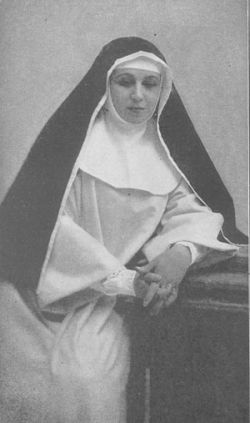
VIOLA ALLEN AS THE WHITE SISTER
The White Sister
By F. Marion Crawford
Author of "The Diva's Ruby," "Saracinesca,"
"In the Palace of the King," etc.
A. L. BURT COMPANY
Publishers
New York
Macmillan Standard Library
All Rights Reserved
Copyright, 1908, By F. MARION CRAWFORD.
Copyright, 1909, By F. MARION CRAWFORD.
Copyright, 1909, By THE MACMILLAN COMPANY.
Set up and electrotyped. Published May, 1909. Reprinted
May, June, twice, July, August, twice, September, October,
November, December, 1909; February, 1910; March,
November, 1910; February, 1911; September, 1913.
'I cannot help it,' said Filmore Durand quietly. 'I paint what I see. If
you are not pleased with the likeness, I shall be only too happy to keep
it.'
The Marchesa protested. It was only a very small matter, she said, a
something in the eyes, or in the angle of the left eyebrow, or in the
turn of the throat; she could not tell where it was, but it gave her
niece a little air of religious ecstasy that was not natural to her. If
the master would only condescend to modify the expression the least bit,
all would be satisfactory.
Instead of condescending, Filmore Durand smiled rather indifferently and
gave his pallet and brushes to his man, who was already waiting at his
elbow to receive them. For the famous American portrait-painter detested
all sorts of litter, such as a painting-table, brush-jars, and the like,
as much as his great predecessor Lenbach ever did, and when he was at
work his old servant brought him a brush, a tube of colour, a knife, or
a pencil, as each was needed, from a curtained recess where everything
was kept ready and in order.
'I like it as it is,' said Giovanni Severi, resting his hands on the
hilt of his sabre, as he sat looking thoughtfully from the portrait to
the original.
The young girl smiled, pleased by his approbation of the likeness, which
she herself thought good, though it by no means flattered. On the
contrary, it made her look older than she was, and much more sad; for
though the spring laughed in her eyes when she looked at the officer to
whom people said she was engaged, their counterparts in the portrait
were deep and grave. Certain irregularities of feature, too, were more
apparent in the painting than in nature. For instance, there was a very
marked difference between the dark eyebrows; for whereas the right one
made a perfect curve, the other turned up quite sharply towards the
forehead at the inner end, as if it did not wish to meet its fellow; and
the Marchesa del Prato was quite sure that Angela's delicate nose had
not really that aquiline and almost ascetic look which the great master
had given it. In fact, the middle-aged woman almost wished that it had,
for of all things that could happen she would have been best pleased
that her niece should turn out to have a vocation and should disappear
into some religious order as soon as possible. This was not likely, and
the Marchesa was by no means ready to accept, as an alternative, a
marriage with Giovanni Severi, whom she had long looked upon as her own
private property.
Filmore Durand glanced from one to another of the three in quick
succession, stroked his rather bristly moustache, and lit a cigarette,
not because he wanted to smoke, but because he could not help it, which
is a very different thing. Then he looked at his picture and forgot
that he was not alone with it; and it still pleased him, after a
fashion, though he was not satisfied with what he had done.
Great artists and great writers are rarely troubled by theories; one of
the chief characteristics of mature genius is that it springs directly
from conception to expression without much thought as to the means; a
man who has used the same tools for a dozen years is not likely to take
his chisel by the wrong end, nor to hesitate in choosing the right one
for the stroke to be made, much less to 'take a sledge-hammer to kill a
fly,' as the saying is. His unquiet mind has discovered some new and
striking relation between the true and the beautiful; the very next step
is to express that relation in clay, or in colour, or in words. While he
is doing so he rarely stops to think, or to criticise his own
half-finished work; he is too sure of himself, just then, to pause, and,
above all, he is too happy, for all the real happiness he finds in his
art is there, between the painfully disquieting ferment of the mental
chaos that went before and the more or less acute disappointment which
is sure to come when the finished work turns out to be less than
perfect, like all things human. It is in the race from one point to the
other that he rejoices in his strength, believes in his talent, and
dreams of undying glory; it is then that he feels himself a king of men
and a prophet of mankind; but it is when he is in this stage that he is
called vain, arrogant, and self-satisfied by those who do not understand
the distress that has gone before, nor the disillusionment which will
follow soon enough, when the hand is at rest and cool judgment marks the
distance between a perfect ideal and an attainable reality. Moreover,
the less the lack of perfection seems to others, the more formidable it
generally looks to the great artist himself.
It was often said of Durand that his portraits were prophetic; and often
again that his brushes were knives and scalpels that dissected his
sitters' characters upon the canvas like an anatomical preparation.
'I cannot help it,' he always said. 'I paint what I see.'
It was not his fault if pretty Donna Angela Chiaromonte had thrown a
white veil over her dark hair, just to try the effect of it, the very
first time she had been brought to his studio, or that she had been
standing beside an early fifteenth century altar and altar-piece which
he had just bought and put up at one end of the great hall in which he
painted. He was not to blame if the veiling had fallen on each side of
her face, like a nun's head-dress, nor if her eyes had grown shadowy at
that moment by an accident of light or expression, nor yet if her tender
lips had seemed to be saddened by a passing thought. She had not put on
the veil again, and he had not meant that a suggestion of suffering
ecstatically borne should dim her glad girlhood in his picture; but he
had seen the vision once, and it had come out again under his brush, in
spite of him, as if it were the necessary truth over which the outward
expression was moulded like a lovely mask, but which must be plain in
her face to every one who had once had a glimpse of it.
The painter contemplated his work in silence from within an Olympian
cloud of cigarette smoke that almost hid him from the others, who now
exchanged a few words in Italian, which he only half understood. They
spoke English with him, as they would have spoken French with a
Frenchman, and probably even German with a German, for modern Roman
society has a remarkable gift of tongues and is very accomplished in
other ways.
'What I think most wonderful,' said the Marchesa del Prato, who detested
her husband's pretty niece, 'is that he has not made a Carlo Dolce
picture of you, my dear. With your face, it would have been so easy, you
know!'
Giovanni Severi's hands moved a little and the scabbard of his sabre
struck one of his spurs with a sharp clink; for he was naturally
impatient and impulsive, as any one could see from his face. It was lean
and boldly cut; his cheeks were dark from exposure rather than by
nature, there were reddish lights in his short brown hair, and his small
but vigorous moustache was that of a rather fair man who has lived much
in sun and wind in a hot climate. His nose was Roman and energetic, his
mouth rather straight and hard; yet few would have thought his face
remarkable but for the eyes, which betrayed his nature at a glance; they
were ardent rather than merely bold, and the warm, reddish-brown iris
was shot with little golden points that coruscated in the rays of the
sun, but emitted a fiery light of their own when his temper was roused.
If his look had been less frank and direct, or if his other features had
suggested any bad quality, his eyes would probably have been intolerably
disagreeable to meet; as it was, they warned all comers that their
possessor was one of those uncommon and dangerous men who go to the
utmost extremes when they believe themselves in the right and are
constitutionally incapable of measuring danger or considering
consequences when they are roused. Giovanni Severi was about
eight-and-twenty, and wore the handsome uniform of an artillery officer
on the Staff. He had not liked the Marchesa's remark, and the impatient
little clink of his scabbard against his spur only preceded his answer
by a second.
'Happily for Angela,' he said, 'we are not in the studio of a
caricaturist.'
The Marchesa, who could be near-sighted on occasion, put up her
tortoiseshell-mounted eyeglass and looked at him aggressively; but as he
returned her gaze with steadiness, she soon turned away.
'You are extremely rude,' she said coldly.
For she herself made clever caricatures in water-colours, and she knew
what Giovanni meant. Angela's mother had been a very devout woman and
had died young, but had incurred the hatred of the Marchesa by marrying
the very man whom the latter had picked out for herself, namely, the
elder of two brothers, and the Marchesa had reluctantly consented to
marry the other, who had a much less high-sounding title and a far
smaller fortune. She had revenged herself in various small ways, and
had often turned her brother-in-law's wife to ridicule by representing
her as an ascetic mediæval saint, in contorted attitudes of ecstasy,
with sunken cheeks and eyes like saucers full of ink. Like many other
people, Giovanni had seen some of these drawings, for the resentful
Marchesa had not destroyed them when the Princess Chiaromonte died; but
no one had yet been unkind enough to tell Angela of their existence. The
girl did not like her aunt by marriage, it was true, but with a
singularly simple and happy disposition, and a total absence of vanity,
she apparently possessed her mother's almost saintly patience, and she
bore the Marchesa's treatment with a cheerful submission which
exasperated the elder woman much more than any show of temper could have
done.
Just now, seeing that trouble of some sort was imminent, she made a
diversion by coming down from the low movable platform, on which her
chair had been placed for the sitting, and she spoke to the artist while
she studied her own portrait. Durand was a very thin man, and so tall
that Angela had to look very high to see his face as she stood beside
him.
'I could never be as good as the picture looks,' she said in English,
with a little laugh, 'nor so dreadfully in earnest! But it is very nice
of you to think that I might!'
'You will never be anything but good,' answered Filmore Durand, 'and
it's not necessarily dreadful to be in earnest about it.'
'You are a moralist. I see.' observed the Marchesa, putting on a sweet
smile as she rose and came forward, followed by Giovanni.
'I don't know,' replied the painter. 'What is a moralist?'
'A person who is in earnest about other people's morals,' suggested
Angela gaily.
'Really!' cried the Marchesa, with a most emphatic English pronunciation
of the word. 'One would think that you had been brought up in a
Freemasons' lodge!'
In view of the fact that Angela's father was one of the very last
survivors of the 'intransigent' clericals, this was quite the most
cutting speech the Marchesa could think of. But Filmore Durand failed to
see the point.
'What has Freemasonry to do with morality?' he inquired with bland
surprise.
'Nothing at all,' answered the Marchesa smartly, 'for it is the religion
of the devil.'
'Dear me!' The artist smiled. 'What strong prejudices you have in Rome!'
'Are you a Freemason?' the noble lady asked, with evident nervousness;
and she glanced from his face to Angela, and then at the door.
'Well—no—I'm not,' the painter admitted with a slight drawl, and
evidently amused. 'But then I'm not a moralist either, though I suppose
I might be both and yet go on painting about the same.'
'I think not,' said the Marchesa so stiffly that Giovanni almost laughed
aloud. 'We must be going,' she added, suddenly relaxing to graciousness
again. 'It has been such a privilege to see you day after day, my dear
Mr. Durand, and to watch you working in your own surroundings. My
brother-in-law will come to-morrow. I have no doubt that he will be much
pleased with the portrait.'
Filmore Durand smiled indifferently but with politeness as he bowed over
the Marchesa's hand. He did not care a straw whether Angela's father
liked the picture or not, being in love with it himself, and much more
anxious to keep it than to be paid for it.
'When shall I see you again?' Giovanni had asked of Angela, almost in a
whisper, while the Marchesa was speaking.
Instead of answering she shook her head, for she could not decide at
once, but as her glance met his a delicate radiance tinged her cheeks
for a moment, as if the rosy light of a clear dawn were reflected in her
face. The young soldier's eyes flashed as he watched her; he drew his
breath audibly, and then bit his upper lip as if to check the sound and
the sensation that had caused it. Angela heard and saw, for she
understood what moved him, so far as almost childlike simplicity can
have intuition of what most touches a strong man. She was less like the
portrait now than a moment earlier; her lips, just parting in a little
half-longing, half-troubled smile, were like dark rose leaves damp with
dew, her eyelids drooped at the corners for an instant, and the
translucent little nostrils quivered at the mysterious thrill that
stirred her maiden being.
The two young people had not known each other quite a year, for she had
never seen Severi till she had left the convent to go out into society
and to take her place at her widowed father's table as his only child;
but at their first meeting Giovanni had felt that of all women he had
known, none but she had ever called his nature to hers with the longing
cry of the natural mate. At first she was quite unconscious of her
power, and for a long time he looked in vain for the slightest outward
sign that she was moved when she saw him making his way to her in a
crowded drawing-room, or coming upon her suddenly out of doors when she
was walking in the villa with her old governess, the excellent Madame
Bernard, or riding in the Campagna with her father. Giovanni's duties
were light, and he had plenty of time to spare, and his pertinacity in
finding her would have been compromising if he had been less ingeniously
tactful. It was by no means easy to meet her in society either, for, in
spite of recent social developments, Prince Chiaromonte still clung to
the antiquated political mythology of Blacks and Whites, and strictly
avoided the families he persisted in calling 'Liberals,' on the ground
that his father had called them so in 1870, when he was a small boy. It
was not until he had bored himself to extinction in the conscientious
effort to take the girl out, that he appealed to his sister-in-law to
help him, though he knew that neither she nor his brother was truly
clerical at heart. Even then, if it had been clear to him that Giovanni
Severi had made up his mind to marry Angela if he married at all, the
Prince would have forced himself to bear agonies of boredom night after
night, rather than entrust his daughter to the Marchesa; but such an
idea had never entered his head, and he would have scouted the
suggestion that Angela would ever dare to encourage a young man of whom
he had not formally approved; and while she was meeting Giovanni almost
daily, and dancing with him almost every evening, her father was slowly
negotiating an appropriate marriage for her with the eldest son of
certain friends who were almost as clerical and intransigent as himself.
The young man was a limp degenerate, with a pale face, a weak mouth, and
an inherited form of debility which made him fall asleep wherever he
was, if nothing especial happened to keep his eyes open; he not only
always slept from ten at night till nine the next morning with the
regularity of an idiot, but he went to sleep wherever he sat down, in
church, at dinner, and even when he was driving. Neither his own parents
nor Prince Chiaromonte looked upon this as a serious drawback in the
matter of marriage. A man who slept all day and all night was a man out
of mischief, not likely to grumble nor to make love to his neighbour's
wife; he would therefore be a model husband. When he fell asleep in the
drawing-room in summer, his consort would sit beside him and brush away
the flies; in winter she would be careful to cover him up lest he should
catch cold; at mass she could prick him with a hat-pin to keep him
awake; as for the rest, she would bear one of the oldest names in
Europe, her husband would be a strictly religious and moral person, and
she would be very rich. What more could any woman ask? Evidently
nothing, and Prince Chiaromonte therefore continued to negotiate the
marriage in the old-fashioned manner, without the least intention of
speaking about it to Angela till everything was altogether settled
between the family lawyers, and the wedding could take place in six
weeks. It was not the business of young people to fathom the intentions
of their all-wise parents, and meanwhile Angela was free to go to
parties with her aunt, and her intended husband was at liberty to sleep
as much as he liked. The negotiations would probably occupy another two
or three months, for the family lawyers had disagreed as to the number
of times that Angela should be allowed to take the carriage out every
day, and this had to be stipulated in the marriage contract, besides the
number of dishes there were to be at luncheon and dinner and the
question whether, if Angela took coffee after her meals, it should be
charged to her husband, who took none, or against the income arising
from her dowry. The family lawyers were both very old men and understood
these difficult matters thoroughly, but neither would have felt that he
was doing his duty to his client if he had not quarrelled with the other
over each point. From week to week each reported progress to his
employer, and on the whole the two fathers felt that matters were going
on well, without any undue delay.
But the Fates frowned grimly on the marriage and on all things connected
with it, for on the very morning during which Filmore Durand finished
Angela's portrait, and before she had left his studio in the Palazzo
Borghese, something happened which not only put a stop to the leisurely
labours of the two lawyers, but which profoundly changed Angela's
existence, and was the cause of her having a story quite different from
that of a good many young girls who are in love with one man but are
urged by their parents to marry another. The interest of this tale, if
it has any, lies in no such simple conflict of forces as that, and it is
enough to know that while her father had been busy over her marriage,
Angela Chiaromonte had fallen in love with Giovanni Severi, and had,
indeed, as much as promised to marry him; and that a good many people,
including the Marchesa del Prato, already suspected this, though they
had not communicated their suspicions to the girl's father, partly
because he was not liked, and partly because he hardly ever showed
himself in the world. The situation is thus clearly explained, so far as
it was known to the persons concerned at the moment when the Great
Unforeseen flashed from its hiding-place and hurled itself into their
midst.
As Filmore Durand went with the Marchesa towards the entrance hall,
followed by the young people, he called his man to open the outer door,
but almost at the same moment he heard his voice at the telephone; the
servant was a Swiss who spoke German, English, and Italian, and had
followed the artist for many years. He was evidently answering an
inquiry about the Marchesa just as he heard her step.
'The lady is here,' he said. 'She is coming to the telephone herself.'
He looked round as the four approached, for the instrument was placed on
the right side of the large door that opened upon the landing.
'Some one for your ladyship,' he said in English, holding out the
receiver to the Marchesa.
She took it and put it to her ear, repeating the usual Italian formula.
'Ready—with whom am I speaking? Yes. I am the Marchesa del Prato, she
herself. What is it?'
There was a pause while she listened, and then Angela saw her face
change suddenly.
'Dead?' she shrieked into the telephone. 'Half-an-hour ago?'
She still held the receiver to her ear, but she was stretching out her
left hand as if she needed support. Durand took her by the arm and
elbow, prepared to hold her up if she showed signs of fainting. Angela
was already on her other side.
'Who is dead?' the girl asked quietly enough, but with evident anxiety.
'Your father,' answered the Marchesa, with such sudden and brutal
directness that Giovanni started forward, and Durand stared in surprise,
for he knew enough Italian to understand as much as that.
Angela made two steps backwards, slowly and mechanically, like a blind
man who has unexpectedly run against a wall; like the blind, too, she
held out her hands before her, as if to assure herself that she was
getting out of reach of the obstacle. Her face had turned white and her
eyes were half closed.
The Marchesa no longer seemed to be in need of support and watched her.
'My poor child!' she cried, in a tone of conventional sympathy. 'I
should have broken the news to you gradually——'
'You should indeed!' answered Giovanni with stern emphasis.
He was already leading Angela to one of the nearest of the high-backed
chairs that stood ranged against the dark-green wall of the hall. She
sat down, steadying herself by his arm.
'Run over by a motor car almost at his own door,' said the Marchesa, in
a lower tone and in English, as she turned slightly towards Durand.
'Killed on the spot! It is too awful! My poor brother-in-law!'
'Get some brandy and some cold water,' said the artist to his man,
watching the girl's pale face and twitching hands.
'Yes,' said Giovanni, who was bending over her anxiously. 'Bring
something quickly! She is going to faint.'
But Angela was not fainting, nor even half-unconscious. She had felt as
if something hard had struck her between the eyes, without quite
stunning her. She attempted to get up, but realised her weakness and
waited a moment before trying again. Then she rose to her feet with an
effort and stood straight and rigid before her aunt, her eyes quite open
now.
'Come!' she said, almost imperiously, and in a voice unlike her own.
In a moment they were gone, and the artist was standing before the
portrait he had finished, looking into its eyes as if it were alive. He
had been deeply shocked by what had just happened, and was sincerely
sorry for Angela, though he had not the least idea whether she had loved
her father or not, but his face was calm and thoughtful again, now that
she was gone, and expressed a quiet satisfaction which had not been
there before. For it seemed to him that the picture was a precious
reality, and that the young girl who had sat for it was only nature's
copy, and not perfect at that; and perhaps the reality would not be
taken from him, now, since Prince Chiaromonte had come to an untimely
end; and the prospect of keeping the canvas was exceedingly pleasing to
Filmore Durand. He had never painted anything that had disappointed him
less, or that he was less willing to part with, and during the last day
or two he had even thought of making a replica of it for the Prince in
order to keep the original, for no copy, though it were made by himself
most conscientiously, could ever be quite so good. But now that the
Prince was dead, it was possible that the heirs, if there were any
besides Angela, would be glad to be excused from paying a large sum for
a picture they did not want. He was sure from the young girl's manner
that she would no more care to possess a portrait of herself than a
coloured postcard of the Colosseum or a plaster-cast of one of Canova's
dancing-girls. This was not flattering to the artist, it was true, but
in the present case he would rather keep his own painting than have it
appreciated ever so highly by any one else.
Late in the afternoon he stopped before the closed gateway of the
Palazzo Chiaromonte and pushed the little postern that stood ajar. The
big porter was within, standing dejectedly before the door of his lodge,
and already dressed in the deep mourning which is kept in readiness in
all the great Roman houses. The painter asked in broken Italian if the
bad news was true, and the man nodded gravely, pointing to the gates.
They would not be shut unless the master were dead. Durand asked after
Donna Angela, but the porter was not communicative. She had come in with
her aunt and both were upstairs; he suspected the painter of being a
foreign newspaper correspondent and would say nothing more.
The American thanked him and went away; after all, he had come to make
sure that the Prince was really dead, and he was conscious that his wish
to keep the portrait was the only motive of his inquiry.
He strolled away through the crowded streets, blowing such clouds of
cigarette smoke about him that people looked at him in surprise. It was
almost sunset, in February, and it was just before Lent. Rome is at her
gayest then, though the old Carnival is as dead and gone as Pio Nono,
Garibaldi, the French military occupation, the hatred of the Jesuits,
and all that made the revival of Italy in the nineteenth century the
most thrilling romance that ever roused Italian passion and stirred the
world's sympathy. Durand was not old enough to remember those times, and
he had never been in Rome at all till he was nearly thirty years of age
and on the first wave of his high success; but he had read about the
past, and to his unspoiled sight and vivid imagination Rome was still
romantic and the greatest city in the world, ancient or modern; and
somehow when he thought of his picture and of Angela's face, and
remembered the scene at the telephone, he felt that he was himself just
within the sphere of some mysterious and tragic action which he could
not yet understand, but which might possibly affect his own life.
'This is a serio-comic world,' he said to himself as he slowly made his
way down the Corso, watching the faces of the people he passed, because
he never passed a face in the street without glancing at it, stopping
now and then to look into a shop window where there was nothing to see
that he had not seen a thousand times elsewhere, smoking cigarettes
without number, thinking of Angela's portrait, and mechanically
repeating his little epigram over and over again, to a sort of tune in
his head, with variations and transpositions that meant nothing at all.
'This is a serio-comic world. This is a comico-serious world. This world
is a serious comico-serial. This is a worldly-serious comedy.' And so
forth, and so on; and a number of more or less good-looking women of the
serio-comic world, whose portraits he had painted, and several more or
less distinguished men who had sat to him, passed the man of genius and
greeted him as if they were rather pleased to show that they knew him;
but they would have been shocked if they could have heard the silly
words the great painter was mechanically repeating to himself as he
idled along the pavement, musing on the picture he hoped to keep, and
already regarded as his masterpiece and chief treasure.
CHAPTER II
The excellent Madame Bernard had been Angela's governess before the
child had been sent to the convent, on the Trinità dei Monti, and
whenever she was at home for the holidays, and also during the brief
interval between her leaving school and going into society; and after
that, during the winter which preceded Prince Chiaromonte's death, she
had accompanied the motherless girl to concerts and had walked with her
almost daily in the mornings. She was one of those thoroughly
trustworthy, sound-minded, well-educated Frenchwomen of the middle class
of whom many are to be found in the provinces, though the type is rare
in Paris; nearly fifty years of age, she had lived twenty years in Rome,
always occupying the same little apartment in a respectable street of
Trastevere, where she had a spare room which she was glad to let to any
French or English lady of small means who came to Rome for a few months
in the winter and spring.
Angela sent her maid for Madame Bernard on the day of the catastrophe,
since her aunt neither offered to take her in at once nor seemed
inclined to suggest any arrangement for the future. The Marchesa did,
indeed, take charge of everything in the Palazzo Chiaromonte within an
hour of her brother-in-law's death; she locked the drawers of his
private desk herself, sent for the notary and had the customary seals
placed on the doors of the inner apartments 'in the name of the heirs';
she spoke with the undertaker and made every arrangement for the
customary lying in state of the body during the following night and day;
saw to the erection of the temporary altar at which masses for the dead
would be celebrated almost without interruption from midnight to noon by
sixteen priests in succession; gave full instructions to the effect that
the men-servants should take their turn of duty in regular watches, day
and night, until the funeral; and finally left the palace, after showing
herself to be an exceedingly practical woman.
When she went away, she was holding her handkerchief to her eyes with
both hands and she forgot her parasol; but she remembered it as she was
just going out by the postern, her carriage being outside because the
gates were shut, and she sent her footman back for it and for the little
morocco bag in which she carried her handkerchief and card-case. It was
a small matter, but the porter, the footman, and the butler upstairs all
remembered it afterwards, and the footman himself, while coming down,
took the trouble to look into the little wallet, and saw that the
card-case was there, but nothing else; for the Marchesa sometimes
carried certain little cigarettes in it, which the man had found
particularly good. But to-day there was not even one.
Madame Bernard arrived in tears, for she was a warm-hearted woman, and
was overcome with sympathy for the lonely girl. She found Angela sitting
by a small fire in her own little morning-room on the upper floor. A
tray with something to eat had been set beside her, she knew not by
whom, but she had not tasted anything. Her eyes were dry, but her hands
were burning and when she was conscious of feeling anything she knew
that her head ached. She had forgotten that she had sent for the
governess, and looked at her with a vaguely wondering expression as if
she took the kindly Frenchwoman in black for a new shadow in her dream.
But presently mechanical consciousness returned, though without much
definite sensation, and she let Madame Bernard have her way in
everything, not making the slightest resistance or offering the smallest
suggestion; she even submitted to being fed like a little child, with
small mouthfuls of things that had no taste whatever for her.
By and by there was a dressmaker in the room, with an assistant, and
servants brought a number of big bandboxes with lids covered with black
oilcloth; and Angela's maid was there, too, and they tried one thing
after another on her, ready-made garments for the first hours of
mourning. Then they were gone, and she was dressed in black, and the
room was filled with the unmistakable odour of black crape, which is not
like anything else in the world.
Again time passed, and she was kneeling at a faldstool in the great hall
downstairs; but a dark screen had been placed so that she could not be
seen by any one who came in to kneel at the rail that divided the upper
part of the hall from the lower; and she saw nothing herself—nothing
but a Knight of Malta, in his black cloak with the great white Maltese
cross on his shoulder, lying asleep on his back; and on each side of him
three enormous wax torches were burning in silver candlesticks taller
than a tall man.
Quite at the end of the hall, five paces from the Knight's motionless
head, three priests in black and silver vestments were kneeling before a
black altar, reciting the Penitential Psalms in a quiet, monotonous
voice, verse and verse, the one in the middle leading; and Angela
automatically joined the two assistants in responding, but so low that
they did not hear her.
The Knight bore a resemblance to her father, that was all. Perhaps it
was only a waxen image she saw, or a wraith in that long dream of hers,
of which she could not quite remember the beginning. She knew that she
was nothing to the image, and that it was nothing to her. While her lips
repeated the grand dirge of the King-poet in Saint Jerome's noble old
Latin words, her thoughts followed broken threads, each cut short by a
question that lacks an answer, by the riddle man has asked of the sky
and the sea and the earth since the beginning: What does it mean?
What could it mean? The senseless facts were there, plain enough. That
morning she had seen her father, she had kissed his hand in the
old-fashioned way, and he had kissed her forehead, and they had
exchanged a few words, as usual. She remembered that for the thousandth
time she had wished that his voice would soften a little and that he
would put his arms round her and draw her closer to him. But he had been
just as always, for he was bound and stiffened in the unwieldy armour of
his conventional righteousness. Angela had read of the Puritans in
history, and an Englishman might smile at the thought that she could not
fancy the sternest of them as more thoroughly puritanical than her
father, who had been brought up by priests from his childhood. But such
as he was, he had been her father that morning. The motionless figure of
the Knight of Malta on the black velvet pall was not he, nor a likeness
of him, nor anything human at all. It was the outward visible presence
of death, it was a dumb thing that knew the answer to the riddle but
could not tell it; in a way, it was the riddle itself.
While her half-stunned intelligence stumbled among chasms of thought
that have swallowed up transcendent genius, her lips unconsciously said
the Penitential Psalms after the priests at the altar. At the convent
she had been a little vain of knowing them by heart better than the nuns
themselves, for she had a good memory, and she had often been rebuked
for taking pride in her gift. It was not her fault if the noble poetry
meant nothing to her at the most solemn hour of her life, though its
deep human note had appealed profoundly to her the last time she had
repeated the words. Nothing meant anything now, in the face of the
unanswered riddle; nothing but the answer could have any meaning.
The great apostle of modern thought asked three questions: What can I
know? As a reasoning being what is it my duty to do in life? What may I
dare to hope hereafter? Angela had never even heard of Kant; she only
asked what it all meant; and the Knight of Malta was silent under the
steady yellow light of the six wax torches. Perhaps the white cross on
his cloak was the answer, but the emblem was too far from words for mere
humanity to understand it. She wished they would take him away, for he
was not her father, and she would be far better able to pray alone in
her own room than in the stately presence of that one master whom all
living things fear, man and bird and beast, and whatsoever has life in
the sea.
To pray, yes; but for what? Rebellious against outward things, the
girl's prime intuition told her that her father was quite separated from
his mortal symbol now, having suddenly left that which could change to
become a part of the unknown truth, which must be unchangeable if it is
true; invisible, without form or dimension, 'being' not 'living,'
'conscious' not 'aware,' 'knowing' not 'seeing,' 'eternal' not
'immortal.' That might be the answer, but it meant too much for a girl
to grasp, and explained too little to be comforting. The threads of
thought broke short off again, and Angela's lips went on making words,
while she gazed unwinking on the Knight's expressionless face.
Suddenly her mind awoke again in a sort of horror of darkness, and her
lips ceased from moving for a while, for she was terrified.
Was there anything beyond? Was it really God who had taken her father
from her in an instant, or was it a blind force that had killed him,
striking in the dark? If that was the answer, what was there left?
The sensitive girl shivered. Perhaps no bodily danger could have sent
that chill through her. It began in her head and crept quickly to her
hands and then to her feet, for it was not a fear of death that came
upon her, nor of anything outward. To lose life was nothing, if there
was heaven beyond; pain, torture, martyrdom would be nothing if God the
good was standing on the other side. All life was but one long
opportunity for sinning, and to lose it while in grace was to be safe
for ever; so much she had been taught and until now she had believed it.
But what loss could be compared with losing God? There were unbelievers
in the world, of course, but she could not understand how they could
still live on, and laugh, and seek pleasure and feel it keenly. What had
they to fill the void of their tremendous loss? Surely, not to believe
was not to hope, to be for ever without hope was the punishment of the
damned, and to live hopeless in the world was to suffer the pains of
hell on earth.
She felt them now. 'The pains of hell gat hold upon me,' she moaned,
heedless of the priest's recitation. Darkness rose like a flood-tide all
round her and she shut her eyes to keep it out, for her will fought for
hope, as her body would have struggled against drowning. It was no
longer a mere question that assailed her, but imminent destruction
itself.
It passed away this first time and she grew calm again. Not to believe
was sin, and against all sin, prayer and steadfast will must be
availing. The will, she had; she could remember many prayers, too, and
say them earnestly, and was thankful for her memory which held orisons
in readiness for every circumstance of daily duty or spiritual life.
From her childhood she had found a gentle delight in the Church's
liturgies and hymns, and now, as she prayed with the forms of language
she had always loved, habit brought back belief to lighten her darkness.
She still felt the bitter cold of the outer night that was very near
her; but she kept it off now, and warmed her poor little soul in the
fervour of her praying till she felt that she was coming again to life
and hope.
She opened her eyes at last and saw that nothing was changed. The Knight
of Malta slept on, as he was to sleep for ever; the priests knelt
motionless before the black altar; their quiet, monotonous voices went
on with the Penitential Psalms as priests had said them for at least
fifteen centuries. Angela listened till she caught the words and then
began to respond again, and once more her thoughts followed broken
threads.
Surely, by all she had been taught, her father was in heaven already. It
was not possible that any human being should obey every written and
unwritten ordinance of his religion more strictly than he had done ever
since she could remember him. He had been severe, almost to cruelty, but
he had been quite as unyieldingly austere in dealing with himself. He
had fasted rigidly, not only when fasts were ordered, but of his free
will when others only abstained, he had never begun a day without
hearing mass nor a week without confession and communion, he had retired
into spiritual retreat in Lent, he had prayed early and late; in his
dealings with men, he had not done to others what he would not have had
them do to him, he had not said of his neighbour what he would not have
said of himself, he had wronged no man; he had given much to charity and
more to the 'imprisoned' head of the Church. He had so lived that no
confessor could justly find fault with him, and he had never failed to
pray for those in whom he discerned any shortcoming.
Who would condemn such a just person? Not God, surely. Therefore when
his life had ended so suddenly that morning, his soul had been taken
directly to heaven.
Such righteousness as his had venial sins to expiate, what hope was
there left for men of ordinary earthly passions and failings?
It was a consolation to think of that, Angela told herself, now that the
tide of darkness had ebbed back to the depth of terror whence it had
risen; and when at last the long dream slowly dissolved before returning
reality the lonely girl's eyes overflowed with natural tears at the
thought that her father's motionless lips would never move again, even
to reprove her, and that she was looking for the last time on all that
earth still held of him who had given her life.
CHAPTER III
Three days later Angela sat alone in her morning-room, reading a letter
from Giovanni Severi. All was over now—the lying in state, the funeral
at the small parish church, the interment in the cemetery of San
Lorenzo, where the late Prince had built a temporary tomb for himself
and his family, under protest, because modern municipal regulations
would not allow even such a personage as he to be buried within the
walls, in his own family vault, at Santa Maria del Popolo. But he had
been confident that even if he did not live to see the return of the
Pope's temporal power, his remains would soon be solemnly transferred to
the city, to rest with those of his fathers; and he had looked forward
to his resurrection from a sepulchre better suited to his earthly rank
and spiritual worth than a brick vault in a public cemetery, within a
hundred yards of the thrice-anathematised crematorium, and of the
unhallowed burial-ground set aside for Freemasons, anarchists,
Protestants, and Jews. But no man can be blamed fairly for wishing to
lie beside his forefathers, and if Prince Chiaromonte had failed to see
that the destiny of Italy had out-measured the worldly supremacy of the
Vatican in the modern parallelogram of forces, that had certainly been a
fault of judgment rather than of intention. He had never wavered in his
fidelity to his ideal, nor had he ever voluntarily submitted to any law
imposed by the 'usurper.'
'That excellent Chiaromonte is so extremely clerical,' Pope Leo the
Thirteenth had once observed to his secretary with his quiet smile.
But Angela missed her father constantly, not understanding that he had
systematically forced her to look to him as the judge and master of her
existence, and she wondered a little why she almost longed for his grave
nod, and his stern frown of disapproval, and even for the daily and
hourly reproof under which she had so often chafed. Madame Bernard had
been installed in the palace since the day of the fatal accident, and
she was kindness personified, full of consideration and forethought; yet
the girl was very lonely and miserable from morning till night, and when
she slept she dreamed of the dead Knight of Malta's face, of the yellow
light of the wax torches, and the voices of the priests.
On the fourth day a letter came from Giovanni, the first she had ever
received from him. She did not even know his handwriting, and she looked
at the signature before reading the note to see who had written to her
so soon. When she understood that it was he, a flood of sunshine broke
upon her gloom. The bright morning sun had indeed been shining through
the window for an hour, but she had not known it till then.
It was not a love-letter. He used those grammatically illogical but
superfinely courteous forms which make high Italian a mystery to
strangers who pick up a few hundred words for daily use and dream that
they understand the language. He used the first person for himself, but
spoke of her in the third singular; he began with: 'Most gentle Donna
Angela,' and he signed his full name at the end of a formal phrase
setting forth his profoundly respectful homage. She would have been much
surprised and perhaps offended if he had expressed himself in any more
familiar way. Brought up as she had been under the most old-fashioned
code in Europe when at home, and under the frigid rule of the Ladies of
the Sacred Heart when she was at school, any familiarity of language
seemed to her an outrage on good manners, and might even be counted a
sin if she condescended to it in speaking with a man who was not yet her
husband. She had been made to address her father in the third person
feminine singular ever since she had learned to talk, precisely as
Giovanni wrote to her; and if she prayed to the Deity with the less
formal second person plural, this was doubtless because the Italian
prayers had been framed in less refined and courteous times than her
own.
In spite of his stiff grammar, however, Severi managed to write things
that brought the colour to her face and the light to her eyes. He said,
for instance, that he was coming to see her that very afternoon; that in
order not to attract attention at the gate of the palace he would wear
civilian's dress, and that he hoped she would not only receive him, but
would send Madame Bernard out of the room for a little while, so that he
might speak to her alone.
The proposal was so delightful and yet so disturbing that Angela
thought it must be wicked and tried to examine her conscience at once;
but it shut up like an oyster taken out of the water and pretended to be
perfectly insensible, turn it and probe it how she would.
So she gave it up; and she did so the more readily because it would be
quite impossible to see Giovanni that afternoon, enchanting as the
prospect would have been. Her aunt the Marchesa had sent word that she
was coming at four o'clock with the lawyer to explain Angela's position
to her, and it was impossible to say how long the two might stay.
Meanwhile she must send word to Giovanni not to come, for it would not
suffice that he should be refused admittance at the gate, since he might
chance to present himself just when the Marchesa drove up, which would
produce a very bad impression. Angela was ashamed to send her maid with
a note to a young officer, and she would not trust one of the
men-servants; she turned for advice to Madame Bernard, who was her only
confidante.
'What am I to do?' she asked when she had explained everything. 'He is
generally at the War Office at this time and he may not even go home
before he comes here. I see no way but to send a note.'
'He would certainly go home to change his clothes,' answered the
practical Frenchwoman; 'but it is not necessary for you to write. I will
telephone to the War Office, and if the Count is there I will explain
everything.'
Angela looked at her doubtfully.
'But then the servant who telephones will know,' she objected.
'The servant? Why? I do not understand. I shall speak myself. No one
will be there to hear.'
'Yourself? My father never could, and I never was shown how to do it.
Are you sure you understand the thing? It is very complicated, I
believe.'
Madame Bernard was not surprised, for she knew the ways of the Palazzo
Chiaromonte; but she smiled and assured the young girl that a telephone
was not really such a dangerous instrument as she had been led to
believe.
'I once tried to make a few stitches with a sewing-machine,' Angela
said, apparently in explanation.
'A telephone is different,' Madame Bernard answered gravely. 'Shall I
ask the Count to come to-morrow at four o'clock, instead of to-day?'
Angela hesitated, and then blushed faintly.
'Do you think——' she began, but she stopped and hesitated. 'He would
be angry, I am sure——' She seemed to be suddenly distressed.
'Your father?' asked the Frenchwoman, guessing what she meant. 'My dear
Princess——'
'Oh, please don't call me that!' cried Angela. 'You never do——'
'You see, you are a great personage now, my dear child,' Madame Bernard
answered, 'and I am no longer your governess——'
'But you are my friend, dear, dear Madame Bernard! Indeed, I think you
are my only friend now!'
And thereupon Angela threw her arms round the little woman's neck and
kissed her very affectionately. Madame Bernard's fresh face beamed with
pleasure.
'Thank you, my dear,' she answered. 'And as for your father, my child,
he is without doubt in heaven; and that means that he now judges you by
your intentions and no longer by appearances only.'
This sage little speech reassured Angela, though she soon afterwards
asked herself whether it was quite loyal to allow any one to say that
the Prince had ever judged her 'by appearances only.' But while she was
making this reflection Madame Bernard was already telephoning to
Giovanni, who was at the War Office, as Angela supposed, and he answered
with alacrity that he would come to the palace on the following
afternoon and ask to see Madame Bernard on a matter of business. It was
really her business to teach French, as all the servants knew, and if
they thought that the young officer came to ask about some lessons for
himself or a friend, so much the better. Madame Bernard was naturally
practical, and Giovanni was by nature quick-witted; so the matter was
settled in a few words, to the satisfaction of both; and when Angela was
merely told that he was coming she was much more pleased than she was
willing to show, and she said no more about her father's hypothetical
disapproval.
That afternoon she received the Marchesa del Prato and the lawyer
downstairs in the second of the outer drawing-rooms. It was cold there,
but she had not quite dared to order a fire to be made, because the
Prince had never allowed fires except in the inner rooms, which were
still closed under the notarial seals. The place had a certain grandeur
of its own, for the massive decorations, the heavy furniture, and the
rich brocade curtains all dated from the best period of Louis the
Fourteenth's reign. On the walls there were four or five first-rate
pictures, the largest of which was a magnificent portrait of a former
Chiaromonte by Vandyke; there was a Holy Family by Guercino, another by
Bonifacio, a Magdalen with the box of ointment, by Andrea del Sarto, and
one or two smaller paintings of no inconsiderable value.
But at that hour the light was bad, for the afternoon had turned cold
and rainy after a beautiful morning, and at four o'clock it was still
too early to have lamps. A few moments after the hour, a servant opened
the door, held the curtains aside, and announced the visitor.
'Her Excellency, the Princess Chiaromonte!'
Angela started slightly at the name. The last Princess Chiaromonte who
had passed through that doorway had been her mother, and in her solitude
the girl had not even been told that her uncle had already assumed the
title of the head of the house. The lacquey paid no attention whatever
to the quiet man in black who followed the Princess, holding his hat
against his chest with both hands and advancing with a bowing motion at
every step, as if he were saluting the family chairs as he passed them.
Angela vaguely remembered his solemnly obsequious face.
Her aunt seemed to have grown taller and larger, as she bent to imprint
a formal kiss on the girl's cheek, and then sat down in one of the huge
old easy-chairs, while the lawyer seated himself at a respectful
distance on an ottoman stool with his high hat on his knees. Angela
took her place at one end of the stiff sofa that stood directly under
the Vandyke portrait, and she waited for her aunt to speak.
The Princess had evidently prepared herself, for she spoke clearly and
did not pause for some time.
'Your uncle has a slight attack of influenza,' she said; 'otherwise he
would have come with me, and I should have been more than glad if he
himself could have explained the whole situation to you instead of
leaving that painful duty to me. You are well aware, my dear Angela,
that your father always clung to the most prejudiced traditions of the
intransigent clericals, and could never be induced to conform to any of
the new regulations introduced by the Italian Government. In point of
fact, I do not think he quite realised that the old order had passed
away when he was a mere boy, and that the new was to be permanent, if
not everlasting. If he had, he would have acted very differently, I am
sure, and my present duty would have been much easier than it is. Are
you quite certain that you understand that?'
Angela was quite certain that she did, and nodded quietly, though she
could not see how her father's political convictions could affect her
own present situation.
'I have no doubt,' continued the Princess, 'that he brought you up to
consider yourself the heiress of all his fortune, though not of the
title, which naturally goes to the eldest male heir. Am I right?'
'He never told me anything about my inheritance,' Angela replied.
'So much the better. It will be easier for me to explain your rather
unusual position. In the first place, I must make it clear to you that
your father and mother declined to go before the mayor at the Capitol
when they were married, in spite of the regulations which had then been
in force a number of years. They were devout Catholics and the blessing
of the Church was enough for them. According to your father, to go
through any form of civil ceremony, before or after the wedding, was
equivalent to doubting the validity of the sacrament of marriage.'
'Naturally,' Angela assented, as her aunt paused and looked at her.
'Very naturally.' The Princess's eyes began to glitter oddly, and the
lawyer turned his hat uneasily on his knees. 'Very naturally, indeed!
Unfortunately for you, however, your father was not merely overlooking a
municipal regulation, as he supposed; he was deliberately bidding
defiance to the laws of Italy.'
'What do you mean?' asked Angela rather nervously.
'It is very painful to explain,' answered the elder woman with gleaming
eyes and a disagreeable smile. 'The simple truth is that as your father
and mother were not civilly married—civilly, you understand—they were
not legally married at all, and the law will never admit that they
were!'
Angela's hand tightened on the arm of the old sofa.
'Not married?' she cried. 'My father and mother not married? It is
impossible, it is monstrous——'
'Not "legally" married, I said,' replied the Princess. 'To be legally
married, it is absolutely necessary to go before the mayor at the
Capitol and have the civil ceremony properly performed. Am I right?' she
asked, turning suddenly to the lawyer. 'It is absolutely necessary, is
it not?'
'Absolutely, Excellency,' the legal adviser answered. 'Otherwise the
children of the marriage are not legitimate.'
'What does that mean?' asked Angela in a frightened tone.
'It means,' explained the Princess, 'that in the eyes of the law you do
not exist——'
Angela tried to laugh.
'But I do exist! Here I am, Angela Chiaromonte, to say that I am alive!'
'Angela, but not Chiaromonte,' corrected the Princess, hardly able to
hide her satisfaction. 'I am sorry to say that your dear father would
not even submit to the regulation which requires all parents alike to
declare the birth of children, and he paid a heavy fine for his refusal.
The consequence is that when your birth was entered at the Municipality,
you were put down as a foundling child whose parents refused to declare
themselves.'
'A foundling! I, a foundling!' Angela half rose in amazed indignation,
but almost instantly sat down again, with an incredulous smile. 'Either
you are quite mad,' she said, 'or you are trying to frighten me for
some reason I do not understand.'
The Princess raised her sandy eyebrows and looked at the lawyer,
evidently meaning him to speak for her.
'That is your position, Signorina,' he said calmly. 'You have,
unhappily, no legal status, no legal name, and no claim whatever on the
estate of His Excellency Prince Chiaromonte, who was not married to your
mother in the eyes of the law, and refused even to acknowledge you as
his child by registering your birth at the mayoralty. Every inquiry has
been made on your behalf, and I have here the certified copy of the
register as it stands, declaring you to be a foundling. It was still in
your father's power to make a will in your favour, Signorina, and as the
laws of entail no longer exist, His Excellency may have left you his
whole estate, real and personal, though his titles and dignities will in
any case pass to his brother. I must warn you, however, that such a will
might not prove valid in law, since His Excellency did not even legally
acknowledge you as his child. So far, no trace of a will has been found
with his late Excellency's notary, nor with his lawyer, nor deposited
with his securities at his banker's. It is barely possible that some
paper may exist in the rooms which are still closed, but I think it my
duty to tell you that I do not expect to find anything of the kind when
we break the seals to-morrow, in the presence of the heirs and
witnesses.'
He ceased speaking and looked at the Princess as if asking whether he
should say more, for Angela had bent her head and quietly covered her
eyes with one hand, and in this attitude she sat quite motionless in her
place. The lawyer thought she was going to burst into tears, for he did
not know her.
'That will do, Calvi,' said the Princess calmly. 'You have made it all
very clear, and you may retire for the present. The young lady is
naturally overcome by the bad news, and would rather be alone with me
for a little while, I daresay.'
Signor Calvi rose, made a profound obeisance to the Princess, scarcely
bent his head to Angela, and retired, apparently bowing to the family
chairs as he passed each. The young girl dropped her hand and looked
after him with a sort of dull curiosity; she was the last person in the
world to take offence or to suppose that any one meant to be rude to
her, but it was impossible not to notice the lawyer's behaviour. In his
opinion she was suddenly nobody, and deserved no more notice than a
shop-girl. She understood enough of human nature to be sure that he
counted on the Princess's approval.
The elder woman was watching her with a satisfaction she hardly tried to
conceal. Her small hands were encased in marvellously fitting black
gloves, though black gloves rarely fit so well as others, and were
crossed on her knee over the little leather bag she always carried. She
was leaning back in the great arm-chair, and the mourning she wore made
her faultless complexion look even more brilliant than it was. No one
knew how near forty the Princess might be, for she appeared in the
Almanach de Gotha without a birthday, and only the date of her
marriage was given; but the year was 1884, and people said it was
impossible that she should have been less than seventeen when her
parents had brought her to Rome and had tried to marry her to the elder
of the Chiaromonte family; as twenty years had passed since they had
succeeded in capturing the second son for their daughter, it was clear
that she could not be under thirty-seven. But her complexion was
extraordinary, and though she was a tall woman she had preserved the
figure and grace of a young girl.
Angela did not look directly at her enemy for some seconds after the
lawyer had left the room, closing the door behind him, not loudly but
quite audibly; but she was the first to speak when she was sure that he
was out of hearing.
'You hate me,' she said at last. 'What have I done to you?'
The Princess was not timid, nor very easily surprised, but the question
was so direct that she drew further back into her chair with a quick
movement, and her bright eye sparkled angrily as she raised her sandy
eyebrows.
'In this world,' she said, 'the truth is always surprising and generally
unpleasant. In consideration of what I have been obliged to tell you
about yourself, I can easily excuse your foolish speech.'
'You are very kind,' Angela answered quietly enough, but in a tone that
the Princess did not like. 'I was not asking your indulgence, but an
explanation, no matter how disagreeable the rest of the truth may be.
What have I done that you should hate me?'
The Princess laughed contemptuously.
'The expression is too strong,' she retorted. 'Hatred would imply an
interest in you and your possible doings, which I am far from feeling, I
assure you! Since it turns out that you are not even one of the
family——'
She laughed again and raised her eyebrows still higher, instead of
ending the speech.
'From what you say,' Angela answered with a good deal of dignity, 'I can
only understand that if you followed your own inclination you would turn
me out into the street.'
'The law will do so without my intervention,' answered the elder woman.
'If my brother-in-law had even taken the trouble to acknowledge you as
his child, without legitimising you, you would have been entitled to a
small allowance, perhaps two or three hundred francs a month, to keep
you from starving. But as he has left no legal proof that you are his
daughter, and since he was not properly married to your mother, you can
claim nothing, not even a name! You are, in fact, a destitute foundling,
as Calvi just said!'
'It only remains for you to offer me your charity,' Angela said.
'That was not my intention,' returned the Princess with a savage sneer.
'I have talked it over with my husband, and we do not see why he should
be expected to support his brother's—natural child!'
Angela rose from her seat without a word and went quietly towards the
door; but before she could reach it the Princess had followed her with a
rush and a dramatic sweep of her black cloth skirt and plentiful crape,
and had caught her by the wrist to bring her back to the middle of the
great room.
'I shall not keep you long!' cried the angry woman. 'You ask me what you
have done that I should hate you, and I answer, nothing, since you are
nobody! But I hated your mother, because she robbed me of the man I
wanted, of the only man I ever loved—your father—and when I married
his brother I swore that she should pay me for that, and she has! If she
can see you as you are to-day, all heaven cannot dry her tears, for all
heaven itself cannot give you a name, since the one on her own tombstone
is not hers by any right. I hope she sees you! Oh, I hope it was not for
nothing that she fasted till she fainted, and prayed till she was
hoarse, and knelt in damp churches till she died of it! I hope she has
starved and whined her way to paradise and is looking down at this very
moment and can see her daughter turned out of my house, a pauper
foundling, to beg her bread! I hope you are in a state of grace, as she
is, and that the communion of saints brings you near enough together for
her to see you!'
'You are mad,' Angela said when the Princess paused for breath. 'You do
not know what you are saying. Let go of my wrist and try to get back to
your senses!'
Whether the Princess was really out of her mind, as seemed at least
possible, or was only in one of her frequent fits of rage, the words had
an instantaneous effect. She dropped Angela's wrist, drew herself up,
and recovered her self-control in a few seconds. But there was still a
dangerous glare in her cat-like eyes as she turned towards the window
and faced the dull yellowish light of the late afternoon.
'You will soon find out that I have not exaggerated,' she said, dropping
from her late tone of fury to a note of icy coldness. 'The seals will be
removed to-morrow at noon, and I suppose no one can prevent you from
being present if you choose. After that you will make such arrangements
for your own future as you see fit. I should recommend you to apply to
one of the two convents on which my brother-in-law lavished nearly three
millions of francs during his life. One or the other of them will
certainly take you in without a dowry, and you will have at least a
decent roof over your head.'
With this practical advice the Princess Chiaromonte swept from the room
and Angela was left alone to ask herself whether such a sudden calamity
as hers had ever before overtaken an innocent girl in her Roman world.
She went back very slowly to the sofa and sat down again under the great
Vandyke portrait; her eyes wandered from one object to another, as if
she wished to make an inventory of the things that had seemed to be hers
because they had been her father's, but she was far too completely dazed
by what had happened to think very connectedly. Besides, though she did
not dare let the thought give her courage, she still had a secret
conviction that it was all a mistake and that her father must have left
some document which would be found among his papers the next day, and
would clear away all this dreadful misunderstanding.
As for the rest of her aunt's story, no one had ever hinted at such a
thing in her hearing, but Madame Bernard would know the truth. There was
little indeed which the excellent Frenchwoman did not know about the old
Roman families, after having lived among them and taught their children
French for nearly a quarter of a century. She was very discreet and
might not wish to say much, but she certainly knew the truth in this
case.
It was not till she was upstairs in her own room, and was trying to
repeat to her old governess just what had been said, that Angela began
to realise what it meant. Madame Bernard was by turns horrified,
righteously angry, and moved to profound pity; at first she could not
believe her ears, but when she did she invoked the divine wrath on the
inhuman monster who had the presumption to call herself a woman, a
mother, and an aunt; finally, she folded Angela in a motherly embrace
and burst into tears, promising to protect her at the risk of her own
life—a promise she would really have kept if the girl had been in
bodily danger.
In her secret heart the little Frenchwoman was also making some
reflections on the folly and obstinacy of the late Prince, but out of
sheer kindness and tact she kept them to herself for the present.
Meanwhile she said she would go and consult one of the great legal
lights, to whose daughters she had lately given lessons and who had
always been very kind to her. It was nonsense, she said, to believe that
the Prince's brother could turn Angela out of her home without making
provision for her, such a liberal provision as would be considered a
handsome dowry—four hundred thousand francs would be the very least.
The Commendatore was a judge in the Court of Appeals and knew
everything. He would not even need to consult his books! His brain was
an encyclopædia of the law! She would go to him at once.
But Angela shook her head as she sat looking at the small wood fire in
the old-fashioned red-brick fireplace. Now that she had told her story
she saw how very sure the Princess and the lawyer must have been to
speak as they had both spoken.
But Madame Bernard put on her hat and went out to see the judge, who was
generally at home late in the afternoon; and Angela sat alone in the
dusk for a while, poking her little fire with a pair of very rusty
wrought-iron tongs, at least three hundred years old, which would have
delighted a collector but which were so heavy and clumsy that they hurt
her hands.
Her aunt's piece of advice came back to her; she had better ask to be
taken in at one of the convents which her father had enriched and where
she would be received without a dowry. She knew them both, and both were
communities of cloistered nuns; the one was established in a gloomy
mediæval fortress in the heart of the city, built round a little garden
that looked as unhealthy as the old Prioress's own muddy-complexioned
face and stubbly chin; the other was shut up in a hideous modern
building that had no garden at all. She felt nothing but a repugnance
that approached horror when she thought of either, though she tried to
reprove herself for it because her father had given so much money to the
sisters, and had always spoken of them to her as 'holy women.' No doubt
they were; doubtless, too, Saint Anthony of Thebes had been a holy man,
though it would have been unpleasant to share his cell, or even his
meals. Angela felt that if she was to live on bread, water, and salad,
she might as well have liberty with her dinner of herbs. It was
heartless to think of marrying, no doubt, when her father had not yet
been dead a week, but since she was forced to take the future into
consideration, she felt sure that Giovanni would marry her without a
penny, and that she should be perfectly happy with him. She could well
afford to laugh at the Princess's advice so long as Giovanni was alive.
He was coming to see her to-morrow, she would tell him everything, and
when the year of her mourning expired they would be married.
The question was, what she was to do in the meantime, since it was quite
clear that she must soon leave the home in which she had been brought
up. Like all people who have never been face to face with want, or any
state of life even distinctly resembling poverty, she had a vague idea
that something would be provided for her. It was not till she tried to
define what that something was to be that she felt a little sinking at
her heart; but the cheering belief soon returned, that the whole affair
was a mistake, unless it was a pure invention of her aunt's, meant to
frighten her into abandoning her rights. In a little while Madame
Bernard would come back, beaming with satisfaction, with a message from
the learned judge to say that such injustice and robbery were not
possible under modern enlightened laws; and Angela smiled to think that
she could have been so badly frightened by a mad woman and an obsequious
old lawyer.
Decidedly, in spite of her gift for remembering prayers and litanies,
the mere thought of a cloistered life repelled her. Like most very
religiously brought up girls she had more than once fancied that she was
going to have a 'vocation' for the veil; but a sensible confessor had
put that out of her head, discerning at once in her mental state those
touches of maiden melancholy which change the look of the young life for
a day or a week, as the shadow of a passing cloud saddens a sunlit
landscape. It was characteristic of Angela that the possibility of
becoming a nun as a refuge from present and future trouble did not
present itself to her seriously, now that trouble was really imminent.
She was too buoyant by nature, her disposition was too even and
sensible, and above all, she was too courageous to think of yielding
tamely to the fate her aunt wished to impose upon her.
It might have been expected that she should at least break down for a
little while that afternoon and have a good cry in her solitude, while
Madame Bernard was on her errand to the judge; but she did not, though
there was a moment when she felt that tears were not far off. By way of
keeping them back she went into her bedroom, lit a candle and knelt
down to recite the prayers she had selected to say daily for her father.
They were many, some of them were beautiful, and more than half of them
were centuries old. Her conviction that the very just man was certainly
in heaven already did not make it seem wholly useless to pray for him.
No one could be quite sure of what happened in paradise, and in any
case, if he was in no need of such intercession himself, she was allowed
to hope that grace might overflow and avail to help some poor soul in
purgatory, by means of the divine indulgence.
Madame Bernard came back at last, but there was consternation in her
kindly face, for the great legal light had confirmed every word the
Princess and her lawyer had said to Angela, and had shrugged his
shoulders at the suggestion that a will might still be found. He had
told the governess plainly that a man married to a woman only by a
religious ceremony was not legally her husband, and that his children
had neither name nor rights unless he went through the legal form of
recognising them before the proper authorities. If the parents died
without making a will, the children had no claim whatever on the estate
unless they had been properly recognised. If there was a will, however,
they might inherit, even if they had not been legitimised, provided that
no lawful heirs of the testators were living, ascendants or descendants.
The Commendatore had expressed great surprise that the late Prince
should not have been warned of his daughter's irregular position by his
legal advisers. It only showed, he said, how necessary the law was,
since people who disregarded it got into such terrible trouble.
The French teacher instinctively felt that there was something wrong
with the final syllogism, but it was only too clear that the
Commendatore knew his business, and that unless a legally executed will
were found on the morrow Angela had not the smallest chance of getting a
penny from the great estate her father had left.
'If they are so inhuman as to turn you out of your home without
providing for you,' Madame Bernard said, with tears in her eyes, 'I do
not see what you are to do, my dear child. I am ashamed to offer you the
little spare room I sometimes let to single foreign ladies—and yet—if
you would take it—ah, you would be so welcome! It is not a bad
exposure—it has the sun on it all day, though there is only one window.
The carpet is getting a little threadbare, but the curtains are new and
match the furniture—a pretty flowered chintz, you know. And I will make
little dishes for you, since you have no appetite! A "navarin," my dear,
I make it well, and a real "fricassée"! We Frenchwomen can all cook! The
"navarin" was my poor husband's predilection—when he had eaten one made
by me, he used to say that the fleshpots of Egypt were certainly the
"navarin" and nothing else. But when I am alone it is not worth while to
take so much trouble. An egg, five sous' worth of ham and brawn, and a
roll—that suffices me when I am alone! But if you will accept the
little room—ah, then I will put on an apron and go into the kitchen,
and you shall taste the French cookery of a Frenchwoman!'
Angela was not listening to all this, for she was too much touched by
the generous intention to hear half of what Madame Bernard said, and she
could only press the little governess's hand again while she tried to
edge in a word of thanks between the quick sentences.
'And as for the rest,' Madame Bernard ran on, 'I have chaperoned half
the young girls in Roman society to concerts and to the dentist's, and I
have a nice little sitting-room, and there is no reason in the world why
Count Severi should not come to see us, until you can be married!'
This, at least, did not escape Angela, who squeezed the small plump hand
very hard, and at last succeeded in speaking herself.
'You are too good!' she cried. 'Too kind! If it turns out to be true, if
I am really to be a beggar, I would rather beg of you than of distant
cousins and people I know! Besides, they are all so afraid of my aunt's
tongue that not one of them would dare to take me in, even for a week!
But I will not come unless you will let me work to help you, in some
way—I do not know how—is there nothing I know well enough to teach?'
'Oh, la, la!' cried Madame Bernard. 'Will you please not say such
things, my dear! As if it were not the greatest happiness in the world
you will be giving me, a lonely old woman, to come and live with me, and
help me take care of the parrot and water the flowers in the window
every evening at sunset, and learn how to make a "navarin!" Work? Oh
yes! You shall work, my dear child! If you think it is easy to please a
parrot, try it! I only say that!'
'I will do my best,' Angela said, smiling. 'To-morrow, at this hour, we
shall know what is to happen.'
'What has happened, has happened,' said Madame Bernard, as calmly as any
Hindu, though she was not a fatalist. 'Even if there is a paper
somewhere, do you think the Marchesa will not be the first to find it
and tear it to a thousand bits? No, I will not call her "Princess
Chiaromonte"! I, who knew your mother, my dear! Trust me, if there is a
will in the sealed rooms, the Marchesa will discover it before any one!'
Angela thought that this might be true, for she had a most vivid
recollection of her aunt's look and voice during the late interview. The
more she thought of the immediate future, the clearer it became to her
that she must accept her old governess's offer of shelter for the
present. She could not bring herself to beg a lodging and the bare
necessaries of life from any of those people whom she had called her
friends. There were at least half-a-dozen girls with whom she had been
intimate at the Sacred Heart, and during the past winter, and some of
them were connections of her father's and would be profoundly shocked to
learn what her position now was. No doubt their parents would take her
in for a few days, and would very possibly do more than that, and
formally protest to her aunt and uncle against the treatment she had
received. But could she stay with any of them longer than a week on
such a footing? Would she be anything better than a waif, not knowing
where she should sleep or get a meal a few days hence? No; her only
choice lay between accepting Madame Bernard's offer, and presenting
herself as a candidate for charity at one of the two convents her father
had protected. Afterwards, a year hence or more, when she should be
married to Giovanni Severi, she would find some means of amply repaying
the generous woman, without hurting her feelings. Until then, she must
accept the kindness and be thankful that it came from such a true
friend.
She had no intention of showing herself downstairs the next day, when
the seals were to be removed and the papers examined. If she had
cherished any illusion as to the existence of a document in her favour,
Madame Bernard's last speech had effectually destroyed it, which was the
best thing that could have happened. At least, she was sure of Giovanni,
and a year must pass in a year's time! That was axiomatic, and when the
twelve months were over she would be married quietly. She would not
bring him a handsome dowry as she had fully expected to do, and though
his father was well-off, there were other children, so that she could
not expect to be rich; but what difference could that make to two young
people who loved each other? Evidently, none at all.
It rained all the morning and Angela spent most of the time in a sort of
apathy, so far as her companion could see, sitting still for an hour
with a book she did not read, then moving about to rooms in an
objectless way only to go back to her chair in a few minutes and to sit
motionless again before the smouldering wood fire.
Madame Bernard, on the contrary, was very busy in making preparations to
take her away if a sudden move should be necessary. Though the servants
were evidently informed of what was taking place, she succeeded in
getting a couple of trunks and a valise brought up, and she began to
pack them with clothing from Angela's wardrobe, taking only such things
as would be useful in the quiet life of mourning the girl was to lead
for a year. The maid had disappeared, presumably to look for a place,
and when it was time for luncheon it was not without difficulty that
Madame Bernard got a footman to bring something cold on a tray. It was
quite clear by this time that the whole household knew the truth and
expected Angela to leave the palace that day, and the little woman
paused more than once in her packing to shake her fist at the slim
visions of the Princess Chiaromonte that crossed the field of her
imagination.
Downstairs matters proceeded as she had foreseen. The Princess, two
lawyers, a notary, and several clerks had removed the seals and locked
themselves in the inner apartment to examine the papers and such
valuables as were there; but it is needless to say that they found
nothing in the nature of a will, nor any document even expressing a wish
on the part of the deceased. The notary observed that it was very
strange, but one of the lawyers shrugged his shoulders and smiled,
while the other asked why, in the nature of things, a man so young and
healthy as the late Prince should have been expected to make careful
preparations against his sudden demise when he might well expect to live
thirty years longer. The Princess said nothing, and her husband did not
appear; indeed, he never did, and on all occasions of importance, like
the present, the Princess was provided with a power of attorney to
represent him, speak for him, decide for him, and sign documents for
him. There were many stories about him in society, none of which
contained more than the merest particle of truth. Some people said he
was mad, others maintained that he was paralysed; there were those who
confidently asserted that his face was disfigured by an unsightly claret
mark, and it was even suggested that he was a leper. When any of these
tales were repeated to his wife by dear friends, she answered that he
was very well and had just gone to the Abruzzi to look after one of the
large holdings of the estate, or that he was in Hungary, shooting with
distant cousins who had lands there, or that, if the truth must be
known, he had a touch of the influenza and would probably run down to
Sicily for a change, as soon as he was able to travel. Angela herself
had not seen him since she had been a mere child. She remembered that
once, when she was at her aunt's, a tall, pale man with a thoughtful
face had passed through the room quickly without paying the least
attention to any one; she had asked her small cousins who he was, and
had been told in an awe-struck whisper that it was their father. That
was probably the only time she had ever laid eyes on him; and somehow
she did not connect him with what was happening to her now. It was all
her aunt's doing; the thin and thoughtful man had not looked as if he
were heartless, he would not have allowed his brother's child to be
turned out a beggar, under the letter of the law.
Yet the Princess's most ultimate and affectionate enemies had not
succeeded in fathoming the mystery. Two of them, who were connections of
her husband's, had once had a theory that she had locked him up and kept
him a prisoner for her own ends; a similar case had then recently
occurred in Palermo, where a widowed lady and her daughter had been kept
in confinement during several years, and almost starved to death, by the
wicked steward of their estates. Accordingly, the aforesaid connections
had appealed to the chief of secret police for information about their
relative; but in a few days he had been able to tell them confidently
that the Marchese del Prato was in good health and quite free, that he
was an enthusiastic scholar, and was writing an exhaustive work on the
mythology of Pindar's Odes, and that there was no cause for any
anxiety about him. So that matter was settled for ever.
At half-past three o'clock the Princess went away, leaving the lawyers
and clerks to finish their work, for she was more than satisfied that no
will nor any similar document would be found amongst the late Prince's
papers, and everything else was mere formality; the regular inventories
would be made later when the succession duties had to be paid, but
meanwhile there was nothing to hinder her from taking possession in her
husband's name. Before leaving the palace she sent for the butler, and
told him that 'Signorina Angela' was to be requested to 'remove her
effects' the next day. She further condescended to inform him that the
'Signorina' had been ascertained to be a nameless foundling who had no
share in the inheritance and must shift for herself, as it was not the
intention of the Prince to support such a person. The butler had learned
something of the great Roman families during a brilliant career in the
servants' hall, and he could have told some singularly romantic tales,
but he had never had experience of anything like this. He tried to look
at the Princess for a moment before he answered her, but he could not
face her glittering eyes.
'Very well, Excellency,' he said, bowing. 'Is the young lady to have her
meals here till she leaves? The French governess is also staying in the
house.'
'Send them up something from the servants' dinner,' the Princess
answered.
'Very well, Excellency.'
But the butler looked after her with considerable curiosity, watching
her graceful figure as she went down the grand staircase and holding the
swinging door open on the landing till she was out of sight. Then he
went in again, looked round the empty hall, and spoke aloud, asking a
question that has never had any answer.
'Women, women—who can understand you?'
CHAPTER IV
Half-an-hour later Giovanni Severi entered the gate below in civilian's
dress and asked if he could see Madame Bernard, the French teacher, who
had let him know that she was stopping in the palace. The porter told
him to ring at the right-hand door on the second landing, but added that
it was doubtful whether any one would let him in, as there was
'confusion in the house.'
Madame Bernard was waiting for him, however; he had arrived punctually
and she let him in herself.
'Have you heard, Monsieur?' she asked, before he could speak. 'Do you
know what is happening?'
'Yes,' he answered. 'All Rome knows it by this time, for the story was
in the morning papers. May I see Donna Angela?'
'Come, Monsieur.'
She had fastened the outer door while he was speaking, and she now led
the way without any more words.
Angela knew Giovanni's step at a distance, and when he entered she was
standing in the middle of the room. He had never before seen her in
black, and she was paler than usual; he looked anxiously into her face
as he took her hand, and she, meeting his eyes expectantly, saw a change
in them. Neither Angela nor Severi spoke at first, and in the silence
Madame Bernard passed them and went into the next room, shutting the
door after her.
'Have you heard?' Angela asked, still standing and still holding
Giovanni's hand.
'Yes. It is in all the papers to-day. There is an outcry. If your aunt
shows herself in the streets she will be hissed. But she has the law on
her side. I have been to two lawyers to inquire.'
He spoke in short sentences, nervously, and when he stopped he bit his
moustache.
'There is something else,' Angela answered. 'I see it in your eyes.
There is something I do not know, some still worse news. Sit down there
by the fire opposite me and tell me everything, for I am not afraid.
Nothing can frighten me now.'
She seated herself where she had sat more than half the day, and he took
the chair to which she had pointed. She poked the small green logs with
the antiquated tongs and watched the sparks that flew upwards with every
touch while she waited for him to speak. But he looked at her in
silence, forgetting everything for a while except that he was really
alone with her, almost for the first time in his life. He changed his
position and bent forward with his elbows on his knees and his hands
together, so that he was nearer to her. Without turning her face from
the fire she saw him in a side-glance, but made no answering motion.
'Tell me what it is,' she said softly. 'Only one thing could hurt me
now.'
'It is hard to tell,' he answered in rather a dull voice.
She misunderstood, and turned to him slowly with wondering and
frightened eyes. Her hand weakened, without quite losing its hold, and
the ends of the clumsy tongs clattered on the brick hearth. The doubt
that had sprung upon her like a living thing as soon as she saw him,
began to dig its claws into her heart.
'If it is so hard to tell,' she said, 'it must be that one thing.' She
turned resolutely to the fire again. 'If it is to be good-bye, please go
away quietly and leave me alone.'
The words were not all spoken before he had caught her arm, so suddenly
that the old tongs fell on the bricks with a clang. Like him, she had
been leaning forward in her low chair, and as he drew her to him she
involuntarily slipped from her seat and found herself kneeling on one
knee beside him. She gave a little cry, more of surprise than of
displeasure or timidity, but he did not heed her. It was the first time
they had ever been left alone together, and while he still held her with
his right hand his left stole round her neck, to bring her face nearer.
But she resisted him almost fiercely; she set both her hands against his
chest and pushed herself from him with all her might, and the red blush
rose even to her forehead at the thought of the kiss she almost saw on
his lips, a kiss that hers had never felt. He meant nothing against her
will, and when he felt that she was matching her girl's strength against
his, as if she feared him, his arms relaxed and he let her go. She
sprang to her feet like a young animal released, and leaned against the
mantelpiece breathing hard, and fixing her burning eyes on the old
engraving of Saint Ursula, asleep in a queer four-post bedstead with her
crown at her feet, that hung over the fireplace. But instead of rising
to stand beside her, Giovanni leaned back in his chair, his hands
crossed over one knee; and instead of looking up to her face, he gazed
steadily down at the hem of her long black skirt, where it lay
motionless across the wolf's skin that served for a hearth-rug.
'What is it?' she asked, after a long pause, and rather unsteadily.
He understood that she was going back to the question she had asked him
at first, but still he did not answer. She kept her eyes steadily on
Saint Ursula while she spoke again.
'If it is not good-bye, what is it that is so hard to say?'
'I have had a long talk with my father.'
Angela moved a little and looked down at his bent head, for he spoke in
an almost despairing tone. She thought she understood him at last.
'He will not hear of our marriage, now that I am a beggar,' she said,
prompting him.
But Giovanni raised his face at once, and rather proudly.
'You are unjust to him,' he said. 'He is not changed. It is a very
different matter. He has had a great misfortune, and has lost almost all
he had, without much hope of recovering anything. We were very well off,
and I should have had a right to marry you, though you had not a penny,
if this had not happened. As it is, my father is left with nothing but
his General's pension to support my mother. My brothers will both need
help for years to come, for they are much younger than I am, and I must
live on my pay if I mean to stay in the service.'
'Is that all?' Angela's voice trembled a little.
'Yes, my pay, and nothing more——'
'I did not mean that,' she hastened to say, interrupting him, and there
was a note of returning gladness in her voice. 'I meant to ask if that
was all the bad news.'
'It is enough, surely, since it half ruins our lives! What right have I
to ask you to keep your promise and marry me, since I have not enough
for us to live on?'
Angela turned quite towards him now and repeated his own words.
'And what right have I to ask you to keep your promise and marry me?
When you gave your word, you thought I had a great name and was heir to
a splendid fortune. You were deceived. I am a "destitute foundling"—the
lawyers have proved it, and the proof of their proofs is that I am
obliged to accept the charity of my old governess, God bless her! If
ever a man had a right to take back his word, you have. Take it, if you
will. You are free!'
Giovanni stood up beside her, almost angry.
'Do you think I wanted your fortune?' he asked, a little pale under his
tan.
'Do you think I am afraid of poverty?'
Her lips were still parted in a smile after she had asked the question,
and with the gesture of an older woman she tapped his arm half
reproachfully. The colour came back to his brown face.
'I fear poverty for you,' he answered, 'and I am going to fight it for
your sake if you have the courage to wait for me. Have you?'
'I will wait for ever,' she said simply as she laid her hand in his.
'Then I shall leave the army at once,' he replied. 'So far, I have made
what is called a good career, but promotion is slow and the pay is
wretched until a man is very high up. An artillery officer is an
engineer, you know, and a military engineer can always find well-paid
work, especially if he is an electrician, as I am. In two years I
promise you that we shall be able to marry and be at least comfortable,
and there is no reason why I should not make a fortune quite equal to
what my father has lost.'
He spoke with the perfect confidence of a gifted and sanguine man, sure
of his own powers, and his words pleased her. Perhaps what had attracted
her most in him from the beginning had been his enthusiasm and healthy
faith in the world, which had contrasted brilliantly with her father's
pessimism and bigoted political necrolatry, if I may coin a word from
the Greek to express an old-fashioned Roman's blind worship of the dead
past.
Angela was pleased, as any woman would have been, but she protested
against what she knew to be a sacrifice.
'No,' she said decidedly, 'you must not give up the army and your career
for the sake of making money, even for me. Do no officers marry on their
pay? I am sure that many do, and manage very well indeed. You told me
not long ago that you were expecting promotion from day to day; and in
any case I could not marry you within a year, at the least.'
'If I do not begin working at once, that will be just a year lost,'
objected Giovanni.
'A year! Will that make much difference?'
'Why not ten, then? As if a year would not be a century long, while I am
waiting for you—as if it were not already half a lifetime since last
month, when we told each other the truth! Wait? Yes, if I must; for
ever, as you said awhile ago, if there is no other way. But if it can be
helped, then not an hour, not a minute! Why should we let happiness pass
us by and not take it when we may and can? There is not enough in the
world, as it is; and you cannot even pretend that you are generous if
you do not take your share, since what fate means for you is useless for
any one else! No, dear, no! We will take the fruit there is on the tree,
and leave none to rot on the branch after we are gone. Promise to marry
me a year from to-day, and leave the rest to me—will you?'
'Yes—but promise me one thing, too. Do not resign to-morrow, nor next
week, as I know you mean to do. Take a month to think it over, and to
look about you. You are so impulsive—well, so generous—that you are
capable of sending in your resignation to-morrow.'
'It is already written,' Giovanni answered. 'I was going to send it in
to-night.'
'I knew it! But you must not. Please, please, take a little time—it
will be so much wiser. I will wait for you for ever, or I will promise
to marry you a year from to-day, even if we have to live on bread and
water. Indeed I will! But, at least, be a little cautious! It will be
far better to marry on your pay—and you will surely get your captaincy
in a few months—than to be stranded without even that, in case you do
not find the work you hope for. Don't you see? I am sure it is good
advice.'
Giovanni knew that it was, if caution were ever worth practising in
human affairs; but that has often been doubted by brave and
light-hearted men. Giovanni yielded a little reluctantly. If she had
asked him to make it two months instead of one, he would have refused,
for it seemed to him intolerable to lose a moment between decision and
action, and his thoughts doubled their stride with every step, in a
geometrical progression; a moment hence, a minute would be an hour, an
hour a month, a month a lifetime. Men have won battles in that temper;
but it has sometimes cost them their life.
'I know you are sensible,' Giovanni said, taking Angela's hand between
his, 'but it is to please you that I agree to wait a month. It is not
because it looks wise, as it does. For one man who succeeds by wisdom,
ten win by daring. Who knows what may chance in a month, or what may
happen to put out of reach what I could do to-day?'
'Nothing!'
Angela gave her answer with the delicious little smile of superiority
which the youngest woman and even the merest girl can wear, when she is
sure that she is right and that the man she loves is wrong. It may be
only about sewing on a button, or about the weather, or it may concern
great issues; but it is always the same when it comes: it exasperates
weak men, and the stronger sort like it, as they more especially delight
in all that is womanly in woman, from heroic virtue to pathetic
weakness.
'Nothing can happen in a month to prevent you from resigning then, as
you could to-day,' Angela said confidently.
The faint smile disappeared, and she grew thoughtful, not for herself,
but for him, and looked at Saint Ursula again. Her hand still lay in
his, on the edge of the mantelpiece, and while she gazed at the
engraving she knew that he was looking at her and was moving nearer; she
felt that he was going to kiss her, but she did not resist this time
though the colour was rising in her throat, and just under the
exquisitely shaped petal of peach-blossom on which his eyes were fixed,
and which was really only the tip of her ear, though it was so like the
leaf of a flower that the scent of the bloom came to his memory when his
lips touched the spot at last.
His hand shut closer over hers at the same moment, and hers fluttered
under his fingers like a small soft bird; but there was no resistance.
He kissed the tip of her ear, and she turned towards him a little; his
kiss pressed her cool cheek, and she moved again; their eyes met, very
near, and dark, and full of light, and then his lips touched hers at
last.
Destiny has many disguises and many moods. Sometimes, as on that day at
the telephone, the unexpected leaps up from its hiding-place and strikes
stunning blows, right and left, like Orestes among the steers in Tauris,
or a maniac let loose among sane men; but sometimes Fate lurks in her
lair, silently poring over the tablets of the future, and she notes all
we say, scrawling 'Folly' against our wisest speeches, and stamping 'So
be it' under the carelessly spoken jest.
She was busy while the young lovers kissed for the first time, by the
mantelpiece; but no inward warning voice had told Angela that she
herself was sealing the order of her life irrevocably when she gave
Giovanni the best advice she could, and he accepted it to please her,
making his instinct obey his judgment for her sake. A man is foolish who
takes an important step without consulting the woman who loves him most
dearly, be she mother, sister, wife, or sweetheart; but he is rarely
wise if he follows her advice, like a rule, to the letter, for no woman
goes from thought to accomplishment by the same road as a man. You
cannot make a pointer of a setter, nor teach a bulldog to retrieve.
If Giovanni had sent in his resignation that evening, or even during the
next day, as he was ready to do, it would have been accepted in the
ordinary course of things; he would then, without doubt, have found
employment for his talents and energy, either at home or abroad. He
would in all probability have succeeded in life, because he possessed
the elements of success; he would have married Angela in due time, and
the two would probably have lived happily for many years, because they
were suited to each other in all ways and were possessed of excellent
constitutions. If all this had happened, their story would have little
interest except for themselves, or as an example to young couples; and
it is a deplorable fact that there is hardly anything so dull and
tiresome in the world as a good example. The hoardings along life's
dusty roads are plentifully plastered with good examples, in every stage
of preservation, from those just fresh from the moral bill-poster's
roll, redolent of paste, to the good old ones that are peeling off in
tatters, as if in sheer despair because nobody has ever stopped to look
at them. May the gods of literature keep all good story-tellers from
concocting advertisements of the patent virtues!
The most important and decisive moment in Angela's life, from its
beginning to its end, had passed so quietly that she never suspected its
presence, and almost the very next instant brought her the first kiss of
the only man she had ever loved, or was to love thereafter.
CHAPTER V
Madame Bernard had not overstated the advantages of the lodging she
occasionally let to foreign ladies who travelled alone and practised
economy, and Angela refused to occupy it till she had satisfied herself
that her old governess's own room was just as large and just as sunny
and just as comfortable.
In the first place, it was much bigger than she had expected, and when
she had spread out all her possessions and put away her clothes, and had
arranged her pretty toilet set and the few books that were quite her
own, she found that she was not at all cramped for space. The ceiling
was not very high, it was true, and there was only one window, but it
was a very wide one, and outside it there was a broad iron shelf
securely fixed, on which four good-sized flower-pots were set out in
the sunshine. It was true that there were no flowers yet, but the two
plants of carnations were full of buds and had been very carefully
tended, a tiny rose-bush promised to bear three or four blossoms before
long, and the pot of basil was beginning to send up curly green shoots.
Opposite the window, and beyond the quiet street, there was a walled
garden, in which there were some orange and mandarin trees.
Between the two bedrooms there was the sitting-room, which was a little
smaller than either, but quite big enough for two women. Indeed, Madame
Bernard ate her meals there all winter, because the little dining-room
at the back of the house was not so cheerful and was much colder. An
enlarged coloured photograph of the long-deceased Captain Bernard, in
the uniform worn by the French artillery at the time of the
Franco-Prussian War, hung on one of the walls, over an upright piano; it
had a black frame, and was decorated with a wreath of everlasting
daisies tied with a black bow. Underneath the portrait a tiny holy-water
basin of old Tyrolese pewter was fastened to the wall. This Madame
Bernard filled every year at Easter, when the parish priest came to
bless the rooms, and every year she renewed the wreath on the
anniversary of her husband's death; for she was a faithful soul and
practised such little rites with a sort of cheerful satisfaction that
was not exactly devout, but certainly had a religious source. Captain
Bernard had been a dashing fellow and there was no knowing what his soul
might not need in the place his widow vaguely described as 'beyond' when
she spoke of his presumable state, though in the case of Angela's
father, for instance, it was always 'heaven' or 'paradise.' Apparently
Madame Bernard had the impression that her husband's immortal part was
undergoing some very necessary cure before partaking of unmixed bliss.
'Military men have so many temptations, my dear,' she said to Angela,
thinking more of the deceased Captain than of being tactful,—'I mean,'
she said, correcting herself, 'in France.'
Angela was not afraid of temptation for Giovanni; rightly or wrongly,
she trusted that her love would be his shield against the wicked world
and her name his prayer in need, and she smiled at Madame Bernard's
speech. The big old parrot on his perch cocked his head.
'Especially the cavalry and artillery,' the good lady went on to
explain.
'À drrroite—conversion!' roared the parrot in a terrific voice of
command.
Angela jumped in her chair, for it was the first time she had heard the
creature speak in that tone; but Madame Bernard laughed, as if it
pleased her.
'It is absolutely my poor husband's tone,' she said calmly. 'Coco,' she
said, turning to the bellicose bird, 'the Prussians are there!'
'Feu!' yelled the parrot suddenly, dancing with rage on his bar. 'Feu!
'cré nom d'un nom d'un p'tit bon Dieu!'
'Every intonation!' laughed the little Frenchwoman gaily. 'You
understand why I love my Coco!'
But Angela thought there was something grimly horrible in the coming
back of the dead soldier's voice from battles fought long ago.
Giovanni came to see her two days after she had moved, but this time
Madame Bernard did not leave them together very long. She had a lively
sense of her responsibility, now that the young girl was altogether in
her charge, and she felt that the proprieties must be strictly observed.
It must never be thought that Giovanni was free to see Angela alone
whenever he pleased, merely because her people had turned her out.
He looked distressed, and the young girl at once suspected some new
trouble; and she was not mistaken, for her advice had begun to bear
fruit already, and the inevitable was closing in upon them both.
He told the story in a few words. It had been decided in the War Office
for some time that a small exploring and surveying expedition should be
sent up the country from the Italian colony at Massowah with the idea of
planning some permanent means of inland communication with the British
possessions. Giovanni's father had seen a chance for him to distinguish
himself and to obtain more rapid promotion, and by using all the
considerable influence he possessed in high quarters he had got him
appointed to be the engineering officer of the party. The young man had
already been two years in Africa, before being appointed to the Staff,
and had done exceptionally good service, which was an excellent reason
for using him again; and chance further favoured the plan, because the
officer who had first been selected for the place, and who was an older
man, was much needed in the War Office, to his own exceeding disgust.
The expedition might be attended with considerable danger and would
certainly be full of adventure, for there had recently been trouble with
the tribes in that very region; but to send a strong force was out of
the question, for political reasons, though the work to be done was so
urgently necessary that it could not be put off much longer.
Old General Severi sincerely hoped Angela might yet marry his son, and
was convinced that the best thing possible would be to secure for the
latter the first opportunity for quick promotion, instead of allowing
him to leave the army in order to find more lucrative employment. The
expedition would be gone five or six months, perhaps, and there were
many reasons why it would be better to keep the young people apart for a
time. Any one would understand that, he was sure. While Angela was
living obscurely with a former governess, a brilliant young officer of
some distinction, like Giovanni, could not see her regularly without
seriously compromising her. It was the way of the world and could not be
helped, yet if Giovanni stayed in Rome it would be too much to expect
that he should stay away from the little apartment in Trastevere. So the
matter was settled, and when he came to see Angela that afternoon he had
just had an interview with his chief, who had informed him of his
appointment, and at the same time of his promotion to be captain. The
expedition was to leave Italy in a few days, and he would have barely
time to provide himself with what was strictly necessary for the
climate. He explained all this to Angela and Madame Bernard.
'If you had only let me resign the other day,' he said ruefully, when he
had finished his account, 'nobody could have found fault then! But now,
I must face the laugh of every man I know!'
Angela looked up quickly, in evident surprise.
'Why?' she asked. 'I see nothing to laugh at in such an expedition.'
'I am not going to accept the appointment,' Giovanni answered with
decision. 'I asked for twenty-four hours to consider it, though the
General seemed very much surprised.'
'But you cannot refuse!' Angela cried. 'They will say you are afraid!'
'They may say whatever occurs to them, for I will not go, and I shall
resign at once, as I said I would. My mind is made up.'
'You cannot refuse this,' Angela repeated confidently. 'If you are
obliged to admit that there is some danger in it, though you wish there
were none, because you safely could refuse to go, it must be very
dangerous indeed. Tell me the truth, as far as you know it.'
'It would depend on circumstances——' Giovanni hesitated.
'You have told me that if the Government dared, it would send a large
force to protect the expedition. The larger that force would be, the
greater the danger if there is no protection at all. Is that true, or
not?'
'It is true, in one way, but——'
'There is no condition!' Angela interrupted him energetically. 'It is
enough that it is going to be dangerous in one way, as you say!'
'No one can say that I ever avoided danger before,' he objected.
'They will say many things if you refuse to go. They will shrug their
shoulders and say that you have lost your nerve, perhaps! That is a
favourite expression, and you know how people say it. Or if you make
money soon after you resign, they will say that you preferred a fortune
to risking your life for your country. Or else they will say that a
woman has made a coward of you, and that I am she!'
'Coward!' yelled the parrot in a tone of withering contempt, and the
creature actually spat in disgust.
Giovanni started violently, for he had not noticed the bird in the room.
Then he tried to laugh at his own surprise.
'I do not wonder that you are surprised, Monsieur,' said Madame Bernard
with a pleasant smile. 'Oh, Coco has exactly my poor husband's voice!'
'I can brave a parrot's opinion,' Giovanni said, attempting to speak
gaily.
'Will you brave mine?' Angela asked.
'You certainly do not think I am afraid to go,' he answered, 'for you
know why I mean to refuse. My first duty is to you. As I am placed, it
would be cowardly to be afraid to face public opinion in doing that
duty, and to keep you waiting six months or a year longer than
necessary, when I have promised to provide means for us to marry within
a year. That would deserve to be called cowardice!'
'Sale Prussien! 'cré nom d'une pipe!' yelled Coco in a tone of disgust.
'Really!' exclaimed Giovanni, with some annoyance. 'Does the thing take
me for an hereditary enemy, Madame?'
Madame Bernard rose with a little laugh and went to the parrot's perch,
holding out her hand.
'Come, Coco!' she said, coaxing him. 'It is peace now, and we can go
home to Paris again.'
'Paris' meant her bedroom in bird language; it also meant being bribed
to be quiet with good things, and Coco strutted from his perch to her
finger.
'Marche!' he commanded in a sharp tone, and as she moved he began to
whistle the Marseillaise with great spirit.
She marched off, laughing and keeping step to the tune till she
disappeared into her room, shutting the door behind her. As it closed
Giovanni caught Angela's left hand and drew it to him. She laid her
right on his, quietly and affectionately.
'Am I never to see you alone?' he asked, almost in a whisper.
'When you come to say good-bye before starting,' Angela answered. 'I
will ask her to leave us quite alone then. But now it will only be for a
minute or two.'
Thereupon, with the most natural movement in the world, she lifted her
hands, brought his face close to hers and kissed him, drew back a
little, looked gravely into his astonished eyes for some seconds, and
then kissed him again.
'I love you much more than you love me,' she said with great
seriousness. 'I am sure of it.'
It was all very different from what he had expected. He had vaguely
fancied that for a long time every kiss would have to be won from her by
a little struggle, and that every admission of her love would be the
reward of his own eloquence; instead, she took the lead herself with a
simplicity that touched him more than anything else could have done.
'You see!' she cried, with the intonation of a laugh not far away. 'I
took you by surprise, because I am right about it! What have you to
say?'
He said nothing, but his lips hurt hers a little in the silence. She
shivered slightly, for she had not yet dreamed that a kiss could hurt
and yet be too short. The sound of Madame Bernard's voice came from the
next room, still talking to the parrot. Angela laid her hand on
Giovanni's gold-laced sleeve and nestled beside him, with her head in
the hollow of his shoulder.
'I have always wanted to do this,' she said in a drowsy little voice, as
if she wished she could go to sleep where she was. 'It is my place. When
you are away in Africa, at night, under the stars, you will dream that I
am just here, resting in my very own place.'
She felt his warm breath in her hair as he answered.
'I will not go; I will not leave you.'
'But you must,' she said, quickly straightening herself and looking into
his face. 'I should not love you as I do, if I could bear to think of
your staying here, to let men laugh at you, as you say they would!'
'It is not like resigning on the day after war is declared!' he
retorted, trying to speak lightly.
'It is!' she cried, with a sort of eager anxiety in her voice. 'There is
only a difference in the degree—and perhaps it is worse! If there were
war, you would be one man in a hundred thousand, but now you will be one
in ten or twenty, or as many as are to go. Think what it would be if you
were the only man in Italy, the one, single, only officer who could
certainly accomplish something very dangerous to help your country—and
if you refused to do it!'
'There are hundreds of better men than I for the work,' objected
Giovanni.
'I doubt it. Are there hundreds of engineer officers on the General
Staff?'
'No, but there are plenty——'
'A score, perhaps, and you have been chosen, no matter why, and there is
danger, and there is a great thing to be done, perhaps a great good,
which in the end will save the lives, or help the lives, of many
Italians! And you want to refuse to do it—for what? For a woman, for a
girl you love! Do you think she will love you the more, or less, for
keeping out of danger, if she is a true Italian as she thinks you are?
Why is it that our Italy, which no one thought much of a few years ago,
is coming to the front in so many ways now? It was not by staying at
home for women's sake that our sailors have got nearer the North Pole
than all the others who have tried! It is not by avoiding danger that
our officers are learning to astonish everybody with their riding——'
'That is different,' objected Giovanni. 'It is one thing to do daring
things——'
'Yes,' interrupted Angela, not letting him speak, 'it is the one and
only thing, when it is good daring and can bring good, and helps the
world to see that Italy is not dead yet, in spite of all that has been
said and written against us and our unity. No, no, I say! Go, do your
duty, do and dare, wherever and howsoever your country needs you, and I
will wait for you, and be glad to wait for that one reason, which is
the best of all. If you love me half as dearly as I love you, go back at
once and tell your chief that you are ready, and are proud to be used
wherever you can be of any use! And if there is danger to be faced,
think that you are to face it for my sake as well as for Italy's, and
not in spite of me, for I would ten thousand times rather that you
should die in doing your duty—ever so obscurely—than stay here to be
called a coward in order that we may be rich when we marry!'
Giovanni listened, more and more surprised at her energy and quick flow
of words, but glad at heart that she was urging him to do what was right
and honourable.
'It was for you that I meant to stay,' he said. 'Hard as it is to leave
you, it would have been harder to refuse the appointment. I will go.'
A little silence followed, and Madame Bernard, no longer hearing their
voices, and having said everything she had to say to her parrot, judged
that it was time for her to come back and play chaperon again. She was
careful to make a good deal of noise with the latch before she opened
the door.
'Well, Monsieur,' she asked, on the threshold, 'has Donna Angela
persuaded you that she is right? I heard her making a great speech!'
'She is a firebrand,' laughed Giovanni, 'and a good patriot as well! She
ought to be in Parliament.'
'You are a feminist, I perceive,' answered Madame Bernard. 'But Joan of
Arc would be in the Chambers if she could come back to this world. The
people would elect her, she would present herself in the tribune, and
she would say, "Aha, messieurs! Here I am! We shall talk, you and I."
And our little Donna Angela is a sort of Joan of Arc. People do not know
it, but I do, for I have often heard her make beautiful speeches, as if
she were inspired!'
'It takes no inspiration to see what is right,' Angela said, shaking her
head. 'The only difficulty is to do it!'
'Even that is easy when you lead,' Giovanni answered thoughtfully, and
without the least intention of flattering her.
He had seen a side of her character of which he had not even suspected
the existence, and there was something about it so large and imposing
that he was secretly a little ashamed of feeling less strong than she
seemed. In two successive meetings he had come to her with his own mind
made up, but in a few moments she had talked him over to her point of
view without the least apparent difficulty, and had sent him away fully
determined to do the very opposite of that which he had previously
decided to do. It was a strange experience for a young man of great
energy and distinctly exceptional intelligence, and he did not
understand it.
He stayed barely half-an-hour, for Madame Bernard showed no disposition
to leave the room again, and he felt the difficulty of keeping up an
indifferent conversation in her presence, as well as the impossibility
of talking freely to Angela of what was uppermost in her thoughts and
his own. It was true that the governess knew all about it, and there are
excellent women of that sort whose presence does not always hinder
lovers from discussing their future; but either Madame Bernard was not
one of these by nature, or else the two felt the difference of her
nationality too much. The French are perhaps the only civilised nation
whom no people of other nations can thoroughly understand, and who, with
very few individual exceptions, do not understand any people but
themselves. They have a way of looking at life which surprises and
sometimes amuses men of all other nationalities; they take some matters
very seriously which seem of trivial consequence to us, but they are
witty at the expense of certain simple feelings and impulses which we
gravely regard as fundamentally important, if not sacred. They can be
really and truly heroic, to the point of risking life and limb and
happiness, about questions at which we snap our fingers, but they can be
almost insolently practical, in the sense of feeling no emotion while
keenly discerning their own interest, in situations where our tempers or
our prejudices would rouse us to recklessness. In their own estimation
they are always right, and so are we in ours, no doubt; but whereas they
consider themselves the Chosen People and us the Gentiles, or compare
themselves with us as the Greeks compared themselves with the
Barbarians, we, on our side, do not look down upon their art and
literature as they undoubtedly do on ours, and a good many of us are
rather too ready to accept them as something more than our equals in
both. When I say 'we,' I do not mean only English-speaking people, but
other Europeans also. I have overheard Frenchmen discussing all sorts
of things in trains, on steamers, in picture-galleries, in libraries, in
the streets, from Tiflis to London and from London to the Pacific, but I
have never yet heard Frenchmen admit among themselves that a modern work
of art, or book, or play was really first-rate, if it was not French.
There is something monumental in their conviction of their own
superiority, and I sincerely believe it has had much to do with their
success, as a nation, in the arts of peace as well as in war. A man who
is honestly convinced that he is better than his opponent is not easily
put down in peaceful competition, and will risk his life in action with
a gallantry and daring that command the admiration of all brave men; and
it is a singular fact that German soldiers did not call Frenchmen
cowards after the great war, whereas it was a very common thing to hear
Frenchmen inveigh against 'those dirty, cowardly Prussians' who had got
the better of them. Men who can take such a point of view as that must
be utterly unlike other people.
This little digression should explain why Angela and Madame Bernard
never quite understood each other, in spite of the elder woman's almost
motherly love for the girl and the latter's devoted gratitude.
They talked about Giovanni when he was gone, of course, but neither said
all she thought about him, because she feared that the other would think
a little differently. The cheerful Frenchwoman had gone through life
with the belief that it is better, on the whole, to make oneself
comfortable in this world, if it can be managed on honest principles,
than to worry oneself about heroics, and in the calm recesses of her
practical little soul she was sure that, in Angela's place, she would
have told Giovanni to resign as soon as possible and find some pleasant
and well-paid occupation for his married life. All Angela's talk about a
man's duty to his country would be very well in time of war, when there
was glory to be got; but it was nonsense in ordinary times, where one
man would do as well as another, to risk his life in a small expedition,
and when it was distinctly advisable not to be that one. But she knew
also that she had better not try to explain this to Angela, who was
evidently a little mad on the point, most probably because she was an
Italian. For Italians, Germans, Spaniards, Englishmen, and Americans
were all completely insane; there was some little hope for Austrians and
a good deal for Russians, in Madame Bernard's opinion, but there was
none for the rest, though they might be very nice people. The safest
thing was to humour them. She had given lessons in Roman families that
were half Austrian and even half Russian, for the Romans have always
been very cosmopolitan in their marriages, but Angela was quite Italian
on both sides, and so was Giovanni. It was therefore pretty certain that
they would behave like lunatics, sooner or later, the good lady thought;
and they apparently were beginning already.
It is needless to dwell long on what followed, since what has been
narrated so far is only the introduction to Angela's story and the
exposition of the circumstances which determined her subsequent life. As
in most cases, it happened in hers that the greatest events were the
direct consequences of one very small beginning. If she had not urged
Giovanni to wait some time before leaving the army, he would not have
been obliged to remain in the service almost as a matter of honour, yet
it had seemed very sensible to advise him to do nothing in a hurry.
Everything else followed logically upon that first step.
It was the inevitable, and it was therefore already in nature tragic,
before active tragedy took the stage. Yet Angela did not feel its
presence, nor any presentiment of the future, when she bade Giovanni
farewell ten days after he had first been to see her in Madame Bernard's
apartment.
What she felt was just the common pain of parting that has been the lot
of loving men and women since the beginning; it is not the less sharp
because almost every one has felt it, but it is as useless to describe
it as it would be to write a chapter about a bad toothache, a sick
headache, or an attack of gout. Angela was a brave girl and set herself
the task of bearing it quietly because it was a natural and healthy
consequence of loving dearly. It was not like the wrench of saying
good-bye to a lover on his way to meet almost certain death. She told
herself, and Giovanni told her, that in all probability he was not going
to encounter any danger worse than may chance in a day's hunting over a
rough country or in a steeple-chase, and that the risk was certainly
far less than that of fighting a duel in Italy, where duelling is not a
farce as it is in some countries. He would come back within a few
months, with considerable credit and the certainty of promotion; it was
a hundred to one that he would, so that this was merely a common
parting, to be borne without complaint. He thought so himself, and they
consoled each other by making plans for their married life, which would
be so much nearer when he came home.
Madame Bernard left them alone for an hour in the sitting-room and then
came in to say good-bye to Giovanni herself, bringing Coco perched upon
her wrist, but silent and well-behaved. Angela was pale, and perhaps her
deep mourning made her look paler than she was, but her face was as
quiet and collected as Giovanni's. He took leave of the governess almost
affectionately.
'Take care of her, Madame,' he said, 'and write me some news of her now
and then through the War Office. It may reach me, or it may not!'
He kissed Angela's hand, looked into her eyes silently for a moment, and
went out.
'Marche! 'cré nom d'un nom!' screamed the parrot after him, as if he
were going too slowly.
But this time Angela could not speak of him with her friend just after
he was gone, and when Madame Bernard tried to talk of other things with
the idea of diverting her attention, she went and shut herself up in her
own room. It was distracting to know that he was still in Rome, and that
until nearly midnight, when the train left for Naples, it would be
possible to see him once more. If she had insisted, Madame Bernard would
have consented to go with her in a cab to find him. It was hard to
resist, as she sat by the window, listening to the distant sound of
wheels in the street; it was the first great temptation she had ever
felt in her life, and as she faced it she was surprised at its strength.
But she would not yield. In her own gentle womanliness she found
something she recognised but could not account for; was it possible that
she had some strength of character, after all? Could it be that she
inherited a little of that rigid will that had made her father so like
her idea of a Puritan? He had always told her that she was weak, that
she would be easily influenced by her surroundings, that her only hope
must be to obtain Divine aid for her feeble, feminine nature. She had
believed him, because he had taught her that she must, even in the
smallest things, and this was a great one.
But now something cruelly strong was tearing at her, to make her go into
the next room and beg Madame Bernard to help her find Giovanni, if only
that she might see his face and hear his voice and say good-bye just
once more. She laid her hands on the window-sill as if she would hold
herself down in her chair, and she refused to move; not because it
looked foolish, for that would not have mattered, but because she chose
not to yield. Perhaps she was too proud to give way, and pride, they
told her, was always a sin, but that did not matter either. There was an
unexpected satisfaction in finding one thin strand of steel among the
pliant threads of her untried young will.
Besides, she would have much to bear, and if she did not begin at once,
she would never grow used to the burden. That was another reason for
not following her instinct, and a very good one.
To help herself, she began to say one of those prayers of which she knew
so many by heart. To her surprise, it disturbed her instead of
strengthening her determination, and while her lips were moving she felt
an almost overwhelming impulse to do what she was determined not to do
at any cost. The sensation startled her, and in a moment she felt that
tide of darkness rising to drown her which had almost overwhelmed her
while she was kneeling beside her dead father. Her hand pressed the
stone window-sill in terror of the awful presence.
It is familiar to those few who have knowingly or unwittingly tried to
penetrate the darkness to the light beyond. It has been called the
Guardian, the Dweller on the Threshold, the Wall, the Destroyer, the
Giant Despair. Many have turned back from it as from death itself, some
have gone raving mad in fighting their way through it, some have
actually died in it, of failure of the heart from fright. Some come upon
it unawares in their reasoning, some in the hour of profound meditation;
some know by long experience where it is and keep away from it; some are
able to pass through it with unshaken mind and unbroken nerves. Scarcely
one in a million even guesses that it exists; of those who do,
ninety-nine in a hundred turn from it in horror; of the remaining score
of those who face it in a whole generation of men, more than half perish
in mind or body; the last ten, perhaps, win through, and these are they
that have understood the writing over the temple door, the great 'Know
thyself,' the precept of the Delphic Oracle and of all mystics before
Trophonios and since.
Angela's lips ceased moving, and very soon she was herself again,
quietly sitting there and wondering what had frightened her so badly,
and whether there might not be something wrong with her heart, because
she remembered how it had beat twice quickly in succession and then had
seemed to stand still while she could have counted ten, quite slowly.
What she called her temptation left her at peace till she knew that
Giovanni's train had started. In imagination she could hear the engine's
whistle, the hissing of the steam from the purge-cocks at starting, the
quickening thunder of the high-pressure exhaust, the clanking noise as
the slowly moving train passed over the old-fashioned turn-tables, and
the long retreating rumble as the express gathered speed and ran out of
sight.
Then it was over, for good and all; Giovanni was gone beyond the
possibility of seeing him again and the strain relaxed. Angela put out
her light, and when she fell asleep a quarter of an hour later, drops
she did not even feel were slowly trickling from her lids to the pillow;
for there are women who do not easily cry when they are awake, but when
they are sleeping their tired eyes shed the pent-up tears and are
refreshed by them.
Angela was not left alone with Madame Bernard as much as she had
expected after the first few days, nor even as much as she might have
wished. The feeling against the Princess Chiaromonte was strong, and as
soon as it became known that Angela had found a safe refuge with her
former governess, she received several invitations from more or less
distant connections to spend some time with them in the country during
the coming summer. At the present juncture, in the height of the season,
it was natural that no one should want a forlorn young girl in deep
mourning to make a town visit. She would have been a killjoy and a wet
blanket in any house, that was clear, and nothing could be more
thoroughly respectable and proper than that she should spend the first
weeks under Madame Bernard's roof and protection.
Some of Angela's friends of her own age came to see her by and by and
offered to take her to drive in their mothers' carriages or motor cars,
but she would not go, and though she thanked them with grateful words
for thinking of her, most of them thought, and told each other, that she
had not been very glad to see them and would rather be left alone. They
supposed that she was still too much overcome to wish for their society,
and as young people who drop out of the world after being in it a very
short time are soon forgotten, they troubled themselves very little
about her. If she ever chose to come out of her solitude, they said, she
would be welcome again, but since she wished to be left to herself it
was very convenient to humour her, because the Princess Chiaromonte had
as good as declared that there were 'excellent reasons' for her own
apparently heartless conduct. No one knew what that meant, but when she
spoke in that way it was more blessed to accept her statement than to
get her enmity by doubting it. The Chiaromonte family were at liberty to
settle their own affairs as seemed best in their own eyes, and as the
law could not interfere, no one else felt inclined to do so. Angela had
no near relations on her mother's side to protect her or take her in.
Six weeks passed away without incident after Giovanni had left, and she
had received three letters from him—one from Naples, written before
going on board the steamer, one from Port Said, and one from Massowah
after his arrival there. The expedition was to start in three days, he
said; it had been waiting for him and the officer who was to take the
command, and who had gone with him.
A short time after receiving this last letter Angela was reading the
news from an evening paper to Madame Bernard, translating the paragraphs
offhand into French, by force of habit, because her old governess had
often made her do it for practice.
Suddenly her eyes became fixed, the colour left her face, and she
dropped the newspaper with a short, loud cry, falling back in her chair
at the same moment.
Madame Bernard snatched up the sheet and glanced at the place where the
girl had last been reading.
The expedition had fallen in with hostile natives a week after starting
and had been massacred to a man. The names of the dead were given, and
Giovanni's was the second on the list.
CHAPTER VI
Angela lived for weeks in a state of sleepless apathy, so far as her
companion could see. She scarcely spoke, and ate barely enough to keep
herself alive. She seemed not to sleep at all, for two or three times
during every night Madame Bernard got up and came to her room, and she
always found her lying quite motionless on her back, her eyes wide open
and staring at the tasteless little pattern of flowers stencilled in
colours on the ceiling. Once Madame Bernard proposed to take away the
night-light that burned in a cup on the floor, but Angela shook her head
almost energetically. She never opened a book either, nor occupied
herself in any way, but seemed content to sit still all day and to lie
awake all night, never complaining, and never even speaking unless her
friend asked her a direct question. Every morning at sunrise she put on
her hat and went to the ancient church of San Crisogono, which is served
by Trinitarian monks. Sometimes Madame Bernard went with her, but more
often she was accompanied by the one woman-servant who cooked and did
the housework.
The unhappy girl found neither consolation nor hope in the daily
service; she went to it because, somehow, it seemed to be the only thing
she could do for the dead. She knelt down every day on the same spot,
and remained kneeling till after the priest and the acolyte were gone;
she took her missal with her, but never looked at it, and her lips never
moved in prayer; she felt no impulse to go to confession, nor any
devotional craving for the Communion. The mass was a mere form to her,
but she attended it regularly, as if she expected that much of herself
and would not do less than the least that seemed to be her duty. That
was all. Prayer in any form of words frightened her, for it soon brought
her near to that blinding darkness which she had already met twice and
had learned to dread; her present misfortune was incomparably greater
than those that had gone before, and she was sure that if the outer
night rose round her again it would take her soul down into itself to
eternal extinction. If she had been physically stronger, she might have
tried to call this a foolish delusion; weak as she was, and growing
daily weaker, it seemed as certain as that her body must perish
instantly if she walked over a precipice. The past was distorted, the
present had no meaning, and there was no future; she vaguely understood
Dante's idea that the body may be left on earth, apparently alive, for
years after the soul has departed from it, for the evil Alberigo's
spirit told the poet that his own body and Branca d'Oria's were still
animated by demons when their souls were already in the torment of the
eternal ice. But Angela felt rather as if her living self were a mere
senseless shell, uninhabited by any spirit, bad or good, and moved by
the mechanics of nature rather than by her own will or another's.
Madame Bernard watched her with growing anxiety as the days and weeks
brought no change. The little lodging in Trastevere was very silent, and
Coco sat disconsolately drooping his wings on his perch when his
mistress was out, as she was during more than half the day, giving the
lessons by which she and Angela lived. The girl sometimes did not move
from her chair throughout the long morning any more than if she had been
paralysed, or at most she tried to tend the flowers. The roses were
blooming now, and on fine days, when the windows were open, the aromatic
perfume of the young carnations floated in with the sunbeams. Angela did
not notice the scent, and for all the pleasure the blossoms gave her
they might have been turnips and potatoes. But there was a feeble
underlying thought of duty in plucking off a small withered leaf here
and there, and in picking out the tiny weeds that tried to grow round
the flower-stems. From very far away she heard Madame Bernard telling
her, an age ago, that she could tend the flowers and take care of the
parrot by way of helping in the house.
Coco regarded her efforts with melancholy contempt, and turned his back
on her when she came near him, and even when she changed the water in
his tin cup. As he only drank three or four drops in a day, it probably
seemed to him a work of supererogation. While his mistress was out he
rarely uttered a sound; but when he heard her footstep in the short
passage outside, he gave vent to his feelings and hailed her return with
boisterous shouts and unearthly whistling of old French military tunes.
Even the noise he made did not disturb Angela; she hardly heard him,
for her nerves were not overwrought, but deadened almost to
insensibility.
Madame Bernard consulted a young doctor, a man of talent, who was taking
lessons of her for the sake of his practice among foreigners. She used
to say that between her pupils, and their friends and relations, she
could get the best advice on any matter without paying a penny for it.
The young physician answered that he could not help her much without
seeing the patient, but that the best thing for Angela would be to eat
and sleep well and not to fret.
Some such idea had probably occurred to the little Frenchwoman, for she
laughed gaily in the doctor's face, and he, not being paid to look
serious, joined in her laughter.
'You cannot say it is bad advice,' he said, 'and you wanted me to say
something. Let me see the young lady, and I will tell you honestly
whether I know of anything that will do her good, as I would tell a
colleague.'
They agreed that he should call one evening on pretence of taking an
extra lesson in a leisure hour; he came at the appointed time, and
watched Angela narrowly during the short time she remained in the room.
When she was gone, he gave his opinion without hesitation.
'The best thing for her would be a good illness,' he said. 'You look
surprised! I will try to explain. That young lady is stronger than you
think. It would do her a world of good to shed tears, but she cannot
because her unconscious power of resistance has been exercised till it
has grown rigid. You have heard of Hindu devotees who hold up one arm
till it stiffens in that position, so that they could not move it if
they tried. That is an image of what I mean, unless it is the thing
itself. After learning the terrible news Donna Angela unconsciously
steeled herself against her natural impulse to break down. She has a
strong will, and the result is what you see. The strain of resisting was
so great that it deadened her to all sensation in a few hours. If she
could fall ill, the tension would relax; in my opinion it will do so
when her physical strength is worn out by starvation and lack of sleep,
but a simple specific malady, like the whooping-cough or the measles,
would be better for her. If you cannot break up her present condition,
and if she has any organic weakness of the heart, it may stop beating
one of these days. That is what is called dying of a broken heart, my
dear Madame Bernard. There is no medicine against that like a broken
leg!'
'Fie!' cried Madame Bernard. 'You have no human feeling at all!'
'I am sorry,' answered the physician, with a smile, 'but it is my
business to have a head instead. You asked my opinion and I have given
it, as I would to another doctor. The old-fashioned ones would laugh at
me, the younger ones would understand.'
'If you could only make the poor child sleep a little! Is there
nothing?'
'She is not neurasthenic,' the doctor objected. 'It would be of no use
to give her sleeping medicines, for after a few days they would have no
effect, except to excite her nerves unnaturally.'
'Or something to give her an appetite,' suggested Madame Bernard
vaguely.
'She has an excellent appetite if she only knew it. The reason why she
does not eat is that she does not know she is hungry, though she is half
starved. I served in the African campaign when I was a young military
surgeon. I have seen healthy men faint for want of food when they had
plenty at hand because they could not realise that they were hungry in
their intense preoccupation. Great emotions close the entrance to the
stomach, often for a considerable time. It is well known, and it is
easier than you think to form the habit of living on next to nothing. It
is the first step that counts.'
'As they said of Saint Denis when he carried his head three steps after
it was cut off,' said Madame Bernard thoughtfully, and without a smile.
'Precisely,' the doctor assented. 'I myself have seen a man sit his
horse at a full gallop, without relaxing his hold, for fifty yards after
he had been shot through the head. The seat of the nerves that direct
automatic motion is not in the brain, but appears to be in the body,
near the spine. When it is not injured, what used to be called
unconscious cerebration may continue for several seconds after death.
Similarly, bodily habits, like feeling hunger or being insensible to it,
appear to have their origin in those ganglions and not in any sort of
thought. Consequently, thought alone, without a strong exercise of the
will, has little effect upon such habits of the body. When a man does a
thing he does not mean to do, and says "I cannot help it," he is
admitting this fact. If you were to ask Donna Angela if she means to
starve herself to death deliberately, she would deny it with
indignation, but would tell you that she really cannot eat, and
meanwhile she is starving. Give her a comparatively harmless illness
like the measles, severe enough to break up the ordinary automatic
habits of the body, and she will eat again, with an excellent appetite.
In all probability I could give her the measles by artificial means, but
unfortunately that sort of treatment is not yet authorised!'
The young doctor, who was not by any means a dreamer, seemed much amused
at his own conclusion, which looks absurd even on paper, and Madame
Bernard did not believe a word he said. In questions of medicine women
are divided into two great classes, those who will consult any doctor
and try anything, and those who only ask the doctor's opinion when they
are forced to, and who generally do precisely the opposite of what he
suggests. This is a more practical view and is probably the safer, if
they must go to one of the two extremes. Moreover, doctors are so much
inclined to disagree that when three of them give a unanimous opinion it
is apt to be worthless.
The only immediate result of Madame Bernard's consultation with the
doctor was that she disappointed one of her pupils the next day in order
to gain an hour, which she devoted to making a very exquisite 'mousse
de volaille' for Angela. The poor girl was much touched, but could only
eat two or three mouthfuls, and the effort she made to overcome her
repugnance was so unmistakable that the good little Frenchwoman was more
anxious for her than hurt at the failure.
She had tried two sciences, she said to herself, but the doctor of
medicine had talked the nonsense of theories to her, and the combined
wisdom of Vatel, Brillat-Savarin, and Carême had proved fruitless. A
person who could not eat Madame Bernard's 'mousse de volaille' could
only be cured by a miracle. Accordingly, she determined to consult a
churchman without delay, and went out early in the afternoon. Angela did
not notice that she was dressed with more than usual care, as if for a
visit of importance.
She had been gone about half-an-hour, and the young girl was sitting in
her accustomed place, listless and apathetic as usual, when the
door-bell rang, and a moment later the woman-servant came in, saying
that a foreign gentleman was on the landing who insisted on seeing
Angela, even though she was alone. After giving a long and not
flattering description of his appearance, the woman held out the card he
had given her. Angela glanced at it and read the name of Filmore Durand,
and above, in pencil, half-a-dozen words: 'I have brought you a
portrait.'
Angela did not understand in the least, though she tried hard to
concentrate her thoughts.
'Ask the gentleman to come in,' she answered at last, hardly knowing
what she said.
She turned her face to the window again, and in the course of thirty
seconds, when she was roused by Durand's voice in the room, she had
almost forgotten that he was in the house. She had not heard English
spoken since she had left his studio on the morning when her father
died, and she started at the sound. For weeks, nothing had made such an
impression on her.
She rose to receive the great painter, who was standing near the table
in the middle of the room, looking at her in surprise and real anxiety,
for she was little more than a shadow of the girl he had painted six
weeks or two months earlier. He himself had brought in a good-sized
picture, wrapped in new brown paper; it stood beside him on the floor,
reaching as high as his waist, and his left hand rested on the upper
edge. He held out the other to Angela, who took it apathetically.
'You have been very ill,' he said in a tone of concern.
'No,' she answered. 'I am only a little tired. Will you not sit down?'
She sank into her seat again, and one thin hand lay on the cushioned arm
of the chair. Instead of seating himself, Durand lifted the picture,
still wrapped up, and set it upright on the table, so that it faced her.
'I heard,' he said in a low voice, 'so I did this for you from memory
and a photograph.'
There was a sudden crackling and tearing of the strong paper as he
ripped it off with a single movement, and then there was absolute
silence for some time. Angela seemed not even to breathe, as she leaned
forward with parted lips and unwinking, wondering eyes.
Then, without even a warning breath, a cry broke from her heart.
'He is not dead! You have seen him again! He is alive—they have cheated
me!'
Then she choked and leaned back, pressing her handkerchief to her mouth.
Instead of answering, the painter bent his head and looked down sideways
at his own astounding handiwork, and for the second time in that year he
was almost satisfied. Presently, as Angela said nothing more, he was
going to move the canvas, to show it in a better light, but she thought
he meant to take it away.
'No!' she cried imperatively. 'Not yet! Let me see it—let me
understand——'
Her words died away and she was silent again, her eyes fixed on the
portrait. At last she rose, came forward, and laid both her thin hands
on the narrow black and gold frame.
'I must have it,' she said. 'You must let me have it, though I cannot
pay for it. But I will some day. I will work till I can earn enough
money, or till I die—and if that comes soon, they will give you back
the picture. You cannot take it away!'
Durand saw that she had not understood.
'It is for you,' he said. 'I painted it to give to you. You see, after
your father died, I kept yours—I never meant them to have it, but it
seemed as if I owed you something for it, and this is to pay my debt. Do
you see?'
'How kind you are!' she cried. 'How very, very kind! I do not quite
follow the idea—my head is always so tired now—but I knew you would
understand how I should feel—if I accepted it without any return!'
So far as arithmetic went, the man of genius and the broken-hearted girl
were equally far from ordinary reckoning. Durand knew that by a turn of
luck he had been able to keep the only portrait he had ever been sorry
to part with when it was finished, and he was intimately convinced that
he owed somebody something for such an unexpected pleasure; on her side,
Angela was quite sure that unless the portrait of the man she had loved
was to be an equivalent for some sort of obligation she could not be
satisfied to keep it all her life unpaid for.
It filled the little sitting-room with light and colour, as a Titian
might have done; it was as intensely alive as Giovanni Severi had
been—the eyes were full of those quick little coruscations of fire that
had made them so unlike those of other men, the impulsive nostrils
seemed to quiver, the healthy young blood seemed to come and go in the
tanned cheeks, the square shoulders were just ready to make that quick,
impatient little movement that had been so characteristic of him, so
like the sudden tension of every muscle when a thoroughbred scents sport
or danger. No ordinary artist would ever have seen all there was in the
man, even in a dozen sittings, but the twin gifts of sight and memory
had unconsciously absorbed and held the whole, and a skill that was
never outdone in its time had made memory itself visible on the canvas.
Something that was neither a 'harmless illness' nor a 'miracle' had
waked Angela from her torpor.
'How can I thank you?' she asked, after a long pause. 'You do not know
what it is to me to see his living face—you will call it an
illusion—it seems as if——'
She broke off suddenly and pressed her handkerchief to her lips again.
'Only what you call the unreal can last unchanged for a while,' the
painter said, catching at the word she had used, and thinking more of
his art than of her. 'Only an ideal can be eternal, but every honest
attempt to give it shape has a longer life than any living creature.
Nature makes only to destroy, but art creates for the very sake of
preserving the beautiful.'
She heard each sentence, but was too absorbed in the portrait to follow
his meaning closely. Perhaps it would have escaped her if she had tried.
'Only good and evil are everlasting,' she said, almost unconsciously
repeating words she had heard somewhere when she was a child.
Durand looked at her quickly, but he saw that she was not really
thinking.
'What is "good"?' he asked, as if he were sure that there was no answer
to the question.
It attracted her attention, and she turned to him; she was coming back
to life.
'Whatever helps people is good,' she said.
'The French proverb says "Help thyself and God will help thee,"'
suggested Durand.
'No, it should be "Help others, and God will help you,"' Angela
answered.
The artist fixed his eyes on her as he nodded a silent assent; and
suddenly, though her face was so changed, he knew it was more like his
portrait of her than ever, and that the prophecy of his hand was coming
to fulfilment.
He stayed a moment longer, and asked if he could be of any service to
her or Madame Bernard. She thanked him vaguely, and almost smiled. He
felt instinctively that she was thinking of what she had last said, and
was wishing that some one would tell her how she might do something for
others, rather than that another should do anything for her.
She went with him to the door at the head of the stairs and let him out
herself.
'Thank you,' she said, 'thank you! You don't know what you have done for
me!'
He looked at her in thoughtful silence for a few seconds, holding her
hand as if they were old friends.
'There is no such thing as death,' he said gravely.
And with this odd speech he left her and went slowly down the narrow
stone steps; and though she watched him till he disappeared at the next
landing, he did not once turn his head.
When she was in the sitting-room she set the framed picture on a
straight chair near the window and sat down before it in her accustomed
seat; and Durand's last words came back to her again and again, as if
they were begging to be remembered and understood. Her memory brought
with them many exhortations and sayings from the sacred books, but none
of them seemed to mean just what she knew that little speech of his must
mean if she could quite understand it.
She had come to life again unexpectedly, and the spell of her dreadful
solitude was broken. She did not think it strange that her eyes were dry
as she gazed at the well-loved face, while the inner voice told her that
there was 'no such thing as death.' The dead man had done his duty, and
he expected her to do hers until the time came for them to meet for
ever.
In the aimless wandering of her thoughts during the past weeks she had
only understood that he was gone. In an uncounted moment, while she had
been turning over the leaves of a book, or idly talking with Madame
Bernard, or plucking a withered leaf from one of the plants outside the
window, he had been fighting for his life and had lost it. Perhaps she
had been quietly asleep just then. She had heard people say they were
sure that if anything happened to those they dearly loved, some warning
would reach them; she had heard tales of persons appearing at the moment
of their death to those dearest to them, and even to indifferent people.
Such stories were but idle talk, for while she had been reading the news
out to Madame Bernard, she had been expecting to hear that the
expedition was advancing successfully on its way, she had been wondering
what chance there was of getting a letter from the interior, she had
been intimately convinced that Giovanni was safe, well, and making good
progress, when he had been dead a fortnight.
Madame Bernard had read the details, so far as they were known, but she
had wisely said nothing except that the news was fully confirmed. Angela
herself had refused to touch a newspaper since that day; it had been
enough that he was gone—to know how, or even to guess, would be a
suffering she could not face. What had been found of the poor men who
had perished had been brought home; there had been a great military
funeral for them; their names were inscribed for ever on the roll of
honour. In time, when the political situation changed, an effort would
be made to avenge their death, no doubt; for every man who had been
murdered a hundred would be slain, or more, if possible, till even a
Scythian might feel satisfied that their angry spirits were appeased by
blood. Angela knew nothing of all this, for she never left the house
except to go to early mass every day, and Madame Bernard never spoke of
the dead man nor of the lost expedition.
When the governess came home, a little after sunset, Angela was still
sitting before the picture, her chin resting on her hand and her elbow
on her knee as she leaned forward to see better in the failing light.
The girl turned her head with a bright smile, and Madame Bernard started
in surprise when she saw the portrait.
'It is he!' she cried. 'It is he, to the very life!'
'Yes,' Angela answered softly, 'it is Giovanni. He has been telling me
that I must do my part, as he did his. He is waiting for me, but I
cannot go to him till my share is done.'
She was gazing at the face again, while Madame Bernard looked from it
to her in undisguised astonishment.
'I do not understand, my dear,' she said very gently. 'Who has brought
you this wonderful picture?'
She hardly expected an explanation, and she guessed that the portrait
was Durand's work, for few living painters could have made such a
likeness, and none would have painted it in that way, which was
especially his own. To her surprise Angela turned on her chair without
rising, and told her just what had happened, since he had come in early
in the afternoon bringing the picture with him. When she had finished
she turned to it again, as if there were nothing more to be said, and at
that moment Coco began to talk in a tone that made further conversation
impossible. Madame Bernard took him on her hand and disappeared with
him.
When she came back, Angela was standing on a chair holding up the
portrait with both hands and trying to hang it by the inner edge of the
frame on an old nail she had found already driven into the wall. Madame
Bernard at once began to help her, as if not at all surprised at her
sudden energy, though it seemed nothing less than miraculous.
They succeeded at last, and both got down from their chairs and drew
back two steps to judge of the effect.
'It is a little too high,' Angela said thoughtfully. To-morrow I will
get a cord and two rings to screw into the frame at the back, and then
we will hang it just as it should be.'
'Perhaps we could put it in a better light,' Madame Bernard suggested.
'The room is so dark now that one cannot judge of that.'
'He must be where he can see me,' Angela said.
Her friend looked puzzled, and the young girl smiled again, quite
naturally.
'I am not dreaming,' she said, as if answering a question not spoken. 'I
do not mean that the picture can really see, any more than I believe
that what they call "miraculous images" of saints are the saints
themselves! But when I see the eyes of the portrait looking straight at
me, I feel that he himself must see me, from where he is; and he will
see me do my part, as he has done his. At least, I hope I may.'
She went to her own room, and Madame Bernard followed her to light the
little lamp for her as she had always done of late. But to-day Angela
insisted on doing it herself.
'You must not wait on me any more,' said the girl. 'I have been very
idle for weeks, but I did not understand, and you will forgive me,
because you are so good and kind.'
'You are a little angel, my dear!' cried Madame Bernard, much affected.
'They did right to name you Angela!'
But Angela shook her head, as she put the paper shade over the cheap
lamp, and then went to the window to close the inner shutters before
drawing the chintz curtains.
'I have been a very useless little angel,' she answered, 'and I am
sorry for it. But I mean to do better now, and you will help me, won't
you?'
'That is all I ask! But to tell the truth, I was discouraged to-day, and
I have been to ask the advice of a very good man. There! I have told
you, and I am glad of it, because I hate secrets! He has promised to
come and see you, and talk to you, but now that you are yourself
again——' She stopped, as if embarrassed.
'Who is he?' asked Angela with a shade of distrust. 'A priest?'
'Please do not be angry!' Madame Bernard began to repent of what she had
done. 'I was so much distressed—I felt that you were slipping out of
the world day by day, just dying of a broken heart, so I went to see him
this afternoon.'
'I am not going to die,' Angela said confidently. 'Who is he? I think I
know at last what I must do, without the advice of a priest. But tell me
who he is.'
'He is such a good man, my dear—Monsignor Saracinesca.'
'That is different,' Angela said, changing her tone at once. 'I shall be
very glad to see Monsignor Saracinesca. He is a real saint, if there is
one living.'
CHAPTER VII
There is a religious house in Rome, beyond the Tiber and not far from
Porta Portese, which I will call the Convent of the White Sisters of
Santa Giovanna d'Aza. Their order is a branch of a great and ancient
one, though it has not had a separate existence a very long time. The
convent contains one of the best private hospitals in Italy, and the
Sisters also go out as trained nurses, like those of several other
orders. But they do something more, which the others do not; for almost
every year two or three, or even four of them go out to the Far East to
work in the leper hospitals which missionaries have established in
Rangoon and elsewhere; and a good many have gone in the last ten years,
but few will ever return.
The convent is much larger than any one would suppose who judged merely
from the uninteresting stuccoed wall which faces the quiet street, and
in which there are a few plain windows without shutters and a large
wooden door, painted a dull green. This door, which is the main
entrance, is opened and shut by the portress as often as a hundred times
a day and more; but when it is open there is nothing to be seen within
but a dark vestibule paved with flagstones; and the portress's wooden
face is no more prepossessing than the wall itself. If any one asks her
a question, she answers civilly in a businesslike tone, with a hard
foreign accent, for she is the widow of one of the Swiss Guards at the
Vatican; but she is naturally silent, stolid, mechanical, and
trustworthy. She is a lay sister and is called Sister Anna, and she
lives in a small room on the left of the vestibule, as you go in, five
steps above the stone pavement. She is very rarely relieved from her
duties for a few hours at a time, and all the patients must pass her
when they enter or leave the house, as well as the doctors, and the
visitors whose smart carriages and motor cars often stand waiting in the
narrow street. Fifty times a day, perhaps, the door-bell rings and
Sister Anna deliberately flaps down the five steps in her heavily-soled
slippers to admit one person or another, and fifty times, again, she
flaps down to let them out again. The reason why she does not go mad or
become an imbecile is that she is Swiss. That, at least, is how it
strikes the celebrated surgeon, Professor Pieri, who is at the convent
very often because he has many of his patients brought there to be
operated on and nursed.
The truth is that the hospital is a thoroughly modern one, which has
been built as an extension of buildings that date from the thirteenth
and fourteenth centuries. It is managed on soundly scientific
principles, without the least fuss, or any 'board of trustees' or
'committee of management,' or any of that cumbrous administration which
makes so many public hospitals as intricate as labyrinths, only to be
threaded with a clue of red tape, and proportionately unpractical.
There is a still and sunny garden within, surrounded by a wide and dry
cloister, above which the ancient building rises only one story on the
three sides of the square; but on the fourth side, which looks towards
the sun at noon, there are three stories, which have been built lately,
and the hospital wards are in that wing, one above the other. On the
opposite side, a door opens from the cloister to the choir of the
church, which has also an outer entrance from the street, now rarely
used; for the chaplain comes and goes through the cloister, the
vestibule, and the green door where the portress is.
Beyond her lodge there is a wide hall, with clerestory windows and glass
doors opening to the cloister and the garden; and from this hall the
hospital itself is reached by a passage through which all the patients
are taken. The Mother Superior's rooms are those above the cloister on
the further side of the garden, and have three beautiful thirteenth
century windows divided by pairs of slender columns, so that each window
has two little arches.
In the middle of the garden there is an old well with three arches of
carved stone that spring from three pillars and meet above the centre of
the well-head, and the double iron chain runs over a wheel, and has two
wrought copper buckets, one at each end of it; but the water is now used
only for watering the flowers. There are stone seats round the well,
too, on which three old nuns often sit and sun themselves on fine days.
They are the last of the Sisters of the old time, when there was no
hospital and no training school, and the nuns used to do anything in the
way of nursing that was asked of them by rich or poor, with a good
heart and a laudable intention, but without even the simplest elements
of modern prophylaxis, because it had not been invented then. For that
has all been discovered quite recently, as we older men can remember
only too well.
There are many roses in the garden, and where there is most sun there is
a large bed of carnations, but not of the finer sorts; they are just
plain red and white ones, that fill the air with a scent of warm cloves
on still mornings in the late spring, when it is beginning to be hot.
But if this description has seemed tedious, you must know that Angela
lived in the convent and worked there for five whole years after
Giovanni was lost in Africa; so that it was needful to say something
about her surroundings.
An accomplished psychologist would easily fill a volume with the history
of Angela's soul from the day on which she learned the bad news till the
morning when she made her profession and took the final vows of her
order in the little convent church. But one great objection to
psychological analysis in novels seems to be that the writer never gets
beyond analysing what he believes that he himself would have felt if
placed in the 'situation' he has invented for his hero or heroine. Thus
analysed, Angela Chiaromonte would not have known herself, any more than
those who knew her best, such as Madame Bernard and her aunt the
Princess, would have recognised her. I shall not try to 'factorise' the
result represented by her state of mind from time to time; still less
shall I employ a mathematical process to prove that the ratio of dx
to dy is twice x, the change in Angela at any moment of her moral
growth.
What has happened must be logical, just because it has happened; if we
do not understand the logic, that may or may not be the worse for us,
but the facts remain.
It is easy, too, to talk of a 'vocation' and to lay down the law
regarding it, in order to say that such and such a woman acted wisely in
entering a religious order, or that such another made a mistake. The
fact that there is no such law is itself the reason why neither a man
nor a woman is permitted nowadays to take permanent vows until after a
considerable period of probation, first as a 'postulant' and then as a
novice.
For my own part, when Angela Chiaromonte left Madame Bernard's pleasant
rooms in Trastevere and went into the convent hospital of Santa Giovanna
d'Aza through the green door, I do not believe that she had the very
smallest intention of becoming a nun, nor that she felt anything like
what devout persons call a 'vocation.' It was not to disappear from the
world for ever that she went there, and it was not in order to be alone
with her sorrow, though that would have been a natural and human
impulse; nor was it because she felt herself drawn to an existence of
asceticism and mystic meditation.
The prospect of work was what attracted her. She was a perfectly
healthy-minded girl, and though she might never cease to mourn the man
she had loved, it was to be foreseen that in all other respects she
might recover entirely from the terrible shock and live out a normal
life. Under ordinary circumstances that is what would have happened; she
would have gone back to the world after a time, outwardly the same,
though inwardly changed in so far as all possibilities of love and
marriage were concerned; she would have lived in society, year after
year, growing old gracefully and tenderly, as some unmarried women do
whose stories we never knew or have forgotten, but whose hearts are far
away, watching for the great To-morrow, beside a dead man's grave, or
praying before an altar whence the god has departed. They are women whom
we never call 'old maids,' perhaps because we feel that in memory they
are sharing their lives with a well-loved companion whom we cannot see.
That might have been Angela's future.
But a brutal fact put such a possibility out of the question. She was a
destitute orphan, living on the charity of her former governess, whereas
her nature was independent, brave, and self-reliant. When she rose above
the wave that had overwhelmed her, and opened her eyes and found her
senses again, her instinct was to strike out for herself, and though she
talked with Monsignor Saracinesca again and again, she had really made
up her mind after her first conversation with him. She saw that she must
work for her living, but at the same time she longed to devote her life
to some good work for Giovanni's sake. The churchman told her that if
she could learn to nurse the sick, she might accomplish both ends.
He never suggested that she should become a nun, or take upon herself
any permanent obligation. He had seen much of human nature; the girl
was very young, and perhaps he underrated the strength of her love for
the dead man, and thought that she might yet marry happily and live a
normal woman's life. But there was no reason why she should not become a
trained nurse in the meantime, and there was room for her in the nuns'
hospital of Saint Joan of Aza, an institution which owes its first
beginnings and much of its present success to the protection of the
Saracinesca family, and more particularly to the Princess herself, the
beautiful Donna Corona of other days, and to her second son, Monsignor
Ippolito. The hospital was always in need of young nurses, especially
since a good many of the older ones were going to the Far East, and when
there was a choice the Mother Superior gave the preference to applicants
from the better classes.
The matter was therefore settled without difficulty, and Angela was soon
installed in the tiny room which remained her cell for years afterwards.
It contained a narrow iron bedstead, and during the day a small brass
cross always lay on the white coverlet; there was a chest of drawers, a
minute table on which stood an American nickeled alarum clock; there was
one rush-bottomed chair, and the only window looked westwards over the
low city wall towards Monteverde, where the powder magazine used to
stand before it was blown up. The window was latticed half-way up, which
did not hinder Angela from seeing the view when she had time to look at
it.
She wore a plain grey frock at first, but when she was in the wards it
was quite covered by the wide white cotton garment which all the nurses
wore when on duty. Occasionally Madame Bernard came and took her for a
walk, and sometimes she went out on an errand with one of the nuns; but
she did not care very much for that, possibly because she was not under
any restraint. The beautiful enclosed garden was wide and sunny, and she
could generally be alone there; when the weather was fine she could
wander about between the beds of roses and carnations or sit on a bench,
and if it rained she could walk up and down under the cloisters. The
three old nuns who came out to sun themselves paid no attention to her,
beyond nodding rather shakily when she bent her head to them in
respectful salutation. They had seen more than a hundred girls enter the
convent, to work and grow old like themselves, and one more neither made
any difference to them nor possessed for them the least interest. That
strange petrifaction had begun in them which overtakes all very old
monks and nuns who have never had very active minds. From doing the same
things, with no appreciable variation, at the same hours for fifty,
sixty, and even seventy years, they become so perfectly mechanical that
their bodies are always in one of a limited number of attitudes, less
and less pronounced as great age advances, till they at last cease to
move at all and die, as the hands of a clock stop when it has run down.
But the three old nuns belonged to a past generation, and it was not
probable that the younger Sisters would ever be like them. The Mother
Superior was a small and active woman, with quick black eyes, a
determined mouth, and a strangely pale face. She seemed to be incapable
of being tired. Among themselves the novices called her the little white
volcano. When the one who had invented the epithet repeated it to
Monsignor Saracinesca in confession, and he gently told her that it was
wrong to speak disrespectfully of her superior, she rather pertly asked
him whether any one who lived under a volcano could fail to 'respect'
it; whereat he shook his head gravely inside the confessional, but his
spiritual mouth twitched with amusement, in spite of himself. The four
novices were inclined to distrust Angela at first, however, as she was
not even a postulant, and it was not till she became one of themselves
that she was initiated into their language.
It was not long before this took place, however. From the first, she
showed a most unusual aptitude in learning the mechanical part of her
profession, and her extraordinary memory made it easy for her to
remember the lectures which were given for the nurses three times a
week, generally by the house surgeon, but occasionally by the great
Doctor Pieri, who had been a pupil of Basini of Padua and was a
professor in the University of Rome. He showed especial interest in
Angela, and the pert little novice wickedly suggested that he was
falling in love with her; but the truth was that he at once
distinguished in her the natural gifts which were soon to make her the
most valuable nurse at his disposal.
The Mother Superior expected that she would become vain and gave her
some energetic lectures on the evils of conceit. There was a sort of
fury of good about the pale woman that carried everything before it. She
was just, but her righteous anger was a ready firebrand, and when it
burst into flame, as often happened, her eloquence was extraordinary.
Her face might have been carved out of white ice, but her eyes glowed
like coals and her words came low, quick, and clear, and wonderfully to
the point. As a girl, her temper had been terrific, and had estranged
her from her own family; but her unconquerable will had forged it into a
weapon that never failed her in a just cause and was never drawn in an
unjust one. Monsignor Saracinesca sometimes thought that Saint Paul must
have had the same kind of fiery and fearless temperament.
It sometimes outran facts, if it always obeyed her intention, as
happened one day when she privately gave Angela a sermon on vanity which
would have made the other novices tremble at the time and feel very
uncomfortable for several days afterwards. When she had wound up her
peroration and finished, she drew two or three fierce little breaths and
scrutinised the young girl's face; but to her surprise it had not
changed in the least. The clear young eyes were as steady and quiet as
ever; if they expressed anything, it was a quiet admiration which the
older woman had not hitherto roused in the younger members of her
community.
'Pray for me, Mother,' Angela said, 'and I will try to be less vain.'
The other looked at her again very keenly, and then, instead of
answering, asked a question.
'Why do you wish to be a nun?'
Angela had lately asked herself the same thing, but she replied with
some diffidence:
'If I can do a little good, by working very hard all my life, I hope
that it may be allowed to help the soul of a person who died suddenly.'
The Mother Superior's white face softened a little.
'That is a good intention,' she said. 'If it is sincere and lasting, you
will be a good nun. You may begin your noviciate on Sunday if you have
made up your mind.'
'I am ready.'
'Very well. I have only one piece of advice to give you, and perhaps I
shall remind you of it often, for it was given to me very late, and I
should have been the better for it. Try to remember what I tell you.'
'I will remember, Mother.'
'It is this. Count your failures but not your successes. You cannot
surprise God by the amount of good you do. There are girls who enter
upon the noviciate just as hard-working students go up for an
examination, hoping to astonish their examiners by the amount they know.
That is well enough at the university, but it is all wrong in religion.
Work how you will, you cannot be perfect, and, if you were, you could
only be what God made man before sin came. Each student is trying to
beat all the others, and one succeeds. We are not trying to outdo each
other; there are no marks in our examination and there is no
competition. We are working together to save life in a world where
millions die for want of care. To do less than the best we can is
failure, for each of us, and the best we can all do together is very
little compared with all there is to be done. Faith, Hope, and Charity
are all we have to help us, all we can ask of Heaven. Believe, hope, and
help others while you live, and all will go well hereafter, never fear!
Not to help, not to believe, not to hope, even during one moment, is to
fail in that moment. Where the sum is light, it is easy to count the
dark places, but not the light itself. That is what I mean, my daughter,
when I say, keep account of your failures but not of your successes. Try
to remember it.'
'Indeed I will,' Angela answered.
She went back to her work, and the Mother Superior's words thereafter
became the rule of her life; but she was not sent for again to listen to
a lecture on vanity, and the small White Volcano was inclined to think
that it had made a mistake in breaking out, and inwardly offered a
conditional apology.
Angela worked hard, and made such progress that before the two years of
her noviciate were over Doctor Pieri said openly that she was the best
surgical nurse in the hospital, and one of the best for ordinary
illnesses, considering how limited her experience had been. The nursing
of wounds is more mechanical than the nursing of a fever, for instance,
and can be sooner learned by a beginner, where the surgeon himself is
always at hand. On the other hand, the value of surgical nursing depends
on relative perfection of detail and rigorous adherence to the set rules
of prophylaxis, whereas other nursing often requires that judgment which
only experience can give. Surgery is a fine art that has reached a high
degree of development in the treatment of facts, about which good
surgeons are generally right. A great deal of noise is made over
surgeons' occasional mistakes, which are advertised by their detractors,
but we hear little of their steady and almost constant success.
Medicine, on the other hand, must very often proceed by guesswork; but
for that very reason it covers up its defects more anxiously, and is
more inclined to talk loudly of its victories. Every great physician
admits that a good deal of his science is psychological; and psychology
deals with the unknown, or with what is only partially knowable. A
mathematician may smile and answer that 'infinity' is much more than
partially 'unknowable,' but that, by using it, the differential calculus
gives results of most amazing accuracy, and is such a simple affair
that, if its mere name did not inspire terror, any fourth-form schoolboy
could easily be made to understand it, and even taught to use it. What
we call the soul may be infinite or infinitesimal, or finite, or it may
be the Hegelian Nothing, which is Pure Being under another name;
whatever it is, our acquaintance with it is not knowledge of it, since
whatever we can find out about it is based on the Criticism exercised by
Pure Reason and not on experience; and the information which Pure Reason
gives us about the soul is not categorical but antinomial; and by the
time medicine gets into these transcendental regions, consciously or
unconsciously, it ceases to be of much practical use in curing
'pernicious anaemia' or any similarly obscure disease.
All this digression only explains why Angela was a better nurse in
surgical cases than in ordinary illnesses after she had been two years
in training; but that circumstance is connected with what happened to
her later, as will be clear in due time.
In most respects she changed very little, so far as any one could see.
No one in the convent knew how she hoped against all reason, during
those two years, that Giovanni might yet be heard of, though there was
not the least ground for supposing that he could have escaped when all
the others had perished; and indeed, while she still hoped, she felt
that it was very foolish, and when she had a long talk with Monsignor
Saracinesca before taking the veil, she did not even speak of such a
possibility.
She had long ago decided that she would take the veil at the expiration
of the two years, but she wished to define her position clearly to the
three persons whom she cared for and respected most. These were Madame
Bernard, Monsignor Saracinesca, and the Mother Superior, whose three
characters were as different as it would have been possible to pick out
amongst the acquaintance of a lifetime.
Angela asked permission to go with Madame Bernard to the cemetery of San
Lorenzo, where a monument marked the grave of those who had fallen in
the expedition. It was a large square pillar of dark marble, surmounted
by a simple bronze cross. On the four sides there were bronze tablets,
on which were engraved the names of the officers and men, and that of
Giovanni Severi was second, for he had been the second in command.
No one was near and Angela knelt down upon the lowest of the three steps
that formed the base. After a moment Madame Bernard knelt beside her.
The novice's eyes were fixed on the bronze tablet and her lips did not
move. Her companion watched her furtively, expecting to see some sign of
profound emotion, or of grief controlled, or at least the shadow of a
quiet sadness. But there was nothing, and after two or three minutes
Angela rose deliberately, went up the remaining steps, and pressed her
lips upon the first letters of Giovanni's name. She turned and descended
the steps with a serene expression, as Madame Bernard got up from her
knees.
'Death was jealous of me,' Angela said.
She had never heard of Erinna; she did not know that a maiden poetess
had made almost those very words immortal in one lovely broken line that
has come down to us from five and twenty centuries ago. In the
Everlasting Return they fell again from a maiden's lips, but they roused
no response; Madame Bernard took them for a bit of girlish sentiment,
and scarcely heeded them, while she wondered at Angela's strangely calm
manner.
They walked back slowly along the straight way between the tombs.
'I loved him living and I love him dead,' said the young novice slowly.
'He cannot come back to me, but some day I may go to him.'
'Yes,' answered Madame Bernard without conviction.
The next world had always seemed very vague to her; and besides, poor
Giovanni had been a soldier, and she knew something of military men, and
wondered where they went when they died.
'You are a very good woman,' Angela continued, following her own train
of thought; 'do you think it is wrong for a nun to love a dead man?'
'Dear me!' exclaimed the little Frenchwoman in some surprise. 'How can
one love a man who is dead? It is impossible; consequently it is not
wrong!'
Angela looked at her quickly and then walked on.
'There is no such thing as death,' she said.
It was Filmore Durand's odd speech that had come back to her often
during two years; when she repeated it to herself she saw his portrait
of Giovanni, which still hung in Madame Bernard's sitting-room, and
presently it was not a picture seen in memory, but Giovanni himself.
Madame Bernard shrugged her shoulders and smiled vaguely.
'Death is a fact,' she said prosaically. 'It is the reason why we cannot
live for ever!'
The reason was not convincing to Angela, but as she saw no chance of
being understood, she went back to the starting-point.
'Then you do not think it can possibly be wrong for a nun to love some
one who is dead?' she asked, her tone turning the statement into a
question.
'Of course not!' cried the governess almost impatiently. 'You might as
well think yourself in love with his tombstone and then fancy it a
sin!'
So one of Angela's three friends had answered her question very
definitely. The answer was not worthless, because Madame Bernard was a
very honest, matter-of-fact woman; on the contrary, it represented a
practical opinion, and that is always worth having, though the view it
defines may be limited. Angela did not try to explain further what she
had meant, and Madame Bernard always avoided subjects she could not
understand. The two chatted pleasantly about other things as they
returned to the convent, and the little Frenchwoman trotted contentedly
back to her lodgings, feeling that the person she loved best in the
world was certain to turn out a very good and happy nun.
Angela was not yet so sure of this, and she took the first opportunity
of consulting Monsignor Saracinesca. They sat and talked together on one
of the stone seats in the cloistered garden. He is a tall, thin man,
with a thoughtful face and a quiet manner. In his youth he was once
entangled in the quarrels of a Sicilian family, as I have narrated
elsewhere, and behaved with great heroism. After that, he laboured for
many years as a simple parish priest in a fever-plagued district, and he
only consented to return to Rome when he realised that his health was
gravely impaired.
Angela put her question with her usual directness and watched his face.
He knew her story, so that there was nothing to explain.
'Is it wrong to love him still?' she asked.
But Monsignor Ippolito did not speak until his silence had lasted so
long that Angela was a little frightened; not that he had any real doubt
as to her intention, but because it was his duty to examine such a case
of conscience in all its aspects.
'What does your own instinct tell you?' he asked at last.
'That it will not be wrong,' Angela answered with conviction. 'But I may
be mistaken. That is why I come to you for advice.'
Again the churchman mused in silence for a while.
'I will tell you what I think,' he said, when he had made up his mind.
'There is a condition, which depends only on yourself, and of which you
are the only judge. You ask my advice, but I can only show you how to
ask it of your own heart. If your love for the man who is gone looks
forward, prays and hopes, it will help you; if it looks back with tears
for what might have been and with longing for what can never be, it will
hinder you. More than that I cannot say.'
'I look forward,' Angela answered confidently. 'I pray and I hope.'
'If you are sure of that, you are safe,' said Monsignor Saracinesca. 'No
one but yourself can know.'
'I began to work here hoping and praying that if I could do any good at
all it might help him, wherever he is,' Angela went on. 'That is the
only vocation I ever felt, and now I wish to take the veil because I
think that as a professed nun I may be able to use better what little I
have learned in two years and a half than if I stay on as a lay sister.
It is not for myself, except in so far as I know that the only way to
help him is to do my best here. As I hope that God may be merciful to
him, so I hope that God will accept my work, my prayers, and my faith.'
The prelate looked at the delicate face and earnest eyes, and the
quietly spoken words satisfied him and a little more. There could be
nothing earthly in such love as that, he was sure, and such simple faith
would not be disappointed. It was not the first time in his experience
as a priest that he had known and talked with a woman from whom sudden
death had wrenched the man she loved, or whom inevitable circumstances
had divided from him beyond all hope of reunion; but he had never heard
one speak just as Angela spoke, nor seen that look in another face. He
was convinced, and felt that he could say nothing against her intention.
But she herself was not absolutely sure even then, and she went to the
Mother Superior that evening to ask her question for the last time. The
Mother was seated at her writing-table, and one strong electric lamp
shed its vivid light from under a perfectly dark shade upon the papers
that lay under her hand and scattered before her—bills, household
accounts, doctors' and nurses' reports, opened telegrams, humble-looking
letters written on ruled paper and smart notes in fashionable
handwritings. People who imagine that the Mother Superior of a nursing
order which has branches in many parts of the world spends her time in
meditation and prayer are much mistaken.
'Sit down,' said the small white volcano, without looking up or lifting
her thin forefinger from the column of figures she was checking.
The room would have been very dark but for the light which the white
paper reflected upwards upon the nun's whiter face, and into the dark
air. Angela sat down at a distance as she was bidden, and waited some
minutes, till the Mother Superior had set her initials at the foot of
the sheet with a blue pencil, and raised her face to peer into the
gloom.
'Who is it?' she asked in a businesslike tone, still dazzled by the
light.
'I am Angela, Mother. May I ask you a question?'
'Yes.'
The voice had changed even in that single word, and was kind and
encouraging.
'Two years ago, before I became a novice, you asked me why I wanted to
be a nun, Mother. You thought my intention was good. Now that there is
still time before I make my profession, I have come to ask you once
again what you think.'
'So far as I know, I think you can be a good nun,' answered the Mother
Superior without waiting to hear more, for she never wasted time if she
could possibly help it.
Angela understood her and told her story quickly and clearly, without a
quiver or an inflection of pain in her voice. It was necessary, for the
Mother did not know it all, and listened with concentrated attention.
But before it was ended she had made up her mind what to say.
'My dear child,' said she, 'I am not your confessor! And besides, I am
prejudiced, for you are a good nurse and I need you and wish you to
stay. Do you feel that there is any reason why you should be less
conscientious than you have been so far, if you promise to go on working
with us as long as you live?'
'No,' Angela answered.
'Or that there is any reason why you should have less faith in God, less
hope of heaven, or less charity towards your fellow-creatures if you
promise to give your whole life to God, in nursing those who suffer,
with the hope of salvation hereafter?'
'No, I do not feel that there can be any reason.'
'Then do not torment yourself with any more questions, for life is too
short! To throw away time is to waste good, and save evil. Believe
always, and then work with all your might! Work, work, work! Work done
for God's sake is prayer to God, and a thousand hours on your knees are
not worth as much as one night spent in helping a man to live—or to
die—when you are so tired that you can hardly stand, and every bone in
your body aches, and you are half-starved too! Work for every one who
needs help, spare every one but yourself, think of every one before
yourself. It is easy to do less than your best, it is impossible to do
more, and yet you must try to do more, always more, till the end! That
should be a nun's life.'
The Mother Superior had led that life till it was little less than a
miracle that she was still alive herself, and altogether a wonder that
her fiery energy had not eaten up the small frail earthly part of her
long ago.
'But it must not be for the sake of the end,' she went on, before Angela
could speak, 'else you will be working only for the hope of rest, and
you will try to kill yourself with work, to rest the sooner! You must
think of what you are doing because it is for others, not for what it
will bring you by and by, God willing. Pray to live long and to do much
more before you die, if it be good; for there is no end of the sickness
and suffering and pain in this world; but few are willing to help, and
fewer still know how!'
She was silent, but her eyes were speaking still as Angela saw them
looking at her over the shaded light, her pale features illuminated only
by the soft reflection from the paper on the table.
The young girl felt a deep and affectionate admiration for her, and
resolved never to forget the brave words, but to treasure them with
those others spoken two years ago: 'Count your failures but not your
successes.'
She rose to take her leave, and, standing before the writing-table, with
each hand hidden in the opposite sleeve, she bent her head respectfully.
'Thank you, Mother,' she said.
The nun nodded gravely, still looking at her, but said nothing more, and
Angela left the room, shutting the door without noise. The Mother
Superior did not go back to her accounts at once, though her hand
mechanically drew the next sheet from the pile, so that it lay ready
before her. She was thinking of her own beginnings, more than twenty
years ago, and comparing her own ardent nature with what she knew of
Angela's: and then, out of her great experience of character, a doubt
arose and troubled her strangely, though she opposed it as if it had
been a temptation to injustice, or at least to ungenerous thinking. It
was a suspicion that such marvellous calm as this novice showed could
not be all real; that there was something not quite explicable about her
perfect submission, humility, and obedience; that under the saintly
exterior a fire might be smouldering which would break out irresistibly
some day, and not for good.
The woman who had been tried doubted the untried novice. Perhaps it was
nothing more than that, and natural enough; but it was very disturbing,
because she also felt herself strongly attached to Angela, and to
suspect her seemed not only unfair, but disloyal. Yet it was the bounden
duty of the Mother to study the characters of all who lived under her
authority and direction, and to forestall their possible shortcomings by
a warning, an admonition, or an encouraging word, as the case might be.
She had done what she could, but she was dissatisfied with herself; and
at the very moment when Angela was inwardly repeating her stirring words
and committing them to memory for her lifetime, the woman who had spoken
them was tormented by the thought that she had not said half enough, or
still worse, that she had perhaps made a mistake altogether. For the
first time since she had fought her first great battle with herself, she
had the sensation of being near a mysterious force of nature which she
did not understand; but she had been twenty years younger then, and the
present issue was not to depend on her own strength but on another's,
and it involved the salvation of another's soul.
It was long before she bent over the columns of figures again, yet she
did not reproach herself with having wasted time. The first of all her
many duties, and the most arduous, was to think for others; to work for
them was a hundred times easier and was rest and refreshment by
contrast.
Angela would have been very much surprised if she could have known what
was passing in the Mother Superior's mind, while she herself felt
nothing but relief and satisfaction because her decision had now become
irrevocable. If she had been bidden to wait another year, she would have
waited patiently and without a murmur, because she could not be
satisfied with anything less than apparent certainty; but instead, she
had been encouraged to take the final step, after which there could be
no return.
That was the inevitable. Human destiny is most tragic when the men and
women concerned are doing their very utmost to act bravely and
uprightly, while each is in reality bringing calamity on the other.
Acting on the only evidence she had a right to trust, the Mother
Superior knew that she would not be justified in hindering Angela from
taking the veil. Few had ever done so well in the noviciate, none had
ever done better, and her natural talent for the profession of nursing
was altogether unusual. There had never been one like her in the
hospital. As for her character, she seemed to have no vanity, no
jealousy, no temper, no moodiness. The Mother had never known such an
even and well-balanced disposition as hers. Would it have been wise to
keep her back longer, because she seemed too perfect? Would it have been
just? Would it not, indeed, have been very wrong to risk discouraging
her, now that she was quite ready? She was almost twenty-one years old
and had taken no step hastily. More than two years and a half had passed
since she had entered the convent, and in all that time no one had been
able to detect the smallest fault in her, either of weakness or of
hastiness, still less of anything like the pride she might actually have
felt in her superiority. To keep her back now would be to accuse
perfection of being imperfect; it would be as irrational as to call
excellence a failing. More than that, it would have a bad effect on the
whole community, a danger which could not be overlooked.
Three years later, the Mother understood the warning doubt that had
assailed her; and when a precious life was in the balance she put
herself on trial before her judging conscience and the witness of her
memory. But though the judge was severe and the testimony unerring, they
acquitted her of all blame, and told her that she had acted for the
best, according to her light, on that memorable evening.
Within less than a month Angela took the veil in the convent church, and
thenceforth she was Sister Giovanna, for that was the name she chose.
CHAPTER VIII
Five years after Giovanni Severi had left Rome to join the ill-fated
expedition in Africa, his brother Ugo obtained his captaincy and at the
same time was placed in charge of the powder magazine at Monteverde,
which Sister Giovanna could see in the distance from her latticed
window. The post was of considerable importance, but was not coveted
because it required the officer who held it to live at a considerable
distance from the city, with no means of getting into town which he
could not provide for himself; for there is no tramway leading down the
right bank of the Tiber. The magazine was actually guarded by a small
detachment of artillery under two subalterns who took the night duty by
turns, and both officers and men were relieved at regular intervals by
others; but the captain in command held his post permanently and lived
in a little house by himself, a stone's throw from the gate of the large
walled enclosure in which the low buildings stood. For some time it had
been intended to build a small residence for the officer in charge, but
this had not been begun at the date from which I now take up my story.
The neighbourhood is a lonely one, but there are farm-houses scattered
about at varying distances from the high-road which follows the river,
mostly in the neighbourhood of the hill that bears the name of
Monteverde and seems to have been the site of a villa in which Julius
Cæsar entertained Cleopatra.
As every one will understand, Ugo Severi's duties consisted in keeping
an account of the ammunition and explosives deposited in the vaults of
the magazine and in exercising the utmost vigilance against fire and
other accidents. The rule against smoking, for instance, did not apply
outside the enclosure, but Ugo gave up cigarettes, even in his own
house, as soon as he was appointed to the post, and took care that every
one should know that he had done so.
He was a hard-working, hard-reading, rather melancholic man who had
never cared much for society and preferred solitude to a club; a fair
man, with the face of a student and not over robust, but nevertheless
energetic and determined where his duty was concerned. He lived alone in
the little house, with his orderly, a clever Sicilian, who cooked for
him; a peasant woman from a neighbouring farm-house came every morning
to sweep the rooms, make the two beds, and scrub the two stone steps
before the door and clean the kitchen.
The house was like hundreds of other little houses in the Campagna. On
the ground floor there was a cross-vaulted hall where the Captain
transacted business and received the reports of the watch; there was a
tiny kitchen also, a stable at the back for two horses, and a narrow
chamber adjoining it, in which Pica, the orderly, slept. Upstairs there
was only one story, consisting of a large room with a loggia looking
across the river towards San Paolo, a bedroom of moderate dimensions,
and a dressing-room.
The place was more luxuriously furnished than might have been expected,
for though Captain Ugo was not a rich man, he was by no means dependent
on his pay. General Severi had lived to retrieve a part of his fortune,
and had died rather suddenly of heart-failure after a bad attack of
influenza, leaving his property to be divided equally between his two
surviving sons and their sister. The latter had married away from Rome,
and Ugo's younger brother was in the navy, so that he was now the only
member of his family left in Rome.
He was a man of taste and reading, who had entered the army to please
his father and would have left it on the latter's death if he had not
been persuaded by his superiors that he had a brilliant career before
him and might be a general at fifty, if he stuck to the service. He had
answered that he would do so if he might have some post of trust in
which he would have time for study; the command of the magazine at
Monteverde was vacant just then, and as no more influential person
wanted to live in such a dull place, he got it.
Yet his house was not much more than a mile from the gate, by a good
high-road; whence it is clear that his solitude was a matter of choice
and not of necessity. He had few friends, however, and none who showed
any inclination to come and see him, though his acquaintances were
numerous; for he had been rather popular in society when a young
subaltern, and had been welcome wherever his elder brother Giovanni took
him.
Giovanni had been very reticent about his affairs, even with his own
family, and during that last winter in Rome, when he had fallen in love
with Angela Chiaromonte, Ugo had been stationed in Pavia and had known
nothing of the affair. Ugo had a vague recollection that Giovanni was
supposed to have been unduly devoted to the gay Marchesa del Prato when
he had been a mere stripling of a sub-lieutenant, fresh from the
Military Academy and barely twenty, though the Marchesa had been well
over thirty, even then. Ugo had been introduced to her long afterwards,
when she was the Princess Chiaromonte, and she had shown that she liked
him, and had asked him to a dance, to which he had not gone simply
because he had given up dancing.
The Princess, however, had misunderstood his reason for not accepting
her invitation and had supposed that he kept away because he had known
Angela's story and resented, for his brother's sake, the treatment the
girl had received. In an hour of idleness, it now occurred to her that
she might find out whether she had been mistaken in this.
For some one had spoken of Giovanni on the previous evening, in
connection with a report that had lately reached Rome to the effect that
an Italian officer, hitherto supposed to have been among the dead after
the battle of Dogali, had been heard of and was living in slavery
somewhere in the interior of Africa. A newspaper had made a good story
of the matter, out of next to nothing, and it had been a subject of
conversation during two or three days. The lady who told it to the
Princess Chiaromonte had been one of her most assiduous and intimate
enemies for years, and, in order to make her uncomfortable, advanced the
theory that the officer in question was no other than Giovanni Severi
himself.
The Princess was not so easily disturbed, however, and smiled in her
designing friend's face. The poor man was dead and buried, she said, and
every one knew it. The report rested on nothing more substantial than a
letter said to have been written by an English traveller and lion-hunter
to one of the secretaries at the British Embassy in Washington, who was
said, again, to have mentioned the fact to an Italian colleague, who had
repeated it in writing to his sister, who lived somewhere in Piedmont
and had spoken of it to some one else; and so on, till the story had
reached the ears of a newspaper paragraph-writer who was hard up for a
'stick' of 'copy.' All this the Princess knew, or invented, and she ran
off her explanation with a fluency that disconcerted her assailant.
The immediate result was that she bethought her of Ugo Severi, whom she
had passed lately in her motor as he was riding leisurely along the road
beyond Monteverde. She had noticed him because her chauffeur had
slackened speed a little, and she had nodded to him, though it was not
likely that he should recognise her face through her veil. She had
thought no more about him at the time, but she now telephoned to a
friend at headquarters to find out where he was living, and she soon
learned that he was in charge of the magazine.
After a little reflection, she wrote him a note, recalling their
acquaintance and the fact that she had known his poor brother very well.
She had never seen a powder magazine, she said; would he show the one at
Monteverde to her and two or three friends, next Wednesday?
Ugo answered politely that this was quite impossible without a special
permission from the Commander-in-Chief or the War Office, and that he
greatly regretted his inability to comply with her request. As he was a
punctilious man, though he lived almost like a hermit, he took the
trouble to send his orderly into the city on the following afternoon
with a couple of cards to be left at the Palazzo Chiaromonte for the
Prince and Princess, in accordance with Roman social custom.
A few days later a smart 'limousine' drew up to the door of Ugo's little
house and a footman rang the old-fashioned bell, which went on tinkling
in the distance for a long time after the rusty chain had been pulled.
Ugo's Sicilian orderly opened the door at last in a leisurely way and
appeared on the threshold in grey linen fatigue dress; on seeing the car
and the Princess he straightened himself and saluted.
His master was riding, he said, and would not come home for an hour. The
Princess wrote a message on a card, asking if Ugo would come and see her
any day after five o'clock, and she wrote down the number of her
telephone. She gave the card to the man, and by way of impressing its
importance on him, added that she was a very old friend of the family
and had known the Captain's mother as well as the brother who had been
lost in Africa. She also smiled sweetly, for the Sicilian was a handsome
young man; she had a way of smiling at handsome men when she was
speaking to them, especially if she wished them to remember what she
said.
When the car was gone, Salvatore Pica, the orderly, shut the door and
went into the hall where the telephone was. He looked at the visiting
card before leaving it on the brass salver on the table, where letters
and reports were placed for the Captain whenever he was out; and being
an intelligent man and considerably impressed by what the Princess had
told him, he promptly wrote the name, address, and telephone number in
the address-book which hung by a string beside the instrument. For Ugo
never telephoned himself if he could help it, and was careless about
addresses, which it was Pica's business to copy and have at hand when
needed.
Moreover, the Princess had represented herself as being a very old
friend of the Captain's family, and Pica mentally noted the fact,
because he had often wondered that his master should apparently have no
intimate friends at all, though he was evidently respected and liked by
his brother-officers.
When Ugo came home and dismounted at the door, Pica at once told him of
the Princess's visit, repeating her message without a mistake, and
adding that he had copied her name and address in the telephone-book.
The Captain nodded gravely and looked at the card before he went
upstairs, but said nothing to his man. Being very careful and
punctilious in such matters, as I have said, he wrote a line that
evening, thanking the Princess for her kind invitation and saying that
he hoped to avail himself of it some day, but that he was very busy just
at present. This was true, in a sense, for he had just received an
important new book in two thick volumes, which he was anxious to read
without delay. The fact that it was an exhaustive history of
Confucianism, and could not be considered as bearing on his professional
duties, was not likely to interest the Princess.
She was not used to such rebuffs, however, and before long she made
another attempt. This time she herself called up Pica and asked him at
what hour the Captain could see her on a matter of importance. When the
orderly delivered the message, Severi was at first inclined to make an
excuse; but the Princess's persistency in trying to see him was obvious,
and as he thought it possible that she might wish to ask him some
question relating to Giovanni, he bade Pica answer that he would stay at
home that afternoon, if it suited her convenience to come. She replied
that she would appear about four o'clock.
Ugo was buried in the history of Confucianism when his man came to tell
him this, and he merely nodded, but looked up quickly when Pica turned
to the door.
'Shave and dress,' he said laconically, and at once began to read again.
It was the order he gave when he expected the visit of a superior
officer, for as a rule Pica only shaved twice a week, and never put on a
cloth tunic except when he had leave for the afternoon and evening. The
little house at Monteverde was a lonely place and the soldier did no
military duty, living the life of an ordinary house servant. It was a
good place, for the Captain was generous.
With an affectation of extreme punctuality, the Princess's footman rang
the bell at four o'clock precisely, and almost before the distant tinkle
was heard Pica opened the door wide and saluted the visitor, flattening
himself against the door-post to give her plenty of room. He looked very
smart in his best uniform, and she smiled and glanced at his handsome
Saracen face as she passed in. He shut the door at once, leaving the
footman outside.
At the same moment Captain Severi was descending the short flight of
stone steps to meet her. He was not very like Giovanni, but in the
half-light the Princess saw a resemblance that made her start. Ugo was
less energetically built, but he wore his uniform well and there was
much in his gait and the outline of his figure that recalled his
brother.
The Princess took his hand almost affectionately and held it in silence
for a moment while she looked into his mild blue eyes. Pica noticed her
manner, which certainly confirmed what she had said about being a friend
of the family.
The mere suggestion of a delicate and exotic perfume had floated into
the house with her. At first it faintly recalled Indian river grass, but
presently Ugo thought it reminded him of muscatel grapes, and then again
of dried rose leaves and violets. She smiled as she withdrew her hand,
and spoke.
'You did not guess that a woman could be so persistent, did you?'
Ugo also smiled, but without cordiality, and then led the way upstairs.
On reaching the large room, the Princess looked about her, judged the
man, and at once expressed her admiration for his good sense in leading
a student's life, instead of squandering his time in the futilities of
society.
The Captain did not ask her what she wanted of him, but offered to make
tea for her, and she saw that a little table had been set for the
purpose. Everything was very simple, but looked so serviceable that she
accepted, judging that she ran no risk of being poisoned. In Italy it is
only society that drinks tea. It was a little early for it, but that did
not matter. The water was boiling in a small copper kettle shaped like a
flat sponge-cake, the tea-caddy was Japanese, and the teapot was of
plain brown earthenware, but the two cups were of rare old Capodimonte
and the spoons were evidently English. She noticed also that the sugar
was of the 'crystallised' kind, and was in a curiously chiselled silver
bowl. The Princess had a good eye for details.
'You seem to have made yourself very comfortable in your remote little
house,' she laughed, with approval.
'I only hope that you may be, as long as you please to stay,' he
answered, making the tea scientifically.
It was very good, and she chatted idly while she slowly drank it and
nibbled a thin, crisp biscuit. When she had finished he took her cup
and offered to refill it, but she declined and leaned back comfortably
in the big red leather easy-chair.
'I daresay you heard that story about an officer who is reported to be
living in slavery in Africa?' she said, her tone changing and becoming
very grave.
Ugo had read of it in the newspapers.
'Did it occur to you, as it did to me, that he might be Giovanni?' she
asked.
It had occurred to him and he had made inquiries at the War Office, but
had been told that the story had no foundation. He had expected no other
answer. The Princess was silent for a moment.
'One grasps at straws,' she said presently, in a low voice.
He understood that she had really cared for his brother, and looked at
her with more interest than he had hitherto shown.
'I am afraid that there is not the slightest possibility of his being
alive,' he said, with a sadness in which there was also some sympathy
for her.
She had hoped for an indiscreet question, which would allow her to say
something more. It was of no real importance to her to know whether he
bore her any grudge or not, but since she had taken so much trouble to
see him she did not mean to go away without knowing the truth, and
though her curiosity was a mere caprice, it was perhaps not a very
unreasonable one.
'Had you seen much of him during the last months before he went to
Africa?' she asked. 'I did not know you till long after that, you know.
I think you were always away?'
'I was stationed in Pavia,' the Captain answered. 'Giovanni joined the
expedition at short notice and I was not able to see him before he
started. I have always regretted it, for we had not met for eighteen
months.'
'You were never very intimate, I suppose?' suggested the Princess.
'We were always very good friends, but after he was appointed to the
Staff we saw little of each other.'
The Princess mused in silence for a few moments.
'I was very fond of him,' she said at last. 'Did he ever talk about me
to you?'
'No,' Ugo answered. 'Not that I can remember.'
Their eyes met and she saw that he was telling the truth, as, in fact,
he always did.
'I suppose you have heard that he was in love with my poor niece, who
went into a convent after he was lost?' she said tentatively, and
watching his face.
'Indeed?' He showed more interest. 'I never heard of that. Were they
engaged to be married?'
'No. At least, there was no formal engagement. My brother-in-law was
killed in a motor accident just at that time. Then Giovanni went to
Massowah, and you know the rest. But they were very much in love with
each other, and Angela was broken-hearted.'
She now knew what she had come to find out, and she did not care to
rouse his curiosity as to her own share in the story, since no gossip
had taken the trouble to enlighten him.
'Has she taken permanent vows?' he asked.
'Yes. Three years ago, and now it is said that she means to go out to
the Rangoon Leper Hospital. I daresay you have heard that a good many
nuns do that. It is almost certain death and we all feel very badly
about Angela.'
'Poor girl!' exclaimed Ugo. 'She must have cared for him so much that
she is tired of living. Very few of those Sisters ever come back, I
believe.'
'None,' said the Princess Chiaromonte in a tone that would certainly
have arrested his attention if he had known everything. 'It is the
saddest thing in the world,' she went on quickly, fearing that her
hatred had betrayed itself. 'To think that year after year those good
women voluntarily go to certain death! And not even to save life, for
lepers cannot be cured, you know. The most that can be done is to
alleviate their suffering!'
She said this very well, though the words were hackneyed.
'It is heroic,' said Captain Ugo quietly.
She stayed some time longer, and he showed her the finest of his books
and a number of old engravings and etchings; and these really impressed
her because she knew something of their current value, which was her
only standard in judging works of art. At last she showed that she was
thinking of going. Women of the world generally give warning of their
approaching departure, as an ocean steamer blows its horn at intervals
before it starts. The Princess's voice was suddenly colourless and what
she said became more and more general, till she observed that it was
really a lovely day. She looked down at her skirt critically and then
glanced quickly at the walls, one after another. When you do not know
what a woman is looking for in an unfamiliar drawing-room, it is a
mirror to see whether her hat is straight. The Princess saw none and
rose gracefully out of the deep easy-chair.
'It has been such a great pleasure to see you!' she said, the cordiality
returning to her tone as soon as she was on her feet.
'I am very much obliged for your visit,' Ugo answered politely, because
nothing else occurred to him to say, and he clapped his heels together
with a jingle of his spurs as he took her proffered hand.
He was neither shy nor dull of comprehension where women were concerned,
and he understood quite well that she had not come with the intention of
making an impression on him, nor out of mere curiosity to see what
Giovanni's brother was like. He knew what her reputation had been, but
he did not know whether she had retired from the lists at last or still
kept the field; and he cared very little, though he had sometimes
reflected that whereas Balzac had written of the Woman of Thirty, the
'woman of forty' was still to be studied by a clever novelist; unless,
indeed, Sophocles had made an end of her for ever when Jocasta hanged
herself. One thing, however, was clear: the Princess had not sought him
out with any idea of casting upon him the spell of a flirtation to make
him a sort of posthumous substitute for his brother. She had faced the
light boldly several times in the course of her visit, so that he had
seen the fine lines of middle age about her mouth and eyes very
distinctly, and she had not made any attempt to show herself off before
him, nor to lead him on with subdued confidences concerning the human
affections as she had known them. He believed that she had come to find
out whether he thought that Giovanni might possibly be alive or not, and
he rather liked her for what seemed to him her frankness and courage,
and was unconsciously flattered, as the best men may be, by her trusting
him so simply.
No doubt it might be true that since the world had put up with her
rather reckless behaviour for over fifteen years, her reputation would
not be lost at this late date by her spending an hour at the rooms of an
officer who was quartered out of town. No doubt, too, that same
reputation was a coat of many colours, on which one small stain more
would scarcely show at all, but she had never been in the habit of
risking spots for nothing. Moreover, it is a curious fact that men are
better pleased at being trusted by a clever woman who has had many
adventures than when an angel of virtue places her good name under their
protection: there is less irksome responsibility in playing confidant to
Lady Jezebel than in being guardian to the impeccable Lucretia.
If nothing more had happened, the Princess's visit would have had little
or no importance in this story; but as things turned out, the incident
was one of the links in a chain of events which led to a singularly
unexpected and dramatic conclusion, as will before long clearly appear.
Fate often behaves like a big old lion, when he opens his sleepy eyes
and catches a first sight of you as he lies alone, far out on the plain.
He lifts his tawny head and gazes at you quietly for several seconds and
then lowers it as if not caring what you do. You creep nearer,
cautiously, noiselessly, and holding your breath, till some faint noise
you make rouses his attention again and he takes another look at you,
longer this time and much less lazy, while you stand motionless.
Nevertheless, you are only a man, and not worth killing; if he is an old
lion, he may have eaten a score like you, white and black, but he is not
hungry just now and wants to sleep. Down goes his head again, and his
eyes shut themselves for another nap. On you go, stealthily, nearer and
nearer, your rifle ready in both hands. But a dry stalk of grass cracks
under your foot, and almost before you can stand still he is up and
glaring at you, his long tufted tail showing upright against the sky. If
you move, even to lift your gun to your shoulder, he will charge; and
sooner or later, move you must. Then, suddenly, he is bounding forward,
by leap after leap, hurling his huge strength through the air, straight
at you, and as the distance lessens you see his burning eyes with
frightful distinctness. Two more such bounds as the last will do it.
Take care, for within ten seconds either you or he will be dead. There
is no other end possible.
Fate does not always kill, it is true; but you have not that one chance
against her which your weapon gives you against the lion, and she may
maul you badly before she has done with you, even worse than the biggest
cat would.
It was not Ugo Severi's fate that was waking, and that began to look
towards Monteverde when Princess Chiaromonte paid him a visit. It was
not even the Princess's own.
When she was gone, he went back to his history of Confucianism, and Pica
got into his grey linen fatigue suit again, and carefully brushed his
smart uniform before folding it and putting it away in the chest. Then
he washed the tea-things, rubbed the two silver spoons with a special
leather he kept for them, and shut up everything in the cupboard. After
that, he opened the front door and sat down on the brick seat that ran
along the front of the house. He would have liked to smoke a pipe, but
Captain Ugo was very particular about that, so he took out half of a
villainous-looking 'napoletano' cigar, bit off three-quarters of an inch
of it, and returned the small remainder to his pocket; and after a few
minutes he concluded, as usual, that a chew was far cheaper than a smoke
and lasted much longer.
As the sun sank he looked across the yellow river towards Saint Paul's,
and because he had been bred in sight of the sea it struck him that the
distant belfry tower was very like a lighthouse, and he smiled at the
thought, which has occurred to men of more cultivation than he had.
His eyes wandered to his left, and the sunset glow was on the low city
walls, not a mile away, reddening the upper story of an ancient convent
beyond. His sharp eyes counted the windows mechanically, and one of them
belonged to the cell of Sister Giovanna, the Dominican nun, though he
did not know it; and much less did he guess that before very long he
himself, and his master, and the fine lady who had come in a motor that
afternoon, were all to play their parts in the nun's life. If he had
known that, he would have tried to guess which window was hers.
The first bitter tang of the vile tobacco was gone out of it, and Pica
thoughtfully rolled the quid over his tongue to the other side of his
mouth. At that moment he was aware of a man in a little brown hat and
shabby clothes who must have come round the house very quietly, from the
direction of the magazine, for he was already standing still near the
corner, looking at him.
'What do you want?' Pica asked rather sharply.
The man looked like a bad character, but raised his hat as he answered
with a North Italian accent.
'I am a stranger,' he said. 'Can you tell me how to reach the nearest
gate?'
'There is the road,' the soldier replied, pointing to it, 'and there is
Rome, and the nearest gate is Porta Portese.'
'Thank you,' the man said, and went on his way.
CHAPTER IX
During the month of December the Princess Chiaromonte fell ill, much to
her own surprise and that of her children, for such a thing had never
happened to her since she had been a mere child and had caught the
measles; but there was no mistaking the fact that she now had a bad
attack of the influenza, with high fever, and her head felt very light.
During the first two days, she altogether refused to stay in her room,
which made matters worse; but on the third morning she yielded and
stayed in bed, very miserable and furiously angry with herself. It had
always been her favourite boast that she never caught cold, never had a
headache, and never broke down from fatigue; and considering the
exceedingly gay life she had led she certainly had some cause to be vain
of her health.
Her eldest daughter and her maid took care of her that day, and her maid
sat up with her during the following night, after which it became quite
clear that she must have a professional nurse. The doctor insisted upon
it, though the Princess herself flew into a helpless rage at the mere
suggestion; and then, all at once, and before the doctor had left the
room, she began to talk quite quietly about ordering baby frocks and a
perambulator, though her youngest boy was already twelve years old and
went to school at the Istituto Massimo. The doctor and the maid looked
at each other.
'I will telephone for one of the White Sisters,' the doctor said. 'They
are the ones I am used to and I know the Mother Superior.'
It happened that the nurses of Santa Giovanna were much in demand at
that time, for there was an epidemic of influenza in the city, and as
they were almost all both ladies and Italians, society people preferred
them to those of other orders. Three-quarters of an hour after the
doctor had telephoned, one of them appeared at the Palazzo Chiaromonte,
a rather stout, grave woman of forty or more, who knew her business.
She at once said, however, that she had come on emergency, but could not
stay later than the evening, when another Sister would replace her; it
would be her turn on the next morning to begin her week as supervising
nun in the Convent hospital, a duty taken in rotation by three of the
most experienced nuns, and it was absolutely necessary that she should
have her night's rest before taking charge of the wards.
The Princess had fallen into a state of semi-consciousness which was
neither sleep nor stupor, but partook of both, and her face was scarlet
from the fever. Two or three times in the course of the afternoon,
however, she was evidently aware of the nurse's presence, and she
submitted without resistance to all that was done for her. The maid, who
had been in the sick-room all night and all the morning, was now asleep,
and the doctor had advised that the children should be kept away from
their mother altogether. When the doctor came again, about six o'clock,
the nun explained her own position to him, and begged him to communicate
with the Convent before leaving the palace, as the Princess should
certainly not be left without proper care, even for an hour. He did what
she asked, and the answer came back in the Mother Superior's own voice.
She said that she was very short of nurses, and that it would be
extremely inconvenient to send one, and she therefore begged of him to
get a Sister from another order.
He replied very crossly that he would do nothing of the sort, that he
believed in the White Sisters and meant to have a White Sister, and that
a White Sister must come, and a good one; and that if it was only a
matter of inconvenience, it was better that the Convent should be
inconvenienced for him than that he should be disappointed; and he added
so much more to the same effect, with so many emphatic repetitions, that
the Mother Superior promised to break all rules and come herself within
an hour if no other Sister were available. For she had a very high
regard for him, in spite of his rough tone and harsh voice.
Her difficulty was a very simple one. The only nurse who was free that
evening was Sister Giovanna, who had returned just before mid-day from a
case that had ended badly, and she had been asleep ever since. But the
Mother Superior knew how the Princess had treated her niece and robbed
her of her fortune, and she could not foresee what might happen if the
young nun took charge of the case. After giving her somewhat rash
promise to the doctor, she sent for her, therefore, and explained
matters.
'I do not think that my aunt will recognise me,' said Sister Giovanna.
'She has never set eyes on me since I was a girl of eighteen in deep
mourning. Our dress changes us very much, and I must have changed, too,
in five years. Even my voice is not the same, I fancy.'
The Mother Superior looked at her keenly. She was very fond of her, but
it had never occurred to her to consider whether the young Sister's
appearance had altered or not. Yet her own memory for faces was good,
and when she recalled the features of the slim, fair-haired girl in
black whom she had first seen, and compared the recollection with the
grave and almost saintly face before her, closely confined by the white
wimple and gorget, and the white veil that bound the forehead low above
the serious brow, she really did not believe that any one could easily
recognise the Angela of other days.
'I suppose I never realise how changed we all are,' she said
thoughtfully. 'But do you not think the Princess Chiaromonte may
remember you when she hears your name?'
'Many Sisters have taken it,' Sister Giovanna answered. 'And, after all,
what harm can there be? If she recognises me and is angry, she can only
send me away, and meanwhile she will be taken care of, at least for the
night. That is the main thing, Mother, and one of the Sisters will
surely be free to-morrow morning.'
So the matter was settled. Sister Giovanna got her well-worn little
black bag, her breviary, and her long black cloak, and in half-an-hour
she was ascending the grand staircase of the palace in which she had
lived as a child.
She felt more emotion than she had expected, but no sign betrayed that
she was moved, nor showed the servant who led her through the apartments
and passages that she was familiar with every turn. Though she went
through the great hall and her feet trod upon the very spot where the
dead Knight of Malta had lain in state, not a sigh escaped her, nor one
quickly-drawn breath.
She was ushered to the very room that had been her father's, and stood
waiting after the servant had tapped softly at the door. The other nun
came out noiselessly and pulled the door after her without quite closing
it. She explained the case to Sister Giovanna, and said that the
Princess seemed to be asleep again. She probably knew nothing of any
relationship between the patient and Sister Giovanna; but if she
remembered anything of the latter's story, it was not her business to
comment on the circumstance, even mentally. Even in the nursing orders,
where the real names of the Sisters may often be known to others besides
the Mother Superior, the Sisters themselves scrupulously respect one
another's secret, though it may be almost an open one, and never discuss
the identity of a member of their community. Where nuns are cloistered,
actual secrecy is preserved as far as possible, and though a Sister may
sometimes talk to another about her former life, and especially of her
childhood, she never mentions her family by name, even though she may be
aware that the truth is known.
Sister Giovanna entered the sick-room alone, as the other nurse seemed
to think that the unexpected sight of two nuns might disturb the
patient. If the Princess noticed the new face, when she next opened her
eyes, she made no remark and showed no surprise; so that Sister Giovanna
felt quite sure of not having been recognised. There was very little
light in the room, too, by the doctor's advice, and a high screen
covered with old Cordova leather stood between the bed and the table on
which the single shaded candle was placed.
The nun stood beside the pillow and looked long at the face of the woman
who had wronged her so cruelly and shamefully. After a few seconds she
could see her very distinctly in the shadow; the features were flushed
and full, and strangely younger than when she had last seen them, as
often happens with fair people of a certain age at the beginning of a
sharp fever, when the quickened pulse sends the hot blood to the cheeks
and brings back the vivid brilliancy of youth. But the experienced nurse
knew that and was not surprised. After taking the temperature and doing
all she could for the moment, she left the bedside and sat down to read
her breviary by the light on the other side of the screen. The illness
was only an attack of influenza after all, and she knew how strong her
aunt had always been; there was no cause for anxiety, nor any necessity
for sitting constantly within sight of the patient. Twice an hour she
rose, went to the sick woman's side and gave her medicine, or drink, or
merely smoothed the pillow a little, as the case might be, and then came
back to the table. The Princess was not so restless as most people are
in fever, and she did not try to talk, but took whatever was given her
like a model of resignation. The delirium had left her for the present.
Reading slowly, and often meditating on what she read, Sister Giovanna
did not finish the office for the day and close her book till nearly
midnight. Her old watch lay on the table beside the candlestick, and her
eyes were on the hands as she waited till it should be exactly twelve
before taking the patient's temperature again. But it still wanted three
minutes of the hour when the Princess's voice broke the profound
silence. The words were spoken quietly, in a far-away tone:
'I stole it.'
Sister Giovanna started more nervously than a nurse should, and looked
straight at the screen as if she could see her aunt's face through the
leather. In a few seconds she heard the voice again, and though the tone
was lower, the words were as distinct as if spoken close to her ear.
'I hid it on me, and left my little bag behind on purpose because the
footman would be sure to open that, to take my cigarettes. I knew he
often did. It was very clever of me was it not? He will swear that he
went back for the bag and that there were no papers in it.'
It was not the first time, by many, that Sister Giovanna had heard a
delirious patient tell a shameful secret that had been kept long and
well. She rose with an effort, pressing one hand upon the table. It was
plainly her duty to prevent any further revelations if she could and to
forget what she had heard; for a trained nurse's standard of honour must
be as high as a doctor's, since she is trusted as he is.
Yet the nun waited a moment before going round the screen, unconsciously
arguing that if the patient did not speak again it would be better not
to disturb her at that moment. To tell the truth, too, Sister Giovanna
had not fully understood the meaning of what her aunt had said. She
stood motionless during the long pause that followed the last words.
Then, without warning, the delirious woman began to laugh, vacantly and
foolishly at first, and with short interruptions of silence, but then
more loudly, and by degrees more continuously, till the spasms grew wild
and hysterical, and bad to hear. Sister Giovanna went quickly to her and
at once tried to put a stop to the attack. The Princess was rolling her
head from side to side on the pillows, with her arms stretched out on
each side of her and her white hands clawing at the broad hem of the
sheet with all their strength, as if they must tear the fine linen to
strips, and she was shrieking with uncontrollable laughter.
Sister Giovanna bent down and grasped one arm firmly with both hands.
'Control yourself!' she said in a tone of command. 'Stop laughing at
once!'
The Princess shrieked again and again.
'Silence!' cried the nurse in a stern voice, and she shook the arm she
held with a good deal of roughness, for she knew that there was no other
way.
The delirious woman screamed once more, and then gulped several times as
if she were going to sob; at last she lay quite still for a moment,
gazing up into her nurse's eyes. Then a change came into her face, and
she spoke in a hoarse whisper, and as if frightened.
'Are you going to refuse me absolution for taking the will?' she asked.
The question was so unexpected that Sister Giovanna did not find
anything to say at once, and before any words occurred to her the
Princess was speaking hurriedly and earnestly, but still in a loud
whisper, which occasionally broke into a very low and trembling tone of
voice.
'I did it for the best. What could that wretched girl have done with the
money, even if the lawyers had proved the will good? Why did not my
brother-in-law get civilly married, instead of leaving his daughter
without so much as a name? There must have been a reason. Perhaps she
was not really his wife's child! It was all his fault, and the will was
not legal and would only have given trouble if I had let them find it!
So I took it away, and burned it in my own room. What harm was there in
that? It saved so many useless complications, and we had a right to the
fortune! The lawyers said so! I cannot see that it was really a sin at
all, Father, indeed I cannot! I have confessed it from a scruple of
conscience, and you will not refuse me absolution! How can you, when I
say I am sorry for it? Yes, yes, I am!' The voice rose to a low cry.
'Since you say it was a sin I repent, I will—what? You are not in
earnest, Father? Make restitution? Give the whole fortune to a nun? Oh,
no, no! You cannot expect me to do that! Rob my children of what would
have been theirs even if I had not taken the will? It is out of the
question, I tell you! Utterly out of the question! Besides, it is not
mine at all—I have not got a penny of it! It is all my husband's and I
cannot touch it—do you understand?'
Sister Giovanna had listened in spite of herself.
'The nun expects nothing and does not want the money,' she said, bending
down. 'Try to rest now, for you are very tired.'
'Rest?' cried the Princess, starting up in bed and leaning on one hand.
'How can I rest when it torments me day and night? I come to you for
absolution and you refuse it, and tell me to rest!'
She broke into a wild laugh again, but Sister Giovanna instantly seized
her arm as she had done before, and spoke in the same commanding way.
'Be silent!' she said energetically.
The delirious woman began to whine.
'You are so rough, Father—so unkind to-day! What is the matter with
you? You never treated me like this before!'
She was sobbing the next moment, and real tears trickled through her
fingers as she covered her face with her hands.
'You see—how—how penitent I am!' she managed to cry in a broken voice.
'Have pity, Father!'
She was crying bitterly, but though she was out of her mind the nun
could not help feeling that she was acting a part, even in her
delirium, and in spite of the tears that forced themselves through her
hands and ran down, wetting the lace and spotting the scarlet ribbons of
her elaborate nightdress. Sister Giovanna put aside the thought as a
possibly unjust judgment, and tried to quiet her.
'If you are really sorry for what you did, you will be forgiven,' said
the nun.
This produced an immediate effect: the sobbing subsided, the tears
ceased to flow, and the Princess repeated the Act of Contrition in a low
voice; then she folded her hands and waited in silence. Sister Giovanna
stood upright beside the pillows, and prayed very earnestly in her heart
that she might forget what she had heard, or at least bear her aunt no
grudge for the irreparable wrong.
But the delirious woman, who still fancied that her nurse was her
confessor, was waiting for the words of absolution, and after a few
moments, as she did not hear them, she broke out again in senseless
terror, with sobbing and more tears. She grasped the Sister's arms
wildly and dragged herself up till she was on her knees in bed,
imploring and weeping, pleading and sobbing, while she trembled visibly
from head to foot.
The case was a difficult one, even for an experienced nurse. A lay woman
might have taken upon herself to personate the priest and pronounce the
words of the absolution in the hope of quieting the patient, but no
member of a religious order would do such a thing, except to save life,
and such a case could hardly arise. The Princess Chiaromonte was in no
bodily danger, and the chances were that the delirium would leave her
before long; when it disappeared she would probably fall asleep, and it
was very unlikely that she should remember anything she had said in her
ravings. Meanwhile it was certainly not good for her to go on crying and
throwing herself about, as she was doing, for the fever was high already
and her wild excitement might increase the temperature still further.
Sister Giovanna took advantage of a brief interval, when she was perhaps
only taking breath between her lamentations, out of sheer necessity.
'You must compose yourself,' the nun said with authority. 'You seem to
forget that you have been ill. Lie down for a little while, and I will
come back presently. In the meantime, I give you my word that your niece
has forgiven you with all her heart.'
She could say that with a clear conscience, just then, and gently
disengaging herself, she succeeded without much difficulty in making the
Princess lay her head on the pillow, for the words had produced a
certain effect; then, leaving the bedside, she went back to the table.
But she did not sit down, and only remained standing about a minute
before going back to the patient.
She went round by the opposite side of the screen, however, with the
hope that the Princess, seeing her come from another direction, would
take her for a different person. Very small things sometimes affect
people in delirium, and the little artifice was successful; she came
forward, speaking cheerfully in her ordinary voice, and at once put her
arm under the pillow, propping her aunt's head in order to make her
drink comfortably. There was no resistance now.
'You are much better already,' she said in an encouraging tone. 'Does
your head ache much?'
'It feels a little light,' the Princess said, quite naturally, 'but it
does not hurt me now. I think I have been asleep—and dreaming, too.'
Perhaps some suspicion that she had been raving crossed her unsettled
brain, for she glanced quickly at the nun and then shut her eyes.
'Yes,' she said, apparently satisfied; 'I have been dreaming.'
Sister Giovanna only smiled, as sympathetically as she could, and
sitting down by the head of the bed, she stroked the burning forehead
with her cool hand, softly and steadily, for several minutes; and little
by little the Princess sank into a quiet sleep, for she was exhausted by
the effort she had unconsciously made. When she was breathing regularly,
the nun left her side and went noiselessly back to her seat behind the
screen.
She did not open her breviary again that night. For a long time she sat
quite still, with her hands folded on the edge of the table, gazing into
the furthest corner of the room with unwinking eyes.
She had said that she forgave her aunt with all her heart, and she had
believed that it was true; but she was less sure now that she could
think of her past life, and of what might have been if she had not been
driven from her home destitute and forced to take refuge with Madame
Bernard.
In the light of what she had just learned, the past had a very different
look. It was true that she had urged Giovanni to join the expedition,
and had used arguments which had convinced herself as well as him. But
she had made him go because, if he had stayed, he would have sacrificed
his career in the army in order to earn bread for her, who was
penniless. If she had inherited even a part of the fortune that should
have been hers, it never would have occurred to him to leave the service
and go into business for her support; or if it had crossed his mind, she
would have dissuaded him easily enough. So far as mere money went, he
had not wanted or needed it for himself, but for her; and if she had
been rich and had married him, he could not have been reproached with
living on her. To persuade him, she had urged that his honour required
him to accept a post of danger instead of resigning from the army as
soon as it was offered to him, and this had been true to some extent;
but if there had been no question of his leaving the service, she would
have found him plenty of satisfactory reasons for not going to Africa,
and he had not been the kind of man whom gossips care to call a coward.
Reasons? She would have invented twenty in those days, when she was not
a nun, but just a loving girl with all her womanhood before her!
If her aunt had not stolen the will and robbed her, she would have
hindered Giovanni from leaving Italy, and she would have married him,
that was the plain truth. He would have been alive now, in his youth and
his strength and his love for her, instead of having perished in the
African desert. That was the thought that tormented the guilty woman,
too: it was the certainty that her crime had indirectly sent him to his
death. So thought Sister Giovanna as she sat staring into the dark
corner through the hours of the night, and she wondered how she had been
able to say that she forgave, or had dared to hope that she could
forget. If it had been only for herself, it might have been quite
different; but her imagination had too often unwillingly pictured the
tragic death of the man she had loved so well to forgive the woman who
had caused it, now that she had revealed herself at last.
So long as Angela had believed that her father had left no will, because
he had been in ignorance of the law, she had been able to tell herself
that her great misfortune had been inevitable; but since it turned out
that he had provided for her and had done his duty by her, according to
his light, the element of inevitable fate disappeared, and the awful
conviction that Giovanni's life had been wantonly sacrificed to enrich
Princess Chiaromonte and her children forced itself upon her
intelligence and would not be thrust out.
It seemed to Sister Giovanna that this was the first real temptation
that had assailed her since she had taken her vows, the first moment of
active regret for what might have been, as distinguished from that
heartfelt sorrow for the man who had perished which had not been
incompatible with a religious life. Recalling the Mother Superior's
words of warning, she recorded her failure, as the first of its kind,
and prayed that it might not be irretrievable, and that resentment and
regret might ebb away and leave her again as she had been before the
unforgettable voice had pierced her ears with the truth she had never
guessed.
It was a great effort now to go to the bedside and do what must be done
for the sick woman—to smooth the pillow for the head that had thought
such thoughts and to stroke the hand that had done such a deed. She was
tempted to take the little black bag and leave the house quietly, before
any one was up. That was not a very dreadful thought, of course, but it
seemed terrible to her, whose first duty in life was to help sufferers
and soothe those who were in pain. It seemed to her almost as bad as if
a soldier in battle were suddenly tempted to turn his back on his
comrades, throw down his rifle, and run away.
She felt it each time that she had to rise and go round the screen, and
when she saw the flushed face on the pillow in the shadow, the longing
to be gone was almost greater than she could resist. She had not
understood before what it meant to loathe any living thing, but she knew
it now, and if she did her duty conscientiously that night, easy and
simple though it was, she deserved more credit than many of the Sisters
who had gone so bravely to nurse the lepers in far Rangoon.
She did not feel the smallest wish to hurt the woman who had injured
her, let that be said in her praise; for though vengeance be the Lord's,
to long for it is human. She only desired to be out of the house, and
out of sight of the face that lay where her father's had lain, and
beyond reach of the voice that had told her what she wished she had
never known.
But there was no escape and she had to bear it; and when the night wore
away at last, it had been the longest she remembered in all her life.
Her face was as white as the Mother Superior's and her dark blue eyes
looked almost black; even Madame Bernard would not have recognised the
bright-haired Angela of other days in the weary and sad-faced nun who
met the doctor outside the door of the sick-room when he came at eight
o'clock.
She told him that the patient had been delirious about midnight, but had
rested tolerably ever since. He glanced at the temperature chart she
brought him and then looked keenly at her face and frowned.
'What is the matter with all of you White Sisters?' he growled
discontentedly. 'First they send me one who cannot stay over night, and
then they send me one who has not been to bed for a week and ought to
stay there for a month! When did you leave your last case?'
'Yesterday morning,' answered Sister Giovanna submissively. 'I slept
most of the afternoon. I am not tired and can do my work very well, I
assure you.'
'Oh, you can, can you?' The excellent man glared at her savagely through
his spectacles. 'You cannot say anything yourself, of course, but I
shall go to your hospital to-day and give your Mother Superior such a
scolding as she never had in her life! She ought to be ashamed to send
out a nurse in your worn-out condition!'
'I felt quite fresh and rested when I left the Convent in the evening,'
said the Sister in answer. 'It is not the Mother Superior's fault.'
'It is!' retorted the doctor, who could not bear contradiction. 'She
ought to know better, and I shall tell her so. Go home at once, Sister,
and go to bed and stay there!'
'I am quite able to work,' protested Sister Giovanna quietly. 'There is
nothing the matter with me.'
Still the doctor glared at her.
'Show me your tongue!' he said roughly.
The nun meekly opened her mouth and put out her little tongue: it was as
pink as a rose-leaf. The doctor grunted, grabbed her wrist and began to
count the pulse. Presently he made another inarticulate noise, as if he
were both annoyed and pleased at having been mistaken.
'Something on your mind?' he asked, more kindly—'some mental distress?'
'Yes.' The word was spoken reluctantly.
'I am sorry I was impatient,' he said, and his large brown eyes softened
behind his round spectacles as he turned to enter the sick-room.
It was not his business to ask what had so greatly disturbed the peace
of Sister Giovanna.
CHAPTER X
When the Princess Chiaromonte was getting well, she asked some questions
of her doctor, to which he replied as truthfully as he could. She
inquired, for instance, whether she had been delirious at the beginning,
and whether she had talked much when her mind was wandering, and his
answers disturbed her a little. As sometimes happens in such cases, she
had disjointed recollections of what she had said, and vague visions of
herself that were not mere creations of her imagination. It was like a
dream that had not been quite a dream; opium-eaters know what the
sensation is better than other men. Under the influence of laudanum, or
the pipe, or the hypodermic, they have talked brilliantly, but they
cannot remember what the conversation was about; or else they know that
they have been furiously angry, but cannot recall the cause of their
wrath nor the person on whom it was vented; or they have betrayed a
secret, but for their lives they could not say who it was to whom they
told it. The middle-aged woman of the world felt that her reputation was
a coat of many colours, and her past, when she looked back to it, was
like a badly-constructed play in which the stage is crowded with
personages who have little connection with each other. There was much
which she herself did not care to remember, but much more that no one
else need ever know; and as she had never before been delirious, nor
even ill, the thought that she had now perhaps revealed incidents of her
past life was anything but pleasant.
'It is so very disagreeable to think that I may have talked nonsense,'
she said to the doctor, examining one of her white hands thoughtfully.
'Do not disturb yourself about that,' he answered in a reassuring tone,
for he understood much better than she guessed. 'A good trained nurse is
as silent about such accidental confessions as a good priest is about
intentional ones.'
'Confession!' cried the Princess, annoyed. 'As if I were concealing a
crime! I only mean that I probably said very silly things. By the bye, I
had several nurses, had I not? You kept changing them. Do you happen to
know who that Sister Giovanna was, who looked so ill? You sent her back
after two days, I think, because you thought she might break down. She
reminded me of a niece of mine whom I have not seen for years, but I did
not like to ask her any questions, and besides, I was much too ill.'
'I have no idea who she was before she entered the order,' the doctor
answered.
He was often asked such futile questions about nurses, and would not
have answered them if he had been able to do so. But in asking
information the Princess was unwittingly conveying it, for it flashed
upon him that Sister Giovanna was perhaps indeed that niece of whom she
spoke, and whom she was commonly said to have defrauded of her fortune;
the nun herself had told him of the sick woman's delirious condition,
and he remembered her looks and her admission that she was in mental
distress. All this tallied very well with the guess that her aunt had
made some sort of confession of her deed while her mind was wandering,
and that she now dimly recalled something of the sort. He put the theory
away for future consideration, and left the Princess in ignorance that
he had thought of it or had even attached any special meaning to her
words.
She was far from satisfied, however, and made up her mind to follow up
the truth at all costs. As a first step, she sent a generous donation to
the Convent of the White Sisters, as soon as she was quite recovered;
and as her illness had not been serious enough to explain such an
important thank-offering, she wrote a line to say that she had never
been ill before, and had been so much impressed by the care she had
received that she felt she must really do something to help such an
excellent institution. It would give her keen pleasure to visit the
hospital, she said in conclusion, but that was no doubt too great a
favour to ask.
In thanking her, the Mother Superior replied that it would be no favour
at all, and that the Princess would be welcome whenever she chose to
send word that she was coming. On the day following that, the Mother
told Sister Giovanna what had happened, and with characteristic
directness asked what she thought about her aunt's charity.
'It is very kind of her,' answered the young nun in that monotonous,
businesslike tone which all religious use when speaking of an apparently
charitable action for the motive of which they are not ready to vouch,
though they have no reasonable ground for criticism.
People of the world often speak in that voice when unexpectedly asked to
give an opinion about some person whom they dislike but do not dare to
abuse.
The little white volcano flared up energetically, however.
'I hate that sort of answer!' she cried, with a delicate snort.
Sister Giovanna looked at her in surprise, but said nothing.
'I cannot refuse the money,' said the Mother Superior, 'but I heartily
wish I could! She has given it in order to come here and to be well
received if she chooses to come again. I am sure of that, and she can
have no object in coming here except to make mischief for you. It may be
wicked of me, but I do not trust that lady in the least! Do you?'
She asked the question suddenly.
'She cannot harm me more than she did years ago,' Sister Giovanna
answered.
'I wish that were certain!' said the other. 'I wish I had gone to nurse
her myself that night instead of sending you!'
She was so evidently in earnest that the Sister was even more surprised
than before, and wondered what was the matter. But as it was not her
place to ask questions, and as the Mother Superior's doubt, or
presentiment of trouble, was evidently suggested by sincere affection
for herself, she said nothing, and went about her work without letting
her mind dwell too long on the conversation. Men and women who lead the
religious life in earnest acquire a much greater control of their secret
thoughts than ordinary people can easily believe it possible to
exercise.
Nevertheless, the Princess's voice came back to her ears when she was
alone and told the story over and over again; and somehow her aunt was
often mentioned in the Convent as a recent benefactress who was showing
a lively interest in the hospital, and would perhaps give further large
sums to it which could be expended for good. Sister Giovanna never said
anything when the subject came up, but she could not help thinking of
Judas's suggestion that the alabaster box of precious ointment might
have been sold and given to the poor, and a disturbing spirit whispered
that Princess Chiaromonte, whose past might well be compared with the
Magdalen's, had done what Iscariot would have advised.
In due time, too, the great lady visited the Convent and hospital, and
was shown over it systematically by the Mother Superior herself,
followed by an approving little escort of nurses and novices, for it was
of course permissible to appreciate and admire the smart clothes of a
benefactress, whereas it would have been the height of levity to bestow
so much attention on a lady visitor who was merely fashionable and had
done nothing for the institution. This, at least, was the novices' point
of view. But the little white volcano seemed quietly cross, and held
her small head very high as she led the Princess from one ward to
another to the beautifully fitted operating-room; and when she spoke her
tone was strangely cold and mordant, as a woman's voice sometimes sounds
in the Alps, when she speaks across an ice-fall or a frozen lake.
The Princess looked behind her repeatedly, and her eyes sought her
niece's face amongst those she saw, but she asked no questions about
her, and apparently gave all her attention to what was shown her. Sister
Giovanna was in her cell during all that time, and should no doubt have
been occupied; but instead, she was standing idly at her window, looking
through one of the diamond-shaped openings in the lattice, in the
direction of Monteverde. She was hardly aware of what she saw, however,
for in imagination she was following her aunt through the halls and
wards and long corridors, and a struggle was going on in her heart which
hurt her and made her despise herself.
The woman who had ruined her life was under the same roof with her
again, and she could not forgive her; and that seemed a very great sin.
What had she gained in the five years that had gone by since the
beginning of her noviciate, if she could not even forgive an injury?
That was the question. Since her life had led her to nothing better than
smouldering resentment and sharp regret, it had not been the holy life
she had meant it to be—the failure she must score against herself was a
total one, a general defeat—and all that she had believed she had been
doing for the dead man's sake must count for nothing, since she had not
once been really in a state of grace.
No doubt her self-accusation went too far, as a confessor would have
told her, or even the Mother Superior, if that good and impulsive woman
had known what was in her mind. But Sister Giovanna did not believe she
could go far enough in finding fault with herself for such great sins as
her regret for a married life that might have been, and her lasting
anger against a person who had robbed her; and it was while she was
standing at her latticed window that morning that she first thought of
making an even more complete sacrifice by joining the Sisters who
intended to go out to the Rangoon leper hospital in the spring.
It was not with the hope of dying young that she wished to go and face
death daily, but in the earnest desire to escape from what she called
her temptation, and to regain that peace of mind which had been hers for
a long time and now was gone. She had made for herself a little
treasure-house of grace laid up, to be offered for Giovanni's soul, and
the gold of her affliction and the jewels of her unselfish labours had
been gathered there to help him. That had been her simple and innocent
belief, but it had broken down suddenly as soon as she discovered that
she was only a human, resentful, regretful woman after all, as far below
the mystic detachment from the outward world as she had been in those
first days of her grief, at Madame Bernard's, when she had sat listless
all the day long, a broken-hearted girl. What she had taken for gold and
had stored up for Giovanni's welfare was only the basest metal, her
jewels were but chips of gaudy glass, her sacrifice was a failure after
all. Worse than that, her dead man came back alive from his grave and
haunted her in dreams, threatening righteous judgment on the woman who
had cheated her and him of earthly happiness.
I shall not dwell on what she felt. Men and women who have honestly
tried to lead the good life for years and have suddenly realised that
they are as human as ever before, will understand what I have written.
The rest must either believe that it is true or, not believing, read on
for the sake of knowing Sister Giovanna's strange story, or else throw
my book aside for a dull novel not worth reading. We cannot always be
amusing, and real life is not always gay.
The young nun waited in her cell till the Mother Superior herself opened
the door and entered. For the Princess was gone, after seeing
everything, praising everything with the flattering indiscrimination of
total ignorance, and, finally, after asking permission to make another
visit. She had spent ten minutes in the Mother's own rooms before
leaving, and had asked the names of the three Sisters who had taken care
of her in succession, writing them down on the back of a visiting-card.
She wished to remember them in her prayers, she said; but the little
white volcano almost laughed in her face, and the black diamond eyes
twinkled furiously as they turned away to hide their scornful
amusement—so strong was the nun's conviction that the new benefactress
was a humbug. The Princess looked at the names quite calmly after she
had written them—Sister Saint Paul, Sister Giovanna, and Sister
Marius—and asked whether she had seen any of them during her visit. But
the Mother Superior answered that they were all three either nursing
private cases or not on duty, which might mean that they were resting in
their cells.
Sister Giovanna started slightly as the door of her cell opened, for she
had scarcely realised that she had not moved from the window for a long
time. The elder woman had not taken the trouble to knock, and, strange
to say, a faint blush rose in the Sister's face as if she had been
surprised and were a little ashamed of being caught in idleness instead
of reading her breviary for the day or doing something useful with her
hands. The black eyes looked at her searchingly, for nothing escaped
them.
'What have you been thinking of?' asked the impulsive woman.
There was a moment's silence.
'The Rangoon lepers,' answered the Sister in a quiet voice.
The Mother Superior's white face hardened strangely.
'The Princess Chiaromonte is gone,' she said rather sharply, 'and you
are wanted in the surgical ward at once.'
She turned without another word and went quickly away, leaving the door
open. It was clear that she was not pleased with the answer she had
received.
Six weeks later Sister Giovanna went to her rooms on the other side of
the cloistered court after first chapel and knocked at the door. It was
a Monday morning in March, and she was to be Supervising Nurse for the
week, but the custom was to go on duty at eight o'clock and it was not
yet seven.
'Well?' asked the Mother Superior, looking up from her papers, while the
young nun remained standing respectfully at the corner of the big desk.
The tone did not invite confidence; for some reason as yet unexplained
the Mother had avoided speaking with her best nurse since that morning
in the cell.
'I have made up my mind to go to the lepers with the others, Mother, if
you will give me your permission.'
The alabaster face suddenly glowed like white fire in the early light,
the dark eyebrows knitted themselves angrily, and the lips parted to
speak a hasty word, but immediately closed again. A long silence
followed Sister Giovanna's speech, and the elder nun looked down at her
papers and moved some of them about mechanically, from one place to
another on the table.
'Are you angry with me, Mother?' asked Sister Giovanna, not
understanding.
'With you, child?' The Mother looked up, and her face had softened a
little. 'No, I am not angry with you—at least, I hope I am not.'
It was rather an ambiguous answer, to say the least, and the young nun
waited meekly for an explanation. None came, but instead, advice,
delivered in a direct and businesslike tone.
'You had better put the idea out of your mind for a month or so,
honestly and with all the intention of which you are capable. If this is
a mere impulse, felt under some mental distress, it will subside and
you will think no more about it. If it is a true call, it will come back
and you will obey it in due time. More than that, I cannot tell you. If
you are not satisfied that I am advising you well, go to Monsignor
Saracinesca the next time he is here. It is my place to warn, not to
hinder; to help you if I can, not to stand in your way. That is all, my
daughter. Go to your duties.'
Sister Giovanna bent her head obediently and left the room at once. When
she was gone, the Mother Superior rose from her desk and went into her
cell, locking the door after her. An hour later she was still on her
knees and her face was buried in her hands. She was weeping bitterly.
In all that numerous community which she governed and guided so well
there was not one person who would have believed that she could shed
tears, scalding and passionate, even rebellious, perhaps, if the whole
truth were known; for no Sister or novice of them all could have
imagined that such irresistible grief could take possession of a woman
who, as they all said among themselves, was made of steel and ice,
merely because one more of them wished to go to the Far East where so
many had gone already.
But they did not know anything about the Mother Superior. Indeed, when
all was said, they knew next to nothing of her past, and as it was
against all rules to discuss such matters, it was not likely that they
should ever hear more, even if a new Sister joined them who chanced to
have some information. They were aware, of course, that her name, in
religion, was Mother Veronica, though they did not speak of her except
as the Mother Superior. It was true that they had never heard of a nun
of their order taking the name of Veronica, but that was not a matter to
criticise either. She spoke exceedingly pure Italian, with the accent
and intonation of a Roman lady, but it was no secret that when she had
come to take the place of her predecessor, who had died suddenly, she
had arrived from Austria; and she also spoke German fluently, which
argued that she had been in that country some time. There was certainly
nothing in these few facts to account for what she suffered when Sister
Giovanna spoke of going to Rangoon, and it would have been hard to
believe that her burning tears overflowed in spite of her, not only that
first time but often afterwards, at the mere thought of parting with the
best nurse in the hospital, even if she felt some special sympathy for
her.
Whatever the cause of her trouble was, no one knew of it; and that she
found no cause for self-accusation in what she felt is clear, since she
made no mention of it in her next confession. Indeed, she more often
found fault with herself for being harsh in her judgments and too
peremptory and tyrannical in the government of her community, than for
giving way easily to the impulses of human sympathy. She was not nervous
either, in the sense of her nerves being unsteady or overwrought in
consequence of a long-continued strain; there was nothing in her weeping
that could have suggested a neurotic breakdown even to the most
sceptical of physicians. It was genuine, irresistible, overwhelming
grief, and she knew that its cause was not even in part imaginary, but
was altogether real, and terrible beyond any expression.
Nevertheless, she found strength to speak to Monsignor Saracinesca of
Sister Giovanna's intention, one day when he came to see her early in
the morning on a matter of business; for he managed the finances of the
Convent hospital and was also its representative in any questions in
which the institution, as distinguished from the order had secular
dealings with the world.
The prelate and the Mother met as usual in the cloistered garden, and
when Convent affairs had been disposed of, they continued their walk in
silence for a few moments.
'I want your unprejudiced opinion about the future of one of the
Sisters,' said the Mother Superior at last, in her usual tone.
'I will try to give it,' answered Monsignor Saracinesca.
'Sister Giovanna wishes to go to Rangoon with the other three.'
The churchman betrayed no surprise, and answered without hesitation:
'You know what I always say in such cases, when I am consulted.'
'Yes. I have given her that advice—to wait a month to try to put the
idea out of her mind, to make sure that it is not a passing impulse.'
'You cannot do more,' said Monsignor Saracinesca, 'nor can I.'
The Mother Superior turned up her white face and looked at him so
steadily that he gazed at her in surprise.
'It ought to be stopped,' she said, with sudden energy. 'It may be wrong
to call it suicide and to interfere on that ground, but there is
another, and a good one. I am responsible for the hospital here, for the
nursing in it, and for the Sisters who are sent out to private cases.
Year after year, one, two, and sometimes three of my best young nurses
go away to these leper asylums in Rangoon and other places in the Far
East. It is not the stupid ones that go, the dull, devoted creatures who
could do that one thing well, because it is perfectly mechanical and a
mere question of prophylaxis, precaution, and routine—and charity.
Those that go always seem to be the best, the very nurses who are
invaluable in all sorts of difficult cases from an operation to a
typhoid fever; the most experienced, the cleverest, the most gifted! How
can I be expected to keep up our standard if this goes on year after
year? It is outrageous! And the worst of it is that the "vocation" is
catching! The clever ones catch it because they are the most sensitively
organised, but not the good, simple, humdrum little women who would be
far better at nursing lepers than at a case of appendicitis—and better
in heaven than in a leper asylum, for that matter!'
Monsignor Saracinesca listened in silence to this energetic tirade; but
when the little white volcano was quiescent for a moment, he shook his
head. It was less an expression of disapproval than of doubt.
'It is manifestly impossible to send the least intelligent of the
Sisters, if they do not offer to go,' he answered. 'Besides, how would
you pick out the dull ones? By examination?'
He was not without a sense of humour, and his sharply-chiselled lips
twitched a little but were almost instantly grave again. The Mother
Superior's profile was as still as a marble medallion.
'It ought to be stopped altogether,' she said presently, with
conviction. 'Meanwhile, though I have told Sister Giovanna that it is
not my place to hinder her, much less my right, I tell you plainly that
I will prevent her from going, if I can!'
This frank statement did not surprise the prelate, who was used to her
direct speech and energetic temper, and liked both. But he said little
in answer.
'That is your affair, Reverend Mother. You will do what your conscience
dictates.'
'Conscience?' repeated the nun with a resentful question in her tone.
'If the word really means anything, which I often doubt, it is an
instinctive discernment of right and wrong in one's own particular case,
to be applied to the salvation of one's own soul. Is it not?'
'Undoubtedly.'
'What have I to do with my own particular case?' The volcano flared up
indignantly. 'It is my duty to do what is best for the souls and bodies
of forty women and girls, more or less, and of a great number of sick
persons here and in their own homes, without considering myself at all,
my instincts, or my little individual discernment of my own feelings, or
my human likes and dislikes of people. If my duty leads me into
temptation, I have got to face temptation intentionally, instead of
avoiding it, as we are taught to do, and if I break down under it, so
much the worse for me—the good of the others will have been
accomplished nevertheless! That is one side of my life. Another is that
if my duty demands that I should tear out my heart and trample on it, I
ought not to hesitate, though I knew I was to die of the pain!'
The clear low voice vibrated strangely.
'But I will not do it, unless it is to bring about some real good to
others,' she added.
Monsignor Saracinesca glanced at her face again before he answered.
'Your words are clear enough, but I do not understand you,' he said. 'If
I can possibly help you, tell me what it is that distresses you. If not,
let us talk of other things.'
'You cannot help me.' Her thin lips closed upon each other in an even
line.
'I am sorry,' answered the churchman gravely. 'As for Sister Giovanna's
intention, I share your opinion, for I think she can do more good here
than by sacrificing herself in Burmah. If she consults me, I shall tell
her so.'
'Thank you.'
They parted, and the Mother Superior went back to her room and her work
with a steady step and holding her head high. But she did not even see
a lay sister who was scrubbing her small private staircase, and who rose
to let her pass, saluting her as she went by.
Monsignor Saracinesca left the garden by the glass door that opened into
the large hall, already described, and he went out past the portress's
little lodge. She was just opening the outer door when he came up with
her, and the next moment he found himself face to face with Madame
Bernard. He stepped back politely to let her pass, and lifted his hat
with a smile of recognition; but instead of advancing she uttered a
little cry of surprise and satisfaction, and retreated to let him come
out. He noticed that her face betrayed great excitement, and she seemed
hardly able to speak.
'What is the matter?' he asked kindly, as he emerged from the deep
doorway.
The portress was waiting for Madame Bernard to enter, but the
Frenchwoman had changed her mind and held up her hand, shaking one
forefinger.
'Not to-day, Anna!' she cried. 'Or later—I will come back, perhaps—I
cannot tell. May I walk a few steps with you, Monseigneur?'
'By all means,' answered the prelate.
The door of the Convent closed behind them, but Madame Bernard was
evidently anxious to get well out of hearing before she spoke. At the
corner of the quiet street she suddenly stood still and looked up to her
companion's face, evidently in great perturbation.
'Well?' he asked. 'What is it?'
'Giovanni Severi is alive.'
Monsignor Saracinesca thought the good woman was dreaming.
'It is impossible,' he said emphatically.
'On the contrary,' returned Madame Bernard, 'it is perfectly true. If
you do not believe me, look at this!'
She opened her governess's reticule and fumbled amongst the little
school-books and papers it contained. In a moment she brought out a
letter, sealed, stamped, and postmarked, and held it up before the tall
prelate's eyes.
It was addressed to 'Donna Angela Chiaromonte,' to the care of Madame
Bernard at the latter's lodgings in Trastevere, the stamp was an Italian
one, and the postmark was that of the military post-office in Massowah.
Monsignor Saracinesca looked at the envelope curiously, took it from
Madame Bernard and examined the stamped date. Then he asked her if she
was quite sure of the handwriting, and she assured him that she was;
Giovanni had written before he started into the interior with the
expedition, and she herself had received the letter from the postman and
had given it to Angela. What was more, after Angela had gone to live at
the Convent, Madame Bernard had found the old envelope of the letter in
a drawer and had kept it, and she had just looked at it before leaving
her house.
'He is alive,' she said with conviction; 'he has written this letter to
her, and he does not know that she is a nun. He is coming home, I am
sure!'
Monsignor Saracinesca was a man of great heart and wide experience, but
such a case as this had never come to his knowledge. He stood still in
deep thought, bending a little as he rested both his hands on the
battered silver knob of his old stick.
'He is coming home!' repeated Madame Bernard in great distress. 'What
are we to do?'
'What were you going to do just now, when I met you at the door?' asked
the prelate.
'I do not know! I was going to see her! Perhaps I would have broken the
news to her gently, perhaps I would have said nothing and kept the
letter to give it to her at another time! How can I tell what I would
have done? It would have depended so much on the way she took the first
suggestion! People have died of joy, Monseigneur! A little weakness of
the heart, a sudden joyful surprise, it stops beating—that has happened
before now!'
'Yes. It has happened before now. I knew of such a case myself.'
'And I adore the child!' cried the impulsive Frenchwoman, ready to burst
into tears. 'Oh, what shall we do? What ought we to do?'
'Do you know the Mother Superior?'
'Oh yes! Quite well. Are you going to tell me that I should take the
letter to her? She is a cold, hard woman, Monseigneur! A splendid woman
to manage a hospital, perhaps, but she has no more heart than a steel
machine! She will burn the letter, and never tell any one!'
'I think you are mistaken about her,' answered the churchman gravely.
'She has more heart than most of us, and I believe that even you
yourself are not more devoted to Sister Giovanna than she is.'
'Really, Monseigneur? Is it possible? Are you sure? What makes you think
so?'
'To the best of my knowledge and belief, what I have told you is the
truth, though I might find it hard to explain my reasons for saying so.
But before you go to the Mother Superior, or speak of the matter to
Sister Giovanna, there is something else to be done. This letter, by
some strange accident of the post, may have been written before Giovanni
Severi died. There is a bare possibility that it may have been mislaid
in the post-office, or that he may have given it to a comrade to post,
who forgot it—many things may happen to a letter.'
'Well? What must I do?'
'If he is alive, the fact is surely known already at headquarters, and
you should make inquiries. To give Sister Giovanna a letter from the
dead man would be wrong, in my opinion, for it would cause her needless
and harmful pain. If he is dead, it should be burned, I think. But if he
is really alive, after all, you have no right to burn it, and sooner or
later she must have it and know the truth, with as little danger to her
health and peace of mind as possible.'
'You are right, Monseigneur,' answered Madame Bernard. 'What you say is
full of wisdom. I have three lessons to give this morning, and as soon
as I am free I will go myself to the house of a superior officer whose
daughter I used to teach, and he will find out the truth by the
telephone in a few minutes.'
'I think that is the best course,' said the churchman.
So they parted, for he was going to Saint Peter's, and she turned in the
direction of the nearest tramway, hastening to her pupils. And meanwhile
the inevitable advanced on its unchanging course.
For Giovanni Severi was alive and well, and was on his way to Rome.
CHAPTER XI
Giovanni Severi's adventures, between his supposed death in the massacre
of the expedition and his unexpected reappearance at Massowah nearly
five years later, would fill an interesting little volume in themselves;
but inasmuch as an account of them would not make this story clearer and
would occupy much space, it is enough to state the bare facts in a few
words. Such tales of danger, suffering, and endurance have often been
told at first hand, by the heroes of them, far more vividly and
correctly than a mere story-teller can narrate them on hearsay.
The expedition had been attacked and destroyed by a handful of natives
from a wandering tribe that was camping very near. Within a few minutes
their chief was informed of what they had done, and he rode out to the
spot with a large body of men at his heels. Among the dead, Giovanni
Severi lay bleeding from a gash in the head, but not mortally hurt. The
chief was by no means a mere dull savage, and finding an Italian officer
alive, he recognised at once that it would be a mistake to knock him on
the head and leave him with his comrades to be disposed of by the
vultures and hyænas. On the other hand, he must not be allowed to escape
to the Italian colony with news of the disaster. At some future time,
and from a safe distance, it might be possible to obtain a large ransom
for him; or, on the other hand, if a large force were ever sent up the
country to revenge the outrage, it might be to the credit of the chief
if he could prove that the deed had been done without his knowledge and
that he had treated the only survivor humanely. He therefore took
possession of Giovanni and provided for his safety in a simple manner by
merely stating that if the prisoner escaped he would cut off ten heads,
but if any harm came to him, he would cut off at least a hundred. As no
one doubted but that he would keep his word, as he invariably did in
such matters, Giovanni had but small chance of ever regaining his
liberty, and none at all presented itself for nearly five years. During
that time he travelled with his captors or lived in camps, many hundreds
of miles from the outposts of civilisation; he learned their language
and the chief insisted on learning his, as it might be useful;
furthermore, he was required to teach his master whatever he could about
modern warfare and what little he knew of agriculture and its arts of
peace. In return he was well fed, well lodged when possible, and as well
clad as any man in the tribe except the chief himself, which was not
saying much.
His chance came at last and he did not let it pass. It involved killing
one of his guards, stunning another, and seizing the chief's own camel,
and it was not without great risk to his life that he got away. A
fortnight later he had travelled five hundred miles and reported himself
at headquarters in Massowah, dressed in a long native shirt, a dirty
turban, and nothing else, as Captain Giovanni Severi, formerly of the
Staff and late of the expedition that had perished five years earlier.
It chanced, for the inevitable was at work, that the mail steamer for
Italy was to leave the next morning and a small man-of-war on the
following day, also homeward bound. Giovanni wrote to Angela Chiaromonte
by the former and went on board the Government vessel twenty-four hours
afterwards. He himself sent no telegram, because he did not know where
his brothers were and he feared lest a telegraphic message might give
Angela a bad shock, if it reached her at all. Moreover, he had no news
of her and could get no information whatever, so that he addressed his
letter to Madame Bernard's old lodgings on the mere possibility that it
might reach its destination.
Any one might have supposed that the news of his escape would have been
in the papers before he reached Italy, for it was telegraphed to the War
Office in Rome by the officer in command of the force at Massowah. But
the Minister chose to keep the intelligence a secret till Giovanni's
arrival, because he expected to gain much information from him and
feared lest the newspapers should get hold of him and learn facts from
him which would be more useful to Italy if not made public; and when the
Italian Government wishes to keep a secret, it can do so quite as well
as any other, to the despair of the public press.
The consequence of the Minister's instructions was that Giovanni was met
by a superior officer who came on board the man-of-war at Naples in
order to forestall any possible attempt on the part of correspondents
to get hold of him, and also for the purpose of giving him further
directions for his conduct. He was to proceed to Rome at once, and the
Minister would receive him privately on the following day at twelve
o'clock. He was recommended not to go to an hotel, but to put up with
his brother, who, as he now learned, was at Monteverde, and had been
privately informed of his arrival and warned to be discreet.
The mail steamer which had brought Giovanni's letter to Madame Bernard
had stopped at Port Said, Alexandria, and Messina, but the man-of-war
came direct to Naples, and though slower than the packet-boat, arrived
there only a few hours later. Madame Bernard's inquiries, made through
the old colonel whose daughter she had formerly taught, proved
fruitless, because the War Office would not allow Giovanni's coming to
be known, and the result was that she took the letter home with her in
her bag, and spent the evening in a very disturbed state of mind,
debating with herself as to what she ought to do. She would have given
anything to open the envelope, if only to see the date, and once or
twice, when she reflected on the importance of knowing whether the
writer was alive before giving his letter to Sister Giovanna, she almost
yielded; but not quite, for she was an honourable little woman,
according to her lights.
Late on that night Giovanni got into the train that was to bring him to
Rome before Madame Bernard would be ready to go out in the morning.
Ugo Severi had been summoned by the Minister some days previously, and
had been told that his brother was alive and coming home, and would
lodge with him. Meanwhile Captain Ugo was put on his honour to say
nothing of the matter to his friends. Such a recommendation was, in
fact, needed, as Ugo would otherwise have informed the Princess
Chiaromonte, if no one else. Considering how much feeling she had shown
about Giovanni's supposed death, it would have been only humane to do
so; but the Minister's instructions were precise and emphatic, and Ugo
kept what he knew to himself and thought about it so continually that
Confucianism temporarily lost its interest for him.
He had always been on good terms with Giovanni, though they had not seen
much of each other after the latter was appointed to the Staff. As for
the brother who was in the Navy, Ugo rarely saw him or even heard of
him, and since their father had died he himself had led a very lonely
existence. His delight on learning that Giovanni had escaped and was
returning may be imagined, for, in spite of his apparent coldness and
love of solitude, he was a man of heart, and like many Italians of all
classes his ideal of happiness would have been to live quietly under one
roof with his brothers and sister. There is probably no other people in
the world that finds such permanent satisfaction in what most of us
would think a dull family life. It is a survival of the ancient
patriarchal way of living, when the 'family' was a religion and its head
was at once its absolute ruler and its high priest.
The only preparation which Ugo had made for receiving Giovanni was the
purchase of an iron folding camp-bed. He told his orderly that a brother
officer of his might have to spend a night in the house before long,
which was strictly true. In due time a soldier on a bicycle brought him
an official note from the Minister, informing him that Giovanni had
reached Naples and would appear at Monteverde on the following morning.
This note came late in the afternoon, and Ugo thought it needless to
inform Pica, as Giovanni would certainly not wish to go to bed as soon
as he arrived, so that the little bedstead need not be set up till he
actually came.
At ten o'clock that evening, Ugo rose from his easy-chair, stretched
himself, and whistled for Pica as usual. The orderly brought him his
boots, his cloak, his sabre, and his cap, all of which he put on, as he
always did, before going downstairs, for it was the hour at which he
invariably inspected the neighbourhood. It was his practice to begin by
walking round the outside of the enclosure, his man carrying a good
lantern; he then examined the interior of the space, and finally visited
the guard-room and exchanged a word with the officer on duty for the
night. Of late, he had occasionally gone out again between twelve and
one o'clock, before going to bed; for two or three suspicious-looking
characters had been seen in the neighbourhood of the magazine, like the
man in the battered brown hat who had come upon Pica one afternoon and
had asked his way. There was, in fact, a disquieting suspicion at
headquarters that an attempt might be made to blow up one of the
magazines; the detachments of soldiers on duty had therefore been
strengthened and the officers in charge had been instructed to exercise
the greatest vigilance.
When Captain Ugo went out of his door as usual, with Pica at his heels,
the night was dark and it was just beginning to rain. The two went
directly from the little house to the gate of the enclosure, and Ugo
answered the sentry's challenge mechanically and walked briskly along
the straight wall to the corner. Turning to the right then, he was
following the next stretch at a good pace when he stumbled and nearly
fell over something that lay in his path. As Pica held up the lantern
close behind him, a man sprang up from the ground, where he must have
been lying asleep, probably in liquor. By the uncertain light and in the
rain, Ugo saw only the blurred vision of an individual in a ragged and
dripping overcoat, with an ugly, blotched face and a ruined hat.
An instant later, and just as Ugo was challenging the man, two shots
were fired. The first smashed and extinguished the lantern in Pica's
hand without hurting him; the second took effect, and the Captain
staggered against the wall, but instead of falling, sat down suddenly on
the wet ground with his back against the masonry. The ruffian was gone
and Pica had dashed after him in a fruitless pursuit, for the breaking
of the lantern in his hand had checked the orderly as he was about to
spring at the miscreant, who thus gained a sufficient start to ensure
his escape.
In a few seconds the officer on duty and three or four of the men were
on the spot with lights.
'You will have to carry me,' said the Captain calmly enough. 'I am shot
in the foot and something is broken. Turn out the guard, Lieutenant, as
a matter of principle and have the neighbourhood searched, though you
will not find any one now. The fellow has got clean away.'
The men lifted him and carried him towards his house. Before they
reached the door Pica met them, breathing hard and muttering Sicilian
imprecations on the man who had wounded his master and got away; but
while the Captain was being taken upstairs the orderly lit a candle and
went to the telephone in the hall. He glanced at the address-book and
then without hesitation he asked the central office to give him Princess
Chiaromonte's number. His reason for doing so was simple: she was the
only person in Rome who had ever appeared in the light of a friend of
the Captain's family; she would do the right thing at once, Pica
thought, and would send the best surgeon in Rome out to Monteverde in a
motor in the shortest possible time. She was at home that evening, as it
turned out, and at Pica's request she came to the telephone herself and
heard his story.
She answered that she would try and get Doctor Pieri to go at once in
her own motor, as he had the reputation of being the best surgeon in the
city, but that if he could not be found she would send another doctor
without delay. Pica went upstairs and found the Captain stretched on his
bed in his wet clothes, while the three soldiers who had carried him up
were trying to pull his boot off instead of cutting it. One of the
younger officers from the magazine was already scouring the
neighbourhood in obedience to Ugo's orders.
Pica sent the men away at once with the authority which a favourite
orderly instinctively exercises over his less fortunate comrades. He was
neither stupid nor quite unskilled, however, and in a few minutes he had
slit the Captain's boot down the seam at the back and removed it almost
without hurting him, as well as the merino sock. The small round wound
was not bleeding much, but it was clear that the bone of the ankle was
badly injured and the whole foot was already much swollen. The revolver
had evidently been of small calibre, but the charge had been heavy and
the damage was considerable. Pica had the sense not to attempt to make
any bandage beyond laying two soft folded handkerchiefs one upon the
other to the wound and loosely confining them with a silk one. While he
was busy with this, he explained what he had done. The Captain, who knew
that he was badly hurt and guessed that he might be lamed for life by
unskilful treatment, was glad to hear that the famous Pieri had been
called. He said that he felt no pain worth speaking of, and he
questioned his man as to the latter's impression of what had happened.
Pica did not believe in anarchists and gave it as his opinion that the
ruffian was an ordinary bad character who was in daily expectation of
being arrested for some crime and who had fallen asleep in his cups, not
knowing that he was close to the magazine. Being awakened suddenly, he
had probably supposed himself overtaken by justice, had fired and run
away. The explanation was plausible, at all events. Neither Ugo nor his
man believed that any one would really try to blow up the place, for
they regarded that as quite impossible without the collusion of some one
of the soldiers, which was not to be thought of.
While they were talking, Pica managed to get off the Captain's outer
clothes; but as they were partly wet with rain, the bed was now damp. He
therefore went and got the new camp bedstead and set it up, spread dry
blankets and sheets over it, and lifted Ugo to it without letting the
injured foot hang down, for he was a fairly strong man and was far from
clumsy.
The change had just been successfully made when a motor was heard coming
up the short stretch from the high-road to the house, and Pica hastened
downstairs to open the door for the surgeon. To his surprise, but much
to his satisfaction, the Princess Chiaromonte was the first to get out
in the rain, bareheaded, but muffled in a waterproof. She had no footman
and no umbrella, and she made a quick dash for the door, followed at
once by Doctor Pieri. She recognised the handsome orderly and smiled at
him as she shook the rain-drops from her hair and then gave him her
cloak.
'Is he badly hurt?' she asked quickly; but she saw from Pica's face that
it was not a matter of life and death, and she did not wait for his
answer. 'We will go upstairs at once,' she added, leading the way to the
steps.
On learning that Ugo was already in bed, she said she would wait in the
large sitting-room while the doctor went in to see what could be done.
If the Captain would see her, she would speak to him when Pieri had
finished his work.
Nearly three-quarters of an hour passed before he joined her.
'It is a bad fracture,' he said, 'and it will require an operation if he
is not to be lamed for life. I should much prefer to perform it in a
proper place. There is none better than the private hospital of the
White Sisters and it is by far the nearest. Do you happen to know the
place?'
The Princess said that she did and that she was a patroness of the
Convent. The surgeon observed that it was now past eleven, and that the
patient could not be moved before morning. If she agreed with him and
would lend her motor for the purpose, he would communicate with the
hospital and take the Captain there himself between eight and nine
o'clock. For the present he needed no special nursing, and the orderly
seemed to be an unusually intelligent young fellow, who could be trusted
and was sincerely attached to his master. The Princess agreed to
everything, and asked whether the Captain wished to see her.
He did, and when she stood beside him he pressed her hand gratefully and
thanked her with real feeling for her great kindness. She answered,
before Pica, that she would always do anything in her power for any one
of his name, and she explained that she would be at the hospital on the
following morning to see that he had a good private room and received
special care. He thanked her again and bade her good-night. Two or
three minutes later he heard the motor puffing and wheezing, and Pica
came back after shutting the door. Ugo now sent him over to the
guard-room with a message to the lieutenant on duty, requesting him to
write a brief official account of the occurrence and to send it by hand
to headquarters the next morning. It was necessary that another officer
should take Ugo's place in command of the fort while he was in hospital.
Pica came back again in a few moments. Then Ugo insisted on having
writing-materials, and sat up, propped with cushions, while he wrote a
short note to the Minister of War, explaining what had happened, and
that he would not leave his home on the morrow till his brother had
arrived, but that some further arrangement must be made if Giovanni was
to lodge in the house, which would probably be wanted for the officer
who was to take his own place. Pica was to be at the Minister's own
residence at seven o'clock with this note and was to wait for an answer.
The Minister was known to be a very early riser and would have plenty of
time to arrange matters as he thought best.
Ugo was now in a good deal of pain, and it seemed very long before the
panes of his window turned from black to grey as the dawn
fore-lightened. He made Pica get him coffee, and soon after sunrise the
orderly brought one of the men from the guard-house to remain within
call in case the Captain needed anything. Pica took his bicycle and went
off to the city with the note for the Minister.
As Ugo had anticipated, Giovanni arrived in a station cab while the
orderly was still absent, and was admitted by the soldier, on his
representing that he was a relation of the Captain's and had come a long
distance to see him. The man briefly explained that Ugo was in bed,
having been wounded in the foot during the night, but was in no danger.
A moment later the brothers were together.
Ugo saw a man standing beside his bed and holding out his hand whom he
would certainly not have recognised if he had met him in the street. His
skin was almost as dark as an Arab's, and he wore a brown beard which
had reddened in streaks under the African sun. He was as lean as a
half-starved greyhound, but did not look ill, and his eyes were fiery
and deeper set than formerly. His head had been shaved when he had worn
a turban, but the hair was now more than half an inch long, and was as
thick as a beaver's fur. He was dressed in a suit of thin grey clothes
which he had picked up in Massowah, and which did not fit him, and his
canvas shoes were in a bad way. When he spoke, it was with a slight
accent, unlike any that Ugo had heard, and he occasionally hesitated as
if trying to find a word.
After the first greetings, he sat down and told the main facts of his
story. When he paused the two looked at each other and after a while
they laughed.
'The disguise is complete,' Ugo said. 'But are you going to call on the
Minister in those clothes? If you are seen near the magazine in that
condition you will be warned off and I shall have to explain who you
are.'
'I suppose I could get into a uniform of yours, since I have grown
thin,' Giovanni answered. 'We are the same height, I remember, and as I
am in the artillery no one can find fault with me for wearing the
uniform of another regiment than my own, in an emergency. It will be
better than presenting myself before the Minister in these rags! I
suppose you have got your captaincy by this time?'
'Six months ago!'
They talked on, and Ugo explained that he was to be taken to the
hospital of the White Sisters soon after eight o'clock.
'I shall go with you,' Giovanni answered, 'and see you installed in your
room. The Minister does not want me till twelve o'clock.'
They agreed to tell Pica, when he returned, that Giovanni was an
artillery officer and a relative who had just arrived from a long
journey without any luggage. As the orderly had known that the Captain
expected a visitor before long, he would not be surprised, and the
relationship would account for Giovanni's name.
The latter selected an undress uniform from his brother's well-stocked
wardrobe and proceeded to scrub and dress in the adjoining
dressing-room, talking to Ugo through the open door and asking him
questions about old friends and comrades. Ugo told him of the Princess
Chiaromonte's visit and of her kindness in coming with Doctor Pieri on
the previous evening. Giovanni appeared at the door, half dressed.
'Did you tell her that I am alive?' he asked.
'No. The Ministry has made an official secret of it, so I have told no
one.'
'And you say that she will be at the hospital this morning! We shall
meet, then. I wonder whether she will know me.'
'It is impossible, I should say,' Ugo answered, looking at his brother's
lean face and heavy beard. 'I hardly recognise you even now!'
Giovanni finished dressing and came out at last, looking very smart in
Ugo's clothes. He had asked no questions about Angela, for he felt
tolerably sure that Ugo had never known her, and it was his intention to
go directly from the hospital to Madame Bernard's lodgings, where he
hoped to find them both as he had left them. He could not bring himself
to make vague and roundabout inquiries just then, and he was still less
inclined to confide his love story to this brother whom he hardly felt
that he knew. So he kept his own counsel and waited, as he had learned
to do in five years of slavery.
The Minister sent back a line by Pica to say that Giovanni was to come
to him at noon, and would then receive his instructions as to a change
of lodging, if any should seem advisable. There was a word of sympathy
also for Ugo.
In less than an hour more, Giovanni had helped Pica to carry Ugo down to
the Princess's motor, which had appeared punctually, bringing Doctor
Pieri, and the wounded man was comfortably placed in the limousine with
the surgeon beside him and Giovanni sitting opposite. Ugo introduced
his brother as a relation who had arrived very opportunely that morning.
The motor buzzed away from the door, and reached the Convent of Santa
Giovanna d'Aza in a few minutes. The sky had cleared after the rain and
the April sun was shining gloriously.
CHAPTER XII
Sister Giovanna was the supervising nurse for the week, and in the
natural course of her duty it was she who went to the telephone when
Doctor Pieri called up the hospital at seven o'clock. In a few words he
explained the case as far as was necessary, and begged the Sister to
have a good room ready for the patient; he believed that Number Two was
vacant.
It was, and the wounded man could have it. The Doctor said he would
bring him in a motor towards nine o'clock.
'The patient's name, if you please,' said Sister Giovanna in a
businesslike tone.
'Captain Severi. I do not know his first name. What is the matter,
Sister?'
The nun had uttered a low exclamation of surprise, which Pieri had heard
distinctly.
'Nothing,' she answered, controlling her voice. 'Is he a son of the late
general of that name?'
'I do not know, Sister. He is a friend of the Princess Chiaromonte. Is
it all right? I am busy.'
'Yes,' answered the nun's voice. 'It is all right.'
She hung up the receiver and went to give the necessary orders, rather
whiter about the lips than usual. The fact that the injured officer was
a friend of her aunt's seemed to make it certain that he was one of the
brothers of whom Giovanni had often spoken, and the mere thought that
she was to see him in an hour or two was disturbing. For a moment she
was strongly impelled to beg the Mother Superior that some one else
might take her place during the morning; but in the first place it
seemed cowardly to leave her post; and secondly, in order to explain her
position, she would have been obliged to tell the Mother Superior her
whole story, which she had never done. Monsignor Saracinesca knew it,
and Madame Bernard, but no one else whom she ever saw nowadays.
Then came the comforting inward suggestion that Giovanni would have
wished her to do all she could for his brother, and this at once made a
great difference. She went to see that the room was in perfect order,
though she was quite sure that it was, and she sent for the orderlies on
duty and told them to be especially careful in moving a patient who
would soon be brought, and to get ready a certain new chair which was
especially constructed for carrying persons who had received injuries of
the feet only, and who did not require to be transported on the ordinary
stretcher, which always gives a patient the idea that his case is a
serious one.
She also went out to the lodge, to warn the portress that Captain Severi
was expected, and must not be kept waiting even a few seconds longer
than was necessary. The excellent Anna looked up with some surprise, for
she had never kept any one waiting without good cause, since she had
been in charge of the gate, but she bent her head obediently and said
nothing. It seems to be a general rule with religious houses that no one
is ever to wait in the street for admittance; the barrier, which is
often impassable, is the door that leads inward from the vestibule.
When everything was prepared for Ugo's reception, Sister Giovanna went
back to the duties which kept her constantly occupied in the morning
hours and often throughout the day. She was personally responsible to
the house-surgeon for the carrying out of all directions given the
nurses, as he was, in grave cases, to the operating surgeon or visiting
physician. It was her business to inspect everything connected with the
hospital, from the laundry, the sterilising apparatus, and the kitchen,
to the dispensary, where she was expected to know from day to day what
supplies were on hand and what was needed. She was ultimately answerable
for the smallest irregularity or accident, and had to report everything
to the Mother Superior every evening after Vespers and before supper.
During her week, every one in the establishment came to her for all
matters that concerned the hospital and the nurses on duty by day or
night; but she had nothing to do with those who were sent out to private
cases. They reported themselves and gave an account of their work to the
Mother Superior, whenever they returned to the Convent.
The supervising nurse for the week did not sleep in her cell, but lay
down on a pallet bed behind a curtain, in her office on the first floor,
close to the dispensary, where she could be called at a moment's notice,
though it rarely happened that she was disturbed between ten o'clock at
night and five in the morning.
The Mother Superior had introduced the system soon after she had taken
charge of the Convent hospital, of which the management now differed
from that of most similar institutions in this respect, for the most
competent Sisters took turns in the arduous task of supervision, from
week to week. At other times they went to private cases when required,
or acted as ordinary nurses. Any one who has any knowledge of hospitals
managed by religious orders is aware that no two of them work by
precisely the same rules, and that the rules themselves are largely the
result of the Mother Superior's own experience, modified by the personal
theories and practice of the operating surgeon and the principal
visiting physician. The scale of everything relating to the
administration is, of course, very small compared with that of any
public hospital, and all responsibility therefore weighs more directly
on the doctors and nurses in charge at any given moment than on a board
of management; in other words, on the right individuals rather than on a
body.
Princess Chiaromonte rose early and drove to the Convent in a cab,
intending to come home in the motor which was to bring Ugo and the
doctor. She rang, was admitted, and asked for the supervising nurse. The
portress, who knew her by sight, at once led her to the large hall
already mentioned, and rang the bell which gave warning that some one
was waiting who had business in the hospital. She drew one of the chairs
forward for the Princess and went back to the lodge. A moment later a
novice opened the door that led to the wards, and the visitor repeated
her request, without mentioning her name.
The novice bowed and disappeared, and several minutes passed before
Sister Giovanna came. She had last seen her aunt ill in bed and flushed
with fever, but the Princess had changed too little in five years not to
be instantly recognised by any one who had known her so recently.
Both women made a movement of surprise, and the nun stood still an
instant, still holding the handle of the door. Of the two, however, she
was the first to regain her composure. Her aunt rose with alacrity
indeed, and held out her hand, but she coloured a little and laughed
with perceptible awkwardness. She had long wished to see her niece, but
the meeting had come too unexpectedly to be pleasant.
'I hope you have felt no ill effects from your illness?' Sister Giovanna
spoke calmly, in a tone of civil inquiry.
'Oh, none at all!' answered the Princess. 'Thanks to your wonderful
nursing,' she added, with rather too much eagerness. 'I had hoped to
tell you before now how grateful I am; but though I have been here more
than once, you were never here when I came.'
Sister Giovanna bent her head slightly.
'There is really nothing to thank me for,' she said. 'The novice said
you wished to see me; can I be of any service to you?'
The elder woman inwardly resented the tone of superior calm. She was
now convinced that Sister Giovanna was no other than her niece Angela,
though she had not yet given any direct sign of recognition. She was not
quite sure of being able to meet the young eyes steadily, and when she
answered she fixed her own on the line where the veil was drawn tightly
across the nun's forehead. In this way she could not fail to see any
quick change in the other's features.
'It is about Captain Severi,' she said very distinctly, 'Ugo, as we call
him—the brother of that poor Giovanni who was murdered by savages in
Africa.'
She saw what she had hoped to see and felt that she had already got the
upper hand, for the nun's face turned the colour of smouldering wood
ashes when they are a greyish white, though the faint, hot glow still
rises in them with every passing breath of air and then fades fitfully
away.
'Captain Severi's room is ready,' said Sister Giovanna steadily.
'Yes, of course!' The Princess nodded as she spoke. 'It is not that,
Sister. He is a great friend of mine and I was quite devoted to his
unfortunate brother, so I have come to beg that he may have the very
best care while he is here.'
'You need not have any anxiety.'
Sister Giovanna sat bolt upright in her straight chair, with her hands
folded on her knees. The Princess rested one elbow on the table, in an
easy attitude, and glanced at her once or twice during the silence that
followed. Each was wondering whether the other was going to admit that
she recognised her, and each was weighing the relative advantages of
remaining on the present footing, which was one of uncertainty for
Sister Giovanna and of armed quiescence on the Princess's part.
'Thank you,' said the latter, after a long time, with a bright smile, as
if she had quite understood the nun's answer. 'It will be such a comfort
to know that he is being well cared for, poor fellow. I believe he will
be here in a few minutes.'
'We are expecting him,' answered the nun, not stirring.
Another long silence followed, and she sat so perfectly still that the
Princess began to fidget, looked at the tall old clock in the corner and
then compared her pretty watch with it, laid her olive-green parasol
across the table, but took it off again almost immediately and dropped
the tip to the floor. The Sister's impassive stillness seemed meant for
a reproach and made her nervous. The certainty that the motionless woman
opposite her was Angela, calmly declining to know her, was very
disagreeable. She tried the excuse of pretending in her thoughts that
there was still a reasonable doubt about it, but she could no longer
succeed; yet to address her niece by her baptismal name would be to
acknowledge herself finally beaten in the contest of coolness, after
having at first succeeded in making her adversary change colour.
The ticking of the clock was so distinct that it made an echo in the
high hall; the morning sun streamed across the pavement, from the
cloistered garden the chirping of a few sparrows and the sharper
twitter of the house-swallow that had already nested under the eaves
sounded very clearly through the closed glass door.
The Princess could not bear the silence any longer, and she looked at
Sister Giovanna with a rather pinched smile.
'My dear Angela,' she said, 'there is really no reason why we should
keep up this absurd little comedy any longer, is there?'
The nun did not betray the least surprise at the sudden question.
'If you have no reason for it, I have none,' she answered, but her gaze
was so steady that the Princess looked away. 'I prefer to be called
Sister Giovanna, however,' she added, after an instant's pause.
The Princess, though not always courageous, was naturally overbearing
and rather quarrelsome, and her temper rose viciously as soon as the
restraint which an artificial situation had imposed was removed.
'I really think you should not have kept me in doubt so long,' she said.
'After playing nurse to me in my own house, you can hardly have taken me
for another person. But as for you, your dress has changed you so
completely, and you look so much older than any one would have thought
possible, that you need not be surprised if I was not quite sure it was
really you!'
Her niece listened unmoved. A trained nurse, even if she be a nun, may
learn a good deal about human nature in five years, and Sister Giovanna
was naturally quick to perceive and slow to forget. She understood now,
much better than the Princess supposed.
'I am not at all surprised,' she said, almost smiling, 'and it cannot
possibly matter.'
The older woman began to think that her recollections of what she
thought she had said in her delirium were nothing more than the record
of a dream, but the fear of having betrayed herself still haunted her,
although four months had passed, and the present opportunity of setting
her mind at rest might not return. Rather than let it slip away she
would be bold, if not brave.
'And besides,' she said, as if finishing her last speech, 'I believe I
was more or less delirious during most of the time that you were with
me. Was I not?'
Sister Giovanna was sorely tempted to speak out. But though it would be
so easy to humiliate the woman who had injured her, it looked too much
like vengeance; and she remembered how she had told the sick woman that
she forgave, with all her heart, meaning what she said, but it had been
hard to keep the passion-flower of forgiveness from fading as soon as it
had opened.
'You were rather quiet on the whole,' she answered with truth, and so
calmly that the Princess was relieved. 'I wish all my patients were as
submissive.'
'Really? How delightful! No one ever said I was a submissive person, I
am sure!'
'You were very much so. And now, since your friend has not come yet, and
you will wish to wait for him, I must ask you to let me leave you, for I
am on duty and must not stay here too long. Should you like to see the
Mother Superior?'
Sister Giovanna rose as she spoke, for though she was sure of herself
after making the first effort, she did not mean to tell an untruth if
her aunt asked a still more direct question; she was well aware, too,
that she had turned very pale at the first mention of Giovanni, and she
did not intend to expose herself to any further surprises which her
enemy might be planning.
The Princess was disappointed now, and was not satisfied with having so
greatly diminished her own anxiety. She felt that she had come into
contact with a force which she could not hope to overcome, because it
did not proceed only from Angela's own strength of character, but was
backed by a power that was real though it was invisible. It is hard to
express what I mean, but those will understand who have personally found
themselves opposed by a member of any regular order whom they wish to
influence. It has been well said that there is no such obstacle in life
as the inert resistance of a thoroughly lazy man; but in certain
circumstances that is far inferior to the silent opposition of a
conscientious person belonging to a large body which declines, on
grounds of belief rather than of logic, to enter into any argument. That
was what Princess Chiaromonte felt.
She rose from her chair a moment after her niece had stood up.
'Thank you,' she said. 'I will wait here, if I may.'
'You are welcome.'
Sister Giovanna made a slight inclination of the head and left the hall
at once. When she was gone her aunt did not resume her seat, but walked
slowly up and down, and twice, as she reached the door that led to the
wards, she stood still for a second and smiled. It was all very well to
be as strong as Angela, she reflected, and to have a great religious
order behind one, supported by the whole body of the Roman Catholic and
Apostolic Church; and it was a fine thing to have so much character, and
such a beautiful, grave face, and solemn, saintly eyes; but it showed
weakness to turn as white as a sheet at the mention of a man's name,
though he might be dead, and in a few minutes it would be a satisfaction
to note the signs of inward distress when the grave supervising nurse
came face to face with the brother of the man she had loved.
That was what the Princess was thinking of when she heard the distant
gate-bell tinkling, and stopped once more in her walk, preparing herself
to receive Ugo Severi with an expression of cordiality and affectionate
concern.
The portress opened the door into the hall and a confused sound of
voices came from the passage. The Princess started slightly and then
smiled, reflecting that she had never noticed the resemblance between
Ugo's tone and poor Giovanni's.
Doctor Pieri entered first, tall, grave, fair-bearded, and he was
looking back to be sure that the orderlies were careful. They followed
him closely, bringing Captain Ugo in a chair in which he sat upright
with his injured foot lying on a raised rest before him and a rug from
the motor car over his knees. He wore a covert coat and a grey felt
hat.
The Princess went forward with a bright smile, looking into his face.
'I have seen the head nurse,' she said, 'and you are to have the best
room in the hospital, and all sorts of extra care.'
Ugo said something as the orderlies set down the chair, but almost at
the same moment the Princess heard another voice. It was hard and cold,
and did not match the words it spoke.
'You have been extremely kind,' said Giovanni Severi.
She had fairly good nerves, and had been in a very small measure
prepared for the surprise by having heard him talking in the passage,
though in a very different tone; but she started and gasped audibly as
she looked up and met his resentful eyes.
'Giovanni!' she cried in amazement. 'Is it you? Are you alive?'
But she had no doubt about it, in spite of the heavy beard that hid the
lower part of his face.
'Oh, yes,' he answered rather coldly. 'Quite alive, thank you.'
She held out her hand now, but it was shaking when he took it. Doctor
Pieri looked on in some surprise, but said nothing. One of the orderlies
rang the bell that summoned the supervising nurse.
'Where have you been all these years?' asked the Princess. 'Why have you
never written to your friends?'
'That is a long story,' Giovanni answered, in the same tone as before.
'If you happen to be on friendly terms with the Ministry, you will be
doing the Government a service by not speaking of my return till it is
made public.'
'How mysterious!' The Princess was recovering from her surprise.
Ugo looked from one to the other, watching their faces. It was quite
clear that his brother disliked the middle-aged woman of the world now,
whatever their relations had been in the past, and from her behaviour
when she had recognised him it looked as if the two must have once been
very intimate.
'What are we waiting for?' asked the Captain cheerfully, in order to
break off the conversation.
'The supervising nurse,' answered Pieri. 'She will be here directly.'
'A nun, I suppose,' observed Giovanni carelessly. 'Old and hideous too,
no doubt. Poor Ugo!'
'Not so much to be pitied as you think,' said the Princess. 'She is
still young, and must have been very pretty! She is worth looking at, I
assure you.'
Her own astonishment and recent emotion were already forgotten in the
pleasure of looking forward to the recognition which must take place
within a few moments. She had hated her niece long and unrelentingly,
and she had never forgiven Giovanni for what she called in her heart his
betrayal; but the reckoning was to be settled in full at last, and she
knew that if Sister Giovanna could choose, she would rather pay it with
her flesh and blood than meet what was before her now.
Giovanni was looking towards the door when the nun opened it, and the
strong morning light fell full on her face as she came forward.
Naturally enough, her eyes were at first turned downwards towards Ugo's
face, for she had already seen the Princess and Pieri was a familiar
figure. She was aware that a bearded officer was standing on the other
side of the chair, but she did not look at him.
Giovanni's expression changed quickly; at first he saw only a strong
likeness to Angela, a striking resemblance that made him wonder whether
the nun could possibly be an elder sister of hers, of whom he had never
heard; but by quick degrees he became sure that it was herself. She
spoke to the wounded man.
'Shall we go up to your room at once?' she asked in her soft voice,
bending over him.
Before Ugo could answer, a name he did not know rang out, in a tone he
had never heard. He did not recognise his brother's voice, it was so
full of passion and joy, mingled with amazement, yet trembling with
anxiety.
'Angela!'
Sister Giovanna straightened herself with a spring and stood transfixed,
facing Giovanni. The chair was between them. In an instant, that was an
age to both, sharp lines furrowed her brow, her cheeks grew hollow, and
her pale, parted lips were distorted with pain. Her face was like the
Virgin Mother's, at the foot of the Cross.
It was only for a moment; she threw up her arms, stiff and straight, as
a man who is shot through the heart. One loud cry then, and she fell
backwards.
Pieri was in time and caught her before her head struck the pavement;
but though he was strong and she was slightly made, the impetus of her
fall dragged him down upon one knee. Giovanni could not reach her at
once, for the hospital chair with the bars by which it was carried was
between them and the foremost of the orderlies stood exactly in his way.
He almost knocked the man over as he dashed forwards.
The Princess was already bending over the unconscious Sister, with every
appearance of profound sympathy; she was trying to loosen the wimple and
gorget that confined the nun's cheeks and throat too closely, but the
fastenings were unfamiliar and she could not find them. Giovanni, pale
and determined, pushed her aside as he stooped to lift the woman he
loved. Pieri helped him, and the Princess rose and stepped back to look
on, now that she had shown her willingness to be of use. Ugo gazed at
the scene with wide, astonished eyes, turning half round in his chair
and grasping its arms to hold himself in the position.
'Open the glass door!' said the Doctor to the nearest orderly.
They carried Sister Giovanna into the cloistered garden, towards the
stone seat by the well, where the three old nuns used to sit in the
afternoon. Before they reached the place, she opened her eyes and met
Giovanni's, already haggard with fear for her, but brightening wildly as
her consciousness returned; for he had believed that she had fallen dead
before him.
Even through the closed glass doors the Mother Superior had heard her
cry and known her voice, for the window had been open to the April
sunshine. The Mother could be swift when there was need, and she was
downstairs and at the well almost as soon as the two men could get
there, walking slowly with their burden. Exerting a strength that amazed
them, she took the young nun into her arms and sat down with her, and
laid the drooping head tenderly to her heart. Her own face was as still
and white as marble, but neither Giovanni nor Pieri saw her eyes.
'You may go,' she said. 'I will take care of her.'
In the presence of the strange officer she would not ask the Doctor what
had happened.
'She fainted suddenly,' he said.
'Yes. I understand. Leave her to me.'
Pieri saw that Giovanni could not move of his own free will; so he
passed his arm through the young man's and whispered in his ear while he
drew him away.
'You must obey for the present,' he said. 'She is in no danger.'
For he had understood the truth at once, as was easy enough; and
Giovanni went with him, looking back again and again and unable to
speak, not yet knowing all.
When the Princess had seen the Mother Superior crossing the garden, she
had drawn back within the door, and the Doctor shut it when Giovanni had
come in. The woman of the world had believed that she could still face
the man after what she had done, and perhaps find words that would hurt
him; but when she saw his eyes, she was frightened, for she had known
him well. When he went straight towards her she made one step
backwards, in bodily fear of him; but he spoke quietly and not rudely.
'It was your duty to warn us both,' he said.
That was all, but he stood looking at her, and her fright grew; for men
who live long in the wilderness gather a strength that may inspire
terror when they come back to the world. The Princess turned from him
without answering, and left the hall.
One of the orderlies had called another nurse from within, and Ugo was
taken to his room, still surprised, but already understanding, as Pieri
did. The latter soon took his leave, the nurse followed him for
instructions, and the brothers were alone together.
'When I left her,' Giovanni said, 'we were engaged to be married. I
wrote to her just before I sailed, but she has not received the letter
yet.'
'What shall you do?' asked Ugo, watching him with sympathy.
'Do? Marry her, of course! Do you suppose I have changed my mind?'
'But she is evidently a nun,' objected Ugo. 'She must have taken
irrevocable vows. These nurses are not like Sisters of Charity, I
believe, who make their promise for a year only and then are free during
one night, to decide whether they will renew it.'
Giovanni Severi laughed, but not lightly, nor carelessly, nor
scornfully. It was the short, energetic laughter of a determined man who
does not believe anything impossible.
CHAPTER XIII
After a long time, Sister Giovanna lifted her head very slowly, sat up,
and passed her hand over her eyes, while the Mother Superior still kept
one arm round her, thinking that she might faint again at any moment.
But she did not.
'Thank you,' she said, with difficulty. 'You are very good to me,
Mother. I think I can walk now.'
'Not yet.'
The elder woman's hand was on her wrist, keeping her in her seat.
'I must go back to my work,' she said, but not much above a whisper.
'Not yet. When you are better, you must come to my room for a little
while and rest there.'
Sister Giovanna looked old then, for her face was grey and the deep
lines of suffering were like furrows of age; she seemed much older than
Mother Veronica, who was over forty. A minute or two passed and she made
another effort, and this time the Mother helped her. She was weak but
not exactly unsteady; her feet were like leaden weights that she had to
lift at every step.
When they were alone in the small room and the door was shut, the Mother
Superior closed the window, too; for the cloister was very resonant and
voices carried far. She made Sister Giovanna sit in the old horse-hair
easy-chair, leaning her head against the round black and white worsted
cushion that was hung across the back by a cotton cord. She herself sat
in the chair she used at her writing-table.
She did not know what had happened in the hall, but what she saw told
her that the Sister's fainting fit had not been due only to a passing
physical weakness. She herself seemed to be suffering when she spoke,
and not one of all the many Sisters and novices who had come to her in
distress, at one time or another, had ever seen her so much touched by
pity, so humane, forbearing, and kind.
'If you would like me to understand what has happened, my dear child,
you can trust me,' she said. 'If you would rather keep your secret, tell
me if I can help you.'
Sister Giovanna looked at her gratefully and tried to speak, but it was
hard; not that she was choking, or near to shedding tears, but her lips
felt stiff and cold, like a dying man's, and would not form words. But
presently they came at intervals, one by one, though not distinctly, and
so low that it was not easy to hear them.
Yet Mother Veronica understood. Giovanni Severi, the man Angela had
loved, the man who had been called dead for five years—he had come back
from death—she had seen him with his brother—he had known her.
She was not going to faint again, but she sank forward, bending almost
double, her hands on the arms of the chair, her young head bowed with
woe. There was something awful in her suffering, now that she was
silent.
The Mother Superior only said three words, but her voice broke as she
pronounced the last.
'My poor child——'
Her lips were livid, but she ruled the rising storm and sat quite still,
her fingers twisted together and straining on her knee. If Sister
Giovanna had looked up, she would have wondered how mere sympathy could
be so deep and stirring. But she could not; her own struggle was too
desperate. Minutes passed before she spoke again, and then there was a
change in her, for her voice was much more steady.
'It was so easy to be good when he was dead.'
She had been happy an hour ago, yesterday, last week, working and
waiting for the blessed end, believing that he had died to serve his
country and that God would let him meet her in heaven. Why had he come
back now, too late for earth, but a lifetime too soon for heaven? It had
been so easy to be strong and brave and faithful for his sake, when he
was dead. It was little enough that she had said, but each word had
meant a page of her life. Mother Veronica heard, and she understood.
'Pray,' she said, after a long time; and her voice came as from very far
away, for she too had told her story in that one syllable.
Human nature turned upon her, rebellious, with a rending cry.
'I cannot! He is alive! He is here! Don't you understand? How can I
pray? For what? That he may die again? God of mercy! And if not that,
can I pray to be free? Free? Free from what? Free to do what? To die?
Not even that! Others will be taken, but I shall live—thirty, forty,
fifty years, knowing that he is alive—knowing that I may see him any
day!'
The elder woman's white fingers twined round each other more
desperately, for Sister Giovanna's face was turned full to her now, and
their eyes were meeting; the young nun's were fierce with pain, but the
Mother's were strangely lustreless and dull.
'No,' she said, mechanically answering the last words, 'you must not see
him.'
'Not see him once?'
Sister Giovanna leaned far forwards, grasping the arms of the
easy-chair, and her voice came thick and hoarse. Did the woman with the
marble face think that she, too, was made of stone? Not see the man she
had loved, who had been suddenly, violently dead, who was alive again,
and had come back to her? The Mother could not be in earnest! If she
was, why did she not answer now? Why was she sitting there, with that
strange look, silently wringing her hands?
Even in her cruel distress Sister Giovanna felt a sort of wonder.
Perhaps the Mother had not meant what she said, and would not speak lest
she should contradict herself. The mere thought was a hope; whether for
good or evil the tortured girl knew not, but it loosed her tongue.
'He will come to me!' she cried. 'He will, I tell you! You do not know
him! Did you hear his voice as I did when he called me? Did you see his
face? Could walls or bars keep such a man from the woman he loves? I
must face him myself, and to face him I must kill something in me—cut
it out, tear it up from its roots—I am only a woman after all! A nun
can be a woman still, a weak woman, who has loved a man very, very
dearly——'
'Oh, Angela, hush! For the love of Heaven, my child, my child!'
To Sister Giovanna's unspeakable amazement, the unbending nature was
breaking down, the marble saint, with the still white face, who had
bidden her pray, and never see Giovanni again. She felt herself lifted
from her seat and clasped in a despairing embrace; she felt the small
nervous frame shaking in the storm of an emotion she could not
understand, though she knew it was as great as her own and as terrible
to bear, and that the heart that beat against hers was breaking, too.
Neither shed a tear; tears would have been heavenly refreshment, but
they would not come. Another moment and Angela felt herself sinking back
into her chair, and when she opened her eyes the Mother Superior was at
the table, half seated, half lying across it, on the heaps of papers and
account-books, and her outstretching hands clasped the foot of the old
crucifix beside the leaden inkstand.
'Miserere mei, Domine!'
The voice of her prayer broke the stillness like a silver bell. Then she
began to recite the greatest of the penitential psalms.
'Out of the depths have I cried unto Thee, O Lord: Lord, hear my
voice.'
And by long habit, yet with some dim hope of peace, Sister Giovanna
responded:
'Let Thine ears be attentive to the voice of my supplications.'
They said it to the end, verse answering verse, and the prayer of the
King-Poet stilled the throbbing of hurts too deep to heal.
Two hours after she had fainted in the hall, Sister Giovanna was doing
her work in the hospital again as usual. A wonderful amount of physical
resistance can be got out of moral conviction, and there is no such
merciful shelter for mental distress as a uniform, from the full dress
of a field-marshal to a Sister of Charity's cornet.
Of the persons who had been witnesses of the scene, the Doctor and Ugo
Severi could be trusted, and Princess Chiaromonte was too much afraid of
Giovanni to brew gossip about his love-affair. There remained the two
orderlies, who could not be prevented from telling the story to their
wives and friends if they liked; but they were trusty, middle-aged men
of good character; they shared the affectionate admiration for Sister
Giovanna which almost every one in the Convent hospital felt for her,
and they would be the very last to say a word to her discredit. These
circumstances account well enough for the fact that the story did not
get into the newspapers at the time.
Sister Giovanna went back to her work, but she did not go near Ugo
Severi, and she gave strict orders that his brother, if he came to see
him again during the day, was to be accompanied to the door of the room
by an orderly. As Ugo had swallowed nothing but a cup of black coffee
before coming to the hospital, and was therefore in a condition to take
ether, Pieri had given notice that he would operate on the injured foot
at two o'clock. There would be no need for the presence of the
supervising nurse, who would have no difficulty in keeping out of
Giovanni's way for the present, as he would certainly not be allowed to
roam the hospital in search of her.
She meant to meet him once and alone, no matter how she might be
hindered, and nothing that the Mother Superior or Monsignor Saracinesca
could say should make it impossible. She knew that he would try every
means of seeing her, and when he succeeded in making an opportunity
which she could accept, she would take it, come what might; till then,
she must wait, and while she was waiting she would find the strength she
needed.
That was her plan, and it was simple enough. She might be mistaken about
many questions, but nothing could make that seem wrong which her
conscience told her was right. And it was right to see him once; she was
sure of it. The rest was confused and uncertain and she took no thought
what she should say; she only knew she must make him understand, though
it would be hard, and when that was done, she would not see him again
while she lived.
She meant to make that final parting a certainty by going to Rangoon
with the next mission; nothing should change her determination now.
Her feet were heavy that day, and her voice was dull and muffled when
she gave her orders; but she made no mistakes. Many a man has fought
more stubbornly and bravely after a wound and a fall than at the outset,
and few men could tell themselves that they were braver than Sister
Giovanna was when she recovered control of her actions after the first
stunning shock.
She stayed in her office as much of the time as possible. In due course
the assistant head-nurse came to report that Pieri had finished his work
and that Captain Ugo had recovered well from the ether; his brother was
with him and would stay till eight o'clock, the hour at which all
visitors were required to leave the hospital except in cases of extreme
danger. Sister Giovanna nodded and wrote a few lines in the day-book.
It was then half-past three. Clearly Giovanni's plan was to spend as
many hours as possible under the roof, in the hope of seeing her; for
though the operation had been a long one, requiring the skill of a great
surgeon to perform it well, Ugo was in no danger from it, and it might
be supposed that a man who had just come back from such an experience as
Giovanni had lived through would wish to see a few old friends on the
first day of his return, or would be obliged, at the very least, to
attend to some necessary business. Sister Giovanna did not know that his
return was being purposely kept a secret from the public press, and that
he was far safer from reporters while he stayed in the Convent hospital
than he could be in his lodging.
At five o'clock the door of her office opened, and to her surprise she
saw Monsignor Saracinesca standing before her, hat in hand. She could
not remember that she had ever seen him there before, but it was an
office, after all, and there was no reason why he should not come to it
if he had business with her. She rose to receive him. He shut the door,
which was the only one, bowed gravely, and took one of the two spare
rush-bottomed chairs and seated himself, before he spoke.
'The Mother Superior sent for me,' he said, 'and I have been with her an
hour. She has asked me to come to you. Are you at leisure?'
'Unless I am called. I am on duty.'
He noticed the muffled tone and the slowness of her speech. She sat
facing him, on the other side of the plain table, her open report-book
before her.
'You will not blame the Mother Superior for sending me, Sister. She is
in the deepest distress for you. You must have seen that, when you spoke
with her this morning.'
'She was more than kind.'
Monsignor Saracinesca sighed, but the nun did not notice it. Now that
she knew why he had come, she needed all her strength and courage again.
He went on quietly with his short explanation. Mother Veronica had told
him of what had happened in the hall; he had known the rest long ago
from Sister Giovanna herself. That was the substance, and he wasted no
words. Then he paused, and she knew what was coming next, for he would
speak of a possible meeting; but how he would regard that she could not
guess, and she waited steadily for the blow if it was to be one.
'The Mother Superior thinks that you should not see him,' he said.
'I know. She told me so.'
'I do not agree with her,' said Monsignor Saracinesca slowly.
The nun turned her face from the afternoon light, but said nothing; with
the greatest sacrifice of her life before her she should not feel joy
rising like the dawn in her eyes, at the mere thought of seeing the man
whose love she must renounce.
'We are human,' said the churchman, 'and our victories must be human, to
be worth anything. It was in His humanity that Christ suffered and
overcame. It is not victory to slink from the fight and shut oneself up
in a fortress that is guarded by others. Men and women must be good men
and women in this world if they hope to be saints hereafter, and there
is no such thing as inactive goodness.'
Sister Giovanna looked at him again, but still she did not speak.
'Though I am a priest,' continued Monsignor Saracinesca, 'I am a man of
the world in the sense of having belonged to it, and I now live less
apart from it than I could wish, though it is not such a thoroughly bad
place as those say who do not know it. I do not feel that I got rid of
all obligations to those who still belong to it when I was ordained, and
I do not think that when you took the veil in a working order, you
dropped all obligation to the persons with whom you had lived till then.
In doing so, you might be depriving some one else of a right.'
Sister Giovanna listened to this exposition in silence and tried to
follow it.
'In my opinion,' the prelate went on, 'Giovanni Severi has a just claim
to see you. I speak under authority and I may be wrong, but it can only
be a matter of judgment and of opinion, and since your Mother Superior
has asked for mine, I give it as well as I can. You are not a cloistered
nun, Sister. There is no reason why you should not receive a friend whom
you have believed to be dead for years and who has unexpectedly come
back to life.'
'Back to the life I left for his sake!'
Again she looked away from the light, but her face could not turn whiter
than it was.
'It was terribly sudden,' said Monsignor Saracinesca, after a moment's
pause. 'You will no doubt wait a few days before seeing him, till you
feel quite able to face what must be a very painful interview.'
'I am not afraid of it now. I was weak when we recognised each other. I
cannot quite remember—I heard him call me and I saw his eyes——'
'And you must have fainted. You were carried out to the well at once.'
'Who carried me?' asked the nun quickly.
'Doctor Pieri and Giovanni Severi.'
She made a slight movement.
'He carried me!'
She spoke almost unconsciously, and a very faint glow rose through her
paleness, as when white glass is warmed an instant in the mouth of the
furnace and then drawn back and quickly cooled again.
'Shall I talk with him before you meet?' asked the churchman presently.
Sister Giovanna did not answer at once; she seemed to be thinking.
'You know better than any one what my life has been,' she said at last.
'It was to you that I went for advice five years ago, and again before I
took the veil. If you had thought it even distantly possible that he
might be alive, you would not have let me take final vows.'
'Heaven forbid!' answered Monsignor Saracinesca very earnestly.
'Though I believed him dead, you knew that I loved him with all my
heart.'
'Yes. As dearly as when you had last seen him alive.'
'I love him still. Is that wrong?'
'No.'
He said the word without hesitation, in all sincerity and true
conviction, but the nun had expected another answer; a quick movement of
the head showed that she was surprised.
'Are you sure?' she asked in a low and wondering tone.
'Yes, because I am sure that your love for him is as innocent as it ever
was. The religious life is not meant to kill human affection. Saint
Benedict loved his sister Scholastica devotedly; Saint Francis was
probably more sincerely attached to Saint Clare than to any living
person.'
'I only know that I love him as dearly as ever,' said Sister Giovanna.
The churchman looked at her keenly for a moment, and she did not avoid
his eyes.
'Would you break your vows for him?' he asked, with sudden directness.
The nun started as if he had struck her and half rose from her chair.
'Break my vows?' she cried, her eyes blazing with indignation.
But Monsignor Saracinesca only nodded and laid his thin hand flat on the
table, towards her. She sank to her seat again.
'Then I know that, although you may love him more than any one in the
world, you do not love him better than the work you have promised to
do.'
'Heaven forbid!'
He had used the very same expression a few moments earlier, but with a
different tone; for him it had been an asseveration of good faith, but
with her it was more like a prayer. She had resented his question as if
it had been an insult, but when he showed how much he trusted her, she
began to distrust herself. She would die the martyr's death rather than
break her vows in deed, but she was too diffident of her own womanhood
not to fear a fall from the dignity of heartfelt resignation to the
inward ignominy of an earthly regret. Besides, 'the work she had
promised to do' had been promised for his sake, not for its own; not for
any gain to her soul, but in the earnest hope that it might profit his,
by God's mercy. Since he was not dead, but alive, the chief purpose of
it died with his return to life. She did not love the work she had
promised to do more than she loved him; that was not true, and never had
been. All had been for him—her vow, her work, and her prayers. Heaven
forbid, indeed, that she should now set him before them; yet it was hard
not to do so and there was only one possible way; in a changed sense
they must be given for him still, and for his salvation, else she could
not give at all.
Monsignor Saracinesca had watched her progress from her noviciate to her
present position of responsibility, and had often spoken of her with the
Mother Superior. He would not have advised every nun to do what he
thought best in her case. There was not another in the community, except
the Mother herself, whom he would have trusted so fully. But, being what
she was, his honourable sense of justice to a man who had suffered much
and must suffer more impelled him to act as he did. As he himself said,
it was a matter of opinion and judgment, and his own approved the
course. Those may blame him who think otherwise, but no one can find
fault with Sister Giovanna for following his advice; she had a right to
believe that it was the best, and as for herself, she had never
hesitated. The mere suggestion that she should not see Giovanni at least
once and alone looked to her outrageous and contrary to all sense, as
perhaps it was.
Monsignor Saracinesca would see him first and arrange the meeting. He
thought it should take place in the cloistered garden.
'Why not here, in my office?' asked the nun.
But the churchman objected. If the two were to talk together, out of
hearing, they must not be out of sight. Never, under any circumstances,
should any one be able to say that there had been any secrecy about
their interview. He himself would bring Giovanni to the place and the
Mother Superior would accompany the nun. He and the Mother would
withdraw into the hall and wait until Sister Giovanna dismissed Severi.
The Mother would then join her, and Monsignor Saracinesca would go away
with Giovanni.
In order to forestall evil speaking more effectually, the two should
meet on the afternoon of the day on which the nun's week of duty as
supervising nurse came to an end. On that evening she would go away to
nurse a private case, and before that patient was recovered, Ugo Severi
would certainly be well enough to go home, and Giovanni's daily visits
to the hospital would have ceased. It would thus be easy to prove that
after their only interview, in what might be called a public place, they
had not been within the same walls at the same time.
No one who has watched the politics of the so-called 'socialist' party
in Rome during the past twenty years will wonder at these precautions
nor even call them exaggerated. To all intents and purposes the 'Vatican
question' has ceased to exist; the Italian Government may fairly be said
to be at peace with the Church; the old bitterness may survive amongst
certain prejudiced people, chiefly in small towns, but the spirit of
this time is a spirit of good-will and mutual forbearance, and the
forces that were once so fiercely opposed actually work together for the
common good in many more cases than the world knows of. The first
article of the Italian Constitution states that the religion of the
Kingdom is that of the Roman Catholic Church; it is, and it will
continue to be, and no attempt will ever be made on the part of the
Monarchy to change or to cancel that opening clause. The danger to which
the Church is exposed lies in another quarter, and threatens not only
the Church, but Christianity in all its forms; not only Christianity,
but the Monarchy; and not the Monarchy only, but all constitutional and
civilised government. It is anarchy; and though it boasts itself to be
socialism, true socialists disclaim it and its doings and all its
opinions. If it can be so far honoured as to be counted as a party, it
is the party that murdered King Humbert, that assassinated the Empress
of Austria, and that would sooner or later kill the Pope, if he left the
safe refuge which some persons still insist on calling his prison.
It is the party that continually spies upon all religious and charitable
institutions in Rome, and does not hesitate to invent stories of crime
outright when it fails to detect one of those little flaws which its
press magnifies to stains of abomination.
Monsignor Saracinesca understood these things better than the others
concerned, and at least as well as any one in Rome. As for Giovanni, he
had known him a little in former days and took him to be a man of
honour, who would submit to any conditions necessary for protecting the
nun from calumny. But he could hardly believe that the young officer's
feelings had undergone no change in five years, for he judged men as
most men judge each other. It was one thing to fall in love with a
charming young girl in her first season; it was quite another to love
her faithfully for five years, without ever seeing her or hearing from
her, and to feel no disappointment on finding her as much changed as
Angela was now, pale, sorrow-worn, and of no particular age. The true
bloom of youth is something real, but it rarely lasts more than two
years; it is as subtle and indescribable as the bloom of growing roses,
which is gone within an hour after they are cut, though their beauty may
be preserved for many days. There was the nun's habit, too, and the veil
and wimple, proclaiming another and a greater change from which there
was no return.
Ippolito Saracinesca had never been in love, even in his early youth; it
was no wonder that he was mistaken in such a man as Giovanni Severi. The
only danger he reckoned with lay in Sister Giovanna's own heart, and he
felt that he could count on her courage, her self-respect, and most of
all on her profoundly religious nature. No danger is ever overcome
without danger, said Mimos. In the case of such a woman it was better,
for her sake, to accept such risk as there might be in a single
interview which must be decisive and final, than to let her live on
haunted by disturbing memories and harassed by regret.
CHAPTER XIV
It was raining when Giovanni and Monsignor Saracinesca rang at the door
of the Convent. The Mother Superior had ordered two rush-bottomed chairs
to be brought out of the hall and placed under the shelter of the
cloister just on one side of the glass door; for Sister Giovanna was to
receive a visit, as she explained, from an officer who had known her
father and had business with her. Such things had happened before in the
community, and the lay sister was not surprised. She carried the chairs
out and set them in what she considered a proper position, about two
yards apart and both facing the garden. The rain fell softly and
steadily, the sky was of an even dove-grey, and the smell of the damp
earth and the early spring flowers filled the cloister.
Giovanni was a soldier and would impose his military punctuality upon
the prelate, who, like most churchmen, had a clearer idea of eternity
than of definite time. As the Convent clock was striking, therefore, the
Mother Superior and Sister Giovanna came down the narrow stairs, for
they had been together a quarter of an hour, though they had scarcely
exchanged half-a-dozen words. They walked slowly round under the vaulted
cloister, the Mother on the right, the nun on the left, according to the
rigid custom, and they had just turned the last corner and were in
sight of the two chairs when the glass door opened.
Monsignor Saracinesca's voice was heard.
'Remember what I have said. I trust you, and you know that the cloister
is open to every one.'
'Yes,' Giovanni answered, as both appeared on the threshold.
They saw the two nuns already near and made a few steps to meet them.
Monsignor Saracinesca greeted the Mother, who bent her head as she
answered him; Giovanni stood still, his eyes fixed on Angela's face. But
she looked steadily down at the flagstones, and her hands were hidden
under the broad scapular of white cloth that hung straight down from
under her gorget to her feet.
There are no awkward silences when churchmen or nuns meet, still less if
the meeting takes place by appointment, for each knows exactly what he
or she is expected to say and says it, deliberately and without
hesitation. In less than a minute after they had met, the Mother and
Monsignor Saracinesca entered the hall together and closed the glass
door after them. The soldier and the nun were face to face at last.
As soon as Giovanni heard the door shut he made one step forward and
stretched out both his hands, thinking to take hers. She made no
movement, but raised her eyes, and when he saw them, they were still and
dull. Then she slowly held out her right hand, and it was cold and inert
when he took it. She drew back at once and sat down, and he took the
other chair, bringing it a little nearer, and turning it so that he
could see her. He was cruelly disappointed, but he was the first to
speak.
'I thought you were glad to know that I am alive,' he said coldly, 'but
I see that you were only frightened, the other day. I am sorry to have
startled you.'
She steadied herself before answering.
'Yes, I was startled. Your letter did not reach me till afterwards.'
The garden was whirling before her as if she were being put under ether,
and the little twisted columns that upheld the arches of the cloister
chased each other furiously, till she thought she was going to fall from
her chair. She could not hear what he said next, for a surging roar
filled her ears as when the surf breaks at an angle on a long beach and
sounds one deep, uninterrupted note. He was explaining why the mail
steamer had not reached Italy several days before him, but she did not
understand; she only knew when he ceased speaking.
'It is the inevitable—always the inevitable,' she said, making a
desperate effort and yet not saying anything she wished to say.
But her tone told him how deeply she was moved, and his fiery energy
broke out.
'Nothing is inevitable!' he cried. 'There is nothing that cannot be
undone, if I can live to undo it!'
That was not what she expected, if she expected anything, but it brought
back her controlling self that had been dazed and wandering and had left
her almost helpless. She started and turned her face full to his, but
drawing back in her chair.
'What do you mean?' she asked.
'Angela!'
The appeal of love was in his voice, as he bent far forward, but she
raised her hand in warning.
'No, "Sister Giovanna," please,' she said, checking him, though gently.
He felt the slight rebuke, and remembered that the place was public to
the community.
'It was not by chance that you took my name with the veil,' he said,
almost in a whisper. 'Did you love me then?'
'I believed that you had been dead two years,' answered the nun slowly.
'But did you love me still, when I was dead?'
'Yes.'
She did not lower her voice, for she was not ashamed, but she looked
down. He forgot her rebuke, and called her by her old name again, that
had meant life and hope and everything to him through years of
captivity.
'Angela!' He did not heed her gesture now, nor the quick word she spoke.
'Yes, I will call you Angela—you love me now——'
She checked him again, with more energy.
'Hush! If you cannot be reasonable, I shall go away!'
'Reasonable!'
There was contempt in his tone, but he sat upright again and said no
more.
'Listen to me,' said Sister Giovanna, finding some strength in the small
advantage she had just gained. 'I have not let you come here in order to
torment you or cheat you, and I mean to tell you the truth. You have a
right to know it, and I still have the right to tell it, because there
is nothing in it of which I am ashamed. Will you hear me quietly,
whatever I say?'
'Yes, I will. But I cannot promise not to answer, when you have done.'
'There is no answer to what I am going to say. It is to be final.'
'We shall see,' said Giovanni gravely, though with no conviction.
But the nun was satisfied, for he was clearly willing to listen. The
meeting had disturbed her peace even more than she had expected, but she
had done her best during several days to prepare herself for it, and had
found strength to decide what she must say, and to repeat it over and
over again till she knew it by heart.
'You were reported to be dead,' she began—'killed with the rest of
them. You had your share in the great military funeral, and I, and all
the world, believed that you were buried with your comrades. Your name
is engraved with theirs upon their tomb, in the roll of honour, as that
of a man who perished in his country's service. I went there with Madame
Bernard before I began my noviciate, and I went again, for the last
time, before I took the veil. I had loved you living and I loved you
dead.'
Giovanni moved as if he were going to speak, but she would not let him.
'No, hear me!' she cried anxiously. 'I offered God my life and my
strength for your sake, and if I have done any good here in five years,
as novice and nun, it has been in the hope that it might be accepted for
you, if your soul needed it. Though you may not believe in such things,
do you at least understand me?'
'Indeed I do, and I am grateful—most grateful.'
She was a little disappointed by his tone, for he spoke with an evident
effort.
'It was gladly given,' she said. 'But now you have come back to life——'
She hesitated. With all her courage and strength, she could not quite
control her memory, and the words she had prepared so carefully were
suddenly confused. Giovanni completed the sentence for her in his own
way.
'I have come to life to find you dead for me, as I have been dead for
you. Is that what you were going to say?'
She was still hesitating.
'Was it that?' he insisted.
'No,' she answered, at last. 'Not dead for you—alive for you.'
He would have caught at a straw, and the joy came into his face as he
quickly held out his hand to her; but she would not take it: hers were
both hidden under her white cloth scapular and she shrank from him. The
light went out of his eyes.
'I might have known!' he said, deeply disappointed. 'You do not mean it.
I suppose you will explain that you are alive to pray for me!'
'You promised to listen quietly, whatever I might say.'
'Yes.' He controlled himself. 'I will,' he added, after a moment. 'Go
on.'
'I am not changed,' said Sister Giovanna, 'but my life is. That is what
I meant by the inevitable. No person can undo what I have
done'—Giovanni moved impatiently—'no power can loose me from my vows.'
In spite of himself, the man's temper broke out.
'You are mad,' he answered roughly, 'or else you do not know that you
can be free.'
'Hush!' cried the nun, trying once more to check him. 'Your
promise—remember it!'
'I break it! I will not listen meekly to such folly! Before you took the
vow, you had given me your word, as I gave you mine, that we would be
man and wife, and since I am not dead, no promise or oath made after
that is binding! I know that you love me still, as you did then, and if
you will not try to free yourself, then by all you believe, and by all I
honour, I will set you free!'
It was a challenge if it was not a threat, and Sister Giovanna defended
herself as she could. But she was painfully conscious that something in
her responded with a thrill to the cry of the pursuer. Nevertheless, she
answered with a firm refusal.
'You cannot make me do what I will not,' she said.
'I can and I will!' he retorted vehemently. 'It is monstrous that you
should be bound by a promise made in ignorance, under a wretched
mistake, on a false report that I was dead!'
'We were not even formally betrothed——'
'We loved each other,' interrupted Giovanni, 'and we had told each other
so. That is enough. We belong to each other just as truly as if we were
man and wife——'
'Even if we were,' said the nun, interrupting him in her turn, 'if I had
taken my vows in the belief that my husband had been dead for years, I
would not ask to be released!'
He stared at her, his temper suddenly chilled in amazement.
'But if it were a mistake,' he objected, 'if the Pope offered you a
dispensation, would you refuse it?'
Sister Giovanna was prepared, for she had thought of that.
'If you had given a man your word of honour to pay a debt you owed him,
would you break your promise if you suddenly found that you could use
the money in another way, which would give you the keenest pleasure?'
'That is quite different! How can you ask such an absurd question?'
'It is not absurd, and the case is not so different as you think. I have
given my word to God in heaven, and I must pay my debt.'
Giovanni was indignant again, and rebelled.
'You used to tell me that your God was just!'
'And I have heard you say that your only god was honour!' retorted the
nun.
'Yes!' he answered hotly. 'It is! Honour teaches that the first promise
given must be fulfilled before all others!'
'I have been taught that vows made to God must not be broken.'
She rose, as if the speech were final. Though they had been talking only
a few minutes, she already felt that she could not bear much more.
'Surely you are not going already!' he cried, starting to his feet.
Sister Giovanna turned so that she was face to face with him.
'What is there left to say?' she asked, with a great effort.
'Everything! I told you that I would answer when you had finished, and
now that you have nothing left to say, you must hear me! You said you
would——'
'I said that there could be no answer.' Nevertheless she waited,
motionless.
'But there is! The answer is that I will free you from the slavery to
which you have sold your soul! The answer is, I love you, and it is
yourself I love, the woman you are now, not the memory of your shadow
from long ago, but you, you, your very self!'
Half out of his mind, he tried to seize her by the arm, to draw her to
him; but he only caught her sleeve, and dropped it as she sprang back
with a lightness and maiden grace that almost drove him mad. She drew
herself up, offended and hurt.
'Remember what I am, and where you are!'
Giovanni's manner changed so suddenly that she would have been
suspicious, if she had not been too much disturbed to reason. She
fancied that she still controlled him.
'You are right,' he said; 'I beg your pardon. Only tell me when I may
see you again.'
'Not for a long time—not till you can give me your word that you will
control yourself. Till then, we must say good-bye.'
He was so quiet, all at once, that it was easier to say the word than
she had expected.
'No,' he answered, 'not good-bye, for even if you will not see me, I
shall be near you.'
'Near? Where?'
'I am living in my brother's rooms at the Magazine. I am in charge till
he gets well. I asked permission to take his place on the day I arrived,
from the Minister himself.'
'You have taken his place!' She could not keep her anxiety out of her
voice.
'Yes, and I hope to get a shot at the fellow who wounded Ugo. But the
post suits me, for the upper part of this house is in sight of my
windows. If you look out towards the river, you can see where I live.'
He spoke so gently that she lingered instead of leaving him at once, as
she had meant to do.
'And besides,' he went on, in the same tone, 'I shall come here every
day until my brother can go home. I may meet you at any moment, in going
to his room. You will not refuse to speak to me, will you?'
He smiled. He seemed quite changed within a few moments. But she shook
her head.
'You will not see me here again,' she answered, 'for my week's turn as
supervising nurse will be over this evening and I am going to a private
case.'
'To-night?' Giovanni asked, with a little surprise.
'Yes, to-night.'
'Do you mean to say that you do not even have a day's rest after being
on duty a whole week? What a life! But they must give you a few hours,
surely! What time do you go off duty, and at what time do you go to your
new patient? I suppose they send for you?'
'Yes, at about eight o'clock. That is the usual time, but I never know
long beforehand. Arrangements of that sort are all made by the Mother
Superior.'
It did not seem unnatural that he should ask questions about her
occupation, now that he was calmer, nor could she think it wrong to
answer them. Any one might have listened to what they were saying.
'I daresay you do not even know where you are going this evening?'
Giovanni said.
She thought that he was talking only to keep her with him a little
longer. Overstrained as she had been, it was a relief to exchange a few
words quietly before parting from him.
'It is true,' she answered, after a moment's thought. 'I daresay the
Mother Superior mentioned the name of the family, but if she did I have
forgotten it. I shall get my instructions before I leave the house, as
usual. I only know that it is a new case.'
'Yes,' Giovanni said, as if it did not interest him further. 'All the
same, it is a shame that you should be made to work so hard! Before I
go, tell me that you have forgiven me for losing my head just now. I
think you have, but I want to hear you say so. Will you?'
It seemed little enough to forgive. Sister Giovanna felt so much
relieved by his change of manner that she was even able to smile
faintly. If he would always be as gentle, she could perhaps ask leave to
see him again in six months. Now that the storm was over, it was a pure
and innocent happiness to be with him.
'You will not do it again,' she said simply. 'Of course I forgive you.'
'Thank you. It is all I can expect, since you have told me that I was
asking the impossible. You see Madame Bernard sometimes, do you not?'
'Yes. Almost every week.'
'She will give me news of you. I suppose I must not send you a message
by her. That would be against the rules!'
'The message might be!' Sister Giovanna actually smiled again. 'But if
it is not, there is no reason why she should not bring me a greeting
from you.'
'But not a letter?'
'No. I would not take it from her. It would have to be given to the
Mother Superior. If she were willing to receive it at all, it would be
her duty to read it, and she would judge whether it should be given to
me or not.'
'Is that the rule?' Giovanni asked, more indifferently than she had
expected.
'Yes. It is the rule in our order. If it were not, who could prevent any
one from writing to a nun?'
'I was not finding fault with it. I must not keep you standing here any
longer. If you will not sit down and talk a little more, I had better be
going.'
'Yes. You have been here long enough, I think.'
He did not press her. He was so submissive that if he had begged
permission to stay a few minutes more she would have consented, and she
wished he would, when she saw him holding out his hand to say good-bye;
but she was too well pleased at having dominated his wild temper to make
a suggestion which might betray weakness in herself.
She took his hand and was a little surprised to find it as cold as hers
had been when he came; but his face was not pale—she forgot that five
years of Africa had bronzed it too much for paleness—and he was very
quiet and collected. She went to the door of the hall with him and
opened it before he could do so for himself.
They parted almost like mere acquaintances, he bowing on the step, she
bending her head. The Mother Superior and Monsignor Saracinesca had been
sitting by the table, talking, but both had risen and come forward as
soon as the pair appeared outside the glass door. It all passed off very
satisfactorily, and the Mother Superior gave a little sigh of relief
when the churchman and the soldier went away together, leaving her and
Sister Giovanna standing in the hall. She felt that Monsignor
Saracinesca had been right, after all, in approving the meeting, and
that she had been mistaken in thinking that it must endanger the nun's
peace.
She said nothing, but she was quietly pleased, and a rare, sweet smile
softened her marble features. She asked no questions about what had
passed, being quite sure that all was well, and that if there had ever
been anything to fear, it was gone.
The prelate and Giovanni walked along the quiet street in silence for
some distance; then Severi stopped suddenly, as many Italians do when
they are going to say something important.
'You will help me, I am sure,' he said, speaking impetuously from the
first. 'Though I never knew you well in old times, I always felt that
you were friendly. You will not allow her to ruin both our lives, will
you?'
'What sort of help do you want from me?' asked the tall churchman,
bending his eyes to the energetic young face.
'The simplest thing in the world!' Giovanni answered. 'We were engaged
to be married when I left with that ill-fated expedition. She thought me
dead. She must be released from her vows at once! That is all.'
'It is out of the question,' answered Monsignor Saracinesca, with
supernal calm.
'Out of the question?' Giovanni frowned angrily. 'Do you mean that it
cannot be done? But it is only common justice! She is as much my wife as
if you had married us and I had left her at the altar to go to Africa!
You cannot be in earnest!'
'I am. In the first place, there is no ground for granting a
dispensation.'
'No ground?' cried Severi indignantly. 'We loved each other, we meant to
marry! Is that no reason?'
'No. You were not even formally betrothed, either before your parish
priest or the mayor. Without a solemn promise in the proper form and
before witnesses, there is no binding engagement to marry. That is not
only canonical law, but Italian common law, too.'
'We had told each other,' Giovanni objected. 'That was enough.'
'You are wrong,' answered Monsignor Saracinesca gently. 'The Church will
do nothing that the law would not do, and the law would not release
Sister Giovanna, or any one else, from a legal obligation taken under
the same circumstances as the religious one she has assumed.'
'What do you mean?'
'This. If, instead of becoming a nun, Angela had married another man
after you were lost, Italian law would not annul the marriage in order
that she might become your wife.'
'Of course not!'
'Then why should the Church annul an obligation which is quite as solemn
as marriage?'
Giovanni thought he had caught the churchman in a fallacy.
'I beg your pardon,' he replied. 'I was taught as a boy that marriage is
a sacrament, but I never heard that taking the veil was one!'
'Quite right, in principle. In reality, it is considered, for women, the
equivalent of ordination, and therefore as being of the nature of a
sacrament.'
'I am not a theologian, to discuss equivalents,' retorted Giovanni
roughly.
'Very true, but a man who knows nothing of mathematics may safely accept
the statement of a mathematician about a simple problem. That is not the
point, however.
If you remember, I said that "under the same
circumstances" the Church would not do what the law would not. The
Church considers a nun's final vows to be as binding under its
regulations as the law considers that any civil contract is. The
"circumstances" are therefore exactly similar.'
Giovanni was no match for his cool antagonist in an argument. He cut the
discussion short by a direct question.
'Is it in the Pope's power to release Sister Giovanna from her vows, or
not?'
'Yes. It is—in principle.'
'Then put your principles into practice and make him do it!' cried the
soldier rudely.
Monsignor Saracinesca was unmoved by this attack, which he answered with
calm dignity.
'My dear Captain,' he said, 'in the first place, no one can "make" the
Pope do things. That is not a respectful way of speaking.'
Giovanni was naturally courteous and he felt that he had gone too far.
'I beg your pardon,' he answered. 'I mean no disrespect to the Pope,
though I tell you frankly that I do not believe in much, and not at all
in his authority. What I ask is common justice and your help as a
friend. I ask you to go to him and lay the case before him fairly, as
before a just man, which I heartily believe him to be. You will see that
he will do what you admit is in his power and give Sister Giovanna her
dispensation.'
'If you and she had been married before your disappearance,' argued the
churchman, 'His Holiness would assuredly not refuse. If you had been
solemnly betrothed before your parish priest as well as legally promised
in marriage at the Capitol, he might make an exception, though a civil
betrothal is valid only for six months, under Italian law. But there was
no marriage and no such engagement.'
Giovanni found himself led into argument again.
'We had intended to bind ourselves formally,' he objected. 'I have heard
it said by priests that everything depends on the intention and that
without it the most solemn sacrament is an empty show! Will you doubt
our intention if I give you my word that it was mine, and if Sister
Giovanna assures you that it was hers?'
'Certainly not! The Pope would not doubt you either, I am sure.'
'Then, in the name of all that is just and right, what is the obstacle?
If you admit that the intention is the one important point, and that it
existed, what ground have you left?'
'That is begging the question, Captain. It is true that without the
intention a sacrament is an empty show, but the intention without the
sacrament is of no more value than intention without performance would
be in law. Less, perhaps. There is another point, however, which you
have quite overlooked. If a request for a dispensation were even to be
considered, it ought to come from Sister Giovanna herself.'
'And you will never allow her to ask for her freedom!' cried Giovanni
angrily. 'That settles it, I suppose! Oh, the tyranny of the Church!'
Monsignor Saracinesca's calm was not in the least disturbed by this
outbreak, and he answered with unruffled dignity.
'That is easily said, Captain. You have just been speaking with Sister
Giovanna and I daresay you talked of this. What was her answer?'
'She is under the influence of her surroundings, of course! What could I
expect?'
But the churchman had a right to a more direct reply.
'Did she refuse to listen to your suggestion that she should leave her
order?' he asked.
Giovanni did not like to admit the fact, and paused a moment before
answering; but he was too truthful to quibble.
'Yes, she did.'
'What reason did she give for refusing?'
'None!'
'Did she merely say, "No, I will not"?'
'You are cross-examining me!' Giovanni fancied that he had a right to be
offended.
'No,' protested Monsignor Saracinesca, 'or at least not with the
intention of catching you in your own words. You made an unfair
assertion; I have a right to ask a fair question. If I were not a
priest, but simply Ippolito Saracinesca, and if you accused me or my
family of unjust dealings, you would be glad to give me an opportunity
of defending my position, as man to man. But because I am a priest you
deny me that right. Are you just?'
'I did not accuse you personally,' argued the younger man. 'I meant that
the Church would never allow Sister Giovanna to ask for her freedom.'
'The greater includes the less,' replied the other. 'The Church is my
family, it includes myself, and I claim the right to defend it against
an unjust accusation. Sister Giovanna is as free to ask for a
dispensation as you were to resign from the army when you were ordered
to join an expedition in which you nearly lost your life.'
'You say so!' Severi was incredulous.
'It is the truth. Sister Giovanna has devoted herself to a cause in
which she too may risk her life.'
'The risk a nurse runs nowadays is not great!'
'You are mistaken. If she carries out her intention, she will be exposed
to a great danger.'
'What intention?' asked Giovanni, instantly filled with anxiety.
'She has asked permission to join the other Sisters of the order who are
going out to Rangoon to nurse the lepers there.'
'Lepers!' Severi's features were convulsed with horror. 'She, nurse
lepers! It is not possible! It is certain death.'
'No, it is not certain death, by any means, but you will admit the
risk.'
Giovanni was beside himself in an instant.
'She shall not go!' he cried furiously. 'You shall not make her kill
herself, make her commit suicide, for your glorification—that what you
call your Church may add another martyr to its death-roll! You shall
not, I say! Do you hear me?' He grasped the prelate's arm roughly. 'If
you must have martyrs, go yourselves! Risk your own lives for your own
glory, instead of sacrificing women on your altars—women who should
live to be wives and mothers, an honour to mankind!'
'You are utterly unjust——'
'No, I am human, and I will not tolerate your human sacrifice! I am a
man, and I will not let the woman I love be sent to a horrible death, to
delight your Moloch of a God!'
'Captain Severi, you are raving.'
Giovanni's fiery rage leapt from invective to sarcasm.
'Raving! That is your answer, that is the sum of your churchman's
argument! A man who will not let you make a martyr of the woman he
adores is raving! Do you find that in Saint Thomas Aquinas, or in Saint
Augustine, or in Saint Jerome?' He dropped his voice and suddenly spoke
with cold deliberation. 'She shall not go. I swear that I will make it
impossible.'
Monsignor Saracinesca shook his head.
'If that is an oath,' he said, 'it is a foolish one. If it is a threat,
it is unworthy of you.'
'Take it how you will. It is my last word.'
'May you never regret it,' answered the prelate, lifting his
three-cornered hat; for Giovanni was saluting, with the evident
intention of leaving him at once.
So they parted.
CHAPTER XV
A carriage came early for Sister Giovanna that evening, and the footman
sent in a message by the portress. The patient was worse, he said, and
the doctor hoped that the nurse would come as soon as she conveniently
could. She came down in less than five minutes, in her wide black cloak,
carrying her little black bag in her hand. It was raining heavily and
she drew the hood up over her head before she left the threshold, though
the servant was holding up a large umbrella.
The portress had asked the usual questions of him as soon as he
presented himself, but Sister Giovanna repeated them. Was the carriage
from the Villino Barini? It was. To take the nurse who was wanted for
Baroness Barini? Yes; the Signora Baronessa was worse, and that was why
the carriage had come half-an-hour earlier. The door of the brougham was
shut with a sharp snap, the footman sprang to the box with more than an
average flunkey's agility, and the nun was driven rapidly away. Knowing
that the house she was going to was one of those little modern villas on
the slope of the Janiculum which have no arched entrance and often have
no particular shelter at the front door, she did not take the trouble to
push her hood back, as she would need it again so soon.
In about ten minutes the carriage stopped, the footman jumped down with
his open umbrella in his hand, and let her into the house. Before she
could ask whether she had better leave her cloak in the hall, the man
was leading the way upstairs; it was rather dark, but she felt that the
carpet under her feet was thick and soft. She followed lightly, and a
moment later she was admitted to a well-lighted room that looked like a
man's library; the footman disappeared and shut the door, and the latch
made a noise as if the key were being turned; as she supposed such a
thing to be out of the question, however, she was ashamed to go and try
the lock.
She thought she was in the study of the master of the house and that
some one would come for her at once, and she stood still in the middle
of the room; setting down her bag on a chair, she pushed the hood back
from her head carefully, as nuns do, in order not to discompose the
rather complicated arrangement of the veil and head-band.
She had scarcely done this when, as she expected, a door at the end of
the room was opened. But it was not a stranger that entered; to her
unspeakable amazement, it was Giovanni Severi. In a flash she understood
that by some trick she had been brought to his brother's dwelling. She
was alone with him and the door was locked on the outside.
She laid one hand on the back of the nearest chair, to steady herself,
wondering whether she were not really lying ill in her bed and dreaming
in the delirium of a fever. But it was no dream; he was standing before
her, looking into her face, and his own was stern and dark as an Arab's.
When he spoke at last, his voice was low and determined.
'Yes. You are in my house.'
Her tongue was loosed, with a cry of indignation.
'If you are not a madman, let me go!'
'I am not mad.'
His eyes terrified her, and she backed away from him towards the locked
door. She almost shrieked for fear.
'If you have a spark of human feeling, let me out!'
'I am human,' he answered grimly, but he did not move to follow her.
'By whatever you hold sacred, let me go!' She was wrenching at the lock
in despair with both hands, but sideways, while she kept her eyes on
his.
'I hold you sacred—nothing else.'
'Sacred!' Her anger began to outbrave her terror now. 'Sacred, and you
have trapped me by a vile trick!'
'Yes,' he answered, 'I admit that.'
He had not moved again and there was a window near her. She sprang to it
and thrust the curtains aside, hoping to open the frame before he could
stop her. But though she moved the fastenings easily, she could do no
more, with all her strength, and Giovanni still stood motionless,
watching her.
'You cannot open that window,' he said quietly. 'If you scream, no one
will hear you. Do you think I would have brought you to a place where
you could get help merely by crying out for it? The risk was too great.
I have made sure of being alone with you as long as I choose.'
The nun drew herself up against the red curtains.
'I did not know that you were a coward,' she said.
'I am what you have made me, brave, cowardly, desperate—anything you
choose to call it! But such as I am, you must hear me to the end this
time, for you have no choice.'
Sister Giovanna understood that there was no escape and she stood quite
still; but he saw that her lips moved a little.
'God is not here,' he said, in a hard voice, for he knew that she was
praying.
'God is here,' she answered, crossing her hands on her breast.
He came a step nearer and leaned on the back of a chair; he was
evidently controlling himself, for his movements were studiedly
deliberate, though his voice was beginning to shake ominously.
'If God is with you, Angela, then He shall hear that I love you and that
you are mine, not His! He shall listen while I tell you that I will not
give you up to be murdered by priests for His glory! Do what He will, He
shall not have you. I defy Him!'
The nun shrank against the curtain, not from the man, but at the words.
'At least, do not blaspheme!'
'I must, if it is blasphemy to love you.'
'Yours is not love. Would to heaven it were, as I thought it was to-day.
Love is gentle, generous, tender——'
'Then be all three to me; for you love me, in spite of everything!'
'You have taught me to forget that I ever did,' she answered.
'Learn to remember that you did, to realise that you do, and forget only
that I have used a trick to bring you here—a harmless trick, one
carriage for another, my brother's orderly for a servant. I found out
from Madame Bernard where you were going and I sent for you before the
hour. You are as safe here as if you were praying in your chapel; in a
few minutes the carriage will take you back, you will say you got into
the wrong one by mistake, which is quite true, and the right one will
take you where you are to go; you will be scarcely half-an-hour late and
no one will ever know anything more about it.'
Sister Giovanna had listened patiently to his explanation, and believed
what he said. He had always been impulsive to rashness, but now that her
first surprise had subsided she was less afraid. He had evidently
yielded to a strong temptation with the idea of forcing her to listen to
him, and in reality, if she had understood herself, she was not able to
believe that he would hurt her or bring any disgrace upon her.
'If you are in earnest,' she said, when he had finished, 'then let me go
at once.'
'Presently,' he answered. 'This afternoon you made me promise to hear
quietly what you had to say, and I did my best. I could not help your
being frightened just now, I suppose—after all, I have carried you off
from the door of your Convent, and I meant you to understand that you
were helpless, and must listen. I ought to have put it differently, but
I am not clever at such things. All I ask is that you will hear me.
After all, that is what you asked of me to-day.'
He had begun to walk up and down before her, while he was speaking; but
he did not come near her, for the chair stood between her and the line
along which he was pacing backwards and forwards. Something in his way
of speaking reassured her, as he jerked out the rather disconnected
sentences. Women often make the mistake of thinking that when we men
begin to stumble away from the straight chalk-line of that logic in
which we are supposed by them to take such pride, our purpose is
wavering, whereas the opposite is often the case. Men capable of sudden,
direct, and strong action are often poor talkers, particularly when they
are just going to spring or strike. A little hesitation is more often
the sign of a near outbreak than of any inward weakening. But Sister
Giovanna was deceived.
'I shall be forced to listen, if you insist,' she said, moving half a
step forward from the curtain, 'but how can I trust you, while I am your
prisoner?'
'You can trust me, if you will be generous,' Giovanni answered.
'I do not know what you mean by the word,' replied the nun cautiously.
'If I am not generous, as you mean it, what then?'
Severi stopped in his walk; his face began to darken again, and his
voice was rough and hard.
'What then? Why then, remember what I am and where you are!'
Sister Giovanna drew back again.
'I would rather trust in God than trust you when you speak in that
tone,' she said.
He had used the very words she had spoken in the cloister when he had
tried to take her by the arm, but they had a very different meaning now;
his dangerous temper was rising again and he was threatening her. Yet
her answer produced an effect she was far from expecting. He turned to
the writing-table near him, opened one of the drawers and took out an
army revolver. Sister Giovanna watched him. If he was only going to kill
her she was not afraid.
'I will force you to trust me,' he said, quickly examining the charge as
he came towards her.
'By threatening me with that thing?' she asked with contempt. 'You are
mistaken!'
He was close to her, but he offered her the butt-end of the weapon.
'No,' he said, 'I am not mistaken. It is I who fear death, as long as
you are alive, and here it is, in your hand.' But she would not take the
revolver from him. 'You will not take it? Well, there it is.' He laid it
on the chair, which he placed beside her. 'If I come too near you, or
try to touch even your sleeve, you can use it. The law will acquit you,
and even praise you for defending yourself in need.'
'There must be no need,' she answered, looking at him fixedly. 'Say
quickly what you have to say.'
'Will you not sit down, then?'
'No, thank you. I would rather not.'
It would have seemed like consenting to be where she was; and besides,
the revolver lay on the nearest available chair and she would not touch
it, much less hold it in her hand, if she sat down to listen. Giovanni
leaned back against the heavy table at some distance from her, resting
his hands on the edge, on each side of him.
'After I left you to-day,' he began, 'I had a long talk with Monsignor
Saracinesca in the street. I asked him questions about obtaining a
dispensation for you. He made it look impossible, of course—that was to
be expected! But I got one point from him, which is important. He made
it quite clear to me that the request to be released from your vows must
come from you, if it is to be considered at all. You understand that, do
you not?'
'Is it possible that you yourself do not yet understand?' Sister
Giovanna asked, as quietly as she could. 'Did I not tell you to-day that
no power could loose me from my vows?'
'You were mistaken. There is a power that can, and that rests with the
Pope, and he shall exercise it.'
'I will not ask for a dispensation. I have told you that it is an
impossibility——'
'There is no such thing as impossibility for men and women who love,'
Giovanni answered. 'Have you forgotten the last words you said to me
before I sailed for Africa?' He spoke gently now, and Sister Giovanna
turned her face from him. 'You said, "I will wait for you for ever." Do
you remember?'
'Yes. I remember.'
'Did you "wait for ever," Angela?'
She looked at him again, and then came forward a little, drawn by an
impulse she could not resist.
'Did I love another man, that you reproach me?' she asked. 'Such as my
life has been, have I lived it as a woman lives who has forgotten? I
know I have not. Yes, Giovanni, I have waited, but as one waits who
hopes to meet in heaven the dear one who is dead on earth. Do you still
find fault with me? Would you rather have had me go back to the world
and to society after mourning you as long as a girl of nineteen could
mourn for a man to whom she had not been openly engaged? Was I wrong? If
you had really been dead and could have seen me, would you have wished
that I were living differently?'
For a moment he was moved and held out one hand towards her, hoping that
she would come nearer.
'No,' he answered—'no, dear——'
'But that was the only question,' she said earnestly, 'and you have
answered it!'
She would not take his hand and Giovanni dropped his own with a gesture
of disappointment.
'No,' he replied, in a colder tone, 'it is not the question, for you
have not told me all the truth. If I had not been gone five years, if I
had come back the day before you took the last vows, would you have
taken them?'
'No, indeed!'
'If I had come the very next day after, would you not have done your
best to be set free?'
There was an instant's pause before she spoke; then the answer came,
clear and distinct.
'No.'
Severi turned from her with an impatient movement of his compact head,
and tapped the carpeted floor with his heel. His answer broke from his
lips harshly.
'You never loved me!'
She would have done wisely if she had been silent then; but she could
not, for his words denied the truth that had ruled her life.
'Better than I knew,' she said. 'Better than I knew, even then.'
'Even then?' The words had hope in them. 'And now?' He was suddenly
breathless.
'Yes, even now!' The tide of truth lifted her from her feet and swept
her onward, helpless. 'Giovanni! Giovanni! Do you think it costs me
nothing to keep my word with God?'
But he had been disappointed too often now, and he could not believe at
once.
'It costs you less than it would to keep your faith with me,' he
answered.
'It is not true! Indeed, it is not true!'
'Then let the truth win, dear! All the rest is fable!'
He was at her side now. She had tried to resist, but not long, and her
hand was in his, though her face was turned away.
'No—no——' she faltered, but he would not let her speak.
'All a fable of sorrow and a dream of parting, sweetheart! And now we
have waked to meet again, your hand in my hand, my heart to your
heart—your lips to mine——'
She almost shrieked aloud in terror then and threw herself back bodily,
as from the edge of a precipice. She might have fallen if he had not
still held her hand, and as she recovered herself she tried to withdraw
it. In her distress, words came that she regretted afterwards.
'Do you think that only you are human, of us two?' she cried, in
passionate protest against passion itself, against him, against life,
but still twisting her wrist in his grip and trying to wrench it away.
'For the love of heaven, Giovanni——'
'No—for love of me——'
She broke from him, for when he felt that he was hurting her his fingers
relaxed. But she could not stay her own words.
'Yes, I love you,' she cried almost fiercely, as she stepped backwards.
'Right or wrong, I cannot unmake myself, and as for lying to you, I will
not! God is my witness that I mean to love you living as I have loved
you dead, without one thought of earth or one regret for what might have
been! But, oh, may God forgive me, too, if I wish that we were side by
side in one grave, at peace for ever!'
'Dead? Why? With life before us——'
'No!' She interrupted him with rising energy. 'No, Giovanni, no! I was
weak for a moment, but I am strong again. I can wait for you, and you
will find strength to wait for me. You are so brave, Giovanni, you can
be so generous, when you will! You will wait, too!'
'For what?'
'For the end that will be the beginning, for God's great To-morrow, when
you will come to be with me for ever and ever, beyond the world, and all
parting and all pain!'
There was a deep appeal to higher things in her words and in her voice,
too, but it did not touch him; he only knew that at the very moment when
she had seemed to be near yielding, the terrible conviction of her soul
had come once more between him and her.
'There is no beyond,' he answered, chilled and sullen again. 'You live
in a lying legend; your life is a fable and your sacrifice is a crime.'
The cruel words struck her tormented heart, as icy hailstones bruise the
half-clad body of a starving child, out in the storm.
'You hurt me very much,' she said in a low voice.
'Forgive me!' he cried quickly. 'I did not mean to. I forget that you
believe your dreams, for I cannot live in visions as you do. I only see
a blind force, striking in the dark, a great injustice done to us
both—a wrong I will undo, come what may!'
'You know my answer to that. You can undo nothing.'
'I am not answered yet. You say you love me—prove it!'
'Only my life can,' said the nun; 'only our two lives can prove our
love, for we can live for each other still, perhaps we shall be allowed
to die for each other, and in each other we shall find strength to
resist——'
'Not to resist love itself, Angela.'
'No, not to resist all that is good and true in love.'
'I cannot see what you see,' he answered. 'Nothing human is beyond my
comprehension, good or bad, but you cannot make a monk of me, still less
a saint—a Saint Louis of Gonzaga, who was too modest to look his own
mother in the face!'
He laughed roughly, but checked himself at once, fearing to hurt her
again.
She turned to him with a look of gentle authority.
'In spite of what you have done to-night,' she said, 'you are such a
manly man, that you can be the man you will. Listen! If another woman
tried to get your love, could you resist her? Would you, for love of
me?'
'She would have small chance, you know that well enough.'
'There is another woman in me, Giovanni. Resist her!'
'I do not understand.'
'You must try! There is another woman in me, or what is left of her, and
she is quite different from my real self. Resist her for my sake, as I
am fighting her with all my strength. It was she who tempted you to
bring me here by a trick you are ashamed of already; it was she that
made me weak, just now; but she is not the woman you love, she is not
Angela, she is not worthy of you; and as for me, I hate her, with all my
soul!'
Severi had said truly that he could not understand, and instead of
responding to her appeal, he turned impatient again.
'You choose your words well enough,' he answered, 'but women's fine
speeches persuade women, not men. No man was ever really moved to change
his mind by a woman's eloquence, though we will risk our lives for a
look of yours, for a touch—for a kiss!'
Sister Giovanna sighed and turned from him. The razor-edge of extremest
peril was passed, for the words that left him cold and unbelieving had
brought back conviction to her soul. She could live for him, pray for
him, die for him, but she would not sin for him nor lift a hand to loose
the vows that bound her to the religious life. Yet she did not see that
she was slowly driving him to a state of temper in which he might break
all barriers. Very good women rarely understand men well until it is too
late, because men very rarely make any appeal to what is good in woman,
whereas they lie in wait for all her weaknesses. It is almost a
proverbial truth that men of the most lawless nature, if not actually of
the worst character, are often loved by saintly women, perhaps because
the true saint sees some good in every one and believes that those who
have least of it are the ones who need help most. Sister Giovanna was
not a saint yet, but she was winning her way as she gained ground in the
struggle that had been forced upon her that night, so cruelly against
her will, and having got the better of a temptation, her charity made
her think that Giovanni Severi was farther from it than he was. Outward
danger was near at hand, just when inward peril was passed.
As if he were weary of the contest of words, he left the writing-table,
sat down in a big chair farther away, and stared at the pattern in the
carpet.
'You are forcing me to extremities,' he said, after a long pause, and
rather slowly. 'Unless you consent to appeal to the Pope for your
freedom, I will not let you leave this house. You are in my power here,
and here you shall stay.'
She was more surprised and offended than indignant at what she took for
an empty threat, and she was not at all frightened. Women never are,
when one expects them to be. She drew her long cloak round her with
simple dignity, crossed the room without haste, and stopped before the
locked door, turning her head to speak to him.
'It is time for me to go,' she said gravely. 'Open the door at once,
please.'
She could not believe that he would refuse to obey her, but he did not
move; he did not even look up, as he answered:
'If I keep you a prisoner, there will be a search for you. You may stay
here a day, a week, or a month, but in the end you will be found here,
in my rooms.'
'And set free,' the nun answered, from the door, with some contempt.
'Not as you think. You will be expelled from your order for scandalous
behaviour in having spent a night, or a week, or a month in an officer's
lodging. What will you do then?'
'If such a thing were possible, I would tell the truth and I should be
believed.' But her anger was already awake.
'The thing is very possible,' Giovanni answered, 'and no one will
believe you. It will be out of the question for you to go back to your
Convent, even for an hour. Even if the Mother Superior were willing, it
could not be done. In the Middle Ages, you would have been sent to a
prison for penitents for the rest of your life; nowadays you will simply
be turned out of your order with public disgrace, the papers will be
full of your story, your aunt will make Rome ring with it——'
'What do you mean by all this?' cried the Sister, breaking out at last.
'Are you trying to frighten me?'
'No. I wish you to know that I will let nothing stand between you and
me—nothing, absolutely nothing.' He repeated the word with cold energy.
'When it is known that you have been here for twenty-four hours, you
will be forced to marry me. Nothing else can save you from infamy. Even
Madame Bernard will not dare to give you shelter, for she will lose
every pupil she has if it is found out that she is harbouring a nun who
has broken her vows, a vulgar bad character who has been caught in an
officer's lodgings! That is what they will call you!'
At first she had not believed that he was in earnest, but she could not
long mistake the tone of a man determined to risk much more than life
and limb for his desperate purpose. Her just anger leaped up like a
flame.
'Are you an utter scoundrel, after all? Have you no honour left? Is
there nothing in you to which a woman can appeal? You talk of being
human! You prate of your man's nature! And in the same breath you
threaten an innocent girl with public infamy, if she will not disgrace
herself of her own free will! Is that your love? Did I give you mine for
that? Shame on you! And shame on me for being so deceived!'
Her voice rang like steel and the thrusts of her deadly reproach pierced
deep. He was on his feet, in the impulse of self-defence, before she had
half done, trying to silence her—he was at her side, calling her by her
name, but she would not hear him.
'No, I believed in you!' she went on. 'I trusted you! I loved you—but I
have loved a villain and believed a liar, and I am a prisoner under a
coward's roof!' Beseeching, he tried to lay his hand upon her sleeve;
she mistook his meaning. 'Take care!' she cried, and suddenly the
revolver was in her hand. 'Take care, I say! A nun is only a woman after
all!'
He threw himself in front of her in an instant, his arms wide out, and
as the muzzle came close against his chest, he gave the familiar word of
command in a loud, clear tone:
'Fire!'
Their eyes met, and they were both mad.
'If you despise me for loving you beyond honour and disgrace, then fire,
for I would rather die by your hand than live without you! I am ready!
Pull the trigger! Let the end be here, this instant!'
He believed that she would do it, and for one awful moment she had felt
that she was going to kill him. Then she lowered the weapon and laid it
on the chair beside her with slow deliberation, though her hands shook
so much that she almost dropped it. As if no longer seeing him, she
turned to the door, folded her hands on the panel, and leaned her
forehead against them.
He heard her voice, low and trembling:
'Forgive us our sins, as we forgive them that trespass against us!'
His own hand was on the revolver to do what she had refused to do. As
when the cyclone whirls on itself, just beyond the still storm-centre,
and strikes all aback the vessel it has driven before it for hours, so
the man's passion had turned to destroy him. But the holy words stayed
his hand.
'Angela! Forgive me!' he cried in agony.
The nun heard him, raised her head and turned; his suffering was visible
and appalling to see. But she found speech to soothe it.
'You did not know what you were saying.'
'I know what I said.'
He could hardly speak.
'You did not mean to say it, when you brought me here.' She was
prompting him gently.
'No.' He almost whispered the one word, and then he regretted it. 'I
hardly know what I meant to say,' he went on more firmly, 'but I know
what I meant to accomplish. That is the truth, such as it is. I saw this
afternoon that I should never persuade you to ask for your freedom
unless I could talk to you alone where you must hear me; the chance came
unexpectedly and I took it, for it would never have come again. I had no
other place, I had not thought of what I should say, but I was ready to
risk everything, all for all—as I have done——'
'You have, indeed,' the nun said slowly, while he hesitated.
'And I have failed. Forgive me if you can. It was for love of you and
for your sake.'
'For my sake, you should be true and brave and kind,' answered the
Sister. 'But you ask forgiveness, and I forgive you, and I will try to
forget, too. If I cannot do that, I can at least believe that you were
mad, for no man in his senses would think of doing what you threatened!
If you wish to live so that I may tell God in my prayers that I would
have been your wife if I could, and that I hope to meet you in
heaven—then, for my sake, be a man, and not a weakling willing to stoop
to the most contemptible villainy to cheat a woman. Your brother was
nearly killed in doing his duty here and you have taken his place. Make
it your true calling, as I have made it mine to nurse the sick. At any
moment, either of us may be called to face danger, till we die; we can
feel that we are living the same life, for the same hope. Is that
nothing?'
'The same life? A nun and a soldier?'
'Why not, if we risk it that others may be safe?'
'And in the same hope? Ah no, Angela! That is where it all breaks down!'
'No. You will live to believe it is there that all begins. Now let me
go.'
Severi shook his head sadly; she was so unapproachably good, he
thought—what chance had a mere man like himself of really understanding
her splendid, saintly delusion?
Pica had turned the key on the outside and had taken it out, obeying his
orders; but Giovanni had another like it in his pocket and now unlocked
and opened the door. The nun went out, drawing her black hood quite over
her head so that it concealed her face, and Giovanni followed her
downstairs and held an umbrella over her while she got into the
carriage, for it was still raining.
'Good-night,' he said, as Pica shut the door.
He did not hear her answer and the brougham drove away. When he could no
longer see the lights, he went upstairs again, and after he had shut the
door he stood a long time just where she had stood last. The revolver
was still on the chair under the bright electric light. He fancied that
the peculiar faint odour of her heavy cloth cloak, just damped by the
few drops of rain that had reached it, still hung in the air. With the
slightest effort of memory, her voice came back to his ears, now gentle,
now gravely reproachful, but at last ringing like steel on steel in her
generous anger. She had been present, in that room, in his power, during
more than twenty minutes, and now she was gone and would never come
again.
He had done the most rash, inconsequent, and uselessly bad deed that had
ever suggested itself to his imagination, and now that all was over he
wondered how he could have been at once so foolish, so brutal, and so
daring. Perhaps five years of slavery in Africa had unsettled his mind;
he had heard of several similar cases and his own might be another; he
had read of officers who had lost all sense of responsibility after
months of fighting in the tropics, perhaps from having borne
responsibility too long and unshared, who had come back, after doing
brave and honourable work, to find themselves morally crippled for
civilised life, and no longer able to distinguish right from wrong or
truth from falsehood.
It had all happened quickly but illogically, as events follow each other
in dreams, from the moment when he had gone to the Convent hospital with
Monsignor Saracinesca till the brougham drove away in the dark, taking
Angela back. He understood for the first time how men whom every one
supposed to be of average uprightness could commit atrocious crimes; he
shuddered to think what must have happened if a mere chance had not
changed his mood, making him ask Angela's forgiveness and prompting him
to let her go. She had touched him, that was all. If her voice had
sounded only a little differently at the great moment, if her eyes had
not looked at him with just that expression, if her attitude had been a
shade less resolute, what might not have happened? For the conviction
that he could force her to be his wife if he chose to keep her a
prisoner had taken possession of him suddenly, when all his arguments
had failed. It had come with irresistible strength: the simplicity of
the plan had been axiomatic, its immediate execution had been in his
power, and while she was within the circle of his senses, his passion
had been elemental and overwhelming. He tried to excuse himself with
that; men in such cases had done worse things by far, and at least
Angela had been safe from violence.
But his own words accused him; he had threatened her, he had talked of
bringing infamy and public disgrace on the woman he loved, in order to
force her to marry him; he had thought only of that end and not at all
of the vile means; it all took shape now, and looked ugly enough. He
felt the blood surging to his sunburnt forehead for shame, perhaps for
the first time in his life, and the sensation was painfully humiliating.
It made a deep impression on him when he realised it. Often enough he
had said that honour was his god, and he had taken pleasure in proving
that he who makes the rule of honour the law of his life must of
necessity be a good man, incapable of any falsehood or meanness or
cruelty, and therefore truthful, generous, and kind; in other words,
such an one must really be all that a good Christian aims at being. The
religion of honour, Giovanni used to say, was of a higher nature than
Christianity, since Christians might sin, repent, and be forgiven again
and again, to the biblical seventy times seven times; but a man who did
one dishonourable deed in his whole life ceased to be a man of honour
for ever. Having that certainty before his eyes, how could he ever be in
danger of a fall?
But now he was ashamed, for he had fallen; he had forsaken his deity and
his faith; the infamy he had threatened to bring on Angela had come back
upon him and branded him. It was not because he had brought her to his
lodging to talk with him alone, for he saw nothing dishonourable in
that, since he felt sure that no harm could come to her in consequence.
The dishonour lay in having thought of the rest afterwards, and in
having been on the point of carrying out his threat. If he had kept her
a prisoner only a few hours, the whole train of results would most
probably have followed; if he had not let her go till the next day, they
would have been inevitable and irretrievable. Nothing could have saved
Sister Giovanna then.
As he saw the truth more and more clearly, shame turned into something
more like horror, and as different from mere humiliation as remorse is
from repentance. Thinking over what he had done, he attempted to put
himself in Angela's place, and to see, or guess, how he would behave if
some stronger being tried to force him to choose between public ignominy
and breaking a solemn oath. Moreover, he endeavoured to imagine what the
nun, as distinguished from the mere woman, must have felt when she found
herself trapped in a man's rooms and locked in. Even his unbelief
instinctively placed Sister Giovanna higher in the scale of goodness
than Angela Chiaromonte; he was an unbeliever, but not a scoffer, for
somehow the rule of honour influenced him there, too. Nuns could really
be saints, and were often holy women, and the fact that they were
mistaken, in his opinion, only made their sacrifice more complete, since
they were to receive no reward where they hoped for an eternal one; and
he no longer doubted that Sister Giovanna was as truly good in every
sense as any of them. What must she not have felt, less than an hour
ago, when he had entered the room, telling her roughly that she was in
his power, beyond all reach of help? Yet he had cherished the illusion
that he was an honourable man, who would never take cruel advantage of
any woman, still less of an innocent girl, far less, still, of a nursing
nun, whose dress alone would have protected her from insult amongst any
men but criminals.
In his self-contempt he hung his head as he sat alone by the table,
half-fancying that if he raised his eyes he would see his own image
accusing him. Sister Giovanna herself would have been surprised if she
could have known how complete her victory had been. His god had forsaken
him in his great need, and though he could not believe in hers, he was
asking himself what inward strength that must be which could make a
woman in extremest danger so gentle and yet so strong, so quick to
righteous anger and yet so ready to forgive what he could never pardon
in himself.
CHAPTER XVI
Sister Giovanna's nerves were good. The modern trained nurse is a
machine, and a wonderfully good one on the whole; when she is
exceptionally endowed for her work she is quite beyond praise. People
who still fancy that Rome is a mediæval town, several centuries behind
other great capitals in the application of useful discoveries and
scientific systems, would be surprised if they knew the truth and could
see what is done there, and not as an exception, but as the general
rule. The common English and American belief, that Roman nuns nurse the
sick chiefly by prayer and the precepts of the school of Salerno, is
old-fashioned nonsense; the Pope's own authority requires that they
should attend an extremely modern training-school where they receive a
long course of instruction, probably as good as any in the world, from
eminent surgeons and physicians.
One of the first results of proper training in anything is an increased
steadiness of the nerves, which quite naturally brings with it the
ability to bear a long strain better than ordinary persons can, and a
certain habitual coolness that is like an armour against surprises of
all kinds. One reason why Anglo-Saxons are generally cooler than people
of other nations is that they are usually in better physical condition
than other men.
A digression is always a liberty which the story-teller takes with his
readers, and those of us have the fewest readers who make the most
digressions; hence the little old-fashioned civility of apologising for
them. The one I have just made seemed necessary to explain why Sister
Giovanna was able to go to her patient directly from Severi's rooms, and
to take up her work with as much quiet efficiency as if nothing unusual
had happened.
She had found the portress in considerable perturbation, for the right
carriage had just arrived, a quarter of an hour late instead of
half-an-hour too soon. Sister Giovanna said that there had been a
mistake, that she had been taken to the wrong house, that the first
carriage should not have come to the hospital of the White Nuns at all,
and that she had been kept waiting some time before being brought back.
All this was strictly true, and without further words she drove away to
the Villino Barini, the brougham Severi had hired having already
disappeared. As he had foreseen, it was impossible that any one should
suspect what had happened, for the nun was above suspicion, and when his
carriage had once left the Convent door no one could ever trace the sham
coachman and footman in order to question them. In that direction,
therefore, there was nothing to fear. The authority of an Italian
officer over his orderly is great, and his power of making the
conscript's life singularly easy or perfectly unbearable is greater.
Even Sister Giovanna knew that, and she felt no anxiety about the
future.
Her mind was the more free to serve her conscience in examining her own
conduct. It was not her right to analyse Giovanni's, however; he had
made the circumstances in which she had been placed against her will,
and the only question was, whether she had done right in a position she
could neither have foreseen, so as to avoid it, nor have escaped from
when once caught in it.
Examinations of conscience are tedious to every one except the subject
of them, who generally finds them disagreeable, and sometimes positively
painful. Sister Giovanna was honest with herself and was broad-minded
enough to be fair; her memory had always been very good, she could
recall nearly every word of the long interview, and she accused herself
of having been weak twice, namely, when she had admitted that she was
tempted, and when she had raised the revolver and Giovanni had thrown
himself against it. The danger had been great at that moment, she knew,
for she had felt that her mind was losing its balance. But she had not
wished to kill him, even for a moment, though a terrifying conviction
that her finger was going to pull the trigger in spite of her had taken
away her breath. Looking back, she thought it must have been the
sensation some people have at the edge of a precipice, when they feel an
insane impulse to jump off, without having the slightest wish to destroy
themselves. If a man affected in this way should lose his head and leap
to destruction, his act would assuredly not be suicide. The nun knew it
very well, and she was equally sure that if she had been startled into
pulling the trigger, and had killed the man she had loved so well, it
would not have been homicide, whatever the law might have called it. But
the consequences would have been frightful, and the danger had been
real. She could be thankful for her good nerves, since nothing had
happened, that was all. Where she had done wrong had been in taking up
the weapon, great as the provocation to self-defence had been.
Morally speaking, and apart from the possible fatal result, her main
fault lay in having confessed to Giovanni that she was really tempted to
ask release from her vows. Now that he was not near, no such temptation
assailed her, but there had been a time when to resist it had seemed the
greatest sacrifice that any human being could make. She could only draw
one conclusion from this fact, but it was a grave one: in spite of her
past life, her vows and her heartfelt faith, she was not free from
material and earthly passion. Innocence is one thing, ignorance is
another, and a trained nurse of twenty-five cannot and should not be as
ignorant as a child, whether she be a nun or a lay woman. Sister
Giovanna knew what she had felt: it had been the thrill of an awakened
sense, not the vibration of a heartfelt sympathy; it belonged neither to
the immortal spirit nor to the kingdom of the mind, but to the dying
body. Temptation is not sin, but it is wrong to expose oneself to it
willingly, except for a purpose so high as to justify the risk. Sister
Giovanna quietly resolved that she would never see Severi again, and she
judged that the surest way of abiding by her resolution was to join the
mission to the Far East and leave Italy for ever. Having already
thought of taking the step merely in order to get away from the
possibility of hating a person who had wronged her and robbed her, it
seemed indeed her duty to take it now for this much stronger reason.
Since she could still be weak, her first and greatest duty was to put
herself beyond the reach of weakening influences. Giovanni would not
leave Rome while she stayed there, that was certain; there was no
alternative but to go away herself, for a man capable of such a daring
and lawless deed as carrying her off from the door of the Convent, under
the very eyes of the portress, might do anything. Indeed, he might even
follow her to Rangoon; but she must risk that, or bury herself in a
cloister, which she would not do if she could help it.
While she was nursing the new case to which she had been called, her
resolution became irrevocable. When the patient finally recovered she
returned to the Convent, and it was not till she had been doing ordinary
work in the hospital during several days that she asked to see the
Mother Superior alone. Captain Ugo Severi had gone to the baths of
Montecatini to complete his cure, nothing more had been heard of
Giovanni, and the Mother was inclined to believe that his meeting with
Sister Giovanna had been final, and that he would make no further
attempt to see her. But the nun herself thought otherwise.
She sat where she always did when she came to the Mother Superior's
room, on a straight-backed chair between the corner of the table and the
wall, and she told her story without once faltering or hesitating,
though without once looking up, from the moment when she had got into
the wrong carriage till she had at last reached the Villino Barini in
safety. Though it was late in the afternoon and the light was failing,
the Mother shaded her eyes with one hand while she listened.
There was neither rule nor tradition under which Sister Giovanna could
have felt it her duty to tell her superior what had happened, and she
had necessarily been the only judge of what her confessor should know of
the matter. Even now, if she had burst into floods of tears or shown any
other signs of being on the verge of a nervous crisis, the elder woman
would probably have stopped her and told her not to make confidences
that concerned another person until she was calmer. But she evidently
had full control of her words and outward bearing, and the Mother
listened in silence. Then the young nun expounded the conclusion to
which she believed herself forced: she must leave a country in which
Giovanni might at any moment make another meeting inevitable, and the
safest refuge was the Rangoon Leper Asylum. She formally asked
permission to be allowed to join the mission.
The Mother Superior's nervous little hand contracted spasmodically upon
her eyes, and then joined its fellow on her knee. She sat quite still
for a few seconds, looking towards the window; the evening glow was
beginning to fill the garden and the cloisters with purple and gold, and
a faint reflection came up to her suffering face.
'It kills me to let you go,' she said at last, just above a whisper.
The words and the tone took Sister Giovanna by surprise, though she had
lately understood that the Mother Superior's affection for her was much
stronger than she would formerly have believed possible; it was
something more than the sincere friendship which a middle-aged woman
might feel for one much younger, and it was certainly not founded on the
fact that the latter was an exceptionally gifted nurse, whose presence
and activity were of the highest importance to the hospital. Neither
friendship nor admiration for a fellow-worker could explain an emotion
of such tragic depth and strength that it seemed almost too human in a
woman otherwise quite above and beyond ordinary humanity. Sister
Giovanna could find nothing to say, and waited in silence.
'I did not know that one could feel such pain,' said Mother Veronica,
looking steadily out of the window; but her voice was little more than a
breath.
The Sister could not understand, but in the midst of her own great
trouble, the sight of a suffering as great as her own, and borne on
account of her, moved her deeply.
All at once the Mother Superior swayed to one side on her chair, as if
she were fainting, and she might have fallen if the nun had not darted
forward to hold her upright; but at the touch, she straightened herself
with an effort and gently pushed the young Sister away from her.
'If it is for me that you are in such pain, Mother,' said Sister
Giovanna gently, 'I cannot thank you enough for being so sorry! But I do
not deserve that you should care so much—indeed, I do not!'
'If I could give my life for yours, it would still be too little!'
'You are giving your life for many,' Sister Giovanna answered gently.
'That is better.'
'No. It is not better, but it is the best I can do. You do not
understand.'
'How can I? But I am grateful——'
'You owe me nothing,' the Mother Superior answered with sudden energy,
'but I owe you everything. You have given me the happiest hours of my
life. But it was too much. God sent you to me, and God is taking you
away from me—God's will be done!'
Sister Giovanna felt that she was near something very strange and great
which she might not be able to comprehend if it were shown clearly, and
which almost frightened her by its mysterious veiled presence. The
evening light penetrated Mother Veronica's translucid features, as if
they were carved out of alabaster, and the hues that lingered in them
might have been reflected from heaven; her upturned eyes, that sometimes
looked so small and piercing, were wide and sorrowful now. The young
Sister saw, but guessed nothing of the truth.
'The happiest hours in your life!' She repeated the words with wonder.
'Yes,' said the elder woman slowly, 'the happiest by far! Since you have
been here, you have never given me one bad moment, by word or deed,
excepting by the pain you yourself have had to bear. If you go away,
and if I should not live long, remember what I have told you, for if you
have some affection for me, it will comfort you to think that you have
made me very, very happy for five long years.'
'I am glad, though I have done nothing but my duty, and barely that. I
cannot see how I deserve such praise, but if I have satisfied you, I am
most glad. You have been a mother to me.'
Slowly the transfigured face turned to her at last, full of radiance.
'Do you mean it just as you say it, my dear?'
'Indeed, indeed, I do!' Sister Giovanna answered, wondering more and
more, but in true earnest.
The dark eyes gazed on her steadily for a long time, with an expression
she had never seen in human eyes before. Then the truth came, soft and
low.
'I am your mother.'
'You are a mother to us all,' the young Sister answered.
'I am your mother, dear, your own mother that bore you—you, my only
child. Do you understand?'
Sister Giovanna's eyes opened wide in amazement, but there was a
forelightening of joy in her face.
'You?' she cried. 'But I knew my mother—my father——'
'No. She whom you called your mother was my elder sister. I ran away
with the man I loved, because he was a Protestant and poor, and my
parents would not allow the marriage. We were married in his Church, but
my family would have nothing more to do with me. I was an outcast for
them, disgraced, never to be mentioned. Your own father died of typhoid
fever a few days before you were born. I was ill a long time, ill and
poor, almost starving. I wrote to my sister, imploring help. She and her
husband bargained with me. They agreed to make a long journey and bring
you back as their child. They promised that you should be splendidly
provided for; you would be an heiress, all that my brother-in-law could
legally dispose of should go to you; but I was to disappear for ever and
never let the truth be known. What could I do? You were two months old
and I was penniless. I let them take you, and I became a nursing sister.
It was like tearing off a limb, but I let you go to the glorious future
that was before you. At least, you would have all the world held, to
make up for my love, and I knew they would be kind to you. They were
ashamed of me, that was all. They said that I was not married! You know
how rigid they were, with their traditions and prejudices! That is my
story. I have kept my word, and their secret, until to-day.'
Sister Giovanna listened with wide eyes and parted lips, for the world
she had lived in during more than five-and-twenty years was wrenched
from its path and sent whirling into space at a tangent she could not
follow; there was nothing firm under her feet, she had nothing
substantial left, not even the name she had once called her own. It had
all been unreal. The dead Knight of Malta lying in state in the great
palace had not been her father; the delicate woman with the ascetic
face, who had died when she had been a little child, had not been her
mother; they had never registered her birth at the Municipality because
she had not been their child and had not even been born in Rome; they
had not taken the proper legal steps to adopt her and make her their
heir, because they had been ashamed of her own mother. And her own
mother was before her, Mother Veronica, the Superior of the Convent in
which she had taken refuge because they had left her a destitute,
nameless, penniless waif, after promising to make her their daughter in
the eyes of the law. She knew that without a certificate of birth a girl
could not easily be legally married in Italy; if the Prince had lived
and she had been about to marry, what would he have done about that? But
he was gone, and she would not ask herself such a question, for the
answer seemed to be that he would have done something dishonest rather
than admit the truth. A deep resentment sprang up in her against the
dead man and woman who had not honourably kept their solemn promise to
her mother, and her aunt's lawless act and hatred of her sank into
insignificance beside their sin of omission. If the Princess's
confession during her illness had not been altogether the invention of a
fevered brain, and if there had really been a will, it had been
worthless, and its destruction had not robbed Angela of a farthing. She
and her mother had been cheated and their lives made desolate by those
other two; she must not think of it, lest she should hate the dead, as
she had dreaded to hate the living.
All this had flashed upon her mind in one of those quick visions of the
truth by which we sometimes become aware of many closely connected facts
simultaneously, without taking account of each. After the Mother
Superior had ceased speaking the silence lasted only a few seconds, but
it seemed long to her now that she had told her secret and was waiting
to be answered. Would her daughter forgive her? The young nun's face
expressed nothing she felt at that moment; for the staring eyes and
parted lips remained mechanically fixed in a look of blind surprise long
after her thoughts were on the wing; and her thoughts flew far, but
their wide-circling flight brought them back, like swallows, as swiftly
as they had flown away.
Then her heart spoke, and in another moment she was at her mother's
knee, like a child, with a little natural cry that had never passed her
lips before. For a breathing-space both guessed what heaven might hold
of rest, refreshment, and peace, and the march of tragic fate was stayed
while mother and daughter communed together, and dreamed of never
parting on earth but to meet in heaven, of keeping their sweet secret
from all the world as something sacred for themselves, of working side
by side, in one life, one love, one faith, one hope, of facing all
earthly trouble together, and of fighting every battle of the spirit
hand in hand.
Two could bear what one could not. Sister Giovanna felt that fresh
strength was given her, and the long-tried elder woman was conscious
that her will to do good was renewed and doubled and trebled, so that it
could accomplish twice and three times as much as before. Her daughter
would not leave her now, to be a martyr in the East, as the only escape
from herself and from the man who loved her too daringly. Why should she
go? If she still felt that she must leave Rome for a time, she could go
to one of the order's houses far away, but not to the East, the deadly
East! Heaven did not love useless suffering; the Church condemned all
self-sacrifice that was not meet, right, and reasonable. In due time she
would come back, when all danger was over, when Giovanni had lived
through the first days of surprise, disappointment, and passion.
The sunset glow had faded and twilight was coming on when the two went
down the steps and crossed the cloistered garden to the chapel, for it
was the hour for Vespers. They walked as usual, with an even, noiseless
tread, the young nun on the left of her superior and keeping step with
her, but not quite close to her, for that would not have been
respectful; yet each felt as if the other's hand were in hers and their
hearts were beating gently with the same loving thought. Peace had come
upon them and they felt that it would be lasting.
At the chapel door they separated; the Mother Superior passed to her
high-backed, carved seat at the end, the three aged nuns who had
survived from other times sat next to her in the order of their years,
and Sister Giovanna took her appointed place much farther down. A number
of seats were empty, belonging to those nurses who were attending
private cases.
Cloistered nuns spend many hours of the day and night in chapel, but
the working orders use short offices and have much latitude as to the
hours at which their services are held. Except on Sundays and at daily
mass, no priest officiates; the Mother Superior or Mother Prioress leads
with her side of the choir, the Sub-Prioress, or the Mistress of the
Novices, or whoever is second in authority, responds with the other
nuns. The Office of Saint Dominic for Vespers practically consists of
one short Psalm, a very diminutive Lesson, one Hymn, and the beautiful
Canticle 'My soul doth magnify the Lord'; then follows a little prayer
and the short responsory, and all is over. The whole service does not
last ten minutes.
The women's voices answered each other peacefully, and then rose
together in the quaint old melody of the hymn, the sweet notes of the
younger ones carried high on the stronger tones of the elder Sisters,
while the three old nuns droned on in a sort of patient, nasal,
half-mannish counter-tenor, scarcely pronouncing the words they sang,
but making an accompaniment that was not wholly unpleasing.
Two versicles of responsory next, and then the Mother Superior began to
intone the Magnificat, and Sister Giovanna took up the grand plain-chant
with the others. In spite of her deep trouble, the words had never meant
to her what they meant now, and she felt her world lifted up from earth
to the gates of Peace.
But she was not to reach the end of the wonderful song that day.
'And His mercy is on them that fear Him, from generation to generation,'
the nuns sang.
With a crash, as if a thunderbolt had fallen at their feet in the choir,
the Great Unforeseen once more flashed from its hiding-place and hurled
itself into their midst.
The chapel rocked to and fro twice with a horrible noise of loosened
masonry grinding on itself, and the panes of the high windows fell in
three separate showers and were smashed to thousands of splinters on the
stone floor, the lights went out, the sacred ornaments on the altar
toppled and fell upon each other, the twilight that glimmered through
the broken windows alone overcame the darkness in the wrecked church.
The destruction was sudden, violent, and quick. In less than fifteen
seconds after the shock, perfect stillness reigned again.
The Sisters, in their first terror, caught at each other instinctively,
or grasped the woodwork with convulsed hands. One or two novices had
screamed outright, but the most of them uttered an ejaculatory prayer,
more than half unconscious. The Mother Superior was standing upright and
motionless in her place.
'Is any one hurt?' she asked steadily, and looking round the semicircle
in the gloom.
No answer came to her question.
'If any one of you was struck by anything,' she said again, 'let her
speak.'
No one had been hurt, for the small choir was under the apse of the
chapel and there were no windows there.
'Let us go to the hospital at once,' she said. 'The patients will need
us.'
Her calm imposed itself upon the young novices and one or two of the
more nervous Sisters; the others were brave women and had only been
badly startled and shaken, for which no one could blame them. They filed
out, two and two, by the side door of the choir, Mother Veronica coming
last. From the cloister they could see that the big glass door of the
reception-hall was smashed, and that the windows overhead on that side
were also broken. Singularly enough, not one of those on the other side
was injured.
All had felt the certainty that a dynamite bomb had been exploded
somewhere in the building with the intention of blowing up the hospital.
As they fell out of their ranks and scattered in twos and threes,
hastening to the different parts of the establishment where each did her
accustomed work, Sister Giovanna naturally found herself beside the
Mother Superior. As one of the supervising nurses, she was, of course,
needed in the hospital itself with her superior.
'What do you think it was, Mother?' she asked in a low tone.
'Nothing but dynamite could have done such damage——'
She was still speaking, when a lay sister rushed out of the door they
were about to enter, with a broom in her hand, which she had evidently
forgotten to put down.
'The powder magazine at Monteverde!' she cried excitedly. 'I saw it from
the window! It was like fireworks! It has blown up with everybody in it,
I am sure!'
CHAPTER XVII
The lay sister was right. The great powder magazine at Monteverde had
been blown up, but by what hands no one has ever surely known. The
destruction was sudden, complete, tremendous, for a large quantity of
dynamite had been stored in the deep vaults. Today, a great hollow in
the side of the hill and near the road marks the spot where the
buildings stood. Many stories have been told of the catastrophe; many
tales have been repeated about suspicious characters who had been seen
in the neighbourhood before the fatal event, and for some of these there
is fairly good authority.
All those who were in the city when the explosion took place, and I
myself was in Rome at the time, will remember how every one was at first
convinced that his own house had been struck by lightning or suddenly
shaken to its foundations. Every one will remember, too, the long and
ringing shower of broken glass that followed instantly upon the terrific
report. Every window looking westward was broken at once, except some
few on the lower stories of houses protected by buildings opposite.
Giovanni Severi was in the main building over the vaults a short time
before the catastrophe, having just finished a special inspection which
had occupied most of the afternoon. He was moving to leave the place
when an unfamiliar sound caught his ears, a noise muffled yet sharp,
like that of the discharge of musketry heard through a thick wall. The
junior officers and the corporal who were with him heard it, too, but
did not understand its meaning. Giovanni, however, instantly remembered
the story told by one of the survivors from a terrible explosion of
ammunition near Naples many years previously. That muffled sound of
quick firing came from metallic cartridges exploding within the cases
that held them; each case would burst and set fire to others beside it;
like the spark that runs along a fuse, the train of boxes would blow up
in quick succession till the large stores of gunpowder were fired and
then a mass of dynamite beyond. There were divisions in the vaults,
there were doors, there were walls, but Giovanni well knew that no such
barriers would avail for more than a few minutes.
Without raising his voice, he led his companions to the open door,
speaking as he went.
'The magazine will blow up in two or three minutes at the outside,' he
said. 'Send the men running in all directions, and go yourselves, to
warn the people in the cottages near by to get out of doors at once. It
will be like an earthquake; every house within five hundred yards will
be shaken down. Now run! Run for your lives and to save the lives of
others! Call out the men as you pass the gates.'
The three darted away across the open space that lay between the central
building and the guard-house. Giovanni ran, too, but not away from the
danger. There were sentries stationed at intervals all round the outer
wall, as round the walls of a prison, and they would have little chance
of life if they remained at their posts. Giovanni ran like a deer, but
even so he lost many seconds in giving his orders to each sentinel, to
run straight for the open fields to the nearest cottages and to give
warning. The astonished sentinels obeyed instantly, and Giovanni ran on.
He reached the very last just too late; at that moment the thunder of
the explosion rent the air. He felt the earth rock and was thrown
violently to the ground; then something struck his right arm and
shoulder, pinning him down; he closed his eyes and was beyond hearing or
feeling.
Within three-quarters of an hour the road to Monteverde was thronged
with vehicles of all sorts and with crowds of people on foot. The nature
of the disaster had been understood at once by the soldiery, and the
explanation had spread among the people, rousing that strange mixture of
curiosity and horror that draws the common throng to the scene of every
accident or crime. But amongst the very first the King was on the spot
with half-a-dozen superior officers, and in the briefest possible time
the search for dead and wounded began. The story of Giovanni's splendid
presence of mind and heroic courage ran from mouth to mouth. The junior
officers and the men whom he had sent in all directions came in and
reported themselves to the officer who had taken charge of everything
for the time being. Only one man was missing—only one man and Giovanni
himself. A few casualties amongst the peasants were reported, but not a
life had been lost and hardly a bone was broken. Yet Giovanni was
missing.
With the confidence of men who understood that the magazine must have
been so entirely destroyed at once as to annihilate all further danger
in an instant, the searchers went up to the ruin of the outer wall and
peered into the great dusty pit out of which the foundations of the
magazine had been hurled hundreds of feet into the air. Something of the
outline of the enclosure could still be traced, and the sentinels whom
Giovanni had warned from their post had already told their story. They
found, too, that the missing man himself had been one of the sentries,
and the inference was clear: their commanding officer had been killed
before he had reached the last post.
For a long time they searched in vain. Great masses of masonry had shot
through the outer wall and had rolled on or been stopped by the
inequalities of the ground. Most of the wall itself was fallen and its
direction could only be traced by a heap of ruins. Twilight had turned
to darkness, and the search grew more and more difficult as a fine rain
began to fall. Below, the multitude was already ebbing back to Rome; it
was dark, it was wet, hardly any one had been hurt, and there was
nothing to see: the best thing to be done was to go home.
It was late when a squad of four artillerymen heard a low moan that came
from under a heap of stones close by them. In an instant they were at
work with the pickaxes and spades they had borrowed from the peasants'
houses, foreseeing what their work would be. From time to time they
paused a moment and listened. Before long they recognised their
comrade's voice.
'Easy, brothers! Don't crack my skull with your pickaxes, for Heaven's
sake!'
'Is the Captain there?' asked one of the men.
'Dead,' answered the prisoner. 'He was warning me when we were knocked
down together. Make haste, but for goodness' sake be careful!'
They were trained men and they did their work quickly and well. What had
happened was this. The heavy and irregular mass of masonry that had
pinned Giovanni to the ground by his arm had helped to make a sort of
shelter, across which a piece of the outer wall had fallen without
breaking, followed by a mass of rubbish. By what seemed almost a miracle
to the soldiers, their companion was entirely unhurt, and no part of the
officer's body had been touched except the arm that lay crushed beneath
the stones.
They cleared away the rubbish and looked at him as he lay on his back
pale and motionless under the light of their lanterns. They knew what he
had done now; they understood that of them all he was the hero. One of
the men took off his cap reverently, and immediately the others followed
his example, and so they all stood for a few moments looking at him in
silence and in deference to his brave deeds. Then they set to work in
silence to move the heavy block of broken masonry that had felled him,
and their comrade helped them too, though he was stiff and bruised and
dazed from the terrific shock. As the mass yielded at last before their
strength and rolled away, one of the men uttered a cry.
'He is alive!' he exclaimed. 'He moved his head!'
Before he had finished speaking the man was on his knees beside
Giovanni, tearing open his tunic and his shirt to listen for the beating
of his heart. It was faint but audible. Giovanni Severi was not dead
yet, and a few moments later his artillerymen were carrying him down the
hill towards the road, his injured arm swinging like a rag at his side.
They did not wait for orders; there were a number of carriages still in
the road and the men had no idea where their superiors might be. Their
first thought was to get Giovanni conveyed to a hospital as soon as
possible.
'We must take him to the White Sisters,' said the eldest of them. 'That
is where his brother was so long.'
The others assented readily enough; and finding an empty cab in the
road, they lifted the wounded officer into it and pulled up the hood
against the rain, whilst two of them crept in under it, telling the
cabman where to go.
In less than a quarter of an hour the cab stopped before the hospital of
the White Sisters, and when the portress opened the door, the two
artillerymen explained what had happened and begged that their officer
might be taken in at once; and, moreover, that the portress would kindly
get some money with which to pay the cabman, as they could only raise
seven sous between them.
The Mother Superior had supposed that there would be many wounded, and
had directed that the orderlies should be ready at the door with
stretchers, although the Convent hospital did not receive accident cases
or casualties except in circumstances of extreme emergency. The hospital
of the Consolazione, close to the Roman Forum, was the proper place for
these, but it was very much farther, and the White Sisters were so well
known in all Trastevere that they were sometimes called upon, even in
the middle of the night, to take in a wounded man who could not have
lived to reach the great hospital beyond the Tiber.
Under the brilliant electric light in the main hall, the Mother Superior
recognised Giovanni's unconscious face; his crushed arm, hanging down
like a doll's, and his torn and soiled uniform, told the rest. He was
taken at once to the room his brother had occupied so long. The Mother
Superior herself helped the surgeon and another Sister to do all that
could be done then. Sister Giovanna knew nothing of his coming, for she
was in the wards, where there was much to be done. The patients who had
fever had been severely affected by the terrible explosion, and most of
them were more or less delirious and had to be quieted. In the windows
that look westward every pane of glass was broken, though the outer
shutters had been closed at sunset, a few minutes before the
catastrophe. There were heaps of broken glass to be cleared away, and
the patients whose beds were now exposed to draughts were moved. Sister
Giovanna, who was not the supervising nurse for the week, worked quietly
and efficiently with the others, carrying out all directions as they
were given; but her heart misgave her, and when one of the nuns came in
and said in a low voice that an officer from Monteverde had been brought
in with his arm badly crushed, she steadied herself a moment by the foot
of an iron bedstead. In the shaded light of the ward no one noticed her
agonised face.
Presently she was able to ask where the officer was, and the Sister who
had brought the news announced that he was in Number Two. It was
Giovanni now, and not his brother, the unhappy woman was sure of that,
and every instinct in her nature bade her go to him at once. But the
unconscious volition of those long trained to duty is stronger than
almost any impulse except that of downright fear, and Sister Giovanna
stayed where she was, for there was still much to be done.
About half-an-hour later the Mother Superior entered the ward and found
her and led her quietly out. When they were alone together, the elder
woman told her the truth.
'Giovanni Severi has been brought here from Monteverde,' she said. 'His
right arm is so badly crushed that unless it is amputated he will
certainly die.'
Sister Giovanna did not start, for she had guessed that he had received
some terrible injury. She answered quietly enough, by a question.
'Is he conscious?' she asked. 'I believe that, by the law, his consent
must be obtained before the operation.'
'He came to himself, but the doctor thought it best to give him a
hypodermic of morphia and he is asleep.'
'Did he speak, while he was conscious?'
The Mother Superior knew what was passing in her daughter's mind, and
looked quietly into the expectant eyes.
'He did not pronounce your name, but he said that he would rather die
outright than lose his right arm. In any case, it would not be possible
to amputate it during the night. He had probably dined before the
accident, and it will not be safe to put him under ether before
to-morrow morning.'
Sister Giovanna did not speak for a few moments, though the Mother
Superior was almost quite sure what her next words would be, and that
the young nun was mentally weighing her own strength of character with
the circumstances that might arise.
'May I take care of him to-night?' she asked at last rather suddenly,
like a person who has decided to run a grave risk.
'Can you be sure of yourself?' asked the elder woman, trying to put the
question in the authoritative tone which she would have used with any
other Sister in the community.
But it was of no use; when she thought of all it meant, and of what the
delicate girl was to her, all the coldness went out of her voice and the
deepest motherly sympathy took its place. The answer came after a short
pause in which the question was finally decided.
'Yes. I can be sure of myself now.'
'Then come with me,' answered the Mother Superior.
They followed the passage to the lift, were taken up to the third floor,
and a few moments later were standing before the closed door of Number
Two. The Mother Superior paused with her hand on the door knob. She
looked silently at her young companion, as if repeating the question she
had already asked; and Sister Giovanna understood and slowly bent her
head.
'I can bear anything now,' she said.
She opened the door, and the two entered the quiet room, where one of
the Sisters sat reading her breviary by the shaded light in the corner.
The wounded man lay fast asleep under the influence of the morphia, and
the white coverlet was drawn up to his chin. He was not very pale,
Sister Giovanna thought; but she could not see well, because there was a
green shade over the small electric lamp in the corner of the room.
'Sister Giovanna will take your place for to-night,' said the Mother
Superior to the nun, who had risen respectfully, and who left the room
at once.
The mother and daughter turned to the bedside and stood looking down at
the sleeping man's face. Instinctively their hands touched and then held
each other. Experience told them both that in all probability Giovanni
would sleep till morning under the drug, and would wake in a dreamy
state in which he might not recognise his nurse at once; but sooner or
later the recognition must take place, words must be spoken, and a
question must be asked. Would he or would he not consent to the
operation which alone could save his life? So far as the two women knew
and understood the law, everything depended on that. If he deliberately
refused, it would be because he chose not to live without Angela, not
because he feared to go through life a cripple. They were both sure of
that, and they were sure also that if any one could persuade him to
choose life where the choice lay in his own hands, it would be Sister
Giovanna herself. The operation was not one which should be attended
with great danger; yet so far as the law provided it was of such gravity
as to require the patient's own consent.
Neither of the two nuns spoke again till the Mother Superior was at the
door to go out.
'If you want me, ring for the lay sister on duty and send for me,' she
said. 'I will come at once.'
She did not remember that she had ever before said as much to a nurse
whose night was beginning.
'Thank you,' answered Sister Giovanna; 'I think he will sleep till
morning.'
The door closed and she made two steps forward till she stood at the
foot of the bed. For a few moments she gazed intently at the face she
knew so well, but then her glance turned quickly toward the corner where
the other nurse had sat beside the shaded lamp. That should be her
place, too, but she could not bear to be so far from him. Noiselessly
she brought a chair to the bedside and sat down so that she could look
at his face. Since she had been in the room she had felt something new
and unexpected—the deep, womanly joy of being alone to take care of the
beloved one in the hour of his greatest need. She would not have thought
it possible that a ray of light could penetrate her darkness, or that in
her deep distress anything approaching in the most distant degree to a
sensation of peace and happiness could come near her. Yet it was there
and she knew it, and her heart rested. It was an illusion, no doubt, a
false dawn such as men see in the tropics, only to be followed by a
darker night; but while it lasted it was the dawn for all that. It was a
faint, sweet breath of happiness, and every instinct of her heart told
her that it was innocent. She would have, been contented to watch over
him thus, in his sleep, for ever, seeing that he too was momentarily
beyond suffering.
It seemed, indeed, as if it might be long before any change came; his
breathing was a little heavy, but was regular as that of a sleeping
animal; his colour was even and not very pale; his eyes were quite shut
and the eyelids did not quiver nor twitch. The tremendous drug had
brought perfect calm and rest after a shock that would have temporarily
shattered the nerves of the strongest man. Then, too, there was nothing
to be seen and there was nothing in the room to suggest the terrible
injury that was hidden under the white coverlet—nothing but the
lingering odour of iodoform, to which the nun was so well used that she
never noticed it.
Hour after hour she sat motionless on the chair, her eyes scarcely ever
turning from his face. He was so quiet that there was absolutely nothing
to be done; to smooth his pillow or to pass a gentle hand over his
forehead would have been to risk disturbing his perfect quiet, and she
felt not the slightest desire to do either. For a blessed space she was
able to put away the thought of the question which would be asked when
he wakened, and which he only could answer. It was not a night of weary
waiting nor of anxious watching; while its length lasted, he was hers to
watch, hers alone to take care of, and that was so like happiness that
the hours ran on too swiftly and she was startled when she heard the
clock of the San Michele hospice strike three; she remembered that it
had struck nine a few minutes after she had sat down beside him.
Her anxiety awoke again now, and that delicious state of peace in which
she had passed the night began to seem like a past dream. In a little
more than an hour the dawn would begin to steal through the outer
blinds—the dawn she had watched for and longed for a thousand times in
five years of nursing. It would be unwelcome now; it would mean the day,
and the day could only mean for her the inevitable question.
She sat down again to watch him, for she had risen nervously in the
first moment of returning distress; and she felt the cold of the early
morning stealing upon her as she became gradually sure that his
breathing was softer, and that from time to time a very slight quivering
of the closed lids proclaimed the gradual return of consciousness. He
would not wake in pain, or at least not in any acute suffering; she knew
that by experience, for in such cases the nerves near the injured part
generally remained paralysed for a long time. But he would wake sleepily
at first, wondering where he was, glancing vaguely from one wall to
another, from the foot of the bed or the window to her own face, without
recognising it or understanding anything. That first stage might last a
few minutes, or half-an-hour; he might even fall asleep again and not
wake till much later. But sooner or later recognition would come, and
with it a shock to him, a sudden tension of the mind and nerves, under
which he might attempt to move suddenly in his bed, and that might be
harmful, though she could not tell how. She wondered whether it would
not be her duty to leave him before that moment. It was true that he
would recognise the room in which he had so often spent long hours with
his brother; he would know, as soon as he was conscious, that he was in
the Convent hospital and under the same roof with her; then he would ask
for her. Perhaps the surgeon would think it better that he should see
her, but she would not be left alone with him; possibly she might be
asked by the Mother Superior or by Monsignor Saracinesca, if he chanced
to come that morning, to use her influence with Giovanni in order that
he might submit to what alone could save him from death. It was going to
be one of the hardest days in all her life—would God not stay the dawn
one hour?
It was stealing through the shutters now, grey and soft, and the wounded
man's sleep was unmistakably lighter. Sister Giovanna drew back
noiselessly from the bedside and carried her chair to the corner where
the little table stood, and sat down to wait again. It might be bad for
him to wake and see some one quite near him, looking into his face.
At that moment the door opened quietly and the Mother Superior stood on
the threshold, looking preternaturally white, even for her. Sister
Giovanna rose at once and went to meet her. They exchanged a few words
in a scarcely audible whisper. The Mother had come in person to take the
nun's place for a while, judging that it would not be well if Giovanni
wakened and found himself alone with her.
The Sister went to her cell, where she had not been since the explosion
on the previous evening. The brick floor was strewn with broken glass
and was damp with the fine rain, driven through the lattice by the
southwest wind during the night. Even the rush-bottomed chair was all
wet, and the edge of the white counterpane on the little bed. It was all
very desolate.
CHAPTER XVIII
Giovanni opened his eyes at last, looked at the ceiling for a few
moments, and then closed them again. Plain white ceilings are very much
alike, and for all he could see as he looked up he was at home in his
own bed, at dawn, and there was plenty of time for another nap. He felt
unaccountably heavy, too, though not exactly sleepy, and it would be
pleasant to feel himself going off into unconsciousness again for a
while, knowing that there was no hurry.
But his eyes had not been shut long before he became aware that he was
in a strange place. He could not sleep again because an unfamiliar odour
of iodoform irritated his nostrils; he missed something, too, either
some noise outside to which he was used or some step near him. In the
little house at Monteverde he could always hear his orderly cleaning the
stable early in the morning; he grew suddenly uneasy and tried to turn
in his bed, and instead of the noise of broom and bucket and sousing, he
heard the indescribably soft sound of felt shoes on tiles as the Mother
Superior came to his side.
Then, in a flash, he remembered everything, up to the time when he had
been hurt, and after the moment when he had at first come to himself in
the room where he now was. His eyes opened again, and he saw and
recognised the Mother Superior, whom he had often seen and spoken with
during his brother's stay in the hospital. Suddenly he was quite
himself, for his hurt was altogether local and he had lost little blood;
he only felt half paralysed on that side.
'Were there many killed?' he asked quietly.
'We do not know,' the Mother answered. 'When it is a little later I will
telephone for news. It is barely five o'clock yet.'
'Thank you, Mother.' He shut his eyes again and said no more.
The Mother Superior opened the window and let in the fresh morning air,
full of the glow of the rising sun, for the room looked to the eastward,
across the broad bend of the Tiber and towards the Palatine. She turned
out the electric light in the corner, then went to the window again and
refreshed herself by drawing long breaths at regular intervals, as she
had been taught to do when she was a beginner at nursing. Presently the
injured man called her and she went to the bedside again.
'It would be very kind of you to take down a few words which I should
like to dictate,' he said. 'No,' he continued quickly, as he saw a grave
look in the nun's face, 'it is not my will! It will be a short report of
what happened before the explosion. They will want it at headquarters
and my head is quite clear now. Will you write for me, Mother?'
'Of course.'
There is always a pencil with a memorandum-pad in every private room of
a hospital, for the use of the nurse and the doctor. The Mother Superior
took both from the table and sat down close to the bed, and Giovanni
dictated what he had to say in a clear and businesslike way that
surprised her, great as her experience had been. When he had finished,
he asked her to read it over to him, and pointed out one small
correction to be made.
'I think I can sign it with my left hand, if you will hold it up for
me,' he said.
His fingers traced his name with the pencil, though very unsteadily, and
he begged her to send it to headquarters at once. There was always some
one on duty there, he explained, if it was only the subaltern commanding
the guard. She need not be afraid of leaving him alone for a few
moments, he added, for he was in no pain and did not feel at all faint.
Besides, she would now send him another nurse—he had not thanked her
for taking care of him herself during the night—he hoped she would
forgive his omission—he was still——
And thereupon, while in the very act of speaking, he fell asleep again,
exhausted by the effort he had made, and still under the influence of
the strong drug. The Mother understood, glanced at him and slipped away,
closing the door very softly. She knew that stage of awakening from the
influence of opium, with its alternating 'zones' of sleep and waking.
It was half-past five now, and a spring morning, and all was astir
downstairs; lay sisters were gathering the broken glass into baskets,
the portress was clearing away the wreck of broken panes from the outer
hall, and the nun who had charge of the chapel was preparing the altar
for matins. No one was surprised to see the Mother Superior in the
cloister so early, for she was often the first to rise and almost always
the last to go to rest; the novices said that the little white volcano
never slept at all, but was only 'quiescent' during a part of the night.
She found one of the orderlies scrubbing the outer doorstep, and
despatched him at once with Giovanni's report, which she had put into an
envelope and directed. He was to bring back an answer if there was any;
and when he was gone, as he had not finished his job, she took the
scrubbing broom in her small hands and finished it herself, with more
energy, perhaps, than had been expended upon the stones for some time.
Before she had quite done, the portress caught sight of her and was
filled with horror.
'For the love of heaven!' she cried, trying to take the broom herself.
The nun would not let it go, however, and pushed her aside gently, with
a smile.
'If any one should see your Reverence!' protested the portress.
'My dear Anna,' answered the Mother Superior, giving the finishing
strokes, 'they would see an old woman washing a doorstep, and no harm
would be done.'
But the example remained impressed on the good lay sister's mind for
ever, and to her last days she will never tire of telling the novices
how the Mother Superior washed the doorstep of the hospital herself on
the morning after the explosion at Monteverde.
The delivery of the report produced a more immediate result than either
Giovanni or the Mother had expected. The accident had happened near
sunset, and the story of Giovanni's heroic behaviour had been repeated
everywhere before midnight. The men who had found him had, of course,
reported the fact after the first confusion was over, but it was some
time before the news got up to any superior officer, though the King's
aide-de-camp had left instructions that any information about Giovanni
was to be telephoned to the Quirinal at once. When it had been
understood at last that he was in the private hospital of the White
Sisters, badly injured but alive, it was too late to think of sending an
officer to make inquiries in person. On the other hand, six o'clock in
the morning is not too early for most modern sovereigns, general
officers, and members of the really hard-working professions, among
which literature is sometimes included. In half-an-hour Giovanni's
little report had been read, copied, telephoned, and telegraphed, and in
less than half-an-hour more a magnificent personage in the uniform of a
colonel of cavalry on the General Staff, accompanied by a less gorgeous
but extremely smart subaltern, stopped at the door of the Convent
hospital in a Court carriage. He came to ask after Captain Severi on
behalf of the Sovereign, and to ascertain whether he could perhaps be
seen during the morning. He was told that this must depend on the
surgeon's decision; he expressed his thanks to the portress with extreme
civility and drove away again. Before long other officers came to make
similar inquiries, in various uniforms and in slightly varying degrees
of smartness, from the representative of the War Office and the
Commander-in-Chief's aide-de-camp to unpretending subalterns in undress
uniform, who were on more or less friendly terms with Giovanni and were
suddenly very proud of it, since he had become a hero.
Then came the reporters and besieged the door for news—an untidy lot of
men at that hour, unshaven, hastily dressed, and very sorry for
themselves because they had been beaten up by their respective papers so
early in the morning. They were also extremely disappointed because the
portress had no story to tell and would not hear of letting them in; and
they variously described her afterwards as Cerberus, Argus, and the
Angel of the Flaming Sword, which things agree not well together. The
portress had a busy morning, even after Doctor Pieri had come and had
written out a bulletin which she could show to all comers as an official
statement of the injured man's condition.
The great surgeon and the Mother Superior sat on opposite sides of his
bed, and now that the sun had risen high the blinds were half drawn
together and hooked in the old-fashioned Roman way, to keep out some of
the light, while the glass was left open. A broad stripe of sunshine
fell across the counterpane below Giovanni's knees, and a sharp
twittering and a rushing of wings broke the stillness every few seconds,
as the circling swallows flew past the half-open window.
'So you refuse to undergo the operation?' Pieri said, after a long
pause. 'Is that your last word? Shall I go away and leave you to die?'
'How long will that take?' asked Giovanni calmly.
'Probably from four to ten days, according to circumstances,' replied
the surgeon.
'Say a week, more or less. Will it hurt much?'
'Not unless you have lockjaw, which is possible. If you do, you will
suffer.'
'Horribly,' said the Mother Superior, unconsciously covering her eyes
with one hand for a moment; she had seen men die of tetanus.
'You will give me anæsthetics,' Giovanni answered philosophically.
'Besides, I would rather bear pain for a day or two than go through life
a cripple with an empty sleeve!'
'It is deliberate suicide,' said the Mother Superior sadly.
'I incline to think so, too,' echoed the surgeon, 'though I believe the
priests do not exactly consider it so.'
Though he was half paralysed by his injury, Giovanni Severi smiled
grimly.
'It would be very amusing if I died with the priests on my side after
all,' he said, 'and against our good Mother Superior, too! You don't
know how kind she is, Doctor; she has sat up all night with me herself!'
Pieri was surprised, and looked quietly at the nun, who immediately rose
and went to the window, pretending to arrange the blinds better. But
there are moments when the truth seems to reveal itself directly to more
than one person at the same time. The surgeon, whose intuitions were
almost feminine in their swift directness, guessed at once why the
Mother did not answer: not only she had not sat up with Giovanni
herself, but she had allowed Sister Giovanna to do so, and as the
patient had not wakened and recognised his nurse, it was not desirable
that he should now know the truth. As for Giovanni himself, the
certainty that came over him was more like 'thought-reading,' for
neither he himself nor any one else could have explained the steps of
reasoning by which he reached his conclusion. It was probably a mere
guess, which happened to be right, and was founded on a little anxious
shrinking of the Mother Superior's head and shoulders when she crossed
the room and went to the window, as if she had something to hide.
Giovanni saw it, and then his eyes met Pieri's for a moment, and each
was sure that the other knew.
'I need not ask you,' Giovanni said, 'whether you are absolutely sure
that I must die if you do not take off my arm at the shoulder?'
'Humanly speaking,' replied the other gravely, 'I am quite sure that
gangrene will set in before to-morrow morning, and that is certain death
in your case.'
'Why do you say, in my case?'
'Because,' Pieri answered with a little impatience, 'if it began in your
foot, for instance, or in your hand, it would take some little time to
reach the vital parts, and the arm or leg could still be amputated; but
in your case it will set in so near the heart that no operation will be
of any use after it begins. Do you understand?'
'Perfectly. I shall take less time to die, for the same reason.'
Severi was very quiet about it; but the Mother Superior turned on him
suddenly from the window, her small face very white.
'It is suicide,' she said—'deliberate, intentional suicide, and no
right-thinking man, priest or layman, would call it by any other name,
let Doctor Pieri say what he will! You are in full possession of your
senses, and even of your health and strength, at this moment, and you
are assured that you run no risk if you submit to the doctors, but that
if you will not you must die! You are choosing death where you can
choose life, and that is suicide if anything is! Doctor Pieri knows well
enough what a good priest would say, and so do I, who have been a nurse
for a quarter of a century! If the injury were internal, and if there
were a real risk to your life in operating, you would have the right,
the moral right, to choose between the danger of dying under ether and
the comparative certainty of dying of the injury. But this is a specific
case. You are young, strong, absolutely healthy, and the chance of your
dying from the anæsthetic is not one in thousands, whereas, if nothing
is done, death is certain. I ask you, before God and man and on your
honour, whether you do not know that you are committing suicide—nothing
less than cowardly, dastardly self-murder!'
'If I am, it is my affair,' answered Giovanni coldly; 'but you need not
leave out the rest. You believe that if I choose to die I shall go
straight to everlasting punishment. I believe that if there is a
God—and I do not deny that there may be—I shall not be damned because
I would rather not live at all than go on living as half a man. And
now, if you will let me have a cup of coffee and a roll, I shall be very
grateful, for I have had nothing to eat since yesterday at one o'clock!'
He probably knew well enough what such a request meant just then—the
putting off of a possible operation for hours, owing to the
impossibility of giving ether to a man who has lately eaten anything.
The Mother Superior and the surgeon looked at each other rather blankly.
'Shall I die any sooner if I am starved?' asked Giovanni almost roughly.
Pieri began to explain the danger, but Severi at once grew more
impatient.
'I know all that,' he said, 'and I have told you my decision. I refuse
to undergo an operation. If you choose to make me suffer from starvation
I suppose it is in your power, though I am not sure. I fancy I can still
stand and walk, and even my one hand may be of some use! If you do not
give me something to eat, I shall get out of bed and fight my way to the
larder!'
He smiled as he uttered the threat, as if he were not jesting about his
own death. Pieri did not like it, and turned to the door.
'Since you talk of fighting,' he said, 'I would give you ether by force,
if I could, and let the law do what it would after I had saved your life
in spite of you! If you chose to blow your brains out afterwards, that
would not concern me!'
Thereupon he disappeared, shutting the door more sharply than doctors
usually do when they leave a sick-room. The Mother Superior went to the
bedside and leaned over Giovanni, looking into his eyes with an
expression of profoundest entreaty.
'I implore you to change your mind,' she said in a low and beseeching
voice, 'for the sake of the mother who bore you——'
'She is dead,' Giovanni answered quietly.
'For the sake of them that live and love you, them——'
'There is only one, Mother, and you know it; but for that only one's
love I would live, not merely with one arm, but if every bone in my body
were broken and twisted out of shape beyond remedy. Mother, go and tell
her so, and bring me her answer—will you?'
The nun straightened herself, and her face showed what she suffered; but
Giovanni did not understand.
'You are afraid,' he said, with rising contempt in his tone. 'You are
afraid to take my message. It would move her! It might tempt her from
the right way! It might put it into her head to beg for a dispensation
after all, and the sin would be on your soul! I understand—I did not
really mean that you should ask her. You let her watch here last night
when you knew I could not waken, but you were careful that she should be
gone before I opened my eyes. You see, I have guessed the truth! I only
wonder why you let her stay at all!'
He moved his head impatiently on the pillow. The Mother Superior had
drawn herself up rather proudly, folding her hands under her scapular
and looking down at him coldly, her face like a marble mask again.
'You are quite mistaken,' she said. 'I will deliver your message and
Sister Giovanna shall give you her answer herself.'
She went towards the door, gliding across the floor noiselessly in her
felt shoes; but just before she went out she turned to Giovanni again,
and suddenly her eyes were blazing like live coals.
'And if you have the heart to kill yourself when you have talked with
her,' she said, 'you are a coward, who never deserved to live and be
called a man!'
She was gone before Giovanni could have answered, and the man who had
risked life and limb to save others twelve hours earlier smiled faintly
at the good Mother's womanly wrath and feminine invective.
He lay still on his back, staring at the ceiling, and he began to wonder
what day of the week it would be when he would not be able to see it any
more, and whether the end would come at night, or when the sunlight was
streaming in, or on a rainy afternoon. He did not believe that Angela
would be with him in a few minutes, and if she came—she would say——
The strength of the morphia was not yet quite spent, and he fell asleep
in the middle of his train of thought, as had happened while he was
speaking to the Mother in the early morning.
When he awoke the broad stripe of sunshine no longer fell across the
counterpane, but lay on the gleaming tiles beyond the foot of the bed;
and it fell, too, on Sister Giovanna's white frock and veil, for she was
standing there motionless, waiting for him to waken. His head felt queer
for a moment, and he wondered whether she would be standing on the same
spot, with the same look, when he would be dying, a few days hence.
There were deep purplish-brown rings under her eyes, which seemed to
have sunk deeper in their sockets; there was no colour in her lips, or
scarcely more than a shade; her young cheeks had grown suddenly hollow.
For the Mother—her mother—had told her everything, and it was almost
more than she could bear.
He looked at her two or three times, fixing his eyes on the ceiling in
the intervals, to make sure that it was she and that he was awake; for
there was something in his head that disturbed him now, a sort of
beating on one side of the brain, with a dull feeling at the back, as if
there were a quantity of warm lead there that kept his skull on the
pillow. It was the beginning of fever, but he did not know it; it was
the forewarner of the death he was choosing. The experienced nurse saw
it in his face.
'Giovanni, do you know me?' she asked softly, coming a step nearer.
Instantly, he had all his faculties again.
'Yes; come to me,' he answered.
She came nearer and stood beside him.
'Sit down,' he said. 'This is the side—the side of my good arm. Sit
down and let me take your hand, dear.'
She wondered at his quiet tone and gentle manner. They almost frightened
her, for she remembered taking care of impatient, short-tempered people
who had suddenly softened like this just at the end. But there was no
reason in the world why he should die now, and she dismissed the thought
as she took the hand he put out and held it. It was icy cold, as strong
men's hands generally are when a fever is just beginning. She tried to
warm it between hers, covering it up between her palms as much as she
could; but she herself was not warm either, for she had been in her
cell, where there was no sun in the morning, and the air was chilly and
damp, because it had rained in all night.
Giovanni spoke again before she could find words.
'My life is in your hands, with my hand, Angela,' he said. 'Do what you
will with it.'
He felt that she shook from head to foot, like a young tree that is
rudely struck. He went on, as if he had prepared his words, though he
had not even thought of them.
'With your love and your companionship, I shall not miss a limb, I shall
not regret my profession, I shall be perfectly happy. Alone, I will not
be forced artificially to live out my life a wretched cripple.'
It was brutal, and perhaps he knew it; but he was desperate and fate had
given him a weapon to move any woman. In plain truth, it was as cruel as
if he had put a pistol to his head and threatened to pull the trigger if
she would not marry him. He had not done that yet, even when she had
been in his room at Monteverde and the loaded revolver had been between
them.
Sister Giovanna kept his hand bravely in hers and sat still, though it
was hard. The question which must be answered, and which she alone
could answer, had been asked with frightful directness, and though she
had known only too well that it was coming, its tremendous import
paralysed her and she could not speak.
It was plainly this: Should she kill him, of her own free will, for the
sake of the solemn vow she had taken? Or should she save his life by
breaking, even under permission, what she looked on as an absolutely
inviolable promise?
What made her position most terrible was the absolute certainty of the
fatal result, and its close imminence. In his condition, to put off the
operation for another day, in order to consider her answer, would be to
condemn him to death according to all probability of human science,
since a few hours longer than that would put probability out of the
question and make it a positive certainty. She could not speak; her
tongue would not move when she tried to form words and her breath made
no sound in her throat.
For some time Giovanni said nothing more, and lay quite still. When he
spoke again, his voice was gentle.
'Dear, since it must be, I should like it to come like this, if you
will—with my hand between yours.'
It was too much, and she cried aloud and bowed herself. But the mortal
pain freed her tongue, and a moment later she broke out in a fervent
appeal.
'Live, Giovanni, live—for Christ's good sake who died for you—for my
sake, too—for your own! Live the life that is still before you, and you
can make it great! If you love me, make it a noble life for that, if
for nothing else! Do you know, all Rome is ringing with the story of
what you did last night—the King, the Court, the Ministers are sending
for news of you every half-hour—the world is calling you a hero—will
you let them think that you are afraid of an operation, or will you let
my enemy tell the world that you have let yourself die for my sake? That
is what it comes to, one or the other of those things!'
Severi smiled faintly and shook his head without lifting it from the
pillow.
'No man will call me coward,' he answered; 'and no one would believe
Princess Chiaromonte—not if she took oath on her death-bed!'
'Will nothing move you?' cried the unhappy woman, in utter despair.
'Nothing that I can say? Not the thought of what life will mean to me
when you are gone? Not my solemn assurance that I can do
nothing—nothing——'
'You can!' Giovanni cried, with sudden and angry energy. 'You are
willing to let me die rather than risk the salvation of your own soul.
That is the naked truth of all this.'
Her hands left his as if they had lost their strength, and she rose at
the same instant and tottered backwards against the near wall,
speechless and transfixed with horror at the mere thought that what he
said might be true.
But Giovanni's eyes did not follow her; the door had opened quietly, and
Monsignor Saracinesca was there and had heard the last words.
The prelate's face expressed neither displeasure nor reproach; it was
only very thoughtful.
Giovanni was in no humour to receive a visit from a priest just then,
even though the latter was an old acquaintance and had once been a
friend. Moreover, the last time they had been together, they had parted
on anything but good terms. Giovanni spoke first.
'Have you come, like the others, to accuse me of committing suicide?' he
asked.
The answer was unexpected and uncompromising.
'No.'
Sister Giovanna, still half-stunned and steadying herself against the
wall, turned wondering eyes to the speaker. The angry look in Severi's
face changed to one of inquiry. He strongly suspected that the churchman
had come to 'convert' him, as the phrase goes, and he was curious to see
what line of argument a man of such intelligence and integrity would
take.
'No,' repeated Monsignor Saracinesca, 'I have come for quite another
purpose, which I hope to accomplish if you will listen to reason.'
The nun stood erect now, though still leaning back against the wall, and
she had hidden her hands under her scapular.
'I do not think I am unreasonable,' Giovanni answered quietly. 'My
position is this——'
'Do not tire yourself by going over it all,' the prelate answered. 'I
understand your position perfectly, for I have been with the Mother
Superior nearly half-an-hour. I am going to take something upon myself,
as a man, which some of my profession may condemn. I am going to do it
because I believe it is the right course, and I trust that God will
forgive me if it is not.'
There was a tremor in the good man's voice, and he ceased speaking, as
if to repeat inwardly the solemn words he had just spoken.
'What are you going to do?' asked Giovanni Severi.
On the question, the nun came forward and rested one hand on the chair
in which she had sat, leaning towards the prelate at the same time, with
parted lips and eyes full of a strange anticipation.
'You know, I daresay, that I am Secretary to the Cardinal Vicar, and
that such cases as yours are to a great extent within my province?'
Giovanni did not know this, but nodded; the nun, who knew it, bent her
head, wondering more and more what was coming, and not daring to guess.
Neither spoke.
'I am going to lay the whole matter before the Cardinal Vicar at once,'
Monsignor Saracinesca continued calmly. 'I can be with him in twenty
minutes, and I am going to tell him the plain truth. I do not think that
any nun was ever more true to her vows than Sister Giovanna has been
since your return. But there is a limit beyond which fidelity to an
obligation may bring ruin and even death on some one whom the promise
did not at first concern. When the limit is reached, it is the plain
duty of those who have received that promise to relieve the maker of it
from its observance, even though not asked to do so. That is what I am
going to say to the Cardinal Vicar in half-an-hour. Are you satisfied?'
Sister Giovanna sank sideways upon the chair, with her arm resting on
the back of it, and she hid her face in her sleeve.
'Will the Cardinal listen to you?' asked Giovanni, his voice unsteady
with emotion.
'What I recommend is usually done,' answered the prelate, without a
shade of arrogance, but with the quiet certainty of a man in power.
'What I ask of you is, to submit at once to the operation that alone can
save you, on the strength of my assurance that I am going to do my
utmost to obtain what you desire.'
'It is hard to believe!' Giovanni exclaimed, almost to himself.
The nun moved her head silently from side to side without lifting her
face from her arm.
'You can believe me,' Monsignor Saracinesca answered. 'I give you my
solemn promise before God, and my word of honour before men, that I will
do the utmost in my power to succeed. Do you believe me?'
Giovanni held out his sound hand. The churchman came nearer and took it.
'Will you risk the operation on that?' he asked.
The light of a profound gratitude illuminated the young soldier's tired
face, and his fingers pressed Monsignor Saracinesca's spasmodically; but
his voice was quiet when he spoke.
'Sister Giovanna——'
'Yes?'
The nun looked up suddenly and drew a sharp breath, for her joy was
almost agonising.
'Will you kindly go and tell Doctor Pieri that I am ready?'
The nun rose with a spring and was at the door in an instant, and in her
heart rang such a chorus of glory and rejoicing as not even the angels
have heard since the Morning Stars sang together.
Of her, I think the most rigid cannot say that she had not endured to
the end, for her vow's sake. Whether the churchman was too human in his
sympathies or not may be an open question; if he was, he had the courage
to make himself alone responsible, for, as he had foretold, what he
recommended was done; if he was wrong, he has at least the consolation
of having brought unspeakable happiness to three human beings. For the
mother, whose heart had so nearly broken for her child, had her share of
joy, too, and it was no small one.
Popular Copyright Books AT MODERATE PRICES
Ask your dealer for a complete list of
A. L. Burt Company's Popular Copyright Fiction.
Abner Daniel. By Will N. Harben. Adventures of A Modest Man. By Robert W. Chambers. Adventures of Gerard. By A. Conan Doyle. Adventures of Sherlock Holmes. By A. Conan Doyle. Ailsa Page. By Robert W. Chambers. Alternative, The. By George Barr McCutcheon. Ancient Law, The. By Ellen Glasgow. Angel of Forgiveness, The. By Rosa N. Carey. Angel of Pain, The. By E. F. Benson. Annals of Ann, The. By Kate Trumble Sharber. Anna the Adventuress. By E. Phillips Oppenheim. Ann Boyd. By Will N. Harben. As the Sparks Fly Upward. By Cyrus Townsend Brady. At the Age of Eve. By Kate Trimble Sharber. At the Mercy of Tiberius. By Augusta Evans Wilson. At the Moorings. By Rosa N. Carey. Awakening of Helen Richie, The. By Margaret Deland. Barrier, The. By Rex Beach. Bar-20. By Clarence E. Mulford. Bar-20 Days. By Clarence E. Mulford. Battle Ground, The. By Ellen Glasgow. Beau Brocade. By Baroness Orczy. Beechy. By Bettina von Hutten. Bella Donna. By Robert Hichens. Beloved Vagabond, The. By William J. Locke. Ben Blair. By Will Lillibridge. Best Man, The. By Harold MacGrath. Beth Norvell. By Randall Parrish. Betrayal, The. By E. Phillips Oppenheim. Better Man, The. By Cyrus Townsend Brady. Beulah. (Illustrated Edition.) By Augusta J. Evans. Bill Toppers, The. By Andre Castaigne. Blaze Derringer. By Eugene P. Lyle, Jr. Bob Hampton of Placer. By Randall Parrish. Bob, Son of Battle. By Alfred Ollivant. Brass Bowl, The. By Louis Joseph Vance. Bronze Bell, The. By Louis Joseph Vance. Butterfly Man, The. By George Barr McCutcheon. By Right of Purchase. By Harold Bindloss. Cab No. 44. By R. F. Foster. Calling of Dan Matthews, The. By Harold Bell Wright. Call of the Blood, The. By Robert Hichens. Cape Cod Stories. By Joseph C. Lincoln. Cap'n Eri. By Joseph C. Lincoln. Captain Warren's Wards. By Joseph C. Lincoln. Caravaners, The. By the author of "Elizabeth and Her German Garden." Cardigan. By Robert W. Chambers. Carlton Case, The. By Ellery H. Clark. Car of Destiny, The. By C. N. and A. M. Williamson. Carpet From Bagdad, The. By Harold MacGrath. Cash Intrigue, The. By George Randolph Chester. Casting Away of Mrs. Lecks and Mrs. Aleshine. Frank S. Stockton. Castle by the Sea, The. By H. B. Marriot Watson. Challoners, The. By E. F. Benson. Chaperon, The. By C. N. and A. M. Williamson. City of Six, The. By C. L. Canfield.
Popular Copyright Books AT MODERATE PRICES
Ask your dealer for a complete list of
A. L. Burt Company's Popular Copyright Fiction.
Circle, The. By Katherine Cecil Thurston (author of "The Masquerader,"
"The Gambler.") Colonial Free Lance, A. By Chauncey C. Hotchkiss. Conquest of Canaan, The. By Booth Tarkington. Conspirators, The. By Robert W. Chambers. Cynthia of the Minute. By Louis Joseph Vance. Dan Merrithew. By Lawrence Perry. Day of the Dog, The. By George Barr McCutcheon. Depot Master, The. By Joseph C. Lincoln. Derelicts. By William J. Locke. Diamond Master, The. By Jacques Futrelle. Diamonds Cut Paste. By Agnes and Egerton Castle. Divine Fire, The. By May Sinclair. Dixie Hart. By Will N. Harben. Dr. David. By Marjorie Benton Cooke. Early Bird, The. By George Randolph Chester. Eleventh Hour, The. By David Potter. Elizabeth in Rugen. (By the author of "Elizabeth and Her German Garden.") Elusive Isabel. By Jacques Futrelle. Elusive Pimpernel, The. By Baroness Orczy. Enchanted Hat, The. By Harold MacGrath. Excuse Me. By Rupert Hughes. 54-40 or Fight. By Emerson Hough. Fighting Chance, The. By Robert W. Chambers. Flamsted Quarries. By Mary E. Waller. Flying Mercury, The. By Eleanor M. Ingram. For a Maiden Brave. By Chauncey C. Hotchkiss. Four Million, The. By O. Henry. Four Pool's Mystery, The. By Jean Webster. Fruitful Vine, The. By Robert Hichens. Ganton & Co. By Arthur J. Eddy. Gentleman of France, A. By Stanley Weyman. Gentleman, The. By Alfred Ollivant. Get-Rick-Quick-Wallingford. By George Randolph Chester. Gilbert Neal. By Will N. Harben. Girl and the Bill, The. By Bannister Merwin. Girl from His Town, The. By Marie Van Vorst. Girl Who Won, The. By Beth Ellis. Glory of Clementina, The. By William J. Locke. Glory of the Conquered, The. By Susan Glaspell. God's Good Man. By Marie Corelli. Going Some. By Rex Beach. Golden Web, The. By Anthony Partridge. Green Patch, The. By Bettina von Hutten. Happy Island (sequel to "Uncle William"). By Jennette Lee. Hearts and the Highway. By Cyrus Townsend Brady. Held for Orders. By Frank H. Spearman. Hidden Water. By Dane Coolidge. Highway of Fate, The. By Rosa N. Carey. Homesteaders, The. By Kate and Virgil D. Boyles. Honor of the Big Snows, The. By James Oliver Curwood. Hopalong Cassidy. By Clarence E. Mulford. Household of Peter, The. By Rosa N. Carey. House of Mystery, The. By Will Irwin. House of the Lost Court, The. By C. N. Williamson. House of the Whispering Pines, The. By Anna Katherine Green.
Popular Copyright Books AT MODERATE PRICES
Ask your dealer for a complete list of
A. L. Burt Company's Popular Copyright Fiction.
Max. By Katherine Cecil Thurston. Memoirs of Sherlock Holmes. By A. Conan Doyle. Millionaire Baby, The. By Anna Katharine Green. Missioner, The. By E. Phillips Oppenheim. Miss Selina Lue. By Maria Thompson Daviess. Mistress of Brae Farm, The. By Rosa N. Carey. Money Moon, The. By Jeffery Farnol. Motor Maid, The. By C. N. and A. M. Williamson. Much Ado About Peter. By Jean Webster. Mr. Pratt. By Joseph C. Lincoln. My Brother's Keeper. By Charles Tenny Jackson. My Friend the Chauffeur. By C. N. and A. M. Williamson. My Lady Caprice. (author of the "Broad Highway") Jeffery Farnel. My Lady of Doubt. By Randall Parrish. My Lady of the North. By Randall Parrish. My Lady of the South. By Randall Parrish. Mystery Tales. By Edgar Allen Poe. Nancy Stair. By Elinor Macartney Lane. Ne'er-Do-Well, The. By Rex Beach. No Friend Like a Sister. By Rosa N. Carey. Officer 666. By Barton W. Currie and Augustin McHugh. One Braver Thing. By Richard Dehan. Order No. 11. By Caroline Abbot Stanley. Orphan, The. By Clarence E. Mulford. Out of the Primitive. By Robert Ames Bennett. Pam. By Bettina von Hutten. Pam Decides. By Bettina von Hutten. Pardners. By Rex Beach. Partners of the Tide. By Joseph C. Lincoln. Passage Perilous, The. By Rosa N. Carey. Passers By. By Anthony Partridge. Paternoster Ruby, The. By Charles Edmonds Walk. Patience of John Moreland, The. By Mary Dillon. Paul Anthony, Christian. By Hiram W. Hays. Phillip Steele. By James Oliver Curwood. Phra the Phoenician. By Edwin Lester Arnold. Plunderer, The. By Roy Norton. Pole Baker. By Will N. Harben. Politician, The. By Edith Huntington Mason. Polly of the Circus. By Margaret Mayo. Pool of Flame, The. By Louis Joseph Vance. Poppy. By Cynthia Stockley. Power and the Glory, The. By Grace McGowan Cooke. Price of the Prairie, The. By Margaret Hill McCarter. Prince of Sinners, A. By E. Phillis Oppenheim. Prince or Chauffeur. By Lawrence Perry. Princess Dehra, The. By John Reed Scott. Princess Passes, The. By C. N. and A. M. Williamson. Princess Virginia, The. By C. N. and A. M. Williamson. Prisoners of Chance. By Randall Parrish. Prodigal Son, The. By Hall Caine. Purple Parasol, The. By George Barr McCutcheon.