"Will the madam please walk in to
supper?"
Carroll stood in the doorway with a
napkin over his arm, the very picture of
servile obedience. Katherine sprang from
the sofa, saying laughingly, "Indeed the
madam will!"
His obsequious manner changed at
once, and he put his arm around her
waist with a happy sense of proprietorship.
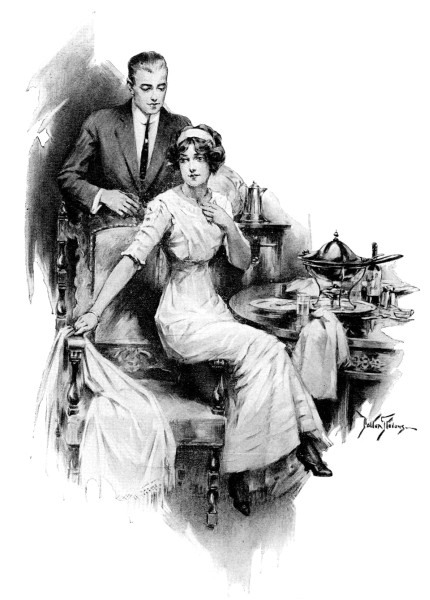
The table was cosily laid for two, linen
and china were of the daintiest, and the
tiny kettle swung and bubbled merrily
over the alcohol lamp.
"How dear and homey it all is!" Katherine
exclaimed, as she sat down.
"And how primitive," suggested Robert.
"But our respective professions are not
worth much if our imaginations can't
change our tea into a banquet. Will you
have a little of the quail?" He poised
a mutton chop on his fork and looked
inquiringly at Katherine.
"I'm afraid quail is too rich for me to-night,"
she answered, "but I will take a
little of the toast which is commonly
supposed to go with it, and some of the
nectar which I shall brew myself."
"Lucky thing you don't like cream with
your nectar," he responded, "for the cat
got into it this afternoon. I'm afraid
I neglect my housewifely duties for my art."
"That doesn't matter, as long as art
progresses. Did Mickey behave to-day?"
Mickey was the name Katherine had
given to Carroll's model, who was posing
for his "Aurora." She had the fair skin
and blue eyes with which Ireland compensates
her daughters for a somewhat
unlovely mouth, and her hair was a
flaming auburn glory which he tried in
vain to paint. It was a little startling
until you knew Mickey. People who could
pass hundreds without noting age, colour,
or condition of servitude, would stop and
gasp as she went by. But those who were
privileged to know her intimately became
so absorbed in contemplation of her manifold
character that mere externals were
passed unnoticed.
"Mickey did pretty well to-day," he
said. "She put on your best hat while
I was out, and I found her strutting
before the mirror when I came back. I
declare to you, solemnly, Katherine, that
the effect of your violets against that hair
was absolutely fortissimo. She will wear
it to church some day if we don't watch
her. But she didn't cut my brushes into
scallops, nor assist in the painting when
my back was turned. No, on the whole
Mickey has been angelic. How did things
go with you?"
"About as usual, though I believe more
than the usual number of freaky people
have been in. They ask for everything
from money and advice, up to a letter of
introduction to the managing editor. They
seem to think that a woman tied down
to a newspaper desk, has only to beckon
and the universe hastens to do her bidding.
You remember I told you about the woman
who came in last week with a yearning
to do 'lit'ery work'?"
Robert nodded.
"She was in again to-day. She is
doing 'lit'ery work' and likes it very much.
What do you suppose it is?"
"Give it up."
"Addressing envelopes! Did you ever?"
"Great idea," said Robert, "I'll tell
Mickey, and perhaps she'll clean my
brushes. Mickey shall be an artist."
Together they washed up the dishes,
then Robert hung the dish-towel out of
the window to dry, and took off his apron.
In the studio was an open fire, the single
extravagance which the Carrolls allowed
themselves. Perhaps it was not so extravagant
after all, since it saved gas,
and Robert picked up most of the wood
in his daily walks along the lake shore.
"Let's sit on the rug," said Katherine,
and they curled up like two children
before the fire. Robert rested his head
upon his elbow, and looked up contentedly
into her face. The sweetness of it was
half hidden, half revealed, by the dancing
firelight, but there were lines around the
mouth, and faint marks of worry on the
forehead. Yet, it was a patient face—one
to teach a man strength and kindliness.
The hand that wore the wedding ring
was thin, so thin that the ring slipped
when she moved her fingers. He touched
it tenderly.
"Dear, are you sorry?"
"Sorry! For what?"
"For all you left behind to marry a
poor artist."
"We leave nothing behind when we gain
happiness. Don't you think I'd rather
be here to-night with you, than to have the
money without you?"
Katherine's father had proved himself
the equal if not the superior of any stern
parent in fiction. A stormy scene followed
the announcement of her determination
to marry the man of her own choice,
rather than his, so they had slipped away
to Milwaukee—that haven of the fond and
foolish—and set up housekeeping immediately
on their return.
Robert had objected a little to the
announcement cards, since they were
not in a position to entertain, but they
were sent out. Upon the receipt of his,
Katherine's father had written a single
line: "Any time you may repent of
this foolishness, your home is open to you."
The avalanche of gifts had followed
the wedding instead of preceding it.
The usual miscellany of the very rich
had been showered upon them, and
Katherine had often thought of the
exquisite irony involved in the possession
of gold candlesticks, real laces, a Royal
Worcester chocolate set, and a genuine
Corot, while her shoes were out at the toes
and Robert's clothes were sadly frayed.
Still, eight months had passed and she
had not repented of her foolishness.
He still seemed more desirable than
money, and she looked fondly at the Corot
which hung in the place of honour.
"I cleaned all the silver to-day," he
said, "and put our cut glass punch bowl
safely out of Mickey's reach."
She patted his cheek affectionately.
"You're a dear good boy, and an admirable
housekeeper."
"Katherine, I can't stand it any longer,"
he blurted out. "I simply won't stay
here and paint while you work your dear
fingers to the bone in that confounded
old office. It's my business to take care
of you, not yours of me, and here you are,
working like a slave, while I do the elegant
leisure at home. It's simply infamous!"
"Hubby, dear," and Katherine's tone
was commanding. "I won't let you abuse
yourself like that. In the first place you
are working just as hard as I am, with
your painting and keeping things cosy here,
and accomplishing just as much. And
it's only for a little while. As soon as
your picture is done, you'll sell it, and I'll
resign and do the housekeeping myself.
You know how gladly you would do the
same for me; why won't you let me do it
for you? Don't you love me well enough
to let me help you?"
"Katherine! Katherine!" he cried,
"don't say that! Don't question my
love for you."
"I don't, dear heart, nor should you
question mine for you."
Long after Katherine had gone to bed,
he lay on the rug and watched the fire.
Outside, cold, gray Michigan beat against
the North Shore with the sound of the
sea. In these last days of despondency
the lake had grown into a companion
with seeming sympathy for every mood
of his. The vast expanse of water seemed
to broaden his horizon. Whenever he
looked at it, it suggested a letting-go of all
but the vital things. There was only
one thing that was vital, and she slept in
the little room beyond. Even his art
counted for nothing beside her, but she
believed in it, and he must make something
of it to please her. The shadows
deepened until even the gold candlesticks
ceased to shine, and he went to the window.
Slow, sombre, and restless, old Michigan
chafed against the shore. At times those
cold arms beckoned him with compelling
strength, and it was so to-night. Katherine
would go home to her father, and, in
time, forget him. He pulled down the
shade, shuddering as he did so, and at
last fell asleep with a consciousness of
utter defeat.
"It's busy I am these days. Misther
Carroll, do be afther wantin' to paint
me."
"Paint you, Carrot-Top! And thin
may the blessed saints injuce him to make
the hid of yez, some other colour."
"Ah, go on wid yez! What is the likes
of yez to know about art?"
It was Mickey in the yard below,
blarneying with the milk boy. The voices
awoke Carroll, and he discovered it was
very late, indeed, and that Katherine
had gone down-town without waking him.
There was a line pinned to the cushion:
"Good-bye, dearest. K."
Mickey appeared at the back door while
he was finishing his breakfast. With
unheard-of kindness, she offered to put
things right in the studio, and he left her
in charge with some misgivings. But the
marketing had to be done, and it would
be impossible to work rightly without a
breath of fresh air.
When he returned every chair was set
demurely and properly against the wall
and Mickey sat on the floor with his
cherished portfolio of Gibson pictures
in her lap. He repressed an angry exclamation,
and ordered her, somewhat
sternly, to put them back.
She complied readily. "It's cross yez
are this morning, Misther Carroll. Thim
pictures ain't got no paint on 'em, but I'm
thinkin' they do be better wans than thim
ye're afther makin'!"
Carroll made no reply. It was quite
true that the Gibson pictures were better
than his, even without paint, but he did
not relish her impartial announcement of
the fact.
The light was good, and he worked
steadily for an hour, at the end of which
time Mickey announced the necessity
for her immediate departure. In vain
he protested and pleaded. The picture
was nearly done, and only a few more
sittings would be needed. But Mickey
was "goin' to the theayter wid a coosin—"
and she went.
So he put the house in order and decided
he would make a cake for supper. He
had never done anything of the kind, and
Katherine found him still deep in the
problem when she returned. He couldn't
find the cook-book, he said, so he just
threw a few things in, the way she did
when she made cake. It was going to be
light too, for he had put in half a cupful
of baking powder. Katherine laughed
until the tears rolled down her cheeks.
It was a mean woman, Robert said, who
would go down-town and leave her husband
with no cook-book! She pointed it out
to him on the corner of the shelf, and
he twisted his mustache thoughtfully, forgetting
the flour with which his hand was
covered. It took them both to make him
presentable again, and then Katherine
threw the cake away, and in a very few
minutes made the lightest, most wonderful
biscuit that ever gave a man the dyspepsia.
Mickey was faithful during the following
week, and the "Aurora" was finished
almost to his satisfaction. It was placed
on sale in a Wabash Avenue gallery, and
they anxiously watched the newspapers
for notices. None came, however, and
Robert became despondent. An idea came
to Katherine, and she went with fear and
trembling to the art critic of the Express,
whose judgment was accepted as law and
gospel.
Unlike most women she came to the
point at once: "Mr. Lester," she said,
"my husband has a picture on exhibition
at Stanley & Brown's, and a favourable
notice would mean much to us both.
None of the papers have spoken of it,
and I have been wondering if you could
not help us a little."
Philosophers have not yet determined
why a woman feels free to ask anything
of a rejected lover, nor why men so willingly
grant favours to women whom they have
loved in vain.
"Mrs. Carroll," Lester replied, "I should
be only too glad to be of service to either
you or your husband, but I have seen
the picture, and I cannot conscientiously
speak favourably of it. In fact, I had
written a roast, and out of consideration
to you burned it up."
Katherine's face fell and her eyes filled.
He was afraid she was going to cry, and
he went on—"But I'll tell you what I
will do. I am called out of the city to-morrow,
and it is the day for my notes;
I'll ask Carleton to let you do my work.
You can write what you please."
She clutched the friendly straw gladly.
"You are very, very good. But please
tell me what is the matter with the
picture."
"Only one thing, Mrs. Carroll; it lacks
humanity. Pictures must be painted from
a human standpoint. No doubt you will
see what I mean if you will look at it
critically. I haven't time to stop any
longer now, but I'll tell Carleton."
An hour later, Katherine was summoned
to the office of the managing editor.
"Mrs. Carroll," he said, "Lester tells me
he is called out of the city and suggests
you as the proper person to do his work.
I believe it is a little out of your line, but
you can try. Miss Scott will do your
department to-day, and you can take
this afternoon to look around."
So the newly fledged art critic went
out to find her copy. There were several
pictures to be noted and she spoke as
kindly as she could of all, trying to mingle
helpful criticism with discerning praise.
None were condemned, for she knew what
a picture might mean to the artist, and
to the woman who loved him.
Unconsciously, she imitated Lester's
style; his full, well-rounded periods, and
sharp, incisive sentences. Very different
it was from the chatty, gossipy way in
which she filled the "Woman's Kingdom,"
on the back page of the Express.
She was afraid to say too much of
Robert's work, and toned down her
enthusiasm three successive times. The
last note satisfied her and she sent it
up-stairs with the rest.
When the paper came in the morning,
he turned feverishly to the page which contained
the "Art of the Week." His shout
of joy woke Katherine and together they
laughed and cried over the "good notice."
She felt wicked, but his pleasure was
full compensation for her pangs of conscience.
"Lester's approval is worth a
thousand dollars," he said. "I can go
to work in earnest now."
Her face changed mysteriously. An
overwhelming sense of the wrong she had
done, came upon her, and he looked at
her steadily. There was a queer note in
his voice when he spoke: "Katherine
Carroll, I believe you wrote that notice."
It was useless to dissemble longer and
she told the whole story. He was deeply
touched by this proof of her devotion, but
he shook his head sadly over Lester's
own comment.
"It won't help any, little girl; you can't
make fame for me in that way. My work
must stand or fall on its own merits—and—it
seems likely to fall."
She tried to comfort him, but he put
her away. "No, it's all wrong. I'm
going to give it up, and try something else."
After she had gone, he put his easel and
paints away, and set the house in order.
Then he went into the city, as so many
have done before, to find work, which
seems little enough to ask in so great a
world. At five he returned, utterly tired
and cast down. He had tramped the
streets for hours and had found absolutely
nothing to do.
Half unconsciously, he turned to the
window—to the vision of the lake which
had meant strength before, but it brought
only weakness now. "Come,—come—come—"
the waves seemed to say—instead
of being cold and cruel, they were
promising infinite rest. And it meant
a luxurious home for Katherine.
His decision was quickly made, and he
wrote a tender note to leave for her.
He sobbed over that—for it wasn't like
painting—he was putting his heart into
it. Then down to the inland sea he went,
those impatient arms beckoning him still.
But Katherine had felt in the office that
something was wrong with Robert. A
pang of sudden fear made it impossible
for her to work any longer, and she hurried
home. She found the note at once, and
seeing only the "good-bye" at the end
she hastened to the door.
"Robert, Robert!" she called, but he
was too far away to hear her. And
Katherine ran, crying as she went, "Dear
God, make me in time!"
He stood at the end of the pier, old and
decayed as it was, and looked at the sea
and sky for the last time. The sunset
gates behind him, royally beautiful with
purple and gold, seemed a glimpse of
the heaven he hardly hoped to reach, for
though he knew that God was infinitely
merciful, he knew that He was also infinitely
just. He took off his coat and laid
it on the pier, just as Katherine, breathless,
excited, her face tense with appeal,
appeared beside him.
His eyes lighted for a moment at the
sight of her, then returned to their dull,
hopeless look. "It's no use, Katherine,"
he said unsteadily, "go back, darling."
"Not alone, dearest."
"Yes, Katherine," he kissed her sadly.
For minutes which seemed like hours,
she stood there arguing, pleading, begging
in vain. It was best for her—that was
his one thought. He was a dull, dead
weight upon her; it was right to make her
free. And the blue arms beckoned still.
Suddenly she drew his face down to hers
and whispered to him. What she said
seemed to rouse him from himself.
"Really?"
"Yes, really. Can you leave me now?"
Something more than the glory of the
sunset shone in Katherine's face as she
stood between him and the water. She
was subtly beautiful, with the infinite
motherhood, which lives in every woman's
heart, and as he looked at her, the shackles
of his dead cowardly self fell away. A
great resolve within him slowly swelled
into a controlling power—he would be
worthy of her who stood beside him, cost
what it might. His voice was tender and
caressing when he spoke again.
"Leave you? No, Katherine, no."
They walked home together and spoke
of other things. There was a stronger
bond between them, and the water seemed
cold and bitter now—very different from
the eerie, half-human thing that had
tempted him an hour ago.
He tossed restlessly through the night,
thinking of what Lester had said about
painting from a human standpoint.
Perhaps he meant that he should paint
men and women, instead of goddesses.
The vision of Katherine came into his
mind as she stood with the blue water
behind her and the sunset upon her face
and hair; her eyes full of earthly longing,
and more than earthly appeal. He would
paint her like that, and he roused from his
cowardly lethargy into high resolve.
Her salary was raised and she worked
happily at the office, while Robert painted
at home. In the evening she sat and sewed
on tiny garments for the human secret,
which spring was to reveal. He sat and
looked at her, seldom speaking, content
to watch the holy joy in her face, and
either that or his coming fatherhood,
sometimes thrilled him with a tenderness
so great that his love was almost joy.
The "Aurora" had been sold, not for
a large sum, it is true, but for enough to
take care of them both until the new picture
should be finished. It was done at last
and placed on sale. Painted from a
human standpoint it undoubtedly was,
and it drew many admirers but no purchaser.
For four weeks it had been at
the gallery and Robert began to grow
despondent again.
A fall morning dawned, gray and dull,
and the lake seemed to tremble with
portent of coming disaster. At night the
wind rose and lashed the water into
seething foam. The sound of the storm
made Katherine afraid, but she sank into
a fitful slumber at last, while Robert kept
a light in the window, hoping none were
at sea.
But at half-past eleven there was a
terrific rap at the door. It was Mickey,
disheveled and breathless.
"There do be a wreck, Misther Carroll,"
she cried, "there's sky-rockets goin' off
and the life crew be ordered out, and I
thought ye'd be afther wantin' to see it."
The thing was evidently a circus for
Mickey; we hold life so lightly at the age
of sixteen.
Katherine, trembling and afraid, was
already at the door. She wrung her hands,
crying piteously, "Oh, Robert! Robert!
don't go."
"I must go, sweetheart, they may need
me."
"Then I am going too." And she began
to hurry into her clothes.
"Dress warmly, dear," he called.
"Yes, I will, and we must take some
blankets with us."
Once outside they had no difficulty
in locating the wreck. The northern
sky was aflame with rockets, and people
from all directions were hurrying northward.
The Northwestern University life crew
was already on the beach trying to shoot
a line to the sinking ship, half a mile from
the shore. The boat had been ordered
back, for it was certain death in such a
sea. The fourth attempt was successful
and a shout of joy went up, dimly heard
above the storm.
Mickey danced about excitedly as they
tied rope after rope of greater strength
to the slender cord, that had been shot
to the upper deck, but Katherine felt
faint, even with her husband's arm around
her, when they made preparations to pull
the ship's life-boat ashore.
It required almost superhuman strength,
but the rush of water westward aided them
materially. Katherine never forgot that
time of waiting—human lives on shore
struggling to save the human lives at sea,
and the tense cruel crash of the cold waves.
Lifted high upon an angry crest, the
boat was dashed heavily upon the beach.
The captain of the stranded vessel, eight
seamen and one passenger, were helped
out with eager hands.
The passenger was a middle-aged man,
who appeared dignified and prosperous, in
spite of his damp and disheveled condition.
His first remark was in the nature of a
recapitulation.
"Well, of all the excitin' trips!"
Robert and Katherine laughed in spite
of themselves, and hastened to extend to
the stranger the hospitality of their little
home for the remainder of the night.
It was barely one o'clock, and the Honourable
Mr. Marchand accepted gladly, if
not gratefully.
He trudged sturdily along in the blankets
they had wrapped around him, disdaining
Robert's proffered assistance, but once
stretched out upon their couch before a
blazing fire, he became much more tractable.
He called for a glass of whiskey
complaining that what he had been through
would be enough to kill him if he didn't
at once supply this long-felt want of the
inner man. A telephone message to the
nearest drug store brought the quart of
stimulant he thought he needed for the
night, and when he was comfortably filled
with his favourite beverage, life began
to assume a more pleasant aspect. He
graphically told the story of the wreck
to his interested listeners and then imbibed
a little more liquid nourishment. After
a while he remarked sagely—"It's a
lucky thing I didn't go down, some folks
would have lost millions."
"Is that so?" asked Katherine pleasantly.
"Yes, millions! Look here, young
woman, did you ever hear of a syndicate?"
Katherine thought she had heard the
word somewhere.
"Well, I'm one of 'em!"
The whiskey was evidently getting in
its work in the way of lubricating the
tongue of the shipwrecked capitalist, and
after waiting a moment, he continued:
"I'm on my way to Chicago to perfect
a combine in—" and he astounded Katherine
by unfolding the inside history of
a daring and infamous combination—a
gigantic steal, which if consummated, would
change the ownership of millions. He
named the leading conspirators, explained
the vulnerable points in the scheme, and
gleefully boasted of his own skill and
diplomacy.
He finally fell asleep, but not until
Katherine had got all the necessary points
concerning the outrageous robbery which
had been so adroitly planned.
Robert met her at the door. "Got a
scoop?"
"Well, I should say so. A big one too!"
"How do you know it is true?"
"In vino veritas," whispered Katherine.
"Besides, Carleton told one of our night
men the other day, that promotion was
in store for the fellow who 'got on to' any
of the schemes of this new syndicate."
She had heard so much newspaper slang
that her lapse from the grammatical standard
was perhaps pardonable.
Until nearly three o'clock she wrote hurriedly
a description of the wreck, and also of
the new "combine," Robert dozing in an
easy chair meanwhile. She woke him up
to give him her manuscript. "To the
telegraph office, quick! It'll be in time
for the city edition."
The Honourable Mr. Marchand slept
late the next morning, and Katharine
sent word to the office that she could not
come until the next day. About noon,
however, their guest took his departure,
apparently but little the worse for his vivid
night's experience. At a corner he bought
a copy of the morning's Express and
shortly thereafter leaned up against a wall
for support. "Gee whiz!" The Honourable
Mr. Marchand mopped his brow
and read the startling headlines again.
"Might as well go back to Cincinnati
and Cleveland and Toronto, and all them
towns I've just come from! Wonder
how in thunder the thing ever got out!"
He strolled down Wabash Avenue to
collect his scattered thoughts, and stopped
half mechanically, to look into Stanley
& Brown's window. Carroll's painting
stared him full in the face, and a great
light broke in upon him.
"That's her! That's the girl what
done it! Blamed if I don't like her for it!"
That afternoon a messenger boy rapped
at the studio door with a letter from the
Express office for Katherine.
"Dear Mrs. Carroll," it ran, "we think
you deserve a two weeks' vacation at
full salary which is now double the former
sum, and we beg you to accept the enclosed
check as a slight testimonial of
our gratitude for the biggest scoop of
the year. Please report for duty on the
eighteenth, and be ready to take the
exchange editor's desk."
She was dazed. "Two weeks' vacation,
double salary, promotion, and——"
Robert picked it up, it was a check for
two hundred dollars.
During the jubilation which followed,
a telegraph boy pounded vigorously at the
door, but he might as well have kept still,
since his efforts were unheard. Finally
he opened it, and utterly unabashed by
the spectacle of a gentleman kissing a
lady, and the lady seeming to enjoy it,
he fairly shrieked: "telegram."
Katherine vanished instantly, and
Carroll read the despatch.
"Picture sold for highest price. Purchaser
unknown.
"Stanley & Brown."
The mythical "quail on toast" became
a reality that night, and the house seemed
far too small to hold so much exuberant
joy. In the morning, they went together
to Stanley & Brown's to collect the picture
money, and start a "really truly bank
account," as Katherine said.
The firm was quite at a loss to know
who the purchaser was, as he took the
picture away with him in a carriage, and
paid cash instead of by check, but the man
who helped him put it on the back seat
of the carriage reported that he had
muttered to himself, as he was climbing in:
"That's her! That's the girl what done
it!" This may have given Mr. and Mrs.
Carroll some clue to the identity of the
unknown benefactor.
MYRTLE REED'S NOVELS
May be had wherever books are sold. Ask for Grosset & Dunlap's list
LAVENDER AND OLD LACE.
A charming story of a quaint corner of
New England where bygone romance finds a
modern parallel. The story centers round
the coming of love to the young people on
the staff of a newspaper—and it is one of the
prettiest, sweetest and quaintest of old fashioned
love stories, * * * a rare book, exquisite
in spirit and conception, full of
delicate fancy, of tenderness, of delightful
humor and spontaneity.
A SPINNER IN THE SUN.
Miss Myrtle Reed may always be depended upon to write a story
in which poetry, charm, tenderness and humor are combined into a
clever and entertaining book. Her characters are delightful and she
always displays a quaint humor of expression and a quiet feeling of
pathos which give a touch of active realism to all her writings. In
"A Spinner in the Sun" she tells an old-fashioned love story, of a
veiled lady who lives in solitude and whose features her neighbors
have never seen. There is a mystery at the heart of the book that
throws over it the glamour of romance.
THE MASTER'S VIOLIN.
A love story in a musical atmosphere. A picturesque, old German
virtuoso is the reverent possessor of a genuine "Cremona." He
consents to take for his pupil a handsome youth who proves to have
an aptitude for technique, but not the soul of an artist. The youth
has led the happy, careless life of a modern, well-to-do young American
and he cannot, with his meagre past, express the love, the passion
and the tragedies of life and all its happy phases as can the master
who has lived life in all its fulness. But a girl comes into his life—a
beautiful bit of human driftwood that his aunt had taken into her
heart and home, and through his passionate love for her, he learns
the lessons that life has to give—and his soul awakes.
Founded on a fact that all artists realize.
Ask for a complete free list of G. & D. Popular Copyrighted Fiction
Grosset & Dunlap, 526 West 26th St., New York
ETHEL M. DELL'S NOVELS
May be had wherever books are sold. Ask for Grosset & Dunlap's list.
THE LAMP IN THE DESERT
The scene of this splendid story is laid in India and
tells of the lamp of love that continues to shine through
all sorts of tribulations to final happiness.
GREATHEART
The story of a cripple whose deformed body conceals
a noble soul.
THE HUNDREDTH CHANCE
A hero who worked to win even when there was only
"a hundredth chance."
THE SWINDLER
The story of a "bad man's" soul revealed by a
woman's faith.
THE TIDAL WAVE
Tales of love and of women who learned to know the
true from the false.
THE SAFETY CURTAIN
A very vivid love story of India. The volume also
contains four other long stories of equal interest.
Grosset & Dunlap, Publishers, New York
The Master's Violin
By MYRTLE REED
A Love Story with a musical atmosphere.
A picturesque, old
German virtuoso is the reverent
possessor of a genuine Cremona.
He consents to take as
his pupil a handsome youth who
proves to have an aptitude for
technique, but not the soul of
the artist. The youth has led the
happy, careless life of a modern,
well-to-do young American, and
he cannot, with his meagre past,
express the love, the longing, the passion and the tragedies
of life and its happy phases as can the master who
has lived life in all its fulness. But a girl comes into
his existence, a beautiful bit of human driftwood that
his aunt had taken into her heart and home; and through
his passionate love for her, he learns the lessons that life
has to give—and his soul awakens.
Founded on a fact well known among artists, but not
often recognized or discussed.
If you have not read "Lavender and Old Lace" by the
same author, you have a double pleasure in store—for
these two books show Myrtle Reed in her most delightful,
fascinating vein—indeed they may be considered as masterpieces
of compelling interest.
Ask for complete free list of G. & D. Popular Copyrighted Fiction
GROSSET & DUNLAP, Publishers, NEW YORK
KATE DOUGLAS WIGGIN'S
STORIES OF PURE DELIGHT
Full of originality and humor, kindliness and cheer.
THE OLD PEABODY PEW. Large Octavo. Decorative
text pages, printed in two colors. Illustrations by Alice
Barber Stephens.
One of the prettiest romances that has ever come from this
author's pen is made to bloom on Christmas Eve in the sweet
freshness of an old New England meeting house.
PENELOPE'S PROGRESS. Attractive cover design in
colors.
Scotland is the background for the merry doings of three very
clever and original American girls. Their adventures in adjusting
themselves to the Scot and his land are full of humor.
PENELOPE'S IRISH EXPERIENCES. Uniform in style
with "Penelope's Progress."
The trio of clever girls who rambled over Scotland cross the border
to the Emerald Isle, and again they sharpen their wits against
new conditions, and revel in the land of laughter and wit.
REBECCA OF SUNNYBROOK FARM.
One of the most beautiful studies of childhood—Rebecca's artistic,
unusual and quaintly charming qualities stand out midst a circle
of austere New Englanders. The stage version is making a phenomenal
dramatic record.
NEW CHRONICLES OF REBECCA. With illustrations
by F. C. Yohn.
Some more quaintly amusing chronicles that carry Rebecca
through various stages to her eighteenth birthday.
ROSE O' THE RIVER. With illustrations by George
Wright
The simple story of Rose, a country girl and Stephen a sturdy
young farmer. The girl's fancy for a city man interrupts their love
and merges the story into an emotional strain where the reader follows
the events with rapt attention.
Grosset & Dunlap, 526 West 26th St., New York
After reading THE ROSARY you will surely
want to read the delightful companion story.
May be had wherever books are sold. Ask for Grosset & Dunlap's List
THE
MISTRESS
OF
SHENSTONE
By Florence L. Barclay
In this delightful love story, a worthy
successor of THE ROSARY, in which
Mrs. Garth Dalmain again appears, we
follow the fortunes of the young and lovely
Lady Ingleby, recently widowed by the death
of a husband who was never capable of really
understanding her. While rusticating incog.
in the country, she meets her heart's delight
under the simple and classic name of "Jim"—in
reality an Earl—and these two proceed
to fall deeply and rapturously in love with each
other. When he learns her identity, a situation
of singular power and fascination is developed,
which Mrs. Barclay handles in a masterly
manner. A most absorbing and unusual story.
Ask for complete free list of G. & D. Popular Copyrighted Fiction
GROSSET & DUNLAP, Publishers, N. Y.
FLORENCE L. BARCLAY'S
NOVELS
May be had wherever books are sold. Ask for Grosset & Dunlap's list.
THE WHITE LADIES OF WORCESTER
A novel of the 12th Century. The heroine, believing she
had lost her lover, enters a convent. He returns, and interesting
developments follow.
THE UPAS TREE
A love story of rare charm. It deals with a successful
author and his wife.
THROUGH THE POSTERN GATE
The story of a seven day courtship, in which the discrepancy
in ages vanished into insignificance before the
convincing demonstration of abiding love.
THE ROSARY
The story of a young artist who is reputed to love beauty
above all else in the world, but who, when blinded through
an accident, gains life's greatest happiness. A rare story
of the great passion of two real people superbly capable of
love, its sacrifices and its exceeding reward.
THE MISTRESS OF SHENSTONE
The lovely young Lady Ingleby, recently widowed by the
death of a husband who never understood her, meets a fine,
clean young chap who is ignorant of her title and they fall
deeply in love with each other. When he learns her real
identity a situation of singular power is developed.
THE BROKEN HALO
The story of a young man whose religious belief was
shattered in childhood and restored to him by the little
white lady, many years older than himself, to whom he is
passionately devoted.
THE FOLLOWING OF THE STAR
The story of a young missionary, who, about to start for
Africa, marries wealthy Diana Rivers, in order to help her
fulfill the conditions of her uncle's will, and how they finally
come to love each other and are reunited after experiences
that soften and purify.
Grosset & Dunlap, Publishers, New York