Roddy was for at once dashing down the stone steps and exploring the
tunnel, but McKildrick held him back.
“You couldn’t live for a moment,” he protested, “and it may be days
before we can enter.” In proof of what he said, he lit one wax match
after another, and as he passed each over the mouth of the tunnel
Roddy saw the flame sicken and die.
“That has been a tomb for half a century,” McKildrick reminded him.
“Even if a strong, young idiot like you could breathe that air, Rojas
couldn’t.”
“All the same, I am going down,” said Roddy.
“And I tell you, you are not!” returned McKildrick.
Roddy, jubilant and grandly excited, laughed mockingly.
“‘Am I the Governor of these Isles, or is it an Emilio Aguinaldo?’”
he demanded. “This is my expedition, and I speak to lead the forlorn
hope.”
Exclaiming with impatience, McKildrick brought a rope and, making a
noose, slipped it under Roddy’s arms.
“All we ask,” he said grimly, “is that when you faint you’ll fall with
your head toward us. Otherwise we will bump it into a jelly.”
Roddy switched on the light in his electric torch and, like a diver
descending a sea-ladder, moved cautiously down the stone steps.
Holding the rope taut, Peter leaned over the opening.
“When the snakes and bats and vampires get you,” he warned, “you’ll
wish you were back among the sharks!”
But Roddy did not hear him. As though warding off a blow he threw his
hands across his face and dropped heavily.
“Heave!” cried Peter.
The two men sank their heels in the broken rubbish and dragged on the
rope until they could lay violent hands on Roddy’s shoulders. With
unnecessary roughness they pulled him out of the opening and let him
fall.
When Roddy came to he rose sheepishly.
“We’ll have to postpone that expedition,” he said, “until we can count
on better ventilation. Meanwhile, if any gentleman wants to say ‘I
told you so,’ I’ll listen to him.”
They replaced the slabs over the mouth of the tunnel, but left wide
openings through which the air and sunlight could circulate, and,
after concealing these openings with vines, returned to Roddy’s house.
There they found Vicenti awaiting them. He was the bearer of important
news. The adherents of Colonel Vega, he told them, were assembling in
force near Porto Cabello, and it was well understood by the government
that at any moment Vega might join them and proclaim his revolution.
That he was not already under arrest was due to the fact that the
government wished to seize not only the leader, but all of those who
were planning to leave the city with him. The home of Vega was
surrounded, and he himself, in his walks abroad, closely guarded. That
he would be able to escape seemed all but impossible.
“At the same time,” continued Vicenti, “our own party is in readiness.
If Vega reaches his followers and starts on his march to the capital
we will start an uprising here in favor of Rojas. If we could free
Rojas and show him to the people, nothing could save Alvarez. Alvarez
knows that as well as ourselves. But without artillery it is
impossible to subdue the fortress of San Carlos. We can take this
city; we can seize the barracks, the custom-house, but not San Carlos.
There also is this danger; that Alvarez, knowing without Rojas our
party would fall to pieces, may at the first outbreak order him to be
shot.”
Roddy asked Vicenti, as the physician of Rojas, if he thought Rojas
were strong enough to lead a campaign.
“He is not,” declared Vicenti, “but we would not ask it of him. Let
him only show himself and there will be no campaign. Even the
government troops would desert to him. But,” he added with a sigh,
“why talk of the impossible! The troops that hold San Carlos are bound
to Alvarez. He has placed there only those from his own plantation; he
has paid them royally. And they have other reasons for fighting to the
death. Since they have been stationed at Porto Cabello their conduct
has been unspeakable. And the men of this town hate them as much as
the women fear them. Their cruelty to the political prisoners is well
known, and they understand that if an uprising started here where
Rojas has lived, where he is dearly loved, they need expect no mercy.
They will fight, not to protect San Carlos, but for their lives.”
Vicenti spoke with such genuine feeling that had Roddy felt free to do
so he would have told him of the plan to rescue Rojas. But both Peter
and McKildrick had warned him that until the last moment no one, save
themselves, must learn the secret of the tunnel.
So, while they thanked Vicenti for his confidences, they separated for
the night without having made him any return in kind.
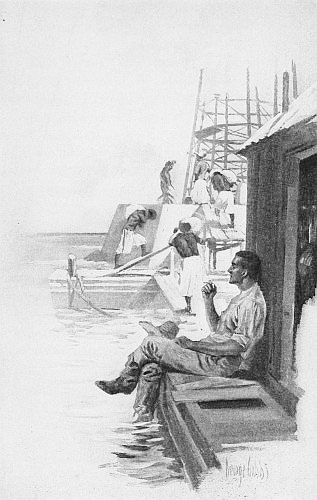
The next morning, Sam Caldwell, under the guidance of McKildrick, paid
an official visit to the light-house on which the men of the F. C. C.
were then at work. When his tour of inspection was finished he
returned to the wheel-house of the tug that had brought him across the
harbor, and sent for Roddy. Roddy appeared before him in his
working-clothes. They consisted of very few garments, and those were
entirely concealed by the harbor mud. Caldwell, in cool, clean duck
and a flamboyant Panama hat, signified with a grin that he enjoyed the
contrast. He did not like Roddy, and Roddy treated him with open
insolence. They were nearly of the same age and for years had known
each other, but they had always been at war. As son of the president
of the company, every chance had been given Roddy to advance his own
interests. And it was not so much that he had failed to be of service
to the company, as that he had failed to push himself forward, that
caused Caldwell to regard him with easy contempt.
On his side, Roddy considered Caldwell the bribe-giver and keeper of
the corruption fund for the company, and, as such, beneath his royal
notice. It therefore followed that in his present position of brief
authority over Roddy, Caldwell found a certain enjoyment. This he
concealed beneath the busy air of a man of affairs.
“I have a cable here from your father, Roddy,” he began briskly.
“Translated, the part that refers to you reads, ‘Tell Forrester take
orders from you or leave service company. If refuses, furnish return
passage, month’s wages.’”
After a pause, Roddy said: “I take it that is in answer to a cable
from you.”
“Exactly,” assented Caldwell. “I informed your father you were
insubordinate to my authority, and that I had been reliably informed
you were hostile to our interests. What you do as an individual
doesn’t count for much, but as the son of your father, apparently down
here at least, it does. Why you made that play at me last night I
don’t know, and I haven’t time to find out. I am not here to teach you
manners. But when you butt in and interfere with the business of the
company I must take notice. You’ve either got to stop working against
us, or go home. Which do you want to do? And before you answer,”
Caldwell added, “you ought to know that, as it is, you don’t stand
very high at headquarters. When your father got word you’d been
fighting Vega, our friend, in defense of Alvarez, the man that’s
robbing us, that’s giving us all this trouble, he was naturally pretty
hot. He said to me: ‘Roddy isn’t down there to mix up in politics, but
if he does, he must mix up on our side. I can’t take money from the
company to support my son, or any one else, who is against it.’ That’s
what your father said to me. Now, as I understand it, although it is
none of my business, you are dependent on him, and I advise——”
“As you say,” interrupted Roddy, “it’s none of your business. The
other proposition,” he went on, “that I can’t take money from the
company and work against it, is fair enough. What you call my work
against it was begun before I knew it was in any way opposed to the
company’s interests. Now that I do know, I quite agree that either I
must give up my outside job or quit working for you.” Roddy reached to
the shoulder of his flannel shirt, and meditatively began to unroll
his damp and mud-soaked sleeve. “I guess I’ll quit now!” he said.
The answer was not the one Caldwell expected or desired. As an
employee of the company Roddy was not important, but what he was doing
as an individual, which had so greatly excited Vega, was apparently
of much importance. And what it might be Sam Caldwell was anxious to
discover. He had enjoyed his moment of triumph and now adopted a tone
more conciliatory.
“There’s no use getting hot about it,” he urged. “Better think it
over.”
Roddy nodded, and started to leave the wheel-house.
“Have thought it over,” he said.
As Caldwell saw it, Roddy was acting from pique and in the belief that
his father would continue to supply him with funds. This Caldwell knew
was not the intention of Mr. Forrester. He had directed Caldwell to
inform Roddy that if he deliberately opposed him he must not only seek
work elsewhere, but that he did not think he should continue to ask
his father for support. Caldwell proceeded to make this quite plain to
Roddy, but, except that the color in his face deepened and that his
jaw set more firmly, Roddy made no sign.
“Very well, then,” concluded Caldwell, “you leave me no other course
than to carry out your father’s direction. I’ll give you a month’s
wages and pay your passage-money home.”
“I’m not going home,” returned Roddy, “and I don’t want any money I
haven’t worked for. The company isn’t discharging me,” he added with
a grin, “as it would a cook. I am discharging the company.”
“I warn you your father won’t stand for it,” protested Caldwell.
Roddy turned back, and in a serious tone, and emphasizing his words
with a pointed forefinger, spoke earnestly.
“Sam,” he said, “I give you my word, father is in wrong. You are in
wrong. You’re both backing the wrong stable. When this row starts your
man Vega won’t run one, two, three.”
“You mean Rojas?” said Caldwell.
“I mean Rojas,” replied Roddy. “And if you and father had trusted me I
could have told you so three months ago. It would have saved you a lot
of money. It isn’t too late even now. You’d better listen to me.”
Caldwell laughed comfortably.
“Rojas is a back number,” he said. “He’s an old man, and a dead one.
And besides—” He hesitated and glanced away.
“Well?” demanded Roddy.
“And, besides,” continued Caldwell slowly, picking his words, “Vega is
going to marry his daughter, and so we win both ways. And Vega is
amenable to reason. He will help us.” As though in a sudden burst
of confidence he added ingratiatingly, “And you could help your
father, too, if you liked. If you’ll tell me what the Rojas party mean
to do I’ll set you right with your father. What do you say?”
“What do I say, you poor, little—thing!” Roddy roared. Then he
laughed shortly and shrugged his shoulders. “I’ll say this much,” he
added. “If I were sure you couldn’t swim I’d throw you into the
harbor.”
“So you could pull me out,” laughed Caldwell. “Why don’t you? You know
you were always a grand-stand actor, Roddy. Think how heroic it would
be,” he taunted, “to rescue the hated enemy, to save my life!”
Roddy, unmoved, regarded him thoughtfully.
“It would be an awful thing to have on one’s conscience,” he said, and
left the wheel-house.
When, at five o’clock that same afternoon, Roddy found himself sitting
opposite Inez Rojas in a properly appointed drawing-room, guarded by a
properly appointed chaperon and with a cup of tea on his knee, the
situation struck him not only as delightful, but comic. With inward
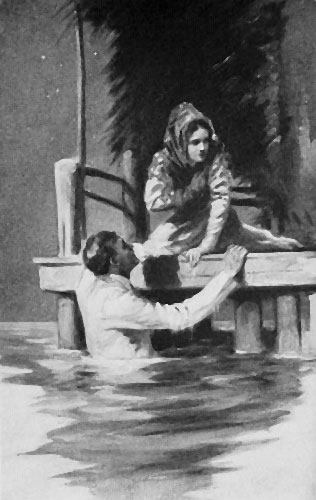
amusement he thought of their other meetings: those before sunrise,
and the one by moonlight when Inez had told him he was seeing her for
the last time, and when policemen threatened his advance and sharks
cut off his retreat. From a smile in the eyes of the girl herself
Roddy guessed that she also found the meeting not without its humorous
side. Roddy soon discovered he could not adjust his feelings to the
exigencies of an afternoon call. After doing his duty as an adopted
uncle to the Broughton children and to his hostess and her tea and to
Peter, in permitting him ten minutes’ talk with Inez, he brought that
interview to an abrupt end.
“Miss Rojas,” he exclaimed, “you haven’t seen Mrs. Broughton’s garden
in two years, have you? Such a lot of things grow up in two years. Let
me introduce them to you.”
Giving her no chance to demur, Roddy strode out of the French windows
into the garden, and, as Inez with an apologetic bow to the others
followed, Peter moved to a chair beside Mrs. Broughton and held out
his empty cup.
“There’s a certain subtlety about Roddy’s methods,” he remarked, “that
would easily deceive the deaf, dumb and blind.”
The garden was full of rare trees, plants and flowers brought from
every island of the Caribbean Sea, but Roddy did not pause to observe
them. He led the way to a bench under a cluster of young bamboo trees
and motioned to the girl to sit down. When she had done so he seated
himself sideways on the bench and gazed at her. His eyes were filled
with happiness.
“It’s quite too wonderful to be true,” he said contentedly.
Inez Rojas turned to the tropical splendor of the garden.
“Yes,” she answered. “Everything grows so fast here. The change is
quite wonderful.”
Roddy shook his head at her disappointedly.
“You mustn’t do that,” he reproved her gravely; “when you know what I
mean you mustn’t pretend to think I mean something else. It’s not
honest. And time is too short. To me—these moments are too
tremendously valuable. Every other time I have seen you I’ve had to
keep looking over my shoulder for spies. Even now,” he exclaimed in
alarm, “those infernal Broughton children may find me and want to play
ride-a-cock-horse! So you see,” he went on eagerly, “you must not
waste time misunderstanding me.”
“Will you tell me about the tunnel?” asked the girl.
“The tunnel!” repeated Roddy blankly.
But he saw that her mind was occupied only with thoughts of her
father, and at once, briskly and clearly, he explained to her all that
had been accomplished, and all the plots and counter-plots that were
in the air.
“And how soon,” asked the girl, “do you think it will be safe to enter
the tunnel?”
Roddy answered that McKildrick thought in two or three days it would
be clean of poisonous gases, but that that night they would again
attempt to explore it.
“If I could only help!” exclaimed Inez. “It is not fair that strangers
to my father should be taking a risk that should fall to one of his
children. It would mean so much, it would make me so happy, if I could
feel I had done any little thing for him. You cannot know how grateful
I am to you all, to your friends, and to you!” Her eyes opened wide in
sympathy. “And you were so ill,” she exclaimed, “and the fever is so
likely to return. I do not see how it is possible for you to work at
night at El Morro and by day on the light-house and not break down. We
have no right to permit it.”
“My health,” explained Roddy dryly, “is in no danger from overwork. I
am not employed by the company any longer. If I like I can sleep all
day. I’ve discharged myself. I’ve lost my job.”
“You have quarrelled with your father,” said the girl quickly, “on
account of my father? You must not!” she exclaimed. “Indeed, we
cannot accept such a sacrifice.”
“The misunderstanding with my father,” Roddy assured her, “is one of
long standing. I’ve never made a success of what he’s given me to do,
and this is only the last of a series of failures. You mustn’t try to
make me out an unselfish person. I am sacrificing nothing. Rather, in
a way, I have gained my independence. At least, if I get a position
now, people can’t say I obtained it through my father’s influence. Of
course, it’s awkward to be poor,” added Roddy dispassionately,
“because I had meant to ask you to marry me.”
With an exclamation the girl partly rose and then sank back,
retreating to the farthest limit of the bench.
“Mr. Forrester!” she began with spirit.
“I know what you’re going to say,” interrupted Roddy confidently. “But
I ought to tell you that that doesn’t weigh with me at all. I never
could see,” he exclaimed impatiently, “why, if you love a girl, the
fact that she is engaged should make any difference—do you? It is,
of course, an obstacle, but if you are the right man, and the other
man is not, it certainly is best for everybody that you should make
that plain to her before she marries the wrong man. In your case it
certainly has made no difference to me, and I mean to fight for you
until you turn back from the altar. Of course, when Vega told me you
were engaged to him it was a shock; but you must admit I didn’t let it
worry me much. I told you as soon as I saw you that I loved you——”
The girl was looking at him so strangely that Roddy was forced to
pause.
“I beg your pardon!” he said.
The eyes of Inez were searching his closely. When she spoke her voice
was cold and even.
“Then it was Colonel Vega,” she said, “who told you I was engaged to
him.”
“Of course,” said Roddy. “He told me the night we crossed from
Curaçao.”
Deep back in the serious, searching eyes Roddy thought that for an
instant he detected a smile, mischievous and mocking; but as he leaned
forward the eyes again grew grave and critical. With her head slightly
on one side and with her hands clasped on her knee, Inez regarded him
with curiosity.
“And that made no difference to you?” she asked.
“Why should it?” demanded Roddy. “A cat can look at a king; why may
not I look at the most wonderful and lovely——”
In the same even tones of one asking an abstract question the girl
interrupted him.
“But you must have known,” she said, “that I would not engage myself
to any man unless I loved him. Or do you think that, like the women
here, I would marry as I was told?”
Roddy, not at all certain into what difficulties her questions were
leading him, answered with caution.
“No,” he replied doubtfully, “I didn’t exactly think that, either.”
“Then,” declared the girl, “you must have thought, no matter how much
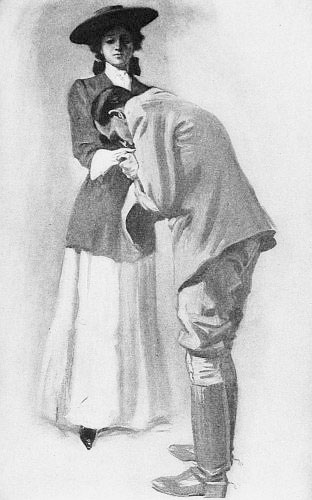
I loved the man to whom I was engaged, that you could make me turn
from him.”
Roddy held out his hands appealingly.
“Don’t put it that way!” he begged. “I’ve never thought I was better
than any other man. I certainly never thought I was good enough for
you. All I’m sure of is that no man on earth can care for you more.
It’s the best thing, the only big thing, that ever came into my life.
And now it’s the only thing left. Yesterday I thought I was rich, and
I was glad because I had so much to offer you. But now that I’ve no
money at all, now that I’m the Disinherited One, it doesn’t seem to
make any difference. At least, it would not to me. Because if I could
make you care as I care for you, it wouldn’t make any difference to
you, either. No one on earth could love you more,” pleaded Roddy. “I
know it. I feel it. There is nothing else so true! Other men may bring
other gifts, but ‘Mine is the heart at your feet! He that hath more,’”
he challenged, “‘let him give!’ All I know,” he whispered fiercely,
“is, that I love you, I love you, I love you!”
He was so moved, he felt what he said so truly, it was for him such
happiness to speak, that his voice shook and, unknown to him, the
tears stood in his eyes. In answer, he saw the eyes of the girl
soften, her lips drew into a distracting and lovely line. Swiftly,
with an ineffable and gracious gesture, she stooped, and catching up
one of his hands held it for an instant against her cheek, and then,
springing to her feet, ran from him up the garden path to the house.
Astounded, jubilant, in utter disbelief of his own senses, Roddy sat
motionless. In dumb gratitude he gazed about him at the beautiful
sunlit garden, drinking in deep draughts of happiness.
So sure was he that in his present state of mind he could not again,
before the others, face Inez, that, like one in a dream, he stumbled
through the garden to the gate that opened on the street and so
returned home.
That night McKildrick gave him permission to enter the tunnel. The
gases had evaporated, and into the entrance the salt air of the sea
and the tropical sun had fought their way. The party consisted of
McKildrick, Peter and Roddy and, as the personal representative of
Inez, Pedro, who arrived on foot from the direction of the town.
“She, herself,” he confided secretly to Roddy, “wished to come.”
“She did!” exclaimed Roddy joyfully. “Why didn’t she?”
“I told her your mind would be filled with more important matters,”
returned Pedro, seeking approval. “Was I not right?”
Roddy, whose mind was filled only with Inez and who still felt the
touch of her hand upon his, assented without enthusiasm.
McKildrick was for deciding by lot who should explore the underground
passage, but Roddy protested that that duty belonged to him alone.
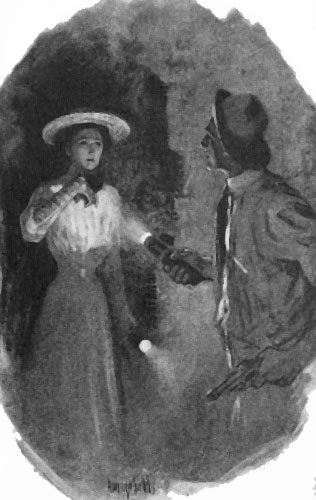
With a rope around his waist, upon which he was to pull if he needed
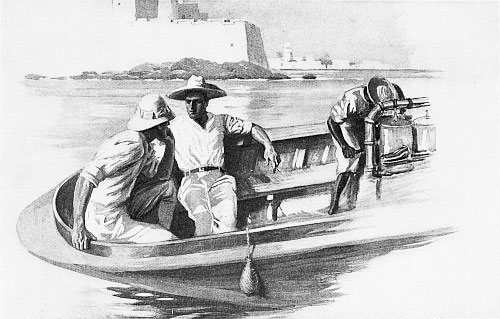
aid, an electric torch and a revolver he entered the tunnel. It led
down and straight before him. The air was damp and chilly, but in
breathing he now found no difficulty. Nor, at first, was his path in
any way impeded. His torch showed him solid walls, white and
discolored, and in places dripping with water. But of the bats, ghosts
and vampires, for which Peter had cheerfully prepared him, there was
no sign. Instead, the only sounds that greeted his ears were the
reverberating echoes of his own footsteps. He could not tell how far
he had come, but the rope he dragged behind him was each moment
growing more irksome, and from this he judged he must be far advanced.
The tunnel now began to twist and turn sharply, and at one place he
found a shaft for light and ventilation that had once opened to the
sky. This had been closed with a gridiron of bars, upon which rested
loose stones roughly held together by cement. Some of these had fallen
through the bars and blocked his progress, and to advance it was
necessary to remove them. He stuck his torch in a crevice and untied
the rope. When he had cleared his way he left the rope where he had
dropped it. Freed of this impediment he was able to proceed more
quickly, and he soon found himself in that part of the tunnel that had
been cut through the solid rock and which he knew lay under the waters
of the harbor. The air here was less pure. His eyes began to smart
and his ears to suffer from the pressure. He knew he should turn back,
but until he had found the other end of the tunnel he was loth to do
so. Against his better judgment he hastened his footsteps; stumbling,
slipping, at times splashing in pools of water, he now ran forward. He
knew that he was losing strength, and that to regain the mouth of the
tunnel he would need all that was left to him. But he still pushed
forward. The air had now turned foul; his head and chest ached, as
when he had been long under water, and his legs were like lead. He was
just upon the point of abandoning his purpose when there rose before
him a solid wall. He staggered to it, and, leaning against it,
joyfully beat upon it with his fists. He knew that at last only a few
feet separated him from the man he had set out to save. So great was
his delight and so anxious was he that Rojas should share in it, that
without considering that no slight sound could penetrate the barrier,
he struck three times upon it with the butt of his revolver, and then,
choking and gasping like a drowning man, staggered back toward the
opening. Half-way he was met by McKildrick and Peter, who, finding no
pressure on the end of the rope, had drawn it to them and, fearing for
Roddy’s safety, had come to his rescue. They gave him an arm each,
and the fresh air soon revived him. He told McKildrick what he had
seen, and from his description of the second wall the engineer
described how it should be opened.
“But without a confederate on the other side,” he said, “we can do
nothing.”
“Then,” declared Roddy, “the time has come to enroll Vicenti in the
Honorable Order of the White Mice.”
On their return to Roddy’s house they sent for Vicenti, and Roddy,
having first forced him to subscribe to terrifying oaths, told the
secret of the tunnel.
Tears of genuine happiness came to the eyes of the amazed and
delighted Venezuelan. In his excitement he embraced Roddy and
protested that with such companions and in such a cause he would
gladly give his life. McKildrick assured him that when he learned of
the part he was to play in the rescue he would see that they had
already taken the liberty of accepting that sacrifice. It was
necessary, he explained, that the wall between the tunnel and the cell
should fall at the first blow. An attempt to slowly undermine it, or
to pick it to pieces, would be overheard and lead to discovery. He
therefore intended to rend the barrier apart by a single shock of
dynamite. But in this also there was danger; not to those in the
tunnel, who, knowing at what moment the mine was timed to explode,
could retreat to a safe distance, but to the man they wished to set
free. The problem, as McKildrick pointed it out, was to make the
charges of dynamite sufficiently strong to force a breach in the wall
through which Rojas could escape into the tunnel, and yet not so
strong as to throw the wall upon Rojas and any one who might be with
him.
“And I,” cried Vicenti, “will be the one who will be with him!”
“Good!” said Roddy. “That’s what we hoped. It will be your part, then,
to prepare General Rojas, to keep him away from the wall when we blow
it open, and to pass him through the breach to us. Everything will
have to be arranged beforehand. We can’t signal through the wall or
they would hear it. We can only agree in advance as to the exact
moment it is to fall, and then trust that nothing will hang fire,
either on your side of the barrier or on ours.”
“And after we get him into the tunnel!” warned Vicenti, as excited as
though the fact were already accomplished, “we must still fight for
his life. The explosion will bring every soldier in the fortress to
the cell, and they will follow us.”
“There’s several sharp turns in the tunnel,” said McKildrick “and
behind one of them a man with a revolver could hold back the lot!”
“I speak to do that!” cried Roddy jealously. “I speak to be Horatius!”
“‘And I will stand on thy right hand,’” declared Peter; “‘and hold the
bridge with thee.’ But you know, Roddy,” he added earnestly, “you’re
an awful bad shot. If you go shooting up that subway in the dark
you’ll kill both of us. You’d better take a base-ball bat and swat
them as they come round the turn.”
“And then,” cried Roddy, springing to his feet, “we’ll rush Rojas down
to the launch! And in twelve hours we’ll land him safe in Curaçao.
Heavens!” he exclaimed, “what a reception they’ll give him!”
The cold and acid tones of McKildrick cast a sudden chill upon the
enthusiasm.
“Before we design the triumphal arches,” he said, “suppose we first
get him out of prison.”
When at last the conference came to an end and Vicenti rose to go,
Roddy declared himself too excited to sleep and volunteered to
accompany the doctor to his door. But the cause of his insomnia was
not General Rojas but the daughter of General Rojas, and what called
him forth into the moonlit Alameda was his need to think undisturbed
of Inez, and, before he slept, to wish “good-night” to the house that
sheltered her. In this vigil Roddy found a deep and melancholy
satisfaction. From where he sat on a stone bench in the black shadows
of the trees that arched the Alameda, Miramar, on the opposite side of
the street, rose before him. Its yellow walls now were white and
ghostlike. In the moonlight it glistened like a palace of frosted
silver. The palace was asleep, and in the garden not a leaf stirred.
The harbor breeze had died, and the great fronds of the palms, like
rigid and glittering sword-blades, were clear-cut against the stars.
The boulevard in which he sat stretched its great length, empty and
silent. And Miramar seemed a dream palace set in a dream world, a
world filled with strange, intangible people, intent on strange,
fantastic plots. To Roddy the father, who the day before had cast him
off, seemed unreal; the old man buried in a living sepulchre, and for
whom in a few hours he might lose his life, was unreal; as unreal as
the idea that he might lose his life. In all the little world about
him there was nothing real, nothing that counted, nothing living and
actual, save the girl asleep in the palace of frosted silver and his
love for her.
His love for her made the fact that he was without money, and with no
profession, talent or bread-and-butter knowledge that would serve to
keep even himself alive, a matter of no consequence. It made the
thought that Inez was promised to another man equally unimportant. The
only fact was his love for her, and of that he could not doubt the
outcome. He could not believe God had brought into his life such
happiness only to take it from him.
When he woke the next morning the necessity of seeing Inez again and
at once was imperative. Since she had left him the afternoon before,
in the garden of Mrs. Broughton, she had entirely occupied his
thoughts. Until he saw her he could enjoy no peace. Against the
circumstances that kept them apart he chafed and rebelled. He
considered it would be some comfort, at least, to revisit the spot
where he last had spoken with her, and where from pity or a desire to
spare him she had let him tell her he loved her.
The unusual moment at which he made his call did not seem to surprise
Mrs. Broughton. It was almost as though she were expecting him.
“My reason for coming at this absurd hour,” began Roddy in some
embarrassment, “is to apologize for running away yesterday without
wishing you ‘good-by.’ I suddenly remembered——”
The young matron stopped him with a frown.
“I am disappointed, Roddy,” she interrupted, “and hurt. If you
distrust me, if you won’t confide in an old friend no matter how much
she may wish to help you, she can only——”
“Oh!” cried Roddy abjectly, casting aside all subterfuge, “will you
help me? Please, Mrs. Broughton!” he begged. “Dear Mrs. Broughton!
Fix it so I can see her. I am so miserable,” he pleaded, “and I am
so happy.”
With the joyful light of the match-maker who sees her plans proceeding
to success Mrs. Broughton beamed upon him.
“By a strange coincidence,” she began, in tones tantalizingly slow, “a
usually proud and haughty young person condescended to come to me this
morning for advice. She doesn’t distrust me. She believes——”
“And what did you advise?” begged Roddy.
“I advised her to wait in the garden until I sent a note telling
you——”
Already Roddy was at the door.
“What part of the garden?” he shouted. “Never mind!” he cried in
alarm, lest Mrs. Broughton should volunteer to guide him. “Don’t
bother to show me; I can find her.”
Mrs. Broughton went into the Consulate and complained to her husband.
“It makes Roddy so selfish,” she protested.
“What did you think he’d do?” demanded Broughton—“ask you to go with
him? You forget Roddy comes from your own happy country where no
chaperon is expected to do her duty.”
Inez was standing by the bench at which they had parted. Above her and
around her the feathery leaves of the bamboo trees whispered and
shivered, shading her in a canopy of delicate sun-streaked green.
Like a man who gains the solid earth after a strenuous struggle in the
waves, Roddy gave a deep sigh of content.
“It has been so hard,” he said simply. “It’s been so long! I have been
parched, starved for a sight of you!”
At other times when they had been together the eyes of the girl always
looked into his steadily or curiously. Now they were elusive, shy,
glowing with a new radiance. They avoided him and smiled upon the
beautiful sun-steeped garden as though sharing some hidden and happy
secret.
“I sent for you,” she began, “to tell you——”
Roddy shook his head emphatically.
“You didn’t send for me,” he said. “I came of my own accord. Last
night you didn’t send for me either, but all through the night I sat
outside your house. This morning I am here because this is where I
last saw you. And I find you. It’s a sign! I thought my heart led me
here, but I think now it was the gods! They are on my side. They fight
for me. Why do you try to fight against the gods?”
His voice was very low, very tender. He bent forward, and the girl,
still avoiding his eyes, sank back upon the bench, and Roddy, seating
himself, leaned over her.
“Remember!” he whispered, “though the mills of the gods grind slow,
they grind exceeding fine. The day is coming when you will never have
to send for me again. You cannot escape it, or me. I am sorry—but I
have come into your life—to stay!”
The girl breathed quickly, and, as though casting off the spell of his
voice and the feeling it carried with it, suddenly threw out her hands
and, turning quickly, faced him.
“I must tell you what makes it so hard,” she said, “why I must not
listen to you. It is this. I must not think of myself. I must not
think of you, except—” She paused, and then added, slowly and
defiantly—“as the one person who can save my father! Do you
understand? Do I make it plain? I am making use of you. I have led
you on. I have kept you near me, for his sake. I am sacrificing
you—for him!” Her voice was trembling, miserable. With her clenched
fist she beat upon her knee. “I had to tell you,” she murmured, “I had
to tell you! I had to remember,” she protested fiercely, “that I am
nothing, that I have no life of my own. Until he is free I do not
exist. I am not a girl to love, or to listen to love. I can be only
the daughter of the dear, great soul who, without you, may die. And
all you can be to me is the man who can save him!” She raised her
eyes, unhappily, appealingly. “Even if you despised me,” she
whispered, “I had to tell you.”
Roddy’s eyes were as miserable as her own. He reached out his arms to
her, as though he would shelter her from herself and from the whole
world.
“But, my dear one, my wonderful one,” he cried, “can’t you see that’s
only morbid, only wicked? You led me on?” he cried. He laughed
jubilantly, happily. “Did I need leading? Didn’t I love you from the
first moment you rode toward me out of the sunrise, bringing the day
with you? How could I help but love you? You’ve done nothing to make
me love you; you’ve only been the most glorious, the most beautiful
woman——”
At a sign from the girl he stopped obediently.
“Can’t I love you,” he demanded, “and work for your father the more,
because I love you?”
The girl sat suddenly erect and clasped her hands. Her shoulders moved
slightly, as though with sudden cold.
“It frightens me!” she whispered. “Before you came I thought of him
always, and nothing else, only of him. I dreamed of him; terrible,
haunting dreams. Each day I prayed and worked for him. And then—” she
paused, and, as though seeking help to continue, looked appealingly
into Roddy’s eyes. Her own were uncertain, troubled, filled with
distress. “And then you came,” she said. “And now I find I think of
you. It is disloyal, wicked! I forget how much he suffers. I forget
even how much I love him. I want only to listen to you. All the
sorrow, all the misery of these last two years seems to slip from me.
I find it doesn’t matter, that nothing matters. I am only happy,
foolishly, without reason, happy!”
In his gratitude, in his own happiness, Roddy reached out his hand.
But Inez drew her own away, and with her chin resting upon it, and
with her elbow on her knee, sat staring ahead of her.
“And I find this!” she whispered guiltily, like one at confession. “I
find I hate to spare you for this work. Three weeks ago, when you left
Curaçao, I thought a man could not risk his life in a nobler cause
than the one for which you were risking yours. It seemed to me a
duty—a splendid duty. But now, I am afraid—for you. I knew it first
the night you swam from me across the harbor, and I followed you with
my eyes, watching and waiting for you to sink and die. And I prayed
for you then; and suddenly, as I prayed, I found it was not you for
whom I was praying, but for myself, for my own happiness. That I
wanted you to live—for me!”
The girl sprang to her feet, and Roddy rose with her, and they stood
facing each other.
“Now you know,” she whispered. “I had to tell you. I had to confess to
you that I tried to make you care for me, hoping you would do what I
wished. I did not mean to tell you that, instead, I learned to care
for you. If you despise me I will understand; if you can still love
me——”
“If I love you?” cried Roddy. “I love you so——”
For an instant, as though to shut out the look in his face, the eyes
of the girl closed. She threw out her hands quickly to stop him.
“Then,” she begged, “help me not to think of you. Not to think of
myself. We are young. We are children. He is old: every moment counts
for him. If this is the big thing in our lives we hope it is, it will
last always! But with him each moment may mean the end; a horrible
end, alone, among enemies, in a prison. You must give me your
word—you must promise me not to tempt me to think of you. You are
very generous, very strong. Help me to do this. Promise me until he is
free you will not tell me you care for me, never again, until he is
free. Or else”—her tone was firm, though her voice had sunk to a
whisper. She drew back, and regarded him unhappily, shaking her
head—“or else, I must not see you again.”
There was a moment’s silence, and then Roddy gave an exclamation of
impatience, of protest.
“If you ask it!” he said, “I promise. How soon am I to see you
again?”
Inez moved from him toward the house. At a little distance she stopped
and regarded him in silence. Her eyes were wistful, reproachful.
“It was so hard to ask,” she murmured, “and you’ve promised so
easily!”
“How dare you!” cried Roddy. “How dare you! Easy!” He rushed on
wildly, “When I want to cry out to the whole world that I love you,
when I feel that every stranger sees it, when my heart beats, ‘Inez,
Inez, Inez,’ so that I know the people in the street can hear it too.
If I hadn’t promised you to keep silent,” he cried indignantly,
“because you asked it, I’d tell you now that no other woman in all the
world is loved as I love you! Easy to be silent!” he demanded, “when
every drop of blood calls to you, when I breathe only when you
breathe——”
“Stop!” cried the girl. For an instant she covered her face with her
hands. When she lowered them her eyes were shining, radiant, laughing
with happiness.
“I am so sorry!” she whispered penitently. “It was wicked. But,” she
pleaded, “I did so want to hear you say it just once more!”
She was very near to him. Her eyes were looking into his. What she saw
in them caused her to close her own quickly. Feeling blindly with
outstretched hands, she let herself sway toward him, and in an instant
she was wrapped in his arms with his breathless kisses covering her
lips and cheeks.
For Roddy the earth ceased revolving, he was lifted above it and heard
the music of the stars. He was crowned, exalted, deified. Then the
girl who had done this tore herself away and ran from him through the
garden.
Neither Inez nor Roddy was in a mood to exchange polite phrases in the
presence of Mrs. Broughton, and they at once separated, each in a
different direction, Roddy returning to his home. There he found Sam
Caldwell. He was in no better frame of mind to receive him, but
Caldwell had been two hours waiting and was angry and insistent.
“At last!” he exclaimed. “I have been here since eleven. Don’t tell
me,” he snapped, “that you’ve been spearing eels, because I won’t
believe it.”
“What can I tell you,” asked Roddy pleasantly, “that you will
believe?”
That Caldwell had sought him out and had thought it worth his while to
wait two hours for an interview seemed to Roddy to show that in the
camp of his enemies matters were not moving smoothly, and that, in
their opinion, he was of more interest than they cared to admit.
Caldwell began with an uneasy assumption of good-fellowship.
“I have come under a flag of truce,” he said grinning. “We want to
have a talk and see if we can’t get together.”
“Who are ‘we’?” asked Roddy.
“Vega, myself, and Señora Rojas.”
“Señora Rojas!” exclaimed Roddy gravely. “Are you not mistaken?”
“She sent me here,” replied Caldwell. “These are my credentials.” With
a flourish and a bow of marked ceremony, he handed Roddy a letter.
It came from Miramar, and briefly requested that Mr. Forrester would
do the Señora Rojas the honor to immediately call upon her.
Roddy caught up his hat. The prospect of a visit to the home of Inez
enchanted him, and he was as greatly puzzled as to what such a visit
might bring forth.
“We will go at once!” he said.
But Caldwell hung back.
“I’d rather explain it first,” he said.
Already Roddy resented the fact that Caldwell was serving as the
ambassador of Madame Rojas, and there was, besides, in his manner
something which showed that in that service he was neither zealous nor
loyal.
“Possibly Señora Rojas can do that herself,” said Roddy.
“No, she can’t!” returned Caldwell sharply, “because she doesn’t know,
and we don’t mean to tell her. But I am going to tell you.”
“Better not!” warned Roddy.
“I’ll take the chance,” said Caldwell. His manner was conciliating,
propitiatory. “I’ll take the chance,” he protested, “that when you
learn the truth you won’t round on your own father. It isn’t natural,
it isn’t human!”
“Caldwell on the Human Emotions!” exclaimed Roddy, grinning.
But Caldwell was too truly in earnest to be interrupted.
“Your father’s spending two millions to make Vega President,” he went
on rapidly. “We’ve got to have him. We need him in our business. You
think Rojas would make a better President. Maybe he would. But not for
us. He’s too old-fashioned. He’s——”
“Too honest?” suggested Roddy.
“Too honest,” assented Caldwell promptly. “And there’s another slight
objection to him. He’s in jail. And you,” Caldwell cried, raising his
finger and shaking it in Roddy’s face, “can’t get him out. We can’t
take San Carlos, and neither can you. They have guns there that in
twenty minutes could smash this town into a dust-heap. So you see,
what you hope to do is impossible, absurd! Now,” he urged eagerly,
“why don’t you give up butting your head into a stone wall, and help
your father and me?”
He stopped, and in evident anxiety waited for the other to speak, but
Roddy only regarded him steadily. After a pause Roddy said: “I’m not
talking. You’re the one that’s talking. And,” he added, “you’re
talking too much, too!”
“I’ll risk it!” cried Caldwell stoutly. “I’ve never gone after a man
of sense yet that I couldn’t make him see things my way. Now, Señora
Rojas,” he went on, “only wants one thing. She wants to get her
husband out of prison. She thinks Vega can do that, that he means to
do it, that I mean to do it. Well—we don’t.”
Roddy’s eyes half closed, the lines around his mouth grew taut, and
when he spoke his voice was harsh and had sunk to a whisper.
“I tell you,” he said, “you’re talking too much!”
But neither in Roddy’s face nor voice did Caldwell read the danger
signals.
“It doesn’t suit our book,” he swept on, “to get him out. Until Vega
is President he must stay where he is. But his wife must not know
that. She believes in us. She thinks the Rojas crowd only interferes
with us, and she is sending for you to ask you to urge the Rojas
faction to give us a free hand.”
“I see,” said Roddy; “and while Vega is trying to be President, Rojas
may die. Have you thought of that?”
“Can we help it?” protested Caldwell. “Did we put him in prison?
We’ll have trouble enough keeping ourselves out of San Carlos. Well,”
he demanded, “what are you going to do?”
“At present,” said Roddy, “I’m going to call on Madame Rojas.”
On their walk to Miramar, Caldwell found it impossible to break down
Roddy’s barrier of good nature. He threatened, he bullied, he held
forth open bribes; but Roddy either remained silent or laughed.
Caldwell began to fear that in trying to come to terms with the enemy
he had made a mistake. But still he hoped that in his obstinacy Roddy
was merely stupid; he believed that in treating him as a factor in
affairs they had made him vainglorious, arrogant. He was sure that if
he could convince him of the utter impossibility of taking San Carlos
by assault he would abandon the Rojas crowd and come over to Vega. So
he enlarged upon the difficulty of that enterprise, using it as his
argument in chief. Roddy, in his turn, pretended he believed San
Carlos would fall at the first shot, and, as he intended, persuaded
Caldwell that an attack upon the prison was the fixed purpose of the
Rojas faction.
Roddy, who as a sentimental burglar had so often forced his way into
the grounds of Miramar, found a certain satisfaction in at last
entering it by the front door, and by invitation. His coming was
obviously expected, and his arrival threw the many servants into a
state of considerable excitement. Escorted by the major-domo, he was
led to the drawing-room where Madame Rojas was waiting to receive him.
As he entered, Inez and her sister, with Vega and General Pulido and
Colonel Ramon, came in from the terrace, and Caldwell followed from
the hall.
With the manner of one who considered himself already a member of the
household, Vega welcomed Roddy, but without cordiality, and with
condescension. To Inez, although the sight of her caused him great
embarrassment, Roddy made a formal bow, to which she replied with one
as formal. Señora Rojas, having ordered the servants to close the
doors and the windows to the terrace, asked Roddy to be seated, and
then placed herself in a chair that faced his. The others grouped
themselves behind her. Roddy felt as though the odds were hardly fair.
With the exception of Inez, who understood that any sign she might
make in his favor would do him harm, all those present were opposed to
him. This fact caused Roddy to gaze about him in pleasurable
excitement and smile expectantly. He failed to see how the interview
could lead to any definite result. Already he had learned from
Caldwell more than he had suspected, and all that he needed to know,
and, as he was determined on account of her blind faith in Vega to
confide nothing to Señora Rojas, he saw no outcome to the visit as
important as that it had so soon brought him again into the presence
of Inez.
“Mr. Forrester,” began Señora Rojas, “I have asked you to call on me
to-day at the suggestion of these gentlemen. They believe that where
they might fail, an appeal from me would be effective. I am going to
speak to you quite frankly and openly; but when you remember I am
pleading for the life of my husband you will not take offense. With no
doubt the best of motives, you have allied yourself with what is known
as the Rojas faction. Its object is to overthrow the President and to
place my husband at Miraflores. To me, the wife of General Rojas, such
an undertaking is intolerable. All I desire, all I am sure he desires,
is his freedom. There are those, powerful and well equipped, who can
secure it. They do not belong to the so-called Rojas faction. You, we
understand, have much influence in its counsels. We know that to carry
out its plans you have quarrelled with your father, resigned from his
company. If I venture to refer to your private affairs, it is only
because I understand you yourself have spoken of them publicly, and
because they show me that in your allegiance, in your mistaken
allegiance to my husband, you are in earnest. But, in spite of your
wish to serve him, I have asked you here to-day to beg you and your
friends to relinquish your purpose. His wife and his children feel
that the safety of General Rojas is in other hands, in the hands of
those who have his fullest confidence and mine.” In her distress,
Señora Rojas leaned forward. “I beg of you,” she exclaimed, “do as I
ask. Leave my husband to me and to his friends. What you would do can
only interfere with them. And it may lead directly to his death.”
She paused, and, with her eyes fixed eagerly on Roddy’s face, waited
for his answer. The men standing in a group behind her nodded
approvingly. Then they also turned to Roddy and regarded him sternly,
as though challenging him to resist such an appeal. Roddy found his
position one of extreme embarrassment. He now saw why Señora Rojas had
received him in the presence of so large an audience. It was to render
a refusal to grant her request the more difficult. In the group drawn
up before him he saw that each represented a certain interest, each
held a distinctive value. The two daughters were intended to remind
him that it was against a united family he was acting; Caldwell was to
recall to him that he was opposing the wishes of his father, and Vega
and the two officers naturally suggested to whom Señora Rojas referred
when she said her interests were in the hands of powerful and
well-equipped friends. Should he tell the truth and say that of the
plans of the Rojas faction he knew little or nothing, Roddy was sure
he would not be believed. He was equally certain that if, in private,
he confided his own plan to Señora Rojas and told her that within the
next forty-eight hours she might hope to see her husband, she would at
once acquaint Vega and Caldwell with that fact. And, after the
confidence made him by Caldwell, what he and Vega might not do to keep
Rojas off the boards, he did not care to think. He certainly did not
deem it safe to test their loyalty. He, therefore, determined that as
it was impossible to tell his opponents the truth, he had better let
them continue to believe he was a leader in the Rojas party, and that,
with it, his only purpose was an open attack upon the fortress.
“I need not say,” protested Roddy gravely, “that I am greatly
flattered by your confidence. It makes me very sorry that I cannot be
equally frank. But I am only a very unimportant member of the great
organization that has for its leader General Rojas——”
“And I,” interrupted Señora Rojas, “am the wife of that leader. Are my
wishes of no weight?”
“I fear, madame,” begged Roddy, in deprecatory tones, “that to
millions of Venezuelans General Rojas is considered less as the
husband than as the only man who can free this country from the hands
of a tyrant.”
At this further sign of what seemed fatuous obstinacy, Señora Rojas
lost patience.
“A tyrant!” she exclaimed quickly. “I must protest, Mr. Forrester,
that the word comes strangely from one who has denounced my husband as
a traitor.”
The attack confused Roddy, and to add to his discomfort it was greeted
by the men in the rear of Señora Rojas with a chorus of approving
exclamations. Roddy raised his eyes and regarded them gravely. In a
tone of stern rebuke Señora Rojas continued:
“We have been frank and honest,” she said, “but when we cannot tell
whether the one with whom we treat runs with the hare or the hounds,
it is difficult.”
Again from the men came the murmur of approval, and Roddy, still
regarding them, to prevent himself from speaking pressed his lips
tightly together.
Knowing how near Señora Rojas might be to attaining the one thing she
most desired, his regret at her distress was genuine, and that, in her
ignorance, she should find him a most objectionable young man he could
well understand. The fact aroused in him no resentment. But to his
secret amusement he found that the thought uppermost in his mind was
one of congratulation that Inez Rojas was more the child of her
Venezuelan father than of her American mother. Even while he deeply
sympathized with Señora Rojas, viewed as a future mother-in-law, she
filled him with trepidation. But from any point he could see no health
in continuing the scene, and he rose and bowed.
“I am sorry,” he said, “but I cannot find that any good can come of
this. I assure you, you are mistaken in thinking I am of any
importance, or that I carry any weight with the Rojas party. Believe
me, I do not. I am doing nothing,” he protested gently, “that can
bring harm to your husband. No one outside of your own family can wish
more sincerely for his safety.”
The chorus of men interrupted him with an incredulous laugh and
murmurs of disbelief.
Roddy turned upon them sharply.
“We can dispense with the claque,” he said. “My interview is with
Madame Rojas. If you gentlemen have anything to discuss with me later
you will come out of it much better if that lady is not present. If
you don’t know what I mean,” he added significantly, “Caldwell can
tell you.”
Señora Rojas had no interest in any annoyance Roddy might feel toward
her guests. She recognized only that he was leaving her. She made a
final appeal. Rising to her feet, she exclaimed indignantly:
“I refuse to believe that against the wishes of myself and my family
you will persist in this. It is incredible! I can no longer be content
only to ask you not to interfere—I forbid it.”
She advanced toward him, her eyes flashing with angry tears. Roddy, in
his sympathy with her distress, would have been glad, with a word, to
end it, but he felt he could not trust to her discretion. Her next
speech showed him that his instinct was correct. Accepting his silence
as a refusal, she turned with an exclamation to Pino Vega.
“If you will not listen to a woman,” she protested, “you may listen
to a man.” With a gesture she signified Vega. He stepped eagerly
forward.
“I am at your service,” he said.
“Speak to him,” Señora Rojas commanded. “Tell him! Forbid him to
continue.”
Roddy received the introduction of Vega into the scene with mixed
feelings. To the best of his ability he was trying to avoid a quarrel,
and in his fuller knowledge of the situation he knew that for Señora
Rojas it would be best if she had followed his wishes, and had brought
the interview to an end. That Vega, who was planning treachery to
Rojas, should confront him as the champion of Rojas, stirred all the
combativeness in Roddy that he was endeavoring to subdue. When Vega
turned to him he welcomed that gentleman with a frown.
“As the son of this house,” Vega began dramatically, “as the
representative, in his absence, of General Rojas, I forbid you to
meddle further in this affair.”
The demand was unfortunately worded. A smile came to Roddy’s eyes, and
the color in his cheeks deepened. He turned inquiringly to Señora
Rojas.
“The son of this house,” he repeated. “The gentleman expresses himself
awkwardly. What does he mean?”
Since Inez had entered the room Roddy had not once permitted himself
to look toward her. Now he heard from where she stood a quick movement
and an exclamation.
For an instant, a chill of doubt held him silent. Within the very
hour, she had told him that to keep him loyal to her father she had
traded on his interest in her. Had she, for the same purpose and in
the same way, encouraged Vega? To Roddy, she had confessed what she
had done, and that she loved him. With that he was grandly content.
But was she still hoping by her promise of marriage to Vega to hold
him in allegiance, not to herself, but to her father? Was her
exclamation one of warning? Had he, by his question, precipitated some
explanation that Inez wished to avoid? He cast toward her a glance of
anxious inquiry. To his relief, Inez reassured him with a nod, and a
smile of trust and understanding.
The exchange of glances was lost neither upon Vega nor upon Señora
Rojas. In turn, they looked at each other, their eyes filled with
angry suspicion.
What she had witnessed caused Señora Rojas to speak with added
asperity.
“Colonel Vega has my authority for what he says,” she exclaimed. “He
is the son of this house. He is the future husband of my daughter
Inez.”
The exclamation that now came from Inez was one of such surprise and
protest that every one turned toward her.
The girl pushed from her the chair on which she had been leaning and
walked toward her mother. Her eyes were flashing, but her manner was
courteous and contained.
“Why do you say that?” she asked quietly. “Has Colonel Vega told you
that, as he has told others? Because it is not true!”
Señora Rojas, amazed and indignant, stared at her daughter as though
she doubted she had heard her.
“Inez!” she exclaimed.
“It must be set right,” said the girl. “Colonel Vega presumes too far
on the services he has shown my father. I am not going to marry him. I
have told him so repeatedly. He is deceiving you in this, as he is
deceiving you in matters more important. He is neither the son of this
house nor the friend of this house. And it is time that he understood
that we know it!”
In her distress, Señora Rojas turned instinctively to Vega.
“Pino!” she exclaimed. “You told me! You told me it was her secret,
that she wished to keep it even from her mother, but that you thought
it your duty to tell me. Why?” she demanded. “Why?”
Vega, his eyes flaming, in a rage of mortification and wounded vanity
threw out his arms.
“My dear lady!” he cried, “it was because I hoped! I still hope,” he
protested. “Inez has been poisoned by this man!” He pointed with a
shaking finger at Roddy. “He has filled her mind with tales against
me.” He turned to Inez. “Is it not true?” he challenged.
Inez regarded him coldly, disdainfully.
“No, it is not true,” she said. “It is the last thing he would do.
Because, until this moment, Mr. Forrester thought that what you told
him was a fact.” She raised her voice. “And he is incapable of
speaking ill of a man—” she hesitated, and then, smiling slightly as
though in enjoyment of the mischief she were making, added, “he knew
was his unsuccessful rival.”
Furious, with a triumphant exclamation, Vega turned to Señora Rojas.
“You hear!” he cried. “My rival!”
Inez moved quickly toward Roddy. Placing herself at his side, she
faced the others.
Her eyes were wide with excitement, with fear at what she was about
to do. As though begging permission, she raised them to Roddy and,
timidly stretching out her hand, touched his arm. “Mother,” she said,
“I am going to marry Mr. Forrester!”

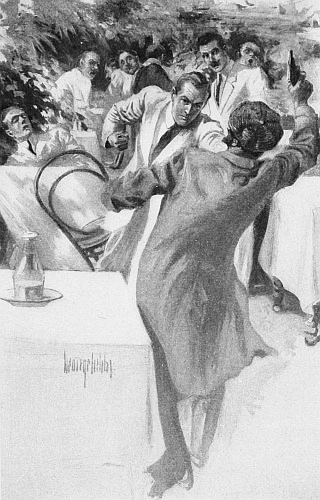
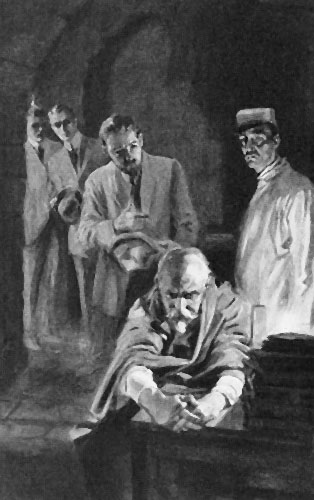 “What does anything matter, when I know—that the end
is near!”
“What does anything matter, when I know—that the end
is near!”