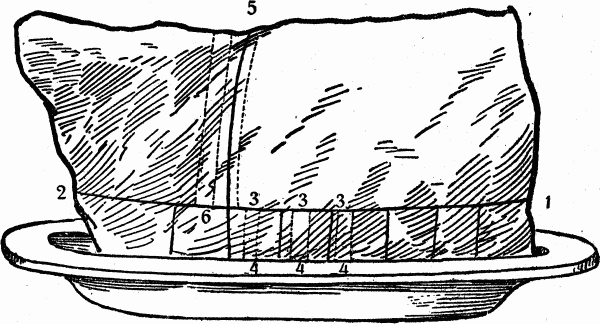
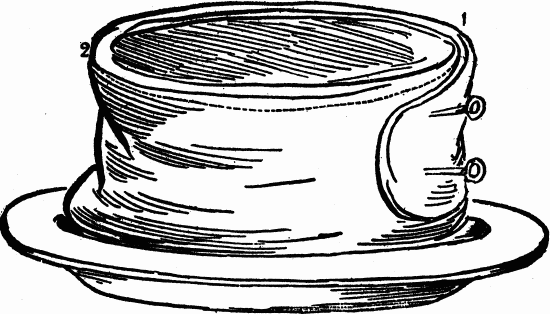
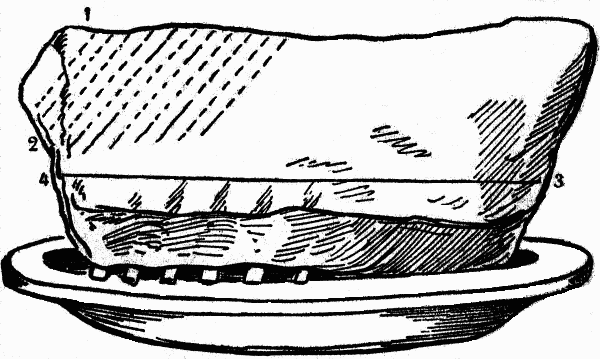
It depends as much upon the judgment of the cook as on the
materials used to make a good pudding. Everything should be the
best in the way of materials, and a proper attention to the rules,
with some practice, will ensure success.
Puddings are either boiled, baked or steamed; if boiled, the
materials should be well worked together, put into a thick cloth
bag, previously dipped in hot water, wringing it slightly and
dredging the inside thickly with flour; tie it firmly,
allowing room for it to swell; drop it into a kettle of
boiling water, with a small plate or saucer in the bottom to
keep it from sticking to the kettle. It should not cease boiling
one moment from the time it is put in until taken out, and the pot
must be tightly covered, and the cover not removed except when
necessary to add water from the boiling tea-kettle when the
water is getting low. When done, dip immediately in cold water and
turn out. This should be done just before placing on the table.
Or butter a tin pudding-mold or an earthen bowl; close it tight
so that water cannot penetrate; drop it into boiling water and boil
steadily the required time. If a bowl is used it should be well
buttered and not quite filled with the pudding, allowing room for
it to swell; then a cloth wet in hot water, slightly wringing it,
then floured on the inner side, and tied over the bowl, meeting
under the bottom.
To steam a pudding, put it into a tin pan or earthen dish; tie a
cloth over the top, first dredging it in flour, and set it in a
steamer. Cover the steamer closely; allow a little longer time than
you do for boiling.
Molds or basins for baking, steaming or boiling should be well
buttered before the mixture is put into them. Allow a little longer
time for steaming than for boiling.
Dumplings boiled the same way, put into little separate
cloths.
Batter puddings should be smoothly mixed and free from lumps. To
ensure this, first mix the flour with a very small portion of milk,
the yolks of the eggs and the sugar thoroughly beaten together, and
added to this; then add the remainder of the milk by degrees, then
the seasoning, then the beaten whites of eggs last. Much success in
making this kind of pudding depends upon a strict observance of
this rule; for, although the materials may be good, if the eggs are
put into the milk before they are mixed with the flour, there will
be a custard at the top and a soft dough at the bottom of your
dish.
All sweet puddings require a little salt to prevent
insipidity and to draw out the flavor of the several ingredients,
but a grain too much will spoil any pudding.
In puddings where wine, brandy, cider, lemon juice or any acid
is used, it should be stirred in last and gradually, or it is apt
to curdle the milk or eggs.
In making custard puddings (puddings made with eggs and
milk), the yolks of the eggs and sugar should be thoroughly beaten
together before any of the milk or seasoning is added, and the
beaten whites of eggs last.
In making puddings of bread, rice, sago, tapioca, etc., the eggs
should be beaten very light, and mixed with a portion of the milk,
before adding them to the other ingredients. If the eggs are mixed
with the milk, without having been thus beaten, the milk will be
absorbed by the bread, rice, sago, tapioca, etc., without rendering
them light.
The freshness of all pudding ingredients is of much importance,
as one bad article will taint the whole mixture.
When the freshness of eggs is doubtful, break each
one separately in a cup before mixing them all together. Should
there be a bad one amongst them, it can be thrown away; whereas, if
mixed with the good ones, the entire quantity would be spoiled. The
yolks and whites beaten separately make the articles they are put
into much lighter.
Raisins and dried fruit for puddings should be carefully picked
and, in many cases, stoned. Currants should be well washed, pressed
in a cloth and placed on a dish before the fire to get thoroughly
dry; they should be then picked carefully over, and every piece
of grit or stone removed from amongst them. To plump them, some
cooks pour boiling water over them and then dry them before the
fire.
Many baked pudding recipes are quite as good boiled. As a safe
rule boil the pudding twice as long as you would bake it;
and remember that a boiling pudding should never be touched after
it is once put on the stove; a jar of the kettle destroys the
lightness of the pudding. If the water boils down and more must be
added, it must be done so carefully that the mold will not hit the
side of the kettle, and it must not be allowed to stop boiling for
an instant.
Batter should never-stick to the knife when it is sent to the
table; it will do this both when less than sufficient number of
eggs is mixed with it and when it is not cooked enough; about four
eggs to the half pound of flour will make it firm enough to cut
smoothly.
When baked or boiled puddings are sufficiently solid, turn them
out of the dish they were baked in, bottom uppermost and strew over
them finely sifted sugar.
When pastry or baked puddings are not done through, and yet the
outside is sufficiently brown, cover them over with a piece of
white paper until thoroughly cooked; this prevents them from
getting burnt.
TO CLEAN CURRANTS.
Put them in a sieve or colander and sprinkle them thickly with
flour; rub them well until they are separated, and the flour, grit
and fine stems have passed through the strainer. Place the strainer
and currants in a pan of water and wash thoroughly; then lift the
strainer and currants together, and change the water until it is
clear. Dry the currants between clean towels. It hardens them to
dry in an oven.
TO CHOP SUET.
Break or cut in small pieces, sprinkle with sifted flour, and
chop in a cold place to keep it from becoming sticky and soft.
TO STONE RAISINS.
Put them in a dish and pour boiling water over them;
cover and let them remain in it ten minutes; it will soften so that
by rubbing each raisin between the thumb and finger, the seeds will
come out clean; then they are ready for cutting or chopping if
required.
APPLE DUMPLINGS.
Make a rich biscuit dough, the same as soda or baking-powder
biscuit, only adding a little more shortening. Take a piece of
dough out on the molding-board, roll out almost as thin as pie
crust; then cut into square pieces large enough to cover an apple.
Put into the middle of each piece two apple halves that have been
pared and cored; sprinkle on a spoonful of sugar and a pinch of
ground cinnamon, turn the ends of the dough over the apple and lap
them tight. Lay the dumplings in a dripping-pan buttered, the
smooth side upward. When the pans are filled, put a small piece of
butter on top of each, sprinkle over a large handful of sugar, turn
in a cupful of boiling water, then place in a moderate oven for
three-quarters of an hour. Baste with the liquor once while baking.
Serve with pudding-sauce or cream and sugar.
BOILED APPLE DUMPLINGS.
The same recipe as the above, with the exception that they are
put into a small coarse cloth well floured after being dipped in
hot water. Each cloth to be tied securely, but leaving room enough
for the dumpling to swell. Put them in a pot of boiling water and
boil three-quarters of an hour. Serve with sweet sauce. Peaches and
other fruits used in the same manner.
BOILED RICE DUMPLINGS, CUSTARD SAUCE.
Boil half a pound of rice, drain and mash it moderately fine.
Add to it two ounces of butter, three ounces of sugar, half a
saltspoonful of mixed ground spice, salt and the yolks of two eggs.
Moisten a trifle with a tablespoonful or two of cream. With floured
hands shape the mixture into balls, and tie them in floured pudding
cloths. Steam or boil forty minutes and send to table with a
custard sauce made as follows:—
Mix together four ounces of sugar and two ounces of butter
(slightly warmed). Beat together the yolks of two eggs and a gill
of cream; mix and pour the sauce in a double saucepan; set this in
a pan of hot water and whisk thoroughly three minutes. Set the
saucepan in cold water and whisk until the sauce is cooled.
SUET DUMPLINGS. No. 1.
One pint bowl of fine bread crumbs, one-half cupful of beef suet
chopped fine, the whites and yolks of four eggs beaten separately
and very light, one teaspoonful of cream of tartar sifted into half
a cupful of flour, half a teaspoonful of soda dissolved in a little
water, and a teaspoonful of salt. Wet it all together with milk
enough to make a stiff paste. Flour your hands and make into balls.
Tie up in separate cloths that have been wrung out in hot water and
floured inside; leave room, when tying, for them to swell. Drop
them into boiling water and boil about three-quarters of an
hour. Serve hot, with wine sauce, or syrup and butter.
SUET DUMPLINGS. No. 2.
One cupful of suet chopped fine, one cupful of grated English
muffins or bread, one cupful of flour, half a teaspoonful of baking
powder, half a cupful of sugar, two eggs, one pint of milk, a large
pinch of salt. Sift together powder and flour, add the beaten eggs,
grated muffins, sugar, suet and milk; form into smooth batter,
which drop by tablespoonfuls into a pint of boiling milk, three or
four at a time; when done, dish and pour over the milk they were
boiled in. A Danish dish; very good.
PRESERVE DUMPLINGS.
Preserved peaches, plums, quinces, cherries or any other
sweetmeat; make a light crust, and roll a small piece of moderate
thickness and fill with the fruit in quantity to make the size of a
peach dumpling; tie each one in a dumpling cloth, well floured
inside, drop them into hot water and boil half an hour; when done,
remove the cloth, send to table hot and eat with cream.
OXFORD DUMPLINGS.
Beat until quite light one tablespoonful of sugar and the yolks
of three eggs, add half a cupful of finely chopped suet, half a
cupful of English currants, one cupful of sifted flour, in which
there has been sifted a heaping teaspoonful of baking powder, a
little nutmeg, one teaspoonful of salt and, lastly, the beaten
whites of the eggs; flour your hands and make it into balls the
size of an egg; boil in separate cloth one hour or more. Serve with
wine sauce.
LEMON DUMPLINGS.
Mix together a pint of grated bread crumbs, half a cupful of
chopped suet, half a cupful of moist sugar, a little salt and a
small tablespoonful of flour, adding the grated rind of a lemon.
Moisten it all with the whites and yolks of two eggs well
beaten and the juice of the lemon, strained. Stir it all well
together and put the mixture into small cups well buttered; tie
them down with a cloth dipped in flour and boil three-quarters of
an hour. Turn them out on a dish, strew sifted sugar over them and
serve with wine sauce.
BOILED APPLE PUFFETS.
Three eggs, one pint of milk, a little salt, sufficient flour to
thicken as waffle batter, one and one-half teaspoonfuls of baking
powder. Fill teacups alternately with a layer of batter and then of
apples chopped fine. Steam one hour. Serve hot with flavored cream
and sugar. You can substitute any fresh fruit or jams your taste
prefers.
COMMON BATTER.
For boiled puddings, fritters, etc., is made with one cupful of
milk, a pinch of salt, two eggs, one tablespoonful of melted
butter, one cupful of flour and a small teaspoonful of baking
powder. Sift the flour, powder and salt together, add the melted
butter, the eggs well beaten and the milk; mix into a very smooth
batter, a little thicker than for griddle-cakes.
ALMOND PUDDING.
Turn boiling water on to three-fourths of a pound of sweet
almonds, let it remain until the skin comes off easily; rub with a
dry cloth; when dry, pound fine with one large spoonful of
rose-water; beat six eggs to a stiff froth with three spoonfuls of
fine white sugar; mix with one quart of milk, three spoonfuls of
pounded crackers, four ounces of melted butter, and the same of
citron cut into bits; add almonds, stir altogether and bake in a
small pudding-dish with a lining and rim of pastry. This pudding is
best when cold. It will bake in half an hour in a quick oven.
APPLE PUDDING, BAKED.
Stir two tablespoonfuls of butter and half a cupful of sugar to
a cream; stir into this the yolks of four eggs, well beaten, the
juice and grated rind of one lemon and half a dozen sound,
green tart grated. Now stir in the four beaten whites of the eggs,
season with cinnamon or nutmeg; bake. To be served cold with
cream.
BOILED APPLE PUDDING.
Take three eggs, three apples, a quarter of a pound of bread
crumbs, one lemon, three ounces of sugar, three ounces of currants,
half a wine-glassful of wine, nutmeg, butter and sugar for sauce.
Pare, core and mince the apples and mix with the bread crumbs,
nutmeg, grated sugar, currants; the juice of the lemon and half the
rind grated. Beat the eggs well, moisten the mixture with these and
beat all together, adding the wine last; put the pudding in a
buttered mold, tie it down with a cloth; boil one hour and a half
and serve with sweet sauce.
BIRDS' NEST PUDDING.
Core and peel eight apples, put in a dish, fill the places from
which the cores have been taken with sugar and a little grated
nutmeg; cover and bake. Beat the yolks of four eggs light, add two
teacupfuls of flour, with three even teaspoonfuls of baking powder
sifted with it, one pint of milk with a teaspoonful of salt; then
add the whites of the eggs well beaten, pour over the apples and
bake one hour in a moderate oven. Serve with sauce.
BREAD AND BUTTER PUDDING. No. 1.
Butter the sides and bottom of a deep pudding-dish, then butter
thin slices of bread, sprinkle thickly with sugar, a little
cinnamon, chopped apple, or any fruit you prefer between each
slice, until your dish is full. Beat up two eggs, add a
tablespoonful of sifted flour; stir with the three cupfuls of milk
and a little salt; pour over this the bread, let it stand one hour
and then bake slowly, with a cover on, three-quarters of an hour;
then take the cover off and brown. Serve with wine and lemon
sauce.
Pie-plant, cut up in small pieces with plenty of sugar, is fine
made in this manner.
BREAD AND BUTTER PUDDING. No. 2.
Place a layer of stale bread, rolled fine, in the bottom of a
pudding-dish, then a layer of any kind of fruit; sprinkle on a
little sugar, then another layer of bread crumbs and
of fruit; and so on until the dish is full, the top layer being
crumbs. Make a custard as for pies, add a pint of milk and mix.
Pour it over the top of the pudding and bake until the fruit is
cooked.
Stale cake, crumbed fine, in place of bread, is an
improvement.
COLD BERRY PUDDING.
Take rather stale bread—baker's bread or light
home-made—cut in thin slices and spread with butter. Add a
very little water and a little sugar to one quart or more of
huckleberries and blackberries, or the former alone. Stew a few
minutes until juicy; put a layer of buttered bread in your buttered
pudding-dish, then a layer of stewed berries while hot and so on
until full; lastly, a covering of stewed berries. It may be
improved with a rather soft frosting over the top. To be eaten cold
with thick cream and sugar.
APPLE TAPIOCA PUDDING.
Put one teacupful of tapioca and one teaspoonful of salt into
one pint and a half of water, and let it stand several hours where
it will be quite warm, but not cook; peel six tart apples, take out
the cores, fill them with sugar, in which is grated a little nutmeg
and lemon peel, and put them in a pudding-dish; over these pour the
tapioca, first mixing with it one teaspoonful of melted butter and
a cupful of cold milk, and half a cupful of sugar; bake one hour;
eat with sauce.
When fresh fruits are in season, this pudding is exceedingly
nice, with damsons, plums, red currants, gooseberries or apples;
when made with these, the pudding must be thickly sprinkled over
with sifted sugar.
Canned or fresh peaches may be used in place of apples in the
same manner, moistening the tapioca with the juice of the canned
peaches in place of the cold milk. Very nice when quite cool to
serve with sugar and cream.
APPLE AND BROWN-BREAD PUDDING.
Take a pint of brown bread crumbs, a pint bowl of chopped
apples, mix; add two-thirds of a cupful of finely-chopped suet, a
cupful of raisins, one egg, a tablespoonful of flour, half a
teaspoonful of salt. Mix with half a pint of milk, and boil in
buttered molds about two hours. Serve with sauce flavored with
lemon.
APPLE-PUFF PUDDING.
Put half a pound of flour into a basin, sprinkle in a little
salt, stir in gradually a pint of milk; when quite smooth add three
eggs; butter a pie-dish, pour in the batter; take three-quarters of
a pound of apples, seed and cut in slices, and put in the batter;
place bits of butter over the top; bake three-quarters of an hour;
when done, sprinkle sugar over the top and serve hot.
PLAIN BREAD PUDDING, BAKED.
Break up about a pint of stale bread after cutting off the
crust, pour over it a quart of boiling milk; add to this a piece of
butter the size of a small egg; cover the dish tight and let it
stand until cool; then with a spoon mash it until fine, adding a
teaspoonful of cinnamon and one of nutmeg grated, half a cupful of
sugar and one-quarter of a teaspoonful of soda dissolved in a
little hot water. Beat up four eggs very light and add last. Turn
all into a well-buttered pudding-dish and bake three-quarters of an
hour. Serve it warm with hard sauce.
This recipe may be steamed or boiled; very nice either way.
SUPERIOR BREAD PUDDINGS.
One and one-half cupfuls of white sugar, two cupfuls of fine,
dry bread crumbs, five eggs, one tablespoonful of butter, vanilla,
rose-water or lemon flavoring, one quart of fresh rich milk and
half a cupful of jelly or jam. Rub the butter into a cupful of
sugar; beat the yolks very light, and stir these together to a
cream. The bread crumbs soaked in milk come next, then the
flavoring. Bake in a buttered pudding-dish—a large one and
but two-thirds full—until the custard is "set." Draw to the
mouth of the oven, spread over with jam or other nice fruit
conserve. Cover this with a meringue made of the whipped whites and
half a cupful of sugar. Shut the oven and bake until the meringue
begins to color. Eat cold with cream. In strawberry season,
substitute a pint of fresh fruit for preserves. It is then
delicious. Serve with any warm sauce.
BOILED BREAD PUDDING.
To one quart of bread crumbs soaked soft in a cup of hot milk,
add one cupful of molasses, one cupful of fruit or chopped raisins,
one teaspoonful each of spices, one tablespoonful of butter, a
teaspoonful of salt, one teaspoonful of soda, about a
cupful of flour sifted; boil or steam three hours. Serve with sweet
sauce.
ALMOND PUDDING. No. 1.
Put two quarts of milk into a double boiler; stir into it two
heaping tablespoonfuls of sifted flour that has been stirred to a
cream, with a little of the milk. When it boils, care should be
taken that it does not burn; when cooked, take from the fire and
let it cool. Take the skins off from two pounds of sweet almonds,
pound them fine, stir them into the milk; add a teaspoonful of
salt, a cupful of sugar, flavoring and six well-beaten eggs, the
yolks and whites beaten separately. Put bits of butter over the
top. Bake one hour. A gill of brandy or wine improves it.
ALMOND PUDDING. No. 2.
Steep four ounces of crumbs of bread, sliced, in one and
one-half pints of cream, or grate the bread; then beat half a pound
of blanched almonds very fine till they become a paste, with two
teaspoonfuls of orange-flower water; beat up the yolks of eight
eggs and the whites of four; mix all well together; put in a
quarter of a pound of loaf sugar and stir in three or four ounces
of melted butter; put it over the fire, stirring it until it is
thick; lay a sheet of paper at the bottom of a dish and pour in the
ingredients; bake half an hour. Use the remaining four whites of
eggs for a meringue for the top.
BATTER PUDDING, BAKED.
Four eggs, the yolks and whites beaten separately, one pint of
milk, one teaspoonful of salt, one teaspoonful of baking powder,
two cupfuls of sifted flour. Put the whites of the eggs in last.
Bake in an earthen dish that can be set on the table. Bake
forty-five minutes; serve with rich sauce.
BOILED BATTER PUDDING.
Sift together a pint of flour and a teaspoonful of baking powder
into a deep dish, sprinkle in a little salt, adding also a
tablespoonful of melted butter. Stir into this gradually a pint of
milk; when quite smooth, add four eggs, yolks and whites beaten
separately. Now add enough more flour to make a very stiff
batter. If liked, any kind of fruit may be stirred into this; a
pint of berries or sliced fruit. Boil two hours. Serve with cream
and sugar, wine sauce, or any sweet sauce.
CUSTARD PUDDING. No. 1.
Take five tablespoonfuls out of a quart of cream or rich milk
and mix them with two large spoonfuls of fine flour. Set the rest
of the milk to boil, flavoring it with bitter almonds broken up.
When it has boiled hard, take it off, strain it and stir it in the
cold milk and flour. Set it away to cool and beat well eight yolks
and four whites of eggs; add them to the milk and stir in, at the
last, a glass of brandy or white wine, a teaspoonful of powdered
nutmeg and half a cupful of sugar. Butter a large bowl or mold;
pour in the mixture; tie a cloth tightly over it; put it into a pot
of boiling water and boil it two hours, replenishing the pot with
hot water from a tea-kettle. When the pudding is done, let it get
cool before you turn it out. Eat it with butter and sugar stirred
together to a cream and flavored with lemon juice or orange.
CUSTARD PUDDING. No. 2.
Pour one quart of milk in a deep pan and let the pan stand in a
kettle of boiling water, while you beat to a cream eight eggs and
six tablespoonfuls of fine sugar and a teaspoon of flour; then stir
the eggs and sugar into the milk and continue stirring until it
begins to thicken; then remove the pan from the boiling water,
scrape down the sides, stir to the bottom until it begins to cool,
add a tablespoonful of peach-water, or any other flavor you may
prefer, pour into little cups and, when cold, serve.
CUSTARD PUDDINGS.
The recipe for COMMON CUSTARD, with the addition of chocolate
grated, banana, or pineapple or cocoanut, makes successfully those
different kinds of puddings.
APPLE CUSTARD PUDDINGS.
Put a quart of pared and quartered apples into a stewpan, with
half a cupful of water and cook them until they are soft. Remove
from the fire and add half a cupful of sugar, two tablespoonfuls of
butter and the grated rind and the juice of a lemon. Have ready
mixed two cupfuls of grated bread crumbs and two tablespoonfuls of
flour; add this also to the apple mixture, after which stir in two
well-beaten eggs. Turn all into a well-buttered pudding-dish and
bake forty-five minutes in a moderate oven. Serve with sugar and
cream or hard sweet sauce.
CREAM PUDDING.
Beat the yolks and whites of six eggs well and stir them into
one pint of flour, one pint of milk, a little salt and a bit of
soda dissolved in a little water, the grated rind of a lemon and
three spoonfuls of sugar; just before baking stir in one pint of
cream and bake in a buttered dish. Eat with cream.
CREAM MERINGUE PUDDING.
Stir to a cream half a cupful of sugar with the white of one egg
and the yolks of four. Add one quart of milk and mix thoroughly.
Put four tablespoonfuls of flour and a teaspoonful of salt into
another dish, and pour half a cupful of the milk and egg mixture
upon them, and beat very smooth, gradually adding the rest of the
milk and egg mixture. Turn this all into a double boiler surrounded
by boiling water; stir this until smooth and thick like cream, or
about fifteen minutes; then add vanilla or other extract. Rub all
through a strainer into a well-buttered pudding-dish. Now beat the
remaining three whites of eggs to a stiff froth, and gradually add
three tablespoonfuls of powdered sugar, and spread roughly over the
pudding. Cook for twenty minutes in a moderate oven. Serve
cold.
CORNSTARCH PUDDING.
Reserve half a cupful of milk from a quart and put the remainder
on the stove in a double boiler. Mix four large tablespoonfuls of
cornstarch and a teaspoonful of salt with the half cupful of milk;
then stir the mixture into the boiling milk and beat well for two
minutes. Cover the boiler and cook the pudding for twelve minutes;
then pour it into a pudding-dish and set in a cool place for half
an hour. When the time for serving comes, make a sauce in this
manner: Beat the whites of two eggs to a stiff, dry froth, and beat
into this two tablespoonfuls of powdered sugar. As soon as the
sugar has been well mixed with the whites, add half of a large
tumbler of currant jelly, or any other bright jelly, or any kind of
preserved fruit may be used. If you prefer, serve sugar and cream
with the pudding instead of a sauce.
COLD FRUIT PUDDING.
Throw into a pint of new milk the thin rind of a lemon, heat it
slowly by the side of the fire and keep at the boiling point until
strongly flavored. Sprinkle in a small pinch of salt
and three-quarters of an ounce of the finest isinglass or gelatine.
When dissolved, strain through muslin into a clean saucepan with
five ounces of powdered sugar and half a pint of rich cream. Give
the whole one boil, stir it briskly and add by degrees the
well-beaten yolks of five eggs. Next thicken the mixture as a
custard over a slow fire, taking care not to keep it over the fire
a moment longer than necessary; pour it into a basin and flavor
with orange-flower water or vanilla. Stir until nearly cold, then
add two ounces of citron cut in thin strips and two ounces of
candied cherries. Pour into a buttered mold. For sauce use any kind
of fruit syrup.
CUBAN PUDDING.
Crumble a pound of sponge cakes, an equal quantity, or less if
preferred, of cocoanut, grated in a basin. Pour over two pints of
rich cream previously sweetened with a quarter of a pound of loaf
sugar and brought to the boiling point. Cover the basin and when
the cream is soaked up stir in it eight well-beaten eggs. Butter a
mold, arrange four or five ounces of preserved ginger around it,
pour in the pudding carefully and tie it down with a cloth. Steam
or boil slowly for an hour and a half; serve with the syrup from
the ginger, which should be warmed and poured over the pudding.
CRACKER PUDDING.
Of raspberries, may be made of one large teacupful of cracker
crumbs, one quart of milk, one spoonful of flour, a pinch of salt,
the yolks of three eggs, one whole egg and half a cupful of sugar.
Flavor with vanilla, adding a little pinch of salt. Bake in a
moderate oven. When done, spread over the top, while hot, a pint of
well-sugared raspberries. Then beat the whites of the three eggs
very stiff, with two tablespoonfuls of sugar, a little lemon
extract, or whatever one prefers. Spread this over the berries and
bake a light brown. Serve with fruit sauce made of raspberries.
BAKED CORN MEAL PUDDING, WITHOUT EGGS.
Take a large cupful of yellow meal and a teacupful of cooking
molasses and beat them well together; then add to them a quart of
boiling milk, some salt and a large tablespoonful of powdered
ginger, add a cupful of finely-chopped suet or a piece of butter
the size of an egg. Butter a brown earthen pan and turn
the pudding in, let it stand until it thickens; then as you put it
into the oven, turn over it a pint of cold milk, but do not stir
it, as this makes the jelly. Bake three hours. Serve warm with hard
sauce.
This recipe has been handed down from mother to daughter for
many years back in a New England family.
BAKED CORN MEAL PUDDING, WITH EGGS.
One small cupful of Indian meal, one-half cupful of wheat flour
Stirred together with cold milk. Scald one pint of milk and stir
the mixture in it and cook until thick; then thin with cold milk to
the consistency of batter, not very thick; add half a cupful of
sugar, half a cupful of molasses, two eggs, two tablespoonfuls of
butter, a little salt, a tablespoonful of mixed cinnamon and
nutmeg, two-thirds of a teaspoonful of soda added just before
putting it into the oven. Bake two hours. After baking it half an
hour, stir it up thoroughly, then finish baking.
Serve it up hot, eat it with wine sauce, or with butter and
syrup.
BOILED CORN MEAL PUDDING.
Warm a pint of molasses and a pint of milk, stir well together;
beat four eggs and stir gradually into molasses and milk; add a
cupful of beef suet chopped fine, or half a cupful of butter, and
corn meal sufficient to make a thick batter; add a teaspoonful of
pulverized cinnamon, the same of nutmeg, a teaspoonful of soda, one
of salt, and stir all together thoroughly; dip a cloth into boiling
water, shake, flour a little, turn in the mixture, tie up, leaving
room for the pudding to swell, and boil three hours; serve hot with
sauce made of drawn butter, wine and nutmeg.
BOILED CORN MEAL PUDDING, WITHOUT EGGS.
To one quart of boiling milk, stir in a pint and a half of
Indian meal, well sifted, a teaspoonful of salt, a cupful of
molasses, half a cupful of chopped suet and a teaspoonful of
dissolved soda; tie it up tight in a cloth, allowing room for it to
swell, and boil four hours. Serve with sweet sauce.
CORN MEAL PUFFS.
Into one quart of boiling milk stir eight tablespoonfuls of
Indian meal, four tablespoonfuls of powdered sugar and a
teaspoonful of nutmeg; let the whole boil five minutes, stirring
constantly to prevent its adhering to the saucepan; then remove it
from the fire, and when it has become cool stir into it six eggs,
beaten as light as possible; mix well, and pour the mixture into
buttered teacups, nearly filling them; bake in a moderate oven half
an hour; serve with lemon sauce.
DELICATE INDIAN PUDDING.
One quart milk, two heaping tablespoonfuls of Indian meal, four
of sugar, one of butter, three eggs, one teaspoonful of salt. Boil
milk in double boiler, sprinkle the meal into it, stirring all the
while; cook twelve minutes, stirring often. Beat together the eggs,
salt, sugar and one-half teaspoonful of ginger. Stir the butter
into the meal and milk. Pour this gradually over the egg mixture.
Bake slowly one hour. Serve with sauce of heated syrup and
butter.
Maria Parloa.
COTTAGE PUDDING.
One heaping pint of flour, half a cupful of sugar, one cupful of
milk, one teaspoonful of soda dissolved in the milk, one
tablespoonful of butter, two teaspoonfuls of cream of tartar rubbed
dry in the flour; flavor with nutmeg; bake in a moderate
oven; cut in slices and serve warm with wine or brandy sauce, or
sweet sugar sauce.
FRENCH COCOANUT PUDDING. No. 1.
One quart of milk, three tablespoonfuls of cornstarch, the yolks
of four eggs, half a cupful of sugar and a little salt; put part of
the milk, salt and sugar on the stove and let it boil; dissolve the
cornstarch in the rest of the milk; stir into the milk and while
boiling add the yolks and a cupful of grated cocoanut. Flavor with
vanilla.
Frosting.—The whites of four eggs beaten to a stiff
froth, half a cupful of sugar, flavor with lemon; spread it on the
pudding and put it into the oven to brown, saving a little of the
frosting to moisten the top; then put on grated cocoanut to give it
the appearance of snowflake.
COCOANUT PUDDING. No. 2.
Half a pound of grated cocoanut Then mix with it half a cupful
of stale sponge cake, crumbled fine. Stir together until very light
half a cupful of butter and one of sugar, add a coffeecupful
of rich milk or cream. Beat six eggs very light and stir them
gradually into the butter and sugar in turn, with the grated
cocoanut. Having stirred the whole very hard, add two teaspoonfuls
of vanilla; stir again, put into a buttered dish and bake until
set, or about three-quarters of an hour. Three of the whites of the
eggs could be left out for a meringue on the top of the pudding.
Most excellent.
COCOANUT PUDDING. No. 3.
A cup of grated cocoanut put into the recipes of Cracker Pudding
and Bread Pudding, makes good cocoanut pudding.
CHERRY PUDDING, BOILED OR STEAMED.
Two eggs well beaten, one cupful of sweet milk, sifted flour
enough to make a stiff batter, two large teaspoonfuls of
baking powder, a pinch of salt and as many cherries as can be
stirred in. Boil one hour or steam and serve with liquid sauce.
Cranberries, currants, peaches, cherries, or any tart fruit is
nice used with this recipe. Serve with sweet sauce.
CHERRY PUDDING. No. 2.
Make a crust or paste of two cupfuls of flour, two teaspoonfuls
of baking powder, a teaspoonful of salt; wet up with milk or water;
roll out a quarter of an inch thick, butter a large common bowl and
line it with this paste, leaving it large enough to lap over the
top; fill it with stoned cherries and half a cupful of sugar.
Gather the paste closely over the top, sprinkle a little with dry
flour and cover the whole with a linen cloth, fastening it with a
string. Put it into a pot of boiling water and cook for an hour and
a half. Serve with sweet sauce.
ENGLISH PLUM PUDDING. (The Genuine.)
Soak one pound of stale bread in a pint of hot milk and let it
stand and cool. When cold, add to it one-half pound of sugar and
the yolks of eight eggs beaten to a cream, one pound of raisins,
stoned and floured, one pound of Zante currants, washed and
floured, a quarter of a pound of citron cut in slips and dredged
with flour, one pound of beef suet, chopped fine and salted,
one glass of wine, one glass of brandy, one nutmeg and a
tablespoonful of mace, cinnamon and cloves mixed; beat the whole
well together and, as the last thing, add the whites of the eight
eggs, beaten to a stiff froth; pour into a cloth, previously
scalded and dredged with flour, tie it firmly, leaving room for the
pudding to swell and boil six hours. Serve with wine or brandy
sauce.
It is best to prepare the ingredients the day before and cover
closely.
CHRISTMAS PLUM PUDDING. (By Measure.)
One cupful of finely-chopped beef suet, two cupfuls of fine
bread crumbs, one heaping cupful of sugar, one cupful of seeded
raisins, one cupful of well-washed currants, one cupful of chopped
blanched almonds, half a cupful of citron, sliced thin, a
teaspoonful of salt, one of cloves, two of cinnamon, half a grated
nutmeg and four well-beaten eggs. Dissolve a level teaspoonful of
soda in a tablespoonful of warm water. Flour the fruit thoroughly
from a pint of flour; then mix the remainder as follows: In a large
bowl put the well-beaten eggs, sugar, spices and salt in one cupful
of milk. Stir in the fruit, chopped nuts, bread crumbs and suet,
one after the other, until all are used, putting in the dissolved
soda last and adding enough flour to make the fruit stick together,
which will take all the pint. Boil or steam four hours. Serve with
wine or brandy or any well-flavored sauce.
BAKED PLUM PUDDING.
It will be found best to prepare the ingredients the day before
and cover closely. Grate a loaf of stale bread, or enough for a
pint of crumbs; boil one quart of milk and turn boiling hot over
the grated bread; cover and let steep an hour; in the meantime
pick, soak and dry half a pound of currants, half a pound of
raisins, a quarter of a pound of citron cut in large slips, one
nutmeg, one tablespoonful of mace and cinnamon mixed, one cupful of
sugar, with half of a cupful of butter; when the bread is ready mix
with it the butter, sugar, spice and citron, adding a glassful of
white wine; beat eight eggs very light, and when the mixture is
quite cold, stir them gradually in; then add by degrees the raisins
and currants dredged with flour; stir the whole very
hard; put it into a buttered dish; bake two hours, send to the
table warm. Eat with wine sauce, or wine and sugar. Most
excellent.
PLUM PUDDING, WITHOUT EGGS.
This delicious, light pudding is made by stirring thoroughly
together the following ingredients: One cupful of finely-chopped
beef suet, two cupfuls of fine bread crumbs, one cupful of
molasses, one of chopped raisins, one of well-washed currants, one
spoonful of salt, one teaspoonful each of cloves, cinnamon,
allspice and carbonate of soda, one cupful of milk and flour enough
to make a stiff batter. Put into a well-greased pudding-mold, or a
three-quart pail and cover closely. Set this pail into a larger
kettle, close covered, and half full of boiling water, adding
boiling water as it boils away. Steam not less than four hours.
This pudding is sure to be a success, and is quite rich for one
containing neither eggs nor butter. One-half of the above amount is
more than eight persons would be able to eat, but it is equally
good some days later, steamed again for an hour, if kept closely
covered meantime. Serve with wine sauce or common sweet sauce.
CABINET PUDDING.
Butter well the inside of a pudding-mold. Have ready a cupful of
chopped citron, raisins and currants. Sprinkle some of this fruit
on the bottom of the mold, then slices of stale sponge cake; shake
over this some spices, cinnamon, cloves and nutmeg, then fruit
again and cake, until the mold is nearly full. Make a custard of a
quart of milk, four eggs, a pinch of salt, two tablespoonfuls of
melted butter; pour this over the cake without cooking it; let it
stand and soak one hour; then steam one hour and a half. Serve with
wine sauce or a custard. Seasoned with wine.
Manhattan Beach Hotel.
BAKED CRANBERRY PUDDING.
Pour boiling water on a pint of bread crumbs; melt a
tablespoonful of butter and stir in. When the bread is softened,
add two eggs and beat thoroughly with the bread. Then put in a pint
of the stewed fruit and sweeten to your taste. Fresh fruit of many
kinds can be used instead of cranberries. Slices of peaches put in
layers are delicious. Serve with sweet sugar sauce.
ORANGE PUDDING. No. 1.
One pint of milk, the juice of six oranges and the rind of
three, eight eggs, half a cupful of butter, half a cupful of
granulated sugar, one tablespoonful of ground rice, paste to line
the pudding-dish. Mix the ground rice with a little of the cold
milk. Put the remainder of the milk in the double boiler, and when
it boils stir in the mixed rice. Stir for five minutes; then add
the butter and set away to cool. Beat together the sugar, the yolks
of eight eggs and whites of four. Grate the rinds and squeeze the
juice of the oranges into this. Stir all into the cooked mixture.
Have a pudding-dish holding about three quarts lined with paste.
Pour the preparation into this and bake in a moderate oven for
forty minutes. Beat the remaining four whites of the eggs to a
stiff froth and gradually beat in the powdered sugar. Cover the
pudding with this. Return to the oven and cook ten minutes, leaving
the door open. Set away to cool. It must be ice cold when
served.
Maria Parloa.
ORANGE PUDDING. No. 2.
Five sweet oranges, one coffeecupful of white sugar, one pint of
milk, the yolks of three eggs, one tablespoonful of cornstarch.
Peel and cut the oranges into thin slices, taking out the seeds;
pour over them the sugar and let them stand while you make the
rest. Now set the milk in a suitable dish into another of boiling
water, let the milk get boiling hot, add a piece of butter as large
as a nutmeg, the cornstarch made smooth with a little cold milk,
and the well-beaten yolks of the eggs and a little flavoring. Stir
it all well together until it is smooth and cooked. Set it off and
pour it over the oranges. Beat the whites to a stiff froth, adding
two tablespoonfuls of sugar, spread over the top for frosting. Set
into the oven a few minutes to brown. Eat cold. Berries, peaches
and other fruits may be substituted.
BAKED LEMON PUDDING. (Queen of Puddings.)
Ingredients.—One quart of milk, two cupfuls of
bread crumbs, four eggs, whites and yolks beaten separately, butter
the size of an egg, one cupful of white sugar, one large
lemon—juice and grated rind. Heat the milk and pour over the
bread crumbs, add the butter, cover and let it get soft. When cool,
beat the sugar and yolks and add to the mixture, also the grated
rind. Bake in a buttered dish until firm and slightly brown, from a half to three-quarters of an
hour. When done, draw it to the door of the oven and cover with a
meringue made of the whites of the eggs, whipped to a froth with
four tablespoonfuls of powdered sugar and the lemon juice; put it
back in the oven and brown a light straw color. Eat warm, with
lemon sauce.
LEMON PUDDING.
A small cupful of butter, the grated peel of two large lemons
and the juice of one, the yolks of ten eggs and whites of five, a
cupful and a half of white sugar. Beat all together and, lining a
deep pudding-dish with puff paste, bake the lemon pudding in it;
while baking, beat the whites of the remaining five eggs to a stiff
froth, whip in fine white sugar to taste, cover the top of the
pudding (when baked) with the meringue and return to the oven for a
moment to brown; eat cold, it requires no sauce.
BOILED LEMON PUDDING.
Half a cupful of chopped suet, one pint of bread crumbs, one
lemon, one cupful of sugar, one of flour, a teaspoonful of salt and
two eggs, milk. First mix the suet, bread crumbs, sugar and flour
well together, adding the lemon peel, which should be the yellow
grated from the outside, and the juice, which should be strained.
When these ingredients are well mixed, moisten with the eggs and
sufficient milk to make the pudding of the consistency of thick
batter; put it into a well-buttered mold and boil for three and a
half hours; turn it out, strew sifted sugar over and serve warm
with the lemon sauce, or not, at pleasure.
LEMON PUDDING, COLD.
One cupful of sugar, four eggs, the whites and yolks beaten
separately, two tablespoonfuls of cornstarch, one pint of milk, one
tablespoonful of butter and the juice and rind of two lemons. Wet
the cornstarch in some of the milk, then stir it into the remainder
of the milk, which should be boiling on the stove, stirring
constantly and briskly for five minutes. Take it from the stove,
stir in the butter and let it cool. Beat the yolks and sugar
together, then stir them thoroughly into the milk and cornstarch.
Now stir in the lemon juice and grated rind, doing it very
gradually, making it very smooth. Bake in a well-buttered dish. To
be eaten cold. Oranges may be used in place of
lemons. This also may be turned while hot into several small
cups or forms previously dipped in cold water, place them aside; in
one hour they will be fit to turn out. Serve with cream and sugar.
Should be boiled altogether, not baked.
ROYAL SAGO PUDDING.
Three-quarters of a cupful of sago washed and put into one quart
of milk; put it into a saucepan, let it stand in boiling water on
the stove or range until the sago has well swelled. While hot, put
in two tablespoonfuls of butter with one cupful of white sugar and
flavoring. When cool, add the well-beaten yolks of four eggs, put
in a buttered pudding-dish, and bake from half to three-quarters of
an hour; then remove it from the oven and place it to cool. Beat
the whites of the eggs with three tablespoonfuls of powdered white
sugar till they are a mass of froth; spread the pudding with either
raspberry or strawberry jam, and then spread on the frosting; put
in the oven for two minutes to slightly brown. If made in summer,
be sure and keep the whites of the eggs on ice until ready for use
and beat them in the coolest place you can find, as it will make a
much richer frosting.
The small white sago called pearl is the best. The large brown
kind has an earthy taste. It should always be kept in a covered jar
or box.
This pudding, made with tapioca, is equally as good. Serve with
any sweet sauce.
SAGO APPLE PUDDING.
One cupful of sago in a quart of tepid water, with a pinch of
salt, soaked for one hour; six or eight apples pared and cored, or
quartered, and steamed tender and put in the pudding-dish; boil and
stir the sago until clear, adding water to make it thin, and pour
it over the apples; bake one hour. This is good hot, with butter
and sugar, or cold with cream and sugar.
PLAIN SAGO PUDDING.
Make the same as TAPIOCA PUDDING, substituting sago for
tapioca.
CHOCOLATE PUDDING. No. 1.
Make cornstarch pudding with a quart of milk, three
tablespoonfuls of cornstarch and three tablespoonfuls of sugar.
When done, remove about half and flavor to taste, and then
to that remaining in the kettle add an egg beaten very light, and
four tablespoonfuls of vanilla chocolate grated and dissolved in a
little milk. Put in a mold, alternately the dark and light. Serve
with whipped cream or boiled custard. This is more of a blanc mange
than a pudding.
CHOCOLATE PUDDING. No. 2.
One quart of sweet milk, three-quarters of a cupful of grated
chocolate; scald the milk and chocolate together; when cool,
add the yolks of five eggs, one cupful of sugar; flavor with
vanilla. Bake about twenty-five minutes. Beat the five whites of
eggs to a stiff froth, adding four tablespoonfuls of fine sugar,
spread evenly over the top and brown slightly in the oven.
CHOCOLATE PUDDING. No. 3.
One quart of milk, fourteen even tablespoonfuls of grated bread
crumbs, twelve tablespoonfuls grated chocolate, six eggs, one
tablespoonful vanilla, sugar to make very sweet. Separate the yolks
and whites of four eggs, beat up the four yolks and two whole eggs
together very light with the sugar. Put the milk on the range, and
when it come to a perfect boil pour it over the bread and
chocolate; add the beaten eggs and sugar and vanilla; be sure it is
sweet enough; pour into a buttered dish; bake one hour in a
moderate oven. When cold, and just before it is served, have the
four whites beaten with a little powdered-sugar and flavor with
vanilla and use as a meringue.
CHOCOLATE PUDDING. No. 4.
Half a cake of chocolate broken in one quart of milk and put on
the range until it reaches boiling point; remove the mixture from
the range; add four teaspoonfuls of cornstarch mixed with the yolks
of three eggs and one cup and a half of sugar; stir constantly
until thick; remove from the fire and flavor with vanilla; pour the
mixture in a dish; beat the whites of the three eggs to a stiff
froth and add a little sugar; cover the top of the pudding with a
meringue and set in the oven until a light brown. Serve cold.
TAPIOCA PUDDING.
Five tablespoonfuls of tapioca, one quart of milk, two ounces of
butter, a cupful of sugar, four eggs, flavoring of vanilla or
bitter almonds. Wash the tapioca and let it stew gently in the milk
on the back part of the stove for a quarter of an hour,
occasionally stirring it; then let it cool, mix with it the butter,
sugar and eggs, which should be well-beaten, and flavor with either
of the above ingredients. Butter a dish, put in the pudding and
bake in a moderate oven for an hour. If the pudding is boiled, add
a little more tapioca and boil it in a buttered basin one and a
half hours.
STRAWBERRY TAPIOCA.
This makes a most delightful dessert. Soak over night a large
teacupful of tapioca in cold water; in the morning, put half of it
in a buttered yellow-ware baking-dish, or any suitable
pudding-dish. Sprinkle sugar over the tapioca; then on this put a
quart of berries, sugar and the rest of the tapioca. Fill the dish
with water, which should cover the tapioca about a quarter of an
inch. Bake in a moderately hot oven until it looks clear. Eat cold
with cream or Custard. If not sweet enough, add more sugar at
table; and in baking, if it seems too dry, more water is
needed.
A similar dish may be made, using peaches, either fresh or
canned.
RASPBERRY PUDDING.
One-quarter cup of butter, one-half cupful of sugar, two cupfuls
of jam, six cupfuls of soft bread crumbs, four eggs. Rub the butter
and sugar together, beat the eggs, yolks and whites separately,
mash the raspberries, add the whites beaten to a stiff froth, stir
all together to a smooth paste; butter a pudding dish, cover the
bottom with a layer of the crumbs, then a layer of the mixture;
continue the alternate layers until the dish is full, making the
last layer of crumbs; bake one hour in a moderate oven. Serve in
the dish in which it is baked and serve with fruit sauce made with
raspberries. This pudding may be made the same with any other kind
of berries.
PEAR, PEACH AND APPLE PUDDING.
Pare some nice ripe pears (to weigh about three-fourths of a
pound); put them in a saucepan with a few cloves, some lemon or
orange peel, and stew about a quarter of an hour in
two cupfuls of water; put them in your pudding-dish, and having
made the following custard, one pint of cream or milk, four eggs,
sugar to taste, a pinch of salt and a tablespoonful of flour; beat
eggs and sugar well, add the flour, grate some nutmeg, add the
cream by degrees, stirring all the time,—pour this over the
pears and bake in a quick oven. Apples or peaches may be
substituted.
Serve cold with sweetened cream.
FIG PUDDINGS.
Half a pound of good dried figs, washed, wiped and minced, two
cupfuls of fine, dry bread crumbs, three eggs, half a cupful of
beef suet, powdered, two scant cupfuls of sweet milk, half a cupful
of white sugar, a little salt, half a teaspoonful of baking powder,
stirred in half a cupful of sifted flour. Soak the crumbs in milk,
add the eggs, beaten light, with sugar, salt, suet, flour and figs.
Beat three minutes, put in buttered molds with tight top, set in
boiling water with weight on cover to prevent mold from upsetting,
and boil three hours. Eat hot with hard sauce or butter, powdered
sugar, one teaspoonful of extract of nutmeg.
FRUIT PUDDING, CORN MEAL.
Take a pint of hot milk and stir in sifted Indian meal till the
batter is stiff; add a teaspoonful of salt and half a cup of
molasses, adding a teaspoonful of soda dissolved; then stir in a
pint of whortleberries or chopped sweet apple; tie in a cloth that
has been wet, and leave room for it to swell, or put in a
pudding-pan and tie a cloth over; boil three hours; the water must
boil when it is put in; you can use cranberries and sweet
sauce.
APPLE CORN MEAL PUDDING.
Pare and core twelve pippin apples; slice them very thin; then
stir into one quart of new milk one quart of sifted corn meal; add
a little salt, then the apples, four spoonfuls of chopped suet and
a teacupful of good molasses, adding a teaspoonful of soda
dissolved; mix these well together, pour into a buttered dish and
bake four hours; serve hot with sugar and wine sauce. This is the
most simple, cheap and luxuriant fruit pudding that can be
made.
RHUBARB OR PIE-PLANT PUDDING.
Chop rhubarb pretty fine, put in a pudding dish and sprinkle
sugar over it; make a batter of one cupful of sour milk, two eggs,
a piece of butter the size of an egg, half a teaspoonful of soda
and enough flour to make batter about as thick as for cake. Spread
it over the rhubarb and bake till done. Turn out on a platter
upside down, so that the rhubarb will be on top. Serve with sugar
and cream.
FRUIT PUDDINGS.
Fruit puddings, such as green gooseberry, are very nice made in
a basin, the basin to be buttered and lined with a paste, rolling
it round to the thickness of half an inch; then get a pint of
gooseberries and three ounces of sugar; after having made your
paste, take half the fruit and lay it at the bottom of your basin;
then add half your sugar, then put the remainder of the
gooseberries in and the remainder of the sugar; on that, draw your
paste to the centre, join the edges well together, put the cloth
over the whole, tying it at the bottom, and boil in plenty of
water. Fruit puddings of this kind, such as apples and rhubarb,
should be done in this manner.
Boil for an hour, take out of the saucepan, untie the cloth,
turn out on a dish, or let it remain in the basin and serve with
sugar over.
A thin cover of the paste may be rolled round and put over the
pudding.
Ripe cherries, currants, raspberries, greengages, plums and such
like fruit, will not require so much sugar, or so long boiling.
These puddings are also very good steamed.
SNOW PUDDING.
One-half a package Cox's gelatine; pour over it a cupful of cold
water and add one and a half cupfuls of sugar; when 'soft, add one
cupful of boiling water and the juice of one lemon; then the whites
of four well-beaten eggs; beat all together until it is light and
frothy, or until the gelatine will not settle clear in the bottom
of the dish after standing a few minutes; put it on a glass dish.
Serve with a custard made of one pint of milk, the yolks of four
eggs, four tablespoonfuls of sugar and the grated rind of a lemon;
boil.
DELMONICO PUDDING.
Three tablespoonfuls of cornstarch, the yolks of five eggs, six
tablespoonfuls of sugar; beat the eggs light, then add the sugar
and beat again till very light; mix the cornstarch with a little
cold milk; mix all together and stir into one quart of milk just as
it is about to boil, having added a little salt; stir it until it
has thickened well; pour it into a dish for the table and place it
in the oven until it will bear icing; place over the top a layer of
canned peaches or other fruit (and it improves it to mix the syrup
of the fruit with the custard part); beat the whites to a stiff
froth with two tablespoonfuls of white sugar to an egg; then put it
into the oven until it is a light brown.
This is a very delicate and delicious pudding.
SAUCER PUDDINGS.
Two tablespoonfuls of flour, two tablespoonfuls of powdered
sugar, three eggs, a teacupful of milk, butter, preserve of any
kind. Mix the flour and sugar, beat the eggs, add them to the milk,
and beat up with the flour and sugar. Butter well three saucers,
half fill them, and bake in a quick oven about twenty minutes.
Remove them from the saucers when cool enough, cut in half, and
spread a thin layer of preserves between each half; close them
again, and serve with cream.
NANTUCKET PUDDING.
One quart of berries or any small fruit, two tablespoonfuls of
flour, two tablespoonfuls of sugar; simmer together and turn into
molds; cover with frosting as for cake, or with whipped eggs and
sugar, browning lightly in the oven; serve with cream.
TOAST PUDDING.
Toast several thin slices of stale bread, removing the crust,
butter them well, and pour over them hot stewed fruit in alternate
layers. Serve warm with rich hot sauce.
PLAIN RICE PUDDING.
Pick over, wash and boil, a teacupful of rice; when soft drain
off the water; while warm, add to it a tablespoonful of cold
butter. When cool, mix with it a cupful of sugar, a teaspoonful of
grated nutmeg and one of ground cinnamon. Beat up four eggs
very light, whites and yolks separately; add them to the rice; then
stir in a quart of sweet milk gradually. Butter a pudding-dish,
turn in the mixture and bake one hour in a moderate oven. Serve
warm, with sweet wine sauce.
If you have cold cooked rice, first soak it in the milk and
proceed as above.
RICE PUDDING. (Fine.)
Wash a teacupful of rice and boil it in two teacupfuls of water;
then add, while the rice is hot, three tablespoonfuls of butter,
five tablespoonful of sugar, five eggs well beaten, one
tablespoonful of powdered nutmeg, a little salt, one glass of wine,
a, quarter of a pound of raisins, stoned and cut in halves, a
quarter of a pound of Zante currants, a quarter of a pound of
citron cut in slips, and one quart of cream; mix well, pour into a
buttered dish and bake an hour in a moderate oven.
Astor House, New York City.
RICE MERINGUE.
One cupful of carefully sorted rice boiled in water until it is
soft; when done, drain it so as to remove all the water; cool it,
and add one quart of new milk, the well-beaten yolks of three eggs,
three tablespoonfuls of white sugar and a little nutmeg, or flavor
with lemon or vanilla; pour into a baking dish and bake about half
an hour. Let it get cold; beat the whites of the eggs, add two
tablespoonfuls of sugar, flavor with lemon or vanilla; drop or
spread it over the pudding and slightly brown it in the oven.
RICE LEMON PUDDING.
Put on to boil one quart of milk, and when it simmers stir in
four tablespoonfuls of rice flour that has been moistened in a
little milk; let it come to a boil and remove from the fire; add
one quarter of a pound of butter, and, when cool, the grated peel
with the juice of two lemons, and the yolks and beaten whites of
four eggs; sweeten to taste; one wine-glassful of wine, put in the
last thing, is also an improvement.
RICE PUDDING WITHOUT EGGS.
Two quarts of milk, two-thirds of a cupful of rice, a cupful of
sugar, a piece of butter as large as a walnut, a teaspoonful of
cinnamon, a little nutmeg and a pinch of salt. Put into a
deep pudding-dish, well buttered, set into a moderate oven; stir it
once or twice until it begins to cook, let it remain in the oven
about two hours (until it is the consistency of cream). Eat
cold.
FRUIT RICE PUDDING.
One large teacupful of rice, a little water to cook it
partially; dry, line an earthen basin with part of it; fill nearly
full with pared, cored and quartered apples, or any fruit you
choose; cover with the balance of your rice; tie a cloth tightly
over the top and steam one hour. To be eaten with sweet sauce. Do
not butter your dish.
BOILED RICE PUDDING. No. 1.
One cupful of cold boiled rice, one cupful of sugar, four eggs,
a pinch of soda and a pinch of salt. Put it all in a bowl and beat
it up until it is very light and white. Beat four ounces of butter
to a cream, put it into the pudding and ten drops of essence of
lemon. Beat altogether for five minutes. Butter a mold, pour the
pudding into it and boil for two hours. Serve with sweet fruit
sauce.
BOILED RICE PUDDING. No. 2.
Wash two teacupfuls of rice and soak it in water for half an
hour; then turn off the water and mix the rice with half a pound of
raisins stoned and cut in halves; add a little salt, tie the whole
in a cloth, leaving room for the rice to swell to twice its natural
size, and boil two hours in plenty of water; serve with wine
sauce.
RICE SNOW-BALLS.
Wash two teacupfuls of rice and boil it in one teacupful of
water and one of milk, with a little salt; if the rice is not
tender when the milk and water are absorbed, add a little more milk
and water; when the rice is tender, flavor with vanilla, form it
into balls, or mold it into a compact form with little cups; place
these rice balls around the inside of a deep dish, fill the dish
with a rich soft custard and serve either hot or cold. The custard
and balls should be flavored with the same.
PRUNE PUDDING.
Heat a little more than a pint of sweet milk to the boiling
point, then stir in gradually a little cold milk in which you have
rubbed smooth a heaping tablespoonful of cornstarch; add sugar to
suit your taste, three well-beaten eggs, about a teaspoonful of
butter and a little grated nutmeg. Let this come to a boil, then
pour it in a buttered pudding-dish, first adding a cupful of stewed
prunes, with the stones taken out. Bake for from fifteen to twenty
minutes, according to the state of the oven. Serve with or without
sauce. A little cream improves it if poured over it when placed in
saucers.
BLACKBERRY OR WHORTLEBERRY PUDDING.
Three cupfuls of flour, one cupful of molasses, half a cupful of
milk, a teaspoonful of salt, a little cloves and cinnamon, a
teaspoonful of soda dissolved in a little of the milk. Stir in a
quart of huckleberries, floured. Boil in a well-buttered mold two
hours. Serve with brandy sauce.
BAKED HUCKLEBERRY PUDDING.
One quart of ripe fresh huckleberries or blueberries, half a
teaspoonful of mace or nutmeg, three eggs, well beaten, separately,
two cupfuls of sugar, one tablespoonful of cold butter, one cupful
of sweet milk, one pint of flour, two teaspoonfuls of baking
powder. Roll the berries well in the flour and add them last of
all. Bake half an hour and serve with sauce. There is no more
delicate and delicious pudding than this.
FRUIT PUDDING.
This pudding is made without cooking and is nice prepared the
day before using.
Stew currants or any small fruits, either fresh or dried,
sweeten with sugar to taste and pour hot over thin slices of
bread with the crust cut off, placed in a suitable dish, first a
layer of bread, then the hot stewed fruit, then bread and fruit,
then bread, leaving the fruit last. Put a plate over the top and,
when cool, set it on ice. Serve with sugar and cream.
This pudding is very fine made with Boston crackers split open
and placed in layers with stewed peaches.
BOILED CURRANT PUDDING.
Five cupfuls of sifted flour in which two teaspoonfuls of baking
powder have been sifted, one-half a cupful of chopped suet, half a
pound of currants, milk, a pinch of salt. Wash the currants, dry
them thoroughly and pick away any stalks or grit; chop the suet
finely; mix all the ingredients together and moisten with
sufficient milk to make the pudding into a stiff batter; tie it up
in a floured cloth, put it into boiling water and boil for three
hours and a half. Serve with jelly sauce made very sweet.
TRANSPARENT PUDDING.
A small cupful of fresh butter warmed, but not melted, one
cupful of sifted sugar creamed with the butter, a teaspoonful of
nutmeg, grated, eight eggs, yolks and whites beaten separately.
Beat the butter and sugar light and then add the nutmeg and the
beaten eggs, which should be stirred in gradually; flavor with
vanilla, almond, peach or rose-water; stir hard; butter a
deep dish, line with puff paste and bake half an hour. Then make a
meringue for the top and brown. Serve cold.
SWEET-POTATO PUDDING.
To a large sweet potato, weighing two pounds, allow half a pound
of sugar, half a pound of butter, one gill of sweet cream, one gill
of strong wine or brandy, one grated nutmeg, a little lemon peel
and four eggs. Boil the potato until thoroughly done, mash up fine,
and while hot add the sugar and butter. Set aside to cool while you
beat the eggs light and add the seasoning last. Line tin plates
with puff paste, and pour in the mixture, bake in a moderate but
regularly heated oven. When the puddings are drawn from the fire,
cover the top with thinly-sliced bits of preserved citron or quince
marmalade. Strew the top thickly with granulated white sugar and
serve, with the addition of a glass of rich milk for each person at
table.
PINEAPPLE PUDDING.
Butter a pudding-dish and line the bottom and sides with slices
of stale cake (sponge cake is best); pare and slice thin a large
pineapple, place in the dish first a layer of pineapple, then strew
with sugar, then more pineapple, and so on until all is used. Pour
over a small teacupful of water and cover with slices of
cake which have been dipped in cold water; cover the whole with a
buttered plate and bake slowly for two hours.
ORANGE ROLEY POLEY.
Make a light dough the same as for apple dumplings, roll it out
into a long narrow sheet, about quarter of an inch thick. Spread
thickly over it peeled and sliced oranges, sprinkle it plentifully
with white sugar, scatter over all a teaspoonful or two of grated
orange peel, then roll it up. Fold the edges well together to keep
the juices from running out. Boil it in a floured cloth one hour
and a half. Serve it with lemon sauce. Fine.
ROLEY POLEY PUDDING. (Apple.)
Peel, core and slice sour apples; make a rich biscuit dough, or
raised biscuit dough may be used if rolled thinner; roll not quite
half an inch thick, lay the slices on the paste, roll up, tuck in
the ends, prick deeply with a fork, lay it in a steamer and steam
hard for an hour and three-quarters. Or wrap it in a pudding-cloth
well floured, tie the ends, baste up the sides, plunge into boiling
water and boil continually an hour and a half, perhaps more. Stoned
cherries, dried fruits, or any kind of berries, fresh or dried, may
be used.
FRUIT PUFF PUDDING.
Into one pint of flour stir two teaspoonfuls baking powder and a
little salt; then sift and stir the mixture into milk, until very
soft. Place well-greased cups in a steamer, put in each a spoonful
of the above batter, then add one of berries or steamed apples,
cover with another spoonful of batter and steam twenty minutes.
This pudding is delicious made with strawberries and eaten with a
sauce made of two eggs, half a cup butter, a cup of sugar beaten
thoroughly with a cup of boiling milk and one cup of
strawberries.
SPONGE CAKE PUDDING. No. 1.
Bake a common sponge cake in a flat-bottomed pudding-dish; when
ready to use, cut in six or eight pieces, split and spread with
butter and return them to the dish. Make a custard with four eggs
to a quart of milk; flavor and sweeten to taste;
pour over the cake and bake one-half hour. The cake will swell and
fill the custard. Serve with or without sauce.
SPONGE CAKE PUDDING. No. 2.
Butter pudding-mold; fill the mold with small sponge cakes or
slices of stale plain cake that have been soaked in a liquid made
by dissolving one-half pint of jelly in a pint of hot water. This
will be of as fine a flavor and much better for all than if the
cake had been soaked in wine. Make a sufficient quantity of custard
to fill the mold and leave as much more to be boiled in a dish by
itself. Set the mold, after being tightly covered, into a kettle
and boil one hour. Turn out of the mold and serve with some of the
other custard poured over it.
GRAHAM PUDDING.
Mix well together one-half a coffeecupful of molasses,
one-quarter of a cupful of butter, one egg, one-half a cupful of
milk, one-half a teaspoonful of pure soda, one and one-half cupfuls
of good Graham flour, one small teacupful of raisins, spices to
taste. Steam four hours and serve with brandy or wine sauce, or any
sauce that may be preferred. This makes a showy as well as a light
and wholesome dessert, and has the merit of simplicity and
cheapness.
BANANA PUDDING.
Cut sponge cake in-slices, and, in a glass dish, put alternately
a layer of cake and a layer of bananas sliced. Make a soft custard,
flavor with a little wine, and pour over it. Beat the whites of the
eggs to a stiff froth and heap over the whole.
Peaches cut up, left a few hours in sugar and then scalded, and
added when cold to thick boiled custard, made rather sweet, are a
delicious dessert.
DRIED PEACH PUDDING.
Boil one pint of milk and while hot turn it over a pint of
bread-crumbs. Stir into it a tablespoonful of butter, one pint of
dried peaches stewed soft. When all is cool, add two well-beaten
eggs, half a cupful of sugar and a pinch of salt; flavor to taste.
Put into a well-buttered pudding-dish and bake half an hour.
SUET PUDDING, PLAIN.
One cupful of chopped suet, one cupful of milk, two eggs beaten,
half a teaspoonful of salt and enough flour to make a stiff batter,
but thin enough to pour from a spoon. Put into a bowl, cover with a
cloth and boil three hours. The same, made a little thinner, with a
few raisins added and baked in a well-greased dish is excellent.
Two teaspoonfuls of baking powder in the flour improves this
pudding. Or if made with sour milk and soda it is equally as
good.
SUET PLUM PUDDING.
One cupful of suet chopped fine, one cupful of cooking molasses,
one cupful of milk, one cupful of raisins, three and one-half
cupfuls of flour, one egg, one teaspoonful of cloves, two of
cinnamon and one of nutmeg, a little salt, one teaspoonful of soda;
boil three hours in a pudding-mold set into a kettle of water; eat
with common sweet sauce. If sour milk is used in place of sweet,
the pudding will be much lighter.
PEACH COBBLER.
Line a deep dish with rich thick crust; pare and cut into halves
or quarters some juicy, rather tart peaches; put in sugar, spices
and flavoring to taste; stew it slightly and put it in the lined
dish; cover with thick crust of rich puff paste and bake a rich
brown; when done, break up the top crust into small pieces and stir
it into the fruit; serve hot or cold; very palatable without sauce,
but more so with plain rich cream or cream sauce, or with a rich
brandy or wine. Other fruits can be used in place of peaches.
Currants are best made in this manner:—
Press the currants through a sieve to free it from pips; to each
pint of the pulp put two ounces of crumbed bread and four ounces of
sugar; bake with a rim of puff paste; serve with cream. White
currants may be used instead of red.
HOMINY PUDDING.
Two-thirds of a cupful of hominy, one and a half pints of milk,
two eggs, one tablespoonful of butter, one teaspoonful of extract
of lemon or vanilla, one cupful of sugar. Boil hominy in milk one
hour; then pour it on the eggs, extract and sugar beaten together;
add butter, pour in buttered pudding-dish, bake in hot oven for
twenty minutes.
BAKED BERRY ROLLS.
Roll rich biscuit dough thin, cut it into little squares four
inches wide and seven inches long. Spread over with berries. Roll
up the crust, and put the rolls in a dripping-pan just a little
apart; put a piece of butter on each roll, spices if you like.
Strew over a large handful of sugar, a little hot water. Set in the
oven and bake like dumplings. Served with sweet sauce.
GREEN CORN PUDDING.
Take two dozen full ears of sweet green corn, score the kernels
and cut them from the cob. Scrape off what remains on the cob with
a knife. Add a pint and a half or one quart of milk, according to
the youngness and juiciness of the corn. Add four eggs well beaten,
a half teacupful of flour, a half teacupful butter, a tablespoonful
of sugar, and salt to taste. Bake in a well-greased earthen dish,
in hot oven two hours. Place it on the table browned and smoking
hot, eat it with plenty of fresh butter. This can be used as a
dessert by serving a sweet sauce with it. If eaten plainly with
butter, it answers as a side vegetable.
GENEVA WAFERS.
Two eggs, three ounces of butter, three ounces of flour, three
ounces of pounded sugar. Well whisk the eggs, put them into a basin
and stir to them the butter, which should be beaten to a cream; add
the flour and sifted sugar gradually, and then mix all well
together. Butter a baking sheet, and drop on it a teaspoonful of
the mixture at a time, leaving a space between each. Bake in a cool
oven; watch the pieces of paste, and, when half done, roll them up
like wafers and put in a small wedge of bread or piece of wood, to
keep them in shape. Return them to the oven until crisp. Before
serving, remove the bread, put a spoonful of preserve in the widest
end, and fill up with whipped cream. This is a very pretty and
ornamental dish for the supper-table, and is very nice and very
easily made.
MINUTE PUDDING. No. 1.
Set saucepan or deep frying pan on the stove, the bottom and
sides well buttered, put into it a quart of sweet milk, a pinch of
salt and a piece of butter as large as half an egg; when it boils
have ready a dish of sifted flour, stir it into the boiling milk,
sifting it through your fingers, a handful at a time,
until it becomes smooth and quite thick. Turn it into a dish that
has been dipped in water. Make a sauce very sweet to serve with it.
Maple molasses is fine with it. This pudding is much
improved by adding canned berries or fresh ones just before taking
from the stove.
MINUTE PUDDING. No. 2.
One quart of milk, salt, two eggs, about a pint of flour. Beat
the eggs well; add the flour and enough milk to make it smooth.
Butter the saucepan and put in the remainder of the milk well
salted; when it boils, stir in the flour, eggs, etc., lightly; let
it cook well. It should be of the consistency of thick corn mush.
Serve immediately with the following simple sauce, viz: Rich
milk or cream sweetened to taste and flavored with grated
nutmeg.
SUNDERLAND PUDDING.
One cupful of sugar, half a cupful of cold butter, a pint of
milk, two cupfuls of sifted flour and five eggs. Make the milk hot;
stir in the butter and let it cool before the other ingredients are
added to it; then stir in the sugar, flour and eggs, which should
be well whisked and omit the whites of two; flavor with a little
grated lemon rind and beat the mixture well. Butter some small
cups, rather more than half fill them; bake from twenty minutes to
half an hour, according to the size of the puddings, and serve with
fruit, custard or wine sauce, a little of which may be poured over
them. They may be dropped by spoonfuls on buttered tins and baked,
if cups are not convenient.
JELLY PUDDINGS.
Two cupfuls of very fine stale biscuit or bread crumbs,
one cupful of rich milk—half cream, if you can get it; five
eggs beaten very light, half a teaspoonful of soda stirred in
boiling water, one cupful of sweet jelly, jam or marmalade. Scald
the milk and pour over the crumbs. Beat until half cold and stir in
the beaten yolks, then whites, finally the soda. Fill large cups
half full with the batter, set in a quick oven and bake half an
hour. When done, turn out quickly and dexterously; with a sharp
knife make an incision in the side of each; pull partly open, and
put a liberal spoonful of the conserve within. Close
the slit by pinching the edges with your fingers. Eat warm with
sweetened cream.
QUICK PUDDING.
Soak and split some crackers; lay the surface over with raisins
and citron; put the halves together, tie them in a bag, and boil
fifteen minutes in milk and water; delicious with rich sauce.
READY PUDDING.
Make a batter of one quart of milk and about one pound of flour;
add six eggs, the yolks and whites separately beaten, a teaspoonful
of salt and four tablespoonfuls of sugar. It should be as stiff as
can possibly be stirred with a spoon. Dip a spoonful at a time into
quick boiling water, boil from five to ten minutes, take out. Serve
hot with sauce or syrup.
A ROYAL DESSERT.
Cut a stale cake into slices an inch and a half in thickness;
pour over them a little good sweet cream; then fry lightly
in fresh butter in a smooth frying pan; when done, place over each
slice of cake a layer of preserves or you may make a rich sauce to
be served with it.
Another dish equally as good, is to dip thin slices of bread
into fresh milk; have ready two eggs well beaten; dip the slices in
the egg and fry them in butter to a light brown; when fried, pour
over them a syrup, any kind that you choose, and serve hot.
HUCKLEBERRIES WITH CRACKERS AND CREAM.
Pick over carefully one quart of blueberries and keep them on
ice until wanted. Put into each bowl, for each guest, two soda
crackers, broken in not too small pieces; add a few tablespoonfuls
of berries, a teaspoonful of powdered sugar and fill the bowl with
the richest of cold sweet cream. This is an old-fashioned New
England breakfast dish. It also answers for a dessert.
SAUCES FOR PUDDINGS.
BRANDY SAUCE, COLD.
Two cupfuls of powdered sugar, half a cupful of butter, one
wine-glassful of brandy, cinnamon and nutmeg, a teaspoonful of
each. Warm the butter slightly and work it to a light cream with
the sugar, then add the brandy and spices; beat it hard and set
aside until wanted. Should be put into a mold to look nicely and
serve on a flat dish.
BRANDY OR WINE SAUCE. No. 1.
Stir a heaping teaspoonful of cornstarch in a little cold water
to a smooth paste (or instead use a tablespoonful of sifted flour);
add to it a cupful of boiling water, with one cupful of sugar, a
piece of butter as large as an egg, boil all together ten minutes.
Remove from the fire and when cool stir into it half of a cupful of
brandy or wine. It should be about as thick as thin syrup.
BRANDY OR WINE SAUCE. No. 2.
Take one cupful of butter, two of powdered sugar, the whites of
two eggs, five tablespoonfuls of sherry wine or brandy and a
quarter of a cupful of boiling water. Beat butter and sugar to a
cream, add the whites of the eggs, one at a time, unbeaten, and
then the wine or brandy. Place the bowl in hot water and stir till
smooth and frothy.
RICH WINE SAUCE.
One cupful of butter, two of powdered sugar, half a cupful of
wine. Beat the butter to a cream. Add the sugar gradually and when
very light add the wine, which has been made hot, a little at a
time, a teaspoonful of grated nutmeg. Place the bowl in a basin of
hot water and stir for two minutes. The sauce should be smooth and
foamy.
SAUCE FOR PLUM PUDDING. (Superior.)
Cream together a cupful of sugar and half a cupful of butter;
when light and creamy, add the well-beaten yolks of four eggs. Stir
into this one wine-glass of wine or one of brandy, a pinch of salt
and one large cupful of hot cream or rich milk. Beat this mixture
well; place it in a saucepan over the fire, stir it until it cooks
sufficiently to thicken like cream. Be sure and not let it boil.
Delicious.
LIQUID BRANDY SAUCE.
Brown over the fire three tablespoonfuls of sugar; add a cupful
of water, six whole cloves and a piece of stick cinnamon, the
yellow rind of a lemon cut very thin; let the sauce boil, strain
while hot, then pour it into a sauce bowl containing the juice of
the lemon and a cup of brandy. Serve warm.
GRANDMOTHERS SAUCE.
Cream together a cupful of sifted sugar and half a cupful of
butter, add a teaspoonful of ground cinnamon and an egg well
beaten. Boil a teacupful of milk and turn it, boiling hot, over the
mixture slowly, stirring all the time; this will cook the egg
smoothly. It may be served cold or hot.
SUGAR SAUCE.
One coffeecupful of granulated sugar, half of a cupful of water,
a piece of butter the size of a walnut. Boil all together until it
becomes the consistency of syrup. Flavor with lemon or vanilla
extract. A tablespoonful of lemon juice is an improvement. Nice
with cottage pudding.
LEMON SAUCE.
One cupful of sugar, half a cupful of butter, one egg beaten
light, one lemon, juice and grated rind, half a cupful of boiling
water; put in a tin basin and thicken over steam.
LEMON CREAM SAUCE, HOT.
Put half a pint of new milk on the fire and when it boils stir
into it one teaspoonful of wheat flour, four ounces of sugar and
the well-beaten yolks of three eggs; remove it from the fire and
add the grated rind and the juice of one lemon; stir it well and
serve hot in a sauce tureen.
ORANGE CREAM SAUCE, HOT.
This is made as LEMON CREAM SAUCE, substituting orange for
lemon.
Creams for puddings, pies and fritters may be made in the same
manner with any other flavoring; if flour is used in making them,
it should boil in the milk three or four minutes.
COLD LEMON SAUCE.
Beat to a cream one teacupful of butter and two teacupfuls of
fine white sugar; then stir in the juice and grated rind of one
lemon; grate nutmeg upon the sauce and serve on a flat dish.
COLD ORANGE SAUCE.
Beat to a cream one teacupful of butter and two teacupfuls of
fine white sugar; then stir in the grated rind of one orange and
the juice of two; stir until all the orange juice is absorbed;
grate nutmeg upon the sauce and serve on a flat dish.
COLD CREAM SAUCE.
Stir to a cream one cupful of sugar, half a cupful of butter,
then add a cupful of sweet, thick cold cream, flavor to taste. Stir
well and set it in a cool place.
CREAM SAUCE, WARM.
Heat a pint of cream slowly in a double boiler; when nearly
boiling, set it off from the fire, put into it half a cupful of
sugar, a little nutmeg or vanilla extract; stir it thoroughly and
add, when cool, the whites of two well-beaten eggs. Set it on the
fire in a dish containing hot water to keep it warm until needed,
stirring once or more.
CARAMEL SAUCE.
Place over the fire a saucepan; when it begins to be hot, put
into it four tablespoonfuls of white sugar and one tablespoonful of
water. Stir it continually for three or four minutes, until all the
water evaporates; then watch it carefully until it becomes a
delicate brown color. Have ready a pint of cold water and cup of
sugar mixed with some flavoring; turn it into the saucepan with the
browned sugar and let it simmer for ten
minutes; then add half a glass of brandy or a glass of wine. The
wine or brandy may be omitted if preferred.
A GOOD PLAIN SAUCE.
A good sauce to go with plain fruit puddings is made by mixing
one cupful of brown sugar, one cupful of best molasses, half a
cupful of butter, one large teaspoonful of flour; add the juice and
grated rind of one lemon, half a nutmeg grated, half a teaspoonful
of cloves and cinnamon. When these are all stirred together, add a
teacupful of boiling water; stir it constantly, put into a saucepan
and let it boil until clear; then strain.
OLD STYLE SAUCE.
One pint of sour cream, the juice and finely grated rind of a
large lemon; sugar to taste. Beat hard and long until the sauce is
very light. This is delicious with cold "Brown Betty"—a form
of cold farina—cornstarch, blanc mange and the like.
PLAIN COLD, HARD SAUCE.
Stir together one cupful of white sugar and half a cupful of
butter until it is creamy and light; add flavoring to taste. This
is very nice, flavored with the juice of raspberries or
strawberries, or beat into it a cupful of ripe strawberries or
raspberries and the white of an egg beaten stiff.
CUSTARD SAUCE.
One cupful of sugar, two beaten eggs, one pint of milk,
flavoring to taste, brandy or wine, if preferred.
Heat the milk to boiling; add by degrees the beaten eggs and
sugar, put in the flavoring and set within a pan of boiling water;
stir until it begins to thicken; then take it off and stir in the
brandy or wine gradually; set, until wanted, within a pan of
boiling water.
MILK SAUCE.
Dissolve a tablespoonful of flour in cold milk; see that it is
free from lumps. Whisk an ounce of butter and a cupful of sugar to
a cream and add to it a pinch of salt. Mix together half a pint of
milk, one egg and the flour; stir this into the butter and add a
dash of nutmeg, or any flavor; heat until near the boiling point
and serve. Very nice in place of cold cream.
MILK OR CREAM SAUCE.
Cream or rich milk, simply sweetened with plenty of white sugar
and flavored, answers the purpose for some kinds of pudding, and
can be made very quickly.
FRUIT SAUCE.
Two-thirds of a cupful of sugar, a pint of raspberries or
strawberries, a tablespoonful of melted butter and a cupful of hot
water. Boil all together slowly, removing the scum as fast as it
rises; then strain through a sieve. This is very good served with
dumplings or apple puddings.
JELLY SAUCE.
Melt two tablespoonfuls of sugar and half a cupful of jelly over
the fire in a cupful of boiling water, adding also two
tablespoonfuls of butter; then stir into it a teaspoonful of
cornstarch, dissolved in half a cupful of water or wine; add it to
the jelly and let it come to a boil. Set it in a dish of hot water
to keep it warm until time to serve; stir occasionally. Any fruit
jelly can be used.
COMMON SWEET SAUCE.
Into a pint of water stir a paste made of a tablespoonful of
cornstarch or flour (rubbed smooth with a little cold water); add a
cupful of sugar and a tablespoonful of vinegar. Cook well for three
minutes. Take from the fire and add a piece of butter as large as a
small egg; when cool, flavor with a tablespoonful of vanilla or
lemon extract.
SYRUP FOR FRUIT SAUCE.
An excellent syrup for fruit sauce is made of Morello cherries
(red, sour cherries). For each pound of cherry juice, allow half a
pound of sugar and six cherry kernels; seed the cherries and let
them stand in a bowl over night; in the morning, press them through
a fine cloth, which has been dipped in boiling water, weigh the
juice, add the sugar, boil fifteen minutes, removing all the scum.
Fill small bottles that are perfectly dry with the syrup; when it
is cold, cork the bottles tightly, seal them and keep them in a
cool place, standing upright.
Most excellent to put into pudding sauces.
ROSE BRANDY. (For Cakes and Puddings.)
Gather the leaves of roses while the dew is on them, and as soon
as they open put them into a wide-mouthed bottle, and when the
bottle is full pour in the best of fourth proof French brandy.
It will be fit for use in three or four weeks and may be
frequently replenished. It is sometimes considered preferable to
wine as a flavoring to pastries and pudding sauces.
LEMON BRANDY. (For Cakes and Puddings.)
When you use lemons for punch or lemonade, do not throw away the
peels but cut them in small pieces—the thin yellow outside
(the thick part is not good)—and put them in a glass jar or
bottle of brandy. You will find this brandy useful for many
purposes.
In the same way keep for use the kernels of peach and plum
stones, pounding them slightly before you put them into the
brandy.
PRESERVES, JELLIES, ETC.
Fruit for preserving should be sound and free from all defects,
using white sugar, and also that which is dry, which produces the
nicest syrup; dark sugar can be used by being clarified, which is
done by dissolving two pounds of sugar in a pint of water; add to
it the white of an egg and beat it well, put it into a preserving
kettle on the fire and stir with a wooden spoon. As soon as it
begins to swell and boil up, throw in a little cold water; let it
boil up again, take it off and remove the scum; boil it again,
throw in more cold water and remove the scum; repeat until it is
clear and pours like oil from the spoon.
In the old way of preserving, we used pound for pound, when they
were kept in stone jars or crocks; now, as most preserves are put
up in sealed jars or cans, less sugar seems sufficient;
three-quarters of a pound of sugar is generally all that is
required for a pound of fruit.
Fruit should be boiled in a porcelain-lined or granite-ware
dish, if possible; but other utensils, copper or metal, if made
bright and clean, answer as well.
Any of the fruits that have been preserved in syrup may be
converted into dry preserves, by first draining them from the
syrup, and then drying them in a stove or very moderate oven,
adding to them a quantity of powdered loaf sugar, which will
gradually penetrate the fruit, while the fluid parts of the syrup
gently evaporate. They should be dried in the stove or oven on a
sieve, and turned every six or eight hours, fresh powdered sugar
being sifted over them every time they are turned. Afterwards they
are to be kept in a dry situation, in drawers or boxes. Currants
and cherries preserved whole in this manner, in bunches, are
extremely elegant and have a fine flavor. In this way it is, also,
that orange and lemon chips are preserved.
Mold can be prevented from forming on fruit jellies by pouring a
little melted paraffine over the top. When cool, it will harden to
a solid cake, winch can be easily removed when the
jelly is used, and saved to use over again another year. It is
perfectly harmless and tasteless.
Large glass tumblers are the best for keeping jellies, much
better than large vessels, for by being opened frequently they soon
spoil; a paper should be cut to fit and placed over the jelly; then
put on the lid or cover, with thick paper rubbed over on the inside
with the white of an egg.
There cannot be too much care taken in selecting fruit for
jellies, for if the fruit is over ripe, any amount of time in
boiling will never make it jelly—there is where so many fail
in making good jelly; and another important matter is
overlooked—that of carefully skimming off the juice after it
begins to boil and a scum rises from the bottom to the top; the
juice should not be stirred, but the scum carefully taken off; if
allowed to boil under, the jelly will not be clear.
When either preserves or canned fruits show any indications of
fermentation, they should be immediately re-boiled with more sugar,
to save them. It is much better to be generous with the sugar at
first than to have any losses afterwards. Keep all preserves in a
cool, dry closet.
PRESERVED CHERRIES.
Take large, ripe Morello cherries; weigh them and to each pound
allow a pound of loaf sugar. Stone the cherries (opening them with
a sharp quill) and save the juice that comes from them in the
process. As you stone them, throw them into a large pan or tureen
and strew about half the sugar over them and let them lie in it an
hour or two after they are all stoned. Then put them into a
preserving kettle with the remainder of the sugar and boil and skim
them till the fruit is clear and the syrup thick.
PRESERVED CRANBERRIES.
The cranberries must be large and ripe. Wash them and to six
quarts of cranberries allow nine pounds of the beat loaf sugar.
Take three quarts of the cranberries and put them into a stewpan
with a pint and a half of water. Cover the pan and boil or stew
them till they are all to pieces. Then squeeze the juice through a
jelly bag. Put the sugar into a preserving kettle, pour the
cranberry juice over it and let it stand until it is all melted,
stirring it up frequently. Then place the kettle over the fire and
put in the remaining three quarts of whole cranberries. Let them boil till they are tender,
clear and of a bright color, skimming them frequently. When done,
put them warm into jars with the syrup, which should be like a
thick jelly.
PRESERVED STRAWBERRIES.
For every pound of fruit weigh a pound of refined sugar; put
them with the sugar over the fire in a porcelain kettle, bring to a
boil slowly about twenty minutes. Take them out carefully with a
perforated skimmer and fill your hot jars nearly full; boil
the juice a few minutes longer and fill up the jars; seal them
hot. Keep in a cool, dry place.
TO PRESERVE BERRIES WHOLE. (Excellent.)
Buy the fruit when not too ripe, pick over immediately,
wash if absolutely necessary and put in glass jars, filling each
one about two-thirds full.
Put in the preserving kettle a pound of sugar and one cupful of
water for every two pounds of fruit, and let it come slowly to a
boil. Pour this syrup into the jars over the berries, filling them
up to the brim; then set the jars in a pot of cold water on
the stove, and let the water boil and the fruit become scalding
hot. Now take them out and seal perfectly tight. If this process is
followed thoroughly, the fruit will keep for several years.
PRESERVED EGG PLUMS.
Use a pound of sugar for a pound of plums; wash the plums and
wipe dry; put the sugar on a slow fire in the preserving kettle,
with as much water as will melt the sugar and let it simmer slowly;
then prick each plum thoroughly with a needle, or a fork with fine
prongs, and place a layer of them in the syrup; let them cook until
they lose their color a little and the skins begin to break; then
lift them out with a perforated skimmer and place them singly in a
large dish to cool; then put another layer of plums in the syrup
and let them cook and cool in the same manner, until the whole are
done; as they cool, carefully replace the broken skins so as not to
spoil the appearance of the plums; when the last layer is finished,
return the first to the kettle, and boil until transparent; do the
same with each layer; while the latest cooked are cooling, place
the first in glass jars; when all are done, pour the hot syrup over
them; when they are cold, close as usual; the jelly should be of
the color and consistency of rich wine jelly.
PRESERVED PEACHES.
Peaches for preserving may be ripe but not soft; cut them in
halves, take out the stones and pare them neatly; take as many
pounds of white sugar as of fruit, put to each pound of sugar a
teacupful of water; stir it until it is dissolved; set it over a
moderate fire; when it is boiling hot, put in the peaches; let them
boil gently until a pure, clear, uniform color; turn those at the
bottom to the top carefully with a skimmer several times; do not
hurry them. When they are clear, take each half up with a spoon and
spread them on flat dishes to become cold. When all are done, let
the syrup boil until it is quite thick; pour it into a large
pitcher and let it set to cool and settle. When the peaches are
cold put them carefully into jars and pour the syrup over them,
leaving any sediment which has settled at the bottom, or strain the
syrup. Some of the kernels from the peach-stones may be put in with
the peaches while boiling. Let them remain open one night, then
cover.
In like manner quince, plum, apricot, apple, cherry, greengage
and other fruit preserves are made; in every case fine large fruit
should be taken, free from imperfections, and the slightest bruises
or other fault should be removed.
PRESERVED GREEN TOMATOES.
Take one peck of green tomatoes. Slice six fresh lemons without
removing the skins, but taking out the seeds; put to this quantity
six pounds of sugar, common white, and boil until transparent and
the syrup thick. Ginger root may be added, if liked.
PRESERVED APPLES. (Whole.)
Peel and core large firm apples (pippins are best). Throw them
into water as you pare them. Boil the parings in water for fifteen
minutes, allowing a pint to one pound of fruit. Then strain and,
adding three-quarters of a pound of sugar to each pint of water, as
measured at first, with enough lemon peel, orange peel or mace, to
impart a pleasant flavor, return to the kettle. When the syrup has
been well skimmed and is clear, pour it boiling hot over the
apples, which must be drained from the water in which they have
hitherto stood. Let them remain in the syrup until both are
perfectly cold. Then, covering closely, let them simmer over a slow
fire until transparent. When all the
minutiæ of these directions are attended to, the fruit will
remain unbroken and present a beautiful and inviting
appearance.
PRESERVED QUINCES.
Pare, core and quarter your fruit, then weigh it and allow an
equal quantity of white sugar. Take the parings and cores and put
in a preserving kettle; cover them with water and boil for half an
hour; then strain through a hair-sieve, and put the juice back into
the kettle and boil the quinces in it a little at a time until they
are tender; lift out as they are done with a drainer and lay on a
dish; if the liquid seems scarce add more water. When all are
cooked, throw into this liquor the sugar, and allow it to boil ten
minutes before putting in the quinces; let them boil until they
change color, say one hour and a quarter, on a slow fire; while
they are boiling occasionally slip a silver spoon under them to see
that they do not burn, but on no account stir them. Have two fresh
lemons cut in thin slices, and when the fruit is being put in jars
lay a slice or two in each. Quinces may be steamed until
tender.
PRESERVED PEARS.
One pound of fruit, one pound of sugar; pare off the peeling
thin. Make a nice syrup of nearly one cupful of water and one pound
of sugar, and when clarified by boiling and skimming put in the
pears and stew gently until clear. Choose rather pears like the
Seckle for preserving, both on account of the flavor and size. A
nice way is to stick a clove in the blossom end of each pear, for
this fruit seems to require some extraneous flavor to bring out its
own piquancy. Another acceptable addition to pear preserves may be
found instead, by adding the juice and thinly pared rind of one
lemon to each five pounds of fruit. If the pears are hard and
tough, parboil them until tender before beginning to preserve, and
from the same water take what you need for making their syrup.
If you can procure only large pears to preserve, cut them into
halves, or even slices, so that they can get done more quickly, and
lose nothing in appearance, either.
PINEAPPLE PRESERVES.
Twist off the top and bottom and pare off the rough outside of
pineapples; then weigh them and cut them in slices, chips or
quarters, or cut them in four or six and shape each
piece like a whole pineapple; to each pound of fruit, put a
teacupful of water; put it in a preserving kettle, cover it and set
it over the fire and let them boil gently until they are tender and
clear; then take them from the water, by sticking a fork in the
centre of each slice, or with a skimmer, into a dish.
Put to the water white sugar, a pound for each pound of fruit;
stir it until it is all dissolved; then put in the pineapple, cover
the kettle and boil them gently until transparent throughout; when
it is so, take it out, let it cool and put it in glass jars; let
the syrup boil or simmer gently until it is thick and rich and when
nearly cool, pour it over the fruit. The next day secure the jars,
as before directed.
Pineapple done in this way is a beautiful and delicious
preserve. The usual manner of preserving it by putting it into the
syrup without first boiling it, makes it little better than
sweetened leather.
TO PRESERVE WATERMELON RIND AND CITRON.
Pare off the green skin, cut the watermelon rind into pieces.
Weigh the pieces and allow to each pound a pound and a half of loaf
sugar. Line your kettle with green vine-leaves, and put in the
pieces without the sugar. A layer of vine-leaves must cover
each layer of melon rind. Pour in water to cover the whole and
place a thick cloth over the kettle. Simmer the fruit for two
hours, after scattering a few bits of alum amongst it. Spread the
melon rind on a dish to cool. Melt the sugar, using a pint of water
to a pound and a half of sugar, and mix with it some beaten white
of egg. Boil and skim the sugar. When quite clear, put in the rind
and let it boil two hours; take out the rind, boil the syrup again,
pour it over the rind, and let it remain all night. The next
morning, boil the syrup with lemon juice, allowing one lemon to a
quart of syrup. When it is thick enough to hang in a drop from the
point of a spoon, it is done. Put the rind in jars and pour over it
the syrup. It is not fit for use immediately.
Citrons may be preserved in the same manner, first paring off
the outer skin and cutting them into quarters. Also green
limes.
TO PRESERVE AND DRY GREENGAGES.
To every pound of sugar allow one pound of fruit, one quarter
pint of water.
For this purpose, the fruit must be used before it is quite ripe
and part of the stalk must be left on. Weigh the fruit, rejecting
all that is in the least degree blemished, and put it into a lined
saucepan with the sugar and water, which should have been
previously boiled together to a rich syrup. Boil the fruit in this
for ten minutes, remove it from the fire, and drain the greengages.
The next day boil up the syrup and put in the fruit again, let it
simmer for three minutes, and drain the syrup away. Continue this
process for five or six days, and the last time place the
greengages, when drained, on a hair-sieve, and put them in an oven
or warm spot to dry; keep them in a box, with paper between each
layer, in a place free from damp.
PRESERVED PUMPKINS.
To each pound of pumpkin allow one pound of roughly pounded loaf
sugar, one gill of lemon juice.
Obtain a good, sweet pumpkin; halve it, take out the seeds and
pare off the rind; cut it into neat slices. Weigh the pumpkin, put
the slices in a pan or deep dish in layers, with the sugar
sprinkled between them; pour the lemon juice over the top, and let
the whole remain for two or three days. Boil all together, adding
half a pint of water to every three pounds of sugar used until the
pumpkin becomes tender; then turn the whole into a pan, where let
it remain for a week; then drain off the syrup, boil it until it is
quite thick, skim, and pour it boiling over the pumpkin. A little
bruised ginger and lemon rind, thinly pared, may be boiled in the
syrup to flavor the pumpkin.
A Southern Recipe.
PRESERVING FRUIT. (New Mode.)
Housekeepers who dislike the tedious, old-time fashion of
clarifying sugar and boiling the fruit, will appreciate, the
following two recipes, no fire being needed in their preparation.
The first is for "tutti frutti," and has been repeatedly tested
with unvarying success.
Put one quart of white, preserving, fine Batavia brandy into a
two-gallon stone jar that has a tightly fitting top. Then for every
pound of fruit, in prime condition and perfectly dry, which you put
in the brandy, use three-quarters of a pound of granulated sugar;
stir every day so that the sugar will be dissolved, using a clean,
wooden spoon kept for the purpose. Every sort of fruit may be used,
beginning with strawberries and ending with plums. Be sure and have
at least one pound of black cherries, as they make
the color of the preserve very rich. Strawberries, raspberries,
blackberries, apricots, cherries (sweet and sour), peaches, plums,
are all used, and, if you like, currants and grapes. Plums and
grapes should be peeled and seeded, apricots and peaches peeled and
cut in quarters or eighths or dice; cherries also must be seeded;
quinces may be steamed until tender. The jar must be kept in a
cool, dry place, and the daily stirring must never be forgotten,
for that is the secret of success. You may use as much of one sort
of fruit as you like, and it may be put in from day to day, just as
you happen to have it. Half the quantity of spirits may be used.
The preserve will be ready for use within a week after the last
fruit is put in, and will keep for a number of months. We have
found it good eight months after making.
The second is as follows: Take some pure white vinegar and mix
with it granulated sugar until a syrup is formed quite free from
acidity. Pour this syrup into earthen jars and put in it good,
perfectly ripe fruit, gathered in dry weather. Cover the jars tight
and put them in a dry place. The contents will keep for six or
eight months, and the flavor of the fruit will be excellent.
TO PRESERVE FRUIT WITHOUT 'SUGAR.
Cherries, strawberries, sliced pineapple, plums, apricots,
gooseberries, etc., may be preserved in the following
manner—to be used the same as fresh fruit.
Gather the fruit before it is very ripe; put it in wide-mouthed
bottles made for the purpose; fill them as full as they will hold
and cork them tight; seal the corks; put some hay in a large
saucepan, set in the bottles, with hay between them to prevent
their touching; then fill the saucepan with water to the necks of
the bottles, and set it over the fire until the water is nearly
boiled, then take it off; let it stand until the bottles are cold.
Keep them in a cool place until wanted, when the fruit will be
found equal to fresh.
NEW METHOD OF PRESERVING FRUIT.
A new method of preserving fruit is practiced in England. Pears,
apples and other fruits are reduced to a paste by jamming, which is
then pressed into cakes and gently dried. When required for use it
is only necessary to pour four times their weight of boiling water
over them and allow them to soak for twenty minutes and
then add sugar to suit the taste. The fine flavor of the fruit is
said to be retained to perfection. The cost of the prepared product
is scarcely greater than that of the original fruit, differing with
the supply and price of the latter; the keeping qualities are
excellent, so that it may be had at any time of the year and bears
long sea-voyages with out detriment. No peeling or coring is
required, so there is no waste.
FRUIT JELLIES.
Take a stone jar and put in the fruit, place this in a kettle of
tepid water and set on the fire; let it boil, closely covered,
until the fruit is broken to pieces; strain, pressing the bag, a
stout, coarse one, hard, putting in a few handfuls each time, and
between each squeezing turning it inside out to scald off the pulp
and skins; to each pint of juice allow a pound of loaf sugar; set
the juice on alone to boil, and, while it is boiling, put the sugar
into shallow dishes or pans, and heat it in the oven, watching and
stirring it to prevent burning; boil the juice just twenty minutes
from the time it begins fairly to boil; by this time the sugar
should be very hot; throw it into the boiling juice,
stirring rapidly all the time; withdraw the spoon when all is
thoroughly dissolved; let the jelly come to a boil to make all
certain; withdraw the kettle instantly from the fire; roll your
glasses and cups in hot water, and fill with the scalding liquid;
the jelly will form within an hour; when cold, close and tie up as
you do preserves.
CURRANT JELLY.
Currants for jelly should be perfectly ripe and gathered the
first week of the season; they lose their jelly property if
they hang on the bushes too long, and become too juicy—the
juice will not be apt to congeal. Strip them from the stalks, put
them into a stone jar, and set in a vessel of hot water over the
fire; keep the water around it boiling until the currants are all
broken, stirring them up occasionally. Then squeeze them through a
coarse cloth or towel. To each pint of juice allow a pound and a
quarter of refined sugar. Put the sugar into a porcelain kettle,
pour the juice over it, stirring frequently. Skim it before it
boils; boil about twenty minutes, or until it
congeals in the spoon when held in the air. Pour it into hot jelly
glasses and seal when cool.
Wild frost grape jelly is nice made after this recipe.
CURRANT JELLY. (New Method.)
This recipe for making superior jelly without heat is given in a
Parisian journal of chemistry, which may be worth trying by some of
our readers. The currants are to be washed and squeezed in the
usual way, and the juice placed in a stone or earthen vessel, and
set away in a cool place in the cellar. In about twenty-four hours
a considerable amount of froth will cover the surface, produced by
fermentation, and this must be removed and the whole strained again
through the jelly bag, then weighed, and an equal weight of
powdered white sugar is to be added. This is to be stirred
constantly until entirely dissolved, and then put into jars, tied
up tightly and set away. At the end of another twenty-four hours a
perfectly transparent jelly of the most satisfactory flavor will be
formed, which will keep as long as if it had been cooked.
QUINCE JELLY.
Quinces for jelly should not be quite ripe, they should be a
fine yellow; rub off the down from them, core and cut them small;
put them in a preserving kettle with a teacupful of water for each
pound; let them stew gently until soft, without mashing; put them
in a thin muslin bag with the liquor; press them very lightly; to
each pint of the liquor put a pound of sugar; stir it until it is
all dissolved, then set it over the fire and let it boil gently,
until by cooling some on a plate you find it a good jelly; then
turn it into pots or tumblers and, when cold, secure as directed
for jellies.
RASPBERRY JELLY.
To each pint of juice allow one pound of sugar. Let the
raspberries be freshly gathered, quite ripe, pick from the stalks;
put them into a large jar after breaking the fruit a little with a
wooden spoon, and place this jar, covered, in a saucepan of boiling
water. When the juice is well drawn, which will be in from
three-quarters to one hour, strain the fruit through a fine
hair-sieve or cloth; measure the juice, and to every pint allow the
above proportion of white sugar. Put the juice and sugar into a
preserving pan, place it over the fire, and boil gently
until the jelly thickens, when a little is poured on a plate;
carefully remove all the scum as it rises, pour the jelly into
small pots, cover down, and keep in a dry place. This jelly answers
for making raspberry cream and for flavoring various sweet dishes,
when, in winter, the fresh fruit is not obtainable.
APPLE JELLY.
Select apples that are rather tart and highly flavored; slice
them without paring; place in a porcelain preserving kettle, cover
with water, and let them cook slowly until the apples look red.
Pour into a colander, drain off the juice, and let this run through
a jelly-bag; return to the kettle, which must be carefully washed,
and boil half an hour; measure it and allow to every pint of juice
a pound of sugar and half the juice of a lemon; boil quickly for
ten minutes.
The juice of apples boiled in shallow vessels, without a
particle of sugar, makes the most sparkling, delicious jelly
imaginable. Red apples will give jelly the color and clearness of
claret, while that from light fruit is like amber. Take the cider
just as it is made, not allowing it to ferment at all, and, if
possible, boil it in a pan, flat, very large and shallow.
GRAPE JELLY.
Mash well the berries so as to remove the skins; pour all into a
preserving kettle and cook slowly for a few minutes to extract the
juice; strain through a colander, and then through a flannel
jelly-bag, keeping as hot as possible, for if not allowed to cool
before putting again on the stove the jelly conies much stiffer; a
few quince seeds boiled with the berries the first time tend to
stiffen it; measure the juice, allowing a pound of sugar to every
pint of juice, and boil fast for at least half an hour. Try a
little, and if it seems done, remove and put into glasses.
FLORIDA ORANGE JELLY.
Grate the yellow rind of two Florida oranges and two lemons, and
squeeze the juice into a porcelain-lined preserving kettle, adding
the juice of two more oranges, and removing all the seeds; put in
the grated rind a quarter of a pound of sugar, or more if the fruit
is sour, and a gill of water, and boil these ingredients together
until a rich syrup is formed; meantime, dissolve two ounces of
gelatine in a quart of warm water, stirring it over the fire until
it is entirely dissolved, then add the syrup, strain the
jelly, and cool it in molds wet in cold water.
CRAB-APPLE JELLY.
The apples should be juicy and ripe. The fruit is then
quartered, the black spots in the cores removed, afterward put into
a preserving kettle over the fire, with a teacupful of water in the
bottom to prevent burning; more water is added as it evaporates
while cooking. When boiled to a pulp, strain the apples through a
coarse flannel, then proceed as for currant jelly.
PEACH JELLY.
Pare the peaches, take out the stones, then slice them; add to
them about a quarter of the kernels. Place them in a kettle with
enough water to cover them. Stir them often until the fruit is well
cooked, then strain, and to every pint of the juice add the juice
of a lemon; measure again, allowing a pound of sugar to each pint
of juice; heat the sugar very hot, and add when the juice has
boiled twenty minutes; let it come to a boil and take instantly
from the fire.
ORANGE SYRUP.
Pare the oranges, squeeze and strain the juice from the pulp. To
one pint of juice allow one pound and three-quarters of loaf sugar.
Put the juice and sugar together, boil and skim it until it is
cream; then strain it through a flannel bag and let it stand until
it becomes cool, then put in bottles and cork tight.
Lemon syrup is made in the same way, except that you scald the
lemons and squeeze out the juice, allowing rather more sugar.
ORANGE MARMALADE.
Allow pound for pound. Pare half the oranges and cut the rind
into shreds. Boil in three waters until tender and set aside. Grate
the rind of the remaining oranges; take off, and throw away every
bit of the thick white inner skin; quarter all the oranges and take
out the seeds. Chop or cut them into small pieces; drain all the
juice that will come away without pressing them over the sugar;
heat this, stirring until the sugar is dissolved, adding a
very little water, unless the oranges are very juicy. Boil
and skim five or six minutes; put in the boiled shreds and cook ten
minutes; then the chopped fruit and grated peel, and
boil twenty minutes longer. When cold, put into small jars, tied up
with bladder or paper next the fruit, cloths dipped in wax over
all. A nicer way still is to put away in tumblers with
self-adjusting metal tops. Press brandied tissue paper down closely
to the fruit.
LEMON MARMALADE
Is made as you would prepare orange—allowing a pound and a
quarter of sugar to a pound of the fruit, and using but half the
grated peel.
RAISINS. (A French Marmalade.)
This recipe is particularly valuable at seasons when fruit is
scarce. Take six fine large cooking apples, peel them, put them
over a slow fire, together with a wine-glass of Medeira wine and
half a pound of sugar. When well stewed, split and stone two and a
half pounds of raisins, and put them to stew with the apples and
enough water to prevent their burning. When all appears well
dissolved, beat it through a strainer bowl, and lastly through a
sieve. Mold, if you like, or put away in small preserve jars, to
cut in thin slices for the ornamentation of pastry, or to dish up
for eating with cream.
STRAWBERRY JAM.
To each pound of fine and not too ripe berries, allow
three-quarters of a pound of sugar. Put them into a preserving pan
and stir gently, not to break up the fruit; simmer for one-half
hour and put into pots air-tight. An excellent way to seal jellies
and jams is as the German women do: cut round covers from writing
paper a half-inch too large for the tops, smear the inside with the
unbeaten white of an egg, tie over with a cord, and it will dry
quickly and be absolutely preservative. A circular paper dipped in
brandy and laid over the toothsome contents before covering, will
prevent any dampness from affecting the flavor. I have removed
covers heavy with mold to find the preserve intact.
GOOSEBERRY JAM.
Pick the gooseberries just as they begin to turn. Stem, wash and
weigh. To four pounds of fruit add half a teacupful of water; boil
until soft and add four pounds of sugar and boil until clear. If
picked at the right stage the jam will be amber colored and firm,
and very much nicer than if the fruit is preserved when ripe.
BRANDIED PEACHES OR PEARS.
Four pounds of fruit, four pounds of sugar, one pint of best
white brandy. Make a syrup of the sugar and enough water to
dissolve it. Let this come to a boil; put the fruit in and boil
five minutes. Having removed the fruit carefully, let the syrup
boil fifteen minutes longer, or until it thickens well; add the
brandy and take the kettle at once from the fire; pour the hot
syrup over the fruit and seal. If, after the fruit is taken from
the fire, a reddish liquor oozes from it, drain this off before
adding the clear syrup. Put up in glass jars. Peaches and pears
should be peeled for brandying. Plums should be pricked and watched
carefully for fear of bursting.
RASPBERRY JAM.
To five or six pounds of fine red raspberries (not too ripe) add
an equal quantity of the finest quality of white sugar. Mash the
whole well in a preserving kettle; add about one quart of currant
juice (a little less will do) and boil gently till it jellies upon
a cold plate; then put into small jars; cover with brandied paper
and tie a thick white paper over them. Keep in a dark, dry and cool
place.
Blackberry or strawberry jam is made the same way, leaving out
the currant juice.
A NEW WAY OF KEEPING FRUIT.
It is stated that experiments have been made in keeping fruit in
jars covered only with cotton batting, and at the end of two years
the fruit was sound. The following directions are given for the
process: Use crocks, stone butter-jars or any other convenient
dishes. Prepare and cook the fruit precisely as for canning in
glass jars; fill your dishes with fruit while hot and immediately
cover with cotton batting, securely tied on. Remember that all
putrefaction is caused by the invisible creatures in the air.
Cooking the fruit expels all these, and they cannot pass through
the cotton batting. The fruit thus protected will keep an
indefinite period. It will be remembered that Tyndall has proved
that the atmospheric germs cannot pass through a layer of
cotton.
MACEDOINES.
Suspend in the centre of the jelly mold a bunch of
grapes, cherries, berries, or currants on their stems, sections of
oranges, pineapples, or brandied fruits, and pour in a little
jelly when quite cold, but not set. It makes a very agreeable
effect. By a little ingenuity you can imbed first one fruit and
then another, arranging in circles, and pour a little jelly
successively over each. Do not re-heat the jelly, but keep it in a
warm place, while the mold is on ice and the first layers are
hardening.
CANNED FRUITS
Berries and all ripe, mellow fruit require but little cooking,
only long enough for the sugar to penetrate. Strew sugar over them,
allow them to stand a few hours, then merely scald with the sugar;
half to three-quarters of a pound is considered sufficient. Harder
fruits like pears, quinces, etc., require longer boiling. The great
secret of canning is to make the fruit or vegetable perfectly
air-tight. It must be put up boiling hot and the vessel filled to
the brim.
Have your jars conveniently placed near your boiling fruit, in a
tin pan of hot water on the stove, roll them in the hot water, then
fill immediately with the hot, scalding fruit, fill to the top, and
seal quickly with the tops, which should also be heated;
occasionally screw down the tops tighter, as the fruit shrinks as
it cools, and the glass contracts and allows the air to enter the
cans. They must be perfectly air-tight. The jars to be kept in a
dark, cool, dry place.
Use glass jars for fruit always, and the fruit should be cooked
in a porcelain or granite-iron kettle. If you are obliged to use
common large-mouthed bottles with corks, steam the corks and pare
them to a close fit, driving them in with a mallet. Use the
following wax for sealing: One pound of resin, three ounces of
beeswax, one and one-half ounces of tallow. Use a brush in covering
the corks and as they cool, dip the mouth into the melted wax.
Place in a basin of cold water. Pack in a cool, dark and dry
cellar. After one week, examine for flaws, cracks or signs of
ferment.
The rubber rings used to assist in keeping the air from the
fruit cans sometimes become so dry and brittle as to be almost
useless. They can be restored to normal condition usually by
letting them lie in water in which you have put a little ammonia.
Mix in this proportion: One part of ammonia and two parts water.
Sometimes they do not need to lie in this more than five minutes,
but frequently a half hour is needed to restore their
elasticity.
CANNED PEACHES.
To one pound of peaches allow half a pound of sugar; to six
pounds of sugar add half a tumbler of water; put in the kettle a
layer of sugar and one of peaches until the whole of both are in.
Wash about eight peach leaves, tie them up and put into the kettle,
remembering to take them out when you begin to fill up the jars.
Let the sugared fruit remain on the range, but away from the fire,
until upon tipping the vessel to one side you can see some liquid;
then fill the jars, taking them out of hot water into which they
were put when cold, remaining until it was made to boil around
them. In this way you will find out if the glass has been properly
annealed; for we consider glass jars with stoppers screwing down
upon India-rubber rings as the best for canning fruit in families.
They should be kept in a dark closet; and although somewhat more
expensive than tin in the first instance, are much nicer and keep
for years with careful usage.
Fruit must be of fine flavor and ripe, though not
soft, to make nice canned fruit.
Peaches should be thrown into cold water as they are peeled, to
prevent a yellowish crust.
CANNED GRAPES.
There is no fruit so difficult to can nicely as the grape; by
observing the following instructions you will find the grapes rich
and tender a year from putting up. Squeeze the pulp from the skin,
as the seeds are objectionable; boil the pulp, until the seeds
begin to loosen, in one kettle, having the skins boiling, in a
little water, hard in another kettle, as they are tough. When the
pulp seems tender, put it through the sieve; then add the skins, if
tender, with the water they boil in, if not too much. We use a
large coffeecupful of sugar for a quart can; boil until thick and
can in the usual way.
CANNED STRAWBERRIES.
After the berries are picked over, let as many as can be put
carefully in the preserve kettle at once be placed on a platter. To
each pound of fruit add three-fourths of a pound of sugar; let them
stand two or three hours, till the juice is drawn from them; pour
it into the kettle and let it come to a boil and remove the scum
which rises; then put in the berries very carefully. As soon as
they come thoroughly to a boil put them in warm jars and seal while
boiling hot.
TO CAN QUINCES.
Cut the quinces into thin slices like apples for pies. To one
quart jarful of quince, take a coffeesaucer and a half of sugar and
a coffeecupful of water; put the sugar and water on the fire, and
when boiling put in the quinces; have ready the jars with their
fastenings, stand the jars in a pan of boiling water on the stove,
and when the quince is clear and tender put rapidly into the jars,
fruit and syrup together. The jars must be filled so that the syrup
overflows, and fastened up tight as quickly as possible.
CANNED PINEAPPLE.
For six pounds of fruit, when cut and ready to can, make syrup
with two and a half pounds of sugar and nearly three pints of
water; boil syrup five minutes and skim or strain if necessary;
then add the fruit and let it boil up; have cans hot, fill and shut
up as soon as possible. Use the best white sugar. As the cans cool,
keep tightening them up. Cut the fruit half an inch thick.
CANNED FRUIT JUICES.
Canned fruit juices are an excellent substitute for brandy or
wine in all puddings and sauces, etc.
It is a good plan to can the pure juices of fruit in the summer
time, putting it by for this purpose.
Select clean ripe fruit, press out the juice and strain it
through a flannel cloth. To each pint of juice add one cupful of
white granulated sugar. Put it in a porcelain kettle, bring it to
the boiling point, and bottle while hot in small bottles. It must
be sealed very tight while it is hot. Will keep a long time,
the same as canned fruit.
CANNED TOMATOES.
Canning tomatoes is quite a simple process. A large or small
quantity may be done at a time, and they should be put in glass
jars in preference to those of tin, which are apt to injure the
flavor. Very ripe tomatoes are the best for the purpose. They are
first put into a large pan and covered with boiling water. This
loosens the skin, which is easily removed, and the tomatoes are
then put into the preserving kettle, set over a moderate fire
without the addition of water or any seasoning,
and brought to a boil. After boiling slowly one-half hour, they are
put into the jars while boiling hot and sealed tightly. They will
keep two or three years in this way. The jars should be filled to
the brim to prevent air from getting in, and set in a cool, dark
closet.
TO CAN CORN.
Split the kernels lengthwise with a knife, then scrape with the
back of the knife, thus leaving the hulls upon the cob. Fill cans
full of cut corn, pressing it in very hard. To press the corn in
the can, use the small end of a potato masher, as this will enter
the can easily. It will take from ten to a dozen large ears of corn
to fill a one-quart can. When the cans are full, screw cover on
with thumb and first finger; this will be tight enough, then place
a cloth in the bottom of a wash boiler to prevent breakage. On this
put a layer of cans in any position you prefer, over the cans put a
layer of cloth, then a layer of cans. Fill the boiler in this
manner, then cover the cans well with cold water, place the boiler
on the fire and boil three hours without ceasing. On steady
boiling depends much of your success. After boiling three hours,
lift the boiler from the fire, let the water cool, then take the
cans from the boiler and tighten, let them remain until cold, then
tighten again. Wrap each can in brown paper to exclude the light
and keep in a cool, dry cellar and be very sure the rubber rings
are not hardened by use. The rings should be renewed every two
years. I would advise the beginner to use new rings entirely, for
poor rings cause the loss of canned fruit and vegetables in many
cases. You will observe that in canning corn the cans are not
wrapped in a cloth nor heated; merely filled with the cut corn. The
corn in the can will shrink considerable in boiling, but on no
account open them after canning.
TO CAN PEAS.
Fill the can full of peas, shake the can so they can be filled
well. You cannot press the peas in the can as you did the corn, but
by shaking the cans they may be filled quite full. Pour into the
cans enough cold water to fill to overflowing, then screw the cover
tight as you can with your thumb and first finger and proceed
exactly as in canning corn.
String beans are cut as for cooking and canned in the same
manner. No seasoning of salt, pepper or sugar should be added.
Mary Currier Parsons.
CANNED PLUMS.
To every pound of plums allow a quarter of a pound of sugar. Put
the sugar and plums alternately into the preserving kettle, first
pricking the plums to prevent their breaking. Let them stand on the
back of the stove for an hour or two, then put them over a moderate
fire and allow to come to a boil; skim and pour at once into jars,
running a silver spoon handle around the inside of the jar to break
the air-bubbles; cover and screw down the tops.
CANNED MINCE MEAT.
Mince meat for pies can be preserved for years if canned the
same as fruit while hot, and put into glass jars and sealed
perfectly tight, and set in a cool, dark place. One glass quart jar
will hold enough to make two ordinary-sized pies, and in this way
"mince pies" can be had in the middle of summer as well as in
winter, and if the cans are sealed properly, the meat will be just
as fine when opened as when first canned.
CANNED BOILED CIDER.
Boiled cider, in our grandmothers' time, was indispensable to
the making of a good "mince pie," adding the proper flavor and
richness, which cannot be substituted by any other ingredient, and
a gill of which being added to a rule of "fruit cake" makes it more
moist, keeps longer, and is far superior to fruit cake made without
it. Boiled cider is an article rarely found in the market,
nowadays, but can be made by any one, with but little trouble and
expense, using sweet cider, shortly after it is made, and
before fermentation takes place. Place five quarts of sweet
cider in a porcelain-lined kettle over the fire, boil it slowly
until reduced to one quart, carefully watching it that it does not
burn; turn into glass jars while hot and seal tightly, the same as
canned fruit. It is then ready to use any time of the year.
CANNED PUMPKIN.
Pumpkins or squash canned are far more convenient for ready use
than those dried in the old-fashioned way.
Cut up pumpkin or squash into small pieces, first cutting off
the peel; stew them until tender, add no seasoning; then mash them
very fine with a potato masher. Have ready your cans, made hot, and
then fill them with the hot pumpkin or squash, seal
tight; place in a dark, cool closet.
PEACH BUTTER.
Pare ripe peaches and put them in a preserving kettle, with
sufficient water to boil them soft; then sift through a colander,
removing the stones. To each quart of peaches put one and one-half
pounds of sugar, and boil very slowly one hour. Stir often and do
not let them burn. Put in stone or glass jars, and keep in a cool
place.
PEACHES DRIED WITH SUGAR.
Peel yellow peaches, cut them from the stone in one piece; allow
two pounds of sugar to six pounds of fruit; make a syrup of
three-quarters of a pound of sugar and a little water; put in the
peaches, a few at a time, and let them cook gently until quite
clear. Take them up carefully on a dish and set them in the sun to
dry. Strew powdered sugar over them on all sides, a little at a
time; if any syrup is left, remove to fresh dishes. When they are
quite dry, lay them lightly in a jar with a little sugar sifted
between the layers.