When the automobile was delivered into our hands at Los Angeles we
wanted to turn around immediately and drive back through the Cajon Pass
into the Mojave Desert, but our inquiries about directions met with
discouragement on every side. It seemed to be unheard of for two women
to attempt such a thing; the distances between the towns where we could
get accommodations were too great and the roads were apt to have long
stretches of sand where we would get stuck. Our friends drew a dismal
picture of us sitting out in the sagebrush beside a disabled car and
slowly starving to death.
"You could not fix it," they said, "and what would you do?"
We suggested that we might wait until somebody came along.
They assured us that nobody ever came along.
We went to the Automobile Club; they received us with enthusiasm and
told us about all the places California is proud of and how to get to
them, but California seems not to be proud of the desert, for when we
mentioned it our advisers became gloomy. They seemed to have no very
definite information and were sure we would not like it. In the face
of so much discouragement we hardly dared to ask about Death Valley
and when we did, hesitatingly, the question was ignored. We simply
could not get there, nobody ever went. The Imperial Valley seemed to be
almost as bad. One of the maps they gave us showed a main highway from
San Diego over into it, but they said that it was only a gravel road,
mountainous and steep, and that we had better stick to the main routes.
Evidently they had no faith in our skill as drivers, nor belief in our
purpose, so we soon gathered up the maps and innumerable folders about
resort hotels, thanked them, and went our way.
The collection contained no map of the Mojave. She had called us,
but not loudly enough as yet, and now that we no longer saw her we
remembered her terribleness more than her fascination. We would content
ourselves with the Imperial Valley, at least for a beginning; but
we said nothing more about it and started down the coast with every
appearance of having a ladylike programme. In our then mood we hated
the coast and were guilty of speeding along the fine macadam between
Los Angeles and San Diego in our eagerness to leave it. We turned
due east from the green little city on the shores of its beautiful
harbor and headed for the desert. Our unsatisfactory interview at
the Automobile Club had led us to believe that the Imperial Valley,
irrigated or not, was a wild and lonely place, the desert itself, for
it seemed to be surrounded by difficulties.
The road from San Diego proved to be good, presenting no hindrances
not easily surmounted, and as we drove along it we told each other
what we thought about the Automobile Club. Gradually the character of
the country changed. A little of the prickly, spiky desert vegetation
with which we were to become so familiar appeared. The round hills
gave way to piles of bare, colored rock, the soil became a gravelly
sand on which scrub oak and manzanita grew. The houses became fewer. In
one place we had to detour and found deep, soft sand, nothing to the
sand of a real desert road, but we did not know that then. The change
was subtle, yet we felt it. The country took on the harshness that had
repelled us from the train-windows. Being alone in it was at first a
little dreadful.
After a day or so of leisurely driving we came suddenly to the edge
of the valley. The ground fell before us, cut into rough canyons and
foothills, two thousand feet to a blue depth. It was like a great hole
full of blue mist, surrounded by red and chocolate-colored mountains.
Nothing was clear down there though the mountains were sharply defined
and had indigo shadows on them. The valley was a pure, light blue,
of the quality of the sky, as though the sky reached down into it.
We lingered a long time eating our lunch on a jagged rock, trying to
pierce the blue veils and see the Salton Sea, a big salt lake which we
knew was there with the tracks of the Southern Pacific beside it, the
sand dunes we had heard of, and the town of El Centro where we were
to spend the night. We could see nothing of them, only a phantasy of
changing color, an unreality.
We found the whole desert full of drama, but the Imperial Valley is
perhaps the most dramatic spot of all, except Death Valley, that other
deep hole below sea-level which is so much more remote and so utterly
lonely. The great basin of the Imperial Valley was once a part of the
ocean until the gradual silting up of its narrow opening separated it
from the Gulf of California. The bottom of the valley then became an
inland sea which slowly evaporated under the hot sun, leaving as it
receded a thick deposit of salt on the sand. At last the valley was
dry, a deep glistening bowl between chocolate-colored mountains, a
white desolation undisturbed by man or beast, covered with silence. For
ages it lay thus while morning and evening painted the hills.
Then the railroad came with its thread of life, connecting Yuma with
San Bernadino and Los Angeles. Soon a salt-works was built in what had
once been the bottom of the ocean, and later an irrigation-system for
the southern end of the valley from the Colorado River which flows just
east of the Chocolate Mountains. The white desolation was made to bloom
and, in spite of the intense heat of summer, has become one of the
richest farming districts of California. But the drama is still going
on. A few years ago the untamed Colorado River that had fought its way
through the Grand Canyon and come two hundred miles across the desert
turned wild and flooded into the Imperial Valley. It was shut out
again, but it left the new Salton Sea in the old ocean bed. Its yellow
waves now break near the irrigated area; it drowned the salt works.
The Salton Sea is slowly vanishing as its predecessor did; in a little
while the valley will again be dry and white and glistening.
The road descended before us in jigjags to the blue depth. It was a
good road but narrow in places, dropping sheer at the edge, and steep.
Very carefully we drove down, emerging at last through a narrow, rough
canyon onto the sandy floor of the valley. A macadam road led like
a shining band through the sagebrush. This evidence of civilization
was strange in the surrounding wilderness, for as yet we could see no
sign of life in the valley. The sand came up to the edge of the road
and was blown into dunes between us and the new sea. There was nothing
but sunshine and sagebrush and flowers. The flowers amazed us, for
why should they grow there? There was a yellow kind that outshone our
perennial garden coreopsis, and numberless little flowers pressed close
to the sand with spread-out velvet, or shining, or crinkled blue or
frosted leaves. We had to get out of the car to see them, and whenever
we got out we felt the heat blaze around us. We were below sea-level
and even in February it was very hot. The light was almost blinding,
and a silver heat-shimmer swam between us and the mountain-walls. The
mountains seemed to be of many colors which changed as the afternoon
advanced. The sun set in a more vivid purple and gold than we had ever
seen.
We lingered so long looking at the strange plants and flowers that
twilight found us still alone with the desert. Only the white macadam
band promised any end to it. Realizing that night was coming and we had
an unknown number of miles before us we stepped on the accelerator with
more energy than wisdom. The result was a loud explosion of one of the
brand-new rear tires. We found the tire so hot that we had to wait for
it to cool before we could change it, and the road hot to touch though
the sun had been down for some time. We called ourselves all manner of
names for being such fools as to try to drive fast on that sizzling
surface. It was the first practical lesson about getting along on the
desert.
Soon after that we came to an irrigation-ditch. Instantly everything
was changed and we were in a farming country. El Centro is a hustling
town with a modern four-story hotel. We wished it were not four stories
when we learned that part of it had recently been shaken down by an
earthquake, and especially when we experienced three small shocks
during that night. The earthquakes themselves did not seem surprising,
they were a fitting part of the weird experiences of the day. We felt
as though we had been very near to the elemental forces of nature; we
had been with the bare earth and volcanic rocks and strange plants that
flourish in dryness, and felt the unmitigated beat of the sun. It was
like seeing the great drama of nature unveiled, fierce and beautiful.
We stayed several days in the Imperial Valley, visiting the Salton
Sea, figuring out the beach lines of that other more ancient sea, and
walking among the sand dunes. We found that we always went away from
the farms into the desert. She was calling us loudly enough now. We
heard her and were determined to find more of her. When we tried to
go on, however, we met with the same universal discouragement. In El
Centro they said that the road out through Yuma to the desert east
of the Chocolate Mountains was very bad, and the road up the Valley
through Palm Springs and Banning no road at all. Besides, there was
no water anywhere. Later we found out that none of these things were
exactly true, but it probably seemed the best advice to give two lone
women with no experience of desert roads. Our appearance must have been
against us. Certainly it was no lack of persistence, for we interviewed
everybody, hotel-managers, ranchers, druggists and garage-men. They all
looked us over and gave the same advice. As far as we could learn, the
Mojave Desert which we tried to go to in the first place was where we
should be. We suspect now that they wanted to get rid of us.
We returned to Los Angeles and attacked the Automobile Club again.
As before we had to listen to arguments about the roads and the sand
and the distances and the accommodations, but this time we listened
unmoved. With a defiant feeling very reminiscent of youth we purchased
a shovel and two big canteens to fasten on the running-board because
we had observed that all the cars in the Imperial Valley were thus
equipped. These implements gave us a feeling of preparedness. We also
bought some blankets and food lest we should break down on a lonely
road. We knew what we wanted now and the Automobile Club found a map.
It was an inspiring map covered with a network of black roads and
many towns in bold type. We studied it and found that we could never
get more than thirty miles from somewhere, and we thought we could
walk that if we had to. For some reason no one told us to beware of
abandoned towns and abandoned roads, perhaps they did not know about
them. One of the black lines led straight toward Death Valley. Once
more we said nothing about our destination, and started.
A good road led through the Cajon Pass to Victorville and thence over
sand dotted with groves of Joshua palms to Barstow. A Joshua palm is
a grotesque tree-yucca which appears wherever the mesas of the Mojave
rise to an elevation of a few thousand feet. It becomes twenty feet
high in some places and its ungainly arms stick up into the sky. It has
long, dark green, pointed leaves ending in sharp thorns like the yucca.
It attains to great age and the dead branches, split off from the trunk
or lying on the ground, look as though they were covered with matted
gray hair. Charlotte and I never liked them much, they seemed like
monsters masquerading as trees; but in that first encounter, when we
drove through them mile after mile in a desolation broken only by the
narrow ribbon of the gravel road, they were distinctly unpleasant and
we were glad when we left them behind at Barstow.
There seemed to be a choice of routes from that town so we had an
ice cream soda and interviewed the druggist, having discovered that
druggists are among the most helpful of citizens. He proved to be an
enthusiast about the desert, the first we had met, and we warmed to
him. He brought out an album full of kodak-pictures of the Devil's
Playground where the sand-dunes roll along before the wind. He grew
almost poetic about them, but when we spread out the map and showed
him the proposed route to Death Valley he grew grave. He said the road
was so seldom traveled that in places it was obliterated. We would
surely get lost. Silver Lake, the next town on it, was eighty-seven
miles away. There was one ranch on the road but he was not sure any one
was living there. He was not even sure we could get accommodations
at Silver Lake. Yes, it was a wonderful country; you went over five
mountain ridges. He forgot himself and began to describe it glowingly
when a tall man who was looking at the magazines interposed with:
"Surely, you would not send the ladies that way!"
The two words "get lost" were what deterred us. We felt we could cope
with most calamities, but already, coming through the Joshua palms, we
had sensed the size and emptiness of Mojave. At least until we were a
little better acquainted with the strange land where even the plants
seemed weird, we needed the reassurance of a very definite ribbon of
road ahead. We decided to go to Randsburg, then to Ballarat and try to
get into Death Valley from there. The druggist doubted if we could get
into the valley at all. We began to suspect that it might be difficult.
Randsburg, Atolia and Johannesburg are mining towns close together
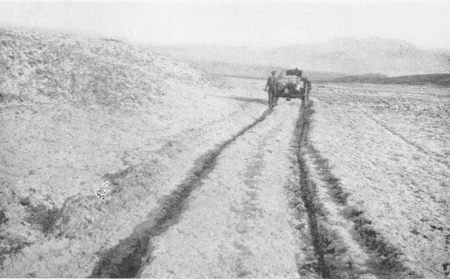
about forty miles north of Barstow. The road there was no such highway
as we had been traveling upon; often it was only two ruts among the
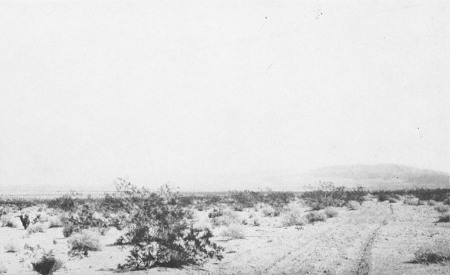
sagebrush, but it was well enough marked to follow easily. Great
sloping mesas spread for miles on either side of the track, rising
to rocky crowns. All the big, open, gradually ascending sweeps are
called mesas on the Mojave, though they are in no sense table-lands
like the true mesas of New Mexico and Arizona. The groves of Joshua
palms had disappeared; we were lower down now where only greasewood and
sagebrush grew. The unscientific like us, who accept the word "mesa,"
lump together all the varieties of low prickly brush as sagebrush.
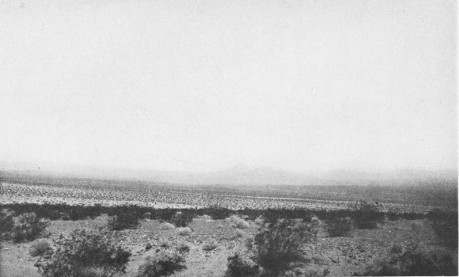
The little bushes grew several feet apart on the white, gravelly
ground, each little bush by itself. They smoothed out in the distance
like a carpet woven of all shades of blue and green. The occasional
greasewood, a graceful shrub covered with small dark green leaves,
waved in the wind. Unobstructed by trees the mesa seemed endless. We
stopped the car to feel the silence that enveloped it. The place was
vast and empty as the stretches we had seen from the railroad, and now
we found how still they all had been. The strong, fresh wind pressed
steadily against us like a wind at sea.
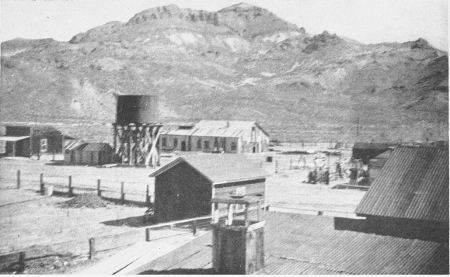
Atolia was the first town, golden in the setting sun, on the shoulder
of a stern, red mountain. Before it a wide valley fell away in whose
bottom gleamed the white floor of a dry lake. All the mountain tops
were on fire. The three towns were very close together, separated by
the shoulder of the red mountain. Randsburg was the largest, whose one
street was a steep hill. It had a score of buildings and two or three
stores. Johannesburg, just over the crest, had six buildings, among
them an adobe hotel and a large garage. All three towns ornamented
the map with big black letters. We thought we were approaching cities
and found instead little wooden houses set on the sand with the great
simplicity of the desert at their doors.
According to that map Death Valley was now not more than sixty
miles away. We thoroughly startled the inhabitants of Johannesburg,
familiarly known as Joburg, by the announcement that we were going
there. We did not yet know how startling an announcement it was; but
these real dwellers on the desert, intimately acquainted with her
difficulties, met our ignorance in a more helpful spirit than any of
our other advisers had, even the agreeable druggist. Hardly any one
ever goes to places like Joburg just for the pleasure of going, and
they seemed pleased that we had come. They described the Panamint
Mountains which shut off the valley from that side with a barrier
nearly 12,000 feet high. There are only two passes, the Wingate Pass
through which the borax used to be hauled and which is now blocked
with fallen rocks, and a pass up by Ballarat. They had not heard of
any cars going in for some time. Unhappily Ballarat had been abandoned
for several years and we could not stay there unless we could find the
Indians, and no one knew where they were. None of the Joburgians whom
we first interviewed had ever been to Death Valley.
It was discouraging, but we persevered until we found a real old-timer.
He was known as Shady Myrick. We never discovered his Christian name
though he was a famous desert character. Wherever we went afterward
everyone knew Shady. Evidently the name was not descriptive for all
agreed on his honesty and goodness. He was an old man, rather deaf,
with clear, very straightforward-gazing eyes. Most of his life had
been spent on the Mojave as a prospector and miner, and much of it
in Death Valley itself. The desert held him for her own as she does
all old-timers. He was under the "terrible fascination." As soon as
we explained that we had come for no other purpose than to visit his
beloved land he was eagerly interested and described the wonders of
Death Valley, its beautiful high mountains, its shining white floor,
its hot brightness, its stillness, and the flowers that sometimes deck
it in the spring.
"If you go there," he said, "you will see something that you'll never
see anywhere else in the world."
He had gem mines in the Panamints and was in the habit of going off
with his mule-team for months at a time. He even said that he would
take us to the valley himself were he a younger man. We assured him
that we would go with him gladly. We urged him—you had only to look
into his eyes to trust him—promising to do all the work if he would
furnish the wagon and be the guide, innocently unaware of the absurdity
of such a proposal in the burning heat of Death Valley; but he only
smiled gently, and said that he was too old.
Silver Lake turned out to be the place for us to go after all. He
described how we could drive straight on from Joburg, a hundred and
sixteen miles. There was a sort of a road all the way. He drew a map on
the sand and said that we could not possibly miss it for a truck had
come over six weeks before and we could follow its tracks.
"It ain't blowed much, or rained since," he remarked.
"But suppose we should get lost, what would we do?"
"Why should you get lost? Anyway, you could turn around and come back."
We looked at each other doubtfully. In the far-spreading silence around
Joburg the idea of getting lost was more dreadful than it had been at
Barstow. There was not even a ranch in the whole hundred and sixteen
miles. We hesitated.
"You are well and strong, ain't you?" he asked. "You can take care of
yourselves as well as anybody. Why can't you go?"
"You have lived in this country so long, Mr. Myrick," I tried to
explain, "you do not understand how strange it is to a newcomer. How
would we recognize those mountains you speak of when we do not even
know how the desert-mountains look? How could we find the spring where
you say we might camp when we have never seen one like it?"
"You can do it," he insisted, "that's how you learn."
"And there is the silence, Mr. Myrick," I went on, hating to have him
scorn us for cowards, "and the big emptiness."
He understood that and his face grew kind.
"You get used to it," he said gently.
It was refreshing to meet a man who looked into your feminine eyes and
said: "You can do it." It made us feel that we had to do it. We spent a
whole day on a hilltop near Joburg looking longingly over the sinister,
beautiful mountains and trying to get up our courage. Happily we
were spared the decision. Two young miners at Atolia sent word that
they were going over to Silver Lake in a few days and would be glad
to have us follow them. Perhaps it was Shady's doing. We accepted the
invitation with gratitude.
We loafed around Joburg during the intervening days. The stern, red
mountains were full of mine-holes, but most of the mines were not
being worked and the three towns were dead. Everywhere on the Mojave
Desert mining activity had fallen off markedly after the beginning of
the war. The population of the three towns had dwindled away and the
few people who remained did so because they still had faith in the red
mountain and hoped that the place might boom again. The big hotel at
Joburg, which was attractively built around a court and which could
accommodate twenty to thirty guests, was empty save for us. We looked
at and admired innumerable specimens of ore. They were everywhere, in
the hotel-office, in the general store, in the windows of the houses.
Everyone had some shining bit of the earth which he treasured. We
bought some of Shady Myrick's cut stones and received presents of gold
ore and fine pieces of bloodstone and jasper in the rough.
We enlisted the services of the garage to get our car in the best
possible condition for the journey across the uncharted desert. The
general opinion held that it was too heavy for such traveling; the next
time we should bring a Ford. When the two young men appeared early on
the appointed morning with a light Ford truck dismantled of everything
except the essential machinery they also looked over our big, red car
questioningly. They feared we would get stuck in the sand and jammed on
rocks; but generously admitted themselves in the wrong when, later in
the day, they stuck and we did not. Of course they had the advantage,
for we would probably have remained where we stopped, while the four
of us were able to lift and push the little truck out of its troubles.
It was the most disreputable-looking car we had ever encountered even
among Fords, a moving junk-pile loaded with miscellaneous shabby
baggage, tools, and half-worn-out extra tires. Our new friends matched
it in appearance. They looked as tough as the Wild West story-tellers
would have us believe that most miners are. We have found out that
most miners are not, though we hate to shatter that dear myth of the
movies. If you were to meet on any civilized road the outfit which we
followed that day from seven o'clock in the morning until dark you
would instantly take to the ditch and give it the right of way.
The drive was wild and fearful and wonderful. The bandits led us over
and around mountains, down washes and across the beds of dry lakes.
Often there was no sign of a road, at least no sign that was apparent
to us. On the desert you must travel one of two ways, either along the
water-courses or across them. It is strange to find a country dying of
thirst cut into a rough chaos by water-channels. Rain on the Mojave is
a cloud-burst. The water rushes down from the rocky heights across the
long, sloping mesas, digging innumerable trenches, until it reaches a
main stream-bed leading to the lowest point in the valley. When you go
in the same direction as the water you usually follow up or down the
dry stream-beds, or washes, but when you cross the watershed you must
crawl as best you can over the parallel trenches which are sometimes
small and close together like chuck-holes in a bad country road, and
sometimes wide and deep. One of the uses of a shovel, which we found
out on that day, is to cut down the banks of washes that are too high
and steep for a car to cross.
Most of the mountains of the Mojave are separate masses rather than
continuous ranges. Between them the mesas curve, sometimes falling
into deep valleys. Instead of foothills, long gradual slopes always
lead up to the rock battlements, the result of the wearing down of
countless ages, the wide foundations that give the ancient mountains an
appearance of great repose. They are solid and everlasting. The valleys
are like great bowls curving up gently to sudden, perpendicular sides.
The mesas always look smooth, beautiful sweeps that completely satisfy
the eye. It rests itself upon them.
When the valleys are deep they usually contain a dry lake, baked mud
of a white, yellow, or brownish-purple color. Crossing dry lakes is a
curious experience. They never look very wide, but are often several
miles across. You need a whole new adjustment of ideas of distance on
the desert for the air is so clear that distant objects look stark and
near. What you judge to be half a mile usually turns out to be five,
and four miles is certainly eighteen. We were always deceived about
distances until we trained ourselves a little by picking out some point
ahead, guessing how far it was, and measuring it with the cyclometer.
Dry lakes are not only deceitful about their size, but also about their
nature. Along the edges is a strange glistening effect as though water
were standing under the shore. Often the rocks and bushes are reflected
in it upside down, and if the lake is large enough the illusion of
water is perfect. You drive across with a queer effect of standing
still, for there is not so much as a stone to mark your progress. It is
like being in a boat on an actual lake. The sunlight is very dazzling
on the white and yellow expanses and the heat-shimmer makes the ground
seem to heave. Sometimes you have the illusion of going steeply up-hill.
Nothing grows in the lake-beds, but the mesas are covered with the
usual desert-growths, sagebrush, greasewood and many varieties of
cacti. A view from one of the ridges is a look into a magical country.
Only enchantment could produce the pale, lovely colors that lie
along the mountains and the endless variety of blues and pinks and
sage-greens which flow over the wide, sagebrush-covered mesas. The dry
lake far down in the bottom of the valley shines. The illusion of water
at its further edges is a glistening brightness. It is hard to tell
where the baked mud ends and the sand begins. It is hard to tell what
are the real colors and shapes of things. If you can linger a while
they change. The valley never loses its immense repose, but it changes
its colors as though they were garments, and it changes the relations
of things to each other. That violet crag looks very big and important
while you are toiling up the mesa, but just as you are crossing the
ridge and look back for the last time you see that the wine-red hill
beside it is really much larger.
For a short distance we followed the old trail over which the
borax used to be hauled from Death Valley. The familiar name,
"Twenty-Mule-Team Borax," was touched with romance. Out of the bottom
of that baffling, inaccessible valley, through a pass by the high
Panamint Mountains where it is sixty miles between the water-holes,
and over this weird country unlike any country we had dreamed existed
in the world, this prosaic commodity was hauled by strings of laboring
mules. They tugged through the sand day after day and their drivers
made camp-fires under the stars. We can never see that name now on a
package of kitchen-borax, humbly standing on the shelf, without going
again in imagination over those two old, lonely ruts.
We lunched at a spring under a cottonwood tree—Two Springs is its
name, the only water on the route. Some one once tried to graze cattle
there, and the water came through a wooden trough into a cement basin.
During lunch the bandits entertained us with tales of the desert. It
has its own ethics. You are justified in killing a man who robs your
camp or steals your burros. Out there at Two Springs we realized that
it was right. If you lose your food or your pack-animal you may well
lose your life. Many a prospector has never returned. The elder of the
bandits remarked thoughtfully that he was glad he had never had to kill
a man. He knew a fellow who had and who was hounded to death by the
memory. He was justified by desert-ethics, but he had no peace in his
sleep.
Toward sunset we went down an endless slope among mountains, some of
which were red, some yellow, some a sulphurous green, and some black.
A black mountain is a sinister object. There is a kind of fear which
does not concern itself with real things that might happen, but is a
primitive fear of nature herself. Even the bandits admitted feeling
it sometimes. It is a fear of something impending in the bare spaces,
as though the mountains threatened. A little creeping chill that had
nothing to do with the cool of evening kept us close behind the Ford.
At the bottom of the rough slope lay a somber basin full of shadow,
beyond which rose an abrupt, high ridge of sand. In spite of us the
Ford gained there and we saw it far ahead crawling up the ridge like a
black bug. It seemed to stop and jerk and stop and jerk again. Then it
disappeared over the top. For a few fearful moments we were alone with
Mojave. How could rocks and sand and silence make us afraid and yet be
so wonderful? For they were wonderful. The ridge was orange against a
luminous-orange sky, the sand in the shadowy basin reached right and
left, mysteriously shining, to mountains with rosy tops. The darkness
around us was indigo, the two crooked ruts of the Ford were full of
blue.
Apprehensively, jerking and stopping, stopping and jerking, as the
Ford had done, the engine clanking as though it would smash itself to
pieces, the radiator boiling frantically, we bucked our way to the
summit of the ridge. It looked down on an immense dry lake in a valley
so big that the mountains beyond were dim in the twilight. At the far
side of the lake stood a group of eight or ten portable houses, bright
orange beside the purple darkness of the baked-mud lake. It was the
town which we had made that incredible journey to reach. Below us we
could see the little truck struggling through the sand. Presently it
reached the hard edge of the lake and merged with its dark smoothness.
We followed down the ridge in its ruts and drove for three miles
straight across the hard lake-bed toward the town, where now a few
lights gleamed. The orange faded from the houses and the whole valley
became a rich plum-color. It was dark when we came out onto the sand
again and drove into the lonely hamlet.
A kindly German couple received us. They were as amazed to see two
women arrive in a big car as we were at arriving. Once two men had come
in a Cadillac just to see the desert, but they could remember no other
visitors with such an unusual object. Mrs. Brauer doubted if we would
find much to look at in Silver Lake. We assured her that we found much
already and hoped to find much more.
"And where did you think you vas going?" her husband asked, chuckling
vastly in the background.
"To Death Valley."
"Mein Gott!"
They conducted us to a one-room shack beside the tin can dump and
bade us be at home. Strangely enough we felt at home. The door of the
shack faced the open desert, the threshold only three inches above the
sand. It stretched away white and still, radiating pale light. The
craving which had made us seek a wild and lonely place responded to
it. The night was a deep-blue, warm and luminous. A hard young moon,
sharp as a curved knife blade, hung over the hills. We went out into
the vague brightness among the ghostly bushes, and at last onto the
darkness of the lake-bed. Beyond it the sand gleamed on the ridge
we had come over. On either side the mountains we had feared were
strong, beautiful silhouettes. In the northwest stood the mass of the
Avawatz, a pure and noble skyline glowing with pale rose. The Avawatz
had been the most fearful mountain of all in the sultry afternoon, a
red conglomeration of volcanic hills. We walked on and on, full of a
strange, terrible happiness. The trackless, unbroken expanse of the
lake seemed boundless, the mountains were never any nearer. We kept
looking back for the reassuring gleam of the lamp we had set in the
window; presently it was lost. Nothing indicated the whereabouts of
the town, we left no footprint-trail on the hard mud, every link with
mankind was gone. Before starting we had located the little houses in
relation to a certain peak and we felt like navigators in an uncharted
sea.
"We must learn to steer by the stars," Charlotte said. "We must always
remember that."
We stood still listening to the silence. It was immense and all
enveloping. No murmur of leaves, nor drip of water, nor buzz of insects
broke it. It brooded around us like a live thing.
"Do you hear the universe moving on?" Charlotte whispered.
"It is your own heart beating," I told her, but I did not believe it.
We had found Mojave.