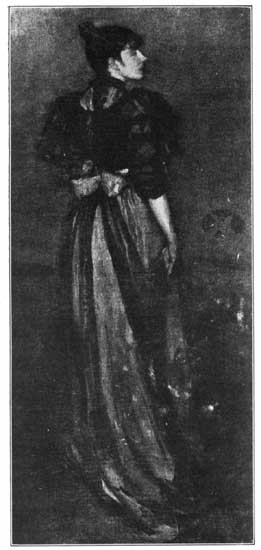
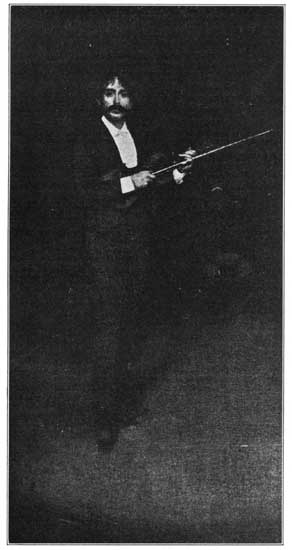
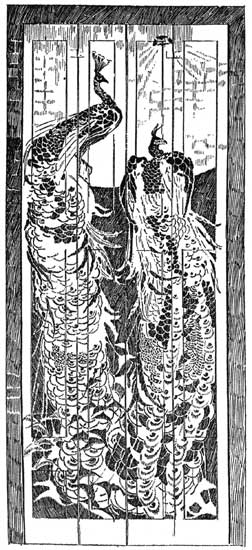
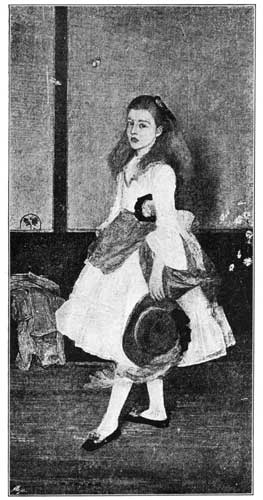
During Jean François Raffaelli's sojourn in America I had occasion to
ask him the rather futile question of how long it took a painter in
Paris to become famous. Of course I referred to a man of superior
abilities, and meant by fame an international reputation. He answered
twenty years at least, and I replied that about twenty years more would
be needed in America.
Whistler had a long time to wait before fame knocked at his door,
although he had a local reputation in London and Paris at forty. He was
known as a man of curious ways, and an excellent etcher; but, with the
exception of two medals, he had received no honours whatever for his
paintings. His work still impressed by its novelty; but he had not yet
captivated the public. He still had to fight for recognition, and, as
long as a man has to do that, he is neither a popular nor a successful
man.
[Pg 7]
Toward the middle of the seventies recognition appeared to come
more readily. He seemed to know everybody of note, and everybody seemed
to know him. His writings and controversies attracted considerable
attention, his supremacy as an etcher had been admitted, and his
pictures became more widely known. He had gathered around him a number
of wealthy patrons, who were connoisseurs and keen appreciators of his
talents. He was so successful financially in the latter part of his life
that he had residences and studios in Paris as well as in London. At
Paris his headquarters were in the rue du Bac. In London he had various
quarters,—on Fulham Road, Tite Street, Langham Street, Alderney Street,
St. Regents Street, The Vale, etc. Going from one place to the other as
his moods dictated to him, with an occasional sketching trip to Venice,
to Holland or the northern parts of France, he lived the true life of
the artist, quarrelled with his friends, delighted his admirers with the
products of his fancies, and astounded the intelligent public on two
continents with the caprices of his temper. Strange to say, even at that
time, his best work had already left his easel. He was busy with minor,
but not less interesting, problems and devoted most of his time to
etchings, pastels and lithographs. But it was at this time that his
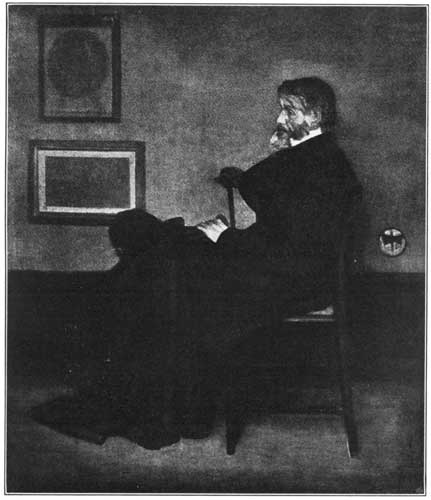
"Ten O'clock" and "The Gentle Art of Making Enemies" were published; and
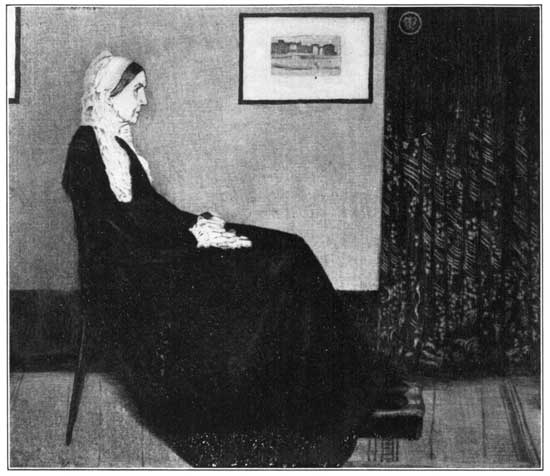
when his "Carlyle" found its way to the Glasgow City Gallery, and "The
Portrait of the Artist's Mother" was purchased by the Luxembourg Gallery
at Paris.
Comparatively little is known of Whistler's private life. I wonder how
many of his admirers, excepting his personal friends, were acquainted
during his life-time with the fact that he was married, and could tell
whom he had married. He remained a bachelor until his fifty-fourth year,
when he married the widow of his friend E. W. Godwin, the architect of
the "White House." She was the daughter of John Bernie Philip, a
sculptor, and was herself an etcher. They were married on Aug. 11, 1888.
Eight years later his wife died, May 10th, 1896.
How this man of moods and capricious tastes got along in married life
the general public has never found out. His friends assure us that it
was a happy union and that he was deeply devoted to his wife. He has
painted her repeatedly, but the pictures do not betray any domestic
secrets to the public. Although Whistler was fond of notoriety, and
managed to keep himself continually before the public,—in the
fullest limelight, so to speak,—he never allowed personal news and the
details of his everyday life to claim the attention of the public. All
his innumerable feuds and press displays were related to his work,—to
his completed pictures and theories of art. He liked to play upon his
personality, but only as far as the artist was concerned. He was
peculiarly free from the taint of exploiting his own domestic affairs.
He hated biographies and all references to his family life. Even in his
feuds with his old friends, F. R. Leyland, and his brother-in-law,
Seymour Haden, when he brutally dragged apparent private matters into
the glare of publicity, the discriminating observer will notice that his
controversies, sarcasms and interpretations refer solely to "art
situations" and never descend to the low depths of personal abuse.
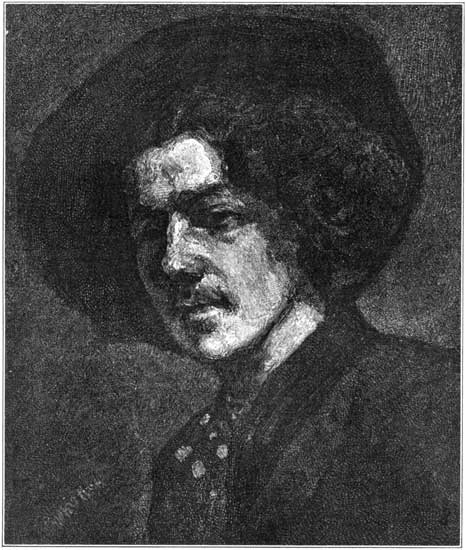
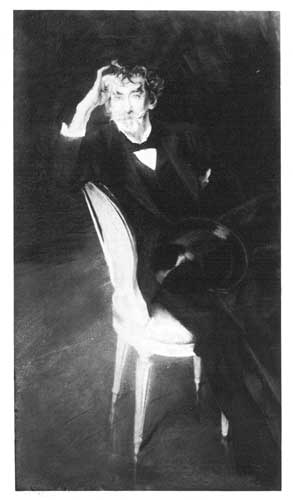
THE SELF PORTRAIT OF 1859.
James McNeill Whistler was born on July 10th (some say July 11th), 1834,
at Lowell, Mass. One of his ancestors, a Dr. Whistler, is frequently
mentioned in Pepys' delicious diary. He was baptized James Abbott
Whistler in the Church of St. Anne, at Lowell. His father, Major George
Washington Whistler, was a civil engineer and, during the first eight
years of James' life, moved from Lowell to Stonington, Connecticut,
thence to Springfield, Massachusetts, and, finally, in 1842, went to
Russia to superintend the construction of the railroad from St.
Petersburg to Moscow. The following year the family sailed from Boston
to make their home in St. Petersburg.
This was the first impression the boy Whistler received from the outside
world, and no doubt the trip across the Atlantic and the sojourn in a
foreign country made a lasting impression upon him. Russia, with its
quaint old civilization and touches of barbaric splendour, was the
country to excite the imagination of any boy, and the change from a New
England village life to the metropolitan turmoil of St. Petersburg would
have left imperishable traces in any receptive mind. The father was paid
lavishly and the boy was brought up in luxury.
The first report of any art talent in the boy can be found in the
reference, mentioned by several biographers, to his taking lessons at
the Imperial Academy of Sciences at St. Petersburg. It had probably no
particular bearing on his career, since art teaching in Russia was
traditional, and probably consisted of nothing but drawing from wooden
models and plaster casts. It informs us, however, of the fact that he
became familiar with the rudiments of drawing at an early age. Of by
far greater importance to his development were his visits to the
Hermitage. There he saw for the first time Velasquez and he learnt to
differentiate between painters who could paint and such who could only
tell a story in line and colour.
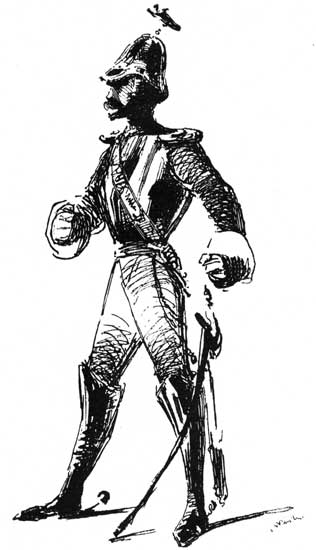
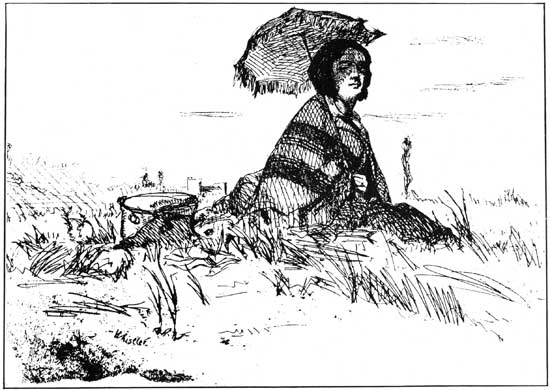
PEN AND INK SKETCH, MADE AT WEST POINT.
On the death of the father, April 7th, 1849, the family returned to the
United States and settled in Stonington, Conn., and young Whistler
attended school at Pomfret, Conn. In 1851, seventeen years old, he
entered the United States Military Academy at West Point and was
enrolled as James McNeill Whistler, taking his mother's maiden name as a
middle name. Like Poe, he does not seem to have been over-fond of a
routine military career. No doubt something of the artist's temperament
had awakened in him, and, like all young talents, he objected to
regulated study, and tried to satisfy the vague aspirations of his
unsettled consciousness with work that was more congenial to him.
He left West Point in July, 1854. The technical discharge was
"deficiency in chemistry," but it was probably general unfitness for a
career of discipline and exactness. Through some influence he received
an appointment in the drawing division of the United States Coast and
Geodetic Survey at Washington, D. C., at the salary of $1.50 a day, but
he resigned two months later. The government records show that he worked
only six and a half days in January and five and three-quarter days in
February. He apparently had no taste for map designing and bird's-eye
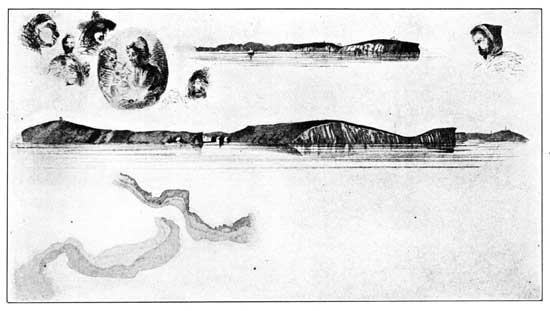
views. It is said he paid more attention to the deliberate drawing of
little trees and detail than to the typographic facts.
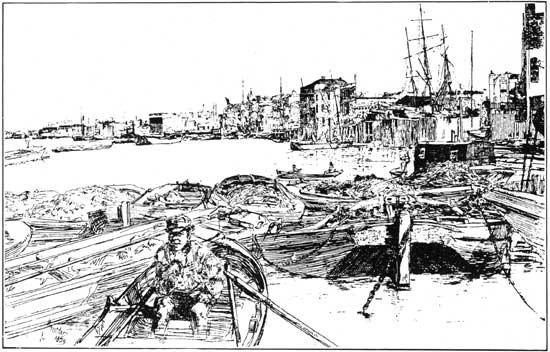
DRAWING MADE FOR THE UNITED STATES COAST AND GEODETIC
SURVEY.
His military career had come to an end; he had to do something else, and
he felt that he had to become an artist at any price. Money was not over
abundant in the Whistler family, but there was sufficient to allow him a
few years' leisure to study art wherever he chose, and so he went to
Paris, and joined the youthful band of artists, who fought for modernism
and a new technique, and the glory of the métier, with an enthusiasm,
a bravery and devotion that has rarely been encountered. There he lived
the regular student life for four years. He entered the atelier of
Charles Gleyre, but only stayed for a short while. He preferred to look
about for himself. At one time he and young Tissot made a copy of
Ingres' "Angelique."
Whistler arrived in France shortly after the coup d'état. Paris was
not then what she is to-day. None of the chain of boulevards around
the centre of the town, not even the boulevard of St. Michael, which
became the great thoroughfare for artists, were in existence in their
present condition. But Whistler had come at the time when Paris was
being reconstructed into one of the most beautiful cities of the world,
and, when the Imperial régime unfolded its full splendour. Paris became
intoxicated with its own beauty, and the social life blossomed forth in
all its elegance and frivolity.
During 1857-58 Whistler had a studio in the rue Compagne Première,
boarding in Madame Lalouette's pension in the rue Dauphine. For some
time he also shared quarters with Fantin-Latour, who, with Legros, was
his most intimate friend during his student years. They saw each other
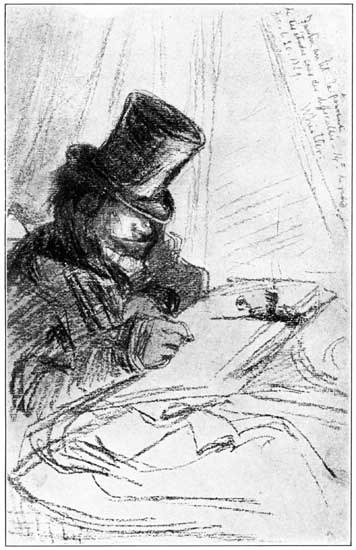
daily, and it was on one of these occasions that he made the humourous
sketch of Latour, depicting him on a cold winter morning seated in bed,
drawing, all dressed, with a top hat on his head.
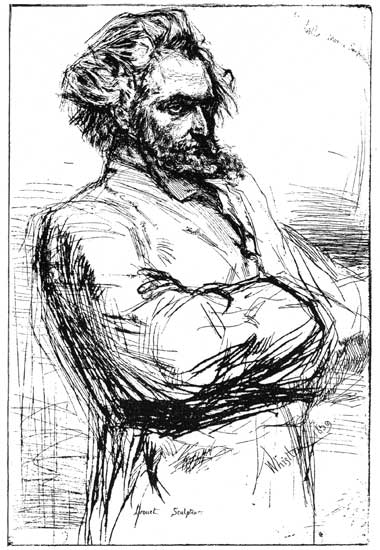
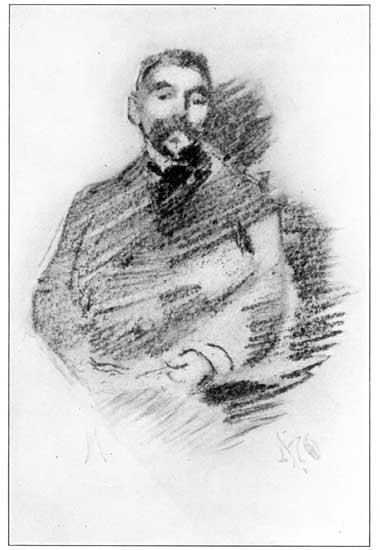
PORTRAIT SKETCH OF FANTIN-LATOUR.
They were the days of Henri Murger's "La Vie Bohême," of bon
camaraderie, eccentric days when every man sought to make his mark by
peculiarities of dress, soft felt Rubens' hats, velvet cloaks with the
ends thrown over the shoulders, and other exotic garments. In one
exhibition, in sheer audacity of youth, Whistler appeared dressed in a
Japanese kimono. Think of a man in a kimono in 1855! Whistler at that
time was a true Bohemian. His little studio was his workshop, his
temple, his parlour, his playhouse and his dormitory. He frequented the
queer, interesting quarters that students seek,—quaint old cafés
where food was good as well as cheap, and character abundant.
What is there so fascinating about the Bohemian's life? The Philistine,
I fear, generally considers him an eccentric, indolent man, with no
thought for the morrow, no notion of economy, no home save the place
which affords him temporary shelter. He never stops to think that the
Bohemians are the men who make our songs, who paint our pictures, chisel
marvellous creations out of wood and stone, compose our sweetest poems
and write our newspapers. It is a grievous mistake to assume that they
are merely a lot of idle, luckless fellows. They are men with brains of
good quality, and hearts in the right place. All classes and trades of
men have burdened the world with their wants and woes. Not so the
Bohemian. He, too, has his heartaches and bitter disappointments, but
who ever hears of them? The humourous tale over which you laugh so
heartily, recounting the adventures of a poet in search of a
publisher, had the author's personal experience for a basis. He could
not sell his poems, but needed bread; so, out of his misfortune, he had
good cheer. The ordinary man, rebuffed by fortune, would sit down and
mourn himself into illness. The Bohemian utilizes these very reverses,
and both he and the world are the merrier eventually for them. He lives
in a world distinct from that of common men. Talent, love of
comradeship, a sunny disposition—these are the magnets that will draw
one toward it. It has its obligations, its trials, its code of honour,
rigid as the most unbending militarism; but there is charm of
companionship and an absence of jealousies and pettiness within it that
makes you powerless to rid yourself of its enchantments. The Bohemian's
life is apart from yours, but why chide him for it? He builds on the
ruins of no other man's life, he feeds on no man's scandals, he exults
in no man's misfortunes, but goes on his way, imbibing the sweetness of
life from every flower, and, in his own way, scattering the perfume
broadcast. He does half our thinking and originates two-third of all the
movements for the social reclamation of the world. He is no hypocrite
before the mighty, nor heartless in the face of the unfortunate. He
covets no man's goods, but lives his own quiet, interesting, exquisite
life. He asks only a share of the sunlight of life. In du Maurier's
"Trilby" we find a sympathetic description of the art life of that
period, but also a rather despicable type of a man, "Joe Sibley," by
name, who always pretends but never does a thing and who was meant for a
ludicrous satire on young Whistler (a character which was eliminated on
Whistler's request from the second edition).
It is easy to draw a mental picture of him as he looked at that time. I
see him studying in the Louvre, in a loose black blouse with low turned
down collar and a soft black hat on his long, slightly curled hair, lost
in wonder before a painting by Leonardo; or strolling along the
Boulevards, cane in hand, ogling the beautiful women, and dreaming of
designing some dress for the Empress Eugenie, passing by in an open
phaeton. And how enthusiastic he got, no doubt, over some Japanese print
or Chinese vase in some curio shop.
A certain trigness, smartness, acquired very likely at West Point where
the cadets change their white duck trousers several times a day, induced
him, even at this time, to take special care over the fit of his coat.
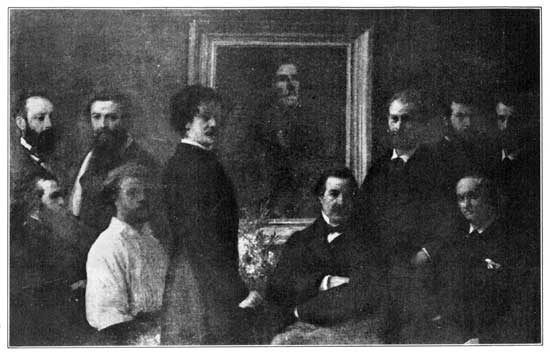
"HOMMAGE À DELACROIX," BY FANTIN-LATOUR.
In 1859 he went with several fellow students, Fantin-Latour, Legros, and
Ribot, to Bonvin's studio to work from the model, under the
direction of Courbet. At that time he was interested in types. He
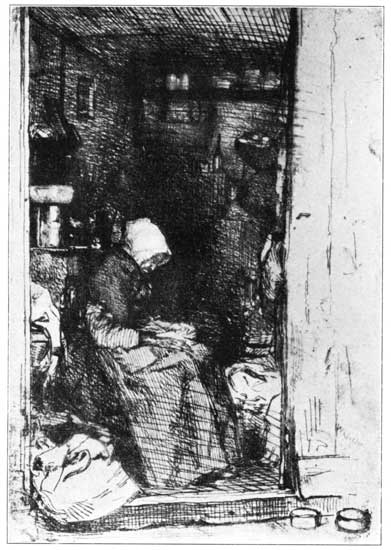
painted a "Fumette," a little grisette of the Quartier Latin, and the
"Mother Gerard," who in her younger days had been a maker of pretty
verses, but, reduced in circumstances, had become a flower vender at the
Bal Bullier. Among his friends and associates we find the names of
Legros, Cordier, Duranty, the etcher Bracquemond, inventor of the "pen
and ink" process, de Balleroy, Champfleury, Manet and Baudelaire. They
were all young men of talent, plein d'avenir. Fantin-Latour made a
group-portrait of them, including Whistler and himself, seated and
standing, assembled about a portrait of Delacroix. The canvas was
exhibited at the Salon of 1864 as an "Hommage à Delacroix."
Whistler's step-sister had married Seymour Haden, the etcher, and
Whistler, paying them a visit in 1859, stayed in London. The four years
in Paris had matured him, and he knew how to accomplish something beyond
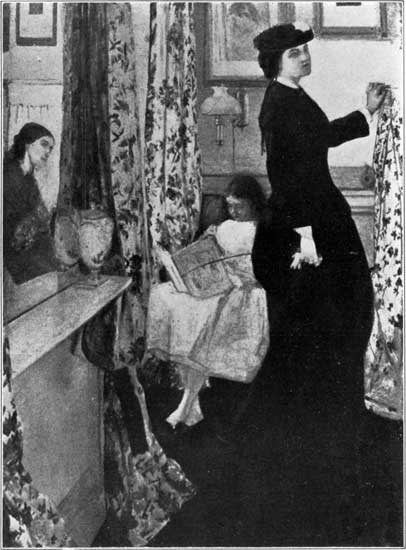
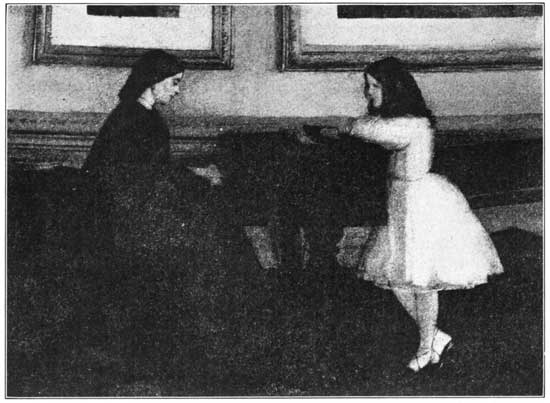
the routine studio work. In 1862 he exhibited for the Royal Academy. It
was his "At the Piano," which, if not a masterpiece, is already a true
and individual work of art.
Courbet still had a strong hold on him. He spent two summers with him in
Trouville and may have derived his first lessons as a mystificateur,
which part he played so successfully during life, from the French
painter, for Courbet was a poseur throughout, who assumed a particular
kind of dress, and who was not satisfied merely with painting pictures
that offended the Academy and conventional taste, but made a special
effort and took special pleasure in shocking the bourgeoisie.
Whistler also made his first trip to Holland during these years, and
became enchanted with Rembrandt and Vermeer, but took a great dislike to
Van der Helst. In 1859-60 youthful efforts of his had been refused at
the Paris Salon; the same happened again in 1863, but he was one of the
men who scored a success at the Salon des Refusées. A number of
talented painters, and among them men of genius like Manet, Cazin,
Degas, Harpignies, Vollon, Pissaro, Jongkind and Bracquemond, tired of
the cliquism and jury of the regular Salon,—a story which repeats
itself everywhere,—decided to arrange their own exhibition. Napoleon
III, in his nonchalant way a true patron of art, issued an order to
arrange the exhibition of "revolt" in the same building as the official
exhibition. The exhibition was a success, and even the Empress Eugenie
and the court came to see it. This is really of no significance, as
nobody bought anything; but it sounds well, and biographers should never
neglect to mention such incidents.
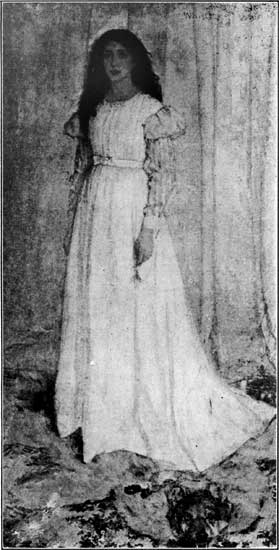
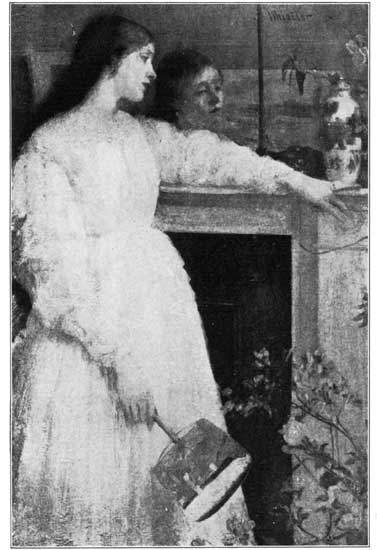
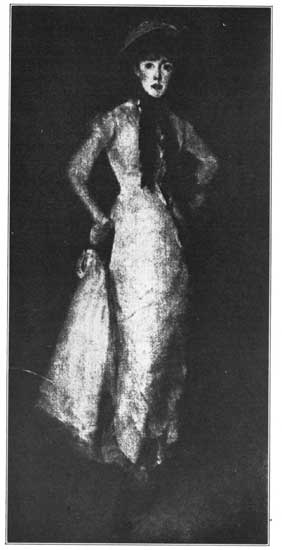
Owned by John H. Whittemore
THE WOMAN IN WHITE.
One thing is certain: Whistler's picture, "The White Girl," even with
Manet's "Dejeuner sur l'Herbe" in the same room, attracted an unusual
share of attention. Zola, in "L'Œuvre," says that the crowd laughed
in front of "La Dame en Blanc." Desnoyers thought it "the most
remarkable picture, at once simple and fantastic with a beauty so
peculiar that the public did not know whether to think it beautiful or
ugly." Paul Mantz wrote in the Gazette des Beaux-Arts that it was the
most important picture in the exhibition and called the picture a
"Symphonie du Blanc" some years before Whistler adopted that title.
The exhibition of this picture represents, in a way, the turning point
in Whistler's career. It was a steady ascent ever after. Before this he
was unknown, and exposed to the manifold privations and vicissitudes of
an artist's career. Many a day he had gone hungry and frequently could
not paint for lack of material. Now things began to run a trifle
smoother, although sales were still rare and money scarce. His lodgings
in 7 Linsey Row (now 101 Cheyne Walk) were extremely simple and his
studio consisted of a second-story back room.
During the next three years he worked hard, and finished a number of
pictures that since then have made history. They are all in a lighter
key and of brilliant colouring. The problem he seemed to be most
interested in was to reproduce in relief the charm of diversified colour
patches as seen in Japanese prints.
He continued to see things in this way until he made a trip to South
America in 1866. Feeling, perhaps, slightly discouraged, or in need of
some recreation, he and his brother set out for Chili, under the
pretence of joining the insurgents à la Poe and Byron, although I hardly
believe that a man of thirty-two really capable of such a wild goose
chase. At all events, when they reached Valparaiso the rebellion had
ceased and instead of handling a musket "our Jimmie" opened his paint
box instead.
The result was startling. Impressed by the new sights of southern
scenery, and in particular of the translucency and subdued brilliancy of
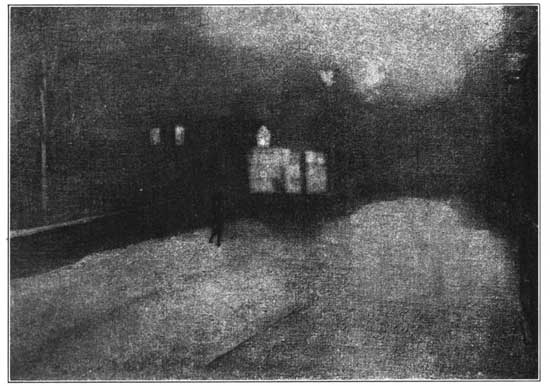
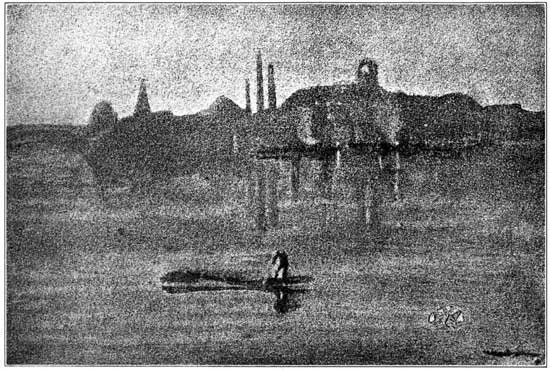
the sky at night, he painted one of his finest nocturnes, the
"Valparaiso Harbour," now at the National Gallery of Art. The darkness
of night to a large extent bars colour, and furnishes a kind of tonal
veil over all objects; but in southern countries the nights are clearer
and brighter and, although forms and colours are indistinct, they remain
more plainly discernible than in the blackness of our Northern nights.
After his return to London he worked hard at solving the problem of
creating tone which would suggest atmosphere with as little subject
matter as possible. Four years passed before he held the first
exhibition of a "Variation" and "Harmony." He now began to feel his own
strength. He felt that he had done something new and had the courage to
coin his own titles. The method of classifying his pictures as Harmonies
and Symphonies, Arrangements, Nocturnes, Notes, and Caprices, was
entirely his own invention and in his earlier career did much to attract
attention to his work. One year later, in 1872, exhibiting several
symphonies, he included for the first time an impression of night under
the title of "Nocturne." The years 1870-77 were probably the busiest and
the most important ones of his whole career. They produced not only the
"Nocturne," but also the "Peacock Room" and the painting which is
generally conceded to be his masterpiece, the "Portrait of the Artist's
Mother."
Success and fame at last knocked at his door. Mr. F. R. Leyland, the
rich ship-owner of Liverpool, proved a generous patron. Between 1872 and
1874 he ordered portraits of himself, Mrs. Leyland and the four
children. Whistler made long visits at Speke Hall, Leyland's home near
Liverpool. His paintings began to sell more readily than heretofore and
several orders for interior decoration had come in, among them the
decoration of the music room of the famous violinist Sarasate's home in
Paris. He was willing to work at anything as long as he could carry out
his own ideas. He invented schemes for interior decoration and also once
tried himself as an illustrator, when he made exquisite drawings of the
vases, plates, cups of blue and white Nankin for the catalogue of Sir H.
Thompson's collection of porcelain. (Ellis and Elvey, London, 1878.)
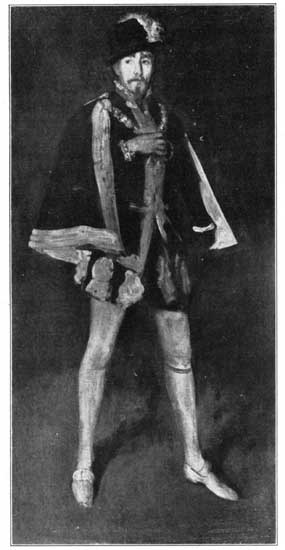
National Gallery, Washington
ARRANGEMENT IN BLACK: F. R. LEYLAND.
After leaving 7 Linsey Row, during the years 1866-1878, Whistler lived
in several other houses situated in the Chelsea district, for like so
many of us that have got used to a certain part of the city, he could
never get away from it. The most pretentious of these abodes was the
"White House" which became one of the centres of attraction in the art
life of London.
There he gave his famous Sunday morning breakfasts, which Mr. Harper
Pennington describes so amusingly: "They were always late in being
served, outrageously delayed without apparent cause. It was no uncommon
thing for us to wait an hour, or even two, for the eggs, fish, cutlets,
and a sweet dish of which the meal consisted. A bottle of very ordinary
white wine was our only drink." The whole thing, in fact, was an
"arrangement"—just a colour scheme in yellow to match his "blue and
white" porcelain and his "yellow and blue" dining room. The room itself
was unique in its effective and independent style of decoration. It was
entirely carried out after his own designs, even to the painting of the
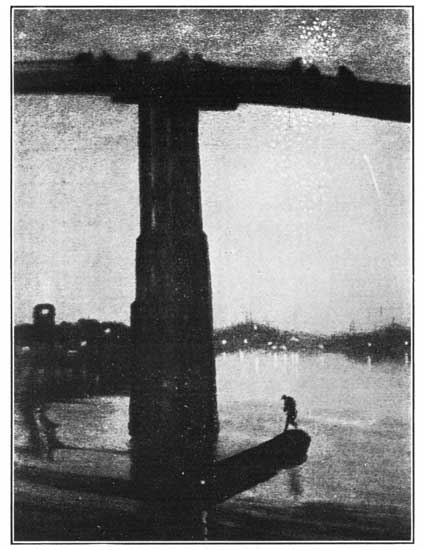
exterior. And the environment, the Thames, the old church of Chelsea
with its square tower, the peculiar shaped bridge of Battersea, the
lights of Cremorne in the distance, all furnished interesting pictorial
topics and played an important part in the painter's mise en scène.
His neighbours added to the lustre of this period. In the same district
at that time lived Rossetti, Swinburne, George Meredith and Carlyle, and
Whistler was on friendly footing with all of them.
Exhibitions of his work were now a regular occurrence. In 1874 he held
his first "one man's show" of thirteen paintings and fifty prints at
number 48 Pall Mall, London. In 1877 he arranged an exhibition in the
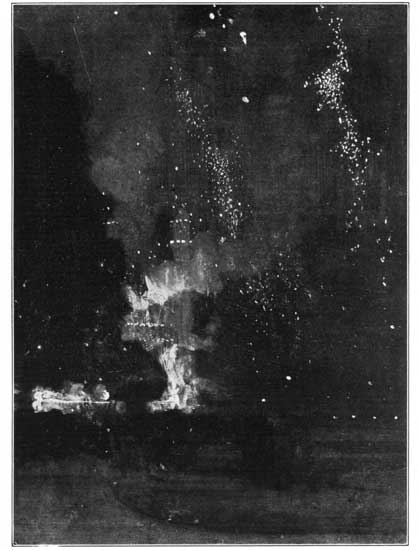
Grosvenor Gallery. Among the exhibits were "The Falling Rocket"
(Nocturne in black and gold) which brought about the Ruskin attacks, and
consequently the famous libel suit, Whistler v. Ruskin. One can hardly
imagine, to-day, why the picture should have created so much commotion;
but it was a decided innovation at that time, an event in a way ushering
in a new era of art. Now this particular style of representation has any
number of disciples, and we have accepted it as one of the principal
assertions of modern art.
Strange, that history always repeats itself. We should know by this time
that our tastes and the tastes of time are not absolute, and that our
sense of beauty is likely to be affected by circumstances to an extent
which we cannot realize. There was a time, and not so long ago, when
Gothic buildings were regarded by the man of culture much as dandelions
are regarded by the gardener. For years the very name Nocturne was a
reproach. It was supposed to be the product of idiosyncrasy and
nonchalant audacity, the work of a decadent period in art, which,
because it was decadent, could not be good, for everything that looked
like a Whistler was regarded as a note of decadence. It was an argument
in a circle, no doubt; but such arguments seem most convincing when once
a prejudice exists in the art world. Only gradually did people begin to
see more than cleverness in his products.
Oscar Wilde was a constant friend of Whistler's at this time. The
friendship was still young and, for a while, the two were inseparable.
The author of "Dorian Gray" spent hours in Whistler's studio, came
repeatedly to the Sunday breakfasts, and presided at Whistler's private
views. Whistler went out and about with him everywhere. But Whistler
gradually came to feel that Wilde, in spite of his brilliancy and wit,
lacked fundamental purpose. Wilde talked constantly about art, but, in
the end, Whistler concluded that Wilde, like most modern authors, knew
very little about it.
The days of the Renaissance, of versatility, of talent and appreciation
seem to have passed. Whistler easily tired of his friends and, although
this friendship had lasted for years, he finally dropped Wilde without
much ado. A critic of "The London Times" has summed up the difference
between the two in the following words:
"With a mind not a jot less keen than Whistler's, Oscar Wilde had none
of the convictions, the high faith for which Whistler found it worth
while to defy the crowd. Wilde had posed to attract the crowd. And the
difference was this, that, while Whistler was a prophet who liked to
play Pierrot, Wilde grew into Pierrot who liked to play the prophet."
Like most artists who have suddenly sprung into fame, Whistler had lived
beyond his means. He was fond of comfort and elegance, and allowed
himself the fulfilment of any whim as long as it granted him genuine
pleasure, as "art and joy should go together."
The auction sale of the contents of his home in 1879, and the sale of
his paintings at Sotheby's in February, 1880, were perhaps not entirely
caused by financial difficulties. They may have been prompted in an
equal degree by a desire to make a change and break the routine of the
studio life. He told, however, to his friends in his inimitable way how
the sheriff's officer called upon him with a writ, and the last bottle
of champagne was brought out of the cellar for that worthy's
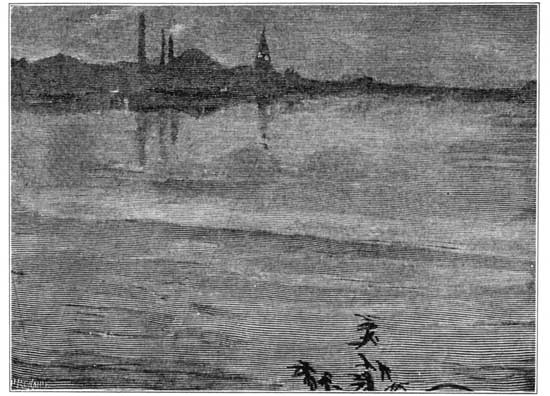
delectation. In Venice, where he went in September, 1879, he seems to
have been in straitened circumstances for quite a while. He lived in
modest quarters and dined in cheap, dingy places. These were his
"polenta and macaroni days," and, in a way, a repetition of his Paris
student's life, only much harder to bear as he was older (forty-five)
and used to luxury.
No matter what his reason may have been for breaking up his bachelor
establishment it was the second turning point in his career.
Painting did not play quite as important a part in Whistler's life after
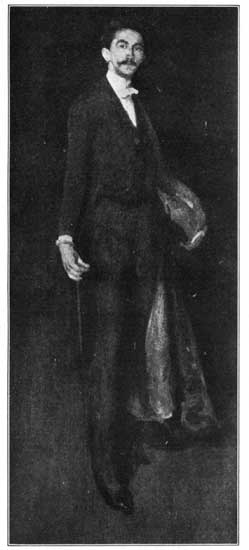
his Venetian sojourn. He still painted a number of portraits, among them
the "Sarasate" and "Comte Montesquiou," but he was more active as an
etcher, lithographer, pamphleteer, lecturer and teacher. Orders were
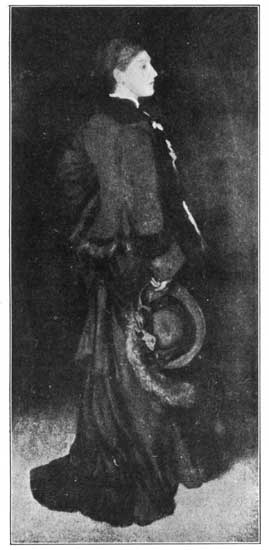
scarce at all times. The only regular portrait orders he had in the
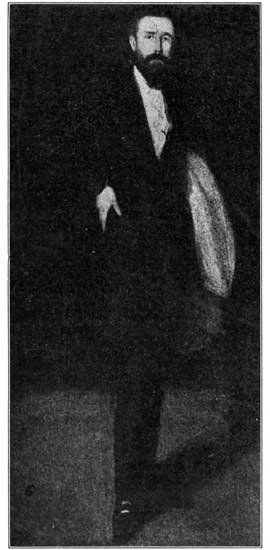
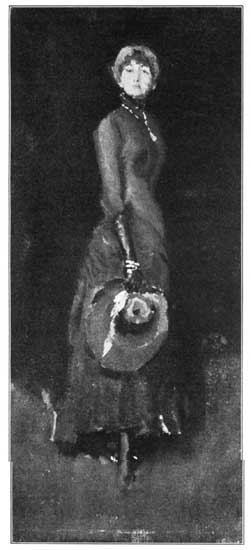
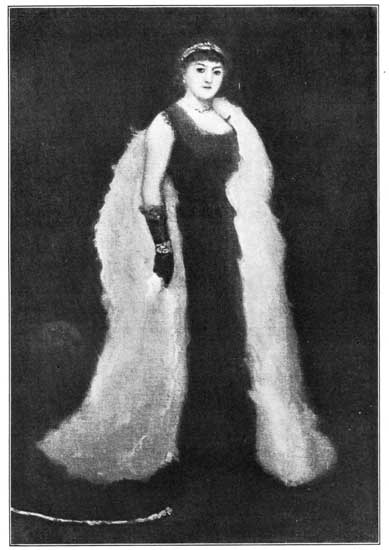
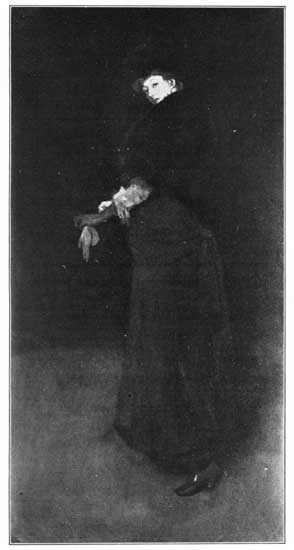
first half of the eighties were those of Lady Archibald Campbell, wife
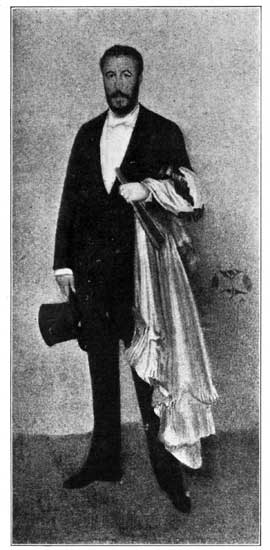
of the Duke of Argyll; and of Lady Meux, who liked her first portrait,
in a black evening gown with a white opera cloak against a black
background, so well that she had herself painted three times in
succession. Whistler's sense of beauty was a strong feature in his work.
Maybe it was not the sense of beauty an Englishman would like. He looked
for a pictorial aspect, rather than the "lady" in his sitter; and in
England the "lady" is the thing to secure in a portrait of a woman.
He returned to London in 1880, but stayed only a short while. During
the next ten years he had no permanent home; like a nomad he flitted
from city to city, from studio to studio through England, France and
Belgium. Finally he found some sort of a resting place in the rue du Bac
110, for many years his Paris home. It was a two-story house with a
garden enclosed by a wall, as secluded a spot as one could find in the
gay and noisy city. He was always fond of gardens of flowers. "In the
roses of his garden he buried his sorrows," one of his most talented
pupils, E. H. Wuerpel, tells us, in his little brochure "My Friend
Whistler."
In the meanwhile his London Exhibitions became more and more numerous.
During the next fifteen years the following eight exhibitions are on
record.
1881—Jan.—An exhibition of fifty-three pastels at the Fine Art Society
in Bond St., London.
1883—Feb.—Fifty-one etchings and dry points exhibited in Bond St.
Gallery, London.
1884—May—Harmonies—Notes—Nocturnes—shown at the Dowdswell Gallery,
London. At the same time an exhibition took place in Paris and Dublin.
They were arranged according to his own idea of exhibiting.
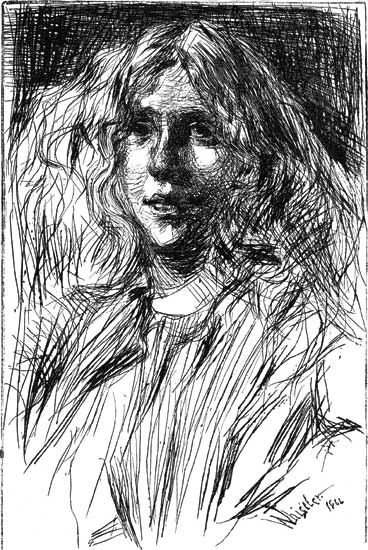
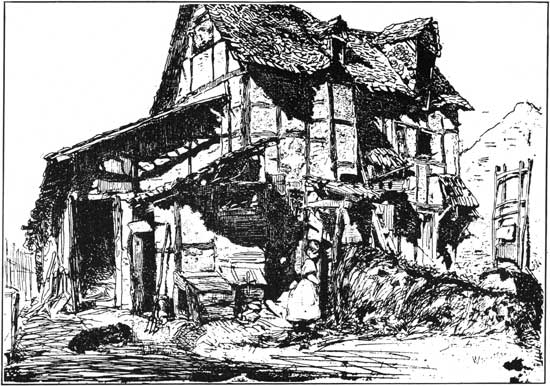
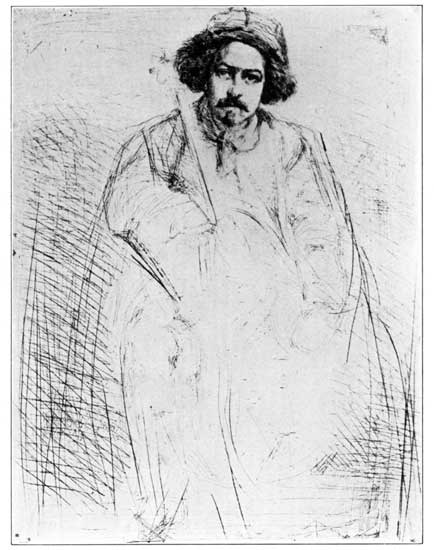
JO (ETCHING).
1884—Nov.—Twenty-five works sent to the exhibition of the Dublin
Sketching Club.
1886—May—A second series of Notes—Harmonies—Nocturnes shown at the
Dowdswell Gallery.
1889—The most representative exhibition of his works, since that of
1874, at the College for Working Women, Queen Sq., London.
1892—Mar.—An exhibition of forty-four nocturnes, marines and chevalet
pieces for which Whistler prepared the catalogue. At the Goupil
Galleries, Bond Street, London.
1895—Dec.—Exhibitions of seventy lithographs, London.
In the years following his death, as is usually the case, 1904-05,
occurred the most important assemblage of his works—the memorial
exhibition of Glasgow, Boston, Paris and London.
Of special interest are Whistler's first American exhibits. At the first
exhibition of the Society of American Artists at the Kurtz Gallery, New
York, 1878, he was represented by a "Coast of Brittany." In the autumn
of 1881 at the Pennsylvania Academy of Fine Arts he exhibited the
portrait of his mother, which was also seen the following spring at the
Society of American Artists in New York. Sheridan Ford once asked him
why he did not exhibit more frequently in America. Whistler answered: "I
don't know, they will not allow me to take them across the ocean. You
see, I don't own my pictures. I sold most of them long ago to people who
think more of them than they do of me. I wrote and asked for two or
three of them to take over, and the answers I received were to the
effect that I could have them to exhibit here, but not to exhibit in
America. Why? Because the owners are afraid of the ocean. I said I would
insure the pictures, at which of course they laughed. I may go and I may
not. A good many people in America don't like me, and I am not there to
fight them as I can fight my enemies here. I don't mind having enemies
where I can get at them. I like the pleasure of whipping them; but these
fellows in America have it all their own way. There is no record, and I
am at a constant disadvantage."
In 1884 he was elected President of the Royal Society of British
Artists, but soon quarrelled with the old-fashioned element among its
members, and the whole affair degenerated into one of those disputes
upon which such copious light has been shed in "The Gentle Art of Making
Enemies."
The enforcement of the Whistlerian policy of elimination and
arrangement brought disaster upon the Society. The annual sales fell
from £8,000 in 1885 to under 1,000 in 1888. It was time for the ideal
exhibitor and manager of mise en scènes to retire. And so he did, if
not accompanied by a cavalcade of buglers blowing a blast with, at
least, as much noise and controversy as he could conjure up in these
art-forsaken and colourless days.
It is not until towards the close of his life, in 1898, that we find him
again at the head of an artistic corporation, when the International
Society was proud to acknowledge his leadership. In 1880 Whistler made
his début in Germany at the International Art Exhibition of Munich. The
result was not a flattering one. The jury officiating on that occasion
established a peculiar claim to the affectionate recollection of
posterity by awarding a Second Class medal to the "Portrait of the
Artist's Mother," now in the Luxembourg. Of course a jury has perfect
rights to make awards as it pleases as long as the verdict is a
competent and impartial one, but Whistler by this time was too
well-known, and one can hardly blame him that he wrote the following
sarcastic but unusually dignified letter to the Secretary of the Central
Committee.
[Pg 32]
"Sir: I beg to acknowledge the receipt of your letter, officially
informing me that the committee awards me a second class gold
medal. Pray convey my sentiments of tempered and respectable joy to
the gentlemen of the committee, and my complete appreciation of the
second-hand compliment paid me.
"And I have, Sir,
"The honour to be
"Your most humble obedient servant,
"J. McNeill Whistler."
After 1895 Whistler ceased to hold exhibitions. The death of his wife
brought about a long silence, and little was heard of Whistler. He had
laid aside his jester's bells and cap and ceased pamphleteering and
posing in public. He had become a kind of recognized institution in the
art world, occupying a place apart from the masses of his
contemporaries. Men of very dissimilar æsthetic convictions agreed in
regarding him as a painter of exceptional ability, and he had a solid
and appreciative following.
We in America wondered what had become of him. Occasionally a newspaper
notice informed us that he had taken up teaching, or false reports
crossed the ocean that he had become a symbolist. He himself was
inactive, as far as the public was concerned.
I suppose he was at last tired of notoriety and the cares of public
life. He had played his part and had played it well. Intimate friends
tell us that he worked as hard as ever. He still had many problems to
solve, if for nobody else but himself, and was satisfied that he could
afford to devote his time to them. Financially he was fairly well
situated; but he spent money extravagantly, and the two residences and
various studios he kept up in Paris and London proved at all times a
heavy drain on his income, which was derived entirely from his art
products. He left about ten thousand pounds, a rather small sum,
considering the prices he received for some of his paintings.
His school in the Passage Stanislaw, opposite Carolus Duran's home, was
neither a necessity nor a particular pleasure to him. He opened it for
the sole benefit of one of his favourite models, Mme. Carmen Rossi, who,
as a child, had posed for the painter. She received the entire profits
and it is said that during the three years that the school existed she
made enough to retire in comfort. The school was opened in the autumn of
1898 and closed in 1901. He was too impatient to be a good teacher; he
simply came there and painted and the pupils saw him paint and learned
what they could, just as did the apprentices of the Old Masters. He
taught solely the science of painting, neither colour nor composition.
He had an abhorrence of talking art, and one of the anecdotes he liked
to relate was that he had known Rossetti for years and "had talked art
many, many times but painting only once."
He even refused to discuss technicalities. There was no talk of
pigments, mediums, varnish or methods of applying them. He worked with
his pupils, that was all. Like the apprentices of old they had to pick
up their knowledge themselves, and if he found something that he liked
his usual praise consisted of "Go right on," or "Continuez,
continuez." On the wall was tacked his second series of propositions
which endorsed his constant advice to pupils: "If you possess superior
faculties, so much the better, allons, develop them; but should you
lack them, so much the worse, for despite all efforts you will never
produce anything of interest." Good common sense, but, after all, a
slight return for the tuition fee. It should have induced most pupils to
pack up their paint boxes and return home.
As Leon Dabo, in his lecture on "Whistler's Technique" at the
Metropolitan Museum of Art, has so well observed: "Nothing is more
absurd than the notion, so widely promulgated by elderly maiden ladies
who misspend their energies writing about paintings and painters from
Cimabue to Whistler, that a work of art is produced as the logical
result of an apprenticeship served in an art school. There probably is
much juxtaposition of this belief—we all know the painters whose only
reason for lowering intensely blue sky is because it is too blue; the
painters who labour, heaping up chunks of paint until it looks 'right;'
but with Whistler a canvas advanced in an entirely different manner. He
knew scientifically that he could use only so much of a given tone if he
wished to produce colour, and he knew what other tone to place in
juxtaposition, what parts of the canvas must hold the spectator's eye,
in varying degrees of interest, in order to obtain the effect he desired
to give and its use in the butterfly, the exact spot of a sail on the
ocean, a light on the horizon, all these, to many insignificant objects
and spots, nevertheless do their work, either to re-vivify an otherwise
large surface or to hold the eye momentarily interested, until the
ambience was obtained. And this science—the effect of line and colour
on the eye,—is practically unknown to painters, is untaught in our art
schools. This mastery over his means and material Whistler possessed in
a higher degree than any other modern painter."
In 1902 he once more took a house in London and selected Cheyne Walk, an
old mansion covered with ivy, near the Thames in the Chelsea district,
where he had spent so many years during the beginning of his career.
Friends could not imagine why he came back from Paris to London, as he
disliked the place, its climate and its art. They simply forgot that he
was a lover of atmospheric effects, and that London fogs and the Thames
were, after all, nearest to his heart. In the summer of 1902 he
contemplated a short trip to Holland in the company of Mr. Ch. W. Freer,
but was taken sick in Flushing. After consulting some doctors in The
Hague, he recovered sufficiently to return to London and set to work,
but only one year in the old haunts was granted him.
He had just entered upon his seventieth year when he died suddenly on
July 17, 1903. He suffered from some internal complaint, the exact
nature of which is unknown. He had felt ill for several days, but on the
seventeenth his condition had so improved that he ordered a cab for a
drive. On leaving the house he was seized with a fit, but recovered; a
short while later he had another spasm, which killed him. He was
interred (on the 22nd) in the family burial plot in the churchyard of
the old church at Chelsea (which his mother had regularly attended),
near the grave of Hogarth. The coffin, covered with purple pall, was
carried to the church followed by the honorary pall-bearers and
relatives on foot. The pall-bearers were: Sir James Guthrie (president
of the Royal Scottish Academy); Charles W. Freer, George W. Vanderbilt,
Edwin A. Abbey, John Lavery (of the R. S. Academy) and the art critic,
Theodore Duret; all personal friends of Whistler's.
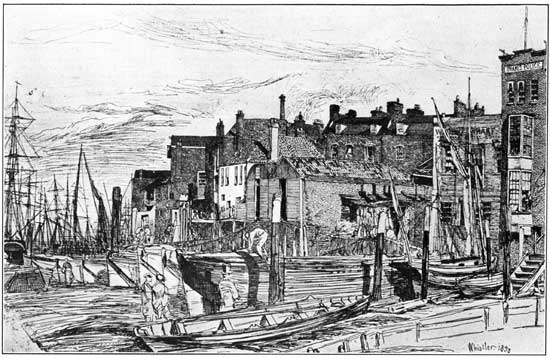
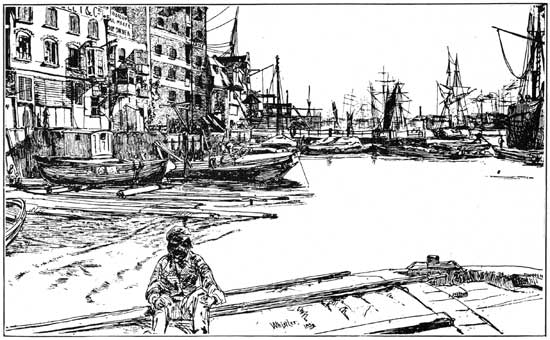
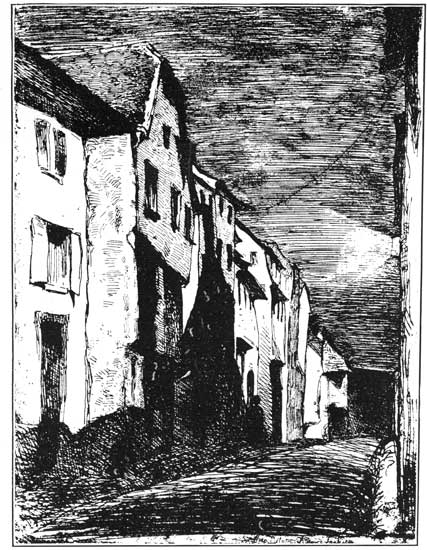
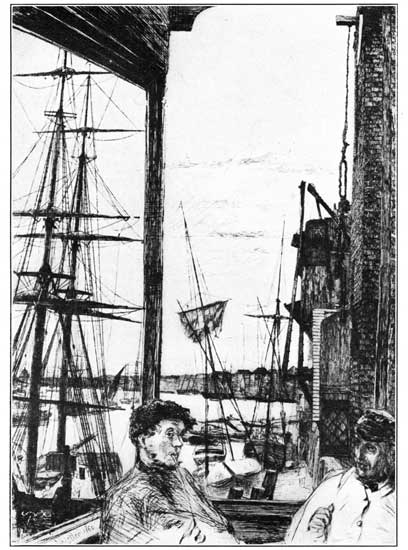
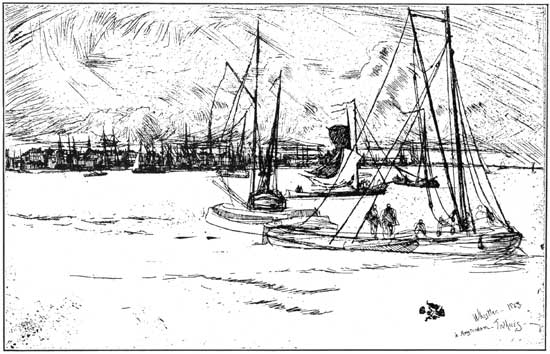
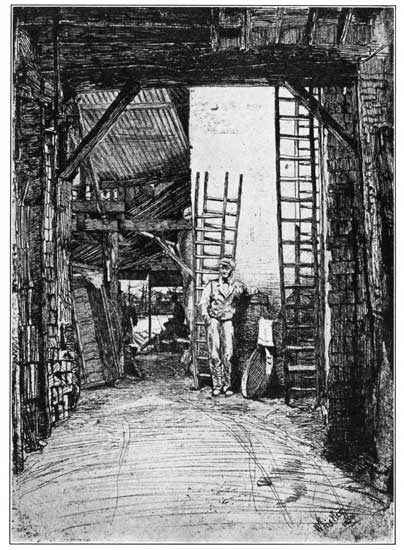
WAPPING WHARF (ETCHING).
The relatives present included the Misses Philip and F. L. Philip, Mr.
and Mrs. Cecil Lawson, Mr. and Mrs. Charles Whibley and Edwin W. Godwin.
Although no announcement of the funeral was made in London papers many
distinguished friends and acquaintances crowded the church. Beautiful
wreaths were sent by Vanderbilt, Lawrence, Alma Tadema and various
federations and societies. Those present were: George W. Vanderbilt, Mr.
Joseph Pennell, Rev. H. C. Leserve of Boston, Johnson Sturges, R. F.
Knoedler and I. M. B. MacNary of New York City; M. Dumont of the
International Society of Painters; Marcus Bourne Huish, editor of the
"Art Journal;" Thomas Armstrong; and Alfred East (A. R. A.).
When a reporter called at the house July 18th he was informed that the
artist had left stringent instructions that no information whatever
regarding his illness or death should be given either to his friends or
the newspapers. He remained true to his eccentricities, or rather to his
peculiar personality. Even in his exit from this life to the thrones of
glory beyond, he endeavoured to make it as odd and picturesque as
possible. He played his part to the last. And it was one of the noblest
parts ever played by man.
[Pg 39]