The sphere pulsed again. But this time no flaming whip sprang
from its surface. There was a single flash. For an instant Taylor
caught a glimpse of bestial eyes, looking angrily at him from the
center of the flash. Then there was nothing. He was in the
darkness of a tunnel. Even the charred embers of the wooden trap
door above him seemed dimmed by a cloud of dust.
The sphere had simply exploded.
Taylor had no time to analyze the situation. His hands groped
along the side of the tunnel, the one Norden had used to enter
the plant on his spying expeditions. Taylor crawled slowly,
feeling his way. It seemed eternity until at last he reached the
end of the passage and felt the trap door overhead.
A minute later he rejoined the others, huddled in darkness
outside the gate.
"The searchlight went out," Masters explained. "Something wrong
with the power, I guess."
"I know what it was," Taylor said gruffly. He turned to the
disarmed sentry. "Has anyone come out of here since the factory
stopped working?"
"Nobody but him, sir," the soldier said, jerking his thumb at the
sobbing man huddled against Norden. "He said his name was
Orkins—Jim Orkins. He works in the warehouse. But you can't tell
anything about the rest o' what he says. He just babbles, sir.
Something about livin' lightnin' and balls of fire. He ain't
drunk, sir, so he must be crazy."
"Help him get up," Taylor ordered. "Masters, you take charge of
Norden. We're going back to the car."
"Excuse me, sir," the sentry said, hesitantly. "But that's
against orders. I can't leave. I'm to guard this gate, sir."
"Your orders are canceled," the captain said.
"If I desert my post, it's court martial," the sentry explained.
"How do I know you aren't a spy? Captains don't go around making
privates break the orders of the day. If you've got business in
the plant, why was I told to keep everyone out? Why didn't they
tell me to pass Captain Taylor? I got a duty here and I'll do it
if it kills me. So help me, sir. Sergeant o' the guard!"
The echo of the sentry's bellow rattled against the bleak factory
buildings. A sphere bobbed up through the hole in the roof.
Orkins opened his mouth to scream, but Norden clapped his hand
over the man's lips, choking him off.
"Quiet!" Taylor ordered hoarsely. He addressed the sentry: "See
that thing? It means death to you, to all of us if it finds us.
The sergeant of the guard, probably all of the other sentries are
dead. Every workman in the plant is dead. Somehow we were missed.
The searchlight power went off before they found this post, I
suppose. Now then, all of you follow Masters back to the car.
I'll bring up the rear."
"I won't leave," the sentry said, stubbornly.
Masters stepped forward and put his pistol against the soldier's
back.
"You'll go," he said. "Maybe this ain't regulation, but neither
are the spheres."
The stubby little secret service man pushed the soldier ahead of
him. The sentry marched with his hands in the air.
Drawing his own pistol, Taylor turned to Norden.
"Help Orkins to the car," he said.
Norden drew himself up stiffly.
"Go ahead and shoot," he said. "It'll save the firing squad some
trouble."
Taylor took one step forward. Norden faced him unflinchingly.
Taylor's hand shot out, caught Norden's coat and threw him after
Masters.
"Don't leave me alone!" Orkins cried, crawling after Norden and
clasping him about the legs. Norden kicked him aside.
"Keep moving!" Taylor ordered Norden, who had halted.
Norden did not move.
Taylor swung his fist. The blow connected and the officer caught
the falling man, swung him over his shoulder, then turned to the
cringing Orkins.
"If you don't want to be left here alone, follow us," he said.
Orkins suddenly regained his ability to use his muscles.
Masters, watching over his shoulder, chuckled. There was a faint
wink of one eye visible in the moonlight.
"Kinda screwy, ain't he?" he said, jerking his head in Orkins'
direction.
"I don't know that I blame him, much," Taylor said. "Look at the
plant."
Over the roof and the smokestacks floated the yellowish-red ball
of fire. Another sphere was emerging from the hole in the roof.
"What are they? A new kind of bomb?" Masters asked.
"Norden's bomb never had a chance. Compared with what actually
happened in there, a bomb would have been a picnic. There's not a
living person left in the whole place."
"Not a—hold on there, Cap! Do you know how many were working?"
"They're all dead," Taylor said. Briefly he outlined what he had
seen in the plant.
"Norden, the blankety-blank!" Masters swore. "Shooting's too good
for him."
"This isn't connected with the war—at least not directly. It's
something else, Masters. What, I don't know yet, but I'm
beginning to think that it's something the human race has never
met before. Those spheres have killed a couple of hundred workers
with bolts of energy—"
"I'm no scientist, captain."
"That's the best I can describe this force, Masters. I might call
it heat-bolts, but it's probably partly electric and partly heat,
not entirely either. You see, Masters, heat is energy, just like
electricity and light. The energy these spheres shoot out is a
mixture of energies. We can imagine a spark of electricity
shooting out and striking a man like a bolt of lightning, but
it's hard to visualize heat behaving that way."
"Say, mister," the sentry interrupted, "my arms are getting
tired."
"Okay, buddy," Masters replied. "If I let you put your arms down,
will you behave like a nice little boy?"
"I'll be a perfect angel," the sentry said, lowering his arms.
"You'll be an angel if you aren't, too," Masters added.
"What's your name, soldier?" Taylor asked the sentry.
"Private Pember, sir. Company A, 110th infantry—"
"All right, Private Pember, you can carry this fellow."
Taylor shifted the faintly stirring Norden to the shoulders of
the soldier.
"If it will make you feel any easier, Pember," the captain went
on, "I can assure you that exigencies demanded your removal from
your post. Your life was in danger and you could do no good by
remaining there. In fact, there was nothing left to guard. You
can do more good for your country by coming with us."
"Yes, sir," Pember said. "I guess you are right, captain."
"You're a good soldier, Pember," Taylor went on. "A situation
like this is unique. It demands use of individual initiative,
rather than blind obedience to orders. Do you understand?"
"Yes, sir," Pember said, adjusting the burden on his shoulder.
They reached the car.
A dozen of the orange-red globes now floated above the plant.
They were circling slowly, in widening arcs, toward the limits of
the factory grounds.
"Searching for human beings," Taylor decided, watching them.
Orkins clutched Taylor's coat tails.
"They're coming out!" he cried. "There's hell to pay."
Taylor took Orkins' arm and forced him down on the running board
of the car, where Norden already was coming out of his daze.
"Keep quiet!" Taylor ordered. "They'll discover us."
"They'll find us anyway!" Orkins said, frantic with fear. He
groaned loudly.
"Okay. He asked for it," Masters said.
There was a splatting sound as Masters' fist landed. Masters made
a face over a distasteful duty done and turned to Pember:
"Put them both in the car." He indicated Norden. "Here's
handcuffs. Lock them together."
Taylor and Masters watched the circling spheres. Suddenly one
darted down. From its pulsating body shot a flash of flame. A
human scream rent the air.
"It's the darnedest thing I ever saw," Masters said with a
shudder. "Those fireballs squirt heat-electricity out at a guy
and roast him!"
"Yes," Taylor said with a nod, "and that isn't all. Those spheres
act as though they were alive. When that one went out above the
opening of the tunnel, I thought I saw a pair of eyes."
Masters studied the assertion, then spoke:
"Captain, I may look dumb, but I've been in the secret service
long enough to be found out if I really am. I've a hunch you
killed that sphere."
"I've thought of that, but how could I? I didn't touch him."
"Maybe you don't have to touch 'em to kill 'em. We don't know
what they are, except they're different—"
"We don't know the real natures of anything, as far as that
goes. Man's a mixture of chemicals, but that doesn't explain him.
The spheres are a mixture of energies—we can observe that much,
but it still doesn't explain them. Where are they from? Why did
they come here? What are their primary objectives?"
"Primary objectives? That's a military term, ain't it?"
"Partly military, and partly scientific. We know the secondary
objective of the spheres. It's the same as man's or any other
living creature. The spheres are alive and their objective is to
keep on living, but that isn't their primary motif. The primary
objective is the difference between a good man and a bad one.
Whatever is more important to a man than life itself is his
primary objective."
"Life's pretty important," Masters said, solemnly.
"Yes, but life isn't everything. Any man, no matter how yellow or
mean he is, has some ideal he's willing to die for—or at least
he's willing to risk dying to attain. Look at Norden. He's hard,
cold-blooded and he doesn't think twice about putting a bomb in a
plant to wipe out scores of lives. He dared me to kill him,
rather than help us. His code as a spy is his primary objective.
Look at Pember. He must have been frightened by the spheres, but
we had to force him to leave his post. We've shown him that his
duty now is with us—he realizes that the spheres are the
immediate enemy of his country and he'll do his best fighting
them. And you and I have ideals—we know each other too well to
list them."
"I getcha so far, but what about Orkins?"
"The man's not afraid of death, but afraid of the unknown. Men
like him commit suicide rather than face reality. He wants
security. He's afraid of uncertainty. He lives in an unreal,
imaginary world and when uncertainty, which is reality, intrudes,
he is completely lost."
"You make me feel sorry for the poor devil."
"That's because you understand why he's funky. Primary objectives
make men do what they do—but understanding Orkins doesn't solve
our problem."
"No. What are the spheres? Are they alive? If so, they must want
something. What do they want?"
"A conquest of the human race?" Taylor pondered. "Maybe. But it
isn't likely. They can't gain much by conquering us. It wouldn't
do man any good to stage a conquest of earthworms and swordfish,
since neither could pay taxes. The spheres are as different from
man as man from an angle-worm. Are we a menace to the spheres?
Apparently the only time we really menace them is when we crawl
into a hole like a rabbit—maybe there's something in that that
will help us, but I don't think that's why they kill us. Are we a
nuisance? If so, why? Are we a food? There is energy in sunlight
and chemicals in the human body. A creature of energy would feed
on something like sunlight, not chemicals. His menu would be
electric wires, storage batteries—"
"Great Scott, Captain!" Masters interrupted. "Let's get away from
this car. There's a battery in it—food for the spheres!"
Masters looked nervously up at the circling globes. Taylor, deep
in thought, did not stir. Instead, he continued his speculation:
"Maybe they kill us for sport."
He was thinking of small boys torturing frogs; of Roman emperors
at the circus; of sportsmen exterminating game; of the mob
watching the guillotine on the streets of Paris. It was
Zarathustra who said that when gazing at tragedies, bull fights
and crucifixions, man has felt his happiest; and when man
invented hell, he made hell his heaven on earth. Couldn't this be
a characteristic of all life? Couldn't the spheres be cruel and
ruthless, too?
Man, the mighty hunter, had become the prey.
A sphere detached itself from the group and circled toward the
car.
"I guess you're right, Masters," Taylor decided as he watched the
spheres. "We'd better move."
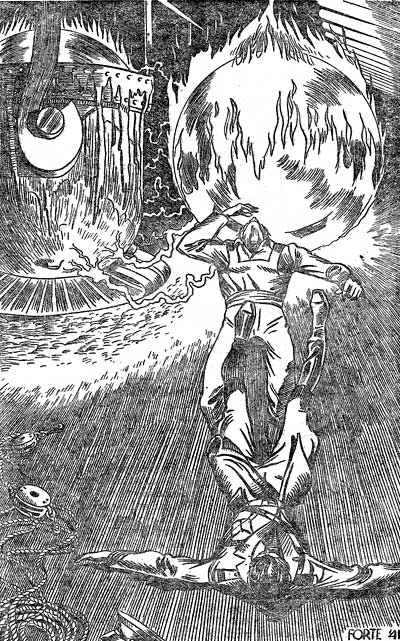 Something—like an inner eye—glowed for just a
moment as the sphere advanced.
Something—like an inner eye—glowed for just a
moment as the sphere advanced.