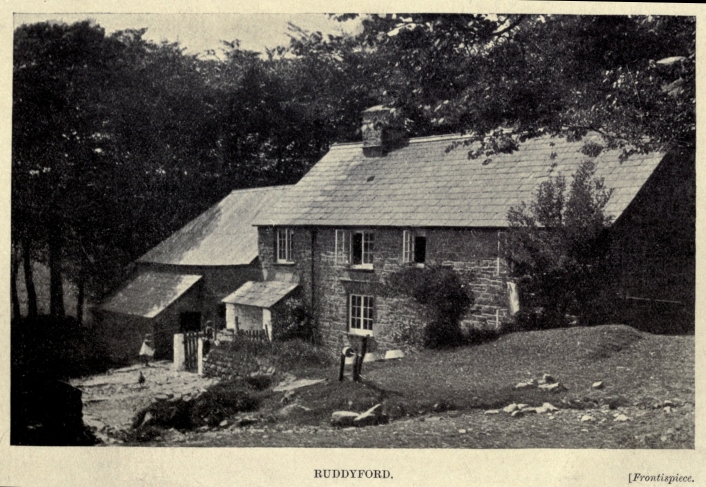
In the struggle between Daniel Brendon and Jarratt
Weekes, circumstances combined to strengthen the former's
cause at every point. Right, as a matter of fact, was on
his side, but what promised to be a greater source of
strength, he found in Sarah Jane. The ingenuous and fearless
character of his betrothed and her intrepid handling
of truth, albeit embarrassing enough at times, made her
strong against enemies of the type of Jarratt Weekes.
Moreover, the lovers had many friends; the castle-keeper,
few. His mother tried to help him; but she was honest
and her shifts proved absolutely futile. She could only
suggest that Jarratt should see Sarah Jane and argue with
her the folly of such action. She herself invited Gregory
Friend's daughter to tea, and used what powers of persuasion
she possessed to turn the girl. She also saw Mr. Friend,
and showed him the advantages of a union with the Weekes
family. Her attacks were direct and straightforward;
therefore they failed. Neither did Jarratt's more tortuous
methods win him any advantage. He worked what little
harm he could, but it amounted to nothing. Daniel's record
was clean; he had a reputation for sober-mindedness; no
man could tax him with wrong-doing. To separate him
from Sarah Jane at any cost became the castle-keeper's
problem; but, while achieving this deed, it was vital that
the woman's regard for Jarratt should be increased rather
than lessened; and the double task proved altogether beyond
Jarratt's power.
He trusted that Hilary Woodrow might prove an obstacle,
and that marriage must at least mean dismissal from
Ruddyford; but even here his hopes were disappointed.
Matters combined at the farm largely to advance Daniel
Brendon's ambition, and a tower of strength appeared in a
quarter from which little might have been hoped. Tabitha
Prout smiled upon the match, first from kindness of heart,
secondly to gain private ends. Another woman at Ruddyford
had long been her desire. She sounded Brendon first,
then finding that he approved, approached her master.
The person most vitally involved in Tabitha's plot was her
own brother; but she knew that John would make no
difficulties, and therefore left him until the last.
"Does your maiden know anything about milk and
butter?" she asked Daniel, on an occasion when they were
alone.
"Can't say she does; but there's nothing she couldn't
learn in a few months—quick as light at learning she is,"
he answered.
Then Tabitha proposed that Sarah Jane on her marriage
should come to Ruddyford as dairymaid.
"As things go," she explained, "'tis all sixes and
sevens; and now the boy milks, and now Tapson do, and
there's no proper system to it. But with our cows, few
though they be, a dairymaid ought to be kept; and she'd
help me here and there—I expect that. And if she comes,
we ought to keep three more cows, if not four. I only
want to know if you be willing. 'Tis worth your while,
for if that was planned, you could bide here after you're
married and wouldn't have to look round again."
"Too good to be true, Tabitha Prout; yet none the less
a great thought; and I lay you'd find Sarah Jane your
right hand if she did come. But where could us bide?"
"That's easy enough. The difficulty is with Mr. Woodrow.
However, I'll have a tell with him and put my grey
hairs and increasing age as strong as I can. I'm overworked
without a doubt. This place has suffered from lack
of females for years, and I won't have no more boys, so
I've got to do it all—save for the messy, silly help you
men give. But there 'tis: with his hate of 'em, I doubt
if he'd stand a young woman about the place."
"I wonder. Make a point of the extra cows, Tabitha.
That might win him; and as for Sarah Jane, by the time
we'm married, I'll promise for her that she knows the whole
craft of milk and cream and butter near so well as you do."
But Tabitha would not allow that.
"In time—in time. She won't have my hand to butter
in six months, Daniel—perhaps not in six years.
Butter-making's born with a woman. But I'll teach her so much
as she can learn. Not that anybody ever taught me—save
nature and my own wits."
Joe Tapson entered at this moment, knew not of the
argument, but heard Tabitha's self-praise and sneered at
her. They often wrangled hotly about the relative powers
of the sexes; for while Tapson was a cynic touching
womankind, Tabitha declared that she had seen too much
of men in her life to have any admiration left for them.
"'Tis about Sarah Jane and work," explained Miss Prout.
"Work?" he said. "What about work? Let her do
her proper married woman's work and get boys.—plenty of
'em—eh, Daniel?"
Tabitha sniffed scorn upon him.
"Always the way with you vainglorious creatures.
'For us to be mothers and get boys'—the conceit of it!
As if there was nothing else for a woman to do beside that!"
"Nothing—except get girls," said Joe bluntly. "There's
nought else in the world that men can't do a darned sight
better than females. Don't you deceive yourself there.
Why, look around—even to cooking and sewing; tailors and
men-cooks beat you out of the field, when first-class work
has to be done. You work hard enough—too hard even in
your way; yet the likes of you—to say it in a perfectly
kindly spirit—don't really do much more than cumber the
earth. Women be wanted for the next generation—not
for this one. Their work lies there; and when you talk
about the value in the world of all you frost-bitten virgins,
I'm bound to tell you, without feeling, that 'tis only in
your own imagination."
"You speak like the withered stump of a married man
you are," she answered indignantly. "I blush for you—you
to lecture me! 'Tis a good thing you've no finger
in the next generation, I'm sure; and I lay the happiest
moment in your wife's life was the last."
But Joe had not finished. He smiled at her temper and
spoke again.
"Why, my dear soul, after the business of child-bearing's
done, you ban't so much use as cows; for they do give
us milk; but such as you yield nought but vinegar."
"What things to say!" exclaimed Daniel; "who ever
heard the like?"
"Truth's truth; and the sharp truth about women none
knows better than me. But all the same——"
"Shut your mouth and get out of my kitchen," cried
Tabitha. "What woman could be blamed for treating you
harsh? To insult the whole of us—a poisonous, one-eyed
rat like you!"
"A one-eyed rat I may be," retorted Joe; "but I can
bite, and 'tis easy to see the force of my words by the heat
of your temper. You hate men, and I hate women, so all's
said."
The question to be answered was Hilary Woodrow's
attitude towards the suggestion of Sarah Jane as dairymaid.
He had heard that Brendon was going to be married, and
supposed that the giant would leave Ruddyford upon that
event. But he cared little whether Daniel went or stopped.
The problem of labour on a Dartmoor farm was far less
acute fifty years ago than at present, and the master knew
that Daniel's place might easily be filled. He listened to
Tabitha's arguments but withheld judgment until he had
consulted his head man. John Prout, however, approved,
and himself disposed of the only difficulty attaching to the
plan.
"I think very well of it," he said, "and to show how
well, I'll help by coming to live here, and letting Brendon
have my cottage. That makes all clear. She's a very
nice, strong maiden, and Tabitha's right when she says
we want another woman about the place. There's too
much on her shoulders now. You'll do well to let it be
so, master; and then the girl can set about learning her
work straight away and be useful from the start."
Thus the matter fell out, to Sarah Jane's delight; and
her father was also well pleased, because his daughter
would henceforth dwell close to him. The woman asked
for no assistance or advice in the conduct of her life
henceforth. Her object was swiftly to master the business of
the dairy, and to that end, after conversation with Tabitha
Prout, she went to Lydford and saw Mrs. Weekes.
Whether Hephzibah could be expected to serve her, Sarah
Jane never stopped to consider. Nobody knew more about
the local dairy-farmers than the wife of Philip Weekes;
nobody therefore was better able to help Gregory Friend's
daughter, if she chose to do so. But Hephzibah apparently
did not choose.
"To have the face to come to me! 'Tis enough to make
angels weep tears of blood, Sarah Jane," she said. "You
throw over the best men in Lydford and go your own wild,
headlong way to misery; and let me waste torrents of
advice upon you; and then walk in, as if nothing was the
matter in the world, and ax me to get you a larner's place
along with cows! What you'll come to, be hid with your
Maker, for no human can guess it. Never was such a
saucy wench seen or heard of. You'll be asking me for a
wedding present next, I suppose."
"Don't see no reason why not," said Sarah Jane. "I
can't marry two men, I believe; and I love one and don't
care a rush for t'other, so there's an end to it. Because
you wanted for me to take Jarratt and I ban't going
to—that's no reason why you shouldn't do me a kindness."
"Loramercy! you talk just like a man. If you don't
carry a heart under your ribs, I do. You wait till you've
got a proper son as hankers after a girl, and she won't
have him—then we'll see how 'tis. Don't you never ax me
for the price of a shoe-lace to keep you from the union
workhouse, Sarah Jane, because you won't get it."
Sarah laughed pleasantly.
"For all you scream out at everybody, like a cat when
his tail's trod on, you're my sort, Mrs. Weekes. You say
what you think—though you may think wrong as often
as anybody."
"You'm an outrageous baggage," said Hephzibah, "and
I won't bandy no more words with you. Not a hand—not
a finger will I lift to help such a thankless fool of a woman.
Go to Mrs. Perkins at Little Lydford, and get out of
my sight, else I'll put my ten commandants on your
face!"
Thus, despite her ferocity and terrible threats,
Mrs. Weekes told Sarah Jane exactly what she wanted to know;
and Hephzibah knew that she had done so, and scorned
herself in secret for a silly fool. But her nature could not
choose but like Sarah Jane. In secret she loved all fearless
things. Therefore, while hating the girl because she would
not take Jarratt, Mrs. Weekes had to admire her because
she was herself.
The work that Sarah Jane wanted was found for her,
and during the next three months she disappeared from
Amicombe Hill. Sometimes on Sundays, however, she visited
her father. She worked as hard as she possibly could,
proved an apt pupil, made new friends at her temporary
home in Lew Trenchard, and saw Daniel Brendon now and
then. She also wrote to him and her father.
Meantime her betrothed planned his future, calculated
the cost of new furniture for Mr. Prout's cottage, and made
himself very useful to that large-hearted man.
John Prout was quite content to return to the farm and
live under the same roof as his master. For some reasons
he relished the change, since it would now be easier to
devote a little more personal attention to Hilary. He could
see no faults in him; he pandered to Woodrow's lethargic
nature as far as he was able; he stuck stoutly to it that
the farmer was not a robust man and must be considered
in every way possible.
The time sped and Winter returned. Then Sarah Jane,
her education with regard to milk and butter complete,
came home, and Daniel began to clamour for marriage.
Mr. Friend finally decided that the season of Spring should
be chosen. For himself he had planned to live henceforth
in a little building at the peat-works. He held that a few
slates and stones, some mortar and a pail of whitewash,
would render it habitable. An engineer had paid one of
his rare, periodic visits to the works, made some suggestions
and departed again. Therefore Gregory was full of
new hopes. There had also come increasing demands for
Amicombe peat from various sources, and he was very busy
with a trolly on the old tram-line. He loaded it from his
stores, then steered it down the winding ways of the Moor,
discharged his fuel near the railway station, and, with one
strong horse to drag the trolly, climbed back again to his
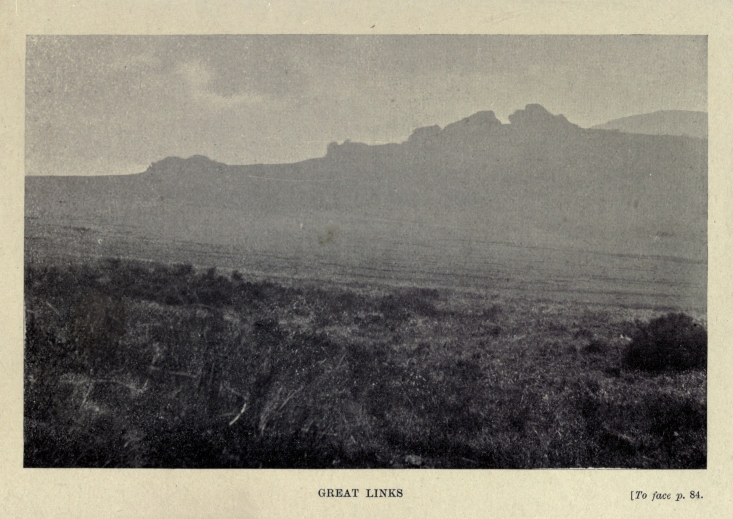
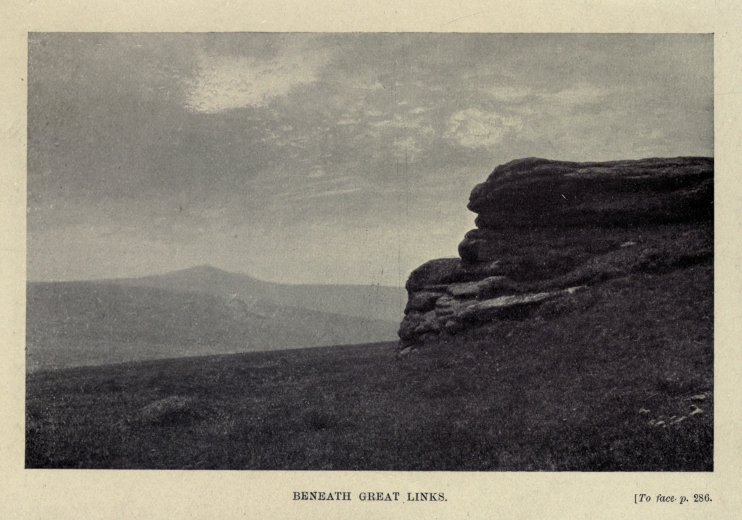
boggy fastness behind Great Links.
The banns were called at Lydford, and Sarah Jane and
Daniel listened to them. He burnt under his brown skin;
she betrayed interest, but no visible embarrassment.
At this season Jarratt Weekes was much occupied by
business, into which he plunged somewhat deeply as a
distraction. Widow Routleigh passed away, and it was known
that her cottage had been purchased by the castle-keeper;
but circumstances suspended the operations on the water-leat,
and its advent at Lydford became delayed by a year.
Therefore the advantages accruing to his new property were
not yet patent to every eye, and only Jarratt and his mother
knew the real quality of his bargain. In other directions
he had obliged his enemy Mr. Churchward with a loan,
because an opportunity arose for putting "the Infant,"
Adam's son, into business. William Churchward joined
a bookseller in Tavistock. The occupation, as his father
explained, was genteel and intellectual, and might lead to
higher things. From William's point of view his work was
sedentary and slight, and led to hearty thirst after the
shutters were put up. He lived with his senior partner,
pursued his efforts at picture-painting, and often came home
at the end of the week.
No further meeting to discuss the water-leat celebrations
had been called after the postponement was announced. But
Mr. Churchward only waited a fitting time to proceed with
his plans. The committee was understood to continue to
exist, and Mr. Nathaniel Spry still flattered the
schoolmaster; Mr. Norseman still went in doubt as to the
propriety of the enterprise; Mr. Pearn still talked about his
free luncheon; and Mr. Huggins still laboured under the
thought of impersonating Moses.
Then came the wedding day and the wedding ceremony.
Save for the master, Ruddyford was empty, because all
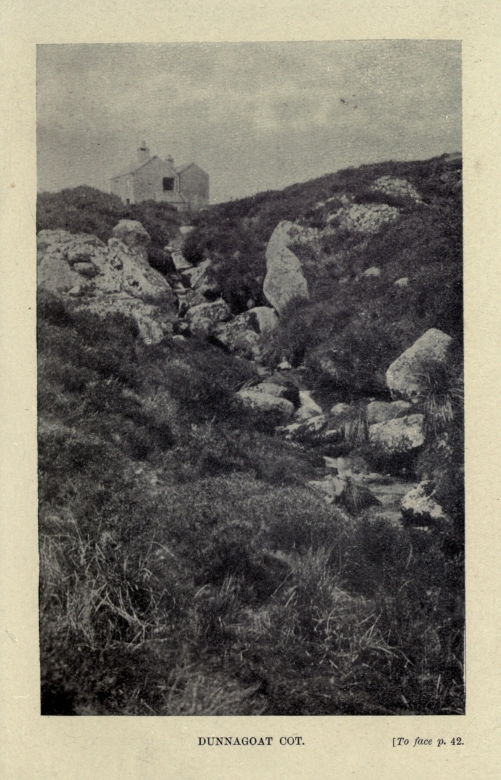
asked and obtained leave to see Daniel married. Dunnagoat
cot was not large enough to hold the wedding guests, and
its inaccessible position made it impossible in any case.
Therefore Mr. Friend, who insisted on straining his
resources to the extent of a banquet, borrowed an empty
cottage near the church, and with the assistance of
Mr. Pearn and his staff, arranged a very handsome entertainment.
There were present the company from Ruddyford; and
Mr. Churchward and his daughter also accepted Gregory's
hospitality; for Mary Churchward and Sarah Jane were old
acquaintance, and Mary, in secret, had liked Sarah Jane
the more for refusing Jarratt Weekes. Mr. Huggins,
Mr. Norseman and the latter's wife also attended; and five or
six other men and women, with their grown-up sons and
daughters, completed a throng of about twenty persons.
Many more came to the church ceremony, and all frankly
agreed that such a splendid man and woman had not within
living memory been linked at St. Petrock's. But the house
of Weekes was unrepresented, save by Susan. She had
taken occasion to run away at dawn; and she thoroughly
enjoyed the great event, without any uneasiness as to the
future. Her aunt would be far too interested at learning
all particulars, to waste time in reproaches and admonishment.
So Daniel Brendon and Sarah Jane Friend were wedded,
and, having spent a week in Plymouth and watched the
wonder of the sea, they returned to their little home at
Ruddyford and joyfully set about the business of life.
Dawn had woven her own texture of pearl into the fabric
of the Moor, and the sun, like a great lamp, hung low upon
the shoulder of the eastern hills. Silence brooded, save for
the murmur of water, and all things were still but the
stream, upon whose restless currents morning wrote in letters
of pale gold. The world glimmered under sparkling moisture
born of a starry night, and every blade of grass and
frond of fern lifted its proper jewel to the sun. Peace
held the waking hour a while, and living man still slept as
soundly as the old stone heroes in their forgotten graves
beneath the heather. Then newborn things began to suck
the udder, or open little bills for food. Parent birds and
beasts were busy tending upon their young. The plovers
mewed far off, and swooped and tumbled; curlews cried;
herons took the morning upon their wings and swept low
and heavily to their hunting grounds.
Young dawn danced golden-footed over the stony hills,
fired the greater gorse, lighted each granite pinnacle like a
torch, flooded the world with radiance, and drank the dew
of the morning. Earth also awoke, and her sleeping garb
of pearly mist, still spread upon the river valleys, at length
dwindled, and glowed, and burnt away into the ardent air.
Then incense of peat-smoke ascended in a transparent veil
of blue above Ruddyford, while from the cot hard by came
forth a woman.
Sarah Jane had been at her new life a week, and began
to know the cows and their characters. They waited for
her now, and soon the milk purred into her glittering pails.
First the note of the can was sharp and thin; then, as the
precious fluid spirted, now right, now left, from the teats
under Sarah's firm fingers, the vessel uttered a milder
harmony and finally gave out only a dull thud with each
addition. The cows waited their turns patiently, licked
one another's necks and lowed; as yet no man moved, and
the milker amused herself by talking to the kine. She sat
with her cheek pressed to a great red flank, and her hair
shone cowslip-colour against the russet hide of the beast.
Her splendid arms were bare to the elbow. Already
something of the past had vanished from her, and in her eyes
new thought was added to the old frankness. She thought
upon motherhood as she milked these placid mothers; she
perceived that the summer world was full of mothers
wheeling the air and walking on earth. Wifehood was
good to her, and very dearly she loved the man who had
led her into it.
Sarah Jane whistled sometimes when she felt unusually
cheerful. She whistled now, and her red lips creased up
till they resembled the breaking bud of a flower. The sounds
she uttered were deep and full, like a blackbird's song, and
they made no set tune, but rippled in harmonious, sweet,
irregular notes, as an accompaniment to kindred thoughts.
Suddenly feet fell on the stone pavement outside the
cow-byres, and a man approached where she sat and milked
the last cow. The others, each in turn, her store yielded,
had passed through an open gate into the Moor, there to
browse and repose and chew the cud until another evening.
Sarah Jane glanced up and saw Hilary Woodrow standing
and looking at her. As yet she had but seen him once upon
a formal introduction; now he stopped and spoke to her.
"Good morning, Mrs. Brendon. I hope your house is
comfortable, and that you are settling down. Let Tabitha
know if she can do anything for you."
"Good-morning, sir, and thank you. 'Tis a very snug
li'l house, and nothing could be nicer."
He nodded. Then the last cow went off, and Sarah Jane
rose, patted it on the flank and stretched her arms. He
remarked her height and splendid figure.
"Rather cramping work, I'm afraid," he said.
"'Twas at first, but I like it better now. Cows be nice,
cosy creatures an' terrible understanding. Some's so
peaceful an' quiet; an' others that masterful they won't take
'no' for an answer, an' push afore the patient ones and
get their own way, and will be milked first."
He nodded once more and smiled. Then she washed her
hands in a granite trough of sweet water and spoke again.
"You'm moving early," she remarked, in her easy and
friendly fashion. "John Prout said you always laid late
for health, yet you be up afore the men."
"I slept badly and was glad to get out into this sun."
"You'm over-thin seemingly, and have a hungry look,
sir. Here—wait a minute! Bide where you be, and I'll
come back afore you can count ten!"
She vanished into Ruddyford, and Hilary, wondering,
watched her swift, splendid speed. In a moment she
returned with an empty glass. She filled it from the
milk-pail and held it to him.
"Drink," she said. "'Tis what you'm calling out for."
"I can't, Mrs. Brendon—raw milk doesn't suit me."
"Don't you believe that! Milk hot out of the cow suits
everybody. Take it so, and you'll get rounder and happier
in a week. My own father was largely the better for it.
Try, sir; do please."
He could not resist her eyes, and took the glass from her
hands and thanked her.
"Here's good luck and all prosperity to you and your
husband," he said, and emptied the glass.
Her face brightened with pleasure.
"Lick your lips," she begged. "Don't lose a drop of
it: 'tis life—milk's the very beginning of life—so my
mother used to tell."
"And do you think this cup is the beginning of mine?"
"No—yours beginned fifty year ago by the look of you.
But milk will help you. You're just the thin, poor-fed
fashion of man as ought to drink it. My Daniel's different.
With his huge thews he must have red meat—like a dear
old tiger. Milk's no use to him."
"By Jove—d'you think I look fifty, Mrs. Brendon?"
he asked.
"To my eye, I should guess you wasn't much under.
Beg pardon, I'm sure, if you be."
"I'm thirty-six," he said.
"My stars! Then you ought to take more care of yourself."
"I sleep badly."
"You think too much belike?"
"Yes—there's a lot to think about."
"You did ought to put a bit of wool round your neck
when you come out in the morning air, perhaps," she
suggested; but he laughed at this.
"Good gracious! I'm not made of sugar. I look a giant
of strength beside town folk. 'Tis only in your eye that
all of us seem weaklings beside Brendon. To tell you the
truth, I'm rather a fool about my health. I said just now
I had so much to think about: don't you believe it! I've
got nothing to think about—hardly more than the cows.
Now, I mustn't waste any more of your time."
He sauntered on towards the Moor.
Daniel Brendon was standing at his entrance as
Woodrow approached, and he touched his hat and said—
"Morning, sir!"
"Morning, Dan," the master answered and passed on.
Sarah Jane took her milk-pails to the dairy, and then
went home to breakfast. She chattered to her husband,
narrated her morning's experience, and explained at length
her theories of Hilary Woodrow.
"To think as he be no more than six-and-thirty!" she
said.
"How d'you know that?"
"He told me. I forget how it went, but I'd just said
I reckoned he was fifty, and he seemed rather troubled."
"Fancy your speaking like that!"
"He don't look much less, all the same. And I gave
him a bit of advice too."
"Advise him! Nought stops you," Daniel said with his
mouth full.
"Why should it? After you've been married a month—there
'tis—you've got more wisdom and understanding of
menfolk than a century of maiden life could bring to 'e. I
feel like a mother to these here helpless men a'ready."
"Never was such a large-hearted female as you, Sarah
Jane."
"What that man wants is a wife. I couldn't have read
him any more than you could a bit ago; now 'tis as plain
to my understanding as this cup of tea. A wisht, hangdog,
sorrowful face to my eye; yet very good-looking in
his thin way. But hungry—awful hungry."
"As to women, he's had enough of them. One treated
him shameful. But 'tisn't them: 'tis his terrible vain
ideas about religion makes him fretful, I reckon. Well he
may be hungry!"
"Don't you believe that," she answered. "Church-going
don't put fat on the bones, whatever else it may do.
He should have a female after him, to fuss a bit, and coddle
him, and see he lets his proper food down. He wants
somebody to listen to his talk—somebody to sharpen his
wits on."
With startling intuition of truth she spoke; but Daniel
did not appreciate her discernment.
"Fewer that listen to his talk, the better," he said.
"Ban't likely Mr. Woodrow will be happy so long as he
sucks poison out of all sorts of godless books."
"Poison is as poison does," she answered. "Everybody
says he's a very good sort of man. The good man
can't be godless."
"Because his Maker's stronger than his opinions and
ban't sleeping, though Woodrow's conscience may be. In
time of trouble I wouldn't give a rush for his way. There's
nought to help then but Heaven; and so he'll find it. Not
that I judge—only I'm sorry for it."
"He wants a woman after him," repeated Sarah Jane
decisively.
Daniel laughed at her.
"You think, because you and me are married, that
nobody can be happy otherwise."
"Men and women must come to it for sartain, if they'm
to be complete, and shine afore their fellow-creatures. A
bachelor's an unfinished thing; and so's a maiden—I don't
care who she is. And she knows it at the bottom of her
heart, for all she pretends different."
"That's not Christianity," Daniel answered; "and you
oughtn't to say it, or think it. You speak in the first flush
of being married; and I feel just the same and scorn a
single man; but 'tis silly nonsense, and we'm both wrong.
The saints and martyrs was mostly single, and the holiest
Christians that ever lived haven't found no use for women
as a rule. Christ's Self wasn't married for that matter."
She considered this view, then shook her head unconvinced.
"He went to marriages and was kind to the women.
He might have found the right maiden Himself, and won
joy of her after He'd set the world right, if they hadn't
killed Him."
Daniel stared.
"Don't say things like that, Sarah Jane! You don't
mean it for profane speaking; but 'tis very near it, and
makes me feel awful scared."
"What have I said now, dear heart? I never know
what you think 'bout things. You change so. If 'tis holier
and better to bide single—but there—what foolishness!
Jesus Christ set store by little children anyway; and He
knowed you can't have 'em without getting 'em."
Brendon rose up from the table and kissed her neck.
"You'm a darling creature," he said, "and to look at
you be to make single life but a frosty thing in a man's
eyes, no doubt. Certainly 'twould be false for me to say
a word against marriage; only it ban't for all; and the
Christian religion shows that there are many can do more
useful work out of it than in it."
"Poor things!" she said in her pride. "Let 'em do
what they can, then. But I'd be sorry to think that a
churchyard stone, getting crookeder every year, was all
that was left to remember me by when I went."
"That's your narrowness, Sarah. There's other
contrivances beside babbies that a man or a woman can bring
into the world. Goodness and proper actions, and setting
an example, and such like."
"Parson's work," she said. "What's that to taking
your share in the little ones? If I thought us should have
no childer, I'd so soon hang myself as not, Dan."
"Your ideas do hurtle about my ears like hail," he said,
"And they'm awful wild and silly sometimes."
"I know it. You'll larn me better come presently."
"I hope so," he said. "You're all right at heart—only
the pattern of your ideas now and then be a thought too
outlandish for a Christian home. You wasn't taught all
you've got to larn. I don't say it out of no disrespect to
father; but—well—us all have a deal to larn yet—the oldest
and youngest—and me most of all."
Daniel heaved a contented sigh upon this platitude, and
his day's work began.
The Brendons always went to morning service at Lydford
on Sunday. Sometimes Mr. Tapson, who was a churchman,
accompanied them; but Agg and Lethbridge belonged
to another sect, and their place of worship was at Mary Tavy.
Neither John Prout nor his sister ever went. Indeed,
Sunday dinner occupied the great part of Tabitha's energies
on every seventh day.
Once, being early for service, Daniel and Sarah Jane
wandered amid the tombs, and then sat down upon the
churchyard wall and looked out over a wooded gorge
beneath. Brendon was always very serious and sober on
Sunday. It seemed to his wife that he donned a mental
habit with his black coat, and in her heart she rejoiced when
the day had passed. He looked strictly after her religion
from the time of their marriage, and had lengthened her
morning and evening prayers considerably with additions
from his own. She fell in readily with his wishes, and was
obedient as a child; but none the less she knew that the
inward and spiritual signs he foretold from her increased
religious activity, delayed their appearance. The daily act
of faith was not necessary to her mental health, and it
proved powerless to alter her natural bent of thought.
Sometimes she still shocked him, but less often than of
old.
She loved him with a great love; and love taught her
to understand his stern soul a little. Not fear, but
affection, made her careful. Meantime her own attitude to life
and her own frank and joyous spirit were absolutely
unchanged. Only, from consideration for him, she hid her
thought a little, and often shut her mouth upon an opinion,
because she remembered that it might give him pain.
"Do you ever think about the graves?" asked her husband,
looking round thoughtfully at the grass-clad hillocks.
But she kept her eyes before her and only shook her head.
"No, Dan—can't say as I do. The churchyard's the
place for dead men—not living ones. Us shall spend a
terrible lot of time here come presently, and I don't want
to waste much of it here now."
"'Tis a steadying job to read the verses above all these
bones," he said.
"Read 'em, then," she answered. "But don't ax me
to. I hate graves, and I hate everything to do with death.
With all my might I hate it."
"You shouldn't feel so. 'Tis a part of life, and no
more can we have life without it, than we can have a book
without a last page. And no one of all these men carried
anything into the next world but his record in this. Yet
to remember how soon we must give up our clay be a
solemn, useful thought."
She did not answer, and he strolled apart and considered
the trite warnings, pious hopes, and implicit pathos of dates,
where figures often told the saddest tale.
A man came into the churchyard, and, looking round,
Daniel, very greatly to his astonishment, saw Jarratt
Weekes talking to his wife. Scarcely believing his own
eyes, he strode over a row of the silent people and
approached.
Neither his wife nor himself had spoken to the castle-keeper
since their marriage; yet at last it seemed that the
rejected suitor was recovering from his disappointment and
about to forget and forgive the past. Weekes shook hands
with Brendon, as he had already done with Sarah Jane;
then he addressed them both.
"I'm hoping as you'll let bygones be bygones, Brendon.
I was hard hit, and—well, 'tis no good going over old
ground. I did my best to get you away from Sarah Jane
here, and I failed. There's no more to be said."
"Except that you didn't fight fair," answered Daniel
calmly. "You tried by very underhand ways to do me
out of my own, and I'm sorry for it. All the same, I'm
willing enough to forgive you and be friendly henceforth,
Mr. Weekes."
"So am I," declared Sarah Jane. "'Twas a very great
kindness in you to be so fond of me, and I never shall
forget it. But there was but one man in the world for me
after I met Daniel here, and so I hope there won't be no
more feeling against us."
"Not on my side there won't," answered Jarratt. "I'm
glad to let it go. Life's too short to harbour any bitterness
like that. I hope you'll be happy all your days, and if
ever I can serve you, Brendon, you've only got to tell me
so."
Daniel glowed with satisfaction, took the other's hand
again and shook it.
"This is an extra good Sunday for me," he answered,
"and nothing better could have happened. And I'll say
no more, except that I trust it may come into my power
to do you good some day, Mr. Weekes. Which I will do,
God helping."
"So be it," said the other. "I'll hold you friendly in
my mind, henceforward—both of you."
He did not look at Brendon during this conversation, but
sometimes cast a side glance into Sarah Jane's face. Now
folk began to enter the churchyard, and presently the bells
rang.
During service Brendon very heartily thanked Heaven
for this happy event, and blessed his Maker, in that He had
touched the angry heart of Jarratt Weekes to penitence.
But Sarah Jane regarded the incident with a spirit less than
prayerful. She was hardly convinced that her old lover
meant friendship henceforth. She knew what he had
attempted against Daniel; she remembered the things that
he had said to her; and this sudden change of mind and
expression of contrition found her sceptical.
As for Weekes himself, he had acted upon impulse and
the accident of meeting them alone. But his motives were
involved. He was not yet done with Sarah Jane. He
rather wished to punish her, since he could not possess
her. He certainly had not forgiven, and still desired
revenge. Therefore he pretended a sudden regret, deceived
Brendon, and so ordered his apologies that henceforth he
might pose as a friend. He had, however, little thought
of what he would do, and revenge was by no means the
dominating idea of his mind at present. Much else occupied
it, and so busy was he, that he knew quite well nothing
practical might ever spring from his secret dislike of the
Brendons. Time might even deaden the animosity, before
opportunity arose to gratify it; but, on the other hand, with
free intercourse once established, anything might fall out.
So he left the situation vague for chance to develop. His
malignancy was chronic rather than acute. It might leap
into activity by the accident of events; or perish, smothered
under the press of his affairs.
As they returned home from church, Sarah Jane warned
her husband to place no absolute trust in the things that
he had heard from Jarratt Weekes; but Daniel blamed her
for doubting. He explained that Mr. Weekes was a
Christian man and a regular attendant at worship. He felt
positive that the other was truly contrite, and out of his
own nature accepted these assurances without suspicion.
He went further, and blamed his wife for her doubt.
"You mustn't be small like that," he said. "It isn't
worthy of you."
"I know him better than you do. He was very much
in love with me. He offered me a horse if I'd have
him. That was pretty good for such a mean man as
him."
"You must always allow for the part that God plays in
a person. When anybody says or does a thing outside his
character, don't jump to the idea he's lying or playing a
part. But just ask yourself if God may not have touched
the man and lifted him higher than himself."
"You can't be higher than yourself—so Mr. Woodrow
says. I forget what we was telling about, but, coming for
his milk one morning, he got very serious and full of
religious ideas."
Daniel frowned.
"There's no true foundation to his opinions—always
remember that."
"He's just as religious as you, in his own way, all the
same," she said. "He told me religion be like clothes.
If it fits, well and good; but 'tis no good trying to tinker
and patch up the Bible to make it suit your case if it won't.
I dimly see what the man means."
"Do you?—well, I don't, and I don't want to; and I
won't have him talk to you so; I ban't too pleased at this
caper of his, to come out every morning for a glass of
warm milk when you'm with the cows."
"And of an evening too, he comes."
"It must be stopped, then. He shall talk no more of
his loose opinions to you. 'Tinker and patch the Bible'!
What will he say next? Sometimes I feel a doubt if I did
ought to bide here at all. I'm not sure if one should be
working and taking the money of a man's that not a
Christian."
"He's a good man enough. I've heard you say yourself
that you never met a better."
"I know it. And that's the mystery. I hope he'll
come round and see truth as the years pass by."
"He's the better for the milk, and a kinder creature
never walked," said Sarah Jane.
In truth she had seen a good deal of Hilary Woodrow
since first he strolled abroad after a sleepless night and
drank at her bidding. It pleased him to find her at her
work, for she was always the first to be stirring; and now he
had fallen into the way of rising early, walking in the air,
and talking with the dairymaid while she milked the cows.
Sarah Jane, in some small measure, appeared to have
revived his faith and interest in women. Her artless
outlook upon life came as a novelty to him. Everything
interested her; nothing shocked her. An almost sexless purity
of mind characterized her speeches. An idea entering her
brain came forth again chastened and sweetened. Her very
plainness of speech made for purgation of thought. The
things called "doubtful" were disinfected when she spoke
about them.
Hilary Woodrow found Daniel's wife not seldom in his
head, and as time advanced he grew to anticipate the dawn
with pleasure, and looked forward to the fresh milk of her
thoughts, rather than that she brought him from the cow.
He protested sometimes at the narrowness of the opinions
round about, and told her, with gloomy triumph, that
certain local ministers of the church declined to know him.
"Which is best," he asked, "to say that every man is
born wicked, as they do, or say that every man is born
good, like I do? Why, 'tis to condemn without a trial to
say that every man is born wicked."
"Men be born little, dear, dinky babbies," she said—"no
more wicked than they blind kittens in the loft."
"Of course not; but that's dogma. They find it in the
Bible. It's called the Fall. I can't talk to the men about
these things—except Prout. But I wish I could get at your
husband a bit, because he's in earnest. The fault with
earnest folk so often is, that they never will understand
other people are earnest too."
"He knows you'm very good, sir, for all your opinions."
"You see, conscience and the moral sense are two
different things; but Brendon would never allow that. He
says that conscience comes from God. I say it is what
you've been taught, or learned for yourself. If I believed
in God—then I'd say the moral sense was what came direct
from Him. But I don't, and so I explain it by the laws of
Evolution."
She shook her head.
"That's all a rigmarole to me, though I dare say Dan
would follow it. You don't believe in no God at all, then?"
"None at all—not the shadow of the shade of a God."
In her blue eyes nothing but the sky was reflected; in
his there was much of earth; and his own earth was
unrestful as he looked at her morning loveliness.
"Drink your milk afore the warmth be out of it," she
said. "'Twould be a terrible curious thing if there was no
God, certainly."
"The sun's my God."
"Well, then, there is a God—though we don't see
over-much of Him up here."
"But we believe in him, and trust him with the seed,
and the lambs; and know that he'll bring back Spring again
when Winter is done. So, after all, I'm talking nonsense,
because I've got as great faith in my god as your husband
has in his."
"To hear you run on! Like a book, I'm sure."
"I can talk like this to you, because you don't look at
me as if I was damned and you weren't sorry for it. That's
what I get from most people. Have you ever read about
Jehovah and the burnt offerings and the sin offerings, and
how His altar was to be sprinkled with fresh blood all day
long, and how the dumb beasts and birds were to be torn
to pieces for a sweet savour before Him? That's the
blood-sucking vampire the parsons think made the stars, and the
flowers, and—you! I wish I'd lived a hundred years later:
then I shouldn't have been fretted with so many fools,
Sarah Jane."
"Us ought to live and let live, I suppose."
"Charity—that's all I ask. I only want 'em to practise
the first and last thing their Lord begged for, and preached
for, and prayed for."
"You'm very charitable, I'm sure—and never name the
kind things you do—though John Prout tells about them."
"Does he? No, no, they're in his imagination. Prout
spoils me and thinks too well of me. So do you."
"I'm sorry for you, because you've got such a lot of
queer opinions, seemingly, and none to let 'em off upon.
You must feel like bursting with trouble sometimes, from
the look of your eyes."
He laughed at that and abruptly left her. It was his
custom now to appear and depart without any formal salute.
Sometimes, after absence of days, he would suddenly be at
her side after dawn, or at evening. Then he would resume
the thread of his last speeches, as though no interval had
fallen between.
There was no secrecy in these interviews, and often
another, or Brendon himself, might be present at them.
But when once Woodrow appealed to Daniel, before his
wife, to be larger-minded and more tolerant, the giant shook
his head. He held it wickedness to be easy with wrong
ideas. To him that man was dishonest, who had not the
courage of his own opinions; and disloyal, who could even
endure arguments directed against his faith.
After heavy rain the evening cleared awhile and the sky
showed palest blue, touched with little clouds that carried
the sunset fire. But banks of mist already began to roll
up with night, and their vans, as they billowed along the
south, were touched with rose. Darkness swiftly followed;
the world faded away under a cold fog, that increased in
density until all things were hidden and smothered by it.
Into the valleys it rolled, swept croft and heath and the
channels of the rivers, sank into the deep lanes, searched
the woods, spread darker than night upon the lowlands.
Outside the Castle Inn it hung like wool, and across it,
from the windows of the bar, streamed out radiance of genial
light. But this illumination was choked within a dozen
yards of its starting point; and, if a door was opened, the
fog crept in with the visitor.
Men appeared to take their familiar parts in the drinking
and talking of Saturday night, and each made a similar
comment on the unusual density of the mist, each rubbed
the dewy rime from his hair as he entered.
"If it freezes 'pon this, us shall have a proper sight of
ammil in the trees to-morrow," said Mr. Jacob Taverner,
who was of the company. "I haven't seen that wonder
for ten years now; but well I can mind it. 'Twas a day
soon after the beginning of the New Year—even as this
might be; and us rose up to find every twig and bough, and
stone and fuzz bush coated with pure ice, like glass. The
sun played upon the country, and never such a dazzle was
seen. 'Twas like a fairy story—all the world turned to
gold and precious gems a-glittering. As Huggins said, it
might have been the New Jerusalem itself, if it hadn't been
so plaguey cold along with. Didn't you, Val?"
"I did say so—I remember them words," answered
Mr. Huggins from his corner. "Cold enough to freeze the
bird on the bough 'twas. I hope it won't never go so
chill again, while I'm spared, for 'twould carry me off
without a doubt."
"You'll live to play Moses an' walk along with
St. Petrock yet," said Mr. Pearn slily.
Mr. Huggins always became uneasy when Moses was
mentioned; and this his friends well knew.
"I wish the water had run to Lydford when 'twas first
planned. This putting off for a year be very improper in
my opinion," declared Taverner; and Mr. Adam Churchward,
from his snug seat behind a leathern screen near the
fire, replied:
"We can't honestly throw the blame on anybody, Jacob.
You see, they were suddenly confronted with some engineering
difficulties in getting the water over the railway cutting.
'Tis not as easy as they thought to do it. And then there
was another trouble in that hollow full of springs under
the Tavistock road. But I have no hesitation in saying,
after my recent conversation with the deputy assistant
engineer, that the water will be here definitely by June
next, or Autumn at latest."
"Will you call up another committee then?" asked Mr. Huggins.
"Certainly I shall. Spry wrote out the minutes of the
last meeting, and will be able to refresh your minds as to
what was proposed and seconded all in form and order."
"How's 'the Infant' faring to Tavistock?" asked Mr. Pearn.
"I was offered five shilling for that there little
picture of the Castle he made a while back, and give me for
a bad debt. It hangs over your head, Huggins."
Mr. Churchward was familiar with the sketch, and nodded.
"Yes, he has the artist's instinct. He colours still, I
believe, and has sold one or two little trifles at Tavistock.
He doesn't take to the book business, I find. If we could
but get a patron for him—somebody to send him to London
free of expense to develop the possibilities of art. But
patrons are things of the past."
"Else you would be in a higher sphere yourself, no
doubt, schoolmaster."
"Thank you, Taverner. But I am quite content.
Multum in parvo, as we say. I get much into little. I
hope the rising generation will show that I have done my
duty, if not more than my duty."
"Be they a very on-coming lot, or thick-headed?"
inquired Mr. Huggins. "I often think if us old men had
had such chances to larn as the boys nowadays, that we
should have made a stir in the nation. Anyway, we stood
to work in a fashion I never see of late years. Hard as
nails we used to be. Now—my stars! you'll see the childer
going to school under umbrellas! 'Tis a great sign of
weakness in my opinion, and ought to be stopped."
"As to the main question," answered Adam, "my
youthful charges may be considered rather under than over
the average in their intellects. With the exception of
Johnny Williams and his brother Arthur, I should say my
present classes will leave the world pretty much as they
find it. I need not tell you that I inculcate high moral
principles; and in that respect they are as good and honest
a lot of boys as Lydford has ever turned out—or any other
centre of instruction. But as to book learning—no."
"Too many school treats and holidays, in my opinion,"
said Jarratt Weekes.
He had just entered, and was shaking himself like a
dog that emerges from the water.
"Hold on!" cried Jacob Taverner. "What be about?"
Weekes took off his coat and flung it on a settle.
"The usual," he said to Mr. Pearn, and, while his drink
was being poured, turned to the schoolmaster.
"'Tis all of a piece—the softness of the times," he said.
"You larn boys to be lazy to school. I don't say it specially
of your school. 'Tis the same at all of 'em. Look at your
own son."
"You mustn't say that," answered Adam. "I cannot
suffer it. You ought to remember that the average of
human brain power is exceedingly low. I am always
against putting too much strain on the human mind on
principle. Our lunatic asylums are the result of putting
too much strain—not only on the mind, but on the body.
It should be the object of every schoolmaster to feel that,
come what may, no pupil of his shall ever be sent to a
lunatic asylum or to prison. That has always been my
object, at any rate; and without self-praise I may say that
I have achieved it, except in the case of Thomas Drury,
the Saltash murderer."
"We're a canting lot of humbugs," said Weekes shortly.
"We think more of the fools of to-day than the wise men
of to-morrow."
"Quite right too," declared Mr. Pearn. "They want
it more. The wise men coming will think for themselves;
the fools can't."
"Yes; they'll think for themselves, and laugh at us,"
said Jarratt.
"Let 'em laugh," said Mr. Huggins. "Who cares?
We shall be underground, in other Hands than theirs.
We shall answer to God A'mighty for our works, not to the
unborn."
"The unborn will judge us all the same—Weekes is
right there," admitted the schoolmaster. "I always feel
the truth of that when I lift my rod. I say to myself, 'this
erring child will some day be a father. I am therefore not
only teaching him to keep the narrow road, but helping his
children and his grandchildren to do so.' As I wield the
instrument of correction in extremis, I often think that I
may be moulding the character of some great man, who
will not draw his first breath until long after I am dust.
This may seem merely the imagination of the scholarly
mind, yet so it is. Take your next with me, Weekes. I
always like our conversation to be raised to a high pitch;
and you always do it."
Of late, to gain some private ends, Mr. Churchward
had resolutely ignored the ill-will of the castle-keeper.
Jarratt continued to treat him indifferently; but Adam
would never allow himself to be annoyed, and always offered
the cheek to the smiter. Everybody perceived this change
of attitude, and everybody, including Mr. Churchward's
daughter, knew the reason.
Mr. Weekes nodded and his glass was filled again.
"I hope your mother be having good trade?" asked
Noah Pearn. "I hear that the Christmas markets touched
high water this year."
"All we could wish," admitted Jarratt. "She's worked
like ten women this winter."
"Very aggravating 'tis to hear it—to me," suddenly
declared a sad-looking, silent man, in a corner. "There's
my wife might be doing the very same; but rabbit
it! she've never got time for nothing now. We've gived up
our market stall altogether. I've got to do everything of
late days. I never thought she'd have changed like
that—else I'd never have took her."
"How many children have you got, Samuel?" asked
Mr. Huggins.
"But one," said Samuel gloomily.
"There 'tis!" cried the ancient. "They'm all the same
with one—'tis the commonest thing. But wait till she've
brought 'e half-a-dozen or more, and she'll have time for
everything—market included."
"'Tis strange but true, like other ways of Providence,"
declared Taverner; "but I've marked it in my own family,
that one child be far more trouble than six; an' takes far
more time. 'Tis the want of practice, no doubt."
Men came and went. Presently Weekes prepared to
depart, and put on his coat again.
"Where's my father to-night?" he asked. "'Tis past
his hour. He had rather a dressing down afore mother
started this morning. I should have thought he'd have
come for an extra glass in consequence."
"He never takes but four half pints of a Saturday night,
year in, year out," answered Mr. Pearn. "Sometimes
he'll top up with a thimble of sloe gin, if the weather's
harsh; but that's his outside allowance."
"Life's a stormy voyage—without no harbour—for him,"
said Huggins. "I don't speak disrespectfully of
Mrs. Weekes—very far from it—she's a born wonder; but one
of the sort built for wild weather. She likes it; she'd droop
if everything went smooth."
"Everything do go smooth," said Jarratt.
"She is like a stately vessel that casts up foam from its
prow," declared the schoolmaster. "Mrs. Weekes is a
lesson to Lydford, as I have always maintained, and always
shall do."
The husband of the stately vessel appeared at this
moment.
"Be blessed if I didn't miss the door," he said. "Never
remember such a fog. 'Twill be blind man's buff to-morrow."
He sighed and came to the fire.
"Have a drink, father," said Jarratt, as to an inferior.
But Philip shook his head.
"Not yet, Jar, thank 'e. I must get a thought warmer
first. I'll smoke my pipe a bit."
"Down on his luck he is to-day," explained the younger
Weekes. "Down on his luck—because he don't know his
luck—eh, father?"
Philip did not answer; conversation became general, and
the castle-keeper departed.
Then, when he had gone, Noah Pearn endeavoured to
cheer his customer.
"Us have got some hot ale here wi' a nutmeg and a bit 'o
toast in it, my dear," he said. "You sup a drop and 'twill
brace your sinews. The cold have touched 'e perhaps."
"Thank you, Noah," said Mr. Weekes, and took the
glass. "You're very good, I'm sure. I've had a lot on
my mind to-day."
"She'd be a fine woman, if there was a thought less
lemon in her," said Taverner soothingly.
"She is a fine woman," answered Mr. Weekes, "—fine
enough for anything; but fine weather's no good if you'm
bedridden, and a fine woman's no good to her husband if
she won't—however, us needn't wash our dirty linen in
public. We've all our defects."
"Almost too high-spirited, if I may venture to say so,"
declared Mr. Churchward. "She has the courage of the
masculine gender."
"So have I, if I was let bide," explained Philip. "That's
the mischief of it. If I'd been a sort of weak man, ready to
go under, and do woman's work, and play second fiddle
happily, it wouldn't have mattered; but I ban't at all that
sort of man by nature, and it hurts my feelings to be made
to do it."
"I'm sure you'm too wise to rebel, however," said
Mr. Huggins. "'Twas much the same with me, and often I
wish I'd been so sensible as you; but my manly spirit
wouldn't brook nothing of that sort. 'I won't have it!'
I used to say in my fierce way. But I'm sorry now,
because she might have been alive yet if I'd been a thought
easier with her."
Noah Pearn winked behind the back of Mr. Huggins at
the company generally, for it was well remembered that
Valentine's vanished partner had ruled him with a rod of
iron.
Mr. Weekes, however, showed no amusement. In his
mind he was retracing certain painful recent incidents.
"Take what fell out this very day at morn," he said,
"to show how rash and wilful Mrs. Weekes can be of a
Saturday. I was down in the garden attending to a thing
or two and packing a pair of birds for our own hamper.
Suddenly she came out of the house and began. 'Twas all
about Mrs. Swain, of course, and how I never can send
two birds of the same size, and how my goings-on will ruin
our custom and spoil business and fetch us to the poor-house
in our old age. She was in full swing, souls, when down
comes Susan from the kitchen, running as if the dowl was
arter her. 'Oh, Aunt Hepsy!' she begins. Then her
aunt cut her short, and told her not to dare open her silly
mouth while she was talking. So Susan stood still and
the missis went on at me. I was a greedy Gubbins, and a
traitor, and a wolf in sheep's clothing, and a lot of other
things; I was a reed shaken with the wind, a know-nought
gert mumphead, and suchlike. Then, after ten
minutes of it, I should think, she turned to Susan, and
asked what she'd got to say. The toad of a girl grinned in
our faces and said 'twas of no consequence, only a gert
strange dog, with a bit of broken rope round his neck, had
got into the kitchen and put his paws on the table and
growled at her, like a bear, and showed all his teeth at
once. Well—there 'twas—you can guess what the room
looked like when I runned in. The dog—I know whose
dog 'twas well enough!—had done just what he damn
pleased. He only made off when he heard me coming, and
a muck heap's a neat, orderly place to what that kitchen
was after he'd gone. Everything off the table, for he'd got
over the crockery to the bacon and swept the tea-pot and
things afore him like a river sweeps straws—bread, milk,
dripping—everything. Never you seed such a masterpiece!
I lost my presence of mind and turned on the missis and
said, 'There—that's your work! Let that be a lesson to
you, you chattering woman!' I oughtn't to have said it,
and I was sorry enough after; but God He knows 'twill
be weeks afore I get in a word edgewise again. She had
her spasms first; then she come to and let me catch it
hot and strong from the shoulder, I promise you. She never
stopped. While I drove her to the station, and shut the
carriage door on her, and the guard he whistled and the
train went, 'twas one shattering volume of speech.
However, I needn't trouble other people. We've all got our
cares, no doubt."
They expressed sympathy with Philip's difficulties, and
Adam Churchward especially dwelt upon the bright side.
He reminded Mr. Weekes of the noble character of his son,
and explained that we all have the defects of our qualities,
and must give and take in a large and understanding spirit,
if we are to reach happiness, despite the adverse
circumstance of being human creatures.
These kindly words and his third glass of warm beer and
nutmeg comforted Philip; while the fourth and last found
him resigned even to the verge of renewed cheerfulness.
"Take my advice and say the word in season first minute
you see her to-morrow," said Mr. Pearn. "Then, if the
market's been good, 'twill come all right."
"I will do so," promised Philip. "That reminds me:
I must take a box o' straw to the station, for she was going
to fetch home a new tea-pot and a good few other things
with her. 'Twill all come right, and I dare say, after all,
'twasn't a bad thing that I forgot myself and put my foot
down so resolute. She may think on it after."
"She will," foretold Jacob Taverner. "Be sure she'll
think on it, and think none the worse of you for it. They
like the manhood to flash out of us now and again—even
the most managing sort."
Closing time had come, and with great exclamations at
the density of the fog, Mr. Pearn's guests departed to their
homes.
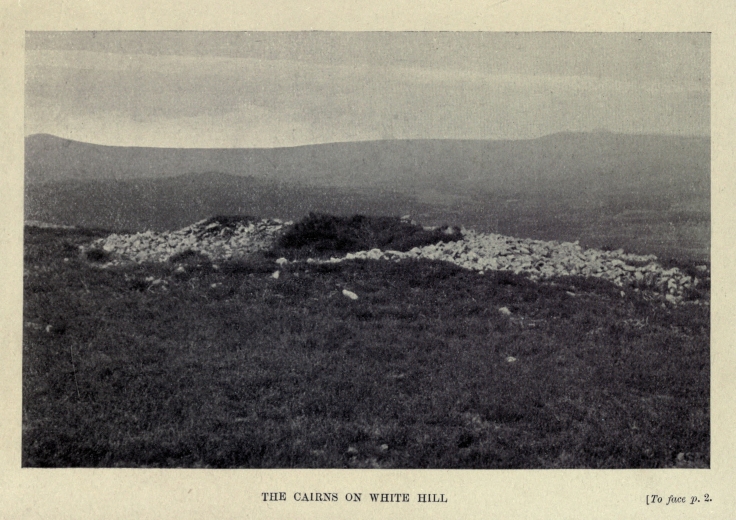
The evidences of former humanity that abound upon
Dartmoor may be divided into remains prehistoric and
mediæval. Amid the first shall be found the ruins of the
stone-man's home and the scattered foundations of his
lodges and encampments. To him also belong certain
cirques of stone lifted here and there in lonely places,
together with parallelitha, or avenues, and those menhirs and
cairns that rise solitary upon high hills to mark the
sleeping-places of neolithic heroes. Profound antiquity wraps up
these memorials, and the significance of their record is still
matter of antiquarian doubt. To what purpose was erected
the hypæthral chamber and the long aisle of stone, may
never now be understood; but later entries in the granite
cartulary of Dartmoor are more easily deciphered. From
the middle ages date the tin-streamers' works, where Tudor
miners laboured; and scarce a river valley shall be searched
without offering many evidences of their toil; while upon
the higher grounds, marking some spot of special note,
indicating boundaries or serving as guide-posts from goal
to goal, the old stone crosses stand.
It was significant of the different attitudes of Sarah Jane
and her husband that she found a measure of interest in
the pagan hut-circle or grave; he only cared to see the
chance symbol of his faith. These Christian evidences were
rare round about Ruddyford, but marks of the old stone men
did not lack, and Sarah Jane, to whom Hilary Woodrow
had once explained their meaning, always professed active
interest in these fragments, and told the things that she
had heard concerning them to her husband.
There came a Sunday in March when the Brendons went
up to see Gregory Friend, that they might convey a great
piece of news to him. The young heather was rusty-red in
the shoot, and here and there swaling fires had scorched the
bosom of the hills to blackness. The day was wintry, yet
clear, but many snug spots offered among the boulders,
where one might sit facing the sun and sheltered from the
east wind.
Such a place Brendon presently found and bade his wife
rest awhile.
"'Tis another of them hut-circles master tells about,"
said Sarah Jane. "That was where the door opened without
a doubt. To think as folk lived here, Dan—thousands
and thousands of years ago."
"Poor dust! I like the crosses better: they be nearer
to our own time, I suppose, and mean a comfortabler thing.
'Tis wisht to hear farmer tell how savage, skin-clad folk
dwelt here afore the coming of Christ."
"They couldn't help coming afore He did. He ought
to have come sooner, if He wanted for them to know about
Him," she answered.
Brendon frowned.
"You'm always so defiant," he said. "I still catch the
master's way of speech in your tongue now and again.
An' very ugly it sounds."
"I'm bound to stop and listen to him sometimes, when
he begins to talk. But since he comed of a morning for
his glass of milk and you stopped it—or I told him I'd rather
he didn't—us have had no words about holy things. He's
got a side all the same."
"I'm sorry to hear you say so. If you say so, you think
so, no doubt."
Sarah Jane laughed.
"'Tis a free country—as far as thoughts be the matter."
"That's him again. I heard him say the only sort of
freedom we could have was freedom of thought. But
unbelievers shouldn't have that if I could help it."
She looked at him with love rather than respect.
"You'm deep but not wide in your way of thinking. I
mind once last autumn coming to you and marking as you'd
been trampling in the whortleberries. Your boots was all
red and purple, and it looked for all the world as if you
might have been stamping somebody to death."
"What things you say!"
"All the same now, be honest, Daniel—couldn't you do
it? Can't you feel that things might happen so bad that
you'd even kill a person? There's death in your eyes
sometimes, when you talk of evildoers, and them that are cruel
to children, and suchlike."
"'Tisn't a wifely thing to remind me I've got a temper.
You've never had to regret it, anyway."
"How do you know that? But 'tis true: I never have.
You're a deal too soft with me, bless your big heart. I can't
do wrong in your eyes; and yet, sometimes, I wonder how
you'd take it if I did do wrong—such wrong as there could
be no doubt about. There's some things you'd kill me for,
I do believe."
"You'm talking to a Christian man; but you don't seem
to know it."
"A man be a man—Christian or heathen. Things do
happen to men sometimes, and their religion don't make
any more difference then to what they do than the hat
on their heads. Quite right, too. I like to think there's
a bit of metal in you. Sometimes I almost wish you'd
make me feel it, when I startle you and say my silly
speeches."
"How can I be angry with such speeches as yours?
They'm silly enough only too often; but they'm frank as
light. 'Tis the hidden and secret thing I'd rage against."
"If you found it out."
"I should find it out. There's no power of hiding in
you, even if there was the will."
"You'm a dear man," she said, and lifted her mouth
and kissed him.
"All the same," she added, "every woman's got a power
of hiding—even the biggest fool amongst 'em—and—and
the old gravestones of they lost people be quite as
interesting to me as the crosses are to you."
"I don't say they are lost. I only say that we've no
right to say anything about all them as went down to death
before salvation came."
"Why couldn't Jesus Christ have hastened into the
world quicker?" she asked. "'Twould have saved a deal
of sad doubt about all them poor souls."
"You ought not to think such questions. I lay Woodrow
said that."
"No, he didn't. 'Tis my very own thought. Suppose,
Dan, that He'd been the earliest man born of a woman,
and comed into the world Eve's first li'l one? How would
that plan have worked?"
He stared at her.
"Who could have crucified Him?" he asked.
She sighed.
"I forgot that."
"It shows how ill-regulated your mind is, Sarah Jane.
You oughtn't to let your ideas run so wild."
"'Tis no fault of yours that they do. And yet your fault
it is, I do believe, Dan, for you keep me so terrible close
to holy thoughts."
"The closer the better through the time that's coming.
To think you could picture my boots stamping life out of a
fellow-creature! 'Twasn't a kind fancy, to say no more of
it. As much as to say I might be no better than a wild
beast, given the temptation."
"All men are beasts when the wind blows from somewhere,"
she said. "Let a certain thing but happen, and
they'll be as hot and stubborn and hard and fierce as the
animals. Some would never forgive being robbed; some
would never forgive being laughed at; some would never
forgive being deceived by another person. Everybody's
got one spot like that. Some will go mad for a woman;
some for a thing. Why did Agg quarrel with Lethbridge
and knock him off his feet into the stream last week? Such
an easy, lazy man as Agg to do it!"
"Because Lethbridge said that Agg would get a girl at
Mary Tavy into trouble before he'd done with her. 'Twas
an insult, and Agg was quite right to knock him down.
'Twas no fault in him."
She did not answer. Then he spoke again.
"Don't think I don't know my faults. I know 'em
well enough. The gospel light shows them up very clear.
But jealousy ban't a fault, and I never will allow it is.
'Tis a virtue, and every self-respecting married Christian
ought to be jealous. I'm jealous of the whole world that
comes near you. I'm jealous of every male eye I catch
upon your face—at church or anywhere. 'Tis my nature
so to be. A man that marries hands over to his wife the
best he's got, and 'tis just as precious to a day labourer as
to a crowned king. He does well to be jealous of it. He'd
be a mean-minded fashion of creature if he wasn't."
"I don't feel like that," she replied. "You've said
yourself that nought can hurt a man from the outside; so
how can a wife hurt a man?"
"Good Lord! what a lot you've got to learn, Sarah Jane!
To talk of a wife as being outside! Ban't she the
innermost of all—a man's own self—next to his God?
'Outside'! I wouldn't like for anybody else to hear you say
a man's wife is outside him—and you a wife yourself."
"I'm rested," she said. "Us'll go on. I wish I was
so deep-minded as you, but I never shall be. A regular Old
Testament man you are."
"'Tisn't deep-mindedness," he answered; "'tis religious-mindedness.
The puzzle to me is that you, who be so good
as gold and honest as light, ain't more religious-minded.
John Prout's the same. I know he's all wrong, yet I can't
get up and point out where he's all wrong. 'Tis what he
leaves undone that's wrong."
"It takes all sorts to make a world."
"But only one sort to make heaven," he answered very
earnestly.
"Lucky we are not called upon to decide what sort."
He laughed rather grimly.
"You an' Prout would let all through, if you had to
judge," he said.
They reached the peat-works presently, and found Mr. Friend
awaiting them. Sarah Jane praised him for putting
on his Sunday coat, but she expressed greater dissatisfaction
than ever at seeing the place he called home. For Gregory
had been true to his word, and left Dunnagoat cot after
Sarah Jane's marriage.
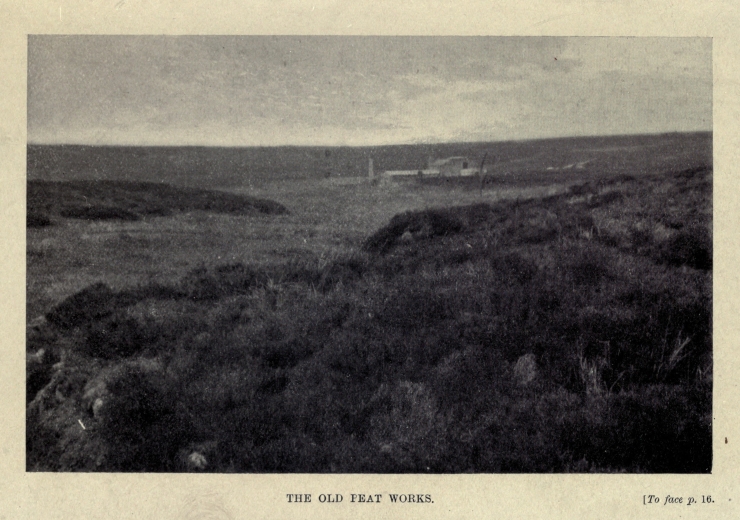
Now he dwelt at the scene of his futile work, and only
left it once or twice a week to gather his supplies. He had
taken a chamber in the ruin, boarded the floor, built up a
wall in the midst, removed his grate and oven from Dunnagoat,
and established himself, much to his satisfaction, in
the very midst of the skeleton of the peat-works. There he
dwelt perfectly happy and content. No anchorite ever chose
a spot more lonely and desolate for a home; but a repellent
condition usually absent from the hermit's cell belonged to
Mr. Friend's abode. Here were no surroundings of a
natural grot, no ivy curtain at the door, no matin song of
birds to rouse the recluse. Instead scowled rotting roofs,
broken walls, rusting metal and a sullen spirit of failure.
The very perspective of the tram-lines, stretching straight
into the midst of the ruins, by some accidental stroke upon
the mind through the eye, added another mournful character
to this scene.
Mr. Friend greeted them cheerfully. Tea was made, and
chairs were set about his little table. His daughter protested
with all her might at the miserable conditions in which he
now chose to dwell.
"Look at the damp on the walls! Ban't a place for a
dog to live in, let alone a man. Dunnagoat was
weather-proof, anyway."
"'Twill serve very well. There's a talk of something
definite come the spring. So like as not we shall set to
work again afore another year's gone; and I must be on
the spot. I be going to see if I can get steam in the boiler
this week. But I almost doubt it. Then there's an order
for Plymouth will fetch best part of a five pound note."
"Us have brought 'e a bit of news," announced Dan;
"but Sarah Jane's set on telling you herself."
"Guess, father," she said.
"That Dan's got advancement. 'Twas time he had too."
Brendon shook his head.
"I wish you was right," he answered. "But you're
not. It don't look as if I was ever to be raised. However,
farmer may see it presently."
"He does see it," declared Sarah Jane. "He's sharp
as a needle behind his quiet, casual way. He knows what
you're good for. Who is it he seeks if any thing's to be
done? Who is it gets the difficult work, where brains
be wanted to a thing? 'Twill come right, only us can't
hurry it."
Brendon laughed.
"I shall get advancement the same time that you'll set
your peat-works going again, and not sooner, father," he
told Gregory.
"I hope so. They be both things delayed; but both be
bound to happen sooner or later. You'm like Amicombe
Hill—good all through, Dan. The time will come when
other people will be sorry enough they didn't find it out
sooner."
They discussed the various problems of Daniel Brendon
and Amicombe Hill for some time. Both men were sanguine,
and both wondered why other people so obstinately
failed to see with their eyes. Daniel put his faith in God
and declared that he felt no fear of the ultimate issue; but
Mr. Friend inclined to trust man. It was idle to suppose
that the results of his personal investigations on Amicombe
Hill peat would be ignored for ever. He believed that some
sagacious spirit must presently arise at headquarters, justify
his patient belief, and delve for the treasure that he still so
zealously guarded.
Presently Gregory turned to his daughter.
"And what's the secret only you are to tell me, my
dear?" he asked.
"I be going to have a little baby," said Sarah Jane.
"A big one more like! And a boy I do hope. That's
capital news, and I wish you both joy of him with all my
heart. If 'tis a boy, call him 'Amicombe' for luck—eh?"
"No, no! He shall be called 'Gregory' after his
grandfather," declared Daniel.
The news cheered Mr. Friend, and he became very
solicitous for Sarah Jane.
"Don't you let her do too much work," he said. "She
mustn't tramp up here no more. I'll come down of a
Sunday instead."
But his daughter laughed.
"You old dear! I shall call you a grandmother instead
of a grandfather."
"I can see him running about here taking his first lessons
in peat, an' messing his little self up to the eyes in it,"
said Mr. Friend. "An' right welcome he'll be. There's
many wonders up here as I'll show him."
"Might be a girl, however," said Daniel.
"I hope not and I think not," declared the peat-master.
"'Twill be a brave boy, I'm pretty sure. Us may be doing
a roaring business before he appears; but be that as 'twill,
I'll always make time to play a game with him. When's he
coming, Sarah?"
"In September, I reckon."
"A very good time. Well, well—what would your
mother think!"
"She knows all about it, be very sure," said Daniel.
"And now us must get going, for the dusk be down
a'ready."
"I'll come to you next Sunday," promised Gregory, as
he bade them "good-bye," after walking part of their road
with them. "And there's four sacks more of my special
fuel for you when you can draw them, Dan. You must
keep her so warm as a toast through the spring weather,
and 'if you want heat, burn Amicombe peat,' as I made up
twenty years ago."
"'Tis a rhyme that will never be forgot," said his son-in-law;
and Gregory, well pleased at the compliment, kissed
Sarah Jane, then left them and returned to his den.
Daniel Brendon had long since stopped the meetings of
his master and his wife at dawn, when Sarah Jane milked
the cows. He was naturally a jealous man, but in this
matter emotion took an elevated form. No earthly consideration
tainted it. His only concern was for Sarah Jane's
soul. To let her come within the breath of infidelity, from
Daniel's standpoint, seemed deliberate sin. His God was a
jealous God, and, as he himself declared, he held jealousy,
in certain aspects, a passion proper to healthy man.
Therefore he had desired his wife not to speak with Hilary
Woodrow more than she could help, for her soul's sake; and she
had obeyed him, and avoided the master as far as she
might without rudeness. Yet her heart felt sorrow for
Woodrow. She perceived the wide want in his life and
explained it more correctly than could her husband or any
other man.
On the Sunday after their visit to the peat-works, Daniel
took Sarah Jane to Mary Tavy instead of to Lydford. They
went to chapel with Agg; and the service pleased Brendon
well. He had debated as to the propriety of praying in a
place of dissent, but Agg spoke highly of his minister, and
induced the other to accompany him. The incident served
powerfully to affect Brendon's future, for this service,
largely devoid of the familiar formulæ of his own church,
impressed him with its life and reality. The people were
attentive, their pastor was earnest and of a warm and loving
heart. A few got up and spoke as the sitting extended;
and presently, to the amazement of Sarah Jane, her
husband rose and uttered some words. He rehearsed a text
from Isaiah, proclaimed it to be his favourite book in the
Bible, declared that it covered all things and was tremendous
alike in its threats and promises. For three minutes he
stood up, and his great voice woke echoes in the little,
naked, white-washed meeting-house. When he knelt down
again there followed a gentle hum of satisfaction.
From that day forward Brendon threw in his lot with
the Luke Gospellers and made Sarah Jane do the like.
Agg congratulated him very heartily as they returned
home, and Daniel explained that to have acted thus was far
from his thought when he started.
"Something pulled me on to my feet and made me
speak. 'Twas a force, like a strong voice, whispering in
my ear. I oped Isaiah at hazard—my Bible always falls
open there—and them words fell under my eye, and I had to
speak."
"You'd make a very valiant hand at it with a bit of
practice," declared Agg, "and the deaf would come miles
for to hear you. Your voice be like a big drum."
"There was a bird sat up on the rafters," said Sarah
Jane. "The poor thing had flown in, an' couldn't find
the window. It sat so still as a mouse through the sarvice,
till Dan spoke. Then the rafter shook, I suppose, for
it flew about, and drove against the window with its little
wings."
"I'm mazed to look back and think that I've actually
stood afore my fellow-men and spoke to 'em from God,"
said Daniel. "To do such a thing never entered into my
mind."
"'Twas a terrible brave deed," declared Sarah Jane.
"But I ban't surprised; there's nothing you can't do, if
you think 'tis right to do it."
That night Agg took Brendon again to chapel; but the
wife stayed at home.
It happened that Hilary was returning from a long ride
after the hour of dusk, and as he came up through his fields
he met Sarah Jane alone. She had walked to meet Daniel,
who would presently be returning with Agg from the evening
service at Mary Tavy.
The farmer stopped, and when she prepared to go on her
way, bade her wait for a few moments.
"I'm in luck," he said. "I wanted to speak to you,
Sarah Jane, and here's the chance. Where are you off to at
this hour?"
"Going to meet Dan. Him and Agg have gone to
worship with the Luke Gospellers down-along."
"You astonish me. Such a pillar of the church as
Brendon to seek some new thing!"
"We went this morning, and Daniel was terrible pleased,
and liked the homely feeling of it. They'm kind folk, and
Mr. Matherson, the minister, speaks and prays beautiful."
Woodrow had often mentioned serious subjects to this
woman without perceiving the futility of such a course. But
he did so more for the pleasure of hearing his own ideas,
than from any wish to influence her. There was none to
heed his opinions, none with whom to exchange thoughts
and arguments touching the topics that so largely
interested him. At first, therefore, he had regarded Sarah
Jane as a useful listener, and enjoyed talking to her for the
sake of talking. Then her own attitude attracted him, and
he spoke less and listened more. Her views arrested his
mind a little. She was uneducated, yet nature had actually
led her to some ideas that he had only reached through the
channel of books. Once or twice, in her blunt speech and
with her scanty vocabulary, she uttered a thing that wise
men had only found by taking thought. Her natural mind
drew Woodrow; then the lovely body of her interested
him, and she began to fill his attention.
Women had almost passed out of his life after one of
them jilted him; now this particular woman reminded him
that they were not all alike. His eyes opened; it struck him
that he was deliberately depriving himself of a great part
of the joy of life by ignoring them. His thoughts began to
play upon the subject, and his memory revived events of
the past.
Whether it was Sarah Jane's sex, or Sarah Jane's self
that had awakened him, remained to be seen. He told
himself, despite his admiration for her spirit and her beauty,
that it could not be the individual who had aroused dormant
sense, but rather the accidental fact of having been thrown
into contact with her. The world was full of women. He
pondered the problem, and now, by light of moon, told
Brendon's wife of a decision at which he had recently
arrived.
"A great one for the Bible, my Dan," said she. "Miles
of texts he've got by heart. A regular word-warrior he is."
"If he believes it, he's right to stick to it. Why, if I
believed 'twas the Word of God—actually the very thoughts
of the Almighty sent by Him—I'd never open any other
book, Sarah Jane. I'd think that every second of my
reading time spent with man's writings was a wasted
moment. If I had faith—it would move mountains."
"That might be my Dan speaking. But you know pretty
near so many verses as him, for all you don't believe in
'em."
"We free thinkers are much keener students of the Bible
than thousands who profess to live by it."
"And yet you reckon there's no God and not another
life after we die?"
"My old grandfather had a saying, 'When a man's dead,
there's no more to be said.' That was his philosophy, and
though my father called him a godless heathen, yet I always
agreed with the old man, though I wouldn't have dared
to say so. But mind this, Sarah Jane—this I will grant:
if there's another world after death, then there's a God.
You won't have one without the other. Nature can look
after this world; but it will take a God to look after the
next. Don't think I believe there's another. I'd scorn to
believe anything that nature doesn't teach me. But, none
the less, it may come true; and if it does, that means God."
"This life's mighty interesting," she said. "To me 'tis
full to the brim; but Dan says the only drop in the cup
that matters is the sure thought of the Kingdom of Heaven
after."'
"Trust to this life. That's a certainty, at any rate.
Look after this life, and the next will look after itself."
"Funny you should say that. Dan's way's just different.
He says, 'Look after the next life, and this one will
look after itself'!"
"Nonsense—I'm right. And you know I'm right."
Sarah Jane felt in a mind to tell him that she was with
child. As yet only her husband and her father knew it.
She was about to do so, when he spoke again.
"I shall not live to be an old man," he said. "I know,
as well as I know anything, that the longest half of my
days are done. I thought the best of them were done too.
But you've made life very interesting again and well worth
living."
"You shouldn't say things like that, I'm sure, though
I'm very glad you like me, Mr. Woodrow. What's amiss
with you?"
"Nothing—everything."
"Your cough's better, so Mr. Prout says. I wish you'd
find a wife, sir. That might be the best physic for you."
He did not answer immediately. The moon came from
behind a cloud, and Sarah Jane strained her eyes into the
distance.
"Dan ought to be coming," she said.
"A wife?" he asked suddenly. "Perhaps if I could
find another Sarah Jane——"
"My stars! what a thought! Poor company for 'e—the
likes of me!"
"I've never seen such another, all the same."
She laughed.
"Well, why for don't you look round?"
He stood still and did not reply.
"My! how bright the moon be this evening," she said.
"There they are—Daniel and Walter Agg. I see 'em long
ways off.":
"Do you know that the moon was alive once?" he asked.
"She was a mother; and now she's only a grave for all
the things she bore. She's our picture, too—the skeleton at
the world's feast of life. It will be just the same here,
Sarah Jane—cold—dead—the earth and moon going round
together—like two corpses dancing at a dying fire."
"What dreadful things you know!"
"Life's only conjuring with dust. I suppose we shall
never find out how 'tis done. But there are clever chaps in
the audience always jumping up and saying 'That's it! I
see the trick!' Only they don't. Each new book I get
hold of gives the lie to the last. There's nothing true that
I can see. Like a boy chasing a butterfly: down comes his
hat after a long run. But the butterfly's in the air."
"Proper place for it."
"Perhaps so. A butterfly pinned into a case is only half
the truth of a butterfly. Words in a book can never be more
than half the truth of ideas. But I'm sick of reading. I'm
sick of everything—but you. Don't be frightened. You
said just now I ought to go and look about. Well, I'm
going. I'm going to London for a while, and then down to
Kent to a cousin of mine—a hop-grower there."
"The change will do you a world of good."
"That's doubtful. I shan't be very contented out of
sight of Dartmoor. Perhaps if I can't see Great Links for
a while, I shall value it all the more when I come back."
"And do, for pity's sake, bring a wife with 'e."
Daniel Brendon and Agg approached, and Hilary spoke to
them as they arrived.
"I'm telling Mrs. Brendon that I mean to take a holiday,
Dan. Going to look at London again. 'Twill make me
long to be back home pretty quick, if it does nothing else."
"You might buy one of them new mowing machines
against the hay-harvest, if you be up there, master,"
suggested Agg; but Daniel did not speak. He had returned
from chapel in a spirit very amiable, and to find Sarah Jane
under the moonlight with Woodrow instantly changed his
mood.
They parted immediately, and Brendon spoke to Sarah
Jane as they entered their home.
"What be you doing, walking about with the man after
dark?"
"I was afraid you might be vexed. We met quite by
chance as I came to seek you, and he stopped, and would
be talking. He said he ban't going to be a long-lived man,
and I told him he wants a wife; and then he said if he could
get another like me he might think of it."
"Be damned to him!" said Brendon violently. "I
can't stand no more of this. I won't have this talking
between you. 'Tisn't right or seemly, and you ought to
know it, if you're a sane woman."
"He's never said one syllable to me you couldn't hear,"
she answered, believing herself, but forgetting a word or
two. "All the same, I'll avoid him more, Daniel, when
he comes back. He may fetch along a wife with him. But
don't you be angered, dear heart. I'd rather up and away
from Ruddyford at cocklight to-morrow for evermore, than
you should frown. 'Tis silly to be jealous of the sun for
throwing my shadow, or the wind for buffeting me."
"I am jealous. I'm a raging fire where you be concerned,
and always shall be—for your soul first. I won't
insult you to speak of any other thing. Any other thing's
not speakable. You know I'm built so, and you don't strive
to lessen it, but just the contrary. I wish you was more
religious-minded and more alive to the sacredness of the
married state."
"I'm myself, Dan—for good or bad."
The man was gloomy for some days after this scene, and
Sarah Jane went her way with patience and unfailing good
humour. She felt no anger with him on her side. She
understood him a little; but jealousy was a condition of
mind so profoundly foreign to her own nature, that her
imagination quite failed to fathom its significance and its
swift power of growth in congenial soil.
Hilary Woodrow kept his word, and presently left home
for an indefinite period. He told himself that he was going
away to escape temptation; in reality he went to seek it.
His object was simple: to learn whether the arrival of
Brendon's wife at Ruddyford had merely awakened his old
interest in women generally, or whether it was she herself,
and only she, who had roused him out of a long sexual
apathy.
Hilary Woodrow's departure from Ruddyford made no
difference to the course of events. Routine work progressed
according to the prescribed custom of Dartmoor husbandry.
Oats were sown during the last week of March; potatoes
followed; then the seed of mangold went to ground, and
lastly, in June, with the swedes, this protracted planting
of crops ended.
There came a night when John Prout found himself too
weary to keep an appointment at Lydford. Therefore he
asked Daniel to go instead.
"'Tis the business of the water-leat," he explained.
"The water's coming in autumn some time, and now
Churchward and the rest are going to set about things again
in earnest. The committee sits at the schoolroom this
evening."
Brendon, however, doubted.
"I can't just go and say I've come to take your place,"
he answered. "The rest might not want me on the
committee."
"Oh yes, they will," declared Prout. "You'll do a lot
better than me. You'm younger and have your ideas. 'Tis
about the procession and so on. A lot was done last time;
but 'tis such a while agone, that I dare say they'll have to
begin all over again. Anyway, I couldn't ride to Lydford
to-night for a fortune. I'm dog tired."
"'Twill fit very well," said Sarah Jane, who was clearing
away the tea-things in Ruddyford kitchen. "I walk into
Lydford myself this evening, to take the butter to
Mrs. Weekes. Say you'll go, Daniel."
"I'm willing enough. The only point is if I can serve
on a committee in place of another man."
"Certainly you can," said Mr. Prout. "They'll be
very pleased to see you, I'm sure. Jarratt Weekes is a
member, and he'll take you along with him."
"I'll go, then," assented Daniel, "and Weekes will post
me up in the business, no doubt."
It happened that relations of a harmonious character
existed at present between the family of Philip Weekes and
Ruddyford. Hephzibah took large quantities of Sarah Jane's
butter into Plymouth every Saturday; and sometimes Philip
himself, or the girl Susan, came for this produce.
Occasionally it was brought to Lydford by a messenger from the
farm. The Brendons were now on terms of friendship with
Jarratt's parents and of superficial friendship with the
castle-keeper himself.
To-night Sarah Jane and Daniel heard the familiar voice
raised as they entered the front gate, and, despite a loud
summons, they stood some while under the dusk, with the
scent of the garden primroses in their nostrils, before any
attention was paid to them.
Then Susan appeared, and as she opened the door the
full and withering blast of Hephzibah's rhetoric burst upon
the air.
"Didn't hear 'e first time," said the girl. "Aunt's in
one of her tantrums. A very awkward thing's happed just
now. Awkward for Uncle Philip, I mean. He was in the
street talking to Mr. Churchward; and unbeknownst to him,
on our side the wall, not two yards off, Aunt Hepsy chanced
for to be."
"Never mind all that," interrupted Sarah Jane. "Here's
the butter, and my husband be come to see Jarratt. We
don't want to hear none of your rows, Susie."
"You'll have to hear—you know what Aunt Hepsy be."
They went into the kitchen, and Mrs. Weekes, without
saluting them, instantly turned the torrent of her speech in
their direction.
Philip sat by the fire with his hands in his pockets and
his wistful grey eyes roaming, rather like a wild animal
caught in a trap; his son was eating at the table;
Mrs. Weekes stood in the middle of the kitchen; her legs were
planted somewhat apart, and her arms waved like semaphores
to accentuate her speech.
"Your eyes be enough," she said. "You cast 'em to
the ceiling, an' search the floor an' the fire with 'em; but
you can't hide the guilt in 'em—you evil-speaking traitor!
He'd have me dead—what d'you think of that, Sarah Jane?
As a wife you can understand, perhaps. Every word I
caught when I was in the garden—doing his work, of course,
and picking the lettuces that he'd ought to have picked and
washed and packed two hours afore. An' him t'other side
of the wall telling to that wind-bag that teaches the
children—though what he does teach 'em except to use long, silly
words, I can't say. 'The sooner she's dead the better!' That
was the thing my husband spoke—in a murdering voice
he spoke it. And my knees curdled away under me—the
Lord's my judge! I could almost hear him sharpening a
knife to do it! 'The sooner she's dead the better.' That
was what he said. Murder, I call it—black murder; and
he'll hang in the next world for it, if he don't in this.
Wished me dead! Knave—foul-minded rascal!—beastly
coward to kill the wife of his bosom with a word! And
now——"
The familiar gasp for which her husband waited came,
and he spoke before she could resume.
"I'll only say this. I was speaking of Adam Churchward's
old collie bitch—may I be stuck fast on to this settle
for evermore if I wasn't; and when I said 'sooner she's
dead the better,' 'twas in answer to schoolmaster's question.
If I was struck dumb this instant moment, that's the truth."
"Truth—you grey and godless lump of horror! Truth—who
be you to talk of truth? After this the very word
'truth' did ought to rust your tongue black and choke you!
Not a word of that will I believe. 'Twas me you meant;
an' when I heard it, I tell you the sky went round like a
wheel. I catched hold of a clothes-post to stop myself from
falling in a heap. And now if cherubims in a flaming, fiery
chariot come down for me from heaven, I wouldn't go.
Nothing would take me—I'd defy death for my indignation!
I'll see you out yet, you wife-murderer, you vagabond, you
cut-throat dog of a man—ess fay, I'll see you out if I've got
to wait twenty thousand years to do it!'
"Here," said Jarratt Weekes to Daniel Brendon, "me
and you will get from this. When she lets go, you might as
well try to put in a word with a hurricane as with her."
"All the same, it was Churchward's old worn-out dog,
as he'll testify to," said Philip. "The creature's suffering,
and she'll be killed to-morrow morn; an' that's evidence for
anybody who's got a level mind and no grudge against me.
Be it sense or reason that I'd say a thing like that to a
neighbour—even if I thought it?"
"How you can sit there with your owl's eyes
a-glaring——" began Mrs. Weekes—then Daniel followed
Jarratt.
"I'll come back along for you presently," he said to
Sarah Jane. "You stop here till we're home from the
committee."
A moment later he explained his purpose, and Weekes
raised no objection.
"'Tis a silly business altogether," he said. "I so good
as swore I'd not join 'em again myself; but if the thing's
to be, 'tis well there should be a little sense among these
foolish old men. You can take Prout's place and welcome.
Churchward will try to talk Latin about it when he hears,
and pull a long face, and say 'tis irregular or some rot. But
if I tell him I wish it, he'll cave in. Last meeting was at
his home; but we turned the room into a public-house bar
before we'd done with it, and so his daughter won't let us
assemble there again. Quite right too."
"A very fine woman she is—so Sarah Jane tells me."
"She is—and plenty of sense. In fact——"
Jarratt broke off and changed the subject; but Daniel,
without tact, returned to it.
"I hope we'll all soon be wishing you joy in that matter."
Weekes made no answer at all. The thought was bitter
to him that this common man, who had beaten him and won
Sarah Jane, could thus easily approach him as an equal and
congratulate him on his minor achievement. He hated
anything to remind him of the past, and disliked to think
that the fact of his rumoured engagement to Mary Churchward
had reached the Brendons' ears. This girl was a promising
wife enough; but she fell far short of Sarah Jane
in beauty and strength and melody of voice.
"There's the schoolroom—the hour was seven-thirty, so
we'm a thought late," said Jarratt Weekes.
They entered to find the rest of the committee assembled.
Mr. Churchward, Mr. Spry, Mr. Huggins, Mr. Norseman,
Mr. Pearn and Mr. Taverner—all were there.
Weekes explained that Daniel Brendon had come to represent
John Prout, and suggested that the rest should fall
in with this alteration. Some questions arose whether it
could be permitted, and the schoolmaster instantly fulfilled
Jarratt's prophecy by doubting if Daniel might stand for
Prout—in propria persona.
Nathaniel Spry was referred to, but would express no
definite opinion; then Weekes spoke again, inviting the
committee to use its common sense, if it had any, and asked
what earthly difference it could make to the upshot whether
one farming man or another joined their deliberations.
"Me an' Mr. Prout think alike in some ways—not in
all," explained Brendon. "As to such a matter as a revel,
when the water's brought into Lydford, we might be of one
mind. But I warn you, please, that in matters of religion
we're different."
"That's all right, then," declared Noah Pearn, the
publican, "for this hasn't nothing to do with religion—any
more than my free lunch have."
"All the same I'll be party to nothing that can hurt
religion, and well the committee knows it," declared
Mr. Norseman.
"Don't you shout till you're hurt," said Weekes.
"We're not heathen, I believe. I propose that Mr. Brendon
takes Prout's place on the committee, and I ask you to
second, schoolmaster."
None raised any further objection. Daniel took his place
and Mr. Churchward turned to Nathaniel Spry.
"Read the minutes of the last meeting," he said.
The postmaster rose rather nervously and shuffled his
papers.
"Keep it short as you can, Spry. We wasted a lot of
time over that meeting—don't want to be here all night,"
remarked Jacob Taverner.
"I can't be 'urried, Jacob," answered the other. "I'm
secretary, and I've done the work in a very secretarial way,
and it's got to be read—all of it—hasn't it, Mr. Churchward?"
"Certainly it has," answered the schoolmaster. "In
these cases the minutes of previous assemblies have to be
kept carefully, including all memoranda and data. There is
a right way and a wrong way, and——"
"Get on!" interrupted Weekes. "If Spry have to
read out all that mess and row we had at the first
meeting—sooner he's about it the better."
Nathaniel Spry rose and wiped his glasses.
"Go under the lamp, postmaster," said Brendon.
"You'll see better."
"Thank you," answered the secretary. "Much obliged
to you. I will do so."
"One thing," suddenly remarked Noah Pearn. "I want
to ax whether among the characters in the show we might
have Judge Jeffreys. I seed his name in an old book awhile
ago, and 'tis clear he held his court to Lydford castle. Shall
he walk with the procession?"
"We can go into that later. We must read the minutes
first. Otherwise everything is ultra vires and illegal,"
declared Mr. Churchward.
"Well, Spry can set it at rest in a minute by saying who
Judge Jeffreys was—that is if he knows," suggested
Mr. Taverner.
"We all know that," declared Mr. Norseman. "He was
a regular historical Lydford character."
"Would he do to walk, Spry, or wouldn't he? Answer
in a word. If he's no good—we need say no more."
"Order!" cried Mr. Churchward. "I call everybody to
order who interferes with Spry. We must have the minutes!"
"You ought to know about Judge Jeffreys yourself,"
said Weekes shortly. "You're a schoolmaster, and should
have the whole history of the man at your finger-ends."
"And so I have," declared Mr. Churchward. "Of
course I have. Who doubts it?"
"Then let's hear it. Ban't for the chairman to deny
information to the committee," said Mr. Pearn.
Adam shrugged his shoulders.
"I bow to your opinions, though it's very unbusinesslike
and improper."
Then he turned to Spry and spoke with resignation.
"Tell them about Judge Jeffreys, Nathaniel—since they
insist upon knowing. If you make any mistake, I'll correct
you."
Mr. Spry dropped his report hopelessly, took off his
glasses and scratched his head over the right ear.
"He wasn't a very nice man, if my memory serves me,
gentlemen. A thought 'asty and a thought 'arsh. There's
poetry written about him. He did his work in the time of
Charles I., or it might be Charles II."
"Or the Commonwealth," interrupted Mr. Churchward.
"Very true—very true, 'or the Commonwealth,' as you
say, schoolmaster. He was rather what is called a hanging
judge. Still, his red robes and flowing wig would be a great
addition to the scene."
"Let the man walk!" cried Mr. Huggins. "A solemn
judge would be so good as a sermon to all the young youths
for miles around, and show 'em what wickedness might
bring 'em to at any moment."
"You don't mean that, Mr. Huggins," explained
Brendon, who knew the veteran. "You mean——"
"We all know what he means," declared Mr. Taverner.
"Well, you propose Jeffreys and I'll second it, Noah."
"In due course—in due course. The judge shall pass
committee in his proper turn," said Mr. Churchward.
"Now, Spry, read as quickly as you can, but nothing's to
be missed."
"How long is the report?" asked Henry Norseman.
"Twenty-four pages of foolscap and a half," answered
the secretary. "I've written it all out twice, and it filled
my spare time for three weeks doing it."
"Let's take the thing as read!" suggested Mr. Taverner.
But Nathaniel objected indignantly.
"Not at all!" he said. "I won't have that. I appeal
to the chair—three weeks' work——"
"Don't want to have any words with you, postmaster;
but all the same, without feeling, as a member of this
committee, I propose we take the minutes as read,"
answered Taverner firmly.
"Who'll second that?" asked Weekes.
"I will," said Noah Pearn.
Mr. Churchward sighed, shook his head tragically, and
put his hand over his brow.
"I do wish, Jacob Taverner, you would bend to the law
of committees and listen to the chair," he begged. "Don't
you understand me? I'm pretty good at making myself
clear, I believe—it's my business to do so to the youthful
mind—and I tell yuu it can't be done. Legally everything
we enact before the minutes are read is nothing at all—a
mere lapsus lingua, in fact."
"Besides," said Daniel, "I beg to say I ought to hear
the minutes—else how can I know what was settled at the
first meeting?"
"You're soon answered," replied Jarratt Weekes.
"Nothing was settled at the first meeting."
"I beg your pardon, Jarratt," said Adam Churchward.
"That is neither kind nor true. A great deal was settled—else
how would it take Nathaniel Spry twenty-four and a
half pages of foolscap to put it all down? And no man
writes a better or neater hand. Therefore I ask you to call
back that statement."
"There was a lot said—I admit. But surely you must
allow there was mighty little done," retorted Weekes.
"The question is whether the minutes are to be taken
as read. I've proposed that and Pearn's seconded it,"
repeated Mr. Taverner.
"And I rule it out of order, Taverner, so there's an end
of that," answered Adam.
"The question is if you can rule it out of order," replied
Jacob Taverner.
"Certainly he can. Bless the man, he's done it!" said
Brendon.
"He says he's done it; but if it's not legal, he can't
do it. Everybody's got a right to speak on a committee,
and I never heard in all my born days that a chairman
could rule a thing out of order, if 'twas properly proposed
and seconded," answered the other.
Much irrelevant but heated argument followed, and
none could satisfy Jacob that the chair was in the
right.
Suddenly the landlord of the Castle Inn turned to
Valentine Huggins.
"Let's abide by you, Val," he cried. "You'm the oldest
among us. I warrant Taverner will abide by you. What
do you say?"
"I say 'beer,'" piped the ancient man. "I be so dry
as a dead bone along o' listening; what you talking members
must be, I can't picture."
"I second," declared Weekes; "and 'tis idle for you
to pretend that can't be passed, Churchward, because we're
unanimous—except Norseman, who'll have his bottle of
lemonade as per usual, no doubt."
Mr. Pearn had already put on his hat.
"I'll nip round myself an' tell 'em to send it in," he
declared. Then he hurried off.
"I'm in your hands, of course," began the schoolmaster.
"I merely remark that I don't pay again. If
you had listened to the minutes, you'd have been reminded
that the chairman stood liquor and tobacco last time. We
must give and take—even in committee."
"I'll pay half," said Mr. Taverner.
"And I'll pay the rest," declared Nathaniel Spry,—"provided
the committee will keep quiet and let me read
the minutes while it's drinking."
"That's fair enough, certainly," said Brendon. "By
the looks of it, this meeting won't have no time to do more
than hear what fell out at the last. 'Tis near nine o'clock
now, and us no forwarder."
When Mr. Pearn returned with a pot-boy and three quarts
of ale, the secretary had started upon his report. Nobody
paid much attention to him save Daniel Brendon; but as
soon as the liquor was poured out—by which time Mr. Spry
had come to St. George and the Dragon—an interruption
took place.
"I ask for that passage to be given again," said
Mr. Norseman. "I heard my name, but I didn't catch what
went with it."
Nathaniel read as follows:—
"Mr. Valentine Huggins then proposed that the Dragon
should go along with St. George, and it was suggested that
Mr. William Churchward should enact the Dragon.
Mr. Norseman then said that he would be party to no
play-acting, because play-acting in his opinion was wickedness;
and he added that if the committee persisted in this opinion,
he would think it his duty to put the matter before the
vicar. Mr. William Churchward was privately approached
by the chairman subsequent to the meeting and refused to
play Dragon——"
"If that's still your opinion, Norseman, you'd better go
off the committee," said Mr. Taverner; "because to dress
up to be somebody else is play-acting in a way, even though
nought's said. You be in a minority of one, so you may
just as well retire."
"I may be, or I may not be," answered Mr. Norseman.
"I'm here to do my duty to the best of my power, and, in
a word, I shan't retire."
"I don't hold with play-acting either," declared Daniel
suddenly.
"Ban't sure that I do, on second thoughts," added
Mr. Huggins. "Anyway, I want to say that if any other
member would like to be Moses——"
"That's all settled and passed, and you can't withdraw,
Valentine," replied Mr. Churchward. "Go on, Nat."
"What is play-acting and what isn't?" asked Mr. Pearn.
"We'd better settle that once for all. I say 'tisn't
play-acting if no speeches are made."
"If it has been carried that Mr. Huggins is to be dressed
up as Moses, I'm afraid I must vote against it," said Daniel.
"I'm very sorry to do anything contrary to the general
wish, but I couldn't support that. In my view 'tis playing
the fool with a holy character."
"Don't be so narrow-minded," said Mr. Taverner.
"You must be narrow-minded if you want to keep in the
narrow way," declared Norseman. "The man's right,
though I haven't seen him in church for three months."
"If we're going back on what we passed last time—'tis
idle for you to read any more, postmaster," said
Mr. Churchward. "I may remind the committee that
Mr. Norseman himself had no objection to Moses before."
"More shame to me," answered the churchwarden
frankly. "I was weak, as them in a minority too often
find themselves; but now, with this man beside me, I'm
strong, and I stand out against Moses tooth and nail."
"Let's drop Moses, souls!" said Mr. Huggins. "We
can walk very well without him, and we don't want to offend
church or chapel, I'm sure. 'Twould be a bad come-along-of-it
if we had vicar and the quality against us. If I can
give him up, I'm sure all you men ought to."
Jarratt Weekes had been turning over the pages of Mr. Spry's
report while the rest talked. Now he suddenly rose
to his feet and shouted loudly:
"Look here, Spry—what's this you've got here? Like
your insolence—making me look a fool in the eyes of the
committee! This stuff shan't be read—not officially.
You've put words here that I spoke in heat. Not that they
wasn't perfectly reasonable ones—all the same, they
shouldn't be recorded. I'm not going to be written down,
in cold blood, as using swear words. 'Tisn't fair to
anybody's character. Here it is, neighbours, and I ask you if
'tis right—page twenty-one—"
He read as follows:—
"'The chairman then quoted the Latin language, which
annoyed Mr. Jarratt Weekes, who thereupon asked him,
why the hell he couldn't talk English."
"You oughtn't to have put that down, Nathaniel," said
Mr. Churchward reproachfully. "It would far better have
become you to leave that out. If I could forgive it—which
I did do—surely——"
"There it is for anybody to see," continued Weekes;
"and I propose we burn his silly minutes, for they'm
nothing but a tissue of twaddle and impertinence and——"
"I rise to order!" cried Mr. Spry. "I'm not going
to be insulted to my face and stand it. I claim the
protection of the chair and the committee in general. What
right had I to doctor the report? If people use foul
language on a committee and lose their tempers and
misbehave themselves at a public function, let 'em take the
consequences!"
"You shut your mouth!" shouted Weekes, "or I'll
make you. A pink-eyed rabbit of a man like you to stab
me in the back with your pen and ink! I——"
"Order—order!" cried Pearn and Taverner simultaneously.
Everybody began to talk at once, and Brendon
turned to the chairman.
"Why the mischief don't you keep order?" he asked.
"Easy to say—easy to say," answered Adam wildly.
"But what mortal man's going to do it?"
"'Twas you broke up the last meeting, Weekes, an' I
don't think none the better of you for it," grumbled
Mr. Huggins. "All the same us shan't get through no business
now—an' the beer be all drunk and the time's past ten——"
"I propose we adjourn," said Mr. Norseman.
"And so do I," added Brendon. "Never knowed myself
that a lot of growed-up men could make such a row and be
so foolish."
"The meeting is suspended sine die, gentlemen,"
declared Adam Churchward, "and I may add that I'll not be
chairman again. No—I will not. The strain is far too
severe for a sensitive man."
"Just like you," answered Weekes. "The moment you
get into a mess, you curl up, same as a frightened woodlouse.
You're not the proper man for a chairman."
"And you're not the proper man for a committee,"
answered Adam, very pink and hot. "'Tis all your fault, and
I say it out, notwithstanding the—the relations in which
we stand. You've not the self-control for a committee. And
you do swear a great deal too much—both in public and
private life."
They wrangled on while Norseman and Brendon departed,
and Spry only stayed to see his report scattered on the floor
under everybody's feet. Then, with an expression of opinion
unusually strong for him, he took his hat and went home.
Mr. Pearn looked after the crockery, Mr. Taverner assisted
Valentine Huggins into his coat and saw him on his way.
"Out of evil cometh good, Jacob," said the ancient.
"Be it as 'twill, I've got Moses off my back. But this
here have furnished a dreadful lesson to me not to push
myself forward into the public eye. Never again will I
seek to be uplifted in company. 'Twas only the sudden
valour of beer made me offer myself, and I've never had a
easy moment since."
Elsewhere Mr. Churchward and Jarratt quickly settled
their difference. Indeed, as soon as Spry had departed, the
chairman adopted an attitude very disloyal to the postmaster,
and even called him an officious little whippersnapper.
This appeased the injured Weekes, and when his
future father-in-law went further and invited him home to
see Mary and drink some whisky, Jarratt relented.
"Us'll drop this business once for all," he said. "It
don't become your position to sit over a lot of silly fools
that don't know their own mind. You've got something
better to do with your time, I'm sure. When I'm married to
Mary, you shall help me with figures and suchlike. Anyway,
don't you call them ignorant men together again. I
won't have it. Let the water come and be damned to it.
'Tis nothing to make a fuss about when all's said."
"You may be right," admitted Mr. Churchward. "In
Christian charity the committee meant well, but they have
not been educated. There's no logic—nothing to work upon.
I'm disappointed, for I had spent a good deal of thought
upon the subject. However, if it's got to fall
through—there's an end of it."
And Brendon, as he tramped home with Sarah Jane,
made her laugh long and loud while he told of the meeting.
He was not much amused himself—only somewhat indignant
at the waste of hours represented by that evening's work.
Gregory Daniel Brendon was born on the first day of
October, and work nearly stood still at Ruddyford until the
doctor had driven off and the great event belonged to
past time. Nothing could have been more splendidly
successful than his arrival, or himself. There was only one
opinion concerning him, and when in due course the child
came to be baptized, he enjoyed a wide and generous measure
of admiration.
Hephzibah, who was nothing if not superlative, attended
the christening, and, after that ceremony, proclaimed her
opinion of the infant. Sarah Jane, whose habit of mind led
her to admire Mrs. Weekes, had asked Philip's wife to be
godmother, and such a very unusual compliment awakened
a great fire of enthusiasm in the sharp-tongued woman's
heart.
After a Sunday ceremony, according to the rite of the
Luke Gospellers, all walked on foot back to Ruddyford, and
Mrs. Weekes, with Sarah Jane upon one side of her and
Susan, carrying the baby, on the other, improved the hour.
"Only yesterday, to market, Mrs. Swain said 'My dear
Hephzibah'—so she always calls me—'why, you'm not
yourself—you'm all a-dreaming! I ax for a brace of fowls,'
she says, 'and, merciful goodness,' she says, 'you hand me
a pat of butter!' 'Twas true. My mind ran so upon this
here child, as we've marked wi' the Sign to-day. I tell you,
Sarah Jane, that, cautious as I am in my use of words, I
can't speak too well of him. He's a regular right down
masterpiece of a child. Look at his little round barrel, if
you don't believe me. An' a hand as will grasp hold that
tight! An' a clever child, I warn 'e. Did 'e mark the eyes
of un when he seed parson's gold watch-chain? He knowed!
'Twas his first sight of gold—yet up his fingers went to i'
an' he pulled a very sour face when he had to let go. There's
wisdom there—mark me. And hair like a good angel's.
True 'tis only the first crop an' he'll moult it; but you
can always take a line through the first what the lasting
hair will be. Curly, I warrant, an' something darker than
yours, but brighter than his father's."
"He've got his father's eyes to a miracle," said Sarah
Jane.
"He'm listening to every word you be saying!" declared
Susan.
"A precious, darling, li'l, plump, sweet, tibby lamb!"
cried Mrs. Weekes in an ecstasy. "Hold off his blanket,
Susie. Yes, if he ban't taking it all in. A wonder and a
delight, you mark me, mother. You've done very clever
indeed, and never have I seen such a perfect perfection of a
baby, since my own son Jarratt was born. Just such
another he was—a thought more stuggy in the limbs,
perhaps, as was natural with such round parents; but noways
different else. Would fasten on a bit of bright metal like a
dog on a bone."
"My little one's got lovelier eyes, if I may say
so—lovelier eyes than Jarratt's," said Sarah Jane.
"'Tis a matter of opinion. Some likes blue, some brown,
some grey. Eyes be same as hosses: you can't have good
ones a bad colour. Taking it all round, grey eyes see more
than brown ones, and little eyes more than big ones. But
long sight or short, us can all see our way to glory. This
here infant's marked for goodness. Mind you let him use my
spoon so soon as ever he can. 'Tis real silver, Sarah Jane,
as the lion on the handle will tell 'e, if you understand such
things."
"I knowed that well enough the moment I saw it, and
so did Tabitha. 'Tis a very beautiful spoon indeed. He's
had it in his mouth a'ready, for that matter."
"Trust him!—a wonder as he is! There ban't nothing
he won't know the use for very soon. That child will be
talking sense in twelve months! I know it! I'm never
wrong in such matters. A lusty tyrant for 'e; an' a great
drinker, I warrant!"
"A grand thirsty boy for sartain," admitted the mother.
"An' my bosom's always brimming for his dear, li'l, red
lips, thank God!"
Mrs. Weekes nodded appreciatively.
"You've got to think of his dairy for the present. Who
be looking after Ruddyford's?"
"Why, I be," said Sarah Jane. "I was only away
from work five weeks."
"When do Mr. Woodrow come back?"
"Afore Christmas, 'tis said; and that reminds me: Mr. Prout
wants a tell with your son. There's something in
the wind, though what it is I can't say."
"I'll carry the message. I see Prout chattering to
Weekes behind us now; but 'twill be better he gives me any
message that's got money to it. When Philip Weekes says
he'll bear a thing in mind, 'tis a still-birth every time, for
nothing's ever delivered alive from his addled brain. That
poor man! But 'tis Sunday and a day of grace. However,
I'll speak to Prout. Susan—what—here, give me over the
child this instant moment. You hold un as if he was a doll,
instead of an immortal Christian spirit, to be an angel come
his turn. An' that's more'n ever you can hope to be, you
tousled, good-for-nought!"
Joe Tapson and Walter Agg joined the women.
"These be the two men gossips," said Sarah Jane. "I
wanted for Mr. Prout to be one, but Daniel mistrusted his
opinions. Dan's very particular indeed about religion, you
must know."
"Quite right too," said Mrs. Weekes. "And I hope as
you men will keep that in mind and never say a crooked
word or do a crooked thing afore this infant hero. He's a
better built boy than either of you ever was, without a
doubt, and you can see—by the make of his head-bones—that
he'll be a master one day and raised up above common
men—just like my own son be. But never you dare to lead
him astray, or I'll know the reason why. I'm his god-mother,
and I don't take on a job of this sort without being
wide awake. An' if there's any faults show in him
presently, I'll have a crow to pluck with you men very quick."
"What about his father, ma'am?" asked Agg.
"I'll say the same to him as I say to you," she replied.
"I'll stand no nonsense from his father. The child's worth
ten of his father a'ready. Lord! the noble weight of him!
Here, take hold of him, Sarah Jane, for the love of heaven.
He's pulling my arms out of the arm-holes!"
At the rear of the party walked together the father and
grandfather of the baby.
Daniel had talked about his child until he felt somewhat
weary of the subject. But nothing could tire Gregory
Friend. Already he planned the infant's first visit to the
peat-works, and every time that his son-in-law changed the
subject, he returned to it.
Daniel laughed.
"Well, you'll have two things to talk about now," he
said. "Afore 'twas only peat—now 'twill be peat an' the
baby."
"Yes," answered Gregory, "you'm quite right there,
Daniel. I'll larn him all I know, and I dare say, if he's
spared, he'll find out more than I know. But my secrets
that child shall have in course of time—if he proves worthy
of 'em."
John Prout and Philip Weekes walked together and
discussed another subject.
"He's coming home presently," said the head man of
Ruddyford, "but the doctors reckon he'll be wise to stop
off the high ground and winter in the valleys. His idea be
to put up at Lydford for the winter, and he's divided between
taking a couple of rooms at the Castle Inn, with Noah
Pearn, or renting a house if he can get one. He'd rather
have the house for peace and quietness. But 'tisn't often a
house worth calling one be in the market to Lydford. Now
I'm thinking of your son's place—what he bought
back-along from widow Routleigh before she died."
"Might suit Jar very well, I should think," said the
other. "'Tis true he's going to be married to the
schoolmaster's daughter; but they'm not in any hurry. In fact,
there's more business than pleasure to the match, I fancy,
though I wouldn't dare to say so. Anyway, the cottage is
empty now. 'Twould want doing up. 'Tis the very house
for a tender man—sheltered from north and east and west,
wi' a face that catches every glimmer of sun that shines."
"I'll name it to master in writing. I'm sadly troubled
about it all. I suppose you don't know what your son
would ax?"
"Can't tell you that. The more Mr. Woodrow wants
it, the higher Jarratt will rise. That's business, of course.
I'm not saying nothing in praise of such a way of doing
things, but merely telling you what will happen."
"Of course master may prefer Bridgetstowe or Mary
Tavy. Your son mustn't think there's no competition."
"I'll name it to him," said Mr. Weekes. "By rights
I ought to get a little bit of a commission if it goes through;
but nobody won't think of that."
They talked further, and Prout deplored the fact that
Hilary Woodrow's condition had called for a visit to the
doctor. It was thought he had been exceedingly well and
happy among his friends and relatives in Kent. Then came
the frosty news of indifferent health. Philip shared John's
regret, and they still discussed the matter when Ruddyford
was reached.
Tabitha had prepared a handsome tea which all attended,
and Gregory Daniel sat on his grandfather's knee and
watched the eating of the christening cake. A handsome
silver mug quite threw Hephzibah's spoon into the shade.
The gift commanded very general admiration, and Mrs. Weekes,
when appealed to, declared that it could not have
cost a penny less than five pounds. It came from Hilary
Woodrow.
"I'm hoping he'll lift Dan up a bit after he comes back,"
Sarah Jane said privately to Mrs. Weekes, as the tea
progressed. "My man's worked like a pair of hosses since
master went away; and everybody knows it."
"Why for do he stop if he'm not satisfied with his
wages?" asked Hephzibah. "Such a mighty man he is.
Why, if there was an inch or two more of him, he might
a'most have got his living in a doom-show, an' never done
a stroke more work. I seed a giant at Plymouth fair two
or three years back—a poor reed of a man, up seven foot
high, wi' death written in the great, sorrowful white face
of him. But Dan's so strong as he be large."
"He wouldn't fling up Ruddyford for anything. He gets
very good money, you know, though not so good as he
could wish. Then there's father up to the peat-works. I
promised, and Dan promised, not to go very far off from
him."
Mrs. Weekes shook her head at Gregory Friend, though
he did not appreciate the fact, for he was talking to Philip.
"A wilful and a silly soul, though your father," she
said. "'Tis wasting the years of his life to stop up there—no
better than a pelican in the wilderness. He ought to be
made to drop it."
"I wish you could make him," said Sarah Jane. "Already
he's planning to teach the baby all about peat."
"'Peat'!" cried Hephzibah scornfully. "I hope no
godchild of mine will sink to peat. Let me make a market-man
of him, and take him afore the nation, and teach him
the value of money, and the knack to get it, and the way to
stick to it!"
"'Tis very good of you, I'm sure," declared the mother.
"I hope he'll be much drawed to you, come he grows."
"He's drawed to me already," asserted Mrs. Weekes.
"We understand each other mighty well."
Going home with her husband, Hephzibah heard the news
concerning Hilary Woodrow and his proposed winter
lodgment. She was much excited, and even Mr. Weekes won a
word of praise. But he deserved it, and, in justice, his wife
dispensed the same.
When first he told her, she stood still and rated him.
"You post—you stock of a man!—couldn't you see that
the first thing was Woodrow's address? Now others will
get to hear tell of this, and then Thorpe will be offering
his dog-kennel of a house at Little Lydford, or them Barkells
at Bridgetstowe will try to get him for that tumble-down
hovel by the church. Why didn't Prout tell me instead of
you? If you were a man instead of a mommet,[1] you'd turn
back this minute and not rest till you'd got farmer's address
for Jarratt. 'Tis taking bread out of your son's mouth if
you don't—mark me."
"I'll run back an' get it, if you like," said Susan, who
walked beside her aunt.
"As a matter of fact, the address is took down in my
pocket-book," explained Mr. Weekes with calm triumph.
"An' more than that: I've got John Prout's faithful promise
not to tell nobody else the address till we've had two
days' start. That may be the work of a post or a mommet,
or it may not. For my part, I'm pleased with myself."
"Then why ever didn't you say so?" asked Mrs. Weekes.
"'Twas a very proper, smart thing to do, Philip—and a
very hopeful thing in you. I always say, and always shall
say, that so far as Almighty God's concerned, He've done
His part in you. You've got a handsome share of intellects—in
fact, more than your share, if you wouldn't be so
rash and reckless."
"So I say my self," answered the huckster; "and
another thing: I ought to have a bit of commission from
Jarratt, if this goes through. A lot of these little bits of
business I do for him, off and on, but I never get a
half-crown from the man."
"If it goes through, us ought to be thought upon,
certainly," admitted his wife; "but what with his marriage
next year, and that bad debt to Sourton, and one thing and
another, Jar won't be flinging his money about over-free
just now."
Hilary Woodrow returned home at Christmas. In the
meantime he had heard from Jarratt Weekes and agreed
to take his cottage at Lydford for an indefinite period.
The farmer conversed at length with John Prout, but
told him little respecting his adventures in London, or in
Kent. His health appeared to be entirely satisfactory, but
Hilary explained that he had received certain medical
warnings. His lungs were not strong. His physician did not
object to a winter spent in Devonshire, but advised that the
master of Ruddyford should seek a milder home than the
Moor until spring returned.
"In soft weather I shall ride up every day," explained
Woodrow; "but when the frost is heavy, or we're getting
nothing but rain, I shall keep down below."
It was arranged that he should go into Jarratt's house
immediately after Christmas, and, to her immense satisfaction,
Susan secured the post of Hilary's servant. Her aunt
managed this, and duly impressed upon the maiden that
here was the opportunity of a lifetime. Let her but cook
and order the simple household in a manner to suit
Mr. Woodrow, and her fortune must unquestionably be made,
so Mrs. Weekes assured her; but, on the other hand, if she
failed to satisfy an unexacting bachelor, then her case was
hopeless, and she must never expect to achieve the least
success in service or in life. To Susan's face Hephzibah
expressed the most fearful doubts; behind her back she
assured the neighbours that her niece was well suited to
the post.
"Have I been a-training of her four years for nought?"
she asked. "A flighty wench, I grant you, and full of
faults as any other young thing, but she can stand to work
and take care of herself very well; and she've always got
me to fall back upon for advice and teaching, seeing I'm
but fifty yards away."
Of Hilary's inner life, while absent from his home, John
Prout naturally heard nothing, and it was a woman, not a
man, who shared the farmer's confidence. He had striven
to seek escape of mind from Sarah Jane in the society of
other women; and he had failed. He spent very little time
in London, and found himself glad to quit it again. His
old enjoyment thereof was dead. The place offended him,
choked him, bored him. He had no desire towards any of
its pleasures while there. Instead, he grew anxious about
his health.
In Kent he found himself happier, yet the conditions of
agriculture, rather than any personal relations with kindred,
occupied his days. The hops gave him much interest. His
cousins and their friends found him cold and indifferent.
Sarah Jane's image haunted his loneliness, and her picture
in his mind's eye was a lovelier and more tangible thing to
him than the living shapes of the amiable young women he
met. He had devoted a day to purchasing the silver cup for
Sarah Jane's baby; and on return home he had pleased
Daniel greatly by his attitude towards the infant.
"I would have offered to be a godparent," he explained
to Brendon; "but you must take the will for the deed.
With my views I could not have done so, and you would
not have desired it. Nevertheless, I wish your child every
good. 'Twill be a pleasant thing presently to have a little
one about the place; and it should make us all younger
again."
Brendon was gratified, and since his master henceforth
adopted extreme care in his approach to Sarah Jane,
relations proceeded in a manner very satisfactory to all.
But fierce fires burnt in both men out of sight. One's
natural jealousy and suspicion kept him keenly alive to
every shadow on the threshold of his home's honour; the
other knew now with absolute knowledge that Brendon's
wife was the first and greatest thought in his mind.
Passionately he desired her. He believed that his own life was
not destined to be lengthy, and his interests largely
narrowed to this woman. Of late ethics wearied him. He
was impressed with the futility of the eternal theme. For
a season he sickened of philosophy and self-restraint. He
found Sarah Jane lovelier, sweeter, more distracting every
way than when he left her. At Ruddyford no opportunity
offered to see her alone. Then, as he knew they must
when taking the Lydford cottage, chances began to occur.
She often came with the butter for Mrs. Weekes, and
Friday was a fever day for Woodrow, until he saw her pass
his dwelling on the way to the village.
Once they spoke at some length together, for he was
riding back to the farm for an hour or two. The time was
dry and cold. A powder of snow scattered the ground, but
the air braced, though the grey north spoke of heavier snow
to come.
"You never asked me about all my adventures when I
was away, Sarah Jane," he said. "I had such a number
of things to tell you, but unkind fate seems to make it
impossible for me to talk to the one person in the world I
love to talk to."
"What silliness! I'm sure John Prout's a better listener
than me."
"Prout's an old woman—you're a young one. That's
the difference. He bothers over my health as if he was my
mother. You don't let that trouble you, Sarah Jane?"
"Indeed but I do. 'Twas only a bit agone, at your gate,
I was asking Susan if you took your milk regular, and ate
your meat as you should. And when she said what a poor
feeder you was, I blamed her cooking, and told her I'd
bring a recipe or two from Tabitha, who knows the things
you like. And I did."
"If you're hungry one way, you've no appetite another.
Let me tell you about myself. We always want to talk of
ourselves when we're miserable, and only care to hear about
other people when we're happy. I went to seek peace and
I found none. Nobody comforted me—nobody knew how
to. Nobody knew Sarah Jane, and that was the only
subject that could interest me."
"Doan't 'e begin that foolishness again. I had hoped
so much as you might have found a proper maiden to love
you and marry you."
"Who can love me? No, I don't ask that now. But—oh,
Sarah Jane, I do ask you to see me sometimes—only
very seldom—so that I may hear your voice and look into
your eyes."
"Dan——"
"Is it my fault? Can you help loving your husband
or your child? Can I help loving you? No—don't look
wild and wretched, as if you thought you were going to be
caught in a thunderstorm. I do love you, and only you;
and my love for you is the only thing that kept me from
going mad in London. You can buy sham love there, and
sham diamonds, and sham everything. Shams are on
sale to suit all purses. Once, when first I went there, I
enjoyed them—not now. There's only one real love and
one real woman in the world now. But don't be frightened,
Sarah Jane. The knights of old loved just as I love you—a
love as sweet and clean and honest, as reason is sweet and
clean and honest. I only want to make you happier. The
happier you are, the happier I shall be. You can't be
angry with me for wanting to make you and yours happy.
You might see me sometimes. It would be to lengthen my
days if you would."
"Daniel——"
"I guess what you're going to say. He's not satisfied
with things as they are. Well, leave that for the moment.
He's safe enough. Safer and luckier than he knows."
"I wasn't thinking of that. I was thinking what he
would say if he heard you."
"Don't tell him. Never make a man miserable for
nothing. Another man couldn't understand me. But a
woman can. You can, and you do. You're not angry with
me. You couldn't be. You haven't the heart to be angry
with me. Think what a poor wretch I am. I saw you
once before you were married. I actually saw you up at
Dunnagoat cottage. Saw you and went away and forgot
it! 'Twas a sin to have seen you and forgotten you, Sarah
Jane; but I'm terribly punished."
"What wild nonsense you tell whenever you meet me!"
"It was after that woman jilted me. I had no eyes then
for anything or anybody. I was blind and you were hidden
from me, though I looked into your face."
"Enough to make you hate all of us. She must have
been a bad lot—also a proper fool."
They talked in a desultory manner and he spoke with
great praise of her husband and promised fair things for
the future. Then he returned to her and strove to be
personal, and she kept him as much as possible to the general
incidents of his visit to Kent. He told her of the cousins
there, and described them, and explained how they were mere
shadows compared with the reality of her. He spoke of
the crops, of the orchards, strawberry-beds, osier-beds, and
green hop-bines, whose fruit ripened to golden-green before
the picking. But to return from the fertile garden to the
stony wilderness was the work of a word; and before she
could prevent it, Daniel's wife found herself again upon
his lips.
Under White Hill he left her, and she went straight
homeward, while he made a wide detour and rode into the
farm near two hours later.
That day John Prout found his master vigorous and cheerful.
He detailed the fact gladly, and they asked themselves
why it was; but only Sarah Jane guessed, and she did not
enlighten them.
She could not, and the necessity for a sort of secrecy
hurt her. She thought very long and deeply upon the
subject, but saw no answer to Woodrow's arguments. He had
frankly told her that he loved her; and while her mind
stood still at the shock, he had asked her how it was possible
to blame him for so doing. He had gone away into the
world that he might seek peace, and he had found none.
Instead, she had filled his sleeping and waking thoughts, and
the mere memory of her had proved strong enough to stand
as a sure shield and barrier between him and all other
women. His love was an essence as pure and sweet as the
air of the Moor. He had solemnly sworn it; and she dwelt
on that, for it comforted her. She retraced other passages of
their conversation, and marked how again and again it
returned to her. And not only her did he discuss, but her
husband also, and her child, and the future welfare of them
all.
She fought with herself and blamed herself for being
uneasy and cast down. What made her fearful? Why did
sex move her to suspicion before his frank protestations?
He was a very honest and truth-loving man. He hated
hypocrisy, and cant, and the letter that killed; he stood for
the spirit that quickened; he longed to see the world wiser,
happier and saner. Such a fellow-creature was not to be
feared or mistrusted.
She told herself that she ought to love him, as he loved
her; and presently she assured herself that she did do so.
He was a gentleman, delicate of speech, earnest, and—his
eyes were beautiful to her. She found herself dwelling
upon his outward parts, his gaze, his features, his thin,
brown hands.
Prosperity must spring out of Woodrow's regard for
Daniel, otherwise the professed friendship was vain. She
assured herself of this; then she endeavoured to lift the
problem of her mind into the domain of religion. Her
husband worked hard to make her religious; now she brought
her difficulties on to that higher plane, and strove to find
more light upon them.
Nothing hurt her here. Religion, as she understood it,
spoke clearly and did not reprove her. She must love her
neighbour as herself, and seek to let a little of her own
full cup of happiness flow over to brighten the hearts of
those less blessed. The sole difficulty was in her teacher,
not in her guides. How would Daniel approve such a large
policy? She asked him. But she did not ask him quite
honestly. She knew it, and she was very unhappy afterwards.
And then she told herself that the end had justified
the means; and then she doubted. And so the first real
sorrow of her life dawned, became for a season permanent,
and shamed her in her own eyes.
"I met Mr. Woodrow to-day, Daniel," she said, "and
walked a bit beside his horse as I came back from Lydford.
I thought once he was going to begin about you, and hoped
to hear the good news that he meant to lift you up at last;
but he didn't actually say it. Only he asked me to see
him sometimes when I brought in the butter of a
Friday—just to bring news of Ruddyford."
"Well, you do, don't you? If there's any message,
Prout always sends it by you—by you, or anybody that
happens to be going in."
"Yes; only I generally see Susan, or leave the message
with Hephzibah. But Mr. Woodrow said he'd like me
to call myself if he was in. And my first thought was
'no'; then I saw he was so much in earnest, that I said
'yes.'"
"You'll do no such thing, and 'twas very bold for him
to ask it, or you to grant."
"Of course I won't, if you don't like; but listen a
minute, Daniel. He was kinder about you than ever I
remember him to be. 'Don't you fear for your husband,' he
said. 'I'm a quiet man, but I'm wide awake. I know
him. I know him better than Prout knows him, though
Prout's never tired of praising him. Leave your husband's
future in my hands. I mean to make the man in my own
good time.' That's actually what he said, Dan. And he
knew very well that I should tell you."
Brendon thought awhile.
"That's very good news, and a great weight off my
mind," he answered. "But why did he tell you? Let
him tell me, if 'tis true. And that's neither here nor there,
so far as your seeing him goes. Anyway, I forbid you to
call at his house again."
The inevitable thing happened, and, after numerous
evasions, Sarah Jane consented to meet Hilary Woodrow, that
he might talk to her without restraint or fear of any
eavesdropper.
Not until many months had passed did she agree to his
petition; then, on a day when the year again turned to
autumn, they met beside the river at a lonely place known
as Kit's Steps.
The farmer had found Jarratt's cottage suit him extremely
well, and, moved by more motives than he declared,
continued to rent it. For a month only, during high summer,
he returned to Ruddyford; but afterwards, though he rode
over twice or thrice a week to his farm, Hilary dwelt in
Lydford. Meantime Jarratt Weekes had married Mary
Churchward, and since the master of Ruddyford offered him
a very generous rent for the cottage, Mr. Churchward's
son-in-law, as a man of business, felt not justified in
refusing. For a further term of a year he let his house, and
by arrangement, lived with the schoolmaster during that
period. His wife little liked the plan, but was not consulted.
Jarratt, however, promised her that in the following June,
at latest, she should occupy her own dwelling; and with
that undertaking Mary had to be content.
Now, on an afternoon of September, Sarah Jane came
to Kit's Steps to pick blackberries and meet Hilary Woodrow.
Here Lyd drops through a steep dingle, over a broken
wall of stone; and then, by pools and shallows and many a
little flashing fall, descends with echoing thunder into the
fern-clad gloom of the gorge beneath.
At Kit's Steps the river gushes out from a cleft in the
rock, and her waters, springing clear of the barrier, sweep
down in a fan-shaped torrent of foam, all crimped and
glittering, like a woman's hair. But the waterfall is white as
snow, and, like snow, seems to pile itself upon a deep pool
beneath. Hence Lyd curls and dances away all streaked
and beaded with light. Bound about, shaggy brakes of
furze and thorn drop by steep declivities to stream-side, and
the grey crags that tower above are decked with oak and
rowan and ash. At the cleft whence the stream leaps out,
a curtain of moss hangs down, and great wealth of ferns and
lush green things prosper. Briars dance in the fall; and
now they spring aloft, as the weight of the water leaves
them, and now are caught by the sparkling torrent and bent
again. The dark rocks, eternally washed by spray, shine
like black glass; at autumn time the lesser gorses flame;
cushions of heather creep to the edge of the low precipices
and fledge each boulder; while loud upon the ear there
sounds the roar of tumbling Lyd. It is a place cheerful
in sunshine, solemn at evening or under the darkness of
storm; but always singular and always beautiful. No
spirit of fear or sorrow haunts it, despite the myth of one
whose griefs were ended here on a day forgotten.
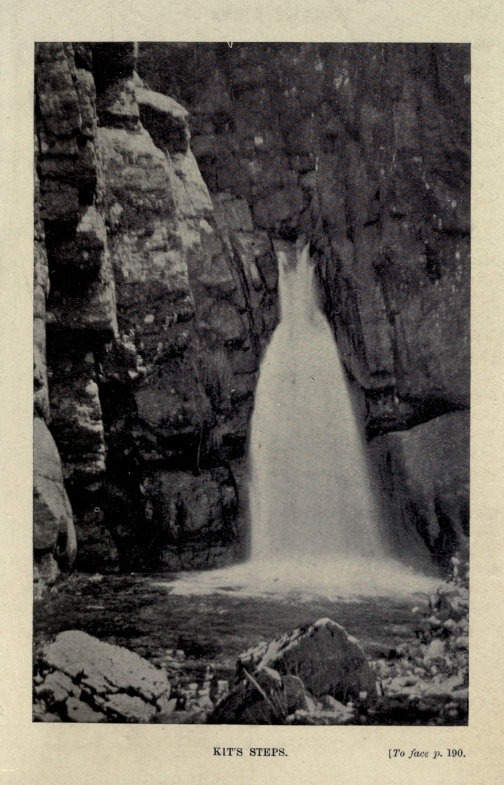
KIT'S STEPS.
Hilary was first at the Steps, and found a sheltered spot
under an oak tree, where mossy stones made an easy couch.
Here impatiently he awaited Sarah Jane; and at length she
appeared with a basket half full of ripe blackberries.
At first she was uneasy; but he quickly made her forget
the adventure of the moment, by interesting her mind with
other matters.
"You ought to begin by praising me," he said, "for
being so exceedingly good when I was at Ruddyford. I
only spoke to you thrice all through that long month. At
what a cost I avoided you, you'll never guess!"
"I was the happier that you did. I thought you was
growing sensible—about things."
"Sarah Jane, there's no sense nor sanity for me away
from you. I never knew, till I went away to London, what
you were to me. I said to myself, 'She interested me in
women again, because she's so lovely'; but it wasn't that
at all. I soon found out you yourself interested me, and
only you. The light dawned, and first I feared; then I
feared no more. Now I glory in loving you. It is far and
away the best thing that's ever happened to me."
"Was this what you wanted to say? It only makes me
miserable—Hilary."
"Thank you for calling me that."
"You made me promise to."
"I didn't make you. We can't make our gods do what
we want. We can only pray to them. What a curse it
is that we weren't born under a different star, Sarah Jane.
For me, I mean. If your fearless mind had only been taught
otherwise—but that's vain to regret now."
"Always the same with you—trying to teach me things
too hard for me, and mix up right and wrong."
"But I don't do anything of the sort. Right is a great
deal to me. In this matter right and wrong are not the
problem at all. I'm only mourning custom and
convention—not the clash of right and wrong."
The sexual relation had never occupied this woman's
mind apart from marriage. Now he made it do so, and
very leisurely, very carefully, explained what he meant by
"custom." His manner was light and bantering; none the
less, he revealed to her his own deep interest in this
discussion. He was a special pleader. He laughed at religious
interference in this connection; told her that it was an
outcome of yesterday; that foreign races shared wives and
husbands; that where life was easy, many men had many
wives; where life was hard, one woman might take several
spouses.
"Marriage laws," he said, "have always been a matter
of physical propriety and convenience. Temperature and
latitude, the food supply, the possibilities of population, and
the dearly bought wisdom of the community, have regulated
it—not any false nonsense about right and wrong."
He told her nothing that was untrue; but everything he
said was an indirect petition, and she knew it. She was
not shocked at the facts he placed before her; indeed, they
interested her; but she refused to let him influence her own
opinion. She contrasted Hilary's information with the
fierce and fiery ideas of her husband on the subject.
Between the two her own mind, through forces of education,
inclined to Daniel; yet she saw no great horror in a wider
freedom.
"'Tis wonderful how opposite men's thoughts can be,"
she said. "You and my husband do look at life almost as
differently as the people you be telling about. 'Tis all one
to you, so long as folk do what's good to themselves, without
hurting other folk; but to him—why, the very name of
evil be evil's self! Yesternight he was talking to a tramp
who took one of your turnips; and Daniel saw him. And
he said that, according to Christ, to look over a hedge with
hunger after a root was as bad as pulling and eating it."
"Doesn't it scorch you, living with such a narrow
spirit?"
"'Twould scorch me to make him unhappy."
"That you must never do, Sarah Jane."
He began to talk again of the subject in his mind. But
she begged him to desist.
"Leave it," she said. "What's the sense of telling me
all these curious things about the way people go into
marriage? Our way is so good as any, surely?"
"I only want to enlarge your ideas, and prove my argument:
that there's no right and wrong in the matter, only
the question of fitness and custom. You're too large-minded
to care a button for peddling quibbles. But leave it, if you
like. What you want to do, before all else, is to make your
husband happy; and so do I. Then we'll talk of that, for
there we quite agree."
"Thank you," she said. "'Tis more to me than anything."
"And you'll feel a little kind to me for coming to
it?"
"Yes, I will. I always feel kind to you, because I'm
sorry for you."
"Then 'tis my turn to thank you; and from my heart
I do. You know why I'm going to talk of Daniel?"
"For honesty, and because he deserves it."
"Yes—and for love, and because you wish it."
"That spoils all, Mr. Woodrow."
"Call me Hilary, or I'll not go on. There's one more
thing you must remember—in fairness to me. All good
comes from God—doesn't it? Grant Daniel is right about
a God, and you'll grant all good comes from Him."
"Why can't you say that good things come out of us
ourselves? So you have said before to-day."
"And so I say again. But we must think with your
husband's mind over this. If I lift him up a bit—what
then?"
"He'll thank God for certain."
"Exactly. He'll be the better for advancement—body
and soul. He's got a bit peevish of late. Success will
sweeten him and make him a gentler man."
"He feels he's not made enough of at Ruddyford."
"Well, I promote him. I answer his prayers."
"And perhaps his God will pay you well. For Dan's
very likely right."
"That's the point—I'm coming to that. I expect no
payment—not from God; because I happen to know that
God is an idea and not a fact. Therefore——"
"What?"
He was silent awhile. Her face changed, and he saw
that she had caught his meaning. He gave her no time
to dwell upon it then, but plunged into another subject
suddenly.
"Nothing can happen that is not for good—if your husband
is right. Always remember that, Sarah Jane. God
rules everything and rules everything wisely and perfectly.
Therefore, whatever you do, you are working out His
pattern—whether you are making the world happier or more
miserable. Now I'll ask you one question about something
altogether different. Last Sunday I read the story of David
and Uriah and Uriah's wife. You know it?"
"Yes, of course."
"Have you ever thought about it?"
"Only to be terrible sorry for the woman. 'Tis awful to
think what she must have suffered if she loved her husband."
"I'm always sorry for Uriah. 'Twas a cruel way out
of the difficulty. If I had been David I should have lifted
that noble soldier's head high in the world, and studied his
ambitions, and striven to make his life happier."
"David knowed the man better maybe. He reckoned
'twould be safer to put him out of the way—perhaps even
kinder, too—if he was such another as my man."
"Don't think it. David had merely to keep Uriah ignorant.
Many things, not the least evil in themselves, only
become so by the revelation of them. Prevent those who
will think them wrong from hearing of them, and no harm
is done. I love another man's wife. Well and good. Is
that a crime? Can I help it by an effort of will? Suppose
that other man's wife is sorry for me, and fond of me too?
Suppose that she finds me interesting, and useful to enlarge
her mind, and helpful to throw light on the difficulties of
life owing to my long years of study? Is that wrong of
her? Can she help it? Can you help it, Sarah Jane?"
"I'll never come to you no more, then. I can help that,
anyway."
"No, you can't help even that. You must come to me
if you love—Daniel. I'm his destiny. I'm the maker of
his future. His light shall shine, and he shall be a happy
man, and do good and great work in the world long after I'm
dead and gone. I'm only the poor means, yet vital. A
stone counts for less than the tool it sharpens; but the steel
couldn't do its work without the stone. You—you are your
husband's light, and his life, and his salvation. You shall
give him his heart's desire if——"
He broke off, was silent a moment, then asked a question.
"What would Bathsheba have said if David had put it so?"
"Depends on the sort she was. Might was right for
her, poor woman. She had no choice."
"She'd have spoken according to the reality of her love
for Uriah," he said positively. "She'd have said, 'I am
in the hands of my God, and if good things may come to
my husband through me, 'tis my joy and glory as a loving
wife to take them to him.' Can God do wrong?"
He stopped and looked at her.
Her bosom panted and she grew weeping-ripe.
"Never—never, wrong or right. 'Tis cruel to put it so.
He'd rather cut my throat with his own hand. He'd——"
"But think—so much for so little. I want so little, and
yet not little, for I ask what's worth more than all the
money I've got in the world. Kiss me—once, Sarah Jane—only
once—and I'll do more for your husband than his
highest dreams or hopes. For love of him kiss me—not for
love of me. Would I ask you to do an evil thing? Is it
evil to put new life into a very sorrowful man and purify
every drop of blood in an unhappy heart? Is it evil to make
the sick whole again at a touch? Didn't Daniel's Lord and
Master do as much a thousand times——?"
She stared and turned pale, save for her lips. Twin
tears glittered in her eyes. He put his arm round her
swiftly and kissed her. For the briefest moment he held
her, then he leapt to his feet and drew a great breath.
"If I did that often, I, too, should believe in God!" he
said.
A moment later he had hurried away, and she sat solitary
and tearful there for nearly an hour.
Through intervals of wild uncertainty the things that he
had spoken returned to her memory, and she clutched at
them, like the drowning at straws. To her husband and his
opinions she also turned. The outlook of neither man was
admirable to her now. She sickened at both surveys, and
wished herself a maiden again.
Then, with great yearning, she yearned after Daniel, and
rose and hurried off to her home. Before she reached it
her husband actually met her. Upon White Hill he came,
with his face to Lydford, and when she stood by his side he
stopped and helped himself from her basket.
"Brave berries, sure enough," he said. "I wish I could
carry 'em back for 'e; but Tommy Bates runned over five
minutes agone with a message from farmer. He wants to
see me at once, and I mustn't waste a moment. Can't say
what's in the wind, I'm sure."
He went his way, and Sarah Jane returned to Ruddyford.
As she arrived, a little boy came out. Tommy Bates had
just enjoyed a good tea, and the jam that had smeared his
bread left many traces about his mouth.
"Mr. Woodrow catched sight of me in the street by
the post-office, an' ordered me to come out-along and tell
Mr. Brendon as he wanted him this very minute," explained
the child.
Tabitha Prout, despite her general contempt of the
married state and those duties that belonged to it, awoke
into a very active love for Mrs. Brendon's baby; and Gregory
Daniel, doubtless appreciating the importance of having
Tabitha upon his side, did all that he could to increase this
regard. So it came about that when the little boy's
mother was called away, as sometimes happened for a few
hours at a time, the child found a friend in the old maid.
She enjoyed to have the baby beside her at Ruddyford
kitchen, and Daniel foretold that, as soon as the infant
could steer a steady course from his mother's cottage to the
farm, Tabitha would quickly find him a nuisance.
Brendon returned from his master in a very happy and
exalted frame of mind. To Sarah Jane only he imparted
his news; and it was not until nightfall that he did so.
Then he chose the curious form of a prayer for his intelligence,
and while they knelt together and he prayed aloud,
as his custom occasionally was, she heard for the first time,
in her husband's thanksgiving to Heaven, how Hilary
Woodrow had kept his promise.
"O Almighty Father, I thank Thee for touching this
man's heart to lift me up and advance my earthly welfare.
And I pray Thee to be on my side always, that I may do
wisely with Thy good gifts and turn more and more to Thee
and trust Thee. And let me do worthy work and never bate
my mind from thinking how to help Ruddyford and advance
the prosperity of Mr. Woodrow. I thank Thee humbly,
O God, for all Thy mercies, through Jesus Christ. Amen."
Before she slept he told his wife that Hilary had added
ten shillings a week to his money.
"I must go on as I'm going, so he said," explained
Daniel; "but his eyes are opened at last. I gathered from
him that he quite understood what I am here. I must give
him time, and all will come right. It's a lot of money, and
better things in store, I do think. 'Tis the beginning of
great blessings, Sarah Jane."
She expressed her delight; but when another morning
came and the man awakened, like a joyful giant, to run his
course, it was not only happiness, but the cloudy pain of a
memory unhappy that dawned in his wife's spirit. Two
different emotions pressed down upon her heart: remorse at
the thing never to be recalled, and wonder at the price.
The remorse waned and the wonder grew.
She mourned and rejoiced and went on with her life, into
which henceforth Hilary Woodrow intruded.
Then her abstracted soul was rudely shaken out of itself,
for one day there came running from the Moor a boy with
an evil message. He had been picking whortleberries near
the peat-works, when a man hailed him, and, approaching
the ruin, he encountered Mr. Friend.
"He's cruel bad, seemingly. In a great heat—so he
tells me. I was to let Mrs. Brendon know as he was ill.
He'm short of victuals, and drink, too, and I was to say
as if you could bring up a drop of spirits in a bottle, no
doubt 'twould soon put him right. And I was to have
sixpence, please, for coming. He hadn't got any small money
by him for the moment; but he said he'll pay you back
presently."
In ten minutes Sarah Jane was hastening over the Moor,
and soon afterwards Daniel, carrying a basket, set out after
her. He had visited the farm and collected such things as
Tabitha advised. The man made light of his load, however,
and soon overtook Sarah Jane.
"Don't you fret," he said. "You know what he is.
The wonder is he haven't been struck down a score of times
ere this. So careless of hisself as a child. 'Tis a bit of a
tissick on the lungs, I reckon. Us'll soon have him to rights
again."
"If he'm bad, I shall bide along with him, Dan. I can't
leave him here—not for anything in the world."
"Of course not. I shouldn't ax it. Very like I'll bide
too. If we think he's bad enough for a doctor, I'll go off
for one myself."
She thanked him gratefully, and they spoke on indifferent
subjects to calm their hearts. Sarah Jane hesitated not to
praise Hilary Woodrow for his recent action. Indeed, she
felt they owed him a very real debt of gratitude, and said
so many times.
"You're almost too affectionate and kind to everybody,"
her husband declared. "Pushed so far as you push it, 'tis
weakness."
"How can that be, Daniel? Even you hold it right to
love your neighbour as yourself."
"You can strain that into foolishness," he answered.
"And you are prone to do it. 'Tis a sort of gush in you.
You mean nought—yet there 'tis. See how you look at a
tramp that comes begging, and how Tabitha Prout looks at
him. She tells the truth in her eyes, and shows her
contempt of the rascal; you look as if you doted on his lazy
carcase, and would gladly pour out the fat of the larder for
him."
"I know 'tis so. I be fond of my kind—just because they
be my kind, I think. I like 'em all—men, women, childern."
"So you should do—in a general spirit of religion, because
they are made in God's image."
"No!" she said vehemently. "Not that—not that.
Because they are made in mine!"
He showed discontent.
"You won't come to see the truth, talk as I may."
"Look at the night when you heard our good news," she
answered. "That shows the difference betwixt us. You
was thanking God so deep and true, that you hadn't a
thought for Mr. Woodrow. You was so wrapped up in
heaven that you never seemed to think 'twas a man on
earth—a creature like yourself—that had lifted you up.
All the credit went to God Almighty—all. Not a drop to
farmer. Can't us poor human souls have a bit of praise
when our hearts are generous and we do good things?"
So she argued in all honesty and out of a passionate
abstract love for her kind. At that moment she forgot the
circumstances and the nature of the bargain. She only
begged that her husband should bestow a little of his
gratitude on his earthly master.
"As for that, a good human being be only the middle-man
between God and us," he said. "The Book says all good
comes from Him, and only from Him. Same as evil comes
from the Prince of Evil into man's heart."
"Then what be we but a pack of dancing dolls with them
two—God an' the Dowl—fighting for the strings? Is that
all you'd make of us? Is that all you'd make of me? You'll
live to know different, Daniel."
"You fly away so," he said. "Of course there's Free
Will, an' a very great subject 'tis; an' Mr. Matherson be
going to preach upon it next Sunday, I'm glad to say. So
I hope we'll both win a bit of light when he does."
Sarah Jane said no more. Strange thoughts, not wholly
unhappy, worked in her heart, and she felt frank joy to
think that, though Daniel Brendon had not paid Hilary for
his kindness, somebody had done so.
So the husband and wife each failed to grasp the reality
of the other. While she thus reflected, he was busying
himself with how to earn this handsome increase of salary. A
dozen plans began to develop in his mind. Only the inertia
of old routine and custom still opposed his various
enterprises. But now had dawned a promise of power, and he
was full of hope.
They reached the mournful habitation of Gregory Friend
to find him very ill. He sat by his fire with a couple of
sacks over his shoulders, and complained of great pain in
the lower chest and back, with difficulty of breathing.
"It came on two days ago, and I thought I'd throw it
off, as I have many an ache before," he said. "But it
gained on me. Then this morning, with light, I began to
wonder what I'd better do, for I felt some deep mischief
had got hold upon me. I put on my clothes and thought
to try and get down to Ruddyford, as the shortest road to
people. But by good chance there came a boy picking
hurts, and no doubt he reached you."
They spoke together for five minutes. Then Daniel
started for Bridgetstowe to get a doctor, and Sarah Jane
attended to her father. She got him out of his clothes and
into bed; she built a big wood fire that set the moisture
glimmering on the walls of Gregory's hovel; she heated
water and made him drink a stiff glass of hot spirits; and
she set about a dish of broth, the ingredients of which
Daniel had brought in the basket. Mr. Friend revived presently,
but his pain was considerable and he found it difficult
to breathe.
"Give me some more brandy," he said. "It lifts up
the strength. I did ought to have a plaster put upon my
back without a doubt, for I mind a man up here being took
just like this. And they put a fiery plaster on him and
drawed the evil out."
"There's nought but bread to make it of," said Sarah
Jane. "Or else peat."
His eyes brightened.
"That's a good thought—a capital idea! Fetch a bit of
the soft and make it red-hot in a saucepan, and 'twill be a
very useful thing—better than mustard, very like."
She did her best, and presently Mr. Friend, with a mass
of hot peat pressed against his side in a piece of Sarah
Jane's flannel petticoat, declared himself much easier.
"'Tis life every way," he said. "This be a great
discovery, and very like, if doctors come to know about it,
'twill go further than all they bird-witted engineers to set
Amicombe Hill up again."
He stuck to it that the peat was doing him immense
good. He drank a little broth when Sarah Jane brought
it to him. Then he wandered in his speech, and then for
a time he kept silence.
"Better for certain—better for certain now," he said at
intervals.
Presently he asked after his grandchild.
"Must have him up here a lot next summer when the
weather's good," he said.
He seemed easier presently, and his daughter had leisure
to think of herself. She loved him dearly, and, since
marriage, the gentleness and simplicity of his character had
more impressed her than formerly. Before, she had no
experience by which to measure his virtues. Now, with a
larger knowledge of men and life, she could appreciate the
single-hearted Gregory, sympathize with him and perceive
the pathos of his life and futile hope.
She talked to him now very openly of her own secret
tribulations and the difficulties of late forced upon her by
her husband's master.
"He's lifted Daniel up, father; and Daniel have thanked
God ever since; but—but 'tis me he ought to thank."
Then she proceeded, told her father of the scene at Kit's
Steps, and asked him to help her.
"Do nothing to anger Daniel," he said. "You're playing
with death and worse. This can't come to good, and I
only hope to God you haven't gone too far already. That
man Brendon as—as—build me up another hot poultice,
will 'e, while I talk?—Brendon is a lion of the Lord; and
he'd be a lion on his own account if anything happened to
cross him in his den. Have 'e ever marked his eyes, Sarah
Jane? But of course you have. They glow sometimes in
the dimpsy light, like a dog's do glow. When you see that
in a human's eyes, it means that, down under, there's a
large share of burning fire in 'em. If Dan thought that he'd
been wronged, not heaven or earth would stand between him
and payment."
He began to cough and held his hands to his head.
"'Tis like red-hot wires going through the brain," he
said. "But 'twill be better presently. I'm in a proper
heat now. I've been praying to God to fetch out the sweat
on me. Now the peat have done it."
"Don't talk no more, dear father. Bide quiet a bit an'
try an' see if you can't sleep."
"So I will, then; but there's two things I must say first.
One is that you must go away from Ruddyford. Mark
me, 'tis life or death if the wind's in that quarter and
Woodrow's after you. He's a desperate sort of man because
he've got nobody to think of but himself—no family to
consider—no wife or child—nothing. You must go—go—far
ways off, where he can't come at you."
He stopped, and shut his eyes. Then, when Sarah Jane
hoped that he slept, her father spoke again.
"The other thing is my knife—the famous one wi' the
ivory handle and long, narrer blade, that I use when I do
my chemical work. It have a history. My uncle fetched
it from a foreign land, and it be made of a steel called
Damascus—the best in the world; and there's gold letters
let into it in a foreign tongue. 'Tis in the works, along with
a few other things, Sarah Jane. My watch be there—not
that 'tis any use, for it haven't gone for a year. Still, if the
worst comes, I'd like little Greg to have 'em from me—also
the shares in the Company. He'll live to see them a useful
bit of money. And the rest must go to you and Dan."
"Don't—don't be talking. You've got to get well again
quick," she said. Then she took away his plaster and
brought another hot from the saucepan.
"A great invention," he said. "A great invention. If
I'm spared, the thing shall be known far and wide afore
long."
He dozed between fits of coughing, and moved uneasily
in a semi-dream. Then came the sound of a galloping
horse, and Sarah hastened to the door.
"Can't be doctor yet, unless by happy fortune Dan
ran across him," she said.
But it was not the doctor. The bearded and grave
countenance of Mr. Henry Norseman met Sarah Jane's eyes.
"Just met Brendon," he explained, "and hearing that
Mr. Friend was in peril, I come up so hard as my hoss
would go, to see if I could comfort him. I've been light at
more death-beds than one in my time, including my own
father's, and often a word helps the wanderer in the Valley."
"He'm not in the Valley, or anywheres near it," answered
the woman stoutly. "But come in by all means.
If you could bide with him a little, I'll look about, and set
his living chamber in order, and try to make an egg pudding
for him."
Mr. Norseman, who knew Gregory and his daughter but
slightly, now dismounted, tethered his horse, and presently
sat by the sufferer; while Sarah Jane, glad of the
opportunity, worked hard to make the dismal hole that was her
father's home a little clean and a little comfortable.
"Very kind of you to call, I'm sure," said Mr. Friend,
when his daughter had gone. "Don't tell her yet, for I
may be wrong; but I'm very much afraid 'tis all up with
me. 'Tis awful deep in me. I got properly wetted two
days ago, and went to sleep afore the fire."
"Where there's life there's hope," said Mr. Norseman.
"But you're wise to face it. I wish you'd been more of a
church-worshipper, Friend."
"Well, well. I've worked hard and tried to do my duty."
"But more goes to life than that. What are man's days
without faith? Here you've lived for years, more like a
wild savage of the woods than a devout Christian. I wish
you'd planned your life wiser, Friend, I do indeed."
"So do I. So do all. So will yourself, when you'm
down."
"As to that, I think I can look forward in hope. But
you—you see, you put this life first always. Your thoughts
ran upon making a fortune out of fuel in this world. You
never thought about making a fortune in the next, I'm
afraid."
Gregory laughed painfully.
"Plenty of free fuel where you think I'm going," he said.
Mr. Norseman was hurt.
"You ought not to jest about a sacred subject—never—and
least of all at a time like this," he answered. "You're
wise to face it—as we all should—but not in a ribald spirit.
Don't die with a jest on your lips, Gregory Friend."
The other moved and groaned, but with present misery
not in future fear.
"For your comfort I can tell you that hell's not what
it was," said Henry Norseman kindly. "The more understanding
way with respect to it, so parson says, is to believe
that it won't last for ever. 'Tis a noble discovery, if true.
No man was better pleased to hear the sermon he preached
about it than I was. I can say that honestly. If hell's
only a matter of centuries and not eternity—think what an
uplifting thought for a death-bed! I don't say you're on
your death-bed, Friend, and I hope you're not. But some
day you will be for certain. And 'tis a great thought that
the Lord may be found so forgiving that He'll abolish the
place of torment once and for all—so soon as justice have
been done. Justice first, of course. Even you, as can't be
called a church member, or even chapel—very likely a
thousand years will see you through it—or less."
"God is Love, my mother used to tell," said the sufferer.
"And for that reason we have a right to be hopeful,"
declared the churchwarden. "And I'm for limiting hellfire
heart and soul; though, I warn you, everybody ban't
of the same opinion. 'Tis justice against love weighed in
the balance of the Almighty Mind; and ban't for us worms
to say which will come out top."
Sarah Jane returned a little later, and found her father
somewhat agitated.
"This man reckons I shan't have more than a thousand
years in hell, if I'm lucky, Sarah," he said. "'Twas kind
of him to come and lift my thoughts. And I said that I'd
like to be buried up here 'pon Amicombe Hill, in the peat;
but he reckons 'twould be against high religion."
"A most profane wish without a doubt," answered
Mr. Norseman; "and as a Christian man, let alone other
reasons, I shall object to it."
Gregory's daughter looked at him, then she turned to her
father. "Try and eat a little bit of this, dear heart," she
said. "'Twill strengthen you, I'm sure."
A moment later she drew herself up, regarded Mr. Norseman,
and pointed to the entrance with a simple gesture.
"And you—you that could talk of hell to this poor
stricken man, whose good life don't harbour one dark hour—you,
that can bring your poor church stuff to my father—I'll
ax you to leave him if you please. When he dies—and
may it be far off from him—he'll go where the large, gentle
hearts go—to the God that made him and that watches over
the least. He's done man's work and been faithful. He's
been loving and kind to all. Not here, nor in heaven, can
any harsh word be spoke against my dear, dear father."
Mr. Norseman pulled his black beard and began to get
annoyed.
"This isn't at all the way that Brendon would speak," he
said—from the door.
"No," she answered. "He's a man, and strong in the
arm. He wouldn't speak: he'd do. He'd take you by the
neck and fling you back into Lydford—and your horse after
you."
"You'll be sorry for this disgraceful behaviour," said the
churchwarden. "'Tisn't a nice way to treat a religious
person who rides four miles out of his way to comfort the
sick."
"Rides four mile out of his way to bring hell-fire to a
better man than himself," she retorted hotly; then
Mr. Norseman turned his back and went to his horse.
Gregory chid Sarah Jane, but she would not let him talk,
renewed his poultices and strove to make him eat and drink.
He could, however, do neither, and he was wandering in his
speech and partly unconscious before another hour had
passed.
Time stretched interminably, and not until the evening of
the day did a medical man arrive on horseback.
He had guessed from Daniel's description of the case
what was amiss, and had directed Brendon to bring certain
things to the peat-works as quickly as possible.
Sarah Jane watched while the physician made his
examination. Then he took her into the other room, and
told her that her father was dying.
Jarratt Weekes came into his father's home with an
item of news.
"That old madman at the peat-works—Gregory Friend—is
about done for," he announced. "I met Brendon
yesterday, running about for a doctor. I couldn't feel too
sorry myself, and angered him. 'Wouldn't you do as much
for your father-in-law?' he asked me; and I thought of
Adam Churchward, and said I wouldn't."
"A man didn't ought to marry his wife's family,"
admitted Mrs. Weekes. "But you'm too hard without a
doubt. Well, if Friend be going, there's an end of the peat-works
for evermore. 'Twill be the last breath of life out of
the place."
"All the same," said her son, "there's no call for that
long-limbed man to reprove me, as if I was a creature not
made of flesh and blood. He's so dreadful serious—can't
see any light play of the mind."
"A deadly earnest creature, no doubt," admitted his
mother. "I wonder if Sarah Jane will be any the better
for Gregory's going? Probably not. But come to think of
it, they've had their luck of late. Her man's getting what
I should call fancy wages myself."
"He's worth it," ventured Philip Weekes. "The things
he does—Joe Tapson was telling me. Even Joe, who's a
jealous man, and didn't take at all kindly to Daniel's
rise—even Joe admits that he's a wonder."
"Bah!" said Jarratt. "He's not half so wonderful as
a three-horse-power steam engine, and can't do half the
work of it."
"You're wrong there," answered his father. "He's got
plenty of brains in his head, and Prout himself has let it
be known that them alterations he begged to be allowed to
make will certainly be for the better, though he stood out
against them at the time."
"We're friends now, anyway," continued his son. "I'm
not saying he's not a very useful man; but I do say, and
always shall, that he wasn't good enough for Sarah Jane."
"Us don't want to hear her name no more," declared his
mother—"not on your lips, that is. 'Tis Mary now, and
she's a proper girl too. Where she got her wits from I
never can make out. 'Twasn't from her mother, for the
poor soul was only moon to schoolmaster's sun, and hadn't
more sense than, please God, she should have. That gert,
hulking chap, William, as paints his silly little pictures, be
so like his mother in character as two peas, though he
carries his father's body."
"Mary hasn't got no higher opinion of 'em than you
have," declared Jarratt. "She can suffer her father, but
not the 'Infant.' She'm twice the man he is."
"For my part, I'd sooner do with him than schoolmaster,"
answered Hephzibah. "Lord save us—such an
empty drum never was. Why, to hear his great, important
voice, you'd think he'd met a lion in the path.
Moses—when he comed down from the Mount—couldn't have felt
more full of news. And what do it all come to? Nothing
at all—save that he's just drunk a dish of tea round the
corner with some other old fool; or that one of the
school-childer's got the mumps; or some such twaddle."
"Not that us should seek to set Mary against her own
father, however," said Philip mildly.
"Be quiet, you mouse of a man!" answered his wife.
"Who wants to set children against parents, I should like
to know? If a child be set against parents, 'tis the silly
parents' own fault—as you ought to understand—nobody
better."
The family met again that night, and Susan, coming
across from Mr. Woodrow's for some butter, brought the
expected news with her.
"Mr. Gregory Friend was took off about midday," she
said. "I met young Billy Luke—him as he apprenticed to
Mr. Medland, the undertaker. He knowed all about it.
They be building his coffin this minute, and 'twill be taken
up to-morrow morning; and 'tis ordained that poor Mr. Friend
shall be drove on the trolley that he used to work
up and down the line with his peat."
"Quite right," said Mr. Weekes. "For that matter,
there's no other way they could fetch him down. Well,
well—who'd have thought of him going?"
"They've allowed Mr. Brendon to have the corpse took
to the vicarage; and the funeral party will walk from there;
and he's to be buried Friday; and two wreaths have come
in already, if you'll believe it," continued Susan. "One
from them people at High Down, that Mr. Friend did use
to keep in firing free of cost; and one from somebody
unknown."
"Us will do the same," declared Philip. "There should
be some Michaelmas daisies near out, but I haven't looked
at the front garden for a fortnight."
"If you had," said Mrs. Weekes, "you'd have found
that owing to your mazed foolishness in leaving the gate
open a while back, Huggins' cow got in, an' the daring
hussy ate our Machaelmas daisies down to the roots afore I
could force her out again. All the same, we'll do something,
else Sarah Jane won't send us a memorial card; and
I like to see them black-edged cards stuck in the parlour
looking-glass. They be good for us, and remind us that a
time will come when they'll be printing ours."
"Leave that to me," said Philip. "Not your card—God
forbid!" he added hastily, "but the wreath. I thought
well of poor Friend—very well—a most hopeful creature.
'Twas only back-along, at his grandchild's christening, that
me and him had a great tell over things in general."
"If 'tis a boughten wreath, I'd be wishful to put a
shilling from my savings to it," said Susan. "I'm terrible
fond of Sarah Jane, and she'll be cruel sad for him."
They rolled the morsel of other folks' sorrow upon their
tongues.
Mrs. Weekes surprised nobody by deciding to attend the
interment. A funeral was an event she rarely denied herself,
if it was possible to be present. She found the ceremony
restful and suggestive.
"You and me will go, Jar," she said. "You can't
come, master, because you'll have to be on your rounds
against market-day. But Jar and me will stand for the
family."
"And me," said Susan. "I can borrow a bit of black
easily from a lot of girls."
"I want to go," began Philip. "I really want to go. As
a rule funerals ban't all to me they are to you, my dear; but
this is out of the common. Yes, I must ax of you to let
me go, out of respect to poor Friend."
Thereupon Mrs. Weekes took the opportunity and her voice
rose to a familiar and penetrating pitch.
"Nought to you if we starve," she began. "You—amusing
yourself on Friday of all days—and the people along
your beat waiting and wondering, and coming down on us
next week for damages; and me going empty-handed to
market Saturday, to be the laughing-stock of Devon and
Cornwall; and——"
Here Philip, with deprecatory attitudes, withdrew.
For once the man stood firm, and having started on his
rounds at dawn upon the burial day of Gregory Friend, he
was able to pay final respect to the peat-master and be
numbered with the mourners.
Their company was small, but among them stood one
most unexpected. Hilary Woodrow had sent a wreath the
night before, and its beauty occasioned comment and
admiration among those who saw it; but that he should come
to the funeral was a great surprise. Come he did, however,
and attended the opening portion of the service; but he did
not join the party in the churchyard.
Brendon waited to see the grave filled; then he returned
to his wife. She went with her little boy to the house of
Mrs. Weekes after the funeral; and there he presently found
her.
Hephzibah insisted on Sarah Jane drinking a glass of
brown sherry, while the child ate a sponge-cake.
"Pale sherry-wine be right at a funeral—not dark," said
the market-woman; "but, at times like this, the right and
wrong of such a small thing really don't count for much
to a sad heart." Then she turned to Gregory, the child.
"You darling boy! Behaved so beautiful, he did, with
his curls a-shining like gold over his poor little black coat!
'Tis one in ten thousand, as I said from the first. I could
wish vicar had read the lesson himself, instead of letting
schoolmaster do it. But Churchward's always turned on to
the lessons nowadays. 'Tis like a bumble-bee reading, to
my ear. And Farmer Woodrow there too! Fancy that!"
Sarah Jane nodded. She had suffered very bitter grief
in this loss, but she showed little of it except to her husband.
Only he knew the extent and depth of her sorrow. He had
asked her not to come to the funeral, but she chose to do
so. Pale and dry-eyed, Sarah Jane endured. Of her sorrow
very little appeared. She lacked her husband's faith, and
strove with poor success to pass the barrier, or see herself
in her father's arms when life's day was done.
She drank the wine and brushed the crumbs from her
baby's frock and face.
"He wrote Daniel a very beautiful letter—Mr. Woodrow,
I mean. He don't think about death like my husband do;
but the letter made even Dan think. 'Twas deep, lovely
language," she said.
"He'll be meat for the grave himself if he ban't careful,"
answered Mrs. Weekes. "A poor, starved frame and
hungry eyes, though there's a wonderful gentlemanly hang
about his clothes. Something be burning him up in my
opinion—we all mark it. Jarratt says 'tis his harmful ideas
about religion; I say 'tis a decline. I told the man so to
his face last week, when I went over to see Susan; and
he laughed in his gentle way, and said he was all right.
Still, I don't like his look—more don't John Prout."
Sarah Jane listened, but she knew a good deal more
about Hilary Woodrow than any other living creature save
himself. Little by little there had risen an intimacy between
them—not of the closest, yet of a sort beyond friendship.
She met him by appointment, now here, now there. To
this extent she lived a double life, since Brendon heard
nothing of these occasions. Woodrow talked of going away
for the winter, but she knew that he would never do so.
The days when he did not see her were blank days to him.
He often spoke warmly of Brendon and of the future that
he designed for him. He longed to make her presents, but
could not. Now thinking upon almost the last words that
her father had spoken to her, Sarah Jane determined to
throw herself upon Hilary's goodness and honour. But she
reckoned without his passion.
That night, while Brendon slept beside her, she turned
and turned sleepless, with a wet handkerchief rolled up in
her hands. She mused upon the dear dust in the churchyard,
and the living man beside her, and of that other who
thought waking, and dreamed sleeping, of none but her.
How did she regard him?
For a month after her father's death Hilary Woodrow
spared her, and she appreciated his self-denial. But during
the days he saw her not he revealed a constant and steady
thought for her. He had continued speech with Daniel,
and Sarah Jane noted that Brendon's enthusiasm for his
master grew as Woodrow's trust in him increased. Then
she saw Hilary again herself, and his flame leapt the fiercer
for their weeks of separation.
A year passed by and little happened to mark it. Then
full store of incident fell upon the dwellers at Ruddyford
Farm.
It is to be recorded to the credit of Jarratt Weekes that,
in the bitter difference which now happened between him
and Daniel Brendon, he was not altogether at fault.
Nevertheless an underlying element of malignity mingled with his
attitude. In giving of advice, subtle personal satisfaction often
lurks; yet sometimes the emotion belongs merely to that
implicit sense of superiority felt by the critic over the
criticized. When Weekes met Brendon on an autumn day
and plunged into the most dangerous subject that he could
have chosen, he did so quite awake to the delicacy; but he
did so from motives at any rate largely blent with good. He
was now himself happily married, for Mary Churchward,
despite a harsh voice and a hard nature, had plenty of sense,
and proved practical and patient. Jarratt's feeling to
Brendon and his wife was mainly friendly, and if some
sub-acid of memory still tinged thought, that recollection had
largely faded. To sum up, if his motives in this encounter
were mingled, he meant no lasting evil, but rather lasting
good from his action. That Daniel might smart a little he
guessed, and the fact did not cause him any regret. Frankly,
he was glad of it. The giving of this advice would lift him
above the lesser man, and, by so doing, help him to win
back a little self-esteem. As for the upshot of his counsel,
he felt very certain that it must tend to benefit the other
and establish him more securely in his home and its vital
relations. Since he acted in profound ignorance of Brendon's
own character, his conscience was clear, and his mind free
to state the case with all the force and tact at his command.
He told himself that he was doing his duty; but his deed,
none the less, had a relish that duty usually lacks.
Under any circumstances danger must attend the
operation—how great Weekes did not guess; and in the event,
the added circumstance of Daniel's mood had to be reckoned
with. This precipitated the catastrophe with terrific
suddenness.
When they met, Brendon's dark star was up. Matters
were contrary at the farm, and a thing, little to be expected,
had happened in the shape of a quarrel between Daniel
and John Prout. Their master was the subject, and a
word from the younger man brought sharp rebuke upon him.
"'Tis all tom-foolery about his being ill," said Daniel.
"He's as tough as any of us. 'Tis laziness that keeps him
mooning about with his books down at Lydford—that's my
opinion."
But Prout flashed out at this, and, for the first time,
the other saw him in anger.
"Tom-fool yourself!" he said; "and never you open
your mouth to chide your betters in my hearing again, for I
won't stand it. You ought to know wiser. You to speak
against him! If you had half his patience and half his
brain power, you might presume to do it; but you haven't:
you've got nought but the strength of ten men and a very
unsettled temper to make it dangerous. I'm sorry for
you—you that pose for a righteous man and mistrust them as
be set over you. What do you know about the sufferings
of the body? When do a cough rack you of nights and
rheumatics gnaw your bones like a hungry dog? Don't
you dare to say a disrespectful word of Mr. Woodrow again,
for I'll have you away if you do! After the master he's
been to you—lifting you above the rest and making you free
of the farm to work where you will, as if 'twas your own.
Dear, dear!—'tis a bad come-along-of-it, and I'm greatly
disappointed in you, my son."
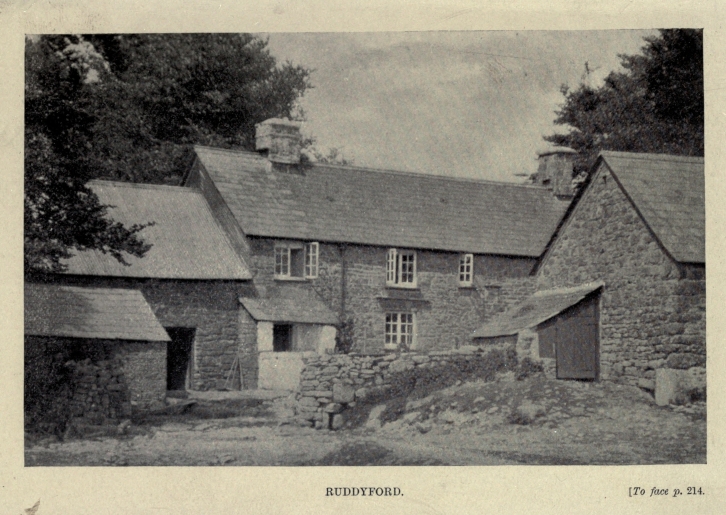
RUDDYFORD.
His anger waned towards the end of this speech, as his
words testified; but Brendon, having heard, hesitated and
showed self-control. He was bitterly hurt at this tremendous
reproof, yet he perceived that it was justified from
Mr. Prout's standpoint. He did not seek to set himself right.
His first anger died out when John reminded him of the
things that the master had done for him. He apologized,
but in a half-hearted manner; and then, with darkness of
spirit, betook himself about his business.
It was necessary that morning that he should go into
Bridgetstowe, and through a wet autumnal Moor he walked,
passed under Doe Tor, and presently reached the little Lyd,
where she foamed in freshet from the high lands.
The springs had burst, and the wilderness was traversed
with a thousand glittering rillets. In the deep coombs and
wherever a green dimple broke the stony slopes of the hills,
water now leapt and glittered. Traced to their sources, the
springs might be found beginning in little bubbling cauldrons,
from which, through a mist of dancing sand, they rose out
of the secret heart of the granite. Then, by winding ways,
they fell, and the green grass marked their unfamiliar
passing with beads of imprisoned light on every blade. It was
the death-time of heath and furze, the springtime of moss,
lichen and fungus. Quaint fleshy caps and hoods—some
white and grey, some amber and orange-tawny—spattered
the heath; and many mosses fell lustrously in sheets and
shone in pads and cushions. The great lycopodium spread
green fingers through the herbage, and his little lemon spires
of fruit thrust upward in companies and groups. Beside
him the eye-bright still blossomed; the whortle's foliage
turned to scarlet; and in the marsh the bog mosses made
splendid mosaic of delicate and tender colours. At river's
brink the seed-cases of the asphodel burnt, like a scarlet
flame; the sky-coloured bells of the least campanula still
defied death; and the later gentian grew and lifted purple
blossoms from the glimmering grass.
Daniel Brendon crossed Lyd by the stepping-stones and
met with Jarratt Weekes. They walked along together, and
the elder man happened to speak of a matter then in the
other's thoughts.
"I suppose you know Mr. Woodrow's going at last?
My wife says she can't live with her father no more, and
she's right; so I've had to say that I must have the cottage
empty after Christmas. What's he going to do?"
"Can't tell you," answered the other. "There's a
general opinion that he's not strong and didn't ought to
spend his winters up here."
"I reckon we shouldn't have heard about his health if
he'd been a poor man. He's well enough to do everything
he wants to do. Have 'e marked that?"
Daniel nodded.
"All the same, we mustn't judge people by their looks,"
he said. "I was thinking much as you do only an hour
agone—and saying it too. But I got a pretty sharp rap
over the knuckles from Prout for my pains. Ban't our
business, after all. He's a very good master—never heard
of a better."
"And a very good payer. I've nothing to grumble at.
Only a man's wife must be his first thought. Mrs. Weekes
wants to go into the house."
"Us married ones can afford to laugh at the bachelors,"
declared Daniel.
"So us can—though the bachelors have been known to
pay back the compliment sometimes, and make us a
laughing-stock. When I was married, kind-hearted people
whispered 'twas the rasp wedding with the nutmeg-grater.
That's the sort of gentlemanly thing one's friends say behind
one's back. But I think it has been proved different. My
wife's a wonder in her way—got all my mother's sense
without her tongue."
"You're lucky for certain. I'm glad Sarah Jane and
her be such good friends."
"So am I, and—and friendship's nothing if it won't—— Look
here, may I say a thing to you on a delicate subject,
Brendon? Will you promise not to be angered if I do it?"
"If you speak of friendship, who can be angered?" asked
Daniel. "What delicate subject should you have to speak
to me about?"
"The tenderest a man can touch to a neighbour. But
from pure goodwill I speak it. You'll judge that when you
hear me. A man doesn't strain friendship and say ticklish
things for fun. 'Tis only out of kind feeling for you and
Sarah Jane that I'm going to say it."
"Better leave her out," said Daniel. "Her welfare's
the same as mine. She've not got any good away from my
good. If you do me a friendly turn, you'll be doing the
same to she."
"I can't leave her out. She's the matter."
Brendon stopped and stared.
"What be you talking about?"
"About Sarah Jane. There it is. I told you 'twas a
delicate matter. If you won't stand it, I'll leave it alone."
"Go on," said Brendon shortly. His voice had changed,
and Weekes noticed it.
"Don't be angry for nought. It's a free country, and
I've a right to my opinions, I suppose. I say again, 'twas
a great act of friendship in me to touch this thing at all;
but if you're going to take it in an evil spirit, I'll stop. 'Tis
no better than the old saying of Lydford Law—when they
hanged a man first and tried him afterwards—for you to
speak in that tone of voice, and command me to go on, as
if I was a servant and you the master."
"What do you want, then?"
"I want you to understand that I'm not doing this
because I like it. I know the gravity of what I'm going to
say; but I'm not a word-of-mouth friend, but a real
one—where a man will let me be. So I say to you that unwise
things are being done—not by Sarah Jane—not for a
moment—but by Hilary Woodrow."
"I must ask you to name them."
Weekes did not answer immediately. Then he went to
the heart of the matter, so far as he knew it.
"They walk together. They meet—accident on her part,
no doubt; but not on his. Yet could he meet her if he
hadn't fixed to do it? 'Tisn't wrong, of course; but 'tisn't
wise."
"You've been watching Sarah Jane?"
"Not I. What is it to me? They've been seen together
in lonely places, that's all—no harm, of course—still——"
The other blazed out and his voice rose.
"You're a dirty-minded man to say these things to me,
and 'tis far off from friendship that makes you say them!
Quick to think evil—and wish evil. To cloud the fair name
of a man's wife—because she's a fool——"
"Don't be a fool yourself! I'm clouding nobody and
nothing. I'm only telling you that——"
"Tell me no more!" roared Daniel.
"If I did, perhaps you wouldn't make such a silly row,"
answered Jarratt, hot in his turn. "Why, you great stupid
lout, what is it to me if she's his mistress? I don't care a
damn—I——"
Brendon cut him short, made a loud, inarticulate sound
like an animal, and struck the smaller man to the earth.
He hit Weekes with his right fist full upon the forehead;
and the blow dropped the castle-keeper backwards, and
deprived him of consciousness.
Daniel shouted at the prone figure, raved at him and
cursed him. Any chance beholder had fled with fear, under
the impression that a maniac rioted there. The passion-storm
was terrific, and for a time Brendon seemed not
responsible. Then his wrath gradually passed, and both
the conscious and unconscious men came to their senses.
Weekes recovered, sat up, then stood up unsteadily, and
looked round for his hat and stick. Daniel immediately left
him and went upon his way.
That night Brendon told his wife what he had done, and
she listened while he spoke at length. He cast no blame
upon her; but very sternly he bade her be more mindful of
herself henceforth; and he warned her with terrible earnestness
that he would hold it no sin to destroy any man who
injured him in his most sacred possession. His great
self-control on this occasion impressed her more than rage would
have done, and she uttered no protest when he told her of
a fixed intention to leave Ruddyford.
"You're right to go," she declared.
"John Prout threatened to have me turned off for speaking
rudely of the master this morning," he said. "Well,
I'll go without being turned off. I can stop no more after
this, and I won't. Don't think I'm angered with you or
with him. I'm not. I scorn to be. 'Tis only that knave
that has angered me by his evil lie. This won't end here.
He'll have the law of me for what I've done and disgrace
me, be sure of that. I must suffer what I must suffer: my
conscience is perfectly at peace about that. He got less
than he deserved."
But time passed, and Jarratt Weekes made no sign. So
far as Brendon could judge, none even heard of the
encounter. At any rate, it did not reach his ear again. It
was said that the horse of Mr. Weekes had lifted its head
suddenly, and given him a pair of black eyes while he was
stooping over its neck.
The folk often called at the cottage of Philip Weekes, for,
despite her loquacity, Hephzibah was known for a woman
of judgment, and her friends, with practice, had learned
to pick the grains of sense from that chaff of words in which
it whirled.
On an evening some time after the reported accident to
her son, Mrs. Weekes sat in the midst of a little company,
for several men had dropped in on various errands.
Her kitchen reeked with tobacco-smoke. Philip and
Mr. Huggins were side by side on a settle by the fire;
Mr. Churchward occupied a chair near the table, and Mrs. Weekes
herself sat beside it darning stockings. A bottle of
sloe gin stood on a tray near her.
The schoolmaster thought more highly of Hephzibah than
did she of him; but since Jarratt had chosen his daughter,
she was always civil.
The talk ran on Adam's son.
"He has succeeded in getting a pictorial effort hung at
a public exhibition in Plymouth," said Mr. Churchward.
"They are holding a picture show there—all West Country
artists; and I confess I am gratified to hear that William
has been chosen. I think of taking Mary down to see it
presently. Perhaps, if we selected the market-day, you
would join us, Mrs. Weekes?"
"Likely!" she answered. "Me trapsing about looking
at pictures, and my stall——there, you men! Guy Fawkes
and good angels! And you go about saying you've got all
the sense! I could wish your son might find something
better to do, I'm sure, for there's no money to it, and never
will be."
"The art of photography will be a serious stroke to the
painters of pictures, no doubt," admitted Mr. Churchward.
"Yet such things have not the colours of nature which the
artist's brush produces—nor have they the life."
"As to life," she answered, "there's a proper painted
picture down to Plymouth in a shop near the market—the
best picture as ever I see in all my days. Two mice gnawing
a bit of Stilton cheese. Life! Why, 'tis life. You
can pretty near smell the cheese. And only two pound
ten, for the ticket's on it. If you want life, there you are;
but it have been in that window a year to my certain
knowledge. Nobody wants it, and nobody wants your son's
daubs. He'd much better give over and burn all his trash."
"He can't, my dear woman. 'Tis in his blood—he must
be painting, like I must be teaching and you must be selling.
We're built on a pattern, Mrs. Weekes, and that pattern
we must work out against all odds. William is a lusus
naturæ as one may say—a freak of nature."
"I'm sorry for you," answered she. "There's nought
to be proud of, anyhow. Where's the cleverness in fashioning
things that ban't worth more in open market than the
dirt pies the childer make in the road? Better paint houses,
and get paid, than paint pictures and get nought."
"'Tis a most curious thing that such a huge man as the
'Infant' do always paint such little pickshers," said
Mr. Huggins. "Why—them things what Noah Pearn have got
hanging up in the bar parlour ban't bigger than a sheet
of writing paper. Yet, from the tremendous size of the
man, you'd have thought he'd have taken a public-house
signboard at the very least."
"Size in matters of pictorial art is nothing, Valentine,"
explained the schoolmaster. "Some of the biggest books
and pictures have been written and painted by the smallest
men of their inches you could imagine."
"All the same, give me they whacking pickshers you see
hanging outside a circus," said Mr. Huggins. "In my
time I've marked pickshers to the full so large as a
rick-cloth, all a-flaming with tigers and spotted leopards and
wild men, till you might think you was walking straight
into them savage, foreign places where such things come
from. If William could paint like that, I doubt he'd make
a fortune."
"He would scorn to do it, Val. However, you are quite
right when you say they would produce more money, for
such is life. People don't want——"
Philip Weekes rose.
"There's somebody knocking at the door," he said.
"Susan, I expect," answered his wife. "My stars, the
airs and graces of these giglet girls nowadays! What
d'you think? She's started an evening out! And
Mr. Woodrow—more shame to him—never raised any objection;
and now, of a Thursday, she puts on her little silly frills
and feathers, and goes off on her own account, Lord knows
where, like a grown-up person! But I told him, as her
aunt, that she had to be in by half after nine. And that
she does do—else I'll have her back here again."
It was not Susan, but John Prout, who now entered.
"Just dropped in for a tell and a pipe afore I go
homeward," he explained. "Been seeing master, and it have
cast me down."
"He's a deal better, in my opinion," said Philip.
"Livelier like, and I should say he'd put on flesh. Anyway
he's going to leave Lydford come spring, for Jarratt
means to be in his house afore Lady Day."
Mr. Prout nodded and filled his pipe. At the same
moment Jarratt Weekes himself entered.
"Hullo!" he said. "Have 'e got a party?"
"'Tis your mother's ripe wisdom, Jar, as draws us men,"
answered Mr. Huggins.
"An' her ripe sloe gin, I reckon. Has anybody seed
Mrs. Brendon? My wife tells me that she's in Lydford
to-night."
"I seed her at tea-time," answered Philip. "She was
going up to visit Billy Long's wife—her that broke her leg
in the gorge last August."
"Then I'll go that way myself," declared the younger
Weekes. "I want a word with her."
"Tell her to call here, then, please; 'tis a rough night.
Us'll go home-along together," said John Prout.
"She don't want you," answered Hephzibah.
"I know that; but I want her. She's as strong as a
man, and I ban't now, worse luck. Sarah Jane will give
me an arm up over White Hill, where the wind will be
blowing a hurricane to-night. I had to go down in a hurry
to Little Lydford on foot, and I'm cruel weary."
Mrs. Weekes poured out a large wine-glass of cordial for
him.
"How's Mr. Woodrow?" she asked.
"Just been there. There's things troubling him. Even
to me he was a thought short—distracted like. Wouldn't
talk business, and sent me off almost afore I'd sat down.
There's something on his mind without a doubt."
"His health?"
"Not that. I judge he's better if anything. But he's
terrible lonely."
"Vicar's son often goes in to have a talk, I believe," said
Philip.
"Vicar would stop it if he knowed, however. Mr. Woodrow's
opinions are very queer, so 'tis rumoured,"
declared Mr. Huggins.
Prout sighed, drank his sloe gin, with many thanks to
the giver. Then he rose painfully.
"I won't stop, for if I get stiff 'twill be a grief to my
bones going home. If you don't mind, Jarratt, I'll go along
with you."
"What I want to say to Sarah Jane's a matter of a
little business touching her better half," the castle-keeper
explained.
"So you shall, then. I'll walk out of earshot. But the
night gets worse, and we'd better be on our way, if I'm
to make as far as Ruddyford at all. I ought to have ridden,
but I'd been on my pony all morning, and he was tired too."
They departed into rough weather. The moon was rising
through a scud of light thin cloud, and fine rain, swept by
the wind, drove out of the west.
"What will Hilary Woodrow do when he leaves my
place?" asked Weekes.
"Don't know no more than you," answered the other.
They went to the house of Billy Long, and found that
Sarah Jane had left it an hour before.
"She's half-way home now, no doubt," said Prout.
"Well, I'll be going, Jarratt. I'll tell her you want to
see her."
"And tell her unbeknownst to her husband, please.
There's no harm brewed, I need not tell you that; but he's a
peppery chap and his temper sometimes obscures his wits."
"It does. He talks of going away now."
"Going away! I hadn't heard that."
Mr. Prout proceeded. Then an idea struck Jarratt.
"You'm weary—see here; if we cross my orchard, behind
the cottage, you'll save more than a quarter of a mile.
'Tis trespassing, so long as Woodrow rents the place, but
he'll pardon the owner; anyway, he'll pardon you."
"Anything to save a few yards. I'd ask master for a
shakedown here, but they'd be frighted out of their wits
at Ruddyford if I didn't come back."
"Shall I see if I can get somebody to drive you out?"
"No, no; I can do it, if I go slow and steady. Us'll
walk through the orchard certainly."
"Don't speak near the back-side of the house, then, else
he'll hear you, and think 'tis people stealing the apples."
They went silently through the orchard, but the wind
concealed lesser sounds and panted loudly overhead. Then
they passed under a lighted window that faced upon their
way. The blind was drawn down, but a bright beam shot
along one side. On the impulse of the moment Weekes
peeped in.
"Reading one of his eternal books, I'll wager," he
whispered.
Then every muscle tightened. He glared and grinned
out of the darkness into the light, and fell back with a great
gasp. His mind worked quickly. Prout had plodded on,
and Weekes now hastened after him.
"Come back, come back," he said. "'Tis worth a few
steps. 'Twill do your heart good—quick!"
The other found himself dragged to the window before he
knew what Jarratt meant. His face was thrust to the
aperture at the blind edge. He could not choose but see.
The whole incident occupied but a second, and John Prout
fell back and nearly dropped upon the grass. His stick left
his fingers: both his hands went up over his face.
"Ban't true—ban't true!" he groaned.
Jarratt Weekes picked up his stick and hastened the old
man away.
"True as hell-fire," he said. "And never fool yourself
to think you haven't seen it; for you have."
He laughed.
"Thank the Lord I waited," he went on. "This was
worth waiting for! This be worth chewing over too! I
shan't be in no hurry now! I'll bide a thought longer still.
Keep up, my old chap! Your master's got a bit of life in
him after all—eh?"
The other pushed off the arm that had supported him.
"Go—go, for God's sake," he cried. "And if you're a
man, forget——"
"The beauty of it is, that if he'd not quarrelled with me,
I should never have found this out," said Weekes gleefully.
"You know so much, John, that I'll tell you a bit more
now. 'Twasn't my horse, but Daniel Brendon's leg-o-mutton
fist, that blacked my eyes and turned my face yellow
and blue a bit ago. He felled me with a blow that might
have killed me, because I warned him that his wife saw too
much of yonder man. And if he'd not done it, I should
not have wanted words with the woman, and never been
here to-night. So he's brewed his own drink. D'you mark
how God works in the world, Prout?"
He laughed again, and, waiting for no answer, vanished
upon his way.
The old man remained trembling and irresolute. Then he
turned again and went back and stood opposite Hilary
Woodrow's dwelling under the rain. For twenty minutes
he waited; then the church clock struck half-past nine, and
Susan, with a youth holding an umbrella over her head,
arrived. Her friend put down the umbrella, kissed Susan
twice, then shook hand with her, and then departed. She
entered the house, and a moment later Sarah Jane left it
by a back entrance, and slipped into the road.
"Be that Mrs. Brendon?" Prout called out.
She stopped, and he approached her.
"Why, John, whatever are you doing down here? Lucky
we met. I can give you an arm up-over. 'Tis a fierce
night, seemingly."
Through the wild weather they passed, presently breasted
White Hill, and bent to the tremendous stroke of the wind.
Fierce thin rain drove across the semi-darkness, and where
a rack of cloud was torn wildly into tatters, the hunter's
moon seemed to plough and plunge upon her way, through
the stormy seas of the sky. The wind whistled, but the
heath was wet, and the dead heather did not utter the
musical, tinkling note that the east wind's besom rings
from it.
Mr. Prout was very silent.
"Be I travelling too fast for you?" she asked him.
"No, no," he answered.
"I'll ax you not to tell Dan that I went to see the
master to-night," she said.
He did not reply.
"Dan don't understand him like you and me do," she
continued.
"For God's sake don't talk," he begged. "There's a
cruel lot on my mind."
"And on mine, for that matter. I'm a wicked, joyful
woman, John Prout!"
For some time silence fell between them as they were
thrust before the wind.
"Oh, my God, what a terrible, beautiful world it is!"
she cried suddenly. "But cruel difficult sometimes."
He could not speak to her.
"D'you know what's going to happen?" she asked.
"I mustn't tell Daniel, but I must tell somebody or 'twill
kill me. Mr. Woodrow—he thinks the wide world of
dear Daniel. He puts him first—first afore all in his
mind."
Mr. Prout groaned, and she extended her hand to him.
"I do wish you'd take my arm, John. This be too
heavy work for your weak legs."
He took it. He longed to speak and pray her for her own
sake, and for his master's sake, to keep Brendon to his
resolution. His master was the uppermost thought.
"Mr. Woodrow's going to write a will," said Sarah
Jane. "I prayed him not; I prayed him not to think of
death, or any such thing. His be a very beautiful, generous
life, John."
"Oh, woman, why was you let come into it?"
"I love him, John."
"Don't—don't, for Christ's sake, tell these things. I
can't bear 'em."
"I love him—because he loves me, but more because
he loves Dan so much. He mustn't die—he——"
"Leave it—shut your mouth, or I won't say what I'll
answer. God's over all—let me cling to that. I'd cut
my heart out for him—but—there, never you speak to me
about him again—never—never. I wish I had died afore
to-night."
"Don't take on. I'll pay if—— You won't tell Dan
I was with him. 'Twould spoil all—Dan being what he
is. And you won't say a word of this great news. He's
to speak to Daniel himself. What joy for Daniel! How
he'll bless his God—eh, John?"
Prout dragged himself helplessly and silently beside her.
Then a wonderful spectacle appeared above them in the
firmament.
From the depth of the northern heavens there sprang
an immense halo of colourless light, where the moon shone
upon unnumbered particles of flying rain. Wan, yet
luminous, flung with one perfect sweep upon the storm, it
endured—the only peaceful thing in that wild world of
tumultuous cloud and clamouring wind. The arch of the
lunar rainbow threw its solemn and radiant span across the
whole earth from west to east. It framed all Dartmoor,
and one shining foot seemed to sink upon the Severn Sea,
while the other marked the places of the dawn.
They stood and stared a moment; then both were nearly
blown off their legs and driven forward by the sudden
buffet of the gale.
"Heaven be over all, like that beautiful silvery bow
above our heads," she cried loud in his ear.
"There's no rainbow for me," he answered. "And
there didn't ought to be for you, woman."
"How do I know? I only know my heart be merry
when I think on Daniel. Who can do wrong that brings
joyfulness to good people?"
He groaned again and she misunderstood.
"Don't take on so and be sad for master. There's
happiness even for him in the world still—here and there;
and happiness is God's gift, I suppose. None else can
give it to a man—so my Dan says. Them as bring it be
the messengers—only the messengers. All the same, I
hate only Heaven to be thanked when a man or woman
does a brave, lovely thing."
"Won't you never be like other females?" he asked.
"Seeing what your husband is, God help the reckoning."
"Leave it so," she answered, "and say nought to nobody.
You know nothing more than that I love the man—so
do you—for pity—and for his gentle thoughts—and
for his loneliness—aye, and for his own self too. I'll say
that to you. He's a good man. He does countless good
things; you know that. Don't torment yourself for him—or
me. Forget you met me to-night. Here's the
stepping-stones, an' the moon hidden, just when we wanted the
light most. Take hold of my hand. I'm stronger far than
you."
They crossed the water carefully, and the great shape
of Daniel Brendon loomed up ahead.
"At last!" he shouted. "I beginned to think you was
night-foundered in the storm. Did you see that wonder
in the sky a bit ago?"
Once more Sarah Jane spoke swiftly to Prout before
they reached the other.
"Mind this too," she said. "There's the joy of giving,
John. 'Tis a dear joy to give! Hilary Woodrow knows
that—so do I—none better than him and me."
The old man drew a grief-stricken breath, and left her
with her husband.