Slowly but surely the music of perhaps
the most ancient machine of India is once
more permeating society. Pandit Malaviyaji
has stated that he is not going to be
satisfied until the Ranis and the Maharanis
of India spin yarn for the nation, and the
Ranas and the Maharanas sit behind the
handlooms and weave cloth for the nation.
They have the example of Aurangzeb who
made his own caps. A greater emperor—Kabir—was
himself a weaver and has immortalised
the art in his poems. The
queens of Europe, before Europe was
caught in Satan's trap, spun yarn and
considered it a noble calling. The very
words, spinster and wife, prove the ancient
dignity of the art of spinning and weaving.
'When Adam delved and Eve span, who
was then a gentleman,' also reminds one
of the same fact. Well may Panditji hope
[pg 054]
to persuade the royalty of India to return
to the ancient calling of this sacred land
of ours. Not on the clatter of arms
depends the revival of her prosperity and
true independence. It depends most largely
upon re-introduction, in every home, of
the music of the spinning wheel. It gives
sweeter music and is more profitable than
the execrable harmonium, concertina and
the accordian.
Whilst Panditji is endeavouring in his
inimitably suave manner to persuade the
Indian royalty to take up the spinning
wheel, Shrimati Sarala Devi Chaudhrani,
who is herself a member of the Indian
nobility, has learnt the art and has thrown
herself heart and soul into the movement.
From all the accounts received from her
and others, Swadeshi has become a passion
with her. She says she feels uncomfortable
in her muslin saris and is content to
wear her khaddar saris even in the hot
weather. Her khaddar saris continue to
preach true Swadeshi more eloquently
than her tongue. She has spoken to
audiences in Amritsar, Ludhiana and
[pg 055]
elsewhere and has succeeded in enlisting
the services, for her Spinning Committee
at Amritsar, of Mrs. Ratanchand and
Bugga Chowdhry and the famous Ratan
Devi who during the frightful night of the
13th April despite the Curfew Order of
General Dyer sat, all alone in the midst of
the hundreds of the dead and dying, with
her dead husband's cold head in her lap. I
venture to tender my congratulations to
these ladies. May they find solace in the
music of the spinning wheel and in the
thought that they are doing national work.
I hope that the other ladies of Amritsar
will help Sarala Devi in her efforts and
that the men of Amritsar will realise their
own duty in the matter.
In Bombay the readers are aware that
ladies of noted families have already taken
up spinning. Their ranks have been joined
by Dr. Mrs. Manekbai Bahudarji who has
already learnt the art and who is now trying
to introduce it in the Sevasadan. Her
Highness the Begum Saheba of Janjira
and her sister Mrs. Atia Begum Rahiman,
have also undertaken to learn the art. I
[pg 056]
trust that these good ladies will, having
learnt spinning, religiously contribute to
the nation their daily quota of yarn.
I know that there are friends who laugh
at this attempt to revive this great art.
They remind me that in these days of mills,
sewing machines or typewriters, only a
lunatic can hope to succeed in reviving the
rusticated spinning wheel. These friends
forget that the needle has not yet given
place to the sewing machine nor has the
hand lost its cunning in spite of the typewriter.
There is not the slightest reason
why the spinning wheel may not co-exist
with the spinning mill even as the domestic
kitchen co-exists with the hotels.
Indeed typewriters and sewing machines
may go, but the needle and the reed pen
will survive. The mills may suffer destruction.
The spinning wheel is a national
necessity. I would ask sceptics to go
to the many poor homes where the spinning
wheel is again supplementing their slender
resources and ask the inmates whether the
spinning wheel has not brought joy to
their homes.
[pg 057]Thank God, the reward issued by Mr. Rewashanker
Jagjiwanagjiwan bids fair to bear
fruit. In a short time India will possess a
renovated spinning wheel—a wonderful
invention of a patient Deccan artisan. It
is made out of simple materials. There is
no great complication about it. It will be
cheap and capable of being easily mended.
It will give more yarn than the ordinary
wheel and is capable of being worked by a
five years old boy or girl. But whether
the new machine proves what it claims to
be or it does not, I feel convinced that
the revival of hand-spinning and hand-weaving
will make the largest contribution
to the economic and the moral regeneration
of India. The millions must have a
simple industry to supplement agriculture.
Spinning was the cottage industry years
ago and if the millions are to be saved
from starvation, they must be enabled
to reintroduce spinning in their homes,
and every village must repossess its own
weaver.
Y. I.—21st July 1920.
Whenever an attempt has been made,
as it is being made to-day, to encourage
the use and production of hand-spun and
hand-woven cloth, many have looked
askance whether it is intended in this age
of mechanical industrialism to supplant
the latter by medieval handlooms. The
issue is placed between the hand power
and the power mill. A correspondent of
the Janmabhumi falls into this common
error. Apparently agitated at the idea of
reviving the home industries, he exclaims,
"The real question for consideration with
us or with any people to-day is not whether
the handloom will or will not be able
to hold its own against the power loom, or
whether it cannot feed millions of families
or clothe millions more in home-made
dress; but which will contribute to the
economic and political power of a nation
[pg 059]
or country, whether it is the handloom or
the power-mill? Handicrafts or machine
industries—that is the real issue."
It is not quite clear from the above what
the notions of the correspondent are about
the economic and political power of this
country. We cannot imagine him to seriously
believe—though his argument runs as
if he does—that that power can be achieved
without feeding and clothing the millions
of our half-starving and half-naked men,
women and children. The political and
economic power of a nation depends even
in this "age of mechanical industrialism,"
not on its powerful machines but on its
powerful men. Germany was equipped
with the best and most powerful and
modern machinery, but it failed because at
the last moment the power of its nation
failed. We want to organise our national
power. This can be done not by adopting
the best methods of production only but
by the best method of both the production
and the distribution. Production that is
the manufacture of cloth in this particular
instance can be brought about in two ways;
[pg 060]
(1) by establishing new mills and increasing
the output or producing capacity of
each mill and (2) by increasing the number
of hand-looms and improving them. All
these activities can go together. The
notion of a competition between the hand-loom
and the power mill has been shown
by such an eminent economist as Prof. Radha
Kamal Mukerjea to be "altogether
wrong." Says Mr. Mukerjea in his Foundations
of Indian Economics:
"The hand-loom does not compete with
the mill, it supplements it in the following
way:
(1) It produces special kinds of goods
which cannot be woven in the mills.
(2) It utilizes yarn below and above certain
counts which cannot at present be
used on the power-mill.
(3) It will consume the surplus stock of
Indian spinning mills which need not then
be sent out of the country.
(4) Being mainly a village-industry, it
supplies the local demand, at the same
time gives employment to small capitalists,
weavers and other village workmen and
[pg 061](5) lastly it will supply the long-felt
want of, and honest field of, work and livelihood
for educated Indians."
But even this is not all that can be said in
favour of hand-loom industry. Mill industry
no doubt can be a powerful aid to the
promotion of Swadeshi. But apart from
the bitter struggle, strife and demoralisation
of the capitalist and the workman (as
explained by the eminent scholar, administrator
and economist, the late Mr. Romesh
Chundra Dutt) it has led to, the question
is: Can it solve the problem which pure
Swadeshi is designed and sought to do and
which arises only because of its abandonment?
Every writer of note on the industries
of India, whatever his ideas and
conclusions about the future of Indian
Industrialism may be, has shown that
there was a time and that was even till the
Early British Rule in India—where spinning
and weaving, only next to agriculture,
were the great national industries of India,
when all the cotton was spun by hand and
every portion of the work was done by the
farming population which augmented its
[pg 062]
resources by spinning and weaving. Mr. Dutt
has given extracts from the statistical
observations of Dr. Francis Buchanan's
economic enquiries in Southern and
Northern India, conducted between 1798
and 1814. They show how many hundreds
of thousands of our men, women and
children worked on this industry—mostly
in their leisure time—each day and earned
crores of rupees annually.
How our home-industries came to the
sad plight they are in to-day is an open
secret, admitted by all authorities and need
not be repeated here. Suffice it to say that
the problem to-day is not to bring about
that political and economic re-organisation
of our country, which disturbs the West
to-day—an organisation which has led to
the breaking up of the society by ceaseless
struggles, bitterness and rupture between
Capital and Labour. We want to work out
the real political and economic regeneration
of the country by Swadeshi. And the
problem of the Swadeshi is the problem of
80 per cent. of our population who spend
more than six months of the year in
[pg 063]
enforced idleness, eking, throughout the
year, a miserable, half-starving and half-naked
existence. We must find out suitable
work for them during their idle hours.
We must make them a real asset and power
to the nation. Pure Swadeshi alone can
do it.
Y. I.—28th July 1920.
Some people spurn the idea of making in
this age of mechanism hand-spinning and
hand-weaving a national industry, but
they forget there are millions of their
countrymen in this age who, for want of
suitable occupation, are eking out a most
miserable existence, and thousands who
die of starvation and underfeeding every
year, whereas only a hundred years ago
hand-spinning and hand-weaving proved an
insurance against a pauper's death. The
extent to which relief was provided by this
industry is recorded by Mr. Dutt in his
"History of India: Victorian age" from
the investigations conducted by Dr. Buchanan
for seven years, 1813–1820. Dr. Buchanan
travelled throughout of the
whole country. And his observations and
statistics convinced him that next to
[pg 065]
agriculture, hand-spinning and hand-weaving
were the great national industries.
We make no apology for giving some of
the facts and figures collected by Dr. Buchanan:
In the districts of Patna and Behar with
a population of 3,364,420 souls, the number
of spinners was 330,426. "By far the greater
part of these," observed Dr. Buchanan,
"spin only a few hours in the afternoon,
and upon the average estimate the whole
value of the thread that each spins in a
year is worth Rs. 7–2–8 giving a total
annual income of Rs. 23,67,277 and by a
similar calculation the raw material at the
retail price will amount to Rs. 12,86,272,
leaving a profit of Rs. 10,81,005 for the
spinners or Rs. 3–4–0 per spinner...."
In the district of Shahbad, spinning was
the chief industry. 159,500 women were
employed in spinning and spun yarn to the
value of Rs. 12,50,000 a year. Deducting the
value of cotton each woman had some thing
left to her to add to the income of the
family to which she belonged.
In the Bhagalpur district (with a
[pg 066]
population of 2,019,900) where all castes
were permitted to spin, 160,000 women
spent a part of their time in spinning and
each made an annual income of Rs. 4½
after deducting the cost of cotton. This
was added to the family income. In the
Gorakhpur district (population 1,385,495)
175,600 women found employment in
spinning and made an annual income of
Rs. 2½ per head. In the Dinjapur district
(with a population of 300,000) cotton-spinning
which was the principal manufacture
occupied the leisure hours 'of all
women of higher rank and of the greater
part of the farmers' wives.' Three rupees
was the annual income each woman made
by spinning in her afternoon hours.
In the Purniya district (population
2,904,380) all castes considered spinning
honourable and a very large population of
women of the district did some spinning in
their leisure hours.
In eastern Mysore women of all castes
except Brahmans bought cotton and wool
at weekly markets, spun at home, and
sold the thread to weavers. Men and
[pg 067]
women thus found a profitable occupation.
In Coimbatore, the wives of all the low
class cultivators were great spinners.
The statistics of weavers show that they
also were as numerous as the spinners. In
the Patna city and Behar district, the
total number of looms employed in the
manufacture of chaddars and table cloths
was 750, and the value of the annual
manufactures was Rs. 5,40,000 leaving a
profit of Rs. 81,400, deducting the value
of thread. This gave a profit of Rs. 108
for each loom worked by three persons or
an income of Rs. 36 a year for each person.
But the greater part of the cloth-weavers
made coarse cloth for country use to the
value of Rs. 24,386,621 after deducting the
cost of thread. This gave a profit of Rs. 28
for each loom.
In Shahabad weavers worked in cotton
only. 7,025 houses of weavers worked in
cotton and had 7,950 looms. Each loom
made an annual income of Rs. 20¾ a year
and each loom required the labour of a man
and his wife as well as one boy or girl. But
as a family could not be supported for less
[pg 068]
than Rs. 48 a year, Dr. Buchanan suspected
that the income of each loom given
above was understated.
In the Bhagalpur district some worked
in silk alone. A great many near the town
made Tasar fabrics of silk and cotton
intermixed; 3,275 looms were so employed
that the annual profit of each weaver
employed in the mixed silk and cotton
industry was calculated to be Rs. 46
besides what the woman made.
For the weaving of cotton-cloth, there
were 7,279 looms. Each loom yielded a
profit of Rs. 20 a year. But by another
calculation, Dr. Buchanan estimated it to
be Rs. 32 a year.
In the Gorakhpur district there were
5,434 families of weavers possessing 6,174
looms and each loom brought an income of
Rs. 23½. Dr. Buchanan thought this
was too low an estimate and believed that
each loom brought an income of Rs. 88
in the year.
In the Dungarpur district "Maldai"
cloth was manufactured. It consisted of
silk warp and cotton woof. 4,000 looms
[pg 069]
were employed in this work and it was
said that each loom made Rs. 20 worth of
cloth in a month, which Dr. Buchanan
considered too high an estimate. About
800 looms were employed in making larger
pieces in the form of Elachis.
In the Purniya district weavers were
numerous.... In Eastern Mysore cotton-weavers
made cloth for home-use as silk
weavers produced a strong rich fabric.
Workmen who made cloth with silk
borders earned As. 6 a day and those who
made silk cloth earned As. 4.
Thus we see that crores of rupees were
earned by these spinners and weavers
by following their noble and honest calling.
The decentralisation of the industry—every
village, town and district having always
at its command as much supply as it
needed—automatically facilitated its distribution
and saved the consumer from Railway
Excise and all sorts of tariffs and
middlemen's profits that he is a victim to
to-day. If we cannot return to these days—though
there is no reason, except our own
bias and doubt why we should not—can we
[pg 070]
not at least so organise our industries as
to do away without much delay with the
foreign cloth with which our markets are
being dumped to-day?
Y. I.—15th Sep. 1920.
The Servant of India has a fling too at
spinning and that is based as I shall
presently show on ignorance of the facts.
Spinning does protect a woman's virtue,
because it enables women, who are to-day
working on public roads and are often in
danger of having their modesty outraged,
to protect themselves, and I know no other
occupation that lacs of women can follow
save spinning. Let me inform the jesting
writer that several women have already
returned to the sanctity of their homes
and taken to spinning which they say is
the one occupation which means so much
barkat (blessing). I claim for it the properties
of a musical instrument, for whilst
a hungry and a naked woman will refuse
to dance to the accompaniment of a piano,
I have seen women beaming with joy to
see the spinning wheel work, for they
[pg 072]
know that they can through that rustic
instrument both feed and clothe themselves.
Yes, it does solve the problem of India's
chronic poverty and is an insurance
against famine. The writer of the jests
may not know the scandals that I know
about irrigation and relief works. These
works are largely a fraud. But if my wise
counsellors will devote themselves to
introducing the wheel in every home, I
promise that the wheel will be an almost
complete protection against famine. It is
idle to cite Austria. I admit the poverty
and limitations of my humanity. I can
only think of India's Kamadhenu, and the
spinning wheel is that for India. For
India had the spinning wheel in every
home before the advent of the East India
Company. India being a cotton growing
country, it must be considered a crime to
import a single yard of yarn from outside.
The figures quoted by the writer are
irrelevant.
The fact is that in spite of the manufacture
of 62.7 crores pounds of yarn in 1917–18
[pg 073]
India imported several crore yards of
foreign yarn which were woven by the
mills as well as the weavers. The writer
does not also seem to know that more
cloth is to-day woven by our weavers than
by mills, but the bulk of it is foreign yarn
and therefore our weavers are supporting
foreign spinners. I would not mind it
much if we were doing something else
instead. When spinning was almost
compulsorily stopped nothing replaced it
save slavery and idleness. Our mills
cannot to-day spin enough for our wants,
and if they did, they will not keep down
prices unless they were compelled. They
are frankly money-makers and will not
therefore regulate prices according to the
needs of the nations. Hand-spinning is
therefore designed to put millions of
rupees in the hands of poor villagers. Every
agricultural country requires a supplementary
industry to enable the peasants
to utilise the spare hours. Such industry
for India has always been spinning. Is it
such a visionary ideal—an attempt to revive
an ancient occupation whose destruction
[pg 074]
has brought on slavery, pauperism and
disappearance of the inimitable artistic
talents which was once all expressed in the
wonderful fabric of India and which was
the envy of the world?
And now a few figures. One boy could,
if he worked say four hours daily, spin
¼ lb. of yarn. 64,000 students would,
therefore, spin 16,000 lbs. per day, and
therefore feed 8,000 weavers if a weaver
wove two lbs. of hand-spun yarn. But the
students and others are required to spin
during this year of purification by way of
penance in order to popularise spinning
and to add to the manufacture of hand-spun
yarn so as to overtake full manufacture
during the current year. The nation
may be too lazy to do it. But if all put their
hands to this work, it is incredibly easy,
it involves very little sacrifice and saves
an annual drain of sixty crores even if it
does nothing else. I have discussed the
matter with many mill-owners, several economists,
men of business and no one has
yet been able to challenge the position
herein set forth. I do expect the 'Servant
[pg 075]
of India' to treat a serious subject with
seriousness and accuracy of information.
Y. I.—16th Feb. 1921.
A determined opposition was put up
against the conditions regarding Swadeshi
that were laid down in the civil disobedience
resolution passed by the All-India Congress
Committee at Delhi. It was directed against
two requirements, namely, that the civil
resister offering resistance in terms of that
resolution was bound to know hand-spinning
and use only hand-spun and hand-woven
khadi; and that in the event of a
district or tahsil offering civil disobedience
en masse the district or the tahsil concerned
must manufacture its own yarn and cloth
by the hand. The opposition betrayed woeful
ignorance of the importance of hand-spinning.
Nothing but hand-spinning can
banish pauperism from the land. Paupers
cannot become willing sufferers. They
have never known the pain of plenty to
appreciate the happiness of voluntarily
[pg 077]
suffering hunger or other bodily discomfort.
Swaraj for them can only mean
ability to support themselves without begging.
To awaken among them a feeling
of discontent with their lot without providing
them with the means of removing the
cause thereof is to court certain destruction,
anarchy, outrage and plunder in which
they themselves will be the chief victims.
Hand-spinning alone can possibly supply
them with supplementary and additional
earnings. Hand-weaving for many and
carding for a limited number can provide
complete livelihood. But hand-weaving is
not a lost art. Several million men know
hand-weaving. But very few know hand-spinning
in the true sense of the term. Tens
of thousands are, it is true, turning the
wheel to-day but only a few are spinning
yarn. The cry all over is that hand-spun
yarn is not good enough for warp. Just as
half-baked bread is no bread, even so ill-spun
weak thread is no yarn. Thousands
of men must know hand-spinning to be able
in their respective districts to improve the
quality of the yarn that is now being spun
[pg 078]
in the country. Therefore those who offer
civil disobedience for the sake of establishing
Swaraj must know hand-spinning.
Mark, they are not required to turn out
yarn every day. It would be well if they
did. But they must know how to spin even
properly twisted yarn. It was a happy
omen to me, that in spite of the opposition
the amendment was rejected by a large
majority. One argument advanced in favour
of rejection was, that the Sikh men
considered it an undignified occupation to
spin and looked down upon hand-weaving.
I do hope that the sentiment is not representative
of the brave community. Any
community that despises occupations that
bring an honest livelihood is a community
going down an incline. If spinning has been
the speciality of women, it is because they
have more leisure and not because it is an
inferior occupation. The underlying suggestion
that a wielder of the sword will not
wield the wheel is to take a distorted view
of a soldier's calling. A man who lives by
the sword does not serve his community
even as the soldiers in the employ of the
[pg 079]
Government do not serve the country. The
wielding of the sword is an unnatural
occupation resorted to among civilized
people only on extraordinary occasions
and only for self-defence. To live by hand-spinning
and hand-weaving is any day
more manly than to live by killing. Aurangzeb
was not the less a soldier for sewing
caps. What we prize in the Sikhs is not
their ability to kill. The late Sardar Lachman
Singh will go down to posterity as a
hero, because he knew how to die. The
Mahant of Nankhana Saheb will go down
to posterity as a murderer. I hope therefore
that no man will decline to learn the
beautiful life-giving art of hand-spinning
on the ground of its supposed inferiority.
Y. I.—10th Nov. 1921.
In "The Secret of Swaraj" I have endeavoured
to show what home spinning means
for our country. In any curriculum of the
future, spinning must be a compulsory
subject. Just as we cannot live without
breathing and without eating, so is it impossible
for us to attain economic independence
and banish pauperism from this
ancient land without reviving home-spinning.
I hold the spinning wheel to be as
much a necessity in every household as
the hearth. No other scheme that can be
devised will ever solve the problem of the
deepening poverty of the people.
How then can spinning be introduced in
every home? I have already suggested the
introduction of spinning and systematic
production of yarn in every national school.
Once our boys and girls have learnt the
art they can easily carry it to their homes.
[pg 081]But this requires organisation. A spinning
wheel must be worked for twelve
hours per day. A practised spinner can spin
two tolas and a half per hour. The price
that is being paid at present is on an
average four annas per forty tolas or one
pound of yarn i.e., one pice per hour. Each
wheel therefore should give three annas
per day. A strong one costs seven rupees.
Working, therefore, at the rate of twelve
hours per day it can pay for itself in less
than 38 days. I have given enough figures
to work upon. Any one working at them
will find the results to be startling.
If every school introduced spinning, it
would revolutionize our ideas of financing
education. We can work a school for six
hours per day and give free education to
the pupils. Supposing a boy works at the
wheel for four hours daily, he will produce
every day 10 tolas of yarn and thus earn
for his school one anna per day. Suppose
further that he manufactures very little
during the first month, and that the school
works only twenty six days in the month.
He can earn after the first month Rs. 1–10
[pg 082]
per month. A class of thirty boys would
yield, after the first month, an income of
Rs. 48–12 per month.
I have said nothing about literary training.
It can be given during the two hours
out of the six. It is easy to see that every
school can be made self supporting without
much effort and the nation can engage
experienced teachers for its schools.
The chief difficulty in working out the
scheme is the spinning wheel. We require
thousands of wheels if the art becomes
popular. Fortunately, every village carpenter
can easily construct the machine. It is
a serious mistake to order them from the
Ashram or any other place. The beauty of
spinning is that it is incredibly simple,
easily learnt, and can be cheaply introduced
in every village.
The course suggested by me is intended
only for this year of purification and probation.
When normal times are reached
and Swaraj is established one hour only
may be given to spinning and the rest to
literary training.
Y. I.—2nd Feb. 1921.
[Speaking at a monster meeting of
students held in Mirzapur Park, Calcutta,
Mahatma Gandhi appealed to them to
withdraw from educational institutions.
In the course of that speech he spoke on
the duty of spinning, which portion is
printed here.]
Our education has been the most deficient
in two things. Those who framed
our education code neglected the training
of the body and the soul. You are receiving
the education of the soul but the very
fact of non-co-operation for non-co-operation
is nothing less and nothing more than
withdrawing from participation in the evil
that this Government is doing and continuing
to do. And if we are withdrawing
from evil conscientiously, deliberately, it
means that we are walking with our face
towards God. That completes or begins
[pg 084]
the soul training. But seeing that our
bodily education has been neglected, and
seeing that India has become enslaved
because India forgot the spinning wheel,
and because India sold herself for a mess
of pottage, I am not afraid to place before
you, the young men of Bengal, the spinning
wheel for adoption. And let a training in
spinning and production of as much yarn
as you can ever do constitute your main
purpose and your main training during this
year of probation. Let your ordinary
education commence after Swaraj is established,
but let every young man, and every
girl, of Bengal consider it to be their sacred
duty to devote all their time and energy to
spinning. I have drawn attention to the
parallel, that presents itself before us, from
the war.
Y. I.—2nd Feb. 1921.
[The opening session of the National
College, Calcutta, under the auspices of
the Board of Education, formed by Srijuts
Chittaranjan Das, Jitendralal Banerjee and
other non-co-operation leaders, took place
on Friday the 4th February 1921. In
opening this College, Mahatma Gandhi
addressed the students and professors,
from which the following is culled.]
We have sufficiently talked about Charka
and how it is going to free India—how a
nation that came through the Charka to
this country as traders, merchants and
travellers settled themselves down as rulers
with our co-operation, and how non-co-operation
and by means of that very Indian
Charka they will go back to their own
country if they cannot live as fellow-citizens
in India.
There are peoples who say—"how can
[pg 086]
you expect the Mahomedans to be non-violent."
How, I do not want to speak out.
I want the Charka itself to speak out. The
whole Europe will know when we place
these Charkas in our mosques. Something
like 800 Charkas had been ordered for the
mosques so that the people who come there
should be able to produce Indian yarn with
which Indian clothes should be woven by
Indian hands in Indian homes to clothe
our nakedness or at least to provide home-spun
shrouds for us. Thus every revolution
of the Charka I can assure you, will
bring the success of this bloodless revolution
the nearer every day. That is the
doctrine of Charka. Therefore I ask you
to work up this doctrine which will be a
great advertisement both of our determination
to win freedom, and if possible, through
peaceful means.
If you are determined to have the freedom
of your country, if you want to see
the cessation of our slavery in which we
are living for close upon two centuries, it
requires from you a peaceful battle—the
battle of the Charka.
Y. I.—9th Feb. 1921.
The Indian Social Reformer has published
a note from a correspondent in praise of
the spinning-wheel. The correspondent in
the course of his remarks hopes, that the
movement will be so organised that the
spinners may not weary of it. Mr. Amritlal
Thakkar in his valuable note (published in
the Servant of India) on the experiment
which he is conducting in Kathiawad, says
that the charkha has been taken up by
the peasant women. They are not likely
to weary, for to them it is a source of
livelihood to which they were used before.
It had dried up, because there was no
demand for their yarn. Townspeople who
have taken to spinning may weary, if they
have done so as a craze or a fashion. Those
only will be faithful, who consider it their
duty to devote their spare hours to doing
what is to-day the most useful work for
[pg 088]
the country. The third class of spinners
are the school-going children. I expect
the greatest results from the experiment
of introducing the charkha in the National
Schools. If it is conducted on scientific
lines by teachers who believe in the charkha
as the most efficient means of making
education available to the seven and a half
lacs of villages in India, there is not only
no danger of weariness, but every prospect
of the nation being able to solve the problem
of financing mass education without
any extra taxation and without having to
fall back upon immoral sources of revenue.
The writer in the Indian Social Reformer
suggests, that an attempt should be made
to produce finer counts on the spinning-wheel.
I may assure him that the process
has already begun, but it will be some time
before we arrive at the finish of the Dacca
muslin or even twenty counts. Seeing
that hand-spinning was only revived last
September, and India began to believe in
it somewhat only in December, the progress
it has made may be regarded as
phenomenal.
[pg 089]The writer's complaint that hand-spun
yarn is not being woven as fast as it is
spun, is partly true. But the remedy is
not so much to increase the number of
looms, as to persuade the existing weavers
to use hand-spun yarn. Weaving is a
much more complex process than spinning.
It is not, like spinning, only a supplementary
industry, but a complete means of
livelihood. It therefore never died out.
There are enough weavers and enough
looms in India to replace the whole of the
foreign import of cloth. It should be
understood that our looms—thousands of
them in Madras, Maharashtra and Bengal—are
engaged in weaving the fine yarn
imported from Japan and Manchester.
We must utilize these for weaving hand-spun
yarn. And for that purpose, the
nation has to revise its taste for the thin
tawdry and useless muslins. I see no art
in weaving muslins, that do not cover but
only expose the body. Our ideas of art
must undergo a change. But even if the
universal weaving of thin fabric be considered
desirable in normal conditions, at
[pg 090]
the present moment whilst we are making a
mighty effort to become free and self-supporting,
we must be content to wear the
cloth that our hand-spun yarn may yield.
We have therefore to ask the fashionable
on the one hand to be satisfied with
coarser garments; we must educate the
spinners on the other hand to spin finer
and more even yarn.
The writer pleads for a reduction in the
prices charged by mill-owners for their
manufactures. When lovers of Swadeshi
begin to consider it their duty to wear
khaddar, when the required number of
spinning-wheels are working and the
weavers are weaving hand-spun yarn, the
mill-owners will be bound to reduce prices.
It seems almost hopeless merely to appeal
to the patriotism of those whose chief aim
is to increase their own profits.
Incongruities pointed out by the writer
such as the wearing of khaddar on public
occasions and at other times of the
most fashionable English suits, and the
smoking of most expensive cigars by
wearers of khaddar, must disappear in
[pg 091]
course of time, as the new fashion gains
strength. It is my claim that as soon as
we have completed the boycott of foreign
cloth, we shall have evolved so far that we
shall necessarily give up the present absurdities
and remodel national life in keeping
with the ideal of simplicity and domesticity
implanted in the bosom of the
masses. We will not then be dragged
into an imperialism, which is built upon
exploitation of the weaker races of the
earth, and the acceptance of a giddy
materialistic civilization protected by
naval and air forces that have made peaceful
living almost impossible. On the
contrary, we shall then refine that imperialism,
into a common wealth of nations
which will combine, if they do, for the
purpose of giving their best to the world
and of protecting, not by brute force but
by self-suffering, the weaker nations or
races of the earth. Non-co-operation aims
at nothing less than this revolution in the
thought-world. Such a transformation can
come only after the complete success of
the spinning-wheel. India can become fit
[pg 092]
for delivering such a message, when she
has become proof against temptation and
therefore attacks from outside, by becoming
self-contained regarding two of
her chief needs—food and clothing.
Y. I.—29th June 1921.
In the last issue I have endeavoured to
answer the objections raised by the Poet
against spinning as a sacrament to be
performed by all. I have done so in all
humility and with the desire to convince
the Poet and those who think like him.
The reader will be interested in knowing,
that my belief is derived largely from the
Bhagavadgita. I have quoted the relevant
verses in the article itself. I give below
Edwin Arnold's rendering of the verses
from his Song Celestial for the benefit of
those who do not read Sanskrit.
Work is more excellent than idleness;
The body's life proceeds not, lacking work.
There is a task of holiness to do,
Unlike world-binding toil, which bindeth not
The faithful soul; such earthly duty do
[pg 094]Free from desire, and thou shalt well perform
Thy heavenly purpose. Spake Prajapati
In the beginning, when all men were made,
And, with mankind, the sacrifice—"Do this!
Work! Sacrifice! Increase and multiply
With sacrifice! This shall be Kamadhuk,
Your 'Cow of Plenty', giving back her milk
Of all abundance. Worship the gods thereby;
The gods shall yield ye grace. Those meats ye crave
The gods will grant to Labour, when it pays
Tithes in the altar-flame. But if one eats
Fruits of the earth, rendering to kindly heaven,
No gift of toil, that thief steals from his world."
Who eat of food after their sacrifice
Are quit of fault, but they that spread a feast
[pg 095]All for themselves, eat sin and drink of sin.
By food the living live; food comes of rain.
And rain comes by the pious sacrifice,
And sacrifice is paid with tithes of toil;
Thus action is of Brahma, who is one,
The Only, All—pervading; at all times
Present in sacrifice. He that abstains
To help the rolling wheels of this great world,
Glutting his idle sense, lives a lost life,
Shameful and vain.
Work here undoubtedly refers to physical
labour, and work by way of sacrifice can
only be work to be done by all for the
common benefit. Such work—such sacrifice
can only be spinning. I do not wish to
suggest, that the author of the Divine Song
had the spinning wheel in mind. He merely
laid down a fundamental principle of
conduct. And reading in and applying it to
India I can only think of spinning as the
fittest and most acceptable sacrificial body
labour. I cannot imagine anything nobler
or more national than that for say one hour
[pg 096]
in the day we should all do the labour that
the poor must do, and thus identify ourselves
with them and through them with all
mankind. I cannot imagine better worship
of God than that in His name I should
labour for the poor even as they do. The
spinning wheel spells a more equitable
distribution of the riches of the earth.
Y. I.—20th Oct. 1921.
Mrs. Jaiji Petit has sent the following
notes of an experiment being conducted in
spinning among the famine-stricken people
at Miri near Ahmednagar. I gladly publish
the notes as the experiment is being
conducted under the supervision of an
Englishwoman. The reader will not fail
to observe the methodical manner in which
the work is being done. All the difficulties
have been met and provided for. Even
the very small experiment shows what a
potent instrument the spinning wheel is
for famine relief. Properly organised it
cannot but yield startling results.—M. K. G.
In the month of August 1920, when the
severity of the famine was being felt, the
idea of introducing spinning as a famine
relief to respectable middle class people
was started and Miss Latham kindly gave
[pg 098]
a spinning wheel to introduce the work.
Attempts were made to introduce the work
especially among the Dhangars who were
used to spinning wool but they proved
futile. Spinning a thin thread of cotton
was thought an impossibility in a village
which did not know anything about it.
Doubts were also entertained as to whether
the work if taken up would be paying
or at least helpful. In such different
difficulties and objections, the wheel remained
idle for nearly three months, and
in spite of vigorous efforts no body seemed
willing to take up the work. In December
1920, Miss Latham again sent four more
wheels through the kindness of Mrs. J. Petit
and some cotton. They were given
for trial to different persons. Signs now
seemed a little hopeful and at last one
Ramoshi woman was prevailed upon to
take up the work seriously. This was about
the 20th of January 1921, since when the
work has assumed a different shape. The
example of this woman was copied by two
more who undertook to take the work.
Through great perseverance 4 lbs. of yarn
[pg 099]
were prepared by these three spinners and
it was sent for sale. In the meantime
many women began to make the inquiries
and expressed a desire to take it up if it
helped them financially in some way. A
rate of spinning 6 as. a lb. was therefore
fixed and it helped other spinners to join
the work.
Here another difficulty viz. that of funds
came in the way. All the five wheels were
engaged and five more prepared locally
were also engaged. The stock of cotton
was also exhausted. It seemed that the
work would suffer for want of funds to
prepare wheels, purchase cotton, and pay
the workers. Rao Bahadur Chitale personally
saw this difficulty and helped the
work with a grant of Rs. 100. Miss
Latham, when she knew of this difficulty,
kindly sent another hundred. These two
grants came at the right time and gave a
stimulus to the work. Local gentlemen
helped with their own cotton.
The demand for wheels went on increasing
day by day. People being too poor to
pay for the wheels, it became necessary to
[pg 100]
get the wheels prepared locally and lend
them to the workers. Twenty seven more
wheels were prepared which also gave
work to local carpenters who had no work
on account of famine. One carpenter
improved the wheel by making it more
light and useful for finer yarn. The prices
of the wheel were paid at Rs. 3, Rs. 3–8, and
Rs. 4 per wheel according to the quality.
Three of these wheels have been sold for
Rs. 9–8. The total sum spent on these
wheels is Rs. 103–8–0 which includes the
sum for the wheels kindly sent by Mrs. Petit.
Though local cotton was secured for the
work, it proved too bad for beginners. A
new method therefore was introduced to
improve the local cotton, which not only
helped the work but also provided work for
a few more persons. Raw cotton was
secured and the dirt and the dry leaves in
it were carefully removed before it was
ginned. The rate for this work was fixed
at one pice per lb. Any old man who did
this work got an opportunity of earning
one anna a day, by cleaning 4 lbs. of raw
[pg 101]
cotton. After it was thus cleaned, it was
ginned with a hand-gin which gave work to
some women who ginned, at the rate of one
anna per 10 lbs. One woman could thus earn
2 as. and 6 pies each day. This ginned
cotton was then cleaned by a pinjari who
charged at the rate of one anna per pound
and earned about 8 as. per day. It would
have been better and easier too, if cotton
had been purchased from the mills, but as
this cleaning process of the local cotton
provided work for a few workers, it was
thought the more desirable in these days.
A major portion of these cleaning charges
is however made up by the sale of cotton
seed secured after ginning. The following
statement will show the expenses incurred
for this and the price of raw cotton for
every 60 lbs.
| Rs. a. p. |
| Price of 60 lbs. of raw cotton @ 20 Rs. a patia (240 lbs.). | 5—0—0 |
| Removal of dirt, waste and dry leaves @ 1 pice per pound | 0–15—0 |
| Ginning of 52 lbs. of raw clean cotton @ 1 an. per 10 lbs. | 0—5—3 |
| [pg 102]Cleaning the Lint (17 lbs.) by a pinjari @ 1 Anna per lb. | 1—1—0 |
| Total | 7—4—3 |
| Deduct price of cotton seed 35 lbs. @ 20 lbs. per Re. | 1–12—0 |
| Net charges for 17 lbs. of clean cotton | 5—9—3 |
Thus the cost of one pound of cotton
comes to 5 as. and 3 pies only. The proportion
of waste viz. 8 lbs. in 60 lbs. of raw
cotton is too high and could be avoided by
securing better and cleaner cotton.
There are at present 29 wheels going and
there is still a great demand for wheels.
But the funds being limited, more wheels
could not be prepared and provided. Spinning
is done by those who absolutely knew
nothing about it previously. Consequently
the yarn is still of an inferior sort. It is
improving day by day but if a competent
teacher could be secured, it would improve
rapidly. Amongst the spinners, some are
full-time workers and others are leisure-time
workers.
[pg 103]About two lbs. of yarn are now prepared
every day and the quantity will increase
as the spinners get used to the work. The
rate for spinning is fixed at 6 as. a lb.,
though many workers complain that it is
not enough. As the yarn sent for sale
realised a price of As. 12 a pound, the
spinning charges could not be increased
without a loss. Every lb. of yarn requires
Annas 11 pies 3 for expenses, as 0–5–3
for cotton and 0–6–0 for spinning. Thus
every lb. leaves a profit of 9 pies only. The
establishment and other charges are not
calculated. With the present rate of spinning
at 6 as. a lb., one spinner earns 3 as.
per day by spinning 20 to 24 tolas, more
earn 2 as. a day by spinning 15 tolas and
the rest 1½ as. a day for 10 tolas, the beginners
excluded. The more the spinner is
used to the work, the more he will earn.
An attempt was made to prepare cloth
out of the yarn and three and a half lbs. of
yarn were given to a weaver for weaving.
He however charged an exorbitant rate for
weaving. He prepared nine and a half
yards of cloth and charged Rs. 3–9 for it,
[pg 104]
practically 1 rupee a lb. The cloth cost
Rs. 6–0–6 and was sold at Rs. 6–3–0, with a
profit of as. 2 and pies 6 only. To obviate
the difficulty about weaving, a separate
loom with one teacher to teach weaving to
local persons is urgently required. Many
local people wish to learn this art. A separate
loom will reduce the cost of the cloth
prepared on it below the prevailing market
rate. About 6 lbs. of yarn are given to
different weavers to ascertain the exact
charges, but all this difficulty can only be
removed by having a special loom.
When there was a shortage of cotton
and the workers had no work, wool was
introduced for spinning till cotton was
ready. This work was willingly taken up
by the Dhangar. They were however required
to spin finer thread of wool than
they usually prepared. They took some
time to pick up the work, and now there
are 10 wool spinners working fine thread.
They are also paid at 6 as. a lb. for spinning.
Wool worth Rs. 31 @ 2 lbs. a rupee
was purchased, and though the cotton was
ready, the wool spinning was continued
[pg 105]
by starting a separate department, as the
Dhangars readily took up the work. The
whole process of cleaning the wool is also
done by the Dhangar women, who get an
extra anna per lb. for it. The sorting of
wool is carefully looked to. The majority
of wool spinners use their own spinning
wheels but a few are now asking for the
improved wheel for preparing finer threads.
Dhangar weavers being locally available
blankets after the Pandharpur and Dawangiri
pattern are being prepared from this
finer thread and different designs have been
suggested to them. The Dhangars being a
stubborn race do not readily adopt the new
improvement. But this work has set them
to work up new designs of blankets which
will permanently help them in their own
profession. They now require a broader
and improved loom and instruction in
colouring wool. Efforts are made to secure
a clever full time weaver who will introduce
a better method of weaving. Two
blankets were prepared and sold at cost
price, one for Rs. 5–13–6 and the other for
Rs. 6–6–0. Orders are being received for
[pg 106]
blankets now, but to continue the work
would require some funds.
To keep so many persons working is not
only an ideal form of famine relief, but a
means to promote village industries, and
remove the demoralising effects of successive
famines. Thus stands the work of
about one month. It now requires an improved
handloom, a good teacher, a special
loom for wool, more spinning wheels
(which the neighbouring villagers are also
demanding) and many other things. The
work is going on vigorously and it is
hoped will not be allowed to suffer for want
of funds.
Y. I.—11th May 1921.
No amount of human ingenuity can
manage to distribute water over the whole
land, as a shower of rain can. No irrigation
department, no rules of precedence, no
inspection and no water-cess. Every
thing is done with an ease and a gentleness
that by their very perfection evade notice.
The spinning-wheel, too, has got the same
power of distributing work and wealth in
millions of houses in the simplest way
imaginable. Those of us who do not know
what it is to earn a livelihood by the sweat
of one's brow, may consider the three
annas a day as a pittance beneath the
consideration of any man. They do not
know that even in these days of high
prices, there are districts in India where
even three annas a day would be a boon to
the poor. But we must not consider the
[pg 108]
question of the spinning-wheel merely
from the point of individual earnings. The
spinning-wheel is a force in national regeneration.
If we wish for real Swaraj,
we must achieve economic independence.
Boycott of foreign cloth is its negative
aspect. For this we must produce cloth
sufficient to clothe the country. This can
only be done by hand-spinning. All the
mills that we have got, will not be able
together to cope with the situation. If all
rush for the thin mill-made cloth, it will
rise in price beyond the capacity of the
poor, and the experience of 1907–08 will be
repeated. Moreover, the cloth best suited
for the three seasons of India is Khadi.
Those who have used Khadi during this
summer, have come to realise, that after
the soft clean touch of Khadi it is impossible
to use sticky Malmal or twills.
Khadi can enable its wearer to withstand
the cold of an average winter as even wool
cannot. The climate of India demands
that clothes be washed as often as possible.
Only Khadi can stand this constant
wash. Khadi was once the dress of the
[pg 109]
nation at large. One must see to believe
how venerable the old Patels and Deshmukhs
looked when dressed in home-spun
Khadi. There are instances of whole
villages taking a legitimate pride in the
fact that they had to import nothing but
salt in the whole round of the six seasons.
With such conditions, there could be no
drain, no exploitation and therefore no
Para-raj. A little village could make
terms with the rulers of the land consistent
with its self-respect, dignity and independence.
Is our love of luxury so inveterate,
that we cannot control it even for the sake
of Swaraj?
Y. I.—6th July 1921.
[A certain correspondent from Sindh
writing to Mahatma Gandhi puts the
question, "Will the spinning wheel solve
the problem of India's poverty? If it
will, how?" Here is his answer.]
I am more than ever convinced that
without the spinning wheel the problem of
India's poverty cannot be solved. Millions
of India's peasants starve for want of
supplementary occupation. If they have
spinning to add to their slender resources,
they can fight successfully against pauperism
and famine. Mills cannot solve the
problem. Only hand-spinning—and nothing
else—can. When India was forced to give
up hand-spinning, she had no other occupation
in return. Imagine what would happen
to a man who found himself suddenly
deprived of a quarter of his bare livelihood.
Over eighty-five percent of Her population
[pg 111]
have more than a quarter of their time
lying idle. And, therefore, even apart
from the terrible drain rightly pointed out
by the Grand Old Man of India, she has
steadily grown poorer because of this
enforced idleness. The problem is how to
utilise these billions of hours of the nation
without disturbing the rest. Restoration
of the spinning wheel is the only possible
answer. This has nothing to do with my
special views on machinery or with the
boycott of foreign goods in general, India
is likely to accept the answer in full
during this year. It is madness to tinker
with the problem. I am writing this in
Puri in front of the murmuring waves.
The picture of the crowd of men, women,
and children, with their fleshless ribs under
the very shadow of Jagannath, haunts me.
If I had the power, I would suspend every
other activity in schools, and colleges, and
everywhere else, and popularise spinning;
prepare out of these lads and lasses
spinning teachers: inspire every carpenter
to prepare spinning wheels; and ask the
teachers to take these life-going machines
[pg 112]
to every home, and teach them spinning.
If I had the power, I would stop an ounce
of cotton from being exported and would
have it turned into yarn in these homes. I
would dot India with depots for receiving
this yarn and distributing it among weavers.
Given sufficient steady and trained
workers, I would undertake to drive
pauperism out of India during this year.
This undoubtedly requires a change in the
angle of vision and in the national taste.
I regard the Reforms and everything else
in the nature of opiates to deaden our conscience.
We must refuse to wait for generations
to furnish us with a patient solution
of a problem which is ever-growing in
seriousness. Nature knows no mercy in
dealing stern justice. If we do not wake
up before long, we shall be wiped out of
existence. I invite the sceptics to visit
Orissa, penetrate its villages, and find out
for themselves where India stands. They
will then believe with me that to possess,
or to wear, an ounce of foreign cloth is a
crime against India and humanity. I am
able to restrain myself from committing
[pg 113]
suicide by starvation, only because I have
faith in India's awakening, and her ability
to put herself on the way to freedom from
this desolating pauperism. Without faith
in such a possibility, I should cease to
take interest in living. I invite the
questioner, and every other intelligent
lover of his country, to take part in this
privileged national service in making spinning
universal by introducing it in every
home, and make it profitable for the nation
by helping to bring about a complete
boycott of foreign cloth during this year.
I have finished the questions and endeavoured
to answer them. The most important
from the practical stand-point was the
one regarding spinning. I hope, I have
demonstrated the necessity of home-spinning
as the only means of dealing with
India's poverty. I know, however, that
innumerable difficulties face a worker in
putting the doctrine into execution. The
most difficult, perhaps, is that of getting a
proper wheel. Save in the Punjab where
the art is still alive, the difficulty is very
real. The carpenters have forgotten the
[pg 114]
construction and the innocent workers are
at their wit's end. The chief thing undoubtedly,
therefore, is for the worker to make
himself acquainted with the art and the
handling of spinning wheels. I lay down
some simple tests for testing them. No
machine that fails to satisfy the tests
should be accepted or distributed.
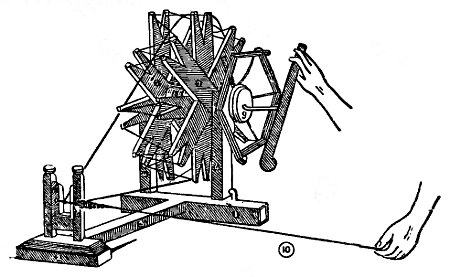
(1) The wheel must turn easily, freely,
and noiselessly.
(2) The turning handle must be rigidly
fixed to the axle.
(3) The post must be properly driven
home and joints well-fixed.
(4) The spindle must turn noiselessly
and without a throb in its holders.
Jarring sound cannot be avoided unless
the holders are made of knit
straw as in the Punjab, or of tough
leather.
(5) No machine is properly made unless
it manufactures in the hands of a
practised spinner at least 2½ tolas of
even and properly twisted yarn of six
counts in an hour. I know a youngster,
who has not had more than perhaps
[pg 115]
three months' practice, having
been able to spin 2½ tolas of the above
quality of yarn in 35 minutes. No
machine should be given until it has
been worked at least full one hour in
the manner suggested and found satisfactory.
Y. I.—6th April 1921.
[On February 15, 1922, Mahatma
Gandhi has addressed the following letter
to Sir Daniel Hamilton from Bardoli on
the Spinning Wheel.]
Dear Sir,
Mr. Hodge writes to me to say that you
would like to have an hour's chat with me,
and he has suggested that I should open
the ground which I gladly do. I will not
take up your time by trying to interest
you in any other activity of mine except
the spinning wheel. Of all my outward
activities, I do believe that the spinning
wheel is of the most permanent and the
most beneficial. I have abundant proof
now to support my statement that the
spinning wheel will solve the problem of
economic distress in millions of India's
homes, and it constitutes an effective
insurance, against famines.
[pg 117]You know the great Scientist Dr. P. C. Ray,
but you may not know that he has also
become an enthusiast on behalf of the
spinning wheel. India does not need to be
industrialized in the modern sense of the
term. It has 7,50,000 villages scattered
over a vast area 1,900 miles long, 1,500
miles broad. The people are rooted to the
soil, and the vast majority are living a
hand-to-mouth life. Whatever may be
said to the contrary, having travelled
throughout the length and breadth of the
land with eyes open, and having mixed with
millions, there can be no doubt that
pauperism is growing. There is no doubt
also that the millions are living in enforced
idleness for at least 4 months in the year.
Agriculture does not need revolutionary
changes. The Indian peasant requires a
supplementary industry. The most natural
is the introduction of the spinning wheel,
not the hand-loom. The latter cannot be
introduced in every home, whereas the
former can, and it used to be so even a
century ago. It was driven out not by
economic pressure but by force deliberately
[pg 118]
used as can be proved from authentic
records. The restoration, therefore, of the
spinning wheel solves the economic problem
of India at a stroke. I know that you
are a lover of India, that you are deeply
interested in the economic and moral uplift
of my country. I know too that you
have great influence. I would like to enlist
it on behalf of the spinning wheel. It is the
most effective force for introducing
successful Co-Operative Societies. Without
honest co-operation of the millions,
the enterprise can never be successful,
and as it is already proving a means of
weaning thousands of women from a life
of shame, it is as moral an instrument as
it is economic.
I hope you will not allow yourself to be
prejudiced by anything you might have
heard about my strange views about
machinery. I have nothing to say against
the development of any other industry in
India by means of machinery but I do
say that to supply India with cloth manufactured
either outside or inside through
gigantic mills is an economic blunder of
[pg 119]
the first magnitude just as it would be to
supply cheap bread through huge bakeries
established in the chief centres in India
and to destroy the family stove.
Yours faithfully,
M. K. GANDHI.