PREFACE
While this book has been at press, the Territorial Force has
passed into the Territorial Army, thus closing another chapter in
the history of the British citizen-soldier. That closed chapter has
still to be written, as a complete history of the Territorial Force,
called into being by Mr. (Lord) Haldane, when Secretary of State
for War, in 1907, struggling against adverse circumstances for
existence and recognition from 1908 to 1914, and approving itself
from 1914 to 1919, by the testimony of Mr. Secretary Churchill and
Field-Marshals Earl Haig and Viscount French, as a saviour of the
Empire in the Great War.
The present volume may supply material for one chapter of that
history. In Book I, I try to trace the early annals of the Force within
the confines of the West Riding of Yorkshire, and in Books II and III,
I follow the Troops which were raised in that Riding to their war-stations
overseas. As far as possible, I have observed the limits set
by the scope of my narrative. General history before the war has
been subordinated to the experience of the West Riding Territorial
Force Association, and the history of the war has been told in relation
to the part of the 49th and 62nd (West Riding) Infantry Divisions,
which went to France in 1915 and 1917.
Principally, then, this book is concerned with the work of the
Infantry. A brief account of the experience of the Yeomanry is
given in Chapter XIV, and one or two other units (notably, a Company
of the R.E., which served with the 29th in the Dardanelles, and a
Casualty Clearing Station in France) are included in the main narrative.
Another volume might well be filled with the doings of West Riding
Territorials attached to other units during the war, but these records
seem to belong to the units concerned more appropriately than to the
present narrative. The story of the 2nd and 3rd Northern General
Hospitals is likely to be fully told in the Medical History of the war,
and will be found to reflect the utmost credit on the responsible
authorities. These Hospitals were freely used by wounded men of
all units from the front, and became the radiant centres of a large
number of War Hospitals in the county. From the parent institutions
in Leeds and Sheffield, Auxiliary Hospitals sprang up throughout
the West Riding of Yorkshire, as many as 6,500 beds being affiliated
to the 2nd Northern General Hospital alone. From August, 1914,
till late in 1919, this splendid work, of which the foundations were
laid in peace-time, was in full swing, and should form an important
chapter in a complete history of the Territorial Force.
Special mention is also due to the uniformly brilliant record of
the West Riding Divisional Artillery, which was employed throughout
the war in all parts of the field. It has not proved possible in this
volume to select its Brigades and Batteries for special treatment:
the effect would have been too much disjointed; but, wherever
they covered the Infantry, their work always won the highest praise,
and their skill under arduous conditions is one of the marvels of the
war. Something, too, should be said about Mechanical Transport,
re-organized, like so much else, at the hour of trial in March, 1918,
and of other Arms of the Service, subordinate to the Infantry
Divisions. I must be content, however, with this passing reference
to their exploits, and with such tributes to them as occur in the course
of the main narrative.
My own connection with my subject is very slender. It happened
that, in 1917, I was lent to the War Office by the Royal Defence Corps
in order to do some special work in a branch then known as T.V.I.
(in the Territorial and Volunteer Forces Directorate). The Director-General,
Major-General the Earl of Scarbrough, had been Chairman
from the start of the Territorial Force Association of the West Riding;
and it happened again, in 1919, when the History Committee of his
Association had been disappointed of the services of Professor G. S.
Gordon, of Leeds University, a Captain in the 6th West Yorkshire
Regiment, 62nd Division, and now Official Military Historian of the
war, that Lord Scarbrough recommended me to write this local history
in his stead. In the earlier chapters of the book, I had the advantage
of Professor Gordon’s assistance, and I gladly take this opportunity
of thanking him for his valuable help. My work is also much
indebted to the care of several of the General Officers Commanding
the two Divisions; particularly, of Major-General Sir James Trotter
in connection with Chapter VI, and of Lieut.-General Sir Walter
Braithwaite, in connection with the important period of his Command
of the 62nd in France. Lord Scarbrough’s personal interest in all
that concerns his Association has been extended, with great benefit,
to this book in all its stages, and I have also to thank Brig.-General
Mends, Secretary of the Association, and Captain Mildren, his
assistant, for their unremitting trouble. The list of Officers from
the Riding, who have placed at my disposal diaries, photographs,
letters, notes, and valuable advice, is too long to enumerate. I should
like specially to thank Major E. P. Chambers, Captains Tom Goodall,
R. M. Robinson and J. C. Scott; but I will ask all, comprehensively,
to accept the expression of my gratitude, and of my hope that I have
not altogether failed to do justice to the praises which they have united
in bestowing on the men whom they led.
For this, when all is said and done, is the beginning and the end
of any instalment of a history of the Territorial Force. ‘This
wonderful force,’ as Lord French has called it in his book, 1914, was
founded on the ‘patriotic spirit which has always been the soul of
the Volunteers. It was reserved for Lord Haldane,’ adds the Field-Marshal,
‘to devise the scheme which was to make the fullest use
of the Volunteers and bring them to the zenith of their reputation.’
How high in military ardour and achievement that zenith proved
during the Great War, may be judged, I hope, from this record,
however incomplete and at second-hand, of the Territorial Troops
from the West Riding, which it has been my privilege to compile.
L.M.
London, March 23rd, 1920.
CHAPTER I THE WEST RIDING ASSOCIATION
At half-past five in the afternoon, on Monday, April 12th, 1915,
the first detachment of troops in the West Riding (1st Line) Territorial
Division left England for France. Their going, like all English
goings and most English home-comings, was quiet and unobserved:
the War Diary of the Division merely states that thus ‘the move to
France commenced’; further, that Divisional Headquarters left
Doncaster the next day, embarked at Folkestone on the Invicta, and
reached Boulogne 9-50 p.m.; that the General Officer Commanding
the Division, accompanied by five Staff Officers, travelled by motor-car
on April 14th through St. Omer and Hazebroucke to Merville, where
Divisional Headquarters were established in the Mayor’s house,
40 rue des Capucines; and that a telegram was received by the General
from H.M. the King, and a loyal reply was despatched. So, the time of
preparation was over, the time of action had begun.
The new adventure, which was to prove so searching, was founded
securely in the past, and this latent sense of tradition explains, or helps
to explain, why over 30,000 recruits were taken by the West Riding
Territorial Force Association between the date of the outbreak of war
and April 14th, 1915; why the strength of the County units had
reached three-quarters of the pre-war establishment[1] fully as early as
that date, and why the expedition to France proceeded in the ordinary
course of duty. For the spirit of adventure was not new, though
overlaid by many years of ease. Deep in the consciousness of Yorkshiremen,
as of men ‘from every shire’s end of England’, were echoes
of long-ago wars in defence of their country on foreign soil, under
Wellington, under Marlborough, under the Houses of York and
Lancaster, and away back to the Plantagenet kings, when the first
‘verray parfit gentil knight,’ with his squire, ‘as fresh as in the
month of May’, led his troops to fight for the right,
‘In Flaundres, in Artoyes and Picardye.’
Thus Lord Haldane wrote correctly, in December, 1908: ‘The
organization of the Territorial Force, ... novel as in material
respects it is, ... is the outcome of a process of development,
the beginnings of which lie far back in the past.’[2]
Some account of that ‘organization’ in the West Riding, remembering
its roots in the past, is necessary in advance of a history of what
the troops wrought in the field. They did not spring fully armed
from the head of Mars. On the contrary, their martial equipment
was a long and complicated affair, mixed up with questions of finance
and administration, which were left, in the worst years of military
ardour, to the public spirit of a few local men. The menace of
foreign aggression in the consulship of Sir H. Campbell-Bannerman
and Mr. Asquith was not a popular subject, and the Haldane Act,
1907, ‘to provide for the reorganization of His Majesty’s military
forces, and for that purpose to authorize the establishment of County
Associations, and the raising and maintenance of a Territorial Force,’
was let loose on the counties of the United Kingdom at a time when,
twice in one year, a general election was to be held on domestic issues
unconnected with peace and war. There was worse than public
apathy to contend with. Public apathy might retard enlistment under
Section IX. of the Act, but a part of the opposition to the new measure
was founded on more positive grounds. Speakers who went up and
down the Riding to explain and recommend the scheme had to lay
the spectre of ‘compulsion’: in those days of tumbling privileges
the one unanswerable argument before which even duty was dumb.
Thus, there is a report of a speech at Malton by Mr. (the late Colonel
Sir) Mark Sykes on May 4th, 1908, in which,
‘Surveying the present conditions of England in case of an
attack, he said they had nothing to fall back upon but members
of Rifle Clubs and Cadets. Should this Army scheme fail,
they would have to look to conscription.’
There was a meeting at York on the same day, at which the elders
of the Council discussed a recommendation of the Finance Committee
‘to encourage corporation employees to join the Territorial Army.’
On that occasion one councillor was of opinion, that
‘there appeared to be a movement on foot throughout the
country to induce large companies to close down their works
and simply compel men to enlist in the Territorial Force,
or be idle and have no wages at all.’
Another councillor considered that ‘this was an attempt to
establish municipal conscription.’ Another gravely pointed out that
‘to encourage’ did not necessarily mean ‘to force,’ but might be
stretched as much as to mean ‘persuade.’
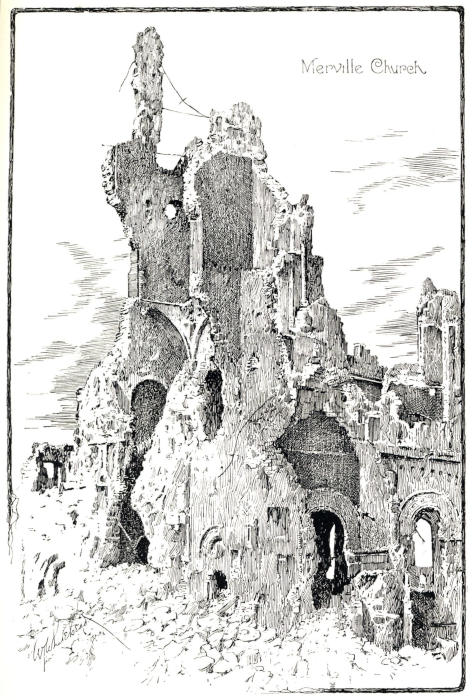
Merville Church
49th DIVISION, APRIL, 1915.
We shall not attach names to these dead controversies. They
have buried their dead to-day, and the graves of Flanders and Gallipoli
bear mute but eloquent witness to the sudden glory of patriotism which
dissolved ‘encouragement,’ ‘force,’ ‘persuasion,’ ‘compulsion,’
and ‘conscription’ in the single light of national defence. But this
perception was not yet, and the passive and active resistance which
sections of opinion in the country, not excluding the West Riding,
presented to Lord Haldane’s Act was recognized by its author himself.
Speaking at Leicester in the same week as the elders of York met in
council, the Secretary for War declared—
‘We are not militarists.... All we want is to feel
secure in our hearths and homes, and to have the feeling that
labour and commerce are alike adequately protected.... He
was against conscription and compulsion.... He
wanted to make the Army a people’s Army’;
and when a man at the back of the hall shouted that the scheme would
lead to compulsory service, ‘he was caught hold of by half a dozen
police, and flung out’—to join the suffragettes. We cannot neglect
these facts, old echoes though they be to-day. Nor shall we pause
to ask if a bolder policy might not have been more successful, and if
the appeal should have been directed to the real menace of German
aggression. The whole tendency of the times was against emphasizing
that aspect, and the pacific instinct of the nation was fostered rather
than rebuked by the voices of responsible authority. It was not a
healthy atmosphere for the New Act, and the Roman author of the
maxim, si vis pacem, para bellum, never explained how to do it if a
Government cried peace, and the Government was the people.
Still, the Act was launched, and the counties had to make the
preparations.
There were two difficulties inherent from the start, and it is probably
correct to associate them with the public apathy towards the scheme.
For one thing, the burden of preparation fell a little obviously on a
class, which, in the years before the war, lay under a cloud of misrepresentation.
That it was a simulated and a temporary cloud, at
least in its chief manifestations, the war itself was to prove; but it was
spread fast enough and thick enough at the time to darken initiative
and counsel. Not the best Government imaginable could contrive
to have things both ways. If they chose to load certain classes in the
community with the reproach of obstructing the ‘people’s will,’ it
was unseemly to rely on individuals from those classes to popularize
a branch of their legislation. Thus, the recommendation of a ‘people’s
budget’ by abusive ridicule of landowners, and the promotion of a
reform of the Second Chamber as the cause of ‘people versus peers,’
however expedient as a means of affixing a stigma for abuses, would
prove impolitic, to say the least of it, when members of those orders
were invited to take a leading part in recruiting for a ‘people’s army.’
The same ‘people’ might not see the point of leading and following
at the same time. Yet the Territorial and Reserve Forces Act constituted
‘the Lieutenant of the County.. . president of the
Association,’ and the Lieutenant, thus placed in power, was, almost
without exception, either a peer or a landowner or both. Next, it
assigned to the Association the duty of ‘recruiting for the Territorial
Force both in peace and in war,’ and we have seen that this duty was
liable to be misconstrued as legalized conscription. The risk of such
misconstruction was certainly not diminished by the obloquy which
was poured, for other purposes of the legislature, on the order to which
the presidents and some other of the more leisured members of the
recruiting Associations belonged. Secondly, these political conditions
reacted on the Government to some extent. For good or ill, the
success of their plans for social betterment and domestic reform was
a little obscurely involved with the maintenance of the open door to
foreign imports, the rejection of commercial preference within the
Empire, and, as a necessary corollary, with the doctrine that ‘free
trade’ would keep the peace. This avoidance, on the highest principles,
of any action likely to seem provocative abroad, so firmly upheld
at the Foreign Office till the sixtieth minute of the eleventh hour,
made us rig Dreadnoughts with apologies and raise recruits with
muffled drums. It followed from all these causes-the preoccupation
of Ministers, the social status of county leaders, the talking peace to
ensure peace—that, once the Territorial Act was launched, no member
of the Government except Lord Haldane appeared openly anxious to
make it go. The early annals of Territorial Force Associations, as
they came into being under the Act, are plaintively and miserably
punctuated by what Sir William Clegg, in the West Riding, used to
call the ‘pin-pricks of the Army Council,’ and a large part of their
work of initiation, which is always the most difficult part, was achieved
by personal effort against alternate or simultaneous doses of public
indifference and official neglect.
Still, the Territorial Force grew. Its foundations were well and
truly laid on that old inexpugnable spirit which, as we saw above, was
already alive in Chaucer’s England, and which, when the new summons
came, flared up through disappointment to success. The six and a
half years’ record of the West Riding Territorial Force Association,
from its inaugural meeting on January 17th, 1908, till the outbreak of
war in 1914 is typical of the experience of other counties, alike in the
obstacles which were encountered and in the resolution which partially
overcame them. It derives special interest from the fact that the
population of the West Riding is much more than twice as large as
that of any county outside London, except only Lancashire; but the
chief interest of the record lies in the after-history of the Association.
The achievement of its units in the field is a final, triumphant vindication
of the confidence of those who helped to raise them, a complete
reward for the courage they displayed, and a proof, if proof were
wanted, that the nation’s need is the measure of the nation’s power.
Hence, if we dwell more particularly on some of the difficulties which
confronted that Association during the epoch of preparation, the true
merits of the Territorial Army scheme, when tried by the supreme
test of action, will be more abundantly manifest.
First, as to personnel, H.M. Lieutenant for the Riding since 1904
had been Colonel the Earl of Harewood, A.D.C., of the Yorkshire
Hussars, and formerly of the Grenadier Guards, who, accordingly,
became first president of the Association. With him were united as
chairman and vice-chairman, respectively, Colonel the Earl of
Scarbrough, A.D.C., commanding the Yorkshire Mounted Brigade,
and formerly of the 7th Hussars, and Sir William Clegg, J.P.,
sometime Lord Mayor of Sheffield. These formed a powerful triumvirate,
and ‘had done their best,’ as Lord Harewood remarked on
January 17th, 1908, ‘to set matters on a preliminary footing.’ The
president and chairman were still in office in 1920, but in February,
1917, Lord Scarbrough had received the appointment of Director-General
of the Territorial and Volunteer Forces at the War Office,
with the temporary rank of Major-General, and was thereafter compelled
to interrupt his closer supervision at the Association. ‘Our
loss,’ the president said at the next quarterly meeting, ‘is a great gain
to the country,’ and the compliment paid to Lord Scarbrough by
this appointment was appreciated by the Association as a whole.
Sir William Clegg continued in office till the end of 1915, when, to
his colleagues’ great regret, his election as chairman of the Appeal
Committee under Lord Derby’s scheme and the pressure of other
duties caused his necessary resignation. He was succeeded as vice-chairman
of the Association by Brig.-General (Sir) R. C. A. B.
Bewicke-Copley, (K.B.E.), C.B., in April, 1916.
It will be no derogation from the importance of the military
members of the Association appointed by the Army Council, of the
representative members similarly appointed on the recommendation
of the West Riding County Council, the County boroughs of Bradford,
Halifax, Huddersfield, Leeds, Rotherham, Sheffield and York, and the
Universities of Leeds and Sheffield, and of the members co-opted by
the Association to complete its statutory establishment,[3] if we turn
next to the person of the secretary. The right choice of a candidate
for this post was properly regarded as an essential condition of success,
and at the inaugural meeting of the Association (January 17th, 1908),
no other name was proposed but that of Brig.-General Horatio Mends,
C.B., formerly of the 60th Rifles, at that time Brigadier General-in-charge
of Administration, Northern Command. To the immense benefit
of the Association, General Mends’ term of office as secretary, except
for a short interruption due to ill-health in 1909, continued right
through the twelve years under review, and, alike in peace and in war,
he has amply and fully sustained the confident belief expressed at the
time of his appointment, that ‘he combined every requisite which
Mr. Haldane had laid down as essential for the secretary of an Association.’
His assistants came and went according to the claims of other
duties. They have included Captain J. U. M. Ingilby, Captain M. L.
Porter, Major A. B. Boyd-Carpenter (later, Deputy Assistant-Director
under Lord Scarbrough at the War Office, and, since December, 1918,
M.P. for East Bradford), Major H. C. E. Smithett and Captain W.
Mildren, M.B.E., of the T.F. Reserve, formerly Staff Q.M.S. in the
Army Pay Corps, York, who was appointed superintending clerk at
the beginning, and who has rendered admirable service.
Second only in importance to a secretary was a place of meeting
for the Association. It would need the powers of an epic poet to
invoke the muse to sing the rival claims of Leeds and Sheffield as
headquarters of the West Riding, and the historian who is not a Yorkshireman
must be content to set the fact on record that York was
finally selected for reasons which seemed sufficient to the high contracting
parties. Once in York, there was no hesitation in approving
premises at 9, St. Leonard’s as a permanent local habitation.
We need not set out in detail the obvious necessary business of
the appointment of committees, the distribution of duties, the drafting
of regulations, and so forth. It was new work, and not very easy work,
but the Association commanded the services of men of experience
and affairs, and some spade work had been done in advance. One
point particularly occurs to a reader of the Association archives: the
concentration on the magical word, Mobilization. This event governed
the deliberations of all concerned: not as a shadowy abstraction, which
superior authority set them to work at in the dark, still less as a haunting
terror, created by a jingoistic press, but as a real, present and an urgent
duty, and as the test of validity for all their acts. This idea so constantly
before them lent actuality to their proceedings. They spent
no time in discussing if and when a state of war might arise. Their
practical function was to assume the war and to prepare for it.
Apart from the recruiting problem proper, the provision, that is
to say, of the full number of officers and other ranks required to complete
the establishment of the units to be raised in the West Riding, there
was an immense amount of work to be done, military as well as administrative,
before the Association could say to the War Office: press the
button, and the troops will march out. The Haldane Act had created
the machinery, and the Association had been formed to make it work;
and, since, at any moment from that date, the crisis of 1914 might have
been precipitated, the new local authorities were well advised in aiming
at instant readiness. But if we project ourselves back into the chaos
of 1908, out of which Lord Harewood and his colleagues were entrusted
with the task of evoking order, if we sympathize with their sense of
responsibility, and recognize how gravely it was increased by lack of
knowing when the crisis would occur; in other words, if we look at
the problem through the spectacles of the West Riding Association,
we must be equally just to other aspects. The Haldane Act set up
ninety-four Associations: ninety-four engines wanting fuel, ninety-four
skeleton organisms awaiting breath and articulation, ninety-four
committees hard at work as if each was solely responsible for building
the Territorial Force. Translate this conception into the terms
familiar to official routine in the placid years before the war. Imagine
the accumulation of papers, the multiplication of minutes, and the
comparative unexpectedness of the call to decide a series of questions
which lengthened with the life of the Associations. True, a Central
Council of Associations was formed at an early date,[4] which served as a
kind of clearing-house between the counties and Whitehall, and which,
while it did not preclude the independent access of Associations, submitted
as many as thirty-two recommendations from November, 1908, to
July, 1909. A few of these topics are worth recalling. On November
9th, 1908, the Central Council recommended ‘that travelling grants
be given to individuals coming to Section, Company and Battalion
drills over a distance of two miles.’ A deputation waited on the
Secretary of State on the following February 27th. In May, an intimation
was sent that a circular Memorandum might be issued on the
subject. In July, the matter was raised again, and another deputation
was received on the 23rd of that month. On August 7th, the War
Office decided not to make any grant for the payment of men in towns
coming to drill. ‘In rural corps, in which the companies, etc., are
recruited over a scattered area, the War Office will consider an extra
grant based on the cost of bringing in men of outlying sections for
Company drill two or three times a year, and will shortly issue a letter
asking for the necessary information on which a grant should be based.’
That letter was issued on September 9th. On the 13th of the next
month, the Central Council expressed the opinion that, ‘if the Territorial
Force is to be made of real value, ... this can only be
done ... by giving financial assistance to men to enable them
to come into drill.’ On March 16th, 1910, a War Office letter was
issued, granting a small allowance towards the cost of bringing in
outlying sections to enable them to carry out squadron, battery or
company training, but refusing to authorize as a charge on Association
public funds, any expenses incurred by individual officers or men in
travelling from their homes to their local troop or section headquarters
to carry out their ordinary drills. A wise decision, no doubt; certainly,
a carefully considered one; but, perhaps, a little disheartening in its
extreme regard for the public purse and in the consumption of sixteen
months during which voluntary recruits were not told what their
patriotism would cost them. Sometimes the decisions came more
quickly, but then they were usually in the negative. A proposal in
February, 1909, ‘that boots other than lace-up be supplied for wear
by mounted men with overalls when walking out’ was refused in the
following May. A recommendation during that May ‘that a special
grant of 6d. a head be allowed to Associations for provision of refreshments
to men who are detained on parade, or on actual military duty,
for not less than four consecutive hours,’ was turned down on August
7th.
The general tendency should be clear from these examples.
At the one end, in Yorkshire and elsewhere, throughout the ninety-four
headquarters, were brand-new Associations, eager to sweep clean and
to sweep swiftly. At the other end, in Whitehall, were the War Office
and the Treasury, fast bound by the traditions of their code, and tied
particularly by a Government committed to retrenchment on Army
estimates. We hardly know which to pity more, the Minister responsible
to the House of Commons or the Territorial Force Associations
which his Act had called into being.
Meanwhile, for historical purposes, it is essential to remember
that, during this period of preparation, the Territorial Force was the
Associations. It depended on them for recruits, premises, ranges,
arms, equipment, clothing (even to ‘boots other than lace-up for wear
by mounted men with overalls when walking out’), everything that
makes an Army; and they depended in turn, far more closely than they
had anticipated, on the decisions of a harassed Army Council and the
resources of a depleted Treasury. Happily, this period was protracted
by the repeated postponement of war. In 1908 and, again, in 1911,
the threat of war was averted, as we are now aware. Time was given,
accordingly, if not for the complete fulfilment, at least for the partial
satisfaction of the means devised for the fulfilment of the chief object
of the Haldane Act. This was, as we saw,
‘To provide for the reorganization of His Majesty’s military
forces, and for that purpose to authorize the establishment of
County Associations, and the raising and maintenance of a Territorial
Force.’
No time limit was laid down for the period of incubation in the
Associations, and it is difficult to estimate what would have been our
degree of unpreparedness if the accidents of European politics had
allowed less than the six and a half years from 1908 to 1914.
A rough estimate can be formed, and it is worth computing in
the present context, and in the security of peace after war, by reference
to an open letter, dated February 26th, 1913, which was addressed
by the Committee of the National Defence Association to Mr. Asquith,
as President of the Committee of Imperial Defence.[5] The signatories
included the Duke of Bedford, Lord Fortescue, Lord Glenconner,
Lord Scarbrough and Sir Richard Temple (who were all connected
with County Associations), Lord Lovat, Mr. Walter Long, Lord
Methuen, Lord Peel, Sir Samuel Scott and other men of weight.
While drawing attention to their consistent support of the Territorial
Force scheme, they felt bound to point out ‘that neither the Territorial
Associations, nor the Territorial Force have yet taken sufficiently
deep root as national institutions.’ They stated ‘with the utmost
emphasis’ that ‘no remedy involving extra financial assistance to the
Territorial Force at the expense of the Navy or Regular Army would
receive their support,’ but they did not conceal their conviction that,
‘if such a situation as existed in the autumn of 1911 recurred’, ‘the
present training, equipment and numbers of the Territorial Force
are inadequate for the task that would only too probably be laid upon
it.’ ‘It has come to the knowledge of this Association,’ they remarked
in another paragraph of the letter, ‘that a large proportion of Officers
responsible for the training and administration of the Force now hold
the view that it is incapable under present conditions of carrying out
the duties allotted to it in any sudden emergency. We desire most
strongly to support and emphasize this opinion.’
The warning was too grave to be ignored. The Territorial Act
had been on trial for five years, and the war, which actually arrived
in the summer of the following year, might break out at any moment.
Urgent action was taken, accordingly, by the Council of Territorial
Associations, and it is particularly interesting to the present
record to note that the basis of their action was a scheme submitted by
the Earl of Scarbrough on behalf of the West Riding Association.
After passing a strong resolution in April, 1913, pointing out the
‘continued inefficiency’ in the establishment of Territorial units,
and even stating that the success of the Force on a voluntary basis
could be achieved ‘only by a considerable improvement in the terms
and conditions of service,’ they lost no time in circulating the West
Riding scheme through other Associations. So, at the October
meeting of the Central Council, when replies and comments had come
in, they were ready to ask the Prime Minister to receive a deputation,
with a view to considering the whole matter.
This important interview took place on November 26th, 1913.
On the one side were Mr. Asquith and General Seely, then Secretary
of State for War; on the other were Lord Dartmouth (Chairman),
Lord Fortescue and Sir Hugh Shaw-Stewart, Bt. (Vice-Chairmen),
and the following Members of the Council of the County Territorial
Associations: Lord Scarbrough, Sir Richard Temple, Bt., Sir Hugh
Bell, Bt., Lord Cheylesmore, Sir Edward Elles, Sir Arthur Anstice,
Mr. Tonman Mosley, Lord Glenconner, Mr. Dalgleish, Mr. Adeane,
Colonel Colvin, Colonel Lambert White, General Tyler, Lord Denbigh,
General Mends, and the Secretary of the Council, Major Godman.
The deputation represented eighty-one out of the ninety-four Associations,
and was recognized by the Prime Minister as ‘authoritative.’
It is well to recall at this point the essential dates in the situation.
The Territorial and Reserve Forces Act ‘for the reorganization of
His Majesty’s military forces’ became law in 1907. Early in 1908
the West Riding Territorial Force Association was brought into being
under the Act, and set to work in a practical way to raise, clothe, train
and otherwise prepare its troops for the day of mobilization. They
had worked hard for six years, with the shadow of coming war across
their path. Yet at the end of 1913, when the substance behind the
shadow was apparent to all who knew, the chairman of the West
Riding Association, one of the most populous County areas, administered
by men of public spirit, and possessing in General Mends an
untiring and a highly efficient secretary, came to the Prime Minister
to say: Our proper establishment of troops is little more than 18,000;
we fall short by 52 officers and 2,724 other ranks; and ‘that is roughly
typical of the general shortage, which, with a few exceptions, exists
throughout the Counties.’ The failure was deplorable: ‘It is the
fact that the strength to-day is less than it was in the last year under
the old Volunteer system.’ But even more deplorable was the danger:
‘In spite of all the efforts which have been made in these six years,
it would appear that the high-water mark of voluntary effort in normal
years and under present conditions falls greatly below the minimum
laid down by the General Staff as necessary for National Defence’.
November 26th, 1913: This was the date of the interview,
and it was too late then to remedy the scheme. The total
shortage of 1,400 officers and 66,000 other ranks; the 40,000
members of the Force under nineteen years of age and ‘only fit to be
in a Cadet corps’; the absence from the annual camp of 1,362 officers
and 33,350 other ranks, including 37 officers and 6,019 men ‘absent
without leave’: these facts and figures might be cured by personal
allowances to officers, efficiency bounties to other ranks, income-tax
relief to employers for each qualified Territorial officer or soldier in
their employ, grants to Associations for social purposes and for the
provision of boots, shirts and socks, and by the rest of the moderate,
wise and carefully devised recommendations which the Council of
County Associations felt bound to propose to the Government, as
‘the minimum improvement in the terms and conditions of service
that we think would be effective in attracting the right class of men
in sufficient numbers.’ Public apathy, official discouragement, and
the burden of other calls on the Exchequer might be purged of their
worst effects by thorough changes of this kind. Even the evils pointed
out by Sir H. Shaw-Stewart, that, ‘owing to the exigencies of political
combat, these same classes that I speak of (i.e., landowners and employers)
are just now being held up to the public as parasites, oppressors
and robbers of the poor,’ and that, ‘except for Lord Haldane and his
successor at the War Office, not one Cabinet Minister has ever had a
good word to say for the work we are doing or, indeed, for the system
we are endeavouring to carry out,’ might at last prove capable of
adjustment. But time was essential for such experiments, and the
sands of time were running out. Mr. Asquith, indeed, in his reply
to the deputation, affected to believe it all remediable. There were
the proper compliments to ‘the value of the work that has been and
is being done.’ There were other aspects of the numbers and the
training, and certain ‘encouraging features’ to be dwelt upon. There
was a general undertaking that the Council’s recommendations ‘will
be not only considered, and not lightly dismissed, but considered in
a thoroughly sympathetic spirit.’ There was the final valediction,
as suave as it was impenetrable: ‘We shall endeavour to produce as
great an impression as we can on the Chancellor of the Exchequer
consistently with his other requirements to meet your legitimate
demands.’[6] And the Archduke Francis Ferdinand was assassinated,
June 28th, 1914.
These, briefly, are the facts on which an estimate may be formed
of the degree of preparedness reached by the Territorial Force more
than six years after it came into being. Very happily, as we said above,
this period was thus protracted. The defects were serious enough,
but, had the crisis come earlier, Associations would have missed what
the evidence of results proved to be valuable, that varied experience
of organization, that knowledge of their own weak points, that sense of
contact with officers and men, as well in their civilian relations as in
their military capacity, and, generally, that power, essential to the
satisfactory working of ‘a highly complex structure o’ various an’
conflictin’ strains,’ which Mr. Kipling has illustrated in his story of
The Ship that Found Herself. The consolation administered by the
Prime Minister to the deputation of November, 1913, though a commonplace,
or because it was a commonplace, was justified in the succeeding
years of war:
‘While we do not say that the present organization is in all
respects satisfactory, we do believe that it is based on sound lines,
and, so long as the same spirit which has existed from the beginning
continues to animate officers and men, that the Force will increase
every year in efficiency and capacity for the special functions
which are assigned to it in our scheme of defence.’
The vista of years was contracted to less than one, our ‘scheme of
defence’ was unrecognizably extended, but the animating spirit did
not fail.
How fortunate for the country it was that time was given to
Associations to find themselves may be judged from the growing
tension between the West Riding Association and the War Office.
Sir William Clegg, speaking from the Chair on February 7th, 1910,
complained of ‘a kind of attempt on the part of the Army Council
to treat the Association as a mere adjunct of the Army Council, and
not as a free and independent body. If their deliberations and resolutions
were to be treated in such a high-handed manner, he for one
was not prepared to devote his time to the duties of the Association.’
A few months later, on the motion of Alderman F. M. Lupton, of
Leeds, seconded by Mr. A. J. Hobson, of Sheffield, a resolution was
passed urging His Majesty’s Government ‘to give further effect to
their own policy of placing the Territorial army under the control of
the County Associations, and to permit these Associations, without
undue interference, to perform their duty of providing a properly
equipped Force on the grants allotted to them.’ Relations became a
little less strained after a personal interview between Lord Harewood
and the Secretary of State, when a conciliatory reply was sent to the
Association by the War Office. But in 1912 the situation had grown
acute again, and Lord Harewood did not hesitate to describe it as a
‘tension which had existed for a long time between the Army Council
and that Association, especially the Finance Committee of the Association.’
Sir William Clegg repeated his former protest, which was
supported by Colonel Hughes and other members, while Lord Scarbrough
referred to the case of the Association against the Army
Council as, in fact, ‘unassailable.’ We shall not further recall the
features of this dispute, which turned on a question of accountancy.
It was not the details but the principle which mattered, and the principle
which governed the deliberations of members of the West Riding
Association was amply vindicated in their resolution, carried on July
1st, 1912:
‘That the Association welcomes the reply of the Secretary
of State, as indicating complete satisfaction with the financial
position of the Association, and notes with pleasure that, as a
result of the protest made, there is now every reason to hope that
the relations between the Army Council and the Association will
be cordial and harmonious in future.’
So, the Association ‘found itself’ at last. But the reconciliation
came too late to make a prosperous new beginning. If war had still
been postponed, opportunity might have been given to build up the
Territorial Force on more generous and sympathetic lines, as suggested
in the scheme of the West Riding, and to repair the disappointment
of Associations. But, though Sir William Clegg spoke of ‘a clean slate,’
and Lord Scarbrough wrote more hopefully to General Bethune,[7]
there was no time to take advantage of the change. The long threatened
war was upon them, and, meanwhile, they had to encounter what
Mr. Asquith, in November, 1913, called ‘the abstraction, whatever
Government is in power, who has the public purse under his immediate
control.’ This ‘abstraction’ proved a very real obstruction.
CHAPTER II THE WEST RIDING TROOPS
The civilian effort before the war to create a ‘people’s army’
under the provisions of the Territorial Force Act, was a fine national
exploit, whether in the West Riding or elsewhere. Equally fine, if not
finer, though no basis of comparison can be fixed, was the response
of the men, including officers and other ranks, to whom the appeal
was made.
It is essential to see this clearly. Parliament might pass the best
Act which ever adorned the legislature. The Secretary of State for
War and His Majesty’s other Ministers might use all the eloquence
at their command to popularize the Act in the country. The Territorial
Force Associations, which were called into being under the Act,
might attract the best brains in every county to crown the scheme with
success. Throughout the complex organization, avoidable mistakes
might be avoided, unavoidable obstacles might be overcome, and a
kind of conspiracy of good luck might have surrounded the enterprise
from its initiation. And yet, in the ultimate resort, one first condition
must be satisfied: the men must be willing to come forward. For
the Act spoke, as we have seen, of a ‘reorganization of His Majesty’s
military forces’; and no power on earth, certainly no political power
in England, could organize a voluntary force which was unwilling.
If the troops out of whom the Territorial army was to be made were
not willing to enrol in that army, and to bring to it the loyalty and
devotion which had characterized voluntary service in the past, legislation
would prove a dead letter. With or without the conditions
which we have enumerated above (and some were lacking, as we are
aware) the primary factor was the personal one; conversely, if the
heart of the nation was sound, no weakness in the Army Council
or at the Treasury could wreck the scheme beyond repair.
Accordingly, it is useful at this point to look at events before the
war from a different angle of vision. Men in high places, ‘dressed
in a little, brief authority,’ have always this consolation, when they
contemplate their shortcomings, whether within or without their own
control, that the near view is fuller than the distant. If every Territorial
soldier in the West Riding had been privy to Lord Harewood’s
difficulties, if every unit awaiting a headquarters had been admitted
to the heart-breaking negotiations which preceded each grant of an
eighth of an acre of ground, if every recruit grumbling at his boots
had known how many pairs of boots were included in General Mends’
requisitions, no progress at all would have been made with the raising
of the Force or its equipment. But the men who were raised and
equipped were spared these disappointments and dubieties. They
took their troubles in single spies, not battalions; and the single
troubles which they encountered—too much rain, too few blankets,
insufficient transport, and so forth—were counted as part of a day’s
work, not as items in a quarterly return. They did not multiply their
grievances by the calculus familiar to an Association; and it is precisely
this restricted point of view which is valuable as a contrast and a
corrective to Associational experience. For the final triumph of the
Territorial scheme, as proved in the searching test of war, was a triumph
achieved by individuals within the limits of their personal capacity.
It is well to recapture the spirit in which this triumph was achieved;
and, fortunately for that purpose, we can refer to a West Riding unit,
whose records go back from its War Diary of 1914 to the date of its
original inception in 1859. A happy feature of this possession, unique
and valuable in itself, is that the unit in question became in the fulness
of time the same 4th Battalion of the West Riding Regiment, whose
transport left England for France first of the 49th Division[8]; and, with
the added interest of that coincidence, its faded pages may be searched
for evidence to the men’s point of view. It was Lord Haldane who
wrote (December, 1908), in a passage referred to above[9]:
‘The abstract and dry language of Statutes and Army
Orders may command our rational assent, but what Cardinal
Newman was fond of speaking of as real assent it will never command
unless it is interpreted in the light which the historical
method throws on it.’
Such a light is thrown by this record on the history of the previous
half-century.
It began on May 25th, 1859, when Major-General Jonathan Peel,
a brother of the great Sir Robert, and a predecessor of Lord Haldane’s
at the War Office, issued a circular to authorize the formation of Volunteer
corps. Two days later, a requisition was addressed to the Worshipful
the Mayor of Halifax by a hundred and twenty-five inhabitants of
the borough and its neighbourhood, praying him to convene a public
meeting in order to consider ‘the propriety of forming a Volunteer
Rifle Corps for this district.’ The propriety was duly considered on
the following Friday, June 3rd, in the Town Hall at Halifax, when
and where a hundred and twenty good citizens, with Mr. Edward
Akroyd[10] at their head, professed themselves willing to enrol as members
of a Volunteer Rifle Corps for this Town and District, ‘provided the
cost of uniform, arms and accoutrements does not exceed £9 per
annum.’ The crest selected was the Borough Arms; the head-dress,
familiar in caricature, was ‘shako and plume’; the uniform
a dark-green tunic; the arms, a short Enfield muzzle-loader, and
bayonet; and the title of the corps was the 4th West Yorks Rifle
Volunteers. Seldom have small beginnings been more amply fulfilled
by noble ends.
The Rifle Corps grew and prospered. Colours, with crest and
title, were worked by the ladies of Halifax and presented in September,
1860,[11] and Captain Akroyd had the satisfaction in that month of
parading 455 men at a Review in York, and of publishing in Orders
the next day, that ‘the 4th West Yorks Rifle Volunteers, by their
soldier-like bearing, their excellent discipline, and the steadiness of
their movements, have earned for the Corps a high reputation among
the Riding and County Battalions.’ On March 10th, 1863, they
paraded at the marriage of the Prince of Wales. They furnished
a Guard of Honour, and guards and sentinel for the night, when His
Royal Highness, on the following August 3rd, visited Halifax to open
the Town Hall. In the same year, a capitation grant of 20/- for
each efficient man was authorized for issue by the Government, thus
relieving all ranks of a part of their voluntary expenditure; and it is
observed in the same context, though its precise bearing escapes us
to-day, that the Government ‘also repeated the gracious permission
accorded by George II. of wearing hair-powder untaxed.’ A drill-hall,
designed by an assistant to Sir Gilbert Scott, and intended to
serve both as the head quarters of the corps and as a public hall and
concert-room, was started in 1868 and available in 1870. In 1874,
the busby head-dress was adopted; the tunic was altered to scarlet
with dark-blue facings, and the long Enfield was substituted for the
short. At the same time, the maximum establishment was fixed at
600 all ranks. The next year saw the first Camp, in tents on Castle
Hill, Scarborough. In 1880, the Battalion was armed with the Snider
breech-loader and bayonet, and the common helmet replaced the busby.
In July, 1881, the Battalion, 480 strong, represented the county of
Yorkshire at a Royal Review of Volunteers in Windsor Great Park.
In 1883, a step forward was taken in the direction completed by the
Territorial Act of 1907: the 4th, 6th and 9th West Riding of Yorkshire
Volunteer Corps were renamed the 1st, 2nd and 3rd Volunteer Battalions
of the West Riding Regiment (Duke of Wellington’s); the old
Arms of Halifax were replaced by the badges of the West Riding
Regiments; and in 1887 the Battalion was re-clothed in a manner
similar to the Line Battalions with which it had been affiliated, but
with silver lace, buttons and badges. Ten years later, in 1897, a
detachment of the Battalion was bivouacked in the ditch of the Tower
of London, and did duty on London Bridge, on the occasion of Queen
Victoria’s Diamond Jubilee. A more serious call was to follow.
On December 19th, 1899, after the so-called ‘black week’ in the
Transvaal, it was announced that ‘Her Majesty’s Government have
decided to accept offers of service in South Africa from the Volunteers....
The terms of enlistment for officers and men will be for
one year, or for not less than the period of the War.’ Three days
later, on December 22nd, Major W. H. Land, commanding the 1st
Volunteer Battalion, West Riding Regiment (our old friend, the 4th
Rifle Volunteers), was prepared to place the Battalion at the disposal
of the Government, and an Active Service Company of Volunteers, with
Lieut. H. S. Atkinson at their head, was complete for embarkation
early in 1900, when they were entertained at a farewell banquet in
Halifax. The occasion, historically so inspiring, has several features
of present interest. Colonel (later, Sir) E. Hildred Carlile, remarked
on the sense of ‘promotion,’ and the ‘feeling that more would be
required,’ in the call to Volunteers to take a place side by side with
Regulars in Line Battalions. Colonel Le Mottee discussed the
‘spirit of militarism,’ drawing a clear distinction between its fair
and evil aspects; and other speakers who followed referred with gravity
and emphasis to the future needs of national defence. The draft
sailed on February 17th, reaching Table Bay on March 14th, and,
exactly a year later (March 16th, 1901), the Relief Company of the
Battalion left Halifax for the same destination. Needless to say, their
fighting record in South Africa was worthy of their regiment and Riding.
They contributed to the final victory of British arms; and, when the
first members of the first Service Company returned to Halifax in
the following May, they received the welcome which they deserved.
A presentation of medals took place later in 1901, and inspired a prophetic
speech by Colonel Le Mottee, which is well worth recalling
to-day:
‘The Volunteer movement,’ he said, ‘never stood higher
in the estimation of the military authorities than it did now.
The behaviour of the Volunteers showed that the spirit of the
nation was as high as it ever was, and the question was how to
utilize this fine material to the best advantage. Conscription
was out of the question at present, and the only alternative was
the extension of the Volunteer movement for the securing of
efficiency for all who joined.’
This perception carries us a long way from 1859 and the Halifax
Rifle Corps. We reach in the new century and the new reign, and
in the brief peace after the South African War, the problem, or series
of problems, which were honestly attacked, if not, as we have seen, fully
solved, by the Territorial and Reserve Forces Act of 1907. But note
the continuity of the history, and the secure foundation of that Act on
material already existing. The Territorial scheme, like the British
Constitution, grew up and developed by its own strength; it was never
imposed from without. Herein lay the secret of such measure of
success as it achieved. The war in South Africa had revealed grave
defects in military resources and in the means of national defence.
‘Conscription was out of the question at present,’ but the war of
1914 found the counties of Great Britain at least organized for an
emergency which surpassed in its demands and its extent the most
serious anticipations of the most foresightful. And the organization
(this is the important point) was based on a tradition which could not
fail. Everywhere in England, not in Halifax alone, had been men of
public spirit, like Edward Akroyd, to petition their worshipful mayor
on behalf of the Volunteer movement. Everywhere in England, for
fifty years, the Volunteers had drilled and camped, had exchanged
their shakoes for busbies, and their muzzle-loaders for breech-loaders,
and had converted public ridicule into tolerance, and tolerance into
appreciation, and appreciation at last into heartfelt gratitude to the
‘people’s army’ which sprang from English soil. We turn the old
pages of Punch, and smile at John Leech’s pictures of ‘The Brook-Green
Volunteers’ and others; but behind our laughter is the sense
that these long-ago, long-whiskered men were the true makers and
only begetters of the Territorial Army in the Great War, and that
Edward Akroyd and the hundred and nineteen who signed the resolution
of enrolment at the public meeting in Halifax Town Hall on June
3rd, 1859, showed the way to the fighting men of the West Riding who
helped Marshal Foch and Earl Haig to turn the tide of German
advance in the summer of 1918.
This historic sense deepens as we approach the period immediately
before the war. In May, 1902, the honorary rank of Lieutenant in
the Army was granted to Captain H. S. Atkinson, with an award of
the Queen’s Medal with three clasps, in recognition of his services
in South Africa. So, the Volunteer and the Regular had coalesced.
In the following December, Lord Savile accepted the honorary
Colonelcy of the Battalion, in succession, after a long interval, to its
virtual founder, Colonel Akroyd, and testimony was borne to the fact
that the troops were ‘working on lines which lead to real efficiency
of mobilization for home defence.’ In 1905, the writing on the wall
was conspicuous for all to read. Colonel Land observed, at the annual
prize-giving, that the choice for the future now lay between ‘the
more effective training of the Volunteer forces, or compulsion. It
rested entirely with the authorities and employers of labour to decide
which alternative to adopt. One or the other was inevitable.’ In
1907, the inevitable occurred, and early in 1908, when the Territorial
Act was on the Statute-book, the Secretary of State for War addressed
a stirring appeal to the male youth of Great Britain:
‘The foundation of a Territorial Force or Army for home
defence,’ he wrote, ‘is no light matter. The appeal which I
am making to the nation is that its manhood should recognize
the duty of taking part, in an organized form, in providing for the
defence of the United Kingdom. The science of war is, like
other sciences, making rapid strides, and if we would not be left
behind and placed in jeopardy, we must advance. That is why
it was necessary that the old Volunteer and Yeomanry forces should
pass, by a process of evolution, into the organization of the new
Territorial or Home Defence Army.’
Our survey of the progress of a single unit from 1859 to 1908
should enable us better to understand the precise bearing of Lord
Haldane’s language. What is true of a unit is true of the whole;
and we shall see, in the further annals of this corps of old Rifle Volunteers,
who now bore ‘South Africa’ upon their Colours, and counted
a Regular officer among their Captains, how gallantly the Yeomanry
and Volunteers responded to the call of tradition, and how fully ‘a
process of evolution’ describes the action which they took.
For they ‘passed into’ the Territorial Army. As Colonel Land
said to his men on a day in 1908: ‘The word “conscription” appears
to be repulsive to the vast majority of Englishmen.’ He did not
share that repulsion, but for those who shared it ‘What was the alternative?
Mr. Haldane thought the alternative was to enlarge and make
effective use of the present auxiliary forces by reorganization.’ So
be it. A ‘voluntary Territorial force stood between the country and
conscription.’ But in certain districts of England the Volunteer law
was current among men, as the Scout law is, or should be, among
boys: ‘The Army Council was only asking all Volunteers to do what
they in Halifax had done for years’; and, when only two alternatives
were presented for selection, either to attest under the new Act, or to
retire from the auxiliary forces and unwrite a chapter of local history
which had been opened in 1859, ‘they in Halifax’ were never in doubt.
The 4th West Yorks Rifle Volunteers had changed their name in 1883,
when they became the 1st Volunteer Battalion of the West Riding
(Duke of Wellington’s) Regiment. On April 1st, 1908, they consented
to change their name again. The 1st West Riding Volunteers
became now the 4th Battalion of the West Riding Regiment, with
their uniform similar to the Line Battalion’s, and scarlet facings for
white and gold lace, gilt ornaments for silver and white, and the letter
‘T’ to indicate Territorial. Plus ça change, plus c’est la même chose;
the ‘process of evolution’ was complete.
We come back from the part to the whole, from Halifax to the
West Riding. Our choice of Halifax has not been due to any exceptional
conditions in that borough. In some respects, indeed, it lagged
behind. Its city fathers contained at least their full proportion of
anti-‘militarists’ and anti-‘conscriptionists,’ and its recruiting record
was never the best in the Riding. It has been clearer and more convenient,
however, to illustrate the movement from start to finish, or,
at least, from 1859 to 1908, by means of a concrete example, than to
deal vaguely with the mass.
When the mass-problem was approached by Lord Harewood, as
Lieutenant of the Riding, and his colleagues in the County Association,
they found that the old Volunteer and Yeomanry forces were required
to ‘pass into’ the new Territorial Army to the number of about
18,300 of all ranks. On March 31st, 1908, the actual strength of
those old forces was 414 officers and 9,683 other ranks; so that,
roughly, 8,000 in all had to be found additionally in the West Riding:
eight more for every ten on the strength. The quota allotted to the
Riding were a whole Division, a Mounted Brigade, and Army Troops.
We have already viewed this problem through the eyes of the
West Riding Association, when we saw that the full numbers were
never reached, and that a big new scheme was devised, and brought
to the notice of the Prime Minister, in order to render the terms of
service more attractive. We propose to look at the problem here through
the eyes of the men themselves: not of those who did not enrol, but
of the personnel which actually joined up. It is important to emphasize
this aspect. A sermon preached at absent congregants always hits
the regular church-goers; and the repinings of Associations at a
deficiency in establishment are apt to distract attention from the merits
of the men on the strength. Thus, the keen inheritors of the tradition
of the 4th West Yorks Rifle Volunteers were not less but, rather, more
praiseworthy because their strength as a Territorial unit, after April,
1908, was always below establishment. Take the three last returns
before the war:—
4th BATTALION, WEST RIDING REGIMENT, HALIFAX.
| Date. |
Establishment. |
Total Strength. |
Deficiency. |
| Officers. |
Other Ranks. |
Officers. |
Other Ranks. |
Officers. |
Other Ranks. |
| 31-12-1912 |
29 |
985 |
20 |
747 |
9 |
238 |
| 31-12-1913 |
28 |
978 |
21 |
596 |
7 |
382 |
| 31-5-1914 |
28 |
978 |
20 |
613 |
8 |
365 |
This was the kind of disheartenment which General Wright,[12]
Commanding the Division, had to face at the outset of his task; and,
since it was the function of the Association to rebuke the absent 37 per
cent., let us praise the present sixty-three. When three or four men
in ten abstain, the virtue of the assentients is more conspicuous.
Certainly, it was easier not to join. We are not referring now to
what we may call the permanent handicap: the passive resistance of
some employers, the active dislike of others: the wave of pacific
sentiment, fanned by hot blasts from Labour circles, and the acute
suspicion of the hidden hand of compulsion. Nor are we referring
now to merely local conditions, such as points of precedence and procedure,
and minor grievances and jealousies, almost inevitable at the
start of a novel and complex organization in an area as wide as the West
Riding. These things loom large in the beginning, but the incidents
of the quarrels disappear when the decisions shine in their results,
and the wisest course is to believe that every honest conflict of interests
is inspired by generous emulation. This, at least, is how we shall
recall the discussion in 1908 whether the West Riding Horse Artillery,
which was to form part of the Yorkshire Mounted Brigade, should be
raised by the borough of Sheffield or by Earl Fitzwilliam, with its
headquarters at Wentworth Woodhouse, and the ultimate acceptance
of the latter offer in the public spirit in which it was made. No:
the task set to General Wright and his colleagues, the purely military
task, that is to say, was formidable enough, without attempting to
weigh the imponderable. His record of service shows that he was
least of all likely to be satisfied with a hollow or an illusory success.
On July 7th, 1908, for instance, on the occasion of a visit to Leeds by
their Majesties King Edward and Queen Alexandra, Regular and
Territorial Troops were paraded to line the streets and to furnish
Guards of Honour; and the General Officer Commanding-in-Chief,
Northern Command, in publishing the King’s gracious message,
expressed his personal
‘gratification, that, on this the first occasion on which a
portion of the recently-formed Territorial Troops of the
Northern Command has paraded before the Sovereign,
they should have merited the Royal approbation.’
The fact was gratifying, no doubt, but the responsible military
authorities were probably much more concerned with the further
facts that, at the same date, no equipment had been received for the
Horse Artillery, only part equipment for the Royal Field Artillery
and the Royal Engineers, and that the Infantry equipment had to be
reported as ‘generally bad, of obsolete pattern, and useless for active
service.’ It was not to earn Royal compliments on parade, but to
have the Troops ready for mobilization, that these authorities were
primarily concerned.
We are constrained to dwell upon this feature, because of its
obvious connection with future deficiencies in numbers. Take the
first Annual Training in Camp of the West Riding Division in the
summer of 1908. Over 97 per cent. of other Ranks attended, of
whom 72 per cent. were in attendance for the fifteen days: a very
commendable record. The results on the whole were good. The
Redcar Urban District Council expressed ‘high appreciation of the
gentlemanly conduct’ of the Troops, and hoped to welcome them again.
There was not a single case tried for drunkenness, and discipline and
bearing were notably improved. But, when we turn to the Report of
the Divisional Commander, what do we gather as to his views, and
what can we read between the lines?
‘As regards the equipment necessary,’ he wrote, ‘this is
very far from being complete, and I hope, before many months
pass, steps will be taken to remedy this great and dangerous defect.
The Artillery were deficient of guns and wagons, and the harness
is unsuitable for issue to Territorial Troops.... The
Engineers were deficient in necessary equipment, consequently
all ranks suffered as regards instruction and training.’
Danger and suffering are strong words, which General Wright
would not have used without good cause. In the previous chapter
we attempted to translate these grievances into the language of War
Office routine, and after multiplying them by the ninety-four Associations,
we were able to find some excuse for official hesitation in
removing them. Here it is appropriate to translate them into the
language of the rank and file, and to imagine, by no great effort, how,
when the Camp was broken up, drivers of teams ‘unsuitably’ harnessed
and victims of even worse defects would deter, unconsciously, it might
be, their brothers and friends from joining up.
It may be urged that 1908 was the first summer in the life of the
Force. Let us turn to the following year. At the Divisional Camp
in 1909, the attendance of all ranks below officers reached 94 per cent.,
of whom 71 per cent. attended for fifteen days. But the Chairman’s
October report stated, with reference to an Army Council Order as
to the purchase of boots: ‘Under present conditions, should the Force
be mobilized, it would be found to be incapable of marching.’ Moreover,
there were sundry deficiencies of guns, limbers, wagons, etc.,
and it is significantly observed:
‘The Officer Commanding 2nd West Riding Brigade, R.F.A.,
has had a set of harness (six horses) converted from neck-collar
to breast, at a cost of £9 10s. 5d. The Army Council has been
asked to sanction and provide funds for the conversion of the
remainder.’
Here, perhaps, we may interpolate a note, that in January, 1910,
instructions were issued from the War Office,[13] authorizing County
Associations, ‘in view of the great influence and local knowledge’ at
their disposal, to add to their existing heavy duties by making arrangements
for the provision of the vehicles and animals required on mobilization
for the Regular Army as well as for the Territorial Force. The
West Riding Association, acknowledging this letter, remarked drily,
that, while it was not aware that the provision of horses for the Regular
Army on mobilization formed any part of its statutory duties, ‘it is
quite willing to undertake the work, subject to a clear understanding
that adequate funds will be provided, sufficient, in its judgment, to
carry out the work effectively.’ And, if any reader is inclined to cavil
at the tautology in the last phrase, he may be recommended to study
the experience of the West Riding Association as to the Army Council’s
view of the meaning of ‘adequate funds.’
General Bullock[14] succeeded General Wright as Officer Commanding
the Division in January, 1910. His first Camp was held partly
in the Isle of Man, where, unfortunately, the weather was very bad.
The attendance was 93 per cent. of other ranks, of whom 69 per cent.
trained for fifteen days. ‘No change’ was reported in the condition
of the supply of guns, wagons, and saddlery; most of the units were
still deficient of binoculars; ‘the supply of horses was, on the whole,
satisfactory,’ and the provision of machine-guns in all units was
complete. His second Camp (1911) showed a further fall in the percentages:
89 per cent. of other Ranks attended, of whom 58 per cent.
trained for fifteen days. The Troops were encamped in various
places, including Salisbury Plain, Ripon, Scarborough, Marske,
Skegness and Aldershot. A Review of the Ripon Camp was witnessed
by Major-General (Sir) John Cowans, afterwards Quartermaster-General,
and at that time Director-General of the Territorial Force.
Sir George Bullock’s command of the Division coincided with the
pressure of three problems: the provision of horses on mobilization,
to which reference was made above; the formation of the Territorial
and Veteran Reserves, with which progress proved very slow; and
the formation of Voluntary Aid Detachments, which it was decided to
raise in the West Riding in accordance with the scheme of the St.
John’s Ambulance Association under the provisional name of County
Companies (men’s and women’s). The first work of getting these
companies afoot devolved upon General Mends, who, with customary
zeal, doubled the duties of Association Secretary with those of County
Director. In the Autumn of 1912, the designation of County Company
was changed to Voluntary Aid Detachment, and shortly afterwards,
when General Mends resigned the direction to Major G. D. Symonds,[15]
he was able to hand over to his successor as many as fifty Voluntary
Aid Detachments (16 men’s, 34 women’s), and at the same time to
state his confident belief that the initial stages were safely passed and
the movement was firmly established.
But these, after all, were side-shows, and, whatever success they
achieved, or whatever labour they involved, they must not deflect
attention from the main military business, which was always present
to the minds of the Commanding Officers, and of non-Commissioned
officers as well. It was their business to train for mobilization the
Territorial troops of the Riding. The more keen and conscientious
they were, the more they were haunted in their dreams by the shadow
which took substantial shape on August 4th, 1914, and which grew so
rapidly to dimensions undreamed of even by Lord Roberts. Yet
this urgent business was performed, like the tasks of the Israelites
in Egypt, without the necessary materials. Mr. Churchill, Secretary
of State for War, at a meeting of representatives of Associations held
in London on April 1st, 1919, in announcing his preliminary plans
for the reconstitution of the Territorial Force, was moved to speak
as follows:—
‘I hope we shall always look forward rather than look back,
so far as difficulties are concerned. The grievances of the Territorial
Force in the years immediately preceding the war ...
are well known to most of those who are gathered here to-day;
and we should bear them in mind for the purpose of making
sure that, so far as possible, a repetition of these hardships is
avoided in the future.’
And the Minister went on to point out that—
‘We have two great advantages which we have never enjoyed
before.... The days are past when the Territorial Force
will have to put up with second- and third-rate weapons, and when
every item of equipment and supply which it needed had to be
obtained on painfully limited Army Estimates.... But,
still more important than this, we have at the present time enormous
numbers of war-trained veteran soldiers fresh from victorious
fields,’
on whom to draw for the reconstituted Force. A happy state of things
indeed: ‘immense supplies, even immense surplus supplies of the
very finest equipment in the world,’ and numberless recruits ‘versed
in every aspect of war, who have the records of their achievements
and of their experience vividly in their minds.’ How many members
of Associations, remembering the days that were past, must have
listened to Mr. Churchill’s words with more sorrow than anger in
their hearts. The anger had faded and died in the fiercer emotions of
the war, in part-preparation for which an earlier Secretary of State,
just eleven years before, had reconstituted the old Yeomanry and
Volunteers into the new Territorial Force. Now the new Territorial
Force (after all, it was only eleven years of age) was to be reconstituted
in another peace-time out of its own ‘war-trained veteran soldiers’.
It had sent, as Mr. Churchill stated, 1,045,000 men to fight against
the best troops of Germany and Turkey. Six thousand five hundred
of its officers and a hundred and five thousand other ranks had laid
down their lives in that fight, out of a total casualty list of nearly
600,000 throughout the Force. Twenty-nine of its officers and forty-two
of its men in other ranks had won the supreme honour of the
Victoria Cross; and there might well be sorrow in the hearts of many
present at that meeting, not only for the dead, the missing, and the
maimed, but for the ‘painfully limited Army Estimates’ from 1908
to 1914; for the ‘second- and third-rate weapons,’ or no weapons
at all, with which Territorial troops had been armed; for the standing
order to train for mobilization and the recurring refusal to provide
the means, for all the unrecognized sacrifices of officers, N.C.O.’s
and men, badly clothed, badly housed, badly equipped, and for the
contrast between the generous recognition of what the Territorial
Force had done and the ungenerous treatment meted out to it in its
years of preparation for the doing. If Mr. Churchill’s audience that
day agreed with him not to look back upon past grievances, at least
they might welcome his praise of
‘The vital part which the Territorial Force played at the
beginning of the war.... Had its organization been used
to build up the War Army,’ he remarked, ‘as was originally
intended and conceived by Lord Haldane, to whom we owe a
great debt, we should have avoided many of the difficulties that
confronted us at the outset, and we should have put a larger
efficient force in the field at an earlier stage.’
Our account of the West Riding Troops in the period before the
war were best concluded on this note. Up to the measure of their
achievement, they are entitled to their share of the praise, and no
useful purpose would be served by recounting in terms of drill-hall
and barrack-room accommodation the same tale of official procrastination
and delay, some features of which we have noted in relation
to equipment and arms.
In September, 1911, General Baldock[16] succeeded Sir George
Bullock as General Officer Commanding the Division, and his term
of service extended into the war epoch. His summer camp in 1912
trained partly on Salisbury Plain (where the Mounted Brigade encamped
for the first time outside Yorkshire), partly at Ad Fines, Buddon,
Skegness, and other places, with the 2nd and 3rd General Hospitals
at Netley. The weather was uniformly bad, so much so that a letter
was addressed by the Army Council to Northern Command, expressing
‘their appreciation, and that of the Secretary of State for War, for the
excellent spirit which was shown by the Territorial Troops in Camp
this year. The weather has been most inclement, and the soldierly
spirit in which the Troops bore their discomfort was most praiseworthy.’
The attendance of ranks below officers reached 85 per cent.
of strength, of whom 60 per cent. trained for fifteen days. The corresponding
percentages for 1913, when the weather was remarkably
fine, rose to 88 and 66 respectively. Full arrangements were made
for an Annual Camp in 1914, at dates between May 21st and August
16th, and many units, as we shall see, were in training when the summons
came to mobilize.
We may note, for historical completeness, some of the activities
of the Command which were interrupted by that sudden summons.
The whole machine was working steadily and regularly, but with slightly
diminished velocity, and a certain sense, which is developed in fine
machinery, of insufficient encouragement from above. Probably, from
the point of view of the rank and file, the call seemed likely never to
arrive. Even the keener officers and more intelligent N.C.O.’s might
not unreasonably have begun to believe that the leisurely methods of
the War Office still corresponded, as politicians certified, to a clear
sky in Europe and a firm friendship with all foreign Powers, so that
they, too, might pick their way slowly. Such pressure as was exerted,
at any rate, came from within, not from without. As late as April,
1914, the new Headquarters at Halifax for the 2nd West Riding
Brigade, Royal Field Artillery, and at Ripon for the Detachment of
the West Riding Regiment, still awaited inspection by the Army
Council. These were the last of a long series of premises, the acquisition
and building of which had given endless trouble to the Association,
not without serious detriment to the efficiency of the Troops. At
the end of May, 68 Voluntary Aid Detachments (19 men’s, 49 women’s)
had been recognized by the War Office, covering the following districts:
Settle (1), Skipton (1), Ripon (1), Harrogate (12), York (5),
Otley (7), Leeds (4), Aberfordia (9), Halifax (1), Wakefield (9),
Osgoldcross (9), Huddersfield (3), Doncaster (2), Sheffield (2), Rotherham
(2). The number of National Reservists had reached a total
of 10,853, including 2,404 not classified in respect to their service-value.
But of all the statistics available, the most interesting, finally,
are numbers. On May 31st, 1914, the Establishment of the West
Riding Territorial Force was 574 officers and 17,680 other ranks,
18,254 in all. Its total strength on that date was 537 officers and
14,699 other ranks, showing a shortage of 37 officers and 2,981 other
ranks. In real numbers, the shortage amounted to 58 and 3,082
respectively, the discrepancy in figures being due to occasional surpluses
in certain units.
Finally, we reproduce below a tabulated statement of the
designations and peace-stations of the Corps which formed the Territorial
Force of the West Riding shortly after the outbreak of war,
and in the third column of that table we add the names of their then
Commanding Officers. This, in fine, was the outcome of the six and
a half years’ work of the Lord Lieutenant and his colleagues in the
Association. These Corps of gallant officers and other ranks were
the open and visible sign of the response of the West Riding to the
appeal of 1908. The Association might not have succeeded in discharging
fully the duties numbered from (a) to (l) in Section II.,
Sub-section (2) of the Territorial and Reserve Forces Act. They
might not have provided all the necessary buildings, nor have arranged
with all employers of labour as to holidays for training, nor have supplied
all the requisites on mobilization, nor have done half a dozen
more things which they tried to do in the face of obstruction, and would
have liked to do if they had been allowed. Their shortcomings were
their misfortune, not their fault, and they have served since as a warning
to the Army Council to prevent their repetition in the future. But
in the spirit of the officers and men who were on the strength of the
units in 1914, the West Riding had given overrunning measure.
‘Any part of the Territorial Force,’ it is written in Section XIII.
(1) of the Act, ‘shall be liable to serve in any part of the United Kingdom,
but no part of the Territorial Force shall be carried or ordered
to go out of the United Kingdom.’ The Act of Parliament limited
the liability; we shall see how the action of West Yorkshiremen
broke those limits, when the day came.
WEST RIDING TERRITORIAL FORCE
AT THE OUTBREAK OF THE GREAT WAR.
| Unit. |
Peace Station. |
Commanding Officer. |
| Yorkshire Mounted Brigade. |
|
|
| Yorkshire Hussars (less 1 North Riding Squad.) |
York |
L.-Col. E. W. Stanyforth, D.L., T.D. |
| Yorkshire Dragoons |
Doncaster |
Lt.-Col. W. Mackenzie Smith, T.D. |
| W.R. Roy. Horse Artillery |
Wentworth Woodhouse, Rotherham |
Capt. H. Walker. |
| Mounted Brigade. |
|
|
| T. and S. Column |
York |
Capt. J. Brown, I.S.O. |
| Field Ambulance |
Wakefield |
Lt.-Col. W. K. Clayton. |
| Divisional and Army Troops. |
|
|
| 1st W.R. Brigade, R.F.A. |
Leeds |
Lt.-Col. E. A. Hirst. |
| 2nd ” |
Bradford |
Lt.-Col. E. N. Whitley. |
| 3rd ” |
Sheffield |
Lt.-Col. C. Clifford, V.D. |
| 4th ” |
Otley (Howitzer) |
Lt.-Col. W. S. Dawson, T.D. |
| W.R. Div. R.G.A. |
York (Heavy Battery) |
Major W. Graham. |
| W.R. Div. R.E. and Telegraph Cos. |
Sheffield |
Lt.-Col. A. E. Bingham, V.D. |
| 5th Bn. W. Yorks. Regt. |
York |
Lt.-Col. C. E. Wood, V.D. |
| 6th ” |
Bradford |
Lt.-Col. H. O. Wade. |
| 7th |
} (Leeds Rifles) |
Leeds |
Lt.-Col. A. E. Kirk, V.D. |
| 8th |
Lt.-Col. E. Kitson Clark, T.D. |
| 4th Bn. W.R. Regt. |
Halifax |
Lt.-Col. H. S. Atkinson, T.D. |
| 5th ” |
Huddersfield |
Lt.-Col. W. Cooper. V.D. |
| 6th ” |
Skipton |
Lt.-Col. J. Birkbeck. |
| 7th ” |
Milnsbridge |
Col. G. W. Treble, C.M.G. |
| 4th Bn. K.O. Yorks. L.I. |
Wakefield |
Lt.-Col. H. J. Haslegrave, T.D. |
| 5th ” |
Doncaster |
Lt.-Col. C. C. Moxon, T.D. |
| 4th Bn. York & Lancs. Regt. |
Sheffield |
Lt.-Col. B. Firth, V.D. |
| 5th ” |
Rotherham |
Lt.-Col. C. Fox, T.D. |
| R.A.M.C., 1st F.A. |
Leeds |
Major A. D. Sharp. |
| ” 2nd |
Leeds |
Lt.-Col. W. Macgregor Young, M.D. |
| ” 3rd |
Sheffield |
Lt.-Col. J. W. Stokes. |
| Div. T. and S. Column |
Leeds |
Lt.-Col. J. C. Chambers, V.D. |
| Northern Signal Cos. |
Leeds |
Lt.-Col. J. W. H. Brown, T.D. |
| 2nd Northern Gen. Hospital |
Leeds |
Major J. F. Dobson, M.B., F.R.C.S. |
| 3rd ” |
Sheffield |
Lt.-Col. A. M. Connell, F.R.C.S. |
| W.R. Div. Clearing Hospital |
Leeds |
Lt.-Col. A. E. L. Wear. |
CHAPTER III MOBILIZATION
No one in the present generation is likely to forget Tuesday, August
4th, 1914. A greater complexity of emotions was crowded into the
twenty-four hours which ended at 11 p.m. (midnight by mid-European
time) that day than was known before or has been known since. We
moved from war to peace in 1918-19 through a gradual series of experiences:
relief from fear, even from anxiety, growing hope, moral
certainty, real conviction, the armistice, the surrender of ships, the
peace conference, civil unrest, the return of troops, and so forth.
We moved from peace to war in the space of a single night’s experience.
Who slept in the night of August 4th awoke the next morning
to war. The more sanguine might hug the dream of a quick walk-over
for the Allied Armies; of France, with England’s assistance,
fighting victoriously on the West, while Russia, the ‘steam-roller’
as they called her, crushed the soil of the enemy on his Eastern frontier.
But not even the most credulous was immune from that sense
of something new and unexpected which all the circumstances of the
hour conspired to create. The extended holiday, the swollen bank-rate,
the moratorium, the sessions of the Cabinet, the balance of
responsibility which made Sir Edward Grey’s least utterance an oracle;
the contrast between the dead tissue of domestic politics—Ireland,
the House of Lords, the Welsh Church—and the living body of
Belgium, already shaking at the thunder of German guns; the quickened
interest in foreign history, foreign policy, foreign naval and military
resources; the strange names of Treitschke, Nietzsche, and the
vision of Professor Cramb; above all, the sudden, overwhelming
rush on respectable, commonplace minds of new, strange facts and
ideas, and the haunting fancies which they evoked, in the midst of
that August procession of harvest, foliage and heat, combined to produce
an effect of change which no effort of ‘reconstruction’ can unmake.
It fell least heavily on the Royal Navy and the Regular Army,
which proceeded to or were found at their appointed stations, in calm
reliance on the traditions behind them and without fear of the ordeal
in front; and next only to the service-men, who turned from peace
to war as from one day’s work to another, and changed their habits
of life as quickly as a man might change his clothes, were the citizen-soldiers
of the Territorial Force: landowners and tillers of the soil,
doctors, lawyers and business-men, clerks, warehousemen and factory-hands,
all the components of a great country’s complex mechanism,
united by the Haldane scheme to serve side by side in a ‘people’s
army.’
The evidence may be sought from many quarters, but it is the
source not the stream which varies. Take, summarily, General
Bethune’s tribute to the Force which he directed from 1912 to 1917[17];
‘A few days after mobilization, the Territorial Force were
asked by telegraph the number that would volunteer for foreign
service. Ninety-two per cent. responded within a few weeks,
and the complete total, I think, rose to ninety-six per cent....
Before the end of September, we had doubled the Territorial
Force, and were proceeding to form 3rd Lines.... Recruits
from August 4th, 1914, to January 19th, 1916, amounted in round
numbers to 732,000.... The Territorial Force Associations,
composed, as they are, of representatives of every class in a County,
were eminently adapted for the work which they undertook and
carried out so well.... They relieved the War Office of an
enormous amount of work which would not have been done in
any other way.’
We shall have occasion to return to this official document.
Take, summarily, again, Lord French’s tribute to the Territorial
Force, based on his experience in Command at the front, in
his book, 1914 (pages 293-94):—
‘It is true that by the terms of their engagement, Territorial
Soldiers were only available for Home Defence;... The
response to the call which was subsequently made upon them
shows quite clearly that, had they been asked at first, they would
have come forward almost to a man.
‘However, as it turned out, they were ignored....
Officers and men alike naturally made up their minds that they
were not wanted and would never be used for any other purpose
than that for which they had originally taken service, namely,
the defence of the United Kingdom.
‘But the time for the employment of troops other than the
Regulars of the Old Army arrived with drastic and unexpected
speed.... It was then that the Country in her need turned
to the despised Territorials.
‘The call came upon them like a bolt from the blue. No
warning had been given. Fathers and sons, husbands and
brothers left their families, homes, the work and business of
their lives, almost at an hour’s notice to go on Active Service
abroad.
‘It seems to me we have never realized what it was these
men were asked to do. They were quite different to professional
soldiers, who are kept and paid through years of peace for this
particular purpose of war; who spend their lives practising their
profession and gaining promotion and distinction; and who,
on being confronted with the enemy, fulfil the great ambition
of their lives.
‘Equally distinct were the Territorials also from what has
been called the New Army, whose Officers and men had ample
time to prepare themselves for what they were required to do.
I wonder sometimes if the eyes of the country will ever be opened
to what these Territorial soldiers of ours have done. I say without
the slightest hesitation that, without the assistance which the
Territorials afforded between October, 1914, and June, 1915,
it would have been impossible to have held the line in France
and Belgium, or to have prevented the enemy from reaching
his goal, the Channel seaboard.’
Take, in detail, the War Diaries of Officers Commanding Territorial
Force units in the West Riding; and first, for the sake of completing
the record followed in the last chapter, that of the 4th Battalion,
Duke of Wellington’s (West Riding) Regiment. On July 26th, we
read, they left Halifax for their Annual Training at Marske-by-the-Sea:
‘The times were very unsettled, there were rumours of war,
and it was thought that at any moment the order for mobilization
would come. The training proceeded amidst intense excitement,
and finally word came that Germany and Austria had declared
war on England, France and Russia. The Special Service Section
of the Battalion, consisting of two officers, Captain R. E. Sugden
and Lieut. H. N. Waller, and 100 men were at once despatched
to Grimsby. On August 3rd, the Battalion was ordered to return
to Halifax, and at 7 p.m. on August 4th the order to mobilize
was received.... At about 1-30 p.m. on August 5th, the
Battalion marched down Horton Street to the station, and took
train to Hull, their allotted station, where the men were billeted.’
Among the officers who left Halifax with the Battalion were
Lieut.-Col. H. Atkinson (the Lieutenant Atkinson of South Africa
days[18]) and Major E. P. Chambers.[19] A few days were spent in making
ready, and
‘On August 13th, the Battalion marched to Great Coates,
where the men were billeted in the village. The training was
now commenced, and the days were spent in route-marching,
Company and Battalion training, special attention being paid to
musketry. The weather during the whole stay at Great Coates
was absolutely perfect, glorious sunshine day after day.’
So the news reached Headquarters at Halifax.
Take the evidence of the 6th Battalion of the West Yorkshire
Regiment. On August 5th, at 6 p.m., there were present at Headquarters
in Bradford 575 members out of a total strength of 589.
Before the close of that day 215 men had re-engaged and re-enlisted.
On August 8th the Commanding Officer was in a position to telegraph
to York that his Battalion was up to War Establishment; 29 officers,
979 other ranks, 57 horses and the necessary transport: not bad
going in August, 1914, for a unit of the Force, which, through its
administrative council, had waited on the Prime Minister as recently
as November, 1913, to discuss grave deficiencies in its numbers.
It is worth while to piece together this Unit’s record, which may
fairly be taken to typify that of the Territorial Force as a whole, within
the West Riding or beyond, in these early weeks of the Great War.
There is the detail of the horses, for example, insignificant, of course,
in the perspective of a history of the Great War, but significant as an
item of preparation in the sum of the country’s enormous effort. The
57 horses were all purchased locally, 10 for officers, 16 pack, and 31
draught; ‘the latter being a good, heavy stamp from carters’ wagons.’
There is evidence of foresight in that touch. On August 11th the
Battalion went by rail to its war-station at Selby, where Captain
Anderton, billeting officer, had been making arrangements since the
9th. Ten men were discharged as undesirable, and it is observed
that the enlisting was done at such high speed during mobilization,
‘that it was impossible to inquire into the characters of many of the
men.’ About a hundred National Reservists, Class II, had been
enlisted into the Battalion on August 8th, who proved ‘a boon to the
Battalion,’ and repaid the hard work of General Mends and his assistants
in this department. As old soldiers they served, despite their
age, to steady the recruits. Recruit-training had to be started at
once, in view of the many enlistments, and a special staff was organized
for this purpose in order that the main business of training might be
interrupted as little as possible. A welcome move from billets to
camp (near Selby) was made on August 19th, and on the 24th they
moved by rail and road to the Knavesmire Common, York, where
Brigade Orders were received that the Battalion had been selected as
the Service Battalion of the 1st West Riding Infantry Brigade: on
the whole, a cheerful account of twenty days’ experience of war conditions.
The newly selected Service Battalion was formed into complete
Companies, which consisted entirely of personnel volunteering for
service overseas, and in which the men from each Company were kept
as far as practicable together. The remaining Companies were made
up from Units, kept together in the same way, provided by the 5th,
7th and 8th Battalions of the West Yorkshire Regiment. After some
practice in night-entraining and other exercises, the Battalion moved
on August 31st, and marched with 1st Line Transport to take its place
in the Brigade: ‘a great change for the better,’ it is added. Next
day, the Brigadier-General addressed the Territorial troops of the
Brigade on the subject of voluntary active service abroad, and by
September 15th the Battalion mustered 800 strong for overseas.
Some strenuous weeks of training followed. On November 3rd,
when the men were back in York, sounds of heavy firing in the North
Sea raised a temporary alarm of German Dreadnoughts and Cruisers
working North. ‘In two hours,’ we are told, ‘the Battalion was
ready to move off with transport loaded’; so, down South, we might
sleep o’ nights. At this date, too, we read of an ‘enormous improvement
in the general behaviour of the N.C.O.’s and men. Conduct
excellent in the town.’
We come to November 22nd, 1914. Half the Battalion moved
to Redcar, complete with transport, ammunition and tools, on trench-digging
duty. Their place was taken by five Home Service Companies,
who arrived, it is observed, without greatcoats or equipment. On
December 2nd, the Machine-Guns with their detachments were
ordered to Redcar, and proceeded under Captain R. G. Fell. On
the 10th, an exchange was effected between the four Reserve Companies
and the half-battalion at Redcar, which returned accordingly to York.
A new programme of training was arranged, which lasted through
January, 1915, and on February 1st came a welcome leave for twenty
per cent. of officers and other ranks. At the end of February, the
Battalion moved to Gainsborough, in Lincolnshire, to relieve the 4th
Battalion K.O.Y.L.I., and were billeted on the inhabitants, four men
in each dwellinghouse, ‘a change for the better’, remarks the diarist,
‘after being a platoon in a hired empty house at York’. The Battalion
remained at Gainsborough till April 15th, when they proceeded in two
trains to Folkestone, reaching Boulogne at 10-45 that night. Their
transport and machine-guns, which had left Gainsborough the day
before, and which travelled via Southampton and Havre, joined them
at Boulogne. There for the present we may leave them to spend the
night of the 15th in a Rest Camp, eight months and ten days after the
order to mobilize had been received at Bradford.
Take the evidence of a unit in a different arm. Colonel A. E. L.
Wear,[20] C.M.G., of the Army Medical Service, was in camp at Scarborough
on August 4th, 1914, with the cadre of the 1/1st West Riding
Casualty Clearing Station, later the 7th C.C. Station. The unit
returned at once to its Headquarters at Leeds, where mobilization to
war strength was completed, with the exception of the full complement
of officers. Great care was taken to select men for the sake of their
skill in special trades: joiners, tailors, boot-repairers, First-Aid
experts, and so forth; and the wisdom of this foresight was fully
justified by events. Intensive training was started forthwith, in the
French language, the duties of cooks and orderlies, field work by means
of week-end bivouacs, and other practical departments, with the result
that Colonel Wear was able to inform the War Office as early as October
that his unit was ready for overseas. Orders were received to proceed
to France, and the officers scheduled on a waiting-list were enrolled,
clothed and equipped. On November 1st, the passage was made to
Boulogne, and on the 6th a detachment was employed in dealing at
Poperinghe with the wounded from the first Battle of Ypres.
As this Medical unit from the West Riding preceded the Divisions
to France, it will be convenient in this place to follow its fortunes a
little further. Towards the end of November, 1914, it took over the
Monastery of St. Joseph, which is situated just North of Merville,
and which had been used in turn by German, French, English and
Indian troops. A Casualty Clearing Station needs quiet and cleanliness,
among the major virtues, and a perfect economy of minor details
in order to ensure them. Colonel Wear proved equal to these demands.
He apportioned the building into wards, stores, operating-theatre,
dispensary, offices, etc., cleaned it all up and made it ready, and,
after a little discussion with the Church authorities, turned the roomy
main chapel of the Monastery into a serious case ward. Members of
the unit (observe here the C.O.’s foresight in his selection of personnel)
installed the heating-stoves, and concreted the paths, and built a large
destructor to hold a 400-gallon iron tank, which supplied hot water to
a bath-hut. They also did the washing for some time, but, later,
arrangements were made for French female labour, and a regular
laundry was fitted up. This feature was novel and successful. The
work, seldom light, came in rushes, when day and night shifts (at times,
even four-hour shifts) were organized, so as to carry on with the
minimum of fatigue by means of a limited personnel. The unit
numbered at full strength eight Medical Officers, a Quartermaster,
a Dentist, two Chaplains, seven Nurses, eighty-four rank and file,
nine A.S.C. and seventeen P.B. men. Perhaps its own simple statement
gives its record in the most effective language: ‘No man ever
left the station without having his wound examined and dressed,
and receiving a meal and a smoke.’ From frost-bite, La Bassée,
Neuve Chapelle, Aubers and Festubert, came the first streams of
clients to this station.
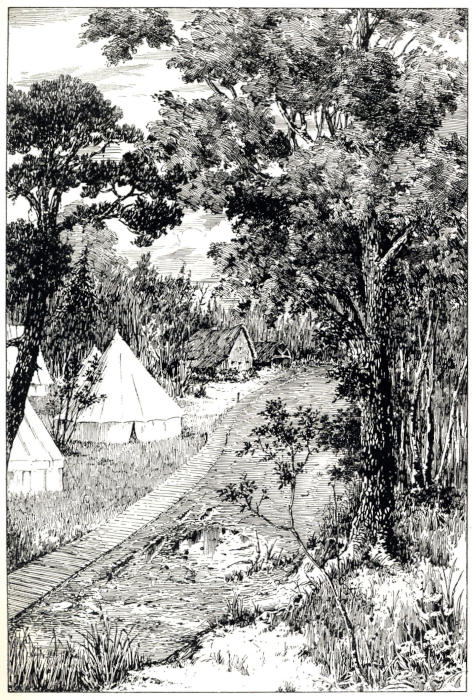
A CASUALTY CLEARING STATION.
We return to the centre of war activity at the Territorial Headquarters
in York.
In a little book, written chiefly for America and published early
in 1918, Major Basil Williams, later employed under Colonel Lord
Gorell on educational Staff Duties, described in adequate terms the
Raising and Training the New Armies[21]. We are not immediately concerned
with the decision which called those Armies into being. Lord
Kitchener was Secretary of State for War, and on August 8th, 1914,
he called for that ‘first hundred thousand’ whose spirit was so brilliantly
conveyed in Mr. Ian Hay’s volume of that name. He got them over
and over again, and it is no part of our purpose to discuss the Parliamentary
Recruiting Committee’s output of speeches, posters and
‘literature,’ by which, partly, under the grace of England’s effort,
the result was obtained. Nor shall we examine the evidence on which
Mr. Churchill, as Secretary of State for War, based his expression
of opinion, already quoted above, that, had the Territorial Force
organization ‘been used to build up the War Army, as originally
intended and conceived by Lord Haldane, we should have avoided
many of the difficulties that confronted us at the outset, and we should
have put a larger efficient force in the field at an earlier stage.’ What
Lord Haldane intended in 1908 and what Lord Kitchener demanded
in 1914 might well be corrected in the light of what Mr. Churchill
knew in 1919. But even without the wisdom which is garnered after
the event, we are entitled to quote one sentence from Major Williams’
account of the New Armies. Towards the close of his review of ‘the
great awakening of the nation by the recruiting campaign,’ 1914-1915,
he wrote:
‘All this time the Territorial Force, the original home defence
force, nearly the whole of which had originally volunteered for
service overseas, had been quietly raising recruits for itself, supplementary
to the recruits raised by these different methods’.
‘All this time’ and ‘quietly’ are the mots justes. The ‘time’
as we have observed, dated back through the Volunteer movement
of 1859 to the immemorial tradition of shire-loyalty; the ‘quiet’
was that of boroughs and countryside, of mayors’ parlours and manorial
halls, of town-marts and village-greens in England—
‘Grave mother of majestic works,
From her isle-altar gazing down,
Who, God-like, grasps the triple forks,
And, King-like, wears the crown.’
Her possession of the trident was first definitely challenged[22] since
Trafalgar on August 4th, 1914, and in the West Riding of Yorkshire,
as elsewhere, the means of defence were swiftly organized.
Swift forethought in County areas, it should be noted, did not
invariably lead to sound action at the executive centre. A trivial
example will suffice. Three weeks after the outbreak of war, a letter
was written to the Army Council suggesting that the West Riding
Association should make provision for cardigan jackets, warm drawers,
and other articles of clothing, which the troops would require in the
winter months. The Army Council sent a dignified reply, thanking
the Association for their offer, but stating that these articles would be
provided by the Army Council itself. Later, on October 9th, the
Army Council intimated its inability to supply cardigan jackets, warm
drawers, and other articles of winter clothing for the Troops, and
requested the Association to make provision. So far the experience
was merely funny, but the sequel had a Gilbertian touch. When the
Association made inquiry at the contractors, they were informed that
all manufacturers of the articles in question had been forbidden by
the Army Council to supply anyone else than the War Office. ‘These
facts are brought before the Association’, remarked the Chairman in
his quarterly report, ‘in order that members may know that everything
possible was done to anticipate the requirements of the Troops,
and that any failure in this respect is due to causes beyond its control.’
It was well and temperately said.
The heavy increase of work in the secretariat was fairly met by
the voluntary help of the Hon. G. N. de Yarburgh-Bateson, Mr.
Talbot Rice, Mr. Peter Green, some eighteen or twenty volunteers
from the close of their day’s work till late at night, two clerks from the
North Eastern Railway Company, a clerk from the York Probate
Office, twenty-six additional full-time clerks, Boy Scouts and other
useful helpers. The County Director was assisted by Col. Sir Thomas
Pilkington, Bt.,[23] and Lieut.-Col. Husband, whom the G.O.C. had
appointed as officers superintending the Lines of Communication and
the arrangements for the care of the sick and wounded. Advisory
Boards were formed for the 2nd and 3rd Northern General Hospitals
at Leeds (Training College, Beckett’s Park) and Sheffield (Collegiate
Hall) respectively, which as early as the end of August had already
many patients from France and Belgium. These Boards, consisting,
at Leeds, of the Lord Mayor, Alderman F. Kinder, Lt.-Col. Shann and
the Matron of the Infirmary; and, at Sheffield, of the Lord Mayor,
Lord Wharncliffe, Col. Hughes, Lt.-Col. Sinclair White and the Matron
of the Infirmary, were intended to relieve the Commanding Officers
of the Hospitals of some portion of their administrative functions,
leaving them freer for professional work and discipline.
We omit the long figures and many Army Forms with which
General Mends and his Staff had to wrestle. The 5,000 blankets
and 2,000 sets of saddlery, the 32,887 complete suits of service-dress,
the 16,803 water-bottles and 4,242 bandoliers; these requisitions and
the rest of them are as tiresome and uninteresting in retrospect as they
were absorbing and urgent at the time. There is one feature of their
work, however, familiar by the mystic letters S/A, which cannot be
passed over without notice, for it imposed a very severe strain on the
Association’s capacity for expansion. S/A stands for separation
allowance, and the regular issue of this grant to the wives and dependents
of serving soldiers had been assigned by the Act of Parliament as part
of an Association’s duty. It was by no means an easy task. Allowance
has to be made for an inconvenient distribution of functions.
A soldier, whether Regular or Territorial, drew his pay from his
Commanding Officer out of the monies supplied on vouchers presented
to the Regimental Paymaster. In the Regular Army the same Paymaster
kept the soldier’s domestic account with his wife and children
or other dependents; and, though errors inevitably occurred even when
the accounts were thus linked, they could be checked and more readily
adjusted, inasmuch as all the information was available in the same
office. For the domestic account, it should be observed, was extremely
sensitive to variations in the soldier’s rate of pay, and was affected by
the soldier’s ‘casualties,’ whether major ones of death or desertion,
or minor ones of leave, punishment and so forth. In the Territorial
Force, however, the soldier’s domestic account was kept by his County
Association, presumably owing to the fact that they were more likely
to be in touch with the personnel of the units which they administered.
In peace-time this worked very well. When a Territorial soldier
went into camp for a week or fortnight in the summer, it was comparatively
a simple matter for the local Territorial Force Association
to pay the corresponding days’ allowances to those whom he left at
home. But the immense expansion of the Force in 1914, and the
extraordinarily complicated system of accountancy, added to the
distribution of pay-duties between the Regimental Paymaster for the
man and the County Association for his dependent, overtook these
heavily burdened bodies at a time when they were least well qualified
to discharge the work effectively. They did not understand it. It
was difficult to engage clerks. The Army Pay Department of the
War Office could not spare sufficient trained instructors; and, generally,
the urgent problems of the mobilization, equipment and (as we
shall see) the duplication of the Force, tended to postpone attention
to what seemed less pressing domestic matters. The early war annals
of the West Riding Association are full of evidence to these conditions:
‘The duty devolving on the Association of paying Separation
Allowances and Allotments of Pay to the wives and families of
the Territorial Troops entails very heavy work and responsibility....
The first payment was due to be made on the 9th August,
and consisted of Separation Allowance only up to the 31st of the
month. The September payment was duly made on the 31st
August. The number of Money Orders sent out up to and for
that date was 13,328, and on 3rd September, orders were received
to also pay a compulsory Allotment of Pay for each married soldier.’
Though they split an infinitive in doing so, this payment, too,
was duly made on September 11th; but it involved a further 5,430
Money Orders with the corresponding, inevitable Army Forms.
It is no part of our present purpose to enquire into the possibilities
of simplifying Army Pay; least of all, to suggest the simplest
method of a flat rate like the wage of a civilian. But it is within our
province to point out the almost infinite possibilities of mistakes (even
of the fraud which is so elaborately excluded) in the family register
for each soldier of the number, sex and age of his children, in the
paraphernalia of coupons, Postal Draft-books and Money-Orders,
in the calculation and readjustment of rates owing to information
advised from the soldier’s unit or to domestic changes reported or
detected, in the grading of ‘unofficial wives’ and other official relationships,
and, summarily, in the invention of a system which seems
expressly designed to squeeze out of the officers administering it the
last drop of the milk of human kindness without any compensating
gain in the civil virtues of economy and efficiency.
In January, 1915, nearly 15,000 books of Postal Drafts, representing
approximately £210,000, were issued to Postmasters by a
directing staff at York, which consisted entirely of voluntary workers.
In the following April, steps were taken to regularize the position of
these gentlemen, in anticipation of the approval of the Army Council,
in which connection notice was drawn to the ‘unjustifiable system of
differential treatment as between the clerical staff in Regular and
Territorial Pay Offices,’ clerks in the former being engaged at 35s.
a week and in the latter being offered only 23s. In June, the number
of cases in pay and in action for payment amounted to 36,538, while
the Pay Department was working with 41 per cent. below the equivalent
establishment of the Regimental Paymaster’s Office. At last, on
August 18th, 1915, more than a year after the outbreak of war, the
War Office appointed an expert Paymaster to take charge of this heroic
band of amateurs, a Government audit was instituted, and the Association
was thankful to report that the department ‘is now working
in as satisfactory a manner as the complicated and constantly changing
regulations will permit.’ We shall leave the present branch of our
subject on this note of moderate transport. That the Association
had carried on so well is a proof of the continuity of function which
won through to quicker results in other branches of its manifold
activity.
We followed one or two units from the sudden hour of mobilization
to the sea-ports of France and beyond. We may now look at
this achievement, ‘quietly’ performed, as we are aware, in the midst
of the recruiting for the New Army, through the spectacles of the
County Association. Thus, the Chairman’s Progress Report, dated
August 14th, 1914, referred to the confusion which was caused by the
Division being in Camp when the fateful hour struck, but added that
the task of mobilization ‘may be considered as satisfactorily carried
out.’ A month later, he reported, in view of ‘the present grave
emergency,’ that every West Riding unit in the Mounted Brigade,
the Division and the Army Troops had qualified as a ‘General Service’
unit, which meant service overseas. Consequently, the Association
became responsible—this gives us a glimpse through its spectacles—for
raising Reserve units in each case, which meant a duplication of
the Force, or, roughly, another 18,000 of all ranks. Note here the
‘which meant’ in each context. The plain meaning of the situation
within a few weeks of the outbreak of hostilities, was that the pre-war
units would be sent to France at full Establishment, and that the
West Riding would have to supply equivalent units in their home-stations.
The rapid march of events soon caused names to be given
to these facts. In January, 1915, the Chairman stated in his Report
that ‘the first Reserve units are about to be organized as a Division,’
and that ‘as soon as the Imperial Service Division leaves for abroad,
the first Reserve Division will take its place and a second Reserve
Division will be raised. Orders have now been received to commence
recruiting for the latter up to 30 per cent. of its Establishment.’
Meanwhile, more than 7,000 National Reservists had rejoined the
Colours in the West Riding, of whom about 2,000 had been mobilized
for duty on Lines of Communication and in Prisoners of War Camps.
This force was organized by Colonel G. E. Wilkinson, D.S.O., and
‘the clothing and equipment,’ it is added, ‘have been provided by
the Association.’ In other directions, too, the energies of the Association
were fully engaged. The 2nd Northern General Hospital
at Leeds and the 3rd at Sheffield had treated over 4,000 and 3,000 cases
respectively; twenty-eight Auxiliary Hospitals had been approved,
of which seventeen had been mobilized up to date, the whole of the
staffs, except professional Trained Nurses, being provided free by
the Voluntary Aid Detachments, whose beginnings we read of in
the last chapter. Further, the West Riding Branch of Queen Mary’s
Needlework Guild had sent 91,866 articles for the use of the Troops
abroad and at home.
And still the war went on. We are to imagine this machine,
invented in an epoch of peace to raise 18,000 men for mobilized service
at home, stretched now to more than twice its capacity and creaking
under unexpected burdens, operated by a shifting personnel of recalled
officers, part-time clerks, and inexperienced, however enthusiastic,
voluntary workers, overwhelmed with Army Forms and Returns and
the necessary business of accountancy, storing trousers by tens of
thousands in a space provided for a quarter of the supply, yet vexed
that ‘certain articles, such as greatcoats, still come in very slowly,
and boots, puttees, and gloves are extremely difficult to get,’ and always
overtaken by the demands of the inexorable German advance, which
did not wait upon decisions by the Army Council. The essential
letter was issued by the War Office, from the Adjutant-General’s
branch, on February 24th, 1915. It was numbered 9/Gen. No./4747,
and it directed that the Imperial Service, first Reserve and second
Reserve Units of the Territorial Force should be designated respectively,
1st, 2nd and 3rd Line. The organization of the West Riding
Territorial Troops was altered, accordingly, to the West Riding
Division, 1st Line; the West Riding Division, 2nd Line; and a 3rd Line
on a Depot basis, with a strength temporarily limited to two-thirds of
War Establishment. The Yorkshire Mounted Brigade was similarly
re-organized. The 3rd Line was eventually to furnish drafts for the
1st and 2nd Lines, and until it should be in a position to do so the 2nd
Line was to provide drafts for the 1st, which went overseas, April,
1915.
So, we reach along another route the same point to which we followed
certain units through their months of training at home. Many
details have necessarily been omitted: that the Association’s extra
expenditure ‘due entirely to the war’ between August 4th, 1914,
and April 17th, 1915, amounted to £349,902; that 551 men of the
2nd Line Units responded to an appeal for volunteers to transfer to
the Reserve of the Regular Battalions of the West Yorkshire, West
Riding, K.O. Yorkshire L.I., and York and Lancaster Regiments;
that a Sanitary Section was added as a new unit to each 1st and
2nd Line; that Territorial Depots were henceforth to be known as
Administrative Centres, and to be manned by Home Service members
of the Territorial Force[24]; that up to March 31st, 1915, nearly 2,000
patients had been admitted to the Auxiliary Hospitals in the West
Riding; and so on, and so forth. For the local machine had many
wheels, and every wheel was kept moving all the time. It revolved
as smoothly as it might, but the motive force was not in York, nor
in London, but, in the German Headquarters on the Western Front,
and in the hate, which, reversing Dante’s cosmogony, seemed, through
those fateful months, ‘to move the sun and other stars.’
Only one more change need be recorded before we follow General
Baldock abroad. In May, 1915, his Division was re-entitled the 49th
(West Riding) Division. At the same time its Infantry Brigades
(the 1/1st, 1/2nd and 1/3rd) were re-named the 146th, 147th and
148th Infantry Brigades respectively.[25] A few months later, the 2nd
Line Division, which was still in training at home, and to some features
in whose early history we shall come back, was re-entitled the 62nd
(West Riding) Division.[26] Under these names they won renown in
the Great War.
CHAPTER IV ‘MALBROUCK S’EN VA-T’EN GUERRE’
Once more the point of view changes. We have seen the 49th
Division nursed by its ministering Association into the semblance of
a military force. We have noted its cheerful submission to the discipline
of drill and camp, and its fine-strung spirit of renouncement when
the vague thought of active service at a remote date broke on the urgent
call of the country’s immediate need. Either aspect has been encouraging.
Whether viewed individually or in the mass, this Territorial
Division, one of many, which took the Imperial Service obligation
and joined the Expeditionary Force in the spring of 1915, fills the
spectator of so much courage and the narrator of so much effort with
high hope for the Force as a whole.
Henceforth, we are to see the Division under a new aspect.
Certain units from the West Riding were already in the field. We
have visited a Casualty Clearing Station near Merville, and presently
we shall come to the fine record of the 1st Field Company, West
Riding Royal Engineers, which served in Gallipoli with the ‘incomparable’
29th Division. But, except for these isolated units, the war
so far had passed it by. In its organic, military capacity, it had merely
guessed at the course of the war from signs and tokens vouchsafed by
the Army Council, from the duplication and triplication of its units,
from the extreme difficulties of equipment, and from a general sense
of haste without method. From this time forward, for four years and
more, it was to learn warfare at first hand. It was to forget its separate
existence as the sheltered nursling of a County Association, and to
become a part, however small a part, of the British Expeditionary Force.
The B.E.F., France, at this date (April, 1915), needed all the
reinforcements it could muster, and Sir John French[27] had already
borne witness in his Fifth Despatch (February 2nd, 1915), to his hopes
from the Territorial Force:
‘The Lords Lieutenant of the Counties and the Associations
which worked under them bestowed a vast amount of labour and
energy on the organization of the Territorial Force; and I trust
it may be some recompense to them to know that I, and the
principal Commanders serving under me, consider that the
Territorial Force has far more than justified the most sanguine
hopes that any of us ventured to entertain of their value and use
in the field. Army Corps Commanders are loud in their praise
of the Territorial Battalions which form part of nearly all the
brigades at the front in the first line.’
And he had written again, as recently as April 5th:
‘Up till lately, the troops of the Territorial Forces in this
country were only employed by Battalions, but for some weeks
past I have seen formed Divisions working together, and I have
every hope that their employment in the larger units will prove
as successful as in the smaller.’
Territorial soldiers had made good, and Major-General Baldock,
Commanding the Division, as a complete unit from the West Riding,
found his confident welcome assured.
He arrived at a critical time. It was the spring of 1915. At
home, public opinion was to be convinced of the thoroughness of
German methods by the sinking of the ‘Lusitania’ on May 7th. A
reconstruction of the Cabinet by Coalition was announced on May
19th, and a Ministry of Munitions, with Mr. Lloyd George at its head,
took shape on June 16th. This innovation was due to several causes,
the ultimate origin of which is to be sought at a date a long way back
from the outbreak of war. Accordingly, we may be absolved from
any attempt to adjudicate between a Prime Minister, a Field Marshal,
and a Secretary of State for War, as to the responsibility for the
shortage of munitions which was revealed after war broke out. They
did fall short of requirements, and high explosive shells had been
postponed to shrapnel; and, as far as public opinion could judge,
the decision to repair these deficiencies (the political decision, that is
to say) was expedited to some extent by the immediate effect of one
sentence in a speech by Mr. Asquith, at Newcastle-on-Tyne, on April
20th. He was speaking, as he has since stated, to British workmen,
with the object of speeding-up their output, but not without a proper
regard to the cocked ears of the German Military Command; and,
partly in reliance on the expert information which he had sought, he
said in the course of his speech:
‘I saw a statement the other day that the operations, not only
of our own Army, but of our Allies, were being crippled, or at
any rate hampered, by our failure to provide the necessary ammunition.
There is no truth in that statement.’
The assurance seemed to contradict the experience of gunners at
the front. In his Seventh Despatch of June 15th, 1915, Sir John
French affirmed quite clearly that,
‘Throughout the whole period since the first break of the
line on the night of April 22nd, all the troops in this area had been
constantly subjected to violent artillery bombardment from a
large mass of guns with an unlimited supply of ammunition.
It proved impossible, whilst under so vastly superior a fire of
artillery, to dig efficient trenches, or properly to re-organize the
line.’
Indeed, on the very night when Mr. Asquith was speaking at
Newcastle, a Territorial Force Officer (2/Lieutenant Geoffrey Woolley,
of the 9th London Regiment) was earning his Victoria Cross for
defending a position on Hill 60 against overwhelming enemy cannonade.
Hill 60, which was not a hill at all, but merely a hummock of
railway earthwork, was in any case not visible from the Tyne, but the
general disquietude at home at the time of the formation of the Coalition
Cabinet reflected accurately enough the conditions which marked the
place and time of General Baldock’s arrival in France, with which we
are immediately concerned. One word more will complete this
impression:
‘I much regret,’ wrote Sir John French in the same Despatch,
‘that during the period under report the fighting has been
characterized on the enemy’s side by a cynical and barbarous
disregard of the well-known usages of civilized war and a flagrant
defiance of the Hague Convention. All the scientific resources
of Germany have, apparently, been brought into play to produce
a gas of so virulent and poisonous a nature that any human being
brought into contact with it is first paralysed and then meets with
a lingering and agonizing death.’
The first such gas attack was launched at Ypres, on Thursday,
April 22nd. On the previous Thursday night (the 15th), we left a
West Yorkshire Battalion spending its first night in France at a Rest
Camp, near Boulogne.
So the 49th went to the war on the eve of the Second Battle of
Ypres, at a time of an outrage of gas and a shortage of shells.
They went in eighty-four trains and on five days between April
12th and 16th, embarking at Southampton Docks, Avonmouth and
Folkestone for Havre, Rouen and Boulogne respectively, and they
joined the 4th Corps of the 1st Army, commanded by Lieut.-General
Sir Henry Rawlinson. Corps Headquarters were posted at Merville,
and there the Divisional Commander reported with five of his Staff
Officers, and established, as we saw[28], Divisional Headquarters in the
mayor’s house, 40 rue des Capucines. On April 18th, the following
message was received from His Majesty the King:
‘I much regret not to have been able to inspect the Division
under your Command before its departure to the Front. Please
convey to all ranks my best wishes for success, and tell them that
I shall follow with pride the progress of the West Riding Division.’
A loyal reply was dispatched by General Baldock, and on the same
day parties of Officers and N.C.O.’s, followed on the 19th by complete
platoons, from the Battalions of the 2nd and 3rd West Riding (147th
and 148th) Infantry Brigades were attached to units of the 23rd and
25th Brigades, 8th Division, for instructional duty in the trenches.
On the 22nd, the 1st (146th) Brigade moved from Merville to Estaires,
and was attached to the 7th Division, and placed under their orders.
Sir Douglas Haig visited units of the Division on the following day.
Divisional Headquarters were moved on the 27th to two houses and
a farm in Bac St. Maur, and at 6 a.m. on the 28th, the Division took
over a front of its own at Fleurbaix, covering sections 3, 4, 5 and 6 of
the IV Corps sector.
We may fill in a few details in this outline. After all, it was a
wonderful fortnight in the experience of the men from the West
Riding. A war on the Western front had been waged for more than
eight months, but it was all strange to new arrivals. Take, for instance,
the 1/6th Battalion of the West Riding (Duke of Wellington’s)
Regiment, which slept at S. Martin’s Rest Camp, about three miles
out of Boulogne, on the night of April 14th. The next day, which
was fine and warm, they marched nine miles to Hesdigneul, and
waited two hours at the railway station before entraining for Merville.
The entraining of a thousand and fifteen men presented no difficulty
to troops which had long since become expert in such drill. It was
carried out in batches of eight-and-forty, with a frontage of six men,
eight deep. At a given signal three men entered the truck; the centre
man took the rifles of the rest, whom the two flank men helped in.
Merville was reached at 10-45 p.m. and the Battalion, preceded by its
Billeting party in a motor-car, marched four miles to their billets at
Neuf Berquin, turning in after 3 a.m.: a long and tiring day’s work.
The 16th and 17th were spent quietly. On the 18th there was Church
Parade, and in the afternoon motor-’buses were provided for a party
of fifty officers and N.C.O.’s to proceed to Fleurbaix, where they were
attached to the 13th Kensingtons for twenty-four hours’ instruction
in the trenches. Even instruction had its perils, and this trench-party
returned one casualty; Sgt. T. Richardson, ‘slightly wounded.’
On the 20th, the motor-’bus came again for a party of twenty-six in
all, and next day a platoon from each Company in the Battalion studied
trench-warfare as pupils of the 25th Brigade. This instruction, which
included bomb-throwing, was continued till April 26th, when the
Battalion paraded at 4-45 p.m. and marched to new billets at Fleurbaix,
reaching Rue de Quesne at 8 o’clock. The next night at 11 p.m.
Pte. J. Walsh was killed by rifle fire, and on Thursday, April 29th,
Fleurbaix was shelled by heavy guns, which found the billets occupied
by this Battalion. A single shell killed two privates and wounded a
third: ‘the dead were buried where the shell fell, owing to Pte. Pickles
being so mutilated. No service: Chaplain not available.’
This unhouselled grave may be taken as the initiation of the
Division into war, rumours of which, set flying in the Second Battle
of Ypres, reached units of the Division in their billets.[29] Their turn
was to come a little later, but the fighting throughout April and May
was so much of one piece and with one object that we may start, as the
battle started, on April 17th.
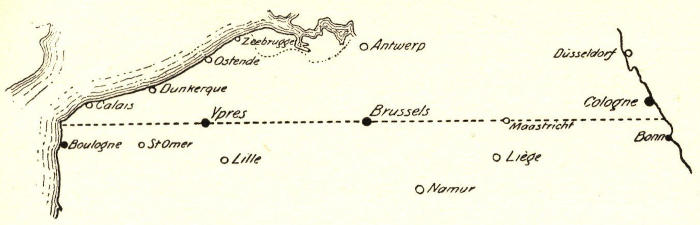
A straight line, 260 miles long, drawn from a point on the Rhine
midway between Cologne and Bonn, and terminating at the French
coast about six miles north of Boulogne, will pass through Brussels
and Ypres. That heroic town, in other words, the ‘great nerve-ganglion,’
as it has been called,[30] was not merely the symbol and shrine
of Belgium’s resistance to the invader; it was also a necessary stage
in the German attempt at the Channel ports. They battered the line
up and down, in the hope of breaking a way through, but their
worst and heaviest blows were levelled at Ypres itself, which they
wrecked but they did not capture. The second of these desperate
assaults opened as we saw, at Hill 60, two and a half miles to the
south-east of Ypres, where it flared into the horror of poison-gas
on April 22nd. A week of heroism and endurance brought this episode
to a close by the withdrawal of the defence to a depth of about two
miles on a semi-circular front of nearly eight. An intensified
fierceness of attack marked the renewal of the battle in
May. The hottest days were the 13th and 24th, between
which there was a kind of lull; and thereafter the centre of
fighting sagged away a few miles to the south, where the 49th Division
was in waiting. The assault on Ypres had failed. Exhaustion-point
had been reached on either side, but the defenders had paid an awful
price. Their casualties numbered tens of thousands, and thousands
had died in choking agony. The salient or semi-circle of troops,
Belgian, French, Indian, Canadian and English, which had never
stretched more than five miles out from its diameter on the Yser Canal,
was flattened in even at the furthest to as little as two or three. Langemarck,
the pivot of the first episode, which had lain on the rim of the
salient, now lay more than two miles outside it; Bellewaarde Lake,
the pivot of the second, which had lain two miles inside the rim, was
now on the edge of it or without. If the last stronghold of Belgium
was to be saved, and the gate to the Channel ports kept locked, at
least an equal power of resistance was required from the defenders in
the next phase.
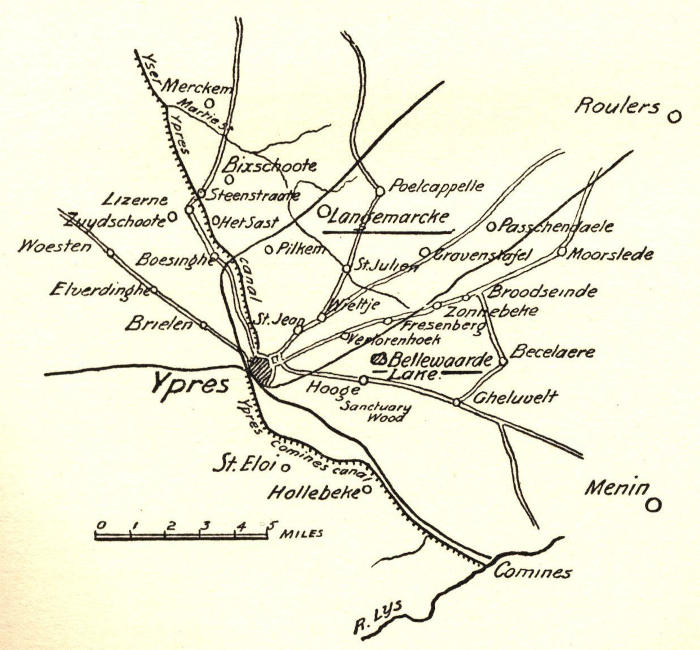
Moreover, we must look at a bigger map. Behind the actual
fighting line lay Lille and Douai, railway-junctions of cardinal importance
for the communication and supplies of the German armies. To
strike at these towns through Lens, at the south-west corner of the
triangle of which Lille formed the apex and Douai the heel, was an
object desirable on its own account and full of promise for the succour
of Ypres. If these plans, concerted with high hopes between General
Foch and Sir John French, succeeded in threatening the railway-system
behind, they were bound to react unfavourably on the German
occupation of Belgium. And even if these larger plans failed, partly
in consequence of the indentation of the semi-circle of troops guarding
Ypres, there might still be a sufficient gain of ground and a sufficient
slaughter of the enemy to affect his distribution of forces between the
Western and the Eastern fronts. For the situation in Russia was
already causing anxiety to her Allies.
Hostilities were opened on May 9th by an intense attack of French
artillery to the south-west of Lens on the road from Arras to Béthune,
between La Targette and Carency. ‘That bombardment,’ says a
graphic writer,[31] ‘was the most wonderful yet seen in Western Europe.
It simply ate up the countryside for miles.’ Unfortunately, the
mileage was not wide enough to open the way to Lens, and day by day
the French advance was held up, pressed forward and held again, in
a series of almost Homeric combats, which were measured by yards,
even by feet, and in which the conspicuous names were White Works,
Notre Dame de Lorette, Ablain, the Sugar Refinery, Souchez, the
cemetery at Neuville St. Vaast, and a terrible labyrinth of underground
fortifications. The whole area, working up from the River Scarpe,
was on a frontage of about seven miles, with Lens about six miles to
the north-east. Each obstacle had to be surmounted not once only,
but in many instances several times, and when, at the end of May,
the German salient from the Lille-Douai road was flattened back at
its southern extremity to the outskirts of Lens, which did not fall, the
French success in the three weeks’ fighting seemed hardly commensurate
with the cost. We shall be in a position to estimate it more
precisely when we have taken into account the results which were
attained further north.
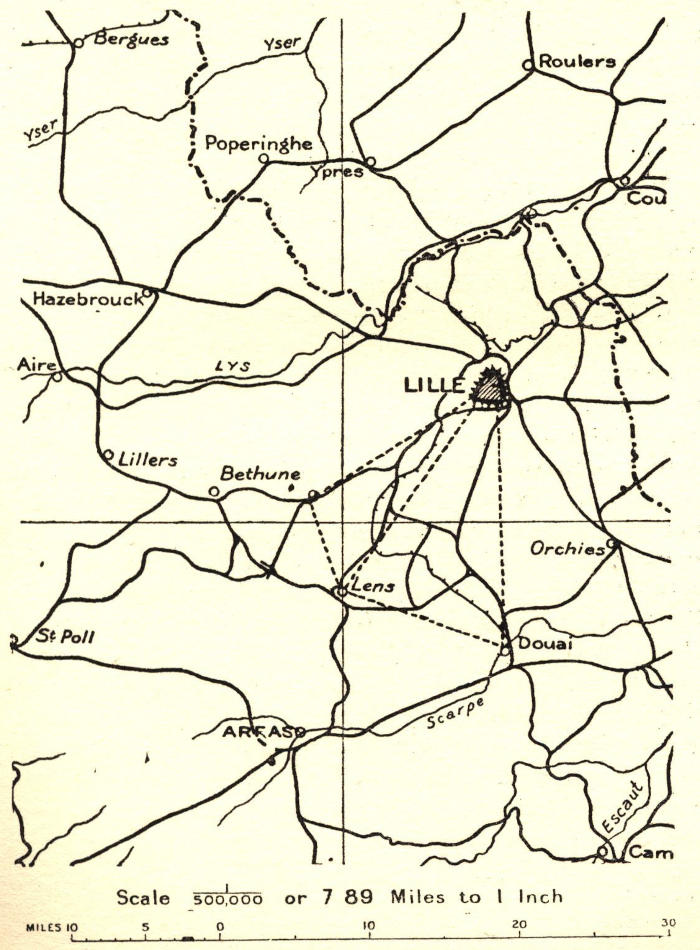
The French advance towards Lens from the south-west was
supported by a British attack on a front facing east-south-east and
aimed through Festubert and Aubers towards La Bassée and Lille.
We noted just now the triangle which is formed with Lille at
the apex, Douai at the eastern and Lens at the western foot. On the
Lille-Lens line of that triangle, another and smaller triangle will be
found, of which La Bassée forms the westernmost angle. The French,
we are aware, came up on a front converging on Lens from Arras and
the valley of the Scarpe. The British advanced from the north-west
with a view to investing La Bassée, and if Lens and La Bassée had
both fallen, as the issue of these heroic endeavours, the double triangle,
or kite, would have been rolled up to its apex at Lille.
The British assault, like the French, opened on Sunday, May 9th.
The task of the IV Corps in the battle was assigned to the 7th and
8th Divisions, while the 49th Division took over the greater part of the
trench-line held by the Corps. Their first object was to gain Fromelles,
but their main and ultimate objective was the Aubers Ridge. The
general scope of the attack was disclosed confidentially to the troops
about to be engaged. It was ‘not a local effort for the capture merely
of Fromelles and Aubers villages,’ but was ‘part of a much larger
operation designed to break the enemy’s line on a wide front.’ The
importance of the forces employed was also emphasized. ‘Not only
is the offensive being undertaken by the First Army’, we read, but a
force of ‘the best French troops, amounting to 300,000 or 400,000
men, is likewise advancing to the attack north of Arras.’ The disposition
of the British troops made their objective quite clear. They
faced the Lille-La Bassée road, curving round La Bassée at the
extreme right. Their line was extended on the left to cover about
half the road to Lille. The furthest point of that line from Le Bridoux
to Cordonnerie Farm was held by the 49th (West Riding[32]) Division,
and two of its Infantry Brigades, the 147th and 148th, were detailed
to occupy the German trenches which the 8th Division, followed by the
7th, and thus supported by the 49th, was to compel the enemy to vacate[33].
Unfortunately, the whole plan miscarried. The first artillery attack
could not be sustained in sufficient strength to wipe out the barbed-wire
entanglements and free the way for the Infantry. It followed
that the 8th Division could not press its heroic advance home, and the
West Riding Infantry Brigades were never called upon to discharge
their allotted task. The first day’s programme was thrown out from
the start. Its features on the British front bore a tragic and curious
resemblance to those of the later days further south, when the advantage
won by the French bombardment had been neutralized by German
local fire. The advance was broken, that is to say, into little pockets
and blood-spots of fighting, which sank into the soil where they occurred.
If the courage displayed in these encounters had been combined for
the united effort which was intended, no troops born of woman could
have withstood it. The record of every fighting unit tells the same
tale of desperate valour; of a few exhausted and staggering survivors
hardly able to remember their own exploits, of endurance strained to
the limit of capacity, and of unwilling admiration extorted even from
a grudging foe. But the net result on May 9th was failure; it was
necessary to retire and to repair, and the part of the West Riding units,
to their own deep disappointment, was confined to occasional supporting
fire, to relief-duty in the trenches, marked by little more than
its normal dangers, and, on the whole, to a comparatively quiet day.
This battle of Fromelles, or of Aubers Ridge, which had the indirect
success of engaging sufficient German forces to assist the French
advance to Carency, was renewed a week later at Festubert, and was
not broken off till May 26th. ‘I had now reason,’ wrote Sir John
French in his Seventh Dispatch, ‘to consider that the battle, which
was commenced by the First Army on the 9th May and renewed on
the 16th, having attained for the moment the immediate object I had
in view, should not be further actively proceeded with; and I gave
orders to Sir Douglas Haig to curtail his artillery attack and to strengthen
and consolidate the ground he had won ... on a front of four
miles to an average depth of 600 yards.’ We may add that, if Lille
was not taken, Ypres, too, with its narrower front, still stood with its
back to the wall; and behind that wall lay the Channel ports. Moreover,
the southern approach had been partially blocked by the reduction
of the German salient from Lens, and the fighting quality of our troops
was such as to deter the enemy from attempting a break-through on
one line without adequate resources on the rest. In other words, a
see-saw movement was the chief obvious conclusion from the six weeks’
spurts of battle-fury to the east and south-east of Ypres. A new
direct frontal attack would mean a new risk to Lens and on to Lille;
a new attempt to throw out the Lens salient would mean a protrusion
of the British salient from the Yser Canal. The third or middle
course was to accept stalemate; and to the limited but useful extent
of forcing this decision on the enemy, the heroes of the Second Battle
of Ypres, of the French pocket-battles in the Artois, and of the British
struggles round Aubers and Festubert are entitled to the full measure
of their renown. Moreover, taking a wider survey, the stalemate
suited the combatants on other accounts besides exhaustion. Germany
was waging war on two fronts. Having pushed her western pieces
into positions, in which, save for minor attacks, they might be left
undisturbed for a time, she was anxious to concentrate on the east.
England, too, had another foe, whom it might be too late to overtake
unless she set about the work at once. It became known as shortage
of shells, and Mr. Lloyd George, as we saw, was appointed in June to
devise rapid measures for its defeat.
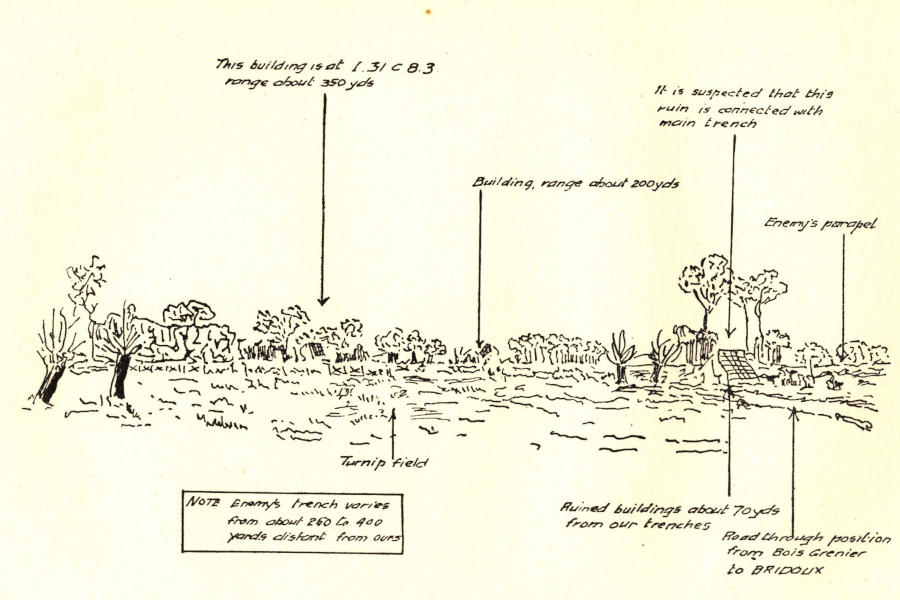
Turning back to the 49th Division, we note that on May 16th it
occupied, again with the 8th Division, the extreme left of the British
line. On the 22nd, orders were received for the 148th Brigade (the
4th and 5th King’s Own Yorkshire Light Infantry and the 4th and 5th
York and Lancasters) to throw forward the line to two ruined houses
on the Bois Grenier-Le Bridoux road. (A panorama sketch of the
site is given opposite). This meant the laying-out and preparation
of a new front-line trench astride the road, and the necessary tools,
sandbags, stakes, barbed-wire, and other paraphernalia were collected
during the day of the 22nd and the early part of that night. Work was
started about 11 p.m., when two Companies of the K.O.Y.L.I. under
Major P. T. Chadwick and Captain Critchley, traced out and began
digging the new trench. The two ruined houses, situated about half
way between the British and the German lines, were found to be
occupied by the enemy, who brought heavy rifle fire into play and
considerably worried the working parties. In this encounter, Lieut.
R. T. S. Gwynne was wounded, and died the next day. On the 23rd
the same Companies went out again in order to strengthen the work
commenced on the previous night. Heavy fire was drawn from the
ruined buildings, but the enemy was forced to retire. Work was
continued till daylight with satisfactory results, the cover being much
improved and the communication-trench up to the new line being
practically completed. By this means, certain operations which had
been ordered by the Corps Commander on May 20th were enabled to
be carried out. On the 24th these were opened by a bombardment
from the ninety-six guns in the line at short intervals between 8 and
9 p.m. At 8-50 two Companies of the same 4th K.O.Y.L.I., under
Captain A. C. Chadwick and Captain L. M. Taylor crossed the parapet
of No. 6 trench and advanced up to the new trench prepared on the
preceding nights: a journey of about seventy yards. The German
machine-gun and rifle fire was exactly one second too late to find this
party. The Companies quickly took position, and dug themselves in,
and the ruined houses were put in a state of defence by a section
working under Captain Creswick. Next morning, two Companies
from the 5th K.O.Y.L.I. relieved their comrades of the 4th, and continued
operations. From the 26th of May onwards for some days
the Germans left them no peace, and a number of casualties ensued.
But the operation had been carried out, and Sir Henry Rawlinson,
Commanding the IVth Army Corps, desired that his high appreciation
should be conveyed to the officers and other ranks of the 4th King’s
Own Yorkshire Light Infantry for the ‘gallantry and precision’ which
had been displayed.
Further compliments followed. On June 12th, a message was
received from the Adjutant-General at General Headquarters:
‘The Commander-in-Chief notices with gratification the
record of the 49th (West Riding) Division for the month of May,
which shows that no single conviction by Court-Martial has
occurred, a condition which does not obtain in any other Division
of the Armies. He desires that his appreciation of this fact be
duly conveyed to the 49th Division.’
And Major-General Baldock, commanding the Division, was
informed by the General Officer Commanding the First Army, to which
the Division had been transferred at the end of May:
‘Sir Douglas Haig wishes to add an expression of his great
satisfaction at the state of discipline in the 49th (W.R.) Division,
and also desires to congratulate the Division on its soldier-like
bearing and efficiency.’
A month later, the Division was re-transferred from the First
Army, Indian Corps, to the Second Army, VIth Corps, commanded
by Major-General Sir John Keir, when it moved to Proven, north-west
of Poperinghe, and the surrounding villages in Belgium. The weather
after May 23rd had become very hot, and there was one case of sun-stroke
in the trenches.
We shall return to the fortunes of the Division in the alternating
periods of trench-life and billets which succeeded the intenser fighting
of May. The whole Western front settled down to what seems like a
phase of inactivity, but what was really a broken succession of diverse
minor experiences, the monotony of which, like the sea’s, was always
movement, more apparent at close quarters than afar. Meanwhile,
it will be appropriate to pick up the record of that isolated unit of West
Riding Divisional Engineers, which, as we mentioned above, preceded
the Division overseas. They, too, reached the scene of war in April,
1915. They fought in a different field, and were even more heavily
engaged, but they earned by conspicuous gallantry not less honour
than their comrades in France.
This unit, the 1/1st Field Company of West Riding Royal
Engineers, under the command of Major Dodworth, formed one of
three Companies which served under Lt.-Col. G. B. Hingston,
C.R.E., in the 29th Division. Their original destination was
France, but in February, 1915, it was decided to ship the Division
with all possible speed to the Dardanelles, and, had this decision been
carried out, the fate of British arms in the Peninsula might have been
brought to a different conclusion. As a fact, owing to causes which
have been made public, its departure was postponed till March, and,
after a troublesome delay at Alexandria, the Field Company, with a
strength of 6 officers, 201 other ranks, 62 horses and mules, and 12
vehicles, reached Tenedos on April 24th. At midnight on the same
day they were selected, much to their delight, to sail with the covering
force on the ‘River Clyde’ to the South Point of the Peninsula, and
there, below Sedd-el-Bahr, the modern model of the Trojan wooden
horse was beached at 7 a.m. on April 25th.
The events of that day of death and glory have been sung, and
painted, and told, and require but brief reference here. ‘No army in
history,’ says the poet who wrote a prose-epic called Gallipoli[34], ‘has
been set such a task. No other troops in the world would have made
good those beaches,’ and it is heartening to recall that troops from the
West Riding of Yorkshire were included in this unique band.
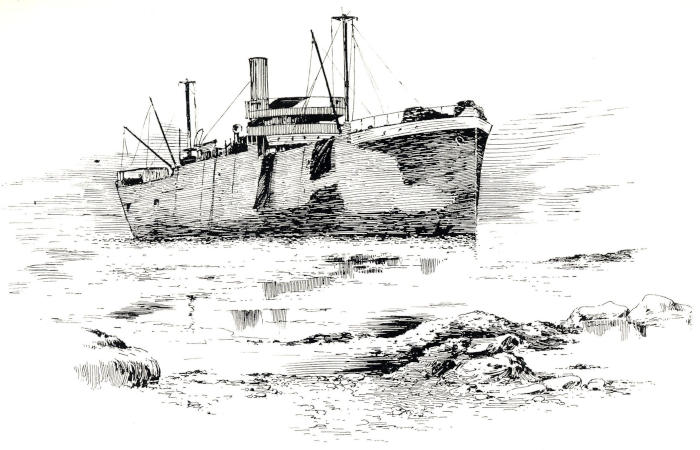
“MODERN MODEL OF TROJAN WOODEN HORSE.”
For five months, from April till September, our Field Company
of Royal Engineers remained on the Gallipoli Peninsula. The roads,
the water-supply, the trenches, the night-wiring, the bridges, the
jetties: every kind of engineering job came their way. They even
manufactured hand-grenades, and gave practical lessons in the use of
them, and they took their bellyful of fighting and of experience of
Turkish shells. In June, for example, two of their sappers, A. Jennett
and G. Packard, were awarded the Distinguished Conduct Medal for
their gallant rescue of Captain Todd, of the Argyll Mountain Battery,
who was lying with a leg blown off under heavy fire on the other side
of a barbed-wire entanglement; and the same decoration was bestowed
on Lance-Corporal W. B. Owen, who snatched another wounded
Officer out of a trench in actual enemy occupation, and carried him to
a dressing-station two miles off, for the most part under fire. On
September 22nd came a welcome fortnight’s rest. They were back
again early in October, and had a terrible spell of work after the great
gale of November 26th, which helped to confirm the decision for
evacuation. For the end of the adventure was approaching, and our
Engineers remained till the end. After helping to clear Suvla and
Anzac, they moved in January, 1916, to Helles, where they cut steps
down the cliff to W. Beach. Thence they sailed at last in two parties
reaching Suez, January 16th.
The rest of their story belongs to the Division in which they became
absorbed. But the praise of their famous work in Gallipoli, to which
they went straight from home, redounds to the credit of the West
Riding, and may be added to the praises which we have quoted from
Sir Henry Rawlinson, Sir Douglas Haig and Sir John French:
‘The 1/1st West Riding Field Company Royal Engineers,
which forms part of the “incomparable” 29th Division,’ wrote
Lieut.-General Sir Aylmer Hunter-Weston, Commanding that
Division, ‘did grand service on the Gallipoli Peninsula....
Engineers have always the post of honour in war, having to make
entanglements, to mine, to sap and to carry out many dangerous
jobs in the very forefront of the fray. Of all this work the 1/1st
West Riding Field Company Royal Engineers had its full and
more than its full share, and right well did all ranks rise to the
occasion.... The casualties among them have been heavy
... but the results achieved by them have more than counterbalanced
the loss incurred. They have covered themselves, their
Unit, and the rest of the West Riding Divisional Royal Engineers
with glory.’
This passage occurs in a letter written by Sir Aylmer Hunter-Weston
on September 9th, 1915, and published with the next Quarterly
Report of the West Riding County Association. In that Report,
Lord Scarbrough included an account of a visit paid to Flanders by
himself, as Chairman of the Association, and by Brig.-General Mends,
the Secretary. Their ‘object was to ascertain in what ways the
Association might best provide for the needs and comfort of the troops,
and to study the conditions under which they have to work’; and it
will not be out of place to examine Lord Scarbrough’s conclusions in
those respects in anticipation of what we shall find in the ensuing
chapter.
He recalled to the memory of local patriots that the 49th Division
was composed of Field and Heavy Artillery raised from Leeds, Bradford,
Sheffield, Otley and York; of Engineers from Sheffield; of
three Infantry Brigades from the West Yorkshire, West Riding, Yorkshire
Light Infantry, and York and Lancaster Regimental Districts;
of Army Service Corps from Leeds and York; and Field Ambulances
from Leeds and Sheffield. They had left for France in April, and had
been ‘continuously in the fighting line ever since.’ It would stimulate
local patriotism to know that a Staff Officer wrote of the Division:
‘I am very proud to have been connected with it. They are
a real good lot, and I don’t think there is a better Division in the
country.’
To the ‘amenities of war,’ as likewise to the ‘other side of the
picture’, we shall presently come back: such facts may be recovered
from written evidence; but what Lord Scarbrough and General
Mends saw in the ‘smiling faces’, the ‘spirit of cheerfulness’ and the
‘sense of mastery over the enemy,’ is contained in no formal War
Diary, and is the more valuable and vivid on that account. It brought
comfort and encouragement to the West Riding in the dark days of the
autumn of 1915; not merely to members of the Association, struggling,
as we know, against the flood, but also to many wives and mothers,
realizing that, ‘in a campaign like this,’ as the Report stated, ‘casualties
come fast,’ and, lastly, to the various committees, Parliamentary
Recruiting, Trades Union, and so on, which based their appeal for
fresh efforts, in the last stages of voluntary enlistment, on the valorous
record of the ‘boys’ who had already gone to the front. Alike in
Flanders and in Gallipoli, that record was worthy of the West Riding.
CHAPTER V THE DAY’S WORK
During January, 1916, the 49th Division was ‘in rest’: the
first period of complete rest which the Division as a whole had enjoyed
since the previous April, when it first entered the field.
Even before this complete rest the Division could look back on
some months of comparative military inactivity. It had not been
called upon to take part in the severe fighting at Loos in September,
1915; and no other big operations, on the scale of the warfare in
May and June, had occurred since the Battle of Festubert. Yet there
had been fighting every day. Every day of the intervening weeks and
months between the close of the spring campaign and the order to
rest in January had brought difficulties and dangers here and there,
up and down the line of trenches in the neighbourhood of Ypres
and the Canal, in which the 49th was engaged, and which it was
essential to maintain as a barrier between the invader and the sea.
It is not easy to write the history of those days, when the Division
was neither ‘in rest’ nor in action. We might review them in numerical
sequence, long day after long day, when according to the Battalion
chroniclers, ‘nothing of importance happened,’ or one unit relieved
another, or there was an inspection by the Corps or Army Commander,
or there was a ‘bombardment of the whole line, varying
in severity throughout the day and night.’ These entries, and entries
like these recur again and again in the Diary of every unit in the
Division. Or, again, when autumn arrived, the weather compelled
attention. ‘Rained. Trenches very bad; practically no work
could be done. Heavy bombardment all day from 4 a.m.,’ is a
typical entry in October; and we are left to read between the lines
the accumulated miseries of that day’s work, in which the worst hardship
of all was that ‘practically no work could be done,’ in evil
trenches sodden with rain and shaken by continuous fire. Minor
miseries, perhaps, and less epical in retrospect than the Homeric combats
of the spring, or the campaign on the Gallipoli peninsula; yet
real and serious enough in their hourly call on a man’s endurance to
warrant an attempt at narration.
We are told, for instance, that Sir Herbert Plumer was pleased
if the Second Army casualties did not exceed two hundred a day in
ordinary trench work, and a division of this figure into the Army total
will yield a quotient from which we may deduce the average chance
of danger in a quiet time. Or we may observe that the British first
line trenches were distant from the line of German trenches by about
80 to 150 yards, but that where the line bent back on the north to
the bank of the Yser Canal the distance from the German line was only
30 yards, with a very nasty corner at the bend. We may note, too,
the lack of rest at night: the constant flare of Very Lights across the
trenches, and the incessant contest of wit (and luck) between the
men repairing trenches or bringing up rations or ammunition and the
snipers watching their opportunity.
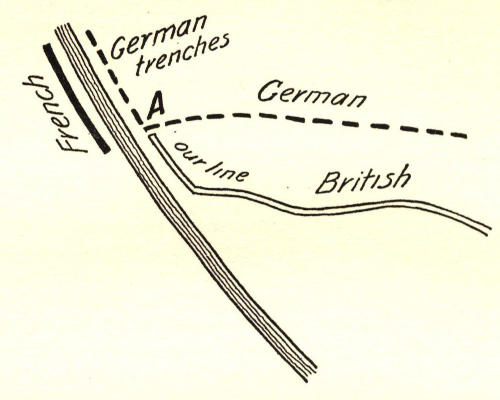
Certain days at any rate may be selected for somewhat more detailed
description, not because they differed essentially from the days that went
before and that came after, but because, in the cycle of days, as in a
cycle of numbers at a gaming-table, they are marked with adventitious
interest.
Take, for instance, July 29th (we are writing of 1915 throughout)
in the story of the 7th Battalion of the West Yorkshire Regiment.
They were in dug-outs on the Canal, having completed a turn in the
trenches just before midnight on the 25th. On the 26th, 27th and 28th,
nothing of importance happened. On the 29th from half-past eight
till noon, there was a heavy shelling of the dam at the rate of two
shells every five minutes; this rate was reduced by a half from noon
till an hour after midnight, when the shelling ceased. The dam
was untouched, but the adjoining bridge was damaged in three places.
One officer was killed and ten men were wounded. Even so, the
story is not exceptional, despite the 230 odd shells falling in sixteen
hours. But there is a sequel to the story, which is told in the
following words: The Military Cross was awarded to 2nd Lieut. A. R.
Glazebrook ‘for conspicuous and gallant conduct, on the 29th July,
in helping to dig out, at great personal risk, an officer and ten men
whose dug-outs had been blown in, thus saving nine lives,’ and
Riflemen J. Bentley and H. Garrity received the Distinguished
Conduct Medal ‘for working with Lieut. Glazebrook.’
Take July 16th. On the 15th the Germans had shelled the
Canal bank, and had fired three salvoes of shells into Divisional
Headquarters at the Château des Trois Tours. Advanced Headquarters
remained there, including the G.O.C. himself, the General
Staff Officers, 1st and 2nd Grade, the Brigade Major of the Royal
Artillery, and the Signal Company. The rest moved back to St.
Sixte. On the 16th, at 4-30 p.m., the grounds of the Château were
shelled again, and the grave difference between this day and that,
otherwise so alike in experience, was the inclusion of the General’s
name in the casualty list. He was just crossing a bridge which connected
the Château with the mainland when he heard the shell coming,
and, though he doubled back to cover, he did not reach it in time,
and suffered a severe wound in the head. It was the only casualty
at the time, though the house was riddled with shrapnel, and as soon
as the shelling had ceased, the gallant Officer was taken to Poperinghe,
where Sir Thomas Bowlby attended him. Advanced Headquarters
were withdrawn to Hospital Farm. The retirement was completed
on July 18th, on which day the grounds of the Château were
once more heavily shelled soon after the General Staff had left.
The loss of Major-General Baldock’s services was deeply regretted
by the Division, which he had commanded since September, 1911.
He had accompanied it from peace to war and commanded with
conspicuous success during the heavy fighting of May and June, and
‘the whole Division loved him’, it has been written. Happily,
he recovered from his wound, though he was not able to resume command,
and on July 17th, 1915, Major-General E. M. Perceval[35], C.B.,
was appointed in his place.
Take the events of July 15th, in the new line of trenches occupied
by the 146th Infantry Brigade. The 8th Battalion, West Yorkshire
Regiment, had relieved the 7th at midnight on the 13th, and came
in for some desultory shelling the next day. On the 15th, the usual
patrol went on tour in front of the trenches. It was composed of
Lieut. E. F. Wilkinson, and two Riflemen, Mudd and Clough.
By bad luck, Mudd was shot through the chest, and his cries
of pain attracted the German fire. It was a very ordinary little
scene, but it is appropriate to imagine the sudden call on two lonely
men’s courage and resourcefulness. They carried the wounded
man back from in front of the German parapet under the heavy fire,
and were pulled up by their own barbed-wire mesh. Clough went
in to find cutters, and Lieut. Wilkinson stayed out with Mudd. The
tool was brought, the wire was cut, and the patrol came back with two
candidates for decoration. Lieutenant Wilkinson was awarded the
Military Cross and Rifleman Clough the Distinguished Conduct
Medal for their cool and gallant action in this exploit. Next day,
as war’s tricky fortune had it, Lieut. C. Hartnell, of the same Battalion
was killed by a shell in the front-line trench: the first officer casualty
in that unit.
Take a few incidents in the trench life of the 4th and 5th Battalions
of the York and Lancaster Regiment. On July 11th, the 4th relieved
the 5th in an advanced trench on the East side of the Yser Canal,
where the German and English lines met at an angle, with the French
on the other side of the Canal, and were separated, as we saw, by a
distance of only 30 yards. It was a recent capture from the enemy,
and the trenches, we read, were ‘in an awful state with both English
and German dead. No work could be done on them because of shell
fire.’ Again, quite an ordinary experience, as trench life went in
those days, but full of horror to its participants, and exacting to endure.
On July 13th, the day was ‘much quieter’—plainly a comparative
term—till in the evening about half-past seven a heavy bombardment
was opened all along the line, punctuated by explosions of gas shells,
and followed by rapid rifle-fire. There was just a breath of wind
blowing, but not enough to disperse the poisonous fumes, and for some
hours the corner was unhealthy. The total casualties for the two
days were 13 officers wounded, 17 other ranks killed and 55 wounded,
and at 10 o’clock next night the 5th Battalion again relieved the 4th.
Meanwhile, Sergt. W. Hutchinson and Ptes. J. W. Biggin and
J. Cowlishaw were awarded the Distinguished Conduct Medal,
‘for holding the flank of an advanced trench, which was partially
demolished for 24 hours on the 13th July, in an isolated position,
extricating themselves and the gun after they had been buried,
and keeping the gun in action.’
Eighty-five casualties and three D.C.M.’s for two days’ turn in the
trenches: the period of standstill had its chances.
Take the worse experience of the 5th Battalion on July 10th,
when they first took over these newly captured trenches. All day
long the incessant German batteries poured their hail and thunder on
the line, and not a single quiet hour was given for cleaning, clearing
or repairing. The casualties mounted fast. Twenty-seven men were
killed, and the list of wounded and missing included one Officer and
129 other ranks. Next day the following telegram was received:
‘Army Commander desires to commend prompt action of troops
49th Division when attacked last night’; and the severity of the ordeal
may be judged from the records of Lance-Corporals J. Yates and A.
Calvert and of Pte. A. Gwynette, who were all awarded the D.C.M.:
Yates,
‘for attending with great gallantry, on the 10th July, under heavy
fire and in full view of the German lines, to two wounded men
who were cut off from the rest of the Platoon’;
Calvert,
‘for assisting the Platoon Commander in steadying the men and
keeping up their spirits, on the 10th July, when many other
N.C.O.’s had been killed or wounded’;
and Gwynette,
‘for attending to about twenty wounded men on the 10th July,
during the heaviest part of the bombardment, and for keeping up
the spirits of the men by his general bearing and conduct under
heavy fire.’
These, surely, are the tests that tell. In these typical examples,
selected almost at random from the day’s work, we see in the making,
as it were, that ‘sense of mastery over the enemy,’ which the Chairman
and Secretary of the Association had observed on their visit to the front,
and which was ultimately to dictate the terms of the Peace of Paris.
On the East bank of the Yser Canal in the Summer of 1915, in stinking
trenches filled with human wreckage, and exposed to a pitiless bombardment,
the prospect of ‘ease after war’ might well seem too remote for
realization. It might seem, too, an idle thing, and below the fever-point
of warfare, to respond in such dismal surroundings and with
so dull a hope of martial glory to the constant, recurrent calls on a
courage screwed to the sticking-place or a sense of duty as its own
reward. Yet, somehow, in justice to the heroic dead, and to those
who earned as well as to those who received decorations, the perception
must be aroused that the war was won in the last resort by the private
soldier, whether Regular, Territorial or New Army. In our Military
Headquarters calculus he is not Kanonenfutter, food for guns: he is
always, potentially, the wearer of a medal for the distinguished conduct,
which he always seizes an opportunity to display; and a period of
comparative inactivity may provide more memorable opportunities
of this kind than the stress and press of a big battle, precisely because the
velocity of effort is measured by the daily round of marching from
billets to trenches or of carrying out a normal patrol.
The word ‘always,’ though a big word, is appropriate, because
this display of distinguished conduct is found to become a man’s
second nature and not to depend on a sudden impulse. Take the
records, for example, of Drummer F. Thickett, of the 4th York and
Lancasters, and Lance-Cpl. T. Best, of the 4th King’s Own Yorkshire
Light Infantry. On that night of the 13th-14th July, when the new
trench was so heavily attacked, Thickett succeeded in wading through
the Canal in order to carry a message from the firing-line to Headquarters,
although the bridges had been broken and the telephone
wires had been cut[36]. He did it again on the night of 8th-9th August.
Under heavy shell and rifle fire, and when all mechanical communication
had broken down, he crossed the Canal on a single plank, and
took the necessary message to its destination. Best’s record is in the
same kind. On July 20th and again on August 5th, a part of the trench
where he was posted was blown in by enemy fire. On each occasion
he kept his men in hand, and started digging-out and rebuilding at
once, with the utmost pluck and coolness, and without regard to German
rifles and trench-mortars. Best and Thickett were both awarded the
D.C.M., which it will be agreed that they thoroughly deserved; and
we see in this habit of duty, acquired in daily experience and when
no big forward movement set the pace, the ultimate secret of the
success of British arms.
One more sample from these records may be selected.
On November 15th, the 6th Battalion, West Yorkshire Regiment,
relieved the 8th Battalion in a line of trenches about two miles north-north-east
of Ypres. The weather was frosty, and the evil condition
of the trenches was not improved by the fall of about a hundred
‘whiz-bangs’[37] and thirty ‘heavies’ between 9-0 a.m. and 3-30 p.m.
on the 16th. On the 17th, the shelling continued, with a regular
reply by our Howitzers, and there was the ‘usual sniping’. On the
18th, as on the 17th. On the 19th, the chronicler says: ‘One of
our Companies heavily shelled by enemy, six being killed and seven
wounded.... Battalion relieved by 1/5th West Yorks. Regt.,
and went into Divisional Reserve near Poperinghe.’ So far, the day’s
work was not exceptional, but there was to be a notable sequel to the
day’s story. ‘For most conspicuous bravery near the Yser Canal,
on November 19th, 1915,’ the supreme decoration of the Victoria
Cross was awarded to Corporal Samuel Meekosha, of the 6th Battalion,
in the following circumstances:
‘He was with a Platoon of about twenty Non-commissioned
Officers and men who were holding an isolated trench. During a
very heavy bombardment by the enemy six of the Platoon were
killed and seven wounded, while all the remainder were more or
less buried. When the senior N.C.O.’s had been either killed or
wounded, Cpl. Meekosha at once took command, sent a runner for
assistance, and, in spite of no less than ten more big shells falling
within twenty yards of him, continued to dig out the wounded
and buried men in full view of the enemy and at close range from
the German trenches. By his promptness and magnificent
courage and determination he saved at least four lives’.
It was the first V.C. in the 49th Division, and Captain Meekosha,
who rose to Commissioned rank, reflected credit on the Riding which
had raised it.
Three hundred and seventy-six Honours in all, including 178
Mentions in Despatches, fell to the share of the Division during its
first year’s service in the field. Of these, the Victoria Cross, 16 Military
Crosses and 71 Distinguished Conduct Medals were Immediate Awards
for specific acts of gallantry. A few of those gallant acts have been
brought back to memory here, not because they differed in kind from
others for which awards were made (or, indeed, from many others for
which, from lack of evidence or other causes, no recommendation was
forthcoming), but rather to illustrate a catalogue which might prove
wearisome in extenso. Thus on one day, December 19th, as many
as ten M.C.’s and twenty-nine D.C.M.’s were won by Officers and
Other Ranks, as the reward of valorous deeds on the occasion of a
sudden gas-attack, which opened at 5-15 a.m. and continued for
forty or fifty minutes. The fumes, reaching the support trenches,
found many men still asleep, and these were gassed before they
could be roused. The gas-attack preceded intense shelling, which
went on, with a slacker daylight interval, until three o’clock the
following morning. ‘It was the most awful yet magnificent sight
that I have ever seen,’ writes a R.F.A. Officer: ‘The whole country
shaking with the explosion of shells, mostly big; and a church near
my Headquarters was hit with a 17-in. shell and blown to bits. The
sky was one great glow like a vast electric light, and the atmosphere
was laden with a choking and sickly heaviness. Our men are splendid,’
he added. The total casualties of the day mounted up to:
|
OFFICERS. |
|
OTHER RANKS. |
| Killed |
4 |
[38] |
46 |
| Wounded |
2 |
|
106 |
| Gassed |
8 |
|
191 |
|
14 |
|
343 |
The decorations were presented by General Sir Herbert Plumer,
Commanding the Second Army, on the following January 23rd; and
a week later the same Army Commander once more paraded the
Division, in order to present awards for good service brought to notice
in Dispatches. On the latter occasion he told the Division:
‘This is a very pleasant ceremony to me, and I hope to you,
with which to finish, for the time being, my connection, and that
of the Second Army, with this Division. I have had the pleasure
on two occasions lately; one some weeks ago when you came
out of the Line, and one the other day, when I gave ribbons
representing decorations to Officers, N.C.O.’s and men of the
Division after the recent gas-attack; and on those two occasions
I expressed briefly, but I hope quite distinctly, my appreciation
of the way in which the 49th Division has carried out the
duties entrusted to it during the last few months. But now
that it is settled for the time being that the 49th Division is to
leave the Second Army, and go into another area, while I have
nothing to add as regards appreciation of the work you have
done, I should like to say to you how sorry I am that you are
leaving the Second Army.... I cannot expect you to share
my regret. No one so far as I know, has felt any deep regret
at quitting the Ypres salient; but, while you will not regret
your change of scene, when you look back at the time you have
spent up here, notwithstanding the arduous time you have gone
through, notwithstanding the losses of your comrades, whom we
all deplore, you will, ... I know, have some pleasant memories
to carry away with you of your comrades of the Second Army.
We, I can assure you, will follow your doings with the deepest
interest, ... and shall always feel a kind of reflected glory
when we hear of the gallant deeds which I am quite sure you are
going to accomplish both individually and as a Unit.’—
Stirring words, and a fine farewell, after what Major-General Perceval
has described as ‘nearly six months’ continuous duty in the worst
trenches of the Allied lines. During the whole of this period,
runs the statement of the Divisional Commander, the men ‘had
unflinchingly sustained an unrelaxing bombardment,’ and had borne
‘with unfailing cheerfulness the most trying conditions of weather
in permanently flooded trenches.’
So much for this aspect of siege warfare.
Before following the 49th Division from its well-earned period
in Rest Billets to its next area of activity, we shall pick up some threads
in the history of the 62nd Division (the West Riding 2nd Line, it will
be remembered) from February, 1915, when Major-General Sir James
Trotter assumed Command. But, first, in order to complete the
present picture, brief reference is due to what Lord Scarbrough,
after his visit to the front, described as ‘the amenities of warfare.’
For these, too, were a part of the day’s work, just as the hours of
recreation are a part of a schoolboy’s day.
The following are the relevant dates and facts:
July 28th. Divisional Baths opened at Steenje.
Aug. 5th. Divisional Armourer’s Shop opened at Steenje.
Aug. 22nd. ‘The Tykes’ Entertainment Troupe gave their
opening performance at Peselhœk, near Poperinghe.
Aug. 23rd. Divisional Technical School of Instruction opened
near Hospital Farm.
Sept. 10th. Divisional Farrier’s Shop opened.
Sept. 15th. Divisional Band’s first performance.
Oct. 11th. Divisional Horse Show held.
Oct. 15th. Divisional Grocery, Canteen and Coffee Bar opened.
Nov. 9th. Divisional Shop for repair of Gum Boots opened.
Dec. 6th. Divisional Tailor’s Shop opened.
There was also the Divisional Dump, where 6,000 rifles, for example,
were salvaged in four months; and, more definitely among amenities,
there was the Buzzer, published as the organ of the Divisional Signal
Company, which enjoyed a wide circulation and scattered enjoyment
as it circulated.
The gracious visit of His Majesty the King on October 27th,
when all Arms of the 49th Division were represented at an inspection
of contingents from the Second Army, belongs to a different category,
but it is gratifying to recall His Majesty’s comment to General Perceval
on the appearance and bearing of his men.
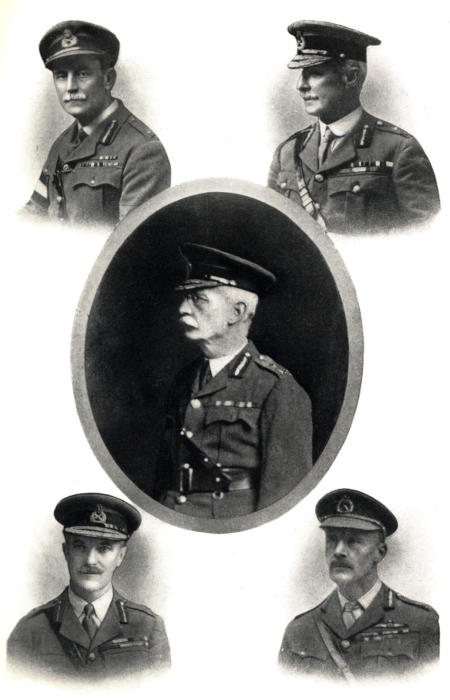
Lt.-Gen. Sir W. P. Braithwaite,
K.C.B. |
Maj.-Gen. E. M.
Perceval, C.B. |
Maj.-Gen. Sir R. D. Whigham,
K.C.B. |
Maj.-Gen. N. J.
G. Cameron, C.B., C.M.G. |
Maj.-Gen. Sir J. K. Trotter, K.C.B., C.M.G. |
Plainly, the items in the above list owe their invention and
inclusion to a common aim at recreation. This aim might be simple
and direct, as in the construction of a Dump for restoring derelict
war material; it might be a little less direct, as in the foundation of
the Baths[39], which served partly for refreshment, and partly, taken
in connection with their laundry, drying-sheds, etc., for the prevention
of ‘trench feet’ and kindred ills; it might be purely recreative, again,
as in the programmes of the Buzzer and ‘The Tykes’; or it might
be recreative-utilitarian, in the Gladstonian sense of a change of
occupation, as in the establishment of workshops and schools; and,
in referring to any of these aspects, we should always keep clearly
in mind the sharp contrast which they presented to the constant experience
in the trenches, to and from which the men went and came.
Consider, first, this question of ‘trench-feet.’ It was the fate
of the 49th Division to occupy during this winter the most water-logged
trenches of the line. They were ‘permanently flooded,’ as
General Perceval said. Yet he had the satisfaction of reporting that
the number of cases of ‘trench-feet’ was among the lowest in any
Division. The total number was 760; the average number was six
a day. We have to add this feature to the day’s work, but, with it,
we add the measures that were taken to counteract the evil. Not
merely the three or four pairs of socks which each man took with him
into the trenches, the arrangements for washing and drying them,
and the provision of anti-frostbite grease and oil; but also the care
of the inner man; soup-kitchens, hot cocoa and chocolate, supplies
of Oxo and pea-soup, and the stress laid by the Divisional Commander
on the importance of keeping the men’s vitality high. Nor should
the gifts of the Association at home be forgotten in this context; they
sent the portable bath-house with oil-pumping engine and piping
complete; they sent 5,000 tins of ‘Tinned Heat’ (which sounds like
an import straight from Hades); 10,000 small tins for anti-frostbite
grease, 15,000 small cans for whale-oil, 4,885 short gum-boots, 722
thigh gum-boots, 7,000 mittens, 9,300 socks, oilskin-jackets, oilskins
and sou’-westers, besides other contributions in kind. There were
still six cases every day, but the day’s work was mollified by these
means.
Another gift which reached the Division from the West Riding
Association was the furniture and accessories for the theatre of ‘The
Tykes.’ This capable troupe of entertainers had begun in a very
modest way on improvised platforms in the open air. Perhaps they
did not know, or were indifferent to the fact, that European drama,
consummated in Shakespeare, had precisely similar beginnings.
Though ‘The Tykes’ did not produce a Shakespeare, they hardly fell
short of his success in the pleasure which they afforded to their own
audiences. Historically, they were fourth on the list of Divisional
Concert Parties, and it was on Christmas Day, 1915, that they definitely
started on their career as a theatrical company. In January, 1916,
and again in the December of that year, they went home to the West
Riding, where they played at the Empire Palace, Leeds, the Opera
House, Harrogate, and the Empire Palace, Sheffield, exhibiting to
enthusiastic houses the simple joys of the men at the front. They
performed in all in about fifty places, in improvised barns or converted
stables, or very rarely in genuine halls, and they had the honour
to be the first company to appear on the boards at Arras and Cambrai
after their capture in 1918. Even more impressive and gratifying is
the fact that over 80,000 francs was handed by ‘The Tykes’ to the
Institutes’ of the Division between 1916 and 1919, for the provision of
additional comforts, sports, etc., to its units. The original ‘Tyke’
was Lieut. J. P. Barker, A.S.C., who was evacuated sick to England
in September, 1918. He really started and made them, and, if other
names may be mentioned, we would refer to Lance-Cpl. A. Coates,
of the Army Service Corps, and Pte. H. Marsden, formerly R.E., of
the 243rd Employment Company, who were members of the troupe
right through from August 22nd, 1915, to February 2nd, 1919. A
Divisional cinema, we may add, was established in March, 1917, and,
after narrowly escaping destruction in the German advance at Berthen,
April 9th, 1918, it survived to hand over a profit of 27,900 francs for
the worthy objects of the Institutes’ Fund.
Turning next to the facilities for education which were gradually
developed in this period, we note the technical character of the instruction
provided. Thus, a Drainage Section was organized in the
Ypres Salient, which laid down nearly 9,000 yards of main and subsidiary
drains, with valuable results in the trenches. Mining Sections
were also formed to help Tunnelling Companies, and did excellent
work while they lasted. A Divisional Gas School gave lessons in the
use and care of anti-gas appliances, and doubtless contributed to keep
down the list of casualties on December 19th. There were always
Ambulance courses, and local opportunities for instruction in Sniping,
Scouting, Signalling, Bombing and other special branches. The
Divisional Technical School taught the use of Trench Warfare appliances,
keeping parties of newly-arrived troops for twenty-four hours in
mimic trenches, with the enemy trenches opposite also faithfully
reproduced; and a Divisional Training School was established to give
both practical and theoretical instruction to junior Officers and N.C.O.’s
of Infantry.
The workshops of the Royal Engineers turned out a quantity of
stuff which was really remarkable in the circumstances. All the
made-up material for use in the trenches was prepared there, as well
as the work in connection with the accommodation of men in the
Rest Area. When we read of one and three-quarter million sandbags,
or of fifteen miles of road maintained and drained by civilian labour
under the supervision of the R.E., or of seventeen bridges kept up and
seven constructed by this Arm, or of four thousand tons of bricks
drawn from ruined houses for horse-standings, or of thirty miles of
trench-gridding[40] laid and fifteen miles of trenches maintained, we are
able to form some idea of the unremitting toil and admirable skill
displayed by the Divisional Engineers.
Reference, too, should be made to the fact that the grave defects
in Field Artillery, which that Arm of the Division was so well aware of,
and which it so particularly and gallantly endured, were to some extent
corrected by the issue on October 29th of 18-pounder Quick-Firer
Field Guns, instead of the existing 15-pounders, and on January 30th
in the next year of 4.5-inch Howitzers instead of the 5-inch
Howitzers in possession.
One more item of statistics may be mentioned. In a year’s
constant journeys on bad roads for long distances, amounting in all
to a total mileage of 900,000 miles, no lorry had to be replaced: an
extremely creditable record for the Divisional Supply Column.
But these details are carrying us too far. Our purpose in the
present chapter has been to preserve an impression of the daily experience
of the 49th Division from the end of June to the end of December,
1915. The same things happened every day, though they might
happen with a difference. The day was fine, or the day was wet;
the patrol got back, or the patrol was wounded; a shell exploded,
or a shell fell ‘dud’; distinguished conduct found a grave, or distinguished
conduct won a medal: but always it was relieving or being
relieved, throughout this long tour of duty under the exhausting conditions
of the Ypres Salient. We have sought to illustrate the life
by selecting certain days for description, and we have sought, too, to
set off that description by an account, however inadequate, of the other
side of the picture: of the means provided from home or improvised
on the spot, and alike approved by the Divisional Commander, to
bring touches of warmth and colour into the chilling monotony of
trench-warfare. How far such aim has been accomplished, even
how far it is capable of accomplishment at this distance from 1915
and the bank of the Yser Canal, where the general gloom of the outlook
was almost as difficult to banish as the mud on the physical horizon,
cannot be predicated with any certainty. What is clear to the present
writer, however, and what he should have made clear to his readers,
is that no opportunity was let go of doing a full day’s work every day.
They all pulled together all the time. The result was that, though the
long strain told on the physique of the Division, it did not tell on their
spirits or their resolution, and, inasmuch as their appointed day’s work
was essential to the conduct of the war, and to the maintenance of
equilibrium on the Western front, the 49th (West Riding) Division
deserved well of their King and country in the last six months of the
year 1915.
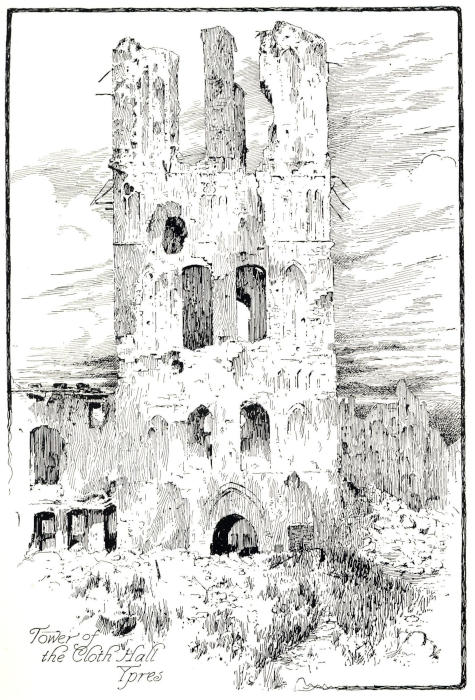
Tower of the Cloth Hall Ypres
CHAPTER VI SERVING IN RESERVE
The intensive training of a 2nd Line Division, which was to take a
conspicuous part in the battles of 1917 and 1918, is the subject of the
present chapter.
The military confusion at home during the period prior to the
passing of the first National Service Act, and prolonged to some extent
through 1916, though it never affected the keenness and enthusiasm
of the 2nd Line troops themselves, has yet to be taken into account
in any impression which may be given of the conditions under which
training was carried out. Reference to this factor will be found in
the Memorandum on the Territorial Force written by General Bethune
at the War Office, of which mention has been made before.[41] The then
Director-General remarked: ‘Great difficulty was experienced in
training, as, with so many new Armies to be formed, the majority of
capable instructors went to them, and our 2nd Line Territorial Force
had to train themselves as best they could. The result,’ he added,
‘was extraordinarily good and surprised anyone who had anything
to do with it.’ We shall reach the element of surprise in due course.
Here, for the moment, we are concerned with the ‘great difficulty’
which was encountered, and more particularly with those aspects
of the difficulty which lay outside the cognizance of the Territorial
Force personnel, or, at any rate, outside their control.
Let us go back to first principles. The idea of a voluntary Army,
despite the wastage of war and the unequal distribution of patriotic
sentiment, or of the capacity to respond to it, was still, late in 1914,
a sacred article of British faith. Another accepted article, if not of
faith, at least of British practice, was the enlistment of that
voluntary Army on a County basis. This procedure, which was
laid down in Section IX. (I.) (a) of the Territorial and Reserve
Forces Act, followed a similar provision in the Militia Act of 1882,
and, tracing it back to that source, we discover that its primary
cause was ‘to estimate the extent of the County’s liability in the
event of the ballot being enforced.’[42] The tradition survived the
ballot, and the rule of County enlistment was incorporated, as we have
seen, in the organization of the Territorial Force. This rule worked
well enough in peace-time, and might conceivably have continued to
work well if it had been the only rule to be applied when war broke
out on a scale not dreamed of by the authors of the Act of 1907.[43] But,
historically speaking, and without attempting to judge the issue, it
was decided very early in the war to vary that rule, and to raise recruits
for the new Armies on a system which crossed the method handed
down to the Territorial Force by the old Militia and Volunteers.
The Counties were reaped of their best men by a Secretary of State
who knew not Lord Haldane. The first hundred thousand disappeared
into the vast abyss of war from every town and village in the country.
Members of Parliament came down to recruit for Kitchener’s Army,
and forgot, or were not reminded by the Mayor, of the claims of
Haldane’s Force. Bonds of brotherhood in arms, by trades, professions,
even by height or religion (e.g., ‘Bantams,’ ‘Jewish’ Regiment,
etc.) drove their wedges through the County bond; and under
these new and distracting conditions, the old rule of enlistment by
Counties became to a large extent a pious memory of peace, and enlistment
by hook and crook, by picture-posters, white feathers, and worse
devices, became the feverish rule of war.
This was the 2nd Line problem viewed through the spectacles of
Territorial Force County Associations. The men themselves did
not see it from the same angle. Their great desire, with insignificant
exceptions, was to prepare themselves for service overseas with the
utmost possible expedition. In their camps or billets or drill-halls,
they were probably as unconscious of as they were indifferent to the
serious administrative difficulties created for their County chiefs
by the constant changes of policy on the part of the Army Council.
Nor is the Army Council unduly to be blamed. The pace of the war
itself was quicker than anyone had anticipated, and social and industrial
conditions at home did not readily adapt themselves to its imperious
needs. If we refer to these forgotten problems, out of which the successive
National Service Acts were forged, as a partial solution, we shall
be understood to refer to them solely in explanation of the ‘great
difficulty’ which was experienced, and not in the least in derogation
of the great zeal with which that difficulty was surmounted to the
‘surprise’ of everyone concerned.
We have further authority as to the difficulties. In a Memorandum
kindly prepared by Major-General Sir James K. Trotter, K.C.B.,
who was appointed to command the West Riding 2nd Line Division[44]
in February, 1915, he writes as follows of the early days of his Command:
‘The difficulties affecting training were at this stage very
serious. The troops were not all provided with uniform. They
were without equipment; the Infantry had no arms, except a
few d.p. rifles; the Artillery no guns; the Mounted Troops,
Artillery and Engineers no horses, and the Transport nothing
but a few hired carts. But the want most sorely felt was that of
the young, active, trained N.C.O. to instruct and to give life to
the movements of the young soldiers. Competent instructors
were not to be had. Every available N.C.O. was taken up by
the 1st Line Territorials and the New Service Army units, and
this Division was at this time left to its own very limited resources.
The Regimental Officers were in the main new and untrained,
and though the Command Schools of Instruction gave short
courses to as many as possible, it was very remarkable to observe
the time necessary to convert the raw recruit into a trained soldier
under these conditions.... What was lacking was the atmosphere.
Nevertheless, some real progress in elementary training
was made in the early Spring (1915), and some young officers
displayed considerable energy and initiative.’
Lack of atmosphere is the burden of this complaint, and a brief
map of the conflicting winds which were blown across the path of
Territorial Force organization may account, in part, at least, for these
disturbed atmospheric conditions. Summarily, the war policy of
the Army Council in regard to the Territorial Force may be marked
by the following five steps: (1) They decided to raise Reserve or 2nd
Line units behind the Imperial Service Units of the original or 1st
Line. The practical distinction between the two was based on their
state of preparedness to fulfil the overseas obligation. Thus, the distinction
was always fluid. It varied, that is to say, according to the
degree of training reached by the individual personnel, and there
were always frequent exchanges between the 2nd and 1st Lines. The
only constant element in the Reserve units were the men, who, owing
to age or health or other conditions, would never be fit for Imperial
Service. Divisional and other military organization was the same in
both Lines, but the 1st was composed of Officers and other Ranks
ready for service abroad, the 2nd was composed partly of surplus
Imperial Service personnel, partly of troops prepared, so far, only
up to Home Service, which still formed the statutory function of the
Territorial Force. (2) The next stage occurred when the 1st Line
units went overseas. Then a 3rd Line, or 2nd Reserve, was authorized
for formation, behind the Home Service units composed partly, as we
have seen, of men ready, in a military sense, to go overseas, and this
3rd Line was presently constituted into a series of (3) Draft-producing
Depots, with establishments varying from time to time according as
their corresponding 1st Line units were stationed at home, or on garrison
duty abroad, or with an Expeditionary Force. A little later (4) steps
were taken to weed out the Home Service personnel still remaining
with the 2nd Line units and to distribute them into newly-constituted
Home Service units, and finally (5) the National Reservists were formed
into Supernumerary Territorial Force Companies, with a fixed establishment
of about 120 all Ranks, for the protection of Lines of Communication
and Vulnerable Points at home. To complete a brief
account of a long process which was not worked out with a very clever
perception of its intention from the start, we may add that these Supernumerary
Companies were transformed by Royal Warrant, in 1916,
into the Royal Defence Corps, when they passed out of the County
administration. But all through 1915 the position was extraordinarily
complex from an administrative point of view. Territorial Force
Associations were responsible for maintaining their 1st Line units
overseas, their 2nd Line units at home, their 3rd Line Draft-producing
Depots, their Provisional Home Service units and their Supernumerary
Territorial Force Companies.
In justice to the West Riding Association, which was hard put to
it to keep an even keel in this welter of conflicting currents, we may
examine the policy which they pursued, in somewhat more detail.
From the first they declined to be hustled. As early as October, 1914,
the Chairman, Lord Scarbrough, remarked in his Quarterly Report
to members of the Association, that ‘In consequence of the great
difficulty of obtaining supplies of clothing, boots, necessaries, etc.,
and the lack of Officers and qualified Instructors, it was considered
best not to push recruiting for the Reserve units, but to endeavour to
raise them very gradually as Instructors and clothing and equipment
could be provided. By so doing,’ he pointed out, ‘the efficiency of
these units is not likely to be retarded, and the waste of time and discouragement
entailed by collecting large numbers of men without
Officers, Instructors, arms, uniform, boots, or any provision for their
well-being, has been to a large extent avoided.’ But his policy,
however sound at the outset, could not be indefinitely maintained.
The time came, and it came more quickly than some even of the shrewdest
of observers had foreseen, when the Reserve, or 2nd Line, units
had to be allowed to recruit up to full establishment, despite those
deficiencies in equipment which so seriously embarrassed their
Commanding Officers, in the urgent work of training them for service
overseas. So the ‘large numbers’ continued to come forward, and
might not be refused. As early as November, 1914, for example,
the 2/6th Battalion of the West Yorkshire Regiment had a strength
of over 1,400, and this splendid record was not unique in the 2nd
Line Division. The real problem faced by General Trotter in the
Spring of 1915 was not shortness of numbers, though this, too, became
a source of some anxiety at County Headquarters, when the new
Armies were competing with the Territorial Force; it was still less
lack of keenness for foreign service, but it was always the old problem
of Israel in Egypt—how to make bricks without straw. We quoted
just now the General’s own account of the problems which he had to
face in this regard. We may quote here his further account, by no
means too rosy in certain aspects, of the progress in elementary training
which was made in the early Spring of 1915. It will be remembered
that the 1/1st West Riding (49th) Division went abroad in the middle
of April. The 62nd Division was then appointed to take over its
duties. The Infantry, it is reassuring to find, were now in possession
of rifles, which had been obtained from Japan, and the Artillery,
about the same time, received an armament of French guns, made in
1878, and ‘evidently discarded,’ writes General Trotter, ‘for many
years. The tangent scales were graduated in metres, and the shells
were provided with a graduated time-fuze. But no one could be found
to connect the graduation with the range scales, and no book of instructions
existed.... No ammunition was available for practice,
and the whole time this weapon was in the hands of the Artillery, i.e.,
till December, 1915, it was only used for training purposes, and then
only to a limited extent, the breech action and sights being of obsolete
pattern. If,’ adds the General, ‘the Artillery had, according to the
plans in force, been called upon to take part in the defence of the
coast, the casualties it would have caused would have been at the breech-end
of the guns’. There were other interruptions to training, as seen
from a Commanding Officer’s point of view. The competition in
recruiting, to which so frequent reference is necessarily made at this
period, produced, in places, almost humorous results. Thus, a
Divisional Commander of the Territorial Force units would be pressed
in some places by the local authorities to supply bands for recruiting-meetings
held for the purpose of enlisting men in units of the New
Armies. Again, industrial conditions created unforeseen anomalies.
It often happened that the first men to enlist were the key-men in their
respective factories, and these men, after having been put through a
course of military training, and having become efficient soldiers in the
comparatively shorter time corresponding to their superior capacity,
had eventually to be returned to the works from which they came, or
to other works engaged in producing war-materials. Another increasing
source of embarrassment to the Divisional Commander and his
subordinate Officers lay in the calls which were made on the 62nd
Division, during 1915, to supply drafts for service overseas. Even
the extraction from 2nd Line units of the men fit only for Home
Service upset the composition of those units, and interrupted the
continuity of training and the growth of an esprit de corps. Take,
merely as an example, the experience of the 2/8th Battalion of the
West Yorkshire Regiment. On March 8th, 1915, ten of their men
were drafted to the 1/8th. Sundry other exchanges of personnel
between the 2/8th and 1/8th, before the latter went to France, in April,
resulted in a numerical loss to the unit remaining at home. On May
17th, 4 Officers and 188 other Ranks were transferred to the 26th
Provisional Battalion for coast defence, and were followed at subsequent
dates by a further 17 men. On August 15th, 54 men went out
to the 1/8th Battalion. On the 27th came the gratifying news that
Lieut. E. F. Wilkinson, formerly of the 2/8th Battalion, had been
awarded the Military Cross in France: sic vos, non vobis. In October,
orders arrived that the Battalion was to be reduced to 600 all ranks,
that unfit men were to be posted to the 26th Provisional Battalion, and
the remaining surplus over the new establishment, to the 3/8th Battalion
West Yorkshires. It is obvious that changes of this kind, which
may be paralleled in any other unit, were no light drawback. The
success of the training of the Division during the period, May to
October, 1915, when it was in camp in Sherwood Forest, might have
been even more seriously affected except for the loyal co-operation of
Officers, N.C.O.s and men in carrying out the programmes arranged
for them. They were moved by an increasing resolve to prepare
themselves for the call for embarkation, the hope of which, though
renewed from time to time, seemed always so slow to materialize.[45]
Meanwhile, work was carried on with this object always in view.
Particular attention was devoted to the duties of the Platoon Officers
and Company Commanders, and General Trotter bears witness that
‘during the summer and autumn months, the Division made remarkable
progress in training, administrative work and discipline.’ In
October, they left their encampments, and were stationed, at the end
of November, in the Northern Command, with Headquarters at
Newcastle-on-Tyne, where the Brigades were allotted to the Tyne
defences, and the units were occupied in making and improving the
trenches. About this time the Artillery at last had received a serviceable
weapon; 18-pounder, breech-loader guns were issued to three
Brigades, and 5″ Howitzers to the fourth. In December, news arrived
that the Division had been selected as the first of the 2nd Line Territorials
Divisions for service in France, and orders were issued to move
to Salisbury Plain. Sir James Trotter, whose organizing ability had
so well and truly laid the foundations of the military efficiency of the
Division, was succeeded in its Command, on December 24th, by
Major-General Walter Braithwaite, C.B.,[46] who took over the Division
at Newcastle.
It is interesting to dovetail the accounts of the retiring and succeeding
Divisional Commanders. General Braithwaite notes that
‘the Battalions were commanded mostly by Territorial Force Officers
of a certain age and standing, with personal knowledge of the men in
their units, and with experience, in many cases, of Territorial Force
conditions as they existed before the war, but, naturally, with no
experience of war as it was being waged. The material was excellent,
and all that was lacking was to adapt it to the conditions obtaining at
the Front.’ Accordingly, at Lark Hill Camp on Salisbury Plain,
where the Division arrived in January, 1916, application was at once
made to the War Office for men with fighting experience to fill posts
on the Divisional Staff, and for the appointment of Brigade Majors
of the Infantry Brigades in order to set to work to make the Division
completely war-worthy. The response was prompt and satisfactory,
and perhaps the most satisfactory feature from the Divisional Commander’s
point of view was the loyal readiness of individual Officers
who felt themselves and were too old for the strain of active service
to make way for younger men, who had either been wounded or
invalided from France. An ideal General Staff Officer, 1st Grade,
was found in Lieut.-Colonel the Hon A. G. A. Hore-Ruthven, V.C.
Lieut.-Colonel R. M. Foot, to the great benefit of the Division, was
appointed Q.M.G.; Brig.-General A. T. Anderson arrived from
France to take command of the Divisional Artillery, with Capt. W. J.
Lindsell as his Brigade Major, and these Officers, with Lieut.-Colonel
Gillam in command of the Royal Engineers, made, we are assured,
‘an excellent beginning.’ Mention is also due to the arrival at this
date of the Rev. C. M. Chavasse as S.C.F., and we may add here
that he served with the 62nd Division for the whole period of its
active service, with the exception of a very short time when he was
promoted to be Senior Chaplain of the Corps. The Brigadiers of
the 185th, 186th and 187th Infantry Brigades, respectively, who were
also appointed about this time, were Generals V. W. de Falbe, who
had commanded a Battalion in France; F. F. Hill, who had been
invalided from Gallipoli, and R. O’B. Taylor, who happened to be
home from leave in Egypt, and who had also been in Gallipoli. These
arrivals, as might be expected, added immensely to the strength of
the Division. Its efficiency, from February onwards, increased by
leaps and bounds, and the Division was fortunate, too, in receiving
from time to time the latest ‘tips’ from Officers serving in or invalided
home from France, and anxious to place their experience at the disposal
of those about to proceed there.
Still, it was not all smooth sailing. In May, 1916, after service
rifles had been issued, and when training was in full swing, orders
were suddenly received for the Division to find a draft of over 4,000
men for France, and it looked as if the Division was to be turned into
a mere draft-producing unit, and its fighting efficiency to be impaired
accordingly. Happily, this order, like so many others, was cancelled.
A further and more actual disappointment ensued a month or so later,
when the Division was sent to the East Coast to be employed in reserve
for the defences, with the intimation that it was likely to stay there.
We are left to imagine the consternation of the troops, already straining
at the leash, and the difficulty of the Divisional Commander and his
subordinate Officers in accommodating their programmes and policy
to these shifting counsels from above. Certainly, the East Coast was
not as convenient for training, and did not provide the same facilities
as were available on Salisbury Plain. The Brigades were separated
by some distance: the Headquarters of one Brigade and the bulk
of the Artillery being round about Bungay, another group being at
Henham Hall (Lord Stradbroke), and a third at Somerleyton (Lord
Somerleyton, formerly Sir Savile Crossley), near Lowestoft. But
once more the prospects changed. Fresh orders presently arrived,
stating that the Division was selected for service in France. On July
26th, the King came down to inspect the Division prior to embarkation,
and His Majesty expressed himself extremely satisfied with all that he
saw.

Time went on, however, and no embarkation orders came. Drafts
for Service units abroad and for Service units definitely allotted to
home duties continued to be called for throughout this Summer and
Autumn, and still the Division was in doubt as to its ultimate use and
destination. Still the Divisional Pelican waited to put his foot down
on German soil. The men now enjoyed opportunities,
of which they gladly availed
themselves, of working on training instructions
which had been received direct from the front.
Trench-digging, air-raid duty, rifle-practice
with Charger-Loading Lee Enfields, gas-drill,
concentration-marches, musketry and Lewis-gun
courses, assaults-at-arms, aquatic sports,
and other martial exercises and recreations,
were all included in the preparation for battle.
The whole life of the soldier in France was,
so far as was possible, copied as faithfully as
it could be during this strenuous period.
Officers on light duty in England, who had been
wounded, were sent down in batches and
distributed among the Battalions, which were eager, as we saw above,
to take advantage of the benefit of their experience. Young Officers,
with a war record behind them, were appointed to command
Battalions, Batteries and Companies. Sketches of the latest types
of trenches were received and re-produced in practice; and, briefly,
except for the actual atmosphere of active service, the Division became
during these months a living organism capable of assimilating all the
lessons which experience could teach it, and likely, with its splendid
material, to give a good account of itself at the Front.
And, at last, the summons arrived. In October, 1916, orders
were received to proceed to Bedford and Wellingborough in order to
complete the Division with all necessary stores, and to hold itself in
readiness to go overseas. The actual order for the move was still
postponed till the last days of December, and the final scenes may
be quoted from the War Diary of one of the West Riding Battalions:—
‘January 4th, 1917.—Order of the Day issued by Major-General
Braithwaite, containing farewell message from His Majesty the
King to 62nd Division, on the eve of their departure overseas.
‘January 4th, 1917, 9 a.m.—Farewell service of Holy Communion
at St. Paul’s Church, Bedford, before proceeding on Active Service.
‘January 11th, 1917.—Left Bedford for France. Right half
Battalion left the Ballast Pit Sidings, Bedford, at 3-25 a.m. Left
half Battalion left at 5 a.m.’
‘I do not think,’ writes General Sir Walter Braithwaite, at the
conclusion of the Notes with which he has been kind enough to supply
the present writer, ‘a more happy and contented Division, or one better
found and equipped, ever left the shores of England, and I think it
was as well trained as a Division could be, thanks to all the help I
received from the Staff and Commanding Officers, and to all the kind
friends in France, who kept us supplied with the latest training instructions.[47]
I cannot close this short sketch of our training period without
alluding to the great help we received throughout the period from
Lord Scarbrough and Brig.-General Mends. They were “father and
mother” to the Division; made several visits to us; took endless
trouble to help us, and, in fact, made all the rough places smooth.
Also, I cannot but acknowledge the patriotism of those Commanding
Officers who, feeling themselves too old for active service, made way
for young up-to-date Commanders.’
It will be interesting to conclude this account with a conspectus
of the Order of Battle of the 62nd Division from February, 1917,
when it first entered the field, during the 22 months of its brilliant
fighting record, till February, 1919, when demobilization was in
active course. The purpose of this information, which is arranged
for convenience in tabular form, is to show, in the first column, the
units which composed the Division when it first landed in France;
in the second column, the units which joined the Division between
that date and February, 1919; in the third column, remarks explanatory
of the information in columns one and two; and in column four
the names of the respective Commanding Officers at the time of the
embarkation of the Division. It will be observed that certain Battalions
of the 1st and 2nd Lines were amalgamated during 1918, and
these tables should be referred to, accordingly, in cases where any
consequent changes in nomenclature may puzzle the reader of later
chapters.
ORDER OF BATTLE OF 62nd (WEST RIDING) DIVISION between February, 1917, and February, 1919.
| Landed with Division, Jan.-Feb., 1917. |
Joined Division between Feb., 1917, and Feb., 1919. |
Remarks. |
Commanding Officer (Jan., 1917). |
| Divisional F.A. |
|
|
|
| 310th Brigade, R.F.A. |
|
Remained throughout. |
Lt.-Col. G. R. V. Kinsman, D.S.O., R.A. |
| 311th Brigade, R.F.A. |
|
Became Army Brigade early 1917. |
Lt.-Col. A. Gadie |
| 312th Brigade, R.F.A. |
|
Remained throughout. |
Lt.-Col. E. P. Bedwell, R.A. |
| 62nd Div. Ammunition Col. |
|
Remained throughout. |
Lt.-Col. F. Mitchell |
| 62nd T.M. Batteries |
|
Remained throughout. |
|
|
14th Bde. R.H.A. & B.A.C. |
Joined November, 1918. |
|
| Divisional Engineers. |
|
|
|
| 457th Field Company, R.E. |
|
Remained throughout. |
Major W. A. Seaman |
| 460th Field Company, R.E. |
|
Remained throughout. |
Major L. St. J. Colley |
| 461st Field Company, R.E. |
|
Remained throughout. |
Major E. J. Walthew |
| Signal Company. |
|
Remained throughout. |
Capt. R. V. Montgomery (Som. L.I.) |
| 185th Infantry Brigade. |
|
|
|
| 2/5th West Yorks. Regt. |
|
Amalgamated with 8th W. Yorks., August, 1918. |
Lt.-Col. J. Josselyn |
| 2/6th West Yorks. Regt. |
|
Amalgamated with 6th W. Yorks, to 49th Div., Feb., 1918. |
Lt.-Col. J. H. Hastings |
| 2/7th West Yorks. Regt. |
|
Disbanded June, 1918. |
Lt.-Col. Hon. F. S. Jackson |
| 2/8th West Yorks. Regt. |
|
Amalgamated with 1/8th W. Yorks, Feb., 1918. |
Lt.-Col. W. Hepworth, V.D. |
| 185th T.M. Battery. |
|
Remained throughout. |
|
|
1/8th Bn. W. Yorks, from 49th Div. |
Amalgamated with 2/8th W. Yorks., Feb., 1918. |
|
|
1/5th Bn. Devon Regt. |
Joined June, 1918, from Egypt. |
|
|
2/20th Bn. London Regt. |
Joined August, 1918, from Egypt. |
|
| 186th Infantry Brigade. |
|
|
|
| 2/4th Bn. West Riding Regt. |
|
Remained throughout. |
Lt.-Col. H. E. P. Nash (R. Scots) |
| 2/5th Bn. West Riding Regt. |
|
Amalgamated with 1/5th Bn., Feb., 1918. |
Lt.-Col. T. A. D. Best, D.S.O., (R. Innis. Fus.) |
| 2/6th Bn. West Riding Regt. |
|
To 49th Div. for amalgamation with 1/6th, Feb., 1918. |
Lt.-Col. J. Mackillop |
| 2/7th Bn. West Riding Regt. |
|
Disbanded June, 1918. |
Lt.-Col. Clifford, D.S.O. (North. Fus.) |
| 186th T.M. Battery |
|
Remained throughout. |
|
|
1/5th Bn. West Riding Regt. |
From 49th Div. Amalgamated with 2/5th, Feb., 1918. |
|
|
2/4th Hants. Regt. |
From Egypt, June, 1918. |
|
| 187th Infantry Brigade. |
|
|
|
| 2/4th Bn. K.O.Y.L.I. |
|
Remained throughout. |
Lt.-Col. E. Hind, V.D. |
| 2/5th Bn. K.O.Y.L.I. |
|
Amalgamated with 1/5th Bn., Feb., 1918. |
Lt.-Col. W. Watson (Som. L.I.) |
| 2/4th Bn. Yorks. & Lancs. Regt. |
|
Remained throughout. |
Lt.-Col. F. St. J. Blacker |
| 2/5th Bn. Yorks. & Lancs. Regt. |
|
Disbanded Feb., 1918. |
Lt.-Col. P. Prince (Shrops. L.I.) |
| 187th T.M. Battery |
|
Remained throughout. |
|
|
1/5th Bn. K.O.Y.L.I. |
From 49th Div. Amalgamated with 2/5th, Feb., 1918. |
|
| Pioneer Battalion |
9th Bn. Durham Light Inf. |
From 50th Division, Feb., 1918. |
|
| Divisional Train. |
|
|
|
| 62nd Divisional Train |
|
Remained throughout. |
Lt.-Col. H. H. Wilberforce |
| 525 Company, R.A.S.C. |
|
Remained throughout. |
Major A. P. Wright |
| 526 Company, R.A.S.C. |
|
Remained throughout. |
Lt. S. G. Shaw |
| 527 Company, R.A.S.C. |
|
Remained throughout. |
Lt. W. N. Roberts |
| 528 Company, R.A.S.C. |
|
Remained throughout. |
Capt. H. P. Peacock |
| Divisional R.A.M.C. |
|
|
|
| 2/1st (W.R.) Field Ambulance |
|
Remained throughout. |
Lt.-Col. W. Lister |
| 2/2nd (W.R.) Field Ambulance |
|
Remained throughout. |
Lt.-Col. C. W. Eames |
| 2/3rd (W.R.) Field Ambulance |
|
Remained throughout. |
Lt.-Col. W. S. Keer |
| 62nd Divl. Sanitary Section |
|
Remained throughout. |
Capt. Moss-Blundell, C.B. |
| 2/1st Northn. Cas. Clearing Stn. |
|
Remained throughout. |
Lt.-Col. W. A. Wetwan |
|
33rd Sanitary Section. |
Joined after Armistice. |
|
| Divisional Machine Gun Bn. |
|
|
|
|
201st M.G. Company. |
Joined 1917 } |
Formed into 62nd Bn. Machine-Gun Corps, Feb., 1918 |
|
208th M.G. Company. |
Joined 1917 } |
|
212th M.G. Company. |
Joined 1917 } |
|
213th M.G. Company. |
Joined 1917 } |
| Divisional M.T. Company. |
|
|
|
| 62nd Div. M.T. Company |
|
Remained throughout. |
Major H. J. C. Hawkins |
| Mobile Veterinary Section. |
|
|
|
| 2/1st (W.R.) Mob. Vet. Sect. |
|
Remained throughout. |
Capt. P. Abson, A.V.C. |
| Divisional Employment Co. |
|
|
|
|
252nd Employment Co. |
Joined June, 1917, and remained throughout. |
|
The Staff Officers in January, 1917, were as follows:—
| G.O.C. |
Major-(Lieut.-) General (Sir) W. P. Braithwaite, (K.) C.B. |
| A.D.C. |
Lieut. G. H. Roberts. |
| A.D.C. |
Sec.-Lieut. J. C. Newman. |
| G.S.O. (I.) |
Lieut.-Col. Hon. A. G. A. Hore-Ruthven, V.C., D.S.O., Welsh Guards. |
| G.S.O. (II.) |
Major W. G. Charles, Essex. |
| G.S.O. (III.) |
Capt. J. A. Batten Pooll, 5th Lancers. |
| A.A. and Q.M.G. |
Lieut.-Col. T. M. Foot, C.M.G., R.L., late R. Innis. Fus. |
| D.A.A. and Q.M.G. |
Major H. F. Lea, R.L., late Yorks. Regt. |
| D.A.Q.M.G. |
Capt. F. J. Langdon, R.L., late The King’s. |
| A.D.M.S. |
Col. de B. Birch, C.B., R.A.M.C. (T). |
| D.A.D.M.S. |
Major T. C. Lucas, R.A.M.C. |
| D.A.D.O.S. |
Lieut. R. M. Holland. |
| A.D.V.S. |
Major F. J. Taylor. |
| A.P.M. |
Major G. D’Urban Rodwell. |
| C.R.A. |
Brig.-Gen. A. T. Anderson, R.A. |
| A.D.C. |
Lieut. Anderson, R.A. |
| Bde. Major |
Capt. W. G. Lindsell, R.A. |
| S./Capt. |
Capt. A. J. Elston. |
| C.R.E. |
Lieut.-Col. F. Gillam, R.E. |
| Adjt. |
Capt. G. D. Aspland. |
| 185th Inf. Bde. |
|
| G.O.C. |
Brig.-Gen. V. W. de Falbe, C.M.G., D.S.O. |
| Bde. Major |
Major R. E. Power, The Buffs. |
| S./Capt. |
Capt. W. A. C. Lloyd. |
| 186th Inf. Bde. |
|
| G.O.C. |
Brig.-Gen. F. F. Hill, C.B., C.M.G., D.S.O. |
| Bde. Major |
Major C. A. H. Palairet, The Fusileers. |
| S./Capt. |
Capt. W. O. Wright. |
| 187th Inf. Bde. |
|
| G.O.C. |
Brig.-Gen. R. O’B. Taylor, C.I.E. |
| Bde. Major |
Major R. B. Bergne, Leinster Regt. |
| S./Capt. |
Capt. F. M. Lassetter. |
CHAPTER VII — I.—PREPARATIONS ON THE SOMME — II.—OPERATIONS ON THE SOMME
We return from the 62nd Division in England to the 49th in
France, in the same year, 1916. The battles of the Somme were fought
mid the pleasant, folded hills of Picardy, where the Sussex Weald
almost seems to have crossed the Channel into France, and Spring
renews every year the glad tokens of that poets’ May, when the sons of
Champagne and Picardy, between the valleys of the Marne and the
Somme, made France splendid in history as the mother of fable and
romance: classic soil, a French writer tells us, ‘entre Orléans, Rouen,
Arras et Troyes, en pleine terre française, champenoise et picarde,
dans toutes ces bonnes villes et villages.’[48]
Classic, too, in another aspect, as the scene of repeated assaults,
in the Hundred Years’ War, and before and after, by invaders envious
of Paris. The last and heaviest of those assaults, since Paris fell in
1871, now occurred in 1916, between February and June, at the eastern
gate guarded by Verdun. In 1914 and again in 1918 the invader
pushed nearer to Paris; but neither in the first year nor in the last
year of the War were his hammer-blows quite so destructive or his
heart of hate quite so hot as in the middle year, 1916, when the Crown
Prince Wilhelm of Prussia staked his army and his dynasty on the
attempt. We are not directly concerned with all that Verdun means
to France. Vaguely we read from the map that it is distant about a
hundred and fifty miles from Paris, and dimly we perceive that its fall,
like the surrender of Strasbourg and Metz, might well, if swiftly
accomplished, have brought disaster on the capital. But what even
an Englishman cannot realize, despite the entente cordiale and the
fellowship binding the entente, is the intense passion of the cry of
General Petain’s troops on the Meuse: Passeront-pas, they shall not
pass. The Crown Prince threw his brave soldiery (for their valour
is the measure of French endurance), first, against the series of forts of
which Verdun was the citadel, next against Verdun itself, which was
no longer an objective but a symbol, and lastly, and vainly at the last,
against a resolve not to yield the pass, even when the force of the
resistance had robbed the passage of all profit.
This, briefly, is the story of Verdun in the early months of 1916.
It is French history from start to finish. The wider vision of fuller
knowledge is aware that there was unity of purpose even before there
was unity of command. Sir Douglas Haig’s great Second Despatch
contains several references to this feature: ‘The various possible
alternatives on the Western front had been studied and discussed by
General Joffre and myself, and we were in complete agreement as to
the front to be attacked.’ ‘It was eventually agreed between General
Joffre and myself that the combined French and British offensive
should not be postponed beyond the end of June.’ ‘To cope with
such a situation unity of command is usually essential, but in this case
the cordial good feeling between the Allied Armies, and the earnest
desire of each to assist the other, proved equally effective.’ The
French time-table at Verdun was partly regulated in conformity with
these counsels. Partly, too, the situation at Verdun was affected by
movements outside France: by Russia’s successes against Austria,
and by the Battle of Jutland on May 31st, from which the Germans
brought back so little except damaged ships and a broken moral to
support their loud claims to victory. But the German tidal wave at
Verdun, whatever considerations intervene, was repelled finally by
French bayonets and by the spirit of France behind her steel:
‘They lie like circle-strewn soaked Autumn-leaves
Which stain the forest scarlet, her fair sons!
And of their death her life is.’
The place and the time, as we see—The Somme valley and the
end of June—had been agreed between General Joffre and Sir Douglas
Haig; and, in accordance with their decisions, the three-fold object
of which was:
‘(i.) To relieve the pressure on Verdun,
(ii.) To assist our Allies in the other theatres of war by
stopping any further transfer of German troops from
the Western front,
(iii.) To wear down the strength of the forces opposed to
us’[49],
steps were taken betimes to make the necessary, elaborate preparations.
It will be appropriate to follow those preparations in connection with
one or more units of the 49th (West Riding) Division, which we left,
it will be remembered, enjoying a welcome term of rest after their tour
of duty on the east bank of the Yser Canal.
Take, for instance, the 7th Battalion of the West Yorkshire Regiment.
We select it partly for the chance that Lt.-Col. Tetley, D.S.O.,
then Major, 2nd in Command,[50] kept a separate diary of the Battalion,
which we have had the advantage of perusing, partly because, as will
appear, the second Victoria Cross in the Division was awarded to a
non-commissioned officer of this unit for conspicuous gallantry on the
first day of the Somme campaign.
The first fortnight of 1916 was spent by the Brigade[51] at Wormhoudt,
where, after Company training every forenoon, ‘the men had
plenty of time to themselves.... The Tykes gave their entertainment
every night.’ On January 15th, this easeful life ended,
and a march of eight miles to Merckeghem was followed on the 16th
by a sixteen-mile march to Zutkerque, which the men ‘stood very well.’
On the 17th, another sixteen miles brought the Brigade as far as Calais,
where they went into camp on a ‘sandy common, which was very like
Strensall Common’ in Yorkshire: there is a family likeness in gorse-bushes.
The New Year Honours of that date brought Major H. D.
Bousfield’s D.S.O. and Captain J. D. Redmayne’s Military Cross.
From 8-30 p.m. on February 1st till 3 a.m. on the 2nd the Brigade
travelled by rail from Calais to Longeau, just east of Amiens, with all
transport and baggage on board: the relief of Verdun had begun.
About a week was spent near Amiens, where the Yorkshiremen found
the landscape a pleasant ‘contrast to that round Poperinghe,’ and
‘not unlike the Yorkshire wolds.’ From February 10th to 12th the
march was resumed to Authuille, where the 5th and 7th Battalions
were in support and the 6th and 8th in the trenches. The 7th remained
in support for eight days. On February 20th they went into the
trenches on the north-east edge of Thiepval Wood. On the whole,
the trenches were good and dry, but they ran down on the left to a
marsh made by the River Ancre, and on the right they had been
damaged by trench-mortar fire; still, it was a change for the better
from the Yser. Snow was falling heavily at this time, and the trench-tours
were kept down to four or five days. After three weeks of this
experience, the Battalion was relieved on March 5th by the 9th Inniskilling
Fusiliers, of the 36th (Ulster) Division, and went into billets
at Harponville. It is observed that ‘during the three weeks the
Brigade had been in the trenches, a great deal of work was done by
the newly appointed Intelligence Officers, and practically everything
possible was known about No Man’s Land.’ The Intelligence
Officer in the 7th West Yorkshires was 2/Lieut. Beale, but for old
acquaintance’ sake, we select an example of such service, which provided
valuable knowledge for future use, from the record of Lieut.
E. F. Wilkinson, M.C., of the 8th Battalion of the same Regiment.
At mid-day on February 28th he went out to certain cross-roads. Again,
on the afternoon of March 2nd, he waded up the stream which flowed
under a stone bridge just west of these cross-roads, and found a plank
bridge twenty-five yards up-stream, which, judging by the marks on it,
was regularly used by the Germans. The information which this
officer obtained in his daylight prowlings helped to compose the map
of No Man’s Land; and it is worth observing that a German War
Diary (2nd Guard Reserve Division), to which we refer later on,
acknowledges that British Officers ‘were provided with excellent maps,
which showed every German trench systematically named, and gave
every detail of our positions.’
We are writing of the preparations for the Somme battles. ‘These
preparations’, said Sir Douglas Haig,[52] ‘were necessarily very elaborate
and took considerable time. Vast stocks of ammunition and stores
of all kinds had to be accumulated beforehand within a convenient
distance of our front. To deal with these, many miles of new railways,
both standard and narrow gauge, and trench tramways were laid.’
In the Harponville period, we now read, all the Companies of the 7th
West Yorkshires ‘were employed in working on a new railway, which
was in course of construction from Daours to Contay.’ This work,
assisted by good weather, ‘nearly every day being warm and sunny,’
was finished on March 26th. On the 30th, there was an inspection
by Lord Kitchener, who expressed his approval of the appearance
and turn-out of the men. The 5th Battalion of the West Yorkshires,
which was billeted in Harponville at the same time, shared in the work
and the inspection. Day by day they were called upon for working-parties
to construct new roads, new railways, or both; and ‘all this
labour,’ Sir Douglas Haig reminds us, writing of the Army as a
whole, ‘had to be carried out in addition to fighting, and to the
everyday work of maintaining existing defences. It threw a very
heavy strain on the troops, which was borne by them with a cheerfulness
beyond all praise[53].’ Certainly no sign of lack of cheerfulness is
revealed in the diary of any unit. ‘The men liked the change of
work,’ we are told.
Throughout April and May Battalions were busily engaged in
various forms of training and fatigues. On May 29th, while in the
billets at Vignacourt, orders were received by the 7th West Yorkshires
to march to Aveluy Wood, just east of Martincourt, in order to provide
working-parties to dig a buried-cable trench for the 36th (Ulster)
Division. The move was accomplished in two days’ marches, and
the 8th Battalion of the same Regiment joined them in Aveluy Wood
on June 1st. The weather here was bad, the accommodation poor,
and German shells were rained on the camp from an early hour in the
morning on June 2nd. But the work of preparation went on apace,
and the Battalion remained in Aveluy Wood till June 19th. Meanwhile,
the King’s Birthday on June 3rd had brought further honours
to the 49th Division. The Distinguished Conduct Medal awarded to a
Company Sgt.-Major ‘for general good work and devotion to duty
since the Battalion came to France in April, 1915,’ and the Military
Medals awarded to a Sergeant, a Lance-Corporal and a Rifleman for
devotion to duty on December 8th, 1915, when their Battalion, in
front-line trenches on the Yser, was exposed to heavy shell fire, are
typical of the record of the whole Division.
The time of preparation was nearly over. The appointed hour
of action was close at hand. ‘It was agreed’, we remember, between
General Joffre and Sir Douglas Haig, ‘that the combined French and
British offensive should not be postponed beyond the end of June.’
Before the curtain rises on that drama, opened punctually on July 1st,
and on the part taken at the opening by the gallant Battalion which
we have accompanied from Wormhoudt, we may glance more rapidly
at the experience of other units in the Division which Major-General
Perceval led to the Somme.
Take the 5th Battalion, York and Lancasters. On February 3rd,
they entrained for Longeau, marched four hours to Ailly, and reached
Oissy by motor-’bus on the 4th. ‘Hilly country,’ they note again
with satisfaction. Their machine-gunners were struck off strength
to form a Machine-Gun Company under Captain Rideal. March was
spent in railway work and training: ‘Regular hours and a fortnight’s
rest have worked wonders with the Battalion,’ we read after a month’s
manual labour. ‘The slackness due to nearly a year’s trench-life is
no longer apparent, and an entirely new stock of N.C.O.’s are beginning
to give promise for the future.’ And the future began to show more
clearly. A whole week’s work at the end of April was ‘devoted to
training,’ especially to an ‘attack on trenches south of Naours, which
undoubtedly represent the German lines opposite the Authuille
Section. The 49th Division in reserve attacks the German 3rd Line,
the 1st and 2nd Lines already having been taken by other Divisions,
probably of the Corps’ (we are quoting from an account of training-practice);
and the Officer Commanding the Battalion, Lt.-Col.
Shuttleworth Rendall, D.S.O., added with keen anticipation: ‘All
training and the similarity of the ground seem to point to the fact that,
at a date not far distant, the 49th Division will attack the actual 3rd
Line of the German trenches in front of Authuille.’ It happened very
much as Colonel Rendall foresaw; and, when we come presently to
the actual fighting, we shall see that this gallant Officer was, unfortunately,
severely wounded shortly after the ‘date not far distant’
from the rehearsal which he here reports. Meanwhile, on June 26th,
Brigade Operation Orders were received at Battalion Headquarters:
‘the utmost secrecy still preserved. Day of attack, alluded to as Z
day, not yet notified. On Z day at Zero hour, artillery bombardment
will lift from German front line and attack will commence.’
There were four X and Y days still to run. Bad weather accounted
for a postponement from the 28th to the 30th June; and, while awaiting
the summons to the Assembly-trenches in Aveluy Wood, we may
follow the story of preparation in the log-book of yet another unit,
the 4th West Riding (Duke of Wellington’s) Regiment, with which we
first made acquaintance in Chapter II.
On January 15th they marched from Houtkerke, where they had
lived for a fortnight in farm-billets, to similar accommodation at
Wormhoudt. The Battalion remained in rest: ‘Company-drill,
bayonet-fighting, route-marching, bomb-throwing, etc., have been
carried out, and the men appear to have greatly benefited by the change’.
On February 2nd came the move to Longeau, and the march through
Amiens to Ailly, which preceded, as with other units of the Division,
the tours in the trenches north of Authuille and the working-parties
of March to May. Lt.-Col. (later, Brig.-General) E. G. St. Aubyn,
D.S.O., at that time in Command of the Battalion, was allotted special
duties at Corps Headquarters at the end of June, when Major J. Walker
took Command. (Major E. P. Chambers had been attached since
early in April as Claims Officer to the Division). The Birthday
Honours included a D.S.O. for Major R. E. Sugden, two Distinguished
Conduct Medals and a Military Medal. At 2 p.m. on the last day of
June, the Battalion moved to Senlis, ‘to take part in operations.’
Every unit repeated the same experience: rest and recuperation
in January from the severe strain of the trenches on the Yser; a move
south-south-west early in February to the hilly country about Amiens;
trench-work and trench-warfare in the valleys of the Somme and the
Ancre; intensive training in offensive; elaborate, tireless fatigue-duty
in all kinds of labour behind the line: railways, tramways, causeways,
dressing stations, magazines, water-mains, communication-, assembly-
and assault-trenches, mining operations, and so forth; often under
enemy fire, with the weather ‘bad, on the whole,’ and ‘the local
accommodation totally insufficient,[54]’ and, at last, at the end of June,
on the agreed date, ‘to relieve the pressure on Verdun.’
We are to remember in the first instance that the French and
British objective was limited. In order to relieve the German pressure
on Verdun, it was not necessary, however desirable it might be, to drive
the enemy out of France and Belgium. Strictly speaking, he was
never driven out; he begged an armistice for retirement; and, though
his retreat became a rout, it falls into its place in the war-history, as
Sir Douglas Haig indicated in his last Despatch, as the final stage of a
gradual process, in which, compared with older battles, months and
miles were consumed like hours and yards. A fairly clear perception
of what was happening, albeit two years before the end, was present
to the mind of the British Commander when he wrote his Second
Despatch in December, 1916. There he represented the Battles of
the Somme as a phase, or stage, in a longer battle, and the objects of
the fighting on the Somme as subsidiary to the objects of the war.
Accordingly, we are not to expect, as at home, and racked with acute
anxiety, we were eager to expect at the time, that the German defeat
on the Somme would be equivalent to an Allied victory in the war.
Still less are we to repeat the practice, too common in 1916, of dividing
the yards of Allied gains into the miles of territory in German occupation,
in order to calculate a time-ratio from the quotient. Space
and time were never measurable by one calculus. Even a surrender
of space, as General Petain proved on the Meuse, and as Marshal Foch
was to prove in 1918, might diminish instead of increasing the force
of the enemy’s offensive. Always the war was greater than its battles,
and always a chief object at every stage was to wear down the enemy’s
resistance. Sir Douglas Haig, as we saw in the last chapter, was well
aware that the Battles of the Somme had not broken the enemy’s
strength, ‘nor is it yet possible to form an estimate of the time the war
may last before the objects for which the Allies are fighting have been
attained. But the Somme battle,’ he declared with conviction, ‘has
placed beyond doubt the ability of the Allies to gain those objects.’
This, after all, was all that mattered, and we do well to see the view
from Olympus before descending into the valley of the Somme.
It is the evening of June 30th, 1916. The diaries of units agree
in their accounts of these crowded, fateful hours. The 1/7th West
Yorkshires’ record says:
‘June 30th. Battalion marched to Aveluy Wood, via Hedauville,
Englebelmer and Martinsart, after dark. All transport moved to
position south-east of Hedauville, between that village and
Bouzincourt.
‘Not more than 25 Officers per Battalion were allowed to go
into action; the remainder, with a certain number of Signallers,
Lewis Gunners and Bombers went to Bouzincourt, ready to be
called upon when wanted.
‘July 1st. Battalion received orders about 8 a.m. to move to
assembly-trenches in Thiepval Wood, and all had arrived there by
noon. There was a good deal of shelling of the assembly-trenches
while we were getting into them, and a good many casualties were
caused, especially among the Lewis gun teams.’
The 1/5th York and Lancasters state:
‘June 30th. 11 p.m. Battalion clear of Warloy on road to
assembly-trenches.
‘July 1st. 3-45 a.m. Whole Battalion in assembly-trenches,
Aveluy Wood.
—— 6-20 a.m. Intense bombardment commenced, and lasted
for one hour.’
The 1/6th West Yorkshires write:
‘June 30th. Battalion marched to assembly-trenches in Aveluy
Wood.
‘July 1st. 6-30 a.m. Heavy bombardment by our artillery of
enemy trenches. Battalion moved across the River Ancre and took
up a position in Thiepval Wood.’
The 1/4th West Ridings’ record runs:
‘Battalion moved from Senlis at 11-7 p.m. (30-6-16), marching to
assembly-trenches in Aveluy Wood, arriving about 2 a.m. (1-7-16)
under heavy shell-fire.’
We need not multiply this evidence. We should already be able
to imagine the quick, dark scheme of concentration, so far as the 49th
Division was concerned, in the first stage of the Allied programme for
the relief of the pressure on Verdun.
At this point we may look at the map (page 92).
We spoke on a previous page[55] of the line drawn from Douai
to Lens, working from east to west, on which a break-through by
the French would have shaken the defences of Lille at the apex of a
triangle formed with Lens and Douai at its bases. We are now to
strike south of this line, and taking Douai as our apex to draw a second
triangle with Arras and Bapaume at the lower angles (the further
extension of this sketch is explained at page 124 below):
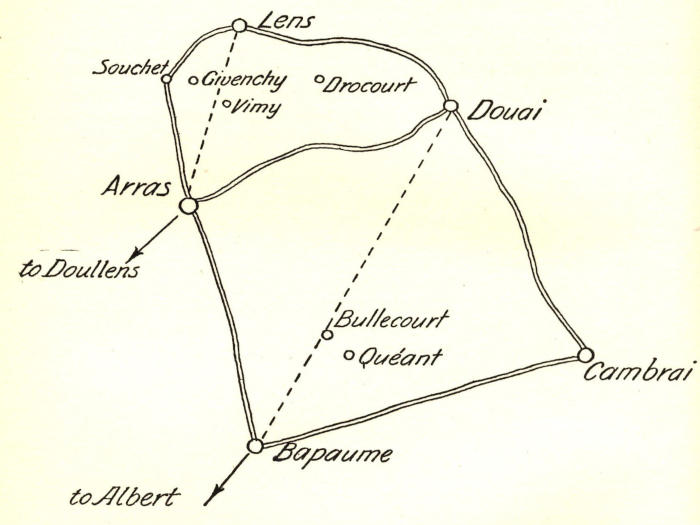
For the great battle for Paris or the coast, the great German
invasion of France, which was also an attack on British sea-power,
has shifted its centre from Ypres; and, while the Crown Prince of
Prussia is hammering at Verdun, as the eastern gate to Paris, the
French and British Army Commanders in the north-west of France
have resolved to try to advance (to push the Germans further back,
that is to say), on, roughly, a north-easterly front, looking from Amiens
through Albert to Bapaume. This, broadly, is the key to a situation,
which we have been following in diminishing degrees from the big,
strategic plans in high places to the disposition of units and individuals.
We have watched the preparations for that advance: the
movements of troops by rail and road; the eyes of the army in the air;
the ears of the army underground; the elaborate collection of war-material;
the construction of permanent ways, and so forth. We see
now the relation in space of the campaign of 1916 to the campaign of
1915. The tidal wave has ebbed away from Ypres, and has surged
more furiously against Verdun; we are to change our focus, accordingly,
from the Yser Canal to the River Somme, and from the Channel
ports to Paris; and in this sector, narrowing our survey, as the vast
movement unfolds into details, we are most particularly concerned
with the straight line, laid on a Roman road, which runs south-west
from Bapaume to Albert. It is rather more westerly in direction, and about
half the length of the road down to Bapaume from Douai. Travelling
along its well-laid surface from north-east to south-west, we pass
through Le Sars, Pozières and La Boisselle, the last a little to the left
of the line. The nodal point, or meeting-place, or starting-place, is
the town of Albert on the Ancre, ‘a small, straggling town built of red
brick along a knot of cross-roads at a point where the swift chalk-river
Ancre, hardly more than a brook, is bridged and so channelled that it
can be used for power.’[56] Westward from Albert is Amiens; eastward
we saw, Bapaume. Next, follow the chalk-stream of the Ancre,
northward under Albert’s bridges, through its native banks and braes.
For our range of vision is being contracted, and we are
coming through Army Commanders’ plans to the men appointed
to carry them out in their destined stations along the line. About two
miles north of Albert on the west bank of the Ancre are the first trees
of Aveluy Wood, where our assembly-trenches lay. Martinsart lies
behind this Wood, Mesnil and Hamel are beyond it, Bouzincourt just
below it to the rear. Opposite, on the east bank of the Ancre, about
three miles to the north of Albert, lies the village of Authuille, north of
which again is Thiepval Wood, looking backwards at Hamel and Mesnil
on the safe, west side of the little river, and facing ‘the German line
opposite the Authuille section,’ just as Colonel Rendall (and, doubtless,
many others) had imagined the situation in that dress-rehearsal
by Naours which we attended at the end of April. Thiepval village
is on the German side of our front line.
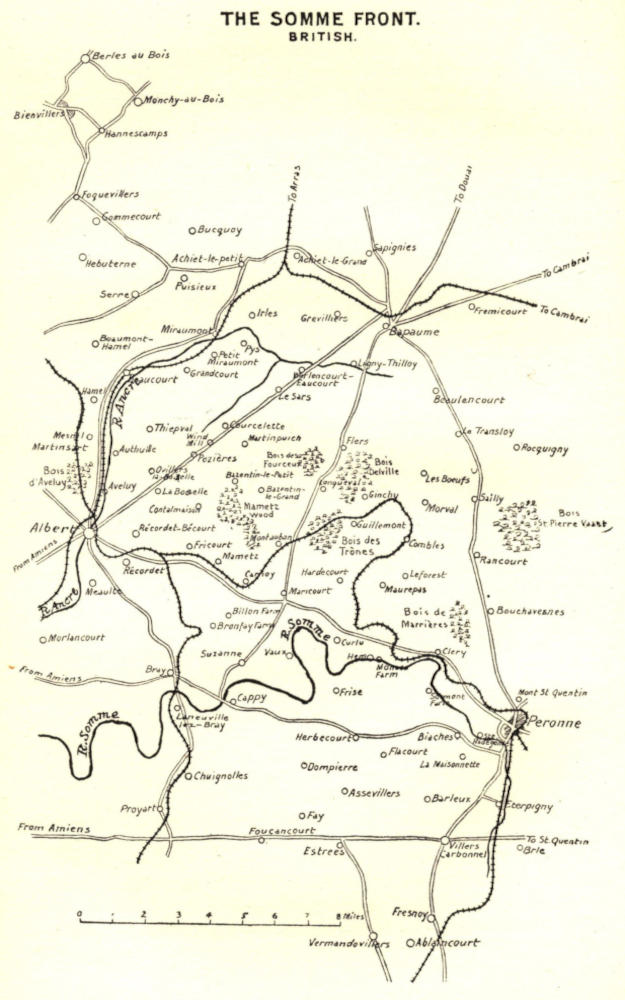
THE SOMME FRONT. BRITISH.
So we reach by gradual delimitation, by a diminuendo process,
as it were, the task allotted to Major-General Perceval, Commanding
the 49th Division, on July 1st, 1916.[57] ‘Z’ day has arrived at last.
The vast plans for the relief of Verdun are now about to be set in motion.
Home Governments have expressed their approval, and have sent the
munitions and the men. Due weight has been given to outside considerations
in this war on many fronts: to the needs of Italy and Russia,
the disappointment of Germany at sea, the inclination of the United
States of America. From the dunes of Calais to the Picardy hills,
north-west France has become an armed camp, with the ceaseless
movement of the immense accumulation of animate and inanimate
material which nearly two years’ experience has proved to be essential
for modern warfare. All the while, as Sir Douglas Haig reminds us
in his great Second Despatch, ‘the rôle of the other armies holding
our defensive line ... was neither light nor unimportant.
While required to give precedence in all respects to the Somme battle,
they were responsible for the security of the line held by them and for
keeping the enemy on their front constantly on the alert.’ Verily, a
huge organization to be stated in terms of unit action and of the prowess
of individual men. It was a long way from Sir Douglas Haig to
Aveluy Wood: the 49th was only one of five Divisions (the 12th,
25th, 32nd, 36th and 49th), which composed the Xth Corps of the
Fifth Army.
Our business lies between Authuille and Thiepval. We have
fined down the vaster issues to the operations east of Authuille, where
the British line bulged towards the Ancre in an ugly angle known as
the Leipsic Salient. The fighting to which we now come is all round
and about that Salient, between the point where the British front line
crossed the River Ancre at Hamel to the point where it met the Albert-Bapaume
road. If we realize that the object of this fighting was to
straighten and push back that bulge, and so to contribute to the advance
of the long Allied line on the Somme battlefield, we may return to the
men who fought there in the early days of July, 1916. It is one thing
to show on a map, on however large a scale, the increasing depth of
the British front line at various dates after July 1st; it is another thing
to visualize that line in the actual mud, trees, slopes, which composed
it, and to recount the conditions day by day, under which it swayed
forward and back, in front and beyond and across the magnificently
fortified German trenches.
Take the 7th West Yorkshires, for example.
We left them at noon on July 1st in their assembly-trenches in
Thiepval Wood. While the sun was still high in the heaven, about
half-past five in the afternoon, Brigade orders (146th Infantry) arrived
for the attack. The 5th and 6th Battalions of the Regiment were to
go over the top in an attempt to capture Thiepval village, the 8th was
detailed for support, and the 7th for reserve. Some hot hours of
confused fighting ensued. The 7th Battalion was told off to man the
original British front line trench, from the point where it touched the
east bank of the Ancre to a point known as Hammerhead Gap, at the
top of Thiepval Wood. This move was being completed with great
difficulty, owing, mainly, to the congestion of the trenches by the
wounded and stragglers of the 36th (Ulster) Division, when an Officer
of that Division, Commanding the 9th Royal Irish Rifles, made an
earnest request for help to reinforce his men in the German lines.
Two Companies (C and D) of the 7th West Yorkshires made their
way to these captured trenches, leaving A and B Companies to hold
the British front and support lines. The fall of night brought no rest
to this unit. The 36th Division became able to hold its own, and the
half-Battalion from the 49th was ordered to withdraw. This order
was not easy to carry out in the darkness, weariness and general mêlée,
and about forty men of C Company found themselves stranded for
the night (July 1st-2nd) in the disagreeable hospitality of the German
line. They were well led by a non-commissioned Officer, Corporal
(later, Sergeant) George Sanders, who was recommended for his valuable
work and great personal bravery by the Officers of the Royal Irish
Rifles. Later, Sanders received the supreme decoration of the Victoria
Cross[58] for his gallant conduct in this action, and six of the brave men
with him were awarded Military Medals. The whole Battalion was
withdrawn to Aveluy Wood, and reached the assembly-trenches about
11 o’clock on the night of July 2nd; thirty-six hours, or a little less,
after they had assembled on the 1st. They had lost 16 killed, 144
wounded and about 20 missing; they had gained a Victoria Cross,
some experience, and—four days’ rest.
Take another unit of the 49th Division: the 5th Battalion of the
York and Lancaster Regiment, in the 148th Infantry Brigade. We
left them proceeding to Aveluy Wood just before midnight on June
30th. The first instalment of their story in the present action is to last
almost exactly a week: from 1-30 p.m. on July 1st, when the Battalion
moved out of the assembly-trenches, till 8-30 p.m. on July 8th, when
they were relieved by the 7th West Ridings, and went into huts in
Martinsart Wood. The story makes sad but gallant reading. They
sustained in those seven days and nights a total of 307 casualties.
Their Commanding Officer was wounded and missing, their Officer
2nd in Command was killed, another Officer had died of wounds,
thirteen more were wounded or missing. In other Ranks, 56 were
killed and three had died of wounds; 204 were wounded and 44
missing: a heavy toll to be extracted from one Battalion towards the
relief of the pressure on Verdun.
The price was paid without reckoning the cost, and we shall not
follow in detail the experiences of this unit during that week. They
moved first to where the British front line touched the left bank of the
Ancre. Major Shaw took A and B Companies to the north side of
that line; Lt.-Col. Rendall, with C and D Companies was posted on
the south side. Captain G. A. G. Hewitt at this juncture retired to
hospital suffering from shock. The fighting went on from hour to
hour with very varying fortune: at one time, there seemed a possibility
of a successful assault on St. Pierre Divion, the next village north
of the line; at other times, the utmost efforts were required to extricate
the wounded. On July 5th, Aveluy Wood was shelled practically for
the first time. High explosive, shrapnel and lachrymatory shells were
employed, and found all the assembly-trenches; captured maps and
prisoners’ information were no doubt responsible for this disaster.
Early in the morning of the 6th, seven officers and eighty other ranks
went out in two bombing parties to capture a front-line trench; no
Officer and twenty-two other Ranks returned. It was in this action
that Lt.-Col. Rendall, D.S.O., Commanding the Battalion, had to be
left wounded in a German dug-out, and that Major Shaw, 2nd in
Command, was killed. The failure was due to the good German
sniping, too heavy bombs for effective throwing, and a communication-trench
not deep enough to pass them through. It was stubborn
fighting, we see, and very difficult progress was made. But one
Division in one Corps of one Army was not the whole fighting force
which the Allies brought to the Somme, and some relief may be found
by looking through German eyes at the results on July 1st in another
sector. We have already referred to the War Diary for this period of
the 55th Reserve Infantry Regiment (the 2nd Guard Reserve Division),
which was holding the German line in front of Gommecourt six or
seven miles north of Hamel. Their experience is no doubt typical
of the enemy’s sufferings all along the line. Thus we read of an intense
bombardment, ‘overwhelming all the trenches, and sweeping away
the wire’; of the ‘thick charging waves of English infantry’; of every
round from the English guns pitching into the trench, ‘thus rendering
its occupation even by detached posts impossible’; of telephonic
communication destroyed by the bombardment, so that ‘Regimental
Headquarters were without news of the progress of events’; of the
English ‘excellent maps,’ and the ‘most disturbing effect’ of English
aeroplanes: and, so reading, we begin to perceive another side to the
picture. Such records of failure and disappointment, of forlorn hopes
and forfeited successes, as occur in the journals of our own units are
seen in a truer perspective when the long line of battle is displayed.
Even the rain in which some wet Yorkshiremen spent a miserable
night (July 7th) by the roadside fell impartially on the other side of the
road, and was duly chronicled by dripping Germans; and, when we
are told that C and D Companies of the 6th Battalion of the West
Yorkshires, who ‘went over the parapet to the attack’ at 4 p.m. on
July 1st, had to retire to their own trenches with their Signalling
Officer (Lieut. Dodd) killed, their Commanding Officer (Lt.-Col.
Wade) and two other Officers wounded, we take consolation from the
entry which follows next in the same journal: ‘Enemy reported to
be massing opposite our front for a counter-attack, which, however,
did not develop.’ ‘Enemy’ did not have it his own way all the time.
Let us follow this unit a little further. During the first fortnight
of July, step by step, and with many a step backward before two steps
forward could be taken, German trenches in the Leipsic Salient had
been occupied, and improved footholds had been won. Every effort
was being made to consolidate and extend the new positions, and it
happened on July 14th, at 4 o’clock in the afternoon, that this Battalion
(the 6th West Yorkshires) took over that portion from the 7th.
The 7th had had a rough experience. In the early morning of July
13th they had been attacked by German bombers, who, according to
Colonel Tetley’s testimony, evinced ‘great bravery and disregard of
danger.’ At one time they rushed a British trench, ‘but were bombed
out by 2/Lieut. F. J. Baldwin and men of A Company....
Practically all our bombers were casualties.’ The Battalion lost 15
killed and 92 wounded in this exploit, but Major-General Perceval
assured them that their ‘stubborn fighting had materially assisted in
the success of the larger operation on the British front,’ and Lieut.
Baldwin was awarded the Military Cross and two N.C.O.’s the Distinguished
Conduct Medal.
The night of the 14th-15th was fairly quiet. Both sides were
attending to their wounded. But early in the morning of July 15th,
when the 6th Battalion had relieved the 7th, the Germans returned
to the attack, and this attempt, very pluckily repulsed, is memorable
for the use of a weapon, new in the experience of the defenders, and
hardly less horrible in its first effect than the surprise of poison-gas
at Ypres. We have the advantage of a graphic description of the three
hours’ fighting on that morning from the pen of Lieut. Meekosha, V.C.,
who took part in it as a non-commissioned Officer.[59] He writes:
‘About 3-30 a.m. the Germans launched their dastardly
attack with liquid fire, the only warning we received being the
terrifying shrieks of those unfortunate sentries who came into
contact with the flame. Then came a hail of hand grenades, a
few of the Boches coming as far as our own parapet, hoping to
find our men demoralized. For their pains they were each presented
with at least one well-aimed bullet. Our men then lined the
parapet with as much speed and ammunition as possible, and let
the Hun have it for all they were worth. Another party of Boches,
well stacked with bombs, had already stormed one of our saps,
which had been blocked about half way. Our Battalion bombers
were at once called out to deal with this party, and, fighting their
way foot by foot, cleared every living Boche from the sap, a fact
which reflected no little credit on our men, being, as they were,
at a disadvantage from the very beginning. Our Stokes Mortar
Battery was then set to work on the German front line, and to see
old Fritz jump on to his own parapet, run a few yards as hard as
he could go, and then into his own trench again (provided that he
did not get a bullet in the attempt, our machine-guns and rifles
being on the look out for opportunities) was the best amusement
I had had for weeks. This went on for about three hours, during
which time the work of our Officers and N.C.O.’s was cut out in
stopping our men from rushing headlong into the Hun trenches
in their eagerness to kill as many Boches as possible in as little
time as possible. Unfortunately, a few of the good men lost their
lives during this fighting, but we had the satisfaction of knowing
that, for every one lost, the Hun lost at least four.
‘Thus ended our first experience under liquid fire.
‘After this, our boys set to and cooked for themselves the
breakfast they so richly deserved.’
It was after this fashion that the pressure on Verdun was relieved.
Sir Douglas Haig is quite clear on this point. He admitted that,
‘north of the valley of the Ancre, on the left flank of our
attack, our initial successes were not sustained’; that ‘the
enemy’s continued resistance at Thiepval and Beaumont Hamel
(29th Division) made it impossible to forward reinforcements
and ammunition, and, in spite of their gallant efforts, our troops
were forced to withdraw’; and that ‘the subsidiary attack at
Gommecourt also forced its way into the enemy’s positions; but there
met with such vigorous opposition that ... our troops were
withdrawn’[60]. These were the first day’s experiences. The succeeding
days, as we have seen, brought certain adjustments for the better, even
in the difficult region where General Perceval’s gallant troops had to
fight their troublesome way up slopes of mud from the valley of the
Ancre to the deeply fortified positions which the Germans held with
machine-guns, rifles and liquid flame. But they did not bring conspicuous
success. They were not expected to bring it, as a fact.
As we have looked at the fighting at close quarters, so we are to look
at the results through Command spectacles. The Battle of the Somme
was not won, nor was it intended to be won, between Thiepval village
and Authuille, where the Leipsic Salient bulged inwards. ‘The
British main front of attack,’ we are told in the same Despatch, ‘extended
from Maricourt on our right, round the Salient at Fricourt,
to the Ancre in front of St. Pierre Divion’; that is, from the bank of
the River Somme to the Albert-Bapaume road and north of it. But
‘to assist this main attack by holding the enemy’s reserves and occupying
his Artillery’ (not, note, by capturing his defences), ‘the enemy’s
trenches north of the Ancre, as far as Serre inclusive, were to be assaulted
simultaneously’; and, further north, ‘a subsidiary attack’ was to be
made at Gommecourt. So clear did this distinction become in the
early stages of the battle, and so plain was the dividing line between
the holding and the pushing forces, that Sir Douglas Haig decided to
separate the Commands: ‘In order that General Sir Henry Rawlinson
might be left free to concentrate his attention on the portion of the front
where the attack was to be pushed home, I also decided to place the
operations against the front, La Boisselle to Serre, under the command
of General Sir Hubert de la P. Gough.... My
instructions to Sir Hubert Gough were that his Army was to maintain
a steady pressure on the front from La Boisselle to the Serre Road, and
to act as a pivot, on which our line could swing as our attacks on his
right made progress towards the north.’ Moreover, ‘our attacks on
his right’ (Sir Henry Rawlinson’s on Sir Hubert Gough’s) must be
associated, in a larger survey, with the simultaneous French attacks
under their own Command. Accordingly, it is wholly just to say that
the containing action of the 49th Division, when the first impetus of
the units had been checked, developed exactly according to plan, in a
military phrase rendered famous by another Army. Up to July 7th,
the enemy’s forces north of La Boisselle ‘were kept constantly engaged,
and our holding in the Leipsic Salient was gradually increased’;
and, after July 7th, as the Commander-in-Chief wrote, ‘the enemy
in and about Ovillers had been pressed relentlessly, and gradually
driven back by incessant bombing attacks and local assaults,[61]’ among
which, one among many, may be mentioned a very gallant night attack
by the 8th West Yorks. Thus, Sir Douglas Haig’s view from Olympus
informs the Battalion records, and we shall see in the further course
of the Somme battle how fully his instructions were observed till the
time came to swing round on Sir Hubert Gough’s pivot.
CHAPTER VIII — I.—OPERATIONS ON THE SOMME—( Continued ). — II. WINTER, 1916-17.
It is not seemly to be too modest about the Somme, nor to insist
over-much upon the limitation of the Allied objective. We know that
it was not intended to drive the Germans out of France; at least, not in
1916. As a fact, in the Spring of 1917 there was a big German retirement,
which was only voluntary in the sense that the enemy bowed to
necessity before necessity broke him, and again, in the Autumn of 1918,
there was another big German retreat, which brought the war to an
end. They take a short view who fail to see the direct and intimate
connection between the campaign of 1916 and the decisive results
in the following two years. The British Commander, while the
future was still veiled, had no illusions on this point. Wielding, like
the Castilian knight of old, ‘now the pen and now the sword,’ Sir
Douglas Haig, when he indited his great Despatch on December 29th,
1916, stated without reserve, that:
‘Verdun had been relieved; the main German forces had been
held on the Western front; and the enemy’s strength had been
very considerably worn down. Any one of these results is in
itself sufficient,’ he avowed, ‘to justify the Somme battle. The
attainment of all three of them affords ample compensation for
the splendid efforts of our troops and for the sacrifices made by
ourselves and our Allies. They have brought us a long step
forward towards the final victory of the Allied cause.[62]’
‘A long step forward,’ not necessarily in the eyes of the old men
and children who stuck pins in their wall-maps at home; and yet not
a short step either, even when measured by this exacting standard.
Let us look at the map once more and stick in some imaginary
pins on our own account. First, take the straight, white road
from Albert to Bapaume, and divide it into eleven equal parts,
representing its length of, approximately, eleven miles. Just before
the second milestone (or mile-pin) from Albert, mark the point where
the Allied line crossed the road on July 1st, 1916, and just beyond
the eight milestone mark the point where the Allied line crossed the
road on December 31st. They had devoured (or ‘nibbled’ was
the word) six miles in six months, including the villages of Pozières
and Le Sars, and were less than three miles distant from Bapaume.
Next, observe the effect of this protrusion on the reach, or embrace,
of the Allied arms. Take the Ancre and the Somme as frontiers,
and prick out from the point by the second milestone a line running
northwards to the left of Thiepval and across the Ancre to Beaumont-Hamel,
and southwards to the left of Fricourt and Mametz, then to
the right of Maricourt, then left of Curlu to the Somme. This was
the Allied line on July 1st. Take the same boundaries again, and
prick out from the point by the eighth milestone a line running northwards
to the left of Warlencourt and Grandcourt, then to the right of
Thiepval, Beaucourt and Beaumont-Hamel, and southwards to the
right of Flers, Lesbœufs, Sailly, Rancourt, Bouchavesnes and Clèry
to the Somme. This, roughly, was the Allied line on December 31st.
The pricked-in area, rhombic in shape, which means neither round nor
square, encloses a large number of square miles re-captured from
reluctant Germans. It did not include Bapaume itself, nor Péronne,
nor St. Quentin, nor Brussels; the time for these had not arrived.
But it took in many towns and hamlets which had known the foot
of the invader, it broke huge masses of fortified works which had been
designed to shoe the invader’s foot, and, consequently, it seriously
shook the moral power of German resistance. We shall not measure
the acres of French territory released, for we have no standard by which
to calculate the effect of Verdun relieved on the German armies driven
homewards between the Ancre and the Somme. Nor is a yard by
yard advance properly expressed in terms of mileage. Take any one
of the positions re-captured: Mametz, Trônes, Combles, Thiepval
itself, and review it for a moment in the series of defences, artificial
and natural and natural-artificial, which the tenacious attackers had to
overcome. Thus, between Fricourt and Mametz Wood were Lonely
Copse, the Crucifix, Shelter Wood, Railway Copse, Bottom Wood,
the Quadrangle, etc.: every name a miniature Waterloo to the gallant
men who fought and fell there. Nowhere in all that area could a
sixteenth of a mile be gained without an elaborate battle-plan and a
battle, or several battles, taxing to the utmost the endurance of troops
dedicated to victory and resolute to death. So, ‘they brought us a
long step forward towards the final victory of the Allied cause.’
We are to contract our range once more to the scope of the 49th
Division, and to consider that ‘step’ more particularly in the region
north of Albert by the Ancre, where Sir Hubert Gough commanded
the Fifth Army. It was not a sensational record. If we follow the
Diary of that Army, say, from July 21st to the end of September, we
receive, mainly, an impression of containing work excellently done,
while the shock of battle broke afar. A few of these entries may be
cited:
‘July 21st. 49th Division in Leipsic Salient....
‘July 23rd. Attack by 48th Division and 1st Australian Division. Good
progress. 49th Division front South of River Ancre....
‘July 29th. 49th Division left of 12th Division to River Ancre....
‘Aug. 27th. 49th Division relieved 25th Division....
‘Sept. 3rd. South of Ancre 49th Division attacked....
‘Sept. 24th. 18th Division relieved 49th Division....
‘Sept. 27th. 11th Division captured Stuff Redoubt.
‘Sept. 28th. 18th Division attacked Schwaben Redoubt.’
Except on September 3rd, to which we shall come back, the work of
the 49th Division, seen from this angle of vision, appears more passive
than active.
Let us enlarge the angle considerably. Instead of Sir Hubert
Gough’s, consult Major-General Perceval’s Diary, the Divisional
instead of the Army Commander’s. We come nearer to action in
that aspect.
Between July 21st and the 27th there were ‘three encounters
with the enemy in the Leipsic Salient.’ On the 21st, he made a bombing
attack; on the 22nd, the 4th York and Lancasters ‘attempted to
extend our position in the Salient to the east by surprise,’ but were
foiled; on the 23rd, the 4th King’s Own Yorkshire Light Infantry
made a similar attempt, ‘but consolidation was prevented by a heavy
counter-attack from all sides, and our troops retired to their original
line.’ From the Army Commander’s point of view, a single entry
sufficed for these exploits; the Divisional Commander had to account
for nearly five hundred casualties in the period.
Take the 28th of July to the 4th of August. There were 279
casualties in the Division, due, partly, to ‘a considerable amount of
trench-mortar fire on the Leipsic Salient and Authuille Wood’; and
who shall say but that every wounded man made a definite contribution
to the Somme advance? Yet Sir Hubert Gough was content to
observe: ‘49th Division left of 12th.’ Or, August 26th to September
1st. General Perceval’s entry on the 27th merely repeats (or we should
say, anticipates) Sir Hubert Gough’s at greater length: ‘Divisional
Headquarters returned from Acheux to Hedauville, and at mid-day
the Command of the line from Thiepval Avenue (exclusive) to River
Ancre passed from 25th to 49th Division.’ There is a further entry
in this Diary, which, being a record of work done in the ordinary
course of duty, the Army Commander did not reproduce: ‘With a
view to an attack on German trenches north of Thiepval Wood, the
new saps and parallels to the north of the Wood have been completed,
ammunition-trenches improved, and dumps formed and filled with
ammunition, bombs, R.E. stores, etc.’
So far the Divisional Commander, in expansion of Sir Hubert
Gough. There are next the Battalion Commanders to be consulted;
and, still omitting at present the Divisional record of the week including
September 3rd, when ‘49th Division attacked,’ we may once more
enlarge the angle, and examine this preparation for attack from a
Battalion Commander’s point of view. Thus, we read that:
‘On August 26th, the Battalion[63] was sent up to the trenches
on the right of Thiepval Wood.... Captain R. Salter was killed
instantaneously by a shell as soon as he got to Battalion Headquarters.
We were in this line for only two days, but had 52
casualties as there was a good deal of shelling.... The Battalion
was relieved on August 28th by the 5th K.O.Y.L.I., and went
into huts in Martinsart Wood; from here we had to find large
working parties in the front line for two or three days, and then
had a rest until the attack on September 3rd.’
We are brought back, like Master Pathelin, à nos moutons. The
‘long step forward’ was achieved, the Battle of the Somme was won,
by the Allied Armies working to the plans of Sir Douglas Haig and
Marshal Joffre. Those plans included the provision of a separate
Army on the Ancre, to hold the German forces in that area, and to
make what progress they could. The Commander of that Fifth Army
was Sir Hubert Gough, and Major-General Perceval’s West Riding
(49th) Division was included as a unit of its Xth Corps. What
happened, then, on September 3rd, when the new saps and parallels
had been constructed, the communication-trenches improved, and the
dumps filled with bombs and ammunition? How did the 49th attack,
and what have the Officers Commanding its Battalions to add to the
bare record of Sir Hubert Gough or the more expansive Diary of the
Divisional Commander?
The units immediately concerned were the 4th and 5th Battalions,
West Riding Regiment, and the 6th and 8th Battalions, West Yorks.
The 7th Battalion of each Regiment was stationed in reserve. The
week’s casualties in the Division were high:
|
OFFICERS. |
|
OTHER RANKS. |
| Killed |
14 |
|
196 |
| Wounded |
47 |
|
994 |
| Missing |
17 |
|
611 |
|
78 |
|
1801 |
| Total |
|
1879 |
|
and the bulk of them occurred on September 3rd. The large percentage
of missing in all ranks (more than a third of the whole) seems
to indicate a hasty retreat from untenable positions.
The presumption is borne out by Battalion records. These
agree that co-operation was interrupted by a bad block in communication,
and that Battalions were not able to render one another all the
support that was expected. Each unit tended to believe that its own
advance was held up, or, rather, that its withdrawal was necessitated,
by what had happened on its right or left; and, consequently, the
exploits of individuals were more conspicuous than the conduct of the
attack. Zero hour was 5-10 a.m., and the Companies left the trenches
punctually and went over in good order. But the half-light caused
some confusion, and communication proved very difficult. In the
instance of several Battalions no definite news was received for three
hours or more. Runners failed to get through, and rumours were not
satisfactory. At last, about 9 o’clock, tidings began to arrive of heavy
losses incurred in trying to consolidate captured positions under a
cross enfilade of machine-gun and rifle fire. Remnants of Companies,
driven back after a long morning’s heavy fighting told of the exhaustion
of their bombs, and of their messages lost in No Man’s Land. Stray
parties cut off in the attack, found cover in shell-holes until nightfall.
One Commanding Officer frankly wrote, ‘the whole attack failed.’
‘The objectives were gained,’ he summed up, ‘but the first casualties
in Officers and N.C.O.’s were heavy, and therefore the men with
power of “leadership” were lost when most needed to hold on. The
presence of the enemy in the Pope’s Nose (a machine-gun nest at an
early point) upset all chances of reinforcements and supply except
across the open’—an almost impossible condition. The runners,
as we saw, did not get across, and the light was too bad for the observation
posts to give effective help. On the other hand, the daylight
was too strong to consolidate under fire the battered German trenches
which had been captured. There was, unfortunately, a ‘but’ or an
‘if’ which qualified every record of success; and we may quote the
following statement from a Battalion Diary, which gives a very fair
impression of the whole episode:
‘From the reports of the two Officers who returned to Battalion
Headquarters from the battle, it was ascertained that for
the most part a really good fight was put up. If Battalion Headquarters
had been able to get any information back, it is practically
certain that the position would not have been lost. The
men fought splendidly, and in many cases without N.C.O.’s or
Officers, and the losing of the captured position was a piece of bad
luck.’
‘What remained of our assaulting troops,’ says General Perceval,
‘were back in our trenches,’ about 10 a.m., having ‘sustained heavy
casualties and lost most of their Officers.’ A re-attack was planned for
6 p.m., but was countermanded during the afternoon, and the 146th
Infantry Brigade was withdrawn to Forceville and the 147th to Hedauville.
So, the 49th Division had attacked, and the whole attack had
failed; but between these two bald statements lie detailed records of a
courageous attempt, which we shall not pursue further, but which
contributed in this hard-held sector to the ‘long step forward’ which
was being taken on the Allied front at large. German records, so
far as we have seen them, confirm the seriousness of the attack. We
read there how ‘matters had meanwhile become still worse,’ and how
Company was added to Company in order to meet the impending danger.
‘Lieut. Engel’s Company signalled “Please send support,”’ and his
experience was repeated in other sectors; ‘our Minenwerfer intervened
at the most opportune moment’. On the whole, the enemy’s accounts
increase admiration for the 49th Division.
It is particularly interesting to record that, in the course of this
summer and autumn, a Regiment of Yorkshire Yeomanry met their
friends of the 49th Division in and about the defences of Thiepval.
We shall come, in Chapter XIV below, to the experiences of the
Mounted Troops who left the West Riding for France during 1915.
There we shall see how they served as Divisional Cavalry for several
months, and how, in May, 1916, they were re-organized as Corps
Cavalry, and were set to do various duties, not always appropriate to
their Arm, which they discharged with a thoroughness and an efficiency
worthy of the best traditions of the Service. The Yorkshire Dragoons
were posted to the IInd Corps, which, on July 25th, 1916, took over
that sector of the Fifth Army front which lay between Ovillers-la-Boisselle
and Thiepval. The hopes of a Cavalry situation, unfortunately,
never materialized, but the Dragoons did excellent work during
the Battle of the Somme by maintaining Observation Posts in forward
areas, thus short-circuiting the means of communication between
Corps Headquarters and Battalion Commanders. ‘During operations,’
we are told, ‘information received in this way and from other sources
was embodied each day in maps and reports, which were sent up by
despatch rider during the night, and reached front line units in time
for the usual attack at dawn.... The observers were sometimes
asked to undertake special work of great importance. Before several
attacks they were required to reconnoitre and map the enemy’s
wire. The slightest mistake might have lost hundreds of lives,
but it was never made.’ Among the names which we may mention
honoris causa in connection with this service are those of Captain,
later Major, R. Brooke; Major, later Lieut.-Col., R. Thompson;
Sergts. Storer and Tinker (Military Medals), and Corpl., later Sergt.,
Cranswick (Bar to M.M.).
Let us consult the map once more.
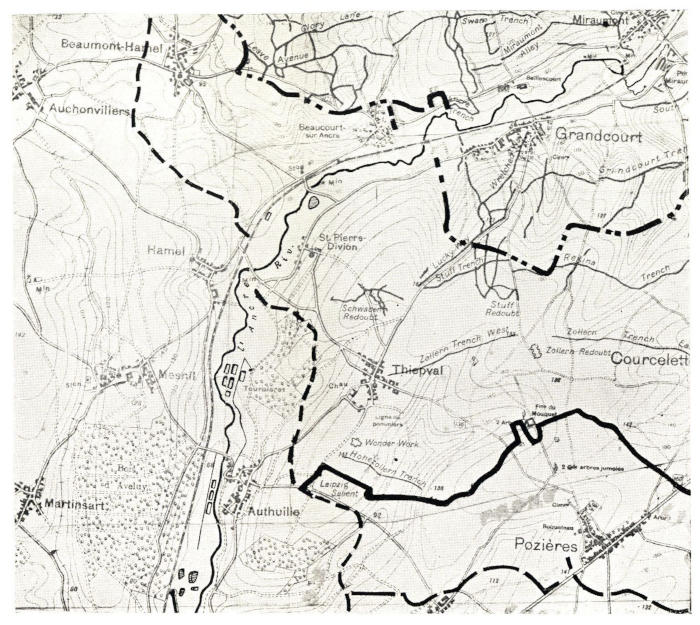
THIEPVAL DEFENCES.
In the extreme right-hand corner will be seen the village of Pozières
on the straight road (Albert-Bapaume), which ran diagonally across
the battlefield. In the extreme left-hand bottom corner are Martinsart
and Martinsart Wood, on the safe side of the River Ancre, where
spent Battalions of the 49th Division used to withdraw to lick their
wounds. The course of the Ancre is clearly shown from just above
Albert to Miraumont, winding its stream under Authuille and Hamel
Bridges; and between Authuille and St. Pierre Divion lie Thiepval
and Thiepval Wood, the possession of which was so hotly contested
since the battle was first joined on July 1st. The more we look at
this timbered countryside, with its chalk-pits, its farms and mills,
the more unsuitable it seems to the red carnage of 1916. Yet the
troops behaved magnificently, and Sir Douglas Haig sent several
messages during these trying weeks to express his thanks and appreciation.
To one Battalion he sent on August 30th by the hands of the
Divisional Commander a sprig of white heather as an emblem of good
luck. Hard though the going was, and bad though the luck seemed to
be, making acclimatization tedious and difficult, it rarely happened,
even among raw troops, that the conditions proved too exacting.
Very typical of the spirit of the Division, in the midst of its harassing
experiences, where the room designed by nature for smiles was too
narrow almost to contain its special circles of man’s inferno, was the
part borne in the third week of September by the 7th Battalion of the
West Riding Regiment. They had been at Hedauville since September
4th, at two hours’ march from Martinsart Wood, whither, in order to
go into the line, they moved on Friday, September 15th. There
they had tea, and took rations for the next day, and were loaded with
two bombs per man, and so proceeded from 7 p.m. to new trenches,
south of Thiepval, which had been captured only the night before.
The relief was delayed in execution partly by artillery barrage, partly
by an attack of German bombers, partly by heavy rain, and partly
by too few guides; there was only one guide to each Company, ‘and
these were strange to the trenches and had difficulty in finding the way.’
It was completed by 4-20 in the morning (September 16th), and during
‘intermittent shelling’ all that Saturday arrangements were concerted
for an attack on the German trenches in the evening of the 17th. This
operation was most successful; on the left an objective was gained,
and held, 350 feet in advance of schedule. The details are not uninteresting,
and will repay closer study, not because the area of the attack
was large in proportion to the whole battlefield, but because it was
difficult terrain and the obstacles were well overcome.
Just north of the famous Leipsic Salient on the map, lay, first, the
Hohenzollern Trench and, secondly, the Wonder Work: two strongly
fortified positions. Eastward out of Thiepval, from the point where
the road from the Cemetery meets the main road in a right angle,
ran the Zollern Trench, terminating (for present purposes) at the
Zollern Redoubt north of Mouquet Farm. Further along the road
from the Cemetery, at a point about as far north of the Crucifix as the
Cemetery is south of it, the Stuff Trench started to run eastwards,
parallel to the Zollern Trench below. It was very elaborately fortified,
and terminated in the Stuff Redoubt still further above Mouquet Farm.
The Regina Trench ran further eastward, from about the point where the
Stuff Trench terminated. Parallel with the road from the Cemetery and
Crucifix, the Lucky Way ran up towards Grandcourt, and the Grandcourt
Trench branched off eastward a little below the village, again in a parallel
line with the Regina and Zollern Trenches. West of that Cemetery
road and crossing the Divion Road about half-way between the Cemetery
and St. Pierre Divion was the horrible Schwaben Redoubt; and,
though these names do not exhaust the German defences of Thiepval,
they recall sufficiently the opposition to the 7th West Ridings and their
support on this third Sunday in September. The assault was made
in four waves at intervals of fifteen, twenty and fifteen feet, the unit
being a Platoon. A Bomb Squad, consisting of one N.C.O. and
eleven other Ranks, accompanied each half-Company, and every man
of the last two waves carried either a pick or a shovel. Report Centres,
main and subsidiary, Battalion Scouts, and other special parties were
detailed for duty, and all Troops were reported in position at 6 p.m.
Nearly everything went right, except that a portion of D Company,
including both Lewis Guns and their detachments, were believed to
have advanced towards the Row of Apple Trees, and were either taken
prisoners or wiped out by machine-gun fire. About 7 o’clock reports
were received that the objective had been captured, though it was
doubtful how the left flank had fared. The total casualties in this
little action were five Officers and 215 other Ranks. Certain valuable
lessons were learned: the action proved that the jumping-off trench
should be parallel to the objective (this precaution enabled direction
to be kept accurately); that every man, and not merely the last comers,
should carry a pick or shovel, fastened to his body by rope or tape;
and that the consolidating parties should either be kept back till the
barrage stops or require dug-outs: trivial details, perhaps, but they
saved life and added to efficiency. We may add that the Army
Commander, Sir Hubert Gough, visited the Battalion on September
19th, and expressed his satisfaction with the operation, which gained an
important part of the enemy defences after five previous attempts
had failed, and served to straighten the line held by the 147th Infantry
Brigade north of the Leipsic Salient.
A still more important lesson had been learned, and the means
were now at hand to apply it. If these formidable blockhouses were
to be crushed, a new military weapon was essential, and early on
September 15th the first Tank waddled into warfare. From this
date to the end of September, by a brilliant series of advances from the
south, across and along the Albert-Bapaume Road, a victorious crown
was put to the tenacious vigil and hard fighting of the Fifth Army,
and the attack swung round at last on the pivot held by Sir Hubert
Gough. This attack (September 26th) was described by Sir Douglas
Haig as not less than
‘a brilliant success. On the right,’ he narrated, ‘our troops
(2nd and 1st Canadians Divisions of the Canadian Corps, Lieut.-General
Sir J. H. G. Byng) reached the system of enemy trenches
which formed their objectives without great difficulty. In
Thiepval and the strong works to the north of it the enemy’s
resistance was more desperate. Three waves of our attacking
troops (11th and 18th Divisions, II. Corps, Lieut.-General
C. W. Jacob) carried the outer defences of Mouquet Farm, and,
pushing on, entered Zollern Redoubt, which they stormed and
consolidated.... On the left of the attack fierce fighting,
in which Tanks again gave valuable assistance to our troops
(18th Division), continued in Thiepval during that day and the
following night, but by 8-30 a.m. on the 27th September the
whole of the village of Thiepval was in our hands.... On
the same date the south and west sides of Stuff Redoubt were
carried by our troops (11th Division), together with the length
of trench connecting that strong point with Schwaben Redoubt
to the west, and also the greater part of the enemy’s defensive
line eastwards along the northern slopes of the ridge. Schwaben
Redoubt was assaulted during the afternoon of the 28th September
(18th Division), and ... we captured the whole of the
southern face of the Redoubt and pushed out patrols to the
northern face and towards St. Pierre Divion’[64]:
grand exploits these, and infinitely welcome to the gallant Territorials
of the West Riding, who had shared since July 1st in the long and
formidable task of holding that north-west corner till the appointed
hour struck for its fall, and their work could be resumed and fitted in
with the larger plans of the Allied Commands.
We might close the present chapter here. The full story of
September 15th and the days which followed at Thiepval is involved
with other volumes of war history than that of the 49th Division.
The romance of the coming of the Tanks belongs to the Machine-Gun
Corps, Heavy Section; the death of Raymond Asquith in the
attack belongs to the Grenadier Guards, and to the eminent family
of which he was a member. What belongs to us, as the inalienable
heritage of the Troops commanded by General Perceval, is the fact
that for three months, less three days, from their first assembly in
Aveluy Wood, they held on firmly and grimly to that narrow foothold
in the Ancre Valley which was dominated always by German guns.
They went and came to the muddy, bloody trenches, from Authuille
Wood, Aveluy Wood, Martinsart Wood, day by day, under a pitiless
harvest sun or a yet more pitiless autumnal rain; and by their steadfastness
and tenacity, even more than by their toll of German life or
their fragmentary captures of German trenches, they enabled Sir
Douglas Haig to perfect, without haste and without undue anxiety, the
long, slow sweep of his advance which swung back on Thiepval at
the last. And, though the details at this stage must be kept subordinate
to the main features, lest we should seem to claim more than a just
share, yet it is satisfactory to observe that certain Battalions of our
Division participated in these final operations. Thus the 5th West
Yorkshires were detailed as support to the 7th Bedfordshire Regiment
for the attack on Schwaben Redoubt on September 27th. They
were formed up on that afternoon, and again before daybreak the
next morning. Zero hour was fixed finally at 1 p.m. On that day
the three supporting Companies became a part of the main advance,
and the final Brigade objective was reached by a mixture of both
units, the men from Yorkshire and Beds. It was a fine conclusion
to the waiting orders imposed after July 1st, and it elicited the following
fine testimony from Major-General T. H. Shoubridge, C.B., C.M.G.,
Commanding the 54th Infantry Brigade, in a letter dated October
1st, 1916, and addressed to Major-General Perceval:
‘I feel I must write and tell you how splendidly the 5th West
Yorkshire supported the attack of the 7th Bedfordshire Regiment
on the Schwaben Redoubt.... The Battalion had, I fear,
a trying time, as the attack was postponed, and I had to bring
them up in support at night, though they had practically been
told they would not be wanted that night. In spite of all difficulties,
when the final attack took place, they formed up in perfect
order and advanced during the attack with marked determination.
I was very struck with the soldierly qualities of the men and the
keenness they displayed, and I am very proud to have had them
under my Command.... All my Battalions are full of praise
for the Artillery support afforded them both during the attack on
Thiepval and the subsequent attack on Schwaben Redoubt....
We all feel very grateful to the troops of your Division associated
with us.... Forgive type,’ added the gallant General,
‘Have just come out of the battle, and have no ink!’
Recognition, too, eminently merited, reached the 49th Divisional
Commander from Lieut.-General C. W. Jacob, Commanding, as
we saw, the II. Corps. He wrote, on October 3rd:
‘As the Division under your Command has now been
transferred to another Corps, I take this opportunity of thanking
you, your Staff, the Commanders of Brigades, and all Ranks
of the Division, for all the good work you put in while you were
in the II. Corps.
‘The conditions were trying, and your casualties heavy.
The calls made on units necessitated great exertions, which were
always cheerfully carried out. The gallantry of the Officers and
men is shown by the large number of decorations won by
them, and the spirit of all Ranks is good. The clearing of the
Leipsic Salient, the prompt way all calls for raids on the enemy’s
trenches were met, and the heavy work done by the Division
in the preparations for the final attack on Thiepval are gratifying
records.... It was unfortunate that the Division as a
whole could not take part in the final capture of Thiepval, but
you will all be glad to know that your representatives in that
battle, the 49th Divisional Artillery and the 146th Infantry
Brigade, did excellent work, and added still further to the good
reputation of the Division.’
Schwaben Redoubt, we may add, was not retained without a
struggle. There was still one corner to be seized where the Regina
Trench branched out in the direction of Courcelette, and, running
north of that village, came down towards the Albert-Bapaume Road,
almost immediately above Le Sars; and these gains, too, were made
and held despite desperate counter-attacks before the middle of
November. So, when winter came down on the Somme battlefield,
and the warring armies went to earth, the Allied line which had bulged
in towards Albert now bulged out towards Bapaume. ‘That these
troops should have accomplished so much under such conditions
... constitutes a feat of which the history of our nation records
no equal.’[65] We have tried to describe this feat, in so far as concerns
the part, modest in area, indeed, but very exacting in performance,
which was played by the 49th Division and we have tried to exhibit
that part in its true relation to the drama as a whole.
We may now touch upon one or two details.
Before the close of 1916 a third Victoria Cross fell to the share of
the 49th Division. The recipient was Major (then Captain) W. B. Allen,
of the 1/3rd West Riding Field Ambulance, attached to the
246th Brigade, Royal Field Artillery. The gallant Officer had already
received the decoration of the Military Cross, and we cite here the official
record of the circumstances in which the supreme reward was won:
‘For most conspicuous bravery and devotion to duty. When
gun detachments were unloading H.B. Ammunition from wagons
which had just come up, the enemy suddenly began to shell the
battery and the ammunition, and caused several casualties.
Captain Allen saw the occurrences and at once, with utter disregard
of danger, ran straight across the open, under heavy shell
fire, commenced dressing the wounded, and undoubtedly by his
promptness saved many of them from bleeding to death. He
was himself hit four times during the first hour by pieces of shell,
one of which fractured two of his ribs, but he never mentioned
this at the time, and coolly went on with his work till the last
man was dressed and safely removed. He then went over to
another battery and tended a wounded Officer. It was only when
this was done that he returned to his dug-out and reported his
own injury’.
Every Arm of the Service had its heroes. Major Allen in the
R.A.M.C. earned the Victoria Cross; Major Alan F. Hobson, D.S.O.,
in the West Riding Divisional Royal Engineers, who was killed on
August 26th, earned the following tribute from a brother-officer of
his unit:
‘Poor Hobson, our Major, was killed about three days ago
by a shell in the neighbourhood of our work. One has read
of lovable, brave leaders in personal histories of previous wars.
Hobson was one of those men whom writers love to describe
as the best and truest type of an Englishman. He never asked
one of us to go where he would not go himself. He was always
happy, even-tempered and just.’
A hero’s grave or the Victoria Cross: it was a common choice,
settled by fate during the war, and at no time commoner or more
inevitable than during these Battles of the Somme. A few extracts
from the letters of a fallen Officer may be given in conclusion to this
period, not because they differ essentially (for a happy style is an
accident of fortune) from other letters sent home from the Western
front, but because they express in word-pictures, compiled on the spot
and at first hand, the spirit of the very gallant men whose cheerful
devotion in 1916 made possible the victory of 1918.
First, an account of an ordinary sight by the roadside:
‘While we were waiting for orders there was a constant
procession of troops going up and troops going back from the
front line. It was an intensely interesting procession to me,
but there were some terribly sad sights of mangled men being
brought back on stretchers. The “walking cases” were very
pathetic; one in particular I remember. A young Officer leaning
heavily upon the arm of one of his men, the right side of his face
bandaged up. His left eye closed in agony, along he stumbled,
while on each side of him our guns went off with a roar that must
have been trying to a man evidently so shattered in nerve, and all
the time he was exposed to Boche shelling.’
Another extract from the same letter:
‘It is a pitiable sight to see horses badly wounded, poor
dumb things, so brave and patient under shell fire. When one
is riding near one of one’s own batteries, and guns suddenly belch
forth flame and smoke over one’s head, these dear creatures hardly
wince. From the time the first shell fell among the horses until
we left the town—about two hours later, we were dodging shells.
When we were outside, the warning hiss of a Fritz caused a
funny sight. Those near buildings jumped to a sheltering wall,
some of us who were near trees embraced their trunks and dodged
round them when we thought the burst would be on one side.
We screamed with laughter at each other, but when one burst
rather too close, our heads ached and our hearts thumped (anyway,
mine did, and it is no use disguising the fact).’
And from the last of this series of dead letters:
‘Presently our trench crossed No Man’s Land—at least,
it once was No Man’s Land; now it belongs to us until we can
turn it over to its proper owners. We examined Fritz’s handiwork
where he had spent months of watching and fighting. We
could see what British fighting was like by the evidence there....
At one place we were within forty yards of him, but we heard no
sound. The only sound that broke the stillness of that beautiful
day was the bang of our own guns and the swish of our crumps
overhead. At one point, close to the tangled wire of Fritz’s
front line, we saw a sad sight, perhaps the saddest sight of war,
groups of our own lads, sleeping, sleeping, sleeping. Heroes,
they had done their bit and there they lie. They have died so
that others can live to be free from the yoke of a monster in human
form, whose greed for power must be stifled.’
‘Sleeping, sleeping, sleeping’: this iterated note conveys, now
that the war is over and the maps are folded and put away, a tender
thought properly keyed, at which to close our account of the Somme
battlefield. It is a field of great achievement and of pious memories,
hallowed for all time in English history, and the ‘more’ that remained
to be done, as foreseen in the vision of this writer, could not be more
worthily accomplished than in the spirit of the heroes of the Somme.
It was the peculiarity of the war in France and Flanders that there
was no clear ending to any battle. At Ypres, at Verdun, and on the
Somme, the tide of war flowed with full flood, and ebbed away without
definite decision. There was a little more erosion of the trenches
on one side or the other, a few more miles of territory submerged, or
disengaged from the invader, revealing, when the tide rolled back,
the waste and ravage and destruction, and then a temporary lull, till
‘The tide comes again,
And brims the little sea-shore lakes, and sets
Seaweed afloat, and fills
The silent pools, rivers, and rivulets,
Among the inland hills.’
We reach such a coign of observation, such a lull, less real than
apparent, for brave men were being killed every day, in the period
from November to January, 1916-17. It lay between the exhaustion
of the Somme offensive and the refluent wave of battle-fury up and down
the line in early spring; and this brief interval may be utilized to pick
up a few stray threads.
Let us look at home in the first instance.
The West Riding Territorial Force Association had by now settled
down to its stride. We left its members in 1915[66] struggling, perhaps
a little breathlessly, with difficulties of accountancy in their Separation
Allowance Department, with the organization of Auxiliary Hospitals,
the equipment of 2nd and 3rd Line units, the formation of a National
Reserve, and the constant perplexities of the recruiting problem.
We find them at the close of the next year with one Division crowned
with honour in the field, with another Division straining at the leash,
and with a certain reduction in their commitments, owing partly to
National Service legislation, partly to firmer methods at Whitehall,
and partly to other causes. Necessity had nationalized the war;
and, though more than 52,000 accounts of soldiers’ wives and dependants
were now on the Paymaster’s books, though more than 3,000
beds in 53 Auxiliary Hospitals were now available in the Riding, and
more than 21,000 pairs of socks and 45,000 other comforts had been
despatched to the troops during the winter, the Association had
thoroughly mastered the technique of war administration when the
original triumvirate of Lord Harewood, Lord Scarbrough and General
Mends, as President, Chairman and Secretary respectively, was broken
up in February, 1917, by Lord Scarbrough’s transfer to the War Office
as Director-General of the Territorial and Volunteer Forces.[67]
The appearance of the words ‘and Volunteer’ requires a brief
note of explanation. The Chairman informed his Association in
January, 1917, that the local administration of the Volunteer Force
had, at the request of the Army Council, been undertaken by County
Associations. ‘Generally speaking,’ ran the writ,[68] ‘the division
of functions between the local military authorities and T.F. Associations
in regard to the Volunteer Force will correspond to that obtaining
in the case of the Territorial Force in times of peace.’ It was not,
perhaps, the best precedent to select, but it was the best available in
the circumstances, and an historian will surely arise to tell the story
of the part-time soldier in the Great War, what he did and what he
might have been used to do. Such historian will be endowed with
imagination to sympathise with the buffeted patriot in the early days
of the war, and he will possess sufficient knowledge of the facts to follow
his tangled skein of fortune through the maze of legislative enactments
and contracting-out tribunals, which cast him up on the lap of his tired
country, in November, 1918, half a volunteer and half a conscript
and the most melancholy mongrel of the Army Council. This,
happily, is not our present business. We are simply concerned to
show how the Volunteer Act of 1916, which had become law late in
December, brought the Volunteer Force into the orbit of the County
Associations on the one part and of the Director-General of the Territorial
Force on the other. That Act made provision for Volunteers
to enter into an agreement with His Majesty for the performance of
certain duties of home defence ‘for a period not exceeding the duration
of the present war.’ The time-clause was the essence of the contract.
Till then, under the Act of 1863, a Volunteer, prior to mobilization,
which could only ensue in case of imminent invasion, and which never
ensued during the late war, had the right to quit his Corps at his own
option on giving a fortnight’s notice to his Commanding Officer.
Under these conditions he was plainly no soldier, however elastic
the terms of his employment. He could neither be clothed nor trained
at the public expense, for the public would have no value for their
money if the Force, or any part of it, walked out at fourteen days’
notice. Permanence of service was then first obtained when the
Volunteer Force was reconstituted out of personnel bound by agreements
entered into under the new Act of 1916; and thus it happened at
the beginning of the next year that the work of Associations was increased
by responsibility for the local administration of the Volunteer units raised
in their respective counties, and that these duties were tacked on to
the machinery of the Territorial Force organization. How heavy
the duties became may be measured by a single item of statistics:
as many as 217 Army Council Instructions referring exclusively to the
Volunteer Force were promulgated before the date of the Armistice.
Lastly, reference is due to German action during this lull, or
to what we know or may infer about it. Plainly, their moral had been
badly shaken. Sir Douglas Haig was resolute on this point, and the
extraordinary ‘all but’ luck which dogged their campaign on the
Western front from the beginning to the end of the war, and of which
the full military explanation must await the evidence from their side,
was as characteristic at Verdun as anywhere. They all but got home
to their objective: so nearly that the German Emperor’s telegrams,
which he used to compose after the model of his grandfather’s in the
1870-71 campaign, just missed being accurate by a few yards; and this
‘little less, and what worlds apart,’ which separated the Crown Prince
from victory, however cleverly wrapped up in the language of public
despatches, must have caused more than common chagrin. For
actually it was Verdun which was wanted, the right breast of the
mother of men, and not the outposts of its defences, nor even the
serried rows of French dead. These might serve in less vital regions
to dazzle the eyes of the world; at Verdun, they drew attention to the
defeat. Nor was consolation to be derived from the results of that
attempt to relieve Verdun which we have followed in the battles of the
Somme. The higher ground, or ridges, still remained in German
possession, but it was a precarious hold, as we shall see, and, while
the mere configuration of the ground was soon to tell in favour of the
Allies, other factors, which cannot be mapped except in an atlas of
psychology, were beginning already to count. The repeated losses of
fortified positions, culminating in the Wonder Work and Redoubts
which had resisted the assaults of July 1st, were disastrous not only on
their own account but also as indicating a weakness which might
conceivably spread to the Rhine. If the theory of defence proved
unsound, no degree of valour in practice would ever avail to put it
right. We must not prejudge this question. We are not writing the
German history of the war. But it is legitimate to say that, apart from
the general retirement which the Germans ordered in March, 1917,
and which reached a rate of ten miles a day, our troops gradually
discovered a change in the enemy’s system of defences. He began,
first on the British and afterwards on the French front, to abandon
the formal lines of trenches, and to employ the natural features of the
soil, when and where these might occur, as the basis of his defences.
The crater, or shell-hole cavity, was brought into use in this way, and
no outward mark was allowed to distinguish a fortified group of craters,
subterraneously connected with one another and otherwise rendered
formidable, from harmless groups in its immediate neighbourhood.
Thus, the cession by the Germans of ‘only our foremost crater-positions,’
or of a ‘craterfield’ tout court, began to figure in their reports
for the edification or delusion of German readers. An integral part of
the crater-system, as worked out more elaborately at a later date,
was the ‘pill-box,’ or sunk blockhouse, which was strengthened towards
the foe and left more thinly built on the home side, so as to render it
useless as a weapon should its fire be directed by its captors. We may
conclude that the blows which had been dealt at the continuous lines
of trenches in the battles of the Ancre and the Somme had alarmed the
German High Command; and that a part of the motive for the retirement
(and a very effective part it proved) was to prepare those fortified
groups and concrete nests of deadly machine-gun fire at all kinds of
irregular distances. The intention was partly to deceive the airman’s
eye, and to stop that preparation of exact trench-maps to which the
Germans had borne testimony on the Somme. But partly, too, the
modification of the defence-system implied that our offensive had not
been vain. Its immediate effect, accordingly, however serious and
impeding it was to prove, was not without good hope. The vaunted
theory of ‘impregnability’ had been shaken, and, though the end of
the war was still out of sight, yet Thiepval, like Jutland, bore a message
which the rest of the war was to expound.
Full information on these problems is still lacking from the German
side, and without it, as indicated above, our conclusions must be indicated
hypothetically. But all the evidence now available makes it clear that
they are reasonably correct. Thus, Ludendorff, writing after a tour
of the Western Front in December, 1916, laid stress on the urgent need
of re-organizing the fighting power of the German Infantry. The
machine-gun had become the chief fire-arm, and ‘our existing
machine-guns’, he declared, ‘were too heavy for the purpose....
In order to strengthen our fire, at least in the most important parts of
the chief theatre of war, it was necessary to create special Machine-gun
Companies—so to speak, Machine-gun Sharp-shooters.’ Attention is
also called in the German Commander’s authoritative Memoirs to the
need of hand-mines, grenades, and all quick-loading weapons, and to
the formation of storm troops. ‘The course of the Somme Battle,’
continues the General, ‘had also supplied important lessons with respect
to the construction and plan of our lines. The very deep underground
forts in the front trenches had to be replaced by shallower constructions.
Concrete “pill-boxes,” which, however, unfortunately took
long to build, had acquired an increasing value. The conspicuous
lines of trenches, which appeared as sharp lines on every aerial photograph,
supplied far too good a target for the enemy Artillery. The
system of defence had to be made broader and looser and better adapted
to the ground. The large, thick barriers of wire, pleasant as they were
when there was little doing, were no longer a protection. They
withered under the enemy barrage’; and an angry tribute is paid in
his chapter to the equipment of the Entente Armies with war material,
which ‘had been developed to an extent hitherto undreamed of,’ and
to ‘the resolution of the Entente, their strangling starvation blockade,
and their propaganda of lies and hate which was so dangerous to us.’
It is good to see ourselves as our enemy saw us after the Battle
of the Somme. And, perhaps, though we are anticipating a month
or two, we may conclude this chapter by a quotation from a German
Army Order, hitherto unpublished, of April 4th, 1917. It illustrates
from another angle the effects of those ‘Entente Armies’ and ‘their
propaganda’ to which Ludendorff alludes in such embittered terms.
The Order ran:
‘A National Day has been decreed at home for April 12th,
in the sense that members of the large Trade Unions and Associations
give up that day’s income, salary or wage for the benefit of
the Fatherland.
‘The wish has been expressed that this programme may
be supported as follows: viz., that Officers and other Ranks
may volunteer to give up their pay for one day.
‘All Officers and other Ranks who are willing to abandon
for one day the amount of pay due to them will apply to,’ etc.
The captured papers do not disclose the extent of the response
to this appeal, but, plainly, at the beginning of 1917, all was not well
with the Fatherland.
CHAPTER IX WITH THE 62nd IN FRANCE
The eleven miles from Albert to Bapaume, eight of which we travelled
in the last chapter, should be familiar by now. In order to gain a
clear view of the activities of the 62nd Division after its arrival in France,
we may now draw a rectilineal figure enclosed by four main roads,
with the Albert-Bapaume road as a portion of the base. Call the
Albert-Bapaume road A, B. Extend it to C, Cambrai, on the east;
draw a line C, Aa, from Cambrai to Arras, north, north-west; draw a
line, Aa, D, from Arras to Doullens, west, south-west, and join D, A,
Doullens to Albert, to complete the figure. On C, Aa, Cambrai-Arras,
a triangle may be erected with Douai at its apex, thus connecting
this new rectangle with the country, Douai, Lens, La Bassée, Lille,
which we visited in Chapter IV. On D, A, Doullens-Albert, another
triangle may be erected, with Amiens at the south-western base. We
have thus a fairly accurate outline of the lie of the land to which
General Braithwaite took his troops in January, 1917, and we know,
approximately, at least, how much of that land had been set free by the
Battles of the Somme and the Ancre.
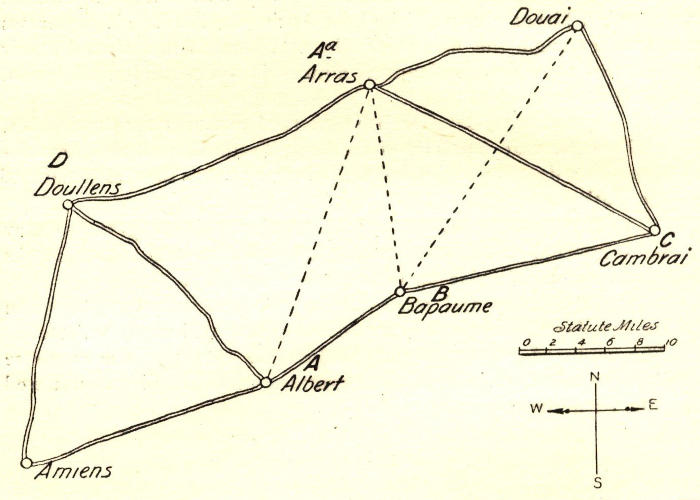
The gains in those battles are to be exploited. We shall be
occupied for some time to come within the four sides of that shell-ridden
quadrangle. The upper road from Doullens to Arras was free,
though it was not wise to try to enter Arras except under cover of darkness,
as the approach to it from the west was exposed to observation
and shell fire, and the town itself had been badly damaged by bombardment.
The lower road was free, as we know, till within three
miles of Bapaume, whence our front wound round to below Arras.
The object now is, to drive the Germans back on the whole long line
from Ypres to Reims, and, especially, within this area, to drive
them back between Arras and Bapaume, nearer to Douai and Cambrai.
That object was achieved, we shall see, in three great battles during
1917:—
- Arras in April and May,
- Ypres (3rd) in June till September, and
- Cambrai at the end of November.
Keeping this large view in mind, and recalling, generally, its
relations, as remarked briefly in the last chapter, to the configuration
of the soil and the effect of this and of other conditions on the plans
of the German High Command,[69] we may follow for a few days the
story of one unit’s experiences, in order to set these in relation to the
Division, the Corps, and the Army. For from the night of January
11th-12th, when the 62nd Division first slept, or tried to sleep—for
it was so cold—on French soil, till the Battle of Arras in April, every
Battalion in that Division was engaged in the same driving work:
in the same work of driving the Germans back, of anticipating their
retreat to prepared positions, of consolidating small but important
gains, of proving their own worth as a fighting unit, of breaking out,
between Thiepval and Hébuterne, to Serre, Puisieux, Miraumont,
Achiet, Irles, Pys, always nearer to the Bapaume-Arras road. We
may select for this purpose the 2/5th Battalion of the Duke of Wellington’s
West Riding Regiment. It was another Battalion of the same
Regiment whose fortunes we followed in Chapter II. from its earliest
volunteer beginnings, and now, as then, we possess the advantage of
consulting a personal diary kept by an Officer of the selected unit.[70]
The first thing, where everything seemed strange, was to get to
know the way about. A ride to Auxi le Château gave opportunity
for a ‘very interesting talk’ with an Officer in the 1/5th Battalion
of the same Regiment (49th Division). A day or two later came a
tour of the trenches in an old London General omnibus. The party
visited Acheux and Warlencourt, and then drove along the Doullens-Arras
road, which was closed to traffic at one point owing to shelling.
They went through Arras, noticing its damage by fire and incendiary
shells, and reached the line held by the 7th East Surreys. Here they
had an opportunity of watching the system of relief: the East Surreys
by the 6th West Kents. ‘It was a daylight relief and worked out
very well indeed.’ The reserve and front-line trenches were examined:
the latter were highly complicated; all the Platoon dug-outs were in
cellars, owing to the ruined state of the houses and factories; at one point,
only twenty-five yards from the German front-line. Patrols went out
clothed in white to match the snow. A Company cook-house was
blown in by trench-mortar fire, wounding two servants and ruining
the breakfast. And so back to Doullens and Bus-les-Artois, rejoining
their Battalions. This was in January. On February 3rd, ‘the weather
was so cold that the ink in my fountain-pen was frozen.’ On the 7th,
‘the cold was so intense that the oil on the Lewis guns froze.’ On
the 13th, a tour in the trenches before Serre, in relief of the 1st Dorsets:
‘the sights one saw in and about the trenches rather opened one’s
eyes. The dead, both our own and the enemy, were lying about
partially buried; rifles, grenades, unexploded shells, bombs and equipment.
The trenches themselves did not exist as such, as in most
cases they had been blown in.’ On the 15th, the thaw commenced,
and in some respects was more intolerable than the frost. The mud
in places was two feet deep, and reliefs and so on were considerably
hampered.
The shadow, or, rather, the light, of the coming German retreat
lay over all. Every trench which was captured brought a wider view
and a larger prospect into sight, and there is no doubt that the 62nd
Division, to that extent more fortunate than the 49th, arrived at a time
and in a locality which afforded, in business parlance, small turn-overs
and quick returns. The long waiting experience which ate the heart
out of constantly harassed troops was now, temporarily, if not definitely,
passed; they were pushing outwards hopefully to open country
and signs of the retreat occurred every day. Thus, on
February 25th, at 2 o’clock in the morning, the enemy was
reported to have vacated Serre, which, if a straight line be drawn
from Albert to Arras, may be pricked in just to the left of that line at
a point about two-fifths along it. Puisieux lies on the line just above
Serre. Achiet-le-Petit, Achiet-le-Grand and Sapignies lie behind
Puisieux eastwards, at distances roughly, of two miles. Miraumont
is south of Puisieux, Irles south of Achiet-le-Petit, and Pys south of
Irles. They are all in the Albert-Arras-Bapaume triangle within the
shell-ridden quadrangle above.
Let us start at Serre on that dark February morning. A push
was made out and up towards Puisieux. There were strong positions
to be negotiated: Gudgeon Trench, Sunken Road, Orchard Alley
and Railway. Two patrols were sent out early on the 26th under
subaltern Officers of the 2/4th King’s Own Yorkshire Light Infantry,
and reported Gudgeon and Orchard trenches clear. Later, it was
discovered that the patrol’s Gudgeon was a trench not shown on the
map, and that the patrol’s Orchard was the true Gudgeon; mist and
mud and an unmapped trench are ugly extras in patrol-work. Three
Companies (A, B, D) of the Battalion were pushed up to the real Gudgeon
trench with orders to put out posts on the Sunken Road in front and
an observation-line on the Railway in front of that. They succeeded
in placing two outposts, but machine-gun fire stopped the observation-line.
There remained the heavily fortified Wundt Werk, which we
have not yet mentioned, and which was held by C Company under
the Officer Commanding the Battalion. Many fine deeds were
performed on this day of continuous exposure to shell and rifle fire.
A non-commissioned officer, for example, was sent forward to take
charge of a small party, who had been badly knocked about. He
kept them under cover in a shell-hole all the rest of the day, and by
his coolness and trustworthiness undoubtedly saved their lives.
The 2/4th K.O.Y.L.I. were relieved during the night by the
2/5th West Ridings, to whom we accordingly return. Their new
orders were to take Orchard Alley and push outposts in the Sunken
Road running from Puisieux to Achiet-le-Petit. At 8 p.m. on February
27th, the Commanding Officer advised the Brigadier that Orchard
Alley had been captured; at an early hour the next morning, the
outposts in Sunken Road had been established, and later in the day
these positions had been consolidated, and touch had been obtained
with the 2nd Royal Warwicks on the left and the 2/6th West Ridings
on the right. The Brigadier wired his appreciation, and, later, the
Military Cross was awarded to Lieut. P. R. Ridley in the following
circumstances:—
‘On the evening of 27th-28th February, 1917, the Officer
was in charge of a party of three Officers’ patrols, each of one
Officer and fifteen other Ranks, detailed to rush Orchard Alley
from Gudgeon Trench. Lieut. Ridley was responsible for maintaining
the direction, marching on a compass-bearing for 500
yards across unknown and difficult country. This Officer led
his party with great dash, shooting one German and capturing
another on entering the trench. He showed considerable coolness
and ability in the attack, and in organizing the defence of the
trench.’
The Military Medal was awarded on the same occasion to Lance-Cpl.
Herbert Priestley, who had been in command of a Bombing
Section in that party, and who, despite a wound in the head, led his
men in a most gallant manner. These were the first honours (first
of a long list) in the 62nd Division.
There was to be an attack on Achiet-le-Petit. The course of
the offensive indicated it, and it was indicated too, by attack-practices
early in March, when 500 men of the 2/5th West Ridings were employed
at Forceville in digging trenches similar to the German system at
Achiet-le-Petit. On March 15th, after completing sundry exercises,
the Battalion proceeded to Miraumont, where they took over a line
from the 2/5th King’s Own Yorkshire Light Infantry, half a mile
south-east of Achiet-le-Petit. They found the 2/4th of the same
Regiment on their right and the 2/7th on their left during this tour.
On the 17th, the 2/4th reported that they had occupied an enemy
trench 300 yards in advance of their line without meeting opposition;
at the same time patrols of the 2/5th found 300 yards in front of them
free from the enemy. Hopes rose, as the country began to open out.
B Company was promptly ordered to push on through Achiet-le-Petit,
and to occupy Sunken Road, north of that village. The remaining
Companies also moved forward, and occupied the support-trenches.
Later on the same day, a further push was made to Achiet-le-Grand;
gaps were to be cut in the wire to let the Cavalry through, and D Company
was to push on to Gomiecourt. The wire proved a formidable
obstacle; but just before midnight on the 17th the Brigadier was
informed that the orders had been carried out. By 4-30 a.m. on March
18th, D Company was in occupation of Gomiecourt. They had
encountered only slight machine-gun fire, and five hours later the
Cavalry went through. Thenceforward to the end of March, the
Battalion stood fast on the ground occupied. There was plenty to
do in consolidating it, and plenty of German material left behind
which served that purpose. But all existing accommodation had been
destroyed, the majority of trees had been killed, several dug-out
entrances had been mined, and important road-junctions had been
blown up.
We may read a part of this story in more detail. Little exploits
fully related illuminate the history which they helped to make. What
part was borne by B Company (above) in this adventure? They
were commanded by Captain Joseph Walker, whose orders were to
hold Resurrection Trench south of Achiet-le-Petit and to capture
that village. For three days and nights they came in for a very heavy
bombardment, in which the trench was obliterated in parts and severe
casualties were suffered. On March 17th, an hour before dawn,
two battle-patrols were sent out to the flanks of the village. The rest
of the Company followed under Captain Walker, and, despite some
machine-gun fire, they took the village and passed through it. They
dug-in on the north side and threw out a defensive flank, which drove
off the enemy rearguard. Achiet-le-Petit was promptly blown to
bits by ‘a terrific barrage of heavy stuff,’ but B Company had not
waited for it. At mid-day the Corps Pigeoner arrived with a basket
of birds, and reports were sent back to Headquarters. In the evening,
instructions came for the whole of the line to move forward and attack
Achiet-le-Grand and Gomiecourt. Before this could be done, the
German wire had to be cut to allow the Cavalry to pass through.
‘The wire was nearly a hundred yards in depth in three broad belts,
and so thick that it had to be dug up in parts.’ The task was completed
before daylight by B and C Companies. B Company then advanced
to their objective and occupied the western side of Achiet-le-Grand,
and A Company cleared Logeast Wood: a good day’s work, it will
be admitted.
This narrative may still be expanded: the day’s work is typical
of what was happening throughout the district. From Achiet-le-Grand
to Gomiecourt, two villages otherwise insignificant, the distance
is under two miles. At 1 a.m., March 18th, 1917, there was a heavy
mist, and it was difficult to find the road; so ‘we struck across open
country on compass-bearing,’ say the records, ‘and arrived in the
trenches west of Gomiecourt at 3-30 a.m., occupied these, and then
sent out two patrols through the village, but they did not find a soul’:
a deserted village, but from other causes than Oliver Goldsmith’s.
‘The junction of every road in the village had been mined and
blown up, and everything of value had been destroyed. All
fruit-trees had either been cut down, or an incision made round the
bark so that the sap would not rise.[71] All wells had been blown in,
and one had been poisoned with arsenic,’ so the R.E. Officer reported
to our diarist. The R.E.’s took 700 lbs. of unexploded charge out of
the cellar of the only village château, where the front stairway had
fallen in and there was a big hole in the floor of the entrance hall.
We read an interesting note, too, on March 26th: ‘Walked with
Lieut. Ridley’ (we watched him win his M.C.) ‘across country to
Bapaume’ (the eleven miles had been cleared at last). ‘Noticed the
Hôtel de Ville still standing; most other buildings had been blown
up. Then went south of the town towards the trenches, but, as these
reminded one too much of Beaumont Hamel, had lunch and then came
back. Walked along the Bapaume-Arras’ (B, Aa) ‘main road as far
as Ervillers’ (a third of the way from Bapaume) ‘and then struck
across country to Gomiecourt. Bapaume Town Hall and Sapignies
Church had both been mined and left by the enemy and blew up
during the night.’ So, the deserted villages bore traces of their late
inhabitants.
If a straight line be drawn from Bapaume to Douai, bisecting
the Cambrai-Arras road (C, Aa, of our quadrangle), and if that straight
line be divided into three equal parts, the village of Bullecourt will be
found at one-third of the way from Bapaume and two-thirds from Douai.
It is thus well within our quadrangle, yet well on the further side of
the road from Bapaume to Arras, along which we just now walked to
Ervillers. We shall be occupied with Bullecourt for some time:
on April 11th in a snowstorm, when ‘an attack was made against the
Hindenburg Line, in the neighbourhood of Bullecourt,’ and again
on May 3rd and following days, when ‘it was advisable that Bullecourt
should be captured without loss of time.’[72] For the German retreat
was at an end.
Bapaume had fallen on March 17th, Péronne on the following day.
South and east of Péronne, on the 21st, the Fourth Army had captured
forty villages. French troops reached the outskirts of St. Quentin,
and counted their villages by the score. The Cavalry, mounted and
dismounted, had come in for a bit of their own, and a fine exhilaration
of open fighting had been blown like a freshening breeze along the east
wall of the shell-torn quadrangle. But after the third week of March
the pace of the retreat began to slacken; and, as soon as the first days
of April dispelled the cover of the mist, and the wind and the sun
dried up the mud from which the Germans had been retiring, their
slower pace stiffened into resistance, and their resistance hardened
into battle. All along the Hindenburg Line, so much advertised,
yet in places so elastic, which was to guard the ridges of observation,
the Battle of Arras was engaged in April, May and a part of June,
and during the course of that Battle, Bullecourt was won and lost and
won again.
No more need be said about the retreat. The precise ratio
between initiative and compulsion, precisely how far, that is to say,
it was carried through according to plan and directed by forces under
German control, will not be settled till the official war-histories of
both belligerents have been published, and may even be disputed
thereafter. Certainly, it was admirably executed; less certainly, it
was voluntary in all its parts; most certainly, it was accompanied by
incidents which indelibly stained the reputation of the German Military
Command. That ‘the systematic destruction of roads, railways
and bridges in the evacuated area made unprecedented demands
upon the Royal Engineers,’ or that in four and a half days, for example,
from the morning of March 18th the Somme at Brie was rebridged for our
troops,[73] were facts of warfare as legitimate for the enemy as they were
creditable to his pursuers. What was illegitimate and irreparable was
the not less systematic destruction, forbidden in the Pentateuch, as
Mr. Buchan[74] notes, of ‘trees for meat’ and water for drinking. We
have remarked these features in petto: the single trees felled or slashed,
the single wells poisoned or blown in, the single monuments gutted or
mined; and France knows the full tale of her own wrongs.
So we come to the Battle of Arras, which opened definitely on
April 9th and rolled in thunder along the northern ridges to its renewed
flood in the Third Battle of Ypres.
We may look at the map again. The Battle of Arras was fought
on a front of sixteen or seventeen miles, stretching, roughly, nine miles
to the north and seven or eight to the south of Arras. Arras, as we
know, was within the British line; its cellars and sewers, as a fact,
had been prepared for the accommodation of our troops, though they
were not long in request. The British line to the south of Arras (we
are writing of the opening of the battle) crossed the Arras-Cambrai
main road almost immediately below the town, facing Tilloy-les-Mofflaines
on the right, and running down to Croisilles and Ecoust,
which looked across the line to Bullecourt. Below Bullecourt, two
miles or so to the right, and about three miles above the Bapaume-Cambrai
road, the village of Quéant should be observed for the sake
of its trench-connection with Drocourt in the north (east-south-east
of Lens), which formed a switch to the Hindenburg Line, in case
of German accidents behind Arras. It was the Quéant-Drocourt
trench-system which made Bullecourt so important to its defenders.
The British line to the north of Arras (still at the opening of the battle,
but outside of our original quadrangle) crossed the River Scarpe in
the eastern suburbs of the town, and ran up with a bearing to the left
between Souchez and Givenchy, turning to the right again between
Loos and Lens. Vimy, with all its fortifications, both natural and
artificial, was the key to an advance in this area. The situation should
be studied on a larger map, but it is useful to see it, too, in
miniature; and for this purpose we repeat once more our sketch
on page 90 above. On the rough square, Arras-Bapaume-Cambrai-Douai,
we erect now on the northern side the road-junctions from
Arras to Douai through Souchez and Lens. The British line
ran up, as we have said, between Souchez and Givenchy, with
Vimy and its ridges on the right, and ran down to the west of
Bullecourt, which helped to guard the Quéant-Drocourt switch. It
only remains to observe that from Lens to Ypres was a journey of less
than thirty miles, and that an attack at Messines and Wytschaete formed
an obvious corollary to successes at Bullecourt and Vimy.
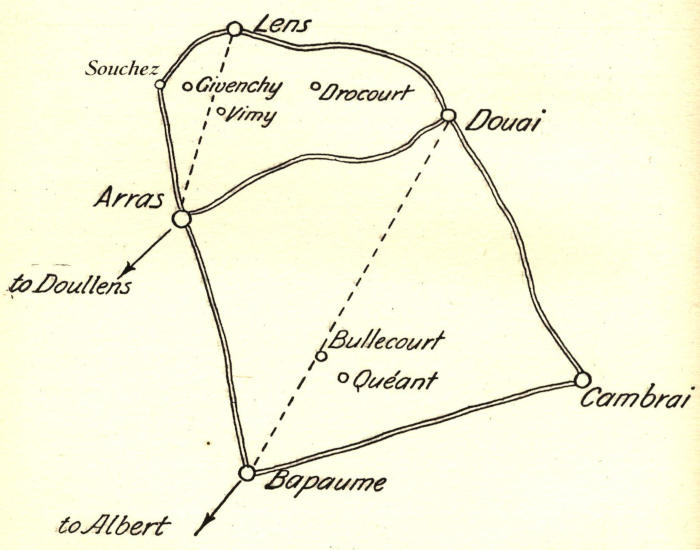
We are not directly concerned with the bigger strategy of
this Spring campaign. Sir Douglas Haig made it clear that
he regarded the capture of the Vimy Ridge as necessary in
itself and important for the view which it would afford over the plains
to Douai and beyond. When this object should be achieved he proposed
to transfer his main offensive into Flanders. ‘The positions
held by us in the Ypres salient since May, 1915, were far from satisfactory,’
he wrote. ‘They were completely overlooked by the enemy.
Their defence involved a considerable strain on the troops occupying
them, and ... our positions would be much improved by the
capture of the Messines-Wytschaete Ridge, and of the high ground
which extends thence north-eastwards for some seven miles.’ These
plans were re-adjusted to some extent by arrangement with the French
Command: ‘The British attack, under the revised scheme, was, in
the first instance, to be preparatory to a more decisive operation to
be undertaken a little later by the French Armies,’ and though, as
the British Commander wrote, ‘my original plan for the preliminary
operations on the Arras front fortunately fitted in well with what was
required of me under the revised scheme,’ yet, in order to give full
effect ‘to the new rôle allotted to me in this revised scheme, preparations
for the attack in Flanders had to be restricted for the time being
to what could be done by such troops and other labour as could not
in any case be made available on the Arras front.[75]’
So much in this place for the plans. What were the troops
entrusted with their execution? Looking at a larger map again, and
assuming for a moment that a week’s fighting (April 9th to 16th)
has already taken place, and that the British front has been advanced,
as indicated, from the outskirts of Lens in the north to Croisilles in
the south, we may now enumerate Sir Douglas Haig’s forces as they
were distributed from north to south in order of battle on April 17th.
Note that the First Army was commanded by General Sir H. S. Horne,
the Third by General Sir E. H. H. Allenby, the Fourth by General
Sir Henry Rawlinson and the Fifth by General Sir Hubert Gough:
great Generals all, and tried Commanders. We give, first, the
positions, so far as they can be located for certainty in the third line
which resulted from a week’s fighting, and, next, in descending scale
of military organization, the Army, the Corps, the Division, and the
Regiments:—
ORDER OF BATTLE, 17th April, 1917.
| Position. |
Army. |
Corps. |
Division. |
Regiments. |
| VIMY |
I. |
Canadian |
1st, 2nd, 3rd, 4th Canadian, 5th British. |
|
| North of RIVER SCARPE |
III. |
XVII. |
51st (Highland) |
Gordon Highlanders |
|
|
|
|
A. & S. Highlanders. |
|
|
|
|
Seaforth Highlanders. |
|
|
|
|
Roy. Scots. |
|
|
|
|
Black Watch. |
|
|
|
34th |
Roy. Scots (2 Bns.). |
|
|
|
|
Lincolnshire, Suffolk, |
|
|
|
|
Northd. Fus. (9 Bns.). |
| FAMPOUX |
|
|
9th (Scottish) |
Black Watch. |
|
|
|
|
Seaforth Highlanders (2 Bns.). |
|
|
|
|
Scottish Rifles. |
|
|
|
|
Roy. Scots (2 Bns.). |
|
|
|
|
A. & S. Highlanders. |
|
|
|
|
Cameron Highlanders. |
|
|
|
|
S. African Bde. (4 Bns.). |
|
|
|
|
K.O.S.B. |
|
|
|
4th |
Household Bn. |
|
|
|
|
Roy. Warwickshire. |
|
|
|
|
Seaforth Highlanders. |
|
|
|
|
R. Irish Fus. |
|
|
|
|
Somersetshire L.I. |
|
|
|
|
E. Lancs. |
|
|
|
|
Hampshire. |
|
|
|
|
Rifle Brigade. |
|
|
|
|
K.O. (R. Lancs.) |
|
|
|
|
Lancs. Fus. |
|
|
|
|
Duke of Wellington’s (W.R.). |
|
|
|
|
Essex. |
| South of RIVER SCARPE near MONCHY |
|
XVIII. |
12th (Eastern) |
Norfolk. |
|
|
|
|
Suffolk. |
|
|
|
|
Essex. |
|
|
|
|
R. Berkshire. |
|
|
|
|
R. Fusiliers (2 Bns.). |
|
|
|
|
R. Sussex. |
|
|
|
|
Middlesex. |
|
|
|
|
Queen’s (R.W. Surrey) |
|
|
|
|
Buffs (E. Kent.) |
|
|
|
|
E. Surrey. |
|
|
|
|
R.W. Kent. |
|
|
|
|
Northants. |
|
|
|
14th (Light) |
K.R.R.C. (3 Bns.). |
|
|
|
|
Rifle Bde. (3 Bns.). |
|
|
|
|
Oxford & Bucks L.I. |
|
|
|
|
K.S.L.I. |
|
|
|
|
Somerset L.I. |
|
|
|
|
D.L.I. |
|
|
|
|
K.O.Y.L.I. |
|
|
|
|
Durham L.I. |
|
|
|
|
King’s (Liverpool). |
|
|
|
30th |
Liverpool (4 Bns.). |
|
|
|
|
Manchester (4 Bns). |
|
|
|
|
Beds. |
|
|
|
|
Yorks. R. |
|
|
|
|
Scots. Fus. |
|
|
|
|
Wilts. |
|
|
|
|
S. Lancs. |
|
|
|
37th |
R. Fus. (2 Bns.). |
|
|
|
|
K.R.R.C. |
|
|
|
|
Rifle Bde. |
|
|
|
|
R. Warwickshire. |
|
|
|
|
E. Lancs. |
|
|
|
37th |
N. Lancs. |
|
|
|
|
Beds. |
|
|
|
|
N. Staffs. |
|
|
|
|
Lincolnshire. |
|
|
|
|
Somerset. |
|
|
|
|
Middlesex. |
|
|
|
|
York. & Lancs. |
|
|
VI. |
29th |
R. Fus. |
|
|
|
|
R. Dublin Fus. |
|
|
|
|
Lancs. Fus. |
|
|
|
|
Middlesex. |
|
|
|
|
K.O.S.B. |
|
|
|
|
Inniskilling Fus. |
|
|
|
|
S. Wales B. |
|
|
|
|
Border. |
|
|
|
|
Essex. |
|
|
|
|
Hampshire. |
|
|
|
|
Worcestershire. |
|
|
|
|
Newfoundland. |
| Advanced, via ARRAS |
|
|
15th (Scottish) |
Black Watch. |
|
|
|
|
Seaforth Highlanders. |
|
|
|
|
Gordon Highlanders (2 Bns.). |
|
|
|
|
Cameron Highlanders (2 Bns.). |
|
|
|
|
R. Scots. |
|
|
|
|
R. Scots. Fus. |
|
|
|
|
A. & S. Highlanders |
|
|
|
|
K.O.S.B. |
|
|
|
|
Scottish Rifles. |
|
|
|
|
Highland L.I. (2 Bns.). |
| ? |
|
|
3rd |
K.R.R.C. |
|
|
|
|
10th R. Welsh Fus. |
|
|
|
|
West Yorks. |
|
|
|
|
R. Scots. |
|
|
|
|
Gordon Highlanders. |
|
|
|
|
R. Scots. Fus. |
|
|
|
|
R. Fusiliers. |
|
|
|
|
Northd. Fus. |
|
|
|
|
Suffolk. |
|
|
|
|
K.O. (Roy. Lancs.) |
|
|
|
|
E. Yorkshire. |
|
|
|
|
7th K.S.L.I. |
|
|
|
|
12th King’s (Liverpool) |
| ? |
|
|
17th (Northern) |
W. Yorkshire. |
|
|
|
|
E. Yorkshire. |
|
|
|
|
Yorkshire. |
|
|
|
|
Dorsetshire. |
|
|
|
|
Lincolnshire. |
|
|
|
|
Border. |
|
|
|
|
S. Staffs. |
|
|
|
|
Sherwood Foresters. |
|
|
|
|
Northd. Fus. |
|
|
|
|
Lancs. Fus. |
|
|
|
|
Duke of Wellington’s (W.R.). |
|
|
|
|
Manchester. |
|
|
|
|
Yorks. & Lancs. |
| South of VIth. Corps |
|
VII. |
21st |
Northd. Fus. (3 Bns.). |
|
|
|
|
E. Yorkshire. |
|
|
|
|
Yorkshire. |
|
|
|
|
Durham L.I. |
|
|
|
|
K.O.Y.L.I. (2 Bns.). |
|
|
|
|
Leicestershire (4 Bns.). |
|
|
|
|
Lincolnshire. |
| Between R. Cojeul and R. Sensée |
|
|
33rd |
R. Fusiliers. |
|
|
|
|
K.R.R.C. |
|
|
|
|
King’s. |
|
|
|
|
Queen’s. |
|
|
|
|
Suffolk. |
|
|
|
|
Worcestershire. |
|
|
|
|
Scottish Rifles (2 Bns.). |
|
|
|
|
Middlesex. |
|
|
|
|
A. & S. Highlanders. |
|
|
|
|
R. Welsh Fus. |
|
|
|
|
Highland L.I. |
| ? |
|
|
50th (Northumbrian) |
Northd. Fus. |
|
|
|
|
Durham L.I. |
|
|
|
|
Yorkshire. |
|
|
|
|
|
| ? |
|
|
56th (London) |
London. |
|
|
|
|
Middlesex. |
|
|
|
|
|
| BULLECOURT |
V. |
V. |
7th |
Border. |
|
|
|
|
Devonshire (2 Bns.). |
|
|
|
|
Queen’s. |
|
|
|
|
Gordon Highlanders. |
|
|
|
|
H.A.C. |
|
|
|
|
R. Welsh Fus. |
|
|
|
|
S. Staffs. |
|
|
|
|
Manchester (4 Bns.). |
|
|
|
|
Warwickshire. |
| ? |
|
|
11th (Northern) |
D. of Wellington’s. |
|
|
|
|
W. Yorkshire. |
|
|
|
|
Yorkshire. |
|
|
|
|
York. and Lancs. |
|
|
|
|
Lincolnshire. |
|
|
|
|
Border. |
|
|
|
|
S. Staffs. |
|
|
|
|
Sherwood Foresters. |
|
|
|
|
Dorsetshire. |
|
|
|
|
Northd. Fus. |
|
|
|
|
Lancs. Fus. |
|
|
|
|
Manchester. |
|
|
|
|
E. Yorkshire. |
| BULLECOURT |
|
|
58th (London) |
London, 2nd Line, T.F. |
|
|
|
62nd (W. Riding) |
W. Yorks. (4 Bns.) |
|
|
|
|
D. of Wellington’s (4 Bns.). |
|
|
|
|
K.O.Y.L.I. (2 Bns.). |
|
|
|
|
York. & Lancs. (2 Bns.). |
| LAGNICOURT |
|
Australian |
|
|
It was a strong force, as is apparent, and except in the extreme
southern sector, from Ecoust (opposite Bullecourt) to Lagnicourt, no
2nd Line Territorial troops were engaged. There, with Londoners
on their left and Australians on their right, twelve battalions from the
West Riding took their part.
The operation was not successful. ‘The attacking troops of
the Fifth Army,’ wrote Sir Douglas Haig, ‘were obliged to withdraw
to their original line.[76]’ Thus they missed the more sensational advances
which were secured at Vimy and Monchy-le-Preux. But they contributed
by their action to those results, and their gallantry earned
a high encomium from the British Commander-in-Chief, and established
for the 62nd Division, in its first engagement on a big scale,
a record worthy of more veteran troops.
Let us start in this sector on April 9th, the day of the opening of
the Battle of Arras.
It was explained to the Front-line Battalions that, in the event of
the attack of the Third Army on Neuville Vitasse being successful,
and of the advance being pushed forward to Fontaine-les-Croisilles
and Cherisy, the enemy might evacuate his positions. Patrols were
sent out, accordingly, in order to ascertain the facts; and the 2/6th
West Yorkshires, for example, if we may select one Battalion out of
the twelve, were ordered to hold themselves in readiness to advance
after 12 o’clock noon at one hour’s notice. A provisional scheme of
operations was laid down, in anticipation of the sequence of events,
should the Hindenburg Line be evacuated on that part. These plans
missed fire, however, and on the next day (10th) the unit which we
have selected was still stationed at St. Leger. In the early morning
information arrived of an impending German counter attack, and, after
orders had been issued for a move at ten minutes’ notice, Brigade
Orders arrived during the afternoon for a night march to Ecoust. This
move was duly accomplished. The object was to capture Bullecourt
and Hendecourt, and then to move forward in the general direction of
Cagnicourt, on the further side of the Quéant switch. Shortly after
midnight on April 11th, the troops were informed to this effect;
Zero hour was 4-30 a.m.
We have to record that the operation, as planned, could not be
fully carried out. Briefly, it had been devised as follows: unless,
as seemed improbable, the Hindenburg Line should be found to have
been evacuated, the Australian Division, supported by Tanks, was to
push forward to Riencourt and Bullecourt. As soon as their work
rendered it possible, the 185th Infantry Brigade (Brigadier-General
V. W. de Falbe, C.M.G., D.S.O.) was to push one Battalion into Bullecourt
from the south-west, with another Battalion in support. The
Tanks (two, followed by four), after clearing Bullecourt, were to move
out of the village, and clear the Hindenburg Line up to a stated position,
where they would come under the orders of General de Falbe, in command
of an Advanced Guard, detailed to capture Hendecourt and to
move forward as indicated above. This formed the operation, as
planned. The operation, as executed, starts with Battalion reports to
the Brigade, at 5-15 a.m., 6 a.m. and 7-10 a.m., to the effect that not
a Tank was in sight. We may imagine the anxiety at Headquarters.
Reconstruct the surroundings on that April morning: the immense
line of British Troops stretching right away beyond Vimy, the noise
of guns, the open country on the other side; remember the significance
of Bullecourt, not merely as the objective of the 62nd Division, but as
the last stronghold of the enemy in that sector before he retired to the
Quéant switch behind the real Hindenburg Line; multiply every
missed appointment and its consequent inconveniences in civil life
to the nth power of calculation; add a responsible sense of the great
issues depending on prompt action; and then conceive what it meant
to Lt.-Col. John H. Hastings, D.S.O., the Officer Commanding the
2/6th West Yorkshires (to return for a moment to this unit), to have to
report three times in two hours that, so far as he was aware, the conditions
precedent to his pushing on to Bullecourt still remained
unfulfilled. Item one: the Tanks had not arrived. Item two: there
was still no news of the Australians having entered Bullecourt. Colonel
Hastings went forward to make enquiries, and to discuss matters
with the Australian Division. On his return, he advised the Brigadier
that the situation was ‘very obscure.’ His patrols, he said, had not
reported, but there was no sign of the Australians clearing Bullecourt,
and several enemy machine-guns had been located on the south-east
fringe of the village. This report crossed a message from the Brigade
(through the 2/8th Battalion, West Yorks.), stating that Tanks had
been seen at a factory between Bullecourt and Hendecourt, and adding:
‘Please take immediate action, without waiting for Tanks to arrive,
to clear up situation in Bullecourt and seize Hindenburg Line to
the west of the village.’ (This message in original was received an
hour later.) A reply was sent through the 2/8th Battalion to the effect
that the instructions seemed to be ‘based on faulty and erroneous
information’: the main point was that the Australians had not entered
Bullecourt, and that reports from the patrols were still awaited. While
this reply was on its way, the Brigadier visited the Battalion Headquarters,
and ‘was evidently dissatisfied with the want of progress.’ He
admitted to Colonel Hastings that the conditions laid down as preliminary
to the advance still appeared incomplete (which means that
the Tanks had not operated), but he was anxious that the push should
be attempted, and Colonel Hastings went up again to investigate.
Meanwhile, what about the Tanks? Major W. H. L. Watson,
D.S.O., of the Machine-Gun Corps, Heavy Section, writing in
Blackwood’s Magazine, June, 1919, stated that, ‘of my eleven Tanks,
nine had received direct hits and two were missing.’ He pointed out
that the sudden change of plans between April 10th and 11th had proved
somewhat upsetting, that the crews were composed of tired men,
that a blizzard was blowing, and that the snow proved bad cover.
He added that the Australian troops were turned distrustful of Tanks
for some months, and that a British Brigadier, to whom he was paying
a farewell visit, told him, ‘with natural emphasis, that Tanks were
“no dammed use.”’ Further than this, we need not pursue the
question. A day was to come very soon when the new weapon would
outpace the Infantry, and help effectively to win its battles. At Bullecourt,
on April 11th, the co-operation was not adequate.
At 11 o’clock that morning, Colonel Hastings, ruling out the
Tanks, expressed his deliberate conviction that the village could not
be captured by daylight, except by very great sacrifices. The wire
was uncut, the snipers were active, and there was very little cover.
Three hours later, Brigade orders arrived to withdraw the patrols, and at
dusk the Battalion relieved the 2/7th Battalion of their own Regiment
in the right sector of the front facing Bullecourt. The relief was
completed at 1 a.m. on April 12th, and another long and trying day
was spent in tapping the Bullecourt defences, which were found to
be still formidable. By 5 a.m. on the morning of the 13th, the relief
of the Battalion in its turn by the 2/7th West Ridings was completed,
and they returned to Ervillers on the Bapaume-Arras road.
They had suffered badly during this experience. On the 11th,
Lieut. C. F. R. Pells, 2/Lieut. A. G. Harris and 31 other Ranks were
killed, and the wounded amounted to 30. Fine work was done by the
174th Tunnelling Company, R.E. (Major Hutchinson, M.C., Commanding),
in digging out the victims of a collapsed house in which
two Officers were killed: they worked thirty hours continuously and
rescued nine men alive.
Meanwhile, Bullecourt had not been captured. If a detailed
map be consulted again, it will be seen that the British lines of
April 16th and 24th both met at their southern extremity on the
wrong (north) side of the River Sensée, and formed a dangerous
salient, or inward bulge, with the British line running south from
Croisilles. The Hindenburg Line at Bullecourt still guarded the
switch-line at Quéant; and this failure was the more disappointing
in view of the easterly advances along the River Scarpe behind Arras,
and, further north, behind Vimy and its woods and hills. Tanks had
shown fine capacity during that fortnight. The gallant Infantry had
accomplished by their aid what it took them nearly as many months
to accomplish with much worse casualties on the Somme in 1916.
For the missing weapon had been found, though its full use was still
to be discovered, and obstacles even more formidable than had held
up the 49th Division at Thiepval were levelled or reduced.
We pass at once to the renewed assault on Bullecourt between
May 3rd and 17th.
The 62nd Division was once more engaged. The new weapon
was brought again to the attack, and, though further experience was
still wanted before its masterly employment at Cambrai in November,
the last phase of the Battle of Arras clearly demonstrated to all those
who chose to see the immense value of co-operation between Infantry
and Tanks. That the brunt of the Infantry fighting in these
experimental days fell on the troops from the West Riding, will
find a place in military history as well as in Yorkshire records.
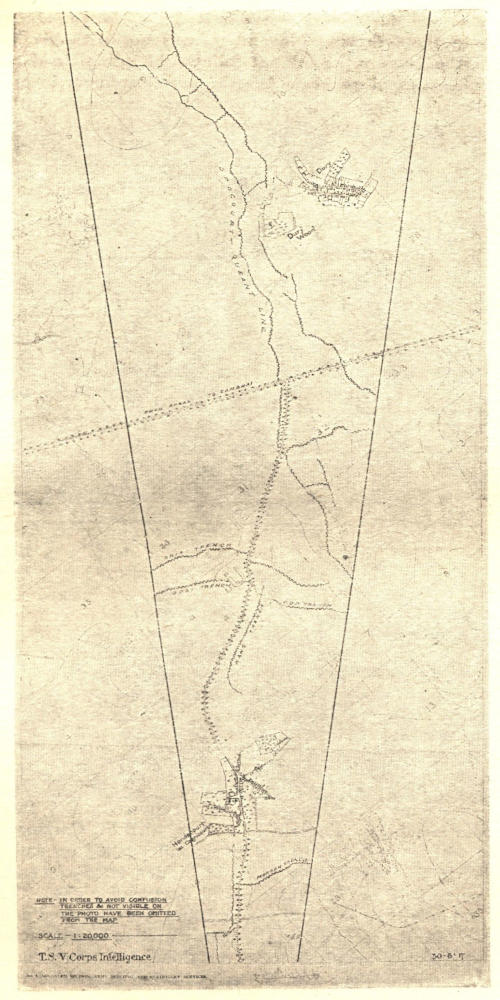
Brigade Orders with reference to the fresh assault were received
immediately after the old. Already on April 15th, the plan of operations
was to hand, and the intervening seventeen days was spent mainly
in rehearsals. The order of advance from the right was the 185th
Infantry Brigade (de Falbe), the 186th (Hill) in the centre, and the
187th (Taylor) on the left. Each Brigade had its definite objective,
and they advanced to the attack side by side. The Third Army
operated eastwards in the direction of Fontaine-les-Croisilles, with
the 2nd Australian Division on the right. Tanks were to crawl up in
sufficient numbers. The day was fixed for May 3rd. Zero hour
was 3-45 a.m. Once more we may quote Major Watson[77] as to the
part borne by the Tanks in this attack. ‘A costly failure,’ is his
description of the day’s work. Major R. O. C. Ward, D.S.O., who
was killed in the following November, was out with his Tanks in
front, ‘but the Infantry could not follow,’ he complained. ‘Attack
unsuccessful. Casualties heavy,’ is the bare statement in one of the
Battalion diaries. Before consulting a more expansive authority, it
will be interesting to examine the accompanying photograph of Hendecourt
from the air. Above the village, we see the main road from
Arras to Cambrai, which runs from north-east to south-west. Crossing
that road, we see the switch trench-line from Drocourt to Quéant,
which ran roughly, from north to south. The trenches guarding the
village, Orix, Opal, Hop, Morden, are indicated on the face of the
photograph, and are still more clearly displayed in the ground-plan sketch
which we also reproduce (p. 133). Turning back now to May 3rd, we
have the advantage of some notes by an Officer of the 62nd, who
watched the opening barrage from the top of the railway embankment.
It was an unforgettable sight. ‘Shells of all sizes screamed through the
air, and bullets from our machine-guns sped towards the enemy lines.
The noise was deafening and appalling. Then the Tanks went forward
to do their part in the attack. Hundreds of Very lights and
coloured signals were sent up by the enemy all along his line’; and
to the careful watcher and time-keeper, these lights and signals brought
evil tidings. For after two Companies of one Battalion of the 62nd
should have been in the enemy second-line trench, ‘enemy lights
were still sent up from that direction.’
We turn to a Company record. Take, for instance, B Company
of the 2/5th West Ridings. They advanced steadily to the attack,
and fought their way up the slope to the ridge on the left of Bullecourt.
But they met very formidable opposition. Some think that the sound
of the Tanks deploying in their assembly positions may have reached
acute enemy ears; but, whether or not this was the case, and,
on the whole, the evidence is against it, a devastating machine-gun
fire and a terrific barrage of high explosive and shrapnel were
suddenly opened on the advancing Company, while hidden concrete
emplacements protected the enemy guns. The survivors gallantly
rallied, and pressed on into the Hindenburg Line through a ‘tornado
of bullets.’ Lieut. O. Walker was killed at this point, as he was
charging at the head of his platoon, rifle in hand, through the German
wire. Two enemy machine-guns were captured, and their crews
killed by our bombers. Captain J. Walker, M.B.E., Commanding the
Company, with a mere handful of men, still pushed on and forced a
broken way to the next strong point of hidden emplacements. Here
the little party held out for three awful days and nights. They had
no water and only their iron rations, and they were bombed and shelled
all the time. On the second day, the enemy tried to take them prisoners,
but the attempt was repulsed. On the third day, when the position
was blown in through our own Batteries having shortened range, this
very brave Officer and his few surviving wounded men contrived to
fight their way back through the German outpost line, in broad
daylight and fired at from every side. A nine hours’ struggle brought
them home ‘by a miracle.’[78] Bullecourt was still uncaptured, but
its blood-soaked ridges and trenches had taught the Prussians the
meaning of Yorkshire grit.
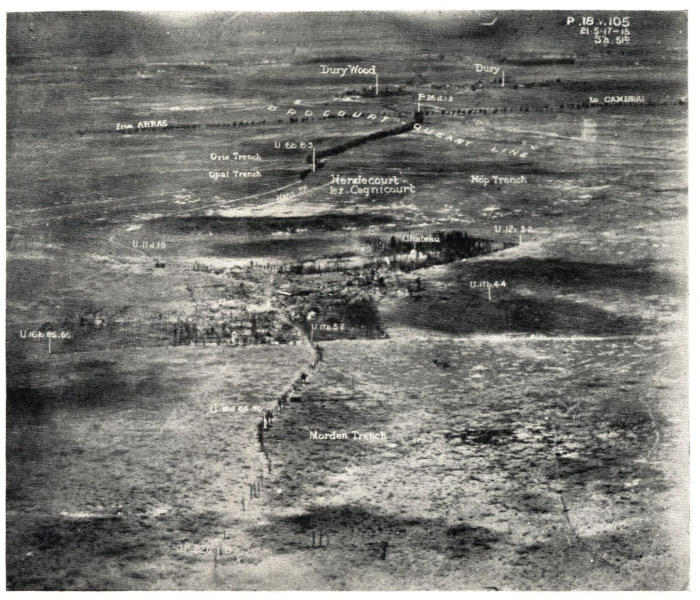
HENDECOURT FROM THE AIR.
The story may be repeated, if it is not clear enough, from the
diaries of other Battalions. Take the 2/4th York and Lancasters, for
example. It is a vivid narrative, which may be quoted almost
verbatim:
By Zero hour on May 3rd, the men had marched on to the tape
line, extended, and formed waves, as ordered, each man fixing his
bayonet and lying down directly he got into his place. Just as the
head of the 6th line came into its alignment, a shell burst close by,
wounding Lt.-Col. Blacker, Commanding, and about six other Ranks.
‘Don’t mind me, get the lines out,’ was the gallant Officer’s order,
which was instantly obeyed: though the shelling was heavy all the
time, the operation was completed as if in a practice-attack. The
Adjutant found the lines absolutely correct, and men lying close to
shell-holes had in many instances refrained from taking cover for fear
of spoiling their interval. It was this kind of spirit which beat the
Germans, though they kept us out of Bullecourt on May 3rd. Colonel
Blacker, with the assistance of his servant, returned to Battalion Headquarters,
and Major Richardson arrived from Brigade to take over the
Command of the Battalion. A rum-ration was served out at 3 a.m.,
and the first line advanced at Zero (3-45 a.m.) less eight minutes.
In order to understand what followed, it must be borne in mind that
there were 900 yards to be traversed before the first German trench
was reached: 900 yards through the heavy smoke and dust of the
barrage depicted above. To keep intervals, distance and direction
was not an easy task even for the best-trained troops. Still, all was
going well, till some confusion was caused by another unit crossing
their front between the 4th and 5th lines. These troops were ordered
to withdraw and re-form, but the order was mistaken by about 70 men
of the right rear Company of the invaded Battalion. They thought it
was addressed to them, and withdrew, accordingly, to the railway
embankment. The rest, steadily led, despite the mixture of units,
pushed on to the first German trench, but the waves had lost their
formation before the second line was reached. Major Richardson was
killed in a courageous attempt to find out exactly what was happening,
and, later, Brigade orders arrived to parade all available personnel
for a second attack in two lines. It ended miserably in shell-holes,
which afforded insufficient protection from casualties out of proportion
to the result, and about 4 o’clock in the afternoon of the long day the
order came to retire to the railway cutting. The 7th Division relieved
the 62nd.
We need not multiply the records. ‘The attacking troops eventually
withdrew to the railway cutting’; ‘finally forced to retire about
11-30 a.m. on the railway embankment’; these entries and entries
like these recur with maddening iteration in the narratives of the units
on this date, and the loss of life was terribly high. But Bullecourt fell
in the end. Ten men had been left in the coveted village by troops
which had reached it on May 3rd, but had fallen back from all but its
fringes, and these ten men were rescued on May 8th. Day by day,
the stubborn fight was waged, with attack and counter-attack of intense
ferocity and varying fortune, till at last, on May 17th and following
days, Territorial Troops of the County of London and the West Riding
drove out the last remnants of the German garrison from their last
stronghold in front of Quéant. Let Sir Douglas Haig tell the tale of
these successes, which brought to a victorious close the series of fighting
known as the Battle of Arras:
‘At 3-45 a.m. on the 3rd May, another attack was undertaken by
us.... While the Third and First Armies attacked from Fontaine-les-Croisilles
to Fresnoy, the Fifth Army launched a second attack
upon the Hindenburg Line in the neighbourhood of Bullecourt.
This gave a total front of over sixteen miles. Along practically
the whole of this front our troops broke into the enemy’s positions....
To secure the footing gained by the Australians in the
Hindenburg Line on the 3rd May, it was advisable that Bullecourt
should be captured without loss of time. During the fortnight
following our attack, fighting for the possession of this village went
on unceasingly.... On the morning of the 7th May,
English troops (7th Division, Major-General T. H. Shoubridge)
gained a footing in the south-east corner of Bullecourt. Thereafter
gradual progress was made, in the face of the most obstinate
resistance, and on the 17th May, London and West Riding
Territorials[79] completed the capture of the village....
On the 20th May fighting was commenced by the 33rd Division
(Major-General R. J. Pinney) for the sector of the Hindenburg
Line lying between Bullecourt and our front-line west of
Fontaine-les-Croisilles. Steady progress was made until by the
16th June touch had been established by us between these two
points.’[80]
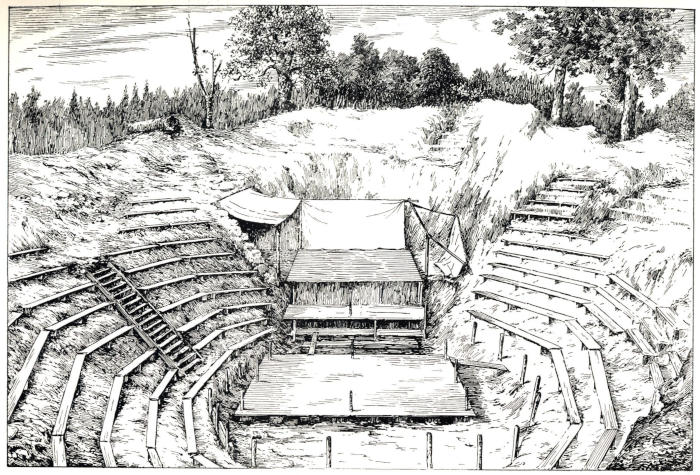
COLISEUM MADE OUT OF A GERMAN CRATER.
We had intended to close here the present chapter. But our
impression of life at the front with the 62nd Division is incomplete
without reference to the mimic warfare and the relaxation from war
which likewise formed part of its experience. On that very day,
June 16th, when the Bullecourt sector was finally consolidated, Divisional
Sports were being held at Achiet-le-Petit. In a Coliseum made
out of a German crater, which we illustrate from a pencil-sketch on
the spot, the Divisional Band was playing on June 14th, and boxing
contests were being fought. Two days later, a Gymkhana was held,
in which some of the chief events were dribbling a football on horseback,[81]
driving a pair of mules tandem,[82] and collecting stones to drop
into a bucket.[83] On June 20th, three Officers of the 2/5th West Ridings
rode from Achiet-le-Petit to Thiepval, and went over the ground which
had been fought by the 1st Line Battalion of their Regiment nearly a
year before. ‘Forsan et haec olim meminisse juvabit,’ they may have
thought, as they contrasted their leisurely ride with the heat of battle
which the site recalled; and the same thought, applied to their own
experience, may have revealed the hope of a future day when Bullecourt,
like Thiepval, would be remembered as a past stage in a victorious
advance.
CHAPTER X — I.—THE NORTHERN RIDGES — II.—BETWEEN THE BATTLES. — III.—THE BATTLE OF CAMBRAI (FIRST PHASE) — IV.—BATTLE OF CAMBRAI (SECOND PHASE).
Between the Battle of Arras in the Spring and the Battle of
Cambrai in the Autumn came the Third Battle of Ypres in the Summer.
This middle battle in time (with which, in the history of the West
Riding, we shall not be much concerned) was the northernmost battle
in space, and its success, if it had been fully successful, would have
been amphibious in kind. It would have rendered untenable by
Germany the sea-bases of her submarine campaign, thus relieving
the food-problem for the Allies, and it would have removed the
military peril, fought out to a standstill in 1915, which threatened
Paris and the Channel ports. On this account, as we saw in the last
Chapter, the northernmost battle of the three was originally the chief
in significance according to Sir Douglas Haig’s plans. If we may regard
the long Allied line, say, from Reims to the sea, throughout, and even
beyond, the fighting season of 1917, as the scene of a single battle,
we must add that the course of that battle did not follow Sir Douglas
Haig’s wishes. We read above of a ‘revised’ scheme, of ‘restricted’
preparations for the attack in Flanders, and we infer (indeed, we are
informed) that, if Haig had been in sole Command of the Allied Forces
on the Western front, he would have disposed the programme a little
differently. Happily, it is not our business to judge the strategy of
the war. Our task is to narrate the part which was played by a few
thousand Yorkshiremen in bringing the war to a victorious close.
Strategy was not in their contract: the Colonel obeyed his Brigadier,
the General his Corps Commander; and even in a larger sphere, Sir
Douglas Haig was less than supreme. In the triple battle of 1917
many factors entered into account. To burn out the submarine
nests, to countervail Italy’s fate of arms, to anticipate Russia’s defection,
to release French industry and railways: these were a few of the
considerations which affected the movements of the Allied Armies
between Verdun and Ypres, the two flagstaffs of French and British
ardour. That they were, primarily, political considerations does not
mean that they were wrongly brought into account. Always the
strategical initiative, as distinct from the tactical, lies partly outside
the control of the fighting men. But there was worse than this in
the series of conditions which determined the fighting of 1917. The
sequence of battle-areas (Arras, Ypres, Cambrai) might be dictated
by causes which prevailed over the best-laid plans; the course of the
battles themselves, especially of the Summer-battle about Ypres, was
dictated by less calculable chances. Among these were the ‘pill-boxes’
and the mud, the solid and the fluid conditions. When to
break off that last battle was almost more difficult a problem than when
to engage it; and if its commencement was postponed by causes
outside Haig’s control, we can read between the lines of his Fourth
Dispatch the hesitation with which he carried it on:
‘After weighing these considerations, as well as the general
situation and various other factors affecting the problem, among
them the desirability of assisting our Allies in the operations
to be carried out by them on the 23rd October in the neighbourhood
of Malmaison, I decided to continue the offensive further....
‘Though the condition of the ground continued to deteriorate,
the weather after this was unsettled rather than persistently wet,
and progress had not become impossible. I accordingly decided
to press on while circumstances still permitted....
‘By this time the persistent continuation of wet weather
had left no further room for hope....[84]’
it would be unnecessary to complete this final sentence, except that
it closes with the definite statement, that, ‘in view of other projects
which I had in view, it was desirable to maintain pressure on the
Flanders front for a few weeks longer.’ Once more, we are not
required to judge, but, at least, we may note the implication that,
even when there was ‘no further room for hope’ (surely, a grave
obstacle to progress) it was still necessary to ‘maintain pressure for a
few weeks longer.’
The West Yorkshire troops did not come in till close to the end
of this middle battle, and we shall presently be more fully concerned
with the ‘other projects’ elsewhere. But we can imagine what it
meant to those spent and battle-weary soldiers to ‘maintain pressure’
beyond the hope of progress. ‘Physical exhaustion,’ we read, ‘placed
narrow limits on the depth to which each advance could be pushed’;
and how far those limits should be forced was a matter of very difficult
discretion. ‘Time after time,’ runs the Despatch, ‘the practically
beaten enemy was enabled to re-organize and relieve his men, and to
bring up reinforcements behind the sea of mud which constituted his
main protection’; and at what point a ‘practically beaten’ enemy
should be left behind his barrier of mud was, again, very hard to decide.
Hard and difficult decisions for the High Command; but the hardship
and the difficulty of the fighting fell heavily on the fighting men, and
the Summer-battle of 1917, which was prolonged far beyond the
Summer, entailed, as Sir Douglas Haig tells us, ‘almost superhuman
exertions on the part of the troops of all arms and services.[85]’ The
great Commander chose his word well. If the triple battle of 1917
were to be fought out again, with all the conditions constant except
those which strategists could vary, there would be, conceivably, a new
time-table and a new distribution of effort at Arras, Passchendaele
and Cambrai: there would still be the ‘superhuman’ effort to overcome
the German advantage of irregular, murderous blockhouses,
like Martello-towers sunk in a sea of mud, and of not less irregular rain.
We come to closer quarters with this middle battle. It opened
on June 7th with an explosion of nineteen mines, which caused enormous
rents in the enemy front-line trenches, and which effectively
assisted the Artillery and the Air Force in their preparations for the
Infantry advance. Impressive from a spectacular point of view, it
was no sudden thing, this explosion. It represented many months of
patient labour by highly-skilled miners and engineers, the memory of
whose devotion to duty, under conditions of constant horror, should
help, in industrial times, to soften acerbities at home. It was, further,
the great surprise of the attack. British enterprise had to burrow
underground in order to escape the observation of an enemy, who,
since 1915, when the Ypres salient was inevitably contracted,[86] had
occupied all the commanding ground in a stretch of country where
60 feet was the measure of a mountain. Messines, Wytschaete and
Oostaverne were all captured on that first day (June 7th), together
with more than 7,000 prisoners and 450 pieces of Artillery. General
Sir Herbert Plumer and the Second Army, who had acted as wardens
of these marches through so many weary and exacting months, reaped
a swift reward in the second week of June.
Unfortunately, it did not end as it began. The obliteration of
two Battalions on the Yser between Nieuport and the sea on July 10th
belongs to the history of the Northamptons and the King’s Royal
Rifles, whose heroic defence of a position cut off from succour or
support is Homeric in its quality.[87] Canadian historians will tell
the tale of the capture of Hill 70 from the Prussian Guard, and of the
long struggles in the outskirts of Lens. The season was still young,
however; the initial operations had been successful, and the results
achieved in June encouraged Sir Douglas Haig to extend the area of
his attack right along the ridges and their spurs from Messines to
Houlthulst Forest. These movements started on the last day of July,
with the Fifth Army under General Sir Hubert Gough and the Second
under General Sir Herbert Plumer.
Slowly, resolutely, painfully, a way was forced up the difficult
slopes. After twenty days a big advance could be recorded, but the
going had been hard and expensive, and already the pace began to tell.
The halt called in mid-August by exhaustion was employed for further
preparation, and a month later, when the full attack was re-commenced,
the highest points were still in enemy hands. It was now the middle
of September: battle had been joined in the first week of June, but
Glencorse Wood and Inverness Copse and a series of minor positions
had still to be won, in order to render Passchendaele untenable and so
to complete the capture of the ridges. The programme, we see, was
out of gear; the price paid was out of proportion to the gains. The
battle-fury surged up and down in gusts and lulls, and ebb and flow,
shaped less to a regular advance than to a series of shocks and withdrawals,
with the battle-mark always a little higher, but, behind it,
in an ascending scale, loss of life, and devastated country, rain and ruin,
and desperate endeavour. Was it worth while? was one urgent
question. How long could it be kept up? was another.
Every Battalion of the 49th Division was engaged: the West
Ridings, the King’s Own Yorkshire Light Infantry, the York and
Lancasters, and the West Yorkshires, and at last they reached the top
of the main ridge. The date was October 9th-10th, and the 49th
was moved to the attack with the 66th Division on their right and the
48th on their left. The St. Julien road lay behind them, Passchendaele
was a mile or two ahead. Three stout Infantry Brigades, eager to
crown the Summer’s struggle, took part in the front of the operation:
the 146th in the centre, the 148th on the right, and the 144th (48th
Division) on the left. The 147th was the Reserve Brigade. The
centre Battalion of the centre Brigade was the 1/7th West Yorkshires;
they found the 1/5th of the same Regiment on their right, and the
1/8th on their left: the 1/6th was their Reserve Battalion. The heavy
casualties in these two days’ fighting made exact information hard to
collect: in three Companies of the middle Battalion all the Officers
and senior N.C.O.s had been permanently or temporarily disabled,
and as early as 7-30 on the first morning (October 9th) the Reserve
(147th) Brigade was ordered to be ready at an hour’s notice. In these
circumstances, an hour to hour narrative could not be accurately compiled.
The details were too much confused. Touch was lost between
Companies and between Battalions, and one Officer’s summary of a
part must stand for the record of the whole: ‘The Brigade (the 146th)
reached its first objective, but was unable to proceed further.’ Still,
an advance was made on these two days, which count among the worst
experiences on the Western front, and the Troops very thoroughly
merited the congratulations of the Corps Commander, Sir Alexander
Godley, on their achievement ‘under the extremely adverse conditions.’
The congratulations were renewed a few days later (October
18th) when Major-General Perceval, C.B., took leave of the 49th
Division, which, despite the ‘adverse conditions’ and the ‘almost
superhuman exertions,’ which we have read of, he had commanded
so gallantly and with so much hope. We are told that, at the Brigade
Parade, he appeared to feel the parting very keenly, and we know how
warmly his regret was reciprocated by the whole Division. He had
succeeded to the Command in 1915, when General Baldock was
injured by a shell,[88] and he had led the 49th Division in the Battles
of the Ancre and the Somme, culminating in the capture of Thiepval,
during 1916.[89] He was succeeded now by Major-General Neville
J. G. Cameron, C.B., C.M.G. (1916), of the Cameron Highlanders,
who had served on the Nile and in South Africa, and whose proud
privilege it became, as an Infantryman, to command a Territorial
Infantry Division till the end of the war.
We return from this personal note, arising out of the change of
Command, to the intense struggle outside Houlthulst Forest. It
was renewed three times in October, a bloody October for the 49th
Division, as for the British Army as a whole, and, at last, on the last
day of that month, the British line had been carried, foot by foot,
till within about 300 yards of the contested village of Passchendaele.
One more week of effort was demanded of the Troops exhausted by
four months’ bloodshed, and the final assault was delivered on November
6th, when the village fell to the Canadians. In the course of four
days’ further fighting the last crests of the ridges were secured, and
the long Third Battle of Ypres was definitely terminated.
Who had won it? Counting July 31st as the first day of that phase
of the Third Battle, it had cost the Germans over 24,000 prisoners.
They had lost positions from Messines to Passchendaele, roughly,
on a front of twelve miles, the value of which, small in area, had been
recognized as cardinal in three great battles in three years. Because
they had lost the positions, we may conclude that they had lost the
Third Battle, as they had lost the First (1914) and had been stalemated
in the Second (1915). But this conclusion does not contradict another,
that Sir Douglas Haig had not won. He had not won the victory
which he sought. If we compare the close with the opening of this
long and brilliant Despatch (‘the Campaigns of 1917’), we see
clearly by how much he had contracted his original bold design, and
how grievously his large hopes had been disappointed by extraneous
events. ‘The general conditions of the struggle this year,’ he recorded,
‘have been very different from those contemplated at the conference
of Allied Commanders held in November, 1916. The great general
and simultaneous offensive then agreed on did not materialize.’ We
turn back to the plans at that Conference, so far as the British Commander
reveals them.[90] They ‘comprised a series of offensives on all
fronts, so timed as to assist each other by depriving the enemy of power
of weakening any one of his fronts in order to reinforce another.’
The Arras battle was not to be pursued beyond its first objective:
‘it was my intention to transfer my main offensive to another part of
my front.... I hoped, after completing my spring offensive
further south, to be able to develop this Flanders attack without great
delay, and to strike hard in the north before the enemy realized that the
attack in the south would not be pressed further.’ But it ‘did not
materialize,’ as has been said. The task of the British and French
Armies had proved far heavier than was originally anticipated, and,
on the other hand, the enemy’s means of resistance had proved ‘far
greater than either he or we could have expected.’ We shall see in a
later chapter how these disappointments imposed a change from the
offensive to the defensive in the renewed campaign of 1918. Here
we observe that, to this extent, the Summer battle of 1917, protracted
almost too long for the endurance even of British soldiery, could not be
counted victorious. Nor was the final outlook better, when the results
on a wider front were added to those of the Third Battle of Ypres.
On no front had we suffered defeat; on none, as German reports
prove, was the enemy free from anxiety or confident of military success.
But our great efforts were frustrated by outside causes: military opinion
is hardening to the conviction that the Western battles of 1917 worked
out, on a balance, to our disadvantage, and the dark shadow of the
Russian Empire in solution fell across the concluding pages of the
British Field Marshal’s Fourth Despatch.
While the 49th Division was struggling up the northern ridges,
the 62nd was spending a brief and busy interval between the Battle
of Arras in the Spring and the Battle of Cambrai in the Autumn.
Not an hour of that interval was wasted. The noise of the guns
was never ceasing; and it is especially interesting to observe how
admirably the Divisional Training, set on foot at once between the
battles, fitted the daily calls which were to be made on all units of the
Division.
But first, for the sake of its pleasant reading, and as a proof that
merit found reward, take Lord Harewood’s statement to the West
Riding Association in October, 1917, of the Honours awarded to their
Troops. The 62nd had figured in an Honours List as early as the
previous April, and there had been a good sprinkling from its units
in June. Now, every unit had been fighting, and every unit had won
distinction. Thus, we met Lieut.-Colonel Hastings at Bullecourt,
and we read here of his well-merited D.S.O., and of as many as
sixteen Military Medals awarded to gallant men in his Battalion.
In point of fact, the Honours which were awarded were far fewer
than the Honours which were deserved; and, confining ourselves to
figures only, since it is not seemly to select names[91], we observe
that, out of fourteen Military Crosses which fell to the 62nd Division,
four went to subaltern Officers in a single Battalion of the West Ridings.
In the 49th Division, there were twenty-four awards of the Military
Cross; four men received Bars to their Military Medals; and there
were over a hundred fresh Military Medals and other decorations.
Many mothers and maids in the West Riding had cause to be proud
of their sons and lovers.
So much in this place for the past fighting. Meanwhile, let us
follow one unit of the 62nd to its interval of rest between the fights.
Here, too, we need not particularize. We noted at the end of the last
chapter how quickly sport succeeded war, and in all units alike, at
Achiet-le-Petit and elsewhere, the typical Battalion Sports Officer
would ‘get a move on’ very quickly. We may imagine the kind of
man he was; say, a subaltern Officer with a wound-stripe, perhaps
recently rejoined, and wearing, no doubt, the ribbons of a Military
Cross and a Croix-de-Guerre. We may imagine, too, the shell-pocked
field, which, in order to exercise his men, he would set himself
to convert into a football ground, with its holes neatly patched and
darned, and its goal posts and other appurtenances requisitioned as
urgently as ammunition. Or take the signal example of the great
crater-coliseum,[92] on which a whole Battalion had been set at work,
and which was ingeniously constructed to accommodate about two
thousand spectators. It was chiefly used for boxing contests, and
the R.E. took a hand in erecting its 18-foot ring. The next step was
to find and train the teams, and special mention is due to the middleweight
champion of the 62nd Division, Company Sgt.-Major Schofield,
D.C.M., of the 2/5th West Ridings, whose fight with Pte. Hayhurst,
of the 2/6th Duke of Wellington’s, filled the Coliseum one fine day.
They were not too particular about the seasons. When the weather
was hot, they played cricket; when it was not, they played football,
and an inter-Brigade Summer football match resulted in the victory
of a team composed of the R.E. and R.A.M.C.; the 2/4th West Ridings
being second, and the 2/5th West Ridings third. Later, a Divisional
Cup was competed for at Beaulencourt, and was won by the 2/5th
West Ridings, who beat the R.E. and R.A.M.C. by the handsome
score of six goals to one.
The old saying about the playing-fields at Eton and the Battle of
Waterloo recurs to memory as we write. The preparation for war
in sport was illustrated again and again. Three times in the course
of this Summer, a certain Company out of a Battalion of the 62nd
was stationed in a position known as the Apex, which had formed
part of the Hindenburg Line, south-south-west of Riencourt. The
first occasion was towards the end of June, and the Company Officers
found cause to bless the foresight of the authorities who had organized
so many forms of sport. Take their excellent shooting, for example.
A party of the enemy, about six in number, had been observed on the
sky-line walking in single file on the top of a communication-trench.
The range was, approximately, 1,200 yards. Six men were sent out
in a good lying position, and the sights were harmonized between
1,000 and 1,400 yards. After the third round, we are told, the enemy
rapidly dispersed, and contracted their sphere of activity. Or, take
the raid on the Apex on September 13th, which was shown by prisoners’
testimony to have been carefully rehearsed by a considerable enemy
force of Storm-Troops, Infantry, and others, under orders to destroy
all dug-outs near the Apex and to inflict as much damage as possible
on our garrison. The attack fell on the 2/6th West Yorkshires, and
was very gallantly repulsed; chiefly by the courage and determination
of Captain G. C. Turner, who was killed, and of L.-Sergt. W. Pearson
(No. 241038), who lived just long enough for General Braithwaite to
recommend him for the award of the D.C.M. It was a typical ‘No
surrender’ exploit, and merits special recognition. Or, another
incident at the Apex back in August. On this occasion a private soldier
distinguished himself, and was awarded the M.M., in a voluntary
patrol to clear up an obscure position. In full daylight he went,
unaccompanied, up a gulley some 35 to 40 yards, and located an
enemy party. He reported the position to his Officer, who dealt
with it successfully the same night by the aid of some rifle-grenadiers.
It was the same private, by the way, the crack shot in his own crack
company, who brought down some partridges in September, within
a few yards of the enemy posts. Either for the game or for other
causes, the men of this Company became so keen on patrol work at
the Apex, that they petitioned for a double tour duty and stayed out
eight consecutive nights. Insignificant details, perhaps, but good
shooting and keen soldiership won the war; and the Division
thoroughly earned the compliments of the Commander-in-Chief and
Army Commander on their exploits during this period, which showed
‘skill and enterprise.’
They were as good at salving as at sniping. The tale is told
of a Platoon near Bullecourt, which had become liable to a complaint
that Salvage orders were being neglected. The complaint was
quickly set to rights, and within a very short time a remarkable collection
was accumulated outside Company Headquarters. A derelict Tank
had been found hidden fast in high undergrowth, and as many as
seven Lewis guns and some forty magazines in more or less bad condition
were brought to join the Battalion dump. By the side of
another Tank the bodies were identified of four men of the Royal
Warwicks, and, as the Yorkshiremen themselves had once been engaged
in the same sector, they began an organized search, which resulted in at
least forty casualties being transferred from ‘missing’ to ‘killed.’
So, the pause between the battles were filled up. With raids
and counter-raids, and martial exercises, and military sports, and
play imitating work, the exhaustion after Bullecourt was repaired,
and the spirit of Bullecourt was renewed. Field-work on the open
fighting system completed the training at Beaulencourt where a move
was made into hutments in October, and it is noted that the shooting
was so much improved that one Platoon, at the end of its intensive
practice, scored a total of 405 out of 450 points in a ‘mad minute’
competition. Early in November, a new Brigadier was appointed
to the 186th Brigade in succession to Brig.-General Hill, whose
gallantry and leadership had won him the affection of all ranks, when
the limits of age compelled his retirement. The veteran’s place was
taken by a very junior Officer, R. B. Bradford, V.C., who fell in action
at the end of the same month, and whose name may stand, on the
eve of the Autumn fighting, to typify the personnel of the Division,
certain units of which we have visited here and there in the training
period between Arras and Cambrai. Roland Boys Bradford
was born in 1892; he joined the Durham Light Infantry in
1912, and went out to the war two years afterwards. Thus,
his chance came early in life, and he made the fullest use of
every phase of it. His promotion was as rapid as his valour was
remarkable. He won the M.C. and the V.C. (1916), and was
several times mentioned in Despatches, and accounts agree
that this youthful Brigadier, when he reached that military rank at
the early age of twenty-five, was a soldier of very brilliant promise.
He died young, according to civil standards, but he achieved a fine
professional record under exacting conditions of active service; and
General Braithwaite’s 62nd Division was fortunate, in November,
1917, in possessing, on the Cambrai front, Brigadiers so thoroughly
conversant with their duties and so fully qualified to lead their men as
General Viscount Hampden, commanding the 185th, General Taylor,
commanding the 187th, and General Bradford, commanding the
186th, whose swift death is the just pretext for this brief excursus.
We reach now the final stage of the campaign, which had been
planned with such hopeful anticipations at the November conference
just a year before.
There are several ways of regarding the Battle of Cambrai. We
may look at it through big, strategic spectacles, as a means, opportune,
but timely, of engaging and distracting German Forces which might
otherwise have been sent to Italy. This view is not without
authority, and it is stated with his usual lucidity by Mr. Buchan in his
popular narrative:
‘Italy, fighting desperately on the Piave, deserved by all the
laws of war some relief in the shape of an Allied diversion. Weary
as his troops might be, Sir Douglas Haig was not able to grant
them the rest which they had earned and most urgently required.’[93]
It is not within our province to strike a balance between this assumption
of ‘all the laws of war’ and the degree of weariness of Sir Douglas
Haig’s troops.
Again, we may look at this battle through the narrower spectacles
of a tactician. It was designed in the nature of a surprise. It was
unexpected in time and place, and it brought into operation a new
weapon in the form of a mass attack of Tanks in lieu of Artillery
preparation. In this aspect the Battle was victorious: it evoked
von der Marwitz’s Order to the German Second Army (November
29th):
‘The English, by throwing into the fight countless Tanks
on November 20th, gained a victory near Cambrai. Their
intention was to break through; but they did not succeed, thanks
to the brilliant resistance of our troops. We are now going to
turn their embryonic victory into a defeat by an encircling counter-attack.
The Fatherland is watching you, and expects every
man to do his duty.’
Once more, we shall not attempt to strike a balance. We gained a
victory, according to this Order, but it was embryonic and not a success.
At the same time, we know that things were serious when the Fatherland
was said to be watching.
A third way of looking at this battle, and the way best suited to
our present purpose, is to regard it as a very gallant enterprise, worthy
of the finest traditions of the British Army, and not less worthy because
a large part of its hardest demands fell on Territorial Troops. They
might muffle the joy-bells in England when the full story of the battle
was revealed, but at least they had rung them spontaneously in recognition
of a brilliant feat of arms, and the bells still peal in celebration
of the dash and heroism of British soldiers.
We turn back for a moment to the sketch on page 116, especially
to A B C, the road from Albert through Bapaume to Cambrai. The
British line has swallowed up the eleven miles (A B), where the fighting
was so intense in 1916, and it struck now (November 20th) across
that road at a point just east of Boursies, about half-way between
Bapaume and Cambrai. Thence it forged right into the triangle,
of which Arras is the apex, leaving Quéant in German occupation
on the east, and Bullecourt in British on the west, to the northerly
country where we have been adjourning. Turning next to the position
before us, we see what advantage would accrue from a deeper bite
on the same road. Not primarily to capture Cambrai, though this,
too, might enter calculation, but to roll up the British forces from
below the road in such a way as to threaten Cambrai and to disturb
the German Winter dispositions, was a hazard worth the stake in late
November. Roughly, the scheme of the attack was to push out
between Boursies and Gonnelieu in a north north-easterly direction,
lapping up the strong positions like a flame, and to spread in a converging
semi-circle up to the main road (Bapaume-Cambrai) and
beyond.
The troops at Sir Julian Byng’s disposal[94] were, first, a fleet of
four hundred Tanks, commanded by General Hugh Elles; next,
the following six Infantry Divisions: the 36th (Ulster), 62nd (West
Riding), 51st (Highland), the 6th, 20th and 12th; next, four Cavalry
Divisions; and, finally, three more Infantry Divisions (3rd, 16th and
29th), of which the 29th, of Gallipoli fame, was actively engaged.
It will be seen that the 62nd had a place of honour in the attack, and
it was allotted the task of capturing Havrincourt, the strong point
of the enemy’s line. This task required all the powers the Troops
could bring: unfaltering leadership, indomitable mettle, and untiring
endurance. The methods and needs of the attack had been the
subject of constant discussion since the original scheme of operations
had been laid before Divisional Commanders at a conference on
October 31st. The 51st and 62nd Divisions had been trained close
to one another in order to facilitate co-operation, and the preparation
of Artillery positions, begun on November 4th, was carried out night
and day till the 19th. No detail was too small to engage the personal
attention of the Officers in charge of the operation, various features
of which were modified from day to day in accordance with practical
experience.
On the night of November 17th-18th, the two leading Brigades
of the 62nd Division took up their battle front; the 185th on the right,
and the 187th on the left. Detachments of the 36th Division were
kept in the outpost line, so as to avoid any chance of the enemy spotting
the relief; and, though he rushed one of these posts, and captured
two men of the 36th, he was not made aware of the date or time of the
attack, or of the fact that Tanks were to be used. These lumbered
off from the advanced Tankodrome at the south-west corner of Havrincourt
Wood, and reached their lying-up places by midnight on Y Z
night, November 19th-20th. The pace of the Tanks was calculated,
after practical experience, at a hundred yards in five minutes, and
the Artillery barrage and Infantry advance were regulated accordingly.
The two leading Infantry Brigades were to attack on a two-Battalion
front, preceded by twenty-two Tanks. The remaining two Battalions
of each Brigade, preceded by eight Tanks, were to leap-frog through
the leading Battalions, picking up all surviving Tanks on their way.
Second only, if second, to the Tanks in novelty and effectiveness
was the new, great weapon of surprise, perfected by the lessons of a
hundred mistakes. We may quote the evidence of a contemporary
Battalion diarist, who ascribed the initial success, first, to the Tanks
(‘these dealt extremely effectively with the enemy wire, which was
very formidable in places’), and, secondly, to secrecy (‘even in the
marches up to the line the destination of the Battalion for that night
was not made known to anybody below the rank of an Officer. That
this policy paid well may be judged from the fact that the enemy was
obviously taken completely by surprise’). This record, taken from
the account of the 2/4th York and Lancasters, is repeated in almost
every diary. In order to keep the secret, very elaborate precautions
had been taken. Aerial photographers were deceived by marches
on the off-side of roads. Lorries going northward carried lights,
lorries going southward carried none. No fires were allowed. There
was no preliminary bombardment, and, as indicated above, no one
in the Division knew the destination of the Division. Zero hour on
November 20th was 6-20 a.m., and at 6-20, on that foggy morning,
the first intimation to the Germans of the 62nd Division’s attack was
the sight of a sheet of flame from every gun, and of heavy Tanks
looming through the mist. No wonder, that the first bound of the
eager Infantry started with conspicuous success, and was attended
by comparatively few casualties.
That first bound of the Infantry was to carry them to Havrincourt
and Flesquières, and Havrincourt, as we saw, was to be the prize
of General Braithwaite’s Troops. We shall come to the fighting in
a moment. Here let us straightway say that the Division acquitted
itself brilliantly. Sir Douglas Haig, in his Despatch, expressly used
this rare epithet. ‘The 62nd (West Riding) Division (T.), (Major-General
W. P. Braithwaite),’ he wrote, ‘stormed Havrincourt, where
... parties of the enemy held out for a time,’ and ‘operating
northwards from Havrincourt, made important progress. Having
carried the Hindenburg Reserve Line north of that village,
it rapidly continued its attack, and captured Graincourt, where
two anti-Tank guns were destroyed by the Tanks accompanying
our Infantry. Before nightfall, Infantry and Cavalry had entered
Anneux, though the enemy’s resistance in this village does not
appear to have been entirely overcome till the following morning’
(November 21st). ‘This attack of the 62nd Division,’ added
the great Field Marshal, ‘constitutes a brilliant achievement
in which the troops concerned completed an advance of four
and a half miles from their original front, over-running two
German systems of defence, and gaining possession of three villages.[95]’
As a fact, their advance on that day, the third Tuesday in November,
covered a distance further in actual mileage than any other of Sir
Julian Byng’s Divisions; further, indeed, than any Division of the
British Army had advanced in one day under like conditions since
war was engaged in the Western Front. Starting from a point just
below the big bend of the Canal du Nord, they took Havrincourt by
assault (which meant, among other factors, (1) secrecy, (2) Tanks and,
as we show below, (3) Infantry-rush) pushed straight forward to
Graincourt, and reached and occupied Anneux, at the edge of our
B C road, and opposite the south side of Bourlon Wood: over 7,000
yards, as a crow flies, and a wholly exceptional day’s march for soldiers
fighting every foothold.
We have drawn attention to the secrecy and the Tanks. ‘The
measure of further success,’ so ran an order of the day, ‘is entirely
dependent on the speed with which the operation is carried out. Every
minute is of importance.... Once the enemy is on the run, every
man must put forth his utmost efforts to press on and to prevent his
rallying.’ Here, again, the 7,000 yards of the 62nd Division bear
witness to exemplary team-work in training for this Infantry-rush
both in the period of Divisional rest and of intensive preparation.
One more detail may be set down in this place. At the Dinner of the
62nd Division, held at Leeds on September 9th, 1919, when Major-General
Sir James K. Trotter took the Chair, General Braithwaite,
on leave from his Command in Cologne, announced that a site for a
Divisional Battle Memorial had been sought and courteously granted
in Havrincourt Park—an announcement which, as we shall see, derived
additional force and appropriateness from the further record of the
Division at Havrincourt in the victorious advance of 1918.
Meanwhile, still on that first day, when the Tanks went crashing
through the fog, the Highlanders (51st Division) were repeating
against Flesquières on the right, the ‘bound’ of the 62nd against
Havrincourt. Its capture was reported about 11 a.m., but two hours
later authentic news arrived, that, though the troops were holding
the front trench of the Hindenburg Support Line in front of the village,
machine-gun and rifle fire had broken the assault; a large number
of Tanks had been put out of action; the Support Line and Flesquières
itself were still in enemy hands. This retardation of the
programme affected immediately the advance of the 186th Infantry
Brigade (Graincourt). Its right wing was dangerously exposed;
and the two Field Artillery Brigades to the east of Havrincourt, deprived
of the hope of Cavalry assistance, were also left hanging. Still, the
Infantry pressed on. The results achieved were too good and too
promising to be sacrificed to a risk which might eventuate either way,
and it would at least be practicable to call a halt on the Graincourt-Cambrai
road till the position at Flesquières was clearer. This plan
was exactly carried out, and shortly after 5-30 that afternoon the
186th Brigade had captured Graincourt, and was resting (or at any
rate not advancing from) a line north of the Cambrai road.
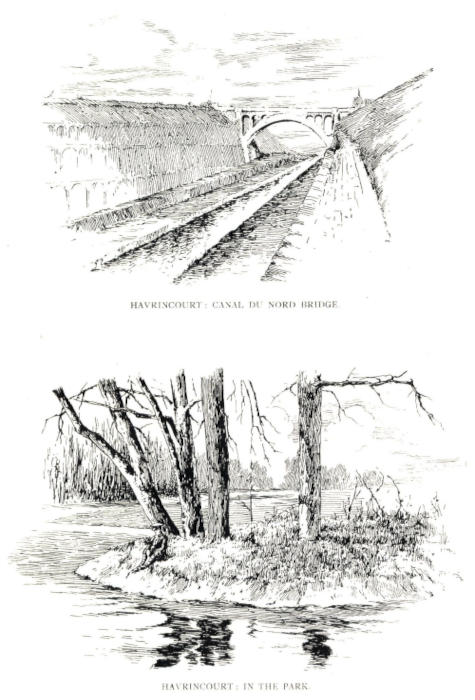
HAVRINCOURT: CANAL DU NORD BRIDGE.
HAVRINCOURT: IN THE PARK.
We shall come back to the epic battle of November 20th. Passing
now to November 21st, the objective of the Division on the second
day was the high ground west of Bourlon and Bourlon Wood. The
gallant 186th Brigade was entrusted with this attack, and all available
surviving Tanks were put at their disposal. One Regiment of Cavalry
was attached to the Division, and Zero hour was fixed at 10-0 a.m.
It had been hoped to push forward the Artillery during the night of
20th-21st, but the rain which had been falling since the afternoon
interfered with this programme. However, despite the opposing
mud, all four Artillery Brigades were in action between Havrincourt
and Graincourt early in the afternoon of the 21st. The night of the
20th had passed quietly. About 8 o’clock the next morning, the 51st
(Highland) Division had completed their capture of Flesquières, and
were advancing on to the Marcoing-Graincourt Road. Prisoners’
tales reported that Bourlon Wood (the 62nd’s objective) was held
by the 32nd and 224th Brandenburghers, indicating that a Reserve
Division had been brought up by the enemy. It was time to get
on, and punctually at Zero-hour the 186th Infantry Brigade, with the
185th in close support and the 187th in reserve, were started on their
way, while the Artillery bombarded Bourlon village and put a smoke
barrage on Tadpole Copse. Eighteen Tanks in all was the number
of available survivors, but, owing to trouble with petrol-supply, etc.,
not all of these were ready to time, and some delay ensued in the
execution of the operation.
Before estimating the results of the severe fighting in which
the Brigade was involved, one or two facts may be stated as to the
participation of some of its units.
The 2/4th West Ridings were detailed to capture Anneux and
Anneux Chapel. The village, though strongly held by Infantry and
Machine-Guns, duly fell to their splendid efforts, but further advance
was stopped at the edge of Bourlon Wood. The Company detailed
to take the Chapel performed skilful work with heavy casualties, and,
after making good their advance to the edge of the wood, and
capturing at least 300 prisoners, were withdrawn shortly before
dark to the sunken road.
The 2/5th and the 2/7th West Ridings were badly handicapped
for lack of Tanks. Instead of the frontal attack which had been
intended, the uncut wire compelled them to have recourse to an attack
by bombs, with consequent loss of impetus. A single Tank, which
arrived in the afternoon, was utilized to the utmost of its capacity.
The 2/6th Battalion, which was to have been kept in Brigade reserve,
and to have been used for the capture of Bourlon Village as soon as
the leading Battalions had reached their objectives, had to be employed
to reinforce the assault and to fill up gaps in the line. Similarly,
the Cavalry were dismounted in the later hours of the afternoon, and
helped to complete the line held in front of Anneux by the 2/4th West
Ridings.
Though Moeuvres and Anneux (inclusive) had been captured,
and were held, it was evident that Bourlon Village would not be taken
that day. Orders were issued, accordingly, to relieve the 186th
Infantry Brigade in their present positions, and their relief by the 185th
was duly carried out that evening.
The general situation on the night of November 21st was somewhat
vague, and next day, though the Division was to have been relieved
during the night of the 21st/22nd by the 40th Division, it was decided
to make one more effort to capture the ridge west of Bourlon Wood,
which overlooked all the ground west and south of Graincourt. They
tried, and struggled, and tried again, but, despite much desperate
fighting, no capture ensued, and, owing to the enemy’s counter-attack
and the consequent disorganization, the attempt had to be abandoned.
On the same day, the 51st Division took and lost Fontaine. In the
night, the relief of the 62nd was duly effected by the 40th.
We break off here for a moment to set down one or two of the
gallant deeds which were done in the three days’ battle. And, first,
we should quote in full the special Order of the Day, which General
Braithwaite, Commanding the Division, published on November
24th, the first full day of the relief. The Divisional Commander,
it stands written,
‘has the honour to announce that the Commander-in-Chief
and the Army Commander have expressed their high appreciation
of the achievement of the 62nd Division in the battle.
‘The Divisional Commander had the most implicit confidence
that the Division would acquit itself with honour.
‘To have advanced 7,000 yards on the first day, taken all
objectives, held them against counter-attacks and handed over
all gains intact to the relieving Division is a feat of arms of which
any Division may be justly proud.
‘The number of prisoners taken is not far short of 2,000.
Thirty-seven guns have been captured, which include two 8-inch
Howitzers, one complete Battery of 4·2, one complete Battery of
5·9, and the remainder, guns of various calibres, many of which
were brought into action against the enemy.
‘The number of Machine-Guns, Granatenwerfer, etc., etc.,
which have fallen into our possession is so considerable that it
has not been possible yet to make an accurate tally of them.
‘The advance of the Artillery to Graincourt, and the
accuracy of the barrage, is worthy of the best traditions of the
Royal Regiment. To C Battalion, the Tanks, all ranks of the
Division express their admiration of the skill, bravery and the
splendid self-sacrifice which made success possible.
‘The discipline, valour and steadiness of all ranks has been
beyond praise.
‘It is with great and legitimate pride that I have the honour
to sign my name as Commander of the 62nd (West Riding)
Division.’
November 24th, 1917—the years that have elapsed and that will
elapse since General Braithwaite signed this Order cannot diminish
its praise. The glowing words breathe and live; they survive the
neiges d’antan which cover his gallant men’s graves between the Bapaume
road and the Canal de l’Escaut.
Here, too, is the place to mention the visit on November 22nd
of Sir Douglas Haig himself to the Headquarters of the 62nd Division
(a visit preceded the day before by the dispatch of an A.D.C. by the
Commander-in-Chief), in order personally to congratulate General
Braithwaite, and to tell him to let the Division know how splendidly,
in his opinion, they had acquitted themselves.
Or take the record here and there (it can be but a casual selection)
of the acts which won these praises in the three days’ battle which we are
reviewing. It was at the very beginning of the battle, early in the
morning of November 20th, that the 2/5th Battalion of the West
Riding Regiment, going forward in column of route to try to get
through the gaps in the wire in front of Havrincourt, lost Lt.-Col.
T. A. D. Best, D.S.O., their Commanding Officer, described by the
General at his graveside as ‘one of the finest soldiers and the most
perfect gentlemen he had had under his command.’
The same Battalion, if we may follow it a little further, continued
its advance on the first day to a point on the further (north) side of
the Bapaume-Cambrai road, where it succeeded in establishing touch
with the 36th Division on the Canal bank. This attack was a ‘record
at the time for depth in one day’s advance, the Battalion going about
7,000 yards from the old British Front Line to the final objective
for the day.’ Its captures for the day included more than 350 prisoners,
fifteen Machine-Guns and a Trench Mortar, and the total casualties
in the Battalion were three Officers and ten other Ranks killed, one
Officer and fifty-five other Ranks wounded, and four men missing.
Its honours included two appointments to the Distinguished Service
Order, in the persons of Captains Goodall and C. S. Moxon; and
next day, November 21st, when Major F. Brook was appointed by the
G.O.C. to the Command of the Battalion, in consideration of his
gallant conduct and brilliant leading after the death of Colonel Best,
Captain (Temporary Major) Goodall, Senior Company Commander,
became second in command.
Records similar to the above might be lifted out of the Diary
of each and every Battalion engaged on those days. Our selection
of a single example will have sufficed to typify the spirit which
animated all units in all ranks; and when we turn from the exploits
of a Battalion to the exploits of individuals, the same tale of courage
is repeated.
Take, for instance, the following record of an exploit by two
young Officers: it is regarded by the Divisional Commander as one
of the most remarkable during the battle. In the 187th Brigade,
the G.O.C., Brigadier-General Taylor, in his determination to be
prepared for all eventualities, had impressed upon his Officers the
necessity of pushing forward at Zero hour, whether or not the Tanks
had arrived. This meant that the Infantry must know their way,
and, consequently, during Y Z night, two Officers of the 2/5th King’s
Own Yorkshire Light Infantry crept out between midnight and dawn
to reconnoitre the route. They actually succeeded in creeping up
to the enemy’s wire, and marked out the route which they would
have to follow, if the Tanks were late the next morning, by placing
tapes to guide them. It was well that they did so, for the unexpected
happened. The Tanks, which were to lead the Battalion, were delayed;
and it was due to the initiative and enterprise of these two gallant
Officers,[96] that the Battalion was able to start without the advance-guard
of Tanks, and to march straight to their first objective, which
they captured at the point of the bayonet.
Take, again, seven exploits in the ranks, each of which won a
Military Medal. We select them as typical acts, in the various arms
of the Service; and, though the extracts from the records are accurate,
we shall not identify them by names, since many pages of this narrative
could be filled with similar accounts. In each instance, the date of
the exploit is November 20th or 21st, and they all redound to the
credit of the 62nd Division.
(1) A Private displayed great courage and devotion to duty
during the attack on the Hindenburg Support system near Graincourt.
He acted as runner, and was on duty two days and one
night with his Company, often taking messages under machine-gun
fire to Platoons on the Front Line, thereby keeping his Company
Commander in constant touch with what was happening.
(2) A Private displayed great bravery and resolution whilst
acting as Company runner during the operations near the Hindenburg
Support Line. Throughout the day, under heavy fire,
he continued to carry messages to and from Battalion Head
Quarters and Companies on the flanks. He set a fine example
of devotion to duty and showed a complete disregard for his own
safety.
(3) A Private displayed his bravery and coolness during the
attack on the Hindenburg Support Line, north of the Cambrai
road. When his Company was temporarily held up by machine-gun
fire from the Front, and its flank was threatened by a strong
enemy bombing party, this man took up a position in the open,
in front of the German wire, and continued, under heavy fire,
firing off rifle-grenades until incapacitated by wounds. His
gallant action frustrated the attempt to turn the flank of his
Company.
(4) A total disregard to danger and devotion to duty was
shown by a Private, while acting as Stretcher-Bearer during the
attack on the Hindenburg Support system near Graincourt.
He dressed wounds and got back casualties during the whole
day under machine-gun fire, and went out alone next day and
brought in a badly wounded man from the front of the forward
line, thereby undoubtedly saving a life.
(5) A Non-Commissioned Officer showed great bravery
and initiative during the attack on the Hindenburg Support
Line. When the Company was temporarily held up by enemy
machine-gun fire both flanks, he took out a Lewis-gun to the
left flank of the Company, and, though under continuous and
heavy fire, engaged the enemy machine-gun with direct fire,
and thus enabled the Company to advance.
(6) A Non-Commissioned Officer displayed courage and
initiative during the attacks between Anneux and Bourlon Wood.
He was in charge of a Lewis-gun team on the right flank of his
Company. Heavy casualties were being caused by a party of
the enemy firing from the direction of Anneux. Without waiting
for orders, the N.C.O. crept forward under rifle and machine-gun
fire to a commanding position, and opened fire with his
Lewis-gun on the enemy, killing several and dispersing the rest
of the party.
(7) A Non-Commissioned Officer displayed conspicuous
bravery during the attack on the Hindenburg Support Line
and Hughes Switch. A hostile Trench Mortar was in action
from a point slightly in advance of Hughes Switch. This
N.C.O. rushed forward and bayoneted the men in charge of the
Trench Mortar, and took prisoners an officer and eight men who
emerged from a dug-out close at hand.
These seven examples, casually selected from the records of
fighting in the opening phase of the Battle of Cambrai, illustrate
what General Braithwaite meant when he wrote (November 24th)
of his ‘implicit confidence’ in the Division. They illustrate, too,
what Sir Douglas Haig meant when he wrote that it was ‘reasonable
to hope’ that his operations at Cambrai would be successful. For
success and confidence in war depend in the ultimate resort on how
the soldier obeys orders. The runner who takes messages under
fire is an essential link between his Company Commander and Divisional
and Army Headquarters. The man who frustrates a turning
movement, or who enables his Company to advance, helps directly
to bring the issue into accordance with the plan of operation, and, in
this regard, these few typical examples are worth more than a chapter
of battle stories, as the spirit is worth more than the letter.
We turn back at this point to the main narrative.
The 62nd Division, as we saw, was withdrawn during the night
of 22nd/23rd November, and was relieved by the 40th. This relief
proved of short duration. November 24th, the day of the Special
Order, was spent in necessary re-organization, but shortly before
midnight on that day, after barely thirty-six hours’ pause, Corps orders
were received, that the 62nd were to relieve the 40th during the following
evening.
We have the advantage of an impression of that day (November
24th, 1917)—an impression from without, as it were—from the private
diary of Major-General the Earl of Scarbrough, at that time, it will
be remembered, Director-General of the Territorial and Volunteer
Forces, and still Chairman of the West Riding Territorial Force
Association. In the company of General Mends and Captain Atkinson-Clark,
the Director-General was paying a visit to his County Divisions
at the Front. He had lunched on the 23rd at Ypres, with Major-General
Cameron, Commanding the 49th Division, in a dug-out just
inside the walls. The Division were then in the line, with one Brigade
(the West Yorkshires) in reserve, and Lord Scarbrough had visited
their camp, and seen their Commanding Officers, who were ‘living
in a sea of mud.’ At 8 a.m. on Saturday, the 24th, the visitors left
the Second Army, travelled by motor-car through Bapaume, and,
passing over a part of the Somme battlefield, where ‘every village had
been shelled out of existence,’ reached the operation area of the Third
Army. Thus, the Chairman and other Officers of the Association
enjoyed the unique experience of taking lunch with Major-General
Braithwaite, Commanding the 62nd Division, on the day following
their visit to the Headquarters of the 49th. Lord Scarbrough notes
that the G.O.C. was ‘immensely pleased’ with the work of his
Division, and that Sir Douglas Haig had visited the General and
thanked him for their ‘remarkable success.’ Though the Division
only came out the day before, after three heavy days’ fighting, and were
naturally ‘dog-tired,’ they had just been called upon to be ready to
send a Brigade back into the line at half-an-hour’s notice. The enemy
had begun a heavy counter-attack on Bourlon Wood, ‘which was the
key of his position, and which dominated the Bapaume-Cambrai Road,
the main road of supply for his troops in the line further north.’
The 40th Division, the visitors heard, were reported to be having a
bad time, as the German Artillery had been reinforced, and a Division
brought from the Russian front had been thrown into the line. These
notes, written at the time, are exactly confirmed by the records
prepared more carefully later on when all the available facts had
been ascertained.
If we look at a map once more, we observe that the wider swing-round
on the eastern portion of the Bapaume-Cambrai Road had been
held up at Crèvecoeur and Rumilly. The consequence was (the causes
were uncontrollable, and concern the historian of other Divisions) to
increase the German pressure on Bourlon Wood and on the village
beyond. The 40th Division had attacked and captured the greater
part of these positions during November 23rd, but by reinforcements
and counter-attacks the enemy had succeeded in reversing these
successes. Orders were issued, accordingly, for the 62nd Division,
less the Artillery and R.E., to relieve the 40th Division, less the Artillery,
R.E., and Pioneer Battalion, in the Bourlon Section of the line, with
the 186th Infantry Brigade on the right, the 187th on the left and the
185th in Divisional Reserve; the Headquarters of the two leading
Brigades being located at Graincourt. The relief was carried out
without incident, except for a considerable amount of shelling, which
caused some casualties in the 186th Brigade. Next day (November
26th) there was a Corps Conference at Divisional Headquarters, where,
after long discussion, it was decided that the Guards and the 62nd
should attack the following morning with the assistance of Tanks,
in order to capture Fontaine and the remainder of Bourlon Wood and
Village. The night of the 26th was very cold, with a blizzard blowing
of snow and sleet. Zero-hour next morning was fixed for 6-20 a.m.
The Tanks, of which 20 were available (16 being allotted to the 187th
Infantry Brigade for the capture of Bourlon Village), reached their
rendezvous punctually at 2 a.m., and the Infantry were all in position
fifty minutes before Zero-hour. A projected bombardment of the
village during the day of the 26th was not proceeded with, since three
Companies of the Highland Light Infantry (40th Division) were missing,
and it was thought that they might still be holding out in Bourlon.
Coming now to Zero-hour on the 27th, and observing that, about
10 a.m., Brigadier-General Taylor, Commanding the 187th Brigade,
reported that his attack had been unsuccessful and that his troops,
which had entered Bourlon, had been compelled under heavy fire to
retire, we may enumerate at least four causes which contributed to
this comparative failure. The first was darkness and mud: the men,
and their rifles and Lewis guns, were covered with mud from the
start, and every man in the Brigade was chilled by his long exposure
to the driving snow. Secondly, there were strong points south of
Bourlon, which, owing to heavy machine-gun fire, had not been dealt
with by the Tanks. Thirdly, the village barricades likewise opposed
the Tank advance; and, fourthly, in and beyond Bourlon, the enemy
were able to bring to bear very effective machine-gun fire. Or we
may quote, in illustration of these obstacles, the experience of a Company
Officer, from Zero-hour 6-20 a.m., to the time, a few hours later,
when he, like so many others, became a casualty:
‘Immediately on leaving the forming-up line,’ he wrote, ‘we
came under very heavy machine-gun and rifle fire. We pressed on.
The machine-gun fire became more intense, and the enemy shelling
more severe. The casualties here amongst the Company were very
heavy indeed. Despite this, the Company, with dauntless courage,
still pressed on, but my casualties were appalling, and further progress
became impossible.’
It was about this time (say 10 a.m.) that the 185th Infantry
Brigade were ordered to place another Battalion at the disposal of the
187th. Meanwhile, frequent reports of hard fighting on the front of
the 186th Infantry Brigade had been received, and now they sent a
message to say, that, though their troops had all reached Bourlon Wood,
the left Battalion of the Guards had been driven back to its original
line. At noon it became evident that the advance of this Brigade had
left both flanks dangerously exposed. Partly in order to meet this
danger, the 185th Brigade (less one Battalion already sent forward),
reinforced by a Battalion of the 2nd Cavalry Dismounted Brigade,
were ordered to relieve the 187th, and to extend their line round the
south edge of Bourlon Village, so as to keep in touch with the 186th;
and the 2nd Cavalry Dismounted Brigade (less its one Battalion) was
ordered to keep itself in readiness to relieve the front Battalions of the
186th. The advance of this last-named Brigade was continued during
the day, and they reached practically all their objectives and were
consolidating in depth. By this time, however, they were very tired
and were subject to heavy counter-attacks, and the full effect of
the new dispositions were not felt in time to achieve their aim.
We need not follow this fighting further. During the night of
November 28th/29th, the 62nd Division was relieved by the 47th.
It moved back to Havrincourt for the night, and marched next day
into the reserve area at Bertincourt and Lebucquière. Thenceforward,
until the battle was broken off, except for intermittent shelling, the
62nd Division took no further active part in the operations. They
had done extraordinarily well, and the fine fighting of the 187th Infantry
Brigade in Bourlon Wood on November 27th stands out in the record
of brilliance achieved by the 62nd Division during this week at Cambrai.
We know what happened immediately afterwards: how the fighting
odds proved too tremendous, and the great offensive ended with a
retirement on December 4th to the 7th, back from Bourlon, back from
Fontaine, back from Mesnières and the Bonavis Ridge, to points
corresponding approximately to the line held on November 20th, with
certain gains in the regions of Flesquières and Havrincourt, though a
little closer to Gouzeaucourt in the South. It would be idle to minimize
the disappointment at this result, especially when it was realized
at home. In the larger issues of the war, the Battle of Cambrai takes
a smaller place than it occupies in the records of the troops which took
part in the fighting. A victory had been gained by those troops which
could not be turned to defeat, though the advance was turned to a
retirement. As a battle, it had been lost; as an experiment, it had
succeeded, though the measure of the success was laid up in the future.
But the troops were competent to measure it. Their military sense,
developed by a year’s continuous campaigning, seized the broad issues
of the experiment, and all ranks of the 62nd Division were filled with
a just sense of elation. Their allotted task had been performed with
what Field-Marshal Lord Haig, in his foreword to this volume, describes
as ‘outstanding brilliance,’ and a consciousness of this performance,
however modestly concealed, was present to the minds of all who
survived the battle.
The casualties had been severe. In the first phase (November
20th to 23rd), they amounted to 75 Officers and 1,613 other Ranks;
in the second phase (November 25th to 28th), to 79 Officers and
1,565 other Ranks.[97] The honours had been not few[98]; but, apart
from the measure of achievement which casualty and honours
lists supply, we take count of the enhanced spirit of the Division,
which, though it had ‘found itself’ before, may be said to have vindicated
at Cambrai its title to a place in the front rank. The Divisional
Pelican, as we see, was still waiting to put down his foot, but by fine
team-work and fine individual work, the Division had proved its
merit as a fighting force, and had won the rare praise of the Field-Marshal
and the grateful thanks of the Divisional Commander.
Viewed, too, in relation to earlier actions, the Cambrai battle, whatever
its issue, is to be claimed as a conspicuous success. It first proved
the efficacy of Tanks, and their power of timed co-operation with the
Artillery and Infantry arms; it first proved the value of secrecy as
an essential factor of victory; and the lessons learned at Cambrai
incomparably modified the memory of past work at Bullecourt and
Thiepval.
CHAPTER XI FATEFUL DAYS IN 1918
All accounts agree that the close of 1917 found the Allies
very unfavourably situated. The balance seemed to be shifted against
them; and the contrast, in retrospect, is striking between the natural
elation of the troops who had taken part in the push at Cambrai,
and had put to a practical test the three-in-one new factors of success—Tanks,
secrecy and speed—and the equally natural depression of
public opinion at home, and even at the front, wherever the chances
of the campaign were accurately weighed. The mere strategic
satisfaction at having relieved the pressure on Italy, or, at least, at
having kept it short of full strength, by tactical operations in France,
afforded inadequate compensation for the knowledge, growing to
certainty, that the issue of 1917 would be a German offensive in 1918.
All the credits on the side of the Allies were likely to mature in the
remote future. All the debits, the heaviest of which was Russia,
could be calculated at once.
Take, for instance, Sir Arthur Conan Doyle’s fifth volume.[99]
It opens on a very piano note. ‘The late winter and the early spring
of 1918 saw the balance tilted against the British and their comrades
in the West, through causes over which they had no control....
From November [1917] to March [1918] an endless succession of
troop trains were bearing the divisions which had extended from
the Baltic to the southern frontiers of Russia, in order to thicken the
formidable array already marshalled across France.’ Or take the
expert evidence of Major-General Sir Frederick Maurice[100]: ‘In
Europe 1917 was a year of disappointment for the arms of the
Allies.... From the beginning of November onward they [the
Germans] were moving troops from the Russian to the French front
as fast as their trains could carry them. It was calculated that the
Germans would be able to increase their strength on the Western
front between the beginning of November and the end of April by
not less than a million and a half of men’: a very nasty calculation
for the Allied Command, and for the two Governments behind it
at home.
Moreover, there was not much time. This was the key to the
situation. Troops moving as fast as they could travel would reach
their destination earlier than troops which were moving through a
longer distance at a slower rate. ‘While it would be possible,’ wrote
Sir Douglas Haig,[101] ‘for Germany to complete her new dispositions
early in the new year, the forces which America could send to France
before the season would permit active operations to be recommenced
would not be large’: again, a very simple calculation, but it entailed
serious consequences. The first was, that ‘it became necessary to
change the policy governing the operations of the British Armies in
France’[102]; or, rather, this was less the first consequence than the sum-total
of the consequences, which involved in their train all kinds
of major and minor changes. The policy governing the operations
of the British Armies in France had to be changed. 1918 had to be
adjusted to 1917; and, while the process of adjustment unmade,
or, at least, disturbed, the whole basis of British dispositions, and
robbed the seed-time of the harvest, it was by no means clear that
the new course would be either satisfactory or complete. For the
change from an offensive to a defensive policy, under the urgent
threat of a German advance, was accompanied by (1) a reduction
in the British fighting strength, (2) a deficiency in defensive training,
and (3) an extension of the British front by over twenty-eight miles.
Such, briefly, was the problem at the opening of December, 1917,
while General Braithwaite’s gallant troops were still winning
laurels in front of Cambrai, and public opinion in England was still
uncertain whether the ‘break-through’ had come or not. As a fact,
it was coming from the other side. It was coming with a weight
of men and guns unequalled in the history of warfare. It was coming
before the United States could pour their forces into Europe. It
was coming against spent soldiers, unprepared with rear-line systems
or with the latest developments in defensive fighting. It was coming,
when our man-power was at its lowest, measured by the demand
that it had met, and by the demands which it had to meet. It was
coming, accordingly, when Army Commanders, from the Field
Marshal downwards, were upset, if we may use an expressive term,
by the necessity of defending an extended front with numerically
reduced forces. The re-organization of Divisions from a 13-battalion
to a 10-battalion basis affected, of course, even the smallest unit,
and every Commanding Officer had to adapt himself to the new
methods. That the fighting efficiency of units was impaired is a
conclusion contradicted by events. That it could not be otherwise
than impaired, under these novel and cumulative conditions, is an
inference in accordance with expectation.
We may select a very simple entry from the Diary of the 1/6th
Duke of Wellington’s West Riding Regiment (49th Division). On
January 29th, 1918, when the battalion was at Hondegem, a draft
of eight Officers and one hundred and ninety-five other ranks from
the 1/5th West Riding Regiment was posted to it, ‘the 1/5th W.R.R.
having been transferred to the 62nd Division.’ Next morning, this
draft was posted to companies, ‘after which all companies reorganized
on a 4-platoon basis.’ Take the 2/4th Battalion of the
same Regiment, and its entry on January 31st, 1918: ‘The Brigade
was reduced to three Battalions, the 2/6th being broken up, ten Officers
and two hundred and twenty other ranks being transferred to the
2/4th Duke of Wellington’s Regiment.’ On the same day, seven
Officers and one hundred and fifty other ranks were posted to the
2/5th West Yorkshires from the 2/6th West Yorkshires, ‘who were
disbanded’; and, briefly, if reference be made to the Order of Battle
of the 62nd Division, given at the end of Chapter VI above, the range
and complexity of the changes in personnel, consequent on the
supreme need of defending a longer line with fewer men, and defending
it against imminent assault, may be judged by these random examples.
There was not a Company Commander in all the Divisions of the
British Armies who did not feel the effects of the new policy in the
early days of 1918.
Purposely, we have dwelt on the soldier’s view. To him it
mattered not at all that the Versailles (Supreme War) Council had
been formed at Rapallo in the previous November, or that Mr. Lloyd
George, on his way home through Paris, had delivered a rousing
speech on the topic of the barrier in the West. Neither Council
nor speeches would break that barrier, the dams of which were about
to burst on him. To him, again, it mattered little more that, before
the dams burst in fury on his long, thin, tired khaki line, the same
doubts, or nearly the same doubts, weighed heavily on the minds
of his Commanders as had oppressed them in 1915, when the 49th
Division first came out to France. Now, as then, behind the narrow
wall of Troops, which still guarded Ypres from the invader, lay
Dunkirk, Calais, Boulogne. We may call this the horizontal line,
leading from Brussels to the sea, and across the sea to hated England.
That way lay the end of the war, and Prussia’s satisfied ambition.
Now, as then, too, a vertical line pointed southwards from Ostend
to Paris, through Arras, Albert and Amiens, and the battlefields of
1916. That way lay a bisection of the Allied Forces, a spectacular
occupation of the French capital, and, at best, a prolongation of the
war into 1919 and even 1920. Either way lay disaster to British
arms; and the stars pointed both ways at once. To the soldier, as
we say, it mattered little that a kind of choice had to be made, and
a kind of balance had to be struck, between two alternative enemy
aims, which were yet not mutually exclusive. His business was to
fight, not to think, and, in the fighting days to which we are now
coming, he fought tenaciously till he fell, leaving to those whom they
concerned the fate of London and Paris. Yet, because their fate
was involved in the disposition of the Allied Armies at the beginning
of 1918, we are bound to consider the problem by which Sir Douglas
Haig was confronted. ‘In the northern portion of the British
area,’ he wrote, in the Despatch which we have already quoted in
this chapter, ‘lie the northern channel ports, the security of which
necessitated the maintenance of sufficient troops in the neighbourhood.
Little or no ground could be given up on this front.... In the
central portion,’ he continued, ‘lie the northern collieries of France
and certain important tactical features which cover our lateral communications.
Here, also, little or no ground could be given up.’
What could be given up? A hateful consideration for the High
Command, but it had to be faced and answered, in order to save
what could not, or to concert, at least, the best measures for its safety.
‘In the southern portion of the British area, south-east of Arras,’ it
was held, ‘ground could be given up under great pressure without
serious consequences.’ The ‘great pressure’ was certain to be
applied, and it afforded some consolation to reflect that, in contrast
to the central and northern portions, the forward area of this sector
consisted chiefly ‘of a wide expanse of territory devastated by the
enemy last spring in his withdrawal.’ He had held it in 1916. Early
in 1917, as we saw, he had partly retired from it and had partly been
driven back, destroying and ravaging as he went, to his prepared lines
in the rear. Let him come again in 1918. We knew the ground as
well as he. The ground ‘to be given up under great pressure’ was
sacred to the heroes of the Somme, and would not be given up for ever.
The time passed quickly to the appointed day.
We return to the 62nd Division, in rest on January 1st in the
Reserve area of the XIIIth Corps in the Maroeuil district, above
Arras. ‘It was evident,’ runs the great Despatch, dated July 20th,
but going back to the previous November, ‘that the enemy was about
to make a great effort south of Arras. An attack on this front would
undoubtedly have as its object the separation of the French and
British Armies and the capture of the important centre of communications
at Amiens. To meet this eventuality more than half
our available troops were allocated to the defence of this sector,
together with the whole of the cavalry.’ On January 5th, the front
from Gavrelle to Oppy, at right angles to the Arras-Douai road, was
taken over from the 56th by the 62nd, with the 185th Brigade holding
the left section all the time, and the 186th and 187th alternating on
the right. On January 9th, Major-General Braithwaite, the 62nd
Divisional Commander, assumed command of the sector. On the 18th,
a German runner was captured, and valuable information was elicited
from him as to the enemy dispositions. The 240th German Division
was opposite the 62nd; many troops, mostly from Russia, had been
collected in the back areas; the appointed day was plainly drawing
nearer. There had been heavy snow and a sudden thaw: ‘Conditions
in the line very bad,’ writes a Battalion diarist (January 19th), ‘but
men very cheerful and happy’ (the italics are his).
When they were not in the line, they were providing working
parties; when they were not at work, they were undergoing training.
‘The construction of new communications and the extension of old,
more especially in the area south-east of Arras, involved the building
of a number of additional roads and the laying out of railways, both
narrow and normal gauge. All available men of the fighting units,
with the exception of a very small proportion undergoing training,
and all labour units were employed on these tasks.’ So far, the Field
Marshal in his Despatch, and we may quote Sir A. Conan Doyle’s
comment: ‘There were no enslaved populations who could be turned
on to such work. For months before the attack the troops ...
were digging incessantly. Indeed, the remark has been made that
their military efficiency was impaired by the constant navvy work
upon which they were employed.’[103] It may be. But Sir Douglas Haig
bore testimony, that ‘the time and labour available were in no way
adequate, if, as was suspected, the enemy intended to commence
his offensive operations in the early spring....’
On January 31st, as we saw, the re-organization of the Division
took place. Under the new scheme of nine battalions plus a Pioneer
Battalion to a Division, the nucleus of Battalions to be amalgamated
arrived from the 49th Division further north. In the 185th Brigade,
the 2/6th West Yorkshires were disbanded, and the 2/8th were
amalgamated with the 1/8th to form the 8th West Yorks. In the
186th Brigade, the 2/6th West Ridings were disbanded, and the
5th West Ridings were formed out of an amalgamation of the 1st
and 2nd Line Battalions. In the 187th Brigade, when it left the
line, the disbanded unit was the 2/5th York and Lancasters; the
2/5th King’s Own Yorkshire Light Infantry were amalgamated with
the 1/5th as the 5th K.O.Y.L.I.
February sped, like January, in preparation varied by raids,
and by rumours more or less authentic. ‘Training and range-firing
till noon. Route march from 2-5 p.m.’ is a characteristic
extract from a Battalion diary, dated February 19th. On February
28th, the 62nd Division relieved the 31st in the left sector of the
XIIIth Corps. On March 10th, an increase of activity was observed
in the enemy aircraft and artillery. On the 12th, information was
to hand that an attack in the neighbourhood of Arras might be
expected at an early date, and the Division was held in a state of
readiness. On the 17th, under cover of darkness, two officers and
eighty other ranks of the 2/7th West Ridings made a successful raid
on the enemy trenches north of Fresnoy. On the 21st, news
arrived that the enemy offensive had started opposite the Third Army,
on a front of about twenty-seven miles from the north of Gouzeaucourt
to the south of Gavrelle. The Army Commander was General the
Hon. Sir Julian Byng, with the Vth, VIth, IVth and XVIIth Corps
under the respective commands of Lieut.-Generals Sir E. A. Fanshawe,
Sir G. M. Harper, Sir J. A. L. Haldane and Sir C. Fergusson, Bt.
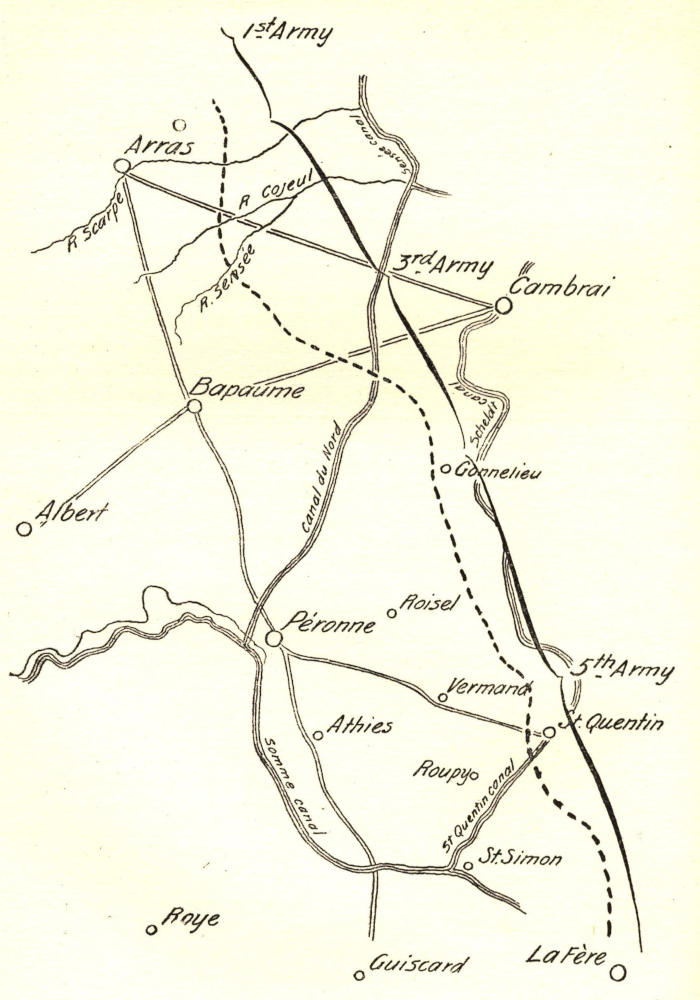
March 21st, 1918: the story has been told a hundred times,
and will be re-told in every book of the British Army until the
‘pussyfeet’ of warfare prohibit the writing of military history. A
few words must be said about it here, though it happened that on the
day itself no troops from the West Riding were engaged. The Fifth
Army, commanded at that date by General Sir Hubert de la P. Gough,
extended immediately south of the Third, and consisted of the VIIth,
XIXth, XVIIIth and IIIrd Corps, under Lieut.-Generals Sir W. N.
Congreve, Sir H. E. Watts, Sir F. I. Maxse and Sir R. H. K. Butler
respectively. At its southern extremity, it touched the junction
of the British and French lines; its total front was about two-and-forty
miles, with an average of about 6,750 yards to each Division
in the line compared with an average of about 4,700 yards per Division
in the line in the Third Army. We should remember, too, that the
southernmost portion of the front had only recently been taken over
from the French, and the ‘navvy’ work spoken of above was even
more incomplete than in other parts. By so much more difficult,
accordingly, was Sir Hubert Gough’s task than Sir Julian Byng’s.
The German General opposing the Fifth Army was von Hutier, the
conqueror of Riga, and the Crown Prince of Prussia was afforded
this unique opportunity of winning his coveted laurels in the final
battle to be known as the Kaiser-schlacht. Further, at least sixty-four
Divisions of super-trained enemy troops took part in the operations
on the first day, against eight in the line of the Third Army (with
seven in reserve) and eleven in the line of the Fifth Army (with three
Infantry and three Cavalry in reserve). Two-thirds of the German
Divisions were allotted to the assault on General Gough; and ‘never
in the history of the world,’ it has well and soberly been said, ‘had a
more formidable force been concentrated on a fixed and limited
objective.’[104] We are not directly concerned with the story of the Fifth
Army on that day, but since its ‘apparent collapse’ has been (or was)
contrasted with the ‘glorious defence’ by General Byng, we may
be permitted to cite here the opinion of Major-General Sir F. Maurice,
that ‘the burden which Gough’s troops had to bear was incomparably
the greater.’ He summarizes with admirable brevity the facts which
we have recounted above:
‘In the first stage of the battle very nearly twice as many
German Divisions attacked Gough as fell upon Byng. Each
of Gough’s Divisions had on the average to hold nearly fifty
per cent. more front than had Byng, while the Third Army
reserves were nearly twice as strong as those of the Fifth, yet
at the end of the first day’s battle Gough’s left, where the gallant
9th Division beat off all attacks, had given less ground than
some of Byng’s Divisions further north had been compelled to
yield.’[105]
Pending the appearance of an official history of the war, no
narrative of March 21st can be otherwise than inadequate, which
holds the scales less evenly between the two Armies primarily engaged
than this temperate statement by Sir Frederick Maurice.
Even so, we have omitted the fog, which, after five hours’
incessant bombardment (from 5 to 10 o’clock in the morning), had
been drawn up from the soil in a white, impenetrable blanket, and
which, in Sir Douglas Haig’s words, ‘hid from our artillery and
machine gunners the S.O.S. signals sent up by our outpost line,’ and
‘made it impossible to see more than fifty yards in any direction.’
This efficient aid to the attackers, which had often been simulated
in battle by artificial means with smaller success, affected the defence
all along the line; and the only answer to the fog, we are told, was
to strengthen the Infantry in the trenches, involving, if it were to be
done, a fresh weakening of our too weak reserves.
But we are not writing the history of the Second Battle of the
Somme. On March 21st, as we have said, General Braithwaite’s
troops were not engaged in that long line from Oppy to La Fère, on
which, as we read above, ‘ground could be given up under great
pressure without serious consequences.’ The pressure proved greater
than had been anticipated, and the measure of the ground given up
increased the seriousness of the consequences.
On the 21st, those fifty-four miles were held from north to south
by the following Divisions in order of line: 56th, 4th, 15th, 3rd,
34th, 59th, 6th, 51st, 17th, 63rd, 47th, 9th, 21st, 16th, 66th, 24th,
61st, 30th, 36th, 14th, 18th, 58th. The Guards Division was at
Arras, and from various points in the Reserve-area, again working
southwards from above the Scarpe, the 31st, 40th, 41st (west of
Albert), 25th (at Bapaume), 19th, 2nd, 39th, 50th, 20th, and the 1st,
3rd and 2nd Cavalry Divisions (at Péronne, Athies and Guiscard
respectively) were brought up and thrown into the line. The first
battle-honours belong to these, and no sketch, however imperfect,
of the conditions under which they were won, can miss the splendour
of their winning, or the valour of the living and the dead.
We pass over the next few days. Their story is written on the
map in four days’ battle positions (March 23rd to 26th), all of which
were swiftly obliterated in the further retreat and the last advance.
What can never be obliterated, however, so long as gallant deeds are
traced on the map of human character, is the memory of those British
Divisions, outnumbered, befogged, giving ground, but retaining,
with their backs to the wall, the heroic quality of victors. We merely
note that, on March 26th, at a conference held at Doullens between the
French and British Army Commanders, Lord Milner (representing
the British Government), M. Poincaré (President of the French
Republic), M. Clemenceau (Prime Minister) and the French Minister
of Munitions, it was decided, in view of the imminent danger of the
capture of Amiens, ‘to place the supreme control of the operations of
the French and British forces in France and Belgium in the hands of
General Foch, who accordingly assumed control.’[106]
On March 23rd, the wave of withdrawal reached the 62nd Division.
The 187th Brigade was moved to Arras, where it was placed at the
disposal of the 15th Division, but this order was cancelled almost at
once, under the stress of immediate circumstances, and the whole
Division was allotted to the XVIIth Corps. On the night of March
24th/25th new orders were received to join the IVth Corps, and early
in the morning of the 25th the three Infantry Brigades of the
Division were moved to Ayette.
It proved a long day’s work, and the beginning of an exacting
time. We are back again now in the old, shell-ridden quadrilateral:
Doullens-Arras (north), Doullens-Albert (west), Albert-Bapaume
(south), Arras-Bapaume (east). Bucquoy, to which the Division was
to move at once, lies just to the east of the centre of the diagonal
Arras-Albert, and the south-west road from Bucquoy to Albert passes
through Thiepval and Auchy, where the 49th Division from the
West Riding suffered so severely in 1916. We remember how, a
little more than a year ago, in January, 1917, when the 62nd had
just arrived in France, some Officers of the 2/5th Duke of Wellington’s
made ‘a tour of the trenches in an old London General omnibus.
The party visited Acheux and Warlencourt, and then drove along the
Doullens-Arras road, which was closed to traffic at one point owing
to shelling.’[107] The problem then was to push the Germans back,
back between Arras and Bapaume, always nearer to Douai and
Cambrai. A year’s hard battles had been fought, and now, in March,
1918, Bapaume had fallen, Albert was to fall (March 26th-27th),
and the problem was to prevent the enemy’s ‘double hope of
separating the French and British Armies and interfering with the
detraining arrangements of our Allies by the capture of Montdidier.’[108]
In this effort the now veteran 62nd was to bear a conspicuous part.
CHAPTER XII WITH THE 62nd AT BUCQUOY
General Braithwaite, then Commanding the 62nd, has said
to the present writer that he regards the action at Bucquoy as, perhaps,
the finest achievement of his Division. They were hurried to Ayette
as early as March 25th, and there, as stated, the Staff Officer who had
been sent on to IVth Corps Headquarters brought Orders for the
Division to proceed at once to Bucquoy. Divisional Headquarters
reached it at about 8-30 in the morning, and the General went forward
to the Headquarters of the 40th and 42nd Divisions, just West of
Bucquoy, in order to learn the tactical situation. (The 40th had been
in reserve on March 21st till it was pushed into the line near Bullecourt;
the 42nd had arrived since that date). The leading Troops of the 185th
Brigade began to reach Bucquoy about 10 o’clock, but the roads were
so much blocked with transport of all kinds that concentration was
not completed till 11-30. Meanwhile, Corps Orders had been received
for the men to have a meal and to get rested, and for the Division,
which had been up all night and had already marched twelve miles,
to hold itself in readiness for a move at short notice. The General
also paid a visit to the Headquarters of the 41st Division (in reserve
at Albert on March 21st, and also pushed into the line), now likewise
stationed at Bucquoy, and shortly afterwards Lieut.-General Sir G. M.
Harper, Commanding the IVth Corps, arrived.
The situation, as it revealed itself, was simple and serious. Briefly,
with or without Albert, which fell on the night of March 26th, the
urgent, essential task was to stabilize a line. The Germans had
thrust, and thrust again, here, there, wherever they found an opening.
They had driven us back in five days (March 21st to 25th), on the
front of the Third Army, right up to the line of the old trenches at
Achiet-le-Grand, Miraumont, Pozières. More ground might still
be yielded ‘under great pressure,’ but the vital danger lay further
south, where, still to the north of the River Somme, at the junction
of the Third and Fifth Armies, withdrawals on the night of the 26th
were to reach a line from Albert to Sailly-le-Sec. What this meant
to the French forces nearer Paris, to the important centre at Montdidier,
and to the railway from Amiens to the capital, was coming
very insistently into view; and the severe strain on the 62nd Division,
among other gallant Divisions, on March 25th and following days,
was due above all to the necessity of arresting the advance about the
Ancre, and of preventing the German hope of breaking through the
receding British line. Once broken, it could never have been mended,
and our real triumph in defeat was our disappointment of Ludendorff’s
design of cutting off one force from another. The line went
back, irregularly, unsteadily. Perilous salients were bulged out,
to be straightened by retirements on the wings. Troops were pushed
from place to place, or assembled by spontaneous conglomeration,
to stop a dangerous gap. Different units became hopelessly mixed,
and sorted themselves out into novel formations. Platoons, Companies,
even Battalions improvised barriers of their own dead. But still
Ludendorff was disappointed. Still his weary men, flung in desperation,
however magnificently led, spent their last ounce of strength
in vain. Still, in retreat after retreat, touch was maintained between
Brigades, between Divisions. Still fighting the enemy to a standstill,
dog-tired, attenuated, unconquerable—still a line held.
It was to a patch of that line, covering, roughly, the centre region
in the Doullens-Albert-Bapaume-Arras quadrangle, to which we
have frequently referred, that the attention of Major-General Braithwaite
was directed by the IVth Corps Commander at their anxious
conference in Bucquoy about noon on March 25th.
The 186th Brigade was now arriving at Bucquoy, and the two
Brigadier-Generals (185th and 186th) were ordered, as soon as they
would be ready, to move to Achiet-le-Petit, and to cover that village,
the 186th on the right and the 185th on the left. The object of this
move was to prolong the front of the 62nd Division (at Logeast Wood,
due East of Bucquoy, and midway between Ablainzevelle and Achiet-le-Grand),
so as to enable other Divisions which had been heavily
engaged, to withdraw and re-organize. The Brigades reached their
positions between 4 and 5 o’clock in the afternoon, with two Battalions
each in line and one in reserve, and with one Company of the Machine-Gun
Battalion attached to each Brigade. It is to be observed that these
were the first operations, since the Machine-Gun re-organization, in
which that Battalion had taken part, and, in ideal country for that
weapon, and with the improved moral of the Companies under new
conditions, the results fully justified the change. During the early
evening of March 25th, the various Divisions affected (19th, 25th,
41st, 51st) gradually withdrew behind the line held now by the 62nd
with the 42nd, and at 7 o’clock Major-General Walter Braithwaite,
Commanding the 62nd Division, took over Command of the front,
with Headquarters at Bucquoy, and the Headquarters of the gallant
41st were removed to Souastre in the rear. At 9-30, General Braithwaite’s
Headquarters withdrew to Gommecourt, to which a line had
been run during the afternoon, but, owing to the heavy traffic on the
roads, the move was not completed till 11 p.m. About that hour,
the Corps Commander sent a telephone message to say that it would
be necessary to withdraw not later than next morning to the line
Puisieux-Bucquoy-Ablainzevelle, and to ask the Divisional Commander
if he preferred to make the move sooner, while still under cover of
darkness. We should note that a trench East of Bucquoy had been
dug during the afternoon by the Pioneer Battalion of the 62nd (9th
Durham Light Infantry), in order to cover that place in the event of
our Troops being driven in, and that about 8 p.m. the 187th Brigade
was ordered to concentrate on Bucquoy in Divisional Reserve, and to
move forward a Battalion into the new trench. Meanwhile, the
Divisional Artillery had arrived, and went into action, covering the
withdrawal, during the night of the 25th.
General Braithwaite decided to take advantage of the darkness,
but, though a Staff Officer was sent back at once to communicate
his decision to the Brigadiers, the Order did not reach them till after
2 o’clock next morning (March 26th), so heavy was the congestion
in the roads; and the actual start was made in early daylight. In
the night, the 186th Brigade was subjected to enemy fire, and some
changes in the dispositions had to be made, but the successful withdrawal
of the Division was completed about 8 a.m., when the 185th
Brigade took up a position on the high ground East of Bucquoy.
The 186th were in touch with them, and extended to a point about
five hundred yards North-east of Puisieux, with two Battalions in the
front line, and the third and Pioneer Battalions in support. The
187th were in Divisional Reserve in the neighbourhood of Biez Wood,
with two Battalions East of the Wood, and the third in the trenches
South and South-west.
This was on March 26th, and another heavy and difficult day
ensued. The Germans were advancing all the time in a westerly
direction, which developed during the day into a determined north-westerly
attack from the neighbourhood of Puisieux and Serre against
the right flank of the 186th Brigade. Two Battalions of that Brigade
(5th Duke of Wellington’s and Pioneers) were accordingly withdrawn
a short distance, so as to face more directly to the South, with their
right resting on Rossignol Wood (between Bucquoy and Hébuterne),
so as to cover the exits from Puisieux. Three Companies of the 2/4th
Duke of Wellington’s (in Reserve) were moved forward to prolong
this line, and a Battalion of the 187th Brigade (Reserve) was
further used to extend their flank on the high ground West of
Rossignol Wood. This occurred in the late afternoon, when
five heavy attacks by the Prussian Guard on Bucquoy, and
between Bucquoy and Puisieux, had been repulsed; and the
causes why the German advance in this area had shifted slightly
to the North (roughly, in the direction Serre to Hébuterne) were,
briefly, two: (1) To the South of Puisieux and Hébuterne, early on
March 26th, there was a gap in the line of three or four miles between
the 62nd and 12th Divisions. About a thousand men from various
units of the 19th Division were holding the defences round Hébuterne,
and it was known that the New Zealand Division was well on its way
to fill the gap. Their leading Brigade, however, could not arrive
till the late afternoon, and it was actually about 10 p.m. before it
filled the southern half of the gap, with its left resting on Colincamps.
Meanwhile, about 7 p.m., the 4th Brigade of the Australian Division,
which had been put at General Braithwaite’s disposal, relieved the
elements of the 19th in the defence of Hébuterne, and got in touch
during the night of the 26th and early morning of the 27th with the
second Brigade of the New Zealanders, to the South of the village.
This gap, then, and the delay in filling it, were one main cause of the
concentration on the West of Bucquoy. The second (2) was subsidiary,
and arose from the fact that, during the morning of March
26th, constant reports were received of mounted enemy troops seen
in Hébuterne and even to the West of it. Possibly, isolated patrols
had reached the edge of the village, but, as the result of these rumours,
‘unauthorized orders were issued by persons totally unknown, in a
more or less excited state,’ to clear all transport westwards, and some
valuable hours were lost in collecting and bringing back those units.
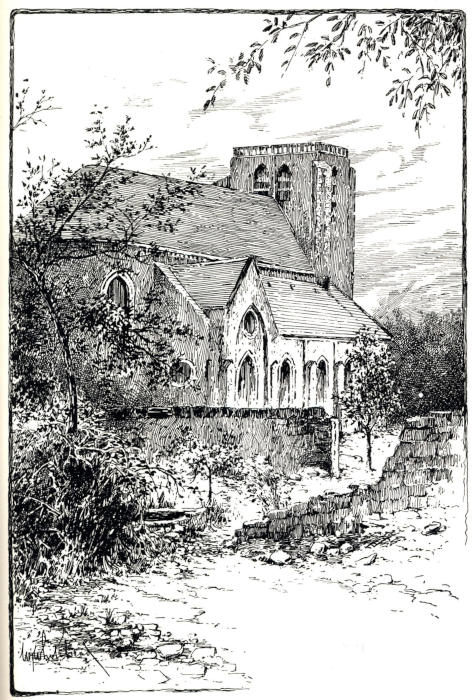
THE CHURCH, BUCQUOY.
This bare account of one day’s fighting leaves much to the imagination.
But an hour by hour recital of the deeds of unit by unit in the
Division would make too much of a day’s work, which was only the
beginning of a hard battle. We must not lose the perspective in a
contemplation of detail, and this perspective is admirably rendered
in the few lines devoted by Sir A. Conan Doyle to the 62nd Division
on March 6th. ‘South of Puisieux,’ he writes, ‘there was a gap of
four or five miles [the Divisional Commander says ‘three or four’]
before one came to British troops. Into this gap in the very nick of
time came first the 4th Brigade of the Second Australian Division,
and later the New Zealand Division in driblets, which gradually
spanned the vacant space. It was a very close call for a break through
without opposition. Being disappointed in this, the Germans on
March 26th spent the whole afternoon in fierce attacks on the 62nd
Division, but got little but hard knocks from Braithwaite’s Yorkshiremen,’
who, we remember, had been on the move since early
morning the day before. ‘The 186th Brigade on the right,’ it is added,
‘threw back a flank to Rossignol Wood to cover the weak side.’[109] We
shall not further expand it.
Next day, March 27th, after a comparatively quiet night, the
attacks on Bucquoy were resumed on the front held by the 185th and
the left of the 186th Brigade. Our Lewis guns took ample toll of the
advancing enemy lines, and the assault failed with heavy loss. Shortly
after noon another attack was begun to the East of Rossignol Wood,
where the 5th Duke of Wellington’s, who had suffered so severely
the day before, were primarily engaged on their right. Their Lewis
guns and rifles proved effective in the open, but the bombers swarming
the old trenches which existed in that part of the line were less easy
to repulse: the German was a skilful thrower, and it happened at
that time and in that locality that rifle bombs and Stokes Mortars
were very difficult to procure. Despite extraordinary courage and
untiring effort and resourcefulness, bombing parties continued to work
their way up the intricate systems of old trenches; and, though two
determined attacks between Rossignol Wood and Hébuterne (between
1 o’clock and 2-30) and two others on Bucquoy (at 4 o’clock and again
at 5-30) were severally defeated, the 2/4th Battalion of the King’s
Own Yorkshire Light Infantry were driven to the high ground East
of Hébuterne and a Company of the 2/4th York and Lancasters were
driven out of the Wood. The North-westerly move of the enemy,
which we noted as his direction the day before, seemed, accordingly,
more critical, since a gap had been made between the right of the
186th Brigade and the Australians in Hébuterne. To meet this crisis,
the trenches East of Gommecourt, lying further to the North-west,
were manned by two Companies of Australians, and the 187th Brigade
was ordered immediately to counter-attack. There was some delay
in getting this order through to the two left Battalions of the Brigade
(the 2/4th York and Lancasters and the 5th King’s Own Yorkshire
Light Infantry), but about 7 in the evening, after the 4th Australian
Brigade had been ordered urgently to co-operate, using, if necessary,
the whole of their Reserve Battalion, the Brigadier-General Commanding
the 186th got into personal touch with Lieut.-Colonel O. C. S.
Watson, D.S.O., Commanding the 5th K.O.Y.L.I. (187th Brigade),
and ordered him to counter-attack Rossignol Wood, with the help
of four Tanks, which the Brigadier was able to put at his disposal.
This counter-attack succeeded, and at 11 p.m. the Officer Commanding
the Battalion reported that he had regained part of the Wood and the
high ground to the South-west of it. He had gained great glory
at the same time, as is shown by the following extract from the London
Gazette, May 8th, 1918:
‘Victoria Cross
‘Major (A/Lt.-Col.) Oliver Cyril Spencer Watson, D.S.O.
(R. of O.), late King’s Own Yorkshire Light Infantry.
‘For most conspicuous bravery, self-sacrificing devotion
to duty, and exceptionally gallant leading during a critical period
of operations. His command was at a point where continual
attacks were made by the enemy in order to pierce the line, and
an intricate system of old trenches in front, coupled with the
fact that his position was under constant rifle and machine-gun fire
rendered the situation still more dangerous. A counter-attack had
been made against the enemy position, which at first achieved its
object, but as they were holding out in two improvised strong
points, Lieut.-Colonel Watson saw that immediate action was
necessary, and he led his remaining small reserve to the attack,
organizing bombing parties and leading attacks under intense
rifle and machine-gun fire. Outnumbered he finally ordered
his men to retire, remaining himself in a communication trench
to cover the retirement, though he faced almost certain death
by so doing. The assault he led was at a critical moment, and
without doubt saved the line. Both in the assault and in covering
his men’s retirement he held his life as nothing, and his splendid
bravery inspired all troops in the vicinity to rise to the occasion
and save a breach being made in a hardly tried and attenuated
line.
‘Lt.-Colonel Watson was killed while covering the withdrawal.’
We have only to add to this record of the 27th, that the 185th
Brigade should have been relieved on that day, but the operations
round Rossignol Wood and the loss of Ayette (by the 31st Division
on the left of the 42nd) postponed the relief for twenty-four hours.
The night passed quickly and fairly quietly. On March 28th,
there was an early bombardment of the whole Divisional front and of
the back area over the Woods (Biez and Rossignol), and an intercepted
advance on Bucquoy, which was subjected to heavy shelling all that
day. Splendid work was done in that morning battle (10 a.m. till
noon) by the 186th Brigade under Brig.-General J. L. G. Burnett,
a very worthy successor to Bradford, whose services we commemorated
above. One Platoon of the 5th Duke of Wellington’s, which occupied
an advanced post, became isolated from the rest. When last heard of
at about 1 o’clock, it was known to be still holding out, but no particulars
of its experiences are available. The heroic record remains, to the
imperishable honour of Yorkshiremen, that, when the position was
finally reached, this Platoon had been overwhelmed, and not a man was
left alive.
More serious than attacks in the open, which were sometimes
stopped, and which, if they developed, were repulsed, were those
bombing-parties working their way up the trenches, who had done so
much damage the day before. They were very active again on the
28th, and sometime between noon and 2 o’clock they contrived to drive
back from the ridge East of Hébuterne and from Rossignol Wood the
5th Battalion of the King’s Own Yorkshire Light Infantry, who had
made so gallant a sacrifice to hold that position overnight. Rossignol
Wood was not recovered on that day. Two Tanks were derelict
in the Wood, and formed effective cover for the enemy, and there was a
partial failure, too, in an attempt by the 124th Brigade (41st Division).
At 7 o’clock, fresh orders for the re-capture were given to the 8th West
Yorkshires (in reserve to the 185th Brigade), who were placed at the
disposal of the 187th, and at the same time the 4th Australian Brigade
was to drive the enemy out of the trenches South-east of Gommecourt.
This bombing encounter proved successful in releasing five hundred
yards of trenches, and by early morning of March 29th the West Yorkshires
had reached the Northern end of the contested Wood. There
they were held up by heavy machine-gun fire, but the twofold counter-measures
had eased the situation, and the gap between the 186th and
the Australian Brigades was satisfactorily filled. The postponed
relief of the 185th by the 42nd Division was duly completed during
that night.
Next morning (March 29th), progress was made with the urgent
work of re-organizing the 187th Brigade. It had performed
magnificent service in exceptionally difficult circumstances, which
included the absence through illness of its Brigadier-General.
Lt.-Col. Barton, D.S.O., who had been temporarily in Command,
had also fallen ill, and was replaced on March 28th by Lt.-Col.
C. K. James, D.S.O., the Officer Commanding the 2/7th West
Yorkshires. The Brigade had been almost continuously in action
since its hurried departure from Ayette in the early hours of March
25th, and the V.C. awarded posthumously to the Commanding
Officer of the 5th K.O.Y.L.I. is an indication of the splendid resistance
which it offered time after time to the enemy assaults on its front. The
Brigade was now located in the trenches North and West of Rossignol
Wood, in touch with the 186th on its right and with the 41st Division
on its left. One Battalion of the 185th was moved up in close support
during the afternoon. Bombing fights between the Australians
and their assailants about Gommecourt and Hébuterne were the chief
incidents of the day which proved the growing exhaustion of the
enemy. March 30th and 31st were spent, too, in comparative quiet:
an important document captured by the Australians showed how
heavily the Germans had suffered. But the 62nd had suffered too.
We referred above to Colonel Watson. Two other Commanding
Officers, who fell at the head of their respective Regiments, may
also be mentioned here, as splendid types of fighting Officers, first
beloved and then mourned by their men. These were Lieut.-Colonels
A. H. and C. K. James, of the 7th and 8th West Yorkshires, known,
of course, as James the Seventh and James the Eighth, who, though
not related to each other, were firm comrades in life and death. On
the night of March 31st-April 1st, a Brigade of the 37th Division
relieved the 186th, which withdrew to Souastre and Henu, and next
night the remainder of the 62nd Division (less Artillery) was relieved
by the 37th, and moved back into the Reserve area.
It will be admitted that they had earned their relief. The Field
Marshal’s summary runs, under date March 27th: ‘A series of strong
attacks commenced all along our front from about Bucquoy to the
neighbourhood of Hamelincourt, in the course of which the enemy
gained possession of Ablainzevelle and Ayette’ (which was re-taken
by the 32nd Division on April 3rd). ‘Elsewhere,’ it continues, ‘all
his assaults were heavily repulsed by troops of the 62nd Division, under
Command of Major-General W. P. Braithwaite, and of the 42nd and
Guards Divisions.’[110] And, under date March 28th: ‘The 42nd
Division drove off two attacks from the direction of Ablainzevelle
and the 62nd Division with an attached Brigade of the 4th Australian
Division also beat off a succession of heavy attacks about Bucquoy
with great loss to the enemy.’[111] We have filled in some details in this
outline, which is sufficiently effective in its statement of duty done
and of local successes achieved. If we go behind it at all, it is rather
to point to some lessons that were learned than to gild the laurels of
renown which the Division earned during those fiery days.
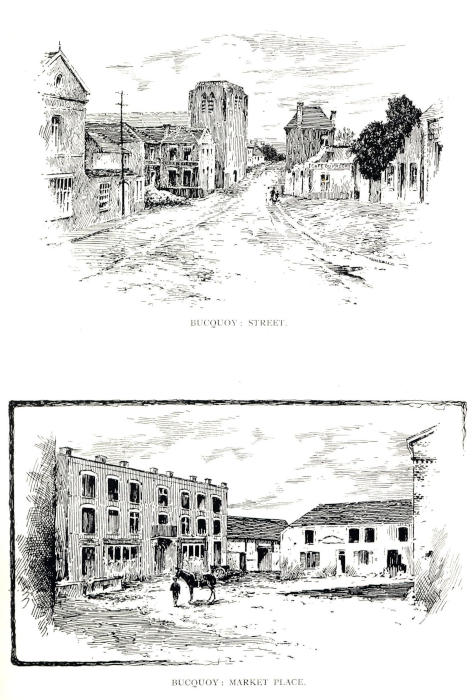
BUCQUOY: STREET.
BUCQUOY: MARKET PLACE.
We have already mentioned the work of the newly-organized
Machine-Gun Battalion, and the comparative lack of Rifle bombs and
Stokes Mortars. Another fact worth noting is the renewed confidence
reposed in the Rifle and the Lewis Gun. In the face of effective
fire from these weapons the enemy never succeeded in pushing home
an attack across the open. Communication between the Division
and Brigades was maintained with very little interruption, and the two
Brigade Headquarters being kept together enabled the admirable
Signal Service to devote all their attention to one main route. Under
these novel conditions of open warfare, it was found that special training
was required for the Power Buzzer operations of Brigade Sections,
and in other technical details the experience at Bucquoy was to prove
valuable.
Most valuable of all was the knowledge that, with nearly all the
chances against them, they had fought the enemy to a standstill.
Despite a perilous gap in the thinned line of British troops, and despite
the delays in filling it, the enemy had not broken through. The line
was threatened on March 25th. It was constantly, almost continuously,
assailed from the East, and, where disclosed, from the South. It
still held on March 31st. Mistakes unavoidable in the medley were
heroically repaired. Odd pockets of men, as we have seen—a thousand
from the 19th Division behind Hébuterne, another thousand from
the 41st about Gommecourt—showed incomparable resourcefulness.
Sudden orders were given in emergency, and were carried out unerringly
under darkness. Troops confidently expected in the afternoon
arrived short of their destination after nightfall, and the intervals of
time and place were filled up. The whole story of these days is a
lesson in how not to yield, and the whole moral of it is contained in
the fact that the end of the first phase of the Second Battle of the
Somme was, at best, an incomplete German victory. They had not
achieved what they had hoped, and, losing hope, they would lose all.
So, Bucquoy is a name that shines in the war record of the 62nd
Division. We leave them now, at the beginning of April, in Divisional
Reserve, with their Headquarters at Pas, enjoying a well-earned
respite from active operations, though under two hours’ notice to
move: and we turn next to another part of the wide field, where the
49th Division, the First Line of the West Riding Territorials, bore
its separate part in the grand defensive.
CHAPTER XIII WITH THE 49th IN THE VALLEY OF THE LYS — I.—FIRST PHASE — II.—SECOND PHASE
We reach a confused tract of warfare, punctuated, as ever, by noble
deeds, through which we must strike a careful trail.
In an Order, issued by Major-General Cameron, Commanding
the 49th Division, and reviewing the period from April 10th to May
5th, 1918, upon which we are now to enter, the General drew attention
to the fact that his Division had not been fighting as a whole. ‘In
some ways it is sad,’ he wrote; ‘but the fact that we have been separated
for a great part of the time has in no way diminished the credit of your
achievements. Every part of the Division in its own sphere of
action has done exceptionally well, and every part has earned high
praise from Commanders outside the Division.’
Partly, then, the confusion arises from the distribution of the
Troops to outside Commands. But the mere fact of this distribution
is itself evidence to the difficulty of responsible leadership in those days;
and, before we attempt to draw a table of the activities of the Division
in place and time during the period covered by that Order, a brief
survey may be made from a more general point of view. ‘Every
part earned high praise from Commanders outside the Division’:
we are concerned, then, with outside Commands and with a wider
outlook than the 49th Division’s.
We are concerned with Ludendorff’s point of view, so far as we
are at liberty to re-construct it. On a previous page we tried to show
how the German mind in March was divided between two strategic
plans, one of which pointed to Paris and the other to the Channel ports.
Both were pursued in turn, and even to some extent simultaneously,
and either, if successful, would have inflicted an almost irreparable
blow on the Allied forces of France and Britain. The point is, that
neither quite succeeded: the union of those Forces under Foch and
the response of the British Armies to Haig’s summons on April 13th,
‘With our backs to the wall, and believing in the justice of our
cause, each of us must fight to the end,’ were to prove incalculably
more effective than all the odds combined against them. But the
initiative in April was with the Germans. So soon as one plan miscarried,
or was left standing, or was conveniently broken off, they
were able to call the other plan, and to make a new push with fresh
Troops. The initiative was theirs, and the superiority was theirs,
in numbers and (by the offensive) in surprise. ‘The possibility of a
German attack North of the La Bassée Canal had been brought to my
notice,’ wrote Sir Douglas Haig, ‘prior to the 21st March. Indications
that preparations for a hostile attack in this sector were nearing completion
had been observed in the first days of April.’[112] But no observations,
however accurate, and no prevision, however acute, could
organize fifty-eight Divisions to fight battles in two sectors at one
time. Forty of the fifty-eight Divisions had been engaged in the
Second Battle of the Somme, and ‘the steps which I could take,’ he
continued, ‘to meet a danger which I could foresee were limited by
the fact that, though the enemy’s progress on the Somme had for
the time being been stayed, ... [he] was in a position to take
immediate advantage of any weakening of my forces in that area.’[113]
And to initiative, numbers and surprise was added the fortune of the
weather. The early spring had been ‘unseasonably fine,’ and the low-lying
ground in the Lys Valley dried up in time for the Germans to
anticipate a relief of the Portuguese, who were holding the front to
the South of Armentières, and who had been in the line for several
months. A shattering German assault fell suddenly (April 9th) on
this thin-spread Portuguese Division, already overdue for relief; and
‘no blame,’ we instinctively know, ‘can be attached to inexperienced
troops who gave way to so terrific a blow, which would have been
formidable to any soldiers in the world.’[114]
Such, then, in the broadest outline, was the strategic situation,
when Ludendorff, leading the Kaiser-schlacht, which had opened on
March 21st, left the fate of Amiens hanging in the precarious balance
to which it had been fought in ten days, and sought to add terror to
exhaustion by renewing his thrust at the Channel ports.
When this underlying principle is seized, and Sir Douglas Haig’s
problem is imagined, what ensued may briefly be recounted to the
date of the engagement of units of the 49th. We are not now to
consider the biggest aspect: the point of view of the War Council at
Versailles. The facts that Americans were coming, and that British
reinforcements would be poured in, did not illumine the darkness in
Flanders in the middle of the second week of April. Nor is it immediately
to the point, that, when Sir Frederick Maurice saw Marshal
Foch on April 16th, and the Germans seemed ‘well on the road to
Calais and Boulogne, ... Foch had himself measured accurately
both the German strength and the endurance of the British Army....
“The battle in Flanders is practically over,” he said; “Haig
will not need any more troops from me.” Not even the loss of
Kemmel a few days later ruffled him. He was right, and the battle
in Flanders ended in a complete repulse of the second German effort
to break through.’[115] No. We should thank heaven, fasting, for the
Marshal’s masterly imperturbability. It won the war, among many
claimants for that boon. But the great leader himself would admit,
that his estimate of ‘the endurance of the British Army’ had been
calculated to the last ounce of its worn strength, and that ‘the loss of
Kemmel a few days later’ (on April 25th, to be precise) imposed a well-nigh
intolerable strain.
We are to contract our horizon on those days: to forget, what
were then invisible, the dots and spots on the Atlantic, which marked
the precious troopships bringing help from the New World to the Old;
to forget the set will of Paris, raided from the air by night and day,
and nearly within gunshot as well; to forget the last effort of England,
and how, in a room at the War Office, all was ready to call out the
Volunteers, the final arm of Home Defence; and we are to try to
piece together events in Flanders from early morning on April 9th,
when the brave Portuguese were overrun, till the confidence of the
French Marshal was justified at the end of the battle on May 8th.
Throughout that month, we are to remember the superb generalship
of Sir Douglas Haig, splendidly backed as he was by Generals Sir
H. Horne, Commanding the First, and Sir Herbert Plumer, Commanding
the Second Army. Through all ranks of the heroic forces
which they commanded, whether tired veterans from the hills and
valleys of the Somme, or new drafts of young soldiery from home,
and in all arms of the Service, one spirit prevailed: to obey, at whatever
personal cost, the supreme call of their Commander-in-Chief,
which was issued on the fourth day of the Flanders battle, and the pith
of which we quoted above. The enemy’s objects, they were told, ‘are
to separate us from the French, to take the Channel ports, and destroy
the British Army.’ He had, as yet, ‘made little progress towards his
goals.’ Time, they were reminded, was on their side, not necessarily
as individuals but as Englishmen: ‘Victory will belong to the side
which holds out the longest.’ And then followed the stern command:
‘There is no other course open to us but to fight it out. Every position
must be held to the last man: there must be no retirement. With
our backs to the wall, and believing in the justice of our cause, each
one of us must fight to the end. The safety of our homes and the
freedom of mankind depend alike upon the conduct of each one of us
at this critical moment.’
So we come to the 49th Division, which has been in the Ypres
area all that year, performing necessary and at times exacting duties
on a front which was never immune from Artillery attacks and sudden
raids, and to its response, through its various units, to the call to
stand fast and die.
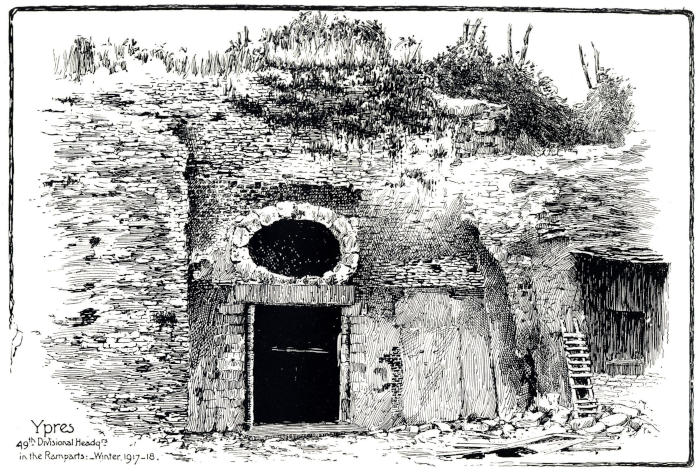
Ypres 49th. Divisional Headqrs. in the Ramparts:—Winter, 1917-18.
The German advance on April 9th between Armentières and the
La Bassée Canal had bulged in the line by that evening to a distance
of three to five miles. Next day, the attack was extended North of
Armentières to Wytschaete and Hollebeke, and the enemy gains were
extended. The 34th Division in Armentières, though not yet attacked
on their own front, had their two flanks dangerously exposed, and
were withdrawn in a North-westerly direction, reaching a stopping-place
at Nieppe. If we follow this action a little further, we shall
be able to fit in more intelligibly the narrative of the 49th Division.
On April 11th the advance was pressed in the direction of Nieppe and
Neuve Église, and in the afternoon there was fierce fighting about
Messines, now in enemy occupation. These losses pinched the 34th
out of their temporary foothold at Nieppe. The withdrawal on this
day did not cease in that particular area till about a thousand yards
East of Neuve Église and Wulverghem, involving the abandonment of
Hill 63. Next day, an assault in great strength was launched due
westwards between Merville and Steenwerk, and affected our line below
Bailleul, which looks down through Nieppe to Armentières. On
the same day and the following (the 13th) Neuve Église was hotly
involved, and fell before midnight on the 14th. Another twenty-four
hours and Bailleul had suffered the same fate. There was now a very
perilous salient in this stricken northerly region, and on the night of
April 15th/16th the decision was taken to withdraw from the
Passchendaele Ridge, the scene of so much bloodshed in the previous
summer; and, consequently, to close in nearer to Ypres. These
retirements, as may be seen on a map, brought the Kemmel sector into
prominence, and the German capture on April 16th of Meteren and
Wytschaete, at the two extremes of that front, was developed next
morning (17th) into a determined attack on Kemmel Hill.
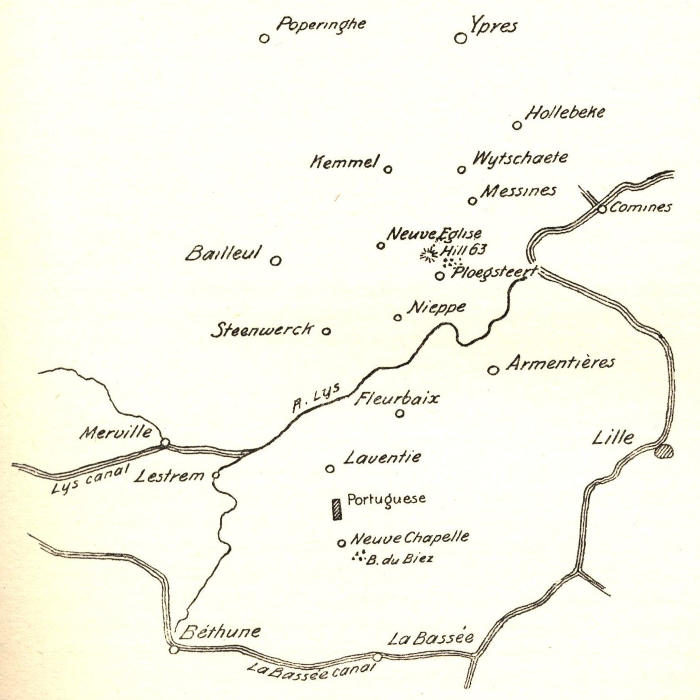
Recalling now from page 46 above, and from an earlier April
17th, the geographical significance of Ypres, noting that this significance
was not diminished by the improvement in German heavy
Artillery, as shown by the guns trained on Paris, and observing that
a sentimental value had accrued to Ypres in those middle years almost
bigger than its geographical significance, we are now better qualified
to measure the anxiety of the British Command during the crucial
week, April 9th to 16th, 1918. Would Ypres fall? Would the
Channel ports follow, with all their accumulated stores, and G.H.Q.
be driven to the sea? Could the hard-pressed Troops of the Second
Army hold out to perform their allotted task, since ‘the constant and
severe fighting in the Lys battle front, following so closely on the
tremendous struggle South of Arras, had placed a very serious strain
upon the British forces’? ‘Many British divisions,’ continued their
Commander, ‘had taken part in the northern and southern battles,
while others had been engaged almost continuously from the outset
of the German offensive.’[116] We know the answer to these questions.
It is time now to see in one area how those answers were dictated.
Take, first, in the 49th Division, the 147th Infantry Brigade,
which moved on the night of April 9th/10th to join the 34th near
Armentières with the following Group Details: ‘A’ Company of the
Machine Gun Corps, a Light Trench Mortar Battery, a Field Company
(57) Royal Engineers, a Field Ambulance (1/2nd West Riding), and No.
3 Company, 49th Divisional Train. On April 10th, the 1/4th Duke
of Wellington’s were engaged at Erquinghem, covering a crossing of
the Lys. That night, the Brigade was defending Nieppe, in support
of the 34th Division in its withdrawal from Armentières. On the night
of the 11th/12th, they carried out a skilful rearguard action, covering
a further withdrawal. From the 12th to 14th, they maintained their
position, despite repeated attacks, in the southern outskirts of Bailleul.
A few hours’ rest, and on the evening of the 15th the Brigade was
again in the front line, in consequence of Bailleul’s fall. On April
16th and 17th, they were successfully holding their own on the slopes
to the North-west of Bailleul, and taking heavy toll of the enemy.
‘In this action,’ we read, ‘all units of the Brigade Group greatly distinguished
themselves.’ On the 19th, they moved into the 34th
Divisional Reserve, and two days later they rejoined their own Division
in and around Poperinghe. Thus, this Group is inserted into the
fighting which we summarized just now; and, before taking the
other Groups in order, or expanding the narrative of this, we may
fitly interpolate the praises which it won from Major-General C. L.
Nicholson, Commanding the 34th Division:
‘The G.O.C. 34th Division wishes to place on record his
great appreciation of the services rendered by the 147th Infantry
Brigade during the period it has been attached to the Division
under his Command. The action of the 4th Battalion Duke
of Wellington’s, South of the Lys on 10th April, the skilful
rearguard fighting under cover of which the Division withdrew
from the Nieppe position, the stubborn defence of the right of
the Division at Steam Hill (South of Bailleul), and the complete
defeat of a whole German Regiment on the 16th April, are
exploits of which the Brigade may well be proud.
‘Throughout the period, the steadiness, gallantry and
endurance of all ranks has been worthy of the highest traditions
of British Infantry, and the G.O.C. 34th Division is proud to
have had such Troops under his Command.’
Or these praises bestowed on a gallant Regiment may be tested by
the record of one man: No. 24066, Pte. Arthur Poulter, of the 1/4th
Battalion, Duke of Wellington’s (West Riding), who was awarded the
Victoria Cross for his action on April 10th, commemorated in the
following terms in the London Gazette of June 28th:
‘For most conspicuous bravery when acting as a stretcher-bearer.
On ten occasions Pte. Poulter carried badly wounded
men on his back to a safer locality, through a particularly heavy
artillery and machine-gun barrage. Two of these were hit a
second time whilst on his back. Again, after a withdrawal over
the river had been ordered, Pte. Poulter returned in full view of
the enemy who were advancing, and carried back another man
who had been left behind wounded. He bandaged up over forty
men under fire, and his conduct throughout the whole day was
a magnificent example to all ranks. This very gallant soldier was
subsequently seriously wounded when attempting another rescue
in the face of the enemy.’
A Group, similarly constituted, of the 148th Infantry Brigade
was sent on April 10th to Neuve Église, which was plainly threatened
on that day, under orders to move at half an hour’s notice. The
same night, its 1/5th York and Lancasters became attached to the
74th Brigade (25th Division) where it was drawn into the fighting
near Steenwerk, to the South of Nieppe, and rendered valuable service,
remaining in attachment until April 16th. Next day (11th), in the
morning, the 1/4th Battalion of the same Regiment was detailed to
counter-attack on a line West of Ploegsteert Wood, where the rest
of the 25th Division was engaged. Hill 63 is situated immediately
North of the North-west corner of that Wood, and Neuve Église
lies about two miles to its North-west. We shall have to come back
to the gallant record of this unit, and of the 1/4th King’s Own Yorkshire
Light Infantry, and of others in the Group, during the struggle for
Neuve Église, which lasted till the night of April 14th/15th. It is a
record of desperate valour against overwhelming odds; and, when,
weary but undaunted, the Brigade was withdrawn to Poperinghe
on April 19th, it had thoroughly earned the encomium of Major-General
Sir E. G. T. Bainbridge, Commanding the 25th Division:
‘Will you thank the 148th Infantry Brigade for all they
did in holding on to Neuve Église? It is, of course, greatly
due to them that the place was held as long as it was.’
Similar praises were bestowed by the Brigadier-General Commanding
the 74th Brigade (25th Division) on the Battalion of the 148th
Brigade, which had been under his orders. He placed on record,
‘his great appreciation of the services rendered by the 5th Battalion
York and Lancaster Regiment during the time it was attached
to the Brigade under his Command. The gallantry and endurance
of all ranks throughout the operations are worthy of the
highest traditions of the British Army, and it was a pleasure to
the B.G.C. to have such Troops under his Command. He was
much impressed by the dashing manner in which the Battalion
carried out the attack on Cabaret du Saule on 11th April, and
by its stubborn resistance on 14th April on Mont de Lille.’
We come, last in this summary, to the 146th Infantry Brigade
(49th Division).
On April 10th, it was in line in the Ypres salient, under the orders
of the 21st Division.
Next day, very early in the morning, its 1/7th Battalion, West Yorkshire
Regiment, became attached to the 62nd Infantry Brigade, which
had been detached from the 21st Division and placed under the orders
of the 9th (Scottish) Division, commanded by Major-General G. H.
Tudor. That Division (the 9th), we may note, in anticipatory compensation
for its terrible losses in this area in April, was to have the
honour on July 19th of capturing Meteren with great éclat. This
reversal of misfortune lay in the future. To-day the situation was
very grave, and the part played by the 1/7th West Yorkshires, in
attachment to the attached Brigade, may best be told, in advance of the
more detailed narrative, in the Report of the Brigadier-General
Commanding the 62nd Brigade, which was transmitted by General
Tudor to General Cameron (49th Division). It was dated April
20th and ran as follows:—
‘I should like also to draw attention to the very gallant behaviour
of the 1/7th Battalion West Yorkshire Regiment, of
the 146th Infantry Brigade.
‘On the critical afternoon of the 11th April, when the Brigade
holding the Messines Sector was driven back, leaving my right
flank perilously exposed, the 1/7th West Yorkshire Regiment
was moved up at very short notice from Parret Camp to form a
defensive flank on the Bogaert Farm-Pick Wood Spor, and to
fill the gap on our right.
‘Under very heavy shelling the Battalion moved forward
splendidly, and their steadiness undoubtedly saved the situation.
From that evening until the morning of the 16th the Battalion
held the right sub-sector of the Brigade front from Bogaert Farm
to Pick Wood; on the night of the 15/16th they handed over
from Bogaert Farm to Scott Farm to the 1st Battalion, Lincolnshire
Regiment, and took over to Spanrock-Molen inclusive. On an
extended front they encountered the full force of the enemy
attack on the morning of the 16th, and fought most gallantly
until overwhelmed by superior numbers. As in the case of other
Battalions the mist placed them at an enormous disadvantage,
and deprived them of the full use of their fire power.’
Major-General Cameron, in communicating this message to
the Brigadier of the 146th, added the expression of his ‘great hope,
that you will find that you have sufficient old hands remaining to carry
on the spirit which has animated the 146th Brigade, and infuse it into
the new drafts which I hope to see joining you soon, in order that the
name of the 146th Brigade may live for ever. Please let your
Battalions know that I feel deeply proud of them.’
The Battalion had rejoined its own unit on April 18th. Its
casualties between the 11th and 16th had been eleven Officers and four
hundred and forty-two other ranks.
Noting that Parret Camp, referred to in the above message, lay
a mile and a quarter to the North-west of Kemmel, and that the 1/7th
West Yorkshires were supposed to be already tired out when they
marched there in high fettle in the early hours of April 11th, we return
on that date to the rest of the 146th Brigade. The Group units were
established in the defences of Kemmel Hill, which, though not immediately
in the front line, formed a position, as we are aware, of supreme
prospective importance. The Command was entrusted to Lt.-Col.
H. D. Bousfield, of the West Yorkshire Regiment, a supernumerary
Lieutenant-Colonel at the time, who came under the orders of the
49th Division up to April 13th, of the 19th Division on that date, and,
on April 19th, of the 28th French Infantry Division. To the final
assault on the Hill under its French Commander we shall presently
come back.
This outline-sketch of the activities of units of the 49th Division
in their places in the Valley of the Lys may be supplemented with
one or two details, before we pass to the second and worse phase of
the battle in that area of fire.
Take, for instance, the struggle about Neuve Église, in which
the 148th Brigade bore itself so gallantly, in the grim days, April
12th to 14th. A glance at the map will show that Neuve Église lies
almost midway between Messines and Steenwerk, but (in a narrow
area, of course) some way to the West of either. Thus, its capture,
besides re-acting on the hard-pressed 34th Division below, would
enable the Germans to round back on the 19th above, where Major-General
G. D. Jeffreys would be caught in the rear. Accordingly,
here, as much as anywhere (we should say ‘worse than elsewhere,’
but no comparison could be sustained), the command to hold out
to the last man was imperative and binding. And right well this
Brigade of the 49th supported the valorous efforts of various bodies of
brave troops, including a mixed lot of a thousand, whom Brigadier-General
Wyatt, formerly Commanding the 1/4th York and Lancs.,
had collected from anywhere to do everything. General Wyatt’s
old Battalion and a sister-Battalion in the Brigade, the 1/4th King’s
Own Yorkshire Light Infantry, had already done stiff service in the
defence of Neuve Église, where, on April 13th, the assault broke out
again with added fierceness. At 7 a.m. on that day, the enemy entered
the village. At 8-30, counter-attacks were launched of their own
initiative by all available units of the Brigade, and were pushed with
courage and determination. In this action, Major Jackson, M.C. (of
the 458th Field Company, Royal Engineers), Captain J. F. Wortley,
M.C., and Lieut. Gifford, M.C., (both of the 1/4th York and Lancs.),
were specially mentioned in the Brigadier’s message to the Battalion.
A big bag of prisoners was made, and the village was cleared of
Germans. We are told that, about this time (the afternoon of April
13th), the Troops were still cheerful and in good heart, but that the
continuous strain and want of sleep were beginning to tell. Unfortunately,
they told in vain. On the night of 13th/14th, the enemy
came on again, and forced a way into the village. Captain Wortley
was killed in an attempt to establish a line about the Church, though
that line was subsequently held by small parties of the 4th York and
Lancs. and of the 9th Highland Light Infantry (Glasgow Highlanders).
We read that ‘these plucky men refused to obey the order to withdraw,
and were eventually cut off completely by the enemy, and there
is little doubt that they died fighting to the last.’ To lose Neuve
Église under such conditions was to win imperishable renown.
Or take a difficult little operation by two Companies of the 1/5th
West Yorkshires (146th Brigade), which was not less difficult because
it proved successful. On the night of April 15th/16th, a partial
withdrawal, as we saw above, was made perforce in the Ypres salient.
These two Companies, under the Command of Major Foxton, were
left to hold posts in the Corps line across the Menin Road about three
miles East of Ypres. They did their job very thoroughly. By
moving dummy carrying parties about the tracks, and keeping six men
in the front line, right away till broad noon on that day, and by other
manœuvres, they deceived the enemy so completely that no approach
to our old front line was attempted till 3-30 p.m.
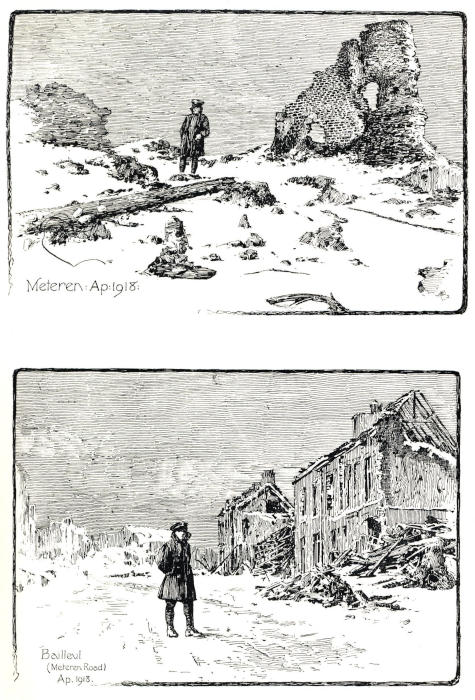
Meteren: Ap: 1918:
Bailleul (Meteren Road) Ap. 1918.
We need not expand the account of the exploits of the 1/7th West
Yorkshires during their hard days of service with the 62nd Brigade.
We know by now that a situation could be ‘saved,’ in the expressive
word endorsed by General Tudor, only by endurance of a kind
corresponding to the call of the British Commander-in-Chief on the
13th. We prefer to conclude on a quieter note. These few, casual
illustrations of a week’s fighting, as desperate as it was heroic, for
the ultimate safety of the Channel ports, would convey a false impression
if they painted no scene but ‘death or glory.’ It was hard
going all the time, and the conditions told, as we have seen. But
the grit of the Yorkshiremen was not unequal to the incessant demands.
We read nearly always of a cheerful spirit, of a line which seemed
‘good’ by comparison with other lines which they had known worse,
of refreshing snatches of rest, of the welcome arrival of the limbered
wagons with rations, and similar incidents of the kind, which helped
to ease what had to be endured. We read, too, in an Officer’s diary,
such a characteristic entry as the following: ‘Next morning, there was
light shelling, but about 1-30 p.m. the Boche started a heavy bombardment,
and attacked at 3 o’clock from the South-west. This was his
usual time-table all through these operations.’ (The italics are ours).
And, again, a page or two later on: ‘The Boche programme continued:
a heavy bombardment 1 p.m.—3 p.m.’ They had taken
the measure of their Boche. It was all very frightful and terrible,
and good men were falling every hour; but frightfulness ‘according to
plan,’ as Macbeth discovered in his day, contains an antiseptic element,
which is related to the sense of humour in the British soldier. If
it is too much to say that this sense would always enhearten him,
at least it stood him in good stead, and even inspired him with good
hope, when Hollbeke, Messines, Ploegsteert, Neuve Église and Bailleul
had been left behind the German front, and the salient round Ypres
had been retracted, and the storm was about to burst on Kemmel
Hill.
There were four or five more or less calm days in the sector
North of the Lys. The battle-fury surged a little South on a front
from Merville to Givenchy, extending along the La Bassée Canal,
and it broke out afresh in the Somme Valley, on the slopes just East
of Amiens, where the village of Villers Bretonneux changed hands
twice in two days (April 24th, 25th), remaining the second time in
British possession. The interval in the Northern area, though used
for rest and re-organization, so far as circumstances allowed, was
less an interval than a breathing-space, in which both sides were
awaiting the call of ‘Time!’ A renewed attack was obviously
impending. The enemy would want to exploit his gains, and to make
that push for Ypres and Dunkirk, which had haunted his day-dreams
for four years. The blow fell on April 25th, at about 5 o’clock in the
morning, when a very violent bombardment along the whole line
from Hollbeke to Bailleul announced the commencement of the second
phase of the sanguinary Battle of the Lys.
If we look once more at the familiar map, we shall see the Allied
line stretching from North-east to South-west. British troops were
holding the line from a point on the Ypres-Commines Canal just
above St. Eloi to a point about a mile below Wytschaete. The 21st
Division was on the Canal, with a composite Brigade of the 39th;
the 9th Division held the Wytschaete Ridge, with three units of the
21st and 49th (chiefly the 146th Infantry Brigade). The rest of the
line was French. Immediately below our 9th Division was the 28th
French Division, in Command of the Kemmel Defences; next below,
at Dranoutre, came the 154th, in face of an enemy assault from Neuve
Église. Then came the French 34th, and their 138th at St.-Jans-Cappel.
Behind the line, two Brigades of our 49th (the 147th and
148th) were in Corps Reserve in and around Poperinghe, and one Brigade
each of the 30th and 31st were located between Poperinghe and the
front line. Our 25th Division was in Reserve, a little behind the
two Brigades of the 49th.
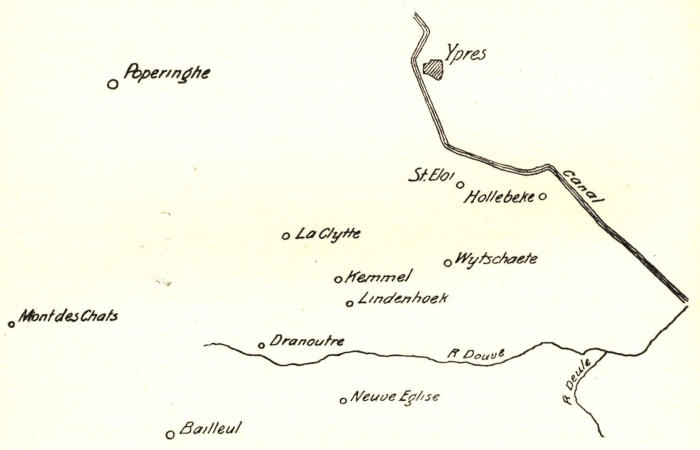
Against these worn and weary Troops, so lately withdrawn from
the positions from which they were now to be assailed, and so hardly
re-organized or recruited, the enemy launched nine Divisions, ‘of which
five were fresh Divisions and one other had been but lightly engaged.’[117]
Their direct objective was Kemmel Hill, an important point of observation
in that country of low-lying flats, and important, too, as a jumping-off
place for Ypres; their subsidiary purpose was to separate the
British from the French forces by a flanking movement below
Wytschaete. Accordingly, the weight of the attack fell first on the
French 28th and the British 9th Divisions, with the two Brigades
attached to the latter. Dealing first, with the British sector, we are
not surprised to learn, in Sir A. Conan Doyle’s temperate narrative,
that ‘the 9th Division in the north was forced to fall back upon the
line of La Clytte [behind Kemmel], after enduring heavy losses in a
combat lasting nine hours, during which they fought with their usual
tenacity, as did the 64th and 146th Brigades, who fought beside them.’[118]
It is rather the details which surprise us, and help to make this ‘tenacity’
real. At 2-30 a.m. on April 25th, this Brigade of our 49th Division
had to endure a two hours’ bombardment with heavy gas-shells and
smoke. It was followed by half an hour of the greatest intensity
with High Explosives. At 5 o’clock, in the inevitable mist, which
enhanced the difficulty of the defence, the Infantry attack was launched,
but was held on the Brigade front. At 6-45, a Company of the 1/6th
West Yorkshires was reported to be fighting a rearguard action under
Captain Sanders, V.C. This gallant Officer was seen rallying his men
from the top of a pill-box, and, though wounded, he continued firing
with his revolver at point blank range until he fell. No news came
from the front line Companies, but all the evidence goes to show that
they fought and died at their posts. We need not follow the retirement
of what was left of these Battalions, first, to Vierstraat Cross
Roads and then to Ouderdom. The evidence of casualties is more
pertinent. In the West Yorkshire Regiment, on these two days
(April 25th, 26th),[119] the 1/5th’s casualties amounted to eighteen Officers
and five hundred and fifty-seven other ranks; the 1/6th’s to twenty-two
and four hundred and sixty-one, and the 1/7th’s to five and one
hundred and thirty-nine respectively. The Trench Mortar Battery
of the Brigade was engaged on Kemmel Hill during this battle, and
none of those in action returned. We may add here, that, at
Ouderdom on April 27th, some Brigade remnants were formed into
a composite Battalion, under Major R. Clough, of the 1/6th West
Yorkshires, and were placed in Divisional Reserve at the call of the
147th Brigade, the rest being withdrawn into a back area.
Turning now to the action on the French front, and to the German
assault on Kemmel Hill,[120] and observing that St. Eloi and Dranoutre,
to the East and West of the position, fell at an early hour into the enemy’s
hands, we have to record that by 10 a.m. on April 25th Kemmel Village
and Hill had both been lost. It will be recalled from our summary
of this fighting that Lt.-Col. Bousfield, Commanding some units of
the 49th Division (146th Brigade) had been left in Command on Kemmel
Hill on April 11th, and handed over to the French Divisional Commander
on the 19th. He and his fellow Yorkshiremen continued
the defence till the last moment with conspicuous courage and devotion.
On April 26th, at 3 a.m., counter-attacks were made by the French
and British in combination, in which Troops from the 49th Division,
attached to the 25th, again bore themselves gallantly. But the
position then was irretrievable, at least in its main aspects, and the
line in the salient was further re-adjusted during the night of April
26th/27th.
This brief account of a big event (the darkest hour of the Flemish
battle, it has been called) might be extended into the local fighting
which marked the course of the next few days. But an extract from
one Officer’s diary may suffice as a sample of what was happening:
we have trusted his judgment before, and his first and last sentences
are decisive. He writes on April 28th:
‘The Germans were not ready to profit by their success at
Kemmel. During the next three days there was a good deal
of shelling by long-range guns, but no attacks, and the Battalion
[it was in the 148th Brigade] was able to improve the line greatly,
with Lewis gun posts pushed well forward to command the valley
in front. A French cart stranded in No Man’s Land was found
to be full of excellent signalling equipment, which improved
our communications.
‘29th April.—On April 29th the Germans made what proved
to be their last attempt on the Ypres front. Their plan was to
attack on the whole front from Dranoutre to Voormezeele, and
so pierce the line to the South of the city. A heavy bombardment
with shells of the heaviest calibre opened and continued unceasingly
from 3 a.m. to 4 p.m. It was probably the heaviest bombardment
the Battalion has had to face, and casualties were many,
including some of the finest fighters of the Battalion. At 4, the
Germans attacked. On the 7th Battalion front, where there
was dead ground, the Germans got into the line, and were only
driven out by successive bayonet charges. On the 6th Battalion
front, the forward posts could see the Germans descending
Kemmel, and with Lewis gun and Rifle fire stopped them dead
with great loss. Before dark, the attack had definitely failed
along the line: the Germans had played their last card.’
This conclusion agrees with Sir F. Maurice’s: ‘The gain of
Kemmel proved to be the enemy’s undoing’; and with that of all
competent authorities, reviewing the battles of March and April,
1918, with the knowledge acquired since the war was ended. Ludendorff
could not exploit his successes, for in no sector was any of them
complete. The failure to break through in the north ‘was hardly
less important in its effect on the campaign than that which the Germans
had suffered on March 28th, and these two triumphs of our
defence over the enemy’s attack went far in preparation for the
victories which came later in the year.’[121]
So, the darkest hour gave place to the dawn.
Congratulatory messages, couched in the highest terms, reached
the 49th Division in its time of merited relief.
General Sir Herbert Plumer, Commanding the Second Army,
conveyed, on April 29th, the following message from Field-Marshal
Sir Douglas Haig, Commander-in-Chief of the British Armies:
‘I desire to express my appreciation of the very valuable
and gallant service performed by Troops of the 49th (West
Riding) Division since the entry of the 146th Infantry Brigade
into the Battle of Armentières. The courage and determination
shown by this Division have played no small part in checking
the enemy’s advance, and I wish to convey to General Cameron
and to all Officers and Men under his Command my thanks for
all that they have done.’
On May 2nd, the IXth Corps Commander, Lieut.-General Sir A.
Hamilton Gordon, sent the following message:
‘Heartiest congratulations on the splendid fight you put
up on 29th April.’
Throughout this period (April 10th to May 2nd), the 49th Divisional
Artillery had been serving with the 21st Division, and they
received from Major-General Campbell the following letter of thanks:
‘Before handing over Command of the 49th Divisional
Artillery, I wish to express to all ranks my thanks and appreciation
of the excellent work done since it has been under my Command.
No Commander could have been better served in every possible
way. The splendid fighting spirit shown by all ranks has been
beyond all praise.’
We may add here that the 49th Division were no whit less appreciative
of the gallant and efficient help which they had received from
C.R.A., 9th Division, in Command of the following Artillery Brigades:
50th, 51st, 148th, 156th and 162nd R.F.A. Brigades and 30th Heavy
Artillery Brigade.
D.D.M.S., XXIInd Corps, wrote to A.D.M.S., 49th Division,
to congratulate him on ‘the extraordinarily efficient manner in which
casualties have been evacuated from your area under the recent trying
conditions. I have never seen the work more speedily and successfully
carried out’; and truly Major-General Cameron might say to
his ‘Comrades of the 49th Division’:
‘The reputation which you have won for courage, determination
and efficiency, during recent operations, has its very
joyous aspect, and it is deeply precious to us all.’
The name of Ypres is inscribed in English history: like Khartoum,
Kandahar, Trafalgar, and other names in older times, it has been
adopted in the title of a British Commander. It belongs, by the
same token, to the 49th Division, whom, twice in the course of the
War, in the Spring of 1915 and of 1918, we have seen defending its
trenches or fighting in the open for its safety, and to whom a
Memorial is dedicated on its site. They had well earned
the praises bestowed upon them. To them, with very gallant comrades,
including our Belgian Allies, fell the part of guarding the
approaches to the vital line of the Channel ports. On April 9th, 1918,
when the course of the Kaiser-schlacht was diverted from the Southern
to the Northern front, Sir Herbert Plumer’s Second Army formed
our last line of defence in Flanders. That line held at the end of
April, after three weeks’ shattering blows, unsurpassed in impetus
and severity; and, throughout those weeks, the 49th were in the line.
CHAPTER XIV THE YEOMANRY
The pace was too fast to be kept up. The Germans could not
be doing it all the time, and pauses, lengthening in duration as the
fury of the attacks increased, were bound to be interposed between
one onslaught and the next. Here, again, as on previous occasions,
the official German historians of the war will be able to correct the
impression which their daily bulletins sought to create, and will tell
an attentive world how the desperate courage of the invader broke
on the final factor which no resources of science can permanently
disguise—fighting men’s physical exhaustion.
Such a pause, partly filled, as we shall see, by a transfusion of
bloodshed to another area, occurred at the height of that darkest
hour, which we followed in the last chapter; and, before pursuing
our account of the West Riding Infantry Divisions through the last
hundred days of the war, we may fitly utilize this interval to narrate,
necessarily a little summarily, the fortunes and the disappointments
of some of the West Riding Mounted Troops. For they, too, as
Earl Haig has testified, ‘came forward at the beginning of the war
to serve their country in the hour of need,’ and ‘performed their duty
under all circumstances with thoroughness and efficiency.’
These words occur in an Order, dated September 9th, 1917,
and addressed by the Field-Marshal to the 1/1st Yorkshire Hussars
Yeomanry. ‘The Army Council,’ the Order starts, ‘has found it
necessary to dismount certain Special Reserve and Yeomanry
Regiments, and to utilize the services of Officers and other Ranks
in other branches of the Service.’ Here we see the meaning of ‘under
all circumstances,’ and the cause of the disappointments to which
we have referred.
That the war was not a Cavalry war, and that its ‘circumstances’
did not often call for the special faculties furnished by Mounted
Troops, are facts that enhance, rather than diminish, the praise of the
‘thoroughness’ and ‘efficiency’ with which the duties falling on the
Yeomanry were discharged. Officers, N.C.O.’s and men adapted
themselves with conspicuous cheerfulness to the shifting needs of the
day’s work, and became fitted to the uses which were made of them.
But no keenness, military or moral, could turn the war into their war.
The war in South Africa was their war, the next war may be their
war again; ‘but the circumstances of the late war gave them few
chances of doing the work for which they were intended, and their
chief claim to credit lies in the fact, that, whatever work they were
given to do, they carried out to the best of their ability, and to the
complete satisfaction of the authorities under whom they worked.’[122]
How complete that satisfaction was, may be judged by one or
two letters, which we are privileged to quote, and which it is appropriate
to produce in advance of such narrative as may prove available
of the miscellaneous duties which the Yeomanry actually performed.
Thus, when ‘B’ Squadron of the Yorkshire Hussars left the 46th
Division in May, 1916 (the particulars of this move will be found
below), Major-General E. J. Montague Stuart-Wortley wrote to their
Commanding Officer, Lieut.-Col. W. G. Eley:
‘Many thanks for your letter. It was a great blow to me
to find on my return from leave, that your Squadron had left
the Division, and that our very pleasant connection had come
to an end.
‘I can assure you that it has been the greatest pleasure to
me to have had your Squadron under my command; and I should
be very much obliged if you would tell all your Officers, N.C.O.’s
and men how deeply I appreciate all the good work they have
done whilst with this Division. They have frequently been
called upon to do work which was quite outside of what Cavalry
are trained to perform; and on every occasion, they have carried
it out with zeal and efficiency which has been deserving of all
praise.
‘You will be glad to have the whole Regiment together again;
I shall watch all you do with the greatest interest; I know that
all you are called upon to do, will be done well.’
Again, in 1917, when the same Yeomanry Regiment left the
XVIIth Corps, in consequence of the decision of the Army Council,
notified in the Field-Marshal’s Order as above, to dismount them
and utilize them ‘in other branches of the Service,’ Lieut.-General
Sir Charles Fergusson, Bt., Commanding the Corps, wrote to
Lieut.-Col. Eley:
‘On the departure of the Regiment from the XVIIth Corps
I wish to express to you and to the Officers and men under your
command my thanks for the loyalty and assistance which has
invariably been given by the Regiment during the period of its
connection with the Corps.
‘Its smartness, discipline, and soldierly spirit have been
conspicuous; and no matter what the work has been, it has
always been carried out in accordance with the best traditions
of the Regiment and of the Service.
‘I know that Officers and men will continue to live up to
these traditions, and that no matter where duty and the service
of the country call them, they will never forget that the reputation
and good name of the Regiment remain in their hands. Whether
as a unit or as individuals the spirit of the Regiment will remain;
and when the time comes for it to be re-united, the knowledge
that they have done their duty under all circumstances will add
to the pride and satisfaction with which Officers and men will
look back to their record in the war.
‘I wish goodbye and good luck to all ranks.’
Again, in 1919, when the Yorkshire Dragoons left the Rhine
(these particulars, too, will be found below), Lieut.-General Sir C. W.
Jacob, K.C.B., Commanding the IInd Corps of the Second Army,
addresses the following letter to Major-General the Earl of Scarbrough,
in his capacity as Hon. Colonel of the Regiment:
‘The Yorkshire Dragoons are leaving very shortly for England
on reduction to cadre, and as you are the Hon. Colonel of
the Regiment, I thought you would like to hear how well the
Regiment has done all the time that it has been with the IInd
Corps.
‘You know that at first the Regiment was split up and its
squadrons distributed among various Divisions. In the early
part of 1916 it was decided to take away from Divisions their
Cavalry Squadrons, and to have a Cavalry Regiment at the headquarters
of every Army Corps. The three squadrons of the
Yorkshire Dragoons were thus brought together and formed
into a Regiment again, and in May, 1916, became the Cavalry
Regiment of the IInd Corps. It was in that month, too, that
I took over command of the IInd Corps.
‘From the time the Yorkshire Dragoons came to the IInd
Corps till hostilities ceased on the 11th November, 1918, their
work has been excellent all through. They have had strenuous
times, but have always shown themselves equal to the occasion.
‘Yorkshire has given many thousands of splendid soldiers
to the British Army, and I place the Yeoman of the Yorkshire
Dragoons high up in the list. They have responded to every
call made on them, and have fought magnificently.
‘In October, 1917, the regiment was taken away from the
IInd Corps for work with the Cavalry Corps. Later on, owing
to the shortage of horses in the army, it was decided to dismount
the Yeomanry Regiments and to turn them into machine-gun
or cyclist units. The Yorkshire Dragoons were formed into a
Cyclist Regiment, and came back to the IInd Corps as such.
It was naturally a disappointment to them to be dismounted,
but they accepted the situation in the right spirit and very soon
became the best cyclist unit in the British Army.
‘I cannot speak too highly of their work in the final phase of
the war, when they took part in the attack from Ypres in
September, 1918, and when the Germans were driven clean
out of Belgium.
‘The Regiment has been fortunate in its Officers. They
were first of all commanded by Lieut.-Col. Mackenzie Smith,
D.S.O., up to the time they were dismounted. Since then
they have been commanded by Lieut.-Colonel R. Thompson,
D.S.O. Both these officers have been first-class, and I cannot
speak too highly of the latter. Lieut.-Colonel Thompson is a
first-rate leader, and he has been backed up by an excellent lot
of junior officers.
‘I regret very much to have to part with the Regiment, but
their turn for demobilisation has come round. They have earned
the gratitude of their country and county in the way they have
worked and fought all through the war, and have made a name
for themselves which will never be forgotten.’
General Jacob’s letter (May 27th, 1919) epitomizes clearly, six
months after the Armistice, the successive stages of organization
through which the Mounted Troops had passed. Between the lines
of the various decisions therein recorded (‘to take away from the
Divisions their Cavalry Squadrons,’ to take away the Cavalry Regiments
from the Corps, ‘to dismount the Yeomanry Regiments and to turn
them into machine-gun or cyclist units’), we may read the meaning
of some remarks occurring in earlier letters: ‘They have frequently
been called upon to do work which was quite outside of what Cavalry
are trained to perform’ (General Stuart-Wortley); ‘No matter what
the work has been, it has always been carried out in accordance with
the best traditions of the Regiment and the Service’ (General
Fergusson), and ‘their chief claim to credit lies in the fact, that,
whatever work they were given to do, they carried out to the best
of their ability’ (Col. Mackenzie Smith). The time never quite came
to employ the Cavalry. They never really came into their own. But
it was not till a late period in the war, when the shortage of horses
in the Army and the shrinkage of man-power and shipping at home
compelled the authorities to drastic action, that the repeatedly disappointed
hope of employing them at last in their right capacity was
finally abandoned. Accordingly, their history in the Great War
is a history of partially fulfilled renown, in relation to their pre-war
training and to their anticipations on mobilization. ‘It must be
admitted,’ we read, ‘that the Yorkshire Dragoons never felt either
pride or affection for their bicycles. The one thing to be said for them
was that they were more easily cleaned than horses, and never had
to be exercised or fed.’ In this sense, ‘their chief claim to credit,’
in the words of Lieut.-Col. Mackenzie Smith,[123] may be stated in the
highest terms as a claim to the credit of subordinating their own
desires, and the ambition appropriate to their Arm of Service, to the
needs of the Army and the Empire as a whole.
We may follow these changes more precisely.
Originally, both Yeomanry Regiments, after coast defence and
other work at home, went out to France as Divisional Cavalry. The
Hussars arrived at Havre in April, 1915, and were posted as follows:
- ‘A’ Squadron to the 50th (Northumbrian) Division,
- ‘B’ Squadron to the 46th Division, and
- ‘C’ Squadron to the 49th (West Riding) Division.
The Dragoons arrived in August, and were posted:
- ‘A’ Squadron to the 17th Division,
- ‘B’ Squadron to the 37th Division, and
- ‘C’ Squadron to the 19th Division,
all in General Plumer’s Second Army, to which, under General Jacob’s
Command, they were to return later on as a Cyclist Corps.
Their time as Divisional Cavalry lasted till May, 1916, but was
not as full as they had hoped. ‘Our work,’ writes an Hussar Officer
in a personal letter, ‘was very miscellaneous. We fetched up remounts,
dug trenches, buried wires, supplied M.M.P. and orderlies to the
Divisional Staff, and observation posts to the Infantry in the front
line;’ and Col. Smith, of the Dragoons, writes in much the same vein:
‘They did many dull, but arduous and necessary fatigues. But they
took an especial interest in the Divisional observation posts, the
management of which was entrusted to them by the Division,’ and
which proved, as he says in another place, ‘a definite speciality of the
Regiment, and earned them considerable credit.’
The first organic change is explained in a letter from G.H.Q.,
dated May 2nd, 1916, and addressed to the Third Army Commander.
We cite here the salient extracts:
‘In consequence of the growth of the Army and the development
of the Corps Organisation, much of the independence of
action and movement formerly belonging to the Division has
passed to the Corps. It has been found necessary, therefore,
to reconsider the organization and distribution of the Mounted
Troops hitherto allotted to Divisions.
‘The allotment of these troops was originally made with a
view to providing the Divisional Commander with a small mobile
force under his immediate control for reconnaissance, protective
and escort duties; and on the assumption (originally correct)
that the Division would be moving either independently, or with
one or more roads allotted to its exclusive use.
‘These conditions are unlikely to recur; any future movement
will be by Corps, marching and fighting in depth on a
comparatively narrow front. The mounted troops belonging
to the Corps must, therefore, be assembled under the direct
control of the Corps Commander, and organized as Corps units.
‘The Commander-in-Chief has accordingly decided—
‘(a) to convert the Squadrons of Divisional Cavalry into Corps
Cavalry Regiments, composed of a Headquarters and Three
Squadrons each; one Regiment being allotted to each
Corps.
‘(b) to withdraw the Cyclist Companies from Divisions, to
reconstitute them into Battalions of Three Companies each,
and to allot one Battalion to each Corps.
‘(c) to allot one Motor Machine-Gun Battery to each Corps.
This battery will normally be attached to the Cyclist
Battalion.’
The following Table shows how the foregoing provisions were
applied to the Squadrons of Yorkshire Dragoons and Yorkshire
Hussars:
| Transferred |
From |
To |
| Squadron |
Div. |
Corps |
Army |
Corps |
Army |
| ‘A’ Squadron 1/1st Yorkshire Dragoons |
17 |
II |
Second |
⎫ |
II |
Second |
| H.Q. & ‘B’ Squadron 1/1st Yorkshire Dragoons |
37 |
VII |
Third |
⎬ |
| ‘C’ Squadron 1/1st Yorkshire Dragoons |
19 |
XI |
First |
⎭ |
| ‘A’ Squadron 1/1st Yorkshire Hussars |
50 |
V |
Second |
⎫ |
XVII |
Third |
| ‘B’ Squadron 1/1st Yorkshire Hussars |
46 |
XVII |
Third |
⎬ |
| ‘C’ Squadron 1/1st Yorkshire Hussars |
49 |
X |
Fourth |
⎭ |
Thus, the Divisional Cavalry were transferred, and each Corps
now received a Squadron of Cavalry, a Battalion of Cyclists, and a
Battery of Motor Machine-Guns. At this time the training of the
Cavalry in France was inspired mainly by General Gough, who
subsequently commanded the Fifth Army; and the rôle devised for
Corps Cavalry Regiments was summed up, as he said, in the one
word ‘“Security”: that is, the protection of the Infantry with
which it is working.’ These were the days, it will be remembered
from earlier chapters of the present volume, in which a break-through
was still hoped for, when the Corps Mounted Troops would have
followed the five Divisions of Regular Cavalry through the ‘gap’
to be made in the German line, and would become immediately
responsible for the protection of the Infantry Reserve and for general
Advance Guard duties.
But events did not fall out as had been expected. ‘During the
summer and autumn of 1916 there were several occasions,’ we are
told, ‘on which the Higher Command had hopes of a Cavalry situation,
... but these hopes never materialized.’ The main work of the
Regiment in these months—and very important work it proved—was
to maintain observation posts in forward areas, and it was true
that opportunities occurred, and were seized with gallant alacrity,
to win the Military Cross and the Military Medal for special acts of
reconnaissance and daring. In less forward areas the duties were
more laborious, but were not less cheerfully performed. Traffic
control, unloading ammunition trains, helping at hospitals and burying
the dead; the maintenance of communications in winter mud,
when the Infantry were roped together in order to go into the front
line, and casualties by drowning were almost as numerous as those
caused by the enemy: these, with training, and the care of horses,
and the usual Regimental sports, were among the functions substituted
in reality for the purpose cherished by the Corps Cavalry. In March,
1917, at the time of the German retreat, the IInd Corps Cavalry had
the chance, of which they fully availed themselves, of proving their
mettle in mounted action, and the D.S.O. awarded to Lieut.-Col.
Mackenzie Smith was a recognition of his wise insistence on a constant
high level of training efficiency. The disappointment of his Mounted
Troops at Cambrai in November, 1917, was their final grief before
the Order for dismounting.’
We shall not follow in detail the dismounted history either of the
Dragoons or the Hussars in the miscellaneous duties to which they
were called. We may note, however, that, in the battles of 1918, good
fighting work was done by both Regiments, and that, early as October
20th in that year, Lieut.-Col. Thompson received his D.S.O. as an
immediate award, in recognition of his gallantry at the crossing of the
River Lys. General Jacob’s letter to Lord Scarbrough, quoted
on an earlier page, refers particularly to this Officer, and to the part
taken by his cyclists ‘when the Germans were driven clean out of
Belgium.’
So the Yeomanry, too, before war’s end, had their fill of fighting
in the front line, and, alike in honours and casualties, through all the
phases of their experience, as Divisional Cavalry, as Corps Cavalry,
and as Dismounted Troops, they bore themselves with conspicuous
bravery and with not less conspicuous self-sacrifice. They were
content to do the task set before them, when, owing to causes beyond
control, they could not do the task for which they had been trained,
and neither in the West Riding nor beyond it will their splendid record
be allowed to fade. Not inappropriately it happened that the IInd
Corps of the Second Army[124] was chosen to form part of the Army of
the Rhine. The Yorkshire Dragoons were detailed to act as Advance
Guard to the Infantry of the 9th, 29th and 41st Divisions; and
‘consequently,’ we read, ‘in most of the towns and villages through
which they passed, they were the first British troops which the
inhabitants saw. The march through Belgium was a triumphal
progress.’
But we must not anticipate the day of triumph, amply as the
Yeomen had contributed to it. The battles of 1918 have still to be
won, and we return at this point to the interval called by exhaustion
after the First Battle of the Lys.
CHAPTER XV THE LAST HUNDRED DAYS — I.—THE SECOND BATTLE OF THE MARNE — II.—THE FINAL OFFENSIVE.
The force of the German onslaughts of March 21st and April
9th, 1918, had been spent beyond hope of renewal on the fronts in
which they occurred. On the Lys, as, a month earlier, on the Somme,
and more necessarily because of the further month’s exhaustion, time
had to be taken to reorganize, to recuperate, and to recommence;
and the time taken by the enemy was time given to the Allies.
How admirably they employed it in May, June and the first part
of July does not fall within the province of the present chronicler.
It happened that it was not till July 20th that the Territorial Infantry
from the West Riding entered into action since May on any considerable
scale. Accordingly, we may pass over the interval. We may pass
over the dispatch of the IXth Corps, commanded by Sir A. Hamilton
Gordon, and consisting of the 8th, 21st, 25th and 50th Divisions,
all of which had had their full share of fighting, to join the Sixth
French Army on the Aisne. The intention was, to give them a chance
of rest in a section unlikely to be busy; the effect was to give them
a worse experience in the sudden battles about Reims than they had
endured on the Somme or on the Lys. How they acquitted themselves
is best told in the noble language of the French Army
Commander, General Maistre, in his farewell letter (July 3rd) to General
Hamilton Gordon:
‘Avec une ténacité, permettez-moi de dire, toute anglaise,
avec les débris de vos divisions décimées, submergées par le flot
ennemi, vous avez reformé, sans vous lasser, des unités nouvelles
que vous avez engagées dans la lutte, et qui nous ont en fin permis
de former la digue où ce flot est venu se briser. Cela aucun
des témoins français ne l’oubliera.’
Immediately after this disaster, which had brought the Germans
within forty miles of Paris, and Paris within range of their ‘freak’
gun, Marshal Foch withdrew from Flanders his force of about eight
Divisions, and transferred them southwards to the French front.
Next, he asked that four British Divisions might be moved down to
the Somme, so as to ensure the connection between the French and
British forces about Amiens; and, ‘after carefully weighing the
situation,’ wrote Sir Douglas Haig, ‘I agreed to this proposal.’
But the Generalissimo’s resources still fell short of the plans he was
maturing. ‘On the 13th July a further request was received from
Marshal Foch that these four British Divisions might be placed
unreservedly at his disposal, and that four other British Divisions
might be dispatched to take their places behind the junction of the
Allied Armies. This request,’ wrote the British Commander-in-Chief,
‘was also agreed to, and the 15th, 34th, 51st and 62nd British
Divisions, constituting the XXIInd Corps, under Command of Lieut.-General
Sir H. Godley, were accordingly sent down to the French
front.’[125]
We resume our chronicle, therefore, with the record of the 62nd
Division in the counter-offensive by Marshal Foch, which he launched
on July 18th, and which, by repeated hammer-strokes, increasing
in strength and velocity, was to bring the war to its appointed end.
Exactly a hundred days elapsed between July 18th and October 26th,
when Ludendorff’s resignation was accepted, and he left German
Army Great Headquarters. Before resuming it, however, for the
space of those hundred days, a word, though not strictly within our
province, may be said about Haig’s decision on July 15th. We are
to recall that the Allies had been defeated three times in less than
four months, and had given up far more ground than was ever contemplated
in the previous winter Councils. A German gun had
found the range of Paris, and might find the range of the Channel
ports. The secrets of the autumn of victory were locked up in the
harvester’s brain; yet he asked for four plus four Divisions to be
moved from the British to the French front. We should leave the
matter there: all the papers have not yet been published; but perhaps
we may quote at this point the reasoned opinion of Major-General
Sir F. Maurice:
‘Haig, being responsible to his Government for the safety
of his army and the ports, felt that he must obtain their concurrence
in this last step, though he was quite ready to take the responsibility
upon himself of advising them to concur. It does honour
to Foch, to Mr. Lloyd George and to Sir Douglas Haig that
in this critical time they all agreed. Both the British Government
and the British Commander-in-Chief supported Foch, decided
to back his judgment, and to accept the danger of weakening
the British forces in the north, and he was thus enabled to mature
his plans for the defeat of Ludendorff.... It required great
courage and determination to make that attack as it was made.
The Germans had still a superiority of more than 250,000 Infantry
on the Western front, and Foch, as well as Mr. Lloyd George
and Sir Douglas Haig, had to take risks.’[126]
So, we march with General Braithwaite’s Yorkshire lads to the
Valley of the Ardre, where for the next ten days (July 20th to 30th)
they played a glorious part in the Second Battle of the Marne, after
which there was no turning back.
The River Ardre rises due south of Reims, in the forest called
after that city. It flows in a north-westerly direction through richly-timbered
and hilly country, which afforded every facility for the
cunning nests of machine-guns in which the enemy excelled. We
have two or three descriptions of the lie of the land from a military
point of view. The valley, we read, ‘is bounded on each side by
high ridges and spurs, the crests of which are heavily wooded: those
on the north by the Bois de Reims, on the south by the Bois de Coutron
and the Bois d’Eclisse. The villages of Marfaux and Chaumuzy
in the bottom of the valley, also the dominating height of the Montagne
de Bligny (some seven thousand yards from the line of departure)
afforded the enemy three successive points d’appui of great strength.
These centres of defence were further strengthened by natural buttresses
formed by the hamlets of Cuitron (North), Espilly, Les Haies and
Nappes (South), all perched high up on the abrupt slopes and spurs
running down into the valley below. So steep are some of these
slopes that the light French Tanks (Chars d’Assaut) were unable to
operate upon them in places, and the Tanks’ activities were further
restricted by stretches of soft and marshy ground on either bank of
the Ardre. Standing crops in the undulating valley, the vineyards
on the slopes, and the dense woods on the ridges, concealed the hostile
positions from view, whilst sunken roads and banks running at right
angles to the direction of attack provided ready-made positions for
a stubborn defence.’
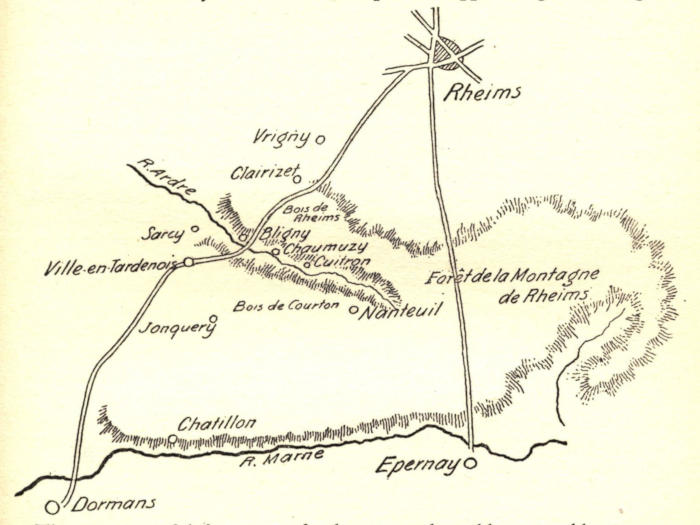
In this large, dense wood of summer foliage, on slopes running
down to marshy ground, we are to remember that the ‘stubborn
defence’ was now the business of the Germans. The conditions
of the war in the West had changed in several important aspects.
Not merely was the enemy on the defensive, to the huge enheartenment
of the Allied Forces, but this account of the natural features is necessary
because the fighting was now in the open, and no longer in a too
familiar entrenched area. To these changes in tactics and terrain,
at once so novel and so inspiriting, was added the fresh experience
of fighting side by side with new friends. General Godley’s Corps,
we remember, was sent at Marshal Foch’s request right away from
the British northern sector into the area of the French Command.
There it found the 1st Italian Division, the 14th and the 120th French
Divisions, and the 1st Colonial French Corps; and we are told that,
in this War of Positions, ‘the transference to a sector with its natural
obstacles, the novel situation of passing through Italian Troops to
attack side by side with our French Allies in the attempt to oust enemy
forces (enjoying all the advantages that the possession of the initiative
and positions of great natural strength would give them) presented
problems to all Arms which had hitherto been met with only in
theory.’ The practical problem of language was the least. Education
authorities will learn with pleasure, though some of their critics may
be surprised, that ‘there were far fewer French Officers with any
working knowledge of English than British Officers with a working
knowledge of French, and French was the language generally used.’
Whether it was the French of Stratford-atte-Bow, or the French of
the British private, ‘Tout-de-suite, and the tooter the sweeter,’ our
information does not reveal; but it is satisfactory to know that
the ‘working knowledge’ aimed at in our schools answered a test
which experts might not have satisfied. Of other details, such as
entraining and ‘embussing,’ this is not the place to speak: certain
differences in practice were found, and were solved with good will
on both sides. We may add here, in this list of new conditions, that
the 62nd Division now included the 2/4th Hampshire Regiment,
recently arrived in France, and the 1/5th Devons, lately from Egypt.
On August 2nd, Major-General Braithwaite wrote to the County
Territorial Associations at Southampton and Exeter respectively,
to express his high sense of their several distinguished services; and
he wrote at the same time to the Durham Association, in connection
with the 9th Durham Light Infantry, the Pioneer Battalion of the
Division, to say that it has been necessary to employ them in this
Second Battle of the Marne as a fighting Battalion, and that ‘they
fought magnificently, as Durham men always do.’
The assembly of the Troops for the battle was not an easy matter.
Long marches were entailed; the roads were strange and crowded;
exact positions on the night of 19th/20th were difficult to ascertain,
and it was not till after daybreak on July 20th that the Brigades were in
position upon the base of departure. Briefly, the River Ardre formed
the dividing-line between Divisions, with the 62nd (West Riding)
on the right and the 51st (Highland) on the left.[127] The two Divisional
Headquarters remained together throughout the operations, an
arrangement which they found of incalculable value. On July 31st,
we may note, Generals Braithwaite and Carter-Campbell exchanged
letters, expressing in the most cordial terms the pleasure each Division
had derived from serving side by side with the other.
A start was made on the right at 8 a.m. on July 20th, under an
artillery barrage, the leading Brigades being the 187th (right) and
185th (left), with the 186th in Divisional Reserve, to leap-frog and
capture the second objective. As may be judged from the nature
of the country and the advantages offered to its defenders, progress
was slow and casualties were heavy, and the deadly nests of German
machine-gunners proved very stubborn to rout out. Now in one
part and now in another, the combined advance was temporarily
held up; small groups went too far forward; detachments tried
to work a way round; till, through the standing grain or wooded
undergrowth, little streams of prisoners trickled out, vocal witnesses
to the prowess of the attackers. It was obvious at the end of the first
day that a part of the Bois de Reims between Courmas and Cuitron,
especially a strong point located on a timbered spur south-west of the
Bois du Petit Champ, would have to be thoroughly cleared before
the operations could be successful, and at 10-30 on July 21st, the
187th Brigade was detailed for this work. As one result of this day’s
heavy fighting, in which the 9th Durham Light Infantry and the
2/4th York and Lancs. may particularly be mentioned, the 103rd
and 123rd German Divisions had to be completely withdrawn, and
replaced by Regiments of the 50th German Division. Thus, the
62nd had fought two enemy Divisions out of the field.
On July 22nd, the capture and clearance of the obstructive Bois
du Petit Champ was entrusted to the 186th Brigade (Brig.-General
Burnett), and was successfully carried out with great dash and initiative
by the 5th Duke of Wellington’s. Initiative, indeed, was the key
to a very trying and tricky situation. The undergrowth in places
was found to be as thick as in a tropical jungle, and machine-gun
crews hidden in the thickets had evidently been trained to fire in the
direction of sound. It was necessary to attack at close range, with
casualties increasing as the range shortened. Two companies of
the 5th Devons arrived to reinforce their Yorkshire comrades, and
to assist in capturing a strong point of eight machine-guns and their
garrison. It was a very gallant little enterprise, in which the front
company of the Left Column was surrounded after hard hand-to-hand
fighting, and its position rendered untenable by the superior numbers
of the enemy. Captain Cockhill, M.C., cleverly withdrew his few
remaining men, and two Officers and six other ranks fought their
way out to the posts of the rear company. By nightfall, the whole
of the area was cleared, with the exception of a strong pocket of the
enemy situated in the centre of the wood, and very difficult to locate,
who were captured next day; and this example of a single, small
action in a tight corner of a wood, down south of the long front line,
serves to show with what gallantry and courage the invader was driven
out of France.
The prisoners’ bag of July 22nd was two Officers and two hundred
and six other ranks of the 53rd Infantry Regiment, 50th German
Division, together with forty-one machine-guns. On the 23rd,
the clearance of the Bois enabled progress to be made all along the
northern front of the Ardre, and eight French 75 m.m. guns, recaptured
from the enemy, were included in an excellent day’s haul.
Passing over the intervening period, with its daily tale of prisoners
and gains, though accompanied by very heavy losses, we come to July
28th, when the 8th West Yorkshire Regiment, supported by the 5th
Devons, made a particularly brilliant assault on the Montagne de
Bligny, north-west of the Bois de Reims. They started at 4 o’clock
in the morning, and, aided by the half-light of a late July dawn,
succeeded in reaching the foot of the steep slopes of the mountain
before they attracted hostile fire. This surprise, combined with the
dash displayed by the assaulting Troops, who, in spite of serious
casualties, succeeded in rushing the hill, resulted in the capture of a
position of great tactical importance.
How important, in the opinion of the best judges, may be gathered
from the following extract from the Minutes of the West Riding
Territorial Force Association, held at York on October 28th, 1918:
‘Major Chadwick asked if any information could be given
as to whether the French Government had awarded the Croix
de Guerre to the 8th Battalion, West Yorkshire Regiment (Leeds
Rifles).
‘Lord Harewood replied: The Croix de Guerre has been
offered to the Battalion of the Leeds Rifles referred to, but whether
or not the War Office will allow the Battalion to accept it I do
not know.’
The Fifth French Army Commander’s Order on the subject,
dated October 16th, was worded as follows:
‘Le 8th Bataillon du West Yorkshire Rgt.
‘Bataillon d’élite; sous le commandement énergique du
Lieutenant-Colonel Norman Ayrton, England, a participé
brillamment aux durs combats du 20 au 30 Juillet, qui ont valu
la conquête de la Vallée de l’Ardre. Le 23 Juillet, 1918, après
s’être frayé un chemin dans les fourres épais du Bois du Petit
Champ, s’est emparé d’une position importante malgré un feu
nourri des mitrailleuses ennemies. Le 28 Juillet, 1918, dans
un brio magnifique, a enlevé la Montagne de Bligny, fortement
défendue des forces ennemies supérieures en nombre, s’y est
maintenu malgré les pertes subies, et les efforts désespérés de
l’adversaire pour reprendre la position.’
It was a great and almost a unique compliment; and, as we
shall presently see, the 8th West Yorkshires enjoyed at a later date
another striking opportunity of proving their gallantry in action.
July 29th, to return to our recital, was a comparatively quiet day.
On the 30th, the 2/5th West Yorks. successfully carried out a small
attack to complete the capture of the Mount Bligny, and, meanwhile,
the remaining Troops of both Divisions had reached their final
objectives.
We subjoin the official account of these ten days’ ‘continuous
fighting of a most difficult and trying nature. Throughout this
period,’ runs the statement, ‘steady progress was made, in the face
of vigorous and determined resistance. Marfaux was taken on the
23rd July, and on the 28th July British Troops retook the Montagne
de Bligny, which other British Troops had defended with so much
gallantry and success two months previously. In these operations,
throughout which French Artillery and Tanks rendered invaluable
assistance, the 51st and 62nd Divisions took one thousand two hundred
prisoners from seven different German Divisions, and successfully
completed an advance of over four miles.’[128] The total casualties
for the period in the 62nd Division alone amounted to 4,126:
|
Killed. |
Wounded. |
Missing. |
| Officers |
28 |
108 |
10 |
| Other Ranks |
521 |
3,063 |
406 |
Apart from the victory which was gained, the whole operation,
as shown above, afforded very useful lessons in the new conditions
of warfare, and it was utilized to the full in this sense. Particular
attention may, perhaps, be drawn to the experiment of Machine-Gun
Battalions, which was found to have more than justified the change
of system. The M.G. Battalion of the 62nd Division had now fought
in two battles: in a defensive battle in the previous March, and now
in an offensive battle on the Marne, and the improvement in the
Machine-Gun service was estimated at sixty per cent. at least. Partly,
its success might be ascribed to the fact that the Commanding Officer
of the Battalion was not selected for expert gunnery, but was a good
Infantry Officer, with an eye for country, a knowledge of tactics, and
a power of command.
But where all units and Commanders did so well, it is invidious
to select one Arm. We may more fitly close this section of the Second
Battle of the Marne with some extracts from the congratulatory messages
earned by General Braithwaite’s Division. There was, of course,
the new fact of a close liaison between British and French Troops,
which caused more than common punctiliousness in the preparation
and dispatch of these epistles; but the tone is exceptionally cordial,
the sentiments are extraordinarily sincere, and the praises were very
thoroughly deserved. General Bertholot, Commanding the Fifth
French Army, published an Order of the Day, dated July 30th, of
which the following is a translation:
‘Now that the XXIInd British Corps has received orders to
leave the Fifth Army, the Army Commander expresses to all
the thanks and admiration which its great deeds, just accomplished,
deserve.
‘On the very day of its arrival, the XXIInd Corps, feeling
in honour bound to take part in the victorious counter-attack,
which had just stopped the enemy’s furious onslaught on the
Marne, and which had begun to hurl him back in disorder
towards the north, by forced marches and with minimum opportunity
for reconnaissance, threw itself with ardour into the battle.
‘By constant efforts, by harrying and driving back the enemy
for ten successive days, it has made itself master of the Valley
of the Ardre, which it has so freely watered with its blood.
‘Thanks to the heroic courage and proverbial tenacity of
the British, the continued efforts of this brave Army Corps have
not been in vain.
‘Twenty-one Officers and more than one thousand three
hundred other ranks taken prisoners, one hundred and forty
machine-guns and forty guns captured from an enemy, four
of whose Divisions were successively broken and repulsed; the
upper Valley of the Ardre, with its surrounding heights to the
north and south reconquered; such is the record of the British
share in the operations of the Fifth Army.
‘Highlanders, under the Command of General Carter-Campbell,
Commanding the 51st Division; Yorkshire lads,
under the Command of General Braithwaite, Commanding the
62nd Division; Australian and New Zealand Mounted Troops;
all Officers and men of the XXIInd Army Corps, so brilliantly
commanded by General Sir A. Godley—you have added a
glorious page to your history.
‘Marfaux, Chaumuzy, Montagne de Bligny—these famous
names may be inscribed in letters of gold in the annals of your
Regiments.
‘Your French comrades will always remember with emotion
your splendid valour and perfect fellowship as fighters.’
It was well and generously said.
The XXIInd Corps Commander specially conveyed through
Major-General Braithwaite his high appreciation of the Divisional
Artillery: ‘The way in which Batteries worked with Battalions, and
Brigades with Brigades of Infantry, in open warfare, must have been a
source of enormous satisfaction to all Officers, Non-Commissioned
Officers and men, and the way in which it was done is worthy of the
best traditions of the Royal Regiment.’ Other letters and orders
were published, and the memory of the Marne was added to that of
Bucquoy, Cambrai and Havrincourt in the tradition of the 62nd
Division.
Events moved quickly from this date, more quickly, indeed,
than they were divined except in the swift mind of the great Marshal,
and more quickly than they can be conveniently followed in a day-to-day
narrative of two Divisions. The greatest battle in all history
was planned, and fought, and won, between August 8th and September
9th, 1918, the period described by Sir Douglas Haig as ‘the opening
of the final British offensive.’ It is the word ‘final’ which signifies.
So definite, in fact, was the issue, that Ludendorff described August
8th as ‘the black day of the German Army in the history of this war,’
and proffered his resignation a few days later. This was not accepted
at the time, but at a Council held on August 14th he expounded the
situation to the Kaiser and to the ruling German statesmen, with
the result that Prince Max of Baden was subsequently appointed
Imperial Chancellor with a view to paving the road to peace. These
developments, not quite obscurely hinted at in a Note issued by Sir
Douglas Haig on the eve of the Battle of Bapaume (August 21st to
September 1st), must inevitably dominate our review of the ‘great
series of battles, in which, throughout three months of continuous
fighting, the British Armies advanced without a check from one victory
to another.’[129] The autumn fighting of 1918 differed from that of
previous years, in that there was no fifth winter to the war. We have
not to follow our Divisions over the top of their trenches, and back
again, when the weather failed, into the monotony of trench life.
They did not fully know that they were fighting the last battles: it
would be difficult to fix the exact date when this was revealed even
to Marshal Foch and Sir Douglas Haig. They did not welcome the
Armistice with the joy with which it was acclaimed in London: ‘the
news of the cessation of hostilities was received by the fighting Troops,’
writes an Officer of the 62nd Division who was ‘in at the kill,’ ‘without
any of the manifestations of excitement that marked the occasion at
home’; it was just an incident of the day’s work, and a sign that the
work had been done well. But an effect of increasing speed, of the
accelerated progress of Titanic forces, directed irresistibly to one
end, cannot but be felt during this period. Amiens was disengaged
after August 8th, partly by a brilliant feint in Flanders, which deceived
even the King of the Belgians. Thiepval Ridge, with its graves of
1916, Pozières, Martinpuich, Mory (by the 62nd Division) were re-taken
in the fourth week of August, and on August 29th Bapaume fell. On
September 1st, the Australians took Péronne, and Bullecourt and
Hendecourt fell the same day. Meanwhile, the Channel ports were
safe at last, for the enemy had no Troops with which to threaten
them, and he partly withdrew and was partly driven from the Lys
salient. Merville, Bailleul, Neuve Église, Kemmel Hill, Hill 63:
all the tragic places of the previous spring were once more in rightful
hands in September. There followed the Battle of the Scarpe, and
the storming of the Drocourt-Quéant Line, by the results of which,
on the British front, in the centre, we were brought right in face of
the main German defences known as the Hindenburg Line. The
question was, whether to attack it now or later. On September 9th,
Sir Douglas Haig had been in London, and had indicated that the
end might be near. He wrote, after weighing all the chances: ‘I was
convinced that the British attack was the essential part of the general
scheme, and that the moment was favourable. Accordingly, I decided
to proceed with the attack, and all preparatory measures were carried
out as rapidly and as thoroughly as possible.’[130] A great month, and
a grand decision.
So, we return at this point to the services of the Troops from the
West Riding, and shall fit them in to the concluding battles, where
they occurred.
At the end of August (25th to 27th), the 62nd Division drove
the Germans out of Mory, situated in country which they knew, about
four miles north of Bapaume. Excellent work there was achieved,
among other units, by the 2/4th and 5th King’s Own Yorkshire
Light Infantry and by the 2/4th York and Lancs. ‘D’ Company
Commander in that Battalion led a charge against a nasty position
in an awkward little hold-up, and personally accounted for the machine-gun
team with his revolver. Many prisoners, including a Battalion
Commander, were captured by the Division in these three days.
There was still hard fighting for the Division before it was withdrawn
for a few days’ rest, and the height of efficiency it had reached
may fitly be judged by a single instance, extracted from the London
Gazette, December 26th, 1918. Therein is recorded the award
of the coveted Victoria Cross to Sec.-Lieut. James Palmer Huffam,
of the 5th (attached, 2nd) West Riding Regiment (T.F.), in the following
circumstances:
‘For most conspicuous bravery and devotion to duty on
August 31st, 1918.
‘With three men he rushed an enemy machine-gun post,
and put it out of action. His post was then heavily attacked,
and he withdrew fighting, carrying back a wounded comrade.
Again, on the night of August 31st, 1918, at St. Servin’s Farm,
accompanied by two men only, he rushed an enemy machine-gun,
capturing eight prisoners and enabling the advance to continue.
Throughout the whole of the fighting from August 29th to
September 1st, 1918, he showed the utmost gallantry.’
Meanwhile, on August 27th, Major-General Walter Braithwaite
was appointed to the Command of the IXth Corps, with the rank
of Lieutenant-General, when a Knight Commandership of the Bath
was conferred upon him in recognition of his services with the 62nd.
It will be recalled that he succeeded Sir James Trotter in Command
of the 62nd Division in December, 1915.[131] He took the Division over
to France, and led it with conspicuous gallantry till the very eve of its
final bout of victory. His affection for his brave ‘Yorkshire lads’ was
fully reciprocated by his subordinate Officers, Non-Commissioned
Officers and men, who were all sensible of the constant care and fine,
soldierly qualities of their Commander. Sir Walter Braithwaite
has taken every opportunity, in subsequent meetings with, or references
to, the Division, to testify to his pride and pleasure in that office:
‘I look back,’ he wrote to the Secretary of the West Riding Association
(November 3rd, 1918), ‘on the time spent in Command of that heroic
Division as one of the proudest terms of years in my life.... I
don’t think I can be accused of partiality in saying that there is no
Division in the B.E.F. with a prouder record of continued success
than the 62nd.’ He was succeeded now by Major-General Sir R. D.
Whigham, K.C.B., D.S.O., who took over at a most responsible time
and who saw the war out and the peace in.
The grand decision referred to above, and concerted early in
September between Marshal Foch and Sir Douglas Haig, found the
Division in the Gomiecourt area, where they had been withdrawn on
September 3rd, in order to rest and train. On the 8th, Lieut.-General
Sir J. A. L. Haldane, Commanding the VIth Corps in the
Third Army (General Sir Julian Byng), called on Major-General
Whigham to explain the part to be taken by the 62nd in the impending
operations. It was to attack and capture the village of Havrincourt,
and ‘Z’ day was subsequently appointed for September 12th. We
may recall from page 150 above, the first capture of Havrincourt by
this Division on November, 1917. We may recall, too, how on
September 9th, 1919, almost on the anniversary of its second capture,
it was announced at a Divisional Dinner that a Memorial to the
Division was to be erected in Havrincourt Park. We are now to see
how it was won on the second occasion.
There was this difference between the second and the first. In
the battle of 1917, the break-through on the Cambrai front did not
close with a permanent advance. Owing partly, as we now know,
to the diversion of some Divisions to Italy, the brilliant design, so
courageously supported, could not be completely carried out. This
time, there was no going back. It was the Hindenburg Line which
was to be captured, on the road from the River Marne to the River
Meuse.
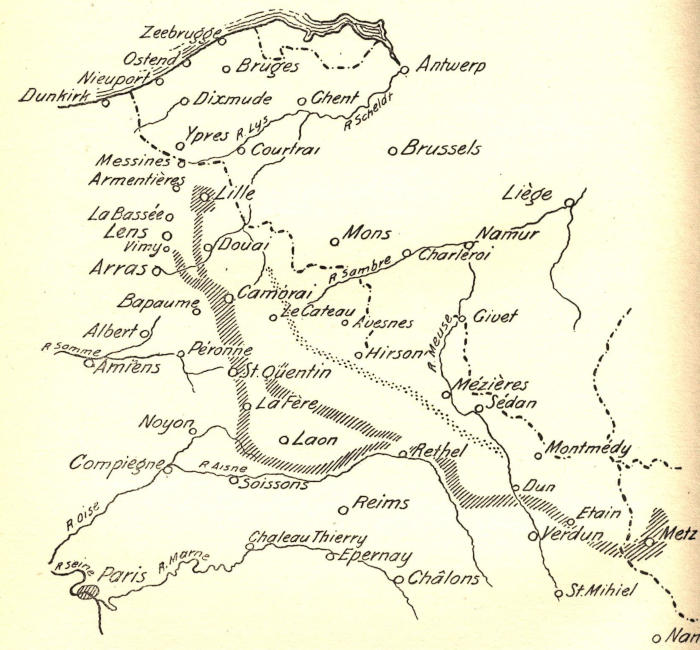
The Hindenburg Line, so called by our Troops, was neither
Hindenburg nor a Line. As described and pictured by great generals,[132]
it consisted of a series of defences, including many defended villages,
and forming a belt, or fortified area, varying in depth from seven to
ten thousand yards. It stretched from Lille to Metz, and among
its extensions, or switches, was the famous ‘Drocourt-Quéant Switch,’
which had held up our advance more than once. Within this system
of barriers, running through a stratum of deep cuttings, the enemy
had prepared elaborate dug-outs, shelters, and gun-emplacements,
all heavily fortified and wired. The luxurious appointments of some
of them, which so much astonished beholders, need not detain us
here. The importance of these extraordinary entrenchments to their
assailants in the autumn of 1918 lay, first, in their genuine strength,
to which German engineers had devoted all the ingenuity of their
craft, and, next, in the almost legendary awe with which time and
sentiment had invested them. This effect was carried out in their
native names. Working from north-west to south-east, they were
known in the German Army and behind it as Wotan, Siegfried
(supported by Herrmann), Hundung (Hagen), Brunehilde (Freya),
Kriemhilde and Michel; and we may well believe that, at the back
of the front, until such time as the front broke, German opinion was
obstinately convinced that their tutelary heroes must protect the
Fatherland from invasion.
It was the task of the 62nd Division to break into this line through
Havrincourt, and, by breaking it, to shatter the illusion. For, at last,
on the Western front, we were fighting not only positions but ideas.
The operation (September 12th to 15th) proved a complete
success. It was carried out on the left by the 187th, and on the right
by the 186th Infantry Brigade, with the 9th Durham Light Infantry
(Pioneers) attached to the latter as an assault Battalion. One company
of the 62nd Machine-Gun Battalion was allotted to each attacking
Brigade, and eight Brigades of Field Artillery and three Groups Heavy
Artillery were in position to support. The plan of attack entailed
a change of direction from north to east, in order to obviate the
difficulties of the terrain, and the consequent complication of the
Artillery barrage had to be very carefully worked out. In contrast
to the attacks in November, no Tanks were employed in this action,
but it bore in another respect a superficial resemblance to the First
Battle of Havrincourt, insomuch as the first day’s work ‘could not
have been bettered, but again there was to be a second chapter, a
chapter of hard fighting, in very difficult circumstances, fought to the
end, and crowned with success.’ We shall not follow it in detail,
save to note that, an hour after Zero (5-30 a.m.) on September 12th,
‘large batches of prisoners were coming back,’ and that four
Officers and eighty men of these had been captured at a strong
point which ‘offered little resistance, owing to the great gallantry
of Sergt. Laurence Calvert,[133] of the 5th King’s Own Yorkshire Light
Infantry.’ His great gallantry won the Victoria Cross, in circumstances
officially described as follows:
‘For most conspicuous bravery and devotion to duty in attack,
when the success of the operation was rendered doubtful owing
to severe enfilade machine-gun fire. Alone and single-handed,
Sergt. Calvert, rushing forward against the machine-gun team,
bayoneted three and shot four. His valour and determination
in capturing single-handed two machine-guns and killing the
crews therefore enabled the ultimate object to be won. His
personal gallantry inspired all ranks.’
All ranks were inspired to good purpose; or, more precisely,
the inspiration of all ranks found its typical expression in the brave
act of this gallant N.C.O. The Division’s team-work, now as always,
was exemplary; and, whether judged by casualties or captures,[134]
the result of the Second Battle of Havrincourt was a great triumph
for General Whigham in his new Command.
For Havrincourt looked to the east. It looked through the
intricate defences, in which the German people still believed, to
Cambrai and St. Quentin, and beyond. Thus it formed one of those
‘formidable positions,’ which, as Sir Douglas Haig wrote, ‘had to
be taken before a final attack on the Hindenburg Line could be undertaken.’
By its capture, and that of others, ‘our line advanced to
within assaulting distance of the enemy’s main line of resistance.’[135]
And General Whigham, in a letter of October 9th, addressed to the
Secretary of the Association at York, said, in almost identic terms:
‘On September 12th, the Division was called upon to repeat its former
feat of capturing the village of Havrincourt. This village stands
on very commanding ground, and formed a most formidable position
in the Hindenburg front line. Its capture was essential to the
development of the great offensive south of Cambrai, in which we have
latterly been engaged.... Without the possession of Havrincourt,
the grand attack of September 27th could not have been successfully
launched.’
So, we come to that ‘grand attack,’ in which, as the General
went on to say, ‘the Division has once more added fresh lustre to its
fame.’ On this occasion they were engaged to the south of the scenes
of their exploit in November. Graincourt now fell to the 63rd
Division, Anneux to the 57th, Bourlon and Bourlon Wood to the
4th and 3rd Canadian Divisions. The 3rd Division moved forward
with the Guards, forcing the crossings of the Canal, by capturing
Ribécourt and Flesquières (the objective of the 51st in the previous
November). To the 62nd was allotted the task of following up the
attack, and of securing the crossings of the Canal at Marcoing. Once
more, we have the high privilege of illustrating the nature of the
operations by a single typical example of the spirit which animated
all ranks. The London Gazette of December 14th, 1918, announced
the award of the Victoria Cross to Private Henry Tandey, D.C.M.,
M.M., of the 5th Duke of Wellington’s, in the following circumstances:
‘For most conspicuous bravery and initiative during the
capture of the village and the crossings at Marcoing, and the
subsequent counter-attack on September 28th, 1918.
‘When, during the advance on Marcoing, his platoon was
held up by machine-gun fire, he at once crawled forward, located
the machine-gun, and, with a Lewis gun team, knocked it out.
‘On arrival at the crossings he restored the plank bridge
under a hail of bullets, thus enabling the first crossing to be made
at this vital spot.
‘Later in the evening, during an attack, he, with eight
comrades, was surrounded by an overwhelming number of
Germans, and, though the position was apparently hopeless, he
led a bayonet charge through them, fighting so fiercely that
thirty-seven of the enemy were driven into the hands of the
remainder of his company.
‘Although twice wounded, he refused to leave till the fight
was won.’
No defences made by man, certainly none made by German,
could withstand courage of this kind.
In a Special Order of the Day, issued on October 1st, by Major-General
Sir R. Whigham, Commanding the 62nd Division, he
addressed his gallant Troops as follows:
‘The capture of Havrincourt on 12th September was essential
to the success of the operations south of Cambrai, in which the
62nd Division has been engaged during the last four days.
‘As a sequel to that brilliant achievement, the Division has
now captured Marcoing, Masnières, and the high ground north
of Crèvecoeur, thus establishing a bridgehead over the Canal
de St. Quentin, which is vital to the further successful prosecution
of the campaign.
‘The Field Marshal Commanding-in-Chief visited Divisional
Headquarters to-day, and desired me to convey to all ranks of
the Division his congratulations and high appreciation of their
splendid courage and endurance.
‘For myself, I give you all my warmest thanks for the unfailing
cheerfulness with which you have carried out the most arduous
tasks, often in conditions of great hardship and discomfort.
‘It will ever be to me a pride to have commanded so magnificent
a Division.’
Yet one more word about Marcoing. On an earlier page we
remarked that we should have occasion to come back to the 8th
Battalion of the West Yorkshire Regiment, the Bataillon d’élite of a
French Army Order. This occasion occurred on September 27th,
when two companies of that Battalion earned from the VIth Corps
Commander (Lieut.-General Sir A. Haldane) the following striking
encomium, dispatched through the 62nd Divisional Commander:
‘Please convey to the survivors of the two companies 8th
West Yorkshire Regiment my high appreciation and admiration
of their initiative, dash and gallantry in pushing up to the outskirts
of Marcoing yesterday [September 27th], in spite of all
obstacles. It is by resolution and bravery such as they displayed
that great victories have been won in the past history of the British
Army.
‘I heartily congratulate the whole Battalion, yourself, and
your splendid Division on the inspiring incident in front of
Marcoing.’
Major-General Whigham, in publishing this letter, for the
information of all ranks of the Division, showed how well the action
of the two Companies illustrated the principle of pressing an advantage,
whenever gained.
‘The great and critical assaults, in which, during these nine
days of battle [September 27th to October 5th], the First, Third and
Fourth Armies stormed the line of the Canal du Nord and broke
through the Hindenburg Line, mark the close of the first phase of
the British offensive. The enemy’s defence in the last and strongest
of his prepared positions had been shattered. The whole of the
main Hindenburg defences has passed into our possession, and a
wide gap had been driven through such rear trench systems as had
existed behind them. The effect of the victory upon the subsequent
course of the campaign was decisive.’[136]
So far, Sir Douglas Haig, with his usual modesty and brevity.
In Flanders now, King Albert of the Belgians, leading his nation at
last in victory, as he had led it so gallantly in defeat, entered Ostend
on October 16th. The Second Battle of Le Cateau in the previous
week had driven the last German out of Cambrai; and about this
date, as Sir Frederick Maurice writes, ‘The revulsion of feeling and
the collapse of confidence were such that no enthusiasm could be
aroused for a war of endurance in defence of the Fatherland. Even
in an autocratic country it is not possible to deceive all the people
all the time, and the German people knew in October, 1918, that the
victory which had been promised to them could never be obtained.’[137]
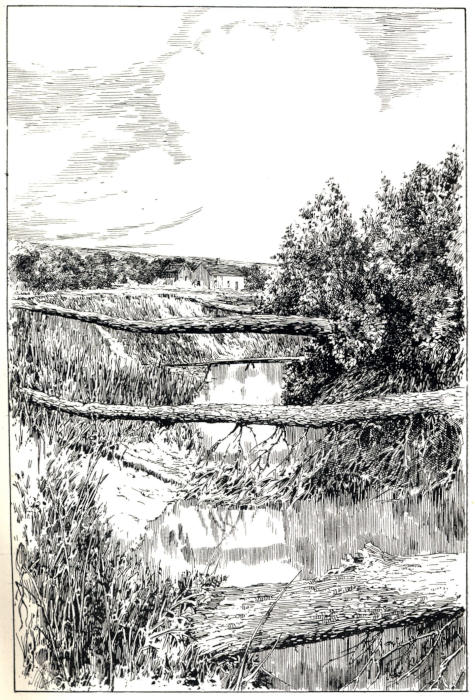
RHONELLE RIVER CROSSING (Nov. 1st. 1918).
In these circumstances, the battles still ahead, in which the
Divisions from the West Riding were to take part, need not detain
us long. The 49th were engaged in October (11th to 17th) at Villers-en-Cauchie
and Saulzoir, on the road running eastward out of Cambrai
between Douai and Le Cateau. They fought with all their accustomed
gallantry, especially in the capture of Saulzoir, which was
defended by Machine-Guns and Tanks. When the obstinate
resistance had been overcome, an Officer of the 1/6th Duke of
Wellington’s found the houses full of civilians, who had taken refuge
in their cellars, and who welcomed the arrival of the British Troops
with offerings of cognac and coffee. The Division fought again
below Valenciennes on November 1st and 2nd, and, with the 5th
and 61st Divisions, crossed the Rhonelle River and captured the
villages of Préseau and Maresches. Lieut.-General Sir A. Godley,
Commanding the XXIInd Corps, conveyed to Major-General
Cameron the expression of his appreciation of these exploits in the
following complimentary terms:
‘I wish to heartily congratulate you and your Division on
the successful capture of all your objectives and the heavy losses
inflicted on the enemy as the result of your two days’ hard and
gallant fighting.
‘All three Infantry Brigades, your Artillery, and Engineers,
have added another page to the distinguished record of the
Division.’
The 62nd Division, on October 19th and 20th, had the task of
capturing Solesmes, and of driving the enemy from the line east of
the River Selle, to which he had retired a few days before, partly as
a result of the operations in which the 49th had borne themselves
so gallantly. This further assault on the German positions, directed
ultimately at Le Quesnoy, was to be a surprise, without preliminary
bombardment. It was carried out ‘according to plan,’ with very
conspicuous success. Twelve Officers and six hundred and eighty-seven
other ranks, seventy-one machine-guns, thirteen trench mortars
and five guns were captured at the cost of a casualty list of fifty-seven
other ranks killed, ten Officers and three hundred and seventy other
ranks wounded. The River Selle was crossed by wading, the water
being in many places waist-high. The ground to be traversed proved
difficult, with dense hedges and barbed-wire fencing, and in Solesmes
itself the street-fighting was serious and severe. But the fine leadership
of Platoon Commanders and the excellent spirit of the men
carried all obstacles before them; and, once more, and now for the
last time, we have the advantage of illustrating these qualities by an
extract from the London Gazette (January 6th, 1919), announcing
the award of the supreme decoration of the Victoria Cross to Corpl.
(A/Sergt.) John Brunton Daykins, of the 2/4th York and Lancaster
Regiment, 187th Infantry Brigade, 62nd Division, in the following
circumstances:
‘For conspicuous bravery and initiative at Solesmes on
October 20th, 1918, when, with twelve remaining men of his
Platoon, he worked his way most skilfully, in face of heavy
opposition, towards the Church. By prompt action, he enabled
his party to rush a machine-gun, and during subsequent severe
hand-to-hand fighting he himself disposed of many of the enemy,[138]
and secured his objective; his party, in addition to heavy casualties
inflicted, taking thirty prisoners.
‘He then located another machine-gun, which was holding
up a portion of his Company. Under heavy fire he worked his
way alone to the post, and shortly afterwards returned with
twenty-five prisoners, and an enemy machine-gun, which he
mounted at his post.
‘His magnificent fighting spirit and example inspired his
men, saved many casualties, and contributed very largely to the
success of the attack.’

Douai. The Belfry
The war’s end on November 11th at 11 o’clock in the morning
found the bulk of the 49th Division resting on its well-earned laurels
in the neighbourhood of Douai. The Gunners, the Royal Engineers
and the Pioneer Battalion went forward in the final stages of the
advance, and the Artillery had the distinction of finishing at a point
further east than any other Divisional Artillery engaged. The 62nd
Division ended in the Valley of the Sambre. If we draw an irregular
quadrilateral, dipping a bit on the southern side, with its north-west
angle at Valenciennes, its south-west at Le Quesnoy, and its north-east
and south-east angles at Mons and Maubeuge respectively, we shall
be able to prick in the places of the Division’s stout advance between
November 4th and 11th (Orsinval, Frasnoy, Obies, Hautmont,
Louvroil: it is at this end that the line dips towards Avesnes), by
the help of which, as Sir Douglas Haig wrote: ‘On the 9th November
the enemy was in general retreat on the whole front of the British
Armies. The fortress of Maubeuge was entered by the Guards
Division, and the 62nd Division (Major-General Sir R. D. Whigham),
while the Canadians were approaching Mons.’[139]
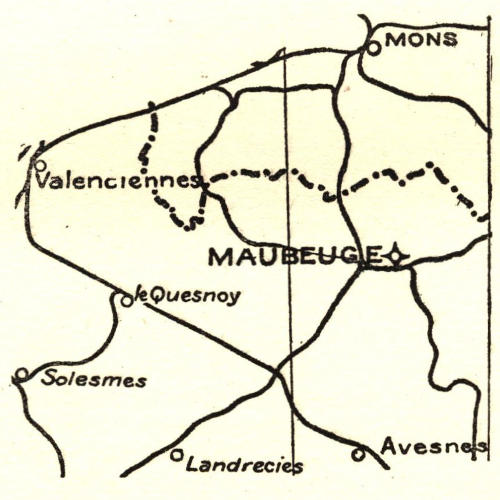
And Mons, as we know, is the last word of the war on the Western
front.
On November 18th, 1918, the 62nd Division started to march
to Germany, where it formed part of the British Army of Occupation
in the Rhine Province of the Kingdom of Prussia. As a Division
of the IXth Corps of the Second Army, it had the luck to come
under the command of its former Divisional Commander, Lieut.-General
Sir W. P. Braithwaite, K.C.B., then commanding that
Corps, who, accordingly, saw the Pelican at last put down his foot
on German soil.
APPENDIX IV. RETURN OF CASUALTIES UP TO THE END OF DECEMBER, 1918.
This Return is provisional only, and, though so deplorably
heavy, cannot be regarded as complete.
| UNIT. |
Officers. |
Other Ranks. |
REMARKS. |
| Killed. |
Wounded. |
Missing. |
Sick. |
Killed. |
Wounded. |
Missing. |
Sick. |
| Yorkshire Hussars |
3 |
4 |
|
7 |
11 |
42 |
|
120 |
|
| Yorkshire Dragoons |
2 |
4 |
|
5 |
3 |
14 |
|
59 |
|
| West Riding R.H.A. |
1 |
|
|
4 |
1 |
|
|
3 |
|
| Yorks. Mtd. Bde. R.A.S.C. |
|
|
|
|
1 |
2 |
|
3 |
|
| Yorks. Mtd. Bde. Field Ambulance |
|
4 |
|
2 |
|
4 |
|
8 |
|
| Signal Troops with Mtd. Bde. |
|
|
|
|
|
1 |
|
2 |
|
| Headquarters W.R. Division |
|
4 |
|
1 |
1 |
4 |
|
7 |
|
| 245th Brigade R.F.A. |
6 |
15 |
|
7 |
36 |
173 |
1 |
184 |
|
| 246th Brigade R.F.A. |
9 |
10 |
|
16 |
82 |
221 |
3 |
268 |
|
| 247th Brigade R.F.A. |
1 |
8 |
|
12 |
4 |
19 |
|
92 |
|
| 248th Brigade R.F.A. (Howitzer) |
|
3 |
|
6 |
4 |
20 |
|
61 |
|
| 310th Brigade R.F.A. |
1 |
26 |
|
3 |
20 |
204 |
1 |
375 |
|
| 312th Brigade R.F.A. |
3 |
24 |
|
6 |
47 |
177 |
1 |
291 |
|
| West Riding R.G.A. (Heavy Battery) |
|
1 |
|
2 |
5 |
11 |
|
21 |
|
| Divisional Ammunition Column |
|
5 |
|
7 |
80 |
103 |
2 |
306 |
|
| Trench Mortar Batteries |
2 |
18 |
2 |
2 |
22 |
211 |
2 |
55 |
|
| W.R. Divisional Royal Engineers |
19 |
26 |
|
27 |
110 |
635 |
20 |
983 |
|
| 5th Bn. West Yorks. Regt. |
33 |
105 |
11 |
54 |
497 |
1,902 |
323 |
1,339 |
|
| 6th Bn. West Yorks. Regt. |
38 |
96 |
5 |
48 |
374 |
1,488 |
196 |
1,044 |
|
| 7th Bn. West Yorks. Regt. |
28 |
70 |
4 |
51 |
433 |
1,642 |
145 |
1,535 |
|
| 8th Bn. West Yorks. Regt. |
46 |
116 |
11 |
60 |
528 |
2,917 |
237 |
1,689 |
|
| 4th Bn. West Riding Regt. |
38 |
107 |
4 |
57 |
720 |
2,651 |
251 |
1,731 |
|
| 5th Bn. West Riding Regt. |
28 |
121 |
9 |
64 |
535 |
2,404 |
437 |
1,517 |
|
| 6th Bn. West Riding Regt. |
24 |
66 |
3 |
43 |
252 |
1,396 |
131 |
868 |
|
| 7th Bn. West Riding Regt. |
22 |
70 |
2 |
66 |
375 |
1,514 |
100 |
1,101 |
|
| 4th Bn. K.O.Y.L.I. |
48 |
138 |
2 |
83 |
630 |
2,947 |
579 |
1,560 |
|
| 5th Bn. K.O.Y.L.I. |
48 |
103 |
7 |
58 |
676 |
2,878 |
493 |
1,867 |
|
| 4th Bn. York and Lancaster Regt. |
36 |
113 |
4 |
56 |
614 |
3,015 |
438 |
1,538 |
|
| 5th Bn. York and Lancaster Regt. |
35 |
83 |
5 |
40 |
481 |
1,861 |
216 |
851 |
|
| 5th Devon Regt. |
10 |
31 |
|
3 |
138 |
645 |
60 |
353 |
|
| 4th Hants. Regt. |
5 |
24 |
|
5 |
157 |
662 |
105 |
422 |
|
| 19th Lancashire Fusiliers |
|
6 |
|
3 |
18 |
433 |
|
194 |
|
| 9th Durham Light Infantry |
2 |
24 |
|
|
93 |
506 |
46 |
345 |
|
| 2/20th London Regt. |
4 |
11 |
|
1 |
91 |
421 |
40 |
210 |
|
| Machine-Gun Corps |
2 |
47 |
|
7 |
109 |
702 |
16 |
627 |
|
| Divisional Cyclists Corps |
|
1 |
|
4 |
4 |
45 |
|
58 |
|
| West Riding Divisional R.A.S.C. |
|
1 |
|
8 |
4 |
25 |
|
300 |
|
| 1st West Riding Field Ambulance |
1 |
6 |
|
14 |
11 |
61 |
|
161 |
|
| 2nd West Riding Field Ambulance |
1 |
5 |
|
8 |
9 |
65 |
|
248 |
|
| 3rd West Riding Field Ambulance |
|
7 |
|
5 |
18 |
162 |
1 |
201 |
|
| Casualty Clearing Station |
|
|
|
11 |
1 |
4 |
|
23 |
|
| Mobile Veterinary Section |
|
|
|
1 |
|
1 |
|
20 |
|
| Sanitary Section |
|
|
|
|
1 |
|
|
1 |
|
| Chaplains |
|
2 |
|
|
|
|
|
|
|
| 243rd Employment Company |
|
|
|
|
1 |
4 |
|
10 |
|
| M.M.P. |
|
|
|
|
|
|
|
2 |
|
| TOTAL |
496 |
1,505 |
69 |
857 |
7,197 |
32,192 |
3,844 |
22,653 |
|
| Total |
Officers |
2,927 |
|
Other Ranks |
65,886 |
|
|
68,813 |
BY THE SAME AUTHOR AND PUBLISHERS.
428 pages. 12s. net.
A GENERAL SKETCH OF EUROPEAN
LITERATURE IN THE CENTURIES
OF ROMANCE.
| Chap. |
I |
Story-Matters and Story-Writers. |
| ” |
II |
The Age of Dante. |
| ” |
III |
The Fourteenth Century. |
| ” |
IV |
1374 to 1492. |
| ” |
V |
The Transit through 1492. |
| ” |
VI |
Europe at School. |
| ” |
VII |
Europe at Large. |
| ” |
VIII |
The Maturity of Romance. |
| ” |
IX |
The Age of Milton. |
| ” |
X |
The Watershed of 1637. |
By LAURIE MAGNUS, M.A.
Starting at the twelfth century, “The Centuries of Romance” brings down
the history of literature in Europe to the year 1637 (including the works
of Milton and Calderon), when the French Academy was founded, and
a natural break occurs between the centuries of Romance and Bon Sens.
It is intended to provide English students, both professional and
amateur, with a measure and a standard of comparison for the true and
correct appreciation of the literature and literary history of our own
country.
The Spectator says: “Many people who are not students will find
this survey of a wide field both interesting and useful, for few writers since
Hallam’s day have attempted to envisage the literary activity of medieval
and modern Europe as a whole.”
The Morning Post says: “Hitherto no guide-book of the kind has
existed in the English language.... The author of this ample and
learned book, which shows an amazing depth and range of reading, writes
with power and precision, and has provided an invaluable literary map,
so to speak, of that which is a terra incognita to most English students of
literature.”
The Times Literary Supplement says: “The mass of knowledge of which
he disposes, if nowhere amounting to specialism, is in the aggregate extraordinarily
copious and varied; and he handles it with an agility of mind,
an openness to impressions, and a deftness in seizing salient points, which
make his book constantly fresh and informing.”
The Journal of Education says: ... “The other and nobler way,
of which Goldsmith (with all his shortcomings) and Hallam set the example,
and which Mr. Laurie Magnus has followed, gives us something different
from a ‘cram’ book or a book of reference. The student is led by his guide
to the summit of hills that command a great stretch of plain: he views the
country spread out as a map before him, and places that he has passed
through or will visit in days to come are seen in their right relations to each
other. To attempt this kind of conspectus is incomparably the more difficult
task, and success in it seems to require the wide knowledge and power of
generalization of a Lord Acton. Mr. Laurie Magnus would doubtless
disclaim the ambition to ‘rival the cultivated mind of Europe incarnate in
its finest characteristics,’ but he has performed a very arduous feat with a
skill that, to one reader at least, has pleasantly recalled Viscount Bryce’s
memorable description of Acton’s conversation.”
C.H.H., whose initials reveal a distinguished authority on the subject,
writes in the Manchester Guardian: “Mr. Magnus has conceived his task
on large lines.... Continental culture through the centuries has
moved to vast and complex rhythms of its own, only fitfully and in fragments
caught up into our island music, and it is the merit of Mr. Magnus’s sketch
to have made these larger rhythms in outline clear.... The sketch
of the age of Dante in the second chapter is an admirable synthesis....
The Renaissance is unfolded in a series of vivid delineations and portraitures,
lightly but significantly touched. Some of them, such as Petrarch, Montaigne,
Cervantes, could not well be bettered within their compass, ... and
there is no lack of acute and curious observation by the way, in which even
the well-read may find it worth their while to glean.... The wealth
of knowledge, though never that of a specialist, is very remarkable.”
Prof. George Saintsbury writes in the Observer: “This book of Mr.
Magnus’s is, for its subject, just the sort of book upon which to set training
college students, while it ought to do not a little good to the superior
shepherds—perhaps to some of the chief pastors themselves.... Here
you get a view of the whole body to be compared with a view of the other
whole.... A very difficult thing to construct; a thing almost
impossible to construct without some gaps or weak points here and there;
but a thing very well worth attempting, and, in this example, a thing very
fairly and usefully done.”