SANAA, the capital of Yemen, is one of
the noblest cities of Arabia Felix, and
is said to rival beautiful Damascus in
many of her exquisite features. The Imam of
Yemen who ruled in the beginning of this
century could claim rank among the most
whimsical princes who ever sat on a throne.
He was a man of weak intellect, strong passion,
boundless vanity, and a religious enthusiasm
entirely foreign to his subjects, who are
indifferent followers of Mohammed. That
eccentric Commander of the Faithful conceived
the singular fancy that he was animated by
the soul of the last Prophet, and he suited his
conduct to his conceit, there being no one to
dispute his ludicrous presumption. He dressed
in green, sermonized his people in the style of
202]
the Koran, read surahs of his own creation,
raved of his nocturnal visits to heaven,
descanted on visions and revelations vouchsafed
to him, and scrupulously arranged his
household in imitation of Mohammed’s, not
forgetting the seventeen wives of the founder
of Islam, including an Ayesha, who was the
power behind the Imam’s throne, being the
flower of his harem.
The most important person who stood next
to the Imam in power, and above him in wisdom,
was the great Kadi, or judge, Omar,
who presided over the supreme court of Sanaa,
and was in fact the walking code and cyclopædia
of Yemen. What he did not know only
Allah and His Prophet could reveal. The
wise Kadi had no doubt at all that the Imam
was a spiritual duplicate of the true Prophet,
and he received in recognition the proud title
of the “Lion of God,” reminiscent of Mohammed’s
most devoted champion who fought his
battles, and died sword in hand.
Omar plied his legal profession so well, had
so many questions of justice and equity referred
to him from every quarter of the land,
203]
that he rose to be the wealthiest Moslem of
Sanaa, exceeded in his opulence by one man
only, and that was the renowned Ben Abir,
surnamed “The Crœsus of Yemen.” Ben
Abir was no Moslem, but a Hebrew, and one
who feared nothing so much as the remote
likelihood of slighting his faith.
The Imam’s ruling passion for prophetic
honors was equalled by his unprophetic mania
for building monumental structures with an
extravagance which drained his treasure.
Lacking the vast resources of the Caliph of
Estamboul, the prince of Yemen nevertheless
aspired to rival the head of the faithful in the
monumental magnificence of his great capital;
and immense sums were lavished on the embellishments
of a city which was meant to
dazzle even the strangers who had wondered
at the imperial palaces of the mighty Sultan
himself. The drawback was the limited revenues
of the Imam’s domains, and the shrewd
Kadi, forestalling the danger of a royal recourse
to his riches, was instrumental in
causing his master to draw on Ben Abir for
large sums, in return for titles and privileges
204]
which enabled the misused Israelite to indemnify
himself in a measure for advances he
never expected to see returned. Unlimited in
the extent of his commercial enterprises, and
furnished with as many military escorts as he
chose to ask for, Ben Abir’s caravans carried
loads of silk, cotton, hardware, weapons and
trinkets as far as Hadramaut, Hejaz and Nejd,
fearless of the dangers of the Tehamah and
the deathful simoons of the arid desert; and
they returned to the seashore with tons of
coffee, packs of gum, ostrich feathers, dyes and
pearls, which foreign vessels carried to distant
lands. To all this Ben Abir added the breeding
of the finest Arabian horses, such as are
only found in Nejd, and it became a current
saying that whatever the Crœsus of Yemen
touched turned into gold.
Now, it happened that, previous to the closing
celebration of the Ramadhan Fast, Ben
Abir presented his sovereign with one of his
choicest Nejdi stallions, of spotless white and a
most fiery temper, caparisoned in the most
approved fashion. Delighted with the gift,
the Imam showed his appreciation by mounting
205]
the spirited animal on the solemn occasion
brought about by the sacrificial ceremony
which marks the close of the Fast. As ill-luck
would have it, a distracted saint, who
had just issued from his cave looking more
like a chimpanzee than a human being, threw
himself in the way of the stallion with a yell
that frightened both horse and rider. Snorting
and balking in recoil from the object of
terror, the high-spirited creature reared and fell
backward injuring the Kadi, who was behind,
and landing the second edition of the Prophet
on a rock, with a broken leg and a dislocated
jaw as mementos of the inauspicious incident.
Somebody had to be burdened with the blame,
and the Kadi realized his opportunity. As
soon as sufficiently recovered from his own
hurts to sit in judgment, Omar declared Ben
Abir guilty of high treason for having tempted
the Imam to mount a mad horse, and condemned
him to perish by decapitation, unless
he should ransom his life for a fabulous sum,
which was named, with the additional condition
that it be paid in solid gold. Within
twenty-four hours the gold was in the hands
206]
of the Imam’s treasurer, and Ben Abir was a
poor man.
When Ayesha, the flower of the royal
harem, who was of Hebraic origin, heard of the
Kadi’s sentence, she appealed to her prophetic
lord’s conscience against the flagrant injustice.
The Imam was moved to the extent of offering
to return a small portion of the robbery, provided
the Hebrew would enter the mosque.
Ben Abir would not listen to the thought of
such treason to the God of his fathers, and
had a brave wife to sustain him in his trial,
with two children, one an ineffably charming
maiden, to comfort him. Nor was he entirely
destitute, his commercial credit remaining
good.
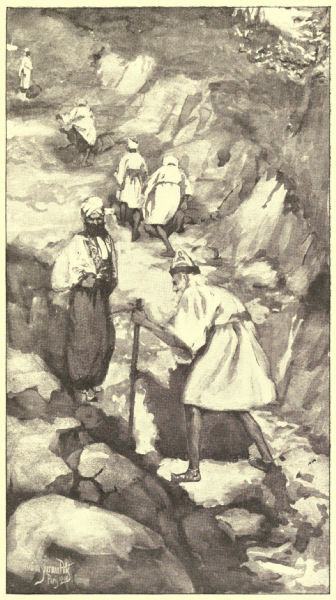
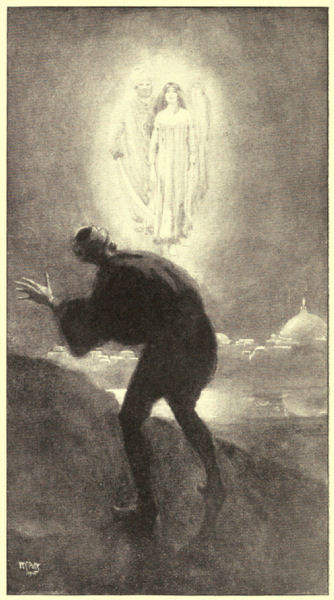
In one of the mountain ranges of Yemen one
Friday afternoon, as the sun began to approach
the rim of the horizon, a small caravan made
a halt. The dromedaries were freed from their
burdens and allowed to browse, and a dark
tent was stretched for the use of the master of
the caravan. On a matting on the ground a
rug was spread and a few pillows were put
thereon for the ease of a middle-aged person
207]
who, dismounting from his horse, took possession
of the transient resting-place. As soon as
he found himself within the tent he washed
himself with water drawn from the nearest
spring, changed his garments, brought forth a
silver lamp, which he filled with oil, a silver
flask full of wine, and a goblet of the same
metal. With nightfall the lamp illumined the
tent, and the inmate stood lost in prayer, with
his face turned to the east. A blessing uttered
over the wine was followed by a frugal meal,
and the rest of the evening was spent in study
of sacred lore. At the entrance to the tent,
near a spear struck into the soil, stood a black
sentry, while at a distance the camel drivers
made themselves comfortable for the night.
The lord of the caravan was Ben Abir, his
sentinel was Ibraeem, a freed slave, who,
having been treated kindly by his master in
his happier days, would not desert him now
that fortune declined to smile on him.
The night was very dark, and would have
been voiceless but for the sighs and moans of
the dromedaries, who seemed audibly to commiserate
one with another upon the hardships
208]
of life. About midnight the silence was
unbroken, the discontented animals having
buried their sense of trouble in dreamless
sleep. At this hour Ben Abir was roused by
his faithful attendant, who informed him of a
great marvel that was to be seen before the
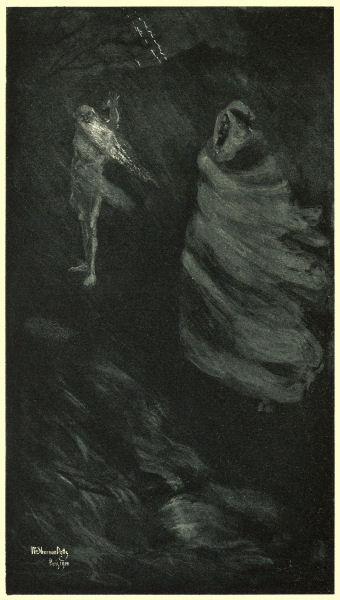
tent. A heap of gold cropped up from the
ground, each coin scintillating like a star.
“Rise, O, master! Allah sends thee a
treasure,” cried the devoted slave.
“What is it thou art raving of, O,
Ibraeem!—art thou dreaming?” said Ben
Abir.
“Indeed I am wide awake, O, master!—step
forth and trust to thine own senses if
thou doubtest mine; here is the hoard Allah
would have thee take,” insisted Ibraeem.
As Ben Abir peered out of his tent to convince
himself of Ibraeem’s illusion, he saw
with amazement a golden pile of coin, the
pieces glowing like lupine eyes in the dark.
This is a temptation of the evil one, thought
the scrupulous Israelite, who would not have
touched pelf on his Sabbath for the wealth of
the Indies.
209]
“Touch not a piece of this hoard, Oh,
Ibraeem!—if thou fearest Allah, and wouldst
not disobey Ben Abir. If the treasure is to be
mine, it will remain where it is till after my
Sabbath; if it be not mine, the breaking of
my holy day will not save it for me. What is
to be, will be. Go to sleep,” closed the pious
Yemenite, and retired to his couch, Ibraeem,
after a little natural hesitation, doing likewise.
What right, after all, had he to question the
deep wisdom and deeper faith of his generous
master?
But sleep would not return to Ben Abir.
Through the coarse goat hair texture that
made up the covering of his tent the glittering
mass stared at him like so many living eyes,
and he felt a chill run through the marrow of
his bones. While he was at a loss to explain
how the glare of the hoard penetrated the
opaque material of his tent, a new wonder
diverted his attention. An inclined plane,
broad as a valley and smooth as glass,
stretched down from the deep heavens with
both ends lost, one among the starry configurations,
the other in the unfathomed abysses of
210]
the nether world. The only irregularity in
the sweep of the prodigious highway was a
terrace which made a connecting link between
the upper and the lower part of the plane. In
the heart of the terrace shone the hoard which
a while before had been seen before the tent.
Ben Abir doubted not that there was an evil
design back of this marvelous display, but he
felt safe in the consciousness of his firm loyalty.
His feeling of safety, however, was
somewhat shaken by a terrific detonation,
like the eruption of a volcano. It was the
signal for a numberless host to ascend towards
the terrace, who, dividing and subdividing,
started to march up in frowning armies to the
sound of wailing notes,—clarions and clashing
cymbals mixing with a chaos of noise produced
by all the instruments of music known.
The vanguard was made up of a serried division
of vicious gholes whose march resembled
more the dance of droll harlequins than the
pace of warriors. At their heels came a vast
herd of monstrous bipeds, with head, tail and
hoofs of the boar, making the air shudder with
their hideous grunts, and piercing the sable of
211]
night with their grim eyes. Next followed a division
of bipedal beasts, rolling fiery eyeballs,
striking their sides with tails like those of lions,
and rending the atmosphere with roars of fury.
Back of these came bounding an enormous
pack of bellowing hell-hounds, each one a
Cerberus, armed with the deadly teeth and
claws of the tiger. Close behind tramped an
appalling herd of deformities, hunch-backed
elephants, with raised trunks that were hissing
serpents, and tusks which reached down to the
ground tearing up fragments of rock and hurling
them against the terrace with diabolic
fury. The rear was taken up by a grisly multitude
of animated skeletons, who yelled,
grinned, laughed, danced,—drawing up and
thrusting out their bony limbs with wriggling
motion, and varying the infernal performance
by a series of somersaults. Back of all burst
a deluge of red fire which shot with raging
impetuosity among the hellish monsters, who
instead of being deterred appeared to derive
strength from the consuming element. But
fierce as was the rush against the terrace, beyond
its outer limits the demons could not pass.
212]
Meanwhile, on the upper extension of the
celestial highway there was a quick mustering
of radiant squadrons, and an array of embattled
lines which extended beyond the remotest
galaxies. The summons had gone forth to be
ready for the infernal invader, and the denizens
of the stars responded in unnumbered
myriads. Signals flashed from height to
height, and save the warning note of a trumpet
faintly heard now and then, the pregnant
silence of the ethereal combatants contrasted
strangely with the fiendish defiance of the
howling goblins.
The moments of suspense were intensified
by the swelling of the hoard to amazing
dimensions; not that the coins multiplied, but
they grew in size and in lustre, until each one
resembled the solar disk. It was no more a
pile, but a pyramid, of gold set in a frame
of thickening darkness.
A peal of thunder from on high was the sign
for the encounter. Like a sea of lightning, the
radiant vanguard swept adown the terrace with
a mien so dreadful and weapons so deterring
that the black divisions fled in horror before the
213]
blasting might that shook the deeps to the
foundation.
With all his attention concentrated on the
engagement, Ben Abir had not seen that a
cherub stood before him one of those precious
disks in his hand, until the apparition spoke.
“So much is thine, O, righteous Ben Abir!
the rest will come,” were the mystic words
of the benign power.
Ben Abir could not accept the gift without
stretching his arms to their full length, and
found it impossible to hold it the moment his
hands closed round the edge of the fiery
wheel. Finding the priceless treasure was
slipping from his grasp he called for Ibraeem
to help.
“What is it thou wouldst have me do for
thee, master?” asked the attendant when
roused from his sound sleep.
“Have I called thee, Ibraeem? Yes, I did
call thee; but it was all a dream, a dream as
awful as the vision of Jacob in the wilderness.—How
far advanced is the night? Is there
anything left of the golden hoard?” inquired
Ben Abir.
214]
“The camels are astir, and the east is
gray, but the gold is all gone, master,—all
gone. Had we taken it, thou wouldst again
be the Crœsus of Yemen,” said the simple-minded
Ibraeem, regretfully. “We ought to
have taken it, ought we not?”
“It is well that we kept our hands from it;
it was a temptation held out by the evil one,
Ibraeem, who lures man into error. What is
to be will be.—Let me be alone for a little
space; I am somewhat perturbed,” concluded
Ben Abir, who wished to think over his unearthly
vision.
With eyes closed, the Hebrew endeavored
to recall the dark and bright phantoms of the
night, pondering what it all might mean. And
that hoard, which his humble servant had
witnessed and referred to, had been too tangible
a reality to be transferred to the domain
of the spectral.
The radiant flood-gates of heaven’s light-oceans
opened wide. The Orient was ablaze
with the glories of an early sunrise, which
had been initiated by waves of gilded crimson;
and Arabia Felix rose from a transcendental
215]
dream to bathe in dew as brilliant as the
pearls of Halool and Katar. The air vibrated
with the joyous notes of the feathered freebooters;
there were the finch, the lark and
the thrush to lead in the matin concert, and
the beautifully-crested hoopoe, on whom Solomon
bestowed a golden crown for services
rendered him in the desert and for messages
carried between His Majesty and Belkeys, the
Queen of Sheba. Sweet was the scent of the
air, and the sparkling dew was as yet unabsorbed
by the glowing heat of the rising day.
Ben Abir issued from his tent to feel that
nature donned her festal robes in honor of the
Sabbath blessed of the Lord. Was it not his
over-soul that made him realize the holiness
of God’s creation? How different the world
looked to him on week-days. But think of
whatever he might, before his mental gaze
still soared his vision undispelled by the
cheer of sunshine and life. His heart throbbed
with prophetic apprehension. Who was wise
enough to enlighten him?
However, the day was passed in worship
and study; and at the sight of the first three
216]
stars in the firmament, the scrupulous Ben
Abir bade his farewell to the Sabbath by the
blessing uttered over a cup of wine; and, lantern
in hand, proceeded to search the spot
whereon the golden hoard had been seen on
the previous night. One gold piece only he
found on turning up the sand with the tip of
his sandal, but it was enough to make his
heart flutter, conscious that the coin in his
hand was not of human make. Returning to
his tent, the precious piece was deposited on
a pillow with a trembling hand, when lo! the
thing began to dilate and grow in brilliance,
until it reached the size and shape of the
golden disk he had in his vision received from
an angel’s hand. Ben Abir bit his thumb
to assure himself that he was awake. Was
it not another illusion? To the touch it was
an ordinary coin; to the eye it had the form
of a mighty targe of burnished gold. “It is
mine, and I shall keep it as the secret and
talisman of my life, a gift of the Most High,
blessed be He!” whispered the loyal Israelite,
and the mysterious coin was carefully wrapped
up and put away.
217]
The early dawn of the first day of the week
found Ben Abir’s caravan winding its way
amidst a wilderness of tropic vegetation and
scattered rocks; but the tide of fortune still
turned against him. Torrents of rain impeded
the march of his camels and damaged the
goods he depended on for the success of his
journey. While the dromedaries were in the
act of crossing a bridge the span gave way
and three of the poor brutes went down never
to rise again; and to complete his ruin, fire
broke out at the caravansary where he had
hoped to find refuge from the weather’s inclemencies,
and he had good cause to be
grateful even for escape from death in the
flames that consumed the remnant of his merchandise,
largely secured on credit. The
Crœsus of Yemen found himself on the brink
of poverty, a ruined man with a crowd of
creditors to lodge him in one of Sanaa’s abominable
prisons. He knew the Kadi who would
speak the sentence, and he prepared to face
the inevitable, trusting that something would
happen to render his painful situation bearable.
218]
There lived at this time another person in
Sanaa who actually rejoiced at the disgrace
and impoverishment of Ben Abir; and this
contrary both to his own temper, and to the
popular sympathies with a man who in his
better days alleviated human misery to the
best of his ability. That exception was
Hayem Cordosa. The cause of the ill feeling
in Cordosa’s breast was an unhappy, one-sided
romance, which had driven his son,
Menahem, to desperation. Until a certain
morning that youth had but one dream, and
that was knowledge. It was the fateful
moment when he chanced to meet in the
street an exquisitely lovely boy mounted on a
pony in charge of a black man. The child’s
silken locks were darker than the jet black
face of his attendant, his complexion was like
milk and blood, his lips reminded one of the
red coral, his teeth of the purest pearl, while
his eyes suggested the dreams of angels in
realms of ineffable felicity. A few questions
put to the slave brought the information that
infinitely fairer than the child was his elder
sister Estrelia. In the glow of his loyal
219]
admiration Ibraeem, who had the child in charge,
portrayed to the interested youth a maiden
who was more beautiful than the Peri of
Yemen. So great was her beauty that her
pellucid witchery shone through her veil,
while her perfect form would have been
envied by the graces of antiquity. Ibraeem
did not think that he exaggerated matters by
assuring Menahem that Estrelia’s loveliness
illumined the apartments of her privacy, and
that her eyes would enchant the deadly
rukta. If the youth had any doubt about it,
the cherub-like sweetness of her little brother
dispelled the doubt.
Menahem was not a youth to be despised.
His fidelity to principle was as great as his
learning in sacred literature was deep. He
felt justified in offering his heart to Ben Abir’s
daughter, but met with a rebuff, and became
desperate. The erstwhile cheerful youth
grew gloomy, courted seclusion, brooded on
vengeance; and finally resorted to the extremity
of deserting his faith, to the great
sorrow of his scrupulously religious parents.
It was a mad step, but there was method in
220]
the madness. The apostate put himself under
the protection of Omar, and the learned Kadi
presented him to his royal master as a convert
to Islam; the Imam received him with
favor, assured him of a seat in Paradise, and
made him his cup-bearer. Menahem was
where he wished to be, but Cordosa hated the
house of Ben Abir.
It was during the last trip of the fallen
Crœsus of Yemen that the convert took an
opportunity to speak to the Imam of the
maiden who had driven him mad, and he
spoke of her as the “luminous Peri of
Yemen, whose radiant beauty enlightens Ben
Abir’s home.”
Under ordinary circumstances there was not
a thing within the boundaries of his dominion
the Imam would hesitate to lay hand on if he
deemed its possession desirable. In this especial
case the remembrance of a broken leg and
dislocated jaw seemed to justify any step calculated
to afford some recompense for those
injuries which gave the aspirant to prophetic
veneration a hideous aspect. When consulted
in the matter, the Kadi failed to see it in any
221]
other light—“Thou art the blessed re-birth of
the last prophet, the prince of this great land,
and there is no power in the heavens to interfere
with thy right, O, commander of the faithful!
when thou seest fit to save a soul from perdition.
As to the increase in thy harem beyond
the number consecrated by the will of Mohammed,
thy servant will be grateful for any
of thy Houris, if thou deignest to transfer her
to the humbler home of thy devoted Kadi,”
was Omar’s suggestion.
Had the secret remained among its originators
and been carried out promptly, the fate of
Estrelia would have been sealed; but the removal
of one from the Imam’s harem put
Ayesha on her mettle. She suspected a new
arrival, and, having fathomed the mind of
Yemen’s lord, she was alarmed at the prospect
of being eclipsed by superior charms, thus
forfeiting her hitherto undisputed rule; and
she lost no time in apprising the right persons
of Estrelia’s imminent danger. Thus did it
come to pass that when, led by the apostate,
the minions of the prince descended on Ben
Abir’s unprotected home, they had to report
222]
that their nocturnal invasion had been a
failure. The “luminous peri of Yemen” had
been warned in time.
For a man already under the pressure of
great trials to return from a ruinous trip, and
be greeted by the news of his child’s disappearance,
is an experience more readily imagined
than described. The last visitation was too
whelming even for the Job-like resignation of
Ben Abir. His only comfort was his wife’s
assurance that Estrelia was not in the seraglio
of the Imam. She had been carried away by
two men in disguise through a back door,
barely escaping the grasp of the vandals who
knocked for admission in the front. The
mother was so panic-stricken that she failed
to remember the names of the persons who
had come to the rescue of her child, and she
had not heard from them since; but she felt
sure that everything would turn out right.
In his brighter days Ben Abir would have
invoked the power of his sovereign to effect
the restitution of his daughter, but matters
had changed, and circumstances dictated prudence
on his part. Imam and Kadi were alike
223]
interested in his ruin. To search quietly, wait
patiently, hope and pray, were the only ways
and means compatible with his safety. Besides,
there were impatient creditors to be appeased
and starvation at the door. The princely home
had to be disposed of, but this afforded small
relief. Whatever he touched, success was his
adversary. “If I made it my business to bury
the dead, not a death would for years occur in
the city of Sanaa,” remarked the disappointed
man to his wife. The last trinket had been sold
to keep the wolf away from the door, and now
hunger stared his wife and child in the face.
The devoted Ibraeem did his utmost to relieve
the want of his master’s family, but his fidelity
was more of a comfort than a support. With
the pride of a man who would rather die than
appeal for help, Ben Abir yet had finally to
yield to the entreaties of a starving wife.
There remained but one thing for him to do, a
bitter pill for him to swallow, and he acted
like a man. Twice a year it was Cordosa’s
business to lead a caravan to one of Yemen’s
ports to exchange Arabian products for merchandise
imported for the markets of the
224]
peninsula. What he did not do on his own
account he did on commission for others. The
leading merchants of Sanaa charged him with
the purchase of their wares, and their commissions
were all entered in a book to be referred
to in due time.
The resources of Ben Abir having been exhausted,
he bethought himself of the precious
coin he had sewed up in the hem of his coarse
mantle, and he resolved to ask Cordosa to invest
it for him in whatever way he should
deem profitable. Curbing his pride he sought
an interview with his enemy, made a frank
statement of his pinching indigence, and requested
Cordosa to buy for the only piece of
gold he had in the world anything that could be
sold in Sanaa. Ben Abir’s sad plight and frankness
moved Cordosa’s heart, who not alone
promised to do his best in the matter of business,
but insisted on relieving the distress of
the fallen man’s family. The reconciliation
was complete, and the generous commissioner
set out on his journey, accompanied by the best
wishes of Ben Abir, and those who expected
his return with more than usual interest.
225]
The six long lines of dromedaries of Cordosa’s
caravan, each file held together by a hair
rope, were preceded by a snow-white donkey
of the best breed in Hasa, good luck being
insured by that philosophic animal who gave
Balaam a lesson. To the left of the sagacious
quadruped rode the regular guide, a Bedouin
who felt at home in the trackless waste; to the
right, astride of a fine steed, was the Karawan-Bashi,—the
caravan commander,—a gorgeous
display of gaudy trimmings, trappings, jingling
bells and tassels, in which, however, he was
greatly eclipsed by the leading ass. At the
Bashi’s left side dangled a sword of Damascus,
sheathed in a scabbard; and his warlike temper
was formidably impressed on all whom it
concerned by a spear of unusual length. Behind
these three leaders, varying in their capacity,
on his horse came Cordosa, the master
of the caravan. Between the guide and the
Karawan-Bashi there was a tacit understanding
to while away the monotony of the trip by
tales of adventure in the desert, which they
told with startling vividness, each one managing
to pose as the hero of some thrilling episode.
226]
After the usual number of days, and the
accidents incidental to a journey through inhospitable
regions, Cordosa reached the point
of his destination. Here the unexpected happened
to the experienced commissioner. Following
his memoranda, he left no detail of
business unattended to, except the order of
Ben Abir, which he had omitted to enter on his
book. As the caravan was on the point of
proceeding homeward, Cordosa remembered
Ben Abir’s request, and felt guilty of neglect.
Full of self-reproach, he turned to the Karawan-Bashi
and required him to hurry to the
bazaar and buy for the gold piece he gave him
anything he thought profitable or useful. The
order was carried out to the letter, to the great
mortification of Cordosa. The Karawan-Bashi
happened to meet a sailor, who had a cage
full of Angola cats for sale, and proposing
to strike a bargain, offered the gold piece
in exchange for the feline colony, was taken
at his word, and thus possessed himself of the
freaky live-stock. The sailor’s tale was brief.
The animals had kept a large vessel free of
mice, the ship had foundered, the seaman
227]
saved the cats. He had nothing to live on. It
was a straight story. The vendor had the
gold and Cordosa the cats. The only thing
to be done was to take the feline company
along.
Again the unexpected happened to Cordosa.
For many days everything went on without a
hitch, when the Karawan-Bashi and the guide
informed him that the high-land they were
traversing was entirely unknown to them, and
that they did not know how they had come
into it. “What I see around me I have
never before seen, and I have led a hundred
caravans athwart the width and breadth
of Yemen,” asserted the most experienced
guide, and the Bashi shook his head significantly.
“And have you perceived the singular fact,
that though the country hereabout resembles
the garden of Eden, we have this long day not
seen a single sign of life,” said Cordosa, not
undisturbed in his mind.
“Allah achbar! what sea is it there we are
drawing nearer to?” asked the Bashi in alarm.—“A
big water in the mountain!”
228]
“By the beard of the Prophet, how can a
big water climb up a mountain?” ejaculated
the astonished guide.
“What you see is no water, but a heavy
fog, which looks like water,” corrected Cordosa,
much surprised however at the phenomenal
denseness of the cloud.
“True, it is a fog; but I have never seen one
that looked so much like a rolling tide threatening
to engulf us. Everything that is alive
seems to have fled before we entered this region,”
observed the guide, apprehensively.
And a strange fog it was, which rolled forward
like a tidal wave, and ere long buried
the caravan in a cloud so dense that one could
not see his own feet, and the men became
alarmed lest they go down unwarned over the
brink of some precipice. The camels were
allowed to grope their way, the guide having
given up the idea of guiding; and the long
string of animals progressed slowly amidst a
flood of vapor with nothing to vary the nerve-trying
suspense for fully an hour. Everything
and everybody was soaked by the moisture;
the air did not stir, and the stillness was
229]
oppressive. At last there was a rift in the
hitherto impenetrable mass; and when a
breeze lifted the fog, Cordosa rubbed his eyes
to assure himself of being awake.
“Dost thou see what I see?” asked he of
the Karawan-Bashi.
“And what dost thou see, O, man, who
hast traversed the Red Desert?” asked in
turn the Bashi of the guide.
“I see, high up, a city of marble palaces
with roofs of silver and balconies of gold, as
glorious as Balbec and Chilminar,” cried the
guide, enthusiastically.
“That is what I see; we have been lured
into the domain of the genii, and harm will
betide us if we fail to evade their crafty
wiles,” answered the Bashi, nervously.
“If we do not flee the malicious Div will
hurl us into one of those bottomless chasms
which swarm with venomous serpents,”
warned the guide.
“Try we to retrace our course, or the bird
of prey and the hyena will pick the flesh from
our bones,” said the Bashi, in a mood of dark
prophecy.
230]
“Is it not God who rules this world and the
stars? How can you be sure that evil will
befall us if we enter that place? We are
men of faith and stout hearts, and I propose
that we proceed toward that dazzling city,
no matter who they be who inhabit it,” was
Cordosa’s fearless proposition.
“Thou shalt not find me craven if there be
danger to face. The point of this spear has
been buried in the body of the lion, and this
heel has bruised the head of the rukta; if
there be the evil one, I will face him,” exclaimed
the Karawan-Bashi.
“Neither is thy guide of the stuff that
shrinks before spectres, however monstrous.
Let us know them who have built that marvelous
city,” cried the guide heroically, and
toward the city the caravan advanced.
It was that hour of the day when the
lengthened shadows indicate the descent of
the glowing orb, but the striking absence of
bird or insect in a quarter where every inducement
for their presence was to be seen in
abundance gave the surroundings an air of
desolation, and produced the sensation
231]
experienced by him who suddenly lights on a
corpse. A broad avenue shaded by treble
lines of orange trees in blossom, diffusing
delicious odors, led up to a high portal giving
admission to a vast enclosure walled by
gray stones perfectly fitted by masterful
hands, a fortress looking as new as though
the masons had just given it the finishing
touch. The wall was not high enough to hide
the gorgeous edifices within; but the wayfarers
pricked their ears in vain to catch a
sound of life, the quiet being that of the
graveyard. “This is a dead city,” observed
the guide, in the hope of shaking the courage
of Cordosa; “peradventure the desolate city
built by the son of Ad.”
“They are not dead at night who are dead
during the day,” added the Karawan-Bashi,
with a similar object in view.
“God is strong enough to afford us protection
against all evil powers. Here may be a
mystery we are destined to solve. Knock
at the gate for admission,” ordered Cordosa
peremptorily.
“Allah illaha il Allah!” cried the Bashi,
232]
seized with a fit of unflinching heroism; “I
will knock at the gate with my scabbard, be
the place under the rule of grim Monkir; the
faithful need not be afraid of the creatures of
Eblis.”
The rap on the gate gave forth a hollow
sound in response, yet the gateway opened
with a jar, revealing a scene at which the intruders
gazed with amazement. Sheddad’s
garden of Irem could hardly equal the vernal
luxuriance which hid the foundations of the
wonderful buildings. Scattered here and there,
among delightful flower-beds and thick clusters
of the luscious vine, stood groups of fairies
motionless, so handsome that their cheeks
rivaled the rose in sweetness. They were all
barefooted, their little feet resembling those of
children. For headgear they wore crowns of
golden hair; their garb was a transparent
gauze, shining like moonlight, and bespangled
with gold, and they were all armed with
spears of that precious metal. Awful was their
silence, their expression yet showing an intense
anxiety to utter speech. The gate
slammed to with its jarring note as soon as
233]
the last camel was within the precincts, and
the Yemenites shuddered at the realization of
their being locked in a dead city. Overcome
by the awe of the surroundings, Cordosa exclaimed:
“Great Lord, protect us!” Hereupon
the whole mountain experienced a
tremor, shared by the life-like fairies, who
appeared to shiver at the mention of the Supreme.
It being sunset, Cordosa directed the Bashi
and the guide to take the caravan to the nearest
khan, and the next moment the travellers
entered a caravansary, compared to which the
Asaad Pasha of Damascus is but an insignificant
hostelry. They found the gate ajar, and
within there was plenty of provender, and a
playing fountain to quench the thirst of man
and brute. A sumptuous divan furnished with
the most costly rugs of silk, and such seats as
are only reserved for caliphs, tempted the
Arabs to rest their weary limbs, while the odors
of savory viands betrayed the neighborhood of
a culinary institution of the highest order.
Following the scent they entered a prodigious
banquet hall of imperial splendor. On low
234]
tables a royal feast was set in glittering crystal
under covers of gold. On the right side
of each service lay a golden rod not unlike
the sceptre of a king. Scores of fairies stood
around in the attitude of attendants eager to
serve, but stiff and lifeless as mummies, dead
beauty radiating from their faces of immaculate
purity.
Hunger yielded to temptation, and the
Bashi’s example was followed by the others,
except Cordosa who, lost in wonder, would
not avail himself of the magnificent hospitality
impliedly offered by beings who to all appearances
were dead; if not dead then strangely
enchanted for some unaccountable purpose.
Neither had the others time to appease
the cravings of their appetites; for no sooner
was the first dish uncovered than a multitudinous
rustling, tripping and squeaking caused
the astonished guests to turn their eyes toward
the door, when lo, and behold!—thick
swarms of silvery mice came rushing and
tumbling one over the other, and, flying up the
limbs of the horrified men, as squirrels are
often seen to run up trees, they devoured in
235]
the twinkling of an eye whatever had been
laid bare to their voracity. The sumptuous
banquet was turned into a scene of horror and
disgust, the more so since the pests seemed
heedless of those who were present, and callous
to the blows which were dealt them with
the golden rods that were apparently there for
that purpose. “Bring the cats hither,” commanded
Cordosa. And as the cage was
brought forth and opened the cats leapt forth
like tigers wild for prey. But nimble as pussy
is, the agility of her game left her without a
chance to do mischief. Quick as the vermin
had appeared, they much more quickly disappeared,
as though the swarms had been nothing
but flitting shadows.
Before it was possible to restore the animals
to their cage, Cordosa and his subordinates
were not only startled by the sudden animation
of the fairies in the banquet hall, but a
muffled roar, as of a victorious army without,
made them feel instinctively that a great
change had come over the dwellers of the
magic city. It was a tumult that stirred the
air far and wide, was echoed and re-echoed,
236]
until the hills were vocal with the ringing vibrations
of countless voices, and before a
question could be asked, in marched a legion
of those admirable creatures, who but a little
before had been seen in a state of inanimation.
Arraying themselves in military form,
they presented arms and made a profound
salaam in evident honor of Cordosa, thus acknowledging
his title to their respect. With
that unfailing politeness, which is the exquisite
quality of the refined Oriental, the Hebrew
begged to be informed why he was made the object
of this distinguished attention. “Because
thou hast broken the spell which for many
hundred years held the denizens of this city
enthralled by enchantment,” was the answer.
There was a genial affability in the demeanor
of the child-like representatives of the
city’s population, so that the fear of their
being malicious genii vanished, and a confiding
intercourse took the place of shrinking
suspicion. The story they told of their origin
and subsequent enchantment is one of romance,
necromancy, and dire vengeance. It
is briefly as follows:
237]
Lilithiana, the Peri-Queen of the mountains
of Yemen, had, in ages gone by, been wooed
by the then two mighty magicians of Africa,
known as El Akbor and Metemhagi. El
Akbor was dreaded as the master of all the
rodent species, which he had often sent on
expeditions of destruction to avenge wrongs
or to satisfy malice. There was no escape
from the instruments of his ire. Persons and
property were bitten, torn, and destroyed according
to his order. The only power he
feared was Metemhagi, who ruled all the
feline tribes, and could be appealed to against
the plague his rival was in a position to inflict.
Long and assiduous was the courtship
of the twain necromancers, and the love-contest
closed with Lilithiana’s declared preference
for Metemhagi.
The Peri-Queen controlled the untold
wealth hidden in the mountains of her domain,
was mistress of all the genii within the bounds
of her empire, and concluded to build an enchanted
city accessible to none but her progeny.
A host of her aerial subjects received
orders to carry out their Queen’s behest, and
238]
the city of marble, silver and gold was the result
of one hour’s workmanship. Hither the
queenly Peri retired with her mortal adorer,
and an impenetrable zone of cloud was thrown
around the region that had the weird city as
its centre.
Lilithiana was not long to enjoy her marital
felicity. Her intimacy with a mortal deprived
her of the power over Yemen’s genii; and the
angel, who centuries before had expelled her
from Paradise for a slight trespass, descended
to inform her that her sin would be visited
on her guiltless offspring, her own punishment
being exile and separation from her dear ones.
Aware of the Peri’s fall and disgrace, El
Akbor assumed the deterring form of a monstrous
rat and, embracing his opportunity,
threw himself among the genii of Lilithiana’s
realm during a dance in the moonlight. The
shock transformed them into a swarm of silvery
mice, and the magician having thus
gained power over them, uttered another incantation,
causing the whilom airy beings to
raven with an insatiate hunger. This gluttony
made them the terror of Lilithiana’s
239]
descendants, who were doomed hereafter to live
only from sunset to sunrise, held by witch-craft
the rest of the time in a death-like trance.
Metemhagi’s devotion to his fairest of consorts
made it impossible for him to part with
her whose tender passion for him had caused
her fall and banishment, and his absence
enabled the diabolical Akbor to accomplish his
purpose. Informed of the outrage, Metemhagi
hurried to the spot as fast as the fleetest
tiger could carry him, but found that the spell
was to last until, prompted by a higher power,
the intrusion of man with that feline species
of whom the rodents are in terror should
break the magic thrall, and restore matters to
their original condition. This having happened,
the disenchantment of the enthralled
inhabitants of the superb city was followed
by that of the genii who had been changed to
mice. Lilithiana’s return to majesty came
next. Widowed and humiliated, she had
hovered for centuries on the borders of her
beloved empire till Cordosa’s arrival in her
city changed the aspect of things, and she
was the Peri-Queen once more.
240]
Hitherto the nocturnal revelers could not indulge
their feast without beating off the pestilent
vermin with one hand while eating with
the other; it was the first time that the banquet
was being enjoyed in daylight, and without
the use of the erstwhile indispensable weapon.
The viands served appeared as inexhaustible
as the multitudes who entered the dining hall
to pay their respects to Cordosa, regale
themselves, and file off again. Nor was music
wanting to enliven conviviality. The charming
attendants ravished the souls of the
throng with song so sweet that the strangers
had difficulty to prevent their eyelids from
closing, lulled into obliviousness by the dulcet
melody. At last Cordosa alone remained
awake; the rest had succumbed to the irresistible
charm of the bewitching voices. The
honors showered on Cordosa were worthy of a
great deliverer. In a palanquin of the most precious
metal, studded with brilliant jewels, seated
on cushions softer than air, he was carried
through the festively decked boulevards and
paradisial gardens, among dazzling palaces and
amid the joyous ovations of jubilant crowds.
241]
And as soon as the sun had withdrawn his
last mellow beam from the crests of the mountains,
unearthly splendors burst over the magic
city. The spectacle was one of ghostly awe
and august magnificence. A splendid illumination
shed a flood of light on towering edifices
and their resplendent decorations. In a second,
grand triumphal arches spanned every highway,
woven of the Orient’s most exuberant
foliage, flowers and blossoms, each one
strewed thickly with the delicate petals of all
the roses in creation, and the delighted denizens
were transfigured in the reflex of the weird
effulgence. Expectation sat visible on every
face, and the reason became manifest when
the faint vibration of a dreamy music came
floating on the balmy breeze from the lower
end of the main boulevard. The disenchanted
genii celebrated their deliverance, and prepared
to welcome their Peri-Queen, whose time had
come to return from her banishment to rule,
surrounded by those whose image kept her
lover’s memory green. The event was to be
commemorated by a transcendent jubilee.
The Queen’s cavalry opened the triumphal
242]
entry with a division of diminutive and luminous
horsemen, armed with golden spears,
mounted on tiny zebras not larger than kittens,
and blowing trumpets not unlike the calyx of
the white lily. In an instant their files flew
up the first triumphal arch, with no more effort
than a bird makes when he hops from one
twig to another. From their lofty position
they watched the advance of the Queen’s
artillery, a glittering train of golden cannon,
mortars and howitzers, on silver carriages,
pulled by little white elephants whose drivers
in lustrous uniform swelled the chorus by
bugles which varied the harmony with great
effect. An inclined span thrown by the vanguard
to the top of an arch served as a road to
an elevated platform, where the ordnance was
put in position, loaded and pointed in every
direction of the compass. Beneath came the
body of the great army, battalion on battalion,
ascending and occupying in succession arch
after arch, until the vernal displays bristled
and blazed with the gorgeousness of the shining
host. A translucent haze like a veil of
atomized jewels floated in the atmosphere,
243]
reflecting the hues of the rainbow; and a thousand
bands accompanied a chorus as numerous
as the voices of the entire army and population.
Cordosa’s tears flowed freely; the symphony
proved too much for his heart. The
pageant around him looked like a dream of
blessed childhood. He had neither time to
feel nor to think. The chorus sang the prelude
to the entrance of the Peri-Queen. Wrapped
in a cloud as intensely bright, as though the
moon’s light had been concentrated within a
radius of a few leagues, Lilithiana entered the
gate of her own city. Jubilant hurrahs greeted
her and reverberated a thousandfold throughout
the hills. As the queenly train drew
nearer, Cordosa discerned in the heart of the
mass of light a gliding chariot drawn by twelve
fiery steeds as white as the blaze around them.
In reclining ease Lilithiana rested on pillows of
gossamer apparently filled out with light. Her
golden hair hung like a beam of mild sunshine,
leaving a countenance free, which with its
star-like eyes left no hope for mortal beauty
to equal it. Of lesser witchery yet unmatched
by flesh however fair were her nine attending
244]
nymphs, who in another equipage rode
behind their mistress, each one holding a bag
full of precious coin. The glorious pageant
closed with a division of brilliantly mounted
guards on stags with golden hoofs and antlers.
What was the sensation of Cordosa on perceiving
that the Peri-Queen had her eyes riveted
upon him. Before the spot he occupied
her chariot stopped. Without alighting from
her royal seat, Lilithiana spoke thus to the
astonished man:
“Not so much to thee, O, Cordosa, do we
owe our restoration, and our children their
disenchantment, as to the righteous Ben Abir
whose faith and reverence frustrated the designs
of the evil one. Temptation lured him
in vain, and trials failed to weaken his trust
in Eternal Justice. Yet hast thou done thy
share to deepen his misery. Why knows he
not where his daughter hides? Art thou not
afraid of retribution? Lead his child to his
heart. And behold!—these nine bags of gold
are destined for him. Take them hence and deliver
them untouched as his meed for virtues
245]
rare among men. His cause is in higher
hands; they who injured him will suffer.”
The air was rent with cries of applause, and
the triumphal chariot proceeded onward. Filing
down from the arches, the army stood in
marching order, and followed in grand parade.
The discharge of artillery shook the air; the
musicians played, and the pageant moved on
and out of sight, except the column of moonlight,
which faded slowly in the hazy distance.
The palatial buildings burst out with radiance
from within, and the happy crowds abandoned
themselves to feasting and dancing.
Cordosa’s first business now was to load
the dromedaries with the treasure intended
for Ben Abir. At the khan he found it almost
impossible to awaken his men. When
the Karawan-Bashi finally opened his eyes,
he looked stupid as an ox and talked as if he
had lost his senses. The guide was similarly
affected. The Arabs seemed deaf and dumb,
and Cordosa felt alarmed at their state of torpitude.
When all his efforts to raise them
failed, he bethought himself of the fountain
and grasped a vessel with the intention of
246]
throwing cold water on the dull company.
But the fountain was gone. Cordosa turned
toward the door of the superb Divan, where
they had spent hours on the previous day;
there was neither a hall nor a door to be seen,
and a sudden dimness had made all things
uncertain. Still more disturbed by the startling
situation, Cordosa tried to grope his way
into the room of whose nearness he was sure,
but, instead of striking one of the cushioned
seats, he struck his head against the bark of
a tree. Awaiting once more some unexpected
change he strained his eyes to discern some
object; and failing in the effort, knelt down
to ascertain the nature of the ground he was
on. Cold sand, gravel, and wet grass apprised
him of surroundings other than those
he had supposed to be about him. While fear
was gaining on him, a passing wind raised the
fog, and his astonished eye was sweeping in
vain in search for the enchanted—or disenchanted—city.
The sun was just throwing out his multicolored
couriers to inform continents of his
coming. A further effort to awaken his men
247]
proved successful, and Cordosa’s next care
was to discover whether the cats were in their
cage, and whether the gold bags made a part
of what he doubted not was a dream’s phantom.
His consternation was great when he
found the cage empty, and counted nine bags
full to overflowing of the precious metal.
Calling on the Karawan-Bashi and the guide,
he thought it was time to proceed homeward.
“We have dreamed long enough,” said he
for a purpose.
“Yes, master, there must be some tricksy
Div hereabout; I have a jumble in my head.
I could swear by Allah that we have been in
a grand city and have witnessed queer
things,” said the Bashi, with a yawn.
“By the beard of the Prophet, Bashi, the
demon has blown something of that sort into
my own brain,” asserted the guide. The
others said nothing. The caravan pursued its
way, and Cordosa had his eyes on the camels
that bore the enormous treasure. Sanaa was
reached in safety. None of the men noticed
the disappearance of the cats.
Immediately after his arrival Cordosa
248]
dispatched two trusty persons to his country
retreat, and they returned with a third in a
disguise which rendered identification impossible.
He then sent for Ben Abir and insisted
on being informed as to how he had come into
possession of the mysterious coin that he had
given him to invest. Filled with unutterable
wonder at what he heard, Cordosa emptied one
bag of gold after the other, asking each time
whether the pile he had refrained from touching
on the specified Friday eve had been as large
as the one before him. Not before the contents
of the ninth bag had been added to the heap, did
Ben Abir exclaim, “So large, and not larger.”
“Then take all this, and be once more the
Crœsus of Yemen, O, righteous Ben Abir!”
cried Cordosa, and supplemented his words
by the tale of the phantom city. It was Ben
Abir’s turn to be overwhelmed by astonishment.
“And now has thy time come to be
perfectly happy,” added Cordosa, knowing
the contrary to be the case.
“Alas, Ben Abir’s happiness will never,
never return!—My daughter,—my daughter!”
lamented the disconsolate father.
249]
“Even thy daughter returns with thy fortune,”
said Cordosa, and disappeared through
the door, which led to his private apartments.
Another minute and the lost Estrelia lay sobbing
in her father’s arms. Ben Abir was a
happy man, but the other felt that he owed
his friend an explanation, which was substantially
as follows.
When the jealous Ayesha had learned of
the Imam’s intention to glorify his harem by
the incomparable loveliness of Ben Abir’s
daughter, she lost no time in warning Cordosa
of the maiden’s danger. Knowing that his
recreant son was at the bottom of the infamous
scheme, he felt himself called upon to frustrate
it. But once in possession of the girl, whose
charms had lost him his son, Cordosa hoped
against hope to effect a change in her feelings
toward the desperate Menahem. The plan
did not work. Estrelia detested the youth
who had worshipped her, but was told that
her safety required her removal to a hiding
place. Cordosa was maturing a new plan
when the supernatural incidents of his last
journey left him no choice. The Peri-Queen
250]
must be obeyed, lest misfortune betide his
house.
Cordosa asked Abir’s forgiveness, pointing
to the great anguish of heart the love affair
had caused him. The Crœsus of Yemen,
recognizing the higher hand that fashioned his
destiny, would not have his friend refer to it
hereafter. “I would to God I could heal thy
wound, O, kind-hearted Cordosa. My gratitude
and sympathy are thine, and if a part of
this hoard will give thee ease, be it thine
also,” replied Ben Abir.
But Cordosa would not entertain the thought
of being rewarded for services he had rendered
accidentally, while Lilithiana’s warning
not to touch the gold was fresh in his
memory.
As the two much tried men were considering
the best way of conveying the treasure
quietly to the house of its owner, Ibraeem
knocked at the door. When admitted, the
man could scarcely speak for excitement.
“The Imam is dead!” cried the liberated slave
out of breath.
“The Imam dead!—Who killed him?”
251]
asked Cordosa, sure that death had not come
peacefully,—else why that commotion?
“He killed both the Imam and the Kadi,”
supplemented Ibraeem, “He ran amuck.”
“Who is he?” asked Ben Abir with pardonable
impatience.
“Menahem Cordosa,” breathed the slave,
betraying a delicacy of feeling slaves are not
credited with. Cordosa grew faint, and was
caught in the arms of Ben Abir.
“Menahem Cordosa an assassin!” mourned
the stricken parent. “It is well that it ended
as it did,” added Cordosa, having recovered
his composure. “Take your hoard, friend,
and may thy house prosper.”
“Dost thou remember to have ever seen
this heap of coin?” asked Ben Abir, seeing
Ibraeem’s eyes fascinated by the shining pile.
“That is the gold we saw that Friday eve
before thy tent,” replied Ibraeem.
“Yes, Ibraeem, and then I told thee that what
is to be will be. This all goes to our house,
thine not less than mine, faithful Ibraeem,
who shall live to the end of thy days with the
Crœsus of Yemen,” said the grateful Ben Abir.
255]