Squirrel
(Sciurus vulgaris, Linn.).
With the beautiful Squirrel, the most popular of all our
native fauna, we make the acquaintance of another order of
animals, the Rodentia or gnawing mammals, which is the most
numerously represented of the orders in our meagre list, Britain
still possessing fifteen species of rodents. Besides the Squirrel,
the order Rodentia includes the Dormouse, the Rats, Mice,
and Voles, the Hares and Rabbit; and the characteristic
feature that brings them together is the chisel-like pattern of
their incisor teeth. (See Introduction.) They may be said
to be the dominant race of mammals in the present day, for
whilst over a thousand species are known to science, and
these mostly of very wide geographical range, there are vast and
increasing numbers of individuals representing many of the
species. Whilst man is busy killing off the carnivora and the
birds of prey, these natural checks to the multiplication of
the Rodents are being missed seriously, and Rats, Hamsters,
and Voles prove a serious menace to man's agricultural produce,
and the Rat to his health owing to its instrumentality as a
carrier of disease.
A distinctive character of the Rodents, additional to the
chisel-teeth and the absence of canines, is the possession of
hairy linings to the mouth, the external skin being continued
into the sides of the mouth behind the upper front teeth. In
the Hares and Rabbits the whole of the inside of the cheeks is
covered with hair.
Very few of the Rodents are aquatic in their habits, and of
these few the Water Vole is the only British representative.
Most of them are burrowing animals, and excavate long runs
and nesting places in the earth; a few, like the Squirrels and
Dormice, are arboreal. As a whole the Rodents may be said to
be vegetarians; but the Rats are omnivorous, and the Water
Vole though mainly herbivorous takes a little animal food.
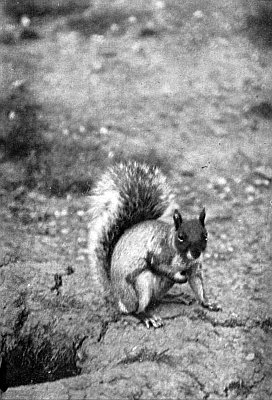
The Squirrel is one of the most picturesque of our small
mammals, especially when seen sitting on his haunches on a
tree branch, his plumy tail curled up his back, his tufted ears
erect, and his forepaws holding a nut; or when making his
prodigious leap from bough to bough. He is not nearly so big
a creature as he looks under these conditions, for if we could
pass the tape over him from the end of his snout to the tip of
his tail proper (that is, not including the hairs that extend
beyond the tip), we should find he only measures about fifteen
and a half inches, and of this length seven inches, or nearly
half, is provided by the tail. Examine his feet, and you will
see that they are adapted eminently for climbing. The forefeet
have four fingers and a rudimentary thumb, and the hind feet
have five toes; the claws long, curved and sharp-pointed, and
the soles hairy. The muzzle is well furnished with "whiskers,"
the prominent eyes are black and bright, and the large, pointed
ears bear tufts of long hairs in winter. The hind limbs are
much longer than the forelimbs, and the heel of the long foot
touches the surface upon which it rests. The upper parts and
tail are brownish red and the under parts white. Before
winter, when the fur becomes softer and thicker, a grey tinge is
developed on the sides, and the ear-tufts become longer and
bushy; these are shed in the breeding season (early summer).
At times it may be found with the tail of a creamy tint.
One of the Squirrel's strong claims to popular favour is his
diurnal habits, which makes him better known by all who
wander in the woods; in one sense it is a pity it is so, for in
the neighbourhood of large towns the "sporting instinct" of 'Arry
has led him to kill or mutilate the Squirrel with sticks and
stones. Not many years ago the numerous Squirrels that added
to the attractions of Richmond Park were shot by the keepers
to prevent 'Arry killing them! Ordinary intelligences thought
it would have been better to have disciplined 'Arry.
The Squirrel builds nests in the branches of the trees it affects,
not merely as nurseries, but for resting places. There may be
several of these in adjacent trees or in the one to which the
builder is specially attached. Some of these may be crows' or
magpies' nests adapted for the new tenants, or may be wholly
the Squirrel's work. They are bulky structures composed of
twigs, strips of thin bark, moss, and leaves; sometimes cup-shaped,
others domed. These are usually known as "dreys";
but in parts of Surrey they are "jugs," squaggy-jugs to give
them their full name. The breeding nest is a huge ball (unless
there is a roomy hollow in the trunk that can be upholstered)
with a side entrance. Here in summer the three or four blind
and naked young are born, and they remain with their parents
until themselves adult.
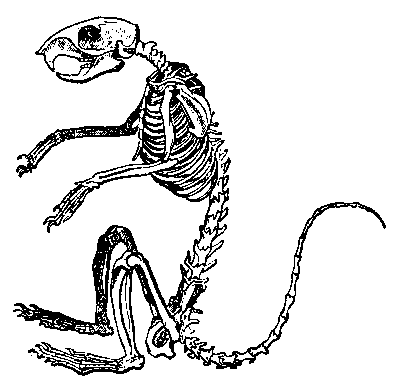
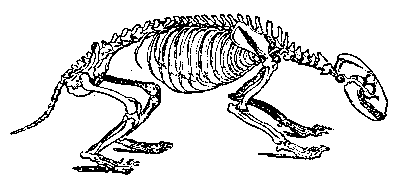
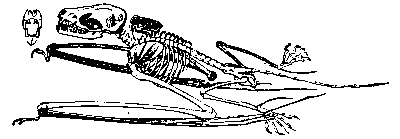
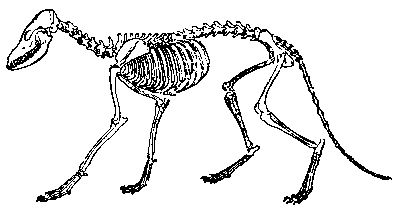
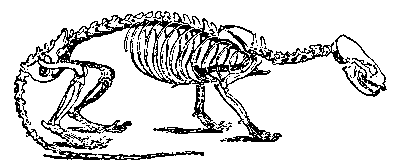
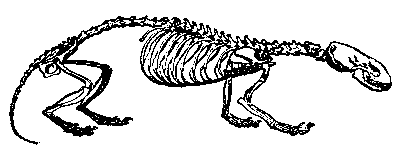
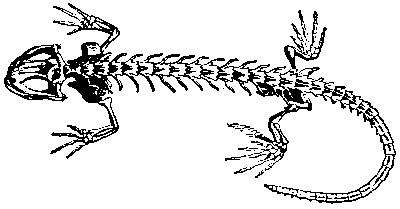
Skeleton of Squirrel.
The food of the Squirrel is fairly varied. In pine woods
the cones provide the staple dish, and the ground beneath a
Squirrel's tree will be found littered with chips and cores of the
cone from which the seeds have been extracted. This débris
should be looked for as an unfailing sign that there are Squirrels
in the wood. In beech woods they rely largely on beech-mast,
the sharp-edged triangular seeds contained in the prickly nuts.
They usually have a hazel-copse not far distant whence they
derive their favourite food in the autumn, storing up considerable
quantities in holes for use during the winter. Several times
when filling our own pockets with hazel-nuts we have met with
angry protests from a Squirrel who considered the place his
own preserve. Standing on a stout limb just overhead he would
stamp his forefeet and utter a little bark. Similar objection has
been made at times when we were filling our basket with the
nutty Blusher Toadstool (Amanita rubescens), of which some of
the caps in a clump showed the marks of the Squirrel's incisors.
He is also fond of cherries, wild or cultivated, and the shoots
of Pines which contain the burrowing larvæ of the Pine Tortrix
moth. It is also accused of being so far carnivorous as to consume
bird's eggs and nestlings.
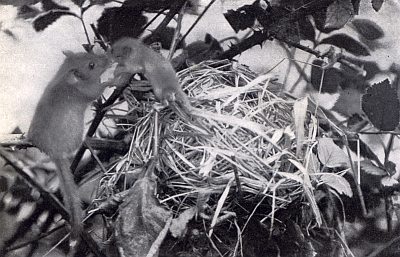
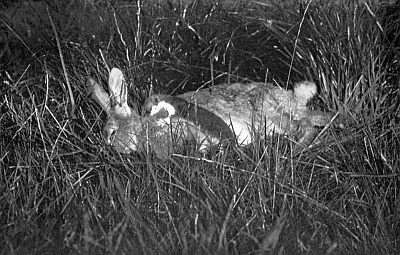
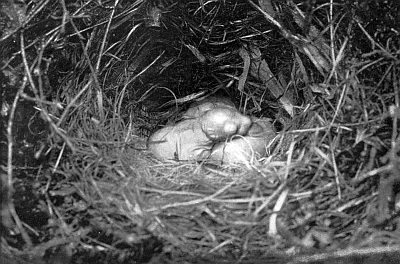
Pl. 52.][F 80.
Nest of Dormouse.
Mother removing her young.
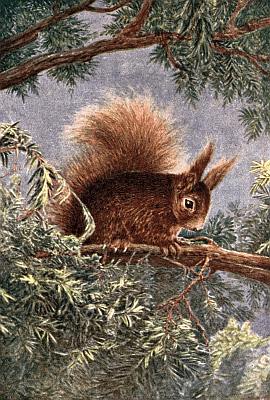
Pl. 53.][G 81.
Squirrel.
Sciurus vulgaris.
The Squirrel does not hibernate, as it is said by the older
writers to do. In the winter it certainly indulges in long naps;
but on a fine day it wakes up and visits its stores of food. It
rarely descends to the ground, except for the purpose of crossing
a wide woodland road, or to seek water at a stream. In connection
with water, it may be said that the Squirrel is an expert
swimmer. Dental formula: i 1/1, c 0/0, p 0/0, m 5/4 = 22.
The Squirrel is generally distributed in Great Britain and
Ireland, where there is sufficient woodland, and in similar
situations in Europe and Asia.
Grey Squirrel
(Sciurus cinereus, Linn.).
In some places in the London district a light grey Squirrel
may be seen, and thought to be a colour variation of our native
species. It is really an American visitor, distinct in colour and
without tufts to the ears. Some years ago the caged specimens
in the Zoological Gardens, Regent's Park, had become so
numerous that some of them were given their liberty. Their
numbers increased among the trees of the Gardens, and they
overflowed into the Park, where they became so familiar as to
accept food from the hands of the delighted children. Gradually,
some of them developed exploring tendencies and made their
way to the wooded grounds of suburban residences. British
naturalists of a not-distant future will probably have to
include two species of Squirrels in their lists.
The pretty Chipmunk (Tamias striatus, Linn.), or Chipping
Squirrel, one of the Ground Squirrels, is another American
species that has become acclimatised in the London area. It
lacks the long tufted ears of our Squirrel, the tail is shorter, and
there are pouches inside the cheeks. Its general appearance is
strikingly different from the Squirrel, for though its ground
colour is red-brown, the eye is set in a white band divided into
two stripes by a black line. A black stripe runs down the
middle of the back, and in addition there is a white stripe
bordered by black above and below along each side.
It feeds on nuts, beech-mast, grain, roots, and insects; migrating
from place to place as local food-supplies become scanty.
It stores up food for the winter like the Squirrel, carrying it to
its caches by means of the cheek-pouches. Though capable of
climbing, and occasionally seen ascending lofty trees, it is much
more at home on the ground. It burrows a retreat in the
ground, if no suitable stump is available for excavation. When
startled it utters a cry of "chip-per-r-r."
Dormouse
(Muscardinus avellanarius, Linn.).
The non-scientific observer of our native mammals satisfied
himself long ago that the pretty Dormouse was a miniature kind
of Squirrel, and he was helped to this conclusion by the general
resemblance in colouring, the form of the head, the prominent
black eyes, large ears, and thickly furred long tail; as well as
by its arboreal habitat and its habit of sitting up on its haunches
and holding a nut or other food in its forepaws. But the
classifying naturalist has to look below the surface to discover
a sound basis for his work. Superficial resemblances are often
due to similarity of habit and habitat; and in this case the
internal structure of the Dormouse shows that it has closer
affinity with the Mice than with the Squirrels, though really
distinct from both.
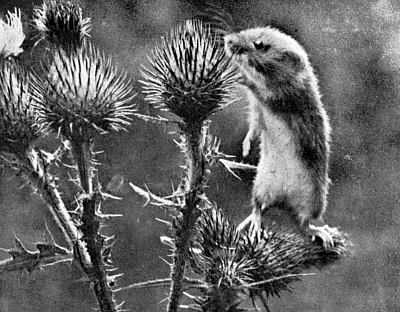
Pl. 54A.][G 82.
Seeking for thistle-seeds.
Harvest Mice.
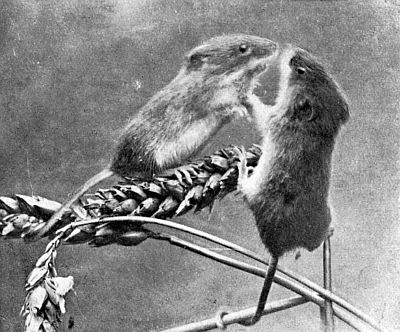
Pl. 54B.][G 82.
Fighting for a wheat-ear.
Harvest Mice.
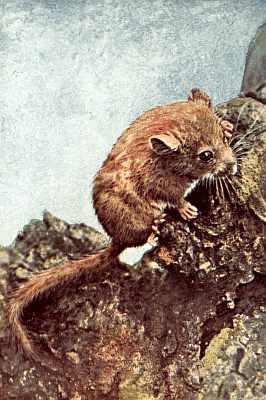
Pl. 55.][G 83.
Dormouse.
Muscardinus avellanarius.
The total length of the Dormouse is about five and a half
inches, but nearly half of this is contributed by the tail. The
forelimbs, which are much shorter than the hind limbs, are
furnished with four separate fingers and a rudimentary thumb;
whilst the hind feet have five toes, though the first of these is
short and clawless. All the claws are short; and on each foot
there are six large pads. The fur of the upper parts is light
tawny coloured, and of the underside yellowish-white, but the
throat and adjoining part of the chest is a purer white.
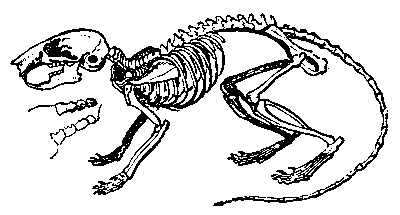
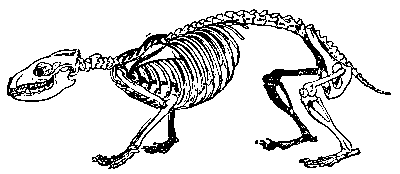
Skeleton and Molars of Dormouse.
In the copse and thick hedgerow where the Dormouse is
mostly to be found, he must be sought after the brightness of
day has departed; for he is a nocturnal beast and spends
the hours of sunshine in heavy slumber. So deep is his
somnolence, and so low his temperature, that one not
accustomed to his ways might easily imagine him to be actually
dead. It is not a case of "sleeping with one eye open" with
the Dormouse; he needs, as it were, to be shaken to arouse
him. One autumn many years ago we frequently found the
empty shells of cob-nuts in our greenhouse, and were somewhat
puzzled to account for their presence. A thick row of cob-bushes
in our neighbour's garden ran along the back of the
greenhouse, but we never suspected that they were haunted by
Dormice. One day in selecting a flower-pot from a number of
empty ones that lay "nested" one within another a hoard of
splendid nuts was found occupying the available space in
several of them. Then a common box mouse-trap was set, and
next morning it contained a plump Dormouse, curled up on its
back with all the appearance of death, and it was lifted out
by the tail without immediately awaking. Four or five were
caught in this manner on successive nights.
For diurnal privacy and comfort the Dormouse constructs a
globular nest of twigs, moss and grass, about three inches in
diameter (sometimes with a circular opening), which may be
among the stubs in the coppice, beneath a tussock of grass, or
even suspended high up in the bushes. The nursery nest is
twice this size. In some districts the nest will be constructed
of the bark of old honeysuckle stems, which shreds off in
ribbons. The inner lining is of the same material more finely
divided, with a bed of leaves. Several litters of three or four,
or even six or seven, blind and naked young are born in spring
or summer; but there are also records of young being found in
September or October. Having regard, however, to the
hibernating habit of the species it is probable that these perish,
for autumn-born young would scarcely be in fit condition to go
without food for a long period. In their first coat the young
are more grey than red, but gradually assume the adult tint.
There are no scent glands.
The adults have usually retired by the middle of October, by
which date they have prepared for a long sleep by accumulating
much fat beneath their coats, and make further provision by
laying up a store of nuts. The reason for the latter is that the
Dormouse's sleep is not continuous. It wakes up at intervals,
has a good meal, and resumes its sleep. Its activities are not
resumed until the spring, so that its retirement lasts nearly for
half the year. Its winter nest is usually under moss among
roots, or far underground. Its sleep is profound, without
breathing, and it becomes absolutely cold.
The food of the Dormouse is much the same as the Squirrel's,
but it is particularly fond of the hazel-nut, a good fat producer,
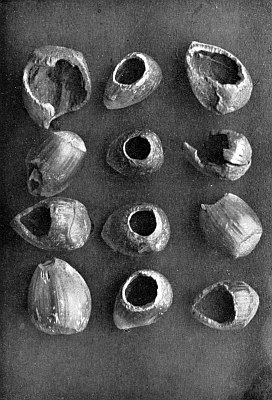
and the "haws" of the whitethorn. It does not crack the
shell of the nut, but gnaws quite a small hole, extracting the
kernel piecemeal. In addition it eats many insects, and sometimes
indulges in birds' eggs or even the birds themselves, if
they can be captured.
The Dormouse is frequently kept as a pet for children, for
which its gentle, fearless manner and non-disposition to bite
seem to make it specially suitable; but we have found it
regarded by youngsters as "a bit of a fraud" in this character,
for as they have said, "It doesn't wake up until we are asleep."
We have found that in semi-captivity it woke on most evenings
throughout the winter to enjoy a supper of apples and nuts.
Freshly captured specimens become tame at once. Ours were
fond of climbing the long window curtains and hunting for
flies—for the Dormouse is insectivorous as well as frugivorous.
It is not given to the gnawing of wood, like the true Mice; and
it is said to be one of the creatures that are immune to Viper
poison.
The Dormouse is a European animal, but it does not extend
northwards of Sweden. In agreement with this distribution,
it does not occur in Scotland. From Ireland it is entirely
absent. Eastward it extends only to Asia Minor.
The head is comparatively large, with blunt muzzle, prominent
eyes, broadly rounded short ears, and long whiskers. The
dentition is much the same as that of the Squirrel: there is a
single large incisor on each side of the upper and lower jaws,
and one premolar and three molars after a considerable blank:
i 1/1, c 0/0, pm 1/1, m 3/3 = 20. The enamel ridges of these cheek-teeth
constitute a rasping surface such as no other mammal
possesses.
The soft, dense fur of the Dormouse was of repute anciently
as a remedy for ear diseases and paralysis. The English name
can be traced back certainly to the fifteenth century, and is
considered to embody the verb dorm = to doze, still used in
the North of England, which brings it very close to the
Sleepmouse of Southern England and Sleeper of other parts.
Derrymouse, Dorymouse, and Dozing-mouse are other local
variants.
Albino varieties are very rare; but individuals with white-tipped
tails are reported not infrequently.
Harvest Mouse
(Micromys minutus, Pallas).
With the exception of the Lesser Shrew the pretty little
Harvest Mouse is the smallest of British mammals. It long
held that distinction, until the Lesser Shrew was shown to be a
distinct species and not the young of the Common Shrew. The
Harvest Mouse will always be associated with the name of
Gilbert White, for it was in his letters to Pennant that it was
first made known as a British mouse, and its appearance and
habits were published by Pennant in his "British Zoology."
The head and body combined measure less than two and a
half inches, and the nearly naked, scaly tail is almost as long.
The thick, soft fur of the upper side is yellowish-red in colour,
and of the under parts white; the two colours being rather
sharply separated. The tail is exceedingly pliant and prehensile,
and serves as an additional foot, being at once coiled
around any suitable object within reach. It has bright black
eyes, short blunt nose, and short rounded ears, the latter about
one-third the length of the head.
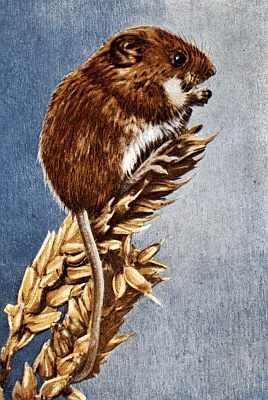
Pl. 56.][G 86.
Harvest Mouse (enlarged).
Micromys minutus.
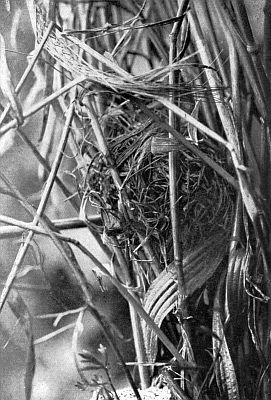
Pl. 57.][G 87.
Nest of Harvest Mouse.
The wonderfully woven ball which serves as nursery.
It is found chiefly in the South of England, becoming less
abundant as we go north. In Scotland it is very scarce, and it
does not occur in Ireland. It is more generally distributed on
the Continent, where it ranges from Northern Italy to Russia
and Siberia. The usual habitats of the Harvest Mouse are
pastures and cornfields, where it climbs the stems of the tall
grasses and corn plants, cutting off the ripe ears and carrying
them to the ground where it picks out the grain. During the
summer it feeds largely upon insects, caught in the same situations.
At the same season it stores up much grain in burrows
for use in the winter between its periods of sleep. Sometimes,
however, instead of wintering in burrows in the earth, it tunnels
into hayricks, and if undisturbed may even bring up a litter or
two in the rick; as a rule it constructs the wonderful nursery
which has won human admiration ever since White made the
species known.
This is a ball-shaped nest about three inches in diameter
formed of neatly plaited and woven blades of wheat or grass,
with no definite opening, the grass blades being merely pushed
aside to make entrance or exits where required, and closing
again by their own elasticity. There is just sufficient room
inside for the mother-mouse and her blind and naked offspring,
whether they number four, eight, or even nine. This nest is
suspended at some little distance—about half a foot—above
the ground, several stems being incorporated in its walls to
give it stability, or it may be lodged between the stem and leaf
of a thistle, or a knapweed, in blackthorn bushes or broom.
The bed is made of split leaves of corn or grass. The nests
are not always so tough as that described by White, which
"was so compact and well-filled that it would roll across the
table without being discomposed, though it contained eight
young." Several litters are produced throughout the year,
varying in the number of young from five to nine; and one
might expect that the species would be represented by individuals
as numerous as those of the House Mouse. It must
be remembered, however, that the diurnal habits of the Harvest
Mouse and its methods of feeding expose it to the attacks of
the larger birds; whilst the smaller carnivorous beasts do not
neglect it. When the corn is cut the Harvest Mouse is often
carried in the sheaves to the barn; in that case it spends the
winter there, and does not go to sleep. It is considered that
the modern reaping machine has caused a great reduction in
its numbers.
Until about December the young of the year resemble the
House Mouse in colour, and may easily be mistaken for it;
then from the hind quarters forwards they begin to assume the
redder tint. As the adult Harvest Mouse weighs only about a
sixth of an ounce, it is not surprising that it should be able to
sit on an ear of corn to which its capable little hands and
prehensile tail have enabled it to climb with ease. But the
familiar name must not delude us into supposing that it is only
found in or about cornfields. It is also a denizen of the tall,
rank herbage along ditches and untrimmed hedgerows. In
winter it is frequently found about the lower parts of wheat and
oat stacks.
Where the Harvest Mouse occurs it may be watched at close
range by the quiet observer. Though as a rule timid and gentle
in demeanour, it becomes at times savage and cannibalistic. It
lacks the offensive odour of the House Mouse. Its voice is of
a low chirping character, and has been likened to that of the
wren.
With a more intimate knowledge of the structure of the
various species of Mice, it has been found necessary to break
up the old Linnean genus Mus into several smaller genera. In
this process our little Harvest Mouse becomes the sole British
representative of the genus Micromys.
Wood Mouse
(Apodemus sylvaticus, Linn.).
An alternative name for the Wood Mouse is Long-tailed
Field Mouse, and but for the fact that Linnæus dubbed it Mus
sylvaticus, it would be better to adopt Pennant's designation,
for it is much more an inhabitant of the field, the hedgerow,
and the garden than of the wood. It is, indeed, the cause of
something approaching despair to the keeper of the kitchen
garden; for this is the miscreant that ploughs up and eats the
newly sown peas that have not been rolled in red lead or soaked
in paraffin. He has also a great fondness for strawberries at
the moment they have become ripe.
The Wood Mouse is about three and a half inches long from
the long snout to the base of the tail; and the tail by itself falls
only a very little short of that length. The fur on the upper
parts is a dark yellow-brown; the under parts white. In adults
the line of demarcation is always distinct. There is a spot of
buff or orange on the chest whose development in certain local
races has enabled recent systematists to make five species out
of this one. It has large and prominent dark eyes—for it is
chiefly of nocturnal habits—and its long oval ears have the
inner margin turned inwards at the base. The tail is dark
brown above, and whitish below. It is the commonest of the
British mammals in country places, but less frequent in Ireland.
It is common in Europe as far north as Sweden and Norway.
As a rule it constructs its burrows underground or under the
roots of trees, and here it stores up great quantities of nuts,
haws, grain, and smaller seeds for use in winter, when it
becomes inactive, though it does not really hibernate. But if
there is a house handy to which it can gain entrance in late
autumn, it prefers to become the guest of those whose garden
has been a boon to it through the spring and summer. We
have had them spend the winter cosily in our rolled-up tennis
nets, stowed away in a shed to keep them dry in the off-season;
and as potatoes were stored in the same place they consumed
a number of these. On several other occasions Wood Mice
were detected attempting impudently to enter the dwelling
house by the back door. Once an entire family—mater, pater,
and five active youngsters—succeeded in this enterprise; but
they left incriminating evidence of their presence, though they
were suspected of being ordinary House Mice. Accordingly a
break-back trap, baited with cheese, was set one evening, and
within half an hour its loud clap proclaimed its effectiveness.
This trap appeared to show that the Wood Mouse is a simple-minded,
unsuspecting creature, for it was reset with the same
uneaten bit of cheese-rind for bait again and again, and no
sooner was the trapper's back turned than another member of
the family was secured. Seven times it sprang, and then its
inaction appeared to be due to the fact that there were no more
possible victims, for we saw no further traces of the mice. Its
general resemblance to the House Mouse frequently leads to
its being mistaken for that species.
There are several litters of young during the year, and these
vary in number from five to nine—an alarming rate of increase;
but, fortunately, the Barn Owl that hunts the hedgerow inch by
inch, every evening, takes a heavy toll that keeps the numbers
down. The Fox, the Weasel, the Hedgehog, and the Viper also
do their part.
The Wood Mouse is a very active creature, running and
jumping in zigzag fashion, climbing high in the bushes in
order to obtain berries, leaping from considerable heights, and
swimming well when occasion requires. Although an accomplished
excavator, it often makes use of unmortared stone walls
for its runs and stores. It wanders widely in its search for
berries, bulbs, and grain. In the matter of berries, it is not the
juicy pulp that it desires but the seeds, which it will carefully
pick out. It prefers the larger grains from the cornfield to
those of a grass-meadow. It is both timid and gentle in disposition,
and on account of its short sight, it may be approached
closely and caught with the hand.
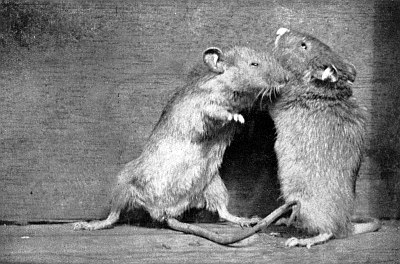
Pl. 58.][G 90.
House Mice.
A fierce battle between rival males.
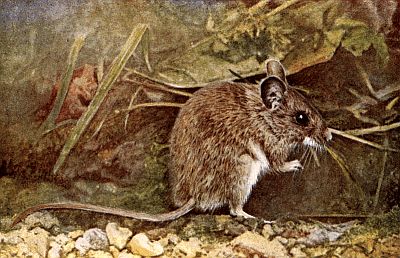
Pl. 59.][G 91.
Wood Mouse.
Apodemus sylvaticus.
Its stores of food are often communal, a colony of mice contributing,
for it is not always of solitary habit. These stores
are of the most varied character. Of the very miscellaneous
items on its menu a few may be mentioned: leaves of clover
and dandelion, with flower-buds of the latter, nuts of all kinds,
apples, grapes, gooseberries, crocus and hyacinth bulbs (Millais
says the Dutch were taught to multiply hyacinths by division
of the bulbs through observing the effects of this mouse's attacks),
acorns, rose and bramble seeds, slow-worms, eggs and—putty!
It has been known to enter beehives, and not only to eat the
honeycomb, but impudently to construct its nest there. Deserted
birds' nests are often adapted to its use, either as a
dining-room when seeking haws in the hedges, or as a
permanent habitation, in this case roofed with moss.
The breeding nest is a globular structure of dry grass, and is
usually built in a separate chamber of the underground run, but
occasionally is on the surface or under a heap of hedge débris.
Some of the burrows may extend as much as three feet underground.
Towards the end of last century, Mr. de Winton called
attention to what was considered to be a new British mouse—the
Yellow-necked Mouse (Apodemus flavicollis), distinguished
from the Wood Mouse by its larger size, the head and body
measuring four and a quarter inches, and the brown spot on
the chest commonly found in the Wood Mouse developed into
an orange cross whose arms are connected with the upper side
coloration—described as golden brown. This is a feature that
at once attracts attention where this form occurs; but there is
another distinction out of sight—there being three additional
bony joints in the tail, that is thirty instead of the twenty-seven
in the tail of an ordinary Wood Mouse. Whether it is a really
distinct species or the typical form of the Wood Mouse is at
present open to question. It is found chiefly in the southern
and eastern portions of England, but its distribution also
includes Northamptonshire, Herefordshire, and Northumberland.
Other local races have been distinguished also as distinct
species or sub-species under the name of Hebridean Field
Mouse (A. hebridensis) with the white of the under parts
tinted with buff; Fair Isle Field Mouse (A. fridariensis), like
the Yellow-necked but without the collar; St. Kilda Field
Mouse (A. hirtensis) with brown under parts; and Bute Field
Mouse (A. butei), darker, with shorter tail and ears.
House Mouse
(Mus musculus, Linn.).
The most familiar, the most widely distributed and most
numerous of the mammals of our country, the Common or House
Mouse, stands in little need of nice description. Although of a
timid and retiring nature, it can on occasion exhibit not only
bold familiarity, but actual friendliness to mankind to which it
has been attached for ages, preferring to live in palace or hovel
with human beings to the open-air life of woods and fields.
Not that he is not to be found in the open air; but then it is
mostly in the immediate neighbourhood of a house, where he
can make his runs in ricks of corn—mountains of food. It is
this easy method of despoiling man of his goods that caused the
Mouse in ancient days to attach himself to the huge creature
that is so impotent in ridding himself of small adversaries.
The domestic Mouse is considered to have had its home, its
place of origin, in Asia, whence it has spread to every part of
the world where man has gone. In most cases, it may be presumed
with safety, it has travelled cosily stowed away in his
stores and merchandise, so that as soon as the human migrant
has built himself a home he finds that the Mouse is in occupation,
and demanding a share of his food. In spite of all his
serious depredations, our literature teems with evidence that
the victim has always retained some kindly feeling for his pretty
four-footed oppressor.
For the sake of uniformity, let us say that the head and body
of the House Mouse measure a little more than three and up to
four inches, and the tapering, flexible, and sparsely haired,
scale-ringed tail may slightly exceed that measurement. It has
a pointed snout, the bright, bead-like eyes are black, the large,
sensitive brownish ears are nearly half the length of the head,
and the soft, brownish-grey fur is only a little paler on the
under parts. Outdoor specimens are often more yellow-brown
in coloration. As compared with the Wood Mouse we have
this more dusky and uniform coloration, shorter whiskers,
smaller eyes, stouter and less flexible tail, and shorter legs.
The thumb of the hand is reduced to a mere tubercle.
It is very active and silent in its movements, emerging from
a tiny hole in floor-board or skirting and gliding without sound
over the floor, ascending with ease table-legs or walls, and then,
if alarmed, springing with a prodigious leap back to its hole.
Concrete floors will not suffice to keep it out of a house, for it
will climb the outer walls and enter the upper windows, thence
making itself secret ways to the lower floors behind woodwork
or plastered walls, till it reaches the kitchen, the larder or the
storeroom. Though it shows by its preferences that its natural
rôle is that of grain thief, it will eat any kind of human food and
much besides: in a word, it is omnivorous.
Its great success as a species is due to this adaptability and
to its astonishing fecundity. It produces four or five litters
during the year, each consisting of five or six, or even up to
twelve, blind and naked young which develop so rapidly that
in a fortnight they are capable of independence. At the age of
six weeks they may begin to breed.
The House Mouse exhibits a considerable range of variation
in colour, both darker and lighter than the type, and many of
these variations have been bred from and their peculiarities perpetuated
and accentuated in confinement as "fancy" mice. Of
these the most familiar are the White Mice, really albinos with
pure white fur, pink eyes, feet, and tail. There are also dark,
nearly black variations, and spotted examples. Sometimes one
is surprised at night to find that the house is tenanted by a
musical mouse that runs up the scale in what appears to be an
attempt at a little song. It has been ascertained, however,
that these so-called singing mice are afflicted with a form of
asthma, and the supposed vocal efforts are merely the manifestation
of their physical trouble. We have had experience of
musical mice in another way. For several nights in succession
weird sounds came from the pianoforte which suggested that
fairies were using it as a harp, twanging the wires instead of
striking them with the hammers. An examination of the
interior seemed to indicate the actual performer, for a little pile
of Spanish nuts, stolen from the table, was discovered inside;
and the twanging of the notes was caused probably by the
mouse climbing them. A trap baited with a shelled nut put a
stop to these performances. Bateson mentions several cases of
hairless Mice, except for a few whiskers.
A local race of the House Mouse found in St. Kilda is sometimes
dignified with species rank under the name of Mus
muralis. Its distinguishing features include less slender feet
and tail, and slight peculiarities of the palate.
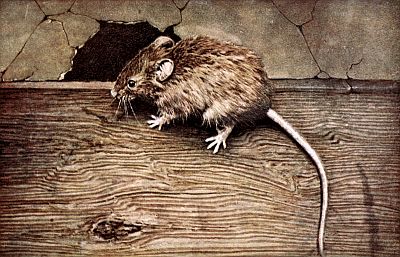
Pl. 60.][G 94.
House Mouse.
Mus musculus.
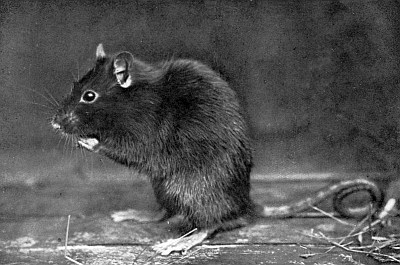
Pl. 61.][G 95.
Alexandrine Rat.
An alien stowaway from North Africa.
Black Rat
(Epimys rattus, Linn.).
Not many years ago a good deal of modified regret was
expressed because it was thought that the Black Rat—the real
old British Rat as it was called—was being exterminated by
that vulgar upstart the Brown Rat—the Hanoverian or Norway
Rat. These laments were mainly called forth by its comparative
scarcity in old London warehouses where it had formerly
been very numerous. One would have thought it a matter for
rejoicing that there was a possibility of our having only one
species of the rat pest to contend with instead of two. The
disappearance of the Black Rat was remarked by Pennant as
far back as 1778. However, later observations tend to show
that the Black Rat is far from being extinguished even in the
City of London, where the old type of warehouse is being
rapidly replaced by ferro-concrete erections with carefully
trapped drains. The intelligence of the Rat is equal to little
impediments of that sort, and if it cannot get in by way of the
basement it can climb walls and enter by the attic windows.
On the score of sentiment we need not distinguish between
the Black Rat and the Brown. They are both Asiatic aliens,
though the Black Rat had been settled here for several
centuries before the Brown Rat followed in his tracks.
Nothing definite is known as to the date of his arrival.
Geologists assure us that he was not among the indigenes, for
even the most recent strata yield no remains of his bones or
teeth. He is known to have been on the other side of the
dividing Channel in the thirteenth century, and to have reached
England soon after, and quickly to have become a nuisance.
He had a clear run of over four hundred years in which to
occupy the most remote portions of the island, before he had
to meet with keen competition in the form of the Brown Rat.
He reached Ireland in the twelfth century, if not earlier.
The Black Rat is of more slender proportions than the better
known Brown Rat, and much smaller, the dimensions of the
head and body being about seven inches, whilst the scaly-ringed
and almost hairless tail is more than eight inches. The
long, pointed snout projects far beyond the short lower jaw;
the whiskers are long and black. Though presenting the
appearance denoted by its popular name, the glossy blue-black
fur has a good sprinkling of grey on the upper surface, whilst
below it is dark grey. The large, thin ears are naked, and
about half the length of the head. The feet are pink, with
scale-like rings on the underside of the digits and five pads on
the sole. The thumb of the forefeet is reduced to a mere
tubercle.
Although the Rats have much to do with garbage and
offensive matters, they take the greatest of care to maintain
their own cleanliness and a spruce appearance, spending much
of their time in cleaning their fur and paws. One of the
reasons for regretting the possible extirpation of the Black Rat
by his more pushful relative, was, no doubt, his less ferocious
ways and well-known milder disposition—a trait which is
obvious to any one who has handled the domesticated albino,
or White Rat, which is generally considered to be of this
species.
Where—as in India—the Black Rat lives a more out-of-door
life, it climbs trees and mostly makes its nest in them. With
us the doe collects a good quantity of suitable materials—rags,
paper, straw, etc.—and constructs a roomy nest which she uses
for successive broods, which come at short intervals. Seven or
eight is the usual number for a litter, and there are five or six
broods in a year.
In the matter of food, both the Rats are omnivorous, and
it is, therefore, useless to attempt to give a list of substances
acceptable to them. Fish, flesh, fowl, or vegetable, crustacean
or mollusc—anything that can be digested—is eaten by them;
and if all else fails they will eat their own kin. In this matter
the Brown Rat, from his superior size and ferocity, has the
advantage, as is emphasised by an incident told by a professional
rat-catcher to Frank Buckland. He said that having had a successful
haul in infested premises he had turned all his captures
both Black and Brown into a large wire cage, intending to have
a little sport next day with a few cronies and a terrier or two.
To his astonishment next morning all the Black Rats had disappeared
and only the Brown—or some of them—remained.
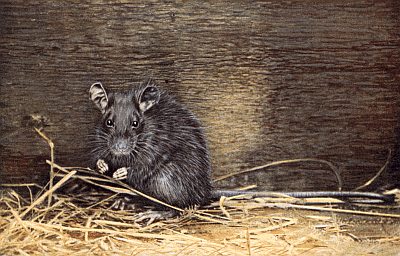
Pl. 62.][G 96.
Black Rat.
Epimys rattus.
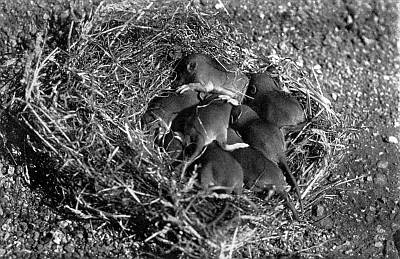
Pl. 63.][H 97.
Brown Rat's Nest.
This litter of eight is a medium number.
A sub-species, the Alexandrine Rat (Epimys rattus alexandrinus),
with brown back and dusky underside, is frequently
introduced with shipping from North Africa, and has been
recorded from Lundy Island and Shetland. Another sub-species,
the Tree or Roof Rat (E. rattus frugivorus), common in
the Mediterranean region, often appears in our ports. It has
long, soft and dense fur, of light grey or brown on the upper
parts and whitish below (pure white to pale yellow), and the
feet usually white above.
The Black Rat is more of a climber than a burrower; more
cleanly in its feeding than its brown rival. The pink-skinned
young are born without fur, sight, or hearing.
Brown Rat
(Epimys norvegicus, Erxleben).
The Brown Rat still has two alternative names applied to it,
though the inappropriateness of one was shown by Pennant
more than 150 years ago. These names are Norway Rat and
Hanoverian Rat. Pennant does not mention the second, but
of the first he says that the Brown Rat is quite unknown in
Scandinavia and is not mentioned by Linnæus. The name
Hanoverian appears to have been given to it because it was
believed to have made its entry into England with George I.
Writing in 1776, Pennant says: "This animal never made its
appearance in England till about forty years ago." Recent researches
into its distribution make it appear that the species
originated in Trans-Baikal, whence it has spread westwards, even
to America by way of the British Isles. Both species hit upon
an improved method of extending their range over the earth.
The old-fashioned natural way for mammals to spread was for
a few adventurous individuals to make food-finding excursions
beyond the district in which they were born; but climate,
mountain ranges, broad rivers or seas often checked further
progress. The Rats discovered that by keeping close to man
they were always in the neighbourhood of food, whether
intended for himself or his domestic animals; and even these
tame creatures would at times serve for the Rats' meals. So
when they found man loading ships with grain and other
desirable food they decided to go with him. Often they contrived
to get into his bales of merchandise and so conveyed to
the hold. If not, there were always mooring ropes which
served as bridges from the quay to the vessel. And so they got
themselves conveyed in comfort, sure that wherever the goods
went there would be settlements of their biped friends to house
them and serve their ends generally. Now, wherever man has
established himself, you are almost certain that the Rat is close
at hand.
Mr. A. W. Rees, in his interesting "Creatures of the Night,"
has summarised the chief characteristics of this species in a
paragraph. He says: "Brown Rats are an insufferable nuisance.
There is no courtesy or kindness in the nature of the Rat; no
nesting bird is safe from his attacks, unless her home is beyond
his reach in some cleft of a rock that he cannot scale or in some
fork of a tree that he cannot climb. He is a cannibal—even
the young and the sick of his own kind become the victims of
his rapacious hunger—and he will eat almost anything, living
or dead, from the refuse in a garbage heap to the dainty egg of
a willow-wren in the tiny, domed nest amid the briars at the
margin of the river."
As compared with the Black Rat he is more heavily built,
and the combined length of head and body is eight or nine
inches, whilst the thicker, scaly-ringed tail is only equal to, or
less than, the length of the body alone. His head is proportionately
shorter, with blunter muzzle, much smaller ears
and more prominent though smaller eyes. The fur on the
upper parts is grey-brown with a tawny tinge, and dirty white
on the under parts. The ears, feet, and tail are flesh-coloured.
It sometimes occurs with black or blackish fur, and is then
frequently mistaken for the Black Rat; but the relative length
of tail to body is a superficial character by which they can
be separated at once. There is a black race of this species on
the east coast of Ireland to which some authors have given the
distinctive name of Epimys hibernicus. It appears to have
extended its range from Ireland to the Hebrides. In one form
or other the Brown Rat has extended to nearly every part of
the British Islands and their islets.
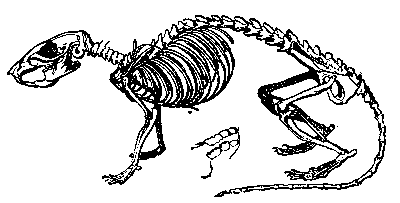
Skeleton and Molars of Brown Rat.
The Brown Rat becomes a parent at the age of six months,
and produces four or five litters in a year. Ordinarily these
consist of from four to ten blind, deaf, and naked young; but
much larger litters are on record, the highest of which we have
seen a note being twenty! Sometimes the young grow up
hairless or blind. Some years ago we disturbed a nest in the
garden from which issued half a dozen young Rats about four
inches long (head and body), all blind. They moved about
in a very uncertain manner, and were easily despatched.
Similar cases have been recorded. At the meeting of the Zoological
Society in December, 1902, a hairless Rat was exhibited
on behalf of Mr. G. A. Doubleday, one of three captured
at Leyton, Essex, in the same condition. The skin, which was
slate-coloured, was wrinkled into folds all over the body.
Millais mentions a hairless Rat with yellow skin.
In the country—where it is known as the Barn Rat—the
Tawny Owl and the Weasel are the farmer's best friends as
Rat-catchers, though they do not always get the consideration
that their services merit. The Weasel tribe are admittedly
also destroyers of poultry; but the depredations of the Rat in
this connection are much more serious. They do much mischief
in chicken-runs, and being good swimmers and divers,
even ducklings afloat are not safe from them. If a pair of
ducks have made their nest on an island for safety, rats will
swim to it and feast on the eggs, or, should these be hatched,
kill the ducklings and eat them. It is more than probable
that much of the destruction of pheasant and partridge eggs
debited to the account of the Hedgehog, has really been
carried out by the Rat. Jordan ("Forest Tithes") says he
has known a Rat or Rats take a dozen eggs from a wild
duck's nest and bury them in the soft peaty bottom of a moorland
runnel, close to the nest. "I traced the whole proceeding
and dug the eggs out with my fingers."
It does not matter where it is living, in town or country, the
Rat is equally destructive to property and live stock. We have
known them to destroy a crop of garden peas by ascending the
pea-sticks, night after night, lacerating all the pods that had
fair-sized peas within, and eating out every one. They skulk
along the hedgerows until they reach the "cave" where the
farmer has stored his mangolds to secure them from frost.
Scores of them will burrow through the cover of earth
and eat their fill of the succulent roots. Well is it for the
farmer if the Weasels have not been exterminated on his land,
for they are the most efficient guardians of his hoard. Hawks
and Foxes render similar service if the Rat wanders out into
the open moorland; but the Rat rarely ventures far from cover
of some sort.
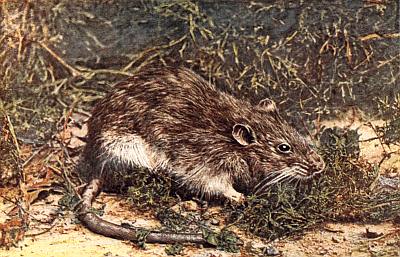
Pl. 64.][H 100.
Brown Rat.
Epimys norvegicus.
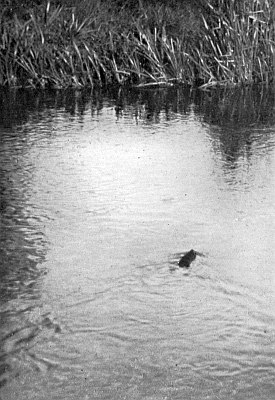
Pl. 65.][H 101.
Water Vole Swimming.
This fine swimmer is making for his burrow in the bank.
There is a melanic or black form of the Brown Rat which is
frequently mistaken for the true Black Rat, though the more
bulky build and blunter muzzle should show the difference at
sight. First recorded from Ireland in 1837, it was considered
a distinct species under the name of the Irish Rat. Its fur is
uniformly dusky above and below, and the skin is of similar
hue. The variation is now known not to be confined to Ireland,
but to occur in many parts of England and in the Outer
Hebrides. White, fawn-coloured, and pied variations also
occur.
The versatility of the Brown Rat is such that it would be idle
to attempt any description of its habits. Every one knows at
least some part of the story, and the whole of it would require
a book. It is the most powerful natural enemy that civilised
man has had to contend with, for it attacks him in his own
strongholds, spoiling and wasting his food stores and destroying
his property in general. There was a time when it could be
looked upon more as a commensal because of the valuable
scavenging work it performed; but since man has learned that
it is safer to attend to this work himself the Rat has become
a mere parasitical nuisance. Sir J. Crichton-Browne has
estimated the annual loss to this country through the depredations
of Rats at £15,000,000 (pre-war figures, 1908).
The Rat is so thoroughly omnivorous that it would be
equally absurd to attempt a list of its food: there is nothing
that can be eaten that the Rat will not eat. Therefore, there is
no possibility of starving him out. Rat-killing campaigns that
do not cover every square yard of the country can only have
the effect of temporarily mitigating the nuisance; for the Rats'
fertility is so great and so rapid that the loss of nine-tenths of
a generation is quickly made good. A continental statistician
has worked out the theoretical progeny of a single pair
of Rats after ten years as reaching the appalling figure of
48,319,698,843,030,344,720! Of course, there is no great value
in such a calculation, for it proceeds upon the assumption that
every individual lives to become a parent, whereas in fact the
mortality in all creatures of such fecundity is enormous, and
there are few if any more survivors this year than there were
last year. In other words, the great fertility of a race only
suffices to make up the wastage from enemy attacks. But the
figures serve to show what might happen if the natural control
by Weasels, Stoats, Hawks, and Owls were suspended for a
short time. But Rats are disseminators of bubonic plague with
the aid of their special species of flea.
Water Vole
(Arvicola amphibius, Linn.).
In certain directions it appears that failure is the lot of those
who have spent the greater part of their lives in trying to
spread enlightened views as to the true nature of our native
animals and plants. Among a number of such failures two or
three may be briefly cited here: you cannot persuade a
countryman that a slow-worm is not a snake, that all snakes
are not poisonous and to be killed at sight, and that the
comparatively inoffensive rodent now to be described is not a
rat and of rat-like nature. The name of Water Rat is general
as a true folk-name.
The Voles are of heavier build than the Rats, the head is
shorter, thicker, and the muzzle rounded instead of being
pointed; the limbs are shorter and the hairy tail is not much
more than half the length of the head and body. The eyes are
small and short-sighted, and the small round ears scarcely
project from the surrounding fur, though when listening intently
the Vole erects them and makes them more conspicuous.
Linnæus, following Ray, described the Water Vole as having
webbed feet, but this is incorrect, though the toes of the hinder
foot are connected at their base. They are naked and pale
pink beneath, with five rounded pads, but above are clothed in
stiff hairs. The thick, long, glossy fur is of a warm reddish-brown
above, sprinkled with grey, and on the under parts
yellowish-grey. This applies chiefly to the male; the female is
slightly smaller than her mate, is less bright and more greyish-brown
in her coloration. The average length of head and body
is seven and a half inches, and of the tapering, ringed tail about
four and a half inches. It sometimes occurs with black fur,
especially in East Anglia and Scotland; and these examples
are usually reported as the Black Rat. Some modern authorities
recognise it as a sub-species (reta).
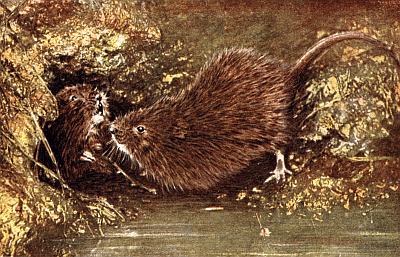
Pl. 66.][H 102.
Water Voles fighting.
Arvicola amphibius.
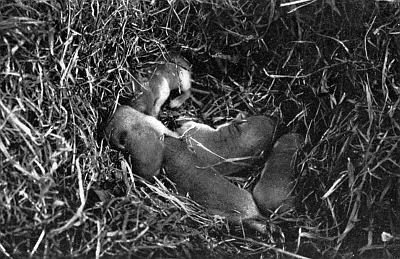
Pl. 67.][H 103.
Young Field Voles.
Average litter of five; eyes still closed.
Although it has not the webbed feet that Ray attributed to it,
its swimming and diving powers are of a high order. Often in
walking near a stream or pond, the loud sudden "plop" as it
drops into the water is our first intimation that the Vole is
near. We may occasionally track his course under water, but
as a rule he at once disappears into his burrow in the bank,
sometimes by an under water entrance, and may regain the
bank by an upper exit. These burrows, in which the Vole
spends most of the daytime, often occasion considerable
damage, as to the dykes in the Fenland, and where ponds
have been constructed by artificial banking. Otherwise, the
Water Vole must be pronounced an entirely inoffensive rodent,
in spite of the libels that accuse him of capturing waterfowl and
fish for which he is unfitted. He has been seen grubbing among
the mud at the bottom for caddisworms and other insects,
freshwater snails and the like; otherwise his food appears to
be restricted mainly to the stems of horsetails and the succulent
grasses, flags, loosestrife, and sedges that grow along the banks.
Mr. A. Patterson says that in East Anglia he eats dead fish
and living swan-mussels—also crayfish; but prefers the stems
of the succulent grasses that grow in shallow ditches. That
he is not a strict vegetarian appears to be proved by the fact
that he is sometimes captured in rat-traps that have been
baited with meat. St. John says that in spring, before the
grasses are much grown the Water Vole feeds largely upon
toads, rejecting the feet which it bites off and leaves in little
heaps. We have been assured by a Surrey woodlander of long
experience and an intelligent observer, that he has known the
Water Vole on several occasions to indulge in very young
chickens; but he admits this is a very rare occurrence and
that it scarcely detracts from the Water Vole's reputation as
a vegetarian.
On the flanks, about halfway between the shoulder and the
tail, will be found a pair of wrinkled glands which secrete a
greasy matter with a musky odour. These are present in both
sexes. Though the odour probably protects the Water Vole
from some animals that might otherwise prey upon it, it does
not appear to be objectionable to the Heron, the Owl, or the
Stoat. When, to escape from real or fancied danger on land it
suddenly dives into the water, it is not always to safety, for
pike, large trout, and eels have been observed to seize them.
The Water Vole does not hibernate; but it has been said
to lay up considerable stores for the inclement season when
food will be scarce and difficult to find. These stores consist
of nuts, beech-mast, acorns, and the creeping underground
stems of the horsetails. During the milder nights that come
in winter he issues from his chamber in the bank and feeds
upon young willow shoots; and though mainly a nocturnal
animal will often take advantage of the higher temperature at
midday during the winter. It is often found in fields far away
from any water.
The female constructs a thick-walled globular nest of reeds
and grasses in the chamber under the bank, or in a hollow
willow or a bird's nest, and there brings forth her litter of about
five (two to seven) naked and blind young. The process is
repeated three or four times during the season.
The Water Vole is generally distributed in Britain, but does
not occur in Ireland, or the Scottish islands; nor is it known
outside Britain.
The surface of the molar teeth in all the Voles presents a
pattern of alternating triangular prisms. In the Water Vole
and the Field Vole these teeth are not rooted in the jaw; in
the Bank Vole they are in the adult.
In addition to the definitely black sub-species (reta) referred
to above, the southern brown sub-species occasionally throws
up black, pied, or albino variations.
Field Vole
(Microtus agrestis, Linn.).
To country folk the Field Vole is known generally as the
Short-tailed Field Mouse, to distinguish it from the Wood
Mouse which is also the Long-tailed Field Mouse. Being
different in organisation from the true Mice the attempt was
made in natural history works many years ago to substitute the
name Vole for these blunt-muzzled Rodents. Recently, after
about a hundred years' use of the word Vole in all the works
on mammals, Mr. Barrett-Hamilton has objected to it, at least
in connection with the present species, on the ground that Field
Vole is a duplication, the word Vole meaning "field." This
would be almost as bad as Mr. Barrett-Hamilton's own use of
such scientific names as Pipistrellus pipistrellus, Barbastella
barbastella, Martes martes, and Capreolus capraea, which
are duplications in the same language! In East Anglia this
species is the Marsh Mouse, and in Surrey Dog Mouse.
The general appearance of the Field Vole is so different
from that of a Mouse that it should be obvious at a glance that
they are not very closely related. The general stumpy form
with the blunt oval outline of the head, the short, round ears
just protruding from the reddish-brown fur, and the short,
rather stiff tail, are points sufficient to distinguish it from either
of our Mice. The colour mentioned refers to the upper parts; on
the underside the fur is greyish-white. The hind feet have six
pads on the under surface as compared with the five of the
Water Vole. The length of head and body is about four inches,
and of the tail only an inch and a quarter, that is, about a third
of the body length.
The chief resorts of the Field Vole are meadows and damp
pastures, but it will also be found in gardens, orchards, and
plantations, doing enormous damage in every place, for its food
is mainly of a vegetable character. It must, however, be placed
to its credit that it catches and consumes large numbers of
insects, among them the destructive Larch Sawfly (Nematus
erichsonii). It has extensive underground stores where it lays
up food for the winter; but it is a mistake to say, as it has
been said repeatedly, that the underground burrows include its
summer nest. These burrows connect with a network of
above-ground runs through the grass and herbage, with
occasional holes that enable the Vole to bolt underground.
These runs are made without disturbing the grass blades,
which cross above them and so enable the Vole to run or creep
along them without being seen by the hawk that circles high
overhead. He is not so successful in eluding the Owl, who
hunts much nearer to the ground and with the Weasel keeps a
salutary check upon its increase. Beside a rank tuft of grass
along one of these runs the female makes her nest, roofed with
a circular dome of grass blades divided longitudinally and
plaited and felted. It very much resembles the ground-nest of
the Humble-bee, but on a much larger scale. There is nothing
to distinguish it from its surroundings, so that only an eye
trained to find it would see it. It may be detected by the finer
character (due to shredding) of the grass. The parent enters
or emerges from any point under the edge of the dome, and in
the case of our uncovering the nest will at once bolt, leaving
her five youngsters at our mercy. This we have found to be
a characteristic callousness on her part. We have frequently
torn off the roof of such nests suddenly, but have only been able
to catch sight of the rapidly moving mother and trace her for
a short distance along a run, so unhesitating and rapid was
her flight. Like all our Rodents with the exception of the
Hares, the young are naked and blind at birth, and there may
be five, six, or seven in a litter. Those shown in the photograph,
though their eyes were not open, had beautiful coats of
short fur. There are several litters in a season.
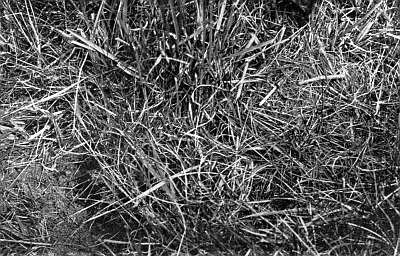
Pl. 68.][H 106.
Nest of Field Vole.
The dark run at left connects with the nest at right.
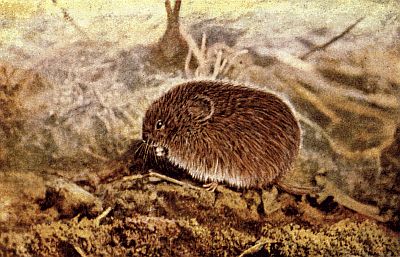
Pl. 69.][H 107.
Field Vole.
Microtus agrestis.
In those districts where the over-zealous efforts of the gamekeeper
have resulted in the partial extermination of the Weasel
and the Owls, the increase of the Field Vole is so enormous
and so rapid that they have at times become a plague. Crops
are cleared from the fields, young trees in plantations destroyed
by thousands, and even newly sown cornfields rendered unproductive
by every seed being eaten. In the New Forest and
the Forest of Dean great loss has been sustained at various
times by their severing the roots of young trees that crossed
their runs, and by their gnawing the bark of the young trunks.
The most effective of the plans adopted for lessening their
numbers was by sinking pits a foot and a half deep, wider at
the bottom than at the mouth, into which vast numbers fell
and from which they could not escape. More recently the
South of Scotland suffered from a plague of "mice" that ate
up everything in the fields, inflicting such serious loss to
agriculture that a Government Committee was appointed to
inquire into it, and it was found that the chief culprit was the
Field Vole. Fortunately, when things were at their worst, a
vast number of Short-eared Owls appeared upon the scene and
feasted royally until there was scarcely a Vole to be found. It
was found that the enormous increase in the numbers of the
Voles was directly due to the warfare waged by keepers on
Weasels and Owls. Matters are better, perhaps, to-day; but
there are still too many keepers who destroy as vermin the
very agents that keep down the real vermin. We still need
a few landowners of the temper of Charles Waterton, who
threatened to strangle his keeper if the latter molested a
certain pair of Owls.
It was also shown at the Vole Committee of 1893, referred to
above, that the Rook destroys great numbers of Field Voles—not
only adults that chance to cross the fields where the Rooks
are digging cockchafer grubs, but that they systematically
search for the nests and eat the young.
As in the case of the Wood Mouse, there are several local
races of the Field Vole that have arisen in the islands of the
Orkneys and Hebrides, which have been elevated into distinct
species by some recent authors. Thus, there are recognised
the Hebridean Vole, the Orkney Vole, the Sanday Vole,
and the Westray Vole. Mr. Barrett-Hamilton regards the
true agrestis of Linnæus as not occurring in this country,
where it is represented by several sub-species. The Common
Field Vole described above, he says, is a distinct species, the
M. hirtus of Bellamy. This, which he describes as "a newer,
smaller form," he says "has replaced an older, larger M.
agrestis, the latter now confined chiefly to northern regions,
and with isolated southern colonies on the mountains." Seeing,
however, that most modern authorities agree in retaining the
Linnean name, we have considered it advisable to do so also.
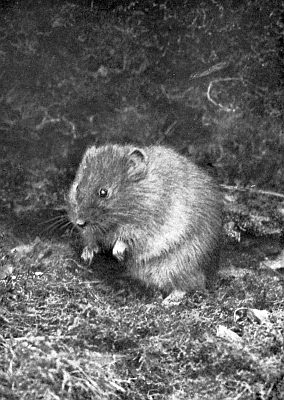
Pl. 70.][H 108.
Orkney Vole.
Microtus orcadensis.
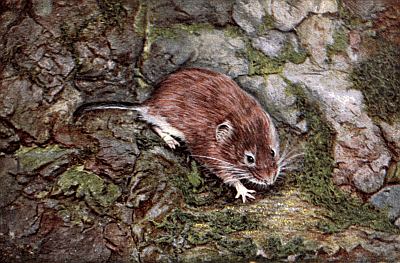
Pl. 71.][H 109.
Bank Vole.
Evotomys glareolus.
The form that Barrett-Hamilton recognises as M. agrestis
and calls the Northern Grass Mouse, is, so far as Britain is
concerned, represented only in Scotland and its western islands
by five sub-species which he names as under:—
Macgillivray's Grass Mouse (M. agrestis macgillivraii), a
rich buff-coloured form with thin fur, restricted to Islay, where
it is rare.
Hebridean Grass Mouse (M. agrestis exsul), common on
several islands of the Hebrides. Distinguished from the Field
Vole by its much larger size and duller brown colour.
Eigg Grass Mouse (M. agrestis mial) restricted to the island
of Eigg. Differs from M. a. exsul in its shaggy coat of
abundant long hairs.
Highland Grass Mouse (M. agrestis neglectus) found on the
summits of the highest Scottish mountains. It is larger than
the Field Vole, with thicker fur and darker, browner upper side.
It differs from M. a. exsul in the simpler character of the
first molar tooth.
Muck Grass Mouse (M. agrestis luch), of which only three
specimens have been taken, all on the island of Muck. About
the same size as the Field Vole, it has a buff underside.
Orkney Vole
(Microtus orcadensis, Millais).
So far back as 1805 the Rev. George Barry, in his "History
of the Orkney Islands," mentions a rodent that was known
locally as the Vole Mouse, which he believed to be the same as
the agrestis of Linnæus. He says it "is very often found in
marshy grounds that are covered with moss and short heath, in
which it makes roads or tracks of about three inches in breadth,
and sometimes miles in length, much worn by continual treading,
and warped into a thousand different directions."
Towards the end of last century Mr. J. G. Millais obtained
specimens, and on a critical examination found that they
differed from the known forms in several details of skull
structure and in the folds and angles of the teeth, sufficient in
his opinion to constitute a new species, which he called Microtus
orcadensis. It is larger than the Field Vole, with a longer and
slightly broader head.
It was found subsequently that specimens from different
islands in the Orkney group showed differences due to their
segregation over a long period, and they have consequently
been distinguished as five sub-species. These differences are
minute, and it would be wearisome and out of place in a popular
work such as the present to detail them. Generally speaking,
they are much alike, and their habits are practically identical,
so far as at present known.
The runs are a conspicuous feature of the islands, among the
heather and the rough vegetation of the fields and hillsides,
running along the surface and at intervals entering tunnels
about two and a quarter inches in diameter—just sufficient to
clear the spread of the Vole's whiskers. Their nesting places,
like those of the Mole, are under small mounds connected with
a network of runs. The nest itself is made of grass and roots
in a rounded chamber, where at intervals during the spring and
summer several litters, varying from three to six, are produced.
Before they are three weeks old they are capable of independent
existence, but for a time are still guarded by the mother.
The Orkney Vole appears to be specially fond of the roots of
Heath Rush (Juncus squarrosus), but also feeds on grass and
the crops in cultivated fields to which they can gain access.
Mr. Millais found that in cold weather his captive Voles became
inactive. It has many enemies to hold its increase in check,
for every bird and beast large enough to capture it will eat it
readily.
Bank Vole
(Evotomys glareolus, Schreber).
There can be little doubt that in many places the Bank Vole
has been mistaken for a bright variation of the Field Vole. Its
habits are much the same, except that it haunts the hedgerow
and wooded country rather than the open fields. As to the
differences between the two species, the Bank Vole's head and
body measurement is only three and three-quarter inches against
four inches in the Field Vole, but its tail is actually (not merely
proportionately) longer, being nearly half the length of head
and body, and ends in a pencil of hairs. The ears and feet are
proportionately larger, the former also being more oval than
round. It further differs from the other Voles in the fact that
the molar teeth become rooted in the jaws of the adults. The
fur of the upper parts is a bright chestnut-red or Vandyke brown,
excepting the hairy tail, which is black above. The under
parts, including the lower side of the tail, are whitish varying to
yellowish or even buff. The redder tint causes this species
frequently to be styled the Red Vole. It has pink lips, and
grey feet. Whiskers about an inch long. Black and albino
varieties have been recorded.
It was considered formerly to be a rare British species, but
more discriminating attention to the smaller mammals in recent
years, and the wider adoption of trapping by naturalists, have
tended to modify that view. It is probably more local, but it
appears to be widely distributed, and to occur as far north
certainly as Moray and Elgin; but it is not recorded from
Ireland, Man, Hebrides, or Shetland. A local race is found in
Skomer Island, and has been named E. skomerensis. When
Yarrell detected the Bank Vole as a distinct species in 1832, it
was considered to be of very restricted range in this country.
The discovery was made in Essex, but it was soon reported from
Herefordshire, Middlesex, Berks, and Cambridge, and more
recently from Oxfordshire, Warwickshire, Shropshire, Worcestershire,
the Lake District, Northumberland, Inverness, etc. It is
restricted to Europe in its wider range. In this country it does
not appear to occur at elevations of more than about 700 feet.
The Bank Vole is much more agile than the Field Vole, and
not so much given to burrowing. It may be seen abroad in
sunny situations at any time of the day, preferring warm, dry
places, yet frequently to be found in wet places. It is a good
swimmer and diver. It constructs shallow runs in the earth of
a roadside bank or hedgebank. These have many entrances
and exits above and below, as shown in our photograph; some
of the passages connecting with the top of the bank, others
enlarging into blind chambers. Its food includes herbage,
roots, bulbs, fruits, and seeds; it appears to be particularly
fond of turnips. In spring it has been observed climbing rose
and hawthorn bushes in order to nibble the new leaves, and in
autumn to obtain the hips and haws. It also seeks nuts,
berries, the grain of wheat and barley, and the seeds of smaller
grasses. Insects, snails, and even small birds are eaten by it,
and the entrance to its burrows frequently gives evidence of the
variety of its food. It has been known to eat the unpalatable
Shrew that it has killed, and even to given way to cannibalism.
In Scotland it is accused of eating the shoot-buds of young
conifers, especially of larch, and gnawing the bark from
branches.
In this country it is occasionally captured in the act of
robbing household stores, but in more northern regions, as in
Norway and the Yukon, it is a constant inhabitant of houses.
It is not one of the hibernating species, therefore as a rule it
does not lay up stores; but Mr. Douglas English records the
digging up of five Bank Voles with a store of ninety-three
sound cob-nuts.
There are several litters of three to six naked and blind young
during the year, produced in nests of grass, moss and wool, or
feathers, usually placed above ground, sometimes in a bird's
nest at some height above it. The males are very quarrelsome,
and when fighting or pairing are very vocal, indulging in
grunting squeaks.
Three geographical races or sub-species have been recognised
by Barrett-Hamilton as distinct species under distinct names.
These are Skomer Bank Vole (Evotomys skomerensis) from
Skomer Island, off Pembroke; Alston's Bank Vole (E. alstoni)
from the Isle of Mull; and the Raasay Bank Vole (E. erica)
from Raasay Island, Skye. Barrett-Hamilton regards these as
descendants of a former "Boreal" group of Voles, which have
been supplanted on the British mainland by the competition of
the Bank Vole.
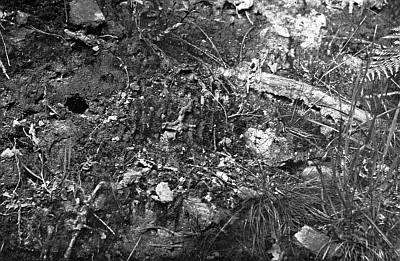
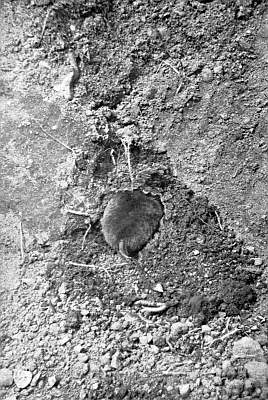
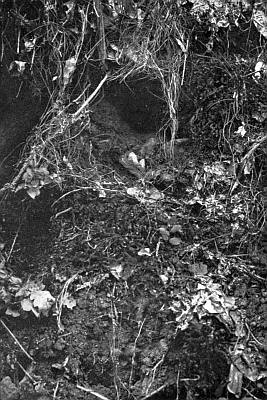
Pl. 72.][H 112.
Retreat of the Bank Vole.
Run continues from hole (left) under exposed root (right).
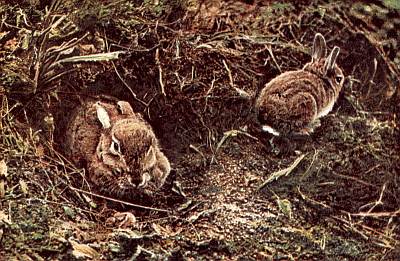
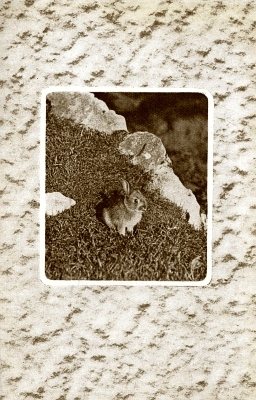
Pl. 73.][H 113.
Rabbit.
Oryctolagus cuniculus.
Rabbit
(Oryctolagus cuniculus, Linn.).
The Rabbits and the Hares being comparatively large and
familiar members of our native fauna do not appear to stand in
need of much space being devoted to them. Familiar as the
two common species may be they require to be distinguished
not only one from the other, but also from the two other and
less familiar species, and in addition there may be a few facts
of organisation and habit that are not well-known to all our
readers. All members of the family Leporidæ, there are certain
structural features in which they all agree in a general way.
They belong to the section of Rodents known as Duplicidentata,
because in the upper jaw there are always two pairs of incisors.
All the other Rodents have only one pair, and they form the
division Simplicidentata. The dentition of the Rabbits and
Hares is therefore as follows: i 2/1, c 0/0, p 3/2, m 3/3 = 28.
The ears are remarkably long and out of all proportion to the
size of the body when compared with other Mammals. If laid
forward over the face they reach nearly to the tip of the nose.
The eyes are large and prominent and placed well to the sides
of the head. The hinder legs are longer than the forelegs, and
so greatly developed as to be the main propelling power. Instead
of pads on the soles to protect the foot and legs from the
jars incidental to hard running, the Leporidæ have all the feet
covered beneath with a thick coating of hair which gives a firm
grip either on hard rock or slippery snow. The tail is very short
and turned up. The fur is of triple formation: there is a
dense, soft, woolly under-fur, through which push longer and
stronger hairs and give the coat its colour, and a still longer but
much less numerous set, scattered among the others. The two
longer sorts of hair are more or less ringed. The coat becomes
thicker in winter.
They are sexually mature at a very early age, and often begin
to breed before they have attained to full size. The females are
distinguished by the form of the head, which is longer and more
delicately modelled than that of the male. The males (bucks),
too, are restless and quarrelsome. They are promiscuous
breeders, and the entire care of the family falls upon the
mother (doe).
Litters of Rabbits succeed one another rapidly between
February and September; less frequently in the autumn and
winter months. The litters vary from two or three to eight, the
higher numbers being those of the warmer months. Young
Rabbits are but sparsely clothed and are blind and deaf, the
ears being closed and having no power of movement until
about the tenth day. The eyes open a day later. In a few
days more they can run, and make short excursions from the
underground nest. Before they are a month old they are
capable of independent existence. Until then the mother will
defend them against all-comers, including the Weasel and
Stoat, using her powerful hind feet against her adversary, and
to good purpose.
The Rabbit is a much smaller animal than the Hare, greyer
in colour, with smaller ears and feet, and the black tips of the
ears so noticeable in the Hare, are in the Rabbit much reduced
or altogether wanting. Its average weight and measurements
are: weight, 2-1/2 to 3 lbs.; length of head and body, 16-1/2 ins.,
tail, 3-3/4 ins., ear, 3 ins., hind foot with claws, 3-3/4 ins. It also differs
from the Hare in the structure of its heavier skull, its smaller
eyes, shorter ears, and lesser specialisation of the limbs for
speed in running.
It is believed that originally the Rabbit was a native only of
the western parts of the Mediterranean region—where it still
teems—and to have spread northwards largely by human aid.
It is known to have been introduced to Italy from Spain by the
Romans, who are usually credited with having brought it to
Britain. It is now thought, however, that we are indebted to
the Normans for its presence. It was certainly here in the
twelfth century. The name Rabbit is from the French, and
originally indicated the suckling young; the adults being known
as Conies.
Although so famous as a digger of extensive underground
dwellings, Nature does not appear to have specially built the
Rabbit for this purpose; but where the soil is light the efforts
of many generations of associated workers have resulted in a
system of burrows both extensive and complicated, with bolt-runs
as emergency exits and stop-runs for nursery use. Although
it prefers the light sand of the dunes covered with Marram-grass,
or a sandy heath overgrown with furze and heather, it
will on occasion drive its tunnels into firm loam or dry clay; it
has been known even to burrow deeply into a surface seam of
coal. The forepaws are the principal burrowing tools, the
loosened earth being thrown far back by the kicking of the
hinder feet. Where stones come in the way that cannot be
loosened by the paws, they have been known to be removed by
the teeth. These tunnels are about six inches in diameter, increased
locally to a foot to provide passing places. The
residential quarters are always blind chambers leading from the
main passages. The adult Rabbits do not indulge in bedding
materials but rest on the bare soil. The does, however, make
beds for their young by denuding their own under parts of fur.
These tunnels are frequently made use of by other animals, if
necessary, by enlarging the passage to admit their larger
bodies. When Rabbit-earths are ferreted they sometimes yield
more than Rabbits: a Fox, a Cat, a Stoat, with several Rabbits
and Rats, have been driven out of the same earth.
Where the Rabbit finds the ground too hard or too wet, it
contrives to do without tunnelling underground, making runs
under the heather, furze, or matted herbage. Such exceptions
are known to sportsmen as Stub-Rabbits or Bush-Rabbits, in
the belief that they are a separate species. Occasionally, too,
the doe will follow the example of the Hare, and make a
nursery "form" in fallow land or among the growing turnips.
The Rabbit is almost exclusively a vegetarian, its chief food
being grass and the tender shoots of furze; but in the vicinity of
cultivated land they devastate the crops and inflict serious loss
upon the farmer. The exception to a vegetable diet is found in
its occasional indulgence in snails. Wherever there is sufficient
food and his enemies are not too oppressive the Rabbit has extended
his range to the most out-of-the-way corners of these
islands. A century ago it was a scarce beast in Scotland, but
it is now to be found in abundance up to the extreme north.
It is found also all over Ireland. Its chief enemies, in addition
to man, are all the members of the Weasel family, the Owls, and
the Hawks.
Every one who has come across a party of Rabbits feeding
must have noticed how conspicuous the white underside of the
upturned tail makes them in flight. Wallace suggested that like
the white patch on the hind parts of deer and antelope it served
as "a signal flag of danger," a guide to the young and feeble to
escape from danger by following the most vigorous seniors.
This view has been strongly criticised, even ridiculed; but the
critics have not offered a better explanation of the upturned
Rabbit's "scut." It must, however, be admitted that any explanation
ought to fit the case of the Hare which often carries
its tail with the white underside exposed, but is a solitary animal
with no companions to follow it. On the sand dunes the
Rabbit's coat renders it invisible through harmony with the
sand.
In the ordinary way of life the Rabbit is a silent animal, except
that he gives vent to low growls and grunts to express anger or
pleasure; but when terrorised by the imminence of attack by a
Stoat the Rabbit finds its voice and gives utterance to a loud
scream of agony. This has been referred to in the account of
the Stoat (ante, p. 68).
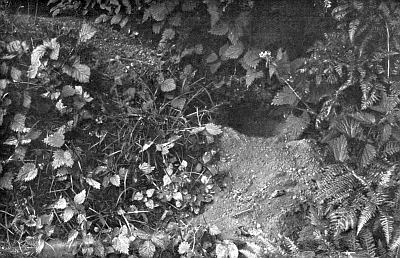
Pl. 74.][I 116.
Entrance to Rabbit-Burrow.
Bare slope in front formed of excavated earth.
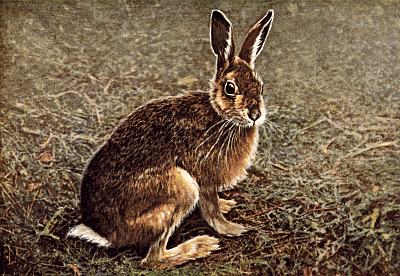
Pl. 75.][I 117.
Brown Hare.
Lepus europæus.
Brown Hare
(Lepus europæus, Pallas).
Although in general form and structure the Hare is similar
to the closely related Rabbit, there are differences so great as
to have induced recent systematists to put them into different
genera; and, even superficially, they are sufficiently unlike to
enable country folk to keep them distinct under different names.
These differences are evident in the longer body, the great
length of the hind limbs, the longer ears with their invariable
black tips, and the tawny colour of the fur of the upper parts.
To these distinctions they can add the patent facts that whilst
the Rabbit is a sociable beast, associating in large communities,
the Hare is as solitary and retired as a hermit.
There has never been any suggestion that the Hare's title to
rank as a real native of Britain is open to doubt, for its name is
Anglo-Saxon, and identical with that in use in Denmark and
Sweden. It is widely distributed in England, Wales and
Scotland up to about 2000 feet elevation; but in Ireland (which
has a separate species of its own) the Brown Hare is not a
native. It has been a favourite animal of the chase from the
earliest times of which we have records; and our ancient
sportsmen had age-names for it as for Deer. Thus, in its first
year it was a Leveret, in the second year a Hare, and in the
third a Great Hare. The male is distinguished as Jack-Hare,
and the female as Doe.
The total length of the Hare is about twenty-four inches, to
which the tail contributes three inches and two-thirds, and the
head nearly four inches. The ears fall short of five inches.
The weight averages about eight pounds. The tawny fur of the
upper side is harsher than that of the Rabbit, which is due to
a predominance of the strong hairs of medium length described
under Rabbit. The shoulders, neck, and flanks are of a ruddier
hue than the back, and a ruddy band crosses the loins. The
sides of the face, and the outer surfaces of the limbs, incline to
a yellow tint. The underside is pure white except at the breast
and loins where the ruddy tint is continued from above. There
is a profusion of black and white whiskers, of which the white
are the longer and as much as three and a half inches in length.
The tail, which is carried curved up over the back or straight
behind, is black above and white on the sides and below. The
large, prominent eyes have a horizontal pupil. As it is almost
impossible to come upon a Hare asleep, it was formerly believed
that they have no eyelids and are compelled, therefore, to sleep
with their eyes open. This, of course, was an "inexactitude"
comparable to the belief in the Mole's lack of eyes and ears.
The prominence of the dark eyes of the Hare, and their situation
well to the sides of the head give him a wide field of vision.
As regards sexual distinctions, the Jack-Hare has a smaller
body, shorter head and redder shoulders than the Doe.
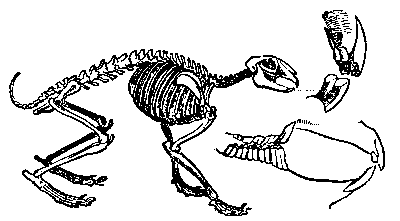
Skeleton and Teeth of Brown Hare.
The Hare is not a burrowing animal, and does not seek
refuge underground from his enemies, unless hard pressed,
when he may enter a Rabbit-burrow temporarily. He relies
upon his russet coat harmonising generally with his surroundings;
and content with a slight depression among the grass
known as a "form," he sits all day and surveys the landscape,
ever ready to use his powerful limbs when his keen senses tell
him there is danger near. At dusk he goes abroad to feed, and
returns to the form at dawn. To break the continuity of scent,
when he is leaving his form, and again when returning to it, he
will suddenly turn at right angles to his former course and
make a prodigious leap—fifteen feet or more—to the top of a
bank, then take another long bound, perhaps into marshy
ground where the scent will not lie, and repairing to the feeding-ground
feel safe from being tracked by Fox or Polecat. He
always adopts this leaping trick, also the plan of doubling on
his track, which has been the admiration and vexation of the
hunter from old times. Shakespeare has told at some length
"How he outruns the winds, and with what care
He cranks and crosses with a thousand doubles:
The many musets through the which he goes
Are like a labyrinth to amaze his foes."
As he courses across the fields you get the impression that he
is longer than the measurement given above; the impression
is due to the length of the hind legs extended in running, and
from which he especially gets the advantage over pursuers
when the course lies uphill. He is a good swimmer, and often
crosses rivers in order to reach a better feeding-ground, to
avoid pursuit, or to seek a mate. Hares have been known to
cross the Trent in numbers, where it was two hundred yards
wide, in order to reach a field of carrots on the further side;
and Yarrel saw one cross an arm of the sea a mile broad.
The "form" is made in rank grass among thickets of gorse
and briar, or in the open field where the ground is dry beneath
it. It takes and retains the shape of the animal's body, and
may be used for a long period. Here the doe brings forth her
litter of two, three, or four young—occasionally more. There
is much variation in this respect. These are born with their
eyes open, and a short furry coat, which however lacks the
ruddiness of the adult. They are capable of using their limbs,
and are so well advanced in development before birth, that soon
each makes its own little form beside the mother's, and when a
month old they are quite independent. When left alone on the
form, whilst the mother goes off to feed, and anything alarms
them, they cry "leek, leek." The adults pair promiscuously;
and there appear to be three or four litters a year.
The Hare appears to moult twice a year—in early autumn
and early spring; the former being the principal. Like the
Rabbit, it is exclusively vegetarian in its feeding, including
bark, grain, and roots as well as herbaceous plants in its bill of
fare. It is very destructive to young trees in plantations, and
the farmer and market-gardener suffer severely from its depredations
among the crops of carrot, lettuce, turnip, etc. In the
open country it prefers grasses of the genera Poa, Festuca, and
Molinia, clover, sow-thistle, and chicory. When it gets into
gardens it shows distinct preference for dahlias, carnations,
pinks, nasturtiums, parsley, and thyme. In shrubberies it is
very destructive to bark and boughs, especially of coniferous
trees.
The proverbial expression, "Mad as a March Hare," has
reference to the insane antics of the Jack-Hare during the
rutting season. He grunts and kicks, bucks like a broncho,
and has stand-up boxing-matches with his rivals. In bucking
he leaps over his opponent and kicks him vigorously with the
hind feet. Though usually harmless, these encounters have
been known to have fatal terminations. Though regarded
generally as a mute animal, this is not the fact. The Hare
has a low but clear cry, which has been described as "don't,"
"ōnt" or "aunt," with varying inflections denoting different
moods. When wounded or badly frightened it utters a scream
like that of a child in pain, and sportsmen have declared that
the pitifulness of it caused them to give up shooting Hares.
They have also a warning sound made by grinding the teeth,
and it is passed on from Hare to Hare, having the same result
as the stamping of feet by the Rabbit. The amorous notes of
buck and doe are different, and their imitation by poachers
and gamekeepers is known as Hare-sucking.
The doe is a model mother for a time, and will fight
desperately in defence of her young; but as soon as they are
capable of looking after themselves she casts them off or
deserts them.
Alpine Hare
(Lepus timidus, Linn.).
Alternatively known as the Scottish or Variable Hare, the
present species is intermediate in size between the Brown Hare
and the Rabbit. The first name has reference to the fact that
it is indigenous only in Scotland and the neighbouring isles. It
has been introduced into England and Wales, but except in
the northern counties and some of the Welsh mountains has
not established itself. The name Variable Hare denotes its
change of hue at the beginning of winter after the manner of
the Stoat. In Cheshire it is known as White Hare. Respecting
this winter whitening of the fur, fierce controversies raged for
many years; one school contending that it was due to a complete
moulting of the summer fur, as a new growth without
colour was produced. The opposition claimed that there was
only one moult—in spring—to get rid of the too conspicuous
white coat as the snow with which it harmonised melted away.
They contended that the old hairs became altered individually
by the abstraction of pigment, or by the development of air-bubbles.
Evidence which was considered conclusive was brought
forward by both sides, and opponents remained unconvinced.
In the early days of the twentieth century, however, Metchnikoff
showed that the senile whitening of human hair was due to the
activity of certain motile cells, which he termed chromophages
or colour-eaters, which remove the pigment granules and consume
them. At a later date he showed that the same process
caused the whitening of the hairs in the Scottish Hare, and of
the feathers of the Ptarmigan—which undergoes a similar
change of colour. It is noteworthy that the black tips of the
ears, like the black tip of the tail in the Stoat, never change
colour.
As already stated, the Alpine Hare is smaller than the Brown
Hare, the combined length of head and body being about
twenty inches, but the head is proportionately larger, the ears
and tail shorter, and the legs longer. The fur is more woolly
and of a duskier tint in summer, the whiskers shorter and finer,
the eyes rounder, and the hair on the underside of the foot
softer. Behind the breast the under parts are white, and the
tail wholly so. Another name—Blue Hare—is suggested by its
appearance in autumn and spring, when the summer and winter
tints are mingled in its fur. The coat becomes closer and longer
in winter than it is in summer. Sometimes the winter coat is
retained longer than usual, through some unexplained retarding
of the spring moult. Black and buff variations have been
recorded. The average weight is between five and six pounds.
The habits of the Alpine Hare are very similar to those of
the Brown Hare; but it is less timid, and when alarmed clears
off in a more leisurely and less excited manner. As contrasted
with the nervous terror of the Brown Hare and Rabbit, the
Alpine Hare may be said to be comparatively tame. Instead
of making a form it hides in rock crevices and among stones
where it may be sheltered from the sight of birds of prey overhead.
Occasionally, and especially where there are no rocks,
they excavate burrows a few feet in length in the hillside or
into the peat-bank. In general its food is similar to that of
the Brown Hare; but it is said to add lichens to its bill of
fare in winter, and to grind up fir-cones in order to obtain the
seeds.
Precise observation is still needed respecting the breeding
habits of the Alpine Hare, but they do not appear to differ
greatly from those of the Brown Hare, two or three litters being
produced in the year, and the leverets varying in number up to
eight.
Irish Hare
(Lepus hibernicus, Bell).
The abundance of Hares in Ireland has been noticed in
literature for more than a thousand years, but it was not until
1833 that it was suggested that the Irish Hare was anything
more than a variation of the Brown Hare. Even so, until quite
recently it has been accepted by most of the high authorities as,
at best, a variety or sub-species of the Alpine Hare. It occurs
naturally all over Ireland, and is not found elsewhere except
where distinct attempts have been made to introduce it. Even
in places where this introduction has succeeded in establishing
colonies—as in the Island of Mull, where it runs with the Alpine
Hare—it refuses to breed with other kinds. Barrett-Hamilton
is satisfied that it is distinct, and probably a direct descendant
of the extinct Lepus anglicus whose remains are found in late
Pleistocene rocks.
It is a larger beast than the Alpine Hare. The head and
body average about twenty-three inches in length, and the tail
about three inches. The ears slightly exceed the tail. The
average weight is about seven pounds; but exceptionally
exceeds nine, and in one case ten pounds has been recorded.
It has russet fur, not smoky brown or "blue" as in the Alpine
Hare; its winter whitening is not regular as in that species, and
is frequently patchy, russet "islands" being left surrounded by
white.
As compared with the Brown Hare, the Irish Hare is smaller
and of more graceful build, but the head is relatively longer
and broader, the eyes rounder, the ears shorter and the limbs
longer.
Though it does not dig burrows of its own, it has been known
frequently when coursed to take refuge in a Rabbit-burrow.
Though, like the other Hares, solitary, the Irish Hare shows a
tendency to gregariousness at times. They have been seen in
the North of Ireland moving in droves of two or three hundred,
like Deer.
It has several litters during the year, averaging three leverets
a litter. They seldom remain long together, either moving
apart of their own accord or being separated by the old doe.
They are able to run when only an hour or two old.