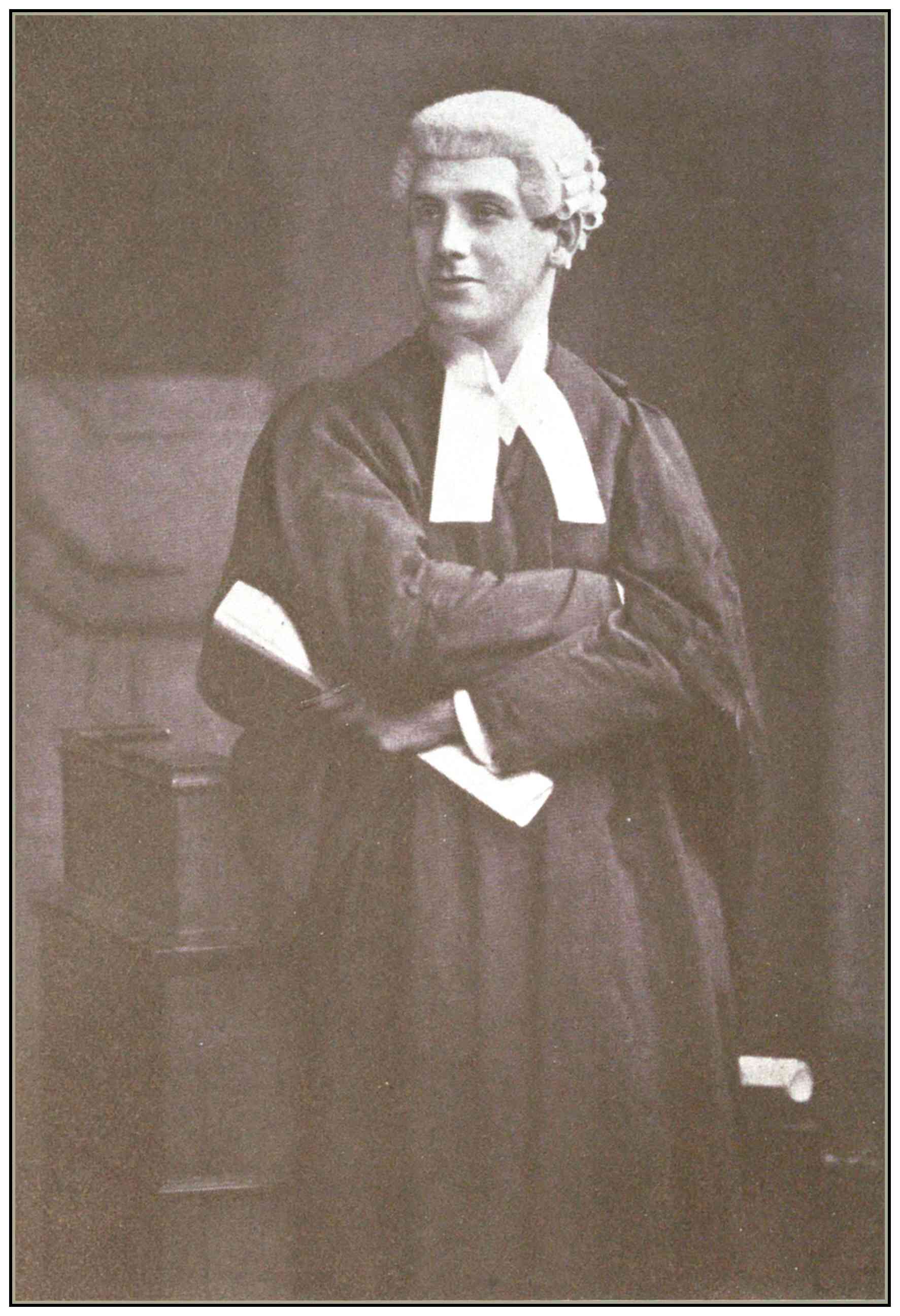
A larger version of the Frontispiece may be seen by right-clicking it
and selecting an option to view it separately, or by double-tapping and/or
stretching it.
Lafayette, Dublin, photographers.
Emery Walker phot.
Thos M. Kettle
THE WAYS OF WAR
BY
PROFESSOR T. M. KETTLE LIEUT. 9TH DUBLIN FUSILIERS
WITH A MEMOIR BY HIS WIFE
MARY S. KETTLE
NEW YORK
CHARLES SCRIBNER’S SONS
1917
TO MY DEAR WIFE AND COMRADE EX UMBRIS ET IMAGINIBUS IN VERITATEM
PREFATORY NOTE
Perhaps the order of the chapters in the present
book requires a word of explanation. They
have a natural sequence as the confessions of an
Irish man of letters as to why he felt called upon
to offer up his life in the war for the freedom of
the world. Kettle was one of the most brilliant
figures both in the Young Ireland and Young
Europe of his time. The opening chapters reveal
him as a Nationalist concerned about the liberty
not only of Ireland—though he never for a moment
forgot that—but of every nation, small
and great. He hoped to make these chapters part
of a separate book, expounding the Irish attitude
to the war; but unfortunately, as one must think,
the War Office would not permit an Irish Officer
to put his name to a work of the kind. After the
chapters describing the inevitable sympathy of an
Irishman with Serbia and Belgium—little nations
attacked by two Imperial bullies—comes an account
of the tragic scenes Kettle himself witnessed
in Belgium, where he served as a war-correspondent
in the early days of the war. “Silhouettes from
the Front,” which follow, describe what he saw
and felt later on, when, having taken a commission
in the Dublin Fusiliers, he accompanied his
regiment to France in time to take part in the
Battle of the Somme. Then some chapters containing
hints of that passion for France which was
one of the great passions of his life. One of these,
entitled “The New France,” was written before
the war had made the world realise that France
is still the triumphant flag-bearer of European
civilisation. Then, in “The Gospel of the Devil,”
we have an examination of the armed philosophies
that have laid so much of France and the
rest of Europe desolate. The book closes with
“Trade or Honour?”—an appeal to the Allies to
preserve high and disinterested motives in ending
the war as in beginning it, and to turn a deaf ear
to those political hucksters to whom gain means
more than freedom. Thus “The Ways of War”
is a book, not only of patriotism, but of international
idealism. Above all, it is a passionate
human document—the “apologia pro vita sua” of
a soldier who died for freedom.
L.
Many of the chapters in this book have already appeared in
various newspapers and magazines, to the editors and proprietors
of which thanks are due for permission to reprint them
here. The sources of the chapters referred to are as follows—
“Under the Heel of the Hun”
}
Daily News.
“Zur Erinnerung”
“The Way to the Trenches”
“G.H.Q.”
“Belgium in Time of Peace“: Freeman’s Journal.
“The New France”: Irish Ecclesiastical Record.
“The Soldier-Priests of France“: The Hibernian Journal.
My husband in his last letter to his brother,
written on the 8th of September, 1916, on the
battlefield, expressed the wish that I should write
a memoir of him as a preface to his war book. It
is only at his express instance that I would have
undertaken the writing of such a memoir, as there
are many obvious reasons—notably two—why I
am unfitted for that high duty. I have not the
literary gifts of many of his distinguished friends,
who in writing of him would have exercised
their powers of sympathetic understanding and
appreciation to the uttermost. But the personal
relationship is an even greater handicap. If the
reader will accept me as his comrade—since he
has honoured me with the proud distinction—I
shall do my best to interpret the “soul-side” with
which he “faced the world.” For my shortcomings,
I must crave indulgence. I only bring to
this task the vision of love.
I shall give hereafter a biographical sketch,
but first I wish to deal with his attitude to the
war and a few points which he desired to be
emphasised.
What urged him—the scholar, the metaphysician,
the poet, above all the Irishman, irrevocably
and immutably Irish, the man of peace, who
had nothing of the soldier except courage—to take
a commission in the British Army and engage
in the cruel and bloody business of war? His
motives for taking this step, he wished to be made
clear beyond misrepresentation. It should be
unnecessary to do this, as he proclaimed them on
many platforms and in many papers. His attitude
and action are the natural sequence and logic
of his character and ideals. Since I first knew
him, he loved to call himself a “capitaine routier”
of freedom, and that is the alpha and omega of his
whole personality. As Mr. Lynd has said, he was
not a Nationalist through love of a flag, but
through love of freedom. It was this love of freedom
that made him in his student days in the
Royal University lead the protest against the
playing of “God Save the King” at the conferring
of Degrees. The words of the Students’ manifesto
went, “We desire to protest against the
unjust, wasteful and inefficient Government of
which that air is a symbol.” It was the same love
of freedom that made him during the Boer War
distribute in the streets of Dublin anti-recruiting
leaflets. The Tom Kettle who did these things,
who said in an election speech in 1910 that “for
his part he preferred German Invasion to British
Finance,” was the same Tom Kettle who believed
it Ireland’s duty in 1914 to take the sword against
Germany as the Ally of England.
“This war is without parallel,” he wrote in
August, 1914; “Britain, France, Russia, enter it,
purged from their past sins of domination. France
is right now as she was wrong in 1870, England
is right now as she was wrong in the Boer War,
Russia is right now as she was wrong on Bloody
Sunday.”
In August and September, he acted as war correspondent
for the Daily News, and in this capacity
was a witness of the agony of Belgium. He
returned to Ireland burning with indignation
against Prussia. He referred to Germany as “the
outlaw of Europe.” “It is impossible not to be
with Belgium in this struggle,” he wrote to the
Daily News; “it is impossible any longer to be
passive. Germany has thrown down a well-considered
challenge to all the forces of our civilisation.
War is hell, but it is only a hell of suffering,
not of dishonour, and through it, over its flaming
coals, Justice must walk, were it on bare feet.”
It was as an Irish soldier in the army of Europe
and civilisation that he entered the war. “He
was horrified,” said Mr. Lynd very truly, “by the
spectacle of a bully let loose on a little nation.
He was horrified, too, at the philosophic lie at the
back of all this greed of territory and power. He
was horrified at seeing the Europe he loved going
down into brawling and bloody ruin. Not least—and
no one can understand contemporary Ireland
who does not realise this—he was horrified
by the thought that if Germany won, Belgium
would be what he had mourned in Ireland—a
nation in chains. An international Nationalist—that
was the mood in which he offered his services
to the War Office.”
I think the chief reason his motives have been
misunderstood is that few have gone to the trouble
of understanding his wide outlook. He was a
European. He was deeply steeped in European
culture. He was au courant with European
politics. He knew his France, his Germany, his
Russia as well as we know our Limerick, Cork and
Belfast. Mr. Healy once said his idea of a nation
ended with the Kish lightship. Tom Kettle’s ideal
was an Ireland identified with the life of Europe.
“Ireland,” he wrote, “awaits her Goethe who will
one day arise to teach her that, while a strong
nation has herself for centre, she has the universe
for circumference.... My only programme
for Ireland consists in equal parts of Home Rule
and the Ten Commandments. My only counsel
to Ireland is, that to become deeply Irish, she must
become European.”
That counsel was given six years before the war.
It was acting on that counsel that he deemed it
right to make the final sacrifice, and in a European
struggle sign his ideal with the seal of his
blood. England and English thought had nothing
to do with his attitude to the war. England happened
to be on the side of Justice. He acknowledges
that, but says rather bitterly, “England goes
to fight for liberty in Europe but junkerdom in
Ireland.” Mr. Shane Leslie is absolutely right
when he says, “He died for no Imperialistic concept,
no fatuous Jingoism.”
“Let this war go forward,” he wrote to the Daily
News in 1914, “on its own merits and its own strong
justice. After the war of the peoples, let us have
the peoples’ peace. Let us drop statecraft and return
to the Ten Commandments—now that we
have got such a good bit of the way back.”
Mr. Padraic Colum, in a memoir of my husband
in the Irish-American paper, Ireland, says:
“When the Germans broke into Belgium, he advised
the Irish to join the British Army and to
fight for the rights of small nationalities. Had
death found him in those early days he would at
least have died for a cause he believed in.” I
think Mr. Colum, if only for the sake of an old
friendship, might have troubled to understand the
idea for which Tom Kettle died, and in which he
believed to the end. Does Mr. Colum mean to
suggest that my husband no longer believed in the
maintenance of the rights of small nationalities?
Was his enthusiasm for Belgium quenched—Belgium
the heroic who preferred to lose all that she
might gain her own soul? Is not Belgium still an
invaded country? And even if England juggles
with Ireland’s liberty, is not the fight for truth
and justice to go on? As my husband says in this
volume, “Ireland had a duty not only to herself
but to the world... and whatever befell, the
path taken by her must be the path of honour and
justice.”
In one of my last letters from him, he speaks
his faith, even if it is the faith of a sad and burdened
soul: “It is a grim and awful job, and no
man can feel up to it. The waste—the science of
waste and bloodshed! How my heart loathes it
and yet it is God’s only way to Justice.”
Mr. Colum proceeds: “He knew by the dreams
he remembered that his place should have been
with those who died for the cause of Irish Nationality.”
I postulate that Tom Kettle died most
nobly for the cause of Irish Nationality, in dying
for the cause of European honour.
Mr. Colum continues: “He knew she (Ireland)
would not now take her eyes from the scroll
that bears the names of Pearse and Plunkett and
O’Rahilly and so many others, and yet, Thomas
Kettle at the last would not have grudged these
men Ireland’s proud remembrance.” I think, too,
I may confidently assert that Tom Kettle’s name
will be entered on the scroll of Irish patriots, and
that he has earned, and will have, Ireland’s “proud
remembrance” quite as much as the rebel leaders
whose valour and noble disinterestedness he honoured,
but whose ideals he most emphatically did
not share.
Mr. Leslie is in shining contrast to Mr. Colum
in sympathetic understanding: “Irishmen will
think of him with his gentle brother-in-law,
Sheehy-Skeffington, as two intellectuals who, after
their manner and their light, wrought and thought
and died for Ireland. What boots it if one was
murdered by a British officer and the other was
slain in honourable war by Germans? To Ireland,
they are both lovable, and in the Irish mind,
their memory shall not fail.... Ireland knows
that they were both men of peace and that they both
offered their lives for her. England can claim
neither. In death, they are divided, but in the
heart of Ireland they are one.”
In The Day’s Burden, my husband referred to
Ireland as “the spectre at the Banquet of the Empire.”
He died that Ireland might not be the
spectre at the Peace Conference of Nations.
His last thoughts were with Ireland, and in each
letter of farewell written to friends from the battlefield,
he protests that he died in her holy cause.
His soldier servant, writing home to me, says that
on the eve of the battle the officers were served
with pieces of green cloth to be stitched on the back
of their uniforms, indicating that they belonged
to the Irish Brigade. Tom touched his lovingly,
saying: “Boy, I am proud to die for it!” Ireland,
Christianity, Europe—that was what he died for.
“He carried his pack for Ireland and Europe.
Now pack-carrying is over. He has held the line.”
Or, as he says in his last poem to his little daughter,
he died—
“Not for flag, nor King, nor Emperor,
But for a dream born in a herdsman’s shed,
And for the secret scripture of the poor.”
That was the dream that haunted his soul, that
impelled him to the last sacrifice, and what a sacrifice!
What he gave, he gave well—all his gifts,
his passionate freedom-loving heart, his “winged
and ravening intellect,” intimate ties of home and
friendship and motherland, his career, and better
than career—the chance of fulfilling his hopes for
Ireland—he sacrificed all that “makes life a great
and beautiful adventure.” And now that he has
died... “in the waste and the wreckage paying
the price of the dreams that cannot sleep,” let
not anyone commit that last treachery of travestying
his ideals and aspirations.
In his final letter to his brother, written the day
before he was killed, he outlined the things for
which, had he lived, he would have worked—
“If I live I mean to spend the rest of my life
working for perpetual peace. I have seen war, and
faced modern artillery, and I know what an outrage
it is against simple men.”
And in another letter, written to me some weeks
before he entered the battle of the Somme, he
speaks of this mission even more poignantly—
“I want to live, too, to use all my powers of
thinking, writing and working, to drive out of
civilisation this foul thing called War and to put
in its place understanding and comradeship.”
This note, indeed, rings through all his letters
like a pleading. “If God spares me, I shall accept
it as a special mission to preach love and peace for
the rest of my life.”
It is this that makes his sacrifice doubly great,
that he, realising with all the wealth of his abundant
imagination the horror and cruelty and outrage
of war, should step deliberately from the
sheltered ways of peace and security and take his
share “in the grim and awful job” because “it was
only a hell of suffering but not of dishonour, and
through it, over its flaming coals, Justice must
walk, were it on bare feet.”
Prussia was to him the enemy of peace and civilisation.
In almost his last letter, he again emphasises
this.
“Unless you hate war, as such, you cannot really
hate Prussia. If you admit war as an essential part
of civilisation, then what you are hating is merely
Prussian efficiency.”
And with this mission of universal peace
mingled his dream of a reconciled Ulster. He
knew that there was no abiding cause of disunion
between North and South, and hoped that out of
common dangers shared and suffering endured on
a European battleground, there would issue a
United Ireland. For this he counted much on
“the brotherhood that binds the brave of all the
earth.” “There is a vision of Ireland,” he wrote
in 1915, “better than that which sees in it only a
cockpit, or eternal skull-cracking Donnybrook
Fair—a vision that sees the real enemies of the
nation to be ignorance, poverty, disease; and turning
away from the ashes of dead hatreds, sets out to
accomplish the defeat of these real enemies. Out
of this disastrous war, we may pluck, as France
and Belgium have plucked, the precious gift of
national unity.”
In one of my letters he writes—
“One duty does indeed lie before me, that of
devoting myself to the working out of a reconciliation
between Ulster and Ireland. I feel God
speaking to our hearts in that sense out of this terrible
war.”
In his Political Testament he makes a dying
plea for the realisation of his dream.
“Had I lived I had meant to call my next book
on the relations of Ireland and England: The
Two Fools: A Tragedy of Errors. It has needed
all the folly of England and all the folly of Ireland
to produce the situation in which our unhappy
country is now involved.
“I have mixed much with Englishmen and with
Protestant Ulstermen, and I know that there is no
real or abiding reason for the gulfs, salter than
the sea, that now dismember the natural alliance
of both of them with us Irish Nationalists. It
needs only a Fiat Lux, of a kind very easily
compassed, to replace the unnatural by the natural.
“In the name, and by the seal of the blood given
in the last two years, I ask for Colonial Home Rule
for Ireland—a thing essential in itself and essential
as a prologue to the reconstruction of the Empire.
Ulster will agree.
“And I ask for the immediate withdrawal of
martial law in Ireland, and an amnesty for all Sinn
Fein prisoners. If this war has taught us anything
it is that great things can be done only in a
great way.”
As a writer in the Freeman very truly says—
“If Tom Kettle could have asked for a gift in
return for his great sacrifice, it would have been
that a great peace unite the hearts and strivings of
all those of his fellow-countrymen who worked
for the only land he loved.”
Mr. Leslie interpreted his vision exquisitely—
“He did not resent the littleness that had dogged
his life and left him lonely at the end—but he
looked back and hated the pettiness and meanness
which had injured Ireland—which had taken
every advantage of Ireland, which had fooled her
leaders and shuffled off her children on feeble
promises. He asked for that touch of greatness
by which alone great things are achieved. Like
a thousand ardent spirits in Ireland at the time,
he was ready to leap to a new era by the bridge
of great things greatly done, even if the bridge
was to be the bridge of death. English statesmen
offered them a bridge of paper and an insecure
footing at that, but many rushed forward, hopeful
of the future. Others turned bitterly back. All
who died, whether they died in Ireland or France,
died bitterly.
“Disappointed but undismayed Kettle stood
with nought but a mystic’s dream between himself
and the Great Horror. He felt afraid for Ireland,
but not for himself. Then the irony of his life and
the bitterness of his death must have come home to
him... stripped of all, his career, his ambitions,
his friends and lovers, with his back turned
to Ireland and his heart turned against England
he threw himself over the mighty Gulf, where at
least he could be sure that all things good or evil
were on the great scale his soul had always required.
With earth’s littleness he was done.”
He wished, too, to live to chronicle the deeds of
his beloved Dublin Fusiliers. There is no more
generous praise ever given to men than that he
gave his Dubliners—unless, perhaps, their praise
of him. In his last letter to his brother, on the eve
of death, he says—
“I have never seen anything in my life so beautiful
as the clean and so to say radiant valour of my
Dublin Fusiliers. There is something divine in
men like that.”
Again in a letter to a friend—
“We are moving up to-night into the battle of
the Somme. The bombardment, destruction and
bloodshed are beyond all imagination, nor did I
ever think the valour of simple men could be quite
as beautiful as that of my Dublin Fusiliers. I
have had two chances of leaving them—one on sick
leave and one to take a staff job. I have chosen to
stay with my comrades.”
In a letter written to me shortly after going out,
he writes out of his great, generous heart: “What
impresses and moves me above all, is the amazing
faith, patience and courage of the men. To me it
is not a sort of looking-down-on but rather a looking-up-to
appreciation of them. I pray and pray
and am afraid, but they go quietly and heroically
on. God make me less inferior to them.”
That is the essence of Tom Kettle, his noble and
humble appraisement of a gift which he possessed
par excellence himself. And I think he found happiness
and peace of heart with those loyal, valorous
men whose comrade he was and whose risks
he shared. They too, I think, knew and loved the
greatness of him, and found in his genius, his radiant
simplicity and high courage, their example and
inspiration.
* * * * *
Thomas M. Kettle was the third son of Andrew
J. Kettle, and of Margaret MacCourt. He was
born at Artane, Co. Dublin, in 1880. From his
father, the great land reformer who did more than
any other to emancipate Irish farmers from the
crushing yoke of landlordism, Tom Kettle inherited
his political principles. He might be said
to have “lisped” in politics. From his father, too,
he inherited that courage, moral as well as physical,
that fearless outspoken way he had of enunciating
his beliefs and ideas. He was intensely proud
of his father and always loved, in later years, when
the old man was confined indoors, to drive out to
his country home to thresh out current politics
with him. Though apparently they seldom came
to agreement, still it was obvious that each radiated
pride in the other.
Tom Kettle lived in the country till he was
twelve, and the quiet charm and peace of the land
cast a spell on him that held him always. He
hungered to go back, to quit politics and platforms,
and in a picturesque cottage cultivate literature
and crops. It was a dream he would never have
realised—he was born to be in the thick of things—but
it was constantly before him like a mirage.
In one of his last letters he recurs to it—
“We are going to live in the country, and I am
going to grow early potatoes. I am also going to
work very hard and make very few speeches.”
He was educated first at the Christian Brothers’
school in Richmond Street, Dublin. In 1894 he
went to Clongowes Wood College. He had a brilliant
Intermediate career, obtaining First Place in
the Senior Grade with many medals and distinctions.
There is a story told that this year when his
great success was a matter of public comment, his
father’s only remark was, “I see you failed in
Book-keeping.” It might strike as harsh those who
did not know Mr. Kettle, but it was not really intended
as such, it was meant rather to check vanity
and a possible swelled head. To Tom, it was exquisitely
humorous, and he loved the upright,
somewhat stern old man none the less for his seeming
lack of appreciation.
In 1897 he went to University College. In a
year or so, he became Auditor of the Literary and
Historical Society and obtained the Gold Medal
for Oratory. His great gifts were already conspicuous.
A fellow-student wrote of him:
“Amongst them all, Kettle stood supreme. Already
that facility for grasping a complicated subject
and condensing it in a happy phrase, that
bright, eager mind so ready to take issue on behalf
of a good cause, that intellectual supremacy which
was so pre-eminently his, had marked him out for
far-reaching influence and a distinguished career.”
His University course was interrupted by a
breakdown in health which necessitated his withdrawal
from collegiate life for nearly a year.
Over-study had strained his nervous system, and
he never quite regained normal health. In 1904
a brother, a veritable twin-soul, to whom he was
deeply attached, and of whom he had high hopes,
died. This was an everlasting grief to him. This
sorrow, together with his shattered nerves, was
responsible for his somewhat tragic and melancholy
temperament. In 1904 he went to the Tyrol
to recuperate, and in that wander-year, Europe
laid her spell on him. He was a fine linguist and,
being an omnivorous reader, was soon intimately
acquainted with the best European literature.
His journalistic talent was displayed as Editor
of St. Stephen’s, 1903–4, a spasmodically produced
college magazine which he described in a long-remembered
phrase as “unprejudiced as to date of
issue.”
In 1902 he had entered the King’s Inns as a Law
student. Of this period, a friend writes: “At
the students’ dinners Kettle was cordially welcomed,
and though very young in those days, still
at no time and in no place did rich humour and
rare conversational power show to more advantage.
The company one meets at Law students’ dinners
is varied to a degree, boys in their ’teens sitting at
table with men of middle age and over on even
terms. Struggling poverty sits check by jowl with
good salary and wealth. On one occasion when
Kettle was dining, one of the men present was a
very well-to-do business man of about fifty. This
gentleman was holding forth very earnestly on the
rights of property and the amount of violence a
householder is entitled to display towards a burglar.
Kettle suddenly startled him with the query:
‘Have you ever considered this question from the
point of view of the burglar?’ The magnate was
horrified and hastily withdrew.”
That story is typical of him. His term at King’s
Inns concluded with his securing a Victoria Prize,
and he was called to the Bar in 1905. With his
oratorical gifts and passionate delivery, a brilliant
career was foretold. A writer in the Irish Law
Times says: “He did everything that came his
way with distinction.... There was a freshness
and vigour about his style and a rare eloquence
in his language which satisfied everyone
that he would be an instant success if he was going
to make law his profession.” Personally, I think
he would never have been happy as a lawyer. He
was too sensitive. I remember his defending a
criminal who was convicted and sentenced to penal
servitude. The conviction worried him greatly.
He used to say that it was a fearful responsibility
to plead for a man and think that perhaps had
another lawyer been chosen there would be no
conviction. That the man was guilty mattered
nothing to him. He went on the principle that
the innocent are those who are not found out.
“Everywhere the word is man and woman;
Everywhere the old sad sins find room.”
He looked at the Law Courts and their victims,
not with the eyes of a modern lawyer who seems
as if a spiritual blotting-pad had been applied,
draining him of all emotion—he looked rather
with the eyes of a metaphysician. In The Day’s
Burden, he wrote: “One does feel intensely that
these legal forms and moulds are too narrow and
too nicely definite, too blank to psychology to contain
the passionate chaos of life that is poured into
them.” He was at once judge and jury, prisoner
and counsel. He had that uncanny gift of seeing
everybody’s point of view with equal intensity of
vision. Such a gift makes for a very lovable personality,
but a lawyer should only see the point of
view for which he is briefed.
When the opportunity offered he forsook the
Law. In 1904 he was first President of the
“Young Ireland Branch” of the United Irish
League. In 1905 came his brief editorship of the
Nationist. These two events were the stepping-stones
to his political career, and it was upon them
that he came to the notice of the public. The
Nationist—a name he coined—was a weekly
journal. He was editor for three months of its six
months’ life. If its career was brief, it was brilliant.
It was, perhaps, the most courageous of
Irish papers—and what is more, courageous in
consummate prose. He thoroughly enjoyed this
period of journalistic activity. He was allowed
rather a free hand by the proprietors, and it was a
keen joy to him to exercise his powers in the endeavour
to educate the young Nationalist mind.
Finally, however, he was deemed too outspoken,
and he left the editor’s chair with regret.
“If one had taken the precaution to have a father
who had accumulated sufficient wealth,” he wrote
once, “to allow his sons the caviare of candour,
nothing would be more entertaining than starting
a paper.”
In 1906 an opportunity was offered to him of
entering Parliament. It was his chance, but it was
a fighting chance. After the most strenuous of
fights, he was returned as Parliamentary representative
for East Tyrone. His majority was only
sixteen, and it may be fairly said that only he could
have won and held that seat in the Nationalist
interest.
In the autumn of 1906 he went with Mr. Hazleton
to America on a Home Rule Mission. His
oratorical gifts were much appreciated there, and
his six months’ tour of the States was a fine experience,
if a physically trying one. He liked America,
with her love of freedom and her genial, hospitable
ways, and always hoped again to “cross the
pond.”
I remember a few sayings which he brought
back from America which he regarded as typical
of American humour—such as “I don’t know
where I am going, but I am on my way,” and “We
trust in God; all others pay cash.”
In 1908 he translated M. Dubois’ Contemporary
Ireland, and wrote an introduction, which established
his literary reputation.
At the general election in 1910 my husband increased
his majority of sixteen to one of one hundred
and eighteen. Mr. Shane Leslie, who gave
him valuable help in this election, wrote thus—
“Kettle was the most delightful of platform
speakers, and his witticisms and lyrical turns of
speech made the election one long intellectual treat.
He could turn over weighty questions of economics
or of international policy with an ease that struck
home to the peasant mind.... At one spot, I
remember, he was greeted by a poverty-stricken
populace, who had improvised a mountain band
and crude home-made torches of turf and paraffin.
Kettle immediately said: ‘Friends, you have met
us with God’s two best gifts to man—fire and
music.’ It was as instantaneous as graceful.” Having
had such a hard fight, he loved his constituency
as if it were a human thing. The issues fought in
East Tyrone, as in all northern constituencies, were
not the issues raised in ordinary Nationalist
politics. In the North, religion is the predominant
colour; it is the Catholic Green against the
Protestant Orange. I say guardedly, predominant;
of course there is the great issue—Home
Rule v. Unionism. But the conspicuous place
religion took struck a Dubliner as something quite
extraordinary. I remember one amusing incident
of the election, which my husband often cited as
typical. Our motor-car broke down, and while
repairs were in progress a small boy was an interested
spectator. When all was in order again
and we were about to start, the boy looked wistfully
at us—at least as wistfully as a northern boy
can: they are not demonstrative except on the
Twelfth of July. My husband interpreting the
look, invited him for a drive. He accepted, and as
my husband set him down after his spin the boy
lifted his cap and said: “Thank you, Mr. Kettle,
I am much obliged. To hell With the Pope!” and
walked sedately away. It was surely a spirited and
quaint declaration of independence and incorruptibility.
Another incident, too, stands out. The night
the poll was declared there was wild enthusiasm
in Tyrone. As Mr. Leslie says, “there was a green
rash.” My husband had promised that if he won,
he would address a meeting at Cookstown. To get
there it was necessary to pass through an Orange
hamlet; as feeling was high and the hour late, it
was deemed imprudent for us to go, but my husband
insisted. We were about to start in a motor
when one supporter, who had done his best to detain
us, said very lugubriously: “Well, you have
a terrible road before you.” “What’s the matter
with it?” questioned the chauffeur anxiously. He
was a Dublin man and quite ignorant of local politics.
“Is it full of hills?” “No,” replied the other
in a tone of grave warning; “full of Protestants.”
My husband’s opponent in this last election was
Mr. Saunderson, who based his claims chiefly on
the fact that he was the son of the late Colonel
Saunderson. “Mr. Saunderson,” said my husband,
“has protested so often that he is the son of Colonel
Saunderson, that I, for my part, am inclined to believe
him”—a touch of ridicule that went home
with an Irish audience.
He was impatient of bigotry and narrowness
and any attempt to stir up in Ulster the ashes of
old hatreds and animosities. Once appealing to
Ulstermen to forego their enthusiasm for William
of Orange, he said with effect: “Why let us quarrel
over a dead Dutchman?” His famous reply to
Kipling, who by his doggerel tried to fan the
flames of civil war, is worth quoting—
“The poet, for a coin,
Hands to the gabbling rout
A bucketful of Boyne
To put the sunrise out.”
In Parliament, he was an instant success. He
was a born orator and spoke with all the intensity
that passionate conviction lends. In his book on
Irish Orators, he wrote: “Without knowledge,
sincerity, and a hearty spiritual commitment to
public causes, the crown of oratory, such as it is,
is not to be won.” He had those requisites abundantly.
In this book he gives a definition of an
orator than which nothing could be finer: “The
sound and rumour of great multitudes, passions
hot as ginger in the mouth, torches, tumultuous
comings and goings, and, riding through the whirlwind
of it all, a personality, with something about
him of the prophet, something of the actor, a touch
of the charlatan, crying out not so much with his
own voice as with that of the multitude, establishing
with a gesture, refuting with a glance, stirring
ecstasies of hatred and affection—is not that a common,
and far from fantastic, conception of the
orator?”
An appreciation of him containing reminiscences
of two speeches in the House may not be
deemed amiss here: “Wit and humour, denunciation
and appeal came from him not merely
fluently but always with effect. Tall and slight,
with his soft boyish face and luminous eyes, he
soon startled and then compelled the attention of
the House by his peculiar irresistible sparkle and
his luminous argument. Two pictures of him in
that period survive. The first was on the occasion
of the second reading of one of the numerous
Women’s Suffrage Bills. ‘Mr. Speaker,’ he said
in his rich Dublin accent and almost drawling
intonation, ‘they say that if we admit women here
as members, the House will lose in mental power.’
He flung a finger round the packed benches: ‘Mr.
Speaker,’ he continued, ‘it is impossible.’ The
House roared with laughter. ‘They tell me also
that the House will suffer in morals. Mr. Speaker,
I don’t believe that is possible either.’ The applause
rang out again at this double hit....
I remember him again in the House on a hot night
in June. A dull debate on Foreign Affairs was in
progress. The recent travels of Mr. Roosevelt
through Egypt and his lecture to England at the
Guildhall reception were under discussion. Kettle
let loose upon the famous Teddy the barbed
irony of his wit. I recall only one of his biting
phrases: ‘This new Tartarin of Tarascon who
has come from America to shoot lions and lecture
Empires.”
Another distinguished critic writing of him
says: “His darting phrases made straight for the
heart of unintelligence—sometimes also, no doubt,
for the heart of intelligence. When he sat in Parliament
he summed up the frailty of Mr. Balfour
in yielding to the Tariff Reformers in the phrase:
‘They have nailed their leader to the mast.’”
He could be caustic to a degree. “I don’t mind
loquacity,” he once remarked, “so long as it is not
Belloc-quacity.”
“Mr. Long,” he said another time, “knows a
sentence should have a beginning, but he quite forgets
it should also have an end.”
In a flashing epigram he once summed up the
difference between the two great English Parties:
“When in office, the Liberals forget their principles
and the Tories remember their friends.”
Asked once to define a Jingo, he replied: “A Jingo
is a man who pays for one seat in a tram-car and
occupies two.”
This was, I think, the happiest period of his
public life. Some have maintained that he should
never have entered Parliament—that in doing so
“he to Party gave up what was meant for mankind.”
To me, looking back, it seems not his going
in, but his coming out of Parliament, that was
wrong. He was pre-eminently suited to the life.
His gifts ensured him success in the House, and
his avid intellect made every debate a subject of
interest to him. In London political and journalistic
life he found his level. He was in touch with
the current of European life. Dublin he felt, after
London, a backwater, for, owing to the destruction
of the national life, there is no intellectual
centre. Not that he would have endured living in
London. He loved too much for that his Dublin,
“the grey and laughing capital.” A quotation
from The Day’s Burden explains at once his liking
for the tonic experience and stimulus of a foreign
city and his nostalgia for home. “A dead Frenchman,
a cynic as they say, one Brizeux, murmurs
to himself in one of his comedies as I murmur
to myself every time I leave Ireland: ‘Do not cry
out against la patrie. Your native land, after all,
will give you the two most exquisite pleasures of
your life, that of leaving her and that of coming
back.’”
In 1909, the year of our marriage, he was
appointed Professor of National Economics in the
National University. In 1910 he resigned his seat
in Parliament, as he found it impossible to combine
the duties of Professor and Member. It was
a whole-time professorship and, further, the subject
was almost a unique one, and had practically
no text-books. It was therefore necessary for him
to devote all his energies, for some years at any
rate, to his work in the University. This he did
whole-heartedly, as Economics had always attracted
him; he regarded it as one of the most
important branches of study in the University. He
thought that Ireland was in special need of trained
economists. In his own words, he set himself to
“formulate an economic idea fitted to express the
self-realisation of a nation which is resolute to
realise itself.” He did not wish either that Economics
should be regarded as a dismal science.
Writing of Geography, he says, “Geography is a
prudent science, but one day she will take risks—even
the risk of being interesting.” That risk
Economics, in his keeping, certainly adventured.
“The Science of Economics is commonly held to
be lamentably arid and dismal. If that is your
experience blame the Economists, for the slice of
life with which Economics has to deal vibrates
and, so to say, bleeds with actuality. All science,
all exploration, all history in its material factors,
the whole epic of man’s effort to subdue the earth
and establish himself on it, fall within the domain
of the Economist.”
As in every sphere of activity which he entered,
he assumed his duties in the College with eager
enthusiasm, and was very proud of being identified
from the first with the National University.
But if my husband ceased to be a Member of
Parliament, it does not mean that he became
merely a Professor. He was a leading spirit in
every live movement, and by speech and article
kept in the political current. When the great
labour strike occurred in Dublin in 1913, he was
chairman of the Peace Committee which endeavoured
to establish better feeling between the
employers and employees. He was also a member
of the Education Commission appointed by Mr.
Birrell to enquire into the grievances of Irish
teachers.
As for his work in literature in 1910, he published
a volume of essays entitled The Day’s
Burden, the best known and most characteristic of
his writings.
In 1911 he wrote a pamphlet on Home Rule
Finance, and in the same year he translated and
edited Luther Kneller’s Christianity and the
Leaders of Modern Science.
In 1911 he also edited and wrote a brilliant
introduction to M. Halévy’s Life of Nietzsche,
translated by Mr. Hone.
In 1912 he wrote The Open Secret of Ireland,
putting the case of Ireland in his own inimitable
way.
In 1912 he was one of the first prominent men
identified with the foundation of the National
Volunteers. A passage taken from an article
written for the Daily News on the Volunteers has
now a poignant interest—
“The impulse behind the new departure is not
that of the swashbuckler or the fire-eater. Ancient
Pistol has no share in it. In no country is the red
barbarism of war as a solvent of differences more
fully recognised than in Ireland. In no other is
the wastage of the public substance on vast armaments
more strongly condemned on grounds alike
of conscience and intelligence. If Ireland has a
distinguished military tradition, she has another
tradition to which she holds more proudly, that of
peace and culture. In her golden age she, unique
in Europe, wrought out the ideal of the civilisation-state
as contrasted with the brute-force state.
She never oppressed or sought to destroy another
nation. What she proposes to herself now is not
to browbeat or dragoon or diminish by violence
the civil or religious liberty of any man—but
simply to safeguard her own.”
It is this man who speaks thus proudly of Ireland’s
noble tradition of peace and culture, this
man to whom war was “red barbarism,” who
found it necessary to quit his own assured path “of
peace and culture” and, with only the qualification
of courage, assume the profession of a
soldier.
In 1914 he edited a book on Irish Orators and
Irish Oratory. Many have held his introduction
to this his finest piece of writing.
When the war broke out he was engaged in
Belgium buying rifles for the Volunteers. In
August and September, 1914, he was war correspondent
for the Daily News in Belgium. I shall
quote just one passage which briefly sums up his
attitude—an attitude which I have already endeavoured
to explain, as far as explanation is
necessary. “When this great war fell on Europe,
those who knew even a little of current ethical
and political ideas felt that the hour of Destiny
had sounded. Europe had once more been threatened
by Barbarism, Odin had thrown down his last
challenge to Christ. To you, these may or may not
seem mere phrases: to anyone whose duty has imposed
on him some knowledge of Prussia, they are
realities as true as the foul of Hell. When the
most fully guaranteed and most sacred treaty in
Europe—that which protected Belgium—was violated
by Germany, when the frontier was crossed
and the guns opened on Liége, without hesitation
we declared that the lot of Ireland was on the side
of the Allies. As the wave of infamy swept further
and further over the plains of Belgium and France,
we felt it was the duty of those who could do so to
pass from words to deeds.”
“To Odin’s challenge, we cried Amen!
We stayed the plough and laid by the pen,
And we shouldered our guns like gentlemen
That the wiser weak might hold.”
In November, 1914, he joined, as he called it,
the “Army of Freedom.” His oratorical gifts and
prestige as a Nationalist made him a great asset to
the recruiting committee. It is said he made over
two hundred speeches throughout Ireland. “He
spent himself tirelessly on the task,” writes a contributor
to a Unionist paper. “His brilliant
speeches were the admiration of all who heard
them. To him, they were a heavy duty. ‘The
absentee Irishman to-day,’ he said in a fine epigram,
‘is the man who stays at home.’ All the time
he was on these spell-binding missions, he was
chafing to be at the front. His happy and fighting
nature delighted in the rough-and-tumble of platform
work, and in the interruption of the ‘voice’
and hot thrust of retort. I remember him telling
me of an Australian minor poet who was too proud
to fight. The poet was arguing that men of letters
should stay at home and cultivate the muses and
hand on the torch of culture to the future. ‘I
would rather be a tenth-rate minor poet,’ he said,
‘than a great soldier.’ Kettle’s retort on this occasion
was deadly. ‘Well,’ he said, ‘aren’t you?’”
He went to the front with a burdened heart.
The murder of his brother-in-law, Francis Sheehy-Skeffington,
cast a deep gloom on his spirit. As he
wrote to his friend Mr. Lynd shortly before his
death, it “oppressed him with horror.” I do not
think it out of place to recall here a brief obituary
notice he wrote of Mr. Sheehy-Skeffington, whom
he loved, as Mr. Lynd so truly says, for the “uncompromising
and radically gentle idealist he
was”—
“It would be difficult at any time to convey in
the deadness of language an adequate sense of the
courage, vitality, superabundant faith, and self-ignoring
manliness which were the characteristic
things we associated with Francis Sheehy-Skeffington.
To me, writing amidst the rumour of camps,
the task is impossible. There are clouds that will
never lift.
“He was to me the good comrade of many hopes,
and though the ways of this scurvy and disastrous
world led us apart, he remained to me an inextinguishable
flame. This ‘agitator,’ this ‘public
menace,’ this ‘disturber’ was wholly emancipated
from egotism, and incapable of personal hatred.
He was a man who had ranged the whole world
of ideas, and rather than my own words I would
use those of the great whom we agreed in admiring.
I could style him with Guyau—
‘Droit comme un rayon de lumière,
Et, comme lui, vibrant et chaud;—’
“or put in his mouth the proud and humble faith of
Robert Buchanan—
‘Never to bow or kneel
To any brazen lie;
To love the worst, to feel
The worst is even as I.
To count all triumph vain
That helps no burdened man;
I think so still and so
I end as I began.’
“But in truth there is no phrase of any of his
torchbearers that does not win new life from association
with him. Strangest of all, he, who turned
away from soldiers, left to all soldiers an example
of courage in death to which there are not many
parallels. This brave and honourable man died
to the rattle of musketry; his name will be recalled
to the ruffle of drums.”
Easter week, too, had been for him a harrowing
and terrible experience. MacDonagh, who
was shot, was a fellow-professor at the College, as
was also MacNeill, in whose favour he gave evidence
at the court-martial. Pearse, the leader, was
a friend of many years. With the rebellion he had
no sympathy—indeed it made him furious. He
used to say bitterly that they had spoiled it all—spoiled
his dream of a free united Ireland in a free
Europe. But what really seared his heart was the
fearful retribution that fell on the leaders of the
rebellion. When Beaumarchais’s play, The Marriage
of Figaro, was produced, it created a furore.
The author’s cynical comment was that the only
thing madder than the play was its success. So it
might be said that the only thing madder than the
insurrection was the manner of its suppression.
Two wrongs do not make a right, nor do two follies
make common sense. We in Ireland had the right,
if not the precedent, to expect as fair treatment as
was meted out by Botha to rebels in South Africa.
My husband felt after the disasters of Easter week
more than ever committed to the attitude he had
taken up. He brought pressure to bear that he
might be sent immediately to the front. On the
14th of July, 1916, he sailed for France.
His comrades speak of his wonderful courage,
endurance and buoyant spirits at the front. He
was never out of cheer, though he had a curious
prophetic feeling all through that he would die on
the battlefield in France.
“Do not think of us as glum,” he wrote to me in
August. “Gaiety is a sort of courage, and my Company
is the gayest of the Battalion.” In a letter
to a friend he again speaks of his happy mood and
his deep love of France: “I myself am quite
extraordinarily happy. If it should come my way
to die, I shall sleep well in the France I always
loved, and shall know that I have done something
towards bringing to birth the Ireland one has
dreamed of.”
France he loved in truth. In this volume he
refers to her “as the most interesting and logical
of nations,” and in The Day’s Burden he says:
“The Irish mind is moreover like the French—‘lucid,
vigorous and positive,’ though less methodical
since it never had the happiness to undergo
the Latin discipline. France and Ireland have
been made to understand each other.” France,
too, knew and loved him. In a beautiful tribute
to him in a French journal, L’Opinion, the writer
says: “All parties bowed in sorrow over his grave,
for in last analysis they were all Irish, and they
knew that in losing him, whether he was friend or
enemy, they had lost a true son of Ireland. A son
of Ireland? He was more. He was Ireland! He
had fought for all the aspirations of his race, for
Independence, for Home Rule, for the Celtic
Renaissance, for a United Ireland, for the eternal
Cause of Humanity.... He died, a hero in
the uniform of a British soldier, because he knew
that the faults of a period or of a man should not
prevail against the cause of right or liberty.”
In a farewell letter to his close and honoured
friend, Mr. Devlin, he shows that he had envisaged
death and was ready: “As you know, the
character of the fighting has changed; it is no
longer a question of serving one’s apprenticeship
in a trench with intermittent bursts of leaving
cover and pushing right on. It is Mons backwards
with endless new obstacles to cross. Consequently
our offensive must go on without break.
This means, of course, the usual exaction in blood.
You will have noticed by the papers how high the
price is, and all Irish Regiments will continue to
have front places at the performances. So you see,
even I have no particular certainty of coming back.
I passed through, as everybody of sense does, a
sharp agony of separation. If I were an English
poet like that over-praised Rupert Brooke, I should
call it, no doubt, the Gethsemane before the climb
up the Windy Hill, but phrase-making seems now
a very dead thing to me—but now it is almost over
and I feel calm.... I hope to come back. If
not, I believe that to sleep here in the France I have
loved is no harsh fate, and that so passing out into
the silence, I shall help towards the Irish settlement.
Give my love to my colleagues—the Irish
people have no need of it.”
But the moral and physical strain on a man,
bred as he was, was terrible, and in spite of his
fine efforts at insouciance there is a note of nostalgia.
“Physically I am having a heavy time.
I am doing my best, but I see better men than
me dropping out day by day and wonder if I shall
ever have the luck or grace to come home.” And
again: “The heat is bad, as are the insects and
rats, but the moral strain is positively terrible. It
is not that I am not happy in a way—a poor way—but
my heart does long for a chance to come
home.” And in another letter of farewell to a
friend he says: “I am not happy to die, the sacrifice
is over-great, but I am, content.” Some critics
have hinted that he died in France because he had
not the heart to live in Ireland. Some even went
so far as to suggest that he died in France because
he knew he ought to have died in the G.P.O. in
Dublin. I quote these letters—almost too intimate
to quote—to show that he made the sacrifice,
knowing and feeling that it was a sacrifice—he
made it for his Ireland and his Europe. He came
unscathed through the engagement before Guillemont.
An officer, telling me of that, said he behaved
splendidly, taking every risk and seemed
withal to have a charmed life. They had a day to
reorganise before attacking Ginchy. In his last
letter to his brother, written on the 8th, he described
the battle-scene and his mood. “I am calm
and happy but desperately anxious to live....
The big guns are coughing and smacking their
shells, which sound for all the world like overhead
express trains, at anything from 10 to 100
per minute on this sector; the men are grubbing
and an odd one is writing home. Somewhere the
Choosers of the Slain are touching, as in our Norse
story they used to touch, with invisible wands those
who are to die.”
On the midnight of the 8th they advanced to
their position before Ginchy. A fellow-officer
gave me a gruesome description of the march, saying:
“The stench of the dead that covered the
road was so awful that we both used foot-powder
on our faces.” On the 9th, within thirty yards of
Ginchy, he met his death from a bullet from the
Prussian Guards.
I quote here an account which a staff-officer from
the front gave to the Press Association of his last
days—
“Kettle was one of the finest officers we had
with us. The men worshipped him, and would
have followed him to the ends of the earth. He
was an exceptionally brave and capable officer,
who had always the interests of his men at heart.
He was in the thick of the hard fighting in the
Guillemont-Ginchy region. I saw him at various
stages of the fighting. He was enjoying it like any
veteran, though it cannot be denied that the trade
of war, and the horrible business of killing one’s
fellows was distasteful to a man with his sensitive
mind and kindly disposition. I know it was with
the greatest reluctance that he discarded the Professor’s
gown for the soldier’s uniform, but once
the choice was made he threw himself into his new
profession, because he believed he was serving Ireland
and humanity by so doing.
“In the Guillemont fighting I caught a glimpse
of him for a brief spell. He was in the thick of a
hard struggle, which had for its object the dislodgment
of the enemy from a redoubt they held
close to the village. He was temporarily in command
of the company, and he was directing operations
with a coolness and daring that marked him
out as a born leader of men. He seemed always to
know what was the right thing to do, and he was
always on the right spot to order the doing of the
right thing at the right moment. The men under
his command on that occasion fought with a heroism
worthy of their leader. They were assailed
furiously on both flanks by the foe. They resisted
all attempts to force them back, and at the right
moment they pressed home a vigorous counter-attack
that swept the enemy off the field.
“The next time I saw him his men were again
in a tight corner. They were advancing against
the strongest part of the enemy’s position in that
region. Kettle kept them together wonderfully
in spite of the terrible ordeal they had to go
through, and they carried the enemy’s position in
record time. It was in the hottest corner of the
Ginchy fighting that he went down. He was leading
his men with a gallantry and judgment that
would almost certainly have won him official
recognition had he lived, and may do so yet. His
beloved Fusiliers were facing a deadly fire and
were dashing forward irresistibly to grapple with
the foe. Their ranks were smitten by a tempest of
fire. Men went down right and left—some never
to rise again. Kettle was among the latter. He
dropped to earth and made an effort to get up. I
think he must have been hit again. Anyhow, he
collapsed completely. A wail of anguish went up
from his men as soon as they saw that their officer
was down. He turned to them and urged them
forward to where the Huns were entrenched.
They did not need his injunction. They swept
forward with a rush. With levelled bayonets they
crashed into the foe. There was deadly work, indeed,
and the Huns paid dearly for the loss of
Kettle.
“When the battle was over his men came back
to camp with sore hearts. They seemed to feel his
loss more than that of any of the others. The men
would talk of nothing else but the loss of their
‘own Captain Tom,’ and his brother officers were
quite as sincere, if less effusive, in the display of
their grief. His loss will be mourned by all ranks
of the Brigade, for he was known outside his own
particular battalion, and his place will be hard to
fill either in the ranks of his battalion or in the
hearts of his men.”
Had he survived Ginchy, he would have been
appointed Base Censor and been out of the danger
zone. He had refused to take up his appointment
till he had seen his comrades through; he wished
also to give the lie to his enemies who had delighted
to call him a “platform soldier.” Had he
survived Ginchy, even though he were covered
with wounds and glory, would not the tongues of
his revilers, who, he said, always spoke of him
“with inverted commas in their voice,” have
waged their war of calumny again? But death is
very convincing. As the Freeman said, “His victor’s
grave at Ginchy is their answer.” He could
have no more splendid epitaph than the official
War Office announcement that he fell “at the
post of honour, leading his men in a victorious
charge.”
“It is not the death of the Professor nor of the
soldier, nor of the politician, nor even of the poet
and the essayist, that causes the heartache we feel,”
writes a comrade. “It is the loss of that rare,
charming, wondrous personality summed up in
those two simple words—Tom Kettle.”
A friend once said of him that he was “infinitely
lovable.” His great gifts accompanied by a rare
simplicity and charm of manner that broke down
all social barriers, compelled affection. He was
known to all as “Tom Kettle.” To his men, he
was “their own Captain Tom.” Perhaps the greatest
proof of his magnetic personality lies in the
fact that all classes, the Unionist and Nationalist,
the soldier, the Sinn Feiner, and, as the Freeman
says, “those wearing the convict garb” of England,
united in mourning his death and paying tribute
to his memory.
The Irish Times, the opponent of all his political
ideals, said: “As Irish Unionists we lay our
wreath on the grave of a generous Nationalist,
a brilliant Irishman, and a loyal soldier of the
King.”
“There was in his rich and versatile temperament,”
said the Church of Ireland Gazette, “nothing
of that narrow, obscurantist spirit which is the
curse of much of Irish Nationalism.”
Ireland was his one splendid prejudice. In The
Open Secret of Ireland he wrote: “We came, we,
the invaders,”—an allusion to his Norse ancestry—“to
dominate and remained to serve. For Ireland
has signed us with the oil and chrism of her
human sacrament, and even though we should
deny the faith with our lips, she would hold our
hearts to the end.” He had a radiant pride in the
indomitable spirit of his country that, many times
conquered, was always unconquered. “A people
such as this is not to be exterminated. An ideal
(that of National Autonomy) is not to be destroyed.
Imitate in Ireland” (he counsels England)
“your own wisdom in dealing with the
Colonies, and the same policy will bear the same
harvest. For justice given the Colonies gave you
friendship, as for injustice stubbornly upheld,
they had given you hatred. The analogy with Ireland
is complete so far as the cards have been
played. The same human elements are there, the
same pride, the same anger, the same willingness
to forget. Why then should the augury fail?” In
his pamphlet on Home Rule Finance he says:
“The Irish problem that is now knocking so
peremptorily at the door of Westminster is a
problem with a past, history is of its very essence
and substance; the wave that breaks in suave music
on the beach of to-day, has behind it the unspent
impulse of fierce storms and vast upheavals. It
is not wise, it is not even safe to handle the reorganisation
of the political fabric of Ireland in the
same ‘practical’ fashion that you would handle the
reconstruction of an Oil Company. There is in
liberty a certain tonic inspiration, there is in the
national idea a deep fountain of courage and
energy not to be figured out in dots and decimals;
and unless you can call these psychological forces
into action your Home Rule Bill will be only ink,
paper and disappointment. In one word Home
Rule must be a moral as well as a material liquidation
of the past.” His pride in Ireland forbade
the insult of futile sympathy. “Tears, as we read
in Wordsworth, to human suffering are due. If
there be anyone with tears at command, he may
shed them, with great fitness and no profit at all,
over the long martyrdom of Ireland. But let him,
at least if he values facts, think twice before he
goes on to apply to her that other line which speaks
of human hopes defeated and overthrown. No
other people in the world has held so staunchly to
its inner vision; none other has, with such fiery
patience, repelled the hostility of circumstances,
and in the end reshaped them after the desire of
her heart. Hats off to success, gentlemen! Your
modern god may well be troubled at the sight of
this enigmatic Ireland which at once despises him
and tumbles his faithfullest worshippers in the
sand of their own amphitheatre. Yet, so it is.
The confederate general, seeing victory suddenly
snatched from his hands and not for the first time,
by Meagher’s Brigade, exclaimed in immortal
profanity, ‘There comes that damned green flag
again!’ I have often commended that phrase to
Englishmen as admirably expressive of the historical
rôle and record of Ireland in British
politics. The damned green flag flutters again in
their eyes, and if they will but listen to the music
that marches with it, they will find that the lamenting
fifes are dominated wholly by the drums of
victory.” Ireland always moved him to lyric
patriotism. His appeal not to rend “the seamless
garment of Irish Nationality” is immortal. Mr.
Lynd, whom I have quoted so frequently because
he has understood my husband as it is given to few
to understand another, calls the last lines of his
“Reason in Rhyme” his testament to England as
his call to Europeanism is his testament to Ireland.
“Bond from the toil of hate we may not cease:
Free, we are free to be your friend.
And when you make your banquet, and we come,
Soldier with equal soldier must we sit
Closing a battle, not forgetting it.
With not a name to hide
This mate and mother of valiant ‘rebels’ dead
Must come with all her history on her head.
We keep the past for pride:
No deepest peace shall strike our poets dumb:
No rawest squad of all Death’s volunteers,
No rudest man who died
To tear your flag down in the bitter years
But shall have praise and three times thrice again
When at that table men shall drink with men.”
“It was to the standard of the intellect in a
gloomy world that he always gaily rallied,” Mr.
Lynd observes with truth. He saw the unbridgeable
gulf which exists between aspiration and
achievement. Heine once said bitterly: “You
want to give the woman you love the sun, moon
and stars, and all you can give her is a house on a
terrace.” He, like Heine, knew this sense of defeat,
and it is this which made him regard “optimism
as an attractive form of mental disease.” As
he says of Hamlet, “he passed through life annotating
it with a gloss of melancholy speculation.”
He felt the “weary weight of all this unintelligible
world.” “The twentieth century,” he wrote
in an article, “which cuts such a fine figure in
encyclopædias is most familiarly known to the
majority of its children as a new sort of headache.”
But he was a fighting pessimist that called for the
best. “Impossibilism is a poor word and an unmanly
doctrine. We have got to keep moving on
and, since that is so, we had better put as good
thought as we can into our itinerary. The task
of civilisation was never easy. Freedom—the
phrase belongs to Fichte or someone of his circle—has
always been a battle and a march: it is of the
nature of both that they should appear to the participants,
during the heat of movement, as planless
and chaotic.”
Perhaps the finest definition of his philosophy of
life may be found in an essay in The Day’s Burden.
“A wise man soon grows disillusioned of disillusionment.
The first lilac freshness of life will indeed
never return. The graves are sealed, and no
hand will open them to give us back dead comrades
or dead dreams. As we look out on the
burdened march of humanity, as we look in on the
leashed but straining passions of our unpurified
hearts, we can but bow our heads and accept the
discipline of pessimism. Bricriu must have his
hour as well as Cuchullin. But the cynical mood
is one that can be resisted. Cynicism, however exercisable
in literature, is in life the last treachery,
the irredeemable defeat.... But we must continue
loyal to the instinct which makes us hope
much, we must believe in all the Utopias.”
Pessimism is indeed written on his banner, but
it is a pessimism which achieves. “Is not the
whole Christian conception of life rooted in pessimism,”
he argues, “as becomes a philosophy expressive
of a world in which the ideal can never
quite overcome the crumbling incoherence of matter?
May we not say of all good causes what
Arnold said only of the proud and defeated Celts:
‘They always went down to battle, but they always
fell’!”
There is no need to comment on him as a man
of letters. A master of exquisite prose, he had in
perfection what he himself calls “the incommunicable
gift of phrase” and “the avid intellect which
must needs think out of things everything to be
found in them.” What he wrote of Anatole
France, might fittingly be applied to himself. “A
pessimism, stabbed and gashed with the radiance
of epigrams as a thunder-cloud is stabbed by
lightning is a type of spiritual life far from contemptible.
A reasonable sadness, chastened by the
music of consummate prose is an attitude and an
achievement, that will help many men to bear with
more resignation the burden of our century.” His
defence of the use of the epigram and its purpose
is vigorous and arresting: “The epigrammatist,
too, and the whole tribe of image-makers dwell
under a disfavour far too austere. We must distinguish.
There is in such images an earned and
an unearned increment of applause. The sudden,
vast, dazzling, and deep-shadowed view of
traversed altitudes that breaks on the vision of a
climber, who, after long effort, has reached the
mountain-top, is not to be grudged him. And the
image that closes up in a little room the infinite
riches of an argument carefully pursued is not
only legitimate but admirable.”
His writings abound in fine images and epigrams
which seem to come naturally to his pen.
Galway is to him the “Bruges-la-Morte” of western
Ireland; again “the opulent loneliness of the
Golden Vale,” is a picture in words. He referred
to Irish emigrants as “landless men from a manless
land”; England, he said, found Ireland a nation
and left her a question. Loyalty he described as
the bloom on the face of freedom. Mr. Healy,
whose wit he admired and whose politics he deplored,
he called “a brilliant calamity.” “It is
with ideas,” he wrote, “as with umbrellas, if left
lying about they are peculiarly liable to change of
ownership.” Describing a man of poor parents
who had achieved greatness, he said: “He was of
humble origin like the violin string.” A very stupid
book, published one winter, he referred to “as very
suitable for the Christmas fire.” Of the Royal Irish
Constabulary he said: “It was formerly an army
of occupation. Now, owing to the all but complete
disappearance of crime, it is an army of no occupation.”
Cleverness he defined as a sort of perfumed
malice, the perfume predominating in literature,
the malice in life. The inevitableness of Home
Rule, he declared, resided in the fact that it is
a biped among ideas. “It marches to triumph on
two feet, an Irish and Imperial foot.” And surely
this is one of his finest epigrams: “Life is a cheap
table d’hôte in a rather dirty restaurant, with time
changing the plates before you have had enough
of anything.” Sufferers from the influenza will
appreciate his description of that malady. “Other
illnesses are positive, influenza is negative. It
makes one an absentee from oneself.” Talking
of Mr. George Moore, he described him as “suffering
from the sick imagination of the growing
boy.” The grazing system he declared must be
exterminated root and branch, brute and ranch.
In his Home Rule Finance, he says: “Home Rule
may be a divorce between two administrations, it
will be a marriage between two nations. You are
in any case free to choose for your inspiration between
alimony and matrimony, the emphasis in
either case is on the last syllable.”
Few think of him as a poet, and yet his poetry
has as unique and distinguished a cachet as his
prose. In political poetry and battle song he
equalled the best. His “Epitaph on the House
of Lords” ranks beside Chesterton’s memorable
poem on the same subject. His battle song entitled
“The Last Crusade” embodies in perfect
lyric form his vision of the war—
“Then lift the flag of the last Crusade!
And fill the ranks of the Last Brigade!
March on to the fields where the world’s re-made,
And the ancient Dreams come true!”
A sonnet written to his little daughter on the battlefield
has been declared by a literary critic as
sufficient to found the reputation of a poet.
“TO MY DAUGHTER BETTY, THE GIFT OF
GOD.
“In wiser days, my darling rosebud, blown
To beauty proud as was your mother’s prime,
In that desired, delayed, incredible time,
“You’ll ask why I abandoned you, my own,
And the dear heart that was your baby throne,
To dice with death. And, oh! they’ll give you rhyme
And reason: some will call the thing sublime,
And some decry it in a knowing tone.
So here, while the mad guns curse overhead,
And tired men sigh, with mud for couch and floor,
Know that we fools, now with the foolish dead,
Died not for flag, nor King, nor Emperor,
But for a dream, born in a herdsman’s shed,
And for the secret Scripture of the poor.
“In the field, before Guillemont, Somme,
“September 4, 1916.”
“Ballade Autumnal” is in Villon’s perfect manner,
and his replies to Kipling and Watson will be
remembered in Ireland for all time. In a volume
entitled Poems and Parodies, his verses have been
collected and published.
Style in writing was a thing he regarded as of
paramount importance. Though a prolific writer
for newspapers, he was no believer in the theory of
dashing off an article. On the contrary, he maintained
that one of the drawbacks incidental to anything
hastily written is that it is bound to be too
serious. To write well, you must labour infinitely,
otherwise one’s work is sure to bear traces of what
he called the “heavy paw.” In the Nationist,
when the slipshod work of some popular writer
was being reviewed he observed, “At least we are
stylists.”
In the same degree as he loved the expert, he abhorred
the quack, the charlatan, the pseudo-writer
of prose or poetry. I remember one night a popular
novelist and writer of magazine stories, who
had achieved fame and money without achieving
literature, was telling with great unction of his
success. He told how his recent book had been
translated not only into French, Italian, Spanish,
but even into a Dutch dialect. My husband, flicking
the ash from a cigarette, said in a very urbane
voice: “That is very interesting. I dare say then
it will soon be translated into English.”
In speaking, too, while his notes were scanty, in
fact mere headings, he always thought out beforehand
both the matter and form. As he put it, he
favoured “carefully prepared impromptus.”
Friends will remember him at his best as a conversationalist.
As a raconteur he was inimitable,
and, as a critic says, “It was not so much the point
of his tale that counted. The divagations from
the text in which he loved to indulge were the
delight of his auditors.” “What Doctor Johnson
said of Burke,” observes another critic, “was
essentially true of Kettle, ‘that you could not have
stood under an archway in his company to escape
a passing shower without realising that he was a
great man.’”
He had the literary man’s constitutional distaste
for writing or answering letters. A friend once
said chaffingly to him that he might write “The
Life and Letters of T. M. Kettle.” “Well,” retorted
Tom, “you may write my life, but there
won’t be any letters, for I never write any.” He
was also unpunctual in keeping appointments, and
finding the telephone very useful, he said it should
be called not “telephone,” but “tell-a-fib,” as that
was its chief function.
He was intensely Catholic and always flaunted
the banner of his religion. “Religion,” he writes
in this volume, “is one of the ideal forces that make
men good citizens and gallant soldiers.” And
again, “If soldiers will not fight on an empty
stomach, still less will they fight on an empty soul.”
Perhaps because he loved his faith, so he could
afford to take it humorously at times. I remember
once his throwing off in an epigram the difference
between the Catholic and Protestant religions.
“The Catholics take their beliefs table
d’hôte,” he said, “and the Protestants theirs à la
carte.” What chiefly appealed to him in Catholicity
was its mystery and its gospel of mercy. If
he often quoted Heine’s well-known semi-cynical
“Dieu me pardonnera, c’est son métier,” it was because
he felt an amazed gratitude that a God
should choose such an original profession. He
greatly liked the society of Irish priests. He used
to say they were gentlemen first, and priests after.
They, too, loved him, and took his gentle chaff as
it was meant. I remember how a priest friend of
his enjoyed a sermon for golfers which Tom composed
for him. Needless to say it was never
preached. In it golfers were enjoined to “get out
of the bunker of mortal sin with the niblick of
Confession.” During the Dublin strike an anti-cleric
was railing against the priests, who had intervened
to prevent the deportation of the children.
Tom completely won him over with the
original argument “that the priests were acting as
members of a spiritual trade union.” Writing of
the great Catholic poet, Francis Thompson, he
puts in a lyric plea for his religion: “The superiority
of the Catholic poet is that he reinforces the
natural will by waters falling an infinite height
from the infinite ocean of spirit. He has two
worlds against one. If we place our Fortunate
Islands solely within the walls of space and time,
they will dissolve into a mocking dream; for there
will always be pain that no wisdom can assuage.
They must lie on the edge of the horizon with the
glimmer of a strange sea about their shores and
their mountain peaks hidden among the clouds.”
He had a wonderful spiritual humility. What he
found admirable in Russian literature was “an immense
and desolating sob of humility and self-reproach.”
He abjured the self-righteous who,
he used to say, went round as if they were “live
monuments erected by God in honour of the Ten
Commandments.” He was, indeed, over generous
in the praise of qualities in others which he had
superlatively himself. Anyone with a gift, a
“plus” man at golf, a Feis Gold Medallist, an
expert gardener—just the distinguishing cachet of
excellence won his admiration. Witness how he
lauds the valour of his Dublin Fusiliers, and yet
his courage was no newly acquired virtue. I remember
several years ago he went to a political
meeting at Newcastle West. A faction party took
possession of the platform. The intending speakers
were for abandoning the meeting, but Tom declined
to give in without at least a fight, and led
the attack on the platform. After a nasty struggle
they captured their objective. Mr. Gwynn, who
was one of the speakers, was so impressed with my
husband’s daring that he wrote me his admiration,
saying that he led the attack “with nothing but an
umbrella and a University degree.” His moral
courage, too, never failed. When occasion demanded
it, he could always be counted on to say
“the dire full-throated thing.”
For the memory of Parnell he had a deep reverence.
This is his vision of him—
“A flaming coal
Lit at the stars and sent
To burn the sin of patience from her soul,
The Scandal of Content.”
A life, or rather an impressionist study, of “the
Chief’s” career was a work he frequently projected
but unfortunately never accomplished. The plinth
at the back of Parnell’s Statue in O’Connell Street
should, he maintained, have been broken to symbolise
the wrecking of Parnell’s career. “Parnell,”
he wrote, “died with half his music in him.”
Once in a discussion on the eighties he remarked:
“What is the history of the eighties? It is the
history of two Irishmen—Oscar Wilde and Parnell.”
For G. K. Chesterton my husband had a
great admiration. In The Open Secret of Ireland,
he refers to him as wielding “the wisest pen in
contemporary English letters. There is in his
mere sanity a touch of magic so potent that although
incapable of dullness he has achieved
authority, and although convinced that faith is
more romantic than doubt or even sin, he has got
himself published and read.” The only flaw he
found in Mr. Chesterton was that he was not a
suffragist. My husband was, of course, an ardent
supporter of the Women’s Movement, and wrote
a brilliant pamphlet entitled Why Bully Women?
Mr. Chesterton paid him a noble tribute in the
course of an article in the Observer: “The former
case, that of the man of letters who becomes by
strength of will a man of war, is better exemplified
in a man like Professor Kettle, whose fall in battle
ought to crush the slanderers of Ireland as the fall
of a tower could crush nettles.”
Another book projected but unachieved was on
Dublin. His idea was to, follow the method of
E. V. Lucas in his Wanderer in London. For
Dublin city he had a great love and pride: “Of
no mean city am I,” he often quoted proudly of
his native city. For its poor he had a tremendous
pity. The city beggars always found him an easy
victim. I remember one night on coming out of
a theatre, an urchin of about five years came clamouring
after him. I began the usual stunt on the
parental iniquity that allowed youngsters to go out
begging at eleven at night; but Tom, unheeding,
was already chatting with the boy. “What’s your
name?” he asked. “Patsy Murphy, sir.” “Well,
Patsy, which would you rather, a shilling or a
halfpenny?” “A halfpenny, sir,” was the amazing
reply. “Now tell me why?” questioned my
husband, interested. “Well,” said the kid, “I
might get the halfpenny but I’d never get the shilling.”
His naïve philosophy got him both on this
occasion.
In a speech on Dublin he said: “We cannot
ignore the slums, for the slums are Dublin and
Dublin is the slums.” On the same occasion he
remarked: “Dublin is in one respect like every
other city. It is convinced that it possesses the most
beautiful women and the worst corporation.”
In a letter written from the boat on his way to
France, with already a prophetic sense of death
waiting for him on the battlefield, he wrote: “I
have never felt my own essay ‘On Saying Good-bye’
more profoundly aux tréfonds de mon cœur.”
I shall quote the conclusion of the essay—
“There is only one journey, as it seems to me
... in which we attain our ideal of going away
and going home at the same time. Death, normally
encountered, has all the attractions of suicide without
any of its horrors. The old woman” (an old
woman previously mentioned who complained that
“the only bothersome thing about walking was
that the miles began at the wrong end“)—”the
old woman when she comes to that road will find
the miles beginning at the right end. We shall all
bid our first real adieu to those brother-jesters of
ours. Time and Space: and though the handkerchiefs
flutter, no lack of courage will have power
to cheat or defeat us. ‘However amusing the comedy
may have been,’ wrote Pascal, ‘there is always
blood in the fifth act. They scatter a little dust in
your face; and then all is over, for ever.’ Blood
there may be, but blood does not necessarily mean
tragedy. The wisdom of humility bids us pray
that in that fifth act we may have good lines and a
timely exit; but, fine or feeble, there is comfort
in breaking the parting word into its two significant
halves, à Dieu. Since life has been a constant
slipping from one good-bye to another, why
should we fear that sole good-bye which promises
to cancel all its forerunners?”
Could one meet death in a nobler way? He
had his last lines at Ginchy, and “his fine word
and incomparable gesture.” And now Picardy of
the waving poplars—Picardy that my student days
had garlanded with many memories, that shone in
recollection with many friendships, now by the
strange way of destiny holds my husband’s grave.
But he sleeps well in his beloved France, wearing
the green emblem of his Motherland with his
fallen comrades of the “Irish Brigade.” As his
distant wind-swept grave in the Valley of the
Somme rises to vision, some noble words of René
Bazin recur to me making a picture: “The loyal
land, the honest land, the land of love, now moist,
now parched, where one sleeps the last sleep with
the lullaby wind in the shade of the Cross.” The
many who loved him and now grieve for him will
find in his own proud lines on Parnell a fitting
message—
“Tears will betray all pride, but when ye mourn him,
Be it in soldier wise,
As for a captain who hath gently borne him,
And in the midnight dies....
So let him keep, where all world-wounds are healed,
The silences of God.”
Mary S. Kettle.
WHY IRELAND FOUGHT — I.— Prelude
We have lived to see Europe—that Europe
which carried the fortunes and the hopes of all
mankind—degraded to a foul something which
no image can so much as shadow forth. To a detached
intelligence it must resemble nothing so
much as a sort of malign middle term between a
lunatic asylum and a butcher’s stall.
We have seen committed, under our own amazed
eyes, the greatest crime against civilisation of which
civilisation itself keeps any record. The Blood-and-Ironmongers
have entered into possession of
the soul of humanity. No one who remembers our
social miseries will say that that was a house swept
and garnished, but it did seem secure against such
an invasion of diabolism: that was an illusion, and
it has perished. The face of things is changed,
and all the streams are flowing up the hills and
not down them. If in the old world it was the task
of men to build, develop, redeem, integrate, carnage
and destruction are now imposed upon us as
the first conditions of human society. We are
gripped in the ancient bloodiness of that paradox
which bids us kill life in order to save life.
Nations are at war on land and sea, and under
and above both usque ad cœlum et infernum.
Millions of men have been marched to this Assize
of Blood to be torn with shells and bullets, gutted
with bayonets, tortured with vermin, to dig themselves
into holes and grovel there in mud and fragments
of the flesh of their comrades, to rot with
disease, to go mad, and in the most merciful case
to die.
Worse, if possible, is the malign transformation
of the mind of mankind. Dr. Jekyll has been
wholly submerged in Mr. Hyde. Killing has become
an hourly commonplace—for the aggressor
as the mere practice of his trade, for the assailed
as a necessity of defence and victory. The material
apparatus of butchery and destruction has
proven to be far more tremendous in its effects
than even its planners had imagined. The fabric
of settled life has disappeared not by single houses,
but by whole towns. Cathedrals are mere dust and
shards of stained glass. Strong forts have all but
vanished under the Thor’s hammer of a single
bombardment. The very earth, that a few months
ago gave us food and iron and coal, is wealed,
pitted, scarred, mounded, entrenched into the semblance
of some devil’s nightmare.
All this came upon a world which was more
favourable to the hopes of honest, Christian men
than any save the Golden Ages of fable. Being
myself a plain, Christian man, I am not going to
suggest that in 1914 the Earthly Paradise had arrived
or was in sight. Coventry Patmore is entirely
right when he says that belief in the perfectibility
of man on earth is the last proof of weakmindedness.
If we fall to rise, it is also true that we rise
to fall. It is, perhaps, the chief gain of the agony
of war that men have come once more to recognise
that in their proudest exaltations sin stands chuckling
at their elbows; that moral evil is a reality,
and that the opposite notion was a spider-web spun
by German metaphysics out of its own entrails.
But with these limitations the world before the
war promised well for all reasonable human hopes.
The old materialism was all but dead. It is true
that a few antiquated German heresiarchs like
Professor Haeckel still expounded a thing called
Monism in sixpenny editions. It is true that a
tribe of German professors were still engaged
(with much aid and abetment from English savants
and publishers) in an attempt to shred into
myth those plain historical documents, the Gospels.
But on the whole the reigning philosophy
was that of Bergson, a philosophy of life, Latin
and lucid, which was a distinct return to St.
Thomas Aquinas, to Aristotle, and to the common
daylight. And in the region of Higher Criticism
people were asking themselves very earnestly
whether savants like Harnack and the rest, having
regard to their general flat-footedness of apprehension,
were likely to be good judges of any evidence
of anything whatever, human or divine.
In the field of social problems the outlook was
of the hopefullest. The conscience of men had
been aroused more sharply than ever before to the
mass of evil in our society which was inevitable
only as a fruit of selfish apathy, and could be exterminated
by sound knowledge and strong action.
The very loud clamour of the indecently rich was
in itself the best proof that the main cause had been
bull’s-eyed, and the best guarantee of approaching
change. On the other hand the emptiness of the
old Socialism, its inadequacy not only to the spiritual
but to the bodily business of life, had emerged
into clear vision. Property for every man, and not
too much property for any man, had become the
watchword of sensible men. Trusts, combines, and
private conspiracies of every kind, economic and
political, were growing more nervous and by consequence
more honest under a growing acuteness of
scrutiny. Conservatism, which, for all its faults,
had kept the roots of life from being torn up, and
Democracy, which, for all its, had been like the
sap in the tree forcing itself out into new forms
of life, were coming to understand that they were
not enemies but allies. If you refused all change
it was death; if you changed everything at once it
was equally death.
There were, indeed, obvious blots. Men, and
not irresponsible men, were playing with fire in
these countries. The King’s conference at Buckingham
Palace was known to have failed just
twelve days before Armageddon. We were committed
to the monstrous doctrine that only through
the criminal madness of civil war could the political
future of Ireland be settled. Women, or some
women, were already at guerilla war with men,
or with some men, and the failure to find a way
out was a grave reproach to statesmanship. Perhaps
our most damning defect of that vanished
time before the war was our entire lack of the sense
of proportion. All the little fishes of controversy
talked like whales. The galled jade did not wince,
it trumpeted and charged like a wounded bull-elephant.
If you put another penny on the income
tax the rich howled out in chorus that Dick Turpin
had got himself into the Exchequer, that all industry
would come to an end, that the stately homes
of England would fall into decay, and that all
capital would emigrate to Kamchatka. If a bilious
works manager spoke crossly to a similarly indisposed
Trade Union workman, there was grave
danger that in a week we should have a national
crisis and a national strike.
The scene has changed. There must be many
a man who, looking out on the spectacle of blood
and disaster which now passes for Europe, exclaims:
“If I had only known!” There is many
a home, deep in the mourning of this titanic tragedy,
in which they sigh: “If we could only bring
back that 1914 in which we were not wise!”
These are not vain regrets; they have the germ
of future wisdom. But they are not our immediate
business. Enough for the present to remember
that we were playing with unrealities while this
crime of all history was being prepared.
All our civilisation of that time, however disturbed,
had in it a principle of growth and reconciliation.
The temper of these countries might
have permitted inflammatory verbiage, and even
scattered anarchical outbursts, but it would have
revolted to sanity at the first actual shedding of
blood.
And now every landmark has been submerged
in an Atlantic of blood. There has been forced
upon us a dispensation in which our very souls are
steeped in blood. The horizon of the future, such
horizon as is discernible, is visible only through a
mist of blood. Now this was not a war demanded
by the peoples of the world. It was not, like the
Great Revolution, created by the universal uprising
of oppressed men, to be marred and to pass over
into murder, lust and tyranny. It was not like the
old wars of religion. The sort of religion that
tortures its enemies and puts them to death no
longer flourishes under the standard of the Cross.
It does flourish under that of the Crescent, as the
corpses of eight hundred thousand slain Armenians
terribly testify. There was indeed before
the war one people in Europe, but only one, whose
leaders preached war as a national duty and function.
How far the militarism of his rulers had
penetrated to the common man in Germany must
remain something of a question. Personally, I do
not think that the peasant who knelt by the wayside
crucifix in the Tyrol, or the comfortable, stout
farmer in Bavaria or Würtemberg, or the miner in
Westphalia, or any typical Rhinelander wanted
to dip his hands in blood. He bore with rulers
who did so want. In the rest of Europe the atmosphere
was one of profound peace. That it was so
in France even German witnesses testify.
It will be said that all such considerations are
now empty, that we have experienced war and
realise all that it means, and that it is the part of
wisdom to banish such memories from the human
imagination. This sort of plea is, indeed, likely
to be popular; it has all the qualities of popularity—that
is to say, it is feeble, edifying, and
free from all the roughness of truth. But it is precisely
the truth in all its roughness of which we
stand in need. Our duty is not to banish the memories
of war as we have experienced it, but to burn
them in beyond effacement, every line and trait,
every dot and detail. Civilised men, in the mass,
have not yet begun to understand the baseness and
the magnitude of this adventure in de-civilisation.
There is no calculus of suffering that can sum up
the agonies endured since the sentence of blood was
daubed on the lintel of every cottage in Europe.
The story of war is not yet realised because it has
not yet been told; there has not been time for the
telling even to begin. It is the part of wisdom to
see that it is not slurred over, but written and remembered.
We shall have the usual fluttered imputations of
“rhetoric” and “extravagance,” the usual “scientific
historians” with their deprecating gesture, against
“the introduction of feeling” into any narrative.
Such people, I suppose, have their place in the
world. This is a scientific age, and the function
of science may be exhausted when it has counted
the corpses on a battlefield, unless indeed it goes
on to append an estimate of their manurial value.
It can render both these accounts without admitting
a hint of emotion into its voice. But to the conscience
the killing of men remains the most terrible
of all acts. A mutilated corpse not only overwhelms
it with horror, but also suggests at once
that there is a murderer somewhere on the earth
who must be sought out and punished. Passion
will break into the voice, and anger into the veins
at such a confrontation, for to be above passion is
to be below humanity. I have no apology, then,
to make for any “emotional” phrase or sentence
in this book. It is in the main a narrative of facts—verified
by evidence which stands unshaken by criticism—but
I confess that, being no more than
human, I have slipped into the luxury of occasional
indignation.
When I call this war a crime I use the word in
its fullest and simplest sense, an evil act issuing
from the deliberate choice of certain human wills.
There is a sort of pietism, hardly distinguishable
from atheism, to which war appears as a sort of
natural calamity, produced by overmastering external
conditions. You will hear people of this
school of thoughtlessness chattering away as if the
earthquake of Lisbon, the cholera outbreak of
1839, and the war of 1914 all belonged to the same
category of evil. But the first was plainly beyond
the reach of human power; the second was an evil
imposed from without which might have been nullified
by a wise organization of medical knowledge;
and the third was, on the part of its authors,
just as plainly a thing of deliberate human choice.
Another type of mind, numerously represented,
considers that it has settled everything philosophically
when to war it has added the label “inevitable.”
Everything is apparently involved in a
sort of gelatinous determinism; everybody is somewhat
to blame for everything, and nobody is very
definitely to blame for anything. According to
this notion because Germany is rather big, and the
British Empire, France, Russia, Italy, and Austria-Hungary
are also rather big, and because they
all manufacture goods and sell them, the fabric
of civilisation is to blow up in minute fragments
from time to time under the explosion of an “inevitable
war.” No casual connection is indicated.
Before thought begins these two doctrines must
be dismissed. War is not a calamity of nature, and
there are no “inevitable wars.” Or rather the only
war inevitable is a war against aggression, and aggression
itself is never inevitable.
If any fault has ever been urged against Belgium
it was that of a too great and apathetic complacency.
The average Englishman—bating the
unreal fever-frenzy regarding Ireland—so little
planned attack on anyone that events have proved
his complete unpreparedness, an unpreparedness
common and creditable to all the Allies. Russia
wanted no war, Italy wanted none, Serbia, ravaged
with disease, wanted none. Yet suddenly there was
launched upon us this abomination of desolation.
Who launched it? Who was guilty of this crime
above all crimes? The author of it, whether a
ruler, a junta, or a whole nation, comes before history
stained with an infamy to which no language
can reach. If his assassin’s stroke is not beaten
down into the dust it is all over with Europe and
civilisation. Who, then, was the criminal? There
is an invertebrate view according to which everybody
is equally blameable and blameless for everything.
The holders of this view have never gone
quite so far as to take up the New Testament story,
and argue that Judas Iscariot was a misunderstood
man; but, were they logical, they would do so.
Since they are not logical they must not be allowed
to apply their mechanical and deterministic formula
to the tragedy of world-history. No nation
in this war is without a blot, and many blots on its
past, not even Ireland. Any people that claims
complete worthiness to bear the sword and shield
of justice is a people intoxicated with vanity. The
participants in this struggle are, like the participants
and witnesses in a murder-trial, human.
That does not prevent a jury adjudging the supreme
guilt of blood to that one of the many imperfect
individuals on whom it lies.
The Great War was in its origin a Great Crime,
and the documents are there to prove it. That is
one advantage we possess formerly forbidden to
public opinion. The Press and popular education
have done much harm, but this solid good
stands to their credit: they have made it impossible,
as in old times, to order war in secret councils for
motives undisclosed, or not disclosed till long after
the events. Every belligerent Government has
found itself under the necessity of issuing to the
world diplomatic correspondence relating to the
outbreak of the war. All the publications of the
Powers engaged will be found in a single volume,
Collected Diplomatic Documents relating to the
Outbreak of the European War (E. Ponsonby, 1s.
net). To that volume frequent reference will be
made in these pages. One omission must be noted,
a hiatus more significant and sinister than any
printed evidence. The influence exercised by Berlin
on Vienna must be, for the historian, the central
pivot of all ante-bellum negotiations. But in neither
of the books published by the Germanic Powers
is there any real disclosure of what passed
between Berlin and Vienna during that fateful
period. Allegations of atrocities, too, no longer
rest merely on the evidence of private persons.
Formal Commissions, composed of lawyers and
statesmen of international reputation, have sifted
the whole mass of charges, eliminated hearsay, and
committed themselves to a verdict that nothing
can shake. That great prince of the Church, Cardinal
Mercier, and his Bishops, have issued documents
with every solemnity of form and occasion
which in the early days of the struggle were not
available. A whole library of comment, in which
the ablest minds not only of the United Kingdom
and France but also of the United States and Germany
itself have collaborated in a reasoned examination
of the issues at stake, is at our disposal.
The evidence in the whole case is indeed at once
so clear and so voluminous that one might well
have supposed any further survey of it to be superfluous.
That is not so. It is a far from frequent
experience to find a man in Ireland, even among
those who assume to themselves a new leadership
of opinion, who has made an honest study of documents
within reach of all the world. You will still
hear “intellectuals” explaining at length that they
“don’t believe the Germans committed any atrocities
in Belgium.” You will hear facile sneers at
the notion that attacks of Great Powers on small
nationalities had anything to do with the war. The
sooner the unworthiness of this familiar attitude is
recognised by everybody in Ireland the better.
No man has the right to offer an opinion on any
subject that is a matter of evidence until he has
read the evidence. Upon anyone who has read it
in this instance the twin niaiseries just cited make
the impression merely of blank unreason. What
would one make of a man, and a writer to boot,
who began modern French history by dismissing
the alleged existence of Napoleon with a shrug
and a gibe? Or who “didn’t believe” that there
ever were evictions in Ireland? The parallel is
exact. The evidence in proof of the first pair of
propositions differs from that in proof of the second
pair only in being fresher and more abundant.
Going upon that evidence, any branch of which
can be pursued in detail by any enquirer, I propose
to establish this following argument.
This war originated in an attempt by Austria-Hungary,
a large Empire, to destroy the independence
of Serbia, a small nation.
It grew to its present dimensions because Germany,
and under German pressure Austria-Hungary,
rejected every proposal making for peace suggested
by the present Allied Powers but especially
by the United Kingdom through Sir Edward
Grey.
Germany offered bribes to the United Kingdom,
and to Belgium herself, to induce them to consent
to a violation of the European treaty which protected
Belgian independence and enforced Belgian
neutrality.
Having broken like an armed burglar into Belgium,
Germany was there guilty of a systematic
campaign of murder, pillage, outrage, and destruction,
justified, planned and ordered by her military
and intellectual leaders. Such a campaign was
inherent in her philosophy of politics, and of war.
She stood for the gospel of force; and the sacrament
of cruelty. To link with her in any wise a
nation like Ireland that has always stood for spiritual
freedom is an act of treason and blasphemy
against our whole past.
The Allied Powers did not come into the war,
and will not come before history, sinless. The past
of both Great Britain and France was deeply
stained with domination, that is to say, with Prussianism.
Much of it was still apparent in some
of their politics. But they had begun to cleanse
themselves. The working out of the democratic
formula would have in due course completed that
process, and will complete it. Prussia, on the contrary,
had adopted her vice as the highest virtue.
Her philosophy did not correct her appetites, it
canonised them. Therefore, speaking of main
ideas, the triumph of Prussia must mean the triumph
of force: the triumph of the Allies must
mean the triumph of law.
In such a conflict to counsel Ireland to stand
neutral in judgment, is as if one were to counsel
a Christian to stand neutral in judgment between
Nero and St. Peter. To counsel her to stand neutral
in action would have been to abandon all her
old valour and decision, and to establish in their
places the new cardinal virtues of comfort and
cowardice. In such matters you cannot compromise.
Neutrality is already a decision, a decision
of adherence to the evil side. To trim is to betray.
It will be an ill end of all our “idealistic” movements
when their success so transforms the young
men of this nation that in this world they shall be
content to be neutral, and that nothing will offer
them in the next save to be blown about by the
winds.
Used with the wisdom which is sown in tears
and blood, this tragedy of Europe may be and
must be the prologue to the two reconciliations of
which all statesmen have dreamed, the reconciliation
of Protestant Ulster with Ireland, and the
reconciliation of Ireland with Great Britain.
In this book—pieced together amid preoccupations
of a very different kind—I have reprinted certain
articles on various aspects of the war published
in its earlier stages. I have done so not out of
vanity, the reader may rest assured, but to repel
an imputation. It has been charged against us who
have taken our stand with the Allies that we were
merely dancing to the tune of Imperialism, that
our ideas came to us from London, that we hated
Prussia and Prussianism not honestly but simply
to order. Our recruiting appeals have been twisted
from their plain utterance and obvious meaning.
Wordy young men, with no very notable public
services to their record, have “stigmatised” (a
word in which they delight) us all from Mr. Redmond
down as renegades to Irish Nationalism.
What we have said and done is to be remembered
and is to rise up in judgment against us in the new
Ireland that is coming. I do not know whether
anybody else is pained or alarmed, but my withers
are unwrung. Since I knew Prussian “culture”
at close quarters I have loathed it, and written my
loathing. The outbreak of war caught me in Belgium,
where I was running arms for the National
Volunteers, and on the 6th of August, 1914, I wrote
from Brussels in the Daily News that it was a war
of “civilisation against barbarians.” I assisted for
many overwhelming weeks at the agony of the
valiant Belgian nation. I have written no word
and spoken none that was not the word of an Irish
Nationalist, who had been at the trouble of thinking
for himself. Ireland was my centre of reference
as it was that of Mr. Redmond, Mr. T. P.
O’Connor, Mr. Dillon, and Mr. Devlin in their
speeches, and of Mr. Hugh A. Law in his clear
and noble pamphlet, Why is Ireland at War?
It is true that we have all made two assumptions.
We assumed that Ireland had a duty not only to
herself but to the world; we assumed further that,
whatever befell, the path taken by her must be the
path of honour and justice. If these postulates are
rejected there is no more to be said: the future
must in that case undoubtedly belong to the friends
of the burners of Louvain.
II.— The Bullying of Serbia
The first declaration of war in this world-conflict
was that of Austria-Hungary against Serbia
on the 27th of July, 1914. The first shots fired in
the war were those fired by Austrian monitors on
the Danube into Belgrade on the 29th of July,
1914. Austria-Hungary is or was then a great
Empire with a population of 50,000,000 and an
army of 2,500,000; Serbia is or was then a peasant
State with a population of 5,000,000 and an army
of 230,000.
How these shots—heard alas! farther and more
disastrously than that of Emerson’s embattled
farmers!—came to be fired is a plain story often
told, and never disputed or disputable. It will
be sufficient to recall the main features of it. On
the 28th of June the Archduke Francis Ferdinand,
heir to the Emperor Francis Joseph, and his wife
were assassinated in Sarajevo, the capital of the
province of Bosnia, annexed to Austria-Hungary
in 1909. Any reader of the English or French
papers of that time will remember the sincere and
universal sympathy expressed for the old unhappy
Emperor, and his ill-starred realm and family. It
was a crime that awakened horror throughout Europe.
The annexation had been cynical, but crime
is no cure for crime. In general character and
consequences there is an historic act which presents
remarkable resemblances to the Sarajevo outrage,
I mean the Phœnix Park murders. In each case
irresponsible men stained a good cause, and in each
case an attempt was made to indict a nation. The
assassins were arrested, Prinzip who had fired the
fatal pistol-shots, and Cabinovitch who had thrown
bombs. They were in the hands of the law, and
exemplary justice might reasonably be expected.
The seething pot of Balkan politics, said the average
man in these countries, had boiled up once
more in noxious scum. It was another tragic episode.
And so people in the Entente countries
turned back to their own troubles. How acute
these troubles were we are now in danger of forgetting,
but we have learned enough since then
of the German political psychologist and his ways
to conclude that they were a prime factor in subsequent
decisions. The threat of civil war in “Ulster,”
an unprecedented crisis in the Army, gun-running,
arming and drilling public and secret, a
woman suffrage and a labour movement, both so
far gone in violence as to be on the immediate edge
of anarchy, left the Government of these countries
little leisure for the politics of the Near East.
France was in serious difficulties as regards her
public finance, violent fiscal controversies were
impending, the Caillaux trial threatened to rival
that of Dreyfus in releasing savage passions, the
military unpreparedness of the country was notorious.
Russia naturally stood far closer to Serbia,
but labour riots in Petrograd, a revival of revolutionary
activity, and widespread menace of internal
disturbance seemed hopelessly to cripple her.
Nothing could have been more remote from the
desire of any of the Entente nations than a European
war springing out of Sarajevo.
But there were other forces at work in the sinister
drama. On the very morrow of the assassinations
the Austro-Hungarian Press opened what Professor
Denis well calls a systematic “expectoration of
hatred” against Serbia—Prinzip and Cabinovitch
were both Austrian, not Serbian subjects. The
Serbian Government pressed the formal courtesy
of grief so far as to postpone the national fêtes
arranged in celebration of the battle of Kosovo.
They had already warned the Austrian police of
the Anarchist Associations of Cabinovitch, and
now offered their help in bringing to justice any
accomplices who might be traced within their
jurisdiction. All this was of no avail. The Austro-Hungarian
Red Book is not always discreet in
its selections. Thus an incriminating passage from
the Pravda runs (3rd July, 1914)—
“The Policy of Vienna is a cynical one. It exploits
the death of the unfortunate couple for its
abominable aims against the Serbian people.”
The Militärische Rundschau demanded war
(15th July)—
“At this moment the initiative rests with us:
Russia is not ready, moral factors and right are
on our side as well as might.”
The Neue Freie Presse demands “war to the
knife, and in the name of humanity the extermination
of the cursed Serbian race.”
The furious indictment of the whole Serbian
nation continued in the Press of Vienna and Budapest,
and found echoes even in that of these countries.
The task was easy, for the ill repute, clinging
to Serbian politicians since the murder of King
Alexander and Queen Draga, had not been wholly
banished by her later heroic deeds.
These journalistic outbursts and the protests of
the Serbian Press, although unnoticed by the outside
world, attracted, as was natural, the attention
of diplomatists. But an interchange of barbed epithets
across the Danube was no new thing, and the
Austrian Foreign Office assumed an attitude of reassurance
which deceived even Russia, and lulled
the other Entente Powers into complete security
(Serbian Book, No. 6, No. 12, No. 17). We now
know that there were other observers less misled,
such as M. D’Apchier le Mangin, who noted the
massing of guns and munitions on the Serbian frontier
as early as the 11th of July, and M. Jules Cambon,
who had convinced himself by the 21st of
July that Germany had set in train the preliminaries
to mobilisation. But nothing open or public
(for the police proceedings against the assassins
had been held in camera) had prepared the way
for the Austrian coup. It was an amazed Europe
that learned the terms of the Note presented at
Belgrade by the Austrian Ambassador on the 23rd
of July. There were no illusions as to its meaning
and implications, for none were possible. Newspapers
so little akin as the Morning Post and M.
Clemenceau’s L’Homme Libre characterised it in
the same phrase: it was a summons to Serbia to
abdicate her sovereignty and independence, and to
exist henceforth as a vassal-state of the Dual Empire.
This document is the Devil’s Cauldron from
which have sprung all the horrors of the present
war. As to its extravagant character and probable
consequences, opinion is unanimous, even unofficial
German opinion. The Berlin Vorwärts writes
(25th July)—
“From whatever point of view one considers the
situation, a European War is at our gates. And
why? Because the Austrian Government and the
Austrian War Party are determined to clear, by a
coup de main, a place in which they can fill their
lungs.”
In the Foreign Offices the same language was
used. Sir Edward Grey said to the Austrian Ambassador
that he “had never before seen one State
address to another independent State a document
of so formidable a character.” The reader can
very easily verify for himself this impression by
reference to the Diplomatic Correspondence. To
such a document Serbia was given forty-eight
hours to reply. As M. Denis points out, Prinzip,
the assassin, taken in the act, was allowed three
months to prepare his defence, for he was not
brought to trial until October: the Serbian nation,
exhausted by two wars, was allowed two days in
which to decide between a surrender of its independence
and an immediate invasion. Almost “to
the scandal of Europe,” a reply was delivered
within the time. The Austrian representative received
it at Belgrade, and in half-an-hour had demanded
his passports; fifteen minutes later he was
on board the train. The will to war of the Germanic
Powers find many cynical and dramatic expressions
in the interchanges between the Chancelleries,
but none so nude of all decency as this.
In these two days M. Pashich, in his passionate
anxiety for peace, had agreed to terms more humiliating
than have often been dictated after a victorious
war. The Austrian Note had opened with a
long indictment of the Serbian nation. Complicity
in the crime of Sarajevo was assumed without
any tittle of evidence, however vague or feeble,
then or since produced. Nevertheless the Serbian
Prime Minister bowed to the storm. His surrender
was so complete that it deserves to be read
textually. These are, in skeleton, the main features
(British Blue Book, No. 39).
The Serbian Government, having protested their
entire loyalty past and present to their engagements,
both of treaty and of neighbourliness
towards Austria-Hungary, nevertheless “undertake
to cause to be published on the first page of
the Journal Officiel, on the date of the 13th (26th)
of July, the following declaration—
‘The Royal Government of Serbia condemn all
propaganda which may be directed against Austria-Hungary,
that is to say, all such tendencies as
aim at ultimately detaching from the Austro-Hungarian
Monarchy territories which form part
thereof, and they sincerely deplore the baneful consequences
of these criminal movements. The Royal
Government regret that, according to the communication
from the Imperial and Royal Government,
certain Serbian officers and officials should
have taken part in the above-mentioned propaganda,
and thus compromised the good neighbourly
relations to which the Royal Serbian Government
was solemnly engaged by the declaration
of the 31st of March, 1909, which declaration disapproves
and repudiates all idea or attempt at interference
with the destiny of the inhabitants of
any part whatsoever of Austria-Hungary, and they
consider it their duty formally to warn the officers,
officials and entire population of the kingdom that
henceforth they will take the most rigorous steps
against all such persons as are guilty of such acts,
to prevent and to repress Which they Will use their
utmost endeavour.’
“This declaration will be brought to the knowledge
of the Royal Army in an order of the day, in
the name of His Majesty the King, by His Royal
Highness the Crown Prince Alexander, and will
be published in the next official army bulletin.”
The Serbian Government further undertakes—
1. To introduce severe Press laws against any
anti-Austrian propaganda, and to amend the constitution
so as to give more vigorous effect to these
laws.
2. To dissolve the “Narodna Odbrana,” although
none of its members have been proved to
have committed criminal acts, and “every other
society which may be directing its efforts against
Austria-Hungary.”
3. To remove without delay from their public
educational establishments in Serbia all that serves
or could serve to foment propaganda against Austria-Hungary.
(I print this in italics that the
shades of the sins of the National Board may find
comfort and be appeased.)
4. To remove from the Army all persons proved
guilty of acts directed against Austria-Hungary.
5. “The Royal Government must confess that
they do not clearly grasp the meaning or the scope
of the demand made by the Imperial and Royal
Government that Serbia shall undertake to accept
the collaboration of the organs of the Imperial and
Royal Government upon their territory, but they
declare that they will admit such collaboration as
agrees with the principle of international law, With
criminal procedure, and with good neighbourly
relations.
6. “It goes without saying that the Royal Government
consider it their duty to open an enquiry
against all such persons as are, or eventually may
be, implicated in the plot of the 15th of June, and
who happen to be within the territory of the kingdom.
As regards the participation in this enquiry
of Austro-Hungarian agents or authorities appointed
for this purpose by the Imperial and Royal
Government, the Royal Government cannot accept
such an arrangement, as it would be a violation of
the Constitution and of the law of criminal procedure;
nevertheless, in concrete cases communications
as to the results of the investigation in question
might be given to the Austro-Hungarian
agents.”
7. To arrest any incriminated persons.
8. To reinforce and extend the measures against
illicit traffic of arms and explosives across the frontier,
and to punish severely any official who has
failed in his duty.
9. To deal with any anti-Austrian utterances of
Serbian officials.
10. To keep the Austro-Hungarian Government
informed of the carrying out of these engagements.
Then follows the offer which confirms the good
faith of Serbia, and which damns the Central Empires
before the Judgment of History.
“If the Imperial and Royal Government are
not satisfied with this reply, the Serbian Government,
considering that it is not to the common
interest to precipitate the solution of this question,
are ready, as always to accept a pacific understanding,
either by referring this question to the decision
of the International Tribunal of The Hague, or
to the Great Powers which took part in the drawing
up of the declaration made by the Serbian Government
on the 18th (31st) of March, 1909.”
Of the ten points of the Austrian Note eight are
conceded under conditions of unparalleled humiliation.
No diplomatic triumph could be more
complete. Serbia yields, well knowing that her
immediate past is a good deal fly-blown and that
nobody in Western Europe has the least intention
of dying for her beaux yeux. But paragraphs 5
and 6, demanding the association of Austrian officials
in judicial enquiries to be held within the
territory and under the jurisdiction of the Serbian
Government, aim at more than humiliation; they
demand that Serbia shall abdicate her own independent
sovereignty. M. Pashich rejects them, but
in a mode that will remain as the final condemnation
before history of the Germanic Powers.
M. Sazonof went to the root of the matter at
once in a conversation with the Austrian representative
in Petrograd. This is the Austrian version
(24th July)—
“The participation of Imperial and Royal (Austrian)
officials in the suppression of the revolutionary
movements elicited further protest on the
part of the minister. Serbia then will no longer
be master in her own house. You will always be
wanting to interfere again, and what a life you
will lead Europe.”
“Serbia would no longer be master in her own
house.” There was the key to Austrian ambitions.
The independence of Serbia was to be violated,
her territory was to admit foreign officials, and
gradually a small nation was to disappear into the
patchwork-quilt possessions of the Dual Monarchy.
There you have the sinister House of the
Hapsburgs exposed in the very act of pressing the
button, and releasing the current which has shattered
the fabric of Europe.
Swaddle and disguise it as you will in words,
there is the seed of origin of the European War.
There is no plainer transaction in history: the
clock has a crystal face that allow us to see all the
works. You may, if you will, call up a mist of eloquence
and people it with ghosts, the ghosts of
wicked things done by English in Ireland and
India, Russians in Finland, French in Morocco,
Italians in Tripoli, Belgians in the Congo, and
Serbians all the way back to Kosovo. You may
write at length of the inherent perils of the “European
system,” the expansion of races, the discharge
of long accumulating thunder-clouds, of Hauptströmungen,
of iron laws of destiny, and all the rest
of the lurid, deterministic farrago of sham omniscience
which forms the stock-in-trade of the German
savant. You may point out that there is a
sense in which all previous history is behind even
the least important event in history, and that the
Austrian ultimatum did but set a match to a long-laid
train. Much of what you say will be true,
and much will also be horrible. But nothing can
alter the fact that this war originated in the attempt
of a great Empire to exploit legitimate anger
against crime in order to destroy the independence
of a small State; that the small State, having accepted
every other humiliation, offered to submit
in this to the judgment of either of the recognised
international tribunals, and that the great Empire
refused.
The one theory, the only one, that explains the
Austrian attitude, namely, that the Germanic
Powers willed war, explains also the remainder of
the ante-bellum interchanges. From the first no
illusion was possible as to what was at stake. M.
Sazonof on behalf of Russia allowed none to arise.
He pointed out with that brevity and frankness
which will be found in this affair to characterise
the whole course of Russian diplomacy that any invasion
of the sovereign rights of Serbia must disturb
the equilibrium of the Balkans and with it
the equilibrium of all Europe, and that if it came
to war it would be impossible to localise it. M.
Sazonof, indeed, never fails in these transactions to
hit on the right idea, and the right phrase. Serbia,
he said to Count Szapary in words that can scarce
miss moving an Irish Nationalist, would, if the
Austrian demands were conceded, “no longer be
master in her own house. ‘You will always be
wanting to intervene again, and what a life you
will lead Europe’” (Austrian Red Book, No. 14).
He “had been disagreeably affected by the circumstance
that Austria-Hungary had offered a dossier
for investigation when an ultimatum had already
been presented.” What Russia could not accept
with indifference was the eventual intention of the
Dual Monarchy “de dévorer la Serbie” (Ibid., No.
16). In all her reasonable demands he promised
to support Austria-Hungary. So did France; so
did Great Britain. All three of them counselled,
that is to say as things stood, directed, Serbia, if
she desired their countenance, to give every satisfaction
consistent with her sovereign rights. It
is precisely on this unallowable violation that
Austria-Hungary insists. As for Germany, there
is not one hint in all the diplomatic documents of
any mediation at Vienna in the direction of a peaceful
solution. “The bolt once fired,” said Baron
Schoen at Paris, Germany had nothing to do except
support her Ally, and support her in demands
however impossible.
The will to war of the Germanies thus made
manifest explains, and alone explains the rest of
the sorry business. The earnest, constant, and even
passionate efforts of the British and French Governments
to find a formula for the assembling of
a conference of the Powers were rebuffed at every
turn. Sir Edward Grey persisted in his conciliatory
course till the last moment. He refused to
proclaim the solidarity of the United Kingdom in
any and all circumstances with France and Russia,
although earnestly urged by both to do so.
He risked the very existence of the Entente by
showing himself ready in the interests of peace to
consent to what Russia must have regarded as an
almost intolerable humiliation. So late as the 29th
of July he writes of a conversation with the German
Ambassador: “In a short time, I supposed,
the Austrian forces would be in Belgrade and in
occupation of some Serbian territory. But even
then it might be possible to bring some mediation
into existence, if Austria, while saying that she
must hold the occupied territory until she had complete
satisfaction from Serbia, stated that she would
not advance further, pending an effort of the
Powers to mediate between her and Russia” (Blue
Book, No. 88). At the same time, six days before
the Anglo-German breach, he gave the Ambassador
a very definite warning which is in itself sufficient
to repel the charge, since made in some quarters in
Ireland and America, that he designed by his ambiguous
attitude to “lure” Germany on and then
“crush” her. That such a charge, whether made
honestly or not, is in formal contradiction with the
facts is evident—
“The situation was very grave. While it was
restricted to the issues at present actually involved,
we had no thought of interfering in it. But if
Germany became involved in it, and then France,
the issue might be so great that it would involve all
European interests; and I did not wish him to be
misled by the friendly tone of our conversation—which
I hoped would continue—into thinking that
we should stand aside.
“I hoped that the friendly tone of our conversations
would continue as at present, and that I should
be able to keep as closely in touch with the German
Government in working for peace. But if we
failed in our efforts to keep the peace, and if the
issue spread so that it involved practically every
European interest, I did not wish to be open to
any reproach from him that the friendly tone of
all our conversations had misled him or his Government
into supposing that we should not take
action, and to the reproach that, if they had not
been so misled, the course of things might have
been different.
“The German Ambassador took no exception to
what I had said; indeed, he told me that it accorded
with what he had already given in Berlin
as his view of the situation.”
The appeal from force to law, from killing to
reason—that substitution of the better new way
for the bad old way which had for so long been
the goal of democracy in international affairs—was
rejected by the Germanies. Neither to the International
Tribunal of the Hague, so proposed by
Serbia, nor to a conference of the Great Powers,
but to the sinister logic of Krupp and Zeppelin did
the Central Empires resort for a settlement.
All the accumulated hatred of European history
were let loose to fill the world with tumult and
rapine. It is true that if you trace these hatreds
back to their sources you will find no immaculate
nations. True also that they were perilous stuff
of which the European system had not purged
itself. But the unchallengeable fact remains that
while democracy was seeking a solution in terms
of peace, “the old German God” forced it in terms
of war. Nothing can ever displace or disguise the
plain historical record which exhibits as the origin
of our Armageddon the intransigent determination
of the great Empire of Austria-Hungary to violate
the sovereign rights of the small nation of Serbia.
III.— The Crime Against Belgium
The case of Belgium is marked by the tremendous
simplicity which characterises almost everything
in human affairs that can be called really
great. The choice put to her was a choice between
right and wrong, so naked and clear, so stripped of
all ambiguities, all subintents and saving-clauses
as to resemble rather a battle between spiritual
principles than a concrete situation in contemporary
politics. And, further, Belgium was and till
the end of time remains the touchstone of German
Kultur. For generations the masters of Prussia
had been elaborating a coherent doctrine of domination
to be attained through scientific brutality.
It is one of the sins of democracy to have thrust
that doctrine out of its thoughts, whenever it so
much as heard of it, as being too bad to be true,
for the foul thing was meant down to its worst
word. All the world knows now that although
Prussia is not to be believed when she promises
fidelity, she is most thoroughly to be believed when
she threatens murder; it was assigned to Belgium
that in her blood this discovery should be proclaimed,
not to be forgotten while men live.
Belgium is the test by which every issue in this
war stands or falls. The late Judge Adams used
to relate how he once set up for a horse-stealer a
complicated and eloquent defence ranging from
the French Revolution to the Irish Land System.
The Judge listened patiently to the last word of
the ringing peroration, and then observed: “Very
good, Mr. Adams, very good! But tell me now:
Why did your client steal the horse?” In the same
way you will hear your Prussian or pro-Prussian
rambling on about the Slav menace to German
“culture,” about the secret designs of France, and
the robber Empire of Great Britain. To get to
the heart of this question you have only to say:
“Very fine, no doubt. Something in it, perhaps!
But tell us now, why did your German friend
break his solemn guarantee, and violate the frontier
of neutral independent Belgium?” That trivial
arrow is enough to bring to earth the Zeppelin of
his Welt-Politik, with its whole cargo of metaphysics.
There was no illusion to cloud the minds of King
Albert or his Government. The King knew his
Kaiser; he had already been menaced by him, and
his Chief of Staff von Moltke, in an interview reported
by M. Jules Cambon nine months before
the war (French Yellow Book, No. 6). He had
had every opportunity afforded him of studying
the gospel according to Krupp. He knew that,
when the ultimatum was delivered at Brussels, the
German Army of the Lower Rhine was already
massed and was marching on Liége, and that no
help could possibly reach him from France or England
before the 42 cm.’s had ample time to batter
his eastern defences to pieces. He knew also
how inadequate were his own military resources; a
scheme of reorganisation that would have enabled
Belgium to put in the field an army of defence of
a million men had indeed been formulated, but
was not yet in operation. Every German and pro-German
influence in the country was invoked to
induce him to break his treaty obligations, and
stand aside. The Social Democrats publicly and
shamelessly appealed to their Belgian “comrades”
to rise superior to “that bourgeois idea, honour.”
But the King and his Government held fast.
The position of Belgium was as clear as it was
terrible. One sometimes hears ill-informed people
speak as if the neutrality of that country had been
a matter of its own choice, from which it could
depart by a new act of choice. This, of course, was
not the case. Neutrality was imposed on Belgium,
as the price and the correlative of guaranteed independence,
by the five Powers whose signatures will
be found appended to the treaties of 1831 and 1839.
Situated at the cross-roads of Europe, Belgium had
by the deliberate policy of Europe been established
as a buffer-state, a buffer by land between France
and Germany, and by sea between England and the
heart of the Continent. Her neutrality was not a
commodity to bargain with, but a fundamental condition
of her independence; it was her formal duty
to preserve it, or at least attempt to preserve it, by
force of arms against any invasion. Should any
of the guarantors assail it the others were bound to
come to its defence. It has been suggested that
both France and Great Britain were very ill-prepared
to fulfil this obligation; German writers
have, indeed, tauntingly gloated over the fact, for
it is a fact. The bad faith of Germany was so long
evident—her very army manœuvres having been,
in fact, based on the hypothesis of a rapid invasion
of Belgium—that defensive measures were plainly
called for. But two points must be remembered.
For one thing, the moral question remains unaltered.
You do not justify a murderer by saying
that the police ought to have been there to prevent
him committing the crime. For another, any new
defensive organisation adopted would certainly
have been represented by Germany as a clear proof
of intended aggression, and would in all likelihood
have precipitated the outbreak.
It is necessary to bear all these circumstances
in mind in order to appreciate at its full worth
the heroic decision of Belgium. Deliberately, with
the courage not of hot blood but of conscience and
honour, she lost the world in order to gain her
own soul. In the treachery of Germany there was
lacking not even one episodical baseness. Her
representatives lied up to the last moment. Two
hours before he presented his ultimatum the German
Minister at Brussels issued a message of reassurance
through the columns of Le Soir; well
do I remember how avidly the citizens of Brussels
not so much bought as tore out of the hands of
the newsboys that issue of the 2nd of August with
Herr von Below Saleske’s message, and the sigh
of relief that followed the reading of it. He employed
an image the sinister fitness of which we
did not then suspect.
“I have not done so, and personally I do not see
any reason why I should have done so, seeing that
it was superfluous. The view has always been accepted
by us that the neutrality of Belgium will
not be violated. If the French Minister had made
a formal declaration to that effect it is doubtless
because he wished to reinforce obvious fact by
some words of reassurance. The German troops
will not march over Belgian territory. We are on
the eve of grave events. Perhaps you will see your
neighbor’s house on fire, but the flames will spare
yours.”
The vision of burning towns has come to have
a sinister fitness.
We know now that already, on the 31st of July,
Germany had declined to give any undertaking to
respect Belgian neutrality because any reply to the
British demand made in that sense “could not but
disclose a certain amount of their plan of campaign
in the event of war ensuing.” There is no more
illuminating phrase in the whole body of correspondence.
The violation, it thus plainly appears,
was no improvisation under stress of circumstances;
on the contrary, it had long since been assumed as
a postulate by the German General Staff in the
drafting of their war-plan. The declaration of
war by a guaranteering Great Power on a guaranteed
small nation is a thing so infrequent, it is such
a salient in the long line of iniquity, that it must
once again be quoted in full. Any guardian in
private life who finds himself reluctantly compelled
in the interests of a higher morality to murder
his ward, any trustee obliged by Notwehr to
steal the trust-property, may well enrol it among
his forms and precedents. It was delivered at
Brussels at seven o’clock on the evening of the 2nd
of August. It is worth noting that it was drawn
up in German, by way of compliment, no doubt,
to the “Teutonic kinship” of Belgium—
“(Very confidential.)
“Reliable information has been received by the
German Government to the effect that French
forces intend to march on the line of the Meuse
by Givet and Namur. This information leaves no
doubt as to the intention of France to march
through Belgian territory against Germany.
“The German Government cannot but fear that
Belgium, in spite of the utmost goodwill, will be
unable without assistance to repel so considerable a
French invasion with sufficient prospect of success
to afford an adequate guarantee against danger to
Germany. It is essential for the self-defence of
Germany that she should anticipate any such hostile
attack. The German Government would, however,
feel the deepest regret if Belgium regarded
as an act of hostility against herself the fact that
the measures of Germany’s opponents force Germany,
for her own protection, to enter Belgian
territory.
“In order to exclude any possibility of misunderstanding,
the German Government make the following
declaration—
“1. Germany has in view no act of hostility
against Belgium. In the event of Belgium being
prepared in the coming war to maintain an attitude
of friendly neutrality towards Germany, the German
Government bind themselves, at the conclusion
of peace, to guarantee the possessions and independence
of the Belgian Kingdom in full.
“2. Germany undertakes, under the above-mentioned
condition, to evacuate Belgian territory on
the conclusion of peace.
“3. If Belgium adopts a friendly attitude, Germany
is prepared, in co-operation with the Belgian
authorities, to purchase all necessaries for her
troops against a cash payment, and to pay an indemnity
for any damage that may have been caused
by German troops.
“4. Should Belgium oppose the German troops,
and in particular should she throw difficulties in
the way of their march by a resistance of the fortresses
on the Meuse, or by destroying railways,
roads, tunnels, or other similar works, Germany
will, to her regret, be compelled to consider Belgium
as an enemy.
“In this event, Germany can undertake no obligations
towards Belgium, but the eventual adjustment
of the relations between the two States must
be left to the decision of arms.
“The German Government, however, entertain
the distinct hope that this eventuality will not
occur, and that the Belgian Government will know
how to take the necessary measures to prevent the
occurrence of incidents such as those mentioned.
In this case the friendly ties which bind the two
neighbouring States will grow stronger and more
enduring.”
I beg the reader to notice carefully the nature
of the “evidence” against France set forth in the
first paragraph. The Belgian Army is weaker than
that of France, therefore France is going to invade
Belgium. Since the time of the grave-digger in
Hamlet there was never such logic as this. All
Prussian “culture” is in the document: the coarse
offer of ready cash, the clumsy lie, the empty
promise, and the mailed fist.
King Albert called his Ministers together, and
at seven o’clock the following morning great “little
Belgium” handed this proud reply to the unmoral
Goliath. [I omit the formal first paragraph.]—
“This notification has profoundly and painfully
astonished the King’s Government.
“The intentions which she attributes to France
are in contradiction to the formal declarations
made to us under date of the 1st of August in the
name of the Government of the Republic.
“Moreover, if, contrary to our expectation, the
country’s neutrality should be violated by France,
Belgium would fulfil its international duties and
her army would oppose a most vigorous resistance
to the invader.
“The treaties of 1839, confirmed by the treaties
of 1870, perpetuate Belgium’s independence and
neutrality under the guarantee of the Powers, and
especially under the guarantee of the Government
of His Majesty the King of Prussia.
“Belgium has always faithfully observed her international
obligations; she has fulfilled her duties
in a spirit of loyal impartiality; she has neglected
no opportunity to maintain her neutrality and to
cause it to be respected by others.
“The attack upon her independence with which
Germany menaces her is a flagrant violation of
the law of Nations.
“No strategic interest can justify the violation
of that right.
“The Belgian Government, by accepting the
propositions mentioned, would sacrifice its national
honour and betray at the same time its duty towards
Europe.
“Conscious of the rôle which Belgium has
played for more than eighty years in the civilised
world, it refuses to believe that its independence
can only be preserved at the price of a violation
of its neutrality.
“If the Belgian Government be disappointed
in its expectations, it is resolved to repulse by
every means in its power any attack upon its
rights.”
Of these documents we in Brussels were at the
time, of course, wholly ignorant. But on Tuesday,
August 4th, we became aware that some terrible
darkness had come upon the sun. There was galloping
and the glitter of swords and lances in the
streets; the King was on his way to take counsel
with a specially summoned session of his Parliament.
In a little while the newsboys were crying
the papers madly through the streets; we tore them
from their hands, and the smudged print blazed
into our souls that speech with which Albert rose
to take his place among the heroes of European
freedom. I make no apology for printing here
every word of it. It is the case of Belgium, the
case of the Allies, and the case of civilisation.
“Never, since 1830, has a more serious hour
struck for Belgium: the integrity of our territory
is threatened!
“The very strength of our right, the sympathy
which Belgium, proud of her free institutions and
of her moral conquests, has uninterruptedly enjoyed
at the hands of other nations, the necessity
of her autonomous existence for the equilibrium
of Europe, still make us hope that the threatening
events will not take place.
“However, if our expectations be deceived, if
we are obliged to resist the invaders of our soil
and to defend our menaced homes, this duty, however
hard, will find us armed and prepared for
the greatest sacrifices.
“Already our gallant youth, in anticipation of
every eventuality, is ready, firmly resolved, with
the traditional tenacity and coolness of the Belgians,
to defend the endangered country.
“In the name of the nation, I fraternally salute
the army. Everywhere, Flemings and Walloons,
in the cities and in the country, one sole sentiment
binds our hearts: Patriotism; one sole vision fills
our spirits: our endangered independence; one
sole duty imposes itself upon us: a stubborn resistance.
“Under these circumstances two virtues are indispensable:
a cool courage, but a strong courage,
and a close union of all the Belgian people.
“Both of these virtues have already been demonstrated
brilliantly under the eyes of the nation,
filled with enthusiasm.
“The perfect mobilisation of our army, the number
of voluntary enlistments, the devotion of the
civil population, the self-denial of families, have
shown, beyond dispute, the consoling bravery
which animates the whole Belgian people.
“The time for action has come.
“I have assembled you, Gentlemen, in order to
allow the Legislative Chambers to unite with the
people in the same spirit of sacrifice.
“You will therefore immediately take measures
necessary for war as well as for preservation of
public order, under the present circumstances.
“When I look upon this enthusiastic assembly,
an assembly in which there is but one party, the
side of the Fatherland, where every heart beats
in unison, my mind goes back to the Congress of
1830, and I ask you, Gentlemen, are you firmly resolved
to maintain the sacred patrimony of your
forefathers?
“None in this country but will do his duty.
“The army, strong and disciplined as it is, is
equal to its task. My Government and myself
have the utmost confidence in its leaders and its
soldiers.
“Closely allied with the population, and supported
by it, the Government is conscious of its
responsibilities and will assume them to the very
end with the deliberate conviction that the efforts
of each and every one, if united in a spirit of most
fervent patriotism, will safeguard the supreme
welfare of the country.
“If the foreigner, trampling upon our neutrality,
the duties of which we have always scrupulously
observed, violates, the territory, he will find
every Belgian around his Sovereign, who will
never betray his Constitutional Oath, and around
the Government invested with the supreme confidence
of the entire nation.
“I have faith in our destiny: a country which
defends itself cannot but gain the respect of everyone:
that country cannot perish.
“German troops have occupied Luxemburg, and
are perhaps even now trampling upon Belgian soil.
This act is contrary to the law of Nations.”
The rumour ran through Brussels from end to
end as with the swift vibrations that at such times
shake the sensitive organism of all Latin cities.
Nobody who was there will ever forget the torrential
and swirling crowds before the Gare du
Nord, the fierce cheers and the foreboding silence.
The peace of eighty years was broken. Honour
and the law of Europe had summoned Belgium
into the red ways of war; she went singing and
unafraid, but the vision of blood was not hidden
from her or from us. As we stood on the café
tables roaring “La Brabançonne” we knew that
there was a midnight to traverse before the dawn.
But we did not know that the upbuilding of three
generations of human labour was to be broken by
three months of scientific brutality. We did not
know that Belgium was passing into her Gethsemane.
On the same day von Emmich had marched his
columns across the Rubicon that divides honour
from infamy. On the same day some hours later
Sir Edward Grey had drawn the sword, and flung
away the scabbard.
UNDER THE HEEL OF THE HUN — I.— A World Adrift
Brussels, August 5, 1914.
All Europe is a study in strain. The unexpected
swing of events has brought Belgium—Belgium
which for eighty years has lived only
for a neutral independence—to the centre of the
arena. The Waterloo of 1914, as that of 1815,
may very well be fought on Belgian soil.
It is impossible to exaggerate the sincere amazement
of the man in the street, the man in the café.
“We have gorged the Albuches with money. They
have blacklegged us in business. We are stuffed
with them—bah! our national life is choked with
these German sausages. And now! Traitors,
cowards, violators of honour and the free Belgian
frontier!”
The anti-German feeling is heating rapidly to
a frenzy. No more demi-Munichs in the restaurants.
Even if the beer be of German nativity,
which is sometimes a little in doubt, it must be
sold as Belgian. The more discreet patrons had
already painted out, or draped in patriotic bunting,
all advertisements for German products. But
the ruse was not general nor always successful.
The window-breakers had already appeared, waving
the tricolour, chanting “La Brabançonne.”
Every street, and, indeed, every buttonhole, has
blossomed as suddenly as the staff of Tannhäuser.
Cockades, rosettes, bows, the tricolours of France
and Belgium, the red, white and blue of England,
flower inexplicably into being. At ten centimes
a time we manifest our sympathies, and make dazzling
fortunes for the street-sellers.
At the house of a public official one finds a sort
of synopsis of the general desolation. The family
has just scrambled back from Switzerland. The
eldest son, a captain of engineers, had already left
for the front, ordered to action too urgently to wait
even for a last handshake, a last kiss. His children
cannot go out to breathe the air because the
governess is German, and therefore liable to patriotic
assault. The household is keyed up to any
disaster.
At the Post Office there is a tumult that soon
settles down into a patient queue outside the savings
bank and money-order offices. The cashiers
pay out the new five-franc notes; fresh and crisp,
obviously and attractively new, they are fingered
with distrustful fingers. Then the fingers grow
suddenly ashamed of their distrust in the star of
Belgium, stuff their notes into their wallets, and
step briskly out to the music of the drums that beat
in all hearts.
The English declaration of war has evoked extraordinary
enthusiasm, and at the same time
brought so near the sombre and terrible crisis as
to still the expression of that enthusiasm. It was
no light-hearted crowd that stood to watch the
Red Cross go to the front this morning. They
streamed by in commandeered or volunteered
motor-cars. Soldiers, unshaven and unslept,
lounged with their boots upon cushions that a
few days ago ministered to the very dainty masters
of luxury. Limousines, taxis, trade-cars all
went by laden with stretchers and medicine-cases.
Everywhere the smell of rubber and antiseptics.
And everywhere the desolating thought that before
midnight these snowy bandages will be bloodied,
and these stretchers laden with human debris.
À la guerre comme à la guerre!
Everywhere girls are hurrying through the
streets with tin collecting-boxes. We subscribe
to the Red Cross, to funds to support those about
to become widows of the sword, to buy milk for
the infants. Many of the great hotels have already
been offered as hospitals. The gleaming symbol
of Geneva—that inexplicable lapse of the soldiers
of Europe into plain Christian mercy—is already
displayed on them. Shops, big and small, are being
prepared to serve as depots for the distribution
of food in case of need.
It is impossible not to be with Belgium in the
struggle. It is impossible any longer to be passive.
Germany has thrown down a well-considered challenge
to all the deepest forces of our civilisation.
War is hell, but it is only a hell of suffering, not
a hell of dishonour. And through it, over its
flaming coals, Justice must walk, were it on bare
feet.
II.—“ Europe against the Barbarians ”
Brussels, August 8.
We may well doubt whether any imagination is
large enough to contain the issues of the war. It
overwhelms us and freezes our blood fast like a
vision of terror from the Apocalypse. What is,
perhaps, most terrible of all is the complete and
necessary banishment of peace from the scene of
Europe. Hereafter there may be a time for such
a word, but not now. The arbitration movement
to which we had committed so many hopes has
gone up in flames like a cardboard Elysium. Europe,
we said, was a monstrous contradiction in
terms—an armed peace. There is no contradiction
now, it is a manual of pure logic after Krupp.
The Norman Angell evangel to the money-masters
has failed; there is even something noble in the
sudden appeal of the financiers of every country
to a higher plane of values. You may suspend
your International Bureau of Labour which used
to function at Brussels. Jaurès is dead; Vandervelde,
cherishing la patrie beyond everything else,
has joined the Ministry; in Germany, as in France,
Belgium, and Great Britain, the comrades are with
the colours. When next the committee-room of
the Maison du Peuple receives the European chiefs
of labour what a change will be there!
As for Serbia, it seems probable that nobody
will have time to go to war with her. Her function
has been that of the electric button which discharges
the great gun of a fortress. And now that
the lightnings have been released, what is the stake
for which we are playing? It is as simple as it
is colossal. It is Europe against the barbarians.
The authentic Teuton touch betrayed itself in the
gross proposition of bribes, followed by the instant
violation of the Belgian frontier. The “big blonde
brute” stepped from the pages of Nietzsche out
on to the plains about Liége. Brought suddenly
to think of it, one realises the corruption of moral
standards for which Germany has in our time been
responsible. Since Schopenhauer died nothing has
come from her in the region of philosophy except
that gospel of domination.
And now we suddenly understand that the Immoralists
meant what they said. We were reading,
not as we thought a string of drawing-room paradoxes,
but the advance proof-sheets of a veritable
Bullies’ Bible. The General Bernhardis who have
been teaching Germany to desire war, to provoke
it, to regard it as a creative and not a destructive
act, to accept it as merely the inevitable prologue
to German domination, have proved to be not only
brutal, but formidable. Since Belgium, and its
protecting treaty, barred the way, both simply had
to go. “Nothing is true, everything is permitted
to the strong.” Afterwards it will be the turn of
the others. And at the end of the process a monster,
gorged with blood and with the torn limbs
of civilisation, is to lie sprawled over all Central
Europe, while some new metaphysician from Berlin
booms heavily into his self-intoxicated brain
some new fable of preordination.
I do not wish in any way to exaggerate. France
has her corruptions. But the whole set of her
thought, even when it abjured Christian “illusions,”
was towards solidarity, towards reasonableness,
and co-operation. Russia has her vile tyrannies.
But from all Russian literature there
comes an immense and desolating sob of humility
and self-reproach. Great Britain has not yet liquidated
her account with Ireland, nor altogether
purified her relations with India and Egypt. But
Great Britain does not, at any rate, throw aside
all plain, pedestrian Christian standards as rubbish.
In the Rhineland, too, and in the south there
are millions of hearty men and women who are not
yet Prussified, and who still think it possible that
there may exist a Being greater in some respects
than the Imperial Kaiser. But all the central
thought of Germany has been for a generation
corrupt. It has been foul with the odour of desired
shambles.
The issue, then, is Europe against the barbarians.
It is not easy, perhaps, for anyone living at home
in our islands to develop fully What may be called
the European sense. You acquire it as you get
your sea legs, quickly, but not without actual experience.
There underlies the whole Continent a
minutely reticulated system of nerves which convey,
and multiply, every shock of feeling from one
end of it to the other. Here in Brussels we are,
for the time at least, at the central sensorium. The
élan of Belgium takes possession of you. The
courage and anguish of this glorious little nation,
fighting now for its very life, stir one to something
like the clear mood of its own heroism. In every
direction there opens a vista of waste and suffering.
Already the long trail of wounded has begun
to wind its sorrowful way back to the capital.
Prisoners arrive, too simple of aspect, one would
think, to be the instruments by which Europe is
to be tortured to the pattern of a new devilry.
You say to yourself, as you hear all the world saying:
C’est incroyable! It is not to be believed. It
is a nightmare! And then the conviction shapes
itself clearly, settles upon and masters your mind,
that this German assault on civilisation has got to
be repelled and utterly shattered once and for all.
Had Belgium consented to a free passage across
her territory so that the French forts might be
evaded, the problem was simply to profit by the
slow mobilisation of France, and to strike straight
and hard at Paris. On her refusal the problem
was to hamstring Belgium. Liége was to be carried
by a coup de main, and the advance pushed
right on to Antwerp. This would have cut the
country in two, made anything like an effective
Belgian mobilisation impossible, detached outlying
places from their supply depots, and left Belgium
helpless under the heel of a comparatively
small section of the German forces. Both gambits
have been countered. There has been no free passage
and no surprise victory. The Belgian mobilisation
has not been even hampered. The whole
German plan was founded on a swift and invincible
dash; in the actual event both characteristics
are lacking. General Leman and Liége have given
the Allies day on invaluable day to come up. The
prestige which since 1871 has enveloped the Prussians
and their war methods has disappeared at
a blow. “Ah!”, says the Belgian pioupiou to you,
“those great Prussian teeth that chewed up France
in the ’70, they have bitten themselves to fragments
against the forts of Liége. Nous sommes un peu
là! Eh?”
The great outstanding pinnacle of a fact is, perhaps,
the definitive entrance of England into the
comity of Europe. Regret it or not, there can be
no more isolation. And the other fact, noted here
also as of main importance, is the attitude of Ireland.
Mr. Redmond’s proffer of friendship, in
return for justice, had been made often before, but
never in such dramatic circumstances. I am appalled
to hear rumours to the effect that Sir Edward
Carson proposes at this moment to force Mr.
Bonar Law to bedevil the whole situation by a
political trick. He actually proposes, one hears,
that a course should be followed depriving Ireland
of the Home Rule Bill, which is coming to her
automatically by the mere efflux of a few weeks.
Can such madness still be possible? Is there any
imagination left in England?
Here, at the opening of this vast and bloody
epic, Great Britain is right with the conscience of
Europe. It is assumed that she has reconciled Ireland.
A reconciled Ireland is ready to march side
by side with her to any desperate trial. And suddenly
the lawyer, with the Dublin accent, who had
been the chief architect of destruction in the whole
Empire, and who was thought to have come to
reason, proposes for Ireland what I can only call
a Prussian programme. England goes to fight for
liberty in Europe and for Junkerdom in Ireland.
It is incredible. Were it to come true it would
become utterly impossible to act on Mr. Redmond’s
speech. Another dream would have gone
down into the abyss. Ireland, wounded anew,
would turn sullenly away from you. Is that what
a sound Tory ought to desire? Will Tory England,
enlightened at last as to the real attitude of
Ireland, allow such a fatal crime to be committed?
III.— Termonde — What Termonde was — Culture and the Sick — Organised Infamy — “ He must be Hanged ” — Irish Horses
The fate of Termonde is already known. But
I do not apologise for adding to the literature of
its devastation an account of a visit which I paid
to-day. Imagination lacks the stringency of the
scandal actually seen, and we have got, by repeated
strokes, to hammer into the imagination of the
world the things that Prussia has done in Belgium.
I went from Ghent to Zele by train this morning,
and from Zele to Termonde by carriage. They
call Ghent the flower-town, and not without some
reason. It lies in that part of Flanders in which
cultivation is at its most intensive. That is to say,
it is the centre of one of the greatest agricultural
areas in the world. Near Ghent it was nursery-gardens
all the way, a checker-board of colour.
The geraniums, we thought, will never again look
like fire; they will look like blood. Further into
the country fewer flowers and more crops and
cattle. Not a square millimetre wasted. All the
familiar Flemish picture; the windmill that looks
like two combs crossed, and revolving on a pepper-box;
the old churches, the old castles, reminiscent
of the Spanish persecution; the strong peasant-faces—like
those of my own “Ulster,” but Catholic—lined
with labour; the wayside statues; the
villages, with little beauty save that of fruitful
effort.
It is a flat country all the way to Termonde, and
especially as one nears the Scheldt. It is well timbered.
I noticed again a contrast I have often
noticed before. In England the trees look like
gentlemen of leisure. If they do any good it is
by a sort of graceful accident. In Belgium they
look like soldiers. They stand there in planned
ranks, repelling the infantry of the winds, drawing
the artillery of the rain, sheltering, protecting.
Add to them the waving patches of hemp, the corn-stacks,
the rich herbage, and you get a closely-tufted
and almost impenetrable country. It is
striped everywhere also with little canals and
ditches, so that any sort of military movement,
except over the cobbled roads, must be almost
impossible. If one remembers that the environs
of the towns are almost the only places open
enough for a conflict between any substantial
forces, a good many events become more intelligible.
But, for the moment, I am concerned with the
impression of remoteness and quiet labour which
such a country gives. The peasants yield to it.
At Zele, at Lokeren, they feel the war as some
great demon that has mysteriously passed them by.
And then, eight kilometres away, you turn the
bend of a country road at the Bridge of Termonde
and drive, let us say, from something that looks
very like Kent into something that looks very like
Hell.
Termonde was—— Let me recall what it was.
It was a not unprosperous town of some eleven or
twelve thousand people. Though not destitute of
commerce and industries, it lived mainly on law
(for it was an assize town), on education, and on
the army. The two handsomest residences that I
saw—one in puce-coloured brick at the approach
to the bridge, the other more grandiose in stone
and inexplicably saved in the principal street—belonged
one to a judge, the other to an avocat.
Termonde, like many other places in the Low
Countries, had already been lifted into history by
war. It repelled Louis XIV with its dykes, but
Marlborough took it dry. Such was Termonde.
To-day it is a tumbled avalanche of brick, stone,
twisted iron and shattered glass, over which the
remaining public buildings rise like cliffs over a
flood. I walked every foot of every street. Of
the Rue de l’Eglise, the chief street, the Porte de
Boom and Church of Notre Dame at one end,
and the Hôtel de Ville, Palais de Justice, and
Museum at the other are untouched. So is the
avocat’s house, of which I have spoken, chalked
over with that piteous legend to which one has
become so accustomed. Friends here! Please
spare! (in German and German characters). The
rest of the street is as if the breath of Armageddon
had withered it. The post office, the chapel
and convent of the Poor Clares, the hospital, the
orphanage have all disappeared.
There is no need to multiply descriptive details.
It is always the same capricious devastation,
the same arabesques of ruin, with which
flame searches its mad way through architecture.
About one-half of the Grand’ Place has been saved
owing to the fact that the Germans were gathered
there, drinking champagne, when fire was being
sown through the town.
The Marché au Bétail, a pretty little boulevard,
has also disappeared. The great College,
at its corner, like the other schools, is gone. Each
of its façades resembles nothing so much as an
X-ray photograph. Through the charred ribs of
what was a house the green-red-and-white of a
flower-garden flashes the eternal tricolour of nature.
In the Marché au Lin the Church of the Récolletes
and the National Bank lie disembowelled.
It was here that the Germans laid on the pavements
the sick and wounded while they burned
the beds from which they had dragged them and
the roof that had sheltered them.
A few small factory buildings on the left bank
of the river and the poorest section of the workmen’s
quarter remain. The rest of Termonde is
a mere heap of bricks. It was; it no longer is.
Walking out towards the southern side of the
town I came suddenly—everything here happens
suddenly—upon a note of desolation, not the most
desolate, but the most crying of all. Through a
chasm in a shattered façade I saw the white walls
of little houses, the white coifs of nuns, and the
waving green of trees. It was the Béguinage.
Anyone who knows Flanders knows these remote
pools of silence, these quiet backwaters where no
oar breaks the surface, where the old and spent
await death as one courteously awaits an honoured
visitor. I stepped in and found myself in an irregular
triangle of almshouses. At first nothing
seemed to have been touched. But in the centre
there was a church, fringed with dwarf cypress.
Walking over, I found that it was, like Termonde,
a skeleton. The Germans, a nun told me, had on
the entreaty of two Dutch ladies, members of the
community, consented to spare the cottages. But
they insisted on making a bonfire of the “cottage
of the Bon Dieu!”
Nothing was lacking in this abomination of
desolation. I determined to have some photographs
made. Yes! our guide—a big country
farmer, who had out of pure courtesy accompanied
us from Zele—knew of a photographer who
would doubtless be able to do our business. We
went to look for him. His street had disappeared,
his house with it. We walked back to the estaminet
to ask where he might be found.
“But, monsieur! he was one of the first to be
shot by the Germans!” Later, on one of the quays
we saw a white wooden cross, with lime stamped
down about its base. Bystanders told us that it
marked the grave of two Belgian civilians. “Ah!”
said our farmer, “it is perhaps there!”
Now as to the procedure of the Germans. The
facts admit of no doubt. I set aside forthwith any
damage caused to Termonde by the bombardment.
The bridge was dynamited, a number of houses on
the outskirts were shattered by shells. Nobody is
childish enough to complain about that. War is
war, and, technically, Termonde is a fortified town—though
the old fortifications have been dismantled.
But the burning was deliberate, scientific,
selective, devoid of military purpose.
The German commander demanded a levy of
two million francs. The money was not there in
the public treasury, and the Burgomaster was not
there to save his town as Braun saved Ghent.
General Sommerfeld—that is the name that now
wears such a nimbus of infamy—had a chair
brought from an inn into the centre of the Grand
Place. He sat down on it, crossed his legs, and
said: “It is our duty to burn the town!”
The inhabitants were allowed two hours to clear
out. Then the soldiers went to work. Their apparatus
is in the best tradition of German science—patented,
for all I know, from Charlottenburg.
It consists of a small portable pressure-caisson
filled with benzine and fitted with a spray. Other
witnesses said that there was also a great caisson
on wheels. With this they sprinkled the doors,
the ground storeys of the houses—as doorposts
were once fatally sprinkled with blood in Egypt—and
set fire to the buildings.
Others used a sort of phosphorus-paste with
which they smeared the object to be destroyed.
They completed the work by flinging hand-grenades
and prepared fuses into the infant flames.
The selective power of this apparatus was remarkable.
Remembering Louvain, and how the
burning of the University had destroyed German
prestige for a century, General Sommerfeld had
evidently given directions that public monumental
buildings were to be spared. Thus the Museum
and the Hôtel de Ville both stand; but right
between them his petroleurs picked out and destroyed
a hotel as neatly as you pick a winkle out
of a shell. Similarly they cut the avocat’s house,
of which I have spoken, out of their sea of destruction.
General Sommerfeld’s soldiery stole, pillaged,
and drank everything on which they could lay
hands. Witnesses on this point are many, and
unshakable. Their moderation must impress anybody
who talks to them. A citizen of Termonde
who had himself been held as a hostage said to
me, standing amid the ruins of his town—
“Monsieur! there is human nature also among
the Germans. I saw many officers in tears. A
lieutenant came and shook me by the hand, crying:
‘It is not our fault! It is a shame!’”
Do not think that the evil, written here in the
debris of Belgium, will be cancelled and blotted
out by subscriptions and indemnities. It calls also
for that holy vengeance without which all public
law is a nullity. Sommerfeld has got to be
hanged. When are the Allies going to issue a
proclamation placing definitely outside the privilege
of military law Sommerfeld and his
kind?
The more one sees of Belgium the more deeply
her magnificent courage pierces into the soul. I
saw women weeping amid the ruins of Termonde.
But I also saw builders’ men stolidly smoking
their pipes as they shovelled out the bricks and
rubble to make room for new foundations.
I talked with the pioupious. They had torn
up half the pavement on the southern road and
stretched barbed wire and brambles over the loose
stones... to encourage the Uhlans. As you approached
from without you saw the wicked eyes
of the street trenches, and the grass-grown mounds
of the old fortifications, winking down at you.
The town was held by an outpost of three or four
companies.
“Sir! American Sir!” said one of the pioupious,
in the sort of English which an Antwerp
Fleming who has spent two years among Scotchmen
in the United States may be expected to
speak. “Fourth Infantry of the Line at your service!
We have two things only which we greatly
much desire: Cigarettes and Revenge!”
On the other side of the town a battery of artillery,
magnificently horsed, was waiting under
the trees for any alarm. Most of the horses were
Irish. I felt a little nostalgia as I rubbed the
sensitive nose of a roan mare. I wished that I had
with me a poet or two of the Celtic renaissance
to make a poem telling her how she had begun at
the fair of Ballina, or Moy, or perhaps Ballsbridge
itself, and how she would wander the white
roads of Europe—not white now, but red—and
die at last over there on the banks of the Rhine
near pleasant Coblenz, or many-pinnacled Cologne.
There being no poet about, I could but
scratch the butt of her ears and give her some
chocolate.
Two hours in the tram, five on the carriage-trip,
three and a half to accomplish the hour’s
train journey from Lokeren to Antwerp. I am
now writing this impression of Termonde in this
besieged city (in which no light is permitted after
eight) by the light of two most excellent candles.
IV.— Malines
The prompt, creative courage of these Belgians
is admirable. No sooner have the soldiers
“cleaned” an invaded district than the engineers
hurry along to rebuild bridges, repair railways,
to open again the encumbered channels of intercourse.
It was therefore without surprise that
I found trains running again from Antwerp to
Malines, crowded but comfortable, and sharp almost
to the minute. Their resuscitating effect on
the town, however, was not very great. It looked
too much like pumping blood into a corpse.
The journey is right across one of the most important
sectors of the Antwerp defences. The
countryside shows the aspect of a sort of terrible
security. It has been stripped not only to the skin,
but to the skeleton. Woods, houses, where necessary,
crops, have been sacrificed to the impregnability
of the war capital. The typical prepared
position shows a criss-cross entanglement of barbed
wire, a long stretch of level ground, now entirely
naked, more wire or chevaux-de-frise of pointed
stakes, raised trenches, defended in front by artificial
ditches, and glaring grimly down on the
whole scene of the forts of Brialmont, with death
lying couched in its guns.
Of Malines little of the material fabric of the
town has suffered, with the exception of the cathedral.
Through about twenty other houses shells
had torn gashes as erratic as those which apparently
a bullet tears through living tissue. But
most of the streets remain unchanged. This statement
is not, perhaps, as reassuring as it sounds.
It is as if you were to say, in speaking of an attack
on Oxford, that only the colleges had suffered.
Malines is not only a cathedral city; the
cathedral, situated geographically at its heart,
dominates its whole economy. It is the spiritual
centre of Belgium. The Cardinal Archbishop’s
palace, unpretentious between its thick trees and
its quiet canal, is in some sense the moral capital
of this valorous people.
Like Louvain, Malines got its bread largely by
education. Its manufacturing industries, so to say,
radiated from the cathedral. It printed missals
and breviaries. It made lace for ecclesiastical
vestments, and then other lace. It cut and carved
heavy oak into furniture for churches, and then
it made other furniture. Every shell launched
against the cathedral was therefore launched
against the very being and essence of Malines
city.
I am not ashamed to confess that when I, an
Irish Catholic, walked into the Grand’ Place and
saw the stamp of Berlin imprinted on those good
grey walls I did not think at once of material injury,
or money, or subscriptions. What came was
anger against the desecration of a holy place. My
mind said to me, “This is how Nietzsche has, from
his grave, spat, as he wished to spit, upon Nazareth.”
A picture came of that sinister Quixote,
who made cruelty his sacrament, and who was
yet so humanly dear in some of his moods, standing
behind a great Krupp howitzer and shouting,
“Charlottenburg contra Christ. I back Charlottenburg!”
One notices in some of the English papers protests
against the too ready acceptance of unanalysed
and unconfirmed “atrocities.” So liable is
panic to mix myth with fact that I have pleaded
more than once for the constitution of an International
Commission to examine all the evidence.
But in the meantime we find it difficult to divest
ourselves of the faculty of inference. If you come,
during time of war, upon a civilian, hanging by
the neck, with his hands tied behind his back, and
a fire burning under him, the theory of suicide or
accident does not seem to embrace the full scope
of the fact. A similar process of reasoning forces
you to the conclusion that the Germans would not
have hit Malines Cathedral so often if they had
not aimed at it. The other buildings struck by
shells are either on the line of fire to the Grand’
Place or in its immediate neighbourhood.
The city was three times bombarded. Unlike
Termonde, it is open and without the least trace
of fortification. None of the bombardments
achieved any military object. No attempt was
made to capture, fire, shell, or in any way diminish
in efficiency the State railway works. I fear
that the case looks complete. The Germans deliberately
broke through the laws of civilised war,
and, just as deliberately, broke through the walls
of the cathedral.
To describe in detail, and to put an estimate
on the damage done, is a task for experts with
ample time at their command. The Belgian Commission
were to open a formal enquiry on the day
following my visit, and kindly invited me to accompany
them, but it was impossible. The following
invoice of Hunnery is, therefore, only provisional.
There is not a whole pane of glass left
in the cathedral. The middle lateral window on
the assailed flank of the edifice was itself struck;
the others were shattered by the detonation. The
stained glass is, I believe, modern, but as you saw
it lying heaped on the pavement, like the shards
of a rainbow, it looked beautiful enough to have
been spared. A great gulf has been torn through
the groined roof near its junction with the tower.
The tower itself is blotched here and there a
pallid white by the exploding shells. The great
clock, the largest in Belgium, had been also struck,
and its hands flapped in the wind like torn ribbons.
The famous carillon, or peal of bells, does
not, however, seem to have been injured.
In the left aisle the charred remnant of a canvas
still hung in its frame, but what the picture was
no one could tell me. The pavement itself was
torn up here and there like ground uprooted by
swine. The equestrian monument near the southerly
entrance has, as to the horse, suffered decapitation,
and the figure has lost an arm. Fragments
chipped off mouldings and capitals lie about in
desolate heaps. And to complete the desolation,
all the precious objects have been removed from
the cathedral as from the other churches and public
buildings. The ciboria, the chalices, the candlesticks,
the rich orphreyed vestments have been
removed to Antwerp.
Thither have gone Van Dyck’s “Crucifixion,”
and Rubens’s “Miraculous Draught of Fishes.”
In its own way the most bizarre inhibition imposed
by the war is that which prevents you from
seeing a Rubens in Antwerp. They are all hidden
away from the cultured burglars of Berlin. The
“carnal ideal,” which Verhaeren discovers behind
the great strokes of his spiritual ancestor would,
it is feared, prove irresistible to Attila.
On the day of my visit Cardinal Mercier had
returned. I had last met him at Louvain—not in
the flesh, but in his books. This master of psychology
is one of those who have dared to think
that the Latin definiteness of Thomas of Aquin is
closer to the sound soul of Europe than the fog
of Koenigsberg, or the cloudy intoxication of
Hegel. The scholar, called to rule, has also been
called to suffer. He was passing through the
Grand’ Place as a long procession of women stood
formed up outside the door of the municipal offices
waiting wretchedly for bread. There was a
stir, cheering, excitement which he repressed with
a gesture. To those who approached him he said:
“Your cheers are due to the army and the King,
not to me. I am a Belgian citizen, no more.”
The ruin of the civil population does not, as in
Termonde, brand itself on your eyes, but it is, of
course, none the less real. The city is a mere
cemetery of shutters. The bombardments came
after Louvain had been taught its lesson, and the
Malinois did not stop to write notes on the text
of that lesson. They fled en masse. One sees them
in the rain and wind-swept bathing machines at
Ostend. You hear them at Folkestone and in London.
I saw still another packed trainload leaving
Malines for Heyst-sur-Mer, from which many
will disperse over the littoral generally, and others
will filter into England. In Malines itself a few
cafés, a few bakeries, and other shops of prime
necessity are open. Everything else is as in a city
of plague.
Consider what that means. It means, very
bluntly, the triumph of German terrorism. If
the Hague Convention is worth anything, and is
not merely another “scrap of paper,” the lace-makers
and the chair-makers of Malines should,
under its protection, be now at work, and not in
forced idleness and exile.
Readers must be weary of hearing the Prussian
method characterised as one of scientific blackguardism.
But that is what it is. There is nothing
incoherent, tumultuous, or spasmodic about
it; it goes on a well-formulated principle. And
it has succeeded. By producing a panic among
the civil population it has created the problem of
the refugees. It inflicts day by day on Belgium
an economic loss, the size of which cannot even
be guessed at. Can nothing be done to check its
operation? Can nothing be done to guarantee
Malines against the fate of Termonde? The Belgian
Commission in its last report stated the case
with such concentrated force that no apology is
needed for recalling their words—
“The true motives behind the atrocities, of
which we have collected such heart-breaking evidence,
can only be, on the one hand, the desire to
terrorise and demoralise the civil population, conformably
to the inhuman theories of German military
writers, and, on the other hand, the desire
to pillage. A shot fired, no one knows where, or
by whom, or at whom, by a drunken soldier, or
an excitable official, serves as a pretext for the
sacking of a whole city. Individual looting is
followed by the levying of war contributions so
large as to be unpayable, and by the taking away
of hostages to be shot or held prisoners till the
payment of the full ransom, after the approved
and classical method of brigandage. It must also
be remembered that all resistance opposed by the
regular army is, according to the needs of the situation,
ascribed to the inhabitants, and that the
invader invariably avenges on the civil population
the checks which he suffers during the campaign,
and even his own mistakes.
“In the course of this enquiry we cite only facts
supported by conclusive evidence. It is further
to be observed that so far we have been able to
signalise only a small part of a mass of crimes
against law, humanity, and civilisation which will
fill one of the most sinister and revolting pages
in contemporary history. If an international enquiry,
such as that made in the Balkans by the
Carnegie Commission, could be made in Belgium,
we are convinced that it would establish the truth
of our assertions.”
Why can it not be made? There are two public
opinions in the United Kingdom—one sensational
and weak, the other slow and strong. The
first demands, so to say, a photograph of every
limb of every corpse, and then “registers a protest.”
The second demands iron for iron and
blood for blood. It is of the second that we have
need. Accumulate and examine your evidence by
all means, but then act. A nation, with sword in
hand, is not a public meeting; its function is not
to protest, but to punish. A joint declaration by
the Allies that every commanding officer, up to
the Kaiser himself, guilty of an infraction of the
laws of war, will be brought to trial and retribution,
either immediately on capture, or after the
victory, would, I am convinced, effectively stop
the present plan of terrorism.
And what about America? Does her moral
prestige not impose upon her a clear duty of initiative
in this matter of an International Enquiry?
Can she ultimately afford to keep such familiar
company with the cloudy murderers of Berlin?
These questions are hot for an answer.
* * * * *
The guns were hammering away all day over
towards Termonde, and before I got back to Antwerp
I had walked into a warm skirmish of patrols.
They are at present the settled order of the
day. Both sides keep nibbling away, but neither
is in a position at present to risk a real mouthful.
V.— In Ostend
Sept. 24, Ostend.
From the military point of view Belgium is a
backwater. It has no tide of its own. All its
future movement depends on the ebb and flow of
the immense struggle in France. The advance
posts, or wandering patrols—if I may change the
image—snarl and snap at one another continually.
Every day, almost, from here to Antwerp, a German
“Taube”—surely the most ill-omened dove
that ever invaded the skies—hums over us. But
Belgium has not yet got its cue.
The Belgian army would risk too much in a
swoop on Brussels. The Germans, on the other
hand, while less depleted than might have been
anticipated, and strong enough to hold their own,
are not strong enough to take the offensive with
effect. We hear every day two scare stories. One
is that Brussels has been evacuated; the other that
von Goltz is pounding the forts at Antwerp. The
mere mathematics of war rules out both; one for
the present, the other, we hope and believe, for
all time.
The weather has cleared. The equinox would
seem to have spent its showers, and the bloody
and desperate pause on the Aisne should soon be
resolved to our advantage. The moment that happens
the “pistol of Antwerp” will go off. But the
revenge is not yet.
It ought to be remembered that Belgium is one
of the allied countries which had to sacrifice, and
did sacrifice without a murmur, her richly beautiful
capital, to the large strategical game which
General Joffre has played with such brilliant success.
She has since rejected temptations to peace
offered under flag of truce at Antwerp by the
Germans. With a noble faith and restraint she
has put herself last, and the law of Europe first.
Meantime the Germans are reported to spend
most of their time digging trenches north of Brussels.
A very interesting traveller, who has just
got back from the capital, tells us that the invaders
call the Belgians “the little black rats,” because
of the effectiveness with which our pioupious
pop up, pick off their men, and pop down
again into invulnerability.
At Brussels French newspapers find their subterranean
way through the whole population. The
Hunnish attempt to kill knowledge of facts as
they are born has been a gross failure. According
to this witness, the whole temper of the population
has changed. They have “learned the great language,
caught the clear accent” of that magnificent
Burgomaster of theirs, with the explosive
name, M. Max. They no longer allow themselves
to be bullied.
President Wilson once wrote that in order to
be moral you must cultivate the feeling that somebody
is always looking on. In Brussels the American
Minister, Mr. Brand Whitlock, is looking on.
As lawyer, politician, and novelist, he possesses a
triple intensity of vision. There will be no Termondes
while that eye is levelled.
One is glad to say that, amid the general softness
and protestations, King Albert’s Government
is standing for the salutary, strong law. At
Sempst, near Malines, yesterday a German trooper
was captured in a farmyard, in which he had
just killed two children. He was taken to Waelhem,
the facts were briefly established, and, without
further ado, he was shot.
I notice that the Right Hon. G. W. E. Russell
asks in The Daily News if we have the right to
kill. Have we the right to spare? One thing we
cannot escape from: the duty to punish. Nobody
talks of revenge, or vindictiveness, or cruelty.
But since we are fighting for justice, and since
the gospel of murder—murder of the body and
of the spirit—has been loosed against Europe, we
have no choice.
We cannot restore Louvain, but we can give
back to Belgium the glory of her own Rubens
now exiled in the great gallery of Munich. We
cannot call back Rheims out of its smoke of dissolution,
but we can put Cologne again under the
care of civilised France. We must not spoil or
ravage one monument of humane effort, religious
or secular, in Germany. But the Denkmal at
Bingen has got to go, and the Column of Insolence
at Berlin has got to go. Mr. Lowes Dickinson
has said that Germany must not be humiliated.
Not Germany, but Prussia must be
humiliated. Berlin militarism must pass under
the Caudine Forks, and the forks must be set so
low as to sweep the spike of the helmet as it passes.
I saw a mad Belgian soldier taken away from
the Ostend Infirmary a few days ago. Of course,
I don’t know, of my own personal observation,
why he went mad. But one of the attendants told
me that the soldier told him that he had remained
the only survivor of a Belgian patrol which had
repelled the attack of a much heavier German
advance post. Reinforcements arrived; all his
comrades were killed, and he was taken prisoner.
His captors roped him up against a tree, in the
posture of crucifixion, but without lifting his feet
from the ground.
A firing party was ordered to take its stand at
the usual twelve paces. Time after time their
rifles went up to the “present!” Sometimes a volley
was at that moment fired behind him. At last
he was cut down; somehow or other he scrambled
within reach of the Red Cross. They were very
kind to him in Ostend, but he kept on babbling
about crucifixions and a crucifixion near Jerusalem.
The story is wholly “unverified,” but the man
himself so far believed it as to go mad. And
since L’Indépendance Belge has thought that it
should be published, I, who also saw the madman,
also put it in print.
TREATING BELGIUM DECENTLY
August 31, 1914.
Perhaps the finest thing in the whole colossal
business in which we are now engaged is the
frankness with which the French and British War
Offices, and the Press in these countries, admit the
checks and even actual reverses which the Allies
are sustaining, and are bound in certain areas to
sustain. It is understood that we cannot romance
ourselves into victory. For the rest the censorship
has been very prudently exercised, and is now
much mitigated.
These circumstances make it difficult to understand
the bald ambiguity of the news from Namur.
Is it the town that has fallen or is it the forts? If
the first, nothing; if the second, a new twist to the
campaign. We are bound to assume, as all the
military writers do, that the circle of forts has
been captured or surrendered.
I do not want to say one word as to the military
significance of the affair. And if a torrential
German advance has, after enormous losses,
swamped the defence, I do not want to say anything
at all. But if, by chance, the defenders of
Namur lacked the spirit of those of Liége; if,
overwhelmed by the picture of blood, devastation,
and panic which the south-east of Belgium now
presents, they yielded up their position; then the
question, “Are we treating Belgium decently?”
has a grave and urgent meaning.
I arrived yesterday from Belgium, knowing
nothing of Namur. It seemed to me a clear duty
to attempt in a small way to bring home to the
people of these islands the appalling price that
Belgium has had to pay for holding to the path
of honour and courage. Nothing said here is a
criticism of the purely military aspects of the prologue
now concluded. It was inevitable that in
the clash of millions, Belgium and her two hundred
thousand soldiers should have been treated
as a mere right-wing pawn. But think what the
gambit meant to a Belgium patriot. It meant, in
any and all circumstances, the devastation of
Liége and the country behind it. It meant the
surrender not only of the capital, but of the whole
country except Antwerp. And the Belgians were
under no illusions as to the terrorisation of non-combatants
which is an essential part of the Prussian
art of war. I quote from a Belgian journal
the following summary of it. It is headed—
“Thus spake... Bismarck in 1870
“True strategy consists in hitting your enemy,
and hitting him hard. Above all, you must inflict
on the inhabitants of invaded towns the maximum
of suffering, so that they may become sick
of the struggle, and may bring pressure to bear on
their Government to discontinue it. You must
leave the people through whom you march only
their eyes to weep with.
“In every case the principle which guided our
general was that war must be made terrible to the
civil population, so that it may sue for peace.”
And so on, and so on. Little Belgium—her gallant
soldiers and her laborious peasants alike—has
been mashed to a bloody pulp where the heel of
the Prussian, shod with iron and with this damnable
philosophy, has passed. And all the time
the Belgians kept on asking in hope, in despair,
“Where are the English? Where are the French?”
Can you wonder if in the end they began to ask
it in anger? Would it be a contradiction of all
the laws of human nature to suppose that the panic
terror which swept over the undefended land may
have penetrated through the steel blinds of the
forts of Namur, taken the heart out of the troops,
impelled to surrender?
Let us examine our consciences. What have
we done to show our appreciation of Belgium?
There was the Royal message. There was Lord
Sydenham’s noble letter in The Times which has
been quoted everywhere. There is a subscription
on foot. There is the promised loan. So far so
good. But it is not enough. The stunned sense
of having been delivered to Armageddon is noticeable
everywhere, but especially in Flanders.
The Flemish journals such as the Laatste Nieuws
are full of violent anti-French, and in a less degree
of anti-English articles. Germanophiles are
harping on the kinship of the Flemish tongue, the
Flemish stock and manners, to Germany. People
sneer at the loan. My Flemish barber said to me
on Sunday: “Oh! you are a fine people, you English.
You look for business among the corpses.
You will kindly lend us money at a good, whacking
rate of interest. You philanthropists!”
What, then, is needed? War means blood and
treasure. That faded phrase has been lit up suddenly,
and we know what it means. The proof
of blood the gallant soldiers of the two great
Western Allies have already given at Mons and
along the Sambre. I am convinced that the
United Kingdom would be acting with fruitful
generosity if Parliament were not to sanction a
loan, but to vote a free grant.
Conjoined with that I hope and assume that
Sir Edward Grey will renew the solemn pledges
already given that, come what may, we mean to
see Belgium through. The fear is general that
the Germans may be allowed to get such a footing
in Belgium as to have some plausible case in international
law for proclaiming annexation. Let
Parliament announce—and these dramatic cries
and gestures of diplomacy are necessary—that so
long as there is one shot left and one soldier to
fire it, the Allies will never allow one foot of Belgian
soil to remain under German domination.
What I have written is not inspired by even the
least touch of discouragement. The breakneck
advance on the German right seems to me not the
stride of conquerors, but the mad hurry of columns
flung forward in a frenzied gamble. Sursum
corda! But let us remember that all alliances
need delicate handling. Belgium is in
agony. A stroke, swift and generous, such as
suggested, will recall her, and all her people, to
the glorious courage of Liége. Antwerp, and the
field army now sheltered about it, have still a
great part to play.
BELGIUM IN PEACE WORK OF THREE GENERATIONS—COMPARISONS WITH IRELAND—SOME MEMORIES
It is an irony characteristic of this scurvy and
disastrous time that Belgium should have first
found her way to the general imagination of these
countries through the waste redness of war. Peace
was her whole being. For eighty years, trusting
to the good faith of Europe, she had pursued an
economical evolution without parallel. For national
defence she had relied on that most solemn
treaty of the nineteenth century. Even a little
time ago, even since Agadir, her army, although
unsuspectedly alert in technique, was still a jest
of vaudeville. In temper and fibre, the Belgian
people was the least militarist on the Continent.
It is true that in recent years, wise foreseeing men
of arms and men of politics, troubled by the audacity
of Prussian apostles of conquest like Bernhardi,
had begun to take alarm. Brialmont, the
great engineer, had fortified Liége against Germany,
and improved the defences of Namur
against France. He had also, of course, planned
the new entrenched position of Antwerp, the war-capital,
and incidentally provided us with the
first-class mystery of its subsequent easy fall. De
Broqueville had carried a new army scheme which
in due development would have given Belgium at
need a million bayonets to defend her neutrality
instead of three hundred thousand. King Leopold,
couched like a super-spider behind his fine-drawn
webs of diplomacy and finance, had made way for
King Albert of the simpler gospel. But on the
whole the temper of Belgium was not radically
changed. When in 1912 the Kaiser, receiving
General Heimburger, Governor of Liége, at Aix-la-Chapelle
during manœuvres, expressed his astonishment
at the improvement of the defences
on the Belgo-German frontier, the latter had no
stronger reply than: “Well, Majesty, we soldiers
had a chance of getting something extra out of our
Government, and we took it.” Neither your courteous
and subtle Liégois, nor your genial and abundant
citizen of Brussels, nor your four-square indomitable
Flamand really believed that the treaty
would ever be violated, or that he would ever be
called on to die for his independence.
We know now how that treaty was respected.
There will be pens, and to spare, to celebrate the
heroic defence of the valley of the Meuse, the
stubborn withdrawal of an outmatched but unbroken
army, the tide of rapine and devastation
that marched with the Treaty-Breakers, the driving
into exile of a gallant people, the rosary of
desolation, Liége, Visé, Louvain, Termonde, Namur,
Ypres. For my part I should like to recall
something of what Belgium was in peace, and
what she did give or was in train of giving to the
triumphs of civilisation.
One does not need to say anything of her treasury
of art; her painters from Van Eyck to the
enigmatic madness of Wierbz; her incomparable
belfries, hôtels de ville and halles, testifying still to
the richest municipal life of the middle ages; her
cathedrals; of Bruges of the three hundred bridges—one
of which the present writer has cause to remember
as he was all but drowned under it—of
the Castle of Bouillon, from which Godefroid went
to the Holy Land to capture Jerusalem and to refuse
to wear a crown of gold where his Saviour
had worn a crown of thorns. Nor is there need to
say anything of the ambiguous splendour of such
places as Ostend, in summer a Paradise at once
of children and of those no longer conspicuously
childlike. Nor again, of the remote beauty and
clean winds of the Ardennes. It is of the life that
the Belgian nation, working on its environment,
had made for itself in three generations of guaranteed
peace, that I like, on this anniversary, to
recall some sort of inadequate picture.
Belgium was the most thickly peopled state in
Europe. In the Meuse valley, from Liége to Seraing,
she possessed the most extensive manufacturing
area of its size in the world, surpassing
Lancashire and Massachusetts. She had a greater
length of railway line per square mile than any
other country in Europe. She produced a greater
value of manufactured goods per capita than either
of her great neighbours, France and Germany, and
had a larger per capita foreign trade. Her agriculture
was so enterprising that it would have been
difficult to find an untilled rood or a rood wasted
on a fence, in all Flanders. Such production of
wealth had generated on a large scale all the social
problems characteristic of our time; and so earnest
and loyal was she in her attempt to reach solutions
that French writers have been found to call her,
not the “cockpit,” but the “social laboratory” of
Europe. What is of special interest to us is that,
despite the ablest Socialist and Liberal criticism,
Belgium had maintained in power for a generation
a Catholic Government, and was working out her
problems on the basis of Catholic individualism.
In all aspects to know her was for a citizen of
any small nation a tonic and an inspiration. She
was no Paradise assuredly; she had failed in some
points in which we have succeeded, but it was impossible
to look into any department of her activity
without learning something worth the trouble.
When it is remembered that, on the one hand, she
had a duality of language, and on the other, that
through flax she came into intimate touch with
North-east Ulster, the interest of her life for an
Irishman is obviously enhanced.
Coal, “the bread of manufacturing industry,”
was, of course, the basis of Belgian prosperity. In
her black country, the “borinage” centred on Mons.
She employed 150,000 miners, raised 24,000,000
tons of coal per annum, and consumed almost that
quantity in her factories and homes. I have an
eerie recollection of climbing the belfry of Mons
some years ago, and picking out, or persuading
myself that I had succeeded in picking out, the
battlefields about it: Malplaquet, Jemappes, Fontenoy,
Ligny. A Frenchman on the same errand
asked dreamily: “When will there be another?”
Alas! we can answer that question now: the “borinage”
has taken another full draught of Irish
blood.
This precious natural possession of coal Belgium
certainly utilises to the full. Her mining country,
unhappily, had all the sordor that seems inseparable
from that enterprise. Mons had an admirable
School of Commerce and Industry. Its
watchword was expansion and expatriation. The
device may sound strange in our ears; what it
means to convey, of course, is that Belgium must
find markets abroad. She trains her sons not to be
lost to her, but to go abroad and open new fields
of conquest for her industries. There was also an
unusual dispensary which treated the miners for
an endemic complaint called “miner’s worm,” or
more learnedly, ankylostomiasis.
The metal industries, of course, centre on Liége.
There was no more wonderful sight, not in Pittsburg,
not on the Clyde, than the pillars of smoke
and the pillars of fire which stream upwards from
the steel foundries and factories along the Meuse.
It was a singular pride to remember that the whole
first impulsion of that great industry proceeded
from the brain of an Irishman, John Cockerill. It
is known that until 1825, it was, under English
law, a criminal offence, punishable by transportation,
for a skilled workman to emigrate to a foreign
country, or for anyone to export machinery or
plans. William Cockerill, however, took the risk,
went first to Sweden, where he was ill received,
and afterwards to Verviers. He founded the machine
woollen industry of Verviers, and his son
John, in due course, founded the metal industry
of Liége and its belt of towns. The lives of the
Cockerills would make a romantic chapter: I am
sorry that I have not been able to come on much
biographical matter. Obtaining a good deal more
iron ore, chiefly from her neighbour, Luxembourg,
than she produced herself, Belgium, before the
war, reached an annual output of about a million
and a half tons each of pig-iron and steel. She
made all sorts of machinery and had an immense
export of all. I have a vivid memory of a visit
to the great Fabrique Nationale (F.N.) at Herstal.
The figures of production per day were given to
us as something like 800 Browning automatic pistols,
500 Mauser rifles, 400 fowling-pieces, 150
bicycles, 50 motor-bicycles and 10 motor-cars.
These two latter items had probably greatly increased.
Your guide took great pleasure in dazing
you with the degree of specialisation practised.
Thus it took 350 special machines or tools to make
a Browning, and something like 700 to make a
Mauser. If all the plant of Herstal and its neighbouring
towns is in German hands, it will be seen
that their invasion of Belgium gave them something
more even than an opportunity of running
murder as a national pastime.
Ghent as a textile city owes its importance mainly
to cotton. But both there and at Courtrai linen
possessed a keener interest for an Irishman. Ghent
possesses the two largest linen-spinning installations
in the world. Between these two places and North-east
Ireland there was the closest intercourse, and
it would have been an interesting exercise to have
made a detailed study of the Ulster colony that
lived there. Cases were not unknown of the dourest
North of Ireland buyers intermarrying with
Flemish Catholic families, and ultimately suffering
absorption. Lace was, of course, a notable
product. It will be remembered that certain enquiries
disclosed the fact some years ago that Belgian
skill was equal to the fabrication, not only of
Brussels and Malines, but also of “Limerick” and
“Carrickmacross” lace, chiefly for the American
market.
Of the progressive character of agriculture some
indication has been given. It is curious that whilst
South Germany, Denmark, and even Hungary
have been ransacked for models by various Irish
propagandists, Belgian agriculture, which was not
inferior either in technique or in organisation, was
almost ignored. Much of the land is, as with us,
rather a manufactured article than a natural product;
rich polders stolen from the sea, or sand made
fertile by irrigation. If one were to touch on any
special point in agriculture, it would be the complete
success which Belgium had made of the beet.
She produced all her own sugar, including that
used in her great brewing industry, and exported
great quantities as well.
The productive apparatus of Belgium was assuredly
rich and varied. And each industry fed
and maintained itself by an educational institute of
the first order. Mons has been mentioned. There
was also the University of Liége, mainly an engineering
University; the great Commercial School
of Antwerp, the Agricultural Laboratories at Louvain
and Ghent, the Higher School of Textiles at
Verviers, and so on. And all this was done at “the
cross-roads of Europe,” under the fire of French
and German competition, without recourse to any
really protectionist tariffs.
But however dominant a factor intensity of production
may be, it is rather the attitude of a people
towards the problems of distribution that marks it
out as, in a human point of view, a success or a
failure: Belgium was beyond doubt a success.
Not that she had abolished poverty: there was poverty
more drab and hopeless in some parts of her
countryside than anything of our congested districts.
There was the old plague of cheap gin
almost everywhere.
But she was facing her social task in the right
temper. The Belgian in economic affairs is by
nature a realist and an appeasable man. In the
number of days per worker lost through labour
disputes, Belgium was easily at the foot of the list
of industrial countries. “The Social Question,”
they repeat after Colins, “is to be settled by science,
not by violence.” Time and again the central
labour committees, Socialist as well as Catholics,
have suppressed strikes inaugurated by their own
members. This realism of outlook gave you in
Belgium the supreme type of business-like politics.
The great Socialist co-operatives of Brussels and
Ghent—the “Maison du Peuple” and the “Voormit”—starting
from ludicrously small beginnings,
bestrode the world of workers like a Colossus. If
you were an associate, they sold you your clothes,
boots, bread, meat, beer, furniture, books, amusements—everything
you consumed—and managed
your business as well as gave you free their propagandist
papers, and an annual bonus out of the
profits, in order to sweeten the principles proposed.
The smaller Catholic organisations in the cities
acted on similar lines. In the country the great
Catholic “Boerenbond,” or Land League, with its
headquarters at Louvain, applied the same formula
to the buying and selling of agricultural necessaries
on a great scale. Such a phenomenon as
empty extremism could not arise.
These immense co-operatives were, perhaps, the
most characteristic Belgian contribution to social
readjustment. But in direct action by the State
they had also been pioneers. The first experiment
in Old Age Pensions did not come from Germany—formerly
the worshipped idol of English Liberals
and Tariff Reformers alike. It came from
the city of Ghent. The first experiment in the deliberate
building of “workmen’s dwellings” as such
was not made in Mülhausen, it was made in Verviers.
The whole body of Belgian law regulating
economic life is expounded in two masterly volumes
issued from Louvain by Father Vermeersh,
the Jesuit, who so bravely exposed the early atrocities
in the Congo. (Perhaps it is as well to interpolate
here that if the crimes were great, the
amendment has been complete. On the same terms
it would be possible to forgive all the sins of
history.) The intervention of formal law is not
quite as comprehensive as it is in these countries.
But it helps the worker at all his crises: birth,
marriage, accident, disease, old age. In one respect
at least it is far superior to our code: property
in small parcels is much more readily accessible to
the labourer. This is accomplished by exemption
of workmen’s home sites and garden plots from
various heads of taxation, and by the provision of
cheap loans. It will be found in the end that this
accessibility to land, to land in fee-simple, is the
real solution of half our labour difficulties, and the
real counter-programme to Socialism. And the
nation that pioneered it will enjoy deserved honour.
Like other Latin countries Belgium has what we,
to our shame, have not: a Homestead and Household
Protection Act, the only bulwark against
usury.
As to the particular points in which Belgian experience
may enlighten ours, there is one which
ought to be mentioned. Cheap fee-simple land for
industrial workers plus cheap railways, has done
a great deal to break the isolation of country and
town, and to solve housing difficulties. There is
also a distinct human gain. Your industrial worker
who grows his own vegetables on his own land is a
very different man from the unit of your propertyless
proletariat. The railway policy of Belgium is
generally misunderstood. In the first instance, only
the main lines are owned by the State; in the second,
the complaint that the State Railways “do not
pay” misses the whole essence of the matter. They
are not run as dividend-producing concerns; they
are run as one of the fundamental public utilities.
Roads used to “pay”; now they are paid for out of
the public purse. Who complains? The Belgian
State Railways did certainly not lose money; further,
their policy was not controlled by the necessity
of making it directly. Railways so conducted
yield a diffused national dividend of utility, the
value of which is incalculable.
A further token of this firm handling of the
tangles of everyday life is to be found in the work
done in the School of Social Sciences at Louvain.
I had not much opportunity of studying its courses,
but I fancy that Father Corcoran, the distinguished
Jesuit educationist, would know all about it. It is
likely that he derived from it the idea of the Leo
Guild. In Belgium, at all events, it was a thing
of course that a priest should be not an economist—a
poor title and quality—but a trained healer of
economic disease. The activity manifested under
the inspiration of the Church was extremely rich,
and diversified. And not only in Flanders, but
also in Wallonie. I have a list showing for the
little Walloon town of Soignies, a town of 9000
inhabitants, no less than fifteen different Catholic
economic societies. Nobody can ever have gone to
Mass in Belgium without contributing at the door
his “denier scolaire” for the education of poor
children, or without seeing the Catholic Young
Guards, engaged in some of their manifestations.
Priests in Belgium would tell you that their success
is due to the care with which they have avoided
every hint of “clericalism.” At all events, a
Catholic Government has been able in one of the
freest countries in Europe to maintain, and at the
last election, to strengthen, its position against all
assaults. It used to be said that the industrialisation
of the Campine—now agricultural, but rich
in coal as yet unmined—would ultimately put
Socialism in the saddle. The war has intervened.
Who will venture to cast a horoscope now?
The language situation in Belgian was well
known to Irish readers. Indeed the compliment
was returned. The last paper I remember looking
at before the German column under Van
Boehm wheeled by Ghent was a copy of Ons Land.
It contained excellent photographs of prominent
Gaelic League personages, with an account of the
movement in Ireland. In Flanders, the position is
a sort of transposition of ours into another key.
The Flamand is in a majority of nine to eight. He
presents, although a Catholic, a marked temperamental
resemblance to our typical Protestant Ulsterman.
So far as one could judge he has pretty
well had his own way in all points except one. His
language will live side by side with French, but it
can hardly hope, or even desire, to displace the
lingua franca of civilisation. By the way, it was
interesting to notice the Pro-German articles in
some of the Flemish papers even after the invasion.
The Germans, it was said, were first cousins of the
Flemings, Teutons like them, solid, pious, religious
people, not like the atheistical Walloons and
French! I am afraid that the burning zeal of the
Germans towards their kinsmen was too lamentably
literal for that campaign to succeed. But it
is well known that German agents have been promising
the Flamands an autonomous Flanders, under
the eagle of Berlin... after the annexation.
Certain journalists lately addressed a manifesto to
King Albert. They received a cold and dignified
answer, to the effect that the first task of the Belgian
nation was to recover Belgium, and all Belgium;
afterwards the nation would settle its own
future. The most interesting by-product of the
conflict of tongues in Belgium is one that will certainly
not be repeated here. In the Marolles—the
Coombe, so to say, of Brussels—the necessities of
daily intercourse have produced a mixture of
French and Flemish which has developed strong
individuality. One heard songs in it which cannot
be described by any candid person as being funny
without being vulgar. The linguistic future of
Belgium will, no doubt, be worked out on a basis
of equality. The clash was never charged with any
political menace; after the war separation of any
deep kind would be unimaginable. Belgium, said
King Albert, has lost everything except her soul.
Is it not even true that, for the first time, she has
found her soul? As the poet, Antoine Classe,
phrased it—
“Flamands, Walloons,
Ne sont que des prénoms,
Belge est notre nom de famille.”
In literature, written in French, Brussels is to
Paris something as Dublin is to London. The
same gibes at the “Brussels Brogue,” the same uneasy
and all but indignant tremor when a great
Belgian writer steps on the scene, the same grudged
applause, finally the same adulation. It is a notable
fact that most of the Belgians who have planted
conquering banners in French literature are of
Flemish stock—Maeterlinck, Verhaeren, Rodenbach,
Cammaerts. Their imagination is coloured
by two traditions. Of Maeterlinck one need say
nothing. Verhaeren is certainly one of our supreme
living poets, perhaps the supreme poet of
our civilisation. Rodenbach, more local, is for
ever part of the beauty and sadness of Bruges.
Cammaerts is known by his exquisite songs. Camille
Lemonnier, the painter and author, is perhaps
the most vital and abundant representative of
the Walloon stream of influence.
* * * * *
Such is an inadequate outline, a cinema survey
of the work and the place of Belgian in time of
peace. Such was the little, great nation that William
the Treaty-Breaker has violated and ravaged.
When one remembers it all—memory on golden
memory, remembers the black ruins where a year
ago men laboured and prayed at peace with other
men, remembers the slow building-up and the sudden
devastation, eighty years gone in a fortnight—does
not the heart harden against these metaphysical
barbarians of Prussia? Belgium to-day is the
most illustrious evicted tenant of modern history.
But, her enemies put down, she will return. Vive
la Belgique!
“G.H.Q.”
There is a certain magic in initial letters, and
they seem to be most magical when they run in
trinities. Who has not heard of the G.O.M. and
B.M.G and A.B.C. and G.B.S. and that R.I.P.
which has a richer gloom than even Raleigh’s forlorn
Hic Jacet? But in this war the greatest of
all is G.H.Q.
G.H.Q. stands for General Headquarters, known
to most newspaper readers as the place where the
telegrams come from to depress or to cheer us.
But they have a great deal more to do at G.H.Q.
than merely to receive messages from the fighting
front, and to send them home. Having had the
privilege of paying a visit there within the last ten
days, I can realise that fact with the vivid actuality
of a thing seen. If the Commander-in-Chief and
his General Staff are the brain of an army, cerebellum
and cerebrum, G.H.Q. supplies its nervous
and motor system. Nerves, efferent and afferent,
carrying in thrills of sensation and carrying out
waves of movement to the extreme limits of the
military organism, muscles in association with the
nerves—these make up G.H.Q.
Let me detail some of its activities.
When you export an army you have got to export
with it a government. Our army in France is to
all intents and purposes a colony in arms, with a
purely male population larger than the total population
of New Zealand. G.H.Q. is at once its
Westminster and its War Office; its railway—from
booking-office to clearing-house—and its Bank; its
Scotland Yard and its Harley Street; its tinker,
tailor, butcher, baker and candlestick-maker.
In Pantheistic philosophies all things issue from
a central principle, and all return to it. G.H.Q. is
the Om of the East, the Absolute of that cloudy
rhetorician from Berlin whom we used to call a
philosopher, Hegel. Without G.H.Q. nothing;
with G.H.Q. everything.
It is not a bad description of war to say that it
consists in carrying heavy things from one place to
another, and that victory depends on carrying them
faster and more efficiently than the enemy. The
heavy things may be soldiers, rifles, bully beef,
howitzers, cartridges, hospital appliances, shells,
or a score of other things indispensable. That is
the reason why the first aspect of war that impresses
one is transportation. From London to the
front there is a line of troop trains, transports and
convoys, linked together very nigh as closely as the
boats in a pontoon bridge. Behind the whole of the
front every road, railway and canal is scheduled.
On any road traffic must proceed in only one
prescribed direction. If by any mischance you find
yourself heading the other way, the first military
policeman will very abruptly let you know all
about it.
A line, at once elastic and unbreakable, carries
our resolve from the centre of formation here to
the point of contact in the trenches. It goes ohne
Hast and ohne Rast, to borrow Teutonisms that
were once more popular than they are likely ever
to be again. No hurry, but no intermission of
effort, that is the motto and practice of G.H.Q.
The picturesque, bloody and heroic phases of war
are praised everywhere and fire the imagination.
But consider to yourself how our army would get
on without its Carter Paterson! Its Carter Paterson
is G.H.Q.
G.H.Q. has got to see that things are carried,
and it sees that they are. The foolish French Minister
of War told a misled nation in 1870 that
there was not a button missing from the gaiter of
a soldier. That boast, so mad and disastrous, is
to-day for our Expeditionary Force the “frigid and
calculated” truth. The soldiers say to you all over
the lines: “Anything you send arrives. Nothing
goes wrong.” There are many others to praise as
well as the Olympians of G.H.Q.—the chauffeur
mending his tyre with lyrical profanity faute de
mieux, the mechanic sweating behind the scenes at
Boulogne or Calais, Mr. Tennant, Lord Kitchener—but,
without G.H.Q. nothing.
They clothe themselves with all varieties of function.
There is the A.G. (Adjutant-General), who
does everything, and, when he gets tired, does
something else for a change. There is the I.O.
(Intelligence Officer), who sees that every visitor
is passed through an infinite succession of sieves,
lest he should prove to be a spy. There is the
Provost-Marshal, the Chairman of the Prison
Commissioners of the Battlefield. There is the
Chief Engineer. There is the R.A.M.C. There
is the Casualty Clearing Station. There is the
Field Cashier. There is the R.T.O. (Railway
Transportation Officer), who, if he does not like
the look of you, sets you emulating Puck in the
rapidity of your return. There is... What is
there not?
G.H.Q. is an army, a government, an administration,
a literature. You see those who wield its
sceptre going about a French provincial town,
yawning down deserted boulevards strewn with the
debris of autumn, smoking in bare French rooms
with green jalousies, always unperturbed, always
efficient, always courteous, generally bored. You
see them walking arm-in-arm, or in the saddle,
knee to knee, with French staff officers, maintaining
and deepening the Alliance. Some of them
have tunics beribboned with the record of five
campaigns; some are raw boys; but, all together,
they keep the fight going. They are the Business
Organisers of the war.
Now that the news of our advance is coming
hotly in, they will praise bullets and bayonets.
Mike O’Leary’s and General Fochs; but when one
comes to think of it, it is hard on G.H.Q. that the
patient, continuous infallibility which had not yet
left a section, or even an individual soldier, short
of bread, beef, cartridges or medical care should
be left out of the picture.
“ZUR ERINNERUNG” A LETTER TO AN AUSTRIAN FELLOW-STUDENT
In Unconquered France
My dear Franz,
That was the familiar device you wrote
in the book you gave me when twelve years ago
we drank our final Bruderschaft at Innsbruck station.
I was saying good-bye to your Alpenrose,
your Rose of the Alps, where the great mountains
spring up their ten and fourteen thousand feet out
of the very pavements, where the Golden Roof
glitters over its antique arcades, where the great
bronze warriors guard the sleep of your Emperor
Max, where Andreas Hofer fought the good fight
against an imperial tyrant, where inns, old before
the French Revolution, all but touch gables across
the narrow, immemorial gassen. You wanted
me to remember all that, but most of all, I think,
you wanted me to remember the quiet valleys, full
of colour and peace, the red cupolaed churches
where we went to Mass at four o’clock of a Sunday
morning, the mountains we conquered together,
with their summit air that we thought better than
wine, until we came back, leg-weary if heart-high,
in the evening to drink your thin country vintage,
and applaud the zither-players and the amazing
Tyrolese dancers. When I was last in your Tyrol
I did not see you, Franz: you had gone to Berlin
to study philology, that characteristic pseudo-science
which Nietzsche and your Prussians have
transformed into a seed-bed of criminal philosophies.
Those good days of our youth are worse than
dead, a rivulet lost in the salt sea of estrangement
that has engulfed so many friendships and so much
happiness. We have other things to remember.
Two years ago your Austria drove a sword into
the heart of Europe. The agony of simple men
then initiated still continues. I wonder where that
damnable, recurrent date found you this midsummer?
Fighting against that Italia irredenta with
which you used to sympathise so generously? Falling
back before that Russia which you used to
agree with me in regarding as the chosen home
of great novels and profound religion? In the
lines against France, that France which shaped and
nourished the soul of every free soul in Teutondom—and
they have not been many—from Heine to
your own tragic Empress? There is another possibility
which I had almost forgotten. No Man’s
Land, or, as one had better call it, Dead Man’s
Land, is no great width at the point we hold. Just
as I am here swallowing chalk and clay, consorting
with rats and lesser forms of obscene life, mixing
with wounds and blood, so may you be over
there. I look across the long grass, lush with disintegrating
corpses, and imagine that Prussia may
have laid hold of you for other pursuits than philology.
Perhaps it is you whose machine-gun taps
every night like a devil-ridden typewriter against
this particular area of our parapet?
You will agree with me, even now, that war, if
not Hell, is cousin to it, cousin German. To condemn
humanity to pass through that chamber of
torture is a decision so grave and terrible that even
emperors might well tremble before it. In the
lineaments of the obscurest man slain in battle
stands written the judgment of the rulers of the
earth. Can your Austria face her conscience? I
know that at the question you will be disposed to
parry with a gibe at “English self-righteousness.”
But, as it happens, I am not English, and mere self-righteousness
does not survive the ordeal of battle.
Living through this nightmare of blood you cannot
but ask yourself how it began. The diplomatic
correspondence is there to answer the question.
These documents, the most memorable in secular
history, are the charter of justification behind every
decree of death that passes from the Allied
lines to yours. Your Austria had grounds, tragical
grounds, of complaint against some Serbians: you
sought not justice, but the destruction of Serbian
independence. You leagued yourself with Prussia—that
blood-and-iron-monger—to break the faith
of Europe and the homes of Belgium. You have
heard all this before? You will hear it again, till
the end of time. Not all the babbling savants of
Berlin can ever erase the record of those two bully’s
blows. They are the Alpha and the Omega of the
war. Of course, it is true that there were other
forces behind this reversion to violence and barbarism.
All the explosive sediment of history was
behind it, but it was your touch on the trigger that
released all that imprisoned damnation.
Your natural place was not with Prussia. You,
who were once the master, are now the valet of
Germanism. You had not elaborated through
forty years a religion of murder. Like us Irish,
you were perhaps more fascinating than successful;
you were a nation of gentlemen. You had grace,
delicacy and honour. You listened to the crowned
commercial traveller from Potsdam, who promised
you a short war and a golden guerdon of trade.
We know now that it was he who forced your hand
in the Serbian negotiations. To be allured by such
a bribe is no new sin in our experience; every nation
of the Alliance, at some time or other in the
bad past, has fallen in similar wise. Does it seem
to you that Mephistopheles is in the way of keeping
his promise? I notice in your newspapers that
your people are impressed by the area of enemy
territory you occupy. The present truth of the military
situation is that you occupy only as a detected
burglar “occupies” the house he has attempted to
rifle—that is to say, pending the arrival of the police.
And, Franz, the police, although as usual
somewhat slow, have arrived. There is no doubt
of that.
It seems to me quite candidly that the time has
come to separate Habsburg from Hohenzollern.
We are willing to believe that you acted under
duress. During the war you have not befouled
your name beyond forgiveness: no Cavell or Fryatt
looms up in judgment against you. Your base
and cynical over-lord, having compelled you to a
gamble in blood, now begins to exhibit the nakedness
of soul of every cut-throat cut-purse who finds
that he has caught a Tartar. I do not know that
any deep hatred of Austria is nourished by anyone
in the Allied countries who understands the inner
economy of the Central Empires. A locus pœnitentiæ
will not be refused you. Come back to the
civilisation to which you belong. Make it possible
for me once again to renew our old Bruderschaft
in Innsbruck, and to rejoice together that the Twilight
of the Gods of Cruelty has deepened into
enduring night.
SILHOUETTES FROM THE FRONT — I.— The Way to the Trenches
They have a saying among the followers of Mohammed,
“Shun him who has thrice made the pilgrimage
to Mecca, the Holy City! His conversation
is an offence.” It is, indeed, the vice of
travellers that they will talk. No man is safe from
us if only we have been anywhere he has not been—from
Birr, as the song says, to Bareilly. But the
temptation of the trenches is the most formidable
of all. Who has resisted it? Raw and ripe we
have each of us tried to daub his own picture of
that amazing fact, of the strange shifts and incredible
devisings to which civilised nations have been
forced to resort in order to save civilisation. One
brush will add a stroke that escapes another. All
the brushes and books, and all the cinema films
together will never come near the reality. That is
the sole rationale of these thumb-nail silhouettes.
If you were to ask any patron of the present
Continental tour for his first impression, he would
probably note the excellence of the travelling arrangements.
Tickets are free, or rather they are
not necessary. It is impossible to miss your train:
the columns of them thunder without haste and
without rest from the remotest station back at home
to the ultimate railhead where their thunder dies
in that of the guns. The sea-lacunæ are obliterated
by an all but unbroken bridge of untorpedoed
transports. Delays due to loss of luggage are unknown.
You may, indeed, lose your luggage, but
you do not delay. There are no tips on this journey,
and it would be idle to book seats in advance.
An avoidable expense, for you will get there without
them. Either with a draft, a post of minor
importance but yet of some; or with your battalion
in all the pomp and circumstance of war; or, likely
enough, in these latter days as an isolated officer
reinforcement with a typed telegram and a moving
order, you will arrive. Of course there are incidental
divagations. With traffic rigidly scheduled
and regulated as it must be, an occasional traveller
is to be found who has lost his way and has perhaps
accomplished ten kilometres between dawn and
dusk. I met one such, and said—
“You seem to have lost your unit?”
“Lost my unit?” he replied with intense rancour.
“I have lost my company, lost my battalion, lost
my brigade, lost my division, my corps. A little
more and I shall have lost the b——y British Expeditionary
Force.”
Indubitably it is the perfection of transportation.
Napoleon said, or is supposed to have said, that an
army, like a snake, moves on its belly. The truth
is, of course, that the art of war is, as to six-sevenths
of it, the art of carrying heavy things from one
place to another. You have got to move obvious
necessaries, such as food and fuel and housing-timber
and spare clothes; and human frames—that to
marching men are heavier at the end of a long day
than anything in the world; and rifles, bayonets
and bombs, the ultimate ratio decidendi of all operations;
and shells that look like death, and weigh
as much as a model bungalow; and frowning
Frankensteins of guns that look like the Day of
Judgment, and weigh as much as a small foundry;
and the wounded who come back with the Cross,
steeped in blood, to stand as a fit symbol of their
sacrifice. But you must move a great deal that is
less obvious and more necessary. When you export
an army such as ours, which is in reality a nation
and not a small one, you must send with it a government.
Now knowledge, and the administrative
body in which it expresses itself, is of all things the
most difficult to export. This scheme of transportation
is the first miracle of sheer brain-power that
strikes you, but it is not the greatest. I do not
scruple to say that as a study in government, that
is to say, in the efficient conduct of human things in
the mass, the present army, as organised through
G.H.Q., is far more impressive than most civil
constitutions.
I do not speak merely of the actual Higher Command.
Your heads of that must carry all the apparatus
of all its range from minor tactics to military
statesmanship. Note, rather, then, when you
send an army you must send a Treasury, a General
Post Office, a Judiciary and Record Office, and
one hardly knows what beside. Your quartermaster-general
has got to be the Selfridge of six million
gaily grumbling customers, who are perpetually on
the move. A mere battalion quartermaster must
possess qualities that would win a fortune in a large
suburban shop.
And it is possible to overlook the service of information—the
signallers. Everywhere the army
goes it lays behind it a tentacular network of news-carrying wire.
The arm of its reporting power is
indefinitely longer than that of any Associated
Press. From the company dug-out in the front
trench to Sir Douglas Haig, and from him to
Whitehall, there is no gap. On the earth, beneath
it and above, this nerve-system extends: aeroplane,
observation balloon, patrol, vedette, sniping-post,
all collect their varying toll of fact and surmise;
electricity, drilled to the use of the men who wear
the blue-and-white bands, vibrates it on to its destination.
And so is this particular area of the army
cerebrum kept alive and alert. I have hardly
spoken of the A.S.C., of the endless chain of supply
that for ever runs and returns on its infallible
cogs about the roads and railways.
There are other, many other, things to admire
as patterns of organisation. It is what our subalterns,
with their strict and shy economy of speech,
describe as a “great show.” All the world has
heard of carrying on. But it was first of all necessary
to carry. And we have carried to war across
the seas not a mere army, but a people in arms.
II.— The Long Endurance
In the history of war, especially as it was practised
by the Irish regiments, we have been accustomed
to the brief ecstasy of assault, the flash of
bayonets, the headlong avalanche of death and victory....
Often there had been, before this sharp
decision, the heroism of a long march. But in general,
instantaneity had been the characteristic of
Irish soldiers as it is of Irish football forwards.
There are instances enough of the old quality in
this war from Festubert to Suvla Bay, from Loos
to that shell-powdered sinister terrain over which
the Ulster Division swept in its great charges. But
there is another heroism. The three chapters of
this war may well bear for rubrics: the Grim Retreat,
the Long Endurance, the Epic Push. It is
of the second that I write here.
Note that this, the greatest, is also the dullest of
all recorded campaigns. It is wrong, indeed, to
call it a campaign or even a series of campaigns:
one had better style it the Wall-paper War. Everywhere
the same type and development of fighting,
the same pattern repeated and indefinitely repeated.
It is true that the walls are the walls of
the world, and the colours are those of life and
death. None the less the effect on the mind is that
of near bigness, which is always of its nature wearisome.
It is not of that weariness of the detached
mind that I now write, but of the more intimate
and crushing fatigue of the actual man on the spot.
There may very well be units of this immense army
that on their return home will have apparently
little to show for their lost blood.
People will say to them—
“I suppose you were in the dash at X? No?
Oh, it was the capture of Y? I mean, of course,
the round-up at Z?”
And they will answer rather dully—
“No. We just held on. We are the lot that just
stuck to A, and weren’t shifted out of B.”
And the response will be a disappointed and
belittling “Oh yes!”
But, when it is understood, this long endurance
will be seen to be something very notable in itself,
and, more than that, an essential element in the
slow and great victory. Movements are picturesque,
but in order that something should move it
was necessary that something should stand still.
The ends of a lever move effectively only when
it is based on an unmoving fulcrum. If the rivet
of a scissors did not stand fast, the blades would
cut little. And the tale of the units to whom it
came merely to hold the line is the great tale.
In the trenches it is the day-by-dayness that tells
and tries. It is always the same tone of duty: certain
days in billets, certain days in reserve, certain
days in the front trench. One is reminded of those
endless chains by which some well-buckets are
worked, except that nothing or very little ever
seems to come up in the bucket to pay the labour
of turning. General Joffre as grignotard is one
of the phrase-makers of the war. But this nibbling
process works both ways. We nibble; they nibble.
They are nibbled; we are nibbled. A few casualties
every turn, another grating of the saw-teeth of
death and disease, and before very long a strong
unit is weak. And, of course, the nerve-strain is
not slight. Everybody going up to the trenches
from the C. O. down to the last arrival in the last
draft knows it to be moral certainty that there are
two or three that will not march back. Everybody
knows that it may be anybody. In the trenches
death is random, illogical, devoid of principle.
One is shot not on sight, but on blindness, out of
sight. You feel that a man who is hit has had
worse luck than a golfer whose opponent holes out
in one at a blind hole. Yet these things do happen.
Very few people are hit by lightning, and in a
storm it is a comfort to remember this. But some
people are hit by lightning. Here one is in a place
where a very trivial piece of geographical bad
luck may be fatal. There is much to nibble the
nerves.
One likes to image this whole task of holding
the line under the image of a sentry-group. This
is not to depreciate any other man or any other
function. From colonel down all the world here
has the same job. The sentry-group is the symbol.
A figure in khaki stands on the shelf of fire-bag,
his steel helmet forming a serious bulge over the
parapet as he peers through the night towards the
German lines. His comrade sits on the shelf beside
him waiting to help, to report, to carry the
gas-alarm, the alarm of an attack. Over there in
front across No Man’s Land there are shell-holes
and unburied men. Strange things happen there.
Patrols and counter-patrols come and go. There
are two sinister fences of barbed wire, on the barbs
of which blood-stained strips of uniform and fragments
more sinister have been known to hang uncollected
for a long time. The air is shaken with
diabolical reverberations; it is stabbed with malign
illumination as the Véry lights shoot up, broaden
to a blaze, and go out. This contrast of night and
light and gloom is trying to the eyes. The rifle-grenades
and trench-mortars, flung at short range,
that scream through the air are trying to the ears.
They may drop a traverse away, and other men
not charged for the moment with his duty may
seek shelter. But not he. Strange things issue
from No Man’s Land, and the eyes of the army
never close or flinch. And so, strained, tense and
immovable he leans and looks forward into the
night of menace.
But the trench has not fallen. As for him, he
carried his pack for Ireland and Europe, and now
pack-carrying is over.
He has held the line.
III.— Rhapsody on Rats
What first strikes one in a trench is, contrary
to report, not the Rat but the Slat. A trench-board
is a sort of ladder, laid horizontally along a ditch
of ill repute, and the rungs of this ladder are the
slats. It is true that if this ladder were set upright
it would be impossible to climb it, for the slats are
too close together. Nevertheless, it has the form
and aspirations of a ladder, and yearns towards the
vertical. To follow the windings of the trench,
this board is of necessity made in short sections.
Now, one often enters a trench in the dark. Certain
short boards have been displaced by the outgoing unit.
An incautious foot, with, say, fifteen
stone avoirdupois behind it, is set on one end, and
the perpendicular ambition of the trench-board
manifests itself in a jarring wallop of the other end
on one’s tin hat. The slat decidedly strikes you.
It is unpleasant to walk on, as anybody who has
ever laboriously evaded coal-cellar gratings will
realise. It exists in numbers that have never been
counted. You can walk from the North Sea to
the foot-hills of the Alps with the soles of your
boots continuously beslatted, save where there is
an odd broken board which there has not been time
to repair. At the end of the war there will probably
be slat-excursions organised by American
tourist companies—they are said to have already
purchased the ground—with the privilege to each
pilgrim of removing one slat as a souvenir. What
is to be said for them is that they stand between you
and a flounder along the bottom mud. In winter,
when the drainage improvisations prove false, and
the fighting ditches run hip-high, the foothold is to
be valued. And now as to the rats.
Ratavia, as one may designate it, resembles
China in that there has never been a census of its
population, but that it approximates to the mathematical
infinite. They are everywhere—large rats,
small rats, bushy rats, shy rats and impudent, with
their malign whiskers, their obscene eyes, loathsome
all the way from overlapping teeth to kangaroo
tail. You see them on the parades and the
shelter-roofs at night, slinking along on their pestiferous
errands. You lie in your dug-out, famished,
not for food (that goes without saying), but
for sleep, and hear them scurrying up and down
their shafts, nibbling at what they find, dragging
scraps of old newspapers along, with intolerable
cracklings, to bed themselves. They scurry across
your blankets and your very face. Nothing suppresses
their numbers. Not dogs smuggled in in
breach of regulations. Not poison, which most
certainly ought not to be used. Not the revolver-practice
in which irritated subalterns have been
known to indulge. Men die and rats increase.
I see just one defence that they can make: it was
not they who invaded our kingdom, but we who
invaded theirs. We descended, we even dug ourselves
down to their level. It is true that in our
heroic moments we may style the trenches the New
Catacombs to which freedom descended for a
while to return in triumph. But it is also true
that they are rat-holes, rat-avenues, rat-areas. The
dramatic translation of an old period was called
“The Birds”; the dramatisation of this must be
called “The Rats.” Strangely enough, it has been
left for me to tell the decisive chapter of the inner
history of the war. Kaiser Wilhelm, whose resemblance
to a rat has been too little noticed—you
have but to take the wax out of his moustache and
allow it to droop—was seated in his ugly palace
at Potsdam, considering his ultimatum to Serbia,
when there suddenly appeared before him, down
the chimney or out of some diplomatic orifice in
the panelling, a Rat, the master and pattern of all
rats. “Majesty!” said he, “I am come to offer you
my aid in this war which you are planning. As
you are the Emperor of all the Germans, so am I
the Emperor of all the Rats. Our interests coincide.”
They conferred together very shrewdly, and
struck an alliance. “Good!” said his Majesty,
slapping his thigh. “It is decided. We are
with-one-another-firmly-united. The war will begin
forthwith.”
So the great quintessential Super-Rat, the Rattish
Ding an sich, left to mobilise his forces, and
the Kaiser drew over a sheet of paper and wrote
the magical and black word that unlocks Hell.
And the great rat called in his Austria, which is
the louse, and his Turkey, which is the sand-flea,
and his Bulgaria, which is that porter of poison,
the fly. So the battle was joined between the clean
and the obscene.
It must be said for the Kaiser that with this one
ally he kept faith. Ratavia has increased enormously
in population and prosperity. It has suffered
from no menace of famine, for Wilhelm, the
faith-keeper, has even sacrificed his own subjects
generously in order to avert that calamity.
But the end is not yet. The Emperor of the Rats
will come once again to Potsdam.
“Majesty!” he will say. “I am a student of
Treitschke, who teaches that an alliance is to be
kept by the stronger of two associates only as long
as his profit lies that way.” And as Majesty, shrivelled,
decaying with the pallor of death on him,
trembles in his chair the Great Rat will add—
“I propose to annex you.”
THE NEW FRANCE
Madame Caillaux, who was formerly an actress,
has achieved in real life her most remarkable
dramatic success. Like Emerson’s Lexington farmer,
she has certainly fired a shot heard round the
world. The assassination of a great political editor
by the wife of a powerful minister has recalled
to us in a lurid flash the monstrous vanities and
violences that raven behind the polite exterior of
civilisation. It has given a good many other editors
a peg on which to hang a new array of reproachful
platitudes. But its effect on the immediate
course of politics in France is likely to be
of trivial importance. There will be a loud momentary
splash, and a wide-going rush of ripples,
but it will be found to have been no more than a
stone flung into a river already swollen and hurrying
to an ambiguous issue. Personal scandals and
tragedies are not allowed to disturb that battle of
ideas which is the essential life of the Republic.
It will be noted that Madame Caillaux’ automatic
pistol did not purchase for her husband a respite
of even twenty hours. The day following, M. Barthou
brought the attack into the Chamber to a head
by reading the letter of M. Fabre, the Public Prosecutor;
the Rochette enquiry has been not delayed,
but expedited, and the electoral struggle comes on
with even more headlong rapidity. Making all
discount for the error of vision, characteristic of
the foreign observer, we are able to say with
assurance that the programmes submitted for the
approaching election mark the most serious attempt
made since the war of 1870 to re-establish
France in her traditions.
One may aptly compare France, as a contemporary
compared Parnell, to a granite rock overlaid
with a shallow drift of detritus. In politics, especially
in Parliament, the most distracting flurries
of dust succeed and displace one another with a
sort of constant inconstancy. Penetrate them, and
you come upon an economic and social fabric characterised
by massive stability. Nobody who bears
this in mind will be blinded by whatever chances
to be the latest sand-storm. La nouvelle France
was not abolished by the political manœuvre that
placed M. Doumergue at the head of the State.
It remains, and it grows stronger. This new
France means the birth into the moral order of
Europe of a fresh and strong reality. What had
been for many years a mere vision, glimmering
through banked clouds, has become a tangible and
habitable fact. The election of President Poincaré,
accepted on all sides as the token of a profound
change of spirit, has not in its results belied
the prophets. Now, beyond all doubt, deference
must be paid to the tradition which regards the
French as an instantaneous, and, so to say, hair-trigger
people. Formulæ seem to change as rapidly
as fashions; and the possibility of return to a
period of Saturday-to-Monday ministers has not
yet been banished to the limbo of the ridiculous.
Allowance must be made for the swiftness, the
genius for falling into line, the brief passions of
unanimity so “temperamental” to the Republic.
But at the end of the account the change has lost
nothing of its impressiveness. It is a true, not a
false dawn.
M. Poincaré stands for many things: it is no
mere flourish of words to say that through him
France heard and obeyed the call of her past. She
deliberately reverted to her origins, and her traditional
sources of strength. The new France put
itself to school to old France. Intellect, family
tradition, gracious manners, thrift, minute industry,
a certain austere discipline of thought, and
with all that an immense cheerfulness, able to ça
ira itself out of any desperate pass—such was la
douce France of M. René Bazin and of history.
The folly must not be imputed to me of supposing
that the election of President Poincaré restored, or
will restore, that submerged world. But that is
the atmosphere evoked by his personality. The
good M. Dupont and that amiable plumpness, M.
Durand, being of the earth earthy, and of Latin
earth into the bargain, are in no danger of being
transformed into angels of light. They will wink
and chuckle as before over their dominoes and
their aperitives; they will try to anticipate each
other with the latest ambiguity of the comic paper
and the vaudeville. But they are none the less
conscious of the new orientation, and they adapt
themselves to it with a purr of satisfaction. The
lines on which reconstruction proceeds are in the
nature of things that are inevitable. Patriotism is
once more in fashion: were Hervé to revive his
brilliant dream of planting the tricolour on the
dunghill he would run some risk of being planted
there himself. It is, no doubt, unfortunate that
the national idea should in our day find expression
universally in the increasing diversion of capital
from productive industry to unproductive armaments.
Signs are not lacking that the excess, or
rather the frenzied debauch of which Europe has
in this regard been guilty, has created an impossible
situation. The so-called “strike of capital”
even indicates that the point has been reached at
which the disease must either generate its own cure,
or else kill the patient. But while your ten competitors
are arming more and more heavily, it is
foolish to stand in your shirt chanting the praises
of a millennium which obstinately refuses to arrive.
France has accepted the Three Years’ Service
Law; and it is certain that no ministry of the
near future will dare to repeal that measure. This
increase of the army by fifty per cent. is expensive:
it is a defeat for the party of reason, if you will,
and a triumph for that of violence. But it is an
act of sacrifice rendered necessary by events. Any
possibility of repeal is ruled out by the opening of
old wounds in Alsace-Lorraine. And because the
Army Act must stand, the Loan must go through.
On that point, doubt is inadmissible: la nouvelle
France has made up its mind. The conditions of
issue of the new Rente, its immunity or otherwise
from taxation, even its amount, are questions in
controversy. The discussion on them, so far as it
has proceeded, has been of extreme interest as an
illustration of French acumen in public finance; it
may become a text-book instance in due course, and
it might even be studied with profit by the financiers
of the new Irish Land Act. The French
Treasury has already lost by the delay, but, borrowing
in its own market, it will at all events operate
on better terms than any of the other borrowing
nations, now clamouring for admission to
it. But however details may be arranged, the fact
that there must be an issue is a thing settled. The
new France is, in short, possessed of the spirit of
sacrifice. The patriotism that is in fashion is sincere
enough to pay the piper from whom it has
called the tune.
But it is in the region of ideas, rather than in
that of current policy, that we must seek for the
key to the future. It would be extravagant to say
that the mocking hatred of Christianity has been
banished, and that the vendetta against the Church
is at an end. Despite M. Briand’s famous apaisement
speech, despite the success of M. Poincaré’s
“national” programme, the State has not yet returned
even to a position of neutrality. But the
vivid colour of hope dominates the horizon.
Combes-ism is no longer opposed as unjust, it is
dismissed as vulgar. The boulevards may not
have shed their scepticism, but at all events they
recognise religion as one of the ideal forces that
make men good citizens and gallant soldiers. As
the army recovers its prestige there is a return to
the spirit of that strange and burning remonstrance
of Alexandre Dumas, the younger—
“Had I been Bazaine” (he wrote), “I would
have set up a statue of the Virgin in the midst of
my army on the Fifteenth of August—not because
it was Saint Napoleon but because it was Sainte
Marie—and I would have delivered battle against
the God whom King William carries about in his
pocket, behind whom he speaks like a ventriloquist,
and who is not the God of battles, for the
very simple reason that there is no God of battles.
I would have said to my soldiers: ‘My children,
I place the Virgin in your midst. See in her your
daughter, your betrothed, your wife, your sister,
your mother. Over there is a masked “God” who
menaces her with insult. Defend her! Honour
her feast with a victory!’ And the Germans would
have been defeated. There is, there will always
be, in the French soldier something of the Frank
of Clovis, something of the Crusader of Saint
Louis.”
The essence of truth distilled in that last sentence
will more and more impose itself. If soldiers
will not fight on an empty stomach, still less will
they fight on an empty soul. A shrug, a sensualism,
an epigram, and the “lie of religion” is shattered
beyond repair: so far, so good. But with
religion there has gone the whole category of the
ideal. In a world from which all values have been
expelled, except the values of appetite, there remains
no principle of sacrifice. The only maxim
which it is capable of evolving from its own resources
is that of egotism, enlightened by prudence;
for that credo men will do many things,
but they will not die. Such a gospel may for a
time be expounded, and even practised, by the
noisy minorities who make laws and write books:
the anonymous shoulders of the common people
are strong enough to carry that and heavier burdens.
But the peculiar weakness of any such philosophy
is that it has only to be generally accepted
in order to become impossible. Egotism and the
pleasure-calculus will procure a brief, if not very
respectable, ecstasy for the masters, as they loll in
their carved and curtained litters, turning over
with a languid hand the latest bibelot of selfishness.
But let that point of view infect the bearers of the
litter, and they will set it down with disturbing
roughness. Morality begins where hedonism ends.
In France the evolution, whether conducted in the
personal consciousness of a master like Bourget,
or in the general mind and being, has followed the
same curve to the same issue. After Renan there
was but one refinement possible: M. Anatole
France appeared. But the signs of dissolution
have, of late, been accumulating about this specialist
in patchouli and paganism. For instance, he
has been translated into English. Anatomists like
M. Michaut, whose book is one of the literary
events of recent years, have made the tour of his
philosophy from Dan to Beersheba, and found all
barren. Through the sociologisme of writers like
Guyau, and the solidarité of writers like Bourgeois,
the new France has come back to the old
sanities. The experiment of the passing generation
consisted essentially in an attempt to live without
a brain or a conscience. That experiment, it
is curious to note, was pushed to its extreme by
an English-writing, French-trained Irishman, Mr.
George Moore. It has reached its Vale. A rhapsodist
in the last issue of the Sociological Review
bewails, but at any rate confesses, the change. It
is bad enough that “reactionary” illusions like patriotism
should be returning to honour. But when
you find University students going to Mass—— Going
on week-days. And Bergson and mysticism,
construed as a tonic of action, setting the fashion.
In the field of politics, as such, the most interesting
new fact is the attitude of the Conservatives.
For a long time, in the hope of discrediting the
Republic, they made it a principle to support not
the best but the worst Republican. A gradual process,
culminating in the shock of Casablanca and
Agadir, has made manifest the hopelessness of such
merely negative action, if it could be called action.
They have come down into the arena. President
Poincaré was their first achievement. The Three
Years’ Law of the Barthou Ministry was their second.
If at the following elections the ancient
apathy and the modern m’enfichisme, as it is styled,
can be overcome, they will reach the third, and
that will be permanent. The five pistol-shots of
Madame Caillaux may very well prove to have
been the first effective dissipation of a slumber.
The alignment of parties is, at all events, clearer
than ever before. On the one side, the Radicals
and Radical-Socialists “unified” at Pau. The
essential principle and foundation of this group
is the existence of a state of war between the friends
and enemies of the Republic. The point of view
is that of Jacobinism, but for the guillotine of purification
there has been substituted the administrative
machine. It is understood that the “eating of
curates” is the normal occupation of all adherents;
but, of course, one appetite will exceed another.
The better is the unappeasable enemy of the
merely good—
Un pur trouve toujours un plus pur qui l’épure.
On the other side the new party of appeasement
of MM. Briand and Barthou. Its leaders and
members have come to it, as to every central position,
from different camps and by different routes.
Hammered upon from the outside by German aggression,
they demand domestic peace as the first
condition of national security. They ask for a
république aérée et habitable. They propose an
army strengthened and increased through the sacrifices
of the rich and the middle classes. It is a
synthesis of Déroulède and Millerand, of militarism
and social transformation.
M. Jaurès and his integral Socialists may, of
course, be trusted to find their place among the
“pacifists.” The late Herr Bebel led the German
Social Democrats back to an acceptance of the national
idea; but not so M. Jaurès. A strategist at
once bold and astute, who has never known the responsibilities
of office, to whom la patrie is only a
gunmaker’s advertisement, he will almost certainly
co-operate with the reorganised bloc.
It is for the prophets to tell us what the elections
will bring forth. For us, plain onlookers, the life
of the most interesting and logical nation in Europe
has come to a crisis, the solution of which may
notably react not only upon civilisation and humanity—those
great abstractions—but upon ourselves,
and the little parts we play in each.
THE SOLDIER-PRIESTS OF FRANCE
It makes me a little proud to remember that
I was one of the few writers in these countries to
announce and celebrate the birth of la nouvelle
France long before the coming of the war. For
many years the Republic has been in ill repute in
the Catholic world. Men thought of her as the
home of Renan and scepticism, of Gambetta and
anti-clericalism, of Combes—the unspeakable
Combes—and persecution, of Anatole France and
refined sensualism, of a score of lesser writers and
plain pornography. That interpretation of her
life was never true although it had elements of
truth in it. Even in the old France there were two
strains: there was Rabelais as well as Pascal, Montaigne
as well as Bossuet, Voltaire as well as St.
Francis de Sales. There is, indeed, lodged in the
very mind and temper of France a seed of perilous
adventure. Her courage is a constant temptation
to dally with the blasphemous and the foul: her
lucidity—for vague and furtive innuendoes are
like a toothache to French style—doubles the offence
when she lapses.
But on the other hand there was something peculiarly
obnoxious in the circumstance that these
attacks on France proceeded in great part from
German sources. That there were many splendid
Catholics in Germany was of course true. They
were strong enough in numbers and organisation
to have done something finer than throw themselves
into the arms of Prussianism. The failure of the
Centre Party in that regard will lie as a heavy
cloud on its future. But that German Catholics
should have lent themselves, as they did, to a systematic
denigration of France in foreign periodicals
was contemptible. The truth is that every
German in the modern period has become infected
with the superstition that he belongs to the chosen
race. Matthew Arnold—who, for the rest, did
not himself believe very luminously in God—started
in these countries the notion that the war
of 1870 was, as he called it, the judgment of Judæa
on Greece. That a Protestant God should have
thus judged a country whose old title was that of
“eldest daughter of the Church,” was an interpretation
of events peculiarly agreeable to militant
Protestants both in England and Germany. But
that Catholics should have assimilated such a view
was remarkable. It is true that French policy
played disastrously into the hands of Bismarck.
Gambetta’s error of anti-clericalism led from disintegration
to disintegration. Bismarck has left on
record statements of his reasons for embarking on
the Kulturkampf, which for frigid wickedness of
purpose cannot be equalled in political literature.
“The laurels of Sadowa and Sedan do not satisfy
my ambitions, I have a more glorious mission, that
of making myself master of Catholicism.”
“The enemy of Germany is Pontifical Rome.
That is the danger which menaces the relations of
Germany and France. If France identifies herself
with Rome she constitutes herself by that fact alone
the sworn enemy of Germany.”
France made her mistakes, but before the war
she had begun to correct and cancel them. The
gradual return to fair play from the midnight
bigotry of Combes to the policy of appeasement
of M. Briand, and the execution of that policy by
M. Poincaré was very marked in all its stages.
And in the measure in which that correction of
old mistakes and tyrannies is made, not only in
France but under every other Allied Flag, will
the coming victory repay the blood that is buying
it. But that German Catholics should have held
up their country before the world as a shining
model, and France as an abandoned and degenerate
nation, is a thing intelligible only to those who
know the vanity and self-exaltation of the modern
German. While they were thus fabling, who
really spoke for Germany in the ear of the world?
These are the Germans. Schopenhauer with his
scientific pessimism, truer indeed and nobler than
any light philosophy of pleasure, but profoundly
anti-Christian. Treitschke, who taught that the
State is above all moral laws. A line of theologians
from Strauss to Harnack and his contemporaries,
who claimed to have shredded into mere
rags of myth the historical beginning of the Christian
faith and fold. Nietzsche, who “transcended
morality” for the individual as Treitschke had
done for the State, and preached pride, pleasure
and domination as the cardinal virtues. Nietzsche
who wrote—
“They have said to you: Happy are the peaceful!
but I say to you: Happy are the warriors, for
they shall be called not the sons of Jehovah, but
the sons of Odin, who is greater than Jehovah!”
Who else stood for German thought? Haeckel,
whose Riddle of the Universe carried its vulgar
“omniscience” of materialism in sixpenny editions
all round the world. And the Catholic spokesmen
of such a people cried out to Heaven against the
country of Coppée and de Mun, of Bazin, Barrès,
Bourget, Ferdinand Brunetière and all the noblest
voices of our time. One trivial touch is worth
adding to the picture. The Catholic Committee
of Action in France has established a fact, which,
indeed, was already known, namely, that great
numbers of the obscene books which disgrace some
bookstalls in Paris are normally printed in French
in Budapest, Vienna and certain German cities.
Such was the contrast between the two peoples.
The sins of France were in process of amendment.
The corruptions of thought for which she was responsible
had this mitigating quality: that they
were such as destroy only those who practise them.
And the true France, devoted to the establishment
of a régime of world-peace, held out hospitable
hands to every ideal of gracious import in science,
religion and literature, wherever it arose. The
essential sin of Prussia, on the contrary, was, that,
worshipping only force, she planned the subjugation
of all Europe. The goal of domination at
which she aimed could be reached only through
an ocean of blood. She willed war, she willed
murder, and to prepare her way she sought to impose
on the world a picture in which she appeared
as a Knight of the Holy Ghost “in shining armour,”
and all the other non-Germanic nations as
robber-empires, degenerates, incompetents.
These words of introduction were necessary in
view of the systematic libelling of France which
goes on in certain obscure papers, and which proceeds,
as all the world knows, chiefly from German
organisations in the United States. But the purpose
of this article is not controversial, but positive.
It is concerned merely to give a random glimpse
of the heroism with which at this moment in the
trenches, the camps, and the hospitals the priests
of France are serving the tricolour of the transfigured
Republic.
A literature on the subject is already in existence.
The book of the Abbé Klein, well known
for his luminous study of the United States, has
been translated into English: for that reason, and
also because it is less rich in detail, I do not draw
on it. The pictures of war which follow are derived
mainly from a collection of soldiers’ letters,
edited by Ernest Daudet, from Les Soutanes sous
la Mitraille, by the Abbé René Gaell, prêtre-infirmier,
and from Le Clergé, Les Catholiques, et la
Guerre, by Gabriel Langlois, with a preface by
Mgr. Herscher, Archbishop of Laodicea.
Priests and ecclesiastical students are serving in
the armies of the Republic in many capacities.
Some are chaplains, regularly attached to the
army ambulances and hospitals: the old virus of
anti-clericalism was still active enough to delay
their nomination till the eleventh hour. Others
are doing the same work, but as volunteers under
a scheme inaugurated by the late Comte de Mun.
Still others are employed as stretcher-bearers or
hospital attendants. The balance, the great majority,
are fighting side by side with their fellow-citizens
as plain soldiers of the Army of Liberation.
This inclusion of priests in the ranks is
peculiar to France. It dates from the adoption
of the Two Years’ Law, when, on the shortening
of the term of military service, all exemptions
were suppressed. It is hardly to be denied that
the measure was inspired less by logic than by
malice. But in actual working out it has recoiled
singularly on those who saw in it a lever for the
disintegration of the Church. The soldier-priests
have been the little leaven that has leavened the
whole mass.
It is impossible to estimate the total number
engaged under all these heads. We do know that
there are not less than twenty thousand occupied
in the care of the wounded, and that sixty thousand
is a conservative total estimate. They are sown
through every corps of the Grand Army, and their
influence would seem to be as great with the
gamin and the gouailleur of Paris as with the
simplest peasant of Brittany or Alsace.
The first picture that seizes the imagination is
the return of the soldier-priests from all the ends
of the earth to give their answer to the crime of
Prussia. From foreign universities, from Constantinople,
Jerusalem, Madagascar, the Americas,
from Ireland itself they came, trooping at
the sound of the bugle of defence. It is, of course,
foolish to suppose that all, or most of them, had
been driven into enforced exile: most of them
were voluntarily engaged in teaching or missionary
work, but some were, in the truest and saddest
sense, exiles. What matter! Their mother France
had sinned, but her sins were as snow against the
scarlet brutality of Prussia. M. Bompard, the
French Ambassador at Constantinople, gives in
his official report a vivid picture of the priests
of every Order eagerly imploring facilities—almost
quarrelling in their ardour—to return to
France and the flag without a moment’s delay.
“If I live for a hundred years,” writes the Archbishop
of Laodicea, “I shall never forget the
spectacle I witnessed at the station of Fribourg
(Switzerland) during the days of mobilisation....
I saw a great crowd of compatriots who, with
shouts of ‘France for ever!’ ‘Switzerland for ever!’
were streaming into the last train. Among them
I noticed many young men wearing soutanes or
other ecclesiastical costume. When I learned that
they were expelled religious I could not forbear
expressing to them my gratitude and enthusiasm.
I shall never forget the generous eagerness with
which they were flying to the help of France.
They declared themselves ready to do their
duty, their whole duty. A sympathetic crowd
surrounded them, cheering heartily. I shall always
have before my eyes that picture of waving
handkerchiefs, of young manly faces, radiant with
faith and hope. The mobilisation appeared to me
in all its beauty ‘symbolised by a sword surmounted
by a cross.’”
So they returned, and, once in the field, their
record is almost monotonous in its heroism. Mgr.
Herscher truly describes the collection of incidents
and letters assembled by M. Langlois as a “breviary
of patriotism.” You find in it a cloud of witnesses
testifying to the fashion in which, with the
first roar of the guns, religion came back to honour.
“There are neither pagans nor sceptics here,”
writes one young soldier. “Everybody is glad, if
he has five minutes, to spend them before the altar.
Before the war many were ashamed to be seen
kneeling or making the sign of the Cross; you find
no one like that now.”
“The cannon,” says another, “is a good converter.”
“Nothing gives you the feeling of absolute
dependence on God so well as twenty-four
hours in the trenches.” “If my friends saw me
now,” runs the confession of a Parisian, “they
would certainly not recognize me, me the mocker
who believed in nothing. I am transformed.” The
chief anxiety of those who have strayed, and come
back, is to let their people at home know that they
died in the faith of Christ. “Tell my wife, father,
to teach the little one her prayers. That is the best
of all!” runs a typical last message.
“I do not fear death,” writes a fatally wounded
boy of twenty-two. “I have seen it and see it too
close this moment: there is nothing horrid about it,
for it leads to happiness.”
The Abbé Morette, who served in 1870, is, in
this war, an army chaplain. He gives graphic and
touching pictures of the re-awakening.
“When we are fortunate enough to be able to
set up our field chapel, or to celebrate Mass and
Benediction in some church half-destroyed by the
enemy, it is a curious spectacle to see the officers
mingled indifferently with their men ‘waiting their
turn.’ No favour is shown to the commissioned
ranks—one chaplain hears the confession, the other
gives Holy Communion. Sometimes when danger
is reported too near one gives Communion that
evening... by way of viaticum. Sometimes
when the order to advance comes unexpectedly we
have to give absolution en bloc to a whole company
... on condition of subsequent confession
later when the recipient returns... if he does
return!”
It is the same with the enemy’s wounded. The
Abbé, not without a gleam of humour, shows himself
acting as interpreter between a French Lutheran
minister, who did not know German, and
German wounded of his denomination. “The
most scrupulous theologian might perhaps find in
my exhortations certain grammatical faults, but
not, I think, any capital error of dogma.”
Assuredly it is long years since, in the fair plains
of France, Mass was celebrated in such settings of
beauty and terror. This is how a Montmartrois
attended it in a village church—
“I was returning with the rest of a fatigue party
from digging potatoes for the company.... With
the clay still on my hands I managed to work my
way into a place beside my lieutenant, a commandant,
a sergeant, and some comrades. The elevation
had been reached.... And then in the choir
the fresh, clear voices of young girls intoned the
canticle: ‘Mary, Queen of France, protect us!’
My nerves could not bear the tension, and then
... well, I hid my face in my képi.
“They sang very prettily, the little country
maidens, and the three canticles to Joan of Arc
(which I did not know!) were ‘the right thing in
the right place.’... I offered a prayer of thanks
to the good God for having protected me against
all dangers.
“The poor old priest... Mass finished, turned
round in front of the altar and said to us in a
strangled voice: ‘And now, valiant soldiers,...
go to victory!’”
Or they pray in the open.
“Imagine a very beautiful valley, planted with
great trees all yellowing with autumn, horses tied
to every trunk, huts of every kind, shape, and style,
soldiers of all arms: the whole forming a picture
of incomparable dignity.
“The altar was set up against two giant oaks.
There were more than a thousand soldiers present,
including the Staff, generals, colonels and commandants.”
And this is how Cardinal Lucon celebrated
his Christmas Mass in a cellar in bombarded
Rheims—
“I shall never forget that Christmas night. The
altar was supported on champagne-cases, and each
person assisting had a champagne-case for a seat.
There were present refugees who have nowhere
else to sleep, citizens taking refuge from the shells,
and at least 800 soldiers and officers of all grades.
The hymns were sung by a group of fifty soldiers.
They sang all our popular hymns.... It was very
impressive; we seemed to have returned to the
Catacombs.”
The Abbé Félicien Laroutzet, second-lieutenant
in the 144th of the Line, paints us still another
Mass with a brush steeped in even stranger colours.
He had been permitted to say Mass for the first
time for a month—
“Hardly had I finished the Elevation than a
German shell hit the tower just above the choir,
and plunged the church in darkness. Then a second.
It was to be feared that a third would enter
by the windows and shatter the altar to fragments.
During the Communion the third shell arrived.
Almost complete darkness ensued, but the altar,
the curé, and myself went untouched. I finished
Communion as quickly as possible, and we escaped.”
This famous encounter, he adds, secured his
promotion to the grade of second-lieutenant.
And so on, and so on. All behind the front;
with shells, friendly and hostile, whistling in a
perpetual criss-cross overhead, on improvised altars;
with every idle vanity shrivelled under the
scrutiny of death, the soldiers of France assist
humbly at the supreme sacrifice. As the celebrant
raises for adoration the Host, transubstantiated
from bread to the Body of Christ, the buglers lift
their instruments, and a fanfare of spiritual triumph
cleaves through the thunder of the guns.
The Ave Maria and the Stabat Mater, chanted
in stout soldier voices, are followed by the Marseillaise.
Thus does France, returned to her origins,
repel the invader of her peaceful land, the
ravager of homes, the profaner of churches.
When we come to the priest-combatants, the
curés sac-au-dos, the record is one of stainless and
noble heroism. As Mgr. Herscher says, it would
be necessary to invent a new language in order to
characterise justly what have become deeds of
every day. It is not in “clerical” newspapers that
the courage of the soldier-priest is enshrined, but in
the columns of the Journal Officiel. The Legion
of Honour and the Military Medal have been
awarded in numerous instances, and citations in
the Orders of the Day have been still more frequent.
Thus Corporal de Gironde, of the 81st of the
Line, receives the Military Medal for extraordinarily
daring patrol work. He is a Jesuit. The
Dominican Corporal Jaméguy rallies, within fifty
yards of the German trenches, a party of five unwounded
and eight wounded men who had been
cut off, and leads them all into safety the next
day under a vicious fire. The Abbé Boravalle
writes—
“After a very hot day our commandant announced
that he was making recommendations in
our company for promotion to the rank of corporal.
Of four recommended, three were priests: I am
proud to be one of them.”
Incidents of devoted heroism, in which there
is a swift counterchange between the rôle of soldier
and that of priest, are almost innumerable: certainly
no selection can convey a just notion of their
abundance. Let me quote the words of a writer
in the Journal de Genève, the chief organ of Swiss
Protestantism—
“Observe that there is not a list of those who
have fallen on the field of honour or who are cited
in the Order of the Day of the Army in which you
will not find priests. Such a one carried the flag
into action; another, recommended for the Legion
of Honour, was killed that very day; a third, seeing
his company waver—he was a lieutenant—leaped
to their head shouting, ‘I am a priest. I
do not fear death! Forward! He recovered the
position, but fell riddled with bullets.
“Or we read such stories as this: After the battle,
amongst the wounded and agonising, a soldier
not so badly wounded as the rest dragged himself
to an erect position and cried out to the dying: ‘I
am a priest. Receive absolution!’ And he blessed
them with his mutilated hand.”
Take again the testimony of M. Frédéric Masson,
a great writer, but no Catholic—
“What Frenchmen were the first to march?
Who gave the example, who went to death instantly
and without a murmur, who merited the
epaulettes and the crosses? The priests.
“There they are with their knapsacks on their
backs, and soon the knapsacks will be off by order
of our generals. In this supreme peril we need
officers. And many, for many are being killed.
You will see the priests in command of sections,
companies—who knows if you will not see them in
command of regiments if there are any priests left!
There they are all the braver because it is their
duty to be tender: beati milites, and if they are a
little short in military instruction, which is easily
acquired, one recalls the saying of Bonaparte to
Subry—they have what is not to be acquired: contempt
for death, for they are priests and they
believe.”
The superior education of the prêtre-soldat, as
compared with the majority of his comrades, gives
to his narrative letters a special value. A seminarist
describes a night surprise on a German sentry
post—
“I crawl through the mud, stopping for five
minutes every three or four yards... reach the
edge of the canal and drop quietly in.... I advance
very slowly, the sentry is not more than ten
paces away. But suddenly my teeth begin to chatter,
and I am unable, for all my efforts, to keep
my jaws quiet. Fear? No, cold!... I am obliged
to take my handkerchief and tie it round my
head as if I had the toothache....”
He surprises the sentry, chokes him into insensibility,
trusses him up, and crawls back to his men.
The reconnaissance completed they return to their
lair in a little wood. They are troubled about the
fate of the sentry.
“My sergeant, my two soldiers, and myself recite
a decade of the Rosary for him. One of the soldiers
refused at first to pray for a Boche. It was
necessary to explain a whole heap of theological
matters to him on charity in time of war. He at
last consented on condition that we should say two
other decades for our own dear soldiers.... I do
not dare to say that I find pleasure in the work I
have to do. But when I think of our poor France,
and of the crimes of these barbarians: if you knew
what they have done!”
So runs the record. Everywhere you find the
priest first in danger, and in abnegation, confessing
his comrades in the trenches, then heading their
bayonet-charge; after the battle, his rifle laid aside,
he is whispering consolation into the ear of some
poor broken enemy, Pole or German, launched
against civilisation by the bloodthirsty megalomania
of a Prussian Emperor.
I cannot close this paper of random instances
without transcribing in full the story of Sister Julie
of Gerbeviller. This is how her name stands in
the Journal Officiel—
“By order of the Minister of War to be Chevalier
of the Legion of Honour: Mme. Amélie
Rigard, in religion Sister Julie, nurse at the field
hospital of Gerbeviller.”
Appointed by her Superior to this hospital, she
remained at her post during an incessant bombardment
in charge of a thousand wounded. She
fed and cared for them, and saved them, by the
calm authority of her manner, from being put to
death during the German occupation. Can one
read without a thrill of pride and admiration this
glorious salute paid by soldiers of France to the
heroic nun?
On the recapture of Gerbeviller a squadron of
chasseurs halts before the hospital.... The captain
asks to see Sister Julie.
“Sister, will you do us a favour? Permit me
to parade my soldiers before you.”
Prevailing with difficulty over her modesty, the
captain has his way. Turning to his squadron, he
orders the “Portez lance!”
“Comrades, you remember when we checked
the Germans here on August 25th. We saw in
this direction huge flames rising up into the
heavens. You see what these flames meant....
“Well in the middle of this evacuated village,
under the shells and bullets, even after the retreat
of our heroic infantry who—one against ten—had
held the bridge so long, a woman remained here
at the post of charity attending to the wounded,
lavishing her care on all. It was Sister Julie.
“The President of the Republic has hung on her
breast the Cross of the brave. Salute it!”
So, with swords and lances at the salute, the
squadron swept on to battle.
It is a noble and touching episode, worthy of
France, and there were many such as Sister Julie
in the dark days of retreat. Innumerable, patient,
fearless women tended the poilu back to health,
won the whole nation to the height of resolution
and confidence from which it now so confidently
confronts the future.
These books are a rich, even an inexhaustible
repository of Catholic heroism. It will be a pity,
and a grave loss to the literature of the war, if
they are not made available for English readers.
France has long enough been judged for her sins;
it is time that there was some celebration of her
virtues. She has been long enough condemned on
a bill of indictment drafted by her enemies, and
would-be conquerors: it is time that we listened
to her speaking for herself. Nor in praising
France do I, or do my fellow-writers, think it
necessary to blacken German Catholicism. Simple,
misled, unfree units of the Central Powers are
dying all over Europe at the bidding of two disastrous
Emperors: these plain soldiers, obeying the
call of patriotism and deprived of any true vision
of things, are dying in good faith, in our good
Faith, and dying well. But over all the leaders of
German Catholicism lies the red cloud of blood
with which the statecraft of their country has
enveloped the world. When they burned Louvain,
the barbarians lit a fire which is not easily
to be put out.
THE GOSPEL OF THE DEVIL — I.— Bismarck
What is the Devil’s Gospel? I take it that the
three main articles are violence, intellect, and a
certain malign splendour of domination. If that
is the formula of the Courts of Hell, it is certainly
the formula of Prussianism.
There is here no question of mere instinctive
egotism. We are in presence of an Evangel of
Conquest, fully worked out, and completely conscious
of itself. Later in this series we shall have
an opportunity of examining the wild work of
some of the Berlin theorists of blackguardism.
But before there was a theory, there was a fact.
In the world of action Prussia had thrown up two
huge mountain-peaks of achievement: Frederick
the Great, so grossly flattered by Carlyle, and Bismarck.
Between them yawns that Valley of Purification
to which Jena marks the entrance. For
that interregnum of humility Prussia is truly great:
your heart beats with Körner, with Fichte, even
with the cloudy Hegel. But two generations later
the type is once more master: Frederick, reincarnated,
calls himself Otto Eduarde Leopold Bismarck
Schönhausen. He is the modern Wotan to
whom Germany has built her altars.
In that curious non-moral mode of writing history
for which that German “moralist,” Carlyle,
was chiefly responsible Bismarck was a “great
man.” He changed the map of Europe. He stole
Schleswig-Holstein from Denmark; euchred Austria
out of her share of the spoils; and taking, as
his raw materials, the old free German States, the
blood of France, and the imbecile bluff of Napoleon,
he produced Modern Germany. Let us observe
the light of idealism in which he worked. It
is not literature, or imagination, or mere phrase-spinning
to say that Bismarck made cruelty his
sacrament. I am anxious to make this study as
objective and free from prejudice as possible. It
is Bismarck who speaks for himself in 1849—
“It is desirable and necessary to improve the
social and political condition of Germany; this,
however, cannot be brought about by resolutions,
and votes of majorities or speeches of individuals,
but by blood and iron.”
If this was Bismarck’s own guiding star, there
were others who recognised it as clearly as himself.
When the list of a suggested new Cabinet
was presented to Frederick William IV in just
that year, 1849, he drew a thick line through Bismarck’s
name and wrote opposite it in the margin—
“Red-hot reactionary. Likes the smell of blood.
May be employed later on.”
When employed later on—in France—he did
not belie the nostril diagnosis. I quote from
Hoche’s Bismarck Intime—
“Apropos of the burnt villages and the peasants
who were burnt, Bismarck remarked that the
smell from the villages was ‘like the smell of roast
onions.’ Favre remarked to Bismarck that ladies
were to be seen strolling on the boulevards, and
pretty, healthy children were playing around.
‘You surprise me,’ said Bismarck; ‘I thought you
had already eaten all the children.’
“Favre complained to Bismarck that his soldiers
had fired on a hospital, L’Hospice des Quinze-Vingts:
‘Why not?’ he replied. ‘The French
fired on our soldiers who were vigorous and
strong.’”
The Prussia, to whose tradition he succeeded,
lives in the irony or indignant protest of the great
humanists. I cite but two. “War,” said Mirabeau,
“is the national industry of Prussia.” And
Mr. Frederic Harrison, in a superb essay, published
when Germany was hammering at the gates
of Paris in 1870–71, drew out a sound digest of
title—
“Prussia is the sole European kingdom which
has been built up province by province on the
battlefield, cemented stone by stone in blood. Its
kings have been soldiers; sometimes generals,
sometimes drill-sergeants, but ever soldiers; its
people are a drilled nation of soldiers on furlough;
its sovereign is simply commander-in-chief; its
aristocracy are officers of the staff; its capital is a
camp.”
He went on to characterise in words that bite
deeper since Liége, Louvain, and Antwerp—
“Unhappily the gospel of the sword has sunk
deeper into the entire Prussian people than any
other in Europe. The social system being that of
an army, and each citizen drilled man by man,
there is no sign of national conscience in the matter.
And this servile temper, begotten by this
eternal drill, inclines a whole nation to repeat as
if by word of command, and perhaps to believe,
the convenient sophisms which the chief of its staff
puts into their mouths.”
His central belief was that power consists in bullying.
Had he thought things over he might,
perhaps, have noticed that it costs more strength to
lift a man up than to knock him down. He chose
the other way. His spiritual successors tell you
that the meaning of the black, red, and white of
the German tricolour is: “Through night and blood
to the light.” Germany had legitimate ambitions.
There are ways of influencing the world that do
not involve war: it was not powder, or bayonets, or
even howitzers that laid Europe in intellectual
bondage to Kant. Bismarck chose the formula of
“Blood and Iron.” What it cost he himself will
tell us, speaking out of the shadows and desolation
of old age. The quotation is from Busch, his less
discreet Boswell—
“‘There is no doubt, however,’ said Bismarck,
‘that I have caused unhappiness to great numbers.
But for me three great wars would not have taken
place. Eighty thousand men would not have been
killed, and would not now be mourned by parents,
brothers, sisters, and widows.’ ‘And sweethearts,’
I added somewhat prosaically and inconsiderately.
‘And sweethearts,’ he repeated. ‘I have settled that
with God, however. But I have had little, if any,
pleasure from all that I have done, while on the
contrary, I have had a great deal of worry, anxiety,
and trouble.’”
He sought power, and, in seeking it, he had little
regard for scraps of paper. Frederick the Great
had taught him that, if a ruler is sometimes bound
to sacrifice his life, he is often bound to sacrifice his
honour to the greatness of the State. Maturely,
coldly, with ashes fallen over all the flames of passion,
he tells us in his Reflections and Reminiscences
how he forced on the Franco-German War.
There are versions of the story more vivid and so
far more vile. The Ems telegram has arrived.
Bismarck is dining with von Moltke and Roon,
and all three fail to find anything resembling war
in it. But the Prince has a “conviction”—
“Under this conviction I made use of the royal
authorisation communicated to me through Abeken,
to publish the contents of the telegram; and
in the presence of my two guests I reduced the
telegram by striking out words, but without adding
or altering....
“The difference in the effect of the abbreviated
text of the Ems telegram as compared with that
produced by the original was not the result of
stronger words but of the form which made this
announcement seem decisive, while Abeken’s version
would only have been regarded as a fragment
of a negotiation still pending, and to be continued
at Berlin.
“After I had read out the concentrated edition
to my two guests, Moltke remarked: ‘Now it has
a different ring; it sounded before like a parley;
now it is like a flourish in answer to a challenge.’”
Bismarck then explained what he would do with
his “concentrated edition.”
“This explanation brought in the two generals
a revulsion to a more joyous mood, the liveliness
of which surprised me. They had suddenly recovered
their pleasure in eating and drinking, and
spoke in a more cheerful vein. Roon said: ‘Our
God of old lives still, and will not let us perish in
disgrace.’ Moltke so far relinquished his passive
equanimity that, glancing up joyously towards the
ceiling, and abandoning his usual punctiliousness
of speech, he smote his hand upon his breast and
said: ‘If I may but live to lead our armies in such
a war, then the devil may come directly afterwards
and fetch away the “old carcase.”’”
If the God of Roon, the God of falsified telegrams,
was the same God with whom Bismarck
“settled matters” regarding his eighty thousand
slain, that strange compact of reconciliation is
readily intelligible. Otherwise, no!
If Bismarck made cruelty his sacrament, in the
gross, he was far from neglecting details. No
torch lit a village in France, no finger pulled a
trigger against non-combatants, that was not sped
by his counsel. I first read his words in Belgium
as the stories of Liége, and Visé, and Aerschot, and
Louvain poured in—
“True strategy consists in hitting your enemy
and hitting him hard. Above all, you must inflict
on the inhabitants of invaded towns the maximum
of suffering, so that they may become sick of the
struggle, and may bring pressure to bear on their
government to discontinue it. You must leave the
people through whom you march only their eyes
to weep with.
“In every case the principle which guided our
general was that war must be made terrible to the
civil population so that it may sue for peace.”
And when Favre, coming out from the heroic
defence of Paris, appealed to him in name of that
“brotherhood which binds the brave of all the
earth,” the Wotan of modern Germany replied—
“‘You speak of your resistance! You are proud
of your resistance. Well, let me tell you, if M.
Trochu were a German general, I would shoot
him this evening. You have not the right—do you
understand?—in the face of God, in the face of
humanity, for mere military vainglory, to expose
to the horrors of famine a city of two millions....
Do not speak of your resistance, it is criminal!’”
Abeken, who was called “Bismarck’s Pen,”
wrote of his chief—
“Goethe’s saying, ‘Faithful to one aim, even on
a crooked road,’ suits him well.”
Such was the founder of the German Empire,
and such the methods by which he founded it.
II.— Nietzsche
It is in no way surprising to find defenders of
the calamitous prophet of Hohenzollernism active
to prove that he meant this fine thing, and that,
and did not mean blood and domination. The
truth is that only too many English writers allowed
themselves to be tarred with the Nietzschean brush.
They made him a cult, a boom, a pinnacle of superior
vision. Now that the Moloch, whose high
priests were beyond all others Nietzsche and Houston
Stewart Chamberlain, is exacting his awful
tribute, the worshippers, once so self-confident,
begin to fear a little for their own reputations. For
the issue of this war is to kill Prussianism, not only
in Germany, but in the whole life and philosophy
of Europe. The universal watchword is: “Never
again!”
The vogue of the Supermaniacs is, perhaps, best
explained by the curious lack of seriousness in dealing
with ideas which is characteristic of the English
mind in its worst periods. Great journals
flatter the Harnacks and the Euckens and the rest
in their attempt to deny all authenticity to the
“scraps of paper” on which Christian belief is
founded, and wonder, in the next column, why
people are not going to church. Professor Cramb—who,
by the way, is painfully German in his
“anti-German” book—touches upon this inexplicable
unreality of English thought. He suggests
that it has counted for much in producing in
Germany that professorial contempt which one
finds, especially, in a writer like Treitschke. When
your Prussian says: “Fill me a bath of blood!” he
means blood. When your English critic reads it,
he says, too often: “What a vivid image!”
Of the “deep damnation” which lies at the heart
of the Nietzschean philosophy no doubt is admissible.
It is idle to say that he contradicted himself
at twenty turns, and that especially he hated the
professors and raked them with the shrapnel of his
irony. It is the way of supermen to hate other
supermen. It is the badge of the tribe. Of all his
writings Germany took and absorbed just as much
as fitted in with her mood of domination and Empire.
Hauptmann—another of the flattered renegades—told
us the other day that if you open the
knapsack of a German soldier you will probably
find in it a copy of Thus Spake Zarathustra.
Nietzsche was angry with the professors only because
they preferred obscure, and he preferred
lucid brutality. Not since Lucifer was so much
light used to dark ends. Not since Diana was great
in Ephesus were such beautiful images cast or
carven in the service of a false worship. He made
German dance, as before him, only Heine had
done.
“I have the idea,” he wrote, “that with Zarathustra
I have brought the German language to
its point of perfection.”
The boast is probably true. The devil was always
a good stylist, and it is not inappropriate that
when his gospel is at its worst, his prose should be
at its best. We may charitably assume that those
whom he led off the plain paths of life into his
foul and blood-bathed jungles, were taken captive,
not by his message, but by his music.
What then was his creed, or rather his vision?
For he was the mystagogue of Prussianism, who
chanted but never explained. As in the case of
Bismarck, I propose to exclude as far as possible
anything written ad hoc, or since the war. My
first witness is Alfred Fouillée, the doyen of French
philosophy, Whose Nietzsche et l’Immoralisme
appeared in 1902 (the unfamiliarity of Fouillée’s
name is a biting satire on our leaders of thought)—
“If the Vandals had read a course in Hegelian
metaphysics, they would have held the same language
as Nietzsche.”
The popular instinct which named the Prussians
the Huns was thus long anticipated by the greatest
Platonist in Europe.
* * * * *
To Nietzsche the whole motive behind life is
a sort of metaphysical symbol which he calls the
Will-to-Power. The whole task of life is to impose
your power on others an andern Macht auslassen.
With what aim? To evolve the Superman.
But in this struggle of all against all we
must, in a world divided into nations and classes,
struggle for the victory of some nation and some
fashion of government. For Prussia, and for an
aristocracy more scientifically cruel than the world
has ever known. And what is the first step
towards this Elysium? War, and again war.
War, with the formula of the Assassins for its
formula—
“Nothing is true, everything is permitted.”
* * * * *
It is idle to remind us that Nietzsche touched
life at other points, and that in his flaming incoherence
you will find contradictions of this vision.
For it was this vision of Attila, and no other, that
conquered the imagination of Prussia. She desired
all Europe for an Empire, and after that the
seas, and at last the world. It needed but one further
step in this mysticism of the madhouse to decree
divine honours to the Kaiser.
Now let Nietzsche speak for himself. Thus
spake Zarathustra on the morality of war—
“You shall love peace as a means to new wars,
and a short peace better than a long....
“I do not counsel you labour, I do not counsel
you peace, but victory. Let your labour be a conflict,
and your peace a victory....
“It was said of old that a good cause sanctifies
war; but I say to you that a good war sanctifies
any cause.”
As to what he meant by a “good” war he leaves
us in no doubt. He meant simply a war in which
a victorious Prussia would slay and burn without
measure and without pity.
“My brothers, I place above you this new Table
of the Law: Be hard!”
* * * * *
Zarathustra washes, with shame, his hands, because
they have aided someone who was suffering.
“Nay, I labour to cleanse my very soul” of the
sin of pity, he adds.
“I dream,” he cries, “of an association of men
who would be whole and complete, who would
know no compromise, and who would give themselves
the name of destroyers....”
In memorial verses on the death of a friend,
killed in France in 1870, he writes—
“Even in the hour of death he ordered men,
and he ordered them to destroy.”
The three cardinal virtues of the warrior are
“pleasure, pride and the instinct of domination.”
“If I am convinced”—he means, plainly, “Since
I am convinced”—he writes, “that harshness, cruelty,
trickery, audacity, and the mood of battle
tend to augment the vitality of man, I shall say
Yes! to evil, and sin....”
And lest any of his defenders should seek to explain
away this very coherent doctrine as “poetry,”
let it be remembered that this was a man who had
seen war, much of the war of 1870. During its
actual progress he wrote deliberately a Satanic
pæan from which he never receded—
“On the one hand they (the Democrats) conjure
up systems of European equilibrium; on the
other hand, they do their best to deprive absolute
sovereigns of the right to declare war.... They
feel it incumbent on them to weaken the monarchical
instinct of the masses, and do weaken it by
propagating amongst them the liberal and optimistic
conception of the world which has its roots
in the doctrines of French rationalism and the
Revolution; that is, in a philosophy altogether foreign
to the German spirit, a Latin platitude, devoid
of any metaphysical meaning.”
We “must have war, and war again.”
“It will not, therefore, be thought that I do ill
when I raise here the pæan of war. The resonance
of its silver bow is terrible. It comes to us sombre
as night; nevertheless, Apollo accompanies, Apollo
the rightful leader of states, the god who purifies
them.... Let us say it then; war is necessary
to the state, as the slave is to society.”
* * * * *
This transition leads us without a break on to
some amiable views regarding the internal organization
of states. To Nietzsche the mass of humanity
is a sweating negligibility—
“The misery of those who live by labour must
be made yet more rigorous, in order that a very
few Olympian men may create a world of art.”
(Unnecessary to say that the son of the Pastor of
Naumburg was to have a life membership of
Olympus.) “At their expense, by the artifice of
unpaid labour, the privileged classes should be relieved
from the struggle for life, and given such
new conditions that they can create, and satisfy a
new order of needs.... And if it is true to say
that the Greeks were destroyed by slavery, this
other affirmation is most certainly even truer; for
lack of slavery, we are perishing.”
The reader can but be astonished at the modesty
of the slightly impecunious professor from Basel.
Why did he not call himself a god? Why a mere
superman?
On the subject of God and gods, however, he
had views of his own. Just as Fichte used to say
to his philosophical students at a certain point in
the course: “To-morrow, gentlemen, I will proceed
to create God!” so Nietzsche was never tired
of repeating: “I have killed God!” His argument
is very simple—
“If there did exist gods, how could I bear
not to be a god? Consequently, there are no
gods.”
As to that special mode of worship called Christianity,
upon which all justice, love, pity, and help
of our neighbours, is in the tradition of Europe,
immovably based, he is unable to speak with even
a colour of sanity.
“The Christian concept of God—God as the
deity of the sick, God as spider, God as spirit—is
one of the most corrupt concepts of God that
have ever been attained on earth.” Christianity
and alcohol are “the two great instruments of corruption.”
That he said, “You are going among women.
Do not forget your whip!” I do not regard as
essential to his philosophy. Most men have said
angry things about women at one time or other.
But it does happen that the position of women is
more abject in Germany than anywhere else in
Europe. And it does happen that Nietzsche also
said—
“For man, happiness lies in the formula, I desire.
For woman, in the formula, he desires.”
And also “man is to be reared for war, woman
for the recreation of the warrior. All the rest
is folly.”
Did Hauptmann’s Germans, one wonders, whip
out their new knapsack Bibles and run over this
text before they entered Aerschot and Louvain?
In his practical ethics he works out the theory
of the Ems telegram and the Berlin Press Bureau—
“In point of fact it matters greatly to what end
one lies, whether one preserves or destroys by
means of falsehood.”
It would be a simple weariness to multiply passages
in greater abundance. They are all of the
same texture, for, despite incoherence and contradictions,
they all come from the same centre of
corruption, the Will-to-Power. It is a long-drawn-out
Metaphysics of Bullying, nothing less and
nothing more.
One has only to think of the soil into which seed
like this was dropped in order to understand the
harvest of desolation that the swords are now reaping.
Think of Prussia, flattered by all the world—even
by Matthew Arnold—into regarding herself
as the chosen of the Lord. Think of the unearned
prosperity brought by the French tribute,
of the raw egotism, the coarse insolence bred by
it. Think of how the old Germanic racial chauvinism
was nourished by the theories of Gobineau
as freshened by the appalling Chamberlain. Think
of how French intellect has been boycotted in England
and America for thirty years, while troops
of translators, critics and publishers ran round canvassing
first-class reputations for fourth-rate German
scholars. Think of the tawdry pretensions of
Berlin, of the infinite vulgarity of the Alley and
Column of Victory.
* * * * *
Is it to be wondered at that a creed like
Nietzsche’s, let loose in such a world, has succeeded?
Reading it, Krupp feels himself a veritable
knight of the Holy Ghost. Kaiser Wilhelm’s
brow grows heavy with the growing cares
of the superman. Buccaneer Bernhardi cries out:
“My lust for blood is philosophised.” The diplomats
join in in chorus: “Remember Bismarck!
Since France and England both want peace, let
us either lie or bully them into war!”
Nietzsche said of himself: “I am a fatality!”
He was. Three years before this war was thought
of, in attempting to define Nietzscheanism in an
introduction to Halévy’s Life, I wrote as opening
words: “The duel between Nietzsche and Civilisation
is over....”
I was wrong; it is not over. But between Prussianism
and Civilisation it is that this epical war
is joined; there is not room on earth for the two.
III.— Treitschke and the Professors
I confess that I am weary of these German
Professors. Having deposed God—by stern decree
of their theological Press Bureau—they felt
that a gap had been created, and volunteered to
fill it. But as a substitute divinity the Herr Professor
falls a little short of perfect accomplishment.
I have sat under or come in contact with a few
truly great men among them, like Windleband of
Heidelberg, and Pastor of Innsbruck. But the
Haeckels, the Harnacks, the Euckens, and the rest
mistook their trade when they went in for omniscience.
These drill-sergeants of metaphysics
understand everything except reality. The “fog
of war,” of which one had heard so much, was as
nothing to the fog of peace into which they had
plunged Germany and Europe.
You must remember the nature of the system of
which they are the mature, show products. In a
German university it is unusual for a student to
take a degree. Our own institutions are appalling
enough, in all conscience; but there is, at least, a
sort of scheduled, educational mediocrity to which
even athletic demigods must attain. And there is
not the least doubt that, in the intervals of neglecting
their work, our college men do, in the mass,
enter by subtle ways into the mysterious and honourable
art of being gentlemen. In a German
university you do not find any uniform, general
life on which everybody can draw. The caste system—on
which all Prussia is founded—manifests
itself very soon. Either you clip off your friends’
ears in duels, keep dogs, abjure learning, and absorb
beer for two or three years, or else you set out
to be a Herr Doktor. By steadily accumulating
notes, and grimly avoiding fresh air, you arrive at
the moment when you can order a visiting card
with this wizard-title on it. Then, wearing a nimbus
of adulation, you pass on to be a Privat Dozent,
and ultimately a Herr Professor. Everybody’s
hat is off to you; you meet with no real criticism
or free thrust of thought.
Add to this the fact that German is a singularly
difficult language in which to tell the truth
plainly, even if you should desire to do so. Two
or three writers, like Schiller, Schopenhauer, and
Nietzsche, have contrived the miracle; but the
general impression inflicted on the Latin mind by
German literature is that of inadequately cooked
plum-duff. One understands a great Socialist like
Otto Effertz turning in his third book from German
to French with the observation: “Formerly
I wrote in a provincial dialect. I now experiment
in a European language.” A brilliant lady of my
acquaintance, who suffered fools more or less
gladly at Marburg and Bonn, is of opinion that
the Prussian reaches his most exquisite moment
of lyricism when, at Christmas or Easter, he ties
a bow of blue ribbon on a sausage, and presents
it to his beloved. This is a disputable view; but
it does indicate certain inadequacies in the German
apparatus of expression which really exist.
Imagine, then, your Herr Professor, thus fed on
gross flattery, inducted into the most rigid caste
system in Europe, mentally imprisoned in a language
in which it is easier to say Yes! and No!
together to any question than to say either separately:
turn him loose on German history, give
him a Kaiser and a Court audience who demand
adulation, give him, further, a set of prosperous
bandits like Frederick the Great and fruitful liars
like Bismarck to work on, and you get Treitschke.
I have looked more or less carefully through eight
large volumes of his history and essays. In one
sentence you find jingoism, in the next egotism.
For my part, I have been unable to find much else.
I gather from Dr. Max Lenz and other biographers
that this renegade Saxon was at one time
or other blind, deaf, and honest. Whether he was
all three simultaneously, or in what permutations
he worked, I do not know, and one is very far
from gibing at human suffering. But when an
invalid sets up as a Prophet of Bullydom, when a
feeble creature, saved from collapse only by human
affection, goes about to blaspheme all the intimate
sanctities of civilisation, one feels justified in
summoning him to the bar of his own Darwinism.
Among modern nations Prussia has had the strange
experience of having a Gospel of Relentless Force
preached to her by invalids and degenerates. Her
metaphysic has been dictated from a hospital
ward.
The one thing you find in Treitschke, reverberating
through page after page, is the doctrine of
a Chosen People. He used his learning, which
was not inconsiderable, his prestige, and his influence
to keep hammering into Prussia the belief
that she was the chosen race, the seed of the superman,
the predestined ruler of Western civilisation.
He preached the ruthless supremacy of the State,
and the sacrifice to military power of all humane
activities. He regarded Holland, Belgium, Denmark,
Luxemburg as fragments of Germany that
had been temporarily broken off, and must be recovered.
He taught those whom he influenced
to dream of a Vandal Empire, straddled across all
Europe from Dunkirk to Belgrade. Domination,
domination, and again domination: that is the message
of Treitschke. Were he alive he would have
rejoiced blatantly at the tearing up of the “scrap
of paper” which stood for nothing except the conscience
of Europe and the integrity of Belgium.
I understand that we are to have solemn and
careful studies of his works issued in English. A
great deal of his detailed historical research is probably
of high value. But it would be just as well
if critics realised that, for the future, when a
German corrupter like Treitschke is translated,
he comes not to judge, but to be judged. He
preached the Gospel of the Devil, the gospel of
domination, cruelty, and planned barbarism.
Whatever intellectual prestige he came to acquire
will no more save him than brilliancy will save
Lucifer.
TRADE OR HONOUR?
A democracy, which, for its own defence, has
deprived itself of free speech is a dangerous paradox.
The position is not merely abnormal; it is
so abnormal that the path of return to normality
is to the average citizen unimaginable. Since war
is the supplanting of reason by violence it is natural
that it should swallow up Liberalism which is
precisely the opposite. All values are turned inside
out. Killing becomes a solemn duty. Lying
is holy on condition that it deceives the enemy to
his death. Men must approve their manhood by
handing themselves over soul and body to others,
their military superiors. Criticism, and the individual
mind, accept engulfment in a world of patterned
conduct, salutes, absolutism. All that corruption
of the essence of life comes with war as its
inseparable shadow, and the rankness of the Prussian
offence is not merely to have foregone honour,
and broken treaties and sown untimely death
throughout the world, but also to have compelled
civilisation to debase itself in order to preserve
itself. So, at least, must it strike a Liberal.
We have bowed to the whole process of retrogression
imposed on us. With bitterness of spirit
we have seen unnecessary arbitrariness added to
what was necessary, added by methods as contemptible
as were ever used in furtherance of the
old political and economic tyrannies before the
war. Now we have the right to call a halt. The
rich, reckless clamourers who in these days are
almost the monopolists of free speech have already
achieved some deterioration of the ideal for which
the people of the Allied countries took up the
challenge of war. We may assume that the Allied
Governments are better custodians of the
democratic faith, but there is always danger, in
times of stress, from those whom one may call the
terrorists of “patriotism.” Protest has become an
obligation. Nobody who has watched latest developments
can fail to be alarmed by their manifest
tendency. That tendency may be summarised in
one ignoble sentence. An attempt is being made
to transform what began as a war for honour into
a war for trade. Powerful intriguers of unbounded
assurance are sedulous behind the backs
of the fighting men, scheming to run up new flags
in the place of the old. The inscription “Justice”
is to be hauled down, and “Markets” is to be
hoisted in its stead. In pursuance of that new
object the powerful innovators are ready to extend
far beyond their natural term the torture and
agony which are now the sole realities of Europe.
They are willing, for the accomplishment of it,
to ordain that the blood of better men shall drip
indefinitely into the cistern of Gehenna. And since
it is the bellowers and gamblers at home and not
the silent trench-fellows of death at the front that
exercise most influence on national policy, it is to
be feared that the former may prevail. Assuredly
protest is a matter of obligation.
This is no argument, or faint-hearted appeal,
for a premature or inconclusive peace. Truly the
scourge of war is more terrible, more Apocalyptic
in its horror, than even the most active imagination
could have pictured. When the time comes to
write down in every country a plain record of it,
with its wounds and weariness, and flesh-stabbing,
and bone-pulverising, and lunacies, and rats and
lice and maggots, and all the crawling festerment
of battle-fields, two landmarks in human progress
will be reached. The world will for the first time
understand the nobility, beyond all phrase, of soldiers,
and it will understand also the foulness, beyond
all phrase, of those who compel them into
war. In these days God help the militarists!
There will be no need to organise a peace movement;
it will organise itself in all democratic countries,
spontaneous and irresistible as a prime force
of nature. It will still be necessary to arm against
those who linger in the blood-mists of autocracy,
just as civilised men provide against tigers and
murderers and syphilis. But God help those who
go preaching to mutilated veterans and stricken
homes the gospel that war is a normal incident of
the intercourse between nations, and an ennobling
thing to be cultivated for its own sake! That by
the way. Such is modern war, and knowing it to
be such, there is not a man or woman of the Allied
peoples, in uniform or out of it, but is ready to
go through with it day after day and, if need be,
year after year until the anti-human evangel of
Berlin is down in the mud. That resolution, so
unmistakable, is the supreme answer of democracy
to the whole race of blood-and-ironmongers.
They loved war, praised war, planned war; we
loathed it, believed so little that a modern state
would loose it on the world as even to neglect advisable
precautions. And now the peace-workers
have the war-workers by the throat, and are humbling
them in their own picked arena. Despite
Nietzsche and Bernhardi and the rest, democracy
does not so soften men that they will not die for
their ideals. They will do more than die, they will
conquer.
So much is liminal; it lies across the threshold
of any temple of peace that can be imagined. Until
the objects for which the Allies went into the
war are achieved it must go on, and we mean it to
go on, regardless of any waste of life or substance.
But there is another proposition just as basal
against the ignoring of which the writer of this
article enters his protest. No statesman has the
right to change, behind the backs of the fighting
men, the aim and purpose of the war. No government
has a mandate to substitute markets for justice.
The necessary blood must be spent, it will
spend itself freely and without question. But the
diplomatist who lavishes one life in excess, in order
to achieve objects other than that for which
peaceful citizens transformed themselves into soldiers,
is a criminal against civilisation. There are
many, very many, men in the New Army who
believe that no war merely for trade can be justifiable
or other than an abomination. If another
Power launches war in the name of trade, your
resistance is a very different matter: it is the answer
of a higher to a lower morality. It must
succeed in order precisely to punish those who are
willing to make war solely for trade.
Is the fear well founded that powerful men are
in fact working behind the stages to bring about
such a transformation as has been indicated? Is
it merely fancy that discovers the assiduous and
not over-clean finger of predatory finance in certain
pies that are now on the menu? If so, Liberalism
cannot too soon awaken. The New Army
attested to die, if need be, for the public law of
Europe: there was no mention of tariffs in the
bond.
It will be obvious that I am not here speaking
of co-operation and co-ordination, economic as
well as military, between the Allies for the speeding
on of victory. That exists, and has existed in
greater or less measure since the beginning; whatever
strengthens it is plainly sound and desirable.
What is spoken of is the attempt to encumber
purely military issues with a whole new economic
programme, and to make the length of the war
turn as much on the latter as on the former. It
is time for somebody to say quite brutally that this
is a struggle to destroy Prussian militarism, not to
establish British Protectionism. To this last we
may come, but blood and more especially the blood
of men enrolled on another appeal, must not be
the argument of the innovators. Nor is it suggested
that the influence of economic on military
resources should be overlooked. The economic
factor has indeed proved to be far less decisive,
or far less rapidly decisive, than many forecasters
of events had anticipated, and for two very valid
reasons. For one thing the enemy has at his command
the whole centre of Europe, a vast geographical
bloc interknit in almost all its parts by
an uninterrupted system of intercourse which so
far remains intact. For another the operation of
the economic motive turns on the assumption of a
minimum standard of life below which man will
not consent to fall, willingly or at all. In normal
times of peace this is rigid, and any serious depression
of it will produce widespread commotion and
revolt. But in war, when the struggle is or is
conceived to be for national existence, belligerent
peoples will agree to the lopping away of luxury
after luxury and conventional necessary after conventional
necessary. For a considerable part of
the process they find the society in which they live
actually stronger and not weaker. Even when the
weakening pinch comes it is countered by a spirit
of sacrifice, altogether abnormal and not easily to
be measured. So long as the army has a rag to
its back, a crust of bread, and a cartridge, economic
exhaustion is not complete. The end will
probably come sooner, and defeat will be accepted
out of calculation before it is accepted out of sheer
necessity. What is much more probable is that a
military decision will have been obtained at a much
earlier stage, but with all this said there remains
a perfectly clear distinction between assigning
their due rôle to economic conditions on the one
hand, and transforming an honour-war into a trade-war
on the other hand.
The worst sin of those who desire or seem to
desire such a change is that of effecting a deterioration
of the moral ideal of the Allies. This is no
affair of fine words but of abiding realities. Either
this is on our part a war into which we were forced
by aggressive militarism—come to overt baseness
in the Prussian breach of faith with Belgium and
assault on peaceful France, and the Austrian blow
of destruction at Serbia—or else it is a mere struggle
for domination between greedy Powers. If it
were the latter it would be wise to say no more of
the antithesis between barbarism and civilisation.
It would be wise to finish the nightmare of blood
as well as we could, to pouch the spoils, and be
silent. But since it is the former we must resist
any debasement of purpose. Since it is a war for
the ending of militarism it must include in its ultimate
historical sweep the liberation of all peoples
who desire liberation, even the Germans. So long
as it continues unwarped from its original intention
that hope may be fulfilled. Not only is a
locus pœnitentiæ left for the democracy which must
one day arise even in Prussia, but much more is
involved. An opportunity is given for that immediate
repudiation of a government by a people
which in the past has always taken the form of a
revolution. Nobody is able to say dogmatically
that there is any prospect of such a development
within the Central Powers, and nobody is able to
say dogmatically that there is not: we are not allowed
to know. It is the habit of those countries
to surround their frontiers with a wall of brass.
We do catch, through the species of man like Liebknecht
and Haase, certain rumblings and rumours
of discontent, but cannot even guess at their significance.
When certain writers profess to find the
solidarity in crime of the whole body of the Germanic
populations established by the absence of
protest against notorious outrages they show little
acquaintance with the condition of public opinion
in these countries. Prussian militarism and intellectualism
begin by lying to and mentally debauching
their own citizens. Every German newspaper
has represented the Zeppelin raids as successful
attacks on purely military and naval establishments,
any other damage being incidental and not
designed. Till the end of the war the average
ignorant peasant and mechanic will have heard no
other story than that the Lusitania was a war-ship
treacherously disguised. One has only to read the
German White Book on Belgium, as translated by
Professor Morgan, to understand the sort of scientific
denigration of that little people that has been
invoked to justify so much of the tale of Louvain
and Aerschot and the rest as has been allowed to
penetrate to the masses. Penny editions of the
Bryce Report do not circulate under either Habsburgs
or Hohenzollerns. If fragments of the truth
do find a surreptitious way in, the police are there
to see that natural indignation shall not express
itself. We gather from Liebknecht that the official
shepherding of opinion in this regard goes as far
as penal servitude and even capital punishment.
The actual state of mind of a democratic remnant
that may exist is, therefore, to us a clasped and
sealed book.
But we do know by the mere inner light of our
own principles a great deal that is relevant. The
decree of democracy to a whole nation, however
bedevilled and misled, can never be one of unconditional
destruction. It is not our message to the
Germans. So long as their populations identify
themselves with the policy of their present miscreant
governments they must share their fate.
Defeat and, after defeat, outlawry will be their
portion. That outlawry will continue until the
historical crime of 1914 is purged by chastisement.
But the moment the first internal fissure appears
a new order has begun. A Germany that has
punished her own crowned and helmeted criminals
will come before Europe in a very different guise
from one that has naturally adopted them. The
breaking away of Austria from Prussia—an unnatural
alliance—will fix for us a very wide gulf
between Austrian and Prussian. There have been
wars in which the greatest internal changes took
place without influencing the course of the conflict.
The fall of Napoleon III did not bring the
struggle of 1870 to an end. But the fall of Wilhelm
II would undoubtedly bring this war to an
end. If the Teutonic masses desire an early peace,
and an early re-entry into the fabric of civilisation,
they have but to destroy the false gods they adored.
The diplomatist of the old pattern will tell us that
these are fantastic suggestions. But the truth is
that nothing could seem to our awakened eyes half
as fantastic as the old diplomacy, with its suave
blindness and sham omniscience. The new diplomacy
should help to release imprisoned forces.
The inner disruption of the Central Alliance is
never very far from practical politics. When the
full toll of blood and disillusionment, exacted by
Hohenzollernism, comes to be realised, strange
births may issue into being. So many men have
died for liberty that we have no right to disbelieve
in any of its possibilities. And so long as we adhere,
as we must adhere, with a loyalty even meticulous,
to the true cause and first spirit of the
Allies, no such possibility is ruled out.
But consent to the substitution of “trade” for
“honour” as our device, and mark the malign transformation.
Some of our less well-inspired publicists
have already done something to communicate
to the bloc of enemy countries a unity which
does not inhere in its nature. Things breaking up
from within may be held together by pressure from
without, and such pressure has been in some measure
supplied by those to whom reference is made.
By steadily ignoring every impulse of disintegration,
racial, economic and moral, they have plastered
over although they have not sealed up the
structural cracks. The new programme, if adopted,
will, however, go far to harden the plaster into
cement. The spokesmen of Prussianism will be
presented with a complete triumph over any faint
voice of civilisation that may still be lifted within
the enemy realms. They will say quite legitimately:
“Our opponents babbled of honour, and moral
ideas. We said that that was all hypocrisy, and
that their real aim was to isolate, impoverish, and
if possible destroy the whole Germanic race.
Who now is right? The shopkeepers’ programme
has now been openly proclaimed. The struggle
of the Germanies is now a struggle for the mere
right to exist. What have you to say now in reply
to the Kaiser’s resolve to arm every man and boy
and woman, aye, and every cat and dog in the
Fatherland before submitting to extinction?”
In truth there would be nothing to say. Our
ideal would have fallen in the common mud, the
last hope of humanity would have perished, and
the war must be indefinitely prolonged. If you
have driven an enemy into a corner and hold your
bayonet pointed at his breast; if he asks on what
terms you will accept his surrender and your answer
is that in that case he will be not bayoneted
but hanged, you must expect resistance à outrance.
It will become an affair not of courage but of mere
sanity. Whatever the divagations of their statesmanship,
the Allies will, of course, win. The nations,
however stampeded, will not sacrifice the
least element of their unity, and the armies, to
whatever new deflection their inspiration be submitted,
will fight their unwavering way to victory.
But it will be a victory tainted with ambiguous
and selfish ends. History will write of us that we
began nobly, but that our purpose corrupted. The
Great War for freedom will not, indeed, have been
waged in vain; that is already decided: but it will
have but half kept its promises. Blood and iron
will have been once more established as the veritable
masters of men, and nothing will open before
the world save a vista of new wars.
Transcriber’s Notes
Punctuation, hyphenation, and spelling were made
consistent when a predominant preference was found
in the original book; otherwise they were not changed.
Simple typographical errors were corrected; unbalanced
quotation marks were remedied when the change was
obvious, and otherwise left unbalanced.
Two unclosed parentheses were silently corrected.
In the original book, multi-section chapter headings
(with Roman Numerals) included repetitions of
the chapter title. In this eBook, those chapter
titles only appear above the first section.