The planet that varies most in the beauty
of its aspect is Mars. It is as much as
fifty times brighter when it is nearest to us
than it is at its greatest distance from us.
At its brightest it is many times more brilliant
than any of the first-magnitude stars;
but when it leaves our neighborhood and
goes far off into space in its journey around
the sun, its glory is so dimmed that it becomes
not brighter than an ordinary second-magnitude
star, such as the pole-star, and
less brilliant than the brightest stars in the
Big Dipper.
These extreme changes of brightness are
due not so much to any great distance that
Mars goes from us in comparison with other
planets as to its coming so very near to us
at times. It is, after all, a small body, and
no great distance, as heavenly distances go,
is required to make it show so. But the
eccentricity of its orbit brings it sometimes
very near us, and its near approaches are
at a time when we can see its entire disc, and
not a mere crescent, such as we see when
Venus is nearest to us. Mars does not come
quite so near to us as Venus comes, but
when he is in the best position to be seen
he is much nearer than she is when in her
best position. For we have seen that Venus
is brightest before she reaches her nearest
position to us, while Mars is brightest when
he is at his nearest to us. When Venus is at
greatest elongation she is three times farther
away than Mars is at his nearest.
But with all his variations in brilliancy
and beauty Mars remains ever a charming,
rosy-hued planet, shining always with a
steady, clear light, and when once we have
come to know him is not easily mistaken
for any other planet, or for any of the brilliant
stars that may more or less resemble him in
color. Red in varying degrees of intensity
is, perhaps, the most obviously distinguishing
mark of Mars; but his own characteristics
are never more distinct than when his
path takes him into the region of the two
best-known red stars in the heavens. These
are Antares, the glowing star in the constellation
Scorpio, which we see in the southern
sky during the summer, and ruddy
Aldebaran, which shines in the head of
Taurus and under the Pleiades through the
bright wintry nights. On every journey
around the skies Mars passes near these two
stars. They are both in the constellations
of the zodiac, and are often quite near to
Mars, as well as to the other planets and the
moon. The stars, though of the same color
as Mars, are much more jewel-like than the
planet. Mars is less sparkling. When it is
small, it shows a placid, rosy little disc, without
much gaiety, and not in any way suggesting
anything martial; but at its largest,
it has a distinctly flame-like aspect, which
easily suggests why it was named for the
god of war.
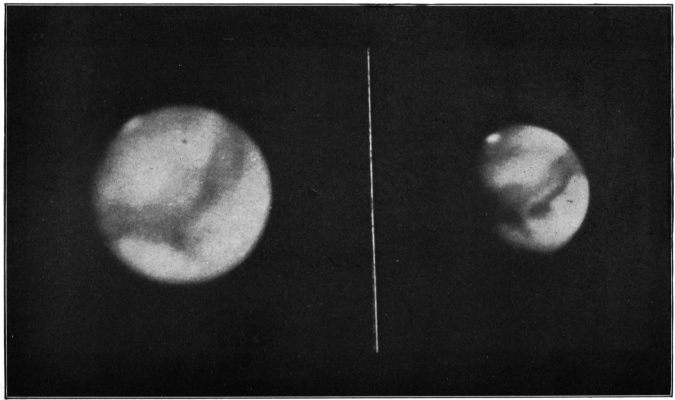
THE TWO PHASES OF MARS
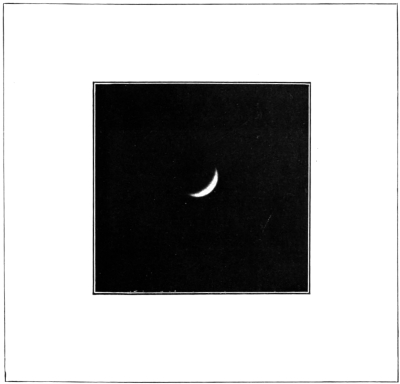
We see its full face when it is opposite the sun. When half-way between opposition and conjunction it becomes gibbous, as shown
in the photograph on the right. These photographs were made at the Mt. Wilson Observatory.
Mercury is the only planet that in color
even suggests Mars, and for Mercury it
can never be mistaken after one has once
seen the two planets. Mercury, we know,
is always very near the sun; but when visible
at all is, even in that unfavorable situation,
always as bright as a first-magnitude star.
Mars is near the sun, to our view, only when
it is approaching conjunction, and it is then
so far from us that it always appears as a
rather small star, and, while never insignificant,
is, in this situation, quite inconspicuous
even as compared with the rarely
visible Mercury.
On seeing a planet, then, sufficiently high
above the horizon to attract one’s attention,
one may be sure that it is Mars if it is red,
and equally sure that it is not Mars if it
does not show this color. Under certain
atmospheric conditions the sun, moon, and
all the planets sometimes appear red when
they are very near the horizon; but in this
situation there is always something other
than color that marks them.
If its color is not a sufficient mark by which
to identify Mars, a still further difference
between it and the stars is its markedly
rapid movement. A single night will make
a sufficient change in its position to show the
planet as a wanderer. On an average, it
travels over about four-tenths of a degree
in the heavens in one day. This equals more
than half the diameter of the moon, a change
of position sufficiently great to be easily
detected.
Unlike Mercury and Venus, which are
never far from the sun, and can be seen only
for a comparatively short time either early
in the morning or in the evening, and are
never very high up in the skies, Mars may
be situated so that it can be seen at any time
of the night, and also at any distance from
the sun. When it is in opposition it rises
just as the sun sets, and is then in view
all night. At this time it is nearer, larger,
and brighter than at any other time in the
particular revolution it is then making, and,
consequently, is in the best position to be
viewed by us that it will have during that
revolution.
Oppositions differ, however, in different
revolutions, and some show us the planet
more splendidly brilliant than it appears at
others. The oppositions at which Mars
shows most brilliant take place, fortunately,
in the summer and early autumn—the seasons
which are most agreeable for outdoor
observation. He is then traveling through
that region of the sky, sparse in stars, that
lies between Sagittarius and Aries; and, since
the ecliptic there runs rather low in the sky,
he can easily be observed at any time in the
night without any neck-breaking postures.
These favorable oppositions occur in the
summer because the earth is in line in the
latter part of August with that point in the
orbit of Mars where the planet makes its
nearest approach to the sun. Oppositions
never occur when Mars is exactly at that
point; but they do occur when he is very
near it, and at such times we see him in his
greatest glory. This happens once every
fifteen or seventeen years. But at any summer
or early-autumn opposition Mars is
not very far from this nearest point to the
sun, so that at any oppositions during these
seasons he is very brilliant and almost as
bright as when he is at his best.
The earth is in line in the winter with that
part of Mars’s orbit which carries him farthest
from the sun, and at opposition then
he is much less bright than at the summer
oppositions. He is at the same time in
those constellations which pass nearly overhead
in the sky, and cannot be quite so comfortably
seen at all times in the night as he
can be in the summer. The very best and
most brilliant oppositions occur in the
latter part of August or in the early part of
September; the least favorable ones occur
in February. The others vary in brilliancy
according to their distance from these favorable
and unfavorable dates, all the summer
ones being quite brilliant, and all the winter
ones much less so. At any opposition,
though, however unfavorable, the planet is
much nearer to us and much brighter than
when in conjunction.
It is worth one’s while, even at some inconvenience,
to see Mars at whatever time
he is in opposition, for he is a delight to the
observer, and always notable in the part of
the skies through which he is then passing.
There are some aspects of the planet that
are so charming at a winter opposition that
it is a positive loss not to have seen him at
such times. He is more isolated and conspicuous
in the summer; but he fits well in
that gay company of winter stars that shine
more brilliantly than any others, and we
can easily feel something akin to family
pride as we watch him moving so graciously
among them.
Mars makes a complete circuit of the skies,
and comes back into the same position with
relation to the sun and the earth on an
average every seven hundred and eighty days,
which makes his synodic period longer than
that of any other planet. Owing to the
great eccentricity of his orbit, and his consequent
unequal motion in the various parts
of it, the synodic period varies as much as
thirty-five or thirty-six days. One cannot
say, therefore, without computation of some
length, just exactly how many days will
elapse between any two single oppositions.
For mere purposes of naked-eye observation
the variations in the synodic period of
Mars do not make any difference, for the
planet is in view practically all night for
many nights before and after opposition,
with changes of brightness too small to be
noticed by an untrained eye. For at least
two months at the time of opposition it has
almost the same aspect to us. At that time
it is always in the east early in the evening,
and shines all night. For nearly nine
months afterward it is visible and conspicuous
in the evening sky, appearing each
evening nearer and nearer to the western
horizon, until finally, in a little more than a
year after opposition, it passes behind the
sun and becomes a morning star. But, as it
then rises before the sun and passes across
the heavens in the daytime, it is invisible
to us. It is pleasant, however, at such times
to know that as the sun passes across the
skies in its daily journey Mars is up there,
within a certain distance from it, making the
same journey with it, beaming down upon
us with the same lively light that it shows
at night, and could be as well seen at any
time but for the too dazzling rays of the
sun.
Mars will be in conjunction in November
of this year (1912), and will not be visible
in the evening during 1913 until toward the
end of the year. The next opposition after
the publication of this book will occur in
January, 1914. From that time until the
following autumn the planet may be seen
in the evening. In 1915 Mars will not be
visible in the evening sky until late in the
year. After November it will be in the east
in the evening, rising earlier each evening,
until at opposition, early in 1916, it will rise
at sunset and will be visible in the evening
during the entire summer and autumn of
that year, but will not be extraordinarily
bright. In 1917 it will be again invisible
in the evening. In 1918 it will be in opposition
in the early spring, and will shine in
the evening all the rest of that year. It
will not be visible in the evening in 1919,
but will be in opposition again in the latter
part of April, 1920, and will shine in the
evening all of that year and the early part
of the next, when it will again disappear
from evening view and will not emerge
again until it is nearing a fine opposition
that will take place just at the beginning of
the summer of 1922. The planet will then
be in the constellation Scorpio, not far from
Antares, and this will afford an excellent
opportunity to see these two ruddy bodies
near together.
In 1924 there will be an exceptionally
brilliant opposition, which will occur during
the last week of August, and the planet will
then be about as brilliant as it ever appears,
and will be very favorably situated for observation
in the constellation Pisces. We
shall then see Mars in the flame-like phase
of his beauty, and he will dominate the evening
sky during the whole of that summer.
At oppositions such as this one Mars is more
favorably situated for observation from the
earth than any other heavenly body except
the moon.
The next oppositions will take place the
last week in October, 1926, in December,
1928, January, 1931, early March, 1935, the
middle of May, 1937; and then we will have
two more splendidly brilliant oppositions in
July, 1939, and early October, 1941, respectively.
During the years that Mars does not appear
in the evening we need not be deprived
of a sight of the planet if we will look for
it in the morning sky. A few months after
conjunction it may be seen as a morning
star, rising shortly before the sun. It rises
earlier each morning, and hence can be seen
each morning for a longer time. After its
hour of rising has reached midnight it
then passes into the evening sky and rises
earlier each evening until it reaches opposition.
The movement of Mars among the stars,
as we see it, is generally toward the east, and
we can see by looking that it changes its
place among the constellations in that direction,
going from Aries to Taurus, from
Taurus to Gemini, and so on. On each
side of opposition, however, the planet appears
for a few weeks to be moving westward
among the stars. This is the retrograde
motion which an outer planet appears
to have when we are overtaking and passing
it, and which has been explained in the chapters
on the movements of the planets.
In size Mars is one of the smallest members
of our solar family. Its mass is a little
more than one-ninth that of the earth, and
its entire surface is only about one-third as
great as ours. It is the merest trifle more
dense than Mercury, but only about sixty-six
one-hundredths as dense as the earth.
Its force of gravity is about thirty-six one-hundredths
as powerful as that of the earth.
A man weighing two hundred pounds here
would be relieved of about one hundred and
twenty-four pounds of his weight if transported
to Mars, weighing there only seventy-six
pounds, which would greatly increase his
efficiency if he were in other respects the
same.
It would necessarily follow that Mars,
having such small force of gravity, could not
long retain a heavy atmosphere, even if it
had set out with such a one. No molecule
of gas moving at a greater speed than three
and thirteen-hundredths miles a second could
be held by Mars in its atmosphere, and so
much as it may have had of the rarer gases
which move with great rapidity must have
escaped long ago. But it did not begin life
with an atmosphere heavy in proportion to
that which the larger planets have. We
have seen, in the case of Mercury, that being
one of the small planets entails many restrictions
in development. Such planets not
only lose their atmosphere more quickly than
the larger ones, but it is less dense to begin
with. The atmosphere of Mars is probably
no denser than we have at the tops of our
highest mountains, more than likely not
even so dense as that. There is some water
vapor, and there are a few clouds most of
the time; but in the main the atmosphere
is so clear and thin that we can without any
doubt see the actual surface of the planet.
It is not certain that the clouds we see are
formed from water vapor, as clouds of the
ordinary kind are. It has been suggested
that they may be simply dust-clouds. But
this is as yet not much more than a suggestion,
and nothing convincing has been offered
to substantiate the idea. Even dust-clouds
would need currents of air to create and
carry them; so, whether dust or vapor, the
presence of clouds implies an atmosphere.
The famous white polar caps, which furnish
so many news items to the journals,
are also of uncertain origin, and their true
nature can be determined only by a fuller
knowledge of the atmosphere of Mars.
They appear in the winter season on the
planet and disappear in its summer, so there
seems to be no doubt that they are dependent
in some way on the temperature in the polar
regions of Mars. If they are hoar-frost or
snow, they are condensations of water vapor;
and, in that case, when they disappear there
must be sufficient heat to melt them. It has
been contended that the sun’s rays fall too
obliquely on the poles of Mars to melt more
than a few inches of snow, but that the
caps may be light snow or frost, and thus
capable of being dissolved by even such
oblique rays of sunlight as they receive.
Also it has been suggested that the deposit
resembling snow may be carbon dioxide,
which condenses into a white substance at
a temperature more than a hundred degrees
(-109° Fahr.) lower than is necessary to
produce snow and melts at a correspondingly
low temperature. What the nature of
the phenomenon seen at the poles of Mars
is depends largely upon what the temperature
is; and the temperature in turn is dependent
in some measure on the density and
constitution of the atmosphere, as well as
the planet’s distance from the sun.
The normal temperature of an unprotected
body at the distance of Mars from the sun
is about thirty-two degrees blow zero (Fahrenheit);
and since we know Mars has no
dense atmosphere to retain the heat it acquires,
it is natural to suppose the existence
there of a very low temperature, and one
incompatible with our ideas of life and
growth. The most favorable conclusions do
not place the mean temperature higher than
forty-eight degrees Fahrenheit. It is certain
that the planet must be subjected to
great extremes of temperature within its
range, since its filmy robe of atmosphere cannot
protect it to any extent from the direct
rays of the sun during the day, nor prevent
the heat from escaping with great rapidity
at night; so that, whatever heat it may gain
in the daytime, it probably loses much of it
during the night. Until we know more of
the constitution of the atmosphere of Mars
we can know nothing certainly about its
temperature beyond the fact that it is much
colder than ours and more subject to variations.
Anything much more definite than
this is speculative at present. But with all
the observation that is now given to Mars,
and with the always increasing facilities for
the work, many uncertainties regarding the
planet are likely to be made clear before
long. The spectroscope will probably be
the final resort for facts concerning the
atmosphere.
Mars is, on an average, about one and a
half times farther from the sun than we are.
Its mean distance is, in round numbers,
one hundred and forty-one million miles;
but, since its orbit is very eccentric—more
eccentric than that of any other of the
planets except Mercury—its distance from
the sun varies as much as twenty-six million
miles. At its nearest the planet is a little
more than one hundred and twenty-eight
million miles from the sun. Its greatest distance
from that luminary is one hundred and
fifty-four million miles. At its mean distance
something more than twelve and a
half minutes are required for light to travel
from the sun to the planet.
The sun becomes quite a medium-sized
object as viewed from Mars, and must lose
some of the majesty of aspect that it has
to us. Its apparent diameter is about
twenty-one minutes, which would make it
less than two-thirds as large as we see it.
The average amount of light and heat that
it furnishes to that poor, lightly clad little
planet is less than half as much as we receive,
though when the planet is at perihelion
the sun’s radiance is forty per cent. more
powerful than when it is at its greatest
distance from the source of these life-giving
forces.
The eccentricity of the orbit of Mars is
the cause also of his great variations in
distance from us, and hence of his extreme
changes in brilliancy. These changes are
many times greater with reference to the
earth than to the sun. At the planet’s nearest
approach to us it comes a little nearer
than thirty-five millions of miles. This is
when it is in opposition in August. When
opposition occurs in February, it is as much
as sixty-two millions of miles from us; and
when it is in conjunction, and on the other
side of the sun from us, it is sometimes two
hundred and forty-eight million miles distant.
At his nearest approach light leaps
over to us from Mars in about four minutes
and eighteen seconds; at his greatest distance
it cannot reach us in less than twenty-two
minutes. The apparent mean diameter of
Mars is about nine and fifty-six hundredths
seconds, but varies from three and six-tenths
seconds, when the planet is farthest away,
to twenty-five seconds when it is nearest
to us.
While Mars does not exhibit the phases
of the inner planets Venus and Mercury,
by showing a disc sometimes at half-full and
sometimes at crescent it is sufficiently near
us to be, in certain positions, gibbous, or to
show a little less than a full face. When
this occurs Mars is about half-way between
opposition and conjunction, and the earth and
the sun are so situated that we are slightly
to one side of the fully illuminated face of
Mars. This phase, however, is not sufficiently
marked to make any material difference
in the brilliancy of the planet. It is not
apparent without the aid of a telescope.
From Mars the earth shows all the phases
that Venus shows to us. When Mars is
flaming down upon us in his position of
greatest brilliancy we present to him a thin
crescent. When he sees our full face we
are on the opposite side of the sun from him.
It would be necessary to have a more brilliant
electrical illumination than any we
have yet seen to lighten the dark side of the
earth and exchange signals with Mars
when we are nearest to him—if, indeed, our
atmosphere would permit from Mars any
view at all of the surface of the earth, which
is not at all certain. In spite of its phases,
the earth must shine on Mars at times in
a very attractive way. It is not so bright,
perhaps, as Venus is to us, nor as we are to
Venus; but with our moon circling about
us we may well be, when in a favorable
situation, a very interesting double star, the
distance between earth and moon appearing
on Mars about equal to one-fourth of the
apparent diameter of the moon.

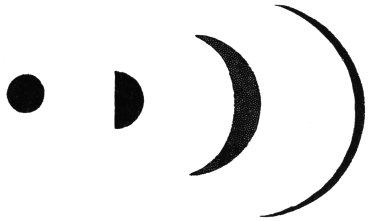
MARS: DIFFERENCE IN ITS APPARENT SIZE AT ITS NEAREST,
MIDDLE, AND FARTHEST DISTANCE FROM THE EARTH
Mars appears fifty times brighter when nearest than when farthest
away.
Owing to the undoubted permanent markings
on the surface of Mars, astronomers
have been able to determine the length of
its day with much less likelihood of error
than in the case of any other planet except
the one on which we dwell. It rotates on its
axis in twenty-four hours, thirty-seven minutes,
and twenty-three seconds, which makes
its day nearly forty minutes longer than ours.
In our greed for all too fleeting time we
may feel a little envy of these extra minutes,
which would mean so much to us if added to
our day. But they do not seem so important
when we consider that while Mars is having
six hundred and seventy of these days we
are having six hundred and eighty-seven of
ours, which, after all, seems to give us eighteen
days more of time. Our attitude toward
the situation depends upon the point of
view.
The axis of Mars is inclined to its orbit
about twenty-four degrees and fifty minutes.
This is but little more than the inclination
of the earth’s axis, which is twenty-three
degrees and twenty-seven minutes. Mars,
therefore, has seasons very much like ours.
They are, however, slightly more marked
than ours, because of the somewhat greater
inclination of the axis of the planet; and
they are nearly double the length of ours,
because it takes Mars nearly two of our
years to make its journey around the sun.
Its seasons, then, are nearly six months
long, while ours are but three. It has frigid,
temperate, and torrid zones, practically the
same as the earth has. Its greatest inequalities
of season are caused by the eccentricity
of its orbit. It is, like the earth, farthest away
from the sun when it is summer in the northern
hemisphere; and in this situation it
travels so much more slowly than when it is
near the sun that summer in its northern
hemisphere is seventy-five days longer than
the same season in the southern hemisphere.
The northern summer and the southern
winter are each three hundred and eighty
days long, while the reverse seasons in each
hemisphere are only three hundred and six
days long. The northern summer is not
only longer but also cooler than the southern,
and the northern winter is shorter and warmer
than the southern. Which hemisphere has
the more favorable climate depends upon
what is needed on Mars to maintain life. It
may be that in this regard the shorter, hotter,
southern summer is the best season the
planet affords.
Seen through a telescope, Mars is not so
red as it appears to the naked eye. One of
the best observers of it has compared it to
an opal, and it surely has some of the qualities
of an opal in the diversity of aspect that
it shows to different observers from different
points of view. No other planet has been so
subjected to controversy over what appears
on its surface. This is partly due to its being
the only planet whose surface is without
doubt open to our view and in a situation
where it can be minutely studied, and partly
to the fact that the controversy involves
questions concerning life and intelligence,
which are always of intense human interest.
Matters of this vital sort are never accepted
without dispute. That is one way of getting
at the truth. In the intensity of the discussion
the question of the existence of the
phenomena and that of the meaning ascribed
to them are sometimes unnecessarily made
to depend upon each other. In the case of
Mars it may well be that there is less difference
of opinion as to what is really seen on
its surface than as to the meaning of the
phenomena.
There are recorded observations made of
Mars as early as 272 B.C., more than two
thousand years ago, and it has been nearly
two hundred and fifty years since the snow-caps
were first seen. Through the telescope
not only the snow-caps are plainly visible at
the proper seasons, but there are also visible
dark patches over the surface, showing a
variety of color, and in certain parts changing
somewhat as the seasons change. It is one
of these patches, the outline of which suggests
a somewhat twisted eye, that is known
as the “eye of Mars.” The main surface
of the planet is reddish yellow in color;
the patches on it are variously described as
gray, grayish green, or blue, colors which in
combination could easily take on a tone of
any of them according to the eye of the observer,
and this portion of the planet’s surface
does, in fact, show first one and then
the other of them predominating.
When the planet’s differences of color were
first observed, the reddish-yellow portion
was supposed to be land, and the areas of
varying bluish-green and gray were thought
to be the waters of the ever-changing seas.
A little after the middle of the last century
some keen eyes saw a few streaks or markings
of some sort across the land areas, and
in 1877 a close study of the planet by an
eminent Italian astronomer, Schiaparelli,
brought to his view many greenish streaks,
all directed toward the so-called seas, and
sometimes seeming to intersect there. In
publishing this discovery Schiaparelli called
these streaks canalli, which is properly translated
“channels,” but appeared in English as
“canals.” Since “canal” with us means artificially
constructed waterways, the discovery
became at once one of universal interest; for
artificial waterways mean human beings to
construct them, and it was an intensely interesting
thing to know that Mars was probably
inhabited with beings at least somewhat
after our own kind. It was a new world.
The little planet became a topic of absorbing
interest to all of us. And thus began the
controversy over the habitability of Mars,
and the meaning of its surface features, in
which astronomers, seeking only for the
truth, have taken a much more dignified
part than they have sometimes been more or
less sensationally represented as doing. The
discoverer of the so-called canals himself
believed them to be natural waterways cutting
through the land after the manner of
our straits and channels, and had very little
to say in explanation of them. But his work
gave a new impetus to the study of this little
brother world of ours.
In our own country the observatory at
Flagstaff is the one the best known among
those doing research work on Mars; but it is
not the only one. The observatory there is
finely situated in the thin, clear atmosphere
of Arizona, the mechanical facilities for such
work are good, and there seems no doubt that
there are there some observers who have
eyes that were made for seeing. All that
the sharp vision of Schiaparelli saw has
been seen there, and much more. Several
hundred canals have been discovered, and
at certain seasons many of them have
appeared to become double. Their courses
have been followed, and their appearances
and disappearances have been watched.
Somewhere near six hundred of them have
been mapped. According to these maps,
the canals seem to be laid out with a geometrical
precision such as nature is not
likely to follow; they run across some regions
that were formerly supposed to be water,
and they have points of convergence every
here and there, forming at such points large
dark areas.
Naturally, when a person has discovered
any new and curious phenomenon in nature
he seeks to determine the exact meaning of
it. It would have very little interest for
him if he did not, and it would be a dry lot
of facts that did not arouse a desire to do
this. The interpretation put upon what has
been seen at the observatory at Flagstaff is, in
brief, about as follows:
The surface of Mars has no oceans or
mountains. The reddish areas, which form
the larger part of the surface, are deserts.
The blue-green streaks are ribbons of vegetation
along each side of artificially constructed
waterways, which are of immense
length and cross and recross each other
until they somewhat resemble a network of
lines over the desert surface of the planet,
and are used for irrigating this arid region.
The points where the canals converge and
form the large dark spots are oases made
by the water carried by the canals. The
water is supplied by the melting of the caps
of snow at the poles during the Martian
summer, the expanding of the lines of vegetation
seeming to occur at periods corresponding
to the time required for the water
of the melting snow to reach the oases.
The presence of this vast system of artificial
waterways covering a large part of the surface
of Mars makes it seem probable that
“Mars is inhabited by beings of some sort
or other,” that these beings are not men
such as we know anything about, but that
“there may be a local intelligence equal to
or superior to ours.”
These conclusions concerning what is seen
on Mars are not held by any one to be completely
proved, but are thought by their author
to follow reasonably from the phenomena
as observed. By persons of a different
temperament they are regarded as too complete
an explanation, particularly as the
data upon which they are founded are not
undisputed. Some of the best astronomers
have not been able even to see the multitude
of fine lines, much less to give any explanation
of them. Others do not regard it as
certain that they are so geometric in their
outlines as to suggest anything more than
cracks or clefts in the surface of Mars, such
as might be made by nature, and consider
that, instead of indicating life, human or
other, they may be the marks of age, such
as similar lines or cracks which have been
observed on Mercury seem to be.
Also, it is not at all certain that there is
sufficient water vapor in the slight atmosphere
of Mars to furnish the snow necessary
for this great irrigating system, nor the heat
to melt it at the proper season. The natural
temperature of Mars would be, as we have
seen, very low, and unless it is modified in
some way not yet indicated everything points
to a frigidity too intense to permit the continuance
of life and growth of any sort
known to us.
These things must all be reckoned with
before anything certain can be known of the
surface of Mars. The difficulty of pronouncing
upon the minute details is impressively
indicated by Professor Moulton, who
says that, even under the finest conditions
and with the best telescopes, it is like viewing
“a perfectly accurate relief map of the
whole United States made on such a scale
that it would be only three inches in diameter
and held at a distance of three feet
from the eye.” Under such a near limit of
vision, we can well see that differences of
opinion might arise.
The mere fact that some astronomers have
not seen the lines on Mars does not mean
that they deny their existence. Some eyes
have greater defining power than others, as
well as some telescopes, as every one knows.
But while all the lines and patches of color
that are claimed to have been seen on Mars
doubtless have been seen by some persons,
yet it is not necessary to accept the interpretation
of them given by lively-minded
observers when it is not convincing. There
may be vegetation on Mars, and even intelligent
beings. We do not know; and thus far
there is not much to support, even by inference,
the view that there are. If we want
the truth, we are brought no nearer to it by
giving full credence to a speculative theory
simply because it is interesting and pleasant;
and thus far all theories advanced as to
the nature of the surface markings on Mars
are speculations, though there is no doubt that
the marks are there. It is pleasing, however,
to contemplate the idea of there being
on Mars, or on any other planet, an active
intelligence of any sort resembling what we
have here on earth, and it is not strange that
such a wide-spread popular interest should
attach to Mars, in view of what has been
suggested by the markings on its surface.
Mars has a little family of two moons.
Tiny little bodies they are, the smallest in
the solar family except, perhaps, an occasional
asteroid. Neither one of them is more
than ten miles in diameter, and the two together
are smaller than any other known
satellite. They can only be seen when Mars
is in opposition, and then only with a fairly
large telescope. They were discovered in
1877, and named Phobos and Deimos, the
names of the two attendants of the god of
war. Phobos is the brighter and the nearer
to the planet. It is less than four thousand
miles from the surface of Mars; and on account
of its being so near and the shape of
Mars being a spheroid, like that of the earth,
the little satellite can never be seen from
Mars beyond sixty-nine degrees of latitude
on each side of the equator. Within these
limits it shows great activity. It makes a
complete circuit around Mars in seven and
a half hours; and this swift revolution, combined
with the motion of Mars on its axis,
makes Phobos seem to rise in the west and
set in the east, pass over the heavens in less
than twelve hours, and go through all its
phases, from “new” to “full,” one and a
half times every night. Its light is rather
insignificant, being about sixty times less
than we receive from our satellite; but, on
the whole, it must be a rather gay and pleasant
little moon.
Deimos is not any larger than Phobos,
and not as bright; but it is slightly less difficult
for us to see, because it is between two
and three times farther away from Mars
than Phobos is, and thus not so much lost
in the light of the planet. It circles around
Mars in a little more than thirty hours, and
this, being only six hours more than Mars
consumes in turning around on its axis, results
in requiring more than two days for
the satellite to pass from rising to setting.
Between rising and setting it goes through
its phases four times. It can be seen from
all parts of Mars, but gives very little light
to the planet—more than a thousand times
less than our moon gives us.
The symbol of Mars is ♂, a conventionalized
figure representing a shield and a spear—implements
of war appropriate for the use
of the deity especially connected with warfare.