Minor errors, attributable to the printer, have been corrected. Please
see the transcriber’s note at the end of this text
for details regarding the handling of any textual issues encountered
during its preparation.
Any corrections are indicated using an underline
highlight. Placing the cursor over the correction will produce the
original text in a small popup.
The original cover had no text. The title, author and publication date
have been added, and is hereby added to the public domain.
Any corrections are indicated as hyperlinks, which will navigate the
reader to the corresponding entry in the corrections table in the
note at the end of the text.
I
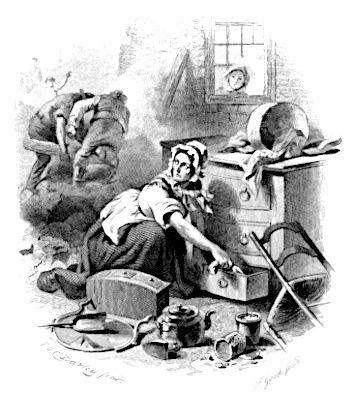
The Theft The Ways of the Hour
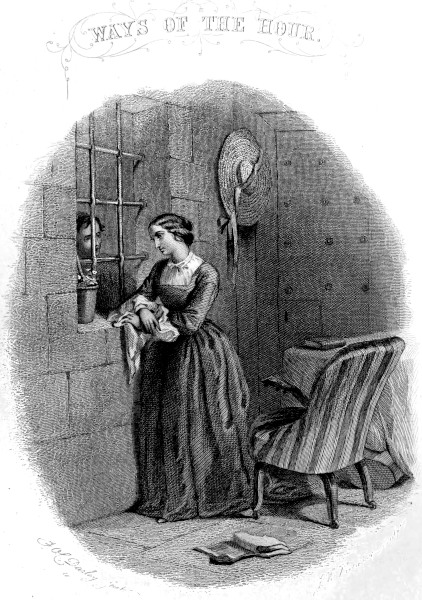
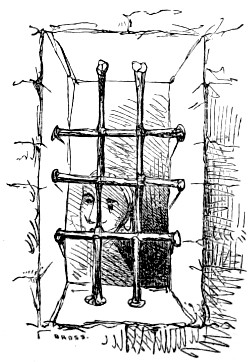
“This bears some resemblance, Mr.Mr. Wilmeter, to an interview in a convent. I am the novice, you the excluded friend, who is compelled to pay his visit through a grate.” Ways of the Hour. Page 115.
THE
WAYS OF THE HOUR.
A TALE.
BY
J. FENIMORE COOPER.
‘Is this the way
I must return to native dust?’
NEW YORK:
D. APPLETON AND COMPANY,
1892.
Entered, according to the Act of Congress, In the year 1861, by
W. A. TOWNSEND AND COMPANY,
In the Clerk’s Office of the District Court for the Southern District of New York.
v
PREFACE.
The object of this book is to draw the attention of
the reader to some of the social evils that beset us;
more particularly in connection with the administration
of criminal justice. So long a time has intervened
since the thought occurred, and so many interruptions
have delayed the progress of the work, that it is felt
the subject has been very imperfectly treated; but it is
hoped that enough has been done to cause a few to reflect
on a matter of vital importance; one that to them
may possess the interest of novelty.
A strange indifference exists as to the composition of
the juries. In our view, the institution itself, so admirable
in a monarchy, is totally unsuited to a democracy.
The very principle that renders it so safe where there is
a great central power to resist, renders it unsafe in a
state of society in which few have sufficient resolution
to attempt even to resist popular impulses.
A hundred instances might be given in which the
vijuries of this country are an evil; one or two of which
we will point out. In trials between railroad companies
and those who dwell along their lines, prejudice is
usually so strong against the former, that justice for
them is nearly hopeless. In certain parts of the country,
the juries are made the instruments of defeating
the claims of creditors who dwell at a distance, and are
believed to have interests opposed to the particular
community where the debtor resides. This is a most
crying evil, and has been the source of many and grievous
wrongs. Whenever there is a motive for creating
a simulated public opinion, by the united action of several
journals, justice is next to hopeless; such combinations
rarely, if ever, occurring in its behalf. In cases
that are connected with the workings of political
schemes, and not unfrequently in those in which political
men are parties to the suits, it is often found that
the general prejudices or partialities of the out-door factions
enter the jury-box. This is a most serious evil
too; for, even when the feeling does not produce a
direct and flagrant wrong, it is very apt so far to temper
the right as to deprive it of much of its virtue. In
a country like this, in which party penetrates to the
very bottom of society, the extent of this evil can be
known only to those who are brought into close contact
with the ordinary workings of the institution.
In a democracy, proper selections in the material that
are necessary to render juries safe, become nearly impossible.
Then, the tendency is to the accumulation of
power in bodies of men; and in a state of society like
viiour own, the juries get to be much too independent of
the opinion of the court. It is precisely in that condition
of things in which the influence and authority of
the judge guide the juror, and the investigation and
substantial power of the juror react on the proceedings
of the court, that the greatest benefits have been found
to accrue from this institution. The reverse of this
state of things will be very likely to produce the greatest
amount of evil.
It is certain that the juries are falling into disrepute
throughout the length and breadth of the land. The
difficulty is to find a substitute. As they are bodies
holding the lives, property and character of every member
of the community, more or less, in their power, it is
not to be supposed that the masses will surrender this
important means of exercising their authority voluntarily,
or with good will. Time alone can bring reform
through the extent of the abuses.
The writer has not the vanity to suppose that any
thing contained in this book will produce a very serious
impression on the popularity of the jury. Such is not
its design. All that is anticipated is to cause a portion
of his readers to reflect on the subject; persons who
probably have never yet given it a moment of thought.
There is a tendency, at the present time, to court
change for its own sake. This is erroneously termed a
love of reform. Something very like a revolution is
going on in our midst, while there is much reason to
apprehend that few real grievances are abated; the
spurious too exclusively occupying the popular mind,
viiito render easy a just distinction between them. When
an American prates about aristocracy, it is pretty safe
to set him down as knavish or ignorant. It is purely
cant; and the declaimers would be puzzled to point to
a single element of the little understood and much decried
institution, the country being absolutely without
any, unless the enjoyment of the ordinary rights of
property can be so considered. But the demagogue
must have his war-cry as well as the Indian; and it is
probable he will continue to whoop as long as the
country contains minds weak enough to furnish him
with dupes.
Cooperstown, March 12, 1850.
9THE WAYS OF THE HOUR.
CHAPTER I.
Mar. My lord Aumerle, is Harry Hereford armed?
Aum. Yea, at all points; and longs to enter in.
King Richard II.
In one respect, there is a visible improvement in the goodly
town of Manhattan, and that is in its architecture. Of its
growth, there has never been any question, while many have
disputed its pretension to improvement. A vast expansion of
mediocrity, though useful and imposing, rarely satisfies either
the judgment or the taste; those who possess these qualities,
requiring a nearer approach to what is excellent, than can ever
be found beneath the term just mentioned.
A town which is built of red bricks, that are faced with white
marble, the whole garnished with green blinds, can never have
but one outward sign—that of tawdry vulgarity. But this
radical defect is slowly disappearing from the streets of Manhattan;
and those who build, are getting to understand that
architecture, like statuary, will not admit of strong contrasts in
colours. Horace Walpole tells us of a certain old Lord Pembroke,
who blackened the eyes of the gods and goddesses in the
celebrated gallery at Wilton, and prided himself on the achievement,
as if he had been another Phidias. There have been
thousands of those who have laboured in the spirit of this Earl
10of Pembroke in the streets of all the American towns; but travelling,
hints, books and example, are slowly effecting a change;
and whole squares may now be seen in which the eye rests with
satisfaction on blinds, facings and bricks, all brought to the same
pleasing, sober, architectural tint. We regard this as the first
step, in advance, that has been made in the right direction, so
far as the outward aspect of the town is concerned, and look forward,
with hope, to the day when Manhattan shall have banished
its rag-fair finery altogether, and the place will become as remarkable
for the chaste simplicity of its streets, as they have hitherto
been for their marked want of taste.
With this great town, mottled as it is, in people as well as in
hues, with its native population collected from all parts of this
vast republic, and its European representatives amounting to
scores of thousands, we shall have much to do in the succeeding
pages. Our researches, however, will be bestowed more on
things moral than on things physical; and we shall endeavour
to carry the reader with us through scenes that, we regret to say,
are far more characteristic than novel.
In one of the cross streets that communicate with Broadway,
and below Canal, stands a dwelling that is obnoxious to all the
charges of bad taste to which there has already been allusion, as
well as to certain others that have not yet been named, at all.
A quarter of a century since, or within the first twenty years of
its own existence, the house in question would have been regarded
as decidedly patrician, though it is now lost amid the thousands
of similar abodes that have arisen since its own construction.
There it stands, with its red bricks periodically painted redder;
its marble facings, making a livery of red turned up with white;
its green blinds, its high stoop, its half-buried and low basement,
and all its neatness and comfort, notwithstanding its flagrant
architectural sins. Into this building we now propose to enter,
at the very early hour of eight in the morning.
11The principal floor was divided, as usual, between a dining and
a drawing-room, with large communicating doors. This was the
stereotyped construction of all Manhattanese dwellings of any
pretension, a quarter of a century since; and that of Mr. Thomas
Dunscomb, the owner and occupant of the house in question,
had been built in rigid conformity with the fashion of its day.
’Squire Dunscomb, as this gentleman was termed in all the
adjacent country counties, where he was well known as a reliable
and sound legal adviser; Mr. Thomas Dunscomb, as he was
styled by various single ladies, who wondered he never married;
or Tom Dunscomb, as he was familiarly called by a herd of unyoked
youths, all of whom were turned of sixty, was a capital
fellow in each of his many characters. As a lawyer, he was as
near the top of the bar as a man can be, who never had any pretensions
to be an orator, and whose longest effort seldom exceeded
half an hour. Should the plan of placing eloquence in hobbles
reach our own bar, his habit of condensing, his trick of getting
multum in parvo, may yet bring him to the very summit; for
he will have an immense advantage over those who, resembling
a country buck at a town ball, need the whole field to cut their
flourishes in. As a man of the world, he was well-bred, though
a little cynical, very agreeable, most especially with the ladies,
and quite familiar with all the better habits of the best-toned
circles of the place. As a boon companion, Tom Dunscomb
was an immense favourite, being particularly warm-hearted, and
always ready for any extra eating or drinking. In addition to
these leading qualities, Dunscomb was known to be rich, having
inherited a very tolerable estate, as well as having added much
to his means, by a large and lucrative practice. If to these circumstances
we add that of a very prepossessing personal appearance,
in which age was very green, the reader has all that is
necessary for an introduction to one of our principal characters.
Though a bachelor, Mr. Dunscomb did not live alone. He
12had a nephew and a niece in his family, the orphan children of a
sister who had now been dead many years. They bore the name
of Wilmeter, which, in the family parlance, was almost always
pronounced Wilmington. It was Jack Wilmington, and Sally
Wilmington, at school, at home, and with all their intimates;
though Mr. John Wilmeter and Miss Sarah Wilmeter were often
spoken of in their little out-door world; it being rather an affectation
of the times to prove, in this manner, that one retains
some knowledge of the spelling-book. We shall write the name
as it is written by the parties themselves, forewarning the reader
that if he desire to pronounce it by the same family standard,
he must take the unauthorized spelling as a guide. We own
ourselves to a strong predilection for old familiar sounds, as well
as old familiar faces.
At half-past 8, A. M., of a fine morning, late in May, when
the roses were beginning to show their tints amid the verdure of
the leaves, in Mr. Dunscomb’s yard, the three individuals just
mentioned were at the breakfast-table of what it is the fashion
of New York to term a dining-room. The windows were open,
and a soft and fragrant air filled the apartment. We have said
that Mr. Dunscomb was affluent, and he chose to enjoy his
means, not à la Manhattan, in idle competition with the nouveaux
riches, but in a more quiet and rational way. His father had
occupied lots, ‘running through,’ as it is termed; building his
house on one street and his stables on the other; leaving himself
a space in the rear of the former, that was prodigious for a town
so squeezed into parallelograms of twenty-five feet by a hundred.
This open space was of the usual breadth, but it actually measured
a hundred and fifty feet in length, an area that would have
almost justified its being termed a ‘park,’ in the nomenclature
of the town. This yard Sarah had caused to be well garnished
with shrubbery, and, for its dimensions, it was really a sort of
oasis, in that wilderness of bricks.
13The family was not alone that morning. A certain Michael
Millington was a guest of Jack’s, and seemingly quite at home
in the little circle. The business of eating and drinking was
pretty well through with, though each of the four cups had its
remains of tea or coffee, and Sarah sat stirring hers idly, while
her soft eyes were turned with interest on the countenances of the
two young men. The last had a sheet of writing-paper lying
between them, and their heads were close together, as both
studied that which was written on it in pencil. As for Mr. Dunscomb,
himself, he was fairly surrounded by documents of one
sort and another. Two or three of the morning papers, glanced
at but not read, lay opened on the floor; on each side of his plate
was a brief, or some lease or release; while a copy of the new
and much talked of code was in his hand. As we say in our
American English, Mr. Dunscomb was ‘emphatically’ a common-law
lawyer; and, as our transatlantic brethren would remark
in their sometime cockney dialect, he was not at all ‘agreeable’
to this great innovation on ‘the perfection of human reason.’
He muttered occasionally as he read, and now and then he laid
down the book, and seemed to muse. All this, however, was
quite lost on Sarah, whose soft blue eyes still rested on the interested
countenances of the two young men. At length Jack
seized the paper, and wrote a line or two hurriedly, with his
pencil.
“There, Mike,” he said, in a tone of self-gratulation, “I
think that will do!”
“It has one merit of a good toast,” answered the friend, a
little doubtingly; “it is sententious.”
“As all toasts ought to be. If we are to have this dinner,
and the speeches, and all the usual publications afterwards, I
choose that we should appear with some little credit. Pray, sir,”
raising his eyes to his uncle, and his voice to correspond, “what
do you think of it, now?”
14“Just as I always have, Jack. It will never do at all. Justice
would halt miserably under such a system of practice. Some
of the forms of pleadings are infernal, if pleadings they can be
called at all. I detest even the names they give their proceedings—complaints
and answers!”
“They are certainly not as formidable to the ear,” returned
Jack, a little saucily, “as rebutters and sur-rebutters. But I
was not thinking of the code, sir; I was asking your opinion of
my new toast.”
“Even a fee could not extract an opinion, unless I heard it
read.”
“Well, sir, here it is: ‘The constitution of the United States;
the palladium of our civil and religious liberties,’ Now, I do
not think I can much better that, uncle Tom!”
“I’m very sorry to hear you say so, Jack.”
“Why so, sir? I’m sure it is good American sentiment;
and what is more, it has a flavour of the old English principles
that you so much admire, about it, too. Why do you dislike it,
sir?”
“For several reasons—it would be common-place, which a
toast should never be, were it true; but there happens not to be
a word of truth in your sentiment, sonorous as it may sound in
your ears.”
“Not true! Does not the constitution guaranty to the citizen
religious liberty?”
“Not a bit of it.”
“You amaze me, sir! Why, here, just listen to its language,
if you please.”
Hereupon Jack opened a book, and read the clause on which
he relied to confute one of the ablest constitutional lawyers and
clearest heads in America. Not that Mr. Dunscomb was what
is called an “expounder,” great or small; but he never made a
mistake on the subject in hand, and had often caused the best of
15the “expounders” to retrace their steps. He was an original
thinker, but of the safest and most useful sort; one who distinguished
between the institutions of England and America, while
he submitted to the fair application of minor principles that are
so common to both. As for his nephew, he knew no more of the
great instrument he held in his hand, than he had gleaned from
ill-digested newspaper remarks, vapid speeches in Congress, and
the erroneous notions that float about the country, coming from
“nobody knows whom,” and leading literally to nothing. The
ignorance that prevails on such subjects is really astounding, when
one remembers the great number of battles that are annually
fought over this much-neglected compact.
“Ay, here is the clause—just please to hear it, sir,” continued
Jack.—“‘Congress shall make no law respecting an establishment
of religion, or prohibiting the free exercise thereof; or
abridging the freedom of speech, or of the press; or the right
of the people peaceably to assemble, and to petition the government
for a redress of grievances.’ There, I think that will go
far towards justifying the whole toast, Mike.”
This was said a little triumphantly, and not a little confidently.confidently.
The only answer Mr. Dunscomb condescended to make, was an
expressive “Umph!” As for Michael Millington, he was a little
timid about expressing an opinion, and that for two reasons; he
had often experienced Mr. Dunscomb’s superior wisdom, and he
knew that Sarah heard all that passed.
“I wish your uncle would lay aside that code for a minute,
Jack, and let us know what he thinks of our authorities,” said
Michael, in an under tone.
“Come, Uncle Tom,” cried the more hardy nephew—“come
out of your reserve, and face the constitution of your country.
Even Sarah can see that, for once, we are right, and that my
toast is of proof.”
“It is a very good proof-sheet, Jack, not only of your own
16mind, but of half the minds in the country. Ranker nonsense
cannot be uttered, however, than to say that the Constitution of
the United States is the palladium of anything in which civil or
religious liberty is concerned.”
“You do not dispute the fidelity of my quotation, sir?”
“By no means. The clause you read is a very useless exhibition
of certain facts that existed just as distinctly before it was
framed, as they do to-day. Congress had no power to make an
established religion, or abridge the freedom of speech, or that of
the press, or the right of the people to petition, before that
amendment was introduced, and consequently the clause itself is
supererogatory. You take nothing by your motion, Jack.”
“I do not understand you, sir. To me, it seems that I have
the best of it.”
“Congress has no power but what has been conceded to it
directly, or by necessary connection. Now, there happens to be
nothing said about granting any such authority to Congress, and
consequently the prohibition is not necessary. But, admitting
that Congress did really possess the power to establish a religion
previously to the adoption of this amendment, the constitution
would not prove a palladium to religious liberty, unless it prohibited
everybody else from meddling with the opinions of the
citizen. Any state of this Union that pleases, may establish a
religion, and compel its citizens to support it.”
“Why, sir, our own state constitution has a provision similar
to this, to prevent it.”
“Very true; but our own state constitution can be altered in
this behalf, without asking permission of any one but our own
people. I think that even Sarah will understand that the
United States is no palladium of religious liberty, if it cannot
prevent a state from establishing Mohamedanism, as soon as a
few forms can be complied with.”
Sarah coloured, glanced timidly at Michael Millington, but
17made no reply. She did not understand much of what she had
just heard, though rather an intelligent girl, but had hoped that
Jack and his friend were nearer right than was likely to turn out
to be the case. Jack, himself, being a young limb of the law
comprehended what his uncle meant, and had the grace to colour,
too, at the manner in which he had manifested his ignorance of
the great national compact. With a view to relieve himself from
his dilemma, he cried, with a ready dexterity,—
“Well, since this won’t do, I must try the jury. ‘The trial
by jury, the palladium of our liberties.’ How do you like that,
sir?”
“Worse than the other, boy. God protect the country that
has no better shield against wrong, than that which a jury can
hold before it.”
Jack looked at Michael, and Michael looked at Jack; while
Sarah looked at both in turn.
“You surely will not deny, sir, that the trial by jury is one
of the most precious of the gifts received from our ancestors?”
said the first, a little categorically, Sarah brightening up at this
question, as he fancied that her brother had now got on solid
ground.
“Your question cannot be answered in a breath, Jack,” returned
the uncle. “The trial by jury was undoubtedly a most
precious boon bestowed on a people among whom there existed
an hereditary ruling power, on the abuses of which it was often
a most salutary check.”
“Well, sir, is it not the same check here; assuring to the
citizens independent justice?”
“Who compose the ruling power in America, Jack?”
“The people, to be sure, sir.”
“And who the jurors?”
“The people, too, I suppose,” answered the nephew, hesitating
a little before he replied.
18“Well, let us suppose a citizen has a conflict of rights with
the public, which is the government, who will compose the tribunal
that is to decide the question?”
“A jury, to be sure, sir. The trial by jury is guarantied by
the constitution, to us all.”
“Ay,” said Mr. Dunscomb, smiling, “much as are our religious
and political liberties. But according to your own admission,
this is very much like making one of the parties a judge in
his own case. A. insists that he has a right to certain lands, for
instance, which the public claims for itself. In such a case, part
of the public compose the tribunal.”
“But is it not true, Mr. Dunscomb,” put in Millington,
“that the popular prejudice is usually against government, in all
cases with private citizens?”
Sarah’s face looked brighter now than ever, for she felt sure
that Mike, as her brother familiarly called his friend, had asked
a most apposite question.
“Certainly; you are right as to particular sets of cases, but
wrong as to others. In a commercial town like this, the feeling
is against government in all cases connected with the collection
of the revenue, I admit; and you will see that the fact makes
against the trial by jury in another form, since a judge ought to
be strictly impartial; above all prejudice whatever.”
“But, uncle, a judge and a jury are surely very different
things,” cried Sarah, secretly impelled to come to Michael’s
rescue, though she scarce knew anything of the merits of the
subject.
“Quite right, my dear,” the uncle answered, nodding his head
kindly, casting a glance at his niece that caused her to blush under
the consciousness of being fully understood in her motives,
if not in her remark. “Most profoundly right; a judge and a
juror ought to be very different things. What I most complain
of is the fact that the jurors are fast becoming judges. Nay, by
19George, they are getting to be legislators, making the law as well
as interpreting it. How often does it happen, now-a-days, that
the court tell the jury that such is the law, and the jury comes
in with a verdict which tells the court that such is not the law?
This is an every-day occurrence, in the actual state of public
opinion.”
“But the court will order a new trial, if the verdict is against
law and evidence,” said Michael, determined that Sarah should
be sustained.
“Ay, and another jury will be quite likely to sustain the old
one. No—no—the trial by jury is no more a palladium of our
liberties, than the Constitution of the United States.”
“Who, or what is, then, sir?” demanded Jack.
“God! Yes, the Deity, in his Divine Providence; if anything
is to save us. It may not be his pleasure to let us perish,
for it would seem that some great plan for the advancement of
civilization is going on, and it may be a part of it to make us
important agents. All things regarded, I am much inclined to
believe such is the fact. But, did the result depend on us,
miserable instruments in the Almighty hands as we are, woeful
would be the end!”
“You do not look at things couleur de rose, Uncle Tom,”
Sarah smilingly observed.
“Because I am not a young lady of twenty, who is well satisfied
with herself and her advantages. There is but one character
for which I have a greater contempt than that of a senseless
grumbler, who regards all things à tort et à travers, and who
cries, there is nothing good in the world.”
“And what is the exception, sir?”
“The man who is puffed up with conceit, and fancies all
around him perfection, when so much of it is the reverse;
who ever shouts ‘liberty,’ in the midst of the direst oppression.”
20“But direst oppression is certainly no term to be applied to
anything in New York!”
“You think not? What would you say to a state of society
in which the law is available to one class of citizens only, in the
way of compulsion, and not at all, in the way of protection?”
“I do not understand you, sir; here, it is our boast that all
are protected, alike.”
“Ay, so far as boasting goes, we are beyond reproach. But
what are the facts? Here is a man that owes money. The law
is appealed to, to compel payment. Verdict is rendered, and
execution issued. The sheriff enters his house, and sells his
very furniture, to extort the amount of the debt from him.”
“That is his misfortune, sir. Such things must happen to all
debtors who cannot, or will not, pay.”
“If this were true, I should have nothing to say. Imagine
this very debtor to be also a creditor; to have debts due to him,
of many times the sums that he owes, but which the law will not
aid him in collecting. For him, the law is all oppression—no
protection.”
“But, surely, Uncle Tom, nothing of the sort exists here!”
“Surely, Miss Sarah Wilmeter, such things do exist here in
practice, whatever may be the theory on the subject; what is
more, they exist under the influence of facts that are directly connected
with the working of the institutions. My case is not supposititious,
at all, but real. Several landlords have quite recently
felt all the rigours of the law as debtors, when it was a dead letter
to them, in their character of creditors. This has actually happened,
and that more than once; and it might happen a hundred
times, were the landlords more in debt. In the latter case, it
would be an every-day occurrence.”
‘What, sir,’ exclaimed Michael Millington; ‘the law enforce,
when it will not protect?’
“That it does, young man, in many interests that I could
21point out to you. But here is as flagrant a case of unmitigated
tyranny as can be cited against any country in Christendom. A
citizen is sold out of house and home, under process of law, for
debt; and when he asks for the use of the same process of law
to collect his undeniable dues, it is, in effect, denied him. And
this among the people who boast that their independence is
derived from a spirit that would not be taxed! A people who
are hourly shouting hosannas in honour of their justice!”
‘It cannot be, Uncle Tom, that this is done, in terms,’ cried
the astounded nephew.
“If, by terms, you mean professions of justice, and liberty,
and equal rights, they are fair enough; in all those particulars
we are irreproachable. As ‘professors’ no people can talk more
volubly or nearer to the point—I allude only to facts.”
“But these facts may be explained—qualified—are not as
flagrant as they seem under your statement?”
“In what manner?”
“Why, sir, this is but a temporary evil, perhaps.”
“It has lasted, not days, nor weeks, nor months, but years.
What is more, it is an evil that has not occurred in a corner,
where it might be overlooked; but it exists within ten miles of
your capital, in plain sight of your legislators, and owes its impunity
solely to their profound deference to votes. In a word,
it is a part of the political system under which we live; and that
far more so than any disposition to tyranny that might happen to
manifest itself in an individual king.”
“Do not the tenants who refuse to pay, fancy that their landlords
have no right to their estates, and does not the whole difficulty
arise from misapprehension?” asked Michael, a little
timidly.
“What would that have to do with the service of process, if it
were true? When a sheriff’s officer comes among these men,
they take his authority from him, and send him away empty.
22Rights are to be determined only by the law, since they are
derived from the law; and he who meets the law at the threshold,
and denies it entrance, can never seriously pretend that he resists
because the other party has no claims. No, no, young gentleman—this
is all a fetch. The evil is of years’ standing; it is of
the character of the direst oppression, and of oppression of the
worst sort, that of many oppressing a few; cases in which the
sufferer is cut off from sympathy, as you can see by the apathy
of the community, which is singing hosannas to its own perfection,
while this great wrong is committed under its very nose.
Had a landlord oppressed his tenants, their clamour would have
made itself heard throughout the land. The worst feature in
the case, is that which connects the whole thing so very obviously
with the ordinary working of the institutions. If it were merely
human covetousness struggling against the institutions, the last
might prove the strongest; but it is cupidity, of the basest and
most transparent nature, using the institutions themselves to
effect its purpose.”
“I am surprised that something was not done by the last convention
to meet the evil!” said Jack, who was much struck with
the enormity of the wrong, placed before his eyes in its simplest
form, as it had been by his direct-minded and clear-headed
kinsman.
“That is because you do not know what a convention has got
to be. Its object is to push principles into impracticable extremes,
under the silly pretension of progress, and not to abate
evils. I made a suggestion myself, to certain members of that
convention, which, in my poor judgment, would have effectually
cured this disease; but no member had the courage to propose it.it.
Doubtless, it would have been useless had it been otherwise.”
“It was worth the trial, if such were likely to be its result.
What was your plan, sir?”
“Simply to disfranchise any district in which the law could
23not be enforced by means of combinations of its people. On
application to the highest court of the state, an order might be
granted that no polls should be held in one, or more, towns, or
counties, in which combinations existed of a force sufficient to
prevent the laws from being put in force. Nothing could be
more just than to say that men who will not obey the law shall
not have a voice in making it, and to me it really seems that
some such provision would be the best possible expedient to
check this growing evil. It would be choking the enemy with
his own food.”
“Why was it not done, sir?”
“Simply because our sages were speculating on votes, and not
on principles. They will talk to you like so many books touching
the vices of all foreign systems, but are ready to die in defence
of the perfection of their own.”
“Why was it necessary to make a new constitution, the other
day,” asked Sarah, innocently, “if the old one was so very
excellent?”
“Sure enough—the answer might puzzle wiser heads than
yours, child. Perfection requires a great deal of tinkering, in
this country. We scarcely adopt one plan that shall secure
everybody’s rights and liberties, than another is broached, to
secure some newly-discovered rights and liberties. With the
dire example before them, of the manner in which the elective
franchise is abused, in this anti-rent movement, the sages of the
land have just given to the mass the election of judges; as beautiful
a scheme for making the bench coalesce with the jury-box
as human ingenuity could invent!”
As all present knew that Mr. Dunscomb was bitterly opposed
to the new constitution, no one was surprised at this last assertion.
It did create wonder, however, in the minds of all three
of the ingenuous young persons, when the fact—an undeniable
and most crushing one it is, too, so far as any high pretension to
24true liberty is concerned—was plainly laid before them, that
citizens were to be found in New York against whom the law
was rigidly enforced, while it was powerless in their behalf.
We have never known this aspect of the case presented to any
mind, that it did not evidently produce a deep impression, for
the moment; but, alas! “what is everybody’s business is nobody’s
business,” and few care for the violation of a principle
when the wrong does not affect themselves. These young folk
were, like all around them, unconscious even that they dwelt in
a community in which so atrocious a wrong was daily done, and,
for the moment, were startled when the truth was placed before
their eyes. The young men, near friends, and, by certain signs,
likely to be even more closely united, were much addicted to
speculating on the course of events, as they conceived them to
be tending, in other countries. Michael Millington, in particular,
was a good deal of a general politician, having delivered
several orations, in which he had laid some stress on the greater
happiness of the people of this much favoured land, over those
of all other countries, and especially on the subject of equal
rights. He was too young, yet, to have learned the wholesome
truth, that equality of rights, in practice, exists nowhere; the
ingenuity and selfishness of man finding the means to pervert to
narrow purposes, the most cautious laws that have ever been
adopted in furtherance of a principle that would seem to be so
just. Nor did he know that the Bible contains all the wisdom
and justice, transmitted as divine precepts, that are necessary
to secure to every man all that it is desirable to possess here
below.
The conversation was terminated by the entrance of a fourth
colloquist, in the person of Edward McBrain, M. D., who was
not only the family physician, but the bosom friend of the
lawyer. The two liked each other on the principle of loving
their opposites. One was a bachelor, the other was about to
25marry his third wife; one was a little of a cynic, the other much
of a philanthropist; one distrustful of human nature, the other
too confiding; one cautious to excess, the other absolutely impetuous,
whenever anything strongly interested his feelings.
They were alike in being Manhattanese by birth, somewhat a
novelty in a New Yorker; in being equally graduates of Columbia,
and classmates; in a real love of their fellow-creatures;
in goodness of heart, and in integrity. Had either been wanting
in these last great essentials, the other could not have
endured him.
CHAPTER II.
26
O change!—stupendous change!
There lies the soulless clod;
The sun eternal breaks—
The new immortal wakes—
Wakes with his God.
Mrs. Southey.
As Dr. McBrain entered the room, the two young men and
Sarah, after saluting him like very familiar acquaintances, passed
out into what the niece called her “garden.” Here she immediately
set her scissors at work in clipping roses, violets, and
other early flowers, to make bouquets for her companions. That
of Michael was much the largest and most tasteful; but this her
brother did not remark, as he was in a brown study, reflecting
on the singularity of the circumstance that the Constitution of
the United States should not be the “palladium of his political
and religious liberties.” Jack saw, for the first time in his life,
that a true knowledge of the constitution was not to be found
floating about in society, and that “there was more in the
nature of the great national compact than was dreamt of in his
philosophy.”
“Well, Ned,” said the lawyer, holding out his hand kindly
but not rising from his chair, “what has brought you here so
early? Has old Martha spoilt your tea?”
“Not at all; I have paid this visit, as it might be, professionally.”
“Professionally! I never was better in my life; and set you
27down as a false prophet, or no doctor, if you like that better, for
the gout has not even given a premonitory hint, this spring; and
I hope, now I have given up Sauterne altogether, and take but
four glasses of Madeira at dinner——”
“Two, too many.”
“I’ll engage to drink nothing but sherry, Ned, if you’ll consent
to four, and that without any of those forbidding looks.”
“Agreed; sherry has less acidity, and consequently less gout,
than Madeira. But my business here this morning, though
professional, does not relate to my craft, but to your own.”own.”
“To the law? Now I take another look at you, I do see
trouble in your physiognomy; am I not to draw the marriage
settlements, after all?”
“There are to be none. The new law gives a woman the
entire control of all her property, they tell me, and I suppose
she will not expect the control of mine.”
“Umph! Yes, she ought to be satisfied with things as they
are, for she will remain mistress of all her cups and saucers,
even,—ay, and of her houses and lands, in the bargain. Hang
me, if I would ever marry, when the contract is so one-sided.”
“You never did, when the contract was t’other-sided. For
my part, Tom, I’m disposed to leave a woman mistress of her
own. The experiment is worth the trial, if it be only to see the
use she will make of her money.”
“You are always experimenting among the women, and are
about to try a third wife. Thank Heaven, I’ve got on sixty
years, quite comfortably, without even one.”
“You have only half lived your life. No old bachelor—meaning
a man after forty—knows anything of real happiness.
It is necessary to be married, in order to be truly happy.”
“I wonder you did not add, ‘two or three times.’ But you
may make this new contract with greater confidence than either
28of the others. I suppose you have seen this new divorce project
that is, or has been, before the legislature?”
“Divorce! I trust no such foolish law will pass. This calling
marriage a ‘contract,’ too, is what I never liked. It is
something far more than a ‘contract,’ in my view of the
matter.”
“Still, that is what the law considers it to be. Get out of
this new scrape, Ned, if you can with any honour, and remain
an independent freeman for the rest of your days. I dare say
the widow could soon find some other amorous youth to place
her affections on. It matters not much whom a woman loves,
provided she love. Of this, I’m certain, from seeing the sort
of animals so many do love.”
“Nonsense; a bachelor talking of love, or matrimony, usually
makes a zany of himself. It is terra incognita to you, my boy,
and the less you say about it, the better. You are the only
human being, Tom, I ever met with, who has not, some time or
other, been in love. I really believe you never knew what the
passion is”
“I fell in love, early in life, with a certain my lord Coke, and
have remained true to my first attachment. Besides, I saw I
had an intimate friend who would do all the marrying that was
necessary for two, or even for three; so I determined, from the
first, to remain single. A man has only to be firm, and he may
set Cupid at defiance. It is not so with women, I do believe; it
is part of their nature to love, else would no woman admire you,
at your time of life.”
“I don’t know that—I am by no means sure of that. Each
time I had the misfortune to become a widower, I was just as
determined to pass the remainder of my days in reflecting on the
worth of her I had lost, as you can be to remain a bachelor; but
somehow or other, I don’t pretend to account for it, not a year
passed before I have found inducements to enter into new engagements.
29It is a blessed thing, is matrimony, and I am
resolved not to continue single an hour longer than is necessary.”
Dunscomb laughed out, at the earnest manner in which his
friend spoke, though conversations, like this we have been relating,
were of frequent occurrence between them.
“The same old sixpence, Ned! A Benedict as a boy, a Benedict
as a man, and a Benedict as a dotard——”
“Dotard! My good fellow, let me tell you——”
“Poh! I don’t desire to hear it. But as you came on business
connected with the law, and that business is not a marriage-settlement,
what is it? Does old Kingsborough maintain his
right to the Harlem lot?”
“No, he has given the claim up, at last. My business, Tom,
is of a very different nature. What are we coming to, and what
is to be the end of it all!”
As the doctor looked far more than he expressed, Dunscomb
was struck with his manner. The Siamese twins scarce understand
each other’s impulses and wishes better than these two
men comprehended each other’s feelings; and Tom saw at once
that Ned was now very much in earnest.
“Coming to?” repeated Dunscomb. “Do you mean the
new code, or the ‘Woman-hold-the-Purse Law,’ as I call it? I
don’t believe you look far enough ahead to foresee all the damnable
consequences of an elective judiciary.”
“It is not that—this, or that—I do not mean codes, constitutions,
or pin-money. What is the country coming to, Tom Dunscomb—that
is the question, I ask.”
“Well, and has the country nothing to do with constitutions,
codes, and elective judges? I can tell you, Master Ned McBrain,
M. D., that if the patient is to be saved at all, it must be by
means of the judiciary, and I do not like the advice that has just
been called in.”
30“You are a croaker. They tell me the new judges are reasonably
good.”
“‘Reasonably’ is an expressive word. The new judges are
old judges, in part, and in so much they do pretty well, by
chance. Some of the new judges are excellent—but one of the
very best men on the whole bench was run against one of the
worst men who could have been put in his place. At the next
heat I fear the bad fellow will get the track. If you do not
mean what I have mentioned, what do you mean?”
“I mean the increase of crime—the murders, arsons, robberies,
and other abominations that seem to take root among us,
like so many exotics transplanted to a genial soil.”
“‘Exotics’ and ‘genial’ be hanged! Men are alike everywhere.
No one but a fool ever supposed that a republic is to
stand, or fall, by its virtue.”
“Yet, the common opinion is that such must be the final test
of our institutions.”
“Jack has just been talking nonsense on this subject, and
now you must come to aid him. But, what has your business
with me, this morning, to do with the general depreciation in
morals?”
“A great deal, as you will allow, when you come to hear my
story.”
Dr. McBrain then proceeded forthwith to deliver himself of
the matter which weighed so heavily on his mind. He was the
owner of a small place in an adjoining county, where it was his
custom to pass as much time, during the pleasant months, as a
very extensive practice in town would allow. This was not
much, it is true, though the worthy physician so contrived
matters, that his visits to Timbully, as the place was called, if
not long, were tolerably numerous. A kind-hearted, as well as
a reasonably-affluent man, he never denied his professional services
to his country neighbours, who eagerly asked his advice
31whenever there was need of it. This portion of the doctor’s
practice flourished on two accounts,—one being his known skill,
and the other his known generosity. In a word, Dr. McBrain
never received any compensation for his advice, from any in the
immediate neighbourhood of his country residence. This rendered
him exceedingly popular; and he might have been sent to
Albany, but for a little cold water that was thrown on the project
by a shrewd patriot, who suggested that while the physician
was attending to affairs of state, he could not be administering
to the ailings of his Timbully neighbours. This may have
checked the doctor’s advancement, but it did not impair his
popularity.
Now, it happened that the bridegroom-expectant had been out
to Timbully, a distance of less than fifteen miles from his house
in Bleecker street, with a view to order matters for the reception
of the bride, it being the intention of the couple that were soon
to be united to pass a few days there, immediately after the ceremony
was performed. It was while at his place, attending to
this most important duty, that an express came from the county
town, requiring his presence before the coroner, where he was
expected to give his evidence as a medical man. It seems that a
house had been burned, and its owners, an aged couple, had
been burnt in it. The remains of the bodies had been found,
and an inquest was about to be held on them. This was pretty
much all that the messenger could tell, though he rather thought
that it was suspected the house had been set on fire, and the old
people, consequently, murdered.
As a matter of course, Dr. McBrain obeyed the summons. A
county town, in America, is often little more than a hamlet,
though in New York they are usually places of some greater pretensions.
The state has now near a dozen incorporated cities,
with their mayors and aldermen, and with one exception, we believe
these are all county towns. Then come the incorporated
32villages, in which New York is fast getting to be rich, places
containing from one to six or seven thousand souls, and which,
as a rule, are steadily growing into respectable provincial towns.
The largest of these usually contain “the county buildings,” as
it is the custom to express it. But, in the older counties, immediately
around the great commercial capital of the entire republic,
these large villages do not always exist; or when they do exist,
are not sufficiently central to meet the transcendental justice of
democratic equality—a quality that is sometimes of as exacting
pretension, as of real imbecility; as witness the remarks of Mr
Dunscomb, in our opening chapter.
The county buildings of —— happen to stand in a small
village, or what is considered a small village, in the lower part of
the state. As the events of this tale are so recent, and the
localities so familiar to many persons, we choose to call this village
“Biberry,” and the county “Dukes.” Such was once the
name of a New York county, though the appellation has been
dropped, and this not from any particular distaste for the strawberry
leaves; “Kings,” “Queens,” and “Duchess” having been
wisely retained—wisely, as names should be as rarely changed
as public convenience will allow.
Dr. McBrain found the village of Biberry in a high state of
excitement; one, indeed, of so intense a nature as to be far from
favourable to the judicial enquiry that was then going on in the
court-house. The old couple who were the sufferers in this affair
had been much respected by all who knew them; he as a common-place,
well-meaning man, of no particular capacity, and she as
a managing, discreet, pious woman, whose greatest failing was a
neatness that was carried somewhat too near to ferocity. Nevertheless,
Mrs. Goodwin was, generally, even more respected than
her husband, for she had the most mind, transacted most of the
business of the family, and was habitually kind and attentive to
every one who entered her dwelling; provided, always, that they
33wiped their feet on her mats, of which it was necessary to pass
no less than six, before the little parlour was reached, and did
not spit on her carpet, or did not want any of her money. This
popularity added greatly to the excitement; men, and women
also, commonly feeling a stronger desire to investigate wrongs
done to those they esteem, than to investigate wrongs done to
those concerning whom they are indifferent.
Doctor McBrain found the charred remains of this unfortunate
couple laid on a table in the court-house, the coroner in attendance,
and a jury empanelled. Much of the evidence concerning
the discovery of the fire had been gone through with, and was
of a very simple character. Some one who was stirring earlier
than common had seen the house in a bright blaze, had given
the alarm, and had preceded the crowd from the village, on the
road to the burning dwelling. The Goodwins had resided in a
neat, retired cottage, at the distance of near two miles from
Biberry, though in sight from the village; and by the time the
first man from the latter reached the spot, the roof had fallen in,
and the materials were mostly consumed. A dozen, or more, of
the nearest neighbours were collected around the ruins, and
some articles of household furniture had been saved; but, on the
whole, it was regarded as one of the most sudden and destructive
fires ever known in that part of the country. When the engine
arrived from the village, it played briskly on the fire, and was
the means of soon reducing all within the outer walls, which
were of stone, to a pile of blackened and smouldering wood. It
was owing to this circumstance that any portion of the remains
of the late owners of the house had been found, as was done in
the manner thus described, in his testimony, by Peter Bacon, the
person who had first given the alarm in Biberry.
“As soon as ever I seed it was Peter Goodwin’s house that
made the light,” continued this intelligent witness, in the course
of his examination,—“I guv’ the alarm, and started off on the
34run, to see what I could do. By the time I got to the top of
Brudler’s Hill, I was fairly out of breath, I can tell you, Mr.
Coroner and Gentlemen of the Jury, and so I was obliged to
pull up a bit. This guv’ the fire a so much better sweep, and
when I reached the spot, there was little chance for doing much
good. We got out a chest of drawers, and the young woman
who boarded with the Goodwins was helped down out of the
window, and most of her clothes, I b’lieve, was saved, so far as I
know.”
“Stop,” interrupted the coroner; “there was a young woman
in the house, you say.”
“Yes; what I call a young woman, or a gal like; though
other some calls her a young woman. Waal, she was got out;
and her clothes was got out; but nobody could get out the old
folks. As soon as the ingyne come up we turned on the water,
and that put out the fire about the quickest. Arter that we went
to diggin’, and soon found what folks call the remains, though
to my notion there is little enough on ’em that is left.”
“You dug out the remains,” said the coroner, writing; “in
what state did you find them?”
“In what I call a pretty poor state; much as you see ’em
there, on the table.”
“What has become of the young lady you have mentioned?”
enquired the coroner, who, as a public functionary, deemed it
prudent to put all of the sex into the same general category.
“I can’t tell you, ’squire; I never see’d her arter she was got
out of the window.”
“Do you mean that she was the hired-girl of the family,—or
had the old lady no help?”
“I kinder think she was a boarder, like; one that paid her
keepin’,” answered the witness, who was not a person to draw
very nice distinctions, as the reader will have no difficulty in
conceiving, from his dialect. “It seems to me I heer’n tell of
35another help in the Goodwin family—a sorter Jarman, or Irish
lady.”
“Was any such woman seen about the house this morning,
when the ruins were searched?”
“Not as I’ner. We turned over the brands and sticks, until
we come across the old folks; then everybody seemed to think
the work was pretty much done.”
“In what state, or situation, were these remains found?”
“Burnt to a crisp, just as you see ’em, ’squire, as I said
afore; a pretty poor state for human beings to be in.”
“But where were they lying, and were they near each other?”
“Close together. Their heads, if a body can call them black
lookin’ skulls heads, at all, almost touched, if they didn’t quite
touch, each other; their feet lay further apart.”
“Do you think you could place the skeletons in the same
manner, as respects each other, as they were when you first saw
them? But let me first enquire, if any other person is present,
who saw these remains before they had been removed?”
Several men, and one or two women, who were in attendance
to be examined, now came forward, and stated that they had
seen the remains in the condition in which they had been originally
found. Selecting the most intelligent of the party, after
questioning them all round, the coroner desired that the skeletons
might be laid, as near as might be, in the same relative positions
as those in which they had been found. There was a difference
of opinion among the witnesses, as to several of the minor particulars,
though all admitted that the bodies, or what remained
of them, had been found quite close together; their heads touching,
and their feet some little distance apart. In this manner
then, were the skeletons now disposed; the arrangement being
completed just as Dr. McBrain entered the court-room. The
coroner immediately directed the witnesses to stand aside, while
the physician made an examination of the crisped bones.
36“This looks like foul play!” exclaimed the doctor, almost as
soon as his examination commenced. “The skulls of both these
persons have been fractured; and, if this be anything near the
positions in which the skeletons were found, as it would seem,
by the same blow.”
He then pointed out to the coroner and jury, a small fracture
in the frontal bone of each skull, and so nearly in a line as
to render his conjecture highly probable. This discovery gave
an entirely new colouring to the whole occurrence, and every one
present began to speculate on the probability of arson and murder
being connected with the unfortunate affair. The Goodwins
were known to have lived at their ease, and the good woman, in
particular, had the reputation of being a little miserly. As
everything like order vanished temporarily from the court-room,
and tongues were going in all directions, many things were
related that were really of a suspicious character, especially by
the women. The coroner adjourned the investigation for the
convenience of irregular conversation, in order to obtain useful
clues to the succeeding enquiries.
“You say that old Mrs. Goodwin had a good deal of specie?”
enquired that functionary of a certain Mrs. Pope, a widow woman
who had been free with her communications, and who very well
might know more than the rest of the neighbours, from a very
active propensity she had ever manifested, to look into the affairs
of all around her. “Did I understand you, that you had seen
this money yourself.”
“Yes, sir; often and often. She kept it in a stocking of the
old gentleman’s, that was nothing but darns; so darny, like, that
nobody could wear it.it. Miss Goodwin wasn’t a woman to put
away anything that was of use. A clusser body wasn’t to be
found, anywhere near Biberry.”
“And some of this money was gold, I think I heard you say.
A stocking pretty well filled with gold and silver.”
37“The foot was cramming full, when I saw it, and that wasn’t
three months since. I can’t say there was any great matter in
the leg. Yes, there was gold in it, too. She showed me the
stocking the last time I saw it, on purpose to ask me what might
be the valie of a piece of gold that was almost as big as half
a dollar.”
“Should you know that piece of gold, were you to see it,
again?”
“That I should. I didn’t know its name, or its valie, for I
never seed so big a piece afore, but I told Miss Goodwin I
thought it must be ra’al Californy. Them’s about now, they
tell me, and I hope poor folks will come in for their share. Old
as I am—that is, not so very old neither—but such as I am, I
never had a piece of gold in my life.”
“You cannot tell, then, the name of this particular coin?”
“I couldn’t; if I was to have it for the telling, I couldn’t.
It wasn’t a five dollar piece; that I know, for the old lady had
a good many of them, and this was much larger, and yellower,
too; better gold, I conclude.”
The coroner was accustomed to garrulous, sight-seeing females,
and knew how to humour them.
“Where did Mrs. Goodwin keep her specie?” he enquired.
“If you saw her put the stocking away, you must know its usual
place of deposit.”
“In her chest of drawers,” answered the woman eagerly.
“That very chest of drawers which was got out of the house, as
sound as the day it went into it, and has been brought down into
the village for safe keeping.”
All this was so, and measures were taken to push the investigation
further, and in that direction. Three or four young men,
willing volunteers in such a cause, brought the bureau into the
court-room, and the coroner directed that each of the drawers
should be publicly opened, in the presence of the jurors. The
38widow was first sworn, however, and testified regularly to the
matter of the stocking, the money, and the place of usual deposit.
“Ah! you’ll not find it there,” observed Mrs. Pope, as the
village cabinet-maker applied a key, the wards of which happened
to fit those of the locks in question. “She kept her money in
the lowest draw of all. I’ve seen her take the stocking out,
first and last, at least a dozen times.”
The lower draw was opened, accordingly. It contained female
apparel, and a goodly store of such articles as were suited to the
wants of a respectable woman in the fourth or fifth of the gradations
into which all society so naturally, and unavoidably, divides
itself. But there was no stocking full of darns, no silver, no
gold. Mrs. Pope’s busy and nimble fingers were thrust hastily
into an inner corner of the drawer, and a silk dress was unceremoniously
opened, that having been the precise receptacle of the
treasure as she had seen it last bestowed.
“It’s gone!” exclaimed the woman. “Somebody must have
taken it!”
A great deal was now thought to be established. The broken
skulls, and the missing money, went near to establish a case of
murder and robbery, in addition to the high crime of arson.
Men, who had worn solemn and grave countenances all that
morning, now looked excited and earnest. The desire for a
requiting justice was general and active, and the dead became
doubly dear, by means of their wrongs.
All this time Dr. McBrain had been attending, exclusively, to
the part of the subject that most referred to his own profession.
Of the fractures in the two skulls, he was well assured, though
the appearance of the remains was such as almost to baffle investigation.
Of another important fact he was less certain. While
all he heard prepared him to meet with the skeletons of a man
and his wife, so far as he could judge, in the imperfect state in
which they were laid before him, the bones were those of two
females.
39“Did you know this Mr. Goodwin, Mr. Coroner?” enquired
the physician, breaking into the more regular examination with
very little ceremony; “or was he well known to any here?”
The coroner had no very accurate knowledge of the deceased,
though every one of the jurors had been well acquainted with
him. Several had known him all their lives.
“Was he a man of ordinary size?” asked the doctor.
“Very small. Not taller than his wife, who might be set
down as quite a tall old lady.”
It often happens in Europe, especially in England, that the
man and his wife are so nearly of a height as to leave very little
sensible difference in their statures; but it is a rare occurrence
in this country. In America, the female is usually delicate, and
of a comparatively small frame, while the average height of man
is something beyond that of the European standard. It was a
little out of the common way, therefore, to meet with a couple
so nearly of a size, as these remains would make Goodwin and
his wife to have been.
“These skeletons are very nearly of the same length,” resumed
the doctor, after measuring them for the fifth time. “The
man could not have been much, if any, taller than his wife.”
“He was not,” answered a juror. “Old Peter Goodwin
could not have been more than five feet five, and Dorothy was all
of that, I should think. When they came to meeting together,
they looked much of a muchness.”
Now, there is nothing on which a prudent and regular physician
is more cautious than in committing himself on unknown
and uncertain ground. He has his theories, and his standard
of opinions, usually well settled in his mind, and he is ever on
the alert to protect and bolster them; seldom making any admission
that may contravene either. He is apt to denounce the
water cure, however surprising may have been its effects; and
there is commonly but one of the “opathies” to which he is in
40the least disposed to defer, and that is the particular “opathy”
on which he has moulded his practice. As for Dr. McBrain, he
belonged strictly to the alapathic school, and might be termed
almost an ultra in his adherence to its laws, while the number
of the new schools that were springing up around him, taught
him caution, as well as great prudence, in the expression of his
opinions.opinions. Give him a patient, and he went to work boldly, and
with the decision and nerve of a physician accustomed to practise
in an exaggerated climate; but place him before the public, as a
theoretical man, and he was timid and wary. His friend Dunscomb
had observed this peculiarity, thirty years before the commencement
of our tale, and had quite recently told him, “You
are bold in the only thing in which I am timid, Ned, and that
is in making up to the women. If Mrs. Updyke were a newfangled
theory, now, instead of an old-fashioned widow, as she
is, hang me if I think you would have ever had the spirit to
propose.” This peculiarity of temperament, and, perhaps, we
might add of character, rendered Dr. McBrain, now, very averse
to saying, in the face of so much probability, and the statements
of so many witnesses, that the mutilated and charred skeletons
that lay on the court-house table were those of two females, and
not those of a man and his wife. It was certainly possible he
might be mistaken; for the conflagration had made sad work of
these poor emblems of mortality; but science has a clear eye,
and the doctor was a skilful and practised anatomist. In his
own mind, there were very few doubts on the subject.
As soon as the thoughtful physician found time to turn his
attention on the countenances of those who composed the crowd
in the court-room, he observed that nearly all eyes were bent on
the person of one particular female, who sat apart, and was
seemingly labouring under a shock of some sort or other, that
materially affected her nerves. McBrain saw, at a glance, that
this person belonged to a class every way superior to that of
41even the highest of those who pressed around the table. The
face was concealed in a handkerchief, but the form was not only
youthful but highly attractive. Small, delicate hands and feet
could be seen; such hands and feet as we are all accustomed to
see in an American girl, who has been delicately brought up.
Her dress was simple, and of studied modesty; but there was
an air about that, which a little surprised the kind-hearted
individual, who was now so closely observing her.
The doctor had little difficulty in learning from those near
him that this “young woman,” so all in the crowd styled her,
though it was their practice to term most girls, however humble
their condition, “ladies,” had been residing with the Goodwins
for a few weeks, in the character of a boarder, as some asserted,
while others affirmed it was as a friend. At all events, there
was a mystery about her; and most of the girls of Biberry had
called her proud, because she did not join in their frivolities,
flirtations and visits. It was true, no one had ever thought of
discharging the duties of social life by calling on her, or in
making the advances usual to well-bred people; but this makes
little difference where there is a secret consciousness of inferiority,
and of an inferiority that is felt, while it is denied. Such things
are of every-day occurrence, in country-life in particular, while
American town-life is far from being exempt from the weakness.
In older countries, the laws of society are better respected.
It was now plain that the blight of suspicion had fallen on
this unknown, and seemingly friendless girl. If the fire had
been communicated intentionally, who so likely to be guilty as
she? if the money was gone, who had so many means of securing
it as herself? These were questions that passed from one to
another, until distrust gathered so much head, that the coroner
deemed it expedient to adjourn the inquest, while the proof
might be collected, and offered in proper form.
Dr. McBrain was, by nature, kind-hearted; then he could not
42easily get over that stubborn scientific fact, of both the skeletons
having belonged to females. It is true that, admitting this to
be the case, it threw very little light on the matter, and in no
degree lessened any grounds of suspicion that might properly
rest on the “young woman”; but it separated him from the
throng, and placed his mind in a sort of middle condition, in
which he fancied it might be prudent, as well as charitable, to
doubt. Perceiving that the crowd was dispersing, though not
without much animated discussion in under tones, and that the
subject of all this conversation still remained in her solitary
corner, apparently unconscious of what was going on, the worthy
doctor approached the immovable figure, and spoke.
“You have come here as a witness, I presume,” he said, in a
gentle tone; “if so, your attendance just now will no longer be
necessary, the coroner having adjourned the inquest until to-morrow
afternoon.”
At the first sound of his voice, the solitary female removed a
fine cambric handkerchief from her face, and permitted her new
companion to look upon it. We shall say nothing, here, touching
that countenance or any other personal peculiarity, as a sufficiently
minute description will be given in the next chapter,
through the communications made by Dr. McBrain to Dunscomb.
Thanking her informant for his information, and exchanging
a few brief sentences on the melancholy business which
had brought both there, the young woman arose, made a slight
but very graceful inclination of her body, and withdrew.
Dr. McBrain’s purpose was made up on the spot. He saw
very plainly that a fierce current of suspicion was setting against
this pleasing, and, as it seemed to him, friendless young creature;
and he determined at once to hasten back to town, and get his
friend to go out to Biberry, without a moment’s delay, that he
might appear there that very afternoon in the character of
counsel to the helpless.
CHAPTER III.
43
“I am informed thoroughly of the cause.
Which is the merchant here, and which the Jew?”
Merchant of Venice.
Such was the substance of the communication that Doctor
McBrain now made to his friend, Tom Dunscomb. The latter
had listened with an interest he did not care to betray, and when
the other was done he gaily cried—
“I’ll tell the widow Updyke of you, Ned!”
“She knows the whole story already, and is very anxious lest
you should have left town, to go to the Rockland circuit, where
she has been told you have an important case to try.”
“The cause goes over on account of the opposite counsel’s
being in the court of appeals. Ah’s me! I have no pleasure in
managing a cause since this Code of Procedure has innovated on
all our comfortable and venerable modes of doing business. I
believe I shall close up my affairs, and retire, as soon as I can
bring all my old cases to a termination.”
“If you can bring those old cases to a termination, you will
be the first lawyer who ever did.”
“Yes, it is true, Ned,” answered Dunscomb, coolly taking a
pinch of snuff, “you doctors have the advantage of us, in this
behalf; your cases certainly do not last for ever.”
“Enough of this, Tom—you will go to Biberry, I take it for
granted?”
44“You have forgotten the fee. Under the new code, compensation
is a matter of previous agreement.”
“You shall have a pleasant excursion, over good roads, in the
month of May, in an easy carriage, and drawn by a pair of as
spirited horses as ever trotted on the Third Avenue.”
“The animals you have just purchased in honour of Mrs.
Updyke that is—Mrs. McBrain that is to be—” touching tho
bell, and adding to the very respectable black who immediately
answered the summons, “Tell Master Jack and Miss Sarah I
wish to see them. So, Ned, you have let the widow know all
about it, and she does not pout or look distrustful—that is a
good symptom, at least.”
“I would not marry a jealous woman, if I never had a wife!”
“Then you will never marry at all. Why, Dr. McBrain, it
is in the nature of woman to be distrustful—to be jealous—to
fancy things that are merely figments of the brain.”
“You know nothing about them, and would be wisest to be
silent—but here are the young people already, to ask your
pleasure.”
“Sarah, my dear,” resumed the uncle in a kind and affectionate
tone of voice, one that the old bachelor almost universally
held towards that particular relative, “I must give you a
little trouble. Go into my room, child, and put up, in my smallest
travelling bag, a clean shirt, a handkerchief or two, three or
four collars, and a change all round, for a short expedition into
the country.”
“Country! Do you quit us to-day, sir?”
“Within an hour, at latest,” looking at his watch. “If we
leave the door at ten, we can reach Biberry before the inquest
reassembles. You told those capital beasts of yours, Ned, to
come here?”
“I told Stephen to give them a hint to that effect. You may
rely on their punctuality.”
45“Jack, you had better be of our party. I go on some legal
business of importance, and it may be well for you to go along,
in order to pick up an idea, or two.”
“And why not Michael also, sir? He has as much need of
ideas as I have myself.”
A pretty general laugh succeeded, though Sarah, who was just
quitting the room, did not join in it. She rather looked grave,
as well as a little anxiously towards the last-named neophyte of
the law.
“Shall we want any books, sir?” demanded the nephew.
“Why, yes—we will take the Code of Procedure. One can
no more move without that, just now, than he can travel in some
countries without a passport. Yes, put up the code, Jack, and
we’ll pick it to pieces as we trot along.”
“There is little need of that, sir, if what they say be true. I
hear, from all quarters, that it is doing that for itself, on a
gallop.”
“Shame on thee, lad—I have half a mind to banish thee to
Philadelphia! But put up the code; thy joke can’t be worse
than that joke. As for Michael, he can accompany us if he
wish it; but you must both be ready by ten. At ten, precisely,
we quit my door, in the chariot of Phœbus, eh, Ned?”
“Call it what you please, so you do but go. Be active, young
gentlemen, for we have no time to throw away. The jury meet
again at two, and we have several hours of road before us. I
will run round and look at my slate, and be here by the time
you are ready.”ready.”
On this suggestion everybody was set in active motion. John
went for his books, and to fill a small rubber bag for himself;
Michael did the same, and Sarah was busy in her uncle’s room.room.
As for Dunscomb, he made the necessary disposition of some
papers, wrote two or three notes, and held himself at the command
of his friend. This affair was just the sort of professional
46business in which he liked to be engaged. Not that he had any
sympathy with crime, for he was strongly averse to all communion
with rogues; but it appeared to him, by the representations
of the doctor, to be a mission of mercy. A solitary, young, unfriended
female, accused, or suspected, of a most heinous crime,
and looking around for a protector and an adviser, was an object
too interesting for a man of his temperament to overlook, under
the appeal that had been made. Still he was not the dupe of his
feelings. All his coolness, sagacity, knowledge of human nature,
and professional attainments, were just as active in him as they
ever had been in his life. Two things he understood well: that
we are much too often deceived by outward signs, mistaking
character by means of a fair exterior, and studied words, and
that neither youth, beauty, sex, nor personal graces were infallible
preventives of the worst offences, on the one hand; and that,
on the other, men nurture distrust, and suspicion, often, until it
grows too large to be concealed, by means of their own propensity
to feed the imagination and to exaggerate. Against these two
weaknesses he was now resolved to arm himself; and when the
whole party drove from the door, our counsellor was as clear-headed
and impartial, according to his own notion of the matter,
as if he were a judge.
By this time the young men had obtained a general notion of
the business they were on, and the very first subject that was
started, on quitting the door, was in a question put by John
Wilmeter, in continuation of a discussion that had been commenced
between himself and his friend.
“Mike and I have a little difference of opinion, on a point
connected with this matter, which I could wish you to settle for
us, as an arbiter. On the supposition that you find reason to
believe that this young woman has really committed these horrible
crimes, what would be your duty in the case—to continue
to befriend her, and advise her, and use your experience and
47talents in order to shield her against the penalties of the law, or
to abandon her at once?”
“In plain English, Jack, you and your brother student wish
to know whether I am to act as a palladium, or as a runagate, in
this affair. As neophytes in your craft, it may be well to suggest
to you, in the first place, that I have not yet been fee’d. I
never knew a lawyer’s conscience trouble him about questions in
casuistry, until he had received something down.”
“But you can suppose that something paid, in this case, sir,
and then answer our question.”
“This is just the case in which I can suppose nothing of the
sort. Had McBrain given me to understand I was to meet a
client, with a well-lined purse, who was accused of arson and
murder, I would have seen him married to two women, at the
same time, before I would have budged. It’s the want of a fee
that takes me out of town, this morning.”
“And the same want, I trust, sir, will stimulate you to solve
our difficulty.”
The uncle laughed, and nodded his head, much as if he would
say, “Pretty well for you;” then he gave a thought to the point
in professional ethics that had started up between his two
students.
“This is a very old question with the profession, gentlemen,”
Dunscomb answered, a little more gravely. “You will find
men who maintain that the lawyer has, morally, a right to do
whatever his client would do; that he puts himself in the place
of the man he defends, and is expected to do everything precisely
as if he were the accused party himself. I rather think
that some vague notion, quite as loose as this, prevails pretty
generally among what one may call the minor moralists of the
profession.”
“I confess, sir, that I have been given to understand that
some such rule ought to govern our conduct,” said Michael Millington,
48who had been in Dunscomb’s office only for the last six
months.
“Then you have been very loosely and badly instructed in the
duties of an advocate, Mr. Michael. A more pernicious doctrine
was never broached, or one better suited to make men scoundrels.
Let a young man begin practice with such notions, and two or
three thieves for clients will prepare him to commit petit larceny,
and a case or two of perjury would render him an exquisite at
an affidavit. No, my boys, here is your rule in this matter:
an advocate has a right to do whatever his client has a right to
do—not what his client would do.”
“Surely, sir, an advocate is justified in telling his client to
plead not guilty, though guilty; and in aiding him to persuade
a jury to acquit him, though satisfied himself he ought to be
convicted!”
“You have got hold of the great point in the case, Jack, and
one on which something may be said on both sides. The law is
so indulgent, as to permit an accused who has formally pleaded
‘guilty,’ thus making a distinct admission of his crime, to withdraw
that plea, and put in another of ‘not guilty.’ Now, had
the same person made a similar admission out of court, and under
circumstances that put threats or promises out of the question,
the law would have accepted that admission as the best possible
evidence of his guilt. It is evident, therefore, that an understanding
exists, to which the justice of the country is a party,
that a man, though guilty, shall get himself out of the scrape, if
he can do so by legal means. No more importance is attached
to the ‘not guilty,’ than to the ‘not at home’ to a visitor; it
being understood, by general convention, that neither means anything.
Some persons are so squeamish, as to cause their servants
to say ‘they are engaged,’ by way of not telling a lie;
but a lie consists in the intentional deception, and ‘not in’ and
‘not guilty’ mean no more, in the one case, than ‘you can’t see
49my master,’ and in the other, than ‘I’ll run the chances of a
trial.’”
“After all, sir, this is going pretty near the wind, in the way
of morals.”
“It certainly is. The Christian man who has committed a
crime, ought not to attempt to deny it to his country, as he certainly
cannot to his God. Yet, nine hundred and ninety-nine
in a thousand of the most strait-laced Christians in the community
would so deny their guilt, if arraigned. We must not
tax poor human nature too heavily, though I think the common
law contains many things, originating in a jealousy of hereditary
power, that it is great folly for us to preserve. But, while we
are thus settling principles, we forget facts. You have told me
nothing of your client, Ned.”
“What would you wish to know?”
“You called her young, I remember; what may be her precise
age?”
“That is more than I know; somewhere between sixteen and
five-and-twenty.”
“Five-and-twenty! Is she as old as that?”
“I rather think not; but I have been thinking much of her
this morning, and I really do not remember to have seen another
human being who is so difficult to describe.”
“She has eyes, of course?”
“Two—and very expressive they are; though, sworn, I could
not tell their colour.”
“And hair?”
“In very great profusion; so much of it, and so very fine and
shining, that it was the first thing about her person which I observed.
But I have not the least notion of its colour.”
“Was it red?”
“No; nor yellow, nor golden, nor black, nor brown,—and yet
a little of all blended together, I should say.”
50“Ned, I’ll tell the Widow Updyke of thee, thou rogue!”
“Tell her, and welcome. She has asked me all these questions
herself, this very morning.”
“Oh, she has, has she? Umph! Woman never changes her
nature. You cannot say anything about the eyes, beyond the
fact of their being very expressive?”
“And pleasing; more than that, even—engaging; winning, is
a better term.”
“Ned, you dog, you have never told the widow one-half!”
“Every syllable. I even went farther, and declared I had
never beheld a countenance that, in so short an interview, made
so deep an impression on me. If I were not to see this young
woman again, I should never forget the expression of her face—so
spirited, so sad, so gentle, so feminine, and so very intelligent.
It seemed to me to be what I should call an illuminated countenance.”
“Handsome?”
“Not unusually so, among our sweet American girls, except
through the expression. That was really wonderful; though,
you will remember, I saw her under very peculiar circumstances.”
“Oh, exceedingly peculiar. Dear old soul; what a thump she
has given him! How were her mouth and her teeth?—complexion,
stature, figure, and smile?”
“I can tell you little of all these. Her teeth are fine; for she
gave me a faint smile, such as a lady is apt to give a man in
quitting him, and I saw just enough of the teeth to know that
they are exceedingly fine. You smile, young gentlemen; but you
may have a care for your hearts, in good truth; for if this strange
girl interests either of you one-half as much as she has interested
me, she will be either Mrs. John Wilmeter, or Mrs. Michael
Millington, within a twelvemonth.”
Michael looked very sure that she would never fill the last
51situation, which was already bespoke for Miss Sarah Wilmeter;
and as for Jack, he laughed outright.
“We’ll tell Mrs. Updyke of him, when we get back, and break
off that affair, at least,” cried the uncle, winking at the nephew,
but in a way his friend should see him; “then there will be one
marriage the less in the world.”
“But is she a lady, doctor?” demanded John, after a short
pause. “My wife must have some trifling claims in that way, I
can assure you.”
“As for family, education, association and fortune, I can say
nothing,—I know nothing. Yet will I take upon myself to
say she is a lady,—and that, in the strict signification of the
term.”
“You are not serious now, Ned!” exclaimed the counsellor,
quickly. “Not a bony fide, as some of our gentlemen have it?
You cannot mean exactly what you say.”
“I do, though; and that literally.”
“And she suspected of arson and murder! Where are her
connections and friends,—those who made her a lady? Why
is she there alone, and, as you say, unfriended?”
“So it seemed to me. You might as well ask me why she
is there, at all. I know nothing of all this. I heard plenty
of reasons in the street, why she ought to be distrusted,—nay,
convicted; for the feeling against her had got to be intense, before
I left Biberry; but no one could tell me whence she came,
or why she was there.”
“Did you learn her name?”
“Yes; that was in every mouth, and I could not help hearing
it. She was called Mary Monson by the people of Biberry—but
I much doubt if that be her real name.”
“So, your angel in disguise will have to be tried under an
‘alias!’‘alias!’ That is not much in her favour, Ned. I shall ask no
more questions, but wait patiently to see and judge for myself.”
52The young men put a few more interrogatories, which were
civilly answered, and then the subject was dropped. Well it has
been said that “God made the country; man made the town.”
No one feels this more than he who has been shut up between
walls of brick and stone for many months, on his first escape into
the open, unfettered fields and winding pleasant roads. Thus
was it now with Dunscomb. He had not been out of town
since the previous summer, and great was his delight at smelling
the fragrance of the orchards, and feasting his eyes on their
beauties. All the other charms of the season came in aid of
these, and when the carriage drove into the long, broad, and we
might almost say single street of Biberry, Dunscomb in particular
was in a most tranquil and pleasant state of mind. He had
come out to assist a friendless woman, cheerfully and without a
thought of the sacrifice, either as to time or money, though in
reflecting on all the circumstances he began to have his doubts
of the wisdom of the step he had taken. Nevertheless, he preserved
his native calmness of manner, and coolness of head.
Biberry was found to be in a state of high excitement. There
were at least a dozen physicians collected there, all from the
county, and five or six reporters had come from town. Rumours
of all sorts were afloat, and Mary Monson was a name in every
person’s mouth. She had not been arrested, however, it having
been deemed premature for that; but she was vigilantly watched,
and two large trunks of which she was the mistress, as well as
an oilskin-covered box of some size, if not absolutely seized, were
so placed that their owner had no access to them. This state of
things, however, did not seem to give the suspected girl any
uneasiness; she was content with what a carpet-bag contained,
and with which she said she was comfortable. It was a question
with the wiseacres whether she knew that she was suspected or
not.not.
Had Dunscomb yielded to McBrain’s solicitations, he would
53have gone at once to the house in which Mary Monson was now
lodged, but he preferred adopting a different course. He thought
it the most prudent to be a looker-on, until after the next examination,
which was now close at hand. Wary by long habit, and
cool by temperament, he was disposed to observe the state of
things before he committed himself. The presence of the reporters
annoyed him; not that he stood in any dread of the low
tyranny that is so apt to characterize this class of men, for no
member of the bar had held them, and the puny efforts of many
among them to build up and take away professional character, in
greater contempt than he had done; but he disliked to have his
name mixed up with a cause of this magnitude, unless he had
made up his mind to go through with it. In this temper, then,
no communication was held with Mary Monson, until they met,
at the hour appointed for the inquest, in the court-house.
The room was crowded, at least twice as many having collected
on this occasion as had got together on the sudden call of the
previous examination. Dunscomb observed that the coroner
looked grave, like a man who felt he had important business on
his hands, while a stern expectation was the expression common
to nearly all the others present. He was an utter stranger, himself,
even by sight, to every being present, his own party and
two or three of the reporters excepted. These last no sooner
observed him, however, than out came their little note-books, and
the gold pens were at work, scribbling something. It was probably
a sentence to say, “we observed among the crowd Thomas
Dunscomb, Esquire, the well-known counsel from the city;” but
Dunscomb cared very little for such vulgarisms, and continued
passive.
As soon as the inquest was organized, the coroner directed a
physician of the neighbourhood to be put on the stand. It had
gone forth that a “city doctor” had intimated that neither of the
skeletons was that of Peter Goodwin, and there was a common
54wish to confront him with a high country authority. It was
while the medical man now in request was sent for, that McBrain
pointed out to Dunscomb the person of Mary Monson. She sat
in a corner different from that she had occupied the day before,
seemingly for the same purpose, or that of being alone. Alone
she was not, strictly, however; a respectable-looking female, of
middle age, being at her side. This was a Mrs. Jones, the wife
of a clergyman, who had charitably offered the suspected young
stranger a home under her own roof, pending the investigation.
It was thought, generally, that Mary Monson had but very vague
notions of the distrust that rested on her, it being a part of the
plan of those who were exercising all their wits to detect the
criminal, that she was first to learn this fact in open court, and
under circumstances likely to elicit some proofs of guilt. When
Dunscomb learned this artifice, he saw how ungenerous and unmanly
it was, readily imagined a dozen signs of weakness that a
female might exhibit in such a strait, that had no real connection
with crime, and felt a strong disposition to seek an interview, and
put the suspected party on her guard. It was too late for this,
however, just then; and he contented himself, for the moment,
with studying such signs of character and consciousness as his
native sagacity and long experience enabled him to detect.
Although nothing could be more simple or unpretending than
the attire of Mary Monson, it was clearly that of a lady. Everything
about her denoted that station, or origin; though everything
about her, as Dunscomb fancied, also denoted a desire to bring
herself down, as nearly as possible, to the level of those around
her, most probably that she might not attract particular attention.attention.
Our lawyer did not exactly like this slight proof of management,
and wished it were not so apparent. He could see the hands,
feet, figure, hair, and general air of the female he was so strangely
called on to make the subject of his investigations, but he could
not yet see her face. The last was again covered with a cambric
55handkerchief, the hand which held it being ungloved. It was a
pretty little American hand; white, well-proportioned, and delicate.
It was clear, that neither its proportions nor its colour had
been changed by uses unsuited to its owner’s sex or years. But
it had no ring, in this age of be-jewelled fingers. It was the left
hand, moreover, and the fourth finger, like all the rest, had no
ornament, or sign of matrimony. He inferred from this, that the
stranger was unmarried; one of the last things that a wife usually
lays aside being her wedding-ring. The foot corresponded with
the hand, and was decidedly the smallest, best-formed, and best-decorated
foot in Biberry. John Wilmeter thought it the
prettiest he had ever seen. It was not studiously exhibited,
however, but rested naturally and gracefully in its proper place.
The figure generally, so far as a capacious shawl would allow of
its being seen, was pleasing, graceful, and a little remarkable for
accuracy of proportions, as well as of attire.
Once or twice Mrs. Jones spoke to her companion; and it was
when answering some question thus put, that Dunscomb first got
a glimpse of his intended client’s face. The handkerchief was
partly removed, and remained so long enough to enable him to
make a few brief observations. It was then that he felt the perfect
justice of his friend’s description. It was an indescribable
countenance, in all things but its effect; which was quite as
marked on the lawyer, as it had been on the physician. But the
arrival of Dr. Coe put an end to these observations, and drew all
eyes on that individual, who was immediately sworn. The customary
preliminary questions were put to this witness, respectingrespecting
his profession, length of practice, residence, &c., when the examination
turned more on the matter immediately under investigation.investigation.
“You see those objects on the table, doctor?” said the coroner.
“What do you say they are?”
“Ossa hominum; human bones, much defaced and charred
by heat.heat.”
56“Do you find any proof about them of violence committed,
beyond the damage done by fire?”
“Certainly. There is the os frontis of each fractured by a
blow; a common blow, as I should judge.”
“What do you mean, sir, by a common blow? An accidental,
or an intentional blow?”
“By common blow, I mean that one blow did the damage to
both cranys.”
“Crany?—how do you spell that word, doctor? Common
folks get put out by foreign tongues.”
“Cranys, in the plural, sir. We say cranium, for one skull, and
crany, for two.”
“I wonder what he would say for numskull?” whispered John
to Michael.
“Yes, sir; I understand you, now. I trust the reporters will
get it right.”
“Oh! they never make any mistakes, especially in legal proceedings,”
quietly remarked Mr. Dunscomb to the doctor. “In
matters of law and the constitution, they are of proof! Talk of
letters on the constitution! What are equal to those that come
to us, hibernally, as one may say, from Washington?”
“Hibernially would be the better word,” answered McBrain,
in the same under tone.
“You ought to know; your grandfather was an Irishman,
Ned. But listen to this examination.”
“And now, Dr. Coe, have the goodness to look at those skeletons,”
resumed the coroner, “and tell us whether they belong to
man, woman, or child. Whether they are the remains of adults,
or of children.”
“Of adults, certainly. On that point, sir, I conceive there can
be no doubt.”
“And as to the sex?”
“I should think that is equally clear. I have no doubt that
57one are the remains of Peter Goodwin, and the other those of
his wife. Science can distinguish between the sexes, in ordinary
cases, I allow; but this is a case in which science is at fault, for
want of facts; and taking all the known circumstances into consideration,
I have no hesitation in saying that, according to my
best judgment, those are the remains of the missing man and
woman—man and wife.”
“Am I to understand that you recognize the particular skeletons
by any outward, visible proofs?”
“Yes; there is the stature. Both of the deceased were well
known to me; and I should say, that making the usual allowance
for the absence of the musculi, the pellis, and other known substances——
“Doctor, would it be just as agreeable to you to use the common
dialect?” demanded a shrewd-looking farmer, one of the
jury, who appeared equally amused and vexed at this display of
learninglearning.
“Certainly, sir—certainly, Mr. Blore; musculi means muscles,
and pellis is the skin. Abstract the muscles and skin, and the
other intermediate substances, from the bones, and the apparent
stature would be reduced, as a matter of course. Making those
allowances, I see in those skeletons the remains of Peter and
Dorothy Goodwin. Of the fact, I entertain no manner of doubt.”
As Dr. Coe was very sincere in what he said, he expressed
himself somewhat earnestly. A great many eyes were turned
triumphantly towards the stranger who had presumed to intimate
that the bones of both the remains were those of women, when
everybody in and about Biberry knew Peter Goodwin so well,
and knew that his wife, if anything, was the taller of the two.
No one in all that crowd doubted as to the fact, except McBrain
and his friend; and the last doubted altogether on the faith of
the doctor’s science. He had never known him mistaken, though
often examined in court, and was aware that the bar considered
58him one of the safest and surest witnesses they could employ in
all cases of controverted facts.
Dr. Coe’s examination proceeded.
“Have you a direct knowledge of any of the circumstances
connected with this fire?” demanded the coroner.
“A little, perhaps. I was called to visit a patient about midnight,
and was obliged to pass directly before the door of Goodwin’s
house. The jury knows that it stood on a retired road, and
that one would not be likely to meet with any person travelling
it, so early in the morning. I did pass, however, two men, who
were walking very fast, and in the direction of Goodwin’s. I
could not see their faces, nor did I know them by their figures
and movements. As I see everybody, and know almost everybody,
hereabouts, I concluded they were strangers. About four,
I was on my return along the same road, and as my sulky rose
to the top of Windy Hill, I got a view of Goodwin’s house.
The flames were just streaming out of the east end of the roof,
and the little wing on that end of the building, in which the old
folks slept, was in a bright blaze. The other end was not much
injured; and I saw at an upper window the figure of a female—she
resembled, as well as I could judge by that light, and at that
distance, the young lady now present, and who is said to have
occupied the chamber under the roof, in the old house, for some
time past; though I can’t say I have ever seen her there, unless
I saw her then, under the circumstances mentioned. The old
people could not have been as ailing this spring as was common
with them, as I do not remember to have been stopped by them
once. They never were in the habit of sending for the doctor,
but seldom let me go past the door, without calling me in.”
“Did you see any one beside the figure of the female at the
window?”
“Yes. There were two men beneath that window, and they
appeared to me to be speaking to, or holding some sort of communication
59with, the female. I saw gestures, and I saw one or
two articles thrown out of the window. My view was only for a
minute; and when I reached the house, a considerable crowd had
collected, and I had no opportunity to observe, particularly in a
scene of such confusion.”
“Was the female still at the upper window, when you reached
the house?”
“No. I saw the lady now present standing near the burning
building, and held by a man—Peter Davidson, I think it was—who
told me she wanted to rush into the house to look for the
old folks.”
“Did you see any efforts of that sort in her?”
“Certainly. She struggled to get away from Peter, and acted
like a person who wished to rush into the burning building.”
“Were the struggles natural—or might they not have been
affected?”
“They might. If it was acting, it was good acting. I have
seen as good, however, in my life.”
The doctor had a meaning manner, that said more than his
words. He spoke very low—so low as not to be audible to those
who sat in the farther parts of the room; which will explain the
perfect indifference to his testimony, that was manifested by the
subject of his remarks. An impression, however, was made on
the jury, which was composed of men much disposed to push distrust
to demonstration.
The coroner now thought it time to spring the principal mine,
which had been carefully preparing during the recess in the investigation;
and he ordered “Mary Monson” to be called—a
witness who had been regularly summoned to attend, among the
crowd of persons that had received similar notices.
CHAPTER IV.
60
My deed’s upon my head! I crave the law,
The penalty and forfeit of my bond.
Shylock.
The eyes of Dunscomb were fastened intently on the female
stranger, as she advanced to the place occupied by the witnesses.
Her features denoted agitation, certainly; but he saw no traces
of guilt. It seemed so improbable, moreover, that a young woman
of her years and appearance should be guilty of so dark an offence,
and that for money, too, that all the chances were in favour of
her innocence. Still, there were suspicious circumstances, out
of all question, connected with her situation; and he was too
much experienced in the strange and unaccountable ways of
crime, not to be slow to form his conclusions.
The face of Mary Monson was now fully exposed; it being
customary to cause female witnesses to remove their hats, in order
that the jurors may observe their countenances. And what a
countenance it was! Feminine, open, with scarce a trace of the
ordinary passions about it, and illuminated from within, as we
have already intimated. The girl might have been twenty, though
she afterwards stated her age to be a little more than twenty-one—perhaps
the most interesting period of a female’s existence.
The features were not particularly regular, and an artist might
have discovered various drawbacks on her beauty, if not positive
defects; but no earthly being could have quarrelled with the
expression. That was a mixture of intelligence, softness, spirit,
61and feminine innocence, that did not fail to produce an impression
on a crowd which had almost settled down into a firm conviction
of her guilt. Some even doubted, and most of those present
thought it very strange.
The reporters began to write, casting their eyes eagerly towards
this witness; and John Dunscomb, who sat near them, soon
discovered that there were material discrepancies in their descriptions.
These, however, were amicably settled by comparing
notes; and when the accounts of that day’s examination appeared
in the journals of the time, they were sufficiently consistent with
each other; much more so, indeed, than with the truth in its
severer aspects. There was no wish to mislead, probably; but
the whole system has the capital defect of making a trade of
news. The history of passing events comes to us sufficiently
clouded and obscured by the most vulgar and least praiseworthy
of all our lesser infirmities, even when left to take what may be
termed its natural course; but, as soon as the money-getting principle
is applied to it, facts become articles for the market, and
go up and down, much as do other commodities, in the regular
prices-current.
Mary Monson trembled a little when sworn; but she had evidently
braced her nerves for the trial. Women are very capable
of self-command, even in situations as foreign to their habits as
this, if they have time to compose themselves, and to come
forward under the influence of resolutions deliberately formed.
Such was probably the state of mind of this solitary and seemingly
unfriended young woman; for, though pale as death, she
was apparently composed. We say unfriended—Mrs. Jones,
herself, having given all her friends to understand that she had
invited the stranger to her house under a sense of general duty,
and not on account of any private or particular interest she felt
in her affairs. She was as much a stranger to her, as to every
one else in the village.
62“Will you be so good as to tell us your name, place of ordinary
residence, and usual occupation?” asked the coroner, in a
dry, cold manner, though not until he had offered the witness a
seat, in compliment to her sex.
If the face of Mary Monson was pale the instant before, it now
flushed to scarlet. The tint that appears in the August evening
sky, when heat-lightning illuminates the horizon, is scarce more
bright than that which chased the previous pallid hue from her
cheeks. Dunscomb understood her dilemma, and interposed.
She was equally unwilling to tell her real name, and to give a
false one, under the solemn responsibility of an oath. There is,
probably, less of deliberate, calculated false-swearing, than of any
other offence against justice; few having the nerve, or the moral
obtuseness, that is necessary to perjury. We do not mean by
this, that all which legal witnesses say is true, or the half of it;
for ignorance, dull imaginations working out solutions of half-comprehended
propositions, and the strong propensity we all feel
to see things as we have expected to find them, in a measure
disqualifies fully half of those on whom the law has devolved a
most important duty, to discharge it with due intelligence and
impartiality.
“As a member of the bar, I interfere in behalf of the witness,”
said Dunscomb, rising. “She is evidently unacquainted
with her true position here, and consequently with her rights.
Jack, get a glass of water for the young lady;” and never did
Jack obey a request of his uncle with greater alacrity. “A
witness cannot, with propriety, be treated as a criminal, or
one suspected, without being apprised that the law does not
require of those thus circumstanced, answers affecting themselves.”
Dunscomb had listened more to his feelings than to his legal
knowledge, in offering this objection, inasmuch as no very searching
question had, as yet, been put to Mary Monson. This the
63coroner saw, and he did not fail to let it be understood that he
was aware of the weakness of the objection.
“Coroners are not governed by precisely the same rules as
ordinary committing magistrates,” he quietly observed, “though
we equally respect the rules of evidence. No witness is obliged
to answer a question before an inquest, that will criminate himself,
any more than at the Oyer and Terminer. If the lady will
say she does not wish to tell her real name, because it may criminate
her, I shall not press the question myself, or allow it to
be pressed by others.”
“Very true, sir; but the law requires, in these preliminary
proceedings, no more than such accuracy as is convenient in
making out the records. I conceive that in this particular case
the question might be varied by asking, ‘You are known by the
name of Mary Monson, I believe?’”
“What great harm can it be to this young female to give her
real name, Mr. Dunscomb, as I understand you are that distinguished
counsellor, if she be perfectly innocent of the death of
the Goodwins?”
“A perfectly innocent person may have good reasons for wishing
to conceal her name. These reasons obtain additional force
when we look around us, and see a committee of reporters, who
stand ready to transmit all that passes to the press;—but, it
might better serve the ends of justice to allow me to confer with
the witness in private.”
“With all my heart, sir. Take her into one of the jury
rooms, and I will put another physician on the stand. When
you are through with your consultation, Mr. Dunscomb, we
shall be ready to proceed with your client.”
Dunscomb offered his arm to the girl, and led her through the
crowd, while a third medical man was sworn. This witness corroborated
all of Dr. Coe’s opinions, treating the supposition that
both the skeletons were those of women with very little respect.
64It must be admitted that the suspected stranger lost a great deal
of ground in the course of that half-hour. In the first place, the
discussion about the name was received very much as an admission
of guilt; for Dunscomb’s argument that persons who were
innocent might have many reasons for concealing their names,
did not carry much weight with the good people of Biberry.
Then any doubts which might have been raised by McBrain’s
suggestion concerning the nature of the skeletons, were effectually
removed by the corroborating testimony of Dr. Short, who so
fully sustained Dr. Coe. So much are the Americans accustomed
to refer the decision of nearly all questions to numbers,
it scarcely exaggerates the truth to say that, on the stand, the
opinion of half-a-dozen country surveyors touching a problem
in geometry, would be very apt to overshadow that of a professor
from West Point, or old Yale. Majorities are the primum
mobile of the common mind, and he who can get the greatest
number on his side is very apt to be considered right, and to
reap the benefits of being so.
A fourth and a fifth medical man were examined, and they
concurred in the opinions of Dr. Coe and his neighbours. All
gave it as the result of their enquiries, that they believed the
two skulls had been broken with the same instrument, and that
the blow, if it did not cause immediate death, must have had the
effect to destroy consciousness. As regards the sex, the answers
were given in a tone somewhat supercilious.
“Science is a very good thing in its place,” observed one of
these last witnesses; “but science is subject to known facts
We all know that Peter Goodwin and his wife lived in that
house; we all know that Dorothy Goodwin was a large woman,
and that Peter Goodwin was a small man,—that they were about
of a height, in fact,—and that these skeletons very accurately
represent their respective statures. We also know that the house
is burnt, that the old couple are missing, that these bones were
65found in a wing in which they slept, and that no other bones
have been found there. Now, to my judgment, these facts carry
as much weight, ay, even more weight, than any scientific reasoning
in the premises. I conclude, therefore, that these are the
remains of Peter and Dorothy Goodwin—have no doubt that
they are, indeed.”
“Am I permitted to ask this witness a question, Mr. Coroner?”
demanded Dr. McBrain.
“With all my heart, sir. The jury wishes to ascertain all
they can, and our sole object is justice. Our inquests are not
very rigid as to forms, and you are welcome to examine the witness
as much as you please.”
“You knew Goodwin?” asked McBrain, directly of the
witness.
“I did, sir; quite well.”
“Had he all his teeth, as you remember?”
“I think he had.”
“On the supposition that his front upper teeth were all gone,
and that the skeleton you suppose to be his had all the front
upper teeth, would you still regard the facts you have mentioned
as better, or even as good proof, as the evidence of science, which
tells us that the man who has lost his teeth cannot possess them?”
“I scarcely call that a scientific fact, at all, sir. Any one may
judge of that circumstance, as well as a physician. If it were as
you say, I should consider the presence of the teeth pretty good
proof that the skeleton was that of some other person, unless the
teeth were the work of a dentist.”
“Then why not put any other equally sure anatomical fact in
opposition to what is generally supposed, in connection with the
wing, the presence of the men, and all the other circumstances
you have mentioned?”
“If there were any other sure anatomical fact, so I would.
But, in the condition in which those remains are, I do not think
66the best anatomist could say that he can distinguish whether
they belonged to a man or to a woman.”
“I confess that the case has its difficulties,” McBrain quietly
answered. “Still I incline to my first opinion. I trust, Mr.
Coroner, that the skeletons will be carefully preserved, so long
as there may be any reason to continue these legal enquiries?”
“Certainly, sir. A box is made for that purpose, and they
will be carefully deposited in it, as soon as the inquest adjourns
for the day. It is no unusual thing, gentlemen, for doctors to
disagree.”
This was said with a smile, and had the effect to keep the
peace. McBrain, however, had all the modesty of knowledge,
and was never disposed to show off his superior attainments in
the faces of those who might be supposed to know less than
himself. Nor was he, by any means, certain of his fact; though
greatly inclined to believe that both the skeletons were those of
females. The heat had been so powerful as to derange, in some
measure, if not entirely to deface, his proofs; and he was not a
man to press a fact, in a case of this magnitude, without sufficient
justification. All he now wanted, was to reserve a point that
might have a material influence hereafter, in coming to a correct
conclusion.
It was fully an hour before Dunscomb returned, bringing
Mary Monson on his arm. John followed the latter closely, for,
though not admitted to the room in which this long private conference
had been held, he had not ceased to pace the gallery in
front of its door during the whole time. Dunscomb looked very
grave, and, as McBrain thought, and he was very expert in interpreting
the language of his friend’s countenance, disappointed.
The girl herself had evidently been weeping, and that violently.
There was a paleness of the face, and a tremor in the frame, too,
that caused the observant physician to suppose that, for the first
time, she had been made to comprehend that she was the object
67of such dire distrust. No sooner were the two in their old seats,
than the coroner prepared to renew the suspended examination.
“Witness,” repeated that functionary with marked formality,
“what is your name?”
The answer was given in a tremulous voice, but with sufficient
readiness, as if previously prepared.
“I am known, in and around Biberry, by the name of Mary
Monson.”
The coroner paused, passed a hand over his brow, mused a
moment, and abandoned a half-formed determination he had
made, to push this particular enquiry as far as he could. To
state the truth, he was a little afraid of Mr. Thomas Dunscomb,
whose reputation at the bar was of too high a character to have
escaped his notice. On the whole, therefore, he decided to
accept the name of Mary Monson, reserving the right of the state
to enquire further, hereafter.
“Where do you reside?”
“At present, in this place—lately, in the family of Peter
Goodwin, whose remains are supposed to be in this room.”
“How long had you resided in that family?”
“Nine weeks, to a day. I arrived in the morning, and the
fire occurred at night.”
“Relate all that you know concerning that fire, if you please,
Miss—I call you Miss, supposing you to be unmarried?”
Mary Monson merely made a slight inclination of her head, as
one acknowledges that a remark is heard and understood. This
did not more than half satisfy the coroner, his wife, for reasons
of her own, having particularly desired him to ask the “Monson
girl,” when she was put on the stand, whether she was or was
not married. But it was too late, just then, to ascertain this interesting fact,
and the examination proceeded.
“Relate all that you know concerning the fire, if you please,
ma’am.”
68“I know very little. I was awakened by a bright light—arose,
and dressed myself as well as I could, and was about to descend
the stairs, when I found I was too late. I then went to a window,
and intended to throw my bed out, and let myself down
on it, when two men appeared, and raised a ladder, by which I
got safely out.”
“Were any of your effects saved?”
“All, I believe. The same two persons entered my room, and
passed my trunks, box, and carpet-bag, writing-desk, and other
articles, out of the room, as well as most of its furniture. It was
the part of the building last on fire, and it was safe entering the
room I occupied, for near half an hour after I escaped.”
“How long had you known the Goodwins?”
“From the time when I first came to live in their house.”
“Did you pass the evening of the night of the fire in their
company?”
“I did not. Very little of my time was passed in their company,
unless it was at meals.”
This answer caused a little stir among the audience, of whom
much the larger portion thought it contained an admission to be
noted. Why should not a young woman who lived in a house
so much apart from a general neighbourhood, not pass most of
her time in the company of those with whom she dwelt? “If
they were good enough to live with, I should think they might
be good enough to associate with,” whispered one of the most
active female talkers of Biberry, but in a tone so loud as to be
heard by all near her.
This was merely yielding to a national and increasing susceptibility
to personal claims; it being commonly thought aristocratic
to refuse to associate with everybody, when the person subject
to remark has any apparent advantages to render such association
desirable. All others may do as they please.
“You did not, then, make one of the family regularly, but
69were there for some particular purpose of your own?” resumed
the coroner.
“I think, sir, on reflection, that you will see this examination
is taking a very irregular course,” interposed Dunscomb. “It
is more like an investigation for a commitment, than an inquest.”
“The law allows the freest modes of enquiry in all such cases,
Mr.Mr. Dunscomb. Recollect, sir, there have been arson and murder—two
of the highest crimes known to the books.”
“I do not forget it; and recognise not only all your rights,
sir, but your duties. Nevertheless, this young lady has rights,
too, and is to be treated distinctly in one of two characters; as a
witness, or as a party accused. If in the latter, I shall at once
advise her to answer no more questions in this state of the case.
My duty, as her counsel, requires me to say as much.”
“She has, then, regularly retained you, Mr. Dunscomb?” the
coroner asked, with interest.
“That, sir, is a matter between her and myself. I appear
here as counsel, and shall claim the rights of one. I know that
you can carry on this inquest without my interference, if you see
fit; but no one can exclude the citizen from the benefit of advice.
Even the new code, as extravagant and high-flying an invention as
ever came from the misguided ingenuity of man, will allow of this.”
“There is no wish, Mr. Dunscomb, to put any obstacles in
your way. Let every man do his whole duty. Your client can
certainly refuse to answer any questions she may please, on the
ground that the answer may tend to criminate herself; and so
may any one else.”
“I beg your pardon, sir; the law is still more indulgent in
these preliminary proceedings. A party who knows himself to
be suspected, has a right to evade questions that may militate
against his interests; else would the boasted protection which
the law so far throws around every one, that he need not be his
own accuser, become a mere pretence.”
70“I shall endeavour to put my questions in such a way, as to
give her the benefit of all her rights. Miss Monson, it is said
that you have been seen, since the fire, to have some gold in your
possession; have you any objection to let that gold be seen by
the jury?”
“None in the world, sir. I have a few gold pieces—here
they are, in my purse. They do not amount to much, either in
numbers or value. You are at liberty to examine them as much
as you please.”
Dunscomb had betrayed a little uneasiness at this question;
but the calm, steady manner in which the young woman answered,
and the coolness with which she put her purse into the
coroner’s hand, reassured, or rather surprised him. He remained
silent, therefore, interposing no objection to the examination.
“Here are seven half-eagles, two quarter-eagles, and a strange
coin that I do not remember ever to have seen before,” said the
coroner. “What do you call this piece, Mr. Dunscomb?”
“I cannot tell you, sir; I do not remember ever to have seen
the coin before, myself.”
“It is an Italian coin, of the value of about twenty dollars,
they tell me,” answered Mary, quietly. “I think it is called
after the reigning sovereign, whoever he may be. I got it, in
exchange for some of our own money, from an emigrant from
Europe, and kept it as a thing a little out of the common way.”
The simplicity, distinctness, not to say nerve, with which this
was said, placed Dunscomb still more at his ease, and he now
freely let the enquiry take its course. All this did not prevent
his being astonished that one so young, and seemingly so friendless,
should manifest so much coolness and self-possession, under
circumstances so very trying. Such was the fact, however; and
he was fain to await further developments, in order better to comprehend
the character of his client.
“Is Mrs. Pope present?” enquired the coroner. “The lady
71who told us yesterday she had seen the specie of the late Mrs.
Goodwin, during the life-time of the latter?”
It was almost superfluoussuperfluous to ask if any particular person were
present, as nearly all Biberry were in, or about, the court-house.
Up started the widow, therefore, at this appeal, and coming forward
with alacrity, she was immediately sworn, which she had
not been the previous day, and went on the stand as a regular
witness.
“Your name?” observed the coroner.
“Abigail Pope—folks write ‘relict of John Pope, deceased,’
in all my law papers.”
“Very well, Mrs. Pope; the simple name will suffice for the
present purposes. Do you reside in this neighbourhood?”
“In Biberry. I was born, brought up, married, became a
widow, and still dwell, all within half-a-mile of this spot. My
maiden name was Dickson.”
Absurd and forward as these answers may seem to most persons,
they had an effect on the investigation that was then going
on in Biberry. Most of the audience saw, and felt, the difference
between the frank statements of the present witness, and the
reserve manifested by the last.
“Now, why couldn’t that Mary Monson answer all these
questions, just as well as Abigail Pope?” said one female talker
to a knot of listeners. “She has a glib enough tongue in her
head, if she only sees fit to use it! I’ll engage no one can answer
more readily, when she wishes to let a thing out. There’s
a dreadful history behind the curtain, in my judgment, about
that same young woman, could a body only get at it.”
“Mr. Sanford will get at it, before he has done with her, I’ll
engage,” answered a friend. “I have heard it said he is the
most investigating coroner in the state, when he sets about a case
in good earnest. He’ll be very apt to make the most of this,
for we never have had anything one-half so exciting in Biberry,
72as these murders! I have long thought we were rather out of
the way of the rest of the world, until now; but our time has
come, and we shan’t very soon hear the last of it!”
“It’s all in the papers, already!” exclaimed a third. “Biberry
looks as grand as York, or Albany, in the columns of every
paper from town, this morning! I declare it did me good to see
our little place holding up its head among the great of the earth,
as it might be——”
What else, in the way of local patriotism, may have escaped
this individual, cannot now be known, the coroner drawing off
her auditors, by the question next put to the widow.
“Did you ever see any gold coins in the possession of the late
Mrs. Goodwin?” asked that functionary.
“Several times—I don’t know but I might say often. Five
or six times, at least. I used to sew for the old lady, and you
know how it is when a body works, in that way, in a family—it’s
next thing, I do suppose, to being a doctor, so far as secrets go.”
“Should you know any of that coin were you to see it again,
Mrs. Pope?”
“I think I might. There’s one piece, in partic’lar, that I
suppose I should know, anywhere. It’s a wonderful looking
piece of money, and true Californy, I conclude.”
“Did any of Mrs. Goodwin’s gold coins bear a resemblance to
this?” showing a half-eagle.half-eagle.
“Yes, sir—that’s a five-dollar piece—I’ve had one of them
myself, in the course of my life.”
“Mrs. Goodwin had coins similar to this, I then understand
you to say?”
“She had as many as fifty, I should think. Altogether, she
told me she had as much as four hundred dollars in that stocking!
I remember the sum, for it sounded like a great deal for
anybody to have, who wasn’t a bank, like. It quite put me in
mind of the place ers.”
73“Was there any coin like this?” showing the widow the
Italian piece.
“That’s the piece! I’d know it among a thousand! I had
it in my hands as much as five minutes, trying to read the
Latin on it, and make it out into English. All the rest was
American gold, the old lady told me; but this piece she said was
foreign.”
This statement produced a great sensation in the court-room.
Although Mrs. Pope was flippant, a gossip, and a little notorious
for meddling with her neighbours’ concerns, no one suspected her
of fabricating such a story, under oath. The piece of gold passed
from juror to juror; and each man among them felt satisfied that
he would know the coin again, after an interval of a few weeks.
Dunscomb probably put less faith in this bit of testimony, than
any other person present; and he was curious to note its effect
on his client. To his great surprise, she betrayed no uneasiness;
her countenance maintaining a calm that he now began to apprehend
denoted a practised art; and he manifested a desire to examine
the piece of gold for himself. It was put in his hand, and
he glanced at its face a little eagerly. It was an unusual coin;
but it had no defect or mark that might enable one to distinguish
between it and any other piece of a similar impression. The
coroner interpreted the meaning of his eye, and suspended the
examination of the widow, to question Mary Monson herself.
“Your client sees the state of the question, Mr. Dunscomb,”
he said; “and you will look to her rights. Mine authorize me,
as I understand them, to enquire of her concerning a few facts
in relation to this piece of money.”
“I will answer your questions, sir, without any hesitation,”
the accused replied, with a degree of steadiness that Dunscomb
deemed astonishing.
“How long has this piece of gold been in your possession, if
you please, Miss?”
74“About a twelvemonth. I began to collect the gold I have,
very nearly a year since.”
“Has it been in your possession, uninterruptedly, all that
time?”
“So far as I know, sir, it has. A portion of the time, and a
large portion of it, it has not been kept in my purse; but I should
think no one could have meddled with it, when it has been elsewhere.”
“Have you anything to remark on the testimony just given?”
“It is strictly true. Poor Mrs. Goodwin certainly had the
store of gold mentioned by Mrs. Pope, for she once showed it to
me. I rather think she was fond of such things; and had a pleasure
in counting her hoards, and showing them to other persons.
I looked over her coins; and finding she was fond of those that
are a little uncommon, I gave her one or two of those that I happened
to own. No doubt, Mrs. Pope saw the counterpart of this
piece, but surely not the piece itself.”
“I understand you to say, then, that Mrs. Goodwin had a gold
coin similar to this, which gold coin came from yourself. What
did Mrs. Goodwin allow you in the exchange?”
“Sir?”
“How much did you estimate the value of that Italian piece
at, and in what money did Mrs. Goodwin pay you for it? It is
necessary to be particular in these cases.”
“She returned me nothing for the coin, sir. It was a present
from me to her, and of course not to be paid for.”
This answer met with but little favour. It did not appear to
the people of Biberry at all probable that an unknown, and
seemingly friendless young woman, who had been content to
dwell two months in the “garret-room” of the “old Goodwin
house,” faring none of the best, certainly, and neglecting so
many superior tenements and tables that were to be met with on
every side of her, would be very likely to give away a piece of
75gold of that unusual size. It is true, we are living in a marvellous
age, so far as this metal is concerned; but the Californian
gold had not then arrived in any great quantity, and the people
of the country are little accustomed to see anything but silver
and paper, which causes them to attach an unwonted value to
the more precious metal. Even the coroner took this view of
the matter; and Dunscomb saw that the explanation just made
by his client was thought to prove too much.
“Are you in the habit, Miss, of giving away pieces of gold?”
asked one of the jurors.
“That question is improper,” interposed Mr. Dunscomb. “No
one can have a right to put it.”
The coroner sustained this objection, and no answer was given.
As Mrs. Pope had suggested that others, besides herself, had
seen Mrs. Goodwin’s stocking, four more witnesses were examined
to this one point. They were all females, who had been admitted
by the deceased, in the indulgence of her passion, to feast
their eyes with a sight of her treasure. Only one, however, of
these four professed to have any recollection of the particular
coin that had now become, as it might be, the pivoting point in
the enquiry; and her recollections were by no means as clear as
those of the widow. She thought she had seen such a piece of
gold in Mrs. Goodwin’s possession, though she admitted she was
not allowed to touch any of the money, which was merely held
up, piece by piece, before her admiring eyes, in the hands of its
proper owner. It was in this stage of the enquiry that Dunscomb
remarked to the coroner, that “it was not at all surprising
a woman who was so fond of exposing her treasure should be
robbed and murdered!” This remark, however, failed of its intended
effect, in consequence of the manner in which suspicion
had become riveted, as it might be, through the testimony of
Mrs. Pope, on the stranger who had so mysteriously come to
lodge with the Goodwins. The general impression now appeared
76to be that the whole matter had been previously arranged, and
that the stranger had come to dwell in the house expressly to
obtain facilities for the commission of the crime.
A witness who was related to the deceased, who was absent
from home, but had been told, by means of the wires, to return,
and who had intimated an intention to comply, was still wanting;
and the inquest was again adjourned for an hour, in order to
allow of the arrival of a stage from town. During this interval,
Dunscomb ascertained how strongly the current was setting
against his client. A hundred little circumstances were cited, in
confirmation of suspicions that had now gained a firm footing,
and which were so nearly general as to include almost every person
of any consequence in the place. What appeared strangest
to Dunscomb, was the composure of the young girl who was so
likely to be formally accused of crimes so heinous. He had told
her of the nature of the distrust that was attached to her situation,
and she received his statement with a degree of emotion
that, at first, had alarmed him. But an unaccountable calmness
soon succeeded this burst of feeling, and he had found it necessary
to draw confidence in the innocence of his client, from that
strangely illuminated countenance, to study which was almost
certain to subdue a man by its power. While thus gazing at the
stranger, he could not believe her guilty; but, while reflecting
on all the facts of the case, he saw how difficult it might be to
persuade others to entertain the same opinion. Nor were there
circumstances wanting to shake his own faith in expression, sex,
years, and all the other probabilities. Mary Monson had declined
entering at all into any account of her previous life; evaded
giving her real name even to him; carefully abstained from all
allusions that might furnish any clue to her former place of abode,
or to any fact that would tend to betray her secret.
At the appointed hour the stage arrived, bringing the expected
witness. His testimony went merely to corroborate the accounts
77concerning the little hoard of gold that his kinswoman had undeniably
possessed, and to the circumstance that she always kept it
in a particular drawer of her bureau. The bureau had been saved,
for it did not stand in the sleeping-room of the deceased, but had
formed a principal embellishment of her little parlour, and the
money was not in it. What was more, each drawer was carefully
locked, but no keys were to be found. As these were articles
not likely to be melted under any heat to which they might have
been exposed, a careful but fruitless search had been made for
them among the ruins. They were nowhere to be seen.
About nine o’clock in the evening, the jury brought in the
result of their inquest. It was a verdict of murder in the first
degree, committed, in the opinion of the jurors, by a female who
was known by the name of Mary Monson. With the accusation
of arson, the coroner’s inquest, as a matter of course, had no
connection. A writ was immediately issued, and the accused
arrested.
CHAPTER V.
78
“It was the English,” Kasper cried,
“Who put the French to rout;
But what they killed each other for,
I could not well make out.
But everybody said,” quoth he,
“That ’twas a famous victory.”
Southey.
The following day, after an early breakfast, Dunscomb and his
friend the doctor were on their way back to town. The former
had clients and courts, and the latter patients, who were not to
be neglected, to say nothing of the claims of Sarah and Mrs.
Updyke. John and Michael remained at Biberry; the first being
detained there by divers commissions connected with the comforts
and treatment of Mary Monson, but still more by his own inclinations;
and the last remaining, somewhat against his wishes, as
a companion to the brother of her who so strongly drew him
back to New York.
As the commitment was for offences so serious, crimes as grave
as any known to the law, bail would not have been accepted,
could any have been found. We ought not to speak with too
much confidence, however, on this last point; for Dr. McBrain, a
man of very handsome estate, the result of a liberal profession
steadily and intelligently pursued, was more than half disposed
to offer himself for one of the sureties, and to go and find a
second among his friends. Nothing, indeed, prevented his doing
79so; but Dunscomb’s repeated assurances that no bondsmen would
be received. Even charming young women, when they stand
charged with murder and arson, must submit to be incarcerated,
until their innocence is established in due form of law; or, what
is the same thing in effect, until the caprice, impulses, ignorance,
or corruption of a jury acquits them.
The friends did not entirely agree in their manner of viewing
this affair. The doctor was firmly impressed with the conviction
of Mary Monson’s innocence; while Dunscomb, more experienced
in the ways of crime and the infirmities of the human heart, had
his misgivings. So many grounds of suspicion had occurred, or
been laid open to his observation, during the hour of private
communication, that it was not easy for one who had seen so
much of the worst side of human nature, to cast them off under
the mere influence of a graceful form, winning manner, and
bright countenance. Then, the secondary facts, well established,
and, in one important particular, admitted by the party accused,
were not of a character to be overlooked. It often happens, and
Dunscomb well knew it, that innocence appears under a repulsive
exterior, while guilt conceals itself in forms and aspects so fair,
as to deceive all but the wary and experienced.
“I hope that the comfort of Miss Monson has been properly
attended to, since she must be confined for a few days,” said
McBrain, while he took a last look at the little gaol, as the carriage
passed the brow of a hill. “Justice can ask no more
than security.”
“It is a blot on the character of the times, and on this country
in particular,” answered Dunscomb, coldly, “that so little attention
is paid to the gaols. We are crammed with false philanthropy
in connection with convicted rogues, who ought to be
made to feel the penalties of their offences; while we are not even
just in regard to those who are only accused, many of whom
are really innocent. But for my interference, this delicate and
80friendless girl would, in all probability, have been immured in a
common dungeon.”
“What! before her guilt is established?”
“Relatively, her treatment after conviction, would be far
more humane than previously to that event. Comfortable, well-furnished,
but secure apartments, ought to be provided for the
accused in every county in the state, as acts of simple justice,
before another word of mawkish humanity is uttered on the subject
of the treatment of recognised criminals. It is wonderful
what a disposition there is among men to run into octaves, in
everything they do, forgetting that your true melody is to be
found only in the simpler and more natural notes. There is as
much of the falsetto, now-a-days, in philanthropy, as in music.”
“And this poor girl is thrust into a dungeon?”
“No; it is not quite as bad as that. The gaol has one decent
apartment, that was fitted up for the comfort of a prize-fighter,
who was confined in it not long since; and as the room is sufficiently
secure, I have persuaded the gaoler’s wife to put Mary
Monson in it. Apart from loss of air and exercise, and the happiness
of knowing herself respected and beloved, the girl will not
be very badly off there. I dare say, the room is quite as good as
that she occupied under the roof of those unfortunate Goodwins.”
“How strange, that a female of her appearance should have
been the inmate of such a place! She does not seem to want
money, either. You saw the gold she had in her purse?”
“Ay; it were better had that gold not been there, or not seen.
I sincerely wish it had been nothing but silver.”
“You surely do not agree with that silly woman, the Widow
Pope, as they call her, in believing that she has got the money
of those persons who have been murdered?”
“On that subject, I choose to suspend my opinion—I may,
or I may not; as matters shall turn up. She has money;
and in sufficient quantity to buy herself out of jeopardy. At
81least, she offered me a fee of a hundred dollars, in good city
paper.”
“Which you did not take, Tom?”
“Why not? It is my trade, and I live by it. Why not take
her fee, if you please, sir? Does the Widow Updyke teach you
such doctrines? Will you drive about town for nothing? Why
not take her fee, Master Ned?”
“Why not, sure enough! That girl has bewitched me, I
believe; and that is the solution.”
“I’ll tell you what, Ned, unless there is a stop put to this
folly, I’ll make Mrs. Updyke acquainted with the whole matter,
and put an end to nuptials No. 3. Jack is head and ears in love,
already; and here you are flying off at a tangent from all your
engagements and professions, to fall at the feet of an unknown
girl of twenty, who appears before you, on a first interview, in
the amiable light of one accused of the highest crimes.”
“And of which I no more believe her guilty, than I believe
you to be guilty of them.”
“Umph! ‘Time will show;’ which is the English, I suppose,
of the ‘nous verrons,’ that is flying about in the newspapers.
Yes, she has money to buy three or four journals, to get up a
‘sympathy’ in her behalf; when her acquittal would be almost
certain, if her trial were not a legal impossibility. I am not sure
it is not her safest course, in the actual state of the facts.”
“Would you think, Dunscomb, of advising any one who looked
up to you for counsel, to take such a course?”
“Certainly not—and you know it, well enough, McBrain;
but that does not lessen, or increase, the chances of the expedient.
The journals have greatly weakened their own power, by the
manner in which they have abused it; but enough still remains
to hoodwink, not to say to overshadow, justice. The law is very
explicit and far-sighted as to the consequences of allowing any one
to influence the public mind in matters of its own administration;
82but in a country like this, in which the virtue and intelligence of
the people are said to be the primum mobile in everything, there
is no one to enforce the ordinances that the wisdom of our ancestors
has bequeathed to us. Any editor of a newspaper who publishes
a sentence reflecting on the character or rights of a party
to a pending suit, is guilty, at common law, of what the books
call a ‘libel on the courts of justice,’ and can be punished for it,
as for any other misdemeanor; yet, you can see for yourself, how
little such a provision, healthful and most wise—nay, essential
as it is to justice—is looked down by the mania which exists, of
putting everything into print. When one remembers that very
little of what he reads is true, it is fearful to reflect that a system,
of which the whole merit depends on its power to extract facts,
and to do justice on their warranty, should be completely overshadowed
by another contrivance which, when stripped of its
pretension, and regarded in its real colours, is nothing more than
one of the ten thousand schemes to make money that surround
us, with a little higher pretension than common to virtue.”
“‘Completely overshadowed’ are strong words, Dunscomb!”
“Perhaps they are, and they may need a little qualifying.
Overshadowed often—much too often, however, is not a particle
stronger than I am justified in using. Every one, who thinks at
all, sees and feels the truth of this; but here is the weak side
of a popular government. The laws are enforced by means of
public virtue, and public virtue, like private virtue, is very frail.
We all are willing enough to admit the last, as regards our
neighbours at least, while there seems to exist, in most minds, a
species of idolatrous veneration for the common sentiment, as
sheer a quality of straw, as any image of a lover drawn by the
most heated imagination of sixteen.”
“You surely do not disregard public opinion, Tom, or set it
down as unworthy of all respect!”
“By no means; if you mean that opinion which is the result
83of deliberate judgment, and has a direct connection with our religion,
morals, and manners. That is a public opinion to which
we all ought to defer, when it is fairly made up, and has been
distinctly and independently pronounced; most especially when
it comes from high quarters, and not from low. But the country
is full of simulated public opinion, in the first place, and it is not
always easy to tell the false from the true. Yes, the country is
full of what I shall call an artificial public opinion, that has been
got up to effect a purpose, and to that no wise man will defer, if
he can help it. Now, look at our scheme of administering justice.
Twelve men taken out of the bosom of the community,
by a species of lottery, are set apart to pronounce on your fortune,
or mine—nay, to utter the fearful words of ‘guilty,’ or
‘not guilty.’ All the accessoriesaccessories of this plan, as they exist here,
make against its success. In the first place, the jurors are paid,
and that just enough to induce the humblest on the list to serve,
and not enough to induce the educated and intelligent. It is a
day-labourer’s wages, and the day-labourer will be most likely to
profit by it. Men who are content to toil for seventy-five cents
a day are very willing to serve on juries for a dollar; while those
whose qualifications enable them to obtain enough to pay their
fines, disregard the penalty, and stay away.”
“Why is not an evil as flagrant as this remedied? I should
think the whole bar would protest against it.”
“With what result? Who cares for the bar? Legislators
alone can change this system, and men very different from those
who are now sent must go to the legislature, before one is found,
honest enough, or bold enough, to get up and tell the people
they are not all fit to be trusted. No, no; this is not the way
of the hour. We have a cycle in opinion to make, and it may
be that when the round is fairly made, men may come back to
their senses, and perceive the necessity of fencing in justice by
some of the useful provisions that we are now so liberally throwing
84away. To tell you the truth, Ned, the state is submitting to
the influence of two of the silliest motives that can govern men—ultra
conservatism, and ultra progress; the one holding back,
often, to preserve that which is not worth keeping; and the other
‘going ahead,’ as it is termed, merely for the sake of boasting
of their onward tendencies. Neither course is in the least suited
to the actual wants of society, and each is pernicious in its way.”
“It is thought, however, that when opinion thus struggles
with opinion, a healthful compromise is made, in which society
finds its advantage.”
“The cant of mediocrity, depend on it, Ned. In the first place,
there is no compromise about it; one side or the other gains the
victory; and as success is sustained by numbers, the conquerors
push their advantages to the utmost. They think of their own
grosser interests, their passions and prejudices, rather than of any
‘healthful compromise,’ as you term it. What compromise is there
in this infernal code?”—Dunscomb was an ultra himself, in opposition
to a system that has a good deal of that which is useful,
diluted by more that is not quite so good—“or what in this
matter of the election of judges by the people? As respects the
last, for instance, had the tenure of office been made ‘good behaviour,’
there would have been something like a compromise;
but, no—the conquerors took all; and what is worse, the conquerors
were actually a minority of the voters, so easy is it
to cow even numbers by political chicanery. In this respect,
democracy is no more infallible, than any other form of government.”
“I confess, I do not see how this is shown, since the polls were
free to every citizen.”
“The result fairly proves it. Less than half of the known
number of the electors voted for the change. Now, it is absurd
to suppose that men who really and affirmatively wished a new
constitution would stay away from the polls.”
85“More so, than to suppose that they who did not wish it,
would stay away, too?”
“More so; and for this reason. Thousands fancied it useless
to stem the current of what they fancied a popular movement,
and were passive in the matter. Any man, of an extensive
acquaintance, may easily count a hundred such idlers. Then a
good many stood on their legal rights, and refused to vote, because
the manner of producing the change was a palpable violation
of a previous contract; the old constitution pointing out the
manner in which the instrument could be altered, which was not
the mode adopted. Then tens of thousands voted for the new
constitution, who did not know anything about it. They loved
change, and voted for change’s sake; and, possibly, with some
vague notion that they were to be benefited by making the institutions
as popular as possible.”
“And is not this the truth? Will not the mass be all the
better off, by exercising as much power as they can?”
“No; and for the simple reason that masses cannot, in the
nature of things, exercise more than a very limited power. You,
yourself, for instance, one of the mass, cannot exercise this very
power of choosing a judge, as it ought to be exercised, and of
course are liable to do more harm than good.”
“The deuce I cannot! Why is not my vote as good as your
own? or that of any other man?”
“For the simple reason, that you are ignorant of the whole
matter. Ask yourself the question, and answer it like an honest
man: would you—could you, with the knowledge you possess,
lay your finger on any man in this community, and say, ‘I make
you a judge?’”
“Yes; my finger would be laid on you, in a minute.”
“Ah, Ned, that will do, as a friend; but how would it do as
a judicious selection of a judge you do not know? You are
ignorant of the law, and must necessarily be ignorant of the
86qualifications of any particular person to be an interpreter of it.
What is true of you, is equally true of a vast majority of those
who are now the electors of our judges.”
“I am not a little surprised, Tom, to hear you talk in this
way; for you profess to be a democrat!”
“To the extent of giving the people all power, in the last
resort—all power that they can intelligently and usefully use;
but not to the extent of permitting them to make the laws, to
execute the laws, and to interpret the laws. All that the people
want, is sufficient power to secure their liberties, which is simply
such a state of things as shall secure what is right between man
and man. Now, it is the want of this all-important security, in
a practical point of view, of which I complain. Rely on it, Ned,
the people gain nothing by exercising an authority that they do
not know how to turn to good account. It were far better for
them, and for the state, to confine themselves to the choice of
general agents, of whose characters they may know something,
and then confide all other powers to servants appointed by those
named by these agents, holding all alike to a rigid responsibility.
As for the judges, they will soon take decided party characters;
and men will as blindly accuse, and as blindly defend them,
as they now do their other leading partisans. What between
the bench and the jury-box, we shall shortly enjoy a legal pandemonium.”
“Yet there are those who think the trial by jury is the palladium
of our liberties.”
Dunscomb laughed outright, for he recollected his conversation
with the young men, which we have already related. Then
suppressing his risible propensity, he continued gravely—
“Yes, one or two papers, well fee’d by this young woman’s
spare cash, might do her more good than any service I can render
her. I dare say the accounts now published, or soon to be
published, will leave a strong bias against her.”
87“Why not fee a reporter as well as a lawyer, eh, Tom? There
is no great difference, as I can see.”
“Yes you can, and will, too, as soon as you look into the
matter. A lawyer is paid for a known and authorized assistance,
and the public recognises in him one engaged in the interests of
his client, and accepts his statements and efforts accordingly.
But the conductor of a public journal sets up a claim to strict
impartiality, in his very profession, and should tell nothing but
what he believes to be true, neither inventing nor suppressing. In
his facts, he is merely the publisher of a record; in his reasoning,
a judge; not an advocate.”
The doctor now laughed, in his turn, and well he might; few
men being so ignorant as not to understand how far removed
from all this are most of those who control the public journals.
“After all, it is a tremendous power to confide to irresponsible
men!” he exclaimed.
“That it is, and there is nothing among us that so completely
demonstrates how far, very far, the public mind is in the rear of
the facts of the country, than the blind, reckless manner in
which the press is permitted to tyrannize over the community, in
the midst of all our hosannas to the Goddess of Liberty. Because,
forsooth, what is termed a free press is useful, and has
been useful in curbing an irresponsible, hereditary power, in
other lands, we are just stupid enough to think it is of equal
importance here, where no such power exists, and where all that
remains to be done, is to strictly maintain the equal rights of all
classes of citizens. Did we understand ourselves, and our own
real wants, not a paper should be printed in the state, that did
not make a deposit to meet the legal penalties it might incur by
the abuse of its trust. This is or was done in France, the country
of all others that best respects equality of rights in theory, if not
in practice!”
“You surely would not place restrictions on the press!”
88“I would though, and very severe restrictions, as salutary
checks on the immense power it wields. I would, for instance,
forbid the publication of any statement whatever, touching parties
in the courts, whether in civil or criminal cases, pending the
actions, that the public mind might not be tainted, by design.
Give the right to publish, and it will be, and is abused, and that
most flagrantly, to meet the wishes of corruption. I tell you,
Ned, as soon as you make a trade of news, you create a stock
market that will have its rise and fall, under the impulses of fear,
falsehood, and favour, just like your money transactions. It is
a perversion of the nature of things, to make of news more than
a simple statement of what has actually occurred.”
“It is surely natural to lie!”
“That is it, and this is the very reason we should not throw
extraordinary protection around a thousand tongues which speak
by means of types, that we do not give to the natural member.
The lie that is told by the press is ten thousand times a lie, in
comparison with that which issues from the mouth of man.”
“By George, Tom, if I had your views, I would see that some
of this strange young woman’s money should be used in sustaining
her, by means of the agents you mention!”
“That would never do. This is one of the cases in which
‘want of principle’ has an ascendancy over ‘principle.’ The
upright man cannot consent to use improper instruments, while
the dishonest fellows seize on them with avidity. So much the
greater, therefore, is the necessity for the law’s watching the
interests of the first with the utmost jealousy. But, unfortunately,
we run away with the sound, and overlook the sense of
things.”
We have related this conversation at a length which a certain
class of our readers will probably find tedious, but it is necessary
to a right comprehension of various features in the picture we
are about to draw. At the Stag’s Head the friends stopped to
89let the horses blow, and, while the animals were cooling themselves
under the care of Stephen Hoof, McBrain’s coachman, the
gentlemen took a short walk in the hamlet. At several points,
as they moved along, they overheard the subject of the murders
alluded to, and saw divers newspapers, in the hands of sundry
individuals, who were eagerly perusing accounts of the same
events; sometimes by themselves, but oftener to groups of attentive
listeners. The travellers were now so near town as to be
completely within its moral, not to say physical, atmosphere—being
little more than a suburb of New York. On their return
to the inn, the doctor stopped under the shed to look at his
horses, before Stephen checked them up again, previously to a
fresh start. Stephen was neither an Irishman nor a black; but
a regular, old-fashioned, Manhattannese coachman; a class apart,
and of whom, in the confusion of tongues that pervades that
modern Babel, a few still remain, like monuments of the past,
scattered along the Appian Way.
“How do your horses stand the heat, Stephen?” the doctor
kindly enquired, always speaking of the beasts as if they were
the property of the coachman, and not of himself. “Pill looks
as if he had been well warmed this morning.”
“Yes, sir, he takes it somewhat hotter than Poleus, in the
spring of the year, as a gineral thing. Pill vill vork famously,
if a body vill only give him his feed in vhat I calls a genteel
vay; but them ’ere country taverns has nothing nice about ’em,
not even a clean manger; and a town horse that is accustomed
to a sweet stable and proper company, won’t stand up to the rack
as he should do, in one of their holes. Now, Poleus I calls a
gineral feeder; it makes no matter vith him vhether he is at
home, or out on a farm—he finishes his oats, but it isn’t so
vith Pill, sir—his stomach is delicate, and the horse that don’t
get his proper food vill sweat, summer or vinter.”
“I sometimes think, Stephen, it might be better to take them
90both off their oats for a few days, and let blood, perhaps; they say
that the fleam is as good for a horse as the lancet is for a man.”
“Do n’t think on’t, sir, I beg of you! I’m sure they has
doctor-stuff in their names, not to crowd ’em down vith any
more, jist as varm veather is a settin’ in. Oats is physic enough
for a horse, and vhen the creaturs vants anything more, sir, jist
leave ’em to me. I knows as peculiar a drench as ever vas
poured down a vheeler’s throat, vithout troublin’ that academy
in Barclay street, vhere so many gentlemen goes two or three
times a veek, and vhere they do say, so many goes in as never
comes out whole.”
“Well, Stephen, I’ll not interfere with your treatment, for I
confess to very little knowledge of the diseases of horses. What
have you got in the paper there, that I see you have been
reading?”
“Vhy, sir,” answered Stephen, scratching his head, “it’s all
about our affair, up yonder.”
“Our affair! Oh! you mean the inquest, and the murder.
Well, what does the paper say about it, Hoof?”
“It says it’s a most ‘thrilling a’count,’ sir, and an ‘awful
tragedy’; and it vonders vhat young vomen is a coming to, next.
I am pretty much of the same vay of thinking, sir, myself.”
“You are in the habit of thinking very much as the newspapers
do, are you not, Stephen?” asked Dunscomb.
“Vell, ’Squire Dunscomb, you’ve hit it! There is an onaccountable
resemblance, like, in our thoughts. I hardly ever set
down to read a paper, that, afore I’ve got half vay through it, I
find it thinking just as I do! It puzzles me to know how them
that writes for these papers finds out a body’s thoughts so vell!”
“They have a way of doing it; but it is too long a story to go
over now. So this paper has something to say about our young
woman, has it, Stephen? and it mentions the Biberry business?”
“A good deal, ’Squire; and vhat I calls good sense, too
91Vhy, gentlemen, vhat shall we all come to, if young gals of
fifteen can knock us in the head, matched, like, or in pairs, killing
a whole team at one blow, and then set fire to the stables, and
burn us up to our anatomies?”
“Fifteen! Does your account say that Miss Monson is only
fifteen, Hoof?”
“‘She appears to be of the tender age of fifteen, and is of
extr’ornary personal attractions.’ Them’s the werry vords, sir;
but perhaps you’d like to read it yourselves, gentlemen?”
As Stephen made this remark, he very civilly offered the
journal to Dunscomb, who took it; but was not disposed to drop
the conversation just then to read it, though his eye did glance
at the article, as he continued the subject. This was a habit
with him; his clerks often saying, he could carry the chains of
arguments of two subjects in his mind at the same moment. His
present object, was to ascertain from this man what might be the
popular feeling in regard to his client, at the place they had just
left, and the scene of the events themselves.
“What is thought and said, at Biberry, among those with
whom you talked, Stephen, concerning this matter?”
“That it’s a most awful ewent, ’Squire! One of the werry
vorst that has happened in these werry vicked times, sir. I heard
one gentleman go over all the murders that has taken place about
York during these last ten years, and a perdigious sight on ’em
there vas; so many, that I began to vonder I vasn’t one of the
wictims myself; but he counted ’em off on his fingers, and made
this out to be one of the werry vorst of ’em all, sir. He did,
indeed, sir.”
“Was he a reporter, Stephen? one of the persons who are
sent out by the papers to collect news?”
“I believe he vas, sir. Quite a gentleman; and vith something
to say to all he met. He often came out to the stables,
and had a long conwersation vith as poor a feller as I be.”
92“Pray, what could he have to say to you, Stephen?” demanded
the doctor, a little gravely.
“Oh! lots of things, sir. He began by praising the horses,
and asking their names. I give him my names, sir, not yourn;
for I thought he might get it into print, somehow, that Dr.
McBrain calls his coach-horses after his physic, Pill and Poleus”—“Bolus,”
was the real appellation that the owner had been
pleased to give this beast; but as Stephen fancied the word had
some connection with “pole-horse,” he chose to pronounce it as
written—“Yes, I didn’t vish your names to get into the papers,
sir; and so I told him ‘Pill’ vas called ‘Marygoold,’ and
‘Poleus,’ ‘Dandelion.’ He promised an article about ’em, sir;
and I give him the ages, blood, sires, and dams, of both the
beauties. He told me he thought the names delightful; and
I’m in hopes, sir, you’ll give up yourn, arter all, and take to
mine, altogether.”
“We shall see. And he promised an article, did he?”
“Yes, sir, quite woluntary. I know’d that the horses couldn’t
be outdone, and told him as much as that; for I thought, as the
subject vas up, it might be as vell to do ’em all the credit I
could. Perhaps, vhen they gets to be too old for vork, you
might vish to part vith ’em, sir, and then a good newspaper
character could do ’em no great harm.”
Stephen was a particularly honest fellow, as to things in general;
but he had the infirmity which seems to be so general among
men, that of a propensity to cheat in a transfer of horse-flesh.
Dunscomb was amused at this exhibition of character, of which
he had seen so much in his day, and felt disposed to follow it up.
“I believe you had some difficulty in choosing one of the
horses, Stephen”—McBrain commissioned his coachman to do
all the bargaining of this sort, and hadhad never lost a cent by his
confidence—“Pill, I think it was, that didn’t bring as good a
character as he might have done?”
93“Beg your pardon, ’Squire, ’twas n’t he, but Marygoold.
Vhy, the thing vas this: a gentleman of the church had bought
Marygoold to go in a buggy; but soon vanted to part vith him,
’cause of his shyin’ in single harness, vhich frightened his vife,
as he said. Now, all the difficulty vas in this one thing: not
that I cared at all about the creatur’s shyin’, vhich vas no great
matter in double harness, you know, sir, and a body could soon
coax him out of the notion on it, by judgematical drivin’; but
the difficulty vas here—if the owner of a horse owned so much
ag’in his character, there must be a great deal behind, that a
feller must find out as vell as he could. I’ve know’d a foundered
animal put off under a character for shyin’.”
“And the owner a clergyman, Stephen?”
“Perhaps not, sir. But it makes no great matter in tradin’
horses; church and the vorld is much of a muchness.”
“Did that reporting gentleman ask any questions concerning
the owner, as well as concerning the horses?”
“Vhy, yes, sir; vhen he vas done vith the animals, he did
make a few obserwations about the doctor. He vanted to know
if he vas married yet, and vhen it vas to happen; and how much
I thought he might be vorth, and how much Mrs. Updyke vas
counted for; and if there vas children; and vhich house the
family vas to live in; and vhere he should keep the slate, arter
the veddin’ had come off; and how much the doctor’s practice
vas vorth; and vhether he vas vhig or locy; and, most of all, he
vanted to know vhy he and you, sir, should go to Biberry about
this murder.”
“What did you tell him, Stephen, in reference to the last?”
“Vhat could I, sir? I don’t know, myself. I’ve druv’ the
doctor often and often to see them that has died soon arter our
wisit; but I never druv’ him, afore, to wisit the dead. That
gentleman seemed to think he vas much mistaken about the
skeletons; but it’s all in the paper, sir.”
94On hearing this, Dunscomb quickly turned to the columns of
the journal again, and was soon reading their contents aloud to
his friend; in the meantime, Stephen set Marygoold and Dandelion
in motion once more.
The account was much as Dunscomb expected to find it; so
written as to do no possible good, while it might do a great deal
of harm. The intention was to feed a morbid feeling in the vulgar
for exaggerated accounts of the shocking—the motive being
gain. Anything that would sell, was grist for this mill; and the
more marvellous and terrible the history of the event could be
made, the greater was the success likely to be. The allusions to
Mary Monson were managed with a good deal of address; for,
while there was a seeming respect for her rights, the reader was
left to infer that her guilt was not only beyond a question, but
of the darkest dye. It was while reading and commenting on
these articles, that the carriage entered Broadway, and soon set
Dunscomb down at his own door. There the doctor left it;
choosing to walk as far as Mrs. Updyke’s, rather than give
Stephen more materials for the reporter.
CHAPTER VI.
95
“Then none was for a party;
Then all were for the state;
Then the great man help’d the poor,
And the poor man lov’d the great:
Then lands were fairly portion’d;
Then spoils were fairly sold;
The Romans were like brothers
In the brave days of old.”
Macaulay.
It has been said that John Wilmeter was left by his uncle at
Bilberry, to look after the welfare of their strange client. John,
or Jack, as he was commonly called by his familiars, including
his pretty sister, was in the main a very good fellow, though far
from being free from the infirmities to which the male portion
of the human family are subject, when under the age of thirty.
He was frank, manly, generous, disposed to think for himself,
and what is somewhat unusual with his countrymen, of a temperament
that led him to make up his mind suddenly, and was
not to be easily swayed by the notions that might be momentarily
floating about in the neighbourhood. Perhaps a little of a spirit
of opposition to the feeling that was so rapidly gaining head in
Biberry, inclined him to take a warmer interest in the singular
female who stood charged with such enormous crimes, than he
might otherwise have done.
The instructions left by Mr. Dunscomb with his nephew, also
gave the latter some uneasiness. In the first place, they had
96been very ample and thoughtful on the subject of the prisoner’s
comforts, which had been seen to in a way that is by no means
common in a gaol. Money had been used pretty freely in effecting
this object, it is true; but, out of the large towns, money
passes for much less on such occasions, in America, than in most
other countries. The people are generally kind-hearted, and
considerate for the wants of others; and fair words will usually
do quite as much as dollars. Dunscomb, however, had made a
very judicious application of both, and beyond the confinement
and the fearful nature of the charges brought against her, Mary
Monson had very little to complain of in her situation.
The part of his instructions which gave John Wilmeter most
uneasiness, which really vexed him, related to the prisoner’s innocence
or guilt. The uncle distrusted; the nephew was all
confidence. While the first had looked at the circumstances
coolly, and was, if anything, leaning to the opinion that there
might be truth in the charges; the last beheld in Mary Monson
an attractive young person of the other sex, whose innocent
countenance was the pledge of an innocent soul. To John, it
was preposterous to entertain a charge of this nature against one
so singularly gifted.
“I should as soon think of accusing Sarah of such dark
offences, as of accusing this young lady!” exclaimed John to his
friend Michael Millington, while the two were taking their breakfast
next day. “It is preposterous—wicked—monstrous, to suppose
that a young, educated female, would, or could, commit such
crimes! Why, Mike, she understands French and Italian, and
Spanish; and I think it quite likely that she can also read German,
if, indeed, she cannot speak it!”
“How do you know this?—Has she been making a display
of her knowledge?”
“Not in the least—it all came out as naturally as possible.
She asked for some of her own books to read, and when they
97were brought to her, I found that she had selected works in all
four of these languages. I was quite ashamed of my own ignorance,
I can assure you; which amounts to no more than a
smattering of French, in the face of her Spanish, Italian and
German!”
“Poh! I shouldn’t have minded it, in the least,” Michael
very coolly replied, his mouth being half-full of beefsteak. “The
girls lead us in such things, of course. No man dreams of keeping
up with a young lady who has got into the living languages.
Miss Wilmeter might teach us both, and laugh at our ignorance,
in the bargain.”
“Sarah! Ay, she is a good enough girl, in her way—but no
more to be compared——”
Jack Wilmeter stopped short, for Millington dropped his knife
with not a little clatter, on his plate, and was gazing at his friend
in a sort of fierce astonishment.
“You don’t dream of comparing your sister to this unknown
and suspected stranger!” at length Michael got out, speaking
very much like one whose head has been held under water until
his breath was nearly exhausted. “You ought to recollect,
John, that virtue should never be brought unnecessarily in contact
with vice.”
“Mike, and do you, too, believe in the guilt of Mary Monson?”
“I believe that she is committed under a verdict given by an
inquest, and think it best to suspend my opinion as to the main
fact, in waiting for further evidence. Remember, Jack, how
often your uncle has told us that, after all, good witnesses were
the gist of the law. Let us wait and see what a trial may bring
forth.”
Young Wilmeter covered his face with his hands, bowed his
head to the table, and ate not another morsel that morning.
His good sense admonished him of the prudence of the advice
just given; while feelings, impetuous, and excited almost to
98fierceness, impelled him to go forth and war on all who denied
the innocence of the accused. To own the truth, John Wilmeter
was fast becoming entangled in the meshes of love.
And, sooth to say, notwithstanding the extreme awkwardness
of her situation, the angry feeling that was so fast rising up
against her in Biberry and its vicinity, and the general mystery
that concealed her real name, character and history, there was
that about Mary Monson, in her countenance, other personal advantages,
and most of all in her manner and voice, that might
well catch the fancy of a youth of warm feelings, and through
his fancy, sooner or later, touch his heart. As yet, John was
only under the influence of the new-born sentiment, and had he
now been removed from Biberry, it is probable that the feelings
and interest which had been so suddenly and powerfully awakened
in him would have passed away altogether, or remained
in shadow on his memory, as a melancholy and yet pleasant
record of hours past, under circumstances in which men live fast,
if they do not always live well. Little did the uncle think of
the great danger to which he exposed his nephew, when he
placed him, like a sentinel in law, on duty near the portal of his
immured client. But the experienced Dunscomb was anxious to
bring John into active life, and to place him in situations that
might lead him to think and execute for himself; and it had been
much his practice, of late, to put the young man forward, when
ever circumstances would admit of it. Although the counsellor
was more than at his ease in fortune, and John and Sarah each
possessed very respectable means, that placed them altogether
above dependence, he was exceedingly anxious that his nephew
should succeed to his own business, as the surest mode of securing
his happiness and respectability in a community where the
number of the idle is relatively so small as to render the pursuits
of a class that is by no means without its uses, where it can be
made to serve the tastes and manners of a country, difficult of
99attainment. He had the same desire in behalf of his niece, or
that she should become the wife of a man who had something to
do; and the circumstance that Millington, though of highly
reputable connections, was almost entirely without fortune, was
no objection in his eyes to the union that Sarah was so obviously
inclined to form. The two young men had been left on the
ground, therefore, to take care of the interests of a client whom
Dunscomb was compelled to admit was one that interested him
more than any other in whose services he had ever been employed,
strongly as he was disposed to fear that appearances
might be deceitful.
Our young men were not idle. In addition to doing all that
was in their power to contribute to the personal comforts of Miss
Monson, they were active and intelligent in obtaining, and
making notes of, all the facts that had been drawn out by the
coroner’s inquest, or which could be gleaned in the neighbourhood.
These facts, or rumours, John classed into the “proved,”
the “reported,” the “probable” and the “improbable;” accompanying
each division with such annotations as made a very useful
sort of brief for any one who wished to push the inquiries
further.
“There, Millington,” he said when they reached the gaol, on
their return from a walk as far as the ruins of the house which
had been burnt, and after they had dined, “there; I think we
have done tolerably well for one day, and are in a fair way to give
uncle Tom a pretty full account of this miserable business. The
more I see and learn of it, the more I am convinced of the perfect
innocence of the accused. I trust it strikes you in the same
way, Mike?”
But Mike was by no means as sanguine as his friend. He
smiled faintly at this question, and endeavoured to evade a direct
answer. He saw how lively were the hopes of Tom, and
how deeply his feelings were getting to be interested in the
100matter, while his own judgment, influenced, perhaps, by Mr.Mr.
Dunscomb’s example, greatly inclined him to the worst foreboding
of the result. Still he had an honest satisfaction in saying
anything that might contribute to the gratification of Sarah’s
brother, and a good opportunity now offering, he did not let it
escape him.
“There is one thing, Jack, that seems to have been strangely
overlooked,” he said, “and out of which some advantage may
come, if it be thoroughly sifted. You may remember it was
stated by some of the witnesses, that there was a German woman
in the family of the Goodwins, the day that preceded the fire—one
employed in housework?”
“Now you mention it, I do! Sure enough; what has become
of that woman?”
“While you were drawing your diagram of the ruins, and
projecting your plan of the out-buildings, garden, fields and so
on, I stepped across to the nearest house, and had a chat with
the ladies. You may remember I told you it was to get a drink
of milk; but I saw petticoats, and thought something might be
learned from woman’s propensity to talk?”
“I know you left me, but was too busy, just then, to see on
what errand, or whither you went.”
“It was to the old stone farm-house that stands only fifty rods
from the ruins. The family in possession is named Burton, and
a more talkative set I never encountered in petticoats.”
“How many had you to deal with, Mike?” John enquired,
running his eyes over his notes as he asked the question, in a
way that showed how little he anticipated from this interview
with the Burtons. “If more than one of the garrulous set I
pity you, for I had a specimen of them yesterday morning myself,
in a passing interview.”
“There were three talkers, and one silent body. As is usual,
I thought that the silent member of the house knew more than
101the speakers, if she had been inclined to let out her knowledge.”
“Ay, that is a way we have of judging of one another; but it
is as often false as true. As many persons are silent because
they have nothing to say, as because they are reflecting; and of
those who look very wise, about one-half, as near as I can judge,
look so as a sort of apology for being very silly.”
“I can’t say how it was with Mrs. Burton, the silent member
of the family, in this case; but I do know that her three worthy
sisters-in-law are to be classed among the foolish virgins.”
“Had they no oil to trim their lamps withal?”
“It had all been used to render their tongues limber. Never
did three damsels pour out words in so full a rivulet, as I was
honoured with for the first five minutes. By the end of that
time, I was enabled to put a question or two; after which they
were better satisfied to let me interrogate, while they were content
to answer.”
“Did you learn anything, Mike, to reward you for all this
trouble?” again glancing at his notes.
“I think I did. With a good deal of difficulty in eliminating
the surplussage, if I may coin a word for the occasion, I got these
facts:—It would seem that the German woman was a newly-arrived
immigrant, who had strolled into the country, and offered
to work for her food, &c. Mrs. Goodwin usually attended to all
her own domestic matters; but she had an attack of the rheumatism
that predisposed her to receive this offer, and that so much
the more willingly, because the ‘help’ was not to be paid. It
appears that the deceased female was an odd mixture of miserly
propensities with a love of display. She hoarded all she could
lay her hands on, and took a somewhat uncommon pleasure in
showing her hoards to her neighbours. In consequence of this
last weakness, the whole neighbourhood knew not only of her
gold, for she turned every coin into that metal, before it was
102consigned to her stocking; but of the amount to a dollar, and
the place where she kept it. In this all agreed, even to the
silent matron.”
“And what has become of this German woman?” asked John
closing his notes with sudden interest. “Why was she not examined
before the inquest? and where is she now?”
“No one knows. She has been missing ever since the fire
and a few fancy that she may, after all, be the person who has
done the whole mischief. It does wear a strange look, that no
trace can be heard of her!”
“This must be looked into closely, Mike. It is unaccountably
strange that more was not said of her before the coroner. Yet,
I fear one thing, too. Dr. McBrain is a man of the highest
attainments as an anatomist, and you will remember that he
inclines to the opinion that both the skeletons belonged to
females. Now, it may turn out that this German woman’s
remains have been found; which will put her guilt out of the
question.”
“Surely, Jack, you would not be sorry to have it turn out
that any human being should be innocent of such crimes!”
“By no means; though it really does seem to me more probable
that an unknown straggler should be the guilty one in this
case, than an educated young female, who has every claim in the
way of attainments to be termed a lady. Besides, Michael, these
German immigrants have brought more than their share of crime
among us. Look at the reports of murders and robberies for the
last ten years, and you will find that an undue proportion of them
have been committed by this class of immigrants. To me, nothing
appears more probable than this affair’s being traced up to
that very woman.”
“I own you are right, in saying what you do of the Germans.
But it should be remembered, that some of their states are said
to have adopted the policy of sending their rogues to America.
103If England were to attempt that, now, I fancy Jonathan would
hardly stand it!”
“He ought not to stand it for an hour, from any nation on
earth. If there ever was a good cause for war, this is one. Yes,
yes; that German immigrant must be looked up, and examined.”
Michael Millington smiled faintly at John Wilmeter’s disposition
to believe the worst of the High Dutch; touching the
frailties of whom, however, neither of the two had exaggerated
anything. Far more than their share of the grave crimes of this
country have, within the period named, been certainly committed
by immigrants from Germany; whether the cause be in the
reason given, or in national character. This is not according to
ancient opinion, but we believe it to be strictly according to fact.
The Irish are clannish, turbulent, and much disposed to knock
each other on the head; but it is not to rob, or to pilfer, but to
quarrel. The Englishman will pick your pocket, or commit burglary,
when inclined to roguery, and frequently he has a way of
his own of extorting, in the way of vails. The Frenchmen may
well boast of their freedom from wrongs done to persons or property
in this country; no class of immigrants furnishing to the
prisons, comparatively, fewer criminals. The natives, out of all
proportion, are freest from crime, if the blacks be excepted, and
when we compare the number of the convicted with the number
of the people. Still, such results ought not to be taken as furnishing
absolute rules by which to judge of large bodies of men;
since unsettled lives on the one hand, and the charities of life
on the other, may cause disproportions that would not otherwise
exist.
“If“If one of these skeletons be that of the German woman, and
Dr. McBrain should prove to be right,” said John Wilmeter,
earnestly, “what has become of the remains of Mr. Goodwin?
There was a husband as well as a wife, in that family.”
“Very true,” answered Millington; “and I learned something
104concerning him, too. It seems that the old fellow drank intensely,
at times, when he and his wife made the house too hot to hold
them. All the Burtons agreed in giving this account of the
good couple. The failing was not generally known, and had not
yet gone so far as to affect the old man’s general character, though
it would seem to have been known to the immediate neighbours.”
“And not one word of all this, is to be found in any of the
reports in the papers from town! Not a particle of testimony on
the point before the inquest! Why, Mike, this single fact may
furnish a clue to the whole catastrophe.”
“In what way?” Millington very quietly enquired.
“Those bones are the bones of females; old Goodwin has
robbed the house, set fire to it, murdered his wife and the German
woman in a drunken frolic, and run away. Here is a history
for Uncle Tom, that will delight him; for if he do not feel
quite certain of Mary Monson’s innocence now, he would be delighted
to learn its truth!”
“You make much out of a very little, Jack, and imagine far
more than you can prove. Why should old Goodwin set fire to
his own house—for I understand the property was his—steal his
own money—for, though married women did then hold a separate
estate in a bed-quilt, or a gridiron, the law could not touch
the previous accumulations of a feme coverte—and murder a
poor foreigner, who could neither give nor take away anything
that the building contained? Then he is to burn his own house,
and make himself a vagrant in his old age—and that among
strangers! I learn he was born in that very house, and has
passed his days in it. Such a man would not be very likely to
destroy it.”
“Why not, to conceal a murder? Crime must be concealed,
or it is punished.”
“Sometimes,” returned Michael, drily. “This Mary Monson
will be hanged, out of all question, should the case go against
105her, for she understands French, and Italian, and German, you
say; either of which tongues would be sufficient to hang her;
but had old Mrs. Goodwin murdered her, philanthropy would
have been up and stirring, and no rope would be stretched.”
“Millington“Millington, you have a way of talking, at times, that is quite
shocking! I do wish you could correct it. What use is there
in bringing a young lady like Miss Monson down to the level of
a common criminal?”
“She will be brought down as low as that, depend on it, if
guilty. There is no hope for one who bears about her person,
in air, manner, speech, and deportment, the unequivocal signs of
a lady. Our sympathies are all kept for those who are less set
apart from the common herd. Sympathy goes by majorities, as
well as other matters.”
“You think her, at all events, a lady?” said John, quickly.
“How, then, can you suppose it possible that she has been guilty
of the crimes of which she stands accused?”
“Simply, because my old-fashioned father has given me old-fashioned
notions of the meaning of terms. So thin-skinned
have people become lately, that even language must be perverted
to gratify their conceit. The terms ‘gentleman’ and ‘lady’ have
as defined meanings as any two words we possess—signifying
persons of cultivated minds, and of certain refinements in tastes
and manners. Morals have nothing to do with either, necessarily,
as a ‘gentleman’ or ‘lady’ may be very wicked; nay,
often are. It is true there are particular acts, partaking of meannesses,
rather than anything decidedly criminal, that, by a convention,
a gentleman or lady may not commit; but there are a
hundred others, that are far worse, which are not prohibited. It
is unlady-like to talk scandal; but it is not deemed always unlady-like
to give grounds to scandal. Here is a bishop who has
lately been defining a gentleman, and, as usually happens with
such men, unless they were originally on a level with their
106dioceses, he describes a ‘Christian,’ rather than a ‘gentleman.’
This notion of making converts by means of enlisting our vanity
and self-love in the cause, is but a weak one, at the best.”
“Certainly, Mike; I agree with you in the main. As large
classes of polished people do exist, who have loose enough notions
of morals, there ought to be terms to designate them, as a class,
as well as to give any other name, when we have the thing.
Use has applied those of ‘gentlemen’ and ‘ladies,’ and I can see
no sufficient reason for changing them.”
“It comes wholly from the longings of human vanity. As a
certain distinction is attached to the term, everybody is covetous
of obtaining it, and all sorts of reasoning is resorted to, to drag
them into the categories. It would be the same, if it were a
ground of distinction to have but one ear. But this distinction
will be very likely to make things go hard with our client, Jack,
if the jury say ‘guilty’.”
“The jury never can—never will render such a verdict! I
do not think the grand jury will even return a bill. Why should
they? The testimony wouldn’t convict an old state-prison-bird.”
Michael Millington smiled, a little sadly, perhaps—for John
Wilmeter was Sarah’s only brother—but he made no reply, perceiving
that an old negro, named Sip, or Scipio, who lived about
the jail by a sort of sufferance, and who had now been a voluntary
adherent of a place that was usually so unpleasant to men
of his class for many years, was approaching, as if he were the
bearer of a message. Sip was an old-school black, grey-headed,
and had seen more than his three-score years and ten. No
wonder, then, that his dialect partook, in a considerable degree,
of the peculiarities that were once so marked in a Manhattan
“nigger.” Unlike his brethren of the present day, he was courtesy
itself to all “gentlemen,” while his respect for “common
folks” was a good deal more equivocal. But chiefly did the old
man despise “yaller fellers;” these he regarded as a mongrel
107race, who could neither aspire to the pure complexion of the Circassian
stock, nor lay claim to the glistening dye of Africa.
“Mrs. Gott, she want to see masser,” said Scipio, bowing to
John, grinning—for a negro seldom loses his teeth—and turning
civilly to Millington, with a respectful inclination of a head that
was as white as snow. “Yes, sah; she want to see masser, soon
as conbe’nent; and soon as he can come.”
Now, Mrs. Gott was the wife of the sheriff, and, alas! for the
dignity of the office! the sheriff was the keeper of the county gaol.
This is one of the fruits born on the wide-spreading branches of
the tree of democracy. Formerly, a New York sheriff bore a
strong resemblance to his English namesake. He was one of the
county gentry, and executed the duties of his office with an air
and a manner; appeared in court with a sword, and carried with
his name a weight and an authority, that now are nearly wanting.
Such men would scarcely become gaolers. But that universal
root of all evil, the love of money, made the discovery that there
was profit to be had in feeding the prisoners, and a lower class
of men aspired to the offices, and obtained them; since which
time, more than half of the sheriffs of New York have been their
own gaolers.
“Do you know why Mrs. Gott wishes to see me, Scipio?” demanded
Wilmeter.
“I b’lieve, sah, dat ’e young woman, as murders ole Masser
Goodwin and he wife, ask her to send for masser.”
This was plain enough, and it caused Jack a severe pang; for
it showed how conclusively and unsparingly the popular mind
had made up its opinion touching Mary Monson’s guilt. There
was no time to be lost, however; and the young man hastened
towards the building to which the gaol was attached, both standing
quite near the court-house. In the door of what was her
dwelling, for the time-being, stood Mrs. Gott, the wife of the
high sheriff of the county, and the only person in all Biberry
108who, as it appeared to John, entertained his own opinions of the
innocence of the accused. But Mrs. Gott was, by nature, a kind
hearted woman; and, though so flagrantly out of place in her
united characters, was just such a person as ought to have the
charge of the female department of a prison. Owing to the constant
changes of the democratic principle of rotation in office,
one of the most impudent of all the devices of a covetous envy,
this woman had not many months before come out of the bosom
of society, and had not seen enough of the ways of her brief
and novel situation to have lost any of those qualities of her sex,
such as extreme kindness, gentleness of disposition, and feminine
feeling, that are anything but uncommon among the women of
America. In many particulars, she would have answered the
imaginative bishop’s description of a “lady;” but she would
have been sadly deficient in some of the requisites that the
opinions of the world have attached to the character. In these
last particulars, Mary Monson, as compared with this worthy
matron, was like a being of another race; though, as respects
the first, we shall refer the reader to the events to be hereafter
related, that he may decide the question according to his own
judgment.
“Mary Monson has sent for you, Mr. Wilmeter,” the good
Mrs. Gott commenced, in a low, confidential sort of tone, as if
she imagined that she and John were the especial guardians of
this unknown and seemingly ill-fated young woman’s fortunes.
“She is wonderfully resigned and patient—a great deal more
patient than I should be, if I was obliged to live in this gaol—that
is, on the other side of the strong doors; but she told me,
an hour ago, that she is not sure, after all, her imprisonment is
not the very best thing that could happen to her!”
“That was a strange remark!” returned John. “Did she
make it under a show of feeling, as if penitence, or any other
strong emotion, induced her to utter it?”
109“With as sweet a smile, as composed a manner, and as gentle
and soft a voice as a body ever sees, or listens to! What a wonderfully
soft and musical voice she has, Mr. Wilmeter!”
“She has, indeed. I was greatly struck with it, the moment
I heard her speak. How much like a lady, Mrs. Gott, she uses
it,—and how correct and well-pronounced are her words!”
Although Mrs. Gott and John Wilmeter had very different
ideas, at the bottom, of the requisites to form a lady, and the
pronunciation of the good woman was by no means faultless, she
cordially assented to the truth of the young man’s eulogy. Indeed,
Mary Monson, for the hour, was her great theme; and,
though still a young woman herself, and good looking withal,
she really seemed never to tire of uttering her praises.
“She has been educated, Mr. Wilmeter, far above any female
hereabout, unless it may be some of the ——s and ——s,”
the good woman continued. “Those families, you know, are our
upper crust—not upper ten thousand, as the newspapers call it,
but upper hundred, and them ladies may know as much as Mary;
but, beyond them, no female hereabouts can hold a candle to her!
Her books have been brought in, and I looked them over—there
isn’t more than one in three that I can read at all. What is
more, they don’t seem to be all in one tongue, the foreign books,
but in three or four!”
“She certainly has a knowledge of several of the living languages,
and an accurate knowledge, too. I know a little of such
things myself, but my friend Millington is quite strong in both
the living and dead languages, and he says that what she knows
she knows well.”
“That is comforting—for a young lady that can speak so
many different tongues would hardly think of robbing and murdering
two old people, in their beds. Well, sir, perhaps you had
better go to the door and see her, though I could stay here and
talk about her all day. Pray Mr. Wilmeter, which of the languages
is really dead?”
110John smiled, but civilly enlightened the sheriff’s lady on this
point, and then, preceded by her, he went to the important door
which separated the dwelling of the family from the rooms of the
gaol. Once opened, an imperfect communication is obtained
with the interior of the last, by means of a grating in an inner
door. The gaol of Dukes county is a recent construction, and is
built on a plan that is coming much into favour, though still
wanting in the highest proof of civilization, by sufficiently separating
criminals, and in treating the accused with a proper degree
of consideration, until the verdict of a jury has pronounced them
guilty.
The construction of this gaol was very simple. A strong, low,
oblong building had been erected on a foundation so filled in
with stones as to render digging nearly impossible. The floors
were of large, massive stones, that ran across the whole building
a distance of some thirty feet, or if there were joints, they were
under the partition walls, rendering them as secure as if solid.
The cells were not large, certainly, but of sufficient size to admit
of light and air. The ceilings were of the same enormous flat
stones as the floors, well secured by a load of stones, and beams
to brace them, and the partitions were of solid masonry. There
the prisoner is encased in stone, and nothing can be more hopeless
than an attempt to get out of one of these cells, provided the
gaoler gives even ordinary attention to their condition. Above
and around them are erected the outer walls of the gaol. The
last comprise an ordinary stone house, with roof, windows, and
the other customary appliances of a human abode. As these
walls stand several feet without those of the real prison, and are
somewhat higher, the latter axe an imperium in imperio; a house
within a house. The space between the walls of the two buildings
forms a gallery extending around all the cells. Iron grated
gates divide the several parts of this gallery into so many compartments,
and in the gaol of Biberry care has been had so to
111arrange these subdivisions that those within any one compartment
may be concealed from those in all of the others, but the two
that immediately join it. The breezes are admitted by means of
the external windows, while the height of the ceiling in the galleries,
and the space above the tops of the cells, contribute largely
to comfort and health in this important particular. As the
doors of the cells stand opposite to the windows, the entire gaol
can be, and usually is, made airy and light. Stoves in the galleries
preserve the temperature, and effectually remove all disagreeable
moisture. In a word, the place is as neat, convenient,
and decent as the gaol of convicts need ever to be; but the proper
sort of distinction is not attended to between them and those who
are merely accused. Our civilization in this respect is defective.
While the land is filled with senseless cries against an aristocracy
which, if it exist at all, exists in the singular predicament of being
far less favoured than the democracy, involving a contradiction
in terms; against a feudality that consists in men’s having bargained
to pay their debts in chickens, no one complaining in
behalf of those who have entered into contracts to do the same in
wheat; and against rent, while usury is not only smiled on, but
encouraged, and efforts are made to legalize extortion; the public
mind is quiet on the subject of the treatment of those whom the
policy of government demands should be kept in security until
their guilt or innocence be established. What reparation, under
such circumstances, can be made to him to whom the gates are
finally opened, for having been incarcerated on charges that are
groundless? The gaols of the Christian world were first constructed
by an irresponsible power, and to confine the weak. We
imitate the vices of the system with a cool indifference, and shout
“feudality” over a bantam, or a pound of butter, that are paid
under contracted covenants for rent!
CHAPTER VII.
112
“Sir, this is the house; please it you, that I call?”
Taming of the Shrew.
The grated window which John Wilmeter now approached, commanded
nearly an entire view of the gallery that communicated
with the cell of Mary Monson. It also commanded a partial
view of the cell itself. As he looked through the grates, he saw
how neat and comfortable the last had been made by means of
Mrs. Gott’s care, aided, doubtless, by some of the prisoner’s
money—that gold which was, in fact, the strongest and only
very material circumstance against her. Mrs. Gott had put a
carpet in the cell, and divers pieces of furniture that were useful,
as well as two or three that were intended to be ornamental, rendering
the otherwise gloomy little apartment tolerably cheerful.
The gallery, much to John’s surprise, had been furnished, also.
Pieces of new carpeting were laid on the flags, chairs and table
had been provided, and among other articles of this nature, was
a very respectable looking-glass. Everything appeared new, and
as if just sent from the different shops where the various articles
were sold. Wilmeter fancied that not less than a hundred dollars
had been expended in furnishing that gallery. The effect was
surprising; taking away from the place its chilling, jail-like air,
and giving to it, what it had never possessed before, one of household
comfort.
Mary Monson was walking to and fro, in this gallery, with
slow, thoughtful steps, her head a little bowed, and her hands
113hanging before her, with the fingers interlocked. So completely
was she lost in thought, that John’s footstep, or presence at the
grate, was not observed, and he had an opportunity to watch her
for near a minute, unseen himself. The occupation was not
exactly excusable; but, under all the circumstances, young Wilmeter
felt as if it might be permitted. It was his duty to ascertain
all he fairly might, concerning his client.
It has already been said that this strange girl, extraordinary
by her situation as a person accused of crimes so heinous, and
perhaps still more so by her manner of bearing up against the
terrors and mortifications of her condition, as well as by the mystery
which so completely veiled her past life, was not a beauty,
in the common acceptation of the term. Nevertheless, not one
female in ten thousand would sooner ensnare the heart of a
youth, by means of her personal attractions alone. It was not
regularity of features, nor brilliancy of complexion, nor lustre of
the eyes, nor any of the more ordinary charms, that gave her
this power; but an indescribable union of feminine traits, in
which intellectual gifts, spirit, tenderness, and modesty, were so
singularly blended, as to leave it questionable which had the
advantage. Her eyes were of a very gentle and mild expression,
when in a state of rest; excited, they were capable of opening
windows to the inmost soul. Her form was faultless; being
the true medium between vigorous health and womanly delicacy;
which, in this country, implies much less of the robust and solid
than one meets with in the other hemisphere.
It is not easy to tell how we acquire those in-and-in habits,
which get to be a sort of second nature, and almost bestow on us
new instincts. It is by these secret sympathies, these tastes that
pervade the moral, as the nerves form a natural telegraph through
the physical, system, that one feels rather than sees, when he is
in the company of persons in his own class in life. Dress will
not afford an infallible test, on such an occasion, though the daw
114is instantly seen not to be the peacock; neither will address, for
the distinctive qualities lie much deeper than the surface. But
so it is; a gentleman can hardly be brought into the company
of man or woman, without his at once perceiving whether he or
she belong to his own social caste or not. What is more, if a
man of the world, he detects almost instinctively the degrees of
caste, as well as the greater subdivisions, and knows whether his
strange companions have seen much, or little; whether their
gentility is merely the result of the great accident, with its customary
advantages, or has been smoothed over by a liberal intercourse
with the better classes of a general society. Most of
all, may a travelled person be known—and that more especially
in a provincial country, like our own—from one that has not
travelled; though the company kept in other lands necessarily
draws an obvious distinction between the last. Now, John Wilmeter,
always mingling with the best society of his own country,
had also been abroad, and had obtained that “second sight”
which so insensibly, but certainly, increases the vision of all
Americans who enjoy the advantage of acquiring it. What is
more, though his years and the plans of his uncle for his future
welfare, had prevented his staying in Europe long enough to
receive all the benefit such a tour can bestow, he had remained
long enough to pass beyond the study of merely physical
things; and had made certain acquisitions in other matters, more
essential to tastes, if not to character. When an American returns
from an excursion into the old world, with “I come back
better satisfied than ever with my own country,” it is an infallible
sign that he did not stay long enough abroad; and when he
returns only to find fault, it is equally proof that he has stayed too
long. There is a happy medium which teaches something near
the truth, and that would tell us that there are a thousand things
to be amended and improved at home, while there are almost as
many enjoyed, that the oldest and most polished people on earth
115might envy. John Wilmeter had not reached the point that
enabled him to make the nicest distinctions, but he was sufficiently
advanced to have detected what he conceived to be signs
that this singular young creature, unknown, unsupported by any
who appeared to take an interest in her, besides himself and the
accidental acquaintances formed under the most painful circumstances,
had been abroad; perhaps, had been educated there.
The regulated tones of one of the sweetest voices he had ever
heard, the distinctness and precision of her utterance, as far as
possible removed from mouthing and stiffness, but markedly
quiet and even, with a total absence of all the affectations of
boarding-school grammar, were so many proofs of even a European
education, as he fancied; and before that week was terminated,
John had fully made up his mind that Mary Monson—though
an American by birth, about which there could be no
dispute—had been well taught in some of the schools of the
old world.
This was a conclusion not reached immediately. He had to
be favoured with several interviews, and to worm himself gradually
into the confidence of his uncle’s client, ere he could be
permitted to see enough of the subject of his studies to form an
opinion so abstruse and ingenious.
When Mary Monson caught a glimpse of John Wilmeter’s
head at her grate—where he stood respectfully uncovered, as in
a lady’s presence—a slight flush passed over her face; but expecting
him, as she did, she could not well be surprised.
“This bears some resemblance, Mr. Wilmeter, to an interview
in a convent,” she then said, with a slight smile, but with perfect
composure of manner. “I am the novice—and novice am
I, indeed, to scenes like this—you, the excluded friend, who is
compelled to pay his visit through a grate! I must apologize for
all the trouble I am giving you.”
“Do not name it—I cannot be better employed than in your
116behalf. I am rejoiced that you sustain yourself so well against
what must be a most unheard-of calamity, for one like yourself,
and cannot but admire the admirable equanimity with which you
bear your cruel fortune.”
“Equanimity!” repeated Mary with emphasis, and a slight
display of intense feeling, powerfully controlled; “if it be so,
Mr. Wilmeter, it must be from the sense of security that I feel.
Yes; for the first time in months, I do feel myself safe—secure.”
“Safe!—Secure!—What, in a gaol?”
“Certainly; gaols are intended for places of security, are they
not?” answered Mary, smiling, but faintly and with a gleam of
sadness on her face. “This may appear wonderful to you, but I
do tell no more than sober truth, in repeating that, for the first
time in months, I have now a sense of security. I am what you
call in the hands of the law, and one there must be safe from
everything but what the law can do to her. Of that I have no
serious apprehensions, and I feel happy.”
“Happy!”
“Yes; by comparison, happy. I tell you this the more willingly,
for I plainly see you feel a generous interest in my welfare—an
interest which exceeds that of the counsel in his
client——”
“A thousand times exceeds it, Miss Monson!—Nay—is not
to be named with it!”
“I thank you, Mr. Wilmeter—from my heart I thank you,”
returned the prisoner, a slight flush passing over her features,
while her eyes were cast towards the floor. “I believe you are
one of strong feelings and quick impulses, and am grateful that
these have been in my favour, under circumstances that might
well have excused you for thinking the worst. From the hints
of this kind woman, Mrs. Gott, I am afraid that the opinion of
Biberry is less consoling?”
“You must know how it is in country villages, Miss Monson,—every
117one has something to say, and every one brings all
things down to the level of his own knowledge and understanding.”
Mary Monson smiled, again; this time more naturally, and
without any painful expression to lessen the bright influence
that lighting up of her features gave to a countenance so remarkable
for its appearance of illumination from within.
“Is not such the case in towns, as well as in villages, Mr.
Wilmeter?” she asked.
“Perhaps it is—but I mean that the circle of knowledge is
more confined in a place like this, than in a large town, and that
the people here could not well go beyond it.”
“Biberry is so near New York, that I should think, taking
class against class, no great difference can be found in their inhabitants.
That which the good folk of Biberry think of my
case, I am afraid will be thought of it by those of your own
town.”
“My own town?—and are you not really from New York,
Miss Monson?”
“In no manner,” answered Mary, once more smiling; this
time, however, because she understood how modestly and readily
her companion was opening a door by which she might let a
secret she had declined to reveal to his uncle, escape. “I am
not what you call a Manhattanese, in either descent, birth, or
residence; in no sense, whatever.”
“But, surely, you have never been educated in the country?—You
must belong to some large town—your manners show
that—I mean that you——”
“Do not belong to Biberry. In that you are quite right, sir.sir.
I had never seen Biberry three months since; but, as for New
York, I have not passed a month there, in my whole life. The
longest visit I ever paid you, was one of ten days, when I landed,
coming from Havre, about eighteen months since.”
118“From Havre! Surely, you are an American, Miss Monson—our
own countrywoman?”
“Your own countrywoman, Mr. Wilmeter, by birth, descent,
and feelings. But an American female may visit Europe.”
“Certainly; and be educated there, as I had already suspected
was your case.”
“In part it was, and in part if was not.” Here Mary paused,
looked a little arch, seemed to hesitate, and to have some doubts
whether she ought to proceed, or not; but finally added—“You
have been abroad, yourself?”
“I have. I was nearly three years in Europe; and have not
been home yet, quite a twelvemonth.”
“You went into the east, I believe, after passing a few months
in the Pyrenees?” continued the prisoner, carelessly.
“You are quite right; we travelled as far as Jerusalem. The
journey has got to be so common, that it is no longer dangerous.
Even ladies make it, now, without any apprehension.”
“I am aware of that, having made it myself——”
“You, Miss Monson! You been at Jerusalem!”
“Why not, Mr. Wilmeter? You say, yourself, that females
constantly make the journey; why not I, as well as another?”
“I scarce know, myself; but it is so strange—all about you
is so very extraordinary——”
“You think it extraordinary that one of my sex, who has been
partly educated in Europe, and who has travelled in the Holy
Land, should be shut up in this gaol in Biberry—is it not so?”
“That is one view of the matter, I will confess; but it was
scarcely less strange, that such a person should be dwelling
in a garret-room of a cottage, like that of these unfortunate
Goodwins.”
“That touches on my secret, sir; and no more need be said.
You may judge how important I consider that secret, when I
know its preservation subjects me to the most cruel distrust; and
119that, too, in the minds of those with whom I would so gladly
stand fair. Your excellent uncle, for instance, and—yourself.”
“I should be much flattered, could I think the last—I who
have scarcely the claim of an acquaintance.”
“You forget the situation in which your respectable and most
worthy uncle has left you here, Mr. Wilmeter; which, of itself,
gives you higher claims to my thanks and confidence than any
that mere acquaintance could bestow. Besides, we are not”—another
arch, but scarcely perceptible, smile again illuminated
that remarkable countenance—“the absolute strangers to each
other, that you seem to think us.”
“Not strangers? You amaze me! If I have ever had the
honour——”
“Honour!” interrupted Mary, a little bitterly. “It is truly
a great honour to know one in my situation!”
“I esteem it an honour; and no one has a right to call in
question my sincerity. If we have ever met before, I will
frankly own that I am ignorant of both the time and place.”
“This does not surprise me, in the least. The time is long,
for persons as young as ourselves, and the place was far away.
Ah! those were happy days for me, and most gladly would I
return to them! But we have talked enough on this subject.
I have declined telling my tale to your most excellent and very
respectable uncle; you will, therefore, the more easily excuse me,
if I decline telling it to you.”
“Who am not ‘most excellent and very respectable,’ to recommend
me.”
“Who are too near my own age, to make you a proper confidant,
were there no other objection. The character that I learned
of you, when we met before, Mr. Wilmeter, was, however, one
of which you have no reason to be ashamed.”
This was said gently, but earnestly; was accompanied by a
most winning smile, and was instantly succeeded by a slight
120blush. John Wilmeter rubbed his forehead, sooth to say, in a
somewhat stupid manner, as if expecting to brighten his powers
of recollection by friction. A sudden change was given to the
conversation, however, by the fair prisoner herself, who quietly
resumed—
“We will defer this part of the subject to another time. I
did not presume to send for you, Mr. Wilmeter, without an object,
having your uncle’s authority for giving you all this trouble——”
“And my own earnest request to be permitted to serve you,
in any way I could.”
“I have not forgotten that offer, nor shall I ever. The man
who is willing to serve a woman, whom all around her frown
on, has a fair claim to be remembered. Good Mrs. Gott and
yourself are the only two friends I have in Biberry. Even your
companion, Mr. Millington, is a little disposed to judge me
harshly.”
John started; the movement was so natural, that his honest
countenance would have betrayed him, had he been disposed to
deny the imputation.
“That Millington has fallen into the popular notion about
here, I must allow, Miss Monson; but he is an excellent fellow
at the bottom, and will hear reason. Prejudices that are beyond
reason are detestable, and I generally avoid those whose characters
manifest this weakness; but Mike will always listen to what he
calls ‘law and facts,’ and so we get along very well together.”
“It is fortunate; since you are about to be so nearly connected——”
“Connected! Is it possible that you know this circumstance?”
“You will find in the end, Mr. Wilmeter,” returned the prisoner,
smiling—this time, naturally, as one manifests satisfaction
without pain of any sort—“that I know more of your private
affairs than you had supposed. But let me come to business, if
you please, sir; I have great occasion here for a maid-servant.
121Do you not think that Miss Wilmeter might send me one from
town?”
“A servant! I know the very woman that will suit you. A
perfect jewel, in her way!”
“That is a very housekeeper sort of a character,” rejoined
Mary, absolutely laughing, in spite of her prison walls, and all
the tenable charges that had brought her within them; “just
such a character as I might have expected from Dr. McBrain’s
intended, Mrs. Updyke——”
“And you know it, too! Why will you not tell us more,
since you tell us so much?”
“In good time, I suppose all will come out. Well, I endeavour
to submit to my fate; or to the will of God!” There was
no longer anything merry, in voice, face, or manner, but a simple,
natural pathos was singularly mixed in the tones with which
these few words were uttered. Then rousing herself, she gravely
resumed the subject which had induced her to send for John.
“You will pardon me, if I say that I would prefer a woman
chosen and recommended by your sister, Mr. Wilmeter, than one
chosen and recommended by yourself,” said Mary. “When I
shall have occasion for a footman, I will take your advice. It is
very important that I should engage a respectable, discreet woman;
and I will venture to write a line, myself, to Miss Wilmeter, if
you will be so kind as to send it. I know this is not the duty
of a counsel; but you see my situation. Mrs. Gott has offered
to procure a girl for me, it is true; but the prejudice is so strong
against me in Biberry, that I doubt if the proper sort of person
could be obtained. At any rate, I should be receiving a spy into
my little household, instead of a domestic, in whom I could place
confidence.”
“Sarah would join me in recommending Marie, who has been
with herself more than two years, and only left her to take care
of her father, in his last illness. Another, equally excellent, has
122been taken in her place; and now, that she wishes to return to
my sister’s service, there is no opening for her. Mike Millington
is dying to return to town, and will gladly go over this evening.
By breakfast-time to-morrow, the woman might be here, if——”
“She will consent to serve a mistress in my cruel situation.
I feel the full weight of the objection, and know how difficult it
will be to get a female, who values her character as a servant, to
enter on such an engagement. You called this woman Marie;
by that, I take it she is a foreigner?”
“A Swiss—her parents emigrated; but I knew her in the
service of an American family, abroad, and got her for Sarah.
She is the best creature in the world—if she can be persuaded
to come.”
“Had she been an American, I should have despaired of succeeding
unless her feelings could have been touched; but, as
she is a foreigner, perhaps money will procure her services.
Should Miss Wilmeter approve of your selection, sir, I will
intreat her to go as high as fifty dollars a month, rather than not
get the sort of person I want. You can imagine how much importance
I attach to success. To escape remarks and gossiping,
the person engaged can join me as a companion, or friend, and
not as a servant.”
“I will get Mike off in half an hour, and Sarah will at least
make an effort. Yes, Marie Moulin, or Mary Mill, as the girls
call her, is just the thing!”
“Marie Moulin! Is that the name of the woman? She who
was in the service of the Barringers, at Paris? Do you mean
that person—five-and-thirty, slightly pock-marked, with light
blue eyes, and yellowish hair—more like a German, than her
French name would give reason to expect?”
“The very same; and you knew her, too! Why not bring
all your friends around you at once, Miss Monson, and not
remain here an hour longer than is necessary.”
123Mary was too intent on the subject of engaging the woman in
question, to answer this last appeal. Earnestly did she resume
her instructions, therefore, and with an eagerness of manner
young Wilmeter had never before observed in her.
“If Marie Moulin be the person meant,” she said, “I will
spare no pains to obtain her services. Her attentions to poor
Mrs. Barringer, in her last illness, were admirable; and we all
loved her, I may say. Beg your sister to tell her, Mr. Wilmeter,
that an old acquaintance, in distress, implores her assistance.
That will bring Marie, sooner than money, Swiss though she be.”
“If you would write her a line, enclosing your real name, for
we are persuaded it is not Monson, it might have more effect
than all our solicitations, in behalf of one that is unknown.”
The prisoner turned slowly from the grate, and walked up and
down her gallery for a minute or two, as if pondering on this
proposal. Once she smiled, and it almost gave a lustre to her
remarkable countenance; then a cloud passed over her face, and
once more she appeared sad.
“No,” she said, stopping near the grate again, in one of her
turns. “I will not do it—it will be risking too much. I can
do nothing, just now, that will tell more of me than your sister
can state.”
“Should Marie Moulin know you, she must recognise you
when you meet.”
“It will be wiser to proceed a little in the dark. I confide
all to your powers of negotiation, and shall remain as tranquil as
possible, until to-morrow morning. There is still another little
affair that I must trouble you with, Mr. Wilmeter. My gold is
sequestered, as you know, and I am reduced to an insufficient
amount of twos and threes. Might I ask the favour of you to
obtain smaller notes for this, without mentioning in whose
behalf it is done?”
While speaking, Mary handed through the grate a hundred
124dollar note of one of the New York banks, with a manner so
natural and unpretending, as at once to convince John Wilmeter,
ever so willing to be persuaded into anything in her favour, that
she was accustomed to the use of money in considerable sums;
or, what might be considered so, for the wants and habits of a
female. Luckily, he had nearly money enough in his wallet to
change the note, making up a small balance that was needed, by
drawing five half-eagles from his purse. The prisoner held the
last, in the open palm of one of the most beautiful little hands
the eyes of man ever rested on.
“This metal has been my bane, in more ways than one, Mr.
Wilmeter,” she said, looking mournfully at the coin. “Of one
of its evil influences on my fate, I may not speak, now, if ever;
but you will understand me when I say, that I fear that gold
piece of Italian money is the principal cause of my being where
I am.”
“No doubt, it has been considered one of the most material
of the facts against you, Miss Monson; though it is by no
means conclusive, as evidence, even with the most bitter and
prejudiced.”
“I hope not. Now, Mr. Wilmeter, I will detain you no
longer; but beg you to do my commission with your sister, as
you would do it for her with me. I would write, but my hand
is so peculiar, it were better that I did not.”
Mary Monson now dismissed the young man, with the manner
of one very familiar with the tone of good society—a term that
it is much the fashion to ridicule just now, but which conveys a
meaning, that it were better the scoffers understood. This she
did, however, after again apologising for the trouble she was
giving, and thanking him earnestly for the interest he took in
her affairs. We believe in animal magnetism; and cannot pretend
to say what is the secret cause of the powerful sympathy
that is so often suddenly awakened between persons of different
125sexes, and, in some instances, between those who are of the same
sex; but Mary Monson, by that species of instinct that teaches
the female where she has awakened an interest livelier than
common, and possibly where she has not, was certainly already
aware that John Wilmeter did not regard her with the same cool
indifference he would have felt towards an ordinary client of his
uncle’s. In thanking him, therefore, her own manner manifested
a little of the reflected feeling that such a state of things is pretty
certain to produce. She coloured, and slightly hesitated once, as
if she paused to choose her terms with more than usual care; but,
in the main, acquitted herself well. The parting, betrayed interest,
perhaps feeling, on both sides; but nothing very manifest
escaped either of our young people.
Never had John Wilmeter been at a greater loss to interpret
facts, than he was on quitting the grate. The prisoner was truly
the most incomprehensible being he had ever met with. Notwithstanding
the fearful nature of the charges against her—charges
that might well have given great uneasiness to the firmest
man—she actually seemed in love with her prison. It is true,
that worthy Mrs. Gott had taken from the place many of its
ordinary, repulsive features; but it was still a gaol, and the sun
could be seen only through grates, and massive walls separated
her that was within, from the world without. As the young
man was predisposed to regard everything connected with this
extraordinary young woman couleur de rose, however, he saw
nothing but the surest signs of innocence in several circumstances
that might have increased the distrust of his cooler-headed uncle;
but most persons would have regarded the gentle tranquillity
that now seemed to soothe a spirit that had evidently been much
troubled of late, as a sign that her hand could never have committed
the atrocities with which she was charged.
“Is she not a sweet young thing, Mr. Wilmeter?” exclaimed
kind Mrs. Gott, while locking the doors after John, on his
126retiring from the grate.grate. “I consider it an honour to Biberry
gaol, to have such a prisoner within its walls!”
“I believe that you and I stand alone in our favourable
opinion of Miss Monson,” John answered; “so far, at least, as
Biberry is concerned. The excitement against her seems to be
at the highest pitch; and I much doubt whether a fair trial can
be had in the county.”
“The newspapers won’t mend the matter, sir. The papers
from town, this morning, are full of the affair, and they all
appear to lean the same way. But it’s a long road that has no
turning, Mr. Wilmeter.”
“Very true, and nothing wheels about with a quicker step
than the sort of public opinion that is got up under a cry, and
runs itself out of breath, at the start. I expect to see Mary
Monson the most approved and most extolled woman in this
county, yet!”
Mrs. Gott hoped with all her heart that it might be so, though
she had, certainly, misgivings that the young man did not feel.
Half an hour after John Wilmeter had left the gaol, his friend,
Michael Millington, was on the road to town, carrying a letter to
Sarah, with a most earnest request that she would use all her
influence with Marie Moulin to engage in the unusual service
asked of her, for a few weeks, if for no longer a period. This
letter reached its destination in due time, and greatly did the
sister marvel over its warmth, as well as over the nature of
the request.
“I never knew John to write so earnestly!” exclaimed Sarah,
when she and Michael had talked over the matter a few moments.
“Were he actually in love, I could not expect him to be more
pressing.”
“I will not swear that he is not,” returned the friend, laughing.
“He sees everything with eyes so different from mine, that
I scarce know what to make of him. I have never known John
127so deeply interested in any human being, as he is at this moment
in this strange creature!”
“Creature! You men do not often call young ladies creatures,
and my brother affirms that this Mary Monson is a lady.”
“Certainly she is, so far as exterior, manner, education, and I
suppose, tastes, are concerned. Nevertheless, there is too much
reason to think she is, in some way unknown to us, connected
with crime.”
“I have read accounts of persons of these attainments, who
have been leagued together, and have carried on a great system
of plundering for years, with prodigious success. That, however,
was in older countries, where the necessities of a crowded population
drive men into extremes. We are hardly sufficiently advanced,
or civilized as they call it, for such bold villanyvillany.”
“A suspicion of that nature has crossed my mind,” returned
Millington, looking askance over his shoulder, as if he apprehended
that his friend might hear him. “It will not do, however, to
remotely hint to John anything of the sort. His mind is beyond
the influence of testimony.”
Sarah scarce knew what to make of the affair, though sisterly
regard disposed her to do all she could to oblige her brother.
Marie Moulin, however, was not easily persuaded into consenting
to serve a mistress who was in prison. She held up her hands,
turned up her eyes, uttered fifty exclamations, and declared, over
and over again “c’est impossible;” and wondered how a female
in such a situation could suppose any respectable domestic would
serve her, as it would be very sure to prevent her ever getting a
good place afterwards. This last objection struck Sarah as quite
reasonable, and had not her brother been so very urgent with
her, would of itself have induced her to abandon all attempt at
persuasion. Marie, however, finally yielded to a feeling of intense
curiosity, when no bribe in money could have bought her. John
had said the prisoner knew her—had known her in Europe—and
128she was soon dying with the desire to know who, of all her many
acquaintances in the old world, could be the particular individual
who had got herself into this formidable difficulty. It was impossible
to resist this feeling, so truly feminine, which was a good
deal stimulated by a secret wish in Sarah, also, to learn who this
mysterious person might be; and who did not fail to urge Marie,
with all her rhetoric, to consent to go and, at least, see the person
who had so strong a wish to engage her services. The Swiss had
not so much difficulty in complying, provided she was permitted
to reserve her final decision until she had met the prisoner, when
she might gratify her curiosity, and return to town prepared to
enlighten Miss Wilmeter, and all her other friends, on a subject
that had got to be intensely interesting.
It was not late, next morning, when Marie Moulin, attended
by John Wilmeter, presented herself to Mrs. Gott, as an applicant
for admission to the gallery of Mary Monson. The young
man did not show himself, on this occasion; though he was near
enough to hear the grating of the hinges when the prison-door
opened.
“C’est bien vous donc, Marie!” said the prisoner, in a quick
but pleased salutation.
“Mademoiselle!” exclaimed the Swiss. The kisses of women
succeeded. The door closed, and John Wilmeter learned no
more, on that occasion.
CHAPTER VIII.
129
“And can you by no drift of conference
Get from him, why he puts on this confusion—”
Hamlet.
There is something imaginative, if not very picturesque, in
the manner in which the lawyers of Manhattan occupy the buildings
of Nassau street, a thoroughfare which connects Wall street
with the Tombs. There they throng, resembling the remains of so
many monuments along the Appian way, with a “siste viator” of
their own, to arrest the footsteps of the wayfarer. We must now
transfer the scene to a building in this street, which stands about
half-way between Maiden Lane and John Street, having its front
plastered over with little tin signs, like a debtor marked by writs,
or what are now called “complaints.” Among these signs, which
afforded some such pleasant reading as an almanac, was one that
bore this simple and reasonably intelligent inscription:
“Thomas Dunscomb, 2d floor, in front.”
It is somewhat singular that terms as simple as those of first
floor, second floor, &c., should not signify the same things in the
language of the mother country, and that of this land of progress
and liberty. Certain it is, nevertheless, that in American parlance,
more especially in that of Manhattan, a first floor is never
up one pair of stairs, as in London, unless indeed the flight is
that by which the wearied foot-passenger climbs the high stoop
to gain an entrance into the building. In other words, an English
first floor corresponds with an American second; and, taking
130that as the point of departure, the same difference exists throughout.
Tom Dunscomb’s office (or offices would be the better term)
occupied quite half of the second story of a large double house,
that had once been the habitation of some private family of note,
but which had long been abandoned to the occupation of these
ministers of the law. Into those offices it has now become our
duty to accompany one who seemed a little strange in that den
of the profession, at the very moment he was perfectly at home.
“Lawyer Dunscomb in?” demanded this person, who had a
decided rustic mien, though his dress had a sort of legal dye on
it, speaking to one of the five or six clerks who raised their heads
on the stranger’s entrance.
“In, but engaged in a consultation, I believe,” answered one
who, being paid for his services, was the working clerk of the
office; most of the others being students who get no remuneration
for their time, and who very rarely deserve it.
“I’ll wait till he is through,” returned the stranger, helping
himself coolly to a vacant chair, and taking his seat in the midst
of dangers that might have alarmed one less familiar with the
snares, and quirks, and quiddities of the law. The several clerks,
after taking a good look each at their guest, cast their eyes down
on their books or foolscap, and seemed to be engrossed with their
respective occupations. Most of the young men, members of
respectable families in town, set the stranger down for a rustic
client; but the working-clerk saw at once, by a certain self-possessed
and shrewd manner, that the stranger was a country practitioner.
In the course of the next half hour, Daniel Lord and George
Wood came out of the sanctum, attended as far as the door by
Dunscomb himself. Exchanging “good morning” with his professional
friends, the last caught a glimpse of his patient visitor,
whom he immediately saluted by the somewhat brief and familiar
name of Timms, inviting him instantly, and with earnestness, to
131come within the limits of the privileged. Mr. Timms complied,
entering the sanctum with the air of one who had been there
before, and appearing to be in no manner overcome by the honour
he enjoyed. And now, as a faithful chronicler of events, it is
here become our painful, not to say revolting duty, to record an
act on the part of the man who was known throughout Duke’s
county as ’Squire Timms, which it will never do to overlook,
since it has got to be perfectly distinctive and characteristic of
late years, not of an individual, but of large classes who throng
the bar, the desk, the steamboats, the taverns, the streets. A
thousand paragraphs have been written on the subject of American
spitting, and not one line, as we can remember, on the subject
of an equally common and still grosser offence against the minor
morals of the country, if decency in manners may be thus termed.
Our meaning will be explained more fully in the narrative of the
stranger’s immediate movements on entering the sanctum.
“Take a seat, Mr. Timms,” said Dunscomb, motioning to a
chair, while he resumed his own well-cushioned seat, and deliberately
proceeded to light a segar, not without pressing several
with a species of intelligent tenderness, between his thumb and
finger. “Take a seat, sir; and take a segar.”
Here occurred the great tour de force in manners of ’Squire
Timms. Considerately turning his person quartering towards his
host, and seizing himself by the nose, much as if he had a quarrel
with that member of his face, he blowed a blast that sounded
sonorously, and which fulfilled all that it promised. Now a better
mannered man than Dunscomb it would not be easy to find. He
was not particularly distinguished for elegance of deportment, but
he was perfectly well-bred. Nevertheless, he did not flinch before
this broad hint from vulgarity, but stood it unmoved. To own
the truth, so large has been the inroad from the base of society,
within the last five-and-twenty years, on the habits of those who
once exclusively dwelt together, that he had got hardened even
132to this innovation. The fact is not to be concealed, and, as we
intend never to touch upon the subject again, we shall say distinctly
that Mr. Timms blowed his nose with his fingers, and that,
in so doing, he did not innovate one half as much, to-day, on the
usages of the Upper Ten Thousand, as he would have done had
he blowed his nose with his thumb only, a quarter of a century
since.
Dunscomb bore this infliction philosophically; and well he
might, for there was no remedy. Waiting for Timms to use his
handkerchief, which was produced somewhat tardily for such an
operation, he quietly opened the subject of their interview.
“So the grand jury has actually found a bill for murder and
arson, my nephew writes me,” Dunscomb observed, looking enquiringly
at his companion, as if really anxious for further intelligence.
“Unanimously, they tell me, Mr. Dunscomb,” answered Timms.
“I understand that only one man hesitated, and he was brought
round before they came into court. That piece of money damns
our case in old Duke’s.”
“Money saves more cases than it damns, Timms; and no one
knows it better than yourself.”
“Very true, sir. Money may defy even the new code. Give
me five hundred dollars, and change the proceedings to a civil
action, and I’ll carry anything in my own county that you’ll put
on the calendar, barring some twenty or thirty jurors I could
name. There are about thirty men in the county that I can do
nothing with—for that matter, whom I dare not approach.”
“How the deuce is it, Timms, that you manage your causes
with so much success? for I remember you have given me a good
deal of trouble in suits in which law and fact were both clearly
enough on my side.side.”
“I suppose those must have been causes in which we ‘horse-shedded’
and ‘pillowed’ a good deal.”
133“Horse-shedded and pillowed! Those are legal terms of which
I have no knowledge!”
“They are country phrases, sir, and country customs too, for
that matter. A man might practise a long life in town, and know
nothing about them. The Halls of Justice are not immaculate;
but they can tell us nothing of horse-shedding and pillowing.
They do business in a way of which we in the country are just
as ignorant as you are of our mode.”
“Have the goodness, Timms, just to explain the meaning of
your terms, which are quite new to me. I will not swear they
are not in the Code of Practice, but they are in neither Blackstone
nor Kent.”
“Horse-shedding, ’Squire Dunscomb, explains itself. In the
country, most of the jurors, witnesses, &c., have more or less to
do with the horse-sheds, if it’s only to see that their beasts are
fed. Well, we keep proper talkers there, and it must be a knotty
case, indeed, into which an ingenious hand cannot thrust a doubt
or an argument. To be frank with you, I’ve known three pretty
difficult suits summed up under a horse-shed in one day; and
twice as many opened.”
“But how is this done?—do you present your arguments
directly, as in court?”
“Lord bless you, no. In court, unless the jury happen to be
unusually excellent, counsel have to pay some little regard to the
testimony and the law; but, in horse-shedding, one has no need
of either. A skilful horse-shedder, for instance, will talk a party
to pieces, and not say a word about the case. That’s the perfection
of the business. It’s against the law, you know, Mr. Dunscomb,
to talk of a case before a juror—an indictable offence—but
one may make a case of a party’s general character, of his
means, his miserly qualities, or his aristocracy; and it will be
hard to get hold of the talker for any of them qualities. Aristocracy,
of late years, is a capital argument, and will suit almost
134any state of facts, or any action you can bring. Only persuade
the jury that the plaintiff or defendant fancies himself better than
they are, and the verdict is certain. I got a thousand dollars in
the Springer case, solely on that ground. Aristocracy did it! It
is going to do us a great deal of harm in this murder and arson
indictment.”
“But Mary Monson is no aristocrat—she is a stranger, and
unknown. What privileges does she enjoy, to render her obnoxious
to the charge of aristocracy?”
“More than will do her any good. Her aristocracy does her
almost as much harm in old Duke’s as the piece of gold. I
always consider a cause as half lost, when there is any aristocracy
in it.”
“Aristocracy means exclusive political privileges in the hands
of a few; and it means nothing else. Now, what exclusive political
privileges does this unfortunate young woman enjoy? She
is accused of two of the highest crimes known to the laws; is
indicted, imprisoned, and will be tried.”
“Yes, and by her peers,” said Timms, taking out a very respectable-looking
box, and helping himself liberally to a pinch
of cut tobacco. “It’s wonderful, ’Squire Dunscomb, how much
breadth the peerage possesses in this country! I saw a trial, a
year or two since, in which one of the highest intellects of the
land was one of the parties, and in which a juror asked the judge
to explain the meaning of the word ‘bereaved.’ That citizen
had his rights referred to his peers, with a vengeance!”
“Yes; the venerable maxim of the common law is, occasionally,
a little caricatured among us. This is owing to our adhering
to antiquated opinions after the facts in which they had their
origin have ceased to exist. But, by your manner of treating
the subject, Timms, I infer that you give up the aristocracy.”
“Not at all. Our client will have more risks to run on account
of that, than on account of any other weak spot in her
135case. I think we might get along with the piece of gold, as a
life is in question; but it is not quite so easy to see how we are
to get along with the aristocracy.”
“And this in the face of her imprisonment, solitary condition,
friendless state, and utter dependence on strangers for her future
fate? I see no one feature of aristocracy to reproach her
with.”
“But I see a great many, and so does the neighbourhood. It
is already getting to be the talk of half the county. In short,
all are talking about it, but they who know better. You’ll see,
’Squire Dunscomb, there are two sorts of aristocracy in the eyes
of most people; your sort, and my sort. Your sort is a state of
society that gives privileges and power to a few, and keeps it
there. That is what I call old-fashioned aristocracy, about which
nobody cares anything in this country. We have no such aristocrats,
I allow, and consequently they don’t signify a straw.”
“Yet they are the only true aristocrats, after all. But what,
or who are yours.”
“Well now, ’Squire, you are a sort of aristocrat yourself, in a
certain way. I don’t know how it is—I’m admitted to the bar
as well as you—have just as many rights—”
“More, Timms, if leading jurors by the nose, and horse-shedding,
can be accounted rights.”
“Well, more, in some respects, may be. Notwithstanding all
this, there is a difference between us—a difference in our ways,
in our language, in our ideas, our manner of thinking and acting,
that sets you up above me in a way I should not like in any other
man. As you did so much for me when a boy, sir, and carried
me through to the bar on your shoulders, as it might be, I shall
always look up to you; though I must say that I do not always
like even your superiority.”
“I should be sorry, Timms, if I ever so far forget my own
great defects, as to parade unfeelingly any little advantages I
136may happen to possess over you, or over any other man, in consequence
of the accidents of birth and education.”
“You do not parade them unfeelingly, sir; you do not parade
them at all. Still, they will show themselves; and they are just
the things I do not like to look at. Now, what is true of me, is
true of all my neighbours. We call anything aristocracy that is
a touch above us, let it be what it may. I sometimes think
’Squire Dunscomb is a sort of an aristocrat in the law! Now, as
for our client, she has a hundred ways with her that are not the
ways of Duke’s, unless you go among the tip-toppers.”
“The Upper Ten——”
“Pshaw! I know better than that myself, ’Squire. Their
Upper Ten should be upper one, or two, to be common sense.
Rude and untaught as I was until you took me by the hand, sir,
I can tell the difference between those who wear kids, and ride in
their coaches, and those who are fit for either. Our client has
none of this, sir; and that it is which surprises me. She has no
Union Place, or Fifth Avenue, about her; but is the true coin.
There is one thing in particular that I’m afraid may do her
harm.”
“It is the true coin which usually passes with the least trouble
from hand to hand. But what is this particular source of uneasiness?”
“Why, the client has a lady-friend——”
A little exclamation from Dunscomb caused the speaker to
pause, while the counsellor removed the segar from his mouth,
knocked off its ashes, and appeared to ponder for a moment,
touching the best manner of treating a somewhat delicate subject.
At length, native frankness overcame all scruples, and he spoke
plainly, or as the familiar instructor might be expected to address
a very green pupil.
“If you love me, Timms, never repeat that diabolical phrase
again,” said Dunscomb, looking quite serious, however much
137there might have been of affectation in his aspect. “It is even
worse than Hurlgate, which I have told you fifty times I cannot
endure. ‘Lady friend’ is infernally vulgar, and I will not stand
it. You may blow your nose with your fingers, if it give you
especial satisfaction, and you may blow out against aristocracy as
much as you please; but you shall not talk to me about ‘lady-friends’
or ‘Hurlgate.’ I am no dandy, but a respectable elderly
gentleman, who professes to speak English, and who wishes to be
addressed in his own language. Heaven knows what the country
is coming to! There is Webster, to begin with, cramming a
Yankee dialect down our throats for good English; then comes
all the cant of the day, flourishing finical phrases, and new significations
to good old homely words, and changing the very nature
of mankind by means of terms. Last of all, is this infernal Code,
in which the ideas are as bad as possible, and the terms still worse.
But whom do you mean by your ‘lady-friend?’”
“The French lady that has been with our client, now, for a
fortnight. Depend on it, she will do us no good when we are on.
She is too aristocratic altogether.”
Dunscomb laughed outright. Then he passed a hand across
his brow, and seemed to muse.
“All this is very serious,” he at length replied, “and is really
no laughing matter. A pretty pass are we coming to, if the
administration of the law is to be influenced by such things as
these! The doctrine is openly held that the rich shall not, ought
not to embellish their amusements at a cost that the poor cannot
compass; and here we have a member of the bar telling us a
prisoner shall not have justice because she has a foreign maid-servant!”
“A servant! Call her anything but that, ’Squire, if you wish
for success! A prisoner accused of capital crimes, with a servant,
would be certain to be condemned. Even the court would hardly
stand that.”
138“Timms, you are a shrewd, sagacious fellow, and are apt to
laugh in your sleeve at follies of this nature, as I well know from
long acquaintance; and here you insist on one of the greatest of
all the absurdities.”
“Things are changed in Ameriky, Mr. Dunscomb. The people
are beginning to govern; and when they can’t do it legally, they
do it without law. Don’t you see what the papers say about
having operas and play-houses at the people’s prices, and the
right to hiss? There’s Constitution for you! I wonder what
Kent and Blackstone would say to that?”
“Sure enough. They would find some novel features in a
liberty which says a man shall not set the price on the seats in
his own theatre, and that the hissing may be done by an audience
in the streets. The facts are, Timms, that all these abuses about
O. P.’s, and controlling other persons’ concerns under the pretence
that the public has rights where, as a public, it has no
rights at all, come from the reaction of a half-way liberty in other
countries. Here, where the people are really free, having all the
power, and where no political right is hereditary, the people
ought, at least, to respect their own ordinances.”
“Do you not consider a theatre a public place, ’Squire Dunscomb?”
“In one sense it is, certainly; but not in the sense that bears
on this pretended power over it. The very circumstance that
the audience pay for their seats, makes it, in law as in fact, a
matter of covenant. As for this newfangled absurdity about its
being a duty to furnish low-priced seats for the poor, where they
may sit and look at pretty women because they cannot see them
elsewhere, it is scarcely worth an argument. If the rich should
demand that the wives and daughters of the poor should be
paraded in the pits and galleries, for their patrician eyes to feast
on, a pretty clamour there would be! If the state requires cheap
theatres, and cheap women, let the state pay for them, as it does
139for its other wants; but, if these amusements are to be the object
of private speculations, let private wisdom control them. I have
no respect for one-sided liberty, let it cant as much as it may.”
“Well, I don’t know, sir; I have read some of these articles,
and they seemed to me——”
“What—convincing?”
“Perhaps not just that, ’Squire; but very agreeable. I’m
not rich enough to pay for a high place at an opera or a theatre;
and it is pleasant to fancy that a poor feller can get one of the
best seats at half-price. Now, in England, they tell me, the
public won’t stand prices they don’t like.”
“Individuals of the public may refuse to purchase, and there
their rights cease. An opera, in particular, is a very expensive
amusement; and in all countries where the rates of admission
are low, the governments contribute to the expenditures. This
is done from policy, to keep the people quiet, and possibly to
help civilize them; but, if we are not far beyond the necessity of
any such expedients, our institutions are nothing but a sublime
mystification.”
“It is wonderful, ’Squire, how many persons see the loose
side of democracy, who have no notion of the tight! But, all
this time, our client is in gaol at Biberry, and must be tried next
week. Has nothing been done, ’Squire, to choke off the newspapers,
who have something to say about her almost every day.
It’s quite time the other side should be heard.”
“It is very extraordinary that the persons who control these
papers should be so indifferent to the rights of others as to allow
such paragraphs to find a place in their columns.”
“Indifferent! What do they care, so long as the journal sells?
In our case, however, I rather suspect that a certain reporter has
taken offence; and when men of that class get offended, look out
for news of the colour of their anger. Isn’t it wonderful, ’Squire
Dunscomb, that the people don’t see and feel that they are sustaining
140low tyrants, in two-thirds of their silly clamour about
the liberty of the press?”
“Many do see it; and I think this engine has lost a great
deal of its influence within the last few years. As respects proceedings
in the courts, there never will be any true liberty in the
country, until the newspapers are bound hand and foot.”
“You are right enough in one thing, ’Squire, and that is in
the ground the press has lost. It has pretty much used itself up
in Duke’s; and I would pillow and horse-shed a cause through
against it, the best day it ever saw!”
“By the way, Timms, you have not explained the pillowing
process to me.”
“I should think the word itself would do that, sir. You
know how it is in the country. Half a dozen beds are put in the
same room, and two in a bed. Waal, imagine three or four jurors
in one of these rooms, and two chaps along with ’em, with instructions
how to talk. The conversation is the most innocent
and nat’ral in the world; not a word too much or too little; but
it sticks like a bur. The juror is a plain, simple-minded countryman,
and swallows all that his room-mates say, and goes into the
box next day in a beautiful frame of mind to listen to reason and
evidence! No, no; give me two or three of these pillow-counsellors,
and I’ll undo all that the journals can do, in a single
conversation. You’ll remember, ’Squire, that we get the last
word by this system; and if the first blow is half the battle in
war, the last word is another half in the law. Oh! it’s a beautiful
business, is this trial by jury.”
“All this is very wrong, Timms. For a long time I have
known that you have exercised an extraordinary influence over
the jurors of Duke’s; but this is the first occasion on which you
have been frank enough to reveal the process.”
“Because this is the first occasion on which we have ever had
a capital case together. In the present state of public opinion
141in Duke’s, I much question whether we can get a jury empannelled
in this trial at all.”
“The Supreme Court will then send us to town, by way of
mending the matter. Apropos, Timms——”
“One word if you please, ’Squire; what does à propos really
mean? I hear it almost every day, but never yet knew the
meaning.”
“It has shades of difference in its signification—as I just used
it, it means ‘speaking of that.’”
“And is it right to say à propos to such a thing?”
“It is better to say à propos of, as the French do. In old
English it was always to; but in our later mode of speaking, we
say ‘of.’”
“Thank you, sir. You know how I glean my knowledge in
driblets; and out in the country not always from the highest
authorities. Plain and uncouth as I know I appear to you, and
to Miss Sarah, I have an ambition to be a gentleman. Now, I
have observation enough to see that it is these little matters, after
all, and not riches and fine clothes, that make gentlemen and
ladies.”
“I am glad you have so much discrimination, Timms; but,
you must permit me to remark, that you will never make a gentleman
until you learn to let your nose alone.”
“Thank you, sir—I am thankful for even the smallest hints
on manners. It’s a pity that so handsome and so agreeable a
young lady should be hanged, Mr. Dunscomb!”
“Timms, you are as shrewd a fellow, in your own way, as I
know. Your law does not amount to any great matter, nor do
you take hold of the strong points of a case very often; but you
perform wonders with the weaker. In the way of an opinion on
facts, I know few men more to be relied on. Tell me, then,
frankly, what do you think of the guilt or innocence of Mary
Monson?”
142Timms screwed up his mouth, passed a hand over his brow,
and did not answer for near a minute.
“Perhaps it is right, after all, that we should understand each
other on this subject,” he then said. “We are associated as
counsel, and I feel it a great honour to be so associated, ’Squire
Dunscomb, I give you my word; and it is proper that we should
be as free with each other as brothers. In the first place, then,
I never saw such a client before, as this same lady—for lady I
suppose we must call her until she is convicted——”
“Convicted!—You cannot think there is much danger of that,
Timms?”
“We never know, sir; we never know. I have lost cases of
which I was sure, and gained them of which I had no hopes—cases
which I certainly ought not to have gained—ag’in all law
and the facts.”
“Ay, that came of the horse-shed, and the sleeping of two in
a bed.”
“Perhaps it did, ’Squire,” returned Timms, laughing very
freely, though without making any noise; “perhaps it did. When
the small-pox is about, there is no telling who may take it. As
for this case, ’Squire Dunscomb, it is my opinion we shall have
to run for disagreements. If we can get the juries to disagree
once or twice, and can get a change of venue, with a couple of
charges, the deuce is in it if a man of your experience don’t
corner them so tightly, they’ll give the matter up, rather than
have any more trouble about it. After all, the state can’t gain
much by hanging a young woman that nobody knows, even if
she be a little aristocratical. We must get her to change her
dress altogether, and some of her ways too; which, in her circumstances,
I call downright hanging ways; and the sooner she is
rid of them, the better.”
“I see that you do not think us very strong on the merits,
Timms, which is as much as admitting the guilt of our client. I
143was a good deal inclined to suspect the worst myself; but two or
three more interviews, and what my nephew Jack Wilmeter tells
me, have produced a change. I am now strongly inclined to
believe her innocent. She has some great and secret cause of
apprehension, I will allow; but I do not think these unfortunate
Goodwins have anything to do with it.”
“Waal, one never knows. The verdict, if ‘not guilty,’ will
be just as good as if she was as innocent as a child a year old.
I see how the work is to be done. All the law, and the summing
up, will fall to your share; while the outdoor work will be mine.
We may carry her through—though I’m of opinion that, if we
do, it will be more by means of bottom than by means of foot.
There is one thing that is very essential, sir—the money must
hold out.”
“Do you want a refresher so soon, Timms?—Jack tells
me that she has given you two hundred and fifty dollars
already!”
“I acknowledge it, sir; and a very respectable fee it is—you
ought to have a thousand, ’Squire.”
“I have not received a cent, nor do I mean to touch any of
her money. My feelings are in the case, and I am willing to
work for nothing.”
Timms gave his old master a quick but scrutinizing glance.
Dunscomb was youthful, in all respects, for his time of life; and
many a man has loved, and married, and become the parent of a
flourishing family, who had seen all the days he had seen. That
glance was to inquire if it were possible that the uncle and nephew
were likely to be rivals, and to obtain as much knowledge
as could be readily gleaned in a quick, jealous look. But the
counsellor was calm as usual, and no tinge of colour, no sigh, no
gentleness of expression, betrayed the existence of the master
passion. It was reported among the bachelor’s intimates that
formerly, when he was about five-and-twenty, he had had an
144affair of the heart, which had taken such deep hold that even
the lady’s marriage with another man had not destroyed its impression.
That marriage was said not to have been happy, and
was succeeded by a second, that was still less so; though the
parties were affluent, educated, and possessed all the means that
are commonly supposed to produce felicity. A single child was
the issue of the first marriage, and its birth had shortly preceded
the separation that followed. Three years later the father died,
leaving the whole of a very ample fortune to this child, coupled
with the strange request that Dunscomb, once the betrothed of
her mother, should be the trustee and guardian of the daughter.
This extraordinary demand had not been complied with, and
Dunscomb had not seen any of the parties from the time he
broke with his mistress. The heiress married young, died within
the year, and left another heiress; but no further allusion to our
counsellor was made, in any of the later wills and settlements.
Once, indeed, he had been professionally consulted concerning
the devises in favour of the granddaughter—a certain Mildred
Millington—who was a second-cousin to Michael of that name,
and as rich as he was poor. For some years, a sort of vague
expectation prevailed that those two young Millingtons might
marry; but a feud existed in the family, and little or no intercourse
was permitted. The early removal of the young lady to
a distant school prevented such a result; and Michael, in due
time, fell within the influence of Sarah Wilmeter’s gentleness,
beauty, and affection.
Timms came to the conclusion that his old master was not in
love.
“It is very convenient to be rich, ’Squire,” this singular being
remarked; “and I dare say it may be very pleasant to practise
for nothing, when a man has his pocket full of money. I am
poor, and have particular satisfaction in a good warm fee. By
the way, sir, my part of the business requires plenty of money
145I do not think I can even commence operations with less than
five hundred dollars.”
Dunscomb leaned back, stretched forth an arm, drew his
cheque-book from its niche, and filled a cheque for the sum just
mentioned. This he quietly handed to Timms, without asking
for any receipt; for, while he knew that his old student and
fellow-practitioner was no more to be trusted in matters of practice
than was an eel in the hand, he knew that he was scrupulously
honest in matters of account. There was not a man in
the state to whom Dunscomb would sooner confide the care of
uncounted gold, or the administration of an estate, or the payment
of a legacy, than this very individual; who, he also well
knew, would not scruple to set all the provisions of the law at
naught, in order to obtain a verdict, when his feelings were really
in the case.
“There, Timms,” said the senior counsel, glancing at his
draft before he handed it to the other, in order to see that it was
correct; “there is what you ask for. Five hundred for expenses,
and half as much as a fee.”
“Thank you, sir. I hope this is not gratuitous, as well as the
services?”
“It is not. There is no want of funds, and I am put in possession
of sufficient money to carry us through with credit; but
it is as a trustee, and not as a fee. This, indeed, is the most
extraordinary part of the whole affair;—to find a delicate, educated,
accomplished lady, with her pockets well lined, in such a
situation!”
“Why, ’Squire,” said Timms, passing his hand down his
chin, and trying to look simple and disinterested, “I am afraid
clients like ours are often flush. I have been employed about
the Tombs a good deal in my time, and I have gin’rally found
that the richest clients were the biggest rogues.”
146Dunscomb gave his companion a long and contemplative look.
He saw that Timms did not entertain quite as favourable an
opinion of Mary Monson as he did himself, or rather that he was
fast getting to entertain; for his own distrust originally was
scarcely less than that of this hackneyed dealer with human vices.
A long, close, and stringent examination of all of Timms’s facts
succeeded—facts that had been gleaned by collecting statements
on the spot. Then a consultation followed, from which it might
be a little premature, just now, to raise the veil.
CHAPTER IX.
147
“—–Her speech is nothing,
Yet the unshaped use of it doth move
The hearers to collection. They aim at it,
And botch the words up fit to their own thoughts.”
Hamlet.
The reader is not to be surprised at the intimacy which existed
between Thomas Dunscomb and the half-educated semi-rude being
who was associated with him as counsel in the important cause
that was now soon to be tried. Such intimacies are by no means
uncommon in the course of events; men often overlooking great
dissimilarities in principles, as well as in personal qualities, in
managing their associations, so far as they are connected with
the affairs of this world. The circumstance that Timms had
studied in our counsellor’s office would, as a matter of course,
produce certain relations between them in after-life; but the
student had made himself useful to his former master on a great
variety of occasions, and was frequently employed by him whenever
there was a cause depending in the courts of Duke’s, the
county in which the unpolished, half-educated, but hard-working
and successful county practitioner had established himself. It
may be questioned if Dunscomb really knew all the agencies set
in motion by his coadjutor in difficult cases; but, whether he did
or not, it is quite certain that many of them were of a character
not to see the light. It is very much the fashion of our good
republic to turn up its nose at all other lands, a habit no doubt
148inherited from our great ancestors the English; and one of its
standing themes of reproach are the legal corruptions and abuses
known to exist in France, Spain, Italy, &c.; all over the world,
in short, except among ourselves. So far as the judges are concerned,
there is a surprising adherence to duty, when bribes alone
are concerned, no class of men on earth being probably less obnoxious
to just imputations of this character than the innumerable
corps of judicial officers; unpaid, poor, hard-worked, and we
might almost add unhonoured, as they are. That cases in which
bribes are taken do occur, we make no doubt; it would be
assuming too much in favour of human nature to infer the contrary;
but, under the system of publicity that prevails, it would
not be easy for this crime to extend very far without its being
exposed. It is greatly to the credit of the vast judicial corps of
the States, that bribery is an offence which does not appear to be
even suspected at all; or, if there be exceptions to the rule, they
exist in but few and isolated cases. Here, however, our eulogies
on American justice must cease. All that Timms has intimated
and Dunscomb has asserted concerning the juries is true; and
the evil is one that each day increases. The tendency of everything
belonging to the government is to throw power directly
into the hands of the people, who, in nearly all cases, use it as
men might be supposed to do who are perfectly irresponsible,
have only a remote, and half the time an invisible interest in its
exercise; who do not feel or understand the consequences of their
own deeds, and have a pleasure in asserting a seeming independence,
and of appearing to think and act for themselves. Under
such a regime it is self-apparent that principles and law must
suffer; and so the result proves daily, if not hourly. The institution
of the jury, one of very questionable utility in its best
aspects in a country of really popular institutions, becomes nearly
intolerable, unless the courts exercise a strong and salutary influence
on the discharge of its duties. This influence, unhappily, has
149been gradually lessening among us for the last half century, until
it has reached a point where nothing is more common than to
find the judge charging the law one way, and the jury determining
it another. In most cases, it is true, there is a remedy for this
abuse of power, but it is costly, and ever attended with that delay
in hope “which maketh the heart sick.” Any one, of even the
dullest apprehension, must, on a little reflection, perceive that a
condition of things in which the ends of justice are defeated, or
so procrastinated as to produce the results of defeat, is one of the
least desirable of all those in which men can be placed under the
social compact; to say nothing of its corrupting and demoralizing
effects on the public mind.
All this Dunscomb saw, more vividly, perhaps, than most
others of the profession, for men gradually get to be so accustomed
to abuses as not only to tolerate them, but to come to
consider them as evils inseparable from human frailty. It was
certain, however, that while our worthy counsellor so far submitted
to the force of things as frequently to close his eyes to
Timms’s manœuvres, a weakness of which nearly every one is
guilty who has much to do with the management of men and
things, he was never known to do aught himself that was unworthy
of his high standing and well-merited reputation at the
bar. There is nothing unusual in this convenient compromise
between direct and indirect relations with that which is wrong.
It had early been found necessary to employ local counsel in
Mary Monson’s case, and Timms was recommended by his old
master as one every way suited to the particular offices needed.
Most of the duties to be performed were strictly legal; though it
is not to be concealed that some soon presented themselves that
would not bear the light. John Wilmeter communicated to
Timms the particular state of the testimony, as he and Michael
Millington had been enabled to get at it; and among other things
he stated his conviction that the occupants of the farm nearest to
150the late dwelling of the Goodwins were likely to prove some of
the most dangerous of the witnesses against their client. This
family consisted of a sister-in-law, the Mrs. Burton already mentioned,
three unmarried sisters, and a brother, who was the husband
of the person first named. On this hint Timms immediately
put himself in communication with these neighbours, concealing
from them, as well as from all others but good Mrs. Gott, that
he was retained in the case at all.
Timms was soon struck with the hints and half-revealed statements
of the persons of this household; more especially with
those of the female portion of it. The man appeared to him to
have observed less than his wife and sisters; but even he had
much to relate, though, as Timms fancied, more that he had
gleaned from those around him, than from his own observations.
The sisters, however, had a good deal to say; while the wife, though
silent and guarded, seemed to this observer, as well as to young
Millington, to know the most. When pressed to tell all, Mrs.
Burton looked melancholy and reluctant, frequently returning to
the subject of her own accord when it had been casually dropped,
but never speaking explicitly, though often invited so to do. It
was not the cue of the counsel for the defence to drag out unfavourable
evidence; and Timms employed certain confidential
agents, whom he often used in the management of his causes, to
sift this testimony as well as it could be done without the constraining
power of the law. The result was not very satisfactory,
in any sense, more appearing to be suppressed than was related.
It was feared that the legal officers of the State would meet with
better success.
The investigations of the junior counsel did not end here. He
saw that the public sentiment was setting in a current so strongly
against Mary Monson, that he soon determined to counteract it,
as well as might be, by producing a reaction. This is a very
common, not to say a very powerful agent, in the management
151of all interests that are subject to popular opinion, in a democracy.
Even the applicant for public favour is none the worse
for beginning his advances by “a little aversion,” provided he
can contrive to make the premeditated change in his favour take
the aspect of a reaction. It may not be so easy to account for
this caprice of the common mind, as it is certain that it exists.
Perhaps we like to yield to a seeming generosity, have a pleasure
in appearing to pardon, find a consolation for our own secret
consciousness of errors, in thus extending favour to the errors
of others, and have more satisfaction in preferring those who are
fallible, than in exalting the truly upright and immaculate; if,
indeed, any such there be. Let the cause be what it may, we
think the facts to be beyond dispute; and so thought Timms
also, for he no sooner resolved to counteract one public opinion
by means of another, than he set about the task with coolness
and intelligence—in short, with a mixture of all the good and
bad qualities of the man.
The first of his measures was to counteract, as much as he
could, the effects of certain paragraphs that had appeared in
some of the New York journals. A man of Timms’s native
shrewdness had no difficulty in comprehending the more vulgar
moral machinery of a daily press. Notwithstanding its ‘we’s,’
and its pretension to represent public opinion, and to protect the
common interests, he thoroughly understood it was merely one
mode of advancing the particular views, sustaining the personal
schemes, and not unfrequently of gratifying the low malignity of
a single individual; the press in America differing from that of
nearly all other countries in the fact that it is not controlled by associations,
and does not reflect the decisions of many minds, or contend
for principles that, by their very character, have a tendency
to elevate the thoughts. There are some immaterial exceptions as
relates to the latter characteristic, perhaps, principally growing
out of the great extra-constitutional question of slavery, that
152has quite unnecessarily been drawn into the discussions of the
times through the excited warmth of zealots; but, as a rule, the
exciting political questions that elsewhere compose the great
theme of the newspapers, enlarging their views, and elevating
their articles, may be regarded as settled among ourselves. In
the particular case with which Timms was now required to
deal, there was neither favour nor malice to counteract. The
injustice, and a most cruel injustice it was, was merely in catering
to a morbid desire for the marvellous in the vulgar, which
might thus be turned to profit.
Among the reporters there exists the same diversity of qualities
as among other men, beyond a question; but the tendency
of the use of all power is to abuse; and Timms was perfectly
aware that these men had far more pride in the influence they
wielded, than conscience in its exercise. A ten or a twenty dollar
note, judiciously applied, would do a great deal with this “Palladium
of our Liberties,”—there being at least a dozen of these
important safeguards interested in the coming trial—our associate
counsel very well knew; and Dunscomb suspected that some
such application of the great persuader had been made, in consequence
of one or two judicious and well-turned paragraphs that
appeared soon after the consultation. But Timms’s management
of the press was mainly directed to that of the county newspapers.
There were three of these; and as they had better characters
than most of the Manhattanese journals, so were they
more confided in. It is true, that the whig readers never heeded
in the least anything that was said in “The Duke’s County Democrat;”
but the friends of the last took their revenge in discrediting
all that appeared in the columns of the Biberry Whig. In
this respect, the two great parties of the country were on a par;
each manifesting a faith that, in a better cause, might suffice to
move mountains; and, on the other hand, an unbelief that drove
them into the dangerous folly of disregarding their foes. As
153Mary Monson had nothing to do with politics, it was not difficult
to get suitable paragraphs inserted in the hostile columns, which
was also done within eight-and-forty hours after the return of the
junior counsel to his own abode.
Timms, however, was far from trusting to the newspapers
alone. He felt that it might be well enough to set ‘fire to fight
fire;’ but his main reliance was on the services that could be rendered
by a timely and judicious use of “the little member.”
Talkers was what he wanted; and well did he know where to
find them, and how to get them at work. A few he paid in a
direct, business-like way; taking no vouchers for the sums bestowed,
the reader may be assured; but entering each item carefully
in a little memorandum-book kept for his own private information.
These strictly confidential agents went to work with
experienced discretion but great industry, and soon had some ten
or fifteen fluent female friends actively engaged in circulating
“They says,” in their respective neighbourhoods.
Timms had reflected a great deal on the character of the
defence it might be most prudent to get up and enlarge on. Insanity
had been worn out by too much use of late; and he scarce
gave that plea a second thought. This particular means of defence
had been discussed between him and Dunscomb, it is true;
but each of the counsel felt a strong repugnance against resorting
to it; the one on account of his indisposition to rely on anything
but the truth; the other, to use his own mode of expressing himself
on the occasion in question, because he “believed that jurors
could no longer be humbugged with that plea. There have been
all sorts of madmen and madwomen—”
“Gentlemen and lady murderers”—put in Dunscomb, drily.
“I ask your pardon, ’Squire; but, since you give me the use
of my nose, I will offend as little as possible with the tongue—though,
I rather conclude”—a form of expression much in
favour with Timms—“that should our verdict be ‘guilty,’ you
154will be disposed to allow there may be one lady criminal in the
world.”
“She is a most extraordinary creature, Timms; bothers me
more than any client I ever had!”
“Indeed! Waal, I had set her down as just the contrary—for
to me she seems to be as unconcerned as if the wise four-and-twenty
had not presented her to justice in the name of the people.”
“It is not in that sense that I am bothered—no client ever
gave counsel less trouble than Mary Monson in that respect. To
me, Timms, she does not appear to have any concern in reference
to the result.”
“Supreme innocence, or a well-practised experience. I have
defended many a person whom I knew to be guilty, and two or
three whom I believed to be innocent; but never before had as
cool a client as this!”
And very true was this. Even the announcement of the presentment
by the grand jury appeared to give Mary Monson no
great alarm. Perhaps she anticipated it from the first, and had
prepared herself for the event, by an exercise of a firmness little
common to her sex until the moments of extreme trial, when
their courage would seem to rise with the occasion. On her
companion, whom Timms had so elegantly styled her ‘Lady
Friend,’ certainly as thoroughly vulgar an expression as was ever
drawn into the service of the heroics in gentility, warm-hearted
and faithful Marie Moulin, the intelligence produced far more
effect. It will be remembered that Wilmeter overheard the
single cry of “Mademoiselle” when this Swiss was first admitted
to the gaol; after which an impenetrable veil closed around their
proceedings. The utmost good feeling and confidence were apparent
in the intercourse between the young mistress and her maid;
if, indeed, Marie might thus be termed, after the manner in which
she was treated. So far from being kept at the distance which it
155is usual to observe towards an attendant, the Swiss was admitted
to Mary Monson’s table; and to the eyes of indifferent observers
she might very well pass for what Timms had so elegantly called
a “lady friend.” But Jack Wilmeter knew too much of the
world to be so easily misled. It is true, that when he paid his
short visits to the gaol, Marie Moulin sat sewing at the prisoner’s
side, and occasionally she even hummed low, national
airs while he was present; but knowing the original condition
of the maid-servant, our young man was not to be persuaded that
his uncle’s client was her peer, any more than were the jurors
who, agreeably to that profound mystification of the common law,
are thus considered and termed. Had not Jack Wilmeter known
the real position of Marie Moulin, her “Mademoiselle” would
have let him deeper into the secrets of the two than it is probable
either ever imagined. This word, in common with those of
“Monsieur” and “Madame,” are used, by French servants, differently
from what they are used in general society. Unaccompanied
by the names, the domestics of France commonly and
exclusively apply them to the heads of families, or those they
more immediately serve. Thus, it was far more probable that
Marie Moulin, meeting a mere general acquaintance in the prisoner,
would have called her “Mademoiselle Marie,” or “Mademoiselle
Monson,” or whatever might be the name by which she
had known the young lady, than by the general and still more
respectful appellation of “Mademoiselle.” On this peculiarity
of deportment Jack Wilmeter speculated profoundly; for a young
man who is just beginning to submit to the passion of love is
very apt to fancy a thousand things that he would never dream
of seeing in his cooler moments. Still, John had fancied himself
bound in the spells of another, until this extraordinary client of
his uncle’s so unexpectedly crossed his path. Such is the human
heart.
Good and kind-hearted Mrs. Gott allowed the prisoner most
156of the privileges that at all comported with her duty. Increased
precautions were taken for the security of the accused, as soon as
the presentment of the grand jury was made, by a direct order
from the court; but, these attended to, it was in the power of her
whom Timms might have called the “lady sheriff,” to grant a
great many little indulgences, which were quite cheerfully accorded,
and, to all appearances, as gratefully accepted.
John Wilmeter was permitted to pay two regular visits at the
grate each day, and as many more as his ingenuity could invent
plausible excuses for making. On all occasions Mrs. Gott opened
the outer door with the greatest good will; and, like a true woman
as she is, she had the tact to keep as far aloof from the barred
window where the parties met, as the dimensions of the outer room
would allow. Marie Moulin was equally considerate, generally
plying her needle at such times, in the depth of the cell, with
twice the industry manifested on other occasions. Nevertheless,
nothing passed between the young people that called for this delicate
reserve. The conversation, it is true, turned as little as
possible on the strange and awkward predicament of one of the
colloquists, or the employment that kept the young man at
Biberry. Nor did it turn at all on love. There is a premonitory
state in these attacks of the heart, during which skilful observers
may discover the symptoms of approaching disease, but which do
not yet betray the actual existence of the epidemic. On the part
of Jack himself, it is true that these symptoms were getting to
be not only somewhat apparent, but they were evidently fast
becoming more and more distinct; while, on the part of the
lady, any one disposed to be critical might have seen that her
colour deepened, and there were signs of daily increasing interest
in them, as the hours for these interviews approached. She was
interested in her young legal adviser; and interest, with women,
is the usual precursor of the master-passion. Wo betide the
man who cannot interest, but who only amuses!
157Although so little to the point was said in the short dialogues
between Wilmeter and Mary Monson, there were dialogues held
with the good Mrs. Gott, by each of the parties respectively, in
which less reserve was observed; and the heart was permitted to
have more influence over the movements of the tongue. The
first of these conversations that we deem it necessary to relate,
that took place after the presentment, was one that immediately
succeeded an interview at the barred window, and which occurred
three days subsequently to the consultation in town, and two
after Timms’s machinery was actively at work in the county.
“Well, how do you find her spirits to-day, Mr. Wilmington?”
asked Mrs. Gott, kindly, and catching the conventional sound of
the young man’s name, from having heard it so often in the
mouth of Michael Millington. “It is an awful state for any
human being to be in, and she a young, delicate woman; to be
tried for murder, and for setting fire to a house, and all so
soon!”
“The most extraordinary part of this very extraordinary business,
Mrs. Gott,” Jack replied, “is the perfect indifference of
Miss Monson to her fearful jeopardy! To me, she seems much
more anxious to be closely immured in gaol, than to escape from
a trial that one would think, of itself, might prove more than so
delicate a young lady could bear up against.”
“Very true, Mr. Wilmington; and she never seems to think
of it at all! You see what she has done, sir?”
“Done!—Nothing in particular, I hope?”
“I don’t know what you call particular; but to me it does
seem to be remarkably particular. Didn’t you hear a piano, and
another musical instrument, as you approached the gaol?”
“I did, certainly, and wondered who could produce such admirable
music in Biberry.”
“Biberry has a great many musical ladies, I can tell you, Mr.
Wilmington,” returned Mrs. Gott, a little coldly, though her
158good-nature instantly returned, and shone out in one of her most
friendly smiles; “and those, too, that have been to town and
heard all the great performers from Europe, of whom there have
been so many of late years. I have heard good judges say that
Duke’s county is not much behind the Island of Manhattan with
the piano in particular.”
“I remember, when at Rome, to have heard an Englishman
say that some young ladies from Lincolnshire were astonishing
the Romans with their Italian accent, in singing Italian operas,”
answered Jack, smiling. “There is no end, my dear Mrs. Gott,
to provincial perfection in all parts of the world.”
“I believe I understand you, but I am not at all offended at
your meaning. We are not very sensitive about the gaols. One
thing I will admit, however; Mary Monson’s harp is the first, I
rather think, that was ever heard in Biberry. Gott tells me”—this
was the familiar manner in which the good woman spoke of
the high sheriff of Duke’s, as the journals affectedly call that
functionary—“that he once met some German girls strolling
about the county, playing and singing for money, and who had
just such an instrument, but not one-half as elegant; and it has
brought to my mind a suspicion that Mary Monson may be one
of these travelling musicians.”
“What? to stroll about the country, and play and sing in the
streets of villages!”
“No, not that; I see well enough she cannot be of that sort.
But, there are all descriptions of musicians, as well as all descriptions
of doctors and lawyers, Mr. Wilmington. Why may
not Mary Monson be one of these foreigners who get so rich by
singing and playing? She has just as much money as she wants,
and spends it freely too. This I know, from seeing the manner
in which she uses it. For my part, I wish she had less music
and less money just now; for they are doing her no great good
in Biberry!”
159“Why not? Can any human being find fault with melody
and a liberal spirit?”
“Folks will find fault with anything, Mr. Wilmington, when
they have nothing better to do. You know how it is with our
villagers here, as well as I do. Most people think Mary Monson
guilty, and a few do not. Those that think her guilty say it is
insolent in her to be singing and playing in the very gaol in
which she is confined; and talk loud against her for that very
reason.”
“Would they deprive her of a consolation as innocent as that
she obtains from her harp and her piano, in addition to her other
sufferings! Your Biberry folk must be particularly hard-hearted,
Mrs. Gott.”
“Biberry people are like York people, and American people,
and English people, and all other people, I fancy, if the truth
was known, Mr. Wilmington. What they don’t like they disapprove
of, that’s all. Now, was I one of them that believe Mary
Monson did actually murder the Goodwins, and plunder their
drawers, and set fire to their house, it would go ag’in my feelings
too, to hear her music, well as she plays, and sweet as she draws
out the sounds from those wires. Some of our folks take the
introduction of the harp into the gaol particularly hard!”
“Why that instrument more than another? It was the one
on which David played.”
“They say it was David’s favourite, and ought only to be
struck to religious words and sounds.”
“It is a little surprising that your excessively conscientious
people so often forget that charity is the chiefest of all the Christian
graces.”
“They think that the love of God comes first, and that they
ought never to lose sight of his honour and glory. But I agree
with you, Mr. Wilmington; ‘feel for your fellow-creatures’ is
my rule; and I’m certain I am then feeling for my Maker.
160Yes; many of the neighbours insist that a harp is unsuited to a
gaol, and they tell me that the instrument on which Mary Monson
plays is a real antique.”
“Antique! What, a harp made in remote ages?”
“No, I don’t mean that exactly,” returned Mrs. Gott, colouring
a little; “but a harp made so much like those used by the
Psalmist, that one could not tell them apart.”
“I dare say David had many varieties of stringed instruments,
from the lute up; but harps are very common, Mrs. Gott—so
common that we hear them now in the streets, and on board the
steamboats even. There is nothing new in them, even in this
country.”
“Yes, sir, in the streets and on board the boats; but the public
will tolerate things done for them, that they won’t tolerate in individuals.
I suppose you know that, Mr. Wilmington?”
“We soon learn as much in this country—but the gaols are
made for the public, and the harps ought to be privileged in them,
as well as in other public places.”
“I don’t know how it is—I’m not very good at reasoning—but,
somehow or another, the neighbours don’t like that Mary
Monson should play on the harp; or even on the piano, situated
as she is. I do wish, Mr. Wilmington, you could give her a hint
on the subject?”
“Shall I tell her that the music is unpleasant to you?”
“As far from that as possible! I delight in it; but the neighbours
do not. Then she never shows herself at the grate, to folks
outside, like all the other prisoners. The public wants to see and
to converse with her.”
“You surely could not expect a young and educated female to
be making a spectacle of herself, for the gratification of the eyes
of all the vulgar and curious in and about Biberry!”
“Hush—Mr. Wilmington, you are most too young to take
care of such a cause. ’Squire Timms, now, is a man who understands
161Duke’s county, and he would tell you it is not wise to
talk of the vulgar hereabouts; at least not until the verdict is in.
Besides, most people would think that folks have a right to look
at a prisoner in the common gaol. I know they act as if they
thought so.”
“It is hard enough to be accused and confined, without subjecting
the party to any additional degradation. No man has a
right to ask to look at Miss Monson, but those she sees fit to receive,
and the officials of the law. It would be an outrage to
tolerate mere idle curiosity.”
“Well, if you think so, Mr. Wilmington, do not let everybody
know it. Several of the clergy have either been here, or have
sent to offer their visits, if acceptable.”
“And what has been the answer?” demanded Jack, a little
eagerly.
“Mary Monson has received all these offers as if she had been
a queen! politely, but coldly; once or twice, or when the Methodist
and the Baptist came, and they commonly come first, I
thought she seemed hurt. Her colour went and came like lightning.
Now, she was pale as death—next, as bright as a rose—what
a colour she has at times, Mr. Wilmington! Duke’s is
rather celebrated for rosy faces; but it would be hard to find her
equal when she is not thinking.”
“Of what, my good Mrs. Gott?”
“Why, most of the neighbours say, of the Goodwins. For
my part, as I do not believe she ever hurt a hair of the head of
the old man and old woman, I can imagine that she has disagreeable
things to think of that are in nowise connected with
them.”
“She certainly has disagreeable things to make her cheeks
pale that are connected with that unfortunate couple. But, I
ought to know all: To what else do the neighbours object?”
“To the foreign tongues—they think when a grand jury has
162found a bill, the accused ought to talk nothing but plain English,
so that all near her can understand what she says.”
“In a word, it is not thought sufficient to be accused of such
a crime as murder, but all other visitations must follow, to render
the charge as horrible as may be!”
“That is not the way they look at it. The public fancies that
in a public matter they have a right to know all about a thing.”
“And when there is a failure in the proof, they imagine, invent,
and assert.”
“’Tis the ways of the land. I suppose all nations have their
ways, and follow them.”
“One thing surprises me a little in this matter,” Jack rejoined,
after musing a moment; “it is this. In most cases in which
women have any connection with the law, the leaning in this
country, and more particularly of late, has been in their favour.”
“Well,” Mrs. Gott quietly but quickly interrupted, “and
ought it not to be so?”
“It ought not, unless the merits are with them. Justice is
intended to do that which is equitable; and it is not fair to assume
that women are always right, and men always wrong. I know
my uncle thinks that not only the decisions of late years, but
the laws, have lost sight of the wisdom of the past, and are gradually
placing the women above the men, making her instead of
him the head of the family.”
“Well, Mr. Wilmington, and isn’t that quite right?” demanded
Mrs. Gott, with a good-natured nod.
“My uncle thinks it very wrong, and that by a mistaken gallantry
the peace of families is undermined, and their discipline
destroyed; as, in punishment, by a false philanthropy, rogues are
petted at the expense of honest folk. Such are the opinions of
Mr. Thomas Dunscomb, at least.”
“Ay, Mr. Thomas Dunscomb is an old bachelor; and bachelors’
wives, and bachelors’ children, as we well know, are always admirably
163managed. It is a pity they are not more numerous,”
retorted the indomitably good-humoured wife of the sheriff.
“But, you see that, in this case of Mary Monson, the feeling is
against, rather than in favour of a woman. That may be owing
to the fact that one of the persons murdered was a lady also.”
“Dr. McBrain says that both were females—or lady-murdered—as
I suppose we must call them; as doubtless you have heard,
Mrs. Gott. Perhaps he is believed, and the fact may make doubly
against the accused.”
“He is not believed. Everybody hereabouts knows, that one
of the skeletons was that of Peter Goodwin. They say that the
District Attorney means to show that, beyond all dispute. They
tell me that it is a law, in a case of this sort, first to show there
has been a murder; second, to show who did it.”
“This is something like the course of proceeding, I believe;
though I never sat on a trial for this offence. It is of no great
moment what the district attorney does, so that he do not prove
that Miss Monson is guilty; and this, my kind-hearted Mrs. Gott,
you and I do not believe he can do.”
“In that we are agreed, sir. I no more think that Mary Monson
did these things, than I think I did them myself.”
Jack expressed his thanks in a most grateful look, and there
the interview terminated.
CHAPTER X.
164
“In peace, Love tunes the shepherd’s reed;
In war he mounts the warrior’s steed;
In halls, in gay attire is seen;
In hamlets, dances on the green.
Love rules the court, the camp, the grove,
And men below, and saints above;
For love is heaven, and heaven is love.”
Scott.
“It is the ways of the land,” said good Mrs. Gott, in one of
her remarks in the conversation just related. Other usages prevail,
in connection with other interests; and the time is come
when we must refer to one of them. In a word, Dr. McBrain
and Mrs. Updyke were about to be united in the bands of matrimony.
As yet we have said very little of the intended bride;
but the incidents of our tale render it now necessary to bring her
more prominently on the stage, and to give some account of herself
and family.
Anna Wade was the only child of very respectable and somewhat
affluent parents. At nineteen she married a lawyer of suitable
years, and became Mrs. Updyke. This union lasted but
eight years, when the wife was left a widow with two children;
a son and a daughter. In the course of time these children grew
up, the mother devoting herself to their care, education and well-being.
In all this there was nothing remarkable, widowed mothers
doing as much daily, with a self-devotion that allies them
to the angels. Frank Updyke, the son, had finished his education,
165and was daily expected to arrive from a tour of three years
in Europe. Anna, her mother’s namesake, was at the sweet age
of nineteen, and the very counterpart of what the elder Anna
had been at the same period in life. The intended bride was far
from being unattractive, though fully five-and-forty. In the eyes
of Dr. McBrain, she was even charming; although she did not
exactly answer those celebrated conditions of female influence
that have been handed down to us in the familiar toast of a
voluptuous English prince. Though forty, Mrs. Updyke was
neither ‘fat’ nor ‘fair;’ being a brunette of a well-preserved and
still agreeable person.
It was perhaps a little singular, after having escaped the
temptations of a widowhood of twenty years, that this lady should
think of marrying at a time of life when most females abandon
the expectation of changing their condition. But Mrs. Updyke
was a person of a very warm heart; and she foresaw the day
when she was to be left alone in the world. Her son was much
inclined to be a rover; and, in his letters, he talked of still longer
journeys, and of more protracted absences from home. He inherited
an independency from his father, and had now been his
own master for several years. Anna was much courted by the
circle to which she belonged; and young, affluent, pretty to the
very verge of beauty, gentle, quiet, and singularly warm-hearted,
it was scarcely within the bounds of possibility that she could
escape an early marriage in a state of society like that of Manhattan.
These were the reasons Mrs. Updyke gave to her female
confidants, when she deemed it well to explain the motives of her
present purpose. Without intending to deceive, there was not a
word of truth in these explanations. In point of fact, Mrs. Updyke,
well as she had loved the husband of her youth, preserved
les beaux restes of a very warm and affectionate heart; and
McBrain, a well-preserved, good-looking man, about a dozen years
older than herself, had found the means to awaken its sympathies
166to such a degree, as once more to place the comely widow completely
within the category of Cupid. It is very possible for a
woman of forty to love, and to love with all her heart; though
the world seldom takes as much interest in her weaknesses, if
weakness it is, as in those of younger and fairer subjects of the
passion. To own the truth, Mrs. Updyke was profoundly in love,
while her betrothed met her inclination with an answering sympathy
that, to say the least, was fully equal to any tender sentiment
he had succeeded in awakening.
All this was to Tom Dunscomb what he called “nuts.” Three
times had he seen his old friend in this pleasant state of feeling,
and three times was he chosen to be an attendant at the altar;
once in the recognised character of a groomsman, and on the
other two occasions in that of a chosen friend. Whether the
lawyer had himself completely escaped the darts of the little
god, no one could say, so completely had he succeeded in veiling
this portion of his life from observation; but, whether he had or
not, he made those who did submit to the passion the theme of
his untiring merriment.
Children usually regard these tardy inclinations of their parents
with surprise, if not with downright distaste. Some little surprise
the pretty Anna Updyke may have felt, when she was told
by a venerable great-aunt that her mother was about to be married;
but of distaste there was none. She had a strong regard
for her new step-father, that was to be; and thought it the most
natural thing in the world to love. Sooth to say, Anna Updyke
had not been out two years—the American girls are brought out
so young!—without having sundry suitors. Manhattan is the
easiest place in the world for a pretty girl, with a good fortune,
to get offers. Pretty girls with good fortunes are usually in
request everywhere, but it requires the precise state of society
that exists in the “Great Commercial Emporium,” to give a
young woman the highest chance in the old lottery. There,
167where one-half of the world came from other worlds some half a
dozen years since; where a good old Manhattan name is regarded
as upstart among a crowd that scarcely knows whence it was itself
derived, and whither it is destined, and where few have any real
position in society, and fewer still know what the true meaning
of the term is, money and beauty are the constant objects of
pursuit. Anna Updyke formed no exception. She had declined,
in the gentlest manner possible, no less than six direct offers,
coming from those who were determined to lose nothing by diffidence;
had thrown cold water on more than twice that number
of little flames that were just beginning to burn; and had thrown
into the fire some fifteen or sixteen anonymous effusions, in prose
and verse, that came from adventurers who could admire from a
distance, at the opera and in the streets, but who had no present
means of getting any nearer than these indirect attempts at communication.
We say “thrown into the fire;” for Anna was too
prudent, and had too much self-respect, to retain such documents,
coming, as they did, from so many “Little Unknowns.” The
anonymous effusions were consequently burnt—with one exception.
The exception was in the case of a sonnet, in which her
hair—and very beautiful it is—was the theme. From some of
the little free-masonry of the intercourse of the sexes, Anna
fancied these lines had been written by Jack Wilmeter, one of
the most constant of her visiters, as well as one of her admitted
favourites. Between Jack and Anna there had been divers
passages of gallantry, which had been very kindly viewed by
McBrain and the mother. The parties themselves did not understand
their own feelings; for matters had not gone far, when
Mary Monson so strangely appeared on the stage, and drew Jack
off, on the trail of wonder and mystery, if not on that of real
passion. As Sarah Wilmeter was the most intimate friend of
Anna Updyke, it is not extraordinary that this singular fancy of
the brother’s should be the subject of conversation between the
168two young women, each of whom probably felt more interest in
his movements than any other persons on earth. The dialogue
we are about to relate took place in Anna’s own room, the morning
of the day which preceded that of the wedding, and followed
naturally enough, as the sequence of certain remarks which had
been made on the approaching event.
“If my mother were living, and must be married,” said Sarah
Wilmeter, “I should be very well content to have such a man as
Dr. McBrain for a step-father. I have known him all my life,
and he is, and ever has been, so intimate with uncle Tom, that I
almost think him a near relation.”
“And I have known him as long as I can remember,” Anna
steadily rejoined, “and have not only a great respect, but a warm
regard for him. Should I ever marry myself, I do not believe I
shall have one-half the attachment for my father-in-law as I am
sure I shall feel for my step-father.”
“How do you know there will be any father-in-law in the
case? I am sure John has no parent.”
“John!” returned Anna, faintly—“What is John to me?”
“Thank you, my dear—he is something, at least, to me.”
“To be sure—a brother naturally is—but Jack is no brother
of mine, you will please to remember.”
Sarah cast a quick, inquiring look at her friend; but the eyes
of Anna were thrown downward on the carpet, while the bloom
on her cheek spread to her temples. Her friend saw that, in
truth, Jack was no brother of hers.
“What I mean is this”—continued Sarah, following a thread
that ran through her own mind, rather than anything that had
been already expressed—“Jack is making himself a very silly
fellow just now.”
Anna now raised her eyes; her lip quivered a little, and the
bloom deserted even her cheek. Still, she made no reply. Women
can listen acutely at such moments; but it commonly exceeds
169their powers to speak. The friends understood each other, as
Sarah well knew, and she continued her remarks precisely as if
the other had answered them.
“Michael Millington brings strange accounts of Jack’s behaviour
at Biberry! He says that he seems to do nothing, think
of nothing, talk of nothing, but of the hardship of this Mary
Monson’s case.”
“I’m sure it is cruel enough to awaken the pity of a rock,”
said Anna Updyke, in a low tone; “a woman, and she a lady,
accused of such terrible crimes—murder and arson!”
“What is arson, child?—and how do you know anything
about it?”
Again Anna coloured, her feelings being all sensitiveness on
this subject; which had caused her far more pain than she had
experienced from any other event in her brief life. It was, however,
necessary to answer.
“Arson is setting fire to an inhabited house,” she said, after a
moment’s reflection; “and I know it from having been told its
signification by Mr. Dunscomb.”
“Did uncle Tom say anything of this Mary Monson, and of
Jack’s singular behaviour?”
“He spoke of his client as a very extraordinary person, and
of her accomplishments, and readiness, and beauty. Altogether,
he does not seem to know what to make of her.”
“And what did he say about Jack?—You need have no reserve
with me, Anna; I am his sister.”
“I know that very well, dear Sarah—but Jack’s name was
not mentioned, I believe—certainly not at the particular time,
and in the conversation to which I now refer.”
“But at some other time, my dear, and in some other conversation.”
“He did once say something about your brother’s being very
attentive to the interests of the person he calls his Duke’s county
170client—nothing more, I do assure you. It is the duty of young
lawyers to be very attentive to the interests of their clients, I
should think.”
“Assuredly—and that most especially when the client is a
young lady with a pocket full of money. But Jack is above
want, and can afford to act right at all times and on all occasions.
I wish he had never seen this strange creature.”
Anna Updyke sat silent for some little time, playing with the
hem of her pocket-handkerchief. Then she said timidly, speaking
as if she wished an answer, even while she dreaded it—
“Does not Marie Moulin know something about her?”
“A great deal, if she would only tell it. But Marie, too, has
gone over to the enemy, since she has seen this siren. Not a
word can I get out of her, though I have written three letters,
beyond the fact that she knows Mademoiselle, and that she cannot
believe her guilty.”
“The last, surely, is very important. If really innocent, how
hard has been the treatment she has received! It is not surprising
that your brother feels so deep an interest in her. He is
very warm-hearted and generous, Sarah; and it is just like him
to devote his time and talents to the service of the oppressed.”
It was Sarah’s turn to be silent and thoughtful. She made no
answer, for she well understood that an impulse very different
from that mentioned by her friend was, just then, influencing her
brother’s conduct.
We have related this conversation as the briefest mode of
making the reader acquainted with the true state of things in
and about the neat dwelling of Mrs. Updyke in Eighth-street.
Much, however, remains to be told; as the morning of the very
day which succeeded that on which the foregoing dialogue was
held, was the one named for the wedding of the mistress of the
house.
At the very early hour of six, the party met at the church
171door, one of the most gothic structures in the new quarter of the
town; and five minutes sufficed to make the two one. Anna
sobbed as she saw her mother passing away from her, as it then
appeared to her; and the bride herself was a little overcome.
As for McBrain, as his friend Dunscomb expressed it, in a description
given to a brother bachelor, who met him at dinner—
“He stood fire like a veteran! You’re not going to frighten
a fellow who has held forth the ring three times. You will remember
that Ned has previously killed two wives, besides all the
other folk he has slain; and I make no doubt the fellow’s confidence
was a good deal increased by the knowledge he possesses
that none of us are immortal—as husbands and wives, at least.”
But Tom Dunscomb’s pleasantries had no influence on his
friend’s happiness. Odd as it may appear to some, this connection
was one of a warm and very sincere attachment. Neither
of the parties had reached the period of life when nature begins
to yield to the pressure of time; and there was the reasonable
prospect before them of their contributing largely to each other’s
future happiness. The bride was dressed with great simplicity,
but with a proper care; and she really justified the passion that
McBrain insisted, in his conversations with Dunscomb, that he
felt for her. Youthful, for her time of life, modest in demeanour
and aspect, still attractive in person, the ‘Widow Updyke’ became
Mrs. McBrain, with as charming an air of womanly feeling as
might have been exhibited by one of less than half her age.
Covered with blushes, she was handed by the bridegroom into
his own carriage, which stood at the church-door, and the two
proceeded to Timbully.
As for Anna Updyke, she went to pass a week in the country
with Sarah Dunscomb; even a daughter being a little de trop,
in a honey-moon. Rattletrap was the singular name Tom Dunscomb
had given to his country-house. It was a small villa-like
residence, on the banks of the Hudson, and within the island of
172Manhattan. Concealed in a wood, it was a famous place for a
bachelor to hide his oddities in. Here Dunscomb concentrated
all his out-of-the-way purchases, including ploughs that were never
used, all sorts of farming utensils that were condemned to the
same idleness, and such contrivances in the arts of fishing and
shooting as struck his fancy; though the lawyer never handled a
rod or levelled a fowling-piece. But Tom Dunscomb, though he
professed to despise love, had fancies of his own. It gave him a
certain degree of pleasure to seem to have these several tastes;
and he threw away a good deal of money in purchasing these
characteristic ornaments for Rattletrap. When Jack Wilmeter
ventured, one day, to ask his uncle what pleasure he could find
in collecting so many costly and perfectly useless articles, implements
that had not the smallest apparent connection with his
ordinary pursuits and profession, he got the following answer:—
“You are wrong, Jack, in supposing that these traps are uselessuseless. A lawyer has occasion for a vast deal of knowledge that
he will never get out of his books. One should have the elements
of all the sciences, and of most of the arts, in his mind, to make
a thoroughly good advocate; for their application will become
necessary on a thousand occasions, when Blackstone and Kent
can be of no service. No, no; I prize my professions highly,
and look upon Rattletrap as my Inn of Court.”
Jack Wilmeter had come over from Biberry to attend the
wedding, and had now accompanied the party into the country,
as it was called; though the place of Dunscomb was so near
town that it was not difficult, when the wind was at the southward,
to hear the fire-bell on the City Hall. The meeting between
John Wilmeter and Anna Updyke had been fortunately a
little relieved by the peculiar circumstances in which the latter
was placed. The feeling she betrayed, the pallor of her cheek,
and the nervousness of her deportment, might all, naturally
enough, be imputed to the emotions of a daughter, who saw her
173own mother standing at the altar, by the side of one who was
not her natural father. Let this be as it might, Anna had the
advantage of the inferences which those around her made on
these facts. The young people met first in the church, where
there was no opportunity for any exchange of language or looks.
Sarah took her friend away with her alone, on the road to Rattletrap,
immediately after the ceremony, in order to allow Anna’s
spirits and manner to become composed, without being subjected
to unpleasant observation. Dunscomb and his nephew drove out
in a light vehicle of the latter’s; and Michael Millington appeared
later at the villa, bringing with him to dinner, Timms,
who came on business connected with the approaching trial.
There never had been any love-making, in the direct meaning
of the term, between John Wilmeter and Anna Updyke. They
had known each other so long and so intimately, that both regarded
the feeling of kindness that each knew subsisted, as a
mere fraternal sort of affection. “Jack is Sarah’s brother,”
thought Anna, when she permitted herself to reason on the
subject at all; “and it is natural that I should have more friendship
for him than for any other young man.” “Anna is Sarah’s
most intimate friend,” thought Jack, “and that is the long and
short of my attachment for her. Take away Sarah, and Anna
would be nothing to me; though she is so pretty, and clever,
and gentle, and lady-like. I must like those Anna likes, or it
might make us both unhappy.” This was the reasoning of
nineteen, and when Anna Updyke was just budding into young
womanhood; at a later day, habit had got to be so much in the
ascendant, that neither of the young people thought much on the
subject at all. The preference was strong in each—so strong,
indeed, as to hover over the confines of passion, and quite near
to its vortex; though the long accustomed feeling prevented
either from entering into its analysis. The attachments that
grow up with our daily associations, and get to be so interwoven
174with our most familiar thoughts, seldom carry away those who
submit to them, in the whirlwind of passion; which are much
more apt to attend sudden and impulsive love. Cases do certainly
occur in which the parties have long known each other,
and have lived on for years in a dull appreciation of mutual
merit—sometimes with prejudices and alienation active between
them; when suddenly all is changed, and the scene that was
lately so tranquil and tame becomes tumultuous and glowing,
and life assumes a new charm, as the profound emotions of passion
chase away its dulness; substituting hope, and fears, and
lively wishes, and soul-felt impressions in its stead. This is not
usual in the course of the most wayward of all our impulses;
but it does occasionally happen, brightening existence with a
glow that might well be termed divine, were the colours bestowed
derived from a love of the Creator, in lieu of that of one of his
creatures. In these sudden awakenings of dormant feelings,
some chord of mutual sympathy, some deep-rooted affinity is
aroused, carrying away their possessors in a torrent of the feelings.
Occasionally, wherever the affinity is active, the impulse
natural and strongly sympathetic, these sudden and seemingly
wayward attachments are the most indelible, colouring the whole
of the remainder of life; but oftener do they take the character
of mere impulse, rather than that of deeper sentiment, and disappear,
as they were first seen, in some sudden glow of the
horizon of the affections.
In this brief analysis of some of the workings of the heart,
we may find a clue to the actual frame of mind in which John
Wilmeter returned from Biberry, where he had now been, like a
sentinel on post, for several weeks, in vigilant watchfulness over
the interests of Mary Monson. During all that time, however,
he had not once been admitted within the legal limits of the
prison; holding his brief, but rather numerous conferences with
his client, at the little grate in the massive door that separated
175the gaol from the dwelling of the sheriff. Kind-hearted Mrs.
Gott would have admitted him to the gallery, whenever he chose
to ask that favour; but this act of courtesy had been forbidden
by Mary Monson herself. Timms she did receive, and she conferred
with him in private on more than one occasion, manifesting
great earnestness in the consultations that preceded the approaching
trial. But John Wilmeter she would receive only at the
grate, like a nun in a well-regulated convent. Even this coyness
contributed to feed the fire that had been so suddenly lighted in
the young man’s heart, on which the strangeness of the prisoner’s
situation, her personal attractions, her manners, and all the other
known peculiarities of person, history, education and deportment,
had united to produce a most lively impression, however fleeting
it was to prove in the end.
Had there been any direct communications on the subject of
the attachment that had so long, so slowly, but so surely been
taking root in the hearts of John and Anna, any reciprocity in
open confidence, this unlooked-for impulse in a new direction
could not have overtaken the young man. He did not know how
profound was the interest that Anna took in him; nor, for that
matter, was she aware of it herself, until Michael Millington
brought the unpleasant tidings of the manner in which his friend
seemed to be entranced with his uncle’s client at Biberry. Then,
indeed, Anna was made to feel that surest attendant of the liveliest
love, a pang of jealousy; and, for the first time in her young
and innocent life, she became aware of the real nature of her
sentiments in behalf of John Wilmeter. On the other hand,
drawn aside from the ordinary course of his affections by sudden,
impulsive, and exciting novelties, John was fast submitting to
the influence of the charms of the fair stranger, as has been more
than once intimated in our opening pages, as the newly-fallen
snow melts under the rays of a noon-day sun.
Such, then, was the state of matters in this little circle, when
176the wedding took place, and John Wilmeter joined the family
party. Although Dunscomb did all he could to make the dinner
gay, Rattletrap had seldom entertained a more silent company
than that which sat down at its little round table on this occasion.occasion.
John thought of Biberry and Mary Monson; Sarah’s imagination
was quite busy in wondering why Michael Millington stayed
away so long; and Anna was on the point of bursting into tears
half-a-dozen times, under the depression produced by the joint
events of her mother’s marriage, and John Wilmeter’s obvious
change of deportment towards her.
“What the deuce has kept Michael Millington and that fellow
Timms, from joining us at dinner,” said the master of the house,
as the fruit was placed upon the table; and, closing one eye, he
looked with the other through the ruby rays of a glass of well-cooled
Madeira—his favourite wine. “Both promised to be
punctual; yet here are they both sadly out of time. They knew
the dinner was to come off at four.”
“As is one, sir, so are both,” answered John. “You will
remember they were to come together?”
“True—and Millington is rather a punctual man—especially
in visiting at Rattletrap”—here Sarah blushed a little; but the
engagement in her case being announced, there was no occasion
for any particular confusion. “We shall have to take Michael with
us into Duke’s next week, Miss Wilmeter; the case being too
grave to neglect bringing up all our forces.”
“Is Jack, too, to take a part in the trial, uncle Tom?” demanded
the niece, with a little interest in the answer.
“Jack, too—everybody, in short. When the life of a fine
young woman is concerned, it behooves her counsel to be active
and diligent. I have never before had a cause into which my
feelings have so completely entered—no, never.”
“Do not counsel always enter, heart and hand, into their clients’
interests, and make themselves, as it might be, as you gentlemen
177of the bar sometimes term these things, a ‘part and parcel’ of
their concerns?”
This question was put by Sarah, but it caused Anna to raise
her eyes from the fruit she was pretending to eat, and to listen
intently to the reply. Perhaps she fancied that the answer might
explain the absorbed manner in which John had engaged in the
service of the accused.
“As far from it as possible, in many cases,” returned the uncle;
“though there certainly are others in which one engages with all
his feelings. But every day lessens my interest in the law, and
all that belongs to it.”
“Why should that be so, sir?—I have heard you called a devotee
of the profession.”
“That’s because I have no wife. Let a man live a bachelor,
and ten to one he gets some nickname or other. On the other
hand, let him marry two or three times, like Ned McBrain—beg
your pardon, Nanny, for speaking disrespectfully of your papa—but
let a fellow just get his third wife, and they tack ‘family’ to
his appellation at once. He’s an excellent family lawyer, or a
capital family physician, or a supremely pious—no, I don’t know
that they’ve got so far as the parsons, for they are all family
fellows.”
“You have a spite against matrimony, uncle Tom.”
“Well, if I have, it stops with me, as a family complaint.
You are free from it, my dear; and I’m half inclined to think
Jack will marry before he is a year older. But, here are the
tardies at last.”
Although the uncle made no allusion to the person his nephew
was to marry, everybody but himself thought of Mary Monson
at once. Anna turned pale as death; Sarah looked thoughtful,
and even sad; and John became as red as scarlet. But the entrance
of Michael Millington and Timms caused the conversation
to turn on another subject, as a matter of course.
178“We expected you to dinner, gentlemen,” Dunscomb drily
remarked, as he pushed the bottle to his guests.
“Business before eating is my maxim, ’Squire Dunscomb,”
Timms replied. “Mr. Millington and I have been very busy in
the office, from the moment Dr. McBrain and his lady——”
“Wife—say ‘wife,’ Timms, if you please. Or, ‘Mrs. McBrain,’
if you like that better.”
“Well, sir, I used the word I did, out of compliment to the
other ladies present. They love to be honoured and signalized
in our language, when we speak of them, sir, I believe.”
“Poh! poh! Timms; take my advice, and let all these small
matters alone. It takes a life to master them, and one must begin
from the cradle. When all is ended, they are scarce worth
the trouble they give. Speak good, plain, direct, and manly
English, I have always told you, and you’ll get along well
enough; but make no attempts to be fine. ‘Dr. McBrain and
lady,’ is next thing ‘to going through Hurlgate,’ or meeting a
‘lady friend.’ You’ll never get the right sort of a wife, until
you drop all such absurdities.”
“I’ll tell you how it is, ’Squire: so far as law goes, or even
morals, and I don’t know but I may say general government
politics, I look upon you as the best adviser I can consult. But,
when it comes to matrimony, I can’t see how you should know
any more about it than I do myself. I do intend to get married
one of these days, which is more, I fancy, than you ever had in
view.”
“No; my great concern has been to escape matrimony; but a
man may get a very tolerable notion of the sex while manœuvring
among them, with that intention. I am not certain that he who
has had two or three handsomely managed escapes, doesn’t learn
as much as he who has had two or three wives—I mean of
useful information. What do you think of all this, Millington?”
179“That I wish for no escapes, when my choice has been free
and fortunate.”
“And you, Jack?”
“Sir!” answered the nephew, starting, as if aroused from a
brown study. “Did you speak to me, uncle Tom?”
“He’ll not be of much use to us next week, Timms,” said
the counsellor, coolly, filling his own and his neighbour’s glass
as he spoke, with iced Madeira—“These capital cases demand
the utmost vigilance; more especially when popular prejudice
sets in against them.”
“Should the jury find Mary Monson to be guilty, what would
be the sentence of the court?” demanded Sarah, smiling, even
while she seemed much interested—“I believe that is right,
Mike—the court ‘sentences,’ and the jury ‘convicts.’ If there
be any mistake, you must answer for it.”
“I am afraid to speak of laws, or constitutions, in the presence
of your uncle, since the rebuke Jack and I got in that affair of
the toast,” returned Sarah’s betrothed, arching his eye-brows.
“By the way, Jack, did that dinner ever come off?” demanded
the uncle, suddenly; “I looked for your toasts in the journals,
but do not remember ever to have seen them.”
“You could not have seen any of mine, sir; for I went to
Biberry that very morning, and only left there last evening”—Anna’s
countenance resembled a lily, just as it begins to droop—“I
believe, however, the whole affair fell through, as no one seems
to know, just now, who are and who are not the friends of liberty.
It is the people to-day; the pope next day; some prince to-morrow;
and, by the end of the week, we may have a Massaniello
or a Robespierre uppermost. The times seem sadly out of joint,
just now, and the world is fast getting to be upside-down.”
“It’s all owing to this infernal Code, Timms, which is enough
to revolutionize human nature itself!” cried Dunscomb, with an
animation that produced a laugh in the young folk, (Anne excepted,)
180and a simper in the person addressed. “Ever since this
thing has come into operation among us, I never know when a
case is to be heard, the decision had, or the principles that are
to come uppermost. Well, we must try and get some good out
of it, if we can, in this capital case.”
“Which is drawing very near, ’Squire; and I have some facts
to communicate in that affair which it may be well to compare
with the law, without much more delay.”
“Let us finish this bottle—if the boys help us, it will not be
much more than a glass apiece.”
“I don’t think the ’Squire will ever be upheld at the polls by
the Temperance people,” said Timms, filling his glass to the brim;
for, to own the truth, it was seldom that he got such wine.
“As you are expecting to be held up by them, my fine fellow.
I’ve heard of your management, master Timms, and am told
you aspire as high as the State Senate. Well; there is room for
better, but much worse men have been sent there. Now, let us
go to what I call the ‘Rattletrap office.’”
CHAPTER XI.
181
“The strawberry grows underneath the nettle;
And wholesome berries thrive and ripen best,
Neighbour’d by fruit of baser quality.”
King Henry V.
There stood a very pretty pavilion in one of the groves of
Rattletrap, overhanging the water, with the rock of the river-shore
for its foundation. It had two small apartments, in one of which
Dunscomb had caused a book-case, a table, a rocking-chair and a
lounge to be placed. The other was furnished more like an ordinary
summer-house, and was at all times accessible to the inmates
of the family. The sanctum, or office, was kept locked; and
here its owner often brought his papers, and passed whole days,
during the warm months, when it is the usage to be out of town,
in preparing his cases. To this spot, then, the counsellor now
held his way, attended by Timms, having ordered a servant to
bring a light and some segars; smoking being one of the regular
occupations of the office. In a few minutes, each of the two men
of the law had a segar in his mouth, and was seated at a little
window that commanded a fine view of the Hudson, its fleet of
sloops, steamers, tow-boats and colliers, and its high, rocky
western shore, which has obtained the not inappropriate name of
the Palisades.
The segars, the glass, and the pleasant scenery, teeming as was
the last with movement and life, appeared, for the moment, to
drive from the minds of the two men of the law the business on
182which they had met. It was a proof of the effect of habit that
a person like Dunscomb, who was really a good man, and one
who loved his fellow-creatures, could just then forget that a
human life was, in some measure, dependent on the decisions of
this very interview, and permit his thoughts to wander from so
important an interest. So it was, however; and the first topic
that arose in this consultation had no reference whatever to Mary
Monson or her approaching trial, though it soon led the colloquists
round to her situation, as it might be without their intending
it.
“This is a charming retreat, ’Squire Dunscomb,” commenced
Timms, settling himself with some method in a very commodious
arm-chair; “and one that I should often frequent, did I own it.”
“I hope you will live to be master of one quite as pleasant,
Timms, some time or other. They tell me your practice, now, is
one of the best in Duke’s; some two or three thousand a year, I
dare say, if the truth were known.”
“It’s as good as anybody’s on our circuit, unless you count
the bigwigs from York. I won’t name the sum, even to as old
a friend as yourself, ’Squire; for the man who lets the world
peep into his purse, will soon find it footing him up, like a sum
in arithmetic. You’ve gentlemen in town, however, who sometimes
get more for a single case, than I can ’arn in a twelvemonth.”
“Still, considering your beginning, and late appearance at the
bar, Timms, you are doing pretty well. Do you lead in many
trials at the circuit?”
“That depends pretty much on age, you know, ’Squire.
Gen’rally older lawyers are put into all my causes; but I have
carried one or two through, on my own shoulders, and that by
main strength too.”
“It must have been by your facts, rather than by your law.
The verdicts turned altogether on testimony, did they not?”
183“Pretty much—and that’s the sort of case I like. A man
can prepare his evidence beforehand, and make some calculations
where it will land him; but, as for the law, I do not see that
studying it as hard as I will, makes me much the wiser. A case
is no sooner settled one way, by a judge in New York, than it is
settled in another, in Pennsylvany or Virginny.”
“And that, too, when courts were identical, and had a character!
Now, we have eight Supreme Courts, and they are beginning
to settle the law in eight different ways. Have you studied
the Code pretty closely, Timms?”
“Not I, sir. They tell me things will come round under it in
time, and I try to be patient. There’s one thing about it that I
do like. It has taken all the Latin out of the law, which is a
great help to us poor scholars.”
“It has that advantage, I confess; and before it is done, it
will take all the law out of the Latin. They tell me it was proposed
to call the old process of ‘ne exeat’ a writ of ‘no go.’”
“Well, to my mind, the last would be the best term of the
two.”
“Ay, to your mind, it might, Timms. How do you like
the fee-bills, and the new mode of obtaining your compensation?”
“Capital! The more they change them matters, the deeper
we’ll dig into ’em, ’Squire! I never knew reform help the great
body of the community—all it favours is individdles.”
“There is more truth in that, Timms, than you are probably
aware of yourself. Reform, fully half the time, does no more
than shift the pack-saddle from one set of shoulders to another.
Nor do I believe much is gained by endeavouring to make law
cheap. It were better for the community that it should be dear;
though cases do occur in which its charges might amount to a
denial of justice. It is to be regretted that the world oftener
decides under the influence of exceptions, rather than under that
184of the rule. Besides, it is no easy matter to check the gains of
a thousand or two of hungry attorneys.”
“There you’re right, ’Squire, if you never hit the nail on the
head before! But the new scheme is working well for us, and,
in one sense, it may work well for the people. The compensation
is the first thing thought of now; and when that is the case, the
client stops to think. It isn’t every person that holds as large
and as open a purse as our lady at Biberry!”
“Ay, she continues to fee you, does she, Timms? Pray, how
much has she given you altogether?”
“Not enough to build a new wing to the Astor Library, nor
to set up a parson in a gothic temple; still, enough to engage
me, heart and hand, in her service. First and last, my receipts
have been a thousand dollars, besides money for the outlays.”
“Which have amounted to——”
“More than as much more. This is a matter of life and
death, you know, sir; and prices rise accordingly. All I have
received has been handed to me either in gold or in good current
paper. The first troubled me a good deal; for I was not certain
some more pieces might not be recognized, though they were all
eagles and half-eagles.”
“Has any such recognition occurred?” demanded Dunscomb,
with interest.
“To be frank with you, ’Squire Dunscomb, I sent the money
to town at once, and set it afloat in the great current in Wall
Street, where it could do neither good nor harm on the trial. It
would have been very green in me to pay out the precise coin
among the people of Duke’s. No one could say what might
have been the consequences.”
“It is not very easy for me to foretell the consequences of the
substitutes which, it seems, you did use. A fee to a counsel I
can understand; but what the deuce you have done, legally,
with a thousand dollars out-of-doors, exceeds my penetration
185I trust you have not been attempting to purchase jurors,
Timms?”
“Not I, sir.sir. I know the penalties too well, to venture on such
a defence. Besides, it is too soon to attempt that game. Jurors
may be bought; sometimes are bought, I have heard say”—here
Timms screwed up his face into a most significant mimicry of
disapprobation—“but I have done nothing of the sort in the
‘State vs. Mary Monson.’ It is too soon to operate, even should
the testimony drive us to that, in the long run.”
“I forbid all illegal measures, Timms. You know my rule of
trying causes is never to overstep the limits of the law.”
“Yes, sir; I understand your principle, which will answer,
provided both sides stick to it. But, let a man act as close to
what is called honesty as he please, what certainty has he that
his adversary will observe the same rule? This is the great
difficulty I find in getting along in the world, ’Squire; opposition
upsets all a man’s best intentions. Now, in politics, sir, there is
no man in the country better disposed to uphold respectable candidates
and just principles than I am myself; but the other side
squeeze us up so tight, that before the election comes off, I’m
ready to vote for the devil, rather than get the worst of it.”
“Ay, that’s the wicked man’s excuse all over the world,
Timms. In voting for the gentleman you have just mentioned,
you will remember you are sustaining the enemy of your race,
whatever may be his particular relation to his party. But in this
affair at Biberry, you will please to remember it is not an election,
nor is the devil a candidate. What success have you had
with the testimony?”
“There’s an abstract of it, sir; and a pretty mess it is! So
far as I can see, we shall have to rest entirely on the witnesses
of the State; for I can get nothing out of the accused.”
“Does she still insist on her silence, in respect of the past?”
“As close as if she had been born dumb. I have told her in
186the strongest language that her life depends on her appearing before
the jury with a plain tale and a good character; but she will
help me to neither. I never had such a client before—”
“Open-handed, you mean, I suppose, Timms?”
“In that partic’lar, ’Squire Dunscomb, she is just what the
profession likes—liberal, and pays down. Of course, I am so
much the more anxious to do all I can in her case; but she will
not let me serve her.”
“There must be some strong reason for all this reserve, Timms—Have
you questioned the Swiss maid, that my niece sent to
her. We know her, and it would seem that she knows Mary
Monson. Here is so obvious a way of coming at the past, I
trust you have spoken to her?”
“She will not let me say a word to the maid. There they live
together, chatter with one another from morning to night, in
French, that nobody understands; but will see no one but me,
and me only in public, as it might be.”
“In public!—You have not asked for private interviews, eh!
Timms? Remember your views upon the county, and the great
danger there is of the electors’ finding you out.”
“I well know, ’Squire Dunscomb, that your opinion of me is
not very flattering in some partic’lars; while in others I think
you place me pretty well up the ladder. As for old Duke’s, I
believe I stand as well in that county as any man in it, now the
Revolutionary patriots are nearly gone. So long as any of them
lasted, we modern fellows had no chance; and the way in which
relics were brought to light was wonderful! If Washington only
had an army one-tenth as strong as these patriots make it out to
be, he would have driven the British from the country years
sooner than it was actually done. Luckily, my grandfather did
serve a short tour of duty in that war; and my own father was a
captain of militia in 1814, lying out on Harlem Heights and
Harlem Common, most of the fall; when and where he caught
187the rheumatism. This was no bad capital to start upon; and,
though you treat it lightly, ’Squire, I’m a favourite in the county—I
am!”
“Nobody doubts it, Timms; or can doubt it, if he knew the
history of these matters. Let me see—I believe I first heard of
you as a Temperance Lecturer?”
“Excuse me; I began with the Common Schools, on which I
lectured with some success, one whole season. Then came the
Temperance cause, out of which, I will own, not a little capital
was made.”
“And do you stop there, Timms; or do you ride some other
hobby into power?”
“It’s my way, Mr. Dunscomb, to try all sorts of med’cines.
Some folks that wunt touch rhubarb will swallow salts; and all
palates must be satisfied. Free Sile and Emancipation Doctrines
are coming greatly into favour; but they are ticklish things, that
cut like a two-edged sword, and I do not fancy meddling with
them. There are about as many opposed to meddling with slavery
in the free States, as there are in favour of it. I wish I knew
your sentiments, ’Squire Dunscomb, on this subject. I’ve always
found your doctrines touching the Constitution to be sound, and
such as would stand examination.”examination.”
“The constitutional part of the question is very simple, and
presents no difficulties whatever,” returned the counsellor, squinting
through the ruby of his glass, with an old-bachelor sort of
delight, “except for those who have special ends to obtain.”
“Has, or has not, Congress a legal right to enact laws preventing
the admission of slaves into California?”
“Congress has the legal right to govern any of its territories
despotically; of course, to admit or to receive what it may please
within their limits. The resident of a territory is not a citizen,
and has no legal claim to be so considered. California, as a conquered
territory, may be thus governed by the laws of nations,
188unless the treaty of cession places some restrictions on the authority
of the conqueror. A great deal of absurdity is afloat among
those who should know better, touching the powers of government
in this country. You yourself, are one of those fellows, Timms,
who get things upside-down, and fancy the Constitution is to be
looked into for everything.”
“And is it not, ’Squire?—that is, in the way of theory—in
practice, I know it is a very different matter. Are we not to look
into the Constitution for all the powers of the government?”
“Of the government, perhaps, in one sense—but not for those
of the nation. Whence come the powers to make war and peace,
to form treaties and alliances, maintain armies and navies, coin
money, &c.?”
“You’ll find them all in the Constitution, as I read it, sir.”
“There is just your mistake; and connected with it are most
of the errors that are floating about in our political world. The
country gets its legal right to do all these things from the laws
of nations; the Constitution merely saying who shall be its agents
in the exercise of these powers. Thus war is rendered legal by
the custom of nations; and the Constitution says Congress shall
declare war. It also says Congress shall pass all laws that become
necessary to carry out this power. It follows, Congress
may pass any law that has a legitimate aim to secure a conquest.
Nor is this all the functionaries of the government can do, on
general principles, in the absence of any special provisions by a
direct law. The latter merely supersedes or directs the power
of the former. The Constitution guarantees nothing to the territories.
They are strictly subject, and may be governed absolutely.
The only protection of their people is in the sympathy
and habits of the people of the States. We give them political
liberty, not as of legal necessity, but as a boon to which they are
entitled in good-fellowship—or as the father provides for his
children.”
189“Then you think Congress has power to exclude slavery from
California?”
“I can’t imagine a greater legal absurdity than to deny it. I
see no use in any legislation on the subject, as a matter of practice,
since California will shortly decide on this interest for itself;
but, as a right in theory, it strikes me to be madness to deny
that the government of the United States has full power over all
its territories, both on general principles and under the Constitution.”
“And in the Deestrict—you hold to the same power in the
Deestrict?”
“Beyond a question. Congress can abolish domestic servitude
or slavery in the District of Columbia, whenever it shall see fit.
The right is as clear as the sun at noon-day.”
“If these are your opinions, ’Squire, I’ll go for Free Sile and
Abolition in the Deestrict. They have a popular cry, and take
wonderfully well in Duke’s, and will build me up considerable.
I like to be right; but, most of all, I like to be strong.”
“If you adopt such a course, you will espouse trouble without
any dower, and that will be worse than McBrain’s three wives;
and, what is more, in the instance of the District, you will be
guilty of an act of oppression. You will remember that the
possession of a legal power to do a particular thing, does not infer
a moral right to exercise it. As respects your Free Soil, it may
be well to put down a foot; and, so far as votes legally used can
be thrown, to prevent the further extension of slavery. In this
respect you are right enough, and will be sustained by an overwhelming
majority of the nation; but, when it comes to the
District, the question has several sides to it.”
“You said yourself, ’Squire, that Congress has all power to
legislate for the Deestrict?”
“No doubt it has—but the possession of a power does not
necessarily imply its use. We have power, as a nation, to make
190war on little Portugal, and crush her; but it would be very
wicked to do so. When a member of Congress votes on any
question that strictly applies to the District, he should reason
precisely as if his constituents all lived in the District itself.itself.
You will understand, Timms, that liberty is closely connected
with practice, and is not a mere creature of phrases and professions.
What more intolerable tyranny could exist than to have
a man elected by New Yorkers legislating for the District on
strictly New York policy; or, if you will, on New York prejudices?
If the people of the District wish to get rid of the institution
of domestic slavery, there are ways for ascertaining the fact; and
once assured of that, Congress ought to give the required relief.
But in framing such a law, great care should be taken not to
violate the comity of the Union. The comity of nations is, in
practice, a portion of their laws, and is respected as such; how
much more, then, ought we to respect this comity in managing
the relations between the several States of this Union!”
“Yes, the sovereign States of the Union,” laying emphasis
on the word we have italicized.
“Pshaw—they are no more sovereign than you and I are sovereign.”
“Not sovereign, sir!” exclaimed Timms, actually jumping to
his feet in astonishment; “why this is against the National Faith—contrary
to all the theories.”
“Something so, I must confess; yet very good common sense.
If there be any sovereignty left in the States, it is the very
minimum, and a thing of show, rather than of substance. If
you will look at the Constitution, you will find that the equal
representation of the States in the Senate is the only right of
sovereign character that is left to the members of the Union
separate and apart from their confederated communities.”
Timms rubbed his brows, and seemed to be in some mental
trouble. The doctrine of the “Sovereign States” is so very common,
191so familiar in men’s mouths, that no one dreams of disputing
it. Nevertheless, Dunscomb had a great reputation in his set, as
a constitutional lawyer; and the “expounders” were very apt to
steal his demonstrations, without giving him credit for them. As
before the nation, a school-boy would have carried equal weight;
but the direct, vigorous, common-sense arguments that he brought
to the discussions, as well as the originality of his views, ever
commanded the profound respect of the intelligent. Timms had
cut out for himself a path by which he intended to ascend in the
scale of society; and had industriously, if not very profoundly,
considered all the agitating questions of the day, in the relations
they might be supposed to bear to his especial interests. He had
almost determined to come out an abolitionist; for he saw that
the prejudices of the hour were daily inclining the electors of the
northern States, more and more, to oppose the further extension
of domestic slavery, so far as surface was concerned, which was
in effect preparing the way for the final destruction of the institution
altogether. For Mr. Dunscomb, however, this wily limb
of the law, and skilful manager of men, had the most profound
respect; and he was very glad to draw him out still further on a
subject that was getting to be of such intense interest to himself,
as well as to the nation at large; for, out of all doubt, it is the
question, not only of the “Hour,” but for years to come.
“Well, sir, this surprises me more and more. The States not
sovereign!—Why, they gave all the power it possesses to the
Federal Government!”
“Very true; and it is precisely for that reason they are not
sovereign—that which is given away is no longer possessed. All
the great powers of sovereignty are directly bestowed on the
Union, which alone possesses them.”
“I will grant you that, ’Squire; but enough is retained to
hang either of us. The deuce is in it if that be not a sovereign
power.”
192“It does not follow from the instance cited. Send a squadron
abroad, and its officers can hang; but they are not sovereign, for
the simple reason that there is a recognised authority over them,
which can increase, sustain, or take away altogether, any such
and all other power. Thus is it with the States. By a particular
clause, the Constitution can be amended, including all the interests
involved, with a single exception. This is an instance in which
the exception does strictly prove the rule. All interests but the
one excepted can be dealt with, by a species of legislation that is
higher than common. The Union can constitutionally abolish
domestic slavery altogether——”
“It can!—It would be the making of any political man’s fortune
to be able to show that!”
“Nothing is easier than to show it, in the way of theory,
Timms; though nothing would be harder to achieve, in the way
of practice. The Constitution can be legally amended so as to
effect this end, provided majorities in three-fourths of the States
can be obtained; though every living soul in the remaining States
were opposed to it. That this is the just construction of the
great fundamental law, as it has been solemnly adopted, no discreet
man can doubt; though, on the other hand, no discreet
person would think of attempting such a measure, as the vote
necessary to success cannot be obtained. To talk of the sovereignty
of a community over this particular interest, for instance,
when all the authority on the subject can be taken from it in
direct opposition to the wishes of every man, woman and child
it contains, is an absurdity. The sovereignty, as respects slavery,
is in the Union, and not in the several States; and therein you
can see the fallacy of contending that Congress has nothing to do
with the interest, when Congress can take the initiative in altering
this or any other clause of the great national compact.”
“But, the Deestrict—the Deestrict, ’Squire Dunscomb—what
can and ought to be done there?”
193“I believe in my soul, Timms, you have an aim on a seat in
Congress! Why stop short of the Presidency? Men as little
likely as yourself to be elevated to that high office have been
placed in the executive chair; and why not you as well as another?”
“It is an office ‘neither to be sought nor declined,’ said an
eminent statesman,” answered Timms, with a seriousness that
amused his companion; who saw, by his manner, that his old
pupil held himself in reserve for the accidents of political life.
“But, sir, I am very anxious to get right on the subject of the
Deestrict”—Timms pronounced this word as we have spelt it—“and
I know that if any man can set me right, it is yourself.”
“As respects the District, Mr. Timms, here is my faith. It
is a territory provided for in the Constitution for a national purpose,
and must be regarded as strictly national property, held
exclusively for objects that call all classes of citizens within its
borders. Now, two great principles, in my view, should control
all legislation for this little community. As I have said already,
it would be tyranny to make the notions and policy of New York
or Vermont bear on the legislation of the District; but, every
member is bound to act strictly as a representative of the people
of the spot for whom the law is intended. If I were in Congress,
I would at any time, on a respectable application, vote to refer
the question of abolition to the people of the District; if they
said ay, I would say ay; if no, no. Beyond this I would never
go; nor do I think the man who wishes to push matters beyond
this, sufficiently respects the general principles of representative
government, or knows how to respect the spirit of the national
compact. On the supposition that the District ask relief from
the institution of slavery, great care should be observed in granting
the necessary legislation. Although the man in South Carolina
has no more right to insist that the District should maintain
the ‘peculiar institution,’ because his particular State maintains
194it, than the Vermontese to insist on carrying his Green Mountain
notions into the District laws; yet has the Carolinian rights in
this territory that must ever he respected, let the general policy
adopted be what it may. Every American has an implied right
to visit the District on terms of equality. Now, there would be
no equality if a law were passed excluding the domestics from
any portion of the country. In the slave States, slaves exclusively
perform the functions of domestics; and sweeping abolition
might very easily introduce regulations that would be unjust towards
the slave-holders. As respects the northern man, the
existence of slavery in or out of the District is purely a speculative
question; but it is not so with the southern. This should
never be forgotten; and I always feel disgust when I hear a
northern man swagger and make a parade of his morality on this
subject.”
“But the southern men swagger and make a parade of their
chivalry, ’Squire, on the other hand!”
“Quite true; but, with them, there is a strong provocation.
It is a matter of life and death to the south; and the comity of
which I spoke requires great moderation on our part. As for the
threats of dissolution, of which we have had so many, like the
cry of ‘wolf,’ they have worn themselves out, and are treated
with indifference.”
“The threat is still used, Mr. Dunscomb!”
“Beyond a doubt, Timms; but of one thing you may rest well
assured—if ever there be a separation between the free and the
slave States of this Union, the wedge will be driven home by
northern hands; not by indirection, but coolly, steadily, and with
a thorough northern determination to open the seam. There
will be no fuss about chivalry, but the thing will be done. I
regard the measure as very unlikely to happen, the Mississippi
and its tributaries binding the States together, to say nothing of
ancestry, history, and moral ties, in a way to render a rupture
195very difficult to effect; but, should it come at all, rely on it, it
will come directly from the north. I am sorry to say there is an
impatience of the threats and expedients that have so much disfigured
southern policy, that have set many at the north to ‘calculating
the value;’ and thousands may now be found where ten
years since it would not have been easy to meet with one, who
deem separation better than union with slavery. Still, the
general feeling of the north is passive; and I trust it will so continue.”
“Look at the laws for the recovery of fugitives, ’Squire, and
the manner in which they are administered.”
“Bad enough, I grant you, and full of a want of good faith.
Go to the bottom of this subject, Timms, or let it alone altogether.
Some men will tell you that slavery is a sin, and contrary
to revealed religion. This I hold to be quite untrue. At all
events, if it be a sin, it is a sin to give the son the rich inheritance
of the father, instead of dividing it among the poor; to eat
a dinner while a hungrier man than yourself is within sound of
your voice; or, indeed, to do anything that is necessary and agreeable,
when the act may be still more necessary to, or confer greater
pleasure on, another. I believe in a Providence; and I make
little doubt that African slavery is an important feature in God’s
Laws, instead of being disobedience to them.—But enough of
this, Timms—you will court popularity, which is your Archimedean
lever, and forget all I tell you. Is Mary Monson in greater
favour now than when I last saw you?”
“The question is not easily answered, sir. She pays well, and
money is a powerful screw!”
“I do not inquire what you do with her money,” said Dunscomb,
with the evasion of a man who knew that it would not do
to probe every weak spot in morals, any more than it would do
to inflame the diseases of the body; “but, I own, I should like
to know if our client has any suspicions of its uses?”
196Timms now cast a furtive glance behind him, and edged his
chair nearer to his companion, in a confidential way, as if he
would trust him with a private opinion that he should keep religiously
from all others.
“Not only does she know all about it,” he answered, with a
knowing inclination of the head, “but she enters into the affair,
heart and hand. To my great surprise, she has even made two
or three suggestions that were capital in their way! Capital!
yes, sir; quite capital! If you were not so stiff in your practice,
’Squire, I should delight to tell you all about it. She’s sharp,
you may depend on it! She’s wonderfully sharp!”
“What!—That refined, lady-like, accomplished young woman!”
“She has an accomplishment or two you’ve never dreamed
of, ’Squire. I’d pit her ag’in the sharpest practitioner in Duke’s,
and she’d come out ahead. I thought I knew something of preparing
a cause; but she has given hints that will be worth more
to me than all her fees!”
“You do not mean that she shows experience in such practices?”
“Perhaps not. It seems more like mother-wit, I acknowledge;
but it’s mother-wit of the brightest sort. She understands them
reporters by instinct, as it might be. What is more, she backs
all her suggestions with gold, or current bank-notes.”
“And where can she get so much money?”
“That is more than I can tell you,” returned Timms, opening
some papers belonging to the case, and laying them a little formally
before the senior counsel, to invite his particular attention.
“I’ve never thought it advisable to ask the question.”
“Timms, you do not, cannot think Mary Monson guilty?”
“I never go beyond the necessary facts of a case; and my
opinion is of no consequence whatever. We are employed to
defend her; and the counsel for the State are not about to get a
197verdict without some working for it. That’s my conscience in
these matters, ’Squire Dunscomb.”
Dunscomb asked no more questions. He turned gloomily to
the papers, shoved his glass aside, as if it gave him pleasure no
longer, and began to read. For near four hours he and Timms
were earnestly engaged in preparing a brief, and in otherwise
getting the cause ready for trial.
CHAPTER XII.
198
Hel. O, that my prayers could such affection move!
Her. The more I hate, the more he follows me.
Hel. The more I love, the more he hateth me.
Her. His folly, Helena, is no fault of mine.
Midsummer Night’s Dream.
While Dunscomb and Timms were thus employed, the younger
members of the party very naturally sought modes of entertainment
that were more in conformity with their tastes and years.
John Wilmeter had been invited to be present at the consultation;
but his old feelings were revived, and he found a pleasure
in being with Anna that induced him to disregard the request.
His sister and his friend were now betrothed, and they had
glided off along one of the pretty paths of the Rattletrap
woods, in a way that is so very common to persons in their situation.
This left Jack alone with Anna. The latter was timid,
shy even; while the former was thoughtful. Still, it was not
easy to separate; and they, too, almost unconsciously to themselves,
were soon walking in that pleasant wood, following one
of its broadest and most frequented paths, however.
John, naturally enough, imputed the thoughtfulness of his
companion to the event of the morning; and he spoke kindly to
her, and with a gentle delicacy on the subject, that more than
once compelled the warm-hearted girl to struggle against her
tears. After he had said enough on this topic, the young man
followed the current of his own thoughts, and spoke of her he
had left in the gaol of Biberry.
199“Her case is most extraordinary,” continued John, “and it
has excited our liveliest sympathy. By ours, I mean the disinterested
and intelligent; for the vulgar prejudice is strong against
her. Sarah, or even yourself, Anna”—his companion looked
more like herself, at this implied compliment, than she had done
before that day—“could not seem less likely to be guilty of anything
wrong, than this Miss Monson; yet she stands indicted,
and is to be tried for murder and arson! To me, it seems monstrous
to suspect such a person of crimes so heinous.”
Anna remained silent half a minute; for she had sufficient
good sense to know that appearances, unless connected with facts,
ought to have no great weight in forming an opinion of guilt or
innocence. As Jack evidently expected an answer, however, his
companion made an effort to speak.
“Does she say nothing of her friends, nor express a wish to
have them informed of her situation?” Anna succeeded in
asking.
“Not a syllable. I could not speak to her on the subject, you
know——”
“Why not?” demanded Anna, quickly.
“Why not?—You’ve no notion, Anna, of the kind of person
this Miss Monson is. You cannot talk to her as you would to an
every-day sort of young lady; and, now she is in such distress,
one is naturally more cautious about saying anything to add to
her sorrow.”
“Yes, I can understand that,” returned the generous-minded
girl; “and I think you are very right to remember all this, on
every occasion. Still, it is so natural for a female to lean on her
friends, in every great emergency, I cannot but wonder that your
client——”
“Don’t call her my client, Anna, I beg of you. I hate the
word as applied to this lady. If I serve her in any degree, it is
solely as a friend. The same feeling prevails with Uncle Tom;
200for I understand he has not received a cent of Miss Monson’s
money, though she is liberal of it to profuseness. Timms is
actually getting rich on it.”
“Is it usual for you gentlemen of the bar to give their services
gratuitously to those who can pay for them?”
“As far from it as possible,” returned Jack, laughing. “We
look to the main chance like so many merchants or brokers, and
seldom open our mouths without shutting our hearts. But this
is a case altogether out of the common rule; and Mr. Dunscomb
works for love, and not for money.”
Had Anna cared less for John Wilmeter, she might have said
something clever about the nephew’s being in the same category
as the uncle; but her feelings were too deeply interested to suffer
her even to think what would seem to her profane. After a moment’s
pause, therefore, she quietly said—
“I believe you have intimated that Mr. Timms is not quite so
disinterested?”
“Not he—Miss Monson has given him fees amounting to a
thousand dollars, by his own admission; and the fellow has had
the conscience to take the money. I have remonstrated about
his fleecing a friendless woman in this extravagant manner; but
he laughs in my face for my pains. Timms has good points, but
honesty is not one of them. He says no woman can be friendless
who has a pretty face, and a pocket full of money.”
“You can hardly call a person unfriended who has so much
money at command, John,” Anna answered with timidity; but
not without manifest interest in the subject. “A thousand dollars
sounds like a large sum to me!”
“It is a good deal of money for a fee; though much more is
sometimes given. I dare say Miss Monson would have gladly
given the same to uncle Tom, if he would have taken it. Timms
told me that she proposed offering as much to him; but be persuaded
her to wait until the trial was over.”
201“And where does all this money come from, John?”
“I’m sure I do not know—I am not at all in Miss Monson’s
confidence; on her pecuniary affairs, at least. She does honour
me so much as to consult me about her trial occasionally, it is
true; but to me she has never alluded to money, except to ask
me to obtain change for large notes. I do not see anything so
very wonderful in a lady’s having money. You, who are a sort
of heiress yourself, ought to know that.”
“I do not get money in thousands, I can assure you, Jack;
nor do I think that I have it to get. I believe my whole income
would not much more than meet the expenditure of this strange
woman——”
“Do not call her woman, Anna; it pains me to hear you speak
of her in such terms.”
“I beg her pardon and yours, Jack; but I meant no disrespect.
We are all women.”
“I know it is foolish to feel nervous on such a subject; but I
cannot help it. One connects so many ideas of vulgarity and
crime, with prisons, and indictments, and trials, that we are apt
to suppose all who are accused to belong to the commoner classes.
Such is not the fact with Miss Monson, I can assure you. Not
even Sarah—nay, not even yourself, my dear Anna, can pretend
to more decided marks of refinement and education. I do not
know a more distinguished young woman——”
“There, Jack; now you call her a woman yourself,” interrupted
Anna, a little archly; secretly delighted at the compliment she
had just heard.
“Young woman—anybody can say that, you know, without
implying anything common or vulgar; and woman too, sometimes.
I do not know how it was; but I did not exactly like
the word as you happened to use it. I believe close and long
watching is making me nervous; and I am not quite as much
myself as usual.”
202Anna gave a very soft sigh, and that seemed to afford her
relief, though it was scarcely audible; then she continued the
subject.
“How old is this extraordinary young lady?” she demanded,
scarce speaking loud enough to be heard.
“Old! How can I tell? She is very youthful in appearance;
but, from the circumstance of her having so much money at
command, I take it for granted she is of age. The law now gives
to every woman the full command of all her property, even though
married, after she become of age.”
“Which I trust you find a very proper attention to the rights
of our sex!”
“I care very little about it; though Uncle Tom says it is of a
piece with all our late New York legislation.”
“Mr. Dunscomb, like most elderly persons, has little taste for
change.”
“It is not that. He thinks that minds of an ordinary stamp
are running away with the conceit that they are on the road of
progress; and that most of our recent improvements, as they are
called, are marked by empiricism. This ‘tea-cup law,’ as he
terms it, will set the women above their husbands, and create two
sets of interests where there ought to be but one.”
“Yes; I am aware such is his opinion. He remarked, the
day he brought home my mother’s settlement for the signatures,
that it was the most ticklish part of his profession to prepare such
papers. I remember one of his observations, which struck me as
being very just.”
“Which you mean to repeat to me, Anna?”
“Certainly, John, if you wish to hear it,” returned a gentle
voice, coming from one unaccustomed to refuse any of the reasonable
requests of this particular applicant. “The remark of Mr.
Dunscomb was this:—He said that most family misunderstandings
grew out of money; and he thought it unwise to set it up
203as a bone of contention between man and wife. Where there was
so close a union in all other matters, he thought there might
safely be a community of interests in this respect. He saw no
sufficient reason for altering the old law, which had the great
merit of having been tried.”
“He could hardly persuade rich fathers, and vigilant guardians,
who have the interests of heiresses to look after, to subscribe to
all his notions. They say that it is better to make a provision
against imprudence and misfortune, by settling a woman’s fortune
on herself, in a country where speculation tempts so many to
their ruin.”
“I do not object to anything that may have an eye to an evil
day, provided it be done openly and honestly. But the income
should be common property, and like all that belongs to a family,
should pass under the control of its head.”
“It is very liberal in you to say and think this, Anna!”
“It is what every woman, who has a true woman’s heart,
could wish, and would do. For myself, I would marry no man
whom I did not respect and look up to in most things; and
surely, if I gave him my heart and my hand, I could wish to
give him as much control over my means as circumstances would
at all allow. It might be prudent to provide against misfortune
by means of settlements; but this much done, I feel certain it
would afford me the greatest delight to commit all that I could
to a husband’s keeping.”
“Suppose that husband were a spendthrift, and wasted your
estate?”
“He could waste but the income, were there a settlement; and
I would rather share the consequences of his imprudence with
him, than sit aloof in selfish enjoyment of that in which he did
not partake.”
All this sounded very well in John’s ears; and he knew Anna
Updyke too well to suppose she did not fully mean all that she
204said.said. He wondered what might be Mary Monson’s views on this
subject.
“It is possible for the husband to partake of the wife’s wealth,
even when he does not command it,” the young man resumed,
anxious to hear what more Anna might have to say.
“What! as a dependant on her bounty? No woman who respects
herself could wish to see her husband so degraded; nay,
no female, who has a true woman’s heart, would ever consent to
place the man to whom she has given her hand, in so false a
position. It is for the woman to be dependent on the man, and
not the man on the woman. I agree fully with Mr. Dunscomb,
when he says that ‘silken knots are too delicate to be rudely undone
by dollars.’ The family in which the head has to ask the
wife for the money that is to support it, must soon go wrong; as
it is placing the weaker vessel uppermost.”
“You would make a capital wife, Anna, if these are really
your opinions!”
Anna blushed, and almost repented of her generous warmth,
but, being perfectly sincere, she would not deny her sentiments.
“They ought to be the opinion of every wife,” she answered.
“I could not endure to see the man to whom I could wish on all
occasions to look up, soliciting the means on which we both subsisted.
It would be my delight, if I had money and he had none,
to pour all into his lap, and then come and ask of him as much
as was necessary to my comfort.comfort.”
“If he had the soul of a man he would not wait to be asked,
but would endeavour to anticipate your smallest wants. I believe
you are right, and that happiness is best secured by confidence.”
“And in not reversing the laws of nature. Why do women
vow to obey and honour their husbands, if they are to retain them
as dependants? I declare, John Wilmeter, I should almost despise
the man who could consent to live with me on any terms
205but those in which nature, the church, and reason, unite in telling
us he ought to be the superior.”
“Well, Anna, this is good, old-fashioned, womanly sentiment;
and I will confess it delights me to hear it from you. I am the
better pleased, because, as Uncle Tom is always complaining, the
weakness of the hour is to place your sex above ours, and to reverse
all the ancient rules in this respect. Let a woman, now-a-days,
run away from her husband, and carry off the children; it
is ten to one but some crotchety judge, who thinks more of a
character built up on gossip than of deferring properly to that
which the laws of God and the wisdom of man have decreed, refuse
to issue a writ of habeas corpus to restore the issue to the
parent.”
“I do not know, John,”—Anna hesitatingly rejoined, with a
true woman’s instinct—“it would be so hard to rob a mother of
her children!”
“It might be hard, but in such a case it would be just. I
like that word ‘rob,’ for it suits both parties. To me, it seems
that the father is the party robbed, when the wife not only steals
away from her duty to her husband, but deprives him of his
children too.”
“It is wrong, and I have heard Mr. Dunscomb express great
indignation at what he called the ‘soft-soapiness’ of certain judges
in cases of this nature. Still, John, the world is apt to think a
woman would not abandon the most sacred of her duties without
a cause. That feeling must be at the bottom of what you call
the decision, I believe, of these judges.”
“If there be such a cause as would justify a woman in deserting
her husband, and in stealing his children—for it is robbery
after all, and robbery of the worst sort, since it involves breaches
of faith of the most heinous nature—let that cause be shown,
that justice may pronounce between the parties. Besides, it is
not true that women will not sometimes forget their duties without
206sufficient cause. There are capricious, and uncertain, and
egotistical women, who follow their own wayward inclinations, as
well as selfish men. Some women love power intensely, and are
never satisfied with simply filling the place that was intended for
them by nature. It is hard for such to submit to their husbands,
or, indeed, to submit to any one.”
“It must be a strange female,” answered Anna, gently, “who
cannot suffer the control of the man of her choice, after quitting
father and mother for his sake.”
“Different women have different sources of pride, that make
their husbands very uncomfortable, even when they remain with
them, and affect to discharge their duties. One will pride herself
on family, and take every occasion to let her beloved partner
know how much better she is connected than he may happen to
be; another is conceited, and fancies herself cleverer than her
lord and master, and would fain have him take her advice on all
occasions; while a third may have the most money, and delight
in letting it be known that it is her pocket that sustains the
household.”
“I did not know, John, that you thought so much of these
things,” said Anna, laughing; “though I think you are very
right in your opinions. Pray, which of the three evils that you
have mentioned would you conceive the greatest?”
“The second. I might stand family pride; though it is disgusting
when it is not ridiculous. Then the money might be got
along with for its own sake, provided the purse were in my hand;
but I really do not think I could live with a woman who fancied
she knew the most.”
“But, in many things, women ought to, and do know the
most.”
“Oh! as to accomplishments, and small talk, and making
preserves, and dancing, and even poetry and religion—yes, I
will throw in religion—I could wish my wife to be clever—very
207clever—as clever as you are yourself, Anna”—The fair listener
coloured, though her eyes brightened at this unintended but very
direct compliment—“Yes, yes; all that would do well enough.enough.
But when it came to the affairs of men, out-of-door concerns, or
politics, or law, or anything, indeed, that called for a masculine
education and understanding, I could not endure a woman who
fancied she knew the most.”
“I should think few wives would dream of troubling their
husbands with their opinions touching the law!”
“I don’t know that. You’ve no notion, Anna, to what a pass
conceit can carry a person;—you, who are so diffident and shy,
and always so ready to yield to those who ought to know best.
I’ve met with women who, not content with arraying their own
charms in their own way, must fancy they can teach us how to
put on our clothes, tell us how to turn over a wristband, or settle
a shirt-collar!”
“This is not conceit, John, but good taste,” cried Anna, now
laughing outright, and appearing herself again. “It is merely
female tact teaching male awkwardness how to adorn itself. But,
surely, no woman, John, would bother herself about law, let her
love of domination be as strong as it might.”
“I’m not so sure of that. The only really complaisant thing
I ever saw about this Mary Monson”—a cloud again passed
athwart the bright countenance of Anna—“was a sort of strange
predilection for law. Even Timms has remarked it, and commented
on it too.”
“The poor woman——”
“Do not use that word in speaking of her, if you please, Anna.”
“Well, lady—if you like that better——”
“No—say young lady—or Miss Monson—or Mary, which
has the most agreeable sound of all.”
“Yet, I think I have been told that none of you believe she
has been indicted by her real name.”
208“Very true; but it makes no difference. Call her by that she
has assumed; but do not call her by an alias as wretched as that
of ‘poor woman.’”
“I meant no slight, I do assure you, John; for I feel almost
as much interest in Miss Monson as you do yourself. It is not
surprising, however, that one in her situation should feel an interest
in the law.”
“It is not this sort of interest that I mean. It has seemed to
me, once or twice, that she dealt with the difficulties of her own
case as if she took a pleasure in meeting them—had a species
of professional pleasure in conquering them. Timms will not let
me into his secrets, and I am glad of it, for I fancy all of them
would not bear the light; but he tells me, honestly, that some
of Miss Monson’s suggestions have been quite admirable!”
“Perhaps she has been”—Anna checked herself with the
consciousness that what she was about to utter might appear to
be, and what was of still greater importance in her own eyes,
might really be, ungenerous.
“Perhaps what? Finish the sentence, I beg of you.”
Anna shook her head.
“You intended to say that perhaps Miss Monson had some
experience in the law, and that it gave her a certain satisfaction
to contend with its difficulties, in consequence of previous training.
Am I not right?”
Anna would not answer in terms; but she gave a little nod in
assent, colouring scarlet.
“I knew it; and I will be frank enough to own that Timms
thinks the same thing. He has hinted as much as that; but the
thing is impossible. You have only to look at her, to see that
such a thing is impossible.”
Anna Updyke thought that almost anything of the sort might
be possible to a female who was in the circumstances of the accused;
this, however, she would not say, lest it might wound
209John’s feelings, for which she had all the tenderness of warm
affection, and a woman’s self-denial. Had the case been reversed,
it is by no means probable that her impulsive companion would
have manifested the same forbearance on her account. John
would have contended for victory, and pressed his adversary with
all the arguments, facts and reasons he could muster, on such an
occasion. Not so with the gentler and more thoughtful young
woman who was now walking quietly, and a little sadly, at his
side, instinct with all the gentleness, self-denial, and warm-hearted
affection of her sex.
“No, it is worse than an absurdity”—resumed John—“it is
cruel, to imagine anything of the sort of Miss ——By the way,
Anna, do you know that a very singular thing occurred last evening,
before I drove over to town, to be present at the wedding.
You know Marie Mill?”
“Certainly—Marie Moulin, you should say.”
“Well, in answering one of her mistress’s questions, she said
‘oui, Madame.’”
“What would you have had her say?—‘non, Madame?’”
“But why Madame at all?—Why not Mademoiselle?”
“It would be very vulgar to say ‘Yes, Miss,’ in English.”
“To be sure it would; but it is very different in French. One
can say—must say Mademoiselle to a young unmarried female
in that language; though it be vulgar to say Miss, without the
name, in English. French, you know, Anna, is a much more
precise language than our own; and those who speak it, do not
take the liberties with it that we take with the English. Madame
always infers a married woman; unless, indeed, it be with a woman
a hundred years old.”
“No French woman is ever that, John—but it is odd that
Marie Moulin, who so well understands the usages of her own
little world, should have said Madame to a démoiselle. Have I
not heard, nevertheless, that Marie’s first salutation, when she
210was admitted to the gaol, was a simple exclamation of ‘Mademoiselle?’”
“That is very true; for I heard it myself. What is more,
that exclamation was almost as remarkable as this; French servants
always adding the name under such circumstances, unless
they are addressing their own particular mistresses. Madame,
and Mademoiselle, are appropriated to those they serve; while it
is Mademoiselle this, or Madame that, to every one else.”
“And now she calls her Mademoiselle or Madame! It only
proves that too much importance is not to be attached to Marie
Moulin’s sayings and doings.”
“I’m not so sure of that. Marie has been three years in this
country, as we all know. Now the young person that she left a
Mademoiselle might very well have become a Madame in that
interval of time. When they met, the domestic may have used
the old and familiar term in her surprise; or she may not have
known of the lady’s marriage. Afterwards, when there had been
leisure for explanations between them, she gave her mistress her
proper appellation.”
“Does she habitually say Madame now, in speaking to this
singular being?”
“Habitually she is silent. Usually she remains in the cell,
when any one is with Miss—or Mrs. Monson, perhaps I ought
to say”—John used this last term with a strong expression of
spite, which gave his companion a suppressed but infinite delight—“but
when any one is with the mistress, call her what you
will, the maid commonly remains in the dungeon or cell. Owing
to this, I have never been in the way of hearing the last address
the first, except on the two occasions named. I confess I begin
to think——”
“What, John?”
“Why, that our Miss Monson may turn out to be a married
woman, after all.”
211“She is very young, is she not? Almost too young to be a
wife?”
“Not at all! What do you call too young? She is between
twenty and twenty-two or three. She may even be twenty-five
or six.”
Anna sighed, though almost imperceptibly to herself; for these
were ages that well suited her companion, though the youngest
exceeded her own by a twelvemonth. Little more, however, was
said on the subject at that interview.
It is one of the singular effects of the passion of love, more
especially with the generous-minded and just of the female sex,
that a lively interest is often awakened in behalf of a successful
or favoured rival. Such was now the fact as regards the feeling
that Anna Updyke began to entertain towards Mary Monson.
The critical condition of the lady would of itself excite interest
where it failed to produce distrust; but, the circumstance that
John Wilmeter saw so much to admire in this unknown female,
if he did not actually love her, gave her an importance in the
eyes of Anna that at once elevated her into an object of the
highest interest. She was seized with the liveliest desire to see
the accused, and began seriously to reflect on the possibility of
effecting such an end. No vulgar curiosity was mingled with
this new-born purpose; but, in addition to the motives that were
connected with John’s state of mind, there was a benevolent and
truly feminine wish, on the part of Anna, to be of service to one
of her own sex, so cruelly placed, and cut off, as it would seem,
from all communication with those who should be her natural
protectors and advisers.
Anna Updyke gathered, through that which had fallen from
Wilmeter and his sister, that the intercourse between the former
and his interesting client had been of the most reserved character;
therein showing a discretion and self-respect on the part of the
prisoner, that spoke well for her education and delicacy. How
212such a woman came to be in the extraordinary position in which
she was placed, was of course as much a mystery to her as to all
others; though, like every one else who knew aught of the case,
she indulged in conjectures of her own on the subject. Being
of a particularly natural and frank disposition, without a particle
of any ungenerous or detracting quality, and filled with woman’s
kindness in her very soul, this noble-minded young woman began
now to feel far more than an idle curiosity in behalf of her who
had so lately caused herself so much pain, not to say bitterness
of anguish. All was forgotten in pity for the miserable condition
of the unconscious offender; unconscious, for Anna was sufficiently
clear-sighted and just to see and to admit that, if John had been
led astray by the charms and sufferings of this stranger, the fact
could not rightfully be imputed to the last, as a fault. Every
statement of John’s went to confirm this act of justice to the
stranger.
Then, the unaccountable silence of Marie Moulin doubled the
mystery and greatly increased the interest of the whole affair.
This woman had gone to Biberry pledged to communicate to
Sarah all she knew or might learn, touching the accused; and
well did Anna know that her friend would make her the repository
of her own information, on this as well as on other
subjects; but a most unaccountable silence governed the course
of the domestic, as well as that of her strange mistress. It really
seemed that, in passing the principal door of the gaol, Marie
Moulin had buried herself in a convent, where all communication
with the outer world was forbidden. Three several letters from
Sarah had John handed in at the grate, certain that they must
have reached the hands of the Swiss; but no answer had been
received. All attempts to speak to Marie were quietly, but most
ingeniously evaded, by the tact and readiness of the prisoner;
and the hope of obtaining information from that source was
abandoned by Sarah, who was too proud to solicit a servant for
213that which the last was reluctant to communicate. With Anna
the feeling was different. She had no curiosity on the subject,
separated from a most generous and womanly concern in the
prisoner’s forlorn state; and she thought far less of Marie
Moulin’s disrespect and forgetfulness of her word, than of Mary
Monson’s desolation and approaching trial.
CHAPTER XIII.
214
Was it for this we sent out
Liberty’s cry from our shore?
Was it for this that her shout
Thrill’d to the world’s very core?
Moore’s National Airs.
The third day after the interviews just related, the whole party
left Rattletrap for Timbully, where their arrival was expected by
the bride and bridegroom, if such terms can be applied to a woman
of forty-five and a man of sixty. The Duke’s county circuit
and oyer and terminer were about to be held, and it was believed
that Mary Monson was to be tried. By this time so lively an
interest prevailed among the ladies of the McBrain and Dunscomb
connections in behalf of the accused, that they had all come to a
determination to be present in court. Curiosity was not so much
at the bottom of this movement as womanly kindness and sympathy.
There seemed a bitterness of misery in the condition of
Mary Monson, that appealed directly to the heart; and that silent
but eloquent appeal was answered, as has just been stated, generously
and with warmth by the whole party from town. With
Anna Updyke the feeling went materially farther than with any
of her friends. Strange as it may seem, her interest in John
increased that which she felt for his mysterious client; and her
feelings became enlisted in the stranger’s behalf, so much the
more, in consequence of this triangular sort of passion.
The morning of the day on which the party crossed the country
from Rattletrap to Timbully, Timms arrived at the latter place.place.215He was expected, and was soon after closeted with the senior
counsel in the pending and most important cause.
“Does the District Attorney intend to move for the trial?”
demanded Dunscomb, the instant the two were alone.
“He tells me he does, sir; and that early in the week, too.
It is my opinion we should go for postponement. We are hardly
ready, while the State is too much so.”
“I do not comprehend this, Timms. The law-officers of the
public would hardly undertake to run down a victim, and she a
solitary and unprotected woman!”
“That’s not it. The law-officers of the State don’t care a
straw whether Mary Monson is found guilty or is acquitted. That
is, they care nothing about it at present. The case may be different
when they are warmed up by a trial and opposition. Our danger
comes from Jesse Davis, who is a nephew of Peter Goodwin,
his next of kin and heir, and who thinks a great deal of money
was hoarded by the old people; much more than the stocking
ever held or could hold, and who has taken it into his wise head
that the prisoner has laid hands on this treasure, and is carrying
on her defence with his cash. This has roused him completely,
and he has retained two of the sharpest counsel on our circuit,
who are beginning to work as if the bargain has been clenched in
the hard metal. Williams has given me a great deal of trouble
already. I know him; he will not work without pay; but pay
him liberally, and he is up to anything.”
“Ay, you are diamond cut diamond, Timms—outsiders in the
profession. You understand that I work only in the open court,
and will know nothing of this out-door management.”
“We do not mean to let you know anything about it, ’Squire,”
returned Timms, drily. “Each man to his own manner of
getting along. I ought to tell you, however, it has got out that
you are working without a fee, while I am paid in the most liberal
manner.”
216“I am sorry for that. There is no great harm in the thing
itself; but I dislike the parade of seeming to be unusually generous.
I do not remember to have spoken of this circumstance
where it would be likely to be repeated; and I beg you will be
equally discreet.”
“The fact has not come from me, I can assure you, sir. It
puts me in too awkward a position to delight me; and I make it
a point to say as little as possible of what is disagreeable. I do
not relish the idea of being thought selfish by my future constituents.
Giniros’ty is my cue before them. But they say you
work for love, sir.”
“Love!” answered Dunscomb, quickly—“Love of what?—or
of whom?”
“Of your client—that’s the story now. It is said that you
admire Miss Monson; that she is young, and handsome, and
rich; and she is to marry you, if acquitted. If found guilty
and hanged, the bargain is off, of course. You may look displeased,
’Squire; but I give you my word such is the rumour.”
Dunscomb was extremely vexed; but he was too proud to
make any answer. He knew that he had done that which, among
the mass of this nation, is a very capital mistake, in not placing
before its observation an intelligible motive—one on the level
of the popular mind—to prevent these freaks of the fancy dealing
with his affairs. It is true, that the natural supposition would
be that he worked for his fee, as did Timms, had not the contrary
got out; when he became subject to all the crude conjectures of
those who ever look for the worst motives for everything. Had
he been what is termed a favourite public servant, the very reverse
would have been the case, and there was little that he might not
have done with impunity; but, having no such claims on the
minds of the mass, he came under the common law which somewhat
distinguishes their control. Too much disgusted, however,
217to continue this branch of the subject, the worthy counsellor at
once adverted to another.
“Have you looked over the list of the jurors, Timms?” he
demanded, continuing to sort his papers.
“That I never fail to do, sir, the first thing. It’s my brief,
you know, ’Squire Dunscomb. All safe York law, now-a-days,
is to be found in that learned body; especially in criminal cases.
There is but one sort of suit in which the jury counts for nothing,
and might as well be dispensed with.”
“Which is——?”
“An ejectment cause. It’s not one time in ten that they understand
anything about the matter, or care anything about it;
and the court usually leads in those actions—but our Duke’s
county juries are beginning to understand their powers in all
others.”
“What do you make of the list?”
“It’s what I call reasonable, ’Squire. There are two men on
it who would not hang Cain, were he indicted for the murder of
Abel.”
“Quakers, of course?”
“Not they. The time was when we were reduced to the
‘thee’s’ and the ‘thou’s’ for this sort of support; but philanthropy
is abroad, sir, covering the land. Talk of the schoolmaster!—Why,
’Squire, a new philanthropical idee will go two
feet to the schoolmaster’s one. Pro-nigger, anti-gallows, eternal
peace, woman’s rights, the people’s power, and anything of that
sort, sweeps like a tornado through the land. Get a juror who
has just come into the anti-gallows notion, and I would defy the
State to hang a body-snatcher who lived by murdering his subjects.”
“And you count on two of these partisans for our case?”
“Lord no, sir. The District Attorney himself knows them
both; and Davis’s counsel have been studying that list for the
218last week, as if it were Blackstone in the hands of a new beginner.beginner.
I can tell you, ’Squire Dunscomb, that the jury-list is a most important
part of a case out here in the country!”
“I am much afraid it is, Timms; though I never examined
one in my life.”
“I can believe you, sir, from what I have seen of your practice.
But principles and facts won’t answer in an age of the world
when men are ruled by talk and prejudice. There is not a case
of any magnitude tried, now-a-days, without paying proper attention
to the jury. We are pretty well off, on the whole; and I
am tolerably sanguine of a disagreement, though I fear an acquittal
is quite out of the question.”
“You rely on one or two particularly intelligent and disinterested
men, ha! Timms?”
“I rely on five or six particularly ignorant and heated partisans,
on the contrary;—men who have been reading about the abolishing
of capital punishments, and who in gin’ral, because they’ve
got hold of some notions that have been worn out as far back as
the times of the Cæsars, fancy themselves philosophers and the
children of progress. The country is getting to be full of what I
call donkeys and racers; the donkey is obstinate, and backs going
up hill; while the racers will not only break their own necks,
but those of their riders too, unless they hold up long before they
reach their goal.”
“I did not know, Timms, that you think so much on such
subjects. To me, you have always appeared to be a purely working-man—no
theorist.”
“It is precisely because I am a man of action, and live in the
world, and see things as they were meant to be seen, that I laugh
at your theorists. Why, sir, this country, in my judgment, for
the time being, could much better get along without preaching,
than without hanging. I don’t say always; for there is no telling
yet what is to be the upshot of preaching. It may turn out as
219many think; in which case human natur’ will undergo a change
that will pretty much destroy our business. Such a state of things
would be worse for the bar, ’Squire, than the Code, or the last
fee-bill.”
“I’m not so sure of that, Timms; there are few things worse
than this infernal Code.”
“Well, to my taste, the fee-bill is the most disagreeable of the
two. A man can stand any sort of law, and any sort of practice;
but he can’t stand any sort of pay. I hear the circuit is to be
held by one of the new judges—a people’s man, altogether.”
“You mean by that, I suppose, Timms, one of those who did
not hold office under the old system? It is said that the new
broom sweeps clean—it is fortunate ours has not brushed away
all the old incumbents.”
“No, that is to come; and come it will, as sure as the sun
rises. We must have rotation on the bench, as well as in all
other matters. You see, ’Squire, rotation is a sort of claim with
many men, who have no other. They fancy the earth to have
been created on a sort of Jim Crow principle, because it turns
round.”
“That is it; and it explains the clamour that is made about
it. But to return to this jury, Timms; on the whole, you like
it, I should infer?”
“Not too well, by any means. There are six or eight names
on the list that I’m always glad to see; for they belong to men
who are friendly to me——”me——”
“Good God, man—it cannot be possible that you count on
such assistants in a trial for a human life!”
“Not count on it, ’Squire Dunscomb! I count on it from an
action of trespass on the case, to this indictment—count on it,
quite as much, and a good deal more rationally, than you count
on your law and evidence. Didn’t I carry that heavy case for
the railroad company on that principle altogether? The law was
220lead against us they say, and the facts were against us; but the
verdict was in our favour. That’s what I call practising law!”
“Yes; I remember to have heard of that case, and it was
always a wonder with the bar how you got along with it. Had
it been a verdict against a corporation, no one would have thought
anything of it—but to carry a bad case for a company, now-a-days,
is almost an unheard-of thing.”
“You are quite right, sir. I can beat any railroad in the
State, with a jury of a neighbourhood, let the question or facts
be what they may; but, in this instance, I beat the neighbourhood,
and all through the faith the jury had in me. It’s a blessed
institution, this of the jury, ’Squire Dunscomb!—no doubt it
makes us the great, glorious, and free people that we are!”
“If the bench continue to lose its influence as it has done, the
next twenty years will see it a curse of the worst character. It
is now little more than a popular cabal in all cases in the least
calculated to awaken popular feeling or prejudice.”
“There’s the rub in this capital case of ours. Mary Monson
has neglected popularity altogether; and she is likely to suffer
for it.”
“Popularity!” exclaimed Dunscomb, in a tone of horror—“and
this in a matter of life and death! What are we coming
to in the law, as well as in politics! No public man is to be
found of sufficient moral courage, or intellectual force, to stem
this torrent; which is sweeping away everything before it. But
in what has our client failed, Timms?”
“In almost everything connected with this one great point;
and what vexes me is her wonderful power of pleasing, which is
completely thrown away. ’Squire Dunscomb, I would carry this
county for Free Sile or ag’in it, with that lady to back me, as a
wife.”
“What, if she should refuse to resort to popular airs and
graces?”
221“I mean, of course, she aiding and abetting. I would give
the world, now, could we get the judge into her company for
half an hour. It would make a friend of him; and it is still
something to have a friend in the judge in a criminal case.”
“You may well say ‘still,’ Timms; how much longer it will
be so, is another matter. Under the old system it would be
hopeless to expect so much complaisance in a judge; but I will
not take it on myself to say what a people’s judge will not do.”
“If I thought the thing could be managed, by George I would
attempt it! The grand jurors visit the gaols, and why not the
judges? What do you think, sir, of an anonymous letter hinting
to his honour that a visit to Mrs. Gott—who is an excellent
creature in her way—might serve the ends of justice!”
“As I think of all underhanded movements and trickery. No,
no, Timms; you had better let our client remain unpopular, than
undertake anything of this nature.”
“Perhaps you are right, sir. Unpopular she is, and will be,
as long as she pursues her present course; whereas she might
carry all classes of men with her. For my part, ’Squire Dunscomb,
I’ve found this young lady”—here Timms paused, hemmed,
and concluded by looking a little foolish—a character of
countenance by no means common with one of his shrewdness
and sagacity.
“So, so, Master Timms,” said the senior counsel, regarding
the junior with a sort of sneer—“you are as great a fool as my
nephew, Jack Wilmeter; and have fallen in love with a pretty
face, in spite of the grand jury and the gallows!”
Timms gave a gulp, seemed to catch his breath, and regained
enough of his self-command to be able to answer.
“I’m in hopes that Mr. Wilmeter will think better of this,
sir,” he said, “and turn his views to a quarter where they will
be particularly acceptable. It would hardly do for a young gentleman
of his expectations to take a wife out of a gaol.”
222“Enough of this foolery, Timms, and come to the point. Your
remarks about popularity may have some sense in them, if matters
have been pushed too far in a contrary direction. Of what do you
complain?”
“In the first place, she will not show herself at the windows;
and that offends a great many persons, who think it proud and
aristocratic in her not to act as other criminals act. Then, she
has made a capital mistake with a leading reporter, who sent in
his name, and desired an interview; which she declined granting.
She will hear from that man, depend on it, sir.”
“I shall look to him, then—for, though this class of men is
fast putting the law under foot, it may be made to turn on them,
by one who understands it, and has the courage to use it. I shall
not allow the rights of Mary Monson to be invaded by such a
fungus of letters.”
“Fungus of letters! Ahem—if it was anybody but yourself,
’Squire, that I was talking to, I might remind you that these
funguses flourish on the dunghill of the common mind.”
“No matter; the law can be made to touch them, when in
good hands; and mine have now some experience. Has this
reporter resented the refusal of the prisoner to see him?”
“He is squinting that way, and has got himself sent to Biberry
by two or three journals, to report the progress of the trial. I
know the man; he is vindictive, impudent, and always uses his
craft to indulge his resentments.”
“Ay, many of those gentry are up to that. Is it not surprising,
Timms, that in a country for ever boasting of its freedom, men
do not see how much abuse there is of a very important interest,
in suffering these irresponsible tyrants to ride rough-shod over
the community?”
“Lord, ’Squire, it is not with the reporters only, that abuses
are to be found. I was present, the other day, at a conversation
between a judge and a great town lawyer, when the last deplored
223the state of the juries! ‘What would you have?’ says his
Honour; ‘angels sent down from Heaven to fill the jury-boxes?’
Waal”—Timms never could get over the defects of his early
associations—“Waal, ’Squire,” he continued, with a shrewd
leer of the eyes, “I thought a few saints might be squeezed in
between the lowest angel in Heaven and the average of our
Duke’s county pannels. This is a great fashion of talking that is
growing up among us to meet an objection by crying out, ‘men
are not angels;’ as if some men are not better than others.”
“The institutions clearly maintain that some men are better
than others, Timms!”
“That’s news to me, I will own. I thought the institutions
declared all men alike—that is, all white men; I know that the
niggers are non-suited.”
“They are unsuited, at least, according to the spirit of the institutions.
If all men are supposed to be alike, what use is there
in the elections? Why not draw lots for office, as we draw lots
for juries? Choice infers inequalities, or the practice is an absurdity.
But here comes McBrain, with a face so full of meaning,
he must have something to tell us.”
Sure enough, the bridegroom-physician came into the room at
that instant; and without circumlocution he entered at once on
the topic that was then uppermost in his mind. It was the custom
of the neighbourhood to profit by the visits of this able practitioner
to his country place, by calling on him for advice in such
difficult cases as existed anywhere in the vicinity of Timbully.
Even his recent marriage did not entirely protect him from these
appeals, which brought so little pecuniary advantage as to be
gratuitous; and he had passed much of the last two days in
making professional visits in a circle around his residence that
included Biberry. Such were the means by which he had obtained
the information that now escaped from him, as it might
be, involuntarily.
224“I have never known so excited a state of the public mind,”
he cried, “as now exists all around Biberry, on the subject of
your client, Tom, and this approaching trial. Go where I may,
see whom I will, let the disease be as serious as possible, all,
patients, parents, friends and nurses, commence business with
asking me what I think of Mary Monson, and of her guilt or
innocence.”
“That’s because you are married, Ned,”—Dunscomb coolly
answered—“Now, no one thinks of putting such a question to
me. I see lots of people, as well as yourself; but not a soul has
asked me whether I thought Mary Monson guilty or innocent.”
“Poh! You are her counsel, and no one could take the liberty.liberty.
I dare say that even Mr. Timms, here, your associate, has never
compared notes with you on that particular point.”
Timms was clearly not quite himself; and he did not look as
shrewd as he once would have done at such a remark. He kept
in the back-ground, and was content to listen.
“I do suppose association with a brother in the law, and in a
case of life and death, is something like matrimony, Dr. McBrain.
A good deal must be taken for granted, and not a little on credit.
As a man is bound to believe his wife the most excellent, virtuous,
most amiable and best creature on earth, so is a counsel bound to
consider his client innocent. The relation, in each case, is confidential,
however; and I shall not pry into your secrets, any more
than I shall betray one of my own.”
“I asked for none, and wish none; but one may express surprise
at the intense degree of excitement that prevails all through
Duke’s, and even in the adjacent counties.”
“The murder of a man and his wife in cold blood, accompanied
by robbery and arson, are enough to arouse the community.
In this particular case the feeling of interest is increased, I make
no doubt, by the extraordinary character, as well as by the singular
mystery, of the party accused. I have had many clients, Ned,
225but never one like this before; as you have had many wives, but
no one so remarkable as the present Mrs. McBrain.”
“Your time will come yet, Master Dunscomb—recollect I
have always prognosticated that.”
“You forget that I am approaching sixty. A man’s heart is
as hard and dry as a bill in chancery at that age—but, I beg
your pardon, Ned; you are an exception.”
“I certainly believe that a man can have affections, even at
four-score—and what is more, I believe that when the reason and
judgment come in aid of the passions——”
Dunscomb laughed outright; nay, he even gave a little shout,
his bachelor habits having rendered him more exuberant in
manner than might otherwise have been the case.
“Passions!” he cried, rubbing his hands, and looking round
for Timms, that he might have some one to share in what he
regarded as a capital joke. “The passions of a fellow of three-score!
Ned, you do not flatter yourself that you have been
marrying the Widow Updyke in consequence of any passion you
feel for her?”
“I do, indeed,” returned the Doctor, with spirit; mustering
resolution to carry the war into the enemy’s country—“Let me
tell you, Tom Dunscomb, that a warm-hearted fellow can love a
woman dearly, long after the age you have mentioned—that is,
provided he has not let all feeling die within him, for want of
watering a plant that is the most precious boon of a most gracious
Providence.”
“Ay, if he begin at twenty, and keep even pace with his beloved
down the descent of time.”
“That may all be true; but, if it has been his misfortune to
lose one partner, a second——”
“And a third, Ned, a third—why not foot the bill at once,
as they say in the market?”
“Well, a third, too, if circumstances make that demand on
226him.him. Anything is better than leaving the affections to stagnate
for want of cultivation.”
“Adam in Paradise, by Jove!—But, I’ll not reproach you
again, since you have got so gentle and kind a creature, and one
who is twenty years your junior——”
“Only eighteen, if you please, Mr. Dunscomb.”
“Now, I should be glad to know whether you have added those
two years to the bride’s age, or subtracted them from that of
the bridegroom! I suppose the last, however, as a matter of
course.”
“I do not well see how you can suppose any such thing, knowing
my age as well as you do. Mrs. McBrain is forty-two, an
age when a woman can be as loveable as at nineteen—more so,
if her admirer happens to be a man of sense.”
“And sixty-two. Well, Ned, you are incorrigible; and, for
the sake of the excellent woman who has consented to have you,
I only hope this will be the last exhibition of your weakness.
So they talk a good deal of Mary Monson, up and down the
country, do they?”
“Of little else, I can assure you. I am sorry to say, the tide
seems to be setting strongly against her.”
“That is bad news; as few jurors, now-a-days, are superior to
such an influence. What is said, in particular, Dr. McBrain?—In
the way of facts, I mean?”
“One report is that the accused is full of money; and that a
good deal of that which she is scattering broad-cast has been
seen by different persons, at different times, in the possession of
the deceased Mrs. Goodwin.”
“Let them retail that lie, far and near, ’Squire, and we’ll turn
it to good account,” said Timms, taking out his note-book, and
writing down what he had just heard. “I have reason to think
that every dollar Miss Monson has uttered since her confinement——”
227“Imprisonment would be a better word, Mr. Timms,” interrupted
the Doctor.
“I see no great difference,” replied the literal attorney—“but
imprisonment, if you prefer it. I have reason to think that
every dollar Mary Monson has put in circulation since she entered
the gaol at Biberry, has come from either young Mr. Wilmeter
or myself, in exchange for hundred-dollar notes—and, in one instance,
for a note of five hundred dollars. She is well off, I can
tell you, gentlemen; and if she is to be executed, her executor
will have something to do when all is over.”
“You do not intend to allow her to be hanged, Timms?”
demanded McBrain, aghast.
“Not if I can help it, Doctor; and this lie about the money,
when clearly disproved, will be of capital service to her. Let
them circulate it as much as they please, the rebound will be
in proportion to the blow. The more they circulate that foolish
rumour, the better it will be for our client when we come to
trial.”
“I suppose you are right, Timms; though I could prefer
plainer dealings. A cause in which you are employed, however,
must have more or less of management.”
“Which“Which is better, ’Squire, than your law and evidence. But
what else has Dr. McBrain to tell us?”
“I hear that Peter Goodwin’s nephew, who it seems had some
expectations from the old people, is particularly savage, and leaves
no stone unturned to get up a popular feeling against the accused.”
“He had best beware,” said Dunscomb, his usually colourless
but handsome face flushing as he spoke. “I shall not trifle in a
matter of this sort—ha! Timms?”
“Lord bless you, ’Squire, Duke’s county folks wouldn’t understand
a denial of the privilege to say what they please in a case
of this sort. They fancy this is liberty; and ‘touch my honour,
228take your poker,’ is not more sensitive than the feelin’ of liberty
in these parts. I’m afraid that not only this Joe Davis, but the
reporters, will say just what they please; and Mary Monson’s
rights will whistle for it. You will remember that our judge is
not only a bran-new one, but he drew the two years’ term into
the bargain. No, I think it will be wisest to let the law, and
old principles, and the right, and true liberty, quite alone; and
to bow the knee to things as they are. A good deal is said about
our fathers, and their wisdom, and patriotism, and sacrifices;
but nobody dreams of doing as they did, or of reasoning as they
reasoned. Life is made up, in reality, of these little matters in
a corner; while the great principles strut about in buckram, for
men to admire them, and talk about them. I do take considerable
delight, ’Squire Dunscomb, in hearing you enlarge on a principle,
whether it be in law, morals, or politics; but I should no more
think of practysing on ’em, than I should think of refusing a
thousand dollar fee.”
“Is that your price?” demanded McBrain, with curiosity—“Do
you work for as large a sum as that, in this case,
Timms?”
“I’m paid, Doctor; just as you was”—the attorney never
stuck at grammar—“just as you was for that great operation on
the Wall-Street Millenary’ian——”
“Millionaire, you mean, Timms,” said Dunscomb, coolly—“it
means one worth a million.”
“I never attempt a foreign tongue but I stumble,” said the
attorney, simply; for he knew that both his friends were familiar
with his origin, education, and advancement in life, and that it
was wisest to deny nothing to them; “but since I have been so
much with Mary Monson and her woman, I do own a desire to
speak the language they use.”
Again Dunscomb regarded his associate intently; something
comical gleaming in his eye.
229“Timms, you have fallen in love with our handsome client,”
he quietly remarked.
“No, sir; not quite as bad as that, yet; though I will acknowledge
that the lady is very interesting. Should she be
acquitted, and could we only get some knowledge of her early
history—why, that might put a new face on matters.”
“I must drive over to Biberry in the morning, and have another
interview with the lady myself. And now, Ned, I will join
your wife, and read an epithalamium prepared for this great occasion.
You need not trouble yourself to follow, the song being
no novelty; for I have read it twice before on your account.”
A hearty laugh at his own wit concluded the discourse on the
part of the great York counsellor; though Timms remained some
time longer with the Doctor, questioning the latter touching
opinions and facts gleaned by the physician in the course of his
circuit.
CHAPTER XIV.
230
“From his brimstone bed at break of day,
A walking the devil is gone,
To visit his little snug farm of the earth,
And see how his stock went on.”
Coleridge.
Dunscomb was as good as his word. Next morning he was on
his way to Biberry. He was thoughtful; had laid a bundle of
papers on the front seat of the carriage, and went his way musing
and silent. Singularly enough, his only companion was Anna
Updyke, who had asked a seat in the carriage timidly, but with
an earnestness that prevailed. Had Jack Wilmeter been at
Biberry, this request would not have been made; but she knew
he was in town, and that she might make the little excursion
without the imputation of indelicacy, so far as he was concerned.
Her object will appear in the course of the narrative.
The “best tavern” in Biberry was kept by Daniel Horton.
The wife of this good man had a native propensity to talk that
had been essentially cultivated in the course of five-and-twenty
years’ practice in the inn where she had commenced her career
as maid; and was now finishing it as mistress. As is common
with persons of her class, she knew hundreds of those who frequented
her house; calling each readily by name, and treating
every one with a certain degree of professional familiarity that is
far from uncommon in country inns.
“Mr. Dunscomb, I declare!” cried this woman, as she entered
the room, and found the counsellor and his companion in possession
of her best parlour. “This is a pleasure I did not expect
231until the circuit. It’s quite twenty years, ’Squire, since I had
the pleasure of first waiting on you in this house. And a pleasure
it has always been; for I’ve not forgotten the ejectment
suit that you carried for Horton when we was only new-beginners.
I am glad to see you, sir; welcome to Biberry, as is this young
lady, who is your daughter, I presume, Mr. Dunscomb?”
“You forget that I am a bachelor, Mrs. Horton—no marrying
man, in any sense of the word.”
“I might have known that, had I reflected a moment; for
they say Mary Monson employs none but bachelors and widowers
in her case; and you are her counsel, I know.”
“This is a peculiarity of which I was not aware. Timms is a
bachelor, certainly, as well as myself; but to whom else can you
allude? Jack Wilmeter, my nephew, can hardly be said to be
employed at all; nor, for that matter, Michael Millington; though
neither is married.”
“Yes, sir; we know both of the last well, they having lodged
with us. If young Mr. Wilmeter is single, I fancy it is not his
own fault”—here Mrs. Horton looked very wise, but continued
talking—“Young gentlemen of a good appearance and handsome
fortunes commonly have not much difficulty in getting
wives—not as much as young ladies; for you men make the
law, and you give your own sex the best chance, almost as a
matter of course——”
“Pardon me, Mrs. Horton,” interrupted Dunscomb, a little
formally, like one who felt great interest in the subject—“you
were remarking that we have the best chance of getting married;
and here have I been a bachelor all my life, trying in vain to
enter into the happy state of matrimony—if, indeed, it deserve
to be so termed.”
“It could not be very difficult for you to find a companion,”
said the landlady, shaking her head; “and for the reason I have
just given.”
232“Which was——?”
“That you men have made the laws and profit by them. You
can ask whom you please; but a woman is obliged to wait to be
asked.”
“You never were in a greater mistake in your life, I do assure
you, my good Mrs. Horton. There is no such law on the subject.
Any woman may put the question, as well as any man. This
was the law, and I don’t think the Code has changed it.”
“Yes, I know that well enough, and get laughed at, and
pointed at, for her pains. I know that a good deal is said about
leap-year; but who ever heard of a woman’s putting the question?
I fancy that even Mary Monson would think twice before
she took so bold a step once.”
“Mary Monson!” exclaimed Dunscomb, suddenly turning towards
his hostess—“Has she a reputation for being attentive to
gentlemen?”
“Not that I know of; but——”
“Then allow me to say, my good Mrs. Horton,” interrupted
the celebrated counsellor, with a manner that was almost austere,
“that you have been greatly to blame in hazarding the sort of
remark you did. If you know nothing of the character you certainly
insinuated, you should have said nothing. It is very
extraordinary that women, alive as they must be to the consequences
to one of their own sex, are ever more ready than men
to throw out careless, and frequently malicious hints, that take
away a reputation, and do a melancholy amount of harm in the
world. Slander is the least respectable, the most unchristianlike,
and the most unlady-like vice, of all the secondary sins of
your sex. One would think the danger you are all exposed to in
common, would teach you greater caution.”
“Yes, sir, that is true; but this Mary Monson is in such a
pickle already, that it is not easy to make her case much worse,”
answered Mrs.Mrs. Horton, a good deal frightened at the austerity of
233Dunscomb’s rebuke; for his reputation was too high to render
his good or bad opinion a matter of indifference to her. “If
you only knew the half that is said of her in Duke’s, you
wouldn’t mind a careless word or so about her. Everybody
thinks her guilty; and a crime, more or less, can be of no great
matter to the likes of her.”
“Ah, Mrs. Horton, these careless words do a vast deal of
harm. They insinuate away a reputation in a breath; and my
experience has taught me that they who are the most apt to use
them, are persons whose own conduct will least bear the light.
Women with a whole log-heap of beams in their own eyes, are
remarkable for discovering motes. Give me the female who
floats along quietly in her sphere, unoffending and charitable,
wishing for the best, and as difficult to be brought to think as to
do evil. But, they talk a good deal against my client, do they?”
“More than I have ever known folks talk against any indicted
person, man or woman. The prize-fighters, who were in for
murder, had a pretty hard time of it; but nothing to Mary Monson’s.
In short, until ’Squire Timms came out in her favour,
she had no chance at all.”
“This is not very encouraging, certainly—but what is said,
Mrs. Horton, if you will suffer me to put the question?”
“Why, ’Squire Dunscomb,” answered the woman, pursing up
a very pretty American mouth of her own, “a body is never sure
that you won’t call what she says slander——”
“Poh—poh—you know me better than that. I never meddle
with that vile class of suits. I am employed to defend Mary
Monson, you know——”
“Yes, and are well paid for it too, ’Squire Dunscomb, if all
that a body hears is true,” interrupted Mrs. Horton, a little
spitefully. “Five thousand dollars, they say, to a cent!”
Dunscomb, who was working literally without other reward
than the consciousness of doing his duty, smiled, while he frowned
234at this fresh instance of the absurdities into which rumour can
lead its votaries. Bowing a little apology, he coolly lighted a
segar, and proceeded.
“Where is it supposed that Mary Monson can find such large
sums to bestow, Mrs. Horton?” he quietly asked, when his segar
was properly lighted. “It is not usual for young and friendless
women to have pockets so well lined.”
“Nor is it usual for young women to rob and murder old ones,
’Squire.”
“Was Mrs. Goodwin’s stocking thought to be large enough to
hold sums like that you have mentioned?”
“Nobody knows. Gold takes but little room, as witness
Californy. There was General Wilton—every one thought him
rich as Cæsar——”
“Do you not mean Crœsus, Mrs. Horton?”
“Well, Cæsar or Crœsus; both were rich, I do suppose, and
General Wilton was thought the equal of either; but, when he
died, his estate wouldn’t pay his debts. On the other hand, old
Davy Davidson was set down by nobody at more than twenty
thousand, and he left ten times that much money. So I say nobody
knows. Mrs. Goodwin was always a saving woman, though
Peter would make the dollars fly, if he could get at them. There
was certainly a weak spot in Peter, though known to but a very
few.”
Dunscomb now listened attentively. Every fact of this nature
was of importance just then; and nothing could be said of the
murdered couple that would not induce all engaged in the cause
to prick up their ears.
“I have always understood that Peter Goodwin was a very
respectable sort of a man,” observed Dunscomb, with a profound
knowledge of human nature, which was far more likely to induce
the woman to be communicative, in the way of opposition, than
by any other process—“as respectable a man as any about here.”here.”
235“So he might be, but he had his weak points as well as other
respectable men; though, as I have said already, his’n wasn’t
generally known. Everybody is respectable, I suppose, until
they’re found out. But Peter is dead and gone, and I have no
wish to disturb his grave, which I believe to be a sinful act.”
This sounded still more ominously, and it greatly increased
Dunscomb’s desire to learn more. Still he saw that great caution
must be used, Mrs. Horton choosing to affect much tenderness
for her deceased neighbour’s character. The counsellor knew
human nature well enough to be aware that indifference was
sometimes as good a stimulant as opposition; and he now thought
it expedient to try the virtue of that quality. Without making
any immediate answer, therefore, he desired the attentive and
anxious Anna Updyke to perform some little office for him; thus
managing to get her out of the room, while the hostess stayed
behind. Then his segar did not quite suit him, and he tried another,
making divers little delays that set the landlady on the
tenter-hooks of impatience.
“Yes, Peter is gone—dead and buried—and I hope the sod
lies lightly on his remains!” she said, sighing ostentatiously.
“Therein you are mistaken, Mrs. Horton,” the counsellor
coolly remarked—“the remains of neither of those found in the
ruins of the house are under ground yet; but are kept for the
trial.”
“What a time we shall have of it!—so exciting and full of
mystery!”
“And you might add ‘custom,’ Mrs. Horton. The reporters
alone, who will certainly come from town like an inroad of Cossacks,
will fill your house.”
“Yes, and themselves too. To be honest with you, ’Squire
Dunscomb, too many of those gentry wish to be kept for nothing
to make them pleasant boarders. I dare say, however, we shall
be full enough next week. I sometimes wish there was no
236such thing as justice, after a hard-working Oyer and Terminer
court.”
“You should be under no concern, my good Mrs. Horton, on
that subject. There is really so little of the thing you have mentioned,
that no reasonable woman need make herself unhappy
about it. So Peter Goodwin was a faultless man, was he?”
“As far from it as possible, if the truth was said of him; and
seeing the man is not absolutely under ground, I do not know
why it may not be told. I can respect the grave, as well as another;
but, as he is not buried, one may tell the truth. Peter
Goodwin was, by no means, the man he seemed to be.”
“In what particular did he fail, my good Mrs. Horton?”
To be good in Dunscomb’s eyes, the landlady well knew, was
a great honour; and she was flattered as much by the manner in
which the words were uttered, as by their import. Woman-like,
Mrs. Horton was overcome by this little bit of homage; and she
felt disposed to give up a secret which, to do her justice, had
been religiously kept now for some ten or twelve years between
herself and her husband. As she and the counsel were alone,
dropping her voice a little, more for the sake of appearances than
for any sufficient reason, the landlady proceeded.
“Why, you must know, ’Squire Dunscomb, that Peter Goodwin
was a member of meetin’, and a professing Christian, which
I suppose was all the better for him, seeing that he was to be
murdered.”
“And do you consider his being a ‘professing Christian,’ as
you call it, a circumstance to be concealed?”
“Not at all, sir—but I consider it a good reason why the facts
I am about to tell you, ought not to be generally known. Scoffers
abound; and I take it that the feelings of a believer ought to be
treated more tenderly than those of an unbeliever, for the church’s
sake.”
“That is a fashion of the times too—one of the ways of the
237hour, whether it is to last or not. But, proceed if you please,
my good Mrs. Horton; I am quite curious to know by what
particular sin Satan managed to overcome this ‘professing Christian?’”
“He drank, ’Squire Dunscomb—no, he guzzled, for that is
the best word. You must know that Dolly was avarice itself—that’s
the reason she took this Mary Monson in to board, though
her house was no ways suited for boarders, standing out of the
way, with only one small spare bed-room, and that under the
roof. Had she let this stranger woman come to one of the regular
houses, as she might have done, and been far better accommodated
than it was possible for her to be in a garret, it is not
likely she would have been murdered. She lost her life, as I tell
Horton, for meddling with other people’s business.”
“If such were the regular and inevitable punishment of that
particular offence, my good landlady, there would be a great
dearth of ladies,” said Tom Dunscomb, a little drily—“but, you
were remarking that Peter Goodwin, the member of meeting, and
Mary Monson’s supposed victim, had a weakness in favour of
strong liquor?”
“Juleps were his choice—I’ve heard of a part of the country,
somewhere about Virginny, I believe it is, where tee-totallers
make an exception in favour of juleps—it may do there, Squire
Dunscomb, but it won’t do here. No liquor undoes a body, in
this part of the country, sooner than mint juleps. I will find
you ten constitutions that can hold out ag’in brandy, or plain
grog, or even grog, beer and cider, all three together, where you
can find me one that will hold out ag’in juleps. I always set
down a reg’lar julep fancier as a case—that is, in this part of
the country.”
“Very true, my good landlady, and very sensible and just. I
consider you a sensible and just woman, whose mind has been
enlarged by an extensive acquaintance with human nature——”
238“A body does pick up a good deal in and around a bar, ’Squire
Dunscomb!”
“Pick up, indeed—I’ve known ’em picked up by the dozen
myself. And Peter would take the juleps?”
“Awfully fond of them! He no more dared to take one at
home, however, than he dared to go and ask Minister Watch to
make him one. No, he know’d better where the right sort of
article was to be had, and always came down to our house when
he was dry. Horton mixes stiff, or we should have been a good
deal better off in the world than we are—not that we’re mis’rable,
as it is. But Horton takes it strong himself, and he mixes
strong for others. Peter soon found this out, and he fancied his
juleps more, as he has often told me himself, than the juleps of
the great Bowery-man, who has a name for ’em, far and near.
Horton can mix a julep, if he can do nothing else.”
“And Peter Goodwin was in the habit of frequenting your
house privately, to indulge this propensity.”
“I’m almost ashamed to own that he did—perhaps it was
sinful in us to let him; but a body must carry out the idee
of trade—our trade is tavern-keeping, and it’s our business to
mix liquors, though Minister Watch says, almost every Sabbath,
that professors should do nothing out of sight that they wouldn’t
do before the whole congregation. I don’t hold to that, however;
for it would soon break up tavern-keeping altogether. Yes, Peter
did drink awfully, in a corner.”
“To intoxication, do you mean, Mrs. Horton?”
“To delirrum tremus, sir—yes, full up to that. His way was
to come down to the village on the pretence of business, and to
come right to our house, where I’ve known him to take three
juleps in the first half-hour. Sometimes he’d pretend to go to
town to see his sister, when he would stay two or three days upstairs
in a room that Horton keeps for what he calls his cases—he
has given the room the name of his ward—hospital-ward he means.”
239“Is the worthy Mr. Horton a member of the meeting also,
my good landlady?”
Mrs. Horton had the grace to colour; but she answered without
stammering, habit fortifying us in moral discrepancies much
more serious than even this.
“He was, and I don’t know but I may say he is yet; though
he hasn’t attended, now, for more than two years. The question
got to be between meetin’ and the bar; and the bar carried the
day, so far as Horton is concerned. I’ve held out better, I hope,
and expect to gain a victory. It’s quite enough to have one
backslider in a family, I tell my husband, ’Squire.”
“A sufficient supply, ma’am—quite a sufficiency. So Peter
Goodwin lay in your house drunk, days at a time?”
“I’m sorry to say he did. He was here a week once, with
delirrum tremus on him; but Horton carried him through by
the use of juleps; for that’s the time to take ’em, everybody
says; and we got him home without old Dolly’s knowing that he
hadn’t been with his sister the whole time. That turn satisfied
Peter for three good months.”
“Did Peter pay as he went, or did you keep a score?”
“Ready money, sir. Catch us keeping an account with a man
when his wife ruled the roast! No, Peter paid like a king, for
every mouthful he swallowed.”
“I am far from certain that the comparison is a good one,
kings being in no degree remarkable for paying their debts. But,
is it not possible that Peter may have set his own house on fire,
and thus have caused all this calamity, for which my client is
held responsible?”
“I’ve thought that over a good deal since the murder, ’Squire,
but don’t well see how it can be made out. Setting the building
on fire is simple enough; but who killed the old couple, and who
robbed the house, unless this Mary Monson did both?”
“The case has its difficulties, no doubt; but I have known the
240day to dawn after a darker night than this. I believe that Mrs.
Goodwin and her husband were very nearly of the same height?”
“Exactly; I’ve seen them measure, back to back. He was a
very short man, and she a very tall woman!”
“Do you know anything of a German female who is said to
have lived with the unfortunate couple?”
“There has been some talk of such a person since the fire;
but Dolly Goodwin kept no help. She was too stingy for that;
then she had no need of it, being very strong and stirring for her
time of life.”
“Might not a boarder, like Miss Monson, have induced her to
take this foreigner into her family for a few weeks? The nearest
neighbours, those who would be most likely to know all about it,
say that no wages were given; the woman working for her food
and lodging.”
“’Squire Dunscomb, you’ll never make it out that any German
killed Peter and his wife.”
“Perhaps not; though even that is possible. Such, however,
is not the object of my present enquiries—but, here comes my
associate counsel, and I will take another occasion to continue
this conversation, my good Mrs. Horton.”
Timms entered with a hurried air. For the first time in his
life he appeared to his associate and old master to be agitated.
Cold, calculating, and cunning, this man seldom permitted himself
to be so much thrown off his guard as to betray emotion;
but now he actually did. There was a tremor in his form that
extended to his voice; and he seemed afraid to trust the latter
even in the customary salutations. Nodding his head, he drew adrew a
chair and took his seat.
“You have been to the gaol?” asked Dunscomb.
A nod was the answer.
“You were admitted, and had an interview with our client?”
Nod the third was the only reply.
241“Did you put the questions to her, as I desired?”
“I did, sir; but I would sooner cross-examine all Duke’s, than
undertake to get anything she does not wish to tell, out of that
one young lady!”
“I fancy most young ladies have a faculty for keeping such
matters to themselves as they do not wish to reveal. Am I to
understand that you got no answers?”
“I really do not know, ’Squire. She was polite, and obliging,
and smiling—but, somehow or other, I do not recollect her replies.”
“You must be falling in love, Timms, to return with such an
account,” retorted Dunscomb, a cold but very sarcastic smile
passing over his face. “Have a care, sir; ’tis a passion that
makes a fool of a man sooner than any other. I do not think
there is much danger of the lady’s returning your flame; unless,
indeed, you can manage to make her acquittal a condition of the
match.”
“I am afraid—dreadfully afraid, her acquittal will be a very
desperate affair,” answered Timms, passing his hands down his
face, as if to wipe away his weakness. “The deeper I get into
the matter, the worse it appears!”
“Have you given our client any intimation to this effect?”
“I hadn’t the heart to do it. She is just as composed, and
calm, and tranquil, and judicious—yes, and ingenious, as if she
were only the counsel in this affair of life and death! I couldn’t
distrust so much tranquillity. I wish I knew her history!”
“My interrogatories pointed out the absolute necessity of her
furnishing us with the means of enlightening the court and jury
on that most material point, should the worst come to the worst.”
“I know they did, sir; but they no more got at the truth than
my own pressing questions. I should like to see that lady on the
stand, above all things! I think she would bother saucy Williams,
and fairly put him out of countenance. By the way, sir, I hear
242he is employed against us by the nephew, who is quite furious
about the loss of the money, which he pretends was a much
larger sum than the neighbourhood has commonly supposed.”
“I have always thought the relations would employ some one
to assist the public prosecutor in a case of this magnitude. The
theory of our government is that the public virtue will see the
laws executed; but, in my experience, Timms, this public virtue
is a very acquiescent and indifferent quality, seldom troubling
itself even to abate a nuisance, until its own nose is offended, or
its own pocket damaged.”
“Roguery is always more active than honesty—I found that
out long since, ’Squire. But, it is nat’ral for a public prosecutor
not to press one on trial for life, and the accused a woman, closer
than circumstances seem to demand. It is true, that popular
feeling is strong ag’in Mary Monson; but it was well in the nephew
to fee such a bull-dog as Williams, if he wishes to make a
clean sweep of it.”
“Does our client know this?”
“Certainly; she seems to know all about her case, and has a
strange pleasure in entering into the mode and manner of her
defence. It would do your heart good, sir, to see the manner in
which she listens, and advises, and consults. She’s wonderful
handsome at such times!”
“You are in love, Timms; and I shall have to engage some
other assistant. First Jack, and then you! Umph! This is a
strange world, of a verity.”
“I don’t think it’s quite as bad with me as that,” said Timms,
this time rubbing his shaggy eye-brows as if to ascertain whether
or not he were dreaming, “though I must own I do not feel precisely
as I did a month since. I wish you would see our client
yourself, sir, and make her understand how important it is
to her interest that we should know something of her past history.”
243“Do you think her name is rightfully set forth in the indictment?”
“By no means—but, as she has called herself Mary Monson,
she cannot avail herself of her own acts.”
“Certainly not—I asked merely as a matter of information.
She must be made to feel the necessity of fortifying us on that
particular point, else it will go far towards convicting her. Jurors
do not like aliases.”
“She knows this already; for I have laid the matter before
her, again and again. Nothing seems to move her, however; and
as to apprehension, she appears to be above all fear.”
“This is most extraordinary!—Have you interrogated the
maid?”
“How can I? She speaks no English; and I can’t utter a
syllable in any foreign tongue.”
“Ha! Does she pretend to that much ignorance? Marie
Moulin speaks very intelligible English, as I know from having
conversed with her often. She is a clever, prudent Swiss, from
one of the French cantons, and is known for her fidelity and
trustworthiness. With me she will hardly venture to practise
this deception. If she has feigned ignorance of English, it was
in order to keep her secrets.”
Timms admitted the probability of its being so; then he entered
into a longer and more minute detail of the state of the
case. In the first place, he admitted that, in spite of all his own
efforts to the contrary, the popular feeling was setting strong
against their client. “Frank Williams,” as he called the saucy
person who bore that name, had entered into the struggle might
and main, and was making his customary impressions.
“His fees must be liberal,” continued Timms, “and I should
think are in some way dependent on the result; for I never saw
the fellow more engaged in my life.”
“This precious Code does allow such a bargain to be made
244between the counsel and his client, or any other bargain that is
not downright conspiracy,” returned Dunscomb; “but I do not
see what is to be shared, even should Mary Monson be hanged.”
“Do not speak in that manner of so agreeable a person,” cried
Timms, actually manifesting emotion—“it is unpleasant to think
of. It is true, a conviction will not bring money to the prosecution,
unless it should bring to light some of Mrs. Goodwin’s
hoards.”
Dunscomb shrugged his shoulders, and his associate proceeded
with his narrative. Two of the reporters were offended, and their
allusions to the cause, which were almost daily in their respective
journals, were ill-natured, and calculated to do great harm, though
so far covered as to wear an air of seeming candour. The natural
effect of this “constant dropping,” in a community accustomed
to refer everything to the common mind, had been “to wear away
the stone.” Many of those who, at first, had been disposed to
sustain the accused, unwilling to believe that one so young, so
educated, so modest in deportment, so engaging in manners, and
of the gentler sex, could possibly be guilty of the crimes imputed,
were now changing their opinions, under the control of
this potent and sinister mode of working on the public sentiment.
The agents employed by Timms to counteract this malign influence
had failed of their object; they working merely for money,
while those of the other side were resenting what they regarded
as an affront.
The family of the Burtons, the nearest neighbours of the
Goodwins, no longer received Timms with the frank cordiality that
they had manifested in the earlier period of his intercourse with
them. Then, they had been communicative, eager to tell all that
they knew, and, as the lawyer fancied, even a little more; while
they were now reserved, uneasy, and indisposed to let one-half
of the real facts within their knowledge be known. Timms
thought they had been worked upon, and that they might expect
245some hostile and important testimony from that quarter. The
consultation ended by an exclamation from Dunscomb on the
subject of the abuses that were so fast creeping into the administration
of justice, rendering the boasted freemen of America,
though in a different mode, little more likely to receive its benefit
from an unpolluted stream, than they who live under the worn
out and confessedly corrupt systems of the old world. Such is
the tendency of things, and such one of the ways of the hour.hour.
CHAPTER XV
246
“Are those her ribs through which the sun
Did peer, as through a grate;
And is that woman all her crew?
Is that a Death, and are there two?
Is Death that woman’s mate.”
The Phantom Ship.
After a short preparatory interview with Anna Updyke, Dunscomb
repaired to the gaol, whither he had already despatched a
note to announce his intended visit. Good Mrs. Gott received
him with earnest attention; for, as the day of trial approached,
this kind-hearted woman manifested a warmer and warmer interest
in the fate of her prisoner.
“You are welcome, Mr. Dunscomb,” said this well-disposed
and gentle turnkey, as she led the way to the door that opened
on the gallery of the gaol; “and welcome, again and again. I
do wish this business may fall into good hands; and I’m afraid
Timms is not getting on with it as well as he might.”
“My associate has the reputation of being a skilful attorney
and a good manager, Mrs. Gott.”
“So he has, Mr. Dunscomb; but somehow—I scarce know
how myself—but somehow, he doesn’t get along with this cause,
as well as I have known him to get along with others. The
excitement in the county is terrible; and Gott has had seven
anonymous letters to let him know that if Mary Monson escape,
his hopes from the public are gone for ever. I tell him not to
mind such contemptible things; but he is frightened half out of
247his wits. It takes good courage, ’Squire, to treat an anonymous
letter with the contempt it merits.”
“It sometimes does, indeed. Then you think we shall have
up-hill work with the defence?”
“Dreadful!—I’ve never known a cause so generally tried out
of doors as this. What makes the matter more provoking, Mary
Monson might have had it all her own way, if she had been so
minded; for, at first, she was popularity itself with all the neighbours.
Folks nat’rally like beauty, and elegance, and youth;
and Mary has enough of each to make friends anywhere.”
“What! with the ladies?” said Dunscomb, smiling. “Surely
not with your sex, Mrs. Gott?”
“Yes, with the women, as well as with the men, if she would
only use her means; but she stands in her own light. Crowds
have been round the outer windows to hear her play on the harp—they
tell me she uses the real Jew’s Harp, ’Squire Dunscomb;
such as Royal David used to play on; and that she has great
skill. There is a German in the village who knows all about
music, and he says Mary Monson has been excellently taught—by
the very best masters.”
“It is extraordinary; yet it would seem to be so. Will you
have the goodness to open the door, Mrs. Gott?”
“With all my heart,” answered this, in one sense, very singular
turnkey, though in another a very every-day character, jingling
her keys, but not taking a forward step to comply; “Mary Monson
expects you. I suppose, sir, you know that saucy Frank
Williams is retained by the friends of the Goodwins?”
“Mr. Timms has told me as much as that. I cannot say,
however, that I have any particular apprehension of encountering
Mr. Williams.”
“No, sir; not you, I’ll engage, not in open court; but out
of doors he’s very formidable.”
“I trust this cause, one involving the life and reputation of a
248very interesting female, will not be tried out of doors, Mrs. Gott.
The issue is too serious for such a tribunal.”
“So a body would think; but a great deal of law-business is
settled, they tell me, under the sheds, and in the streets, and in
the taverns; most especially in the juror’s bed-rooms, and settled
in a way it ought not to be.”
“I am afraid you are nearer right than every just-minded person
could wish. But we will talk of this another time—the
door if you please, now.”
“Yes, sir, in one minute. It would be so easy for Mary Monson
to be just as popular with everybody in Biberry as she is with
me. Let her come to one of the side-windows of the gallery this
evening, and show herself to the folks, and play on that harp of
hershers, and Royal David himself could not have been better liked
by the Jews of old, than she would soon be by our people hereabouts.”
“It is probably now too late. The court sits in a few days;
and the mischief, if any there be, must be done.”
“No such thing, begging your pardon, ’Squire. There’s that
in Mary Monson that can carry anything she pleases. Folks
now think her proud and consequential, because she will not just
stand at one of the grates and let them look at her a little.”
“I am afraid, Mrs. Gott, your husband has taught you a
greater respect for those you call ‘the people,’ than they deserve
to receive at your hands.”
“Gott is dreadfully afraid of them——”
“And he is set apart by the laws to see them executed on
these very people,” interrupted Dunscomb, with a sneer; “to
levy on their possessions, keep the peace, enforce the laws; in
short, to make them feel, whenever it is necessary, that they are
governed!”
“Gott says ‘that the people will rule.’ That’s his great
saying.”
249“Will seem to rule, is true enough; but the most that the
mass of any nation can do, is occasionally to check the proceedings
of their governors. The every-day work is most effectually
done by a favoured few here, just as it is done by a favoured few
everywhere else. The door, now, if you please, my good Mrs.Mrs.
Gott.”
“Yes, sir, in one minute. Dear me! how odd that you should
think so. Why, I thought that you were a democrat, Mr. Dunscomb?”
“So I am, as between forms of government; but I never was
fool enough to think that the people can really rule, further than
by occasional checks and rebukes.”
“What would Gott say to this! Why, he is so much afraid
of the people, that he tells me he never does anything, without
fancying some one is looking over his shoulders.”
“Ay, that is a very good rule for a man who wishes to be
chosen sheriff. To be a bishop, it would be better to remember
the omniscient eye.”
“I do declare—oh! Gott never thinks of that, more’s the
pity,” applying the key to the lock. “When you wish to come
out, ’Squire, just call at this grate”—then dropping her voice to
a whisper—“try and persuade Mary Monson to show herself at
one of the side grates.”
But Dunscomb entered the gallery with no such intention. As
he was expected, his reception was natural and easy. The prisoner
was carefully though simply dressed, and she appeared all
the better, most probably, for some of the practised arts of her
woman. Marie Moulin, herself, kept modestly within the cell,
where, indeed, she passed most of her time, leaving the now
quite handsomely furnished gallery to the uses of her mistress.
After the first few words of salutation, Dunscomb took the
chair he was invited to occupy, a good deal at a loss how to
address a woman of his companion’s mien and general air as a
250culprit about to be tried for her life. He first attempted words
of course.
“I see you have had a proper regard to your comforts in this
miserable place,” he remarked.
“Do not call it by so forbidding a name, Mr. Dunscomb,” was
the answer, given with a sorrowful, but exceedingly winning
smile—“it is my place of refuge.”
“Do you still persist in refusing to tell me against what, Miss
Monson?”
“I persist in nothing that ought not to be done, I hope. At
another time I may be more communicative. But, if what Mrs.
Gott tells me is correct, I need these walls to prevent my being
torn to pieces by those she calls the people, outside.”
Dunscomb looked with amazement at the being who quietly
made this remark on her own situation. Of beautiful form, with
all the signs of a gentle origin and refined education, young,
handsome, delicate, nay, dainty of speech and acts, there she sat,
indicted for arson and murder, and about to be tried for her life,
with the composure of a lady in her drawing-room! The illuminated
expression that, at times, rendered her countenance so very
remarkable, had now given place to one of sobered sadness;
though apprehension did not appear to be in the least predominant.
“The sheriff has instilled into his wife a very healthful respect
for those she calls the people—healthful, for one who looks to
their voices for his support. This is very American.”
“I suppose it to be much the same everywhere. I have been
a good deal abroad, Mr. Dunscomb, and cannot say I perceive
any great difference in men.”
“Nor is there any, though circumstances cause different modes
of betraying their weaknesses, as well as what there is in them
that is good. But the people in this country, Miss Monson,
possess a power that, in your case, is not to be despised. As
251Mrs. Gott would intimate, it may be prudent for you to remember
that.”
“Surely you would not have me make an exhibition of myself,
Mr. Dunscomb, at the window of a gaol!”
“As far from that as possible. I would have you do nothing
that is unbecoming one of your habits and opinions—nothing,
in short, that would be improper, as a means of defence, by one
accused and tried by the State.State. Nevertheless, it is always wiser
to make friends than to make enemies.”
Mary Monson lowered her eyes to the carpet, and Dunscomb
perceived that her thoughts wandered. They were not on her
critical situation. It was indispensably necessary, however, that
he should be explicit, and he did not shrink from his duty.
Gently, but distinctly, and with a clearness that a far less gifted
mind than that of the accused could comprehend, he now opened
the subject of the approaching trial. A few words were first
ventured on its grave character, and on the vast importance it
was in all respects to his client; to which the latter listened attentively,
but without the slightest visible alarm. Next, he
alluded to the stories that were in circulation, the impression
they were producing, and the danger there was that her rights
might be affected by these sinister opinions.
“But I am to be tried by a judge and a jury, they tell me,”
said Mary Monson, when Dunscomb ceased speaking—“they
will come from a distance, and will not be prejudiced against me
by all this idle gossip.”
“Judges and jurors are only men, and nothing goes farther
with less effort than your ‘idle gossip.’ Nothing is repeated accurately,
or it is very rare to find it so; and those who only half
comprehend a subject are certain to relate with exaggerations and
false colourings.”
“How, then, can the electors discover the real characters of
those for whom they are required to vote?” demanded Mary
252Monson, smiling; “or get just ideas of the measures they are
to support or to oppose?”
“Half the time they do neither. It exceeds all our present
means, at least, to diffuse sufficient information for that. The
consequence is, that appearances and assertions are made to take
the place of facts. The mental food of the bulk of this nation
is an opinion simulated by the artful to answer their own purposes.
But the power of the masses is getting to be very formidable—more
formidable in a way never contemplated by those
who formed the institutions, than in any way that was foreseen.
Among other things, they begin to hold the administration of
justice in the hollow of their hands.”
“I am not to be tried by the masses, I trust. If so, my fate
would be very hard, I fear, judging from what I hear in my little
excursions in the neighbourhood.”
“Excursions, Miss Monson!” repeated the astonished Dunscomb.
“Excursions, sir; I make one for the benefit of air and exercise,
every favourable night, at this fine season of the year.
Surely you would not have me cooped up here in a gaol, without
the relief of a little fresh air?”
“With the knowledge and concurrence of the sheriff, or that
of his wife?”
“Perhaps not strictly with those of either; though I suspect
good Mrs. Gott has an inkling of my movements. It would be
too hard to deny myself air and exercise, both of which are very
necessary to my health, because I am charged with these horrid
crimes.”
Dunscomb passed a hand over his brow, as if he desired to
clear his mental vision by friction of the physical, and, for a moment,
sat absolutely lost in wonder. He scarce knew whether he
was or was not dreaming.
“And you have actually been outside of these walls, Miss
Monson!” he exclaimed, at length.
253“Twenty times, at least. Why should I stay within them,
when the means of quitting them are always in my power?”
As Mary Monson said this, she showed her counsel a set of
keys that corresponded closely with those which good Mrs. Gott
was in the habit of using whenever she came to open the door
of that particular gallery. A quiet smile betrayed how little
the prisoner fancied there was anything remarkable in all this.
“Are you aware, Miss Monson, it is felony to assist a prisoner
to escape?”
“So they tell me, Mr. Dunscomb; but as I have not escaped,
or made any attempt to escape, and have returned regularly and
in good season to my gaol, no one can be harmed for what I have
done. Such, at least, is the opinion of Mr. Timms.”
Dunscomb did not like the expression of face that accompanied
this speech. It might be too much to say it was absolutely cunning;
but there was so much of the manœuvring of one accustomed
to manage in it, that it awakened the unpleasant distrust
that existed in the earlier days of his intercourse with this singular
young woman, and which had now been dormant for several weeks.
There was, however, so much of the cold polish of the upper
classes in his client’s manner, that the offending expression was
thrown off from the surface of her looks, as light is reflected
from the ground and silvered mirror. At the very instant which
succeeded this seeming gleam of cunning, all was calm, quiet,
refined, gentle, and without apparent emotion in the countenance
of the accused.
“Timms!” repeated Dunscomb, slowly. “So he has known
of this, and I dare say has had an agency in bringing it about?”
“As you say it is felony to aid a prisoner to escape, I can say
neither yes nor no to this, Mr. Dunscomb, lest I betray an accomplice.
I should rather think, however, that Mr. Timms is
not a person to be easily caught in the meshes of the law.”
Again the counsellor disliked the expression; though Mary
254Monson looked unusually pretty at that particular moment.moment. He
did not pause to analyze his feelings, notwithstanding, but rather
sought to relieve his own curiosity, which had been a good deal
aroused by the information just received.
“As you have not hesitated to tell me of what you call your
‘excursions,’ Miss Monson,” he continued, “perhaps you will so
far extend your confidence as to let me know where you go?”
“I can have no objection to that. Mr. Timms tells me the
law cannot compel a counsel to betray his client’s secrets; and
of course I am safe with you. Stop—I have a duty to perform
that has been too long delayed. Gentlemen of your profession
are entitled to their fees; and, as yet, I have been very remiss in
this respect. Will you do me the favour, Mr. Dunscomb, to accept
that, which you will see has been some time in readiness to
be offered.”
Dunscomb was too much of a professional man to feel any
embarrassment at this act of justice; but he took the letter,
broke the seal, even before his client’s eyes, and held up for
examination a note for a thousand dollars. Prepared as he was
by Timms’s account for a liberal reward, this large sum took him
a good deal by surprise.
“This is an unusual fee, Miss Monson!” he exclaimed; “one
much more considerable than I should expect from you, were I
working for remuneration, as in your case I certainly am not.”
“Gentlemen of the law look for their reward, I believe, as
much as others. We do not live in the times of chivalry, when
gallant men assisted distressed damsels as a matter of honour;
but in what has well been termed a ‘bank-note world.’”
“I have no wish to set myself up above the fair practices of
my profession, and am as ready to accept a fee as any man in
Nassau-Street. Nevertheless, I took your case in hand with a
very different motive. It would pain me to be obliged to work
for a fee, on the present unhappy occasion.occasion.”
255Mary Monson looked grateful, and for a minute she seemed to
be reflecting on some scheme by which she could devise a substitute
for the old-fashioned mode of proceeding in a case of this
sort.
“You have a niece, Mr. Dunscomb,” she at length exclaimed—“as
Marie Moulin informs me? A charming girl, and who is
about to be married?”
The lawyer assented by an inclination of the head, fastening
his penetrating black eyes on the full, expressive, greyish-blue
ones of his companion.
“You intend to return to town this evening?” said Mary
Monson, in continuation.
“Such is my intention. I came here to-day to confer with
you and Mr. Timms, on the subject of the trial, to see how
matters stand on the spot, by personal observation, and to introduce
to you one who feels the deepest interest in your welfare
and desires most earnestly to seek your acquaintance.”
The prisoner was now silent, interrogating with her singularly
expressive eyes.
“It is Anna Updyke, the step-daughter of my nearest friend,
Dr. McBrain; and a very sincere, warm-hearted, and excellent
girl.”
“I have heard of her, too,” returned Mary Monson, with a
smile so strange, that her counsel wished she had not given this
demonstration of a feeling that seemed out of place, under all
the circumstances. “They tell me she is a most charming girl,
and that she is a very great favourite with your nephew, the
young gentleman whom I have styled my legal vidette.”
“Vidette! That is a singular term to be used by you!”
“Oh! you will remember that I have been much in countries
where such persons abound. I must have caught the word from
some of the young soldiers of Europe.Europe. But, Mr. John Wilmeter
is an admirer of the young lady you have named?”
256“I hope he is. I know of no one with whom I think he
would be more likely to be happy.”
Dunscomb spoke earnestly, and at such times his manner was
singularly sincere and impressive. It was this appearance of
feeling and nature that gave him the power he possessed over
juries; and it may be said to have made no small part of his
fortune. Mary Monson seemed to be surprised; and she fastened
her remarkable eyes on the uncle, in a way that might have
admitted of different interpretations. Her lips moved as if she
spoke to herself; and the smile that succeeded was both mild
and sad.
“To be sure,” added the prisoner, slowly, “my information
is not on the very best authority, coming, as it does, from a servant—but
Marie Moulin is both discreet and observant.”
“She is tolerably well qualified to speak of Anna Updyke,
having seen her almost daily for the last two years. But, we are
all surprised that you should know anything of this young woman.”
“I know her precisely as she is known to your niece and Miss
Updyke—in other words, as a maid who is much esteemed by
those she serves—but,” apparently wishing to change the discourse—“we
are forgetting the purpose of your visit, all this
time, Mr. Dunscomb. Do me the favour to write your address
in town, and that of Dr. McBrain on this card, and we will proceed
to business.”
Dunscomb did as desired, when he opened on the details that
were the object of his little journey. As had been the case in
all his previous interviews with her, Mary Monson surprised him
with the coolness with which she spoke of an issue that involved
her own fate, for life or for death. While she carefully abstained
from making any allusion to circumstances that might betray
her previous history, she shrunk from no inquiry that bore on
the acts of which she had been accused. Every question put by
257Dunscomb that related to the murders and the arson, was answered
frankly and freely, there being no wish apparent to conceal
the minutest circumstance. She made several exceedingly
shrewd and useful suggestions on the subject of the approaching
trial, pointing out defects in the testimony against her, and reasoning
with singular acuteness on particular facts that were
known to be much relied on by the prosecution. We shall not
reveal these details any further in this stage of our narrative,
for they will necessarily appear at length in our subsequent
pages; but shall confine ourselves to a few of those remarks that
may be better given at present.
“I do not know, Mr. Dunscomb,” Mary Monson suddenly
said, while the subject of her trial was yet under discussion,
“that I have ever mentioned to you the fact that Mr. and Mrs.
Goodwin were not happy together. One would think, from what
was said at the time of the inquest, that they were a very affectionate
and contented couple; but my own observation, during
the short time I was under their roof, taught me better. The
husband drank, and the wife was avaricious and very quarrelsome.
I am afraid, sir, there are few really happy couples to be found
on earth!”
“If you knew McBrain better, you would not say that, my
dear Miss Monson,” answered the counsellor with a sort of glee—“there’s
a husband for you!—a fellow who is not only happy
with one wife, but who is happy with three, as he will tell you
himself.”
“Not all at the same time, I hope, sir?”
Dunscomb did justice to his friend’s character, by relating how
the matter really stood; after which he asked permission to introduce
Anna Updyke. Mary Monson seemed startled at this
request, and asked several questions, which induced her counsel
to surmise that she was fearful of being recognised. Nor was
Dunscomb pleased with all the expedients adopted by his client,
258in order to extract information from him. He thought they
slightly indicated cunning, a quality that he might be said to
abhor. Accustomed as he was to all the efforts of ingenuity in
illustrating a principle or maintaining a proposition, he had
always avoided everything like sophistry and falsehood. This
weakness on the part of Mary Monson, however, was soon forgotten
in the graceful manner in which she acquiesced in the
wish of the stranger to be admitted. The permission was finally
accorded, as if an honour were received, with the tact of a female
and the easy dignity of a gentlewoman.
Anna Updyke possessed a certain ardour of character that had
more than once, given her prudent and sagacious mother uneasiness,
and which sometimes led her into the commission of acts,
always innocent in themselves, and perfectly under the restraint
of principles, which the world would have been apt to regard as
imprudent. Such, however, was far from being her reputation,
her modesty and the diffidence with which she regarded herself,
being amply sufficient to protect her from the common observation,
even while most beset by the weakness named. Her love
for John Wilmeter was so disinterested, or to herself so seemed
to be, that she fancied she could even assist in bringing about
his union with another woman, were that necessary to his happiness.
She believed that this mysterious stranger was, to say the
least, an object of intense interest with John, which soon made
her an object of intense interest with herself; and each hour
increased her desire to become acquainted with one so situated,
friendless, accused, and seemingly suspended by a thread over
an abyss, as she was. When she first made her proposal to
Dunscomb to be permitted to visit his client, the wary and experienced
counsellor strongly objected to the step. It was imprudent,
could lead to no good, and might leave an impression
unfavourable to Anna’s own character. But this advice was
unheeded by a girl of Anna Updyke’s generous temperament.temperament.259Quiet and gentle as she ordinarily appeared to be, there was a
deep under-current of feeling and enthusiasm in her moral constitution,
that bore her onward in any course which she considered
to be right, with a total abnegation of self. This was a quality
to lead to good or evil, as it might receive a direction; and
happily nothing had yet occurred in her brief existence to carry
her away towards the latter goal.
Surprised at the steadiness and warmth with which his young
friend persevered in her request, Dunscomb, after obtaining the
permission of her mother, and promising to take good care of
his charge, was permitted to convey Anna to Biberry, in the
manner related.
Now, that her wish was about to be gratified, Anna Updyke,
like thousands of others who have been more impelled by impulses
than governed by reason, shrank from the execution of
her own purposes. But the generous ardour revived in her in
time to save appearances; and she was admitted by well-meaning
Mrs. Gott to the gallery of the prison, leaning on Dunscomb’s
arm, much as she might have entered a drawing-room, in a regular
morning call.
The meeting between these two charming young women was
frank and cordial, though slightly qualified by the forms of the
world. A watchful and critical observer might have detected
less of nature in Mary Monson’s manner than in that of her
guest, even while the welcome she gave her visitor was not without
cordiality and feeling. It is true that her courtesy was more
elaborate and European, if one may use the expression, than it
is usual to see in an American female, and her air was less ardent
than that of Anna; but the last was highly struck with her
countenance and general appearance, and, on the whole, not
dissatisfied with her own reception.
The power of sympathy and the force of affinities soon made
themselves felt, as between these two youthful females. Anna
260regarded Mary as a stranger most grievously wronged; and forgetting
all that there was which was questionable or mysterious
in her situation, or remembering it only to feel the influence of
its interest, while she submitted to a species of community of
feeling with John Wilmeter, as she fancied, and soon got to be
as much entranced with the stranger as seemed to be the fate of
all who approached the circle of her acquaintance. On the other
hand, Mary Monson felt a consolation and gratification in this
visit to which she had long been a stranger. Good Mrs. Gott
was kind-hearted and a woman, but she had no claim to the refinement
and peculiar sensibilities of a lady; while Marie Moulin,
discreet, respectful, even wise as she was in her own way, was,
after all, nothing but an upper servant. The chasm between the
cultivated and the uncultivated, the polished and the unpolished,
is wide; and the accused fully appreciated the change, when one
of her own class in life, habits, associations, and, if the reader
will, prejudices, so unexpectedly appeared to sympathize with,
and to console her. Under such circumstances, three or four
hours made the two fast and deeply-interested friends, on their
own accounts, to say nothing of the effect produced by the generous
advances of one, and the perilous condition of the other.
Dunscomb returned to town that evening, leaving Anna
Updyke behind him, ostensibly under the care of Mrs. Gott.
Democracy has been carried so far on the high road of ultraism
in New York, as in very many interests to become the victim of
its own expedients. Perhaps the people are never so far from
exercising a healthful, or indeed, any authority at all, as when
made to seem, by the expedients of demagogues, to possess an
absolute control. It is necessary merely to bestow a power which
it is impossible for the masses to wield with intelligence, in order
to effect this little piece of legerdemain in politics, the quasi
people in all such cases becoming the passive instruments in the
hands of their leaders, who strengthen their own authority by
261this seeming support of the majority. In all cases, however, in
which the agency of numbers can be felt, its force is made to
prevail, the tendency necessarily being to bring down all representation
to the level of the majority. The effect of the change
has been pretty equally divided between good and evil. In many
cases benefits have accrued to the community by the exercise of
this direct popular control, while in probably quite as many the
result has been exactly the reverse of that which was anticipated.
In no one instance, we believe it will be generally admitted, has
the departure from the old practice been less advantageous than
in rendering the office of sheriff elective. Instead of being a
leading and independent man, who has a pride in his position,
and regards the character of his county as he does his own, this
functionary has got to be, nine times in ten, a mere political
manœuvrer, who seeks the place as a reward for party labours,
and fills it very much for his personal benefit, conferring no
dignity on it by his own position and character, lessening its
authority by his want of the qualities calculated to increase it,
and, in a good many instances, making it quite as difficult to wrest
money from his hands, as from those of the original debtor.
It is a consequence of this state of things that the sheriff has
quite lost all, or nearly all of the personal consideration that was
once connected with his office; and has sunk, in most of the
strictly rural counties, into a gaoler, and the head of the active
bailiffs. His object is altogether money; and the profit connected
with the keeping of the prisoners, now reduced almost entirely
to felons, the accused, and persons committed for misdemeanors,
is one of the inducements for aspiring to an office once so honourable.
In this state of things, it is not at all surprising that Dunscomb
was enabled to make such an arrangement with Mrs. Gott
as would place Anna Updyke in a private room in the house
attached to the gaol, and which formed the sheriff’s dwelling.dwelling.262The counsellor preferred leaving her with Mrs. Horton; but to
this Anna herself objected, both because she had taken a strong
dislike to the garrulous but shrewd landlady, and because it
would have separated her too much from the person she had
come especially to console and sympathize with.
The arrangement made, Dunscomb, as has already been mentioned,
took his departure for town, with the understanding that
he was to return the succeeding week; the Circuit and Oyer and
Terminer sitting on Monday; and the District Attorney, Mr.
Garth, having given notice to her counsel that the indictment
against Mary Monson would be certainly traversed the second
day of the sitting, which would be on Tuesday.
CHAPTER XVI.
263
“Let her locks be the reddest that ever were seen,
And her eyes may be e’en any colour but green;
Be they light, gray, or black, their lustre and hue,
I swear I’ve no choice, only let her have two.”
The Duenna.
Two days after this, Dunscomb was in his library, late at night,
holding a brief discourse with McBrain’s coachman, who has
been already introduced to the reader. Some orders had been
given to the last, in relation to another trip to Biberry, whither
the master and our lawyer were to proceed next day. The man
was an old and indulged servant, and often took great liberties
in these conferences. In this respect the Americans of his class
differ very little from the rest of their fellow-creatures, notwithstanding
all that has been said and written to the contrary. They
obey the impulses of their characters much as the rest of mankind,
though not absolutely without some difference in manner.
“I s’poses, ’Squire Dunscomb, that this is like to be the last
journey that I and the doctor will have to take soon ag’in, in
that quarter,” coolly observed Stephen, when his master’s friend
had told him the hour to be at the door, with the other preparations
that would be necessary; “unless we should happen to be
called in at the post mortal.”
“Post mortem, you must mean, Hoof,” a slight smile flashing
on the lawyer’s countenance, and as quickly disappearing. “So
you consider it a settled thing that my client is to be found
guilty?”
264“That’s what they say, sir; and things turn out, in this
country, pretty much as they say aforehand. For my part, sir,
I never quite liked the criminal’s looks.”
“Her looks! I do not know where you would go to find a
more lovely young woman, Stephen!”
This was said with a vivacity and suddenness that startled the
coachman a little. Even Dunscomb seemed surprised at his own
animation, and had the grace to change colour. The fact was,
that he too was feeling the influence of woman, youthful, lovely,
spirited, refined, and surrounded with difficulties. This was the
third of Mary Monson’s conquests since her arrest, if John Wilmeter’s
wavering admiration could be placed in this category;
viz., Timms, the nephew, and the counsellor himself. Neither
was absolutely in love; but each and all submitted to an interest
of an unusual degree in the person, character and fortunes of this
unknown female. Timms, alone, had got so far as to contemplate
a marriage; the idea having crossed his mind that it might be
almost as useful as popularity, to become the husband of one
possessed of so much money.
“I’ll not deny her good looks, ’Squire,” returned Stephen
Hoof—or Stephen Huff, as he called himself—“but it’s her
bad looks that isn’t so much to my fancy. Vhy, sir, once the
doctor had a horse that was agreeable enough to the eye, having
a good colour and most of the p’ints, but who wasn’t no traveller,
not a bit on’t. One that know’d the animal could see where the
fault lay, the fetlock j’int being oncommon longish; and that’s
what I call good looks and bad looks.”
“You mean, Stephen,” said Dunscomb, who had regained all
his sang froid, “that Mary Monson has a bad-looking ankle, I
suppose, wherein I think you miserably mistaken. No matter;
she will not have to travel under your lash very far. But, how
is it with the reporters?—Do you see any more of your friend
that asks so many questions?”
265“They be an axing set, ’Squire, if anybody can be so called,”
returned Stephen, grinning. “Would you think it, sir?—one
day when I was a comin’ in from Timbully empty, one on ’em
axed me for a ride! a chap as hadn’t his foot in a reg’lar private
coach since he was born, a wantin’ to drive about in a wehicle as
well known as Doctor McBrain’s best carriage! Them’s the
sort of chaps that spreads all the reports that’s going up and
down the land, they tell me.”
“They do their share of it, Stephen; though there are enough
to help them who do not openly belong to their corps. Well;
what does your acquaintance want to know now?”
“Oncommon curious, ’Squire, about the bones. He axed me
more than forty questions; what we thought of them; and about
their being male or female bones; and how we know’d; and a
great many more sich matters. I answered him accordin’ to my
abilities; and so he made an article on the subject, and has sent
me the papers.”
“An article! Concerning Mary Monson, and on your information?”
“Sartain, sir; and the bones. Vhy they cut articles out of
much narrower cloth, I can tell you, ’Squire. There’s the cooks,
and chambermaids, and vaiters about town, none of vich can hold
up their heads with a reg’lar, long-established physician’s coachman,
who goes far ahead of even an omnibus driver in public
estimation, as you must know, ’Squire—but such sort of folks
furnish many an article for the papers now-a-days—yes, and
articles that ladies and gentlemen read.”
“That is certainly a singular source of useful knowledge—one
must hope they are well-grounded, or they will soon cease
to be ladies and gentlemen at all. Have you the paper about
you, Stephen?”
Hoof handed the lawyer a journal folded with a paragraph in
266view that was so much thumbed and dirtied, it was not very easy
to read it.
“We understand that the trial of Mary Monson, for the murder
of Peter and Dorothy Goodwin,” said the ‘article,’ “will
come off in the adjoining county of Dukes, at a very early day.
Strong attempts have been made to make it appear that the
skeletons found in the ruins of Goodwin’s dwelling, which our
readers will remember was burned at the time of the murders,
are not human bones; but, we have been at great pains to investigate
this very material point, and have no hesitation in giving
it as our profound conviction that it will be made to appear that
these melancholy memorials are all that remain of the excellent
couple who were so suddenly taken out of existence. We do not
speak lightly on this subject, having gone to the fountain-head
for our facts, as well as for our science.”
“Hoof on McBrain!” muttered Dunscomb, arching his brows—“this
is much of a piece with quite one-half of the knowledge
that is poured into the popular mind, now-a-days. Thank you,
Stephen; I will keep this paper, which may be of use at the
trial.”
“I thought our opinions was vorth something more than nothing,
sir,” answered the gratified coachman—“a body doesn’t
ride at all hours, day and night, year arter year, and come out
where he started. I vishes you to keep that ’ere paper, ’Squire,
a little carefully, for it may be wanted in the college where they
reads all sorts of things, one of these days.”
“It shall be cared for, my friend—I hear some one at the
street-door bell.—It is late for a call; and I fear Peter has gone
to bed. See who is there, and good night.”
Stephen withdrew, the ringing being repeated a little impatiently,
and was soon at the street-door. The fellow admitted
the visiters, and went ruminating homeward, Dunscomb maintaining
a very respectable reputation, in a bachelor point of view,
267for morals. As for the lawyer himself, he was in the act of
reading a second time the precious opinion expressed in the journals,
when the door of his library opened, a little hesitatingly it
must be confessed, and two females stood on its threshold.threshold.
Although his entirely unexpected visiters were so much muffled
in shawls and veils it was not possible to distinguish even the
outlines of their persons, Dunscomb fancied each was youthful
and handsome, the instant he cast his eyes on them. The result
showed how well he guessed.
Throwing aside the garments that concealed their forms and
faces, Mary Monson and Anna Updyke advanced into the room.
The first was perfectly self-possessed and brilliantly handsome;
while her companion, flushed with excitement and exercise, was
not much behind her in this important particular. Dunscomb
started, and fancied there was felony, even in his hospitality.
“You know how difficult it is for me to travel by daylight,”
commenced Mary Monson, in the most natural manner in the
world; “that, and the distance we had to drive, must explain
the unseasonableness of this visit. You told me once, yourself,
that you are both a late and an early man, which encouraged me
to venture. Mr. Timms has written me a letter which I have
thought it might be well to show you. There it is; and when
you have cast an eye over it, we will speak of its contents.”
“Why, this is very much like a conditional proposal of marriage!”
cried Dunscomb, dropping the hand that held the letter,
as soon as he had read the first paragraph. “Conditional, so far
as the result of your trial is concerned!”
“I forgot the opening of the epistle, giving very little thought
to its purport; though Mr. Timms has not written me a line
lately that has not touched on this interesting subject. A marriage
between him and me is so entirely out of the way of all
the possibilities, that I look upon his advances as mere embellishment.
268I have answered him directly in the negative once, and
that ought to satisfy any prudent person. They tell me no woman
should marry a man she has once refused; and I shall plead
this as a reason for continued obduracy.”
This was said pleasantly, and without the least appearance of
resentment; but in a way to show she regarded her attorney’s proposal
as very much out of the beaten track. As for Dunscomb,
he passed his hand over his brows, and read the rest of a pretty
long letter with grave attention. The purely business part of
this communication was much to the point; important, clearly
put, and every way creditable to the writer. The lawyer read
it attentively a second time, ere he once opened his mouth in
comments.
“And why is this shown to me?” he asked, a little vexed, as
was seen in his manner. “I have told you it is felony to assist
a prisoner in an attempt to escape.”
“I have shown it to you, because I have not the remotest intention,
Mr. Dunscomb, to attempt anything of the sort. I shall
not quit my asylum so easily.”
“Then why are you here, at this hour, with the certainty that
most of the night must be passed on the road, if you mean to
return to your prison ere the sun reappears?”
“For air, exercise, and to show you this letter. I am often in
town, but am compelled, for more reasons than you are acquainted
with, to travel by night.”
“May I ask where you obtain a vehicle to make these journies
in?”
“I use my own carriage, and trust to a very long-tried and
most faithful domestic. I think Miss Updyke will say he drove
us not only carefully, but with great speed. On that score, we
have no grounds of complaint. But I am very much fatigued,
and must ask permission to sleep for an hour. You have a drawing-room,
I take it for granted, Mr. Dunscomb?”
269“My niece fancies she has two. Shall I put lights in one of
them?”
“By no means. Anna knows the house as well as she does
her mother’s, and will do the honours. On no account let Miss
Wilmeter be disturbed. I am a little afraid of meeting her,
since we have practised a piece of treachery touching Marie
Moulin. But, no matter; one hour on a sofa, in a dark room,
is all I ask. That will bring us to midnight, when the carriage
will again be at the door. You wish to see your mother, my
dear, and here is a safe and very suitable attendant to accompany
you to her house and back again.”
All this was said pleasantly, but with a singular air of authority,
as if this mysterious being were accustomed to plan out and
direct the movements of others. She had her way. In a minute
or two she was stretched on a sofa, covered with a shawl, the door
was closed on her, and Dunscomb was on his way to Mrs.
McBrain’s residence, which was at some distance from his own,
with Anna leaning on his arm.
“Of course, my dear,” said the lawyer, as he and his beautiful
companion left his own door at that late hour of the night, “we
shall see no more of Mary Monson?”
“Not see her again! I should be very, very sorry to think
that, sir!”
“She is no simpleton, and means to take Timms’s advice.
That fellow has written a strong letter, in no expectation of its
being seen, I fancy, in which he points out a new source of danger;
and plainly advises his client to abscond. I can see the
infatuation of love in this; for the letter, if produced, would
bring him into great trouble.”
“And you suppose, sir, that Mary Monson intends to follow
this advice?”
“Beyond a question. She is not only a very clever, but she
is a very cunning woman. This last quality is one that I admire
270in her the least. I should be half in love with her myself”—This
was exactly the state of the counsellor’s feelings towards
his client, in spite of his bravado and affected discernment; a
woman’s charms often overshadowing a philosophy that is deeper
even than his—“but for this very trait, which I find little to
my taste. I take it for granted you are sent home to be put
under your mother’s care, where you properly belong; and I am
got out of the way to save me from the pains and penalties of an
indictment for felony.”
“I think you do not understand Mary Monson, uncle Tom”—so
Anna had long called her friend’s relative, as it might be in
anticipation of the time when the appellation would be correct—“She
is not the sort of person to do as you suggest; but would
rather make it a point of honour to remain, and face any accusation
whatever.”
“She must have nerves of steel to confront justice in a case
like hershers, and in the present state of public feeling in Duke’s.
Justice is a very pretty thing to talk about, my dear; but we old
practitioners know that it is little more, in human hands, than
the manipulations of human passions. Of late years, the outsiders—outside
barbarians they might very properly be termed—have
almost as much to do with the result of any warmly-contested
suit, as the law and evidence. ‘Who is on the jury?’ is
the first question asked now-a-days; not what are the facts. I
have told all this, very plainly, to Mary Monson——”
“To induce her to fly?” asked Anna, prettily, and a little
smartly.
“Not so much that, as to induce her to consent to an application
for delay. The judges of this country are so much over-worked,
so little paid, and usually are so necessitous, that almost
any application for delay is granted. Business at chambers is
sadly neglected; for that is done in a corner, and does not address
itself to the public eye, or seek public eulogiums; but he is
271thought the cleverest fellow who will soonest sweep out a crowded
calendarcalendar. Causes are tried by tallow candles until midnight,
with half the jurors asleep; and hard-working men, accustomed
to be asleep by eight each night, are expected to keep their
thoughts and minds active in the face of all these obstacles.”
“Do you tell me this, uncle Tom, in the expectation that I
am to understand it?”
“I beg your pardon, child; but my heart is full of the failing
justice of the land. We shout hosannas in praise of the institutions,
while we shut our eyes to the gravest consequences that
are fast undermining us in the most important of all our interests.
But here we are already; I had no notion we had walked so fast.
Yes, there is papa McBrain’s one-horse vehicle, well emptied of
its contents, I hope, by a hard day’s work.”
“A doctor’s life must be so laborious!” exclaimed the pretty
Anna. “I think nothing could tempt me to marry a physician.”
“It is well a certain lady of our acquaintance was not of your
way of thinking,” returned Dunscomb, laughing; for his good
humour always returned when he could give his friend a rub on
his matrimonial propensities, “else would McBrain have been
troubled to get his last and best. Never mind, my dear; he is
a good-natured fellow, and will make a very kind papa.”
Anna made no reply, but rang the bell a little pettishly; for
no child likes to have a mother married a second time, there being
much greater toleration for fathers, and asked her companion
in. As the wife of a physician in full practice, the bride had
already changed many of her long-cherished habits. In this respect,
however, she did no more than follow the fortunes of
woman, who so cheerfully makes any sacrifice in behalf of him
she loves. If men were only one-half as disinterested, as self-denying,
and as true as the other sex, in all that relates to the
affections, what a blessed state would that of matrimony be!
Still, there are erring, and selfish, and domineering, and capricious,
272vain, heartless and self-willed females, whom nature never
intended for married life; and who are guilty of a species of
profanation, when they stand up and vow to love, honour and
obey their husbands. Many of these disregard their solemn
pledges, made at the altar, and under the immediate invocation
of the Deity, as they would disregard a promise made in jest,
and think no more of the duties and offices that are so peculiarly
the province of their sex, than of the passing and idle promises
of vanity. But, if such women exist, and that they do our daily
experience proves, they are as exceptions to the great law of
female faith, which is tenderness and truth. They are not
women in character, whatever they may be in appearance; but
creatures in the guise of a sex that they discredit and caricature.
Mrs. McBrain was not a person of the disposition just described.
She was gentle and good, and bid fair to make the
evening of her second husband’s days very happy. Sooth to
say, she was a good deal in love, notwithstanding her time of
life, and the still more mature years of the bridegroom; and had
been so much occupied with the duties and cares that belonged
to her recent change of condition, as to be a little forgetful of
her daughter. At no other period of their joint lives would she
have permitted this beloved child to be absent from her, under
such circumstances, without greater care for her safety and comforts;
but there is a honey-week, as well as a honey-moon; and
the intenseness of its feelings might very well disturb the ordinary
round of even maternal duties. Glad enough, however,
was she now to see her daughter; when Anna, blooming, and
smiling, and blushing, flew into her mother’s arms.
“There she is, widow—Mrs. Updyke—I beg pardon—married
woman, and Mrs. McBrain,” cried Dunscomb—“Ned is
such an uneasy fellow, he keeps all his friends in a fever with
his emotions, and love, and matrimony; and that just suits him,
as he has only to administer a pill and set all right again. But
273there she is, safe and unmarried, thank heaven; which is always
a sort of consolation to me. She’s back again, and you will do
well to keep her, until my nephew, Jack, comes to ask permission
to carry her off, for good and all.”
Anna blushed more deeply than ever, while the mother smiled
and embraced her child. Then succeeded questions and answers,
until Mrs. McBrain had heard the whole story of her daughter’s
intercourse with Mary Monson, so far as it has been made known
to the reader. Beyond that, Anna did not think herself authorized
to go; or, if she made any revelation, it would be premature
for us to repeat it.
“Here we are, all liable to be indicted for felony,” cried
Dunscomb, as soon as the young lady had told her tale. “Timms
will be hanged, in place of his client; and we three will have
cells at Sing Sing, as accessoriesaccessories before the act. Yes, my dear
bride, you are what the law terms a “particeps criminis,” and
may look out for the sheriff before you are a week older.”
“And why all this, Mr. Dunscomb?” demanded the half-amused,
half-frightened Mrs. McBrain.
“For aiding and abetting a prisoner in breaking gaol. Mary
Monson is off, beyond a question. She lay down in Sarah’s
drawing-room, pretending to be wearied, ten minutes since; and
has no doubt got through with her nap already, and is on her
way to Canada, or Texas, or California, or some other out-of-the-way
country; Cuba, for aught I know.”
“Is this so, think you, Anna?”
“I do not, mamma. So far from believing Mary Monson to
be flying to any out-of-the-way place, I have no doubt that we
shall find her fast asleep on Mr. Dunscomb’s sofa.”
“Uncle Dunscomb’s sofa, if you please, young lady.”
“No, sir; I shall call you uncle no longer,” answered Anna,
blushing scarlet—“until—until——”
“You have a legal claim to the use of the word. Well, that
274will come in due time, I trust; if not, it shall be my care to see
you have a title to a still dearer appellation. There, widow—Mrs.
McBrain, I mean—I think that will do. But, seriously,
child, you cannot imagine that Mary Monson means ever to return
to her prison, there to be tried for life?”
“If there is faith in woman, she does, sir; else would I not
have exposed myself to the risk of accompanying her.”
“In what manner did you come to town, Anna?” asked the
anxious mother. “Are you not now at the mercy of some driver
of a hackney-coach, or of some public cabman?”
“I understand that the carriage which was in waiting for us,
half a mile from Biberry, is Mrs. Monson’s——”
“Mrs.!” interrupted Dunscomb—“Is she, then, a married
woman?”
Anna looked down, trembled, and was conscious of having betrayed
a secret. So very precious to herself had been the communication
of Marie Moulin on this point, that it was ever
uppermost in her thoughts; and it had now escaped her under
an impulse she could not control. It was too late, however, to
retreat; and a moment’s reflection told her it would every way
be better to tell all she knew, on this one point, at least.
This was soon done; for even Marie Moulin’s means of information
were somewhat limited. This Swiss had formerly
known the prisoner by another name; though what name, she
would not reveal. This was in Europe, where Marie had actually
passed three years in this mysterious person’s employment. Marie
had even come to America, in consequence of this connection, at
the death of her own mother; but, unable to find her former
mistress, had taken service with Sarah Wilmeter. Mary Monson
was single and unbetrothed when she left Europe. Such was
Marie Moulin’s statement. But it was understood she was now
married; though to whom, she could not say. If Anna Updyke
knew more than this, she did not reveal it at that interview.interview.
275“Ah! Here is another case of a wife’s elopement from her
husband,” interrupted Dunscomb, as soon as Anna reached this
point in her narration; “and I dare say something or other will
be found in this wretched Code to uphold her in her disobedience.
You have done well to marry, Mrs. McBrain; for, according to
the modern opinions in these matters, instead of providing yourself
with a lord and master, you have only engaged an upper-servant.”
“No true-hearted woman can ever look upon her husband in
so degrading a light,” answered the bride, with spirit.
“That will do for three days; but wait to the end of three
years. There are runaway wives enough, at this moment, roaming
up and down the land, setting the laws of God and man at
defiance, and jingling their purses, when they happen to have
money, under their lawful husbands’ noses; ay, enough to set
up a three-tailed bashaw! But this damnable Code will uphold
them, in some shape or other, my life for it. One can’t endure
her husband because he smokes; another finds fault with his not
going to church but once a day; another quarrels with him for
going three times; another says he has too much dinner-company;
and another protests she can’t get a male friend inside of
her house. All these ladies, forgetful as they are of their highest
earthly duties, forgetful as they are of woman’s very nature, are
the models of divine virtues, and lay claim to the sympathies of
mankind. They get those of fools; but prudent and reflecting
men shake their heads at such wandering deisses.”
“You are severe on us women, Mr. Dunscomb,” said the
bride.
“Not on you, my dear Mrs. McBrain—never a syllable on
you. But go on, child; I have had the case of one of these
vagrant wives in my hands, and know how mistaken has been
the disposition to pity her. Men lean to the woman’s side; but
the frequency of the abuse is beginning to open the eyes of the
276public. Go on, Anna dear, and let us hear it all—or all you
have to tell us.”
Very little remained to be related. Marie Moulin, herself,
knew very little of that which had occurred since her separation
from her present mistress in France. She did make one statement,
however, that Anna had deemed very important; but
which she felt bound to keep as a secret, in consequence of the
injunctions received from the Swiss.
“I should have a good deal to say about this affair,” observed
Dunscomb, when his beautiful companion was done, “did I believe
that we shall find Mary Monson on our return to my house.
In that case, I should say to you, my dear widow—Mrs. McBrain,
I mean—the devil take that fellow Ned, he’ll have half the
women in town bearing his name before he is done—Well, Heaven
be praised! he can neither marry me, nor give me a step-father,
let him do his very best. There’s comfort in that consideration,
at any rate.”
“You were about to tell us what you would do,” put in the
bride, slightly vexed, yet too well assured of the counsellor’s
attachment to her husband to feel angry—“you must know how
much value we all give to your advice.”
“I was about to say that Anna should not return to this
mysterious convict—no, she is not yet convicted, but she is indicted,
and that is something—but return she should not, were
there the least chance of our finding her, on our return home.
Let her go, then, and satisfy her curiosity, and pass the night
with Sarah, who must be through with her first nap by this
time.”
Anna urged her mother to consent to this arrangement, putting
forward her engagement with Mary Monson, not to desert her.
McBrain driving to the door, from paying his last visit that
night, his wife gave her assent to the proposition; the tenderest
mother occasionally permitting another and more powerful feeling
277to usurp the place of maternal care. Mrs. McBrain, it must be
admitted, thought more of the bridegroom, sixty as he was, than
of her charming daughter; nor was she yet quite free from the
awkwardness that ever accompanies a new connection of this nature
when there are grown-up children; more especially on the
part of the female. Then Anna had communicated to her mother
a most material circumstance, which it does not suit our
present purpose to reveal.
“Now for a dozen pair of gloves that we do not find Mary
Monson,” said the lawyer, as he walked smartly towards his own
residence, with Anna Updyke under his arm.
“Done!” cried the young lady—“and you shall pay if you
lose.”
“As bound in honour. Peter”—the grey-headed black who
answered the summons to the door—“will be glad enough to see
us; for the old fellow is not accustomed to let his young rogue
of a master in at midnight, with a charming young woman under
his arm.”
Anna Updyke was right. Mary Monson was in a deep sleep
on the sofa. So profound was her rest, there was a hesitation
about disturbing her; though twelve, the hour set for the return
of the carriage to Biberry, was near. For a few minutes Dunscomb
conversed with his agreeable companion in his own
library.
“If Jack knew of your being in the house, he would never
forgive my not having him called.”
“I shall have plenty of occasions for seeing Jack,” returned
the young lady, colouring. “You know how assiduous he is in
this cause, and how devoted he is to the prisoner.”
“Do not run away with any such notion, child; Jack is yours,
heart and soul.”
“Hist—there is the carriage; Mary must be called.”
Away went Anna, laughing, blushing, but with tears in her
278eyes. In a minute Mary Monson made her appearance, somewhat
refreshed and calmed by her short nap.
“Make no excuse for waking me, Anna,” said this unaccountable
woman. “We can both sleep on the road. The carriage is
as easy as a cradle; and, luckily, the roads are quite good.”
“Still they lead to a prison, Mrs. Monson!”
The prisoner smiled, and seemed to be lost in thought. It
was the first time any of her new acquaintances had ever addressed
her as a married woman; though Marie Moulin, with
the exception of her first exclamation at their recent meeting,
had invariably used the appellation of Madame. All this, however,
was soon forgotten in the leave-taking. Dunscomb thought
he had seldom seen a female of higher tone of manners, or greater
personal charms, than this singular and mysterious young woman
appeared to be, as she curtsied her adieu.
CHAPTER XVII.
279
“What then avail impeachments, or the law’s
Severest condemnation while the queen
May snatch him from the uplifted hand of justice?”
Earl of Essex.
Perhaps the most certain proof that any people can give of a
high moral condition, is in the administration of justice. Absolute
infallibility is unattainable to men; but there are wide chasms
in right and wrong, between the legal justice of one state of society
and that of another. As the descendants of Englishmen,
we in this country are apt to ascribe a higher tone of purity to
the courts of the mother country, than to those of any other
European nation. In this we may be right, without inferring
the necessity of believing that even the ermine of England is
spotless; for it can never be forgotten that Bacon and Jeffries
once filled her highest judicial seats, to say nothing of many
others, whose abuses of their trusts have doubtless been lost in
their comparative obscurity. Passing from the parent to its offspring,
the condition of American justice, so far as it is dependent
on the bench, is a profound moral anomaly. It would seem that
every known expedient of man has been resorted to, to render it
corrupt, feeble, and ignorant; yet he would be a hardy, not to
say an audacious commentator, who should presume to affirm that
it is not entitled to stand in the very foremost ranks of human
integrity.
Ill paid, without retiring pensions, with nothing to expect in
the way of family and hereditary honours and dignities; with
280little, in short, either in possession or in prospect, to give any
particular inducement to be honest, it is certain that, as a whole,
the judges of this great republic may lay claim to be classed
among the most upright of which history furnishes any account.
Unhappily, popular caprice, and popular ignorance, have been
brought to bear on the selection of the magistrates, of late; and it
is easy to predict the result, which, like that on the militia, is soon
to pull down even this all-important machinery of society to the
level of the common mind.
Not only have the obvious and well-earned inducements to
keep men honest—competence, honours, and security in office—been
recklessly thrown away by the open hand of popular delusion,
but all the minor expedients by which those who cannot
think might be made to feel, have been laid aside, leaving the
machinery of justice as naked as the hand. Although the colonial
system was never elaborated in these last particulars, there were
some of its useful and respectable remains, down as late as the
commencement of the present century. The sheriff appeared
with his sword, the judge was escorted to and from the court-house
to his private dwelling with some show of attention and
respect, leaving a salutary impression of authority on the ordinary
observer. All this has disappeared. The judge slips into the
county town almost unknown; lives at an inn amid a crowd of
lawyers, witnesses, suitors, jurors and horse-shedders, as Timms
calls them; finds his way to the bench as best he may; and
seems to think that the more work he can do in the shortest
time is the one great purpose of his appointment. Nevertheless,
these men, as yet, are surprisingly incorrupt and intelligent.
How long it will remain so, no one can predict; if it be for a
human life, however, the working of the problem will demonstrate
the fallibility of every appreciation of human motives.
One bad consequence of the depreciation of the office of a magistrate,
however, has long been apparent, in the lessening of the
281influence of the judge on the juries; the power that alone renders
the latter institution even tolerable. This is putting an irresponsible,
usually an ignorant, and often a corrupt arbiter, in the
judgment-seat, in lieu of the man of high qualities for which it
was alone intended.
The circuit and oyer and terminer for Duke’s presented nothing
novel in its bench, its bar, its jurors, and we might add its
witnesses. The first was a cool-headed, dispassionate man, with
a very respectable amount of legal learning and experience, and
a perfectly fair character. No one suspected him of acting wrong
from evil motives; and when he did err, it was ordinarily from
the pressure of business; though, occasionally, he was mistaken,
because the books could not foresee every possible phase of a
case. The bar was composed of plain, hard-working men, materially
above the level of Timms, except in connection with mother-wit;
better educated, better mannered, and, as a whole, of
materially higher origin; though, as a body, neither profoundly
learned nor of very refined deportment. Nevertheless, these
persons had a very fair portion of all the better qualities of the
northern professional men. They were shrewd, quick in the
application of their acquired knowledge, ready in their natural
resources, and had that general aptitude for affairs that probably
is the fruit of a practice that includes all the different branches
of the profession. Here and there was a usurer and extortioner
among them; a fellow who disgraced his calling by running up
unnecessary bills of cost, by evading the penal statutes passed to
prevent abuses of this nature, and by cunning attempts to obtain
more for the use of his money than the law sanctioned. But
such was not the general character of the Duke’s county bar,
which was rather to be censured for winking at irregular proceedings
out of doors, for brow-beating witnesses, and for regarding
the end so intensely as not always to be particular in reference
to the means, than for such gross and positively illegal and oppressive
282measures as those just mentioned. As for the jurors,jurors,
they were just what that ancient institution might be supposed
to be, in a country where so many of the body of the people are
liable to be summoned. An unusually large proportion of these
men, when all the circumstances are considered, were perhaps as
fit to be thus employed as could be obtained from the body of the
community of any country on earth; but a very serious number
were altogether unsuited to perform the delicate duties of their
station. Fortunately, the ignorant are very apt to be influenced
by the more intelligent, in cases of this nature; and by this exercise
of a very natural power, less injustice is committed than
might otherwise occur. Here, however, is the opening for the
“horse-shedding” and “pillowing,” of which Timms has spoken,
and of which so much use is made around every country court-house
in the state. This is the crying evil of the times; and,
taken in connection with the enormous abuse which is rendering
a competition in news a regular, money-getting occupation, one
that threatens to set at defiance all laws, principles and facts.
A word remains to be said of the witnesses. Perhaps the
rarest thing connected with the administration of justice all over
the world, is an intelligent, perfectly impartial, clear-headed, discriminating
witness; one who distinctly knows all he says, fully
appreciates the effect of his words on the jury, and who has the
disposition to submit what he knows solely to the law and the
evidence. Men of experience are of opinion that an oath usually
extracts the truth. We think so too; but it is truth as the witness
understands it; facts as he has seen them; and opinions
that, unconsciously to himself, have been warped by reports,
sneers and malice. In a country of popular sway like this, there
is not one man in a thousand, probably, who has sufficient independence
of mind, or sufficient moral courage, to fancy he has
seen even a fact, if it be of importance, differently from what
the body of the community has seen it; and nothing is more
283common than to find witnesses colouring their testimony, lessening
its force by feeble statements, or altogether abandoning the
truth, under this pressure from without, in cases of a nature and
magnitude to awake a strong popular feeling. It is by no means
uncommon, indeed, to persuade one class of men, by means of
this influence, that they did not see that which actually occurred
before their eyes, or that they did see that which never had an
existence.
Under no circumstances do men congregate with less meritorious
motives than in meeting in and around a court of justice.
The object is victory, and the means of obtaining it will not
always bear the light. The approaching Circuit and Oyer and
Terminer of Duke’s was no exception to the rule; a crowd of
evil passions, of sinister practices, and of plausible pretences,
being arrayed against justice and the law, in two-thirds of the
causes on the calendar. Then it was that Timms and saucy
Williams, or Dick Williams, as he was familiarly termed by his
associates, came out in their strength, playing off against each
other the out-door practices of the profession. The first indication
that the former now got of the very serious character of the
struggle that was about to take place between them, was in the
extraordinary civility of saucy Williams when they met in the
bar-room of the inn they each frequented, and which had long
been the arena of their antagonistical wit and practices.
“I never saw you look better, Timms,” said Williams, in the
most cordial manner imaginable; “on the whole, I do not remember
to have ever seen you looking so well. You grow younger
instead of older, every day of your life. By the way, do you
intend to move on Butterfield against Town this circuit?”
“I should be glad to do it, if you are ready. Cross-notices
have been given, you know.”
Williams knew this very well; and he also knew that it had
been done to entitle the respective parties to costs, in the event
284of anything occurring to give either side an advantage; the
cause being one of those nuts out of which practitioners are very
apt to extract the whole of the kernel before they are done
with it.
“Yes, I am aware of that, and I believe we are quite ready.
I see that Mr. Town is here, and I observe several of his witnesses;
but I have so much business, I have no wish to try a
long slander cause; words spoken in heat, and never thought of
again, but to make a profit of them.”
“You are employed against us in the murder case, I hear?”
“I rather think the friends of the deceased so regard it; but
I have scarcely had time to look at the testimony before the
coroner”—This was a deliberate mystification, and Timms perfectly
understood it as such, well knowing that the other had
given the out-door work of the case nearly all of his time for the
last fortnight—“and I don’t like to move in one of these big
matters without knowing what I am about. Your senior counsel
has not yet arrived from town, I believe?”
“He cannot be here until Wednesday, having to argue a
great insurance case before the Superior Court to-day and to-morrow.”
This conversation occurred after the grand jury had been
charged, the petit jurors sworn, and the judge had heard several
motions for correcting the calendar, laying causes over, &c. &c.
Two hours later, the District Attorney being absent in his room,
engaged with the grand jury, Williams arose, and addressed the
court, which had just called the first civil cause on the calendar.
“May it please the court,” he said, coolly, but with the grave
aspect of a man who felt he was dealing with a very serious
matter—“there is a capital indictment depending, a case of arson
and murder, which it is the intention of the State to call on at
once.”
The judge looked still more grave than the counsel, and it was
285easy to see that he deeply regretted it should fall to his lot to try
such an issue. He leaned forward, with an elbow on the very
primitive sort of desk with which he was furnished by the public,
indented it with the point of his knife, and appeared to be passing
in review such of the circumstances of this important case
as he had become acquainted with, judicially. We say ‘judicially;’
for it is not an easy thing for either judge, counsel, or
jurors, in the state of society that now exists, to keep distinctly
in their minds that which has been obtained under legal evidence,
from that which floats about the community on the thousand
tongues of rumour—fact from fiction. Nevertheless, the respectable
magistrate whose misfortune it was to preside on this
very serious occasion, was a man to perform all his duty to the
point where public opinion or popular clamour is encountered.
The last is a bug-bear that few have moral courage to face; and
the evil consequences are visible, hourly, daily, almost incessantly,
in most of the interests of life. This popular feeling is the great
moving lever of the republic; the wronged being placed beneath
the fulcrum, while the outer arm of the engine is loaded with
numbers. Thus it is that we see the oldest families among us
quietly robbed of their estates, after generations of possession;
the honest man proscribed; the knave and demagogue deified;
mediocrity advanced to high places; and talents and capacity
held in abeyance, if not actually trampled under foot. Let the
truth be said: these are evils to which each year gives additional
force, until the tyranny of the majority has taken a form and
combination which, unchecked, must speedily place every personal
right at the mercy of plausible, but wrong-doing, popular
combinations.
“Has the prisoner been arraigned?” asked the judge. “I
remember nothing of the sort.”
“No, your honour,” answered Timms, now rising for the first
time in the discussion, and looking about him as if to scan the
286crowd for witnesses. “The prosecution does not yet know the
plea we shall put in.”
“You are retained for the prisoner, Mr. Timms?”
“Yes, sir; I appear in her behalf. But Mr. Dunscomb is
also retained, and will be engaged in the New York Superior
Court until Wednesday, in an insurance case of great magnitude.”
“No insurance case can be of the magnitude of a trial for
life,” returned Williams. “The justice of the State must be
vindicated, and the person of the citizen protected.”
This sounded well, and it caused many a head in the crowd,
which contained both witnesses and jurors, to nod with approbation.
It is true, that every thoughtful and observant man must
have had many occasions to observe how fallacious such a declaration
is, in truth; but it sounded well, and the ears of the
multitude are always open to flattery.
“We have no wish to interfere with the justice of the State,
or with the protection of the citizen,” answered Timms, looking
round to note the effect of his words—“our object is to defend
the innocent; and the great and powerful community of New
York will find more pleasure in seeing an accused acquitted than
in seeing fifty criminals condemned.”
This sentiment sounded quite as well as that of Williams’s,
and heads were again nodded in approbation. It told particularly
well in a paragraph of a newspaper that Timms had engaged to
publish what he considered his best remarks.
“It seems to me, gentlemen,” interposed the judge, who understood
the meaning of these ad captandum remarks perfectly
well, “that your conversation is premature at least, if not altogether
improper. Nothing of this nature should be said until
the prisoner has been arraigned.”
“I submit, your honour, and acknowledge the justice of the
reproof,” answered Williams. “I now move the court, on behalf
287of the District Attorney, that Mary Monson, who stands
indicted for murder and arson, be arraigned, and her pleas entered——”
“I could wish this step might be delayed until I can hear
from the leading counsel for the defence,” objected Timms,
“which must now occur in the course of a very few hours.”
“I perceive that the prisoner is a female,” said the judge, in
a tone of regret.
“Yes, your honour; she is, and young and handsome, they
tell me,” answered Williams; “for I have never been able to
get a sight of her. She is too much of a great lady to be seen
at a grate, by all I can learn of her and her proceedings. Plays
on the harp, sir; has a French valet de chambre, or something
of that sort——”
“This is all wrong, Mr. Williams, and must be checked,”
again interposed the judge, though very mildly; for, while his
experience taught him that the object of such remarks was to
create prejudice, and his conscience prompted him to put an end
to a proceeding so unrighteous, he stood in so much awe of this
particular counsel, who had half a dozen presses at his command,
that it required a strong inducement to bring him out as he
ought to be, in opposition to any of his more decided movements.
As for the community, with the best intentions as a whole, it
stood passive under this gross wrong. What ‘is everybody’s
business’ is literally ‘nobody’s business,’ when the public virtue
is the great moving power; the upright preferring their ease to
everything else, and the ill-disposed manifesting the ceaseless
activity of the wicked. All the ancient barriers to this species
of injustice, which have been erected by the gathered wisdom
of our fathers and the experience of ages, have been thrown
down by the illusions of a seeming liberty, and the whole machinery
of justice is left very much at the mercy of an outside
public opinion, which, in itself, is wielded by a few of the worst
288men in the country. These are sober truths, as a close examination
will show to any one who may choose to enter into the
investigation of the ungrateful subject. It is not what is said,
we very well know; but it is what is done.
Williams received the mild rebuke of the judge like one who
felt his position; paying very little respect to its spirit or its
letter. He knew his own power, and understood perfectly well
that this particular magistrate was soon to run for a new term of
office, and might be dealt with more freely on that account.
“I know it is very wrong, your honour—very wrong”—rejoined
the wily counsel to what had been said—“so wrong,
that I regard it as an insult to the State. When a person is
capitally indicted, man or woman, it is his or her bounden duty
to put all overboard, that there may be no secrets. The harp
was once a sacred instrument, and it is highly improper to introduce
it into our gaols and criminals’ cells——”
“There is no criminal as yet—no crime can be established
without proof, and the verdict of twelve good men and true,”
interrupted Timms—“I object, therefore, to the learned counsel’s
remarks, and——”
“Gentlemen, gentlemen,” put in the judge, a little more
pointedly than in his former rebuke—“this is all wrong, I repeat.”
“You perceive, my brother Timms,” rejoined the indomitable
Williams, “the court is altogether against you. This is not a
country of lords and ladies, fiddles and harps, but of the people;
and when the people find a bill for a capital offence, capital care
should be taken not to give more offence.”
Williams had provided himself with a set of supporters that
are common enough in the courts, whose business it was to grin,
and sneer, and smile, and look knowing at particular hits of the
counsel, and otherwise to back up his wit, and humour, and logic,
by the agency of sympathy. This expedient is getting to be
289quite common, and is constantly practised in suits that relate, in
any manner, to politics or political men. It is not so common,
certainly, in trials for life; though it may be, and has been, used
with effect, even on such serious occasions. The influence of
these wily demonstrations, which are made to have the appearance
of public opinion, is very great on the credulous and ignorant;
men thus narrowly gifted invariably looking around them
to find support in the common mind.
The hits of Williams told, to Timms’s great annoyance; nor
did he know exactly how to parry them. Had he been the
assailant himself, he could have wielded the weapons of his antagonist
with equal skill; but his dexterity was very much confined
to the offensive in cases of this nature; for he perfectly
comprehended all the prejudices on which it was necessary to
act, while he possessed but a very narrow knowledge of the
means of correcting them. Nevertheless, it would not do to let
the prosecution close the business of the day with so much of
the air of triumph, and the indomitable attorney made another
effort to place his client more favourably before the
public eye.
“The harp is a most religious instrument,” he coolly observed,
“and it has no relation to the violin, or any light and frivolous
piece of music. David used it as the instrument of praise, and
why should not a person who stands charged——”
“I have told you, gentlemen, that all this is irregular, and
cannot be permitted,” cried the judge, with a little more of the
appearance of firmness than he had yet exhibited.
The truth was, that he stood less in fear of Timms than of
Williams; the connection of the last with the reporters being
known to be much the most extensive. But Timms knew his
man, and understood very well what the committal of counsel
had got to be, under the loose notions of liberty that have grown
up in the country within the last twenty years. Time was, and
290that at no remote period, when the lawyer who had been thus
treated for indecorum at the bar would have been a disgraced
man, and would have appealed in vain to the community for
sympathy; little or none would he have received. Men then
understood that the law was their master, established by themselves,
and was to be respected accordingly. But that feeling is
in a great measure extinct. Liberty is every hour getting to be
more and more personal; its concentration consisting in rendering
every man his own legislator, his own judge, and his own
juror. It is monarchical and aristocratic, and all that is vile and
dangerous, to see power exercised by any but the people; those
whom the constitution and the laws have set apart expressly to
discharge a delegated authority being obliged, by clamours sustained
by all the arts of cupidity and fraud, to defer to the passing
opinions of the hour. No one knew this better than Timms,
who had just as lively a recollection as his opponent that this
very judge was to come before the people, in the next autumn,
as a candidate for re-election. The great strain of American
foresight was consequently applied to this man’s conscience, who,
over-worked and under-paid, was expected to rise above the weaknesses
of humanity, as a sort of sublimated political theory that
is getting to be much in fashion, and which, if true, would supersede
the necessity of any court or any government at all. Timms
knew this well, and was not to be restrained by one who was thus
stretched, as it might be, on the tenter-hooks of political uncertainty.
“Yes, your honour,” retorted this indomitable individual, “I
am fully aware of its impropriety, and was just as much so when
the counsel for the prosecution was carrying it on to the injury
of my client; I might say almost unchecked, if not encouraged.”
“The court did its best to stop Mr. Williams, sir; and must
do the same to keep you within the proper limits of practice.
291Unless these improprieties are restrained, I shall confine the
counsel for the State to the regular officer, and assign new counsel
to the accused, as from the court.”
Both Williams and Timms looked amused at this menace,
neither having the smallest notion the judge dare put such a
threat in execution. What! presume to curb licentiousness
when it chose to assume the aspect of human rights? This was
an act behind the age, more especially in a country in which
liberty is so fast getting to be all means, with so very little
regard to the end.
A desultory conversation ensued, when it was finally settled
that the trial must be postponed until the arrival of the counsel
expected from town. From the beginning of the discussion,
Williams knew such must be the termination of that day’s work;
but he had accomplished two great objects by his motion. In
the first place, by conceding delay to the accused, it placed the
prosecution on ground where a similar favour might be asked,
should it be deemed expedient. This resisting of motions for
delay is a common ruse of the bar, since it places the party whose
rights are seemingly postponed in a situation to demand a similar
concession. Williams knew that his case was ready as related to
his brief, the testimony, and all that could properly be produced
in court; but he thought it might be strengthened out of doors,
among the jurors and the witnesses. We say, the witnesses; because
even this class of men get their impressions, quite frequently,
as much from what they subsequently hear, as from
what they have seen and know. A good reliable witness, who
relates no more than he actually knows, conceals nothing, colours
nothing, and leaves a perfectly fair impression of the truth, is
perhaps the rarest of all the parties concerned in the administration
of justice. No one understood this better than Williams;
and his agents were, at that very moment, actively employed in
292endeavouring to persuade certain individuals that they knew a
great deal more of the facts connected with the murders, than
the truth would justify. This was not done openly or directly;
not in a way to alarm the consciences or pride of those who were
to be duped, but by the agency of hints, and suggestions, and
plausible reasonings, and all the other obvious devices, by means
of which the artful and unprincipled are enabled to act on the
opinions of the credulous and inexperienced.
While all these secret engines were at work in the streets of
Biberry, the external machinery of justice was set in motion with
the usual forms. Naked, but business-like, the blind goddess was
invoked with what is termed “republican simplicity,” one of the
great principles of which, in some men’s estimation, is to get the
maximum of work at the minimum of cost. We are no advocates
for the senseless parade and ruthless expenditure—ruthless, because
extracted from the means of the poor—with which the
governments of the old world have invested their dignity; and
we believe that the reason of men may be confided in, in managing
these matters, to a certain extent; though not to the
extent that it would seem to be the fashion of the American
theories, to be desirable. Wigs of all kinds, even when there is a
deficiency of hair, we hold in utter detestation; and we shall
maintain that no more absurd scheme of clothing the human
countenance with terror was ever devised, than to clothe it with
flax. Nevertheless, as comfort, decency and taste unite in recommending
clothing of some sort or other, we do not see why
the judicial functionary should not have his appropriate attire as
well as the soldier, the sailor, or the priest. It does not necessarily
follow that extravagances are to be imitated if we submit
to this practice; though we incline to the opinion that a great
deal of the nakedness of “republican simplicity,” which has got
to be a sort of political idol in the land, has its origin in a spirit
293that denounces the past as a species of moral sacrifice to the
present time.
Let all this be as it may, it is quite certain that “republican
simplicity”—the slang lever by means of which the artful move
the government—has left the administration of justice among
us, so far as externals are concerned, as naked as may be. Indeed,
so much have the judges become exposed to sinister influences,
by means of the intimacies with which they are invested
by means of “republican simplicity,” that it has been found
expedient to make a special provision against undue modes of
approaching their ears, all of which would have been far more
efficiently secured by doubling their salaries, making a respectable
provision for old age in the way of pensions, and surrounding
them with such forms as would keep the evil-disposed at a reasonable
distance. Neither Timms nor “saucy Williams,” however,
reasoned in this fashion. They were, in a high degree,
practical men, and saw things as they are; not as they ought to
be. Little was either troubled with theories, regrets, or principles.
It was enough for each that he was familiar with the
workings of the system under which he lived; and which he
knew how to pervert in a way the most likely to effect his own
purposes.
The reader may be surprised at the active pertinacity with
which Williams pursued one on trial for her life; a class of persons
with whom the bar usually professes to deal tenderly and in
mercy. But the fact was that he had been specially retained by
the next of kin, who had large expectations from the abstracted
hoards of his aunt; and that the fashion of the day had enabled
him to achieve such a cent per cent bargain with his client, as
caused his own compensation altogether to depend on the measure
of his success. Should Mary Monson be sentenced to the
gallows, it was highly probable her revelations would put the
294wronged in the way of being righted, when this limb of the law
would, in all probability, come in for a full share of the recovered
gold. How different all this was from the motives and
conduct of Dunscomb, the reader will readily perceive; for, while
the profession in this country abounds with Williams’s and
Timms’s, men of the highest tone of feeling, the fairest practice,
and the clearest perceptions of what is right, are by no means
strangers to the bar.
CHAPTER XVIII.
295
“Thou hast already racked me with thy stay;
Therefore require me not to ask thee twice:
Reply at once to all. What is concluded?”
Mourning Bride.
During the interval between the occurrence of the scene in
court that has just been related, and the appearance of Dunscomb
at Biberry, the community was rapidly taking sides on the subject
of the guilt or innocence of Mary Monson. The windows of the
gaol were crowded all day; throngs collecting there to catch
glimpses of the extraordinary female, who was rightly enough
reported to be living in a species of luxury in so unusual a place,
and who was known to play on an instrument that the popular
mind was a good deal disposed to regard as sacred. As a matter
of course, a hundred stories were in circulation, touching the
character, history, sayings and doings of this remarkable person,
that had no foundation whatever in truth; for it is an infirmity
of human nature to circulate and place its belief in falsehoods of
this sort; and more especially of human nature as it is exhibited
in a country where care has been taken to stimulate the curiosity
of the vulgar, without exactly placing them in a condition to appease
its longings, either intelligently or in a very good taste.
This interest would have been manifested, in such a case, had
there been no particular moving cause; but the secret practices
of Williams and Timms greatly increased its intensity, and was
bringing the population of Duke’s to a state of excitement that
was very little favourable to an impartial administration of justice.
296Discussions had taken place at every corner, and in all the
bar-rooms; and many were the alleged facts connected with the
murders, which had their sole existence in rumour, that was adduced
in the heat of argument, or to make out a supposititious
case. All this time, Williams was either in court, attending
closely to his different causes, or was seen passing between the
court-house and the tavern, with bundles of papers under his
arms, like a man absorbed in business. Timms played a very
similar part, though he found leisure to hold divers conferences
with several of his confidential agents. Testimony was his aim;
and, half a dozen times, when he fancied himself on the point
of establishing something new and important, the whole of the
ingenious fabric he had reared came tumbling about his ears, in
consequence of some radical defect in the foundation.
Such was the state of things on the evening of Wednesday,
the day preceding that which had been set down for the trial,
when the stage arrived bringing “’Squire Dunscomb,” his carpet-bags,
his trunk, and his books. McBrain shortly after drove up
in his own carriage; and Anna was soon in her mother’s arms.
The excitement, so general in the place, had naturally enough
extended to these females; and Mrs. McBrain and her daughter
were soon closeted, talking over the affair of Mary Monson.
About eight that evening, Dunscomb and Timms were busy,
looking over minutes of testimony, briefs, and other written documents
that were connected with the approaching trial. Mrs.
Horton had reserved the best room in her house for this distinguished
counsel; an apartment in a wing that was a good deal
removed from the noise and bustle of a leading inn, during a
circuit. Here Dunscomb had been duly installed, and here he
early set up “his traps,” as he termed his flesh-brushes, sponges,
briefs, and calfskin-covered volumes. Two tallow candles threw
a dim, lawyer-like light on the scene; while unrolled paper-curtains
shut out as much of night as such an imperfect screen
297would exclude. The odour of segars—excellent Havannas, by
the way—was fragrant in the place; and one of the little fountains
of smoke was stuck knowingly in a corner of the eminent
counsel’s mouth, while Timms had garnished his skinny lips
with the short stump of a pipe. Neither said anything; one of
the parties presenting documents that the other read in silence.
Such was the state of matters, when a slight tap at the door was
succeeded by the unexpected appearance of “saucy Williams.”
Timms started, gathered together all his papers with the utmost
care, and awaited the explanation of this unlooked-for visit with
the most lively curiosity. Dunscomb, on the other hand, received
his guest with urbanity, and like one who felt that the wrangling
of the bar, in which, by the way, he had too much self-respect
and good temper to indulge, had no necessary connection with
the courtesies of private life.
Williams had scarcely a claim superior to those of Timms, to
be considered a gentleman; though he had the advantage of
having been what is termed liberally educated—a phrase of very
doubtful import, when put to the test of old-fashioned notions on
such subjects. In manners, he had the defects, and we may add
the merits, of the school in which he had been educated. All
that has been said of Timms on this subject, in the way of censure,
was equally applicable to Williams; but the last possessed
a self-command, an admirable reliance on his own qualities, which
would have fitted him, as regards this one quality, to be an emperor.
Foreigners wonder at the self-possession of Americans in
the presence of the great; and it is really one of the merits of the
institutions that it causes every person to feel that he is a man,
and entitled to receive the treatment due to a being so high in
the scale of earthly creations. It is true, that this feeling often
degenerates into a vulgar and over-sensitive jealousy, frequently
rendering its possessor exacting and ridiculous; but, on the
whole, the effect is manly, not to say ennobling.
298Now, Williams was self-possessed by nature, as well as by
association and education. Though keenly alive to the differences
and chances of fortune, he never succumbed to mere rank and
wealth. Intriguing by disposition, not to say by education, he
could affect a deference he did not feel; but, apart from the positive
consequences of power, he was not to be daunted by the
presence of the most magnificent sovereign who ever reigned.reigned.
No wonder, then, that he felt quite at home in the company of
his present host; though fully aware that he was one of the
leading members of the New York bar. As a proof of this independence
may be cited the fact that he had no sooner paid his
salutations and been invited to be seated, than he deliberately
selected a segar from the open box of Dunscomb, lighted it, took
a chair, raised one leg coolly on the corner of a table, and began
to smoke.
“The calendar is a little crowded,” observed this free-and-easy
visiter, “and is likely to carry us over into the middle of next
week. Are you retained in Daniels against Fireman’s Insurance?”
“I am not—a brief was offered by the plaintiff, but I declined
taking it.”
“A little conscientious, I suppose. Well, I leave all the sin
of my suits on the shoulders of my clients. It is bad enough to
listen to their griefs, without being called on to smart for them.
I have heard you are in Cogswell against Davidson?”
“In that cause I have been retained. I may as well say, at
once, we intend to move it on.”
“It’s of no great moment—if you beat us at the circuit, our
turn will come on execution.”
“I believe, Mr. Williams, your clients have a knack at gaining
the day in that mode. It is of no great interest to me, however,
as I rarely take the management of a cause after it quits the
courts.”
299“How do you like the Code, brother Dunscomb?”
“Damnable, sir. I am too old, in the first place, to like
change. Then change from bad to worse is adding folly to imbecility.
The Common Law practice had its faults, I allow; but
this new system has no merits.”
“I do not go as far as that; and I rather begin to like the
new plan of remuneration. We are nothing out of pocket, and
sometimes are a handsome sum in. You defend Mary Monson?”
Timms felt assured that his old antagonist had now reached
the case that had really brought him to the room. He fidgeted,
looked eagerly round to see that no stray paper could fall beneath
the hawk-like eye of the other party, and then sat in comparative
composure, waiting the result.
“I do,” Dunscomb quietly replied; “and I shall do it con
amore—I suppose you know what that means, Mr. Williams?”
A sarcastic smile passed over the steeled countenance of the
other, his appearance being literally sardonic for an instant.
“I presume I do. We know enough Latin in Duke’s to get
along with such a quotation; though our friend Timms here despises
the classics. ‘Con amore’ means, in this instance, a ‘lover’s
zeal,’ I suppose; for they tell me that all who approach the
criminal submits to her power to charm.”
“The accused, if you please,” put in the opposing attorney;
“but no criminal, until the word ‘guilty’ has been pronounced.”
“I am convicted. They say you are to be the happy man,
Timms, in the event of an acquittal. It is reported all over the
county, that you are to become Mr. Monson as a reward for your
services; and if half that I hear be true, you will deserve her,
with a good estate in the bargain.”
Here Williams laughed heartily at his own wit; but Dunscomb
looked grave, while his associate counsel looked angry. In
point of fact the nail had been hit on the head; and consciousness
lighted the spirit within, with its calm, mild glow. The
300senior counsel was too proud, and too dignified, to make any reply;
but Timms was troubled with no such feeling.
“If there are any such rumours in old Duke’s,” retorted the
last, “it will not need mesmerism to discover their author. In
my opinion, the people ought to carry on their suits in a spirit
of liberality and justice; and not in a vindictive, malicious temper.”
“We are all of the same way of thinking,” answered Williams,
with a sneer. “I consider it liberal to give you a handsome
young woman with a full purse; though no one can say
how, or by whom, it has been filled. By the way, Mr. Dunscomb,
I am instructed to make a proposal to you; and as Timms is in
the court, this may be as good a moment as another to present it
for consideration. My offer is from the nephew, next of kin, and
sole heir of the late Peter Goodwin; by whom, as you probably
know, I am retained. This gentleman is well assured that his
deceased relatives had a large sum in gold by them, at the time
of the murders——”
“No verdict has yet shown that there has been any murders
at all,” interrupted Timms.
“We have the verdict of the inquest, begging your pardon,
brother Timms—that is something, surely; though not enough,
quite likely, to convince your mind. But, to proceed with my
proposition:—My client is well assured that such a secret fund
existed. He also knows that your client, gentlemen, is flush of
money, and money in gold coins that correspond with many pieces
that have been seen by different individuals in the possession of
our aunt——”
“Ay, eagles and half-eagles,” interrupted Timms—“a resemblance
that comes from the stamp of the mint.”
“Go on with your proposition, Mr. Williams”—said Dunscomb.
“We offer to withdraw all our extra counsel, myself included,
301and to leave the case altogether with the State, which is very
much the same thing as an acquittal; provided you will return to
us five thousand dollars in this gold coin. Not pay, for that
might be compounding a felony; but return.”
“There could be no compounding a felony, if the indictment
be not quashed, but traversed,” said the senior counsel for the
defence.
“Very true; but we prefer the word ‘return.’ That leaves
everything clear, and will enable us to face the county. Our
object is to get our rights—let the State take care of its justice
for itself.”
“You can hardly expect that such a proposition should be
accepted, Williams?”
“I am not so sure of that, Timms; life is sweeter than money
even. I should like to hear the answer of your associate, however.
You, I can see, have no intention of lessening the marriage
portion, if it can be helped.”
Such side-hits were so common in court, as between these
worthies, that neither thought much of them out of court. But
Williams gave a signal proof of the acuteness of his observation,
when he expressed a wish to know in what light his proposal was
viewed by Dunscomb. That learned gentleman evidently paid
more respect to the offer than had been manifested by his associate;
and now sat silently ruminating on its nature. Thus
directly appealed to, he felt the necessity of giving some sort of
an answer.
“You have come expressly to make this proposition to us,
Mr. Williams?” Dunscomb demanded.
“To be frank with you, sir, such is the main object of my
visit.”
“Of course it is sanctioned by your client, and you speak by
authority?”
“It is fully sanctioned by my client, who would greatly prefer
302the plan; and I act directly by his written instructions. Nothing
short of these would induce me to make the proposition.”
“Very well, sir. Will an answer by ten o’clock this evening
meet your views?”
“Perfectly so. An answer at any time between this and the
sitting of the court to-morrow morning, will fully meet our views.
The terms, however, cannot be diminished. Owing to the shortness
of the time, it may be well to understand that.”
“Then, Mr. Williams, I ask a little time for reflection and
consultation. We may meet again to-night.”
The other assented, rose, coolly helped himself to another
segar, and had got as far as the door, when an expressive gesture
from Timms induced him to pause.
“Let us understand each other,” said the last, with emphasis.
“Is this a truce, with a complete cessation of hostilities;
or is it only a negotiation to be carried on in the midst of
war?”
“I hardly comprehend your meaning, Mr. Timms. The question
is simply one of taking certain forces—allied forces, they
may be called—from the field, and leaving you to contend only
with the main enemy. There need be nothing said of a truce,
since nothing further can be done until the court opens.”
“That may do very well, Williams, for those that haven’t
practised in Duke’s as long as myself; but it will not do for me.
There is an army of reporters here, at this moment; and I am
afraid that the allies of whom you speak have whole corps of
skirmishers.”
Williams maintained a countenance so unmoved that even the
judicious Timms was a little shaken; while Dunscomb, who had
all the reluctance of a gentleman to believe in an act of meanness,
felt outraged by his associate’s suspicions.
“Come, come, Mr. Timms,” the last exclaimed, “I beg we
may have no more of this. Mr. Williams has come with a proposition
303worthy of our consideration; let us meet it in the spirit
in which it is offered.”
“Yes,” repeated Williams, with a look that might well have
explained his sobriquet of ‘saucy;’ “yes“yes, in the spirit in which it
is offered. What do you say to that, Timms?”
“That I shall manage the defence precisely as if no such proposition
had been made, or any negotiation accepted. You can
do the same for the prosecution.”
“Agreed!” Williams rejoined, making a sweeping gesture
with his hand, and immediately quitting the room.
Dunscomb was silent for a minute. A thread of smoke arose
from the end of his segar; but the volume no longer poured from
between his lips. He was ruminating too intensely even to
smoke. Rising suddenly, he took his hat, and motioned towards
the door.
“Timms, we must go to the gaol,” he said; “Mary Monson
must be spoken to at once.”
“If Williams had made his proposition ten days ago, there
might be some use in listening to it,” returned the junior, following
the senior counsel from the room, carrying all the papers in
the cause under an arm; “but, now that all the mischief is done,
it would be throwing away five thousand dollars to listen to his
proposition.”
“We will see—we will see,” answered the other, hurrying
down stairs—“what means the rumpus in that room, Timms?
Mrs. Horton has not treated me well, to place a troublesome
neighbour so near me. I shall stop and tell her as much, as we
go through the hall.”
“You had better not, ’Squire. We want all our friends just
now; and a sharp word might cause us to lose this woman, who
has a devil of a tongue. She tells me that a crazy man was
brought here privately; and, being well paid for it, she has consented
to give him what she calls her ‘drunkard’s parlour,’ until
304the court has settled his affair. His room, like your own, is so
much out of the way, that the poor fellow gives very little trouble
to the great body of the boarders.”
“Ay, very little trouble to you, and the rest of you, in the
main building; but a great deal to me. I shall speak to Mrs.Mrs.
Horton on the subject, as we pass out.”
“Better not, ’Squire. The woman is our friend now, I know;
but a warm word may turn her to the right-about.”
It is probable Dunscomb was influenced by his companion;
for he left the house without putting his threat in execution. In
a few minutes he and Timms were at the gaol. As counsel could
not well be refused admission to their client on the eve of trial,
the two lawyers were admitted to the gallery within the outer
door that has been so often mentioned. Of course, Mary Monson
was notified of the visit; and she received them with Anna Updyke,
the good, gentle, considerate Anna, who was ever disposed
to help the weak and to console the unhappy, at her side. Dunscomb
had no notion that the intimacy had grown to this head;
but when he came to reflect that one of the parties was to be
tried for her life next day, he was disposed to overlook the manifest
indiscretion of his old favourite in being in such a place.
Mrs. McBrain’s presence released him from all responsibility;
and he returned the warm pressure of Anna’s hand in kindness,
if not with positive approbation. As for the girl herself, the
very sight of “Uncle Tom,” as she had so long been accustomed
to call the counsellor, cheered her heart, and raised new hopes in
behalf of her friend.
In a few clear, pointed words, Dunscomb let the motive of his
visit be known. There was little time to throw away, and he
went directly at his object, stating everything succinctly, but in
the most intelligible manner. Nothing could have been more
calm than the manner in which Mary Monson listened to his
statement; her deportment being as steady as that of one sitting
305in judgment herself, rather than that of a person whose own fate
was involved in the issue.
“It is a large sum to raise in so short a time,” continued the
kind-hearted Dunscomb; “but I deem the proposition so important
to your interest, that, rather than lose this advantage, I
would not hesitate about advancing the money myself, should
you be unprepared for so heavy a demand.”
“As respects the money, Mr. Dunscomb,” returned the fair
prisoner, in the most easy and natural manner, “that need give
us no concern. By sending a confidential messenger to town—Mr.
John Wilmeter, for instance”—here Anna pressed less
closely to her friend’s side—“it would be very easy to have five
hundred eagles or a thousand half-eagles here, by breakfast-time
to-morrow. It is not on account of any such difficulty that I
hesitate a moment. What I dislike is the injustice of the thing.
I have never touched a cent of poor Mrs. Goodwin’s hoard; and
it would be false to admit that I am returning that which I never
received.”
“We must not be particular, ma’am, on immaterial points,
when there is so much at stake.”
“It may be immaterial whether I pay money under one form
or another, Mr. Dunscomb; but it cannot be immaterial to my
future standing, whether I am acquitted in the teeth of this Mr.
Williams’s opposition, or under favour of his purchase.”
“Acquitted! Our case is not absolutely clear, Miss Monson—it
is my duty to tell you as much!”
“I understand such to be the opinion of both Mr. Timms and
yourself, sir; I like the candour of your conduct, but am not
converted to your way of thinking. I shall be acquitted, gentlemen—yes,
honourably, triumphantly acquitted; and I cannot
consent to lessen the impression of such a termination to my
affair, by putting myself in the way of being even suspected of a
collusion with a man like this saucy Williams. It is far better
306to meet him openly, and to defy him to do his worst. Perhaps
some such trial, followed by complete success, will be necessary
to my future happiness.”
Anna now pressed nearer to the side of her friend; passing an
arm, unconsciously to herself, around her waist. As for Dunscomb,
he gazed at the handsome prisoner in a sort of stupefied
wonder. The place, the hour, the business of the succeeding
day, and all the accessories of the scene, had an effect to increase
the confusion of his mind, and, for the moment, to call in question
the fidelity of his senses. As he gazed at the prison-like
aspect of the gallery, his eye fell on the countenance of Marie
Moulin, and rested there in surprise for half a minute. The
Swiss maid was looking earnestly at her mistress, with an expression
of concern and of care so intense, that it caused the
counsellor to search for their cause. For the first time it flashed
on his mind that Mary Monson might be a lunatic, and that the
defence so often set up in capital cases as to weary the common
mind, might be rendered justly available in this particular instance.
The whole conduct of this serving-woman had been so
singular; the deportment of Mary Monson herself was so much
out of the ordinary rules; and the adhesion of Anna Updyke,
a girl of singular prudence of conduct, notwithstanding her disposition
to enthusiasm, so marked, that the inference was far
from unnatural. Nevertheless, Mary Monson had never looked
more calm, more intellectual; never manifested more of a mien
of high intelligence, than at that very instant. The singular
illumination of the countenance to which we have had occasion
already to allude, was conspicuous, but it was benignant and
quiet; and the flush of the cheeks added lustre to her eyes.
Then the sentiments expressed were just and noble, free from
the cunning and mendacity of a maniac; and such as any man
might be proud to have the wife of his bosom entertain. All
these considerations quickly chased the rising distrust from Dunscomb’s
307mind, and his thoughts reverted to the business that had
brought him there.
“You are the best judge, ma’am, of what will most contribute
to your happiness,” rejoined the counsellor, after a brief pause.
“In the ignorance in which we are kept of the past, I might
well add, the only judge; though it is possible that your female
companions know more, in this respect, than your legal advisers.
It is proper I should say, once more, and probably for the last
time, that your case will be greatly prejudiced unless you enable
us to dwell on your past life freely and truly.”
“I am accused of murdering an unoffending female and her
husband; of setting fire to the dwelling, and of robbing them of
their gold. These are accusations that can properly be answered
only by a complete acquittal, after a solemn investigation. No
half-way measures will do. I must be found not guilty, or a blot
rests on my character for life. My position is singular—I had
almost said cruel—in some respects owing to my own wilfulness——”
Here Anna Updyke pressed closer to her friend’s side, as if
she would defend her against these self-accusations; while Marie
Moulin dropped her needle, and listened with the liveliest
curiosity.
“In many respects, perhaps,” continued Mary, after a short
pause, “and I must take the consequences. Wilfulness has ever
been my greatest enemy. It has been fed by perfect independence
and too much money. I doubt if it be good for woman to
be thus tried. We were created for dependence, Mr. Dunscomb;
dependence on our fathers, on our brothers, and perhaps on our
husbands”—here there was another pause; and the cheeks of
the fair speaker flushed, while her eyes became brilliant to light.light.
“Perhaps!” repeated the counsellor, with solemn emphasis.
“I know that men think differently from us on this subject——”
308“From us—do you desire me to believe that most women
wish to be independent of their husbands? Ask the young
woman at your side, if that be her feeling of the duties of her
sex.”
Anna dropped her head on her bosom, and blushed scarlet.
In all her day-dreams of happiness with John Wilmeter, the very
reverse of the feeling now alluded to, had been uppermost in her
mind; and to her nothing had ever seemed half as sweet as the
picture of leaning on him for support, guidance, authority, and
advice. The thought of independence would have been painful
to her; for a principle of nature, the instinct of her sex, taught
her that the part of woman was “to love, honour, and obey.” As
for Mary Monson, she quailed a little before the severe eye of
Dunscomb; but education, the accidents of life, and possibly a
secret principle of her peculiar temperament, united to stimulate
her to maintain her original ground.
“I know not what may be the particular notions of Miss Updyke,”
returned this singular being, “but I can feel my own
longings. They are all for independence. Men have not dealt
fairly by women. Possessing the power, they have made all the
laws, fashioned all the opinions of the world, in their own favour.
Let a woman err, and she can never rise from her fall; while
men live with impunity in the midst of their guilt. If a woman
think differently from those around her, she is expected to conceal
her opinions, in order to receive those of her masters. Even
in the worship of God, the highest and most precious of all our
duties, she is expected to play a secondary part, and act as if the
Christian Faith favoured the sentiment of another, which teaches
that women have no souls.”
“All this is as old as the repinings of a very treacherous nature,
young lady,” answered Dunscomb, coolly; “and I have
often heard it before. It is not surprising, however, that a young,
handsome, highly-educated, and I presume rich, person of your
309sex, should be seduced by notions seemingly so attractive, and
long for what she will be apt to term the emancipation of her
sex. This is an age of emancipation; prudent grey-headed men
become deluded, and exhibit their folly by succumbing to a wild
and exceedingly silly philanthropical hurrah! Even religion is
emancipated! There are churches, it is true; but they exist as
appendages of society, instead of being divine institutions, established
for the secret purposes of unerring wisdom; and we hear
men openly commending this or that ecclesiastical organization,
because it has more or less of the savour of republicanism. But
one new dogma remains to be advanced—that the government
of the universe is democratical—in which the ‘music of the
spheres’ is a popular song; and the disappearance of a world a
matter to be referred to the people in their primary capacity.
Among other absurdities of the hour is a new law, giving to
married women the control of their property, and drawing a line
of covetousness across the bolster of every marriage bed in the
State!”
“Surely, Mr. Dunscomb, a man of your integrity, character,
manliness, and principles, would defend the weaker sex in the
maintenance of its rights against prodigality, tyranny, and neglect!”
“These are so many words, my dear ma’am, and are totally
without meaning, when thoroughly sifted. God created woman
to be a help-meet to man—to comfort, solace, and aid him in his
pursuit after worldly happiness; but always in a dependent relation.
The marriage condition, viewed in its every-day aspect, has
sufficient causes of disagreement, without drawing in this of property.
One of the dearest and nearest of its ties, indeed, that
of a perfect identification of interests, is at once cut off by this
foolish, not to say wicked attempt to light the torch of contention
in every household. It were better to teach our women not to
throw themselves away on men who cannot be trusted; to inculcate
310the necessity of not marrying in haste to repent at leisure,
than to tinker the old, venerable, and long-tried usages of our
fathers, by crotchets that come far more from the feverish audacity
of ignorance, than from philosophy or wisdom. Why, unless
the courts interpose their prudence to rectify the blunders of the
legislature, as they have already done a hundred times, the
labourer’s wife may have her action against her husband for the
earthen bowl he has broken; and the man may be sued by the
wife for rent! The happiness of every home is hourly put in
jeopardy, in order that, now and then, a wife may be saved from
the courses of a speculator or a spendthrift.”
“Might not this have been done before, uncle Tom, by means
of settlements?” asked Anna, with interest.
“Certainly; and that it is which renders all this silly quackery
so much the worse. In those cases in which the magnitude of
the stake might seem to demand extraordinary care, the means
already existed for providing all useful safeguards; and any new
legislation was quite unnecessary. This very law will produce
twenty-fold more unhappiness in families, than it will prevent of
misery, by setting up distinct, and often conflicting interests,
among those who ought to live as ‘bone of their bone, and flesh
of their flesh.’”flesh.’”
“You do not give to woman her proper place in society, Mr.
Dunscomb,” returned Mary Monson, haughtily; “your comments
are those of a bachelor. I have heard of a certain Miss
Millington, who once had an interest with you, and who, if living,
would have taught you juster sentiments on this subject.”
Dunscomb turned as white as a sheet; his hand and lip quivered;
and all desire to continue the discourse suddenly left him.
The gentle Anna, ever attentive to his wishes and ailings, stole
to his side, silently offering a glass of water. She had seen this
agitation before, and knew there was a leaf in “Uncle Tom’s”
history that he did not wish every vulgar eye to read.
311As for Mary Monson, she went into her cell, like one who declined
any further communication with her counsel. Timms was
struck with her lofty and decided manner; but stood too much
in awe of her, to interpose a remonstrance. After a few minutes
taken by Dunscomb to regain his self-command, and a brief consultation
together, the two lawyers quitted the prison. All this
time, the accused remained in her cell, in resentful silence,
closely and anxiously watched by the searching eye of her senior
attendant.
CHAPTER XIX.
312
“Methinks, if, as I guess, the fault’s but small,
It might be pardoned.”
The Orphan.
Perhaps no surer test of high principles, as it is certain no
more accurate test of high breeding can be found, than a distaste
for injurious gossip. In woman, subject as she is unquestionably
by her education, habits, and active curiosity, to the influence of
this vice, its existence is deplorable, leading to a thousand wrongs,
among the chief of which is a false appreciation of ourselves;
but, when men submit to so vile a propensity, they become contemptible,
as well as wicked. As a result of long observation,
we should say that those who are most obnoxious to the just
condemnation of the world, are the most addicted to finding faults
in others; and it is only the comparatively good, who are so because
they are humble, that abstain from meddling and dealing
in scandal.
When one reflects on the great amount of injustice that is thus
inflicted, without even the most remote hope of reparation, how
far a loose, ill-considered and ignorant remark will float on the
tongues of the idle, how much unmerited misery is oftentimes
entailed by such unweighed assertions and opinions, and how
small is the return of benefit in any form whatever, it would
almost appear a necessary moral consequence that the world, by
general consent, would determine to eradicate so pernicious an
evil, in the common interest of mankind. That it does not, is
313probably owing to the power that is still left in the hands of the
Father of Sin, by the Infinite Wisdom that has seen fit to place
us in this condition of trial. The parent of all lies, gossip, is
one of the most familiar of the means he employs to put his
falsehoods in circulation.
This vice is heartless and dangerous when confined to its natural
limits, the circles of society; but, when it invades the outer walks
of life, and, most of all, when it gets mixed up with the administration
of justice, it becomes a tyrant as ruthless and injurious
in its way, as he who fiddled while Rome was in flames. We
have no desire to exaggerate the evils of the state of society in
which we live; but an honest regard to truth will, we think, induce
every observant man to lament the manner in which this
power, under the guise of popular opinion, penetrates into all the
avenues of the courts, corrupting, perverting, and often destroying,
the healthful action of their systems.
Biberry furnished a clear example of the truth of these remarks
on the morning of the day on which Mary Monson was to be tried.
The gaol-window had its crowd of course; and though the disposition
of curtains, and other similar means of concealment, completely
baffled vulgar curiosity, they could not cloak the resentful
feelings to which this reserve gave birth. Most of those who
were drawn thither belonged to a class who fancied it was not
affliction enough to be accused of two of the highest crimes
known to the laws; but that to this grievous misfortune should be
added a submission to the stare of the multitude. It was the people’s
laws the accused was supposed to have disregarded; and it was
their privilege to anticipate punishment, by insult.
“Why don’t she show herself, and let the public look on her?”
demanded one curious old man, whose head had whitened under
a steadily increasing misconception of what the rights of this
public were. “I’ve seen murderers afore now, and ain’t a bit
afeard on ’em, if they be well ironed and look’d a’ter.”
314This sally produced a heartless laugh; for, sooth to say, where
one feels, under such circumstances, as reason, and justice, and
revelation would tell them to feel, ten feel as the demons prompt.
“You cannot expect that a lady of fashion, who plays on the
harp and talks French, will show her pretty face to be gazed at
by common folk,” rejoined a shabby-genteel sort of personage,
out of whose waistcoat-pocket obtruded the leaves of a small note-book,
and the end of a gold pen. This man was a reporter, rendered
malignant by meeting with opposition to his views of
imagining that the universe was created to furnish paragraphs for
newspapers. He was a half-educated European, who pronounced
all his words in a sort of boarding-school dialect, as if abbreviation
offended a taste ‘sicken’d over by learning.’
Another laugh succeeded this supercilious sneer; and three or
four lads, half-grown and clamorous, called aloud the name of
“Mary Monson,” demanding that she should show herself. At
that moment the accused was on her knees, with Anna Updyke
at her side, praying for that support which, as the crisis arrived,
she found to be more and more necessary!
Changing from the scene to the open street, we find a pettifogger,
one secretly prompted by Williams, spreading a report
that had its origin no one knew where, but which was gradually
finding its way to the ears of half the population of Duke’s, exciting
prejudice and inflicting wrong.
“It’s the curi’stest story I ever heard,” said Sam Tongue, as
the pettifogger was usually styled, though his real name was
Hubbs; “and one so hard to believe, that, though I tell it, I call
on no man to believe it. You see, gentlemen”—the little group
around him was composed of suitors, witnesses, jurors, grand-jurors,
and others of a stamp that usually mark these several
classes of men—“that the account now is, that this Mary Monson
was sent abroad for her schoolin’ when only ten years old;
and that she staid in the old countries long enough to l’arn to
315play the harp, and other deviltries of the same natur’. It’s a
misfortin’, as I say, for any young woman to be sent out of
Ameriky for an edication. Edication, as everybody knows, is the
great glory of our country; and a body would think that what
can’t be l’arn’t here, isn’t worth knowin’.”
This sentiment was well received, as would be any opinion
that asserted American superiority, with that particular class of
listeners. Eye turned to eye, nod answered nod, and a murmur
expressive of approbation passed through the little crowd.
“But there was no great harm in that,” put in a person named
Hicks, who was accustomed to connect consequences with their
causes, and to trace causes down to their consequences. “Anybody
might have been edicated in France as well as Mary Monson.
That will hardly tell ag’in her on the trial.”
“I didn’t say it would,” answered Sam Tongue; “though it’s
gin’rally conceded that France is no country for religion or true
freedom. Give me religion and freedom, say I; a body can get
along with bad crops, or disapp’intments in gin’ral, so long as he
has plenty of religion and plenty of freedom.”
Another murmur, another movement in the group, and other
nods denoted the spirit in which this was received too.
“All this don’t make ag’in Mary Monson; ’specially as you
say she was sent abroad so young. It wasn’t her fault if her
parents——”
“She had no parents—there’s the great mystery of her case.
Never had, so far as can be discovered. A gal without parents,
without fri’nds of any sort, is edicated in a foreign land, l’arns to
speak foreign tongues, plays on foreign music, and comes home
a’ter she’s grown up, with her pockets as full as if she’d been
to Californy and met a vein; and no one can tell where it all
come from!”
“Well, that won’t tell ag’in her, ne’ther,” rejoined Hicks, who
had now defended the accused so much that he began to take an
316interest in her acquittal. “Evidence must be direct, and have a
p’int, to tell ag’in man or woman. As for Californy, it’s made
lawful by treaty, if Congress will only let it alone.”
“I know that as well as the best lawyer in Duke’s; but character
can tell ag’in an accused, as is very likely to be shown in
the Oyer and Tarminer of this day. Character counts, let me
tell you, when the facts get a little confused; and this is just
what I was about to say. Mary Monson has money; where does
it come from?”
“Those that think her guilty say that it comes from poor Mrs.
Goodwin’s stockin’,” returned Hicks, with a laugh; “but, for
my part, I’ve seen that stockin’, and am satisfied it didn’t hold
five hundred dollars, if it did four.”
Here the reporter out with his notes, scribbling away for some
time. That evening a paragraph, a little altered to give it point
and interest, appeared in an evening paper, in which the conflicting
statements of Tongue and Hicks were so presented, that
neither of these worthies could have recognised his own child.
That paper was in Biberry next morning, and had no inconsiderable
influence, ultimately, on the fortunes of the accused.
In the bar-room of Mrs. Horton, the discussion was also lively
and wily on this same subject. As this was a place much frequented
by the jurors, the agents of Timms and Williams were
very numerous in and around that house. The reader is not to
suppose that these men admitted directly to themselves even, the
true character of the rascally business in which they were engaged;
for their employers were much too shrewd not to cover,
to a certain degree, the deformity of their own acts. One set
had been told that they were favouring justice, bringing down
aristocratic pride to the level of the rights of the mass, demonstrating
that this was a free country, by one of the very vilest
procedures that ever polluted the fountains of justice at their
very source. On the other hand, the agents of Timms had been
317persuaded that they were working in behalf of a persecuted and
injured woman, who was pressed upon by the well-known avarice
of the nephew of the Goodwins, and who was in danger of becoming
the victim of a chain of extraordinary occurrences that
had thrown her into the meshes of the law. It is true, this
reasoning was backed by liberal gifts; which, however, were made
to assume the aspect of compensation fairly earned; for the biggest
villain going derives a certain degree of satisfaction in persuading
himself that he is acting under the influence of motives to which
he is, in truth, a stranger. The homage which vice pays to virtue
is on a much more extended scale than is commonly supposed.
Williams’s men had much the best of it with the mass. They
addressed themselves to prejudices as wide as the dominion of
man; and a certain personal zeal was mingled with their cupidity.
Then they had, by far, the easiest task. He who merely aids the
evil principles of our nature, provided he conceal the cloven foot,
is much more sure of finding willing listeners than he who looks
for support in the good. A very unusual sort of story was circulated
in this bar-room at the expense of the accused, and which
carried with it more credit than common, in consequence of its
being so much out of the beaten track of events as to seem to
set invention at defiance.
Mary Monson was said to be an heiress, well connected, and
well educated—or, as these three very material circumstances
were stated by the Williams’ men—“well to do herself, of friends
well to do, and of excellent schooling.” She had been married
to a person of equal position in society, wealth and character, but
many years her senior—too many, the story went, considering
her own time of life; for a great difference, when one of the parties
is youthful, is apt to tax the tastes too severely—and that
connection had not proved happy. It had been formed abroad,
and more on foreign than on American principles; the bridegroom
being a Frenchman. It was what is called a mariage de raison,
318made through the agency of friends and executors, rather than
through the sympathies and feelings that should alone bring man
and woman together in this, the closest union known to human
beings. After a year of married life abroad, the unmatched
couple had come to America, where the wife possessed a very
ample fortune. This estate the recently enacted laws gave solely
and absolutely to herself; and it soon became a source of dissension
between man and wife. The husband, quite naturally, considered
himself entitled to advise and direct, and, in some measure,
to control, while the affluent, youthful, and pretty wife, was indisposed
to yield any of the independence she so much prized,
but which, in sooth, was asserted in the very teeth of one of the
most salutary laws of nature. In consequence of this very different
manner of viewing the marriage relation, a coolness ensued,
which was shortly followed by the disappearance of the wife.
This wife was Mary Monson, who had secreted herself in the
retired dwelling of the Goodwins, while the hired agents of her
husband were running up and down the land in search of the
fugitive in places of resort. To this account, so strange, and yet
in many respects so natural, it was added that a vein of occult
madness existed in the lady’s family; and it was suggested that,
as so much of her conduct as was out of the ordinary course
might be traced to this malady, so was it also possible that the
terrible incidents of the fire and the deaths were to be imputed
to the same deep affliction.
We are far from saying that any rumour expressed in the
terms we have used, was circulating in Mrs. Horton’s bar-room;
but one that contained all their essentials was. It is one of the
curious effects of the upward tendency of truth that almost every
effort to conceal it altogether fails; and this at the very time
when idle and heartless gossip is filling the world with lies. The
tongue does a thousand times more evil than the sword; destroys
more happiness, inflicts more incurable wounds, leaves deeper
319and more indelible scars. Truth is rarely met with unalloyed by
falsehood.
“This or that unmix’d, no mortal e’er shall find”—
Was the judgment of Pope a century since; nor has all the
boasted progress of these later times induced a change. It is
remarkable that a country which seems honestly devoted to improvement
of every sort, that has a feverish desire to take the
lead in the warfare against all sorts and species of falsehood,
gives not the slightest heed to the necessity of keeping the
channels of intelligence pure, as well as open! Such is the fact;
and it is a melancholy but a just admission to acknowledge that
with all the means of publicity preserved by America, there is
no country in which it is more difficult to get unadulterated truth
impressed on the common mind. The same wire that transmits
a true account of the price of cotton from Halifax to New Orleans,
carries a spark that imparts one that is false. The two
arrive together; and it is not until each has done its work that
the real fact is ascertained.
Notwithstanding these undoubted obstacles to the circulation
of unalloyed truth, that upward tendency to which we have
alluded occasionally brings out clear and strong rays of the divine
quality, that illumine the moral darkness on which they shine,
as the sun touches the verge of the thunder-cloud. It is in this
way that an occasional report is heard, coming from no one
knows where; originating with, no one knows whom; circulating
in a sort of under-current beneath the torrents of falsehood, that
is singularly, if it be not absolutely correct.
Of this character was the strange rumour that found its way
into Biberry on the morning of Mary Monson’s trial, touching
the history of that mysterious young woman’s past life. Wilmeter
heard it, first, with a pang of disappointment, though Anna had
nearly regained her power in his heart; and this pang was immediately
320succeeded by unbounded surprise. He told the tale to
Millington; and together they endeavoured to trace the report
to something like its source. All efforts of this nature were in
vain. One had heard the story from another; but no one could
say whence it came originally. The young men gave the pursuit
up as useless, and proceeded together towards the room of Timms,
where they knew Dunscomb was to be found, just at that time.
“It is remarkable that a story of this nature should be in such
general circulation,” said John, “and no one be able to tell who
brought it to Biberry. Parts of it seem extravagant. Do they
not strike you so, sir?”
“There is nothing too extravagant for some women to do,”
answered Millington, thoughtfully. “Now, on such a person as
Sarah, or even on Anna Updyke, some calculations might be
made—certain calculations, I might say; but, there are women,
Jack, on whom one can no more depend, than on the constancy
of the winds.”
“I admire your—‘even on Anna Updyke!’”
“Do you not agree with me?” returned the unobservant Millington.
“I have always considered Sarah’s friend as a particularly
reliable and safe sort of person.”person.”
“Even on Anna Updyke!—and a particularly reliable and
safe sort of person!—You have thought this, Mike, because she
is Sarah’s bosom friend!”
“That may have prejudiced me in her favour, I will allow;
for I like most things that Sarah likes.”
John looked at his friend and future brother-in-law with an
amused surprise; the idea of liking Anna Updyke on any account
but her own, striking him as particularly absurd. But they were
soon at Timms’s door, and the conversation dropped as a matter
of course.
No one who has ever travelled much in the interior of America,
can easily mistake the character of one of the small edifices,
321with the gable to the street, ornamented with what are erroneously
termed Venitian blinds, painted white, and with an air
of tobacco-smoke and the shabby-genteel about it, notwithstanding
its architectural pretensions. This is a lawyer’s office, thus
brought edgeways to the street, as if its owner felt the necessity
of approaching the thoroughfare of the world a little less directly
than the rest of mankind. It often happens that these buildings,
small as they usually are, contain two, or even three rooms; and
that the occupants, if single men, sleep in them as well as transact
their business. Such was the case with Timms, his “office,”
as the structure was termed, containing his bed-room, in addition
to an inner and an outer apartment devoted to the purposes of
the law. Dunscomb was in the sanctum, while a single clerk and
three or four clients, countrymen of decent exterior and very
expecting countenances, occupied the outer room. John and
Millington went into the presence with little or no hesitation.
Wilmeter was not accustomed to much circumlocution; and
he at once communicated the substance of the strange rumour
that was in circulation, touching their interesting client. The
uncle listened with intense attention, turning pale as the nephew
proceeded. Instead of answering or making any comment, he
sank upon a chair, leaned his hands on a table and his head on
his hands, for fully a minute. All were struck with these signs
of agitation; but no one dared to interfere. At length, this
awkward pause came to a close, and Dunscomb raised his head,
the face still pale and agitated. His eye immediately sought that
of Millington.
“You had heard this story, Michael?” demanded the counsellor.
“I had, sir. John and I went together to try to trace it to
some authority.”
“With what success?”
“None whatever. It is in every one’s mouth, but no one can
322say whence it came. Most rumours have a clue, but this seems
to have none.”
“Do you trace the connection which has struck—which has
oppressed me?”
“I do, sir, and was so struck the moment I heard the rumour;
for the facts are in singular conformity with what you communicated
to me some months since.”
“They are, indeed, and create a strong probability that there
is more truth in this rumour than is commonly to be found in
such reports. What has become of Timms?”
“On the ground, ’Squire,” answered that worthy from the
outer room—“just despatching my clerk”—this word he pronounced
‘clurk’ instead of ‘clark,’ by way of showing he knew
how to spell—“with a message to one of my men. He will find
him, and be with us in a minute.”
In the mean time, Timms had a word to say to each client in
succession; getting rid of them all by merely telling each man,
in his turn, there was not the shadow of doubt that he would get
the better of his opponent in the trial that was so near at hand.
It may be said here, as a proof how much a legal prophet may
be mistaken, Timms was subsequently beaten in each of these
three suits, to the great disappointment of as many anxious husbandmen,
each of whom fondly counted on success, from the oily
promises he had received.
In a very few minutes the agent expected by Timms appeared
in the office. He was plain-looking, rather rough and honest in
appearance, with a most wily, villanousvillanous leer of the eye. His
employer introduced him as Mr. Johnson.
“Well, Johnson, what news?” commenced Timms. “These
are friends to Mary Monson, and you can speak out, always
avoiding partic’lar partic’lars.”
Johnson leered, helped himself to a chew of tobacco with
great deliberation, a trick he had when he needed a moment of
323thought before he made his revelations; bowed respectfully to
the great York lawyer; took a good look at each of the young
men, as if to measure their means of doing good or harm; and
then condescended to reply.
“Not very good,” was the answer. “That foreign instrument,
which they say is just such an one as David used when he played
before Saul, has done a good deal of harm. It won’t do, ’Squire
Timms, to fiddle off an indictment for murder! Mankind gets
engaged in such causes; and if they desire music on the trial,
it’s the music of law and evidence that they want.”
“Have you heard any reports concerning Mary Monson’s past
life?—if so, can you tell where they come from?”
Johnson knew perfectly well whence a portion of the rumours
came; those which told in favour of the accused; but these he
easily comprehended were not the reports to which Timms
alluded.
“Biberry is full of all sorts of rumours,” returned Johnson,
cautiously, “as it commonly is in court-time. Parties like to
make the most of their causes.”
“You know my meaning—we have no time to lose; answer
at once.”
“I suppose I do know what you mean, ’Squire Timms; and
I have heard the report. In my judgment, the person who set
it afloat is no friend of Mary Monson’s.”
“You think, then, it will do her damage?”
“To the extent of her neck. Eve, before she touched the
apple, could not have been acquitted in the face of such a rumour.
I look upon your client as a lost woman, ’Squire Timms.”Timms.”
“Does that seem to be the common sentiment—that is, so far
as you can judge?”
“Among the jurors it does.”
“The jurors!” exclaimed Dunscomb—“what can you possibly
know of the opinions of the jurors, Mr. Johnson?”
324A cold smile passed over the man’s face, and he looked steadily
at Timms, as if to catch a clue that might conduct him safely
through the difficulties of his case. A frown that was plain
enough to the agent, though admirably concealed from all others
in the room, told him to be cautious.
“I only know what I see and hear. Jurors are men, and other
men can sometimes get an insight into their feelings, without
running counter to law. I heard the rumour related myself, in
the presence of seven of the panel. It’s true, nothing was said
of the murder, or the arson; but such a history of the previous
life of the accused was given as Lady Washington couldn’t have
stood up ag’in, had she been livin’, and on trial for her life.”
“Was anything said of insanity?” asked Dunscomb.
“Ah, that plea will do no good, now-a-days; it’s worn out.
They’d hang a murderer from Bedlam. Insanity has been overdone,
and can’t be depended on any longer.”
“Was anything said on the subject?” repeated the counsellor.
“Why, to own the truth, there was; but, as that told for
Mary Monson, and not ag’in her, it was not pressed.”
“You think, then, that the story has been circulated by persons
in favour of the prosecution?”
“I know it. One of the other side said to me, not ten minutes
ago—‘Johnson,’ said he—‘we are old friends’—he always
speaks to me in that familiar way—‘Johnson,’ said he, ‘you’d a
done better to have gi’n up. What’s five thousand dollars to the
likes of her? and them you know is the figures.”
“This is a pretty exhibition of the manner of administering
justice!” exclaimed the indignant Dunscomb. “Long as I have
been at the bar, I had no conception that such practices prevailed.
At all events, this illegality will give a fair occasion to demand a
new trial.”
“Ay, the sharpest lawyer that ever crossed Harlem bridge
can l’arn something in old Duke’s,” said Johnson, nodding
325“’Squire Timms will stand to that. As for new trials, I only
wonder the lawyers don’t get one each time they are beaten; for
the law would bear them out.”
“I should like to know how, Master Johnson,” put in Timms.
“That would be a secret worth knowing.”
“A five-dollar note will buy it.”
“There’s one of ten—now, tell me your secret.”
“Well, ’Squire, you be a gentleman, whatever folks may say
and think of you. I’d rather do business with you, by one-half,
than do business with Williams; notwithstanding he has such a
name, up and down the country. Stick to it, and you’ll get the
nomination to the Sinat’; and the nomination secured, you’re
sure of the seat. Nomination is the government of Ameriky;
and that’s secured by a wonderful few!”
“I believe you are more than half right, Johnson”—Here
Dunscomb, his nephew, and Millington left the office, quite unnoticed
by the two worthies, who had entered on a subject as
engrossing as that of Timms’s elevation to the Senate. And, by
the way, as this book is very likely to be introduced to the world,
it may be well enough to explain that we have two sorts of
“Senates” in this country; wheels within wheels. There is the
Senate of each State, without an exception now, we believe; and
there is the Senate of the United States; the last being, in every
sense, much the most dignified and important body. It being
unfortunately true, that “nominations” are the real people of
America, unless in cases which arouse the nation, the State Senates
very often contain members altogether unsuited to their
trusts; men who have obtained their seats by party legerdemain;
and who had much better, on their own account, as well as on
that of the public, be at home attending to their own private
affairs. This much may be freely said by any citizen, of a State
Senate, a collection of political partisans that commands no particular
respect; but, it is very different with that of the United
326States; and we shall confine ourselves to saying, in reference to
that body, which it is the fashion of the times to reverence as
the most illustrious political body on earth, that it is not quite as
obnoxious to this judgment as the best of its sisterhood of the
several States; though very far from being immaculate, or what
with a little more honesty in political leaders, it might be.
“I believe you are half right, Johnson,” answered Timms—“Nomination
is the government in this country; liberty, people,
and all! Let a man get a nomination on the right side, and
he’s as good as elected. But, now for this mode of getting new
trials, Johnson?”
“Why, ’Squire, I’m amazed a man of your experience should
ask the question! The law is sharp enough in keeping jurors,
and constables, and door-keepers in their places; but the jurors,
and constables, and door-keepers, don’t like to be kept in their
places; and there isn’t one cause in ten, if they be of any length,
in which the jurors don’t stray, or the constables don’t get into
the jury-rooms. You can’t pound free-born Americans like
cattle!”
“I understand you, Johnson, and will take the hint. I knew
there was a screw loose in this part of our jurisprudence, but did
not think it as important as I now see it is. The fact is, Johnson,
we have been telling the people so long that they are perfect,
and every man that he, in his own person, is one of these
people, that our citizens don’t like to submit to restraints that
are disagreeable. Still, we are a law-abiding people, as every
one says.”
“That may be so, ’Squire; but we are not jury-room-abiding,
nor be the constables outside-of-the-door-abiding, take my word
for it. As you say, sir, every man is beginning to think he is a
part of the people, and a great part, too; and he soon gets the
notion that he can do as he has a mind to do.”
“Where is Mr. Dunscomb?”
327“He stepp’d out with the young gentlemen, a few moments
since. I dare say, ’Squire Timms, he’s gone to engage men to
talk down this rumour about Mary Monson. That job should
have been mine, by rights!”
“Not he, Johnson—not he. Your grand lawyers don’t meddle
with such matters; or, when they do, they pretend not to. No,
he has gone to the gaol, and I must follow him.”
At the gaol was Dunscomb, sure enough. Mary Monson,
Anna and Sarah, with Marie Moulin, all dressed for the court;
the former with beautiful simplicity, but still more beautiful
care; the three last plainly, but in attire well suited to their respective
stations in life. There was a common air of concern and
anxiety; though Mary Monson still maintained her self-command.
Indeed, the quiet of her manner was truly wonderful, for the
circumstances.
“Providence has placed me in a most trying situation,” she
said; “but I see my course. Were I to shrink from this trial,
evade it in any manner, a blot would rest on my name as long as
I am remembered. It is indispensable that I should be acquitted.
This, by God’s blessing on the innocent, must come to pass, and
I may go forth and face my friends with a quiet mind.”
“These friends ought to be known,” answered Dunscomb,
“and should be here to countenance you with their presence.”
“They!—He!—Never—while I live, never!”
“You see this young man, Mary Monson—I believe he is
known to you, by name?”
Mary Monson turned her face towards Millington, smiled
coldly, and seemed undisturbed.
“What is he to me?—Here is the woman of his heart;—let
him turn to her, with all his care.”
“You understand me, Mary Monson—it is important that I
should be assured of that.”
328“Perhaps I do, Mr. Dunscomb, and perhaps I do not. You
are enigmatical this morning; I cannot be certain.”
“In one short half-hour the bell of yonder court-house will
ring, when you are to be tried for your life.”
The cheek of the accused blanched a little; but its colour
soon returned, while her eye assumed a look even prouder than
common.
“Let it come”—was her quiet answer—“the innocent need
not tremble. These two pure beings have promised to accompany
me to the place of trial, and to give me their countenance. Why,
then, should I hesitate?”
“I shall go, too”—said Millington, steadily, like one whose
mind was made up.
“You!—Well, for the sake of this dear one, you may go,
too.”
“For no other reason, Mary?”
“For no other reason, sir. I am aware of the interest you
and Mr. Wilmeter have taken in my case; and I thank you both
from the bottom of my heart. Ah! kindness was never lost on
me——”
A flood of tears, for the first time since her imprisonment, so
far as any one knew, burst from this extraordinary being; and,
for a few minutes, she became woman in the fullest meaning of
the term.
During this interval Dunscomb retired, perceiving that it was
useless to urge anything on his client while weeping almost convulsively;
and aware that he had several things to do before the
court met. Besides, he left the place quite satisfied on an all-important
point; and he and Millington walked by themselves
towards the court-house, their heads close together, and their
voices reduced nearly to whispers.
CHAPTER XX.
329
“I blush, and am confounded to appear
Before thy presence, Cato.”
“What’s thy crime?”
“I am a Numidian.”
Cato.
Within the half hour mentioned by Dunscomb the court-house
bell rang, and there was a rush towards that building, in order to
secure seats for the approaching trial. All that has been related
in the preceding chapter occurred between the hours of six and
nine that morning, it being one of the “ways of the hour” in the
march of improvement, to drive the administration of justice with
as near an approach to railroad speed as is practicable. Many
of the modern judges go to work as early as eight in the morning—perhaps
most do in the country circuits—and continue to call
causes until nine and ten at night, illustrating the justice of the
land by means of agents who are half asleep, and stupid from
fatigue.
We have said that everything like dignity, except as it is to
be found in the high character of its duties, and the manner in
which they are performed, has been banished from the courts of
New York. Even on this solemn occasion, when a human being
was to be put on trial for her life, and she a woman, there was
no departure from the naked simplicity that has been set up on
the pedestal of reason, in open opposition to the ancient accessories
by which the Law asserted its power. It remains to be seen
whether human nature has not been as much over-estimated
330under the new arrangement as it was underrated by the old.
There is a medium, in truth, that it is ever safe to respect; and
there is reason to apprehend that in throwing away the useless
vestments of idle parade, those necessary to decency were cast
aside with them.
Quite a fourth of the audience assembled in Duke’s county
court-house, on this occasion, were females. The curiosity, which
is said to be so natural to the sex, was, on this occasion, quickened
by the peculiar circumstances of the case, a woman having
been murdered, and a woman accused of having committed the
offence. It was said, however, that many were summoned as
witnesses, it being generally understood that the state had subpœnaed
the country far and near.
At length, a general and expecting silence succeeded the bustle
of the crowds entering and obtaining seats, and the eyes of the
spectators were very generally turned towards the door, in the
wish to get a glimpse of the principal personage in the approaching
scene. We know not why it is that the spectacle of others’
woes has so great a charm for most persons. Nature has given
us sympathy, and compassion, and a desire to alleviate misery;
yet most of us like to look upon it, as a mere spectacle, when we
have neither the wish nor the power to be more than useless
spectators. Thousands will assemble to see a man hanged, when
all know that the law has a grasp too tight to be unloosed, and
that the circle of the gallows is no place for feelings of commiseration.
But, so it is; and many a female, that day, who would
have gladly alleviated any distress that it was in her power to
lessen, sat there, a curious and interested observer of all that
passed; to note the workings of the countenance, the writhings
of the inner soul, if any such there should be, or the gleams of
hope, that might, at intervals, lighten the gloom of despair.
The court was occupied for half an hour with hearing motions,
and in granting orders, nothing seeming to impede its utilitarian
331progress. Then the movement within the bar ceased, and an
expectation that was even solemn, fell on the whole mass of human
beings that were collected in that narrow space.
“This is the day for which the trial of Mary Monson was, by
arrangement, set down,” observed the judge. “Mr. District
Attorney, are you ready?”
“We are, sir—entirely so, I believe. If the court please, Mr.
Williams and Mr. Wright will be associated with me in this
case. It is one of importance, and I do not like the responsibility
of trying it alone.”
“The court has so understood it—who is for the accused?”
“I am retained to defend Mary Monson,” answered Dunscomb,
rising with dignity, and speaking with the self-possession
of one long accustomed to the courts. “Mr. Timms will assist
me.”
“Are you ready, gentlemen?”
“I believe we are, your honour; though the prisoner has not
yet been arraigned.”
“Mr. District Attorney, we will proceed.”
As the sheriff now left the room, in person, rather an unusual
thing in bringing a prisoner into court, expectation was at its height.
In the midst of a breathing silence, the door swung round—court-room
doors are now made to swing like turnpikes, in order
to prevent noise—and Mr. Gott entered, followed by Mary
Monson, Anna, Sarah, Marie Moulin, and the two young men.
The kind-hearted wife of the sheriff was already in the room,
and, by means of a constable, had managed to keep seats reserved
for those who might attend the prisoner. To these seats the
party now retired, with the exception of Marie Moulin, who attended
her mistress within the bar.
Every observer was struck with the unexpected air, manner,
and attire of the prisoner. Dunscomb saw, at a glance, that her
appearance had made a most favourable impression. This was
332something, and he hoped it might counteract much of the manœuvring
of Davis and Williams. The judge, in particular, a
kind-hearted and very well meaning man, was taken altogether
by surprise. There is nothing in which there is more freemasonry
than in the secret symptoms of social castes. Each individual
is more or less of a judge of these matters, up to the level
of his own associations, while all beyond is mystery. It happened
that the judge, now about to try Mary Monson, belonged
to an old, historical, New York family, a thing of rather rare
occurrence in the great movements of the times, and he possessed
an hereditary tact in discerning persons of his own habits of life.
Almost at a glance, he perceived that the prisoner had the air,
manners, countenance and finesse, of one accustomed, from infancy,
to good company. The reader may smile at this, but he
must pardon us if we say the smile will betray ignorance, rather
than denote the philosophy that he may fancy controls his opinions.
Dunscomb was much gratified when the judge rather
earnestly interposed against the act of the sheriff, who was about
to place the prisoner at the bar in the little barricaded space allotted
to the use of ordinary criminals, directing him to—
“Give the prisoner a chair within the bar, Mr. Sheriff. Gentlemen,
be so good as to make room, that the accused may sit
near her counsel. Mr. Attorney, let the prisoner be arraigned,
as soon as she has rested from the fatigue and agitation of appearing
here.”
This ceremony, now little more than a blank form, was soon
ended, and the plea of “not guilty” was entered. The next
step was to empannel the jury, a task of infinite difficulty, and
one that has got to be so much an out-work, in the proceedings
in criminal cases, as almost to baffle the powers of the law. It
is no unusual thing for the time of the court to be occupied a
week or two, in this preliminary proceeding, until the evil has
got to be so crying as to induce the executive to recommend that
333the legislature may devise some mode of relief. One of the
most besetting vices of all American legislation, in those cases in
which abuses are not the offspring of party, is a false philanthropy,
in which the wicked and evil doer has been protected at
the expense of the upright and obedient. The abuse just mentioned
is one of those in which the bottom has been reached somewhat
sooner than common; but, it is hazarding little to predict,
that more than half which has been done within the last few
years, under the guise of liberty and philanthropy, will have to
be undone, ere the citizen will be left to the quiet enjoyment of
his rights, or can receive the just protection of the laws.
One of the common-sense and real improvements of the day,
is to swear the jurors, in all the causes that are to be tried, by
one process. This is a saving of time; and though the ceremony
might be, and ought to be made, much more solemn and
impressive than it is, as by causing all other business to cease,
and to make every one present rise, and stand in reverential silence,
while the name of the God of heaven and earth is invoked,
still it is a great improvement on the ancient mode, and has reason
to sustain it. It gives us pleasure to note such circumstances
in the “ways of the hour,” whenever a sense of right
can induce one who loathes the flattery of the people quite as
much as he loathes that of princes, and flattery of all sorts, to say
aught in favour of what has been done, or is yet doing around him.
The clerk called the name of Jonas Wattles, the first juror
drawn. This man was a respectable mechanic, of no great force
in the way of mind, but meaning well, and reputed honest.
Timms gave the senior counsel a look, which the other understood
to mean, “he may do.” No objection being made on account
of the state, Jonas Wattles took his seat in the jury-box,
which was thought great good luck for a capital case.
“Ira Trueman,” cried the clerk.
A meaning pause succeeded the announcement of this name.
334Trueman was a person of considerable local influence, and would
probably carry great weight in a body composed principally of
men even less instructed than he was himself. What was more,
both Timms and Williams knew that their respective agents had
been hard at work to gain his ear, though neither knew exactly
with what degree of success. It was consequently equally hazardous
to accept or to oppose, and the two legal gladiators stood
at bay, each waiting for the other to betray his opinion of the
man. The judge soon became wearied, and inquired if the juror
was accepted. It was a somewhat amusing sight, now, to observe
the manner in which Timms proceeded with Williams, and Williams
met Timms.
“I should like to hear the gentleman’s objections to this juror,”
observed Timms, “as I do not see that his challenge is peremptory.”
“I have not challenged the juror at all,” answered Williams,
“but have understood the challenge comes from the defence.”
“This is extr’or’nary! The gentleman looks defiance at the
jurors, and now declares he does not challenge!”
“Looks! If looks made a challenge, the state might at once
suffer these foul murders to go unpunished, for I am sure the
gentleman’s countenance is a perfect thunder-cloud—”
“I trust that counsel will recollect the gravity of this cause,
and suffer it to be conducted with the decorum that ought never
to be wanting in a court of justice,” interposed the judge.
“Unless there is a direct challenge, from one side or the other,
the juror must take his seat, of course.”
“I should like to ask the juror a question or two,” Timms
replied, speaking very cautiously, and like one who was afraid of
hurting the feelings of the party under examination; and in
truth wary, lest on investigation he might discover that Trueman
was likely to be the sort of person he wanted. “You have been
at Biberry, juror, since the opening of the court?”
335Trueman nodded his head.
“Of course, you have been round among your friends and
neighbours, that you have met with here?”
Another nod from Trueman, with a sort of affirmative grunt.
“You have probably heard more or less said concerning Mary
Monson—I mean in a legal and proper way?”
A third nod of assent.
“Can you speak anything, in particular, that has been said in
your presence?”
Trueman seemed to tax his memory; then he raised his head,
and answered deliberately and with great clearness,
“I was going from the tavern to the court-house, when I met
David Johnson—”Johnson—”
“Never mind those particulars, Mr. Trueman,” interrupted
Timms, who saw that the juror had been talking with one of his
own most confidential agents—“what the court wishes to know
is, if any one has been reporting circumstances unfavourable to
Mary Monson in your presence?”
“Or in her favour,” put in Williams, with a sneer.
“Juror,” interposed the judge—“tell us if any one has spoken
to you on the merits of this case—for or against?”
“Merits”—repeated Trueman, seeming to reflect again—“No,
your honour; I can’t say that there has.”
Now, this was as bold a falsehood as was ever uttered; but
Trueman reconciled the answer to his conscience by choosing to
consider that the conversation he had heard had been on the
demerits of the accused.
“I do not see, gentlemen, that you can challenge for cause,”
observed his Honour—“unless you have further facts.”
“Perhaps we have, sir,” answered Williams. “You were
saying, Mr. Trueman, that you met David Johnson as you were
going from the inn to the court-house—Did I understand you
correctly?”
336“Just so, ’Squire. I had been having a long talk with Peter
Titus”—one of Williams’s most active and confidential agents—“when
Johnson came up. Johnson says, says he, ‘a pleasant
day, gentlemen—I’m glad to see you both out; for the faces of
old friends is getting scarce——’”scarce——’”
“I see no objection to the juror’s being received,” Williams
carelessly remarked; satisfied that Titus had not neglected his
duty in that long talk.
“Yes, he is as good a juror as Duke’s can furnish,” observed
Timms, perfectly sure Johnson had turned to account the advantage
of having the last word. Trueman was accordingly admitted
to the box, as the second man of the twelve. The two managers
of this cause were both right. Titus had crammed his old acquaintance
Trueman with all that was circulating to the prejudice
of the prisoner; expressing surprise when he had said all he had
to say, at hearing that his friend was on the pannel. “Well,”
said Titus, as Johnson approached, “if questioned, you’ll remember
I said I didn’t dream of your being a juryman—but,
just as like as not, you’ll not be drawn for the case at all.” On
the other hand, Johnson was quite eloquent and pathetic in
giving his old acquaintance the history of Mary Monson’s case,
whom he pronounced “a most injured and parsecuted woman.”
Trueman, a shrewd, managing fellow in general, fancied himself
just as impartial and fit to try the cause, after he had heard the
stories of the two men, as he had ever been; but in this he was
mistaken. It requires an unusually clear head, exceedingly high
principles, and a great knowledge of men, to maintain perfect
impartiality in these cases; and certainly Trueman was not the
man to boast of all these rare qualities. In general, the last word
tells; but it sometimes happens that first impressions become
difficult to eradicate. Such was the fact in the present instance;
Trueman taking his seat in the jury-box with an exceedingly
strong bias against the accused.
337We are aware that these are not the colours in which it is the
fashion to delineate the venerable and much vaunted institution
of the jury; certainly a most efficient agent in curtailing the
power of a prince; but just as certainly a most irresponsible,
vague, and quite often an unprincipled means of administering
the law, when men are not urged to the desire of doing right by
political pressure from without, and are left to the perverse and
free workings of a very evil nature. We represent things as we
believe them to exist, knowing that scarce a case of magnitude
occurs in which the ministers of corruption are not at work
among the jurors, or a verdict rendered in which the fingers of
the Father of Lies might not be traced, were the veil removed,
and the facts exposed to the light of day. It is true, that in
trials for life, the persecution of the prisoner rarely takes so direct
a form as has been represented in the case of Mary Monson; but
the press and the tongue do an incalculable amount of evil, even
in such cases; all the ancient safeguards of the law having been
either directly removed by ill-considered legislation, or rendered
dead-letters by the “ways of the hour.”
It was regarded as exceedingly good progress to get two jurors
into the box, in a capital case, in the first half-hour. His Honour
had evidently resigned himself to a twenty-four hours’ job; and
great was his satisfaction when he saw Wattles and Trueman safely
seated on their hard and uncomfortable seats; for it would almost
seem that discomfort has been brought into the court-houses as a
sort of auxiliary to the old practice of starving a jury into a
verdict.
Whether it was owing to a suspicion, on the part of Timms,
of the truth in regard to his being over-reached in the case of
Trueman, or to some other cause, he raised no objections to either
of the six jurors next called. His moderation was imitated by
Williams. Then followed two peremptory challenges; one in
behalf of the prisoner, and one in behalf of the people, as it is
338termed. This was getting on so much better than everybody
expected, that all were in good humour; and it is not exceeding
the truth if we add, in a slight degree more disposed to view the
prisoner and her case with favour. On such trifles do human
decisions very often depend.
All this time, fully an hour, did Mary Monson sit in resigned
submission to her fate, composed, attentive, and singularly lady-like.
The spectators were greatly divided in their private speculations
on her guilt or innocence. Some saw in her quiet manner,
curious interest in the proceedings, and unchanging colour, proofs
not only of a hardened conscience, but of an experience in scenes
similar to that in which she was now engaged; overlooking all
the probabilities, to indulge in conjectures so severe against one
so young.
“Well, gentlemen,” cried the judge, “time is precious. Let
us proceed.”
The ninth juror was drawn, and it proved to be a country
trader of the name of Hatfield. This person was known to be a
man of considerable influence among persons of his own class,
and to have a reputation for judgment, if not for principles.
“They might as well send the other eleven home, and let Hatfield
pronounce the verdict,” whispered one lawyer to another;
“there is no material in that box to withstand his logic.”
“Then he will hold this young woman’s life in his hand,”
was the reply.
“It will be pretty much so. The glorious institution of the
jury is admirably devised to bring about such results.”
“You forget the judge. He has the last word, you will remember.”
“Thank God it is so; else would our condition be terrible.terrible.
Lynch law is preferable to laws administered by jurors who fancy
themselves so many legislators.”
“It cannot be concealed that the spirit of the times has invaded
339the jury-box; and the court has not one-half its ancient
influence. I should not like to have this Hatfield against me.”
It would seem that Williams was of the same way of thinking;
for he muttered to himself, desired the juror not to enter the
box, and seemed to be pondering on the course he ought to pursue.
The truth was that he himself had recently sued Hatfield
for debt, and the proceedings had been a little vindictive. One
of the dangers that your really skilful lawyer has to guard against
is the personal animosity that is engendered by his own professional
practice. Many men have minds so constituted that their
opinions are affected by prejudices thus created; and they do not
scruple to transfer their hostility from the counsel to the cause
he is employed to defend. It is consequently incumbent on the
prudent lawyer to make his estimate of character with judgment,
and be as sure as the nature of the case will allow, that his client
is not to suffer for his own acts. As hostility to the counsel is
not a legal objection to a juror, Williams was under the necessity
of presenting such as would command the attention of the court.
“I wish the juror may be sworn true answers to make”—said
Williams.
Timms now pricked up his ears; for, if it were of importance
for Williams to oppose the reception of this particular individual,
it was probably of importance to Mary Monson to have him received.
On this principle, therefore, he was ready to resist the
attack on the juror, who was at once sworn.
“You reside in the adjoining town of Blackstone, I believe,
Mr. Hatfield?” asked Williams.
A simple assent was the reply.
“In practice there, in one of the learned professions?”
Hatfield was certain his interrogator knew better, for Williams
had been in his store fifty times; but he answered with the same
innocent manner as that with which the question was put.
“I’m in trade.”
340“In trade!—Keep a store, I dare say, Mr. Hatfield?”
“I do—and one in which I have sold you hundreds myself.”
A general smile succeeded this sally; and Timms looked round
at the audience, with his nose pointing upwards, as if he scented
his game.
“I dare say—I pay as I go,” returned Williams; “and my
memory is not loaded with such transactions——”
“Mr. Williams,” interrupted the judge, a little impatiently,
“the time of the court is very precious.”
“So is the dignity of the outraged laws to the State, your
Honour. We shall soon be through, sir—Many people in the
habit of frequenting your store, Mr. Hatfield?”
“As much so as is usual in the country.”
“Ten or fifteen at a time, on some occasions?”
“I dare say there may be.”
“Has the murder of Peter Goodwin ever been discussed by
your customers in your presence?”
“I don’t know but it has—such a thing is very likely; but
one hears so much, I can’t say.”
“Did you never join in such a discussion yourself?”
“I may, or I may not.”
“I ask you, now, distinctly, if you had no such discussion on
the 26th of May last, between the hours of eleven and twelve
in the forenoon?”
The sharpness of the manner in which this question was put,
the minuteness of the details, and the particularity of the interrogatories,
quite confounded the juror, who answered accordingly.
“Such a thing might have taken place, and it might not. I
do not remember.”
“Is Jonas White (a regular country loafer) in the habit of
being in your store?”
“He is—it is a considerable lounge for labouring men.”
341“And Stephen Hook?”
“Yes; he is there a good deal of his time.”
“Now, I beg you to remember—did not such a conversation
take place, in which you bore a part, between the hours of
eleven and twelve in the forenoon; White and Hook being
present?”
Hatfield seemed perplexed. He very conscientiously desired
to tell the truth, having nothing to gain by an opposite course;
but he really had no recollection of any such discussion, as well
might be the case; no such conversation ever having taken place.
Williams knew the habits of the loafers in question, had selected
the time a little at random, and adopted the particularity merely
as a means of confounding the juror, of whom he was seriously
afraid.
“Such a thing may have happened,” answered Hatfield, after
a pause—“I don’t remember.”
“It may have happened—Now, sir, allow me to ask you if,
in that conversation, you did not express an opinion that you did
not, and could not believe that a lady educated and delicate, like
the prisoner at the bar, did, or would, under any circumstances,
commit the offence with which Mary Monson is charged?”
Hatfield grew more and more confounded; for Williams’s
manner was more and more confident and cool. In this state of
feeling he suffered the reply to escape him—
“I may have said as much—it seems quite natural.”
“I presume, after this,” observed Williams, carelessly, “your
Honour will order the juror not to enter the box?”
“Not so fast—not so fast, brother Williams,” put in Timms,
who felt it was now his turn to say a word, and who was thumbing
a small pocket-almanac very diligently the while.
“This discussion, I understand the learned gentleman, took
place in the juror’s store?”
“It did, sir,” was the answer—“a place where such discussions
342are very apt to occur. Hook and White loaf half their
time away in that store.”
“All quite likely—very likely to happen—Mr. Hatfield, do
you open your store on the Sabbath?”
“Certainly not—I am very particular to do nothing of the sort.”
“A church-member, I suppose, sir?”
“An undeserving one, sir.”
“Never, on any account, in the practice of opening your store
of a Sabbath, I understand you to say?”
“Never, except in cases of sickness. We must all respect the
wants of the sick.”
“Are Hook and White in the habit of loafing about on your
premises of a Sunday?”
“Never—I wouldn’t tolerate it. The store is a public place
of a week-day, and they can come in if they please; but I
wouldn’t tolerate such visits on the Sabbath.”
“Yet, if the court please, the 26th of last May happened to
fall on the Sabbath day! My brother Williams forgot to look
into the almanac before he made up his brief.”
Here Timms sat down, cocking his nose still higher, quite
certain of having made a capital hit towards his views on the
Senate, though he actually gained nothing for the cause. There
was a general simper in the audience; and Williams felt that he
had lost quite as much as his opponent had gained.gained.
“Well, gentlemen, time is precious—let us get on,” interposed
the judge—“Is the juror to enter the box or not?”
“I trust a trifling mistake as to the day of the month is not
about to defeat the ends of justice,” answered Williams, raising
himself higher on his stilts, as he found himself sinking lower
in his facts. “I put it on the 26th by a miscalculation, I can
now see. It was probably on the 25th—Saturday is the loafer’s
holiday;—yes, it must have been on Saturday the 25th that the
conversation took place.”
343“Do you remember this fact, juror?”
“I remember, now so much has been said on the subject,”
answered Hatfield, firmly, “that I was not at home at all between
the 20th and the 27th of May last. I could have held
no such conversation on the 25th or 26th of May; nor do I
know that I think Mary Monson either innocent or guilty.”
As all this was true, and was uttered with the confidence of
truth, it made an impression on the audience. Williams doubted;
for so fine was his skill in managing men, that he often succeeded
in gaining jurors by letting them understand he suspected them
of being prejudiced against his case. With the weak and vain,
this mode of proceeding has frequently more success than a contrary
course; the party suspected being doubly anxious to illustrate
his impartiality in his verdict. This was what Williams,
and indeed the bar, very generally calls “standing so erect as to
lean backward.”
“Mr. Williams,” said the judge, “you must challenge peremptorily,
or the juror will be received.”
“No, your Honour, the State will accept the juror; I now
see that my information has been wrong.”
“We challenge for the defence,” said Timms, deciding on the
instant, on the ground that if Williams was so ready to change
his course of proceeding, there must be a good reason for it.
“Stand aside, juror.”
“Peter Bailey,” called the clerk.
No objection being made, Peter Bailey took his seat. The
two next jurors were also received unquestioned; and it only
remained to draw the twelfth man. This was so much better
luck than commonly happens in capital cases, that everybody
seemed more and more pleased, as if all were anxious to come to
the testimony. The judge evidently felicitated himself, rubbing
his hands with very great satisfaction. The bar, generally, entered
into his feelings; for it helped along its business.
344“On the whole,” observed one of the lawyers who was in
extensive practice, speaking to another at his side, “I would as
soon try one of these murder-cases as to go through with a good
water-cause.”
“Oh! they are excruciating! Get into a good water-cause,
with about thirty witnesses on a side, and you are in for a week.
I was three days at one, only last circuit.”
“Are there many witnesses in this case?”
“About forty, I hear,” glancing towards the benches where
most of the females sat. “They tell me there will be a very
formidable array as to character. Ladies from York by the
dozen!”
“They will be wanted, if all they say is true.”
“If all you hear is true, we have reached a new epoch in the
history of mankind. I have never seen the day when half of
that I hear is more than half true. I set the rest down as ‘leather
and prunella.’”
“Robert Robinson,” cried the clerk.
A respectable-looking man of fifty presented himself, and was
about to enter the box without stopping to ascertain whether or
not he would be welcome there. This person had much more
the air of the world than either of the other jurors; and with
those who are not very particular, or very discriminating in such
matters, might readily enough pass for a gentleman. He was
neatly dressed, wore gloves, and had certain chains, an eye-glass,
and other appliances of the sort, that it is not usual to see at a
country circuit. Neither Williams nor Timms seemed to know
the juror; but each looked surprised, and undecided how he
ought to act. The peremptory challenges were not exhausted;
and there was a common impulse in the two lawyers, first to accept
one so respectable in mien, and attire, and general air; and
then, by a sudden revolution of feeling, to reject one of whom
they knew nothing.nothing.
345“I suppose the summons is all right,” Williams carelessly
remarked. “The juror resides in Duke’s?”
“I do,” was the answer.
“Is a freeholder, and entitled to serve?”
A somewhat supercilious smile came over the countenance of
the juror; and he looked round at the person who could presume
to make such a remark, with something very like an air of contempt.
“I am Doctor Robinson,” he then observed, laying emphasis
on his learned appellation.
Williams seemed at a loss; for, to say the truth, he had never
heard of any such physician in the county. Timms was quite
as much mystified; when a member of the bar leaned across a
table, and whispered to Dunscomb that the juror was a celebrated
quack, who made pills that would cure all diseases; and who,
having made a fortune, had bought a place in the county, and
was to all legal purposes entitled to serve.
“The juror can stand aside,” said Dunscomb, rising in his
slow dignified manner. “If it please the court, we challenge
peremptorily.”
Timms looked still more surprised; and when told the reason
for the course taken by his associate, he was even sorry.
“The man is a quack,” said Dunscomb, “and there is quackery
enough in this system of a jury, without calling in assistance from
the more open practitioners.”
“I’m afraid, ’Squire, he is just the sort of man we want. I
can work on such spirits, when I fail altogether with more everyday-kind
of men. A little quackery does no harm to some
causes.”
“Ira Kingsland,” called out the clerk.
Ira Kingsland appeared, a staid, solid, respectable husbandman—one
of those it is a mistaken usage of the country to term
346yeomen; and of a class that contains more useful information,
practical good sense and judgment, than might be imagined,
under all the circumstances.
As no objection was raised, this juror was received, and the
pannel was complete. After cautioning the jurors about listening
and talking, in the usual way, the judge adjourned the court
for dinner.
CHAPTER XXI.
347
“I know it is dreadful! I feel the
Anguish of thy generous soul—but I was born
To murder all who love me.”
George Barnwell.
Dunscomb was followed to his room by Millington, between
whom and himself, John Wilmeter had occasion to remark, a
sudden intimacy had sprung up. The counsellor had always
liked his student, or he would never have consented to give him
his niece; but it was not usual for him to hold as long, or seemingly
as confidential conversations with the young man, as now
proved to be the case. When the interview was over, Millington
mounted a horse and galloped off, in the direction of town, in
that almost exploded manner of moving. Time was, and that
within the memory of man, when the gentlemen of New York
were in their saddles hours each day; but all this is changing
with the times. We live in an age of buggies, the gig, phaeton,
and curricle having disappeared, and the utilitarian vehicle just
named having taken their places. Were it not for the women, who
still have occasion for closer carriages, the whole nation would
soon be riding about in buggies! Beresford is made, by one of
his annotators, to complain that everything like individuality is
becoming lost in England, and that the progress of great improvements
must be checked, or independent thinkers will shortly be
out of the question. If this be true of England, what might not
be said on the same subject of America? Here, where there is
so much community as to have completely engulphed everything
348like individual thought and action, we take it the most imitative
people on earth are to be found. This truth is manifested in a
thousand things. Every town is getting its Broadway, thus defeating
the very object of names; to-day the country is dotted
with Grecian temples, to-morrow with Gothic villages, all the
purposes of domestic architecture being sadly forgotten in each;
and, as one of the Spensers is said to have introduced the article
of dress which bears his name, by betting he could set the fashion
of cutting off the skirts of the coat, so might one who is looked
up to, in this country, almost set the fashion of cutting off the nose.
Dunscomb, however, was a perfectly original thinker. This
he manifested in his private life, as well as in his public profession.
His opinions were formed in his own way, and his acts
were as much those of the individual as circumstances would at
all allow. His motives in despatching Millington so suddenly
to town were known to himself, and will probably be shown to
the reader, as the narrative proceeds.
“Well, sir, how are we getting on?” asked John Wilmeter,
throwing himself into a chair, in his uncle’s room, with a heated
and excited air. “I hope things are going to your mind?”
“We have got a jury, Jack, and that is all that can be said
in the matter,” returned the uncle, looking over some papers as
the conversation proceeded. “It is good progress, in a capital
case, to get a jury empannelled in the first forenoon.”
“You’ll have the verdict in, by this time to-morrow, sir, I’m
afraid!”
“Why afraid, boy? The sooner the poor woman is acquitted,
the better will it be for her.”
“Ay, if she be acquitted; but I fear everything is looking
dark, in the case.”
“And this from you, who fancied the accused an angel of
light, only a week since!”
“She is certainly a most fascinating creature, when she chooses
349to be,” said John, with emphasis; “but she does not always
choose to appear in that character.”
“She is most certainly a fascinating creature, when she chooses
to be!” returned the uncle, with very much the same sort of
emphasis.
But Dunscomb’s manner was very different from that of his
nephew. John was excited, petulant, irritable, and in a state to
feel and say disagreeable things; dissatisfied with himself, and
consequently not very well pleased with others. A great change
had come over his feelings, truly, within the last week, and the
image of the gentle Anna Updyke was fast taking the place of
that of Mary Monson. As the latter seldom saw the young
man, and then only at the grate, the former had got to be the
means of communication between the youthful advocate and his
client, throwing them constantly in each other’s way. On such
occasions Anna was always so truthful, so gentle, so earnest, so
natural, and so sweetly feminine, that John must have been
made of stone, to remain insensible of her excellent qualities.
If women did but know how much their power, not to say charms,
are increased by gentleness, by tenderness in lieu of coldness of
manner, by keeping within the natural circle of their sex’s feelings,
instead of aping an independence and spirit more suited to
men than to their own condition, we should see less of discord in
domestic life, happier wives, better mothers, and more reasonable
mistresses. No one knew this better than Dunscomb, who had
not been an indifferent spectator of his nephew’s course, and who
fancied this a favourable moment to say a word to him, on a subject
that he felt to be important.
“This choosing to be is a very material item in the female
character,” continued the counsellor, after a moment of silent
and profound thought. “Whatever else you may do, my boy,
in the way of matrimony, marry a gentle and feminine woman.
Take my word for it, there is no true happiness with any other.”
350“Women have their tastes and caprices, and like to indulge
them, sir, as well as ourselves.”
“All that may be true, but avoid what is termed a woman of
independent spirit. They are usually so many devils incarnate.
If they happen to unite moneyed independence with moral independence,
I am not quite certain that their tyranny is not worse
than that of Nero. A tyrannical woman is worse than a tyrannical
man, because she is apt to be capricious. At one moment
she will blow hot, at the next cold; at one time she will give,
at the next clutch back her gifts; to-day she is the devoted and
obedient wife, to-morrow the domineering partner. No, no, Jack,
marry a woman; which means a kind, gentle, affectionate,
thoughtful creature, whose heart is so full of you, there is no
room in it for herself. Marry just such a girl as Anna Updyke,
if you can get her.”
“I thank you, sir,” answered John, colouring. “I dare say
the advice is good, and I shall bear it in mind. What would
you think of a woman like Mary Monson, for a wife?”
Dunscomb turned a vacant look at his nephew, as if his
thoughts were far away, and his chin dropped on his bosom.
This abstraction lasted but a minute, however when the young
man got his answer.
“Mary Monson is a wife, and I fear a bad one,” returned the
counsellor. “If she be the woman I suppose her to be, her history,
brief as it is, is a very lamentable one. John, you are my
sister’s son, and my heir. You are nearer to me than any other
human being, in one sense, though I certainly love Sarah quite
as well as I do you, if not a little better. These ties of feeling
are strange links in our nature! At one time I loved your mother
with a tenderness such as a father might feel for a child; in
short, with a brother’s love—a brother’s love for a young, and
pretty, and good girl, and I thought I could never love another
as I loved Elizabeth. She returned my affection, and there was
351a period of many years when it was supposed that we were to
pass down the vale of life in company, as brother and sister—old
bachelor and old maid. Your father deranged all this, and
at thirty-four my sister left me. It was like pulling my heart-strings
out of me, and so much the worse, boy, because they
were already sore.”
John started. His uncle spoke hoarsely, and a shudder, that
was so violent as to be perceptible to his companion, passed
through his frame. The cheeks of the counsellor were usually
colourless; now they appeared absolutely pallid.
“This, then,” thought John Wilmeter, “is the insensible old
bachelor, who was thought to live altogether for himself. How
little does the world really know of what is passing within it!
Well may it be said, ‘here is a skeleton in every house.’”
Dunscomb soon recovered his self-command. Reaching forth
an arm, he took his nephew’s hand, and said affectionately—
“I am not often thus, Jack, as you must know.know. A vivid
recollection of days that have long been past came freshly over
me, and I believe I have been a little unmanned. To you, my
early history is a blank; but a very few words will serve to tell
all you need ever know. I was about your time of life, Jack,
when I loved, courted, and became engaged to Mary Millington—Michael’s
great-aunt. Is this new to you?”
“Not entirely, sir; Sarah has told me something of the same
sort—you know the girls get hold of family anecdotes sooner
than we men.”
“She then probably told you that I was cruelly, heartlessly
jilted, for a richer man. Mary married, and left one daughter;
who also married early, her own cousin, Frank Millington, the
cousin of Michael’s father. You may now see why I have ever
felt so much interest in your future brother-in-law.”
“He is a good fellow, and quite free from all jilting blood,
352I’ll answer for it. But, what has become of this Mrs. Frank
Millington? I remember no such person.”
“Like her mother, she died young, leaving an only daughter
to inherit her name and very ample fortune. The reason you
never knew Mr. Frank Millington is probably because he went
to Paris early, where he educated his daughter, in a great degree—there,
and in England—and when he died, Mildred Millington,
the heiress of both parents, is said to have had quite twenty
thousand a year. Certain officious friends made a match for her,
I have heard, with a Frenchman of some family, but small means;
and the recent revolution has driven them to this country, where,
as I have been told, she took the reins of domestic government
into her own hands, until some sort of a separation has been the
consequence.”
“Why, this account is surprisingly like the report we have
had concerning Mary Monson, this morning!” cried Jack, springing
to his feet with excitement.
“I believe her to be the same person. Many things unite to
create this opinion. In the first place, there is certainly a marked
family resemblance to her grandmother and mother; then the
education, manners, languages, money, Marie Moulin, and the
initials of the assumed name, each and all have their solution in
this belief. The ‘Mademoiselle’ and the ‘Madame’ of the Swiss
maid are explained; in short, if we can believe this Mary Monson
to be Madame de Larocheforte, we can find an explanation
of everything that is puzzling in her antecedents.”
“But, why should a woman of twenty thousand a year be living
in the cottage of Peter Goodwin?”
“Because she is a woman of twenty thousand a year. Mons.
de Larocheforte found her money was altogether at her own command,
by this new law, and, naturally enough, he desired to play
something more than a puppet’s part in his own abode and family.
The lady clings to her dollars, which she loves more than her
353husband; a quarrel ensues, and she chooses to retire from his
protection, and conceal herself, for a time, under Peter Goodwin’s
roof, to evade pursuit. Capricious and wrong-headed women do
a thousand strange things, and thoughtless gabblers often sustain
them in what they do.”
“This is rendering the marriage tie very slight!”
“It is treating it with contempt; setting at naught the laws
of God and man—one’s duties, and the highest obligations of
woman. Still, many of the sex fancy if they abstain from one
great and distinct offence, the whole catalogue of the remaining
misdeeds is at their mercy.”
“Not to the extent of murder and arson, surely! Why should
such a woman commit these crimes?”
“One never knows. We are fearfully constituted, John;
morally and physically. The fairest form often conceals the
blackest heart, and vice versa. But I am now satisfied that there
is a vein of insanity in this branch of the Millingtons; and it is
possible Madame de Larocheforte is more to be pitied than to be
censured.”
“You surely do not think her guilty, uncle Tom?”
The counsellor looked intently at his nephew, shaded his brow
a moment, gazed upward, and answered—
“I do. There is such a chain of proof against her as will
scarce admit of explanation. I am afraid, Jack—I am afraid
that she has done these deeds, terrible as they are! Such has
been my opinion, now, for some time; though my mind has
vacillated, as I make no doubt will prove to be the case with
those of most of the jurors. It is a sad alternative; but I see
no safety for her except in the plea of insanity. I am in hopes
that something may be made out in that respect.”
“We are quite without witnesses to the point; are we not,
sir?”
“Certainly; but Michael Millington has gone to town to send
354by telegraph for the nearest connections of Madame de Larocheforte,
who are in the neighbourhood of Philadelphia. The
husband himself is somewhere on the Hudson. He must be
hunted up too. Michael will see to all this. I shall get the
judge to adjourn early this evening; and we must spin out the
trial for the next day or two, in order to collect our forces. The
judge is young and indulgent. He has certain ridiculous notions
about saving the time of the public; but does not feel secure
enough in his seat to be very positive.”
At this instant Timms burst into the room, in a high state of
excitement, exclaiming, the moment he was sure that his words
would not reach any hostile ears—
“Our case is desperate! All the Burtons are coming out dead
against us; and neither ‘the new philanthropy,’ nor ‘Friends,’
nor ‘anti-gallows,’ can save us. I never knew excitement get up
so fast. It’s the infernal aristocracy that kills us!—Williams
makes great use of it; and our people will not stand aristocracy.aristocracy.
See what a magnanimous report to the legislature the learned
Attorney-General has just made on the subject of aristocracy.aristocracy.
How admirably he touches up the kings and countesses!”
“Pshaw!” exclaimed Dunscomb, with a contemptuous curl
of the lip—“not one in a thousand knows the meaning of the
word; and he among the rest. The report you mention is that
of a refined gentleman, to be sure, and is addressed to his equals.
What exclusive political privilege does Mary Monson possess?
or what does the patroon, unless it be the privilege of having
more stolen from him, by political frauds, than any other man in
the State? This cant about social aristocracy, even in a state of
society in which the servant deserts his master with impunity, in
the midst of a dinner, is very miserable stuff! Aristocracy, forsooth!
If there be aristocracy in America, the blackguard is the
aristocrat. Away, then, with all this trash, and speak common
sense in future.”
355“You amaze me, sir! Why, I regard you as a sort of aristocrat,
Mr. Dunscomb.”
“Me!—And what do you see aristocratic about me, pray?”
“Why, sir, you don’t look like the rest of us. Your very
walk is different—your language, manners, dress, habits and
opinions, all differ from those of the Duke’s county bar. Now,
to my notion, that is being exclusive and peculiar; and whatever
is peculiar is aristocratic, is it not?”
Here Dunscomb and his nephew burst out in a laugh; and,
for a few minutes, Mary Monson was forgotten. Timms was
quite in earnest; for he had fallen into the every-day notions, in
this respect, and it was not easy to get him out of them.
“Perhaps the Duke’s county bar contains the aristocrats, and
I am the cerf!” said the counsellor.
“That cannot be—you must be the aristocrat, if any there be
among us. I don’t know why it is so, but so it is; yes, you are
the aristocrat, if there be one at our bar.”
Jack smiled, and looked funny; but he had the discretion to
hold his tongue. He had heard that a Duke of Norfolk, the top
of the English aristocracy, was so remarkable for his personal
habits as actually to be offensive; a man who, according to
Timms’s notions, would have been a long way down the social
ladder; but who, nevertheless, was a top-peer, if not a top-sawyer.
It was easy to see that Timms confounded a gentleman with
an aristocrat; a confusion in ideas that is very common, and
which is far from being unnatural, when it is remembered how
few formerly acquired any of the graces of deportment who had
not previously attained positive, exclusive, political rights. As
for the Attorney-General and his report, Jack had sufficient
sagacity to see it was a document that said one thing and meant
another; professing deference for a people that it did not stop to
compliment with the possession of either common honesty or
good manners.
356“I hope my aristocracy is not likely to affect the interests of
my client.”
“No; there is little danger of that. It is the democracy of
the Burtons which will do that. I learn from Johnson that they
are coming out stronger and stronger; and I feel certain Williams
is sure of their testimony. By the way, sir, I had a hint from
him, as we left the court-house, that the five thousand dollars
might yet take him from the field.”
“This Mr. Williams, as well as yourself, Timms, must be
more cautious, or the law will yet assert its power. It is very
much humbled, I am aware, under the majesty of the people
and a feeble administration of its authority; but its arm is long,
and its gripe potent, when it chooses to exert its force. Take
my advice, and have no more to do with such arrangements.”
The dinner-bell put an end to the discussion. Timms vanished
like a ghost; but Dunscomb, whose habits were gentlemanlike,
and who knew that Mrs. Horton had assigned a particular seat
to him, moved more deliberately; following his nephew about
the time Timms was half through the meal.
An American tavern-dinner, during the sitting of the circuit,
is every way worthy of a minute and graphic description; but
our limits will hardly admit of our assuming the task. If
“misery makes a man acquainted with strange bed-fellows,” so
does the law. Judges, advocates, witnesses, sheriffs, clerks, constables,
and not unfrequently the accused, dine in common, with
rail-road speed. The rattling of knives, forks, and spoons, the
clatter of plates, the rushing of waiters, landlord, landlady, chamber-maids,
ostler and bar-keeper included, produce a confusion
that would do honour to the most profound “republican simplicity.”
Everything approaches a state of nature but the eatables;
and they are invariably overdone. On an evil day, some Yankee
invented an article termed a “cooking-stove;” and since its appearance
everything like good cookery has vanished from the
357common American table. There is plenty spoiled; abundance
abused. Of made dishes, with the exception of two or three of
very simple characters, there never were any; and these have
been burned to cinders by the baking processes of the “cook-stoves.”
It matters little, however, to the convives of a circuit-court
dinner, what the dishes are called, or of what they are composed.
“Haste” forbids “taste;” and it actually occurred that day, as
it occurs almost invariably on such occasions, that a very clever
country practitioner was asked the materiel of the dish he had
been eating, and he could not tell it! Talk of the mysteries of
French cookery! The “cook-stove” produces more mystery than
all the art of all the culinary artists of Paris; and this, too, on a
principle that tallies admirably with that of the purest “republican
simplicity;” since it causes all things to taste alike.
To a dinner of this stamp Dunscomb now sat down, just ten
minutes after the first clatter of a plate was heard, and just as
the only remove was seen, in the form of slices of pie, pudding
and cake. With his habits, railroad speed or lightning-line eating
could find no favour; and he and Jack got their dinner, as best
they might, amid the confusion and remnants of the close of such
a repast. Nine-tenths of those who had so lately been at work
as trencher-men were now picking their teeth, smoking segars,
or preparing fresh quids for the afternoon. A few clients were
already holding their lawyers by the button; and here and there
one of the latter led the way to his room to “settle” some slander
cause in which the plaintiff had got frightened.
It is a bad sign when eating is carried on without conversation.conversation.
To converse, however, at such a table, is morally if not physically
impossible. Morally, because each man’s mind is so intent on
getting as much as he wants, that it is almost impossible to bring
his thoughts to bear on any other subject; physically, on account
of the clatter, a movement in which an eclipse of a plate by the
358body of a waiter is no unusual thing, and universal activity of
the teeth. Conversation under such circumstances would be
truly a sort of ventriloquism; the portion of the human frame
included in the term being all in all just at that moment.
Notwithstanding these embarrassments and unpleasant accompaniments,
Dunscomb and his nephew got their dinners, and were
about to quit the table as McBrain entered. The doctor would
not expose his bride to the confusion of the common table, where
there was so much that is revolting to all trained in the usages
of good company, singularly blended with a decency of deportment,
and a consideration for the rights of each, that serve to
form bright spots in American character; but he had obtained a
more private room for the females of his party.
“We should do pretty well,” observed McBrain, in explaining
his accommodations, “were it not for a troublesome neighbour
in an adjoining room, who is either insane or intoxicated. Mrs.
Horton has put us in your wing, and I should think you must
occasionally hear from him too?”
“The man is constantly drunk, they tell me, and is a little
troublesome at times. On the whole, however, he does not annoy
me much. I shall take the liberty of dining with you to-morrow,
Ned; this eating against time does not agree with my constitution.”
“To-morrow!—I was thinking that my examination would
be ended this afternoon, and that we might return to town in the
morning. You will remember I have patients to attend to.”
“You will have more reason for patience. If you get through
in a week, you will be lucky.”
“It is a curious case! I find all the local faculty ready to
swear through thick and thin against her. My own opinion is
fixed—but what is the opinion of one man against those of several
in the same profession?”
“We will put that question to Mrs. Horton, who is coming to
359ask how we have dined—Thank’ee, my good Mrs. Horton, we
have done remarkably well, considering all the circumstances.”
The landlady was pleased, and smirked, and expressed her
gratification. The sous entendu of Dunscomb was lost upon her;
and human vanity is very apt to accept the flattering, and to overlook
the disagreeable. She was pleased that the great York lawyer
was satisfied.
Mrs. Horton was an American landlady, in the strictest sense
of the word. This implies many features distinct from her European
counterpart; some of which tell greatly in her favour, and
others not so much so. Decency of exterior, and a feminine
deportment, are so characteristic of the sex in this country, that
they need scarcely be adverted to. There were no sly jokes, no
doubles entendres with Mrs. Horton; who maintained too grave
a countenance to admit of such liberties. Then, she was entirely
free from the little expedients of a desire to gain that are naturally
enough adopted in older communities, where the pressure of
numbers drives the poor to their wits’-end, in order to live. American
abundance had generated American liberality in Mrs. Horton;
and if one of her guests asked for bread, she would give
him the loaf. She was, moreover, what the country round termed
“accommodating;” meaning that she was obliging and good-natured.
Her faults were a fierce love of gossip, concealed under
a veil of great indifference and modesty, a prying curiosity, and a
determination to know everything, touching everybody, who ever
came under her roof. This last propensity had got her into
difficulties, several injurious reports having been traced to her
tongue, which was indebted to her imagination for fully one-half
of what she had circulated. It is scarcely necessary to add, that,
among the right set, Mrs. Horton was a great talker. As Dunscomb
was a favourite, he was not likely to escape on the present
occasion; the room being clear of all the guests but those of his
own party.
360“I am glad to get a little quiet talk with you, ’Squire Dunscomb,”
the landlady commenced; “for a body can depend on
what is heard from such authority. Do they mean to hang Mary
Monson?”
“It is rather premature to ask that question, Mrs. Horton.
The jury is empannelled, and there we stand at present.”
“Is it a good jury?—Some of our Duke’s county juries are
none too good, they tell me.”
“The whole institution is a miserable contrivance for the
administration of justice. Could a higher class of citizens compose
the juries, the system might still do, with a few improvements.”
“Why not elect them?” demanded the landlady, who was
ex officio, a politician, much as women are usually politicians in
this country. In other words, she felt her opinions, without
knowing their reasons.
“God forbid, my good Mrs. Horton—we have elective judges;
that will do for the present. Too much of a good thing is as
injurious as the positively bad. I prefer the present mode of
drawing lots.”
“Have you got a Quaker in the box?—If you have, you are
safe enough.”
“I doubt if the District Attorney would suffer that; although
he appears to be kind and considerate. The man who goes into
that box must be prepared to hang if necessary.”
“For my part, I wish all hanging was done away with. I
can see no good that hanging can do a man.”
“You mistake the object, my dear Mrs. Horton, though your
argument is quite as good as many that are openly advanced on
the same side of the question.”
“Just hear me, ’Squire,” rejoined the woman; for she loved
dearly to get into a discussion on any question that she was accustomed
to hear debated among her guests. “The country
361hangs a body to reform a body; and what good can that do when
a body is dead?”
“Very ingeniously put,” returned the counsellor, politely
offering his box to the landlady, who took a few grains; and
then deliberately helping himself to a pinch of snuff—“quite
as ingeniously as much of the argument that appears in public.
The objection lies to the premises, and not to the deduction,
which is absolutely logical and just. A hanged body is certainly
an unreformed body; and, as you say, it is quite useless to hang
in order to reform.”
“There!” exclaimed the woman in triumph—“I told ’Squire
Timms that a gentleman who knows as much as you do must be
on our side. Depend on one thing, lawyer Dunscomb, and you
too, gentlemen—depend on it, that Mary Monson will never be
hanged.”
This was said with a meaning so peculiar, that it struck Dunscomb,
who watched the woman’s earnest countenance while she
was speaking, with undeviating interest and intensity.
“It is my duty and my wish, Mrs. Horton, to believe as much,
and to make others believe it also, if I can,” he answered, now
anxious to prolong a discourse that a moment before he had found
tiresome.
“You can, if you will only try. I believe in dreams—and I
dreamt a week ago that Mary Monson would be acquitted. It
would be ag’in all our new notions to hang so nice a lady.”
“Our tastes might take offence at it; and taste is of some influence
yet, I am bound to agree with you.”
“But you do agree with me in the uselessness of hanging,
when the object is to reform?”
“Unfortunately for the force of that argument, my dear
landlady, society does not punish for the purposes of reformation—that
is a very common blunder of superficial philanthropists.”
362“Not for the purposes of reformation, ’Squire!—You astonish
me! Why, for what else should it punish?”
“For its own protection. To prevent others from committing
murder. Have you no other reason than your dream, my good
Mrs. Horton, for thinking Mary Monson will be acquitted?”
The woman put on a knowing look, and nodded her head
significantly. At the same time, she glanced towards the counsellor’s
companions, as much as to say that their presence prevented
her being more explicit.
“Ned, do me the favour to go to your wife, and tell her I shall
stop in, and say a kind word as I pass her door;—and, Jack, go
and bid Sarah be in Mrs. McBrain’s parlour, ready to give me
my morning’s kiss.”
The Doctor and John complied, leaving Dunscomb alone with
the woman.
“May I repeat the question, my good landlady?—Why do
you think Mary Monson is to be acquitted?” asked Dunscomb,
in one of his softest tones.
Mrs. Horton mused, seemed anxious to speak, but struggling
with some power that withheld her. One of her hands was in a
pocket where the jingling of keys and pence made its presence
known. Drawing forth this hand mechanically, Dunscomb saw
that it contained several eagles. The woman cast her eyes on
the gold, returned it hastily to her pocket, rubbed her forehead,
and seemed the wary, prudent landlady once more.
“I hope you like your room, ’Squire,” she cried, in a thoroughly,
inn-keeping spirit. “It’s the very best in this house;
though I’m obliged to tell Mrs. McBrain the same story as to
her apartment. But you have the best. You have a troublesome
neighbour between you, I’m afraid; but he’ll not be there
many days, and I do all I can to keep him quiet.”
“Is that man crazy?” asked the counsellor, rising, perceiving
that he had no more to expect from the woman just then; “or
363is he only drunk? I hear him groan, and then I hear him swear;
though I cannot understand what he says.”
“He’s sent here by his friends; and your wing is the only
place we have to keep him in. When a body is well paid, ’Squire,
I suppose you know that the fee must not be forgotten? Now,
inn-keepers have fees, as well as you gentlemen of the bar. How
wonderfully Timms is getting along, Mr. Dunscomb!”
“I believe his practice increases; and they tell me he stands
next to Mr. Williams in Duke’s.”
“He does, indeed; and a ‘bright particular star,’ as the poet
says, has he got to be!”
“If he be a star at all,” answered the counsellor, curling his
lip, “it must be a very particular one, indeed. I am sorry to
leave you, Mrs. Horton; but the intermission is nearly up.”
Dunscomb gave a little friendly nod, which the landlady
returned; the former went his way with singular coolness of
manner, when it is remembered that on him rested the responsibility
of defending a fellow-creature from the gallows. What
rendered this deliberation more remarkable, was the fact that he
had no faith in the virtue of Mrs. Horton’s dream.dream.
CHAPTER XXII.
364
“Wilt thou behold me sinking in my woes,
And wilt thou not reach out a friendly arm,
To raise one from amidst this plunge of sorrow?”
Addison.
“Call the names of the jurors, Mr. Clerk,” said the judge.
“Mr. Sheriff, I do not see the prisoner in her place.”
This produced a stir. The jurors were called, and answered
to their names; and shortly after, Mary Monson appeared. The
last was accompanied by the ladies, who might now be said to
belong to her party, though no one but herself and Marie Moulin
came within the bar.
There was profound stillness in the hall, for it was felt that
now the issue of life or death was actually approaching. Mary
Monson gazed, not with disquietude but interest, at the twelve
men who were to decide on her innocence or guilt—men of
habits and opinions so different from her own—men so obnoxious
to prejudices against those whom the accidents of life had made
objects of envy or hatred—men too much occupied with the
cares of existence to penetrate the arcana of thought, and who
consequently held their opinions at the mercy of others—men
unskilled, because without practice, in the very solemn and important
office now imposed on them by the law—men who might
indeed be trusted, so long as they would defer to the court and
reason, but who were terrible and dangerous, when they listened,
as is too apt to be the case, to the suggestions of their own impulses,
365ignorance and prejudice. Yet these men were Mary
Monson’s peers, in the eyes of the law—would have been so
viewed and accepted in a case involving the feelings and practices
of social castes, about which they knew absolutely nothing, or,
what is worse than nothing, a very little through the medium of
misrepresentation and mistaken conclusions.
It is the fashion to extol the institution of the jury. Our own
experience, by no means trifling, as foreman, as suitor, and as a
disinterested spectator, does not lead us to coincide in this opinion.
A narrative of the corrupt, misguided, partial, prejudiced,
or ignorant conduct that we have ourselves witnessed in these
bodies, would make a legend of its own. The power that most
misleads such men, is one unseen by themselves, half the time,
and is consequently so much the more dangerous. The feelings
of neighbourhood, political hostility, or party animosities, are
among the commonest evils that justice has to encounter, when
brought in contact with tribunals thus composed. Then come
the feelings engendered by social castes, an inexhaustible source
of evil passions. Mary Monson had been told of the risks she
ran from that source; though she had also been told, and with
great truth, that so much of the spirit of God still remains in the
hearts and minds of men, as to render a majority of those who
were to be the arbiters of her fate conscientious and careful in a
capital case. Perhaps, as a rule, the singularity of his situation,
with a man who finds himself, for the first time, sitting as a juror
in a trial for a human life, is one of the most available correctives
of his native tendencies to do evil.
“Mr. District Attorney, are you ready to proceed?” inquired
the judge.
This functionary rose, bowed to the court and jury, and commenced
his opening. His manner was unpretending, natural,
and solemn. Although high talent and original thought are very
rare in this country, as they are everywhere else, there is a vast
366fund of intellect of a secondary order, ever at the command of
the public. The District Attorney of Duke’s was a living witness
of this truth. He saw all within his reach clearly, and, possessing
great experience, he did his duty, on this occasion, in a very
creditable manner. No attempt was made to awaken prejudice
of any sort against the accused. She was presented by the grand
inquest, and it was his and their painful duty, including his
honour on the bench, to investigate this matter, and make a
solemn decision, on their oaths. Mary Monson was entitled to
a fair hearing, to all the advantages that the lenity of the criminal
law of a very humane state of society could afford, and “for
God’s sake let her be acquitted should the State fail to establish
her guilt!”
Mr. District Attorney then proceeded to give a narrative of
the events as he supposed them to have occurred. He spoke of
the Goodwins as “poor, but honest” people, a sort of illustration
that is in much favour, and deservedly so, when true. “It
seems, gentlemen,” the District Attorney continued, “that the
wife had a propensity, or a fancy, to collect gold pieces, no doubt
as a store against the wants of age. This money was kept in a
stocking, according to the practice of country ladies, and was
often exhibited to the neighbours. We may have occasion, gentlemen,
to show you that some fifteen or twenty persons, at different
times, have seen and handled this gold. You need not
be told what natural curiosity is, but must all know how closely
persons little accustomed to see money of this sort, would be apt
to examine the more rare pieces, in particular. There happened
to be several of these pieces among the gold of Mrs. Goodwin;
and one of them was an Italian or a Dutch coin, of the value of
four dollars, which commonly goes by the name of the king whose
likeness is on the piece. This Dutch or Italian coin, no matter
which, or William, was seen, and handled, and examined by
several persons, as we shall show you.
367“Now, gentlemen, the stocking that contained the gold coins,
was kept in a bureau, which bureau was saved from the fire, with
all its contents: but the stocking and the gold were missing!
These facts will be shown to you by proof that puts them beyond
a peradventure. We shall next show to you, gentlemen, that on
a public examination of the prisoner at the bar, the contents of
her purse were laid open, and the Dutch or Italian coin I have
mentioned was found, along with more than a hundred dollars
of other pieces, which being in American coin, cannot so readily
be identified.
“The prosecution relies, in a great degree, on the proof that
will be offered in connection with this piece of money, to establish
the guilt of the prisoner. We are aware that, when this
piece of money was found on her person, she affirmed it was
hers; that she had been possessed of two such pieces, and that
the one seen in Mrs. Goodwin’s stocking had been a present from
herself to that unfortunate woman.
“Gentlemen, if persons accused of crimes could vindicate
themselves by their own naked statements, there would be very
few convictions. Reason tells us that proof must be met by
proof. Assertions will not be received, as against the accused,
nor will they be taken in her favour. Your own good sense will
tell you, gentlemen, that if it be shown that Dorothy Goodwin
possessed this particular piece of gold, valued it highly, and was
in the practice of hoarding all the gold she could lay her hands
on lawfully; that the said Dorothy Goodwin’s residence was
burned, she herself murdered by a savage and cruel blow or blows
on the occiput, or head; that Mary Monson, the prisoner at the
bar, knew of the existence of this little stock of gold coins, had
seen it, handled it, and doubtless coveted it; residing in the same
house, with easy access to the bedside of the unhappy couple,
with easy access to the bureau, to the keys which opened that
bureau, for its drawers were found locked, just as Mrs. Goodwin
368was in the habit of leaving them;—but, gentlemen, if all this
be shown to you, and we then trace the aforesaid piece or coin to
the pocket of Mary Monson, we make out a prima facie case of
guilt, as I conceive; a case that will throw on her the onus of
showing that she came in possession of the said piece of coin
lawfully, and by no improper means. Failing of this, your duty
will be plain.
“It is incumbent on the prosecution to make out its case,
either by direct proof, on the oaths of credible witnesses, or by
such circumstances as shall leave no doubt in your minds of the
guilt of the accused. It is also incumbent that we show that the
crimes, of which the prisoner is accused, have been committed,
and committed by her.
“Gentlemen, we shall offer you this proof. We shall show
you that the skeletons of which I have spoken, and which lie
under that pall, sad remains of a most ruthless scene, are beyond
all question the skeletons of Peter and Dorothy Goodwin. This
will be shown to you by proof; though all who knew the parties,
can almost see the likeness in these sad relics of mortality. Peter
Goodwin, as will be shown to you, was a very short, but
sturdy man, while Dorothy, his wife, was a woman of large size.
The skeletons meet this description exactly. They were found
on the charred wood of the bedstead the unhappy couple habitually
used, and on the very spot where they had passed so many
previous nights in security and peace. Everything goes to corroborate
the identity of the persons whose remains have been
found, and I regret it should be my duty to add, that everything
goes to fasten the guilt of these murders on the prisoner at the
bar.
“Gentlemen, although we rely mainly on the possession of
the Dutch or Italian coin, no matter which, to establish the case
for the state, we shall offer you a great deal of sustaining and
secondary proof. In the first place, the fact that a female, young,
369handsome, well, nay, expensively educated, coming from nobody
knows whence, to go nobody knows whither, should suddenly
appear in a place as retired as the house of Peter Goodwin, why
no one can say, are in themselves very suspicious. Gentlemen,
‘all is not gold that glitters.’ Many a man, and many a woman,
in places large as New York, are not what they seem to be.
They dress, and laugh, and sing, and appear to be among the
gayest of the gay, when they do not know where to lay their
heads at night. Large towns are moral blotches, they say, on
the face of the community, and they conceal many things that
will not bear the light. From one of these large towns, it is to
be presumed from her dress, manners, education, amusements,
and all belonging to her, came Mary Monson, to ask an asylum
in the dwelling of the Goodwins. Gentlemen, why did she
come? Had she heard of the hoard of Mrs. Goodwin, and did
she crave the possession of the gold? These questions it will be
your duty to answer in your verdict. Should the reply be in the
affirmative, you obtain, at once, a direct clue to the motives for
the murder.
“Among the collateral proof that will be offered are the following
circumstances, to which I now ask your particular attention,
in order that you may give to the testimony its proper value.
It will be shown that Mary Monson had a large sum in gold in
her possession, after the arson and murders, and consequently
after the robbery, but no one knew of her having any before.
It will be shown that she has money in abundance, scattering it
right and left, as we suppose to procure her acquittal, and this
money we believe she took from the bureau of Mrs. Goodwin—how
much, is not known. It is thought that the sum was very
large; the gold alone amounted to near a thousand dollars, and
two witnesses will testify to a still larger amount in bank notes.
The Goodwins talked of purchasing a farm, valued at five thousand
dollars; and as they were known never to run in debt, the
370fair inference is, that they must have had at least that sum by
them. A legacy was left Dorothy Goodwin within the last six
months, which we hear was very considerable, and we hope to
be able to put a witness on the stand who will tell you all
about it.
“But, gentlemen, a circumstance worthy of all attention in an
investigation like this, is connected with an answer to this question—Who
is Mary Monson? What are her parentage, birthplace,
occupation, and place of residence? Why did she come
to Biberry at all? In a word, what is her past history? Let
this be satisfactorily explained, and a great step is taken towards
her vindication from these most grave charges. Shall we have
witnesses to character? No one will be happier to listen to them
than myself. My duty is far from pleasant. I sincerely hope
the prisoner will find lawful means to convince you of her innocence.
There is not one within the walls of this building who
will hear such a verdict, if sustained by law and evidence, with
greater pleasure than it will be heard by me.”
After pursuing this vein some time longer, the worthy functionary
of the state showed a little of that cloven foot which
seems to grow on all, even to the cleanest heels, who look to the
popular voice for preferment. No matter who the man is, rich
or poor, young or old, foolish or wise, he bows down before the
idol of Numbers, and there worships. Votes being the one thing
wanted, must be bought by sacrifices on the altar of conscience.
Now it is by wild, and, half the time, impracticable schemes of
philanthropy, that while they seem to work good to the majority,
are quite likely to disregard the rights of the minority; now they
are flourishes against negro slavery, or a revolution in favour of
the oppressed inhabitants of Crim-Tartary, of the real state of
which country we are all as ignorant as its inhabitants are ignorant
of us; now, it’s an exemption law, to enable a man to escape
from the payment of his just debts, directly in the teeth of
371the sound policy, not to say morality, that if a man owe he
should be made to pay as long as he has anything to do it with;
now, it is a hymn in praise of a liberty that the poet neither
comprehends nor cares to look into farther than may suit his own
selfish patriotism; and now, it is some other of the thousand
modes adopted by the designing to delude the masses and advance
themselves.
On this occasion the District Attorney was very cautious, but
he showed the cloven foot. He paid a passing tribute to the
god of Numbers, worshipped before the hierarchy of votes.
“Gentlemen,” he continued, “like myself, you are plain, unpretending
citizens. Neither you, nor your wives and daughters,
speak in foreign tongues, or play on foreign instruments of music.
We have been brought up in republican simplicity, [God bless
it! say we, could we ever meet with it,] and lay no claims to superiority
of any sort. Our place is in the body of the nation,
and there we are content to remain. We shall pay no respect
to dress, accomplishments, foreign languages, or foreign music;
but, the evidence sustaining us, will show the world that the law
frowns as well on the great as on the little; on the pretending,
as well as on the unpretending.”
As these grandiose sentiments were uttered, several of the jurors
half rose from their seats, in the eagerness to hear, and looks
of approbation passed from eye to eye. This was accepted as
good republican doctrine; no one there seeing, or feeling, as taste
and truth would have shown, that the real pretension was on the
side of an exaggerated self-esteem, that prompted to resistance
ere resistance was necessary, under the influence of, perhaps, the
lowest passion of human nature—we allude to envy. With a
little more in the same vein, the District Attorney concluded his
opening.
The great coolness, not to say indifference, with which Mary
Monson listened to this speech, was the subject of general comment
372among the members of the bar. At times she had been
attentive, occasionally betraying surprise; then indignation would
just gleam in her remarkable eye; but, on the whole, an uncommon
calmness reigned in her demeanour. She had prepared
tablets for notes; and twice she wrote in them as the District
Attorney proceeded. This was when he adverted to her past
life, and when he commented on the Dutch coin. While he was
speaking of castes, flattering one set under the veil of pretending
humility, and undermining their opposites, a look of quiet contempt
was apparent in every feature of her very expressive face.
“If it please the court,” said Dunscomb, rising in his deliberate
way, “before the prosecution proceeds with its witnesses,
I could wish to appeal to the courtesy of the gentlemen on the
other side for a list of their names.”
“I believe we are not bound to furnish any such list,” answered
Williams, quickly.
“Perhaps not bound exactly in law; but, it strikes me, bound
in justice. This is a trial for a life; the proceedings are instituted
by the State. The object is justice, not vengeance—the
protection of society, through the agency of an impartial, though
stern justice. The State cannot wish to effect anything by surprise.
We are accused of murder and arson, with no other notice
of what is to be shown, or how anything is to be shown, than
what is contained in the bill or complaint. Any one can see
how important it may be to us, to be apprised of the names of
the witnesses a little in advance, that we may inquire into character
and note probabilities. I do not insist on any right; but I
ask a favour that humanity sanctions.”
“If it please the court,” said Williams, “we have an important
trust. I will here say that I impute nothing improper to either
of the prisoner’s counsel; but it is my duty to suggest the necessity
of our being cautious. A great deal of money has been
expended already in this case; and there is always danger of
373witnesses being bought off. On behalf of my client, I protest
against the demand’s being complied with.”
“The court has no objection to the course asked by the prisoner’s
counsel,” observed the judge, “but cannot direct it. The
State can never wish its officers to be harsh or exacting; but it
is their duty to be prudent. Mr. District Attorney, are you ready
with your evidence? Time is precious, sir.”
The testimony for the prosecution was now offered. We shall
merely advert to most of it, reserving our details for those witnesses
on whom the cause might be said to turn. Two very
decent-looking and well-behaved men, farmers who resided in the
vicinity of Biberry, were put on the stand to establish the leading
heads of the case. They had known Peter and Dorothy Goodwin;
had often stopped at the house; and were familiarly acquainted
with the old couple, as neighbours. “Remembered“Remembered the
fire—was present at it, towards its close. Saw the prisoner there;
saw her descend, by a ladder; and assisted in saving her effects.
Several trunks, carpet-bags, bandboxes, writing-desks, musical
instruments, &c. &c. All were saved. “It seemed to them that
they had been placed near the windows, in a way to be handy.”
After the fire, had never seen or heard anything of the old man
and his wife, unless two skeletons that had been found were their
skeletons. Supposed them to be the skeletons of Peter Goodwin
and his wife”—Here the remains were for the first time on that
trial exposed to view. “Those are the same skeletons, should
say—had no doubt of it; they are about the size of the old
couple. The husband was short; the wife tall. Little or no
difference in their height. Had never seen the stocking or the
gold; but had heard a good deal of talk of them, having lived
near neighbours to the Goodwins five-and-twenty years.”
Dunscomb conducted the cross-examination. He was close,
discriminating, and judicious. Separating the hearsay and gossip
from the facts known, he at once threw the former to the winds,
374as matter not to be received by the jury. We shall give a few
of his questions and their answers that have a bearing on the
more material points of the trial.
“I understand you to say, witness, that you knew both Peter
Goodwin and his wife?”
“I did—I knew them well—saw them almost every day of
my life.”
“For how long a time?”
“This many a day. For five-and-twenty years, or a little
more.”
“Will you say that you have been in the habit of seeing Peter
Goodwin and his wife daily, or almost daily, for five-and-twenty
years?”
“If not right down daily, quite often; as often as once or
twice a week, certainly.”
“Is this material, Mr. Dunscomb?” inquired the judge. “The
time of the court is very precious.”
“It is material, your honour, as showing the looseness with
which witnesses testify; and as serving to caution the jury how
they receive their evidence. The opening of the prosecution
shows us that if the charge is to be made out at all against the
prisoner, it is to be made out on purely circumstantial evidence.
It is not pretended that any one saw Mary Monson kill the
Goodwins; but the crime is to be inferred from a series of collateral
facts, that will be laid before the court and jury. I think
your honour will see how important it is, under the circumstances,
to analyze the testimony, even on points that may not seem to
bear directly on the imputed crimes. If a witness testify loosely,
the jury ought to be made to see it. I have a life to defend, your
honour will remember.”
“Proceed, sir; the court will grant you the widest latitude.”
“You now say, as often as once or twice a week, witness; on
reflection, will you swear to even that?”
375“Well, if not twice, I am sure I can say once.”
Dunscomb was satisfied with this answer, which went to show
that the witness could reply a little at random, and was not
always certain of his facts, when pressed.
“Are you certain that Dorothy Goodwin is dead?”
“I suppose I am as certain as any of the neighbours.”
“That is not an answer to my question. Will you, and do
you swear on your oath, that Peter Goodwin, the person named
in the indictment, is actually dead?”
“I’ll swear that I think so.”
“That is not what I want. You see those skeletons—will
you say, on your oath, that you know them to be the skeletons
of Peter and Dorothy Goodwin?”
“I’ll swear that I believe it.”
“That does not meet the question. Do you know it?”
“How can I know it? I’m not a doctor, or a surgeon. No,
I do not absolutely know it. Still, I believe that one is the
skeleton of Peter Goodwin, and the other the skeleton of his
wife.”
“Which do you suppose to be the skeleton of Peter Goodwin?”
This question puzzled the witness not a little. To the ordinary
eye, there was scarcely any difference in the appearance of these
sad remains; though one skeleton had been ascertained by actual
measurement to be about an inch and a half longer than the
other. This fact was known to all in Biberry; but it was not
easy to say which was which, at a glance. The witness took the
safe course, therefore, of putting his opinion altogether on a different
ground.
“I do not pretend to tell one from the other,” was the answer.
“What“What I know of my own knowledge is this, and this only. I
knew Peter and Dorothy Goodwin; knew the house they lived
in; know that the house has been burnt down, and that the old
376folks are not about their old ha’nts. The skeletons I never saw
until they were moved from the place where they tell me they
were found; for I was busy helping to get the articles saved
under cover.”
“Then you do not pretend to know which skeleton is that of
a man, or which that of a woman?”
This question was ingeniously put, and had the effect to make
all the succeeding witnesses shy on this point; for it created a
belief that there was a difference that might be recognized by
those who are skilled in such matters. The witness assented to
the view of Dunscomb; and having been so far sifted as to show
he knew no more than all the rest of the neighbours, he was
suffered to quit the stand. The result was that very little was
actually established by means of this testimony. It was evident
that the jury was now on the alert, and not disposed to receive
all that was said as gospel.
The next point was to make out all the known facts of the
fire, and of the finding of the skeletons. The two witnesses just
examined had seen the close of the fire, had heard of the skeletons,
but had said very little more to the purpose. Dunscomb
thought it might be well to throw in a hint to this effect in the
present state of the case, as he now did by remarking—
“I trust that the District Attorney will see precisely where he
stands. All that has yet been shown by legal proof are the facts
that there were such persons as Peter and Dorothy Goodwin;
facts we are not at all disposed to deny——”
“And that they have not appeared in the flesh since the night
of the fire?” put in Williams.
“Not to the witnesses; but, to how many others, does not
appear.”
“Does the learned counsel mean to set up the defence that
Goodwin and his wife are not dead?”
“It is for the prosecution to show the contrary affirmatively.
377If it be so, it is fair to presume they can do it. All I now contend
for, is the fact that we have no proof as yet that either is
dead. We have proof that the house was burnt; but we are
now traversing an indictment for murder, and not that for arson.
As yet, it strikes me, therefore, nothing material has been shown.”
“It is certainly material, Mr. Dunscomb, that there should
have been such persons as the Goodwins, and that they have disappeared
since the night of the fire; and this much is proved,
unless you impeach the witnesses,” observed the judge.
“Well, sir, that much we are not disposed to deny. There
were such persons as the Goodwins, and they have disappeared
from the neighbourhood. We believe that much ourselves.”
“Crier, call Peter Bacon.”
Bacon came forward, dressed in an entire new suit of clothes, and
appearing much more respectable than was his wont. This man’s
testimony was almost word for word as it has already been given
in the coroner’s inquest. He established the facts of the fire,
about which there could be no prudent contention indeed, and of
the finding of the skeletons; for he had been one of those who
aided in first searching the ruins for the remains. This man told
his story in an extremely vulgar dialect, as we have had already
occasion to show; but in a very clear, distinct manner. He
meant to tell the truth, and succeeded reasonably well; for it
does not occur to all who have the same upright intentions to
effect their purposes as well as he did himself. Dunscomb’s
cross-examination was very brief; for he perceived it was useless
to attempt to deny what had been thus proved.
“Jane Pope”—called out the District Attorney—“Is Mrs.
Jane Pope in court?”
The widow Pope was on the spot, and ready and willing to
answer. She removed her bonnet, took the oath, and was shown
to the seat with which it is usual to accommodate persons of
her sex.
378“Your name,” said Dunscomb, holding his pen over the paper.
“Pope—Jane Pope since my marriage; but Jane Anderson
from my parents.”
Dunscomb listened politely, but recorded no more than the
appellation of the widow. Mrs. Pope now proceeded to tell her
story, which she did reasonably well, though not without a good
deal of unnecessary amplitude, and some slight contradictions.
It was her intention, also, to tell nothing but the truth; but
persons whose tongues move as nimbly as that of this woman’s,
do not always know exactly what they do say. Dunscomb detected
the contradictions; but he had the tact to see their cause,
saw that they were not material, and wisely abstained from confounding
whatever of justice there was in the defence with points
that the jury had probably sufficient sagacity to see were of no
great moment. He made no note, therefore, of these little oversights,
and allowed the woman to tell her whole story uninterrupted.
When it came to his turn to cross-examine, however,
the duty of so doing was not neglected.
“You say, Mrs. Pope, that you had often seen the stocking in
which Mrs. Goodwin kept her gold. Of what material was that
stocking?”
“Wool—yes, of blue woollen yarn. A stocking knit by hand,
and very darny.”
“Should you know the stocking, Mrs. Pope, were you to see
it again?”
“I think I might. Dolly Goodwin and I looked over the
gold together more than once; and the stocking got to be a sort
of acquaintance.”
“Was this it?” continued Dunscomb, taking a stocking of the
sort described from Timms, who sat ready to produce the article
at the proper moment.
“If it please the court,” cried Williams, rising in haste, and
preparing eagerly to interrupt the examination.
379“Your pardon, sir,” put in Dunscomb, with great self-command,
but very firmly—“words must not be put into the witness’s
mouth, nor ideas into her head. She has sworn, may it
please your honour, to a certain stocking; which stocking she
described in her examination in chief; and we now ask her if
this is that stocking. All this is regular, I believe; and I trust
we are not to be interrupted.”
“Go on, sir,” said the judge; “the prosecution will not interrupt
the defence. But time is very precious.”
“Is this the stocking?” repeated Dunscomb.
The woman examined the stocking, looking inside and out,
turning it over and over, and casting many a curious glance at
the places that had been mended.
“It’s dreadful darney, isn’t it?” she said, looking inquiringly
at the counsellor.
“It is as you see, Ma’am. I have made no alteration in it.”
“I declare I believe this is the very stocking.”
“At the proper time, your honour, we shall show that this is
not the stocking, if indeed there ever was such a stocking at all,”
said Timms, rolling up the article in question, and handing it to
the clerk to keep.
“You saw a certain piece of gold, you say,” resumed Dunscomb,
“which piece of gold I understand you to say was afterwards
found in the pocket of Mary Monson. Will you have the
goodness to say whether the piece of gold which you saw in Mrs.
Goodwin’s possession is among these?”—showing a dozen coins;
“or whether one resembling it is here?”
The woman was greatly puzzled. She meant to be honest;
had told no more than was true, with the exception of the little
embellishments that her propensity to imagine and talk rendered
almost unavoidable; but, for the life of her, she could not distinguish
the piece of money, or its counterpart. After examining
the coins for several minutes she frankly admitted her ignorance.ignorance.
380“It is scarcely necessary to continue this cross-examination,”
said Dunscomb, looking at his watch. “I shall ask the court to
adjourn, and to adjourn over until morning. We have reached
the hour for lighting candles; but we have agents out in quest
of most important witnesses; and we ask the loss of this evening
as a favour. It can make no great difference as to the length of
the trial; and the jurors will be all the fresher for a good night’s
rest.”
The court acquiesced, and allowed of the adjournment, giving
the jury the usual charge about conversing or making up their
opinions until they had heard the whole testimony; a charge
that both Williams and Timms took very good care to render of
no use in several instances, or as regarded particular individuals.
A decided impression was made in favour of the prisoner by
Mrs. Pope’s failure to distinguish the piece of money. In her
examination in chief she saw no difficulty in recognizing the
single piece then shown to her, and which was the Dutch coin
actually found in Mary Monson’s purse; but, when it was put
among a dozen others resembling it, more or less, she lost all
confidence in herself, and, to a certain point, completely broke
down as a witness. But Dunscomb saw that the battle had not
yet in truth begun. What had passed was merely the skirmishing
of light troops, feeling the way for the advance of the heavy
columns and the artillery that were to decide the fortunes of the
day.
CHAPTER XXIII.
381
“’Tis the wisest way, upon all tender topics, to be silent; for he who
takes upon himself to defend a lady’s reputation, only publishes her favours
to the world.”—Cumberland.
The wing of “Horton’s Inn” that contained the room of Dunscomb,
was of considerable extent, having quite a dozen rooms in
it, though mostly of the diminutive size of an American tavern
bed-room. The best apartment in it, one with two windows, and
of some dimensions, was that appropriated to the counsellor.
The doctor and his party had a parlour, with two bed-rooms;
while, between these and the room occupied by Dunscomb, was
that of the troublesome guest—the individual who was said to
be insane. Most of the remainder of the wing, which was much
the most quiet and retired portion of the house, was used for a
better class of bed-rooms. There were two rooms, however, that
the providence of Horton and his wife had set apart for a very
different purpose. These were small parlours, in which the initiated
smoked, drank, and played.
Nothing sooner indicates the school in which a man has been
educated, than his modes of seeking amusement. One who has
been accustomed to see innocent relaxation innocently indulged,
from childhood up, is rarely tempted to abuse those habits which
have never been associated, in his mind, with notions of guilt,
and which, in themselves, necessarily imply no moral delinquency.
Among the liberal, cards, dancing, music, all games of skill and
chance that can interest the cultivated, and drinking, in moderation
382and of suitable liquors, convey no ideas of wrong doing.doing. As
they have been accustomed to them from early life, and have
seen them practised with decorum and a due regard to the habits
of refined society, there is no reason for concealment or consciousness.
On the other hand, an exaggerated morality, which has
the temerity to enlarge the circle of sin beyond the bounds for
which it can find any other warranty than its own metaphysical
inferences, is very apt to create a factitious conscience, that almost
invariably takes refuge in that vilest of all delinquency—direct
hypocrisy. This, we take it, is the reason that the reaction of
ultra godliness so generally leaves its subjects in the mire and
sloughs of deception and degradation. The very same acts assume
different characters, in the hands of these two classes of
persons; and that which is perfectly innocent with the first, affording
a pleasant, and in that respect a useful relaxation, becomes
low, vicious, and dangerous with the other, because tainted
with the corrupting and most dangerous practices of deception.
The private wing of Horton’s inn, to which there has been allusion,
furnished an example in point of what we mean, within two
hours of the adjournment of the court.
In the parlour of Mrs. McBrain, late Dunscomb’s Widow Updyke,
as he used to call her, a little table was set in the middle
of the room, at which Dunscomb himself, the doctor, his new
wife and Sarah were seated, at a game of whist. The door was
not locked, no countenance manifested either a secret consciousness
of wrong, or an overweening desire to transfer another’s
money to its owner’s pocket, although a sober sadness might be
said to reign in the party, the consequence of the interest all took
in the progress of the trial.
Within twenty feet of the spot just mentioned, and in the two
little parlours already named, was a very different set collected.
It consisted of the rowdies of the bar, perhaps two-thirds of the
reporters in attendance on Mary Monson’s trial, several suitors,
383four or five country doctors, who had been summoned as witnesses,
and such other equivocal gentry as might aspire to belong
to a set as polished and exclusive as that we are describing. We
will first give a moment’s attention to the party around the whist-table,
in the parlour first described.
“I do not think the prosecution has made out as well, to-day,
all things considered, as it was generally supposed it would,”
observed McBrain. “There is the ace of trumps, Miss Sarah,
and if you can follow it with the king, we shall get the odd
trick.”
“I do not think I shall follow it with anything,” answered
Sarah, throwing down her cards. “It really seems heartless to
be playing whist, with a fellow-creature of our acquaintance on
trial for her life.”
“I have not half liked the game,” said the quiet Mrs. McBrain,
“but Mr. Dunscomb seemed so much bent on a rubber, I scarce
knew how to refuse him.”
“Why, true enough, Tom,” put in the doctor, “this is all
your doings, and if there be anything wrong about it, you will
have to bear the blame.”
“Play anything but a trump, Miss Sarah, and we get the
game. You are quite right, Ned”—throwing down the pack—“the
prosecution has not done as well as I feared they might.might.
That Mrs. Pope was a witness I dreaded, but her testimony
amounts to very little, in itself; and what she has said, has been
pretty well shaken by her ignorance of the coin.”
“I really begin to hope the unfortunate lady may be innocent,”
said the doctor.
“Innocent!” exclaimed Sarah—“surely, uncle Ned, you can
never have doubted it!”
McBrain and Dunscomb exchanged significant glances, and the
last was about to answer, when raising his eyes, he saw a strange
formform glide stealthily into the room, and place itself in a dark corner.
384It was a short, sturdy figure of a man, with all those signs
of squalid misery in his countenance and dress that usually denote
mental imbecility. He seemed anxious to conceal himself,
and did succeed in getting more than half of his person beneath
a shawl of Sarah’s, ere he was seen by any of the party but the
counsellor. It at once occurred to the latter that this was the
being who had more than once disturbed him by his noise, and
who Mrs. Horton had pretty plainly intimated was out of his
mind; though she had maintained a singularly discreet silence
for her, touching his history and future prospects. She believed
“he had been brought to court by his friends, to get some order,
or judgment—may be, his visit had something to do with the new
code, about which ’Squire Dunscomb said so many hard things.”
A little scream from Sarah soon apprised all in the room of
the presence of this disgusting-looking object. She snatched
away her shawl, leaving the idiot, or madman, or whatever he
might be, fully exposed to view, and retreated, herself, behind
her uncle’s chair.
“I fancy you have mistaken your room, my friend,” said
Dunscomb, mildly. “This, as you see, is engaged by a card-party—I
take it, you do not play.”
A look of cunning left very little doubt of the nature of the
malady with which this unfortunate being was afflicted. He
made a clutch at the cards, laughed, then drew back, and began
to mutter.
“She won’t let me play,” mumbled the idiot—“she never
would.”
“Whom“Whom do you mean by she?” asked Dunscomb. “Is it any
one in this house—Mrs. Horton, for instance?”
Another cunning look, with a shake of the head, for an answer
in the negative.
“Be you ’Squire Dunscomb, the great York lawyer?” asked
the stranger, with interest.
385“Dunscomb is certainly my name—though I have not the
pleasure of knowing yours.”
“I haven’t got any name. They may ask me from morning
to night, and I won’t tell. She won’t let me.”
“By she, you again mean Mrs. Horton, I suppose?”
“No I don’t. Mrs. Horton’s a good woman; she gives me
victuals and drink.”
“Tell us whom you do mean, then.”
“Won’t you tell?”
“Not unless it be improper to keep the secret. Who is this
she?”
“Why, she.”
“Ay, but who?”
“Mary Monson. If you’re the great lawyer from York, and
they say you be, you must know all about Mary Monson.”
“This is very extraordinary!” said Dunscomb, regarding his
companion, in surprise. “I do know something about Mary
Monson, but not all about her. Can you tell me anything?”
Here the stranger advanced a little from his corner, listened,
as if fearful of being surprised, then laid a finger on his lip, and
made the familiar sound for ‘hush.’
“Don’t let her hear you; if you do, you may be sorry for it.
She’s a witch!”
“Poor fellow!—she seems, in truth, to have bewitched you,
as I dare say she may have done many another man.”
“That has she! I wish you’d tell me what I want to know,
if you really be the great lawyer from York.”
“Put your questions, my friend; I’ll endeavour to answer
them.”
“Who set fire to the house? Can you tell me that?”
“That is a secret yet to be discovered—do you happen to
know anything about it?”
386“Do I?—I think I do. Ask Mary Monson; she can tell
you.”
All this was so strange, that the whole party now gazed at
each other in mute astonishment; McBrain bending his looks
more intently on the stranger, in order to ascertain the true nature
of the mental malady with which he was obviously afflicted.
In some respects the disease wore the appearance of idiocy;
then again there were gleams of the countenance that savoured
of absolute madness.
“You are of opinion, then, that Mary Monson knows who set
fire to the house.”
“Sartain, she does. I know, too, but I won’t tell. They
might want to hang me, as well as Mary Monson, if I told. I
know too much to do anything so foolish. Mary has said they
would hang me, if I tell. I don’t want to be hanged, a bit.”
A shudder from Sarah betrayed the effect of these words on
the listeners; and Mrs. McBrain actually rose with the intention
of sending for her daughter, who was then in the gaol, consoling
the much-injured prisoner, as Anna Updyke firmly believed her
to be, by her gentle but firm friendship. A word from the doctor,
however, induced her to resume her seat, and to await the
result with a greater degree of patience.
“Mary Monson would seem to be a very prudent counsellor,”
rejoined Dunscomb.
“Yes; but she isn’t the great counsellor from York—you be
that gentleman, they tell me.”
“May I ask who told you anything about me?”
“Nancy Horton—and so did Mary Monson. Nancy said if
I made so much noise, I should disturb the great counsellor from
York, and he might get me hanged for it. I was only singing
hymns, and they say it is good for folks in trouble to sing hymns.
If you be the great counsellor from York, I wish you would tell
me one thing. Who got the gold that was in the stocking?”
387“Do you happen to know anything of that stocking, or of the
gold?”
“Do I—” looking first over one shoulder, then over the other,
but hesitating to proceed. “Will they hang me, if I tell?”
“I should think not; though I can only give you an opinion.
Do not answer, unless it be agreeable to you.”
“I want to tell—I want to tell all, but I’m afeard. I don’t
want to be hanged.”
“Well, then, speak out boldly, and I will promise that you
shall not be hanged. Who got the gold that was in the
stocking?”
“Mary Monson. That’s the way she has got so much
money.”
“I cannot consent to leave Anna another instant in such company!”
exclaimed the anxious mother. “Go, McBrain, and
bring her hither at once.”
“You are a little premature,” coolly remarked Dunscomb.
“This is but a person of weak mind; and too much importance
should not be attached to his words. Let us hear what further
he may have to say.”
It was too late. The footstep of Mrs. Horton was heard in
the passage; and the extraordinary being vanished as suddenly
and as stealthily as he had entered.
“What can be made of this?” McBrain demanded, when a
moment had been taken to reflect.
“Nothing, Ned; I care not if Williams knew it all. The
testimony of such a man cannot be listened to for an instant. It
is wrong in us to give it a second thought; though I perceive
that you do. Half the mischief in the world is caused by misconceptions,
arising from a very numerous family of causes; one
of which is a disposition to fancy a great deal from a little. Do
you pronounce the man an idiot—or is he a madman?”
“He does not strike me as absolutely either. There is something
388peculiar in his case; and I shall ask permission to look
into it. I suppose we are done with the cards—shall I go for
Anna?”
The anxious mother gave a ready assent; and McBrain went
one way, while Dunscomb retired to his own room, not without
stopping before his neighbour’s door, whom he heard muttering
and menacing within.
All this time the two little parlours mentioned were receiving
their company. The law is doubtless a very elevated profession,
when its practice is on a scale commensurate with its true objects.
It becomes a very different pursuit, however, when its higher
walks are abandoned, to choose a path amid its thickets and quagmires.
Perhaps no human pursuit causes a wider range of character
among its votaries, than the practice of this profession.
In the first place, the difference, in an intellectual point of view,
between the man who sees only precedents, and the man who
sees the principles on which they are founded, is as marked as
the difference between black and white. To this great distinction
in mind, is to be added another that opens a still wider chasm,
the results of practice, and which depends on morals. While
one set of lawyers turn to the higher objects of their calling,
declining fees in cases of obviously questionable right, and
struggle to maintain their honesty in direct collision with the
world and its temptations, another, and much the largest, falls
readily into the practices of their craft—the word seems admirably
suited to the subject—and live on, encumbered and endangered
not only by their own natural vices, but greatly damaged
by those that in a manner they adopt, as it might be ex officio.
This latter course is unfortunately that taken by a vast number
of the members of the bar all over the world, rendering them
loose in their social morality, ready to lend themselves and their
talents to the highest bidder, and causing them to be at first
indifferent, and in the end blind, to the great features of right
389and wrong. These are the moralists who advance the doctrine
that “the advocate has a right to act as his client would act;”
while the class first named allow that “the advocate has a right
to do what his client has a right to do,” and no more.
Perhaps there was not a single member of the profession present
that night in the two little parlours of Mrs. Horton, who
recognized the latter of these rules; or who did not, at need,
practise on the former. As has been already said, these were
the rowdies of the Duke’s county bar. They chewed, smoked,
drank, and played, each and all coarsely. To things that were
innocent in themselves they gave the aspect of guilt by their
own manners. The doors were kept locked; even amid their
coarsest jokes, their ribaldry, their oaths that were often revolting
and painfully frequent, there was an uneasy watchfulness, as
if they feared detection. There was nothing frank and manly
in the deportment of these men. Chicanery, management, double-dealing,
mixed up with the outbreakings of a coarse standard of
manners, were visible in all they said or did, except, perhaps, at
those moments when hypocrisy was paying its homage to virtue.
This hypocrisy, however, had little, or at most a very indirect
connection with anything religious. The offensive offshoots of
the exaggerations that were so abounding among us half a century
since, are giving place to hypocrisy of another school. The
homage that was then paid to principles, however erroneous and
forbidding, is now paid to the ballot-boxes. There was scarcely
an individual around those card-tables, at which the play was so
obviously for the stakes as to render the whole scene revolting,
who would not have shrunk from having his amusements known.
It would seem as if conscience consulted taste. Everything was
coarse and offensive; the attitudes, oaths, conversation, liquors,
and even the manner of drinking them. Apart from the dialogue,
little was absolutely done that might not have been made to lose
most of its repulsiveness, by adopting a higher school of manners;
390but of this these scions of a noble stock knew no more than they
did of the parent stem.
It is scarcely necessary to say that both Williams and Timms
were of this party. The relaxation was, in fact, in conformity
with their tastes and practices; and each of these excrescences
of a rich and beneficent soil counted on the meetings in Mrs.Mrs.
Horton’s private rooms, as the more refined seek pleasure in the
exercise of their tastes and habits.
“I say, Timms,” bawled out an attorney of the name of
Crooks—“You play’d a trump, sir—all right—go ahead—first
rate—good play, that—ours dead. I say, Timms, you’re
going to save Mary Monson’s neck. When I came here, I
thought she was a case; but the prosecution is making out
miserably.”
“What do you say to that, Williams?” put in Crooks’s partner,
who was smoking, playing, and drinking, with occasional
‘asides’ of swearing, all, as might be, at the same time. “I
trump that, sir, by your leave—what do you say to that, Williams?”
“I say that this is not the court; and trying such a cause
once ought to satisfy a reasonable man.”
“He’s afraid of showing his hand, which I am not,” put in
another, exposing his cards as he spoke. “Williams always has
some spare trumps, however, to get him out of all his difficulties.”
“Yes, Williams has a spare trump, and there it is, giving me
the trick,” answered the saucy lawyer, as coolly as if he had
been engaged in an inferior slander-suit. “I shall be at Timms
pretty much by the same process to-morrow.”
“Then you will do more than you have done to-day, Master
Williams. This Mrs. Jane Pope may be a trump, but she is not
the ace. I never knew a witness break down more completely.”
“We’ll find the means to set her up again—I think that
391knave is yours, Green—yes, I now see my game, which is to
take it with the queen—very much, Timms, as we shall beat
you to-morrow. I keep my trump card always for the last play,
you know.”
“Come, come, Williams,” put in the oldest, member of the
bar, a man whose passions were cooled by time, and who had
more gravity than most of his companions—“Come, come, Williams,
this is a trial for a life, and joking is a little out of place.”
“I believe there is no juror present, Mr. Marvin, which is all
the reserve the law exacts.”
“Although the law may tolerate this levity, feeling will not.
The prisoner is a fine young woman; and for my part, though I
wish to say nothing that may influence any one’s opinion, I have
heard nothing yet to justify an indictment, much less a conviction.”
Williams laid down his cards, rose, stretched his arms, gaped,
and taking Timms by the arm, he led the latter from the room.
Not content with this, the wary limb of the law continued to
move forward, until he and his companion were in the open air.
“It is always better to talk secrets outside than inside of a
house,” observed Williams, as soon as they were at a safe distance
from the inn-door. “It is not too late yet, Timms—you
must see how weak we are, and how bunglingly the District Attorney
has led off. Half those jurors will sleep to-night with a
feeling that Mary Monson has been hardly dealt by.”
“They may do the same to-morrow night, and every night in
the month,” answered Timms.
“Not unless the arrangement is made. We have testimony
enough to hang the governor.”
“Show us your list of witnesses, then, that we may judge of
this for ourselves.”
“That would never do. They might be bought off for half
the money that is necessary to take us out of the field. Five
392thousand dollars can be no great matter for such a woman and
her friends.”
“Whom do you suppose to be her friends, Williams?—If you
know them, you are better informed than her own counsel.”
“Yes, and a pretty point that will make, when pressed against
you. No, no, Timms; your client has been ill-advised, or she is
unaccountably obstinate. She has friends, although you may not
know who they are; and friends who can, and who would very
promptly help her, if she would consent to ask their assistance.
Indeed, I suspect she has cash enough on hand to buy us off.”
“Five thousand dollars is a large sum, Williams, and is not
often to be found in Biberry gaol. But, if Mary Monson has
these friends, name them, that we may apply for their assistance.”
“Harkee, Timms; you are not a man so ignorant of what is
going on in the world, as to require to be told the letters of the
alphabet. You know that there are extensive associations of
rogues in this young country, as well as in most that are older.”
“What has that to do with Mary Monson and our case?”
“Everything. This Mary Monson has been sent here to get
at the gold of the poor old dolt, who has not been able to conceal
her treasure after it was hoarded. She made a sub-treasury of
her stocking, and exhibited the coin, like any other sub-treasurer.
Many persons like to look at it, just to feast their eyes.”
“More to finger it; and you are of the number, Williams!”
“I admit it. The weakness is general in the profession, I
believe. But this is idle talk, and we are losing very precious
time. Will you, or will you not, apply again to your client for
the money?”
“Answer me candidly, a question or two, and I will do as you
desire. You know, Williams, that we are old friends, and never
had any serious difficulty since we have been called to the bar.”
“Oh, assuredly,” answered Williams, with an ironical smile
393that it might have been fortunate for the negotiation the obscurity
concealed from his companion; “excellent friends from the beginning,
Timms, and likely to continue so, I trust, to the last.
Men who know each other as well as you and I, ought to be on
the best of terms. For my part, I never harboured a wrangle
at the bar in my mind five minutes after I left the court. Now
for your question.”
“You surely do not set down Mary Monson as the stool
pigeon of a set of York thieves!”
“Who, or what else can she be, Mr. Timms? Better educated,
and belonging to an ‘upper ten’ in villanyvillany, but of a company
of rogues. Now, these knaves stand by each other much
more faithfully than the body of the citizens stand by the law;
and the five thousand will be forthcoming for the asking.”
“Are you serious in wishing me to believe you think my client
guilty!”
Here Williams made no bones of laughing outright. It is
true that he suppressed the noise immediately, lest it should
attract attention; but laugh he did, and with right good will.
“Come, Timms, you have asked your question, and I leave
you to answer it yourself. One thing I will say, however, in
the way of admonition, which is this—we shall make out such a
case against her to-morrow as would hang a governor, as I have
already told you.”
“I believe you’ve done your worst already—why not let me
know the names of your witnesses?”
“You know the reason. We wish the whole sum ourselves,
and have no fancy to its being scattered all over Duke’s. I give
you my honour, Timms—and you know what that is—I give
you my honour that we hold this testimony in reserve.”
“In which case the District Attorney will bring the witnesses
on the stand; and we shall gain nothing, after all, by your withdrawal.”
394“The District Attorney has left the case very much to me. I
have prepared his brief, and have taken care to keep to myself
enough to turn the scales. If I quit, Mary Monson will be
acquitted—if I stay, she will be hanged. A pardon for her will
be out of the question—she is too high among the ‘upper ten’
to expect that—besides, she is not an anti-renter.”
“I wonder the thieves do not combine, as well as other folks,
and control votes!”
“They do—these anti-renters belong to the gangs, and have
already got their representatives in high places. They are ‘land-pirates,’
while your client goes for the old stockings. The difference
in principle is by no means important, as any clear-headed
man may see. It is getting late, Timms.”
“I cannot believe that Mary Monson is the sort of person you
take her for! Williams, I’ve always looked upon you, and
treated you, as a friend. You may remember how I stood by
you in the Middlebury case?”
“Certainly—you did your duty by me in that matter, and I
have not forgot it.”
The cause alluded to was an action for a “breach of promise,”
which, at one time, threatened all of Williams’s “future usefulness,”
as it is termed; but which was put to sleep in the end by
means of Timms’s dexterity in managing the “out-door” points
of a difficult case.
“Well, then, be my friend in this matter. I will be honest
with you, and acknowledge that, as regards my client, I have
had—that is provided she is acquitted, and her character comes
out fair—that I have had—and still have, for that matter—what——”
“Are called ‘ulterior views.’ I understand you, Timms, and
have suspected as much these ten days. A great deal depends on
what you consider a fair character. Taking the best view of her
situation, Mary Monson will have been tried for murder and arson.”
395“Not if acquitted of the first. I have the District Attorney’s
promise to consent to a nolle prosequi on the last indictment, if
we traverse the first successfully.”
“In which case Mary Monson will have been tried for murder
only,” returned Williams, smiling. “Do you really think, Timms,
that your heart is soft enough to receive and retain an impression
as deep as that made by the seal of the court?”
“If I thought, as you do, that my client is or has been connected
with thieves, and burglars, and counterfeiters, I would not
think of her for a moment as a wife. But there is a vast difference
between a person overtaken by sudden temptation and one
who sins on calculation, and by regular habit. Now, in my
own case, I sometimes act wrong—yes, I admit as much as
that——”
“It is quite unnecessary,” said Williams, drily.
“It is not according to Christian doctrine to visit old offences
on a sinner’s head, when repentance has washed away the crime.”
“Which means, Timms, that you will marry Mary Monson,
although she may be guilty; provided always, that two very important
contingencies are favourably disposed of.”
“What contingencies do you allude to, Williams? I know
of none.”
“One is, provided she will have you; the other is, provided
she is not hanged.”
“As to the first, I have no great apprehension; women that
have been once before a court, on a trial for a capital offence, are
not very particular. On my side, it will be easy enough to persuade
the public that, as counsel in a most interesting case, I
became intimately acquainted with her virtues, touched by her
misfortunes, captivated by her beauty and accomplishments, and
finally overcome by her charms. I don’t think, Williams, that
such an explanation would fail of its effect, before a caucus even.
Men are always favourably disposed to those they think worse
396off than they are themselves. A good deal of capital is made
on that principle.”
“I do not know that it would. Now-a-days the elections
generally turn more on public principles than on private conduct.
The Americans are a most forgiving people, unless you tell them
the truth. That they will not pardon.”
“Nor any other nation, I fancy. Human natur’ revolts at it.
But that”—snapping his fingers—“for your elections; it is the
caucuses that I lay myself out to meet. Give me the nomination,
and I am as certain of my seat as, in the old countries, a first-born
is to his father’s throne.”
“It is pretty safe as a rule, I allow; but nominations sometimes
fail.”
“Not when regular, and made on proper principles. A nomination
is almost as good as popularity.”
“Often better; for men are just asses enough to work in the
collar of party, even when overloaded. But all this time the
night is wearing away. If I go into court in the morning, it
will be too late. This thing must be settled at once, and that in
a very explicit manner.”
“I wish I knew what you have picked up concerning Mary
Monson’s early life!” said Timms, like a man struggling with doubt.
“You have heard the rumour as well as myself. Some say
she is a wife already; while others think her a rich widow. My
opinion you know; I believe her to be the stool-pigeon of a York
gang, and no better than she should be.”
This was plain language to be addressed to a lover; and Williams
meant it to be so. He had that sort of regard for Timms
which proceeds from a community in practices, and was disposed
to regret that a man with whom he had been so long connected,
either as an associate or an antagonist, should marry a woman of
the pursuits that he firmly believed marked the career of Mary
Monson.
397The gentlemen of the bar are no more to be judged by appearances
than the rest of mankind. They will wrangle, and seem
to be at sword’s points with each other, at one moment; when
the next may find them pulling together in harmony in the next
case on the calendar. It was under this sort of feeling that
Williams had a species of friendship for his companion.
“I will try, Williams,” said the last, turning towards the
gaol. “Yes, I will make one more trial.”
“Do, my good fellow—and, Timms—remember one thing,
you can never marry a woman that has been hanged.”
CHAPTER XXIV.
398
“The time is precious; I’ll about it straight.”
Earl of Essex.
The gaol presented a very different scene. A solemn stillness
reigned in its gallery; and even good Mrs. Gott had become
weary with the excitement of the day, and had retired to rest.
A single lamp was burning in the cell; and dark forms were
dimly visible in the passage, without the direct influence of its
rays. Two were seated, while a third paced the stone but carpeted
pavement, with a slow and quiet step. The first were the
shadowy forms of Anna Updyke and Marie Moulin; the last,
that of Mary Monson. For half an hour the prisoner had been
on her knees, praying for strength to endure a burthen that surpassed
her expectations; and, as is usual with those who look
above for aid, more especially women, she was reaping the benefit
of her petition. Not a syllable had she uttered, however, since
quitting the cell. Her voice, soft, melodious, and lady-like, was
now heard for the first time.
“My situation is most extraordinary, Anna,” she said; “it
proves almost too much for my strength! This has been a terrible
day, calm as I may have appeared; and I fear that the
morrow will be still harder to be borne. There is an expression
about the eyes of that man, Williams, that both alarms and disgusts
me. I am to expect in him a most fiery foe.”
“Why, then, do you not escape from scenes for which you are
399so unsuited and leave this saucy Williams to himself, and his
schemes of plunder?”
“That would not do. Several sufficient reasons exist for
remaining. Were I to avail myself of the use of the keys I
possess, and quit the gaol not to return, good Mrs. Gott and her
husband would probably both be ruined. Although they are
ignorant of what money and ingenuity have done for me, it would
be difficult to induce the world to believe them innocent. But a
still higher reason for remaining is the vindication of my own
character.”
“No one will think of confounding you with Mary Monson;
and by going abroad, as you say it is your intention to do, you
would effectually escape from even suspicion.”
“You little know the world, my dear. I see that all the
useful lessons I gave you, as your school-mamma, are already
forgotten. The six years between us in age have given me an
experience that tells me to do nothing of the sort. Nothing is
so certain to follow us as a bad name; though the good one is
easily enough forgotten. As Mary Monson, I am indicted for
these grievous crimes; as Mary Monson will I be acquitted of
them. I feel an affection for the character, and shall not degrade
it by any act as base as that of flight.”
“Why not, then, resort to the other means you possess, and
gain a speedy triumph in open court?”
As Anna put this question, Mary Monson came beneath the
light and stopped. Her handsome face was in full view, and her
friend saw an expression on it that gave her pain. It lasted only
a moment; but that moment was long enough to induce Anna to
wish she had not seen it. On several previous occasions this
same expression had rendered her uneasy; but the evil look was
soon forgotten in the quiet elegance of manners that borrowed
charms from a countenance usually as soft as the evening sky in
September. Ere she resumed her walk, Mary Monson shook her
400head in dissent from the proposition of her friend, and passed on,
a shadowy but graceful form, as she went down the gallery.
“It would be premature,” she said, “and I should fail of my
object. I will not rob that excellent Mr. Dunscomb of his honest
triumph. How calm and gentlemanlike he was to-day; yet how
firm and prompt, when it became necessary to show these qualities.”
“Uncle Tom is all that is good; and we love him as we would
love a parent.”
A pause succeeded, during which Mary Monson walked along
the gallery once, in profound thought.
“Yours promises to be a happy future, my dear,” she said.
“Of suitable ages, tempers, stations, country—yes, country; for
an American woman should never marry a foreigner!”
Anna Updyke did not reply; and a silence succeeded that was
interrupted by the rattling of a key in the outer door.
“It is your new father, Anna, come to see you home. Thank
you, kind-hearted and most generous-minded girl. I feel the
sacrifices that you and your friend are making in my behalf, and
shall carry the recollection of them to the grave. On her, I had
no claims at all; and on you, but those that are very slight.
You have been to me, indeed, most excellent friends, and a great
support when both were most needed. Of my own sex, and of
the same social level, I do not now see how I should have got on
without you. Mrs. Gott is kindness and good-nature themselves;
but she is so different from us in a thousand things, that I have
often been pained by it. In our intercourse with you, how different!
Knowing so much, you pry into nothing. Not a question,
not a look to embarrass me; and with a perfect and saint-like
reliance on my innocence, were I a sister, your support could not
be more warm-hearted or firm.”
After a short pause, in which this singular young woman
smiled, and appeared to be talking to herself, she continued,
401after kissing her companion most affectionately for good-night,
and walking with her as far as the door of the gallery, where it
had been announced that the doctor was waiting for his step-daughter—
“I wish I knew whether the same faith goes through the connection—Mr.
John Wilmeter?”
“Oh! He is persuaded of your entire innocence. It was he
who excited so much interest in me, on your behalf, before I had
the least idea of our having ever met before.”
“He is a noble-hearted young man, and has many excellent
qualities—a little romantic, but none the worse for that, my
dear, as you will find in the end. Alas! alas! Those marriages
that are made over a rent-roll, or an inventory, need a great deal
of something very different from what they possess, to render
them happy! Mr. Wilmeter has told me that no evidence
could make him believe in my guilt. There is a confidence that
might touch a woman’s heart, Anna, did circumstances admit of
such a thing. I like that Michael Millington, too; the name is
dear to me, as is the race of which he comes. No matter; the world
va son train, let us regret and repine as we may. And Uncle
Tom, Anna—what do you think of his real opinion? Is it in
my favour or not?”
Anna Updyke had detected in Dunscomb a disposition to
doubt, and was naturally averse to communicating a fact so unpleasant
to her friend. Kissing the latter affectionately, she
hurried away to meet McBrain, already waiting for her without.
In quitting the dwelling of the building annexed to the gaol,
the doctor and Anna met Timms hurrying forward to seek an
interview with his client before she retired to rest. An application
at once obtained permission for the limb of the law to
enter.
“I have come, Miss Mary,” as Timms now called his client,
“on what I fear will prove a useless errand; but which I have
402thought it my duty to see performed, as your best friend, and
one of your legal advisers. You have already heard what I had
to say on the subject of a certain proposal of the next of kin to
withdraw from the prosecution, which will carry with him this
Williams, with whom I should think you would, by this time,
be heartily disgusted. I come now to say that this offer is
repeated with a good deal of emphasis, and that you have still
an opportunity of lessening the force that is pressing on your
interests, by at least one-half. Williams may well count for
more than half of the vigour and shrewdness of what is doing
for the State in your case.”
“The proposal must be more distinctly made, and you must
let me have a clear view of what is expected from me, Mr. Timms,
before I can give any reply,” said Mary Monson. “But you
may wish to be alone with me before you are more explicit. I
will order my woman to go into the cell.”
“It might be more prudent were we to go into the cell ourselves,
and leave your domestic outside. These galleries carry
sounds like ear-trumpets; and we never know who may be our
next neighbour in a gaol.”
Mary Monson quietly assented to the proposal, calling to her
woman in French to remain outside, in the dark, while she profited
by the light of the lamp in the cell. Timms followed, and
closed the door.
In size, form, and materials, the cell of Mary Monson was
necessarily like that of every other inmate of the gaol. Its sides,
top and bottom, were of massive stones; the two last being flags
of great dimensions. But taste and money had converted even
this place into an apartment that was comfortable in all respects
but that of size. Two cells opening on the section of gallery
that the consideration of Mrs. Gott had caused to be screened
off, and appropriated to the exclusive use of the fair prisoner,
one had been furnished as a sleeping apartment, while that in
403which Timms was now received had more the air of a sort of
boudoir. It was well carpeted, like all the rest of what might
be termed the suite; and had a variety of those little elegancies
that women of cultivated tastes and ample means are almost certain
to gather about them. The harp which had occasioned so
much scandal, as well as a guitar, stood near by; and chairs of
different forms and various degrees of comfort, crowded the room,
perhaps to superfluity. As this was the first time Timms had
been admitted to the cell, he was all eyes, gazing about him at
the numerous signs of wealth it contained, with inward satisfaction.
It was a minute after he was desired to be seated before
he could comply, so lively was the curiosity to be appeased. It
was during this minute that Marie Moulin lighted four candles,
that were already arranged in bronzed candlesticks, making a
blaze of light for that small room. These candles were of spermaceti,
the ordinary American substitute for wax. Nothing that
he then saw, or had ever seen in his intercourse with his client,
so profoundly impressed Timms as this luxury of light. Accustomed
himself to read and write by a couple of small inferior
articles in tallow, when he did not use a lamp, there seemed to
be something regal to his unsophisticated imagination, in this
display of brilliancy.
Whether Mary Monson had a purpose to answer in giving
Timms so unusual a reception, we shall leave the reader to discover
by means of his own sagacity; but circumstances might
well lead one to the conclusion that she had. There was a satisfied
look, as she glanced around the cell and surveyed its arrangements,
that possibly led fairly enough to such an inference.
Nevertheless, her demeanour was perfectly quiet, betraying none
of the fidgeting uneasiness of an underbred person, lest all might
not be right. Every arrangement was left to the servant; and
when Marie Moulin finally quitted the cell and closed the door
behind her, every thought of the apartment and what it contained
404seemed to vanish from the mind of her extraordinary
mistress.
“Before you proceed to communicate the purpose of your visit,
Mr. Timms,” Mary Monson said, “I shall ask permission to put
a few questions of my own, touching the state of our cause.cause.
Have we gained or lost by this day’s proceedings?”
“Most clearly gained, as every man at the bar will confirm by
his opinion.”
“That has been my own way of thinking; and I am glad to
hear it corroborated by such competent judges. I confess the
prosecution does not seem to me to show the strength it really
possesses. This Jane Pope made a miserable blunder about the
piece of coin.”
“She has done the other side no great good, certainly.”
“How stands the jury, Mr. Timms?”
Although this question was put so directly, Timms heard it
with uneasiness. Nor did he like the expression of Mary Monson’s
eyes, which seemed to regard him with a keenness that
might possibly imply distrust. But it was necessary to answer;
though he did so with caution, and with a due regard to his own
safety.
“It is pretty well,” he said, “though not quite as much
opposed to capital punishment as I had hoped for. We challenged
off one of the sharpest chaps in the county, and have got in his
place a man who is pretty much under my thumb.”
“And the stories—the reports—have they been well circulated?”
“A little too well, I’m afraid. That concerning your having
married a Frenchman, and having run away from him, has gone
through all the lower towns of Duke’s like wild-fire. It has even
reached the ears of ’Squire Dunscomb, and will be in the York
papers to-morrow.”
A little start betrayed the surprise of the prisoner; and a look
405accompanied it, which would seem to denote dissatisfaction that a
tale put in circulation by herself, as it would now appear, had
gone quite so far.
“Mr. Dunscomb!” she repeated, musingly. “Anna Updyke’s
uncle Tom; and one whom such a story may very well set thinking.
I wish it had not reached him, of all men, Mr. Timms.”
“If I may judge of his opinions by some little acts and expressions
that have escaped him, I am inclined to think he
believes the story to be, in the main, true.”
Mary Monson smiled; and, as was much her wont when thinking
intensely, her lips moved; even a low muttering became
audible to a person as near as her companion then was.
“It is now time, Mr. Timms, to set the other story in motion,”
she said, quickly. “Let one account follow the other; that will
distract people’s belief. We must be active in this matter.”
“There is less necessity for our moving in the affair, as Williams
has got a clue to it, by some means or other; and his men
will spread it far and near, long before the cause goes to the
jury.”
“That is fortunate!” exclaimed the prisoner, actually clapping
her pretty gloved hands together in delight. “A story as terrible
as that must react powerfully, when its falsehood comes to be
shown. I regard that tale as the cleverest of all our schemes,
Mr. Timms.”
“Why—yes—that is—I think, Miss Mary, it may be set
down as the boldest.”
“And this saucy Williams, as you call him, has got hold of it
already, and believes it true!”
“It is not surprising; there are so many small and probable
facts accompanying it.”
“I suppose you know what Shakspeare calls such an invention,
Mr. Timms?” said Mary Monson, smiling.
“I am not particularly acquainted with that author, ma’am
406I know there was such a writer, and that he was thought a good
deal of, in his day; but I can’t say I have ever read him.”
The beautiful prisoner turned her large expressive blue eyes
on her companion with a gaze of wonder; but her breeding prevented
her from uttering what she certainly thought and felt.
“Shakspeare is a writer very generally esteemed,” she answered,
after one moment of muttering, and one moment to control
herself; “I believe he is commonly placed at the head of
our English literature, if not at the head of that of all times
and nations—Homer, perhaps, excepted.”
“What! higher, do you think, Miss Mary, than Blackstone
and Kent!”
“Those are authors of whom I know nothing, Mr. Timms;
but now, sir, I will listen to your errand here to-night.”
“It is the old matter. Williams has been talking to me again,
touching the five thousand dollars.”
“Mr. Williams has my answer. If five thousand cents would
buy him off, he should not receive them from me.”
This was said with a frown; and then it was that the observer
had an opportunity of tracing in a face otherwise so lovely, the
lines that indicate self-will, and a spirit not easily controlled.
Alas! that women should ever so mistake their natural means to
influence and guide, as to have recourse to the exercise of agents
that they rarely wield with effect; and ever with a sacrifice of
womanly character and womanly grace. The person who would
draw the sex from the quiet scenes that they so much embellish,
to mingle in the strifes of the world; who would place them in
stations that nature has obviously intended men should occupy,
is not their real friend, any more than the weak adviser who
resorts to reputed specifics when the knife alone can effect a cure.
The Creator intended woman for a “help-meet,” and not for the
head of the family circle; and most fatally ill-judging are the
laws that would fain disturb the order of a domestic government
407which is directly derived from divine wisdom as from divine
benevolence.
“I told him as much, Miss Mary,” answered Timms; “but
he does not seem disposed to take ‘no’ for an answer. Williams
has the true scent for a dollar.”
“I am quite certain of an acquittal, Mr. Timms; and having
endured so much, and hazarded so much, I do not like to throw
away the triumph of my approaching victory. There is a powerful
excitement in my situation; and I like excitement to weakness,
perhaps. No, no; my success must not be tarnished by
any such covert bargain. I will not listen to the proposal for
an instant!”
“I understand that the raising of the sum required would
form no particular obstacle to the arrangement?” asked Timms,
in a careless sort of way that was intended to conceal the real
interest he took in the reply.
“None at all. The money might be in his hands before the
court sits in the morning; but it never shall be, as coming from
me. Let Mr. Williams know this definitively; and tell him to
do his worst.”
Timms was a little surprised, and a good deal uneasy at this
manifestation of a spirit of defiance, which could produce no
good, and which might be productive of evil. While he was
delighted to hear, for the fourth or fifth time, how easy it would
be for his fair client to command a sum as large as that demanded,
he secretly determined not to let the man who had sent him on
his present errand know the temper in which it had been received.
Williams was sufficiently dangerous as it was; and he saw all the
hazard of giving him fresh incentives to increase his exertions.
“And now, as this matter is finally disposed of, Mr. Timms—for
I desire that it may not be again mentioned to me”—resumed
the accused, “let us say a word more on the subject of our new
report. Your agent has set on foot a story that I belong to a
408gang of wretches who are combined to prey on society; and that,
in this character, I came into Duke’s to carry out one of its nefarious
schemes?”
“That is the substance of the rumour we have started at your
own desire; though I could wish it were not quite so strong, and
that there were more time for the reaction.”
“The strength of the rumour is its great merit; and, as for
time, we have abundance for our purposes. Reaction is the great
power of popularity, as I have heard, again and again. It is
always the most effective, too, at the turn of the tide. Let the
public once get possessed with the notion that a rumour so injurious
has been in circulation at the expense of one in my cruel
condition, and the current of feeling will set the other way in a
torrent that nothing can arrest!”
“I take the idea, Miss Mary, which is well enough for certain
cases, but a little too hazardous for this. Suppose it should be
ascertained that this report came from us?”
“It never can be, if the caution I directed was observed. You
have not neglected my advice, Mr. Timms?”
The attorney had not; and great had been his surprise at the
ingenuity and finesse manifested by this singular woman, in setting
afloat a report that would certainly act to her injury, unless arrested
and disproved at a moment most critical in her future fate. Nevertheless,
in obedience to Mary Monson’s positive commands,
this very bold measure had been undertaken; and Timms was
waiting with impatience for the information by means of which
he was to counteract these self-inflicted injuries, and make them
the instruments of good, on the reaction.
If that portion of society which takes delight in gossip could
be made to understand the real characters of those to whom they
commit the control of their opinions, not to say principles, there
would be far more of reserve and self-respect observed in the
submission to this social evil, than there is at present. Malice,
409the inward impulses of the propagators of a lie, and cupidity,
are at the bottom of half the tales that reach our ears; and in
those cases in which the world in its ignorance fancies it has
some authority for what it says, it as often happens that some
hidden motive is at the bottom of the exhibition as the one which
seems so apparent. There are a set of vulgar vices that may be
termed the “stereotyped,” they lie so near the surface of human
infirmities. They who are most subject to their influence always
drag these vices first into the arena of talk; and fully one-half
of that of this nature which we hear, has its origin as much in
the reflective nature of the gossip’s own character, as in any facts
truly connected with the acts of the subjects of his or her stories.
But Mary Monson was taking a far higher flight than the
circulation of an injurious rumour. She believed herself to be
putting on foot a master-stroke of policy. In her intercourse
with Timms, so much was said of the power of opinion, that
she had passed hours, nay days, in the study of the means to
control and counteract it. Whence she obtained her notion
of the virtue of reaction it might not be easy to say; but her
theory was not without its truth; and it is certain that her means
of producing it were of remarkable simplicity and ingenuity.
Having settled the two preliminaries of the rumour and of
Williams’s proposition, Timms thought the moment favourable
to making a demonstration in his own affairs. Love he did not
yet dare to propose openly; though he had now been, for some
time, making covert demonstrations towards the tender passion.
In addition to the motive of cupidity, one of great influence with
such a man, Timms’s heart, such as it was, had really yielded to
the influence of a beauty, manners, accomplishments, and information,
all of a class so much higher than he had been accustomed
to meet with, as to be subjects of wonder with him, not to
say of adoration. This man had his affections as well as another;
and, while John Wilmeter had submitted to a merely passing
410inclination, as much produced by the interest he took in an unknown
female’s situation as by any other cause, poor Timms had
been hourly falling more and more in love. It is a tribute to
nature, that this passion can be, and is, felt by all. Although a
purifying sentiment, the corrupt and impure can feel its power,
and, in a greater or less degree, submit to its influence, though
their homage may be tainted by the grosser elements that are so
largely mixed up with the compound of their characters. We
may have occasion to show hereafter how far the uncouth attorney
of Mary Monson succeeded in his suit with his fair client.
CHAPTER XXV.
411
“I challenge envy,
Malice, and all the practices of hell,
To censure all the actions of my past
Unhappy life, and taint me if they can.”
The Orphan.
It is to be presumed that Timms found the means to communicate
to Williams the rejection of the latter’s offer, before the
court met next morning. It is certain that the counsel associated
with the Attorney-General manifested unusual zeal in the performance
of duties that most men would have found unpleasant,
if not painful, and that he was captious, short, and ill-natured.
Just as Mary Monson came within the bar, a letter was put into
the hands of Dunscomb, who quietly broke the seal, and read it
twice, as the observant Timms fancied; then put it in his pocket,
with a mien so undisturbed that no mere looker-on would have
suspected its importance. The letter was from Millington, and
it announced a general want of success in his mission. The
whereabouts of M. de Larocheforte could not be ascertained; and
those who knew anything about his movements, were of opinion
that he was travelling in the West, accompanied by his fair, accomplished,
and affluent young consort. None of those who
would naturally have heard of such an event, had it occurred,
could say there had ever been a separation between the French
husband and the American wife. Millington, himself, had never
seen his kinswoman, there being a coolness of long standing between
the two branches of the family, and could give little or no
information on the subject. In a word, he could discover nothing
412to enable him to carry out the clue obtained in the rumour; while,
on the other hand, he found a certain set, who occupied themselves
a good deal with intelligence of that sort, were greatly disposed
to believe the report, set on foot by herself, that Mary
Monson was a stool-pigeon of a gang of marauders, and doubtless
guilty of everything of which she had been accused. Millington
would remain in town, however, another day, and endeavour to
push his inquiries to some useful result. Cool, clear-headed, and
totally without romance, Dunscomb knew that a better agent
than his young friend could not be employed, and was fain to
wait patiently for the discoveries he might eventually succeed in
making. In the mean time the trial proceeded.
“Mr. Clerk,” said his honour, “let the jury be called.”
This was done, and Mary Monson’s lips moved, while a lurking
smile lighted her countenance, as her eyes met the sympathy
that was expressed in the countenances of several of the grave
men who had been drawn as arbiters, in her case, between life
and death. To her it was apparent that her sex, her youth, perhaps
her air and beauty, stood her friends, and that she might
largely count on the compassion of that small but important body
of men. One of her calculations had succeeded to the letter.
The tale of her being a stool-pigeon had been very actively circulated,
with certain additions and embellishments that it was
very easy to disprove; and another set of agents had been hard
at work, all the morning, in brushing away such of the collateral
circumstances as had, at first, been produced to confirm the main
story, and which, in now being pulled to pieces as of no account,
did not fail to cast a shade of the darkest doubt over the whole
rumour. All this Mary Monson probably understood, and understanding,
enjoyed; a vein of wild wilfulness certainly running
through her character, leading in more directions than one.
“I hope there will be no delay on account of witnesses,” observed
the judge. “Time is very precious.”
413“We are armed at all points, your honour, and intend to bring
the matter to an early conclusion,” answered Williams, casting
one of those glances at the prisoner which had obtained for him
the merited sobriquet of “saucy.” “Crier, call Samuel Burton.”
Timms fairly started. This was breaking ground in a new
spot, and was producing testimony from a source that he much
dreaded. The Burtons had been the nearest neighbours of the
Goodwins, and were so nearly on a social level with them, as to
live in close and constant communication. These Burtons consisted
of the man, his wife, and three maiden sisters. At one
time, the last had conversed much on the subject of the murders;
but, to Timms’ great discontent, they had been quite dumb of
late. This had prevented his putting in practice a method of
anticipating testimony, that is much in vogue, and which he had
deliberately attempted with these sometime voluble females. As
the reader may not be fully initiated in the mysteries of that
sacred and all-important master of the social relations, the law,
we shall set forth the manner in which justice is often bolstered,
when its interests are cared for by practitioners of the Timms’
and Williams’ school.
No sooner is it ascertained that a particular individual has a
knowledge of an awkward fact, than these worthies of the bar set
to work to extract the dangerous information from him. This is
commonly attempted, and often effected, by inducing the witness
to relate what he knows, and by leading him on to make statements
that, on being sworn to in court, will either altogether invalidate
his testimony, or throw so much doubt on it as to leave
it of very little value. As the agents employed to attain this
end are not very scrupulous, there is great danger that their imaginations
may supply the defects in the statements, and substitute
words and thoughts that the party never uttered. It is so easy
to mistake another’s meaning, with even the best intentions, that
414we are not to be surprised if this should seriously happen when
the disposition is to mislead. With the parties to suits, this artifice
is often quite successful, admissions being obtained, or supposed
to be obtained, that they never, for an instant, intended to
make. In the states where speculation has cornered men, and
left them loaded with debt, these devices of the eaves-droppers
and suckers are so common, as to render their testimony no immaterial
feature in nearly every cause of magnitude that is tried.
In such a state of society it is, indeed, unsafe for a suitor to open
his lips on his affairs, lest some one near him be employed to
catch up his words, and carry them into court with shades of
meaning gathered from his own imagination.
At first, Timms was under the impression that the Burtons
were going to sustain the defence, and he was placing himself on
the most amiable footing with the females, three of whom might
very reasonably be placed within the category of matrimony with
this rising lawyer; but, it was not long ere he ascertained that
Williams was getting to be intimate, and had proved to be a successful
rival. Davis, the nephew and heir of the Goodwins, was
a single man, too, and it is probable that his frequent visits to
the dwelling of the Burtons had a beneficial influence on his own
interests. Let the cause be what it might, the effect was clearly
to seal the lips of the whole family, not a member of which could
be induced, by any art practised by the agents of Timms, to utter
a syllable on a subject that now really seemed to be forbidden.
When, therefore, Burton appeared on the stand, and was sworn,
the two counsel for the defence waited for him to open his lips,
with a profound and common interest.
Burton knew the deceased, had lived all his life near them,
was at home the night of the fire, went to assist the old people,
saw the two skeletons, had no doubt they were the remains of
Peter Goodwin and his wife, observed the effects of a heavy blow
across the foreheads of each, the same that was still to be seen,
415inferred that this blow had destroyed them, or so far stunned
them as to leave them incapable of escaping from the fire.
This witness was then questioned on the subject of the stocking,
and Mrs. Goodwin’s hoard of money. He had seen the
stocking but once, had often heard it mentioned by his sisters,
did not think his wife had ever alluded to it, did not know the
amount of the gold, but supposed it might be very considerable,
saw the bureau examined, and knew that the stocking could not
be found. In a word, his testimony in chief went generally to
sustain the impression that prevailed relative to the murders,
though it is unnecessary to repeat it in this form, as the cross-examination
will better explain his statements and opinions.
“Mr. Burton,” said Dunscomb, “you knew the Goodwins
well?”
“Very well, sir. As well as near neighbours generally know
each other.”
“Can you swear that those are the skeletons of Peter and
Dorothy Goodwin?”
“I can swear that I believe them to be such—have no doubt
of the fact.”
“Point out that which you suppose to be the skeleton of Peter
Goodwin.”
This request embarrassed the witness. In common with all
around him, he had no other clue to his facts than the circumstances
under which these vestiges of mortality had been found,
and he did not know what ought to be his reply.
“I suppose the shortest of the skeletons to be Peter Goodwin’s,
and the longest that of his wife,” he at length answered.
“Peter was not as tall as Dorothy.”
“Which is the shortest of these remains?”
“That I could not say, without measuring. I know that
Goodwin was not as tall as his wife by half an inch, for I have
seen them measure.”
416“Then you would say that, in your opinion, the longest of
these two skeletons is that of Dorothy Goodwin, and the shortest
that of her husband?”
“Yes, sir; that is my opinion—formed to the best of my
knowledge. I have seen them measure.”
“Was this measurement accurate?”
“Very much so. They used to dispute about their height,
and they measured several times, when I was by; generally in
their stocking feet, and once barefoot.”
“The difference being half an inch in favour of the wife?”
“Yes, sir, as near as could be; for I was umpire more than
once.”
“Did Peter Goodwin and his wife live happily together?”
“Tolerable—much as other married folks get along.”
“Explain what you mean by that.”
“Why, there’s ups and downs, I suppose, in all families.
Dorothy was high-tempered, and Peter was sometimes cross-grained.”
“Do you mean that they quarrelled?”
“They got r’iled with each other, now and then.”
“Was Peter Goodwin a sober man?”
The witness now appeared to be bothered. He looked around
him, and meeting everywhere with countenances which evidently
reflected ‘yes,’ he had not the moral courage to run counter to
public opinion, and say ‘no.’ It is amazing what a tyrant this concentration
of minds gets to be over those who are not very clear-headed
themselves, and who are not constituted, morally, to resist
its influence. It almost possesses a power to persuade these persons
not to put faith in their own senses, and disposes them to
believe what they hear, rather than what they have seen. Indeed,
one effect is to cause them to see with the eyes of others.
As the ‘neighbours,’ those inquisitors who know so much of persons
of their association and intimacy, and so little of all others,
417very generally fancied Peter a sober man, Burton scarce knew
what to answer. Circumstances had made him acquainted with
the delinquency of the old man, but his allegations would not be
sustained were he to speak the whole truth, since Peter had succeeded
in keeping his infirmity from being generally known. To
a man like the witness, it was easier to sacrifice the truth than
to face a neighbourhood.
“I suppose he was much as others,” answered Burton, after
a delay that caused some surprise. “He was human, and had a
human natur’. Independence days, and other rejoicings, I’ve
known him give in more than the temperance people think is
quite right; but I shouldn’t say he was downright intemperate.”
“He drank to excess, then, on occasions?”
“Peter had a very weak head, which was his greatest difficulty.”
“Did you ever count the money in Mrs. Goodwin’s stocking?”
“I never did. There was gold and paper; but how much I
do not know.”
“Did you see any strangers in or about the house of the
Goodwins, the morning of the fire?”
“Yes; two strange men were there, and were active in helping
the prisoner out of the window, and afterwards in getting
out the furniture. They were very particular in saving Mary
Monson’s property.”
“Were those strangers near the bureau?”
“Not that I know. I helped carry the bureau out myself;
and I was present afterwards in court when it was examined for
the money. We found none.”
“What became of those strangers?”
“I cannot tell you. They were lost to me in the confusion.”
“Had you ever seen them before?”
“Never.”
“Nor since?”
418“No, sir.”
“Will you have the goodness to take that rod, and tell me
what is the difference in length between the two skeletons?”
“I trust, your honour, that this is testimony which will not
be received,” put in Williams. “The fact is before the jury,
and they can take cognizance of it for themselves.”
Dunscomb smiled as he answered—
“The zeal of the learned gentleman runs ahead of his knowledge
of the rules of evidence. Does he expect the jury to
measure the remains; or are we to show the fact by means of
witnesses?”
“This is a cross-examination; and the question is one in chief.
The witness belongs to the defence, if the question is to be put
at all.”
“I think not, your honour. The witness has testified, in chief,
that he believes these remains to be those of Peter and Dorothy
Goodwin; he has further said, on his cross-examination, that
Dorothy was half an inch taller than Peter; we now wish to put
to the test the accuracy of the first opinion, by comparing the
two facts—his knowledge of the difference by the former measurement
as compared with the present. It has been said that
these two skeletons are very nearly of a length. We wish the
truth to be seen.”
“The witness will answer the question,” said the judge.
“I doubt the power of the court to compel a witness to obtain
facts in this irregular mode,” observed the pertinacious Williams.
“You can note your exceptions, brother Williams,” returned
the judge, smiling; “although it is not easy to see with what
useful consequences. If the prisoner be acquitted, you can hardly
expect to try her again; and, if convicted, the prosecution will
scarcely wish to press any objection.”
Williams, who was as much influenced by a bull-dog tenacity,
as by any other motive, now submitted; and Burton took the
419rod and measured the skeletons, an office he might have declined,
most probably, had he seen fit. The spectators observed surprise
in his countenance; and he was seen to repeat the measurement,
seemingly with more care.
“Well, sir, what is the difference in the length of those
skeletons?” inquired Dunscomb.
“I make it about an inch and a half, if these marks are to be
relied on,” was the slow, cautious, well-considered reply.
“Do you now say that you believe these skeletons to be the
remains of Peter and Dorothy Goodwin?”
“Whose else can they be? They were found on the spot
where the old couple used to sleep.”
“I ask you to answer my question; I am not here to answer
yours. Do you still say that you believe these to be the skeletons
of Peter and Dorothy Goodwin?”
“I am a good deal non-plussed by this measurement—though
the flesh, and skin, and muscles, may have made a considerable
difference in life.”
“Certainly,” said Williams, with one of his withering sneers—sneers
that had carried many a cause purely by their impudence
and sarcasm—“Every one knows how much more muscle
a man has than a woman. It causes the great difference in their
strength. A bunch of muscles, more or less in the heel, would
explain all this, and a great deal more.”
“How many persons dwelt in the house of Goodwin at the
time of the fire?” demanded Dunscomb.
“They tell me Mary Monson was there, and I saw her there
during the fire; but I never saw her there before.”
“Do you know of any other inmate besides the old couple and
the prisoner?”
“I did see a strange woman about the house for a week or two
before the fire, but I never spoke to her. They tell me she was
High Dutch.”
420“Never mind what they tell you, Mr. Burton”—observed
the judge—“testify only to what you know.”
“Did you see this strange woman at the fire, or after the fire?”
continued Dunscomb.
“I can’t say that I did. I remember to have looked round
for her, too; but I did not find her.”
“Was her absence spoken of in the crowd at the time?”
“Something was said about it; but we were too much taken
up with the old couple to think a great deal of this stranger.”
This is an outline of Burton’s testimony; though the cross-examination
was continued for more than an hour, and Williams
had him again examined in chief. That intrepid practitioner
contended that the defence had made Burton its own witness in
all that related to the measurement of the skeletons; and that
he had a right to a cross-examination. After all this contest, the
only fact of any moment elicited from the witness related to the
difference in stature between Goodwin and his wife, as has been
stated already.
In the mean time, Timms ascertained that the last report set
on foot by his own agents, at the suggestion of Mary Monson
herself, was circulating freely; and, though it was directly opposed
to the preceding rumour, which had found great favour
with the gossips, this extravagant tale was most greedily swallowed.
We conceive that those persons who are so constituted,
morally, as to find pleasure in listening to the idle rumours that
float about society, are objects of pity; their morbid desire to talk
of the affairs of others being a disease that presses them down
beneath the level they might otherwise occupy. With such persons,
the probabilities go for nothing; and they are more inclined
to give credit to a report that excites their interest, by running
counter to all the known laws of human actions, than to give
faith to its contradiction, when sustained by every reason that
experience sustains. Thus was it on the present occasion. There
421was something so audacious in the rumour that Mary Monson
belonged to a gang of rogues in town, and had been sent especially
to rob the Goodwins, that vulgar curiosity found great
delight in it; the individual who heard the report usually sending
it on with additions of his own, that had their authority
purely in the workings of a dull imagination. It is in that way
that this great faculty of the mind is made to perform a double
duty; which in the one case is as pure and ennobling, as in the
other it is debasing and ignoble. The man of a rich imagination,
he who is capable of throwing the charms of poetical feeling
around the world in which we dwell, is commonly a man of truth.
The high faculty which he possesses seems, in such cases, to be
employed in ferreting out facts which, on proper occasions, he
produces distinctly, manfully, and logically. On the other hand,
there is a species of subordinate imagination that is utterly incapable
of embellishing life with charms of any sort, and which
delights in the false. This last is the imagination of the gossip.
It obtains some modicum of fact, mixes it with large quantities
of stupid fiction, delights in the idol it has thus fashioned out
of its own head, and sends it abroad to find worshippers as dull,
as vulgar-minded, and as uncharitable, as itself.
Timms grew frightened at the success of his client’s scheme,
and felt the necessity of commencing the reaction at once, if the
last were to have time in which to produce its effect. He had
been warmly opposed to the project in the commencement, and
had strenuously resisted its adoption; but Mary Monson would
not listen to his objections. She even threatened to employ another,
should he fail her. The conceit seemed to have taken a
strong hold on her fancy; and all the wilfulness of her character
had come in aid of this strange scheme. The thing was done;
and it now remained to prevent its effecting the mischief it was
so well adapted to produce.
All this time, the fair prisoner sat in perfectly composed
422silence, listening attentively to everything that was said, and
occasionally taking a note. Timms ventured to suggest that it
might be better were she to abstain from doing the last, as it
gave her the air of knowing too much, and helped to deprive her
of the interesting character of an unprotected female; but she
turned a perfectly deaf ear to his admonitions, hints, and counsel.
He was a safe adviser, nevertheless, in matters of this sort; but
Mary Monson was not accustomed so much to follow the leadings
of others, as to submit to her own impulses.
The sisters of Burton were next examined. They proved all
the admitted facts; testified as to the stocking and its contents;
and two of them recognised the piece of gold which was said to
have been found in Mary Monson’s purse, as that which had
once been the property of Dorothy Goodwin. On this head, the
testimony of each was full, direct, and explicit. Each had often
seen the piece of gold, and they had noted a very small notch
or scratch near the edge, which notch or scratch was visible on
the piece now presented in court. The cross-examination failed
to shake this testimony, and well it might, for every word these
young women stated was strictly true. The experiment of placing
the piece of coin among other similar coin, failed with them.
They easily recognized the true piece by the notch. Timms was
confounded; Dunscomb looked very grave; Williams raised his
nose higher than ever; and Mary Monson was perfectly surprised.
When the notch was first mentioned, she arose, advanced
far enough to examine the coin, and laid her hand on her forehead,
as if she pondered painfully on the circumstance. The
testimony that this was the identical piece found in her purse
was very ample, the coin having been sealed up and kept by the
coroner, who had brought it into court; while it must now be
admitted that a very strong case was made out to show that
this foreign coin had once been among the hoards of Dorothy
Goodwin. A very deep impression was made by this testimony
423on all who heard it, including the court, the bar, the jury and
the audience. Every person present, but those who were in the
immediate confidence of the accused, was firmly convinced of
Mary Monson’s guilt. Perhaps the only other exceptions to this
mode of thinking were a few experienced practitioners, who,
from long habit, knew the vast importance of hearing both sides,
before they made up their minds in a matter of so much moment.
We shall not follow Dunscomb through his long and arduous
cross-examination of the sisters of Burton; but confine ourselves
to a few of the more pertinent of the interrogatories that he put
to the eldest, and which were duly repeated when the other two
were placed on the stand.
“Will you name the persons dwelling in the house of the
Goodwins at the time of the fire?” asked Dunscomb.
“There were the two old folks, this Mary Monson, and a
German woman named Yetty (Jette), that aunt Dorothy took in
to wait on her boarders.”
“Was Mrs. Goodwin your aunt, then?”
“No; we wasn’t related no how; but, being such near neighbours,
and she so old, we just called her aunt by way of a compliment.”
“I understand that,” said Dunscomb, arching his brows—“I
am called uncle, and by very charming young persons, on the
same principle. Did you know much of this German?”
“I saw her almost every day for the time she was there, and
talked with her as well as I could; but she spoke very little
English. Mary Monson was the only person who could talk
with her freely; she spoke her language.”
“Had you much acquaintance with the prisoner at the bar?”
“I was some acquainted; as a body always is, when they live
such near neighbours.”
“Were your conversations with the prisoner frequent, or at
all confidential?”
424“To own the truth, I never spoke to her in my life. Mary
Monson was much too grand for me.”
Dunscomb smiled; he understood how common it was for
persons in this country to say they are “well acquainted” with
this or that individual, when their whole knowledge is derived
from the common tongue. An infinity of mischief is done by
this practice; but the ordinary American who will admit that
he lives near any one, without having an acquaintance with him,
if acquaintance is supposed to confer credit, is an extraordinary
exception to a very general rule. The idea of being “too grand”
was of a nature to injure the prisoner and to impair her rights; and
Dunscomb deemed it best to push the witness a little on this point.
“Why did you think Mary Monson was ‘too grand’ for you?”
he demanded.
“Because she looked so.”
“How did she look?—In what way does or did her looks
indicate that she was, or thought herself ‘too grand’ for your
association?”
“Is this necessary, Mr. Dunscomb?” demanded the judge.
“I beg your honour will suffer the gentleman to proceed,” put
in Williams, cocking his nose higher than ever, and looking round
the court-room with an air of intelligence that the great York
counsellor did not like. “It is an interesting subject; and we
poor, ignorant, Duke’s county folks, may get useful ideas, to teach
us how to look ‘too grand!’”
Dunscomb felt that he had made a false step; and he had the
self-command to stop.
“Had you any conversation with the German woman?” he
continued, bowing slightly to the judge to denote submission to
his pleasure.
“She couldn’t talk English. Mary Monson talked with her,
I didn’t, to any account.”
“Were you at the fire?”
425“I was.”
“Did you see anything of this German during the fire, or
afterwards?”
“I didn’t. She disappeared, unaccountable!”
“Did you visit the Goodwins as often after Mary Monson
came to live with them, as you had done previously?”
“I didn’t—grand looks and grand language isn’t agreeable
to me.”
“Did Mary Monson ever speak to you?”
“I think, your honour,” objected Williams, who did not like
the question, “that this is travelling out of the record.”
“Let the gentleman proceed—time is precious, and a discussion
would lose us more of it than to let him proceed—go on,
Mr. Dunscomb.”
“Did Mary Monson ever speak to you?”
“She never did, to my knowledge.”
“What, then, do you mean by ‘grand language?’”
“Why, when she spoke to aunt Dorothy, she didn’t speak as
I was used to hear folks speak.”
“In what respect was the difference?”
“She was grander in her speech, and more pretending like.”
“Do you mean louder?”
“No—perhaps she wasn’t as loud as common—but ’twas
more like a book, and uncommon.”
Dunscomb understood all this perfectly, as well as the feeling
which lay at its bottom, but he saw that the jury did not; and
he was forced to abandon the inquiry, as often happens on such
occasions, on account of the ignorance of those to whom the
testimony was addressed. He soon after abandoned the cross-examination
of the sister of Burton; when his wife was brought
upon the stand by the prosecution.
This woman, coming from a different stock, had none of the
family characteristics of the sisters. As they were garrulous,
426forward, and willing enough to testify, she was silent, reserved
in manner, thoughtful, and seemingly so diffident that she trembled
all over, as she laid her hand on the sacred volume. Mrs.
Burton passed for a very good woman among all who dwelt in or
near Biberry; and there was much more confidence felt in her
revelations than in those of her sisters-in-law. Great modesty,
not to say timidity of manner, an air of singular candour, a low,
gentle voice, and an anxious expression of countenance, as if she
weighed the import of every syllable she uttered, soon won for
this witness the sympathy of all present, as well as perfect credence.
Every word she uttered had a direct influence on the
case; and this so much the more since she testified reluctantly,
and would gladly have been permitted to say nothing.
The account given by Mrs. Burton, in her examination in
chief, did not materially differ from that previously stated by her
sisters-in-law. She knew more, in some respects, than those who
had preceded her, while, in others, she knew less. She had been
more in the confidence of Dorothy Goodwin than any other member
of her family, had seen her oftener, and knew more of her
private affairs. With the stocking and its contents she admitted
that she was familiarly acquainted. The gold exceeded
twelve hundred dollars in amount; she had counted it, in her
own hands. There was paper, also, but she did not know how
much, exactly, as Dorothy kept that very much to herself. She
knew, however, that her neighbours talked of purchasing a farm,
the price of which was quite five thousand dollars, a sum that
Dorothy often talked of paying down. She thought the deceased
must have had money to that amount, in some form or other.
On the subject of the piece of gold found in Mary Monson’s
purse, Mrs. Burton gave her testimony with the most amiable
discretion. Every one compared the reserve and reluctance of
her manner most favourably with the pert readiness of Mrs. Pope
and the sisters. This witness appeared to appreciate the effect
427of all she said, and uttered the facts she knew with a gentleness
of manner that gave great weight to her testimony. Dunscomb
soon saw that this was the witness the defence had most reason
to dread, and he used the greatest care in having every word she
said written out with precision.
Mrs. Burton swore point blank to the piece of notched gold,
although she fairly trembled as she gave her testimony. She
knew it was the very piece that she had often seen in Dorothy
Goodwin’s possession; she had examined it, at least a dozen
times, and could have selected it among a thousand similar coins,
by means of its private marks. Besides the notch, there was a
slight defect in the impression of the date. This had been
pointed out to her by Dorothy Goodwin herself, who had said it
was a good mark by which to know the piece, should it be stolen.
On this head, the witness’s testimony was firm, clear, and full.
As it was corroborated by so much other evidence, the result was
a deep and very general impression of the prisoner’s guilt.
It was late when the examination in chief of Mrs. Burton terminated.
She stated that she was much fatigued, and was suffering
under a severe headache; and Williams asked, in her
behalf, that the court would adjourn over, until next day, ere the
cross-examination was gone into. This suited Dunscomb’s views
altogether, for he knew he might lose an essential advantage by
allowing the witness a night to arrange her thoughts, pending so
searching a process. There being no resistance on the part of
the prisoner, to the request of the prosecution, the judge so far
waived his regard for the precious time of the court, as to consent
to adjourn at eight o’clock in the evening, instead of pushing the
case to ten or eleven. As a consequence the jurors took their
rest in bed, instead of sleeping in the jury-box.
Dunscomb left the court-house, that night, dejected, and with
no great expectation of the acquittal of his client. Timms had
a better feeling, and thought nothing had yet appeared that might
not be successfully resisted.
CHAPTER XXVI.
428
“I’ve not wrong’d her.”
“Far be it from my fears.”
“Then why this argument?”
“My lord, my nature’s jealous, and you’ll bear it.”
Otway.
So great was the confidence of Sarah Wilmeter and Anna Updyke
in the innocence of their friend, that almost every step that
the trial advanced, appeared to them as so much progress towards
an eventual acquittal. It was perhaps a little singular, that the
party most interested, she who knew her own guilt or innocence,
became dejected, and for the first half hour after they had left
the court-room, she was silent and thoughtful. Good Mrs. Gott
was quite in despair, and detained Anna Updyke, with whom
she had established a sort of intimacy, as she opened the door of
the gallery for the admission of the party, in order to say a word
on the subject that lay nearest to her heart.
“Oh! Miss Anna,” said the sheriff’s wife, “it goes from bad
to worse! It was bad enough last evening, and it is worse to-night.”
“Who tells you this, Mrs. Gott? So far from thinking as
you do, I regard it as appearing particularly favourable.”
“You must have heard what Burton said, and what his wife
said, too. They are the witnesses I dread.”
“Yes, but who will mind what such persons say! I am sure
if fifty Mr. and Mrs. Burtons were to testify that Mary Monson
had taken money that did not belong to her, I should not believe
them.”
429“You are not a Duke’s county jury! Why, Miss Anna, these
men will believe almost anything you tell them. Only swear to
it, and there’s no accounting for their credulity. No; I no
more believe in Mary Monson’s guilt, than I do in my own; but
law is law, they say, and rich and poor must abide by it.”
“You view the matter under a false light, my kind-hearted
Mrs. Gott, and after a night’s rest will see the case differently.
Sarah and I have been delighted with the course of things. You
must have remarked no one said that Mary Monson had been
seen to set fire to the house, or to harm the Goodwins, or to
touch their property, or to do anything that was wrong; and of
course she must be acquitted.”
“I wish that piece of gold had not been found in her pocket!
It’s that which makes all the trouble.”
“I think nothing of that, my good friend. There is nothing
remarkable in two pieces of money having the same marks on
them; I have seen that often, myself. Besides, Mary Monson
explains all that, and her declaration is as good as that of this
Mrs. Burton’s, any day.”
“Not in law, Miss Anna; no, not in law. Out of doors it
might be much better, and probably is; but not in court, by
what they tell me. Gott says it is beginning to look very dark,
and that we, in the gaol, here, must prepare for the very worst.
I tell him, if I was he, I’d resign before I’d execute such a
beautiful creature!”
“You make me shudder with such horrid thoughts, Mrs.
Gott, and I will thank you to open the door. Take courage,
we shall never have to lament such a catastrophe, or your husband
to perform so revolting a duty.”
“I hope not—I’m sure I hope not, with all my heart. I
would prefer that Gott should give up all hopes of ever rising
any higher, than have him do this office. One never knows,
Miss Anna, what is to happen in life, though I was as happy as
430a child when he was made sheriff. If my words have any weight
with him, and he often says they have, I shall never let him
execute Mary Monson. You are young, Miss Anna; but you’ve
heard the tongue of flattery, I make no doubt, and know how
sweet it is to woman’s ear.”
Mrs. Gott had been wiping her eyes with one hand, and putting
the key into the lock with the other, while talking, and she
now stood regarding her young companion with a sort of motherly
interest, as she made this appeal to her experience. Anna
blushed ‘rosy red,’ and raised her gloved hand to turn the key,
as if desirous of getting away from the earnest look of the matron.
“That’s just the way with all of us, Miss Anna!” continued
Mrs. Gott. “We listen, and listen, and listen; and believe, and
believe, and believe, until we are no longer the gay, light-hearted
creatures that we were, but become mopy, and sighful, and
anxious, to a degree that makes us forget father and mother,
and fly from the paternal roof.”
“Will you have the kindness, now, to let me into the gaol?”
said Anna, in the gentlest voice imaginable.
“In a minute, my dear—I call you my dear, because I like
you; for I never use what Gott calls ‘high flown.’ There is
Mr. John Wilmeter, now, as handsome and agreeable a youth
as ever came to Biberry. He comes here two or three times a
day, and sits and talks with me in the most agreeable way, until
I’ve got to like him better than any young man of my acquaintance.
He talks of you, quite half the time; and when he is not
talking of you, he is thinking of you, as I know by the way he
gazes at this very door.”
“Perhaps his thoughts are on Mary Monson,” answered Anna,
blushing scarlet. “You know she is a sort of client of his, and
he has been here in her service, for a good while.”
“She hardly ever saw him; scarcely ever, except at this
grate. His foot never crossed this threshold, until his uncle
431came; and since, I believe he has gone in but once. Mary
Monson is not the being he worships.”
“I trust he worships the Being we all worship, Mrs. Gott,”
struggling gently to turn the key, and succeeding. “It is not
for us poor frail beings to talk of being worshipped.”
“Or of worshipping, as I tell Gott,” said the sheriff’s wife,
permitting her companion to depart.
Anna found Mary Monson and Sarah walking together in the
gallery, conversing earnestly.
“It is singular that nothing reaches us from Michael Millington!”
exclaimed the last, as Anna interlocked arms with her,
and joined the party. “It is now near eight-and-forty hours
since my uncle sent him to town.”
“On my business?” demanded Mary Monson, quickly.
“Certainly; on no other—though what it was that took him
away so suddenly, I have not been told. I trust you will be
able to overturn all that these Burtons have said, and to repair
the mischief they have done?”
“Fear nothing for me, Miss Wilmeter,” answered the prisoner,
with singular steadiness of manner—“I tell you, as I
have often told your friend, I must be acquitted. Let justice
take its course, say I, and the guilty be punished. I have a clue
to the whole story, as I believe, and must make provision for to-morrow.
Do you two, dear, warm-hearted friends as you are,
now leave me; and when you reach the inn, send Mr. Dunscomb
hither, as soon as possible. Not that Timms; but noble, honest,
upright Mr. Dunscomb. Kiss me, each of you, and so good
night. Think of me in your prayers. I am a great sinner, and
have need of your prayers.”
The wishes of Mary Monson were obeyed, and the young ladies
left the gaol for the night. Ten minutes later Dunscomb
reached the place, and was admitted. His conference with his
client was long, intensely interesting, and it quite unsettled the
432notions he had now, for some time, entertained of her guilt. She
did not communicate any thing concerning her past life, nor did
she make any promises on that subject; but she did communicate
facts of great importance, as connected with the result of her
trial. Dunscomb left her, at a late hour, with views entirely
changed, hopes revived, and his resolution stimulated. He made
ample entries in his brief; nor did he lay his head on his pillow
until it was very late.
The little court-house bell rang as usual, next morning, and
judge, jurors, witnesses, lawyers, and the curious in general, collected
as before, without any ceremony, though in decent quiet.
The case was now getting to be so serious, that all approached it
as truly a matter of life and death; even the reporters submitting
to an impulse of humanity, and viewing the whole affair less in
a business point of view, than as one which might carry a singularly
gifted woman into the other world. The first act of the
day opened by putting Mrs. Burton on the stand, for her cross-examination.
As every intelligent person present understood
that on her testimony depended the main result, the fall of a pin
might almost have been heard, so profound was the general wish
to catch what was going on. The witness, however, appeared to
be calm, while the advocate was pale and anxious. He had the
air of one who had slept little the past night. He arranged his
papers with studied care, made each movement deliberately, compressed
his lips, and seemed to be bringing his thoughts into
such a state of order and distinctness that each might be resorted
to as it was needful. In point of fact, Dunscomb foresaw that
a human life depended very much on the result of this cross-examination,
and like a conscientious man, he was disposed to do
his whole duty. No wonder, then, that he paused to reflect, was
deliberate in his acts, and concentrated in feeling.
“We will first give our attention to this piece of gold, Mrs.
Burton,” the counsel for the prisoner mildly commenced, motioning
433to the coroner, who was in court, to show the witness the
piece of money so often examined. “Are you quite certain that
it is the very coin that you saw in the possession of Mrs. Goodwin?”
“Absolutely certain, sir. As certain as I am of anything in
the world.”
“Mrs. Burton, I wish you to remember that the life of the
prisoner at the bar will, most probably, be affected by your testimony.
Be kind enough, then, to be very guarded and close in
your answers. Do you still say that this is the precise coin that
you once saw in Mrs. Goodwin’s stocking?”
The witness seemed suddenly struck with the manner of the
advocate. She trembled from head to foot. Still, Dunscomb
spoke mildly, kindly even; and the idea conveyed in the present,
was but a repetition of that conveyed in the former question.
Nevertheless, those secret agencies, by means of which thought
meets thought, unknown to all but their possessors; that set in
motion, as it might be, all the covert currents of the mind, causing
them to flow towards similar streams in the mind of another,
were now at work, and Dunscomb and the witness had a clue to
each other’s meaning that entirely escaped the observation of all
around them. There is nothing novel in this state of secret intelligence.
It doubtless depends on a mutual consciousness, and
a common knowledge of certain material facts, the latter being
applied by the former, with promptitude and tact. Notwithstanding
her sudden alarm, and the change it brought over her
entire manner, Mrs. Burton answered the question as before;
what was more, she answered it truly. The piece of gold found
in Mary Monson’s purse, and now in possession of the coroner,
who had kept it carefully, in order to identify it, had been in
Dorothy Goodwin’s stocking.
“Quite certain, sir. I know that to be the same piece of
money that I saw, at different times, in Mrs. Goodwin’s stocking.”
434“Did you ever have that gold coin in your own hand, Mrs.
Burton, previously to this trial?”
This was a very natural and simple interrogatory; one that
might be, and probably was, anticipated; yet it gave the witness
uneasiness, more from the manner of Dunscomb, perhaps, than
from anything in the nature of the inquiry itself. The answer,
however, was given promptly, and, as before, with perfect
truth.
“On several occasions, sir. I saw that notch, and talked with
Mrs. Goodwin about it, more than once.”
“What was the substance of Mrs. Goodwin’s remarks, in relation
to that notch?”
“She asked me, one time, if I thought it lessened the weight
of the coin; and if so, how much I thought it might take away
from its value?”
“What was your answer?”
“I believe I said I did not think it could make any great difference.”
“Did Mrs. Goodwin ever tell you how, or where, she got that
piece of money?”
“Yes, sir, she did. She told me it came from Mary Monson.”
“In pay for board; or, for what purpose did it pass from one
to the other?”
This, too, was a very simple question, but the witness no longer
answered promptly. The reader will remember that Mary Monson
had said, before the coroner, that she had two of these coins,
and that she had given one of them to the poor unfortunate deceased,
and had left the other in her own purse. This answer
had injured the cause of the accused, inasmuch as it was very
easy to tell such a tale, while few in Biberry were disposed to
believe that gold passed thus freely, and without any consideration,
from hand to hand. Mrs. Burton remembered all this,
435and, for a reason best known to herself, she shrunk a little from
making the required reply. Still she did answer this question
also, and answered it truly.
“I understood aunt Dolly to say that Mary Monson made her
a present of that piece of money.”
Here Timms elevated his nose, and looked around him in a
meaning manner, that appealed to the audience to know if his
client were not a person of veracity. Sooth to say, this answer
made a strong impression in favour of the accused, and Dunscomb
saw with satisfaction that, in-so-much, he had materially
gained ground. He was not a man to gain it, however, by dramatic
airs; he merely paused for a few moments, in order to give
full effect to this advantage.
“Mrs. Goodwin, then, owned to you that she had the coin
from Mary Monson, and that it was a present?” was the next
question.
“She did, sir.”
“Did she say anything about Mary Monson’s having another
piece of money, like the one before you, and which was given by
her to Dorothy Goodwin?”
A long pause succeeded. The witness raised a hand to her
brow, and appeared to meditate. Her reputation for taciturnity
and gravity of deportment was such, that most of those in court
believed she was endeavouring to recollect the past, in order to
say neither more nor less than the truth. In point of fact, she
was weighing well the effect of her words, for she was a person
of extreme caution, and of great reputed probity of character.
The reply came at length—
“She did speak on the subject,” she said, “and did state
something of the kind.”
“Can you recollect her words—if so, give them to the jury—if
not her very words, their substance.”
“Aunt Dolly had a way of her own in talking, which makes
436it very difficult to repeat her precise words; but she said, in substance,
that Mary Monson had two of these pieces of money, one
of which was given to her.”
“Mary Monson, then, kept the other?”
“So I understood it, sir.”
“Have you any knowledge yourself, on this subject?—If so,
state it to the jury.”
Another pause, one even longer than before, and again the
hand was raised to the brow. The witness now spoke with extreme
caution, seeming to feel her way among the facts, as a cat
steals on its prey.
“I believe I have—a little—some—I have seen Mary
Monson’s purse, and I believe I saw a piece of money in it which
resembled this.”
“Are you not certain of the fact?”
“Perhaps I am.”
Here Dunscomb’s face was lighted with a smile; he evidently
was encouraged.
“Were you present, Mrs. Burton, when Mary Monson’s purse
was examined, in presence of the inquest?”
“I was.”
“Did you then see its contents?”
“I did”—after the longest pause of all.
“Had you that purse in your hand, ma’am?”
The brow was once more shaded, and the recollection seemingly
taxed.
“I think I had. It was passed round among us, and I believe
that I touched it, as well as others.”
“Are you not certain that you did so?”
“Yes, sir. Now, I reflect, I know that I did. The piece of
money found in Mary Monson’s purse, was passed from one to
another, and to me, among the rest.”
“This was very wrong,” observed his honour.
437“It was wrong, sir; but not half as wrong as the murders
and arson,” coolly remarked Williams.
“Go on, gentlemen—time is precious.”
“Now, Mrs. Burton, I wish to ask you a very particular question,
and I beg that your answer may be distinct and guarded—did
you ever have access to the piece of gold found, or said to be
found, in Mary Monson’s purse, except on the occasion of the
inquest?”
The longest pause of all, and the deepest shading of the brow.
So long was the self-deliberation this time, as to excite a little
remark among the spectators. Still, it was no more than prudent
to be cautious, in a cause of so much importance.
“I certainly have, sir,” was the reply that came at last. “I
saw it in Dorothy Goodwin’s stocking, several times; had it in
my hand, and examined it. This is the way I came to discover
the notch. Aunt Dolly and I talked about that notch, as I
have already told the court.”
“Quite true, ma’am, we remember that; all your answers are
carefully written out—”
“I’m sure nothing that I have said can be written out, which
is not true, sir.”
“We are to suppose that. And now, ma’am, permit me to
ask if you ever saw that piece of money at any other time than
at those you have mentioned. Be particular in the answer.”
“I may,” after a long pause.
“Do you not know?”
“I do not, sir.”
“Will you say, on your oath, that you cannot recollect any
one occasion, other than those you have mentioned, on which you
have seen and handled that piece of money?”
“When aunt Dolly showed it to me, before the coroner, and
here in court. I recollect no other time.”
“Let me put this question to you again, Mrs. Burton—recalling
438the solemnity of the oath you have taken—have you, or
have you not, seen that piece of money on any other occasion
than those you have just mentioned?”
“I do not remember ever to have seen it at any other time,”
answered the woman, firmly.
Mary Monson gave a little start, and Dunscomb appeared disappointed.
Timms bit his lip, and looked anxiously at the jury,
while Williams once more cocked his nose, and looked around
him in triumph. If the witness spoke the truth, she was now
likely to adhere to it; if, on the other hand, there were really
any ground for Dunscomb’s question, the witness had passed the
Rubicon, and would adhere to her falsehood even more tenaciously
than she would adhere to the truth. The remainder of
this cross-examination was of very little importance. Nothing
further was obtained from the witness that went to shake her
testimony.
Our limits will not permit a detailed account of all the evidence
that was given in behalf of the prosecution. All that appeared
before the inquest was now introduced, methodized and
arranged by Williams; processes that rendered it much more
respectable than it had originally appeared to be. At length it
came to the turn of the defence to open. This was a task that
Dunscomb took on himself, Timms, in his judgment, being unequal
to it. His opening was very effective, in the way of argument,
though necessarily not conclusive, the case not making in
favour of his client.
The public expected important revelations as to the past history
of the prisoner, and of this Timms had apprised Dunscomb.
The latter, however, was not prepared to make them. Mary
Monson maintained all her reserve, and Millington did not return.
The cause was now so far advanced as to render it improbable
that any facts, of this nature, could be obtained in sufficient
season to be used, and the counsel saw the necessity of
439giving a new turn to this particular point in the case. He consequently
complained that the prosecution had neglected to show
anything in the past life of the accused to render it probable she
had been guilty of the offences with which she was charged.
“Mary Monson appears here,” he went on to say, “with a character
as fair as that of any other female in the community. This
is the presumption of law, and you will truly regard her, gentlemen,
as one that is innocent until she is proved to be guilty.”
The inference drawn from the silence of the prosecution was not
strictly logical, perhaps; but Dunscomb managed at least to mystify
the matter in such a way as to prepare the jury to hear a
defence that would be silent on this head, and to leave a doubt
whether this silence were not solely the fault of the counsel for
the prosecution. While he was commenting on this branch of
the subject, Williams took notes furiously, and Timms foresaw
that he meant to turn the tables on them, at the proper moment.
Pretty much as a matter of course, Dunscomb was compelled
to tell the court and jury that the defence relied principally on
the insufficiency of the evidence of the other side. This was
altogether circumstantial; and the circumstances, as he hoped to
be able to convince the jury, were of a nature that admitted of
more than one construction. Whenever this was the case, it was
the duty of the jury to give the accused the full benefit of these
doubts. The rest of the opening had the usual character of appeals
to the sympathy and justice of the jury, very prudently
and properly put.
Dr. McBrain was now placed upon the stand, when the customary
questions were asked, to show that he was a witness entitled
to the respect of the court. He was then further interrogated,
as follows:—
“Have you seen the two skeletons that are now in court, and
which are said to have been taken from the ruins of the house
of the Goodwins?”
440“I have. I saw them before the inquest; and I have again
examined them here, in court.”
“What do you say, as to their sex?”
“I believe them both to be the skeletons of females.”
“Do you feel certain of this fact?”
“Reasonably so, but not absolutely. No one can pronounce
with perfect certainty in such a case; more especially when the
remains are in the state in which these have been found. We
are guided principally by the comparative size of the bones; and,
as these are affected by the age of the subject, it is hazardous to
be positive. I can only say that I think both of these skeletons
belonged to female subjects; particularly the shortest.”
“Have you measured the skeletons?”
“I have, and find one rather more than an inch and a half
shorter than the other. The longest measures quite five feet
seven and a half, in the state in which it is; while the shortest
measures a trifle less than five feet six. If women, both were
of unusual stature; particularly the first. I think that the bones
of both indicate that they belonged to females; and I should
have thought the same had I known nothing of the reports which
have reached my ears touching the persons whose remains these
are said to be.”
“When you first formed your opinion of the sex of those to
whom these remains belonged, had you heard that there was a
German woman staying in the house of the Goodwins at the
time of the fire?”
“I think not; though I have taken so little heed of these
rumours as to be uncertain when I first heard this circumstance.
I do remember, however, that I was under the impression the
remains were, beyond a doubt, those of Peter Goodwin and his
wife, when I commenced the examination of them; and I very
distinctly recollect the surprise I felt when the conviction crossed
my mind that both were the skeletons of women. From the
441nature of this feeling, I rather think I could not have heard anything
of the German female at that time.”
The cross-examination of Dr. McBrain was very long and
searching; but it did not materially affect the substance of his
testimony. On the contrary, it rather strengthened it; since he
had it in his power to explain himself more fully under the interrogatories
of Williams, than he could do in an examination in
chief. Still, he could go no farther than give his strong belief;
declining to pronounce positively on the sex of either individual,
in the state in which the remains were found.
Although nothing positive was obtained from this testimony,
the minds of the jurors were pointedly directed to the circumstance
of the sudden and unexplained disappearance of the German
woman; thus making an opening for the admission of a
serious doubt connected with the fate of that person.
It was a sad thing to reflect that, beyond this testimony of
McBrain, there was little other direct evidence to offer in behalf
of the accused. It is true, the insufficiency of that which had
been produced by the prosecution might avail her much; and on
this Dunscomb saw that his hopes of an acquittal must depend;
but he could not refrain from regretting, and that bitterly, that
the unmoved resolution of his client not to let her past life be
known, must so much weaken his case, were she innocent, and
so much fortify that of the prosecution, under the contrary supposition.
Another physician or two were examined to sustain
McBrain; but, after all, the condition of the remains was such
as to render any testimony questionable. One witness went so
far as to say, it is true, that he thought he could distinguish
certain unerring signs of the sex in the length of the lower
limbs, and in other similar proof; but even McBrain was forced
to admit that such distinctions were very vague and unsatisfactory.
His own opinion was formed more from the size of the bones,
generally, than from any other proof. In general, there was
442little difficulty in speaking of the sex of the subject, when the
skeleton was entire and well preserved, and particularly when
the teeth furnished some clue to the age; but, in this particular
case, as has already been stated, there could be no such thing as
absolute certainty.
It was with a heavy heart, and with many an anxious glance
cast towards the door, in the hope of seeing Michael Millington
enter, that Dunscomb admitted the prisoner had no further testimony
to offer. He had spun out the little he did possess, in
order to give it an appearance of importance which it did not
actually bring with it, and to divert the minds of the jurors from
the impression they had probably obtained, of the remains necessarily
being those of Goodwin and his wife.
The summing up on both sides was a grave and solemn scene.
Here Williams was thrown out, the District Attorney choosing
to perform his own duty on an occasion so serious. Dunscomb
made a noble appeal to the justice of the court and jury; admonishing
both of the danger of yielding too easily to circumstantial
evidence. It was the best possible proof, he admitted, when the
circumstances were sufficiently clear and sufficiently shown to be
themselves beyond controversy. That Mary Monson dwelt with
the Goodwins, was in the house at the time of the arson and
murder, if such crimes were ever committed at all; that she
escaped and all her property was saved, would of themselves
amount to nothing. The testimony, indeed, on several of these
heads, rather told in her favour than the reverse. The witnesses
for the prosecution proved that she was in her room, beneath the
roof, when the flames broke out, and was saved with difficulty.
This was a most material fact, and Dunscomb turned it to good
account. Would an incendiary be apt to place herself in a situation
in which her own life was in danger; and this, too, under
circumstances that rendered no such measure necessary? Then,
all the facts connected with Mary Monson’s residence and habits
443told in her favour. Why should she remain so long at the cottage,
if robbery was her only purpose? The idea of her belonging to
a gang that had sent her to make discoveries and to execute its
plans, was preposterous; for what hindered any of the men of
that gang from committing the crimes in the most direct manner,
and with the least loss of time? No; if Mary Monson were
guilty, she was undoubtedly guilty on her own account; and had
been acting with the uncertain aim and hand of a woman. The
jury must discard all notions of accomplices, and consider the
testimony solely in connection with the acts of the accused.
Accomplices, and those of the nature supposed, would have
greatly simplified the whole of the wretched transaction. They
would have rendered both the murders and arson unnecessary.
The bold and strong do not commit these crimes, except in those
cases in which resistance renders them necessary. Here was
clearly no resistance, as was shown by the quiet positions in which
the skeletons had been found. If a murder was directly committed,
it must have been by the blow on the heads; and the
jury was asked to consider whether a delicate female like Mary
Monson had even the physical force necessary to strike such a
blow. With what instrument was it done? Nothing of the sort
was found near the bodies; and no proof of any such blow was
before the jury. One witness had said that the iron-work of a
plough lay quite near the remains; and it had been shown that
Peter Goodwin kept such articles in a loft over his bed-room.
He would suggest the possibility of the fire’s having commenced
in that loft, through which the pipe of a cooking-stove led; of
its having consumed the beams of the floor; letting down this
plough and share upon the heads of the sleeping couple below,below,
stunning, if not killing them; thus leaving them unresisting
subjects to the action of the element. McBrain had been
examined on this point, which we omitted to state in its place, to
prevent repetition. He, and the two other doctors brought forward
444for the defence, had tried to place the ploughshare on the
skulls; and were of opinion that the injuries might have been
inflicted by that piece of iron. But Mary Monson could not use
such an instrument. This was beyond all dispute. If the ploughshare
inflicted the blow—and the testimony on this point was at
least entitled to respect—then was Mary Monson innocent of any
murder committed by direct means. It is true, she was responsible
for all her acts; and if she set fire to the building, she was
probably guilty of murder as well as of arson. But would she
have done this, and made no provision for her own escape? The
evidence was clear that she was rescued by means of a ladder,
and through a window; and that there were no other means of
escape.escape.
Dunscomb reasoned on these several points with great force
and ingenuity. So clear were his statements, so logical his inferences,
and so candid his mode of arguing, that he had produced a
great effect ere he closed this branch of his subject. It is true,
that one far more difficult remained to be met; to answer which
he now set about with fear and trembling.
We allude to the piece of money alleged to have been found
in Mary Monson’s purse. Dunscomb had very little difficulty in
disposing of the flippant widow Pope; but the Burton family
gave him more trouble. Nevertheless, it was his duty to endeavour
to get rid of them, or at least so far to weaken their testimony
as to give his client the benefit of the doubt. There was,
in truth, but one mode of doing this. It was to impress on the
jury the probability that the coin had been changed in passing
from hand to hand. It is true, it was not easy to suggest any
plausible reason why such an act of treachery should have been
committed; but it was a good legal point to show that this piece
of money had not, at all times, been absolutely under the eye or
within the control of the coroner. If there were a possibility of
a change, the fact should and ought to tell in favour of his client.
445Mrs. Burton had made admissions on this point which entitled
the prisoner to press the facts on the minds of the jurors; and
her counsel did not fail so to do, with clearness and energy.
After all, this was much the most difficult point of the case; and
it would not admit of a perfectly satisfactory solution.
The conclusion of Dunscomb’s summing up was manly, touching,
even eloquent. He spoke of a lone and defenceless female,
surrounded by strangers, being dragged to the bar on charges of
such gravity; pointed to his client where she sat enthralled by
his language, with all the signs of polished refinement on her
dress, person, and manners; delicate, feminine, and beautiful;
and asked if any one, who had the soul and feelings of a man,
could believe that such a being had committed the crimes imputed
to Mary Monson.
The appeal was powerful, and was dwelt on just long enough
to give it full and fair effect. It left the bench, the bar, the jury-box,
the whole audience in fact, in tears. The prisoner alone
kept an unmoistened eye; but it was in a face flushed with feeling.
Her self-command was almost supernatural.
CHAPTER XXVII.
446
“I’ll brave her to her face:
I’ll give my anger its free course against her.
Thou shalt see, Phœnix, how I’ll break her pride.”
The Distressed Mother.
The District Attorney was fully impressed with the importance
of the duty that had now devolved on him. Although we have
daily proofs on all sides of us, of the truth of that remark of
Bacon’s, “that no man rises to eminence in the State without a
mixture of great and mean qualities,” this favourite of the people
had his good points as well as another. He was a humane
man; and, contrary to the expectations, and greatly to the disappointment
of Williams, he now took on himself the office of
summing up.
The public functionary commenced in a mild, quiet manner,
manifesting by the key on which he pitched his voice a natural
reluctance to his painful duty; but he was steady and collected.
He opened with a brief summary of the facts. A strange female,
of high personal pretensions, had taken lodgings in an humble
dwelling. That dwelling contained a considerable sum of money.
Some counted it by thousands; all by hundreds. In either case,
it was a temptation to the covetous and ill-disposed. The lodgings
were unsuited to the habits of the guest; but she endured them
for several weeks. A fire occurred, and the house was consumed.
The remains of the husband and wife were found, as the jury
saw them, with marks of violence on their skulls. A deadly
447blow had been struck by some one. The bureau containing the
money was found locked, but the money itself was missing. One
piece of that money was known, and it was traced to the purse
of the female lodger. This stranger was arrested; and, in her
mode of living in the gaol, in her expenditures of every sort,
she exhibited the habits and profusion of one possessed of considerable
sums. Doubtless many of the reports in circulation were
false; exaggerations ever accompanied each statement of any
unusual occurrence; but enough was proved to show that Mary
Monson had a considerable amount of money at command.
Whence came these funds? That which was lightly obtained
went lightly. The jury were exhorted to reject every influence
but that which was sustained by the evidence. All that had been
here stated rested on uncontradicted, unresisted testimony.
There was no desire to weaken the force of the defence. This
defence had been ingeniously and powerfully presented; and to
what did it amount. The direct, unequivocal evidence of Mrs.
Burton, as to her knowledge of the piece of money, and all that
related to it, and this evidence sustained by so much that was
known to others, the coroner included, was met by a conjecture.conjecture.
This conjecture was accompanied by an insinuation that some
might suppose reflected on the principal witness; but it was only
an insinuation. There were two legal modes of attacking the
credibility of a witness. One was by showing habitual mendacity;
the other by demonstrating from the evidence itself, that
the testimony could not be true. Had either been done in the
present instance? The District Attorney thought not. One,
and this the most common course, had not even been attempted.attempted.
Insinuations, rather than just deductions, he was compelled to
say, notwithstanding his high respect for the learned counsel
opposed to him, had been the course adopted. That counsel had
contended that the circumstances were not sufficient to justify a
verdict of guilty. Of this, the jury were the sole judges. If
448they believed Mrs. Burton, sustained as she was by so much other
testimony, they must admit that Dorothy Goodwin’s money was
found in Mary Monson’s purse. This was the turning point of
the case. All depended on the construction of this one fact.
He left it to the jury, to their good sense, to their consciences.
On the part of the defence, great stress had been laid on the
circumstance that Mary Monson was herself rescued from the
flames with some difficulty. But for assistance, she would most
probably have perished. The District Attorney desired to deny
nothing that could justly go to prove the prisoner’s innocence.
The fact was unquestionably as stated. But for assistance, Mary
Monson might have perished. But assistance was not wanting;
for strangers were most opportunely at hand, and they did this
piece of good service. They remained until all was over, and
vanished. No one knew them; whence they came, or whither
they went. Important agents in saving a life, they had gone
without their reward, and were not even named in the newspaper
accounts of the occurrence. Reporters generally tell more than
happens; in this instance, they were mute.
As for the danger of the prisoner, it might have happened in a
variety of ways that affected neither her guilt nor her innocence.
After committing the murders, she may have gone into her room
and been unexpectedly enclosed by the flames; or the whole may
have been previously planned, in order to give her the plea of
this very dangerous situation, as a proof of innocence. Such
immaterial circumstances were not to overshadow the very material
facts on which the prosecution rested.
Another important question was to be asked by the jury. If
Mary Monson did not commit these crimes, who did? It had
been suggested that the house might have taken fire by accident,
and that the ploughshare was the real cause of the death of its
owners. If this were so, did the ploughshare remove the money?—did
449the ploughshare put the notched piece in Mary Monson’s
purse?
Such is an outline of the manner in which the District Attorney
reasoned on the facts. His summing up made a deep impression;
the moderation of the manner in which he pressed the
guilt of the accused, telling strongly against her. Nothing was
said of aristocracy, or harps, or manners, or of anything else that
did not fairly belong to the subject. A great deal more was said,
of course; but we do not conceive it necessary to advert to it.
The charge was exceedingly impartial. The judge made a full
exposition of all the testimony, pointed out its legitimate bearing,
and dissected its weak points. As for the opinion of McBrain
and his associates, the court conceived it entitled to a great deal
of consideration. Here were several highly respectable professional
men testifying that, in their judgment, both the skeletons were
those of females. The German woman was missing. What had
become of her? In any case, the disappearance of that woman
was very important. She may have committed the crimes, and
absconded; or one of the skeletons may have been hers. It was
in evidence that Peter Goodwin and his wife did not live always
in the most happy mood; and he may have laid hands on the
money, which was probably his in the eyes of the law, and left
the place. He had not been seen since the fire. The jury must
take all the facts into their consideration, and decide according
to their consciences.
This charge was deemed rather favourable to the accused than
otherwise. The humanity of the judge was conspicuous throughout;
and he leaned quite obviously to Dunscomb’s manner of
treating the danger of Mary Monson from the flames, and dwelt
on the fact that the piece of money was not sufficiently watched
to make out an absolute case of identity. When he had done,
the impression was very general that the prisoner would be acquitted.
450As it was reasonably supposed that a case of this importance
would detain the jury a considerable time, the court permitted
the prisoner to withdraw. She left the place, attended by her
two friends; the latter in tears, while Mary herself was still
seemingly unmoved. The thoughtful Mrs. Gott had prepared
refreshments for her; and, for the first time since her trial commenced,
the fair prisoner ate heartily.
“I shall owe my triumph, not to money, my dear girls,” she
said, while at table, “not to friends, nor to a great array of counsel;
but to truth. I did not commit these crimes; and on the
testimony of the State alone, with scarcely any of my own, the
jury will have to say as much. No stain will rest on my character,
and I can meet my friends with the unclouded brow of innocence.
This is a very precious moment to me; I would not part
with it for all the honours that riches and rank can bestow.”
“How strange that you, of all women, my dear mamma,” said
Anna, kissing her cheek, “should be accused of crimes so horrible
to obtain a little money; for this poor Mrs. Goodwin could
have had no great sum after all, and you are so rich!”
“More is the pity that I have not made a better use of my
money. You are to be envied, girls, in having the fortunes of
gentlewomen, and in having no more. I do believe it is better
for our sex barely to be independent in their respective stations,
and not to be rendered rich. Man or woman, money is a dangerous
thing, when we come to consider it as a part of our natural
existence; for it tempts us to fancy that money’s worth gives
rights that nature and reason both deny. I believe I should
have been much happier, were I much poorer than I am.”
“But those who are rich are not very likely to rob!”
“Certainly not, in the sense that you mean, my dear. Send
Marie Moulin on some errand, Anna; I wish to tell you and
Sarah what I think of this fire, and of the deaths for which I
am now on trial.”
451Anna complied; and the handsome prisoner, first looking cautiously
around to make certain she was not overheard, proceeded
with her opinion.
“In the first place, I make no doubt Dr. McBrain is right,
and that both the skeletons are those of women. The German
woman got to be very intimate with Mrs. Goodwin; and as the
latter and her husband quarrelled daily, and fiercely, I think it
probable that she took this woman into her bed, where they
perished together. I should think the fire purely accidental,
were it not for the missing stocking.”
“That is just what the District Attorney said,” cried Anna,
innocently. “Who, then, can have set the house on fire?”
Mary Monson muttered to herself; and she smiled as if some
queer fancies crowded her brain; but no one was the wiser
for her ruminations. These she kept to herself, and continued.
“Yes, that missing stocking renders the arson probable. The
question is, who did the deed; I, or Mrs. Burton?”
“Mrs. Burton!” exclaimed both the girls in a breath. “Why,
her character is excellent—no one has ever suspected her! You
cannot suppose that she is the guilty person!”
“It is she, or it is I; which, I will leave you to judge. I
was aware that the notch was in the coin; for I was about to
give the other piece to Mrs. Goodwin, but preferred to keep the
perfect specimen myself. The notched piece must have been in
the stocking until after the fire; and it was changed by some
one while my purse was under examination.”
“And you suppose that Mrs. Burton did it?”
“I confess to a suspicion to that effect. Who else could or
would have done it? I have mentioned this distrust to Mr.
Dunscomb, and he cross-examined in reference to this fact; though
nothing very satisfactory was extracted. After my acquittal, steps
will be taken to push the inquiry further.”
452Mary Monson continued discussing this subject for quite an
hour; her wondering companions putting questions. At the end
of that time, Mr. Gott appeared to say that the jury had come
into court; and that it was his duty to take the prisoner there
to meet them.
Perhaps Mary Monson never looked more lovely than at that
moment. She had dressed herself with great simplicity, but
with exceeding care; excitement gave her the richest colour;
hope, even delight, was glowing in her eyes; and her whole form
was expanding with the sentiment of triumph. There is no feeling
more general than sympathy with success. After the judge’s
charge, few doubted of the result; and on every side, as she
walked with a light firm step to her chair, the prisoner read kindness,
sympathy, and exultation. After all that had been said,
and all the prejudices that had been awakened, Mary Monson
was about to be acquitted! Even the reporters became a little
humanized; had juster perceptions than common of the rights
of their fellow-creatures; and a more smiling, benignant assembly
was never collected in that hall. In a few minutes, silence
was obtained, and the jurors were called. Every man answered
to his name, when the profound stillness of expectation pervaded
the place.
“Stand up, Mary Monson, and listen to the verdict,” said the
clerk, not without a little tremor in his voice. “Gentlemen,
what do you say—is the prisoner guilty or not guilty?”
The foreman arose, stroked down a few scattering grey hairs,
then, in a voice barely audible, he pronounced the portentous
word “guilty.” Had a bomb suddenly exploded in the room, it
could not have produced greater astonishment, and scarcely more
consternation. Anna Updyke darted forward, and, as with a
single bound, Mary Monson was folded in her arms.
“No, no!” cried this warm-hearted girl, totally unconscious
of the impropriety of her acts; “she is not guilty. You do not
453know her. I do. She was my school mamma. She is a lady,
incapable of being guilty of such crimes. No, no, gentlemen,
you will think better of this, and alter your verdict—perhaps it
was a mistake, and you meant to say, ‘not guilty!’”
“Who is this young lady?” asked the judge, in a tremulous
voice—“a relative of the prisoner’s?”
“No, sir,” answered the excited girl, “no relative, but a very
close friend. She was my ‘school mamma’ once, and I know
she is not a person to rob, and murder, and set fire to houses.
Her birth, education, character, all place her above it. You will
think better of this, gentlemen, and change your verdict. Now,
go at once and do it, or you may distress her!”
“Does any one know who this young lady is?” demanded his
honour, his voice growing more and more tremulous.
“I am Anna Updyke—Dr. McBrain’s daughter, now, and
uncle Tom’s niece,” answered Anna, scarce knowing what she
said. “But never mind me—it is Mary Monson, here, who has
been tried, and who has so wrongfully been found guilty. She
never committed these crimes, I tell you, sir—is incapable of
committing them—had no motive for committing them; and I
beg you will put a stop to these proceedings, before they get so
far as to make it difficult to recede. Just tell the jury to alter
their verdict. No, no, Mary Monson is no murderess! She
would no more hurt the Goodwins, or touch a particle of their
gold, than either of us all. You do not know her, sir. If you
did, you would smile at this mistake of the jury, for it is all a
cruel mistake. Now do, my dear sir, send them away, again,
and tell them to be more reasonable.”
“The young lady had better be removed,” interposed the
judge, wiping his eyes. “Such scenes may be natural, and the
court looks on them leniently; but time is precious, and my duty
renders it necessary to interpose my authority to maintain the
order of our proceedings. Let some of the ladies remove the
454young lady; she is too delicate for the touch of a constable—but
time is precious.”
The judge was not precisely conscious, himself, of what he
was saying, though he knew the general drift of his remarks.
The process of blowing his nose interrupted his speech, more
than once, and Anna was removed by the assistance of Marie
Moulin, Sarah Wilmeter, and good Mrs. Gott; the latter sobbing
like a child, while the other two scarce realized the consequences
of the momentous word that had just been pronounced. Dunscomb
took care that the whole group should quit the building,
and be removed to the tavern.
If the bar, and the spectators in general, had been surprised
at the calmness of exterior maintained by the prisoner, previously
to the verdict, their wonder was sensibly increased by the manner
which succeeded it. Mary Monson’s beauty shone with increasing
radiance as the justice of her country seemed to threaten her
existence more and more; and at the particular moment when
she was left alone, by the withdrawal of her female companions,
many present fancied that she had increased in stature. Certainly,
it was a rare sight to observe the illuminated countenance,
the erect mien, and the offended air, with which one of the
weaker sex, and one so youthful and charming, met a doom so
terrible. Of the jury, she took no notice. Her eye was on the
judge, who was endeavouring to muster sufficient fortitude to
pronounce the final decision of the law.
“Before the court pronounces sentence, Mr. Dunscomb,” observed
that functionary, “it will cheerfully hear anything you
may have to offer in behalf of the prisoner, or it will hear the
prisoner herself. It is better, on every account, that all my
painful duties be discharged at once, in order that the prisoner
may turn her attention to the only two sources of mercy that
now remain open to her—the earthly and the heavenly. My
duty, as you well know, cannot now be avoided; and the sooner
455it is performed, perhaps, the better for all concerned. It shall
be my care to see that the condemned has time to make all her
appeals, let them be to the authorities here, or to the more
dreaded power above.”above.”
“I am taken so much by surprise, your honour, at a verdict
that, to say the least, is given on very doubtful testimony, that I
hardly know what to urge. As the court, however, is disposed
to indulgence, and there will be time to look at the law of the
case, as well as to address our petitions and affidavits to the authority
at Albany, I shall interpose no objection; and, as your
honour well remarks, since the painful duty must be discharged,
it were better, perhaps, that it were discharged now.”
“Prisoner at the bar,” resumed the judge, “you have heard
the finding of the jury, in your case. A verdict of ‘guilty’ has
been rendered, and it has become my painful duty to pronounce
the awful sentence of the law. If you have anything to say previously
to this, the last and most painful of all my duties, the
court will give your words a kind and lenient hearing.”
In the midst of a stillness that seemed supernatural, the sweet,
melodious voice of Mary Monson was heard, “first gentle, almost
inaudible,” but gathering strength as she proceeded, until it became
clear, distinct, and silvery. There are few things that impart
a higher charm than the voice; and the extraordinary prisoner
possessed an organ which, while it was feminine and sweet,
had a depth and richness that at once denoted her power in song.
On the present occasion, it was not even tremulous.
“I believe I understand you, sir,” Mary Monson commenced.
“I have been tried and found guilty of having murdered Peter
and Dorothy Goodwin, after having robbed them, and then of
setting fire to the house.”
“You have been tried for the murder of Peter Goodwin, only,
the indictments for the second murder, and for the arson, not
having yet been tried. The court has been obliged to separate
456the cases, lest the law be defeated on mere technicalities. This
verdict renders further proceedings unnecessary, and the two remaining
indictments will probably never be traversed.”
“I believe I still understand you, sir; and I thank you sincerely
for the kind manner in which you have communicated
these facts, as well as for the consideration and gentleness you
have manifested throughout these proceedings. It has been very
kind in you, sir; and whatever may come of this, God will remember
and reward you for it.”
“The court will hear you, Mary Monson, if you have anything
to say, before sentence be passed.”
“Perhaps I might say and do much to affect your decision,
sir,” returned the prisoner, leaning her fair brow, for a moment,
on her hand, “but there would be little satisfaction in it. It
was my wish to be acquitted on the testimony of the State. I
did hope that this jury would not have seen the proofs of guilt,
in the evidence that has been brought against me; and I confess
there would be very little satisfaction to me in any other acquittal.
As I understand the case, should I be acquitted as respects
Peter Goodwin, I must still be tried as respects his wife; and
lastly, for setting fire to the house.”
“You are not acquitted of the murder of Peter Goodwin,”
mildly interposed the judge; “the finding of the court has been
just to the contrary.”
“I am aware of this, sir. America has many enemies. I
have lived in foreign lands, and know this from near and long
observation. There are those, and those, too, who are in power,
that would gladly see the great example in prosperity, peace and
order, that this country has hitherto given to the world, beaten
down by our own vices, and the mistaken uses to which the people
put the blessings of Divine Providence. I do not reverence
the justice of my country, as I did: it is impossible that I should
do so. I now see plainly that its agents are not all of the character
457they should be; and that, so far from Justice’s being
blind through her impartiality alone, she is also blind through
her ignorance.ignorance. Why am I found guilty of this act? On what
evidence—or even on what probability? The whole of the
proof is connected with that piece of money. Mrs. Burton has
testified that Mrs. Goodwin, herself, admitted that I had given
her that coin—just what I told the coroner, and which I then
saw was not believed, for it has been my misfortune to be tried
by strangers. Will these gentlemen ask themselves why I have
committed the crime of which they have found me guilty? It
could not be for money; as of that I have, of my own, more than
I want, more, perhaps, than it is good for me to be mistress of.”
“Why have not these facts been shown to the jury, at the
proper time and in the proper manner, if true?” demanded the
judge, kindly. “They are material, and might have influenced
the verdict.”
The jury was discharged, but not one of them all had left the
box. One or two of them now arose, and looks of doubt and
indecision began to flicker over their countenances. They had
been influenced by one man, a friend and political confidant of
Williams, who had led the undecided to his own opinions. We
do not mean to say that this man was perjured, or that he was
himself conscious of the extent of the wrong he was doing; but
his mind had been perverted by the serpent-like report, and he
had tried the cause under the influence of rumours, which had
no foundation in truth. The case was one of honest doubt, as
no one will deny; but instead of giving the accused the benefit
of this doubt, as by law and in reason he was bound to do, he had
taken a bias altogether from outside influences, and that bias he
communicated to others, until by the sheer force of numbers, the
few who wavered were driven into a corner, and soon capitulated.
Then, there was a morbid satisfaction in the minds of several of
the jurors, in running counter to the charge of the judge. This
458was a species of independence that is grateful to some men, and
they are guided by their vanity, when they fancy they are only
led by conscience. These malign influences were unknown to
themselves; for not one of the twelve was absolutely corrupt, but
neither of them all was qualified by nature, or education, to be a
judge, freed from the influence of the bench, in a case affecting
a human life.
Any one in the least observant of what is going on around
him, must have had many opportunities of perceiving how
strangely juries render their verdicts, and how much the last appear
to be opposed to the inferences of the looker-on, as well as
to the expressed opinions of the courts. The falling off in the
power of the judges over the minds of the jurors, we suppose to
be derived from a combination of causes. The tendency of the
times is to make men confident in their own judgments, and to
defer less than formerly to knowledge and experience. Seeing
this very general trait, the judges themselves defer to the tendency,
manifest less confidence in their station and knowledge,
and perhaps really feel it; while the unceasing cry of the infallibility
of the common mind, induces the vulgar, or average intellect,
to shrink from any collision with that which wears the semblance,
even though simulated, of the popular will. In this way
is the institution of the jury gradually getting to be perverted,
rendering that which is safe as an human tribunal can well be,
when under the guidance of the court, as dangerous as ignorance,
party, self-will and obstinacy can well make it.
“I do not know,” resumed Mary Monson, “that one is yet
obliged, in America, to lay open her account-books, and show
her rent-roll, or her bonds and mortgages, in order to avoid the
gallows. I have been told that crime must be brought home by
unanswerable proof, in order to convict. Who can say that such
proof has been adduced in my case? It has not even been made
certain that a man was killed, at all. Most respectable witnesses
459have testified that they believe those revolting remains of poor
humanity, belonged once to women. Nor has it been shown
that any one has been murdered. The fire may have been accidental,
the deaths a simple consequence of the fire, and no one
guilty.”
“You forget, Mary Monson,” interposed the judge, mildly
“that the robbery, and the piece of money found in your purse,
give a colour to the supposition of crime. The jury have doubtless
been influenced by these facts, and important facts they are.
No one can deny this; and I think you overlook that feature of
your case. If, however, your counsel has any good reason to
offer why sentence should not now be pronounced, the court will
hear it. There is no impatience on the part of justice, which
would much rather draw in than stretch forth its arm. Perhaps,
Mary Monson, you might do well to leave to your counsel the
objections you wish to urge, and let them be presented to us in
a form that we can recognise.”
“I see no great use in deferring the sentence,” Dunscomb
remarked, quietly enough for the circumstances. “It must be
pronounced; and any question of law, should one occur to my
mind, though I confess none does at present, can as well be
raised after this ceremony as before.”
“I am disposed to wait, if a good reason can be urged for the
delay. I will acknowledge that the case is one involved in a
great deal of doubt and uncertainty, and am much inclined to do
all the law will sanction. Still, I leave you to decide on your
own course.”
“In my judgment, may it please your honour, we shall have
to go to the executive, and it were, perhaps, better to get all the
most revolting parts of the case over, while the accused—”
“Convicted, Mr. Dunscomb—it is a distinction painful to
make, but one that cannot now be avoided.”
“I beg pardon of the court—convicted.”
460“Yes,” said Mary Monson, solemnly, “I am convicted, and
of the revolting crime of murder. All my hopes of a triumphant
acquittal are blasted; and, whatever may be the termination of
this extraordinary affair, a dark spot will always rest on my name.
Sir, I am as innocent of this crime as the youngest child in your
county. I may have been wilful, perverse, ill-judging, unwise,
and have a hundred other failings; but neither Peter nor Dorothy
Goodwin did I ever harm. I had not been long in the house
before I discovered that the old couple were not happy together.
They quarrelled often, and bitterly. The wife was managing,
dictatorial, and sordidly covetous, while he used every shilling
he could obtain, for the purchase of liquors. His mind was affected
by his debauches, and he drivelled. In this state, he
came to me for sympathy and advice. There were passages in
my own past life, short as it has been, which disposed me to feel
for one who was not happy in the married state. It is no matter
what my own experience has been; I had sympathy for that
poor man. So far from wishing to do him harm, I desired to do
him good. I advised him to quit the house, and live apart from
his wife, for a time, at least; and this he consented to do, if I
would furnish him with the means. Those means I promised;
and, that he might not suffer, being of only feeble intellect, and
in order to keep him from liquor, I had directed two of my agents
to come to the house early in the morning of the very day that
the fire happened, that they might convey Peter Goodwin to
another residence, where he would be secret and safe, until his
wife might repent of her treatment of him. It was fortunate for
me that I had done this. Those two men, servants of my own,
in the dress of countrymen, were the instruments of saving my
life; without their aid, I should have perished in the flames.
What they did, and how they did it, it would be premature now
to say. Alas! alas! I have not been acquitted as I desired to
be, and a dark shadow will for ever rest on my name!”
461For the first time, a doubt of the sanity of the prisoner, crossed
the mind of the judge. It was not so much the incoherence of
her language, as her eye, the flushed cheek, and a certain air of
stealthy cunning, that awakened this distrust. Nevertheless,
Mary Monson’s manner was sincere, her language chosen and
perfectly proper, and her explanations not without their force.force.
There was something so strange, however, in a portion of her
statements; so irreconcileable with a sound discretion, that, taken
with the little which had come to light concerning this singular
woman’s past life, the doubt arose.
“Perhaps it were better, Mr. District Attorney,” the judge
observed, “if we delay the sentence.”
“As your honour may think fit. The state is not over-anxious
for life.”
“What say you, Mr. Dunscomb—shall there be delay, or
shall I sentence?”
“As the sentence must come, the sooner it is over, the better.
We have no ground on which to carry up the case, the jury
being judges of the facts. Our principal hope must be in the
discretion of the governor.”
“Mary Monson,” continued the judge, evidently treating the
affair as purely a matter of form, “you have been tried for feloniously
depriving Peter Goodwin of his life—”
“I never did it,” interrupted the prisoner, in a voice so low
as to be melodious, yet so clear as to be audible as the sound of
a clarion. “These men have been influenced by the rumours
they have heard, and were not fit to act as my judges. Men
should have minds superior to mere reports, to sit in that box.”
“My duty is to pronounce the sentence of the law. After a
fair trial, and, so far as it appears to us, by an impartial jury,
you have been found guilty. For reasons that are of sufficient
weight to my mind, I shall not dwell on the character of the
awful change you will have to undergo, should this decree be put
462in force, but confine myself simply to the duty of pronouncing
the sentence of the law, which is this: that you be carried back
to the gaol, and there be guarded, until Friday, the sixth day of
September next, when between the hours of twelve and two,
P. M., you be carried to the place of execution, and hanged by
the neck, until you are dead—and God have mercy on your
soul!”
A shudder passed through the audience, at hearing language
like this applied to a person of Mary Monson’s appearance, education
and sex. This feeling might have manifested itself more
strongly, had not Mrs. Horton attracted attention to herself, by
forcing her way through the crowd, until she stood within the
bar. Here the good woman, accustomed to bandy words with
her guests, did not scruple to make her presence known to the
court, by calling out—
“They tell me, your honour, that Mary Monson has just been
found guilty of the murder of Peter Goodwin?”
“It is so, my good woman—but that case is ended. Mr.
Sheriff, remove the prisoner—time is precious—”
“Yes, your honour, and so is eternity. Mary Monson is no
more guilty of taking the life of Peter Goodwin than I am guilty.
I’ve always said some great disgrace would befall our juries, one
of these days, and now my prophecy will come true. Duke’s is
disgraced. Constable, let that poor man come within the bar.”
The drivelling creature who entered the room of McBrain
tottered forward, when twenty voices cried aloud the name of
“Peter Goodwin.Goodwin.” Every word that Mary Monson had stated
was true!
CHAPTER XXVIII.
463
“Now Marcia, now call up to thy assistance,
Thy wonted strength and constancy of mind;
Thou can’st not put it to a greater trial.”
Addison.
Bench, bar, jury, witnesses and audience, were all astounded.astounded.
The trial had been carried on in the most perfect good faith;
and not a human being but the few who had felt the force of
McBrain’s testimony, doubted of the death of the individual who
now appeared alive, if not well, in open court. The reader can
better imagine than we can describe, the effects of a resurrection
so entirely unexpected.
When the confusion naturally produced by such a scene had
a little subsided; when all had actually seen, and many had
actually felt, the supposed murdered man, as if to assure themselves
of his being really in the flesh, order was restored; and
the court and bar began to reflect on the course next to be pursued.
“I suppose, Mr. District Attorney,” observed his honour,
“there is no mistake in the person of this individual; but it
were better if we had an affidavit or two. Will you walk this
way, sir?”
A long, private conference, now took place between the public
prosecutor and the judge. Each expressed his astonishment at
the result, as well as some indignation at the deception which
had been practised on the court. This indignation was a little
mollified by the impression, now common to both, that Mary
464Monson was a person not exactly in her right mind. There was
so much deception practised among persons accused of crimes,
however, and in connection with this natural infirmity, that public
functionaries like themselves were necessarily very cautious in
admitting the plea. The most offensive part of the whole affair
was the discredit brought on the justice of Duke’s! It was not
in nature for these individuals to be insensible to the sort of disgrace
the reappearance of Peter Goodwin entailed on the county
and circuit; and there was a very natural desire to wipe off the
stain. The conference lasted until the affidavits to establish the
facts connected with Goodwin’s case were ready.
“Had these affidavits been presented earlier,” said his honour,
as soon as the papers were read, “sentence would not have been
pronounced. The case is novel, and I shall want a little time to
reflect on the course I am to take. The sentence must be gotten
rid of by some means or other; and it shall be my care to see it
done. I hope, brother Dunscomb, the counsel for the accused
have not been parties to this deception?”
“I am as much taken by surprise as your honour can possibly
be,” returned the party addressed, with earnestness, “not having
had the most remote suspicion of the existence of the man said
to have been murdered; else would all the late proceedings have
been spared. As to the course to be taken next, I would respectfully
suggest that the Code be examined. It is an omnium
gatherum; and must contain something to tell us how to undo
all we have done.”
“It were better for all parties had they so been. There are still
two indictments pending over Mary Monson; one for the arson,
and the other for the murder of Dorothy Goodwin. Mr. District
Attorney feels the necessity of trying these cases, or one of them
at least, in vindication of the justice of the State and county;
and I am inclined to think that, under all the circumstances, this
course should be taken. I trust we shall have no more surprises,
465and that Dorothy Goodwin will be brought forward at once, if
still living—time is precious.”
“Dorothy Goodwin is dead,” said Mary Monson, solemnly.
“Poor woman! she was called away suddenly, and in her sins.sins.
Little fear of her ever coming here to flout your justice.”
“It may be well to caution your client, Mr. Dunscomb, against
hasty and indiscreet admissions. Let the accused be arraigned,
and a jury be empannelled. Which case do you choose to move
on, Mr. District Attorney?”
Dunscomb saw that his honour was offended, and much in
earnest. He was offended himself, and half disposed to throw
up his brief; but he felt for the situation of a lovely and defenceless
woman. Then his doubts touching his client’s sanity began
to take the character of certainty; and he saw how odious it
would be to abandon one so afflicted in her emergency. He
hinted his suspicion to the court; but was told that the fact, under
all the circumstances of the case, was one properly for the jury.
After reflection, the advocate determined not to desert his trust.
We pass over the preliminary proceedings. A jury was empannelled
with very little difficulty; not a challenge having been
made. It was composed, in part, of those who had been in the
box on the late occasion; and, in part, of new men. There was
an air of earnestness and business about them all, that Timms did
not like; but it was too late to raise objections. To own the
truth, the senior counsel cared much less than before for the
result; feeling satisfied that his contemplated application at
Albany would meet with consideration. It is true, Mary Monson
was no anti-renter. She could not come forward with her demand
for mercy with hands dyed in the blood of an officer of that public
which lives under the deception of fancying it rules the land;
murderers who added to their crimes the hateful and pestilent
fraud of attempting to cloak robbery in the garb of righteous
liberty; nor could she come sustained by numbers around the
466ballot-box, and bully the executive into acts which the reason
and conscience of every honest man condemn; but Dunscomb
believed that she might come with the plea of a being visited by
the power of her Creator, in constituting her as she was, a woman
not morally accountable for her acts.
All the leading facts, as shown on the former trial, were shown
on this. When the country practitioners were called on to give
their opinions concerning the effect of the blow, they necessarily
became subject to the cross-examination of the counsel for the
prisoner, who did not spare them.
“Were you examined, sir, in the late trial of Mary Monson,
for the murder of Peter Goodwin?” demanded Dunscomb of the
first of these modern Galens who was put on the stand.
“I was, sir.”
“What did you say on that occasion”—looking at his notes
of the other trial, “touching the sex of the persons to whom
those skeletons were thought to have belonged?”
“I said I believed—not knew, but believed, they were the
remains of Peter and Dorothy Goodwin.”
“Did you not use stronger language than that?”
“Not that I remember—I may have done so; but I do not
remember it.”
“Did you not say you had ‘no doubt’ that those were the remains
of Peter and Dorothy Goodwin?”
“I may have said as much as that. Now you mention the
words, I believe I did.”
“Do you think so now?”
“Certainly not. I cannot think so, after what I have seen.”
“Do you know Peter Goodwin, personally?”
“Very well. I have practised many years in this neighbourhood.”
“Whom, then, do you say that this unfortunate man here,
whom we see alive, though a driveller, really is?”
467“Peter Goodwin—he who was thought to have been murdered.murdered.
We are all liable to mistakes.”
“You have testified in chief that, in your judgment, the two
persons, of whom we have the remains here in court, were stunned
at least, if not absolutely killed, by the blow that you think fractured
each of their skulls. Now, I would ask if you think the
prisoner at the bar possesses the physical force necessary to enable
her to strike such a blow?”
“That would depend on the instrument she used. A human
skull may be fractured easily enough, by a moderate blow struck
by a heavy instrument.”
“What sort of instrument, for instance?”
“A sword—a bar of iron—or anything that has weight and
force.”
“Do you believe those fractures were given by the same
blow?”
“I do. By one and the same blow.”
“Do you think Mary Monson possesses the strength necessary
to cause those two fractures at a single blow?”
Witness had no opinion on the subject.
“Are the fractures material?”
“Certainly—and must have required a heavy blow to produce
them.”
This was all that could be got from either of the witnesses on
that material point. As respected McBrain, he was subsequently
examined in reference to the same facts. Dunscomb made good
use of this witness, who now commanded the respect of all present.
In the first place, he was adroitly offered to the jury, as
the professional man who had, from the first, given it as his
opinion that both the skeletons were those of females; and this
in the face of all the collected wisdom of Duke’s county; an
opinion that was now rendered so probable as almost to amount
to certainty. He (Dunscomb) believed most firmly that the remains
468were those of Dorothy Goodwin and the German woman
who was missing.
“Have you examined those skeletons, Dr. McBrain?” Dunscomb
asked.asked.
“I have, sir; and carefully, since the late trial.”
“How do you think the persons to whom they belonged came
to their deaths?”
“I find fractures in the skulls of both. If they lie now as
they did when the remains were found, (a fact that had been
proved by several witnesses,) I am of opinion that a single blow
inflicted the injuries on both; it may be, that blow was not sufficient
to produce death; but it must have produced a stupor, or
insensibility, which would prevent the parties from seeking refuge
against the effects of the flames——”
“Is the learned witness brought here to sum up the cause?”
demanded Williams, with one of those demoniacal sneers of his,
by means of which he sometimes carried off a verdict. “I wish
to know, that I may take notes of the course of his argument.”
McBrain drew back, shocked and offended. He was naturally
diffident, as his friend used to admit, in everything but wives;
and as regarded them “he had the impudence of the devil.
Ned would never give up the trade until he had married a dozen,
if the law would see him out in it. He ought to have been a
follower of the great Mahomet, who made it a point to take a
new wife at almost every new moon!” The judge did not like
this sneer of Williams; and this so much the less, because, in
common with all around him, he had imbibed a profound respect
for the knowledge of the witness. It is true, he was very much
afraid of the man, and dreaded his influence at the polls; but he
really had too much conscience to submit to everything. A judge
may yet have a conscience—if the Code will let him.
“This is very irregular, Mr. Williams, not to say improper,”
his honour mildly remarked. “The witness has said no more
469than he has a right to say; and the court must see him protected.
Proceed with your testimony, sir.”
“I have little more to say, if it please the court,” resumed
McBrain, too much dashed to regain his self-possession in a moment.
As this was all Williams wanted, he permitted him to
proceed in his own way; and all the doctor had to say was soon
told to the jury. The counsel for the prosecution manifested
great tact in not cross-examining the witness at all. In a subsequent
stage of the trial, Williams had the impudence to insinuate
to the jury that they did not attach sufficient importance to his
testimony, to subject him to this very customary ordeal.
But the turning point of this trial, as it had been that of the
case which preceded it, was the evidence connected with the piece
of money. As the existence of the notch was now generally
known, it was easy enough to recognise the coin that had been
found in Mary Monson’s purse; thus depriving the accused of
one of her simplest and best means of demonstrating the ignorance
of the witnesses. The notch, however, was Mrs. Burton’s
great mark, under favour of which her very material testimony
was now given as it had been before.
Dunscomb was on the point of commencing the cross-examination,
when the clear melodious voice of Mary Monson herself
was heard for the first time since the commencement of the trial.
“Is it permitted to me to question this witness?” demanded
the prisoner.
“Certainly,” answered the judge. “It is the right of every
one who is arraigned by the country. Ask any question that
you please.”
This was a somewhat liberal decision as to the right of cross-examining;
and the accused put on it a construction almost as
broad as the privilege. As for the witness, it was very apparent
she had little taste for the scrutiny that she probably foresaw she
was about to undergo; and her countenance, attitude, and answers,
470each and all betrayed how much distaste she had for the
whole procedure. As permission was obtained, however, the
prisoner did not hesitate to proceed.
“Mrs. Burton,” said Mary Monson, adopting, as well as she
knew how, the manner of the gentlemen of the bar, “I wish you
to tell the court and jury when you first saw the notched piece
of money?”
“When I first saw it? I saw it first, when aunt Dolly first
showed it to me,” answered the witness.
Most persons would have been dissatisfied with this answer,
and would probably have caused the question to be repeated in
some other form; but Mary Monson seemed content, and went
on putting her questions, just as if she had obtained answers to
meet her views.
“Did you examine it well?”
“As well as I desired to. There was nothing to prevent it.”
“Did you know it immediately, on seeing it in my purse?”
“Certainly—as soon as I saw the notch.”
“Did Mrs. Goodwin point out the notch to you, or did you
point out the notch to her?”
“She pointed it out to me; she feared that the notch might
lessen the value of the coin.”
“All this I have heard before; but I now ask you, Mrs. Burton,
in the name of that Being whose eye is everywhere, did you
not yourself put that piece of money in my purse, when it was
passing from hand to hand, and take out of it the piece without
a notch? Answer me, as you have a regard for your soul?”
Such a question was altogether out of the rules regulating the
queries that may be put to witnesses, an answer in the affirmative
going directly to criminate the respondent; but the earnest manner,
solemn tones, and, we may add, illuminated countenance of
Mary Monson, so far imposed on the woman, that she quite lost
sight of her rights, if she ever knew them. What is much more
471remarkable, neither of the counsel for the prosecution interposed
an objection. The District Attorney was willing that justice
should have its way; and Williams began to think it might be
prudent to manifest less anxiety for a conviction than he had done
in the case in which the party murdered had been resuscitated.
The judge was entranced by the prisoner’s manner.
“I believe I have as much regard for my soul as any of the
neighbours have for theirs,” answered Mrs. Burton, sullenly.
“Let us learn that in your reply—Did you, or did you not,
change those pieces of gold?”
“Perhaps I might—It’s hard to say, when so much was said
and done.”
“How came you with the other piece, with which to make the
exchange? Answer, Sarah Burton, as you fear God?”
The witness trembled like an aspen-leaf. So remarkable was
the scene, that no one thought of interfering; but the judge, the
bar, and the jury, seemed equally willing to leave the two females
to themselves, as the most efficient means of extorting the truth.
Mary Monson’s colour heightened; her mien and countenance
grew, as it were, with the occasion; while Sarah Burton’s became
paler and paler, as each question was put, and the reply pressed.
“I can have money, I hope, as well as other folks,” answered
the witness.
“That is no reply. How came you with the piece of gold
that is notched, that you could exchange it for the piece which
was not notched, and which was the one really found in my purse?
Answer me that, Sarah Burton; here, where we both stand in
the presence of our great Creator?”
“There’s no need of your pressing a body so awfully—I
don’t believe it’s law.”
“I repeat the question—or I will answer it for you. When
you fired the house——”
The woman screamed, and raised her hands in natural horror
472“I never set the house on fire,” she cried—“It took from the
stove-pipe in the garret, where it had taken twice before.”
“How can you know that, unless you saw it?—How see it,
unless present?”
“I was not there, and did not see it; but I know the garret
had caught twice before from that cook-stove-pipe. Aunt Dolly
was very wrong to neglect it as she did.”
“And the blows on the head—who struck those blows, Sarah
Burton?”
“How can I tell? I wasn’t there—no one but a fool could
believe you have strength to do it.”
“How, then, was it done? Speak—I see it in your mind?”
“I saw the ploughshare lying on the heads of the skeletons;
and I saw Moses Steen throw it off, in the confusion of first raking
the embers. Moses will be likely to remember it, if sent for, and
questioned.”
Here was a most important fact elicited under the impulse of
self-justification; and a corresponding expression of surprise,
passed in a murmur, through the audience. The eye of Mary
Monson kindled with triumph; and she continued with renewed
powers of command over the will and conscience of the witness.
“This is well, Sarah Burton—it is right, and what you ought
to say. You think that the fire was accidental, and that the fractured
skulls came from the fall of the plough?”
“I do. I know that the plough stood in the garret, directly
over the bed, and the stove-pipe passed quite near it. There was
an elbow in that pipe, and the danger was at that elbow.”
“This is well; and the eye above looks on you with less displeasure,
Sarah Burton”—as this was said, the witness turned
her looks timidly upwards, as if to assure herself of the fact—“Speak
holy truth, and it will soon become benignant and forgiving.
Now tell me how you came by the stocking and its
contents?”
473“The stocking!” said the witness, starting, and turning white
as a sheet. “Who says I took the stocking?”
“I do. I know it by that secret intelligence which has been
given me to discover truth. Speak, then, Sarah, and tell the court
and jury the truth, the whole truth, and nothing but the truth.”
“Nobody saw me take it; and nobody can say I took it.”
“Therein you are mistaken. You were seen to take it. I
saw it, for one; but there was another who saw it, with its motive,
whose eye is ever on us. Speak, then, Sarah, and keep
nothing back.”
“I meant no harm, if I did take it. There was so many folks
about, I was afraid that some stranger might lay hands on it.
That’s all.”
“You were seen to unlock the drawers, as you stood alone
near the bureau, in the confusion and excitement of the finding
of the skeletons. You did it stealthily, Sarah Burton.”
“I was afraid some one might snatch the stocking from me.
I always meant to give it up, as soon as the law said to whom it
belongs. Davis wants it, but I’m not sure it is his.”
“What key did you use? Keep nothing back.”
“One of my own. My keys unlocked many of aunt Dolly’s
drawers. She knew it, and never found any fault with it. Why
should she? Her keys unlocked mine!”
“Another word—where is that stocking, and where are its
contents?”
“Both are safe in the third drawer of my own bureau, and
here is the key,” taking one from her bosom. “I put them
there for security, as no one opens that drawer but myself.”
Timms took the key from the unresisting hand of the woman,
and followed by Williams, Davis, and one or two more, he left
the court-house. At that instant, Sarah Burton fainted. In the
confusion of removing her into another room, Mary Monson resumed
her seat.
474“Mr. District Attorney, it can hardly be your intention to
press this indictment any further?” observed the judge, wiping
his eyes, and much delighted with the unexpected termination
of the affair.
The functionary addressed was glad enough to be rid of his
unwelcome office, and at once signified his willingness to enter a
nolle prosequi, by an application to the bench, in the case of the
arson, and to submit to an acquittal in that now being traversed.
After a brief charge from the judge, the jury gave a verdict of
acquittal, without leaving the box; and just as this was done,
Timms and his companions returned, bringing with them the
much-talked-of stocking.
It required months completely to elucidate the whole affair;
but so much is already known, and this part of our subject being
virtually disposed of, we may as well make a short summary of
the facts, as they were already in proof, or as they have since
come to light.
The fire was accidental, as has been recently ascertained by
circumstances it is unnecessary to relate. Goodwin had left his
wife, the night before the accident, and she had taken the German
woman to sleep with her. As the garret-floor above this
pair was consumed, the plough fell, its share inflicting the blow
which stunned them, if it did not inflict even a greater injury.
That part of the house was first consumed, and the skeletons
were found, as has been related, side by side. In the confusion
of the scene, Sarah Burton had little difficulty in opening the
drawer, and removing the stocking. She fancied herself unseen;
but Mary Monson observed the movement, though she had then
no idea what was abstracted. The unfortunate delinquent maintains
that her intention, at the time, was good; or, that her sole
object was to secure the gold; but, is obliged to confess that the
possession of the treasure gradually excited her cupidity, until
she began to hope that this hoard might eventually become her
475own. The guilty soonest suspect guilt. As to “the pure, all
things are pure,” so it is with the innocent, who are the least
inclined to suspect others of wicked actions. Thus was it with
Mrs. Burton. In the commission of a great wrong herself, she
had little difficulty in supposing that Mary Monson was the sort
of person that rumour made her out to be. She saw no great
harm, then, in giving a shove to the descending culprit. When
looking into the stocking, she had seen, and put in her own
pocket, the notched piece, as a curiosity, there being nothing
more unusual in the guilty thus incurring unnecessary risks,
than there is in the moth’s temerity in fluttering around the
candle. When the purse of Mary Monson was examined, as
usually happens on such occasions, we had almost said as always
happens, in the management of cases that are subsequently to
form a part of the justice of the land, much less attention was
paid to the care of that purse than ought to have been bestowed
on it. Profiting by the neglect, Sarah Burton exchanged the
notched coin for the perfect piece, unobserved, as she again fancied;
but once more the watchful eye of Mary Monson was on
her. The first time the woman was observed by the last, it was
accidentally; but suspicion once aroused, it was natural enough
to keep a look-out on the suspected party. The act was seen,
and at the moment that the accused thought happy, the circumstance
was brought to bear on the trial. Sarah Burton maintains
that, at first, her sole intention was to exchange the imperfect
for the perfect coin; and that she was induced to swear to
the piece subsequently produced, as that found on Mary Monson’s
person, as a literal fact, ignorant of what might be its consequences.
Though the devil doubtless leads us on, step by step,
deeper and deeper, into crime and sin, it is probable that, in this
particular, the guilty woman applied a flattering unction to her
conscience, that the truth would have destroyed.
Great was the wonder, and numberless were the paragraphs
476that this unexpected issue of the “great Biberry murders” produced.
As respects the last, anything that will fill a column is
a god-send, and the falsehood has even a value that is not to be
found in the truth, as its contradiction will help along quite as
much as the original statements. If the public could only be
brought to see what a different thing publicity becomes in the
hands of those who turn it to profit, from what it is thought to
be, by those who fancy it is merely a mode of circulating facts, a
great step towards a much-needed reformation would be taken,
by confining the last within their natural limits.
Mary Monson’s name passed from one end of the Union to
the other, and thousands heard and read of this extraordinary
woman, who never had the smallest clue to her real character or
subsequent history. How few reflected on the defects of the
system that condemned her to the gallows on insufficient testimony;
or, under another phase of prejudice, might have acquitted
her when guilty! The random decisions of the juries, usually
well-meaning, but so rarely discriminating, or as intelligent as
they ought to be, attract very little attention beyond the bar;
and even the members of that often strike a balance in error,
with which they learn to be content; gaining in one cause as
much as they lose in another.
There was a strong disposition in the people assembled at Biberry,
on the occasion of the trial, to make a public spectacle of
Mary Monson. The right to do this, with all things in heaven
and earth, seems to belong to “republican simplicity,” which is
beginning to rule the land with a rod of iron. Unfortunately
for this feeling, the subject of momentary sympathy was not a
person likely to allow such a license. She did not believe, because
she had endured one set of atrocious wrongs, that she was
bound to submit to as many more as gaping vulgarity might see
fit to inflict. She sought the protection of good Mrs. Gott and
her gaol, some forms being necessary before the sentence of death
477could be legally gotten rid of. In vain were the windows again
crowded, with the virtuous wish of seeing how Mary Monson
looked, now she was acquitted, just as they had been previously
thronged in order to ascertain how she looked when there was a
chance of her being condemned to the gallows. The most extraordinary
part of the affair, was the circumstance that the harp
became popular; the very sentiment, act, or thing that, in one
condition of the common mind, is about to be ‘cut down and
cast into the fire,’ becoming in another, all that is noble, commendable,
or desirable. The crowd about the windows of the
gaol, for the first few hours after the acquittal, was dying to
hear the prisoner sing and play, and would gladly have tolerated
the harp and a ‘foreign tongue’ to be thus gratified.
But Mary Monson was safe from all intrusion, under the locks
of the delighted Mrs. Gott. This kind-hearted person kissed
her prisoner, over and over again, when she admitted her within
the gallery, and then she went outside, and assured several of the
more respectable persons in the crowd how thoroughly she had
been persuaded, from the first, of the innocence of her friend.
The circumstances of this important trial rendered Mrs. Gott a
very distinguished person herself, in that crowd, and never was a
woman happier than she while delivering her sentiments on the
recent events.
“It’s altogether the most foolish trial we have ever had in
Duke’s, though they tell me foolish trials are getting to be only
too common,” said the kind-hearted wife of the sheriff, addressing
half-a-dozen of the more respectable of the crowd. “It gave
me a big fright, I will own.own. When Gott was elected sheriff, I
did hope he would escape all executions but debt executions.executions.
The more he has of them, the better. It’s bad enough to escort
thieves to Sing-Sing; but the gallows is a poor trade for a decent
man to meddle with. Then, to have the very first sentence, one
against Mary Monson, who is as much above such a punishment
478as virtue is above vice. When I heard those dreadful words, I
felt as if a cord was round my own neck. But I had faith to
the last; Mary has always told me that she should be acquitted,
and here it has all come true, at last.”
“Do you know, Mrs. Gott,” said one of her friends, “it is
reported that this woman—or lady, I suppose one must now call
her—has been in the habit of quitting the gaol whenever she
saw fit.”
“Hu-s-h, neighbor Brookes; there is no need of alarming
the county! I believe you are right; though it was all done
without my knowledge, or it never would have been permitted.
It only shows the power of money. The locks are as good as
any in the State; yet Mary certainly did find means, unbeknown
to me, to open them. It can’t be called breaking gaol, since she
always came back! I had a good fright the first time I heard
of it, but use reconciles us to all things. I never let Gott into
the secret, though he’s responsible, as he calls it, for all his
prisoners.”
“Well, when a matter turns out happily, it does no good to
be harping on it always.”
Mrs. Gott assented, and in this case, as in a hundred others,
the end was made to justify the means. But Mary Monson was
felt to be an exception to all rules, and there was no longer any
disposition to cavil at any of her proceedings. Her innocence
had been established so very triumphantly, that every person
regarded her vagaries and strange conduct with indulgence.
At that very moment, when Mrs. Gott was haranguing her
neighbours at the door of the gaol, Dunscomb was closeted with
Michael Millington at the Inn; the young man having returned
at hot-speed only as the court adjourned. He had been successful,
notwithstanding his original disappointment, and had ascertained
all about the hitherto mysterious prisoner of the Biberry
gaol. Mary Monson was, as Dunscomb suspected, Mildred Millington
479by birth—Mad. de Larocheforte by marriage—and she
was the grand-daughter of the very woman to whom he had been
betrothed in youth. Her insanity was not distinctly recognised,
perhaps could not have been legally established, though it was
strongly suspected by many who knew her intimately, and was a
source of great uneasiness with all who felt an interest in her
welfare. Her marriage was unhappy, and it was supposed she
had taken up her abode in the cottage of the Goodwins to avoid
her husband. The command of money gave her a power to do
very much as she pleased, and, though the breath of calumny
had never yet blown its withering blast on her name, she erred
in many things that are duties as grave as that of being chaste.
The laws came in aid of her whims and caprices. There is no
mode by which an errant wife can be made to perform her duties
in boldly experimenting New York, though she can claim a
support and protection from her husband. The ‘cup and saucer’
law comes in aid of this power, and the men who cannot keep
their wives in the chains of Hymen in virtue of the affections,
may just as well submit, with a grace, to be the victims of an
ill-judging and most treacherous regard for the rights of what
are called the weaker sex.
CHAPTER XXIX.
480
“Why wilt thou add to all the griefs I suffer,
Imaginary ills, and fancied tortures?”
Cato.
The scene must now be shifted to Rattletrap. Biberry was
deserted. Even the rumours with which its streets had been so
lately filled, were already forgotten. None have memories as
frail as the gossip. Not only does this class of persons—and a
numerous class it is, including nearly all whose minds are not
fitted to receive more elevated materials—not only, we say, does
this class of persons overlook the contradictions and absurdities
of the stories they repeat, but they forget the stories themselves
almost as soon as heard. Such was now the case at Biberry.Biberry.
Scarce an individual could be found in the place who would acknowledge
that he or she had ever heard that Mary Monson was
connected with robbers, or who could recollect that he once fancied
the accused guilty.
We may as well say here, that nothing has ever been done
with Sarah Burton. She is clearly guilty; but the law, in these
times of progress, disdains to pursue the guilty. Their crimes
are known; and of what use can it be to expose those whom
every one can see are offenders! No; it is the innocent who
have most reason to dread the law. They can be put to trouble,
cost, vexation and loss, if they cannot be exactly condemned.
We see how thousands regard the law in a recent movement in
481the legislature, by which suits have been ordered to try the titles
of most of the large landed proprietors, with the very honest and
modest proposal annexed, that their cases shall be prejudged, and
the landlords deprived of the means of defending themselves, by
sequestering their rents! Everybody says this is the freest country
on earth; the only country that is truly free; but we must
be permitted to say, that such a law, like twenty more that have
been passed in the same interest within the last ten years, savours
a good deal of the character of a Ukase.
Our characters, with the exception of McBrain and his bride,
were now assembled at Rattletrap. Dunscomb had ascertained all
it was necessary to know concerning Mildred, and had taken the
steps necessary to protect her. Of her qualified insanity he did
not entertain a doubt; though it was a madness so concealed
by the blandishments of education and the graces of a refined
woman, that few saw it, and fewer still wished to believe it true.
On most subjects this unhappy lady was clear-minded and intelligent
enough, more especially on that of money; for, while her
expenditures were generous, and her largesses most liberal, she
manifested wonderful sagacity in taking care of her property. It
was this circumstance that rendered it so difficult to take any
steps to deprive her of its control; though Dunscomb had seen
enough, in the course of the recent trial, to satisfy him that such
a measure ought to be resorted to in the interest of her own
character.
It was in cunning, and in all the low propensities connected
with that miserable quality, that Mildred Millington, as she now
insisted on calling herself, most betrayed her infirmity. Many
instances of it have been incidentally related in the course of
our narrative, however unpleasant such an exhibition has been.
There is nothing more repugnant to the principles or tastes of
the right thinking and right feeling, than the practices which
cunning engenders. Timms, however, was a most willing agent
482in all the schemes of his client; though some of her projects had
puzzled him by their elaborate duplicity, as much as they had
astounded him by their boldness. These were the schemes that
had their origin in obliquity of mind. Still, they were not without
merit in the eyes of Timms, who was cunning without being
mad.
Before quitting Biberry, Timms was liberally paid and dismissed.
Dunscomb explained to him the situation of his handsome
client, without adverting to the state of her mind; when
the attorney at once caught at the chances of a divorce. Among
the other “ways of the hour,” that of dissolving the marriage
tie has got to be a sort of fashionable mania. Neither time, nor
duties, nor children, seem to interpose any material obstacle;
and, if our own laws do not afford the required facilities, those
of some of our more liberal neighbours do. Timms keeps this
principle in his mind, and is at this moment ruminating on the
means by which he can liberate his late client from her present
chains, and bind her anew in some of his own forging. It is
scarcely necessary to add, that Mildred troubles herself very little
in the premises, so far as this covert lover is concerned.
The ridicule of Williams was, at first, the sorest portion of
Timms’s disappointment. Bachelors alike, and rivals for popular
favour, these two worthies had long been looking out for advantageous
marriages. Each had the sagacity to see that his chances
of making a more and more eligible connexion were increasing
slowly, and that it was a great thing for a rising man to ascend
without dragging after him a wife chosen from among those that
prop the base of the great social ladder. It was nuts to one of
these competitors for the smiles of the ladies to discover that his
rival was in love with a married woman; and this so much the
more, because the prospects of Timms’s success, arising from his
seeming intimacy with the fair occupant of the gaol, had given
Williams a very serious fright. Place two men in competition,
483no matter in what, and all their energies become concentrated in
rivalry. Again and again, had these two individuals betrayed
their mutual jealousy; and now that one of them had placed
himself in a position so false, not to say ridiculous, the other did
not fail to enjoy his disappointment to the top of his bent. It
was in this manner that Saucy Williams took his revenge for the
defeat in the trial.
Mrs. Gott was also at Rattletrap. Dunscomb retained much
of his original tenderness for Mildred, the grandmother of his
guest of that name, and he granted her descendant every indulgence
she could ask. Among other things, one of the requests
of the liberated prisoner was to be permitted to manifest this
sense of her gratitude for the many acts of kindness received
from the wife of the sheriff. Gott, accordingly, was left to take
care of himself, while his nice little companion was transported
to a scene that she found altogether novel, or a temporary residence
in a gentleman’s dwelling. Sarah’s housekeeping, Sarah’s
good nature, attentions, neatness, attire and attractions, would
have been themes to monopolize all of the good little woman’s
admiration, had not Anna Updyke, then on a visit at Rattletrap,
quite fairly come in for her full share. She might almost be
said to be in love with both.
It was just after breakfast that Mildred locked an arm in that
of Anna, and led her young friend by one of the wooded paths
that runs along the shores of the Hudson, terminating in a summer-house,
with a most glorious view. In this, there was nothing
remarkable; the eye rarely resting on any of the ‘bits’
that adorn the banks of that noble stream, without taking in
beauties to enchant it. But to all these our two lovely young
women were momentarily as insensible as they were to the fact
that their own charming forms, floating among shrubbery as fragrant
as themselves, added in no slight degree to the beauty of
the scene. In manner, Mildred was earnest, if not ardent, and
484a little excited; on the other hand, Anna was placid, though
sensitive; changing colour without ceasing, as her thoughts were
drawn nearer and nearer to that theme which now included the
great object of her existence.
“Your uncle brought me letters from town last evening, Anna
dear,” commenced the liberated lady: “one of them is from
Mons. de Larocheforte. Is that not strange?”
“What is there so strange in a husband’s writing to his wife?
To me, it seems the most natural thing in the world.”
“It does?—I am surprised to hear you say so—you, Anna,
whom I regarded as so truly my friend. I have discarded Mons.
de Larocheforte, and he ought to respect my pleasure.”
“It would have been better, my dear mamma, had you discarded
him before marriage, instead of after.”
“Ah—your dear mamma, indeed! I was your school mamma,
Anna, and well had it been for me had I been left to finish
my education in my own country. Then, I should have escaped
this most unfortunate marriage! Do not marry, Anna—take
my advice, and never marry. Matrimony is unsuited to ladies.”
“How long have you been of this opinion, dear mamma?”
asked the young girl, smiling.
“Just as long as I have been made to feel how it crushes a
woman’s independence, and how completely it gives her a master,
and how very, very humiliating and depressing is the bondage it
inflicts. Do you not feel the force of my reasons?”
“I confess I do not,” answered Anna, in a subdued, yet clear
and distinct voice. “I see nothing humiliating or depressing in
a woman’s submission to her husband. It is the law of nature,
and why should we wish to alter it? My mother has ever inculcated
such opinions, and you will excuse me if I say I think
the bible does, also.”
“The bible!—Yes, that is a good book, though I am afraid
it is very little read in France. I ought, perhaps, to say, ‘read
485very little by strangers resident in France.’ The French women,
themselves, are not one half as negligent of their duties, in this
respect, as are the strangers who go to reside among them.
When the roots, that have grown to any size in their native soil,
are violently transplanted to another, it is not often that the tree
obtains its proper dimensions and grace. I wish I had never
seen France, Anna, in which case I should never have been
Mad. de Larocheforte—vicomtesse, by the old law, and I am
afraid it was that idle appellation that entrapped me. How much
more truly respectable I should have been as Mrs. John Smith,
or Mrs. John Brown, or Mrs. David Smith, the wife of a countryman,
if I must be a wife, at all!”
“Choose at least some name of higher pretension,” said Anna,
laughing. “Why not a Mrs. Van Rensselaer, or a Mrs. Van
Cortlandt, or a Mrs. Livingston, or a Mrs. Somebody else, of one
of our good old families?”
“Families!—Do you know, child, it is treason to talk of families
in this age of anti-rentism. They tell me that the man who
makes an estate, may enjoy it, should he happen to know how,
and this, though he may have cheated all he ever dealt with, in
order to become rich; but, that he who inherits an estate, has no
claim. It is his tenants who have the high moral claim to his
father’s property.”
“I know nothing of all this, and would rather talk of things
I understand.”
“By which you mean wedlock, and its cares! No, my dear,
you little understand what matrimony is, or how much humiliation
is required of us women to become wives, or you would
never think of marrying.”
“I have never told you that I do think of marrying—that is,
not much.”
“There spoke your honest nature, which will not permit even
an unintended deception. This it was that so much attached me
486to you as a child; for, though I am not very ingenuous myself,
I can admire the quality in another.”
“This admission does not exactly prove the truth of your
words, mamma!” said Anna, smiling.
“No matter—let us talk of matrimony. Has John Wilmeter
proposed to you, Anna?”
This was a home question; no wonder the young lady started.
After a short, musing pause, however, the native candour of
Anna Updyke prevailed, and she admitted that he had.
“Thank you for this confidence; but you must go further.
Remember, I am your mamma. Is the gentleman accepted?”
A rosy blush, succeeded by a nod of the head, was the answer.
“I am sorry I was not consulted, before all this happened;
though I have managed my own matters so ill, as to have very
few claims to your confidence. You scarce know what you undertake,
my child.”
“I undertake to become Jack Wilmeter’s wife,” answered the
betrothed, in a very low but a very firm voice; “and I hope I
shall make him a good one. Most of all, do I pray to be obedient
and submissive.”
“To no man that breathes, Anna!—no, to no man breathing!
It is their business to submit to us; not we to them!”
“This is not my reading of the great rule of woman’s conduct.
In my view of our duties, it is the part of woman to be affectionate,
mild, patient and sympathizing,—if necessary, forgiving. I
firmly believe that, in the end, such a woman cannot fail to be
as happy as is permitted to us to be, here on earth.”
“Forgiving!” repeated Mildred, her eyes flashing; “yes, thatthat
is a word often used, yet how few truly practise its teachings.teachings.
Why should I forgive any one that has wronged me? Our
nature tells us to resent, to punish, if necessary, as you say—to
revenge.”
A slight shudder passed through the frame of Anna, and she
487unconsciously moved farther from her companion, though their
aims still continued locked.
“There must be a great difference between France and America,
if revenge is ever taught to a woman, as a part of her duty,”
returned the younger female, now speaking with an earnestness
she had not before betrayed; “here, we are told that Christianity
forbids the very thought of it, and that to forgive is among the
very first of our duties. My great instructor in such things, has
told me that one of the surest evidences of a hopeful state of the
feelings, is the banishment of every thing like resentment, and a
desire to be at peace with all around us—to have a perception
that we love the race as beings of our own wants and hopes.”
“Is this the sort of love, then, with which you give your hand
to young Wilmeter?”
Scarlet is not brighter than was the colour that now glowed
in the cheeks of Anna, stole into her temples, and even diffused
itself over her neck and chest. To herself it seemed as if her
very hands blushed. Then the power of innocence came to sustain
her, and she became calm and steady.
“It is not the feeling with which I shall marry John,” she
said. “Nature has given us another sentiment, and I shall not
endeavour to be superior to all of my sex and class. I love
John Wilmeter, I own; and I hope to make him happy.”
“To be a dutiful, obedient wife, for ever studying his tastes
and caprices!”
“I trust I shall not be for ever studying the indulgence of my
own. I see nothing degrading to a woman, in her filling the
place nature and Christianity have assigned to her, and in her
doing her duty, as a wife.”
“These are not my feelings, receiving your terms as you wish
them to be understood. But several have told me I ought
never to have married; I myself know that I should have been
an American, and not a French wife.”
488“I have ever heard that greater latitude is given to our sex,
in France, than in this country.”
“That is true in part only. Nothing can exceed the retenue
of a French girl, or anything that is decent exceed the want of
it that is manifested by many Americans. On the other hand,
a married woman here, has no privileges at all, not even in
society; while in France, under an air of great seeming propriety,
she does very much as she sees fit. It is a mistake, however,
to suppose that faithful wives, and devoted mothers, most
especially the last, are not to be found all over Europe—in
France, in particular.”
“I am glad to hear it,” cried Anna, with a really gratified
air; “it gives me pleasure when I hear of any of our sex behaving
as they should behave.”
“Should behave! I fear, Anna, a little covert reproach is
intended, in that remark. Our estimate of the conduct of our
friends must depend on our notions of our own duties. Now,
hearken to my manner of reasoning on this subject. In a physical
sense, man is strong, woman is weak; while, in a moral
sense, woman is strong and man is weak. You admit my
premises?”
“The first part of them, certainly,” said Anna, laughing,
“while I pretend to no knowledge of the last.”
“You surely do not believe that John Wilmeter is as pure,
ingenuous, good, as you are yourself?”
“I see no reason why he should not be. I am far from certain
Jack is not even better.”
“It is useless to discuss such a subject with you. The principle
of pride is wanting, without which you can never enter into
my feelings.”
“I am glad it is so. I fancy John will be all the happier for
it. Ah! my dear mamma, I never knew any good come of what
you call this ‘principle of pride.’ We are told to be humble
489and not to be proud. It may be all the better for us females
that rulers are given to us here, in the persons of our husbands.”
“Anna Updyke, do you marry John Wilmeter with the feeling
that he is to rule? You overlook the signs of the times,
the ways of the hour, child, if you do aught so weak! Look
around you, and see how everybody, almost everything, is becoming
independent, our sex included. Formerly, as I have
heard elderly persons say, if a woman suffered in her domestic
relations, she was compelled to suffer all. The quarrel lasted for
a life. Now, no one thinks of being so unreasonably wretched.
No, the wronged wife, or even the offended wife—Monsieur de
Larocheforte snuffs abominably—abominably—yes, abominably—but
no wife is obliged, in these times of independence and
reason, to endure a snuffy husband——”
“No,” broke in Dunscomb, appearing from an adjoining path,
“she has only to pack up her spoons and be off. The Code can
never catch her. If it could on one page, my life for it there is
a hole for her to get out of its grasp on the next. Your servant,
ladies; I have been obliged to overhear more of your conversation
than was intended for my ears, perhaps; these paths running
so close to each other, and you being so animated—and now, I
mean to take an old man’s privilege, and speak my mind. In
the first place, I shall deal with the agreeable. Anna, my love,
Jack is a lucky fellow—far luckier than he deserves to be. You
carry the right sentiment into wedlock. It is the right of the
husband to be the head of his family; and the wife who resists
his authority is neither prudent nor a Christian. He may abuse
it, it is true; but, even then, so long as criminality is escaped, it
were better to submit. I approve of every word you have uttered,
dear, and thank you for it all in my nephew’s name. And now,
Mildred, as one who has a right to advise you, by his avowed
love for your grandmother, and recent close connection with yourself,
let me tell you what I think of those principles that you
490avow, and also of the state of things that is so fast growing up
in this country. In the first place, he is no true friend of your
sex who teaches it this doctrine of independence. I should think—it
is true, I am only a bachelor, and have no experience to
back me—but, I should think that a woman who truly loves
her husband, would find a delight in her dependence——”
“Oh! certainly!” exclaimed Anna—biting her tongue at the
next instant, and blushing scarlet at her own temerity.
“I understand you, child, and approve again—but there
comes Jack, and I shall have to turn you over to him, that you
may receive a good scolding from head-quarters, for this abject
servitude feeling, that you have betrayed. Go—go—his arm
is held out already—and harkee, young folk, remember that a
new maxim in morals has come in with the Code—‘Principles
depend on Circumstances.’ That is the rule of conduct now-a-days—that,
and anti-rentism, and ‘republican simplicity,’ and
the ‘cup-and-saucer law,’law,’ and—and—yes—and the ever-blessed
Code!”
Dunscomb was obliged to stop for breath, which gave the
young couple an opportunity to walk away. As for Mildred, she
stood collected, extremely lady-like in mien, but with a slight
degree of hauteur expressed in her countenance.
“And now, sir, that we are alone,” she said, “permit me to
inquire what my part of the lecture is to be. I trust you will
remember, however, that, while I am Mildred Millington by
birth, the law which you so much reverence and admire, makes
me Madame de Larocheforte.”
“You mean to say that I have the honour of conversing with
a married woman?”
“Exactly so, Mr. Dunscomb.”
“I comprehend you, ma’am, and shall respect your position.
You are not about to become my niece, and I can claim no right
to exceed the bounds of friendship——”
491“Nay, my dear sir, I do not wish to say this. You have
every right to advise. To me, you have been a steady and well
judging friend, and this, in the most trying circumstances. I am
ready to hear you, sir, in deference, if not in your beloved humility.”
“That which I have to say refers solely to your own happiness,
Mildred.Mildred. Your return to America has, I fear, been most
inopportune. Among other innovations that are making on
every side of us, even to the verge of the dissolution of civilized
society, comes the liberty of woman. Need I tell you, what will
be the next step in this downward career?”
“You needs must, Mr. Dunscomb—I do not comprehend you.—What
will that step be?”
“Her licentiousness. No woman can throw off the most
sacred of all her earthly duties, in this reckless manner, and
hope to escape from the doom of her sex. After making a proper
allowance for the increase of population, the increase in separated
married people is getting to be out of all proportion.
Scarce a month passes that one does not hear of some wife who
has left her husband, secreted herself with a child perhaps, as
you did, in some farm-house, passing by a different name, and
struggling for her rights, as she imagines. Trust me, Mildred,
all this is as much opposed to nature as it is to prescribed duties.
That young woman spoke merely what an inward impulse, that
is incorporated with her very being, prompted her to utter. A
most excellent mother—oh! what a blessing is that to one of
your sex—how necessary, how heavenly, how holy!—an excellent
mother has left her in ignorance of no one duty, and herher
character has been formed in what I shall term harmony with
her sex. I must be plain, Mildred—you have not enjoyed this
advantage. Deprived of your parent young, known to be rich,
and transplanted to another soil, your education has necessarily
been entrusted to hirelings, flatterers, or persons indifferent to
492your real well-being; those who have consulted most the reputation
of their instruction, and have paid the most attention to
those arts which soonest strike the eye, and most readily attract
admiration. In this, their success has been complete.”
“While you think it has not been so much so, sir, in more
material things?” said the lady, haughtily.
“Let me be sincere. It is due to my relation to you—to your
grandmother—to the past—to the present time. I know the
blood that runs in your veins, Mildred. You are self-willed by
descent, rich by inheritance, independent by the folly of our
legislators. Accident has brought you home, at the very moment
when our ill-considered laws are unhinging society in many of its
most sacred interests; and, consulting only an innate propensity,
you have ventured to separate from your husband, to conceal
yourself in a cottage, a measure, I dare say, that comported well
with your love of the romantic——”
“Not so—I was oppressed, annoyed, unhappy at home, and
sought refuge in that cottage. Mons. de Larocheforte has such
a passion for snuff!—He uses it night and day.”
“Then followed the serious consequences which involved you
in so many fearful dangers——”
“True,” interrupted the lady, laying her small, gloved hand
hastily on his arm—“very true, dear Mr. Dunscomb; but how
cleverly I contrived to escape them all!—how well I managed
your Mr. Timms, good Mrs. Gott, the puffy, pompous sheriff,
that wily Williams too, whose palm felt the influence of my gold—oh!
the excitement of the last two months has been a gift of
paradise to me, and, for the first time since my marriage, have I
known what true happiness was!”
Dunscomb turned, astonished, to his companion, and stared
her in the face. Never was the countenance more lovely to the
cursory glance, the eye brighter, the cheek with a richer glow
on it, or the whole air, mien and attitude more replete with
493womanly loveliness, and womanly graces; but the observant eye
of the lawyer penetrated beyond all these, and detected the unhappy
spirit which had gained possession of a tenement so
lovely. The expression of the countenance denoted the very
triumph of cunning. We pretend not to a knowledge of the
arcana of nature, to be able to detect the manner in which the
moving principles prompt to good or evil, but we must reject all
sacred history, and no small portion of profane, not to believe
that agencies exist that are not visible to our ordinary senses;
and that our boasted reason, when abandoned to its own support,
becomes the victim of those that are malign. We care not by
what names these agents are called, imps, demons, evil spirits,
or evil passions; but this we do know, let him beware who submits
to their control. Better, far better, were it that such an
one had never been born!
Three days later Mildred Millington was in a state that left
no doubt of her infirmity. The lucid intervals were long, however,
and at such times her mind seemed clear enough on all
subjects but one. Divorce was her “ruling passion,” and, in
order to effect her purpose, all the extraordinary ingenuity of a
most fertile mind was put in requisition. Although means were
promptly, but cautiously, taken to see that she did not squander
her large pecuniary resources, Dunscomb early saw that they
were uncalled for. Few persons were better qualified to look
after their money than was this unfortunate lady, in the midst
of the dire visitation that intellectually reduced her below the
level of most around her. On this head her sagacity was of
proof; though her hand was not closed in the gripe of a miser.
Accustomed, from childhood, to a liberal expenditure, she was
willing still to use the means that an inscrutable Providence had
so liberally placed in her way, her largesses and her charities
continuing the same as ever. Down to the present moment the
fund-holder, the owner of town property, the mortgagee, and the
494trader is allowed to enjoy his own, without any direct interference
of the demagogue with his rights; but how much longer this
exception is to last, is known only to the Being who directs the
destinies of nations; or, at least, not to any who are now on
earth, surrounded equally by the infirmities and ignorance of the
present state.
But Mildred was, and is yet, permitted to exercise her rights
over her own property, though care is had to see that no undue
advantage is taken of her sex, years, and ignorance. Beyond
this her control was not disputed, and she was suffered to manage
her own affairs. She set about the matter of a divorce with the
whole energy of her nature, and the cunning of her malady.
Timms was again summoned to her service, unknown to Dunscomb,
who would never have winked at the measures that were
taken, though so much in accordance with “the ways of the
hour.”
Provided with proper credentials, this managing agent sought
an interview with Mons. de Larocheforte, a worn-out debauchee
of some rank, who, sooth to say, had faults even graver than that
of taking snuff. Notwithstanding the great personal attractions
of Mildred, the motive for marrying her had been money: as is
usually the case in a very great proportion of the connections of
the old world, among persons of condition. Love is to succeed,
and not to precede, matrimony. Mildred had been taught that
lesson, and grievously had she been disappointed. The snuff
got into her eyes. Mons. de Larocheforte—Mons. le Vicomte
as he had been, and was still determined to be, and in all probability
will be, in spite of all the French “republican simplicity”
that was ever summoned to a nation’s rescue—Mons. le Vicomte
was directly approached by Timms, and a proposal made that he
should put himself in a condition to be divorced, for a stipulated
price. Notwithstanding the opinion of the learned Attorney-General
of this great state, of the European aristocracy, and
495who is so every way qualified to give such an opinion, ex officio
as it might be, Mons. de Larocheforte declined lending himself
to so vile a proposition, Frenchman and noble as he was. Nor
did the husband believe that the discreditable proposal came from
his wife. He compelled Timms to admit as much, under a
menace of losing his case. That worthy was puzzled at this result,
for he had made the proposal on his “own hook,” as he
afterwards explained the matter to Williams, in the fullest confidence
of “republican simplicity,” and was astonished at meeting
with the self-respect of a gentleman, if with no very elevated
principles in a nobleman! It was accordingly necessary to have
recourse to some other mode of proceeding.
Luckily for the views of Timms and his fair client, one can
scarcely go amiss in this country, when a divorce is desired.
Although a few of the older states remain reasonably inflexible
on this subject, in some respects unreasonably so, indeed, they
are generally surrounded by communities that are more indulgent.
By means of some hocus pocus of the law, that we pretend not
to explain, the names of Gabriel Jules Vincent Jean Baptiste de
Larocheforte ads. Mildred de Larocheforte, were just beginning
to steal on the dawn of the newspapers, in a case that, ere long,
might blaze in the meridian of gossip.
Dunscomb frowned, and reproached, but it was too late to recede.
He has told Mildred, and he has told Timms, that nuptial knots
tied in one community, cannot be so readily unloosed in another,
as many imagine; and that there must, at least, be good faith—the
animus revertendi—in the change of residence that usually
precedes the application. But money is very powerful, and
smooths a thousand difficulties. No one could predict the termination;
and, as the vicomte, though only to be approached in a
more delicate way than that adopted by Timms, was as tired of the
connection as his wife, and was very anxious to obtain a larger
share of the fortune than the “cup and saucer” law will give
496him, it was by no means improbable that the end of the affair would
be a quasi divorce, that would at least enable each party to take his
or her own course, without fear of molestation from the other.
In the mean time, Millington was married very shortly after
the trial. The engagement had not been long, but the parties
had known each other intimately for years. The bridegroom, in
one sense, was the head of his family, though by no means possessed
of its largest fortune. In this character, it devolved on
him to care for the interests of his fair relative. Although as
much opposed as Dunscomb to the course she was taking, he did
not shrink from his duties as a relative; and it is understood
that his house is Mildred’s home when in town. Rattletrap
opened its hospitable doors to the unfortunate woman, whenever
she chose to visit the place; and Timbully has also claims on
her time and presence.
Dunscomb announced his intention to retire from practice at
the end of a twelvemonth, the morning that Michael and Sarah
were married. In the intervening time, John Wilmeter and his
new nephew were received as partners, and the worthy bachelor
is now sedulously but silently transferring as respectable and
profitable a list of clients, as any man in the courts can claim.
His own advice is promised, at all times, to his old friends; and,
as not a soul has objected, and the young men bid fair, there is
every reason to hope that useful and profitable labour will keep
both out of mischief.
CHAPTER XXX.
497
“Some curate has penn’d this invective,
And you have studied it.”
Massinger.
The day set apart for the nuptials of John Wilmeter and
Anna Updyke finally arrived. The ceremony was to take place
in a little church that had stood, time out of mind, in the
immediate neighbourhood of Timbully. This church was colonial
in its origin, and, while so much around it has undergone
vital changes, there stands that little temple, reared in honour
of God, in its simplicity, unpretending yet solid and durable
architecture, resembling, in all these particulars, the faith it was
erected to sustain. Among the other ways of the hour that are
worthy of our notice, the church itself has sustained many rude
shocks of late—shocks from within as well as from without.
The Father of Lies has been roving through its flocks with
renewed malice, damaging the shepherds, perhaps, quite as much
as the sheep, and doing things hitherto unheard of in the brief
annals of American Ecclesiastical History. Although we deeply
regret this state of things, we feel no alarm. The hand which
first reared this moral fabric will be certain to protect it as far as
that protection shall be for its good. It has already effected a
great reform. The trumpet is no longer blown in Zion in our
own honour; to boast of the effects of a particular discipline; to
announce the consequences of order, and of the orders; or, in
short, to proclaim a superiority that belongs only to the Head
of all the churches, let them be farther from, or nearer to, what
498are considered distinctive principles. What the church is now
enduring the country itself most sadly wants,—a lesson in
humility; a distrust of self, a greater dependence on that wisdom
which comes, not from the voices of the people, not from the
ballot-boxes, not from the halls of senates, from heroes, godlikes,
or stereotyped opinions, but from above, the throne of the
Most High.
In one of those little temples reared by our fathers in the
days of the monarchy, when, in truth, greater republican simplicity
really reigned among us, in a thousand things, than reigns
to-day, the bridal party from Timbully was assembled at an early
hour of the morning. The company was not large, though it
necessarily included most of the nearest relatives of the bride and
groom. Dunscomb was there, as were Millington and his wife;
Dr. and Mrs. McBrain, of course, and two or three other relations
on the side of the bride’s father, besides Mildred. It was
to be a private wedding, a thing that is fast getting to be forgotten.
Extravagance and parade have taken such deep root
among us that young people scarce consider themselves legally
united unless there are six bride’s maids, one, in particular, to
“pull off the glove;” as many attendants of the other sex, and
some three or four hundred friends in the evening, to bow and
curtsy before the young couple, utter a few words of nonsense,
and go their way to bow and curtsy somewhere else.
There was nothing of this at Timbully, on that wedding-day.
Dunscomb and his nephew drove over from Rattletrap, early in
the morning, even while the dew was glittering on the meadows,
and Millington and his wife met them at a cross-road, less than
a mile from McBrain’s country-house. The place of rendezvous
was at the church itself, and thither the several vehicles directed
their way. Dunscomb was just in time to hand Mildred from
her very complete travelling-carriage, of which the horses were
in a foam, having been driven hard all the way from town.
499Last of all, appeared Stephen Hoof, driving the very respectable
looking Rockaway of Mrs. McBrain—we were on the point of
writing his “master,” but there are no longer any ‘masters’ in
New York. Stephen, himself, who had not a spark of pride,
except in his horses, and who was really much attached to the
person he served, always spoke of the doctor as his “boss.”
Jack Wilmeter, somewhat of a wag, had perplexed the honest
coachman, on a certain occasion, by telling him that “boss” was
the Latin for “ox,” and that it was beneath his dignity to be
using Pill and Pole-us (Bolus) to drag about “oxen.” But
Stephen recovered from this shock in due time, and has gone on
ever since, calling his master “boss.” We suppose this touch
of “republican simplicity” will maintain its ground along
with the other sacred principles that certain persons hold on to
so tightly that they suffer others, of real importance, to slip
through their fingers.
Stephen was proud of his office that day. He liked his new
mistress—there are no bossesses—and he particularly liked Miss
Anna. His horses were used a good deal more than formerly,
it is true; but this he rather liked too, having lived under the
régimes of the two first Mrs. McBrain. He was doubly satisfied
because his team came in fresh, without having a hair turned,
while that of Madam, as all the domestics now called Mildred,
were white with foam. Stephen took no account of the difference
in the distance, as he conceived that a careful coachman
would have had his “boss” up early enough to get over the
ground in due season, without all this haste. Little did he understand
the bossess that his brother-whip had to humour. She
paid high, and had things her own way.
Anna thought Stephen had never driven so fast as he did
that morning. The doctor handed her from the carriage, leading
her and his wife directly up to the altar. Here the party
was met by John and his uncle, the latter of whom facetiously
500styled himself the “groomsman.” It is a ceremony much more
easily done than undone—great as the facilities for the last are
getting to be. In about five minutes, John Wilmeter and Anna
Updyke were pronounced to be “one flesh.” In five minutes
more, Jack had his sweet, smiling, happy, tearful bride, in his
own light vehicle, and was trotting away towards a pretty little
place in Westchester, that he owns, and which was all ready to
receive the young couple. The ponies seemed to understand
their duty, and soon carried the bride and bridegroom out of
sight.
“Them’s awful trotters, them nags of Mr. Jack Wilmington’s,”
said Stephen, as the double phaeton whirled away from the church
door, “and if Miss Anny doesn’t disapprove on ’em, afore long,
I’m no judge of a team. I’m glad, however, the young gentleman
has married into our family, for he does like a hoss, and
the gentleman that likes a hoss commonly likes his vife.”
His remark was overheard by Dunscomb, though intended
only for the ears of the counsellor’s coachman. It drew an answer,
as might have been foreseen.
“I am glad you approve of the connexion, Stephen,” said the
counsellor in his good-natured way. “It is a great satisfaction
to know that my nephew goes among friends.”
“Fri’nds, Sir! Admirers is a better tarm. I’m a downright
admirer of Mr. Jack, he’s sich tastes; always with his dog, or
his gun, or his hoss, in the country; and I dares to say, with
his books in town.”
“Not just all that, Stephen; I wish it were so; but truth
compels me to own that the young rogue thinks quite as much
of balls, and suppers, and tailors, and the opera, as he does of
Coke upon Lyttleton, or Blackstone and Kent.”
“Vell, that’s wrong,” answered Stephen, “and I’ll uphold
no man in vot’s wrong, so long as I can do better. I know’d
both them racers, having heard tell on ’em at the time they vos
501run, and I’ve beard good judges say, that timed the hosses, that
Kent come in neck and neck, if justice had been done. Mr.
Jack will rectify, and come to see the truth afore long—mattermony
will do that much for him. It’s a great help to the seekers
arter truth, is mattermony, sir!”
“That is the reason you have so much of it at Timbully, I
suppose,” returned Dunscomb, nodding familiarly towards his
friend the Doctor, who had heard all that was said. “If matrimony
rectifies in this way, you must be three times right at
home, Stephen.”
“Yes, sir,” answered the coachman, nodding his head in
reply; “and when a body does better and better, as often as he
tries, there’s no great harm in trying. Mr. Jack vill come
round, in time.”
“I dare say he will, Stephen, when he has sown all his wild
oats; though the dog pretends to like the Code, and what is
more, has the impudence to say he understands it.”
“Yes, sir, all wrong, I dares to say. But Miss Anna will set
him right, as a righter young lady never sat on the back seat of
a coach. I wish, now we’re on the subject, ’Squire Dunscomb,
to hear your ra’al opinion about them vild oats; vether they be
a true thing, or merely a fancy consarning some vegetable that
looks like the true feed. I’ve often heard of sich things, but
never seed any.”
“Nor will you, Stephen, until the doctor turns short round,
and renews his youth. Then, indeed, you may see some of the
grain growing beneath your feet. It is doctor’s food.
“Meshy, and good for the grinders of old hosses, I dares to
say.
“Something of the sort. It’s the harvest that age reaps from
the broad-cast of youth. But we are keeping Mrs. McBrain
waiting. Stephen will take one less back with him, than he
brought, my dear lady.”
502“I trust not. Mr. McBrain has given me reason to hope for
the pleasure of your company. Your nephew has carried off
my daughter; the least you can do is to come and console
me.”
“What is then to become of that dear, but unfortunate young
lady?” glancing towards Mildred.
“She goes with her relatives, the Millingtons. Next week,
we are all to meet at Rattletrap, you know.”
The next week the meeting took place, as appointed.
“Here I am,” cried Dunscomb, “truly and finally a bachelor,
again. Now for the reign of misrule, negligence, and bad housekeeping.
Sarah has left me; and John has left me; and Rattletrap
will soon become the chosen seat of discomfort and
cynicism.”
“Never the last, I should think,” answered Madame de Larocheforte,
gaily, “as long as you are its master. But why
should you dwell alone here, in your declining years—why may
I not come and be your housekeeper.”
“The offer is tempting, coming, as it does, from one who cannot
keep house for herself. But you think of returning to
Europe, I believe?”
“Never—or not so long as my own country is so indulgent to
us women!”
“Why, yes—you are right enough in that, Mildred. This is
woman’s paradise, in a certain sense, truly; though much less
attention is paid to their weakness and wants, by the affluent,
than in other lands. In every Christian country but this, I believe,
a wife may be compelled to do her duty. Here she is free
as the air she breathes, so long as she has a care not to offend in
one essential. No, you are right to remain at home, in your
circumstances; that is to say, if you still insist on your mistaken
independence; a condition in which nature never intended your
sex to exist.”
503“And yourself, sir! Did not nature as much intend that you
should marry, as another?”
“It did,” answered Dunscomb, solemnly; “and I would have
discharged the obligation, had it been in my power. You well
know why I have never been a husband—the happy parent of a
happy family.”
Mildred’s eyes swam with tears. She had heard the history
of her grandmother’s caprice, and had justly appreciated the
wrongs of Dunscomb. This it was not difficult for her to do, in
the case of third parties, even while so obtuse on the subject of
her own duties. She took the hand of her companion, by a
stealthy and unexpected movement, and raised it still more unexpectedly
to her lips. Dunscomb started; turned his quick
glance on her face, where he read all her contrition and regrets.
It was by these sudden exhibitions of right feeling, and correct
judgment, that Madame de Larocheforte was able to maintain
her position. The proofs of insanity were so limited in the
range of its influence, occurred so rarely, now she was surrounded
by those who really took an interest in her, and this not for the
sake of her money, but for her own sake, that her feelings had
become softened, and she no longer regarded men and women as
beings placed near her, to prey on her means and to persecute
her. By thus giving her affections scope, her mind was gradually
getting to be easier, and her physical existence improved.
McBrain was of opinion that, with care, and with due attention
to avoid excitement and distasteful subjects, her reason might
again be seated on its throne, and bring all the faculties of her
mind in subjection to it.
At length the time for the visit of the young people arrived.
Anxious to see happy faces assembled around him, Dunscomb
had got Mildred, the McBrains, and the Millingtons, at Rattletrap,
to do honour to the bride and groom. Good Mrs. Gott had
not been overlooked, and by an accident, Timms drove in at the
504gate, just as the whole party, including Jack and his blooming
wife, were sitting down to a late breakfast. The counsellor welcomed
his man of all work, for habit renders us less fastidious
in our associations than most of us imagine.
Timms was very complimentary to both of the young couples,
and in a slight degree witty, agreeably to his own mode of regarding
the offspring of that effort of the imagination.
“What do you think of Williams’s getting married, ’Squire
Dunscomb?” the attorney asked. “There’s a man for matrimony!
He regards women and niggers as inferior beings.”
“Pray how do you regard them, Timms? The women only,
I suppose?”
“Oh! dear, no, ’Squire; as far as possible from that! I reverence
the ladies, without whom our state in this life would be—”
“Single—I suppose you wish to say. Yes, that is a very
sensible remark of yours—without women we should certainly
all get to be old bachelors, in time. But, Timms, it is proper
that I should be frank with you. Mildred de Larocheforte may
manage to get a divorce, by means of some of the quirks of the
law; but were she to be proclaimed single, by sound of trumpet,
she would never marry you.”
“You are sharp on me this morning, sir; no one but the lady,
herself, can say that.”
“There you are mistaken. I know it, and am ready to give
my reasons for what I say.”
“I should be pleased to hear them, sir—always respect your
reasoning powers, though I think no man can say who a lady
will or will not marry.”
“In the first place, she does not like you. That is one sufficient
reason, Timms—”
“Her dislike may be overcome, sir.”
“Her tastes are very refined. She dislikes her present husband
principally because he takes snuff.”
505“I should have thought she might have discovered her feelings
on that subject, before she went so far.”
“Not as they manage matters in Europe. There, the suitor
is not permitted to kiss his intended, as so often happens among
ourselves, I fancy; and she had no opportunity of ascertaining
how unpleasant snuff is. You chew and smoke, and she will
endure neither.”
“I’ll forswear both, rather than not be agreeable to dear
Mary Monson.”
“Ah! my poor Timms, I see you are deeper in this affair than
I had supposed. But I shall turn you over to Mrs. Gott, who
has promised to have an explanation with you, and who, I believe,
will speak by authority.”
Timms was not a little surprised to see his old master very
unceremoniously leave him, and the sheriff’s wife occupy his place.
“’Squire Timms,” the latter commenced, without a moment’s
hesitation, “we live in a very strange world, it must be admitted.
Gott says as much as this, and Gott is commonly right. He
always maintained he never should be called on to hang Mary
Monson.”
“Mr. Gott is a very prudent man, but he would do well to
take more care of his keys.”
“I have not been able to find out how that was done! Mary
laughs when I ask her, and says it was witchcraft; I sometimes
think it must have been something of the sort.”
“It was money, Mrs. Gott, which kept Goodwin concealed
to the last moment, and brought about half of all that happened.”
“You knew that Peter Goodwin was alive, and hid up at Mrs.
Horton’s?”
“I was as much surprised, when he entered the court, as any one
there. My client managed it all for herself. She, and her gold.”
“Well, you have the credit of it, Timms, let me tell you, and
506many in the county think it was very well done. I am your
friend, and ever have been. You stood by Gott like a man, at
his election, and I honour you for it. So I am about to give
you a great proof of my friendship. Give up all thoughts of
Mary Monson; she’ll never have you.”
“What reasons have you for saying this?”
“In the first place, she is married already.”
“She may get a divorce. Besides, her present husband is
not a citizen. If I go to the senate, I intend to introduce a bill
to prevent any but citizens getting married. If foreigners want
wives, let them be naturalized!”
“You talk like a simpleton! Another reason why you should
not think of Mary Monson is that you are unsuited to be her
husband?”
“In what particular, I beg leave to ask?”
“Oh! in several. You are both too sharp, and would quarrel
about your wit, in the very first month,” returned Mrs. Gott,
laughing. “Take my advice, Timms, and cast your eyes on
some Duke’s county young woman, who has a natur’ more like
your own.”
Timms growled out a dissent to this very rational proposition,
but the discussion was carried on for some time longer. The
woman made an impression at last, and when the attorney left
the house, it was with greatly lessened hopes for the future, and
with greatly lessened zeal on the subject of the divorce.
It was singular, perhaps, that Mrs. Gott had not detected the
great secret of Mary Monson’s insanity. So many persons are
going up and down the country, who are mad on particular subjects,
and sane on most others, that it is not surprising the intelligence
and blandishments of a woman like Mildred should
throw dust into the eyes of one as simple-minded as Mrs. Gott.
With the world at large, indeed, the equivoque was kept up, and
while many thought the lady very queer, only a few suspected the
truth. It may be fortunate for most of us that writs of lunacy
507are not taken out against us: few men, or women, being under
the control of a good, healthful reason at all times, and on all
subjects.
In one particular, Mad. de Larochefort was singularly situated.
She was surrounded, in her ordinary associations, with newly
married persons, who were each and all strenuously resolved to
regard the relation in the most favourable point of view! Perhaps
there is nothing on earth that so nearly resembles the pure
happiness of the blessed, as the felicity that succeeds the entire
union of two hearts that are wrapped up in each other. Such
persons live principally for themselves, regarding the world at
large as little more than their abiding place. The affinity of
feeling, the community of thought, the steadily increasing confidence
which, in the end, almost incorporates the moral existence
of two into one, are so many new and precious ties, that it is not
wonderful the novices believe they are transplanted to a new and
ethereal state of being. Such was, in a measure, the condition
of those with whom Mildred was now called on to associate most
intimately. It is true, that the state of the doctor and his wife
might be characterized as only happy, while those of the young
people amounted to absolute felicity. Mildred had experienced
none of the last, and very little of the first, on the occasion of her
own marriage, which had been entered into more as a contract
of reason, than a union of love. She saw how much she had
missed, and profound was the grief it occasioned her.
“You seem very happy,” she remarked one day to Anna, as
they were again threading the pretty little wood at Rattletrap—“more
than that—delighted would be a better word.”
“Jack is very kind to me, and the only complaint I have to
make of him is, that he is more fond of me than I deserve. I
tell him I tremble lest our happiness may not last!”
“Enjoy it while you may. It is so rare to find married persons
who are so completely devoted to each other, that it is
a pleasant sight to look upon. I never knew any of this, Anna.”
508“I regret to hear it, dear mamma—it must be that you began
wrong. There should be a strong attachment before the nuptial
benediction is pronounced; then, with good hearts, and good
principles, I should think almost any woman might be content
with her fate.”
“It may be so,” returned Mildred, with a profound sigh; “I
suppose it must be so. We are created by God, to fulfil these
kind offices to each other, and to love our husbands; and there
must be something very wrong when different results follow.
For myself, I ought never to have married at all. My spirit is
too independent for matrimony.”
Anna was silent; for, possibly, she might have read “headstrong”
for “independent.” The most truly independent thinkers
are those who are willing to regard all sides of a subject, and
are not particularly wedded to one. Mildred was acute enough
to see that the beautiful young bride did not exactly like the
allusion she had made to her new character.
“You do not agree with me?” she demanded quickly, bending
forward to look into her companion’s eyes.
“How can I, mamma Mildred! As I think no one, man or
woman, should have a spirit that disqualifies her for the duties
imposed by nature, which is merely the law of our great Creator,
how can I agree to your notion of so much independence. We
are not intended for all this independence, but have been placed
here to do honour to God, and to try to render each other happy.
I wish—but I am too bold, for one so young and inexperienced.”
“Speak freely, dear. I listen with pleasure—not to say with
curiosity.”
“I am afraid, dear mamma, that the great guide of human
conduct is not as much studied in France, as it should be. That
teaches us the great lesson of humility. Without humility we
are nothing—cannot be Christians—cannot love our neighbours
as ourselves—cannot even love God, as it is our duty, as we
ought to do.”
509“This is very strange, Anna, coming from one of your age!
Is it common for American girls to reason and feel in this way?”
“Perhaps not, though I hope more so than is commonly supposed.
You will remember what a mother it is my good fortune
to possess. But, since you really wish me to be frank with you,
let me finish what I have to say. I suppose you know, Mildred,
how much more you have to contend with than most of your sex?”
“Mons. de Larocheforte, you mean?”
“Not at all,” returned Mrs. John Wilmeter, slightly smiling.
“I put all thought of contention with a husband out of the question.
You know I have not been married long enough for that,
and I could almost hope that the first day of such a scene might
be the last of my life! John would cease to love me, if I quarrelled
with him.”
“You will be an extraordinary pair, my dear, if scenes, as you
call them, do not occasionally occur between you.”
“I do not expect faultlessness in Jack; and, as for myself, I
know that I have very many motes to get rid of, and which I
trust may, in a measure, be done. But let us return to the case
of a woman, young, well-educated, handsome, rich to superfluity,
and intellectual.”
“All of which are very good things, my child,” observed Mad.
de Larocheforte, with a smile so covert as to be scarcely seen,
though it betrayed to her companion the consciousness of her
making the application intended—“what next?”
“Wilful, a lover of power, and what she called independent.”
“Good and bad together. The two first, very bad, I acknowledge;
the last, very good.”
“What do you understand by independence? If it mean a
certain disposition to examine and decide for ourselves, under all
the obligations of duty, then it is a good thing, a very good thing,
as you say; but if it merely mean a disposition to do as one
pleases, to say what one likes, and to behave as one may at the
moment fancy, then it strikes me as a very bad thing. This independence,
510half the time, is only pride and obstinacy, dear
mamma!”
“Well, what if it is? Men are proud and obstinate, too; and
they must be fought with their own weapons.”
“It is easy to make smart speeches, but, by the difficulties I
meet with in endeavouring to conquer my own heart, I know it
is very hard to do right. I know I am a very young monitress—”
“Never mind that. Your youth gives piquancy to your instructions.
I like to hear you.”
“Well, I will finish what I had to say. I have ever found
that the best assistant, or it might be more reverent to say, the
best mode of subduing error, was to comport ourselves with
humility. Ah! my dear mamma, if you could understand how
very strong the humble get to be in time, you would throw aside
your cherished independence, and rely on other means to secure
your happiness!”
Perhaps Mildred was as much struck with the circumstances
under which this rebuke or admonition was given as with the
advice itself. It had an effect, however, and Dunscomb coming
in aid of his niece, this singular woman was gradually drawn
from the exaggerated notions she had ever entertained of herself
and her rights to the contemplation of her duties, as they are
exercised in humility.
If there were no other evidence of the divine origin of the
rules of conduct taught by the Redeemer than the profound
knowledge of the human heart, that is so closely connected
with the great lessons in humility everywhere given in his
teachings, we conceive it would be sufficient in itself to establish
their claim to our reverence. If men could be made to feel how
strong they become in admitting their weaknesses; how clearly
they perceive truth, when conscious of gazing at its form amidst
the fogs of error; and how wise we may become by the consciousness
of ignorance, more than half of the great battle in
morals would be gainedgained.
511Humility was, indeed, a hard lesson for Mildred Millington
to study. Her whole life had been in direct opposition to its
precepts, and the great failing of her mind had a strong leaning
to a love of power. Nevertheless, there is a still, searching process
of correcting, so interwoven with the law of the New
Testament, as to be irresistible when brought to aid us, in the
manner prescribed by its own theory. No one knew this better
than Dunscomb; and he so directed the reading, thoughts and
feelings of his interesting charge, as to produce an early and a
very sensible change on her character. The tendency to insanity
is still there, and probably will ever remain; for it is not so
much the consequence of any physical derangement as of organization;
but it already promises to be so far controlled, as to
leave its unhappy subject, generally rational, and, for most of
her time, reasonably satisfied.
Dunscomb had several interviews with the vicomte—no-vicomte—whom
he found a much more agreeable person than he
had been prepared to meet, though certainly addicted to snuff.
He was made acquainted with the mental hallucinations of his
wife as well as with the fact of their being hereditary, when a
great change came over the spirit of his dream! He had
married to perpetuate the family de Larocheforte, but he had no
fancy for a race of madmen. Dunscomb found him very reasonable,
in consequence, and an arrangement was soon made, under
the advice of this able counsellor, by means of which Mildred
virtually became her own mistress. M. de Larocheforte accepted
an ample provision from the estate, and willingly returned to
Europe, a part of the world that is much more agreeable,
usually, to men of his class than our own “happy country.”
His absence has proved a great assistance to those who have
assumed the care of Mildred’s mental state. As all the schemes
for a divorce have been discontinued,—schemes that could have
led to no strictly legal consequence,—and her husband has left
the country the mind of Mildred has become calmer, and the
512means have been found to bring her almost completely within
the control of her reason.
We have very little to say of the other characters. Timms is
still himself. He boasts of the fees he got in the great Mary
Monson case. His prospects for the state senate are far from
bad, and should he succeed, we shall expect to see him whining
about “republican simplicity,” abusing “aristocracy,” which in
his secret heart, means a clean shirt, clean nails, anti-tobacco
chewing and anti-blowing-the-nose-with-the-fingers, and aiding
anti-rentism. He is scamp enough for anything.
Williams is actually married, and, in reply to Timms’s accounts
of the fees, he intimates that Peter Goodwin’s ghost would not
have appeared, had he not “been choked off.” It ought to be
strange that these two men like to boast of their rascality; but
it is in obedience to a law of our nature. Their tongues merely
echo their thoughts.
The McBrains seem very happy. If the wife be an “old man’sman’s
darling,” it is not as a young woman. Dunscomb still calls her
“widow,” on occasions, but nothing can interrupt the harmony
of the friends. It is founded on mutual esteem and respect.
Michael and Sarah promise well. In that family, there is
already a boy, to its great-uncle’s delight. The parents exult in
this gift, and both are grateful.
We care little for Jack Wilmeter, though a very good fellow,
in the main. Anna loves him, however, and that gives
him an interest in our eyes, he might not otherwise enjoy. His
charming wife is losing her superfluous enthusiasm in the realities
of life, but she seems to gain in womanly tenderness and
warmth of healthful feeling, precisely in the degree in which she
loses the useless tenant of her imagination.
THE END.
Transcriber’s Note
There is a paragraph on p. 373 which paraphrases testimony. The first
segment has no opening double quote, but seems to end with one. An opening
quote has been added at 373.15. An emphasized quote is embedded
in that passage, but also uses double quotes.
Beginning on p. 442, there is an extended passage which summarized the
closing argument and ends at 444.13 with a closing double quote.
That has been removed here, since there is no clear point where it would
have been opened.
The text includes three instances of ‘villany’ at 127.14, 393.11 and
‘villanous’ at 322.27. Thsese have been retained but are noted. No instances of
‘villainy’ are found. The words ‘vister’ and ‘visitor’ each appear four times. Both are
retained.
At 172.16, a line ends ‘use,’. The following line begins ‘less’. It seems
obvious that the comma was intended as a hyphen, hence: ‘useless’.
Most other errors involved missing or incorrect quotation marks or
characters. Frequently, the text has space for the missing characters.
These have been deemed as most likely to be printing errors, and have
been corrected and are noted below. Spelling anomalies have been
corrected if there is evidence of standard spelling elsewhere. The
references are to the page and line in the original.