“Are we near New York?”
“Yes,” said Justin, smiling encouragement
at his young companion. He stood up and took
down from the rack above them Dosia’s jacket, which had
been reclaimed from the wreck soaked and torn, and a
boy’s cap in lieu of her missing hat.
“You had better put these on now, and then you can
rest again for a little while before we have to move.”
It was unavoidable that after the enforced journey the
sight of Dosia’s white face and imploring eyes should have
filled him with a rush of tender compassion which completely
blotted out the previous reluctance from his memory.
Few men spend their time regretting past stages of
thought, and he had naturally accepted her tremulous
thankfulness for his solicitude.
After the long day of travel in Justin’s company, the
color had begun to return faintly to Dosia’s lips and
cheeks. She was also growing to feel a little more at home
with him; he had seemed too much a stranger and she had
been too greatly in awe of him at first to ask many questions.
He himself had spoken little, but had been kind in
numberless ways, and thoughtful of her comfort, and
always smiled encouragingly when he looked at her. Now,
at the journey’s end, he began to talk, in a secret restlessness
which he could not own. His mind had been busy all
60
day with the typometer and his plans for the morrow, but
as he neared home he could not shake off a haunting premonition
of something unpleasant to come.
“Lois and the children will all be drawn up in line expecting
the new cousin,” he said.
“Will they?” asked Theodosia, with pleased interest.
“But they will be looking out for you as well as for me.”
“Yes, I suppose so; I very seldom go away from home.
But I was wrong in saying that both children would be up,
for it will be nearly seven when we reach the house, and
they go to bed at six; perhaps Zaidee will be there. I hope
you like children, or you will have a bad time of it at our
house.”
“I love children,” said Dosia, with the solemnity of a
profession of faith.
“I think you will like Zaidee, then; she is a little girl
who has her hair tied up with bunches of blue ribbon, and
the rest of it straggles around in light wisps, or is gathered
into an inconceivably small pigtail at the back of her
neck. She has a pug-nose, round blue eyes, little white
teeth, and an expression of great responsibility and wisdom,
because at the age of six she is the eldest daughter—and
that means a great deal, you know.”
“Oh,” said Dosia, “I am an ‘eldest daughter.’” She
choked, momentarily, as she thought of the family at home.
“Was it only last night that you started for me?” she
asked, after a pause during which she had looked hard out
of the car-window.
“Yes; I’ve made pretty good time, I think. It was lucky
that we could catch that eight-thirty express this morning;
if we hadn’t it would have put us back nearly twenty-four
61
hours—and that would have been bad,” he added under his
breath.
“Perhaps it was hard for you to leave even for one
day,” said Dosia timidly. She felt somehow away outside
of his inner thought, as if she had no inherent place in his
mind at all. “You are just starting in business, aren’t
you?”
“Oh, that is all right. We are both starting in new ventures—Dosia
and the typometer appear on the scene at the
same moment, starting out on a career together; and for
this time Dosia had to take precedence, that is all. I hope
we’ll both be equally successful.”
“Yes, indeed.” She responded to his smile, and tried to
rally her failing powers.
“I am very glad I went for you.” He regarded her with
anxiety. “You could not have made the journey alone.”
“Oh, I could have—but I am so glad you came!” said
Dosia. She leaned against the window, with closed eyes, to
rest—her wan face, her dress, crumpled and stained, the
negligence of her hair, which she had been unable to arrange
properly, and her air of fatigue making a pitiful
contrast to the girl who had started out so gayly on her
travels in her trim attire two days before. Now, as in many
another moment of silence, she felt once more the hurtling
fall, the pressure of darkness, and the ravages of the rain
and wind; the nightmare horror of the wreck was upon
her; only the remembered clasp of a hand held her reason
firm. She had spent half the day in thinking of that unknown
friend, and the thought seemed to put her under
some obligation of high and pure living, in a cloistered
gratitude. A girl who had been saved in that way ought to
62
be worthy of it. Some day or other—some day—it must be
meant that she should meet him again and tell him what
his help had been to her. She imagined herself engaged in
some errand of mercy—supporting the tottering footsteps
of an old woman as she crossed a crowded street, or carrying
a little sick child, or kneeling by a fever-touched bedside
in a tenement-house, or encouraging a terror-stricken
creature through smoke and fire. She would meet him thus,
and when he said, “How good and brave you are!” she
might look up and say: “I learned it from you. Do you
remember the girl you helped the night the train was
wrecked? I am she.” And when he asked, “How did you
know it was I?” she would answer: “By the tones of your
voice; I would know that anywhere.” And then he would
take her hand again——
Her eyes ached with unshed tears at the lost comfort of
it. She tried to see his form through the blur of darkness
that had enveloped it,—a swinging step, a square set of the
shoulders, an effect of strong young manhood,—and she
pictured his face as noble and beautiful as his care for
her. Her reverie passed through different grades. She
found herself after a while idly scanning Justin’s face and
wondering if it embodied all that was high and good to her
cousin Lois; after one was married a long time, say six or
seven years, did it still matter how a man looked? She felt
herself a little in awe of his keen blue eyes, in spite of his
kindness; she thought she preferred a dark man.
She clung to Justin’s arm at the crossings and ferry,
and hardly heard his words, bewildered by the unaccustomed
sights and sounds and the weakness of her knees.
Her feet slipped on the cobblestones, the hurrying people
63
made her dizzy, and the electric lights danced before her
eyes.
As they were standing on the boat, two men came up to
speak to Justin; she gathered that they had heard of the
accident and of his journey from Mrs. Alexander at the
whist club the night before, and stopped now to make courteous
inquiries. One, who was short and stout, with a pleasant
if commonplace face, passed on, after his introduction
to Dosia; but the other turned back, as he was following,
to say:
“By the way, I see that there was a fire in your new
quarters to-day, Alexander.”
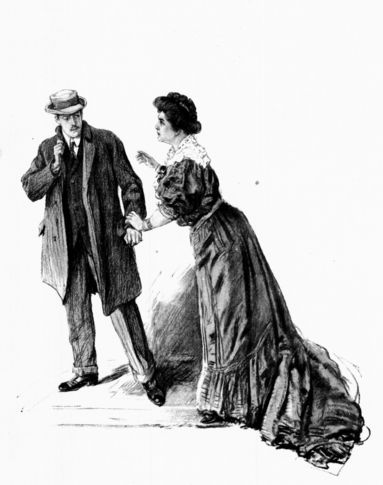
“A fire! For Heaven’s sake, Barr——”
“Oh, I don’t think it amounted to much; there’s just
a line in the evening paper about it. Here, read for yourself—‘fire
confined to one floor, machinery slightly damaged.’
Insured, weren’t you?”
“Oh, yes, yes—that isn’t the point now. We can’t afford
to be kept back a minute! I’m glad you told me; I must
go—I must go back at once and see for myself.” He
stopped and looked hopelessly at Dosia.
Short as the journey was now, he could not let her continue
it by herself; yet every fiber in him was quivering in
his wild desire to get over to the scene of disaster. He
looked at his informant, who, in his turn, was regarding the
girl beside Justin.
“I can go on by myself,” said Dosia, divining his
thought, and wondering when this terrible journey would
ever end. “Truly, I can. I know you want to go and see
about the fire; please, please do! Oh, please!”
“Barr, will you take charge of Miss Linden?” asked
64
Justin abruptly. He did not particularly like Barr, but
this was an emergency. “Will you take her to Mrs. Alexander?”
“I will, indeed,” said the newcomer, with responsive
earnestness.
“Very well, then; I’ll go back on this boat. I’ll be out
on a later train, tell Lois.” He started to make his way
to the other end of the boat, to be in readiness for the return
trip, and turned back once more to give the girl her
ticket; then he was lost to sight, and Theodosia was left,
for the third time, on the hands of an unknown man.
This one only spoke to give her the necessary directions
as they joined the usual rush for the train, and refrained
from talking, to her great relief, after he had settled her
comfortably in the car for the last half-hour of traveling.
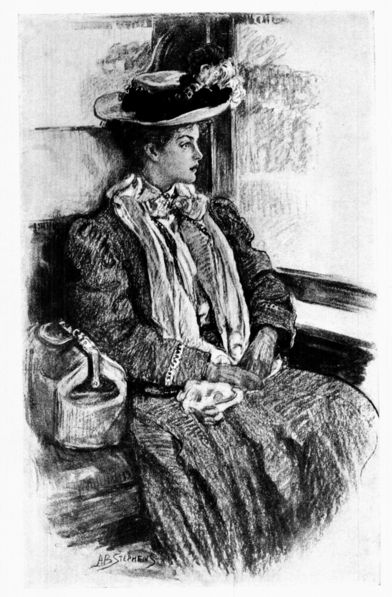
She leaned against the window-casing, as before, as far
away from him as possible, suddenly and wretchedly aware
of her dilapidated appearance and the boy’s cap that covered
the fair hair curling out from under it. Her cheeks
were whiter than ever, and the corners of her mouth had
the pathetic droop of extreme fatigue.
She looked, without knowing it, very young, very forlorn,
and very frightened, and the hand in which she held
the ticket given her by Justin trembled. She was morbidly
afraid that this new person would question her as to the
accident, about which she shrank from speaking; but after
a while, encouraged by his silence, she tried to turn her
thoughts by stealthily observing him.
If her friend of the voice and hand of the night before
had been only a tall blur in the darkness, the man beside
her was effectively concrete. Neither tall nor large, he gave
65
an impression of strength and vitality in the ease and
quickness of his motions, which bespoke trained muscles.
She decided that he was rather old—perhaps thirty. Dark-skinned,
black-haired, with a thin face, a low forehead,
deep-set eyes, a high, rather hooked nose, and a mustache,
he was somewhat of the Oriental type, although, as she
learned later, a New Englander by birth and heritage.
Dosia was not quite sure whether the effect was pleasing
or the reverse; there seemed to be something about him
different from the other men she had seen, even in his
clothing, although it was plain enough.
Interspersed with these observations were the increasing
throbs of homesickness that threatened to overwhelm her.
Kind as Justin had been, she had felt all the time outside
of his thought and affection. This new companion had
shown consideration for her; she was grateful for it, but she
was unprepared to have him lean suddenly toward
her, as a tear trembled perilously on her lashes, and say,
with twinkling eyes:
“I beg your pardon, but do I look like him?”
“Like—like whom?” asked Dosia, in amazement.
“Like a person to be approved of.”
“I haven’t considered the subject,” said Dosia, with
swift dignity.
“Ah, you see, it’s the reverse with me. As soon as Mrs.
Alexander told me she was expecting you, my mind was
filled with visions of a sweet young thing from the South.
All sweet young things from the South have dreams; mine
was to embody yours. And when I saw you, I said to myself—I
beg your pardon, do you think I am getting too
personal, on such short acquaintance?”
66
“Yes,” answered Dosia, dimpling in spite of herself,
“very much too personal.” She turned her head away from
him, that she might not see those sparkling, quizzical eyes
so close.
“Very well; I will finish the sentence to-morrow, as you
suggest. In the meantime, let me ask you if you have ever
made a collection of conductors’ thumbs?”
“No!” said Dosia, in astonishment, turning around
again to face him.
“I am told that there is a great deal of character in
them; it is given by the broad, free movement of punching
tickets. I have thought of collecting thumbs for purposes
of study—in alcohol, of course. But why do you look so
surprised?”
“I am surprised that you have no collection already,”
said Dosia, with spirit; “you seem to be so enterprising.”
He shook his head sadly. “No. How little you know me!
I’m not enterprising in the least; I have no heroic virtues,
I’m only—loving.”
“Oh!” cried Dosia, and stopped short in a ripple of
merriment that was more invigorating than wine, and that
brought a rush of color to her cheeks.
“No? well, not until the day after to-morrow, then, if
you say so. You’re so very, very good to me, Miss Linden;
it’s not often I find anyone so considerate as you are.
And have you come up North to make your entrance into
society?”
“I have come North to study music,” said Theodosia
impressively.
“Music! Ah, there you have me.” He spoke with a new
soberness.
67
“Do you like it?”
“I like it almost better than anything else in the world—too
much, and yet not enough, after all.” He shook his
head with a quick, somber gesture. “I’ll help you with the
music, if you’ll let me. Did you notice how very quickly we
became acquainted? Yes? I know now why; it puzzled me
at first. It was the music in you to which I responded—I
can tell you just what little song of Schubert’s your
smile is from, if you’ll give me time.”
“No,” said Dosia, “it isn’t from Schubert at all, and
you’ll never find the key-note to it, so you needn’t try.”
She could not help daring a little, in her girlishness.
He laughed. “Oh, I shall make it my business to find out.
For what else what I constituted your guardian at the beginning
of your career? And it’s so good of you to say
that I can come to-morrow and pour out my heart to you!
Shall it be at five? No, please don’t trouble to answer; I
like to look at your ear in that position—it’s so pearly.
Too personal again? Then let us converse about your Old
Kentucky Home.”
“It isn’t in Kentucky,” interpolated Dosia desperately,
but there was no stopping him. He was so irrelevantly
absurd that she succumbed at last entirely, and hardly
knew when they left the train; when they walked up the
path to her cousin’s door, they were both laughing causelessly
and irresponsibly, in delightful comradeship.
He turned to Dosia after he had rung the bell and said,
“Good night.”
“Aren’t you coming in to see my cousin?”
“Oh, yes; but this is our farewell. Please make it as
touching as you can.”
68
She looked up frankly as she gave him her hand and said:
“Thank you for taking charge of me.”
“And making a fool of myself? It was in a good cause,
at any rate. But what I wanted you to say was——”
She did not hear, for the door had opened, and he only
waited a moment inside the house to explain her husband’s
absence to Mrs. Alexander. The news arrested her greeting
to Dosia, whom she held tentatively by the hand as she
repeated:
“Justin went back to the fire! Oh, I’m so sorry! Do you
think that it was very bad?”
“The paper said not.”
“It must be out now, anyway. I’m so disappointed that
he did not come home, and I have such a nice little dinner.
Will you not stay, Lawson?”
“Thank you—I wish I could.” There was a penetrative,
lingering flash of those still quizzical eyes at Dosia as he
made his adieus, and then he was gone. Why should she
feel alone?
Her cousin’s arms were at last around her in welcome,
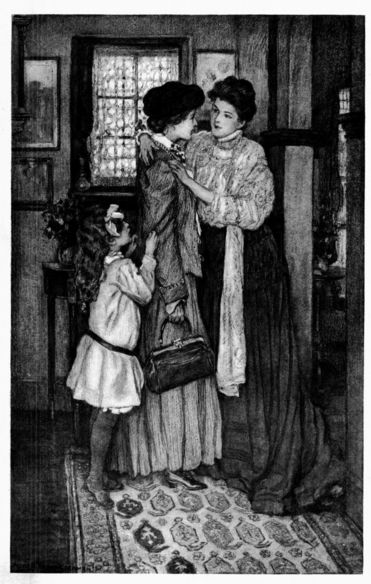
the warmer for being deferred; and the little Zaidee, whom
she would have known from Justin’s description of her,
was standing first on one tiptoe and then on the other,
waiting to be kissed before going off to bed, as she announced.
From above came the sound of small running feet,
and a child’s voice calling:
“Cousin Dosia—I want to see my Cousin Dosia!” A
bare foot and leg surmounted by a fluttering scrap of white
raiment was thrust through the balusters, followed by a
protesting scream as his nurse heavily pursued the fugitive
with upraised voice:
69
“Coom back, Reginald, coom back!” There was the
noise of a scuffle as Dosia, with her escort, laughingly
ascended the stairs, to elicit a shriek of terror and a rear
view of the mercurial Reginald in full flight for the nursery
door, which banged after him, and behind which he
still raised his voice, to the shrill accompaniment of the
nurse.
“I’ll go in and keep him quiet,” said Zaidee reassuringly,
in answer to her mother’s look of appeal, and she also disappeared
beyond the prison bars, after a whisk of her short
crisp pink skirt, and a smile at Dosia in which her little
white teeth gleamed in an infantile glee that only accentuated
her air of preternatural capability.
Her cousin’s kindly hands helped Dosia to remove the
traces of travel, when she had definitely refused the offer
pressed upon her to be undressed and go to bed and have
her dinner brought up to her. It was sweet to be in feminine
care once more, and be pitied for the terrors she had undergone,
and feel the bond of relationship assert itself in spite
of the fact that the cousins had not seen each other since
Dosia’s early childhood. She did not want to be alone up-stairs,
and sat instead in Justin’s place at the table, clad
in a soft silken tea-gown of Lois’ that was in itself restful,
trying to eat and drink and keep up her part in the conversation
about her journey and the absent members of
the family. Changes had crowded so upon poor Dosia that
she felt as if she were living in a kaleidoscope that rattled
her every minute or two into a new position; the glittering
table and her cousin’s form would presently dissolve,
and leave her perhaps out in the crowded, unknown streets,
with wild-eyed faces pressing near her.
70
After all, she only changed to an arm-chair in the little
drawing-room, with her head against a cushion and her
feet on a foot-stool, and her cousin still beside her, pulling
back the window-curtains once in a while to take a peep
outside for her missing husband; in spite of the real kindness
of her welcome, Dosia felt a certain preoccupation
in it. Her coming was only accessory to the real importance
of his, when she herself should have been the event; the
warmth of heart which she had expected to feel toward
her cousin somehow seemed to fail of expression in this
attitude. At the same time, Lois was also conscious of a
lack of response, a dullness, in Theodosia. Perhaps the
likeness of relationship was answerable for a certain reserve
of manner, a formality which neither knew how to
break then or at a later time, and which was to last until
the barriers were swept away by a mighty flood; but the
real cause of the lack of sympathy lay in something much
deeper. The strong thought of self is inevitably insulating—it
is as restrictive of human contact as a live wire. Dosia,
whose young life had all been spent in unselfishness, was
experiencing unexpectedly the other swing of the pendulum
in an intense and absorbing desire to have everything
now as she wanted it. She was tired of thinking of other
people; the scene should be set now for her. This desire
was a huge mushroom growth, sprung up in a night;
it had no real root in her nature, and would vanish as
suddenly as it had come, but the shadow of it distorted
her.
The house was very much smaller than Dosia had imagined,
and her eyes roved over the little drawing-room in
some perplexity, trying to make it come up to her anticipation.
71
All dwellers in small country places, where economy
is Heaven’s first law, expect to be dazzled by the
grandeur and elegance of “the city.” People in Balderville
never dreamed of buying new furniture from towns
twenty or thirty miles away; as chair-legs broke off, or
rockers split, or tables came to pieces, all sorts of domestic
devices were resorted to by all but shiftless householders
who tamely submitted to ruin, in coaxing the article into
seeming wholeness and keeping it still in active use. The
best families were learned in all the little ways and capabilities
of string and wire, and wooden cleats and old hinges
and tacks, and pieces of tin cut from tomato-cans, and in
the glueing on of piano-keys, black-walnut excrescences,
ornaments, and sofa-arms.
Mended furniture has, however, a deprecating expression
of its own, not to be concealed by any art. Dosia recognized
the absence of it in these trim chairs that stood
nattily on their slender curved legs, in the little shining
tables which did not require to be hidden by a hanging
cloth, and in the china and bric-à-brac placed boldly where
they could be seen on all sides. She wondered a little at the
low wicker arm-chair in which she was sitting, for they
had wicker furnishings in the Balderville hotel, but the
blue-skyed water-color sketches on the walls caught her
fancy, and the vista of a blue-and-white dining-room, seen
through half-closed reddish portières, was charming. For
all the shine and polish and multiplicity of small ornaments
in the tiny apartment, it seemed to lack a kind of
comfort to which she was used, and of which she had
caught a glimpse in the sitting-room as she passed it. She
gave an exclamation of delight as her eyes fell on a stand
72
in one corner of the room on which was a long glass filled
with pink roses.
“How beautiful these are! I haven’t seen any finer ones in
Balderville, and you know we are famed for our roses there.”
“Oh,” said Lois, “to think that you have been in the
house for over an hour and I never told you about them!
Justin’s not coming upset everything. They were sent to
you this afternoon.”
“Sent to me?”
“Yes—by Mr. Sutton. Didn’t you say you met him
with Justin on the boat?—a short, stout man with sandy
hair.”
“Yes, Justin introduced him, but he hardly spoke to
me.”
“That doesn’t make any difference, he sent them before
he saw you at all. I told him you were coming, and these
arrived this afternoon. You needn’t feel particularly flattered;
he sends them to everybody.”
“Sends them to everybody!” Dosia looked amazed.
“Oh, yes; he’s rich, and devoted to girls. They laugh
at him, but I notice that they are quite ready to accept
his flowers and candy and tickets for the opera. I believe
that he wants to get married; but he really is sensible and
quite nice underneath it all.”
“Oh!” said Dosia, indefinably revolted. “And—and is
Mr. Barr like that, too?”
“Who, Lawson? Oh, dear, no; he can’t even support
himself, let alone sending presents.”
“He said such queer things,” ventured Dosia, with a
shy desire to talk about him. “I did not know what to
make of it at first.”
73
“Oh, nobody pays any attention to what Lawson says,”
said Lois indifferently.
Dosia longed to ask why, with an instant wave of resentment
at this way of speaking; a cloud seemed suddenly
to have descended upon the glittering possibilities of her
future. She fixed her eyes on her cousin, who sat in a high,
slender chair, one arm gowned in yellow silk thrown over
the back of it, and her cheek upon her arm—her rich
coloring, the grace of her attitude, the sweep of her long
black skirt, made a deep impression on the mind of the
little country girl, who seemed slight and meager and insignificant
to herself. And this other woman had been loved—she
had passed through all the experiences to which
Dosia looked forward. Was it that which gave her this
charm thrown over her like a gauzy veil?
“What a beautiful waist you have on!” she exclaimed
impulsively. “Yellow is such a lovely color.”
“Do you think so?” said Lois. “This is an old thing
that I mended to wear because Justin always likes it. I
do wish he’d come.” She rose and walked restlessly to the
window. “I’m worried about him.”
“Yes,” said Dosia, still looking, and pleased that the
remark bore out her fancy. But she wondered; married
women in Balderville looked different—the hot Southern
sun had burned the color out of their cheeks, and the gowns
they mended were of cotton, not of yellow silk; this fresh
youthfulness and self-sufficiency both attracted and repelled,
it seemed so beyond her. Her heart bounded at
the thought that Aunt Theodosia had sent money for her
clothes as well as for her music lessons.
She did not resist the second attempt to send her to bed,
74
although Justin was still absent. Lois had brought her all
the things she needed in the absence of her wrecked luggage,
and kissed her good night with tenderness, saying,
“I hope you’ll be very happy here, Dosia,” and she answered,
“Thank you so much for having me.”
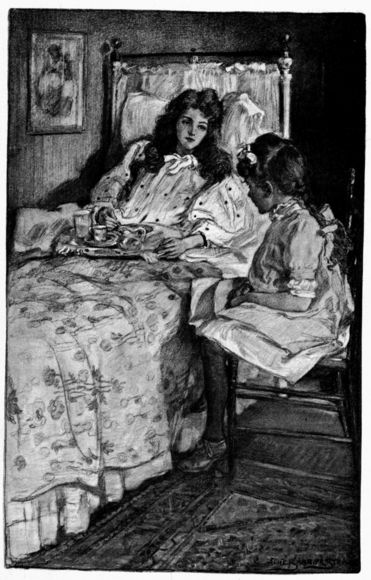
In spite of her helpless fatigue, she lay awake for a long
time in her tiny room. The brass bed, the polished floor
with the crimson rug on it, the dainty dressing-table, had
all seemed charmingly luxurious and like a book, but now
that she was in darkness, she only saw vividly a pair of
sparkling eyes looking into hers, and caught the sound
of a kind, half-mocking voice. Every word of the conversation
repeated itself again to her excited mind; it was
delightful to remember, because she had acquitted herself
so well; if she had replied stupidly she would have died of
vexation now. How clever he had been, and how really considerate!—for
she was glad to think that he had said foolish
things to her to keep her from breaking down.
“Do I look like a person of whom you would approve?”
“I haven’t considered the subject.” She flashed the answer
back again, and laughed, with her cheek glowing on the
pillow. Why had Lois spoken of him so strangely? She
vainly strove to fathom the significance of the words,
which she resented, although they had coincided with an instinctive
feeling she had that he was not at all the kind
of man she would ever want to marry. She had already
taken that provisionary leap into a mythical future which
is one of the perfunctory attitudes of maidenhood.
But who wanted to think of marrying now, anyway?
That was something so far off that it seemed like the end
of all things to Dosia, who at present only innocently
75
desired plenty of emotions to live upon—costlier living than
she knew, poor child! The very instinct that warned her
against it added a heightened charm to the perilous pleasure.
And the other man—Mr. Sutton—had already sent
her flowers! Oh, this was life, life—the life she had read
of and longed for, where dark eyes looked at you and made
you feel how interesting you were; where you could have
pretty clothes, and look like other people, and be brilliant
and witty and sought after. She blushed with pleasure and
excitement. Then she said a little prayer, with palm
pressed to palm under the covers, and the glamour faded
away as a sweet and pure feeling welled up from the clear
depths of her heart. Her hand was once more held in
safety. In her drowsiness, it was as if she had lifted her
soft cheek to be kissed.
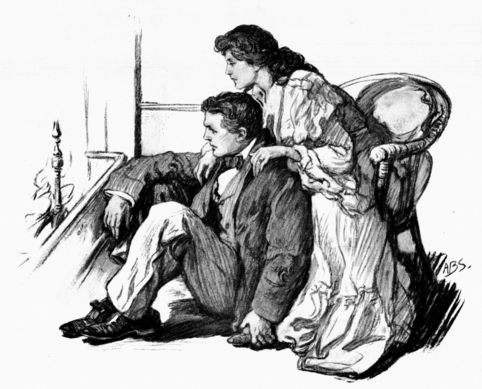
To the eager inquiries of Lois, Justin answered that he
had had his dinner long before and wanted nothing.
He asked if she and the children were all right,—his
usual question,—and she waited until he had dropped down
in the arm-chair in the sitting-room up-stairs, after
changing his shoes for slippers, before questioning him.
Then she sat down by him and asked:
“Well, how was it?”
She spoke with eagerness, holding one of his hands in
hers tenderly, although it hung limp after the first strong,
responsive clasp.
“The fire was out before I got there.”
“Do they know how it started?”
“Not yet.”
“Was the place burned much?”
76
“No, not much.”
“Did it do any damage to the machinery?”
“Some.”
Lois looked at him in despair.
“Aren’t you going to tell me anything?”
“There really isn’t anything to tell, dear.” He strove
to speak with attention. “You know just about as much
of it all as I do.”
“Oh, but I’m so sorry for you! Will it put you back
any?”
“I suppose so.”
“Oh, dear!” she moaned helplessly. “Isn’t it too bad!
If only you had not been obliged to take that journey!
Do you suppose it would have happened if you had stayed
at home?”
“I really can’t tell. The fire might have been discovered
earlier; it started at noon, when most of the clerks were
out at lunch.”
“I see. But no one can hold you responsible.”
“I am responsible for everything. If you do not mind,
Lois, I’ll go to bed. I’m tired; I didn’t get any sleep last
night.”
“Yes, of course.” She smoothed his hair with her fingers
in remorseful tenderness, leaning against him, with
her laces touching his cheek. “Such a long, long, tiresome
journey! It’s such a pity you had to go.”
“Oh, well, I had to, and that’s the end of it. Don’t
let’s talk about it any more. I hope that poor girl gets
some sleep to-night; she needs it. She can’t hear us, can
she?”
“No. Didn’t you think she was sweet?”
77
“Yes, she seemed nice enough; she’s pretty—a little
stupid, perhaps.”
“Oh, poor Dosia!” said Lois, “stupid! I should think
she might have been, after all she had gone through. But
then, you’re so used to my cleverness!” She looked up at
him with provocative eyes, into which he smiled faintly, in
recognition of what was expected of him; then he said,
with a sudden appealing change of tone, “I’m very tired,
Lois.”
She kissed him good night tenderly, with magnanimous
concession to his unresponsiveness; there was no room for
her in his thoughts to-night, and she had been so longing
to see him! But she would tell him all about it to-morrow.
Justin laid his head upon the pillow, but his eyes burned
into the darkness; there was a proud and bitter disappointment
at his heart, even while reason adjusted his
losses to their proper place. Before him in disagreeable
force came the face of Leverich, and it was not the face of
a man to whom one would care to make excuse or from
whom one would challenge reproof; he could see the heavy
jowl, the piercing eyes, the half-pompous, half-shrewd expression
of one who respected nothing but success. This
tangle up of the machinery, unusual and costly in its parts
and appointments—Heaven only knew what far-reaching
complications the delay of its repair might occasion! Justin
had seen only too well in others how a false step at the
first may count.
Whether or not Dosia and the typometer were united in
their destinies, they had at least one thing in common—they
were both embarked upon perilous ways.