1. A lineate is either a Surface or a
Body.
Lineatum, (or Lineamentum) a magnitude made of lines, as
was defined at 1. e. iij. is here divided into two
kindes: which is easily conceived out of the said definition there, in
which a line is excluded, and a Surface & a body are comprehended.
And from hence arose the division of the arte Metriall into Geometry, of
a surface, and Stereometry, of a body, after which maner Plato in
his vij. booke of his Common-wealth, and Aristotle in the 7.
chapter of the first booke of his Posteriorums, doe distinguish
betweene Geometry and Stereometry: And yet the name of Geometry is used
to signifie the whole arte of measuring in generall.
2. A Surface is a lineate only broade. 5. d
j.
As here aeio. and uysr. The definition of a Surface doth
comprehend the distance or dimension of a line, to witt Length: But it
addeth another distance, that is Breadth. Therefore a Surface is defined by
some, as Proclus saith, to be a magnitude of two dimensions. But
two doe not so specially and so properly define it. Therefore a Surface
is better defined, to bee a magnitude onely long and broad. Such, saith
Apollonius, are the shadowes upon the earth, which doe farre and
wide cover the ground and champion fields, and doe not enter into the
earth, nor have any manner of thicknesse at all.
Epiphania, the Greeke word, which importeth onely the outter
appearance of a thing, is here more significant, because of a Magnitude
there is nothing visible or to bee seene, but the surface.
3. The bound of a surface is a line. 6. d
j.
The matter in Plaines is manifest. For a three cornered surface is
bounded with 3. lines: A foure cornered surface, with foure lines, and so
forth: A Circle is bounded with one line. But in a Sphearicall surface
the matter is not so plaine: For it being whole, seemeth not to be
bounded with a line. Yet if the manner of making of a Sphearicall
surface, by the conversiō or turning about of a semiperiphery, the
beginning of it, as also the end, shalbe a line, to wit a semiperiphery:
And as a point doth not only actu, or indeede bound and end a
line: But is potentia, or in power, the middest of it: So also a
line boundeth a Surface actu, and an innumerable company of lines
may be taken or supposed to be throughout the whole surface. A Surface
therefore is made by the motion of a line, as a Line was made by the
motion of a point.
4. A Surface is either Plaine or
Bowed.
The difference of a Surface, doth answer to the difference of a Line,
in straightnesse and obliquity or crookednesse.
Obliquum, oblique, there signified crooked; Not right or
straight: Here, uneven or bowed, either upward or downeward. Sn.
5. A plaine surface is a surface, which lyeth
equally betweene his bounds, out of the 7. d j.
As here thou seest in aeio. That therefore a Right line doth
looke two contrary waies, a Plaine surface doth looke all about every
way, that a plaine surface should, of all surfaces within the same
bounds, be the shortest: And that the middest thereof should hinder the
sight of the extreames. Lastly, it is equall to the dimension betweene
the lines: It may also by one right line every way applyed be tryed, as
Proclus at this place doth intimate.
Planum, a Plaine, is taken and used for a plaine surface: as
before Rotundum, a Round, was used for a round figure.
6. From a point unto a point we may, in a
plaine surface, draw a right line, 1 and 2. post. j.
Three things are from the former ground begg'd: The first is of a
Right line. A right line and a periphery were in the ij. booke defined:
But the fabricke or making of them both, is here said to bee properly in
a plaine.
The fabricke or construction of a right line is the 1. petition. And
justly is it required that it may bee done onely upon a plaine: For in
any other surface it were in vaine to aske it. For neither may wee
possibly in a sphericall betweene two points draw a right line: Neither
may wee possibly in a Conicall and Cylindraceall betweene any two points
assigned draw a right line. For from the toppe unto the base that in
these is only possible: And then is it the bounde of the plaine which
cutteth the Cone and Cylinder. Therefore, as I said, of a right plaine it
may onely justly bee demanded: That from any point assigned, unto any
point assigned, a right line may be drawne, as here from a unto
e.
Now the Geometricall instrument for the drawing of a right plaine is
called Amussis, & by Petolemey, in the 2. chapter of
his first booke of his Musicke, Regula, a Rular, such as heere
thou seest.

And from a point unto a point is this justly demanded to be done, not
unto points; For neither doe all points fall in a right line: But many
doe fall out to be in a crooked line. And in a Spheare, a Cone &
Cylinder, a Ruler may be applyed, but it must be a sphearicall, Conicall,
or Cylindraceall. But by the example of a right line doth
Vitellio, 2 p j. demaund that betweene two lines a surface
may be extended: And so may it seeme in the Elements, of many figures
both plaine and solids, by Euclide to be demanded; That a figure
may be described, at the 7. and 8. e ij. Item that a figure may be made
vp, at the 8. 14. 16. 23. 28. p. vj. which are of Plaines. Item at the
25. 31. 33. 34. 36. 49. p. xj. which are of Solids. Yet notwithstanding a
plaine surface, and a plaine body doe measure their rectitude by a right
line, so that jus postulandi, this right of begging to have a
thing granted may seeme primarily to bee in a right plaine line.
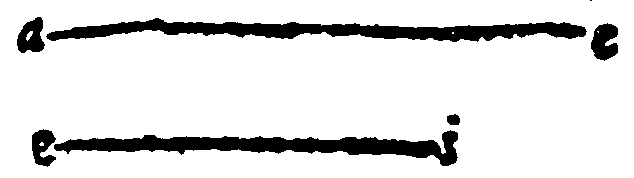
Now the Continuation of a right line is nothing else, but the
drawing out farther of a line now drawne, and that from a point unto a
point, as we may continue the right line ae. unto i.
wherefore the first and second Petitions of Euclide do agree in one.
7. To set at a point assigned a Right line
equall to another right line given: And from a greater, to cut off a part
equall to a lesser. 2. and 3. p j.
As let the Right line given be ae. And to i. a point
assigned, grant that io. equall to the same ae. may bee
set. Item, in the second example, let ae. bee greater then
io. And let there be cut off from the same ae. by applying of a rular made
equall to io. the lesser, portion au. as here. For if any man shall
thinke that this ought only to be don in the minde, hee also, as it were,
beares a ruler in his minde, that he may doe it by the helpe of the
ruler. Neither is the fabricke in deede, or making of one right equal to
another: And the cutting off from greater Right line, a portion equall to
a lesser, any whit harder, then it was, having a point and a distance
given, to describe a circle: Then having a Triangle, Parallelogramme, and
semicircle given, to describe or make a Cone, Cylinder, and spheare, all
which notwithstanding Euclide did account as principles.
8. One right line, or two cutting one another,
are in the same plaine, out of the 1. and 2. p xj.
One Right line may bee the common section of two plaines: yet all or
the whole in the same plaine is one: And all the whole is in the same
other: And so the whole is the same plaine. Two Right lines cutting one
another, may bee in two plaines cutting one of another; But then a plaine
may be drawne by them: Therefore both of them shall be in the
same plaine. And this plaine is geometrically to be conceived: Because
the same plaine is not alwaies made the ground whereupon one oblique
line, or two cutting one another are drawne, when a periphery is in a
sphearicall: Neither may all peripheries cutting one another be possibly
in one plaine.
9. With a right line given to describe a
peripherie.
This fabricke or construction is taken out of the 3. Petition which is
thus. Having a center and a distance given to describe, make, or draw a
circle. But here the terme or end of a circle is onely sought, which is
better drawne out of the definition of a periphery, at the 10. e ij. And in a plaine onely may that conversion
or turning about of a right line bee made: Not in a sphearicall, not in a
Conicall, not in a Cylindraceall, except it be in top, where
notwithstanding a periphery may bee described. Therefore before (to witt
at the said 10. e ij.) was taught the generall
fabricke or making of a Periphery: Here we are informed how to discribe a
Plaine periphery, as here.
Now as the Rular was the instrument invented and used for the drawing
of a right line: so also may the same Rular, used after another
manner, be the instrument to describe or draw a periphery withall. And
indeed such is that instrument used by the Coopers (and other like
artists) for the rounding of their bottomes of their tubs, heads of
barrells and otherlike vessells: But the Compasses, whether
straight shanked or bow-legg'd, such as here thou seest, it skilleth not,
are for al purposes and practises, in this case the best and readiest.
And in deed the Compasses, of all geometricall instruments,
are the most excellent, and by whose help famous Geometers have taught:
That all the problems of geometry may bee wrought and performed: And
there is a booke extant, set out by John Baptist, an Italian,
teaching, How by one opening of the Compasses all the problems of
Euclide may be resolved: And Jeronymus Cardanus, a famous
Mathematician, in the 15. booke of his Subtilties, writeth, that there
was by the helpe of the Compasses a demonstration of all things
demonstrated by Euclide, found out by him and one
Ferrarius.
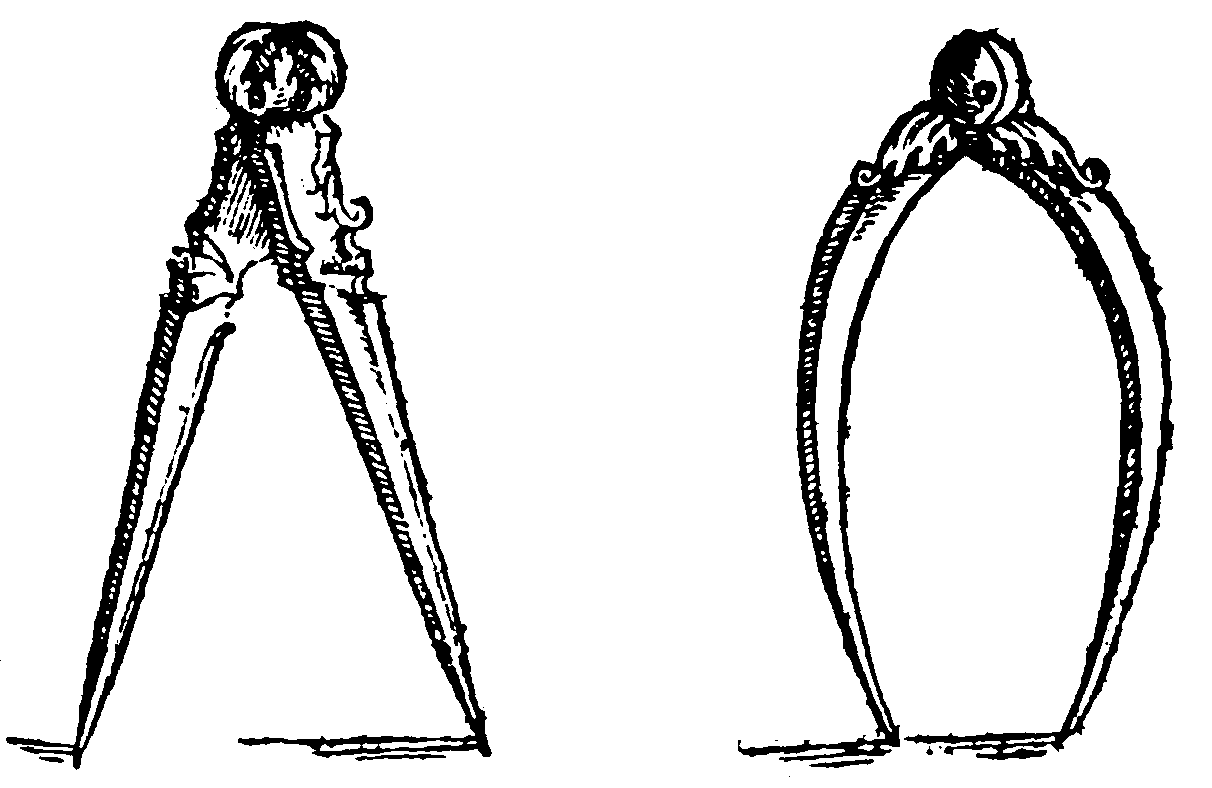
Talus, the nephew of Dædalus by his sister, is said in
the viij. booke of Ovids Metamorphosis, to have beene the
inventour of this instrument: For there he thus writeth of him and this
matter:—Et ex uno duo ferrea brachia nodo: Iunxit, ut æquali
spatio distantibus ipsis: Altera pars staret, pars altera duceret
orbem.
10. The raies of the same, or of an equall
periphery, are equall.
The reason is, because the same right line is every where converted or
turned about. But here by the Ray of the periphery, must bee understood
the Ray the figure contained within the periphery.
11. If two equall peripheries, from the ends
of equall shankes of an assigned rectilineall angle, doe meete before it,
a right line drawne from the meeting of them unto the toppe or point of
the angle, shall cut it into two equall parts. 9. p j.
Hitherto we have spoken of plaine lines: Their affection followeth,
and first in the Bisection or dividing of an Angle into two equall
parts.
Let the right lined Angle to bee divided into two equall parts bee
eai. whose equall shankes let them be ae. and ai.
(or if they be unequall, let them be made equall, by the 7 e.) Then two equall peripheries from the ends
e and i. meet before the Angle in o. Lastly, draw a
line from o. unto a. I say the angle given is divided into
two equall parts. For by drawing the right lines oe. and
oi. the angles oae. and oai. equicrurall, by the
grant, and by their common side ao. are equall in base eo.
and io. by the 10 e (Because they are the
raies of equall peripheries.) Therefore by the 7. e
iij. the angles oae. and oai. are equall: And therefore
the Angle eai. is equally divided into two parts.
12. If two equall peripheries from the ends
of a right line given, doe meete on each side of the same, a right line
drawne from those meetings, shall divide the right line given into two
equall parts. 10. p j.
Let the right line given bee ae. And let two equall peripheries
from the ends a. and e. meete in i. and o.
Then from those meetings let the right line io. be drawne. I say,
That ae. is divided into two equall parts, by the said line thus
drawne. For by drawing the raies of the
equall peripheries ia. and ie. the said io. doth cut
the angle aie. into two equall parts, by the 11.
e. Therefore the angles aiu. and uie. being equall and
equicrurall (seeing the shankes are the raies of equall peripheries, by
the grant.) have equall bases au. and ue. by the 7. e iij. Wherefore seeing the parts au. and
ue. are equall, ae. the assigned right line is divided into
two equall portions.
13. If a right line doe stand perpendicular
upon another right line, it maketh on each side right angles: And
contrary wise.
A right line standeth upon a right line, which cutteth, and is not cut
againe. And the Angles on each side, are they which the falling
line maketh with that underneath it, as is manifest out of
Proclus, at the 15. pj. of Euclide; As here ae. the
line cut: and io. the insisting line, let them be perpendicular;
The angles on each side, to witt aio. and eio. shall bee
right angles, by the 13. e iij.
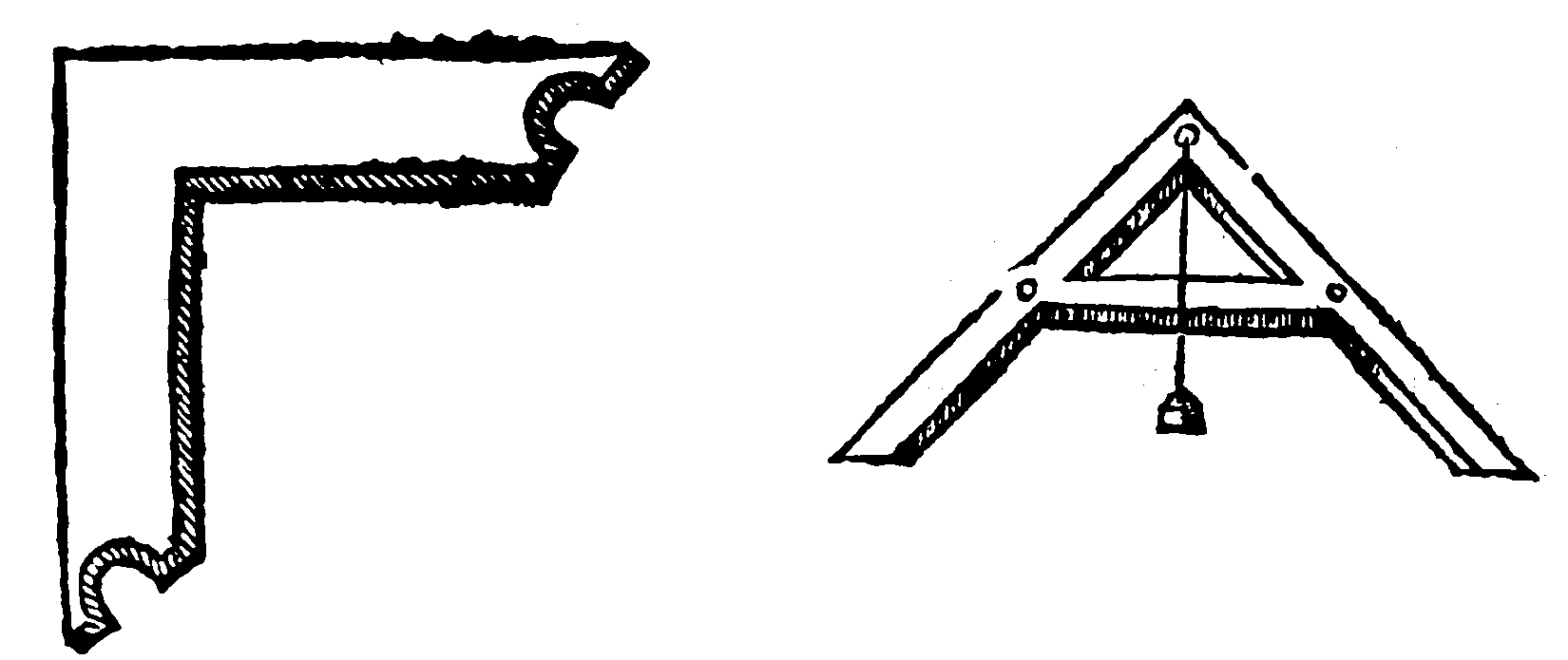
The Rular, for the making of straight lines on a plaine, was
the first Geometricall instrument: The Compasses, for the
describing of a Circle, was the second: The Norma or Square
for the true erecting of a right line in the same plaine upon another
right line, and then of a surface and body, upon a surface or body, is
the third. The figure therefore is thus.
Now Perpendiculū, an instrument with a line & a
plummet of leade appendant upon it, used of Architects, Carpenters, and
Masons, is meerely physicall: because heavie things naturally by their weight
are in straight lines carried perpendicularly downeward. This instrument
is of two sorts: The first, which they call a Plumbe-rule, is for the
trying of an erect perpendicular, as whether a columne, pillar, or any
other kinde of building bee right, that is plumbe unto the plaine of the
horizont & doth not leane or reele any way. The second is for the
trying or examining of a plaine or floore, whether it doe lye parallell
to the horizont or not. Therefore when the line from the right angle,
doth fall upon the middle of the base; it shall shew that the length is
equally poysed. The Latines call it Libra, or Libella, a
ballance: of the Italians Livello, and vel Archipendolo,
Achildulo: of the French, Nivelle, or Niueau:
of us a Levill.
14. If a right line do stand upon a right
line, it maketh the angles on each side equall to two right angles: and
contrariwise out of the 13. and 14. p j.
For two such angles doe occupy or fill the same place that two right
angles doe: Therefore they are equall to them by the 11. e j. If
the insisting line be perpendicular unto that underneath it, it then
shall make 2. right angles, by the 13. e. If it bee
not perpendicular, & do make two oblique angles, as here aio.
and oie. are yet shall they occupy the same place that two right
angles doe: And therefore they are equall to two right angles, by the
same.
The converse is forced by an argument ab impossibli, or ab
absurdo, from the absurdity which otherwise would follow of it: For
the part must otherwise needes bee equall to the whole. Let therefore the
insisting or standing line which maketh two angles aeo. and
aeu. on each side equall to two right angles, be ae. I say
that oe. and ei. are but one right line. Otherwise let
oe. bee continued unto u. by the 6. e.
Now by the 14. e. or next former element,
aeo. & aeu. are equall to two right angles; To which
also oea. & aei. are equall by the grant: Let
aeo. the common angle be taken away: then shall there be left
aeu. equall to aei. the part to the whole, which is absurd
and impossible. Herehence is it certaine that the two right lines
oe, and ei, are in deede but one continuall right line.
15. If two right lines doe cut one another,
they doe make the angles at the top equall and all equall to foure right
angles. 15. p j.
Anguli ad verticem, Angles at the top or head, are called
Verticall angles which have their toppes meeting in the same point. The
Demonstration is: Because the lines cutting one another, are either
perpendiculars, and then all right angles are equall as heere: Or else
they are oblique, and then also are the verticalls equall, as are
aui, and oue: And againe, auo, and iue. Now
aui, and oue, are equall, because by the 14. e. with auo, the common angle, they are
equall to two right angles: And therefore they are equall betweene
themselves. Wherefore auo, the said common angle beeing taken
away, they are equall one to another.
16. If two right lines cut with one right
line, doe make the inner angles on the same side greater then two right
angles, those on the other side against them shall be lesser then two
right angles.
As here, if
auy, and uyi, bee greater then two right angles euy,
and uyo, shall bee lesser then two right angles.
17. If from a point assigned of an infinite
right line given, two equall parts be on each side cut off: and then from
the points of those sections two equall circles doe meete, a right line
drawne from their meeting unto the point assigned, shall bee
perpendicular unto the line given. 11. p j.
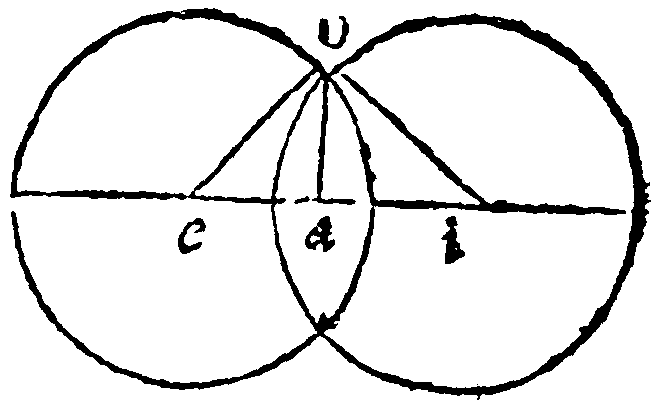
As let a, be the point assigned of the infinite line given: and
from that on each side, by the 7. e. cut off equall
portions ae, and ai, Then let
two equall peripheries from the points e, and i, meete, as
in o, I say that a right line drawne from o, the point of
the meeting of the peripheries. unto a. the point given, shalbe
perpendicular upon the line given. For drawing the right lines oe,
& oi, the two angles eao, and iao, on each side,
equicrurall by the construction of equall segments on each side, and
oa, the common side, are equall in base by the 9.
e. And therefore the angles themselves shall be equall, by the 7. e iij. and therefore againe, seeing that
ao, doth lie equall betweene the parts ea, and ia,
it is by the 13. e ij. perpendicular upon it.
18. If a part of an infinite right line, bee
by a periphery for a point given without, cut off a right line from the
said point, cutting in two the said part, shall bee perpendicular upon
the line given. 12. p j.
Of an infinite right line given, let the part cut off by a periphery
of an externall center be ae: And then let io, cut the said
part into two parts by the 12. e. I say that
io is perpendicular unto the said infinite right line. For it
standeth upright, and maketh aoi, and eoi, equall angles,
for the same cause, whereby the next former perpendicular was
demonstrated.
19. If two right lines drawne at length in
the same plaine doe never meete, they are parallells. è 35. d j.
Thus much of the Perpendicularity of plaine right lines:
Parallelissmus, or their parallell equality doth follow. Euclid
did justly require these lines so drawne to be granted paralels: for then
shall they be alwayes equally distant, as here ae. and
io.
Therefore
20. If an infinite right line doe cut one of
the infinite right parallell lines, it shall also cut the other.
As in the same example uy. cutting ae. it shall also cut
io. Otherwise, if it should not cut it, it should be parallell
unto it, by the 18 e. And that against the
grant.
21. If right lines cut with a right line be
pararellells, they doe make the inner angles on the same side equall to
two right angles: And also the alterne angles equall betweene themselves:
And the outter, to the inner opposite to it: And contrariwise, 29,
28, 27. p 1.
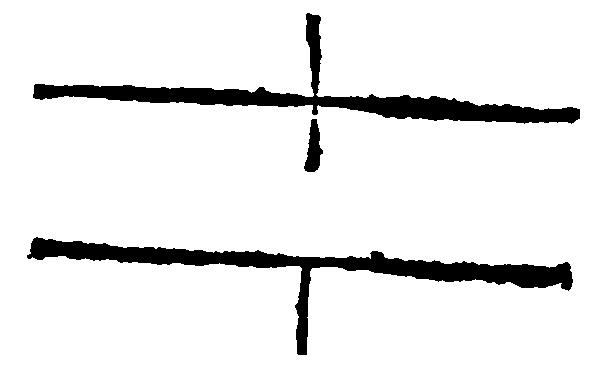
The paralillesme, or parallell-equality of right lines cut with a
right line, concludeth a threefold equality of angles: And the same is
againe of each of them concluded. Therefore in this one element there are
sixe things taught; all which are manifest if a perpendicular, doe fall
upon two parallell lines. The first sort of
angles are in their owne words plainely enough expressed. But the word
Alternum, alterne [or alternate, H.] here, as
Proclus saith, signifieth situation, which in Arithmeticke
signified proportion, when the antecedent was compared to the consequent;
notwithstanding the metaphor answereth fitly. For as an acute angle is
unto his successively following obtuse; So on the other part is the acute
unto his successively following obtuse: Therefore alternly, As the acute
unto the acute: so is the obtuse, unto the obtuse. But the outter and
inner are opposite, of the which the one is without the parallels; the
other is within on the same part not successively; but upon the same
right line the third from the outer.
The cause of this threefold propriety is from the perpendicular or
plumb-line, which falling upon the parallells breedeth and discovereth
all this variety: As here they are right angles which are the inner on
the same part or side: Item, the alterne angles: Item the inner and the
outter: And therefore they are equall, both, I meane, the two inner to
two right angles: and the alterne angles between themselvs: And the
outter to the inner opposite to it.
If so be that the cutting line be oblique, that is, fall not upon them
plumbe or perpendicularly, the same shall on the contrary befall the
parallels. For by that same obliquation or slanting, the right lines
remaining and the angles unaltered, in like manner both one of the inner,
to wit, euy, is made obtuse, the other, to wit, uyo, is
made acute: And the alterne angles are made acute and obtuse: As also the
outter and inner opposite are likewise made acute and obtuse.
If any man shall notwithstanding say, That the inner angles are
unequall to two right angles: By the same argument may he say (saith
Ptolome in Proclus) That on each side they be both greater
than two right angles, and also lesser: As in the parallel right lines
ae and io, cut with the right line uy,
if thou shalt say that auy and iyu, are greater then two
right angles, the angles on the other side, by the 16
e, shall be lesser then two right angles, which selfesame
notwithstanding are also, by the gainesayers graunt, greater then two
right angles, which is impossible.
The same impossibility shall be concluded, if they shall be sayd, to
be lesser than two right angles.
The second and third parts may be concluded out of the first. The
second is thus: Twise two angles are equall to two right angles
oyu, and euy, by the former part: Item, auy, and
euy, by the 14 e. Therefore they are equall
betweene themselves. Now from the equall, Take away euy, the
common angle, And the remainders, the alterne angles, at u, and
y shall be least equall.
The third is thus: The angles euy, and oys, are equall
to the same uyi, by the second propriety, and by the 15 e. Therefore they are equall betweene
themselves.
The converse of the first is here also the more manifest by that light
of the common perpendicular, And if any man shall thinke, That although
the two inner angles be equall to two right angles, yet the right may
meete, as if those equall angles were right angles, as here; it must
needes be that two right lines divided by a common perpendicular, should
both leane, the one this way, the other that way, or at least one of
them, contrary to the 13 e ij.
If they be oblique angles, as here, the lines one slanting or obliquely crossing one another, the angles
on one side will grow lesse, on the other side greater. Therefore they
would not be equall to two right angles, against the graunt.
From hence the second and third parts may be concluded. The second is
thus: The alterne angles at u and y, are equall to the
foresayd inner angles, by the 14 e: Because both of them are equall to
the two right angles: And so by the first part the second is
concluded.
The third is therefore by the second demonstrated, because the outter
oys, is equall to the verticall or opposite angle at the top, by
the 15 e. Therefore seeing the outter and inner
opposite are equall, the alterne also are equall.
Wherefore as Parallelismus, parallell-equality argueth a
three-fold equality of angles: So the threefold equality of angles doth
argue the same parallel-equality.
22. If right lines knit together with a right
line, doe make the inner angles on the same side lesser than two right
Angles, they being on that side drawne out at length, will meete.
As here ae, and io, knit together with eo, doe
make two angles aeo, and ioe, lesser than two right angles:
They shall therefore, I say, meete if they be continued out that wayward.
The assumption and complexion is out of the 21 e,
of right lines in the same plaine. If right lines cut with a right line
be parallels, they doe make the inner angles on the same part equall to
two right-angles. Therefore if they doe not make them equall, but lesser,
they shall not be parallel, but shall meete.
23. A right line knitting together parallell
right lines, is in the same plaine with them. 7 p xj.
As here uy, knitting or joyning together the two parallels
ae, and io, is in the same plaine with them as is manifest
by the 8 e.
24. If a right line from a point given doe
with a right line given make an angle, the other shanke of the angle
equalled and alterne to the angle made, shall be parallell unto the
assigned right line. 31 p j.
As let the assigned right line be ae: And the point given, let
it be i. From which the right line, making with the assigned
ae, the angle, ioe, let it be io: To the which at
i, let the alterne angle oiu, be made equall: The right
line ui, which is the other shanke, is parallel to the assigned
ae.
An angle, I confesse, may bee made equall by the first propriety: And
so indeed commonly the Architects and Carpenters doe make it, by erecting
of a perpendicular. It may also againe in like manner be made by the
outter angle: Any man may at his pleasure use which hee shall thinke
good: But that here taught we take to be the best.
25. The angles of shanks alternly parallell,
are equall. Or Thus, The angles whose alternate feete are
parallells, are equall. H.
This consectary is drawne out of the third property of the 21 e. The thing manifest in the example following, by
drawing out, or continuing the other shanke of the inner angle. But
Lazarus Schonerus it seemeth doth thinke the adverbe
alterne, (alternely or alternately) to be more then
needeth: And therefore he delivereth it thus: The angles of parallel
shankes are equall.
26. If parallels doe bound parallels, the
opposite lines are equall è 34 p. j. Or thus: If parallels
doe inclose parallels, the opposite parallels are equall. H.
Otherwise they should not be parallell. This is understood by the
perpendiculars, knitting them together, which by the definition are
equall betweene two parallells: And if of perpendiculars they bee made
oblique, they shall notwithstanding remaine equall, onely the corners
will be changed.
27. If right lines doe joyntly bound on the
same side equall and parallell lines, they are also equall and
parallell.
This element might have beene concluded out of the next precedent: But
it may also be learned out of those which went before. As let
ae, and io, equall parallels be bounded joyntly of
ai, and eo: and let ei be drawn. Here because the
right line ei falleth upon the parallels ae, and io,
the alterne angles aei and eio, are equall, by the 21 e. And they are equall in shankes ae, and
io, by the grants, and ei, is the common shanke: Therefore
they are also equall in base ai, and eo, by the 7 e iij. This is the first: Then by 21 e, the alterne angles eia, and ieo,
are equall betweene themselves: And those are made by ai and
eo, cut by the right line ei: Therefore they are parallell;
which was the second.
On the same part or side it is sayd, least any man might understand
right lines knit together by opposite bounds as here.
28. If right lines be cut joyntly by many
parallell right lines, the segments betweene those lines shall bee
proportionall one to another, out of the 2 p vj and 17 p
xj.
Thus much of the Perpendicle, and parallell equality of plaine right
lines: Their Proportion is the last thing to be considered of them.
The truth of this element dependeth upon the nature of the parallells:
And that throughout all kindes of equality and inequality, both greater
and lesser. For if the lines thus cut be perpendiculars, the portions
intercepted betweene the two parallels shall
be equall: for common perpendiculars doe make parallell equality, as
before hath beene taught, and here thou seest.
If the lines cut be not parallels, but doe leane one toward another,
the portions cut or intercepted betweene them will not be equall, yet
shall they be proportionall one to another. And looke how much greater
the line thus cut is: so much greater shall the intersegments or portions
intercepted be. And contrariwise, Looke how much lesse: so much lesser
shall they be.
The third parallell in the toppe is not expressed, yet must it be
understood.
This element is very fruitfull: For from hence doe arise and issue,
First the manner of cutting a line according to any rate or proportion
assigned: And then the invention or way to finde out both the third and
fourth proportionalls.
29. If a right line making an angle with
another right line, be cut according to any reason [or proportion]
assigned, parallels drawne from the ends of the segments, unto the end of
the sayd right line given and unto some contingent point in the same,
shall cut the line given according to the reason given.
Schoner hath altered this Consectary, and delivereth it thus:
If a right line making an angle with a right line given, and knit unto it
with a base, be cut according to any rate assigned, a parallell to the
base from the ends of the segments, shall cut the line given according to
the rate assigned. 9 and 10 p vj.
Punctum contingens, A contingent point, that is falling or
lighting in some place at al adventurs, not given or assigned.
This is a marvelous generall consectary, serving indifferently for any
manner of section of a right line, whether it be to be cut into two
parts, or three parts, or into as many parts, as you shall thinke good, or
generally after what manner of way soever thou shalt command or desire a
line to be cut or divided.
Let the assigned Right line to be cut into two equall parts be
ae. And the right line making an angle with it, let it be the
infinite right line ai. Let ao, one portion thereof be cut
off. And then by the 7 e, let oi, another
part thereof be taken equall to it. And lastly, by the 24 e, draw parallels from the points i, and
o, unto e, the end of the line given, and to u; a
contingent point therein. Now the third parallell is understood by the
point a, neither is it necessary that it should be expressed.
Therefore the line ae, by the 28, is cut
into two equall portions: And as ao, is to oi: So is
au, to ue. But ao, and oi, are halfe parts.
Therefore au, and ue, are also halfe parts.
And here also is the 12 e comprehended, although
not in the same kinde of argument, yet in effect the same. But that
argument was indeed shorter, although this be more generall.
Now let ae be cut into three parts, of which the first let it
bee the halfe of the second: And the second, the
halfe of the third: And the conterminall or right line making an angle
with the sayd assigned line, let it be cut one part ao: Then
double this in ou: Lastly let ui be taken double to
ou, and let the whole diagramme be made up with three parallels
ie, uy, and os, The fourth parallell in the toppe,
as afore-sayd, shall be understood. Therefore that section which was made
in the conterminall line, by the 28 e, shall be in
the assigned line: Because the segments or portions intercepted are
betweene the parallels.
30. If two right lines given, making an
angle, be continued, the first equally to the second, the second
infinitly, parallels drawne from the ends of the first continuation, unto
the beginning of the second, and some contingent point in the same, shall
intercept betweene them the third proportionall. 11. p vj.
Let the right lines given, making an angle, be ae, and
ai: and ae, the first, let it be continued equally to the
same ai, and the same ai, let it be drawne out infinitly:
Then the parallels ei, and ou, drawne from the ends of the
first continuation, unto i, the beginning of the second: and
u, a contingent point in the second, doe cut off iu, the
third proportionall sought. For by the 28 e, as
ae, is unto eo, so is ai, unto iu.
And
31. If of three right lines given, the first
and the third making an angle be continued, the first equally to the
second, and the third infinitly; parallels drawne from the ends of the
first continuation, unto the beginning of the second, and some contingent
point, the same shall intercept betweene them the fourth proportionall.
12. p vj.
Let the lines given be these: The first ae, the second
ei, the third ao, and let the whole diagramme be made up
according to the prescript of the consectary. Here by 28. e, as ae, is to ei so is ao,
to ou. Thus farre Ramus.
Lazarus Schonerus, who, about some 25. yeares since, did revise
and augment this worke of our Authour, hath not onely altered the forme
of these two next precedent consectaries: but he hath also changed their
order, and that which is here the second, is in his edition the third:
and the third here, is in him the second. And to the former declaration
of them, hee addeth these words: From hence, having three lines given, is
the invention of the fourth proportionall; and out of that, having two
lines given, ariseth the invention of the third proportionall.
2 Having three right lines given, if the first and the third making
an angle, and knit together with a base, be continued, the first equally
to the second; the third infinitly; a parallel from the end of the
second, unto the continuation of the third, shall intercept the fourth
proportionall. 12. p vj.
The Diagramme, and demonstration is the same with our 31. e or 3 c of Ramus.
3 If two right lines given making an angle, and knit together with
a base, be continued, the first equally to the second, the second
infinitly; a parallell to the base from the end of the first continuation
unto the second, shall intercept the third proportionall. 11. p
vj.
The Diagramme here also, and demonstration is in all respects the
same with our 30 e, or 2 c of Ramus.
Thus farre Ramus: And here by the judgement of the learned
Finkius, two elements of Ptolomey are to be adjoyned.
32 If two right lines cutting one another, be
againe cut with many parallels, the parallels are proportionall unto
their next segments.
It is a consectary out of the 28 e. For let the
right lines ae. and ai, cut one another at a, and
let two parallell lines uo, and ei, cut them; I say, as
au, is to uo, so ae, is to ei. For from the
end i, let is, be erected parallell to ae, and let
uo, be drawne out untill it doe meete with it. Then from the end
s, let sy, be made parallell to ai: and lastly, let
ea, be drawne out, untill it doe meete with it. Here now
ay, shall be equall to the right line is, that is, by the
26. e, to ue: and at length, by the 28. e, as ua, is to uo; so is ay,
that is, ue, to os. Therefore, by composition or addition
of proportions, as ua, is unto uo, so ua, and
ue, shall be unto uo, and os, that is, ei, by
the 27. e.
The same demonstration shall serve, if the lines do crosse one another, or
doe vertically cut one another, as in the same diagramme appeareth. For
if the assigned ai, and us, doe cut one another vertically
in o, let them be cut with the parallels au, and si:
the precedent fabricke or figure being made up, it shall be by 28. e. as au, is unto ao, the segment
next unto it: so ay, that is, is, shall be unto oi,
his next segment.
The 28. e teacheth how to finde out the third
and fourth proportionall: This affordeth us a meanes how to find out the
continually meane proportionall single or double.
33. If two right lines given be continued
into one, a perpendicular from the point of continuation unto the angle
of the squire, including the continued line with the continuation, is the
meane proportionall betweene the two right lines given.
A squire (Norma, Gnomon, or Canon) is an
instrument consisting of two shankes, including a right angle. Of this we
heard before at the 13. e. By the meanes of this a
meane proportionall unto two lines given is easily found: whereupon it
may also be called a Mesolabium, or Mesographus simplex, or
single meane finder.
Let the two right lines given, be ae, and ei. The meane
proportional between these two is desired. For the finding of which, let
it be granted that as ae, is to eo, so eo, is to
ei: therefore let ae, be continued or drawne out unto
i, so that ei, be equall to the other given. Then from
e, the point of the continuation, let eo, an infinite
perpendicular be erected. Now about this perpendicular, up and downe,
this way and that way, let the squire ao, be moved, so that with
his angle it may comprehend at eo, and with his shanks it may
include the whole right line ai. I say that eo, the segment
of the perpendicular, is the meane proportionall between ae, and
ei, the two lines given. For let ea, be continued or drawne
out into u, so that the continuation au, be equall unto
eo: and unto a, the point of the continuation, let the
angle uas, be made equall, and equicrurall to the angle
oei, that is, let the shanke as, be made equall to the
shanke ei. Wherefore knitting u, and s, together,
the right lines us, and oi, shall be equall; and the angles
eoi, aus, by the 7. e iij. And by
the 21. e, the lines sa, and oe, are
parallell: and the angle sao, is equall to the angle aoe.
But the angles sae, and aoi, are right angles by the
Fabricke and by the grant; and therefore they are equall, by the 14. e iij. Wherefore the other angles oae,
and eoi, that is, sua, are equall. And therefore by the 21. e. us, and ao are parallell; and
us, and eo, continued shall meete, as here in y: and
by the 26. e. oy, and as are equall.
Now, by the 32. e. as ue, is to ua,
so is ey, to as. Therefore by subduction or subtraction of
proportions, as ea, is to ua, so is eo, that is,
ua, to oy, that is as.
34 If two assigned right lines joyned
together by their ends rightanglewise, be continued vertically; a square
falling with one of his shankes, and another to it parallell and moveable
upon the ends of the assigned, with the angles upon the continued lines,
shall cut betweene them from the continued two meanes continually
proportionall to the assigned.
The former consectary was of a single mesolabium; this is of a double,
whose use in making of solids, to this or that bignesse desired is
notable.
Let the two lines assigned be ae, and ei; and let there
be two meane right lines, continually proportionall betweene them sought,
to wit, that may be as ae, is unto one of the lines found;
so the same may be unto the second line found. And as that is unto this,
so this may be unto ei. Let therefore ae, and ei, be
joyned rightanglewise by their ends at e; and let them be infinite
continued, but vertically, that is, from that their meeting from the
lines ward, from ei, towards u, but ae, towards
o. Now for the rest, the construction; it was Plato's
Mesographus; to wit, a squire with the opposits parallell. One of his
sides au, moueable, or to be done up and downe, by an hollow
riglet in the side adjoyning. Therefore thou shalt make thee a
Mesographus, if unto the squire thou doe adde one moveable side, but so
that how so ever it be moved, it be still parallell unto the opposite
side [which is nothing else, but as it were a double squire, if this
squire be applied unto it; and indeed what is done by this instrument,
may also be done by two squires, as hereafter shall be shewed.] And so
long and oft must the moveable side be moved up and downe, untill with
the opposite side it containe or touch the ends of the assigned, but the
angles must fall precisely upon the continued lines: The right lines from
the point of the continuation, unto the corners of the squire, are the
two meane proportionals sought.
As if of the Mesographus auoi, the moveable side be au;
thus thou shalt move up and downe, untill
the angles u, and o, doe hit just upon the infinite lines;
and joyntly at the same instant ua, and oi, may touch the
ends of the assigned a, and i. By the former consectary it
shall be as ei, is to eo, so eo, shall be unto
eu: and as eo, is to eu, so shall eu, be unto
ea.
And thus wee have the composition and use, both of the single and
double Mesolabium.
35. If of foure right lines, two doe make an
angle, the other reflected or turned backe upon themselves, from the ends
of these, doe cut the former; the reason of the one unto his owne
segment, or of the segments betweene themselves, is made of the reason of
the so joyntly bounded, that the first of the makers be joyntly bounded
with the beginning of the antecedent made; the second of this consequent
joyntly bounded with the end; doe end in the end of the consequent
made.
Ptolomey hath two speciall examples of this Theorem: to
those Theon addeth other foure.
Let therefore the two right lines be ae, and ai: and
from the ends of these other two reflected, be iu, and eo,
cutting themselves in y; and the two former in u, and
o. The reason of the particular right lines made shall be as the
draught following doth manifest. In which the antecedents of the makers
are in the upper place: the consequents are set under neathe their owne
antecedents.
| The I. is Ptolemeys and Theons I. |
| The makers: | The reason made. |
| iu, | ye. |
| uy, | eo, | ia, | ao. |
| The II. is Theons VI. |
| au, | ey. |
| ue, | yo, | ai, | io. |
| The III. is Theons III. |
| ea, | ui. |
| au, | iy, | eo, | oy. |
| The IIII. is Theons II. |
| oa, | iu. |
| ai, | uy, | oe, | ey. |
| The V. is Ptolemys, II. Theons IIII. |
| iy, | ue. |
| yu, | ea, | io, | ao. |
| The VI. is Theons V. |
| eu, | ai. |
| ua, | io, | ey, | yo. |
The businesse is the same in the two other, whether you doe crosse the
bounds or invert them.
Here for demonstrations sake we crave no more, but that from the
beginning of an antecedent made a parallell be drawne to the second
consequent of the makers, unto one of the assigned infinitely continued:
then the multiplied proportions shall be,
The Antecedent, the Consequent; the Antecedent, the Consequent of
the second of the makers; every way the reason or rate is of
Equallity.
The Antecedent; the Consequent of the first of the makers; the
Parallell; the Antecedent of the second of the makers, by the 32. e. Therefore by multiplication of proportions, the
reason of the Parallell, unto the Consequent of the second of the makers,
that is, by the fabricke or construction, and the 32.
e. the reason of the Antecedent of the Product, unto the Consequent,
is made of the reason, &c. after the manner above written.
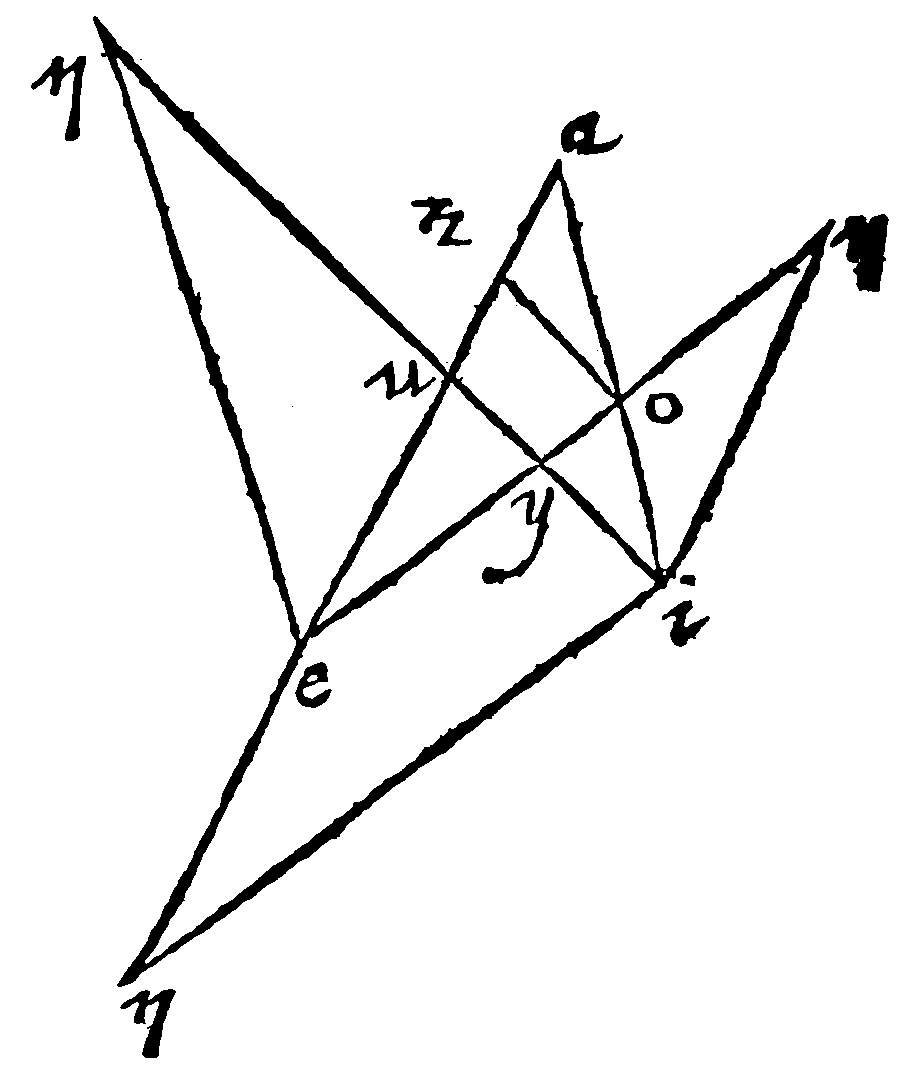
For examples sake, let the first speciall example be demonstrated. I
say therefore, that the reason of ia, unto ao, is made of
the reason of iu, unto uy, multiplied by the reason of
ye, unto eo. For from the beginning of the Antecedent of
the product, to wit, from the point i, let a line be drawne
parallell to the right line ey, which shall meete with ae,
continued or drawne out infinitely in n. Therefore, by the 32. e, as ia, is to ao: so is the
parallell drawne to eo, the Consequent of the second of the
makers. Therefore now the multiplied proportions are thus iu,
uy, in, ey, by the 32. e: ye, eo,
ey, eo. Therefore as the product of iu, by
ye, is unto the product of uy, by eo: So in,
is to eo, that is, ia, to ao.
So let the second of Ptolemy to be taught, which in our Table
aforegoing is the fifth. I say therefore that the reason of io,
unto oa; is made of the reason of iy, unto yu, and
the reason of ue, unto ea. For now againe, from the
beginning of the Antecedent of the Product i, let a line be drawne
parallell unto ea, the Consequent of the second of the Makers,
which shall meete with eo, drawne out at length, in n:
therefore, by the 32. e. as io, is to
ao; so is en, unto ea. Therefore now again the multiplied
proportions are thus:
| ue, | ea, | ue, | ea. |
| iy, | yu, | en, | ue; |
by the 32. e. Therefore, by multiplication of
proportions, the reason of en, unto ea, that is, of io, unto oa, is
made of the reason of iy, unto yu, by the reason of
ue, unto ea.
It shall not be amisse to teach the same in the examples of
Theon. Let us take therefore the reason of the Reflex, unto the
Segment; And of the segments betweene themselves; to wit, the 4. and 6.
examples of our foresaid draught: I say therefore, that the reason of
oe, unto ey, is made of the reason oa, unto
ai, by the reason of iu, unto uy. For from the end
o, to wit, from the beginning of the Antecedent of the product,
let the right line no, be drawne parallell to uy. It shall
be by the 32. e. as oe, is to ey: so
the parallell no, shall be to uy: but the reason of
no, unto uy, is made of the reason of oa, unto
ai, and of iu, unto uy: for the multiplied
proportions are,
| iu, | uy, | iu, | uy. |
| oa, | ai, | on, | iu. |
by the 32. e.
Againe, I say, that the reason of ey, unto yo, is
compounded of the reason of eu, unto ua, and of ai,
unto io.
Theon here draweth a parallell from o, unto ui.
By the generall fabricke it may be drawne out of e, unto ui.
It shall be therefore as ey, is unto yo, so en,
shall be unto oi. Now the proportions multiplied are,
| ai, | io, | ai, | io. |
| eu, | ua, | en, | ai. |
by the 32. e.
Therefore the reason of en, unto io , that is of
ey, unto yo, shall be made of the foresaid
reasons.
Of the segments of divers right lines, the Arabians have much
under the name of The rule of sixe quantities. And the
Theoremes of Althindus, concerning this matter, are in many
mens hands. And Regiomontanus in his Algorithmus: and
Maurolycus upon the 1 p iij. of Menelaus, doe make mention
of them; but they containe nothing, which may not, by any man skillfull
in Arithmeticke, be performed by the multiplication of proportions. For
all those wayes of theirs are no more but speciall examples of that kinde
of multiplication.


