“Come to me, O ye children!
For I hear you at your play;
And the questions that perplexed me
Have vanished quite away.
“Ye open the Eastern windows,
That look towards the sun,
Where thoughts are singing swallows,
And the brooks of morning run.
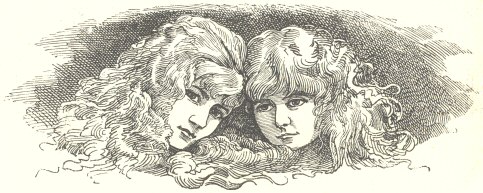
“For what are all our contrivings
And the wisdom of our books,
When compared with your caresses,
And the gladness of your looks?
“Ye are better than all the ballads
That ever were sung or said;
For ye are living poems,
And all the rest are dead.”
Longfellow.
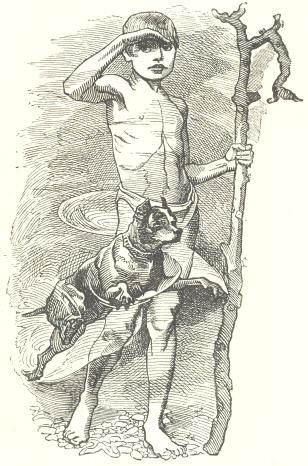 Here begins the
never-to-be-too-much-studied account of the
nine-hundred-and-ninety-ninth part of the wonderful things which
Tom saw on his journey to the Other-end-of-Nowhere; which all
good little children are requested to read; that, if ever they
get to the Other-end-of-Nowhere, as they may very probably do,
they may not burst out laughing, or try to run away, or do any
other silly vulgar thing which may offend Mrs.
Bedonebyasyoudid.
Here begins the
never-to-be-too-much-studied account of the
nine-hundred-and-ninety-ninth part of the wonderful things which
Tom saw on his journey to the Other-end-of-Nowhere; which all
good little children are requested to read; that, if ever they
get to the Other-end-of-Nowhere, as they may very probably do,
they may not burst out laughing, or try to run away, or do any
other silly vulgar thing which may offend Mrs.
Bedonebyasyoudid.
Now, as soon as Tom had left Peacepool, he came to the white
lap of the great sea-mother, ten thousand fathoms deep; where she
makes world-pap all day long, for the steam-giants to knead, and
the fire-giants to bake, till it has risen and hardened into
mountain-loaves and island-cakes.
And there Tom was very near being kneaded up in the world-pap,
and turned into a fossil water-baby; which would have astonished
the Geological Society of New Zealand some hundreds of thousands
of years hence.
For, as he walked along in the silence of the sea-twilight, on
the soft white ocean floor, he was aware of a hissing, and a
roaring, and a thumping, and a pumping, as of all the
steam-engines in the world at once. And, when he came near,
the water grew boiling-hot; not that that hurt him in the least:
but it also grew as foul as gruel; and every moment he stumbled
over dead shells, and fish, and sharks, and seals, and whales,
which had been killed by the hot water.
And at last he came to the great sea-serpent himself, lying
dead at the bottom; and as he was too thick to scramble over, Tom
had to walk round him three-quarters of a mile and more, which
put him out of his path sadly; and, when he had got round, he
came to the place called Stop. And there he stopped, and
just in time.
For he was on the edge of a vast hole in the bottom of the
sea, up which was rushing and roaring clear steam enough to work
all the engines in the world at once; so clear, indeed, that it
was quite light at moments; and Tom could see almost up to the
top of the water above, and down below into the pit for nobody
knows how far.
But, as soon as he bent his head over the edge, he got such a
rap on the nose from pebbles, that he jumped back again; for the
steam, as it rushed up, rasped away the sides of the hole, and
hurled it up into the sea in a shower of mud and gravel and
ashes; and then it spread all around, and sank again, and covered
in the dead fish so fast, that before Tom had stood there five
minutes he was buried in silt up to his ankles, and began to be
afraid that he should have been buried alive.
And perhaps he would have been, but that while he was
thinking, the whole piece of ground on which he stood was torn
off and blown upwards, and away flew Tom a mile up through the
sea, wondering what was coming next.
At last he stopped—thump! and found himself tight in the
legs of the most wonderful bogy which he had ever seen.
It had I don’t know how many wings, as big as the sails
of a windmill, and spread out in a ring like them; and with them
it hovered over the steam which rushed up, as a ball hovers over
the top of a fountain. And for every wing above it had a
leg below, with a claw like a comb at the tip, and a nostril at
the root; and in the middle it had no stomach and one eye; and as
for its mouth, that was all on one side, as the madreporiform
tubercle in a star-fish is. Well, it was a very strange
beast; but no stranger than some dozens which you may see.
“What do you want here,” it cried quite peevishly,
“getting in my way?” and it tried to drop Tom: but he
held on tight to its claws, thinking himself safer where he
was.
So Tom told him who he was, and what his errand was. And
the thing winked its one eye, and sneered:
“I am too old to be taken in in that way. You are
come after gold—I know you are.”
“Gold! What is gold?” And really Tom
did not know; but the suspicious old bogy would not believe
him.
But after a while Tom began to understand a little. For,
as the vapours came up out of the hole, the bogy smelt them with
his nostrils, and combed them and sorted them with his combs; and
then, when they steamed up through them against his wings, they
were changed into showers and streams of metal. From one
wing fell gold-dust, and from another silver, and from another
copper, and from another tin, and from another lead, and so on,
and sank into the soft mud, into veins and cracks, and hardened
there. Whereby it comes to pass that the rocks are full of
metal.
But, all of a sudden, somebody shut off the steam below, and
the hole was left empty in an instant: and then down rushed the
water into the hole, in such a whirlpool that the bogy spun round
and round as fast as a teetotum. But that was all in his
day’s work, like a fair fall with the hounds; so all he did
was to say to Tom—
“Now is your time, youngster, to get down, if you are in
earnest, which I don’t believe.”
“You’ll soon see,” said Tom; and away he
went, as bold as Baron Munchausen, and shot down the rushing
cataract like a salmon at Ballisodare.
And, when he got to the bottom, he swam till he was washed on
shore safe upon the Other-end-of-Nowhere; and he found it, to his
surprise, as most other people do, much more like
This-End-of-Somewhere than he had been in the habit of
expecting.
And first he went through Waste-paper-land, where all the
stupid books lie in heaps, up hill and down dale, like leaves in
a winter wood; and there he saw people digging and grubbing among
them, to make worse books out of bad ones, and thrashing chaff to
save the dust of it; and a very good trade they drove thereby,
especially among children.
Then he went by the sea of slops, to the mountain of messes,
and the territory of tuck, where the ground was very sticky, for
it was all made of bad toffee (not Everton toffee, of course),
and full of deep cracks and holes choked with wind-fallen fruit,
and green goose-berries, and sloes, and crabs, and whinberries,
and hips and haws, and all the nasty things which little children
will eat, if they can get them. But the fairies hide them
out of the way in that country as fast as they can, and very hard
work they have, and of very little use it is. For as fast
as they hide away the old trash, foolish and wicked people make
fresh trash full of lime and poisonous paints, and actually go
and steal receipts out of old Madame Science’s big book to
invent poisons for little children, and sell them at wakes and
fairs and tuck-shops. Very well. Let them go
on. Dr. Letheby and Dr. Hassall cannot catch them, though
they are setting traps for them all day long. But the Fairy
with the birch-rod will catch them all in time, and make them
begin at one corner of their shops, and eat their way out at the
other: by which time they will have got such stomach-aches as
will cure them of poisoning little children.
Next he saw all the little people in the world, writing all
the little books in the world, about all the other little people
in the world; probably because they had no great people to write
about: and if the names of the books were not Squeeky, nor the
Pump-lighter, nor the Narrow Narrow World, nor the Hills of the
Chattermuch, nor the Children’s Twaddeday, why then they
were something else. And, all the rest of the little people
in the world read the books, and thought themselves each as good
as the President; and perhaps they were right, for every one
knows his own business best. But Tom thought he would
sooner have a jolly good fairy tale, about Jack the Giant-killer
or Beauty and the Beast, which taught him something that he
didn’t know already.
And next he came to the centre of Creation (the hub, they call
it there), which lies in latitude 42.21° south, and longitude
108.56° east.
And there he found all the wise people instructing mankind in
the science of spirit-rapping, while their house was burning over
their heads: and when Tom told them of the fire, they held an
indignation meeting forthwith, and unanimously determined to hang
Tom’s dog for coming into their country with gunpowder in
his mouth. Tom couldn’t help saying that though they
did fancy they had carried all the wit away with them out of
Lincolnshire two hundred years ago, yet if they had had one such
Lincolnshire nobleman among them as good old Lord Yarborough, he
would have called for the fire-engines before he hanged other
people’s dogs. But it was of no use, and the dog was
hanged: and Tom couldn’t even have his carcase; for they
had abolished the have-his-carcase act in that country, for fear
lest when rogues fell out, honest men should come by their
own. And so they would have succeeded perfectly, as they
always do, only that (as they also always do) they failed in one
little particular, viz. that the dog would not die, being a
water-dog, but bit their fingers so abominably that they were
forced to let him go, and Tom likewise, as British
subjects. Whereon they recommenced rapping for the spirits
of their fathers; and very much astonished the poor old spirits
were when they came, and saw how, according to the laws of Mrs.
Bedonebyasyoudid, their descendants had weakened their
constitution by hard living.
Then came Tom to the Island of Polupragmosyne (which some call
Rogues’ Harbour; but they are wrong; for that is in the
middle of Bramshill Bushes, and the county police have cleared it
out long ago). There every one knows his neighbour’s
business better than his own; and a very noisy place it is, as
might be expected, considering that all the inhabitants are ex
officio on the wrong side of the house in the
“Parliament of Man, and the Federation of the World;”
and are always making wry mouths, and crying that the
fairies’ grapes were sour.
There Tom saw ploughs drawing horses, nails driving hammers,
birds’ nests taking boys, books making authors, bulls
keeping china-shops, monkeys shaving cats, dead dogs drilling
live lions, blind brigadiers shelfed as principals of colleges,
play-actors not in the least shelfed as popular preachers; and,
in short, every one set to do something which he had not learnt,
because in what he had learnt, or pretended to learn, he had
failed.
There stands the Pantheon of the Great Unsuccessful, from the
builders of the Tower of Babel to those of the Trafalgar
Fountains; in which politicians lecture on the constitutions
which ought to have marched, conspirators on the revolutions
which ought to have succeeded, economists on the schemes which
ought to have made every one’s fortune, and projectors on
the discoveries which ought to have set the Thames on fire.
There cobblers lecture on orthopedy (whatsoever that may be)
because they cannot sell their shoes; and poets on
Æsthetics (whatsoever that may be) because they cannot sell
their poetry. There philosophers demonstrate that England
would be the freest and richest country in the world, if she
would only turn Papist again; penny-a-liners abuse the Times,
because they have not wit enough to get on its staff; and young
ladies walk about with lockets of Charles the First’s hair
(or of somebody else’s, when the Jews’ genuine stock
is used up), inscribed with the neat and appropriate
legend—which indeed is popular through all that land, and
which, I hope, you will learn to translate in due time and to
perpend likewise:—
“Victrix causa diis placuit, sed
victa puellis.”
When he got into the middle of the town, they all set on him
at once, to show him his way; or rather, to show him that he did
not know his way; for as for asking him what way he wanted to go,
no one ever thought of that.
But one pulled him hither, and another poked him thither, and
a third cried—
“You mustn’t go west, I tell you; it is
destruction to go west.”
“But I am not going west, as you may see,” said
Tom.
And another, “The east lies here, my dear; I assure you
this is the east.”
“But I don’t want to go east,” said Tom.
“Well, then, at all events, whichever way you are going,
you are going wrong,” cried they all with one
voice—which was the only thing which they ever agreed
about; and all pointed at once to all the thirty-and-two points
of the compass, till Tom thought all the sign-posts in England
had got together, and fallen fighting.
And whether he would have ever escaped out of the town, it is
hard to say, if the dog had not taken it into his head that they
were going to pull his master in pieces, and tackled them so
sharply about the gastrocnemius muscle, that he gave them some
business of their own to think of at last; and while they were
rubbing their bitten calves, Tom and the dog got safe away.
On the borders of that island he found Gotham, where the wise
men live; the same who dragged the pond because the moon had
fallen into it, and planted a hedge round the cuckoo, to keep
spring all the year. And he found them bricking up the town
gate, because it was so wide that little folks could not get
through. And, when he asked why, they told him they were
expanding their liturgy. So he went on; for it was no
business of his: only he could not help saying that in his
country, if the kitten could not get in at the same hole as the
cat, she might stay outside and mew.
But he saw the end of such fellows, when he came to the island
of the Golden Asses, where nothing but thistles grow. For
there they were all turned into mokes with ears a yard long, for
meddling with matters which they do not understand, as Lucius did
in the story. And like him, mokes they must remain, till,
by the laws of development, the thistles develop into
roses. Till then, they must comfort themselves with the
thought, that the longer their ears are, the thicker their hides;
and so a good beating don’t hurt them.
Then came Tom to the great land of Hearsay, in which are no
less than thirty and odd kings, beside half a dozen Republics,
and perhaps more by next mail.
And there he fell in with a deep, dark, deadly, and
destructive war, waged by the princes and potentates of those
parts, both spiritual and temporal, against what do you
think? One thing I am sure of. That unless I told
you, you would never know; nor how they waged that war either;
for all their strategy and art military consisted in the safe and
easy process of stopping their ears and screaming, “Oh,
don’t tell us!” and then running away.
So when Tom came into that land, he found them all, high and
low, man, woman, and child, running for their lives day and night
continually, and entreating not to be told they didn’t know
what: only the land being an island, and they having a dislike to
the water (being a musty lot for the most part), they ran round
and round the shore for ever, which (as the island was exactly of
the same circumference as the planet on which we have the honour
of living) was hard work, especially to those who had business to
look after. But before them, as bandmaster and fugleman,
ran a gentleman shearing a pig; the melodious strains of which
animal led them for ever, if not to conquest, still to flight;
and kept up their spirits mightily with the thought that they
would at least have the pig’s wool for their pains.
And running after them, day and night, came such a poor, lean,
seedy, hard-worked old giant, as ought to have been cockered up,
and had a good dinner given him, and a good wife found him, and
been set to play with little children; and then he would have
been a very presentable old fellow after all; for he had a heart,
though it was considerably overgrown with brains.
He was made up principally of fish bones and parchment, put
together with wire and Canada balsam; and smelt strongly of
spirits, though he never drank anything but water: but spirits he
used somehow, there was no denying. He had a great pair of
spectacles on his nose, and a butterfly-net in one hand, and a
geological hammer in the other; and was hung all over with
pockets, full of collecting boxes, bottles, microscopes,
telescopes, barometers, ordnance maps, scalpels, forceps,
photographic apparatus, and all other tackle for finding out
everything about everything, and a little more too. And,
most strange of all, he was running not forwards but backwards,
as fast as he could.
Away all the good folks ran from him, except Tom, who stood
his ground and dodged between his legs; and the giant, when he
had passed him, looked down, and cried, as if he was quite
pleased and comforted,—
“What? who are you? And you actually don’t
run away, like all the rest?” But he had to take his
spectacles off, Tom remarked, in order to see him plainly.
Tom told him who he was; and the giant pulled out a bottle and
a cork instantly, to collect him with.
But Tom was too sharp for that, and dodged between his legs
and in front of him; and then the giant could not see him at
all.
“No, no, no!” said Tom, “I’ve not been
round the world, and through the world, and up to Mother
Carey’s haven, beside being caught in a net and called a
Holothurian and a Cephalopod, to be bottled up by any old giant
like you.”
And when the giant understood what a great traveller Tom had
been, he made a truce with him at once, and would have kept him
there to this day to pick his brains, so delighted was he at
finding any one to tell him what he did not know before.
“Ah, you lucky little dog!” said he at last, quite
simply—for he was the simplest, pleasantest, honestest,
kindliest old Dominie Sampson of a giant that ever turned the
world upside down without intending it—“ah, you lucky
little dog! If I had only been where you have been, to see
what you have seen!”
“Well,” said Tom, “if you want to do that,
you had best put your head under water for a few hours, as I did,
and turn into a water-baby, or some other baby, and then you
might have a chance.”
“Turn into a baby, eh? If I could do that, and
know what was happening to me for but one hour, I should know
everything then, and be at rest. But I can’t; I
can’t be a little child again; and I suppose if I could, it
would be no use, because then I should then know nothing about
what was happening to me. Ah, you lucky little dog!”
said the poor old giant.
“But why do you run after all these poor people?”
said Tom, who liked the giant very much.
“My dear, it’s they that have been running after
me, father and son, for hundreds and hundreds of years, throwing
stones at me till they have knocked off my spectacles fifty
times, and calling me a malignant and a turbaned Turk, who beat a
Venetian and traduced the State—goodness only knows what
they mean, for I never read poetry—and hunting me round and
round—though catch me they can’t, for every time I go
over the same ground, I go the faster, and grow the bigger.
While all I want is to be friends with them, and to tell them
something to their advantage, like Mr. Joseph Ady: only somehow
they are so strangely afraid of hearing it. But, I suppose
I am not a man of the world, and have no tact.”
“But why don’t you turn round and tell them
so?”
“Because I can’t. You see, I am one of the
sons of Epimetheus, and must go backwards, if I am to go at
all.”
“But why don’t you stop, and let them come up to
you?”
“Why, my dear, only think. If I did, all the
butterflies and cockyolybirds would fly past me, and then I
should catch no more new species, and should grow rusty and
mouldy, and die. And I don’t intend to do that, my
dear; for I have a destiny before me, they say: though what it is
I don’t know, and don’t care.”
“Don’t care?” said Tom.
“No. Do the duty which lies nearest you, and catch
the first beetle you come across, is my motto; and I have thriven
by it for some hundred years. Now I must go on. Dear
me, while I have been talking to you, at least nine new species
have escaped me.”
And on went the giant, behind before, like a bull in a
china-shop, till he ran into the steeple of the great idol temple
(for they are all idolaters in those parts, of course, else they
would never be afraid of giants), and knocked the upper half
clean off, hurting himself horribly about the small of the
back.
But little he cared; for as soon as the ruins of the steeple
were well between his legs, he poked and peered among the falling
stones, and shifted his spectacles, and pulled out his
pocket-magnifier, and cried—
“An entirely new Oniscus, and three obscure
Podurellæ! Besides a moth which M. le Roi des
Papillons (though he, like all Frenchmen, is given to hasty
inductions) says is confined to the limits of the Glacial
Drift. This is most important!”
And down he sat on the nave of the temple (not being a man of
the world) to examine his Podurellæ. Whereon (as was
to be expected) the roof caved in bodily, smashing the idols, and
sending the priests flying out of doors and windows, like rabbits
out of a burrow when a ferret goes in.
But he never heeded; for out of the dust flew a bat, and the
giant had him in a moment.
“Dear me! This is even more important! Here
is a cognate species to that which Macgilliwaukie Brown insists
is confined to the Buddhist temples of Little Thibet; and now
when I look at it, it may be only a variety produced by
difference of climate!”
And having bagged his bat, up he got, and on he went; while
all the people ran, being in none the better humour for having
their temple smashed for the sake of three obscure species of
Podurella, and a Buddhist bat.
“Well,” thought Tom, “this is a very pretty
quarrel, with a good deal to be said on both sides. But it
is no business of mine.”
And no more it was, because he was a water-baby, and had the
original sow by the right ear; which you will never have, unless
you be a baby, whether of the water, the land, or the air,
matters not, provided you can only keep on continually being a
baby.
So the giant ran round after the people, and the people ran
round after the giant, and they are running, unto this day for
aught I know, or do not know; and will run till either he, or
they, or both, turn into little children. And then, as
Shakespeare says (and therefore it must be true)—
“Jack shall have Gill
Nought shall go ill
The man shall have his mare again, and all go
well.”
Then Tom came to a very famous island, which was called, in
the days of the great traveller Captain Gulliver, the Isle of
Laputa. But Mrs. Bedonebyasyoudid has named it over again
the Isle of Tomtoddies, all heads and no bodies.
And when Tom came near it, he heard such a grumbling and
grunting and growling and wailing and weeping and whining that he
thought people must be ringing little pigs, or cropping
puppies’ ears, or drowning kittens: but when he came nearer
still, he began to hear words among the noise; which was the
Tomtoddies’ song which they sing morning and evening, and
all night too, to their great idol Examination—
“I can’t learn my lesson:
the examiner’s coming!”
And that was the only song which they knew.
And when Tom got on shore the first thing he saw was a great
pillar, on one side of which was inscribed, “Playthings not
allowed here;” at which he was so shocked that he would not
stay to see what was written on the other side. Then he
looked round for the people of the island: but instead of men,
women, and children, he found nothing but turnips and radishes,
beet and mangold wurzel, without a single green leaf among them,
and half of them burst and decayed, with toad-stools growing out
of them. Those which were left began crying to Tom, in half
a dozen different languages at once, and all of them badly
spoken, “I can’t learn my lesson; do come and help
me!” And one cried, “Can you show me how to
extract this square root?”
And another, “Can you tell me the distance between
α Lyræ and β Camelopardis?”
And another, “What is the latitude and longitude of
Snooksville, in Noman’s County, Oregon, U.S.?”
And another, “What was the name of Mutius
Scævola’s thirteenth cousin’s
grandmother’s maid’s cat?”
And another, “How long would it take a school-inspector
of average activity to tumble head over heels from London to
York?”
And another, “Can you tell me the name of a place that
nobody ever heard of, where nothing ever happened, in a country
which has not been discovered yet?”
And another, “Can you show me how to correct this
hopelessly corrupt passage of Graidiocolosyrtus Tabenniticus, on
the cause why crocodiles have no tongues?”
And so on, and so on, and so on, till one would have thought
they were all trying for tide-waiters’ places, or
cornetcies in the heavy dragoons.
“And what good on earth will it do you if I did tell
you?” quoth Tom.
Well, they didn’t know that: all they knew was the
examiner was coming.
Then Tom stumbled on the hugest and softest nimblecomequick
turnip you ever saw filling a hole in a crop of swedes, and it
cried to him, “Can you tell me anything at all about
anything you like?”
“About what?” says Tom.
“About anything you like; for as fast as I learn things
I forget them again. So my mamma says that my intellect is
not adapted for methodic science, and says that I must go in for
general information.”
Tom told him that he did not know general information, nor any
officers in the army; only he had a friend once that went for a
drummer: but he could tell him a great many strange things which
he had seen in his travels.
So he told him prettily enough, while the poor turnip listened
very carefully; and the more he listened, the more he forgot, and
the more water ran out of him.
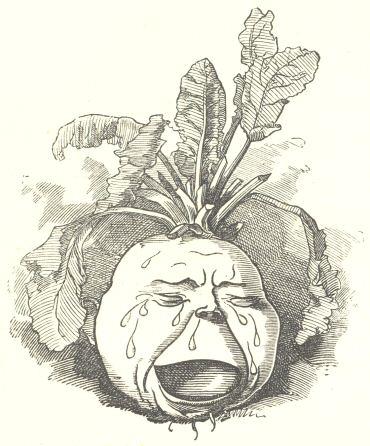
Tom thought he was crying: but it was only his poor brains
running away, from being worked so hard; and as Tom talked, the
unhappy turnip streamed down all over with juice, and split and
shrank till nothing was left of him but rind and water; whereat
Tom ran away in a fright, for he thought he might be taken up for
killing the turnip.
 But, on the contrary, the turnip’s parents were highly
delighted, and considered him a saint and a martyr, and put up a
long inscription over his tomb about his wonderful talents, early
development, and unparalleled precocity. Were they not a
foolish couple? But there was a still more foolish couple
next to them, who were beating a wretched little radish, no
bigger than my thumb, for sullenness and obstinacy and wilful
stupidity, and never knew that the reason why it couldn’t
learn or hardly even speak was, that there was a great worm
inside it eating out all its brains. But even they are no
foolisher than some hundred score of papas and mammas, who fetch
the rod when they ought to fetch a new toy, and send to the dark
cupboard instead of to the doctor.
But, on the contrary, the turnip’s parents were highly
delighted, and considered him a saint and a martyr, and put up a
long inscription over his tomb about his wonderful talents, early
development, and unparalleled precocity. Were they not a
foolish couple? But there was a still more foolish couple
next to them, who were beating a wretched little radish, no
bigger than my thumb, for sullenness and obstinacy and wilful
stupidity, and never knew that the reason why it couldn’t
learn or hardly even speak was, that there was a great worm
inside it eating out all its brains. But even they are no
foolisher than some hundred score of papas and mammas, who fetch
the rod when they ought to fetch a new toy, and send to the dark
cupboard instead of to the doctor.
Tom was so puzzled and frightened with all he saw, that he was
longing to ask the meaning of it; and at last he stumbled over a
respectable old stick lying half covered with earth. But a
very stout and worthy stick it was, for it belonged to good Roger
Ascham in old time, and had carved on its head King Edward the
Sixth, with the Bible in his hand.
“You see,” said the stick, “there were as
pretty little children once as you could wish to see, and might
have been so still if they had been only left to grow up like
human beings, and then handed over to me; but their foolish
fathers and mothers, instead of letting them pick flowers, and
make dirt-pies, and get birds’ nests, and dance round the
gooseberry bush, as little children should, kept them always at
lessons, working, working, working, learning week-day lessons all
week-days, and Sunday lessons all Sunday, and weekly examinations
every Saturday, and monthly examinations every month, and yearly
examinations every year, everything seven times over, as if once
was not enough, and enough as good as a feast—till their
brains grew big, and their bodies grew small, and they were all
changed into turnips, with little but water inside; and still
their foolish parents actually pick the leaves off them as fast
as they grow, lest they should have anything green about
them.”
“Ah!” said Tom, “if dear Mrs.
Doasyouwouldbedoneby knew of it she would send them a lot of
tops, and balls, and marbles, and ninepins, and make them all as
jolly as sand-boys.”
“It would be no use,” said the stick.
“They can’t play now, if they tried.
Don’t you see how their legs have turned to roots and grown
into the ground, by never taking any exercise, but sapping and
moping always in the same place? But here comes the
Examiner-of-all-Examiners. So you had better get away, I
warn you, or he will examine you and your dog into the bargain,
and set him to examine all the other dogs, and you to examine all
the other water-babies. There is no escaping out of his
hands, for his nose is nine thousand miles long, and can go down
chimneys, and through keyholes, upstairs, downstairs, in my
lady’s chamber, examining all little boys, and the little
boys’ tutors likewise. But when he is
thrashed—so Mrs. Bedonebyasyoudid has promised me—I
shall have the thrashing of him: and if I don’t lay it on
with a will it’s a pity.”
Tom went off: but rather slowly and surlily; for he was
somewhat minded to face this same Examiner-of-all-Examiners, who
came striding among the poor turnips, binding heavy burdens and
grievous to be borne, and laying them on little children’s
shoulders, like the Scribes and Pharisees of old, and not
touching the same with one of his fingers; for he had plenty of
money, and a fine house to live in, and so forth; which was more
than the poor little turnips had.
But when he got near, he looked so big and burly and
dictatorial, and shouted so loud to Tom, to come and be examined,
that Tom ran for his life, and the dog too. And really it
was time; for the poor turnips, in their hurry and fright,
crammed themselves so fast to be ready for the Examiner, that
they burst and popped by dozens all round him, till the place
sounded like Aldershot on a field-day, and Tom thought he should
be blown into the air, dog and all.
As he went down to the shore he passed the poor turnip’s
new tomb. But Mrs. Bedonebyasyoudid had taken away the
epitaph about talents and precocity and development, and put up
one of her own instead which Tom thought much more
sensible:—
“Instruction sore long time I
bore,
And cramming was in vain;
Till heaven did please my woes to ease
With water on the brain.”
So Tom jumped into the sea, and swam on his way,
singing:—
“Farewell, Tomtoddies all;
I thank my stars
That nought I know save those three royal r’s:
Reading and riting sure, with rithmetick,
Will help a lad of sense through thin and
thick.”
Whereby you may see that Tom was no poet: but no more was John
Bunyan, though he was as wise a man as you will meet in a month
of Sundays.
And next he came to Oldwivesfabledom, where the folks were all
heathens, and worshipped a howling ape. And there he found
a little boy sitting in the middle of the road, and crying
bitterly.
“What are you crying for?” said Tom.
“Because I am not as frightened as I could wish to
be.”
“Not frightened? You are a queer little chap: but,
if you want to be frightened, here goes—Boo!”
“Ah,” said the little boy, “that is very
kind of you; but I don’t feel that it has made any
impression.”
Tom offered to upset him, punch him, stamp on him, fettle him
over the head with a brick, or anything else whatsoever which
would give him the slightest comfort.
But he only thanked Tom very civilly, in fine long words which
he had heard other folk use, and which therefore, he thought were
fit and proper to use himself; and cried on till his papa and
mamma came, and sent off for the Powwow man immediately.
And a very good-natured gentleman and lady they were, though they
were heathens; and talked quite pleasantly to Tom about his
travels, till the Powwow man arrived, with his thunderbox under
his arm.
And a well-fed, ill-favoured gentleman he was, as ever served
Her Majesty at Portland. Tom was a little frightened at
first; for he thought it was Grimes. But he soon saw his
mistake: for Grimes always looked a man in the face; and this
fellow never did. And when he spoke, it was fire and smoke;
and when he sneezed, it was squibs and crackers; and when he
cried (which he did whenever it paid him), it was boiling pitch;
and some of it was sure to stick.
“Here we are again!” cried he, like the clown in a
pantomime. “So you can’t feel frightened, my
little dear—eh? I’ll do that for you.
I’ll make an impression on you! Yah! Boo!
Whirroo! Hullabaloo!”
And he rattled, thumped, brandished his thunderbox, yelled,
shouted, raved, roared, stamped, and danced corrobory like any
black fellow; and then he touched a spring in the thunderbox, and
out popped turnip-ghosts and magic-lanthorns and pasteboard
bogies and spring-heeled Jacks, and sallaballas, with such a
horrid din, clatter, clank, roll, rattle, and roar, that the
little boy turned up the whites of his eyes, and fainted right
away.
And at that his poor heathen papa and mamma were as much
delighted as if they had found a gold mine; and fell down upon
their knees before the Powwow man, and gave him a palanquin with
a pole of solid silver and curtains of cloth of gold; and carried
him about in it on their own backs: but as soon as they had taken
him up, the pole stuck to their shoulders, and they could not set
him down any more, but carried him on willynilly, as Sinbad
carried the old man of the sea: which was a pitiable sight to
see; for the father was a very brave officer, and wore two swords
and a blue button; and the mother was as pretty a lady as ever
had pinched feet like a Chinese. But you see, they had
chosen to do a foolish thing just once too often; so, by the laws
of Mrs. Bedonebyasyoudid, they had to go on doing it whether they
chose or not, till the coming of the Cocqcigrues.
Ah! don’t you wish that some one would go and convert
those poor heathens, and teach them not to frighten their little
children into fits?
“Now, then,” said the Powwow man to Tom,
“wouldn’t you like to be frightened, my little
dear? For I can see plainly that you are a very wicked,
naughty, graceless, reprobate boy.”
“You’re another,” quoth Tom, very
sturdily. And when the man ran at him, and cried
“Boo!” Tom ran at him in return, and cried
“Boo!” likewise, right in his face, and set the
little dog upon him; and at his legs the dog went.
At which, if you will believe it, the fellow turned tail,
thunderbox and all, with a “Woof!” like an old sow on
the common; and ran for his life, screaming, “Help!
thieves! murder! fire! He is going to kill me! I am a
ruined man! He will murder me; and break, burn, and destroy
my precious and invaluable thunderbox; and then you will have no
more thunder-showers in the land. Help! help!
help!”
At which the papa and mamma and all the people of
Oldwivesfabledom flew at Tom, shouting, “Oh, the wicked,
impudent, hard-hearted, graceless boy! Beat him, kick him,
shoot him, drown him, hang him, burn him!” and so forth:
but luckily they had nothing to shoot, hang, or burn him with,
for the fairies had hid all the killing-tackle out of the way a
little while before; so they could only pelt him with stones; and
some of the stones went clean through him, and came out the other
side. But he did not mind that a bit; for the holes closed
up again as fast as they were made, because he was a
water-baby. However, he was very glad when he was safe out
of the country, for the noise there made him all but deaf.
Then he came to a very quiet place, called
Leaveheavenalone. And there the sun was drawing water out
of the sea to make steam-threads, and the wind was twisting them
up to make cloud-patterns, till they had worked between them the
loveliest wedding veil of Chantilly lace, and hung it up in their
own Crystal Palace for any one to buy who could afford it; while
the good old sea never grudged, for she knew they would pay her
back honestly. So the sun span, and the wind wove, and all
went well with the great steam-loom; as is likely,
considering—and considering—and
considering—
And at last, after innumerable adventures, each more wonderful
than the last, he saw before him a huge building, much bigger,
and—what is most surprising—a little uglier than a
certain new lunatic asylum, but not built quite of the same
materials. None of it, at least—or, indeed, for aught
that I ever saw, any part of any other building
whatsoever—is cased with nine-inch brick inside and out,
and filled up with rubble between the walls, in order that any
gentleman who has been confined during Her Majesty’s
pleasure may be unconfined during his own pleasure, and take a
walk in the neighbouring park to improve his spirits, after an
hour’s light and wholesome labour with his dinner-fork or
one of the legs of his iron bedstead. No. The walls
of this building were built on an entirely different principle,
which need not be described, as it has not yet been
discovered.
 Tom walked towards this great building, wondering what it
was, and having a strange fancy that he might find Mr. Grimes
inside it, till he saw running toward him, and shouting
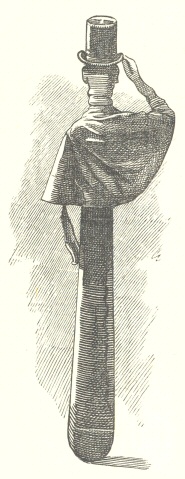
“Stop!” three or four people, who, when they came
nearer, were nothing else than policemen’s truncheons,
running along without legs or arms.
Tom walked towards this great building, wondering what it
was, and having a strange fancy that he might find Mr. Grimes
inside it, till he saw running toward him, and shouting
“Stop!” three or four people, who, when they came
nearer, were nothing else than policemen’s truncheons,
running along without legs or arms.
Tom was not astonished. He was long past that.
Besides, he had seen the naviculæ in the water move nobody
knows how, a hundred times, without arms, or legs, or anything to
stand in their stead. Neither was he frightened for he had
been doing no harm.
So he stopped; and, when the foremost truncheon came up and
asked his business, he showed Mother Carey’s pass; and the
truncheon looked at it in the oddest fashion; for he had one eye
in the middle of his upper end, so that when he looked at
anything, being quite stiff, he had to slope himself, and poke
himself, till it was a wonder why he did not tumble over; but,
being quite full of the spirit of justice (as all policemen, and
their truncheons, ought to be), he was always in a position of
stable equilibrium, whichever way he put himself.
“All right—pass on,” said he at last.
And then he added: “I had better go with you, young
man.” And Tom had no objection, for such company was
both respectable and safe; so the truncheon coiled its thong
neatly round its handle, to prevent tripping itself up—for
the thong had got loose in running—and marched on by
Tom’s side.
“Why have you no policeman to carry you?” asked
Tom, after a while.
“Because we are not like those clumsy-made truncheons in
the land-world, which cannot go without having a whole man to
carry them about. We do our own work for ourselves; and do
it very well, though I say it who should not.”
“Then why have you a thong to your handle?” asked
Tom.
“To hang ourselves up by, of course, when we are off
duty.”
Tom had got his answer, and had no more to say, till they came
up to the great iron door of the prison. And there the
truncheon knocked twice, with its own head.
A wicket in the door opened, and out looked a tremendous old
brass blunderbuss charged up to the muzzle with slugs, who was
the porter; and Tom started back a little at the sight of
him.
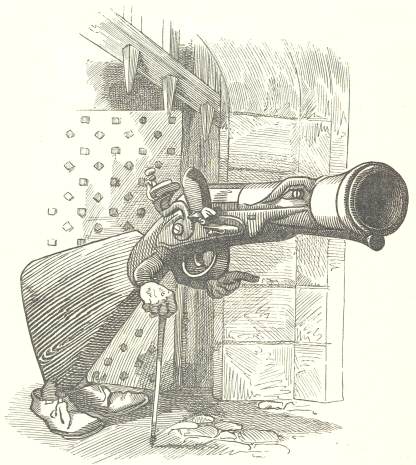
“What case is this?” he asked in a deep voice, out
of his broad bell mouth.
“If you please, sir, it is no case; only a young
gentleman from her ladyship, who wants to see Grimes, the
master-sweep.”
“Grimes?” said the blunderbuss. And he
pulled in his muzzle, perhaps to look over his prison-lists.
“Grimes is up chimney No. 345,” he said from
inside. “So the young gentleman had better go on to
the roof.”
Tom looked up at the enormous wall, which seemed at least
ninety miles high, and wondered how he should ever get up: but,
when he hinted that to the truncheon, it settled the matter in a
moment. For it whisked round, and gave him such a shove
behind as sent him up to the roof in no time, with his little dog
under his arm.
And there he walked along the leads, till he met another
truncheon, and told him his errand.
“Very good,” it said. “Come along: but
it will be of no use. He is the most unremorseful,
hard-hearted, foul-mouthed fellow I have in charge; and thinks
about nothing but beer and pipes, which are not allowed here, of
course.”
So they walked along over the leads, and very sooty they were,
and Tom thought the chimneys must want sweeping very much.
But he was surprised to see that the soot did not stick to his
feet, or dirty them in the least. Neither did the live
coals, which were lying about in plenty, burn him; for, being a
water-baby, his radical humours were of a moist and cold nature,
as you may read at large in Lemnius, Cardan, Van Helmont, and
other gentlemen, who knew as much as they could, and no man can
know more.
And at last they came to chimney No. 345. Out of the top
of it, his head and shoulders just showing, stuck poor Mr.
Grimes, so sooty, and bleared, and ugly, that Tom could hardly
bear to look at him. And in his mouth was a pipe; but it
was not a-light; though he was pulling at it with all his
might.
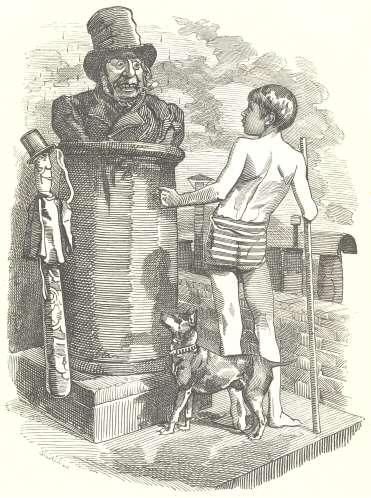
“Attention, Mr. Grimes,” said the truncheon;
“here is a gentleman come to see you.”
But Mr. Grimes only said bad words; and kept grumbling,
“My pipe won’t draw. My pipe won’t
draw.”
“Keep a civil tongue, and attend!” said the
truncheon; and popped up just like Punch, hitting Grimes such a
crack over the head with itself, that his brains rattled inside
like a dried walnut in its shell. He tried to get his hands
out, and rub the place: but he could not, for they were stuck
fast in the chimney. Now he was forced to attend.
“Hey!” he said, “why, it’s Tom!
I suppose you have come here to laugh at me, you spiteful little
atomy?”
Tom assured him he had not, but only wanted to help him.
“I don’t want anything except beer, and that I
can’t get; and a light to this bothering pipe, and that I
can’t get either.”
“I’ll get you one,” said Tom; and he took up
a live coal (there were plenty lying about) and put it to
Grimes’ pipe: but it went out instantly.
“It’s no use,” said the truncheon, leaning
itself up against the chimney and looking on. “I tell
you, it is no use. His heart is so cold that it freezes
everything that comes near him. You will see that
presently, plain enough.”
“Oh, of course, it’s my fault.
Everything’s always my fault,” said Grimes.
“Now don’t go to hit me again” (for the
truncheon started upright, and looked very wicked); “you
know, if my arms were only free, you daren’t hit me
then.”
The truncheon leant back against the chimney, and took no
notice of the personal insult, like a well-trained policeman as
it was, though he was ready enough to avenge any transgression
against morality or order.
“But can’t I help you in any other way?
Can’t I help you to get out of this chimney?” said
Tom.
“No,” interposed the truncheon; “he has come
to the place where everybody must help themselves; and he will
find it out, I hope, before he has done with me.”
“Oh, yes,” said Grimes, “of course
it’s me. Did I ask to be brought here into the
prison? Did I ask to be set to sweep your foul
chimneys? Did I ask to have lighted straw put under me to
make me go up? Did I ask to stick fast in the very first
chimney of all, because it was so shamefully clogged up with
soot? Did I ask to stay here—I don’t know how
long—a hundred years, I do believe, and never get my pipe,
nor my beer, nor nothing fit for a beast, let alone a
man?”
“No,” answered a solemn voice behind.
“No more did Tom, when you behaved to him in the very same
way.”
It was Mrs. Bedonebyasyoudid. And, when the truncheon
saw her, it started bolt upright—Attention!—and made
such a low bow, that if it had not been full of the spirit of
justice, it must have tumbled on its end, and probably hurt its
one eye. And Tom made his bow too.
“Oh, ma’am,” he said, “don’t
think about me; that’s all past and gone, and good times
and bad times and all times pass over. But may not I help
poor Mr. Grimes? Mayn’t I try and get some of these
bricks away, that he may move his arms?”
“You may try, of course,” she said.
So Tom pulled and tugged at the bricks: but he could not move
one. And then he tried to wipe Mr. Grimes’ face: but
the soot would not come off.
“Oh, dear!” he said. “I have come all
this way, through all these terrible places, to help you, and now
I am of no use at all.”
“You had best leave me alone,” said Grimes;
“you are a good-natured forgiving little chap, and
that’s truth; but you’d best be off. The
hail’s coming on soon, and it will beat the eyes out of
your little head.”
“What hail?”
“Why, hail that falls every evening here; and, till it
comes close to me, it’s like so much warm rain: but then it
turns to hail over my head, and knocks me about like small
shot.”
“That hail will never come any more,” said the
strange lady. “I have told you before what it
was. It was your mother’s tears, those which she shed
when she prayed for you by her bedside; but your cold heart froze
it into hail. But she is gone to heaven now, and will weep
no more for her graceless son.”
Then Grimes was silent awhile; and then he looked very
sad.
“So my old mother’s gone, and I never there to
speak to her! Ah! a good woman she was, and might have been
a happy one, in her little school there in Vendale, if it
hadn’t been for me and my bad ways.”
“Did she keep the school in Vendale?” asked
Tom. And then he told Grimes all the story of his going to
her house, and how she could not abide the sight of a
chimney-sweep, and then how kind she was, and how he turned into
a water-baby.
“Ah!” said Grimes, “good reason she had to
hate the sight of a chimney-sweep. I ran away from her and
took up with the sweeps, and never let her know where I was, nor
sent her a penny to help her, and now it’s too
late—too late!” said Mr. Grimes.
And he began crying and blubbering like a great baby, till his
pipe dropped out of his mouth, and broke all to bits.
“Oh, dear, if I was but a little chap in Vendale again,
to see the clear beck, and the apple-orchard, and the yew-hedge,
how different I would go on! But it’s too late
now. So you go along, you kind little chap, and don’t
stand to look at a man crying, that’s old enough to be your
father, and never feared the face of man, nor of worse
neither. But I’m beat now, and beat I must be.
I’ve made my bed, and I must lie on it. Foul I would
be, and foul I am, as an Irishwoman said to me once; and little I
heeded it. It’s all my own fault: but it’s too
late.” And he cried so bitterly that Tom began crying
too.
“Never too late,” said the fairy, in such a
strange soft new voice that Tom looked up at her; and she was so
beautiful for the moment, that Tom half fancied she was her
sister.
No more was it too late. For, as poor Grimes cried and
blubbered on, his own tears did what his mother’s could not
do, and Tom’s could not do, and nobody’s on earth
could do for him; for they washed the soot off his face and off
his clothes; and then they washed the mortar away from between
the bricks; and the chimney crumbled down; and Grimes began to
get out of it.
Up jumped the truncheon, and was going to hit him on the crown
a tremendous thump, and drive him down again like a cork into a
bottle. But the strange lady put it aside.
“Will you obey me if I give you a chance?”
“As you please, ma’am. You’re stronger
than me—that I know too well, and wiser than me, I know too
well also. And, as for being my own master, I’ve
fared ill enough with that as yet. So whatever your
ladyship pleases to order me; for I’m beat, and
that’s the truth.”
“Be it so then—you may come out. But
remember, disobey me again, and into a worse place still you
go.”
“I beg pardon ma’am, but I never disobeyed you
that I know of. I never had the honour of setting eyes upon
you till I came to these ugly quarters.”
“Never saw me? Who said to you, Those that will be
foul, foul they will be?”
Grimes looked up; and Tom looked up too; for the voice was
that of the Irishwoman who met them the day that they went out
together to Harthover. “I gave you your warning then:
but you gave it yourself a thousand times before and since.
Every bad word that you said—every cruel and mean thing
that you did—every time that you got tipsy—every day
that you went dirty—you were disobeying me, whether you
knew it or not.”
“If I’d only known, ma’am—”
“You knew well enough that you were disobeying
something, though you did not know it was me. But come out
and take your chance. Perhaps it may be your
last.”
So Grimes stepped out of the chimney, and really, if it had
not been for the scars on his face, he looked as clean and
respectable as a master-sweep need look.
“Take him away,” said she to the truncheon,
“and give him his ticket-of-leave.”
“And what is he to do, ma’am?”
“Get him to sweep out the crater of Etna; he will find
some very steady men working out their time there, who will teach
him his business: but mind, if that crater gets choked again, and
there is an earthquake in consequence, bring them all to me, and
I shall investigate the case very severely.”
So the truncheon marched off Mr. Grimes, looking as meek as a
drowned worm.
And for aught I know, or do not know, he is sweeping the
crater of Etna to this very day.
“And now,” said the fairy to Tom, “your work
here is done. You may as well go back again.”
“I should be glad enough to go,” said Tom,
“but how am I to get up that great hole again, now the
steam has stopped blowing?”
“I will take you up the backstairs: but I must bandage
your eyes first; for I never allow anybody to see those
backstairs of mine.”
“I am sure I shall not tell anybody about them,
ma’am, if you bid me not.”
“Aha! So you think, my little man. But you
would soon forget your promise if you got back into the
land-world. For, if people only once found out that you had
been up my backstairs, you would have all the fine ladies
kneeling to you, and the rich men emptying their purses before
you, and statesmen offering you place and power; and young and
old, rich and poor, crying to you, ‘Only tell us the great
backstairs secret, and we will be your slaves; we will make you
lord, king, emperor, bishop, archbishop, pope, if you
like—only tell us the secret of the backstairs. For
thousands of years we have been paying, and petting, and obeying,
and worshipping quacks who told us they had the key of the
backstairs, and could smuggle us up them; and in spite of all our
disappointments, we will honour, and glorify, and adore, and
beatify, and translate, and apotheotise you likewise, on the
chance of your knowing something about the backstairs, that we
may all go on pilgrimage to it; and, even if we cannot get up it,
lie at the foot of it, and cry—
‘Oh, backstairs,
precious backstairs,
invaluable backstairs,
requisite backstairs,
necessary backstairs,
good-natured backstairs,
cosmopolitan backstairs,
comprehensive backstairs,
accommodating backstairs,
well-bred backstairs,
commercial backstairs,
economical backstairs,
practical backstairs,
logical backstairs,
deductive backstairs,
comfortable backstairs,
humane backstairs,
reasonable backstairs,
long-sought backstairs,
coveted backstairs,
aristocratic backstairs,
respectable backstairs,
gentlenmanlike backstairs,
ladylike backstairs,
orthodox backstairs,
probable backstairs,
credible backstairs,
demonstrable backstairs,
irrefragable backstairs,
potent backstairs,
all-but-omnipotent backstairs,
&c.
Save us from the consequences of our own actions, and from the
cruel fairy, Mrs. Bedonebyasyoudid!’ Do not you think
that you would be a little tempted then to tell what you know,
laddie?”
Tom thought so certainly. “But why do they want so
to know about the backstairs?” asked he, being a little
frightened at the long words, and not understanding them the
least; as, indeed, he was not meant to do, or you either.
“That I shall not tell you. I never put things
into little folks’ heads which are but too likely to come
there of themselves. So come—now I must bandage your
eyes.” So she tied the bandage on his eyes with one
hand, and with the other she took it off.
“Now,” she said, “you are safe up the
stairs.” Tom opened his eyes very wide, and his mouth
too; for he had not, as he thought, moved a single step.
But, when he looked round him, there could be no doubt that he
was safe up the backstairs, whatsoever they may be, which no man
is going to tell you, for the plain reason that no man knows.
The first thing which Tom saw was the black cedars, high and
sharp against the rosy dawn; and St. Brandan’s Isle
reflected double in the still broad silver sea. The wind
sang softly in the cedars, and the water sang among the eaves:
the sea-birds sang as they streamed out into the ocean, and the
land-birds as they built among the boughs; and the air was so
full of song that it stirred St. Brandan and his hermits, as they
slumbered in the shade; and they moved their good old lips, and
sang their morning hymn amid their dreams. But among all
the songs one came across the water more sweet and clear than
all; for it was the song of a young girl’s voice.
And what was the song which she sang? Ah, my little man,
I am too old to sing that song, and you too young to understand
it. But have patience, and keep your eye single, and your
hands clean, and you will learn some day to sing it yourself,
without needing any man to teach you.
And as Tom neared the island, there sat upon a rock the most
graceful creature that ever was seen, looking down, with her chin
upon her hand, and paddling with her feet in the water. And
when they came to her she looked up, and behold it was Ellie.
“Oh, Miss Ellie,” said he, “how you are
grown!”
“Oh, Tom,” said she, “how you are grown
too!”
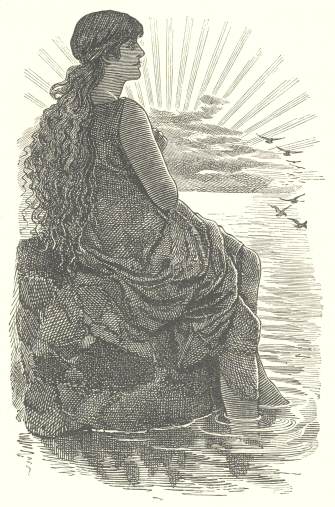
And no wonder; they were both quite grown up—he into a
tall man, and she into a beautiful woman.
“Perhaps I may be grown,” she said. “I
have had time enough; for I have been sitting here waiting for
you many a hundred years, till I thought you were never
coming.”
“Many a hundred years?” thought Tom; but he had
seen so much in his travels that he had quite given up being
astonished; and, indeed, he could think of nothing but
Ellie. So he stood and looked at Ellie, and Ellie looked at
him; and they liked the employment so much that they stood and
looked for seven years more, and neither spoke nor stirred.
At last they heard the fairy say: “Attention,
children. Are you never going to look at me
again?”
“We have been looking at you all this while,” they
said. And so they thought they had been.
“Then look at me once more,” said she.
They looked—and both of them cried out at once,
“Oh, who are you, after all?”
“You are our dear Mrs. Doasyouwouldbedoneby.”
“No, you are good Mrs. Bedonebyasyoudid; but you are
grown quite beautiful now!”
“To you,” said the fairy. “But look
again.”
“You are Mother Carey,” said Tom, in a very low,
solemn voice; for he had found out something which made him very
happy, and yet frightened him more than all that he had ever
seen.
“But you are grown quite young again.”
“To you,” said the fairy. “Look
again.”
“You are the Irishwoman who met me the day I went to
Harthover!”
And when they looked she was neither of them, and yet all of
them at once.
“My name is written in my eyes, if you have eyes to see
it there.”
And they looked into her great, deep, soft eyes, and they
changed again and again into every hue, as the light changes in a
diamond.
“Now read my name,” said she, at last.
And her eyes flashed, for one moment, clear, white, blazing
light: but the children could not read her name; for they were
dazzled, and hid their faces in their hands.
“Not yet, young things, not yet,” said she,
smiling; and then she turned to Ellie.
“You may take him home with you now on Sundays,
Ellie. He has won his spurs in the great battle, and become
fit to go with you and be a man; because he has done the thing he
did not like.”
So Tom went home with Ellie on Sundays, and sometimes on
week-days, too; and he is now a great man of science, and can
plan railroads, and steam-engines, and electric telegraphs, and
rifled guns, and so forth; and knows everything about everything,
except why a hen’s egg don’t turn into a crocodile,
and two or three other little things which no one will know till
the coming of the Cocqcigrues. And all this from what he
learnt when he was a water-baby, underneath the sea.
“And of course Tom married Ellie?”
My dear child, what a silly notion! Don’t you know
that no one ever marries in a fairy tale, under the rank of a
prince or a princess?
“And Tom’s dog?”
Oh, you may see him any clear night in July; for the old
dog-star was so worn out by the last three hot summers that there
have been no dog-days since; so that they had to take him down
and put Tom’s dog up in his place. Therefore, as new
brooms sweep clean, we may hope for some warm weather this
year. And that is the end of my story.


