Before "giving up his soul to God" in the
Palace of Westminster, the fourth Edward nominated
his brother Richard, Duke of Gloucester, as
Protector of England during the minority of Edward
the Fifth. The choice was one of which the
nation could not but approve. Richard was in the
thirty-first year of his life, and in the full vigor of
his intellect; with faculties refined by education
and sharpened by use; knowledge of mankind, acquired
in civil strife and in the experience of startling
vicissitudes of fortune; a courage in battle
which had made his slight form and grisly cognizance
terrible to foes on fields of fame; a genius
for war which had given him an enviable reputation
throughout Christendom; a temper hitherto so
carefully kept under restraint that any man hinting
at the excess of its ferocity would have been deemed
insane; and an ambition hitherto so well masked
by affected humility that no one could have imagined
it capable of prompting political crimes, unjustifiable,
save by those Italian maxims associated with
the name of Machiavelli.
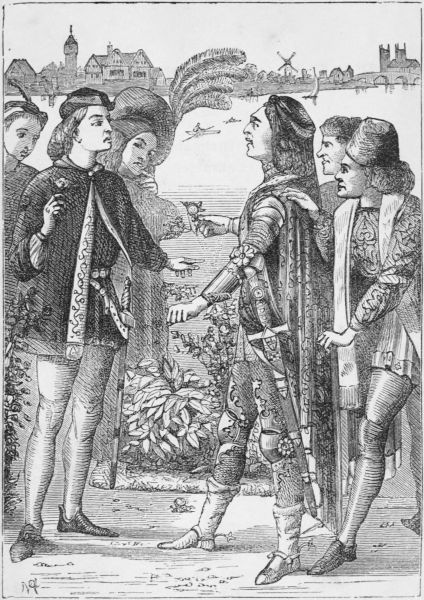
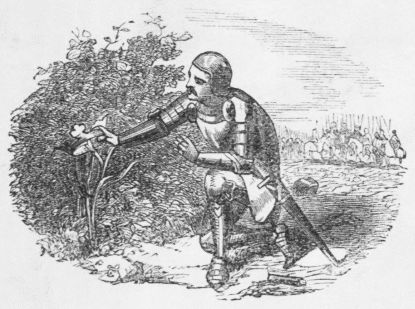
It was on the 2d of October, 1452, shortly after
the Roses were plucked in the Temple Gardens, that
Cicely, Duchess of York, gave birth to her youngest
son, Richard, in the Castle of Fotheringay. He
was, therefore, scarcely three years old when the
Wars of the Roses commenced at St. Albans, and
little more than eight when the Duke of York was
slain by the Lancastrians on Wakefield Green.
Alarmed, after that event, at the aspect of affairs,
warned by the murder of her second son, the boy-Earl
of Rutland, and eager to save George and
Richard from the fate of their elder brother, the
Duchess Cicely sent them to Holland, trusting that,
even in case of the Lancastrians triumphing, the
Duke of Burgundy would generously afford them
protection and insure them safety.
After being sent to the Continent, Richard and
his brother remained for some time in secret at
Utrecht; but the Duke of Burgundy, hearing that
the young Plantagenets were in that city, had them
sought out and escorted to Bruges, where they were
received with the honors due to their rank. When,
however, his victory at Towton made Edward King
of England, he requested Burgundy to send the
princes; and, in the spring of 1461, "The Good
Duke" had them honorably escorted to Calais on
their way home. When, after their return to England,
George was dignified with the dukedom of
Clarence, Richard became Duke of Gloucester.
At an early age, Richard, who was energetic and
highly educated, acquired great influence over the
indolent and illiterate Edward; and in the summer
of 1470, when scarcely eighteen, he was appointed
Warden of the West Marches. The return of
Warwick from France interrupting his tenure of
office, he shared his brother's flight to the territories
of the Duke of Burgundy; and when Edward landed
at Ravenspur, to conquer or die, Richard was by
his side, and proved an ally of no mean prowess.
Being intrusted with high command at Barnet and
Tewkesbury, his conduct won him high reputation;
and, in spite of his foppery and fondness for dress
and gay apparel, he showed himself, at both of these
battles, a sage counselor in camp and a fiery warrior
in conflict.
The Lancastrians having been put down and peace
restored, Richard turned his thoughts to matrimony,
and resolved to espouse Anne Neville, daughter
of Warwick and widow of Edward of Lancaster.
Clarence, wishing to keep the Warwick baronies to
himself, as husband of Isabel Neville, attempted, by
concealing her sister, to prevent this marriage. But
Richard was not to be baffled. He discovered the
fair Anne in London, disguised as a cook-maid, and
carrying the youthful widow off, placed her for security
in the sanctuary of St. Martin's. Nevertheless,
Clarence continued unreasonable. "Richard
may have my sister-in-law if he will," he said, "but
we will part no livelihood." Edward, however,
took the matter in hand, pacified his brothers, allotted
Anne a handsome portion out of the Warwick
estates, and had the marriage with Richard
forthwith solemnized. One son, destined to figure
for a brief period as Prince of Wales, was the result
of this union.
Years rendered memorable by the inglorious expedition
to France and the unfortunate execution
of Clarence passed over; and in 1482, when Edward
conspired with the exiled Duke of Albany to
dethrone James, King of Scots, Richard, who, among
his contemporaries, had acquired the reputation of
being "a man of deep reach and policy," was intrusted
with the conduct of the war. Having been
nominated lieutenant general against the Scots, and
joined by the Earl of Northumberland and Lord
Stanley, he led twenty-five thousand men across
the Tweed, regained Berwick, which had been surrendered
by Queen Margaret, and marched to the
gates of Edinburgh. By this expedition Richard
acquired an increase of popularity; and he was still
in the north when Edward the Fourth departed
this life and his son was proclaimed as Edward the
Fifth.
At that time the young king—a boy of thirteen—was
residing in the Castle of Ludlow, on the marches
of Wales, and receiving his education under the
auspices of his maternal uncle, Anthony Woodville,
Earl Rivers. Anthony was eminently qualified
for the post of tutor, and every precaution appears
to have been taken to render the boy worthy
of the crown which he was destined never to wear.
While the news of his father's death was traveling
to young Edward at Ludlow, the feud between
the ancient nobility and the queen's kindred broke
out afresh at Westminster, and London was agitated
by the factious strife. Elizabeth, jealous of the designs
of the adverse faction, wrote to Rivers to raise
a large force in Wales, and conduct the king to the
capital to be crowned; and she empowered her son,
the Marquis of Dorset, who was Constable of the
Tower, to take the royal treasure out of that fortress,
and fit out a fleet. Hastings, alarmed at these
indications of suspicion, threatened to retire to Calais,
of which he was captain; and both parties appealed
to Richard, who had hitherto so acted as to
give offense to neither.
Richard, on learning the state of affairs, immediately
wrote to the queen, recommending that the
army gathering round her son should be dismissed;
and the royal widow, who was totally devoid of the
intellect and sagacity necessary for such a crisis,
dispatched a messenger to her brother to disband
his troops. The young king, however, set out from
Ludlow, and, attended by Earl Rivers, Elizabeth's
second son, Richard Grey, and Sir Thomas Vaughan,
he approached Northampton on the 22d of April,
and learned that Richard had already arrived at
that town.
Richard, as we have said, was on the frontiers of
Scotland when his brother expired at Westminster.
On receiving intelligence of this sad event he rode
southward to York, and entered that city with a
retinue of six hundred knights and esquires, all
dressed, like himself, in deep mourning. At York he
ordered a grand funeral service to be performed in
the Cathedral; and, having summoned the magnates
of the neighborhood to swear fealty to Edward the
Fifth, he set them the example by taking the oath
first. After going through this ceremony, he wrote
to Elizabeth Woodville and to Earl Rivers, expressing
the utmost loyalty and affection for the young
king; but, at the same time, a messenger was sent
to the Duke of Buckingham appointing a meeting
at Northampton.
Again taking the road southward, Richard reached
Northampton on the 22d of April; and, learning
that the king was every hour expected, he resolved
to await the arrival of his nephew and escort
him safely to London. Ere long Rivers and Richard
Grey appeared to pay their respects, and announce
that the king had gone forward to Stony
Stratford. Richard, who had hitherto given the
Woodvilles no cause for suspicion, was doubtless
somewhat surprised at this intelligence. He, however,
suppressed his emotions, listened patiently to
Anthony's frivolous apology about fearing that
Northampton would have been too small a place to
accommodate so many people, and with the utmost
courtesy invited the uncle and nephew to remain
and sup.
Rivers and Grey accepted without hesitation an
invitation given in so friendly a tone; and soon
after, Buckingham arrived at the head of three hundred
horsemen. Every thing went calmly. The two
dukes passed the evening with Rivers and Grey;
they all talked in the most friendly way; and next
morning they rode together to Stony Stratford.
On reaching Stony Stratford, Richard found the
king mounting to renew his journey; and this circumstance
seems to have convinced him that he was
intended by the Woodvilles first as a dupe and then
as a victim. At all events, their evident anxiety to
prevent an interview between him and his nephew
afforded him a fair opportunity for taking strong
measures, and he did not hesitate. Turning to Rivers
and Grey, he immediately charged them with
estranging the affections of his nephew, and caused
them to be arrested along with Sir Thomas Vaughan.
Having ordered the prisoners to be conveyed to
the castle of Sheriff Hutton, Richard and Buckingham
bent their knees to their youthful sovereign,
and explained to him that Rivers, Grey, and Dorset
were traitors; but Edward, educated by his maternal
relatives and much attached to them, could not
conceal his displeasure at their arrest.
This scene over, Richard dismissed all domestics
with whom Rivers had surrounded the young king,
and conducted his nephew toward London, giving
out as he went that the Woodvilles had been conspiring.
On the 4th of May they approached the
metropolis; and at Hornsey Wood they were met
by Lord-mayor Shaw, with the sheriffs and aldermen,
in their scarlet robes, and five hundred of the
citizens, clad in violet and gallantly mounted. Attended
as became a king, young Edward entered
London. Richard rode bareheaded before his nephew;
many knights and nobles followed; and, amid
loud acclamations from the populace, Edward the
Fifth was conducted to the Bishop's Palace. A
grand council was then summoned, and Richard
was declared Protector of England.
Meanwhile, Elizabeth Woodville had been seized
with dread. Alarmed at the report that her brother
and son were under arrest, and apprehensive of
Richard's intentions, she fled to the sanctuary with
her five daughters, her eldest son, the Marquis of
Dorset, and her youngest son, Richard, a boy of ten,
who had been created Duke of York, and contracted
in marriage to an heiress of the Mowbrays who
died in infancy. The king, on learning that his
mother was alarmed, expressed his grief with tears
in his eyes. At first Richard only protested his
loyalty, and marveled that his nephew should be so
melancholy; but ere long he resolved to turn the
royal boy's unhappiness to account, and with this
view sent the Archbishop of York to Elizabeth to
say that, to the king's happiness, the company of
his brother was essential.
The prelate carried the Protector's message to
the sanctuary, and found the mournful mother earnestly
opposed to delivering up the Duke of York.
The archbishop, however, told her plainly that if she
did not consent, he feared some sharper course would
speedily be taken; and at this warning Elizabeth,
who was at once timorous and imprudent, began to
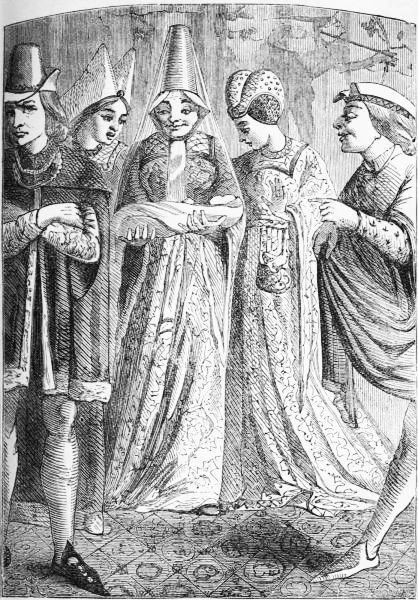
yield. At length she took the boy by the hand and
led him to the archbishop. "My lord," she said,
"here he is. For my own part, I never will deliver
him freely; but if you must needs have, take him,
and at your hands I will require him."
At that time Richard and other lords were in the
Star Chamber, and thither the archbishop led the
weeping boy. As they entered, Richard rose, embraced
his nephew affectionately, and exclaimed with
characteristic dissimulation, "Welcome, nephew,
with all my heart. Next to my sovereign lord,
your brother, nothing gives me so much contentment
as your presence." A few days after this scene was
enacted, Richard declared that it was necessary that
the king and his brother should be sent to some
place of security till the distempers of the commonwealth
were healed; and a great council, summoned
to discuss the question, resolved, on the motion of
Buckingham, that the princes should be sent to the
Tower. Accordingly, they were conducted to the
metropolitan fortress; and it was intimated that
they were to remain there till preparations had been
made for the king's coronation.
The fate of Rivers, Grey, and Vaughan having
been decided on, the 13th of June was appointed as
the day of execution; and Sir Richard Ratcliffe, an
unscrupulous agent of Richard, was intrusted with
the ceremony. Anthony Woodville was prevented
from addressing the people on the occasion, and posterity
has been deprived of the satisfaction of reading
the accomplished adventurer's vindication; but
Vaughan was more lucky in his effort to be heard.
"I appeal," said Vaughan, solemnly, "to God's
high tribunal against the Duke of Gloucester for
this wrongful murder."
"You have made a goodly appeal," said Ratcliffe,
with a sneer, "so lay down your head."
"I die in the right, Ratcliffe," answered Vaughan;
and, preparing to submit to the blow, he added,
"Take heed that you die not in the wrong."
Ere disposing of the Woodvilles, Richard persuaded
himself that his dream of the crown might
be realized, and by bribes and promises purchased
Buckingham's aid in overthrowing the obstacles that
stood in his way. Anxious, also, to gain over Hastings,
he deputed the task of sounding him to William
Catesby, an eminent lawyer, who descended
from an ancient family at Lapworth, in Warwickshire,
and who was destined to acquire an unenviable
notoriety in Richard's service. The result was
not satisfactory. In fact, Hastings, though he heartily
concurred in Richard's measures against the
Woodvilles, was determined to stand by Edward's
sons to the death; and, ere long, matters arrived at
such a pass that, while Richard sat at the head of a
majority of the council at Crosby Hall, Hastings
presided over a minority at the Tower. The party
of Hastings appeared formidable. Lord Stanley,
among others, took part in its proceedings; and
Stanley's son, George, Lord Strange, was reported
to be levying forces in Lancashire to give effect to
its decisions. Richard was not blind to the fact
that if he did not destroy the confederacy forthwith
it would destroy him. At such a crisis he was
neither so timid nor so scrupulous as to hesitate as
to the means.
Some years before his death, Edward of York,
while pursuing his amours in the city of London,
was captivated by the charms of Jane Shore, a
young city dame, whose name occupies an unfortunate
place in the history of the period. This
woman, after being for seven years the wife of a
reputable goldsmith, allowed herself, in an evil hour,
to be lured from the house of her husband, and figured
for some time as the king's mistress. Notwithstanding
her equivocal position, however, Mistress
Shore exhibited many redeeming qualities.
Her wit and beauty giving her great influence over
Edward, she exercised it for worthy purposes, and
was ever ready to relieve the needy, to shield the
innocent, and protect the oppressed.
When Edward had been laid at rest in St.
George's Chapel, and Elizabeth Woodville fled to
the sanctuary, Mistress Shore manifested much sympathy
for the distressed queen; and, having formed
an intimacy with Lord Hastings, she framed something
resembling a plot against the Protector. Elizabeth
at once forgave Hastings the hostility he had
displayed toward her kindred, and forgave Mistress
Shore for having supplanted her in Edward's affections,
and the three became allies. Richard's jealousy
was aroused, and he resolved to make this extraordinary
alliance the means of effecting the ruin
of Hastings.
It was Friday, the 13th of June—the day on
which Rivers, Grey, and Vaughan suffered at Pontefract—and
Hastings, Stanley, the Bishop of Ely, the
Archbishop of York, with other men of mark, had
assembled at nine o'clock in the Tower, when the
Protector suddenly entered the council chamber and
took his seat at the table. Richard appeared in a
lively mood, conversed for a while gayly with those
present, and quite surprised them by the mirth
which he exhibited.
Having set the lords somewhat at their ease and
persuaded them to proceed with business, Richard
begged them to spare him for a while, and, leaving
the council chamber, he remained absent for an
hour. Between ten and eleven he returned, but
frowning and fretting, knitting his brow and biting
his lips.
"What punishment," he asked, seating himself,
"do they deserve who have imagined and compassed
my destruction, who am so nearly related to the
king, and intrusted with the government of the
realm?"
"Whoever they be," answered Hastings, after a
pause, "they deserve the death of traitors."
"These traitors," cried Richard, "are the sorceress
my brother's wife, and her accomplice, Jane
Shore, his mistress, with others, their associates,
who have, by their witchcraft, wasted my body."
"Certainly, my lord," said Hastings, after exhibiting
some confusion, "if they be guilty of these
crimes, they deserve the severest punishment."
"What?" exclaimed Richard, furiously, "do you
reply to me with ifs and with ands? I tell thee
they have so done, and that I will make good on
your body, traitor."
After threatening Hastings, Richard struck the
council table, and immediately a cry of "Treason"
arose, and armed men rushed into the chamber.
"I arrest thee, traitor," said Richard, turning to
Hastings.
"Me, my lord?" asked Hastings, in surprise.
"Yes, thee, traitor," said Richard; "and, by St.
Paul, I swear I will not to dinner till I have thy
head off."
While this conversation was passing between the
Protector and Hastings, one of the soldiers, as if by
accident or mistake, struck a blow at Lord Stanley.
But the noble baron, who had no ambition to share
his ally's fate, and who, indeed, contrived to carry
his wise head to the grave, saved himself on this occasion
by jerking under the table, and escaped without
any other bodily injury than a bruise.
While Lord Stanley, the Archbishop of York, and
the Bishop of Ely were arrested, and shut up in various
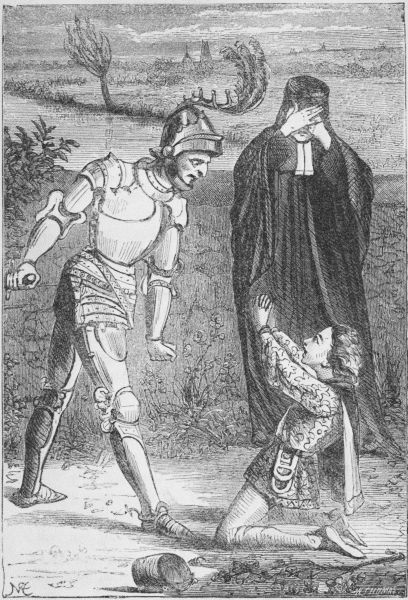
parts of the Tower, Hastings was hurried outside
for immediate execution. Richard would not
even allow the headsman time enough to erect a
scaffold; but a log of wood answered the purpose.
This, having been found in the court of the Tower,
was carried to the green near the chapel; and the
lord chamberlain, after being led thither, was without
farther ceremony beheaded. At the same time
the sheriffs of London proceeded to Mistress Shore's
house, took possession of her goods, which were
valued at three thousand marks, and conveyed her
through the city to the Tower. On being brought
before the council, however, on the charge of sorcery,
no evidence worthy of credit was produced,
and an acquittal was the consequence.
The sudden execution of the lord chamberlain
naturally excited much interest in the city; and, as
Hastings happened to be a great favorite with the
inhabitants, Richard deemed it necessary to vouchsafe
an explanation. Having therefore sent for
some of the influential citizens, and frankly justified
himself as having acted simply in self-defense,
he, within two hours, caused a proclamation, under
the great seal, fairly written on parchment, to be
read by a herald-at-arms, with great solemnity, in
various parts of London. Unfortunately, this vindication
appeared so soon after the execution that
people could not help suspecting that it had been
drawn up before.
"Here's a gay goodly cast," remarked the schoolmaster
of St. Paul's, as the document was read at
the Cross, "soul cast away for haste."
"Ay," said a merchant standing by, "I think it
has been written by the spirit of prophecy."