"Stonewall" Jackson
His Campaigns and Battles
The Regiment
As I Saw Them
By JAMES H. WOOD
Captain Co. "D", 37th Va.
Infty. Regiment
The
Eddy Press Corporation
Cumberland, Md.
Publishers
Affectionately dedicated to my two
sons and two daughters, J. Harvey
Wood, Jr.; William Scott Wood, Gertrude
Wood Dillard and Mary Wood
Harriss, the only living members of
my family.
PREFACE
These brief memoirs of the War
between the States have been written
with care. More elaborate detail
might have been employed but habits
of a professional life have led to terseness
of expression, hence the story unembellished
is given, based on personal
recollections aided by facts from others
and such records as I have been able
to reach, including Strickler's Statistics
of dates of battles.
No effort has been made to do more
than to give a brief account of the
events seen and known directly or
from sources above mentioned. This
was undertaken for the purpose of
leaving to comrades who still live, to
the families of those who are dead, to
our own families and to posterity
some record, from our view-point, of
the most stirring events and enactments
of our lives.
To the extent of my rank I was a
participant in the scenes described—except
two battles—from which disability
from wounds prevented. "The
Regiment" creditably participated in
all.
The performance of this work though
unavoidably deferred, is a duty I
have long since felt incumbent upon
myself as well as others who can
and care to do so, to give to our country
the benefit of our testimony as we
saw it, of the achievements, sufferings
and sacrifices through which our comrades
and country passed in those
eventful years before the same shall
fade from our memory. Our ranks
are rapidly thinning and soon there
will be none left to tell the tale, hence
the importance of the testimony of actors
who yet live. From their direct
testimony truth can be reached by the
future historian. It is becoming in
us and we do revere the memory of our
dead comrades, thousands of whom
sleep in unknown graves, and their
achievements and devotion to the cause
they believed to be just have almost
been forgotten. Yet while the questions
involved in the War were forever
settled and so accepted in good
faith by the people of the South, it is
the duty of the survivors to preserve
from oblivion the names and deeds
of their dead comrades. To this end
this narrative, for whatever it is
worth, has been written.
"But words are things, and a small drop of ink,
Falling like dew upon a thought, produces
That which makes thousands, perhaps millions, think;
'Tis strange, the shortest letter which man uses,
Instead of speech may form a lasting link
Of ages; to what straits old Time reduces
Frail man, when paper—even a rag like this,
Survives himself, his tomb, and all that's his."
Lord Byron.
I have not mentioned many interesting
events, including skirmishes and
picket fights—many of which developed
into small battles. Nor have I
mentioned the hard marches through
snow, ice, water, mud and rain, many
almost shoeless, poorly clad, hungry,
shivering with cold, worn, exhausted,
sleeping upon the cold and wet ground,
ill and suffering—because memory
dimmed by years would not permit the
attempt. As it is I cannot hope to
have avoided mistakes. After the
lapse of so much time it would hardly
be possible that some misconception or
misunderstanding of an event or events
should not occur, in such case I would
be glad if apprised of it, to make such
corrections as I may be able.
I regret not being able to procure
photographs of the others of the Field
and Staff Officers and of not being able
to procure a roster of the Junior Officers
and men of the regiment for insertion
in these pages, but as it is I
send this volume forth for such consideration
as it may receive.
James H. Wood.
Of Bristol, Virginia.
New York,
May 2, 1910.
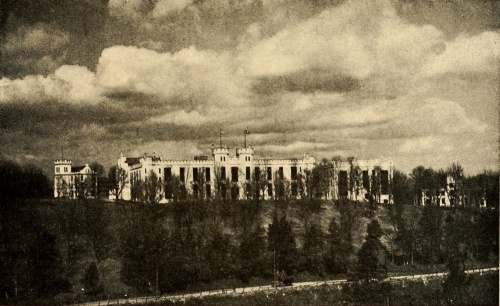
THE VIRGINIA MILITARY INSTITUTE
CHAPTER ONE Virginia Military Institute. The Flag Raising. Growing War Spirit.
The growing discontent
and excitement
in 1860 and the early
part of 1861 will
ever be remembered
by those who passed
through that period.
At and before this time I, then in my
teens, was a cadet at the Virginia Military
Institute located at Lexington,
Virginia.
For some years prior to this, the
questions of political difference between
the sections of the United States
designated as North and South had
been discussed in Congress and on the
hustings with increasing acrimony and
divergence. The two great political
parties, Democrat and Whig, had long
been contestants for political supremacy,
but in 1860 the Republican party,
theretofore greatly inferior in numbers
and strength to either of the others,
elected Abraham Lincoln sixteenth
President of the United States. This
was attributed to a division in the
Democratic party and the nomination
of candidates by each of its two factions.
This triumph of the Republican
party increased anxiety and apprehension
in the people of the South as
to their institutions and rights.
Then followed the assembling of
the National Congress on the first
Monday in December; the secession of
South Carolina, December 20th, 1860;
of Alabama, January 11th, 1861; of
Georgia, January 19th; Louisiana,
January 26th; Texas, February 1st;
the evacuation of Fort Sumpter by the
Federals, April 14th; the call by Lincoln
for troops to coerce the seceded
States April 15th; the secession of
Virginia, April 17th; of Arkansas,
May 6th; of North Carolina, May
20th; of Tennessee, June 24th; and by
acts of the Provisional Congress Missouri
was admitted as a member of the
Confederate States of America, August
20th; and Kentucky on December
10th,—and of these States the new nation
was organized.
Leaders in the field and not on the
forum were now being considered and
looked to. Sons of the South who had
been trained at West Point and a long
list of trained soldiers from the Virginia
Military Institute, as well as its
professors, educated and trained in the
science of war, were justly of first
consideration. Many of these and many
laymen, as well as many members of the
then corps of cadets, won enviable distinction
in the four ensuing years.
The V. M. I., the West Point of the
South, now disclosed its inestimable
worth to the new nation born at Montgomery,
February 18th, 1861. It may
be of interest to relate here an incident
which disclosed in advance a military
chieftain of whom but little was known
until the opportunity came for him to
discover his merit. Men before this
period who had filled mediocre places,
began to burst forth in new light as
opportunity came. An incident of one,
then a quiet V. M. I. professor, now
known to history and the world, is
worth preserving. It occurred in
March, 1861, at Lexington.
The secession of Virginia had not
then occurred, but the step was being
hotly contested on the hustings between
opposing parties. The corps of
cadets was almost unanimous for, and
the county of Rockbridge and the town
of Lexington at the time overwhelmingly
against, secession.
Lexington was the home of honest
John Letcher, then Governor of the
State, whose potent influence was understood
to have thus molded public
sentiment. The secessionists were enthusiastic
and intolerant, the unionists
sedate and determined. The war
spirit had grown rapidly and had
spread to all classes. Members of the
corps were almost daily hoisting on
barracks secession flags which were
promptly taken down by order of the
Institute authorities, such evidences of
sentiment thus displayed on a State
Institution not being permissible while
the State was yet a member of the
Union. At this time a fine volunteer
company composed of young men of
Lexington and vicinity, with Capt.
Sam Letcher, brother of the Governor,
at its head, was being regularly drilled
on Saturdays of each week.
The war spirit had now grown so
intense that but a spark was needed to
set its smouldering fires into a consuming
flame. To emphasize their
sentiments, the opposing parties without
concert or understanding, conceived
the plan of raising flags; one
the stars and bars, the other the stars
and stripes. The following Saturday
was chosen as the day. Due advertisement
had been given by both parties.
This brought large numbers of people
to town, most of whom came provided
with such arms as the husbandman of
that day had. The number of unionists
was more than four times greater
than the number of secessionists. The
latter soon ran up their flag in the
court house yard, addresses followed
and the small crowd, including the
corps of cadets, was about to disperse
to their homes, and the corps to barracks,
when the unionists began raising
their flag pole some distance up
and in the middle of Main street.
From some defect the pole broke and
fell, at which the corps vociferously
gave vent to expressions of joy, and
later returned to barracks more than
half a mile away, leaving, however,
some three or four of its number behind.
On reaching barracks dinner roll
call and the march to and from dinner
followed. As ranks were broken
on our return from dinner, one of our
number who had remained uptown
came in breathless haste and announced
that House Mountain men
had fallen on some of the cadets uptown
and killed them. House Mountain
is situate some ten or a dozen
miles from Lexington, and at and in
the vicinity of its base were homes of
a good class of people. They were understood
at that time to be extremely
pro-Union. This information thus
given was the needed match to set in
flame the pent-up feeling for war.
Without a word every member of the
corps rushed to his room, seized his
musket, cartridge box, bayonet and
scabbard and accoutered himself as he
ran down the stoops to the front of
barracks, thence down the near way to
the foot of Main street near the
Letcher residence. Colonel (afterwards
General) Smith, superintendent
and ranking officer of the Institute, intercepted
and tried to turn us back, but
his efforts were in vain. On we sped
until we reached Main street. Here
Cadet Captain Galloway called out,
"Form battalion." This we proceeded
to do. All had loaded their muskets
and fixed bayonets as they proceeded
hither.
While battalion was forming Major
John McCausland (then a sub-professor
and afterwards a brilliant Confederate
brigadier general) appeared in
front of the battalion and said, "Young
men, form and I will lead you up."
Col. Smith had now arrived and began
to urge our return to barracks.
R. McCulloch, of the corps, called to
McCausland to lead us on. He replied
that his superior officer (Colonel
Smith) was in command. Meanwhile
the unionists who had realized the situation
were but a short distance up
the street, preparing for the shock of
battle which seemed so imminent. The
entreaties to return to barracks and
the formation into battalion went on.
There stood one hundred and eighty
manly youths, armed and equipped
and eager for the fray, awaiting the
command forward. They were of the
very flower of the South. A little
later on many of them won marked distinction,
boys as they were in armies
the soldiers of which for gallantry and
endurance have never been excelled in
the history of the world.
At this time, Mr. Massey who had
won our confidence in his remarks at
the flag raising earlier in the day and
Maj. R. E. Colston, a professor in the
V. M. I. and afterwards a gallant Confederate
brigadier-general, galloped
up and joined in the appeal for our return
to barracks. Meanwhile a greater
than any arrived, tall, sinewy, well-formed,
a slight stoop in the shoulders,
large feet and hands, retreating forehead,
blue-grey eyes, straight nose,
strong mouth and chin held well to
the front, in measured gait, Major
Thomas Jonathan Jackson walked up
and down before the battalion which
he viewed closely, then looked at the
surroundings and position of the opposing
forces. He uttered no word,
but his movements grew more animated
each moment, his stature
straightened and grew taller and bigger,
and his merit was apparent to all
and made him the central figure. Still
the formation of battalion went on.
A leader who would take command
was only needed, while but two or
three hundred yards up the street the
volunteer company of a hundred young
men well-officered, armed and equipped
were drawn up across the street in
battle array, supported by five times
their number of the citizens of the
town and county, armed with shotguns,
rifles and pistols. This warlike
scene which had been gathering like
a storm cloud during the morning had
alarmed the peace-loving citizens and
hence an impromptu delegation came
forth to intercede for peace and prevent
a bloody tragedy which seemed
about to occur. These intercessions
prevailed, and the corps broke ranks
and returned to barracks, discharging
their loaded guns as they went.
As soon as we reached barracks, we
were summoned by the familiar drum
beat to Colonel Smith's section room
where we found Colonels Smith and
Preston and Mr. Massey on, and
Major Jackson near to, but off the
rostrum. Colonel Smith proceeded at
once to excoriate the corps for its insubordinate
conduct. Preston, then
Massey, responded pacifically to our
call. Last but not least, Major Jackson
was called. I remember the scene
as if enacted but yesterday. True soldier
as he was, Jackson hesitated until
Colonel Smith, his superior in rank,
asked him to speak. At once he
mounted the rostrum and faced his
audience. His erect figure, flashing
eye, energetic expression, short, quick
and to the point, disclosed to the commonest
mind a leader of merit. He
said, "Military men make short
speeches, and as for myself I am no
hand at speaking anyhow. The time
for war has not yet come, but it will
come and that soon, and when it does
come my advice is to draw the sword
and throw away the scabbard." The
personality of the speaker, the force
of these simple words thus uttered,
elicited a response of approval I never
heard surpassed, except by the Confederate
yell often heard on the battlefield
a little later on. This simple
speech and manner of Jackson established
in the minds of his audience
the belief that he was a leader upon
whose loyalty and courage we could
rely. How strange it was that this
quiet professor who had performed his
every duty, monotonous in its regularity,
should with a bound leap into
view and establish in the minds of his
audience that he possessed the qualifications
of a brilliant and dashing leader.
This was a revelation to his
friends and acquaintances, and the
estimate of him then formed was
shown to be correct by after developments.
It was at the V. M. I. that I first
came to know its superintendent and
professors, including Jackson. Of the
corps of cadets there were young men
and boys, representing every state of
the South and some of the States of
the North. The corps was considered
to be one of the finest the institution
had ever had. Jackson, ever faithful
to duty, now manifested great interest
in the political conditions of the country
and what they portended. He was
instructor in artillery tactics, his favorite
arm of the service. He now
pushed work, giving great attention to
the practical part. Drilling, limbering
and unlimbering, target practice and
the work incident thereto were very
trying to boys in their teens in the hot
spring sun, but neither heat nor cold
had any terrors for Jackson when duty
or the accomplishment of a purpose
were involved.
CHAPTER TWO Corps of Cadets ordered to Richmond. March to Staunton, thence by rail to Richmond. Wreck in Blue Ridge Tunnel. Speech of Governor at Richmond.
Some of the States had
passed ordinances
of secession and
others were following
in rapid succession
and war between
the States was
no longer problematical, but a fact.
Virginia hesitated, but soon cast her
lot with her sister States of the South
and became a part of the new nation.
Preparation for war was now pushed
forward with great energy. Our
corps under command of the State had
previously been ordered to Richmond,
and its members had been assigned to
drill and organize for service the raw
volunteers then hurrying thither.
On our departure from the V. M. I.
we marched to Staunton, about thirty-six
miles distant, thence by rail to
Richmond. All were delighted and
filled with pride on that beautiful
spring morning when the corps in fine
array with martial tread marched
from the front of barracks, down by
the mess hall to the pike, thence on toward
Staunton. Colonels Smith and
Gilliam and Major Jackson were in
charge. Baggage and artillery followed.
The bridge across North River
was passed and as we ascended the
slope on the other side we took a last
lingering look at the fading outlines
of barracks, so dear to us. There our
laudable boyish ambitions had been
aroused, our hopes kindled and our
mental and physical manhood developed.
There each was independent of
the others, yet all were a band of brothers.
Each had learned to obey, and
hence knew how to command. The
march continued and barracks was
soon out of sight. About ten miles out,
knapsacks became too burdensome, and
a farmer's wagon was impressed for
service. This relieved us greatly.
Staunton was reached about 10
o'clock on the night of the day we set
forth. The corps was fed and lodged
for the night in the hotels. Footsore
and weary we slept well and arose at
early reveille, chipper and bright and
ready for the coming duties of the day.
One of the first of which was after
breakfast to load on flat cars our battery
of four pieces of artillery and our
equipment. This was new to us and
was hard work. This done, we found
we would have two or three hours at
our disposal before leaving. Many
matrons and damsels, as well as men
and boys, had already come to the station
to give cheer and encouragement
to those who were going forth to do
battle for their cause. The neat fitting
uniforms of the cadets, to say nothing
of their good looks and personal merit,
for they were a magnificent body of
youths, were always pleasing. A little
later the crowd of ladies, men, boys
and girls with waving handkerchiefs,
cheers and huzzas bade us good-bye,
and on our way to Richmond we sped.
All went well, until we reached the
Blue Ridge tunnel on the old Central,
now Chesapeake and Ohio, railroad.
Here an exciting and somewhat perilous
catastrophe occurred. The train
consisted of passenger cars for the
officers and corps and flat cars for the
battery and baggage. It was special,
and hence had no schedule time. When
well in the tunnel, which is nearly a
mile long, our engine was derailed.
The smoke from it filled the cars and
the narrow space around them. We
could not go forward, for the engine
and force engaged blocked the way;
nor could we go back, as we would be
in danger of being left, as the engine
might be ready for duty any minute
and would at once pull out. To add
to our peril another train from the direction
whence we came was about due
as per schedule time, and was liable to
collide with ours, in which event results
could but be imagined. Thus
we were held veritable prisoners for
nearly two hours, imperiled by the
dangers of an oncoming train and the
suffocating smoke from our own engine,—our
first lesson in the privations
and hardships of war. In all this the
boys were bright and cheerful. Many
witty and some sage remarks were
made. Soon, however, we were on our
way. Nothing of interest transpired
on the rest of our journey, except
greetings given us at the stations by
the already aroused people who assembled
to cheer us on, and the timid
requests of the fair maidens for souvenir
buttons from our uniforms.
Such requests could not be refused. So
far was it carried that some of our
uniforms were quite disfigured before
we reached our destination.
Late in the afternoon Richmond
loomed up to view. This was another
new sight, for most of us were from
rural districts and had never seen a
city. From the station we marched to
the front of the Capitol building in
Capitol Square. Here the corps was
reviewed by his excellency the Governor
who made a little talk and the compliments
paid us were pleasing to boys
as we were. He said among other
things that war was upon us and much
depended upon our work in preparing
an army for the field. Then amid the
waving of handkerchiefs by the dames
and maidens and the huzzas of the
men and boys, a large number of
whom had gathered to see and greet
us, we marched to what was then
known as the new fair grounds about
two miles west of the city. Here we
were quartered in the Exhibition and
other buildings. The grounds were
beautiful and well suited for a camp
of instruction.
Companies and regiments began at
once to arrive, undrilled and undisciplined,
raw and without arms, except
in instances where the individual had
given play to his own imagination as
to what would be useful in battle, and
pursuant thereto had brought the
squirrel rifle, the shotgun, the butcher's
knife and the pistol, some of the latter
of the old pepper box type. A few
thought the savage, the dare-devil
mien the true indice of the soldier,
hence the red hunting shirt, the coon
skin cap, the unkempt hair and beard
were popular insignia. How ludicrous
was it all in the light of after experience!
Yet these manifestations were
not to be condemned. It is a chapter
in their history that ought to give
pride to their sons and daughters, because
these were the promptings of
purest patriotism.
We began early to grapple with the
fact that the South was without arms
with which to meet a well armed,
equipped and powerful foe. These disadvantages
to be contended with by the
new nation were very great, hence the
organization of an army and its equipment
as best might be was rushed with
great vigor. Enlistment was rapid
and troops now entering the camp were
anxious to be drilled and instructed.
The pulpit, the bench, the bar, the
farm, the anvil, the shop and every
other calling was represented, ready
and willing to take any position from
captaincy to private, the latter generally
preferred, because of the general
feeling of unpreparedness for the responsibilities
of office and command,
hence there was no unseemly scramble
in this respect.
At first the camp was intended for
Virginia troops only, but it was soon
made the rendezvous of troops of other
States as well. This increased the
numbers so much that not only the new
but the old fair ground was utilized
and filled. All added to the excitement,
and war and preparation therefore
were the absorbing themes of the
old and the young, male and female.
No male, physically and mentally able
to do service, would stay out. Boys of
tender years enlisted with the approval
of fathers and mothers, and in some
instances were even urged to do so.
No critical or even cursory examination
was applied to the volunteer.
Meanwhile the drill, the discipline and
the organization went on in a most
satisfactory way. The efficient work
of the corps of cadets which deserves
much praise was soon apparent. It is
just to say that the work had been done
mainly under the command of our
commandant, Col. Wm. Gilliam, Colonel
Smith having returned to the Institute
and Major Jackson having been
commissioned a colonel and ordered to
report to Gen. Joseph E. Johnston at
Harpers Ferry.
CHAPTER THREE Richmond becomes Capital of Confederacy. The President. Presentation of Flag. Ex-President Tyler. 37th Virginia Infantry Reg.
The capital of the new
nation had been established
at Richmond
the latter part
of May and later the
President and his
cabinet removed
thereto from Montgomery and entered
upon their duties. Anxiety to see the
President at our camp which was now
great was soon gratified by an incident
then of much interest. A new
regiment commanded by Col. Robert
E. Withers had arrived at the camp.
It was regarded as a fine body of men
and its coming created quite a stir of
interest in, and respect for it. The
ladies of the city desiring to contribute
to this respect made with their own
hands, as it was then stated, a splendid
flag, and requested the President to
present it to this regiment. He accepted
the honor and on a subsequent
afternoon rode on horseback from the
city to the camp attended by his
cabinet members, officers and aids.
This cavalcade attracted universal attention,
because the President was its
head and all loved and admired Jefferson
Davis.
The regiment was drawn up by its
proud officers; and other troops and
citizens, including many ladies who
added grace and beauty to the occasion,
assembled nearby. The President
stood on a little porch near a small
table. The flag was handed him and
he held it erect in his right hand, the
staff resting on a table, its unfurled
folds, rich and beautiful, wafted to the
gentle breeze, and it could but be admired.
Its makers, however, had not
skillfully applied the rules of symmetry
and proportion, either in the flag or its
staff, for the former was something
near the size and shape of a bed quilt
and the latter was something less than
a bed post. Both were clumsy and
disproportionate. The President proceeded
with the presentation. His
speech was short, but informed, edified
and enthused. When he reached the
climax, among other things he said,
"This flag is our symbol of liberty and
on behalf of the ladies of the capital
of our nation, I give it into hands that
will proudly bear it to victory and
never let it trail in the dust." Enthused
while these and other words
were so eloquently uttered, he held
aloft, quivering in the air, as if in the
grasp of a giant, this heavy and cumbersome
flag. The audience had been
spellbound until the climax came, and
then enthusiasm scarcely had its
bounds.
As I remember him, the President
was tall, slender, and somewhat cadaverous.
I had never before, nor have I
since, heard him speak, but on the occasion
mentioned I was greatly impressed
and shared the general belief
in his ability and power.
Other statesmen of the South visited
the camp and spoke cheering words to
the troops. All were optimistic in
their expressed views of the outcome
of the war then being entered upon.
The most interesting to me of these
visitors, however, was John Tyler,
tenth President of the United States.
He was then full of years, but possessed
of much mental and physical
vigor. Having learned something of
his history and being but a schoolboy
myself just approaching the threshold
of life's battles, I was instinctively led
to think of him and his life's work,—as
a student at William and Mary College,
then a fiddler and rollicking
youth, as a brilliant lawyer at the
Virginia bar, as a captain of a company
in the war with Great Britain in 1812,
as a brilliant leader in the Virginia
legislature, as Governor of the State,
as Representative and then Senator in
the United States Congress, as successor
to the Presidency after the
death of William Henry Harrison
and his stormy administration. But
I have digressed and must return to
my intended narrative.
Of the troops now arriving in the
camp were the companies of the
37th Virginia Infantry Regiment,
to which regiment this narrative
will mainly refer. The men composing
these companies were young,
vigorous and patriotic, but few of
them exceeding the age of 35 years.
They were from that part of Virginia
where milk and honey flow, and were
in the main of as good blood as their
respective counties contained. One
company, with Capt. Shelby M. Gibson
at its head, was from the county
of Lee; one with Capt. Henry Clinton
Wood at its head, from the county of
Scott. Three with Capts. John F.
McElheney, —— and Simon Hunt
at their respective heads, from the
county of Russell; and five with Capts.
John F. Terry, James L. White, Wm.
White, Robert Grant and George Graham
at their respective heads, from the
county of Washington.
These companies as designated by
letter and their successive captains,
brought about by casualties and other
causes during the ensuing four years of
war, were as follows:
Company "A"—Capt. John F. Terry,
later Charles Taylor, still later William
Lancaster.
Company "B"—Capt. William White,
later Benjamin P. Morrison.
Company "C"—Capt. John F. McElheney,
later John Duff, still later
John P. Fickle.
Company "D"—Capt. Henry Clinton
Wood, later James H. Wood.
Company "E"—Capt. Shelby M. Gibson,
later Samuel Shumate.
Company "F"—Capt. George Graham.
Company "G"—Capt. ——, later ——
Bussey.
Company "H"—Capt. Robert Grant,
later Felix Duff, still later James
Berry.
Company "I"—Capt. Simon Hunt,
later Thomas Smith.
Company "K"—Capt. James L.
White, later John A. Preston.
These captains, as well as their subordinate
officers, were men of character
and in the main of strong personality.
Some of them were educated
and trained soldiers. Samuel V. Fulkerson
of the county of Washington,
who had served in the war with Mexico,
a man of ability and high standing,
left the circuit bench to lead this
regiment as its colonel. Robert P.
Carson of the same county and Titus
V. Williams of Taswell county, both
educated and trained soldiers were in
the order named lieutenant-colonel
and major. No doubt could exist that
such a body of patriots so well officered
needed but proper training in systematic
cooperative effort to become
most efficient soldiers. This work of
training in which I had no small part
showed its worth in effectiveness on
the field of battle later on. Doctors
C. C. Henkle and M. M. Butler were
later on surgeon and assistant surgeon.
They were efficient and faithful in their
duties.
This regiment will be hereafter referred
to as "The Regiment" to avoid
a more lengthy means of designation.
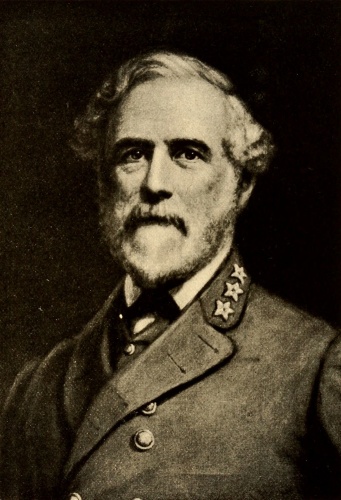
GEN. ROBERT E. LEE
CHAPTER FOUR Cheat Mountain Expedition. Ordered to Jackson at Winchester. Expedition to Bath and Romney. Battle of Kernstown. Retreat up the Valley.
Robert E. Lee and
Joseph E. Johnston,
sons of Virginia,
educated and trained
soldiers, already distinguished
in their
profession of arms,
had resigned from the United States
army and had tendered their services to
this new nation. Before Virginia completed
the details of her alliance with
the Confederacy Lee was placed in
command of the Virginia forces, which
included the corps of cadets. In the
line of duty occasion brought me to
his headquarters to receive from him
directions for the performance of
special military duty, and thus I had
opportunity to form my own boyish
estimate of him. I judged his age to
be in the fifties and that he was in the
prime of life. His presence and bearing
were above criticism, his manner
and conversation kind, firm, direct and
self-confident.
But it is needless to comment further
now; his career, his fame, his
life and his death are familiar history
and need no further mention here. It
is, however, deemed appropriate to insert
the following graceful tribute to
the memory of Lee from the pen of
Mr. Henry Tyrrell which appeared in
The New York World on the nineteenth
of January, 1910.
His sun of life grew grander toward its setting;
It shed a dying splendor on his day,
Then like a benediction, passed away
Through twilight calm, gloomed with no vain regretting.
A soul serene beyond our strife and fretting,
In honor firm but yielding to the sway
Of kindness ever, he shall with us stay
Too fair a memory for the world's forgetting.
His tomb is here. In graven marble pure,
Recumbent sleeps his image. All of fame,
Glory and love that mortal man may claim,
In this white stone and this white name endure,
'Neath "Robert Edward Lee" might angels write:
"Here lies the last and noblest Christian knight."
Joseph E. Johnston, whom I met
and knew later, was an able and accomplished
soldier and impressed me
as being of the same class with Lee.
Albert Sydney Johnston, Beauregard
and others, distinguished in their profession
of arms, had also resigned
from the United States Army and had
cast their lots with the South. Soon
both sides began with great energy to
hurry troops to the front. Lee with a
scattered force commanded in what
is now West Virginia, Joseph E.
Johnston at Harpers Ferry and Beauregard
at Manassas. The Federals
with the nucleus of the old army drilled
and disciplined, armed and equipped,
were rapidly assembling large forces
at strategic points. The Confederates
were equally energetic in assembling
opposing forces, but they lacked the
nucleus, the general discipline, the
arms, the equipment,—all but courage.
Big Bethel, the first battle of the War,
Manassas, and movements leading up
to them, as well as movements at other
points, are matters of history and are
not to be recounted here.
The first service of "The Regiment"
was at Laurel Hill in West Virginia
with Brigadier-General Samuel Garland,
who was soon compelled by the
Federals under McClellan to retire because
of his advanced and untenable position.
His retreat was hasty, circuitous
and trying, lasting from July 7th to the
12th, 1861, during which time skirmishes
or small battles occurred, in
one of which Garland was killed. After
his death the brigade took position
on the Parkersburg Pike at
Greenbrier River under Brigadier-General
Henry R. Jackson. This first
was a trying campaign in which a number
of casualties occurred and much
sickness and suffering ensued.
It was from this position at Greenbrier
River that the Cheat Mountain
expedition into West Virginia in September,
1861, was made. A Federal
force had reached in its advance, the
crossing of the Parkersburg Pike of
Cheat River, half a dozen miles to the
west of our position. Skirmishes occurred
between observation parties of
cavalry, reinforced at times by infantry
from the respective sides as occasion
required. These experiences
were new to officers and men of both
armies, and hence a nervous tension
was kept up, as the close proximity of
the opposing forces threatened to bring
on a general engagement at any of
these skirmishes. Jackson's brigade
consisted of one Georgia, one Arkansas
and two Virginia regiments of infantry,
a company of cavalry and a
battery of artillery aggregating about
3,000 men. Events and happenings
as above indicated had continued for
some time and thus stood when the
Cheat Mountain expedition was entered
upon by the Confederates. It was
led by Col. Albert Rusk with his own
third Arkansas and 37th Virginia regiments.
He was to pass to the rear of
the enemy and make attack, while
Jackson made demonstration in front.
The plan had but little promise of success,
because of the superior numbers
and fortified position of the Federals.
We broke camp near nightfall of
September 10th and moved out with
two days' rations. Our course was toward
the west down Greenbrier River.
We bivouaced about midnight after a
hard march of fifteen miles. To
this point we had the benefit of a
fair country road, but not so the rest
of the way. We forded Greenbrier
River in the early morning and, wet
to the waists, began the long, rugged
and trackless ascent of Cheat Mountain.
The hardships and perils of this
expedition can hardly be described.
The rocks, the cliffs, the precipices, the
river were obstacles that had to be
overcome at whatever cost of suffering
or peril. Our descent of the mountain
on the other side was quite short.
In a channel or trough along the top
of the mountain near its summit Cheat
River flows to the east, while Greenbrier
River at the base of the mountain
flows to the west. The high altitude
made the water and atmosphere quite
cold, even for this season of the year.
Our course was down this river with
no road or trail save the bed of the
stream. Its precipitous and cragged
banks necessitating an almost continuous
wading down, across and back
for many times. Late in the afternoon
we reached a point near the enemy, but
slept on our arms until morning. A
reconnoissance, however, disclosed his
impregnable position. Our skirmish
line exchanged some shots with the
outposts and some casualties occurred,
but the number I do not recall.
I was brought to think why it all
could not have been avoided; but, then
as now, a few men on opposing sides
led all the others and war resulted.
We rested on our arms that night in
close proximity to this stronghold,
without food, hungry and chilled to the
bone and as uncomfortable as it seemed
possible to be. The folly of an assault
upon the enemy's fort was seen and
known, hence the return march was
taken up. This was without incident.
Many became ill and a number gave
up their lives from the hardships and
exposures of this expedition, my own
illness extended over many weeks, during
part of which time hope for a favorable
issue almost fled. It was, however,
my good fortune to be taken to
a good country home and to be attended
by a faithful nurse, which perhaps
prevented a different result.
When I was convalescing, but
yet weak, a young soldier, delirious
from pneumonia, who occupied an adjoining
room, came to my bedside during
the temporary absence of my nurse
and seized a heavy, long necked bottle
of brandy and raised it as if intending
an assault, and apparently was about
to bring it down on the head of his
prostrate victim, who expected the
blow and its serious results, but could
do nothing to ward it off. Fortunately,
before delivering the blow this
crazed man, being consumed with
fever, saw through the window an inviting
stream of water that flowed by.
Quickly replacing the bottle, with cat-like
swiftness he passed down the stairway
and to the stream, and drank
copiously of its waters. He was unable
to return and was carried back
and early the next morning gave up the
struggle and passed into eternity.
In October the regiment was ordered
to report to Stonewall Jackson
at Winchester, and was assigned to the
third brigade of Jackson's division.
This brigade was now composed of the
37th and 23rd Virginia, First Georgia
and Third Arkansas Regiments. Samuel
V. Fulkerson was colonel of the
first, William B. Taliaferro (pronounced
Tolliver) and after his promotion
to the rank of brigadier general,
Alexander Talliaferro of the
second,—Ramsey of the third and
Albert Ruske of the fourth, above
named regiments. Soon after this time
the 1st Georgia returned to its home
and the said 3rd Arkansas was ordered
to Manassas and became a part of
Hood's brigade. The Tenth Virginia,
commanded by Colonel S. B. Gibbons,
about May, 1862, and the 1st and 3rd
North Carolina regiments, about August
or September of that year, were
assigned to the brigade and remained
with it after that time. Our brigade
commanders were: First, Henry R.
Jackson, later William B. Talliaferro,
and still later George H. Stuart.
We remained in this brigade and division
after that time, and future reference
thereto will be "3d Brigade."
Jackson was now a major-general
and had been assigned to the command
of the valley district. His force consisted
of three brigades (1st, 2d and
3d, Ashby's cavalry and about three
batteries of artillery, aggregating approximately
10,000 men.) In the latter
part of December he made an expedition
to Bath and Romney which was
without apparent results, and it was
regarded by his officers and men as unwise.
From this a distrust in his ability
as a leader arose. The weather was
extreme, rain, sleet, snow and intense
cold caused great suffering and the
actual illness of many. From this and
other causes his army was so much
reduced that by early spring his entire
force did not exceed 6,000 men, at
which time the district under his command
was beginning to be threatened
from different directions and by different
commands, aggregating a total
force of about 40,000 men. These
conditions to many would have seemed
appalling, if not hopeless; but not so
to Jackson, instead it was then that
his remarkable strategy and skill began
to manifest themselves.
He retired from Winchester, moving
slowly up the valley to the vicinity
of New Town and from there made a
demonstration toward Winchester,
now occupied by a Federal force of
about 12,000 under the command of
General Shields. The forces met on
the afternoon of March 23d at Kernstown,
three miles south of Winchester
and a very severe battle was fought,
resulting in many casualties on both
sides; but superior numbers forced
Jackson to retire about dark still further
up the valley. The "Regiment"
and "3rd brigade" took a conspicuous
part in this engagement and suffered
severely. It was then difficult to understand
why Jackson should have
risked battle with this superior force.
This again brought in question his capacity
for leadership of a separate army,
and but for his courage, sincerity
and willingness to share hardships and
dangers with his men he would have
been held by them in much lower esteem
as a commander.
He was freely discussed and his expedition
to Bath and Romney and his
giving battle at Kernstown freely
condemned, because not even probable
beneficial results could have been anticipated
as viewed by his critics. But
when conditions were understood later
on, it was apparent that no mistake
had been made by Jackson in either
instance. In truth, it is a question
whether these events did not save
Richmond from capture. McClellan's
army of 100,000 men was pressing
Johnston back toward the very gates of
the city, yet McClellan was not willing
to try conclusions until reinforcements
could be had, and there was no other
source from which they could be procured
than from the armies surrounding
and threatening Jackson's district,
but withdrawal of reinforcements
could not be made until Jackson should
be overthrown, and thus the danger of
a descent by him on Washington or
on the rear of McClellan's army removed.
Hence Jackson's evident purpose
was to keep these 40,000 men
from reinforcing McClellan; how well
he accomplished this was abundantly
shown. At this distance of time it is
difficult to discover a material mistake
made by him,—since the Bath and
Romney and the Kernstown events
have been understood—his career was
a success and nothing beats success.
CHAPTER FIVE Retired to Swift Run Gap. Ewell's Division Arrives. Battle at McDowell. Battles at Front Royal and at Winchester. Bank's Retreat across the Potomac.
Shields retired in the
late spring of 1862
toward the east side
of the Blue Ridge,
and Banks with an
army of approximately
20,000 men
moved up the valley to Strasburg,
thence on toward Harrisonburg, Jackson
slowly retiring before him. Almost
daily attacks, often growing into
small battles, were made on the advancing
Federals by the intrepid Ashby;
but Jackson's force was too inadequate
to risk a general engagement.
He, however, would pause at strategic
points until the enemy would concentrate
in his front and would then retire,
leaving the ever vigilant Ashby to
keep up appearances, which he would
so successfully do that the enemy
would not discover the ruse for days,
and when discovered would be thrown
into a state of excitement, because not
knowing when and from what direction
a blow might be received.
Just below Harrisonburg we left
the valley pike and went into camp
near Swift Run Gap on the road leading
through this gap in the Blue Ridge,
a strong position susceptible of being
held by a small force against many
times its number. Thus the way to
Harrisonburg and Staunton was virtually
open to the advancing foe, but
he did not venture on. Ashby's cavalry
was not now available to dispute his
advance because of the wide field of operation
and observation this command
had to cover. This field embraced the
immediate front, the Page Valley
Front Royal and McDowell; thus Jackson
was kept informed of every move
of the enemy. Here he was reinforced
by Ewell's division, bringing his entire
force, including the brigade of
General Edward Johnston then near
McDowell, to approximately 15,000.
Milroy was now pressing Johnston
back toward Staunton and had reached
McDowell, thirty miles northwest of
that city. Jackson now left Ewell to
watch Banks and moved with his own
division about 6,000 through Swift
Run Gap to the east side of the Blue
Ridge. His army thought this to be
an abandonment of the valley, and the
impression became general that Joseph
E. Johnston needed reinforcements to
save Richmond and that this was our
destination; but when we reached the
railroad instead of going east to Richmond
we went by rail west to Staunton,
thence by forced march to McDowell.
On the afternoon of May
8th the attack on Milroy, whose army
was estimated at 8,000, was
opened by Johnston's brigade. The
Federals occupied a position on
the west and at the base of
Shenandoah Mountain. A deep and
difficult ravine intervened between this
position and a low ridge occupied by
the Confederates. The use of artillery
was almost impossible, owing to the
hills and rugged ground; hence the
battle was fought almost entirely with
small arms and was different from
subsequent battles in this, that there
was no bayonet charge, but simply
each side from its position kept up an
incessant fire and roar of musketry at
comparatively close range until the
end.
The whole scene is yet vivid in my
mind as I saw it. Our brigade was
well down the mountain when the battle
began and the roar of musketry and
shouts of the contending forces came
up the mountain side to us as we hurried
on. There was a kind of horrible
grandeur about it all that allured
and inspired some, and struck others
with trepidation. There were but few,
if any, who would not prefer to escape
the perils of battle, but a sense of duty
made the man of moral courage a good
soldier however mindful he might be
of pending danger or of death itself.
It is soldiers of this, and not of the
physical courage type that win battles.
We moved on; louder and still fiercer
the battle grows. Reinforcements are
now entering on the Federal side with
battle shouts and huzzas, which are
answered in grim defiance by the Confederates.
Johnston's brigade alone
holds the front for the Confederates.
Our brigade has now reached the base
of the ridge, where we find Jackson
who quickly points our position. Here,
too, we found the field hospital, the
ground strewn with the wounded, the
dead, the dying, and still others came
down the ridge from the front,
wounded and red with blood, assisted or
carried on litters. Surgeons and assistant
surgeons are doing all they can
to save suffering and life, but the scene
is too sickening to pause and consider.
On we go up the Ridge, take our
position in line and open fire on the
enemy. The battle now rages ten
times fiercer than before, men fall on
every side, some never to rise, while
others are wounded and helped to the
rear. The smoke of battle settles upon
us so dense and dark that we cannot
see happenings around us. Begrimed,
drinking and tasting the smoke of battle
seemed to increase courage and determination,
and thus with defiant war
cries the battle goes on for some hours.
General Johnston was shot and disabled,
Colonel Gibbons of the 10th
Virginia fell. Captain Terry and
Lieutenant Wilhelm, John Lawson and
many others of my own company and
regiment whose names I do not now
recall were killed or wounded. After
a lapse of forty odd years it is impossible
to recall names. Notwithstanding
the horribleness of this scene there was
such a mixture of excitement, intensity
of purpose, of danger and exhilaration
that it was more fascinating than
repulsive. Nightfall came upon us,
yet the battle still went on in unabated
fury. At this time a Confederate
force that had been making its way
on the mountain side through the hills
and rugged grounds on our right, descended
upon the enemy's left and
routed him completely from the field.
Then came the jubilation over the
victory and of each over his own
escape from injury. The next sensation
was that of grief for the lost and
injured. We now went into bivouac,
and the following morning started in
pursuit of the Federals who retired in
haste to Petersburg, about ninety
miles from Staunton. Here Fremont
joined Milroy and concentrated his
army of approximately 25,000 men to
resist our further advance. In this retreat
the woods were set on fire by the
Federals, causing smoke, darkness
and gloom, and hence slower progress
in the pursuit as well as suffering from
the heat and smoke.
About the middle of May, Banks,
with an army now increased to approximately
25,000 men, occupied and
had fortified Strasburg against attack
from the direction of Staunton, eighty
miles to the southwest. Ten miles
south of Strasburg is Front Royal.
Between Strasburg and Front Royal
is the north end of Massanutten Mountain,
which extends to the South for
a distance of fifty or sixty miles, separating
Shenandoah from Page Valley.
Winchester, twenty miles north
of Front Royal, had also been fortified
by the Federals and at this place they
had assembled large army stores. Thus
Banks and his army stood at Strasburg
in fancied security while Fremont was
concentrating his army at Petersburg
to resist further advance of the Confederates.
Aided by the smoke and
gloom, Jackson withdrew from Fremont's
front, leaving a small cavalry
force to keep up appearances, and with
unsurpassed celerity swept through the
passes of Shenandoah Mountain,
thence down Bridgewater Valley to
Harrisonburg where Ewell's division
joined him. Thence he passed down
the valley pike towards Strasburg, but
turned abruptly to the right at New
Market, crossed Massanutten Mountain
into Page Valley. At the same
rapid gait he swept on to Front Royal
and on the 23d of May dispersed the
force there, capturing many. So rapid
and dashing was his movement that
the effort of the Federals to burn the
wooden bridge spanning the Shenandoah
was only partly successful. The
damage was repaired so quickly that
pursuit was scarcely checked.
Banks at Strasburg ten miles to the
north had found out the peril
of his army and had earlier in the day
begun a precipitate retreat to Winchester,
eighteen miles away. Night
ended further pursuit, which, however,
was resumed early the following
morning, and in the afternoon we
reached the valley pike at Middletown
and there struck the right flank of the
rear of Bank's army. The conflict was
short but sanguinary. The enemy fled
precipitately, leaving his dead and
wounded on the field. A number
of prisoners also fell into our hands.
Our own loss was small. We now
pressed forward, continuing the march
during the entire night, becoming so
weary and worn that we actually slept
as we marched. We reached Winchester
at early dawn and again encountered
the enemy. Our division
occupied the left and Ewell's the right.
The attack was begun at once.
In our front we found the enemy
well posted behind a stone fence or
wall; their well placed artillery further
back and more elevated commanded
the open approach to this formidable
and well-protected force. Our advance
was begun in fine order, without
rush or confusion—meanwhile shot
and shell played upon us. The greater
elevation of the Federals caused them
to overshoot, hence we did not suffer
greatly. At the order to charge our
whole line leaped forward with a terrifying
Confederate yell, rushed onto
and over the stone wall. The loss of
the fleeing enemy was heavy. The simultaneous
attack by Ewell on the right
caused the entire Federal line to give
way and the Confederates swept forward
in such force and swiftness, dealing
such havoc to the Federals, that
they were thrown into confusion, panic
and rout, and utterly unable to offer
resistance to our onward sweep. The
pursuit was continued for some miles
until forced from exhaustion to halt.
Many prisoners were captured and the
artillery, small arms and military
stores captured were very large. The
volume of this capture gave to Banks
the sobriquet of "Jackson's commissary."
The following day pursuit
was resumed by way of Charlestown to
Harpers Ferry. Here the Federals
made their escape across the Potomac
into Maryland.
CHAPTER SIX Return to Strasburg. Retired to Port Republic. The Angle near Harrisonburg. Ashby Fell. Capture of bridge by Federals. Recapture by Confederates. Battles of Cross Keys and of Port Republic.
We then returned by
forced march to
Winchester. "The
3d brigade" in the
lead. On this
strenuous march our
strength and endurance
were put to a severe test. On the
second forenoon of our march, if my
memory serves me well, we reached
Strasburg, thence to the right, two
miles out on the Moorfield road. Here
we took position to resist the advance
of Fremont who was already nearby.
At the same time Haze's brigade was
ordered to the left on the Front Royal
road to resist the threatened advance
of Shields from the direction of Manassas.
These two brigades were entrusted
with the duty of holding open
this gap through which the valley pike
passed, against these two armies, numbering
approximately 25,000 and 12,000
men, until the trains including our
immense captures and the army of
approximately 10,000 worn Confederates
passed through and on up the
valley.
The margin of time allowed in the
calculation was narrow, but accurate
with not a moment to spare, as in fact
we had scarcely taken position when
Fremont's advance came in sight and
was surprised to find us in waiting
and to meet the fire of our skirmish
line, the Federals retired to await further
preparation for advance. The
rest of the afternoon was occupied in
maneuvering and reconnoitering by the
Federals, and at nightfall their plans
seemed matured for an advance in the
early morning. But the delay gave the
Confederate trains, including captures
of stores, prisoners and arms, time to
pass up the valley, then during the
night the two brigades returned to the
pike and brought up the rear. Thus
our army was extricated from its extreme
peril of a little while before.
Fremont followed in Jackson's wake,
while Shields pushed up the Lu Ray
Valley on the east side of the Shenandoah,
now swollen out of its banks by
recent rains, and hence not fordable
and without bridges as high up as Port
Republic. The bridges, except at
Port Republic, had been burned by
our cavalry a few days before by order
of Jackson. Now followed by
an army superior in numbers, while
another army was paralleling his
march with evident purpose to intercept
or impede his progress and
thus force an engagement with this
combined and overwhelming force,
but not disturbed by this apparent
peril, Jackson slowly retired before
Fremont to Harrisonburg, and there
turned sharply to the left toward Port
Republic. At this turn the Federals
("Pennsylvania Buck Tails") made a
flank attack in force on our rear guard.
Col. Bradley T. Johnston of the
Maryland line, supported by Ashby, repulsed
this attack, inflicting considerable
loss on the enemy. Our own loss in
numbers was not great, but among the
killed was the redoubtable Ashby,
which sad loss was deeply lamented by
the entire army. No leader stood
higher in the estimation of his comrades
or had promise of a brighter future.
Passing on we reached the heights
on the north side of the Shenandoah,
overlooking Port Republic, located in
the fork of the river, and a tributary
stream entering it on the south side.
On the following morning, June the
8th, being adjutant, I read to the regiment,
then on Sunday morning inspection,
an order for divine service to be
held by the chaplains in their respective
regiments. Before inspection had
been finished two or three artillery
shots in the direction of the village of
Port Republic were heard. At this
time, Capt. Henry Clinton Wood, who
had gone to the village on a business
errand, came in breathless haste and
stated to our Colonel, Fulkerson, that
the enemy were in possession of the
bridge. This was a wooden structure
spanning the main branch of the Shenandoah
River from our side to the village.
Without hesitation the regiment
was formed and proceeded at double
quick time through an intervening
wheat field to the bridge. On reaching
the top of the ridge we saw a
cavalry force with two pieces of artillery
in possession of the Port Republic
end of the bridge. They used
their artillery on us with damaging effect,
killing two and wounding others.
We soon reached the road leading to
the bridge, and when within about
a hundred yards of it met Jackson riding
rapidly from the direction of the
bridge.
I was with my colonel at the head of
the regiment and saw and heard what
occurred and what was said. Jackson
turned his horse and in his characteristic
way, said, "Charge right through
colonel, charge right through." As he
spoke he seized and swung his cap
about his head, uttering a low cheer,
adding, "Colonel, hold this place at all
hazards." He then turned his horse
and rode swiftly toward Cross Keys,
where the battle had already begun.
We rushed on, and when near the
mouth of the bridge the enemy fired
one or both of his pieces that were
planted at the other end, but the charges
took effect in the sides of the bridge
and did no injury to us. We captured
the pieces and a number of prisoners
and horses. No other troops than
"The Regiment," and no other commander
than our colonel had any part
in the capture of this bridge, artillery
and prisoners. It was then said, and
I believe from the circumstances it is
impossible to question its truth, that
Jackson, whose headquarters were in
Port Republic, had reached the bridge
after the Federals, and by the ruse of
commanding a change of position of
one of the pieces, and while this order
was being obeyed, dashed through and
met our regiment. This has been
questioned, but the facts above stated
would seem to be conclusive except as
to the ruse, but, that Jackson reached
and passed through the bridge after the
Federals had taken it and placed their
artillery and used it on our approaching
column when we were more than a
quarter of a mile away cannot be successfully
controverted if circumstantial
evidence can be relied upon.
The battle of Cross Keys now became
more general and continued during
the day. In the afternoon the
Federals were pressed back as indicated
by the sound which continued to
recede and were finally beaten and
driven from the field which was occupied
by the Confederates. The
casualties on both sides were heavy.
Nothing of importance occurred during
the day at Port Republic, except
that a few shells were fired by the advance
force of Shields, resulting, however,
in but little injury. Shields was
in hearing of the battle of Cross Keys,
but was unable to give or receive aid
to or from Fremont on that or the following
day because of the intervening
Shenandoah, still swollen out of its
banks. There was no bridge save that
at Port Republic, which in the emergency
was a prize well worth a great
effort to obtain. Shields had rushed
up the river to attain this prize, his
force was now near the village; and
doubtless he felt elation at the prospect
of seizing this bridge, the only avenue
of escape for Jackson, who in such
event would have been between the two
Federal armies and at their mercy,
but "the best laid schemes o' mice and
men gang af't agley."
By dawn of Monday the 9th Jackson
had crossed his army from the north
to the south side of the Shenandoah,
burned the bridge, crossed the swollen
south branch and moved on Shields,
but two miles below. The attack nearest
the river was made by two brigades
of Jackson's old division with
their accustomed vigor. The opposing
force with marked gallantry resisted
this attack, and being now reinforced,
repulsed the Confederates. Our brigade
was hurried to their assistance,
but before we reached that part of the
field Jackson himself, as was then said,
rode into the thick of the battle and
called to his men that the Stonewall
brigade never retreats. This rallied
them to a renewal of the attack, which
was now fortunately aided by Taylor's
brigade, which had moved along the
mountain side under cover of the timber
and undergrowth, gaining the left
flank of the Federals and at this
propitious moment made a vigorous
attack. Thus pressed in front and
flank, the Federals gave way and broke
into a precipitous rout. Many prisoners
were taken and the remaining force
pursued by the infantry, until exhaustion
put an end to further pursuit by
them, but was taken up by the cavalry.
When the Federals gave way in retreat
Jackson came riding slowly from the
left toward the road. His head was
bowed and his right hand, gauntleted,
was pointing upward. He was alone
and seemed oblivious to all around him
and presented the appearance of being
in supplication or rendering thanks.
A number of guns and a quantity of
ammunition were also captured. The
Federal loss was much greater than the
Confederate, caused largely by the
Federals becoming confused and
thrown together in compact bodies, on
which artillery and small arms did
greatest execution.
During the day Fremont's army had
pushed forward from Cross Keys to
the summit of the ridge, bordering the
river on the north and had planted a
number of batteries of artillery commanding
the road over which we had
advanced. We could plainly see, but
were out of range of these guns frowning
upon us, and we well knew the impossibility
of returning by this route.
Earlier in the day, however, Jackson
had directed his engineers to construct
a road along the side of the Blue Ridge
to Browns Gap Road, leading across
the Blue Ridge. This was done and
before nightfall our army passed over
this new road in full view of the Federal
army and guns, but out of range,
and bivouaced along the mountain side
for that and two or three succeeding
nights, enjoying a greatly needed rest.
The ensuing quiet of Jackson so
mystified the Federals that they returned
to the valley and towards Winchester.
Jackson then returned his
army to the valley and went into camp
near Weirs Cave. After a few days a
rumor gained currency that an advance
down the valley was soon to be
made by Jackson. The enemy now
began to collect his forces for this expected
advance. The rumor was
strengthened by the arrival at Staunton
of Whiting's division to join Jackson.
Thus matters stood at the end of
this remarkable campaign of but a little
over one month, during which brief
time the battles of McDowell, of
Front Royal, of Middletown, of Winchester,
the angle at Harrisonburg, of
Cross Keys, and of Port Republic had
been fought and won, and a distance
marched of approximately two hundred
miles, and the armies of Fremont and
Shields were now remote from facilities
of transportation and communication
with Washington and McClellan. This
campaign alone is sufficient to give
Jackson and his army a fame that will
live in history. Jackson was now more
so than before the idol of his army and
of the people of the South. He had
become known and now shown out like
a star of hope, but he was yet to win
greater renown.
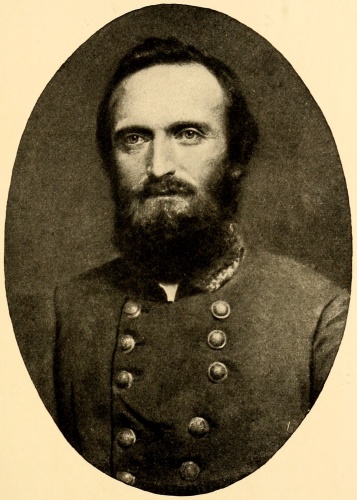
GEN. THOMAS JONATHAN
(Stonewall) JACKSON
CHAPTER SEVEN On to Richmond. Battles at Gains' Mill and Cold Harbor. Fulkerson fell. Battles of White Oak Swamp, Frazier's Farm, Malvern Hill and Harrison's Landing. Return to Richmond.
There is no purpose
in this narrative to
reflect upon the valor
and worth of the
Federal soldier or
his leaders. This
could not truthfully
be done; it was simply a case of Greek
meeting Greek, each being worthy of
his foeman's steel. There was, however,
a stronger incentive to heroism
for the Confederate because he fought
for home and on his own soil. Aside
from this, the greater numbers in equal
battle generally won, slight advantage,
however, in such cases usually turned
the scale.
By the middle of June Fremont,
having heard of Jackson's return to the
valley, began to gather his forces to
prevent onslaught on detached parts of
his army; but by skilful use of his
cavalry and outposts Jackson kept him
mystified, and hence ignorant of his
movements. The great leader was thus
able to withdraw from Fremont's front
without his knowledge, and again
passed through Browns and Swift Run
Gaps to the east of the Blue Ridge,
thence on to Richmond, a small force
being left in Fremont's front to keep
up camp fires to conceal the withdrawal.
Our march was continued
along the Virginia Central Railroad
which conveyed to our destination as
many soldiers of the advance column
as the cars it could supply would accommodate,
then trains would return to
meet the marching columns and reload
and convey as before. This was continued
until the army had been assembled
near Ashland by the 26th of
June, at which date we left the railroad,
moving sharply to the left. Our
progress was slow and cautious.
In the afternoon of the 27th we
heard heavy firing some distance to our
right. This was the advance of Hill
by way of Mechanicsville and Beaver
Dam, from which positions the Federals
were forced back towards Gains
Mill and Cold Harbor, toward which
place our column was also converging.
About three o'clock P. M. Hill again
struck the enemy to our right and the
battle at once became hot and furious.
Our column being at a halt, I rode a
little way to the right and viewed from
an elevation for a brief space of time
a part of this battle, half a mile away.
The Confederates by a brilliant charge
swept the Federals from the field, but
by a counter charge of fresh Federal
troops the decimated Confederate
ranks were in turn forced back over the
same open field, which, however, was
quickly recovered by fresh Confederates,
leaving the dead and dying of
both sides lying on this bloody field,
promiscuously intermingled. I rejoined
the column now moving forward,
which soon again halted. The
battle now raged and was rapidly extending
to the right.
At this time an incident occurred
which is related here to show how indifferent
to Fate the veteran of many
battles becomes when in the face of
battle and probable death, for all now
knew we were soon to enter the bloody
contest going on. Near me was a
lieutenant of the regiment, free and
easy and not exacting of respect for his
rank, familiarly given the sobriquet, of
"Spelling-book." A man of apparent
intelligence and standing came from
the direction of the battlefield toward
us. He was of middle age, in evening
dress, and wore the conventional silk
hat. His mount was a flea-bitten, gray
mare of sleepy gait; and his black
trousers were well divorced from the
tops of his hose. As this unique
figure entered the road through the
open fence "Big" John Duff, a
humorous young man of the regiment,
said to the lieutenant referred to,
"Spelling-book, how are you to-day?"
The gentleman, thinking himself addressed
and thinking to ward off
the intended fun at his expense,
promptly replied, "Very well, I thank
you, how are you?" This attracted
general attention, and the fun began.
A fusillade of wit, humor and burlesque
was fired at this poor defenseless
citizen. "Come down out of that
hat," "Jump off and grab a root,"
"Are you a married man or an Irishman?"
"Put sinkers to your britches.
Bandage your legs," and much more
badinage was so cruelly and mercilessly
hurled at this object of ridicule who
had almost immediately been silenced
that he became livid with mortification
and chagrin. In desperation he
began urging his mare forward by
violently digging her sides with his
heels, being without spurs or whip. He
succeeded in getting her into a pace
along the smooth road between the
lines of soldiers, the gait being the proverbial
pacing of half a day under the
shade of a tree. The fun was increased
by the boys whistling, "Pop goes the
weazel," in perfect time with the gait
of the mare, and was continued along
the line as he progressed. Finally in
desperation he seized his silk hat and
began to beat the gray mare to urge her
forward. This frantic effort still further,
if possible, increased the hilarity,
and finally after covering a good distance,
enduring an ordeal worse than
battle, he turned to the right, entered
the woods and disappeared. How
soon was the opposite extreme to follow,
blood, misery and death; for in
less than half an hour we were in the
forefront of battle.
We moved forward rapidly and took
position in the second or supporting
line and the whole moved forward.
The Federals occupied a ridge near
Gains' Mill that dominated the approaches
from which they used with
damaging effect their well placed artillery.
We had passed Lee and Jackson
on our way and now swept down
the long, gentle slope through shot,
shell and minnie balls. Near the base
of the ridge we were impeded by a
ravine, about six feet wide and as many
feet deep. Here we met the withering
fire of the enemy, but the line in front
and we in turn passed this obstacle,
thence up the ridge in the face of a
most stubborn and gallant resistance
by the Federals, who at last gave way
and were swept from the field, leaving
their dead and wounded. The sight
was ghastly and sickening. Our own
loss was not so great. Major Wheat,
leader of the famous New Orleans
Tigers, mortally wounded on the face
of the ridge while advancing, said to
his men when he fell, "Bury me where
I fall," and immediately expired. His
request was complied with. This
statement is based on what was then
understood to have occurred.
Our lines were halted and adjusted
near the summit of the ridge and here
night put an end to further pursuit.
When quiet came to our ranks I accompanied
my colonel (Fulkerson) to
our front to view the ground. We
reached the top of the ridge, but were
unable to see, because of the darkness
in the low grounds beyond; but the sky
being our background made us conspicuous
targets for the retreating
Federals, hence frequent shots were
fired and the balls passed in close
proximity to us. We thought them
stray shots, however, until convinced
by their continuance that we were the
targets. I had stepped half a dozen
paces from the colonel to a splendid
battery of artillery the enemy had been
compelled to abandon, and was speaking
to him of the valuable prize.
COL. SAMUEL V. FULKERSON
Taken 1860
Meanwhile minnie balls continued to
pass in the same close proximity to us.
My attention was attracted to the colonel.
He had been struck and was
slowly turning and sinking. I quickly
put my arm about him and assisted
him to the ground. I saw he was seriously
hurt and had him borne from the
field. He requested me to say to the
regiment that he had every confidence
that it would do its duty, that he did
not want it to be affected because of his
condition. At the field hospital, despite
every effort of our able surgeons,
Henkle and Butler, he died of his
wounds the following day. Thus
passed a good soldier and valuable man
to his country. His death cast a
gloom, not only over his regiment, but
over all who knew him. Our former
lieutenant colonel, Carson, a splendid
officer, had, because of complete physical
disability reluctantly left the service
some time before, and our lieutenant
colonel, Titus V. Williams, now became
colonel, Capt. John F. Terry,
lieutenant colonel, and Capt. Henry
Clinton Wood, major; all were brave
and efficient officers, in and for whose
courage and ability the regiment
had confidence and respect. I was
now promoted to the captaincy of
Company "D," being one of the
youngest in the army. To accept this
promotion, I resigned the office of adjutant
theretofore held by me, and
Lieut. James L. White, Jr., an efficient
and accomplished officer, succeeded to
the position.
After burying our dead on the 29th,
pursuit of the enemy was resumed.
Our course was down the east side of
the Chickahominy through deep,
tangled undergrowth, marshes and
pine thickets. The heat of a burning
sun, deadness of the atmosphere in this
wilderness of low ground, an afternoon
rainstorm of great intensity which covered
the already marshy ground with
water, then mud, in consequence, making
the trackless way still more difficult
than before, then the sun reappearing
superheating the humid atmosphere,
causing prostrations of many and great
discomfort to all. Then added to these
troubles, water fit for man or beast
was difficult to find, and when found
was either bitter or brackish. These
made up this day of trials. That night
we crossed at Grapevine Bridge to the
south side of the Chickahominy,
thence on to White Oak Swamp.
Here we found the enemy in strong
force on the opposite side with no way
of approach, except by the road and
bridge over which he had retreated.
The bridge, and much of the corduroy
road, however, had been destroyed,
and we were at a halt in this
deep, tangled wilderness. An artillery
duel was opened and continued until
night.
The next morning a furious battle
opened at Frazier's farm on the opposite
side of the swamp, and raged
with great fury. Our way was still
blocked, and hence we were unable to
give the needed aid to Longstreet, who,
from the sound of battle, was being
sorely pressed. The next morning the
way was opened; we captured some
pieces of artillery and pushed on to the
battlefield at Frazier's farm. The
enemy now retreated to Malvern Hill
and here made a determined stand.
This was a most formidable position
commanding the open, level ground for
a mile in front, and protected by a sluggish
and difficult stream on our left.
Our command took position on a
neighboring ridge on the left where we
suffered much from the enemy's artillery
which dominated our position,
from which, however, we could see the
entire field. We saw the charge of
D. H. Hill, Huger and Magruder
across this open field. The formidable
position of the Federals with his hundred
pieces of artillery and heavy lines
of infantry made such an advance appear
as a forlorn hope, but the gallantry
displayed was splendid. Shot,
shell, grape and cannister poured into
these brave troops was horrible to behold;
but they never flinched nor wavered,
but pressed forward until recalled.
Many dead and wounded were
on the field.
Well posted sharpshooters with guns
of longer range than ours were very
annoying and damaging. Our men
were thus picked off here and there
with remarkable regularity. In places
of such danger good fortune seemed
to follow some and bad fortune others.
While shells from the enemy's guns
were flying thick and fast about us,
occasionally exploding in our ranks
with direful effect, four men for relief
from the nervous tension by the engagement
of their attention in something
other than the dangers of shells
and minnie balls, sat down to a
game of cards. A shell soon passed
so close that they moved a few
feet away to get out of range.
A moment later a shell struck and
exploded at the spot thus abandoned,
tearing a deep gash in the earth,
scattering dirt and debris in all directions.
Fate, luck or possibly that instinct
that perceives pending danger,
saved these men from complete destruction.
Then, too, it is said and oft
times really seemed to be so, "that fortune
favors the brave" and these soldiers
were brave. A moment later a
minnie ball well spent in its force
struck a soldier in the forehead, but
did not penetrate the skin. He jestingly
remarked that they came near
getting him that time, and while thus
joking, he fell and expired, concussion
caused death.
At the risk of prolixity, I mention
another incident as the converse of the
above,—that misfortune attends the
timid. On moving to position, we
passed a soldier sitting behind a black
oak tree about four feet in diameter.
A shell had passed through the tree and
had taken off the top of his skull, then
passed into a large pile of rails, exploded
and scattered the rails in all directions.
No one could have imagined
danger when thus protected. Truly in
the midst of life we are in death.
On July 2d, we moved from our position
at Malvern Hill to Harrison's
Landing, to which point the Federals
had retreated to the shelter of their
gun boats; on the 3d some skirmishing
occurred, as also on the following
days. We remained in his front for
four or five days. The storm and
downpour of rain the day after Malvern
Hill in its discomforts and injury
to the army, ammunition and stores
was distressing. Preceding and following
this storm the beaming sun
heated the humid atmosphere and made
the army as miserable as well could be,
but relief soon came in our removal to
the Mechanicsville road near Richmond.
Here we were free from mosquito
ridden marshes and poison laden
atmosphere, endured for half a month,
in daily battle, the march and duties
of soldiers in active war.
The seven days' battles were ended
and had resulted in freeing the Capital
City of immediate menace. McClellan
at the head of his splendid army of
over 110,000 well-equipped soldiers at
its gates for many months perfecting
plans for entrance over the opposition
of 63,000 Confederates under Johnston,
had been beaten, swept back and
left in no condition to renew the effort.
This relief of Richmond was contributed
to by the battle of Seven Pines of
May 23. Before that time—as stated
in accounts and reports—"McClellan
had advanced his left wing consisting
of two of his five corps from his position
on the north of the Chickahominy
to the south of that stream, heavy
spring rains had converted the streams
into torrents, his military bridges
across the Chickahominy into trembling
and swaying structures, and
the mud and mire made the movement
and use of his heavy artillery
practically impossible. The
astute Johnston saw McClellan's faulty
position, and availed himself of the
opportunity to attack his left wing
on May 23d. He drove it from the
field and back more than a mile, capturing
many prisoners, a number of
pieces of artillery, small arms and a
number of tents."
Unfortunately Johnston was struck
by a fragment of shell late in the afternoon
of the first day, knocked from his
horse, and carried from the field in an
insensible condition. Major-General
G. W. Smith succeeded to command.
McClellan had gotten Sumner's Corps
to his left wing, and thus reinforced
the Federals entrenched their position,
and the battles of the succeeding days
amounted to little more than skirmishes
and were without material results.
The treacherous Chickahominy
now intervened between McClellan's
two corps on the north and his three
corps on the south of that stream.
This position was so held June
26, at the time of the advance of Lee
who had been assigned to the command
of the army on the first day of that
month.
There can be no question but that
Johnston's attack was wise and successful,
not only because he won the day,
but because he drew a large part of
McClellan's right wing from the north
to the south of the Chickahominy, thus
leaving much less than half of the
Federal army on the north of the river,
and contributing to Lee's success
against this isolated right wing. At
this time McClellan's entire army must
have aggregated 110,000 to 115,000.
In the early part of May his force was
placed at 110,000. Lee's entire army,
including Jackson, was 80,000 to 85,000.
With this inferior force in numbers
much was accomplished, yet with
the attending advantages greater results
might have been attained. There
does not seem to have been any fault
in Lee's plans or leadership; but fault,
if such existed, must have been lack of
cooperation by the separate commands.
Yet unforeseen conditions may have
prevented this. Lee risked much when
he withdrew his main army from Richmond
to the north of the Chickahominy,
leaving but 25,000 men under
Magruder to defend the city against
more than twice to three times their
number of the best of McClellan's army;
but this, of course, was considered by
Lee, and results justified his course. The
victories of the seven days were substantial,
except Malvern Hill, which,
except for the freeing of Richmond,
nearly offset the previous six days.
The attack on such a position so manned
and garrisoned was a mistake.
CHAPTER EIGHT Advance against Pope. Battle at Cedar Run. Battle at Bristoe Station. Battle at Manassas. Battles near Groveton on 28-29th. Battle renewed on 30th.
About the first of August
Jackson's corps
moved toward Gordonsville.
When the
troops got under
way and the head of
the column had been
turned sharply to the left, indicating
the direction of our march toward the
mountains and the valley, where pure
air and good water could be had, a
shout arose that was deafening in its
volume; and it was taken up by the
column as it reached the turn, and was
so continued until the corps had passed.
The same occurred, except possibly
in greater volume, on the following
day when the Blue Ridge was first
brought into view. This elevation of
spirits, pure air, and drinkable water
soon made the army itself again.
The head of the column, however,
soon turned toward Culpeper Court
House; and, on the ninth, Pope's advance
was found in position on Cedar
Run, at the northwest base of Slaughter
Mountain, about eight miles from
Culpeper Court House. Our guns
were soon placed and about 2 p. m.
a heavy artillery duel opened and continued
for about two hours. The batteries
of Poag, of Carpenter and of
Caskie were well placed and appeared
to do fine execution. Our brigade
supported these batteries, which, of
course, were targets for the enemy's
guns, as was the brigade. In the meantime,
the infantry was being brought
into position near the brow of a low
ridge. Our brigade occupied the line
to the left of Early's, and to the right
of the second brigade of Jackson's division.
About 4 p. m. the line advanced
over the ridge into an open
wheat field. Two hundred yards to our
front was thick timber and undergrowth.
From the timber the enemy
advanced in great numbers, forcing
back the brigade to our left. This compelled
the "3rd brigade" also to fall
back to meet this flank and rear attack,
but again as soon as our left was sufficiently
protected by A. P. Hill the
whole line moved forward and turned
the Federal right and the day was
practically won. Federal cavalry in
great force charged on our brigade, but
was repulsed with heavy loss.
A brilliant dash on our right of our
flying artillery was beautifully executed
in view of both armies and did
splendid work. Our whole line now
pushed forward, and the Federals gave
way at every point in confusion and
disorder, leaving their dead and
wounded on the field. General Winder,
commanding our division, was struck
by a piece of shell during the artillery
duel and died in a few minutes. He
occupied a high place in the esteem of
the army and the loss was deeply felt.
Other incidents occurred during this
artillery duel. A shell exploded in the
ranks of a regiment and five men fell
to death together and upon each other.
Our losses in this battle, as shown by
statistics, were 19 officers killed and
114 wounded, of non-commissioned officers
and privates 204 killed and 946
wounded and 31 missing, aggregating
a loss of 1,314. The Federal loss was
greater. "The regiment" had its due
share of casualties, owing to its prominent
share in the engagement. After
more than forty-five years it is impossible
to recall the names of the unfortunates,
but I do recall that Capt. John
Duff of Company "C" and I were in
conversation just as we reached the
border of the wheat field from the skirt
of the woods. He was in a most cheerful
mood as we entered this rapid and
fierce battle. He fell in death a few
minutes after he entered. Capt. Felix
Duff of Company "H," another brave
and efficient officer, fell mortally
wounded and died in a few hours. I
was of the number of the wounded.
Of the killed and wounded of the regiment
I am unable to recall the number,
names or companies, except in one instance,
and that was impressed upon
my mind because of the nature of the
wound and of the unlooked for result,
viz: Young Combs of Company "C"
was to appearances vigorous and strong,
of fine physical appearance. It was his
first battle. A minnie ball passed just
under the skin in the calf of the leg
for the space of one or two inches and
out. There was but little blood, no
artery had been touched and no reason
could be assigned for serious results;
nevertheless, he was greatly excited
and died in a few minutes.
The victory over superior numbers
by Jackson's army, composed of the divisions
of Jackson, Early and A. P.
Hill, had a telling effect; but now the
Federal Commander, Pope, who had
so valiantly proclaimed headquarters
in the saddle, began to concentrate his
army on a strong position near Culpeper
Court House to resist Jackson's
further advance. But Jackson chose
to await the coming of the main army
under Lee which was still in the vicinity
of Richmond, hence retired to Gordonsville.
The rest and recuperation so much
needed was now enjoyed until the middle
of August, thus putting the army in
fine condition for the campaign then
entered upon. The route of which was
by way of Orange Court House,
thence up the right bank of Rapidan
River. The divisions of Ewell, Hill
and Jackson composed Jackson's corps,
and on the 12th moved in the direction
of Beverly Ford on the Rappahannock.
Jackson's division, now commanded by
Talliaferro, was at the head of the
column. In the afternoon a spirited
artillery duel across the river was
fought, resulting in the silencing of
the Federals, who, however, brought
forward and began to concentrate a
strong force. The river still separating
these armies, the Confederates continued
the march up the right bank,
the head of the column crossing on the
24th to the left bank. The balance of
the corps, strung out for many miles,
followed in the wake of the advance,
encountering on the way like artillery
duels across the river, but not swerved
from the end sought, pushed forward
for a week with but little sleep or rest
toward the rear of Pope's army, and at
Salem Church went into bivouac for
the night. On the following day, the
march being continued across Bull Run
Mountain through Thoroughfare Gap
and Gainesville to Bristoe Station on
the railroad, we were now in the rear
of Pope and between his army and
Washington. Here some prisoners
and loaded cars were captured, and the
same night at Manassas, seven miles
distant, a number of prisoners, cannon,
small arms, ammunition, immense and
valuable commissary and quartermaster
stores were captured.
LT. COL. ROBERT P. CARSON
Taken 1910
On the 27th a force came from the
direction of Washington, hoping to
regain the captured stores and prisoners,
and made a vigorous attack and
contested the field with much vigor
for some hours, but were in the end defeated,
routed, and disappeared, leaving
their dead and wounded on the
field. In the afternoon of the same
day, the Federals in full force attacked
the Confederates at Bristoe Station
from the direction of Warrenton. The
battle raged fierce and furious. The
Federals were repulsed. The Confederates
were now withdrawn to the
army at Manassas. The following
day, the 28th, the Confederates took
position toward Groveton on the
Warrenton and Alexandria Turnpike.
The Federals in full force were now
moving on the Confederates from the
direction of Warrenton, hoping to
crush them before Lee, with the main
army, could reach the field. An effort
to move a large part of this force to the
east of the Confederates, and thus intervene
between them and Washington,
exposed his left flank, upon which
Jackson with his comparatively small
army, without the slightest hesitation,
made a vigorous assault, which continued
with great spirit until about nine
o'clock at night, the Federals being
pushed back from the field. By the
following morning, the 29th, it was
found that the enemy had moved his
position further to our left with the
evident purpose of covering the way
to the Federal Capital, and about ten
a. m. opened with artillery a vigorous
attack upon our right, which was repulsed
by the Confederate batteries at
the end of about two hours. A lull
now followed, interrupted only by an
occasional artillery shot, until about 2
p. m. The Federal infantry in heavy
force now made a vigorous attack on
the Confederate left. This was beaten
back, as were successive attacks by
fresh relays of troops, until the Confederates,
exhausted and out of ammunition,
were forced back three or
four hundred yards, their line broken
and a part of the force cut off. At this
supreme moment reinforcements from
the right arrived and engaged the victorious
enemy with grim determination.
The battle, now more furious
than before, swayed to and fro; and
for sometime doubtful conclusions
hung in the balance. The enemy continued
to pour in his fresh relays,
which were met by the same grim veterans
of many battles. The contest
constantly grew fiercer and more
bloody. Often the combatants delivered
their fire against each other
within ten or a dozen paces. This awful
carnage could not continue long.
The slaughter was too horrible and
sickening. The tide must turn, and it
did. At the supreme moment in battle
a word, a slight act, may, and often
does, decide the fate of the day. At
this supreme moment an officer, or
private, as has been claimed, in the very
forefront of the closest quarters, called
out in a lusty voice, "Charge 'em, boys,
charge 'em." This was the needed
stimulant. It nerved the heart and
hand of the weary Confederates and
was responded to by the whole line
with such unanimous vigor and force
that the enemy was swept from the
field with great loss. The Confederate
loss was also heavy. "The Regiment"
and the Confederates reoccupied
the stronger line held by them at the
beginning.
On the following day, the 30th, cannonading
and some skirmishing occurred
until about 4 o'clock. The
enemy began to advance in a number
of successive lines. Soon the battle
became sanguinary and determined
and extended along the entire front.
The Confederates on the left occupied
a favorable position and repulsed the
onslaught made upon them. As one
line was repulsed a fresh one took its
place, and thus the battle raged over
the dead and wounded Federals who
fell on this oft' traversed field. The
main Confederate army, which had
now reached the field, and Jackson's
worn and decimated corps were now
contesting the field with a brave army
of superior numbers; but a change of
conditions must come, and again the
psychological moment arrived and was
availed of by the Confederates, pressed
to the last inch of endurance. Our
right now held by Longstreet pressed
the enemy back, this invigorated the
whole Confederate line, which now
with eager and invincible will simultaneously
joined in the forward movement
and pressed upon the still stubborn
and equally determined foe, resisting
with bayonet the onward rush;
but the tide turned against the Federals
and they fled precipitately, leaving
their dead and wounded on the field.
The Confederates now opened upon
the fleeing Federals and their loss at
this time, as during the day, was very
heavy. The Confederate loss was also
heavy. A number of pieces of artillery
and many stands of small arms fell into
the hands of the Confederates.
The enemy continued his retreat.
Pursuit was taken up by Jackson's
corps in the lead and, on the first of
September, the enemy in force was
again encountered at Ox Hill. Here a
sanguinary battle of much fury occurred,
lasting for some time, when a
heavy storm brought a cessation of the
contest for a time, during which the
enemy retired about night and by the
next morning had disappeared. On
the following day, the 3d, Jackson's
corps moved toward Loudoun county
and on the 4th went into bivouac near
Leesburg.
CHAPTER NINE Capture of Harper's Ferry. Battle of Sharpsburg. Return to Virginia. Battle of Fredericksburg.
About the fifth of September
Jackson's
corps crossed the
Potomac into Maryland
near Leesburg,
moving toward
Frederick, Md.; and
on or about the 10th moved toward
Martinsburg, recrossing the Potomac
near Williamsport. On the following
day the course was down the right bank
of the Potomac toward Harpers Ferry,
near which on Bolivar Heights a Federal
force under General Miles was
hemmed in by the Confederates who
occupied Maryland and Loudoun
heights and all the passes leading out
from the Federal position. In the
contest little else occurred than artillery
firing, which continued for about
two hours, resulting in but few casualties
on either side. Realizing their
inextricable position the Federals "on
the morning of the 15th surrendered
unconditionally all the force, consisting
of approximately 12,000 men, 74
pieces of artillery, many thousands of
small arms and large military stores."
The details of the surrender were left
with A. P. Hill's division to adjust
while the balance of Jackson's corps
left in haste for Sharpsburg, where
Longstreet and D. H. Hill were already
engaged with the enemy who by
greatly superior numbers had forced
the passes of South Mountain, causing
the Confederates to take position near
Sharpsburg behind Antietam Creek on
the morning of the 15th. Early on the
morning of the 16th Jackson's corps,
except Hill's division, arrived.
On the afternoon of the 15th, the
enemy had advanced and the batteries
on both sides were immediately engaged.
On the 16th artillery firing
continued during the entire day. Jackson's
old division occupied the left
from Hagerstown road to the Potomac.
At dawn on the 17th, the enemy's artillery
opened with great vigor on
Jackson's line. The battle was hot and
furious from the start and continued
for many hours with alternate success.
The Federal lines were forced back
several times, but new lines of fresh
troops were met, and in turn the Confederates
were forced to retire before
them, but would again return to the
contest and again clear their front,
but to be again pushed back as before.
This was the part of the Confederate line
against which the enemy had concentrated
and was now hurling the strength
of his army, and by overwhelming
numbers turning the Confederates left;
but reinforcements from our right arrived
in time, and now the battle raged
with still greater fury and determination.
But the onslaught of the Confederates
was not to be successfully resisted,
hence they swept the Federals
back and reestablished their lines,
which were held against further attacks
of the day. Between these hostile
lines lay hundreds of dead and dying
of both sides, fighting being so continuous
as to prevent proper attention
to them. I do not now recall the
names of any of these, except that of
a younger brother, the late Judge M.
B. Wood, whose wound was severe,
and naturally I was impressed. The
main attack was now shifted from
our left to the center. This
was finally repulsed and the battle
along the line was now reduced to a
more moderate degree; heavy attacks,
however, were made occasionally on
different parts of the Confederate
lines. Hill arrived from Harpers Ferry
late in the afternoon and attacked
the enemy on our right, and drove him
from his position back across Antietam,
inflicting much loss.
On the morning of the 18th the
Confederates held their entire lines
and awaited an advance by the
enemy, he having superior numbers
and equipment; but he did not advance.
That night, owing to the enemy
being about to receive large reinforcements
as was then understood,
and the rains which had fallen causing
a rise in the Potomac which would
thus cut off the Confederates from
their base of supplies, Lee withdrew
his army to the Virginia side, crossing
at Shepardstown without loss. The
best that could be claimed by either
side was that the battle was a draw;
neither side won.
Jackson's division went into camp
at Bunker's Hill, twelve miles below
Winchester, and here received much
needed rest, food, clothing and shoes.
After a short time of drill, picket,
guard and camp duty, recuperation ensued;
the arduous and perilous duties
of the Maryland campaign were forgotten
and the army was itself again.
Here our division remained until October,
then moved to the vicinity of
Berryville, thence across the Blue
Ridge to camp near Guiny's Station.
On the morning of December 12th,
the division moved in much haste to
Hamilton's Crossing, four miles below
Fredericksburg. It was then
known that the Federal army under
command of General Burnside was
crossing the Rappahannock at and below
that city. Many advantages seemed
to favor the enterprise. Of these
were his many well placed long range
guns on Stafford Heights from opposite
the city to Hamilton's Crossing,
a distance of four miles, completely
dominating and commanding the lower
range of hills on the Confederate side
far back from the river. His greatly
superior numbers and equipment gave
promise of success to his advance.
Pontoon bridges at Fredericksburg, at
Hamilton's Crossing and points between,
completely protected by the high
river banks from shot and shell, enabled
him to transfer his army expeditiously
to the west side, between which
and the ridge—occupied by the Confederates—is
a smooth open plain, varying
in width from one to one and a half
miles and extending in length from the
city to below Hamilton's Crossing, a
distance of more than four miles. This
topography rendered it impracticable
for the Confederates to maintain a
force at or near the river or on this
open plain to dispute the crossing by
the enemy.
On the morning of the 11th Burnside
opened on the Confederates with
about one hundred and fifty guns from
Stafford Heights, and advanced to the
river a large infantry force, thus compelling
the Confederate pickets to retire.
The enemy then proceeded to
construct his pontoon crossings, and
during the night and following day,
being protected by a dense fog as well
as high river banks, crossed his army.
Little occurred on the following day,
except occasional artillery firing at the
Confederate position from Stafford
Heights, as rifts would occur in the
dense fog which still hung over the
field. This firing was not returned by
the Confederates, but as occasional
clearings of the fog would reveal the
enemy's columns on the plain a vigorous
and apparently effective fire was
opened upon them. Of the Confederates,
Longstreet occupied the left,
including Mary's and Willis' Hills,
and Jackson the right, extending to
Hamilton's Crossing. The extreme
right being protected by Stuart's cavalry.
The first and second lines of battle,
the reserves and the artillery now
in position, awaited the advance of the
enemy which did not occur that day.
On the morning of the 13th, the plain
now occupied by the Federals was still
enveloped in dense fog. About 10
o'clock the fog cleared and the lines of
the enemy in order of battle could be
seen upon the plain between the Confederate
position and the river, in
front of our position at Hamilton's
Crossing and extending miles to our
left toward Fredericksburg. The force
in front of Jackson's corps alone was
estimated at not less than 50,000.
Federal batteries from Stafford
Heights opened fire upon the Confederate
lines, the heaviest of which was
directed against the line far to our left,
toward the city, to which the Confederates
did not reply, but held their fire
for the infantry, now advancing in
numerous lines of battle against our
front. At our position A. P. Hill's division
was in front, and Jackson's division
in the second or supporting line,
and our artillery was well placed. In
addition to the batteries of the enemy
on Stafford Heights some of his field
batteries on the plain and a battery of
the Confederates on our right engaged
in a duel which continued with great
spirit for more than an hour, when the
Confederates withdrew and the enemy
now advanced unmolested, turning his
batteries on our position. The Confederates
reserved their fire until the Federal
lines came within easy range before
they opened, pouring such a storm
of shot and shell into his ranks as to
cause him to waver and then to retreat
in confusion and disorder.
A comparative lull now ensued until
about 2 o'clock, when the Federals
made a furious artillery attack, inflicting
great damage on our lines.
Under the protection of this fire, his
infantry in heavy force again advanced.
When, as before, they had
gotten within easy range, our batteries
opened fire on him with destructive effect.
Though staggered and shocked
by this rapid and well directed fire their
lines regained composure, continued to
press forward and soon came within
easy range of our infantry lines. Then
the conflict at once began with great
fury. Musketry and artillery continued
to play upon his ranks with withering
effect, but still he pressed forward; and,
finding a gap in our line some distance
to our left,—open by accident,—he
pressed through in great numbers, and
now pressing in front, as well as the
flanks, the advantage was with the
Federals. But the Confederates with
heroic desperation continued the contest,
but were forced to yield ground.
Thus the breach widened and the enemy
in still greater numbers pressed on,
still the battle raged. The dead and
dying on both sides lay intermingled
on the field with no hope of assistance
to the wounded, until the battle should
end. Yet dead and dying continued to
fall thick and fast. The day now
seemed almost lost to the Confederates.
Decimated, worn and almost without
ammunition, they still bitterly contested
the advance of the Federals. At
this time the Confederate reserves
reached the field and at once made descent
on this victorious force with
such impetuosity that it was swept back
and our lines advanced farther than
before, going to the edge of the plain
along the railroad. The enemy did
not advance again during the day, but
kept up at intervals his artillery fire.
The simultaneous attack on the Confederate
lines to the left of Jackson's
corps was equally fierce and determined,
and quite as sanguinary, and
perhaps more so at Mary's and Willis'
Hills. Six times did the enemy attack
these positions, and each of these attacks
was repulsed with great loss.
The Confederates also lost heavily
here, as well as at other parts of the
line. The work of the day was now
over. Our division now occupied the
railroad, this being the front line.
During the day incidents too numerous
to mention occurred, one or two
of which impressed me. While moving
to position under heavy shelling, a
soldier from the line in front came
obliquely toward the left and rear. He
wore a very long sandy beard and carried
his gun in his left hand at his side.
The boys began to guy him for getting
to the rear. "You are safer in ranks,"
"Fortune favors the brave," "You are
skulking," and so on went this fusillade
against this poor, downcast looking
man, during which an exploding
shell struck him and he was literally
no more. A little farther on we
discovered a soldier who had taken
refuge behind a large oak tree, lying
in apparent security, but a shell had
struck the ground in front of the tree,
passed under it, came out and exploded,
tearing him into bits. Thus
Fate seemed to have attended them.
Another, but more pleasing scene, occurred
soon after nightfall. The survivors
of that field of both armies will
remember, if for no other reason than
the relief it gave by transference of
thought and attention from the carnage
of the day, and now irresistibly fixed
them on an aurora borealis, or northern
light. This at first appeared as a dimly
reflected light from below the horizon,
but it continued to grow in brightness
and volume until it covered a wide
space against the sky, and then shooting
up its steady and well defined columns,
each tinted in separate and distinct
hues, ascended to a great height,
and thus continued for many minutes,
then all gradually faded away, never
to be pictured to others by brush or
pen. The awe and beauty of this natural
apparition as it appeared on that
night of December 13th, 1862, will
ever hold a place in memory.
Jackson's and Early's divisions remained
on the front line at the railroad
during that night and the following
day. The Federals also remained in
line of battle all day as if expecting
attack, but an attack by the Confederates
was impossible, because the
well-placed guns on Stafford Heights
could and would have swept from the
broad open plain any force that might
have attempted to cross it. This could
have been done by the Federals more
effectually by reason of his superior
position and number of guns than our
own artillery had done on his advancing
columns, on the day before. Neither
side advanced during the day, and
nothing save some desultory artillery
firing occurred. During the night our
division was relieved by D. H. Hill
and we were moved back to a position
in the line of reserves. During the
15th the enemy remained in battle array,
as if still looking for attack; but
in the afternoon sent in a flag of truce
and a request for permission to take
his wounded from the field. This was
granted, after which not even an artillery
shot—so frequent before—was
heard; deathlike stillness prevailed.
Our troops were in fine spirits and only
hoped the enemy would come out of his
stronghold on the following day and
again attack, but this he did not do,
but on the night of the 15th recrossed
the river and thus ended the prospect of
further contest.
We now returned to camp and established
winter quarters on the Rappahannock
at Buckner's Neck. The
routine of camp life was entered upon
and the exercising from daily drill and
other duties, better food, shoes and
clothing, gave contentment, and the
army was soon restored to fine condition.
Picket duty on the river during the
winter brought the troops of the opposing
armies into such close proximity
that a continual battle across the river
could have been kept up, but instead a
tacit armistice was maintained between
the soldiers themselves. This was done
by neither pen or tongue, but simply
by acts, developing into such a kindly
feeling that frequently in the absence
of officers interchange of visits were
made by crossing the river on improvised
rafts for the exchange of tobacco
from the Confederates for coffee from
the Federals. This occurred daily.
An incident of the kind came under
my own observation while in command
of the picket force, the reserve post of
which was stationed back, and smaller
posts stationed nearer to different
eligible crossings, along and near the
river bank. The same arrangement
seemed to be true of the Federal pickets,
and it was between these lines that
intercourse orally and commercially
existed. In passing down the river
along this line I discovered a small improvised
craft of bark provided with
newspaper sails gliding to the Federal
side with its plainly seen lading. My
duty was to investigate and have arrested
the violators of this plain
breach of discipline. Although regarded
as a disciplinarian, I could not
find it in my heart to do this, accord
and harmony being too inviolable to be
disturbed when material damage therefrom
did not portend; and as nothing
of the kind threatened here I simply
failed to see or know of the little craft.
On a recent call at my home of an
ex-Federal captain, Charles P. Tanner,
and his estimable wife I related
the above to him and he in
turn related a kindred experience of
this period. He was then in the ranks
and was possessed of this fellow-feeling
as were his comrades. He said
that by means of improvised rafts the
Federals and Confederates would exchange
visits in the absence of the officers
in charge. On one of these
visits to the Confederates a comrade
and himself, being of sporting proclivities,
engaged in a game of cards
with the Confederates which soon became
interesting and absorbing to
those engaged and the others standing
by as well. At this time the Confederate
officer in charge had approached
unobserved until he made demand of
the Federals to know what they were
doing there and did they not know that
this intercourse was against the orders
of the commanders of both armies?
Well knowing such orders, but not admitting
the same, the Federals adroitly
inquired, "What orders?" An explanation
followed with an admonition
to the Federals to get to their own
side of the river. It is needless to say
that the admonition was heeded. The
evening thus spent with this liberal
minded and estimable gentleman, in
which many other reminiscences so
common to both were gone over, was
quite enjoyable.
About the middle of April, 1863,
the Federals made a demonstration at
Port Royal, twelve miles below our
camp, by crossing the Rappahannock
at that place with a small part of
his army. The "3d brigade" was hurried
there, but the Federals returned
to the east side before our arrival. No
further demonstration at this point
was made, but we remained there for
some days, enjoying the fine shad, so
abundant in the Rappahannock in the
then shad season.
CHAPTER TEN Federal Advance. Flank movement of Confederates. Attack on Federal right rear. Jackson wounded. Battle of Chancellorsville. Jackson's death.
About this time the
Federals made demonstration
at Kelley's
Ford, some
miles above Fredericksburg.
The two
armies had been lying
on opposite sides of this river,
since the battle of Fredericksburg in
December. Gen. Joe Hooker was now
in command of the Federal army, and
on the 28th of April a small part of his
army crossed the river a little below
Fredericksburg, thus indicating an intended
advance from that direction.
This, however, as were other demonstrations,
was for the purpose of drawing
attention from his real course of
approach, which soon developed to be
by way of the United States and other
fords of the Rappahannock, fifteen and
twenty miles above Fredericksburg,
where he crossed his army and was
bearing down by way of Chancellorsville
upon Lee's left and rear. Here
the Federals encountered Anderson's
and McLaw's divisions, and thinking it
an advance by Lee took a formidable
defensive position, extending his lines
from the Furnace and Tabernacle
Church to Chancellorsville, thence behind
Mineral Spring Run to and beyond
the old Mine Road.
This strong position and the superior
numbers of the Federals put the consideration
of a front attack out of the
question, but the emergency was great
and had to be met; but how? Longstreet's
corps was away and the inadequacy
of numbers was great and conditions
serious. But Jackson, as usual,
cut the gordian knot. In answer to the
query of Lee, as to what should be
done, he replied, "Outflank them."
This was accepted as the best solution,
and Jackson was entrusted with
this important task. On the morning
of May 1st he set out with his old division
commanded by General Colston,
A. P. Hill's and Rodes' divisions. This
was a great risk for Lee to divide his
army in the front of his advancing antagonist
for this great flank movement.
It was contrary to the principles of
strategy for Jackson to take his corps
of 26,000 men, leaving Lee with about
18,000 men an easy prey, to be crushed
by Hooker, who could then turn upon
Jackson with his entire army; but
Hooker did not know conditions or did
not avail of the opportunity thus presented.
He also certainly blundered in
failing to properly protect his right
wing, but for this failure of Hooker
success would hardly have attended
Jackson's move. The disparity in numbers
and position in favor of the Federals
was too great.
Our course was up the old turnpike
to within a mile or two of Chancellorsville,
thence directly to the left over a
country road, passing along the immediate
rear of Anderson's division,
then in line of battle and now receiving
shots from the advancing Federals,
thence to the left by the old Furnace,
moving in great haste. We thus made
the impression on the Federals that
it was the beginning of a precipitate retreat.
Thus encouraged the enemy
made an overwhelming assault upon
Anderson, pressed him back and captured
some of Jackson's ammunition
train; but on we sped, soon turning to
the right, making our course due north.
The day was excessively hot and
many fell by the way from heat and
exhaustion. We reached and crossed
the Orange Plank Road leading to
Chancellorsville, then the Culpeper
Plank Road; next we reached a county
road and formed line of battle across
this road about 5 o'clock in the afternoon,
facing Chancellorsville to the
southeast. We were now in the rear
of the enemy's right. Our advance
began between five and six o'clock. We
soon struck Howard's corps, which
gave way in precipitous rout. Fresh
troops and impediments were utterly
unable to stop or seriously impede our
onward sweep. We captured prisoners,
artillery and small arms on the
way, but steadily continued the pursuit
until darkness and the deep tangled
undergrowth put an end to further advance.
We were now within a mile of
Chancellorsville. A skirmish line was
thrown out and moved forward to
within less than half a mile of the enemy's
position. Our brigade and others
followed in formation of two columns
occupying the respective sides of the
Plank Road, and a column of artillery
occupied the middle, with the third
brigade at the head of one of the columns.
Our skirmish line extended
across our front a hundred yards
ahead. The enemy was in his strong
position awaiting attack. Like the
calm before the storm, quiet and stillness
now reigned, except with the ever
vigilant Jackson. Intent on investigating
conditions in his front he passed
through our skirmish line accompanied
by his staff, and after making reconnoissance
returned to another point toward
the Confederate skirmish line.
This surprise brought a fire from the
skirmish line and then from the enemy,
who thought it an attack. Hence
he opened fire upon us with a fury that
was hardly surpassed, if equalled, during
the war. Shot, shell, grape and
cannister tore through the ranks of
men and artillery horses. Minnie balls
came like hail in a spring storm. Exploding
shells would kill some and
wound many. Solid shot would plough
through the ranks, leaving a line of
dead and dying. Grape and cannister
would slay and wound groups and
squads, while minnies did an effective
but indiscriminate work of destruction.
Caissons of ammunition were blown up
by exploding shells, adding to the work
of destruction. Added to this was the
plunging and leaping of wounded artillery
horses, thus increasing the peril
to life. The horribleness of that dark
night is indescribable. It was not a
battle, but a firing by the Federals.
The Confederates could do nothing but
protect themselves as best they could
by lying upon the ground. They were
not in formation to engage in battle,
nor could they withdraw; because to
arise was to be cut down like grass before
the mower's scythe. This may be
figurative, but there is no question but
many lives were saved by lying upon
the ground until the end.
Jackson had been wounded and in
the midst of this fusillade litter bearers
had placed him upon a litter and one at
each of the four corners raised him to
their shoulders and started from the
field. Soon one of the bearers was
stricken down, causing Jackson to fall
heavily to the ground. His wounds
were not thought to be serious, the
bone of the left arm a few inches below
the shoulder and the cutting of the
artery in the arm being the principal
injury. This occurred on Saturday
night, May 1, and before dawn of the
following day, amputation of the arm
was performed and the patient revived
and gave every evidence of recovery,
but finally pneumonia supervened, and
on the following Sunday the great
Chieftain, at the age of thirty-seven,
triumphantly passed into the Great
Beyond. Great gloom was cast
over the whole army and the people of
the South. When he was wounded all
watched with deep anxiety and prayerful
hearts for his restoration the sick
bed of this illustrious patient, and
when the end came grief was sincere
and profound. He left as a heritage
to his country an unblemished life of
Christian devotion, pure patriotism
and great deeds. Jackson will ever live
in the hearts of his people.
After the fusillade of that night—May
the first—the troops were removed
a little farther to the rear and
formed into line of battle, and thus
went into bivouac for the balance of
the night. By 10 o'clock on the following
morning the advance on the
enemy's strong position began. Jackson's
old division constituted a part of
the front line. We passed through
thick undergrowth until we reached the
crest of a low ridge. At this point and
in our front the undergrowth had been
cut away and the enemy was posted behind
well-constructed breast works of
logs, stone and earth on the face of a
corresponding but higher ridge. Between
these positions a sluggish
streamlet formed a bog about fifty or
more yards wide, and extending a long
distance across our front to the right
and to the left. This bog had been
well studded with tough white oak
saplings which had been felled, leaving
them uncut from the stump, and
so crossed and piled as to make, when
added to the bog itself, the mud and
slush of which was one or more feet
deep, an almost impenetrable obstruction.
From higher grounds, back of
his lines, the enemy threw shell, solid
shot, grape and cannister into our position
with great fury, but being fairly
well protected by the crest of the ridge
our casualties were not very great.
Before our advance Lieut. Walter
S. Preston was sitting near me, leaning
against a small sapling. We saw a solid
six-pound shot rolling slowly down the
hill toward us and before Preston could
get entirely out of its way, it brushed
by his shoulder. It did not strike him,
but the concussion and force was so
much greater than thought and the effect
so much more serious that he was
disabled for a long time. Here, too,
Major Walker of the 10th Virginia
Regiment, my personal friend and with
whom I was conversing at the time,
while sitting on a stump, was struck by
a shell and instantly killed. Many
other casualties at this point occurred
in my company and regiment, but I do
not recall the names. The advance was
now ordered, and inasmuch as no
troops could have stood and exchanged
shots with the Federals, his artillery
and infantry being so well protected by
breastworks, there was nothing that
promised success but to charge down
the decline and across this formidable
bog and onto the enemy in his stronghold.
This was done with great gallantry
by the entire Confederate lines,
led by Gen. J. E. B. Stuart in person,
he now being in immediate command
of Jackson's corps, the latter and A. P.
Hill, next in rank, both having been
wounded and disabled. We received
the fusillade of infantry and artillery
fire, so furious that it seemed that but
few would be left to tell the tale. But
little firing was done by the Confederates,
as rapid movement so necessary
prevented.
Our progress across the bog was unavoidably
slower, but we soon emerged
therefrom and ascended the slope in
fine mood for effective work, drove
the enemy from his line of works and
in turn as he retreated in great haste
across the plateau inflicted heavy
damage upon him, strewing the field
with his dead and dying. He, however,
returned with fresh lines to retake
the works, but was repulsed with
loss. By this time, however, the Confederate
line some distance to our left
gave way, and the enemy in strong
force penetrated through the gap to the
left rear of our position and opened a
vigorous fire upon us. Being thus assailed
in front and rear, we were ordered
to relinquish the costly position
we had gained and again recross the
bog and ascend the incline under a
galling fire from two directions. Our
damage, of course, was heavy, but the
spirit of our army was undaunted. The
broken part of our lines were soon restored
with fresh troops and we again
returned to the charge. This time we
knew it could be done and with swiftness
and determination swept down
to and across the bog and on the works,
and again returned kind for kind with
good interest on our retreating foe,
who soon again with fresh lines made
a beautiful and gallant effort to retake
the works, advancing his rapidly melting
lines to within a short distance.
But the fire upon him was so destructive
that he was compelled to retire,
and our part of the Confederate line
prematurely advanced in pursuit; but
when we reached the highest part of the
plateau, we met such a storm of shot,
shell, grape, cannister and minnies
from different directions, we being the
only part of the lines exposed, that we
were compelled to return to the works.
Our whole lines were now lined up
and again advanced. Our part of the
line again met the enemy's fire on the
plateau and here, as before, we met a
brave and stubborn resistance which
continued for some time. Our own, as
well as many of the enemy's ranks,
melted away rapidly, but in the grim
determination of the contending armies
the battle raged. On this disputed
ground the undergrowth had been
cleared away, but the trees and saplings
had been left standing. Many of the
latter, including in one instance a tree
of considerable size, were cut down by
minnie balls. McLaw's division now
came into position on the right and a
general charge along the line was made.
The enemy gave way and the battle of
Sunday, the second of May, was ended.
The losses of both sides were heavy
over the whole field. On this disputed
plateau the dead of the two armies
must have lain within an average of
five or six feet, or even less, all over
that broad space, as my memory now
serves me. The enemy now pursued
by the Confederates retired to his last
line of fortifications, about three miles
back toward the United States Ford.
In the meantime the enemy, under
Sedgwick with superior numbers, had
pressed back the Confederates at
Fredericksburg about five miles toward
our position at Chancellorsville, thus
seriously threatening our rear. This
forced Lee to withdraw several divisions
of his army, confronting
Hooker at Chancellorsville, and to
meet and drive across the river this
triumphant advance of Sedgwick;
which was done.
This left but the three divisions of
Jackson's corps to hold our front at
Chancellorsville. The writer was
placed in charge of the picket line in
our front on the night of the third, and
there remained until the morning of the
sixth. In the meantime firing by the
opposing picket lines was frequent, resulting
in many casualties. About
midnight of the fifth, I thought movements
of the enemy indicated the beginning
of his withdrawal, and at once
so reported. I was directed to watch
further developments and report; and
soon being satisfied the enemy was
rapidly withdrawing, I so reported and
was directed to advance on his works
at daylight. This I did and found the
works vacated, on the report of which
I was directed to assemble my battalion
and pursue. I threw out a skirmish
line covering our front for some distance
on each side of the road, and
moved on the road toward the United
States Ford, followed by Jackson's old
division and other troops. Here the
enemy had crossed the river on his pontoon
bridges, well guarded by his numerous
artillery. Under flag of truce
he was permitted to send a detail to
bury his dead. Both armies were now
quiet for some days.
The preceding strenuous days were
full of interesting events. On the
morning of the first, after we had gotten
under way on the march to the
rear of the enemy, a soldier of the
writer's company told some of his
comrades that he was to be killed that
day. They tried to laugh him out of
the premonition, but he said it had
come to him too plainly and forcibly,
and further that no power could save
him from the pending fate that he
would encounter in the battle which
would occur that day. His comrades
thought lightly of it, but the battle
began about 5 p. m. We advanced
very rapidly. James P. Walling, who
still lives, was at my left and James
Warf, the subject of this event, at my
right. We were a little to the front of
the line. A discharge of grape from
one of the enemy's guns to our left
sent a grape through the right arm of
Walling and another into the left side
of Warf. He fell lifeless to the
ground; and thus his premonition was
fulfilled, of which premonition I was
not apprised until after the battle, or
he would have been excused from the
fight. These shots must have passed
within an inch or less of my body, one
in front, the other at the back. Such
occurrences, however, were frequent.
On the second day of the battle (Sunday
morning) I received a slight
wound in the left side, but did not leave
the field nor quit duty. If my memory
is not at fault, my company numbered
forty-two men when we entered the
battle on Sunday morning, and at the
end of the conflict it numbered sixteen.
Nearly two-thirds had been killed or
disabled, not including some who had
received slight wounds but did not quit
the field, and were hence not counted
among the wounded. In looking back
on this battle I can but consider it one
of the most remarkable victories gained
by the Confederates during the war.
Gen. Joe Hooker, a brave and skilful
general, had been placed in command
of the Federal army. During
the winter preceding his advance he
had perfected its organization, equipment
and discipline to a very high degree.
Nothing was lacking. His plan
of advance and attack, considering his
superiority of numbers and equipment,
promised success. He selected crossings
of the river where the banks on
the Confederate side were low and well
dominated by the higher grounds on
the other side, and where there was no
force to dispute his crossing. On the
way to Chancellorsville and beyond
there were no strong positions to be
occupied by the Confederates. His
army led by able lieutenants seemed
to offer every prospect of turning the
Confederate left and driving him back
on Richmond. It was a gigantic flank
movement in which his entire army,
except Sedgwick's corps which was left
opposite Fredericksburg, was employed.
His entire force numbered
95,000 men, while Lee's army numbered
46,000, including Stuart's cavalry
of 3,000. Nearly one-fourth of his
army was not available for this emergency,
Longstreet's corps being on duty
below Richmond. It was the beginning
of the spring campaign and the
troops on both sides were fresh and in
fine trim. All went well with Hooker
until he reached Chancellorsville and
encountered Anderson's and a part of
McLaw's divisions. Thinking this to
be Lee's advance, he took a strong defensive
position, but when he saw
Jackson's forces early in the day and
before the engagement marching along
at the back of Anderson's and McLaw's
men, he evidently mistook it for
the beginning of a retreat and made
a vigorous attack on McLaw's and Anderson,
forcing them back some distance.
But Jackson kept on until he
passed around Hooker's exposed right,
and what followed has already been
related. After the battle Lee's army
went into camp within striking distance
of Fredericksburg, opposite to which
the Federals again took position.
MAJ. HENRY CLINTON WOOD
Taken 1896
CHAPTER ELEVEN Return to the Valley. Battle at Winchester. Crossed the Potomac. Battle at Gettysburg. Charge of Hays and Hoke. Charge of 3rd Brigade.
Early in June Jackson's,
now Ewell's
corps, took up the
march to the valley,
passing through the
Blue Ridge, crossing
the Shenandoah
River at Front Royal. From here Johnston's
division, to which my brigade
and regiment belonged, moved over the
Front Royal road, while Early's division
moved over the valley pike, on
Winchester, now occupied by a Federal
force under General Milroy. Johnston's
division took position on the
south and engaged the attention of the
enemy, while Early moved to the
north and by rapid and skilful movement
captured the heights that dominated
the fort and works of the enemy
and made them untenable, but too late
to complete the work of reduction on
that day.
Anticipating the retreat of the enemy,
Johnston's division was sent during
the night to his rear on the Martinsburg
road at Stephens Station,
some four or five miles from Winchester.
We had hardly gotten to position
before the enemy appeared and, discovering
their way blocked, made a
vigorous effort to cut through our
lines; but they were repulsed, and over
three thousand surrendered. A small
number, including General Milroy and
his cavalry, escaped. The entire number
of prisoners captured by us was
about 4,000, together with a number of
pieces of artillery, wagons and stores.
The fighting and casualties were not
heavy; but withal, the enterprise was
well and skilfully managed by the Confederates.
If there was a lack of wise
leadership on the part of the enemy it
was in not retiring in time.
We now moved on toward the Potomac,
crossing into Maryland near
Shepherdstown about the 20th. The
Maryland line, one of the regiments
of our brigade of Johnston's division,
was given the honor of being at the
head of the column, because we were
entering their state. Before reaching
the river the excellent band of this
regiment had gone forward and had
taken position in the middle of the
stream, a little above the broad and
shallow ford, and as the head of the
column entered the ford the melodious
strains of "Maryland, My Maryland"
floated out from the band with such
forceful expression as to stir to the
depths the emotions of these war worn
veterans of so many fields. The memory
of this event when recalled will
be of interest doubtless to those who
witnessed it. We moved on to camp
near Sharpsburg and near the great
battle grounds of less than a year before.
Here we remained two or three
days, thence the course of our division
was to Greencastle, thence our brigade
made a detour to the left to disperse
a militia force and to also gather
supplies, thence by McConnelsburg to
Chambersburg and on toward Carlisle.
We were still west of the Blue Ridge
and in the beautiful valley of the Cumberland.
Our march was easterly toward
Harrisburg, but about the 29th
our direction was suddenly changed to
the south toward Gettysburg. We
passed through the mountain range into
the beautiful Susquehanna valley in
which Gettysburg is located, and approached
that place from the northeast
over the Harrisburg road, reaching
position late in the afternoon of July
1st, and after the first day's battle
which had occurred earlier in the day
between Heth's and Pender's divisions
of A. P. Hill's corps and the First and
Eleventh corps of the Federals, resulting
in the retirement of the latter in
great confusion to Cemetery Hill, already
fortified and occupied by another
corps of Federals under General Steinwehr.
The battle was spirited and
sanguinary, resulting in nearly a complete
annihilation of the first corps of
the Federals and the capture of two
pieces of artillery and over two thousand
prisoners by the Confederates.
This ended the first day's battle just two
months after the first day's battle at
Chancellorsville; and it was now as
then the first day of the month. The
second day of the battle and of the
month was to be a day of supreme effort,
and the commanders of the two
armies hurried their forces to position
during the night. The responsibility
was upon them and they were
supposed to know conditions and advantages
and to avail themselves of
them. Was this done? Was any advantage
of position that might have
been taken overlooked, not seen, or
seen and lost by either side? This
must be decided by military experts
from the facts.
At nightfall of the 1st the Federals
held Cemetery Hill. On the morning
of the 2d they occupied and had fortified
that part of their final line, including
Culps Hill on their right,
thence south along the ridge, including
Cemetery Hill to Little Round Top;
and later in the day they extended their
left so as to embrace Little and Big
Round Tops, and to their right so as to
embrace Wolf Hill. This formation
was somewhat in the shape of a great
hook. Big Round Top, thence to
Cemetery Hill, representing the shank,
Cemetery, Culps and Wolf Hills the
curve to the point. The Confederate
right occupied Seminary Ridge, thence
to the left to Oak Ridge, thence with
Oak Ridge to the north of the town,
thence around the bend of the hook,
conforming to the formation of the
Federal line. Big and Little Round
Tops and Culps Hill dominated, and
Cemetery Hill equaled in strength any
part of the Confederate position.
Longstreet of the Confederates held
the right, Hill the center, and Ewell
the left. Of the Federals, the twelfth
corps under Slocum was on the right,
occupying Culps Hill. To his left, occupying
Cemetery Hill, the first and
eleventh corps; to their left, the second
corps under General Hancock extended
the line to Little Round Top;
the third corps under General Sickels
occupied a ridge to the front of the
Federal left. The fifth and sixth corps
were in reserve. The Federals had entrenched
their already strong position
and assumed the defensive. The
ominous calm before the storm now
prevailed until about the middle of the
afternoon, at which time Longstreet
advanced to the attack of Sickels. The
contest was furious and sanguinary
from the beginning. The Peach
Orchard, Loop, Wheatfield and Devil's
Den, so often won and lost, were made
historic by reason of the bloody fierceness
of the contest. Sickels was reinforced
from time to time with fresh
troops, thus increasing the extension
and fury of the contest until much of
the opposing armies were engaged, and
so continued until about 5 o'clock, resulting
in the Federals being forced
from the field and back to their entrenchments
on the ridge. After this
battle Ewell and Hill moved against
the Federal right on Cemetery and
Culp's Hills. The contest was ferocious
from the beginning, and so continued
to its end.
At Cemetery Hill the Confederates
under Hays and Hoke, as did their antagonists
under Slocum, gained immortal
fame. The former fought their
way to the summit of the hill, captured
the works and many pieces of
artillery, "and when the mix-up made
guns of little use the men fought with
guns as clubs, stones, rammers and
even fists." But fresh Federal reinforcements
compelled the exhausted
Confederates to relinquish this costly
capture and retire to their lines.
Simultaneous with the attack on
Cemetery Hill, Johnston's Division,
occupying the Confederate extreme
left, moved against Culp's Hill. The
advance was across Rock Creek, a
small but rugged stream with deep
stretches reaching up to the waist,
thence through timber and undergrowth
up the slope to the steep ascent,
thence up to the entrenched Federals.
The fire was withering, but did not impede
the charge. The part of the
works in its front were carried by the
"Third Brigade" and the retreating
Federals were pushed back from the
works to the west summit of the hill.
The battle continued until about 9
o'clock. We occupied this advance
position until morning, when we retired
to the entrenchments captured
in the early part of the night. In the
early morning of the 3d, the Federals
in heavy force made a furious attack
on Johnston's Division, directing its
heaviest blows against our position
and brigade to regain the entrenchments.
After one of the most determined
and bloody battles yet fought
the attack was repulsed with heavy loss
to the Federals. The Confederates
now became the aggressors and pursued
the Federals along the top of the
hill or small mountain; here the Federals
were found to be so well entrenched
and with such formidable obstructions
in his front that the position
was practically unassailable from
the front, so an order to retire was
given, but not before we had been well
paid for our temerity in advancing
against this position.
The engagement had continued for
several hours with great fury. Before
its beginning the first Maryland Regiment
of our brigade had in some way
learned of the position, in the Federal
line in our front, of the first Maryland
regiment of the Federal army; and,
so it was then reported, sought and
was assigned to position in the Confederate
line in its front. Here was
a contest truly of old friends, acquaintances
and in some instances, relatives
arrayed against each other. All the
courage, manhood and pride in each
was aroused and the bloody strife between
these two regiments was more
desperately furious, if possible, than
at other parts of the line; but the Confederates,
as stated, prevailed. A
beautiful monument has been erected
on the spot, in commemoration of the
valor of this regiment which was at the
time of my visit the only Confederate
monument of the hundreds erected to
the Federals on this vast battlefield,
long since owned and beautified by the
Government. Its monuments, statues,
splendid roads of many miles reaching
every point of interest, its observation
towers and its well kept grounds
are worth the trouble and expense of
a pilgrimage to see them. But I have
digressed.
We now retired to the entrenchments
we had left, but were ordered
about noon to a new line three hundred
yards to the rear. This change
of position was necessary because a
strong force now threatened our left
and rear. At our new line I was
placed in command of the skirmish
line which I disposed so as to protect
our flank, as well as front. The game
of sharpshooting was now open and
was well played by both sides. We
held this position during the rest of
the day. About noon of that day the
most terrific artillery duel of the war,
and perhaps of all time, occurred.
Malvern Hill and Fredericksburg had
been theretofore considered the fields
of greatest artillery duels, but they
were toyings in comparison. The
Federals had 300 guns of various
caliber, and the Confederates 190.
Nearly four hundred of these guns
were engaged for nearly two hours
sending forth their missiles of death
and destruction. "The air was filled
with hissing shot and bursting shell."
The detonations of thunder during a
great storm could not be compared to
the detonations of the artillery in this
duel.
At its end came Pickett's world famous
charge, which has been so often
written of that it needs no detailed recital
here. His force was estimated at
about 14,000 men. The distance across
the smooth open plain between his position
on Seminary Ridge and the Federal
lines on Cemetery Hill, his objective
point of attack, was more than a mile.
The artillery duel had moderated to
occasional shots at the time of the
start, but as soon as the line debouched
from the woods, moving at double
quick time, the Federal artillery
opened upon this long line, stretching
across the Federal front for over a
mile, with solid shot until half the
distance had been traversed, then with
shell and later grape, and then cannister,
tearing great gaps in the ranks
which were quickly closed, and onward
the line sped. They now met
the infantry fire which decimated
their ranks still more rapidly. They
did not falter, but pressed forward to
a hand-to-hand contest with the foe,
capturing a part of his line at the angle
and a number of pieces of his artillery.
Victory now appeared to be won
and General Armistead, who had lead
his brigade, sharing this belief laid his
hand upon a piece of the captured
artillery and with the other waved his
hat aloft on the point of his sword in
ecstacy because of the victory, but
here fresh relays of Federals began to
pour in against the well nigh exhausted
Confederates and opened fire.
General Armistead and many others
were killed, and with no support at
hand the Confederates were compelled
to retire and again traverse this wide,
open plain of death and destruction.
Here Meade failed to avail himself of a
most important rule in military
science by not returning Pickett's
charge. Everything was favorable
for it and he had two fresh corps at
hand. Pickett's ranks were decimated,
exhausted and practically without ammunition;
and in Lee's center immediately
in front a gap of more than a
mile—from Hill's right to Longstreet's
left—existed. A more favorable opportunity
seldom occurs for the sundering
in twain and beating in detail the
wings of a great army. Had conditions
been reversed Lee would unquestionably
have availed himself of
such an opportunity. This practically
ended the battle of Gettysburg, and
both armies rested on their arms during
the night and following day. During
the time nothing occurred, except
one or two contests between small detachments
from the opposing armies
and some skirmishing. This great battle
fraught with so many probabilities
was over. Sixty-eight thousand Confederates
had assaulted ninety-seven
thousand Federals in entrenched position
and on the enemy's own soil, and
had failed. The tide of Confederate
hopes and prospects had been in the
ascendant up to this crushing blow.
That blunders lost the victory to the
Confederates has seemingly been conceded,
but who committed them has
been a question of bitter discussion
through the press between Longstreet,
Fitz Lee, Early and others. Such
generally occurs after the loss of a
great battle. It is much easier after
than before to see what should and
should not have been done, but the
discussion of this question, however,
will not be taken up here. Recently I
went over this field for the first time
since the battle.
CHAPTER TWELVE Strength of Federal position. Three Days Battle. Retired to Hagerstown. Remained there eight days. Return to Virginia.
Lee, as plainly appears,
was at great disadvantage
in respect to
position. He held
the arc and his lines
were about four miles
long, while Meade
held the chord of the arc and his lines
were but little over one mile long.
The difference in distances enabled
Meade to reach with reinforcements
any part of his lines in less than a third
of the time necessary for Lee. Looking
at conditions as then existing there
would seem to be much in the claim
that Meade should have been maneuvered
out of this stronghold, and especially
so after he had taken Little
Round Top, the key to the field; the
possession of which alone by the Confederates
would have rendered the
Federal position untenable.
This could have been captured without
material opposition had the attack
been made against the Federal left
at dawn on the 2d, instead of at 2
p. m. One hour earlier than 2 would
have sufficed for this important capture.
At about 3 o'clock Hood, with
Benning's and Anderson's brigades,
flanked the Federal left and fought
his way to it and ascended its rugged,
western side; but Vincent's Federal
Brigade had reached its summit just in
time to meet the assault, and being
rapidly reinforced held the position.
Delay lost it. This gained would have
won the battle for the Confederates.
During Longstreet's fight, in which
he met relay after relay of fresh
troops and accomplished many brilliant
feats, driving back in the end the Federals
to their final line on the ridge,
the corps of Ewell and Hill, facing
the Federal right, stood by without
firing a gun. This left Meade free to
hurl his fresh reserves against Longstreet
and beat him to exhaustion.
Then Ewell and Hill moved against
the Federal right at Culps and Cemetery
Hills, Meade again being left free
to concentrate his reinforcements
against them. The fight at Culps Hill
continued until about noon of the 3d.
After this Pickett's division, being the
only fresh Confederates, made the famous
charge already mentioned. Thus
the great "Army of Northern Virginia"
had been beaten in detail. The
concentration of the Federals by reason
of position gave them the advantage,
while distance prevented Lee
from reinforcing his wings in time.
Then, too, there was lack of simultaneous
advance and cooperation; time
and distance prevented the necessary
quick communication and movement of
troops. It is difficult, if not impossible,
for large, separate bodies of troops
to move at the same time from the circumference
to a central point, as was
necessary here.
Looking back it is quite plausible
that the best hope was in an attack at
dawn against Meade's left, which at
that time could have been easily turned
and his position won, as it would have
threatened his rear and communications
with Washington, and would also
have protected Lee's communications
as well.
This battle and campaign was the
crucial period of the Confederacy. It
was an open secret, gained from rumor,
that success would bring recognition
of her independence by England, and
later by France. Other nations would
doubtless fall in line, and the blockade
of her ports would soon have been
raised. Credit and trade relations with
other nations, the enlargement of her
armies and munitions of war, would
follow; and permanent independence
would be established. The high tide of
Confederate hopes and prospects were
now passed, and on the night of the
4th Lee retired toward Hagerstown.
His army was much weakened and in
great need of rest. The Federals
made one or two feeble attacks on our
rear guard which were promptly repulsed.
On the afternoon of the fifth I was
placed in command of a detail of men
and wagons and directed to make a
detour to the left of the column to
gather food supplies. I was provided
with Confederate currency with which
to pay for such supplies. My route
was over a mile out and parallel with
the course of the column. The well
supplied homes enabled me to soon load
the wagons and get them under way on
a country road that converged toward
the column. I now discovered a battalion
of Federal cavalry in the distance,
bearing down upon us. I ordered
the teamsters to move forward
with all speed. We quickly reached
the outer edge of the open lands and
entered the thickly wooded course of
the narrow road, so closely pursued
that I was compelled to give battle.
I had time to place my men and deliver
fire at close range with signal effect
on men and horses. This sudden,
and perhaps unexpected attack,
threw them into great confusion,
necessitating a reformation further
back. They had, however, discovered
the inadequacy of my force and were
rapidly reforming. I saw the wagons
some distance to my front, curving to
the right, the road evidently entering
the little valley to my right about three
hundred yards to the front. The valley
thus formed the chord of the circle,
and hence was shorter than the road
which formed the circle, but my advanced
position gave advantage in
distance. I now started with all possible
speed with my little force toward
this junction of road and valley, and
almost immediately the charge up the
valley began as anticipated. It was an
exciting struggle. My men were
strung out quite a distance along the
way; and as we neared the junction
the race was about even, with forces
moving on parallel lines a short distance
apart. My men now opened fire
and luckily shot some of the foremost
horses just as they were entering
a narrow pass in their front. This
blocked the way, impeded the charge
and threw the cavalry into confusion
which was increased by the continual
firing of my command. Farther on
we took an advantageous position,
but were soon relieved by Confederate
cavalry and rejoined the passing column.
The column reached the vicinity of
Hagerstown on the evening of the 6th.
The Potomac River by reason of recent
rains was much swollen and intervened
between Lee's army and Virginia
from whence ammunition, now
practically exhausted, had to be procured.
The army was placed in position
and entrenched itself against the approaching
Federal army which did not
appear in its front until the 12th, but
failed to attack or to show an intention
of so doing. Tired of waiting
longer, Lee withdrew his army on the
early morning of the 15th to Virginia.
Ewell's Corps now remained in the
valley for some time, then moved to
the east side of the Blue Ridge.
Nothing of importance transpired with
this corps during the remaining season.
On the approach of winter,
camp was pitched in Orange County in
rear of the Rapidan River. Thus
ended the campaigns of 1863.
CHAPTER THIRTEEN Wilderness campaign. Fighting on way to Spottsylvania Court House. Capture of part of Johnson's Division. Prison Life. War Ends. Return Home.
About the first days
of May, 1864, our
division (Johnston's)
struck camp
and moved on the old
Orange and Fredericksburg
turnpike toward
Germainia Ford of the Rapidan
to meet the advancing Federals, and
thus the great wilderness campaign began.
About noon of the 5th the advance
brigade of Ewell's column met
and engaged the Federals, who had
already crossed the river. During this
engagement at the front the corps was
formed in the rear, and in a brief space
of time threw up slight works for protection.
The Federals moved forward
and made several light attacks upon
our position, which were repulsed.
The enemy placed and used to our annoyance
a battery well supported within
six or seven hundred yards of our
position. Upon this our brigade, together
with Battle's, charged near
night and captured it. During the
night our fortifications were very much
strengthened. On the 6th heavy skirmishing
continued at intervals until
late in the afternoon, at which time a
part of the left of Ewell's corps made
an attack on the Federal right, capturing
his works and driving him back
more than a mile, capturing several
hundred prisoners, including Brigadier
Generals Seymour and Shaler. Nothing
of importance occurred on the 7th,
except occasional skirmishing. On the
8th we moved toward Spottsylvania
Court House. It was a trying march
because of the intense heat, dust and
smoke from burning woods. Here
late in the afternoon we found the
Confederate cavalry engaged in battle
with Federal infantry. Our lines were
quickly formed and by the morning of
the 9th well entrenched.
Johnston's Division occupied a position
in the front line, some distance to
the right of an angle in the line formed
by the extension of the line around the
end of a ridge. This projecting ridge
was an ideal position for artillery,
commanding the open plain in front,
and on the sides of the angle as well.
The importance of the position had
been recognized and a number of pieces
of artillery were well placed upon it
and protected by suitable works, as
well as by the fortified line of battle
which extended around this point in
front and below these guns, thus making
the position quite strong. The
continuation of the line to the left
curved farther in, presenting its convex
front to the Federal lines and enabling
the reserves from their positions
in the concave space between the
wings to speedily reinforce any part
of the line as occasion might require.
Our skirmish line was well to the front,
and heavy skirmishing occurred during
the day; but the night was quiet,
giving opportunity for sleep and rest so
much needed.
On the 10th skirmishing and artillery
fire at intervals was kept up during
the day until late in the afternoon,
when the Federals made a heavy attack
on that part of the Confederate
lines held by the Brigades of Doles and
Daniel, capturing the fortifications,
several hundred prisoners, a number of
pieces of artillery, and driving the
Confederates some distance to the rear.
Reinforcements, of which our brigade
formed a part, were hurried
across the field to restore the broken
lines. We soon met the now victorious
Federals in open field, and the fight
was furious from the beginning. A
charge was ordered, and we swept
them back over the works, capturing
a number of prisoners and recapturing
the artillery. The loss of both sides
was heavy. The lines being restored
our brigades were ordered to their
former positions and there rested on
their arms for the night.
On the 11th nothing of importance
occurred, except an all day downpour
of rain. Not even the opposing picket
lines disturbed each other. Near nightfall,
however, the Confederate artillery
was removed from the ridge above
mentioned to the rear. It was a matter
of comment at the time as to what it
meant, men wondered if it was the beginning
of a withdrawal. Furthermore,
a detail for skirmish duty was
taken from the line at the angle, thus
weakening it to that extent. And so
passed this wet and mirky night of the
11th. Details had also been sent back
to prepare and bring rations to the men
who slept upon their arms.
At dawn of the 12th firing on the
skirmish line began and was soon general
along our entire front. We knew
it meant a general attack. I was now
in command of the regiment by reason
of seniority of rank, and hence rushed
along the line to see that the men were
up and in position. By this time the
skirmish line had gotten in and reported
a general advance in heavy
force. The ground in our front was
rolling and the advancing column could
not be seen until within a hundred and
fifty yards. They began to come into
view as they ascended the gentle rise,
coming to full view at a distance of a
hundred yards. The first line advanced
in splendid order, as if on dress
parade; close in their rear was a supporting
line, advancing with confident
tread, and when within a hundred
yards or less the first volley of our line
was opened upon them with frightful
effect, which at once caused a pause and
swaying of the line. A continuance of
the fire now caused a precipitate retreat
onto the supporting line, causing great
confusion in their ranks. The continued,
rapid fire, put the entire force
to hasty retreat; but almost immediately
new lines took up the advance,
met the same reception, and were repulsed
as were their predecessors. At
this time large numbers of Federals
were crossing our works at the angle
referred to, and the Confederates were
giving back rapidly. This heavy force
passed down a deep ravine to our left
rear and charged upon us, hence I ordered
the rear rank to fire to the rear
and the front rank to the front. This
had but little effect, however, as their
numbers were so overwhelming.
I had sent twice to my brigade commander
for permission to throw the
left of my regiment back, and thus be
in position to continue the fight; or to
retire if circumstances should so require;
but he commanded me to hold
my position, saying that Gorden would
come to our aid in due time. The position
had been held by Johnston's division
in the hope of assistance until
too late to escape capture by the overwhelming
force in rear, as well as in
front; and thus a large part of this
division of men and officers, including
Generals Johnston and Stuart, was captured,
as were a number of pieces of
artillery which had arrived on the field
too late for use, but in due time for
capture. This inexcusable blunder and
its results was a severe blow to Lee's
army, not only because of the loss of
men and guns, but because of the moral
effect. All of which would not have
occurred if the artillery had not been
withdrawn from this vital part of the
line, so strong and easy to be held
when properly manned.
During the engagement I noticed
the regimental flagpole inverted and a
white handkerchief displayed at its
top. I quickly caught it and again
hoisted the flag, and held it while the
men were being forced to surrender
along the line on each side of the position
we occupied. A small number rallied
around me and for some time
fought without other hope than that
the reserves might come to our aid.
The Federals now charged against our
front and rear, bringing injury and
death to some of our little band around
the colors.
I was still holding the flag and had
not surrendered. The Federals were
around us. Louis Fitch, a private soldier
of my own company, and the
others were by my side. Fitch discovered
a Federal soldier bearing down
upon us and immediately fired upon
him. The momentum of this soldier
carried him forward as he fell and his
bayonet well aimed penetrated the
ground at my feet, and at the moment
I heard the blow of a sword made by
a Federal lieutenant against the barrel
of a gun, and in my glance at the instant
I saw the bayoneted gun being
forced to the ground. I have regretted
my failure to get the name of this lieutenant,
confusion and hurry of all at
the time prevented. As to Fitch, there
was no better soldier in the army than
he. In camp, on the march and in battle
he was the same. In the thickest
of the fight his clarion voice which
cheered and inspired his comrades
could be heard above the din and roar
of battle.
But I have digressed from my purpose
to specialize none from the many
who were so worthy; but the digression
in this instance I am sure will be excused.
All were now overpowered and
rushed to the rear of the Federal lines.
Ten minutes after, perhaps—but too
late to save this splendid division and
munitions—our reserves opened fire
on this flanking army and kept up a
bloody battle during the day. Hence
the name in history "Bloody Angle."
So near were we at its beginning that
some of our men were wounded by
Confederate balls. We were now gradually
brought together as all were hurried
farther to the rear.
I came up with Generals Johnston
and Stuart, both of whom I knew well.
In discussing the disaster they both attributed
it to the unaccountable absence
of the artillery from its strong and vital
position. We were now approaching
General Hancock mounted, booted and
spurred. His superb bearing and
strength of personality indicated the
born soldier. As soon as he recognized
Johnston and Stuart, his late
comrades in the Federal army, he
spurred his charger to them and gave
them a cordial greeting, after which
he called a major of his staff and directed
him to take them to his headquarters
and see that every comfort be
given them. He bade them the time
of day, jestingly stating he would see
them later, but must look after a little
business farther on, and at once went
rapidly toward the front, where the
battle was raging fiercer than before.
We now lost sight of Johnston and
Stuart and passed on through a large
army, to say nothing of those engaged
at the front. Its numbers, its vast
artillery, munitions and general equipment
could but impress us with the
disadvantages the Confederates labored
under from these unequal conditions.
About three miles to the rear we
were halted in an open field, and surrounded
by a force of infantry and a
number of pieces of artillery bearing
upon us. Here the officers were separated
from the men. The ground
here occupied by us was low, flat, exceedingly
wet and soft, as a result of
the rain of the day before. We had
no resting place save the wet and muddy
ground, and could do nothing to
gain rest but move about in our limited
space, which was soon converted into
a thin mud of two or three inches in
depth.
Here we remained during that day
and night, on our feet or sitting or lying
in the mud, until the following
morning, without food save a small
piece of raw beef issued at about 10
o'clock at night to each of the hungry
men who, perforce, ate it raw. Most
of us had not had food for more than
two days, and were nearly exhausted
from the strenuous duties before and
hardships after capture. About midnight
I was fortunate enough to find
a piece of fence rail about four feet
long which served as my bed, and thus
kept my body out of the mud; and,
notwithstanding there was tramping
around and perhaps over me during
the night, I slept soundly until morning.
A few others may have found
similar beds, but those not so fortunate
either tramped all night or slept in a
bed of mud. The morning of the 13th
opened bright, and better rations were
issued to us. We were moved toward
the Potomac at Acquia Creek by way
of Fredericksburg and the Rappahannock.
The day was hot and the march
fatiguing. We reached the Potomac
and were again placed in low open
ground and surrounded by soldiers and
artillery. On the following morning we
were placed aboard a transport and
moved down the Potomac—accompanied
by two gunboats—to Point
Lookout, Maryland, a narrow point of
sand jutting out between Chesapeake
Bay and the Atlantic Ocean. Here we
remained in tents until the first days
of June, when on a hot afternoon the
entire camp of about four hundred officers
were taken on the lower deck of
a cattle transport for removal to Fort
Delaware. The space was crowded
and we lacked sanitary conveniences
and proper ventilation. The excessive
heat, increased by the heat of the vessel's
engine which occupied the middle
of the space, made conditions so
desperate as to almost produce serious
scrambles for air and existence. One
died and a number were prostrated.
A heavy guard occupied the top deck
and allowed fifteen of our number to go
on this deck for air and life for fifteen
minutes, and then fifteen others to take
their places. We at once lined up, so
that every one should in turn enjoy this
privilege.
The transport stood out in the Bay
for the night with two men-of-war
standing by as additional guards.
After the cool sea breezes died down at
about 8 p. m. the sense of suffocation
was hardly endurable. The long, sleepless
hours of the night finally passed,
and at early morning the transport and
men-of-war started for Fort Delaware,
situated on a small island in Delaware
Bay at the mouth of Delaware River.
We reached the fort in the afternoon of
the same day, and were assigned to
quarters in the thirty-three board
structures, already partially occupied
by previous prisoners of war.
These structures, called divisions,
occupied three sides of a square, and
each accommodated about a hundred
and twenty-five persons. Tiers of
three shelves seven feet wide served for
sleeping quarters in these structures,
which had small diamond shaped openings
in the outer wall to serve for observation
by sentinels. The duty of
keeping in order these divisions devolved
on the inmates, performed by
daily details. Entertainments were
such as the varied talents of our numbers
could devise. Of these Divine
service, debates, readings, and theatricals
occupied greatest attention. Marked
talent in all these lines was in great
abundance. The absolute necessity for
some principle or question of general
interest strong enough to engage and
hold attention and require mental and
physical effort to accomplish that something,
was apparent.
In this view practical politics was
found to be the most engaging. This
was developed and made manifest by
the organization of a government
among ourselves on the lines of our
State governments. The elective offices
were nearly or quite as bitterly
contested for by rival aspirants and
parties as in the States.
Discussion of principles and policies
gave general entertainment, and hence
distracted attention from prison and
prison life. After a very hot contest
in my own division I was honored by
election to a seat in the general assembly,
and enjoyed the service very much.
Many questions of profound interest
were discussed with great ability.
Of amusements the weekly
theatricals attracted much attention.
The wisdom, wit, humor and burlesque
of the bright and well-equipped
troupe were apt and catchy. A very
amusing but valuable episode occurred
at one of these performances. Friends
within Federal lines had sent at various
times by express to prison friends
boxes of stationery and clothing.
Some of these boxes had been rifled of
their most valuable contents. Complaint
had been unavailing. The Commander
of the district was on a visit of
inspection to the Commander of the
post and they, with a number of officers
of lower grade, on invitation attended
a performance. The house was
well filled. Witticisms and hits soon
put all in good humor. This was
heightened by the culminating scene
designated "Card Scene." Half a
dozen emaciated, careworn, poorly clad
Confederates seated on the floor were
intensely engaged in a game of cards.
The contest was earnest and the acting
of the participants was good and true
to nature. In the midst of the game,
a Federal sergeant in fatigue uniform
appeared on a parapet wall, as was done
in the daily routine outside, and announced
"box call." Cards were
dropped and a rush was made to the
wall. Boxes were called and brought
on the stage for three of the number,
who proceeded with much eagerness
and joy to open in succession the boxes.
While thus engaged each recounted
the contents of which the sweetheart
of one, the mother of another and the
friend of the other had apprised them
by letter. Much needed suits of clothing,
shoes, stationery and other articles
were enumerated. The manifested
ecstacy of the actors in anticipation of
these stores was very amusing, but the
first articles revealed were a tattered
and faded blue fatigue jacket and
trousers, instead of the new suit. Then
old rusty and worn shoes and other
articles. These old articles had been
substituted for nearly all the new ones.
The comments of surprise by the actors
as to why the sweetheart and why
the mother had perpetrated such cruel
jokes on them were shrewd and pointed
and so adroitly presented the grievance
that the Federal officers enjoyed
it very much, and declared the entertainment
to be one of the most enjoyable
they had ever witnessed. This
ended the evil complained of.
A pathetic incident occurred later.
A young soldier of fine physique decided
to make application for release
from prison on his oath of allegiance
to the United States government.
He was of my own company.
A splendid soldier and seemingly of
perpetual buoyant spirits. He was
taken to the probationary—commonly
called galvanized barracks. There
with strangers he soon repented his
course and applied and was granted
permission to return to his comrades,
whose barracks adjoined but were separated
by a high wall from that of the
officers.
His comrades ignored him. The
comradeship he had always enjoyed
was no longer his. The strain
was too great. He grew despondent
and sick at heart. His declining condition
was rapid and quite apparent to
all. He was sent to the hospital, of
which happenings I was kept informed
by letters from some of the men
wrapped about a small stone and
thrown to the officers' grounds. I
went to the hospital at once and found
this man in a precarious condition. I
interviewed his attending surgeon, who
told me the man was physically sound
in every respect, and that his trouble
was mental. In consequence of which
his nerve force was near to complete
collapse; that the occurrences above
mentioned which I had related to the
surgeon were the cause of it. He was
deeply interested in the case and assured
me he would do all he could to
save this worthy man. My leave was
now out and I returned to barracks for
the night. On the following morning,
on permission, I hastened to the hospital;
and on arrival found that this
soldier, recognized as of the best, who
had borne himself as such on many
hard fought fields had of a broken
heart passed over the river to the other
shore. Peace to his ashes.
Prison fare and treatment, so far as
I have been able to form an opinion
based on experience and on written accounts,
were much the same in Federal
and Confederate prisons, ill treatment
and even cruelties occurred in both,
but not as I believe by sanction or tolerance
of governmental authority, but
by malignant individual soldiers or
persons in petty authority. I will not,
however, at this late day go into details,
thinking it better to throw the
mantle of charity over the subject and
let it be forgotten.
I began the study of my profession
of law and pursued it during my thirteen
months of prison life and completed
the course after my liberation.
This was not only a delightful entertainment,
but was in the line of equipment
for my work in life. I have never
regretted this course, but on the contrary
have enjoyed the profession and
its associations in which I have had a
satisfactory measure of success.
At the time of my capture I little
thought that my service in the field was
ended. But on the contrary I expected
to be exchanged very soon and return
to my command; but at this time the
Federal authorities ceased to grant further
exchanges of prisoners, it being
easier to deplete Confederate ranks by
holding prisoners than to exchange and
meet them and deplete their ranks on
the field; hence prisoners were held until
after the close of the war in April,
1865. Our prison gates were thrown
open on June 13, 1865, and prisoners
returned thence to their respective
homes.
Thus ended my career as a soldier.
I now returned to my father and
mother, brothers and sisters at the old
homestead, near Gate City in Scott
County, Virginia. The comfortable
but old-fashioned home, its porches,
broad stone steps, the negro cabins,
the public highway in front, the babbling
brook farther on that flows
through the valley, the great mountain
standing still farther to the front, were
always before but now in the month
of June doubly dear to me, and while
yet but little more than a boy, although
disappointed in the results of
the war, I was made to feel that life
was still worth the living.
Many changes had taken place. The
well tilled fields and green pastures
were not luxuriant as before, lowing
cattle, the colts and their dams, the
music and dancing of the younger
negroes, were missing; but only the
older negroes still remained.
The ravages of war had wrought
the great change.
I now turned my attention for the
time being to the harvest field and the
farm, no longer a soldier, but a citizen.
The war was over and the people of
the South accepted its results in honesty
and good-faith. They had made
a brave, manly and determined battle
for the right as they saw it, but had
been defeated by numbers and equipment.
Honor, dignity, and self-respect
they still had. They were not rebels
as they had not rebelled against lawful
authority, but fought for a right
as they and their ancestors viewed it,
that was denied them. They had been
taught from the beginning that when
England was trying to subject the colonies,
each of which was sovereign,
a compact was formed by these colonies
as States for mutual aid and defense.
Each expressly reserved its sovereignty
not expressly delegated; hence it
was claimed that the Constitution did
not set up a national government above
and over the States, but was simply a
compact between independent and
sovereign States, each having the right
to resume its sovereignty at will.
Thus schooled and so understanding
their rights the people of the South
felt justified in their course, and their
integrity of purpose cannot be questioned,
but when these questions were
settled by the arbitriment of the
sword they returned to citizenship and
the building up of their waste places;
and with the same integrity of purpose
have been loyal to the flag of our
country, and today there is no section
of the Union in which there is more
American blood and American patriotism
than in the late Confederate
States. But few if any would now
change the result.