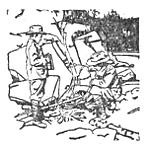
Upon seeing Mackinder’s face, Ned halted
in amazement.
A smile spread over the other’s countenance
as he noted Ned’s look of wonder. But beneath
the appearance of amused indifference
the lad’s quick eye detected a look of care. He
was not the same Mackinder.
For a brief moment nothing was said. Then
the officer saluted the commander, who recognized
the act. The boys were presented.
“So, my friends,” the commander began,
“you were adrift on the North Sea in an open
boat? Have you suffered greatly?”
“No, thank you,” replied Ned, acting as
spokesman. “We have not been adrift very
long. The vessel on which we were riding
struck something which we took to be a floating
mine. The crew got away quickly in one
of the boats, while we left a little later in another.”
The shrewd eyes of the commander narrowed
perceptibly.
“And what was the name and rig of the
vessel?”
“The Lena Knobloch, a schooner, of Amsterdam,”
replied Ned.
“And the name of her captain?” continued
the commander.
“Von Kluck,” the boy answered.
“Ah, a Hollander! I believe he is a peaceful
trader in small cargoes. He is what the
English call a ‘tramp’ of the sea.”
“May I ask what boat this is and where you
are bound?” asked Ned. “We would like to
get to the United States, you know,” he added.
“Yes,” smiled the commander. “But you
are far from that country now and we think
your company delightful. This vessel is the
Sturmvogel, a destroyer of the German navy.
We have been doing some small tasks upon the
high seas and are returning to a base of supplies.”
“Can you put us in touch with some means
whereby we can secure passage on a vessel
leaving for the United States?” asked Ned.
“I am afraid that is impossible for the present,”
slowly replied the other, with apparent
reluctance. “We like your company, you see.
We also are favored with the presence of one
of your countrymen,” here he indicated
Mackinder, “who has consented to pay us a
brief visit.”
“Pardon me, sir!” stated Mackinder, half
rising. “These are not countryman of mine!
I must disclaim that honor!”
“So-o-o?” drawled the other. “Then you
do not know them?”
“No!” stated Mackinder positively. “They
are strangers to me!”
“Then you did not mean what you said a
few moments ago?”
“I was mistaken!” replied the other, briefly.
“As you please,” responded the commander
with a wave of his hand. “Perhaps I misunderstood
your statements concerning them!”
An order was given to the officer who had
conducted the boys to the cabin. The German
language was used. Saluting the officer approached
Mackinder. Without a word that
gentleman rose and stepped from the room.
As Mackinder was conducted from the
apartment the commander motioned the boys
to seats about the table. He smiled at them
kindly.
“Do you know what von Kluck’s cargo consisted
of?” he asked.
“Mostly cheeses,” replied Ned. “Also an
airship!” he added.
“An airship?” was the questioning response.
“An airship?”
Ned smiled a trifle regretfully as he related
briefly the adventures of the four lads with
those who have read the previous volume of
this series are already familiar. He concluded
by saying:
“We were trying to get ourselves and the
airship back to the United States, when this
man Mackinder seemed bound to delay us on
some flimsy pretext. Unfortunately our Grey
Eagle went down with the schooner.”
“Yes. And now you are headed directly
away from your desired destination. For you,
at least, the situation is unfortunate!”
“We think we are lucky to be afloat!” declared
Ned.
“Yes. You are indeed fortunate in that respect.
But I wish to make some inquiries,”
went on the commander.
“We shall be pleased to give you any information
possible,” answered the lad heartily.
“We highly appreciate your kindness to us!”
“Perhaps my act of picking you up was not
altogether prompted by such a noble sentiment,”
smiled the other. “I want some information.”
“I hope we can help you out,” replied the
boy.
“What I want to know is this: What did
you do with the package?”
“What package?” puzzled Ned, unable to
grasp the other’s meaning.
“The package so much desired by your
friend Mackinder!”
Instantly the boys comprehended the statement.
They were unable to understand how
this man should know anything of the mysterious
package unless Mackinder had told
him. They glanced at each other in apprehension.
“Haven’t we got clear of that thing yet?”
spoke up Jimmie.
“If you please, sir,” said Ned, “we don’t
really know anything about the package. A
package was found in our baggage when we
were searched at the border between Belgium
and Holland. It was stolen by some person
whom we believe to be this man Mackinder,
who has since been trying to get us to deliver
it to him, although we have not had it.”
“I presume that you understand him to be
an officer in the British army?” inquired the
commander kindly.
“We heard so from von Kluck,” replied the
boy.
“Do you know what was in the package?”
“No. We had not seen it until the time it
was taken from our kits by the soldiers who
were searching them. All we know is that it
was marked ‘U-13’ on the outside. We have
seen it but that once.”
“I cannot understand why Mackinder
should be trying to take the package out of
the possession of his own countrymen!”
“But I beg to say that we are not countrymen
of his!” declared Ned. “We are citizens
of the United States. Here are our passports!”
“I beg your pardon!” apologized the commander.
“Circumstances seemed to indicate
that you were Englishmen. The mistake is
mine!”
“I admit that the mistake was natural,”
said Ned. “But can you tell me if there is any
connection between the package marked
‘U-13’ and the submarine vessel of the same
name? If there is, why should Mackinder,
an Englishman, have anything to do with the
package?”
A smile greeted this query. Clearly the
officer was amused.
“If, as I suspect,” he stated presently, “the
package contained information valuable for
the ‘U-13’ do you not understand why Mackinder
would be glad to get possession of it?
The ‘U-13’ is a German craft!”
“Oh, yes,” cried Ned. “And the two countries
are at war!”
“And you will also understand why, under
the circumstances, we must feel honored by
your presence, as well as that of Mackinder,
for a little time. Just now we should hate to
see you go!”
“Then we are going to be prisoners?” asked
Jimmie.
“Oh, no! Nothing so harsh as that!” reassured
the other. “We will call it simply
guests for the time being. That sounds better!”
“Would you mind telling us what Mackinder
had to say about us?” inquired Ned. “We
would like very much to know that!”
“Consider,” temporized the officer, “how
little time there has been since we first sighted
you for conversation of any sort!”
“Yes,” agreed the lad, “but he has told you
something!”
“Nothing of importance!” declared the
other, rising to indicate that the interview was
at an end. “You will be given quarters forward,
where you will receive every consideration
until we reach our destination.”
“Where are you bound, Captain?” asked
Jimmie.
“Our destination just now is a lonely island
in the North Sea,” answered the other. “It is
heavily guarded, so you will be in no danger.”
“Does Mackinder go ashore, too?” Jimmie
continued.
“That has not been decided yet,” replied the
commander. He touched a button, summoning
an orderly. “Take these young gentlemen
forward and see that they want no comfort.
They are our guests!” he ordered.
In a few minutes the boys were seated at a
table in the forecastle, where they were provided
with a great profusion of well-cooked
food from the sailors’ mess. With sharpened
appetites they fell to eagerly.
Since none of the members of the crew with
whom they came in contact seemed able to
speak English the boys were forced to content
themselves with speculating on their destination.
They knew that the torpedo boat destroyer
had been headed nearly northeast when it
overhauled and picked them up. They also
knew that in this direction lay the entrance
to the river Elbe and the Kiel ship canal, but
whether the boat was making for some port
in that vicinity they were unable to learn.
Keenly as the lads regretted their lack of
definite information they were not inclined to
become despondent. They found it possible
by using signs to carry on a sort of desultory
conversation with the members of the crew,
who had gathered out of curiosity in their
vicinity.
At length Frank jumped from his seat with
an exclamation.
“I’ll bet I know where we’re going!” he announced,
gleefully.
“So do I!” stated Jimmie in a nonchalant
manner.
“Where?” asked Frank, somewhat crestfallen.
“Aw, you don’t either!” he declared,
after searching his comrade’s face intently.
“All right,” admitted Jimmie, laughing. “I
just wanted to take some of that overconfidence
out of your system, that’s all!”
“Where do you think we are bound for,
Frank?” inquired Ned.
Frank placed a finger on his lips, glancing
about to make sure that no one was close
enough to overhear his whispered words.
“Helgoland!” he said, cautiously.
Instantly the others jumped to their feet,
slapping Frank’s shoulders, shaking his hands
and otherwise showing their appreciation of
his shrewdness. Their enthusiasm could
scarcely be restrained.
“Sherlock Shaw, The Scout Sleuth!”
shouted Jimmie.
“Frank, you’re the real, old-fashioned
guesser!” declared Jack.
“How did you do it, Frank?” asked Harry,
admiringly.
“Well, the commander said we were destined
for a lonely island in the North Sea that
was heavily guarded. I guess Helgoland fits
that description right enough. Besides, as I
remember the geography of these parts, that’s
about the first land we’d strike going on this
course.”
“But I understand that is a sort of naval
base,” put in Harry. “Isn’t that the island
where the Germans are fitting out so many
of their Zeppelins? Seems to me I read something
about that in a paper.”
“That’s the very place!” put in Ned. “The
paper said it was a lonely, rocky island, difficult
of approach and quite well fortified.”
“And book agents, canvassers, peddlers and
rag men are not allowed there at all!” asserted
Jimmie, gravely.
“Take his pie away!” shouted Jack. “He’s
raving again!”
“And you have to deliver all goods in the
rear,” added Jimmie, as Jack reached for the
plate containing the lad’s breakfast.
“Hurry up, let’s finish this food and get out
on deck, where we will be able to see something,”
suggested Harry. “This is interesting!”
Directly the boys were standing in the lee
of a deck house eagerly scanning the horizon
for some sign of the island where they expected
to be landed as prisoners of war.
The gale gave no hint of abating. Indeed,
the motion of the waves was much more noticeable.
Jack attributed this partly to the
build of the craft, whose lines were sharper
than those of the Lena Knobloch. The sharp
prow cut the water like a knife, while the slender,
tapering stern slipped through the seas
without making a roller of large proportions.
Presently, just as Jack declared he could
see a blue smudge in the distance, indicating
the presence of land, the lads were joined by
Mackinder. He glanced at the group without
speaking.
Speedily the vessel approached the object
that had been sighted.
An officer drew near. He conducted Mackinder
toward the stern.
As the craft slowed slightly to enter a harbor
Jimmie grasped Ned’s arm. He pointed
eagerly toward several large objects on land.
“There is a whole flock of Zeppelins,” he
declared. “And as I live,” he continued, “I
see a bunch of submarines at that dock over
there!”
“There must be a dozen or more!” gasped
Frank, in amazement.