1. This is a good illustration of Santa Anna’s political ability.
2. Farías appears to have had no share in this quarrel with Salas
(México á través, iv, 593).
3. The course of Mexican politics. Federalista Puro, No. 3,
supplmt.; No. 6, supplmt. London Times, Feb. 9, 1847. Apuntes,
71–3, 76, 124–6. 13Bankhead, Nos. 120, 136, 140, 146, 153,
157, 160, 169, 180, 1846. 52Consul Campbell, Nov. 10,
1846. 52Consul Black, Aug. 22, 27; Sept. 17, 22, 26, 1846.
Comunícación Circular de ... Peña y Peña. García, Revol. de Ayutla,
18, 20, 27. Ultimas Comunicaciones habidas entre ... Salas y ...
Rejón. Lerdo de Tejada, Apuntes, ii, 538. Prieto, Memorias, ii, 195,
199. 13Thornton to Addington, June 29, 1847. 13Gutiérrez
de Estrada to Palmerston, Mar. 1, 1847. Méx. en 1847, 12–4. Ramírez,
México, 12, 142–4, 149, 152–4, 156, 165, 172, 176. 83Rejón to
Berdusco, Dec. 23. Eco, Nov. 4, 7, 11, 14, 1846. Escudero, Mems.,
8, 13, 14. Dublán, Legisl., v, 171, 238–9. Memoria de ... Relaciones,
Dec, 1846. 73Bermúdez de Castro, nos. 332, res.; 343, res.;
345, res.; 346; 368. Bustamante, Nuevo Bernal, ii, 100–1, 118, 120,
124, 126–8. 83Gov. Querétaro to Farías, Oct. 20. Roa Bárcena,
Recuerdos, 144. Rivera, Los Gobernantes, ii, 310. Lara, Resumen, 65,
note. Mora, Papeles Ineditos, 64–5. 162Conner, Dec. 31, 1846.
164Id.Jan. 5, 1847. Bustamante, Campaña, 7. Ho. 60; 30, 1,
p. 1125 (S. Anna). Baz, Juárez, 43. México á través, iv, 576–7, 589,
591–2, 600–1, 698. Republicano, Sept. 28; Oct. 20, 28; Nov. 17; Dec.
24, 1846; Jan. 1, 22–3; Feb. 3, 1847. Monitor Repub., Sept. 25–6, 30;
Oct. 19–23, 26; Dec. 25, 1846. Diario, Sept. 23, 25, 29; Oct. 9, 12,
14, 16, 31; Nov. 24; Dec. 18–9, 22, 28, 29, 1846. And from 76
the following Procl. gov. S. L. P., Oct. 22, 1846. J. Alvarez, Oct.
22. Comte. gen. Mex., Oct. 16. Canalizo to comte. gen. Mex., Oct. 18.
Comte. gen. Oaxaca, Oct. 24. Salas, procl., Oct. 25. Guerra, circulars,
Oct. 14, 19, 22; Dec. 23. Relaciones to gov. Fed. Dist., Dec. 23.
Relaciones circular, Oct. 19. Comte. gen. Chiapas, Nov. 3. Also
others of minor importance. Otero was associated with Pedraza in the
leadership of the Moderados.
4. So far as possible, revenue was anticipated, even at a great
loss. E.g., if a merchant expected a cargo to arrive at Vera Cruz,
he sent a broker (agiotista) to the minister of the treasury, and by
paying a sum in advance he obtained drafts on the Vera Cruz customhouse
that were receivable at par for the duties. Of course the merchant,
the broker and the minister made profits, and the treasury lost (N.
Y. Herald, Jan. 18, 1845). Another way in which the minister could
make money was to accept at face value as part of a loan or payment
government paper that had cost the one who tendered it only a trifle,
and take a share of the net proceeds. “Agiotista” became an odious
term. It was given out that Santa Anna would accept no pay, but the
treasury books showed that he drew his salary for even the time while
he was at Havana (335Worrall to Trist, Nov. 28, 1847). They
apparently showed also that in 1846 millions were distributed among
generals, brokers and others. The British minister said that Iturbe
was the ninth finance minister whom he had seen devoting “his peculiar
attention to the augmentation, of his private means while in office”
(13Bankhead, no. 104, 1846). Another great evil was that, in
spite of express prohibitions, state officials drew upon the proceeds
of the tobacco monopoly. The following table illustrates the state of
the treasury (1846):
| | Oct. 12 | Oct. 16 | Dec. 26 | Dec. 29 |
| On hand | $8510 | $3410 | — | $1148 |
| Rec’d | — | 3500 | $7162 | 3700 |
| Paid | 1402 | 3628 | 5713 | 4367 |
A poll tax was thought of by Rejón, but evidently the government dared
not propose it (73Bermúdez de Castro, nos. 332, res., 346, 1846).
5. Mexican financial history (see also the first part of chap.
xxxiii). Comunicación Circular de ... Peña y Peña. Memoria de ...
Relaciones, Mar., 1845; Dec., 1846. Rivera, Jalapa, iii, 368, 716.
Ilustrador Católico, no. 239. Hacienda, series of Memorias.
Hacienda, Manifiesto de la Admin. y Progresos. London Times,
July 6, 1846. Breve Resumen. Casasus, Hist. de la Deuda contraida,
etc., passim. Paredes, address to Cong., June 6, 1846 (Diario).
Alamán, Liquidación. Esposición del Cong. Gen. 11Martin,
Apr. 30, 1827; July 4; Aug. 25, 1828. 11Series of Mémoires
on the Spanish Colonies. Sierra, Evolution, i, 178, 218. Zamacois,
Méx., xii, 254. 52Consul Jones, Aug. 1, 1839. 56W. S.
Parrott, Oct. 4, 11, 1845. 58Howland & Aspinwall, Mar. 1, 1847.
Republicano, Feb. 2, 1847. 13Ashburnham, nos. 39, 51, 1837;
3, 97, 1838. 13Pakenham, nos. 28, 1833; 6, 1836; 44, 62, 1839.
13Bankhead, nos. 81, 1844; 6, 38, 70, 106, 1845; 21, 104, 127,
146, 169, 1846. 52Poinsett, Jan. 4; Aug. 5, 1825; July 16, 1828.
52Butler, July 16, 1832. Revista Econ., Dec. 14, 1843; Feb. 5,
1844. Tornel, Reseña, 9, 171. Macgregor, Progress, i, 674–83. Thompson,
Recolls., 12, 27–8, 87. 52D. Green, Oct. 28; Nov. 12, 29, 1844.
N. Y. Herald, Jan. 18, 1845. Siglo XIX, June 14, 1844; Dec. 2,
1845. Patriota Mexicano, Dec. 9, 1845. Reforma, Jan. 23, 1846.
London Times, Mar. 29; May 15; Sept. 9; Nov. 11; Dec. 6, 1845; Mar.
2, 1846. Revue Indep., Apr. 25, 1845. 52Consul Black, Aug. 23,
1845. 52Consul Dimond, no. 338, May 7, 1846. 73Bermúdez
de Castro, no. 346, 1846. 52Consul McCall, no. 65, Sept. 26,
1845. Balbontín, Estado, 66. Wash. Union, Feb. 2, 1848 (Poinsett). N.
Y. Globe, June 3, 1846. Diario, Sept. 18, 1846. Monitor Repub.,
Nov. 27, 1846; Jan. 9, 1847. Ward, Mexico, i., 331–7. 76To S.
Anna, Nov. 25. Vicario Capitular, Contestación. Priestley, José de
Gálvez, Chap. x.
6. The present financial problem. Dublán, Legislación, v., 172,
211–6, 235–7, 240. 77Relaciones circular, Nov. 27, 1846.
13Bankhead, no. 6, 1845; nos. 21, 127, 153, 167, 169, 1846.
52Consul Black, Dec. 29, 1846. Apuntes, 76, 124–6. Ramírez,
México, 171. 335Worrall to Trist, Nov. 28, 1847. Rivera, Jalapa,
iii, 716. Ilustrador Católico, i., 281. Méx. en 1847, 14–19, 24.
Don Simplicio, Feb. 13, 1847. 86Relaciones, Oct. 26, 1846.
Zempoalteca, Nov. 27, 1846. Escudero, Mems., 8, 92Gov. Fed.
Dist., procl., Jan. 16. 82Gov. Durango to legisl., Nov. 8, 1846.
Columna de la Libertad, Jan. 8, 1847. Sierra, Evolution, i, 178,
217–8. 52McLane, no. 5, 1845. 56W. S. Parrott, Oct. 4,
11, 1845. 11Mémoire, 1828. D. Green to Calhoun, Oct. 28; Nov. 12
in Jameson, Calh. Corresp., 976–80, 991. Siglo XIX, Jan. 14, 1844.
London Times, Sept. 9; Dec. 6, 1845; Oct. 8, 1846; Jan. 8, 1847.
Memoria de ... Relaciones, Dec., 1846 (Lafragua). 73Bermúdez
de Castro, nos. 316, res., 346, 371, res., 445. Bustamante, Nuevo
Bernal, ii, 128. 75Relaciones, circulars to govs., Oct. 9;
Dec. 17, 1846; circs. nos. 233, 238, 255, 1846. 75aHacienda,
circulars, Oct. 10; Nov. 9; Dec. 5, 31, 1846. 86V. Cruz state
treas. to gov., Jan. 11; Feb. 4, 1847. Constitutionnel, Dec. 18,
1846. Wash. Union, Jan. 18, 29; May 11, 1847. Monitor, Oct. 12.
166Pommarès to Conner, Oct. 7, 1846. Republicano, Oct. 22;
Nov. 5, 13, 24; Dec. 8, 1846; Jan. 23, 1847. Monitor Repub., Sept.
25, 30; Oct. 18; Nov. 19, 30; Dec. 19, 1846. Diario, Sept. 23, 25,
29; Oct. 2, 3; Nov. 21, 23; Dec. 4, 13, 15, 21, 29, 30, 1846; Jan. 1,
7–9, 1847. México á través, iv, 589, 600, 628–9. 76S. Anna, Nov.
7, 9, 19; Dec. 3, 4, 7, 30, 1846; Jan. 1, 2, 4, 7, 1847. 76J.
Alvarez, Sept. 30, 1846. 76Circ. to comtes. gen., Sept. 28, 1846.
7. The law was a compromise (Apuntes, 124). Rejón, as he frankly
told the Spanish minister (note 6), was for nationalizing—i.e.,
confiscating—the property of the Church. Santa Anna preferred to let
the clergy keep the title to their wealth, and require a loan from them
now and then—a process termed “milking” (Jameson, Calhoun Corresp.,
992). The essential basis on which the law passed was the practical
necessity of raising money for the war; but many who recognized this
necessity and even the desirability of reducing the wealth and power of
the Church could not bring themselves to act.
8. The law, if fully enforced, would no doubt have done much injury,
however great its benefits. E.g., a great amount of land had been
hypothecated to the Church with no expectation on either side that
the loan which it secured would ever be paid; but the government, in
order to obtain cash, intended that the loan should be paid or the land
sold. Many individuals would thus have been ruined and the agricultural
interests partially crippled, while on account of the small amount of
money in circulation, only very low prices would have been realized for
the land (13Bankhead, no. 7, 1847). Moreover, land with a Church
curse upon it was sure to sell slowly, and many believed that titles
obtained in this way would not hold good very long. As the clergy
would give no information about their property, some exempted property
was seized, and these mistakes caused trouble (México á través,
iv, 631). Many objected to the law because they presumed that the
proceeds of sales would reach private pockets. The principal arguments
against it were summed up by the 88ayuntamiento of Córdoba
as follows: “It attacks property, invades the rights of the states,
contravenes the sovereignty of the Church and is anti-religious, for
there can be no religion without worship, no worship without priests
and no priests without Church property.” On the other hand the Puro
92ayuntamiento of the capital described the law as “A law to
save our independence and religion, in which nothing is done except
that one class of society is to loan its property to society as a
whole,” adding, “How unfortunate would be our faith, if the religion of
the Savior could be supported only with money ... charity and poverty
were the example of his mission.” The metropolitan chapter of Mexico
took the ground that property once consecrated to God was sacred, and
that to take it would be an act of sacrilege sure to bring upon the
country the wrath and punishment of heaven (92Representación).
The bishop of Puebla said to his flock: “Far from us is the idea of
disturbing public order, but we must notify our very dear lambs that
the pasturage offered thorn is poisonous; and if for so doing we incur
the wrath of men, we will strengthen our weakness with the words of the
chief of the Apostles at the council of the Jews: ‘We must obey God
rather than men’” (82Manifiesto). This was a clear and official
incitement to insurrection.
9. The law of Jan. 11 and the struggle over it. Apuntes, 124–32.
13Bankhead, nos. 180, 1846; 6, 7, 10, 14, 17, 1847. Gaxiola,
Invasión, 118. 52J. Parrott, Feb. 6. 56Beach, report,
June 4. London Times, Sept. 9; Oct. 7, 1846; Mar. 11; May 12,
1847. Oil portrait of Farías, city hall, Mex. 52Consul Black,
Feb. 24. Revue Indep., Apr. 25, 1845. Rivera, Jalapa, iii, 822,
825–6. Católico, iii, 553. Conducta Admin, de Berdusco. Ilustrador
Católico, no. 239. 88Córdoba ayunt., Feb. 4. 92Mex.
ayunt. to chapter, Jan. 14. 92Ayunt., procl., Jan. 14.
92Representación of metrop. chapter to Cong. 92Segunda
Protesta; Tercera Protesta del Ven. C bildo Metrop. 92Exposición
que el Sr. Vicario Capit. 92Expos. del Cabildo Metrop.
92Procl. of gov. Fed. Dist., Jan. 16. 95Querét. cong.,
Jan. 12. 95Puebla ayunt. to gov., Jan. 16. 95Sánchez
to Puebla ayunt., Feb. 16. 82Bish. Puebla, manif., Jan. 27.
82Gov. Puebla, procl., Jan. 27; Mar. 5, 15. Lamentos de los
Mex. 73Bermúdez de Castro, nos. 332, res., 346, 445. Dublan,
Legislación, v., 246, 255, 261–2. Registro Oficial de Durango, Jan.
26. 80Guanajuato cong., Jan. 29. Locomotor, Jan. 18. Mora,
Papeles, 74–6. Negrete, Invasión iv, app., 412–4. Ramírez, México, 172,
184, 188, 190, 193, 198. Diario, Dec. 21, 1846; Jan. 7–9, 11–16, 18,
19, 26, 30; Feb. 4, 1847. Republicano, Dec. 9, 12, 1846; Jan. 8, 11,
23–4, 27, 29; Feb. 6, 11, 12; May 14, 1847. México á través, iv, 601–8,
628, 630–1, 638. And the following from 76. Comte. gen. Querét.,
Jan. 19, 20, 22. Id.., procl., Jan. 20. Comte gen. Puebla, Jan. 12,
28; Feb. 17. Guerra, order, Jan. 24. Min. eccles. affairs to metropol.
chapter, Jan. 14. Comte. gen. Mex., Jan. 15. Comte. gen. Jalisco,
Feb. 2. J. Alvarez, Feb. 2. Comte. gen. Oaxaca, Feb. 11, 15. Comte.
gen. Guanaj., Jan. 29; Feb. 15, res. To comte. gen. Puebla, Feb. 24.
Decrees, Jan. 15, 27; Feb. 4, 7, 10. To S. Anna, Jan. 30. S. Anna, Jan.
7, 13, 22, 26, 29; Feb. 9.
10. Beach’s mission and escape. 56Special Missions, p.
257. 56Beach report, June 4, 1847. Polk, Diary, Apr. 14,
1847. 108Mrs. Storms to Bancroft, July 23, 1846, and Marcy’s
endorsement. Griffis, Perry, 224. 52Consul Black, Jan. 28, 1847.
N. Y. Sun, Apr. 15; Aug. 16, 24, 1847. 166Dimond to Conner,
Jan. —, 1847. Scribner’s Monthly, xvii, 300. Appleton, Amer. Biog.
(article on M. Y. B.). Kenly, Md. Vol., 269. 76To comte. gen. V.
Cruz, Jan. 14. 76Landero, Jan. 14. 76S. Anna, Jan. 22.
11. Apuntes, 126. 13Bankhead, no. 14, 1847. 56Beach,
report, June 4, 1847. Ramírez, México, 193–4, 198–9. México á través,
iv, 608, 631. 199Anon. MS. of go-between.
12. The monarchists, who were closely associated with the Church,
shared in the insurrection (Apuntes, 119), and no doubt many of the
Moderados took part in it (London Times, May 10, 1847), though
Pedraza denied positively that he drew up the plan (Apuntes, 131).
13. The insurrection. 56Beach, report, June 4, 1847.
Apuntes, 126, 128–37. 13Bankhead, no. 17, 1847. Consideraciones,
37. Méx. en 1847, 14, 19. León, Hist. Gen., 475. 52J.
Parrott, Feb. 6. Bustamante, Campaña sin, etc., 5, 8, 10, 11, 13.
52Black, Mar. 6. London Times, May 10, 12. Salas, pamphlet,
Mar. 3. 13Peña y Barragán, procl., Mar. 8. Séptimo Disengaño.
Boletín de la Democracia, Mar. 2, 7, 13. Farías, Address. Ramírez,
México, 190, 193, 198–9, 201, 204, 209. México á través, iv, 631–5.
Rivera, Jalapa, iii, 841–9. Arco Iris, Nov. 24, 1847. Escudero,
Mems., 14, 19, 20. 82Zacatecas cong., Mar. 5. 82Jalísco
legisl., Mar. 12. 77Relaciones, circular, Mar. 13. 80Méx.
state legisl., Mar. 18. Balbontín, Invasión, 104. 80Lt. gov.
Méx. state procl., Mar. 23. 199Anon. MS. 76Farías, procl.
83Gov. Querét. to Peña y Barragán, Mar. 2, 20. Rivera, Los
Gobernantes, ii., 318. N. Y. Sun, Apr. 15; Aug. 24. Díario, Feb.
20, 21. Monitor Repub., Dec. 27, 1846; Feb. 13; Mar. 23. Ho. 60;
30, 1, p. 1125 (S. Anna). Lerdo de Tejada, Apuntes, ii, 539. And from
76 the following, besides others of minor importance. Comte.
gen. Querét., Jan. 20. Canalizo to Anaya, Feb. 26. J. Alvarez, Mar.
10. L. Carrión, Mar. 10. Gov. Puebla, Feb. 17; reply, Feb. 24. Plan of
Puebla insurgents, Feb. 27. Govt. bulletins, Mar. 2, 5. Morales, Mar.
1. Aguascalientes legisl., Mar. 4. Gov. Zacat. to Relac., Mar. 5. Gov.
Querét. to Relac., Mar. 9. Provis. gov. Jalisco to Relac., Mar. 3.
Comte. gen. Jalisco to garrison, Mar. 7. Gov. Puebla to Relac., Mar.
5. Lt. Col. Indep. battal. to mistress, Mar. 15. Comte. gen. Oaxaca,
Feb. 17. Gov. Méx. state to Relac., Mar. 19. Id.., procl., Mar. 18.
Decrees, Mar. 1, 8, 12, 15.
On this subject Beach reported in substance as follows: When the
government resolved to raise money on the Church property, I urged the
clericals to an organized resistance. They consented, and at the moment
of General Scott’s debarkation at Vera Cruz they made a most important
diversion in his favor by raising the standard of civil war at the
capital, at Puebla and in a degree at Michoacán. This occupied 5000 men
and all the arms, munitions of war and means of the government in the
city of Mexico for twenty-three days; effectually preventing them from
aiding Vera Cruz, or strengthening Puebla or the strongholds nearer
the coast. On the tenth day of this rebellion or pronunciamiento, I
was informed that $40,000 would be required of the clergy to carry it
on another week, and that it would be paid if the importance of the
crisis justified the outlay. As General Scott had but just landed his
artillery at Vera Cruz, and might be detained there for some time. I
deemed that almost any outlay would be justified. The rebellion was
therefore kept up, until the sudden appearance of General Santa Anna
closed the affair. [One must remember, in passing judgment on the
conduct of the clergy, how much they had suffered at the hands of Santa
Anna and how much reason they had to fear him.]
Beach had arranged to visit Mexico on private business, and he
persuaded Buchanan that he could, through Almonte and others, bring
about peace. Hence he was appointed “confidential agent to the Republic
of Mexico” to accomplish what he could; and, on learning the state of
things at Mexico, he saw that Scott’s operations could be materially
assisted by inaugurating and continuing the clerical insurrection. His
report may be found in the state department archives at Washington.
14. Santa Anna left San Luis Potosí March 15 with more than 5000 men
and ten guns.
15. Rejón wrote to Santa Anna, March 7, 1847, urging him to stand
firmly by his manifesto of August 16, 1846,—i.e. by the Puros, and
detailing a series of Moderado intrigues intended (he said) to annoy
and humiliate Santa Anna until he should inaugurate a revolution, with
a view to then having him shot.
16. Beach was watched for several days before he left the city.
He escaped by paying for his lodgings for some time to come, leaving
a trunk there, taking a carriage late at night without baggage, and
choosing an unusual route (N. Y. Sun, Aug. 16, 1847). A reward of
$1000 was offered for him dead or alive (ibid., Aug. 24). Notices
were put up denouncing as a traitor anyone possessing a copy of the New
York Sun. He was accused of having tried to bring about a clerical
revolution and also to induce the states of Guanajuato, Querétaro, San
Luis Potosí and Jalisco to secede and declare for the United States.
See also N. Y. Sun, May 27, 1847; Polk, Diary, May 11, 1847; Kenly,
Md. Vol., 269. We shall hear again of Beach’s operations.
17. Santa Anna received news of the insurrection near Cedral.
18. Santa Anna may very possibly have hoped now to combine the
military class, the conservatives and the clericals into a solid
phalanx behind him, and he may have commended the movement against
Church property for the very purpose of making the clergy feel the need
of his assistance. See Tributo á la Verdad, 76.
19. His overthrow was not really due to the law of January 11, but
resulted from his radical ideas and unpractical methods, the odium
of his former administration, his consequent inability to secure the
coöperation of influential men, and the general state of unrest and
dissension.
20. Outcome of the insurrection. Apuntes, 111, 115–8, 133, 136–8.
13Bankhead, nos. 33, 34, 1847. Méx. en 1847, 14–18. 69S.
Anna, order, Mar. 14. Anglo-Saxon, Mar. 13. 56Beach,
report, June 4, 1847. Bustamante, Campaña, 30. London Times, May
10. Britannia, May 15. México á través, iv, 577, 635–40. Ramírez,
México, 184, 198–9, 205, 207, 209–12, 215–8. 82Gov. Puebla,
boletín No. 4 (S. Anna to Farías, Mar. 6; Gil to Ruano, Mar. 6).
77Relaciones, circulars, Mar. 22; Apr. 1. Tributo á la Verdad,
76. 75Rejón to S. Anna, Mar. 7. 84Palacios to Gov. S.
L. P., Mar. 17. Republicano, Mar. 24. 75aHacienda, circular,
Mar. 29. Puga y Acal, Docs., 62–3. Escudero, Mems., 19. Bustamante,
Nuevo Bernal, ii, 146–7. Dublán, Legisl., v, 262–5. Locomotor, Jan.
18. Baz, Juárez, 47. Diario, Mar. 29, 1847 (Baz). The twenty-millions
law had very little effect, if any. Le Constitutionnel, June 17, 1847
(The clergy have kept none of the promises by the aid of which they
obtained the repeal of the confiscation of their property).
1. “New volunteers,” those called out in November. For the ten
transports see chap. viii, note 28. Jan. 18 Conner wrote to Scott
that Santa Anna had moved, about January 1, against Taylor, but that
from all accounts presumably Taylor had probably retired to Monterey
(Ho. 60; 30, 1, p. 893). It was therefore natural for Scott to feel
satisfied that Santa Anna, learning of the expedition against Vera
Cruz, would retrace his steps and reach that place in season. At
Scott’s instance a spy, selected by Consul Campbell with the aid
of Consul Dimond (who visited Cuba for the purpose), was to have
set out from Havana in January for Mexico City and San Luis Potosí
(166Dimond to Conner, Jan. 15); but the author found no further
trace of him.
2. Some transports reached Antón Lizardo Feb. 27 and notified Conner
that Scott was coming (162Conner, Feb. 27). Certain troops,
leaving Tampico March 1, arrived at that rendezvous in advance of Scott
(139W. B. Campbell to wife, Mar. 6). By sunset on March 5 about
seventy sail had appeared there.
3. To Antón Lizardo. Macgregor, Progress, i, 677. 47Conner,
Dec. 1 1846; Feb. 17; Mar. 7, 10, 1847. 159Collins narrative.
298Porter, diary. 66Remarks in margin of chart of V.
Cruz harbor. Le Clercq, Voyage, 401, 418. Robertson, Remins., 214–6.
Campos, Recuerdos, 31. Hitchcock, Fifty Years, 238. Grant, Mems., i,
125. Hartman, Journal, 6. Taylor, Broad Pennant, 123. Picayune, Mar.
26. Delta, Oct. 16. Meade, Letters, i, 187. 65Scott, gen.
orders 28, 33, 34, 37. 313Saunders to Conner, Mar. 5. Oswandel,
Notes, 63. Semmes, Service, 106, 109, 111. Kenly, Md. Volunteer,
266. Lawton, Artillery Officer, 65–6, 68. 146Caswell, diary.
322Smith, diary. Kitchen, Record, 21–2. 270Moore, diary.
327Sutherland, letter. Ballentine, English Soldier, i, 257, 261.
254McClellan to sister, Feb. 23. Moore, Scott’s Campaign, 1–4.
Parker, Recolls., 49, 82. Washington Union, Apr. 6. Monitor Repub.,
Mar. 16. 164Scott to Conner, Feb. 22, 26. 162Conner to
wife, Aug. 10, 1846; Feb. 26, 27, 1847. Ho. 60; 30, 1, pp. 879, 892
(Conner); 896 (Hetzel); 893, 896, 899 (Scott); 568 (Jesup). Nebel
and Kendall, 17. Diccionario Univ. (Antón Lizardo). Niles, Mar.
13, 1847, p. 21. 332Tennery, diary. Sedgwick, Corresp., i,
65. 254McClellan, diary. 165Conner to Scott, Jan. 18;
to Breese and to Aulick, Feb. 28. Hammersly, Naval Encyclop., 94.
139W. B. Campbell to wife, Mar. 6. Smith, To Mexico, 108–10.
76Garay, Mar. 5. 76Cos, Feb. 19, 21. 76Soto, Mar.
7. 76Watchman at Ulúa, Mar. 5.
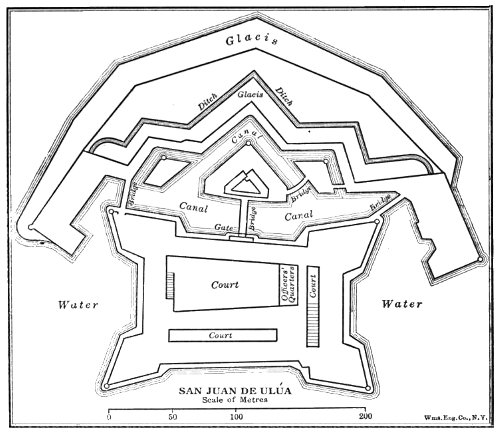
4. For additional information regarding San Juan de Ulúa the reader
may consult chapters xviii and xxx.
5. New York letters received in Cuba and made known at Mexico gave
notice that Scott planned to capture Vera Cruz before attacking Ulúa
(76Relaciones, Jan. 26); some Mexicans believed he would enter
the Antigua River (which emptied a short distance to the north) with
boats, and strike at once into the interior; some thought he would land
at Tuxpán, and march south along the coast; and some ridiculed the idea
of an attack upon Vera Cruz on the ground that, since the Americans
could not possibly reach the capital by that route, it would be useless
to capture the city (Monitor Repub., Mar. 28). Many argued that in
any case Ulúa would protect Vera Cruz.
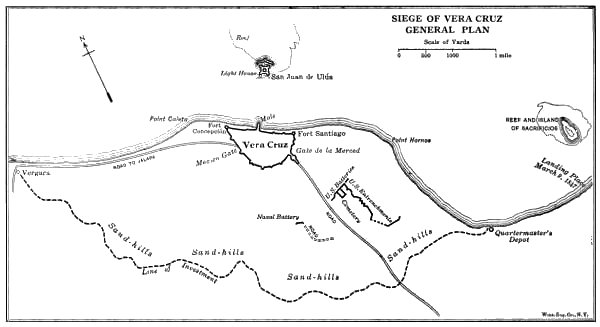
6. Besides fine old Spanish guns, there were new and heavy English
pieces (Nacional, July 12, 1846) and twenty recently cast in the
United States (Davis, Autobiog., 131). A battery of sixteen bronze long
24-pdrs., made in England in 1840, was pronounced by American artillery
officers “far superior” to anything of the sort they had seen elsewhere
(213 Hatch to father, Apr. 2). It was in the city. As to the
amount of ordnance in the city and castle accounts differed. Scott
made it 400 pieces; Hitchcock, upwards of 350; Balbontín, 113 mounted,
46 unmounted at Ulúa, 83 and 57 respectively at Vera Cruz; G. T. M.
Davis, 390 effective pieces. The statement of the Mexican government,
December, 1846 (based of course on earlier reports), was as follows:
Vera Cruz, mounted, bronze, eleven 24’s, twenty 16’s, six 12’s, four
8’s, four 4’s, four mountain 4’s, five 12-inch mortars, seven 8-inch
howitzers, and of iron, mounted, three 42-lb. mortars, three 24-lb.
cannon, five 12’s, nine 8’s, six 13-inch mortars, two 9-inch mortars;
Ulúa, bronze, mounted, thirty-six 24’s, four 16’s, four 8’s, two
14-inch mortars, and of iron, mounted, ten 84-lb. mortars, ten 68-lb.
mortars, sixteen 42-lb. mortars, fifty-one 24-lb. cannon, two 16’s,—a
total of 224 besides a considerable number of unmounted pieces in both
places, some of which were doubtless mounted later (Memoria de ...
Guerra). Still other guns were sent from the interior. Possibly some
unserviceable ordnance may have been included in the highest American
figures. Balbontín gives the number of firearms as 7369—half of the
total number belonging to the government. Ripley (War with Mex., ii,
19) and Wilcox (Mex. War, 251) state that there was no ditch, but the
weight of evidence seems to be against them. Perhaps the drifting sand
filled the ditch before the Americans took the city.
7. It was not easy to believe that the factions at Mexico would not
agree to turn their arms against the Americans on learning they had
landed. March 9 the state of Vera Cruz issued a strong appeal to them
and to the nation. Neutrals and valuable neutral property were taken
aboard foreign war-vessels (12Matson to Giffard, Mar. 5). The
American blockade had greatly impaired the resources of the state and
city. A forced loan was imposed by the former, but no large receipts
could be expected.
8. The accepted (not official) Mexican figures were 1030 for
Ulúa and 3360 for Vera Cruz, but the authorities did not consider
it obligatory to publish the correct number. 13March 11 the
British consul, Giffard, reported the garrisons as about 1500 and
4000 respectively, and later (according to Mexican accounts that were
probably rather flattering) more than 1000 threw themselves into the
city. Santa Anna stated in April that Morales had 5000 in the town
(76S. Anna, Apr. 29), but he was unfriendly to that officer.
Scott’s figures were 5000 besides those who perished or escaped during
the siege; but before the surrender he heard the city alone had that
number (Sen. 1; 30, 1, p. 221). British naval officers stated there
were about 6000 in city and castle (Meade, Letters, i, 188), and Col.
Campbell was told there were 5–6000 (139to wife, Mar. 6). The
Mexicans complained of a lack of gunners, but their own figures were
680. No doubt the troops were poorly cared for, but such was the
custom. Robles counted for not a little. In the autumn of 1846 Landero,
personally liked but considered wanting in ability and regarded
as a tool of Santa Anna, was made comte. gen. because Morales was
strenuously denounced by Santa Anna as politically unsafe (76S.
Anna, Oct. 14); but on the approach of the crisis the people forced a
change, and the confidence inspired by Morales enabled him (Landero
admitted in his 76report, Apr. 3, 1847) to accomplish more than
the latter could have done. Particular resentment was felt against
Santa Anna for taking away in August, 1846, the best regiment (the
Eleventh Infantry). For the names of corps at Vera Cruz and Ulúa see
Roa Bárcena, Recuerdos, 158.
9. The situation at Vera Cruz and Ulúa. 13Consul Giffard,
Nov. 1; Dec. 1, 1846; Feb. 28; Mar. 11, 1847. 52Consul Dimond,
no. 336, May 2, 1846. Engineer School, U. S. Army, Occasional Papers,
no. 16. 218Henshaw narrative. 280Nunelee, diary.
159Collins, diary. 6Bravo to Tola, Apr. 18, 1846.
224Hitchcock, diary, Mar. 13. 13Pakenham, no. 25, 1842.
National, July 12, 1846. Constitutionnel, May 8, 1847. W. S.
Parrott, Feb. 6, 1847. 80México state legislature to people.
Memoria de ... Guerra, Dec., 1846, p. 22. (Cisterns, etc.) Lyon,
Journal, ii, 221. Orbigny, Voyage, 407–8. Robertson, Visit, i, 232,
239. Ruxton, Adventures (London, 1847), 12–15. Robertson, Remins.,
225–6, 235, 237. Lerdo de Tejada, Apuntes, ii, 541–50, 552, 569.
Naredo, Orizaba, i, 107–8. Scott. Mems., ii, 422. Hitchcock, Fifty
Years, 248. Ballentine, English Soldier, i, 288–9. Sen. 1; 30, 1,
p. 239. Balbontín, Estado, 49–55. Tributo á la Verdad, 17–26, 29,
88. Apuntes, 152–5. S. Anna, Apelación, 33. Delta, Oct. 16, 1847.
350Weber, recolls. 12Matson to Giffard, Mar. 5, 1847;
to Fischer, Mar. 8; to commodore, Mar. 10, 25. Oswandel, Notes, 102.
Semmes, Service, 102, 104–6. 139W. B. Campbell to D. C, Mar.
20. Rivera, Jalapa, iii, 56, 865. Otero, Comunicación, 11. Diario,
Apr. 8. Republicano, Dec. 8, 1846. 86Relaciones to gov.,
Jan. 27, 1847; reply, Feb. 1. 86State treas. to gov., Jan.
15. 86Morales to gov., Feb. 8. 90Soto, proclam., Mar.
2. 90Id.to state congress, Dec. 1, 1846. 100V.
Cruz ayunt. to prefect, June 4, 1846. 100Bravo to ayunt.,
June 9, 1846. 100Ayunt. to jefe of dept, Oct. 26, 1846.
100Soto, proclam., Feb. 6, 1847. 88Id., proclam.,
Feb. 15, 1847. Regenerador Repub. Puebla, Mar. 13; Apr. 7, 1847.
82Noticias de V. Cruz. Kenly, Md. Volunteer, 267. México á
través, iv, 600. Lawton, Artillery Officer, 67, 105–7. El Estado de
Veracruz a Todos. Memoria de ... Guerra, Dec, 1846. 146Caswell,
diary. 270Moore, diary. 73Bermúdez de Castro, nos.
441, 445, Feb. 28; Mar. 2, 1847. Bustamante, Nuevo Bernal, ii, 67.
Valois, Mexique, 40–43. 271Morales to commander of Ulúa, Oct.
20, 1846. Moore, Scott’s Campaign, 12. Conner, Castle of S. Juan de
Ulloa, 13. Parker, Recolls., 79. (Learned) Monitor Repub., Nov.
13, 30, 1846; Mar. 28, 1847. Negrete, Invasión, iv, app., 413–4.
166Campbell to Conner, Jan. 9, 1847. 166Pommarès to
Conner, Oct. 15, 1846. Ho. 60; 30, 1, pp. 911, 1169 (Scott). Meade,
Letters, i, 188. Diccionario Univ. (Ulúa). 47Conner, Oct. 4,
1846. 165Id.to Scott, Jan. 18; Feb. 5, 1847. 100Soto
to jefe, V. Cr. dept., Sept. 17, 1846. 100Jefe to V. Cr. ayunt.,
Dec. 21, 1846. Bishop, Journal, 29. Niles, May 9, 1846, p. 160. So.
Quart. Rev., July, 1851. 86V. Cruz congress, manifiesto, Mar.
9. And from 76 the following. A large amount of correspondence
between the dept. and successive commanders at Vera Cruz, particularly
in March, April, Sept. and Oct., 1846, Jan. and Feb., 1847, relating
to the fortifications, garrison, supplies and dangers of the city and
Ulúa. S. Anna, Oct. 12, 14, 20, 1846; Jan. 14, 18; Apr. 29, 1847.
Morales, Jan. 20, 1847. Tampico letter to Garay, Jan. 25. Soto, Feb. 7,
15; Mar. 7, etc. Morales, Feb. 9, 15; Mar. 4, 5, etc. Boletín de la
Democracia, Mar. 2, 1847 (N. Y. letter, Jan. 8). To S. Anna, Oct. 17,
1846; Jan. 30, 1847. To Morales, Mar. 6, 7. Morales, proclam., Mar. 5.
Landero, report, Apr. 3. Jalapa letter, Mar. 16. Canalizo to Hacienda,
Jan. 11. Landero, Jan. 25, 1847. J. Alvarez, Oct. 21, 1846. Memo., Feb.
9, 1847. Tampico letter, Dec. 30, 1846. Morales to Marín, Mar. 11.
10. What Scott called his “little cabinet” consisted of Col.
Totten (chief engineer), Lieut. Col. Hitchcock (acting inspector
general), Capt. Robert E. Lee (engineer) and H. L. Scott (acting as
military secretary). Col. James Bankhead was chief artillery officer,
Capt. Huger was acting chief of ordnance, and Maj. Turnbull was
the chief topographical engineer (Sen. 1; 30, 1, pp. 239–40). Col.
Harney commanded the regular cavalry, and Capt. Edson commanded three
companies of marines loaned by Conner, and temporarily attached to the
Third Artillery. At this time the engineers, artillery and cavalry
were kept by Scott under his immediate orders. While at Lobos Islands
he laid down the rule (65gen. orders 33) that every project
of siege or bombardment should first be discussed between the senior
engineer and artillery officers and then reported to him for approval
or amendment. Hence the detailed plan for the operations at Vera Cruz
came formally from Totten, and he has been credited with originating it.
11. Simms wrote to Gov. Hammond of South Carolina that Scott’s
operations at Vera Cruz lacked brilliancy.
12. Conner had reckoned upon the starvation method; but (1) the
amount of supplies in the town and castle was not certainly known and,
as we shall find, was too large for this method; (2) fishing was a
resource of unmeasured value (even from the mole great quantities of
fish were caught: Delta, Oct. 16, 1847); (3) it was possible that on
some night the American line might be temporarily broken, and thousands
of cattle be run into the city; (4) as British observers agreed, the
Mexicans were capable of bearing privations for a long while; (5) Scott
rested under an imperative obligation to remove his army from the coast
in time to save it from the vómito; and (6) he had to count on reducing
Ulúa after capturing the city.
13. 13Giffard, Mar. 11. Scott, Mems., ii, 422–5. Ballentine,
English Soldier, ii, 3–6. Davis, Autobiog., 140–1. Sen. 1; 30, 1, pp.
223, 239. Balbontín, Estado, 53, 55. 65Scott, gen. orders 33.
12Matson to commodore, Mar. 11, 25. Steele, Amer. Campaigns, i,
120. N. Y. Sun, Aug. 16, 1847 (Scott should have left 5000 to reduce
V. Cruz). So. Quart. Rev., July, 1851. Sen. 1; 30, 1, pp. 47–9.
Oswandel, Notes, 101. Ho. 60; 30, 1, p. 892 (Conner). McCall, Letters,
483. Moore, Scott’s Camp., 12.
14. This seems like a foolhardy performance; but other boats had
gone as near without being fired upon, and the Petrita was supposed
to be out of range (Mag. Am. Hist., xiv, 567). The engineers intended
of course to get as near as they could with safety, and it is possible
that Scott wished to set an example of fearlessness. McCall, who was on
board, wrote that this occurred on Mar. 6; other accounts place it on
the seventh.
15. Just as the fleet was leaving Antón Lizardo, 800 Louisiana
volunteers arrived. These, with a shipload who came some hours later,
gave Scott upwards of 11,000 men. His 62return of Mar. 25
included 13,470.
16. With some light guns, which would probably have been lost, a
thousand Americans might have been accounted for. It has been suggested
that until the boats moved toward the shore the Mexicans did not know
where the blow would fall; but their own explanation was that they had
no suitable troops to spare for the purpose (Tributo á la Verdad, 28).
Morales had, however, what he called an Extra-muros section, i.e.,
militia. A lack of intelligence, enterprise or nerve was doubtless
the real cause of his remissness. The one shot mentioned in the text
probably came from a gun found later among the dunes (69Backus
to Brady, Sept. 22, 1848). A company of sappers and miners and an iron
boat loaded with entrenching tools and sand-bags accompanied Worth’s
brigade. Less than half the surf-boats ordered by Scott had arrived.
17. The landing. Bullock, Six Months (1825), i, 10. Sen. 1; 30,
1, pp. 216–8, 220, 222 (Scott); 239–40 (gen. orders 80). Ho. 1; 30,
2. pp. 1177–9. Apuntes, 153. Engineer School, U. S. Army, Occasional
Papers, no. 16. 218Henshaw narrative. 280Nunelee, diary.
216Heiman, First Regt. of Tenn. 159Collins, diary.
298Porter, diary. 69Backus to Brady, Sept. 22, 1848.
Robertson, Remins., 216–9. Lerdo de Tejada, Apuntes, ii, 540, 551.
Scott, Mems., ii, 413–4, 418–9, 421. Ballentine, English Soldier,
i, 292–303. Davis, Autobiog., 125. Tributo á la Verdad, 28, etc.
McCall, Letters, 475. Taylor, Broad Pennant, 125. Picayune, Mar.
25. Meade, Letters, 187–8. 65Scott, gen. orders 28, 33, 34,
42, 45. 12Matson to commodore, Mar. 11. Oswandel, Notes,
67–70, 83. Semmes, Service, 111, 125–7. Ramírez, México, 234. Lawton,
Artillery Officer, 74, 79, 167. 270Moore, diary. Journ.
Milit. Serv. Instit., v, 37; xxiv, 422–8. Moore, Scott’s Campaign,
5. Revue des Deux Mondes, Aug. 1, 1847, p. 418. Conner, Home
Squadron, 18–20, 60–70. Smith, To Mexico, 113–4. Nebel and Kendall,
17. Parker, Recolls., 49, 83, 85–6. 162Conner to wife, Jan.
11; Mar. 10, United Service, July, 1895, p. 37; Dec., 1896, pp.
492–517. Stevens, I. I. Stevens, i, 108. Jones, Tattnall, 58. Ho. 60;
30, 1, pp. 847, 1169 (Scott); 892 (Conner). Sedgwick, Corresp., i,
71–2. 254McClellan, diary. 165Conner, Mar. 11; order,
Mar. 7; to Forrest, Mar. 7. 316Judd to Sherman, Feb. 26, 1848.
Mag. of Amer. Hist., xiv (Scammon). So. Quart. Rev., July, 1851.
139W. B. Campbell to wife, Mar. 13. 76Morales, Mar. 9,
10. 76Landero, report, Apr. 3.
18. The consuls were in close touch with one another and with
the Mexicans, and hence the charge that Scott gave no warning of a
bombardment falls to the ground. He could not be expected to state
positively and precisely what he intended to do. By Mar. 13 Morales
reached the conclusion that he would not assault (82M. to
gov. Puebla, Mar. 13), and by Mar. 20 that a bombardment was to be
expected (76M. to Guerra y Marina, Mar. 20). Intercourse with
neutral vessels was allowed to remain open until the morning of Mar.
23 (12Matson to commodore, Mar. 25), mainly as a way of escape
for neutrals (Sen. 1; 30, 1, p. 230) (closed then—except under a flag
of truce—because affording moral aid and comfort ibid., p. 228);
and Matson, the British naval commander, warned the British residents
with his utmost energy that they would not be safe during “an assault
or a Bombardment” (12M. to commodore, Apr. 2). He was notified
in advance that intercourse with neutral vessels would shortly be cut
off, and so informed Giffard officially on March 18 for the benefit of
British residents (12M. to commodore, March 25). Scott’s warning
note to the Spanish consul (Sen. 1; 30, 1, p. 219) referred to the
city, not to Ulúa, for the consuls resided in the city; yet Matson and
Giffard had the face to assert that on the authority of Conner they
understood that only Ulúa would be bombarded. Matson admitted that he
did this for effect on Perry (12to commodore, Apr. 2); and he
did not question Scott’s right to act as he did (12to Perry,
Mar. 27). Again, Scott’s summons stated that batteries adequate to
reduce the city were in readiness, and this was further notice of a
bombardment. Everything compatible with the military necessities of the
United States was thus done for neutrals and non-combatants. Moreover
Morales replied that Scott might attack in the way he thought most
advantageous (Sen. 1; 30, 1, p. 227). The truth is that the people were
full of fighting spirit, did not know what real war meant, and felt not
a little confidence. Giffard certainly (12Matson to commodore,
Mar. 25) and (as Perry reported, 47Oct. 22) the other consuls
probably took under their protection large quantities of property
belonging to Mexicans. By means of kites the Mexicans distributed
addresses to the “honest” Americans, defying their prowess but inviting
them to accept lands, as friends and brethren, in the country of
perpetual spring.
19. The Americans admitted the skill of the Mexican gunners.
Twenty-eight balls were put through a wall five feet high and 150 feet
long, more than a mile distant. Americans were supposed to be lying
behind the wall (Kenly, Md. Volunteer, 267).
20. Scott still supposed Ulúa would have to be reduced after the
capture of Vera Cruz, and felt greatly troubled by the non-arrival of
the larger part of the heavy ordnance, etc., that had been duly called
for (Sen. 1; 30, 1, p. 222). He was annoyed also by his lack of enough
cavalry for thorough reconnoitring, and by the passing and repassing
of small boats between the city and the north shore. Owing to the
treacherous weather none of the American vessels could lie close enough
to the coast to stop this intercourse entirely. A sortie against the
batteries was to be anticipated, but access to them was made so easy
and secure that such an attack could have been repulsed. The squadron
endeavored to divert the attention of the enemy while the mortars were
being placed.
21. Scott’s preliminary operations. 13Giffard, Feb.
28, 1847. Engineer School, U. S. A., Occas. Papers, no. 16.
218Henshaw narrative. Charleston Mercury, Apr. 6, 1847.
280Nunelee, diary. Trans. Ills. State Hist. Soc., 1906, p.
179. 159Collins, diary. Sen. 1; 30, 1, pp. 216–25, 244–9
(reports of Scott and his officers). Ho. 1; 30, 2, p. 1177 (Conner).
298Porter, diary. 61Bankhead to Scott, Mar. 26.
60Pickett to ——, Mar. 10. Robertson, Remins., 220–27. Lerdo
de Tejada, Apuntes, ii, 552. Scott, Mems., ii, 426. Hitchcock, Fifty
Years, 240–5. Grant, Mems., i, 127. Ballentine, English Soldier,
i, 304–6; ii, 18–9. Davis, Autobiog., 126. Tributo á la Verdad,
29. McCall, Letters, 477. Hartman, Journal, 7–8. Picayune, Mar.
26, 30, 31; Apr. 2, 4. Meade, Letters, i, 191. 350Weber,
recolls. 65Scott, gen. orders, nos. 33, 53. McCabe, Lee,
17. 12Matson to commodore, Mar. 11. Oswandel, Notes, 71–85.
Semmes, Service, 129. 139W. B. Campbell to D. C., Mar. 20.
210Simms to Hammond, May 1. Lawton, Artillery Officer, 73,
78, 81, 84, 89. 124Blocklenger, letter. 270Moore,
diary. Steele, Amer. Campaigns, i, 106. Nebel and Kendall, 18–9.
164Scott to Conner, Mar. 16. Griffis, Perry, 216. Conner, Home
Squadron, 68. Monitor Repub., Mar. 16. 164Scott to Conner,
Mar. 17, 18, 19, 20. Spirit of the Times, Apr. 17. 166Dimond
to Conner, Jan. 15. 166Campbell to Conner, Jan. 9. United
Service, July, 1895, p. 37. Jones, Tattnall, 57. Ho. 60; 30, 1,
p. 1169 (Scott). 254McClellan, diary. 165Conner to
Scott, Mar. 19. Bishop, Journal, 29. So. Quart. Rev., July, 1851.
76Morales, Mar. 10, 16. 76Cano, Mar. 26. Mag. of Amer.
Hist., xiv, 567.
22. The mosquito fleet consisted of the steamers Spitfire and
Vixen under Commanders J. Tattnall and J. R. Sands, and the gunboats
Bonita, Reefer, Petrel, Falcon and Tampico under Lieuts.
Commanding F. G. Benham, J. S. Sterett, T. D. Shaw, J. J. Glasson and
W. P. Griffin (Ho. 1; 30, 2, p. 1182). Each had a 32-pounder or 8-inch
Paixhan. Additional information may be found in chap. xxx.
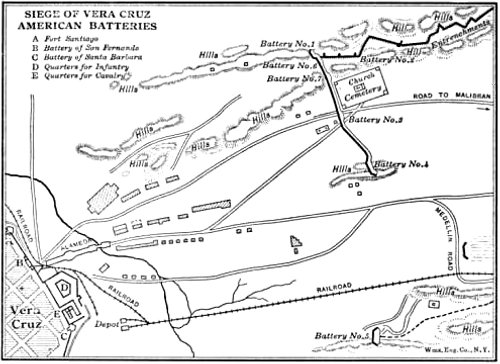
23. The parapet of the naval battery (known as No. 5) was of
sandbags. Each of the guns weighed 6300 pounds, and was mounted on a
ship-carriage, so that transportation on land was extremely laborious.
They were taken ashore March 23, and some 1500 men were employed in
dragging them nearly two and a half miles through the sand. Scott did
not value the shell guns highly. They were 8-inch Paixhans. Captains
Aulick and Mayo commanded the battery alternately. According to Robert
Anderson the orders for the battery were issued by Conner (Lawton,
Artill. Officer, 101) who had repeatedly offered it before Scott gave
up the hope of receiving adequate army ordnance in time (Conner, Home
Squad., 47, note 3). Early on the morning of March 23 Perry (who had
withdrawn the mosquito fleet the previous evening) had Tattnall launch
a sharp though brief attack, presumably to divert attention from the
naval battery, then under construction. An officer who gained fame
later as Commodore Porter was Tattnall’s pilot. The opening of Battery
No. 4 (24-pounders, etc.) was delayed by a norther, and one of the
howitzers was not ready as soon as the other pieces. Only about half
of the siege-train and ordnance stores called for in November arrived
before Vera Cruz surrendered (see chap. xviii, note 11).
24. Summons and bombardment. Sen. 1; 30, 1, pp. 222–44 (reports
of Scott and his officers; summons and reply; etc.); 230 (Scott
to consuls, Mar. 25). Ho. 1; 30, 2, pp. 1175–83 (naval reports).
13Morales, circular, Apr. 4. 13Giffard, nos. 7, 8, Mar.
22, 29. 12Matson to commodore, Mar. 25, 28; Apr. 2; to Perry,
Mar. 27. 47Perry, Mar. 26; Oct. 22. Henshaw narrative. Nunelee,
diary. 216Heiman, First Regt. Trans. Ill. State Hist. Soc.,
1906, pp. 179–80. Collins, diary. 224Hitchcock to Lizzie, Mar.
27. 60Perry to Mason, Mar. 25. 60Scott to Perry and
reply, Mar. 25. 61Bankhead to Scott, Mar. 26. 60Pickett
to ——, Mar. 10. Robertson, Remins., 227–32, 278. Lerdo de Tejada,
Apuntes, ii, 555. Scott, Mems., ii, 426–7. Hitchcock, Fifty Years,
244–7. Ballentine, English Soldier, ii, 24. Davis, Autobiog., 127. A
Soldier’s Honor, 24. Apuntes, 155–8. Tributo á la Verdad, 30–1, 109.
McCall, Letters, 480. Nebel and Kendall, 19–21. Hartman, Journal, 9–10.
Picayune, Apr. 4. Meade, Letters, i, 192. F. Lee, Lee, 36–7. McClay,
Navy, ii, 180–1, 183. Oswandel, Notes, 90–5. Semmes, Service, 130–42.
139W. B. Campbell to D. C., Mar. 28. Diario, Mar. 29; Apr.
10. Regenerador Repub., Apr. 7. Kenly, Md. Volunteer, 267. Lawton,
Artillery Off., 91–7, 101, 104. Caswell, diary. 322Smith,
diary. Moore, diary. 358Williams to father, Mar. 25, 28. Judah,
diary. Moore, Scott’s Campaign, 15. Arnold, Jackson, 84. Conner, Home
Squadron, 47, note 3. Wash. Union, Sept. 11. N. Y. Sun, Apr.
16. 162Conner to wife, Mar. 31. Soley, Porter, 67–9. Jones,
Tattnall, 57. Ho. 60; 30, 1, pp. 913, 1220 (Scott). 180Scott to
Stribling, Mar. 25. Ramsey, Other Side, 190, note. Bishop, Journal.
So. Quart. Rev., July, 1851. Weekly Courier and N. Y. Enquirer,
Mar. 2, 1848 (letter probably by Hitchcock). Griffis, Perry, 221–3.
Furber, Twelve Months Vol., 519–40 76G. Gómez, Mar. 25.
76Soto, Mar. 28. 76Morales, Mar. 24. 76Vega Mar.
25.
25. March 24 the consuls requested Scott to grant a truce and allow
the women and children to leave town (12Matson to commodore,
Apr. 2). With perfect propriety he declined to do so (Scott, Mems., ii,
427), unless Morales should ask for a truce with a view to surrender
(Sen. 1; 30, 1, p. 226), pointing out that due warnings had been given
(note 18). He could not afford to suspend his operations or let
the number of mouths be diminished; and doubtless he was counting on
the moral effect of the presence of women and children. Time pressed;
there were well-founded reports that a Mexican army was approaching;
and cases of yellow fever had occurred (Scott, Mems., ii, 427, and see
Davis, Autobiog., 141). Scott’s action looks hard, but it was humane to
force an immediate surrender. Roa Bárcena (Recuerdos, 178) fully admits
that the American policy was just. This move of the consuls tended to
shake the confidence of the Mexicans, and led to dissensions among the
officers.
March 25 Harney was sent against a force posted at a bridge near
Medellín, about ten miles from Vera Cruz (Sen. 1; 30, 1, pp. 250–2).
Including reinforcements, his detachment consisted of about 500 men
with artillery. The independent reports of the two principal Mexican
officers give their number as 140–50 with scarcely any ammunition.
Harney thought there were 2000 of them, and claimed great credit for
carrying the day. His orders were to reconnoitre only. There were other
insignificant affairs (Sen. 1; 30, 1, pp. 249–55; Ho. 60; 30, 1, p.
915; Reavis, Harney, 186).
26. On the Mexican side. 13Giffard, Mar. 11, 29.
12Matson to commodore, Mar. 25; Apr. 2. Papeles Varios, no.
10. Henshaw narrative. Nunelee, diary. Collins, diary. Robertson,
Remins., 222. Lerdo de Tejada, Apuntes, ii, 552–3, etc. Ballentine,
English Soldier, ii, 32–3. Davis, Autobiog., 138. Sen. 1; 30, 1,
pp. 220–38 (reports, etc.). Tributo á la Verdad, 29, 30, 109 (Ult.
Boletín). Apuntes, 157–60. Picayune, Apr. 9. (Fish) Delta, Oct.
16. 312Morales, Apr. 3. Revue de Paris, Dec., 1844. Semmes,
Service, 149. 82Noticias de Veracruz. 86Relaciones to
gov., Jan. 27. 86Treasurer to gov., Jan. 15. 86Many
letters regarding inability to pay the tax. 100Morales to
ayunt., Mar. 12, 17, 20; reply, Mar. 14. 95Ibarra, proclam.,
Mar. 23. Regenerador Repub., Apr. 7. 82Gov. to legislature of
Puebla, Mar. 9. 82Ibarra, proclam., Mar. 17. 82Morales to
gov. Puebla, Mar. 13. 86Id.to Soto, Mar. 8. Lawton, Artillery
Off., 106–7. Caswell, diary. Moore, diary. 375Morales to Soto,
Mar. 14. Monitor Repub., Apr. 4. Spirit of the Times, Apr. 17.
80Legislature of Méx. state, address. 165Conner to Scott,
Mar. 19. Bishop, Journal. And from 76 the following. Comte. gen.
Puebla, proclam., Mar. 16. Arrieta, Mar. 15. Cano, Mar. 26. S. Anna,
Apr. 29. Memo., Feb. 9. F. Vázquez, Mar. 26. Soto, Jan. 23, 26; Mar. 7,
9, 19, 24, 25 (two). G. Gómez, Mar. 18, 19, 20 (two). Vega, Mar. 24, 25
(two). Canalizo, Apr. 1. Morales, Mar. 5, 10, 16, 20, 24. Landero, Jan.
30, Apr. 3. Hacienda, Mar. 15. To G. Gómez, Mar. 16. To Soto, Mar. 28.
And many documents of minor importance.
27. Morales, probably in view of Santa Anna’s enmity, would not
surrender though he believed he ought to do so (76Landero, Apr.
3), but he turned the command over to Landero when capitulation was
seen to be inevitable, and left the city in a boat during the night
of March 25–6. He induced Gen. José Durán, who commanded at Ulúa, to
regard himself as under Landero’s orders, it was stated by Santa Anna
(76Apr. 29), and so brought about the surrender of the castle.
This apparently singular move was doubtless made to save Vera Cruz
from being bombarded by Ulúa. (Recognizing this danger to the city,
Scott intimated, when summoning the town, that no batteries would be
established in it against Ulúa, unless Ulúa should open fire upon it.)
There was considerable dissatisfaction among the Americans because
the prisoners were set free, for their parole was justly deemed of
slight value; but it would have been costly, and perhaps not easy, to
hold them at Vera Cruz or send them to the United States, and they
did good service by spreading tales of American prowess. Mar. 26 the
consuls went to Scott’s camp under a white flag, but he would not see
them (12Matson to commodore, Apr. 2). On the morning of March
27 two boat-loads of neutrals under the French flag attempted to
reach the neutral vessels at Sacrificios, but Perry would not allow
them to proceed (12Matson to commodore, Apr. 2). (Roa Bárcena,
Recuerdos, 178, admits that Perry’s course was proper.) At about the
same time the consuls and the second alcalde threatened that unless
the military chiefs would promptly bring hostilities to an end, they
would lead the non-combatants toward the American lines at the risk
of being fired upon. This was said to have had great effect in town,
but the chiefs had already decided to give up. Owing to bad weather
the navy was not represented at all the deliberations. Some of the
American military men felt that the share of the navy did not entitle
its representative to sign the capitulation. It was stated by Sedgwick
that, aside from the investment, only about 600 Americans took part in
the operations.
28. Next to Matson’s figures our best evidence regarding the
casualties is the statement of Giffard, that hundreds of women and
children, harbored at the consulates, escaped from harm though the
buildings suffered (13Mar. 29). Many other buildings were no
doubt equally solid and equally distant from the principal scene of
destruction. Vera Cruz was a great importing city, where large stocks
of goods needed to be securely housed. Mercantile establishments had
strong vaults, in which families now took refuge. Many found safety on
the long mole. Scott asserted that most of the people were sheltered
in the basements. Consequently one can hardly believe that more than
500 persons out of a civilian population probably not exceeding 3000
were injured. Lieut. Mackall believed that perhaps thirty or forty
soldiers were killed or wounded (252Apr. 30). Kendall, editor
of the New Orleans Picayune, who was on the ground, represented 150
as a mean estimate of the total number that perished (Picayune, Apr.
9). Landero reported 750 killed and 200 wounded (76Apr. 3),
evidently an absurd statement, for a greater number must have been hurt
than killed. Other Mexican estimates rose as high as 600 civilians
killed, which would imply on a reasonable calculation that almost every
civilian was hit. One of the best Mexican authorities (Apuntes,
165) states that 600 or more soldiers were wounded, and 400 of these
lost their lives. This is far too large a percentage of fatalities.
How accurate this authority is may be judged also from the fact that
the Americans are said to have thrown 6700 projectiles into the town,
whereas (Sen. 1; 30, 1, p. 244) the number was actually about 2500
(possibly besides those from the naval battery, which may have thrown
800). It is worth while to add that Scott was persistently represented
(partly to exalt the Mexicans and partly to injure the Americans) as
having destroyed a great number of non-combatants, but Morales wrote on
March 24 that most of the killed and wounded had been soldiers.
Next let us inquire as to the provisions. Giffard stated (13Mar.
29) that when the Mexicans surrendered, the city had food enough for
three days and the castle for ten; but probably he had reference
only to the provisions belonging to the authorities, and perhaps, as
he had objected strongly to the destruction of property and tried
to stop the bombardment by sending word to Scott that hunger would
force the Mexicans to yield in a few days, he felt compelled to
support that representation. March 10 Conner thought the enemy had
subsistence enough for about four or five weeks (Ho. 1; 30, 2, p.
1179). 76April 29, after having talked with officers from Vera
Cruz, Santa Anna assured the minister of war that Morales could have
held out until he (Santa Anna) could have arrived with regular forces.
Gov. Soto, who went down to the coast, where he was in communication
with the city by means of boats and doubtless knew whether stocks of
foodstuffs (belonging perhaps to neutrals) existed there, placed drafts
for $30,000, payable at Vera Cruz, in the hands of Morales on March
24 (76Soto, March 25). This money must have been intended
solely or principally for provisions, for on the fourteenth Morales had
written to Soto that nothing else was needed. On the same day $2000
from Oaxaca were delivered. These sums would have purchased enough food
to last beyond April 15. About March 17 a French barque ran in during
a norther, which shows that supplies from the outside could be hoped
for. The property loss due to the bombardment was estimated at five to
six million dollars (Monitor Repub., Apr. 4). The southwest quarter
of the town was demolished. It was ordered that not only Morales, but
Landero and Durán should be tried. Besides disliking Morales, Santa
Anna felt resentment against Vera Cruz for receiving him so coldly in
August, 1846.
29. The surrender; losses (note 28). Sen. 1; 30, 1, pp.
224–6 (Scott); 228 (consuls); 229–38 (Scott, etc.); 239 (gen. orders
80). Apuntes, 159–66. McCall, Letters, 483–4. Picayune, Apr. 9.
252Mackall to father, Mar. 30. 312Morales, Apr. 3.
12Matson to commodore, Mar. 25; Apr. 2; to Perry, Mar. 27;
reply, Mar. 27. Semmes, Service, 141. Diario, Mar. 27; Apr. 4, 8.
Regenerador Repub., Apr. 7. Lawton, Artillery Off., 98, 100, 106.
Hiney, diary. 358Williams to father, Mar. 28. Bustamante, Nuevo
Bernal, ii, 160. 375Morales to Soto, Mar. 14. Monitor Repub.,
Apr. 4, 5. N. Y. Sun, Aug. 16. 166Kirby to Conner, Mar.
27. Ho. 1; 30, 2, p. 1186. Mag. of Amer. Hist., xiv, 570. Bishop,
Journal. 13Giffard, nos. 7, 8, Mar. 22, 29. Henshaw narrative.
Collins, diary. 95Puebla ayunt., address, Apr. 7 (V. Cruz
yielded because of “the lamentations of innocent families expecting
every instant to die”). Roa Bárcena, Recuerdos, 177–9. Tributo á la
Verdad, 109 (Ult. Bol.). Nebel and Kendall, 21. Robertson, Remins.,
232. Lerdo de Tejada, Apuntes, ii, 558–69. Scott, Mems., ii, 427–9.
Hitchcock, Fifty Years, 243–8. 76Landero, Apr. 3. 76Id..
to Canalizo, Mar. 31. 76Canalizo, Apr. 1. 76S. Anna, Apr.
4, 29. 76To S. Anna, May 4. 76Terms of capitulation. The
date Of the capitulation was Mar. 27.
Had Vera Cruz held out until April 15, perhaps 5000 regulars would have
been in Scott’s rear (chap. xxiii, note 12). With this backing,
3–4000 irregulars could probably have been embodied. By means of
signals and boat communication operations in concert with the garrison
of Vera Cruz could have been arranged for, and the prospect would have
encouraged the city to hold out to the uttermost. Very likely Scott’s
line could have been broken, and provisions introduced. He could not,
then, before the advent of the yellow fever, have reduced Ulúa and
Vera Cruz, and have made the preparations necessary for advancing
into a hostile region in the face of a numerous enemy. When the fever
became active, Santa Anna’s upper country troops could have retired
quickly, leaving the Americans to be annoyed by the coast forces.
Other diseases quite as fatal as the vómito prevailed in that district
(Thompson, Recolls., 4). Lieut. Hatch (to father, Apr. 2) wrote that
all attributed the surrender to the effect of Scott’s artillery upon
the civilians, and the circumstances prove as much.
30. The northers, though in themselves a scourge, drove the
mosquitoes away, and so prevented the yellow fever. They subsided about
the middle of April, and then the fever was due.
31. Hardships and consolations. (Losses) Ho. 24; 31, 1; Sen. 1;
30, 1, pp. 253–5; Ho. 1; 30, 2, p. 1185 (naval). Henshaw narrative.
Charleston Mercury, Apr. 6. Nunelee, diary. Collins, diary. American
Eagle, V. Cruz, Apr. 8. 60Pickett to ——, Mar. 10. Vigne,
Travels, i, 8. Robertson, Remins., 223, 226–7. Campos, Recuerdos, 31.
Scott. Mems., ii, 430. Ballentine, English Soldier, ii, 8, 15. Sen. 1;
30, 1, p. 221 (gen. orders 54); 224–6 (Scott, Mar. 23). Picayune,
Apr. 4. 350Weber, recolls. Maury, Recolls., 34. 12Matson
to commodore, Mar. 11, 25. Oswandel, Notes, 71–4, 79–81. Semmes,
Service, 107–8. Lawton, Artillery Off., 79, 88, 96. Gilliam, Travels,
40. 361Woods, recolls. Caswell, diary. 327Sutherland to
father, July 15. Moore, diary. 136Butterfield, recolls. Spirit
of the Times, Apr. 17. Stevens, I. I. Stevens, i, 115. Tennery, diary.
Ho. 60; 30, 1, p. 879 (Conner). Bruell, Sea Memories, 57. Lancaster Co.
Hist. Soc. Mag., Mar. 6, 1908 (Nauman). Our army loss was nine killed
and fifty-one wounded (Ho. 24; 31, 1).
32. Occupation of city and “castle.” American Eagle, V. Cruz,
Apr. 6. Nunelee, diary. Collins, diary. Polk, Diary, May 15. Robertson,
Remins., 232. Lerdo de Tejada, Apuntes, ii, 567–8. Naredo, Orizaba,
108. Hitchcock, Fifty Years, 247. Davis, Autobiog., 129–30. Sen. 1; 30,
1, pp. 229, 235 (Scott); 237–8. Ho. 1; 30, 2, p. 1185 (Perry). Apuntes,
166–7. Picayune, Apr. 9, 10, 14. Lawton, Artillery Off., 110,
252Mackall to father, Mar. 30. 12Matson to commodore,
Apr. 2. Oswandel, Notes, 98. Semmes, Service, 145–6. Regenerador
Repub., Apr. 7. Lawton, Artillery Off., 102–3. 222Hiney, diary.
146Caswell, diary. 322Smith, diary. 270Moore,
diary. Id.., Scott’s Campaign, 23. Ho. 60; 30, 1, p. 907 (Marcy);
911 (Scott). Tennery, diary. Sedgwick, Corresp., i, 79–80. Bishop,
Journal. Littell, no. 157, p. 326 (Hine). 139W. B. Campbell
to wife, Mar. 31. Britannia, May 15 (V. Cruz letter, Apr. 1).
76Landero, gen. orders, Mar. 29–30. 76S. Anna, Apr. 29.
Nebel and Kendall, 21.
Some of the National Guards broke up and took flight in order to avoid
surrendering. As fast as the arms were stacked American sentries
mounted guard over them. When the Mexican soldiers found the victors
offering to divide rations with them, their sentiments became friendly,
and most of those belonging at Vera Cruz went back to town that day.
1. According to a memo. furnished by the adjutant general to the
ordnance bureau, Mar. 24, Scott’s forces were as follows. I. REGULARS.
1 Dragoons, Co. F. 2 Dragoons, Cos. A, B, C, F, I, K. *Mounted Riflemen
(on foot). 1 Art., Co. K. 2 Art., Co. A. 3 Art., Co. H. (These three
companies had field batteries.) Artillery serving as infantry: *1 Art.,
Cos. B, F, G, H, I; 2 Art., Cos. B, C, D, F, G, H, I, K; 3 Art.,
Cos. A, B, D, G, K; *4 Art., Cos. A, D, E, F, G, H. 1 Inf., Cos. C,
E, F, G, H, K. *2 Inf., Cos. A, B, D, E, F, G, H, I, K. *3 Inf., Cos.
C, D, F, G, H, I, K. 4 Inf., Cos. A, B, C, D, E, I. 5 Inf., Cos. E,
F, G, H, I, K. 6 Inf., Cos. A, C, D, E, F, H. *7 Inf., Cos. C, D,
E, F, I, K. 8 Inf., Cos. A, B, D, E, H, I, K. (Italics indicate the
division of Bvt. Maj. Gen. Worth; asterisks that of Brig. Gen. Twiggs.)
II. VOLUNTEERS. (Maj. Gen. Patterson.) Tenn. Mounted regt. Infantry:
Baltimore and Wash. battal.; Ga. regt.; Ala. regt.; two Tenn. regts.;
two Ill. regts.; Ky. co.; La. co.; La. regt.; two Pa. regts.; N. Y.
regt.; S. C. regt. This list includes troops not mentioned by Scott
(Mems., ii, 460–5). As Worth was now serving with his brevet rank his
command was called a division. The same change was made in Twiggs’s
case. A letter of Mar. 13 from Marcy, due to a suggestion from Polk
of the day before, urged Scott to make the protection of the troops
against yellow fever his prime consideration (Ho. 60; 30, 1, p. 904;
Polk, Diary, Mar. 12, 20). At the same time it gave a slanting assent
to the movement against the capital by discussing the question of
roads. This was Scott’s first authorization to proceed (So. Quart.
Rev., Apr., 1852), and the Cabinet had not decided to have him do so,
though he had assumed that Benton’s plan, endorsed by himself, was the
basis of his expedition (Ho. 60; 30, 1, p. 913). The hesitation of the
government is illustrated by the fact that Marcy first wrote merely,
“If you should occupy an interior position,” which he changed to, “If
you should move into the interior” (Marcy papers).
2. This proclamation has been censured on the ground that it
exasperated the Mexicans by mentioning their domestic dissensions and
bad government. If so, the blame rested primarily on the American
government, which had ordered Taylor to circulate a proclamation
embodying such ideas (p. 1 of chap. xxxi). The word “unnatural” has
been thought unfortunate as suggesting (since ordinary war seemed
to Mexico perfectly normal, and Scott could not be supposed to be
reflecting upon himself and his government) that the Mexicans were
acting in an inhuman and indecent way; but the author does not recall
seeing any such point made by them.
3. Many wagons were lost in wrecked vessels. It had been supposed
that about two thirds of the animals would be obtained locally, but it
was found by April 5 that not one tenth of them could be reckoned upon.
4. Harney proceeded to La Antigua on April 2 with two squadrons of
dragoons, a section of artillery and two infantry companies, drove
lancers from the village, captured about thirty-five horses and
obtained Mexican promises of assistance from the people (Ho. 60; 30, 1,
pp. 915–6). He returned the next day. The Alvarado expedition set out
on March 30. It was a joint affair designed not only (like Harney’s) to
obtain draft animals and beef cattle and open up permanent markets for
these desiderata, but to impress and “neutralize” the people of that
section, acquire a harbor for Perry’s small vessels, provide a regular
supply of water for the squadron, and perhaps capture the Mexican
vessels lying there. Perry himself commanded the naval contingent, and
Quitman commanded the land force, which consisted of three volunteer
regiments (Ga., Ala. and S. Car.), a squadron of dragoons and a section
of artillery (Ho. 60; 30, 1, pp. 917–8). The march of about fifty miles
(about 44 by the present railroad) was at times difficult and always
hot. Late on April 1 Perry and Quitman reached Alvarado, a fishing
town of 1200–1500 persons; and the land forces arrived the next day.
They found it occupied by an American midshipman and five sailors.
Lieut. Hunter, commanding a one-gun propeller, the Scourge, sent down
to assist in blockading the town, had violated his orders (probably
to show what the naval men were capable of doing, if given a chance
to act) by opening fire, upon which the town (though it endeavored
later to rescind its action) had offered to surrender. Learning that
public property had been taken up the Alvarado River, here a wide,
clear, deep stream, he pursued it and, to take advantage of the panic
resulting from the fall of Vera Cruz, captured the industrious town of
Tlacotálpam. Quitman accepted this turn of events genially, but Perry
was furious, and to the disgust of many naval officers and the general
public Hunter was tried and cashiered.
To Scott the results of Hunter’s error were serious (Sen. 1; 30, 1, p.
547). The intention had been to grant capitulations to the towns on
terms that would have provided the Americans with a large number of the
needed animals (Wash. Union, Sept. 11) or to obtain the same result
in some other way; but Hunter’s action, though only one day in advance,
gave time for the removal of the livestock. Quitman did, however,
arrange with the authorities of Tlacotálpam for at least 500 horses,
and opened negotiations for more and for beef cattle. How fruitful
these arrangements proved cannot be stated. April 8 about 300 of the
Fifth Infantry sailed from Vera Cruz for the same district (Ho. 60; 30,
1, p. 928), and about April 14 they brought back some wild mustangs.
On retiring from Alvarado the Mexicans burned the few small vessels
that constituted the national navy, and spiked or buried the ordnance
of the forts. The buried guns were, however, discovered. In all they
numbered about sixty, but a large part were valueless carronades. For
Quitman’s troops the expedition was unfortunate. A number died and
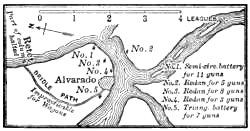
almost all were prostrated. He was back at Vera Cruz April 6. The
affair amused the American public hugely. One evidence of this is
afforded by the following lines (N. Y. Sun, May 7, 1847):
“On came each gay and gallant ship,
On came the troops like mad, oh!
But not a soul was there to whip,
Unless they fought a shadow;
“Five sailors sat within a fort,
In leading of a lad, oh!
And thus was spoiled the pretty sport
Of taking Alvarado.”
5. Scott’s preparations for advancing (including the Alvarado
expedition). Ho. 60; 30, 1, pp. 903 (Marcy); 908, 912–3, 920, 928,
937, 1221, 1271 (Scott); 915 (Harney); 917 (Quitman); 918 (Mason); 939
(gen. orders). 60Scott to Marcy, Apr. 5. Courrier Français,
Apr. 17. 61Harney, report, Apr. 4. Negrete, Invasion, iii,
app., 435. Scott, Mems., ii, 431. Robertson, Remins., 238. Velasco,
Geografía, iii, 203. Sen. 1; 30, 1, pp. 230 (Scott); 547 (Jesup).
Davis, Autobiog., 140. Delta, May 19. Diccionario Universal
(Alvarado). 164Scott to Conner, Mar. 20. 60 Mason to
J. L. Smith, Apr. 9. Semmes, Service, 148, 211. 73Bermúdez
de Castro, no. 445, Mar. 2, 1847. Nebel and Kendall, 23. Ho. 1; 30,
2, p. 1190. Lawton, Artill. Officer, 121. 270Moore, diary.
Id.., Scott’s Camp., 44–9, 52. Griffis, Perry, 239. Parker, Recolls.,
103–4. 12Captain of Alarm to commodore, Apr. 13. Bennett,
Steam Navy, 94, 97. Maclay, Navy, ii, 185. 358Williams to
father, Apr. 5. 62Adj. gen. to ordnance dept., Mar. 24.
65Scott, gen. orders 87, 91, 105. 65Id., proclam.,
Apr. 11. 13Giffard, no. 12, Apr. 13. Polk, Diary, Mar. 12–14.
13Pakenham, no. 7, Jan. 28. Metropol. Mag., Jan., 1908, p.
441. Soley, Porter, 71. Wash. Union, Sept. 11. N. Y. Sun, May
7, 21. Niles, May 1, pp. 131, 141; 22, p. 189. Southwest. Hist.
Qtrly., xviii, 216. Steele, Am. Campaigns, i, 120. 76Marin,
Jan. 2; Apr. 26. 76López, Jan. 15. 60Plan of Alvarado.
Ho. 1; 30, 2, p. 1200 (Mackenzie).
Worth, although he had been given the most prominent place in the
operations against Vera Cruz, demanded the leading position in the
advance, and felt deeply offended when Scott, mindful of the rights
of the Second Division, replied that he would not, even to please his
best friend, do an injustice (Mag. Am. Hist., xiv, 573–4). There
was a route to the interior via Orizaba, but it was not available
for artillery. In reply to Marcy’s despatch of March 13, which
suggested that the advance be made from Tuxpán, Scott pointed out the
impracticability of that plan (Ho. 60; 30, 1, p. 909).
6. In January Gen. R. D. de La Vega was made chief of the Division
of the East and provided with an army—mostly of paper. The same month
Alonzo Wenghieri offered to furnish 50,000 muskets, 25,000 tercerolas
(carbines of a certain kind) and 50,000 swords at reasonable prices,
but it is not certain that his offer, though endorsed by the war
department, was accepted (76to Hacienda, Jan. 14). By March
12, four 16-pounders from Vera Cruz arrived at the national bridge.
March 18 orders proper for the situation were despatched to La Vega,
but they sound as if issued mainly for form’s sake. In February the
government attempted to take control of 25,000 National Guards for the
purposes of the war (76circular Feb. 3); but it soon rescinded
that unpalatable assumption of authority, and confined itself to asking
state governors for them (76circular, Apr. 8).
7. March 24 the northern brigades were at Querétaro on their way
south (76acuerdo,[D] Mar. 24). Rangel’s brigade and some
artillery left the capital March 28. March 30, 1400 National Guards,
who had been turned over to the national government by the governor of
the state (82Guerra to gov., Apr. 1), left Puebla to join 700 of
the same class already at Jalapa, and some 12-pounders were despatched
from the former city. These forces were primarily designed to aid in
the defence of Vera Cruz by attacking Scott’s rear. There was great
need of money, especially as the attitude of the clergy was now so
dubious that even drafts accepted by them were distrusted (Diario,
June 8).
8. One method of rousing the public was to excite religious
fanaticism. A pamphlet, Clamor de las Ovejas, declared that some
of the Vera Cruz churches were to be sold to Protestants, others to
Mohammedans, others to pigs, others to worshippers of Venus.
9. Mexican preparations before Santa Anna arrived on the ground.
Courrier Français, Apr. 3, 10, 17. 52Consul Black, Apr. 25.
Davis, Autobiog., 142. 13Bankhead, no. 34, 1847. Apuntes, 120–2,
168. Revue Indep., Apr. 25, 1845. Memoria de ... Guerra, Dec., 1846.
Lerdo de Tejada, Apuntes, ii, 574. Diario, Mar. 29; June 8. Monitor
Repub., Mar. 31. Rivera, Jalapa, iii, 888. Balbontín, Invasión, 105.
94Canalizo, proclams., Apr. 2, 4. 94Soto, proclams., Jan.
22; Feb. 5. Regenerador Repub., Mar. 31. 84Guerra, decree,
Feb. 13. 84Relaciones, circular, Feb. 16. Republicano, Mar.
31. Ramsey, Other Side, 221, note. And from 76 the following
(out of a great number). To Rincón, Oct. 10, 11, 1846. To La Vega, Jan.
25; Mar. 18, 20, 27, 1847. Acuerdos, Mar. 24, 25, 28, 29, 30, 31; Apr.
1. To Gaona, Apr. 1. To Canalizo, Mar. 28, 31; Apr. 1. Gaona, Mar. 18;
Apr. 1. Soto, Mar. 7, 22, 26; Apr. 3. G. Gómez, Mar. 18, 19, 25, 26.
La Vega, Mar. 22, 24. Canalizo, Mar. 30; Apr. 1, 3. To Soto, Apr. 1.
Soto to V. Cruz cong., Dec. 1, 1846. Morales, Oct. 15, 1846; Feb. 2, 6,
1847. Canalizo to his troops, Mar. 29. Guerra, circulars, Feb. 3, 13;
Mar. 31; Apr. 8. To comte. gen. Mex., Mar. 25. Canalizo, proclam., Mar.
29. To gov. Puebla, Apr. 1. Gov. Puebla, Mar. 28. A little later Santa
Anna had the spiked cannon drawn to Cerro Gordo by cattle.
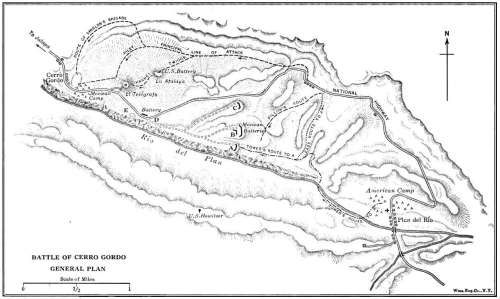
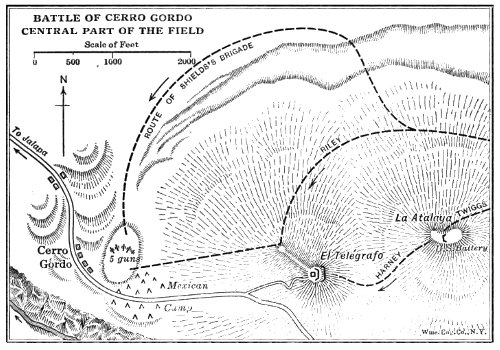
10. The northern wall of the cañon is much more nearly vertical than
the southern. The author went down one side and up the other by rough
mule paths.
11. Accounts differ as to the number of men and guns on each tongue
but agree that B was much more strongly guarded than A and C. It
had supporting works. After the battle R. E. Lee wrote that the highway
was commanded by thirty-five Mexican guns (F. Lee, Gen. Lee, 38).
Allowing four for El Telégrafo, five for the battery at the camp, and
seven for D, we should have nineteen left for the tongues. In all,
according to the chief Mexican artillery officer, there were forty-one
pieces, so that Santa Anna was able to send additional guns to his
left. There seems to have been a 12-pounder at A, but most of the
guns were light. The four 16-pounders were at D, and commanded the
highway.
12. After the battle Santa Anna reduced his numbers to about 6000
infantry (only about half of them permanent) and 1500 or 2000 cavalry
(76May 7; Negrete, Invasión, iii, app., 112); but on March 20
(76to La Vega) he had placed the troops from La Angostura at
6000 (Roa Bárcena, Recuerdos, 194, says 5650) to which must be added
at least 2000 from the capital (ibid.), 2000 (besides a brigade
that arrived just before the battle) from Puebla (note 7), and
contingents from Jalapa, Coatepec and other places. Mexican accounts
run from Santa Anna’s figures up to 15,000 (Republicano, June 1,
correspondent). Canalizo, April 3, proclaimed that more than 12,000
were coming, and the troops to whom he referred did not include all
who were present. 13Bankhead placed the number from Mexico at
2500. Roa Bárcena (Recuerdos, 195) specifies 3, 4, 5, 6 and 11 Line
regiments, 1, 2, 3, 4 Ligero regiments, 5 and 9 cavalry, and 12 smaller
corps of foot and horse. Canalizo’s demand that all citizens rally to
the colors does not seem to have been very effective; but many who
had given their parole at Vera Cruz were forced to take up arms (Roa
Bárcena, Recuerdos, 189). It appears safe to estimate that Santa Anna
had at least 10,000, probably 11,000, and quite possibly 12,000 men
besides the Puebla brigade under Arteaga, which arrived after the fight
had begun. The brigade from Mexico arrived April 11, and the three
brigades from the north April 12. After the battle Santa Anna and
others attempted to represent the troops as of wretched quality. But
certainly he had picked the corps brought from the north, and there
is no reason to suppose that the other troops were below the average.
Santa Anna pretended that he lacked ammunition, but great quantities
were found in the camp after the battle (Oswandel, Notes, 139). The
distribution of it was very likely defective, however. It was asserted
also that some of the cannon cartridges contained no powder. They
should have been inspected. Twenty-nine Irishmen served in the hospital
force (76acuerdo, Mar. 30). The army was fairly well supplied
with money. April 10 38,000 pesos went from the capital, and the bishop
of Puebla sent 10,000.
13. Santa Anna had water brought from El Encero by a ditch, but it
only began to run just as the battle opened.
14. Mexican preparations, Apr. 4–16. Delta, May 1. Picayune,
May 2. 312Anaya to S. Anna, Apr. 9. 312Guerra to gov.
Puebla, Apr. 9. 312Pablo to S. Anna, Apr. 8. 312Guerra
to S. Anna, Apr. 9. 312Baranda to S. Anna, Apr. 8. Courrier
Français, Apr. 17. Repub., Apr. 22; June 1, 9. Sen. 1; 30, 1, p.
261. Negrete, Invasión, iii, app., 49. Grant, Mems., i, 134. Apuntes,
121, 169–75. Tributo á la Verdad, 41. S. Anna, Apelación, 33–7. Suárez
y Navarro, Causas, 68. Steele, Amer. Campaigns, i, 121. Diario, Mar.
29; Apr. 3, 9, 30; June 10. Gamboa, Impug., 29–32. Ramírez, México,
214, 229. Bustamante, Nuevo Bernal, ii, 157, 189. Lerdo de Tejada,
Apuntes, ii, 574. Dublán, Legislación, v, 264–5. Monitor Repub.,
Apr. 24, 27, 28; May 3; Oct. 24. 13Bankhead, no. 34, Apr. 1.
Oswandel, Notes, 139. 82Pavón, Apr. 29. Sedgwick, Corres., i,
86. 76Gaona, Apr. 8. 76To Canalizo, Apr. 2. 76To
S. Anna, Apr. 9. 76Canalizo, Mar. 29; Apr. 3, 24. 76S.
Anna, Apr. 6, 7, 11, 13, 17, 29; May 7. 76Uraga, May 1.
76Memorias by heads of war dept., Nov., 1847. 76Decrees,
Apr. 8, 10. 76A great number of less important papers.
No doubt, as Willisen (“Higher Theory of War”) and others have said,
combining strategical defensive with tactical defensive is as a rule to
be condemned; but here the circumstances were peculiar. The Americans
were pursued by the yellow fever, and only a decisive victory could
save them from ruin. Hence Santa Anna’s policy cannot be censured
unceremoniously. Ripley (War with Mexico) gives the name El Telégrafo
to La Atalaya, an error that of course leads to much confusion. Robles
had a series of objections to the Cerro Gordo position. It could be
turned; the rough and woody country made it possible for the enemy
to get near; cavalry could not be used; the line was too long; a
threatened point could not be easily reinforced; water was lacking;
retreat, especially with artillery, would be difficult (Roa Bárcena,
Recuerdos, 197–8).
15. One of the field batteries was Taylor’s; the other was Talcott’s
howitzer and rocket battery (R. Jones to ordnance dept., Dec. 3,
1846). Steptoe’s field battery and a squadron of dragoons accompanied
Patterson later. The statement regarding the artillery outfit is from
Lieut. Hatch (213to father, Apr. 7), who went with Twiggs.
16. Scott has been called rash for sending his army forward and
exposing it to attack piecemeal. But (1) had it all formed one column
it would have been no safer against a raid from some crossroad; (2)
had it been attacked in front, numbers would not have signified, and
the individual superiority of the Americans as well as their superior
artillery would have given them the advantage; and (3) Santa Anna,
having possession of such fine defensive positions, was not likely to
make a venturesome attack, especially as the battle of Buena Vista had
shown how tenaciously the Americans could defend themselves. The two
last points bear also upon the criticism that Santa Anna ought to have
attacked Twiggs before the arrival of Pillow and Shields (see remark
at the end of note 14). The volunteer division left Vera Cruz April
9 under Patterson. It consisted of two brigades, for Quitman’s men had
not sufficient transportation, and probably needed time to recover
from the effects of the Alvarado expedition. Capt. Loch, a British
naval officer off Vera Cruz, was as much surprised as Scott when it was
found that Santa Anna had a large force at Cerro Gordo (12to
commodore, Apr. 9).
17. From the national bridge to Cerro Gordo the pavement was not in
very good condition. Above the latter point stone blocks took the place
of cement. In places, where these had never been laid, or had been
taken up by revolutionists, or had been overlaid with stones by floods,
the highway was extremely bad.
18. The position looked impregnable but was not, for a besieging
force could easily deprive the garrison of provisions and water.
19. The march from Vera Cruz to Plan del Rio. Ho. 60; 30, 1,
pp. 920–2, 928 (Scott); 921 (gen. orders 94). Hartman, Journal, 10.
Picayune, Dec. 9. Delta, May 15. 312Gutiérrez to gov.
Puebla, Apr. 9. Sen. 1; 30, 1, p. 274 (Twiggs). 217Henshaw
papers. Stapp, Prisoners of Perote, 159–60. Raleigh Star, May 5.
280Nunelee, diary. 159Narrative based on papers of F.
Collins. 220Higgins to Clutter, Apr. 1, 1851. Ballentine,
Eng. Soldier, ii, 36–48. Davis, Autobiog., 142–4. Apuntes, 169.
Ward, Mexico, i, 12; ii, 177–88. Robertson, Visit, i, 269. Ruxton,
Adventures (1849), 22–5. Tudor, Tour, ii, 171–5. Bullock, Six Months
(1825), i, 32–42. Orbigny, Voyage, 409–10. Robertson, Remins., 238–40,
242. Latrobe, Rambler, 297. Velasco, Geografía, iii, 28, 37, 54, 64.
Lawton, Artillery Officer, 123, 132. Engineer School, U. S. Army,
Occas. Papers, no. 16. 291Pierce, diary. Journal Milit. Service
Instit., v, 38 (Coppée). Bishop, Journal. 60G. W. Smith to
Stevens, Apr. 23. Hawthorne, Pierce, 78–85. Steele, Amer. Campaigns, i,
121. 185Memo. on the route. 356Whitcomb, diary. Carleton,
address. Löwenstern, Le Mexique, 32. 236Judah, diary. Wash.
Union, May 1. Vedette, viii, no. 5. 322Smith, diary. Norton,
Life. 270Moore, diary. 358Williams to father, Apr. 21.
152Claiborne, memoirs. 136Butterfield, recolls. Revue de
Paris, Dec., 1844. 66Stevens to J. L. Smith, May 7. 66G.
W. Smith to Stevens, May 1. 65Scott, gen. orders 91. Thompson,
recolls., 11–12. Poinsett, Notes, 25–9. 335Calendario de
Ontiveros. 12Loch to Lambert, Apr. 9. Oswandel, Notes, 108–10,
119. Semmes, Service, 162–75. 256J. Parrott to Marcy, Apr. 19.
254McClellan, diary. Mag. Amer. Hist., xiv, 575. Littell,
no. 162, p. 546. 139W. B. Campbell to wife, Apr. 8. Moore,
Scott’s Camp. 71Diccionario Universal (Puente Nacional).
20. Twiggs and his operations, Apr. 11–13. Maury, Recolls., 29.
Sen. 1; 30, 1, p. 274 (Twiggs). 217Henshaw papers. Trans. Ills.
State Hist. Soc., 1906, p. 181. 159Narrative based on the papers
of Francis Collins. Polk, Diary, Apr. 30. 66Tower to Twiggs,
Apr. 16. 60Scott (on Twiggs), remarks on a letter from Worth.
Id.., Mems., ii, 432. Hitchcock, Fifty Years, 250. Grant, Mems., i,
131. Ballentine, Eng. Soldier, ii, 25–6, 51–4. Brackett, U. S. Cavalry,
141. Davis, Autobiog., 143–6. Apuntes, 173–5. Robertson, Remins., 240.
270Moore, diary. Lancaster Co. Hist. Soc. Mag., Mar. 6, 1908
(Nauman). Bishop, Journal. 210Bragg to Hammond, Dec. 20, 1847;
May 4, 1848. 327Sutherland to father, Aug. —; Nov. 28, 1847.
358Williams to father, Apr. 21. 152Claiborne, mems.
112Beauregard to Patterson, Apr. 20. 204Gouverneur,
diary. 66Tower to Maj. Smith, undated. 273Mullan, diary.
Lee, Lee, 38. 139W. B. to D. Campbell, Apr. 13. Hist. Teacher’s
Mag., Apr., 1912, p. 75. Ho. 60; 30, 1; pp. 921 (gen. orders 94); 928
(Scott). So. Qtrly. Rev., Jan., 1852. 170Crooker to father,
Apr. 27. Henry, Camp. Sketches, 268. Furber, Twelve Months Vol., 331.
Some may ask why Scott put a general like Twiggs forward. Twiggs had a
rank and a position that had to be recognized, and his officers and men
had their right to see honorable service and win distinction.
21. Major J. L. Smith commanded the engineer company of fifty-one
men. Lee had ten of the men, and under his direction Lieut. Foster with
eight had charge of building the road “located” by Lee. Lieut. Mason
also worked on the road. McClellan with ten was assigned to Pillow’s
command, and G. W. Smith with ten to Harney’s (66G. W. Smith to
I. I. Stevens, Apr. 23). Tower had charge of the reconnoitring on the
Mexican right.
22. I. I. Stevens, one of the engineer officers, 66reporting
on May 7, stated in the most distinct manner that according to this
plan El Telégrafo was not to be attacked before the highway in its
rear should have been occupied in strength, and that insistence upon
this point constituted the essential difference between this plan and
the operations previously suggested by Beauregard. Scott wrote to
Marcy (Sen. 1; 30, 1, p. 261) that he had intended to turn the Mexican
position and attack in the rear. He clearly indicated as much in his
Memoirs (ii, 432), and his orders for the battle were that Twiggs’s
division, supposed to be already near the highway, should move before
daybreak to occupy it, while the orders only contemplated an attack in
front as likely to be made before 10 o’clock. It was well understood
in the army that his plan was to bag Santa Anna’s army, and this
implied—since some of the Mexicans were likely to retire early—that
the way of escape must be cut off before a frontal attack should be
launched. Stevens tried to reach the highway via the Mexican right, but
was taken ill and had to return (Stevens, Stevens, i, 124).
23. Scott’s operations, Apr. 12–16. Sen. 1; 30, 1, p. 261 (Scott).
Picayune, May 1, 2. 217Henshaw papers. A Soldier’s Honor,
24. Trans. Ills. State Hist. Soc., 1906, p. 181. 159Narrative
based on the papers of F. Collins. Scott, Mems., ii, 432. Hitchcock,
Fifty Years, 250. Ballentine, Eng. Soldier, ii, 56–8. Davis, Autobiog.,
144–8. Bishop, Journal. 322Smith, diary. 112Beauregard
to Patterson, Apr. 20. 111Stevens to J. L. Smith, May 7.
111G. W. Smith to Stevens, Apr. 23. 111Tower to
J. L. Smith, undated. 111Mason to J. L. Smith, Apr. 24.
65Scott, gen. orders 105, 111. 332Tennery, diary.
McCabe, Lee, 19, note. 12Loch to Lambert, Apr. 9. Oswandel,
Notes, 113–5. Stevens, I. I. Stevens, i, 122–4. Ho. 60; 30, 1, pp. 929
(Scott); 939 (Twiggs); 940 (Pillow).
24. The range had to be estimated (322W. B. Smith, diary),
and perhaps it was not easy to rectify the estimate by seeing where the
shot struck. Many of them flew much too high.
25. Scott’s orders for the battle gave no directions for such a
charge. His plan was to place Twiggs’s division and Shields’s brigade,
supported by Worth’s command, on the highway in Santa Anna’s rear and
attack from that quarter. From one of his reports it appears that he
made some suggestion to Twiggs about the possibility of a frontal
attack on El Telégrafo—presumably in the case of some unlooked-for
turn of events; but he did not expect that officer to create the
turn. The charge seems to have been ordered by Scott during the night
(213Hatch to father, Apr. 21). To be sure, Scott’s orders spoke
of a frontal attack, but evidently the reference was to Pillow’s
movement.
The officers of the Rifles were taken by Polk from civil life. Scott
offset this by having Major Sumner of the Second Dragoons, a veteran
and able soldier, command the corps; but as Sumner had been disabled on
Saturday, Major Loring was now at its head. When moving from shelter
he exposed his men to being enfiladed by the enemy’s cannon, and
the other troops actually cried out, “That’s the way to murder men”
(218Henshaw). This illustrates how political appointments are
likely to work on the firing line. The Rifles were expected to join in
the attack on El Telégrafo after repulsing the enemy on the left, but a
part of them were unable to do so (p. 352).
26. Events of Apr. 17–18 {except Pillow’s operations). Sen.
1; 30, 1, pp. 255–95, 298 (Scott’s orders; reports of himself and
officers). Maury, Recolls., 37, 44. Hartman, Journal, 11. M’Sherry,
El Puchero, 221–3. Picayune, May 1, 6, 9, 19. Delta, May 1, 15;
June 18. 252Mackall to father, Apr. 18. 335Trist, May
7, 25. 217Henshaw papers. Trans. Ills. State Hist. Soc., 1905,
p. 213; 1906, pp. 182–3. 159Narrative based on F. Collins
papers. 6Riley court of inquiry. 60Plympton to Scott,
July 27. 60E. K. Smith to Plympton, July 23. 60J. R.
Smith to Polk, Nov. 30, 1848. 60Twiggs to J. R. Smith, Nov. 9,
1848. 60Morris to J. R. Smith, Nov. 15, 1848. 66Russell
court of inquiry: orders 155. 223Hirschorn, recolls. Negrete,
Invasión, iii, app., 46–52, 98–114. Hitchcock, Fifty Years, 251–2.
Grant, Mems., i, 132. Ballentine, Eng. Soldier, ii, 59–84, 88, 90–1.
Davis, Autobiog., 148–52, 155–8. Apuntes, 175–83. Tributo á la Verdad,
42, 49, 62, 136. S. Anna, Apelación, 34–41. Id.., Manifiesto,
1847, 7. Eye witness, Complete History, 79–80. Robertson, Remins.,
248–52. Lawton, Artill. Officer, 137–40, 267. Engineer School, U. S.
Army, Occas. Papers, no. 16. N. Y. Times, July 16, 1916 (Worth).
Bishop, Journal. Nebel and Kendall, 24–5. S. Anna, Mi Historia, 67–8.
66G. W. Smith to Stevens, Apr. 23. Mansfield, Mex. War, 195.
210Bragg to Hammond, May 4, 1848. 254McClellan, diary;
to sister, Apr. 22. Diario, Apr. 28, 30; May 20; June 10, 23, 30.
Republicano, Apr. 21, 23, 27; June 9; July 10. 84Ampudia to
gov. S. L. Potosí, Oct. 10. Gamboa, Impug., 30. Kenly, Md. Vol., 337.
Ramírez, México, 227–9, 231, 261. 298Porter, diary. London
Times, June 15. Wash. Union, May 10, 11; Oct. 23. Monitor Repub.,
Apr. 20, 23, 24, 27; May 3, 6; Nov. 1, 30. Spirit of the Times,
May 29; June 5. 124Blocklenger, recolls. 327Sutherland
to father, Aug. —. Vedette, ii, no. 2. 322Smith, diary.
307Roberts to wife, Apr. 21. 178Davis, diary.
270Moore, diary. 358Williams to father, Apr. 21.
152Claiborne, memoirs. 112Beauregard to Patterson, Apr.
20. 66Stevens to J. L. Smith, May 7. 66Tower to J.
L. Smith, undated. 66Mason to J. L. Smith, Apr. 24. Arnold,
Jackson, 87. 66G. W. Smith to Lee, Apr. 20. 66Lee to
Twiggs, undated. 65Scott, gen. orders 249. 60Riley
to Westcott, Nov. 30. 332Tennery, diary. Giménez, Apología.
Ho. 85; 30, 1. Journal U. S. Artill.,1892, pp. 419–20. Lee, Gen.
Lee, 38. Oswandel, Notes, 116, 122–8. Semmes, Service, 178–81, 183.
Rivera, Jalapa, iii, 887–94. 82Soto to gov. Puebla, Apr. 18.
82Pavón to Puebla sec. state, Apr. 29. Ho. 60; 30, 1, p. 1089
(Hitchcock). Niles, May 22, pp. 183, 188. 148Chamberlain,
recolls. Elderkin, Biog. Sketches, 66. Journ. Mil. Serv. Instit.,
xlii, 128. Henderson, Science of War, 215. Stevens, I. I. Stevens,
i, 126. Smithwick, Evolution, 286. 76S. Anna, Apr. 17, 21;
May 7. 76Canalizo, Apr. 18, 21. 76Carrera, May 1.
76Circular, Apr. 20. 76Ampudia, Apr. 25. 76To
Brito, May 25. 76Alvarez, Oct. 28. 76Canalizo to Villaba
& Co., Apr. 24; to son, Apr. 24. 76Memorias by heads of depts.,
Nov., 1847.
Remarks on the battle (April 18). The perfect confidence
displayed in Scott’s orders for the battle is noteworthy. No doubt
it had a great effect on the troops. The orders to Worth were rather
vague. Probably this was because the course of the battle was expected
to indicate how his division could be used to the best advantage, but
possibly on account of his intense jealousy of Twiggs it was not deemed
wise to say clearly that he was to support Twiggs. In fact he followed
Twiggs, ascended El Telégrafo, saw the white flag at the tongues, and
sent Harney and Childs (Ripley, War with Mexico, ii, 74) to accept the
surrender of the Mexican right wing. The movement assigned to Twiggs
was hazardous, but the military quality of Santa Anna and the Mexican
troops was now well understood.
General Shields was struck by a grape shot that passed through the
upper part of his body; and his recovery, due to high surgical skill
and the most devoted nursing, seemed almost miraculous. When Shields
fell, Col. E. D. Baker took command. Canalizo was ordered to charge
Shields’s brigade; but the ground was only partly cleared, and Santa
Anna reported that a charge was not practicable. Canalizo was, however,
accused by many of causing the Mexican defeat by letting the Americans
reach the highway. He could have dismounted all his cavalry, as he
did his cuirassiers, and 2000 fresh troops—especially if aided by
those at the tongues—might have done a good deal; but probably he
believed that the battle had already been lost. When Shields’s men
approached the highway they came upon a party of Mexican surgeons, and
on learning their business became instantly, according to the surgeons,
their friends and protectors (Diario, Apr. 30). The chief Mexican
surgeon stated that the Americans made no distinction between the two
nationalities in bringing wounded men to the hospitals (Courrier
Français, May 5). Worth’s command, deprived of its expected share in
the battle through Twiggs’s departure from Scott’s plan, played the
part of a reserve. Harney’s charge may have been launched just when
it was because a thinning out of the summit of El Telégrafo (probably
due to sending troops against Riley) led to the belief that the La
Atalaya guns were doing great execution (Ballentine, Eng. Sold., ii,
81). Harney placed the Seventh Infantry on his right, deploying some
of the men as skirmishers to guard that flank, and the Third on his
left, protected by the Rifles. (In consequence of Loring’s incompetence
(213Hatch to father, Apr. 21) the Rifles did not charge in a
body or effectively.) This line was supported by the First Artillery.
Some of Harney’s men joined with Riley’s in capturing the minor crest.
The La Atalaya battery fired over the heads of the charging Americans
as long as this appeared to be safe. Vázquez died bravely at his post,
whereas a number of high Mexican officers proved recreant. After the
fighting began near the summit of El Telégrafo the Mexican cannon
placed there could not be used, for they would have injured Mexicans
as well as Americans. Santa Anna appears to have done all in his power
to stem the tide of defeat. About 1000 Puebla men under Gen. Arteaga
arrived during the battle. They were placed at the headquarters
battery, but took flight early. S. Anna’s line was about a mile and a
half long.
27. It has been argued that Pillow’s attack should have been a
“mere feint,” i.e. threat. But (1) Scott had reason to fear that
the purpose of a “mere feint” would be detected as soon as the grand
battle should begin, and that the feint would fail of its purpose
(see Donaldson and Becke, 387); and (2) Pillow had troops of superior
mettle, who probably would not have been satisfied to make a mere
threat (Nebel and Kendall, 25, note). In ordering this attack Scott
violated Napoleon’s principle, which was to turn the enemy’s flank
without dividing his own army (Johnston, Foundations, 180), but the
circumstances warranted doing so. In particular Santa Anna had shown
that he did not wish to be aggressive, and Scott intended to keep him
busy (see Hamley, Operations, 160).
28. Pillow had also a few Tennessee horse and (attached to Haskell’s
regiment) a Kentucky company—in all about 2000 men (Robertson,
Remins., 244).
29. The text is based primarily on the full and minute account
given in the diary of George B. McClellan (who accompanied Pillow and
whose integrity and technical ability will not be questioned) and the
following documents: reports of Engineers Stevens (66May 7) and
Tower (66undated); Haskell and sixteen officers (Picayune, May
29); Haskell (ib., June 28); Pillow, reply (ib., June 9); Id.,
61substitute report, May 29 (to take the place of his published
report, which he admitted was not correct); 139letters of Col.
Campbell, an able and fair man (who said privately the affair was most
badly managed; also that Pillow was no general, and on the field had no
judgment or decision); 224Williams to Hitchcock, June 4, 1849;
Wynkoop, July 16, in Picayune, Sept. 19; Stevens, I. I. Stevens, i,
125 (Stevens says, e.g., that Pillow’s attack failed because “made
prematurely, with great precipitation, without order in the assaulting
columns, and before the supporting columns were in position, and at the
wrong point,” and that it, “both as to time and as to direction, was
earnestly remonstrated against by the engineer officer directing the
attack, by the personal staff of the general, and by Col. Campbell,
second in command”). Of course Ripley, who wrote his history of the war
in consultation with Pillow, gives a misleading account of this affair
as of others.
The author used also the following sources: Sen. 51; 32, 1. Sen. 1; 30,
1, pp. 257 (Scott); 258 (orders 111); 294 (Patterson); 296 (Pillow).
217Henshaw papers. Taylor, Letters (Bixby), 109. 69Pillow
to adj. gen., June 25, 1848. 69Ripley to adj. gen., June 25,
1848. 66Tower to Twiggs, Apr. 16. Negrete, Invasión, iii,
app., 50. Hitchcock, Fifty Years, 251. Furber, Twelve Months Vol.,
593. Grant, Mems., i, 133. Davis, Autobiog., 146. Apuntes, 173, 181.
Weekly Courier and N. Y. Enquirer, Mar. 2, 1848. Robertson, Remins.,
244–8. Lawton, Artill. Officer, 139. 293Pillow to wife, June
9. 293Rains to Mrs. Pillow, Apr. 18. Republicano, June 9,
24. Picayune, May 9; Sept. 11. México á través, iv, 654. Hillard,
McClellan, 18, 19. Nat. Intelligencer, June 11. Monitor Repub.,
June 24. 358Williams to father, Apr. 21. Vedette, viii, no. 5.
Oswandel, Notes, 110–1, 122–35. Semmes, Service, 182–3. Hitchcock in
semi-weekly Courier and Enquirer, Mar. 1, 1848. 100Mata, Apr.
18. 82Pavón to Puebla sec. state, Apr. 29. 288Tapper to
wife, May 3. Niles, June 5, p. 219; Oct. 2, p. 75. Boston Atlas,
Dec. 13. Griepenkerl, Applied Tactics, 116. 316Judd to Sherman,
Feb. 26, 1848. Johnstone, Foundations, 180. So. Qtrly. Rev., Jan.,
1852. 181Armstrong to Donelson, July 4. 139Cummings to
Campbell, May 12; June 13. 76Carrera, May 1. 76S. Anna,
May 7. The reason why reversing the regiments caused trouble seems to
have been that infantry were accustomed to manœuvre and fight in
a certain formation, and felt awkward if the right was unexpectedly
brought out on the left. As Wynkoop had farther to march than Haskell
and did not wish to attack before his support was in position, placing
Campbell third in the line of march involved a delay. One derives a
lesson on the value of official reports from Patterson’s representation
that Pillow was wounded while gallantly leading his brigade (Sen. 1;
30, 1, p. 295).
30. The American soldiers were not pleased with this policy. The
American government expressed itself against it and, placing an
undeserved value on Mexican officers, ordered that no more of them
should be paroled except for special reasons. It is probably enough to
say that Scott was in the best position to judge; but one may remark
that Santa Anna’s difficulty was not so much to obtain men as to obtain
arms. Further grounds for releasing them are mentioned in Sen. 1; 30,
1, p. 257. According to Gen. Pavón, Gen. La Vega and twenty-four other
officers were not paroled. Some six declined to give their paroles.
Among the spoils were a large amount of ammunition, $11,791.19 in cash
(Sen. 34; 34, 3, p. 24), and a wooden leg (supposed to have belonged to
Santa Anna) now preserved in the capitol at Springfield, Ill.
31. Pursuit, losses, prisoners, spoils. Ho. 60; 30, 1, 948, 1012,
1221 (Scott); 1089 (Hitchcock); 1233 (Marcy). Sen. 1; 30, 1, pp. 258
(gen. orders 111); 262 (Scott); 276, 278, 283, etc. Scott, Mems., ii,
443. Hitchcock, Fifty Years, 253. Ballentine, Eng. Soldier, 86–7,
106–7. Tributo á la Verdad, 62. Bustamante, N. Bernal, ii, 189. S.
Anna, Apelación, 40. Lawton, Artill. Officer, 140, 179. Ho. 24; 31, 1.
Sen. 34; 34, 3, p. 37. Republicano, Apr. 27.; June 9. Sen. 52; 30,
1, pp. 122, 136. Courrier Français, May 5. México á través, iv, 655.
Monitor Repub., Apr. 24; May 6. 322Smith, diary. Williams
to father, Apr. 21. 152Claiborne, mems. 332Tennery,
diary. 82Pavón to Puebla sec. state, Apr. 29. N. Y. Sun,
Aug. 16. Niles, May 15, p. 164; May 29, p. 201. McClellan, diary.
Nebel and Kendall, 25. Robertson, Remins., 249, 253. 76Carrera,
Apr. 27; May 1. 76Ampudia, Apr. 25. 76Canalizo, Apr.
18. 76Id.., undated. 76S. Anna, May 7. 76Junta
directiva, May 3. 76G. Gómez to Gaona, Apr. 18. The cavalry
appear to have been late in beginning the pursuit. Ripley (War, etc.,
ii, 75) says Scott was so busy that he forgot to send for the cavalry,
but Scott’s orders for the battle put the responsibility on the
commander of that corps, which was placed in reserve on the highway
with a field battery (Sen. 1; 30, 1, p. 259). In places, too, they
found the highway cut or blocked.
32. A deputation of the ayuntamiento met Patterson (Sen. 1; 30,
1, p. 296), and were promised protection on condition that no liquor
should be sold to the troops. The term “nondescript costumes” applies
primarily to the volunteers, but probably some of the regulars had lost
parts of their outfits.
33. Scott’s report was a model in concealing facts; and Worth,
writing to a member of his family, called it “a lie from beginning to
end.” Gen. U. S. Grant, doubtless recording without investigation his
early impressions, wrote in his Personal Memoirs (i, 132): “Perhaps
there was not a battle of the Mexican war, or of any other, where
orders issued before an engagement were nearer being a correct report
of what afterwards took place,” and such has been the accepted opinion,
though a thoughtful comparison of the orders with Scott’s own report
(Sen. 1; 30, 1, pp. 258, 261) is enough to disprove this view. For
example, Scott in his orders, intending to attack from the enemy’s
rear, assigned no troops to the frontal attack on El Telégrafo, which
was the main feature of the actual battle. Unpublished documents of
a wholly unbiassed character disprove it still further. As two more
illustrations, the artillery, for which infinite trouble was taken
to make a passable road, did not figure at all in the battle (though
a section of Taylor’s battery went that way in season to join in
the pursuit), and a court of inquiry declared that Riley’s brigade,
which played a most important rôle, was diverted from its original
destination—a finding approved by Scott (65gen. orders 249).
Robert Anderson said that if Scott’s orders had been carried out, not
a Mexican would have escaped (Lawton, Artillery Officer, 137); and
Davis, Shields’s aide, stated that Twiggs failed to execute Scott’s
orders and disappointed Scott’s expectations (Autobiography, 148). See
also notes 22 and 25. It is possible that one reason why Scott in his
report commended Twiggs’s course was that, even if satisfied as to the
practicability of his own plan, he did not care to raise an issue on
that question. Obviously it would have been impossible to prove now
that the plan was practicable, and a bitter, harmful controversy would
have resulted. That on general principles such an exposure of the
American flank was very hazardous could not be denied.
34. Sen. 1; 30, 1, p. 296 (Patterson). 217Henshaw papers.
159Narrative based on F. Collins papers. Robertson, Remins.,
253–7. Ruxton, Adventures (1847), 16. (King Death) Griffis, Perry,
217. 298Porter, diary. Monitor Repub., Apr. 24, 27.
322Smith, diary. 66G. W. Smith to Stevens, May 1.
Oswandel, Notes, 140. 256J. Parrott to Marcy, Apr. 19. Ho. 60;
30, 1, p. 948 (Scott). 254McClellan, diary. Ramírez, México, 260.
1. Worth’s advance. Henshaw narrative. Hitchcock, Fifty Years,
255. Ballentine, Eng. Soldier, ii, 154. Davis, Autobiog., 173.
Delta, July 8. Picayune, May 19. 159Collins papers, Apr.
21; June 19. México á través, iv, 655. Tornel, Breve Reseña, 345.
Robertson, Visit, i, 303. Orbigny, Voyage, 411. Lyon, Journal, ii,
181. Balbontín, Estado, 22. Velasco, Geografía, iii, 97, 99. Lawton,
Artill. Officer, 141–4. Robertson, Remins., 276. 68Scott to
Worth, May 6. Colección de Itinerarios. Revue de Paris, Dec., 1844.
Oswandel, Notes, 162. Semmes, Service, 217–22. 139W. B. to D.
Campbell, Apr. 25. 185Memo. Sen. 1; 30, 1, pp. 261 (Scott);
300 (Worth). Ramírez, México, 228–9. Roa Bárcena, Recuerdos, 236–9.
254McClellan to sister, Apr. 22. 236Judah, diary. Moore,
Scott’s Campaign, 10–2. Norton, Life. Diccionario Universal (Las
Vigas and Perote). 327Sutherland to father, undated. Ward,
Mexico, ii, 193–5. Green, Journal, 238. Ho. 60; 30, 1, pp. 944–6, 948
(Scott). 364Worth to daughter, Apr. 30. Negrete, Invasión, iii,
app., 58, 60, 110. Tributo á la Verdad, 43–6. 76Gaona, Mar.
4, 8, 15; Apr. 8, 19. 76To Id.., Apr. 17. 76Canalizo,
Apr. 21, 24, etc. 76Baneneli, Apr. 24. 76Bravo, Apr.
23. 76S. Anna, Apr. 27. The distance from Jalapa to Perote was
called about thirty miles.
2. “Convoy” will be used to signify a line of wagons or pack-mules
or both transporting merchandise or supplies under escort. Among the
difficulties in getting articles from the coast were the sandy road,
the heat, the weakness and insufficient number of animals, the shortage
of wagons, and above all the want of good drivers and conductors (Sen.
52; 30, 1, p. 127). Scott had supposed that successive bodies of new
troops would escort the convoys up, but the diversion of these to the
Rio Grande for some time (in consequence of S. Anna’s advance against
Taylor) made it necessary to weaken his forces by sending escorts from
Jalapa (61Scott to Wilson, Apr. 26). The policy of treating the
Mexicans kindly required more self-support and therefore larger trains
than would otherwise have been necessary. Moreover, in order to avoid
a reverse, which would have had consequences of peculiar gravity in
Mexico, Scott had to avoid risks.
3. It has been argued (e.g. by Semmes) that Scott was in fact able
to obtain subsistence from the country all the spring and summer, and
therefore the matter involved no difficulties (Service, 208); but Scott
had to ascertain beforehand through agents (Delta, May 18) both that
subsistence existed and that it could be obtained; and to make the
success of his precautions a basis for asserting that he should not
have waited to take them, is unreasonable. Scott said later that he
might have rushed ahead by depending upon the provisions near at hand,
but that within a week the army would have had to scatter and fight
for supplies (Mems., ii, 553). The resources of the country were found
to be mostly at a distance from the line of march (Ho. 60; 30, 1, p.
949). Time was required to select intelligent, reliable agents, and
they needed time to go and come. A particular reason for deliberation
lay in the fact that the new crops would not be ready before about the
middle of June. It should be added that some statements of Semmes and
others regarding material elements of the situation are contradicted by
Scott’s reports written at the time. Semmes was probably influenced by
Worth, whose aide he was.
4. Ho. 60; 30, 1, p. 904. Marcy forgot this when he severely
censured Scott for dismissing the men before their time was out
(ibid., 1245).
5. By the 61field return of May 7 Scott had: Engineer Co.
(Smith), 43; Ordnance Co. (Huger), 60; First Div. (Worth), 2331; Second
Div. (Twiggs), 2216; Dragoons (Harney), 433; volunteers (Quitman),
2030. The disparity between Scott’s numbers as figured at Washington
and his numbers as counted at the front is suggested by the fact that
on April 26 his volunteers (aside from those now discharged) were
estimated by the adjutant general as 4994 (Ho. 60; 30, 1, p. 928). The
regiments that went home were the Georgia, the Alabama, the Third and
Fourth Illinois, and the First, Second and Third Tennessee.
6. Scott at Jalapa (except his proclamation, etc.: Note 8.
Ho. 60; 30, 1, pp. 910, 944–8, 954–8, 1221 (Scott); 983–92; 950
(H. L. Scott); 904, 953, 1241 (Marcy); 967 (Worth). 61Scott
to Wilson, Apr. 26. 68Worth court of inquiry, proceedings.
Ballentine, Eng. Soldier, i, 278; ii, 118–23, 126–7, 129–30, 143–4.
66Beauregard to Smith, May 10. 52Trist to Buchanan, May
7. Davis, Autobiog., 164–6. Hartman, Journal, 13. 330Scott
to Cadwalader, Apr. 25. 304Patterson, orders 10, May 1. (The
district) Robertson, Visit, i, 278; Ruxton, Adventures (1915), 56;
Kendall, Narrative (N. Y., 1844), ii, 398; Orbigny, Voyage, 410; Lyon,
Journal, ii, 186; Velasco, Geografía, iii, 99. 362G. A. Worth
to Van Buren, May 20. Robertson, Remins, 261, 275. Revue de Paris,
Dec., 1844. 218Henshaw narrative. Löwenstern, Le Mexique, 26.
68Scott to Worth, May 6. 65Scott, gen. orders 128, 129,
135–6, Apr. 30, 30; May 4, 5. 332Tennery, diary. Thompson,
Recolls., 13. Oswandel, Notes, 142, 149, 152. Sen. 14; 30, 1, p.
6 (Scott). Semmes Service, 189–90, 207–10. Sen. 65; 30, 1, p. 528
(Hitchcock). 139W. B. to D. Campbell, Nov. 2, 1846. Sen. 52; 30,
1, pp. 124, 129 (Scott). Picayune, May 4, 7, 11; Nov. 14. Steele,
Amer. Campaigns, i, 110. 335Scott to Trist, July 21, 1848.
61Field report, May 7, 1847. 61Scott to Wilson, May 2.
Moore, Scott’s Camp., 68. Roa Bárcena, Recuerdos, 236. 322Smith,
diary. 270Moore, diary. 73Bermúdez de Castro, no. 517,
June 29. Polk, Message, Feb. 13 (Richardson, iv, 515). Scott, Mems.,
ii, 452, 466, 553. London Times, Aug. 6. Diario, Aug. 5. N. Y.
Sun, Aug. 16. Stevens, I. I. Stevens, i, 133, 135. (Bounty) U. S.
Statutes at Large, ix, 184. Upton, Mil. Policy, 215. So. Qtrly.
Review, Apr., 1852, 376–85. 6lScott, memo., Nov. 29, 1846 (12
new regts.). Sen. 1; 30, 1, pp. 45–6. 364Worth to daughter, Apr.
30. Bishop, Journal. 112Beauregard to Smith, May 2. Negrete,
Invasion, iii, app., 60. 60Scott to Marcy, Apr. 5. Stevens,
Campaigns, 16. 139Five colonels to Scott, May 1. 62Adj.
gen. to Brooke, May 29. (Govt. will move) 76To S. Anna, Apr. 21.
The Spanish minister reported that if Scott had been prepared to
attack the capital immediately after April 18, he could have taken it
without a shot (no. 517, June 29). Patterson left the army at this time
because the return of so many volunteers destroyed his command, and
Pillow left because he had been appointed a major general and wished
to bring on his division. Ripley (War with Mexico, ii, 514) says Scott
could have established a garrison of 4000 at Mexico and held the city.
But assassinations and sickness would soon have reduced his numbers.
Parties sent out for provisions and forage would have been cut off. The
Mexicans, not yet thoroughly beaten, would have been encouraged by the
isolation of so weak a force, as they had been by the size of Taylor’s
army. They might have been able to starve out the garrison. The result
would probably have been at best that a rescue-army would have had
to fight its way to the capital without the assistance of Scott, his
regular officers and his veteran troops. He had no right to take such
a risk, especially when it seemed very doubtful whether success in
holding the capital would signify much.
7. This agent, whose name has been given as Campos and (probably
correctly) as Campomanes, appears to have been the parish priest of
Jalapa (Baz, Juárez, 47, note). The paper, which was printed first in
Spanish and then in English (76Hitchcock to Worth, May 12),
may be summarized as follows: It is my duty, Mexicans, to make known
certain facts that are purposely concealed from you. For the sake not
only of ourselves but of the whole American continent and of republican
institutions, we of the United States made every effort consistent with
honor to adjust our difficulties with Mexico, but the patriotic Herrera
was thrown from power, and the new government, ignoring your interests
in order to further its monarchical designs, compelled my nation to
take up arms. Like you, we hoped that good would result from the
overthrow of Paredes, and therefore we permitted Santa Anna to return;
but, again like you perhaps, we were mistaken as to his intentions.
What has followed, you know. Your troops, whose devotion and valor we
admire, have been badly led, and even betrayed or deceived; and he has
not only rewarded those who waged civil war at Mexico, but insulted the
brave defenders of Vera Cruz. Recently the battle at Cerro Gordo showed
what you may expect from him. Everywhere generals long supported in
idleness by the nation have exhibited a lack of honor or skill, while
the dead or wounded soldiers, abandoned on the field, have not been
given by their leaders even the poor recompense of a grave. The clergy
and all other peaceable and useful citizens have been, and still are,
taxed, menaced and sacrificed, whereas criminals go unpunished. Can
this be called liberty? The Mexicans, I am sure, have the courage to
admit mistakes that involve no dishonor, and to adopt for the future a
policy of peace, of liberty and of harmony with their brethren of the
United States. My troops, as your bishops and priests will testify,
have not committed the outrages alleged against us for the purpose of
exciting your anger. We adore the same God as you, and many of our
people and of our army are Roman Catholics. We punish crime and reward
merit; we respect property—especially that of the Church—and we seek
your friendship. Abandon prejudice, then; cease to be victims of the
ambitious; act as a great American nation. If, however, the war must
go on, my country will send—should they be needed—100,000 men, and
settle the pending difficulties in a decisive manner. Guerilla warfare,
should it be persisted in, would lead to reprisals, and you could not
blame us for your sufferings. I have set out for Puebla and Mexico, and
shall certainly reach those places; but my desire is peace, friendship,
union. It is for you to choose between these and war (Tributo á la
Verdad, doc. 18).
It has been said that this proclamation, by opening old political
sores and insulting the Mexicans, did more harm than good (Southern
Quarterly Review, April, 1852, p. 394); but (1) even the formal reply
made to it admitted its truth, and the facts outlasted any temporary
resentment that may have been produced in some minds; (2) it was
intended for the common people, with whom plain, solid interests had
more influence than high-flown sentiments of pride; (3) the clericals,
who suggested the contents of the proclamation, were shrewd men; (4)
the fury of Santa Anna against it (76May 18) is sufficient
evidence that he saw it would injure him; and (5) we have direct proof
that it was received eagerly by the Mexicans. See, for example, Roa
Bárcena, Recuerdos, 240–1.
Closely allied with the clerical party were the monarchists, who,
though comparatively few, wielded much influence on account of their
wealth and social position. They had good reason to fear the United
States but they hated Santa Anna; and it was suspected that they wished
the people to realize that without European aid they were helpless.
Among minor matters attended to by Scott at Jalapa were the
establishment of a battery commanding the city, and the creation of the
military department of Jalapa (Plan del Río to La Hoya, inclusive).
8. The understanding with the clericals, etc. (Beach)
56Report, June 4; N. Y. Sun, May 19, 22. (Agent) Hitchcock,
Fifty Years, 255–6; 68Id.to Worth, May 10; Baz, Juárez,
47, note; Apuntes, 192; Sen. 52; 30, 1, p. 125 (Scott). Tributo á la
Verdad, 49, 54, 56 and doc. no. 18 (proclam. of May 11). S. Anna,
Apelación, 41–3. Claiborne, Quitman, i, 311. Consideraciones, 3, 7,
22–3. (Priests tolerant) Kendall, Narrative (N. Y., 1844), ii, 341–3;
Consideraciones, 32, 37; Lawton, Artill. Officer, 160–1, 175. (True)
13Bankhead, no. 57, May 29; Impug. del Manif. London Times,
July 15. Apuntes, 193. Sen. 52; 30, 1, p. 127 (Marcy). Ramírez, México,
239, 256–7, 263, 272. México á través, iv, 661. 236Judah, diary,
May 2, 6, 17, 26. 95Protest, Apr. 12. Monitor del Pueblo,
Apr. 29. 95Sánchez, proclam., Apr. 29. 95Orders, May 8.
95Ayunt., proceedings. Picayune, June 30. 82Otero,
proclam., Apr. 26. 82Baranda to gov., Apr. 24 and reply (draft).
82Isunza, proclam., May 13. (Crowning) Scott, Mems., ii, 549.
(Proclam. of May 11) Wash. Union, June 12. Courrier des Etats Unis,
May 22. Mata, Reflecciones. Ho. 60; 30, 1, pp. 967, 995 (Worth);
968 (proclam.) Bustamante, Nuevo Bernal, ii, 190. 76Winette,
statement, May 2. 76To S. Anna, May 14. 76S. Anna,
May 18. 76Hitchcock to Worth, May 12 (intercepted).
76Fúrlong, May 17.
9. His intellectual plane is suggested by the fact that after the
battle he promptly sent instructions to his mistress but not to his
second in command (76Canalizo, Apr. 24).
10. At this juncture appeals were again made to the Roman Catholics,
particularly the Irish, of the American army, and apparently 2–300
deserted while at Jalapa (Ballentine, English Soldier, ii, 144). One
appeal said, “Are Catholic Irishmen to be the destroyers of Catholic
temples, the murderers of Catholic priests, and the founders of
heretical rites i this pious country?” A large amount of money seems
to have been collected by Santa Anna at this time. The Manifiesto of
Vera Cruz State (Monitor Republicano, Dec. 19, 1847) asserted that in
fifteen days he obtained 120,000 pesos, though he said (May 9) he had
received less than 25,000 (Gamboa, Impug., 35).
11. Santa Anna’s flank position was even more favorable than
Washington’s at Morristown. While he lingered near Vera Cruz, Scott
could not feel safe, and his trains were in imminent danger. Had he
remained there, Scott, whose small numbers would not have permitted him
to send an adequate detachment to Orizaba, might have felt compelled
to go there with his whole army, and much embarrassment might have
resulted (Steele, American Campaigns, i, 125–6. W. B. Lane, The United
Service, June, 1896, p. 485. Stevens, I. I. Stevens, 146).
12. Santa Anna’s operations till he reached Puebla. Only the
principal documents can be cited here. Tributo á la Verdad, 48–9,
54, 136. Picayune, May 6. Diario Sept. 10. 312Guerra
to S. Anna, Apr. 8. Roa Bárcena, Recuerdos, 265–7, 570, 634. S.
Anna, Apelación, app., 72–3, 76. 366Id.., Address to Amer.
soldiers, Apr. —. Id.., Detall, 8. Defensa de ... Estrad. S. Anna,
Manifiesto, Mar. 24, 1848. 12Loch to admiralty, Apr. 20, 1847.
Apuntes, 183–91. Gamboa, Impug., 36. Negrete, Invasión, iv, app.,
274. 13Bankhead, no. 42, 1847. Courrier Français, May 5.
Ramírez, México, 261. México á través, iv, 660–1. 88Córdoba
ayunt., proceedings, Apr. 26–9. 82Official docs., Apr. 20–30.
82Prefect of Matamoros, Apr. 26. (Indians) 82Prefect
Tlapa, May 13. Republicano, May 4. 73Bermúdez de Castro, no.
517, June 29. Nat. Intelligencer, June 2. Monitor Repub., May 4,
23. (Tlacotálpam) Sen. 1; 30, 1, p. 547. Bustamante, Nuevo Bernal,
ii, 190. S. Anna, Comunic. Oficial. Carreño, Jefes, cclxx. Lerdo de
Tejada, Apuntes, ii, 260. 76Carrera, Apr. 27. (Chiquihuite.)
76Acuerdo, Mar. 29; 76Soto, Apr. 3; 76to Soto,
Apr. 1. 76Canalizo, Apr. 21, 24, 28. 76To S. Anna,
Apr. 21. 76To Canalizo, Apr. 21. 76To Bravo, Apr. 21.
76Fúrlong, May 9. 76Gov. to comte. gen. Oaxaca, May 4.
76S. Anna, Apr. 27. 76Id.to Rosa, Feb. 5, 1848.
13. Santa Anna’s operations after he reached Puebla (except the
Amozoc fight). Negrete, Invasión, iv, app., 250–2, 255, Tributo á
la Verdad, 49–53, 56–7. S. Anna, Apelación, 41–3. Id.., Detall,
8. 166Pommarès to Conner, Aug. 29, 1846, confid. Donnavan,
Adventures, 99. Dos Palabras. London Times, July 9. Apuntes, 192–3.
Gamboa, Impug., 33–5. Ramírez, México, 260, 282. México á través,
iv, 661. 95Protest, Apr. 12. Monitor del Pueblo, Apr. 29.
82Comte. gen. to gov., May 10. 82Letter to secy., May
11. 95Puebla ayunt., proceedings, May 10–15. 82Isunza,
proclam., May 12. 199S. Anna to Giménez, May 15. Diario, May
10. Monitor Repub., May 13, 23; Dec. 12. Baz, Juárez, 47, note.
Bustamante, Nuevo Bernal, ii, 190. 312Bishop Puebla to S. Anna,
Apr. 8. 76S. Anna, Apr. 27, 29; May 11, 15. 76To S. Anna,
Apr. 20, 30. 76To Bravo, Apr. 21. 76To Gaona, Apr. 21.
76Carrera, Apr. 23. 76Fúrlong, May 9. 76S. Anna to
Rea, May 12.
14. The American advance to Puebla (including the Amozoc fight).
Ho. 60; 30, 1, pp. 944–8, 957 (Scott); 967, 994 (Worth). 61Scott
to Wilson, Apr. 23. 218Henshaw narrative. Tributo á la Verdad,
50. Scott, Mems., ii, 460. Grant, Mems., i, 135. Ballentine, Eng.
Soldier, ii, 159, 161, 175–6. S. Anna, Apelación, 41–2. 303Worth
to Quitman, May 10. 159Collins papers, May 20; July 3–8.
Robertson, Visit, i, 312. Orbigny, Voyage, 412. Lawton, Artillery
Officer, 145, 156, 162, 170–4, 207–8. Journal Milit. Serv. Instit.,
xvii (Van Deusen). Löwenstern, Le Méxique, 31. Smith, To Mexico, 153,
163, 165 (nothing in U. S. equal to Puebla), 166. Sen. 65; 30, 1, p.
527. Brackett, Lane’s Brigade, 191, 276. 213Hatch to father,
June 3. 68Scott to Worth, May 6. Colección de Itinerarios.
Revue de Paris, Dec., 1844. Semmes, Service, 225–6, 230–7. Apuntes,
193–6. Sen. 52; 30, 1, p. 125 (Scott). Gamboa, Impug., 36. México á
través, iv, 662. 236Judah, diary. Moore, Scott’s Camp., 84–96.
Rosa, Impresiones, passim. 270Moore, diary. Steele, Amer.
Camps., i, 107, 110. Diario, May 16. Ward, Mexico, ii, 201. Stevens,
I. I. Stevens, i, 140, 142. 364Worth to daughter, Apr. 30.
76Prefect of S. J. de los Llanos, May 11. 76Comte. milit.
Huamantla, Apr. 29. 76To Bravo, Apr. 26. 76Fúrlong, May
5. 76Bravo, Apr. 23. 76S. Anna, May 13, 15. 76To
S. Anna, May 14. 76S. Anna to Rea, May 12. And others.
Santa Anna, to justify his course, said he felt compelled to leave
Puebla on account of the unfavorable local conditions and the approach
of the Americans (Detall, 8). Worth did not have outposts and scouts on
the alert, as he should have had, at Amozoc, and knew nothing about the
roads (Stevens, Stevens, i, 142). Scott’s delay showed that he did not
feel strong enough to advance to the capital. That city was therefore
in no danger from his army. If Santa Anna, instead of going there, had
now gathered all the Mexican strength between Puebla and Vera Cruz and
prevented reinforcements from reaching Scott, the latter would have
been in a hard position.
15. The Puebla ayuntamiento archives contain the agreement signed at
Chachapa by Worth. Later he sought to modify this (68orders 31),
calling it merely a memorandum (68to H. L. Scott, June 16), and
on May 20 he signed a new 95version. Naturally the Pueblans held
to the former (68Dorán to Scott, June 17). For general orders 20
see p. 455.
16. Semmes represents Worth’s régime as entirely satisfactory to
the civil authorities (Service, 275). This illustrates the fact that
caution is necessary in reading what he says when Worth is concerned,
for the records of the ayuntamiento give a different impression.
For Worth’s characteristics see chap. xii, note 8. The Southern
Quarterly Review, April, 1852, 406, note, said Worth “was quite
superficial, had no solid or profound attainments, nor was he gifted
with grasp of mind requisite to high combinations and extended
operations.” Robert Anderson remarked once that he hoped Worth would
not, “from a fit of passion, alter his opinions” (Anderson Artill.
Officer, 32). Hitchcock in N. Y. Courier and Enquirer (semi-weekly),
Mar. 1, 1848: Worth has striking manners and great felicity in
conversation, but is utterly destitute of stability and judgment.
17. Worth’s operations at Puebla. 68Worth court of
inquiry, proceedings, documents. Weekly Courier and Enquirer, Mar.
2, 1848. Tributo á la Verdad, 12, 48, 51–2. 224H. L. Scott
to Worth, June 20. 61Scott to Wilson, Apr. 26. Hitchcock,
Fifty Years, 257. (Alarms) Grant, Mems., i, 136; Delta, July 8;
218Henshaw narrative; 307Roberts, diary; Sen. 65; 30,
1, pp. 527–8. 303Gen. orders 128. Collins papers. Robertson,
Visit, i, 314. Ruxton, Adventures (1847), 30. Bullock, Six Months
(1825), i, 83. León, Hist. Gen., 477. Lawton, Artill. Officer, 169,
174–5, 226. Journal des Débats, July 6, 1847. Semmes, Service, 210,
254, 264, 275. Rivera, Jalapa, iii, 912. Apuntes, 193–5. Sen. 52; 30,
1, p. 125 (Scott). Gamboa, Impug., 33–4. Ramírez, México, 261, 267–8,
272. México á través, iv, 662. 236Judah, diary. Monitor del
Pueblo, Apr. 29. 95Ayunt., orders, May 8. 95Ayunt.,
proceedings and corresp. with Worth. 95W. to first alcalde, May
18. 82Bravo, proclam., Apr. 28. 82Isunza, proclam., May
13. 270Moore, diary. Davis, Autobiog., 274. Negrete, Invasión,
iii, app., 61, 86–7. Monitor Repub., May 2, 21; June 5. Ho. 60; 30,
1, p. 994 (Worth). Niles Jan. 15, 1848, p. 311. 364Worth to
Sprague, July 29, 1847. 76S. Anna, May 13, 16. 76Fúrlong,
May 13. 76Worth, May 12. 76Bravo, Apr. 30. 76Worth
to Furlong, May 17. 76To Fúrlong, May 20.
Ripley (War with Mexico, ii, 115) points out very pertinently that
Worth placed his troops injudiciously at Puebla. Worth’s errors bore
most unfortunate fruit. Scott, before knowing or suspecting what had
been conceded to Mexican laws, made sharp comments on the attitude
of the Puebla authorities. Naturally he felt seriously troubled.
Worth even allowed them to try citizens who had killed American
soldiers, and of course the culprits were acquitted (Sen. 65; 30, 1,
p. 527; 95ayunt. to Worth, May 22). Scott thought seriously
of evacuating the city and recapturing it in order to wipe out that
concession; but, concluding that such a course would be rather
farcical, he simply overrode the concession by republishing general
orders 20 (chap. xxxi, note 22). This action and the comments
angered Worth. Scott angered him further by requesting him to withdraw
the 68circular of June 16, which was impolitic, implied that
Worth held an independent command, and if entitled to credence (Lawton,
Artill. Officer, 227) should have been given to headquarters, so that
all the troops could be warned (224H. L. Scott to Worth, June
20). Worth therefore demanded a court of inquiry (65gen. orders
196). Quitman, Twiggs and P. F. Smith formed the court and sat on June
30. Their 68conclusions strongly condemned the circular, the
terms granted to Puebla and Worth’s complaints against Scott; and they
pronounced him worthy of a severe rebuke, as certainly he was. Scott
could not avoid approving the verdict and publishing it in orders
(65no. 196), but these orders were made known only to chiefs
of the general staff and commanders of divisions and brigades. From
this time Worth was no doubt in his heart a mortal enemy of Scott.
Unhappily, more will be heard of this matter. As for criticising Scott,
Worth wrote on July 29 (364to S.) that Scott might have entered
Mexico city by May 20, in which case (it was Worth’s “firm belief”)
“peace would have immediately resulted”—a very superficial judgment.
Worth added: “We gain victories and halt until all the moral advantages
are lost.” Hitchcock well said that Worth looked only at his ability
to march troops to a certain place, while Scott had to see also how
the advance could be supported and supplied (Sen. 65; 30, 1, p. 528).
(Other references for this note. 68Scott to Worth, June 16.
68Worth to Scott, June 20. 68Id.., order 61, June 20.
Lawton, Artill. Officer, 226–8. 68Worth to H. L. Scott, June 16.
68Scott to Worth, May 6. Nacional (Atlixco), May 16. Davis,
Autobiog., 270–1, 274.)
18. At Jalapa he left Brev. Col. Childs with the First Artillery
(five companies), the Second Pennsylvania and three companies of the
First Pennsylvania; at Perote seven companies of the First Pennsylvania
with some artillerists; and at each place a troop of dragoons (Sen. 52;
30, 1, p. 125). The stock of ammunition was still inadequate, and the
paymaster had only half of his estimate for January-April (ibid.,
124–5).
19. Domínguez, leader of the Spy Company, had been an honest weaver,
it was said, but on being robbed by a Mexican officer, took to the
road and became a brigand chief. When the Americans reached Puebla he
was living there quietly with his family; but, knowing the insecurity
of his position, he accepted Hitchcock’s offer to become a scout. His
band consisted at first of five men but rose to about 100, and probably
might have been increased to 2000 (Lawton, Artill. Officer, 266). He
and men of his even entered the capital in disguise. While he was at
the head of the company, the actual captain was a Virginian named
Spooner, who had been a member of his band; and the two lieutenants
also were foreigners. The men seem to have served and obeyed orders
faithfully, and their leader refused very advantageous terms offered by
Santa Anna. (For the Spy Co. see Hitchcock, Fifty Years, 259, 263–4,
330, 335–41, 344–5. Brackett, Lane’s Brigade, 187. Lawton, Artill.
Officer, 266. Henshaw narrative, Aug. 8. 69Domínguez to Polk
[Sept., 1848].)
20. Hargous, an American merchant of Vera Cruz, was Scott’s
financial agent (Picayune, June 30). Without him one hardly sees what
the Americans could have done. An intercepted letter from the wife of
Brev. Col. Childs, abusing Polk roundly, gave considerable comfort to
the enemy. Another letter imparted much information about military
matters. One is again surprised that our war department did not use a
cipher.
21. Scott instructed the commander at Vera Cruz what to do in case of
attack, and gave the commander at Jalapa full directions with reference
to the sick and wounded (about 1000) lying there (Ho. 60; 30, 1, p.
997). There were also about 1000 sick at Vera Cruz and 200 at Perote
(Sen. 52; 30, 1, p. 129). The people at home did not understand Scott’s
situation. Regiments nominally 800–1000 strong had actually less than
300 (185— to Duncan, July 20).
Owing to the state of public sentiment in Mexico, cutting loose
from Vera Cruz was much less hazardous than it seemed. Besides, the
smallness of the American army made the problem of subsistence and
forage comparatively simple. Marcy was candid enough to admit that
Scott understood the advantages of holding Jalapa, and was the best
judge as to the advisability of giving it up (Ho. 60; 30, 1, pp.
1003–4). The British consul at Vera Cruz reported it as the unanimous
opinion of the merchants of that place that with five times his
actual force Scott could not have kept the line to the interior open
(13no. 19).
22. Scott at Puebla. Ho. 60; 30, 1, pp. 954, 957, 993, 997, 1012–3
(Scott); 967 (Worth); 998, 1002–4 (Marcy); 1021–7 (Scott and Quitman).
Sen. 52; 30, 1, pp. 124, 129, 135 (Scott); 242 (Trist). Rivera, Jalapa,
iii, 912, 925. Henshaw narrative. Haynes, Scott’s Guide. Tributo á la
Verdad, 56. Scott, Mems., ii, 453–4, 460, 466. Hitchcock, Fifty Years,
256–9, 261, 266, 270, 341–4. Grant, Mems., i, 136. Ballentine, Eng.
Soldier, ii, 135–6. Davis, Autobiog., 169. Picayune, May 19; June 30;
Aug. 20; Nov. 14. Delta, June 12; July 9. Republicano, June 6, 7,
14. (Sickness) 223Hirschorn, recolls.; Delta, July 9; Lawton,
Artill. Officer, 145, 154, 242; 291Pierce, diary; Scott, June 4
(Sen. 52; 30, 1, p. 129); Moore, Scott’s Camp., 119; 73Bermúdez
de Castro, no. 517, June 29; 316Judd to Sherman, Feb. 26,
1848. Polk, Diary, Apr. 2, 10, 12; July 9, 13, 15. 159Collins
papers, May 22. León, Hist. Gen., 477–8. Lawton, Artill. Officer, 153,
177–8, 189, 203, 206, 211–6, 228, 233–4, 242–6, 256, 265, 272, 274.
68Worth court of inquiry, docs. 68Scott to Worth, May 6.
65Gen. orders 206, 211, 238; July 9 12, 28. (4000 available)
Hitchcock, Fifty Years, 257. Simples Observaciones (written by
Hitchcock). 60Wilson to Marcy, Aug. 1. 335Trist to wife,
Aug. 6. Oswandel, Notes, 223, 240. Semmes, Service, 210, 239, 247, 263,
275–6, 278–81. Sen. 65; 30, 1, p. 524. 224L. V. to M. O., Aug.
21 (intercepted Mex. letter). 185[Duncan] to Lewis, July 20.
307Roberts, diary. 236Judah, diary. 95Ayunt. to
Bravo, Apr. 29. 95Amable to prefect, Aug. 18. 270Moore,
diary. 327Sutherland to father, Aug. —. 73Bermúdez
de Castro, no. 517, June 29. Kennebec Journal, May 21. Repub.
Banner, May 19. Nat. Intelligencer, June 1. Monitor Repub., May
2; June 5, 8. Sedgwick, Corres., i, 101. 132Atocha to Buchanan,
Aug. 1. Baz, Juárez, 47, note. Negrete, Invasión, iii, app., 87–9.
364Worth to S., July 29; to daughter, Apr. 30. Ohio Arch. and
Hist. Qtrly., Apr.-July, 1912, p. 292. 61Scott to Wilson, May
2. Steele, Amer. Camps., i, 122. And from 76 the following and
others. R. Rueda, statement [June 18]. Acuerdo, July 13. Soto, July 3.
Soldier from Puebla, statement, July 17. Alvarez, June 16; July 28.
Isunza to Canalizo, July 20. Bravo, proclam., Apr. 28. Fúrlong, May 17.
To Fúrlong, May 20. “Ein Deuttcher,” circular to Germans. To Alvarez,
June 19. Worth to first alcalde, May 17; to ayunt., May 18.
Alvarez stated that he had an organized party at Puebla preparing for
an insurrection, and meanwhile was systematically promoting desertion.
The alarm caused by Santa Anna’s advance against Taylor led to the
temporary diversion of troops (intended for Scott) to the Rio Grande,
but on April 30 Marcy sent Scott statements showing that about 3500
new regulars were expected to land at Vera Cruz before June 1 and that
some 5500 volunteers also had been ordered to him. Unfortunately the
despatch was captured by the enemy, and Scott did not receive another
copy of it until June 6 (Ho. 60; 30, 1, pp. 922–5, 1012). (Expected)
Ho. 60; 30, 1, p. 994. The official counting of the votes was deferred
until Jan., 1848.
23. Richardson, Messages, iv, 508. Benton wanted full powers to
negotiate (Polk, Diary, Mar. 8, 1847), and was willing to take the
position mainly with a view to its diplomatic functions (Cong. Globe,
29, 2, pp. 246–7).
24. The new regiments (which brought the regular army up to 1356
officers and 29,534 men) were to serve during the war and then be
disbanded. One of them was the Third Dragoons. Another consisted
of “voltigeurs,” theoretically an equal number of infantry and of
mounted men (the former to be taken up on the horses of the latter,
when celerity of movement should be desired) with a battery of small
guns that could be taken apart and transported on mules (Niles, May
15, 1847, p. 161); but practically the Voltigeurs were foot-riflemen
(Ho. 60; 30, 1, p. 924). The regiments destined for Scott were the
following: (Brig. Gen. Pierce’s brig.) 9 Inf. from N. Eng. under Col.
Ransom, 12 Inf. from N. and S. Car., Mo., Ark. and Texas under Lieut.
Col. Bonham in the absence of Col. Wilson, and 15 Inf. from Ohio,
Mich., Wis. and Iowa under Lt. Col. Howard in the absence of Col.
Morgan; (Brig. Gen. Cadwalader’s brig.) 11 Inf. from Pa., Del. and
Md., under Col. Ramsey, 14 Inf. from Ill., Tenn. and La. under Col.
Trousdale, Voltigeurs from Pa., Md., Va., Ga., Ky. and Miss. under
Col. Andrews (Ho. 60; 30, 1, p. 924). Each regiment was theoretically
to consist of 851 men including 47 officers (ibid.), but the two
brigades going to Scott were not expected to muster quite 3500. Scott
was authorized to change the organization should the exigencies of the
campaign require (Ho. 60; 30, 1, p. 922). Each private serving a year
or more was to receive 100 acres of government land or $100 in treasury
scrip as a bounty. The law of March 3 provided also that (in view of
the deficiency in field officers caused by the lack of a retirement
law) an additional major might be appointed in each regiment, that
individuals might be accepted to fill vacancies in volunteer corps,
that non-commissioned officers might be brevetted to the lowest
commissioned rank, that distinguished privates might be given
certificates of merit and $2.00 extra per month, that two companies
might be added to each artillery regiment, that one more company in
each artillery regiment might be equipped as field artillery, that
unfilled regular or volunteer regiments should be consolidated and
the supernumerary officers discharged, etc. (These laws were quite
elaborate and cannot be given in full here; see U. S. Statutes at
Large, ix, 123, 184.) After receiving Scott’s report on the battle of
Cerro Gordo, Polk ordered five companies of the Third Dragoons to him.
25. Reinforcements provided. Upton, Milit. Policy, 206–7.
62Adj. gen. to Scott, May 10. 65Id.., gen. orders 57,
Dec. 22; 2, Jan. 8; 8, Mar. 4; 17, Apr. 15. Semmes, Service, 314–5.
354Welles papers. Polk, Messages, Dec. 29 (Jan. 4, 1847), 1846;
Feb. 13, 1847 (Richardson, Messages, iv, 508, 513. 108Polk to
Bancroft, Jan. 30. Wash. Union, Jan. 4, 7, 11, 12, 14, 21, etc. Nat.
Intelligencer, May 26. Cong. Globe, Sen. and Ho., Dec. 28 to Mar.
3 (One needs to examine the proceedings and speeches considerably in
detail). (Voltigeurs) Niles, May 15, p. 161. Amer. Review, Sept.,
1847, p. 223. Statutes at Large, ix, 117, 123, 184. Boston Atlas,
Jan. 14. 316Bragg to Sherman, Mar. 1, 1848. 61Ransom,
Apr. 12; May 9, 21; June 26. 61Scott to Wilson, Apr. 26.
330H. L. Scott to Cadwalader, Apr. 25. 61Adj. gen.
to Scott, Dec. 17, 1846; Jan. 23; Mar. 20; May 6, 10, 22, 1847; to
Cadwalader, Apr. 28; to qtr. mr. gen., Apr. 21. Ho. 42; 29, 2: adj.
gen., Jan. 13. 256Marcy to Wetmore, Jan. 6, 10; July 16. Sen.
52; 30, 1, p. 121 (Marcy). Senex, Myth. Ho. 48; 29, 2 (adj. gen.).
Sen. 1; 30, 1, pp. 45, 50. 62Marcy to Brooke, Mar. 22; to
Pierce, Mar. 22; to govs. Ala., Miss., La., Mar. 22. 61Adj.
gen. to Cadwalader, Mar. 26. Ho. 60; 30, 1, pp. 866, 944, 948, 1221
(Scott); 873, 905–6, 922, 953, 1241 (Marcy); 924, 926 (statements).
69Scott, mems. for adj. gen., Nov. 29, 1846. Polk, Diary.
The principal references for the attempt to give Benton the chief
command are the following. 345Benton to Polk, Mar. 6; to Van
Buren, Jan. 26. Polk, Diary, Nov. 10, 11, 18; Dec. 3, 9, 11, 12, 14,
15, 18–21, 24, 25, 1846; Jan. 2, 4, 16, 19, 22–3; Feb. 4-Mar. 12; Mar.
19–20, 22; Apr. 6, 14, 28; May 10–4; July 17, 1847. 210Simms to
Hammond, May 1. 354Welles papers. 345Blair to Van Buren,
Dec. 26, 1846; Mar. 13, 1847. Jameson, Calhoun Corres., 727. Dix,
Speeches, i, 166. London Times, Feb. 18; Mar. 17; Apr. 17. Meigs,
Benton, 364–7. Benton, View, ii, 698. Id.., speech: Niles, June 5,
1847, p. 223. Scott, Mems., ii, 401. Public Ledger, Jan. 8, 27; Mar.
1. Cong. Globe,29, 2, Senate, Jan. 11, 14, 15 (Badger’s speech the
most important one made on the subject), 25 (Benton); House, passim.
Blaine, Twenty Years, i, 76. Buchanan, Works, viii, 365, 367. Mag. of
Amer. Hist., xiv, 575. Wash. Union, Mar. 11. 61Benton to adj.
gen., Mar. 9.
This call of Apr. 19 included (infantry) a regiment, each, from Ills.,
Oh., Ind.; a battalion (5 cos.), each, from N. J., Mo., Ga., Ala., La.;
three cos. from the Dist. of Columbia; two cos., each, from Pa., Md.,
Va.; and one co. from Fla.; also (horse) two cos. from La. and one co.,
each, from Oh., Ills., Ga., Ala., Ark. A regt. consisted of ten cos.
Each co. included a capt., a first lieut., two second lieuts., four
sergts., four corps., two musicians and eighty privates. A co. of horse
had also one farrier and blacksmith (62memo., Apr. 21). Of vols.
Scott was now to have two brigades: I, *one N. Y. and *two Pa. regts.
and two Pa. cos.; II, *one S. Car. and *one La. regt., one La. and one
Ga. battal., two cos. La. horse and one co. Ga. horse (asterisks mean,
“already in Mexico”). There were certain exceptions as to the dates of
calls which it seems unnecessary to specify.
After the lieutenant general plan failed, Benton was nominated as
a major general, and was promptly confirmed by the Senate, and a
bill authorizing Polk to place him in supreme command was urged upon
Congress (Ho. 60; 30, 1, p. 1219); but as it appeared doubtful whether
the chief authority could be conferred upon him, Benton declined the
position abruptly (345letters dated Mar. 9). This episode caused
no material delay in war legislation.
26. One unfortunate result of giving up the line of communication
was that new troops had to wait at Vera Cruz until assembled in
sufficient force to defy the enemy, and some of them fell sick in
consequence; but this was not fairly chargeable to the evacuation of
Jalapa, for the irregulars did their worst below that city. It was
the intention of the government that Quitman should go to Taylor, but
Scott retained him because his services were valued and he could not be
sent away without a heavy detachment (Sen. 52; 30, 1, p. 137). Having
only two full regiments, though a major general, Quitman naturally
felt aggrieved (Ho. 60; 30, 1, p. 1024). To illustrate once more the
difference between paper figures and real ones, the Washington Union
stated on July 20 that more than 15,000 reinforcements had marched
from Vera Cruz. The text shows how many did go. July 19 Marcy wrote
that 1900 men were en route to Vera Cruz (Ho. 60; 30, 1, p. 1003).
The fact was that on August 2 or 3 about 850 men left that place
for the interior under Col. L. D. Wilson of the Twelfth Infantry
(60Wilson, July 31).
27. Reinforcements arrive. (Other references will be given when
the guerillas are studied: chap. xxix.) Ho. 60; 30, 1, pp. 1002, 1241
(Marcy); 1012, 1221 (Scott). Sen. 1; 30, 1, app., 4, 13, 16, 18, 20–25
(McIntosh et al.). Scott, Mems., ii, 453, etc. 65Id.., gen.
orders 250, 1847. Hitchcock, Fifty Years, 265, 269. Davis, Autobiog.,
174–5. 69Marcy to Pillow and Quitman, Apr. 14. Hartman, Journal,
15. Picayune, Aug. 20. Delta, Oct. 1. Upton, Milit. Policy, 213–4.
Polk, Diary, May 10. 159Collins papers. 291Pierce, diary.
61Cadwalader to Wilson, June 13. 62Adj. gen. to Scott,
May 10, 22. 287Parrish, diary. 60H. Wilson to Marcy,
Aug. 1. 60L. D. Wilson to Marcy, July 31. Mansfield, Mex. War,
224. Sen. 52; 30, 1, p. 136. 236Judah, diary. Monitor del
Pueblo, Apr. 29. 178Davis, diary. 335Dimond to Trist,
July 14. Semmes, Service, 314. Wash. Union, July 20. 180Pillow
to wife, June 14. 61H. Wilson to adj. gen., June 7, 14.
61Pillow to adj. gen. [June 19]. Henshaw narrative. Lawton,
Artill. Officer, 215, 238–41, 272–4. 61Jones to Wilson, Apr. 29.
76Soto, July 17, 21, 23, 25, 31; Aug. 3, 11. 76Canalizo,
July 8. 76Alvarez, July 5. 76Hitchcock to Worth, May 12.
76Many other documents.
28. Under general orders 218, July 16, 1847, the following artillery
companies were ordered to be equipped (i.e., were recognized) as
light (field) artillery in accordance with the law of March 3, 1847:
First Regiment, Co. I, Capt. J. B. Magruder; Second, Co. M, J. F.
Roland; Third, Co. E, T. W. Sherman; Fourth, Co. G, S. H. Drum. Co.
M was not organized in time to serve during the war; the others were
already in the service.
29. Scott, Mems., ii, 460–5. Grone, Briefe, 84. 60Marcy to
Quitman, Apr. 14. Upton, Milit. Policy, 214. 159Collins papers,
June 18. 236Judah, diary, Apr. 26. Lawton, Artill. Officer,
274. Aldrich, Marine Corps, 104. Ho. 60; 30, 1, p. 1002 (Marcy); 1012
(Scott). 62Adj. gen. to Scott, May 22. Journ. Milit. Serv.
Instit., iii, 415.
The general staff (as given by Scott in his Mems., ii, 460–3) included
at this time: Lt. Col. Hitchcock, asst. inspect. gen.; Capt. H. L.
Scott (not related to the General) actg. adj. gen.; First Lt. T.
Williams, Bvt. First Lieut. G. W. Lay and Second Lieut. Schuyler
Hamilton, aides; Maj. J. P. Gaines (one of the Encarnacion prisoners,
who had escaped) vol. aide; Maj. J. L. Smith, Capt. R. E. Lee, and
Lieuts. P. G. T. Beauregard, I. I. Stevens, Z. B. Tower, G. W. Smith,
G. B. McClellan and J. G. Foster, engineer officers; Maj. Wm. Turnbull,
Capt. J. McClellan, Second Lieut. George Thom and Bvt. Second Lieut. E.
L. F. Hardcastle, topog. engs.; Capt. Benjamin Huger, First Lieut. P.
V. Hagner and Second Lieut. C. P. Stone, ordnance officers; Capt. J. R.
Irwin, chief quartermaster; Capt. J. B. Grayson, chief of subsistence
dept.; Maj. E. Kirby, chief paymaster; Surgeon Gen., Thomas Lawson. The
Marine Corps, which had no regimental organization, included, Mar. 2,
1847, 1283 privates. On that day Congress raised the number to 2293,
and added twelve “commanding officers” (Sen. 66; 30, 1). In May, 1847,
the secretary of the navy, in order to help strengthen Scott, offered a
part of this corps (Sen. 1; 30, 1, p. 957). Perry did not think it wise
to detach all of the men whom the department proposed to contribute
(47July 4), but a battalion under Lieut. Col. Watson and Maj.
Twiggs marched to Puebla with Pierce.
30. Picayune, Aug. 20; Nov. 14. Lawton, Artill. Officer, 244, 246,
274–5. Sen. 52; 30, 1, p. 135 (Scott). 65Scott, gen. orders 246,
Aug. 5. Collins Papers. Smith, To Mexico, 178. Hitchcock, Fifty Years,
271.
1. This chapter is amply supported. About 1400 documents were used
in writing it. As, however, any investigator consulting on this subject
the 76archives would easily find the pertinent papers, only the
most important ones belonging to that collection will be cited.
2. Affairs at Mexico to Apr. 20. Sen. 19; 30, 2 (M. L. Smith).
341Black, memorial, Dec. 20. 312Anaya to S. Anna, Apr.
9. 312Baranda to S. Anna, Apr. 9. Monitor Repub., Apr. 11.
Picayune, May 12. Semmes, Service, 328. 92Gov. Federal Dist.
to Mex ayunt., Apr. 10. 92Mex. ayunt., proclam., Apr. 27. Ho.
60; 30, 1, p. 1088. Niles, May 15, p. 168 (Gamboa). Kenly, Md. Vol.,
338. N. Y. Sun, May 19. Apuntes, 198–9. Otero, Comunicación. Negrete,
Invasión, iii, app., 483. From 76 the following. Memo., Apr. 10.
Salas, Apr. 12. Ords. to generals, Apr. 2. Ords. to Liceaga, Apr. 10.
Relaciones to gov. Fed. Dist., Apr. 11. Almonte, May 14. To comte. gen.
Guanajuato, Apr. 16. To J. P. Gálvez, Apr. 9. Measures recommended,
Apr. 6, 14. Relaciones, Apr. 12. Berrospe to Monterede, Jan. 20, 1846.
3. This specimen may be quoted: “The cunning dissimulator, Ibarra [a
member of the Cabinet], venomous as a serpent, crawls forth obscurely
from his lurking-place to-day in order that he may set his malignant
teeth to-morrow in the vitals of the republic.... Off with the heads
of the vile traitors!” One ingenious writer said: If Santa Anna will
not sacrifice his vanity by admitting he is incompetent, why should
we sacrifice our lives and property? April 21 a general amnesty for
political offences was declared in the vain hope of producing harmony
(76to Bustamante, Apr. 21).
4. This important law provided (México á través, iv, 656): 1, The
government is authorized to take all steps necessary to carry on
the war and preserve the republican system; 2, but it must not make
peace with the United States, cede territory, conclude negotiations
[particularly with reference to a monarchical régime] with foreign
powers; 3, make colonization contracts, impose punishments or confer
civil or military appointments except those placed within its authority
by the Constitution; 4, any arrangement between the United States and
authorities superseding the present government shall be void; 5, any
person, whatever his status, who treats with the United States is
hereby declared a traitor; 6, should Congress be unable to meet, its
place shall be taken by a council of government, consisting of the
senior member present of each state delegation.
5. Affairs at Mexico, Apr. 20 to May 18. S. Anna, Apelación, 44–5;
app., 76. Id.., Detall, 8. Dublán, Legislación, v, 267 (Apr. 20).
Giménez, Mems., 107–9. Méx. en 1847, 20. Picayune, May 6, 20. Defensa
de ... Estrada. 312Basadre to S. Anna, Apr. 9, very private.
73Bermúdez de Castro, no. 517, June 29. Manifiesto del Supr.
Tribunal. Molina, El Asalto. Memoria de ... Relaciones, Jan., 1849.
Boletin de Noticias, May 14. Republicano, May 10, 22. Courrier
Français, May 5. London Times, June 15; July 9. Bustamante, Nuevo
Bernal, ii, 196–8. Encarnacion Prisoners, 67. 52Trist, no. 7,
June 13. 92Donations, Mex., May 1–6. 92Bravo, proclam.,
May 6. Roa Bárcena, Recuerdos, 570. 92Ayunt., call for
volunteers, May 20. Consideraciones. Ho. 60; 30, 1, p. 967 (Worth).
80Olaguíbel to Relac., Aug. 15. Lara, Resumen, 66, note. México
á través, iv, 655–6, 661, 704. Prieto, Memorias, ii, 210–2. Hitchcock,
Fifty Years, 255. Ramírez, México, 229, 233–4, 239, 241, 246–7, 250–1,
256, 272–7, 284. 88Metropol. dean, May 8. Monitor Repub., Apr.
22; May 3, 8, 10–11. S. Anna, manifiesto, Mar. 24, 1848. Apuntes, 199,
200–1, 203–4. 80Guerra to gov., Mar. 11; Apr. 22. 80Gov.
to Bravo, May 5. Diario, Apr. 25, 28; May 3, 4, 6, 12, 15. From
76 the following. Decrees, Apr. 26; May 1. Junta directiva,
May 1, 3. Acuerdo, Apr. 20, 25. Circular, Apr. 30. Garrison, estado,
May 13. To generals, Apr. 25. To Brito, May 25. J. J. Miñón, Apr. 24.
Deserters, May 15. Circular, May 4. Basadre, May 16, res. To Alvarez,
Apr. 26. To Monterde, May 18. To S. Anna, Apr. 20–2. To Bravo, Apr.
24. To Bustamante, Apr. 21. Almonte, Apr. 28, 30; May 8, 12, 15, 18.
Monterde, May 9. Bravo, May 11, 16. Rincón, May 17. S. Anna, May 16.
6. Affairs at Mexico, May 18 to June 2. Negrete, Invasion, iii,
app., 61–72, 81–3; iv, app., 261–8, 273–4. Tributo á la Verdad,
56, 74–6. Giménez, Memorias, 109–11. S. Anna to Congress, May 28
(Biblioteca Nac.). Id.., Apelación, app., 83–8. Id.., Detall, 8.
Defensa de ... Estrada. Sen. 52; 30, 1, p. 177–8. Portrait of Anaya:
city hall, Mex. Picayune, July 15; Aug. 7, 8. Monitor Repub., May
20; June 3, 4, 14; Dec. 12 (S. Anna, Nov. 19). Republicano, May 10;
June 5, 10, 15, 26. México á través, iv, 662, 664–7. Ramírez, México,
229–30, 233, 284–6. 13Bankhead, nos. 59, 60, May 29. London
Times, July 9, 16; Aug. 6. 73Bermúdez de Castro, no. 517, June
29. Roa Bárcena, Recuerdos, 290–3. Bustamante, Nuevo Bernal, ii, 157,
196–204. Encarnacion Prisoners, 67. 80Guerra to gov. Méx., May
20. Diario, May 19, 21, 23–4; June 8. Boletín de la Democracia,
May 25. Hitchcock, Fifty Years, 260. Ho. 60; 30, 1, p. 967. Apuntes,
201, 204. Otero, Réplica. Dublán, Legislación, v, 264. 76Bravo,
May 15, 16, 24, 30. 76S. Anna to Rosa, Feb. 5, 1848.
76Valencia, June 7, 1847. 76Mora, June 5. 76To
Brito, May 25. 60Bravo, proclam., May 6. 76S. Anna, May
21.
The statesmen who met S. Anna were Manuel Baranda, Ignacio Trigueros
and J. F. Ramírez.
7. A signal illustration of the incompetence of the Mexican
government, particularly Congress, was afforded by its treatment
of Great Britain. At the end of August, 1846, Bankhead, under the
instructions of the Foreign Office (13to Bankhead, no. 20),
proposed mediation to Mexico, but the offer was not welcomed. Santa
Anna and Rejón believed that it proceeded wholly from self-interest,
and that, in order to prevent her commerce from suffering longer from
the war and other interests from becoming imperilled, England was ready
to sacrifice the honor and welfare of their country (73Bermúdez
de Castro, nos. 332, res., 343, res., Sept. 24, 27, 1846); and,
moreover, the Mexicans still felt quite able to cope with the United
States (13Bankhead, no. 130, Sept. 7, 1846). In October, under
renewed instructions (13no. 11), Bankhead again submitted the
proposal (13nos. 162, 180), and later he returned to the charge
(Apuntes, 202). The subject was unwisely referred by the Mexican
Executive to Congress, but nothing was done (ibid.). After the battle
of Cerro Gordo, however, the administration thought negotiations might
be used to delay the American advance (ibid.; Ramírez, México, 246)
and the Puros hoped the subject might be made embarrassing to the
government (Ramírez, México, 224). Violent, acrimonious and dangerous
debates followed in Congress and, in order to embarrass the Executive
(13Bankhead, no. 45, 1847), enough Puros remained away (at the
time set for voting) to destroy the quorum (ibid.). The matter was
then dropped (Ramírez, México, 246, 274). The general feeling was that
British mediation would signify British control and a dishonorable,
disadvantageous peace (London Times, June 15; Monitor Repub.,
May 18). But, even if this view contained some elements of justice,
trifling with a great power and throwing the vital interests of Mexico
into the cockpit of party politics could not be excused.
8. The political situation after June 2. S. Anna, Apelación,
app., pp. 3, 6, 8, 10, etc. Id.., Detall, 8. 87Coalition
junta, July 7; Aug. 8; etc. Republicano, June 4, 5, 9, 15, 16, 20,
22, 26. 312Baranda to S. Anna, Apr. 8. México á través, iv,
667, 704. Iniciativa que el Hon. Cong. del Estado de Zacat. Otero,
Réplica. 13Bankhead, nos. 60, May 29; 64, 65, 70, June 29.
Id.., no. 125, Dec. 30, 1845 (Tornel has no reputation for honesty).
London Times, Aug. 6. 77Gov. S. Luis Potosí, June 19.
13Thornton to Bankhead, June 14. 52Consul Black, no. 389,
Sept. 12, 1846. Encarnacion Prisoners, 68, 77–8, 86. 73Bermúdez
de Castro, no. 517, June 29. 77Letter from Coatepec, June 26.
82Treas. to sec. state of Puebla, June 14; reply, June 15.
82Guerra to gov. Puebla, Aug. 2; reply, Aug. 7. 80Legisl.
of Méx. state, Mar. 26; June 12. 80Id.., address, Apr. 26.
80Coalition, address, Aug. 4. Verdadero Liberal, Aug. 12.
80Coal. junta to gov. Méx., June 17. 80Id.., dictamen,
July 4. 80Oaxaca state, exposición, June 26. 83Gov.
Querétaro to gov. S. Luis Potosí, Apr. 9. Diario, June 7, 8, 11,
24, 30; July 3, 9, 18. Monitor Repub., May 3, 4, 26–7; June 3, 7,
11, 13, 14–16, 18, 19, 24, 30; July 6, 7, 9; Dec. 12 (S. Anna, Nov.
19). Niles, Oct. 30, p. 141. 83Gov. Querétaro to Farías, Oct.
20, 1846; to Anaya, May 4; to all govs., May 7. 82Gov. Jalisco
to gov. Puebla, Apr. 13. 82Gov. Méx. to gov. Puebla, Apr. 12.
Ramírez, México, 237, 244–6, 254, 263, 272, 288–90. 80Gov. Méx.
to Bravo, May 5. 76To Alvarez, June 29. 76Extracto re
Guanajuato. 76J. J. de Echeverría, June 6. 76Arellano,
July 9. 76Olaguíbel to Relac., Apr. 19. 76Hacienda to
Basadre, Aug. 9. 76Reyes, June 1, 22. 76Basadre, Aug. 9.
76Yáñez, June 15. 76Mora, Apr. 28.
In February, 1847, a revolutionary government satisfactory to the
people was set up in Oaxaca state, and this supported the national
cause to the full extent of its ability. A factional combination
made up in Congress, however, took the side (May 8) of the deposed
authorities. This action naturally caused great dissatisfaction in
Oaxaca (76exposición de la cong. de Oaxaca, June 26), and it was
particularly imprudent because Gen. Antonio de León and his officers
were partisans of the revolutionary party (Ramírez, México, 255).
9. July 9 the Mexican Army of the East included, according to a
document published by Santa Anna, 17,548 officers and men. A. López
(Décimo Calendario, 57) placed the army, including the National Guards,
at 30,000 on Aug. 9. The only official Mexican accounts of the forces
present in and near the capital early in August was made up during
the following November, and are far from complete; but they were
stated to have been five times as large as those existing in November,
which were 8109 total, 6785 available (75report at meeting of
govs.; México á través, iv, 701). The unofficial statements cannot be
harmonized with these accounts nor (except when drawn from the same
source) with one another. It does not help us to know what corps were
present (see Roa Bárcena), for we have not the number of men in each of
them. The commanders of brigades in the Army of the East were Generals
Terrés, Martínez, Rangel, Pérez, León and Anaya and Col. Zerecero.
The three sections of Valencia’s army were commanded respectively by
Mejía, Parrodi and Salas. A portion of Alvarez’s force consisted of
semi-savage “pintos”—men from the hot region, who were marked with
spots (11Mémoire). They lay flat when charged upon, and hewed
the enemy down with heavy knives (machetes), and they were expected
to fill the Americans with terror.
10. The hill (El Peñón Viejo) was about 1000 yards in length at the
base, and the higher of its two summits reached an elevation of about
400–450 feet (66reports of Lee, Stevens and Mason, Aug. 12, 26).
The work of fortifying it was skilfully as well as thoroughly done.
Engineer I. I. Stevens made out nearly forty guns. Topog. Engineer M.
L. Smith thought there were about sixty (Sen. 19; 30, 2, p. 4). A large
stock of rations was placed here (76acuerdo, Aug. 5).
11. Santa Anna’s preparations (see note 1). 66Stevens
to J. L. Smith, Aug. 12, 26. 66R. E. Lee, J. L. Mason to J.
L. Smith, Aug. 12. S. Anna, Apelación, 44–7. Id.., Detall, 8–11.
60Patterson to Marcy, Oct. 26. Picayune, June 30; Aug. 8.
Donnavan, Adventures, 29. Pacheco, Exposíción. Negrete, Invasión, iii,
app., 91–4, 123–5. Scott, Mems., ii, 466. Hitchcock, Fifty Years, 274.
224Intercepted Letters (ed. by Hitchcock). (Embezzlement)
Consideraciones, 25; Apuntes, 207. Sen. 19; 30, 2 (M. L. Smith, E. L.
F. Hardcastle). Apuntes, 205–10, 223–8. Molina, El Asalto. Raleigh
Star, Sept. 1. 13Thornton, June 29. 178Davis, diary.
Portrait of Lombardini: city hall, Mexico. 350Weber, recolls.
N. Orl. Delta, July 18. Verdadero Liberal, May 20. (San Patricio
cos.) Dublán, Legislación, v, 290; Diario, July 15. México á través,
iv, 668–71. 70“Guerra,” no. 1120. London Times, May 10; Sept.
6. Semmes, Service, 348–9. Dublán, Legislación, v, 280, 284, 289,
294. 73Bermúdez de Castro, nos. 517, June 29; 534, res., July
28. 73Lozano, No. 2, Aug. 24. Gamboa, Impug., 51. Bustamante,
Nuevo Bernal, ii, 205–6. 335Thornton to N. P. Trist, July
29. Encarnacion Prisoners, 69. 60Wilson to Marcy, Aug. 1. N.
Y. Sun, Aug. 23. Diario, May 24; June 5–10, 14–6, 18, 20, etc.
Monitor Repub., May 31 (Eleventh Inf.); June 13–5, 18, etc.; Dec.
12 (S. Anna, Nov. 19). Niles, June 19, p. 251. 13Bankhead,
no. 74, 1846. (Honduras) 60Patterson to Marcy, Oct. 26, 1847.
(Powder from N. Orl.) 166Consul McFaul to ——, Nov. 12, 1846.
Ramírez, México, 268. The following from 76 are cited for
particular reasons. Valencia, proclam., May 14. Estado of garrison,
May 13. Ayunt., Mexico, June 3. Recommended measures, Apr. 6, 14.
Circulars, June 12; July 24. S. Anna to Alcorta, June 12; Aug. 3.
Valencia, July 19. Statement, lines of defence, June 29. J. Terrés,
report on cavalry [Nov.]. J. de D. Peza, report on infantry, Nov. 29.
Acuerdos, May 21, 23–4; June 5, 6, 8, 19, 25; July 17, 18, 19, 28, 30;
Aug. 2, 3, 5, 6. To Alvarez, June 3, 30, etc. To Mora, June 26; July
2, 20, 23, etc. To Lombardini, June 26; July 2, 5, 7, 11, 22, 31, etc.
Alvarez. May 29; June 9, 16; July 5, etc. Mora, July 9, 19, 20, 22,
etc. Lombardini, July 6, 7, 10, 12, 14, 15, etc. Olaguíbel, Aug. 20.
Decrees, June 5, 8; July 10, 12; Aug. 8, etc.
Among other preparations were the following: information about the
defence not to be published, and no communication to be had with points
occupied by the Americans; the troops to be trained in firing (June 6);
the state of siege to be rigorous (June 28); as much wheat as possible
to be ground and stored in the city, and the rest to be removed from
the Valley; all Americans, even if naturalized, to leave the city
(July 12); the American prisoners (e.g., from La Encarnación) to
go to Toluca; prices of provisions fixed; no persons to be tried for
acts not injurious to a third party. Naturally there was much evasion
of these edicts. A Council of Defence composed of the heads of the
executive departments most concerned in the work began to meet on July
2 (76acuerdo, June 29; Lombardini, July 6). After the near
approach of the enemy the shops (excepting those selling provisions
and those of the Plaza del Mercado) were to close, civilian horses and
carriages to keep off the streets, and no civilian to leave the city
[without a pass] except those who had brought in coal and provisions
[but on August 13 permission was given old men, women and children to
go out]. By August 24 nearly all civilians [of any importance] left the
city (73Lozano, no. 2). After the Americans came within easy
reach the usual efforts to cause desertion among them were made by the
Mexican government. The Paixhan guns cast by the Mexicans were believed
by them to equal the American ordnance (Apuntes, 207).
12. Diario, Aug. 10–13. 77Relaciones, circular, Aug. 9.
73Lozano, no. 2, Aug. 24. Apuntes, 206–8, 210–20. México á
través, iv, 671–2. Ramírez, México, 296. 76To Basadre, Aug. 10.
76To Alvarez, Aug. 12. 76Relaciones to gov. Zacat., Aug.
11. 76Olaguíbel, Aug. 11. 76Decree, Aug. 8.
13. April 30 Marcy had promised that by the end of June, Scott
should have about 20,000 men (Ho. 60; 30, 1, p. 922). Scott felt he
needed that number in addition to the garrison of Puebla (Sedgwick,
Corres., i, 141). He has been criticised for having his small army
march in four divisions a day apart. Twiggs and Quitman together had
only about 4000 men and it has been represented that, even had they and
the cavalry combined, Santa Anna could have crushed them before Worth
could have reached the scene (Semmes, Service, 326); but, as a day’s
march was only 12–15 miles (Hardcastle in Sen. 19; 30, 2, p. 10), Worth
was but five hours (in case of emergency much less) behind Quitman,
and an attack strong enough to crush Harney, Twiggs and Quitman,
provided as they were with heavy ordnance, could not have taken place
in a moment nor without warning. Scott expected to be attacked on
the march (Scott, Mems., ii, 466). He might have avoided the high
mountains by taking the route via Tlaxcala and Apam; but this route
was long and unsuitable for his trains. There were nearly 1000 wagons
(335Trist to Buchanan, Aug. 22).
14. These works were abandoned because not in keeping with Santa
Anna’s plan. Very likely the fact that it would not have been easy to
subsist a large force here counted also. Many of the Americans believed
Santa Anna had built the works in the expectation of using them to cut
Scott off after defeating him in the Valley, and set their teeth the
harder. All felt that they must conquer or die.
15. Scott’s march to Ayotla. Scott, Mems., ii, 465–7. Hitchcock,
Fifty Years, 266, 271. Grant, Mems., i, 164–5. Ballentine, Eng.
Soldier, ii, 190–3. Davis, Autobiog., 192. Missouri Republican,
Nov. 3, 1857 (Hitchcock). 217Henshaw papers. 218Henshaw
narrative. Haynes, Gen. Scott’s Guide. 183Drum, recolls.
376Nicholson, recolls. Donnavan, Adventures, 98.
159Collins papers. (Route) Lyon, Journal, ii, 106; Thompson,
Recolls., 33; Velasco, Geografía, i, 25; Cardona, Méx. y sus Capitales,
129; Robertson, Visit, i, 321; Ruxton, Adventures (1847), 33–4;
Tudor, Tour, ii, 211; LeClercq, Voyage, 178–9; Mason, Pictures, ii,
6; Bullock, Across Mex., 67–8. Lawton, Artillery Officer, 274, 281–7.
65Gen. orders 246, Aug. 5. 291Pierce papers. Sen. 11;
31, 1 (map). Sen. 19; 30, 2 (M. L. Smith, E. L. F. Hardcastle). G.
W. Smith, Co. A. Carleton, Address. 178Davis, diary. Sen.
52; 30, 1, pp. 124 (Scott); 186–8. Sen. 1; 30, 1, pp. 303 (Scott).
app., 37. Kenly, Md. Vol., 344. Rosa, Impresiones Nebel and Kendall,
27. Brackett, Lane’s Brigade, 280–1. Colección de Itinerarios.
Oswandel, Notes, 242, 245. Semmes, Service, 235, 286–9, 325–8, 452–3.
73Bermúdez de Castro, nos. 534, res., July 28; 550, Aug. 21.
73Lozano, no. 2, Aug. 24. 335Trist, statement, July 25,
1849. 236Judah, diary. Diario, July 2. Sedgwick, Corres., i,
108, 141. Smith, To Mexico, 188–93. Wilson, Mexico, 168. Niles, Oct.
30, p. 138. Sen. 1; 30, 1, app., 37. Ho. 60; 30, 1, p. 1032 (Scott).
132Atocha to Buchanan, Aug. 1. Ripley, War with Mexico, ii, 187.
Michigan Pioneer Soc. Colls., vii (Toll). So. Qtrly. Rev., Apr.,
1852, pp. 406–7. 316Judd to Sherman, Feb. 26, 1848. Ramírez,
México, 239. Monitor Repub., Oct. 1 (Gamboa). Manifiesto que dirige
... Alvarez.
16. S. Anna, Apelación, 44; app., 146–50, 157–61. Sen. 52; 30,
1, pp. 186–7. 73Bermúdez de Castro, no. 534, res., July 28.
Monitor Repub., Dec. 12 (S. Anna, Nov. 19). And from 76 the
following. To Canalizo, June 30. To Alvarez, June 29, 30; July 13, 28;
Aug. 6, 9, 12, 14, 21. To Valencia, Aug. 9, 11, 13, 14, 15. Canalizo,
June 23; July 19; Aug. 9, 10, 11. Alvarez, July 5, 8; Aug. 6, 8, 8,
9, 9, 10, 10, 11, 12, 12, 25. Valencia, Aug. 7, 9, 10, 11, 12, 14.
Expediente against Valencia. Acuerdo, Aug. 13.
17. The choice of approaches. Hitchcock, Fifty Years, 272–4.
Grant, Mems., 164–5. Mo. Republican, Nov. 3, 1857 (Hitchcock).
Weekly Courier and N. Y. Enquirer, Mar. 2, 1848 (letter from
Hitchcock). 217Henshaw to wife, Aug. 21. Haynes, Gen. Scott’s
Guide. 61Hamilton to Scott, Oct. 17, 1850. 66R. E. Lee,
I. I. Stevens, J. L. Mason to J. L. Smith, Aug. 12, 26. Chase, Polk
Admin., 225. Claiborne, Quitman, i, 333–7. 221Hill, diary.
159Collins papers. Lawton, Artill. Officer, 289. Sen. 11; 31,
1 (M. L. Smith). Sen. 19; 30, 2 (M. L. Smith, E. L. F. Hardcastle).
178Davis, diary. 136Butterfield, recolls. S. Anna,
Detall, 11. 52Trist nos. 11, 12, Aug. 14, 22. 185Letters
from Worth, Duncan and others. 335H. L. Scott to Worth, Aug.
13. Picayune, Oct. 8. Nebel and Kendall, 27. Sen. 1; 30, 1, pp. 303,
app., 27. Apuntes, 208, 225. Semmes, Service, 348–52, 355–8. Ramírez,
México, 293. Sen. 65; 30, 1, pp. 461–2 (Lee); 522–7 (Hitchcock).
68Charges against Duncan (Scott). 236Judah, diary.
Wash. Union, Nov. 3. Nat. Intelligencer, Nov. 12. Diario, Aug.
18. 377Capt. Willing (paper published by Engineer School,
Washington). Stevens, I. I. Stevens, i, 148–9, 190. So. Qtrly. Rev.,
Apr., 1852, p. 412. 76Order to Lombardini, June 19. 76To
Mora, July 2. 76Acuerdos, Aug. 5, 8. 76Mora, Aug. 2.
76Gugerson to Alvarez, Aug. 10. 76(Spies) Alvarez, Aug.
12; Valencia, Aug. 13, 14; Becerril, Aug. 13; spy, Aug. 12; etc.
76Bravo, Aug. 13. 76To Bravo, Aug. 13.
The Mexicaltzingo plan was said to be, that while the rest of the
troops should force their way between Lakes Chalco and Xochimilco
by a broken causeway commanded by five batteries on a hill, Worth
should pass round or across the latter lake and coöperate with them
wherever he could do so to the best advantage (Davis, Autobiog., 193;
etc.). Under orders from Scott (Hitchcock in Mo. Republican, Nov.
3, 1857; 377paper; 335H. L. Scott to Worth, Aug. 13;
68charges against Duncan) to examine the Chalco route, Worth
(at Duncan’s suggestion) had Duncan, supported by strong detachments,
reconnoitre that route on August 14 under the pretence of obtaining
provisions. Duncan, who reported (305Aug. 14) favorably, was
sent to Scott late that day to give an account of the reconnaissance
and deliver a 305letter from Worth, which argued against
dividing the army. Not receiving credit in Scott’s report Duncan
published (Picayune, Oct. 8; Dec. 18) a letter claiming in effect
to have caused the change of plan (chap. xxix, p. 187). But the
letter proved that he knew less about the matter than he supposed
(68charges); it did not prove that the change of orders resulted
from his report; and there is no proof that Scott intended to divide
the army—though he collected boats enough for about 2000 men with a
view to crossing or to making the Mexicans believe (Claiborne, Quitman,
i, 335) he intended to cross the lake and it was thought that as many
more could be obtained—or definitely decided to attack Mexicaltzingo.
On the other hand Scott stated (68charges) that he was himself
investigating (305Mackall to ——, May 10, 1848) the Chalco
route while Duncan was doing so, and that a spy sent from headquarters
reported favorably upon it (68charges); and he denied squarely
that he gave up the Mexicaltzingo for the Chalco route in consequence
of Duncan’s report (68charges). Extreme secrecy and all possible
mystification of the enemy were necessary, and on account of Worth’s
unfriendliness Scott had special reasons for not opening his mind fully
to him. Other generals have purposely kept their subordinates in the
dark (see Henderson, Jackson, i, 421, 441; Id.., Science of War, 42).
Instead of proving that Worth was the better general, Worth and Duncan
proved the opposite, for they showed that Worth committed himself to
the Chalco route on very incomplete data, whereas Scott studied three
routes and reserved his decision until, as far as was possible, he
had full information before him. As usual, when Worth’s relations
with Scott were concerned, we find Semmes inaccurate and biassed
here. Ripley uses the incident against Scott at great length and very
unfairly. Facts regarding the Mexicaltzingo route are brought forward,
though not known to the Americans at the time (Ripley, War with Mexico,
194). We are told (p. 191) that Scott ordered Duncan to study the
Chalco route after Duncan had proposed to do so, as if Scott had not
previously ordered Worth, Duncan’s commander, to investigate the route.
It is alleged that the case did not warrant “a departure from the
rules of the [military] art to so great a degree” [as was proposed by
the Mexicaltzingo plan]; yet Ripley shows that the Texcoco route was
impracticable (pp. 179, 186), that El Peñón was virtually “impregnable”
(p. 188), and that the Chalco route was considered out of the question
(p. 190). This was a situation clearly warranting extraordinary
measures. On p. 202 Ripley seems to argue that the orders to attack
Mexicaltzingo cannot have been given to conceal the movement that Scott
actually made, since any movement against that point would have caused
Santa Anna to place troops in that vicinity, detect promptly Scott’s
real intention, and defend the southern line, and so the ruse would
have defeated itself. But (1) the question concerns orders, not—as
Ripley assumes—an actual movement toward Mexicaltzingo; (2) Santa
Anna had troops in the vicinity of Mexicaltzingo, but the results
anticipated by Ripley did not follow; (3) indeed, though Ripley was not
aware of the fact, Santa Anna concluded Aug. 14 (76to Valencia)
that Scott was going to S. Agustín, and merely had the reserves at
S. Antonio garita go with five 4-pounders to S. Antonio hacienda
(76to Valencia, Aug. 14), for he was relying on his fortified
points; and (4) since the same troops could not defend at the same
time the works near Mexicaltzingo and also the road to S. Agustín,
orders involving a threat against the former would have tended, without
costing Scott anything, to keep the latter clear.
The vulnerable point of El Peñón Viejo was that owing to its steepness
the cannon could have little action on the slopes (66Stevens to
Smith, Aug. 26). A particular disadvantage in attacking Mexicaltzingo
would have been that (Santa Anna said) such a movement could have been
detected in good season, and reinforcements could have been placed
there promptly (76to Bravo, Aug. 13). As the American generals
needed information that could only be obtained from Mexicans, they were
peculiarly exposed to the artifices of spies, and some of these gained
a confidential footing with Worth and even with Scott.
18. To S. Agustín. 218Henshaw narrative. S. Anna,
Apelación, 47, 50; app., 146–51. Id.., Detall, 12. Ballentine,
Eng. Soldier, ii, 195. Davis, Autobiog., 192–5. 217Henshaw
to wife, Aug. 21. 221Hill, diary. 159Collins papers.
Latrobe, Rambler, 121. Lawton, Artill. Officer, 290, 293. Sen. 34;
34, 3, p. 37. Sen. 11; 31, 1 (map). Sen. 19; 30, 2 (M. L. Smith, E.
L. F. Hardcastle). G. W. Smith, Co. A. 204Gouverneur, diary.
178Davis, diary. Gamboa, Impug., 38–9. México á través, iv, 672.
Apuntes, 220, 229. Arróniz, Manual, i, 243. Semmes, Service, 352–5,
370–5. Nebel and Kendall, 28. 12Caryton to Lambert, Sept. 1.
Steele, Campaigns, i, 123. 236Judah, diary. Hitchcock, Fifty
Years, 275. Moore, Scott’s Camp., 129. Wash. Union, Nov. 3. Stevens,
I. I. Stevens, 168. Niles, Oct. 30, p. 139. Sen. 1; 30, 1, pp. 303
(Scott); app., 28 (Twiggs); 37 (Sumner); 39 (McKinstry). 76To
Alvarez, Aug. 11, 21. 76To Valencia, Aug. 14, 15. 76To
Lombardini, Aug. 14. 76Acuerdos, Aug. 15, 16. 76To
Herrera, Aug. 15. 76Becerril, Aug. 15. 76Valencia, Aug.
14, 15. 76Alvarez, Aug. 16, 17, 19, 22, 25. 76To Alvarez,
Aug. 14, 15. Ripley, War with Mexico, ii, 647 (Lee to Mason).
Santa Anna’s policy seems to have been wise. Any detachments that he
could have thrown hastily in front of Worth must have consisted of
inferior troops, and would no doubt have been routed. The last portion
of the Chalco route was over ground which, though in part hilly,
was firm (T. F. Davis, diary). The brush with Twiggs was greatly
exaggerated by the Americans, some of whom estimated the enemy as
12,000 strong, and felt that a victory was gained, whereas Alvarez had
no intention of fighting, and did not come within musket range. It has
been said (Ripley, War with Mexico, ii, 289) that Scott should have had
the cavalry, Worth and Pillow advance without heavy baggage, and reach
S. Agustín in twelve hours. But (1) there was a distinct advantage in
keeping Worth’s division intact, (2) Scott’s van was less likely to be
attacked than his rear, (3) Scott probably understood that Santa Anna
intended to rely on his fortified positions, for he was well posted
about affairs at the capital (13Thornton to Bankhead, June 14),
nothing could be kept secret there, and Santa Anna’s Plan was known to
many, (4) Scott’s judgment on the point was likely, especially in view
of his fuller knowledge of the facts, to be better than Ripley’s, and
(5) it was justified by the event. The Chalco route was the one taken
by Cortez (Gamboa, Impug., 38). In leaving Peñón Viejo Santa Anna had
money and provisions remain there for a prospective “distant march”
(76to Herrera, Aug. 15). Whether this referred to a pursuit of
the Americans or his own flight can only be guessed, but as the order
was addressed to Herrera, one inclines to the former view.
19. 52Trist, no. 11, Aug. 14. México á través, iv, 672–3.
Apuntes, 220–2, 230. S. Anna, Detall, 11–2. 95Notice to first
alcalde, Aug. 19. So. Qtrly. Rev., Apr., 1852. Negrete, Invasión,
iii, app., 446. 73Bermúdez de Castro, no. 445, Mar. 2.
76To Valencia, Aug. 14, 15, 16. 76To Lombardini, Aug.
14. 76Valencia, Aug. 15, 16. 76To Alvarez, Aug. 16.
76Acuerdo, Aug. 16.
1. The basis for distances is Smith and Hardcastle’s map of the
Valley (Sen. 11; 31, 1). A garita had to be a somewhat formal place,
for municipal duties were levied and collected there, and some
accommodations for the officials and the guards were necessary. The
last word of “S. Antonio Abad” was commonly omitted. For the sake of
distinction the Acapulco road will be called the “highway” and the road
via Tacubaya, San Angel and Ansaldo the “turnpike” (Trist’s word for
it). The name Contreras was applied by Americans to three places, to
none of which it belonged. Contreras was a village on the turnpike
some distance south of Padierna. San Agustín was also known as Tlálpam.
2. August 14 Valencia’s 76return (estado) included 486
officers, 5078 rank and file, 1447 horses, one siege 16-pounder, three
siege 12-pounders, five 8-inch (68-pound) howitzers and fifteen smaller
guns. One of the guns was assigned to Torrejón and he saved it. Another
small one disappeared. The name of the rounded hill where Valencia took
post was Peloncoahutitlán.
3. Valencia had one excuse, for very possibly he believed (in view
of Santa Anna’s delay at San Luis Potosí, abandonment of Tampico,
apparent neglect of Vera Cruz, etc.) that the President traitorously
intended to leave open a door by which Scott could reach the capital;
but none the less he was a conscienceless conspirator and the mortal
foe of Santa Anna, disgusted with subordination, and eager to overthrow
his chief. His past conduct had been thoroughly suspicious, and his
manifiesto of August 22 does not bear analysis well. To remove him
would have seemed an act of jealousy, if not treason, and very likely
have caused a mutiny. Santa Anna hoped that the national crisis would
hold him in line for the time being. Besides, Santa Anna did not know
precisely where Valencia proposed to make a stand (Diario, Sept.
1). When he learned, he sent General Mora to reconnoitre the position
(76to Valencia, August 19). Again, he could not afford to raise
an issue with Valencia now, for the latter (doubtless with the help of
his engineers) had divined Scott’s plans better than the former, and
undertaken to guard a quarter left open by the President. Finally it
was quite possible that Santa Anna thought Valencia would be taught a
lesson by the Americans. It is unnecessary to discuss the merits and
disadvantages of Valencia’s position, for they will appear plainly in
the narrative (see Balbontín, Invasión, 110–11). Had the Americans
been willing to do as he wished, the hill would have been entirely
satisfactory. Of Valencia’s intellectual quality the following specimen
is suggestive: “Soldiers of Liberty, anarchy put out its head, but your
arms drowned it in a moment.”
4. Mexican preliminaries. Sen. 1; 30, 1, pp. 304, 306 (Scott);
348–9 (Smith); app., 80 (Alexander). Collins papers. 66Lee
to Smith, Aug. 21. Semmes, Service, 393. Sen. 65; 30, 1, pp. 276
(Longstreet); 570. 224Intercepted Letters (14, L. V. to M. O.;
26, to Old Gentleman). Apuntes, 221, 230–6. Balbontín, Invasión, 111.
Gamboa, Impug., 41. 70“Guerra,” no. 30 (F. Pérez). México á
través, iv, 672–3, 677. Long, Memoirs, 54. So. Qtrly. Rev., Apr.,
1852, pp. 408–9. Latrobe, Rambler, 90. Sen. 19; 30, 2 (Hardcastle to
Smith; Smith to Abert). Valencia, Manifiesto. Calderón, Life, i, 314.
178Davis, diary. Prieto, Mems., ii, 213. 73Bermúdez
de Castro, no. 534, res., July 28. S. Anna, Apelación, 51–2; app.,
140–54, 157–60. Id.., Detall, 12. Monitor Repub., Dec. 17, 1847.
Hitchcock, Fifty Years, 276. Negrete, Invasión, iv, app., 279–83.
76Acuerdo, Aug. 16. 76To Lombardini, July 22. 76To
Alvarez, Aug. 21. 76Zerecero, Aug. 25. 76To Valencia,
Aug. 16. 76Expediente contra Valencia.
The defences of Valencia’s camp were somewhat extended later, but not
enough to render them formidable.
5. According to a topographical officer (Washington Union, Nov. 3,
1847) the only route from San Agustín to Mexico of which the Americans
knew when they reached the ground was the highway. This surprises one
at first. But the turnpike beyond San Angel was a local road serving
only a few farms, the small villages of San Gerónimo and Contreras,
and a manufacturing establishment near Contreras. It seemed to be
of no strategic significance, and was not likely to be heard of at a
distance. The fortifications along the highway were largely developed
after Scott turned toward San Agustín. Valencia’s movements were
impromptu. Scott had an Englishman residing at Mexico in his pay, and
we know that two persons brought data on Aug. 19 (Sen. 65; 30, 1, p.
162). Apparently Scott did his duty as to seeking information.
6. American preliminaries. Sen. 1; 30, 1, pp. 304, 307, 315,
348–50 (reports of Scott, Worth and Smith); app., 41 (Mason); 66
(Smith); 101 (Magruder); 118 (Cadwalader). Wilhelm, Eighth Inf., ii,
307. Picayune, Sept. 8; Oct. 21. 66Lee to Smith, Aug. 21.
Semmes, Service, 380, 393. 224Intercepted Letters (26, To Old
Gentleman). Hitchcock, Fifty Years, 275. Grant, Mems., i, 142. Sen. 52;
30, 1, p. 188 (Trist, no. 12). 76Expediente contra Valencia.
236Judah, diary. Sen. 19; 30, 2 (Hardcastle to Smith). Monitor
Repub., Dec. 17. Diario, Aug. 19.
7. Quitman had only the Second Pennsylvania, the Marines, Steptoe’s
battery and a troop or two of dragoons (Sen. 1; 30, 1, p. 341); but
Worth’s division was available in case of need. See Claiborne, Quitman,
i, 347.
8. Pillow, as was decided by a court of inquiry (Sen. 65; 30, 1, pp.
332–45) on the testimony of such men as Lee (p. 78), Smith (p. 102),
Riley (p. 147) and Shields (p. 268), did not devise the plan on which
this victory was gained; and when Lee brought word to Scott of Smith’s
plan he washed his hands of it (335Trist, draft of address;
Sen. 65; 30, 1, p. 333); but he had the audacity to claim that Smith
merely executed the precise plans and views laid down by Pillow for
his guidance (Ho. 60; 30, 1, p. 1018). Pillow could claim the credit
only on the ground that he was the senior officer on the field, and
that Smith’s operations were a logical consequence of the events; but
Scott was the senior of Pillow, and all that occurred was—as Smith
pointed out (Sen. 65; 30, 1, p. 104)—the logical consequence of
Scott’s order to gain possession of the San Angel road. The consensus
of opinion was expressed by Twiggs: “General Smith deserves the whole
credit” (Stevens, Stevens, i, 196). Moreover the famous letter signed
“Leonidas”—prepared at Pillow’s quarters doubtless with his connivance
(Hitchcock in Mo. Republican, Oct. 2, 1857; Republican Banner,
Feb. 23, 1858), conveyed by his agency (Davis, Autobiog., 285) to
the New Orleans Delta, which published it Sept. 10 (chap. xxix,
note 31), and fathered (when exposed) by an untruthful subordinate
of his—“puffed” Pillow in the most extravagant manner for this
“unparallelled victory,” and represented Scott not only as leaving
everything to Pillow but as blundering sadly. E.g. it said, “The
army had been marching through marshes and almost impassable roads,
nearly half around the city, to find some points upon the enemy’s works
that could be successfully assailed,” the provisions had been nearly
exhausted, and the mountains prevented going farther; Pillow’s “plan
of battle [at Contreras], and the disposition of his forces were most
judicious,” and he “achieved this signal and brilliant victory.” (For
the letter signed “Leonidas” see Sen. 65; 30, 1 (pp. 385–9, and the
testimony of Pillow, Burns, Freaner, Trist); 335Pillow to Trist,
Aug. 31, private; St. Louis Evening News, Oct. 2, 1857; chap. xxix,
pp. 435–7.)
Pillow’s design in having such a statement prepared and placed
before the people in advance of the official reports was probably to
influence public opinion in the United States so as to make him an
available candidate for the Presidency or enable Polk to put him in
Scott’s place. As Pillow was known to have great influence with the
President, and was an active, affable, plausible man, he naturally
had a following; but the sentiment of the able and honest officers
towards him was one of contempt. “The ass Pillow,” “that consummate
fool,” said the future General D. H. Hill (diary) of Pillow as he
showed himself on Aug. 19. A sensible Pennsylvanian wrote in his
diary, Aug. 10, that Pillow was without question “the poorest and most
unpopular” of the generals (Oswandel, Notes, 249). Col. W. B. Campbell
characterized him as light, impetuous, of little military judgment
and no skill (139to D. Campbell, Mar. 20, 28; Apr. 18, 25);
and a correspondent of the future Gen. W. T. Sherman described him as
“a mass of vanity, conceit, ignorance, ambition and want of truth”
(316Judd, Feb. 26, 1848). The doings of the Pillow court of
inquiry (Sen. 65; 30, 1) were carefully digested and analyzed by the
author; but as the subject concerns only incidentally the history of
the war, space cannot be taken to present this analysis.
9. Valencia could see that retreat meant his personal ruin, and he
preferred to argue that honor required him to hold his ground.
10. Persifor F. Smith, a graduate from Princeton, was admitted
to the bar at Philadelphia, practised law at New Orleans, and had
considerable military experience in the Florida war. He was a simple,
scholarly, unassuming man; but all ranks appreciated his ability,
attainments, clear perception, valor, promptness and steadiness.
11. The battle of Contreras. Sen. 1; 30, 1, pp. 303, etc.; app.,
pp. 66, etc. (reports of Scott and his officers). S. Anna, Apelación,
52–5; app., 154–6, 160. Id.., Detall, 12–4. Picayune, Sept. 8; Oct.
21. 221Hill, diary. 61Twiggs to Marcy, Feb. 7, 1848.
66Lee to Smith, Aug. 21, 1847. 60Riley to Westcott, Nov.
30. Semmes, Service, 381, 385, 392. 224Intercepted letters
(14, L. V. to M. O.; 25, note by E. A. H.; 28). Apuntes, 237–43.
McSherry, El Puchero, 73, 76. Murphy, Hungerford, 99. Delta, Sept.
9; Nov. 12; Dec. 1. Monitor Repub., Sept. 27 (Salas); Dec. 12 (S.
Anna). Porvenir, Aug. 26, supplem. (Valencia). 65Scott,
gen. orders 258. Balbontín, Invasión, 111–8. Hitchcock, Fifty Years,
276–8, 281. Ballentine, English Soldier, ii, 207, 218–20, 223–6,
228–9. Davis, Autobiog., 196–8. 66Foster to Smith, Aug. 23.
66McClellan to Smith, Aug. 23. 66Beauregard to Smith,
Aug. 25. 66Tower to Smith, Aug. 25. 66Mason to Smith,
Aug. 24. Prieto, Mems., ii, 222–7. López, Décimo Calendario, 58.
80Olaguíbel, Aug. 20–1. 199Anon. MS. written by a
person of importance. 307Roberts, diary. Gamboa, Impug., 42–3.
350Weber, recoils. 70“Guerra,” no. 30 (F. Pérez).
Ramírez, México, 298. México á través, iv, 677. 217Henshaw
to wife, Aug. 21. 327Sutherland to father, Nov. 28. Jackson,
Memoirs of Jackson, 41. Sen. 52; 30, 1, p. 188. Long, Memoirs, 54–9.
Wash. Union, Sept. 20. Diario, Aug. 24; Sept. 1. So. Mag.,
July, 1874, p. 75. 204Gouverneur, diary. 277Burnett,
statement. United Service, June, 1896 (Lane). Sen. 65; 30, 1, pp. 62
(H. L. Scott); 68–9 (Williams); 72–4, 298, 300 (Gen. Scott); 75–9, 463
(Lee); 81–6 (Cadwalader); 97 (Deas); 99–106 (Smith); 137–8 (Canby);
147–51 (Riley); 162 (Hooker); 180 (Hodge); 182–4, 188 (Ripley); 208–9
(Rains); 230–1 (Beauregard); 232–3 (Hitchcock); 246 (Morgan); 267
(Shields); 270 (Howard); 283, 286–7 (Twiggs); 334–5 (verdict); 570.
Stevens, I. I. Stevens, i, 174–9, 196. Carreño, Jefes, ccxc (Pérez),
ccxciv (Torrejón). Niles, Oct. 30, pp. 138–9. Cong. Globe,34, 1,
p. 105 (Foote). Lancaster Co. Hist. Soc. Mag., Mar. 6, 1908. Giménez,
Mems., 266. 291Pierce to Appleton, Aug. 27. 291Gardner
to Canby, Aug. 30. 291Pierce to Hooker, Aug. 22. Engineer
School, U. S. A., Occas. Papers, No. 16. Valencia, Manifiesto.
178Davis, diary. Stevens, Vindication, 4–7. Negrete, Invasión,
iv, app., 281–3. 76Tornel, Aug. 19. 76Orders to Valencia,
Aug. 26. Kenly, Md. Vol., 421. 73Lozano, No. 2., Aug. 24.
210Bragg to Hammond, Dec. 20. 125Bonham to wife, Aug.
24; to adj. gen., Feb. 26, 1849. So. Qtrly. Rev., Apr., 1852, pp.
415–26. Calderón, Rectificaciones, 41. S. Anna, Mi Historia, 72–3.
112Beauregard to Smith, Aug. 25. 76Valencia, Aug. 19.
76J. B. Argüelles, Aug. 22. 76Alcorta to Alvarez, Aug.
21. 76Alvarez, Aug. 21.
Remarks. This engagement was called by the Mexicans the
battle of Padierna. At first Valencia had a reserve under Salas
at Ansaldo, but he drew this in at about the time when the battle
began. He then placed Torrejón’s cavalry between Ansaldo and his
main position. A turn in the road near his position enabled him to
command the turnpike for some distance. For further details regarding
his dispositions see Apuntes, 236. During the afternoon of Aug. 19
the Ninth Infantry (Ransom) and a battalion of the Twelfth under
Lieut. Col. Bonham crossed the ravine and remained about 200 yards
from Valencia’s camp until 9 or 10 o’clock, partly occupying usefully
Valencia’s attention. When these troops retired, Mexicans attacked the
guard at Padierna, but American reinforcements defeated them. R. E.
Lee and G. B. McClellan helped set up Magruder’s battery, and T. J.
(“Stonewall”) Jackson commanded one section of it a part of the time.
These officers distinguished themselves highly. Riley understood he
was “sent across the pedregal to cut off the retreat of the enemy and
check reinforcements” (Sen. 65; 30, 1, p. 148). When Smith moved to
the right, he had Magruder resume firing to divert attention from that
movement. Magruder’s men tried to save themselves by falling flat at
each Mexican discharge, and the ground sheltered them somewhat, yet
fifteen were killed or wounded. His guns were withdrawn over the rocks
after nightfall.
It has been said with force that it would have been better had Scott
been on the ground from the first. But he did not wish or expect to
fight; no doubt he had much administrative work on hand; he was not
far away; and he believed that his instructions to Pillow provided for
all probable contingencies. It seems to be true that Pillow, a most
plausible and insinuating talker, had gained a certain ascendency over
him. Probably for this reason, as well as owing to his general wish
to gratify his officers, Scott permitted Pillow to make statements in
his report on the battle, which, as the trial of Pillow showed, ought
not to have been there (210Bragg). Pillow later urged the point
that Scott approved of his dispositions; but it was Scott’s practice
to accept what his officers did, and make the best of it. Scott was
slightly wounded in the leg during the afternoon of August 19 but did
not mention the incident at the time. Later the wound made him trouble.
The Fifteenth Infantry (Morgan) did not act with the rest of Pierce’s
brigade on Aug. 19, for Pillow had detached it as a reserve. Pierce was
injured by falling from his horse, and hence Col. Ransom took command
of the brigade. Late in the afternoon Valencia placed a 4-pounder and
two battalions of infantry on the turnpike toward Ansaldo to prevent
more Americans from reaching San Gerónimo (Balbontín, Invasión, 114),
but this force accomplished nothing. At first he had thought the
Americans crossing the pedregal in groups, partly concealed by the
ground and trees, were mere scouting parties. It was found impossible
at the Pillow trial to decide at just what time Scott arrived on the
lookout hill (the lower summit of Zacatepec). The variation of careful
witnesses was an hour and twenty-five minutes. Watches appear to have
been out of order, and therefore one cannot be positive regarding the
precise time of any event.
Smith’s plan to attack Santa Anna on Aug. 19 has been criticised as
unsound (Claiborne, Quitman, i, 339, note). But he believed a repulse
of Santa Anna would ensure the defeat of Valencia; he wanted to
dispose of Santa Anna before his forces could become stronger; he did
not wish (having no artillery) to let him cannonade at his leisure;
and probably the situation of the American right appeared to require
unusual boldness. Lee (66to J. L. Smith, Aug. 21) attached less
importance to this operation. Tower (66to J. L. Smith, Aug. 25)
said the inexperience of the new troops, particularly Cadwalader’s,
had something to do with leading Smith to give up the plan. Doubtless
Pillow’s fiasco, Aug. 19, tended to inflate Valencia’s confidence and
so to ensure his destruction. Valencia’s artillery accomplished nothing
against the Americans at San Gerónimo, partly because the trees and
rough ground hid and protected them, and partly because the guns he
used were not very powerful. Smith supposed he was Shields’s senior,
and retained the command after the latter’s arrival at San Gerónimo.
Shields refrained from claiming it, knowing that Smith had made
preparations to attack and understood the situation best. Cadwalader,
as well as Shields, outranked Smith; but doubtless he felt unequal to
the situation, and he did not assert his rights. During the night the
few houses at San Gerónimo were required for the wounded.
Santa Anna has been too much criticised for his course. Valencia did
not see the Americans in force, Aug. 19, until after one o’clock, and
we do not know how promptly he reported the fact. Santa Anna stated
that at about two o’clock he received word from Valencia that cannon
fire had begun. He was then at San Antonio, yet in about four hours he
had a considerable force near San Gerónimo. He reasonably hesitated
about attacking an unknown number of Americans in an admirable
defensive position. His cavalry could have done nothing in the ravines,
lanes and woods which composed it, and his artillery little. Had he
attacked, as he threatened to do, late on Aug. 19, he would have been
beaten. After Riley joined him, Smith had about 3600 men (Sen. 65;
30, 1, p. 105). Had Santa Anna advanced by the turnpike he would have
exposed his flank to Smith. Valencia had got himself into a hopeless
impasse, and the best thing he could have done was to tear himself out
of it, as Santa Anna ordered. Santa Anna sent orders to Pérez in the
afternoon to help Valencia, but overtaking that brigade (which had set
out for the purpose) took charge of it. Shields brought about 600 men
(Sen. 1; 30, 1, p. 344).
Smith’s plan of attack against Valencia was not perfectly safe, for, as
Napoleon said, the ground of a night attack should be thoroughly known;
but the circumstances warranted the risk. Friday morning Tower, who had
discovered the ravine (66Tower to J. L. Smith, Aug. 25), led
Riley’s brigade, and Beauregard led Smith’s. As soon as Valencia was
routed, orders were given to complete the road begun Aug. 19, but this
was soon found to be unnecessary. The Fifteenth regiment, on account
of its distance from Riley, reached Valencia’s camp too late to take
part in the battle. It should be remembered that Smith’s troops did not
know of the demoralization of the Mexicans, and expected to find them
elated and confident. Apparently Shields made a mistake in leaving
San Gerónimo to go to the road on Friday morning, but the mistake was
natural. Valencia went to Toluca with a few troops. He was notified
to present himself for trial, which would have meant death. Some
irregulars made a trivial attack upon Quitman (Sen. 1; 30, 1, p. 347),
but Alvarez’s troops did not come near San Agustín. Twiggs had a lame
foot at this time, and he was not under fire Aug. 19. Brookes (Brooks)
was on his staff.
Ripley (War with Mexico ii, 291) intimates that Scott sent Pillow and
Twiggs forward, Aug. 19, without taking much into account Valencia’s
army and cannon, and permitted the Mexicans to open the battle when
they pleased. This seems careless on Scott’s part; but, as the text
shows, Scott did not know Valencia had marched to Padierna, and had
no reason to suppose (particularly in view of the threat against S.
Antonio) that large Mexican forces would be there. Ripley suggests (p.
292) that it was improper to let Valencia see the road-building, learn
the Americans were moving that way, and prepare to receive them; but
road-building ceased when the Americans came in view of Valencia, and
after that time he had little opportunity for preparations. Ripley
complains (p. 293) that it was confusing to have Twiggs open the
battle, Pillow take charge of it, and Scott supersede Pillow; but it
is not customary for the general-in-chief to ride at the head of his
forces on a road-building expedition, and under the circumstances
the above arrangement was natural. He remarks (p. 297) that Riley’s
reconnoitring with a view to assaulting Valencia’s rear proves that he
understood his mission was more than to occupy S. Gerónimo and await
orders [i.e. understood that Pillow sent him to do what Smith did];
but Riley testified that he had no such understanding, and reconnoitred
on his own responsibility to obtain information that might prove useful
(Sen. 65; 30, 1, pp. 147–8). Ripley, in his efforts to sustain Pillow’s
claims, says (p. 297) that Riley fell back because of his “believing
himself unsupported,” yet says that Riley “relied” on being supported.
He explains (p. 298) Pillow’s not informing Riley of the despatch of
Cadwalader by saying that a single mounted officer could not cross the
pedregal; but an officer could cross on foot, and all or most of the
officers were afoot (Sen. 1; 30, 1, p. 304). Rives (U. S. and Mexico,
ii, 488) observes that placing four brigades successively between
superior forces of the enemy involved a great risk; but it should be
remembered not only that it was worth while to take the risk and that
the American troops were of superior quality, but that Santa Anna was
not present when Riley went to S. Gerónimo, Valencia could not see what
was taking place in that quarter, he was expecting a frontal attack all
the afternoon, S. Gerónimo was a splendid defensive position, and the
Mexicans could not see how large forces occupied it.
Had Santa Anna and Valencia coöperated with judgment and good-will,
Scott’s army would perhaps have been crushed; but had the Mexicans been
sensible and patriotic, we should have had no war. How much Scott knew
about the mutual relations of Santa Anna and Valencia one cannot say,
but in all probability he was well informed regarding them. As scarcely
needs to be pointed out, this battle and that of Churubusco had a great
effect in discouraging, not merely the Mexicans in the vicinity but
those at a distance. Men intending to fight or to provide money drew
back at once (e.g. 76Isunza, Aug. 24).
12. Santa Anna’s course after the battle of Contreras. Sen. 19;
30, 2 (Smith to Abert). 224Intercepted letters (14, L. V. to M.
O.; 22, diary; 23, narrative; 26, to Old Gentleman). Apuntes, 209–10,
241, 244, 250–4. Semmes, Service, 396–7. Picayune, Oct. 8. Sen. 1;
30, 1, pp. 306, 315, 325; app., 69 (reports of Scott and others).
S. Anna, Apelación, 53 Id.., Detail, 14–5. Balbontín, Invasión,
120–1. 217Henshaw to wife, Aug. 21. 61Huger, Aug. 22.
70“Guerra,” no. 30 (F. Pérez, Rangel, Argüelles, Zenea). México
á través, iv, 678. Wash. Union, Nov. 3. Diario, Sept. 1, 2.
Monitor Repub., Oct. 24; Dec. 13, 17. Carreño, Jefes, ccxc (Pérez),
ccciv, cccvi. Negrete, Invasión, iii, app., 446; iv, app., 283–4.
Lawton, Artill. Officer, 295. Remarks on Mason and Hardcastle’s Plan
of Worth’s operations (Sen. 1; 30, 1). 76Report of losses,
Churubusco, Aug. 21. 76Rincón, Aug. 20. 76Argüelles, Aug.
22. 76Rincón to S. Anna, Aug. 26.
13. To guard against contingencies Scott had ordered Worth with
Garland’s brigade and Quitman with his troops to proceed toward San
Gerónimo on Friday morning, leaving San Agustín guarded by Harney (Sen.
1; 30, 1, pp. 306–7). This has been thought risky. But Scott had no
doubt learned from Lee that Santa Anna was operating in the vicinity
of San Gerónimo, where was evidently the critical field, and hence
probably he felt that there was little danger of an attack upon San
Agustín that Harney aided, if necessary, by Clarke’s brigade (not far
distant) could not meet.
14. Scott’s course after the battle of Contreras. Sen. 1; 30,
1, pp. 306–9, 338, 344; app., 36 (reports of Scott, Pillow, Shields,
Kearny). Hitchcock, Fifty Years, 278, 281–2. Davis, Autobiog., 199.
Picayune, Sept. 8. 66Lee to Smith, Aug. 21. 335Trist,
draft of address. Wash. Union, Sept. 15. Sen. 65; 30, 1, pp. 74, 632
(Scott); 77 (Lee). So. Qtrly. Review, July, 1852, pp. 81–2. Ho. 60;
30, 1, p. 1018 (Scott). Smith, To Mexico, 199.
15. Worth’s operations at Churubusco. Sen. 1; 30, 1, pp. 306,
315, 333; app., 36,41–2,44–65 (reports of Scott and officers).
221Hill, diary. 68Bonneville court-martial (testimony
of Hoffman, Nelson, Pemberton, Worth, Armistead, Ruggles, etc.).
335Trist, draft of address. Semmes, Service, 394–400.
Sen. 19; 30, 2 (Smith to Abert). Sen. 65; 30, 1, p. 464 (Lee).
224Intercepted letters (14, L. V. to M. O.; 23, narrative;
26, to Old Gentleman). Apuntes, 244–6. Picayune, Sept. 22;
Oct 8. Delta, Sept. 26. 76Zerecero to Guerra, Aug. 25.
76Rincón to S. Anna, Aug. 26. Balbontín, Invasión, 120–2.
Hitchcock, Fifty Years, 278, 282. 260Henshaw, comments on
map. Stevens, Stevens, i, 198. 61Huger, report, Aug. 22.
65Scott, gen. orders 327, Oct. 28. Gamboa, Impug., 47.
70“Guerra,” no. 30 (Pérez, Perdigón Garay). Ramírez, México,
299–301. 73Lozano, no. 2, Aug. 24. 236Judah, diary. Ho.
60; 30, 1, pp. 1018 (Scott); 1076 (Hoffman). Carreño, Jefes, cccvi
(Pérez). So. Qtrly. Review, July, 1852, pp. 82–4, 90–1. Lawton,
Artill. Officer, 294–5, 298. Smith, To Mexico, 199–202. Negrete,
Invasión, iv, app., 284. S. Anna, Detall, 15. Monitor Repub., Dec. 17.
16. Twiggs’s operations. Sen. 1; 30, 1, pp. 306, 315, 322,
325, 348, etc.; app., 69–82, 85–8, 96–7, etc. (reports of Scott and
officers). 221Hill, diary. 12Caryton to Lambert, Sept. 1.
Apuntes, 246, 250–3. Ballentine, Eng. Sold., ii, 230. 66Stevens
to Smith, Aug. 24. Sen. 65; 30, 1, p. 98 (H. L. Scott). Stevens,
Stevens, i, 180–4, 199. Stevens, Vindic., 4–7. Carreño, Jefes,
29. Michigan Pioneer Soc. Colls., ii, 173; vii, 117. So. Qtrly.
Review, July, 1852, pp. 87–90. Engineer School, U. S. A., Occas.
Papers, no. 16. Journ. Milit. Serv. Instit., xvii (Van Deusen).
76Argüelles, Aug. 22. 76Rincón to S. Anna, Aug. 26.
Davis, Autobiog., 199. 70“Guerra,” no. 30 (G. Pérez). Negrete,
Invasión, iii, app., 447. Calderón, Rectificaciones, 43. S. Anna, Mi
Historia, 73–4. Hitchcock, Fifty Years, 278–9, 282.
17. Shields’s operations. Sen. 1; 30, 1, pp. 303, 306, 315, 325,
333, 342; app., 76, 106, 113, 118, 128, 130–4 (reports of Scott and
officers). 66Lee to Smith, Aug. 21. Claiborne, Quitman, i,
342–3. City of Charleston, Year Book, 1883, p. 523. 303Shields
to Quitman, Aug. 21. 221Hill, diary. 335Trist, draft
of address. Semmes, Service, 402. 224Intercepted letters (22,
diary; 25, to E.). Hawthorne, Pierce, 100. Apuntes, 246–7. Murphy,
Hungerford, 102. 76Zerecero to Guerra, Aug. 25. Balbontín,
Invasión, 121–2. Davis, Autobiog., 200–1, 286. 70“Guerra,” no.
30 (F. Pérez). Stevens, Stevens, i, 198. Ramírez, México, 300. Carreño,
Jefes, ccxciv (Torrejón), cccvii (Pérez). 170Crooker to mother,
Sept. 1. So. Qtrly. Review, July, 1852, pp. 93–9. Oil painting of
Butler: sen. chamber, Columbia, S. C. Sen. 19; 30, 2 (Smith to Abert).
291Pierce to Appleton, Aug. 27. Monitor Repub., Dec. 17.
125Bonham to adj. gen., June 15, 1848. Nat. Intelligencer,
Jan. 3, 1848. Stevens, Vindication, 4–7. Negrete, Invasión, iv, app.,
285. 277Burnett, statement. Hitchcock, Fifty Years, 279. Sen.
65; 30, 1, p. 464. S. Anna, Detall, 15.
18. Sen. 1; 30, 1, pp. 306, 315, 325, etc.; app., 35, 42, 46, 49,
64, 77, 127, etc. (reports of Scott and officers). Semmes, Service,
397, 401–2. 224Intercepted letters (17, J. U. to J. P. F.).
Apuntes, 254–8. 76Argüelles, Aug. 22. 76Rincón to S.
Anna, Aug. 26. Balbontín, Invasión, 122. Ballentine, Eng. Sold., ii,
233. Carreño, Jefes, cccvii (Pérez). Niles, Jan. 22, 1848, p. 323.
19. S. Anna, Detall, 15–6. Sen. 1; 30, 1, pp. 313, 318, 340, 347;
app., p. 36 (reports of Scott and officers). Picayune, Oct. 21.
Apuntes, 247. Charleston Courier, Oct. 2. Balbontín, Invasión, 123.
Fate of F. D. Mills. Grant, Mems., i, 146. Davis, Autobiog., 202.
223Hirschorn, recolls. De Peyster, Kearny, 140, 142–5. Journ.
U. S. Cavalry Assoc., Mar., 1911, p. 841. Ramsey, Other Side, 287,
note. Negrete, Invasión, iv, app., 285–6.
Remarks on the battle of Churubusco. The active fortifying
of the convent did not begin until the afternoon of Aug. 18
(76Rincón to S. Anna, Aug. 26); one gun arrived there on the
morning of the twentieth and the rest were left by Santa Anna later
that day (Apuntes, 252); and hence Scott could not well have learned
from spies what the situation was in that quarter. It is bootless
to say (Calderón, Rectificaciones, 43) that Santa Anna should have
prevented Scott from reaching Coyoacán. Neither he nor his army was in
a condition to fight without fortifications, and they could not have
stopped the Americans anywhere if not at Churubusco. On the Mexican
right at the convent were two 8-pounders and a 4-pounder; in embrasures
at the front, an 8-pounder and a 4-pounder; en barbette at the left
an 8-pounder; and in an embrasure defending the left flank a 6-pounder.
A detachment of the Independencia battalion under Peñúñuri occupied
Coyoacán when the Americans approached, and retired with some loss. The
fight at Churubusco convent was actually begun by the Mounted Rifles,
but their orders were merely to escort the reconnoitring party, and the
First Artillery was expected to clear the way by turning the supposed
one-gun battery (Sen. 1; 30, 1, p. 330). Riley had only the Second and
Seventh Infantry at Churubusco. The Fourth Artillery was on guard at
Valencia’s camp. Scott ordered that Worth should attack and turn San
Antonio after finding the Americans were in its rear, but when he sent
Lee to give the signal to Worth, Lee found Worth had already done this.
Ripley (War with Mexico, ii, 250–1) says that Scott ordered Pillow
to do what Twiggs did and vice versa. But (1) nothing of this is
found in Scott’s or Pillow’s report; (2) Scott would not have been
likely to order two bitter enemies (Worth and Twiggs) to coöperate
in an indefinite manner, and (3) H. L. Scott testified at the Pillow
trial that he carried from Gen. Scott to Twiggs the order to attack
the convent (Sen. 65; 30, 1, p. 98). Davis, Shields’s aide, says on
the other hand (Autobiog., 199) that Scott knew by reconnaissances of
a remarkably strong fortification at Churubusco, and ordered Twiggs
to take the route actually taken by Shields. But (1) Davis’s first
statement is not correct; (2) Scott was at Coyoacán, where the roads
forked, and would have recalled Twiggs, had he seen that officer take
the wrong road; (3) Scott felt in haste to strike the retreating
Mexicans, and the quickest way to do that was apparently by the road to
Churubusco; and (4) H. L. Scott’s testimony, supported by the reports
of Gens. Scott and Twiggs, seems to be decisive. Davis’s account
contains other errors, and appears to have been written long afterwards
from memory.
What Scott intended to do after concentrating we do not know. Probably,
as was his custom, he held several plans in suspense, awaiting
developments and fuller information regarding the enemy, which the
delay expected in Worth’s operations would have given him time to
acquire. But his promptness in sending off Pierce and Shields, and
his attempt to hold back one of Smith’s and one of Pierce’s brigades,
suggest that he aimed to get behind Santa Anna himself and force
a decisive battle. Gen. U. S. Grant endorsed Scott’s strategy at
Churubusco as faultless and said the engineers served him perfectly
(Mems., i, 145); but Stevens’s confession is decisive on both points
(Stevens, Stevens, i, 180, 184, 196, 199). Stevens states expressly
that Scott had intended to reconnoitre before attacking at Churubusco.
Worth’s attacking the bridge without reconnoitring was mainly due to
over-confidence and eagerness; but the intense ambition and rivalry of
Worth and Twiggs probably had something to do with the undue haste of
both. Of course Semmes (Service, 398, 446) asserts that Worth advanced
with deliberation and reconnoitred the bridgehead, but the evidence,
especially that given at the trial of Major Bonneville, is decisively
against him. Ripley, on the other hand, states that a reconnaissance
was not practicable (War with Mexico, ii, 267); but while a complete
reconnaissance could not be made, the cornfields on the right would
have enabled an officer to advance unseen, and at a glance learn
something regarding the obstacle in front. This would have been to
save, not lose, time.
Scott was accused of having no plan and leaving his generals to attack
as they saw fit, and was criticized especially for fighting to gain
a road neither needed nor used by him, from which the enemy could
easily have been manoeuvred, had they cared to hold it (Roa Bárcena,
Recuerdos, 378); but the text explains these apparent errors. The
battle was, however, in effect a blunder, even though not chargeable
to Scott as such. Still, the ardor of the army was something not to be
thrown away by delaying, and the promptness of the Americans prevented
Santa Anna from completing his preparations. (Greene, Russian Army,
433: Excessive prudence has a bad effect on the morale of the men.)
Perhaps Scott gained as much as he lost in this way. Moreover, had
he manoeuvred the Mexicans out of Churubusco, it would have been
necessary to fight them elsewhere, when they would probably have been
more ready to fight; the moral effect of this victory on both armies
would not have been gained; and our military annals would not have
contained this page. The moral effect on the Mexicans, however, was
largely offset by pride in the stubborn resistance they had offered,
and by the armistice that Scott immediately offered. One could not
always determine just where firing, heard from a distance, was taking
place. Probably for this reason we have inconsistent reports that make
it impossible to determine precisely where and when the battle began.
The Sixth Infantry, moving toward the bridge a considerable distance
in advance of Worth himself, were said to have received the first fire
from the convent (Hoffman: Ho. 60; 30, 1, p. 1076), but Scott reported
that the attack upon the convent began some time before that upon the
bridgehead. Stevens (I. I. Stevens, 198) supports him. The writer in
“Apuntes” says that Worth was checked by ammunition wagons in the road,
and that Santa Anna, seeing this, recalled Pérez to defend the bridge;
but the wagons appear to have caused no such delay as this writer
assumed. The rest of Santa Anna’s force (which this writer says kept
on towards Mexico) was mainly cavalry, and presumably this cavalry
assisted in flanking Shields. Brev. Lieut. Col. C. F. Smith’s battalion
consisted of two companies from the Second Artillery, one from the
Fifth Infantry and one from the Eighth Infantry (Sen. 1; 30, 1, p. 316).
The Fifteenth, but only one battalion (commanded by Capt. Wood) of the
Twelfth Infantry was with Pierce, and a battery of mountain howitzers.
Pierce, who had been thrown from his horse the day before, fainted
and fell out before coming into action, so Shields commanded both
brigades. Lee was the engineer officer with Shields. Seeing the need
of more troops, he went back to Scott and obtained the Mounted Rifles
and a troop of the Second Dragoons, but these men did not reach the
spot in time to fight. Scott has been criticized for not sending a
stronger force in this direction; but in fact he did not even retain
an escort, and the Rifles were Twiggs’s reserve (Sen. 1; 30, 1, p.
309). The South Carolina regiment, commonly known as the “Palmettoes,”
was made up of superior material. Men fit to be officers were in the
ranks. Shields’s movement was partly based on a misapprehension, for
the Mexicans could retreat from Churubusco via Mexicaltzingo; but
anyhow it was wise to aid the frontal attack on the bridge by applying
pressure on the flank. Shields seems to have marched too far north to
coöperate effectively with the attack upon the bridgehead. Presumably
he did so in order to reach Santa Anna’s rear. The combined effect of
this movement and the outflanking of the Mexican left was to extend the
American line enormously, and expose it to a (happily very improbable)
counter-attack. At about three o’clock the Americans were in three
sections, badly separated by distance or by the enemy, while the
Mexicans, besides fighting behind strong defences, were all actually or
virtually in touch one with another, and able to give mutual support.
Shields naturally overestimated the numbers opposed to him. Perhaps
the Victoria and Hidalgo battalions from San Antonio passed along the
highway to Mexico at this time. They would not fight. They thought
hunger, sunburn and blistered feet bad enough. The Americans believed
that they fought at least 32,000 men on Aug. 20 (Sen. 1; 30, 1, p.
313); but this was a great exaggeration. Rangel’s brigade was in
town; Alvarez’s was far away; and there must have been a large number
of soldiers guarding the fortifications, and attending to the general
requirements of the service. The number fighting that day on the
Mexican side seems to have been about 16,000, though Mexican authors
have tried to reduce it to 12,000 or 13,000 (e.g. Roa Bárcena,
Recuerdos, 375).
Scott’s dragoons were divided and assigned to special duties at this
time (Sen. 1; 30, 1, app., 38). Pillow and a part of his troops joined
Worth, but figured very little in reports of the fighting. The Eleventh
and Fourteenth Infantry attempted to cut the Mexican line from the
bridge to the convent, but on account of the heavy fire were ordered to
lie down. Col. Andrews explained that his regiment (Voltigeurs) came
up later than Worth’s division, and could not fire without endangering
troops ahead of him (Sen. 1; 30, 1, app., 122); but this is not
convincing, for he must have left Coyoacán at about noon, and there was
room enough at the front.
It was stated at Puebla in October, 1847, that 260 Americans fought
with the Mexicans at Churubusco (Flag of Freedom, i, no. 1). Some of
these men cut their way through (70“Guerra,” no. 30, Perdigón
Garay), and reached Mexico (ibid., Rangel). Some eighty appear
to have been captured. They were fairly tried. A number were found
not guilty of deserting, and were released. About fifteen (Hartman,
Journal, 18), who had deserted before the declaration of war, were
merely branded with a “D,” and fifty of those taken at Churubusco were
executed (65Scott, gen. orders 296). There was bitter complaint
because any were spared, but Scott declared he would rather be put
to the sword with his whole army than do an injustice in the matter
(Davis, Autobiog., 226), and urged the courts to find grounds for
reducing the number of executions (335notes on letter to Ho.
of Repres.). It was said that more than once the American deserters
killed Mexicans who tried to raise a white flag at the convent. For the
deserters and their fate consult: 12Caryton to Lambert, Sept.
1; Picayune, Sept. 8; Sen. 1; 30, 1, pp. 319, 344; Ballentine, Eng.
Sold., ii, 230; 70“Guerra,” no. 30 (Rangel, Perdigón Garay);
Judah, diary; Amer. Star, Mexico, Sept. 20; Diario, Sept. 2;
Flag of Freedom, Puebla, i, no. 1; 178Davis, diary; Negrete,
Invasión, iii, app., 452; Hartman, Journal, 17–8; Scott, 65gen.
orders 281–3; Davis, Autobiog., 224–7). Hancock and Longstreet,
destined to be on opposite sides at Gettysburg, here fought together.
Twiggs was at this time under fire (Stevens, Stevens, i, 199). Rives
(U. S. and Mexico, ii, 493) explains the stiff defence of the convent
as due to the presence of “men of Spanish (not Indian) descent”;
but (1) the Victoria and Hidalgo battalions, which would not fight
(supra) were still more truly “Spanish” (vol. ii, p. 3), and (2) the
nearly worthless officers were always of such descent.
20. Sen. 65; 30, 1, pp. 465, 478. Sen. 1; 30, 1, pp. 313–4,
348, 384. Ho. 24; 31, 1. 76Rincón to S. Anna, Aug. 26.
76Quijano, Sept. 3. 76Olaguíbel, Aug. 27. Ramírez,
México, 299. Monitor Repub., Dec. 17 (S.Anna). 76Alcorta,
Aug. 30. 12Caryton to Lambert, Sept. 1. Semmes, Service, 408.
76Report, Aug. 21. 224Intercepted letters, passim.
76Cuerpo Médico, report, Aug. 24.
21. Mich. Pioneer Soc. Colls., ii, 173. Stevens, Stevens, i, 199.
Encarnacion Prisoners, 55. Hitchcock, Fifty Years, 278–80. Sen. 1; 30,
1, p. 331. Sen. 65; 30, 1, p. 464 (Lee). Apuntes, 247. Roa Bárcena,
Recuerdos, 377.
1. The American situation after the battles of Aug. 20.
260Henshaw, comments on map. 61Trousdale, Aug. 22.
217Henshaw to wife, Aug. 21, etc. 218Henshaw narrative.
Vedette, vii, no. 9 (Toll). St. Louis Republican, Sept. 27. Sen.
1; 30, 1, p. 314 (Scott). Hitchcock, Fifty Years, 284–5, 294.
McSherry, El Puchero, 88, 100. 364Worth to daughter, Sept. 2.
61N. C. to Elizabeth Miller, Nov. 30. Semmes, Service, 413.
London Chronicle, Nov. 12. N. Y. Herald, Feb. 5, 1848 (Pierce).
236Judah, diary. Sen. 52; 30, 1, p. 129 (Scott). Semi-weekly N.
Y. Courier and Enquirer, Mar. 1, 1848. 358Williams to father,
Oct. 1. 291Pierce to wife, Aug. 23. Davis, Autobiography, 189.
350Weber, recolls. 303Shields to Quitman, Aug. 21.
221Hill, diary. 68Scott’s statement to court of inquiry,
Apr. 17, 1848. Gamboa, Impug., 49. Picayune, Sept. 9. Sen. 65; 30, 1,
p. 460 (Turnbull).
Semmes (Service, 413) says that eventually Scott had to disperse the
elements of peace, and incorrectly adds that they seemed to reassemble
all the more rapidly. But Scott had reason to believe that what it
required months to do later could be done now in only a few weeks. He
reported that understanding his nation’s desire for peace and “Willing
to leave something to this republic—of no immediate value to us—on
which to rest her pride, and to recover temper—I halted our victorious
corps at the gates of the city” (Sen. 1; 30, 1, p. 314). Even the fiery
Worth deemed it best not to enter Mexico at this time (364to
daughter, Sept. 2).
2. 108Marcy to Bancroft, Apr. 28. Polk, Messages, May 11;
June 16, 1846; Feb. 10, 1847 (Richardson, iv, 437, 451, 511). Ho. 60;
30, 1, pp. 328 (Scott); 334 (Marcy). 297Benton MS. (with Polk’s
notes) received by Polk, July 4, 1846. 69Worth to Bliss, Nov.
29; Dec. 14, 1846.
3. Bankhead reported, Oct. 10, 1846, that he was weary of arguing in
favor of treating with the United States; that the dominant faction,
positively refusing to negotiate, were crying, “A levy of 40,000 and
make terms only on the other side of the Nueces!”
4. The overture of July, 1846. Sen. 107; 29, 2, pp. 1–3. Sen.
1; 29, 2, pp. 43–4. 13Pakenham, nos. 93, July 13; 107, Aug.
13; 119, Sept. 28; 130, Nov. 12, 1846. 13Bankhead to Pakenham,
Oct. 10. 256Marcy to Wetmore, June 13. Locomotor, June 27.
158Cobb to wife, June 4. National, June 22. Pregonero, June
11. Monitor Repub., June 22. 162Buchanan to Conner, Oct. 1.
162Conner, July 19. 13Bankhead, nos. 92, 104, 105, June
29; July 30; 125, Aug. 31; 128–30, Sept. 7, 1846. Rejón to Buchanan,
Aug. 31 (in Memoria de ... Relaciones, 1846). Polk, Diary, Sept.
19, 20, 26. Buchanan, Works (Moore), vii, 40, 82, 87. Indicador,
Aug. 27. Nat. Intelligencer, Sept. 28. Diario, Dec. 6, 13, 25.
52Black, May 21; June 9; July 4. 166Id.to Conner,
July 9; Aug. 1. 166Pommarès to Gregory, July 2. 166Id..
to Conner, July 4, 21; Aug. 12. Reeves, Amer. Diplomacy, 298. Polk,
Message, Dec. 8 (Richardson, iv, 494). 297Mackenzie, July 7.
76Comandante, V. Cruz, Aug. 26. See vol. i, pp. 217, 502, 504.
Sept. 26 Buchanan replied to Rejón that the United States did not wish
to ignore in the peace negotiations the causes of the war, since to
do that would be to abandon the just claims of the United States (Polk,
Diary, Sept. 26; Sen. 1; 29, 2, p. 44). The necessity of explaining
his previous despatch illustrated once more the Mexican superiority in
diplomatic fencing. Buchanan added that delay would make it the harder
to end the conflict. Polk regarded the Mexican reply as a refusal
to treat (Diary, Sept. 19). In consequence he proposed aggressive
operations in Tamaulipas (chap. xiii, p. 263) and the imposition of
contributions in lieu of paying for needed supplies (chap. xxxiii, p.
264). Buchanan, however, directed Conner to notify Slidell, who was
still on waiting orders at New Orleans, whenever the Mexican government
should announce that it was “disposed” to treat (162Oct. 1).
5. Polk, Diary, July 26, 30, 31; Aug. 1, 4, 7, 8, 10, 1846. Id.to
Senate, Aug. 4, 8 (Richardson, Messages, iv, 456, 466). Id.., Message,
Dec. 8, 1846 (ib., 494–5). Benton, View, ii, 681–2. Cong. Globe,
29, 1, pp. 1211–21. See also the long debates on the subject in Senate
and House, Jan. and Feb., 1847 (Cong. Globe). Von Holst, United
States, iii, 293. Benton, Abr. Debates, xvi, 40, note, 45 (Sevier), 60
(Cass). Boston Atlas, Feb. 17, 1847. 13Mora to Palmerston, May
26, 1847. Diario, May 24; June 8, 1847. Republicano, June 11, 1847.
13Thornton to Bankhead, June 14, 1847. (Consul Black notified)
13Pakenham, no. 40, Mar. 29, 1847. Wash. Union, Aug. 12, 1846.
108Polk to Bancroft, Jan. 30, 1847. Daily Telegraph, Oct. 16,
1852.
The request for two millions apparently grew out of the negotiation
with Santa Anna; see chap. ix, note 38. Polk’s object was probably to
be able to supply funds promptly to the Mexican administration making
a treaty, and to satisfy it that it would be able to gain the needful
military support. The three millions could not be used until after
Mexico should have ratified the treaty (Benton, Abr. Deb., xvi, 46
(Berrien), 60 (Cass); Washington Telegraph, Oct. 18, 1852), and the
government was required to account for the expenditure of the money (U.
S. Stat. at Large, ix, 174; Benton, Abr. Deb., xvi, 45). An improper
use of it was therefore impossible.
6. The overture of January, 1847. Ho. 85; 29, 2. Washington
Union, Oct. 9, 1846 (N. Y.); Apr. 22; June 11, 1847. 162Matson
to Conner, Feb. 20, 1847. Sen. 1; 30, 1, pp. 36–7. 162Conner to
wife, Feb. 17. 132Benton to Buchanan, Jan. 14. 132Atocha
to Buchanan, July 3. 132Buchanan to Atocha, Jan. 18; to Scott
and Perry, Apr. 23. Niles, May 1, p. 129; May 15, p. 162. Von
Holst, United States, iii, 332. Courrier des Etats Unis, Aug. 15,
1846. Buchanan, Works (Moore), vii, 198, 211. 13Bankhead, nos.
141, Sept. 29, 1846; 16, Mar. 2, 1847. 73Bermúdez de Castro,
no. 444, res., Mar. 1. Tributo á la Verdad, 26. 58Dobson,
Feb. 14. Epoca, Feb. 23. 86Gefe V. C. dept. to gov., Feb.
9. Don Simplicio, Feb. 17. Diario, Aug. 18. Webster, Writings,
ix, 158. 52Black, Feb. 24. 13Pakenham, nos. 107, Aug.
13, 1846; 40, Mar. 29; 56, Apr. 28, 1847. Nat. Intelligencer, June
10, 1845; May 3, 1847. 52Shannon to Cuevas, Mar. 1, 1845.
69A clipping from Republicano. Polk, Diary, Nov. 7, 1846;
Jan. 12–19; Mar. 20, 1847. Picayune, May 6, 1847. Delta, Mar. 13.
76Morales, Feb. 9.
At Atocha’s suggestion the American commissioners were to have power
to suspend hostilities after actually meeting Mexican commissioners.
Such was Webster’s idea (Writings, ix, 158). The plan would have
given Mexico a fine opportunity to protract the negotiations, let our
war expenses accumulate, and cause our war spirit to languish. The
Mexican reply said that the Texas affair [besides being atrocious in
itself] was “a cover to ulterior designs, which now stand disclosed”
(Sen. 1; 30, 1, p. 37). The failure of the overture naturally
angered Polk, and he declared for a most energetic military movement
against the capital (Diary, Mar. 20). In April Atocha, who loved to
represent himself as “sole agent for Santa Anna’s gamecocks and all,
and his particular friend in every respect” (162Conner, Feb.
17), returned to Mexico ostensibly on private business, but with
132letters of introduction from the government to Scott, Shields
and Perry. “O God”, exclaimed El Republicano, “send unto us shells,
rifles, shot and every kind of projectiles and misfortunes; burn and
destroy us, reduce us to ashes, annihilate us, but ... permit not that
Atocha be the broker of a treaty of peace!”
7. The Mexican attitude. Sen. 52; 30, 1, pp. 190, 205–12
(Trist), 174. Picayune, May 12; July 8; Oct. 15, 17. Apuntes, 264.
13Bankhead, nos. 42–3, Apr. 30; 58, May 29; 83, Aug. 29. Polk,
Diary, Apr. 16. Ramírez, México, 224, 234, 239, 248, 263, 271, 275.
Meade, Letters, i, 180. Sen. 1; 29, 2, p. 44. México en 1847, 34.
77Undated clipping from N. Y. Sun describing a Mexican society
to promote annexation to U. S. 47Mexican letter, Orizaba,
[Sept., 1847]. 13Pakenham, no. 40, Mar. 29. 13Bankhead
to Pak., Oct. 10, 1846. Semmes, Service, 426. 335Belton to
Hitchcock, Aug. 23. Ocampo, Obras, 263. Republicano, Oct. 24, 1846;
May 8, 11; June 9, 11, 1847. Esperanza, Aug. 8, 1846. Eco de
Tampico, Nov. 11, 1846. Zempoalteca, July 15, 1847. 80Speaker
in México legislature, Apr. 21. London Times, July 15; Oct. 27; Nov.
6, 16, 1846; Jan. 8, 13; Feb. 9; Mar. 15; May 10, 1847. Tributo á la
Verdad, 27. M’Sherry, El Puchero, 189. 73Bermúdez de Castro,
no. 332, res., Sept. 24, 1846. Encarnacion Prisoners, 83. Opinion del
Ejército, Nov. 13, 1846. Cong. Globe,29, 2, app., 211 (Corwin); 323
(Calhoun). 335Eayres to S. Anna, Oct. 10, 1846; reply, Oct. 21.
52Black, Sept. 22, 28, 1846. 92Mex. ayunt. to gov. Fed.
District, Sept. 3, 1847. Sen. 1; 30, 1, p. 36. Wash. Union, Sept.
28; Oct. 6, 27, 1846; Apr. 22; May 22; July 10; Aug. 5; Oct. 5, 1847.
Nat. Intelligencer, Nov. 7, 1846; Feb. 5, 1847. N. Y. Express, Nov.
12, 1846. Iris Español, Oct. 30, 1846. Regenerador Repub., Dec.
23, 1846. Benton, Abr. Debates, xvi, 58–9 (Calhoun). 132Cushing
to Buchanan, Oct. 31, 1847. Constitutionnel, Nov. 10; Dec. 5, 1846;
Aug. 17, 1847. Correspondant, Sept. 15, 1846. London Globe, Nov.
16, 1846. Hitchcock, Fifty Years, 270. Lawton, Artill. Officer, 144.
Monitor Repub., Sept. 2; Nov. 14, 18, 1846; Apr. 21, 29; May 15, 17,
27, 1847. Diario, Oct. 8; Nov. 21; Dec. 20, 23, 1846; Feb. 13, 14;
Mar. 31; Apr. 11; May 5, 21, 23, 25; June 10, 18; July 8; Aug. 29,
1847. 76Mora, Apr. 23, 1847. See also chap. xxxiv, note 21,
and the corresponding text.
8. Appointment of Trist. Polk, Diary, Dec. 3, 4, 9, 1846;
Jan. 18; Apr. 10, 14, 16, 21–2, 1847. 335Buchanan to Trist,
July 13, 1847. Mansfield, Mexican War, 275. Hitchcock, Fifty
Years, 310. 52Trist to Buchanan, July 31, private. Ho. 69;
30, 1, p. 43 (Buchanan). 57Trist, reports. Polk, Message,
Dec. 7, 1847 (Richardson, iv, 536). Benton, View, ii, 704. Chase,
Polk Administration, 215–6. 335Mrs. Trist to T., July 13.
345Blair to Van Buren, Dec. 26, 1846; July 7, 1847. Delta,
May 1, 1848. 335Trist to Mann, Dec. —, 1853 (draft).
335Document by Trist re his wife. 335Trist, draft
of letter to the Times. Amer. Hist. Review, x, 312–4 (Reeves).
335Trist to Felton, June 14, 18—. 335Id.., memorial
(draft). 335Buchanan, Aug. 28, 1845 (appointing Trist chief
clerk). For Buchanan: 354Welles papers; Monitor Repub., Mar.
10, 1848 (Landa); Poore, Perley’s Remins., i, 332.
9. Trist’s early relations with Scott in Mexico. 335Trist’s
credentials, etc. 335Walker to Trist Apr. 15. 335Buchanan
to Relaciones, Apr. 15. Pennsylvanian, Apr. 18. Boston Post,
Apr. 15. 335Trist to wife, Apr. 18, 25, 28; May 4, 8, 15, 21,
etc.; to Buchanan, May 21. 335Trist’s sister to T., May 22.
335Trist, drafts and memoranda. Scott, Mems., ii, 399–401,
576, 579. Sen. 52; 30, 1, pp. 150, 153, 159, 181 (Trist); 126, 135,
157, 172 (Scott); 123, 128, 131 (Marcy); 108–9. 335Buchanan to
Trist, July 13, private. Ho. 69; 30, 1, pp. 43, 47, etc. 52Trist
to Scott, May 9. Ho. 60; 30, 1, pp. 940 (Marcy); 993, 1218 (Scott).
Kenly, Md. Vol., 336. Mansfield, Scott, 364. Polk, Diary, Apr. 15,
16; June 12–15; July 9, 13, 15, 17; Aug. 24. 52Buchanan to
Trist, July 13. London Times, July 15; Aug. 16 (Genevese traveller:
Scott warned). Sen. 1; 30, 1, p. 38. Polk, Message, Dec. 7, 1847
(Richardson, iv, 535). 47Scott to Semmes, May 9. 48Mason
to Perry, Apr. 15, confid. 335Trist to Scott, Sept. 30 (draft).
Oswandel, Notes, 155–6. Semmes, Service, 197–201. 345Blair to
Van Buren, Mar. 3, 1848. 335Trist to Ho. Repres., Feb. 12, 1848
(draft). Sen. 107; 29, 2, p. 3 (Buchanan to Conner, July 27, 1846).
132Mason to Buchanan, June 28. N. Y. Courier and Enquirer in
Niles, July 10. Buchanan, Works (Moore), vii, 270–9. So. Qtrly.
Review, Apr., 1852, pp. 386–93. (Semmes episode) Ho. 60; 30, 1, pp.
976–92. 335Trist to Felton, June 14, 18—.
The government desired to keep the despatch of the peace commissioner
secret, lest Whigs should defeat the plan (Polk, Diary, Apr. 16), but a
member of the Cabinet betrayed the fact (335Trist to Mann, Dec.
—, 1853). Scott had been given some reason to expect that he would be
(as he naturally desired to be) one of a peace commission (Mems., ii,
576), as would have been very proper, and no doubt he was not pleased
to find he had been ignored. He was further exasperated at this time
by the arrival of Lieut. Semmes, as a representative of the navy, to
see about the case of a naval prisoner (Rogers: chap. xxx, p. 444), as
if Scott had not been able and willing to attend to the business, and
in fact had not already attended to it (Ho. 60; 30, 1, p. 989), and
by Semmes’s demand (which had to be refused) for an escort (Semmes,
Service, 198, etc.; Ho. 60; 30, 1, pp. 977–92). It would not have been
proper to detach one soldier unnecessarily. May 31 Marcy wrote to
Scott that Trist was “directed” to show the General his instructions
(Sen. 52; 30, 1, p. 123); but Buchanan used the word “authorised”
(52to Trist, July 13). So did Polk (Message, December 7, 1847)
and Marcy to Scott on July 12 (Sen. 52; 30, 1, p. 133). Polk and the
Cabinet were greatly disturbed by the quarrel between Scott and Trist,
blaming both but of course blaming Scott most. Polk proposed to recall
them, but Marcy said Scott could not be spared at that time, and the
rest of the Cabinet agreed with him (Polk, Diary, June 12, 14; July
9). Polk said Scott had thrown away “the golden moment” to make peace.
But, as Scott knew (Sen. 52; 30, 1, p. 120), the Mexican Congress
by its law of April 20 (vol. ii, p. 81) had made peace negotiations
practically impossible. A military officer is not expected to execute
an order if the condition of things when he receives it is essentially
different from that known or assumed by his superior at the time of
issuing it. Trist admitted later that he had been misinformed about the
Mexican situation, and was not sorry Scott did not promptly forward the
despatch (Ho. 60; 30, 1, pp. 819, 825). As for the power to grant an
armistice, Scott held that the army, cut off without supplies in the
heart of a hostile country, must be free to take military security
for its own safety (Sen. 52; 30, 1, p. 121). Trist was given authority
to draw any part of the three millions appropriated to facilitate
making a treaty. Buchanan to excuse himself wrote (52to Trist,
June 14) that Scott would not have replied to Trist as he did, had he
waited to see Trist’s instructions. This amounted to saying that, since
Scott knew nothing about those instructions, his letter was natural.
Marcy admitted (May 31: Sen. 52; 30, 1, p. 122) that Scott ought to
have seen the instructions, the projet and Buchanan’s despatch, of
which Trist had a copy. Dec. 26 256Scott had written privately
to Marcy that he had heard from Congressmen of a plan to place Benton
over him, but did not believe a word of it; and Jan. 16 he again had
expressed his gratitude and loyalty to the President. But it should
not be forgotten that while the administration was entitled to full
credit for its meanness and blundering, the trouble arose primarily
from Scott’s having gone deeply into politics. He was not politically
active now. Jan. 16 he 256wrote privately to Marcy, “On setting
out, on my present mission, I laid down whiggism, without taking up
democracy,” but the politicians were not fitted to believe this manly
and truthful declaration. The Whigs insisted that Trist had been sent
to embarrass and perhaps to ruin Scott.
10. Thornton, later Sir Edward Thornton, British minister to the
United States, saw Scott also, who gave him to understand that he
should advance against Mexico July 1 or 2 unless a reply to Buchanan’s
despatch should seem probable (13T. to Addington, June 29).
Thornton believed that Rejón was intriguing with Scott to have the
Americans come to Mexico, install the Puros and make peace with
them, and that Rejón’s party were insisting upon war for this reason
(ibid.). Baranda had tried to catch Scott in some entanglement by
means of secret negotiations through the British legation, but had
failed (13Bankhead, nos. 47, 54, 1847). Bankhead exerted all his
influence with the government in favor of negotiations. June 22 the
minister of relations replied politely to Buchanan that his despatch
had been referred to Congress, with which the settlement of the matter
rested (Diario, June 26).
11. Scott 335wrote to Trist, July 17, to the following
effect: I concur with you, several of my generals and many foreigners
of high standing here and at Mexico in believing that our occupation
of twenty principal towns, besides those we already hold, probably
would not within a year or more force the Mexicans to accept a peace
on terms honorable to the United States without the pledge in advance
or the payment of money to some of the principal authorities. This is
expected as a preliminary to any negotiation. We must pay $10,000 down
to one high official, and $1,000,000, probably to be divided among
many, on the ratification of a treaty. With your concurrence I sent
$10,000 to Mexico yesterday, and at the proper time I will unite with
you in pledging $1,000,000. I have no question as to the morality of
this course, nor have you. We have tempted the integrity of no one. The
overture, if corrupt, came from parties already corrupted. We merely
avail ourselves of that corruption to obtain an end highly advantageous
to both countries. Such transactions have always been considered
allowable in war. We do not know that this money would not go into the
same channels as that which our government is willing to pay publicly
for territory would go into.
June 4 Poinsett said he should be “surprised” if the Mexicans could be
made to accept the terms of the United States (345to Van Buren).
June 11 Buchanan said privately he should not be “much disappointed”
should the war continue for years (132to Frémont). July 16
Marcy could see no hopes of terminating it (256to Wetmore).
Hence the fears of Trist and Scott do not seem unreasonable. The
$1,000,000 was to have been deducted from the sum to be paid by the
United States government (224Hitchcock, memo.) Who the intended
go-between was cannot be stated, though on settling his accounts Scott
told confidentially who received the $10,000 (Scott in N. Y. Herald,
Nov. 3, 1857); but there is reason to believe that it was Miguel
Arroyo, who will presently appear as secretary to the Mexican peace
commissioners. It has been said (Rives, U. S. and Mexico, ii, 501)
that Scott acted as he did with reference to peace because anxious to
get back to the United States for personal political reasons. Had this
been true, Scott would have resigned under the cloud of glory rising
from his capture of Mexico City. We have political letters written by
Taylor at this period, but Scott seems to have shown no such activity.
On the other hand he wrote to Marcy (note 9), “On setting out, on my
present mission, I laid down whiggism.”
July 16 Scott mentioned the subject of paying for a treaty to a
number of his principal officers at what came to be called improperly
a council, stating (cf. supra) that he felt no scruples about it
(Hitchcock, Fifty Years, 257). Pillow, who had already assented
heartily to the plan (Claiborne, Quitman, i, 317), supported that view
of it strongly (68Shields to Marcy, Mar. 11, 1848). Quitman,
Shields and Cadwalader opposed it. Probably their opinions had no
practical effect, for Scott had already committed himself, and the
Mexicans soon ceased to desire peace. July 7 Trist sent to Buchanan a
copy of a note written by him (52to Thornton) which could hardly
fail to suggest to a politician that something peculiar was afoot,
and early in August “Gomez,” an army correspondent of the St. Louis
Republican, gave some account of the negotiations (published Nov. 22,
republished by the Baltimore Sun, Dec. 6). Polk and the Cabinet made
no sign, however. But on Oct. 28 and January 18 Pillow, now a bitter
enemy of Scott, wrote to Polk about the affair (Polk Diary, Dec. 11,
18, 20, 28, 1847; Feb. 16, 19, 1848), pretending (224Hitchcock,
memo.) that Scott had beguiled him into supporting the plan, and that
his better nature had almost immediately reacted against it. Pillow
and Polk doubtless thought that here lay an opportunity to do Scott a
great injury, and took the matter up with much apparent indignation;
and in March, 1848, Marcy confidentially ordered the officers sitting
in the Pillow court of inquiry to make an investigation (Polk, Diary,
Mar. 14, 16; 68Marcy, Mar. 17). They did what they could,
but the investigation came to nothing, for Trist and Scott would
not implicate the British legation. See 68proceedings of the
court and statements of generals; Daily Democrat, Chicago, Sept.
15, 1857; 256Marcy to Towson, Mar. 17, 1848; 68Scott
to Marcy, Jan. 28, 1848, and Shields to Marcy, Feb. 12, 1848; Davis,
Autobiography, 177; 224Hitchcock, memo.; Claiborne, Quitman, i,
326; 256memo. Scott overlooked the facts that such a bargain
could not be kept secret indefinitely, and that, even if ethically
justifiable and in accordance with the practice of giving presents
to Indian chiefs and Barbary pirates, it would give great offence to
American pride. The latter point was urged forcibly by Shields. To buy
peace of a vanquished enemy seemed to him and Quitman humiliating and
degrading.
12. The Puebla negotiations. 52Trist to Buchanan,
nos. 7, June 13; 9, July 23 (and P. S., July 25); 12, Aug. 22.
52Thornton to Trist, July 29. 13Thornton to Bankhead,
June 14; to Addington, June 29. 13Pakenham, no. 116, Sept.
13, 1846. 335Trist to Scott, June 25, confidential; July 16,
confidential. 335Worth to Trist, July 2, 22. 132Atocha
to Buchanan, July 3. 335[Thornton] to Hargous, undated.
335Trist to Thornton, July 3. 335Scott to Trist, July
17; to P. F. Smith, July 6. 335Trist to Buchanan, no. 8, July
7. 335—— to Trist, July 8. St. Louis Republican, Nov. 22.
Baltimore Sun, Dec. 6. Diario, May 21, 23–5; June 8, 26, 27; July
2, 18, 24–6; Aug. 18. Monitor Repub., May 13; June 18, 25, 27–8.
335—-- to ——, July 21. 335Otero to Pesado, July 13.
Picayune, June 30; Aug. 8; Oct. 1, 15. Republicano, June 24–5.
Scott, Mems., ii, 579. 47Semmes to Perry, July 28. Claiborne,
Quitman, i, 314–21, 326. Polk, Diary (see note 11). 68Quitman
to Marcy, Mar. 9, 1848. 68Pillow to Marcy, Jan. 18, 1848.
52Buchanan to Trist, no. 7, Dec. 21, 1847. 68Shields to
Marcy, Mar. 9, 1848. Raleigh Star, Aug. 25, 1847. 60Wilson
to Marcy, July 31; Aug. 1. London Times, May 10; Aug. 6; Sept. 6.
Ramírez, México, 239, 255–6, 263, 271. Davis, Autobiography, 177–8,
207–9. 224Hitchcock, Memorandum. N. Y. Courier and Enquirer,
Mar. 1, 2, 1848. Missouri Republican, Sept. 16, 1857. 68Scott
to Marcy, Jan. 28, 1848. 68Shields to Marcy, Feb. 12, 1848.
Sen. 1; 30, 1, pp. 38, 40. Sen. 1; 29, 2, p. 44. Sen. 34; 34, 3, pp.
21, 37–9. Lawton, Artill. Officer, 144, 150, 229, 232, 235, 238, 240,
259–61, 269–70. 335Trist to Thornton, July 30. 335E. E.
Smith to Trist, Aug. 31. 335Trist to Scott, Sept. 30 (draft).
256Marcy to Wetmore, July 16; Oct. 21. Otero, Comunicación.
Dictamen de la Comisión, etc., 29, 30. Republicano, May 8, 21; June
9, 28. 82J. J. Otero, proclam., Apr. 25. Negrete, Invasión, iii,
app., 115–20. 52J. A. Jones to Polk, May 2. Delta, July 15.
Hitchcock, Fifty Years, 260–1, 264–9, 326. 60Scott to Marcy,
Apr. 5. 13Bankhead, nos. 184, Dec. 30, 1846; 6, Jan. 29; 34,
Apr. 1; 42, 46, Apr. 30; 47, May 6; 54, 58–60, May 29; 61, June 26; 67,
June 29; 75, July 29, 1847. 68Scott to Towson et al., Apr. 17,
1848. 335H. L. Scott to Trist, May 29, 1852. Wash. Telegraph,
Oct. 13, 22, 1852. London Chronicle, Aug. 6. 335Trist to
Scott, Sept. 1, 1861. Sen. 65; 30, 1, pp. 524–5. 56M. Y. Beach,
June 4. Wash. Union, June 2; July 10; Aug. 5, 20. N. Y. Sun,
May 22, Ho. 60; 30, 1, p. 830 (Trist); 945, 1011, 1085 (Scott); 922
(Marcy). 132Atocha to Buchanan, July 3; Aug. 1; Sept. 4, 21.
132Dimond to Buchanan, Aug. 2. Klein, Treaty, 255. Buchanan,
Works (Moore), vii, 484. N. Y. Herald, Nov. 3, 1857 (Scott). Furse,
Organization, 143. Réplica á la Defensa. Semmes, Service, 310,
413. 73Bermúdez de Castro, no. 517, June 29. Apuntes, 199.
185—— to Lewis, July 20. 335Trist, marginal notes on
Sen. 52; 30, 1. Sen. 52; 30, 1, pp. 135, 172 (Scott); 181–6, 231–46,
306 (Trist); 194 (S. Anna). 76Orders for Guzmán and Avila.
76Alvarez, July 16.
Ripley (War with Mexico, ii, 149) represents Scott as desiring a
reconciliation with Trist in order to play a brilliant part in bringing
about peace and so increase his political popularity. This view,
which befits a pupil and friend of Pillow and furthers the purpose of
both to injure Scott, is disproved by a number of circumstances and
particularly by the fact that, after the reconciliation took place,
Scott, while ready to do all in his power for peace—even at the
sacrifice of military glory—kept himself entirely in the background
so far as that business was concerned. July 23, 1847, Trist wrote to
Buchanan: Scott’s whole conduct with reference to the duties with which
I am charged “has been characterized by the purest public spirit, and
a fidelity and devotion which could not be surpassed, to the views of
the government, in regard to the restoration of peace” (Ho. 60; 30,
1, p. 831). Aiming to further the negotiations with Santa Anna, Scott
sent from Puebla to Mexico a 335Memorandum that he would advance
and would either defeat the Mexicans in view of the capital (if they
would offer battle) or capture a strong position, and then, if able to
restrain his troops, would halt and give the Mexicans an opportunity to
save the capital by making peace (Sen. 65; 30, 1, p. 524). Ripley (War
with Mexico, ii, 167–9) endeavors to relate this honorable incident in
a way to represent Scott as the dupe of Santa Anna and to compliment
Pillow. But the fact that for good and purely American reasons the
general-in-chief pursued this very course after the negotiations had
ended, refutes Ripley; and it also proves that in offering to make that
agreement Scott did not allow his military plans to be influenced by
the enemy, as was charged, for by the morning of Aug. 20, as no sign
of a disposition to treat had met Scott, he regarded the Memorandum
and every other vestige of an understanding as no longer binding upon
him “in any degree” (68Scott to court, Apr. 17, 1848, confid.).
Scott was ready, in the interest of his country and humanity, to do
anything, compatible with his duty, to obtain peace.
Rives (op. cit., ii, 445) states that in consequence of a letter of
July 16 from Pacheco, minister of relations, to Congress a committee
of Congress reported that the restrictions placed by the law of Apr.
20 on the prerogatives of the Executive had been removed by the recent
“Act of Reforms” of the Constitution. This would have been an important
point; but the facts are that the committee’s report, now lying before
the author, was dated July 13 and did not mention the law of Apr. 20,
and that Congress was not in session to receive Pacheco’s reply of July
16 to its report (52Trist, no. 9, July 23).
13. Pacheco asked Bankhead to use his good offices with Scott to
save the city from sack; but as neither the United States nor Mexico
had shown favor to the offer of British mediation, he would not act.
It is hard to see how, with due regard to Polk’s declarations and the
real desire of the United States for peace, Scott could have taken the
risk of scattering the Mexican government and the elements of peace by
refusing to remain outside the city for a time; and remaining outside
involved an armistice, because—for one thing—the only large stock
of provisions on which he could count lay in town. Hence censure of
Scott for making the armistice came from Polk with a very bad grace
(52Trist, no. 22; 221Hill, diary).
14. The making of the armistice. Sen. 52; 30, 1, pp. 186,
190, 231–2 (Trist); 189 (Pacheco), 192 (Scott). 52Trist to
Buchanan, no. 12, Aug. 22. 52Bankhead to Trist, Aug. 20, 21.
Contestaciones Habidas, 3–7, 11–19. Picayune, Sept. 9. Apuntes,
260–3, 268–9. Sen. 1; 30, 1, p. 314 (Scott); 356–9. Kenly, Md. Vol.,
350. 68Scott, statement to court, Apr. 17, 1848, confid.
13Bankhead, nos. 76, Aug. 21; 82, Aug. 29. Raleigh Star,
Sept. 22. 221Hill, diary. México á través, iv, 681. Hitchcock,
Fifty Years, 279–80, 284–6. Davis, Autobiog., 189, 207, 215–6.
224Intercepted letters (Hitchcock, ed.). 259Intercepted
letter. Chicago Democrat, Sept. 15, 1857. 61Gates to
adj. gen., Aug. 31. Henshaw narrative. S. Anna, Apelación,
61–2. 291Pierce to wife, Aug. 23; to Appleton, Aug. 27.
335Trist, memo., July 29. Semmes, Service, 412, 415–9, 427, 446.
N. Y. Courier and Enquirer, Mar. 1, 1848. Sen. 65; 30, 1, pp. 170,
178, 191, 196–8, 204, 281, 288, 460, 465, 543. 80Relaciones,
circulars, Aug. 23, 30. 80Relaciones to Olaguíbel, Aug. 31,
res. 73Lozano, no. 5, res., Aug. 28. Negrete, Invasión, iii,
app., 447–8; iv, app., 286. 335Trist, notes on a letter to
Ho. of Repres., Feb. 12, 1848. Wash. Telegraph, Oct. 13, 1852.
236Judah, diary. Sedgwick, Corresp., i, 114. So. Qtrly.
Review, July, 1852, pp. 112–6. S. Anna, Detall, 16. Monitor Repub.,
Dec. 12 (S. Anna, report, Nov. 19). 70“Guerra,” no. 30 (F.
Pérez, statement, June 17, 1853). Ramírez, México, 301. Wash. Union,
Nov. 3. 76To Lombardini, Aug. 21. 76Tornel to Lombardini,
Aug. 24. 76Circulars, Aug. 26; Sept. 1, 6, 7. 76Many
others. Mora was accompanied by Arrangóiz, lately Mexican consul at New
Orleans.
Quitman and Pierce, who had not been able to distinguish themselves
in the recent battles, and P. F. Smith were armistice commissioners
for the Americans and Generals Mora and Quijano for the Mexicans. They
met at Mackintosh’s house. In brief the terms, as drawn up, were as
follows: 1, cessation of hostilities; 2, to continue while the peace
commissioners are negotiating or forty-eight hours after one of the
commanders-in-chief gives formal notice of its termination; 3, during
the armistice no military work, offensive or defensive, shall be
begun, enlarged or reinforced; 4, neither army shall be reinforced;
troops and munitions en route shall stop twenty-eight leagues [about
seventy-five miles] from Mexico; 5, no troops of either side shall
advance “beyond the line now actually occupied”; 6, the intermediate
ground shall not be trespassed upon by military men except when acting
as messengers or engaged under a white flag on other business; 7,
neither side shall prevent the other from receiving provisions; the
Americans may obtain supplies from city or country; 8, prisoners shall
be exchanged; 9, Americans residing at Mexico and banished thence may
return; 10, either army may send messengers to or from Vera Cruz; 11,
the Americans will not interfere with the administration of justice
when Mexicans are the parties; 12, they will respect private property,
personal rights and trade; 13, wounded prisoners shall be free to move
for treatment and cure; 14, Mexican army health officers may attend
on such Mexicans; 15, commissioners shall superintend the fulfilment
of this agreement; 16, the agreement is to be approved by the
commanders-in-chief within twenty-four hours (Sen. 52; 30, 1, p. 310).
Santa Anna struck out article 9, but through passports the same end was
reached (52Trist, no. 13); and it was agreed that “supplies”
(recursos) in article 7 should cover everything needed by the army
except arms and munitions. For Scott’s draft see Sen. 65; 30, 1, p. 543.
It is believed that enough has been said in the text to show the wisdom
of making the armistice, and more space cannot be given to the subject.
Any one interested in it should read Trist’s 52no. 22 (most of
it in Sen. 52; 30, 1, pp. 231–66). It should be borne in mind that
the Mexicans believed the armistice was greatly for the advantage of
the Americans. Alcorta, minister of war, said that Scott’s purpose in
proposing it was solely to give his troops a needed rest, collect his
wounded, obtain provisions and prepare batteries (Negrete, Invasión,
iii, app., 448). It was believed that his losses had been severe
(61undated Mexican letter). The reasons avowed by Santa Anna for
accepting the armistice were to let the troops rest and recover morale,
to gather the wounded and the dispersed, and in general to undo the
effects of the recent battles; also to show the world that Mexico was
willing to discuss peace, and to convince all that the American demands
were unreasonable. The weakest point about the armistice was Scott’s
not requiring that Chapultepec should be surrendered or evacuated,
as at one time he intended to do (Hitchcock, Fifty Years, 285). The
reason for his policy was, in brief, that he believed Santa Anna fully
intended to make peace, and, understanding the immense difficulties
that Santa Anna would have to meet, he did not wish to increase them
(52Trist, no. 13). Besides, magnanimity—which is a strong
quality, not a weak one—to a beaten foe often produces good results.
Perhaps Scott erred on this point; but if so, it was a noble error and
not hastily to be censured. Apparently by oversight, neither Scott
nor Trist had been instructed what to do should the Mexicans ask for
an armistice with a view to peace. Hence Scott was left to take the
course that seemed to him best, and that he did. Pillow claimed great
glory for opposing the unsuccessful armistice. Rives says (U. S. and
Mexico, ii, 501) that Scott was too eager for a return to the United
States to be “critical” of Santa Anna’s honesty. This is to say that
Scott was unfit to be a corporal. Everybody was suspicious of Santa
Anna. See Sen. 52; 30, 1, pp. 248–52. Rives further says (p. 507) that
Scott should have seen that Santa Anna, situated as he was, would have
accepted any conditions; but Santa Anna certainly would not. He did
not accept our peace terms. Rives also alludes to Scott’s “amiable
weakness” in the matter (p. 508)—very erroneously, the present author
thinks.
15. Picayune, Sept. 9; Oct. 16, 17. Gamboa, Impug., 49, 50.
Apuntes, 270–1, 286. 13Bankhead, nos. 77, Aug. 27; 83, Aug.
29. 221Hill, diary. Ramírez, México, 275, 303. México á
través, iv, 686. Hitchcock, Fifty Years, 280, 287–92, 294. Grant,
Mems., i, 148. Davis, Autobiog., 211. 224Intercepted letters
(Hitchcock, ed.). Henshaw narrative. Haynes, Gen. Scott’s Guide.
259Intercepted letter. Sen. 19; 30, 2 (M. L. Smith, Nov. 30,
1848). 291Pierce to Appleton, Aug. 27. Lawton, Artill. Officer,
297, 301, 303, 306. 178Davis, diary. Diario, Sept. 2, 4,
8. 335Belton to Hitchcock, Aug. 23. 335E. E. Smith to
Trist, Aug. 31. 335Memo. in Spanish, Aug. —. Roa Bárcena,
Recuerdos, 415. Semmes, Service, 424. Sen. 11; 31, 1 (Hardcastle).
80Relaciones, circular, Aug. 23. 80Alcalde S. Fe to
Olaguíbel, Aug. 29. 80Olaguíbel to legislature, Aug. 30; reply,
Sept. 1. 80Valencia to O., Aug. 21, 23. 80O. to Guerra,
Aug. 22. 80Guerra to O., Aug. 24; reply, Aug. 29. 199MS.
written by leading citizen. 73Lozano, nos. 5, res., Aug. 28; 8,
res., Sept. 17. Encarnacion Prisoners, 81, 83–4. Monitor Repub., Nov.
16 (Alvarez). Carreño, Jefes, cccxv, note. 260Henshaw, comments
on map. Wash. Union, Nov. 3. Apuntes, 271–2. And from 76 the
following (and many others). Alvarez, Aug. 22, 23, 24, 26, 29. To
comandante Toluca, Aug. 24. Acuerdos, Aug. 23, 25, 26, 28, 31; Sept.
1, 4. To Alvarez, Aug. 21, 25, 28. Tornel, Aug. 27, 27, very res., 29.
To Ugarte and comtes. gen. Guanajuato, S. Luis Potosí and Querétaro,
Aug. 29. Cosío, Sept. 6. J. Y. Gutiérrez, Sept. 2, res. To Lombardini,
Aug. 9, 22, 24, 25. Alcorta, Aug. 22. Quijano to Lombardini, Aug. 23,
24. To comte. gen. Mexico, Aug. 27, 29, 30. Bravo, Aug. 28. To Herrera,
Aug. 25. To Relaciones, Aug 27. Tornel to comte. gen., Sept. 4. Pacheco
to Tornel, Aug. 23. Circulars, Aug. 26; Sept. 1, 6, 7. Alvarez to
Olaguíbel, Oct. 30. Olaguíbel, Aug. 27.
Paredes, who had been banished, landed at Vera Cruz on Aug. 14
(Paredes, Breve Exposición).
On August 26 a long train of army wagons went to the capital for
provisions and was turned back; but an explanation came promptly from
Santa Anna. The next day a similar train, while waiting in the main
plaza of the city (76Tornel, Aug. 27), was attacked by the
populace because the teamsters appeared to gaze with indifference, if
not insultingly, at a religious procession (Carreño, Jefes, cccxv;
Henshaw narrative). Immediately the prevailing hostility against the
Americans and a suspicion that Santa Anna was planning to introduce
Americans in this way and betray the capital (Arco Iris, Nov. 29,
1847) led to a riot, in which six or seven of the Americans were
injured and two killed. Tornel, now governor of the Federal District,
tried without effect to quell the mob; but Herrera, comandante general,
succeeded (Apuntes, 271). Mexican troops defended the wagons (Davis,
Autobiog., 211). Santa Anna felt and expressed deep regret for the
incident (76to Relaciones, Aug. 27), and some Mexican officers
were punished for imprudence (76to comte. gen. Mex., Aug. 27).
Scott viewed the affair philosophically. After this Herrera and Tornel
took precautions (76Tornel, Aug. 29), the business was done at
a very early time in the morning, the wagons did not actually go into
the city (76to comte. gen. Mex., Aug. 29), and an officer of
the American commissary department, disguised as a peasant, had charge
of them. Minor riots occurred later, however, and after a time the
place where the supplies intended for Scott were kept was discovered
and sacked (Hitchcock, Fifty Years, 291). Owing to the non-success
of the negotiations, about $300,000 of American cash had to be left
in the town. Both cash and provisions had been arranged for by the
indefatigable Hargous (ibid.) During the armistice the American
equipments, artillery, etc. were put into the best possible order.
16. Santa Anna had much difficulty in persuading good men to serve
as commissioners. Trist met the Mexican commissioners first on Aug. 27
at Atzcapuzalco, about eight miles from Tacubaya (Sen. 52; 30, 1, pp.
191, 195), but at the second session (Aug. 28) it was agreed to meet
at the house of Alfaro (Casa Colorada) near Tacubaya and within the
Mexican lines. The instructions drafted for the Mexican commissioners,
Aug. 24 and 29, were avowedly drawn as if Mexico had “triumphed,” and
represented merely a basis for bargaining (Sen. 52; 30, 1, pp. 313–5,
369–71). The commissioners were authorized at first only to receive
and transmit the American propositions; but, believing they would be
given (as they were on Aug. 31: ibid., 335) full powers, like his
own, to negotiate, Trist laid his projet (ibid., 326–30) before
them on Aug. 27 (see Roa Bárcena, Recuerdos, 389, note 1). Aug. 29
Santa Anna and his Cabinet discussed this (Sen 52; 30, 1, 330). Aug.
30 he discussed it with his generals (Diario, Aug. 31). Sept. 1 the
Mexicans presented to Trist their full powers, and the discussion of
his terms began. Sept. 2 they were discussed further, and, as agreement
was found to be impossible, Trist proposed that the armistice be
extended. A large gathering at the palace then discussed the situation
(Apuntes, 278). Sept. 3 Santa Anna ordered that no more provisions and
other articles that could be useful to the Americans should leave the
city (76to comte. gen. Mex.). Sept. 4 Pacheco, the minister of
relations, issued a 77circular intimating that unless Trist
should moderate his terms, negotiations would be broken off. Cabinet
consultations followed, however (Sen. 52; 30, 1, p. 202). Sept. 5
Pacheco notified the Mexican commissioners that the Nueces-Rio Grande
district and New Mexico would not be surrendered (ibid., 373–5).
Sept. 6 the final meeting was held and the Mexican counter-projet
presented (ibid., 375–80). The Spanish chargé had thought that, owing
to Santa Anna’s disposition to jockey, the negotiations would last a
long time. This was prevented by Trist’s frank, direct methods. Trist
was now in good health except for a severe toothache. He and Scott
worked in perfect harmony.
Santa Anna was extremely anxious to gain foreign support and, if
possible, a foreign guaranty of the boundary (73Lozano, no.
3, res., Aug. 25). Seiffart, the Prussian minister, who had felt
annoyed by the insignificant rôle to which the negative policy of
his government and his own lack of capacity had condemned him,
now broke out with an unauthorized expression of sympathy for
Mexico, and Santa Anna endeavored to use this as a lever on his
colleagues (73Lozano, no. 8, res., Sept. 17). But France
had no representative on the scene. Bankhead, besides entertaining
considerable displeasure because his advice and the British offer
of mediation had not been effective, had been for some months, and
still was, too ill to take a strong position (73Lozano, no. 5,
res., Aug. 28); and Ramón Lozano, the Spanish chargé (the minister
having left for home on the conclusion of the armistice), would not
act without instructions, and personally expressed the opinion that
it would not be easy to obtain a European guaranty of the new line
(73nos. 5, res., 8, res.).
17. The negotiations (including S. Anna’s difficulties). Sen.
52; 30, 1, must be studied closely by any one desiring to investigate
the subject, and hence citations of the documents that it contains
need not be given. 52Trist to Buchanan, nos. 13, Aug. 24;
15, Sept. 4, confid. 335Thornton to Trist, July 29. Sen.
Report 261; 41, 2. Sen. 20; 30, 1. Ho. 40; 30, 1. Ho. 69; 30, 1,
pp. 43, 47, 56, 59. 52Contestaciones Habidas, 1847, with
Trist’s notes, throughout. Delta, Nov. 13. Picayune, May 12;
June 30; Sept, 9; Oct. 1, 15, 16, 17. Apuntes, 264–9, 277–9, 283,
286. 52Buchanan to Trist, no. 3, July 13. 13Bankhead,
nos. 83, Aug. 29; 87, Sept. 28. Constitutionnel, Aug. 17. Ramírez,
México, 234, 241, 271–2, 274, 278, 303. Hitchcock, Fifty Years, 287–9.
Davis, Autobiog., 209. 224Intercepted letters (Hitchcock,
ed.). 108Buchanan to Bancroft, Sept. 29. 224Letter
from member of Congress (intercepted), Aug. 21. Henshaw narrative.
Pacheco, Exposición. 284Comunicacion que sobre ... dirigió
... Otero. Negrete, Invasión, iii, app., 483 (Otero). Roa Bárcena,
Recuerdos, 388–408. México en 1847, 34. London Times, May 10; Oct.
26. Polk, Message, Dec. 7, 1847; Feb. 2, 1848 (Richardson, Messages,
iv, 536–9). 291Pierce to Appleton, Aug. 27. 47Private
letter from Orizaba, undated. Lawton, Artill. Officer, 240, 271.
13Thornton to Addington, June 29. Arco Iris, Sept. 16.
Opinión Pública, Aug. 29. Diario, Aug. 31. 335E. E. Smith
to Trist, Aug. 31. 83Gov. Querétaro to Relaciones, Sept. 4.
83Gov. Jalisco to Relaciones, Aug. 31. 83Farias, Otero
et al., declaration, Aug. 22. 83Querétaro legislature to
Rel., Sept. 4. Semmes, Service, 414, 426, 446. Sen. 65; 30, 1, p.
540. 80Gov. S. L. Potosí to Olaguíbel, Aug. 28. 80Gov.
Querétaro to O., Aug. 21; reply, Aug. 27. 80Relaciones,
circulars, Aug. 23, 30. 80Olag. to Relac., Aug. 26.
80Olag., proclam., Aug. 26. 80Relac. to Olag., Aug. 31,
res.; Sept. 6, 8. 80Proceedings of Coalition junta, Aug. 4,
25. 80México legisl., Aug. 27. Porvenir, Aug. 24, supplmnt,
199MS. written by a leading person. 82Gov. Oaxaca to
gov. Puebla, Sept. 9. 73Bermúdez de Castro, no. 550, Aug. 21.
73Lozano, nos. 3, res., Aug. 25; 5, res., Aug. 28; 6, Sept.
10; 8, res., Sept. 17. Encarnacion Prisoners, 83. 80Coalition
junta to México state, Aug. 14. 92Mexico ayunt. to gov. Fed.
District, Sept. 3. N. Y. Herald, Feb. 5, 1848. Nat. Intelligencer,
Aug. 31. Monitor Repub., May 26, 31; Oct. 8. 132Atocha to
Buchanan, Sept. 4. Amer. Hist. Review, x, 319 (Reeves). Amer.
Review, Jan., 1848, 5–14. So. Qtrly. Review, July, 1852, pp.
114–5. Republicano, May 11. 181Buchanan to Donelson, Jan. 29.
Prieto, Mems., 236. 364Worth to S., July 29; to Marcy, Oct.
30. 221Hill, diary. S. Anna, Detall, 16. S. Anna, Mi Historia,
74. 86Relaciones, circular, Sept. 4. and from 76 the
following (and many others). Cosío, Sept. 6. J. Y. Gutiérrez, Sept. 2.
To Herrera, Aug. 25. To Bravo, Aug. 31. To comte. gen. Mexico, Sept. 3.
To Canalizo, Aug. 12. To comte gen. Querétaro, Sept. 4. Gov. Michoacán,
Sept. 3. Alvarez to Olaguíbel, Oct. 30. To Alvarez, Aug. 21.
Santa Anna said in his manifesto: “A perpetual war is an absurdity;
because war is a calamity, and the instinct of self-preservation, which
is even stronger and more powerful in nations than in individuals,
recommends that no means whatever should be omitted that may lead to an
advantageous arrangement. To adopt this course the constitution gives
me competent authority. Consecrated to interests so noble and highly
privileged, it is my duty to maintain at all cost the respect and
reverence due to the supreme authority with which I am invested ....
I will be yet more explicit: sedition and attempts at subverting the
government shall be exemplarily punished” (Sen. 52; 30, 1, p. 250).
(Trist’s “vague remark”) Ibid., 253.
The Mexican commissioners were instructed (Sen. 52; 30, 1, pp. 314,
369–71) to draw Trist into discussions that not only would have given
them opportunities to create awkward dialectic situations, as Rejón and
others had done with reference to Texas, but might have excited fresh
discord in the United States regarding our treatment of Mexico. For
example, they were to ask the motives and aims of the war, and whether
the United States based its expectations upon force or upon friendly
negotiation. The ground was taken that since Mexico was now ready to
give up Texas, all reason for the war had ceased to exist [as if the
fighting that had already occurred, its loss of life, triumphs and
expenses, signified nothing]. It was urged that since no title except
to Texas had been claimed by the United States, we could continue the
war only for the odious sake of conquest or the unheard-of purpose
to punish Mexico because she was unwilling to sell her lands and her
people (see Roa Bárcena, Recuerdos, 391, 400–1, 588, note 3).
In justification of his plan to extend the armistice, Trist pointed
out that the American sick and wounded would recover, the rainy reason
end, the inundations diminish, the roads improve and the temperature
fall (Sen. 52; 30, 1, p. 259). Ripley, on the other hand, asserts (op.
cit. ii, 350) that the Americans would have been “dependent upon the
good faith of the Mexicans for all of the conveniences and many of
the necessaries of life,” and, at the end of forty-five days, after
living in unhealthy villages, would hardly have been fit to act. But
had Santa Anna accepted Trist’s proposal he would have done so with the
strong expectation of peace and American assistance, and hence would
have treated our army well; and Tacubaya, S. Angel and S. Agustín were
not only salubrious but delightful in comparison with the capital, and
free from its temptations. With reference to Trist’s departing from his
instructions by proposing to refer a point back to Washington, it is
interesting to recall Napoleon’s dictum (which bears also on Scott’s
action supra regarding the sealed despatch): “A general-in-chief
cannot exonerate himself from responsibility for his faults by pleading
an order of his sovereign or the minister, when the individual from
whom it proceeds is at a distance from the field of operations, and
but partially, or not at all, acquainted with the actual condition of
things” (Maxims, p. 59).
18. There was probably some basis for certain of Santa Anna’s
charges against the American troops. Scott allowed a day to pass, it
was said, in order to enable Americans in town to get away. Ripley
(op. cit., ii, 352) says this was done to allow unarmed inhabitants
to do so. But it was good policy to prevent such persons from leaving,
and such had been Scott’s course at Vera Cruz (chap. xxii, p. 32).
Naturally Santa Anna wavered back and forth, and Trist believed that at
about three o’clock, Sept. 5, he almost decided to accept the American
terms (Sen. 52; 30, 1, p. 251).
19. The termination of the armistice. Sen. 52; 30, 1, pp. 195–203,
231–66 (Trist); 307, 346, etc. 52Trist to Buchanan, no. 15,
confid., Sept. 4. Sen. 20; 30, 1, pp. 9, 14. Contestaciones Habidas
(1847), 22, 26, 28, 30, 34. Picayune, Oct. 16. Sen. 1; 30, 1, pp.
354, 360. 303H. L. Scott to Quitman, Aug. 31. National,
Nov. 14. Hitchcock, Fifty Years, 291–4. Haynes, Gen. Scott’s Guide.
217Henshaw to wife, Sept. 13. London Times, Nov. 13. Sen. 34;
34, 3, pp. 21, 37–9. Ho. 40; 30, 1. 291Pierce to wife, Aug. 23.
Lawton, Artill. Officer, 309. 335Trist to Thornton, confid.,
Nov. 24 (the Americans kept the armistice faithfully). 335Memo.
in Spanish, Aug. —. Semmes, Service, 415. Sen. 11; 31, 1 (Hardcastle).
80Relaciones to Olaguíbel, Aug. 31, res.; Sept. 6, 8.
73Lozano, no. 7, Sept. 16. Negrete, Invasión, iii, app., 448.
92Tornel to Méx. ayunt., Aug. 30. 187Thomas to Eddy, Aug.
26. N. Y. Sun, Oct. 5. Sen. 65; 30, 1, p. 67. Ramsey, Other Side,
330, note. And from 76 the following (chiefly showing orders
contrary to the armistice). To Alvarez, Aug. 28. Tornel, Aug. 27, very
res.; Sept. 3. Bravo, Sept. 5. Acuerdos, Sept. 3, 4. Orders to Tenth
Infantry, Aug. 28. To govs. Puebla and four other states, Sept. 6. To
govs. México, Guanajuato, Jalisco, Sept. —. To Relaciones, Aug. 27. S.
Anna, proclam., Sept. 7.
20. The armistice as viewed in the United States. Sen. 52;
30, 1, pp. 138 (Marcy); 231 (Trist, no. 22). Sen. 20; 30, 1, p. 14
(Trist). Apuntes, 278–9. Polk, Diary, Feb. 7, 19; Mar. 16, 1848.
London Times, Oct. 29, Ramírez, México, 241. Polk, Message, Dec. 7,
1847 (Richardson, iv, 536). 13Crampton, no. 42, Oct. 13. Wash.
Union, Oct. 4–6. 256Marcy to Wetmore, Oct. 21. 58Jones
to Polk, May 2. Negrete, Invasión, iii, app., 448. 354Welles
papers. 191Fairfield to wife, Jan. 10. N. Y. Herald, Dec. 15.
Monitor Repub., Dec. 21. Baltimore Sun, Oct. 5. Ho. 69; 30, 1, p.
56 (Buchanan). 335Buchanan to Trist, Oct. 24–5, 1847.
It has been said with truth that the war was waged on the theory that
Texas extended to the Rio Grande, but the United States could have
neutralized (and this is the most that was considered by Trist: Sen.
52; 30, 1, p. 258) the region between that river and the Nueces without
implying in the least that our claim to it had not been valid. The fact
that Santa Anna and Pacheco thought that an extension of the armistice
would benefit the Americans (ibid., 260) is a striking, though by no
means the only, answer to Polk’s charge that it would have been greatly
to our disadvantage (ibid., 259). Ramírez (México, 241) pointed
out that inaction was bad for the Mexicans, since they lacked funds
to support troops long. Santa Anna could not materially increase his
army after Sept. 1, and he subsisted it with extreme difficulty (Sen.
52; 30, 1, pp. 259–60). The armistice in general was regarded by the
Mexicans as an American trick. The American Review (Whig) argued
that the rejection of the counter-projet (which conceded to us Texas as
far as the Nueces and California down to 37 degrees) proved that Polk
was fighting, not for peace, but for conquest; but the counter-projet
did not recognize the American claim to the Rio Grande line nor to an
indemnity for the costs of the war, which Mexico had forced upon us.
Any one interested in the equity of the matter should read the reply to
the Mexican commissioners drafted by Trist (Sen. 20; 30, 1, p. 14).
21. Army feeling. 252Mackall to wife, Feb. 21, 1848.
Picayune, Oct. 17. 221Hill, diary. Hitchcock, Fifty Years,
271, 290. 291Pierce to wife, Aug. 23; Sept. 1. Robertson, Visit, ii,
344. Lawton, Artill. Officer, 309. Diccionario Universal (Mixcoac).
Semmes, Service, 414, 427. Calderón, Life, i, 142, 146. N. Y. Sun,
Sept. 16. Such scenes were noted with keen appreciation not only
by officers but by privates, as diaries and letters attest. Clear
afternoons and evenings occur now and then even at the height of the
rainy season.
1. Hardcastle’s map (Sen. 1; 30, 1, p. 312) and (as elsewhere)
the author’s observations. So. Qtrly. Rev., Oct., 1852. Negrete,
Invasión, iv, app., 295–6. Balbontín, Invasión, 126. Grant, Mems., i,
149. 66J. L. Mason to J. L. Smith, Sept. 25. 66Stevens to
Smith, Sept. 25. Semmes, Service, 436, 440. Apuntes, 290–1. Picayune,
Aug. 8. Delta, Oct. 14. Sen. 1; 30, 1, pp. 355 (Scott), 373 (Sumner),
425–6 (Smith). Wise, Gringos (N. Y., 1849), 259. 269Molina,
recolls.
The foundry was decreed in July, 1846 (76report on artillery,
Nov., 1846; Memoria de ... Guerra, Dec.). The building it occupied
had been a powder mill. The principal entrance to El Molino was by an
archway near the south end. Sept. 5 Scott heard that bells had been
sent to El Molino to be cast into cannon (Sen. 1; 30, 1, p. 355). Santa
Anna did in fact call for gifts of bells, etc. to be used for military
purposes (76Carrera, Sept. 6).
2. Sen. 52; 30, 1, pp. 381–2 (S. Anna to Scott, Sept. 6).
76To Herrera, Sept. 6. 100Guerra, circular, Sept.
11. Apuntes, 290–2. S. Anna, Mi Historia, 75. Id.., Detall, 23.
76Acuerdo, Sept. 4. Giménez, Memorias, 266. 76Alvarez
to S. Anna, Sept. 25. Negrete, Invasión, iv, app., 293. Balbontín,
Invasión, 125–6. Grant, Mems., i, 151. Mason to Smith: note 1.
76Alvarez, Sept. 6. Sen. 1; 30, 1, app., 134–5 (Duncan). Roa
Bárcena, Recuerdos, 424.
3. Ramírez, México, 299. 73Lozano, nos. 2, 8, res., 1847.
199Anon. MS. Kenly, Md. Vol., 346. S. Anna, Apelación, 49.
Giménez, Memorias, 111. 358Williams to father, Oct. 1.
Exposición dirigida. 179Diario Esactísimo. Negrete, Invasión,
iv, app., 295–6. 100Alcorta, circular, Sept. 11. 76Tornel,
decree, Sept. 7.
4. Smith, Co. A, Corps of Engineers. 221Hill, diary.
Hitchcock, Fifty Years, 296. 260Henshaw, comments on map.
217Id.to wife, Sept. 13. 65Scott, gen. orders,
Sept. 7. Sen. 1; 30, 1, pp. 354 (Scott), 361 (Worth), 425 (Smith).
178Davis, diary. Sen. 65; 30, 1, p. 298 (Scott). Mason to Smith:
note 1. 66Foster to Smith, Sept. 8. 66Beauregard to
Smith, Sept. 20. 224Hitchcock, introd. to intercepted letters.
So. Qtrly. Rev., Oct., 1852, 302. Semmes, Service, 431–4.
Under Scott’s orders, Pillow with the Ninth and Fifteenth Infantry
was at S. Borja and Riley’s brigade (Twiggs’s division) at Nalvarte
on Sept. 7, evening (Ripley, War with Mexico, ii, 363). Late on Sept.
7 Quitman’s division also was sent to the south front of Mexico.
Reconnoitring was done there on rather an extensive scale during the
night, and the Mexicans were thoroughly roused.
5. The battle of Sept. 8. Sen. 1; 30, 1, pp. 354, 375 (Scott),
361 (Worth), 368 (return), 373 (Sumner), 374 (Huger), 425 (Smith),
430 (Hitchcock); app., pp. 134–165, 192 (officers). Ho. 1; 30, 2, p.
1237 (Perry). 179Diario Esactísimo. Stevens, Stevens, i, 204–7.
Sedgwick, Corresp., i, 170. Semi-weekly N. Y. Courier and Enquirer,
Mar. 1, 1848. Elderkin, Biog. Sketches. So. Qtrly. Rev., Oct., 1852,
298–315. Negrete, Invasión, iii, app., 463–9; iv, app., 295–9. S. Anna,
Detall, 23–5. Balbontín, Invasión, 125–9. Hitchcock, Fifty Years,
296–9, 303. Grant, Wems., i, 152–3. Ballentine, Eng. Sold., ii, 238,
240. 217Henshaw to wife, Sept. 13. 218Henshaw narrative.
61Letter from Mexico, Sept. 11. 69May to Harney, Nov.
17, 1848. 69Steele to Harney, —, 1848. 69Harney to
Marcy, May 22, 1848. 66Mason to J. L. Smith, Sept. 25, 1847.
66Stevens to Id.., Sept. 25. 66G. W. Smith to Stevens,
Sept. 20. Claiborne, Quitman, i, 352. Raleigh Star, Oct. 27.
221Hill, diary. 304Kirby to Mrs. E. K. Smith, Sept. 12.
60Andrews to Daniel, Dec. 10. Louisville Democrat, Dec. 17.
68Testimony at Bonneville court martial. London Times, Nov.
13. Semmes, Service, 436–449. Sen. 65; 30, 1, p. 503. Apuntes, 210,
294–304. 100Relaciones, circular, Sept. 8. 199Anon. MS.
Correo Nacional, Dec. 10. Gamboa, Impug., 52. 70“Guerra,”
no. 155 (testimony of Garay). 70“Guerra”, no. 274 (testimony
at the trial of Andrade and Jáuregui). Picayune, Oct. 14; Nov. 3.
350Weber, recolls. Delta, Oct. 14, 26. Ramírez, México, 304–6.
México á través, iv, 687–9. Davis, Autobiog., 271. Wash. Union, Nov.
3. Diario, Sept. 8. 364Worth to daughter, Sept. 28; to S.,
Dec. 27. Prieto, Memorias, ii, 238–9. 73Lozano, no. 7, 1847.
Moore, Scott’s Camp., 155–63. Steele, Amer. Camps., i, 117. Niles,
Oct. 30, p. 137. Bartlett, Pierce, 153. Wise, Gringos (N. Y., 1849),
259. Giménez, Memorias, 112, 266. 205Graham, memo. book.
178Davis, diary. Diccionario Univ. (León). Sen. 19; 30, 2
(M. L. Smith, Nov. 30, 1848). Molina, El Asalto. 291Pierce to
Hooker, Sept. 15. Stevens, Vindication. 328Sweet, statement.
69Huger, Sept. 9. Lawton, Artill. Off., 311–4, 323, 326.
Roa Bárcena, Recuerdos, 426–7, 437–9, 447–53. 76Herrera to
Relaciones, Oct. 14. 76Ortega, Sept. 13. 76To comte
gen. Mex., Oct. 29. 76M. Andrade, Sept. 9; Nov. 3. 76J.
Y. Gutiérrez, proclam., Sept. 11. 76Noriega, Nov. 19.
76Alcorta, circular, Sept. 11. 76Comte gen. Oaxaca, Sept.
15. 76Id.of Querétaro, Sept. 14. Calderón, Rectificaciones.
Remarks on the battle of Sept. 8. In forming an opinion of
the battle as a military operation one must ignore the fact that the
position gained was used later as a stepping-stone, for at this time
Scott was not planning to capture Chapultepec. It appears surprising
that Scott, knowing that heavy Mexican forces were on the spot,
apparently desiring to fight there, should have thought that a place as
valuable to the enemy as he deemed El Molino (Sen. 1; 30, 1, p. 355)
ought to be attacked at night, and could be taken easily (Sen. 65;
30, 1, p. 579) by men unacquainted with ground and buildings familiar
to the enemy, and should have neglected to have more of his troops
near at hand; but we do not know what details were included in the
information upon which he so confidently relied, nor do we know the
source of it (ibid., 298). Pillow reported, apparently during the
evening of September 7, that the cannon and machinery had been removed
(ibid., 298, 579); no smoke appeared to issue from the mill; no sound
of boring could be heard (Semmes, Service, 431). It has been suggested
that Scott felt over-eager to punish Santa Anna for disappointing his
expectations of peace; but he doubtless had learned from Trist of Santa
Anna’s political difficulties. He was, however, angry on account of
the violations of the armistice. The principal information on which
Scott acted was understood to have come through Trist; it had been
correct; but Scott seems to have erred in overlooking the chance that
conditions might change in two or three days. Rives (U. S. and Mexico,
ii, 528) states that the attack was based on a “rumor.” This is an
error. On account of the apparent incorrectness of Scott’s information
and the massing of Mexican troops in and near El Molino, some Americans
suspected that Santa Anna set a trap for him. But the fact that Santa
Anna left this quarter and took away a considerable part of his troops
early in the night of Sept. 7—leaving behind, according to Roa Bárcena
(Recuerdos, 427) 4000 infantry and artillery privates—disposes of
that idea. It has been said that Scott might have stopped work at the
foundry (had work been then proceeding) by cutting off the supply of
water (i.e., power); but he wished to seize the finished cannon
supposed to be there (Sen. 65; 30, 1, p. 298) and the large quantity of
powder that he had heard was at Casa Mata.
The only argument advanced in favor of a night attack seems to have
been the danger of fire from Chapultepec. In reply it was said that
(as had been seen at Cerro Gordo) a plunging fire did little harm.
The distance of Chapultepec seems almost to nullify this reply; but
as a matter of fact the cannon of Chapultepec appear to have done no
execution in the battle. Worth’s officers met him after dark, Sept.
7, and later one of them submitted his general plan of operations to
Scott, who discussed it at considerable length and finally (virtually
admitting that a night attack was not advisable) approved all of
it except the following point. Worth strongly desired to effect a
lodgement in the grove of Chapultepec, which he believed he could take
at a cost of fifty men (364Worth to S., Dec. 27). (Indeed, he
pushed some of his troops several hundred yards that way: Sen. 1; 30,
1, app., 138; Davis, Autobiog., 271). But Scott refused positively
to have this done. Semmes (Service, 447) says that Worth desired to
capture Chapultepec at this time because with his remarkable intuitive
judgment he saw, as Scott saw later, that this was the true approach to
the city; but Scott’s later opinion was due to a study of the ground
which neither he nor Worth had at this time been able to make and to
Mexican fortifying not yet done. Even if Worth could have carried
Chapultepec rather easily, the prudent maxim that one should not buy
(because it can be got cheaply) what one does not want, appeared to
apply with especial force after losses that could be so ill afforded
had been suffered; and it was not certain that the castle could be
taken without a struggle. One costly surprise was enough for one day.
Engineer Stevens (Stevens, Stevens, i, 206) thought an attempt should
have been made to reconnoitre the Mexican right with a view to turning
the position; but to push a reconnoitring party between the Mexican
right wing and the cavalry of Alvarez must have looked extremely
hazardous.
Clarke’s brigade consisted of the Fifth, Sixth and Eighth Infantry,
it will be recalled. Cadwalader had the Voltigeurs and Eleventh
and Fourteenth Infantry. C. F. Smith being ill, his battalion was
commanded by Captain E. K. Smith, who was mortally wounded. Semmes
(Service, 445) says that Cadwalader’s brigade and Drum’s guns had been
added at Worth’s request, but Hitchcock (Fifty Years, 296) and Scott’s
general orders of Sept. 7 show that Scott originally intended to give
Worth one of Pillow’s brigades. Worth could no doubt have had more
light guns, but it was said that projectiles for the heavy guns were
so few that it was necessary to husband them closely. Scott, however,
stated (Sen. 1; 30, 1, p. 377) that he had plenty of such ammunition.
Ripley (op. cit., ii, 461) says that “the nature of the orders [given
to Worth] forbade an attack by artillery”; but (1) there is no evidence
to prove this; (2) artillery was used on Casa Mata, only not long
enough; (3) it was used again later with success (Sen. 65; 30, 1, p.
527; Sen. 1; 30, 1, app., 136). See Stevens, Stevens, 206. Indeed, it
seems to have been unnecessary to attack Casa Mata. It could not have
held out long after the fall of El Molino. Ripley admits (p. 462) that
the battle “was confused,” but adds, “storming is always a work of
confusion.” Here he confounds occurrences with management. The former
must involve noise and confusion in such an affair, but the latter
should not.
Sumner had one troop of the First Dragoons, six troops of the Second,
part of a troop of the Third, and a company of Mounted Rifles. Foster
had ten pioneers. Drum had three guns, but one of them was sent out
on the road to Mexico, and during the battle one of the others became
disabled by the breaking of a priming wire. Semmes—determined, as
usual, to defend Worth at all hazards—says that during McIntosh’s
charge Duncan’s battery was called away to repel the Mexican cavalry;
but Duncan’s report (Sen. 1; 30, 1, app., 136) shows that his guns did
not turn against the cavalry until masked by McIntosh’s troops. The
part of Cadwalader’s brigade that moved to the left was the Voltigeurs.
After the repulse of Clarke’s brigade some of the Voltigeurs went
into the ravine and moved toward the rear of Casa Mata. This perhaps
helped to force the Mexicans out, and certainly resulted in the capture
of many prisoners. Vigorous pursuit of the Mexicans was in general
impracticable on account of the character of the ground and the fire
from Chapultepec. Finding the engagement far more serious than he had
expected, Scott summoned forces from the southern front of the city and
from Mixcoac, but these could not arrive soon enough to give material
assistance. Jackson’s section of Magruder’s battery came from Mixcoac
in time to contribute a little to the final repulse of the Mexican
cavalry. Worth blamed Scott for saying in his report that Pierce’s
brigade interposed between Garland and the Mexicans, and asserted that
it did not arrive until a considerable time after the battle ended (Ho.
60; 30, 1, p. 1079); and it was felt by others, too, that Scott erred
here. But from the 178diary of a man in the Ninth Infantry it
seems clear that that regiment—a part of Pierce’s brigade—did as
Scott stated.
The number of Americans actually engaged was 3251 (Sen. 1; 30, 1, p.
369). Our loss was 116 (including nine officers) killed, 665 (including
forty-nine officers) wounded, and eighteen privates missing (ibid.,
384). We captured 685, including 53 officers. One third of Clarke’s
brigade, including one half of the officers, were killed or wounded
(Sen. 1; 30, 1, p. 145). The Fifth Infantry seemed little more than a
company after the battle (Hitchcock, Fifty Years, 297).
Santa Anna stated later (Mi Historia, 75) that Iturbe, a wealthy
resident of Tacubaya, notified Tornel that Scott intended to enter
the city during the night of Sept. 7 by the San Lázaro garita, on the
eastern side of Mexico, and that for this reason he (Santa Anna) took
troops away from El Molino; but Santa Anna always laid the blame for
his mistakes upon some one. No doubt Scott’s feint against the southern
side of the city and his not attacking during the afternoon were enough
to cause alarm, but Santa Anna blundered in going to the southeast
corner of the city, for an American attack there must have developed
slowly owing to the swamps, whereas an attack upon El Molino could be
made quickly. He reached the scene of the battle at about half-past
nine, and claimed that, but for his arrival, Chapultepec might have
been lost (Apelación, app., 111). The government represented that he
was in command during the battle (Apuntes, 304). By Scott’s orders
Casa Mata was blown up. The Mexicans believed that a shot of theirs
exploded the magazine. Andrade was tried and acquitted. Had he been as
much at fault as Alvarez alleged, the latter should have replaced him
on the spot with another officer. About noon the Mexican cavalry (or at
least Andrade’s division) were ordered to charge, but on reaching the
battlefield found the Americans had retired. It has been suggested (Roa
Bárcena, Recuerdos, 448) that a part of the Mexican cavalry should have
been dismounted and placed between El Molino and Casa Mata; but one may
feel sure that Alvarez would not have consented to that arrangement.
One hesitates to think what the results of the battle might have been,
had not Santa Anna withdrawn previously with a considerable part of his
troops; and of this movement Scott was not aware, though he may have
hoped that his feint against the city would have an effect of that sort.
After the battle the American troops reoccupied in general the
positions held by them before it.
6. Hitchcock, Fifty Years, 297–9, 303. 224Id..,
introd. to intercepted letters. 217Henshaw to wife, Sept.
13. 73Lozano, no. 7, 1847. Raleigh Star, Oct. 27.
221Hill, diary. Semmes, Service, 447–9. London Times, Nov.
13. 76Ortega, Sept. 13. 100Guerra, circular, Sept.
11. 76J. Y. Gutiérrez, proclam., Sept. 11. Apuntes, 303–4.
199Anon. MS. Picayune, Oct. 14. Sen. 1; 30, 1, pp. 361
(Worth), 430 (Hitchcock); app., 156 (Cadwalader). Sen. 19; 30, 2 (Smith
to Abert, Nov. 30, 1848). 69Huger, Sept. 9, 1847. Ho. 24; 31,
1. Sen. 65; 30, 1, p. 145 (Lee). Negrete, Invasión, iii, app., 468.
N. Y. Tribune, Dec. 17, 1882 (Mayne Reid). S. Anna, Detall, 24.
70“Guerra”, no. 273 (trial of Bravo). Stevens, Stevens, i, 206.
7. Sen. 1; 30, 1, p. 375 (Scott) and map. 73Lozano, no.
7, 1847. Semmes, Service, 430. So. Qtrly. Rev., Jan., 1853, 2–3.
Niles, Oct. 9, p. 89. 92Piedad judge, Sept. 9. Diccionario
Universal (México). Robertson, Visit, ii, 344.
8. Sen. 1; 30, 1, pp. 376 (Scott), 425–7 (Smith). Sen. 65; 30, 1,
pp. 77 (Lee), 185 (Ripley), 579 (Pillow says he reported to Scott on
Sept. 9 that the Mexican works opposite Piedad, where Pillow then was,
could be carried easily). Davis, Autobiog., 223. Hitchcock, Fifty
Years, 298–300. So. Qtrly. Rev., Jan., 1853, pp. 4–5. 66Lee
to J. L. Smith, Sept. 15. 66Beauregard to Id.., Sept. 20.
111Id.to Id.., Sept. 27. 218Henshaw narrative.
76To Olaguíbel, Sept. 11.
Ripley (op. cit., ii, 470) and Rives (op. cit., ii, 528) reflect
upon Scott for having no reconnaissances made between Aug. 20 and
Sept. 7. But to make them would have violated the meaning and spirit
of the armistice, which prescribed an “absolute cessation of
hostilities” (Sen. 52; 30, 1, p. 310), and it was highly important
to show the strictest good faith during the delicate negotiations.
Rives (ibid.) says “no preparation whatever had been made for the
contingency of renewed hostilities.” This statement results from a lack
of information. Numberless things had been done to put the army and
its equipment into fighting trim. Rives says also (ibid.) that the
Mexicans, had they been enterprising, could easily have beaten our army
in detail at this time. This seems to be a mistake (see Sen. 19; 30, 2,
p. 8). A frontal attack upon Worth could certainly have been repulsed,
and an attempt to strike Pillow, Twiggs or Quitman would have exposed
their own flank and rear. Moreover it was clear that Santa Anna had no
intention of assuming the offensive. Rives says himself he had none
(op. cit., 466), attributing his decision to “well-justified distrust
of his own army”; and since the decision was made (July) nothing had
occurred to reassure him. Napoleon said, “A well-established maxim of
war is, not to do anything which your enemy desires.”
9. Sen. 65; 30, 1, pp. 77–8, 145 (Lee), 81 (Cadwalader), 112–3
(Beauregard), 123 (Trist), 169 (Hooker). Sen. 1; 30, 1, pp. 375
(Scott), 427 (Smith). Exposición dirigida, 6. So. Qtrly. Rev., Jan.,
1853, pp. 6–15. Hitchcock, Fifty Years, 300. 113Beauregard,
remins. 66Id.to J. L. Smith, Sept. 20. 111Id.to
Id.., Sept, 27. 69Letter of Sept. 11 from Mexico. Semmes,
Service, 430. (Gunners) 76Carrera, report, Dec., 1847. (Key)
Apuntes, 304, 317. Wash. Union, Dec. 9. 210Alvord to Hammond,
Feb. 21, 1848. Rodríguez, Breve Reseña, 870. Stevens, Stevens, i, 207.
Ripley (op. cit., ii, 472) remarks that even after taking Chapultepec
Scott was “yet at a distance of two miles from the city, with the
positive certainty of running upon the citadel if the direct route were
pursued.” But two miles on a broad, good causeway signified little, it
was unnecessary to take the direct route, and Scott had no intention of
taking it. Ripley admits (p. 473) that Scott reasonably supposed that
the defences at S. Cosme were comparatively weak.
10. Sen. 1; 30, 1, p. 428 (Smith). Sen. 65; 30, 1, pp. 77 (Lee),
112 (Beauregard), 169 (Hooker), 257 (Quitman). 113Beauregard,
remins. Hitchcock, Fifty Years, 300. Claiborne, Quitman, i, 353–5. The
description of Lee is based principally upon a picture (seen at the
Confederate Museum, Richmond) made soon after the Mexican war. The
weather was still unusually favorable for military operations.
11. Negrete, Invasión, iv, app., 294–6. Evidence at the trial of
Bravo (70“Guerra,” no. 273). S. Anna, Detall, 22. 76To
Monterde, May 24. 76Monterde, June 18, 21–2. 76To
Lombardini, July 6, 23; Aug. 3. 76Tornel, Sept. 12. 76To
Bravo, Sept. 10. 76Bravo, Sept. 14. 76Liceaga to
Lombardini, Aug. 22. 76Reports on Bravo’s conduct, July 21, 24,
1848. Apuntes, 317. Roa Bárcena, Recuerdos, 459.
12. Sen. 1; 30, 1, map; pp. 400 (Pillow), 410 (Quitman).
76Bravo, Sept. 14. Negrete, Inv., iv, app., 294–6. Semmes,
Service, 450–1. Tornel, Sept. 12. To Bravo, Sept. 10. Apuntes, 307–8.
357Wilcox, diary. 70Evidence at the trial of Bravo
(“Guerra,” no. 273). Ripley, War with Mexico, ii, 396–8. (Impreg.)
221Hill, diary. Hitchcock, Fifty Years, 285, 302.
The southeastern corner of the rectangle was irregularly cut off. A
bullet-proof wall, about fifteen feet high, protected the eastern end,
and ran along the southern line of the rectangle with platforms or
scaffolds for infantry on its inner side, while a stone aqueduct—its
arches filled in here with heavy masonry—extended (in the Anzures
causeway) along the northern side of the rectangle, and continued
via S. Cosme to the city. Cultivated fields, adjacent to El
Molino, occupied about a third of the rectangle. On each side of the
north-and-south drainage ditch there was an embankment. The next
section—perhaps one sixth—of the rectangle was occupied by the swamps
and cypresses, and then came the hill—extremely steep except at the
west, and steep there. A road or wide path led east through the grove
to the foot of the hill. The opening in the south wall, covered by
the exterior, unarmed redan (B), had a ditch outside of the redan
for additional protection. The road that went up to the college was
defended inside the main gateway with a 9-pounder (placed here Sept.
12). The circular (arc of a circle) redoubt (C) was at the glorieta
(an open space furnished with seats, etc.). One or two other slight
fortifications probably existed.
The south wall of the terre-plein had a parapet except near the
southeast corner. Along the base of the west wall ran a fosse about
twelve feet wide and ten deep. Rather extensive mines (to be fired by
powder-trains laid on or just under the surface of the ground) lay
below the fosse; and beyond them—about half-way down the slope—stood
a redan (E) for some fifty men, which seems to have been about 125
feet from the wall. This west wall was a priest-cap: i.e., it was
indented like a shallow V, so that its two halves could afford support
to each other. In the central portion of the terre-plein stood the
masonry edifice of the military college with an open terrace at its
eastern end and some stone buildings with flat, parapeted roofs, at its
western end. A half-round bastion on each of the long sides afforded
room for a heavy gun commanding in each case a semicircle. (The one
in the southern bastion seems to have been disabled on Sept. 8.) East
of the southern bastion, in a smaller projection, stood a lighter
gun looking toward the lower gateway; behind the somewhat zigzag
parapet westward two or three smaller pieces covering the road and the
southwest approach; on the terre-plein commanding the upper gateway a
couple of light howitzers; and at the western end, specially screened
with timber and sand-bags, two heavy pieces, which swept the approach
from El Molino. (One of the pieces was a 68-pound howitzer. Ripley is
precise in his account of the size and the placing of the guns, but
the evidence is against him. He says there were eleven. There seem to
have been thirteen; but one of them was not mounted, and two were now
disabled.) Timbering, proof against bullets, covered much of the lower
story, the parapeted azotea of the main edifice and some other parts
of the buildings; and sand-bags afforded further, though inadequate,
protection at a number of peculiarly exposed points.
13. Sen. 1; 30, 1, pp. 377 (Scott), 397 (Twiggs), 399 (Riley),
400 (Pillow), 410 (Quitman), 422 (Huger); app., 197 (Pierce),
201 (Cadwalader), 230 (Porter). Sen. 65; 30, 1, p. 185 (Ripley).
260Henshaw, comments on map. 217Id.to wife, Sept.
13. 66Lee to J. L. Smith, Sept. 15. 66McClellan
to Smith, Sept. 20. 66Beauregard to Smith, Sept. 20.
111Id.to Id.., Sept. 27. 304Andrews to Lovell, Sept.
19. 304Hunt to Id.., Sept. 15. 304Steptoe to Id..,
Sept. 16. 304Porter to Id.., Sept. 16. 304Wilcox,
diary. Ramsey, Other Side, 457. 327Sutherland to father,
Aug. —. 178Davis, diary. Negrete, Invasión, iii, app., 426.
76Carrera, Sept. 1.
14. Negrete Invasión, iv, app., 299–300. 61Letter from
Mex., Sept. 11. Apuntes, 305–6, 309–10, 314. Ramírez, México, 307–8.
Diario, Sept. 11. 73Lozano, no. 7, 1847. S. Anna, Apelación,
57. Id.., Detall, 25. 76To Bravo, Sept. 10. 76Bravo,
Sept. 11. 76Tornel to Carrera, Sept. 9. 92Ayunt. to S.
Anna, Sept. 11. 92Letter from Piedad, Sept. 11. 199Anon.
MS.
15. 76Bravo, Sept. 14. Negrete, Invasión, iii, app., 427; iv,
app., 299–300. 179Diario Esactísimo. London Times, Nov. 13. S.
Anna, Detall, 26. 76To comtes. gen. Querétaro and Guanajuato,
Sept. 12. Arco Iris, Nov. 30. Apuntes, 310–2. 70Trial of Bravo
(“Guerra,” no. 273). 70Trial of Terrés (“Guerra,” no. 155).
Molina, Asalto. 269Id.., recolls. Prieto, Memorias, ii, 241–3.
Rangel, Parte (with notes).
16. Sen. 1; 30, 1, pp. 377 (Scott), 410–2 (Quitman); app., 231
(Mackenzie). Sen. 65; 30, 1, pp. 143 (Lee), 193, 200–1 (Worth),
259 (Quitman). Hitchcock, Fifty Years, 301–2. Henshaw narrative.
376Nicholson, recolls. 221Hill, diary.
17. The battle of Chapultepac Sen. 1; 30, 1, pp. 375, 391–425;
app., 169–231 (reports of Scott and officers). Sen. 65; 30, 1, pp. 119
(Tilton), 146 (Lee), 155–6, 158 (Bennett), 170, 172 (Hooker), 204–9
(Rains), 217–8 (Drum), 219 (Bates), 220–1 (Johnston), 222–4 (Loeser),
270–5 (Howard). Stevens, Stevens, i, 208–10. Niles, Oct. 30, p.
137. Cong. Globe,34, 1, pp. 105–7. Sen. Report 32; 34, 1. Brown,
Ninth Inf., 70. Henderson, Science of War, 97 (“The issue of battle”).
So. Qtrly. Rev., Jan., 1853, pp. 15–42. 76Bravo, Sept. 14.
Negrete, Invasión, iii, app., 428–9; iv, app., 300–4. Balbontín,
Invasión, 131. Hitchcock, Fifty Years, 302–3. Ballentine, Eng. Sold.,
ii, 242–7. Davis, Autobiog., 231–2. Henshaw narrative. 180Pillow
to wife, Oct. 18. Weekly N. Y. Courier and Enquirer, Mar. 2, 1848.
61Seymour, Oct. 31, 1847. 69H. V. Johnson et al. to
Polk, Apr. 6, 1848. 376Nicholson, recolls. 183Drum,
recolls. 223Hirschorn, recolls. 66G. W. Smith to Stevens,
Sept. 20. 66Tower to J. L. Smith, Sept. 23. Claiborne, Quitman,
i, 361–2, 380–6. Raleigh Star, Oct. 27. 221Hill, diary.
200Reid to Gladden, May 27, 1849. S. Anna, Detall, 16, 26–9,
38–42. 151Numerous reports and letters regarding Quitman’s
operations. 113Beauregard, remins. (based on diary and notes).
151Wilcox, diary. 303Quitman papers. National, Nov.
14. 179Diario Esactísimo. 60Riley to Westcott, Nov. 30,
1847. 60Loring to P. F. Smith, Sept. 27. 68Testimony
at Bonneville court martial. 60Miller to sister, undated.
60Id.to mother, Mar. 24, 1848. London Times, Nov. 13,
1847. 335Reynolds to Trist, Sept. 27. Oswandel, Notes, 426.
Semmes, Service, 453–5. Arco Iris, Nov. 30. Apuntes, 311, 314–6.
199Anon. MS. Rangel, Parte (with notes). Eco del Comercio, May
1, 1848. Sen. 11; 31, 1 (M. L. Smith, Nov. 30, 1848). Gamboa, Impug.,
55. 70“Guerra,” no. 1044 (trial of Alemán). 70“Guerra,”
no. 273 (trial of Bravo). Monitor, Apr. 27, 1848. 70“Guerra,”
no. 155 (trial of Terrés). Statue of Bravo at Puebla. Delta, Oct.
14, 26; Nov. 3, 20. México á través, iv, 690–5. 76Bravo, Dec.
27. Dunovant, Battles, 5–10. Wash. Union, Nov. 3. Monitor Repub.,
Oct. 24; Dec. 16 (S. Anna). Nashville Repub. Banner, Oct. 28,
1857. 292Pillow to wife, Oct. 18. Spirit of the Age, Feb.
10; July 29, 1848. Pacheco, Exposíción. Wise, Gringos (N. Y., 1849),
257–9. Calderón, Rectificaciones, 47. Vedette, iv, nos. 3, 8, 12.
327Sutherland to father. Aug. —. 178Davis, diary. Flag
of Freedom, Nov. 27. Molina, El Asalto. 269Id.., recolls.
291Pierce to Appleton, Sept. 26. 51Marine off., Oct. 20.
Reynolds, Exculpation. 131Brindle, statement. Ripley, War with
Mexico, ii, 396–402. Encarnacion Prisoners, 84. Hist. Teacher’s Mag.,
Apr., 1912 (Vieregg).
Remarks on the battle of Chapultepec. Chapultepec had been a
protected summer palace, not a fortress. At this time the upper stories
that one sees now did not exist. There were perhaps three times as many
large trees in the grove as at present. For military reasons the small
trees had recently been cleared away. Scott had a small map of the
city, apparently purchased from the British courier (Sen. 34; 34, 3, p.
25). The Twelfth Infantry guarded the stores at Mixcoac, and Sept. 10
Harney was sent there with a body of dragoons. Sumner was then placed
in command of all the dragoons at Tacubaya (Sen. 1; 30, 1, p. 421). P.
F. Smith’s brigade remained at Mixcoac until the morning of Sept. 13.
Lee, Beauregard, Stevens and Tower reconnoitred the southern front.
Scott was there nearly all day Sept. 9, and on the morning of the
eleventh. The purposes in view were to study the Mexican preparations,
ascertain the nature of the ground, and find places for batteries. In
general the ground, even where covered with water, appeared to be firm
enough for infantry, and suitable places for batteries were found.
Bravo was appointed to the command of Chapultepec on August 27. Sept.
9 Alvarez was ordered to take the cavalry to Guadalupe. According to
76Bravo, Sept. 14, the garrison of Chapultepec on the morning of
Sept. 12, aside from gunners and engineers, was the Tenth Line Infantry
(250), Mina battalion (277), Unión battalion (121), Querétaro battalion
(115), Toluca battalion (27), Patria battalion (42). These 832 men were
disposed as follows: defending the road to Tacubaya, 160; redoubt on
south side of hill (apparently at B), 215; glorieta redoubt (C), 92;
entrenchment at the right of the glorieta (D), 42; north side of the
hill, 80; buildings at summit, 243 (76Bravo, report, Sept. 14).
The buildings near the gateway batteries were defended principally by
the Matamoros de Morelia battalion.
At the conference of Sept. 11 Engineers Smith, Lee, Stevens and Tower
favored attacking San Antonio, and Quitman, Shields, Cadwalader and
Pierce took that view. Pillow did the same. Riley and Twiggs sided
with Scott though not for positive reasons. Hitchcock and Trist do not
seem to have expressed opinions. Worth and P. F. Smith were engaged
elsewhere. Scott’s attacking Chapultepec against the advice of Lee
illustrated the fact that his success in Mexico was not due to that
officer, as the value of Lee’s services and his later fame have led
some to imagine.
Gen. U. S. Grant regarded the battles of Sept. 8 and 13 as wholly
unnecessary (Mems., i, 154). But here, as elsewhere in referring to
the Mexican War, he seems to have been merely recording youthful
impressions. He says that, had Scott gone round those positions, the
Mexicans would have evacuated them; but Scott did not wish the Mexicans
to evacuate El Molino and Casa Mata, taking with them their gunpowder
and (supposed) foundry material: i. e., Grant failed to understand
the question. With regard to Chapultepec also it is an issue between
a lieutenant and the major general commanding. Scott did not overlook
the idea of going round (Worth: Sen. 65; 30, 1, p. 199); and hence, as
he understood the case far better than Grant did at the time or when
he wrote his Memoirs, one concludes that his judgment was correct. He
stated (Sen. 1; 30, 1, p. 377) that [Grant’s] plan would have required
too wide and hazardous a circuit. The following other objections
against it may be suggested. Grant’s plan would have required the
army to abandon the roads for difficult fields and marshes, limited
the practicability of defending the rear in case of attack, weakened
greatly the effective feinting upon which Scott counted (ibid.,
376), produced a bad moral effect—especially in view of the recent
battle—by suggesting that he dared not attack Chapultepec, exposed our
assaulting troops to a cannonade from the rear, and left behind them a
menace of other uncertain but alarming possibilities. The capture of
Chapultepec, on the other hand, worked morally as well as physically
in our favor, and was thought by Scott likely to have an even greater
effect than it had (Sen. 65; 30, 1, p. 169); and it was stated by our
engineers that mortars planted there would command a large part of the
city. It has been said that our batteries were too far from the target;
but it was not known what guns Chapultepec had, and no doubt our
engineers and artillery officers ventured as far as appeared expedient.
Clearly, however, too much was expected of our batteries.
Battery No. 1, to play on the south side of the fort, was laid out
by Lee; No. 2, opposite the southwest angle of the fort, by Huger.
The batteries did not fire accurately at first (179Diario
Esactísimo). This seems to have been due to a lack of platforms for
the guns. Quitman’s division supported No. 1, which was particularly
exposed, and in the afternoon he made a bold reconnaissance of the
road, discovering artillery and a ditch in his front (Claiborne,
Quitman, ii, app., 308). The Mexicans made advances toward No. 1 on
Sept. 12, but canister repelled them. To hinder reinforcements from
reaching Chapultepec, Quitman by Scott’s order placed fifty men well
forward on the road in the night of Sept. 12–13, and some skirmishing
occurred. A 9-pounder protected with sand-bags was planted just in
front of No. 1. The intention had been to establish an advanced
battery, but the Mexicans prevented this. Two New York companies
supported No. 2. Battery No. 3 had a brass 16-pounder. This, becoming
unserviceable, was replaced with an iron 24-pounder. Batteries 1, 2
and 3 commanded the south and west fronts of Chapultepec fort, and No.
4 commanded its interior. No. 1 stood about 1000 yards from the south
front of the fort; No. 2 about 1400 yards from its southwestern angle;
No. 3 about 1140 yards from its west front; and No. 4 a little nearer
than No. 3 (Hardcastle’s map in Sen. 1; 30, 1).
Pillow reoccupied El Molino early Sept. 12 and his division slept
there the following night. Early Sept. 13 Twiggs resumed operations
at La Piedad, and the Mexicans endeavored to draw him on. Steptoe had
two 12-pounders and two 24-pound howitzers. The weakness and gradual
discontinuance of his fire and the fact that Twiggs did not expose his
infantry rendered this feint ineffective. Scott states that Taylor’s
battery also was at La Piedad, but it does not seem to have been used
at this time. Perhaps, as the Mexicans were likely to attack, it was
held in reserve.
The storming parties were composed of volunteers. In some and possibly
in all cases some slight reward was offered. In a number of regiments
so many volunteered that it became necessary to draw lots. Scott
thought Pillow would need one brigade; but Pillow sent for Worth’s
whole division and received one (Clarke’s) brigade of it. Ripley (op.
cit., ii, 420) states that Pillow asked for only one of Worth’s
brigades, but against him is the testimony of Scott, of Worth and of
Semmes, who bore Pillow’s message. Some of Clarke’s men arrived in
time to fight. After the battle Pillow admitted that not over 1000 of
his men took part in the assault (Sen. 1; 30, 1, p. 408). He had too
many. They were in one another’s way. Pillow stated that the garrison
was 6000, thus probably reckoning almost every Mexican soldier within
a mile of the hill. Pillow wrote (180Oct. 18): I led “to the
very Cannon’s mouth, where I was cut down—Then my men picked me up
and carried me forward under my orders and with a shout of exultation
and triumph, scaled the ditches and wall.” In fact he seems to have
received a painful wound on the ankle from a glancing grapeshot at the
foot of the hill (Sen. 1; 30, 1, p. 378), and was not carried to the
summit until serious fighting had ended (Sen. 65; 30, 1, pp. 156, 172,
204, 217, 222, 224). Cadwalader succeeded him in command. Lt. Col.
Hébert with the Eleventh Infantry, assisted by Sumner’s dragoons and
in effect by Trousdale and Jackson, kept off a strong force of lancers
that menaced the American rear from the direction of Los Morales.
Sept. 13 when Santa Anna finally sent the San Blas battalion (perhaps
400) toward the summit, the approach of the Americans forced it to
halt—apparently at the entrenchment (D) near the glorieta. The Third
Ligero was ordered to reinforce this battalion, but the college fell
before it arrived, and it retired. Other troops were sent to the lower
parts of the hill. Some perished, some retreated, some were captured.
The Hidalgo battalion fought on the Tacubaya road. Reserves of 2–5000
were on the Belén causeway near Chapultepec.
A Mexican lieutenant of engineers named Alemán had charge of firing
the mines, and he was ordered to do his work. At his trial he said
that he found his way blocked by Mexican troops, and that before he
could reach his post the Americans were there. Some, if not all, of the
canvas pipes containing the trains had already been found and cut by
our troops. The Americans got over the fosse by laying ladders across
it. The man who first reached the Mexican flagstaff appears to have
been Capt. Kimball, a Vermonter but born in New Hampshire. He stood on
guard there till Seymour, who commanded his regiment after Ransom’s
fall, arrived. Sept. 13 the Americans took revenge for the atrocities
perpetrated upon our wounded on the eighth.
The second in command in Casey’s party was Capt. Paul, but Capt. B.
S. Roberts, whose company stood at the head of it, led the successful
charge. Gen. Rangel reported that by this time the Mexican muskets had
become useless and the one cannon that directly enfiladed the road had
been accidentally disabled. It is quite clear, particularly in the
light of Mexican evidence, that the fort on the summit was carried
before the gateway batteries. Quitman rendered no essential service in
the capture of Chapultepec, though he kept many Mexicans occupied. His
troops that went up the hill were not needed. (Even Clarke’s brigade
was a greater reinforcement than the situation called for.) Shields
states that the three regiments turned off to the left because the
Mexicans in Quitman’s front were found too strong, and if these could
not be beaten before those three regiments were detached, evidently
the remainder of Quitman’s command was not strong enough to beat them.
When Roberts led the successful charge, Worth (whom Clarke rejoined),
Trousdale and Jackson had appeared at the northeast of Chapultepec
and menaced the rear of the gateway batteries. Except thirty to fifty
under Capt. Terrett the Marines did not distinguish themselves. Their
commander, however, said that their ammunition failed, and other
officers stated that Quitman ordered the corps to halt. This was their
first battle.
P. F. Smith had the Mounted Rifles (minus two companies detached),
First Artillery and Third Infantry (minus two companies detached). It
was hoped that he could strike the Belén aqueduct, break through, and
take the Mexican flank and rear. Smith’s brigade not being strong
enough—under the difficulties of the ground and in view of Quitman’s
halt—to attack Santa Anna’s reserves, veered toward the causeway, and
under the partial shelter of maguey opened fire. His right companies
took part in the final charge against the gateway batteries. Had
Quitman given Smith the pioneer party with planks, etc., for bridging
the ditches, and a storming party, and supported him with two of the
regiments that went up the hill, Smith could have struck the Mexicans
effectively on the Belén route, while Quitman himself was doing what he
could on the Tacubaya road with the rest of his command. A great number
of prisoners could probably have been captured in this way (Stevens,
Stevens, i, 214–5). Gen. Rangel reported that the corps which defended
the work on the Tacubaya causeway lost one third, and that almost every
member of his staff was wounded Sept. 8 or 13. The serious fighting
inside the fort lasted only four or five minutes. When the final
assault occurred, the effective defenders, all told, probably did not
number more than 275. Bravo’s sword was returned to him. He was charged
by Santa Anna with bad conduct, but when tried was fully exonerated.
In reference to Chapultepec the author was kindly assisted by Señor
D. Ignacio Molina, head of the cartography section of the Mexican
government, who was a student at the military college in Sept., 1847,
and, being an engineer by profession, could be relied upon.
18. Pillow estimated the Mexican killed, wounded and captured at
Chapultepec at about 1800 (Sen. 1; 30, 1, p. 408), and mentioned that
the prisoners included Gens. Bravo, Noriega, Monterde [Dosamantes,
Saldaña], three colonels, seven lieut. colonels and 40 captains. The
actual number of Mexicans captured in the operations of Sept. 13–14 was
125 officers, 698 men besides about forty students (Hitchcock in Sen.
1; 30, 1, p. 430). As to their killed, wounded and missing, one can
only guess. The American loss on Sept. 12–14 was: killed, 10 officers,
128 rank and file; wounded, 60 officers, 613 rank and file (Ho. 24;
31, 1). What part of this loss was incurred at Chapultepec cannot be
stated. (Black) McSherry (M’Sherry), El Puchero, 108.
19. The Belén operations. Ho. 60; 30, 1, pp. 1019, 1021–5. Sen.
1; 30, 1, pp. 381–3 (Scott), 398 (Twiggs), 414–6 (Quitman), 423
(Huger); app., 180 (Bonneville), 184 (Smith), 191 (Beauregard), 215
(Seymour), 223 (Smith), 225 (Shields), 230 (Porter). Sen. 65; 30, 1,
pp. 188 (Ripley). 633 (Pillow). Carreño, Jefes, 166. Niles, Oct.
30, pp. 137–8. Sen. Report 32; 34, 1. Brown, Ninth Inf., 62. Haskin,
First Artill., 115. So. Qtrly. Rev., Jan., 1853, pp. 43–4. Negrete,
Invasión, iii, app., 133, 145–9; iv, app., 304–8. Balbontín, Invasión,
132. Davis, Autobiog., 209–10, 232–4, 262–3. 376Nicholson,
recolls. 218Henshaw narrative. 69Dimick to Woodbury,
Dec. 1, 1848. 69Childs to Dimick, Dec. 2, 1848. Claiborne,
Quitman, i, 347, 364, 367–9, 372, 385–6. 151Reports and
letters. City of Charleston, S. C, Year Book, 1883, p. 523. Rowland,
Miss. Register, 418. 113Beauregard, remins. 357Wilcox,
diary. 303Reports. 60Loring to P. F. Smith, Sept. 27.
60Dimick to Id.., Sept. 20. 60Id. et al. to P. F.
Smith, Oct. 19, 1848. 60Id.to adj. gen., Nov. 30, 1848.
69Williams to Porter, Apr. 11, 1857. 65Adj. gen., orders
7, Feb. 20, 1847. Rodriguez, Breve Reseña, 870. Gamboa, Impug., 56.
70“Guerra,” no. 155 (trial of Terrés). Picayune, Nov. 20.
Delta, Oct. 14, 26, 1847; Jan. 11, 1848. México á través, iv, 695.
Dunovant, Battles, 11–17. Wash. Union, Sept. 11. Monitor Repub.,
Nov. 3; Dec. 16. South. Mag., July, 1874, p. 78. 364Worth to
daughter, Sept. 28. Ramsey, Other Side, 249, note. Prieto, Memorias,
ii, 246. 270Moore, diary. 335Statement re Quitman
by Trist. 80Relac. to Olaguíbel, Sept. 14. Statements to the
author from Quitman’s daughters. 327Sutherland to father, Aug.
—. 178Davis, diary. 269Molina, recolls. Reynolds,
Exculpation. Stevens, Vindication. S. Anna, Detall, 21, 29–32. Raleigh
Star, Nov. 3. 76Tornel to Carrera, Sept. 9. Apuntes, 309,
317–22. Diccionario Universal (México). 68Bonneville court
martial. Semmes, Service, 457. Monitor Repub., Nov. 3 (Terrés).
Stevens, Stevens, i, 210–1. Roa Bárcena, Recuerdos, 492–3.
Remarks on the Belén operations. The Mexicans retiring by this
road were commanded by Gen. Lombardini. The principal corps was the
Activo regiment of Morelia. The ditch across the Tacubaya causeway at
the gateway batteries was promptly filled in by the Americans to permit
passage. A part of the men who captured the gateway batteries pursued
the fleeing Mexicans, but not far. A part of the Sixth Infantry, having
gone astray, joined Quitman. It has been suggested that Scott made
a mistake in not giving orders, before the attack upon Chapultepec,
for subsequent operations, and thus left the troops to their own
devices; but it was impossible for him to calculate in advance what
the situation would be, and he went as soon as possible to the summit
of the hill, which was the proper place for surveying the field and
issuing suitable commands.
The Belén garita presented a hard problem because, having been more
threatened than the San Cosme garita, it seemed likely to be more
strongly guarded, because, being nearer to the forces protecting the
southern front, it could be more quickly and effectively reinforced,
and because it was supported by the citadel, which could only be
approached over open ground. Scott, therefore determined to make only
a feint at Belén (Sen. 1; 30, 1, p. 382). Quitman, however, owing to
the abortive Alvarado expedition, had not figured at Cerro Gordo.
Aug. 20 and Sept. 8 his duty had been to guard the rear. Hence he had
won no éclat under Scott, and, feeling that Scott was unfriendly to
him, he apparently resolved at this time to take the bit in his teeth
(Davis, Autobiog., 232). During his operations against the city Scott
repeatedly signified his disapproval of them, but Quitman refused to
retire without a positive order (Claiborne, Quitman, i, 386), and,
since Quitman had committed him, Scott, although extremely annoyed
(Davis, Autobiog., 234–5), wisely refrained from giving this. Gen. U.
S. Grant said, “It is always, however, in order to follow a retreating
foe, unless stopped or otherwise directed” (Mems., i, 152). This
principle authorized Quitman’s moving toward the city but not the
later part of his operations. At the expense of his men, therefore,
Quitman was guilty of virtual insubordination—though not of positive
disobedience—for personal reasons. This fact it is necessary to
make clear. But his men were no doubt as willing as he to risk their
lives, and it was only natural that Quitman should seek to distinguish
himself. That motive had to be recognized, for without it probably few
volunteer officers would have been in the field. Ripley (op. cit.,
ii, 549) says that according to Scott’s report orders were repeatedly
sent to Quitman to prevent his too rapid advance, but Quitman did
not receive them and could not find the staff officer who had borne
them. What Scott said (Sen. 1; 30, 1, p. 382) was that he repeatedly
communicated his “views” to Quitman, and Davis (Autobiog., 234–5)
supports this statement. The purpose of Ripley’s remark apparently was
to hint that Scott’s statement was untrue.
The intermediate battery (at what was called the Bridge of the
Insurgents) seems to have been built for four guns but to have had
only one, two, three guns in place, or perhaps none. The accounts
disagree. Quitman and Smith, both of them volunteer officers, appear
distinctly to have colored their reports in favor of the Palmetto
regiment, which was second to none in gallantry, but was not enabled
by circumstances to do all it would gladly have done here. The First
Artillery, on the other hand, did not receive the credit it deserved.
It was merely a question of precedence, not of courage, but vigorous
protests against their reports were the consequence. Perhaps, however,
the real explanation of their inaccuracies is that the reports
represent orders of which circumstances (unknown or forgotten by them)
prevented the execution.
Sept. 9, believing Scott would attack the southern side, Santa Anna had
two guns removed from the Belén garita. The “citadel” had originally
been a tobacco factory. Terrés was treated by Santa Anna with the
utmost contempt and even subjected to personal violence, but a court
martial exonerated him, and he was regarded by Scott with marked
respect (Delta, Jan. 11, 1848).
20. The S. Cosme operations. Sen. 1; 30, 1, pp. 381–2 (Scott),
391–3 (Worth), 421 (Sumner), 424 (Huger), 428–9 (J. L. Smith); app.,
166 (Huger), etc. Ho. 60; 30, 1, pp. 1072–3, 1077, 1079. Journ.
Milit. Serv. Instit., v, 46; xxxiii, 444. Wilson, Grant, 63–7.
Stevens, Stevens, i, 211–2, 215. So. Qtrly. Rev., Jan., 1853, p. 44.
Negrete, Invasión, iii, app., 430–41, 450; iv, app., 305–8. Grant,
Mems., i, 150, 155–9. Ballentine, Eng. Sold., ii, 249. 66Lee
to J. L. Smith, Sept. 15. 66McClellan to G. W. Smith, Sept.
14. 66Stevens to J. L. Smith, Sept. 25. Claiborne, Quitman,
i, 379. 113Beauregard, remins. 60Paul to Lovell,
Sept. 20. Semmes, Service, 457–61. Apuntes, 316–22. Rangel, Parte
(with notes). 70“Guerra,” no. 273 (trial of Bravo). Delta,
Oct. 14. S. Anna, Detall, 30–2. México á través, iv, 695. Monitor
Repub., Dec. 16 (S. Anna). 76Mora to Lombardini, Aug. 9; to
Guerra, July 22. 76Lombardini, Aug. 22. Jackson, Mems., 43.
80Relac. to Olaguíbel, Sept. 14. G. W. Smith, Co. A, Corps of
Engins. 51Letter from Marine officer, Oct. 20. 51Terrett,
undated. 51Henderson to sec. navy, May 12, 1848. Stevens,
Vindication. Raleigh Star, Oct. 27. Arnold, Jackson, 130, 177.
Dabney, Jackson, 47–9. Murphy, Remins., 69. Roa Bárcena, Recuerdos,
496–502.
Remarks on the San Cosme operations. The Mexicans retreating
by this route were commanded by Gen. Rangel, assisted by Gen. Peña y
Barragán and Lt. Col. Echeagaray. It is impossible to be as precise as
would be desirable in describing the first part of Worth’s advance,
for the reports are both vague and inconsistent. This is mainly, no
doubt, because the officers wrote from memory and without the aid of a
map. Ripley observes (op. cit., ii, 484) that Worth’s movement “had
the great element of success, celerity.” In reality, it was very slow,
but unofficial accounts and the Mexican reports contain evidence that
the resistance was not only vigorous but more than once temporarily
triumphant. The one-gun redoubt seems to have been abandoned when the
hill yielded. Ripley observes also (op. cit., ii, 485) that Worth
did not need to advance rapidly: “Time was not immediately pressing.”
But this is a mistake, for substantially all the Mexican preparations
at the S. Cosme garita were made after Worth’s advance began. The
fortification (unarmed) near the English cemetery was at the bridge
of Santo Tomás. The Mexican infantry was withdrawn from this position
because the Americans could have struck the S. Cosme highway (by a
cross-road) between it and the city; but a large body of cavalry under
Torrejón remained and charged in order to gain time for Rangel to make
preparations at the garita.
While Quitman was struggling with the intermediate battery, Duncan of
Worth’s command sent a gun from La Verónica causeway into a road that
extended some distance toward the right, and fired at the Mexicans.
He and Worth believed they gave Quitman material assistance, but this
does not appear to have been the fact, for the distance was found to be
much greater than they supposed (113Beauregard). The better way
to aid Quitman would have been to press forward without loss of time,
and threaten the rear of the Mexicans opposing Quitman. Later some of
Worth’s guns did aid Quitman by firing at the garita.
With remarkable daring Capt. Terrett of the Marines, Lieuts. Gore and
U. S. Grant of the Fourth Infantry, a few other officers and a small
party of men captured the unarmed work near the junction of La Verónica
and San Cosme roads by moving to the left round the English cemetery,
and took the parapet on the San Cosme highway. From the latter Worth
recalled them because the American guns behind them were about to open.
Cadwalader, sent to Worth by Scott, was placed by the former at the
English cemetery to guard Worth’s left and rear. Sumner, after pursuing
the Mexicans for some time, was detached to protect Tacubaya. Scott
joined Worth near the English cemetery and directed him to carry the
garita (Sen. 1; 30, 1, p. 392), but he soon returned to the base of
Chapultepec so as to be within easy reach of all his scattered forces
(ibid., 382). By Scott’s order Huger sent to Worth four siege guns
and a mortar, but on account of the nature of the ground none of these
pieces was used against the garita (ibid., 424). Santa Anna brought
four guns to the garita, but only three of them were available. The
stampede from the garita seems to have been due in part to a cornet
signal for retreat, meant for a single corps. The cavalry under Alvarez
entered the city during the afternoon of Sept. 12. Grant was assisted
by Lieut. Lendrum of the Third Artillery in handling the mountain
howitzer.
21. The night of Sept. 13–14. Sen. 1; 30, 1, pp. 383 (Scott),
393 (Worth), 416 (Quitman), 424 (Huger), 429 (J. L. Smith); app.,
168, etc. (officers). Ho. 60: 30, 1, pp. 1077–9 (Worth), 1079
(Scott). 179Diario Esactísimo. Stevens, Stevens, i, 213, 215.
Sen. Rep. 32; 34, 1. Negrete, Invasión, iii, app., 129, 450; iv,
108, 116–22; app., 309–10. So. Qtrly. Rev., Jan., 1853, p. 49.
Davis, Autobiog., 235–7, 287–90. 217Henshaw to wife, Sept. 13
[partly later]. 218Henshaw narrative. 61Gates, Oct. 6.
376Nicholson, recolls. 151Steptoe to Lovell, Sept. 16.
London Times, Nov. 13. 92S. Anna to Mex. ayunt., Sept. 15.
80Fernández to gov. Michoacán, Sept. 13. 80Relac. to
Olaguíbel, Sept. 14. S. Anna, Mi Historia, 83. Gamboa, Impug., 57–8.
70“Guerra,” no. 954 (trial of Bonilla). 366Ayunt. poster,
Sept. 25. Monitor Repub., Sept. 27 (Pacheco); Oct. 2 (S. Anna). S.
Anna, Contestación. Lawton, Artill. Off., 315. 73Lozano, nos. 4
and 8, res., 1847. Ramírez, México, 318. 92Mex. ayunt. to Scott,
Sept. 13, 11 P.M. S. Anna, Apelación, 58–9. Calderón, Rectificaciones,
48. Giménez, Memorias, 114. Stevens, Vindication. Raleigh Star, Oct.
27. 112Beauregard to Quitman, Sept. 17. 113Id.., remins.
Rangel, Parte (with notes). Claiborne, Quitman, i, 370. 221Hill,
diary. Semmes, Service, 463. Hitchcock, Fifty Years, 304. S. Anna,
Detall, 32–3. Apuntes, 334–5. Roa Bárcena, Recuerdos, 503–4.
Quitman sent to Scott for heavy cannon and ammunition, and the latter,
though offended by Quitman’s course, had them supplied. During the
night, under Beauregard’s direction, two batteries inside the Belén
garita (for a 24-pounder, an 18-pounder and a 24-pound howitzer) and
a breastwork on the right for infantry were made ready. Steptoe, sent
here by Scott, was on hand to superintend the firing. To assault the
citadel across about 300 yards of open ground, even with the aid of
these pieces, would have been a very serious affair, and it was most
fortunate for Quitman that Worth’s entering the town where no citadel
existed made it unnecessary.
It has been supposed that Huger’s brief bombardment caused Santa Anna
to evacuate the city (Semmes, Service, 463); but Santa Anna knew,
without being shown again, what the American artillery could do, and
he seems to have decided upon his policy before this firing occurred.
Santa Anna’s chief published reasons for the evacuation were that he
wished to save the city from bombardment, assault and sack, and save
the army, arms and cannon for future operations. Gamboa complained that
no provision was made before the evacuation for the security of the
people, the archives, etc. But Scott’s previous conduct was an adequate
pledge, and the council relied upon his regard for international
law. Considering Santa Anna’s known love of money, the vast Mexican
interests now imperilled, and his summary manner of deciding the
question of evacuation, one cannot help suspecting that inducements
were offered him. The council was probably held merely to divide the
responsibility for what he had resolved to do.
It was charged that Santa Anna let the criminals out of jail expressly
to attack the Americans, and to bring odium upon us by committing
outrages that could be attributed to our troops. One cannot be sure
about this matter; but it is noticeable that Gamboa, in piling up all
possible charges against the President, only accused him of failing
to prevent the criminals from getting free. Santa Anna must have been
completely exhausted, but it seems to be true, as was stated by the
British minister (Bankhead, no. 86, 1847), that some one in authority
let about 2000 men out of confinement. Very likely it was hoped that
the Americans would be guilty of disorder; but the palace at least
was sacked before they entered it. Some of the Mexican soldiers acted
like brigands, it was reported—even robbing the British consul. No
preparations to evacuate the town had been made. Some one might and
should have had sentinels posted at the public buildings and offices
ready to surrender them in a proper manner. See chap. xxix, note 2.
On account of illness Pierce had no part in the battles of Sept. 8 and
13. Probably in order to occupy a place in the reports he appeared
at the Belén garita at about four A.M., Sept. 14 (though he
belonged to Pillow’s division) on the ground that the Ninth Infantry
was then serving under Quitman. Although Scott refused to grant a
capitulation or sign any pledge, he seems to have indicated quite
definitely to the commission how the capital would be treated (Negrete,
Invasión, iv, 122), and in particular that in consideration of being
protected it would have to pay $150,000 for necessaries and comforts
to be given our troops. The ayuntamiento attempted to force Scott to
make pledges by saying that otherwise it could offer no security to his
army or its property. This was ingenious, and so was its solemn Protest
(Negrete, Invasión, iv, 108) that it had no intention of submitting
voluntarily to any foreign authority.
Scott’s report offended Worth by saying that he did not pass the
garita until Sept. 14 (Ho. 60; 30, 1, p. 1077). This was technically
an error, and Scott so acknowledged in writing (ibid., 1079). But
one cannot suppose he intended (though Worth imagined he did) to
belittle Worth, for his plan had been to give that officer the glory
of capturing the city, and he was displeased to find that Quitman had
taken precedence of Worth (Claiborne, Quitman, i, 377). Moreover,
Scott stated expressly in his report that Worth, had he not halted in
obedience to orders, might have anticipated Quitman (Sen. 1; 30, 1,
p. 383). Scott seems, indeed, to have intended, in giving Worth the
command on Sept. 8 and destining him to take possession of the city, to
close the breach between that officer and himself, but Worth contrived,
by taking needless offence on both occasions, to widen it. Another
complaint was that Scott ordered Worth to stop at the Alameda, and thus
enabled Quitman to reach the palace first (Semmes, Service, 464); but
apparently this was because Scott intended to join Worth there (Sen.
1; 30, 1, p. 417), for when Scott proceeded from Tacubaya to the city
on the morning of Sept. 14 he took the long route via San Cosme, not
knowing what Quitman had done.
Semmes (Service, 469) states that S. Anna left 40 pieces of artillery
behind when he evacuated the city. Gamboa asserted that at the end
of the fighting, Sept. 13, there were still 9000 Mexican soldiers
besides 4000 National Guards (Impug., 59). The Spanish chargé reported
that when the fighting ended Santa Anna had 12,000 troops. As the
minister of relations was his guest at the time this would seem almost
equivalent to an official estimate (73Lozano, no. 7, Sept.
16). Mounted and unmounted, the Americans found twenty-two cannon at
the citadel (304Geary to Quitman, Sept. 14). In spite of Santa
Anna’s efforts to prevent the capture of the city, many still believed
that he was in league with the Americans (Roa Bárcena, Recuerdos, 419).
22. Sen. 1; 30, 1, pp. 383 (Scott), 393 (Worth), 398 (Twiggs),
417 (Quitman). Niles, Oct. 30, p. 137. Sen. Rep. 32; 34, 1. Scott,
Mems., ii, 535. Davis, Autobiog., 237. 376Nicholson, recolls.
224Introd. to intercepted letters. 66Beauregard
to Quitman, Sept. 17. 304Watson to Shields, Sept. 16.
Claiborne, Quitman, i, 362, note, 376. 113Beauregard, remins.
151Roberts to Union, July 12, 1848. 357Wilcox,
diary. Arroniz, Manual, i, 411. 65Scott, gen. orders 286.
Semmes, Service, 464. Apuntes, 326. London Chronicle, Nov. 12.
307Roberts, diary. 187Thomas to Eddy, Oct. 26. Wise,
Gringos (N. Y., 1849), 255. Norton, Life, 172. 327Sutherland to
father, Aug. —. Lowell (Mass.) Journal, Sept. 14, 1852. Verse by
Grace Greenwood (in Stevenson, Poems).
Epitomizing his operations in the Valley, Scott said his army had
beaten thirty-odd thousand men, posted behind defences at chosen
positions, killed or wounded more than 7000, taken 3730 (one seventh
officers), including thirteen generals, and captured more than twenty
colors and standards, 75 pieces of ordnance, 57 wall-pieces, 20,000
small arms, and an immense quantity of munitions (Sen. 1; 30, 1, pp.
384–5). The total American losses on Sept. 12, 13 and 14: note 18.
1. The chief documents relating to Taylor’s field. Brackett,
Lane’s Brigade, 31–2. 63Marcy to Taylor, July 15, 1847.
169Taylor to Crittenden, May 15; Sept, 15, 1847. Delta, Aug.
3. Wash. Union, June 17. 76Mora, Mar. 31; Apr. 7; May 12. Ho.
60; 30, 1, pp. 1118–49, 1170, 1172, 1175, 1177, 1180, 1185–8, 1195,
1197–8 (Taylor); 1003, 1193–4 (Marcy). 76A. Chávez, July 29.
76González to Urrea, July 12. 76Valencia, June 7, 19, 26.
76Filisola, Aug. 10. 76Extracto, Aug. 10. Scott, Mems.,
ii, 409–11, 460. 354Welles papers. 330Taylor, Aug. 16.
Spirit of the Age, Feb. 17, 1848. 76Peña y Barragán, June 26,
1847. Charleston Mercury, Sept. 2. Polk, Diary, May 11. 61Adj.
gen. to Brooke, May 29; to Taylor, July 16; to Talcott, Mar. 24.
69Wool to Bliss, Aug. 25. (Tampico) Kenly, Md. Vol., 241, 244,
252; 69Riley to Bliss, Dec. 14, 1846; 61Shields to adj.
gen., Jan. 19, 1847; 66Beauregard to Gates, Feb. 24; 76I.
Múñoz, Dec. 19, 21, 25, 1846; 65Gates, special orders 7, Feb.
25, 1847; 76Váldez to F. de Garay, Jan. 3, 1847; 76Garay,
Jan. 22, res., 29, res.; 76J. J. Landero, Jan. 25; 76S.
Anna, Jan. 9; 76F. de Garay, Jan. 22; 76to Mora, May 24.
(Tamaulipas authorities) 76J. Cárdenas to Relaciones, Nov. 16,
1847; 76Urrea, Nov. 15; 75Memoria de ... Relaciones,
Nov. 19; 76gov. Tam. to comte. gen. Tam., Jan. 17, 1848;
76Id.to Relaciones, Nov. 29, 1847; 76Tam. congress,
decree, Nov. 14. (Taylor’s going home) 61Taylor, Oct. 26, 1847;
Sen. 52; 30, 1, p. 145 (Marcy); 330Taylor to Gen. —, Aug. 16,
1847; Ho. 60; 30, 1, pp. 1199, 1213–4 (Taylor); 1210 (Jones). (Costume)
Delta, Aug. 3, 1847. 69Wool, gen. orders, Dec. 22, 1847.
The distance from Camargo to Mexico City seems to have been about 820
miles by the direct road. As early as May 11, 1847, Polk remarked
to the Cabinet that it was more important to reinforce Scott than
Taylor (Diary). In March, 1847, Taylor had: (regulars) 2 cos. of First
Dragoons; ditto, Second Dragoons; four artillery cos. (C of 1st; C and
E of 3d; B of 4th) with batteries; five artillery cos. as infantry;
(volunteers) Arkansas horse regt.; ditto, Kentucky; two cos. Texas
horse; two regts. Kentucky foot; three Ohio foot; three Ind. foot;
two Ill. foot; two Miss. foot; one each Va., No. Car., So. Car. and
Mass. foot (62adj. gen. to ordnance dept., March 24, 1847).
June 16 Taylor wrote that Wool would soon have at Buena Vista six
regular companies (Second Dragoons, Fourth Artillery), four cos. of
volunteer horse (First Arkansas, Third Texas), and Marshall’s brigade
(in all about 2500); that there would be a small garrison at Monterey,
and that the troops on or coming to the Rio Grande would go to a camp
of instruction at Mier. He reckoned that by August 15 he would have
about 8000 effectives (Ho. 60; 30, 1, pp. 1177, 1180). The New Orleans
Delta of Aug. 3 said Wool had at Buena Vista about 2900, Taylor at
Monterey 800, and the posts at Cerralvo, Mier and Matamoros about 3300.
In May and June the time of practically all Taylor’s 12-months men
(thirteen regts.) was out. Only enough for one company would reënlist.
The government intended Taylor should have after losing these men
fully 10,000, to wit (Ho. 60; 30, 1, pp. 924–6): (regulars) Hopping’s
brigade consisting of Tenth Infantry (N. Y., N. J.) under Col. Temple;
Thirteenth Infantry (Va., Ga., Ala., Fla.) under Col. Echols; Sixteenth
Infantry (Ky., Ind., Ill.) under Col. Tibbatts; and also the Third
Dragoons; (volunteers) Marshall’s brigade (one regt. each from *Miss.,
*Va. and *No. Car., five Va. companies—*three of them already in
Mexico); Lane’s brigade (Ill. regt., Ill. horse co., Ind. regt., five
N. J. cos., one Fla. co., one Ark. horse co., five Texas horse cos.);
Cushing’s brigade (*Mass. regt., Ohio regt., Ohio horse co., five
D. C. and Md. cos., five Ala. cos., one Ala. horse co.). (The star
means “already in Mexico.”) In spite of this it was charged that the
government was leaving Taylor with only a corporal’s guard. Troops
began to leave Taylor’s for Scott’s field during the latter part of
August. Taylor retained the Tenth and Sixteenth regular regts. and the
battery of Deas (Co. B, Fourth Artillery) and sent to Scott, besides
Hays’s men and a body under Cushing, three regts. of volunteers (Mass.,
Ohio, Ind.): an aggregate of 2957 (62adj. gen., Oct. 6). He
estimated that Hays had about 400. Wool, who had been commanding at
Saltillo and Buena Vista, moved to Monterey after Taylor left that
place, and Col. John Hamtramck succeeded him. A letter from Buena Vista
dated Jan. 17, 1848, said that Hamtramck then had 2600 and Wool at
Monterey 1400; and that the total force in that field amounted to five
light batteries, four infantry regiments, ten companies of dragoons and
four companies of horse (Spirit of the Age, Feb. 17, 1848).
About 200 American prisoners (privates), who were supposed by
themselves and other Americans to have been exchanged for Mexicans
captured at Cerro Gordo, were sent by the Mexican government in May,
1847, to Huejutla, about 120 miles from Tampico on the road to Mexico,
in order to prevent them from escaping or being recaptured, and
suffered terrible privations in the mountains. July 7, 1847, Gates,
commanding at Tampico, sent Col. De Russey of the Louisiana volunteers,
with 126 men (including 35 mounted men) and a 6-pdr. under Capt. F. O.
Wyse to endeavor peaceably to obtain the release of these prisoners,
or, if that could not be done, to rescue them. De Russey sent word to
Gen. F. de Garay, the Mexican commander in that district, regarding
his mission, but was ambushed near Huejutla. With some loss he beat
off his assailants, and after fighting more or less three days on his
retreat, succeeded, after receiving aid from Tampico, in reaching that
place. His loss was 12 killed and 7 wounded. Later the prisoners were
released on parole. The garrison of Tampico at this time was only about
650 effectives; but July 31 five companies of Ill. vols. were ordered
to go there from N. Orleans. In April, 1848, Gen. Shields was ordered
to take command at Tampico. (For this paragraph: Encarnacion Prisoners,
70; 65Gates, special orders 41, July 7; 61Id.., July
21, Aug. 24; 365Wyse, May 15, 1876; 61adj. gen. to
Gates, July 31; Ho. 24; 31, 1; Tampico Sentinel, extra, July 18;
76Garay, July 19, 28; 76V. de Mora, Sept. 10; Apuntes,
380–4; Niles, Aug. 7, p. 357; 61adj. gen. to Shields, Mar. 30,
1848.)
In the summer of 1847 discipline at Buena Vista was in a bad state
(76Filisola, Aug. 10; 76report of a trustworthy spy).
In August a mutiny occurred (Sen. 62; 30, 1), and Wool discharged
dishonorably two lieuts. and two privates (Ho. 78; 30, 1). Polk
countermanded this discharge on the ground that Wool had exceeded his
authority (256Marcy to Wool, Jan. 17, 1848). A court of inquiry
was ordered (Ho. 60; 30, 1, 1207–8). This fully vindicated Wool (Sen.
62; 30, 1).
By the autumn of 1847 the Americans occupied Tamaulipas and Nuevo
León pretty effectively, but in Coahuila held only Saltillo and
its vicinity. In Feb. and March, 1848, that state was overrun
(61Wool, Mar. 2, 1848; 76gov. Coahuila, Mar. 29, 1848),
and on March 7 Mazapil in northern Zacatecas was made an American
outpost (61Wool to Price, Apr. 5, 1848; 76comte. gen.
Zacatecas, Mar. 10). The Americans tried repeatedly without success to
apprehend Gov. Aguirre, who was known to be hostile. Finally, about the
middle of Dec., 1847, they burned his house and destroyed the clothing
of his family who were there (76report to comte. gen. Durango,
res., Dec. 21, 1847).
Valencia’s plan of combined operations appears to have been an
elaboration of a suggestion of Filisola. By June 22 Filisola, then at
Durango, was ready to advance. July 31 he feared his men would disband
from lack of means. About Aug. 1 he moved. Many deserted or fell sick.
August 11 he had 634 available privates. Avalos was in a similar
condition, and his brigade shrank rapidly. Most of the troops placed
under Filisola’s orders were diverted or simply failed to appear, and
finally on Aug. 23, 1847, he was ordered to Querétaro. (This paragraph
is based upon numerous 76reports from the officers concerned.)
Price’s campaign. In Oct., 1847, it was feared at Santa Fe that the
Mexicans intended to attack New Mexico (Santa Fe Republican, Oct. 9),
and a considerable American force appears to have gone to the southern
part of the province (76prefect El Paso, Oct. 26). In November
El Paso was the scene of preparations to march south. The people of
Chihuahua state had mostly been cowed at Sacramento, but Trias and a
few others were determined to fight. He obtained 500 muskets that were
landed at Guaymas, and his arsenal turned out eight small field pieces.
At Santa Cruz de Rosales he took post with 804 men, besides officers.
Price had 665 men, but his artillery was much superior to that of
the Mexicans. His object was to get the munitions and other public
property that Trias had brought from Chihuahua City. Trias said he knew
officially that a treaty had been signed; but, as the Mexicans were
more noted for astuteness than for veracity, Price would not believe
him. He did, however, wait about a week. After some fighting Trias
and his entire force surrendered. He lost 238 killed. The American
loss was 4 killed and 19 wounded (62adj. gen. to Price, Oct.
4; Nov. 20, 1847. 256Marcy to Price, May 22, 1848; to Wool,
May 23. 76Trias, Nov. 30; Feb. 15; Mar. 21. Ho. 1; 30, 2, pp.
76–7, 113–36. 61Corresp. between Price and Trias, Mar. 10, etc.
Ho. 24; 31, 1. Eco del Comercio, June 22, 1848. 76Chávez to
Armijo, Oct. 21, 1847. Roa Bárcena, Recuerdos, 535–7. México á través,
iv, 710. 61Justiniani and Trias, report, Mar. 22, 1848. Apuntes,
397–401). Price exhibited energy and courage in this campaign but poor
judgment. A force occupying El Paso would have protected New Mexico,
and to go even beyond the city of Chihuahua and fight so serious an
aggressive battle long after the capture of Mexico City and in the
face of positive assurances that a treaty had been signed was hardly
reasonable. One suspects that commercial interests were behind this
campaign. Gen. Butler ordered restitution made (60to Marcy, Apr.
7).
2. The chief documents relating to hostilities at Mexico.
221Hill, diary. National, Nov. 14, etc., 1847. 65Scott,
gen. orders 289, 296. Apuntes, 325, 330–9, 362. London Chronicle,
Nov. 12. Negrete, Invasión, iii, app., 451, etc.; iv, app., 310–2.
S. Anna, Apelación, 59, 60, 63. Gamboa, Impug., 59, 60. Ramírez,
México, 317–8. Semmes, Service, 466–7. 92Ayunt. proclams.
92Corresp. between Veramendi and S. Anna. 92Ayunt.
to Quitman, Sept. 15–6. 92Mexican officials to Veramendi,
Sept. —. 92Quitman, proclam., Sept. 26. 92Veramendi,
proclam., Sept. 27. Arco Iris, Dec. 1. Picayune, Oct. 14; Nov. 20.
N. Y. Sun, Oct. 14. Diario Esactísimo. Niles, Oct. 30, p. 138.
364Worth to daughter, Sept. 28. Prieto, Memorias, ii, 248–58.
357Wilcox, diary. Sen. 34; 34, 3, p. 25. 366Poster. S.
Anna, Detall, 33–4. London Times, Nov. 13. Sen. 1; 30, 1, pp. 383–4
(Scott), 393 (Worth); 399 (Riley); 417 (Quitman); 424 (Huger); app.,
169 (Smith), 185 (Smith), 188 (Morris), 190 (Plympton). Hitchcock,
Fifty Years, 304–5. Monitor Repub., Sept. 28. Grant, Mems., i,
162–3. Henshaw narrative. Claiborne, Quitman, i, 378. Engineer School,
Occas. Papers 16. 73Lozano, no. 7, 1847. Davis, Autobiog., 240.
Roa Bárcena, Recuerdos, 507–11, 542. American Star, Oct. 14.
Santa Anna sent an order to Herrera to return to Mexico, but by the
time Herrera received it he was so far away that he did not think
it best to go back, and the order was soon rescinded. One of the
92proclamations of the president of the ayuntamiento, 12:30
p.m., Sept. 14, said: “The general in charge of the American forces
which have occupied the city this morning has informed the Ayuntamiento
that if within three hours, counted from the time this notice is
posted, there is not an entire cessation of the acts of hostility now
being committed with palpable imprudence and to the grave prejudice
of the peaceable citizens, he will proceed with all rigor against the
guilty, permitting their goods and property to be sacked and razing
the block in which are situated the houses from which the American
troops are fired upon.” There is no evidence that the last threat was
executed. In another 92proclamation of the same day the people
were called upon to “reciprocate the civilization” of the American
army, and to leave national affairs to the nation. In a 92third
the people were told that Scott had refused to give the pledges asked
for by the ayuntamiento until the hostilities should cease. The action
of the ayuntamiento brought upon President Veramendi the most violent
denunciations and menaces of Santa Anna. Veramendi 92replied
that he “idolized” his country, and was only trying to avert the
disasters to which it had been doomed by “the most well-proven rapine,
the most lamentable demoralization of our people, and not by true
patriotism or zeal to prevent the sacking of the churches” and other
outrages. Veramendi wrote finally that it would be a waste of time to
continue the discussion; that the authorities would do their duty and
accept the verdict of public opinion.
The Americans commonly believed that the convicts were released from
the prison by Santa Anna with the expectation that their crimes would
be charged to the Americans; and on the other hand Otero asserted that
the Americans released them to prey upon the people. His view was
certainly erroneous; and the other, though not without support, may
have been so. In the confusion the jailers perhaps left the prisoners
unguarded or released them to save them from starving. Some believed
that the real purpose of the uprising was to plunder the houses of the
city under cover of the disorder, and there is reason to think this
motive existed. No doubt, too, some Americans robbed the houses of
innocent citizens from which they supposed, or pretended to suppose,
that bullets had come (221Hill, diary). As late as December
an uprising was planned. Scott had agents (including a member of
Congress and a governor) to give him information (Sen. 34; 34, 3, p.
38). Scott’s general orders 289, Sept. 18, for the distribution of the
troops in the city show that all the principal sections were covered,
and that a guard and two guns defended each of the principal gates.
No private house was to be used for quarters till all suitable public
buildings had been occupied, nor then without the owner’s consent or an
order from headquarters. Officers were to be with or near their troops.
3. The chief documents. Lieber, Guerrillas, 19, 20. Diario, Apr.
28; May 2, 4, 10, 23, 1847. 80Address of Méx. legislature,
Apr. 26. Republicano, May 8. Sen. 52; 30, 1, p. 138 (Marcy).
Porvenir, May 27. Picayune, Feb. 23; May 6; Dec. 9. Kenly,
Md. Vol., 312. Ramírez, México, 241, 244, 260. México á través,
iv, 712. 256Marcy to Kearny, Dec. 10, 1846. 76Mora,
Apr. 23, 1847. 86Vera Cruz congress, manifiesto, Sept. 28.
76Soto, proclam., undated. 92Address of citizens, Apr.
6. 61Salas, proclam., Apr. 21. 76S. Anna, May 16.
76Relaciones to Olaguíbel, Aug. 16. 257[Hughes] to Frank,
Nov. 11. 76Decrees, Apr. 28; May 1. Roa Bárcena, Rec., 250–5,
262.
In Spanish guerrilla means a party, each member of which is a
guerrillero. The value of the work done by the Spanish guerillas was
commonly much overrated by the Mexicans. Not only did the “patriotic”
irregulars act atrociously in Mexico during the revolution against
Spain, but those organized by the viceroy behaved so badly that he
disbanded them (México á través, iii, 234). Guerillas (“light corps of
the National Guard”) were decreed by the Mexican government on April
8, 1847. A citizen after obtaining authorization from the state or the
national government, could raise a body of volunteers (not less than
fifty), rank according to the number from lieutenant to colonel (800),
and give his name to the corps. Other corps were to be supported by
the state or the central government. Goods taken from the enemy were
to be divided among the captors and could be sold without paying duty.
August 16, 1847, the government ordered that the people within thirty
leagues (about eighty miles) of every point occupied by the enemy
should rise en masse, and attack them with “the arms each may have,
fire-arms or cold steel, great or small, long or short—in a word, if
there be nothing else, with sticks and stones” (76Relaciones to
Olaguíbel).
Other guerilla leaders in Vera Cruz state were M. Senobio (near the
coast), the Spanish priest J. A. Martínez, Juan Aburto, F. Mendoza
and J. M. Vázquez. T. Marín had charge of the guerillas near Córdoba.
Jarauta was ordered to bring together a number of small parties that
were simply preying upon the people. In the autumn of 1847 he offered
to join the Americans, but Gen. Patterson, who arrived at Jalapa just
then, would make no arrangement with him (Kenly, Md. Vol., 328–31;
257[Hughes] to Frank, Nov. 11).
4. 76Urrea, Aug. 12, res. 76Canales to Urrea, Feb. 5;
Aug. 6; to alcalde of Guerrero, Apr. 4. 69Lamar to Bliss, Apr.
21. 245Canales to ——, Apr. 4. Apuntes, 387–8. Republicano,
June 11. Ho. 60; 30, 1, pp. 1138–42; 1197 (Belknap). 256F. J.
Parker to F. Smith, Apr. 1. Picayune, Feb. 23. Smith, Chile, 294,
298. 245Boyd to Bee, Apr. 4. 148Chamberlain, recolls.
If a train moved in sections with troops between them its length was
increased so much that more strength was believed to be lost than
gained. The “roads” were usually narrow, especially in rough country.
For Urrea see chap. xx, p. 400.
5. Ho. 60; 30, 1, pp. 1138, 1142, 1180, 1211 (Taylor).
61Wool to adj. gen., Dec. 20, 1847; Feb. 4; Mar. 2; May 9,
1848; to Hunter, Dec. 14, 1847; to Hamtramck, Dec. 18; to Lobo, July
25; to Marcy, Feb. 26, 1848; 65orders, 11, Dec. 17, 1847.
65Id.., orders 66, Feb. 26, 1848. 69Commrs. of N.
León towns to Taylor, Apr. —, 1847. 61McDowell to Butler,
Jan. 18, 1848. 348Pattridge to Miss W., July 21, 1847.
Apuntes, 387. Republicano, Apr. 14, 1847. Niles, May 8, 1847, p.
152. 212Hastings, diary. Sen. 32; 31, 1 (Hughes, mem., 43).
148Chamberlain, recolls. 76Aguirre, proclam., Aug. 27,
1847. 76Canales to R. Uribe, Apr. 10. 76Urrea, May 27.
76Jefe político, Saltillo, to ayunt., Sept. 28; Nov. 4.
Final action regarding the fine of $96,000 was made contingent on
the conduct of the people (Ho. 60; 30, 1, p. 1139). General Mora,
commanding at San Luis Potosí, thought he could take advantage of a
small massacre perpetrated by Americans to score a point, but Taylor
disposed of him summarily (ibid., pp. 1138–41).
6. Sun of Anahuac, Aug. 25, 1847. Apuntes, 385–7.
73Bermúdez de Castro, no. 517, 1847. 350Weber, recolls.
Lerdo de Tejada, Apuntes, ii, 579. Wise, Gringos (N. Y., 1849), 278,
281. Picayune, Oct. 15; Dec. 19. Kenly, Md. Vol., 323. Oswandel,
Notes, 153, 166, 215. 76Mora, Apr. 23, 1847. 76Rea, Nov.
14. Dublán, Legislación, v, 284, 288. Diario, May 2, 10; June 27 (S.
Anna, decree, June 26). 76Lombardini, May 27. 76Guerra,
circular, June 26.
7. 61Wilson to adj. gen., Aug. 21, 1847. (Losses) Ho. 24; 31,
1. 68Court of inquiry, Puebla, July 17. 221Hill, diary,
Nov. 8. 69Hughes to Capt. Scott, Jan. 8, 1848. Grone, Briefe,
33, 37, etc. 61Lally to Wilson, Aug. 11, 26. 61Briscoe,
report, Mar. 1, 1848. 65Scott, gen. orders 250, 1847; 45,
1848. Lerdo de Tejada, Apuntes, ii, 579, 582. Delta, Oct. 1, 5,
1847. Kenly, Md. Vol., 304–8, 318. Apuntes, 386–7. 234McDaniel
to Johnson, Jan. 28, 1848. Ho. 60; 30, 1, pp. 1068 (Marshall); 1069
(Miles); 1082 (Scott). Niles, Sept. 18, 1847, p. 35; Oct. 16, p.
103. 291Pierce, diary. 291Bonham to Pierce, July 27.
61Cadwalader to Wilson, June 13. 287Parrish, diary.
76Soto, June 10, 14; July 19. 76Mendoza to Soto, June
16. 178Davis, diary. Diario, June 23. Sen. 1; 30, 1, pp. 482
(Lally); 488 (Sears); 489 (Ridgely); 491–5; app., 4, 13, 16 (McIntosh);
18 (Cadwalader); 21 (Wynkoop); 23 (Walker); 25 (Pierce). Roa Bárcena,
Rec., 252, 254, 262. Oswandel, Notes, 381. June 6 McIntosh lost six
killed, fifteen wounded.
For McIntosh and Pierce see chap. xxiv, pp. 76–7. McIntosh left Vera
Cruz June 4 with 132 wagons, about 500 pack-mules, 170 dragoons, 100
dismounted dragoons and about 450 infantry. The wagon horses were weak
mustangs; the mules unbroken and vicious; the teamsters Mexicans,
mostly new to the business. The wagons became too much separated. The
dragoons acted imprudently. A court of inquiry exonerated McIntosh.
The guerillas destroyed the fine bridge at Plan del Río in the hope of
stopping Cadwalader, who marched from Vera Cruz to reinforce McIntosh.
Lally had two companies of the Fourth Infantry, two of the Fifth, one
of the Eleventh, three of the Twelfth, one of the Fifteenth, two of the
Voltigeurs and one of Louisiana horse. The “missing” numbered twelve.
He admitted that at the national bridge only his artillery gave him the
victory. Lally had been appointed from civil life, and, though military
in appearance, did not understand his present business (Grone, Briefe,
46–8). Hearing at Perote that Lally had been repulsed, Colonel Wynkoop
with two companies of infantry and one of cavalry marched to Jalapa in
thirty-six hours. Naturally the Americans greatly overestimated the
numbers of the guerillas they were fighting. In November, 1847, the
guerillas operated so near Vera Cruz that the farmers would not bring
milk and vegetables to the city unless escorted. January 3, 1848,
Lieut. Col. Miles left Vergara with some 500 wagons and a large number
of pack-mules. He had 1300 troops, but only 150 of them were cavalry.
The train extended at least nine miles. In spite of unusual precautions
250–300 of the pack-mules were captured near Santa Fe. Most of the
goods thus lost belonged to Mexican merchants. In February, 1848, a
party under Lieut. Col. Briscoe was attacked on its way to Orizaba. A
number of other encounters are mentioned by Mexicans.
8. Oswandel, Notes, 156, 215–6, 365, 382. 13Giffard, nos.
19, May 30; 37, Oct. 20, 1847. 13Doyle, no. 1, Jan. 13, 1848.
61Hughes to [Wilson], Sept. 13. 65Scott, gen. orders
127, Apr. 29; 372, Dec. 12, 1847. Brackett, Lane’s Brigade, 174, 186,
194, 196. 128Id.., diary. 12Pell to Lambert, Nov. 30.
Zirckel, Tagebuch, 50, 53, 61–2. Correo Nacional, Dec. 21. Henshaw
narrative. Grone, Briefe, 37–61. 61Twiggs to Marcy, Mar. 1,
1848. Hitchcock, Fifty Years, 310. Scott, Mems., ii, 575. Lerdo de
Tejada, Apuntes, ii, 579, 582. 152Claiborne, mems. Sen. 52; 30,
1, p. 138 (Marcy). Delta, Dec. 23. Apuntes, 386. 62Adj. gen.
to Wilson, Aug. 12. Moore, Scott’s Camp., 72. Ramírez, México, 241–3,
260. Fraser’s Mag., xxxviii, 91–6. 76J. G. Terán, May 17.
Stevens, Stevens, i, 134. Vera Cruz Eagle, May 29. 61Wilson
to adj. gen., June 7. 159Collins papers. Polk, Diary, July 16.
76Soto, July 23; Aug. 11. Negrete, Invasión, iii, app., 60–1.
Flag of Freedom, i, no. 4. 305Richardson, recolls.
It was a common practice of these guerillas to mutilate wounded
Americans. The lasso was one of their weapons. Their rule was to take
no prisoners. After Scott had to abandon his communications with Vera
Cruz, the government felt extremely anxious to have the line re-opened
and kept open. August 12, 1847, the commander at Vera Cruz was assured
that this was “of the first importance,” and troops were sent to him
expressly for the purpose. The volunteers in general, personally brave
and enterprising, did good service against the guerillas (Stevens,
Stevens, i, 134); but as the latter almost always had horses, there
was a particular need of cavalry on our side. About the first of July,
1847, the governors of Illinois and Georgia were called upon for two
and five companies respectively of mounted men to help keep this line
open. Polk himself selected Hays’s regiment (Diary, July 16). Walker,
though stern with the guerillas, would not permit his men to pillage.
Rebolledo was betrayed, and was taken by Mexican counter-guerillas
in November, 1847; but he was defended by an American named Kennedy,
who resided at Jalapa, and was merely imprisoned. Jarauta was shot in
July, 1848, for revolutionary activities. Marcy wrote to Scott that the
guerilla system was “hardly recognized as a legitimate mode of warfare,
and should be met with the utmost allowable severity” (Sen. 52; 30, 1,
p. 138), and ordered him to destroy the rendezvous of the guerillas.
The guerillas failed completely to affect the general course of the
war, as they were expected to do, but even as late as March, 1848, the
road from Vera Cruz to Jalapa was safe for large parties only. Hays’s
Rangers seemed to aim to dress as outlandishly as possible, and with
their huge beards looked almost like savages. The officers were like
the men in looks and costume. The horses were of all sizes and colors.
For arms each had a rifle, a pair of pistols and one or two Colt’s
five-shooters (Hitchcock, Fifty Years, 310; Brackett, Lane’s Brigade,
174). Hays’s usual order for attack was to point at the enemy and
shout, “Give ’em hell!” (Zirckel, Tagebuch, 11).
9. 128Brackett, diary. Tributo á la Verdad, 58. Grone,
Briefe, 33. 61Childs, Jan. 13, 1848. (Hostilities)
47Perry, Nov. 2, 1847. 76Mendoza to Soto, June
16, 1847. 47Private letter (Mexican), Orizaba, [Sept.,
1847]. 307Roberts, diary. Porvenir, May 27. Picayune,
May 6. 76Acuerdo, July 30. 76Mora, Apr. 23, 1847.
76Relaciones to Guerra, Aug. 26. 76Soto, Sept. 12.
86Llorea to Soto, June 12. 76Marín to Soto, Sept. 22,
25. 73Bermúdez de Castro, no. 517, 1847. Diario, June 11.
214Hays and Caperton, Hays. 257[Hughes] to Frank, Dec.
16. México á través, iv, 662.
10. 128Brackett, diary. 80Méx. legislature, address,
Apr. 26, 1847; decree, May 31. 61Childs, Jan. 13, 1848. Flag
of Freedom, i, no. 3. Gamboa, Impug., 66. Bustamante, Nuevo Bernal,
ii, 53, 215. Apuntes, 386. Nacional, Dec. 18. S. Anna, Apelación,
29. 82Puebla state treas. to secy., May 10. And from 76
the following. Bravo, May 22, 1847. Guerra, circular, May 4. Lists of
guerilla patents issued. Gov. Oaxaca, proclam., Jan. 25, 1848. Peña y
Barragán, Nov. 24, 1847. To Torrejón, Dec. 28. Rea to Peña y Barragán,
Nov. 26; to Guerra, Nov. 14. Rules of Rea’s officers. Alvarez, June 16.
Rea said he had commanded regulars. He treated some captured Americans
with much civility.
11. Sen. 1; 30, 1, pp. 385 (Scott); 471 (Childs); app., 33 (Gwynn);
34 (Morehead). 13Thornton, no. 5, Oct. 29, 1847. National,
Nov. 14. Brackett, Lane’s Brigade, 113, 117, 131. 356Whitcomb,
diary. Zirckel, Tagebuch, 102. 95Puebla ayunt., proceedings,
Aug. 31. 65Scott, gen. orders 246, Aug. 5. 66J. L. Smith
to H. L. Scott, July 13. Scott, Mems., ii, 550. Flag of Freedom,
i, nos. 1, 5. Kitchen, Record, 63–9. Lawton, Artill. Off., 278.
270Moore, diary. Oswandel, Notes, 248, 254, 259, 265, 268, 293.
S. Anna, Mi Historia, 85. Negrete, Invasión, iv, app., 313. S. Anna,
Apelación, 60. Sen. 52; 30, 1, pp. 202, 206. México á través, iv, 699.
76Comte. gen. Puebla, Sept. 18. 76Relaciones to Guerra,
Dec. 11. Moore, Scott’s Camp., 116, 214–6. 73Lozano, no. 9,
1847. 82Puebla congress, decree, Aug. 12. Ramsey, Other Side,
394–5. Smith, To Mexico, 171. Roa Bárcena, Recuerdos, 517. S. Anna,
Detall, 33, 35.
The cavalry were under Capt. Ford, the artillery under Capts. Kendrick
and Miller, and the infantry (six companies) under Lieut. Col. Black
(Sen. 1; 30, 1, p. 471). Capt. Rowe, Ninth Infantry, commanded a
hospital that was persistently attacked. A considerable number of the
sick were able to do light duty. Some civilian employees helped. Childs
had authority from Scott to organize the convalescents into companies
and battalions (65Scott, gen. orders 246). Scott spoke of the
garrison as “competent” (Sen. 1; 30, 1, p. 303), and no doubt it was
as nearly equal to the dangers that appeared to threaten it as was
the army that advanced from Puebla. But the garrison was weaker than
Scott had intended it to be, for many convalescents had represented
themselves as well. Four Pennsylvania companies, Ford’s company and
Miller’s company held S. José, which was a poor building for the
purpose and badly placed. Guadalupe was occupied as a protection to
Loreto.
Guerillas entered Puebla Aug. 12. Childs at once gave notice to the
prefect that, should the people attempt to overpower the garrison,
“the City would probably suffer” from his artillery (69Aug.
12). The first attack upon the Americans gave the guerillas about
700 mules and some other property. The next day some fifty armed
teamsters and others went against the guerillas, and only fifteen of
them returned. The authorities of the city were disgusted with the
operations of the guerillas. About the first of September, by order of
the state congress, the National Guards moved to help recover the city
from the Americans, but the orders given them seemed to show little
determination to coöperate with Rea or fight in earnest, and hence
many became disheartened and deserted (82Ochoterena). Typhoid
fever broke out among the American sick and carried off many (Moore,
Scott’s Camps., 218). News of the capture of Mexico was brought in by a
courier disguised as a lépero. S. Cristóbal was on the road from Mexico
to Puebla via Apam, which Santa Anna chose to take. Alvarez went
via S. Martin.
12. Sen. 1; 30, 1, p. 471 (Childs); app., 28 (Black); 34 (Morehead).
Ho. 60; 30, 1, pp. 1029 (S. Anna); 1030 (Childs). Ramsey, Other Side,
396. Brackett, Lane’s Brigade, 113, 117. Moore, Scott’s Camp., 218,
223–4. Rodríguez, Breve Reseña, 1848. 95Puebla prefect to
ayunt., Sept. 17. 95Rea to prefect, Sept. 23. Negrete, Invasión,
iv, app., 314. Flag of Freedom, i, nos. 1, 5. 270Moore, diary.
76S. Anna to Guerra, Sept. 23, 30. Gamboa, Impug., 60. S. Anna,
Detall, 35–6.
13. Negrete, Invasión, iii, app., 460; iv, app., 295. Hitchcock,
Fifty Years, 347. Flag of Freedom, i, no. 3. Lawton, Artill. Officer,
324. Brackett, Lane’s Brigade, 71, 80, 101. 152Claiborne, mems.
76Isunza to Relaciones, Oct. 12. 76S. Anna, Sept. 30;
Oct. 4. México á través, iv, 699. 82J. A. Ochotorena, Oct. —.
82S. Anna to gov. Puebla, Oct. 6. 82P. M. Herrera to
Puebla sec. state, Oct. 7. 82Id.., diary. Zirckel, Tagebuch,
50, 53, 61–2. 61Taylor, order, Aug. 16. Apuntes, 347–8.
321Smith, diary. 327Sutherland to father, undated. Sen.
1; 30, 1, p. 477 (Lane). Ho. 60; 30, 1, pp. 1030 (Lane); 1198 (Taylor).
246Lane, Autobiog. Rosa, Impresiones. Semmes, Service, 234.
Hartman, Journal, 14–5. Smith, To Mexico, 161. S. Anna, Detall, 36. Roa
Bárcena, Recuerdos, 519.
From Perote, hearing that large Mexican forces were in his front, Lane
took four companies of the First Pennsylvania, Walker’s company of
Mounted Riflemen, some convalescents and three guns under Taylor (Third
Artillery). Wynkoop of the First Pennsylvania commanded these men.
Before long they returned to Perote. Santa Anna reported that he took
from Puebla 3500 men. His worst trouble was with his Puebla National
Guards, who thought the expedition was a treasonable scheme of his to
get them away from Puebla. On finding his command melting away, he sent
all but about 1000 cavalry back to Puebla under Alvarez. From Puebla
Alvarez retired to Atlixco and thence to the south. Later he took
possession of Cuernavaca in the state of México.
14. The Huamantla affair. Ho. 60; 30, 1, p. 1031 (Lane).
Sen. 1; 30, 1, p. 477 (Lane). Apuntes, 348. Perry, Indiana, 234.
(“Peg-Leg”) 166Pommarès to Conner, Aug. 4, 1846. Norton, Life,
154, 157. Brackett, Lane’s Brigade, 88–94. 129Id.., diary.
Zirckel, Tagebuch, 96–8, 155. Flag of Freedom, Oct. 23; 24, extra;
27. Negrete, Invasión, iii, app., 460–3; iv, app., 315–6. Correo
Nacional, Mar. 30, 1848. S. Anna, Apelación, 65. 222Hiney,
diary. Grone, Briefe, 65–7. 152Claiborne, mems. Gamboa, Impug.,
61. 147Chamberlain, diary. Roa Bárcena, Recuerdos, 519. S. Anna,
Detall, 37. Besides losing Walker, Lane had 23 men wounded (Ho. 24; 31,
1).
Lane was born in 1814. For a time he was a trader at Lawrenceburg,
Indiana; and then he studied law in the manner of that time and region.
He was not a man of much education. He meant thoroughly well in a
rough way, but was rather careless about discipline. His men realized
that he did not look out for their comfort or husband their strength,
but admired his courage, energy and shrewd planning so much that they
forgave him. He was called the Marion of the war.
To guard his baggage, etc., Lane left at the hacienda the Fourth Ohio
(Col. Brough), three regular companies under Capt. Simmons, and Lieut.
Pratt (Second Art.) with two guns. Walker had his own company of
Mounted Riflemen, two companies of Louisiana cavalry, and one company
of Georgia cavalry (Brackett, Lane’s Brig., 89). Lane had, in the
following order, the Fourth Indiana (Col. Gorman), four Pennsylvania
companies (Col. Wynkoop), five guns (Capt. Taylor), a battalion of
the Ninth Infantry (Maj. Lally) and six companies of regulars (Capt.
Heintzelman). Santa Anna, hearing that a few Americans were on their
way to Huamantla, sent a party of Puebla mounted police to protect the
town. Evidently this was the party that Walker saw approaching it.
Much was written about this fight. It was said that Walker was ordered
not to advance beyond supporting distance; that he was authorized
to act according to circumstances; that he dashed ahead because he
received word that the Mexican guns were being taken away, etc.; but
Lane reported that he ordered Walker to move ahead (“within supporting
distance”) and, should the Mexicans be found in force, to wait for the
infantry (Sen. 1; 30, 1, p. 477). He reached the town about forty-five
minutes before the infantry did. Santa Anna was repulsed by the Fourth
Indiana. In spite of Lane, much plundering was done by the victors, in
whose defence it was urged that citizens fired from the houses. Though
Walker captured two guns, he had no priming tubes, and therefore could
make little, if any, use of them. Lane’s loss was about twenty-five
killed and wounded. Santa Anna reported two killed, seven wounded, and
a number missing, but his loss was estimated by Americans at 100.
15. Brackett, Lane’s Brigade, 108. 356Whitcomb, diary. Perry,
Indiana, 253. Zirckel, Tagebuch, 103. 76Scott to Childs, Sept.
16. Negrete Invasión, iii, app., 460. Hitchcock, Fifty Years, 347.
Flag of Freedom, i, no. 5. Oswandel, Notes, 339–41. 76Alvarez,
Oct. 13. 76Rea to Alvarez, Oct. 13. Sen. 1; 30, 1, pp. 471
(Childs); 476 (Lane). (“Rough paw”) 335Trist to wife, Mar. 14,
1848.
Santa Anna overtook Lane at El Pinal, but admitted that the Americans
marched so cautiously that he could accomplish nothing. The loss of the
garrison, Sept. 13 to Oct. 12, was fifteen killed, thirty-seven wounded
(Ho. 24; 31, 1). The loss of the Mexicans was estimated by Americans at
300–500.
16. Diccionario Universal (Atlixco). México á través, iv, 662,
702. Calderón, Life, ii, 93. Zirckel, Tagebuch, 112. 76G.
Rodríguez, Oct. 14. 76Rea, Oct. 24. 356Whitcomb, diary.
Sen. 1; 30, 1, p. 479 (Lane).
17. Sen. 1; 30, 1, p. 479 (Lane). Ho. 1; 30, 2, pp. 75–6 (Marcy,
report). Grone, Briefe, 69. Roa Bárcena, Recuerdos, 522–3. Brackett,
Lane’s Brigade, 146, 149–51, 164. Zirckel, Tagebuch, 110–3. Flag of
Freedom, i, nos. 1, 3. 76Alvarez, Dec. 14. 76Rea, Oct.
24, 1847; Feb. 10, 1848. 76Memo. to head of plana mayor, Feb.
19, 1848. 61Dumont to Lane, Nov. 15. 307Roberts to Iowa State
Hist. Soc., Dec. 14, 1863.
Lane had the Fourth Ohio, Fourth Indiana, Lally’s and Heintzelman’s
battalions, Wynkoop’s four Pennsylvania companies, Taylor’s (3) and
Pratt’s (2) guns, and a squadron of the Third Dragoons (Capt. Ford) on
the Atlixco expedition. When he entered the town the city authorities
met him, surrendered, and asked protection. Lane had one killed and one
wounded; the Mexicans admitted a loss of 219 killed and 300 wounded.
On his way back to Puebla Lane turned off with 450 men to Guexocingo
to capture two guns just made there. They had been removed, but he
destroyed the carriages (Sen. 1; 30, 1, p. 481).
October 29–30 an expedition from Puebla visited Tlaxcala
(356Whitcomb, diary). November 9–10 at night Lane with a force
of dragoons went over this road again, and recovered twenty-one loaded
wagons that had been captured by guerillas, besides seven that they
had set afire as he approached. Thirteen Mexican officers and many
horses and cattle were taken. This time he had about 100 cavalry,
200 Indiana and 200 Ohio men. He returned to Puebla in the night of
Nov. 12–13 without having lost a man. In the evening of Nov. 22 he
left Puebla for Izucar de Matamoros with about 200 mounted men. In
the morning he surprised (76Arenal to Rea, Nov. 26) a body of
Mexican irregulars, causing considerable loss, captured three cannon
(76Peña y Barragán, Nov. 28) and much ammunition, and rescued
a number of American prisoners. On his return, Nov. 24–5, he was
attacked by Rea, but again triumphed (Ho. 1; 30, 2, p. 87). One or
two Americans were killed and several wounded. If Rea’s report can
be believed, the Americans greatly exaggerated, as was natural, his
numbers and losses (76to Peña y B., Nov. 26). In January, 1848,
Lane with four companies of Texas Rangers, two of the Third Dragoons
and one of Mounted Riflemen was sent from Mexico to clear the roads of
guerillas (Ho. 1; 30, 2, p. 75). In the course of his rapid march he
almost succeeded in capturing Santa Anna, then residing at Tehuacán.
He finally proceeded to Orizaba and Córdoba, captured public property,
recovered stolen merchandise, and released American prisoners (Ho. 1;
30, 2, pp. 89–95). February 17 he set out from Mexico with 250 Rangers
and 130 of the Third Dragoons against the guerillas north and northeast
of the capital (ibid., p. 76). February 25 he captured the town of
Sequalteplán after a stiff skirmish, killing a considerable number and
taking some fifty prisoners. It was said that Jarauta led the guerillas
here. For Lane’s operations subsequent to the Atlixco expedition:
Brackett, Lane’s Brigade, 168, 174, 192, 205, 234–45. Whitcomb, diary.
Zirckel, Tagebuch, 122–3. 61Dumont to Lane, Nov. 15. 76S.
Anna, Feb. 1, 1848. Id.., Apelación, 65. Amer. Home Journal, Aug.,
1906. Flag of Freedom, i, no. 1. T. F. Davis, diary. Claiborne,
memoirs. 76Puebla comte. gen., Nov. 28. 76Rea to Peña
y Barragán, Nov. 26. Ho. 1; 30, 2, pp. 75–6 (Marcy, report), 86–103.
Mention should also be made of Capt. Ruff, who on July 30, 1847, with
eighty-two Mounted Riflemen attacked about 300 Mexicans (guerillas
and infantry) entrenched in houses and a church at S. Juan near Ojo
de Agua. With a loss of one man wounded, he killed or wounded about
seventy to ninety of the enemy, it was believed (69Porter to
Mrs. P., July 31; Sen. 1; 30, 1, app., 25–6 (Smith); Smith, To Mexico,
187).
18. (Destruction, etc.) Sen. 52; 30, 1, pp. 205–6 (Trist);
Exposición dirigida. 52Trist, no. 16, confid., Sept. 27,
1847. Negrete, Invasión, iii, app., 130–2, 134–6, 155–65, 421–6.
13Bankhead, no. 86, Sept. 28. Pacheco, Exposición. Colección de
Documentos, 4. S. Anna, Contestación al Oficio. México á través, iv,
700. 76Rosa to Herrera, Sept. 29. 76M. Ocampo to Herrera,
Sept. 24. 80Méx. legislature, decree, Sept. 18. Rivera, Jalapa,
iv, 74.
Real or at least additional reasons for the decree of Sept. 16 were
probably that Santa Anna intended to leave the country or desired to
let it try to get on without him. Rives (U. S. and Mexico, ii, 584)
denies that Peña was timid: but (1) Bankhead and Trist so described
him; and (2) his conduct in the negotiations with Slidell and with
Trist confirms their opinion. In the latter case all the strength of
his entourage was required to make him face the situation.
19. 76Rosa to Herrera, Sept. 29. México á través, iv, 700.
Gamboa, Impug., 65. 52Trist, nos. 16, confid., Sept. 27; 17,
confid., Oct. 1; 18, Oct. 25. 52Id.to Hetty Parker, Sept.
28. Colección de Documentos, 110. 80México legislature, decree,
Sept. 23. 80Id.., comtee. on constit. points, report, Sept.
18. 80Olaguíbel to Méx. legisl., Sept. 25. 80Michoacán
legislature, decree, Sept. 24. Roa Bárcena, Recuerdos, 566. Negrete,
Invasión, iii, app., 155–61. (Toluca) Revue de Paris, Dec., 1844;
Encarnacion Prisoners, 75. 73Lozano, no. 9, 1847.
Peña admitted that it was impossible to fulfil the constitutional
requirements, but said it was a public duty to establish a government
as near them as was practicable (Colec. de Docs., 110). The legislature
of México state denounced Peña as representing the peace element, and
refused to recognize any federal authority except the Lagos Coalition;
but its decree was not favorably received by the public, and Olaguíbel
would not promulgate it.
20. 75Circular del ... Peña ... á los Gobernadores, Sept.
27. 75Circulares del min. de relac., Sept. 27. 75Peña,
manifesto, Oct. 13. 75Rosa to prest. of Congress, Oct. 14.
52Trist, no. 16, confid., Sept. 27. Communicaciones habidas.
Correo Nacional, Oct. 18. Negrete, Invasión, iii, app., 176, 408–11,
421–6, 469–83. S. Anna, Mi Historia, 90. 6Anderson papers.
76Peña, circular, Nov. 16. 6S. Anna to J. M. Guerra, Oct.
25. Id.., Contestación al Oficio. Id.., Comunicación Oficial. Sen. 1;
30, 1, p. 385 (Scott). 75S. Anna to Congress, Nov. 1.
Scott assisted Peña by giving safe-conducts to several members of
Congress (Sen. 1; 30, 1, p. 385). Santa Anna took the ground that he
was still legally responsible for the government of the country, and
therefore must be allowed to exercise the powers of a President. Nov.
1 he made this demand formally (Negrete, Invasión, iii, app., 469).
He also tried to create trouble for the new government by proclaiming
that his removal from the command of the army was intended to cause
his personal destruction or to pave the way for a disgraceful peace.
He further said he could not be placed on trial until Congress should
declare there were grounds for trying him. But he found he had no
prestige left. Rosa said to Santa Anna that his resignation of the
Presidency had been consummated by actually giving up the executive
power, and that, in view of public opinion, it would be impossible to
prove Peña’s impartiality and maintain discipline in the army, unless
the conduct of the general defeated at Cerro Gordo and in the later
battles were officially inquired into (ibid., 421). In reply to
another letter from Santa Anna he said (Nov. 11) that Peña would not
discuss the resignation further, that his authority had been recognized
by all the states and by Congress, and that Congress admitted no right
on Santa Anna’s part to resume the Presidency. In January, 1848, Rosa
issued a circular reproaching Santa Anna for his past political conduct.
21. 76M. Ocampo, Nov. 27. 76Comte. gen. Oaxaca,
Mar. 16, 1848. 76Guerra to Relaciones, Feb. 14. 76Gov.
Oaxaca to Relaciones, Dec. 27, 1847. 76Milit. comte. Orizaba,
Jan. 20, 1848. México á través, iv, 699–700. Kenly, Md. Vol., 391–7.
Sen. 52; 30, 1, pp. 205–6. 76S. Anna to Reyes, Oct. 16, 1847.
Correo Nacional, Oct. 26, 1847; Apr. 4, 1848. 76J. M. Miñón
to Guerra, Oct. 20. Comunicaciones habidas. 47Perry, Nov. 3.
Eco del Comercio, Apr. 6, 1848. Rivera, Jalapa, iii, 927; iv, 8–9.
Monitor Repub., Nov. 10, 1847. 179Diario Esactísimo, Sept. 15.
Roa Bárcena, Recuerdos, 519–21, 532. 69Thomas to Twiggs, Mar.
6, 1848. 69Seymour to Hughes, Mar. 27. 69—— to adj.
gen. of the Amer. army, Mar. 29. 69Hughes, safeguard to S. Anna,
family and attendants, Mar. 17. 69Hughes to Twiggs, Mar. 15. S.
Anna, Detall, 37. 13Doyle, nos. 29, 38, 1848.
Santa Anna’s military reports had excited resentment because he had
been liberal with censures, particularly to relieve himself of blame.
Santa Anna was ordered to turn the command over to Rincón or
(temporarily) Alvarez. But he said that he did not know where Rincón
was, and that on account of the position of the Americans he could
not safely send his artillery to Alvarez. Reyes marched north. Santa
Anna then chose Tehuacán for a place of residence instead of going
nearer Guatemala, because he still had hopes of regaining power through
intrigue or revolution. His presence was not desired there by the
people, presumably because it endangered them. They made it difficult
for him to stay; and his friends, whose opinions he asked, now felt
that his remaining in the country would injure them. See also chap.
xxxii, p. 242. He sailed from La Antigua on or about April 4 in a
Spanish brig for Venezuela, it was understood, after expressing warm
appreciation of the treatment received at this time from the Americans
(69to Gutiérrez, Mar. 11, 1848). Some thought he had increased
his wealth since his return to Mexico.
22. Chief documents used. S. Anna, Apelación, app., 138–9. Id..
Comunicación Oficial. Suárez y Navarro, Causas, 70–2. México á través,
iv, 700–1. Dublán, Legislación, v, 300–4, 307–14, 333–5. Apuntes,
339–40. Curtis, Buchanan, i, 590. Negrete, Invasión, iv, app., 399.
335Thornton to Trist, Dec. 5. 75Anaya at meeting of
govs., Nov. Roa Bárcena, Recuerdos, 572. And from 76 the
following. Director gen. of artill., Dec. —, 1847. Suárez y Navarro,
Nov. 9. J. de D. Peza, Nov. 29. Sección de operaciones, Nov. —. J.
M. Márquez to Mora, Nov. 29. Rincón, Jan. 8, 1848. Olaguíbel, Oct.
29; Dec. 24, 1847. Id.to Alvarez, Oct. 23, 26. Bustamante, Oct. 2.
Memorias of the chiefs of sections, Nov. —. To plana mayor and to
Filisola, Nov. 19. Orders for reorganizing the army, Dec. 1, 20. Min.
of war, memoria, Nov. 19. Diario, división del oriente, Sept. 29-Oct.
15. Rosa to Herrera, Sept. 29. Comte. gen. Querétaro, Sept. 16. To
Bustamante, Oct. 30; Dec. 30. Quijano, Jan. 27, 1848. Gen. staff,
memo., Dec. 31, 1847. Filisola, Dec. 27. Alcorta (plana mayor), Dec.
27. Gen. in chief of infantry, Oct. 14. Rosa, Nov. 2. Alvarez, Oct. 20,
28; Nov. 19. To Alvarez, Oct. 28, 31. Alvarez to Olaguíbel, Oct. 21. To
Rea, Nov. 1. To Olaguíbel, Oct. 23. Valencia, Jan. 4, 1848.
Nov. 19 a detailed statement of the available forces gave the figures
as 6785 scattered over twelve states. The largest body (2683) was at
Querétaro. Oct. 14 the Army of the East had only one 16-pounder, one
12-pounder, one 6-pounder, three 5–3/4-pounders, one 4-pounder and
two 24-pound howitzers. It was pointed out that even if men could be
raised, they would be of the poorest sort, and long before an efficient
army could be created, the Americans might be expected to attack them.
Herrera probably had about 4000 men when he left Mexico, but he could
not prevent wholesale desertion on the way to Querétaro. (Gamboa
asserted that Herrera took only 2–3000 infantry from Mexico, but his
statements are not always to be relied upon.) Jan. 2, 1848, Valencia
was captured by the Americans.
Filisola and Alcorta agreed substantially in recommending an elastic,
evasive plan of campaign: bodies of, say, 2000 men to be stationed at
strategic positions; the one attacked to fall back upon the next; these
to fight or join the third, as might seem best; those not otherwise
engaged, to strike for the American rear; and thus a campaign of
movements, in which the Mexicans would have the advantages of mobility,
of knowing the country, and of having the coöperation of the people,
would be pursued in order to wear out the Americans. But the means
of carrying out this system were lacking. In October the government
planned to have three sizable armies; but by the end of December it
limited its ambition to having two small brigades of infantry and one
of cavalry, each headed by a colonel.
23. Chief documents. Sen. 1; 30, 1, pp. 60–2. 108Bancroft
to Polk, Dec. 3, 1846. 256Barnard to Totten, Oct. 11, 1847.
66Id.to Id.., Dec. 15, 1847 (Taylor) 169Peyton
to Crittenden, Jan. 25, 1848; 169Taylor to Crittenden, Nov.
15, 1847. 354Welles papers. Davis, Autobiog., 257–8. Wash.
Union, Jan. 7, 1848, N. Y. Sun, May 17, 1847. Niles, Oct.
23, 1847, p. 114. Schouler, Hist. Briefs, 155. Sen. 1; 30, 1, pp.
60–2 (Marcy, report). Calhoun Corres., 718 (to Clemson). Public
Ledger, Jan. 4, 1848. 169Rives to Crittenden, Feb. 8, 1847.
Richardson, Messages, iv, 542–4. 13Crampton to Palmerston,
nos. 71, 1847; 5, 1848. Claiborne, Quitman, ii, 7. Polk, Diary, Oct.
30, 1847. 61Scott, Sept. 18. Sen. 52; 30, 1, pp. 138–40, 211.
256Totten to Marcy, Nov. 23, 21. 256Trist to Buchanan,
Sept. 28. Picayune, Dec. 15. See chap. xxxii, p. 235.
Sept. 17, at a gathering of generals, one of the best proposed retiring
at once to Vera Cruz. For the defensive plan see chap. xviii, p. 348.
General Butler (Calhoun, Corres., 1146) and apparently Daniel Webster
(Boston Courier, Feb. 20, 23, 1847) favored this plan. Had it been
adopted we should in all probability have been forced sooner or later
to resume active operations after having given up the results of much
fighting. It seemed hardly possible that a majority in Congress would
soon be able to agree upon a policy, and it looked as if injurious
debates on the subject might occur. Marcy particularly advised Scott to
prevent the formation of a new Mexican army, but authorized him to use
his own judgment as to military operations. They were not, however, to
be modified in consequence of Mexican peace proposals (Sen. 52; 30, 1,
p. 140). For the difficult situation of the United States see the first
paragraphs of chap. xxxii.
24. Ho. 60; 30, 1, pp. 1031, 1033, 1036, 1039, 1047–50, 1067
(Scott); 1006–9 (Marcy); 1060, 1260 (Jesup). Sen. 65; 30, 1, p. 98 (H.
L. Scott). 364Worth to S., Dec. 27, 1847. Sen. 52; 30, 1, pp.
140–4. 76Comte. gen. Mexico, Jan. 10, 1848. 61Scott to
Twiggs, Dec. 26, 1847. 65Id.., gen. orders 376, 389 of 1847; 7
of 1848. 356Whitcomb, diary. 12Pell of sloop Daring to
Lambert, Nov. 30, 1847. 66Lee to Totten, Jan. 1; Feb. 1, 1848.
Hitchcock, Fifty Years, 310–1. 178Davis, diary. Picayune, Feb. 27.
In June and August, 1847, the First and Second Illinois regiments
(12-months men) were replaced with “for the war” regiments bearing
the same names. As we have seen (note 8) Illinois and Georgia
were called upon about the first of July for mounted companies. June
23 Louisiana was asked to furnish two mounted, acclimated companies
to clear guerillas from near Vera Cruz. July 16 a Pennsylvania foot
regiment, organized some time earlier at Carlisle, was accepted.
July 16 a proposed battalion of Mississippi riflemen was accepted as
infantry. July 19 an Illinois horse company and a Delaware infantry
company were accepted. July 24 a Maryland artillery company was
authorized, and Missouri was requested to furnish an artillery company,
two infantry companies and two mounted companies. August 17 Polk found
that 6000 of the 50,000 volunteers authorized by the war bill had not
been called out, and that the Cabinet were in favor of calling more of
them (Diary). That day Ohio was asked for an infantry regiment. August
21 an infantry company, tendered by W. J. Corcoran of Washington, D.
C., was accepted. August 26 Tennessee and Kentucky were called upon
for two infantry regiments each, and an Indiana regiment was accepted.
Sept. 6 a North Carolina company was accepted on the condition that
it should be ready for muster by Oct. 10. Sept. 7, owing to the delay
of the Carlisle company, a Pittsburgh, Pa., company was accepted in
lieu of it. Sept. 8 two Ohio companies were asked for. Sept. 27 Marcy
stated that nearly or quite all of the 50,000 volunteers had been
accepted (Niles, Oct. 30, p. 144). Oct. 8 another Tennessee regiment
(ten extra companies were ready) and a Michigan regiment were called
for. Aug. 23 only one of the five Mississippi companies was ready.
The government explained that men did not wish to serve on foot. The
battalion was completed near the end of December (Rowland, Register,
416). Alabama and Virginia also were backward at this time. The Act of
March 3, authorizing individual enlistments of volunteers, provided
no means for its execution, no bounty and no clothing, and volunteers
received less pay than the regulars (62adj. gen. to Hamtramck,
Feb. 28, 1848). Naturally men did not care to leave home singly and be
kept at dépôts for perhaps weeks, waiting for enough to be collected
to be sent on. In Aug. and Sept. the transportation of troops was
embarrassed by a serious epidemic of yellow fever at New Orleans.
Transportation difficulties at Vera Cruz caused delays later.
Nov. 30, 1847, the authorized regulars were 1336 commissioned officers
(eleven generals, thirty-five in general staff, 115 medical men,
thirty-one in pay department, forty-three engineers, thirty-six
topographical engineers, thirty-six ordnance officers, 118 officers in
three dragoon regiments, thirty-five in Mounted Riflemen, 208 in four
artillery regiments, 648 in sixteen infantry regiments, forty-seven in
one regiment of Voltigeurs and foot riflemen) and 28,960 enlisted men
(3408 dragoons, 1146 Mounted Riflemen, 5492 artillery, 17,664 infantry,
1104 Voltigeurs and foot riflemen, 100 engineer soldiers, forty-six
ordnance sergeants, seventeen military storekeepers); but according
to the returns (not all recent) the enlisted men numbered not more
than 20,333 (adj. gen.’s report in Sen. 1; 30, 1, p. 72). Of 12-months
volunteers there were (mounted) one regiment of seven companies,
one battalion and four independent companies, and two companies of
infantry: aggregate, eighty-two officers, 2037 non-commissioned men
and privates. Of volunteers “for the war” there were theoretically
seven generals; 125 staff officers (including quartermaster’s,
commissary’s and medical departments, and twelve (additional) in the
pay department); of horse one regiment, two battalions, twenty-two
independent companies (total, 184 officers, 4871 others); of
foot artillery three companies (twelve and 342 respectively); of
infantry twenty-two regiments, five battalions, eight independent
companies (1159 and 27,603 respectively): aggregates, 1355 and 32,816
respectively. The number still on the rolls (Nov. 30) “for the war”
was not supposed to exceed 20,286. This number was believed by the
adjutant general to be “much beyond” the number of effectives.
There were supposed to be in the field 19,818 regulars and (aside from
803 on California service) 21,124 volunteers (officers and men); en
route 1691 regulars, 100 volunteers: total (including the California
men), 43,536. Scott’s army (regulars) was figured as 15,071 in the
field, 1396 en route, 555 at Vera Cruz, 79 at Tampico; (volunteers)
in the field and at Tampico, 14,955. His operating army, including
the sick and the disabled, was estimated as about 30,209. Wool’s army
was figured as (regulars) 3,642 in the field, 295 en route and
(volunteers) 2790: total, 6727. Price was believed to have 255 regulars
(dragoons), 2902 volunteers; and Mason (California) 216 regulars (one
company of dragoons and one company of artillery), 803 volunteers (adj.
gen.’s report, Sen. 1; 30, 1, p. 72). All the figures were approximate
and there were discrepancies in the reckoning.
Nov. 20 the adjutant general stated the regulars sent to Scott as
reinforcements thus: of the old establishment (absent companies,
reorganized companies and recruits), 5564; new establishment (troops
raised and organized after March 4, 1847), five companies of Third
Dragoons, the Ninth, Eleventh, Twelfth (nine companies), Fourteenth
and Fifteenth Infantry, the Voltigeurs, and recruits for the same,
6345 (62to Scott); and also six companies (360) of Marines
under Lieut. Colonel Watson. Scott’s returns were infrequent or were
lost on the way. Perhaps he dared not run the risk of exposing them
to guerillas. Hence as a rule one must accept general statements.
Quitman’s division, being now very small, was broken up, and he was
permitted to report at Washington for a new command (Claiborne,
Quitman, i, 395). As a rule no officer was permitted to leave the
army except “with a view to the good of the service or the recovery
of health” (61Scott to Patterson, Oct. 28, 1847). Oct. 22 even
leaves of absence that had been granted or promised were cancelled. The
government ordered the reinforcements to leave Vera Cruz promptly, and
Bankhead was put in the place of Wilson there in order to obtain more
efficient management (62adj. gen. to Scott, Nov. 9). After about the
middle of October the troops at Mexico were thoroughly drilled, and by
the middle of November came to be better disciplined than ever before.
April 29, 1847, although the 12-months army was about to disband,
Marcy requested Patterson and Butler to remain in the service as
major generals, and Marshall, Lane and Shields to remain as brigadier
generals. Marshall arrived at Mexico City January 21, 1848. It is not
possible to state how many troops came with each of the officers.
Col. Hays brought five companies of Rangers. Lt. Col. Johnston had
about 1300 men when at Puebla. In general about half of a command
fell out from sickness and other causes between Vera Cruz and
Mexico (125Bonham to mother, Dec. 7, 1847). Fruits, liquor,
insufficient clothing and at this time the measles were the chief
causes of sickness.
Scott’s announcement (65gen. orders 376) was dated Dec. 15.
Jan. 6 Scott had 14,964, of whom 11,162 were effectives (Ho. 60; 30,
1, p. 1061). By Feb. 13 his rank and file amounted to 26,910, and 2000
recruits were en route (62adj. gen. to Cass, Mar. 9, 1848).
Though 5546 of the rank and file and 181 officers were then sick, he
had been for some time strong enough to occupy Zacatecas and San Luis
Potosí, but the peace negotiations (chap. xxxii) affected his plans.
The new posts were at Río Frio (between Mexico and Puebla), and the
national bridge and San Juan (between Jalapa and Vera Cruz). Early in
March, 1848, a post was established at Ojo de Agua between Puebla and
Perote. The purpose of the posts was to defend the line against the
guerillas and furnish escorts for trains, couriers, etc. Jalapa and
Puebla were held somewhat strongly. At the former there were on January
8, 1848, three infantry companies and a rifle company from the District
of Columbia, two infantry companies, a rifle company and a battery
(six guns) from Baltimore, four New Jersey infantry companies, a
Pennsylvania infantry company and a mounted company. Sickness and other
causes reduced the effectives, however, to 556 (69Hughes to H.
L. Scott, Jan. 8, 1848). Puebla was held, Feb. 22, by some 2500 men:
the Fourth Indiana, Fourth Ohio, Fourth Artillery, Fifth Ohio (five
companies), Second Artillery (two companies), and two Florida companies
(Perry, Indiana, 287). Pachuca was occupied Dec. 29 by the Ninth
Infantry (178Davis, diary). Cadwalader marched for Toluca Jan.
6 (Ho. 60; 30, 1, p. 1062). Jan. 29 Col. Clarke set out for Cuernavaca
with a brigade (66Lee to Totten, Feb. 1). His approach compelled
Alvarez to break up the small force he had been holding at that point
and hastily retire.
Ripley (War with Mexico, ii, 524) says that Scott neglected “the proper
military measures of occupation” in order to favor peace negotiations
contrary to the “policy” of his government; but the most fundamental
policy of that government was to bring about a satisfactory peace;
Scott had not sufficient forces to carry out a military occupation of
the country until late in December; and by that time peace was within
reach.
25. Twiggs to H. L. Scott, Jan. 16, 1848; to adj. gen., Jan. 17; to
Bankhead, Feb. 3. 69Id.to Marcy, Feb. 19. 61Scott to
Twiggs, Dec. 26, 1847. 61Hughes to [Wilson], Sept. 13, 1847.
Brackett, Lane’s Brigade, 241–2. Free American, Jan. 14, 1848.
152Claiborne, mems. Velasco, Geografía, iii, 176. Leclercq,
Voyage, 386. Moreno, Cantón, 380. 88Córdoba ayunt., proceedings,
Feb. 16. Picayune, Feb. 27.
There was a convenient road from Orizaba to Paso de Ovejas on the
national highway about thirty miles from Vera Cruz. The recently
captured goods had been in charge of Lieut. Col. Miles (note 7).
Bankhead arrived at Córdoba Feb. 13 and left for Orizaba Feb. 17. The
Michigan volunteers remained there. Other reasons for this expedition
will be mentioned in chap. xxxiii.
26. Remarks of Gov. J. D. Porter of Tenn. to the author (vanity,
ignorance of war). Ill. State Hist. Soc. Trans., 1906, p. 178 (unfit
to serve as corporal). 180Pillow to wife, Dec. 8, 1846 (re
Taylor). Sen. 52; 30, 1, p. 252 (Trist’s opinion). 307B. S.
Roberts, diary, Nov. 26, 1847 (“ass by nature”). 335Trist,
notes for letter to Ho. of Repres. (“Lie”; lack of probity; Scott’s
confidence, etc.). 252Mackall, Sept. 18, 1847 (no vainer peacock
or greater ass; gave no aid in the final battles). 292Pillow to
wife, Dec. 12, 1847 (eye to Presidency). 335Paper prepared by
Trist (re Polk’s brother). 277Pillow to Maj.— (beautifully
illustrates “wriggling”). Scott, Mems., ii, 416. Lawton, Artill.
Officer, 338 (vanity). 297Pillow to Polk, May 30, 1844 (“fatal
blow”). M’Sherry Puchero, 179 (not considered a general). Chap. xxiii,
note 29 (generalship). (Recommendations) 180Pillow to wife,
Dec. 8, 1846. (Confidence) 335Trist, notes, supra. Pillow’s
letters generally.
For uncomplimentary opinions regarding Pillow see chap. xxvi, note
8. It should be remembered, however, that later he became a
political issue in Tennessee, and many things said of him then were
colored by partisanship; also that the prejudice of many regulars in
reference to the volunteers may have counted.
27. (After Monterey) 364W. to S., Oct. 2, 1846. (Ambition)
Scott, Mems., ii, 416. (Restive) Lawton, Artill. Officer, 276.
(Affection) Grant, Mems., i, 151; 335Trist, notes for letter
to Ho., supra (Pillow: Scott’s fatherly affection for Worth will
always get the better of any resentment); Lawton, ibid. (Rejected)
364W. to —, Mar. 3, 1848. (Friend) 183Drum, recolls.;
224Hitchcock, diary, Apr. 14, 1846. (Ounce) 364Worth to
daughter, June 10, 1846.
28. (Told) Ho. 60; 30, 1, p. 1226 (Scott). (Brother officer)
183Drum, recolls. (his name was Lieut. Col. Black of Pa.).
(Root) 183Drum, recolls.; Davis, Autobiog., 286. N. Y. Sun,
Aug. 14, 1847. (Favorably) Picayune, Jan. 17, 1848 (the plan ripening
fast); 149Eells to Chase, Feb. 24, 1848 (W. may be the Dem.
nominee); 185Pillow to Duncan, June 4, 1849 (W. had a good
chance of nomination); 182Bowdon to W., Mar. 18, 1848, strictly
confid. (Clashes, conciliate) Infra. (Antagonism) 169Mills to
Crittenden, Jan. 28, 1848; Grant, Mems., i, 172.
For remarks on Worth’s character see chap. xii, note 8 and chap.
xxiv, note 16. At Vera Cruz Worth ridiculed Scott’s methods in
comparison with his own at Monterey (Sen. 65; 30, 1, p. 528), and
his journalistic champion, the editor of the New York Sun, took
the same line (Aug. 16). He was determined to have an assault, in
which he would naturally have played a conspicuous part (Mag. of Am.
Hist., xiv, 569). He was enraged because Scott properly had Twiggs
lead the advance from that city (ibid., 562; see also chap. xxiii,
note 5). Apparently in order to become prominent in the coming
battle, he seems to have left Vera Cruz without a suitable supply of
provisions—contrary to orders (Sen. 65; 30, 1, p. 528). Probably
because Scott, for reasons of policy, praised Twiggs’s conduct at
Cerro Gordo in his report, Worth pronounced the report “a lie from
beginning to end” (364to S., Dec. 27, 1847). He was impatient
and offensive because Scott would not permit him to advance upon Puebla
as soon as he wished to go (Sen. 65; 30, 1, p. 528; 364W. to
daughter, Apr. 30, 1847). Next, his wrath was excited there because,
in accordance with the verdict of a court martial, Scott censured—in
the mildest possible manner—his improper conduct (p. 361; Delta,
Jan. 6, 1848). Wholly without authority he announced that his division
was to lead the movement from Puebla against Mexico (236Judah,
diary, May 6), though it was Twiggs’s turn to lead. He accused Scott
of trying to belittle his achievements at Churubusco (364to
S., Dec. 27, 1847). He blamed Scott for the losses resulting from his
own imprudence at Molino del Rey and for not permitting him to attack
Chapultepec that day; and he protested because Scott, doubtless by
accident, did not credit him with the technical distinction of actually
passing the San Cosme garita on Sept. 13 (p. 416; Sedgwick, Corres.,
i, 169). Unmoved by Worth’s conduct, Scott seems to have given him all
the prominence to which he was entitled. It was understood that he
assigned him to command on Sept. 8 with a special view to conciliating
him (Grant, Mems., i, 151); and it is clear that he intended to have
him capture the city of Mexico (p. 412). It is probable that Scott had
shown some egotism and irascibility in the course of the strenuous
campaign, but no doubt almost every high officer had done the same,
for all had tempers and believed in themselves; and it is extremely
doubtful whether any one had shown more kindness and magnanimity than
he—particularly toward Pillow and Worth. Even after all the trouble,
Scott wrote (Mems., ii, 416) that Pillow’s nature was free from
malignity, whereas Pillow’s letters prove the contrary strikingly.
29. (Intimate) 185Duncan papers, passim. (Widow)
185P. to D., Sept. 3, 1848. (Urged) 185P. to Polk, June
21, 1849. (Made) Scott, Mems., ii, 416; Cullum, Biog. Register, i, 447.
(Trouble) Sen. 65; 30, 1, p. 305. (Gather) 329Taliaferro to —,
Apr. 26, 1848; Scott, Mems., ii, 417.
Pillow boasted of his power, and on that basis threatened men whom he
wished to control (Taliaferro, supra; Sen. 65; 30, 1, p. 117). How
strong this influence was is illustrated by the fact that Col. Campbell
of Tennessee, who had stated repeatedly that Pillow had no military
ability (pp. 353, 377), recommended him for appointment as a major
general (139to Polk, Feb. 19, 1847). It is interesting to note,
in comparison with the character of the cabal against Scott, that he
was supported by such men as Trist, E. A. Hitchcock, Robert E. Lee and
Robert Anderson.
30. (Reports) Ho. 60; 30, 1, pp. 1015–20; Sen. 65; 30, 1, pp.
389–91, 629–34; Lawton, Artill. Officer, 319–20. (Same) Lawton, Art.
Off., 319–20; Weekly N. Y. Courier and Enquirer, Mar. 2, 1848;
169Mills to Crittenden, Jan. 28, 1848. (Terms) Remarks in note
29.28; 169Mills to Crittenden, Jan. 28, 1848; 364W. to
——, Mar. 3, 1848 (“an ass will be an ass”). (Trickily) Sen. 65; 30,
1, p. 391; Davis, Autobiog., 285; note 31. (Another) Semmes, Service,
358–9. (In U. S.) Picayune, Oct. 8. (Tampico) Semmes, Service, 360.
(Mexico) Sen. 65; 30, 1, p. 117. (Improper) Ib., p. 454 (Marcy).
(Necessary) 169Mills, supra; Ho. 60; 30, 1, pp. 1087, 1225–6
(Scott).
31. (Gen. orders 349) Sen. 65; 30, 1, p. 455. (Stigmatize)
210Alvord to Hammond, Apr. 21, 1848; 210Bragg to Hammond,
Dec. 20, 1847. (Assumed) Picayune, Oct. 8; Dec. 18. (Defiant)
Stevens, Stevens, i, 223. (Not written) Infra. (Seized) Semmes,
Service, 361–4; Spirit of the Age, Mar. 9; Apr. 13, 1848. (Charges)
Polk, Diary, Dec. 30, 1847; Jan. 1; Apr. 18, 1848; infra. (Appeals)
Infra. (Arrest) 256Marcy to Butler, Jan. 13, 1848.
See note 28. For the Leonidas letter see p. 376. This letter Pillow
seems clearly to have smuggled into a packet sent by Freaner, the
correspondent of the New Orleans Delta, to his paper, after Freaner
had rejected its twin (Sen. 65; 30, 1, p. 14) on the ground that it
was incorrect, and the editor, inferring that it was endorsed by
Freaner, printed it (ibid., 250; Delta, Apr. 7, 1848). When Scott
finally opened his eyes (after August 20) to the rascality of Pillow
(335Trist, notes, supra), Pillow realized he had gone too
far. He refused to ask for a court of inquiry when challenged to do
so (335Hitchcock to Pillow, Nov. 24, 1847, and note by H.),
told Quitman that he could not face an investigation (335Trist,
statement), and wrote to his wife that he was going to resign and live
quietly (292Oct. 27, 1847). Then, it would appear, he induced
Burns (335ed. of Delta to Trist, May 16, 1848), a paymaster
in his division, to assume the authorship of the Leonidas letter (the
worst count against him), and became confident, even defiant, with
reference to Scott (180to wife, Nov. 25). The friend to whom
Duncan wrote, in sending his letter to the press, modified it freely,
and inserted in it a passage regarding the Chalco route (p. 372) taken
from a letter written by a man named Chason. So he explained to Duncan
(185—— to Duncan, Jan. 1, 1848).
Gen. orders 349, Nov. 12, 1847, said (Sen. 65; 30, 1, p. 455): “It
requires not a little charity to believe that the principal heroes of
the scandalous letters alluded to did not write them, or specially
procure them to be written, and the intelligent can be at no loss
in conjecturing the authors—chiefs, partizans, and pet familiars.
To the honor of the service, the disease—pruriency of fame, not
earned—cannot have seized upon half a dozen officers (present,)
all of whom, it is believed, belong to the same two coteries.” The
next two sentences were still stronger: “False credit,” “despicable
self-puffings and malignant exclusions of others,” “the conceited
and the envious,” “indignation” of the honorable officers. Though
in the right, Scott allowed himself to go too far in his use of
language, as he did at other times. Commenting on the order, Braxton
Bragg, though not one of Scott’s friends, said in substance: Half the
reputations in the war have been made by false reports and newspaper
misrepresentations [this was to a large extent true], and it has gone
so far that Scott has at last issued a strong order (210to
Hammond, Dec. 20, 1847). Another correspondent of Gov. Hammond of
South Carolina said he was glad that Scott had undertaken to expose
“such quackery, charlatanry, imposture and lying braggadocio”
(210Alvord, Apr. 21, 1848). This appears to have been the
general sentiment of the officers (numerous citations could be given).
On the publication of gen. orders 349 Worth asked Scott whether the
charge of scandalous conduct referred to him. Scott replied that it
referred to the authors and abettors of the Leonidas letter, and that
he could not be more explicit. Worth declared the reply unsatisfactory,
and handed to Scott a sort of appeal to the President that referred
insultingly to the former (68Scott, charges, Nov. 27). Scott
therefore charged him with “behaving with contempt and disrespect
towards his commanding officer.” He was arrested for insulting Scott in
a letter to Marcy (Sen. 65; 30, 1, p. 471). The charges against Duncan
were writing a (published) letter in violation of the army regulation
no. 650, and making in it a false statement about the adoption of the
Chalco route in order to magnify himself and Worth (68charges,
Nov. 27). “Arrest” signified confinement to the city of Mexico. The
New York Tribune said truthfully with reference to the troubles
between Scott and the generals: “The duties of a Commanding General in
the heart of an enemy country, with an army flushed with victory yet
inactive, and under the influences incident to so perilous a position,
are very delicate, and can only be met by firmness and the maintenance
of rigorous discipline” (Nat. Intelligencer, Dec. 28, 1847).
32. (Conviction) Ho. 60; 30, 1, p. 1218 (Scott); infra. (Censures)
Ho. 60; 30, 1, pp. 1229, 1248 (Marcy); Sen. 52; 30, 1, p. 131
(Marcy). (Relieved) 256Marcy to Butler, Jan. 13, 1848. (Rank)
60Butler to Marcy, Mar. 2. (Deposed) Ho. 60; 30, 1, p. 1044.
Lee, Lee, 46. (Army) 152Claiborne, mems.; Oswandel, Notes, 481,
483; 221Hill, diary; 252Mackall, Feb. 21; Picayune,
Mar. 23; 13Doyle, no. 27, 1848; Lee, Lee, 44; 210Alvord
to Hammond, Feb. 24; Hitchcock, Fifty Years, 321. (Departure) Lowell
Journal, Sept. 14, 1852; Picayune, Mar. 23; Hitchcock, Fifty Years,
328. (Looked) 327Sutherland to father, Feb. 15, 1848.
Jan. 9, 1847, a 137correspondent of Calhoun wrote, “Unless some
powerful influence is soon brought to bear we [in Charleston, S. C.]
fear we shall stand forth discredited and degraded in the sight of all
the world.” It is hard to see how the country, without Scott, could
have avoided this.
Scott’s chief complaints were a failure to supply seasonably the
desired means for waging the campaign, interference with the rights
of the commanding general (e.g. in Harney’s case), the plan to
place a civilian (Benton) over him, the apparent intention to let
Trist interfere in military affairs, and the refusal to provide a
chief of staff satisfactory to him (Lawton, Artill. Officer, 319).
See also chapter xxvii, p. 129. All the charges except those against
Pillow were withdrawn. The latter should have been placed before a
court-martial, and so Polk and the Cabinet decided (Polk, Diary, Jan.
3, 1848). But—probably because he feared that his friend would be
convicted—Polk concluded to have first a court of inquiry in order
to ascertain what the evidence was, and perhaps dispose of the matter
(ibid., Jan. 8). The court was selected by Polk—doubtless with a
view to Pillow’s acquittal (ibid., Jan. 15). The fact that Pillow
was entirely satisfied with it (180to wife, Feb. 27) is almost
enough to prove this. The British chargé reported that it seemed to
favor Pillow (13Doyle, no. 39, 1848). Two of the members were
brevetted later, though one of them (Scott publicly stated) had no
other connection with the war, and the connection of the other had been
slight (Scott in N. Y. Herald, Nov. 3, 1857).
The principal charges against Pillow were, first, that Pillow’s claim
to have won the battle of Contreras was unfounded, on which the verdict
went against him (Sen. 65; 30, 1, pp. 317, 333); and, secondly, that he
was directly or indirectly the author of the Leonidas letter. In order
to maintain that he wrote it (which he had strongly denied on three
occasions (ibid., 56–7, 131), Burns had to admit that he had spoken
falsely in it (ibid., 33, 388–9), and he swore that he believed he
wrote certain interlineations (ibid., 32) which it was found had
been written by the editor of the Delta (ibid., 250); but he stuck
to it that he had dared to steal into Pillow’s private office, and
remain there long enough to copy the substance and to a large extent
the phraseology of a long document (ibid., 32). And therefore,
although statements substantially equivalent to those of the Leonidas
letter were brought home to Pillow (ibid., 389–391), Pillow had to be
acquitted. John Sedgwick, later General Sedgwick, wrote: I think the
court must acquit Pillow, “but the sentiment of the army will never
acquit him” (Corres., i, 182). Naturally a lawyer like Pillow had a
great advantage at the trial over Scott, upon whom it was incumbent
to conduct the prosecution. His handling of the case was extremely
clever. The same court was instructed to inquire into the so-called
“council” of Puebla (p. 391), and thus Scott was virtually put on
trial, yet, contrary to the articles of war, had no opportunity to
question witnesses (Mo. Republican, Nov. 5, 1857). Pillow was before
another court of inquiry (Sen. 65; 30, 1, pp. 338–73), and the evidence
convicted him, morally at least, of attempting to appropriate, in
violation of the articles of war, a captured Mexican howitzer. Pillow’s
appeal to the government grew out of Scott’s approving the findings
of this court, and his arrest resulted from the disrespect shown in
connection with the appeal.
June 4, 1847, Scott wrote to Marcy: “Considering the many cruel
disappointments and mortifications I have been made to feel since I
left Washington, or the total want of support and sympathy on the
part of the War Department which I have so long experienced, I beg
to be recalled from this army the moment that it may be safe for
any person to embark at Vera Cruz, which I suppose will be early in
November” (Sen. 52; 30, 1, p. 131). This application was denied and
(since the circumstances on which it was based appeared to change)
became obsolete. A correspondent of Governor Hammond of South
Carolina said it was “absurd, unjust, ridiculous, and impolitic, in
this crisis of events here, to remove the victorious general, whose
prestige with the Mexicans is great, very great, both for war and
peace” (210Alvord, Feb. 24, 1848). He attributed the recall
to “Mr. Quackery Pillow.” The recall was dated January 13 (Ho. 60;
30, 1, p. 1044). Scott turned over the command to Butler on February
18 (65gen. orders 59). March 14 the British chargé reported
that signs of relaxed discipline were visible (13Doyle, no.
27). As early as August 7, 1847, Polk had contemplated substituting
Butler for Scott (Diary). Nov. 25 Pillow wrote that this was to be
done (180to wife). Early in January, 1848, some members of the
Cabinet favored giving Taylor the place, but Polk would not (Diary,
Jan. 4).
May 6, 1848, the adjutant general stated that the army under Butler
consisted of 26,785 (aggregate present), of whom 174 officers and 4611
men were sick, and that it occupied the following places: Mexico,
Toluca, Cuernavaca, Pachuca, Río Frio, Puebla, Perote, Jalapa, national
bridge, Orizaba, Córdoba and Vera Cruz. Some of the returns, however,
on which the statement was based were several months old (62to
Cass). By May 1 Scott, Pillow, Pierce, Cadwalader, Quitman, Shields
and Cushing had left the country. May 23 S. W. Kearny was appointed
governor of Mexico City (65orders 103).
.1. Sen. 187, 263; 29, 1. Ho. 60; 30, 1, pp. 774–5 (Bancroft). Sen.
1; 29, 2, pp. 377–8. (War bill) Vol. i, p. 181. Sen. 1; 30, 1, p. 973.
(Expense) Ho. 188; 29, 1; Sen. 139; 29, 2. In Jan., 1846, there were
also 3 receiving ships and 11 small unarmed vessels and storeships.
In ordinary and building there were 2 (5) ships-of-the-line, 5 (3)
frigates and razees, 6 (2) sloops-of-war, 2 (0) brigs and 3 (1)
steamers, carrying 576 (614) guns. (The figures in parentheses
represent vessels building.) The time of the crews of the Savannah
and Warren expired before July 1 and Sloat was authorized to send
them east. Three schooners—the Bonita, the Reefer and the
Petrel—built at New York for Mexico but not paid for, were purchased
(Niles, June 13, 1846, p. 226; see chap. xiii, note 31). In Oct.,
1847, there were also one ordnance transport and six storeships.
2. Sen. 1; 30, 1, p. 945. U. S. Naval Institute, Proceedings, xiv,
539 (S. C. Rowan, recolls.). Griffis, Perry, 200. Ho. 24; 30, 2 (Mason
to Speaker). (Reputation) 73Bermúdez de Castro, no. 445, 1847.
Sen. 69; 30, 1 (punishments). 374Shubrick to Conner, July 17,
1845: “The time has been when the conviction of an officer of having
told a deliberate, premeditated, official lie would be fatal to him,
so far at least as the opinion of a Court Martial would go, but that
time has passed—alas! for the Navy.” In the course of a short cruise,
1847–48, Farragut had to “rid the service” of five junior officers and
bring to trial a first lieutenant for drunkenness (Mahan, Farragut,
97). Mar. 5, 1847, 120Capt. Mervine charged a lieutenant with
being intoxicated repeatedly while commanding at S. José, Calif.,
amidst a hostile population. July 10, 1847, 120J. H. Brown, S.
Francisco, Calif., wrote to Biddle that officers got drunk at his house
and did havoc. 120Commander Hull informed Biddle, Mar. 4, 1847,
that a midshipman came aboard intoxicated. Many seamen were of foreign
birth, but only 26 out of 853 officers.
3. 354Welles papers. Ho. 188, 191; 29, 1. Howe, Bancroft,
i, 292. Polk, Diary, Sept. 9, 1846; Feb. 20, 1847. 108Buchanan
to Bancroft, Sept. 29, 1847. 256Marcy to Wetmore, Nov. 28,
1845. Seward, Seward at Wash., i, 51. “Bancroft” was of course George
Bancroft, the historian.
4. 48Bancroft to Conner, Aug. 30, 1845, secret. London
Times, June 11, 1846. 52Bancroft, no. 25, 1847. 52King,
no. 28, 1846. 52Martin, no. 14, 1847. Picayune, May 7, 1846.
58Spofford, Tyleston & Co., Dec. 11, 1846. 13Bankhead,
no. 79, 1845. 58Emory, Stetson & Co., June 5, 1847.
46Newell to J. Y. Mason, Nov. 25, 1846. Sen. 1; 30, 1, 945
(Mason, report). Richmond Enquirer, Aug. 15, 1845. Phila. No.
Amer., June 20, 1845. Memoria de ... Guerra, Dec. 9, 1846. México á
través, iv, 569. 13Pakenham, no. 42, 1846. 52Saunders
(Madrid), nos. 9, 12, 1847. 52Littlefield to Saunders, May 2,
1847. N. Y. Herald (weekly), May 16, 1846. Ho. 60; 30, 1, p. 566
(Jesup). Boston Atlas, May 18, 1846. Buchanan, Works, vii, 325–6 (to
W. R. J.), 355–6 (to T. N. C.). 49Bancroft to Conner, Aug. 29,
1846. What is said of Cuba applies to Porto Rico also.
5. (Action of Mexico) 13Bankhead, nos. 68, 100, 147, 150,
161, 1846; London Times, Jan. 8, 13, 15, 1847; Dublán, Legislación,
v, 161; 52Slidell to Buchanan, Mar. 27, 1846; 52Martin,
no. 11, 1847; 297Mackenzie (S. Anna) to Buchanan, July 7, 1846;
Semmes, Service, 80–1; México á través, iv, 569; 52Consul Black,
Sept. 28; Oct. 29, 1846; 73Bermúdez de Castro, nos. 294, res.,
368, 1846; 52Bancroft, no. 16, 1847; 76Tornel, circular
(regulations), July 26, 1846; Memoria de ... Relaciones, Dec., 1846;
52Memoria de ... Guerra, Dec., 1846; Diario, July 27; Oct. 3,
1846. Irving (Madrid), no. 8, 1847. London Times, Jan. 8, 13, 15,
1847. Semmes, Service, 80. Sen. 1; 29, 2, pp. 40–1. 52Saunders
(Madrid), no. 9, 1847. 76Almonte, Dec. 10, 1846. Buchanan,
Works, vii, 334–42 (to R. M. S.).
6. 52Martin, no. 11, 1847. 52Bancroft, no. 16, 1847.
52Irving, July 18, 1846. Richardson, Messages, iv, 495–6. Sen.
1; 30, 1, 945–6 (report). Wash. Union, July 22, 1847. The 29th
Cong., second session, provided for the punishment of the citizens
(apprehended on privateers) of those states having treaties with the
U. S. which made their acts piracy (Wash. Union, Mar. 9, 1847;
13Pakenham, no. 26, 1847). 108Bancroft to Buchanan, Feb.
3, 1847. 13For. Off. to Bankhead, no. 34, 1845. Cong. Globe,
29, 1, p. 811 (Berrien). Buchanan, Works, vii, 23, 52. The suggestion
of commissioning American privateers excited opposition in Europe. It
was feared that they would molest neutrals. Even in the U. S. it was
opposed (Dayton in Senate, Jan. 27, 1847). Nothing came of it.
7. (England) 13Bankhead, nos. 79, 1845; 150, 1846;
13To Bankhead, nos. 34, 1845; 1, 1847; London Times, Jan.
22, 1847; Britannia, Jan. 23, 1847; 52Bancroft, no. 16,
1847; Monitor Repub., Nov. 21, 1846; 52Bancroft, no. 18,
1847; 108Id.to Buchanan, Feb. 3, 1847; 73Bermúdez
de Castro, no. 294, res., 368, 1846. (France) 52Martin, nos.
11, 15, 1847; 52Guizot to Martin, Feb. 26, 1847. (Spain)
73Bermúdez de C., nos. 294, res., 368, 1846; 52To Consul
Campbell, May 14, 1846; 77Mex. Consul, Havana, Dec. 10, 1846,
res.; 76Almonte, Dec. 10, 1846; 72Instructs. to capt.
gen., June 18, 1846; 52Irving, July 18, 1846; nos. 5, 8, 1847;
71docs. relating to Cuban ports; Sen. 1; 29, 2, p. 40; Boston
Courier, Jan. 20, 1847; Buchanan, Works, vii, 334 (to R. M. S.).
Sen. 1; 30, 1, 945–6 (report). Picayune, Aug. 26, 1846. Conner, Home
Squadron, 12.
8. Richardson, Messages, iv, 548–9, 561. Ho. 60; 30, 1, pp.
774–5 (Bancroft). Sen. 1; 29, 2, p. 377. Sen. 1; 30, 1, p. 951.
59Circular to U. S. ministers, May 14, 1846. 47Conner
to Bancroft, May 14, 1846. 52Consul Chase, Jan. 20, 1846.
76Parrodi, July 2, 1846. 52McLane (London), no. 54, 1846.
13Giffard (V. Cruz), June 30, 1846. 162Morris to Conner,
Oct. 24, 1846. 313Conner, instructions, May 14.
American vessels were excluded on the score of impartiality and also
because the admission of them would have defeated the main purposes of
the blockade (Richardson, Messages, iv, 571). A particular advantage
of the blockade is that it enables a belligerent to close ports that
it is not desirable or not possible to capture and hold. Under the
U. S. regulations vessels lying in Mexican ports on the announcement
of the blockade could remain twenty days and then leave with or
without cargo. Approaching vessels could not be captured or detained
unless previously warned in writing by a cruiser (313Conner,
instructions). Vera Cruz and Tampico remained open for British mail
packets (ibid.). Fishing boats were not molested. Bona fide British
property, including cochineal, could be embarked on British war vessels
at Vera Cruz (13Bankhead, no. 23, 1847). From the end of June,
1846, Conner permitted British mail packets to land quicksilver and
take bullion. Engagements made before the war could be fulfilled
(313Saunders to Callaghan, June 23, 1846). A difficult question
came up concerning the floating property of neutrals residing in Mexico
(Sen. 1; 30, 1, p. 1305). Mexico decreed that since her ports of
entry were blockaded, all her other ports might give free entrance to
vessels forcing the blockade (70“Guerra,” no. 1079), and that no
tonnage dues should be charged during the continuance of the blockade
(76Guerra, circular, Oct. 10, 1846). England had to admit
that she was the last nation to protest against a strict blockade,
but warned us that difficulties might arise in the enforcement of
it (52McLane, no. 50, 1846); and she would not have our
announcement published in the London Gazette since, said Aberdeen,
it might check trade and after all not be made good (52McLane,
no. 55). Spain insisted upon neutral rights with peculiar jealousy. The
Spanish commander even claimed free access to blockaded ports under
arts. 14 and 15 of the treaty of 1795, but found that art. 16 warranted
the blockade. Spain’s vessels were treated with special indulgence, but
she made many complaints. For Spain: 72Instrs. to capt. gen. of
Cuba, June 18, 1846; 52Irving, no. 2, 1846; 52Istúriz to
Irving, Aug. 5, 1846; 71papers relating to complaints; Buchanan,
Works, vii, 240–1, 290–2; 47Span. commander to Conner, June 24,
1846; reply, June 26.
9. 48Bancroft to Conner, Aug. 30, 1845, secret. Picayune,
Mar. 11, 1847. Sen. 1; 29, 2, p. 377 (Mason, report). Ho. 1; 30, 2,
p. 1163 (Conner). 76Parrodi, May 20, 1846. 76Capt. of
port, Tampico, May 20. Semmes, Service, 106. Conner, Home Squadron,
9. Negrete, Invasión, iii, 173. 313Conner, proclam., May 14.
313Id.., instructions, May 14. 313Saunders to C.,
June 20; Oct. 24; to Amer. consul, May 20. 313C. to Saunders,
July 22; Sept. 30. 164Conner, reports, spring of 1846. Ho.
60; 30, 1, p. 525 (spec. orders 128). Niles, Oct. 10, 1846, p. 85.
47Conner, Oct. 8. (Goatzacoalcos) About 140 miles S. E. from V.
Cruz.
It does not seem worth while to follow the movements of particular
vessels. Sept. 30, 1846, the blockade was extended southeast to
the River S. Pedro y S. Pablo. (Difficulties) 47Conner,
Sept. 22, 1846; Picayune, Mar. 11, 1847; Griffis, Perry, 210;
313Saunders to Wash. Union, Oct. 10, 1846; 313Id..
to Conner, Oct. 24; Semmes, Service, 106; 162Conner, Jan.
28, 1847. (Somers) Sen. 43; 29, 2; Sen. 1; 30, 1, pp. 945, 950;
374Semmes to Conner, Dec. 10, 1846; 13Pakenham, no. 151,
1846.
Just after the blockade began at Vera Cruz Gen. Bravo, commanding
there, permitted several American vessels to leave the port, and in
acknowledgment of his liberality two Mexican merchant vessels were sent
in to him with their cargoes, crews and passengers. Courteous notes
were exchanged (76Gacyores to Bravo, May 27; reply, May 28;
Bravo, May 26). At Tampico Capt. Saunders and the city authorities were
mutually considerate (313S. to Bancroft, June 6, 1846).
10. (Designed) London Times, Dec. 10, 1846. Comte. gen. V. Cruz.
July 9, 1846. Sen. 1; 30, 1, 945, 950–1. 13Pakenham, no. 98,
1846. 162Conner, Dec. 18, 1846. Foltz, Report. Niles, Oct. 10,
1846, pp. 84–5. 47Conner, July 22, 1846. Semmes, Service, 100.
Parker, Recolls., 58, 62, etc. McClay, Navy, ii, 177–8. Bennett, Steam
Navy, 98. Ho. 1; 30, 2, p. 1233 (Perry).
11. 73Bermúdez de Castro, no. 441, 1847. Lerdo de Tejada,
Apuntes, ii, 540. Henshaw narrative, Mar. 17, 1847. Smith, To Mexico,
117–8. Ho. 1; 30, 2, p. 1233 (Perry). 13Giffard, Jan. 31, 1847.
Picayune, Mar. 11, 1847. Contributory tariff: pp. 261–3.
12. Ho. 60; 30, 1, p. 775 (Bancroft). (Mex. navy) Balbontín,
Estado, 19; Diario, Apr. 4, 5, 1846; 70“Guerra,” no. 1120;
13Giffard, Dec. 20, 1846. 76Acta of naval offs., Mar.
12, 1846. Memoria de ... Guerra, Dec, 1846. 76Mora y Villamil,
Mar. 12, 1846. 76Orders to Marín, Mar. 9, 1846. 76Marín,
Apr. 26, 1847. N. Y. Sun, June 8, 1846. Niles, May 1, 1847, p. 131
(Hunter).
13. 375Perry to Mason, Nov. 16, 1846. Conner, Home Squadron,
9, 11, 14. Parker, Recolls., 67, 71. 162Morris to Conner, June
24; Oct. 24, 1846. Ho. 1; 30, 2, pp. 1172 (Conner), 1191–2 (Perry).
46Perry, Nov. 16, 1846. Ho. 60; 30, 1, pp. 252–3. Taylor,
Broad Pennant, 287, 293. 166Perry to Conner, Dec. 27, 1846.
166Reports on condition of engines, boilers, etc. Bennett,
Steam Navy, 93. 47Conner, Sept. 22, 1846. Soley, Porter, 64.
165Conner, Nov. 24, 1846.
14. 162Conner’s letters to his wife. Curtis, Buchanan, i,
603 (Slidell). Soley, Porter, 53–4. Semmes, Service, 114, 128. Conner,
Home Squadron, 6, 23. 162Bancroft to Conner, Dec. 10, 1845.
162Matson to Id.., Feb. 27, 1847.
15. 48Bancroft to Conner, Aug. 30, 1845, secret. Polk, Diary,
Jan. 17, 1846. Ho. 60; 30, 1, pp. 774–5 (Bancroft). 69Conner to
Taylor, Feb. 4. 47Id.to Bancroft, May 14. 162Id..,
May 20. 61Bancroft to Conner, Jan. 17. London Times, June 29;
Dec. 10. Semmes, Service, 100. 76Bravo, May 4. Tampico Eco,
June 9, 16. 76Parrodi, June 8, 17. 76Vilar to Parrodi,
June 8. 162Saunders to Conner, June 20. 313Id.to
Id.., June 17. 313Id.to Wash. Union, Oct. 10. Niles, May
23, 1846, p. 178. Sen. 1; 29, 2, p. 377 (Mason, report). Conner, Home
Squadron, 9. Bennett, Steam Navy, 34–5, 43, 62–3, 67–8, 71. Ho. 1; 30,
2, p. 1163 (Conner). Picayune, Aug. 26. For Conner’s coöperation with
Taylor see vol. i, pp. 466, 469.
The Princeton was the earliest naval steam propeller. She was
rigged as a ship. Saunders opened fire, June 8, because he feared
new fortifications (near the mouth of the Pánuco) would make it hard
to capture Tampico. He did little damage. The enemy replied feebly.
Suspecting that the Mexican gunboats intended to sail out and raid
American commerce, he determined to capture them by surprise in
the night of June 14–15. He had no good pilot. The boats had much
difficulty in finding the channel, which had recently shifted, and
were even compelled to row more than half a mile against a swift
current within pistol shot of the shore. One of them grounded twice.
The moon came out. The Americans were discovered and fired upon.
They replied; and then, as a surprise was no longer possible, they
retired according to orders. May 28 Conner, on the Cumberland, was
at Pensacola; the St. Mary’s off Tampico; the Mississippi and
Falmouth off V. Cruz; the Raritan there or on her way to that port;
the Lawrence (which seems to have been a brig but was not mentioned
in the department’s list of vessels under Conner on May 13) assisting
the army; and the Somers on the Yucatan service (Ho. 1; 30, 2, p.
1163). Aug. 10 the Cumberland (still the flag-ship), Potomac,
Falmouth, Mississippi, Princeton, Flirt and the three gunboats
(Bonita, Reefer, Petrel) lay at Antón Lizardo; the St. Mary’s
and Porpoise were off V. Cruz; the John Adams off Tampico; the brig
Truxtun had gone to Chagres, and the brig Perry had gone to look
for privateers near Cape S. Antonio (Picayune, Aug. 26). These data
give one an idea of the usual distribution of the vessels.
16. The affair of Aug. 7. 165Conner to Bancroft, May 31.
47Id.to Id.., Aug. 10. Ho. 4; 29, 2, p. 630 (Conner).
Picayune, Aug. 22, 26. N. Y. Sun, Dec 7. Sen. 1; 29, 2, p. 381.
Semmes, Service, 88. Parker, Recolls., 66–7. Taylor, Broad Pennant,
287. 76Landero, Aug. 10. 76Comte gen. V. Cruz, July 15.
Esperanza, Aug. 27. Locomotor, Aug. 10. For Alvarado, vol. ii, p.
344. For Antón Lizardo, vol. ii, p. 17. The Americans felt the more
chagrined because British naval men witnessed their failure.
17. The Affair of Oct. 15. 162Morris to Conner, Sept.
21. 47Conner, Oct. 17. 162Id.., Oct. 16. United
Service, July, 1895, p. 33. Ho. 4; 29, 2, pp. 630–1. Taylor, Broad
Pennant, 290, 293, 298–306. Picayune, Nov. 8. Sen. 1; 29, 2, p.
381. Griffis, Perry, 199. Semmes, Service, 88. Conner, Home Squadron,
17. 76Marin to comte. gen., Oct. 17. 76Landero, Sept.
5, 14; Oct. 12. 76Soto, Oct. 18. 76Marin to Soto, Oct.
15. Diario, Oct. 29, 30. 76Guerra, circular, Oct. 21. Wash.
Union, Nov. 30. London Times, Dec. 10.
According to Conner’s son (Home Squadron, 17), the secretary of the
navy on Sept. 22 instructed Conner to attack Alvarado, supposing he
had been reinforced, and it has been said that the attack should not
have been made without more strength; but the difficulty was that the
American forces could not be made available. It is not easy to see how
Conner was at fault unless, as perhaps on Aug. 7, he might have landed
in boats under such protection as his cannon could give, stormed the
fort that stood near the beach, and then landed more men. Conner does
not seem to have thought that sailors could do much ashore. He had a
landing-force (Conner, Home Squadron, 15), but whether at this time and
place is not clear. Probably a bold, though unsuccessful, attack would
have been better than to back out. He is said to have argued, after the
failure of Aug. 7, that even success would not have been worth what it
would have cost (Picayune, Aug. 26); but this left moral effects out
of the account. It was said by a naval man that he should have added
the McLane’s tow to his own and gone ahead; but it seems extremely
doubtful whether he could have advanced against the current. Conner’s
report (Oct. 17) says the Mississippi could not get near enough to
make any impression on the fort, but a Mexican account printed in La
Esperanza, Aug. 27, stated that some shot from our vessels struck more
than 200 yards behind the fort, and one sees no reason to suppose that
the statement was an invention. Conner seems to have thought of coming
to Alvarado again, for in Jan., 1847, the Mexicans reported that the
bar was being sounded (76Landero, Jan. 28). For the capture of
the place at the beginning of April, 1847, see vol. ii, p. 344. Apr. 2
a naval expedition went up the river, returning on Apr. 4 (66J.
L. Mason to J. L. Smith, Apr. 9).
18. The first Tabasco expedition. (Perry) 46Perry, Aug.
15, 17; 165Conner to P., Oct. 6; Conner, Home Squadron, 12–3.
162Conner, Oct. 30. Ho. 1; 30, 2, pp. 1165–70 (Perry’s report,
etc.). Ho. 4; 29, 2, pp. 632–9. Diario, Nov. 7, 1846 (Traconis’
reports, etc.). 47Perry to Mason, Nov. 16. Taylor, Broad
Pennant, 316. 76Gov. of Chiapas, Oct. 27. 60Champlen
to Polk, Dec. 4. Semmes, Service, 89. Conner, Home Squadron, 9.
Information given to the author by a Mexican civil engineer residing in
Tabasco. Apuntes, 389–90. 73Bermúdez de Castro, no. 445, 1847.
Aldrich, Marine Corps, 97. Ho. 4; 29, 2, p. 639. Sen. 1; 29, 2, p. 381.
Parker, Recolls., 73–4. 76Traconis, Nov. 16. Temístocles, Dec.
31. 76Santalo’s testimony, Nov. 2. 76Comte. gen. Tab,
Apr. 6. Sen. 1; 30, 1, p. 950. 166List of vessels captured.
166Perry to Conner, Nov. 11. 166Merchants to Perry, Oct.
26. 76Traconis, proclam., Aug. 12. 13Giffard, Jan. 31,
1847. Meade, Letters, i, 169.
As Perry was assigned to the Mississippi on Oct. 6, and commanded
this important expedition so soon afterward, it has been supposed
incorrectly that virtually, if not formally, the squadron was divided.
The hope of the United States at the beginning of the war had been
that Tabasco would be neutral. The orders were not to disturb it in
that case (49Bancroft to Conner, May 19). Perry’s expedition
was followed in Nov. by a revolution in Tabasco based ostensibly on
the failure of the Mexican government to protect the state; but really
the outbreak was due to local rivalries, and probably it caused the
national government no material annoyance (76Alcorta, Jan. 4,
1848; México á través, iv, 599; 13Bankhead, no. 186, 1846;
76Acta of garrison, Nov. 19, 1846; Wash. Union, Jan. 18,
1847). Frontera was a valuable point, for the Americans could obtain
water and cattle there and hinder illicit commerce. The Tabasco River
is now called usually the Grijalva.
19. For the Tampico and Pánuco expeditions: vol. i, pp. 279,
281. 162Mason to Conner, Nov. 29, 1846, priv. and confid.
Ho. 1; 30, 2, pp. 1175 (Conner), 1176 (Perry). Semmes, Service, 90.
Bennett, Steam Navy, 93. 47Conner, Dec. 17. 166Perry
to C., Dec. 27; to Benham, Dec. 23; to Sands and Parker, Dec. 21.
166Benham to Perry, Dec. 22. 166Parker to Perry, Dec. 22.
166Conner to Hunt, Feb. 8, 1847. 166Sands to Conner, Feb.
20. 13Giffard, Jan. 31, 1847. The expedition set out on Dec. 17.
Many of the people of Tabasco supposed, when Perry arrived off Frontera
in Dec., that he was going to S. Juan Bautista to avenge his “defeat”;
and as he did not, they presumably felt more haughty than ever
(Temístocles, Dec. 31).
20. Niles, Oct. 31, 1846, p. 132. Ho. 60; 30, 1, p. 775.
(Bancroft) Mason to Conner, Oct. 26. Soley, Porter, 59. Farragut,
Farragut, 158, 197. United Service, Feb., 1897 (Conner). México á
través, iv, 419. Scott, Mems., ii, 422. N. Y. Eve. Post, June 10.
165Conner to Bancroft, June 11 (impregnable if properly equipped
and manned). Memoria de ... Guerra, Dec, 1846. Wash. Union, June
17. Diccionario Universal (Ulúa). Journal des Débats, Aug. 11,
1838. 162Morris to Conner, June 10, 24; Oct. 24, 1846. See chap.
xviii, p. 349, and note 2.
Oct. 3, 1846, the garrison were in a state of mutiny because hungry
(76Morales, Oct. 4; S. Anna, Oct. 14), but the Americans did
not know this. Conner suggested that he be given a landing brigade, so
that he could make a combined land and water attack (Conner, S. Juan
de Ulloa, 15). During the siege of Vera Cruz Perry planned to bombard
the fortress and attack it with boats on a dark night in conjunction
with the land forces (Ho. 1; 30, 2, p. 1191). Many original documents
bearing on the construction of Ulúa could be cited, but they would have
only an antiquarian interest. David D. Porter and David G. Farragut
are the men referred to. The eagerness of certain young officers led
to some enterprises that were not altogether felicitous. Contrary
to orders Lieut. Parker burned the Creole (Criolla), the last
scrap of Mexican commerce, under the guns of Ulúa at night: but this
injured Hargous, the American merchant, who owned or had chartered her
(374Semmes to Conner, Nov. 28; Dec. 6, 1846; 374Parker
to Semmes, Nov. 27). It has been said that this ended a secret
correspondence by which Conner obtained valuable information (Conner,
Home Squadron, 7), but circumstances had probably put a stop to that
about six weeks before (166Pommarès to Conner, Oct. 17). A plan
was laid to blow up a Mexican powder magazine near V. Cruz, but this
resulted in the capture of Passed Midshipman R. C. Rogers and another
man (162Semmes to Perry, Dec. 6, 1846; 162Wright to
Semmes, Dec. 6; Semmes, Service, 91). For the capture of Vera Cruz and
Ulúa see chap. xxii.
21. 162Conner, Sept. 30, 1846. 374Perry to C., Nov.
24. 162Morris to C., Oct. 24. Picayune, Jan. 6, 1847. Curtis,
Buchanan, i, 603–4. Griffis, Perry, 210–1, 221. 108Appleton to
Bancroft, Feb. 24; Apr. 27, 1847. Parker, Recolls., 92. Sen. 1; 30,
1, 945 (Mason, report). 163Semmes to Conner, Sept. 29, 1850.
165Conner to Perry, Mar. 20, 1847. 256Marcy to Wetmore,
Apr. 6, 1847. Conner’s reputation in the navy at the present day
is that of a coward—one of the numberless instances of historical
injustice.
22. Capture of Tuxpán. Ho. 1; 30, 2, pp. 1192–8, 1202 (Perry and
others). Semmes, Service, 150–5. 76Cos, Jan. 18; Apr. 4, 16,
29. Picayune, Jan. 2. Griffis, Perry, 241. 76Soto, Aug. 31,
1846. 76Cos to ayunt., Apr. 24. Parker, Recolls., 78, 106–7.
76Proceeds. of Tuxpán ayunt., Apr. 22. Captain of the port, Apr.
26. American Star (Jalapa), May 2. Wash. Union, May 13, 17; June
4; Sept. 11. Soley, Porter, 72. Eagle (V. Cruz), Apr. 28. Jones,
Tattnall, 64–5.
Perry’s force, consisting of the steamers Mississippi, Spitfire
(a vessel—similar to the Vixen—which had joined the squadron in
November), Vixen and Scourge, the schooner-gunboats Reefer,
Petrel and Bonita, the frigate Raritan (carrying 180 officers
and men from the Potomac besides her own complement), the sloops
Albany, John Adams, Decatur and Germantown, the bomb-vessels
Vesuvius, Ætna and Hecla, and 300 officers and men from the
ship-of-the-line Ohio, which stopped at Vera Cruz, on her way to the
Pacific, to assist Scott, who were distributed on the Mississippi and
smaller vessels, gathered first at Lobos Ids., where the forces were
drilled about a day for the attack. Next, after having been separated
by a norther, they met off the bar. The Mexicans were driven a short
distance from the town, but further pursuit into the chaparral would
have been vain. An expedition went some distance up the river from
Tuxpán (Semmes, Service, 154). The city government had not wished Cos
to defend the town, and hence he withdrew all his troops from town
before the attack. Most of his troops soon scattered. The city would
not help support them, but furnished the Americans with supplies
cheerfully. At Perry’s request steps were taken to maintain order. He
now left the Albany and Reefer off the river, and sent the Hecla
to blockade Soto la Marina, the Germantown to search the coast north
of Lobos Ids., the Ætna to occupy Tabasco River, the Porpoise and
the Vesuvius to hold Laguna. Besides the flotilla mentioned above he
probably had under his command at this time the gunboats Falcon and
Tampico (vol. ii, p. 338; Ho. 1; 30, 2, p. 1182). For the loss of
the Truxtun in Aug., 1846, which led to a great deal of discussion
regarding the conduct of Carpender, her captain, see 162Conner,
Aug. 24; 47Id.., Aug 24; 47Carpender to Conner, Aug. 24;
Mason to Polk, Oct. 28, 1846; Semmes, Service, 82; N. Orl. Commerc.
Bulletin, Sept. 8; Parker, Recolls., 78; Docs. in Conner papers;
comte. gen. V. Cruz, Aug. 23 and docs.; Taylor, Broad Pennant, 260;
Wash. Union, Sept. 12, 22; Nat. Intelligencer, Sept. 14.
23. (Small ports) Ho. 1; 30, 2, pp. 1204–8, 1223, 1228–9;
76Buchanan to authorities of Tapantla, May 10, 1847. The main
purposes of taking the small ports were to gather fresh provisions,
exclude contraband trade, and obtain funds under the contributory
tariff (chap. xxxiii). The usual terms required a renunciation of
Mexican allegiance during the war, obedience to American orders, and
the payment of all revenues to the United States.
An indefinite number of citations bearing upon the situation in Yucatan
could be given, but the following are deemed sufficient. Bankhead, no.
11, 1846. Journal des Débats, Sept. 13, 1842. Constitutionnel,
Nov. 2–3, 1846. Polk, Diary, Aug. 29, 1845; Feb. 27, 1847. Sen. 43;
30, 1. 49Bancroft to Conner, May 19, 1846. 49Mason to
Id.., Oct. 16, 1846; Feb. 25, 1847; to Perry, Mar. 17, 1847. Semmes,
Service, 84. 335Tinsley to Trist, Aug. 6, 1846. 335Robira
to Id.., June 7, 1847. Sen. 40, 42, 43, 45, 49; 30, 1. Gaceta de
Ciudad Victoria, Jan. 27, 1846. Picayune, Oct. 8, 1846; Jan.
12, 1847. México á través, iv, 599. Sen. 1; 29, 2, p. 382. Suárez
y Navarro, Causas, 6–9. Richardson, Messages, iv, 581–3. Memoria
de ... Relaciones, Dec, 1846. 76Barbachano, procl., July 2,
1846. Temístocles, Dec. 27, 1846. 13Pakenham, no. 33, 1847.
Ho. 60; 30, 1, pp. 256–7 (Walker). Wash. Union, Jan. 18, 1847.
366Declar. of Mérida. 166Perry to Conner, Dec. 27, 1846.
166Conner to Sands, Feb. 8, 1847. 166McFaul to ——, Nov.
12, 1847. Buchanan, Works, vii, 222. Ho. 1; 30, 2, pp. 1175–6 (Conner),
1204 (Perry). 165Gen. orders, Dec. 15, 1846. (May cruise)
47Perry, Dec. 27, 1846; Sept. 21, 1847. 47Conner, Dec.
29. May 15 Laguna port was opened to commerce; May 18 Frontera.
24. Second Tabasco expedition. Ho. 1; 30, 2, pp. 1207–23, 28–32
(Perry and officers). 47Perry, June 25. 47Correspondence
of Perry and Bigelow, July 18–23. Bennett, Steam Navy, 97.
Negrete, Invasión, iii, 153–6. Roa Bárcena, Recuerdos, 526–8.
76Correspondence of Bigelow and Echagaray, July 1, 2; letters of
E., May 31; June 9, 18, 23; July 5. México á través, iv, 703. (Later)
Ho. 1; 30, 2, pp. 1233–6 (Perry); 47Perry, Aug. 16.
On the way to S. J. Bautista Perry had six men wounded. Many fell from
exhaustion. June 30 on an expedition to Tamulté, about three miles
out, three were killed and eight wounded. The Mexican leaders were Bvt.
Gen. Domingo Echagaray and three Maldonado brothers.
Aug. 16, 1847, the squadron was disposed as follows: (Raritan and
Albany had gone home); Mississippi, Pensacola; sloop Germantown,
Antón Lizardo, preparing to distribute supplies; sloop Decatur,
blockading Tuxpán; sloop Saratoga, V. Cruz, maintaining connection
with the army and watching the police; sloop John Adams, expected
from Tuxpán probably to join bomb-vessel Stromboli in Goatzacoalcos
River; gunboats Reefer and Petrel at Tampico; gunboat Falcon
at Alvarado; steamer Scourge, bomb-vessel Ætna, gunboat Bonita
at Frontera; bomb-vessel Vesuvius, gunboat Mahonese at Laguna;
steamers Vixen and Scorpion in reserve; steamers Spitfire and
Petrita laid up with injured engines; bomb-vessel Hecla ashore on
Alvarado bar. Aug. 18, 1847, Perry ordered that all merchant vessels
should be visited on their arrival in port to detect irregularities
(Ho. 60; 30, 1, p. 788).
25. For the share of the navy in the conquest of California see
chap. xvii. (Impossible) 13P. J. Blake of Juno, Apr. 10,
1848; 53Pakenham to Buchanan, Dec. 14, 1846; 13Id..,
no. 57, 1846. (Proclam. and orders) Ho. 4; 29, 2, pp. 670, 673–4. Du
Pont, Official Despatches, 9. (Cancelled, etc.) 53Pakenham
to Buchanan, Dec. 14; 12Walker to Seymour, Mar. 26, 1847;
132Howland & Aspinwall to Buchanan, Sept. 22, 1847;
13Pakenham, no. 139, 1846; Sen. 1; 30, 1, p. 1303 (Mason);
48Mason to Biddle, Mar. 30, 1847; 48Orders, Dec. 24,
1846; 247Biddle to Larkin, Mar. 6, 1847. 47Stockton to
Du Pont and to Hull, Aug. 20, 1846. 47Id.., reports, Aug.
22; Nov. 23. 47Hull to Stockton, Sept. 12. 47Du Pont
to Stockton, Oct. 12. 76Peinbert to ——, res., undated.
Calif. Star, i, no. 9. (Guaymas) Du Pont, Official Despatches,
13; 47Correspondence of Du Pont, Spanish vice consul, and
Campusano; Sonorense, Oct. 9; 76comte. gen. of Sinaloa,
Nov. 11; 76gov. Sonora, Oct. 16; 76Campusano, Oct.
5; Cyane, journal; U. S. Naval Instit. Proceeds., 1888, p. 539
(Rowan). (Mazatlán) 171Cyane, journal and abstract of journal;
47Du Pont to Stockton, Dec. 1; Id.., Official Despatches,
19; 12Walker to Seymour, Mar. 26, 1847; 76Téllez
to Bustamante, Feb. 17, 1847; 13A. Forbes, Apr. 17, 1847;
13Bankhead, no. 9, 1847. Sen. 1; 29, 2, pp. 378–80. Sen. 1;
30, 1, 948. Balbontín, Estado, 19. Memoria de ... Guerra, Dec., 1846.
(Spring) 120Shubrick to Biddle, May 4, 1847; 120list
of captures. Wise, Gringos (N. Y., 1849), 82–100. 76Letter
from Mazatlán, May 5; 247Biddle to Larkin, Mar. 6, 1847.
47Shubrick, May 31; June 1; Aug. 11, 1847. (Monopoly)
12Seymour, Dec. 26, 1846, no. 70. (After May) 61R. B.
Mason to adj. gen., Feb. 1, 1848; 47Shubrick, May 31, 1847.
Journ. Milit. Serv. Instit., xxxii, 249.
Stockton intended to cruise for the protection of our whalers, etc.,
and also to invade Mexico by way of Acapulco (vol. i, p. 338); but
affairs in California prevented. The Malek Adel was bravely cut
out at Mazatlán, Sept. 7, 1846, under the Mexican guns. Guaymas was
cannonaded because the Mexicans refused to give up two gunboats,
preferring to burn them. As there were two harbors at Mazatlán, a
single vessel could not blockade the port satisfactorily. In the
spring of 1847 Shubrick was ordered to blockade both Mazatlán and
Guaymas, but for this reason he kept both the Independence and the
Cyane at Mazatlán. In Feb. and March, 1847, there might have been
serious trouble between the British commander, Sir Baldwin Walker, and
Captain Montgomery of the Portsmouth owing to conflicting orders and
interests; but the former, having far the stronger force, knew he
could afford to be considerate, and the latter treated British commerce
so well that our government was thanked by England (13to
Crampton, June 30, 1847; Sherman, Sloat, xxiv; and note particularly
Journ. Milit. Serv. Institute, xxxii, 249–53). Shubrick was at
Mazatlán in May, 1847, but left at the beginning of June. The Cyane
remained a little longer. She and the Portsmouth anchored there,
at the end of June, but both sailed away within two days. Biddle was
ordered Jan. 6, 1846, to take command of the squadron, but did not
receive the orders until Dec. 31 (at Lima). Mar. 2 he took command.
His vessels then were the Columbus (74 guns) on which he arrived,
Independence (razee, 54), frigates Congress (44) and Savannah
(44), sloops Portsmouth (20), Levant (20), Cyane (20), Warren
(20), Dale (16) and Preble (16), storeships Erie (8), Lexington
(8) and Southampton (6), and the captured Malek Adel (Sen. 1;
30, 1, p. 948; 48Bancroft to Shubrick, Aug. 21, 1846). The
Savannah and Levant went home; and the Warren, on account of its
condition, was assigned to guard duty (120Shubrick to Stockton,
Mar. 1, 1847). The Ohio reached the squadron in the early part of
1848. Besides blockading, cruising for prizes, looking after the
American whalers, and watching for possible privateers, long voyages
were necessary to obtain provisions and instructions. The latter were
usually very tardy and the commanders had to follow their own judgment
in the main. Monterey, Calif., was in general the base of operations.
26. (Succeeded) 49Bancroft to Shubrick, Aug. 21, 1846;
120Shubrick to Biddle, Mar. 5; July 20, 1847; 47Shubrick,
July 21. (Notice) 47Id.., Aug. 11. Ho. 1; 30, 2, pp. 1072–5
(Shubrick). 76Téllez, Nov. 4, 1847. (Guaymas) Ho. 1; 30, 2, pp.
1075–83 (Lavallette et al.), 1110 (Shubrick); Correo Nacional,
Nov. 30; 13Wooldridge, Nov. 18. (Mazatlán) Wise, Gringos (N.
Y., 1849), 95; Lummis, Mex. of To-day, 150; Mofras, Explor., i, 173;
Gaxiola, Invasión, 162.
Guaymas, a place of considerable importance, was summoned Oct. 19. The
Mexican troops and people decamped, and the cannon were removed. Hence
the cannonade did little harm. A civil official reported the evacuation
to Lavallette of the Congress, who was there with the Portsmouth
(Montgomery). As Campusano, who was believed to have 600–800 troops and
6–8 guns, remained in the vicinity and cut off water and provisions,
the town was abandoned by its foreign residents also. American marines
landed, but soon reëmbarked. Nov. 17 a landing party was ambushed in
the town, and the Dale, then occupying the harbor, took part in the
firing. One American was wounded. The harbor of Mazatlán was open to
the worst winds.
27. The references to Téllez in 76 are almost innumerable.
It seems enough to cite here: M. Gutiérrez, May 19, 1846; To J. I.
Gutiérrez, May 13, 17; To Téllez, Aug. 18; J. I. Gutiérrez, May 9; also
Gaxiola, Invasión, passim; Apuntes, 371–3; 13Bankhead, no. 74,
1846; Wise, Gringos (N. Y., 1849), 99. See also chap. xvi, note 5.
Téllez, who was a generous, careless person, arrived at Mazatlán at
the head of an expedition bound for Upper California. During the year
before the war the receipts from the customhouse were about $3,000,000.
He pronounced May 7, 1846, in favor of federalism as an excuse for
insubordination. In Jan., 1847, fearing the government might overpower
him, he pronounced for Santa Anna as dictator. He pretended to be a
loyal Mexican, and the government wavered between recognizing him as
comandante general of Sinaloa and trying to crush him. Finally it
decided on the latter course. Cut off from his financial resources
by the Americans, he could not support his forces, and toward the end
of Jan., 1848, he gave up. J. P. Anaya was then comte. gen. (Capture
of Mazatlán, etc.) Ho. 1; 30, 2, pp. 1089–92, 1104, 1110, 1117; Wise,
Gringos (N. Y., 1849), 144–5; Apuntes, 374–5; 76Téllez, Nov. 10,
14, 15; 61Shubrick to R. B. Mason, Dec. 6; 13Wooldridge,
Nov. 18; Gaxiola, Invasión, 163–6. The Erie had arrived at M. on Nov.
1.
(Nov. 20) Ho. 1; 30, 2, pp. 1105–8; Wise, op. cit., 150–7;
76Téllez, Nov. 20; U. S. Naval Instit. Proceeds., 1888 (Rowan,
p. 555); Apuntes, 376; 76Horn, Nov. 15, 21; Gaxiola, Invasión,
186. A land party of 94 and a boat party of 62 set out from Mazatlán at
about 1 A.M. The Mexicans, who were commanded by Lieut. Carlos
Horn, a Swiss, ought to have been routed, but they had received notice
of the expedition and were on the alert. The American land party fell
partially into an ambuscade, and the boat party were misled. After some
desultory fighting both sides retired. The Americans lost 1 killed and
21 wounded. The Mexican loss was probably somewhat larger.
Dec. 13 Americans routed a Mexican advanced party about twenty miles
from the city, inflicting some loss and suffering none (Ho. 60; 30,
1, p. 1083–4; Ho. 1; 30, 2, p. 1121). The Mexican blockade was evaded
easily by bribery.
(Fortifications) Ho. 1; 30, 2, p. 1120 (Halleck), 1131 (Shubrick);
76J. P. Anaya, Mar. 11, 1848. (Safe) Ho. 60; 30, 1, p. 1083
(Shubrick).
(S. Blas) Ho. 60; 30, 1, p. 1084 (Shubrick); comte. gen. of Jalisco,
Jan. 11; Feb. 22, 1848; Ho. 1; 30, 2, pp. 1127 (Bailey), 1128
(Chatard). S. Blas was blockaded under a fresh notice issued Jan.
1, in consequence of the delay. (Manzanillo) Ho. 1; 30, 2, p. 1129
(Shubrick); princ. comte., Colima, Jan. 18; comte. gen. Jalisco, Feb.
1, 29. Altata was blockaded Feb. 13 by a hired schooner, the Triton
(76comte. gen. Sinaloa, Feb. 21). (Expeditions) Ho. 1; 30, 2,
pp. 1133–7, 1158–61; comte. gen. Jalisco, Feb. 1. Jan. 31 Shubrick
reported that not one Mexican cannon was mounted on the coast except at
Acapulco (Ho. 1; 30, 2, p. 1129). Early in Nov., 1847, T. A. C. Jones
set out from the east to meet the Ohio at Valparaiso and succeed
Shubrick.
28. The fort at Acapulco was now in a ruinous condition. The
cannon were removed and (it was reported) sold by Juan Alvarez.
Shubrick (47Aug. 11, 1847) said it was worse than useless
to blockade Mazatlán without blockading S. Blas, because vessels
unable to enter at M. would then enter at S. B. and pay duties to the
Mexicans. He forcibly urged upon Scott and Col. Mason, commanding in
California, the importance of providing troops (Ho. 60; 30, 1, p. 1035;
61Dec. 6, 1847), and Mason sent as far as Oregon for volunteers
(Sherman, Memoirs, i, 38); but every effort to find men was in vain
(61Mason, May 19, 1848). All that Mason could spare went to
Lower California. With the men who were ashore Shubrick said he could
have sealed up the west coast (Ho. 60; 30, 1, p. 1084).
Mason to Stockton, Jan. 11, 1847. S. José was occupied Mar. 30;
S. Lucas Apr. 3; La Paz Apr. 13. In August two companies of N. Y.
volunteers under Lt. Col. Burton arrived on the ground. The passing of
men and munitions from the mainland to the Peninsula was promptly cut
off by our navy. The towns of Mulejé (opposite Guaymas) and Comandú,
several hundred miles to the north of La Paz, were the centres of the
opposition. Citizens of the former under Vicente Mejía and of the
latter under J. M. Moreno, all commanded by Manuel Pineda, marched
south with no little devotion. Pineda moved against La Paz (held by
Burton); the other two leaders against S. José (held by Lieut. Heywood
of the navy). The latter were repulsed without much difficulty, but
only the arrival of the Cyane, Dec. 8, ended a series of small
skirmishes at La Paz. In Jan. S. José had to undergo a more serious
attack. By the twelfth our garrison (27 marines, 15 seamen, some 20
volunteers) found itself, after a desultory siege of about three weeks,
in a critical situation; but on the fourteenth Du Pont arrived in the
Cyane, and this ensured the defeat of the Mexicans on the following
day. March 22 about 150 American troops, who had left Monterey Mar.
5, arrived at La Paz. Burton, having now about 270 men, assumed the
offensive, and the skirmish of Mar. 30 at Todos Santos (without loss on
the American side) ended the hostilities. The American casualties in
all the skirmishing were insignificant. For the principal documents see
Ho. 1; 30, 2, pp. 103–12, 1055–64, 1086–8, 1095–1102, 1110–2, 1117–8,
1122–7, 1129–31, 1137–55; Ho. 17; 31, 1; Sen. 18; 31, 1, pp. 293, 299,
488–504; Du Pont, Official Despatches, 23, 31, 35; 76Pineda
to comte. gen. Sonora, Oct. 3, 1847; 47Shubrick, Dec. 4, 21;
76Princ. comte. of Mulejé to V. Mejía, Oct. 3; 76Pineda
and Mejía, Oct. 3; 76Relaciones to Guerra, Feb. 26, 1848. U. S.
Naval Instit. Proceeds., xiv, pp. 304–25.
29. 13Bankhead, no. 168, 1846. London Times, Jan. 30, 1847.
73Bermúdez de Castro, nos. 441, 445, 1847. 163Semmes
to Conner, Sept. 29, 1850. Conner, Home Squadron, 3–4, 21. Bennett,
Monitor, 40–1. 162Matson to Conner, Mar. 28, 1847.
162Mason to Id.., Nov. 29, 1846, priv. and confid. Richardson,
Messages, iv, 570–2. 13Giffard to Bankhead, May 27, 1846.
166Shubrick to Conner, Aug. 19, 1845, priv. Buchanan, Works,
vii, 240–1, 290–2. 47Conner, June 30, 1846.
Spain complained of us, but unjustly. Some thought inefficiency was
shown by the number of American vessels lost (besides the Somers
and the Truxtun, the Boston, the Hecla and the Neptune were
wrecked, the Perry and the Cumberland were damaged, and some minor
losses were suffered), but considering the character of the coast
this opinion seems unfair. An important feature of the war was the
demonstration of the superiority of steam vessels.
30. 76Lavallette, proclam., Oct. 26, 1847. Apuntes, 375–9.
Conner, Home Squadron, 14. Negrete, Invasión, iii, 139–46; app.,
399. Ho. 1; 30, 2, pp. 1092 (articles), 1109, 1129–33 (Shubrick).
47Letter to Shubrick, Dec. 23, 1847. 47Lavallette,
orders, 5, 6, 1847; 3, 5, 1848. Semmes, Service, 85–7. Gaxiola,
Invasión, 166–81, 217, 223. Duties to the amount of $150,000 were
collected. Conner reported, June 30, 1846, that the blockade had
deprived Mexico of $500,000 in duties. This paragraph belongs logically
in chap. xxxi, but is placed here to complete the subject.
1. For the conduct of naval men see pp. 208–9 and note 30 of that
chapter.
2. The American policy. Ho. 60; 30, 1, pp. 155–8, 165–6, 284.
Matamoros Flag, July 14, 1846. 60Marcy to McElroy, May 19,
1846. Polk, Diary, May 19–20. Our proclamations had some effect upon
the people, but probably not much. They were accustomed to meaningless
promises.
3. Gen. Patterson once asserted that volunteers were no worse than
regulars, but the evidence of other officers and of the Mexicans was
overwhelmingly against him. Regulars committed offences, but these
appear to have been commonly pilfering, and to have been chargeable
mostly to fresh recruits. It is probable, however, that the volunteers
often bore the blame for acts done by soldiers dishonorably discharged,
deserters, teamsters and other civilian employees and by the many
“black legs” and “human vultures” who followed the army. The great
difficulty was to identify the culprits. Mexicans were often afraid to
testify against our soldiers.
4. After Matamoros was captured, crowds of women and girls continued
to bathe naked in the river. The same thing occurred elsewhere.
5. A Mexican wrote to Gen. Mejía that Taylor expressly refused to
accept any responsibility for such men, and that he said the people
might kill them.
6. The Matamoros district. 91Ayuntamiento archives.
Davis, Autobiog., 102. Meade, Letters, i, 86, 91, 105, 108–9, 147.
218Hershaw narrative. Tilden, Notes, 21. Robertson, Remins., 71.
Scott (256 to Marcy, Jan. 16, 1847, private) gave an appalling
account of the outrages and added, “As far as I can learn, not one of
the felons has been punished.” 291Cushing to Pierce, May 4,
1847. Smith, Chile con Carne, 292–4. Brackett, Lane’s Brigade, 22.
Buhoup, Narrative, 50. Oswandel, Notes, 37, 49, 193. V. Cruz American
Eagle, Apr. 10, 1847. 13Giffard to Pakenham, May 28; to
Bankhead, May 20; June 9. 13Bankhead, no. 118, 1846. French,
Two Wars, 58. 65Taylor, gen. orders 62, May 17; 65, May 23; 94,
Aug. 2. 65Patterson, orders, Sept. 29; Oct. 14. Picayune,
Aug. 4, 25. New Orl. Commer. Bulletin, Sept. 22. 69Cushing,
order, Sept. 24, 1847. 69Longoria, statement, Aug. 17.
60Patterson to Bliss, Oct. 21. 60Taylor to Hepburn et
al., Nov. 2. Zirckel, Tagebuch, 45–6. Matamoros Reveille, June 24.
Henry, Camp. Sketches, 118, 122, 124, 137. Giddings, Sketches, 89.
Ho. 60; 30, 1, p. 1178. Niles, Aug. 1, 1846, p. 341; Sept. 12, p.
23. Davis, Recolls., 236. Spirit of the Times, July 4. Sedgwick,
Corresp., i., 4–5. New London Morning News, Dec. 10. History
Teacher’s Mag., Apr., 1912 (Vieregg). 308Shields to Walker,
Aug. 3. Nat. Intelligencer, Dec. 23, 1846. 193Foster to
father, Aug. 14, 1846 (Matamoros a “complete sink of pollution”).
180Pillow to wife, Sept. 6, 1846. 76Mejía, June 20.
76Spanish consul, Matamoros, June 7. 76García to Parrodi
June 20; Aug. 10. 76Division of the North, Noticias, July 8.
76Gaceta de Tamaulipas, July 16. 76Parrodi, June 3.
76Carroll to Faulac, Aug. 9.
7. In June, 1847, Taylor expressed the opinion that the Texan horse
had scarcely made one expedition without committing murder, and asked
that no more should be sent to him (Ho. 60; 30, 1, p. 1178). Some of
them committed outrages at Parras, where the Americans had been kindly
treated, and Wool then ordered that Texan volunteers should not be
sent on distant expeditions except under “extraordinary circumstances”
(69McDowell to Hamtramck, Dec. 10, 1847).
8. E.g.: No soldier quartered outside the town (as nearly all
were) could enter it without a pass signed by his captain and his
colonel. Such passes were good for only one day, and only two could
be issued the same day in the same company. Soldiers could use only
a particular road and had to leave the city before the retreat was
sounded (Ho. 60; 30, 1, p. 508). Besides punishing offences, our
commanders endeavored, first of all, to prevent the sale of liquor;
secondly, to shut out gamblers and other undesirable followers of the
army; and, thirdly, to inculcate a sense of humanity and a regard for
the rights of the people. In April, 1847, well-to-do refugees were
ordered to return to Monterey under the threat of occupying their
houses, for while absent they were beyond the reach of American taxes
and were encouraging guerillas (97Monterey judge, Apr. 14,
1847). A similar policy was followed elsewhere.
9. American officers were not, however, flabby in protecting the
lives of their men, and sometimes the authorities or the people of
a place where one of these fell a victim to Mexican hate were held
responsible until the culprit was discovered (e.g., 61Wool
to Pleasanton, Jan. 15, 1848). Such wholesale justice was often the
only possible kind, and there is ample evidence that even the cruel
retaliation practised by our soldiers had good effects.
10. The Monterey district. Meade, Letters, i., 108, 130,
147, 161. 218Henshaw narrative. Picayune, Jan. 27, 1847.
212Hastings, diary, May 28, 1847. Giddings, Sketches, 221,
325. Buhoup, Narrative, 108. Thorpe, Our Army at Monterey, 120.
144Cassidy, recoils. Anon, diary. 97Ayunt., Saltillo,
Apr. 14, 1847. 93Ayunt., Monterey, Oct. 8, 1846; May 18, 1847.
Durango Registro Oficial, Oct. 15, 1846. Epoca, Oct. 17. London
Times, June 15, 1847. 221Hill, diary. 280Nunelee,
diary. 303Orders 149, Dec. 3, 1846. Everett, Recolls., 216–9.
13Giffard to Bankhead, May 20, 1846. 13Bankhead, no. 118,
1846. Diario, Oct. 9, 24; Nov. 2. Monitor Repub., Oct. 18, 28; Nov.
20. Washington Union, Dec. 29. National Intelligencer, Sept. 10;
Nov. 11; Dec. 7, 23. Metropol. Mag., Dec., 1907 (Hamilton). Henry,
Camp. Sketches, 222–5. Smith, To Mexico, 85, 89. 61Hamtramck
to McDowell, Jan. 20, 1848. 65Wool, orders 67, Feb. 26,
1848. 65Taylor, gen. orders, 126, Oct. 5, 1846; 149, Dec. 2.
65Patterson, orders, Sept. 29; Oct. 14. 65Wool, orders
7, 15, 25, 31, 64, 66–7, 94, 112, Jan.-Mar., 1848. 65Taylor,
special orders 114, Sept., 1847. 65Wool, special orders
147, 156, Dec., 1847. 61Wool to Hamtramck, Dec. 18, 1847.
61McDowell to Hamtramck, Dec. 10, 1847; to Butler, Mar. 2, 1848.
61Wool to Pleasanton, Jan. 15, 1848. 307Roberts, diary,
Nov. 28; Dec 5, 1846. Delta, Aug. 15, 1847. 147Chamberlain,
diary. Apuntes, 65. Gaceta Extraordinaria, Victoria, Aug. 17, 1846.
Wilhelm, Eighth Infantry, i, 281. 69Morales to Taylor, Sept.
29; Oct. 6. 65Worth, orders, Oct. 8. 69Id.to Bliss,
Sept. 27; Oct. 5. 61Id.., endorsement on statement of Gaines.
61Taylor, June 4, 1847. 61Wool to Jones, May 9, 1848.
J. Davis in Cong. Globe, 37, 1, app., p. 1034. 93Mitchell,
proclam., Apr. 6, 1847. 93Tibbatts, orders, Sept. 8, 1847.
Republicano, Apr. 14, 1847. Carpenter, Travels, 13, 29, 30.
52Dimond, no. 341, May 24, 1846. Ho. 60; 30, 1, pp. 430–1, 1125,
1138, 1178 (Taylor); 508, 512–3, orders 126, 146, 149; 533, spec.
orders 113. Niles, Nov. 14, 1846, p. 165; Nov. 21, p. 180; Apr. 10,
1847, p. 89; Oct. 23, p. 115. 370Taylor to Louisville Legion,
Dec. 1, 1846. Hist. Mag., May, 1870 (Deas). Sen. 32; 31, 1, p. 43.
214Hays and Caperton, Life of Hays. Observador Zacatecano,
Dec. 27, 1846, supplement. 76González to S. Anna, Nov. 21, 1846.
76Garcia to Parrodi, Aug. 10, 1846. 76Ampudia, Oct. 4,
1846. 76J. F. Rada, Oct. 17. 76Letter from Cadereita,
Apr. 5, 1847. 76Many others.
By the end of the war desolation marked the route from the Rio
Grande to Saltillo except at the sizable towns. To the credit of the
volunteers it should be added that on Mar. 9, 1847, two priests and
other citizens of Monterey presented a 93petition to Taylor to
let the Kentucky regiment garrison the city, not only because those
soldiers were accustomed to it, but because their “well known morality
and good conduct” inspired “security and confidence.”
11. Some of the orders were: Strangers now here and Mexicans
arriving must report for examination, no Mexican may have arms or leave
town without permission, all Mexicans conducting themselves properly
are entitled to civil and kind treatment as well as protection, and the
troops must not molest them under pain of severe punishment (Jan. 25,
1847); All officers are to see that soldiers annoying the Mexicans are
punished (Feb. 1); Not only officers but men are to arrest any soldier
maltreating a Mexican (Feb. 12); Gambling-houses and drinking-houses
must be broken up, no one may stay in town who would countenance such
things, “improper intruders” will not be tolerated, and quiet must be
maintained (March 16); Officers in town without my express permission
must return to the camp at Buena Vista (June 6); No one may reside at
Saltillo, if able to work, without some honest vocation, a tariff of
prices will be issued from time to time, public exhibitions and dances
without permission are prohibited, Mexican houses may not be taken for
private uses without the consent of the owners (July 9). Some of these
orders were merely repetitions of orders previously given. The policy
was to have no more troops in town than were needed to guard property,
etc. To prevent serious outrages, soldiers were forbidden to leave the
camp at Buena Vista armed (65Aug. 10, 1847); and this was the
rule elsewhere.
12. The Saltillo district. Wilhelm, Eighth Infantry, i.,
299. 300Prickett, letters. 97Ayuntamiento archives.
97Jefe político to ayunt., Nov. 30, 1846. 34Stokes to
Graham, Aug. 8, 1847. Perry, Indiana, 138, 142. 61Paine to
Porterfield, Jan. 24, 1848. 69Worth to E. González, Dec. 16,
17, 1846. 65Wool, orders 202, 209, 219, 245, etc., Jan.-Mar.,
1847. 65Id.., orders 275, 286, 308, 315, 341, 350, 394,
455, May-Sept., 1847. 65Id.., orders 138, Dec. 14, 1847.
61McDowell to Hamtramck, Dec. 28, 1847. Picayune, June 1;
July 2, 1847. 65Worth, orders, Nov. 16, 19, 23. 97Id..,
proclam., Nov. 19. 69Id.to Saltillo officials, Nov. 17, 23.
69Gov. Saltillo, order, Jan. 11, 1848. Correo Nacional, Mar.
3, 1848. 348Pattridge to Miss W., Aug. 25, 1847. Ho. 60; 30, 1,
pp. 1111, 1125 (Taylor). Littell, no. 165, p. 88 (Saltillo, May 11,
1847). 364Worth to daughter, Jan. 4, 1847. Monitor Repub.,
Mar. 29, 1847. Arnold, Jackson, 87–90. And from 76 the following
and many more. González to Worth, Nov. 30; reply, Dec. 2. Relaciones,
Feb. 1, 1848. González to S. Anna, Nov. 21, 1846. Orders of Worth,
Nov. 16, 19, 22, 23, 1846. González, protest, Nov. 22, 1846. Worth to
González, Nov. 28; Dec. 17, 1846. S. Anna, Jan. 4, 1847 (with docs.
from González). Worth to ——, Nov. 17, 1846. Hunten to González, Mar.
29, 1847. Filisola, Aug. 10, 1847. Avalos, Aug. 5, 1847.
13. It was left for a regular to show the benefit of discipline,
for he visited a suburban village, terrorized some 250 able-bodied
Mexicans, and went calmly from house to house collecting blackmail.
14. The Tampico district. 99Ayuntamiento archives.
146Caswell, diary, Apr. 1, 1847. Eco, Dec. 9, 1846.
99Shields to ayunt., Dec. 28, 1846; Jan. 2, 1847.
13Consul Glass, Aug. 21, 1847. 69Gates, orders 17, 26,
28, 35, Mar.-Apr., 1847. 159Collins, diary (introduction).
65Gates, orders 30, 48, 49; special orders 7, 10, 30, 41.
Picayune, Jan. 2, 8; Feb. 18; Mar. 19. 69Shields, orders 3,
Dec. 22, 1846; to Bliss, Jan. 13, 1847. 61J. L. Gardner, Nov.
23, 1846. 61Gates, Dec. 4, 1846. 61Id.., orders, Sept:
18, 1847. 61Shields, orders, Jan. 1, 2, 6, 1847. 61Id..,
Dec. 23, 1846; Jan. 19, 1847. 75Hacienda to Relaciones, Dec. 3,
1847. Lawton, Artillery Officer, 12, 24, 37, 39, 40, 46–7. Ballentine,
English Soldier, i, 276–81. Wilhelm, Eighth Infantry, i, 299.
76I. Múñoz, Nov. 26, 1846, 76R. M. Núñez, Jan. 25, 1847.
76Testimony of Mateo Dorante. 76F. de Garay, Jan. 22,
1847. 76Docs. sent by Garay. 76A. González to Urrea, Feb.
1, 1847. 76Many others.
15. Ho. 60; 30, 1, pp. 333–6 (Marcy). 224Hitchcock, diary,
Mar. 26, 1846. 52W. S. Parrott, Oct. 4, 1845. 52Slidell,
no. 3, Dec. 17, 1845. 61Taylor, no. 10, Feb. 7, 1846.
61Carbajal to Taylor, Feb. 6, 1846. 61Id.., memo.,
Feb. 6. 61Canales to Taylor, Jan. 29, 1846. 61[Mesa to
Taylor], statement. Monitor Repub., June 14, 1846. 93Ayunt. to
gov. N. León, Dec. 31, 1846. London Times, June 15, 1847. Picayune,
Aug. 11, 1846. Ampudia, Manifiesto, 1847. Henshaw narrative.
69Unsigned statement. 285Mejía to Paredes, July 20, 1846.
52Butler, Aug. 1, 1832. Smith, Annex. of Texas, 46–7. Niles,
Nov. 21, 1846, p. 180. 76Comte. gen. Nuevo León, broadside, Aug.
12, 1846. 76Ampudia, Sept. 9, 1846. 76Mora y Villamil,
Apr. 19, 1847, res. 76Many others.
The number of citations could be multiplied, and the author may write
an article or brief monograph on the subject.
16. July 7, 1847, the veteran ex-editor of the Washington Globe
said in a 345letter: My son [Frank P. Blair, who had been U. S.
district attorney of the province] “represents the state of things in
New Mexico as horrible. It seems that even respectable men at home,
have become so depraved by the license of the region they are in, that
they stick at no enormity whatever.” A little later the most concise
report from Santa Fe ran thus, “All is hubbub and confusion here,
discharged volunteers are leaving, drunk, and volunteers not discharged
are remaining drunk” (Niles, Nov. 6, 1847, p. 155).
17. Here, as in California, military rule was softened by having
a subordinate civil administration. The reader will understand, of
course, that not everything was bad. In the scanty space that can be
given to the subject here it is necessary to speak in broad terms.
18. New Mexico. Nat. Intelligencer, Dec. 8, 1846; Apr. 1;
May 13; Aug. 11, 1847. Wash. Union, Mar. 18; Apr. 21, 1847.
N. Y. Tribune, Nov. 22, 1847. Prince, Concise History, 182–6.
13Doyle, no. 29, Mar. 14, 1848. Sen. 1; 29, 2, pp. 58–9.
52Alvarez, Sept. 4, 1846. 63Marcy to Kearny, May 10,
1847. 61Kearny order, Sept. 22, 1846. 61Grier, Feb. 15,
1847. 61Newby, Sept. 18; Oct. 8, 1847. 61Price, Feb. 26;
Aug. 14, 1847. 60Marcy to Price, Mar. 30, 1847; to Edwards, Mar.
25, 1847. 61Ingalls, Feb. 16, 1847. 61Fischer, Feb. 16,
1847. Bancroft, Pacific States, xii, 431. 61Broadside, Feb. 15,
1847. 68Court-martial, Feb. 4, 1848 (S. Fe). 69Vigil,
Mar. 26, 1847. Sen. 18; 31, 1, pp. 183–6. Inman, Old S. Fe Trail,
113–40. 345Blair to Van Buren July 7, 1847. 73Bermúdez
de Castro, no. 445, 1847. Anzeiger des Westens, Sept. 24, 26; Nov.
16, 1846; June 21, 1847 (Kribben). 243Kribben, letters. Ho.
60; 30, 1, pp. 172, 174–7 (Kearny). Ho. Report 52; 37, 3. Niles,
Apr. 24, 1847, pp. 119, 121; June 19, p. 252; Aug. 14, p. 375; Nov.
6, p. 155. N. Y. Courier and Enquirer, Aug. 13, 1847. Ho. 5; 31,
1, p. 104. Report of Conner, Indian Affairs, 1858, p. 188. Ho. 70;
30, 1, pp. 11, 13, 17, 21, 24, 31, 33, 34, etc. Sen. 1; 30, 1,
pp. 520, 524, 531–5, 545. 256Polk to Marcy, June 2, 1846.
201Gibson, diary. Picayune, Mar. 5, 1847. Ho. 41; 30, 1,
pp. 498, 511–2, 551. Richardson, Messages, iv, 507, 594, 639. Wash.
Union, Oct. 3; Nov. 25, 1846. Parkman, Calif, and Ore. Trail, 416–20.
Elliott, Notes, 233, 247. 224Santa Fe letter (printed). Sen.
23; 30, 1 (Abert). Ruxton, Adventures (1847 ed.), 185, 189. Benton,
View, ii, 683. 61Price, Sept. 18, 1847. 212Hastings,
diary. Cooke, Conquest, 39, 41, 50. 239Mead to Kemper, July
26, 1841. Hughes, Doniphan’s Expedition, 131. 61Wooster, Sept.
25, 1846. Sen. 7; 30, 1 (Emory). Ho. 24; 31, 1. Price, portrait (Mo.
Hist. Soc.). 61Id.to delegates; to adj. gen., Feb. 6, 1848.
65Id.., orders 10, Feb. 5. 61Prince to Vigil, Dec.
21, 1847. Numerous documents relating to the subject may be found
among the Vigil papers (N. Mex. Hist. Soc.). Cutts, Conquest, 217–35,
240–3. 76Varela, Sept. 6, 1847. 76Chávez to Armijo, Aug.
24, 1847. 76Ugarte to Filisola, July 2, 1847. 76Bent,
proclam., Jan. 2, 1847. 76Many others. The American loss in
fighting the insurgents was 8 killed, 52 wounded.
Chihuahua was merely an addendum to Santa Fe. The people seemed to
regard our troops “as a race of devils and with just reason,” wrote a
soldier in his diary. Once two Americans, fighting in their cups, tore
each other’s clothes off and went stark naked through the streets. Of
course property suffered. The women, however, in spite of husbands,
fiancés and priests, were devoted to the Americans, and when the time
for evacuation came some followed their lovers for leagues, and a few
even for days. For the state of things in Chihuahua: Sen. Misc. 26; 30,
1. The Anglo-Saxon, (Chihuahua), no. 1. Bustamante, Nuevo Bernal,
ii, 110. Ho. Report 404; 30, 1, pp. 6, 13. Rondé, Voyage, 136, 138–9.
212Hastings, diary. 201Gibson, diary. Anzeiger des
Westens, June 21, 1847 (Kribben). Republicano, April 10, 1847.
19. Kearny claimed the right to govern, but Stockton and Frémont
insisted that his instructions to take possession of California
and establish a civil government there had been made obsolete by
events. Kearny perforce accepted the situation for a time, and
with his dragoons went north at the end of January. The friction
between him and Frémont was acute. Finally, when both were on their
way east, Kearny had Frémont arrested. On charges—essentially
insubordination—preferred by the General, Frémont was tried
by a court-martial and sentenced to be dismissed from the army
(65adj. gen., orders, Feb. 17, 1848). Polk remitted the
sentence, but Frémont resigned. This controversy having been merely
incidental to the war, more space cannot be given to it; but, as the
opinion of the author may be desired, he will say, after reviewing all
the documents of the case, that he thinks Frémont was a provokingly
unprincipled and successful schemer, and that Kearny showed himself
grasping, jealous, domineering and harsh.
20. The Mormons were free July 16, 1847, and but one company could
be recruited from the battalion. This served till March 14, 1848. A
part of the New York regiment was sent to Lower California (chap. xxx,
note 28, and the gold-diggings led some to desert. February 1, 1848,
Mason had only 621 effectives (61Mason to adj. gen., Feb. 1,
1848).
21. California. (This note, as written, included nearly two
hundred items; but, as the subject concerns the history of the Mexican
War only incidentally, it has been condensed.) Reports from military
and naval officers in the adjutant general’s office and the navy
(squadron and captains’ letters) archives. 323–5Stevenson,
letter book, gen. order book, regtal. ord. book. Colton, Three Years,
24, 32, 155, 172, 175. Cooke, Conquest, 45, etc. Ho. 70; 30, 1, pp.
28, etc. Ho. 60; 30, 1, pp. 160, 229, 242, 245–6. Benton, View, ii,
715, 718. Clark, First Regt., 12, etc. 316Sherman papers. Sen.
1; 29, 2, pp. 49–50, 65. Calif. Star, Mar. 6, 1847. London Times,
Aug. 13–4, 1846. Sen. 1; 30, 1, pp. 55–7, 947. Sherman Letters, 39.
Wise, Gringos, 47, etc. Hughes, Doniphan’s Exped., 204–30, 244–8.
256Marcy papers. 247Larkin papers. Bancroft, Pacific
States, xii, 478; xvii, 417, etc. 4Amador, Memorias, 172.
122Bidwell, California, 180. 210Hammond papers. Annals
Amer. Acad., xii, 70–1 (R. D. Hunt). 349Watterston papers.
120Biddle papers. Cutts, Conquest, 65, 71, 123, 164, 248. Wash.
Union, Sept. 30; Dec. 9, 1846. N. Y. Journ. of Commerce, Dec. 30,
1846. Diario, Oct. 16, 1846. Cong. Globe, 30, 1, p. 604 (Benton).
Annals of the Am. Acad., xii, 71 (Hunt). Nat. Intelligencer, Sept.
22, 1846. Buchanan, Works, vii, 332. 132Buchanan papers. Hall,
S. José, 154–6. Sherman, Home Letters, 96, 113. Id.., Mems., i, 29,
34, 56. Niles, Aug. 29, p. 416; Sept. 12, 1846, p. 20; Oct. 23,
1847, p. 115. Sen. 33; 30, 1. Ho. Rep., 817; 30, 1. Sen. 439; 29, 1.
Ho. 17; 31, 1. Ho. 1; 30, 2, pp. 47, 51, 53, etc., 1037, 1069. Revere,
Tour, 78. Sen. 7; 30, 1. Sen. Rep. 75; 30, 1, pp. 14–5. Sen. 31;
30, 2, pp. 23, 28–30. Sen. 18; 31, 1, pp. 398–401. Tuthill, Calif.,
208–13. Schafer, Pacific Slope, 269. Porter, Kearny, 31. Willey,
Trans. Period, 66, 70. Royce, Calif., 197. 120Cits. to Biddle,
Mar. 2, 1847. Tyler, Concise Hist., 202–52, 277, 288. Stockton, Life,
158. 372Hyde, statement. 70“Californias” (see Richman,
California, for many of the most important). 76Pérez, Oct. 22.
76Comadurán to comte. gen. Sonora, Nov. 14; to Cooke, Dec. 16.
76Id.., Nov. 21; Dec. 17. 76Cooke to Gándera, Dec.
18. 76Cuesta, Dec. 30, 1846; July 23, 1847. 76Estado,
Tucson, Dec. 3, 1846. 76Limón to Cooke, [Dec. 16]; reply, [Dec.
16]. 76Cuesta to mil. comte. Arispe, Dec. 18. 76Vanguard
section, estado, Dec. 23; etc.
For the Mormons see vol. i, p. 290. P. St. G. Cooke, acting as It.
col., led the Mormon battalion from Santa Fe, New Mex., to California.
22. “Head Quarters of the Army, Tampico, February 19, 1847.
General Orders, no. 20. 1. It may well be apprehended that many
grave offences not provided for in the act of Congress ‘establishing
rules and articles for the government of the armies of the United
States,’ approved April 10, 1806, may be again committed—by, or upon,
individuals of those armies, in Mexico, pending the existing war
between the two Republics. Allusion is here made to atrocities, any
one of which, if committed within the United States or their organized
territories, would, of course, be tried and severely punished by the
ordinary or civil courts of the land. 2. Assassinations; murder;
malicious stabbing or maiming; rape; malicious assault and battery;
robbery; theft; the wanton desecration of churches, cemeteries or
other religious edifices and fixtures, and the destruction, except
by order of a superior officer, of public or private property, are
such offences. 3. The good of the service, the honor of the United
States and the interests of humanity, imperiously demand that every
crime, enumerated above, should be severely punished. (Paragraphs
4–6 demonstrate the necessity of a code supplemental to the rules
and articles of war.) 7. That unwritten code is Martial Law, as
an addition to the written military code, prescribed by Congress in
the rules and articles of war, and which unwritten code, all armies,
in hostile countries, are forced to adopt—not only for their own
safety, but for the protection of the unoffending inhabitants and
their property, about the theaters of] military operations, against
injuries contrary to the laws of war. 8. From the same supreme
necessity, martial law is hereby declared, as a supplemental code in,
and about, all camps, posts and hospitals which may be occupied by
any part of the forces of the United States, in Mexico, and in, and
about, all columns, escorts, convoys, guards and detachments, of the
said forces, while engaged in prosecuting the existing war in, and
against the said republic. 9. Accordingly, every crime, enumerated in
paragraph No. 2, above, whether committed—1. By any inhabitant of
Mexico, sojourner or traveller therein, upon the person or property
of any individual of the United States’ forces, retainer or follower
of the same; 2. By any individual of the said forces, retainer or
follower of the same, upon the person or property of any inhabitant
of Mexico, sojourner or traveller therein, or 3. By any individual of
the said forces, retainer or follower of the same, upon the person
or property of any other individual of the said forces, retainer or
follower of the same—shall be duly tried and punished under the
said supplemental code. 10. For this purpose it is ordered, that all
offenders, in the matters aforesaid, shall be promptly seized and
confined, and reported, for trial, before Military Commissions to
be duly appointed as follows: 11. Every military commission, under
this order, will be appointed, governed and limited, as prescribed
by the 65th, 66th, 67th, and 97th, of the said rules and articles of
war, and the proceedings of such commissions will be duly recorded, in
writing, reviewed, revised, disapproved or approved, and the sentences
executed—all, as in the cases of the proceedings and sentences of
courts-martial; provided, that no military commission shall try any
case clearly cognizable by any court-martial, and provided also that
no sentence of a military commission shall be put in execution against
any individual, whatsoever, which may not be, according to the nature
and degree of the offence, as established by evidence, in conformity
with known punishments, in like cases, in some one of the States of the
United States of America. 12. This order will be read at the head of
every Company serving in Mexico.” This order helps to explain the later
improvement at the north which we have noted.
23. The ordinary safeguard ran thus: “By authority of ... The
person, the property, and the family of ... [or such a college, mill,
etc., and the persons and things belonging to it] are placed under the
safeguard of the United States. To offer any violence or injury to them
is expressly forbidden; on the contrary, it is ordered that safety
and protection be given to him, or them, in case of need.” Safeguards
were given to towns also. The following is a specimen: “Safeguard.
Office of the Civil & Military Governor, Puebla, 22nd January, 1848.
Whereas the Municipality of the town of San Martin, on the main road
to Mexico, has presented a Solicitation to this Government with
regard to certain permissions and protection this Safeguard is given
to said Municipality in the following terms.—1. The authorities and
inhabitants of San Martin, their families and private property are
placed under the protection of the United States forces, as long as
they remain quiet, neutral and peaceable and will therefore be left
unmolested and not interfered with by the troops and followers of the
United States army. On the contrary their civil authorities will be
respected, and protection and assistance will be given to them such as
they should need or claim.—2. All honorable and peaceable inhabitants
guaranteed to be such by the Municipality have permission to carry arms
for the defence of the community, their persons and their property
against robbers.—3. They are allowed to organize a neutral police
force of twenty five armed and mounted men for protection of the town
against robbers and for assisting the authorities in executing their
duties, the criminals taken prisoners by them to be delivered over to
the Governor of Puebla.—4. Permission is likewise granted to said
authorities and inhabitants to defend themselves against any one who
comes to plunder, rob or attack them, may he be robber, guerrillero
[i.e., “guerilla”], or an American soldier.—5. The Municipality of
San Martin has permission, to arrest and remit to their commanding
officers all American soldiers, they may find within the district of
San Martin, drunk dispersed or deserters.—6. It is strictly prohibited
to the troops and followers of the United States army to open the
prison at San Martin and put the criminals in liberty.—7. A copy of
this Safeguard has been forwarded to the General in chief of the United
States forces in order to communicate it to the commanding officers of
the army, and of divisions, which have to pass by San Martin. Another
copy has been remitted to the commanding officer of the military post
at Rio Frio.—”
24. Numerous large monasteries, occupied by only a few monks, were
found useful, and the use of them for such a purpose gave no offence
(Scott, Mems., ii, 580).
25. Scott’s policy. Scott, Mems., ii, 393–6, 547–9, 580. Hitchcock
in Republic, Feb. 15, 1851. Lawton, Artillery Officer, 147.
69Safeguard. 60Scott, May 26, 1846. 65Gen. orders
20, Feb. 19, 1847. Ho. 60; 30, 1, p. 873. Sen. 1; 29, 2, p. 55. So.
Qtrly. Review, Jan., 1852, p. 133.
26. Scott called upon “the 97 honorable men in every 100” to seize
in the act and report the “scoundrels” committing outrages (Ho. 60;
30, 1, p. 914). He thus enlisted, he believed, the coöperation of
“thousands of good soldiers” (60to Marcy, Apr. 5, 1847). As in
civil life, it was of course impossible to apprehend all the criminals.
27. The impracticable attempt to keep liquor out of the city was not
tried here. A system of license and supervision was adopted. April 1
two taverns were authorized to sell liquor (to be used on the premises).
28. Worth’s successors in the governorship were Col. Henry Wilson up
to about the middle of December, 1847; Gen. James Bankhead for a few
days; Gen. Twiggs until Mar. 25, 1848; Col. Wilson for a day or two;
Gen. S. W. Kearny. When Wilson left in December, 1847, the merchants
and consuls gave him a vote of thanks (Lerdo de Tejada, Apuntes, ii,
585). Mar. 30, 1848, the Mexican ayuntamiento was restored.
29. Thompson, Recolls., 4. Dysentery was prevalent and dangerous.
Dec. 29, 1847, a responsible writer at Vera Cruz stated that not less
than 1,200 Americans had succumbed there to the climate since April.
30. The Vera Cruz district. 52Trist, May 7, 1847. Bullock,
Six Months (1825 ed.), i, 19, 20. 100Ayuntamiento archives.
Lerdo de Tejada, Apuntes, ii, 572–3, 584–5. Lyon, Journal, ii, 214,
221. Flag of Freedom, i, no. 4. Lawton, Artillery Officer, 112,
115, 117, 119. Niles, Sept. 25, 1847, p. 53, etc. 361Woods,
recolls. 144Cassidy, recolls. 327Sutherland, letters.
322Smith, diary. 152Claiborne, mems. 270Moore,
diary. Oswandel, Notes, 105–6. 86S. Anna to Soto, Apr. 14,
1847. Wash. Union, July 26, 29, 1847. Amer. Eagle, V. Cruz, Apr.
3, 13; Oct. 11, 16, 1847. 76J. Soto, July 3, 1847. 256J.
Parrott to Marcy, Apr. 19, 1847. 13Giffard, Apr. 13; May 15;
June 15, 1847. 221Hill, diary. 69Scott to Patterson,
Mar. 30, 1847. 65Wilson, orders (1847) 20, 23, 64, 116, 128,
142. 65Bankhead, orders 167. 65Twiggs, orders 11, 14.
65Wilson, orders (1848), 130. 65Kearny, orders 172.
65Scott, gen. orders 75, 87, 101. 60Wilson to Marcy, Aug.
1, 1847. 61Worth, orders 1–7. 61Kearny, Apr. 9, 1848,
and endorsement. Don Simplicio, Apr. 21, 1847. Diario, Apr. 13,
1847. Long, Lee, 68. 60Scott, Apr. 5, 1847. Ho. 60; 30, 1, pp.
914 (Scott); 938 (Dorich). 166Pommarès to Conner, Oct. 7, 1846.
Stevens, Stevens, i, 117–8. 12Pell of Sloop Daring, Nov. 30,
1847. Kenly, Md. Vol., 288–9.
31. The Córdoba district. 88Ayuntamiento archives. Moreno,
Cantón, 378, 380, 382–3. London Saturday Review, 1865, p. 6.
65Bankhead, orders 11, 12, 28.
32. The Orizaba district. 94Ayuntamiento archives. Cubas,
Cuadro, 54. Velasco, Geografía, iii, 179. Diccionario Universal
(Orizaba). 65Bankhead, orders 38, 100. 69Colección de
Itinerarios.
33. Neither at Jalapa nor elsewhere were there many complaints from
women. Here the soldiers gave parties. Harlots were the only women
present, but they were treated—to the great amusement of the town—as
ladies (Roa Bárcena, Recuerdos, 247).
34. The Jalapa district. 90Ayuntamiento archives.
Brackett, Lane’s Brigade, 62–3. Vigne, Travels, i, 14–16. Bullock,
Six Months (1825 ed.), i, 55. Velasco, Geografía, iii, 28, 37, 54,
97. 257Orders and letters from G. H[ughes] to Frank [Markoe].
Oswandel, Notes, 196, 389. Semmes, Service, 205, 215. Nacional,
Dec. 22, 1847; Jan. 5, 1848. 69Alcalde to gov., Nov. 25, 27,
1847. 69Orders, Dec. 3, 10, 15, 1847; Feb. 4; Apr. 25; May 7,
1848. 69Patterson to Pillow, Sept. 22, 1846; to ——, Nov. 24,
1847. 69Am. gov. to alcalde, Nov. 26; Dec. 13, 1847; Jan. 17;
Feb. 28; Mar. 15, 1848. 69Hughes, proclam., Nov. 30, 1847.
287Parrish, diary. 332Tennery, diary. Picayune, May
28; Dec. 19, 24, 25, 1847. Kenly, Md. Volunteer, 365–8, 382. Wash.
Union, May 22, 1847. 159Collins papers. Lyon, Journal, ii,
186. Ward, Mexico, ii, 193. Negrete, Invasión, iii, app., 58–9. Grone,
Briefe, 62. Rivera, Jalapa, iii, 900–2; iv, 20, 28–34. 69Hughes
to prefect, May 31, 1848; to Scott, Jan. 5, 1848; to first alcalde,
Mar. 27, 1848; orders, Nov. 29, 30, 1847; Jan. 10; Feb. 19; May 4, 5,
1848. 69Id.to officers, Jan. 15, 1848. 68Court of
inquiry, Jalapa, May 31, 1848. Arco Iris, Dec. I, 1847. Ho. 60; 30,
1, p. 1029. Niles, Jan. 1, 1848, p. 276. 76Soto, proclam.,
Sept. 10, 1847. Roa Bárcena, Recuerdos, 235–6, 245–7. Hartman, Journal,
13. 327Sutherland to father, undated. 13Bankhead, no.
42, 1847 (the conduct of Scott and his officers at Jalapa is “highly
extolled”).
35. Lawton, Artill. Officer, 272. The presence of Scott, Worth and
other superior officers who, as the soldiers knew, could not be trifled
with, may help to explain the mystery. (Later some outrages occurred.)
The troops were kept within a large square space with sentries at each
corner, and the boundaries of it could not be crossed after dark by
either civilians or soldiers (Republicano, June 14). At one place on
the way to Puebla, wrote a soldier in his diary, a sentry was placed at
every shop, and even women selling bread on the street were guarded.
36. Personally Lane discouraged outrages. Once when some of his
famished men had robbed a poor man’s cornfield Lane, besides having him
paid the full amount of the damages, added as much more from his own
pocket (Brackett, Lane’s Brig., 74–5). It was said that priests were
sometimes ill-used, but this was natural enough when they were capable
of coöperating with guerillas, inducing American soldiers to desert,
and harboring such deserters.
37. The Puebla district. Flag of Freedom, i, nos. 1, 5. Lawton,
Artillery Officer, 272. 270Moore, diary. 95Childs,
proclam., Nov. 11, 1847 (placard). Oswandel, Notes, 345, 390.
95Ayuntamiento archives (proceedings, correspondence with
Worth, orders of Worth, etc.). 95Fúrlong, proclam., Oct. 14,
1847. 95Childs, proclam., Oct. 25, 1847. 95The bishop
to Scott, Dec. 1, 1847. 95Fúrlong to Scott, Dec. 1, 1847.
95Ayunt. to prefect, Oct. 26, 1847. 304Worth, orders,
May 16, 1847. Brackett, Lane’s Brigade, 121, 125, 131, 136, 165,
210. 356Whitcomb, diary. Republicano, June 13, 14, 21 (El
National), 24, 1847. 69Fúrlong to Am. gov., Aug. 10, 1847.
69Prefect to Childs, Oct. 14; Nov. 2, 8; Dec. 20, 1847; Feb. 8,
1848. 69Childs’s official papers 61Scott, gen. orders
187, 1847. Nacional, Dec. 18, etc, 1847. 95Report of the
committee appointed to confer with Scott, Jan. 4, 1848. 75Jefe
político Tlaxcala to Scott, Nov. 23, 1847. Negrete, Invasión, iii,
app., 122–3. Donnavan, Adventures, 100. Colección de Documentos
(Childs, orders, Oct. 16). Ho. 60; 30, 1, p. 1030 (Childs).
There was special feeling about churches. The bishop of Puebla
complained to Scott that our soldiers desecrated a church at Tlaxcala,
and stole some priests’ robes. But the soldiers had found that the
church was the base of the guerillas they were pursuing, and discovered
the robes on the floor. Our officers made great efforts to prevent
outrages here and to restore the stolen property (Brackett, Lane’s
Brigade, 211; Zirckel, Tagebuch, 123; etc.). It seems to have been true
that no church was desecrated by Americans that had not been desecrated
by Mexicans, and used for hostile purposes.
38. The lépero dared not attack a sober American soldier. The scheme
was to get the soldiers intoxicated, and, when they staggered and fell,
knife them. After a time our men invented a trick to meet it. They
would pretend to be intoxicated, fall to the ground, and make ready for
the would-be assassin; and finally the léperos feared a drunken soldier
even more than a sober one. Carrying concealed weapons was forbidden;
suspected persons were searched; and any one found guilty was given
twenty lashes on the bare back. This had an excellent effect.
39. A specimen case was that of private Gahagiun of the Seventh
Infantry (65gen. orders 378). For breaking into a house and
taking some ladies’ clothing he was sentenced to receive fifty lashes
on his bare back “well laid on with a rawhide,” to be confined at hard
labor during the rest of his term, to be then dishonorably discharged
and drummed out—$250 of his pay to go to the person robbed and the
rest to be confiscated. Mexicans as well as Americans were publicly
flogged. In extreme cases hanging was the punishment.
Scott made the following daily details in order to ensure order and
discipline (65gen. orders 298, September 24, 1847): “1. A
general officer of the day to report to me; to superintend the good
order and discipline of the garrison, visit the guards and outposts,
organize patrols, and receive reports regarding order and discipline.
2. A field officer of the day of each division and of the cavalry
brigade to superintend the troops in quarters, be present at the
mounting and dismounting of the guards, have control of the in-lying
pickets, etc. 3. One third of each regiment not on other duty will
constitute its portion of the in-lying guard. 4. A captain or subaltern
of the day of each regiment will superintend the quarters, attend the
parading of regimental guards, have the roll called frequently and at
unexpected times, visit company kitchens and messes, etc.” The drill
of the troops was kept up, and of course it was only when off duty that
they could be disorderly. Doyle reported that a gentleman from Pachuca,
a place at some distance from Mexico, said: “Nothing can be better
than the behavior of the American troops at Pachuca” (no. 5, 1848). On
the other hand Lane’s men were guilty of excesses at Tulancingo. In
65gen. orders 395, December 31, 1847, Scott said: “Men free at
home, must maintain the honor of freeman when abroad. If they forget
that, they will degrade themselves to the level of felons and slaves,
and may be rightfully condemned and treated as such; for felons,
according to the laws of God and man, are slaves” (Ho. 60; 30, 1, p.
1066).
40. Quitman strictly forbade (Sept. 21) “any interference with or
mutiliation of the books, papers, or records contained within the
Palace.”
41. Matamoros, Monterey, Tampico, Jalapa and Puebla had an American
newspaper; Vera Cruz and Mexico two.
42. In consequence of the incapacity of our medical men and
particularly their ignorance of the effects of the climate, diseases
not considered dangerous by residents often proved fatal to the
American soldiers (13Thornton, no. 5, 1847).
43. The Mexico district. Davis, Autobiog., 246, 258, 261–2,
277. Henshaw narrative. Donnavan, Adventures, 93, 97. Instrucciones
Otorgadas. Wise, Gringos, 260. Lawton, Artillery Officer, 314–5, 321.
Jameson, Calhoun Corresp., 1163–5. Quitman, orders, Oct. 6, 1847, in
Papeles Varios. Journ. Milit. Serv. Instit., xv, 627. McSherry,
Puchero, 163. Vedette, ii, no. 10 (Brooks). Norton, Life, 172.
321Smith, diary. 358Williams to father, Dec. 27, 1847;
Feb. 22, 1848. 152Claiborne, mems. Oswandel, Notes, 431, 433,
455, 525, 583. 92Ayuntamiento archives. 69aArchives of
Federal District. 80Archives of México state. Hitchcock, Fifty
Years, 307. 80Gracida to Butler, Feb. 25, 1848. 13Doyle,
nos. 1, 5, 27, 1848. Britannia, Sept. 28, 1847 (Daily News).
Claiborne, Quitman, i, 395. Calderón, Life, i, 139–40. National,
Nov. 14, 1847. 60N. C. to J. L. Miller, May 7, 1848.
62Jones to Bedinger, Mar. 11, 1848. Captain of Vols., Conquest,
27. 65Scott, gen. orders, Sept. 14, 16, 17, 24; Dec. 18, 31,
1847. London Times, Nov. 12, 13, 1847. Sen. 52; 30, 1, pp. 205–12.
Picayune, Oct. 15; Nov. 14; Dec. 19, 29, 1847. Delta, Nov. 6, 7,
12; Dec. 19, 24, 1847. Sen. 1; 30, 1, p. 384 (Scott). Kenly, Md. Vol.,
413. México á través, iv, 703–4. 65Scott, gen. orders 190, 355.
Rodriguez, Breve Reseña, 1848, 1849, p. 5. 13Bankhead, no. 86,
Sept. 28, 1847. 73Lozano, no. 8, res., Sept. 17, 1847. Ramírez,
México, 318. N. Y. Journ. Comm., Feb. 28, 1848. Monitor Repub.,
Dec. 7, 20, 1847. 277Veramendi to Quitman, Oct. 8, 1847.
366Memb. municip. council to ——, Nov. 14 and reply. (Mexican
letter) Nacional, Nov. 14, 1847. Ballentine, Eng. Soldier, ii, 260–3,
270–1. Apuntes, 362–7, 369. Ho. 60; 30, 1, p. 1065. Sen. 34; 34, 3,
p. 37. 132Nowell to mother, Oct. 21, 1847. Sedgwick, Corresp.,
i, 153. Stevens, Stevens, i, 219. 121Placards and Notices.
Lancaster Co. Hist. Soc. Mag., Mar. 6, 1908. 214Hays and
Caperton, Life of Hays. London Chronicle, Nov. 12, 1847. Roa Bárcena,
Recuerdos, 543. Lane (Adventures) shows that our officers were by no
means all saints, but this is not a fact to occasion surprise.
Ripley (War with Mexico, ii, 571) complains that immorality was
promoted at Mexico by giving licenses to gambling places; but it would
not have been possible to prevent the soldiers from gambling among
themselves and in “dives,” and no doubt Scott believed it would be best
to have the gambling done where some control could be exercised over
it, and where the men would not be in danger of the assassin’s knife.
Ripley admits that gambling “flourished” before licenses were given (p.
570). Ripley suggests (p. 574) that “active operations would have been
the immediate and effectual remedy” for the immorality; but, as we have
seen, there were not enough troops, etc., for active operations, and
perhaps shooting Mexicans needlessly would have been no better business
than gambling. Ripley admits (p. 577) that most of the troops were kept
outside the city. Riley’s brigade was at Tacubaya, Patterson’s division
at S. Angel, and a part of Butler’s division at El Molino del Rey. The
other part and Smith’s brigade remained in town.
44. Probably fearing American interference or influence, the
Mexican government at Querétaro discountenanced such elections (México
á través, iv, 704). As the records are by no means complete, it is
necessary in this and other cases to assume that like causes produced
like effects, unless there is some evidence to the contrary. General
conclusions could not otherwise be reached.
45. At Tampico Shields appointed three Mexican alcaldes and also (to
act with these in cases between Americans and Mexicans) an American
court of three American citizens.
46. Gaceta de Tamaulipas, July 16, 1846. 65Scott, gen.
orders 238. Hitchcock, Fifty Years, 314–5. Davis, Autobiog., 246.
224Letter from C. to Scott, Nov. 14, 1847. Instrucciones
Otorgadas. Wilhelm, Eighth Infantry, i, 299. Moreno, Cantón, 378,
380, 382. Quitman, order, Oct. 6, 1847, in Papeles Varios. Defensa de
Iriarte. McSherry, El Puchero, 163. 358Williams to father, Feb.
22, 1848. V. Cruz American Eagle, May 22; Apr. 3, 1847. Ayuntamiento
archives, Jalapa, Córdoba, Orizaba, Puebla, Mexico, Tampico, Saltillo.
92Quitman, proclam., Oct. 6, 1847. 366Id.., poster,
Sept. 16. 95Worth to Puebla ayunt., May 31, 1847; to alcalde,
May 17, 1847; reply; proclam., May 22, 1847; to alcalde, May 22.
303Id.., orders 34. Nacional, Jan. 28, 1848. 13Doyle,
No. 5, 1848. Roa Bárcena, Recuerdos, 251, 549. Diario, May 14, 1847.
Ho. 60; 30, 1, p. 1047 (Scott). 65Bankhead, orders, Feb. 16,
1848. 61Hamtramck to McDowell, Jan. 20, 1848. Lawton, Artillery
Officer, 17, 39, 40, 194, 208. 63Marcy to Davenport, Aug. 6;
Dec. 14, 1847. Brackett, Lane’s Brigade, 165. 69Gov. Jalapa to
alcalde, Nov. 26; Dec. 13, 1847; Jan. 17; Mar. 15, 1848; orders 352; to
ayunt., Feb. 28, 1848. 69Gates, orders 26, 35. 65Wilson,
orders 116, 142, 1847. 65Twiggs, orders 11. 65Kearny,
orders 172. 65Wool, orders, July 9; Dec. 14, 1847; Jan. 26,
1848. 65Butler, orders 43, 1848. 61McDowell to alcalde,
Dec. 30, 1847. Sen. 52; 30, 1, p. 205 (Trist). Picayune, Jan. 2; Mar.
19; Dec. 19, 23, 1847. Republicano, June 14, 1847. Kenly, Md. Vol.,
380. 61Worth to Bliss, Sept. 28, 1846. México á través, iv,
703–4, 711. Rivera, Jalapa, iii, 900, 902; iv, 28–34. 69Worth to
commrs., Nov. 23, 1846; orders 61, 1846. 69Scott to Hughes, Jan.
28, 1848. 61Shields, Jan. 19, 1847; orders, Dec. 26, 1846; Jan.
1, 2, 6, 1847. 61Worth, orders 2, Mar. 30, 1847. 76Worth
to E. González, Nov. 23, 28, 1846. 76S. Anna, Jan. 4, 1847,
with docs. 76Garay, Jan. 22, 1847, and docs. 76Worth,
proclam., Nov. 30, 1846. 76Morgan to Martinez, Jan. 18, 1847.
76Aldrete to Mejía, Aug. 30, 1846. For taxes, etc., see chap.
xxxiii. 76Mora, Feb. 18; Mar. 8, 1848. 76Many others.
47. An English soldier in our army said with reference to the
better class at Tampico: they were shy of “the strange, wild-looking,
hairy-faced savages of the half-horse and half-alligator breed, who
galloped about the streets and plazas mounted on mules and Mexican
ponies, and armed with sabres, bowies, and revolvers, and in every
uncouth variety of costume peculiar to the American backwoodsman”;
adding that the Mexicans addressed them as “Gentlemen,” but in their
absence spoke of them with intense bitterness as “cursed volunteers”
(Ballentine, Eng. Sold., i, 276–7).
48. The foreigners residing at Mexico generally received the
American army well.
49. In a soldier’s written vocabulary occurred these words: weaves
(for huevos), chickketer (chiquita), sennereters (señoritas),
irrancus (naranjas), onerpas (un peso), leavero (libro). There
were cases in which women went long distances to give information to
officers they had never seen. After the battle of Cerro Gordo ladies
at Mexico wore their hair loose “à la Scott,” and were rebuked by the
press.
50. Social relations. Scott, Mems., ii, 580. Grant, Mems.,
i, 118. Meade, Letters, i, 86, 180, 185. 148Chamberlain,
recolls. Bullock, Six Months (1825 ed.), i, 55–6. Flag of Freedom,
i, no. 5. 257G. [Hughes] to Frank [Markoe], Dec. 13, 1847.
242Kingsbury to mother, Oct. 14, 1846. 8Anon. diary.
Oswandel, Notes, 211, 433. Jamieson, Campaign, 48. Semmes, Service,
173, 205, 215, 263. Biog. de Alamán, 40. 221Hill, diary.
Brackett, Lane’s Brigade, 131, 136, 138. Rivera, Jalapa, iii, 912.
Picayune, May 28, 1847. Kenly, Md. Vol., 368. 69Hughes to
Scott, Jan. 5, 1848. 349Pattridge to Miss W., May 22, 1848.
Apuntes, 363. Wilhelm, Eighth Infantry, i, 430. Sedgwick, Corresp., i,
145. Ballentine, English Soldier, i, 276–7. Spirit of the Times, July
4, 1846. Perry, Indiana, 141. 76Document sent by Garay, Dec. 30,
1846. 335Belton to Hitchcock, Aug. 23, 1847.
51. This money had a powerful influence in keeping the people quiet.
52. Scott, Mems., ii, 396, 580. Grant, Mems., i, 102. Gutiérrez
de Estrada, Méx. en 1840. 110Barbour, diary. 95Belton,
proclam., July 16, 1847. 13Doyle, no. 1, 1848. Delta, Jan. 19,
1847. Rodríguez, Breve Reseña, 1848. Lawton, Artillery Officer, 24. New
London Morning News, Dec. 10, 1846. Apuntes, 368. 350Weber,
recolls. Cong. Globe, 45, 3, pp. 1627–8 (Shields). Picayune, Sept.
14, 1847.
1. 52Trist, nos. 16, confid., 17, confid., 18, 22–3. (Trist’s
despatches, as printed in Sen. 52; 30, 1, are not in all cases
complete.) Sierra, Evolution i, 223. (Outrages) Arco Iris, Nov. 9,
1847. Razonador in Nacional, Jan. 5, 1848. Nacional, Jan. 19,
1848. 80Almonte to Olaguíbel, Sept. 16, 1847. 335Thornton
to Trist, Dec. 5, 1847. Hitchcock, Fifty Years, 308–9, 315. Calhoun
Corresp., 1163, 1166. 349Partridge to Miss W., May 22, 1848.
125Bonham to mother, Dec. 7, 1847. Ills. State Hist. Soc.
Trans., 1912, pp. 17–23. Lawton, Artill. Officer, 327, 331. Wash.
Union, May 22, 1847. 291P. F. Smith to Pierce, undated.
Monitor Repub., Dec. 3, 14, 1847. Picayune, Dec. 23, 1847; Jan. 7,
8, 1848. 13Doyle, no. 18, 1848. (Damages) 76Circular,
Oct. 3, 1847.
2. Sierra, Evol., i, 223. 13Thornton, no. 6, 1847. Roa
Bárcena, Recuerdos, 571. 52Trist, nos. 18, 22–3. Picayune,
Nov. 30, 1847; Feb. 20, 1848. Protesta de la Diputación. Tributo á
la Verdad, 58. Nacional, Jan. 8, 19, 1848. 80Olaguíbel,
proclam., Dec. 9, 1847. 335Thornton to Trist, Dec. 5, 1847.
Rivera, Jalapa, iv, 23, 40, 45, 74. Correo Nacional, Feb. 7, 19;
Mar. 21, 1848. (Aguas Cal.) 76Guerra to Relaciones, Jan.
24, 1848. 76Olaguíbel, Nov. 29. 76Gov. Oaxaca to
Relaciones, Dec. 27. Monitor Repub., Nov. 15, 27, 29; Dec. 29, 1847.
366Correspondence between gov. S. L. Potosí and A. O. de Parada.
335Trist, memo, of second conference. 256J. Parrott to
Marcy, Dec. 20, private, 27 private, 28, private, 1847. No. American
(Mexico), Dec. 14, 1847. 169Taylor to Crittenden, Nov. 1, 1847.
304Duncan to Quitman, Nov. 27, 1847. Webster, Letters, 343.
61Scott, Sept. 18. (Bankhead) 132Cushing to Buchanan,
Oct. 31, 1847. 125Bonham to mother, Dec. 7, 1817; Jan. 12, 1848.
Gallatin, War Expenses. 345Poinsett to Van Buren, June 4, 1847;
Mar. 9, 1848. 304Duncan to Quitman, Nov. 27. No. American
(Mex.), Dec. 14. P. F. Smith, supra. Eco del Comercio, May 9, 1848.
Correspondant, Nov. 15, 1847. Times, Jan. 15, 1848.
The substantial war elements were the Eventualists, Monarchists and
Santannistas. The 76archives for this time are full of reports
of political disturbances.
3. Polk, Diary, Nov. 20, 23, 30; Dec. 4, 18, 1847.
132Donelson to Buchanan, May 15, 1847, private. Ho. 60; 30, 1,
1037 (Marcy). 52Trist, no. 22. P. F. Smith: note 1. Richardson,
Messages, iv, 537–46. See chap. xxix, p. 183. Had the war continued
it would not have been against Paredes or Santa Anna and the military
class. It would have seemed to be a war of conquest directed against
the Mexican nation, and even the peace party would have had to turn
against us.
4. Roa Bárcena, Recuerdos, 585. 13Thornton, nos. 6, 7, 1847.
52Trist, nos. 16, confid., 18–20. 335Id.to Rosa, Oct.
20, 1847. Monitor Repub., Nov. 8, 10, 13; Dec. 29. Ho. 69; 30, 1, p.
58 (Rosa). Richardson, Messages, iv, 572. Rivera, Jalapa, iv, 22–3.
México á través, iv, 704–5. Exposición ó Programa. Negrete, Invasión,
iii, app., 483, 516.
Trist reopened the negotiations naturally by forwarding to Luis de la
Rosa, the minister of relations, a letter (dated Sept. 7) written by
him as a reply to the note and counter-projet of the Mexican peace
commissioners dated Sept. 6. In this he argued that Texas possessed
good grounds for rebelling, and became independent; that, having been
rightfully annexed by the United States, she had to be protected
against invasion; that any previously existing boundary between her
and Mexico had been obliterated by the revolutionary war, and she had
a right to claim the Rio Grande as the boundary; that as Mexico
would not negotiate on the subject, Polk was compelled to accept that
delimitation; that in the resulting war the United States had occupied
Mexican territory and now justly held it by right of conquest, yet
not by the odious title of conquest resulting from war without good
cause—not from a mere desire of obtaining territory (Sen. 20; 30, 1,
p. 21). This letter and a brief accompanying note, which stated that
his powers had not been withdrawn and expressed a desire to resume
the negotiations, were transmitted by Thornton, now acting (in the
absence of Bankhead and Doyle) as British chargé, who strongly urged
upon Rosa the renewal of the negotiations (52Trist, no. 19).
Rosa replied favorably, but said he was too busy just then, and needed
certain documents. Later Peña explained the delay as resulting from
the provisional character of his administration (52to Trist,
Nov. 22). In reality the government desired to ascertain and influence
public and Congressional sentiment before acting (Exposición dirigida).
Rosa’s reply to Trist said there appeared to be little hope of peace,
but this was for self-defence (Trist, no. 20).
5. 52Trist, nos. 19, 23. Sen. 52; 30, 1, p. 239. Rivera,
Jalapa, iv, 23. Monitor Repub., Nov. 17, 18, 23, 27; Dec. 26.
(Deserters) Nat. Intellig., June 24, 1848. 76Rosa to
govs., Oct. 20. 75Report of the meeting of governors. México
á través, iv, 706. 335Thornton to Trist, Nov. 25, 1847.
Dublán, Legislación, v, 305. Roa Bárcena, Recuerdos, 567–8, 571–6.
335Davidson to Thornton, Nov. 23. Picayune, Nov. 30.]
At the meeting Puebla, Querétaro, Michoacán, Guanajuato and S. L.
Potosí states were represented by their governors, Zacatecas by her
vice governor, and Jalisco by a commissioner. The President and the
ministers were present. The meeting was advisory and confidential. The
government took the ground that the war could not be continued and
that Mexico should endeavor to obtain, not an honorable peace, but one
as little humiliating as possible, and one that would save Mexican
nationality; but it preferred war and promised to carry it on if given
the necessary men and supplies. The governors naturally showed their
repugnance to peace on such a basis, but could not offer adequate
resources, and the one rational conclusion was inevitable. A report of
the discussions may be found in the Gobernación archives, Mexico. The
sessions began on Nov. 19 and concluded on Nov. 27. The insurrection
came to a head on Dec. 19. News of Trist’s recall helped to quiet the
war party (52Trist, no. 22).
6. Pillow, address in Chicago Daily Democrat, Sept. 15, 1857.
Polk, Diary, Oct. 4, 5, 20–3, 25; Dec. 30, 1847; Jan. 2, 1848.
52Sec. state to Trist, Oct. 6, 25. Richardson, Messages, iv,
541. 335Memo. of Trist on despatch of Oct. 6. Sen. Rep. 261; 41,
2. Ho. 69; 30, 1, pp. 59–61 (Trist).
A private 335note (Oct. 24) from Buchanan to Trist, taken in
connection with Polk’s Diary, suggests a suspicion on the part of
the administration that, in intimating that the United States might
possibly not insist upon the Rio Grande line, Trist had purposely
played into the hands of the Whigs, who were now asserting that the
intermediate region did not belong to us. This suspicion and the
idea that Trist was helping Scott to injure the President’s friends
in the army would explain a great deal of wrath. Another personal
335note (Oct. 24) from Buchanan shows that the terms offered by
Trist in September were now regarded as too moderate to be popular,
and gives one the feeling that, especially since Trist had shown a
disposition to weaken them, the prestige of the administration demanded
his recall. Oct. 25 Buchanan said Trist had offered to give up a part
of California, but Trist denied this (335memo.). Oct. 6 Marcy
directed Scott to inform the Mexican authorities of Trist’s recall
(Ho. 60; 30, 1, p. 1008). Trist’s patriotism and sense of duty do
not seem to have been affected by his recall. Nov. 27 he wrote to
Buchanan that a commission should be sent to take up his work on the
spot (Sen. 52; 30, 1, p. 230); and the next day, through Mrs. Trist,
he 335adjured Buchanan to lose “not a minute” about this,
proposing Scott and Butler. Dec. 31 Polk received indirectly a similar
recommendation from Gen. Twiggs, and Sen. Davis (the Col. Davis of
Monterey and Buena Vista) pointed out to him that, should Mexican
commissioners go to Washington, probably their government would be
overthrown during their absence, and they might be shot as traitors on
their return (Diary, Dec. 31). Polk therefore virtually decided that
Butler should take Trist’s place as well as Scott’s (ibid., Dec. 31;
Jan. 2). Pillow (Address) attributed to his letter the recall of Trist.
7. Sen. Report 261; 41, 2. Ho. 69; 30, 1, pp. 59–66 (Trist).
Sen. 60; 30, 1, p. 61 (Peña). 52Trist, nos. 21, 23.
13Thornton, nos. 11, 14, 1847. 335Id.to Trist, Nov.
22, confid.; Nov. 22, private; Nov. 25. Roa Bárcena, Recuerdos, 583,
585. 335Trist to Thornton, Nov. 24, confid., Nov. 25, private.
75Peña at meeting of govs. 52Peña to Trist, Nov. 22.
Trist’s departure had to be delayed by the necessity of testifying at
Pillow’s trial.
8. (Traitorous) London Times, Mar. 15, 1848. Sen. 52; 30, 1, pp.
140, 144 (Scott). 256Marcy to Wetmore, Jan. 28, 1848. Scott,
Mems., ii, 576. 13Thornton, no. 21, confid. Id.to Trist: note
7. Sen. Rep. 261; 41, 2. Trist, no. 22. 13Id.to Thornton,
Dec. 4, 1847. 335Id.to Id.., Nov. 24. 335Id.to
wife, Dec. 4.
It has been said that Trist’s decision was due to Scott, but Trist was
not under Scott’s control. Scott tried without success to dissuade him
from breaking with Polk (335statement by Trist in his papers).
Trist 335wrote to his wife, Dec. 4, “Knowing it to be the
very last chance, and impressed with the dreadful consequences to our
country which cannot fail to attend the loss of that chance,” I decided
to-day at noon to attempt to make a treaty; the decision is altogether
my own. Sen. Rep. 261, the basis of which was evidently supplied by
Trist, says that Freaner, the correspondent of the New Orleans Delta,
was “the only man who had been in any way instrumental in determining
Mr. Trist to make the attempt.” It has also been said that Scott and
Trist wished to make the treaty because Polk now wanted more of Mexico,
and they desired to “spite” him; but neither man was of such a type,
no suggestion of the scheme appears in Trist’s official or personal
letters or in Thornton’s reports to the Foreign Office, and public
considerations are quite enough to explain Trist’s course. Sen. Rep.
261 says that on Dec. 4 occurred an incident “in itself of the most
casual, and trivial, and commonplace kind,” which led to Trist’s making
the treaty. This has been thought to mean the postponement of the train
with which he was to have gone down; but the above description does not
seem to fit this important occurrence, and the author is inclined to
believe that it refers to a chance meeting of Trist and Freaner, while
Trist’s decision hung in the balance. Freaner was regarded by Trist as
an honest man of unusual sagacity, and he was a strong, sympathetic
character. Peña held that, since his peace commissioners had been
appointed, he could deal with the subject through them only, and hence,
as they were at a distance, he could not possibly send a proposal to
Mexico for Trist to carry home, as it was suggested to him to do. Trist
counted on one fact as lessening his responsibility: the government
could disavow his work without embarrassment (52no. 22). See
Napoleon’s dictum (chap. xxvii, note 17, p. 398).
9. 13Thornton, no. 21, confid., 1847. 13Doyle, nos.
1, 3, 1847; 10, 1848. 52Trist, nos. 23–5. 256J. Parrott
to Marcy, Dec. 27, 1847, private. Sen. 60; 30, 1, pp. 61 (Peña), 62
(Trist). (Rincón) México á través, iv, 705–7. 335Memo. re
withdrawal of notice. 335Thornton to Trist, Nov. 24, priv.; Dec.
5, 11, confid. Roa Bárcena, Recuerdos, 590. 335Trist to Peña,
Dec. 26, 1847. Lee, Gen. Lee, 43. Noticias Muy Importantes. Richardson,
Messages, iv, 545. 335Powers of the commrs. 335Trist,
minutes of meetings, etc.
Doyle arrived at Vera Cruz on Nov. 30, and soon received from the
Foreign Office a despatch (13no. 40) making clear its attitude
of benevolent neutrality (Doyle, no. 3). Polk’s message encouraged the
Eventualists, because it showed that if they could defeat the present
negotiations, the war would continue, the peace party would fall from
power, and then the Eventualists would have American support in setting
up a government according to their ideas. Rincón pretended to be ill.
Associated with the ministry of Relaciones at this time as confidential
advisers were such men as Pedraza, Lafragua and Cuevas.
10. Sen. 20; 30, 1, p. 21. 335Buchanan to Trist, Oct. 24,
personal. 335—— to Id.., Oct. 25. 335Dimond to Id..,
Oct. 27. 73Lozano, no. 3, res., 1847. 335Trist, notes and
memoranda. 335Notes of Trist and Couto. 335Thornton’s
translation of Mexican draft of treaty. 335Notes from Doyle and
Thornton. (Unreasonable) México á través, iv, 706. Sierra, Evolution,
i, 223. Roa Bárcena, Recuerdos, 592, 596–7. 13Doyle, nos. 10
(with memoranda), 29, 1848. 13Palmerston to Mora, June 20, 1848.
52Trist, no. 27. Exposición dirigida, 6. (Trist’s conduct)
Negrete, Invasión, iv, 324.
Trist relied for guidance on his original instructions (Ho. 69; 30,
1, pp. 43–7), the projet of a treaty accompanying the instructions
(ibid., p. 47), 52instructions of July 13 and 19, 1847, former
treaties of the United States, and our general principles and policy
(52Trist, no. 27). See also Polk’s Diary, Apr. 13, 1847. In
regard to the western end of the boundary the instructions were faulty,
and Trist found it necessary to use his judgment (52enclosure
in his no. 27). Greatly fearing the designs of the Monarchists, he
desired to have a secret article binding upon Mexico the constitution
of 1824, and was willing to promise in return that enough American
troops to support the government should remain five years; but the
proposition was declined (13Doyle, no. 10, 1848). There was a
difficulty in doing anything about Tehuantepec, for British interests
were involved, and that matter was dropped by Trist in order to
facilitate the adjustment of the boundary (Exposición, supra). It did
not signify much now, for the United States had its eye upon a better
route (J. S. Reeves in Amer. Hist. Rev., x, 323). The subject that
consumed the most time was the status of the people of the surrendered
territory (Trist, no. 27). The Mexicans asked that their civil law
should continue to rule there until the territory should be organized
into states, but Trist (perhaps in the interest of slavery) would not
consent (13Doyle, no. 10).
11. 13Doyle, nos. 10, 12, 13, 1848. Roa Bárcena, Recuerdos,
568, 579, 591, 602–3, 605–6. Ho. 60; 30, 1, p. 1039 (Scott).
52Trist, nos. 25–7. México á través, iv, 706–8. 335Trist
to wife, Dec. 26, 1847; to Scott, Jan. 28, 1848; to commrs., Jan. 29,
1848. 13Doyle to commrs., Jan. 28–9. (S. L. P.) 83Gov. S.
L. P. to gov. Querétaro, Feb. 5, 1848; 77Relaciones, circular,
Jan. 17; Nacional, Jan. 26 (plan); Feb. 2; Rivera, Jalapa, iv, 41,
43; México á través, iv, 706. 256Marcy to Wetmore, Jan. 28.
Peña became the chief executive again because the expiration of Anaya’s
term (ordered by the Congress that elected him to occur on Jan. 8,
since it was expected that the new Congress would have assembled by
that date) left the country without a head, and the position devolved
upon him as chief of the supreme court. L. de la Rosa was then
appointed minister of relations. The plan of the S. L. P. governor was
that four states—S. L. P., Zacatecas, Guanajuato and Jalisco—should
combine, repudiate the national government, and continue the war,
expecting other states to join them; but public opinion, even in his
own state, failed to support him. Almonte was actively working against
peace at this time, basing his arguments particularly on the attitude
of the peace party in the United States and the poverty of the American
treasury. Jan. 30 he called attention to the Whig majority in our
House, said our Congress would probably refuse to send more troops to
Mexico, and urged the Mexican government to procrastinate. The reply
of the government was a mere acknowledgment of receipt. Feb. 14 he
argued that Walker’s report showed we could not continue the war much
longer. On the other hand there seems to be some reason to believe
that personal relations and interests may have influenced the Mexican
commissioners in favor of making the treaty (Puga y Acal, Documentos,
letter no. 74). Marcy to Scott, Oct. 6, 1847: Your military operations
are not to be modified by Mexican proposals to negotiate (Sen. 52; 30,
1, p. 140).
12. 13Thornton, no. 11, 1847. 13Doyle, nos. 4, 1847;
13, 14 and 18, 1848. Sen. 60; 30, 1, p. 65 (Trist). Ho. 60; 30, 1, p.
1082 (Scott). Roa Bárcena, Recuerdos, 604–7. 13Doyle to commrs.,
Jan. 28, 29; to Rosa, Jan. 29. Hitchcock, Fifty Years, 315–6. México á
través, iv, 706–8. 335Memo. from Freaner.
The Mexican government naturally desired to keep all information about
the treaty from its enemies. The public came to believe, however, that
an important act had taken place on Feb. 2. Freaner carried the treaty
to Washington. For two weeks escorts had been waiting at the proper
points on the road to Vera Cruz. The Spanish representative, under
his instructions, took no part in these negotiations. The Prussian
minister, lacking both official authorization and personal influence,
was equally inactive. France had no minister on the scene.
Ripley (War with Mexico, ii, 557) says that “no man who so palpably
disobeys the direct instructions of his government” as did Trist, could
be fit to negotiate a treaty; suggests (p. 564) that it was improper to
let the British coöperate in the matter; and argues (pp. 582–4) that
Scott should have broken up the negotiations or else assumed the full
responsibility for them, withholding from the Mexican government the
fact of Trist’s recall. All this and the rest are mere fault-finding,
and the critic could and would have been much more severe, had the
course he recommended been adopted. Of course he proves the obvious
facts that Scott and Trist, in the interest of two nations and to
accomplish what their government ardently desired, at great personal
risk disregarded mistaken instructions, accepted British assistance
without which they would probably have failed, and obtained a treaty
which Polk himself, though he hated both of them, felt constrained
to accept; but this was a truly glorious achievement. Scott had no
right to act as Ripley says he should have done. The armistice, a
military affair, was properly his concern, but negotiating a treaty
was diplomatic business. Mackintosh, says Ripley (p. 563), had a hand
in the negotiations, but this seems to be an error. Rives (U. S. and
Mexico, ii, 524–5) says “it might perhaps have been well to replace
Trist by a stronger man.” But every possible man had been considered
(p. 126), and a stronger man would probably have tried to drive the
Mexicans and have failed. Trist they liked and trusted, yet could not
deceive or frighten.
The chief points of the treaty signed on Feb. 2 were as follows (Sen.
52; 30, 1, p. 38): Art. 1. Peace. 2. Immediate armistice, and so far
as possible a restoration of the constitutional order in the places
occupied by the Americans. 3. After ratification by both governments
the blockade to cease, the customhouses held by the Americans to be
given up, and the interior to be evacuated as soon as practicable.
Mexico to assist. Duties collected after Mexico’s ratification to be
paid over to her. 4. Immediately on the exchange of ratifications all
Mexican places and public property to be given up, and all prisoners
surrendered. The process to be completed within three months, unless
the sickly season should require American troops to remain longer
at designated points. 5. The new boundary (Rio Grande, southern and
western lines of New Mexico, the Gila, the Colorado, the line between
upper and lower California). The line to be run and marked by a joint
commission within a year after the exchange of ratifications. No change
in it to be made except with the free and formal consent of both
nations. 6. The United States may navigate the Gulf of California and
the Colorado to the Gila, and the two governments will arrange for “a
road, canal, or railway” within a marine league of the Gila, should
it be found practicable. 7. The navigation of the Gila and of the Rio
Grande to New Mexico to be free to both countries. 8. All Mexicans
in the transferred territory may go or stay, will have full power
over their property, and may elect within a year to remain Mexican
citizens. 9. Mexicans not so electing shall be “admitted as soon as
possible, according to the principles of the federal constitution, to
the enjoyment of all the rights of citizens of the United States,” and
meantime shall have the rights “now vested in them according to the
Mexican laws.” No interference with Roman Catholic worship, property or
ecclesiastical administration. 10. Mexican grants of lands (made before
May 13, 1846) to be valid, and the period for fulfilling conditions to
be reckoned from the exchange of ratifications. 11. The United States
to prevent or punish Indian incursions from its territory, and exact
satisfaction for damage done, etc. 12. The United States to pay Mexico
$15,000,000. (As to method of payment, see p. 248.) 13. The United
States to pay the claims against Mexico already decided. 14. Also to
assume all other claims arising before Feb. 2, 1848. 15. The latter
claims are to be passed upon by an American commission (which will be
supplied by Mexico, on demand, with needed books, etc.), and not more
than $3,250,000 may be paid to satisfy the claims. 16. Each nation may
fortify any point within its territory. 17. The commercial treaty of
1831, so far as compatible with this treaty, revived for eight years.
18. Supplies for American troops in Mexico to enter free of duty. 19.
Provisions respecting merchandise brought into Mexican ports occupied
by the Americans. 20. A provision regarding certain merchandise
arriving at Mexican ports shortly after the restoration of the
customhouses. 21. Should difficulties arise between the two countries,
negotiations and arbitration—not reprisals or hostilities—to be
employed, unless the circumstances forbid. 22. Provisions for resident
merchants and prisoners in case of war between the two nations. 23.
Ratifications to be exchanged at Washington in four months or, if
practicable, sooner. Secret article. The four months of Art. 23 may
be extended to eight months.
13. If we hold that Texas extended only to New Mexico, the treaty
gave us 619,275 square miles (Donaldson, Public Domain, 124, 134).
(Little) 198Gallatin, note on peace treaty; Roa Bárcena,
Recuerdos, 618; 13Palmerston to Mora, June 20, 1848. The U. S.
Supreme Court held (Merryman vs. Bourne, 9 Wallace, 592) that the
acquisition of California was “complete on the seventh of July, 1846.”
It said, “Conquest is a valid title, while the victor maintains the
exclusive possession of the conquered country”; and the United States
intended to do this in the region we took. On this and other points
see Klein, Treaty, 247–81; Butler, Treaty-Making Power, i, 78, 168–9;
U. S. Cavalry Journal, xxv, p. 18; Reid, Problems, 271–5. It was
necessary to take territory from Mexico to offset our claims, quashed
by the war (Richardson, Messages, iv, 537), and partially offset the
costs of a war forced upon us, for, had the treaty awarded us a money
indemnity, she would not have been willing and morally able, even if
theoretically able, to pay it. (See Benton, Abr. Deb., xvi, 40–1.)
Aside from the question of right, too, the American people would have
been profoundly dissatisfied to see our armies return empty-handed, and
this feeling would probably have meant more, to Mexico than the loss
of her nominal territory (see Root in Cong. Globe, 30, 1, app., p.
395). Mexico could give up more easily what she did than any equivalent
territory. (Map) Gadsden line at N. E. is disputed.
An apparent inconsistency may be noted here, for on p. 138 of vol.
i it was intimated that an agreement with Mexico was needed to fix
the boundary of Texas. The explanation is that the United States
had demonstrated its ability to hold the line, but the republic of
Texas was not strong enough to prevent Mexican troops from going and
remaining north of the Rio Grande.
The Mexican commissioners rejected the line of 32°, desired by the
United States (Sen. 52; 30, 1, p. 91), for three reasons: 1, it would
be for a long distance only a mathematical boundary; 2, it was liable,
when surveyed, to cut off important points like Paso del Norte; 3, it
would prevent land communication between Sonora and lower California
(Exposición dirigida). It was proposed at one time to divide S.
Diego, but for that concession Trist demanded too much. Besides, S.
Diego belonged distinctly to upper California. Lower California was
relinquished because inaccessible and poor. Not only for sentimental
reasons but because otherwise the treaty, they believed, could not
possibly be ratified, the Mexican commissioners were determined to
hold all of Sonora and Chihuahua. Tamaulipas, happily, had made no
protest against relinquishing her claim to the intermediate region
(52Trist, no. 27). To ask the consent of the people in the
acquired territory was not deemed necessary by the United States
(Butler, op. cit., i, 83–4), but citizenship was not forced upon
Mexicans by the treaty (art. viii). Art. x was demanded by the Mexicans
(13Doyle, no. 10, 1848). Art. xix harmonized the American pledge
that goods imported during our occupation of the ports should pay only
the American tariff (52Buchanan to Trist, June 14, 1847), with
the Mexican view that our tariff could not be operative beyond the
limits of our occupation (Exposición dirigida).
An error regarding the assumption of our claims has prevailed. Two
classes of claims were provided for: 1, those liquidated under the
convention of 1839 but not covered by the three Mexican instalments
(vol. i, p. 81); 2, all unliquidated claims antedating Feb. 2, 1848.
Under the first head the United States paid, under the act approved
July 29, 1848 (Statutes at Large, ix, 265), $2,090,253.19 including
interest (A. J. Peters, asst. sec. treas. to the author, Nov. 30,
1915); under the second head the claims commission awarded (in 1852)
$3,208,314.96, including interest (Sen. 34; 32, 1; documents preserved
in the state dept.). The treaty provided that under the second head the
U. S. should not be liable for more than $3,250,000. The phraseology
of our projet regarding this matter, when literally translated, did
not readily penetrate the Mexican mind, and hence was re-worked (Sen.
52; 30, 1, p. 294). Roa Bárcena (Recuerdos, chap. xxxiv) gives many
interesting details derived from the papers of Couto. Other details
may be found in the Trist papers, Doyle’s reports, and the Exposición
dirigida (Negrete, Invasión, iv, 296).
14. The armistice. 13Thornton, no. 21, 1847, confid. Roa
Bárcena, Recuerdos, 590–1. 13Doyle, nos. 10, 28, 29, 1848.
52Trist, no. 26. 335Thornton to Trist, Nov. 22, 1847,
confid. 335Trist to Scott, Jan. 28, 1848. 335[Peña]
to Mex. commrs., Jan. 11, private. 76Many communications,
principally between the Mexican government and the Mexican armistice
commrs. (instructions, reports, etc.), Feb., 1848. 60Butler
to Marcy, Mar. 3, 13. 76Id.., Feb. 21, appmt. of W. and S.
76Lay to Mora, Apr. 27. 76To Lombardini, Mar. 4. (Terms)
Dublán, Legislación, v, 345–8; Negrete, Invasión, iv, 334, 342;
111Butler, gen. orders, no. 18, Mar. 6, 1848. 76Circular,
Mar. 10. México á través, iv, 706, 709. 76Otero, Mar. 31.
291Winship to Pierce, Mar. 5. Sen. 52; 30, 1, p. 140 (Scott).
As we have seen, the Mexican government had frowned on elections held
in occupied territory, probably fearing American pressure upon the
voters. The reader may note an apparent inconsistency here. The war
is represented sometimes as so lucrative that its continuance was
desired by Mexicans, and yet it is said that the districts occupied
by our troops felt its burdens, and for that reason desired peace.
Both currents of sentiment existed. In some districts and at some
times the one predominated; in other districts and at other times
the other. Doyle assisted materially in the armistice negotiations.
The armistice was signed on Mar. 2. Its terms were: 1, suspension of
hostilities; 2, neither side to extend its occupation of territory;
3, all civilians to travel freely, all military persons under white
flag; 4, “contributions” for February and March under American
65orders 376 and 395 to be suspended, etc.; 5, Mexicans to
exercise full political rights, and officials recognized by the Mexican
government to be recognized by the Americans; *6, no Americans to
interfere with Mexican elections; *7, Mexican authorities to levy and
collect taxes; *8, Mexican postal facilities might be re-established,
and the Americans would protect them; *9, the Mexican government might
take the stocks of monopolized articles; *10, public offices not
occupied by Americans to be given up, and also, as soon as conveniently
possible, all religious and charitable buildings; *11, Mexican courts
to act exclusively except when a person belonging to the American army
was originally a party, or the interest of the American government is
concerned; *12, police to be established; *13, person and property to
be protected; *14, Mexico to act freely against savages on the northern
frontier, and American commanders to help with influence; 15, church
property to be respected; 16, armed bodies assembled anywhere, to
commit hostilities not authorized by either government, to be opposed
by both governments; 17, the armistice to remain in force during the
period fixed by the treaty, unless notice of terminating it is given.
The starred articles have particular reference to territory occupied
by the Americans. Some of the articles merely make obligatory what
the Americans had been doing. Next after Art. 1, Art. 16 was chiefly
important. The purpose of it was to prevent insurrections, and it
could not fail to have that effect. The first intention was to keep
Art. 16 secret, but the wisdom of publishing it soon became clear. The
armistice was published at Querétaro on March 11. Some slight and
unavoidable violations of it, particularly in the pursuit of guerillas,
occurred, but no serious trouble.
15. Polk, Diary, Feb. 19. (Learned) Vol. i, p. 123. Calhoun
Corresp., 1119–21. 137Fisher to Calhoun, May 25, 1847.
52Trist, no. 27. 210Simms to Hammond, Jan. 15, 1847.
Nat. Intellig., May 19; Nov. 20, 1847. N. Y. Sun, May 17, 20; Aug.
20–1, 1847. London Times, Oct. 29, 1847. Dodd, Walker, 25. Bourne,
Essays, 227–36. Benton, View, ii, 704. 108Storms to Bancroft,
July 23, 1846. (Baker) Cong. Globe, 29, 1, p. 279. (Secession) Smith,
Annex. of Texas, 204–14, 287. U. S. Mag., Feb., 1847, p. 100.
16. Polk, Diary, May 13, 1846; Nov. 23; Dec. 7, 1847; Feb. 21, 1848.
13Crampton, nos. 59, 1847; 8, 9, 1848. 108Bancroft to
Greene, Nov. 3, 1847. Richardson, Messages, iv, 541. 345Niles
to Van Buren, Jan. 20, 1848. 108Buchanan to Bancroft, Dec. 29,
1846, priv. Cong. Globe, 30, 1, app., 197. Foote, Remins., 220.
Monitor Repub., Mar. 10, 1848 (C. Landa). Calhoun Corresp., 741 (to
A. P. C. and Mrs. C.). N. Y. Journ. Comm., Dec. 11, 1847; Feb. 4,
1848. N. Y. Herald (weekly), Nov. 30, 1847. N. Y. Sun, Jan. 24,
1848. Cong. Globe, 30, 1, pp. 157–60 (Dickinson), 215 (Crittenden),
219 (Foote), 256 (Dix), 302 (Sevier), 321 (Cass); app., 488 (Tompkins),
349 (Breese). Nat. Intellig., Jan. 31, 1848 (Cass). 345Blair
to Van Buren, Dec. 29, 1847.
17. 13Crampton, no. 19, 1848. 345Niles to Van
Buren, Jan. 20, 1848. 345Dix to Id.., Jan. 27, 1848. (Mad)
335Statement by Trist, Nov. 4, 1857. Calhoun Corresp., 742 (to
C.), 751 (to J. E. C.). Public Ledger, Jan. 4, 1848. N. Y. Sun,
May 17, 1848. Bourne, Essays, 235. Cong. Globe, see note 16; also
428 (Cabell). Meade in Ho., Jan. 31, 1848, and Ho. debate on Ten Regt.
Bill, Jan. 24-Feb. 3, passim. Niles, Feb. 5, 1848, p. 354. Sen.
Misc., 8; 30, 1. 137Hatcher to Calhoun, Jan. 5, 1848.
18. Polk, Diary, Sept. 4, 7, 1847; Jan. 4, 15, 24–5, 1848. Sen.
52; 30, 1, pp. 146, 148 (Marcy). 52Trist, nos. 22, 25.
335Buchanan to Trist, Oct. 27, 1847, priv. 335Trist
to Thornton, Nov. 24, confid.; to wife (for Buchanan), Nov. 28.
13Crampton, no. 38, 1847. 132Buchanan, memo., Jan. 5,
1848. 60Butler to Trist and reply, Mar. 17, 18, 1848.
19. Polk, Diary, Jan. 4, 5, 23, 1847; Feb. 19–21, 1848.
52Buchanan to Trist, Oct. 6, 25, 1847. Amer. Rev., Feb.,
1848, p. 110 (Everything done by Congress for the war has been done
under Polk’s pledge to make peace as soon as justice and honor could
be satisfied.). Richardson, Messages, iv, 544, 573–5. (P.’s looks)
Monitor Repub., Mar. 10, 1848 (C. Landa); Tyler, Tyler, ii, 457.
W. E. Dodd in Ills. State Hist. Soc. Trans., 1912, pp. 17–23. Id..,
Walker, 25–6. Picayune, Feb. 26; Mar. 3, 1848. (Sevier) Wash.
Union, Feb. 4, 1848. 13Crampton, no. 19, 1848.
Polk intimated to the Senate that the treaty would need to be amended.
Trist was confidentially authorized to pay $20,000,000 for what he
actually obtained, $5,000,000 more for Lower California, and $5,000,000
for the right of transit across the isthmus of Tehuantepec (Polk,
Diary, Apr. 13, 1847; Ho. 69; 30, 1, p. 44).
20. Polk, Diary, Feb. 19–21. 297Report of Cabinet meeting,
Feb. 20, certified by Polk’s private secy. Sen. Report 261; 41, 2.
Sen. 69; 30, 1, pp. 66–72 (Buchanan). 13Crampton, no. 21, 1848.
Richardson, Messages, iv, 573–5. Klein, Treaty, Public Ledger, June
15, 1849 (Dallas).
Buchanan probably desired to have the treaty go to the Senate. He
would then share in the credit of the administration, should it be
popular, and in the contrary event would be able to say that he opposed
it (Polk, Diary, Feb. 21). Polk’s accepting the treaty as the best
agreement that could be obtained under the circumstances completely
vindicated Trist’s decision to make it and Scott’s coöperation.
In April, 1848, the question of occupying Yucatan came up. The
indigenes appeared to be on the point of exterminating the whites
and as a desperate resource Yucatan offered herself simultaneously
to England, France and the United States. Apr. 29 Polk recommended
intervention to Congress, and this has been thought (Ills. State Hist.
Soc. Trans., 1912, 17–23) to mean that he was ready to take Yucatan,
upset the treaty, and bring about the dismemberment—perhaps the
annexation—of Mexico. But the treaty, which had now been ratified
by our Senate, contained in art. 5 a provision expressly intended to
prevent us from annexing more of Mexico’s territory without her consent
(see Buchanan to Hilliard, Works, viii, 56), and to believe that
after giving this pledge our Executive proposed to reverse his entire
policy regarding Mexico and be guilty of such bad faith would require
much more evidence than we have. It seems to the author that humanity
combined with an avowed desire to keep European powers out of Yucatan
fully explain what Polk did (see Polk’s Diary, Apr. 25). Congress
decided against occupying Yucatan. Its troubles were settled by an
agreement between the two parties (Nat. Intelligencer, May 17).
21. Sherman Letters, 46–7. Polk, Diary, Feb. 28. Public Ledger,
June 15, 1849 (Dallas). N. Y. Journ. Commerce, Feb. 25–6; Mar. 1, 11.
Niles, Feb. 26, 1848, pp. 401–3. 139Fulton to Campbell, Mar.
5. 198Berrien to Gallatin, June 7. Morse, J. Q. Adams, 307–8.
Adams was stricken down two days after the treaty reached Washington.
By this time the Senators understood its contents fairly well, no doubt.
22. Polk, Diary, Feb. 25-Mar. 10; Apr. 27. 13Crampton, no.
21, 1848. Meigs, Benton, 378. Benton, View, ii, 694. 210Woodward
to Hammond, Feb. 23. 210Alvord to Id.., Feb. 24. Calhoun Corresp.,
743 (to Mrs. C.), 745 (to T. G. C.). (Politicians) Benton, View, ii,
710. 253McLean, remarks. 345Blair to Van Buren, Mar. 3,
1848. N. Y. Journ. Commerce, Feb. 25; Mar. 1–3, 7, 11. Sen. 52; 30,
1, pp. 3–37 (proceedings). Wash. Union, Mar. 2, 4. Balt. Clipper,
Mar. 4. Balt. Patriot, Mar. 3. Nat. Intellig., Feb. 28; Mar. 4.
Public Ledger, Feb. 24. N. Y. Herald, Oct. 30, 1847. Johnson,
Douglas, 123. Webster, Writings, x, 3–33. Boston Courier, Feb. 24,
1848. Cong. Globe, 30, 1, app., 497 (Dayton).
The Whigs were suspected of trying to gain enough Democratic support
so that they could not be charged with beating the treaty as a party
(Polk, Diary, Mar. 3; Public Ledger, Mar. 8). Webster’s policy was
not only unpatriotic but unintelligent, for a continuation of the war
would probably have led either to defeat or to larger acquisitions;
but perhaps he believed no bad results would occur before the next
Presidential election. He knew the country as a whole wanted the
treaty ratified for the sake of peace (Writings, x, 7), and he was
unable to make the New England Whig Senators join him against the
treaty. Calhoun wrote to Gallatin that, owing to diversity of opinion
in the Senate, not even a majority could have been obtained for any
proposition different from the corresponding proposition of the
treaty (198Mar. 13, 1848). What increased the danger involved
in rejecting the treaty was the prospect that, with both Scott and
Taylor out of the field, operations—even should they not become
unsuccessful—would lack the interest which had largely prevented
the public from thinking of the cost and other ills of the conflict,
and hence it would be impossible to support the war (132W. R.
King to Buchanan, Oct. 5, 1847; Seward, Seward at Wash., i, 62). Feb.
28 the committee on foreign relations reported the treaty without
recommendation. Webster at once proposed a commission. His motion was
tabled Mar. 2 (Sen. 52; 30, 1, pp. 4, 9).
For Frémont (Benton’s son-in-law) see chap. xxxi, note 19.
Benton was probably opposed to the treaty also because he had held that
Texas ended at the Nueces. There was a particular reason for saying
that we obtained the new territory by cession rather than by conquest.
The latter construction would have raised the troublesome questions,
What place is there under our Constitution for a conquered province,
and what right has our government to hold foreigners in subjection
(210B. Tucker to Hammond, Mar. 16, 1848)? Four senators did not
vote. For an analysis of the vote see Rives, op. cit., ii, 636–7.
23. Dallas in Public Ledger, June 15, 1849. Sen. 69; 30, 1, pp.
66–72 (Buchanan). Art. 10 was thought insulting to Texas and contrary
to the terms of annexation. Probably American courts would not have
enforced it, and almost certainly it would have caused much litigation.
Sevier and Clifford were authorized to give Mexico (if necessary),
after her ratification of the amended treaty, a choice between the two
methods of payment (52to S. and C., Mar. 22, 1848). For the
treaty as drawn and as amended see Ho. 50; 30, 2.
24. Polk, Diary, Mar. 11, 12, 14–18, 20, 23. Welles papers.
52Buchanan to Clifford, Mar. 18, 1848. Polk to Senate, Mar. 18:
Richardson, Messages, iv, 577. Claiborne, Quitman, i, 318. Ho. 50; 30,
2, pp. 47–52 (Buchanan), 55 (Clifford, Sevier). Benton, View, ii, 711.
335Memoranda.
The amount paid for nominal services in securing the consummation (in
Mexico) of Trist’s treaty was $28,728.67, while he received nothing for
doing the real work. Years later he was paid (Sen. Rep. 261; 41, 2).
It is true that disgust with Polk’s course toward Scott and himself,
and particularly with Polk’s employing a man like Pillow, led Trist to
say he would not serve again under Polk (335Nov. 28, 1847); but
had the President now acted a manly part, Trist would no doubt have
accepted the appointment given to Sevier. For R. E. Lee’s feeling on
the matter see Lee, Gen. Lee, 46. In the night of Mar. 11 Maj. Graham
left Washington to notify Butler of the ratification of the treaty
(Polk, Diary). Buchanan’s letter to the minister of relations (Ho. 50;
30, 2, pp. 47–52) gave a conciliatory explanation of the amendments.
25. 13Doyle, nos. 18, 29, 1848. 83Relaciones,
circular, Feb. 6. 76Circulars, Feb. 16, 18. Atalaya, Feb.
2, 1848. Correo Nacional, Feb. 7. Kenly, Md. Vol., 464. Exposición
dirigida. Negrete, Invasión, iv, 296–334. Roa Bárcena, Recuerdos, 615,
619. Rejón, Observaciones. Communicación circular. México á través,
iv, 708–9. Eco del Comercio, Mar. 15. 80Junta legislativa of
Méx. state to gov., Dec. 17, 1847; reply from Peña, Dec. 28. In view of
previous notes, further citations here seem unnecessary.
26. (Impression) Polk, Diary, Mar. 9; Calhoun Corresp., 757 (to T.
G. C.). 60Butler to Marcy, Mar. 3, 13; Apr. 7. 13Doyle,
nos. 18, 29, 41, 52, 1848. Ho. 50; 30, 2, pp. 55–6 (S. and C.), 72
(Rosa). Correo Nacional, Feb. 7. México á través, iv, 710. Long,
Memoirs, 62. Apuntes, 393. (Hunt up) 291Winship to Pierce,
Mar. 5. 52Trist, nos. 25, 27, 29. Rivera, Jalapa, iv, 64.
125Bonham to mother, May 14. Picayune, Feb. 27. (Hawked) Wash.
Union, Apr. 9, 25 (letters from Mexico).
It was feared that Polk’s haste in sending Sevier and Clifford would
lead the Mexican Congress to feel that we were eager for peace; that
the inexperience of those diplomats might tempt the Mexicans to test
their ability; that the recall of Scott and Trist would have an
unfavorable influence, and that Mexican Congressmen might hold off
in order to be bought by the Americans with funds said to have been
provided for the purpose (Polk, Diary, Feb. 7). On the other hand
the refusal of the government to appropriate any part of the fifteen
millions coming from the United States produced a good effect. It was
an excellent sign that Almonte failed to get elected to the Senate. A
quorum assembled May 3. Congress opened formally May 7. By May 9 the
treaty was before it.
27. Ho. 50; 30, 2, pp. 61 (S. and C.), 62–72, 76. Apuntes,
393–5. Exposición dirigida. Negrete, Invasión, iv, 296; app., 399.
Ballentine, Eng. Soldier, ii, 295–6. México á través, iv, 710. Public
Ledger, June 15, 1849 (Dallas). (Preparations) Richardson, Messages,
iv, 544, 546. Wash. Union, June 9. Nat. Intellig., Mar. 14.
13Crampton, no. 19, 1848. 13Doyle, no. 54, 1848.
Peña said he regretted the amendments but—especially since no new
negotiation was deemed possible—did not think the treaty should be
rejected on account of them. The vote in the Chamber of Deputies, May
19, was 51 to 35; in the Senate, May 24, 33 to 4 (60Butler to
Marcy, May 26). Action of the New Mexico Legislative Assembly looking
toward absorption in the United States was of great assistance, for
it stopped the cry that loyal citizens were being sold. Some 300–500
American deserters, who were at Querétaro, took a strong stand for
peace, because they were likely to be captured and shot, should the
war continue; and the Mexicans felt considerable responsibility for
the deserters. Polk’s Message of Dec. 7, 1847, declared strongly for
pushing the war at the expense of Mexico, if she would not make a
treaty, and announced that California and New Mexico would not in any
event be relinquished. Under this spur our Congress voted additional
forces. The Whigs held off, but dared not refuse to support the war
(p. 291). The speeches particularly worthy of attention were those of
Cass (Mar. 14) and Webster (Mar. 23). Noisy popular demonstrations of
joy were lacking because there had been no business disturbances, no
invasion and no sinking of ships, the seat of war was distant, for nine
months nothing striking had occurred there, Taylor and Scott were out
of the field, and few had personal reasons for feeling interested in
our Mexican relations.
28. Richardson, Messages, iv, 679–87. Sen. 69; 30, 1, pp. 72–3. Ho.
50; 30, 2, pp. 56–79. 60Butler to Marcy, May 21. Calendario
de Ontiveros, 1847. Kendall, Narrative (N. Y., 1844), ii, 185, 192.
(Distance) Ho. 60; 30, 1, p. 1047 (Scott). Wise, Gringos (N. Y., 1849),
267–70. Richardson, Messages, iv, 630, 644. Nat. Intellig., June 24,
1848. Portrait of Peña: city hall, Mex.
Apparently the Mexican government deferred the appearance of Sevier
and Clifford at Querétaro (especially as they insisted upon having an
American escort) lest it should seem to be acting under pressure or
lest some untoward accident should occur. This course was doubtless
wise. May 19 they were invited to come, for the Deputies had just
ratified the treaty and the Senators were sure to do so. Sevier was ill
on May 26. He returned to the United States soon after the formalities
were concluded, but Clifford remained as our minister. Rosa arrived at
Washington in November, 1848, as the minister of Mexico. During their
stay at Querétaro our commissioners were led to embody in a protocol
some explanations of the treaty. In 1849 the Mexicans asserted that the
protocol gave them additional advantages; and the Whigs—apparently
encouraged by Benton, who was accused of acting in collusion with the
Mexican minister—undertook to make trouble for the administration
and perhaps invalidate the treaty. But it was unreasonable to pretend
that such a document could modify a treaty previously ratified by the
American Senate and the Mexican Congress. Besides, Sevier and Clifford
gave explicit notice, before drawing up the protocol, that they had
no power to modify the treaty (52Clifford to Cuevas, Apr. 30,
1849). At length the Mexican government admitted formally that the
protocol was merely explanatory (52Lacunza to Clifford, July
13, 1849). See also on this subject Ho. 50; 30, 2, pp. 76–9. Polk,
Diary, Feb. 4, 6, 8, 10, 1849. Foote, Remins., 332–5. Sen. 1; 31,
1, pp. 69–89. Ho. 5, pt. 1, 31, 1, pp. 69–89. Meigs, Benton, 378–9.
Richardson, Messages, iv, 679–87. Foster, Amer. Diplom., 320. Buchanan,
Works, viii, 350 (to C.).
29. Memoria de ... Relaciones, Jan., 1849. The chief cause of
difficulty was that Clifford referred certain matters to Washington
that he should have settled himself, and thus caused delay. The worst
consequence was that the customhouse at Vera Cruz did not pass into
Mexican hands at the appointed time, because no one had authority to
surrender it. At length, however, Gen. Smith assumed the responsibility
of doing this, and Clifford endorsed his action. Similar difficulties
arose at Tampico and Mazatlán. (On this topic one may consult:
52Buchanan to Clifford, Aug. 15, 1848; 13Giffard,
Apr. 10; July 16; 52Clifford to Smith, June 27; July 4;
52Smith to Clifford, July 8; and reply, July 18; 52Otero
to Clifford, June 21; July 1; Buchanan, Works, viii, 177, 268, 272,
284.) Complaint was made because a body of our troops, in order to go
from Monterey, Mex., to New Mexico, crossed territory not actually in
our possession. June 30 arrangements were completed for paying the
$3,000,000 which Trist, and then Butler, had been authorized to draw
(Polk, Diary, Feb. 23; 52Clifford, no. 15; Sen. 52; 30, 1, pp.
107–9). July 4 the treaty was duly proclaimed by Polk (Richardson,
Messages, iv, 627; Ho. 1; 30, 2, p. 173); and two days later he
recommended that provision be made for carrying it into effect (details
in note 31). Mexico appropriated funds to bring from the surrendered
territory such of her citizens as might desire to leave it (Negrete,
Invasión, iv, 342–9).
30. Evacuation of northeastern Mexico. 61Wool to Jones,
Mar. 21; June 8, 15; 61Jones to Butler, May 17; 61Id..
to Wool, June 7, 17; 65gen. orders 25; 65Wool, orders 156,
June 12 (announcing that peace had been made); 76A. de Leano,
Monterey, June 25 (possession given yesterday); 76Aguirre to
Id.., Saltillo, June 29 (S. evacuated, June 14). 76Clarke to
Mex. commander, Mazapil, Mar. 18. July 6, 61Wool wrote to the
adj. gen. from the Brazos that four cos. of dragoons would soon set
out for California, and Bragg’s battery and one co. of dragoons for S.
Fe under orders from the war dept.; and that all the volunteers except
five mounted cos. had embarked.
The northwest. 61Price to Rails, Apr. 16; 61Id.to
vice gov. Chihuahua, Apr. 16; México á través, iv, 710; 76Price
to Mex. commrs., May 1; 69Wool to Marcy, June 22; 61Id..
to adj. gen., July 6. On Aug. 6 news of peace and the retention of
upper Calif. (which went overland from La]* Paz in Lower Calif.)
reached Mason at Monterey. He then ordered the N. Y. vols. discharged.
This process was completed on Oct. 26 (Sen. 18; 31, 1, pp. 573, 626).
61Mason to adj. gen., Aug. 19 (anticipatory orders given to
Burton in Lower Calif. to evacuate on learning of peace). Sen. 18; 31,
1, p. 513 (Burton to Mason, June 27: official news of peace have come).
Naval evacuation. Ho. 50; 30, 2, p. 52 (Buchanan). 48Mason to
Shubrick or Jones, Mar. 11, confid. 48Id.to Jones, June 27
(Polk wished to retain Lower Calif., but did not wish to prevent peace
by insisting; do what you rightfully can to help friendly Mexicans come
to the U. S., if they wish to do so). July 15 at La Paz 47Jones
and Shubrick agreed that such persons should be transported to
California, and that, in extreme cases of destitution caused by Mexican
vengeance, reasonable compensation should be made out of the military
contributions collected in that quarter. 76Comte. gen. Sonora,
July 13 (U. S. vessels left Guaymas July 5). Gaxiola, Invasión, 215
(Lavallette evacuated Mazatlán June 17). The treaty had been received
at Mazatlán on June 13. Ho. 50; 30, 2, p. 52 (B.). 52Jones to
Anaya, June 13.
31. 60Butler to Marcy, May 21; June 2. 80Memo.,
May 30. 13Doyle, no. 66, 1848. 52Clifford, no. 13,
1848. México á través, iv, 711. Rivera, Jalapa, iv, 88. (Herrera)
52Rosa to Sevier and Clifford, June 2; 80Relaciones
circular, June 13. Grant, Mems., i, 118. Sen. Rep. 32; 34, 1 (Naylor).
Arrangements were made by Butler and the ayuntamiento so that local
Mexican guards began to patrol the city as soon as the Americans
marched out (92memo.). Our troops began to leave the capital
on May 30 (60Butler to Marcy, June 2). The order of march was:
heavy artillery; Patterson’s division (vols.); Marshall’s division
(vols.); Col. Bonham and third division (regulars); Kearny and second
division (regulars); Butler and first division (regulars). Divisions
were as a rule two days apart. Worth remained at the capital for a
time after June 12 to dispose of surplus property. After Butler sailed
(June 21) Worth was in command. July 6 Polk presented the consummated
treaty to Congress, recommending the appropriation of $12,000,000 for
Mexico, provision for a commissioner and a surveyor to run and mark the
boundary line, and provision for commissioners to adjust the American
claims against Mexico assumed by the United States (Richardson,
Messages, iv, 587–93). Herrera was declared President on May 30.
32. 61Thomas to Brooke, May 21. Lerdo de Tejada, Apuntes,
ii, 585. 13Giffard to Doyle, Aug. 1. México á través, iv, 711.
61P. F. Smith, July 11. 61Worth to Smith, June 27.
254McClellan to “Tom,” May 23. (Symbol) Ho. 60; 30, 1, p. 911
(Scott). (Verse) Oswandel, Notes, 587.
It seems unnecessary to cite the numerous orders regarding details.
For the embarkation see Ho. 1; 30, 2, p. 201. For one reason or another
a few men remained in Mexico. There was a plan to march some of the
troops north from the capital, but it did not seem wise to ask the
consent of the Mexican Congress. The original intention was to have the
men going by water land as near their homes as practicable, but the
northern men objected strenuously to the tedious voyage. The Mexicans
and Americans awaiting execution were released. The members of the
Mexican Spy Co. were offered $20 apiece and a trip to Texas. Our sick
and wounded soldiers were provided for on their arrival in the United
States.
1. On Mexican finances see also vol. ii, pp. 6–8.
2. Ho. 60; 30, 1, p. 1070, table. Sen. 14; 30, 1, pp. 13–24.
61Scott, memoir on Mexican finances received at the war dept.,
Jan. 6, 1848. Mexican national accounts were kept in so peculiar a
way, and the officials were so much more anxious to conceal than to
reveal the truth, that it would be extremely difficult and very likely
impossible to state precisely all the details regarding the finances of
the government.
3. Ramírez, México, 243–4. Dublán, Legislación, v, 135, 172, 211,
240, 246, 255, 261–3, 286. 80Guerra to Hacienda, Sept. 8, 1847.
Diario, Dec. 31, 1846; June 17; July 6, 1847. 76Guerra,
circulars, June 17; July 6, 1847. S. Anna, Apelación, 67.
82Proclam. of act’g. gov. Puebla, Nov. 30, 1847. 80Méx.
state legislature, address, Apr. 26, 1847. 76S. Anna, Nov. 16,
1846. Vera Cruz state, or at least her governor, showed much zeal, but
all her resources were needed for home use. See also chap. xxi, p. 9.
4. 75Report of meeting of govs., Nov., 1847. S. Anna,
Apelación, 45, 67. Courrier des Etats Unis, May 22, 1847. Encarnacion
Prisoners, 69. México á través, iv, 667. Apuntes, 206–7. Republicano,
June 17, 1847. 76Memo., Apr. 6, 1847. Picayune, Aug. 7, 8,
1847. London Times, Sept. 6, 1847. Semmes, Service, 313. Ramírez,
México, 238. Gamboa, Impug., 67. Dictamen de la Comisión, 29–30.
92Mexico ayunt., Sept. 9, 1847. 92Tornel to Mexico
ayunt., Sept. 12. Ho. 60; 30, 1, p. 1063 (Scott). Ripley, War with
Mexico, ii, 126, 489.
The clergy may have given something in addition to the $1,500,000.
See the end of chap. xxi, p. 15. The arrangement with the bondholders
was known as the “conversion of 1846.” This loan gave Mackintosh a
particular reason for desiring to have peace made. The loan was to
have been repaid in nine months. During July and August, 1847, Santa
Anna appears to have raised in one way and another, as indicated
in the text, about $1,000,000. The pay of officials was reduced or
withheld. For forced loans see chap. i, note 7. In July, 1847,
though foreigners were exempt from forced loans, Santa Anna evaded
the agreement by taking money without going through the ceremony of
promising to repay it.
5. 80Lombardini to Mexico ayunt., Aug. 13, 1847.
75Meeting of govs., Nov., 1847. Diario, July 1, 1847. Ramírez,
México, 260. 90Jalapa ayunt., Apr. 10, 1847. 94Canalizo
to Orizaba ayunt., Apr. 4, 1847. 82Comte. milit., S. Martín,
to Puebla sec. state, Mar. 31, 1847. 312Anaya to S. Anna, Apr.
9, 1847. 76Many memoranda, orders, etc. There was waste, of
course, as well as injustice and peculation. This was brought out at
the meeting of governors.
6. Ho. 6; 29, 1 (Walker, report, Dec. 3, 1845). Sen. 2; 29, 2
(Id.., report, Dec. 9, 1846). Ho. 9; 29, 1 (Id.., estimates, Dec.
4, 1845). Ho. 51; 29, 1 (war dept. contracts). Ho. 56; 29, 1 (Marcy,
report, Jan. 9, 1846). Ho. 81; 29, 1.
7. Bankers’ Mag., ii, 202–4. [E]N. Y. Herald (weekly), May 16,
23; June 6; July 3; Aug. 8, 15, 29, 1846. London Times, July 15,
1846. 198Gallatin to Everett, Dec. 16, 1847. 354Welles
papers (Hist. of 29 Cong., 2 sess.). Nat. Intelligencer, Nov. 28,
1846.
8. Wash. Union, Nov. 30, 1846. N. Y. Herald (weekly), May
16; June 6, 1846; June 19, 1847. Scott, Repudiation, 37, 47, 162.
Green, Repudiation, 11, 13, 15. Niles, Dec. 4, 1847, p. 218.
(Sévigné) Buchanan, Works, vii, 66. London Spectator, May 30, 1846.
354Welles papers. Dewey, Financial History, 245. Bolles,
Financial History, 580–2. Journ. Mil. Serv. Instit., xiv, 198.
The huge state debts were mostly due to extravagant enterprises often
supported by fraudulent banking. Delinquency was in reality a salutary
suspension of payments that prevented bankruptcy, but the creditors did
not know this at the time, and felt little disposed to be charitable.
9. Taussig, Tariff Hist., 113–5. Niles, June 6, 1846, p. 212; Aug.
1, 1846, p. 345; Aug. 14, 1847, p. 369. Boston Atlas, Jan. 6, 1847.
Ambler, Ritchie, 264. Webster, Letters, 337–9. 308Shields to
Walker, Aug. 3, 1846. Sen. 105; 29, 2 (Walker to Dallas, Feb. 1, 1847).
Ho. 227; 29, 1. Ho. 7; 30, 2 (Walker, report, Dec. 9, 1848). (Walker,
Jarnagin) Welles papers. (Haywood) 1Allen to “Effie,” July 25, 1846;
210McDuffie to Hammond, July 20, 1846. N. Y. Herald (weekly),
Aug. 1, 29; Dec. 19, 1846; Jan. 29, 1848. N. Y. Globe, Jan. 9, 1847.
Bankers’ Mag., i, 136; ii, 74. Ho. 6; 29, 1 (Walker, report, Dec.
3, 1845). Sen. 2; 29, 2 (Id.., report, Dec. 9, 1846). U. S. Stat. at
Large, ix, 42, 53, 59, 106. Lalor, Cyclop., ii, 495; iii, 864. Phila.
No. American, July 16, 1846.
Walker’s report of December 3, 1845, enunciated and defended his
tariff principles (Ho. 6; 29, 1). These were: 1, to collect only
enough revenue for the economical administration of the government;
2, to have no duty higher than the lowest rate that will yield the
greatest revenue (e.g. some luxuries are so easily smuggled in that
a high duty would produce little); 3, below such a rate to permit
discrimination, if thought desirable (e.g. less on necessaries than
on luxuries); 4, to lay the maximum rate on luxuries; 5, to have only
ad valorem duties; and, 6, to discriminate against no section or
class of the nation. He expressed the opinions that many of the high
duties were becoming prohibitive and therefore unprofitable, and that
the increased risk and costs of transportation during a war would
cause nearly all of them to become so. Besides, he said, “at least two
thirds of the taxes imposed by the present tariff are paid, not into
the treasury, but to the protected classes” (Niles, Aug. 1, 1846,
p. 349). Walker also charged that the specific duties, which formed a
part of the 1842 tariff, taxed most highly the cheapest articles and
therefore produced relatively little (Sen. 105; 29, 2: to Dallas). It
was argued by others that war would sufficiently hinder importing to
make a protective tariff unnecessary (Wash. Union, May 28, 1846).
The essential idea underlying the tariff of 1846, though it was not
strictly a revenue tariff, was that it would increase the revenue by
stimulating importation. But opponents argued that unless Europe should
take a greatly increased quantity of our agricultural products—which
there was no reason to expect—we could not pay for larger imports;
while, should foreign goods be “dumped” at low prices upon our markets,
American manufacturers would be ruined. Even in the year ending June
30, 1845, the balance of trade had been $7,251,589 against us, and we
had exported $8,606,495 in specie (Bankers’ Mag., i, 136). Under the
tariff of 1842 the average rate of duty was 24 per cent; under that of
1846, 18 per cent.
One natural effect of the uncertainty caused by the new fiscal laws
was to check business, but this was offset by its tendency to check
speculation and inflation. The specie feature tended to contract
the currency, and many deemed this unfortunate in view of the large
calls for money likely to result from the war. Good judges thought
its enforcement would have to be deferred, therefore. A special cause
of alarm was that in preparing for the second war with England the
duties had been increased instead of reduced. Senator Haywood of North
Carolina opposed the new scale of duties as sure to plunge the country
into debt, opposed putting them into effect so promptly (Dec. 1,
1846), and opposed the adoption of such a combination of new financial
measures (Wash. Union, Aug. 18, 1846). He therefore resigned, and
this endangered the plan of the administration.
The warehouse system consisted in deferring the payment of assessed
duties without an interest charge, the government retaining the goods
meanwhile as security for the eventual payment of them. Goods could
therefore wait for a purchaser, instead of going—if not at once in
demand—for what they would bring at a forced sale. This encouraged
importation and built up extensive stocks, which in turn attracted
purchasers from afar (Walker, report, Dec. 9, 1846, in Sen. 2; 29, 2).
This system, like that of the sub-treasury, proved highly advantageous.
The specie provision of the sub-treasury bill required the government
to accept only specie after Dec. 31, 1846, and to pay out only specie
after Mar. 31, 1847 (U. S. Stat. at Large, ix, 64), with the exception
of treasury notes.
10. N. Y. Tribune, Jan. 24, 1848. Sen. 105; 29, 2 (Walker to
Dallas, Feb. 1, 1847). Sen. 392; 29, 1 (Polk, Message, June 16; Walker,
June 15, 1846, etc.). Polk, Diary, Sept. 29, 1846. Ho. 6; 29, 1
(Walker, report, Dec. 3, 1845). Sen. 2; 29, 2 (Id.., report, Dec. 9,
1846). Ho. 6; 30, 1 (Id.., report, Dec. 8, 1847). Ho. 2 and 10; 29, 2.
Ho. 9, 51, 56, 81, 82; 29, 1. Sen. 1; 29, 2, p. 395. Sen. 27; 30, 1.]
The warehouse bill also delayed the payment of duties. Walker’s
estimate of the customs revenue for 1846–7 was $27,835,731 (report,
Dec. 9, 1846, in Sen. 2; 29, 2). The receipts were actually $23,747,865
(report, Dec. 8, 1847, in Ho. 6; 30, 1). Walker pointed out that nearly
half a million was due on warehoused goods (Niles, July 31, 1847, p.
337); but these goods might not all have been imported, had it been
necessary to pay the duties at once, and some of them were practically
sure to be exported, and hence not all the duties assessed upon them
could be considered a part of the revenue, as Walker intimated. The
Democrats feared that taxes would make the war unpopular, and the Whigs
hoped to obtain that result by less expensive methods.
11. Sen. 392; 29, 1 (Walker to Polk, June 15, 1846). Gallatin, War
Expenses, 15–6. Niles, Sept. 19, 1846, p. 48; Oct. 3, 1846, p. 80.
Bankers’ Mag., i, 193–4, 322. N. Y. Herald (weekly), July 18; Aug.
15; Sept. 19; Oct. 31, 1846; Jan. 9, 1847. Bayley, National Loans,
70–2. Polit. Sci. Qtrly., i, 375–84. N. Y. Tribune, Jan. 24, 1848.
U. S. Stat. at Large, ix, 39. Knox, U. S. Notes, 63–4.
The Act of July 22, 1846, was based upon and virtually embodied that
of Oct. 12, 1837. Notes redeemed could be reissued. Any fraction of
the $10,000,000 could be issued in notes or in stock (bonds) at the
President’s discretion, but the amount of both could not exceed that
figure. The bonds were to conform to the Act of Apr. 15, 1842, and to
“be redeemable at a period not longer than ten years from the issue
thereof.” Walker thought that only a war with a powerful maritime
nation, exposing our commerce to peril and causing a great loss in
customs revenue, would be thought to warrant excise and direct
taxes. (The idea of a direct tax was widely unpopular, because such
a tax would be based upon population, and therefore would favor the
capitalistic sections.) Before issuing treasury notes Walker used
up much of the surplus lying in the banks. The notes were issued
at par. They could not become a circulating medium. For redemption
they went to the city banks. So long as these banks had deposits of
public funds, they were accepted as cash. After that, their tendency
was to fall. About Oct. 1, 1846, the notes were quoted at 98–1/2 in
St. Louis. For a time the New Orleans banks would not receive the
notes, but retaliation brought the banks round. Since only specie and
treasury notes were to be receivable after Jan. 1, 1847, for dues to
the government, the sub-treasury Act aided the notes. On the other
hand the issuance of the notes offset the specie requirement of that
Act, and therefore prevented or modified some of its anticipated
consequences—particularly a drain upon the specie of the banks. One
advantage of the notes was that, should the war suddenly end, they
could be withdrawn and the interest on them stopped. This was not true
of loans.
12. Ho. 6; 29, 1 (Walker, report, Dec. 3, 1845). Polk, Diary, Sept.
29, 1846. Gallatin, War Expenses, 14–6. Niles, Sept, 12, 1846, p.
17. De Knight, Currency, 69. N. Y. Herald (weekly), June 6; Aug. 15,
1846; Jan. 9, 1847; Jan. 29, 1848. Bankers’ Mag., i, 193–4.
The authority to issue these notes was limited to one year; but on Jan.
28, 1847, the time was extended to six months after the ratification
of peace with Mexico, with the proviso that the notes thus authorized
should not exceed $5,000,000 in amount (§ 15, U. S. Stat. at Large, ix,
121–2). In his report of Dec. 9, 1846, Walker stated that $3,853,100 of
these notes had been issued, $1,766,450 bearing interest at one tenth
of 1 per cent (De Knight, Currency, 69), and the residue at 5–2/5 per
cent per annum payable on redemption. Nov. 2, 1846, treasury notes of
prior issues amounting to $412,283.97 were outstanding. The surplus,
July 1, 1846, was $9,126,439. Sept. 29, 1846, the treasury contained
“only a fraction over” four millions (Polk, Diary, Sept. 29).
13. 13Pakenham, nos. 127, Oct. 29; 130, Nov. 12, 1846.
(Walker) Wash. Union, May 10; Dec. 9, 1847; N. Y. Express, Dec. 12,
1846; Welles papers; Boston Courier, Feb. 17, 1848; 345G. A.
Worth to V. Buren, Dec. 16, 1847; 198Gallatin to Newboldt, Feb.
8, 1848; 198Id.to Rockwell, May 8, 1848; 181Buchanan
to Donelson, May 13, 1847. Miss. Hist. Soc. Pubs., vi, 363. Dodd,
Walker, 24, etc. Wash. Union, Nov. 16; Dec. 8, 1846. N. Y. Express,
Nov. 18, 1846. Bankers’ Mag., i, 321–2. N. Y. Herald (weekly),
Sept. 19; Nov. 7, 14, 28, 1846. Bayley, National Loans, 71. De Knight,
Currency, 70. Niles, Oct. 10, p. 81; Oct. 17, p. 97; Oct. 24, p.
128; Nov. 7, pp. 146–7, 1846. Sen. 105; 29, 2 (Walker to Dallas, Feb.
1, 1847). Polk, Diary, Oct. 1, 13, 15–7, 22, 30; Nov. 7, 1846. London
Times, Oct. 27, 1846. Sen. 2; 29, 2 (Walker, report, Dec. 9, 1846).
Cong. Globe, 29, 2, app., 124 (Ingersoll). Dewey, Financial History,
256.
Professor Tucker proved, it was said, that Walker’s argument for free
trade made an error of $1,000,000 per year in the productive industry
of the United States. Stewart of Pennsylvania charged him in Congress
with a number of errors. Rockwell of Connecticut made a startling
analysis of treasury statements (Cong. Globe, 30, 1, pp. 404–7);
but it would lead us too far afield to enter upon such a discussion.
$4,999,149 of the loan was issued (Bayley, Nat. Loans, 71). On $363,900
there was an average premium of .277 of 1 per cent, while the rest
went at par (De Knight, Currency, 70). Opponents of the government
attributed the success of the loan to Marcy’s statement that it would
not be necessary to call for more volunteers. As a new call for
volunteers went out almost immediately after the bids were opened, he
was charged falsely with having played a trick on the public (N. Y.
Express, Nov. 18, 1846). For the truth in this matter see vol. i, p.
351. Most of the loan was taken at New York, but it became fairly well
distributed. Walker’s offering the loan only ten days after advertising
an issue of $3,000,000 in notes (Niles, Nov., 1846, p. 147) was
rather alarming, it must be admitted. A less reasonable criticism on
his policy was that he could and should have borrowed liberally June 1
and July 1 at 5 per cent. At those dates he had a large surplus, the
tariff had not been changed, and the administration did not expect a
serious war.
14. Sen. 2; 29, 2 (Walker, report, Dec. 9, 1846). Dewey, Financial
History, 255–6. U. S. Stat. at Large, ix, 118. 247King to
Larkin, Nov. 7, 1847. Polk, Diary, Feb. 16. 13Pakenham, no. 13,
Nov. 12, 1846. Niles, Apr. 24, 1847, p. 113; June 5, p. 224; Aug. 21,
pp. 392, 400; Feb. 5, 1848, p. 354 (McLean). Wash. Union, Jan. 14;
Apr. 12, 1847. N. Y. Herald (weekly), Apr. 24; Nov. 30, 1847; Feb.
26; Mar. 4, 11, 18, 1848. Bayley, Nat. Loans, 72. De Knight, Currency,
71–2. Knox, U. S. Notes, 64, 69. 108Buchanan to Bancroft, Dec.
29, 1846, priv.
The estimated deficit, July 1, 1847, was $4,779,042 (Walker, report,
Dec. 9, 1846 in Sen. 2; 29, 2). By the Act of Jan. 28, 1847, the
treasury notes were to be redeemable in one or two years, to bear
interest (not more than 6 per cent) at the discretion of the President,
and to be convertible into bonds. None could be issued, used as
security for loans, or bought up by the government, at less than
par plus the accrued interest. New notes could be issued for those
redeemed, but the total outstanding amount of notes and bonds issued
under the Act could not exceed $23,000,000. The public lands were in
effect pledged as security for the loan, which was made payable at any
time after Dec. 31, 1867. The Act provided that the notes to be issued
under it and all previous treasury notes could be converted into 6 per
cent stock (bonds).
It was predicted that the loan could not be placed at better than 90,
if at all (N. Y. Express, Dec. 14, 1846). Bids (to be in by Apr.
10) for $18,000,000 of it were invited on Feb. 9, 1847. The New York
and Boston banks appear to have agreed on a price, but some New York
capitalists offered more, and they in turn were outbid by Corcoran and
Riggs of Washington, who seem to have taken a very large part of it.
The bids above par totalled about $55,000,000, and the premiums offered
ran as high as 2 per cent. It has been called a mistake to pay 6 per
cent on long-term bonds, and this is proved by the premium they soon
commanded. But before the bonds were issued grave doubts regarding
their acceptability were entertained, and a saving in interest was
of relatively little importance. Many had expected that the whole
amount($23,000,000) would be issued in treasury notes and practically
increase the amount of the currency; but the amount issued at first was
largely taken for investments (N. Y. Herald (weekly), Mar. 20, 1847).
Hence the currency in circulation was diminished. However, the specie
coming from abroad soon made up for this.
Bids for $5,000,000 of notes were invited on Feb. 26. The Rothschilds
(represented by A. Belmont) were soon understood to be interested, and
were in fact successful to a large extent in the bidding. Their bidding
encouraged American capitalists. Probably the notes could safely, and
therefore should, have been made convertible into 5 per cent, instead
of 6 per cent, bonds. The interest paid on them at redemption was 5–2/5
or 6 per cent (De Knight, Currency, 71).
June 1, 1817, Walker reported treasury notes as outstanding (minus
$789,700 of cancelled notes on hand): of issues prior to July 22,
1846, $303,817; of issues under the Act of July 22, $3,565,600; of
issues under the Act of Jan. 28, $8,100,000; net total, $11,179,717
(Niles, June 5, p. 224). About the middle of August, 1847, they sold
at 106–1/2, but within a week (probably because reports that Scott had
captured Mexico City were found to be false) they fell at New York to
103–1/2. The issuing of more notes was objected to on the ground that
it would virtually mean a government bank controlled by a party. It
was argued by some that notes for small amounts bearing interest at
a nominal rate should have been put out. These, it was said, would
have been purchased by persons of small means, who actually put their
savings into specie needed by the government. The question was raised
why Polk asked in December, 1846, for funds to cover the fiscal year
1847–8 (N. Y. Express, Dec. 14, 1846). Walker’s report included
estimates for that period, but this fact does not seem to be an
adequate explanation. One suspects that Polk and Walker knew the money
would be needed, and thought this the easiest way to get it.
15. Richardson, Messages, iv, 516. Pakenham, no. 6, Jan. 28, 1847.
Sen. 2; 29, 2 (Walker, report, Dec. 9, 1846). Ho. 6; 30, 1 (Id..,
report, Dec. 8, 1847). Ho. 7; 30, 2 (Id.., report, Dec. 9, 1848). Sen.
105; 29, 2 (Id.to Dallas, Feb. 1, 1847). Sen. 392; 29, 1 (Id.to
Polk, June 15, 1846). Taussig, Tariff Hist., 115. Welles papers. Polk,
Diary, Jan. 2, 1847. Niles, Jan. 2, 1847, p. 288. Boston Courier,
Feb. 17, 1848. Cong. Globe, 30, 1, pp. 281, 298. N. Y. Herald
(weekly), Jan. 9, 1847. (Pessimists) 345G. A. Worth to Van
Buren, May 20, 1847.
In Dec., 1847, Polk had to admit that a deficiency of $15,729,114 on
June 30, 1848, was probable. The British minister reported that one
reason for proposing the tax on tea and coffee was a wish to defeat
anticipated attempts of the protectionists to repeal the tariff of
1846. It was suspected that Walker made the appeal to Congress in order
to display his influence or to relieve that body of responsibility for
modifying the tariff it had so recently voted. The motives of the House
were mixed. Some members doubtless objected to the plan on principle,
others because they wished to be consistent with their action in
accepting that tariff, others because the estimated return from such
a tax ($2,500,000 or $3,000,000 per year) did not seem enough to meet
the requirements, and others, perhaps, to rebuke what struck them like
dictation on Walker’s part; but the main considerations appear to
be those mentioned in chap. xxxiv (e.g., p. 285.) The vote in the
House was taken Jan. 2, 1847. Walker persisted, but without effect.
Benton’s idea was adopted in 1854. See “Public Lands, Bill to reduce
and graduate the price of,” in Senate index of Cong. Globe, 29 Cong.,
1 and 2 sess.; 30 Cong., 1 sess., etc.
16. Ho. 6; 30, 1 (Walker, report, Dec. 8, 1847). Ho. 7; 30, 2 (Id..,
report, Dec. 9, 1848). 13Pakenham, no. 147, Dec. 29, 1846.
Stockton, circular, Aug. 15, 1846. Ho. 60; 30, 1, pp. 905 (Marcy); 930,
1085 (Scott); 931 (Worth). London Times, June 8, 1846. Richardson,
Messages, iv, 548–9, 570, 672. Vattel, book 3, chap. 9, sect. 161.
Balt. American, Feb. 17, 1847. Wash. Union, Apr. 12, 1847. N.
Y. Herald (weekly), May 1, 1847. Sen. 1; 30, 1, pp. 552, 558, 561
(Polk); 553 (Walker). Niles, Apr. 24, 1847, p. 113. Ho. 1; 30, 2, p.
1075 (Shubrick). 47Shubrick, Apr. 15, 1848. 76Lavallette,
proclam., Oct. 26, 1847. Sen. 24; 30, 1 (Polk, Message). Ho. 20; 30, 2
(Polk, Message). Polk, Diary, Mar. 10, 1847.
We do not positively know that Walker originated the idea of the tariff
in Mexican ports, nor that it had any relation to the tea and coffee
tax; but one would naturally assume as much, and so the Washington
Union stated (Niles, Apr. 24, 1847, p. 113). At first, however,
Walker did not perceive that the tariff would have to rest upon the
President’s military authority. Contributions took the place of the
pillage formerly practised in war. An advantage of the plan, perhaps
not contemplated at first, was that it would greatly discourage
smuggling, and therefore, since imports would mostly have to pass the
inspection of American officers, contraband could much more fully
be excluded. This tariff was fiercely attacked in Congress, but the
position of the Executive was impregnable. Complaint was also made that
Americans as well as neutrals had to pay it; but had they not done so,
they would have been able to defy competition, foreign nations would
have complained, the Mexicans would have benefited by the low prices of
merchandise, and the United States would have obtained no revenue.
The American policy prior to March 31, 1847, is shown by Walker’s
circular of June 30, 1846 (Ho. 60; 30, 1, p. 158) and by Marcy’s
63instructions to the commanding officer at Tampico, Dec. 15,
1846. The latter said: Only United States vessels may enter, and those
only when carrying articles produced in the United States or imports
upon which United States duties have been paid, and on all such
goods no duties will be charged. “But in a spirit of accommodation”
clearances to Tampico of cargoes of foreign products, etc., in American
vessels will be granted (duties having been paid) without being
unloaded in the United States. Vessels admitted at Tampico may take out
return cargoes of the property of Americans or neutrals without paying
export duties; and specie belonging to neutrals may be freely exported.
Indeed this export of specie should be encouraged, since it prevents
Mexico from seizing the means of waging war. Pakenham complained that
this policy would give American goods (which would not have to pay a
duty) a monopoly of the Mexican market; but it seemed impossible at
this time to run the risk of the military injury liable to result from
admitting neutral vessels generally. He seems to have felt inclined
to protest, but he did not find that the ministers of France, Spain
and Germany intended to do so (13no. 147). Previous to Dec. 15,
1846, American goods had been extensively smuggled into Mexico across
the Rio Grande, and of course that process continued.
17. Ho. 60; 30, 1, pp. 975, 1014 (Marcy); 1083 (Shubrick). Sen. 1;
30, 1, pp. 552–76, 583, 585 (Marcy); 585 (circular); 586 (Walker); 951
(Mason). Ho. 1; 30, 2, pp. 1073, 1086 (Shubrick). Sen. 14; 30, 1, pp.
9 (Marcy); 10 (Walker). London Times, June 8, 1846; June 15, 1847.
Polk, Diary, June 11; Nov. 6, 1847. Richardson, Messages, iv, 531–2,
548. 52Chargé Martin, no. 31, May 15, 1847. 13Consul
Glass, July 12, 1848. Ho. 6; 30, 1 (Walker, report, Dec. 8, 1847). Ho.
7; 30, 2 (Id.., report, Dec. 9, 1848). Constitutionnel, May 15,
1847. 13Mora to Palmerston, May 19, 1847. Nat. Intelligencer,
Apr. 24, 1847. 48Mason to Perry, Apr. 3; June 16, 1847.
In some cases the Mexican tariff was reduced very much more than
one half, and many articles of daily use, that had previously been
prohibited, became available. No tonnage dues were assessed on vessels
(chartered by the United States) laden exclusively with supplies
for our army or navy (60Marcy to Scott, May 10, 1847), and
United States officers, soldiers and sailors were exempted from the
operation of the order to pay duties (Richardson, Messages, iv, 548).
At Matamoros, Tampico and Vera Cruz the military governors acted as
collectors. At places held by the navy, naval officers did so. On the
Pacific coast it proved necessary to modify the tariff. June 11, 1847,
the regulations were somewhat modified (Polk, Diary, June 11), and
additional changes were made in Nov., 1847 (Polk, Diary, Nov. 6; Sen.
14; 30, 1, p. 11). July 31, 1847, the duty on books was made 20 per
cent ad valorem (Sen. 1; 30, 1, p. 585).
Chargé Martin reported from Paris that the French newspapers, alarmed
by the protest of the Mexican consul at Havre, called on their
government to demand guaranties from ours. Martin justly took the
position that our admitting French commerce to Mexican ports was a pure
favor, to be enjoyed at the risk of those caring to take advantage
of it, but expressed the opinion freely that in the treaty of peace
we should protect the interests invited by our policy, as in fact we
pledged ourselves to do and did (Walker, report, Dec. 8, 1847 in Ho. 6;
30, 1, 619; chap. xxxii, p. 468).
18. N. Y. Herald (weekly), May 1, Dec. 4, 1847. Ho. 60; 30, 1,
p. 1037 (Marcy). Ho. 1; 30, 2, p. 1148 (Shubrick). 13Consul
Giffard, no. 37, Oct. 20, 1847. Richardson, Messages, iv, 548.
13Consul Glass, Dec. 1, 1847; July 12, 1848. 75Hacienda
to Relaciones, Dec. 3, 1847. 75Gov. Tamaulipas to Relaciones,
Dec. 10, 23, 1847. 75Gates, order, Nov. 27, 1847. 76Hacienda
to Guerra, Dec. 3, 29, 1847. 13Crampton, no. 30, Aug. 13, 1847.
76—— to Amador, Feb. 2, 1848.
The governor of Tamaulipas wrote frankly to the central government that
prohibition would merely promote robbery and smuggling while injuring
good Mexicans. He therefore did nothing except to collect a duty. Yet
Gates, commanding at Tampico, had to send escorts with traders, and
could not fully protect them.
19. N. Y. Express, Dec. 1, 1846. Sumner, Amer. Currency, 167.
Economist, Apr. 24, 1847. Gallatin, War Expenses, 3, 10. Bankers’
Mag., i, 513–6, 609–12, 673–4; ii, 201, 706–7. N. Y. Herald
(weekly), Dec. 19, 1846; Feb. 6; Apr. 17, 24; July 24, 31; Nov. 20;
Dec. 11, 1847. Niles, Feb. 13, 1847, p. 384; Feb. 27, p. 416; Sept.
11, p. 18; Sept. 25, p. 60; Oct. 2, p. 80; Oct. 9, p. 82; Oct. 23, p.
128; Nov. 6, p. 145. 52Bancroft, no. 46, Dec. 4, 1847. Welles
papers. 198Gallatin to Everett, Dec. 16, 1847. Ho. 6; 30, 1
(Walker, report, Dec. 8, 1847). Ho. 7; 30, 2 (Id.., report, Dec. 9,
1848). 181Buchanan to Donelson, Jan. 29, 1847.
During the year ending June 30, 1848, almost thirty-seven and a half
millions in breadstuffs were exported (Walker, report, Dec. 9, 1848
in Ho. 7; 30, 2). As early as March, 1847, the Bankers’ Magazine
estimated the increase in the value of our “present” exports of grain
and cotton as $12–15,000,000. The customs receipts for the year ending
June 30, 1847, were $23,747,865; for the following year $31,757,071. Of
course the rising tide of prosperity, besides increasing the customs
receipts and bringing specie, enhanced the credit of the government
generally, and assisted the country in other ways to support the burden
of the war. The crops of 1847 were fine in Europe; the importations
were found there to have been excessive; and prices fell sharply.
British business proved to be far less solid than it had been supposed
to be. Bancroft, our minister, reported “a whirlwind of bankruptcies
overspreading the land” (no. 46, Dec. 4, 1847). Orders for American
goods were cancelled. Owing to a want of confidence the practice of
consigning goods to English houses, with bills drawn on the consignees
for a considerable part of their value, was to a large extent
abandoned. Every vessel from England brought large parcels of American
bonds to be sold for what they would fetch. Early in November the rate
of exchange went up and specie began to be exported from this country,
though much remained in the interior. Numerous failures occurred in the
United States. All called in their resources. But here the trouble did
not prove to be long or very serious; and while another year of war
might have caused embarrassment, the country, despite the revolution in
France, soon found itself comfortable.
20. Ho. 6; 30, 1 (Walker, report, Dec. 8, 1847). Ho. 7; 30, 2
(Id., report, Dec. 9, 1848). U. S. Stat. at Large, ix, 217.
13Crampton, no. 40, Apr. 2, 1848. N. Y. Herald (weekly), Jan.
29, 1848. Bayley, National Loans, 73. De Knight, Currency, 73. For the
debates in Congress consult the Cong. Globe. Boston Courier, Feb.
23, 1848. 345Niles to V. Buren, Dec. 16, 1847. Polk, Diary, Feb.
1, 1848.
The debate in the House began Feb. 8 and ended Feb. 17. In the course
of the discussion it came out that the treasury really had about
$7,000,000 more than had been supposed, but that $4,000,000 were
desired by the war department to make good certain deficiencies. The
amount of the loan was therefore reduced from $18,500,000 to “not more
than” $16,000,000 (Bayley, Nat. Loans, 73). The power to borrow under
this Act was to continue one year. The bonds were to bear not more than
6 per cent interest, be sold at not less than par, and be reimbursable
at any time after July 1, 1868. Before July 1, 1868, the secretary
could purchase the bonds at the market price (but not below par).
Coupons could be attached to the certificates, and such certificates
be transferable by mere delivery. The secretary of the treasury was
required to advertise for bids—these to be received 20–60 days from
the date of the earliest advertisement at Washington. In order to give
the loan the aid of assured peace, Walker arranged the advertising
so as to defer the time of opening the bids until June 17, 1848. The
premium obtained was $487,169. Though assisted with this loan, the
treasury ended the fiscal year with a balance of only $153,535.
21. Ho. 60; 30, 1, pp. 354 (Taylor); 994 (Scott); 1005 (Mason);
341, 1007, 1037 (Marcy). 256J. Parrott to Marcy, Dec. 20, 1847,
private. 256Marcy to Scott, Nov. 17, 1847. Sen. 14; 30, 1, pp.
5 (Marcy), 6 (Scott). Cong. Globe, 30, 1, app., 423–4. Polk, Diary,
Sept. 19, 1846; Aug. 31; Oct. 4, 5, 1847. 63Mason to Scott,
Sept. 1, 1847. Richardson, Messages, iv, 546–8. 13Crampton, no.
58, Nov. 28, 1847. Sen. 52; 30, 1, pp. 124 (Scott); 145 (Marcy). Scott,
Mems., ii, 552–3. Diario, May 23, 1847. Republicano, June 9, 1847.
Ho. 6; 30, 1 (Walker, report, Dec. 8, 1847).
For the olive branches (i.e. offers to treat) see pp. 122–4. A
particular difficulty in attempting to live on the country would have
been the general sparseness of the population, especially since the
Americans had to keep together. For this reason, though some of the
enemy expected us to rouse the nation by undertaking to enforce such
a policy, the wiser Mexicans did not look for it. On the ground that
places would be occupied alternately by the contending armies, the
British chargé at Washington deplored the order to exact contributions;
but the course of the war preserved the Mexicans from this misfortune
in a way he did not anticipate.
22. Ho. 60; 30, 1, pp. 1048, 1062, 1081, 1085 (Scott), 1050, 1063,
1066 (gen. orders). J. Parrott to Marcy (note 21). 256Id..
to Id.., Dec. 28, 1847, private. 60Butler to Marcy, Mar. 7,
1848. 69Wool to Marcy, Jan. 24, 1848. Sen. 14; 30, 1, pp. 11,
13. 63Marcy to Gates, Mar. 7, 1848; to Davenport, May 2, 1848.
65Scott, gen. orders 358, 376, 395 (1847); 15, 31 (1848). Scott,
Mems., ii, 553, 582. Grant, Mems., i, 170–1. 61McDowell to Hunter,
Feb. 20; Mar. 5, 1848. Rodríguez, Breve Reseña, 1849, 5. 69Scott
to commander at Jalapa, Jan. 6, 1848. 61McDowell to Monclova
ayunt., Mar. 5, 1848. 80Actg. treas., Méx. state, Feb. 29, 1848.
60Taylor to Marcy, Nov. 20, 1847. 60Butler to Marcy,
Mar. 2, 7, 1848. 92Mex. ayunt., session of Sept. 16, 1847.
92Quitman, proclam., Sept. 22. 92Veramendi to ayunt., Sept.
24. 65Wool, orders 157, Dec., 1847. Delta, Dec. 19, 1847
(“Mustang”). 61Memoir on Mex. finances. Sen. 19; 30, 1, pp. 2–4
(Scott). Moreno, Cantón, 380. 69Wool to Taylor, Mar. 7, 1847.
61McDowell to Webb, Apr. 15, 1848. 358Williams to father,
Dec. 27, 1847.
Besides the $150,000, Scott collected some $70,000 (about $12,000
captured at Cerro Gordo, nearly $50,000 for captured tobacco, and
smaller amounts for licenses, etc.). Polk was accused of inconsistency
for holding that Mexico could pay us no indemnity except in territory
and yet expecting to draw large revenues from that country (Amer.
Review, Jan., 1848, p. *2). The reply is threefold: 1, in the latter
case he assumed that Mexico was to be deprived by military force of the
revenues normally used by a nation; 2, even if a Mexican government
might have had the physical power to raise a cash indemnity for us, it
could not actually have obtained the money from the people for that
purpose, as our own armies were expected to do by force; and, 3, Polk’s
expectations were not realized. Polk was also charged with encroaching
upon the prerogatives of the House both in taxing the Mexicans and
in spending the proceeds. Webster and Calhoun concurred in this view
(Cong. Globe, 30, 1, 495–6). But if Gen. Taylor had a right—as all
admitted—to impress a Mexican donkey into the service of his army,
Polk had a right to do all that he did in this regard. The authority
of the commander-in-chief in the enemy’s country, waging war according
to the Constitution, was quite broad enough to cover it. See Cong.
Globe, 30, 1, app., 423–4.
The estimated possible revenues were as follows: import duties,
$12,000,000; duties on goods passing to the interior, $2,400,000;
direct taxes on real estate, professions, trades, etc., $3,000,000;
duties on the production of gold and silver, $600,000; melting
and assay dues, $50,000; export duties on coined gold and silver,
$1,000,000; revenue from the monopolies, $3,525,000 (61Memoir).
Transit dues on animals and goods, including the duties at city gates
(alcabalas), were to be discontinued. For a short time in 1847 Perry
allowed logwood to be exported under a 10 per cent duty. It seemed
impracticable to seize the mines, for the miners would probably have
fled on the approach of American troops.
Scott resolved not to take the ordinary state and city revenues,
because he felt that such a course would be “to make war on
civilization”; since every civilized community requires the means of
paying for administration, without which it would fall into anarchy
(Ho. 60; 30, 1, p. 1049). His broad taxation orders were based upon
an announced intention of spreading over the country. He proposed to
send out expeditions soon. One actually proceeded, as we have seen, to
Toluca, another to Cuernavaca, and another to the important mining town
of Pachuca (Ho. 60; 30, 1, pp. 1048, 1061–2). The occupation of Córdoba
and Orizaba was partly in pursuance of the same policy (61Scott
to Twiggs, Dec. 26, 1847). He proposed in particular to send 7000 men
to San Luis Potosí in order to open the communication between Tampico
and the mining city of Zacatecas. But his lack of troops and the peace
negotiations prevented this.
In order to force the products of the mines into circulation for the
benefit of both Americans and Mexicans, Scott forbade the exportation
of gold and silver bullion, and on gold and silver coin exported he
imposed a duty of 5 per cent (65gen. orders 362). Walker’s and
Polk’s views on these points had been different from Scott’s, and
Scott’s action was taken subject to revision at Washington, where he
presented his reasons. At the end of April, 1848, Walker’s instructions
were put into force by General Butler.
Scott instructed his officers to execute his orders in a conciliatory
manner, if possible, but apply force should that be necessary. Should
there be no other way, the commanding officer was to collect the
assessment in money or some equivalent from the wealthier inhabitants.
In the northeast Wool carried out the financial purposes of the
government to the best of his ability, beginning at Saltillo as early
as May, 1847, with a revenue system, the occupation of buildings,
and the seizure of cattle, mules, etc. He punished refractory towns
and places violating pledges of neutrality with special taxes. Mar.
2, 1848, he reported that all were paying their taxes. The owners of
houses taken for the use of the army were indemnified through a tax
on all the real estate of the vicinity. In northwestern Mexico only
coast towns were in our hands. California and New Mexico, which the
United States government intended to retain, were of course viewed in
a different light. Naturally all possible attempts were made by the
Mexicans to protect their property against us. Subsistence, forage,
etc., continued to be paid for, since the interests of the army
prescribed that policy still. Our officers were not permitted to have
any interest (e.g. claim for special services) in cases of seizure,
etc.
23. Richardson, Messages, iv, 591, 651, 678. Sen. 52; 30, 1, pp.
107–9. 69Hughes to Scott, Jan. 5, 1848. 63Marcy to
Twiggs, Mar. 7, 1848. Ho. 60; 30, 1, p. 1062 (Scott). Sen. 1; 30, 1, p.
588. Ho. 47; 30, 2, pp. 2 (Marcy), 109 (Mason). Ho. 1; 30, 2, p. 1131
(Shubrick). 47Shubrick, Apr. 15, 1848. 69Wool to Marcy,
Jan. 24, 1848. Sen. 14; 30, 1, p. 11 (Scott).
Import, export and tonnage duties produced in all only $3,434,665;
contributions from other sources, $553,055; captured money and
property, $163,573; assessments on states and the City of Mexico,
$225,649; and state and municipal revenues, together with some
other sources of income, $163,055. From these amounts the costs of
collection, drawbacks on goods disposed of to men in the service, and
the expenses of the state and municipal governments had to be deducted.
It was to make up for surrendering the monopolies that Scott quadrupled
the state assessments originally contemplated. $769,650 derived from
the military contributions were applied on the first instalment due to
Mexico. All of the $3,000,000 appropriated by the Act of March 3, 1847,
was paid to her shortly after she ratified the treaty of peace (Sen.
52; 30, 1, pp. 107–9; Richardson, Messages, iv, 588).
24. Sen. 1; 30, 1, p. 589. 13Pakenham, no. 74, June 13, 1846.
Ho. Rep. 503; 31, 1. Ho. 60; 30, 1, p. 1004 (Marcy). Sen. 52; 30, 1, p.
125 (Scott). Scott, Mems., ii, 583. Polk, Diary, Aug. 18–20, 24–5, 28;
Nov. 13, 1847. Wash. Union, Dec. 9, 1847. N. Y. Herald (weekly),
May 23; June 20; Oct. 31; Nov. 7, 1846; Aug. 21; Oct. 16; Nov. 6, 1847.
Ho. Report 503; 31, 1. Picayune, Sept. 14, 1847. 256J. Parrott
to Marcy, Dec. 20, 27, 1847, private. 139W. B. to D. Campbell,
Aug. 9, 1846.
Scott spent nearly $64,000 of the funds that he derived from the
Mexicans for blankets and shoes given to private soldiers; and $10
each were given to a large number of wounded men when they left the
hospital. Probably Belmont’s arrangement left the Rothschilds a
handsome profit, for John Parrott, who had been our consul at Mazatlán,
offered, if the government would open a credit of two or three
millions in London, to take charge of supplying cash in Mexico at the
rate of five dollars for every pound sterling, and a pound sterling
would have cost the government only about $4.80. One main purpose of
our government in laying an export duty on gold and silver was to
facilitate the exchange of treasury notes for specie with Mexican
citizens; but probably little was accomplished, for nearly all the
specie in Mexico was held by foreigners. In the offices at Washington
a good deal of carelessness in making estimates and handling funds
appears to have prevailed (e.g. Polk’s Diary, Aug. 18–28, 1847),
and Walker’s relations with Belmont and with Corcoran and Riggs were
perhaps a little too intimate (ibid.); but one finds no reasons for
suspecting Walker of crookedness. Of course property was handled more
or less wastefully in the field, and contractors took an advantage
sometimes. Roa Bárcena (Recuerdos, 249) states that some men buying
grain, etc., for the American army required the sellers to give
receipts for larger sums than were paid to them. See also Polk, Diary,
July 10, 1847. The largest loss resulted from Gaines’s unauthorized
calls for troops, which probably cost $1,500,000 (13Pakenham,
no. 74, 1847).
25. Sen. 15; 30, 1. Semmes, Service, 472–3. Bancroft, Pac. States,
viii, 545. Ho. 70; 30, 1, p. 11. Ho. 9, 27; 30, 2. Polk, Diary, Nov.
7, 1846; Feb. 16; Nov. 6, 9, 1847; Jan. 24, 1848. Sen. 27; 30, 1.
73Bermúdez de Castro, no. 517, June 29, 1847. Richardson,
Messages, iv, 591. Ho. 6; 29, 1 (Walker, report, Dec. 3, 1845). Ho. 7;
30, 2 (Id.., report, Dec. 9, 1848). Lalor, Cyclop., iii, 864. N. Y.
Herald (weekly), Apr. 10, 1847; July 1, 1848.
26. (Webster) Wash. Union, Dec. 11, 1846; Niles, Jan. 9, 1847,
p. 303. Cong. Globe, 30, 1, p. 912 (Stephens). The national debt,
Oct. 1, 1845, was $17,075,446 (Walker, report, Dec. 3, 1845). July 6,
1848, Polk gave it as $65,778,450 including the bonds and treasury
notes still available for issue (Richardson, Messages, iv, 591).
Walker’s report, Dec. 9, 1848, gave the increase of the national debt
over that of March 4, 1845, as $48,036,151.
In a sense the war with Mexico cost too little. The estimates were
pared below our needs. Troops could not be called out when they
should have been. Transports and many other necessaries were lacking
at critical times. This point will come up in the text of the next
chapter. At the end of the war the country and the treasury were
in a sound condition, and the government’s income was ample. A
period of solid prosperity ensued. It may be worth mention that
American capitalists offered more than $100,000,000 for the less than
$50,000,000 of government securities, and that the total received by
the treasury in premiums was $555,511 (Walker, report, Dec. 9, 1848, in
Ho. 7; 30, 2).
An account of the money market during the war (based mainly on the
financial columns of the New York Weekly Herald) may be of interest.
During the early spring of 1846 the Oregon controversy with England
was a strong depressing influence. The outbreak of the war with Mexico
caused a panic (May 11), but this passed immediately (May 12), and
by May 19 the market was rather buoyant, largely in consequence of
favorable news from Taylor. It then declined; but about the middle of
June there was a plethora of money, and much activity prevailed in
consequence of the settlement of the Oregon controversy. This faded
gradually away into dulness, but quickened again about the first of
August. Fluctuations followed. The first half of September saw a
decline. Sept. 5 United States bonds that had sold at 113 before the
war brought only 102, but the prospect of foreign demands for grain
caused a revival (Sept. 20-Oct. 3). Dulness then returned; the general
feeling about the war was reflected in very low prices about the middle
of November, and Dec. 7 was a “blue day.” Though the treasury required
all payments to it to be in specie on and after Jan. 1, 1847, it did
not begin to pay out specie until Apr. 1. Hence it piled up coin during
the interim. Jan. 3, 1847, the market was rather stringent. During
the second half of February, the Bank of England rate rose from 3 to
4. Prices continued to decline until by April 4 good prospects at the
seat of war and an influx of specie turned the tide. May 1 the New York
banks were said to have more than $12,000,000 in specie. May 10 Reading
R. R. difficulties precipitated a panic, but this was only a flurry.
Money was extremely abundant in a few days (May 19) and prices advanced
until about the middle of July. During the second week of August the
increasing war expenses bore hard on the market, and treasury notes
fell about 2 per cent. About Oct. 1 the report that Scott had entered
Mexico City was found to be untrue, and a panic set in (Oct. 4), due to
that fact and bad news regarding the financial situation in Europe. The
“explosion” of “corners” followed. By Nov. 11 the banks were “shaking
in the wind,” and a crisis came on at once (Nov. 14). Paper money was
loudly called for. After a troubled month, however, money became much
easier and prices responded (Dec. 19). Another month, and the banks
(really in a tight place themselves) were believed to be tightening
everything to force a change in the financial policy of the government
(Jan. 25, 1848); but by Feb. 10 natural conditions revived buoyancy,
and there was a loud call for more treasury notes. Things then quieted
down, but the arrival of the draft of a treaty stimulated activity
once more. Absurd rumors about the terms of the treaty next caused a
temporary reaction; but when it was accepted, prices went up (Mar. 11).
For the day-by-day prices of United States securities, Dec. 1, 1846, to
Dec. 1, 1847, see Ho. 6; 30, 1, p. 71.
Other financial legislation of the war period. U. S. Statutes at
Large, ix, p. 35, Act of June 27, 1846, sec. 2: $75,000 in U. S.
stock belonging to the Seneca Indians to be cancelled, and interest
to be paid them on a credit of that amount to be entered on the
books of the secretary of the treasury. P. 94, Act of Aug. 10, 1846:
Mexican Indemnity Stock (see Bayley, National Loans, 71, modified by
statements of this work). P. 106, Act of Aug. 10, 1846: Treasury notes,
stolen and put into circulation, to be redeemed by the government.
P. 125, Act of Feb. 11, 1847, sec. 9: Any non-commissioned officer,
musician and private entitled under this Act to receive a certificate
or warrant for 160 acres (or 40 acres) may take instead of it $100 (or
$25) in 6 per cent treasury scrip, redeemable at the pleasure of the
government. P. 248, Act of July 19, 1848: Three months’ extra pay to
all who actually served out their term or were honorably discharged,
or the heirs of those who lost life or died after being honorably
discharged. P. 249, Act of July 21, 1848: Act of July 4, 1836, granting
half-pay and pensions to widows, orphans, etc., made applicable to
cases of these in the Mexican War. P. 412, Act of March 3, 1849: To
provide for settling accounts of those who received money from military
contributions, etc., in Mexico. P. 414, Act of March 3, 1849: To
provide payment for property lost or destroyed in the military service
of U. S. P. 520, Act of Sept. 28, 1850: Bounty lands to be given to
certain officers and soldiers who served in the Mexican War.
1. The chief sources for this chapter were personal correspondence,
the debates of Congress, and periodicals representing all shades of
politics. The leading newspapers were examined for every day of the war
and also before and after it.
2. Parker, Sermon. Rhodes, U. S., i, 88. Weekly N. Y. Herald, May
23. No. Amer., May 15, 21. 191Fairfield to wife, July 10, 1846.
3. London Times, Aug. 31. Welles papers (account of 29 Cong., 2
sess.). 108Marcy to Bancroft, Apr. 28, 1847. Calhoun Corresp.,
717 (to T. G. C), 1096 (Fisher). 13Pakenham, nos. 119, 132,
1846; 6, 9, 1847. 139Gentry to C, Feb. 20, 1847. 139A. to
D. C., Jan. 20, 1847. Journal des Débats, Nov. 4, 1846. (Elections)
N. Y. Tribune, Nov. 26, 1847; 132Stokes to Buchanan, Jan. 3,
1847; Welles papers; Schurz, Clay, ii, 289; Von Holst, U. S., iii, 336;
N. Y. Herald, Nov. 7, 14, 1846; Wash. Union, Oct. 16, 22; Nov. 9,
14, 19, 27, 1846; May 5, 1847; Nat. Intellig., Nov. 7, 1846. Pub.
Ledger, Dec. 23, 1846. In the winter we find some state legislatures
passing resolutions (Ho. 93, 97; 29, 2) in favor of prosecuting the
war, but these are signs of prevailing discouragement.
4. (Nomination and election) Smith, Annex, of Texas, 250–2, 310–5.
345Gilpin to Van Buren, May 24, 1846. 234A. Johnson to
——, July 22, 1846, private. London Times, July 15, 1846. Welles
papers. Nat. Intellig., Nov. 20, 1847. (Cabinet) Polk, Diary,
Feb. 8, 1847; 345Blair to Van Buren, Jan. 29; Feb. 29, 1848;
297correspond. between Polk and M. Van Buren, C. Johnson, A. V.
Brown and others, Dec, 1844-Feb., 1845; Poore, Perley’s Remins., i,
334; Welles papers; 297Simpson to Polk, Nov. 13, 1848. (Myself)
Tenn. Hist. Mag., Sept., 1915 (to C. J., Dec. 21, 1844). Boston
Atlas, Dec. 31, 1846. 206Mangum to Graham, Feb. 21, 1845.
(Polk’s discretion distrusted) Cong. Globe, 29, 1, pp. 554 (Allen),
567 (Webster).
What is said of Polk in this and succeeding paragraphs should be
supplemented by referring to vol. i, pp. 128–9 and to the concluding
chapter.
5. For a study of Polk’s character see vol. i, pp. 128–9.
345Pauling to Van Buren, Feb. 5, 1847. (Pillow) Polk to
Johnson, May 17 [14], 1844: Tenn. Hist. Mag., Sept., 1915. Seward,
Seward at Washington, i, 37, 51. 345Frearoon to Van Buren,
Jan. 23, 1847. 345Blair to V. B., Jan. 29, 1848. Tyler, Tyler,
ii, 457 (Gardiner). 345G. A. Worth to V. B., Mar. 20, 1847.
139Gentry to Campbell, Feb. 20, 1847. Schurz, Clay, ii, 289.
Von Holst, U. S., iii, 273, 292, 336. Boston Atlas, Dec. 12, 1846.
Benton, Abr. Debates, xvi, 75 (Badger). Kohl, Claims, 71.
Taking advantage of the feeling about Polk’s personality and methods,
his enemies felt warranted in straining points against him. It was
called treachery to negotiate with Santa Anna while negotiating with
Paredes (No. American, Dec. 15, 1846), even though the latter
negotiation had practically ended before the former began. His dwelling
upon our claims against Mexico in his annual Message of 1846, which
it was quite proper to do in reviewing the Mexican situation, was
represented as an afterthought, intended to justify a blow already
struck and discrediting the assertion that Mexico had caused the war by
invading our territory (Boston Atlas, Dec. 12, 1846). It was pointed
out that the proclamation sent to Taylor for distribution ascribed to
the United States aims different from those professed in the Message of
May 11 (Nat. Intellig., Aug. 14, 1846), as if Polk could be required
to say everything every time.
6. 256Marcy to Wetmore, Jan. 21; Oct. 5; Nov. 7; Dec. 12,
1846. Welles papers. 345Wright to Van Buren, Nov. 10, 1846.
345Cambrelong to Id.., Nov. 30. 345Thompson to Id..,
Dec. 23. 345Blair to Id.., Dec. 26. 345Albany Atlas,
extra, Dec., 1846. 345G. A. Worth to V. B., Mar. 20, 1847.
253Mower to McLean, Aug. 27, 1846. 132Wright to Buchanan,
Sept. 8, 10, 1846. Bigelow, Tilden, i, 110–1. Blaine, Twenty Years, i,
78. Buchanan, Works, viii, 365–7. 234A. Johnson to ——, July
22, 1846, private.
The “Conservative” party arose in 1837 from the opposition to Van
Buren’s sub-treasury plan, which Silas Wright championed. Many honest
Conservatives, realizing they had been mistaken, left the party; but
their places were taken by canal claimants.
7. Welles papers. Calhoun Correspond., 713 (to Mrs. C). (Hang)
234A. Johnson to ——, July 22, 1846. (Office-seekers) Polk,
Diary, Feb. 24; Apr. 7, 1847, etc. (Oregon) Polk, Diary, Feb. 24, 1846;
Polit. Sci. Qtrly., xxvi, 458 (R. L. Schuyler); Cong. Globe, 29, 1,
p. 815 (Delano); Boston Atlas, May 20, 1846; Blaine, Twenty Years,
i, 65; Wash. Union, Aug. 18, 1846. (Veto) 253Mower to McLean,
Aug. 8, 1846; 108Appleton to Bancroft, July 16, 1847; Wash.
Union, Aug. 3, 1846, quoting Nat. Intellig.; N. Y. Herald, Aug.
15, 1846; No. American, Jan. 14; Dec. 20, 1847. (Generals) Von Hoist,
U. S., iii, 298; Rhodes, U. S., i, 89; Buchanan, Works, viii, 365–7;
Calhoun Corresp., 727–8 (to D. G.). 345Butler to Van Buren, Nov.
6, 1847.
8. Lowell, Biglow papers, i, 59. (Adams) 260Winthrop to N.
Hale, Wash., “Sunday.” (Giddings) Wash. Union, June 30; July 2,
1846. Cole, Whig Party, 118–9. Smith, Annex. of Texas, 258–80. Cong.
Globe, 29, 1, p. 309. (La.) Vol. i, p. 205 and note 3; N. Orl.
Jeffersonian in Nat. Intellig., Aug. 28, 1846; Wash. Union, June
30; July 2; Aug. 11, 1846. Calhoun Corresp., 1096–7 (Fisher). N. Y.
Tribune, May 13; Dec. 15, 1846. 137Prescott to Calhoun, Aug.
20, 1847.
9. Ho. 85; 29, 2. 253Mower to McLean, Aug. 8, 1846. Taussig,
Tariff Hist., 114–5. 345Welles to Van Buren, July 28, 1846.
London Times, Dec. 3, 1846. Courrier des Etats Unis, Oct. 17; Nov.
6, 1846. N. Y. Sun, July 9, 1846. N. Y. Express, Nov. 10, 17,
21, 30, 1846. Niles, July 18, p. 305 (Sentinel); Aug. 1, p. 345
(Nat. Intellig.); Sept. 12, p. 17, 1846. Boston Courier, July 8,
1846. Blaine, Twenty Years, i, 65. Boston Atlas, Jan. 6, 1847. Wash.
Union, Aug. 18, 28, 1846. Nat. Intellig., Aug. 5, 1846. N. Y.
Tribune, Dec. 3, 1846. No. American, July 16, 17; Aug. 1; Dec. 9,
1846. (Betrayed) Smith, Annex. of Texas, 314.
10. 241W. to J. Kent, Dec. 11, 1846; Jan. 17; Mar. 5, 1847.
Amer. Review, Oct., 1847, 333–46. Johnston and Browne, Stephens,
210–1. London Times, Dec. 3, 1846. Sherman Letters, 38–9. Webster,
Writings, x, 12. Winthrop, Winthrop, 61. 13Pakenham, no. 98,
1846. N. Y. Sun, Aug. 28, 1846. No. American, Dec. 30, 1846; Jan.
18, 1847. Rhodes, U. S., i, 91. Wash. Union, Sept. 30, 1846 (Mass.
convention). Nat. Intellig., July 18; Dec. 25, 1846; Apr. 17; Nov.
20, 1847. St. Louis Republican, July 23, 1846. Journ. of Comm. in
Wash. Union, Aug. 6, 1847.
Stephen A. Douglas, who stood quite close to the administration, said
in the Senate: “Conquest was not the motive for the prosecution of the
war; satisfaction, indemnity, security, was the motive—conquest and
territory the means” (Cong. Globe, 30, 1, app., 222).
11. Ho. 23, 81, 85; 29, 2. Sen. 97; 29, 2. Webster, Writings, ix,
260; x, 12; xiii, 359. Sherman Letters, 38–9. Boston Advertiser, Oct.
3, 1846. Niles, Sept. 18, 1847, p. 44. Rhodes, U. S., i, 91. Blaine,
Twenty Years, i, 65. Winthrop before the Mass. convention (note 10).
Courrier des Etats Unis, Oct. 17; Nov. 6, 1846. Wash. Union, Apr.
29, 1847. Pierce, Sumner, iii, 140, 144, 146. Lowell, Biglow papers,
i, 56. Livermore, War, 92. Curtis, Webster, ii, 324. Amer. Review,
1847, p. 441. 13Pakenham, no. 93, 1846. Benton, Abr. Debs.,
xvi, 54 (Morehead). (West) 198Berrien to Gallatin, June 7,
1848. The North American of Oct. 8, 1847, used this language: “The
abstract question of the extension of slavery is not the only nor the
greatest issue of this contest. The great question is, shall we become
the dependants and vassals of a Southern political ascendancy?... The
nabobs of the South will dictate to us the terms upon which, in the
face of their hostile policy, we shall struggle for existence. Our
agriculture, our manufactures, our commerce, will be committed to
their guardianship—the guardianship of the wolf over the lamb.” At
the Springfield Whig convention, Sept. 29, 1847, Webster said he would
“resist any further increase of slave representation,” which meant the
same thing (Writings, xiii, 362). Nat. Intellig., Dec. 29, 1846.
Cong. Globe, 29, 1, app., 919 (G. Davis). (Heroes) 345Law
to Van Buren, Aug. 2, 1847. Welles papers. Calhoun Corresp., 1096–7
(Fisher). Nat. Intellig., May 13, 1846. London Times, Dec. 18,
1846. 13Pakenham, no. 93, 1846. Louisville Journal, Mar. 31,
1847. N. Y. Express, Apr. 2, 1847. Wash. Union, Aug. 13, 1847.
(Debasement, etc.) Amer. Review, 1847, p. 441; Lyell, Second Visit
(N. Y., 1849), ii, 257; Ho. 81; 29, 2; Monitor Repub., Feb. 2, 1847
(quoting Boston Atlas); Nat. Intellig., Nov. 28 (quoting N. Y.
Eve. Post); Dec. 29, 1846; Norfolk Herald, Apr. 12, 1847; etc.
12. N. Y. Tribune, May 19, 1846. Cong. Globe, 29, 1, pp. 788
(Crittenden), 835. Welles papers. 169Rives to Crittenden, Feb.
5, 1847. Hammond, Wright, 672. Von Holst, U. S., iii, 252. Amer.
Review, Feb., 1847, 109, 118. Wash. Union, Mar. 19, 1847. Schurz,
Clay, ii, 289. Detroit Free Press, Nov. 28, 1846. Cincin. Enquirer,
Dec. 16, 1846. No. American, May 12, 1846. N. Y. Herald, Dec. 19,
1846. (Capital) 139Fulton to Campbell, Jan. —, 1847.
The proper stand for the Whigs was pointed out by Gov. Briggs of
Massachusetts in general orders: “Whatever may be the difference of
opinion as to the origin” of the war, the constitutional authorities
have declared that a war exists; patriotism and humanity dictate
that it should be brought to a speedy and successful end; hence
all should coöperate (Niles, July 11, 1846, pp. 293–4). It will
be noted that the author is dealing in this chapter with politics,
not the convictions of private persons, which, even when mistaken,
were entitled to respect, because sincere and associated with worthy
sentiments.
13. Nat. Intellig., May 13, 15; July 18; Sept. 19, 1846; Jan. 27;
Aug. 5; Dec. 11, 1847. 253Mower to McLean, Mar. 1, 1847. Cong.
Globe, 29, 1, app., 919 (G. Davis); 29, 2, 34–6 (Giddings). Boston
Atlas, May 15, 18, 20; June 11, 1846. Balt. American, Dec. 2, 1846.
N. Y. Tribune, May 26, 1846; Sept. 3; Nov. 18, 1847; Jan. 7, 1848.
Cong. Globe, 30, 1, 566 (Hilliard). ($68) [Tribune] Whig Almanac,
1847, p. 21. (Express) Wash. Union, June 19, 1847. These and the
citations of the following notes could be multiplied.
14. Smith, Annex. of Texas, 274–5. 198J. R. Ingersoll to
Gallatin, Dec. 25, 1847. Benton, Abr. Debates, xvi, 78 (Colquitt).
Louisville Journal, Sept. 17, 1847. Cong. Globe, 29, 1, app., 643
(Giddings); 30, 1, app., 227 (Cobb). Mr. Winthrop’s Vote on the War
Bill. Webster at Phila. (Writings, iv, 26–34). Wash. Union, Dec. 6,
1847. N. Y. Tribune, May 15, 1846. N. Y. Courier and Enquirer, Aug.
31, 1847. Giddings, Speeches, 259.
15. N. Y. Tribune, May 13, 1846. 130Gentry to Campbell,
Feb. 20, 1847. Wash. Union, May 12; Oct. 1, 1846; May 15, 1847.
Cong. Globe, 29, 1, pp. 815, 931; app., 928–32. Boston Atlas, Dec.
11, 1846; May 13, 1847. Ky. Observer, July 8, 1846, in Wash. Union,
July 14. N. Y. Tribune, May 13, 1846. Winthrop, Speeches, i, 573–4.
Nicolay and Hay, Lincoln, i, 317–20, 327–45. Cong. Globe, 30, 1, pp.
154–6 (Lincoln’s speech). Though Lincoln’s speech was later than the
time referred to in the text, his argument was not. (Conn.) Clark,
Conn., 200–1.
16. 375Taylor to Davis, Feb. 16, 1848, in Madigan, cat.,
1914. Pennsylvanian, Nov. 4, 1846. Winthrop, Speeches, i, 574. N. Y.
Eve. Post, June 4, 1846. Wash. Union, July 14, 1846; Mar. 29, 31;
Aug. 16, 20, 1847; Jan. 2, 13, 1848. U. S. Gazette, Oct. 13, 1846.
Cong. Globe, 29, 1, pp. 534 (Brinkerhoff); app., 916 (Hudson). Boston
Atlas, Dec. 11, 1846; May 13, 1847. Nat. Intellig., May 16; Oct.
19; Dec. 18, 1846; Apr. 17; May 17; June 22, 1847. N. Y. Courier and
Enquirer, Aug. 9, 17, 1847. (Recognized) Crittenden’s amendment: vol.
i, p. 473; Cong. Globe, 30, 1, p. 276. (Smallness) Vol. i, pp. 161,
455–6, 464.
Another interesting fact was that on Mar. 26, 1846, McIlvaine of the
House, discussing an appropriation bill, raised the issue that in
sending Taylor to the Rio Grande Polk had been “invading Mexico,” yet,
although the bill was objectionable from several points of view, it
passed by a vote of 111 to 38 (Cong. Globe, 29, 1, pp. 558, 574). See
also Lumpkin’s speech, ibid., 834–7. Polk was mercilessly ridiculed
for believing that Santa Anna would favor peace, but his opponents had
to admit that a Whig general, Taylor, believed (or appeared to believe)
Ampudia’s assertions to the same effect (chap. xii, p. 504) made under
circumstances that rendered the idea far less plausible.
17. See vol. ii, p. 73. Wash. Union, Feb. 25, 1847. St. Louis
Republican, July 3, 1847. McCulloch, Men and Measures, 65. Seward,
Autob. of W. H. S., 774. An undated slip from the Chicago Times,
found by the author, contained a letter from Burlington, Ia., which
stated that Col. Sweney, proprietor of the Barret House, had known
Corwin well from boyhood on, and that he had heard Corwin say with
tears in his eyes that his speech was made by arrangement with Webster
and others, who desired to prevent the appropriation of more money for
the war, and agreed to follow Corwin.
18. For a discussion of the Philadelphia speech see vol. i, p. 458.
Webster, Writings, iv, 7; ix, 253; xiii, 348–50. Public Ledger, Dec.
6, 15, 1846. N. Y. Tribune, Dec. 4, 7, 1846. N. Y. Herald, Aug.
22, 1846. N. Y. Sun, Dec. 5, 1846. Wash. Union, Dec. 2, 4, 7, 11,
1846; Mar. 10; Oct. 14, 16, 1847. Charleston Mercury, Dec. 8, 1846.
253Dowling to McLean, Mar. 24, 1848. Nov. 6, 1846, at Faneuil
Hall, Boston, Webster called forth rapturous applause by saying, in a
manner quite unworthy of a Senator and a great constitutional lawyer,
“In my judgment it is an impeachable offence” for the President so to
act as to involve the country in war without the consent of Congress
(Niles, Nov. 21, p. 186). This, if it meant anything, was a begging
of the question. Webster could not deny that the President had a right
to repel invasion without consulting Congress, and Polk believed the
Mexicans had invaded our territory, thus precipitating the war.
Polk’s Message of May 11 mentioned, as was natural, the rejection of
Slidell and the failure of Mexico to pay our claims, but its practical
gist was contained in the following sentence: “As war exists, and,
notwithstanding all our efforts to avoid it, exists by the act of
Mexico herself, we are called upon by every consideration of duty and
patriotism to vindicate with decision the honor, the rights, and the
interests of our country.”
19. (Independent, ground) Webster, Writings, iv, 24; xiii, 351.
(Senseless, fight) Ibid., ix, 157–60. (Prosecute) Ibid., iv, 33;
N. Y. Tribune, Dec. 3, 1846. (Refused) Writings, ix, 157. (Approve)
Pierce, Sumner, iii, 112. (Narrow) Webster, Letters, 350. (Tired)
Writings, xviii, 246. Lowell, Biglow Papers, i, 54, etc. (see a paper,
written by the present author, on the Biglow papers in Mass. Hist. Soc.
Proceeds., May, 1912, p. 602).
20. (Jay) Pellew, Jay, 310. The clerical quotations in the text
are from a non-partisan paper, the N. Y. Herald, Feb. 20, 1847. The
extract from Osgood may be found in his Solemn Protest, p. 13. That
from Parish the author has not been able to verify, but presumably
it was correct. That such sentiments were entertained will not be
questioned. Osgood denounced the authors of the war as “desperate in
wickedness,” etc. See quotations from him and others in Cong. Globe,
29, 1, app., 930–1. Weekly N. Y. Herald (non-partisan), Jan. 16,
1847: They who oppose this war will one day stand before the country
like the men of the Hartford Convention. Pierce, Sumner, iii, 139.
21. Boston Atlas, May 18, 20, 1846. Monitor Repub., Feb. 2,
1847. Nat. Intellig., May 11; Oct. 15 (Thompson), 26, 1847; Jan. 26,
1848. (Hudson) Cong. Globe, 29, 2, p. 418. N. Y. Tribune, Nov. 6,
1847. (Calhoun) Benton, Abr. Debates, xvi, 58. Wash. Union, Sept.
24, 1846; June 2, 1847. Diario, Dec. 20, 1846. Meade, Letters, i,
180. (Joy) Boston Daily Chronotype in N. Y. Globe, May 14, 1847.
137McLane to Calhoun, Jan. 18, 1848. Richardson, Messages, iv,
473. (1813–14) Wash. Union Dec. 10, 1846. See also vol. ii, p. 125.
In the office of the sec. of relaciones was found a large collection
of extracts from American speeches and newspapers (N. Y. Herald,
Feb. 5, 1848: Gen. Pierce). Whig journals assured Mexico that her cause
was just; that a majority of the Americans detested the war; that our
treasury could not bear the cost; that our government was incompetent;
that it was disloyal to our commanders; that our armies could not win
the war; that soon the administration would be rebuked and its policy
be reversed. The government “stand ready to yield anything that Mexico
may demand as the price of peace,” asserted the N. Y. Courier and
Enquirer (Wash. Union, July 10, 1847). For numerous other quotations
see Cong. Globe, 30, 1, app., 347. April 27, 1847, El Progreso
of Querétaro said: The peace party in the United States “have been
encouraging us to sustain ourselves until we could obtain from them a
satisfactory arrangement of our difficulties as soon as they should
come into power” (Wash. Union, May 28, 1848).
22. 256Marcy to Wetmore, Jan. 21; Dec. 5, 12, 1846. Welles
papers (Review of Pol. Hist. of U. S.; 2d sess. of 29 Cong.).
253Mower to McLean, Aug. 27, 1846. 345Blair to Van Buren,
Jan. 20; Nov. 27, 1846. 345Gilpin to Van Buren, May 24, 1846.
345Thompson to Van Buren, Dec. 23, 1846. 345M. Van B.,
Jr., to Van Buren [Apr. 28, 1846]. Polk, Diary, July 13; Sept. 11,
1846; Jan. 5, 1847. 108Appleton to Bancroft, Feb. 24, 1847.
108Wescott to Bancroft, Mar. 1, 1848. 253Reed to McLean,
Oct. 26, 1846. 206J. Graham to Gov. G., Jan. 10, 1847. Courrier
des Etats Unis, Oct. 17, 1846. 379Ewing to ——, Mar. 11,
1846. Wash. Union, Nov. 19, 1846. Niles, May 16, 1846, p. 175.
234A. Johnson to ——, July 22, 1846, private. N. Y. Journ.
of Comm., Dec. 9, 1846. N. Y. Herald, Nov. 14, 1846. Bragg to Van
Buren, Mar. 10, 1847. Seward, Seward at Washington, i, 37, 68, 71. “Old
Hunkers” and “Barnburners” (the Van Buren wing) were the two N. Y.
factions.
23. Welles papers: note 22. 253M. Brown to McLean,
June 5, 1846. Bragg: note 22. 345Gilpin to Van Buren, May
24, 1846; Apr. 6, 1847. Seward, Seward at Washington, i, 37, 51.
Nat. Intellig., Jan. 6, 1847. Picayune, Feb. 26, 1848. N. Y.
Journ. Comm., Jan. 7, 1847. Public Ledger, Feb. 12, 1847. N. Y.
Tribune, Jan. 12, 1847. Polk, Diary, Nov. 7, 1845; Jan. 28; Mar.
22, 23, 1846; Jan. 14, 1847. 345Blair to Van Buren, Nov. 27,
1846. Boston Atlas, Jan. 9, 1847. 345Welles to Van Buren,
July 28, 1846. 256Marcy to Wetmore, Apr. 23, 1848. (Aspirants)
231Jackson to Blair, Dec. 14, 1844.
24. The author’s remarks on Benton, Calhoun and Cass are based on
sources too numerous to be specified, and will not, it is believed,
raise any question. The principal out-of-the-way sources are the
following: Welles papers: note 22. 137aCalhoun to Mathews,
Sept. 19, 1847. 210Hammond-Simms corresp., Mar.-Nov., 1847.
253M. Brown to McLean, June 5, 1846. 345Blair to Van
Buren, Jan. 20, 1846. 345Poinsett to Van Buren, June 4, 1847.
345Gilpin to Van Buren, Nov. 23, 1845. London Times, Apr. 17,
1847. 206J. Graham to brother, Jan. 10, 1847. Polk, Diary, May
21; June 22, 29, 30, 1846; Jan. 9, 14, 15, 22; Feb. 8, 13; Apr. 7, 16,
1847. 108Appleton to Bancroft, Feb. 24, 1847. Calhoun Corresp.,
707 (to T. G. C). 132King to Buchanan, Oct. 5, 1847. Calhoun,
Works, iv, 371. Boston Atlas, June 1, 1846. Boston Courier, Feb.
23, 1847. Penna. Mag., xi, 462 (Dallas, Dec. 16). 168D. H.
Lewis, May 11, 1848. Wash. Union, Feb. 13, 18; Mar. 15, 17; Apr. 5,
1847. N. Y. Journ. Comm., Feb. 15, 1847. Public Ledger, Feb. 12,
16, 1847. 210Tucker to Hammond, Apr. 24, 1847.
Allen of Ohio, noted for vanity and a powerful voice, felt so disgusted
about the outcome of the Oregon business, that at the beginning of
this session he threw up the chairmanship of the committee on foreign
relations and declined to serve on any committee. Niles, an excellent
man, was a protectionist, like the Pennsylvania Senators. Hannegan was
a man of force but a rabid westerner. He, Dickinson and Breese were
distinctly Cass men. Calhoun’s partisans were Butler (So. Carolina),
Lewis (Alabama) and the Florida senators, while Colquitt and Speight
were thought to be guided considerably by him; but as time went on
his influence over most of this group waned. Of the Whig Senators
Webster spent most of his time in the practice of law. Crittenden
was in general honest and sensible; but he and Clayton had induced
Jarnagin to vote for Walker’s tariff, believing that it would discredit
the Democrats, and the failure of this unworthy trick damaged their
prestige considerably. Clayton had unusual ability and experience, but
was crafty and insincere. Mangum enjoyed a deserved respect, but was
not of striking ability.
Of the House Democrats, P. King stood high in the confidence of his
colleagues, and had no little skill in leading. C. J. Ingersoll was
the most important Pennsylvanian, but his attainments and eloquence
were accompanied by erratic judgment. Thurman surpassed the other Ohio
Representatives in good conduct and talents, but Brinkerhoff displayed
more activity than he. Douglas ranked first in the Illinois group, and
perhaps first among the supporters of the administration in the House.
Dromgoole (Virginia) possessed remarkable legislative abilities and
reputation; but did not care to exert himself overmuch. McKay (North
Carolina) and Haralson (Georgia) were chairmen, respectively, of the
ways and means and the military committees, but did not distinguish
themselves. Rhett, an able and acute man, was a more consistent
representative of South Carolina principles than Calhoun. Of the
Whigs Severance (Maine) possessed more than average ability. Winthrop
(Massachusetts) was a gentleman, a fine speaker and debater, honest,
scholarly and conservative—an ideal public man. Hudson (Massachusetts)
had energy and character but was too partisan. J. R. Ingersoll
(Pennsylvania) had good abilities and good sense. Giddings (Ohio)
has to be considered a calculating fanatic, not enthusiast, of the
abolition school. Vinton (Ohio) stood among the best on either side of
the House in wisdom, sincerity and good conduct.
25. Welles papers: note 22. 13Pakenham, no. 150, 1846. Von
Holst, U. S., iii, 252–4. 139Fulton to Campbell, Jan. —, 1847.
198Ingersoll to Gallatin, Dec. 25, 1847. (Embassy) Webster,
Writings, ix, 157, see vol. ii, p. 123; Wash. Union, June 27; Oct. 1,
1846. Public Ledger, Dec. 8, 1846. (Sublimity) No. American, Jan.
11, 1847. Pierce, Sumner, iii, 111, 139. Charleston Mercury, Jan. 26,
27, 1847. 256Marcy to Wetmore, Dec. 5, 12, 1846. (The generals,
etc.) Marcy to W., Nov. 14, 1846; Greeley, Recolls., 211; Welles
papers; 345Wright to Van Buren, Jan. 28, 1847; 169Letcher
to Crittenden, Dec. 20, 1847; 13Crampton, no. 9, 1848; Johnston
and Browne, Stephens, 224; Calhoun Corresp., 713, 715–6 (to Mrs. C.);
108Buchanan to Bancroft, June 14, 1847; 206J. Graham to
Gov. G., Jan. 10, 1847; 181Buchanan to Donelson, May 13, 1847;
Wash. Union, Jan. 30. Scott was “in” politics but inactive.
“Old Whitey,” it will be recalled, was Taylor’s favorite horse. When
the author refers to the course of “the Whigs” or “the Democrats” it is
to be understood, of course, that exceptions existed.
26. The principal speeches have been cited elsewhere. They are to
be found, of course, in the Congressional Globe under the proper
headings, and less fully in Benton’s Abridged Debates. Public Ledger,
Feb. 25, 1847. 191Fairfield to wife, Apr. 14, 1846.
27. See particularly the debate on the $3,000,000 bill and the Ten
Regiment bill, and, in the House, the Loan bill. Wash. Union, May 18,
1846.
28. Polk, Diary, Dec. 19, 1846. Benton, View, ii, 678. House
proceedings in Cong. Globe, 29, 2, Dec. 8–16. Richardson, Messages,
iv, 506–7, 594–600. U. S. vs. Rice: 4 Wheaton, 246, 253. Story,
Commentaries on the Constitution, § 1318. Butler, Treaty-making Power,
i, 128, 168–9. (Decision, Castine, Harrison) Wash. Union, Dec. 11,
15, 26, 1846; Dec. 12, 1847. Kent, Commentaries, i, 282. Cong. Globe,
29, 2, app., 130, col. 1. Von Holst, U. S., iii, 261, note 1, 336.
(Kearny a Whig) Richmond Whig in Nat. Intellig., Oct. 19, 1846.
(Unhappy) Amer. Review, Feb., 1848, p. 110. Public Ledger, Feb. 8,
1847.
The National Intelligencer had the hardihood to state (Dec. 25,
1846): “It is the opinion of the President that the fact of conquest
annexes foreign provinces to the United States.” The Texans complained
because the part of New Mexico claimed by them was occupied by Kearny;
but since the enemy had held it by military force this action was
proper, and Buchanan assured Henderson that the temporary military
occupation would not affect the rights of his state (Buchanan, Works,
vii, 215). The author did not find Harrison’s proclamation in Ms.;
but Mr. D. M. Matteson discovered it in Niles, Nov. 27, 1813, p.
215. Copies of official documents in the Burton Historical Collection,
kindly furnished to the author, throw further light on the fact that
American sovereignty over a portion of Canada was declared in 1813. The
subject is certainly an interesting one.
29. The Whigs wished to repeal all of the new fiscal policy. Welles
papers: note 22. Wash. Union, Mar. 9, 1847. Lyell, Second Visit
(N. Y., 1849), 256. Public Ledger, Dec. 8, 1846. (Nat. Intellig.)
Charleston Mercury, Jan. 12, 26, 1847. Pierce, Sumner, iii, 122.
Niles, Jan. 2, 1847, p. 288. Boston Atlas, Jan. 6; Feb. 6, 1847.
(Webster) Niles, Jan. 9, 1847, p. 303. N. Y. Journ. of Comm., Jan.
4, 1847. N. Y. Tribune, Feb. 14, 1847. No. American, Dec. 24, 1846;
Jan. 4, 1847. Polk, Diary, Jan. 22, 1847. Nat. Intellig., Jan. 14,
1847 (if the government desires the coöperation of the Whigs, let it
repeal the tariff and sub-treasury Acts). Note also the treatment of
the important public land question (vol. ii, p. 261).
30. Cong. Globe, 29, 1, pp. 1211–21. Greeley, Amer. Conflict, i,
189. Smith, Annex. of Tex., 314, 351–2. Welles papers. McLaughlin,
Cass, 229. Cole, Whig Party, 119, 122–4. Polk, Diary, Dec. 19, 23,
1846; Jan. 4, 16, 22, 23, 1847. Benton, View, ii, 695. Wilson, Rise
and Fall, ii, 15, 16. 13Pakenham, no. 5, 1847. 108Polk
to Bancroft, Jan. 30, 1847, private. Meigs, Benton, 371. Amer. Hist.
Assoc. Report, 1911, i, 187–95 (C. E. Persinger). Cong. Globe, 29,
2, pp. 453–5, 541–55. Von Holst, U. S., iii, 301, 306–7. Calhoun,
Works, iv, 323. 137Fisher to Calhoun, Aug. 22, 1847. Stephens,
U. S., 391. Cutts, Questions, 154. Garrison, Extension, 254–68. Boston
Atlas, Jan. 4, 1847. Blaine, Twenty Years, i, 73. So. Qtrly.
Review, Jan., 1851, p. 196. Wash. Union, July 3; Aug. 12, 1846; Jan.
16, 1847. N. Y. Herald, Jan. 16; Feb. 20, 1847. Merriam, Bowles, i,
48. 139Gentry to Campbell, Apr. 18, 1848.
The Proviso, offered as an amendment to the $2,000,000 and $3,000,000
bills, was objected to because: 1, J. Q. Adams, Benton and others
argued that any territory acquired from Mexico would come to us “free”
by law, and slavery would not exist there unless subsequent legislation
and also the natural conditions should be favorable to it; 2, the
question would necessarily be settled when Congress should have to
decide regarding the government of such territory, and present action
would not bind a future Congress; 3, it did not relate to American
territory, property or citizens—in short it related to nothing that
existed; 4, the only way to reach the end aimed at by the Proviso
would be through a treaty, and, should the treaty be violated, Mexico
would have a right to interfere with our domestic affairs; 5, the
President would have no right to sign such a treaty, for the subject
belonged to Congress; 6, the American Senate would not ratify such
a treaty, and hence the adoption of the Proviso would prevent peace
and the acquisition of territory; 7, it was insulting to Mexico to
legislate about territory belonging to her, would scandalize the world,
and might prolong the war; 8, the Proviso stood in the way of needed
war legislation, tended to alarm the South and lessen its interest
in the war, incited to discord at a time when harmony was peculiarly
desirable, promoted sectionalism, and, if adopted, might render the
administration powerless to wage the war successfully. As is well
known, Brinkerhoff of Ohio was the father of the Proviso, but for
strategical reasons Wilmot was asked to introduce it. Wilmot himself
did not insist upon the Proviso, when Polk explained to him some of
the difficulties. For a convenient review of the later history of the
Proviso principle see Lalor, Cyclopædia, iii, 1115–7. The Proviso
threatened Whig unity and success, of course, because the northern wing
and the southern wing of the party could not agree regarding slavery.
31. 137Fisher to Calhoun, Aug. 22, 1847. (Committed)
Richardson, Messages, iv, 536–41. 169Rives to Crittenden, Feb.
5, 8, 1847. 330J. P. to Z. Taylor, Sept. 8, 1847. Merriam,
Bowles, i, 48. Curtis, Webster, i, 303–7, 324 5[missing hyphen of
324–5?F1]. Webster, Writings, ix, 257–9; xiii, 328. 13Pakenham,
no. 18, 1847. Lalor, Cyclopædia, iii, 1105. Amer. Review, Oct., 1847,
345–6. Louisville Journal, Sept. 17, 1847. Cincinn. Enquirer,
Nov. 15, 1847. Cong. Globe, 29, 2, pp. 555–6 (Webster); app.,
296–302 (Berrien). 132Donelson to Buchanan, Jan. 8, 1847.
132Bancroft to Id.., Oct. 18, 1847. Boston Courier, Feb. 14,
1848. Corwin to F., Feb. 4, 1847: Ohio Phil. and Hist. Soc. Pubs.,
July-Sept., 1914. Benton, Abr. Debs., xvi, 42 (Berrien). Wash. Union,
Feb. 8, 25; Sept. 8, 13, 16; Oct. 5, 1847. Public Ledger, Feb. 8,
17, 1847. Cole, Whig Party, 119–22. Pierce, Sumner, iii, 159. Nat.
Intellig., Sept. 7, 1847.
Berrien’s words (Benton, Abr. Debates, xvi, 42): The war “ought not to
be prosecuted ... with any view to the dismemberment of that republic,
or to the acquisition by conquest of any part of her territory”; this
government “will always be ready to enter into negotiations, with a
view to terminate the present unhappy conflict on terms which shall
... preserve inviolate the national honor ... of Mexico”; “it is
especially desirable ... that the boundary of the State of Texas should
be definitely settled, and that provision be made by the republic of
Mexico for the prompt and equitable settlement of the just claims of
our citizens.” Naturally the Whigs endeavored to recommend the “No
territory” idea by dwelling on other points (e.g. the country was
already large enough; this plan would prevent a struggle between North
and South over slavery; without it no treaty with Mexico could be
ratified). How much merit these arguments possessed, it is unnecessary
to point out; but no doubt there was more or less honest belief in
them, especially among the rank and file. The people in general,
however, were against giving up all the fruits of our victories, and
even Calhoun admitted that we could not get out of the war with credit
unless we made a large gain in territory.
32. 256Marcy to Wetmore, Dec. 5, 12, 1846. 108Appleton
to Bancroft, Feb. 24, 1847. 108Polk to Bancroft, Jan. 30, 1847,
private. Welles papers. Public Ledger, Mar. 2, 1847. Boston Atlas,
Jan. 18, 21; Feb. 8; Mar. 3, 1847. Polk, Diary, Jan. 19, 1847. Nat.
Intellig., Aug. 11, 1846; July 22, 1847. N. Y. Journ. Comm., Jan. 7,
1847. N. Y. Express, Sept. 4, 1847. N. Y. Tribune, Jan. 8, 1847;
Jan. 27, 1848. Balt. American in Wash. Union, Sept. 8, 1847. No.
American, Dec. 30, 1846; Oct. 6, 1847. Slidell to Buchanan, Nov. 5,
1846: “The fate of the administration depends on the successful conduct
of the war” (Curtis, Buchanan, i, 601).
33. (Elected) Smith, Annex. of Texas, 307–9. 169Burnley to
Crittenden, Dec. 12, 1847. 132R. Taylor to Buchanan, Nov. 18,
1847, private. Seward, Seward at Washington, i, 57–8. Schurz, Clay,
ii, 290–2. Wash. Union, Nov. 16–18, 24 (Clay’s speech in full, which
Colton does not give complete), 27, 29; Dec. 1, 1847. N. Y. Sun,
Nov. 16, 1847. N. Y. Herald, Nov. 17, 1847. Cincinn. Enquirer,
Nov. 15, 1847. (Abhorrent) Amer. Review, Feb., 1848, 110. Lexington
Observer, Nov. 17, 1847. Clay, Works (Colton, ed.), iii, 60–7. No.
American, Dec. 4, 1847. Cole, Whig Party, 120. Shackford, Citizen’s
Appeal, 18. Hill, Lawrence, 76. (In Mexico) 256J. Parrott to
Marcy, Dec. 27, 1847, private. Webster, Writings, xiii, 328.
34. 169Rives to Crittenden, Feb. 8, 1847. 13Pakenham,
no. 132, 1846. Cong. Globe, 29, 2, app., 211–8 (Corwin), 282–9
(Severance). Corwin to Follett, Feb. 4, 1847: Ohio Phil. and Hist.
Soc. Pubs., July-Sept., 1914. N. Y. Tribune, Jan. 25, 1847. No.
American, May 27, 1847. Sumner, Orations, ii, 143, 187. Pierce,
Sumner, iii, 138, 140. 253Dowling to McLean, Dec. 7, 1847.
35. Semmes, Service, 69. 253Mower to McLean, Nov. 22; Dec.
13, 1847. 345Niles to Van Buren, Jan. 20, 1848. 137Rhett
to Calhoun, May 20, 1847. 169Prunt to Crittenden, Dec. 5,
1847. London Times, Feb. 15, 1848. 13Crampton, no. 42,
1847. Calhoun Corresp., 727–8 (to D. G.), 737–9 (to W. T.). Sherman
Letters, 38. Welles papers. 108Polk to Bancroft, Jan. 30,
1847, private. Nat. Intellig., Aug. 17; Dec. 27, 1847; Jan. 10,
1848. Public Ledger, Dec. 25, 1847; Jan. 31; Feb. 11, 1848. Bourne,
Essays, 227. Cong. Globe, 30, 1, pp. 93 (withdrawal), 94 (vote),
95 (unconstitutional), 391–2 (Schenck), 396 (Henley), 495, 530
(Webster), 566 (Hilliard). Amer. Review, vi, 331, 342. Von Holst, U.
S., iii, 289, 337. Amer. Hist. Assoc. Report, 1911, ii, 83 (Lamar).
N. Y. Journ. Comm., Jan. 27, 1848. Cincinn. Atlas in Wash.
Union, Aug. 25, 1847. Ohio State Journal: ibid., Aug. 30. Wash.
Union, Nov. 4; Dec. 16, 1847. 335Dimond to Trist, Oct. 27,
1847. 335Buchanan to Trist, Oct. 7, 24, 1847, private. N. Y.
Tribune, Nov. 5, 1847. N. Y. Herald, Dec. 4, 1847. 198G.
Davis to Gallatin, Mar. 6, 1848. 345Law to Van Buren, Aug. 2,
1847.
Public sentiment was well voiced by the governor of Virginia in a
42Message to the Assembly, Dec. 6, 1847 (exec. letter book,
no. 73, p. 325): “Shall the insolent Mexican go unpunished? Shall the
glories of Palo Alto, Resaca de La Palma, Monterey, etc., pass away
in a dream, leaving no solid memorials behind them of a skill, a
gallantry, and a self-sacrificing devotion unsurpassed in the history
of man? I regard this war as a practical question, and to be disposed
of accordingly. That morbid sympathy that lives only for Mexico—that
Mexico which murders the drunken soldier, and lances the wounded on
the field of battle—I cannot approve, nor can I respect that closet
philosophy that calls on us to surrender everything because we are
victorious. No, my sympathies are for my country, for the gallant dead,
for those whose mighty deeds have given a bolder and a broader light to
our glorious constellation, for the widows and for their orphans.... I
would be just to Mexico, but just also to my own country.”
The difficulty of reaching an agreement in Congress about the
relation of slavery interests to the war was thought by the British
representative to stand in the way of compelling the administration
to stop hostilities (13Crampton, no. 71, Dec. 30, 1847), and
no doubt had considerable effect. In the speakership contest 220
Representatives voted (Cong. Globe, 30, 1, p. 2). To hold that
Congress had power to prescribe the objects of the war was virtually
to declare Congress the supreme commander and treaty-making power. It
was also to declare the nation impotent to wage the war, for, as the
parties stood, it could not pass a bill over the President’s veto.
36. 345Poinsett to Van Buren, June 4, 1847. 345Blair
to Id.., Dec. 9, 1847. Webster, Writings, x, 262 (re Ten Regiment
bill: the war unnecessary and unconstitutional). 256Marcy to
Wetmore, Jan. 28, 1848. Public Ledger, Dec. 15, 1847; Jan. 31; Feb.
2, 1848. Wash. Union, Mar. 24, 1848. Cong. Globe, 30, 1, pp. 57–8
(Goggin), 154–6 (Lincoln), 267–9 (resolutions), 415–7 (Smith), 495–6,
530–5 (Webster), etc. (Direct taxes) N. Y. Journ. Comm., Dec. 25,
1847. (Chairman) N. Y. Herald, Feb. 13, 1848 (financial article).
Nat. Intellig., Jan. 17, 1848.
The British chargé at Washington, though that legation was strongly in
sympathy with the Whigs, reported that the Whigs lost no opportunity
to embarrass and discredit the administration (13Crampton, no.
19, Feb. 9, 1848). Slidell’s instructions never having been acted
upon, were practically a dead letter, and it was important not to
make them public, lest the Mexicans, knowing on what terms the United
States had been willing to restore friendly intercourse, should use the
information to embarrass future negotiations; but the House, admitting
this point by promising to keep them secret—which everybody knew
could not be done—demanded them, and resented Polk’s wise refusal to
transmit them. The National Intelligencer (Dec. 18, 1847) asserted
that Slidell had been “ordered not to negotiate a settlement of the
Boundary of Texas ... unless in complication with the cession to the U.
S. of California,” which was positively false. Polk, Diary, Jan. 5, 6,
8, 10, 13, 17, 23; July 6, 1848. After peace was declared he sent them
(Richardson, Messages, iv, 594–600).
The Mexican tariff gave rise to some of the best declamation of the
war period. The National Intelligencer accused Polk of exercising
“absolute monarchical power” in that matter (Apr. 3, 1847). The Albany
Statesman (Apr. 9) said, “This is surely the most flagrant usurpation
and the most matchless piece of impudence with which any ruler in
modern times has ever ventured to insult an intelligent people.” In
March, 1848, the subject came up in Congress, and Webster (Writings,
x, 262) declared the President had no right to lay the duties, and
that the duties were paid by Americans and neutrals; whereas in
fact his military powers gave the President ample authority, and of
course the duties were added to the prices of the goods. The National
Intelligencer went so far as to deny that the President had any
military initiative whatever, and to assert that as commander-in-chief
he was merely “a subordinate” of Congress (see Wash. Union, Aug. 21,
1847).
37. 256Marcy to Wetmore, Dec. 5, 1846. Spirit of the Age,
Feb. 3, 1848.
38. Wash. Union, June 9, 1848. 157Barclay to Cobb,
Dec. 24, 1847. Nat. Intellig., June 10, 1848. (Illegal) Delano’s
words, p. 277. (Advised) 370To Davis, Apr. 18, 1848. (Mil.
spirit) Wash. Union, May 22, 1847. Norfolk Herald, Apr. 12, 1847.
Every Representative who had voted or said that Polk began the war
unconstitutionally was bound to move for his impeachment.
39. By “Hosea Biglow” the author means, of course, the ideas
expressed by Lowell in his Biglow Papers.
40. As early as Jan. 2, 1847, the N. Y. Herald, a non-partisan
journal, said the course of the Whigs with reference to the war had
almost ruined them in public estimation. Indeed that fact has been
in a general way recognized (Pierce, Sumner, iii, 111; Schurz, Clay,
ii, 289; Von Holst, U. S., iii, 252). Probably the reasons why the
Democrats behaved better than the Whigs were that (1) circumstances
did not involve them in such dilemmas, and (2) they had the
responsibilities of conducting affairs.
1. It should be remembered that American newspapers and public
men were saying unpleasant things about England at this period. The
dislike was mutual as well as natural. She still entertained, no doubt,
a smouldering resentment against this country for having dared to
become independent, and she noted with a jealousy that is quite easily
understood the rapid growth of her sometime colony in population,
wealth and commercial importance.
2. Polk said: “Even France, the country which had been our ancient
ally, the country which has a common interest with us in maintaining
the freedom of the seas, the country which, by the cession of
Louisiana, first opened to us access to the Gulf of Mexico, the country
with which we have been every year drawing more and more closely the
bonds of successful commerce, most unexpectedly, and to our unfeigned
regret, took part in an effort to prevent annexation and to impose on
Texas, as a condition of the recognition of her independence by Mexico,
that she would never join herself to the United States” (Richardson,
Messages, iv, 387). For further information regarding the interference
of England and France see J. H. Smith, The Annexation of Texas. Polk
was treated alternately by the Journal des Débats and by most of the
English press as a nonentity and as a power for evil.
3. Standing of the United States abroad. 108Sumner to
Bancroft. Feb. 1, 1846. (Hate) 297McLane to Polk (received
June 21, 1846). Bennett, Mems., 386. 52Bancroft, no. 25, May
3, 1847. 77Mangino, no. 10, Mar. 8, 1837; Jan. 29, 1846, res.
Smith, Annex. of Texas, 382. London Morning Post, Apr. 5, 1846.
Jameson, Calhoun Corresp., 653, 698. N. Y. Herald, June 8, 1844.
77Murphy, nos. 17, Nov. 1, 1845, res.; 2, Jan. 1, 1846. Nat.
Intelligencer, June 22, 1847. 132Donelson to Buchanan, Jan. 8,
1847. 52King, nos. 21, 25, 28, 29, Jan. 1, 30; June 1, 30, 1846.
Constitutionnel, Jan. 15, 1846. National, Nov. 28, 1844; Dec. 3,
1845; Jan. 22; May 16, 1846. 52McLane, nos. 18, May 21, 1830; 5,
Sept. 18, 1845; 54, 55, June 3, 18, 1846. Morning Chronicle, Dec. 25,
1845; Jan. 17; July 27, 1846. Britannia, Jan. 10; Mar. 28; Apr. 18,
1846. Spectator, Feb. 7; Sept. 26, 1846. Examiner, Mar. 29, 1845.
Standard, Nov. 25, 1844. Richardson, Messages, iv, 387. Times,
Sept. 23; Dec. 27, 1845; Jan. 26, 1846; Mar. 27, 1847. Journal des
Débats, Jan. 22; May 15, 1846; Jan. 2–3, 1848.
Martin, our chargé at Paris, wrote (52no. 17, Aug. 15,
1845) that the skill, prudence, firmness and disregard of European
interference exhibited by our government in dealing with the annexation
of Texas had improved our position in Europe; and McLane expressed the
opinion (no. 5, Sept. 18, 1845) that our spirited preparations during
the summer of 1845 to fight Mexico had had a good effect; but these
were matters to increase respect rather than favor. The London Morning
Chronicle of July 27, 1846, after we had shown our prowess, politely
explained our occasional coarseness of manners and speech as due to the
working out of the principle of political equality, and asserted that
the English middle classes viewed the United States with admiration and
pride as a “magnificent demonstration of the progressive energy and
self-governing power of their own victorious race.” Probably a similar
feeling lurked in the upper and controlling classes. McLane’s report to
Polk, cited at the end of the paragraph, was made in June, 1846; but
such a state of feeling could not have arisen in a few months.
4. Standing of Mexico abroad. Duflot de Mofras, Exploration, i,
32. (Odium) 13Foreign Office to Bankhead, no. 53, Dec. 31, 1844.
13Bankhead, no. 99, July 30, 1846. 52McLane, nos. 18, May
21, 1830; 69, Aug. 15, 1846. 77Mangino, no. 10, Mar. 8, 1837.
77Relaciones to ministers at London and Paris, July 30, 1845.
Memoria de ... Relaciones, Dec, 1846. 77Murphy, no. 5, Apr. 1,
1845. 77Peña to Garro, no. 24, Oct. 28, 1845. 77Cuevas
to Garro, no. 15, July 30, 1845, res. (Told) 73Lozano, no. 3,
Aug. 25, 1847, res. V. Cruz Locomotor, July 26, 1846. Amer. Review,
Jan., 1846, p. 87. Dwinelle, Address, 11. London Athenæum, Sept.
13, 1845. Journal des Débats, Feb. 18; July 9, 1845; July 8, 1846.
National, Nov. 19, 1844; Jan. 18, 1846. London Morning Chronicle,
Sept. 15, 1846. Thompson, Recollections, 236. Spectator, Sept. 19,
1846. Examiner, Aug. 2, 1845. Smith, Annexation, 382, etc. London
Times, Apr. 11; Aug. 25, 1846.
Even during the war Mexico gave offence to England by her treatment of
the offer to mediate (vol. ii, p. 368) and by her action regarding her
debt. In the latter business Bankhead charged her with a “breach of
publick faith” (77to Relaciones, May 18, 1847).
5. Buchanan wished to give a pledge to take no Mexican territory,
insisting that unless we should do so, if interrogated, it was “almost
certain that both England and France would join with Mexico.” Polk
refused, however, to do this, adding that such an inquiry would be
“insulting” and would not be answered, and adding also that he would
like to obtain a proper territorial indemnity (Polk, Diary, May 13,
1846). Doubtless Buchanan had an eye to his standing with the northern
Democrats, who did not wish the area of slavery extended.
6. See vol. i, p. 181 for the Message.
7. For this paragraph. Buchanan, Works, vi, 484–5.
59Confidential circular, May 14, 1846. See also Ho. Rep. 752;
29, 1, pp. 50–2.
8. For commercial reasons Spain was particularly jealous of our
blockade, and although treated with special indulgence, she complained
more than any other power; but no real friction resulted. See chap.
xxx, notes 7, 8.
9. For these two paragraphs. 52Martin, no. 13, May 15, 1847.
Gutiérrez de Estrada, México en 1840, p. 32. Gaceta de la Nueva
Granada, Aug. 16, 1846, etc. Peruano, passim. Comercio, passim.
72Span. govt. to capt. gen. Cuba, June 18, 1846 (including
correspondence with the Spanish minister at Washington). Dix, Speeches,
i, 214, note. Sen. 52; 30, 1, p. 207. Heraldo, Apr. 26, 1847. Ho.
60; 30, 1, p. 1009. Buchanan, Works, vii, 290–2; viii, 282–3, 298–9.
52Irving, July 18; Aug. 15; Oct. 8, 1846. 52Saunders,
nos. 1, Aug. 6; 6, Nov. 16, 1846; 8, Feb. 13; 24, Nov. 6, 1847.
R. M. Saunders, the American minister, mistakenly invited an offer of
mediation from Spain, but she felt very much afraid that we should
reject it, and also that it might give offence to England and France.
No written communications on the subject passed between him and the
Spanish government, however. El Heraldo also remarked that the war
would tend to unite the Spaniards of both Americas against the U.
S., and that Spain, seizing the opportunity, should offer them her
protection and tolerate no other influence. Such a suggestion was not
likely to help Mexico.
10. 108Bancroft to Polk, June 3, 1847. 355Wheaton,
no. 287, June 23, 1846. 181Donelson to Buchanan, July 7, 19;
Sept. 18, 1846. 132Id.., Jan. 8; Feb. 21, private, 1847.
181Canitz to Wheaton, June 25, 1846.
Baron Gerolt, the Prussian minister at Washington, sympathized with and
assisted our government (181Buchanan to Donelson, May 23, 1848).
11. 297McLane to Polk (received June 21, 1846). 13To
Bankhead, nos. 18, 34, May 31; Oct. 1, 1845; 15, June 1, 1846.
52McLane, nos. 5, Sept. 18, 1845; 50, 54, 55, 69, May 29;
June 3, 18; Aug. 15, 1846. 77Murphy, no. 2, Jan. 1, 1846.
52King, no. 28, June 1, 1846. Journal des Débats, Feb. 4,
1845. 137Saunders to Calhoun, June 27, 1846. Gordon, Aberdeen,
183–4. London Morning Post, Jan. 17; Apr. 5, 1846. 335McLane,
May 29, 1846. Morning Chronicle, Feb. 3; May 30, 1846. Morning
Herald, June 24, 1846. Britannia, May 3, 1845. Times, Sept. 1,
1845; May 14; June 1, 11; Aug. 25, 31, 1846. 13Bankhead, no.
94, Sept. 29, 1845. 52Everett, no. 337, July 4, 1845. Calhoun
Correspondence, 698.
12. McLane did not feel quite so confident. His private
297letter of January 17, 1846, to Polk said that in case of
war with England he was not sure popular sentiment would be able to
restrain the French government; but the representative of Mexico at
Paris believed that in such an event the government would probably be
unable to “neutralize the effects of the innate hatred of the French
toward their neighbors and rivals,” the British (77Mangino, Jan.
29, 1846, res.).
13. 77Garro, May 30, 1845, res. 11Mexique, xi,
215 (Deffaudis). 297McLane to Polk, Jan. 17, 1846, private.
Charleston Mercury, Sept. 8, 1846 (Paris letter). 52King,
nos. 25, 28, 29, Jan. 30; June 1, 30, 1846. National, June 27, 30,
1846. Correspondant, May 1; Nov. 15, 1846; Jan. 15, 1817. Morning
Chronicle, Feb. 3, 1846. Journal des Débats, Feb. 4; July 9, 1845.
14. Aberdeen’s intimation was construed in England as an offer of
mediation, while the American government insisted that no such offer
was made by him; but this difference of view did not lead to friction.
Pakenham told Buchanan he had received no instructions on the subject,
but knew that his government would be glad to bring about peace by
interposing its good offices. Buchanan replied that he was afraid
formal mediation would prove a vain and “entangling” affair for the
mediating power. So thought Pakenham, for he believed the United States
would make territorial demands which England would not be willing
to countenance or advise Mexico to accept. Buchanan added that we
should be glad to have England persuade Mexico to listen to reason,
since our government was anxious to establish peace on just and even
generous terms (13Pakenham, no. 82, June 28, 1846). Pakenham
concluded that our government relied on “the anxiety which England must
feel, for the sake of her trade with Mexico and the safety of British
interests committed in so many ways in that country, to see peace
reëstablished between the two Republics” (13Id.., no. 93, July
13, 1846). Senator Archer hinted to Polk that he (Archer) could bring
about mediation through his friend Pakenham, but met of course with no
encouragement (Polk, Diary, Sept. 4, 1846).
15. This was described by Palmerston in Parliament as a definite
offer of mediation (Morning Chronicle, Aug. 26). The settlement of
the Oregon difficulty made such an offer more proper than it would have
been at an earlier date.
16. Buchanan was absent from Washington at this time (Pakenham, no.
16). According to the New York correspondent of the London Times,
the Americans feared that unsuccessful mediation might be construed as
giving some color of right to authoritative interposition (Times,
Oct. 15, 1846).
17. British mediation. Polk, Diary, Sept. 4, 10, 11, 1846.
52To McLane, no. 44, July 27. 52McLane, nos. 55, 69,
June 18; Aug. 15, 1846. 52Boyd, no. 3, Sept. 18. 13To
Pakenham, no. 10, Aug. 18, 1846. 13Pakenham, nos. 82, 93, 99,
107, 116, 119, 132, June 28; July 13, 29; Aug. 13; Sept. 13, 28; Nov.
23, 1846; no. 56, Apr. 28, 1847. London Times (Bentinck, Disraeli),
Aug. 25; Oct. 15, 1846. 1Ms. speech of Aug. 6, 1846. Morning
Chronicle, Aug. 26, 1847. Journal des Débats, (fop) June 30; Aug.
27, 1846.
Both of these British attempts to mediate were accompanied with similar
offers to Mexico, which proved equally unfruitful (vol. ii, p. 368). At
the end of October Bankhead was instructed to advise Mexico that, since
the United States had rejected the British good offices, she should
settle with us at once on the most favorable terms that she could
obtain.
18. For the benefit of the Mexican government, the Foreign Office
wrote to Bankhead (13no. 15), June 1, 1846: “She [Great Britain]
would find herself engaged in a war with a Nation with whom she would
have no personal cause of quarrel, in behalf of a Nation and Government
which she has repeatedly warned in the most friendly and urgent manner
of their danger, and which, solely in consequence of their wilfull
contempt of that warning, have at last plunged headlong down the
precipice from which the British Government spared no efforts to save
them”; and Bankhead was instructed to let Paredes know “the real state
of the case without disguise.” Aberdeen’s thus declining to interfere
on behalf of Mexico was particularly natural in view of the talk that
had occurred with the Mexican minister at London while the Oregon issue
was pending (vol. i, p. 115, and note 27 infra). As a step intended
to settle that issue had now been taken, it appeared probable that
there would be no longer any occasion to tow Mexico along, and, as
Aberdeen was aware on June 1 that hostilities had occurred near the Rio
Grande, it seemed important to disentangle himself completely, so as to
be able to act with a free hand.
19. July 26, 1846, the Times asserted that a war with the United
States “would be the very farthest from being unpopular” (denied the
next day by the Morning Chronicle so far as the mass of the Liberals
were concerned), and on September 28 said there had been few modern
cases in which England could have “imposed” her arbitration with
greater reason than upon the United States and Mexico.
20. For this paragraph. 13To Bankhead, nos. 18, May 31;
34, Oct. 1, 1845; 15, June 1, 1846. 77Murphy, no. 17, Nov. 1,
1845, res. London Globe, Aug. 25, 1846. London Spectator, May 30;
Sept. 26, 1846. 13Palmerston, memo. of reply to Bankhead’s
no. 46, Apr. 30, 1847. 52McLane, no. 54, June 3, 1846. London
Times, July 26; Aug. 25, 26; Sept. 16, 1846. Morning Chronicle,
July 27, 1846. Britannia, Mar. 9, 1844; Apr. 18, 1846; Jan. 9, 1847.
Examiner, May 30, 1846. Morning Herald, June 24, 1846.
21. 77Murphy, nos. 15, Oct. 1, 1845, muy res.; 17, Nov. 1,
1845, res.; 19, Dec. 1, 1845, res.; 4, Feb. 1, 1846, res. 77Peña
y Peña to Murphy, no. 14, Dec. 27, 1845. Diario, Dec. 29, 31, 1846.
Mora, Papeles Inéditos, 71–3. Gordon, Aberdeen, 183–4. 13Mora
to Palmerston, Dec. 15, 1847. 13Palmerston, memo. in reply to
Mora, Dec. 25, 1847; Jan. 1, 1848, to Mora. 13To Bankhead, nos.
18, May 31, 1845; 15, June 1; 4, Aug. 15, 1846. London Times, Sept.
10, 1845; July 15, 1846. For the attitude of England in reference to
California see chap. xvi, note 8.
22. Aberdeen told Murphy about the first of August, 1845, that the
course of England and France in the event of war between Mexico and
the United States would very likely depend upon incidents that might
occur, and gave Murphy the impression that he would like to have the
war take place and prove favorable to Mexico (77Murphy, no. 9,
August 1, 1845). Some friction arose between American authorities and
French subjects in California. The United States justly attributed it
to the latter, but took occasion to assure France that we would not
“tolerate” any action on the part of American agents giving “just cause
of complaint” to foreigners inhabiting regions occupied by our troops
(Buchanan, Works, vii, 372).
23. The London Examiner of May 15, 1847, said: “Much of the
British goods in depot at the West Indian Islands have been forced into
Mexico through the medium of the new American custom house at Tampico;”
the capture of Vera Cruz will facilitate this operation; “and thus,
instead of quarreling with the Americans in behalf of Mexico, we, or at
least our traders, are quietly sharing with the Americans the profits
of Mexican subjugation.” See, however, chap. xxxiii, p. 263.
24. For this paragraph. Sen. 1; 30, 1, p. 951. (Broglie)
108Bancroft to Polk, Oct. 18, 1847. Howe, Bancroft, ii, 10, 17.
297McLane to Polk (received June 21, 1846). 52Id..,
no. 69, Aug. 15, 1846. 52Bancroft, nos. 25, May 3; 46,
Dec. 4, 1847. 13Pakenham, nos. 102, Aug. 13; 111, Sept.
13, 1846. 13Crampton, no. 21, July 29, 1847. (Invariably)
13Doyle, no. 5, Jan. 13, 1848. 132Bancroft, Nov. 3, 1846.
Buchanan, Works, vii, 290–2, 366–8, 372–3. National, May 1, 1847.
Correspondant, May 1, 1846. 53Buchanan to Pageot, July 21,
1847. Examiner, May 15, 1847. 77Murphy, no. 9, Aug. 1, 1845.
See chap. xxx, note 8. The Mexicans expected that the injury done
to neutral commerce by the war would lead foreign nations to help them
(13Bankhead, no. 162, 1846). For privateering see vol. ii, pp.
191–3; for the low tariff, see vol. ii, pp. 261–3.
25. Revolutionary movements broke out in Italy (January), France
(February), Germany, and Austria (March). Louis Philippe lost his
throne.
26. For this paragraph. 108Bancroft to Polk, Jan. 4; May
14, 1847. 108Id.to Buchanan, Nov. 3, 1847. Howe, Bancroft,
ii, 5. London Globe, Aug. 25, 1846. 52Bancroft, no. 46, Dec.
4, 1847. National, Nov. 24, 1845. Correspondant, Feb. 1, 1846.
297McLane to Polk, Aug. 2, 1846. 73Bermúdez de Castro,
no. 294, res., July 28, 1846. 13To Bankhead, no. 15, June 1,
1846. 52Martin, no. 13, May 15, 1847. 52Boyd, no. 2,
Sept. 3, 1846.
Peña y Peña (Comunicación Circular) said publicly and distinctly in
1848 that foreign powers signified to Mexico that they regarded the
annexation of Texas as an accomplished fact; and he added that the one
most interested to prevent the aggrandizement of the United States felt
that its economic interests required it to digest in silence its own
grievances rather than compromise those interests by declaring war.
27. Aberdeen said to Murphy that England did not wish to fight the
United States alone, but added that “if France would join her, the
case would be very different”; and he actually requested the French
minister at London to sound Guizot on the subject (77Murphy, no.
15, Oct. 1, 1845, muy res.). After another talk Murphy reported to the
same effect: “[Aberdeen] would not mind in the least having a war [with
the United States] if he could drag France along behind him” [Nada
le importaría esa Guerra si pudiese arrastrar tras sí á la Francia]
(77no. 17, Nov. 1, 1845, res.). It is of course possible that
Murphy attached too much seriousness to Aberdeen’s remarks; but the
authorities at Mexico had to take his reports as they stood.
28. Murphy, who seems to have been at this time in the most intimate
relations with Aberdeen, reported (77no. 15, Oct. 1, 1845,
muy res.): France, in accordance with her long-standing disposition
and animosities, “would be capable not only of opposing the views of
Great Britain, but even of going so far as to make common cause with
the United States against her, forcing Louis Philippe to adopt this
extreme course however repugnant it might be to him. It is therefore
not strange that the British minister views with dread anything that
might expose him to war with the United States without securing a
perfect understanding in advance with France, not because he needs the
aid of her physical strength in a conflict with those States, but to
commit her in such a manner that her physical strength would not be
added to that of the enemy, causing perhaps a general conflagration of
incalculable consequences in the world.”
29. For this paragraph. 108Bancroft to Polk, Jan. 19,
1847. Howe, Bancroft, ii, 5–6. 52Boyd, no. 3, Sept. 18, 1846.
77Murphy, nos. 15, Oct. 1, muy res.; 17, Nov. 1, res., 1845.
132Bancroft, Nov. 3, 1846. 52King, no. 29, June 30, 1846.
Journal des Débats, July 9, 1845; Oct. 6, 1846. 52Martin, no.
11, Feb. 28, 1847. Dict. Nat. Biog. (article on Peel).
Dec. 28, 1847, Chargé Thornton was instructed (13no. 2) that,
should Mexico propose British mediation, he was merely to say that he
would transmit the proposal to London.
30. 108Bancroft to Polk, Jan. 19, 1847. 52Martin, nos.
34, Aug. 31, 1846; 13, May 15, 1847. Dix, Speeches, i, 207. Revue des
Deux Mondes, Aug. 1, 1847, 429–31. Washington Union, Oct. 6, 1846
(Paris letter, Sept. 17). (L’Epoque) Niles, July 25, 1846, p. 336.
52King, no. 29, June 30, 1846. Courrier des Etats Unis, July
20, 1846 (résumé of the French press). 77Mangino, Jan. 29, 1846,
res.
31. 297McLane to Polk (received June 21, 1846).
52Id.., nos. 50, May 29; 54, 55, June 3, 18, 1846.
132Bancroft, May 18, 1847. Journal des Débats, Sept. 19; Dec.
21, 1846. 13Palmerston, memo. of reply to Bankhead’s no. 46,
Apr. 30, 1847; to Mora, May 31, 1847. London Times, Sept. 16, 1846.
335McLane, May 29, 1846. 108Bancroft to Polk, May 14;
June 3, 1847; to Greene, Nov. 3, 1847. Howe, Bancroft, ii, 18, 28.
(Anderson) Lawton, Artillery Officer, 232. 52Bancroft, no. 25,
May 3, 1847. 52King, nos. 28, 29, 31, June 1, 30; July 20, 1846.
J. F. Ramírez, who saw numerous letters from Europe, concluded by April
3, 1847, that Mexico would receive no aid from that direction (Ramírez,
México, 224–5).
32. (Credit) 297McLane to Polk (received June 21, 1846).
(Ranelagh) 76Murphy, Oct. 1, 1845; Mora, Papeles Ineditos, 97.
(Paredes) Buchanan, Works, vii, 411–3; Ho. 60; 30, 1, pp. 787, 789,
791, 796, 798; 47Perry to senior British naval officer at V.
Cruz, Aug. 18, 1847, and reply, Aug. 21. Britannia, Oct. 17, 1846;
Jan. 3, 23; June 5, 1847.
33. There are three reasons for presenting the newspaper quotations
of this chapter: 1, They form a part of the history; 2, many indicate
that the American task was not considered an easy one; and 3, many
show how the Mexicans were encouraged by the European press. This
encouragement stood constantly in the way of our making peace. It is
well to remember that gibes, quite as offensive, against England could
be found in American journals of that period.
34. Times, Oct. 30; Nov. 9, 1846; Jan. 1; Feb. 18; Mar. 15; Apr.
20, 26, 1847. Britannia, Feb. 20, 1847. Examiner, Dec. 22, 1846.
35. Times, May 10, 12, 1847. Amer. Review, Mar., 1848, p. 249.
36. 297Bancroft to Polk, Jan. 28, 1848. Journal des Débats,
Nov. 4, 1846; Feb. 22, 1847. Constitutionnel, Dec. 18, 1846. Times,
Aug. 31, 1846; Jan. 1; May 10; Sept. 30; Nov. 13; Dec. 2, 1847; Jan.
4, 20, 1848. Chronicle, Mar. 6; June 1; Sept. 30, 1847. Britannia,
Oct. 9, 30; Nov. 13, 1847.
Some of the French papers also bore heavily upon the operations of
1846. Le Journal des Débats said they had been a failure; that no
foresight, energy or skill had been displayed; that the war had proved
costly and was likely to prove endless. Le Constitutionnel thought
our resources might not hold out. But the press of France made no
such exhibition of conscious weakness and humiliation trying to hide
themselves (108Bancroft to Polk, Jan. 28, 1848) as did that of
England.
37. 108Bancroft to Polk, Jan. 4, 19; May 14; June 3; Nov.
18, 1847; Jan. 28, 1848. 52McLane, no. 50, May 29, 1846.
52Boyd, no. 3, Sept. 18, 1846. 52Bancroft, no. 25, May 3,
1847. Journal des Débats, Jan. 21; June 1–2, 1846; Oct. 5, 1847; Aug.
15, 1848. 132Bancroft, May 18, 1847. 52King, nos. 21,
Jan. 1; 29, June 30, 1846. National, June 18, 1846. 13To Thornton,
no. 2, Dec. 28, 1847. 13Mora to Palmerston, Apr. 22; May 26;
Dec. 15, 1847; June 26, 1848. 13Palmerston to Mora, May 31 (2);
Oct. 7, 1847; June 30, 1848. Britannia, Nov. 13, 1847.
Dr. J. M. L. Mora, beginning in April, 1847, endeavored to secure
British aid in settling the terms and guaranteeing the permanence
of peace, and did not give up until near the end of June, 1848; but
Palmerston would not meddle, and cautioned the representative of
England that, should a request for British mediation be presented to
him, he should simply say the proposition would be transmitted to
London. Dec. 28, 1847, the British Foreign Office wrote to Thornton
(13no. 2) that Cuevas had asked England to guarantee the treaty
of peace; that it was highly improbable the United States would join
in making this request; that to guarantee the treaty without a joint
application would be equivalent to a contingent alliance with Mexico
against the United States; and that England was not likely to take that
step in any event.
1. Webster in the Senate, June 24, 1846: “We certainly wished her
[Mexico] success.... We wished her well; and I think now that the
people of the United States have no desire, it would give them, I
think, no pleasure, to do her an injury beyond what is necessary to
maintain their own rights. The people of the United States cannot
wish to crush the republic of Mexico; it cannot be their desire to
break down a neighboring republic; it cannot be their wish to drive
her back again to a monarchical form of government, and to render
her a mere appanage to some one of the thrones of Europe” (Writings,
ix, 158). Crittenden spoke as follows in the Senate, May 11, 1846:
“From the first struggle for liberty in South America and Mexico, it
was the cherished policy of this country to extend to them sympathy,
comfort, and friendship.... They were regarded as a portion of that
great system of republics which were to stand forth in proud contrast
with the Governments of the Old World.... As the head of the republican
system, our policy was to cheer and cherish them, and lead them in the
way to that liberty we had established, and of which we had set the
example ... it was our interest to cherish them, and cultivate their
friendship” (Cong. Globe, 29, 1, p. 788). As it may be thought that
these statements were made for public effect, the following passage
is quoted from resolutions passed by the people of Bloomington (now
Muscatine), Territory of Iowa, June 5, 1846: “Mexico, being a sister
republic, has been looked to by citizens of the United States with
the sincere hope that that country would become an enlightened, free
and liberal nation ... and thereby, become another beacon (as the
United States already is) to the monarchies of the world, to show
them that men are capable of governing themselves, and let them see
the advantages of a free, republican government” (Iowa and War, no.
12). These statements were no doubt fundamentally true despite the
resentment produced by the outrages perpetrated upon Texans and
Americans, etc., which was mainly directed toward official Mexico.
Senator Hannegan rebuked sentimentality (often feigned for political
reasons) in these words: I cannot “participate in the sympathy which
I have heard invoked in behalf of Mexico as a sister republic.
In the first place the wrongs she has done us, and our citizens
resident within her borders, show no very sisterly affection on her
part; and in the next, I must confess my want of sympathy with any
people where anarchy rules in the name of liberty. Her history is a
libel upon republican government. When human sympathy shall follow
insubordination, misrule, and bloodshed, then, but not till then, will
it be properly invoked for Mexico” (Cong. Globe, 29, 2, p. 517, col.
1). 354Welles papers.
2. London Times; Aug. 6, 1847. Webster to Thompson, Apr. 5, 1842:
“Every nation, on being received, at her own request, into the circle
of civilized Governments must understand that ... she binds herself
also to the strict and faithful observance of all those principles,
laws, and usages, which have obtained currency among civilized
States.... No community can be allowed to enjoy the benefit of national
character, in modern times, without submitting to all the duties which
that character imposes” (Ho. 266; 27, 2, p. 32). Mex. Nat. Museum,
Boletín i, no. 9. Ramírez, México, 235. London Spectator, Dec. 9,
1911: “When a country can not manage its own affairs, and can not keep
order among its own people, it has already lost its independence.”
3. This and following paragraphs are of course a very incomplete
summary, which the reader can fill in from the first chapters of this
work. With reference to the annexation of Texas Cass justly said: “The
peace [and prosperity] of the world cannot be put to hazard by the
pertinacious obstinacy of any nation, which holds on to nominal claims,
without the power or the disposition to maintain them” (Cong. Globe,
30, 1, app., 425). It was the reasonable opinion of many that if Taylor
had had a strong army, well placed [especially had he been a general
capable of impressing the Mexicans] there would have been no war
(e.g. 132W. R. King, June 1, 1846; So. Qrtly. Rev., Nov.,
1850, 428).
4. Grant, Mems., i, 168–9: “I have seen as brave stands made by some
of these men [Mexican troops] as I have ever seen made by soldiers.”
113Beauregard: The Mexicans stood artillery and infantry fire
“fully as well as our own troops,” etc. Picayune, Oct. 4, 1846
(Haile): All admit that the Mexicans handle guns in battery as well as
we could. 364Worth to S., Nov. 2, 1846. The Americans won mostly
with the bayonet. The Mexicans lacked the discipline and the confidence
in themselves, one another and their officers which were necessary
to sustain them against a charge. Constitutionnel, Aug. 17, 1847.
Negrete, Invasión, iii, app., 443; 489 (Otero). S. Anna, Apelación,
57. Id.., Comunicación Oficial. 76To Ocampo, Dec. 18, 1847
(the chief cause of our ills is a want of military men possessing a
political conscience). Richtofen, Zustände, 59, 60. 76Mora, Apr.
14, 23, 1847. Memoria de ... Relaciones, Jan., 1849. Consideraciones,
7, etc. Sen. 52; 30, 1, p. 242. 76Olaguíbel to Relaciones, Aug.
15, 1847. Puebla Nacional, Jan. 19, 1848 (Payno). México á través,
iv, 698–9. Pacheco, Exposición. Ramírez, México, 234–5.
The Mexican newspapers did much to sap courage. From north to south
there was a chorus of disheartening epithets for the adored patria:
sad, unfortunate, lamentable, ill-starred, suffering, doomed.
The whole diapason of misery filled the air. On all sides echoed
confessions—on one another’s account, of course—of mistakes, blunders
and vices; egotism, cynicism, deceit, selfishness, hypocrisy, rancor,
partisanship, dissension, indifference to the welfare of the nation,
unscrupulous ambition, malfeasance in office, wholesale plundering,
rascality favored by the authorities, personal degeneracy, social
demoralization, military incompetency. Even the orthodox estimate of
the Americans tended the same way. What had become of justice in heaven
and hope on earth when our “infamous,” “incompetent” generals could
triumph again and again, with a handful of barbarians and adventurers,
cowardly, ill-clad, ignorant, debased and undisciplined, over devout
Catholics and valiant patriots? A particular fact tended to promote
dissension. There were three groups of states—the north, the centre
and the south; and the first and the third felt that their interests
had always been sacrificed to those of the centre. This paragraph and
most of the other paragraphs of the present chapter are of course to be
read in the light of what has already been said. For this one may refer
to the index.
Some readers may feel that the author is inconsistent in saying (vol.
i, p. 116) that Mexico wanted the war and here that she was not really
in it; but (1) many persons desire things which they feel unwilling
later to pay for, and (2) the course of the war was very different from
that which Mexico had expected. The nation desired the uprising against
Santa Anna, December, 1844, but was soon dissatisfied with the results
of it.
5. Sedgwick, Corresp., i, 150; Kenly, Md. Vol., 391; Encarnacion
Prisoners, 69; Stevens, Stevens, 145.
6. Balbontín, Invasión, 135–6. Scott, Mems., ii, 466.
13Doyle, no. 1, 1848. Memoria de ... Relaciones, Jan., 1849.
Sen. 52; 30, 1, p. 242. 13Bankhead, no. 86, 1847. Sierra,
Evolution, i, 376. 76Mora, Apr. 28, 1847. Monitor Repub., Nov.
8, 1847. Id.., Nov. 30, 1847 (Uraga). Apuntes, 347. México á través,
iv, 698.
Judging Santa Anna one must allow for the facts that his subordinates
were incompetent, and that neither he nor they had known what real
armies and real wars were. But this condition of things was far more
due to him than to any other person. It should be remembered, too,
that while the Americans had numbers against them, they possessed the
advantage of the offensive. But this, again, was very largely the fault
of Santa Anna.
7. (Kendall) Wash. Union, Mar. 1, 1847. 257C. to F. Markoe,
Jan. 3, 1847. Our commanders never had enough troops to garner the
fruits of victory. 256Scott to Marcy, Jan. 16, 1847, priv.: “For
God’s sake give me a reinforcement of 12,000 regulars, at the least,
for a sure and uninterrupted march from Vera Cruz upon the city of
Mexico.” Upton, Military Policy, 215: If Scott had had 15,000 regulars
after Cerro Gordo he could have taken Mexico City. If troops, vessels,
etc. had been supplied promptly, there would have been no battle of
Cerro Gordo (Ho. 60; 30, 1, p. 908).
8. Scribner, Campaign, 21.
9. Polk’s Diary contains ample evidence regarding the character
of his administration; e.g. May 16, 19; June 23–4; Aug. 18; Sept.
22, 24, 1846; Aug. 19, 23; Nov. 10–1, 1847; Jan. 24, 1848. (Period)
Lalor, Cyclopædia, iii, 864. As Taussig says (Tariff Hist., 122),
our prosperity from 1846 to 1860 should not be attributed solely to
the tariff of 1846. London Examiner, Jan. 2, 1847 (“Polk has been
the greatest of American conquerors, the most successful of American
diplomatists,” and yet his recent Message does not boast). Curtis,
Buchanan, ii, 72. Schouler, Hist. Briefs, 138 (Dallas said of Polk: “He
left nothing unfinished; what he attempted he did”).
Our problem was hard. The report of the quartermaster general, Nov.
24, 1847, said that our nearest dépôts were farther from the source of
supply than Algiers from Marseilles, yet we had accomplished more in
a few months at the beginning of the war than France had accomplished
in Africa in seventeen years (Sen. 1; 30, 1, p. 549). Polk’s relations
with Pillow offer a curious problem in psychology and in morals; but
one sees from his diary how deeply Buchanan’s cleverness impressed his
plodding mind, and a person like Polk, with more taste than talent for
subtlety, was naturally fascinated by Pillow’s readiness and cunning.
Besides, he was much indebted to Pillow. His treatment of Scott is
another problem. Perhaps he felt that as President he was above the
ordinary requirements of fair dealing, and certainly he was intensely
partisan.
10. Jomini, Précis, i, 143. Grant, Mems., i, 100. Greene, Army Life,
142 (Napoleon). 139W. B. to D. Campbell, Nov. 2, 1846.
11. So. Qtrly. Rev., Jan., 1851, p. 31. Polk, Diary, Nov. 21,
1846; Mar. 28; May 6, 1847, etc. Garrison, Extension, 242. Henderson,
Science of War, 14. 139W. B. to D. Campbell, Mar. 20, 1847.
Amer. Hist. Review, Apr., 1919, 446, 454–6, 462 (Marcy).
12. 256J. Parrott to Marcy, Apr. 19, 1847, private. Lawton,
Artill. Officer, 246. Sen. 52; 30, 1, p. 187. Grone, Briefe, 80
(punctuation modified). Semmes, Service, 378. Ho. 60; 30, 1, p. 1255
(Jesup). (Shackle) Hitchcock in Mo. Republican, Nov. 3, 1857.
113Beauregard, remins. Hamley, Operations, 20. Sen. 65; 30, 1,
p. 465 (Lee).
13. 335Trist to Mrs. T., Oct. 18, 1847. 335Id.,
Notes for letter to Ho. of Repres. Lawton, Artill. Off., 151, 246. Sen.
52; 30, 1, pp. 190–1. 52Trist, Aug. 14, 1847. Sen. 65; 30, 1,
p. 465 (Lee). Hitchcock in semi-weekly N. Y. Courier and Enquirer,
Mar. 1, 1847. Id. in Republic, Feb. 15, 1851 (re a Mexican book).
Ho. 60; 30, 1, p. 1255 (Jesup). Roa Bárcena, Recuerdos, 635 (after
Mexico was captured, Scott became “the most sincere and powerful of the
friends of peace”). So. Qtrly. Rev., xviii, 428.
14. Lawton, Artill. Off., 151. Sen. 52; 30, 1, p. 190. Picayune,
Oct. 22, 1847. Grant, Mems., i, 139. 253Harvey to McLean, June
13, 1847.
15. The earlier statements issued by our government were in many
instances incorrect. The figures of the text are from the adj. gen.’s
report of Dec. 3, 1849 (Ho. 24; 31, 1). They may be given more
precisely as follows. I. Regulars. Apr., 1846, 7224 in all. On
the Texas frontier, May, 1846, 3554 present and absent. 27,470 (15,736
of “the old establishment,” 11,186 of the new regiments, and 548
Marines), including recruits, joined the army in Mexico. The total in
the service up to and including July 5, 1848, was about 31,024 (35,009
were recruited from May 1, 1846, and 32,190 of these were put en
route; but some died or were killed in Mexico before becoming attached
to a regiment, and some cannot be accounted for). Losses. A: Old
establishment. Discharged on expiration of term, 1561; for disability,
1782; by order or by civil authority, 373; total, 3716. Killed in
battle, 41 offs.—422 men; died of wounds, 22—307, respectively;
ordinary deaths, 49—2574; accidental deaths, 5—134; total deaths,
117—3437. Wounded in battle, 118—1685. Resignations, 37. Desertions,
2247. B: New regiments. Discharged on expiration of term, 12; for
disability, 767; by order or by civil authority, 114. Killed in battle,
5 offs.—62 men; died of wounds, 5—71; ordinary deaths, 36—2055;
accidental deaths, 0—30; total deaths, 46—2218. Wounded in battle,
36—236. Resignations, 92. Desertions, 602. C: Marines serving with
the army. Killed in battle, 1—5; died of wounds, 0—3; ordinary
deaths, 3—33; total, 4—41. II. Volunteers. Mustered in,
May, 1846, and later (16,887 mounted; 1129 artillery; 55,244 infantry)
73,260, including 3131 commissioned officers. Of this number 14,448
(3-months and 6-months men; two regiments of 12-months men from Ohio
and Missouri; one Iowa company) did not serve. Total serving, 58,812.
Discharged before the end of their term, 9169, including 7200 for
disability. Killed in battle and died of wounds, 607; ordinary deaths,
6216; accidental, 192; total, 7015. Wounded, about 1340. Resignations,
279. Desertions, 3876. The number of ordinary deaths and discharges for
disability was probably still larger, for the returns were incomplete.
Some “ordinary” deaths probably resulted from wounds. July, 1848, there
were (officers included) 24,033 regulars and 23,117 volunteers. Nearly
all official figures of casualties are approximate. (Discrepancies
exist in the accounts)
One may consult also: Ho. 42, 48; 29, 2. Sen. 36; 30, 1. Ohio Arch.
and Hist. Qtrly., 1912, p. 280. Ill. State Hist. Soc. Trans., 1912, p.
17 (W. E. Dodd). Lawton, Artill. Off., 317. Sen. 4; 29, 2. Picayune,
Nov. 4, 1847. Ho. 60; 30, 1, p. 1114. 117R. Jones to Mayer,
Feb. 8, 1849. Brackett, Lane’s Brigade, 131, 292. Claiborne, Quitman,
ii, app., 311. Semmes, Service, 472. 61R. Jones to Cass, Mar.
9, 1848. Cong. Globe, 45, 3, pp. 1627–8 (Shields). U. S. Army and
Navy Journal, Apr. 25, 1885, p. 787. 288Naylor, Alphab. list of
American prisoners (1063 in all). Sen. 1; 29, 2, p. 56. Mich. Pioneer
Soc. Colls., vi, 20. Rowland, Register, 412. 61Wool to Jones,
Jan. 7, 1848.
One of the principal histories of the war gives the deaths resulting
from battle as 5101, and the total number as “not less” than 25,000!
Many men afflicted with chronic diseases enlisted in the hope of
deriving benefit from the climate of Mexico, but died there. Many came
home bringing the germs of disease or with enfeebled constitutions.
16. (New regiments) 364Worth to S., Sept. 5, 1846. (Invalids)
291Smith to Pierce, Feb. 2, 1848; 254McClellan, diary,
Dec. 5, 1846; Meade, Letters, i, 161–2. (Waste) Meade, Letters, i,
161–2. (Arms) 256Scott to Marcy, Jan. 16, 1847, private.
(Undisciplined) 221Hill, diary; 95report of comtee.,
Jan. 4, 1848; Ho. 60; 30, 1, p. 336 (Taylor); 327Sutherland to
father, Aug. —, 1847; Scott, supra. (Close) Hitchcock, Fifty Years,
346; Olmsted, Journey, 463. (One) 280Nunelee, diary. (Another)
Oswandel, Notes, 476. (Officer) 146Caswell, diary. (N. Car.)
Greensborough (N. C.) Morning Post, Apr. 5, 1903. (Braver) Grant,
Mems., i, 167–8. (Unreliable) Balbontín, Invasión, 75; Smith, To
Mexico, 151. (Imperilled) Ho. 60; 30, 1, pp. 336, 1178 (Taylor); 1049
(Scott); Scott, Mems., ii, 540. 256Marcy to Wetmore, Jan. 6,
1847. (Stimulated) Cong. Globe, 35, 1, pp. 971–2 (Quitman); Stevens,
Campaigns, 12; 152Claiborne, mems.
To suppose, as many appear to do, that the only business in war is to
fight, is as if one should think that in railroading the only work
is to run the trains. The following from Scott’s 256letter to
Marcy, Jan. 16, 1847, is pertinent: “A regiment of regulars, in fifteen
minutes from the evening halt, will have tents pitched and trenched
around, besides straw, leaves or bushes for dry sleeping; arms and
ammunition well secured and in order for any night attack; fires made,
kettles boiling, in order to wholesome cooking; all the men dried, or
warmed, and at their comfortable supper, merry as crickets, before the
end of the first hour.... Volunteers neglect all those points; eat
their salt meat raw (if they have saved any at all) or, worse than
raw, fried—death to any Christian man the fifth day; lose or waste
their clothing; lie down wet, or on wet ground—fatal to health, and,
in a short time, to life; leave arms and ammunition exposed to rain and
dews; hence both generally useless and soon lost, and certainly hardly
ever worth a cent in battle,” etc., etc. So in the field “the want
of the touch of the elbow (which cannot be acquired with the best
instructors in many months); the want of the sure step in advancing,
falling back and wheeling; ... the want of military confidence in
each other, and, above all, the want of reciprocal confidence between
officers and men” cause frightful losses.
McClellan wrote in his 254diary: “I have seen more suffering
since I came out here than I could have imagined to exist—it is really
awful—I allude to the sufferings of the Volunteers. They literally die
like dogs—were it all known in the States, ... all would be willing
to have so large a regular army that we could dispense entirely with
the Volunteer system.” Trist stated in a 335letter to the N.
Y. Tribune, July 14, 1853, that the volunteer system was a debasing
humbug, because the generals, aiming at political success, posed as
great commanders with no basis except the courage of their men and
the skill of their (regular) aides. Worth said that the intelligent
volunteers ridiculed the system, except for home defence, more than the
regulars did (364to Capt. S., Nov. 2, 1846).
Webster said the advantage of the volunteer service was that it was
generous and patriotic, entered into mostly to gain distinction, and
because it gave men what they liked—an opportunity to bear arms
under officers chosen by themselves (Webster, Letters, 347); but one
sees at once that these views came far short of covering the case
practically. That very ambition to win distinction, for example, made
them dissatisfied and insubordinate when expected to do the ordinary
work of soldiering (169Taylor to Crittenden, Jan. 26, 1847);
and volunteer officers like Pillow did not compare with regulars like
Scott and Taylor in kindness toward the men. The battle of Buena Vista
was popularly supposed to have proved the efficiency of volunteers,
but failed to do so (see chap. xx; 316Bragg to Sherman, Mar. 1,
1848; 330Taylor to brother, Mar. 27, 1847; Zirckel, Tagebuch,
9), though they had had a sufficiently long training (Upton, Military
Policy, 209). The Marquis de Radepont, who accompanied Scott’s army to
observe its operations, was particularly astonished that the General
had so little control over the volunteers, a state of things that more
than once endangered all, he said. Scott, Taylor, Worth, Twiggs, Wool,
Quitman, Smith and Shields were not West Pointers, but the first five
were professionals. Some of the volunteer officers, who had been in
business, surpassed the regulars in such work as transportation.
17. (Tilden) Cong. Globe, 29, 1, p. 543. (Aristocrats) N. Y.
Herald, June 20, 1846. (Steadied vols.) Stevens, Camps., 12;
Ruxton, Adventures (1847), 178; Hitchcock, Fifty Years, 346. (Reg.
offs.) Grant, Mems., i, 168; 364Worth to S., Sept. 5, 1846;
13Crampton, no. 17, 1848; Collins, diary, Jan. 29, 1847; Lawton,
Art. Off., 276. (Took care) 254McClellan, diary, Dec. 5, 1846;
148Chamberlain, recolls. (Science) Hitchcock, Fifty Years, 310;
Cullum, Biog. Register, i, p. xi.
18. Grone, Briefe, 83. Commerc. Review of S. and W., Dec, 1846,
426–30 (Poinsett). Grant, Mems., i, 143. Sen. 1; 30, 1, p. 332
(Smith). Observador Zacatecano, Dec. 27, 1846, supplem. (Requena).
Owing probably to the exigencies of the case the engineers were given
a somewhat exaggerated importance. Some of their officers were not
experts; were perhaps hardly more than engineers by commission. And
engineers were frequently employed to do reconnaissance work that was
more properly the function of infantry patrols.
19. Commerc. Rev.: note 18. Grone, Briefe, 70, 81. Revue des Deux
Mondes, Aug. 1, 1847, 385. 73Bermúdez de Castro, no. 517, 1847.
20. (Immigrants) Ho. 38; 30, 2. 278Niehenke, statement.
136Butterfield, recolls. Grone, Briefe, 84. Metrop. Mag.,
Jan., 1908. (1000) Sen. 1; 30, 1, p. 431. (600) Hitchcock, Fifty Years,
293. (6000) Sen. 1; 30, 1, p. 384. (Miracle) 358Williams to
father, Oct. 1, 1847. Journal des Débats, Aug. 15, 1848.
21. (Legally) 250Lieber to Ruggles, Apr. 23, 1847. Curtis,
Buchanan, i, 609. Cong. Globe, 29, 2, app., 125. (Welfare) London
Athenæum, Sept. 13, 1845. (Right of way) Von Holst, U. S., iii, 272;
London Atlas, May 18, 1844.
We are now trying to outgrow the old view of war and the analogous view
of commercial and industrial competition, but in 1846 these had not
become practical issues. This paragraph is to be understood in a broad,
large way, of course. The London Chronicle said: In our colonies
we fine owners who in a certain number of years do not develop their
lands, and this fine is preparatory to ejectment; “The Americans have
acted on this principle after a kind of public lynch-law” (Aug. 13,
1845). (Its direct reference was to the annexation of Texas, but the
principle applied to the war with Mexico.) Rives argues that the war
was “begun for the purpose of acquiring territory” in payment of our
claims, and that therefore its morality was questionable (U. S. and
Mexico, ii, 657–8). But (1) the territory was wanted in payment of what
was justly due us, and therefore we could rightfully collect, and that
Mexico could pay us only in land was not our fault; (2) the war was not
entered into by us for the purpose of obtaining territory; and (3) it
was not “begun” by the United States.
22. (Humboldt) 181Donelson to Buchanan, Sept. 18, 1846.
Royce, Calif., 51. Lieber: note 21. Von Holst, U. S., iii, 269–72.
(Nation) Chap. vi, note 11; Cong. Globe, 29, 2, p. 387 (Giles);
Polk, Diary, Dec. 19, 1846; Jan. 23, 1847; 1Senator Allen in
secret session, Aug. 6, 1846; Curtis, Buchanan, i, 609; Howe, Bancroft,
i, 286. Public Ledger, June 15, 1849 (Dallas). Welles, Study. (Bryce)
This quotation is taken from a writer of good standing. The present
author has not been able to find the passage, but presumes it was
correctly quoted. Davis, Autobiog., 291–2.
July 6, 1848, Polk informed Congress that we had more than 700 whaling
ships in the Pacific, representing not less than $40,000,000, and
employing fully 20,000 seamen, and that owing to the acquisition of
California we were less than thirty days from Canton. These facts
explain how important that acquisition was, and how serious it would
have seemed to let a European power make it.
23. Ramírez, México, 319. Memoria de ... Relaciones, Jan., 1849,
p. 8. (Obstacle) Vol. ii, p. 234. (Invited) Scott, Mems., ii, 581–2.
(Trist) 335Thornton to Trist, May 26, 1848. 52Walsh, Nov.
10, 1848. (Europe) J. H. Smith in Mass. Hist. Soc. Proceeds., June,
1914, p. 462; Howe, Bancroft, ii, 5; 108Bancroft to Greene,
Nov. 3, 1847; 108Id.to Polk, Jan. 19, 1847; Bennett, Mems.,
386. (Harmony) Richardson, Messages, iv, 587, 631; 132McLane to
Buchanan, June 18, 1846; Wash. Union, Nov. 3, 1846; N. Y. Herald,
July 25, 1846; Cong. Globe, 29, 2, app., 125.
The war helped to save Mexican nationality because (1) it was to some
extent a national issue; (2) it cut off the parts most likely to set
the example of secession; (3) contact with the Americans convinced
the people of Tamaulipas, N. León, etc., that they could not hold
their own in competition with our citizens; (4) the Mexicans received
a stern lesson in political wisdom, which was taken to heart for a
time, and had some permanent effect; and (5) the money that we paid
strengthened the Mexican government. The war helped the liberals, for
it demonstrated our superiority.
24. Roa Bárcena, Recuerdos, 635. Ceballos, Capítulos, 123. London
Times, Nov. 13, 1847. Lee, Gen. Lee, 43. Parker, Sermon. Cong.
Globe, 30, 1, p. 499. Webster, Writings, x, 9. For Scott’s treatment
of prisoners see, e.g., Ho. 60; 30, 1, pp. 1055–9.