The advance guard of the American Expeditionary Forces
had landed in France, and other detachments were arriving
almost daily. They were received by the French with
open arms and a big parade as soon as they landed.
Flowers were tossed in their path and garlands were
flung about them. They were lauded and praised on
every hand. On the crest of this wave of enthusiasm
they could have swept joyously into battle and never
lost their smiles.
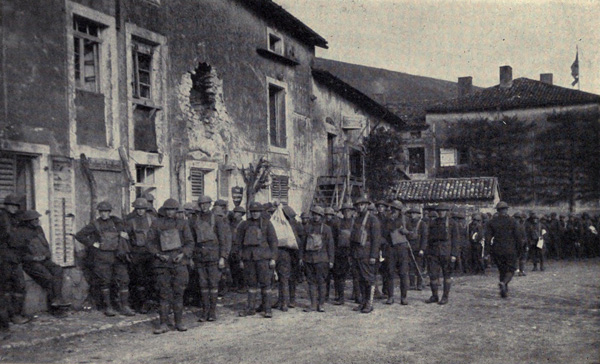
But instead of going to the front at once they were
billeted in little French villages and introduced
to French rain and French mud.
When one discovers that the houses are built of stone,
stuck together mainly by this mud of the country,
and remembers how many years they have stood, one
gets a passing idea of the nature of this mud about
which the soldiers have written home so often. It
is more like Portland cement than anything else, and
it is most penetrative and hard to get rid of; it
gets in the hair, down the neck, into the shoes and
it sticks. If the soldier wears hip-boots in the trenches
he must take them off every little while and empty
the mud out of them which somehow manages to get into
even hip-boots. It is said that one reason the soldiers
were obliged to wear the wrapped leggings was, not
that they would keep the water out, but that they
would strain the mud and at least keep the feet comparatively
clean.
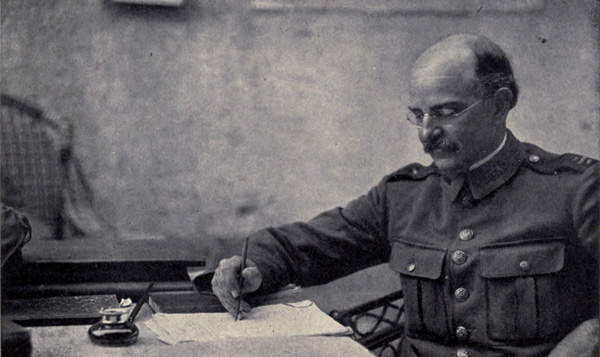
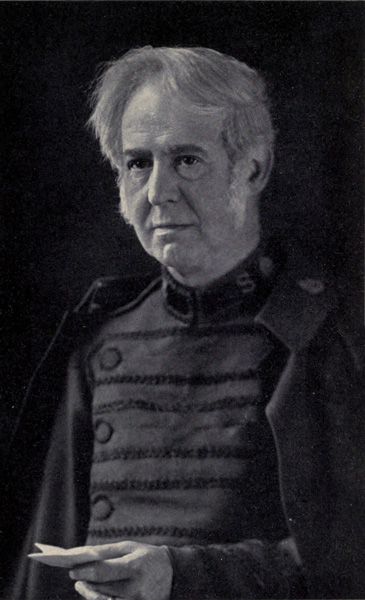
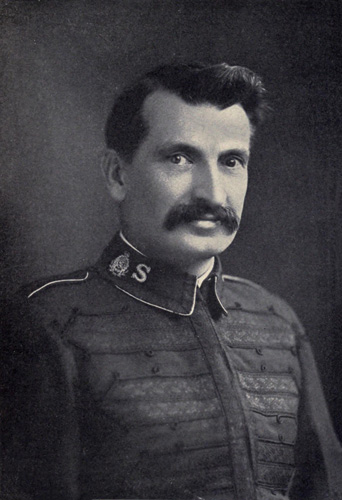
Lieutenant-Colonel William S. Barker
Director of War Work in France
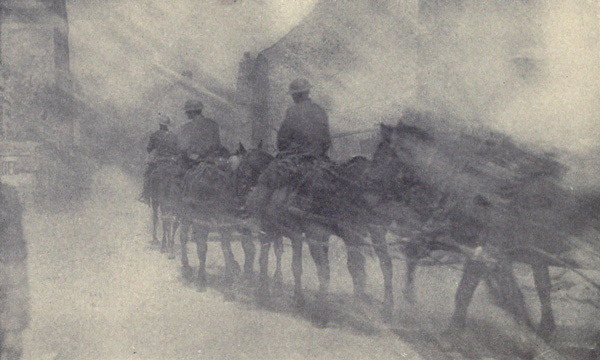
“Introduced to French Rain and French Mud”
There were sixteen of these camps at this time and
probably twelve or thirteen thousand soldiers were
already established in them.
There was no great cantonment as at the camps on this
side of the water, nor yet a city of tents, as one
might have expected. The forming of a camp meant the
taking over of all available buildings in the little
French peasant villages. The space was measured up
by the town mayor and the battalion leader and the
proper number of men assigned to each building. In
this way a single division covered a territory of about
thirty kilometers. This system made a camp of any
size available in very short order and also fooled
the Huns, who were on the lookout for American camps.
These villages were the usual farming villages, typical
of eastern France. They are not like American villages,
but a collection of farm yards, the houses huddled
together years ago for protection against roving bands
of marauders. The farmer, instead of living upon his
land, lives in the village, and there he has his barn
for his cattle, his manure pile is at his front door,
the drainage from it seeps back under the house at
will, his chickens and pigs running around the streets.
These houses were built some five or eight hundred
years ago, some a thousand or twelve hundred years.
One house in the town aroused much curiosity because
it was called the “new” house. It looked
just like all the others. One who was curious asked
why it should have received this appellative and was
told because it was the last one that was built—only
two hundred and fifty years ago.
There is a narrow hall or court running through these
houses which is all that separates the family from
the horses and pigs and cows which abide under the
same roof.
The whole place smells alike. There is no heat anywhere,
save from a fireplace in the kitchen. There is a community
bakehouse.
The soldiers were quartered in the barns and outhouses,
the officers were quartered in the homes of these
French peasants. There were no comforts for either
soldier or officer. It rained almost continuously and
at night it was cold. No dining-rooms could be provided
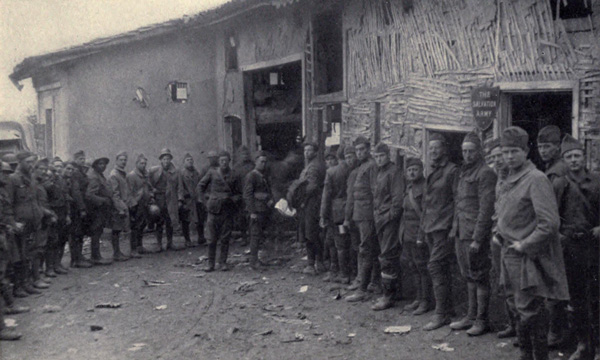
where the men could eat and they lined up on the street,
got their chow and ate it standing in the rain or
under whatever cover they could find. Few of them could
understand any French, and all the conditions surrounding
their presence in France were most trying to them.
They were drilled from morning to night. They were
covered with mud. The great fight in which they had
come to participate was still afar off. No wonder
their hearts grew heavy with a great longing for home.
Gloom sat upon their faces and depression grew with
every passing hour.
Into these villages one after another came the little
military side-car with its pioneer Salvationists,
investigating conditions and inquiring the greatest
immediate need of the men.
All the soldiers were homesick, and wherever the little
car stopped the Salvation Army uniform attracted immediate
and friendly attention. The boys expressed the liveliest
interest in the possibility of the Salvation Army
being with them in France. These troops composed the
regular army and were old-timers. They showed at once
their respect for and their belief in the Salvation
Army. One poor fellow, when he saw the uniform, exclaimed:
“The Salvation Army! I believe they’ll
be waiting for us when we get to hell to try and save
us!”
It appeared that the pay of the American soldier was
so much greater than that of the French soldier that
he had too much money at his disposal; and this money
was a menace both to him and to the French population.
If some means could be provided for transferring the
soldier’s money home, it would help out in the
one direction which was most important at that time.
It will be remembered that the French habit of drinking
wine was ever before the American soldier, and with
165 francs a month in his pocket, he became an object
of interest to the French tradespeople, who encouraged
him to spend his money in drink, and who also raised
the price on other commodities to a point where the
French population found it made living for them most
difficult.
The Salvation Army authorities in New York were all
prepared to meet this need. The Organization has one
thousand posts throughout the United States commanded
by officers who would become responsible to get the
soldier’s money to his family or relatives in
the United States. A simple money-order blank issued
in France could be sent to the National Headquarters
of the Salvation Army in New York and from there to
the officer commanding the corps in any part of the
United States, who would deliver the money in person.
In this way the friends and relatives of the soldier
in France would be comforted in the knowledge that
the Salvation Army was in touch with their boy; and
if need existed in the family at home it would be discovered
through the visit of the Salvation Army officer in
the homeland and immediate steps taken to alleviate
it.
Perhaps this has done more than anything else to bring
the blessing of parents and relatives upon the organization,
for tens of thousands of dollars that would have been
spent in gambling and drink have been sent home to
widowed mothers and young wives.
This suggestion appealed very strongly to the military
general, who said that if the Salvation Army got into
operation it could count upon any assistance which
he could give it, and if they conducted meetings he
would see that his regimental band was instructed
to attend these meetings and furnish the music.
Several chaplains, both Protestant and Catholic, expressed
themselves as being glad to welcome the Salvation
Army among them.
Among the Regular Army officers there was rather a
pessimistic attitude. It was in nowise hostile, but
rather doubtful.
One general said that he did not see that the Salvation
Army could do any good. His idea of the Salvation
Army being associated altogether with the slums and
men who were down and out. But on the other hand, he
said that he did not see that the Salvation Army could
do any harm, even if they did not do any good, and
as far as he was concerned he was agreeable to their
coming in to work in the First Division; and he would
so report to General Pershing.
St. Nazaire, the base, was being used for the reception
of the troops as they reached the shores of France.
Here was a new situation. The men had been cooped
up on transports for several days and on their landing
at St. Nazaire they were placed in a rest camp with
the opportunity to visit the city. Here they were
a prey to immoral women and the officer commanding
the base was greatly concerned about the matter and
eagerly welcomed the idea of having the Salvation
Army establish good women in St. Nazaire who would
cope with the problem.
The report given to General Pershing resulted in an
official authorization permitting the Salvation Army
to open their work with the American Expeditionary
Forces, and a suggestion that they go at once to the
American Training Area and see what they could do to
alleviate the terrible epidemic of homesickness that
had broken out among the soldiers.
In the meantime, back in New York, the Commander had
not been idle. Daily before the throne she had laid
the great concerns of her Army, and daily she had
been preparing her first little company of workers
to go when the need should call.
There was no money as yet, but the Commander was not
to be daunted, and so when the report came from over
the water, she borrowed from the banks twenty-five
thousand dollars.
She called the little company of pioneer workers together
in a quiet place before they left and gave them such
a charge as would make an angel search his heart.
Before the Most High God she called upon them to tell
her if any of them had in his or her heart any motive
or ambition in going other than to serve the Lord
Christ. She looked down into the eyes of the young
maidens and bade them put utterly away from them the
arts and coquetries of youth, and remember that they
were sent forth to help and save and love the souls
of men as God loved them; and that self must be forgotten,
or their work would be in vain. She commanded them
if even at this last hour any faltered or felt himself
unfit for the God-given task, that he would tell her
even then before it was too late. She begged them to
remember that they held in their hands the honor of
the Salvation Army, and the glory of Jesus Christ
their Saviour as they went out to serve the troops.
They were to be living examples of Christ’s love,
and they were to be willing to lay down their lives
if need be for His sake.
There were tears in the eyes of some of those strong
men that day as they listened, and the look of exaltation
on the faces of the women was like a reflection from
above. So must have looked the disciples of old when
Jesus gave them the commission to go into all the
world and preach the gospel. They were filled with
His Spirit, and there was a look of utter joy and
self-forgetfulness as they knelt with their leader
to pray, in words which carried them all to the very
feet of God and laid their lives a willing sacrifice
to Him who had done so much for them. Still kneeling,
with bowed heads, they sang, and their words were
but a prayer. It is a way these wonderful people have
of bursting into song upon their knees with their
eyes closed and faces illumined by a light of another
world, their whole souls in the words they are singing—“singing
as unto the Lord!” It reminds one of the days
of old when the children of Israel did everything
with songs and prayers and rejoicing, and the whole
of life was carried on as if in the visible presence
of God, instead of utterly ignoring Him as most of
us do now.
The song this time was just a few lines of consecration:
“Oh, for a heart whiter than snow!
Saviour Divine, to whom else can I go?
Thou who hast died, loving me so,
Give me a heart that is whiter than snow!”
The dramatic beauty of the scene, the sweet, holy
abandonment of that prayer-song with its tender, appealing
melody, would have held a throng of thousands in awed
wonder. But there was no audience, unless, perchance,
the angels gathered around the little company, rejoicing
that in this world of sin and war there were these
who had so given themselves to God; but from that
glory-touched room there presently went forth men and
women with the spirit in their hearts that was to
thrill like an electric wire every life with which
it came in contact, and show the whole world what
God can do with lives that are wholly surrendered to
Him.
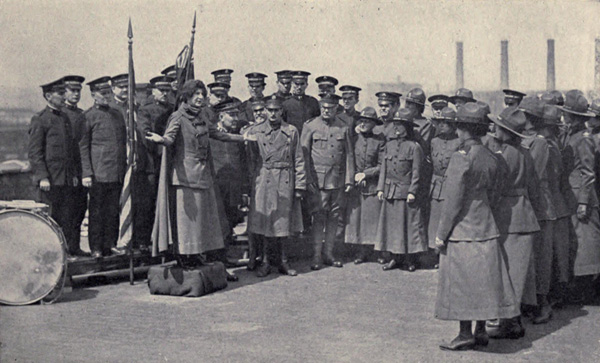
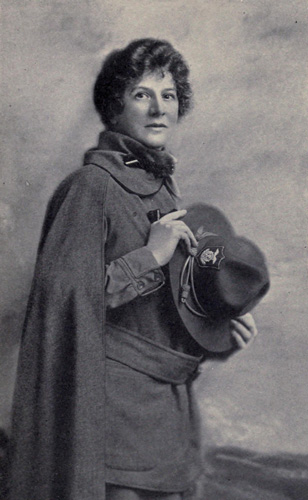
She called the little company of workers together and gave
them such a charge as would make an angel search his heart
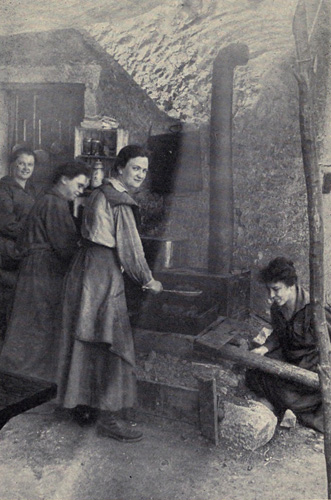
The lassie who fried the first doughnut in France
It was a bright, sunny afternoon, August 12th, when
this first party of American Salvation Army workers
set sail for France.
No doubt there was many a smile of contempt from the
bystanders as they saw the little group of blue uniforms
with the gold-lettered scarlet hatbands, and noticed
the four poke bonnets among the number. What did the
tambourine lassies know of real warfare? To those who
reckoned the Salvation Army in terms of bands on the
street corner, and shivering forms guarding Christmas
kettles, it must have seemed the utmost audacity for
this “play army” to go to the front.
When they arrived at Bordeaux on August 21st they
went at once to Paris to be fitted out with French
uniforms, as General Pershing had given them all the
rank of military privates, and ordered that they should
wear the regulation khaki uniforms with the addition
of the red Salvation Army shield on the hats, red
epaulets, and with skirts for the women.
A cabled message had reached France from the Commander
saying that funds to the extent of twenty-five thousand
dollars had been arranged for, and would be supplied
as needed, and that a party of eleven officers were
being dispatched at once. After that matters began
to move rapidly.
A portable tent, 25 feet by 100 feet, was purchased
and shipped to Demange;—and a touring car was bought
with part of the money advanced.
Purchasing an automobile in France is not a matter
merely of money. It is a matter for Governmental sanction,
long delay, red tape—amazing good luck.
At the start the whole Salvation Army transportation
system consisted of this one first huge limousine,
heartlessly overdriven and overworked. For many weeks
it was Colonel Barker’s office and bedroom. It
carried all of the Salvation Army workers to and from
their stations, hauled all of the supplies on its
roof, inside, on its fenders, and later also on a trailer.
It ran day and night almost without end, two drivers
alternating. It was a sort of super-car, still in
the service, to which Salvationists still refer with
an affectionate amazement when they consider its terrific
accomplishments. It hauled all of the lumber for the
first huts and a not uncommon sight was to see it
tearing along the road at forty miles an hour, loaded
inside and on top with supplies, several passengers
clinging to its fenders, and a load of lumber or trunks
trailing behind. For a long time Colonel Barker had
no home aside from this car. He slept wherever it
happened to be for the night—often in it, while still
driven. One night he and a Salvation Army officer
were lost in a strange woods in the car until four
in the morning. They were without lights and there
were no real roads.
Later, of course, after long waiting, other trucks
were bought and to-day there are about fifty automobiles
in this service. Chauffeurs had to be developed out
of men who had never driven before. They were even
taken from huts and detailed to this work.
In this first touring car Colonel Barker with one
of the newly arrived adjutants for driver, started
to Demange.
Twenty kilometers outside of Paris the car had a breakdown.
The two clambered out and reconnoitered for help.
There was nothing for it but to take the car back
to Paris. A man was found on the road who was willing
to take it in tow, but they had no rope for a tow
line. Over in the field by the roadside the sharp
eyes of the adjutant discovered some old rusty wire.
He pulled it out from the tangle of long grass, and
behold it was a part of old barbed-wire entanglements!
In great surprise they followed it up behind the camouflage
and found themselves in the old trenches of 1914.
They walked in the trenches and entered some of the
dugouts where the soldiers had lived in the memorable
days of the Marne fight. As they looked a little farther
up the hillside they were startled to see great pieces
of heavy field artillery, their long barrels sticking
out from pits and pointing at them. They went closer
to examine, and found the guns were made of wood painted
black. The barrels were perfectly made, even to the
breech blocks mounted on wheels, the tires of which
were made of tin. They were a perfect imitation of
a heavy ordnance piece in every detail. Curious, wondering
what it could mean, the two explorers looked about
them and saw an old Frenchman coming toward them.
He proved to be the keeper of the place, and he told
them the story. These were the guns that saved Paris
in 1914.
The Boche had been coming on twenty kilometers one
day, nineteen the next, fourteen the next, and were
daily drawing nearer to the great city. They were
so confident that they had even announced the day they
would sweep through the gates of Paris. The French
had no guns heavy enough to stop that mad rush, and
so they mounted these guns of wood, cut away the woods
all about them and for three hundred meters in front,
and waited with their pitifully thin, ill-equipped
line to defend the trenches.
Then the German airplanes came and took pictures of
them, and returned to their lines to make plans for
the next day; but when the pictures were developed
and enlarged they saw to their horror that the French
had brought heavy guns to their front and were preparing
to blow them out of France. They decided to delay
their advance and wait until they could bring up artillery
heavier than the French had, and while they waited
the Germans broke into the French wine cellars and
stole the “vin blanche” and “vin
rouge.” The French call this “light”
wine and say it takes the place of water, which is
only fit for washing; but it proved to be too heavy
for the Germans that day. They drank freely, not even
waiting to unseal the bottles of rare old vintage,
but knocked the necks off the bottles against the
stone walls and drank. They were all drunk and in no
condition to conquer France when their artillery came
up, and so the wooden French guns and the French wine
saved Paris.
When the two men finally arrived in Demange the Military
General greeted them gladly and invited them to dine
with him.
He had for a cook a famous French chef who provided
delicious meals, but for dessert the chef had attempted
to make an American apple pie, which was a dismal
failure. The colonel said to the general: “Just
wait till our Salvation Army women get here and I
will see that they make you a pie that is a pie.”
The General and the members of his staff said they
would remember that promise and hold him to it.
The pleasure which the thought of that pie aroused
furnished a suggestion for work later on.
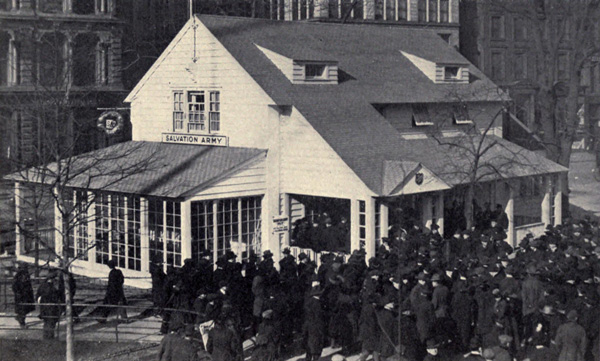
Within two or three days the hut had arrived. The
question of a lot upon which to place it was most
important. The billeting officers stated that none
could be had within the town and insisted that the
hut would have to be placed in an inaccessible spot
on the outskirts of the town, but Colonel Barker asked
the General if he would mind his looking about himself
and he readily assented. The indomitable Barker, true
to the “never-say-die” slogan of the Salvation
Army, went out and found a splendid lot on the main
street in the heart of the town, which was being partly
used by its owner as a vegetable garden. He quickly
secured the services of a French interpreter and struck
a bargain with the owner to rent the lot for the sum
of sixteen dollars a year, and on his return with
the information that this lot had been secured the
General was greatly impressed.
A wire had been sent to Paris instructing the men
of the party to come down immediately. A couple of
tents were secured to provide temporary sleeping accommodation
and the men lined up in the chow line with the doughboys
at meal-time.
The six Salvationists pulled off their coats at once
and went to work, much to the amusement of a few curious
soldiers who stood idly watching them.
They discovered right at the start that the building
materials which had been sent ahead of them had been
dumped on the wrong lot, and the first thing they
had to do was to move them all to the proper site.
This was no easy task for men who had but recently
left office chairs and clerical work. Unaccustomed
muscles cried out in protest and weary backs ached
and complained, but the men stubbornly marched back
and forth carrying big timbers, and attracting not
a little attention from soldiers who wondered what
in the world the Salvation Army could be up to over
in France. Some of them were suspicious. Had they
come to try and stuff religion down their throats?
If so, they would soon find out their mistake. So,
half in belligerence, half in amusement, the soldiers
watched their progress. It was a big joke to them,
who had come here for serious business
and longed to be at it.
Steadily, quietly, the work went on. They laid the
timbers and erected the framework of their hut, keeping
at it when the rain fell and soaked them to the skin.
They were a bit awkward at it at first, perhaps, for
it was new work to them, and they had but few tools.
The hut was twenty-five feet wide and a hundred feet
long. The walls went up presently, and the roof went
on. One or two soldiers were getting interested and
offered to help a bit; but for the most part they
stood apart suspiciously, while the Salvation Army
worked cheerily on and finished the building with their
own hands.
Colonel Barker meanwhile had gone back to Paris for
supplies and to bring the women overland in the automobile,
because he was somewhat fearful lest they might be
held up if they attempted to go out by train. The idea
of women in the camps was so new to our American soldiers,
and so distasteful to the French, that they presented
quite a problem until their work fully justified their
presence.
It got about that some real American girls were coming.
The boys began to grow curious. When the big French
limousine carrying them arrived in the camp it was
greeted by some of the soldiers with the greatest enthusiasm
while others looked on in critical silence. But very
soon their influence was felt, for a commanding officer
stated that his men were more contented and more easily
handled since the unprecedented innovation of women
in the camp than they had been within the experience
of the old Regular Army officers. Profanity practically
ceased in the vicinity of the hut and was never indulged
in in the presence of the Salvationists.
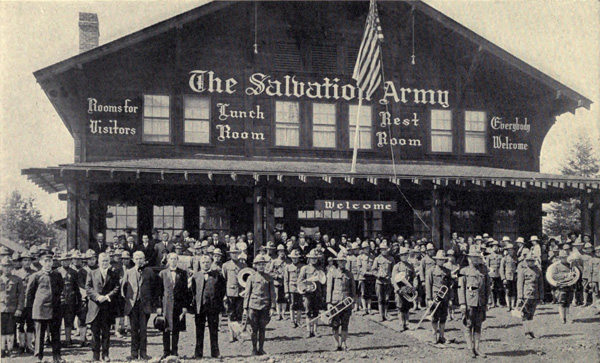
While the hut was being erected meetings were conducted
in the open air which were attended by great throngs,
and after every meeting from one to four or five boys
asked for the privilege of going into the tent at the
back and being prayed with, and many conversions resulted
from these first open-air meetings. Boys walked in
from other camps from a distance as far away as five
miles to attend these meetings and many were converted.
The hut was finally completed and equipped and was
to be formally opened on Sunday evening.
In the meantime the Y.M.C.A. was getting busy also
establishing its work in the camps; therefore, the
Salvation Army tried to place their huts in towns
where the Y. was not operating, so that they might
be able to reach those who had the greatest need of
them.
Officers had been appointed to take charge of the
Demange hut and immediately further operations in
other towns were being arranged.
A Y.M.C.A. hut, however, followed quickly on the heels
of the Salvation Army at Demange and the night of
the opening of the Salvation Army hut someone came
to ask if they would come over to the Y. and help in
a meeting. Sure, they would help! So the Staff-Captain
took a cornetist and two of the lassies and went over
to the Y.M.C.A. hut.
It was early dusk and a crowd was gathered about where
a rope ring fenced off the place in which a boxing
match had been held the day before, across the road
from the hut. The band had been stationed there giving
a concert which was just finished, and the men were
sitting in a circle on the ground about the ring.
The Salvationists stood at the door of the hut and
looked across to the crowd.
“How about holding our meeting over there?”
asked the Staff-Captain of the man in charge.
“All right. Hold it wherever you like.”
So a few willing hands brought out the piano, and
the four Salvationists made their way across to the
ring. The soldiers raised a loud cheer and hurrah
to see the women stoop and slip under the rope, and
a spirit of sympathy seemed to be established at once.
There were a thousand men gathered about and the cornet
began where the band had left off, thrilling out between
the roar of guns.
Up above were the airplanes throbbing back and forth,
and signal lights were flashing. It was a strange
place for a meeting. The men gathered closer to see
what was going on.
The sound of an old familiar hymn floated out on the
evening, bringing a sudden memory of home and days
when one was a little boy and went to Sunday school;
when there was no war, and no one dreamed that the
sons would have to go forth from their own land to
fight. A sudden hush stole over the men and they sat
enthralled watching the little band of singers in
the changing flicker of light and darkness. Women’s
voices! Young and fresh, too, not old ones. How they
thrilled with the sweetness of it:
“Nearer, my God, to Thee,
Nearer to Thee,
E’en though it be a cross
That raiseth me.”
A cross! Was it possible that God was leading them
to Him through all this awfulness? But the thought
only hovered above them and hushed their hearts into
attention as they gruffly joined their young voices
in the melody. Another song followed, and a prayer
that seemed to bring the great God right down in their
midst and make Him a beloved comrade. They had not
got over the wonder of it when a new note sounded
on piano and cornet and every voice broke forth in
the words:
“When the trumpet of the Lord shall sound
And time shall be no more—”
How soon would that trumpet sound for many of them!
Time should be no more! What a startling thought!
Following close upon the song came the sweet voice
of a young girl speaking. They looked up in wonder,
listening with all their souls. It was like having
an angel drop down among them to see her there, and
hear her clear, unafraid voice. The first thing that
struck them was her intense earnestness, as if she
had a message of great moment to bring to them.
Her words searched their hearts and found out the
weak places; those fears and misgivings that they
had known were there from the beginning, and had been
trying hard to hide from themselves because they saw
no cure for them. With one clear-cut sentence she
tore away all camouflage and set them face to face
with the facts. They were in a desperate strait and
they knew it. Back there in the States they had known
it. Down in the camps they had felt it, and had made
various attempts to find something strong and true
to help them, but no one had seemed to understand.
Even when they went to church there had been so much
talk about the “supreme sacrifice” and
the glory of dying for one’s country, that they
had a vague feeling that even the minister did not
believe in his religion any more. And so they had
whistled and tried to be jolly and forget. They were
all in the same boat, and this was a job that had
to be done, they couldn’t get out of it; best
not think about the future! So they had lulled their
consciences to sleep. But it was there, back in their
minds all the time, a looming big awful question about
the hereafter; and when the great guns boomed afar
as a few were doing tonight and they thought how soon
they might be called to go over the top, they would
have been fools not to have recognized it.
But here at last was someone else who understood!
She was telling the old, old story of Jesus and His
love, and every man of them as he listened felt it
was true. It had been like a vague tale of childhood
before; something that one outgrows and smiles at;
but now it suddenly seemed so simple, so perfect,
so fitted to their desperate need. Just the old story
that everybody has sinned, and broken God’s law:
that God in His love provided a way of escape in the
death of His Son Jesus on the Cross, from penalty
for sin for all who would accept it; that He gave
every one of us free wills; and it was up to us whether
we would accept it or not.
There were men in that company who had come from college
classes where they had been taught the foolishness
of blood atonement, and who had often smiled disdainfully
at the Bible; there were boys from cultured, refined
homes where Jesus Christ had always been ignored; there
were boys who had repudiated the God their mothers
trusted in; and there were boys of lower degree whose
lips were foul with blasphemy and whose hearts were
scarred with sin; but all listened, now, in a new
way. It was somehow different over here, with the
thunder of artillery in the near distance, the hovering
presence of death not far away, the flashing of signal
lights, the hum of the airplanes, the whole background
of war. The message of the gospel took on a reality
it had never worn before. When this simple girl asked
if they would not take Jesus tonight as their Saviour,
there were many who raised their hands in the darkness
and many more hearts were bowed whose owners could
not quite bring themselves to raise their hands.
Then a lassie’s voice began to sing, all alone:
“I grieved my Lord from day
to day,
I scorned His love, so full and free,
And though I wandered far away,
My Mother’s prayers have followed me.
I’m coming home, I’m coming home,
To live my wasted life anew,
For Mother’s prayers have followed me,
Have followed me, the whole world through.
“O’er desert wild, o’er mountain high,
A wanderer I chose to be—-
A wretched soul condemned to die;
Still Mother’s prayers have followed me.
“He turned my darkness into light,
This blessed Christ of Calvary;
I’ll praise His name both day and night,
That Mother’s prayers have followed me!
I’m coming home, I’m coming home—-”
Only the last great day will reveal how many hearts
echoed those words; but the voices were all husky
with emotion as they tried to join in the closing
hymn that followed.
There were those who lingered about the speakers and
wanted to inquire the way of salvation, and some knelt
in a quiet corner and gave themselves to Christ. Over
all of them there was a hushed thoughtfulness. When
the workers started back to their own hut the crowd
went with them, talking eagerly as they went, hovering
about wistfully as if here were the first real thing
they had found since coming away from home.
Over at the Salvation Army hut another service had
been going forward with equal interest, the dedication
of the new building. The place was crowded to its
utmost capacity, and crowds were standing outside and
peering in at the windows. Some of the French people
of the neighborhood, women and children and old men,
had drifted over, and were listening to the singing
in open-eyed wonderment. Among them one of the Salvation
Army workers had distributed copies of the French
“War Cry” with stories of Christ in their
own language, and it began to dawn upon them that these
people believed in the same Jesus that was worshipped
in their French churches; yet they never had seen
services like these. The joyous music thrilled them.
Before they slept that night the majority of the soldiers
in that vicinity had lost most of their prejudice
against the little band of unselfish workers that
had dropped so quietly down into their midst. Word
was beginning to filter out from camp to camp that
they were a good sort, that they sold their goods
at cost and a fellow could even “jawbone”
when he was “broke.”
Salvation Army huts gave the soldiers “jawbone,”
this being the soldier’s name for credit. No
accounts were kept of the amount allowed to each soldier.
When a soldier came to the canteen and asked for “jawbone,”
he was asked how much he had already been allowed.
If the amount owed by him already was large, he was
cautioned not to go too deeply into his next pay check;
but never was a man refused anything within reason.
Frequently one hut would have many thousands of francs
outstanding by the end of a month. But, although there
was no check against them, soldiers always squared
their accounts at pay-day and very little indeed was
lost.
One man came in and threw 300 francs on the counter,
saying: “I owe you 285 francs. Put the change
in the coffee fund.”
One Salvation Army Ensign frequently loaned sums of
money out of his own pocket to soldiers, asking that,
when they were in a position to return it, they hand
it in to any Salvation Army hut, saying that it was
for him. He says that he has never lost by doing this.
One day as he was driving from Havre to Paris he met
six American soldiers whose big truck had broken down.
They asked him where there was a Salvation Army hut;
but there was none in that particular section. They
had no food, no money, and no place to sleep. He handed
them seventy francs and told them to leave it at any
Salvation Army hut for him when they were able. Five
months passed and then the money was turned in to a
Salvation Army hut and forwarded to him. With it was
a note stating that the men had been with the French
troops and had not been able to reach a Salvation
Army establishment. They were very grateful for the
trust reposed in them by the Salvationist. Undoubtedly
there are many such instances.
The Salvation Army officer who with his wife was put
in charge of the hut at Demange, soon became one of
the most popular men in camp. His generous spirit,
no less than his rough-and-ready good nature, manful,
soldier-like disposition, coupled with a sturdy self-respect
and a ready humor, made him blood brother to those
hard-bitten old regulars and National Guardsmen of
the first American Expeditionary Force.
The Salvation Army quickly became popular. Meetings
were held almost every night at that time with an
average attendance of not less than five hundred.
Meetings as a rule were confined to wonderful song
services and brief, snappy talks. At first there were
very few conversions, but there have been more since
the great drives in which the Americans have taken
so large a share. The Masons, the Moose and a Jewish
fraternity used the hut for fraternal gatherings.
Catholic priests held mass in it upon various occasions.
The school for officers and the school for “non-coms”
met in it. The band practiced in it every morning.
Because of its popularity among the men it was known
among the officers as “the soldiers’ hut.”
General Duncan once addressed his staff officers in
it upon some important matters.
It rained every day for three months. The hut was
on rather low ground and in back of it ran the river,
considerably swollen by the rains. One night the river
rose suddenly, carried away one tent and flooded the
other two and the hut. The Salvation Army men spent
a wild, wet, sleepless night trying to salvage their
scanty personal belongings and their stock of supplies.
When the river retreated it left the hut floor covered
with slimy black mud which the two men had to shovel
out. This was a back-breaking task occupying the
better part of two days.
The first snow fell on the bitterest night of the
year. It was preceded by the rain and was damp and
heavy. The soldiers suffered terribly, especially
the men on guard duty who had perforce to endure the
full blast of the storm. During the earlier hours
of the night the girls served all comers with steaming
coffee and filled the canteens of the men on guard
(free). When they saw how severe the night would be
they remained up to keep a supply of coffee ready
for the Salvation Army men who went the rounds through
the storm every half hour, serving the sentries with
the warming fluid.
That first Expeditionary Force wanted for many things,
and endured hardships unthought of by troops arriving
later, after the war industries at home had swung
into full production. It was almost impossible to secure
stoves, and firewood was scarce. For every load that
went to the Salvation Army Hut, men of the American
Expeditionary Force had to do without, and yet wood
was always supplied to the Salvationists (it could
not be bought).
At St. Joire, the wood pile had entirely given out
and it looked as if there was to be no heat at the
Salvation Army hut that night. The sergeant promised
them half a load, but the wood wagon lost a wheel about
a hundred yards out of town.
“Never mind,” said the sergeant to the
girls, “the boys will see that you get some
to-night.”
So he requested every man going up to the Salvation Army hut that evening to
carry a stick of wood with him (“a stick” may weigh anywhere from
10 to 100 pounds). By eight o’clock there was over a wagon load and a
half stacked in back of the hut.
Two small stoves cast circles of heat in the big hut
at Demange. Around them the men crowded with their
wet garments steaming so profusely that the hut often
took on the appearance of a steam-room in a Turkish
bath. The rest of the hut was cold; but compared to
the weather outside, it was heaven-like. For all of
its size, the hut was frail, and the winter wind blew
coldly through its many cracks; but compared with the
soldier’s billets, it was a cozy palace. The
Salvationists spent hours each week sitting on the
roof in the driving rain patching leaks with tar-paper
and tacks.
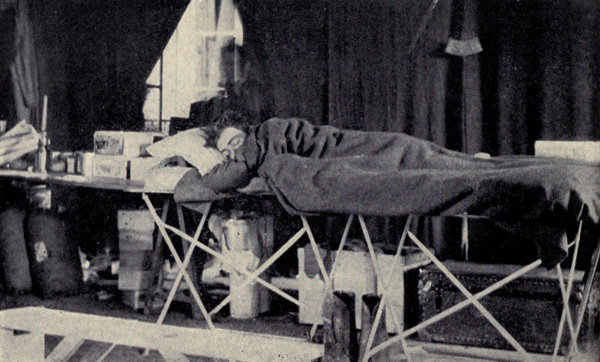
The life was a hard one for the girls. They nearly
froze during the days, and at nights they usually
shivered themselves to sleep, only sleeping when sheer
exhaustion overcame them. There were no baths at all.
The experience was most trying for women and only
the spirit of the great enterprise in which they were
engaged carried them through the winter. Even soldiers
were at times seen weeping with cold and misery.
One night the gasoline tank which supplied light to
the hut exploded and set the place on fire. A whole
regiment turned out of their blankets to put out the
blaze. This meant more hours for those in charge repairing
the roof in the snow. They also had to cut all of
the wood for the hut. Later details were supplied
to every hut by the military authorities to cut wood,
sweep and clean up, carry water, etc. Soldiers
used the hut for a mess hall. There was no other place
where they could eat with any degree of comfort.
By this time the fact that the Salvation Army was
established at Demange was becoming known throughout
the division.
One of the towns where there had been no arrangements
made for welfare workers at all was Montiers-sur-Saulx,
where the First Ammunition Train was established,
and here the officer temporarily commanding the ammunition
train gave a most hearty welcome to the Salvation Army.
Two large circus tents had been sent on from New York
and one of these was to be erected until a wooden
building could be secured.
The touring car went back to Demange, picked up a
Staff-Captain, a Captain, five white tents, the largest
one thirty by sixty feet, the others smaller, carried
them across the country and dropped them down at the
roadside of the public square in Montiers.
There stood the Salvationists in the road wondering
what to do next.
Then a hearty voice called out: “Are you locating
with us?” and the military officer of the day
advanced to meet them with a hand-shake and many expressions
of his appreciation of the Salvation Army.
“We are going to stay here if you will have
us,” said the Staff-Captain.
“Have you! Well, I should say we would have
you! Wait a minute and I’ll have a detail put
your baggage under cover for the night. Then we’ll
see about dinner and a billet.”
Thus auspiciously did the work open in Montiers.
In a few minutes they were taken to a French café
and a comfortable place found for them to spend the
night.
Soon after the rising of the sun the next morning
they were up and about hunting a place for the tents
which were to serve for a recreation centre for the
boys. The American Major in charge of the town personally
assisted them to find a good location, and offered
his aid in any way needed.
Before nightfall the five white tents were up, standing
straight and true with military precision, and the
two officers with just pride in their hard day’s
work, and a secret assurance that it would stand the
hearty approval of the commanding officer whom they
had not as yet met, went off to their suppers, for
which they had a more than usually hearty appetite.
Suddenly the door of the dining-room swung open and
a gruff voice demanded: “Who put up those tents?”
The Salvation Army Staff-Captain stood forth saluting
respectfully and responded: “I, sir.” “Well,”
said the Colonel, “they look mighty fine up
on that hill—mighty fine! Splendid location for them—splendid!
But the enemy can spot them for a hundred miles, so
I expect you had better get them down or camouflage
them with green boughs and paint by tomorrow night
at the latest. Good evening to you, sir!”
The Staff-Captain and his helper suddenly lost their
fine appetites and felt very tired. Camouflage! How
did they do that at a moment’s notice? They
left their unfinished dinner and hurried out in search
of help.
The first soldier the Staff-Captain questioned reassured
him.
“Aw, that’s dead easy! Go over the hill
into the woods and cut some branches, enough to cover
your tents; or easier yet, get some green and yellow
paint and splash over them. The worse they look the
better they are!”
So the weary workers hunted the town over for paint,
and found only enough for the big tent, upon which
they worked hard all the next morning. Then they had
to go to the woods for branches for the rest. Scratched
and bleeding and streaked with perspiration and dirt,
they finished their work at last, and the white tents
had disappeared into the green and the yellow and
the brown of the hillside. Their beautiful military
whiteness was gone, but they were hidden safe from
the enemy and the work might now go forward.
Then the girls arrived and things began to look a
bit more cheerful.
“But where is the cook stove?” asked one
of the lassies after they had set up their two folding
cots in one of the smaller tents and made themselves
at home.
Dismay descended upon the face of the weary Staff-Captain.
“Why,” he answered apologetically, “we
forgot all about that!” and he hurried out to
find a stove.
A thorough search of the surrounding country, however,
disclosed the fact that there was not a stove nor
a field range to be had—no, not even from the commissary.
There was nothing for it but to set to work and contrive
a fireplace out of field stone and clay, with a bit
of sheet iron for a roof, and two or three lengths
of old sewer pipe carefully wired together for a stovepipe.
It took days of hard work, and it smoked woefully except
when the wind was exactly west, but the girls made
fudge enough on it for the entire personnel of the
Ammunition train to celebrate when it was finished.
When the girls first arrived in Montiers the Salvation
Army Staff-Captain was rather at a loss to know what
to do with them until the hut was built. They were
invited to chow with the soldiers, and to eat in an
old French barn used as a kitchen, in front of which
the men lined up at the open doorways for mess. It
was a very dirty barn indeed, with heavy cobwebs hanging
in weird festoons from the ceiling and straw and manure
all over the floor; quite too barnlike for a dining-hall
for delicately reared women. The Staff-Captain hesitated
about bringing them there, but the Mess-Sergeant offered
to clean up a corner for them and give them a comfortable
table.
“I don’t know about bringing my girls
in here with the men,” said the Staff-Captain
still hesitating. “You know the men are pretty
rough in their talk, and they’re always cussing!”
“Leave that to me!” said the Mess-Sergeant.
“It’ll be all right!”
There was an old dirty French wagon in the barnyard
where they kept the bread. It was not an inviting
prospect and the Staff-Captain looked about him dubiously
and went away with many misgivings, but there seemed
to be nothing else to be done.
The boys did their best to fix things up nicely. When
meal time arrived and the girls appeared they found
their table neatly spread with a dish towel for a
tablecloth. It purported to be clean, but there are
degrees of cleanliness in the army and there might
have been a difference of opinion. However, the girls
realized that there had been a strenuous attempt to
do honor to them and they sat down on the coffee kegs
that had been provided en lieu of chairs
with smiling appreciation.
The Staff-Captain’s anxiety began to relax as
he noticed the quiet respectful attitude of the men
when they passed by the doorway and looked eagerly
over at the corner where the girls were sitting. It
was great to have American women sitting down to dinner
with them, as it were. Not a “cuss word”
broke the harmony of the occasion. The best cuts of
meat, the largest pieces of pie, were given to the
girls, and everybody united to make them feel how
welcome they were.
Then into the midst of the pleasant scene there entered
one who had been away for a few hours and had not
yet been made acquainted with the new order of things
at chow; and he entered with an oath upon his lips.
He was a great big fellow, but the strong arm of the
Mess-Sergeant flashed out from the shoulder instantly,
the sturdy fist of the Mess-Sergeant was planted most
unexpectedly in the newcomer’s face, and he found
himself sprawling on the other side of the road with
all his comrades glaring at him in silent wrath. That
was the beginning of a new order of things at the
mess.
The Colonel in charge of the regiment had gone away,
and the commanding Major, wishing to make things pleasant
for the Salvationists, sent for the Staff-Captain
and invited them all to his mess at the chateau; telling
him that if he needed anything at any time, horses
or supplies, or anything in his power to give, to
let him know at once and it should be supplied.
The Staff-Captain thanked him, but told him that he
thought they would stay with the boys.
The boys, of course, heard of this and the Salvation
Army people had another bond between them and the
soldiers. The boys felt that the Salvationists were
their very own. Nothing could have more endeared them
to the boys than to share their life and hardships.
The Salvation Army had not been with the soldiers
many hours before they discovered that the disease
of homesickness which they had been sent to succor
was growing more and more malignant and spreading fast.
The training under French officers was very severe.
Trench feet with all its attendant suffering was added
to the other discomforts. Was it any wonder that homesickness
seized hold of every soldier there?
It had been raining steadily for thirty-six days,
making swamps and pools everywhere. Depression like
a great heavy blanket hung over the whole area.
The Salvation Army lassies at Montiers were in consultation.
Their supplies were all gone, and the state of the
roads on account of the rain was such that all transportation
was held up. They had been waiting, hoping against
hope, that a new load of supplies would arrive, but
there seemed no immediate promise of that.
“We ought to have something more than just chocolate
to sell to the soldiers, anyway,” declared one
lassie, who was a wonderful cook, looking across the
big tent to the drooping shoulders and discouraged
faces of the boys who were hovering about the Victrola,
trying to extract a little comfort from the records.
“We ought to be able to give them some real home
cooking!”
They all agreed to this, but the difficulties in the
way were great. Flour was obtainable only in small
quantities. Now and then they could get a sack of
flour or a bag of sugar, but not often. Lard also was
a scarce article. Besides, there were no stoves, and
no equipment had as yet been issued for ovens. All
about them were apple orchards and they might have
baked some pies if there had been ovens, but at present
that was out of the question. After a long discussion
one of the girls suggested doughnuts, and even that
had its difficulties, although it really was the only
thing possible at the time. For one thing they had
no rolling-pin and no cake-cutter in the outfit. Nevertheless,
they bravely went to work. The little tent intended
for such things had blown down, so the lassie had to
stand out in the rain to prepare the dough.
The first doughnuts were patted out, until someone
found an empty grape-juice bottle and used that for
a rolling-pin. As they had no cutter they used a knife,
and twisted them, making them in shape like a cruller.
They were cooked over a wood fire that had to be continually
stuffed with fuel to keep the fat hot enough to fry.
The pan they used was only large enough to cook seven
at once, but that first day they made one hundred and
fifty big fat sugary doughnuts, and when the luscious
fragrance began to float out on the air and word went
forth that they had real “honest-to-goodness”
home doughnuts at the Salvation Army hut, the line
formed away out into the road and stood patiently
for hours in the rain waiting for a taste of the dainties.
As there were eight hundred men in the outfit and only
a hundred and fifty doughnuts that first day, naturally
a good many were disappointed, but those who got them
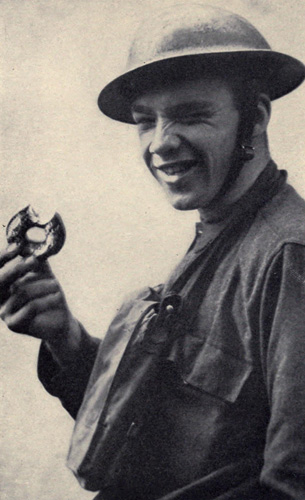
were appreciative. One boy as he took the first sugary
bite exclaimed: “Gee! If this is war, let it
continue!”
The next day the girls managed to make three hundred,
but one of them was not satisfied with a doughnut
that had no hole in it, and while she worked she thought,
until a bright idea came to her. The top of the baking-powder
can! Of course! Why hadn’t they thought of that
before? But how could they get the hole? There seemed
nothing just right to cut it. Then, the very next
morning the inside tube to the coffee percolator that
somebody had brought along came loose, and the lassie
stood in triumph with it in her hand, calling to them
all to see what a wonderful hole it would make in
the doughnut. And so the doughnut came into its own,
hole and all.
That was at Montiers, the home of the doughnut.
One of the older Salvation Army workers remarked jocularly
that the Salvation Army had to go to France and get
linked up with the doughnut before America recognized
it; but it was the same old Salvation Army and the
same old doughnut that it had always been. He averred
that it wasn’t the doughnut at all that made
the Salvation Army famous, but the wonderful girls
that the Salvation Army brought over there; the girls
that lay awake at night after a long hard day’s
work scheming to make the way of the doughboy easier;
scheming how to take the cold out of the snow and the
wet out of the rain and the stickiness out of the
mud. The girls that prayed over the doughnuts, and
then got the maximum of grace out of the minimum of
grease.
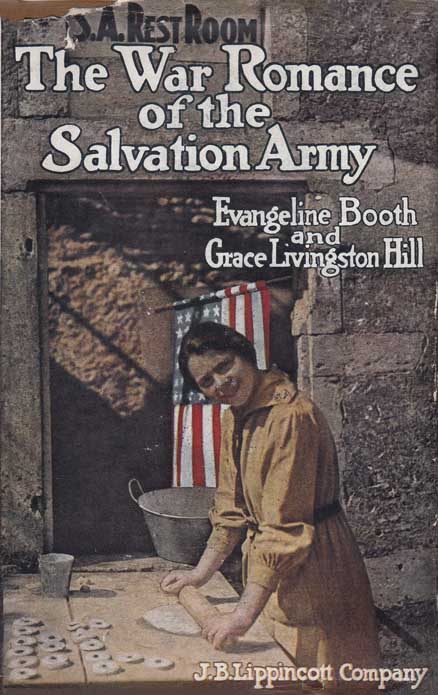
The young Adjutant lassie who fried the first doughnut
in France says that invariably the boys would begin
to talk about home and mother while they were eating
the doughnuts. Through the hole in the doughnut they
seemed to see their mother’s face, and as the
doughnut disappeared it grew bigger and clearer.
The young Ensign lassie who had originated and made
the first doughnut in France contrived to make many
pies on a very tiny French stove with an oven only
large enough to hold two pies at a time. Meanwhile,
frying doughnuts on the top of the stove.
It wasn’t long before the record for the doughnut
makers had been brought up to five thousand a day,
and some of the unresting workers developed “doughnut
wrist” from sticking to the job too long at a
time.
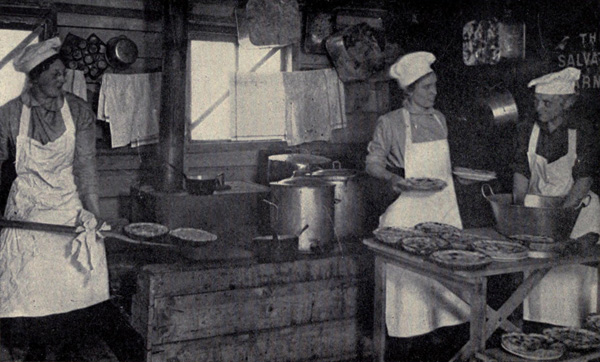
It was the original thought that pie would be the
greatest attraction, but it was difficult to secure
stoves with ovens adequate for baking pies, and after
the ensign’s experiment with doughnuts it was
found that they could more easily be made and were
quite as acceptable to the American boy.
Meantime, the pie was coming into its own, back in
Demange also.
It was only a little stove, and only room to bake
one pie at a time, but it was a savory smell that
floated out on the air, and it was a long line of
hungry soldiers that hurried for their mess kits and
stood hours waiting for more pies to bake; and the
fame of the Salvation Army began to spread far and
wide. Then one day the “Stars and Stripes,”
the organ of the American Army, printed the following
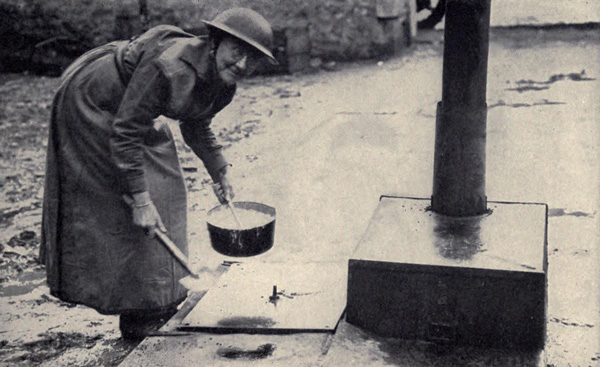
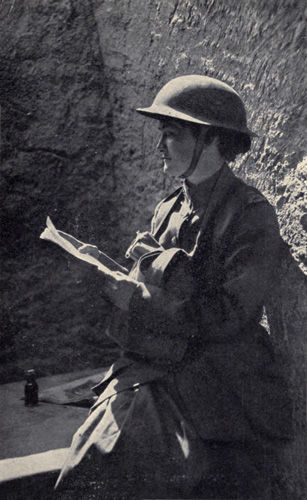
poem about the lassie who labored so far forward that
she had to wear a tin hat:
“Home is where the heart is”—
Thus the poet sang;
But “home is where the pie is”
For the doughboy gang!
Crullers in the craters,
Pastry in abris—
This Salvation Army lass
Sure knows how to please!
Tin hat for a halo!
Ah! She wears it well!
Making pies for homesick lads
Sure is “beating hell!”
In a region blasted
By fire and flame and sword,
This Salvation Army lass
Battles for the Lord!
Call me sacrilegious
And irreverent, too;
Pies? They link us up with home
As naught else can do!
“Home is, where the heart is”—
True, the poet sang;
But “home is where the pie is”—
To the Yankee gang!
It was no easy task to open up a chain of huts, for
there was an amazing variety of details to be attended
to, any one of which might delay the work. A hundred
and one unexpected situations would develop during
the course of a single day which must be dealt with
quickly and intelligently. The fact that the Salvation
Army section of the American Expeditionary Force is
militarized and strictly accountable for all of its
action to the United States military authorities is
complicated in many places by the further fact that
the French civil and military authorities must also
be taken into consideration and consulted at every
step. Nevertheless, in spite of all difficulties the
work went steadily forward. The patient officers who
were seeing to all these details worked almost night
and day to place the huts and workers where they would
do the most good to the greatest number; and steadily
the Salvation Army grew in favor with the soldiers.
It was extremely difficult to obtain materials for
the erection of huts— in many cases almost impossible.
Once when Colonel Barker found troops moving, he discovered
the village for which they were bound, rushed ahead
in his automobile, and commandeered an old French barracks
which would otherwise have been occupied by the American
soldiers. When the soldiers arrived they were overjoyed
to find the Salvation Army awaiting them with hot
food. They were soaked through by the rain, and never
was hot coffee more welcome. There was a little argument
about the commandeered barracks. It was to have been
used as headquarters, but when the commanding officer
went out into the rain and saw for himself what service
it was performing for his men, and how overjoyed they
were by the entertainment he said: “We’ll
leave it to the men, whether they will be billeted
here or let the Salvation Army have the place.”
The men with one accord voted to give it to the Salvation
Army.
In one town, after an animated discussion with a crowd
of enlisted men, a sergeant came to the Salvation
Army Major as he worked away with his hammer putting
up a hut and said: “Captain, would it make you
mad if we offered our services to help?”
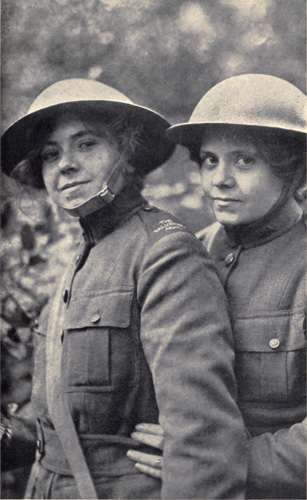
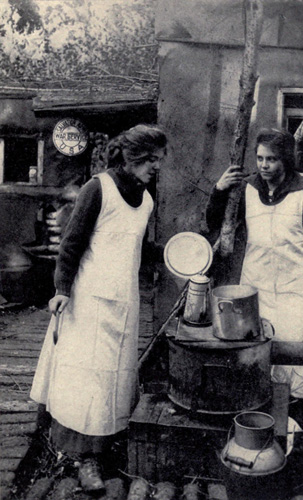
“Tin hat for a halo!
Ah! She wears it well!”
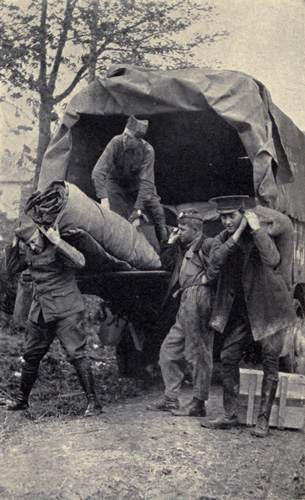
The patient officers who were seeing to all these details worked out almost day and night
After that the work went on in record time. In less
than a week the hut was finished and ready for business.
Two self-appointed details of soldiers from the regulars
employed all their spare time in a friendly rivalry
to see which could accomplish the most work. When it
was dedicated the popularity of the hut was well assured.
Later, in another location, a hut 125 feet by 27 feet
was put up with the assistance of soldiers in six
hours and twenty minutes.
More men and women had arrived from America, and the
work began to assume business-like proportions. There
were huts scattered all through the American training
area.
As other huts were established the making of pies
and doughnuts became a regular part of the daily routine
of the hut. It was found that a canteen where candy
and articles needed by the soldiers could be obtained
at moderate prices would fill a very pressing need
and this was made a part of their regular operation.
The purchase of an adequate quantity of supplies was
a great problem. It was necessary to make frequent
trips to Paris, to establish connections with supply
houses there, and to attend to the shipping of the
supplies out to the camps. At first it was impossible
to purchase any quantity of supplies from any house.
The demand for everything was so great that wholesale
dealers were most independent. Three hundred dollars’
worth of supplies was the most that could be purchased
from any one house, but in course of time, confidence
and friendly relations being established, it became
possible to purchase as much as ten thousand dollars’
worth at one time from one dealer.
The first twenty-five thousand dollars, of course,
was soon gone, but another fifty thousand dollars
arrived from Headquarters in New York, and after a
little while another fifty thousand; which hundred
thousand dollars was loaned by General Bramwell Booth
from the International Treasury. The money was not
only borrowed, but the Commander had promised to pay
it back in twelve months (which guarantee it is pleasant
to state was made good long before the promised time),
for the Commander had said: “It is only a question
of our getting to work in France, and the American
public will see that we have all the money we want.”
So it has proved.
In the meantime another hut was established at Houdelainecourt.
The American boys were drilling from early morning
until dark; the weather was wet and cold; the roads
were seas of mud and the German planes came over the
valleys almost nightly to seek out the position of
the American troops and occasionally to drop bombs.
It was necessary that all tents should be camouflaged,
windows darkened so that lights would not show at
night, and every means used to keep the fact of the
Americans’ presence from the German observers
and spies.
Another party of Salvation Army officers, men and
women, arrived from New York on September 23rd, and
these were quickly sent out to Demange which for the
time being was used as the general base of supplies,
but later a house was secured at Ligny-en-Barrios,
and this was for many months the Headquarters.
One interesting incident occurred here in connection
with this house. One of its greatest attractions had
been that it was one of the few houses containing
a bathroom, but when the new tenants arrived they found
that the anticipated bathtub had been taken out with
all its fittings and carefully stowed away in the
cellar. It was too precious for the common use of
tenants.
All Salvation Army graduates from the training school
have a Red Cross diploma, and many are experienced
nurses.
A Salvation Army woman Envoy sailed for France with
a party of Salvationists about the time that the epidemic
of influenza broke out all over the world. Even before
the steamer reached the quarantine station in New
York harbor a number of cases of Spanish influenza
had developed among the several companies of soldiers
who were aboard, a number of whom were removed from
the ship. So anxious were others of these American
fighting men to reach Prance that they hid away until
the steamer had left port.
Land was hardly out of sight before more cases of
the disease were reported—so many, in fact, that
special hospital accommodations had to be immediately
arranged. The ship’s captain after consulting
with the American military officers, requested the
Salvation Army Envoy to take entire responsibility
for the hospital, which responsibility, after some
hesitation, she accepted. Under her were two nurses,
three dieticians (Y.M.C.A. and Red Cross), a medical
corps sergeant (U.S.A.), and twenty-four orderlies.
She took charge on the fourth day of a thirteen day
voyage, working in the sick bay from 12 noon to 8 P.M.,
and from 12 midnight to 8 A.M. every day. She had
with her a mandolin and a guitar with which, in addition
to her sixteen hours of duty in the sick bay, she
every day spent some time (usually an hour or two)
on deck singing and playing for the soldiers who were
much depressed by the epidemic. To them she was a
very angel of good cheer and comfort.
Many amusing incidents occurred on the voyage.
Stormy weather had added to the discomforts of the
trip and most of the passengers suffered from seasickness
during the greater part of the voyage.
On board there was also a woman of middle age who
could not be persuaded to keep her cabin porthole
closed at night. Again and again a ray of light was
projected through it upon the surface of the water
and the quarter-master, whose duty it was to see
that no lights were shown, was at his wit’s
end. His difficulty was the greater because he could
speak no English, and she no French. Finally, a passenger
took pity on the man, and, as the light was really
a grave danger to the ship’s safety, promised
to speak to the woman, who insisted that she was not
afraid of submarines and that it was foolish to think
they could see her light.
“Madam,” he said, “the quartermaster
here tells me that the sea in this locality is infested
with flying fish, who, like moths, fly straight for
any light, and he is afraid that if you leave your
porthole open they will dive in upon you during the
night.”
If he had said that the sea was infested with flying
mice, his statement could not have been more effective.
Thereafter the porthole stayed closed.
When the first man died on board, the Captain commanding
the soldiers and the ship’s Captain requested
a Salvation Army Adjutant to conduct the funeral service.
At 4.30 P.M. the ship’s propeller ceased to
turn and the steamer came up into the wind. The United
States destroyer acting as convoy also came to a halt.
The French flag on the steamer and the American flag
on the destroyer were at half-mast. Thirty-two men
from the dead man’s company lined up on the
after-deck. The coffin (a rough pine box), heavily
weighted at one end, lay across the rail over the stern.
Here a chute had been rigged so that the coffin might
not foul the ship’s screws. The flags remained
at half-mast for half an hour. The Salvation Army Adjutant
read the burial service and prayed. Passengers on
the promenade deck looked on. Then a bugler played
taps. Every soldier stood facing the stern with hat
off and held across the breast. As the coffin slipped
down the chute and splashed into the sea a firing
squad fired a single rattling volley. The ship came
about and, with a shudder of starting engines, continued
her voyage, the destroyer doing likewise.
During the passage the Adjutant conducted six such
funerals, two more being conducted by a Catholic priest.
Four more bodies of men who died as they neared port
were landed and buried ashore.
In the hospital the Envoy was undoubtedly the means
of saving several lives by her endless toil and by
the encouragement of her cheerful face in that depressing
place. The sick men called her “Mother”
and no mother could have been more tender than she.
“You look so much like mother,” said one
boy just before he died. “Won’t you please
kiss me?”
Another lad, with a great, convulsive effort, drew
her hand to his lips and kissed her just as he passed
away.
All of the American officers and two French officers
attended the funerals in full dress uniform and ten
sailors of the French navy were also present.
The night before the ship docked at Bordeaux a letter
signed by the Captain of the ship and the American
officers was handed to the Envoy lady. It contained
a warm statement of their appreciation of her service.
Officers of the Aviation Corps who were aboard the
ship arranged a banquet to be held in her honor when
they should reach port; but she told them that she
was under orders even as they were and that she must
report to Paris Headquarters at once. And so the banquet
did not take place.
As she left the ship, the soldiers were lined up on
the wharf ready to march. When she came down the gangplank
and walked past them to the street, they cheered her
and shouted: “Good-bye, mother! Good luck!”
As the fame of the doughnuts and pies spread through
the camps a new distress loomed ahead for the Salvation
Army. Where were the flour and the sugar and the lard
and the other ingredients to come from wherewith to
concoct these delicacies for the homesick soldiers?
It was of no use to go to the French for white flour,
for they did not have it. They had been using war
bread, dark mixtures with barley flour and other things,
for a long time. Besides, the French had a fixed idea
that everyone who came from America was made of money.
Wood was thirty-five dollars a load (about a cord)
and had to be cut and hauled by the purchaser at that.
There was a story current throughout the camps that
some Frenchmen were talking together among themselves,
and one asked the rest where in the world they were
going to get the money to rebuild their towns. “Oh,”
replied another; “haven’t we the only battlefields
in the world? All the Americans will want to come
over after the war to see them and we will charge
them enough for the sight to rebuild our villages!”
But even at any price the French did not have the
materials to sell. There was only one place where
things of that sort could be had and that was from
the Americans, and the question was, would the commissary
allow them to buy in large enough quantities to be
of any use? The Salvation Army officers as they went
about their work, were puzzling their brains how to
get around the American commissary and get what they
wanted.
Meantime, the American Army had slipped quietly into
Montiers in the night and been billeted around in
barns and houses and outhouses, and anywhere they
could be stowed, and were keeping out of sight. For
the German High Council had declared: “As soon
as the American Army goes into camp we will blow them
off the map.” Day after day the Germans lay low
and watched. Their airplanes flew over and kept close
guard, but they could find no sign of a camp anywhere.
No tents were in sight, though they searched the landscape
carefully; and day after day, for want of something
better to do they bombarded Bar-lé-Duc. Every day
some new ravishment of the beautiful city was wrought,
new victims buried under ruins, new terror and destruction,
until the whole region was in panic and dismay.
Now Bar-lé-Duc, as everyone knows, is the home of
the famous Bar-lé-Duc jam that brings such high prices
the world over, and there were great quantities stored
up and waiting to be sold at a high price to Americans
after the war. But when the bombardment continued,
and it became evident that the whole would either
be destroyed or fall into the hands of the Germans,
the owners were frightened. Houses were blown up, burying
whole families. Victims were being taken hourly from
the ruins, injured or dying.
A Salvation Army Adjutant ran up there one day with
his truck and found an awful state of things. The
whole place was full of refugees, families bereft
of their homes, everybody that could trying to get
out of the city. Just by accident he found out that
the merchants were willing to sell their jam at a
very reasonable price, and so he bought tons and tons
of Bar-lé-Duc jam. That would help out a lot and go
well on bread, for of course there was no butter.
Also it would make wonderful pies and tarts if one
only had the flour and other ingredients.
As he drove into Montiers he was still thinking about
it, and there on the table in the Salvation Army hut
stood as pretty a chocolate cake as one would care
to see. A bright idea came to the Adjutant:
“Let me have that cake,” said he to the
lassie who had baked it, “and I’ll take
it to the General and see what I can do.”
It turned out that the cake was promised, but the
lassie said she would bake another and have it ready
for him on his return trip; so in a few days when
he came back there was the cake.
Ah! That was a wonderful cake!
The lassie had baked it in the covers of lard tins,
fourteen inches across and five layers high! There
was a layer of cake, thickly spread with rich chocolate
frosting, another layer of cake, overlaid with the
translucent Bar-lé-Duc jam, a third layer of cake
with chocolate, another layer spread with Bar-lé-Duc
jam, then cake again, the whole covered smoothly over
with thick dark chocolate, top and sides, down to
the very base, without a ripple in it. It was a wonder
of a cake!
With shining eyes and eager look the Adjutant took
that beautiful cake, took also twelve hundred great
brown sugary doughnuts, and a dozen fragrant apple
pies just out of the oven, stowed them carefully away
in his truck, and rustled off to the Officers’
Headquarters. Arrived there he took his cake in hand
and asked to see the General. An officer with his
eye on the cake said the General was busy just now
but he would carry the cake to him. But the Adjutant
declined this offer firmly, saying: “The ladies
of Montiers-sur-Saulx sent this cake to the General,
and I must put it into his hands”
He was finally led to the General’s room and,
uncovering the great cake, he said:
“The Salvation Army ladies of Montiers-sur-Saulx
have sent this cake to you as a sample of what they
will do for the soldiers if we can get flour and sugar
and lard.”
The General, greatly pleased, took the cake and sent
for a knife, while his officers stood about looking
on with much interest. It appeared as if every one
were to have a taste of the cake. But when the General
had cut a generous slice, held it up, observing its
cunning workmanship, its translucent, delectable interior,
he turned with a gleam in his eye, looked about the
room and said: “Gentlemen, this cake will not
be served till the evening’s mess, and I pity
the gentlemen who do not eat with the officer’s
mess, but they will have to go elsewhere for their
cake.”
The Adjutant went out with his pies and doughnuts
and distributed them here and there where they would
do the most good, getting on the right side of the
Top Sergeant, for he had discovered some time ago that
even with the General as an ally one must be on the
right side of the “old Sarge” if one wanted
anything. While he was still talking with the officers
he was handed an order from the General that he should
be supplied with all that he needed, and when he finally
came out of Headquarters he found that seven tons
of material were being loaded on his car. After that
the Salvation Army never had any trouble in getting
all the material they needed.
After the tents in Montiers were all settled and the
work fully started, the Staff-Captain and his helpers
settled down to a pleasant little schedule of sixteen
hours a day work and called it ease; but that was not
to be enjoyed for long. At the end of a week the Salvation
Army Colonel swooped down upon them again with orders
to erect a hut at once as the tents were only a makeshift
and winter was coming on. He brought materials and
selected a site on a desirable corner.
Now the corner was literally covered with fallen walls
of a former building and wreckage from the last year’s
raid, and the patient workers looked aghast at the
task before them. But the Colonel would listen to no
arguments. “Don’t talk about difficulties,”
he said, brushing aside a plea for another lot, not
quite so desirable perhaps, but much easier to clear.
“Don’t talk about difficulties; get busy
and have the job over with!”
One big reason why the Salvation Army is able to carry
on the great machinery of its vast organization is
that its people are trained to obey without murmuring.
Cheerfully and laboriously the men set to work. Winter
rains were setting in, with a chill and intensity never
to be forgotten by an American soldier. But wet to
the skin day after day all day long the Salvationists
worked against time, trying to finish the hut before
the snow should arrive. And at last the hut was finished
and ready for occupancy. Such tireless devotion, such
patient, cheerful toil for their sake was not to be
passed by nor forgotten by the soldiers who watched
and helped when they could. Day after day the bonds
between them and the Salvation Army grew stronger.
Here were men who did not have to, and yet who for
the sake of helping them, came and lived under the
same conditions that they did, working even longer
hours than they, eating the same food, enduring the
same privations, and whose only pay was their expenses.
At the first the Salvationists took their places in
the chow line with the rest, then little by little
men near the head of the line would give up their
places to them, quietly stepping to the rear of the
line themselves. Finally, no matter how long the line
was the men with one consent insisted that their unselfish
friends should take the very head of the line whenever
they came and always be served first.
One day one of the Salvation Army men swathed in a
big raincoat was sitting in a Ford by the roadside
in front of a Salvation Army hut, waiting for his
Colonel, when two soldiers stopped behind him to light
their cigarettes. It was just after sundown, and the
man in the car must have seemed like any soldier to
the two as they chatted.
“Bunch of grafters, these Y.M.C.A. and Salvation
Army outfits!” grumbled one as he struck a match.
“What good are the ‘Sallies’ in a
soldier camp?”
“Well, Buddy,” said the other somewhat
excitedly, “there’s a whole lot of us
think the Salvation Army is about it in this man’s
outfit. For a rookie you sure are picking one good
way to make yourself unpopular tout de suite!
Better lay off that kind of talk until you kind of
find out what’s what. I didn’t have much
use for them myself back in the States, but here in
France they’re real folks, believe me!”
So the feeling had grown everywhere as the huts multiplied.
And the huts proved altogether too small for the religious
meetings, so that as long as the weather permitted
the services had to be held in the open air. It was
no unusual thing to see a thousand men gathered in
the twilight around two or three Salvation Army lassies,
singing in sweet wonderful volume the old, old hymns.
The soldiers were no longer amused spectators, bent
on mischief; they were enthusiastic allies of the
organization that was theirs. The meeting was theirs.
“We never forced a meeting on them,” said
one of the girls. “We just let it grow. Sometimes
it would begin with popular songs, but before long
the boys would ask for hymns, the old favorites, first
one, then another, always remembering to call for
‘Tell Mother I’ll Be There.’”
Almost without exception the boys entered heartily
into everything that went on in the organization.
The songs were perhaps at first only a reminder of
home, but soon they came to have a personal significance
to many. The Salvation Army did not hare movies and
theatrical singers as did the other organizations,
but they did not seem to need them. The men liked
the Gospel meetings and came to them better than to
anything else. Often they would come to the hut and
start the singing themselves, which would presently
grow into a meeting of evident intention. The Staff-Captain
did not long have opportunity to enjoy the new hut
which he had labored so hard to finish at Montiers,
for soon orders arrived for him to move on to Houdelainecourt
to help put up the hut there, and leave Montiers in
charge of a Salvation Army Major. The Salvation Army
was with the Eighteenth Infantry at Houdelainecourt.
It was an old tent that sheltered the canteen, and
it had the reputation of having gone up and down five
times. When first they put it up it blew down. It
was located where two roads met and the winds swept
down in every direction. Then they put it up and took
it down to camouflage it. They got it up again and
had to take it down to camouflage it some more. The
regular division helped with this, and it was some
camouflage when it was done, for the boys had put
their initials all over it, and then, had painted
Christmas trees everywhere, and on the trees they had
put the presents they knew they never would get, and
so in all the richness of its record of homesickness
the old tent went up again. They kept warm here by
means of a candle under an upturned tin pail. The tent
blew down again in a big storm soon after that and
had to be put up once more, and then there came a
big rain and flooded everything in the neighborhood.
It blew down and drowned out the Y.M.C.A. and everything
else, and only the old tent stood for awhile. But
at last the storm was too much for it, too, and it
succumbed again.
After that the Salvation Army put up a hut for their
work. A number of soldiers assisted. They put up a
stove, brought their piano and phonograph, and made
the place look cheerful. Then they got the regimental
band and had an opening, the first big thing that was
recognized by the military authorities. The Salvation
Army Staff-Captain in charge of that zone took a long
board and set candles on it and put it above the platform
like a big chandelier. The Brigade Commander was there,
and a Captain came to represent the Colonel. A chaplain
spoke. The lassies who took part in the entertainment
were the first girls the soldiers had seen for many
months.
Long before the hour announced for the service the
soldier boys had crowded the hutment to its greatest
capacity. Game and reading tables had been moved to
the rear and extra benches brought in. The men stood
three deep upon the tables and filled every seat and
every inch of standing room. When there was no more
room on the floor, they climbed to the roof and lined
the rafters. There was no air and the Adjutant came
to say there was too much light, but none of these
things damped the enthusiasm.
With the aid of the regimental chaplain, the Staff-Captain
had arranged a suitable program for the occasion,
the regimental band furnishing the music.
When the General entered the hutment all of the men
stood and uncovered and the band stopped abruptly
in the middle of a strain. “That’s the
worst thing I ever did—stopping the music,”
he exclaimed ruefully. He refused to occupy the chair
which had been prepared for him, saying: “No,
I want to stand so that I can look at these men.”
The records of the work in that hut would be precious
reading for the fathers and mothers of those boys,
for the Fighting Eighteenth Infantry are mostly gone,
having laid their young lives on the altar with so
many others. Here is a bit from one lassie’s
letter, giving a picture of one of her days in the
hut:
“Well, I must tell you how the days are spent.
We open the hut at 7; it is cleaned by some of the
boys; then at 8 we commence to serve cocoa and coffee
and make pies and doughnuts, cup cakes and fry eggs
and make all kinds of eats until it is all you see.
Well, can you think of two women cooking in one day
2500 doughnuts, 8 dozen cup cakes, 50 pies, 800 pancakes
and 225 gallons of cocoa, and one other girl serving
it? That is a day’s work in my last hut. Then
meeting at night, and it lasts two hours.”
A lieutenant came into the canteen to buy something
and said to one of the girls: “Will you please
tell me something? Don’t you ever rest?”
That is how both the men and officers appreciated
the work of these tireless girls.
Men often walked miles to look at an American woman.
Once acquainted with the Salvation Army lassies they
came to them with many and strange requests. Having
picked a quart or so of wild berries and purchased
from a farmer a pint of cream they would come to ask
a girl to make a strawberry shortcake for them. They
would buy a whole dozen of eggs apiece, and having
begged a Salvation Army girl to fry them would eat
the whole dozen at a sitting. They would ask the girls
to write their love letters, or to write assuring
some mother or sweetheart that they were behaving
themselves.
Soldiers going into action have left thousands of
dollars in cash and in valuables in the care of Salvation
Army officers to be forwarded to persons designated
in case they are killed in action or taken prisoner.
In such cases it is very seldom that a receipt is
given for either money or valuables., so deeply do
the soldiers trust the Salvation Army.
One of the girl Captains wears a plain silver ring,
whose intrinsic value is about thirty cents, but whose
moral value is beyond estimate. The ring is not the
Captain’s. It belongs to a soldier, who, before
the war, had been a hard drinker and had continued
his habits after enlisting. He came under the influence
of the Salvation Army and swore that he would drink
no more. But time after time he fell, each time becoming
more desperate and more discouraged. Each time the
young lassie-Captain dealt with him. After the last
of his failures, while she was encouraging him to make
another try, he detached the ring from the cord from
which it had dangled around his neck and thrust it
at her.
“It was my mother’s,” he explained.
“If you will wear it for me, I shall always
think of it when the temptation comes to drink, and
the fact that someone really cares enough about my
worthless hide to take all of the trouble you have
taken on my behalf, will help me to resist it.”
“No one will misunderstand” he cried,
seeing that the lassie was about to decline, “not
even me. I shall tell no one. And it would help.”
“Very well,” agreed the girl, looking
steadily at him for a moment, “but the first
time that you take a drink, off will come the ring!
And you must promise that you will tell me if you
do take that drink.”
The soldier promised. The lassie still wears the ring.
The soldier is still sober. Also he has written to
his wife for the first time in five years and she
has expressed her delight at the good news.
On more than one occasion American aviators have flown
from their camps many miles to villages where there
were Salvation lassies and have returned with a load
of doughnuts. On one occasion a bird-man dropped a
note down in front of the hut where two sisters were
stationed, circling around at a low elevation until
certain that the girls had picked up the note, which
stated that he would return the following afternoon
for a mess of doughnuts for his comrades. When he
returned, the doughnuts were ready for him.
The Adjutant of the aerial forces attached to the
American Fifth Army around Montfaucon on the edge
of the Argonne Forest, before that forest was finally
captured at the point of American bayonets, drove almost
seventy miles to the Salvation Army Headquarters at
Ligny for supplies for his men. He was given an automobile
load of chocolate, candies, cakes, cookies, soap,
toilet articles, and other comforts, without charge.
He said that he knew that the Salvation
Army would have what he wanted.
The two lassies who were in Bure had a desperate time
of it. Things were most primitive. They had no store,
just an old travelling field range, and for a canteen
one end of Battery F’s kitchen. They were then
attached to the Sixth Field Artillery. This was the
regiment that fired the first shot into Germany.
The smoke in that kitchen was awful and continuous
from the old field range. The girls often made doughnuts
out-of-doors, and they got chilblains from standing
in the snow. All the company had chilblains, too,
and it was a sorry crowd. Then the girls got the mumps.
It was so cold here, especially at night, they often
had to sleep with their clothes on. There was only
one way they could have meetings in that place and
that was while the men were lined up for chow near
to the canteen. They would start to sing in the gloomy,
cold room, the men and girls all with their overcoats
on, and fingers so cold that they could hardly play
the concertina, for there was no fire in the big room
save from the range at one end where they cooked.
Then the girls would talk to them while they were
eating. Perhaps they did not call these meetings, but
they were a mighty happy time to the men, and they
liked it.
A minister who had taken six months’ leave of
absence from his church to do Y.M.C.A. work in France
asked one of the boys why he liked the Salvation Army
girls and he said: “Because they always take
time to cheer us up. It’s true they do knock
us mighty hard about our sins, but while it hurts
they always show us a way out.” The minister
told some one that if he had his work to do over again
he would plan it along the lines of the Salvation
Army work.
You may hear it urged that one reason the boys liked
the Salvation Army people so much was because they
did not preach, but it is not so. They preached early
and often, but the boys liked it because it was done
so simply, so consistently and so unselfishly, that
they did not recognize it as preaching.
In Menaucourt as Christmas was coming on some United
States officers raised money to give the little refugee
children a Christmas treat. There was to be a tree
with presents, and good things to eat, and an entertainment
with recitations from the children. The school-teacher
was teaching the children their pieces, and there
was a general air of delightful excitement everywhere.
It was expected that the affair was to be held in
the Catholic church at first, but the priest protested
that this was unseemly, so they were at a loss what
to do. The school-house was not large enough.
The Salvation Army Staff-Captain found this out and
suggested to the officers that the Salvation Army
hut was the very place for such a gathering. So the
tree was set up, and the officers went to town and
bought presents and decorations. They covered the old
hut with boughs and flags and transformed it into
a wonderland for the children. The officers were struggling
helplessly with the decorations of the tree when the
Salvation Army man happened in and they asked him to
help.
“Why, sure!” he said heartily. “That’s
my regular work!” So they eagerly put it into
his hands and departed. The Staff-Captain worked so
hard at it and grew go interested in it that he forgot
to go for his chow at lunch-time, and when supper-time
came the hall was so crowded and there was so much
still to be done that he could not get away to get
his supper. But it was a grand and glorious time.
The place was packed. There were two American Colonels,
a French Colonel, and several French officers. The
soldiers crowded in and they had to send them out again,
poor fellows, to make room for the children, but they
hung around the doors and windows eager to see it
all.
The regimental band played, there were recitations
in French and a good time generally.
The seats were facing the canteen where the supplies
were all stocked neatly, boxes of candy and cakes
and good things. The Colonel in charge of the regiment
looked over to them wistfully and said to the Staff-Captain:
“Are you going to sell all those things?”
The Staff-Captain, with quick appreciation, said:
“No, Colonel, Christmas comes but once a year
and there’s a present up there for you.”
And the Colonel seemed as pleased as the children
when the Staff-Captain handed him a big box of candy
all tied up in Christmas ribbons.
In the huts, phonographs are never silent as long
as there is a single soldier in the place. One night
two of the Salvation Army girls, who slept in the
back room of a certain hut, had closed up for the night
and retired. They were awakened by the sound of the
phonograph, and wondered how anyone got into the hut
and who it might happen to be. They were a little
bit nervous, but went to investigate. They found that
a soldier on guard had raised a window, and although
this did not allow him room to enter the hut, he was
able to reach the table where the phonograph stood.
He had turned the talking machine around so that it
faced the window, and, placing a record in position,
had started it going. He was leaning up against the
outer wall of the hut, smoking a cigarette in the moonlight,
and enjoying his concert. The girls returned to bed
without disturbing the audience.
One of the most popular French confections sold in
the huts was a variety of biscuits known under the
trade name of “Boudoir Biscuits” One day
a soldier entered a hut and said: “Say, miss,
I want some of them there-them there—Dang me if I
can remember them French names!—them there (suddenly
a great light dawned)—some of them there bedroom cookies.”
And the lassie got what he wanted.
The Salvation Army men who worked among the soldiers
in advanced positions from which all women are barred
are among the heroes of the war. Here during the day
they labored in dugouts far below the shell-tortured
earth, often going out at night to help bring in the
wounded; always in danger from shells and gas; some
with the ammunition trains; others driving supply
trucks; still others attached to units and accompanying
the fighting men wherever they went, even to the active
combat of the firing trench and the attack. These
are unofficial chaplains. Such a one was “La
Petit Major,” as the soldiers called him, because
of his smallness of stature.
The Little Major commenced his service in the field
with the Twenty-sixth Infantry, First Division, at
Menaucourt. Soon he was transferred to command the
hut at Boviolles. At this place was the battalion of
the Twenty-sixth Infantry, commanded by Major Theodore
Roosevelt. His brother, Captain Archie Roosevelt,
commanded a company in this battalion. He was for
the greater part of the time alone in the work at Boviolles.
By his consistent life and character and his willingness
to serve both men and officers, he won their esteem.
When they left the training area for the trenches
the Major was requested to go with them. He turned
the key in the canteen door and went off with them
across France and never came back, establishing himself
in the front-line trenches with the men and acting
as unofficial chaplain to the battalion.
There is an interesting incident in connection with
his introduction to Major Roosevelt’s notice.
For some reason the Salvation Army had been made to
feel that they were not welcome with that division.
But the Little Major did not give up like that, and
he lingered about feeling that somehow there was yet
to be a work for him there.
A young private from a far Western state, a fellow
who, according to all reports, had never been of any
account at home, was convicted of a most horrible
murder and condemned to die by hanging because the
commanding officer said that shooting was too good
for him.
He accepted his fate with sullen ugliness. He would
not speak to anyone and he was so violent that they
had to put him in chains. No one could do anything
with him. He had to be watched day and night; and it
was awful to see him die this way with his sin unconfessed.
Many attempts were made to break through his silence,
but all to no effect. Several chaplains visited him,
but he would have nothing to do with them.
On the morning of his execution, to the surprise of
everybody he said that he had heard that there was
a Salvation Army man around, and he would like to
see him. The authorities sent and searched everywhere
for the Little Major, and some thought he must have
left, but they found him at last and he came at once
to the desperate man.
The criminal sat crouched on his hard bench, chained
hand and foot. He did not look up. He was a dreadful
sight, his brutal face haggard, unshaven, his eyes
bloodshot, his whole appearance almost like some low
animal. Through the shadowy prison darkness the Little
Major crept to those chains, those symbols of the
man’s degradation; and still the man did not
look up.
“You must be in great trouble, brother. Can
I help you any?” asked the Little Major with
a wonderful Christ-like compassion in his voice.
The man lifted his bleared eyes under the shock of
unkempt hair, and spoke, startled:
“You call me brother! You know what I’m
here for and you call me brother! Why?”
The Little Major’s voice was steady and sweet
as he replied without hesitation:
“Because I know a great deal about the suffering
of Christ on the Cross, all because He loved you so!
Because I know He said He was wounded for your transgressions,
He was bruised for your iniquities! Because I know
He said, ’Though your sins be as scarlet they
shall be as white as snow, though they be red like
crimson they shall be as wool!’ So why shouldn’t
I call you brother?”
“Oh,” said the man with a groan of agony
and big tears rolling down his face. “Could
I be made a better man?”
Then they went down on their knees together beside
the hard bench, the man in chains and the man of God,
and the Little Major prayed such a wonderful prayer,
taking the poor soul right to the foot of the Throne;
and in a few minutes the man was confessing his sin
to God. Then he suddenly looked up and exclaimed:
“It’s true, what you said! Christ has
pardoned me! Now I can die like a man!”
With that great pardon written across his heart he
actually went to his death with a smile upon his face.
When the Chaplain asked him if he had anything to
say he publicly thanked the military authorities and
the Salvation Army for what they had done for him.
The Colonel, greatly surprised at the change in the
man, sent to find out how it came about and later
sent to thank the Little Major. Two days later Major
Roosevelt came in person to thank him:
“I knew that someone who knew how to deal with
men had got hold of him,” he said, “but
I almost doubted the evidence of my own eyes when I
saw how cheerfully he went to his death, it all seemed
too wonderful!”
The little Major was with this battalion in all of
its engagements, and on several occasions went over
the top with the men and devoted himself to first
aid to the wounded and to bringing the men back to
the dressing station on stretchers. Between the times
of active engagements, the Major gave himself to supplying
the needs of the men and made daily trips out of the
trenches to obtain newspapers, writing material, and
to perform errands which they could not do for themselves.
One of the lieutenants said of him: “He is worth
more than all the chaplains that were ever made in
the United States Army. He will walk miles to get
the most trivial article for either man or officer.
The men know that he loves them or he would not go
into the trenches with them, for he does not have
to go. You can tell the world for me that he is a
real man!”
One of the fellows said of him he had seen him take
off his shoes and bring away pieces of flesh from
the awful blisters got from much tramping.
The men soon learned to love their gray haired Salvation
Army comrade. When an enemy attack was to be met with
cold steel he was the first to follow the company
officers “over the top,” to cheer and encourage
the onrushing Americans in the anxious semi-calm which
follows the lifting of a barrage. A non-combatant,
unarmed and fifty-three years of age, he was always
in the van of the fierce onslaught with which our men
repulsed the enemy, ready to pray with the dying or
help bring in the wounded, and always fearless no
matter what the conditions. By his unfearing heroism
as well as his willingness to share the hardships
and dangers of the men, he so won their confidence
that it was frequently said that they would not go
into battle except the Major was with them. The men
would crouch around him with an almost fantastic confidence
that where he was no harm could come. Knowing that
many earnest Christian people were praying for his
safety and having seen how safely he and those with
him had come through dangers, they thought his very
presence was a protection. Who shall say that God
did not stay on the battlefield living and speaking
through the Little Major?
When the first division was moved from the Montdidier
Sector he travelled with the men as far as they went
by train. When they detrained and marched he marched
with them, carrying his seventy pound pack as any soldier
did. He was by the side of Captain Archie Roosevelt
when he received a very dangerous wound from an exploding
shell, and was in the battle of Cantigny in the Montdidier
Sector, where his company lost only two men killed
and four wounded, while other companies’ losses
were much more severe.
Protestant, Catholic and Jew were all his friends.
One Catholic boy came crawling along in the waist-deep
trench one day to tell the Major about his spiritual
worries. After a brief talk the Major asked him if
he had his prayer book. The boy said yes. “Then
take it out and read it,” said the Major. “God
is here!” And there in the narrow trench with
lowered heads so that the snipers could not see them,
they knelt together and read from the Catholic prayer
book.
In one American attack the Little Major followed the
Lieutenant over the top just as the barrage was lifted.
The Lieutenant looking back saw him struggling over
the crest of the parapet, laughed and shouted: “Go
back, Major, you haven’t even a pistol!”
But the Major did not go back. He went with the boys.
“I have no hesitancy in laying down my life,”
he once said, “if it will help or encourage
anyone else to live in a better or cleaner way.”
He was always striving for the salvation of his boys,
and in his meetings men would push their way to the
front and openly kneel before their comrades registering
their determination to live in accordance with the
teachings of Jesus. One tells of seeing him kneel beside
an empty crate with three soldiers praying for their
souls.
It was because of all these things that the men believed
in him and in his God. He used to say to the men in
the meetings, “We are not afraid because we
have a sense of the presence of God right here with
us!”
One night the battalion was “in” after
a heavy day’s work strengthening the defenses
and trying to drain the trenches, and the men were
asleep in the dugouts. The Major lay in his little
chicken-wire bunk, just drowsing off, while the water
seeped and dripped from the earthen roof, and the
rats splashed about on the water covered floor.
Across from him in a bunk on the other side of the
dugout tossed a boy in his damp blankets who had just
come to the front. He was only eighteen and it was
his first night in the line. It had been a hard day
for him. The shells screamed overhead and finally
one landed close somewhere and rocked the dugout with
its explosion. The old-timers slept undisturbed, but
the boy started up with a scream and a groan, his
nerves a-quiver, and cried out: “Oh, Daddy!
Daddy! Daddy!”
The Little Major was out and over to him in a flash,
and gathered the boy into his arms, soothing him as
a mother might have done, until he was calmed and
strengthened; and there amid the roaring of guns, the
screaming of shells, the dripping of water and splashing
of rats, the youngest of the battalion found Christ.
An old soldier came down from the front and a Salvationist
asked him if he knew the Little Major.
“Well, you just bet I know the Major—sure thing!”
And the Major is always on hand with a laugh and his
fun-making. In the trenches or in the towns, where
the shells are flying, the Little Major is with his
boys. No words of mine could express the admiration
the boys have for him. The boys love him. He calls
them “Buddie.” They salute and are ready
to do or die. The last time I saw him he had hiked
in from the trenches with the boys. He carried a heavy
“war baby” on his back and a tin hat on
his head. He was tired and footsore, but there was
that laugh, and before he got his pack off he jabbed
me in the ribs. “No, sir, we can’t get
along without our Major!” So says “Buddie.”
A request came from a chaplain to open Salvation
Army work near his division. The Brigade Commander
was most favorable to the suggestion until he learned
that the Salvation Army would have women there and
that religious meetings would be conducted. As this
was explained the General’s manner changed and
he declared he did not know that the work was to be
carried on in this way; that he did not favor the women
in camps, or any religion, but thought it would make
the soldier soft, and the business of the soldier
was to kill, to kill in as brutal a manner as possible;
and to kill as many of the enemy as possible; and
he did not propose to have any work conducted in the
camps or any influence on his soldiers that would
tend to soften them.
He ordered them, therefore, not to extend the work
of the Salvation Army within his brigade. It was explained
to him that Demange was now within the territory named.
He appeared to be put out that the Salvation Army was
already established in his district, but said that
if they behaved themselves they could go on, but that
they must not extend.
He reported the matter to the Divisional Headquarters
and an investigation of the Salvation Army activities
was ordered. A major who was a Jew was appointed to
look into the matter. During the next two weeks he
talked with the men and officers and attended Salvation
Army meetings. The leaders, of course, knew nothing
about this, but they could not have planned their
meetings better if they had known. It seemed as though
God was in it all. At the end of two weeks there came
a written communication from the General stating that
after a thorough examination of the Salvation Army
work he withdrew his objections and the Salvation Army
was free to extend operations anywhere within his
brigade.
The Salvation Army hut was a scene of constant activity.
At one place in a single day there was early mass,
said by the Catholic chaplain, later preaching by
a Protestant chaplain, then a Jewish service, followed
by a company meeting where the use of gas masks was
explained. All this, besides the regular uses of the
hut, which included a library, piano, phonograph,
games, magazines, pies, doughnuts and coffee; the pie
line being followed by a regular Salvation Army meeting
where men raised their hands to be prayed for, and
many found Christ as their Saviour.
It was in an old French barracks that they located
the Salvation Army canteen in Treveray. One corner
was boarded off for a bedroom for the girls. There
were windows but not of glass, for they would have
soon been shattered, and, too, they would have let
too much light through. They were canvas well camouflaged
with paint so that the enemy shells would not be attracted
at night, and, of course, one could not see through
them.
Inside the improvised bedroom were three little folding
army cots, a board table, a barrack bag and some boxes.
This was the only place where the girls could be by
themselves. On rainy days the furniture was supplemented
by a dishpan on one cot, a frying-pan on another, and
a lard tin on the third, to catch the drops from the
holes in the roof. The opposite corner of the barracks
was boarded off for a living-room. In this was a field
range and one or two tables and benches.
The rest of the hut was laid out with square bare
board tables. The canteen was at one end. The piano
was at one side and the graphophone at the other.
Sometimes in places like this, the hut would be too
near the front for it to be thought advisable to have
a piano. It was too liable to be shattered by a chance
shell and the management thought it unwise to put
so much money into what might in a moment be reduced
to worthless splinters. Then the boys would come into
the hut, look around disappointedly and say: “No
piano?”
The cheerful woman behind the counter would say sympathetically:
“No, boys, no piano. Too many shells around
here for a piano.”
The boys would droop around silently for a minute
or two and then go off. In a little while back they
would come with grim satisfaction on their faces bearing
a piano.
“Don’t ask us where we got it,”
they would answer with a twinkle in reply to the pleased
inquiry. “This is war! We salvaged it!”
Around the room on the tables were plenty of magazines,
books and games. Checkers was a favorite game. No
card playing, no shooting crap. The canteen contained
chocolate, candy, writing materials, postage stamps,
towels, shaving materials, talcum powder, soap, shoestrings,
handkerchiefs in little sealed packets, buttons, cootie
medicine and other like articles. The Salvation Army
did not sell nor give away either tobacco or cigarettes.
In a few cases where such were sent to them for distribution
they were handed over to the doctors for the badly
wounded in the hospitals or the very sick men accustomed
to their use, who were almost insane with their nerves.
They also procured them from the Red Cross for wounded
men, sometimes, who were fretting for them, but they
never were a part of their supplies and far from the
policy of the Salvation Army. Furthermore, the Salvation
Army sent no men to France to work for them who smoked
or used tobacco in any form, or drank intoxicating
liquors. No man can hold a commission in the Salvation
Army and use tobacco! It is a remarkable fact that
the boys themselves did not want the Salvation Army
lassies to deal in cigarettes because they knew it
would be going against their principles to do so.
Occasionally a stranger would come into the canteen
and ask for a package of cigarettes. Then some soldier
would remark witheringly: “Say, where do you
come from? Don’t you know the Salvation Army
don’t handle tobacco?”
The men were always deeply grateful to get talcum
powder for use after shaving. It seemed somehow to
help to keep up the morale of the army, that talcum
powder, a little bit of the soothing refinement of
the home that seemed so far away.
To this hut whenever they were at liberty came Jew
and Gentile, Protestant and Catholic, rich and poor.
War is a great leveler and had swept away all differences.
They were a great brotherhood of Americans now, ready,
if necessary, to die for the right.
To one of the huts came a request from the chaplain
of a regiment which was about to move from its temporary
billet in the next village. The men had not been so
fortunate as to be stationed at a town where there
was a Salvation Army hut and it had been over four
months since they had tasted anything like cake or
pie. Would the Salvation Army lassies be so good as
to let them have a few doughnuts before they moved
that night? If so the chaplain would call for them
at five o’clock.
The lassies worked with all their might and fried
thirty-five hundred doughnuts. But something happened
to the ambulance that was to take them to the boys,
and over an hour was lost in repairs. Back at the camp
the boys had given up all hope. They were to march
at eight o’clock and nothing had been heard
of the doughnuts. Suddenly the truck dashed into view,
but the boys eyed it glumly, thinking it was likely
empty after all this time. However, the chaplain held
up both hands full of golden brown beauties, and with
a wild shout of joy the men sprang to “attention”
as the ambulance drew up, and more soldiers crowded
around. The villagers rushed to their doors to see
what could be happening now to those crazy American
soldiers.
When the chaplain stood up in the car flinging doughnuts
to them and shouting that there were thousands, enough
for everybody, the enthusiasm of the soldiers knew
no bounds. The girls had come along and now they began
to hand out the doughnuts, and the crowd cheered and
shouted as they filed up to receive them. And when
it came time for the girls to return to their own
village the soldiers crowded up once more to say good-bye,
and give them three cheers and a “tiger.”
These same girls a few days before had fed seven hundred
weary doughboys on their march to the front with coffee,
hot biscuits and jam.
In one of the Salvation Army huts one night the usual
noisy cheerfulness was in the air, but apart from
the rest sat a boy with a letter open on the table
before him and a dreamy smile of tender memories upon
his face. Nobody noticed that far-away look in his
eyes until the lassie in charge of the hut, standing
in the doorway surveying her noisy family, searched
him out with her discerning eyes, and presently happened
down his way and inquired if he had a letter. The
boy looked up with a wonderful smile such as she had
never seen on his face before, and answered:
“Yes, it’s from mother!” Then impulsively,
“She’s the nearest thing to God I know!”
Mother seemed to be the nearest thought to the heart
of the boys over there. They loved the songs best
that spoke about mother. One boy bought a can of beans
at the canteen, and when remonstrated with by the lassie
who sold them, on the ground that he was always complaining
of having to eat so many beans, he replied: “Aw,
well, this is different. These beans are the kind
that mother used to buy.”
In the dark hours of the early morning a boy who belonged
to the ammunition train sat by one of the little wooden
tables in the hut, just after he had returned from
his first barrage, and pencilled on its top the following
words:
Mother o’ mine, what the words mean to me
Is more than tongue can say;
For one view to-night of your loving face,
What a price I would gladly pay!
The wonderful face . . .
. . . smiling still despite loads of care,
Tis crowned by a silvering sheen.
Your picture I carry next to my heart;
With it no harm can befall.
It has helped me to smile through many a care,
Since I heeded my country’s call.
O mother who nursed me as a babe
And prayed for me as a boy,
Can I not show, now at man’s estate,
That you are my pride and joy?
Good night! God guard you, way over the ocean blue,
Your boy loves you and his dreams are bright,
For he’s dreaming of home and you.
One of the letters that was written home for “Mother’s
Day” in response to a suggestion on the walls
of the Salvation Army hut was as follows:
Dearest Little Mother of Mine:
They started a campaign to write to mother on this
day, and, believe me, I didn’t have to be urged
very hard. If I wrote you every time I think of you
this war would go hang as far as I am concerned, for
I think of you always and there are hundreds of things
that serve as an eternal reminder.
Near our billet is one lone, scrubby little lilac
bush that has a dozen blossoms, and it doesn’t
take much mental work to connect lilacs with mother.
Then, too, the distant whistle of a train ’way
down the valley reminds me of how you would listen
for the whistle of the Montreal train on Saturday
morning and then fix up a big feed for your boy to
offset a week of boarding-house grub. Those and many
other things remind me many times a day of the one
who bid me good-by with a smile and saved her tears
’till she was home alone; who knit helmets, wristlets
and sweaters to keep out the cold when she should
have been sleeping; who (I’ll bet a hat) didn’t
sleep one of the thirteen nights I was on the ocean,
and who writes me cheerful, newsy letters when all
others fail.
And I appreciate all those things too, although I’m
not much on showing affection. I haven’t always
been as good to you as I ought, but I’m going
to make up by being the soldier and the man “me
mudder” thinks I am.
And when I come back home, all full of prunes and
glory, we’re going to have the grandest time
you ever dreamed of. We’ll go joy riding, eat
strawberry shortcake and pumpkin pie, and have all
the lilacs in the U.S.A. Wait till I walk down Main
Street with you on my arm all fixed up in a swell
dress and a new bonnet and me with a span new uniform,
with sergeant-major’s chevrons, about steen
service stripes, a Mex. campaign badge and a Croix
de Guerre (maybe), then you’ll be glad your boy
went to be a soldier.
I was on the road all of night before last and on
guard last night and I’m a wee bit tired so
I’m making this kinder short; but it’s
a little reminder that the boy who is 5,000 miles
away is thinking, “I love you my ma,”
same as I always did.
And, by gosh, don’t forget about that pumpkin
pie!
Good-night, mother of mine; your soldier boy loves
you a whole dollar’s worth.
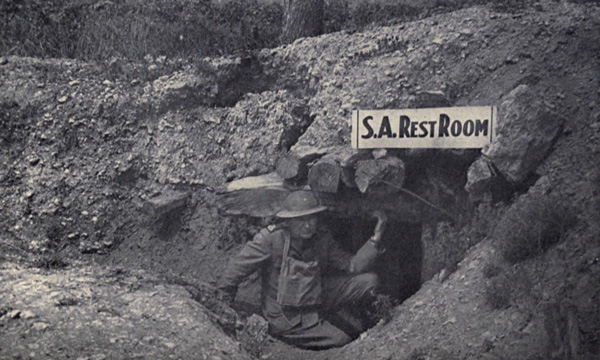
“Here during the day they worked in dugouts far
below the shell-tortured earth”
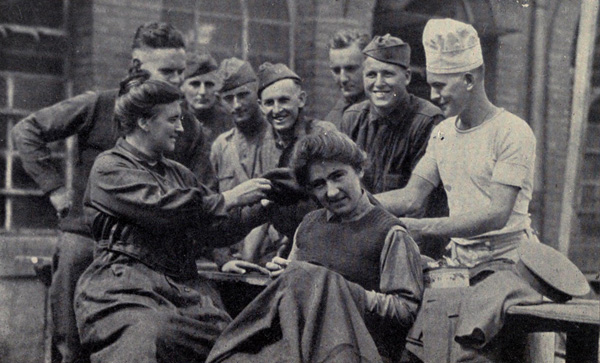
They came to get their coats mended and their buttons
sewed on
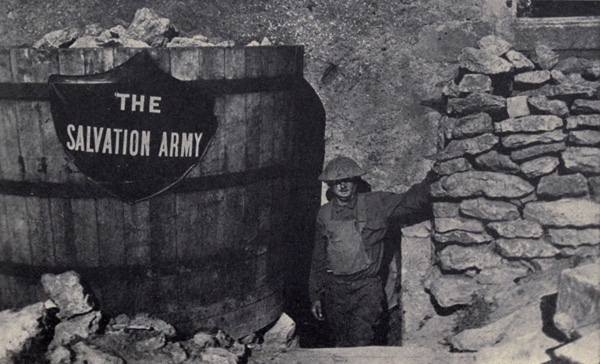
The Entrance to the Old Wine Cellar in Mandres.
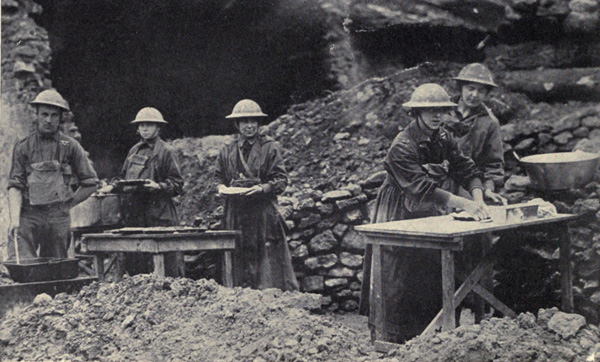
The Salvation Army Was Told that Ansauville Was Too Far
Front for Any Women To Be Allowed To Go.
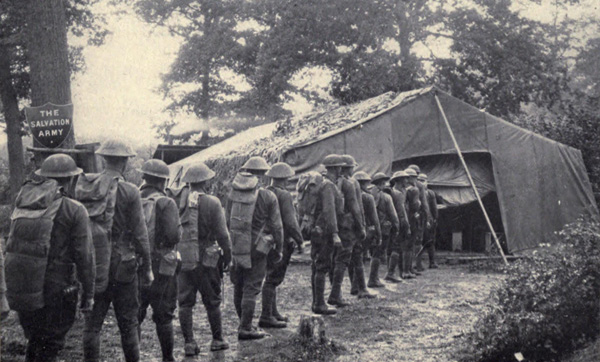
“L’Hermitage, nestled in the heart of a deep
woods, was no quiet refuge”
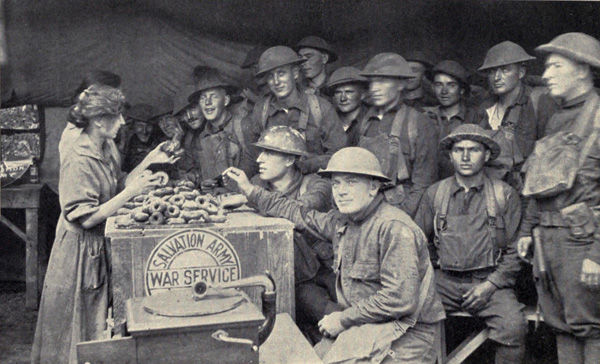
L’Hermitage, inside the tent. Several of these boys
were killed a few days after the picture was taken
The Salvation Army hut was home to the boys over there.
They came to it in sorrow or joy. They came to ask
to scrape out the bowl where the cake batter had been
stirred because mother used to let them do it; they
came to get their coats mended and have their buttons
sewed on. Sometimes it seemed to the long-suffering,
smiling woman who sewed them on, as if they just ripped
them off so she could sew them on again; if so, she
did not mind. They came to mourn when they received
no word from home; and when the mail came in and they
were fortunate they came first to the hut waving their
letter to tell of their good luck before they even
opened it to read it. It is remarkable how they pinned
their whole life on what these consecrated American
women said to them over there. It is wonderful how
they opened their hearts to them on religious subjects,
and how they flocked to the religious meetings, seeming
to really be hungry for them.
Word about these wonderful meetings that the soldiers
were attending in such numbers got to the ears of
another commanding officer, and one day there came
a summons for the Salvation Army Major in charge at
Gondrecourt to appear before him. An officer on a
motor cycle with a side car brought the summons, and
the Major felt that it practically amounted to an arrest.
There was nothing to do but obey, so he climbed into
the side car and was whirled away to Headquarters.
The Major-General received him at once and in brusque
tones informed him most emphatically:
“We want you to get out! We don’t want
you nor your meetings! We are here to teach men to
fight and your religion says you must not kill. Look
out there!” pointing through the doorway, “we
have set up dummies and teach our men to run their
bayonets through them. You teach them the opposite
of that. You will unfit my men for warfare!”
The Salvationist looked through the door at the line
of straw dummies hanging in a row, and then he looked
back and faced the Major-General for a full minute
before he said anything.
Tall and strong, with soldierly bearing, with ruddy
health in the glow of his cheeks, and fire in his
keen blue eyes, the Salvationist looked steadily at
the Major-General and his indignation grew. Then the
good old Scotch burr on his tongue rolled broadly
out in protest:
“On my way up here in your automobile”—every
word was slow and calm and deliberate, tinged with
a fine righteous sarcasm—“I saw three men entering
your Guard House who were not capable of directing
their own steps. They had been off on leave down to
the town and had come home drunk. They were going
into the Guard House to sleep it off. When they come
out to-morrow or the next day with their limbs trembling,
and their eyes bloodshot and their heads aching, do
you think they will be fit for warfare?
“You have men down there in your Guard House
who are loathsome with vile diseases, who are shaken
with self-indulgence, and weakened with all kinds
of excesses. Are they fit for warfare?
“Now, look at me!”
He drew himself up in all the strength of his six
feet, broad shoulders, expanded chest, complexion
like a baby, muscles like iron, and compelled the
gaze of the officer.
“Can you find any man—” The Salvationist
said “mon” and the soft Scotch sound of
it sent a thrill down the Major-General’s back
in spite of his opposition. “Can you find any
mon at fifty-five years who can follow these in your
regiment, who can beat me at any game whatever?”
The officer looked, and listened, and was ashamed.
The Major rose in his righteous wrath and spoke mighty
truths clothed in simple words, and as he talked the
tears unbidden rolled down the Major-General’s
face and dropped upon his table.
“And do you know,” said the Salvationist,
afterward telling a friend in earnest confidence,
“do you know, before I left we had
prayer together! And he became one of the best
friends we have!”
Before he left, also, the Major-General signed the
authority which gave him charge of the Guard Houses,
so that he might talk to the men or hold meetings
with them whenever he liked. This was the means of
opening up a new avenue of work among the men.
The Scotch Major had a string of hospitals that he
visited in addition to his other regular duties. He
knew that the men who are gassed lose all their possessions
when their clothes are ripped off from them. So this
Salvationist made a delightful all-the-year-round Santa
Claus out of himself: dressing up in old clothes,
because of the mud and dirt through which he must
pass, he would sling a pack on his back that would
put to shame the one Old Santa used to carry. Shaving
things and soap and toothbrushes, handkerchiefs and
chocolate and writing materials. How they welcomed
him wherever he came! Sick men, Protestants, Jews,
Catholics. He talked and prayed with them all, and
no one turned away from his kindly messages.
Six miles from Neufchauteul is Bazoilles, a mighty
city of hospital tents and buildings, acres and acres
of them, lying in the valley. Whenever this man heard
the rumbling of guns and knew that something was doing,
he took his pack and started down to go the rounds,
for there were always men there needing him.
Then he would hold meetings in the wards, blessed
meetings that the wounded men enjoyed and begged for.
They all joined in the singing, even those who could
not sing very well. And once it was a blind boy who
asked them to sing “Lead Kindly Light Amid the
Encircling Gloom, Lead Thou Me On.”
One Sunday afternoon two Salvation Army lassies had
come with their Major to hold their usual service
in the hospital, but there were so many wounded coming
in and the place was so busy that it seemed as if perhaps
they ought to give up the service. The nurses were
heavy-eyed with fatigue and the doctors were almost
worked to death. But when this was suggested with
one accord both doctors and nurses were against it.
“The boys would miss it so,” they said,
“and we would miss it, too. It rests us to hear
you sing.”
After the Bible reading and prayer a lassie sang:
“There Is Sunshine in My Heart To-day,”
and then came a talk that spoke of a spiritual sunshine
that would last all the year. The song and talk drifted
out to another little ward where a doctor sat beside
a boy, and both listened. As the physician rose to
go the wounded boy asked if he might write a letter.
The next day the doctor happened to meet the lassie
who sang and told her he had a letter that had been
handed to him for censorship that he thought she would
like to see. He said the writer had asked him to show
it to her. This was the letter:
Dear Mother: You will be surprised to hear that I
am in the hospital, but I am getting well quickly
and am having a good time. But best of all, some Salvation
Army people came and sang and talked about sunshine,
and while they were talking the sunshine came in through
my window—not into my room alone, but into my heart
and life as well, where it is going to stay. I know
how happy this will make you.
The hospital work was a large feature of the service
performed by the Salvation Army. In every area this
testimony comes from both doctors, nurses and wounded
men. Yet it was nothing less than a pleasure for the
workers to serve those patient, cheerful sufferers.
A lassie entered a ward one day and found the men
with combs and tissue paper performing an orchestra
selection. They apologized for the noise, declaring
that they were all crazy about music and that was the
only way they could get it.
“How would you like a phonograph?” she
asked.
“Oh, Boy! If we only had one! I’ll tell
the world we’d like it,” one declared
wistfully.
The phonograph was soon forthcoming and brought much
pleasure.
A lassie offered to write a letter for a boy whose
foot had just been amputated and whose right arm was
bound in splints. He accepted her offer eagerly, but
said:
“But when you write promise me you won’t
tell mother about my foot. She worries! She wouldn’t
understand how well off I really am. Maybe you had
better let me try to write a bit myself for you to
enclose. I guess I could manage that.” So, with
his left hand, he wrote the following:
Dearest Mother:—I am laid up in the hospital here
with a very badly sprained ankle and some bruises,
and will be here two or three weeks. Do not worry,
I am getting along fine. Your loving Son.
Two automobiles, an open car and a limousine, were
maintained in Paris for the sole purpose of providing
outings for wounded men who were able to take a little
drive. It was said by the doctors and nurses that nothing
helped a rapid recovery like these little excursions
out into an every-day beautiful world.
A boy on one of the hospital cots called to a passing
lassie:
“I am going to die, I know I am, and I’m
a Catholic. Can you pray for me, Salvation Army girl,
like you prayed for that fellow over there?”
The young lassie assured him that he was not going
to die yet, but she knelt by his cot and prayed for
him, and soothed him into a sleep from which he awoke
refreshed to find that she was right, he was not going
to die yet, but live, perhaps, to be a different lad.
A sixteen-year-old boy who at the first declaration
of war had run away from home and enlisted was wounded
so badly that he was ordered to go back to the evacuation
hospital. He was determined that he could yet fight,
and was almost crying because he had to leave his
comrades, but on the way back he discovered the entrance
to a German dugout and thought he heard someone down
in there moving.
“Come out,” he shouted, “or I’ll
throw in a hand grenade!”
A few minutes later he reached the evacuation hospital
with thirty prisoners of war, his useless arm hanging
by his side. That is the kind of stuff our American
boys are made of, and those are the boys who are praising
the Salvation Army!
It was sunset at the Gondrecourt Officers’ Training
Camp. On the big parade ground in back of the Salvation
Army huts three companies were lined up for “Colors.”
The sun was sinking into a black mass of storm clouds,
painting the Western sky a dull blood red with here
and there a thread of gleaming gold etched on the
rim of a cloud. Three French children trudged sturdily,
wearily, back from the distant fields where they had
toiled all day. The elder girl pushed a wheelbarrow
heavily laden with plunder from the fields. All bore
farming implements, the size of which dwarfed them
by comparison. They had almost reached the end of the
drill ground when the military band blared out the
opening notes of the “Star Spangled Banner,”
and the flag slipped slowly from its high staff. Instantly
the farming tools were dropped and the three childish
figures swung swiftly to “attention,”
hands raised rigidly to the stiff French salute. So
they stood until the last note had died. Then on they
tramped, their backs all bent and weary, over the
hill and down into the grey, evening-shadowed village
of the valley.
In a shell-marred little village at the American front,
the Salvation Army once brought the United States
Army to a standstill. Several hundred artillerymen
had gathered for the regular Wednesday night religious
service, held in the hutment, conducted by that organization
at this point, and, in closing, sang vigorously three
verses of “The Star Spangled Banner.”
A Major who was passing came immediately to attention,
his example being followed by all of the men and officers
within hearing, and also by a scattering of French
soldiers who were just emerging from the Catholic
church. By the time the second verse was well under
way three companies of infantry, marching from a rest
camp toward the front, had also come to a rigid salute,
blocking the road to a quartermaster’s supply
train, who had, perforce, to follow suit. The “Star
Spangled Banner” has a deeper meaning to the
man who has done a few turns in the trenches.
They had a pie-baking contest in Gondrecourt one day,
where the renowned “Aunt Mary” was located,
with her sweet face and sweeter heart.
One of the other huts had baked two hundred and thirty-five
pies in a day. The people in Gondrecourt believed
they could do better than that, so they made their
preparations and set to work.
The soldiers were all interested, of course. Who was
to eat those pies? The more pies the merrier! The
engineers had constructed a rack to hold them, so
that they might be easily counted without confusion.
The soldiers had appointed a committee to do the counting
with a representative from the cooks to be sure that
everything went right. Even the officers and chaplain
took an interest in it.
This hut was in one of the largest American sectors.
It was so well patronized that they used on an average
fifty gallons of coffee every evening and seventy-five
or more gallons of lemonade every afternoon. You can
imagine the pies and doughnuts that would find a welcome
here. One day they made twenty-seven hundred sugar
cookies, and another day they fried eighteen hundred
and thirty-six doughnuts, at the same time baking cake
and pies; but this time they were going to try to bake
three hundred pies between the rising and setting
of the sun.
An army field oven only holds nine pies at a time,
so every minute of the day had to be utilized. The
fires were started very early in the morning and everything
was ready for the girls to begin when the sun peeped
over the edge of the great battlefield. They sprang
at their task as though it were a delightful game
of tennis, and not as though they had worked hard
and late on the day before, and the many days before
that.
It was very hot in the little kitchen as the sun waxed
high. An army range never tries to conserve its heat
for the benefit of the cooks. In fact that kitchen
was often used for a Turkish bath by some poor wet
soldiers who were chilled to the bone.
But the heat did not delay the workers. They flew
at their task with fingers that seemed to have somehow
borrowed an extra nimbleness. All day long they worked,
and the pies were marshalled out of the oven by nines,
flaky and fragrant and baked just right. The rack grew
fuller and fuller, and the soldiers watched with eager
eyes and watering mouths. Now and then one of the
soldiers’ cooks would put his head in at the
door, ask how the score stood, and shake his head
in wonder. On and on they worked, mixing, rolling,
filling, putting the little twists and cuts on the
upper crust, and slipping in the oven and out again!
Mixing, rolling, filling and baking without any let-up,
until the sun with a twinkle of glowing appreciation
slipped regretfully down behind the hills of France
again as if he were sorry to leave the fun, and the
time was up. The committee gave a last careful glance
over the filled racks and announced the final score,
three hundred and sixteen pies, in shining, delectable
rows!
By seven o’clock that evening the pie line was
several hundred yards long. It was eleven o’clock
when the last quarter of a pie went over the counter,
with its accompanying mug of coffee. Think what it
was just to have to cut and serve that pie, and make
that coffee, after a long day’s work of baking!
One of the officers receiving his change after having
paid for his pie looked at it surprisedly:
“And you mean to tell me that you girls work
so hard for such a small return? I don’t see
where you make any profit at all.”
“We don’t work for profit, Captain,”
answered the lassie. “I don’t think any
amount of money would persuade us to keep going as
we have to here at times.”
“You mean you sort of work for the joy of working?”
he asked, puzzled.
“I don’t know what you mean,” responded
the lassie pleasantly, “but when we are tired
we look at the boys drilling in the sun and working
early and late. They are splendid and we feel we must
do our part as unreservedly as they do theirs.”
“No wonder my men have so many good things to
say about the Salvation Army!” said the Captain,
turning to his companions. But as he went out into
the night his voice floated back in a puzzled sort
of half-conviction, as if he were thinking out something
more than had been spoken:
“It takes more than patriotism to keep refined
women working like that!”
These same girls were commissioned also to make frequent
visits to the hospitals and talk with the sick soldiers.
Often they read the Bible to them, and many a man
through these little talks has found the way of eternal
life. This in addition to their other work.
One night after a meeting in the hut a lad wanted
to come into the room at the back and speak to one
of the women about his soul. They knelt and prayed
together, and the boy when he rose had a light of real
happiness on his face. But suddenly the happiness
faded and he exclaimed:
“But I can’t read!”
“Read? What do you mean?” asked the lassie.
“My Bible. Nobody never learned me to read,
and I can’t read my Bible like you said in the
meeting I should.”
The lassie thought for a minute, and then suggested
that he come to the hut every morning just before
first call and she would teach him a verse of scripture
and read him a chapter. This meant that the lassie
must rise that much earlier, but what of that for
a servant of the King?
Just a month this program was carried out, and then
came marching orders for the boy, but by this time
he had a rich store of God’s word safe in his
heart from the verses he had memorized. The last night
when he came to say good-bye he said to his teacher:
“Your kindness has meant a lot of trouble for
you, miss, but for me it has meant life! Before, I
was afraid to fight; but now I don’t even fear
death. I know now that it can only mean a new life.
Thank God for your goodness to me!”
There was one soldier who went by the name of Scoop.
He had been a reporter back in the States and learned
to love drink. When he joined the army he did not
give up his old habits. Whenever anybody remonstrated
with him he invariably replied gaily, “I’m
out to enjoy life.” On pay-days Scoop celebrated
by drinking more than ever.
One day he happened into the Salvation Army hut. Whether
the pie or the doughnuts or the homeyness of the place
first attracted him no one knows. He said it was the
pie. Something held him there. He came every night.
The spirit of the Lord that lived and breathed in
those consecrated men and girls began to work in his
heart and conscience, and speak to him of better things
that might even be for him.
When he felt the desire for drink or gambling coming
on he gave his money to the girls to keep for him.
On the last pay-day before he was sent to another
location he took a paint-brush and some paint and
made a little sign which he set up in a prominent
place in the hut, his silent testimony to what they
had done for him: “For the first time on pay-day Scoop is sober!”
One morning a lassie was frying some doughnuts in
the Gondrecourt hut, another was rolling and cutting,
and both were very busy when a soldier came in with
the mail. The girls went on with their work, though
one could easily see that they were eager for letters.
One was handed to the lassie who was frying the doughnuts.
When she opened it she found it was an official dispatch.
The others saw the change of her expression and asked
what was the matter, but she made no reply while tears
started down her cheeks. She, however, went on frying
doughnuts. The others asked again what was the trouble
and for answer the girl handed them the open dispatch,
which stated briefly that one of her three brothers,
who were all in the service, had been killed in action
on the previous day. The others sympathetically tried
to draw her away from her work, but she said: “No,
nothing will help me to bear my sorrow like doing something
for others.” This is the spirit of the Salvation
Army workers. Personal sorrows, personal feelings,
personal difficulties, hardships, dangers, are not
allowed to interrupt their labors of love. Fortunately,
it was later discovered that this message about her
brother was unfounded.
A boy told this lassie one day that the next day was
his birthday, and she saw the homesickness and yearning
in his eyes as he spoke. Immediately she told him
she would have a birthday party for him and bake a
cake for it.
She found some tiny candles in the village and placed
nineteen upon the pretty frosted cake. They had to
use a white bed-quilt for a tablecloth, and none of
the cups and saucers matched, but the table looked
very pretty when it was set, with little white paper
baskets of almonds which the girls had made at each
place, and all the candles lit on the white cake in
the middle. The boy brought three of his comrades,
and there were the Salvation Army Major in charge
and the lassies. They had a beautiful time. Of course
it was quite a little extra work for the lassie, but
when someone asked her why she took so much trouble
she had a faraway look in her eyes, and said she guessed
it was for the sake of the boy’s mother, and
those who heard remembered that her own three brothers
were in United States uniform somewhere facing the
enemy.
There are several instances in which American soldiers
coming from British and French Sectors, where they
had been brigaded with armies of those nations, have
upon entering a Salvation Army hut for the first time
without noticing the sign over the door started to
talk to the girls in French—very fragmentary French
at that. When they found the girls to be Americans
they were almost beside themselves with mingled feelings
of bashfulness and delight. Most of the soldiers exhibit
the former trait.
One boy approached one of our men officers.
“Can them girls speak American?” he asked,
pointing at the girls.
On being assured that they could, he said: “Will
they mind if I go up and speak to them? I ain’t
talked to an American woman in seven months.”
Two soldiers were walking along the dusty roadway.
First soldier: “Let’s go to the Salvation
Army hut.”
Second soldier: “No, I don’t want to.”
First soldier: “They’ve got a piano and
a phonograph and lots of records.”
Second soldier: “No, I don’t want to.”
First soldier: “They’ve got books and
beaucoup games.”
Second soldier: “No, I don’t want to.”
First soldier: “Two American ladies there!”
Second soldier: “No, I don’t want to.”
First soldier: “They’ve got swell coffee
and doughnuts!”
Second soldier (angrily): “No! I said No!”
First soldier: “Aw, come on. They got real homemade
pie!”
Second soldier: “I don’t care!”
First soldier: “They cut their own wood and
do their own work!”
Second soldier: “Well, that’s different!
Why didn’t you say that right off, you bonehead?
Come on. Where is it?”
And they entered the Salvation Army hut smiling.
One dear Salvation Army lady had a little hand sewing
machine which she took about with her and wherever
she landed she would sit down on an orange crate,
put her machine on another and set up a tailor shop:
sewing up rips; refitting coats that were too large;
letting out a seam that was too tight; and helping
the boys to be tidy and comfortable again. A good
many of our boys lost their coats in the Soissons fight,
and when they got new ones they didn’t always
fit, so this little sewing machine that went to war
came in very handy. Sometimes the owner would rip off
the collar or rip out the sleeves, or almost rip up
the whole coat and with her mouthful of pins skillfully
put it together again until it looked as if it belonged
to the laddie who owned it. Then with some clever chalk
marks replacing the pins she would run it through
her little machine, and off went another boy well-clothed.
One week she altered more than thirty-three coats in
this way. The soldiers called her “mother”
and loved to sit about and talk with her while she
worked.
The men went in battalions to the Lunéville Sector
for Trench Training facing the enemy. Of course, the
Salvation Army sent a detachment also.
Over here they had to give up huts. No huts at all
were allowed so near the front. No light of fire or
even stove, no lights of any kind or everything would
be destroyed by shell fire at once. An order went out
that all huts near the front must be under ground.
Yet neither did this daunt the faithful men and women
whom God Himself had sent to help those boys at the
front.
The work was extended to other camps in the Gondrecourt
area and finally the time came for the troops to move
up to the front to occupy part of a sector.