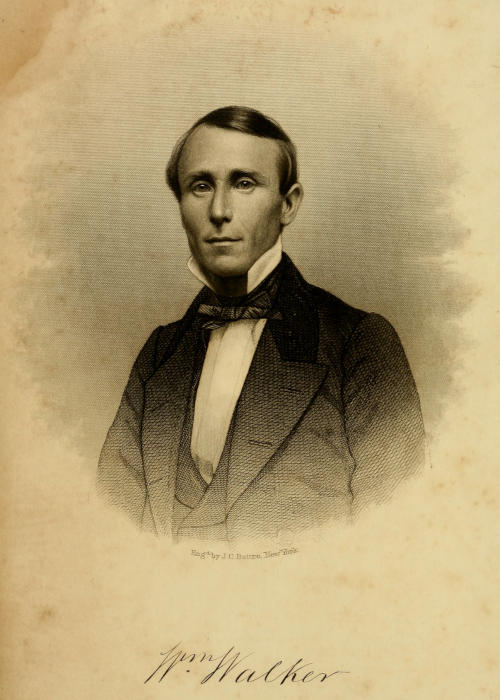
MOBILE:
S. H. GOETZEL & CO. NEW-YORK: 82 WARREN-ST.
1860.
Entered according to Act of Congress, in the year 1860, By S. H. GOETZEL & Co.,
In the Clerk’s office of the District Court of the United States
for the Southern District of New-York.
To My Comrades in Nicaragua
I dedicate this effort to do justice to their acts and
motives: To the living, with the hope that we may
soon meet again on the soil for which we have suffered
more than the pangs of death—the reproaches of a people
for whose welfare we stood ready to die: To the
memory of those who perished in the struggle, with the
vow that as long as life lasts no peace shall remain with
the foes who libel their names and strive to tear away
the laurel which hangs over their graves.
W. W.
PREFACE.
No history is so hard to write as that of our own
times. Few, if any, can free themselves from the fashions
of thought and opinion which control the daily
life of their neighbors, and every one inhales to some
extent the vapors and miasms floating in the air he
hourly breathes. The task is even more difficult if a
man attempts to narrate events in which he has taken
part. As the soldier, warmed by the heat of battle,
dimly sees through the dust and smoke of a well-fought
field, the large movements which decide the issue of
the conflict, so he who has mingled in the struggles of
parties or the contests of nations, may not be as well
fitted as others to speak of facts moulded partially by
his own will and hand. But if the memoir writer be
fair and discreet, he may contribute materials for future
use, and his very errors may instruct after ages. The
author of the following narrative does not expect to
attain perfect truth in all things; he merely asks the
reader to give him credit for the desire to state facts accurately,
and to reason justly about the circumstances
attending the presence of the Americans in Nicaragua.
March 1st, 1860.
CONTENTS.
CHAPTER I. THE VESTA AND HER PASSENGERS.
The Revolution of 1854—Organization of Provisional Government—Grounds
of the Contest—The two Constitutions—Democrats and
Legitimists—Siege of Granada—Retreat of Jerez—Death of Chamorro—Policy
of Honduras and of Guatemala—Lower California Expedition—Its
Objects and Purposes—Its Termination—Contracts of Cole
with Castellon—Crabb Contract with Jerez—Legality of the Cole
Grant of Colonization—Charter of the Vesta—Her Difficulties and
final Departure—Her Voyage—State of Parties in June, 1855—Arrival
of the Vesta at Realejo—Landing of Passengers—Walker’s Visit
to Leon—Castellon and Muñoz—The American Phalanx—Its Organization—Expedition
to Rivas
Preparations for the Rivas Expedition—Native Troops—Ramirez and
Mariano Mendez—Maximo Espinosa-Departure from Realejo—Landing
at El Gigante—Difficulties of the March—Appearance of
the Camp—Skirmish at Tola—March from Tola to Rivas—Effect of
Scenery on the Americans—Plan of Attack—Action at Rivas—Desertion
of Ramirez—Loss of the Americans—Retreat to San Juan del
Sur—Embarkation on the Schooner San José—Burning of the Cuartel—Departure
for Realejo—Execution of Dewey—Its Effects on the
People—Transfer to the Vesta and Return to Realejo—Despatch to
Castellon—His Reply-Visit of Mariano Salazar—Castellon’s Anxiety—Americans
at Chinandega—Cole and Von Natzmer—March to
Leon—Arrival there—State of the Capital—Policy of Muñoz—Danger
to the Falange—Necessity for Caution—Counter-march to Chinandega—New
Contract with Castellon
Discontent of the Americans—Sale of the Vesta—March of Muñoz
toward Segovia—Movements of Guardiola—Walker’s Plans for Returning
to Rivas—José Maria Valle—His Friendship to the Americans—Reports
of the Enemy—Departure from Chinandega—Despondency
of the People—The Cholera—Valle on the Vesta—Distress of Castellon—Action
at Sauce—Death of Muñoz—Sailing for San Juan del
Sur—Arrival at San Juan—Parker H. French—Relative Strength of
the Democrats and Legitimists in the Meridional Department—Action
at Virgin Bay—Good Conduct of the Natives—Results of the Action—Death
of Castellon—His Character and Policy—New Director—Contribution
Levied—Sources of Revenue—Don Guadalupe Saënz—Rumors
of Corral’s Advance—Ambush on Transit Road—Intercepted
Despatches—Corral Ready to Treat for Peace—Arrival of Gilman—Re-organization
of the Falange
Hornsby gets Possession of the Steamer La Virgen—Democrats embark
for Granada—Landing above the Town—Surprise of Granada—Flight
of the Legitimists—Fury of Native Democrats—Conduct of
the Americans—Release of Prisoners—Fermin Ferrer and Carlos
Thomas—Niña Yrena—Father Vigil—Negotiations with Corral—Mediation
of Mr. Wheeler—Arrival of Fry—The Lake Steamer fired
on—Shooting of Mayorga—Corral at Masaya—Comes to Granada as
Commissioner—Treaty of 23d October—Macdonald’s Loan of Twenty
Thousand Dollars—Entry of Legitimists to Granada—Rivas Inaugurated—Walker
Commander-in-Chief—Formation of the Cabinet—Nature
of the Treaty—Intercepted Letters of Corral—His Trial and
Execution—Narciso Espinosa—Rivas’ Government recognized by
Mr. Wheeler
Policy of Rivas—His Appointments—Course of the Clergy—Colonization
Decree—El Nicaraguense—Military Enlistments—The Accessory
Transit Company—Its Mercenaries—Kinney and His Schemes—Negotiations
with the Company—Garrison and Morgan—Course of the
Company—Edmund Randolph and Parker Crittenden—Revocation
of the Company’s Charter—Justice and Policy of the Act—The Randolph
Grant—How Americans were carried to Nicaragua—Sickness
at Granada—Circular of Rivas—General Trinidad Cabañas—His
Influence over Jerez—Resignation of Jerez and Selva—Course of the
Four States of Central America—Commission to Costa Rica—Policy
of the United States—Policy of Great Britain—British Consul at
Realejo—British Aid to Costa Rica—Declaration of War by Costa
Rica—Its Effects on the Country
State of the American Force on March 1st, 1856—Arrival of Goicouria—Col.
Padilla—Proclamation of General-in-Chief—Expedition to
Guanacaste—Rout at Santa Rosa—Its Effects—Headquarters at
Rivas—Government removed to Leon—Address to the Troops—C. J.
Macdonald—Goicouria as Intendente-General—The Americans at
Granada—Mora at Rivas—Walker marches to Rivas—Action of 11th
April—The Americans retire—Effects of the Action—Action on the
Serapaqui—Appointment of Father Vigil as Minister to Washington—Sickness
at Granada—Arrival of Hornsby with Recruits—Cholera at
Rivas—Depression of the Costa Ricans—Mora leaves Nicaragua—Letter
of Cañas—Cholera in Costa Rica—Expedition through Chontales—Execution
of Ugarte—Effects of Fever—Difficulties of the Americans—Affairs
at Leon
Communication from San Salvador—Reports from Northern States of
Central America—Walker at Leon—Proposal of San Salvador—Effect
of Vigil’s Reception at Washington—Arrest of Salazar—Goicouria
and Guerrero—Election Decree—Movement at Leon—Flight of
Rivas to Chinandega—The Course of the Americans—Ferrer as Provisional
President—Election and Inauguration of Walker—Forfeiture
of the Schooner San José—The Granada in Commission—Lt. Fayssoux—Cabinet
of Walker—The New Administration recognized by Mr.
Wheeler—Cruise of the Granada—Capture of Salazar—His Execution—Letter
of Manning—Arrest of Dr. Livingston—Course of the American
Minister—Hon. Pierre Soulé—Desertion and Fate of Turley—State
of the Allies at Leon—Disease and Dissensions—Murder of
Estrada—Arrangements with Morgan and Garrison—The Cubans
in Nicaragua
Necessity for Social Re-organization—Difference of Language—Decree
of Forfeited Estates—The Registry Decree—The Slavery Decree—Colonial
Systems of Spain and England—Anti-Slavery Feeling in
Europe and America—How Produced—Effects on Spanish American
States—The Negro in Tropical America—Policy of the Decree—Its
Relations to Parties in the United States—The Anti-Annexation Character
of the Decree—M. Ange de St. Priest—Interest of Continental
Powers—Interest of England—Feeling against the Slave Trade—True
Character of the Commerce—Africa and America—Experiments of
Hayti and Jamaica—Position of the Slave States—Their Apathy—The
Course of the South—Her Proper Policy—Efforts of the Anti-Slavery
Parties and Powers—Southern Interest in Nicaragua
The Army in September, 1856—Death of Ubaldo Herrera—March to
San Jacinto by McDonald—Attack on San Jacinto by Cole—Death of
Cole and Callahan—Reinforcements for Belloso—The Allies march to
Managua—State of the American Force at Masaya—Its Withdrawal to
Granada—Belloso occupies Masaya—Attack by the Americans—Zavala
attacks Granada—Action of the 13th October, 1856—Conduct
of the Allies at Granada—Murder of Lawless—Other Murders—Treatment
of the American Minister—Shooting of Lainé—Execution of
Valderraman and Allende—Arrival of Henningsen—His Appointment
as Brigadier General—State of the Meridional Department—Lieut.
Fayssoux and the Granada—Action of the 10th November—Action
of the 12th—Effects of these Actions—March to Masaya—Fighting
there—Return to Granada
Preparation for Retreat—Causes of Delay—Force at Virgin Bay—The
Granada and the Once de Abril—Promotion of Fayssoux—The Attack
of the Allies on Henningsen—His Defence—Charge of O’Neal—Henningsen’s
Difficulties—Destruction of the Town—Loss of the Fort—The
Americans abandon the Plaza—They take Possession of the
Guadalupe—Henry and Swingle—Disease in Henningsen’s Camp—Strategems
of the Allies—Henry’s Entrenched Position—Cholera and
Typhus—Commissary and Ordnance Stores—The Hospital at Omotepe—The
Attack of Indians on the Island—Exaggerated Report—Reinforcements
from San Francisco and New-Orleans—Organization of
them—Landing of Waters at Granada—His Relief of Henningsen—Embarkation
of the whole Force—Justice and Policy of Destroying
Granada
Spencer’s Attack on the Serapaqui—He takes the Boats at Punta Arenas—Course
of Capt. Erskine of the Orion—Mora’s Force on the San
Carlos—Occupation of Castillo—Capture of Fort San Carlos—Full
Possession of the Lake by Mora—Spencer’s Services—His Employers—Connivance
of Mr. Marcy—Violation of Neutral Rights by Costa
Rica—Causes of Mr. Marcy’s Action—British Fleet at San Juan del
Norte—The Costa Rican Decree—Lockridge at Punta Arenas—Interference
of British Officers—Arrival of Titus—Action at Serapaqui—Desertions—Difficulties
of the Costa Ricans—Titus at Castillo—Effects
of his Misconduct—Instructions sent to Lockridge—Reinforcement
under Capers and French—Failure to attack Castillo—Disorganization
of the Force—Explosion of the J. R. Scott—Subsequent Attempts
to open the Transit
Force at Rivas in December, 1856—State of the Allies—Charges against
Belloso—Rangers at Nandaime—Rivas prepared for Defence—Advance
of the Allies to Obraje—Skirmish at Obraje—Allies occupy
San Jorge—Henningsen’s Attack on San Jorge—March to San Juan
del Sur—The Americans at Virgin Bay—Attempt to carry San Jorge
by Surprise—Proclamation of Mora—Cannonade of San Jorge—Desertion—Its
Causes—H. B. M.’s Steamer Esk at San Juan del Sur—Sir
Robert McClure and Capt. Fayssoux—Commander Davis and
the U. S. Sloop St. Mary’s—Davis’ Visit to Rivas—Encounters near
the Transit and at Jocote—Red Star Guard—Address to the Troops—Action
of 16th March—News by the Orizaba—Attack of the Allies on
Rivas, the 23d March—Their Repulse and its Results—Rations
at Rivas—Second Attack of 11th April—Women Leave Rivas—Conduct
of Davis—Treaty with Walker—Capture of the Granada—Conclusion
THE WAR IN NICARAGUA. — Chapter First. THE VESTA AND HER PASSENGERS.
On the 5th of May, 1854, a number of native Nicaraguans
who had been exiled by the existing Government
of their Republic, landed at Realejo, and thence proceeded
to Chinandega with a view of organizing a revolution
against the acting authorities of the country.
Among them were D. Maximo Jerez, D. Mateo Pineda,
and D. José Maria Valle, leading citizens of the Occidental
Department. They had sailed from Tiger Island on
a vessel commanded by an American, Gilbert Morton,
and were about fifty-four in all when they surprised the
garrison at Realejo. After the revolutionists reached
Chinandega, they were joined by large numbers of the
people, and they proceeded with little delay to march
towards Leon. On the road thither they met the forces
of the Government at several points, each time routing
them; and the President, D. Fruto Chamorro, seeing the
temper of the people, and unable to resist the revolution
about Leon, fled alone, and without an escort, to Granada.
He did not reach the last named city for some
days after leaving Leon, having gone astray in the woods
and hills about Managua, and his partisans had almost
despaired of ever again seeing him, when he rode into
the town where his principal adherents resided.
After the revolutionists, headed by Jerez, reached
Leon, they organized a Provisional Government, naming
as Director, D. Francisco Castellon. This gentleman
had been a candidate for the office of Director at the
preceding election in 1853; and his friends asserted that
he had a majority of votes, but that Chamorro had obtained
the office by the free use of bribes among the
members of the electoral college. Chamorro was installed
in the office, and soon found pretexts for banishing
Castellon and his chief supporters to Honduras. In
that State, General Trinidad Cabañas held executive
power; and favored by him, Jerez and his comrades had
been able to sail from Tiger Island with the arms and
ammunition requisite for their landing at Realejo.
While his political enemies were in Honduras, Chamorro
had called a constituent Assembly, and the constitution
of the country had been thoroughly revised and
changed. The constitution of 1838 placed the Chief
Executive power in the hands of a Supreme Director,
who was elected every two years; the new constitution
created the office of President, who was to be chosen
every four years. In all respects the new constitution
placed more power in the Government than had been
trusted to it by the previous law; hence it was odious to
the party styling itself Liberal, and acceptable to those
who called themselves the party of order. The new
constitution was printed on the 30th of April, 1854;
and its partisans say it was also promulgated on that
day. The opponents of the new constitution say it
never was promulgated. At any rate, the revolution,
made professedly against this constitution, was started
on the 5th of May, before the new law could have been
promulgated in the towns and villages distant from the
capital.
The Leonese revolutionists styled their Executive
Provisional Director, and asserted their resolution to
maintain the organic act of 1838. They took the name
of Democrats, and wore as their badge a red ribbon on
their hats. Chamorro was called by his friends President—they
thus declaring their adhesion to the new
constitution; and calling themselves Legitimists, they
mounted the white ribbon, in opposition to the red of the
Democrats.
During the month of May the Provisional Government
was accepted by all the municipalities of the Occidental
Department, and by some of the other towns;
and the democratic army, as it was called, marching
southward, reached Granada in the early part of June.
The delay of the Democrats at Leon and at Managua
had given Chamorro time to organize his force, and
though his numbers were small, he repulsed Jerez and
his followers (for these latter could not be called a
force) when they attempted to carry Granada by assault.
After the first repulse, Jerez sat down before the
town, and affected to lay siege to the place. The rabble
at his heels were, however, busier in plundering the
shops of the suburbs than in defeating the plans of their
enemies. The arrival of some officers and soldiers from
Honduras assisted Jerez in his efforts to organize the
“democratic army,” and was a proof of the readiness
with which Cabañas had recognized the Provisional
Government.
For some months Jerez remained at Granada, vainly
attempting to get possession of the chief square of the
city, known as the Plaza. All the towns of the State
had in the meanwhile declared for Castellon, and his
friends held the lakes as well as the San Juan river, by
means of small schooners and bungos. The schooners
were under the command of a physician—an American
or Englishman who had resided in the United States,
and bore the name of Segur, although his real name
was Desmond. In the month of January, 1855, Corral
succeeded in taking Castillo, as well as the lake schooners,
from the Democrats; and soon thereafter Jerez
broke up his camp before Granada, and retreated in a
rapid and disorderly manner towards Managua and Leon.
The flight of the Democrats from Rivas followed almost
immediately the retreat from Granada; and in a few
weeks the turn of affairs was visible by the adhesion of
many persons of property to the Legitimist party.
It was well for the Democrats that Chamorro, worn
out by long disease and anxious thought, died a short
time after they left the Jalteva. He was buried in the
parish church, on the main Plaza of Granada, and his
death was kept carefully concealed from the enemy.
His name was strength to the Legitimists and a terror
to their foes; and had he lived, a far more vigorous hand
than that of Corral would have driven the flying Democrats
back to the square of Leon. After the death of
Chamorro, Corral remained in command of the Legitimist
army, and the Presidency fell, under the constitution
of 1854, to one of the Senators, D. José Maria
Estrada.
In the meantime, causes at work outside of Nicaragua
were destined to influence very materially the fate
of the Provisional Government. President Carrera, of
Guatemala, being friendly to the principles of the party
led by his countryman Chamorro, had determined to act
against the Government of Cabañas, in Honduras. In
view of this fact, Alvarez and the Honduras contingent
received orders to return from Nicaragua, and this
dampened the spirit of the Democratic leaders. Honduras,
threatened by the much greater power of Guatemala on
the north, not only had need of all the resources she
could control, but she could hardly hope, without foreign
assistance, to resist the strength of Carrera and his
Indians. Not even the Nicaraguans themselves could
blame Cabañas for the course he took, and the friendship
between Castellon and the President of Honduras remained
unaffected by the policy the latter was forced to
pursue. The alliance between the Governments at Leon
and at Comayagua continued, and they seemed to be
linked together for a common fate. But closely as the
cause of Castellon was bound to that of Cabañas, it was
not in Honduras, nor yet in Guatemala, that its destiny
was being determined. The very day which witnessed
the most signal triumph of the Nicaraguan Democrats
was destined to behold the overthrow of the Cabaña
administration; and to ascertain the cause of such a strange
result we must leave Central America and consider
events in California.
Three days after Jerez and his comrades landed at
Realejo—that is on the 8th of May, 1854—a novel scene
was enacted on the boundary between Upper and Lower
California. On that day a small band of Americans
marched from the Tia Juana country-house to the monument
marking the boundary between the United States
and Mexico, and there yielded their arms to a military
officer of the former power. These men were poorly
clad, but even at the moment of their surrender they—I
speak not of their leader—bore themselves with a certain
courage and dignity not unworthy of men who had
aspired to found a new State. They were the last of
what has been called the expedition to Lower California;
and some among them had seen the flag of
Mexico lowered at La Paz to give place to another made
for the occasion. They had passed through much toil
and danger; and most of them being altogether new to
war had taken their first lesson in that difficult art by
long fasts, and vigils, and marches across one of the most
inhospitable regions of the American continent. The
natural obstacles of Lower California, the scarce subsistence,
the long intervals between watering-places, the
rugged sides of the mountains, and the wide wastes of
sandy desert, would make war in that territory not a
pastime even to a well-appointed force. And when you
add to these natural difficulties an enemy who knows
the country well, and who is always able to muster
larger numbers than your own, some idea may be formed
of the trials of those engaged in the Lower California
expedition. When, however, these men crossed the line,
they gave no sign of failing spirit, but looked the foe
which hung about their rear and flanks as resolutely in
the face as if they had just left a field of triumph and
victory. Such a fact is itself sufficient to prove that the
vulgar ideas of this expedition are false; and as several
of the persons with Colonel Walker in Lower California
afterward acted in Nicaraguan affairs, it is not irrelevant
to ascertain the motives which guided them in their first
enterprise, so little understood by the American people.
The object of these men in leaving California was to
reach Sonora; and it was the smallness of their numbers
which made them decide to land at La Paz. Thus
forced to make Lower California a field of operations
until they might gather strength for entering Sonora,
they found a political organization in the peninsula requisite.
It was the intention of their leader to establish
at as early a time as possible a military colony—not
necessarily hostile to Mexico—on the frontier of Sonora,
with a view of protecting that State from the Apaches.
The design of such a colony first took form at Auburn,
in Placer county, California, early in 1852. A number
of persons there contributed to send two agents to Guaymas
for the purpose of getting a grant of land near the
old town of Arispe, with the condition of protecting the
frontier from the Indians. These agents—one of whom
was Mr. Frederic Emory—arrived in Sonora just after
Count Raousset de Boulbon had agreed to settle several
hundred French near the mine of Arizona; and the
State Government of Sonora expected the French to do
the work the Americans desired to attempt. Mr. Emory
and his companion, therefore, failed in their object; and
the Count de Boulbon soon afterward going to Sonora,
the Auburn plan was abandoned. The Government of
Arista, or rather persons attached to that administration,
became hostile to Raousset de Boulbon on account of
their interest in a conflicting claim to the mine he contracted
to work; and by the intrigues of Colonel Blanco
the French were driven into revolution, and afterward,
during the illness of their leader, into an agreement to
leave the country.
At the time the news of their departure from Sonora
reached California, Mr. Emory proposed to Mr. Walker,
to revive the Auburn enterprise; and Walker, together
with his former partner, Mr. Henry P. Watkins,
sailed for Guaymas, in the month of June, 1853, intending
to visit the Governor of Sonora, and try to get such
a grant as might benefit the frontier towns and villages.
Walker was careful to provide himself with a passport
from the Mexican consul at San Francisco; but this
availed him little when he reached Guaymas. The day
after his arrival there the Prefect ordered him to the
office of police, and after a long examination forbade him
to leave for the interior, refusing to countersign his passport
for Ures. Seeing the obstacles placed in his way
at the outset, Walker determined to return to California;
and after he went aboard the vessel for that purpose the
Prefect sent him word the Governor, Gandara, had
ordered his passport to be countersigned in order that he
might go to the capital. The same courier who bore the
order from Gandara to the Prefect, Navarro, also brought
news that the Apaches had visited a country-house, a
few leagues from Guaymas, murdering all the men and
children, and carrying the women into a captivity worse
than death. The Indians sent word that they would
soon visit the town “where water is carried on asses’
backs”—meaning Guaymas; and the people of that
port, frightened by the message, seemed ready to receive
any one who would give them safety from their savage
foe. In fact several of the women of the place urged
Walker to repair immediately to California, and bring
down enough Americans to keep off the Apaches.
What Walker saw and heard at Guaymas satisfied
him that a comparatively small body of Americans
might gain a position on the Sonora frontier, and protect
the families on the border from the Indians; and such
an act would be one of humanity, no less than of justice,
whether sanctioned or not by the Mexican Government.
The condition of the upper part of Sonora was at
that time, and still is, a disgrace to the civilization of the
continent; and until a clause in the treaty of Guadalupe
Hidalgo was rescinded by one in the Gadsden
treaty, the people of the United States were more immediately
responsible before the world for the Apache
outrages. On none more immediately than on the
American people, did the duty devolve of relieving the
frontier from the cruelties of savage war. Northern
Sonora was, in fact, more under the dominion of
the Apaches than under the laws of Mexico; and
the contributions of the Indians were collected with
greater regularity and certainty than the dues to the
tax-gatherer. The state of this region furnished the
best defence for any American aiming to settle there
without the formal consent of Mexico; and although
political changes would certainly have followed the
establishment of a colony near Arispe, they might be
justified by the plea that any social organization, no
matter how secured, is preferable to that in which individuals
and families are altogether at the mercy of
savages.
But the men who sailed for Sonora were obliged to
sojourn, for a time, on the peninsula; and their conduct
in Lower California may be taken as the measure of
their motives in the enterprise they undertook. Wheresoever
they went they sought to establish justice and
maintain order, and those among them who violated law
were summarily punished. An instance occurred at the old
mission of San Vincente, illustrative of the character of the
expedition, and of the persons who directed it. Several of
the soldiers had formed a conspiracy to desert and to pillage
the cattle-farms on their way to Upper California. The
plan and purposes of the conspirators were revealed by
one of the confederates, and the parties to the plot were
tried by court-martial, found guilty of the charge, and
sentenced to be shot. A military execution is a good
test of military discipline; for no duty is so repulsive to
the soldier as that of taking life from the comrade who
has shared the perils and privations of his arduous service.
On this occasion, too, the duty was more difficult,
because the number of Americans was small, and was
daily diminishing. But painful as was the duty, the
men charged with the execution did not shrink from the
performance of it; and the very field where the unfortunate
victims of the law expiated their offence with
their lives, was suggestive of comparison between the
manner in which the expeditionists and the Mexican
Government severally performed the duties of protection
to society. The expeditionary force, drawn up to vindicate
law, by the most serious punishment it metes out
to the offender, stood almost in the shadow of the ruins
of the church of the mission fathers. The roofless buildings
of the old monastery, the crumbling arches of the
spacious chapel, the waste fields which showed signs of
former culture, and the skulking form of the half-clothed
Indian, relapsing into savageism from which the
holy fathers had rescued him, all declared the sort of
protection Mexico had given to the persons as well as
the property of the Peninsula. In the vital functions
of government, the expeditionists may safely challenge
a comparison of their acts with those of Mexico
in Lower California; and the ruin and desolation which
followed the unwise no less than unjust measure of
secularizing the missions, were sufficient to forfeit the
claim of the Mexican Republic to the allegiance of the
peninsula.
The main fact for us to know is that those engaged in
the Lower California expedition gave proof of their desire
not to destroy, but to re-organize society wherever they
went. They were all young men, and youth is apt to
err in pulling down before it is ready to build up. But
they were men, also, full of military fire and thirsting
for military reputation; and the soldier’s instinct leads
him to construct rather than to destroy. The spirit of
the soldier is conservative; the first law of military
organization is order. Therefore, these men, though
young, were not ill-fitted to lay the foundations of a new
and more stable society than any they might find either
in Sonora or Lower California. They failed, however;
whether through the actions of others more than of themselves,
it imports not our present purpose to determine.
Suffice it to say that the last remains of the expedition
reached San Francisco about the middle of May, 1854.
The leader of the expedition—William Walker, or, as
he was then called, Col. Walker—after returning to
Upper California, resumed the occupation of editor of a
daily paper. One of the proprietors of the paper he edited
was Byron Cole, whose attention had been for several
years directed to Central America, and more particularly
to Nicaragua. Cole, in frequent conversations with
Walker, urged him to give up the idea of settling in Sonora,
and to devote his labors to Nicaragua; and soon
after he heard of the revolution undertaken by Jerez and
Castellon, Cole sold his interest in the paper at San
Francisco, and sailed for San Juan del Sur. He left for
Nicaragua on the steamer of the 15th of August, 1854,
being accompanied by Mr. Wm. V. Wells, whose attention
was fixed on Honduras. From San Juan del Sur,
Mr. Cole, after numerous delays and vexations, succeeded
in getting to Leon, and there obtained from Castellon a
contract, by which the Provisional Director authorized
him to engage the services of three hundred men for
military duty in Nicaragua, the officers and soldiers to
receive a stated monthly pay, and a certain number of
acres of land at the close of the campaign. With this
contract Cole returned to California early in the month
of November, and forthwith sought Walker for the purpose
of getting him to take an interest in the enterprise.
As soon as Walker read the contract he refused to act
under it, seeing that it was contrary to the act of Congress
of 1818, commonly known as the neutrality law.
He, however, told Cole that if he would return to Nicaragua,
and get from Castellon a contract of colonization,
something might be done with it. Cole accordingly
sailed a second time for San Juan; and on the 29th of
December, 1854, Castellon gave him a colonization
grant, under which three hundred Americans were to be
introduced into Nicaragua, and were to be guaranteed
forever the privilege of bearing arms. This grant Cole
sent to Walker, and it reached the latter at Sacramento
early in the month of February, 1855.
A few days after receiving this contract, Walker went
to San Francisco with the view of providing means, if
possible, for carrying two or three hundred men to Nicaragua.
He there met an old schoolmate, Mr. Henry A.
Crabb, who had just returned from the Atlantic States;
and Crabb having passed through Nicaragua on his way
from California to Cincinnati, gave a glowing report of
the natural wealth and advantages of the country.
While crossing the Transit Road, Crabb heard of the
events then transpiring in the Republic—of the revolution
at Leon and the siege of Granada; and he also
ascertained that Jerez was anxious to obtain the aid of
Americans for the campaign against the Legitimists.
This suggested the idea of getting an element into the
society of Nicaragua for the regeneration of that part of
Central America; and while in the Atlantic States
Crabb had secured the co-operation of Mr. Thomas F.
Fisher, formerly and now of New-Orleans, and of Captain
C. C. Hornsby, who had served in one of the regiments
known as the Ten Regiments, during the Mexican
war. The three, Crabb, Fisher, and Hornsby, left New-Orleans
together in the month of January, 1855: and on
the way to San Juan del Norte they found aboard the
steamer Mr. Julius De Brissot, bound, as he said, for the
Gallipagos Islands. De Brissot joined the party; and he,
together with Hornsby and Fisher, remained in Nicaragua,
while Crabb proceeded to San Francisco. When
Walker met Crabb at the latter place, he was awaiting
advices from Fisher, who stopped on the Isthmus for the
purpose of visiting Jerez and obtaining from him authority
to engage Americans for the service of the Democratic
army.
Not many days elapsed before Fisher himself came to
California, bringing with him authority to enlist five
hundred men for Jerez, and with a promise of the most
extravagant pay, in both money and lands, to the officers
and men who might engage in the service. It seems
Fisher, Hornsby, and De Brissot, found the newly-arrived
United States Minister, John H. Wheeler, on the Isthmus;
and as His Excellency was anxious to visit the
Democratic camp in the Jalteva, as well as Chamorro,
in Granada, before deciding what authority he would
recognise, Fisher and his party went as an escort to the
Minister, and under the protection of the American flag,
into both camps. From Jerez, however, Fisher obtained
at this time the contract he bore to San Francisco;
while Hornsby and De Brissot, after leaving Granada,
went to Rivas, and entered into a Quixotic agreement
with D. Maximo Espinosa to take Fort Castillo Viejo
and the San Juan river from the Legitimists, who had
lately driven the Democrats from the stronghold at the
Rapids. These two gentlemen, however, were soon glad
to manage their escape from San Juan del Sur aboard of
the steamer for San Francisco; and not long after
Fisher’s arrival, Hornsby and De Brissot both appeared in
California.
Crabb and Walker had known each other from childhood,
and their views were similar in regard to the state
of Central America, and the means necessary for its regeneration.
Therefore, Crabb generously proposed to
give Walker the whole benefit of the contract Fisher
had made with Jerez; and Crabb, in view of certain
political movements then occurring in California, decided
to remain in that State. Walker, however, while
thanking Crabb for his offer, refused to have anything
to do with the Jerez contract, preferring to act under
the Castellon grant to Cole, not only because of its entire
freedom from legal objections, but also because it
was more reasonable, and had been given by an authority
competent to make the bargain. Hornsby and
De Brissot embarked in the enterprise with Walker;
and it will be seen hereafter that they, as well as
Fisher, held commissions under the Republic of Nicaragua.
In the meanwhile, Walker had taken care that no
show of secrecy should bring suspicion on his undertaking,
either as to its illegality or its injustice. He took
the Cole grant to the District Attorney of the United
States for the Northern District of California, Hon. S.
W. Inge, and that gentleman after examining it declared
no law would be violated by acting under it. At
that time, too, General Wool, commanding the Pacific
Division, was supposed to have special power from the
President for suppressing expeditions contrary to the
Act of 1818. His headquarters were at Benicia, and
the General was in the habit of reading to many persons
the letters addressed by him to the then Secretary
of War, Colonel Jefferson Davis, defending the course he
took in reference to the Lower California expedition.
Among others, he read these letters (which the old gentleman
seemed to think models of logic and style) to
Walker, the very person about whose acts the discussion
had arisen between himself and the Secretary. From
these letters Walker was led to infer that the common
impression about the powers vested in the General, under
the Act of 1818, was correct; and, therefore, when
he heard of General Wool being in San Francisco, he
sought him out, and found him on the wharf only a few
minutes before four o’clock, the hour for the departure
of the Sacramento steamer. The General was about to
leave in the boat for Benicia; and after hearing Walker’s
statement as to the nature of the grant made to
Cole, and of his intention to act under it, the old man,
shaking him heartily by the hand, said he not only
would not interfere with the enterprise, but wished it
entire success. Thus having secured the sanction of the
proper Federal authorities, Walker proceeded in his
efforts to provide means for carrying colonists to Nicaragua
under the Cole contract. He soon found that it
would be impossible to get more than a pitiful sum of
money, and that his arrangements would have to be
made on the most economical scale.
While engaged in these preliminary preparations,
Walker received an injury in the foot, which kept him
in his chamber until the middle of April; and, in fact,
the sore was not wholly healed when he sailed from San
Francisco. Thus confined to the house, he was able to
do little more in the way of means than to obtain a
thousand dollars from Mr. Joseph Palmer, of the firm of
Palmer, Cook & Co. At this gentleman’s house he had
met with Colonel Fremont and talked with him about
the enterprise in Nicaragua; and the Colonel, who had
passed across the Isthmus the previous year, thought
well of the undertaking. It is due probably, to both
Colonel Fremont and Mr. Palmer, to state that they
were not fully aware of all the views Walker held on
the subject of slavery; nor, indeed, was it necessary at
that time for those views to be expressed. Besides the
assistance given by Mr. Palmer, Walker was much
aided by two friends—Mr. Edmund Randolph and Mr.
A. P. Crittenden.
After much difficulty, a contract was made with one
Lamson for the passage of a certain number of men,
aboard the brig Vesta, from San Francisco to Realejo.
The agreement had been made through a ship-master,
McNair, and it was considered that he would sail in
command of the Vesta. But, after the cash payment
on the charter party had been made to Lamson, he and
McNair fell out, and the former was obliged to employ
another captain for his vessel. The provisions and the
passengers were all aboard the brig about the 20th of
April; and when it was thought she was on the point of
leaving, the Sheriff seized the vessel by attachment at
the suit of an old creditor of the owner, Lamson. The
evening, too, after the attachment, there were some
signs of the brig getting under way for sea; and therefore
the Sheriff sent down a posse of eight or ten, armed
with revolvers, for the purpose of preventing an escape.
A sort of scuffle, more in jest than in earnest, occurred
between some of the posse and their acquaintances
among the passengers; and the new captain, frightened
out of his wits, jumped over the rail to the wharf, taking
with him the papers of the ship. A few days afterward
the United States Marshal served a writ on the
brig for the price of the provisions; and the revenue
cutter W. L. Marcy was hauled astern of the Vesta,
with orders to keep her from going to sea with the
Deputy Marshal aboard. To make assurance doubly
sure, the Sheriff had the sails of the brig unbent and
put in store. The owner seemed to be entirely without
means to satisfy the claims against the vessel, and
everybody thought the chance very small for the departure
of the vessel on her proposed voyage.
Walker, however, advised the passengers to remain
aboard, and all except a few followed the advice. Soon
he found a captain for the Vesta, in the person of Mr.
M. D. Eyre, who professed some knowledge of navigation.
The holder of the claim against Lamson, under which
the attachment issued, happened to be a friend of Crabb,
from Stockton; and he was induced by good will for the
voyage the Vesta was bound on, to grant easy terms for
the release of the brig. Lamson really controlled the
action of the merchants who sold him the provisions;
and when he was told it might not be safe for him
to keep the passengers in San Francisco, he rather hesitatingly
agreed to have the libel dismissed. But the
sheriff’s costs had run up, by the employment of the
posse, and other extraordinary expenses, to more than
three hundred dollars; and Walker having expended
nearly the last dollar, it seemed as if this trivial amount
might stop the whole enterprise. The costs of the sheriff
were very large, if not illegal; but, as he had the
sails in store, he seemed to have the Vesta in his power.
Walker managed, however, to get an order from the sheriff
on the store-keeper for the sails; and as the sheriff
was kept in ignorance of the dismissal of the libel, he
supposed the cutter would detain the brig in port if she
tried to go out. Besides this, he had a keeper aboard;
and the keeper having been a member of a California
Legislature, was supposed to keep a sharp lookout for
any suspicious movement. The captain of the cutter
was informed a little before dark that the Vesta was out
of the marshal’s hands, and arrangements were made
through one of the Marcy’s officers, for her sailors to
come aboard about ten o’clock, in order to bend the sails
of the brig. The United States sailors came at the appointed
time, and the passengers managed to get the
sheriff’s keeper into the cabin, where he was detained
for several hours. Swiftly and silently the work of bending
the sails went on; and shortly after midnight, on
the morning of the 4th of May, 1855, the steam-tug
Resolute came alongside the Vesta, and hitching her on,
towed her from the wharf, through the shipping, into the
stream, and out by the Heads to sea. The sheriff’s
keeper was sent to the Resolute, the towlines were cast
off, and the Vesta put to sea, to the great joy of the passengers,
who had been for two weeks alternating between
hope of her departure and fear of her detention.
When the brig got to sea, it was found that there were
fifty-eight passengers bound for a new home in the
tropics. Among them were Achilles Kewen, who had
commanded a company under Lopez, at Cardenas, in
1850; Timothy Crocker, who had served under Walker
throughout the Lower California expedition; C. C.
Hornsby, whose previous adventures in Nicaragua have
been alluded to; Dr. Alex. Jones, who had lately been to
the Cocos Islands in search of a buried treasure; Francis
P. Anderson, who had served in the New-York regiment
in California during the Mexican war; and others,
whose names will hereafter appear in the course of this
narrative. They were most of them men of strong character,
tired of the humdrum of common life, and ready
for a career which might bring them the sweets of adventure
or the rewards of fame. Their acts will afford
the best measure both of their capacity and of their
character.
The voyage of the Vesta was rather long and tedious.
In crossing the Gulf of Tehuantepec she encountered a
gale which tested her timbers—twenty-nine years in her
sides—to the utmost. The bow of the old brig would
open to the waves as they roared around her, and at
times her decks were swept clear by the huge billows
passing over her. She was worked by men detailed from
the passengers; and after living through the storm off
Tehuantepec, the crew had little to do until she reached
the Gulf of Fonseca. More than five weeks had been
consumed since leaving San Francisco before the volcano
of Coseguina—the first Nicaraguan land—was
seen looming in the distance. The want of wind detained
the brig for some hours at the mouth of the gulf,
while a boat was sent in to the port of Amapala, on the
Island of Tigre. Captain Morton, the same American
who had carried Jerez to Realejo, in May, 1854, was at
Amapala with instructions from Castellon, awaiting the
arrival of the Vesta. The captain was gladly welcomed
aboard the brig, as the skipper who had brought the
vessel from San Francisco knew nothing of the Central
American coast. After taking Morton aboard, the Vesta
proceeded on her way, and on the morning of the 16th
of June, she came to anchor within the port of Realejo.
I have been somewhat minute, and it may be
tedious, in narrating the earlier incidents of the enterprise
whereby Americans were introduced as an element
into Nicaraguan society, because we may often
judge best of events by seeing clearly the origin of
them. The father ceases to have any direct influence
over either the mind or the organization of the child after
the moment of conception; and yet how often we trace
not merely the features of the father, but even the
delicate traits of his character, in his offspring. The
fine cells which determine the nature of organic structure,
have been minutely studied by the physiologist,
and the manner of their development has opened to him
some of the hitherto hidden laws of life. If, then, you
desire to understand the character of the late war in
Nicaragua, do not despise the small events which attended
the departure of the fifty-eight from San Francisco.
From the day the Americans landed at Realejo
dates a new epoch, not only for Nicaragua, but for all
Central America. Thenceforth it was impossible for the
worn-out society of those countries to evade or escape
the changes the new elements were to work in their domestic
as well as in their political organization.
The state of native parties in Nicaragua on the 16th
day of June, 1855, was quite different from that existing
on the 29th of December, 1854—the day on which
Castellon made the grant to Cole. When the Vesta
dropped anchor in the port of Realejo, the Provisional
Government was confined almost entirely to the Occidental
Department. The Legitimists held all the Oriental
and Meridional Departments, and most of the towns
and villages in Matagalpa and Segovia were subject to
their sway. The ally, too, of the Provisional Government,
Cabañas, sat less firmly in the executive chair of
Honduras than he had on the previous Christmas. A
force organized by the aid of Guatemala, and commanded
by a General Lopez, had invaded the Department
of Gracias; and while Lopez was sent into the
north of Honduras, General Santos Guardiola—whose
name was itself a terror to the towns of both States—sailed
from Istapa for San Juan del Sur, aboard the Costa
Rican schooner San José, with the intention of engaging
in the service of the Legitimists for a campaign in Segovia,
close to the confines of Tegucigalpa and Choluteca.
Guardiola arrived at Granada only a few days before
Walker reached Realejo; and the latter found the people
about Chinandega trembling at the name of one who,
whether properly or improperly it is hard to say, had
acquired the epithet of the “Butcher” of Central
America. After the retreat from Granada Jerez had fallen
into disgrace with his party—at least they denied him
all claim to military capacity, no doubt glad to place on
the shoulders of their leader the blame of all the misfortunes
which had followed their entire want of military
virtue. In place of Jerez, Castellon put at the head
of the “Democratic Army” General Muñoz, who had
at that time more reputation as a soldier than any man
in Central America. He had been invited to Leon from
Honduras, whither he had retired several years previously
in consequence of having failed in a revolution against
the Government of D. Laureano Pineda; and it was
only by much entreaty and grave concession that Castellon
had prevailed on him to take the command of the
army of the Provisional Government. Since assuming
the command Muñoz had acted wholly on the defensive,
devoting his time to drilling the men pressed into the
service of Castellon; and it was widely whispered among
the people, especially among the blood reds of the Democrats,
that Muñoz was anxious for a compromise between
the two contending parties, thinking more of maintaining
himself in power than of the success of the principles
for which the revolution was begun.
Walker was not ill pleased to hear from Morton on
the way from Tiger Island to Realejo, the condition of
affairs in Nicaragua. He felt that the more desperate
the fortunes of the Castellon party were, the more deeply
would they be indebted to the men who might rescue
them from their danger, and the more thoroughly would
they be committed to any course or policy the Americans
might propose. Far from being depressed by the
news, which to some might have appeared gloomy, he
saw in the very straits to which the Democratic party
was reduced, the cause no less than the presage of the
success of his companions. The anxiety, too, with
which Castellon evidently awaited the arrival of the
Vesta, was cheering. He had sent Morton to Tiger
Island for the express purpose of boarding the brig and
of bringing her as speedily as possible to Realejo; and
when the vessel appeared off the Island of Cardon, the
collector of the port and a special officer, sent by the
Provisional Director, Col. Ramirez, came out to the Vesta
in order to welcome her to the waters of Nicaragua.
On the evening of the 15th of June—the day before
the Vesta was able to enter the harbor—these two officers
came aboard the brig, and Colonel Ramirez informed
Walker that he was ordered from Leon to see all proper
arrangements made for the reception of the Americans.
Quarters had been prepared for them at Realejo, and the
Director was anxious to see Walker as early as possible.
As soon as the brig came to anchor, the passengers
got ready to go up the river to the town which lies four
or five miles from the harbor. Several bungos were secured
for the purpose; and a little past noon the native
boatmen pulled away from the brig, the Americans
taking with them their clothes and blankets as well as
their arms and ammunition. Each of them carried a
rifle, and many of them had revolvers. The bungos
entered the river, and silence was rarely broken save by
the plashing of the oars in the water, or the harsh cry
of a macaw screaming its discordant note from the
boughs overhanging the stream. The deep gloom of the
tropical forests was more impressive from the ocean of
sunshine which surrounded it; and the stillness of all
nature affected the beholder with an awe which commanded
silence and reflection. After pulling a short
distance, however, the native boatmen, whose senses
long use had blunted to the peculiar impressions of the
scenery, began to talk about the different objects they
passed; nor did they fail to point out the stones used by
Morgan as ballast, and which he threw from his vessel
in order to receive the precious freight he pillaged from
Realejo. The distance of the present town from the
harbor is due in fact to the dread the Spaniards had of
the buccaneers of the seventeenth century.
It was near 4 o’clock in the afternoon when the
Americans drew up at the wharf of Realejo and leaped
ashore for the first time in Nicaragua. The guard-house
was near the landing-place, and as Walker passed, the
officer, a light, active young fellow, with a bright red
short-cloak thrown gracefully over his left shoulder,
turned out the guard, and saluted. The soldiers all wore
the red ribbon with the words “Ejercito Democratico”
printed on it; and although without uniform or any
music except that made by a very indifferent drum, they
had a good military carriage, and their step, unimpeded
by shoe or sandal, was excellent. As the Americans
passed up the street to the quarters assigned them, the
women, with their best dresses and most pleasing smiles,
stood at the doors and windows saluting with much
natural grace the strangers who had come to find a home
in their midst, and to share the fortunes of the party
with which their husbands and lovers, and fathers and
brothers, were identified.
Early the next morning, Walker and Crocker,
accompanied by Col. Ramirez and Capt. Doubleday, an
American who had served in the Democratic army during
the siege of Granada, started for Leon. As they
entered the town of Chinandega the church bells rang a
welcome peal, and at all the villages on the road they
received marks of good will and hospitality. The road
from Chinandega to Leon, by Chichigalpa and Posultega,
passes through a country for which nature has done
much and man little; and the effect of even what little
man had done was marred by the constant signs of
revolutionary violence. Under the shade of the magnificent
ceiba might be seen halted a company of soldiers
with their trowsers rolled above their knees; but on
close observation you could perceive that the sergeants
and corporals were keenly watching lest some of their new
recruits might take advantage of the halt to slip away
for a moment, and so escape the hated service. It was
a relief to turn from man and his works to the nature
brilliant with beauties in her tropical aspects. As the
travellers approached Leon they beheld spread out before
them a vast plain which seems almost boundless in
extent as you look toward the south; while gazing
northward, you perceive the lofty line of volcanoes—Viejo
on one flank and Momotombo on the other—stretching
from the Gulf of Fonseca to the Lake of
Managua. It is only when you ascend the tower of the
cathedral within the city, and are able to distinguish to
the westward the ocean through the break in the coast
range of hills, that you see the southern wall of the
plain made by the mountains around the town of Managua.
But it was not to muse over nature or to admire her
vast and grand proportions in these southern latitudes,
that the companions of the swarthy Ramirez had come
to Central America. The sight of the picket on the
outskirt of the town, though at least three quarters of a
league from the Plaza, was more suggestive of the objects
they had in view; and riding rapidly through the lanes
and streets they soon reached the house of the Provisional
Director. Castellon received the new-comers with frank
cordiality, and expressed the lively pleasure he felt at
their arrival. It did not require many minutes to see
that he was not the man to control a revolutionary
movement, or to conduct it to a successful issue. There
was a certain indecision, not merely in his words and
features, but even in his walk and the general motions
of his body; and this trait of character seemed to be
aggravated by the circumstances about him. A short
conversation revealed his anxiety that Walker should
meet Muñoz; and Castellon said at once that he needed
the military assistance of the Americans to secure the
success of the Provisional Government. He said he
wished them to enter the service as a separate corps,
and proposed to call them La Falange Americana—the
American Phalanx.
During the evening Muñoz called at the house of the
Director, and Walker was presented to him. The contrast
between the manner of the Executive and that of
the General was striking. Castellon was modest, gentle,
almost shrinking in his address; Muñoz had an air of
conceit which affirmed a feeling of superiority on his
part, to all around him. It was not difficult to see that
they disliked each other; though Castellon concealed his
feelings and opinions better than Muñoz. The General, soon
after saluting Walker, began to talk in the most ridiculous
style about the comparative military merits of General
Scott and General Taylor, exposing his ignorance in
every sentence, and showing the weakness of his character.
Muñoz let the American perceive that the new
element Castellon proposed to introduce into the war did
not have the approval of the commander-in-chief; and
after the General took leave, Walker told Castellon that
if he and his comrades entered the service of the Provisional
Government, it was with the distinct understanding
they were not to be put under the orders of Muñoz.
Walker found that the Director was not at all averse to
have some one with him to lighten the burden he had
been obliged to bear in the person of the commanding
general.
The next day Walker determined to return to Chinandega,
to let the Americans know that Castellon
wished their services as soldiers; and before leaving, he
proposed to the Director, in case they enlisted, to immediately
march on the town of Rivas, with a view of
occupying the Meridional Department. This movement,
if successful, would furnish money to the Government,
which was now obliged to overtax and thereby to create
disaffection among the people of the Occidental; and the
occupation of the Transit Road would place the Americans
in a position to increase their numbers from the
passengers across the Isthmus. The Director said he
would place the proposition before his Minister of War,
D. Buenaventura Selva, and advise Walker of the decision
in the matter.
The Americans were delighted, on Walker’s return to
Chinandega, where he found them, to hear that Castellon
wished them to engage in the service, and that in a
few days they might be called on to march against the
enemy. On the 20th of June, Walker received a commission
as Colonel in the Democratic army, and the
Secretary of War informed him that commissions would
be issued to other officers among the Americans as he
might suggest. Achilles Kewen was appointed to the
rank of Lieutenant Colonel; Crocker was made Major;
and the Falange being organized into two companies,
two captains were named, the senior being C. C. Hornsby.
By the constitution of 1838, a simple declaration of intention
made any native-born citizen of an American
Republic a naturalized citizen of Nicaragua, and under
this clause most of the Falange became Nicaraguans.
At the same time the Secretary of War sent Walker
his commission, he informed him that the Director desired
him to organize a force to act against the enemy in
the Meridional Department; that Col. Ramirez had been
ordered to raise two hundred natives, and to report with
his command to Col. Walker as soon as he was ready to
march; and that the civil and military officers at Chinandega
and Realejo had been ordered to give him any
assistance he required in the way of supplies and transportation
for the force intrusted to his charge.
Chapter Second. RIVAS, JUNE TWENTY-NINTH, 1855.
Immediately after receiving the dispatches of the
Government placing him in command of an expeditionary
force to act against the Legitimists at Rivas, Walker
began to prepare the Falange, as the Americans were
henceforth called, to march to Realejo whence they were
to sail on board the Vesta for a point in the Meridional
Department. The stores, both commissary and ordnance,
were sent by ox-carts to Realejo and thence by bungos
to the brig anchored off Point Ycaco. On the 23d, three
days after the order reached Chinandega, the force
was aboard ready for sailing. Ramirez had been backward
in his movements and showed little disposition for
the enterprise, deeming it hazardous and ill-advised. He
was evidently influenced by the words of Muñoz, whose
disapproval of the expedition to Rivas was well known.
So much did the opinion of his superior, Muñoz, control
his conduct, that he made small effort to enlist the number
of men—two hundred—the Director assigned as the
strength of the native force. When the Vesta was ready
for sea, not many more than one hundred natives mustered
on her decks. Among the officers with Ramirez
was Mariano Mendez, a pure Indian who had been engaged
in revolutions and counter-revolutions from his
youth upward. With violent passions and uncontrolled
desires he had a courage and experience which made
him at times useful to the men who were in the habit of
attempting political changes for personal objects; and
when active service was required, they would put the old
chief on a good horse with a stout lance in his hand, and
reasonably expect from him the most hazardous enterprises.
Utterly unfit for civil life and incapable of being
subjected to the rigid rules of military law, he was a
dangerous tool and an unreliable friend. He would not
serve under Ramirez, and obeyed no orders except those
from Walker himself. Aboard of the Vesta his principal
amusement was to spread his blanket on the deck and
gather a crowd of soldiers about him for his favorite
game of Monte. Once the money of the bettors was on
Mariano’s blanket, it mattered little, so far as the fate
of the cash was concerned, whether the cards ran for or
against him; it was honor enough, so Mendez thought,
and so some of the men seemed to think, for a soldier to
bet with a Colonel of Lancers, as he claimed to be; and
to lose his money was, with the soldier, a pleasant mode
of paying for so signal a distinction. Muñoz was no
doubt glad to get Mendez out of Leon; and the Colonel
of Lancers was glad for awhile to exchange the aguardiente
of Subtiaba for the chocolate of Rivas, especially
with the prospect of being able to slip a few ceroons to
Leon for sale among the Indians of his neighborhood.
Nor had Castellon failed to provide for a civil organization
in case the expedition got a foothold within the
Meridional Department. D. Maximo Espinosa, the owner
of a valuable cacao plantation near Rivas, was authorized
by the Minister of Relations, D. Francisco Baca, to act
as Prefect of the Department, and also as Commissioner
to collect the revenue so necessary for the sustenance of
the Provisional Government. Espinosa was an old man,
upward of seventy, with a Don Quixote cast of features,
and the dark lustreless eye, full of melancholy, so
characteristic of his race. A ruling passion with him
seemed to be hatred to D. Juan Ruiz (one of Estrada’s
Ministers), whose lands touched those of Don Maximo.
Indeed it is probable that an old feud about limits between
Don Juan and Don Maximo determined the latter
to espouse the cause of the Democratic army. Having
lived all his life near Rivas, Espinosa was thought to be
well informed as to the roads and places near the town.
His nephew, who accompanied him, was also familiar
with the Meridional Department; and his services as guide
were useful to the expedition.
Morton was placed in charge of the Vesta; and although
he knew the coast well and took all advantage
of the winds, it was not until four days after leaving
Point Ycaco that Walker was enabled to land. On the
evening of the 27th of June, about sunset, boats were
let down for landing the force at a point known as El
Gigante, a short distance above Brito and some six
leagues to the north of San Juan del Sur. The boats
were few and small, and De Brissot who, by his desire to
produce an effect was often taking false steps, ran a
whaleboat he had charge of against the rocks the first
trip she made to the shore. It was nearly midnight before
the whole force, consisting of about fifty-five Americans
and one hundred and ten natives, was landed on the
coast. When the disembarkation commenced the moon
was shining brightly; but by eleven o’clock the sky was
overcast. The clouds continued to grow thicker and
darker, and before the force was formed in marching
order, drops of rain, precursors of a heavy shower, began
to fall. Espinosa and his nephew found the trail which
led over the coast range of hills to Rivas; and about
midnight the Americans in front, Ramirez and his command
in the rear, and a few native soldiers detailed to
carry the ammunition covered with ox-hides in the centre,
the column took up its march for the interior. The
men carried nothing but their arms and blankets with
two day’s provisions in their haversacks, so that they
marched with as much rapidity as the damp, muddy
nature of the ground would permit; but before they had
gone more than half a mile the rain came down in torrents.
Then Espinosa and his nephew lost the trail;
the old man complained of colic, and the young one
seemed to be afraid to venture further. A halt was ordered;
several were sent out to search for the trail; and in the
meanwhile the main body got what shelter it could under
the heavy foliage of the large dark-looking forest trees.
In a few minutes, however, the rain ceased, the trail was
found, and the command resumed its march. At dawn
the little force had somewhat recovered its spirits, and
had got over the drenching of the night previous; and
marching briskly through the thick forests, they avoided
all habitations, designing if possible to surprise the enemy
at Rivas the night of the 28th. About nine o’clock they
came to an old deserted adobe house, and halted several
hours for breakfast and rest.
The encampment that morning was quite gipsy-like.
The felt hats of the Falange showed, in their drooping
brims, the effects of the night’s rain; and thick, heavy
beards gave to most of the body a wild and dangerous
air. As soon as the sentries were posted, the Americans
began to dispose of their crackers and cold meat, washed
down in some instances by a draught from a liquor canteen;
while the native soldiers opened their supplies of
cheese and tortillas, winding up with a little tiste—a
mixture of chocolate, sugar, and corn meal, diluted in
water—from the fantastically carved jicaras they carried
tied with a string run through the button-holes of their
jackets or trowsers. After breakfast and several hours’
sleep, the force was well prepared to renew its march,
and the disagreeable impressions of the night were
completely forgotten in the balmy effects of the soft,
mild air, which seemed a fluid altogether different from
the atmosphere of northern climates. You felt as if a
thin, and vapory exhalation of opium, soothing and exhilarating
by turns, was being mixed at intervals with
the common elements of the atmosphere. By night,
however, the clouds began again to gather; and soon
after dark a steady rain set in. The weather interfered
so much with the march that Walker saw he could not
reach Rivas, as he had expected, before morning; and
as the natives carrying the ammunition began to complain
of their burden, it became an object to secure
pack-horses for the command. Besides this, many of
the Americans, tired and foot-sore, lost some of the
alacrity requisite for action.
At the little village of Tola there was a small body
of horsemen, sent out by the commandant at Rivas, to
watch the approach of Walker, whose departure from
Realejo had been already communicated to Corral at
Granada. Report said the news of this fact was carried
to the Legitimists by a German who received a
passport to leave Leon from Muñoz. The story is not
improbable, and was confirmed by so many circumstances,
that it is not singular the Americans adopted it as a
well-authenticated fact. The Legitimists themselves
said, the first news they got was from this German; and
it is certain he passed through Pueblo Nuevo with a
passport from the commanding general of the Democratic
army. On receipt of the news of Walker’s sailing from
Realejo, Corral sent Colonel Bosque with a force to
Rivas; and after his arrival at the latter place, Bosque
began to build barricades, and to press the men of the
town into the ranks as soldiers. He had sent out horsemen
to scour the country between Rivas and the sea-coast;
and twenty of these were, according to the
information Walker received from some Democrats near
Tola, quartered in the village the night of the 28th.
As the expeditionary force approached Tola, the rain
fell fast; the roads became filled with water, and the
men found it almost impossible to keep their ammunition
dry. About half a mile from the village, some
twenty men were sent on in advance to attack, and, if
possible, capture the enemy there. The detachment
marched briskly forward, the main body following at a
short distance. As Walker reached the outskirts of the
village, he heard, between two claps of loud thunder,
the sharp crack of the American rifles, then all was still.
The detachment had found the hostile party in the corridor
of one of the principal houses of the town; and so
little did the Legitimists expect an enemy in the midst
of the storm, that they were, without a sentry posted,
playing at cards. Several of them—among others the
officer in command—were wounded; the rest escaped,
and carried the news of the approach of the Americans
to Rivas. After securing the horses of the Legitimist
troopers, sentries were posted by the Democrats, and they
halted for the night. Orders were given to the surgeon,
Dr. Jones, to look after the wounded prisoners—much
to the dissatisfaction of some native officers, who thought
they ought to be shot.
A little after eight o’clock next morning, Walker
marched for Rivas, which lies about nine miles to the
eastward of Tola. The day soon became clear and
bright; and the Falange, eager for a fight, pressed forward
briskly. Mendez having found a horse and taken a
lance from one of the enemy, was in a fine flow of
spirits, and kept near the head of the column, sometimes
pressing the advance-guard to let him pass. But Ramirez
hung back, and even checked his men as they
stepped close after the Americans. Every now and then
market-women, with fruit-baskets on their heads, and
just from Rivas, would gayly greet the soldiers, nodding
familiarly to some acquaintance among the natives, and
much wondering at the strange figures of the men from
California. Nor were the Americans less amused at the
new faces and forms they met on the road; and such of
them as spoke any Spanish, would waste all the terms
of endearment they could muster on the girls, who
seemed pleased with the compliments of the men from
the land of gold. When, however, the command reached
the summit of a hill, about four miles from Rivas, a
scene of beauty and of splendor burst upon their vision,
and for a while drew them from everything else, even from
thought of the eager strife in which they expected soon
to mingle.
As the advance guard reached a turn in the road it
seemed to halt for a moment, involuntarily, and though
the order was to march in silence an exclamation of surprise
and pleasure escaped the lips of all. Mendez,
the red streamer flying from the lance which rested on
his stirrup, was up with the advance and uttered the
single word “Omotepe.” To his eye the scene was familiar,
but to the Americans it appeared a vision of enchantment.
The lake of Nicaragua lay in full view,
and rising from it, as Venus from the sea, was the tall
and graceful cone of Omotepe. The dark forests of the
tropics clothed the side of the volcano, which seemed to
repose under the influence of the soft sunshine around
it. The form of the mountain told its history as if written
in a book; and the appearance of the volcano was
so much that of a person enjoying a siesta, the beholder
would not have been surprised to see it waken at any
moment and throw the lava from its burning sides. The
first glimpse of the scene almost made the pulse stand
still; and the Falange had scarcely recovered from its
effects when the command was halted opposite a country-house
a few hundred yards from Rivas, in order to prepare
for the attack on the town.
About a mile from Rivas Walker had fallen into
the road leading to Granada, so that he might enter the
former place from the north. He took this course with
a view of securing the houses either of the Maleaño or of
the Santa Ursula estates—two cacao plantations on the
edge of the town furnishing good positions to a force
either attacking or defending the place. Halting his
troops, then, less than half a mile from the first houses
of the town, Walker called the principal officers, American
and native, around him, explaining his plan of
attack, and assigning to each his separate duty. Kewen
and Crocker were ordered to drive the enemy, if possible,
from the streets, keeping the Americans advancing
at a quick step until they reached the Plaza; while
Ramirez and his command were to follow close after the
Americans, protecting, as much as they could, their
flanks and rear. A few moments sufficed for these
orders, and all declared their full understanding of the
several places assigned them. Then Kewen and Crocker
ordered their men to advance. As they got within sight
of the first houses, a body of the enemy opened fire;
the reply of the rifles was sharp and deadly, and the
shout of the Americans as they rushed forward proclaimed
their eagerness for the strife. The Legitimists
fell back rapidly toward the Plaza; the hill of Santa Ursula
was gained by the Falange, and driving in the panels
of the gates and doors with the butts of their rifles, the
soldiers soon had possession of the houses on the summit.
Walker rode past just as the houses were entered; and
seeing Crocker a short distance in advance, he called
out to know how far the men had got toward the
Plaza. Crocker was panting with excitement; his chin
was bleeding from the graze of a bullet, one arm hung
useless, being shot through near the shoulder, while in
the hand of the other side he carried his army revolver,
with half its barrels discharged. But the rage of battle
was on him; and heedless of wounds he was trying to
drive the men toward the enemy. As soon, however, as
he saw his commander, he sank his voice, and said in a
low tone, “Colonel, the men falter; I cannot get them
on.” Then Walker, looking to the rear, saw that the
natives were not yet in sight. The pack-mules and
horses with the ammunition were slowly coming on;
and Mendez, with a few natives near him, was to be
seen a little to the right. Passing to the front, Walker
saw it was too true, as Crocker said, that the men could
not be brought to advance. At the same time a brisk
fire was opened on the left flank of the Americans by
Colonel Manuel Arguëllo, who had just arrived with a
force from San Juan del Sur. Then the Americans
were concentrated in a large adobe house near the hill
of Santa Ursula, and in some small houses on the opposite
side of the street; the ammunition was unpacked, and
the whole force was, as far as possible, placed under
cover, in order to get a breathing time before future action.
The enemy seeing Ramirez did not press forward to
aid the Americans, got in between the two bodies; and
Madregil, as the Leonese colonel was called, marched
off with nearly his whole command toward the Costa
Rican frontier, thinking, doubtless, that the Falange would
be destroyed. The Legitimists, too, noticing the disappearance
of Ramirez, began to press the Americans on
all sides, making several efforts to charge the houses,
where the rifles did good execution. The white ribbons
were strewed thickly about the streets, and the Americans
had several killed and wounded early in the conflict.
But the spirits of the latter did not droop until
first Crocker and then Kewen was reported killed.
Even after these losses, however, the men were brought
to a charge in order to drive the enemy from an old
gun, a four-pounder, they were trying to get to bear
on the houses the Americans occupied. The charge was
successful, and the enemy were unable to use the piece
during the action. Then the Legitimists tried to fire
the houses held by the Democrats, and they so far succeeded
as to get one of the roofs in a blaze. By this
time upward of fifteen of the Americans were killed or
wounded, not more than thirty-five of them remaining
for action. The fight had begun at twelve o’clock, and
it was near four when orders were issued to prepare for
retreat. Several of the wounded had to be left; but
those who could march at all were notified of the intention
to abandon the houses, so that they might be ready
to move when the order was given. The enemy, protected
by the thick undergrowth, had crowded in some
force close to the houses when the order was given to
sally. At the moment of leaving the house, a shout was
raised by the sallying party; the nearest of the enemy
turned and fled in confusion; and the main body of the
Legitimists, paralyzed, as it were, by the offensive
appearance of the American movement, waited, expecting
everywhere an attack. Thus the Falange escaped from
its difficult position with the loss of only one man killed.
When the Democrats attacked Rivas, the Legitimists
had probably five hundred men in the town; and they
were re-enforced soon after the action commenced by
Arguëllo, with some seventy-five or eighty men. There
were, according to the best accounts, at least seventy of
the Legitimists killed, and as many wounded. The
Americans lost six killed and twelve wounded; and five
of their wounded left behind were barbarously murdered
by the enemy, and their bodies burnt. After such
a day, the Legitimists were not much in the humor of
pursuing those who had taught them a first lesson in
the use of the rifle.
But it was not by numbers that the loss of the Americans
was to be computed. The chivalrous spirit of
Kewen would have weighed against a host of common
men; and the death of Crocker was a loss hardly to be
repaired. A boy in appearance, with a slight figure, and
a face almost feminine in its delicacy and beauty, he
had the heart of a lion; and his eye, usually mild and
gentle, though steady in its expression, was quick to
perceive a false movement on the part of an adversary,
and then its flash was like the gleam of a scimetar as it
falls on the head of the foe. With little military experience
and less military reading, he was a man to
lead others where danger was to be met; and none who
knew him feared he would get a command into any position
from which his courage and address would be unable
to extricate them. To Walker he was invaluable;
for they had been together in many a trying hour, and
the fellowship of difficulty and danger had established a
sort of freemasonry between them.
There had been with the Americans during most of
the day, at Rivas, two natives, one of them a boy, the
other a man, familiar with the country about Rivas.
Under the guidance of the latter the little band retreated
through cacao plantations, seeking some road which
might lead them toward the Transit. Their march was
of course slow, and they were obliged to wait often for
the wounded to come up. Among those most seriously
hurt were De Brissot and Anderson (afterward Colonel
Anderson), the former having a wound through the
fleshy part of the thigh, and the latter, in addition to a
wound in the thigh, having a scratch in the scalp and a
cut in the foot. Capt. Doubleday, a volunteer in the
expedition, was useful by his knowledge of native character
and the modes of native warfare; and although
having a painful wound in the head, he did not for a
moment lose his spirits or presence of mind. Two or
three times in their wanderings through plantations, the
retreating party came upon native laborers, who are accustomed
to fly at the sight of armed men, through fear
of being pressed into military service; and once overtaking
a slow, cautious old man who, after some hesitation,
half opened his jacket, to show a red rose under it, they
were amused by seeing a white rose at the same time
fall to the ground. After a doubtful day in revolutionary
times, the poor fellow thought it best to have the white
emblem for the Legitimists as well as the red for the
Democrats. Nor were the Americans themselves altogether
lacking in such prudence; for many of them
had torn the red ribbon from their hats, in order to
escape the notice of hostile parties. This, however, was
a vain precaution, since their tongue, as well as their
dress and manners, plainly told the race, and therefore
the party, to which they belonged.
It was nearly dark when the guide succeeded in
striking the road from Rivas to St. George, about half
way between the two places. As the Falange approached
the high road the bells of Buenos Ayres were ringing in
the distance, and Doubleday thought it was for the victory
of the Legitimists, though it was probably for the
usual vesper prayers. Marching briskly on, the remains
of the expeditionary force passed, about dark, the outskirts
of San Jorge, all the doors being closed, as usual
when a battle has been fought in the neighborhood, and
all the dogs of the village seeming to bark at the tread
of the retreating Americans. Walker ordered Mayorga,
the guide, to take the command by as quiet a path as
possible to the Transit; and he soon led the party by a
trail to the right of the road between Rivas and Virgin
Bay. The ground was muddy and difficult, the men at
times sinking into it over their shoes and half way up to
the knee. And if the march was trying to well men,
how much more so was it to Anderson and De Brissot,
with the muscles of their thighs bored through by musket-balls.
The rear guard, however, did its duty well,
and kept the column closed up, while maintaining the
coolness and firmness requisite for meeting the enemy in
case of a pursuit. But there was no sign of pursuit;
and about midnight the worn-out soldiers of the Falange
halted, and camped until morning at a deserted hut on
the top of a hill, some two miles from the Transit road.
A little sleep and a hearty breakfast revived the exhausted
spirits of the command; and before nine o’clock
on the morning of the 30th, they were again toiling
along the muddy trail. Soon they got a glimpse of the
white Transit road, between two and three miles from
Virgin Bay. It looked American, and the very sight of
it refreshed the Falange and put new life even into the
wounded. Not many minutes after they got on the
Transit, Walker heard, at a distance ahead, the tinkle of
a mule-bell, and the guide said it was the treasure
train, the passengers having crossed from San Juan del
Sur to Virgin Bay the day before. As the train was
usually accompanied by an escort, Walker was apprehensive
of a collision between the treasure guard and his
force, and of the misrepresentations which would necessarily
arise from such an event. Hence he hastily ordered
the men to be hid on the side of a hill they were
then passing; and he was relieved at seeing the whole
train pass by with none but the muleteers in charge of
it. The march was then resumed, and near the Half-way
House a man named Dewey, formerly a gambler in
California, rode up, and informing Walker he was just
from San Juan del Sur, told him some of the native
Democrats, Mendez among them, had passed through
town the night before, on their way to Costa Rica, but
that no Legitimists had been there since the departure
of Arguëllo, early on the morning of the 29th, for Rivas.
A few minutes after sunset, the people of San Juan
del Sur beheld about forty-five men, several of them
wounded—some without hats, others without shoes—all
of them travel-stained and clinging to their rifles, defile
through the streets of the town and take up their
quarters in the barracks near the beach. The appearance
of the Falange at that moment was not imposing;
but he who knew how to read men might see from the
looks of these, that they bore with firmness the blows
of adverse fate. There was no hesitation in their march
or in their movements. A few men—you could not
style them a detachment, scarcely a detail—were ordered
to take possession of all the small boats in the harbor
and keep them under guard. The Costa Rican
schooner, San José, cast anchor in the harbor just as the
Falange entered the barracks; and, before any of her
officers or crew had got ashore, a file of Americans
were aboard and held her for further orders. Walker
expected to hear something of the Vesta, as Morton had
been ordered to cruise off and on near San Juan del Sur,
until he saw a certain signal from the shore. But no
one at San Juan, although many there were friendly to
the democrats, could give any news of the Vesta. Several
of the residents of the town did all they could for
the wounded and destitute soldiers; and even in that
moment of adversity, an Irishman, Peter Burns, and a
Texan, Henry McLeod, had the hardihood to link their
fate with that of the Falange. It was encouraging for
the soldiers to find that some, besides themselves, did not
regard their fortunes as altogether desperate; and small
as was this addition to their numbers, it gave increased
moral as well as material strength to the command.
Hearing nothing from the Vesta, Walker determined
to press the San José for the service, and go in search of
the brig, or in default of finding her, sail for Realejo.
Accordingly the wounded were first sent to the schooner,
and soon afterward the whole command followed. They
found the owner of the vessel, one Alvarado, of Punta
Arenas, aboard the San José, which had formerly been
a pilot-boat out of San Francisco. Alvarado received
the command courteously, and Walker assured him the
schooner should not be used for the democratic service
longer than was absolutely necessary; and as this same
vessel had brought Guardiola, a military person of importance,
from Guatemala to Nicaragua, with the avowed
object of making war against the Provisional Government
at Leon, the owner thought it well to act civilly,
lest a libel might be filed against the schooner on her
arrival at Realejo. In what may be termed minor diplomacy,
the Central Americans are not surpassed by
any race on the continent.
The tide was coming in, and there was little or no
wind when the Americans went aboard of the San José;
hence the vessel remained at anchor waiting for the
turn of the tide and for the morning breeze to spring
up. Most of the soldiers, fatigued by their toils and
excitement during the last three or four days, at once
threw themselves on the decks and were asleep almost
the moment after they touched the planks. Walker,
however, with Captain Hornsby and a few others, kept
awake, watching anxiously the shore for any signs of
movement there, and as keenly regarding the waters
and the heavens, in order to catch the faintest signal of
the ebbing tide or of the expected breeze. With all
their senses on the stretch, they suddenly saw the
flames burst forth from the barracks near the beach,
and in an instant the blaze seemed to their startled view
to spread over half the town. Immediately a boat was
sent off to gather the meaning of the fire. The flames,
on close observation, seemed to be confined, and owing
to the calmness of the night the fire did not spread. In
a few minutes the boat returned with the news that the
barracks had been set on fire by Dewey and a sailor
named Sam: the former being an American, who had
lived for a while on the Isthmus, and the latter being
the owner of a small launch running between Realejo
and San Juan del Sur, and which had followed the Vesta
on her voyage to El Gigante. These two men had some
private hatreds against certain legitimists about the
Transit: and taking advantage of the times, they determined
to wreak their revenge by this act of destruction.
It may be, too, that the thirst for plunder and the hope
of satisfying their avarice during the confusion of the
fire partly prompted the act: for Dewey was a desperate
man who had fled from California to escape the punishment
of his crimes. Their act had jeoparded the
whole town; for all the houses being built of wood, a
light wind would have borne the flames to most of the
property of the place.
It became important for Walker to get possession of
these men and punish their offence; otherwise the whole
responsibility of the act might fall on the Americans in
the democratic service, and the enemies of these last
would say that, in revenge for their repulse at Rivas,
they had attempted, like savages, to burn up an inoffensive
town. He therefore sent an officer with a few
men—their arms concealed in the bottom of the boat—to
attempt to get Dewey and Sam aboard the San José.
Half by stratagem and half by force, Sam was brought
to the schooner; but Dewey, doubtful of the result, refused
to venture aboard, and took, as he thought, the
safer course of getting to Sam’s launch, which was
luckily hitched astern of the pilot-boat. Sam had no
sooner crossed the taffrail of the San José than he came
reeling (for he was drunk) to where Walker stood, and
openly boasted that he and Dewey had set fire to the
barracks, and that they considered it an act of right
against the legitimists. After these declarations of Sam,
there could remain no doubt of his guilt, and as little
of Dewey’s, since Sam had made similar statements in
the presence of and uncontradicted by his accomplice.
The refusal, too, of Dewey to come before Walker, implied
guilt. Sam was, therefore, ordered to be tried:
and after a short consultation with Capt. Hornsby and
John Markham (afterward Colonel Markham), who
had shown much discretion at Rivas and during the
march thence, Walker determined to send the criminal
ashore in order to have him executed there. Riflemen
were also placed at the stern of the schooner to watch
the launch and prevent Dewey from cutting the lines
which held it to the San José.
The prisoner was sent ashore in charge of Capt.
Hornsby and a few select men, with orders to shoot him
and place on his body a memorandum stating the offence,
and by whose command he had been executed; for haste
was necessary, it being far past midnight and Alvarado’s
skipper was expecting every moment to be able to weigh
anchor and set sail. The duty was disagreeable; and
therefore, the Colonel commanding had himself chosen
the men for the performance of it. Hornsby was an
upright honorable soldier; but, then, his ability to
fulfil the order might depend on the disposition of those
who were to carry it into execution. He was almost
the only commissioned officer left to Walker; yet, he
was without the large views requisite for perceiving the
great importance of clearing the Americans from any
participation in the arson which had been committed.
Therefore, the commander took aside those who were to
go with Hornsby and strove to impress on them the urgent
necessity for faithful and conscientious conduct on
their part. Hornsby and his detail took the prisoner off
in a small boat; in a short time Walker heard the crack
of the rifles, and soon afterward the rubbing of the oars
against the rowlocks as the boat approached the schooner.
Hornsby came back to report that the prisoner had
escaped; that while the men were in the act of untying
Sam he had broken away, and the rifles being fired at
random in the dark, it was not known whether he had
been hit or not. It was afterward ascertained that he
escaped unhurt to Costa Rica.
The escape of Sam gave an air of connivance at his
crime to the action of the Americans. This was the
impression certain to be made on the natives of the
country, unless some means were found to counteract it.
Indeed, when the Costa Rican merchant, Alvarado, who
was watching the events as they happened, heard Sam
had not been shot, he seemed, by his air, more than by
his words, to intimate that the Americans were not over-anxious
to punish the offender. Hence, it became necessary
to guard against Dewey’s escape; for such an
event would tend to strengthen the inference enemies
might draw from the failure to execute the sentence of
his accomplice. Throughout the night, therefore, which
seemed to Walker as if it would never end, strict guard
was kept over Sam’s launch. The wearying wretchedness
of that night’s watch may be imagined when it is
considered that the future character of the Americans
in Nicaragua depended, to a great extent, on their ability
to punish Dewey’s crime.
At last day broke, and about sunrise the breeze sprung
up off shore. The skipper of the schooner weighed anchor
and the vessel put to sea, towing the launch astern.
Walker ordered the San José to be kept two or three
leagues from the land, steering for Realejo, and watching
in-shore for the Vesta. A native woman of Chinandega,
Sam’s mistress, and who sailed with him on his
voyages, managed the rudder of the launch. Three or
four hours passed thus; the riflemen in the stern with
their eyes constantly on the launch, and with orders to
shoot Dewey if he attempted to cut the lines by which
she was towed. The small hold of the boat enabled
Dewey to keep out of sight, and as he had a couple of
army revolvers with him, and was a remarkable shot, it
was necessary for the men watching him to keep themselves
covered. It was a contest between crime and
law after the fashion of the Indian. After a while
Dewey rose stealthily from the hold, and managing to
place the woman between himself and the riflemen, was
evidently preparing to make a desperate effort to cut
loose from the schooner. The woman was warned in
Spanish to keep clear from Dewey, and was told that
death would be the result if she attempted to aid him in
his plans. But the poor creature was unable to get
away from the man. The order was given to the riflemen
to watch their opportunity and shoot Dewey when
they could do so without endangering the woman. The
discharge of a couple of rifles, almost at the same instant,
told that the opportunity had been found. Dewey
dropped into the hold, shot through the body; but the
ball, passing entirely through him, had, unfortunately,
inflicted a painful and dangerous wound on the woman.
The woman was brought aboard the San José; her
wound was dressed by the surgeon, and she recovered in
a short time her usual health. Dewey’s body was sewed
up in canvas and buried at sea.
I have minutely narrated the circumstances attending
Dewey’s death, because they made a deep impression on
the native mind, and gave a certain and decided character
to the Americans in the democratic service. The
Nicaraguans conceived from these events a respectful
idea of American justice. They saw that the men they
had been taught to call “filibusters,” intended to maintain
law and secure order wherever they went; that
they had the will to administer justice, and would,
when they had the power, protect the weak and the innocent
from the crimes of the lawless and abandoned.
And it is this sentiment stamped deeply on the people of
Nicaragua which makes the evil-doers of that land
dread the re-appearance of the Americans in the country.
The anarchy and license of thirty-five years of revolution
have unfitted the political leaders for subjecting
their lawless passions and unbridled impulses to the
fixed rule of unchanging and unswerving duty.
Late in the afternoon of the same day the schooner
left San Juan, her passengers recognized the Vesta at a
distance bound northward, and apparently for Realejo.
After the brig saw the schooner, her movements became
mysterious and uncertain; in fact she did not know
what to make of a vessel showing Costa Rica colors, and
clearly looking out for, and in chase of the Vesta. The
San José, however, soon overhauled the brig, and in a
few moments the Falange was again aboard of their
old acquaintance. The wind was favorable; the Vesta
kept on her course for Realejo, and the schooner followed
close in her wake. Alvarado, no doubt, thought
it was fair, and by his civility he had made it safe for
him to carry on a little smuggling, and pay himself out
of the pockets of the Leonese for the services he had
rendered their friends. Early the next morning, it being
the first of July, the Vesta again found the volcano
of Viejo bearing due north, and letting her cable slip, she
stood at her former anchorage opposite Point Ycaco.
A few stragglers from the force of Ramirez, taking the
coast trail from Rivas to Chinandega, had already reached
the latter place, and reported some of the incidents of the
march and action on the 29th. Therefore the Vesta had
been but a few hours in port, when three or four of the
principal Democrats of Chinandega came down to get the
news of the expedition to the Meridional Department.
On their return with the flood-tide—for whenever a
boat was sent up the river to Realejo, it was generally
on the incoming tide—one of these gentlemen bore to
Castellon the written report of occurrences at the south.
In his report, Walker stated his impression that Muñoz
had acted in bad faith, and that the conduct of Ramirez
was due to the inspiration, if not orders, of the commander-in-chief;
and the report concluded by informing
the Director that, unless the course of Muñoz was inquired
into, and cleared of the suspicions hanging about
it, the Americans would be compelled to leave the service
of the Provisional Government, and seek elsewhere
than in Nicaragua a field for their faculties and enterprise.
The next day Dr. Livingston, an American, long
resident in Leon, brought Castellon’s reply to Walker
aboard of the Vesta. The Director complimented the
Americans on their conduct at Rivas, thanked them for
the services they had rendered the democratic cause, but
evaded saying anything in reference to the acts of Muñoz.
He urged Walker, however, not to think of leaving
Nicaragua, as such an event might be fatal to the
Provisional Government; and Dr. Livingston was sent
to urge verbally the same views, intimating, too, that
the critical position of the democratic party made it inexpedient
for the Director to scan too closely the conduct
of the commander-in-chief. Walker, however, appeared
obstinate, having decided in his own mind to remain
some days on the brig for the purpose of allowing the
Americans to recover from their fatigues and wounds,
and with a view of making the Castellon party manifest
as clearly as possible the necessity of the Falange to
their cause. So Dr. Livingston went back to Leon, with
a report not very encouraging to the Provisional Government.
For some days Walker continued to receive letters
from Castellon, entreating him not to give up the democratic
cause, and urging him to march the Falange to
Leon. In order to bring about the latter result the Director
stated that the Legitimists were meditating a
movement against his capital, Corral being at Managua
with a force of nearly a thousand men, and with arms
and ammunition for the supply of a large additional
number of recruits. It was also certain that the recruiting
of voluntarios forçados—forced volunteers—was
going on actively in the Oriental Department. Don
Mariano Salazar, too, the most energetic man in the
democratic party, visited Walker aboard the Vesta, to
impress on him the danger of an attack on Leon by
Corral, and the necessity of having the American rifles
about the residence of the Director. Salazar was the
brother-in-law of Castellon; and being a merchant of
much shrewdness and sufficient capital, he managed to
have a sort of monopoly of the trade in foreign fabrics,
imported by the ports of Realejo and Tempisque. Thus
he was able and willing to furnish means to the democratic
army, and offered to supply the Americans with
any ammunition they might need. He, accordingly,
sent to La Union, and procured a quantity of rifle powder
for the Falange; the powder which the natives used in
their muskets not being fit for the arms of the Americans.
Walker appeared, however, inflexible, and the friends of
the Provisional Government again began to despair.
Some ten days passed in this manner, and the Falange,
recovered from the effects of the expedition to
Rivas, was beginning to wish for more active exercise
than could be found aboard the Vesta. It was, therefore,
decided to march them to Chinandega, as they
were promised good quarters there, and the wounded
would be able to get more delicate diet than was to be
had at Point Ycaco. Accordingly boats and bungos were
procured, and the whole body of Americans was transported
to Realejo without previous notice given to the
authorities. Not many minutes after Walker reached
the town he was standing in front of the Collector’s
office, and saw the Director, Castellon, and Don Mariano
Salazar, step from the boat. It seems Don Francisco
had left Leon that morning, and passing by the Polvon,
a sugar plantation belonging to two Americans, John
Deshon and Henry Myers, had reached the Vesta only
a few minutes after the Americans entered the river.
He had forthwith followed, in order to persuade Walker
to continue his march to Leon. His anxiety was apparent;
in fact it was necessary for him to get back to his
capital before the people discovered his absence, otherwise
a panic might ensue, and the effects be disastrous.
In reply to the entreaties of Castellon, Walker affected
to be undecided as to his course after reaching
Chinandega, evading a positive reply, by saying he did
not know whether he could safely leave his wounded at
the last-named town, since the Legitimists, if they intended
to enter the Occidental Department, would certainly
occupy that place, in order to cut off supplies and
communications. The Director told Walker that if he
intended to go to Leon, the sub-prefect at Chinandega
had orders to furnish him with all the supplies and transportation
he required. Castellon and Salazar left for
Leon in better spirits, because there appeared a prospect
of retaining the Falange in the country; and the Americans
proceeded to Chinandega, where they arrived the
same afternoon, and found as comfortable quarters as
the town afforded. All the officers, civil and military,
vied with each other in the efforts they made to satisfy
the wants of the Falange; and the women of the place
were constantly paying to the wounded those little attentions
which take away from the tedium of the soldier
obliged to lie idle and inactive, while the bustle of
preparation for marching and adventure is going on
around him.
The day after reaching Chinandega, Walker made his
requisition on the sub-prefect for the horses and ox-carts
necessary on the march to Leon; and the Americans
were in high spirits at the idea of visiting the old capital
of the country, and the second city in size of Central
America. The evening before they set out for the
seat of the Provisional Government, Byron Cole rode
into Chinandega accompanied by Don Bruno Von Natzmer.
The former had waited several months after sending
his contract to California, expecting each week to
hear of the arrival of Americans at Realejo; but as
time wore away and the cause of Castellon waned rapidly,
he had gone to Honduras hoping to find profit, if
not fame, in the gold hills of Olancho. There he met
Bruno Von Natzmer, a Prussian, who had resigned his
commission in the cavalry of his native country to join
Baron Bulow in the colony he proposed to establish in
Costa Rica some years ago. Von Natzmer spoke Spanish
very well, French tolerably, and English quite indifferently.
Having resided for some time in Central America,
and being a man of fine intelligence, Von Natzmer
was well calculated to render much service to the Americans.
He and Cole had left Olancho for Nicaragua as
soon as they heard of the arrival of the Vesta at Realejo;
and it will be seen in the course of events that
they were valuable auxiliaries to the Falange.
Leaving the wounded at Chinandega, in charge of the
sub-prefect there, Walker marched to Leon, carrying
the ammunition and baggage in the ox-carts of the
country. It was late at night when he arrived at the
first pickets; and the strength of the pickets, as well
as the number of sentries, indicated that Muñoz thought
it not altogether improbable the enemy might be in the
neighborhood. A native officer was sent on to inform
the sentries it was necessary to pass of the approach of
the Falange; though the creaking of the cart-wheels,
easily heard at the distance of a mile, was sufficient
evidence that the party entering the city did not expect
to take it by surprise. The white trowsers and jackets
of the sentries, as they paced their posts, enabled a person
to distinguish their position, even in the darkness of
the night, while the clothing of the Falange was favorable
to secrecy and concealment. Nor were other differences
in military habits less striking; and it was difficult
for the Americans to see the advantages of many
pickets where large camp-fires were kept burning, as
the light enabled an enemy not only to discover the position,
but also, in some cases, the exact strength of the
picket. It might appear a delicate matter for a force
speaking an entirely different tongue, and with military
habits altogether dissimilar, to enter a friendly camp near
the hour of midnight; but the very difference of language
and habits in this case facilitated the task, and
no unpleasant incident occurred to mar the arrival of the
Americans at the quarters which were assigned them.
The day after the arrival of the Falange at Leon,
Castellon expressed a desire for a meeting between Muñoz
and Walker, entreating the latter to forget his resentment
for the grievances he thought he had suffered at the
hands of the commanding-general. Accordingly they met
at the house of the Director, and both avoided any allusion
to the past, conversing mostly about the prospects of the
advance on the part of Corral. The cholera had broken
out at Managua; and with an adventurous captain this
might have determined him to attack an enemy, hoping
by a movement forward to escape the dreadful scourge,
or if pursued by the plague to scatter it also among the
hostile force, and at least to bring on an action before
his own strength was destroyed by the ravages of disease.
But Corral was not of the temper such a movement
requires; and his character was sufficient guaranty
that the cholera alone, without other foe, would drive
him back to Granada. Nevertheless, there were constant
rumors of the approach of the Legitimists; and the market-women
were frequently seen picking up their trays
and baskets and flying in all directions from the Plaza.
These alarms would sometimes happen at night as well
as during the day; and one of them, soon after the
Falange reached Leon, was near having serious consequences.
Muñoz had invited Walker to visit the pickets with
him, and to observe the condition of the camp after
tattoo. Previous to mounting they had met at the house
of the Director, and they with Castellon were conversing
together when a clashing was heard at the main entrance
of the building, and the officer on duty ordered
the body-guard to fall in. The general-in-chief, the Director,
and Walker, all advanced rapidly toward the
gate in order to ascertain the cause of the movement;
and on getting into the street, they found the Americans
with cartridge-boxes on, and their rifles in their hands,
mingled with the officers of the general’s staff, some
mounted, others dismounted, some with their swords
drawn, and others with their pistols out of their holsters.
As soon as the Americans saw Walker they at once retired
toward their quarters; and then the cause of the
disturbance became manifest. Two of the officers of
the general’s staff had got to quarrelling at the door of
the Director, and had drawn their swords intending to
fight out the quarrel on the spot. In the effort on the
part of others of the staff to prevent this, a certain noise
and confusion ensued; and as the quarters of the Falange
were near the Director’s house, and the Americans
knew that Walker was there with Muñoz, the idea occurred
to some of them that treason was being practised
on their leader. They rushed to the house demanding
admission, and were about to force the door when
Walker appeared. The difference of language added, of
course, to the misunderstanding; and in the confusion
of the moment the report spread among the people that
the enemy had secretly entered the town, and were
already at the house of Castellon. The alarm continued
for some moments; but at length quiet was restored, and
the officers proceeded to make the tour of the camp.
The ride that night would have furnished amusement
and interest to the general observer, no less than to the
soldier. The sentry duty is well done by the natives,
and if they fought as well as they do guard duty, or
as patiently as they submit to all manner of hardship
except when mixed with danger, they would make extremely
formidable troops. In riding through the streets
at night, it was difficult at times to keep your horse
from treading on the soldiers. There they lay on the
hard pavements ranged by companies in two files, the
feet of the front and rear ranks toward each other, and
their heads against the walls of the houses on opposite
sides of the street; their arms are at their sides, and
their cartridge-boxes with one compartment, and made
sometimes of leather, sometimes of hide, turned in front,
in order to enable them to lie easily on their back or
sides. And if dismounting you enter their quarters and
see them, some on the brick or dirt floors, others swinging
in hammocks, and bent up almost double in order to
keep from falling out, you would not wonder at the horror
the whole people have of military service. There is
scarcely any labor a Nicaraguan will not do in order to
keep out of the clutches of the press-gang; and their
immunity from this dreaded evil by the presence of the
Americans in the country, gave the latter much of the
moral power they possessed over the native population.
The laborers and small proprietors run more risks to escape
military duty than they are generally required to
meet, if they are so unlucky as to be caught by the recruiting
sergeant.
After the Falange had been in Leon a few days reports
of the advance of Corral became less frequent, then
ceased altogether; and afterward there came vague
rumors of terrible ravages by cholera at Managua, and
of the intention of the Legitimists to fall back on
Granada. Then Walker broached to Castellon his real
object in going to Leon. He desired to get an efficient
native force of two hundred men, commanded by a man
in whom he had confidence, to make another effort
against the enemy in the Meridional Department. Castellon
appeared uneasy as soon as the subject was
broached, and at length proposed a meeting of Muñoz,
Walker, Jerez, and several others, in order to discuss a
plan of a general campaign. Jerez was at that time
under a cloud; but Walker sought to bring him forward
inasmuch as he manifested a deep resentment at being
superseded in the command of the army by Muñoz.
Accordingly the meeting was held, and of course without
result. The general-in-chief proposed to divide the
Americans by tens, distributing them among the several
bodies of the native troops, and this done he proposed to
march by several directions on Granada. But the
object of his policy was too plain to deceive anybody,
and by proposing such a plan he merely disclosed his
feelings without being able to move a step toward the
accomplishment of his desires. The manner of Castellon
showed Walker that but little was to be done toward
obtaining aid for another expedition to Rivas, although
the Director went so far as to say that Muñoz would
march toward the Department of Segovia in a few days,
and something might be done after his departure in
furnishing force for the Meridional Department. Walker
then, to the chagrin of Castellon, determined to counter-march
to Chinandega.
Orders were issued to the Falange to prepare for
marching, and requisitions were made on the prefect for
horses and ox carts, but hours passed and the carts did
not make their appearance. All at once a section, consisting
(in the Nicaraguan use of the term) of three hundred
or three hundred and fifty men, marched into a strong
house just opposite the quarters of the Americans.
Walker immediately ordered the Falange to be on the
alert, standing by their arms and ready for action. At
the same time he sent word to Castellon that the movement
of these troops was menacing and, unless they
were ordered from their new position within an hour,
the Falange would consider the force hostile and act
accordingly. The native troops were immediately
ordered from the building, and they marched out of
the house less than an hour after they marched into it.
Had Muñoz been able to take the Americans unawares,
he would, in all probability, have disarmed them and
sent them out of the country. Nor was it long after
these troops evacuated the house opposite the Falange,
before the carts, required for the march of the latter from
Leon, were driven to their quarters. In a little while
the Americans were on the road to Chinandega, keeping
a sharp lookout to the rear and all the time prepared for
any movement which might appear offensive. They
arrived, however, at Chinandega without any incident
worthy of notice.
Cole had remained in Leon with the view of securing
certain modifications in the contract by which the
Americans had entered the service of the Provisional
Government. He easily obtained what he sought. The
colonization grant was given up, and Walker was
authorized to enlist three hundred men for the military
service of the Republic, the State promising them one
hundred dollars a month, and five hundred acres of land
at the close of the campaign. Castellon also gave Walker
authority to settle all differences and outstanding
accounts between the Government and the Accessory
Transit Company. These powers were necessary preliminaries
to the effort for securing a position in the
Meridional Department; and it was a fixed policy with
Walker to get as near the Transit as possible, in order
to recruit from the passengers to and from California,
and to have the means of easy and rapid communication
with the United States. So far as the Falange was
concerned it was idle for them to waste their energies
and strength on a campaign which did not bring them
toward the Transit road.
As soon as Walker received the documents Cole brought
from Leon he determined to return to the Meridional
Department, whether he was or was not able to obtain
aid for the expedition from the Provisional Government.
It was necessary, however, to wait on events and choose
the most opportune moment for carrying out the designs
he had in view.
Chapter Third. VIRGIN BAY, SEPTEMBER THIRD, 1855.
Nothing tries so much the firmness of men like those
constituting the Falange as inaction. The roving and
adventurous life of California had increased in them the
thirst for action and movement characteristic of the
American race; and as they were engaged in the service
of the Provisional Government on mere promises, the value
of which depended on success, it is not singular that
the garrison life at Chinandega soon became irksome to
them. Two of the men, especially restless and unsettled
in their characters, abandoned the service; and their
conduct as well as their conversation had a demoralizing
effect on many others of the Falange. Walker perceiving
the spirit which began to prevail called the men together
and addressed them for a few minutes, exhorting
them not to look back when once the hand was to the
plough; and his address had the effect of bringing
the disaffected to a sense of the duties and responsibilities
devolved upon them. In his conversations as well
as in his addresses he strove constantly to fill them with
the idea that small as was their number they were the
precursors of a movement destined to affect materially the
civilization of the whole continent. Thus filled with the
importance of the events in which they were participating,
the Falange became capable of performing worthily
the part assigned them.
Nor were other causes for difficulty lacking. The skipper
of the Vesta, Eyre, did not know what to do with his
vessel. He had brought her out of San Francisco without
sailors and it was impossible to engage any in the
port of Realejo. Besides, her condition as to sea-worthiness
made it unsafe to undertake a long voyage with her.
Therefore it was thought advisable for the men who had
worked the vessel down from California to bring suit
against her for wages; and the collector intervened also
for his port charges. After due notice judgment was
rendered against the captain and vessel in favor of the
claimants, and the brig was ordered to be sold under execution.
She was bought for a little upward of six
hundred dollars by the two persons, McNab and Turnbull,
who had separated from the Falange.
In the meanwhile, letters were daily passing between
Castellon and Walker in reference to the expedition to
the Meridional Department. The Director seeing that
the commander of the Falange was bent on this enterprise,
no longer opposed it directly but strove to delay it
promising assistance after the departure of Muñoz from
Leon. At length Muñoz marched with six hundred men,
the best organized and best equipped in the Provisional
service; but he left few materials either of men or of
arms to be disposed of by the Director. The movement
of Muñoz was made with the view of acting against
Guardiola, who having left Granada with a small force
but with a good supply of arms and ammunition was proceeding
toward Condega, thereby joining hands with his
friends in Tegucigalpa and being thus enabled to act
against either Comayagua or Leon as circumstances might
require. Guardiola was recruiting industriously in the
villages of Matagalpa and Segovia; and his activity together
with the terror of his name inspired the people of
the Occidental Department with a dread they seemed unable
to shake off. The Director himself thought Guardiola
intended to strike at Leon; and he therefore desired
to have the Falange within easy distance of his capital.
The people of Chinandega, too, were anxious to keep
the Americans in their town, in order that their property
might not fall a prey to the reputed rapacity of Guardiola
and his soldiers.
Under these circumstances it was easy for Walker to
see that there was small hope of his securing assistance
from the Provisional Government for any enterprise outside
of the Occidental Department. He went on, however,
purchasing all the rifles he could find about Leon
and Chinandega, in order to have arms for any recruits
on the Isthmus, and continued to replenish his stores of
fixed ammunition, almost entirely exhausted by the
Rivas expedition. Powder and caps were obtained from
La Union; but it was impossible to get lead thence,
and the quantity of that metal in northern Nicaragua
was extremely small. The cartridges used by the natives
in their muskets contained an iron missile, made
by cutting into slugs, about an inch long, the gratings
of the windows. Leon and Chinandega were searched
in order to procure one or two hundred pounds of lead
for the American rifles; and the only supply to be had
was from a few pounds of bird-shot and a few pieces of
lead sheeting belonging to an Englishman at Chinandega.
An officer was sent to buy the metal from him,
but he refused to sell. A small guard was then sent
with orders to take the lead, paying therefor a reasonable
price. Thereupon the Englishman declared to the
officer that if the guard entered his house he would run
up the British flag and put his house under the protection
of the British Government. The officer, uncertain
how to act, returned to Walker for orders; and being
told that no foreign resident, except a representative of
the sovereignty of his country, had a right to fly a
foreign flag, he was ordered to enter the house, and in
case the British colors were shown over it, to tear them
down and trample them under foot, thus returning the
insult offered to the Republic of Nicaragua by their display.
The native authorities, accustomed to yield to the
wishes of not only British consuls but even of British
merchants, were utterly astounded at these orders. On
the Englishman, however, the orders produced a wholesome
effect; for he immediately gave up the lead, about
one hundred and fifty pounds, for the use of the Americans.
At the same time Walker was collecting the scanty
supplies of arms and ammunition the country afforded
for the use of the Falange, he was also searching for
some native officer who would have the resolution to
join in the expedition to the Meridional Department with
or without the consent of the Provisional Government.
Such a person was found in the sub-prefect of Chinandega,
D. José Maria Valle. He was one of those who
accompanied Jerez on his landing at Realejo, in May,
1854, and had risen to the rank of Colonel in the democratic
army; but a severe wound in the lower third of
the thigh had endangered his life during the siege of
Granada, and the bone being broken in splinters, he was
left with a stiff knee, and had retired for the time from
active service. Valle had great influence over the soldiers
about Leon and Chinandega, and with a certain
rude eloquence he was accustomed to stir the hearts of
the people with a recitation of the wrongs they had
suffered from the Legitimist Government. Almost a
pure Indian, without any education, being unable to
either read or write, he would ride through the streets of
Chinandega and into the hamlets of the neighborhood,
speaking of the generous Americans, who had come to
help them in their struggles against the Granadians.
Nor was his influence confined to the men. When he
took the guitar in hand he would carry the women away
with his songs of love or of patriotism; and the control
he exercised over the women was not to be despised in
a country where they serve to some extent the use of
newspapers, at the same time scattering news and forming
opinion.
Since the arrival of the Americans in the country,
Chélon—as Valle was familiarly called—had been their
firm friend; and it was not difficult to secure his co-operation
in the movement toward the Meridional Department.
He was, however, a warm adherent of Castellon,
and the latter could scarcely refuse his permission for
Chélon to march with the Falange. But the Director
endeavored to dissuade Valle from the enterprise, trying
to convince him of the danger to Chinandega from
Guardiola, in case the town was left inadequately
guarded. As the devotion of the sub-prefect to his
family and friends was strong, it required an effort for
him to resist the arguments of Castellon; but his hatred
to the Legitimists, and his desire to avenge the death of
a brother he had lost in the siege of Granada, overcame
the logic of the Director. Valle was, however, one of
those wavering men easily influenced by persons around
them, and it became necessary to fix his determination
by leading him to take some active steps in the enterprise.
Accordingly Walker decided, near the middle of August,
to march the Falange to Realejo, and place it
aboard the Vesta. The morning the Americans were to
leave Chinandega, and while they were packing the
carts for the march, an alarm arose and the rumor flew
through the town that Guardiola was a few leagues off
on his way to attack the place. The commandant sent
a couple of drummer-boys through the streets beating
the call to arms; and although it was Sunday, the
churches were closed, and the whole town wore the appearance
of expecting an immediate assault. Walker,
however, thought the alarm was a mere trick, got up by
the government, in order to keep the Americans from
marching. The general impression about the Falange
was that you only had to show them a chance for fighting,
to secure their presence at the dangerous point.
When the Americans left Chinandega the people who
really imagined Guardiola was near the town, gave up
to despair, expecting soon to find themselves at the
mercy of one their fancies painted as a relentless foe.
In a few hours, however, the alarm subsided; and, although
Don Pedro Aguirre, the sub-delegado of hacienda
at Chinandega, who had shown much attachment to the
Americans during their stay there, followed the Falange
as far as Realejo, the news of Guardiola still being in
Segovia encouraged the old man to remain ashore rather
than proceed to the Vesta. As a consequence of this
change in his resolution (for he had brought his trunk
along, with the idea of going to the brig) Don Pedro
was taken with cholera at Realejo, and died there after
a few hours’ illness.
The cholera—or colerin, as the natives called it, for
the disease was a mild type of cholera—had appeared
at Chinandega in the month of July. It had aided the
democrats previously by its ravages at Granada and at
Managua; and moving slowly northward had finally
reached the Occidental Department. At Chinandega it
preyed entirely on the natives, and the Americans
escaped it altogether. Nor was this peculiarity of the
disease confined to Chinandega. It will be seen hereafter
that although natives and Americans were together
on the same vessel, with the disease killing off the former
in considerable numbers, the latter were entirely
free from the malady. Whether the fact arose from the
more vigorous life or from the more generous meat diet,
or from the greater care in sleeping, which the Americans
had, it is difficult for the unlearned—probably also
for the learned—to decide.
In going aboard the Vesta Walker had put out the
report that he intended to leave for Honduras since the
Provisional Government would render him no assistance
in the expedition to the Meridional Department, and
General Cabañas had written letters inviting the Falange
to Honduras. In fact, the President of the latter
State was beginning to be hard pressed by the invaders
from Guatemala; and in some of his letters to Castellon
he had inquired whether some of the Americans could
not be sent to Comayagua in return for the aid rendered
to the Provisional Government of Leon the previous
year. Walker, however, had little idea of getting farther
off rather than nearer to the Transit: still less did
he intend, if he could prevent it, to have the Americans
divided up into squads, and thus trifled away for the use
of chiefs of contending factions. In his letters to Castellon
he spoke of going to Honduras; and the former,
despairing almost of keeping the Falange in the Occidental
Department, rather favored the plan, sending
copies of extracts from letters Cabañas had written on
the subject.
The Falange, with all its baggage and ammunition
having been put aboard the Vesta, Valle, who had recently
performed the duties of commandant as well as
sub-prefect for the district of Chinandega, began to recruit
his force. He placed on his staff D. Bruno Von
Natzmer (afterward Col. Natzmer) who, in his new capacity,
was of great service to Valle as well as to the
Americans. The people immediately began to talk about
Chélon’s recruiting; and rumors were soon rife of a revolution
against the government at Leon. In fact, Valle
wished to pronounce and establish a new provisional
government; for he had been used to such proceedings
for the last twenty-five years, and felt at home in them.
But Walker dissuaded him from the idea; and at length
got him to march his force to Realejo, and thence to
send it aboard of the Vesta. Von Natzmer, who wished
Walker to go to Honduras and was doubtful of the enterprise
in the Meridional Department, rode up to Leon
and let the Director know what was going on. Castellon,
in great alarm, wrote to Valle, now entreating him as
his old friend, then commanding him as a superior his subordinate,
to desist from joining Walker. But Chélon was
now aboard the Vesta; his course was decided, and the
Director could not turn him from his purpose. Von
Natzmer, on his return to Chinandega, was put in arrest
by Walker; but he had acted with good motives, though
from mistaken views, and being soon after released he
showed himself first, a worthy soldier, and after, one of
the best officers in Nicaragua.
Valle brought down from Chinandega between one
hundred and sixty and one hundred and seventy men;
but while the commissary stores were being taking
aboard the brig numbers died of cholera and several deserted
when sent ashore at Point Ycaco to keep the
vessel from being overcrowded while in port. Just before
the Vesta sailed a courier came down with letters
from Castellon, informing Walker that there had been an
action between Muñoz and Guardiola, at Sauce; that
the Democrats had won the day, after several hours’
fighting, but that Muñoz had died of a wound received
in the battle. The loss of the Democrats had, however,
been heavy, and the Director, uneasy lest the Legitimists,
though defeated, might move toward Leon,
when they heard of the death of Muñoz, was anxious
to keep all the force he could in the Occidental Department.
Again he urged Walker to return to Leon, and
now, Muñoz being out of the way, all would be well.
But the Vesta was ready for sea, and the order was
given to weigh anchor, Morton being again in charge of
the vessel. And, as the brig was overcrowded, a ketch
of Punta Arenas, having a German supercargo aboard,
was employed to convey a part of the force bound for
the Meridional Department.
The expedition sailed on the 23d of August, and the
ketch was ordered to sail for San Juan del Sur. Scarcely
had the Vesta passed the mouth of the harbor before she
saw the schooner San José making for the port, her decks
being apparently filled with men. The schooner passed
close to the brig, and some aboard of the latter recognized
Mendez among the passengers of the San José. Walker
ordered the Vesta to be put about, and leaving her near
the mouth of the harbor, he, with Valle, took a small
boat and endeavored to overhaul the schooner as she sailed
slowly up toward the river; but they were unable to
reach her until some minutes after she had come to anchor.
On boarding the schooner it was ascertained she
was from Punta Arenas, and that Ramirez, who had
come passenger, had already taken a boat and started
for the town, fearing to meet the Americans after his
conduct at Rivas. Chélon easily persuaded Mendez to
go aboard the Vesta, but, as they had to wait for the
ebb tide, it was nearly dark when they started for the
brig. As they passed down the harbor, Valle insisted
on saying good-bye once more to his two daughters, whom
he had brought as far as Point Ycaco. The girls, with a
younger brother, got into the boat with their father, and
went with him some distance down the harbor, the old
man promising them presents from Granada when he returned,
and the girls as gay as if their parent was going
out with a hunting party. The old revolutionist took
his eldest son (not more than fifteen) with him, and
telling the younger to take care of his sisters, he embraced
them as composedly as if he expected to meet
them at breakfast the next morning, and saying adieu
again and again as he put off for the Vesta, left them, to
pass through many a scene of peril and danger before
again meeting them.
After getting to sea the cholera was less severe among
the troops, and few died between the time of leaving
Realejo and the arrival of the brig at San Juan del Sur.
The passage was long, and it was the 29th of August
before the Vesta made the port. Two Americans seeing
her outside brought Walker the intelligence that all the
Legitimist troops had left San Juan as soon as the well-known
brig hove in sight. The ketch had not arrived,
nor had she been seen by the Vesta for several days.
Some uneasiness was felt on her account, but the calms
and contrary winds which had prevailed and the slow
sailing of the craft were sufficient to explain her non-appearance.
Soon after dark the Vesta dropped anchor
in the port, but it was determined not to land the forces
until the next morning.
A short time after the brig came to anchor Walker
ascertained that Parker H. French had just arrived in
the town from Granada, and was there waiting the next
steamer for San Francisco. French had started for California
in 1849, but, being engaged in some doubtful
transactions in Texas, on his way to the Pacific, his
name had ever since been suggestive of unfairness and
dishonesty. In California he had been a member of the
Legislature, and afterward established a short-lived
journal at Sacramento. During the time Walker was
trying to get men at San Francisco to go to Nicaragua
French had met him and professed to have great influence
with C. K. Garrison, the agent of the Accessory Transit
Company in California. French’s character presented
no obstacle to an intimacy of the sort he alleged between
himself and Garrison, and French told Walker he had
spoken to Garrison in reference to the proposed expedition
and its bearing on the Transit Company. Certainly
Garrison did nothing to aid the departure of the Vesta
from San Francisco, but French intimated that after the
sailing of a first party for Nicaragua he would himself
follow, and would manage to interest Garrison in the
enterprise. Nothing was heard from French until it was
reported through the country that the Legitimist government
was about to secure the services of a “coto”—one
armed man—whose skill as an artillerist was amazing;
for French had brought with him from San Francisco
a mulatto servant to be used as the vehicle for
communicating the most astonishing stories as to his
master’s skill, bravery and general attainments. At his
own desire French was brought aboard the Vesta under
arrest. He strove to impress Walker with the idea that
he had gone to Granada to observe the strength and defences
of the place, and he then proceeded to state what
he had observed. Of course Walker attached no importance
to his statements, nor did he ever care to examine
minutely the real motives of French in going
there. The motives of such men are generally so tangled
that he who attempts to unravel them is poorly
paid for his trouble.
The next morning the force, together with all the
stores, were landed, and the Democrats had scarcely
taken possession of the town before the steamer from
California appeared off the harbor. It was a glad sight
for the Falange, inasmuch as it suggested the fact that
they were now in communication with the friends of
youth and manhood, and that there would now be an
opportunity to swell their numbers from the passengers
crossing the Isthmus. Some difficulty occurred at first
in regard to the conveyance of the passengers across the
Isthmus, as the contractor seemed afraid to venture to
town with his mules and carriages; but soon they were
all sent to Virgin Bay, and the town settled to its usual
quiet condition. About midnight the ketch appeared,
and the troops aboard of her were immediately landed.
The full force of the command then amounted to near
fifty Americans, and one hundred and twenty natives.
A number of the latter were on the sick list, and the
prevailing disease was the colerin, which generally carried
the patient off in two or three days.
The enemy was reported to have five or six hundred
men—some said eight hundred, but this was an exaggeration—at
Rivas, and in a day or two it was known
Guardiola had arrived to take the command. Flying
from Sauce after his defeat there, the Legitimist General
had hurried to Granada, entering that city with a single
attendant. Brooding over his ill-luck in the north, and
anxious for a chance to regain his lost fame, he leaped
at the opportunity of going to Rivas in order, as he said,
to sweep the “filibusters” into the sea. He marched
from Granada with some two hundred select soldiers,
expecting to make them the nucleus of a force to be
organized after his arrival at Rivas. With him marched
several officers, reputed to be of skill and courage, and
desirous of more active service than was to be had under
Corral. French’s mulatto man, Tom, who was sent
over to Virgin Bay on some errand for his master, reported
on his return that Guardiola had come down with
a thousand men, and would march at once on San Juan
del Sur; but this story was like that of his master being
able to hit a man every shot with a twenty-four
pounder at the distance of a mile.
By the morning of the 2d of September, the passengers
from the Atlantic side had arrived, and were aboard
the steamer ready to sail. French returned to San
Francisco with authority to raise and bring down seventy-five
men for the service of the Provisional Government.
Anderson, who had been wounded at Rivas, also went
up on the steamer, hoping, by change of air, to recover
his health and the use of his leg. The Vesta sailed for
Punta Arenas the same day the steamer left; and on the
afternoon of the 2d, the port had a solitary look. On
shore, however, the town wore an aspect of activity.
Pack-mules and carts were being collected for a march,
and the soldiers in all the quarters were busy preparing
for a movement which, it was supposed, might bring
them nearer to the enemy.
Owing to the delays of some native officers, it was past
midnight before the force was ready to march. The
column was formed with the Falange in front, and the
command of Valle in the rear, the baggage and ammunition
of the Americans being in their charge; while
the ammunition of the natives, they having no baggage,
was under a guard from their own body. The night
was fine and pleasant, the road good, and the spirits of
the command high. At the Half-way house a halt was
ordered, and the owner of the establishment brought
water to the door, the soldiers not being allowed to enter
as there was liquor within. The keeper of this house
was, perforce, a model trimmer. He was an American;
but having witnessed various political changes since his
residence on the Isthmus, and his place being often
visited the same day by scouting parties belonging to
adverse parties, he had acquired the habits of a man
born in the midst of revolutions. He had in perfection
all the little arts by which a man manages to maintain
his neutrality though constantly surrounded by circumstances
tending to endanger it.
About daybreak the report of a gun was heard in the
direction of Rivas; but not much attention was given
to it at the time. The march was uninterrupted, and
the force reached Virgin Bay about nine o’clock in the
morning. A few moments after Walker halted and
took quarters in the village, a well-authenticated report
was brought to him that Guardiola had marched from
Rivas with a strong force the previous afternoon; but
the same report stated that he had returned to the town.
The pickets were posted; quarters were assigned the
several companies, and all prepared for a hearty breakfast
after their bracing night march.
Breakfast was just over, and some of the men had
already spread their blankets for sleep, when a fire of
musketry was heard in the direction of the picket on
the transit road. Then the picket of natives was seen
retiring slowly and in excellent order, firing, as it fell
back with coolness and entire regularity. The conduct
of this picket, checking as it did momentarily, the advance
of the whole body of the enemy, was admirable;
and it gave the Falange time to get ready for the reception
of the attack. The picket reached the main
body without loss, and they had scarcely got to the first
houses of the village before the enemy was seen in
large numbers, pressing forward rapidly along the sides
of the Transit, and to the right and left of the road,
through the thick wood which skirts its edges.
On the right of Virgin Bay, as you stand with your
back to the Lake and your face toward the Pacific, is a
rising ground, offering advantages to an enemy attacking
the place; on the left, the ground is level, though
somewhat interrupted by ditches, and covered with
fences made of upright stakes, affording defence for a
force within the village. Near the lake the ground
falls at once to the beach by a steep declivity, thus
forming a sort of bank for the protection of riflemen.
The building of the Accessory Transit Company, a large
wooden storehouse surrounded with palisades, stands
on the edge of the village next the lake, and to the
left of the road. A small, trifling wharf then ran a
few yards from the end of the Transit into the lake;
but it afforded little advantage either for embarking or
disembarking. Thus the democratic force stood with
its back to the lake, and in a few moments its front and
flank were simultaneously threatened by the enemy.
It thus became necessary to fight well or be cut to
pieces; none, not even the natives under Valle, hoping
or expecting any quarter at the hands of Guardiola.
Walker’s first object was to prevent the enemy from
gaining the high ground on his right flank, and for this
purpose he placed some twenty of the Falange along
the slope under cover of the weeds and bushes and of a
few small huts scattered irregularly on that side of the
village. This detachment advanced toward the enemy,
creeping cautiously along, and firing only when it could
do so to advantage. At first the Legitimists came on
quite boldly; but when they got within thirty or forty
yards of the Americans their hearts seemed to fail them.
The defiant air of the Americans, shouting at the same
time they fired with deadly accuracy, appeared to appal
their assailants; and the officers of the Legitimists,
marked by their black coats, and many being mounted,
were seen freely using their riding whips and the backs
of their swords in order to drive the soldiers to the use
of the bayonet. But these efforts had little effect, and
Walker seeing the enemy checked on the right, turned
his attention to the other flank, which was being vigorously
assailed.
Valle and Luzarraga, with the native force, had steadily
resisted the advance of the Legitimists by the centre
on the transit road. At one time the Granadinos
had nearly got to a charge against the Leoneses, and
one or two of the latter actually received bayonet
thrusts from the former; but the Democrats showing a
firm front, the enemy retired, thrown into some confusion
and disorder by a fire from the houses on the edge of the
village. But it was on the left flank that the Legitimists
pressed their opponents the hardest. They appeared
to aim at securing a position on the beach, and also
at gaining possession of the Accessory Transit Company’s
house, whence they might assail the rear of the
Democrats. Markham, with some fifteen of the Falange,
was pouring a well-directed fire from behind the fences
and palisades on the left of the village, and a few others
were deployed at irregular intervals along the beach to
prevent a lodgment there by the enemy. At one time
the Legitimists had got within thirty or thirty-five yards
of the Company’s buildings, but Gray and several others
charging with revolvers had driven them back; then
Markham pressed forward toward the wood, skirting the
left of the village, and the enemy showed signs of giving
way, not only in that direction but on all sides.
Soon the firing grew feebler and feebler; Chélon was
seen coming in from the transit road with the ox-carts
carrying the enemy’s ammunition; and then a loud shout
from the whole democratic force announced that the
day had been won by them.
Walker’s loss was trifling, and, considering the duration
of the action, its heat, and the close distances at
which the firing was done, almost inexplicable, unless
on the supposition that the Central Americans fight better
far off than near. None of the Falange were killed,
though several were wounded. Small was shot through
the chest, besides being hit in more than one place elsewhere;
Benj. Williamson had a painful hurt in the
groin; Capt. Doubleday was struck in the side; and
Walker was struck in the throat by a spent ball, which
knocked him to the ground for a moment, while the letters
of Castellon, in his coat pocket, were cut to pieces.
The only wound apparently fatal was that of Small, and
he recovered in a few weeks; while Williamson’s wound,
seemingly trifling, kept him in bed for months. The
native Democrats had two killed and three wounded.
The loss of the enemy was large. Upward of sixty
dead were found on the field; and subsequent reports
stated that over a hundred wounded—many of whom
died of their wounds—reached Rivas, whither Guardiola
retired, almost unattended, after the action.
When the wounded prisoners were examined, it was
ascertained that Guardiola had marched from Rivas the
afternoon of the 2d, with about six hundred chosen
troops of the Legitimist army. He had camped over
night at Jocote, a farm-house, distant about half a
league from the Half-way house. His plan was to attack
the Americans soon after daylight, at San Juan del
Sur, expecting to find them there. But on arriving at
the Half-way house he found, probably from the servants
of the establishment, as well as by the signs on the road,
that Walker had just passed toward Virgin Bay. Immediately
facing about, he followed the Democratic force—probably
not more than four or five miles in their rear.
He had with him a six-pounder, with which he expected
to drive the Democrats from the houses; but on arriving
at Virgin Bay, he was unable to use the piece, through
some defect in the carriage. Finding he could not use
his gun, he decided to attack at once with the bayonet.
Rations of aguardiente were distributed to the troops,
and the order was given to charge. But either the
quantity of liquor was insufficient, or it may have
been too great, or it began to die out before the soldiers
got close to their adversaries. The empty demijohns
which were picked up on the road after the action looked
like huge cannon-balls that had missed their mark.
The people of the village were quite relieved when
they saw Guardiola driven back to Rivas. When the
firing commenced the women and children had sought
refuge in the Company’s house; and the agent, Mr.
Cortlandt Cushing, had so arranged the trunks and boxes
stored in the building as to protect the inmates from the
fire of the enemy. Although very much frightened, the
women and even the children maintained a silence which
might be the result of revolutionary training. After the
danger had passed, however, their tongues were unloosed,
and the squalling of babies, mixed up with the
shrill tones of the mothers, soon brought even the smooth-tempered
agent into the open air. Fortunately, none of
the poor people were hurt; and after it became very
certain the enemy did not intend to return, they withdrew
to their several houses, engaging with as much
calmness as if no war existed, in the daily round of their
domestic joys and domestic cares.
The troops, both American and native, being fatigued
by the night-march as well as by the excitement of the
action, Mr. Cushing undertook to have the dead of the
enemy buried. In the meantime the wounded Legitimists
were brought in and carefully tended, the surgeon
of the Falange dressing their wounds as carefully as if
they had been Democrats. This surprised the people of
the village much; and the poor fellows, who expected to
be shot, were exceedingly grateful for the attentions they
received. Details of the Leoneses were sent into the
neighboring wood to gather up the muskets thrown away
by the retreating foe; and more than a hundred and
fifty of these were collected. Later in the day Valle
and Mendez, with such Americans as were able to get
horses, scouted the roads for several miles round, to see
if any of the Legitimists yet lurked in the neighborhood;
but no signs of the enemy were found, and they seemed
to have disappeared as suddenly as they had appeared.
Walker’s object in marching to Virgin Bay had not
been to occupy the place, but to prevent the enemy, as
well as the people of the Department, from supposing he
intended to remain entirely on the defensive, by keeping
his force shut up at San Juan del Sur. His own force
would acquire confidence by seeing its ability to pass
through the country without the fear of an attack from
the enemy; and he had scarcely hoped for so fortunate
a circumstance as the march of Guardiola to Virgin Bay.
The action of the 3d of September secured the Democrats
for a time from being troubled by the Legitimists,
and gave them time to gather up the friends they had in
the Meridional Department. On the afternoon of the 4th,
therefore, Walker marched back to San Juan, carrying
with him his wounded, and the arms and ammunition
taken from the enemy. Early the next morning the
column was seen pouring over the hill back of San Juan,
and in a short time the whole force was again quartered
within the town.
Despatches were immediately sent to the Provisional
Director informing him of the incidents at Virgin Bay,
and requesting, if possible, new supplies of men and
provisions, with a view to offensive operations. The
bearer of despatches arrived in Leon just in time to see
the Director die. Within an hour after the official news
of the victory reached the capital, Castellon breathed his
last, yielding to the fatal cholera which was then slaying
so many scores of his countrymen and adherents. He
had fulfilled his task—an important one it was—of introducing
a new element into Central American society;
and his amiable spirit—the body worn out, probably, by
the toils and troubles ill-suited to his gentle nature, and
offering an easy prey to the fearful pestilence—had gone
forth to give an account of the deeds done in the flesh.
Much as his friends and neighbors loved and respected
him, their estimate of his character will rise yet higher
if they live long enough to see in maturity the fruits of
the policy he inaugurated. Leon deeply mourned his
death, and time will yet develop the fact that, soft as
his nature seemed, he was destined to have a far wider,
and a far deeper, and a far more enduring effect on the
fate of Nicaragua, than was left by his stern, unyielding
rival, Don Fruto Chamorro, who preceded him only a few
months—but how fruitful—to the grave.
The despatches to Castellon were answered by the new
Provisional Director, D. Nasario Escoto, who succeeded
to the office in virtue of being the Senator of the Republic
designated for the place by the constitution of 1838.
The Senator-Director warmly thanked the expeditionary
force, native and American, for the services it had rendered,
and he further wrote that the Provisional Government
would use all diligence to forward supplies from
Realejo to San Juan del Sur. The cholera, according to
Don Nasario, was making much havoc about Leon, and
hence it was difficult to command labor, much less men for
military service. Besides this Walker wanted only volunteers
from the natives, and refused the forced levies
by which the ranks of all factions, and parties, and governments,
are generally filled in Central America. The
Director promised to send only these, and stated the
circumstances to account for the fewness of the number.
In the meanwhile the little force at San Juan del Sur
was swelling its numbers from another source. Soon
after the news of the action at Virgin Bay spread through
the country, the men of San Jorge—always democratic in
their feelings and now irritated by the arbitrary acts of
the Legitimists at Rivas—began to come with the red
ribbon on their hats, asking to receive arms and be admitted
into the democratic ranks. Those, too, who had
fled to Guanacaste when the Granada Government got
possession of the Meridional Department, now returned
and joined Walker with the hope of once more getting
back to their families and friends. Among these last
were Dr. Cole, an American, who had married some
years previously into a family residing near Rivas, and
the three Cantons, Tranquillino, Clemente, and Daniel.
Soon, also, Don Maximo Espinosa—who had been hid
in the neighborhood of his plantation since the 29th of
June—made his appearance, and then came his son-in-law,
Don Ramon Umaña. After Espinosa’s arrival at
San Juan del Sur he was charged with organizing the
civil administration of the Department in virtue of the
authority given him by the Provisional Government in
the month of June previous.
Nor were deserters from the enemy’s ranks wanting.
Almost every day the men from Rivas, forced into the
service by the Legitimists would manage to escape from
the barricades, and come down to San Juan del Sur to
report the numbers and situation of the enemy, and
even to take up arms to avenge the injuries they had
sustained. As Walker would not permit the native
democratic officers to follow their old habit of impressment,
the people from the neighboring farms, men as
well as women, came in daily with their supplies of
fruits and provisions for the soldiers. It was difficult at
first to check this inveterate habit of catching a man and
tying him up with a musket in his hand to make a soldier
of him, but seeing the good effects of the policy the
officers afterward desisted from a practice which seemed
to have become almost a second nature to them.
Soon after returning from Virgin Bay Walker had, in
order to raise means for the support of his troops, resorted
to a military contribution on the principal traders doing
business at San Juan del Sur. Among others, John
Priest, the United States consul, who kept an inn and
drinking-house, was assessed at the same rate as others
of his calling. Priest refused to pay, on the ground
that he was a foreign consul, showing thereby an intelligence
more akin to his inn-keeping than to his consular
character. He talked largely about having an American
man-of-war brought into port for the purpose of enabling
him to sell grog quietly to soldiers and sailors without
being obliged to pay taxes for the support of a government
which could not claim him as a citizen. But as
he had on a former occasion complained loudly at the
outrages said to have been practised on his person and
property by the Legitimists, but had, when the United
States sent a sloop-of-war to inquire into his grievances,
made the commander of the ship appear very ridiculous
by demanding compensation for Priest, when the latter
had really signed a paper fully exonerating the Chamorro
government, the consular inn-keeper’s threats carried
little weight with them. For his contumacy, he found
a native guard placed in his house, with orders not to
permit any one to pass in or out until the assessment
was paid. Not many hours elapsed before the inn-keeper
forgot his consular dignity, and came forward
with the money to pay the contribution.
There were, in fact, few sources of revenue at San
Juan. Most of the lots in the town are held by the occupants
at a monthly rent, to be paid to the State;
and in addition to this there were the customs and the
monopoly of the sale of beef. These revenues, small as they
were, could not be honestly collected through means of native
functionaries. One of the Leoneses, acting as collector,
was caught taking bribes from a merchant for smuggling;
and the complaints against Mendez for killing
cattle and selling beef in fraud of the revenue were
almost daily. The habit of cheating the State, prevailing
in all parts of Central America, leads to the maladministration
which produces revolution; and the
habit of revolution in turn reacts and increases the disposition
of officers to make as much as possible for themselves
at the public expense, since the tenure of their
offices must, necessarily, be short. It is difficult to say
which is cause and which effect; and it may be that
they are both common effects of a radically bad social
organization. Nor can reforms in revenue, either as to
the method of raising or of collecting it, be well attempted
in the midst of war. The taxes to which the people are
accustomed, being those most readily collected, must be
resorted to in times when the demand for money is
urgent.
Walker soon had evidences that the Legitimists found
the question of revenue as difficult as did the Democrats.
Near the 20th of September the steamer Sierra Nevada
arrived at San Juan, having on board D. Guadalupe
Saënz, who had been sent to California for the purpose
of raising means to aid the government at Granada.
Don Guadalupe seeing the red ribbons on shore did not
venture to land, but a detail was sent to the steamer
and searched the vessel thoroughly without, however,
being able to find the Commissioner of Estrada. His
papers, less fortunate than his person, fell into the hands
of the Democrats, and showed that he had sold to one
Body of California some brazil-wood belonging to Mariano
Salazar, but then in the possession of the Legitimists,
and that he had made a contract with the same Body
for the establishment of a mint in Nicaragua. The private
papers of Don Guadalupe also disclosed that while
acting for the Government he had not failed to take care
of himself; and they proved that Body had probably
made good bargains, as his partner in the contracts was
no less a person than Commissioner Saënz himself. The
diary, too, kept by Don Guadalupe, revealed the singular
sensation he had when he first tasted a sherry cobbler,
and recorded his deliberate opinion as to the superiority
of such a beverage over the taste of Nicaragua.
The Sierra Nevada was not able to get coal at San
Juan, and had to go to Realejo for that purpose. It was
consequently some days after her arrival before she got
off for San Francisco. A few recruits for the Falange
were obtained from the passengers for California; and
they, together with some residents of the Isthmus, who
enrolled themselves in the body, swelled its numbers to
nearly sixty effective men. The strength of Valle’s
force, in spite of losses from cholera, reached over two
hundred. In the meantime the Legitimists had been
recovering from the effects of Virgin Bay. Guardiola,
made more moody than ever by his late defeats, was not
sorry to yield the command to Corral, who came from
Granada with a view of directing the operations against
the Democrats in person. With more amenity of manner
than the Hondureño, the legitimist commander-in-chief,
was able to conciliate many the other had repelled;
but he lacked decision and was more fertile in
perceiving difficulties than in defying or overcoming
them. Not having been defeated like Guardiola—for
his skill consisted rather in avoiding action than in
bringing the enemy to blows—he was better suited to
restore order to the disorganized troops he found at
Rivas, and to infuse spirit into the adherents of his
party residing in the department.
There were constant reports coming to San Juan of
Corral’s intention to advance against the democratic
force. But the rainy season made the roads difficult to
pass, and swelled the water-courses so bodies of men
could not cross them with ease, unless having more facilities
than are to be found in Central American armies.
A report, however, that Corral had actually marched,
coming with some probabilities of truth, induced Walker
to march out to meet him, and, if possible, bring him to
action unexpectedly. A day or two, therefore, after the
steamer sailed, the Falange, accompanied by Valle’s
command, was marched late at night to the hill, a little
over a league distant from San Juan, on the transit
road; and on the side of the hill next to Virgin Bay the
whole force was placed in ambush to await the approach
of Corral. The night was dark and dismal, the rain falling
now slowly and like a heavy mist, then rapidly and
in drops nearly as big as a revolver bullet; but the men
stood to their places, sheltering themselves under the
large trees which cover the sides of the hill, and being
careful to keep their cartridge-boxes dry, drawing them,
for this purpose, to the front part of the belt, and bending
over so as to protect the precious powder with their
bodies. Such situations have their excitements and
pleasures as well as their discomforts; and although,
when the morning came, and no enemy appeared, the
force looked wet and weather-beaten, it marched at a
brisk and cheerful pace to the Half-way house, where
a ration of liquor made the men as fresh and lively as
if they had passed the night in a palace.
Hearing no tidings of the enemy from mine host at
the Half-way house, who always ran off to another
subject when the news was asked or talked of, Walker
determined to continue his march to Virgin Bay. There
he heard that Corral had actually left Rivas with nearly
his whole force; but on reaching the river Lajas, the
Legitimist general hearing the Democrats had marched
from San Juan, and fearing they might attack the chief
town of the Department while it was comparatively
undefended, hastily counter-marched and withdrew
within his barricades. Thus Walker, by the march to
Virgin Bay, ascertained that he had only to leave San
Juan del Sur, apparently for Rivas, in order to paralyze
any advance movement his opponent might make.
Besides this, however, he obtained other useful information
which hereafter materially affected the operations
against the enemy. The day he reached Virgin Bay
he intercepted despatches and letters from the Mayor
General—literally Major General, but really performing
the duties of Adjutant General—of the Legitimist
army, D. Fernando Chamorro, to Corral; and they disclosed
to the democratic officer the destitute condition
of the government at Granada and its inability to assist
its commander-in-chief at Rivas with more men. The
letters also indicated that Granada itself was almost entirely
undefended; that the spirit of its people was
drooping: and that the chiefs of the party began to despair
of maintaining the war much longer if vigorously
pressed by the democratic forces.
After reading these letters and despatches, Walker
sent them to Corral with a note stating that he had taken
the liberty to read them, thus making the Legitimist
general feel that his condition and prospects were not
unknown to his adversary. Walker also intimated in
the note that the country needed repose, both parties, so
far as the native forces were concerned, having nearly
exhausted themselves in the long struggle. To this note
Walker soon received a reply acknowledging the receipt
of the letters and despatches from Granada, and within
Corral’s answer was a small slip of paper containing
some cabalistic signs the democratic colonel did not understand.
Supposing these signs to be masonic—for it
was known Corral was a mason—Walker showed them
to Captain Hornsby, who, although a mason, seemed ignorant
of their meaning. Then they were shown to
De Brissot, who, according to Hornsby’s statements, was
of high standing in the mystic order. De Brissot said
the signs were masonic, and that Corral desired by them
to know whether he could communicate confidentially
with Walker. Here the correspondence ended; and it
had served the purpose of showing that Corral was not
indisposed for peace even in the then condition of affairs.
Remaining only a few hours at Virgin Bay, Walker
returned with his whole force to San Juan del Sur.
Even had the condition of the roads allowed a march to
Rivas, he did not have sufficient strength for an attack
on that place. Besides this, his views were now directed
elsewhere; and the reports he received almost daily
from Granada confirmed the statements of the despatches
he had intercepted. A musician by the name of Acevedo,
imprisoned at Granada for being a democrat, escaped to
San Juan and gave a full account of the state of affairs
there, saying, among other things, that there were more
than a hundred democrats working in the streets with
balls and chains about their legs.
On the morning of the 3d of October the steamer
Cortes from San Francisco came into port, and soon the
news spread that Colonel Charles Gilman, one of the
companions of Walker in Lower California, was aboard
with some thirty-five men. In a short time they were
all ashore, each of them carrying a rifle, and being well
supplied with ammunition. Gilman was a man of
strong mind, with all the sentiments of a soldier, and
having a good store of military knowledge. He had lost
a leg in Lower California, and the wound from which
he suffered long and cruelly before the amputation of
the limb, having kept him abed for many months, his
intellect seemed to have ripened rapidly during his confinement.
With him were also several others of excellent
capacity. Captain George R. Davidson, who had
served in the Kentucky Regiment during the Mexican
war, was one of the company; as were also Captain A.
S. Brewster, afterward Major; John P. Waters, afterward
Colonel Waters, and John M. Baldwin, afterward
Major Baldwin. They had scarcely landed ere they
were sent on service, being ordered to guard the specie
train across the transit road to Virgin Bay.
The Falange, now numbering nearly a hundred men,
was at once organized into three companies, and called
a battalion. Captain Hornsby was placed in command
of it with the rank of colonel, and Colonel Gilman was
appointed lieutenant-colonel. The three captains were
Markham, Brewster, and Davidson. Lieutenant George
R. Caston was made adjutant, and Captain William
Williamson, quartermaster. While, however, the Americans
were thus gaining strength in Nicaragua, they
also suffered some losses. Captain Doubleday, who
had served for some time under Jerez, and had diligently
performed the duties of commissary of war under
Walker, asked and obtained leave to return to the
United States. Industrious and exact in the performance
of his duties, and having from his long residence
in the country a knowledge of the language and manners
of the people, he was much missed after his departure.
He left at this time because having, without
invitation, stated to Walker his opinion about certain
movements being made, the commander remarked, that
“when his commissary’s opinion was required it would
be asked for.” At the time the remark was made, it
was of the first necessity for the force to feel that it had
but one head. Captain Doubleday afterward returned
to the country and engaged in its service with credit to
himself and benefit to the cause.
The same day Colonel Gilman with his comrades arrived
at San Juan, a small vessel came in from Realejo,
having on board a democratic officer, Ubaldo Herrera,
with some thirty-five Leoneses. These, with the recruits
who had been daily dropping in to fill the places of those
cut off by disease, raised the force under Valle to upward
of two hundred and fifty men. It became necessary,
at the same time, to get rid of Mendez. His
offences were daily; and his cruelty to his men, together
with his petty peculations, destructive of discipline
and order, made it expedient to send him to Leon.
He went away telling Walker he would learn that the
Nicaraguans were to be governed only with silver in
one hand and the whip in the other.
Besides the increase of numbers about this time, the
democratic force was somewhat strengthened by a small
brass two-pounder brought from Leon, and a new iron
six-pounder obtained from Captain Reed of the clipper
ship Queen of the Pacific, then in port with a cargo of
coal. Some days were passed in mounting the six-pounder,
and preparing ammunition for it; and during
this period, the organization and discipline of the whole
force were being improved. Finally all was ready for
a march, and on the morning of the 11th Walker moved
with his whole force to Virgin Bay, and arrived there a
little after dark of the same day.
Chapter Fourth. GRANADA, OCTOBER THIRTEENTH, 1855.
It was expected that the steamer La Virgen, belonging
to the Accessory Transit Company, would arrive at
Virgin Bay the evening of the 11th, and the democratic
force had scarcely got into quarters before it was announced
that she was in sight. A sentry had been previously
posted near the wharf with orders to prevent
any boat from leaving the village without permission;
and as soon as the steamer appeared, Colonel Hornsby
was ordered to go aboard when she cast anchor and
take possession of her. He executed the order without
Capt. Joseph N. Scott, who was on the Virgen, knowing his
object until he had accomplished it. Both Mr. Cushing,
the agent of the company, and Capt. Scott, protested
against the use of the vessel for military purposes, as well
as against the forcible possession. Mr. Cushing said
he had the assurance of the United States Government,
that it considered these vessels of the Accessory Transit
Company American property, under the American flag;
but he had been in the diplomatic service of the United
States, and was too familiar with the first principles of
public law, to imagine that persons acting under the authority
of Nicaragua would regard any such interpretation
of her rights of sovereignty. The Accessory Transit
Company was a creature of the government of Nicaragua;
and its vessels were by the very terms of its
charter under the Nicaraguan flag. Even, however, had
the property been that of a neutral, and not of a subject,
it would have been permissible to use it temporarily
for the purpose of transporting troops. It is not at all
true, as has been sometimes asserted, that the steamer
was there by concert between Walker and the agent of
the company; on the contrary, the latter had always resisted
the idea of permitting the vessels of the corporation
to be used in any manner by the belligerents, and
the former, to disarm Mr. Cushing of any suspicions he
might entertain, had always protested that he knew of
no way in which the steamers could aid the objects he
had in view.
From the time the steamers appeared the camp was
doubly guarded, and no one was allowed to leave the
village. Thus the enemy was kept in ignorance of the
fact, that the Virgen was in the possession of the democratic
force. The next day preparations were made for
embarking the whole command aboard the steamer;
and by four or half-past four in the afternoon, the last
boat-full of men was alongside. Soon the order was
given to weigh anchor, and the prow of the steamer was
turned toward Granada. When the natives saw whither
the force was moving, their joy was extravagant. It
became necessary, however, to keep them quiet, and as
much concealed as possible, in order not to attract attention
from the shore, as the scouts of the enemy could
be plainly perceived at intervals along the beach. On
approaching Granada the lights on the steamer were extinguished,
the canvas curtains were let down from the
roof of the upper deck, and the boat was kept off from
the fort, so as not to be seen by the sentries stationed
there.
Near ten o’clock at night the steamer was anchored
near the shore, about three miles to the north of Granada.
A line was made fast to a large tree on the beach,
and the disembarkation was effected by pulling an iron
launch from the steamer by means of the cable fastened
ashore. It was about three o’clock in the morning when
the last body of men landed; and the horses which had
been brought up for the use of Valle and Gilman made
a great noise at the last trip of the launch. No doubt
the noise appeared greater than it was to those who were
anxious to keep their movements quiet and secret. After
all had landed, the column was formed with some difficulty
owing to the darkness of the night, the thickness
of the forest trees, and the entire ignorance of the officers
and soldiers in regard to the nature of the ground. At
last the order to march was given, the Falange in front,
the native force in the rear. Ubaldo Herrera, a native
of Granada, undertook to act as the guide. While it
was dark the march was perplexed and difficult; but as
soon as day broke Herrera seemed to know precisely
where he was, and in a few minutes the column reached
the road running from the city to Los Cocos. One or
two market-people whom he met informed Walker that
all was quiet in the city, nobody expecting an attack, or
apprehending the approach of an enemy.
The Democrats had got to within half a mile of the
town, and the first rays of the rising sun had begun to
warm the eastern heavens, when suddenly all the bells
of the city were heard ringing a quick and joyful peal.
Some of the Americans thought the bells were a signal
of alarm, and that their tone showed confidence on the part
of the enemy, as if welcoming an attack. But the ringing
was really to celebrate a triumph Martinez had over
the Democrats at Pueblo Nuevo, two days previously.
The bells were yet pealing, when the advanced guard of
the Falange reached the first huts on the outskirts of the
town. Then the Americans seeing, from the startled air
of the people in the suburbs, that the Legitimists were
completely taken by surprise, threw off their coats and
dropped their blankets, rushing forward with a shout to
gain the first barricades. The gaunt form of Hornsby
in the van served as a sort of guide for those behind.
On they pressed, and the first shots of the enemy were
from the old convent of San Francisco; but these were
few and straggling, and scarcely checked for a moment the
impetuous march of the Falange. A shout from the
advance announces that the Plaza is won, and the last
few shots were fired from the gallery of the government
house as Walker entered the square. Then the streets
leading from the Plaza were searched in vain for the flying
enemy. In fact, the Legitimist force in the town
had been trifling, and the encounter between it and the
Democrats could scarcely be dignified with the name of
an action. Two or three of the Legitimists were killed,
and a drummer-boy under Valle was the whole loss of
the Democrats. As Norris, the drummer of the Falange
afterward said, when asking to be excused from serving
as drum-major, “In every battle scene you see a drummer-boy
lying dead by the side of his drum.”
When the Democrats entered the town all the doors
and windows were closed and the several national flags
were flying from the houses of the foreign residents—a
flag being a very useful piece of furniture to foreigners
of equivocal character and doubtful nationality in Central
American countries. As soon, however, as the
confusion of the collision was over, the houses and
doors began to be cautiously opened. The house of the
American Minister was about the first to unclose its
portals; and its saloon and chamber and court yard
presented a curious spectacle. Eighty or a hundred
women and children were huddled together seeking
safety under the folds of the American flag. There was
the gentle dame who thought the Democrats were all
robbers and murderers because they made war on the old
aristocracy of the land and the humble servant-girl who
imagined the Leoneses would kill her because her father
or brother had followed the fortunes of his legitimist
master rather than take up arms in defence of the rights
of his class. In their fancies a filibuster was a sort of
centaur with far more of the beast than of the man in
his nature; and their surprise was great to hear the
Americans speak mildly and conduct themselves quietly
after the noise of the fray was over.
Walker had gone for a moment to the house of the
Minister in order to answer some of the demands made
on his attention there and was returning thence across
the Plaza toward the Government House, when he saw
several of the native soldiers heavily laden with merchandise
trotting hastily along the opposite side of the
square. On approaching them they did not halt until
ordered, nor did they seem to imagine they were doing
aught to anger their chief. It was clear from their manner
that they thought the town was to be given up for
sack. But Walker, placing his sword at the breast of
one of them, called the guard and ordered the offenders
to be arrested and the goods restored to their owners.
The order was immediately given to the Falange to remain
under arms in order to protect the property of the
citizens. There were some murmurs among the native
soldiers, especially among those who had themselves suffered
either in their property or their persons or in those of
their families; but the co-operation of Valle was soon
obtained and the disorders were to a great extent arrested.
But on another point Valle was less yielding. In the
course of the morning D. Dionisio Chamorro and D.
Toribio Jerez had presented themselves to Walker under
the assurance of their persons being respected, and they
had been consigned to the charge of M. Bernard, a French
subject, in whose house they resided and with whom
they were connected by marriage. As the two well-known
legitimists were passing the streets on their way
home they caught the eye of Valle, and the old democrat
immediately ordered them to follow him to Walker’s
quarters. By the time Chélon arrived at the quarters he
was in a sort of frenzy rhapsodizing about his losses, the
death of his brother, the death of his friends, and the cruelties
of the Legitimists, and declaiming against all who
showed mercy to the hateful Granadinos. A little brandy
for which he had a keen relish, no doubt added fuel
to the flame of his feelings and inspired some of the eloquence
which rolled rapidly from his lips. In vain Walker
tried to soothe his irritation; soft words seemed oil to the
fire of his passion. Then changing his tone Walker assumed
the language of authority, reminded Chélon that
he was his superior and that any disobedience of orders
would be summarily punished. Dismissing the legitimists
to their house under the escort of Americans, he
informed Valle that any one interfering with their persons
would do so at his peril. The fierce old democrat retired
muttering something about the Granadian bullet in his
leg; but he got over his wrath, and in the evening was
as ready as ever for a serenade or a charge, according as
the circumstances called for one or the other.
A prisoner of consideration was made in the person of
D. Mateo Mayorga, the secretary of relations under
Estrada. He was placed on his parole in the house of
the American Minister. Other leading legitimists presented
themselves in the course of the day, and were put
under the protection of the American rifles.
Nearly a hundred prisoners were released from their
chains by the capture of Granada. They had been arrested
for political offences, and some of them were under
sentence of death. Among them were D. Cleto Mayorga,
son-in-law of D. Patricio Rivas and cousin of D. Mateo
Mayorga, the Minister of Relations; an American by
the name of Bailey, confined, as he said, on suspicion of
favoring the democratic cause; and a youth by the name
of Tejada, brother to D. Rafael Tejada, commissioner
under Estrada to settle the differences between the Republic
and the Accessory Transit Company. All these
prisoners asked for arms and were incorporated into the
democratic forces, so that before the night of the 13th
the aggregate of the troops occupying Granada amounted
to near four hundred and fifty men.
A short time after entering the city, on the morning
of the 13th, Walker met, on the Plaza, D. Carlos Thomas,
a foreign merchant, long resident in the place, and D.
Fermin Ferrer, a landholder of Chontales, but who resided
at Granada, and was familiar with the routine of
public business. Ferrer was appointed prefect, and entered
immediately on the discharge of his duties.
Thomas rendered much service to Walker, by his knowledge
of men and things in Granada; and among other
functions he performed was that of writer of proclamations.
He spoke and wrote English, French, and Spanish,
with equal facility, and probably equal elegance,
his English being, however, more Johnsonese than idiomatic,
and his French and Spanish being probably
tinged with the same fault. The swell of his sentences
was perfectly Ciceronian, when, with a glass or two of
brandy in his head, he began to dilate on the grandeur
of the present crisis in Nicaragua; and the exuberance
of his feelings overflowed in a proclamation he wrote out
for Walker, and had published, somewhat to the annoyance
of the latter, when he saw his signature appended
in print to an address teeming with the rhetoric which
characterizes Spanish-American productions. The proclamation,
however, though offensive to taste, did some
good; for the purport of it was, that protection would be
given to all interests, and that none need refuse to return
to their homes through fear of political persecution.
For a short time after entering the city, Walker took
up his quarters at the house of a woman of middle age,
called generally, by the people, Niña Yrena. Her family
name was Irish, and she was probably the descendant
of an Irish officer in the Spanish service, sent to the
colonies before the independence. A quick and minute
observer, with all the gravity and apparent indifference
of the native race, she had rendered much service to the
legitimist party in days past; and even the stern nature
of Fruto Chamorro owned her sway, and yielded to her
influence, when all others failed to move him. The private
relations which it is said, and probably with truth,
existed between her and D. Narciso Espinosa, a leading
man among the Legitimists, enabled her to breathe her
spirit into the party after the death of Chamorro had
taken away the unity it before possessed. The Niña
was fertile in resources for sending intelligence to her
friends; and hence the headquarters of the force occupying
Granada were soon fixed at the government house
on the Plaza.
The 14th was Sunday, and at the eight o’clock mass
Walker, with a number of other officers, attended, the
curate of the city, Father Vigil, preaching a sermon, in
which he exhorted to peace, moderation, and the putting
away of revolutionary passions. Sketching rapidly the
history of Nicaragua, since her independence, he dwelt
on the miseries which had flowed from the civil license
of the period, and pointed out the necessity to the country
of a force strong enough to curb the political passions
which had hitherto rent asunder families, and friends,
and neighborhoods. None could object to the good Father’s
sentiments, and the effect of his sermon on the
people was excellent and decided. Nor were Father
Vigil’s labors in the cause of peace confined to the pulpit;
he warmly co-operated with Walker in his efforts to
make such an arrangement between parties as would
put an end to the civil war; and the thorough knowledge
of men and things he had, from long practice of the
duties of parish priest at Granada, made his counsel
valuable in the negotiations which followed the 13th of
October.
The chief object Walker had in view, when he marched
on Granada was, by securing the main depots of the enemy,
to place himself in a position to make the best terms
possible with Corral for the advantage of the democratic
party, and especially for the policy Castellon adopted, of introducing
an American element into Nicaraguan society.
Corral had already shown Walker that he was not unwilling
to treat for terms; but, of course, it was more
advantageous for the latter to treat at Granada than on
the Transit, though the possession of the Transit was
intrinsically more important to the Americans than the
occupation of a town forty or fifty miles from the line of
travel across the Isthmus. Hence he did not contemplate,
at first, the permanent occupation, regarding his
possession of the place merely as a means of getting good
terms from Corral, in case a treaty could be negotiated.
Accordingly, as soon as order was established, steps
were taken for communicating with Corral. The municipal
authorities met and requested Walker to take the Presidency
of the Republic. This he declined, suggesting,
however, that if Corral were placed in the Executive,
after proper terms were agreed on between the contending
parties, he would undertake, as commander-in-chief,
to maintain order within the State. On the part, then,
of the town, commissioners were appointed, the principal
being D. Hilario Selva and D. Rosario Vivas, to go to
Rivas and urge on Corral the expediency of an arrangement
between the two parties which divided the Republic.
At the same time these commissioners proceeded
by land, D. Juan Ruiz, Minister of War, under Estrada,
and Hon. Mr. Wheeler, the American Minister, would go
by the steamer to San Jorge with a view of placing
the same subject before Corral. Mr. Wheeler was
urged to this course by the Legitimists themselves.
The families of the town insisted that he should go with
Ruiz, supposing the weight of his position might influence
Corral to treat with Walker, and thus get rid of
the hated Leoneses.
Mr. Wheeler accordingly took the steamer, and in
company with D. Juan Ruiz proceeded to Rivas. When
he arrived there he found that Corral had marched
north on the afternoon of the 14th; and D. Florencio
Xatruch, the friend and comrade of Guardiola, was in
command of the Legitimist troops in the Meridional
Department. The Minister and his secretary were kept
under guard by Xatruch for two days, and they only made
good their escape—for so it may be called—by the
spirit and resolution of Mr. Wheeler. After his arrival at
Virgin Bay, on his return from Rivas, the minister received
a note from Corral, dated at his headquarters, the
17th of October, informing Mr. Wheeler that he would
not be responsible for his personal safety, and that he
had communicated an account of his conduct to Mr.
Marcy, the Secretary of State, and to the New-York
papers. The Minister returned to Granada without seeing
Corral, and D. Juan Ruiz failing to keep his parole,
tied to Costa Rica.
Selva, Vivas, and the other commissioners who went
by land toward Rivas, met Corral, on his march northward,
near Nandaime. From that place they sent a
communication to Walker, saying that it was impossible
to get Corral to treat on any terms; but the next
morning Walker got a note from the Legitimist commander,
complaining of some Democrats firing on a
party of his troops while commissioners were in his camp
asking for peace. As no cessation of hostilities had been
agreed on, or even proposed as preliminary to the negotiations,
the note of Corral showed his anxiety to keep
up a correspondence and suggested the inference that he
was desirous of an arrangement with Walker. The
reply of the democratic commander was to the effect
that no armistice having been agreed to, he should continue
to carry on the war as vigorously as possible.
Though the reply called for no answer, the Legitimist
general wrote to say that Walker could scarcely expect
any peace to be made on the principles held and enunciated
by the native Democrats in his camp. To this,
of course, no reply was made, and the negotiations
ceased until other events brought them to a speedy and
a favorable termination.
On the 17th of October the steamer Uncle Sam arrived
at San Juan del Sur, having on board Col. Birkett D.
Fry, Parker H. French, and about sixty other Americans
for the service of the Provisional Government.
They were all armed with rifles and well supplied with
ammunition. On landing they were organized in two
companies commanded respectively by Capt. S. C. Asten
and Capt. Chas. Turnbull. Edward J. Sanders acted as
major, and French had, without authority, promised the
rank of colonel to Fry. A brass six-pounder, with some
ammunition for it, was obtained from the steamer; and
then a most irregular march, considering the presence of
the enemy at Rivas, was made across the Transit to
Virgin Bay. There they found the steamer waiting to
convey the California passengers to the Toro Rapids.
French urged Fry to take the steamer, the passengers
being also aboard, and proceed to San Carlos with a view
of taking that place from the enemy. It was a most
foolish if not criminal act, to take the passengers on the
boat destined for such an expedition, and no benefit could
be expected to result from an undertaking commenced
under such circumstances. On arriving opposite San
Carlos the works appeared too strong for their force; it
was suddenly discovered that the supply of caps was
insufficient, and the Virgin was wisely put about and
steamed over to Granada. Fry’s recruits were landed,
and the passengers for the Atlantic States returned to
Virgin Bay.
The existing circumstances made it necessary to overlook
the acts of Fry and French. At the conduct of
the latter Walker was not much surprised; but he had
been led by the opinions of others to expect from Fry a
more discreet and regular course. The reputation of
the latter, as a soldier, had been gained by service in
the Voltigeur Regiment during the Mexican war; and
the friends of the Nicaraguan cause in California had
considered him a valuable accession to the enterprise.
Amiable in manner and honorable in sentiment, he had
many qualities to conciliate esteem; but a lack of firmness
and decision made him too often yield to the evil
and inconsiderate suggestions of others. As he had left
California under the impression that he was to receive
the rank of colonel, it was given to him; and at the
same time Sanders, who had much more energy of character,
was made major. French was made commissary
of war, with the hope that his industry might be useful
in the office, while, being under the control of another,
his imprudence, to say nothing of more serious defects,
might be prevented from doing harm.
After the passengers from California returned to Virgin
Bay from Granada, and while they were waiting at
the former place for an opportunity to pass down the
river to San Juan del Norte, a body of soldiers from
Rivas entered the village, and firing indiscriminately,
killed three of the passengers (American citizens), and
wounded several others, rifling at the same time the
pockets of those who were killed. The house of the
Accessory Transit Company was broken into and plundered;
and the agent, Mr. Cushing, was taken a prisoner
to Rivas, whence he was released only after the payment
of a fine of two thousand dollars.
Nor were the passengers from New-York less unfortunate
than those from California. The Legitimist commandant
at San Carlos fired a twenty-four pound shot
into the steamer as she passed from the river to the
lake, killing a woman and her infant, and taking away
the foot of another child. In such a state of affairs it
was foolish, of course, to attempt to pass into the river
with the California passengers. They, therefore, returned
to Granada until some means might be found for passing
safely to San Juan del Norte; and at the same
time news was brought to Walker of the events of Virgin
Bay and on the lake.
Such conduct on the part of officers, acting under
color of the Legitimist government, called for retaliation
and punishment in order to prevent its recurrence. Accordingly,
early on the morning of the 22d, and soon
after the news of the murders at Virgin Bay and on the
lake reached Granada, Walker ordered D. Mateo Mayorga
to be shot on the main Plaza. Mayorga was a
member of the cabinet of Estrada, and was, therefore,
morally responsible for the outrages and barbarities
practised by those holding a military commission from
the Legitimist authorities. He was executed soon after
the order was given to the officer of the day, Ubaldo
Herrera, and a file of Leoneses were detailed for the
duty. All the native democratic officers approved the
act, and they then remarked the Americans would hereafter
learn that their mercy to the Legitimists was injustice
to themselves.
In the meantime, Corral had reached Masaya and
was there behind barricades with a large proportion of
the Legitimist strength; while Martinez, who had
driven the Democrats from Pueblo Nuevo, on the 11th
of the month, falling back on Managua after the surprise
of Granada, was again assailed by an irregular
body of Leoneses under General Mateo Pineda and Mariano
Mendez. This was the position of affairs when, on the
morning of the 22d, D. Pedro Rouhaud, a French subject
long resident at Granada, went to Masaya, in order
to inform Corral of Mayorga’s execution and the causes
for it, and also to say that all the Legitimist families of
the city would be held as hostages for the future good
conduct of Estrada’s officers toward American women
and children, and toward non-combatants generally.
This message naturally produced a deep effect, not only
on Corral but on all the officers at Masaya, since most
of them had families or relatives then in Granada. Accordingly
it was resolved that Corral should go to
Walker’s camp with full powers to treat for peace, and
D. Pedro Rouhaud returned late on the evening of the
22d with the gratifying intelligence.
Col. Fry, with a mounted escort of Americans, was
immediately ordered to the neighborhood of Masaya, to
meet the Legitimist general, and accompany him to
Granada. A little after nine o’clock on the morning of
the 23d, it was announced that Corral, with the escort,
had reached the powder-house, just outside of the city,
on the Masaya road; and Walker, with a number of the
democratic officers, rode out to meet him. The commanders
of the two forces, after saluting each other,
rode side by side through the main street leading to the
Plaza. As they passed, the doors and windows of the
houses were filled with women and children, dressed in
the bright colors affected by the people of the country,
and smiling through tears at the prospect of peace. On
the Plaza the whole democratic force was drawn up to
receive the commanding-general of the Legitimists; and
arms were put into the hands of many of the California
passengers, and they were drawn up in as good array as
possible, to impress Corral with an idea of the American
strength of the democratic army. Then the two commanders
retired to the government house, in order to
open negotiations.
Corral produced his authority from Estrada, empowering
him omnimodamente—in all respects—to treat for
the Legitimist government without the necessity for
ratification, thus beforehand making his acts the acts of
the government. Walker had no powers from the government
whose commission he held; and Corral treated
with him simply as colonel commanding the forces occupying
Granada—it being understood that, in case a
treaty was agreed on, it should be sent to Leon for ratification.
The Legitimist general seemed disposed to
take the lead in the negotiation, and Walker permitted
him to develop freely the terms he desired, saying little
by way either of objection or amendment. After some
consultation, the outlines of a treaty were agreed on, and
Corral undertook to draw it up for signature.
The treaty, therefore, as signed, was nearly altogether
the work of Corral. By it peace was established between
the contending parties, and a Provisional Government
was established, with D. Patricio Rivas as executive,
for the space of fourteen months, unless an election
was previously called. Walker was to be placed in command
of the army, and all officers of both sides were to
retain their respective ranks and rates of pay. All debts
contracted during the war, by either party, were to become
debts of the Republic; and to provide for the
liquidation of these claims, a Minister of Public Credit
was to be added to the usual Cabinet officers. At Corral’s
suggestion, the Americans were to be retained in
the military service of the State; and the only clause in
the treaty inserted at Walker’s instance, without a previous
suggestion from Corral, was that by which the
articles of the Constitution of 1838, concerning naturalization,
were to remain the law of the land. All badges
of previous parties were to be thrown aside, and the
troops of the Republic were to wear a blue ribbon with
the device, “Nicaragua Independiente.” The foreigners,
principally French, who had been in the Legitimist service,
were to remain in the army or not, at their choice;
and the contracts made with them as to pay and lands,
as well as those made with the Americans by Castellon,
became obligations of the State. Martinez was to remain
in command at Managua, and Xatruch at Rivas.
On the afternoon of the 23d, Corral and Walker were
together, at the house of a merchant of the city, when
news came that a steamer was in sight, apparently from
San Carlos. The Americans, as well as the native
Democrats, were suspicious of bad faith, and apprehended
an attack might be made on them while the enemy
was appearing to treat. These suspicions turned out to
be groundless, as the vessel was the Central America,
which had come from Toro Rapids with the news that
the Legitimist garrisons at San Carlos and at Castillo
had disappeared, thus leaving the river open for the safe
passage of those going to the Atlantic side. Thus the
props of the Legitimists seemed to crumble and give
way under the influence of the loss of Granada.
The treaty having been signed Corral at once returned
to Mayasa, with the understanding that he would enter
Granada at a time to be hereafter agreed upon between
himself and Walker. The Transit passengers then
in Granada left the same day, and Capt. Joseph
N. Scott carried to Don Patricio Rivas the news
of events at Granada, and the offer to bring him
immediately to the capital by the Company’s steamer.
Valle and Ferrer were despatched to Leon with the
treaty, and with the request from Walker that the
democratic force be withdrawn from the attack on
Managua.
In the meantime, means had been provided for setting
the Provisional Government in motion as soon as Rivas
arrived. Among the passengers by the Cortes, arriving
on the 3d of October, was Mr. C. J. Macdonald, a Scotchman,
who had been for some time resident in California.
He was introduced to Walker by Col. Gilman, with the
assurance from the latter that he possessed the confidence
of Garrison, the agent of the Accessory Transit
Company at San Francisco. Macdonald was at Granada
when the treaty was signed, and proposed to advance
twenty thousand dollars of the treasure in transit from
California to New York on the faith of the new government.
French, being Commissary of War, brought the
proposition to Walker, and the latter refused to take advantage
of it without knowing Macdonald’s authority to
act. Accordingly a power from C. K. Garrison to Macdonald,
vaguely drawn, but still constituting him a general
agent in Nicaragua, was shown, and, after asking
Gilman particularly about the relations between Macdonald
and Garrison in California, so as to be able to
interpret the power fully, Walker acceded to the proposition.
The bars were landed from the steamer under protest
from Scott, and Macdonald drew on Charles Morgan
in New-York for the value of them. Obligations were
given by the Commissary of War pledging the State to
repayment with interest, and securing the debt by pledging
dues from the Accessory Transit Company. It may
be worth while to state that the drafts of Macdonald on
Morgan were duly honored.
This amount was of signal service at the time, for the
governments of both Leon and Granada were then entirely
without means. Soon after the Democrats occupied
Granada, a contribution had been levied by the
prefect on the Department, but little had been collected
under it. The treasurer of the Fund of Public Instruction
should, according to all accounts, have had some
thousands of the public moneys in his possession; when,
however, he was called on to produce the fund with a
view of placing it, for a time, in the general fund, he
paid over to the Treasurer of State only a few hundred
dollars. To show the utter destitution of the Legitimists
it is only necessary to state that the day after the
treaty was signed, Corral drew on Walker for five hundred
dollars to pay the daily expenses of the force at
Masaya and Managua.
A day or two after the treaty was signed a general
order was read forbidding the use of the red ribbon, and
commanding the democratic force in Granada to mount
the blue ribbon, with the device “Nicaragua Independiente.”
There were loud murmurs on the part of the
Leoneses when the order was published, and some of
them absolutely refused to take the red ribbon from
their hats. Several were punished before the order could
be enforced, and afterward some of the ardent Democrats
would tie a narrow piece of red about their musket
barrels. It is possible that Corral had some of the same
difficulties in substituting the blue for the white; but
the Legitimists were far more orderly and submissive to
authority than were the Democrats.
On the 28th it was agreed between the two commanders
that Corral and his troops should, on the next
day, enter Granada. At an early hour the hum of preparation
was heard in the city, and about eleven o’clock
it was announced that the Legitimists were on the edge
of the town. The democratic force, American as well
as native, was drawn up in line of battle on the western
side of the Plaza, and Corral marched in by the street
from the Masaya road. Thus, in case of any hostile
movement—and there were many suspicions of such—on
the part of the Legitimists, the Democrats would
have been able to act with advantage from the public
square down the streets leading to it. The accidental
discharge of a single musket or rifle would have led to
serious consequences, for each party was suspicious of
the good faith of the other. Fortunately no disagreeable
or untoward incident occurred. The two commanders
approached each other near the centre of the square,
and, after embracing, dismounted, walking arm in arm
to the church on the east side of the Plaza. Attended
by numerous officers, both Legitimist and Democratic,
they were met at the door of the church by Father Vigil
and conducted toward the high altar. A Te Deum was
sung, and then Corral and Walker passed from the church
to the government house, on the opposite side of the square.
The troops marched from the Plaza toward the several
quarters assigned them, with orders to the officers to
keep the soldiers out of the streets and away from the
liquor-shops during the day, so that no affray might
arise to disturb the general peace of the city.
D. Patricio Rivas having arrived on the 30th, it was
decided that his inauguration should take place immediately.
The Cabildo was the scene of the ceremony,
and a table was prepared within the railing which separates
the raised portion of the public chamber from the
part occupied by the people. A crucifix with an open
copy of the Gospels was placed on one end of the table,
and Father Vigil took his seat to put in form the procés
verbal recording the installation. The formal record
being completed, D. Patricio Rivas knelt on a cushion
before the crucifix swearing to observe the treaty of the
23d of October, and to perform the duties of Provisional
President in accordance with its stipulations. Then
Corral, by a slight gesture, intimated to Walker that
they both were to take an oath on the occasion. No
agreement of the sort had been made on the subject,
and it is possible that Corral had no sinister purpose in
thus attempting to take Walker by surprise. But the
American did not appear to hesitate. Kneeling in the
same manner with the President, he swore on the Holy
Gospels to observe, and cause to be observed, the treaty
of the 23d, and Corral took the same oath, the form of it
being prepared in his own handwriting. After the oath had
been taken and recorded, all retired to their several
quarters, Corral and the President abiding together at
that time.
In fact, for two or three days Corral seemed to have
the new executive in his keeping. The afternoon of the
29th he clearly thought the Legitimists had gained the
advantage over the Leoneses; for passing by the house of
Niña Yrena, who stood at the door to ask the general
what he thought of the turn affairs had taken, he replied
in the language of the cock-pit, “We have beaten
them (the Democrats) with their own cock.” The
Niña shook her head incredulously, but Corral was in
high spirits, and would not listen to her doubts.
Rivas had been collector of customs for the port of
San Juan del Norte, resident at Castillo, or San Carlos,
under the Legitimist government; and although moderate
in his political opinions, was naturally disposed
to take part with the Granadinos against the Leoneses.
Corral was forthwith made minister of war and also minister
general; and nothing was said to Walker about the
formation of a Cabinet. On the 30th, a decree from the
ministry appointed Walker commander-in-chief; and the
minister intimated to him that it would be necessary to
take an oath of office. When Corral, on the morning of the
31st, invited Walker to the executive chamber in order
to administer the oath, he remarked that it was a mere
form, but in accordance with usage. Although Walker
had been educated a Protestant, he had no objections to
kneeling before the crucifix—the symbol of salvation to
all Christians—and if the Legitimist expected to gain a
point by the refusal of the American to take the oath,
he was, as in the case the day before, disappointed.
On the 31st, Jerez, with a number of the leading
citizens of Leon arrived at Granada, bearing the news
of the ratification of the treaty by the Provisional Director,
D. Nasario Escoto and his cabinet. At the same
time Walker received decrees of the government at
Leon, issued some days previously, promoting him first,
to the rank of brigadier-general, then to the rank of
general of division. The appearance of the Leoneses
evidently annoyed Corral; and he had not expected so
ready a ratification of the treaty. Their presence was,
on the contrary, very acceptable to the new commander-in-chief;
for there were previously no native Democrats
at Granada, sufficiently familiar with public business to
take part in the administration.
Carlos Thomas had been much worried by the course
of the new President before the arrival of Jerez and the
Democrats. He had signified to Don Patricio that matters
would go badly if he continued to remain entirely in
the hands of Corral. The brother of Don Carlos also,
D. Emilio Thomas, a man of excellent sense, and of
most honorable character, perceived the error of Rivas in
trusting implicitly to the counsels of the minister of war,
and did what he could to change the course affairs
seemed to be taking. The President saw that it would
be necessary for him to rely on some others than Corral,
if he expected to bring the Democrats to the support
of his administration; and, therefore, he came to consult
with Walker in reference to the formation of a
cabinet.
As the Legitimists were represented in the cabinet by
their former commander-in-chief, it was only fair that
the Democrats should insist on the appointment of Jerez
to the Ministry of Relations. Walker suggested this;
but when it was mentioned to Corral, he evinced the
most bitter opposition to the proposal. He thought it
would be impossible for himself and Doctor Jerez—as
he insisted on calling the general, D. Maximo—to act
together in the same cabinet. The principles of Jerez
were, according to his opinion, disorganizing and destructive
of all civil society. The name of D. Buenaventura
Selva was also mentioned; but he was, if possible,
more unpalatable, than Jerez. To D. Fermin
Ferrer, as Minister of Public Credit, no serious objection
was made; and as French was ambitious of a seat in
the cabinet, it was agreed in the struggle between the
two parties, that he should be appointed Minister of
Hacienda. The main difficulty was concerning the
Minister of Relations; and Rivas, seeing Walker insist
on the appointment of Jerez, finally overcame or silenced
the objections of Corral, and the cabinet was completed
with the name of the chief of the Leoneses.
The government, then, of President Rivas being fully
organized, under the treaty of the 23d, by the appointment
of Jerez, Minister of Relations, Corral, Minister of
War, Ferrer, Minister of Public Credit, and French, Minister
of Hacienda, the first step was to establish the
army on a peace footing. With this view all the natives
in Granada who desired discharges obtained them. The
desire of the soldiers to go to their homes was universal,
the military service being distasteful to most of them.
On the 4th of November the Legitimist troops who had
marched in from Masaya were entirely disbanded, and
not many of the native Democrats remained in the service.
Thus one of the first results of the treaty was to
release more than fifteen hundred men from the ranks
of the army, sending them forth to supply the demand
for labor then existing generally throughout the State.
The Americans thus remained the chief military defence
of the government, and all parties looked to them
for the maintenance of peace and order. It was through
their instrumentality that the treaty was made; not a
treaty, as has been often said, made by two military
chiefs, but sanctioned and ratified by two contending
governments representing the parties into which the
whole people of the country was divided. The act of
the twenty-third of October was, therefore, in the fullest
sense of the word, the act of the sovereignty of Nicaragua;
and therefore no party had the right to say that
the Americans were domiciliated in the State and engaged
in its military service without its consent. The
contract of Castellon was acknowledged by the Legitimist
authorities as the contract of the Republic. Both
Democrats and Legitimists expressed gratitude for the
services the Americans had already rendered; and the
new Provisional Government, whose orders were now
recognized and obeyed throughout the whole State,
looked to them as its tower of strength and bulwark
of defence.
But in the midst of the general joy for peace there
suddenly arose a voice to disturb the public repose. On
the morning of the 5th of November Valle brought to
Walker a package of letters which had been given him
by a courier Martinez despatched from Managua to the
Honduras frontier. The courier, it seems, was a democrat
who had been imprisoned at Managua, as he alleged,
for political offences; and Martinez had given him his
liberty in order that he might carry the letters intrusted
to him as far as Yuscaran. After getting away from
Managua, however, the democrat suspecting there was
something wrong in the package of papers given him,
turned his steps toward Granada, and on arriving there
delivered the letters to Valle. Walker found one of the
letters addressed, in the handwriting of Corral, to D.
Pedro Xatruch at Tegucigalpa, and another in the same
handwriting to the Señora D. Ana Arbizu also at Tegucigalpa.
Another of the letters was addressed to the
same Doña Ana in the handwriting of Martinez; and
as the Señora Arbizu was known to be a friend of Guardiola,
the letters were opened and the two from Corral
were sufficient to amaze any one who had heard him a
few days before solemnly swear to observe the treaty of
the twenty-third.
The letter addressed to D. Pedro Xatruch read as follows:—“Friend
Don Pedro: We are badly, badly, badly
off. Remember your friends. They have left me what
I have on, and I hope for your aid. Your friend, P. Corral.”
That addressed to the Señora Arbizu was marked
“private,” and read: “Granada, November 1st, 1855.
General D. Santos Guardiola: My Esteemed Friend: It
is necessary that you write to friends to advise them
of the danger we are in, and that they work actively.
If they delay two months there will not then be time.
Think of us and of your offers. I salute your lady; and
commend your friend who truly esteems you and kisses
your hand, P. Corral. Nicaragua is lost; lost Honduras,
San Salvador and Guatemala, if they let this get
body. Let them come quickly if they would meet auxiliaries.”
In order to fully understand these letters it is necessary
to remember that just after the treaty was signed
Guardiola and D. Pedro Xatruch had left Masaya for
Honduras, by way of Segovia, they having there heard
of the entrance of Lopez into Comayagua on the morning
of the 14th of October, and of the flight of Cabañas
to San Salvador. The letter of Corral to Guardiola
shows that the latter had made offers of assistance and
letters from D. Florencio Xatruch, contained in the same
package placed in Valle’s hands and forwarded by Martinez,
showed his desire to return with his brother and
friend to Honduras, but that he had been detained at the
urgent entreaties of Legitimist comrades. Hence the
insertion by Corral in the treaty of the clause leaving
Managua in the hands of Martinez and Rivas in the
hands of Xatruch. And the plot was clearly against
the Americans; for the “if they let this get body”
could refer to none else.
As soon as Walker read these letters the guard was
strengthened, and orders were given to let none pass
out of the town. Officers were sent to the houses of
the principal Legitimists, requesting their presence at
Walker’s quarters, and the President and members of
the Cabinet were invited to attend at the same place.
When all had assembled the letters of Corral were produced,
and the commander-in-chief charged him with
treason, by inviting the enemies of the State to invade
Nicaragua, and conspiring with them for the purpose of
overturning the existing government. The minister of
war admitted that he wrote the letters; most of those
present knew his handwriting, and every one saw their
genuineness. All appeared surprised at the contents of
them, none more so than D. Patricio Rivas; and a general
stupefaction appeared to pervade the Legitimists.
Among the Democrats there was an expression of suppressed
pleasure, and the energy of Jerez was especially
observed. He suggested at once that Martinez should
be ordered to Granada, and a new commandant be appointed
for Managua. Accordingly the orders were
made out by himself, Pascual Fonseca, the sub-prefect,
being put in command of the troops in place of Martinez.
The latter, however, had in the meanwhile heard
of events at Granada, and taking a boat, with a few
followers, he crossed the lake to Segovia, thence flying
to Honduras.
The leading Legitimists at Granada were placed under
guard; and charges were made out against Corral
for treason and conspiracy to overturn the government
of the Republic. A court martial was ordered to try
him, on the charges and specifications: for there was
no existing civil tribunal before which to arraign him,
and besides, being a military officer, he could, according
to the laws of the country, be called on to answer only
in the military forum. The court consisted of Americans,
for there were few other officers of the army in
Granada; and Corral, far from objecting to the court,
preferred the naturalized to the native Nicaraguans as
his judges. Colonel Hornsby was president of the
court; Colonel Fry, judge advocate; and French acted
as the counsel for the prisoner. D. Carlos Thomas
was sworn as interpreter of the court.
The court martial met on the 6th, and the testimony
was short but conclusive. The accused scarcely denied
the charges; he asked only for mercy. The condition
of his family was brought before the court, in order, if
possible, to enlist its sympathy. The prisoner was
found guilty on all the charges and specifications, and
the sentence was “Death by shooting”; but the court
unanimously recommended him to the mercy of the
commander-in-chief.
The general-in-chief, however, considered that in this
case mercy to one would be injustice to many. Walker
had solemnly sworn, with bended knee and on the Holy
Evangelists, to observe and have observed the treaty of
the twenty-third of October; and he was responsible
before the world, and especially to the Americans in
Nicaragua—as well as before the throne of Heaven—for
the faithful observance of his oath. How could the
treaty continue to have the force of law if the first violation
of it—and that too by the very man who had
signed it—was permitted to pass unpunished? As an
act of right and justice, none could reasonably impugn
the sentence of the court, and Walker considered the
question of policy as clear and unequivocal as the
question of justice. Not only did duty to the Americans
in Nicaragua demand the execution of the sentence, but
it was politic and humane to make their enemies feel
that there was a power in the State capable and resolved
to punish any offences against their interests.
Mercy to Corral would have been an invitation to all the
Legitimists to engage in like conspiracies, and would
have involved them in future difficulties, which many of
them managed to escape. It was after such reflections
as these that Walker determined to approve the sentence
of the court, and Corral was, accordingly, ordered
to be shot at midday on the eighth of November.
As soon as the sentence was published, the sympathy
of the people for the prisoner was everywhere shown.
His mild and gentle demeanor had conciliated the
friendship of those among whom he had long lived; and
without the stern manner of Chamorro, he had won
more the affection of his party. Father Vigil, after
ministering to the spiritual wants of the unhappy man,
asked that the rigor of the sentence might be relaxed in
his behalf; but he soon saw that the mind of the general-in-chief
was fixed, and desisted from efforts clearly
useless. Then the night before the fatal day the
daughters of Corral, accompanied by many of the
women of the city, came with sobs and anguish and
tears to attempt what the priest had failed to accomplish.
But he who looks only at present grief, nor sees
in the distance the thousand-fold sorrow a misplaced
mercy may create, is little suited for the duties of public
office; and hard as it was to resist such entreaties as
the daughters of the prisoner pressed, Walker promised
them to consider the pleas they had urged, and closed
the painful interview as soon as kind feeling permitted.
The next day the hour of execution was postponed
from 12 M. to 2 P.M., and at the appointed hour the
sentence was executed under the direction of Colonel
Gilman, the officer of the day.
The remaining Legitimists who had been placed under
guard for a short time were released, with the exception
of D. Narciso Espinosa. There was some vague and
uncertain evidence as to his complicity in the plot to introduce
foreign troops into the State for the subversion
of the government; but it was not sufficient to justify
serious proceedings against him. In the then condition
of affairs, however, it was judged well for him to leave
the Republic, and he was accordingly sent to New-York
by one of the steamers of the Accessory Transit Company.
His conduct in the United States was such as
might be expected of a man without principle and without
shame.
The Ministry of War made vacant by the arrest of
Corral was filled by D. Buenaventura Selva, who had
held the same office under the government of Castellon.
Although a native of Granada, and having numerous
connections there, he was among the most decided of
the democrats. The family of which he was a member
was large, and much divided in its political affinities.
Don Hilario was a moderate Legitimist; and one of the
sisters married to Narciso Espinosa, was among the bitterest
and most violent of the same party. Several of
the other sons, Pedro Ygenio, Domingo, Raymundo, and
Gregorio, were Democrats; and the mother of them all,
while not very decided between the native parties, was
firm in her friendship for the Americans, and devoted in
her attentions to the sick or such as needed her assistance.
The divisions of this family are but one instance
out of the many produced by the unhappy wars of Nicaragua;
and too often political parties were used for the
purpose of gratifying family feuds and domestic hatreds.
On the 10th of November the government of Rivas
was recognized by the American Minister. The Minister
was escorted from the Legation to the Executive
Chamber, and as he passed the President’s guard, arms
were presented, and the march beat. The chamber was
filled with officers both native and American, and Mr.
Wheeler, after being presented to the President, delivered
an address congratulating the country on the peace just
secured for it. D. Patricio Rivas made a suitable reply,
saying that the relations between the United States and
Nicaragua were now of more importance than ever,
“since the Republic counts on new and powerful elements
of liberty and order which cause us to conceive
well-founded hopes that the country will march with a
firm step in the path of progress toward the greatness
offered it by its free institutions and natural advantages.”
With the reception of Mr. Wheeler the administration
of Rivas may be said to have fairly commenced; and
the course of events might have been very different if
the federal administration at Washington had frankly
approved the conduct of its representative. But let us
not murmur at the Providence which works out its own
ends by its own means.
Chapter Fifth. THE ADMINISTRATION OF RIVAS.
In tracing the introduction of the American element
into Nicaraguan society, it has hitherto been convenient
to follow events in the order of time. As the facts become
more complex it will be requisite to group them so
that their relative relations may be distinctly seen, and
thus the policy of the Rivas administration may appear
with the unity it really possessed. The domestic
policy of the government first claims our attention: for
its foreign relations were the consequences of the internal
changes it aimed to effect. Thus, too, we may clearly
perceive the cause of the war which afterward raged in
Nicaragua.
From the outset the Provisional President aimed to
heal the civil discords, which had heretofore divided not
only districts but even families. With this view appointments
to the principal offices were made indifferently
from both of the old parties, and the Legitimists were,
in spite of the Corral conspiracy, invited to share with
the Democrats in the duties of government. Rivas was
himself moderate in his political opinions and was much
disposed to place in office men of the same stamp. He
was also honest and, therefore, desired the co-operation
of all “hombres de bien,” good men, in the Republic.
Hence his gratification when he was able to secure for
the service of the State such men as D. José, Maria Hurtado,
who occupied the place of prefect of the Meridional Department.
His aversion to the dishonest Democrats, such
as Trinidad Salazar, forced on him by the Leonese element
in his cabinet, was strong, and it was with reluctance
that he consented to appoint such men to responsible
offices.
The authorities of the Church zealously co-operated
with the civil power to allay the passions which had so
long divided the State, and the servants of Christ did not
fail in their public as in their private ministrations, to
inculcate the doctrines of peace and good-will characteristic
of their faith. Soon after the inauguration of the
new government, the vicar-general, Father José Hilario
Herdocia, wrote from Leon, the seat of the See of Nicaragua,
congratulating Walker on the success of his
efforts to secure peace; and the general-in-chief, in his
reply, was careful to deny the charge of irreligion the
enemies of the Americans had brought against them.
“It is very acceptable,” so the general wrote, “for me
to hear that the authority of the Church will be used in
favor of the existing government. Without the aid of
religious sentiments and religious teachers there can be
no good government; for the fear of God is the foundation
of all social and political organization.... In
God I put my trust for the success of the cause in which
I am embarked and for the maintenance of the principles
I advocate. Without his aid all human efforts are unavailing,
but with his divine assistance a few may triumph
over a legion.” The bishopric of the diocese being
vacant, the vicar-general was the highest ecclesiastical
authority of the State, and during all the trials through
which the Republic passed, Father Herdocia worthily
and faithfully performed the duties of his holy office.
Had the good father been able to influence by his conduct
all the priests within his diocese, the dissensions of
the country would have been speedily cured. But, unfortunately
in Nicaragua as elsewhere the tonsure does
not always destroy the earthly passions of the mortal; and
the emblematic crown of thorns may be worn by those
possessed of little of the spirit of humility which adorned
the Holy Redeemer.
To secure internal order, however, Rivas did not rely so
much on the efforts of the civil and ecclesiastical authorities
to extinguish the party passions of the past, as on
the speedy increase of the American element in the government
of the Republic. Therefore one of his earliest
decrees was that of colonization. By this decree each
adult immigrating to the State was entitled to two hundred
and fifty acres from the public lands, and after six
months’ residence on it might secure a title for the same.
A family was entitled to a hundred additional acres, and
all personal effects, furniture, agricultural implements,
seeds, plants, and domestic animals, were permitted to
pass in free of duty. A director of colonization, Mr.
Joseph W. Fabens, was appointed to carry out the objects
of the decree, and to collect seeds and plants for the use of
immigrants. The decree was published the 23d of
November, 1855.
As a means of diffusing information concerning the
natural resources and advantages of Nicaragua, no less
than as a chronicle of current events, the newspaper
called “El Nicaraguense” had been established at Granada
soon after the signature of the treaty of peace. It
was printed with types found in the town at the time of
its capture, and one half of the paper was published
in English, the other half in Spanish. To collect such
knowledge of the country as might be useful to immigrants,
commissioners were sent into different parts of the
Republic, and their reports were duly published. First,
George H. Campbell, formerly of Calaveras county, California,
explored a portion of Chontales. Then a Saxon,
Max Sonnenstern, visited not only Chontales, but other
districts, and his reports were full of useful facts. These
surveys were made under the direction of the general-in-chief,
and the expenses of them were paid almost entirely
from the chest of the commissary of war. In fact, for
some time, there was no other fund from which to defray
the civil no less than the military expenses of the
State.
But in addition to these acts, by which it was expected
to introduce American colonists into Nicaragua, a
decree was also published authorizing the general-in-chief
to increase the American element of the army.
Under the contract of Castellon, dated in the July previous,
Walker was empowered to raise three hundred men
for the military service of the State; and early in December
Jerez drew up the decree fixing the pay and
emoluments of those enlisted by the general. Before
this the question has probably suggested itself as to the
means by which Americans had been already brought
to Granada; and the answer to this involves the policy
which was pursued in reference to the Accessory Transit
Company. As the course the Rivas government pursued
toward this corporation has been much misrepresented
and censured, it is necessary to narrate fully the facts as
they occurred, and to explain clearly the causes for the
revocation of the company’s charter. It will then be
seen that this important act of the Rivas administration
was vital to its safety and welfare, no less than just toward
a corporation which had abused the privileges
granted to it.
Before leaving San Francisco Walker had tried to ascertain
the wishes of the Transit Company concerning
the introduction of Americans into Nicaragua. It was
generally said that the company was indebted to the
Republic in a large amount, and Walker hoped to secure
its co-operation by proposing an advantageous mode of
settling this debt. But the agent of the company in
California stated that his principals had instructed him
to have nothing to do with such enterprises as he supposed
Walker to contemplate. The company, however,
did not practise that neutrality between the contending
parties in Nicaragua, its instructions to the California
agent seemed to inculcate. In July, 1855, they sent from
New-York to Castillo a company of armed men, organized
militarily for the purpose, as was alleged, of protecting
their property on the Isthmus. These men were
mostly Europeans—Poles, French, Germans, and Italians.
A brother of Walker happened to be aboard of the
steamer which carried these men from New-York to San
Juan del Norte, and saw them, a few days after leaving
the former display, the uniform provided for their use in
Nicaragua. After remaining several weeks at Castillo,
most of these men were engaged by D. Patricio Rivas at
San Carlos for the service of the Legitimist government,
and were a part of the force under Corral during the
months of September and October.
These men, gathered from all nations and professing
to be nothing but pure mercenaries, using their arms
for no higher purpose than the pay they got, were intended
for the special object of protecting the property
of the company from one H. L. Kinney, who, it was
said, aimed at punishing the corporation for the wrongs
he fancied he had received at its hands. Kinney had
been engaged in trade on the frontier between Texas
and Mexico, and had been suspected by many Texans,
during the days of independence, of giving information
to their enemies for the privilege of trading beyond the
Rio Grande. He had acquired that sort of knowledge
and experience of human nature derived from the exercise
of the mule-trade, and having succeeded in making
money, by bargaining for horses and cattle, he fancied
himself capable of establishing an American colony on
the Musquito shore. Alleging that he had an interest
in the Shepard and Haley grant from the Musquito
chief, he went to Washington for the purpose of interesting
influential persons in his colonization schemes.
Through the instrumentality of one Phillips, a Washington
correspondent for newspapers, he made the acquaintance
of Sidney Webster, the private secretary
of the President; and Webster becoming interested in
Kinney’s projects, it was surmised that Mr. Pierce and
the government would be favorable to them. It was also
reported—but with how much truth it is almost impossible
from the character of the witnesses to determine—that
the Accessory Transit Company engaged to co-operate
with Kinney. But the United States Government,
willingly or unwillingly, was led by the remonstrances
of Marcoleta, the representative of Nicaragua
at Washington, to take steps against the Kinney movement.
Then, too, the Accessory Transit Company pronounced
against the colonial projector, and Kinney,
breathing fire against the traitors, as he called them,
escaped to San Juan del Norte with an inconsiderable
body of followers. Hence the pretext for the mercenaries
who finally fell into the ranks of the Legitimists.
In the month of June, Estrada had appointed D. Gabriel
Lacayo and D. Rafael Tejada commissioners, to
proceed to New-York, and to treat with the company
concerning its liabilities to the State, and Castellon soon
afterward notified the corporation that he would consider
null and void any settlement made with these commissioners.
In July, Castellon appointed Colonel Walker
commissioner to negotiate and arrange with the company,
and that officer showed his credentials to the
agent, Mr. Cushing, a few hours after the action at
Virgin Bay on the 3d of September. Mr. Cushing, as
he said, notified the company of Walker’s powers, but
nothing was ever attempted to be arranged under this
authority. During September and October, while the
democratic forces occupied the Transit, their relations
with the agents and servants of the company were of
the most friendly character.
When Colonel Gilman arrived at San Juan del Sur he
gave Walker to understand that there was a struggle in
the company itself, between rivals parties aiming to get
the control of it. The impression made on Walker was
that the agents in New-York and San Francisco were
acting together to depress the market price of the stock,
so as to buy in and get the majority of the shares.
The advance by Macdonald, however, indicated another
plan on the part of Garrison and Morgan. With the
conviction that Garrison might be brought to co-operate
largely in the policy of introducing the American element
into Nicaragua, Walker wrote to an intimate friend,
A. P. Crittenden, of San Francisco, saying that any
arrangements he might make to get five hundred men
into the country would be fully approved. This letter
was written immediately after the signature of the
treaty of peace; the necessity for more Americans in
Nicaragua was urgent, and Walker had entire faith in
Crittenden’s honor and discretion.
Meanwhile the president of the company in New-York
was, early in the month of November, peremptorily
notified, under a clause of the charter, to appoint
commissioners to settle the matters in controversy with
the government. To the notification given by the Minister
of Hacienda the company replied, enclosing an
opinion of the counsel of the corporation, Joseph L.
White. The opinion maintained that the matter had passed
from the hands of the company, by the appointment
of two commissioners to treat with Tejada and Lacayo,
although the powers of these latter had been formally
revoked, and the four, even if properly appointed, had
not, as the charter required, appointed a fifth to complete
the commission. The answer of the president of
the company was a mere evasion; and while this official
correspondence went on, White, who was the leading
mind of the corporation, was writing letters to the
agent, Mr. Cushing, threatening the authorities unless
they settled with the company on its own terms.
On the 17th of December, 1855, Edmund Randolph,
accompanied by W. R. Garrison, a son of C. K. Garrison,
and by Macdonald, arrived at San Juan del Sur,
and soon afterward reached the headquarters of the
army at Granada. The friendship between Randolph,
Crittenden, and Walker, was of a character not to be expressed
by words; but the existence of such a sentiment
between these three is essential for an understanding
of the perfect confidence which marked their acts in
reference to the Transit. And to the noblest qualities
of the heart, Randolph and Crittenden added the loftiest
attributes of the intellect. To those who have heard the
former at the bar, it will not be deemed the voice of
friendship alone speaking, when it is said that his legal
talents are such as would adorn courts when learning,
and logic, and eloquence, were more appropriate to the
profession than they appear to be in these latter days.
And they who have studied the legislation of California—not
the evanescent laws born of party passion or impure
interest, but those which mould society, and form
its habits—can best appreciate the capacity, and the
patient labor of Parker Crittenden.
After reaching Granada, Randolph informed Walker
that he and Crittenden had carefully examined the charter
of the Accessory Transit Company, and were both
clear and decided in the opinion that it had been forfeited.
Then he stated what the lawyers would call the
points of the case; and they were almost too clear for
argument. As they are fully stated in the decree whereby
the charter of the Transit Company, and of the Atlantic
and Pacific Ship Canal Company were revoked,
they will properly appear when the publication of that
decree is narrated. Suffice it to say, at present, that
after due reflection Walker was entirely satisfied as to
the views of Randolph and Crittenden. At the same
time Walker was informed that under his letter Crittenden
had agreed with Garrison to obtain a new transit
charter from the government of Nicaragua, and with
this view Randolph had come to Granada. In virtue of
this agreement of Crittenden with Garrison, more than
a hundred Americans for the service of the Republic
came down with Randolph on the steamer Sierra Nevada;
and it was promised that as many as possible
should be hereafter brought from California; Garrison
advancing to the State the price of their passages.
Up to that time nearly all the Americans in Nicaragua
had come from California, and a very large proportion
of them had been brought thither at the expense of
Garrison. The immigration into the country by persons
paying their own passage was small; for at that time
little was known in the United States of the natural advantages
of Nicaragua. It was necessary to get at
once a number of persons capable of bearing arms into
the State; and none were more urgent in this policy, or
more anxious when the steamer arrived to hear how
many passengers were for Nicaragua, than the Provisional
President and the members of his cabinet.
Internal order as well as freedom from foreign invasion
depended, in their eyes, entirely on the rapid arrival of
some hundreds of Americans.
It will thus appear that the agreement of Crittenden
with Garrison was the means, and at that time, the
only means, for carrying out the policy vital to the Rivas
administration. True, neither the President nor the
cabinet knew of the means whereby their objects were accomplished;
and it was in fact highly necessary to the
success of the measures that they should be known by as
few persons as possible. After Randolph and Walker had
agreed on the terms of a new transit grant, a copy was
sent up to Garrison at San Francisco, Macdonald being
the bearer of it. W. R. Garrison went to New-York for
the purpose of informing Charles Morgan of the arrangements
which had been, and were about to be made;
while Randolph remained in Granada to await the return
of these parties. Nothing was said to Rivas of the
new transit contract, Walker and Randolph had drawn
up and agreed to.
At length Macdonald arrived again from San Francisco,
and W. R. Garrison from New-York, and it was
decided that the blow should be struck. Randolph had
been living at the house of Niña Yrena, and was in bad
health; therefore Walker went to his room in order that
they might draw up the decree of revocation. It was necessary,
in an act of such importance, to state clearly and
fully the causes for it, so that it might appear properly
before the world. Hence the considerations of the decree
were drawn with no common care. As the Accessory
Transit Company held its charter for the sole purpose
of facilitating the building of a ship canal, the destruction
of the Canal Company implied the destruction
of the Accessory Transit. Hence the decree recites the
failure of the Ship Canal Company to perform its agreements.
The company had agreed to contract a ship
canal across Nicaragua, and it had not only failed to
commence the work but had declared it impracticable;
it had agreed to construct a railroad, or a rail and carriage
road, in case the completion of the canal was not
possible, and it had done neither one nor the other; it
had agreed to pay the Republic annually ten thousand
dollars, together with ten per cent. of the net profits on
any route it might establish between the two oceans,
and it had failed to pay these amounts, falsely and fraudulently
alleging that no profits were made and no commissions
due; and finally, it had been notified to appoint
commissioners to settle the matter in dispute between
the State and the company, and had expressly refused
to comply with the demand. If failure to perform
its obligations, coupled with falsehood and fraud in
its dealings with the government, and accompanied by
marked contempt of the sovereignty from which it derived
its existence, were insufficient to warrant the revocation
of the charter, there is small merit in law
or its remedies.
At the same time the charters of the companies were
revoked, three commissioners, D. Cleto Mayorga, E. J.
C. Kewen, and George F. Alden, were appointed to ascertain
the amount due from the Canal Company to the
State; and for this purpose they were ordered by the
decree to notify the agents of the companies to appear
before them forthwith. They were also commanded to
cause all the property of the companies to be seized and
held by responsible persons, subject to the order of the
Board. Ignorant and prejudiced people have said the
property of the companies was confiscated; but this is
untrue. The seizure was in the language of the civil
law prevailing in Nicaragua, a provisional one for the
purpose of securing the payment of the debt due from
the company to the government. And, in order to preserve
the property, it was in the meantime placed in the
hands of persons giving the necessary bonds. Nor was
the condition that the property be forthcoming when
called for by the Board of Commissioners the sole agreement
of the undertakers on the bond. In order that the
transit of passengers might not be interrupted, they were
required to transport the passengers who might arrive on
the sides of the Atlantic and Pacific oceans, the expenses
of such transportation to be charged against the companies.
After the decree of revocation was drawn up in English,
Walker broached the subject to the Provisional
President, and to D. Fermin Ferrer, then acting as Minister
General; and neither of them made any objections
to the measure. In fact, there was a general prejudice
on the part of the Nicaraguans against the Accessory
Transit Company, because of the arrogant tone it had
used on all occasions toward the authorities of the Republic.
As collector of customs at San Carlos, D. Patricio
Rivas had frequent opportunities to observe the
haughty and overbearing character of the company, and
he was gratified at the proposal to take away its privileges.
Accordingly, the decree was translated from
English into Spanish by Walker, the minister correcting
the language of the rough translation. The President
signed the decree, not only without hesitation but with
undisguised pleasure.
After the decree of revocation was signed, the decree
for a new charter to Randolph and his associates was
submitted to the President; but there was much difficulty
in obtaining his approval of this act. Even at this
time the mind of Rivas had been poisoned by evil-disposed
persons; and in discussing with D. Fermin Ferrer
the new contract, he said it was “a sale of the country,”
meaning thereby that it placed the government entirely
in the hands of the American element. In consequence
of Don Patricio’s feelings, the translation of the decree
for the new charter was so made as to deprive the grantees
of many privileges they required; and it became
necessary to have the first draught of the Spanish decree
materially modified. With much difficulty the signature
of Rivas was finally obtained to the decree for the new
charter, and it bore date the 19th of February, 1856, the
day after the date of the decree of revocation.
Although copies of the decrees had been signed and delivered
to Randolph and his associates on the 18th,
the publication was delayed until the day after the passengers
from California crossed the Lake for San Juan
del Norte. Thus Morgan and Garrison had news of the
acts before they were known to the companies; and it
was an object to give the former as much time as possible,
to get ready for running their steamer before the old
grantees stopped their line. The advantage of this
course was shown some days afterward; for, on the
steamer of the Accessory Transit Company which left
New-Orleans on the 27th of February, more than two
hundred and fifty passengers for the service of Nicaragua
were carried to San Juan del Norte, their passages
being paid with drafts of D. Domingo de Goicouria on
Cornelius Vanderbilt, the president of the company.
Had the decree of the 18th gone to New-Orleans before
these passengers left—as it might have done if published
a day earlier—they would certainly not have been carried
to Nicaragua at the expense of Mr. Vanderbilt or of
the company. As it was, the price of these passages
was so much secured by the State on the indebtedness
due from the corporation.
The necessity for the American element to predominate
in the government of Nicaragua sprang from the
clauses in the treaty of peace. In order to carry out the
spirit of that treaty—to secure to the Americans in the
service of the Republic the rights guaranteed to them by
the full sovereign power of the State—it was requisite to
get into the country a force capable of protecting it, not
only from domestic but from foreign enemies. Hence
the “sale of the country,” in Rivas’ use of the term, was
a foregone conclusion after the 23d of October. Walker
had sworn to have the treaty observed in all respects.
He was responsible before Nicaragua and before the
world for the faithful execution of it, and above all he
was bound to the Americans on the Isthmus to gain for
them the strength requisite for the maintenance of their
privileges. And for this object it was of the first importance
to place the Transit in the hands of those
pledged by every consideration of interest to secure the
permanence of the new order of things. The old Transit
Company aimed at being master of the government;
the new charter made the owners of the grant the servants
of the State and the agents of its policy. The control
of the Transit is, to Americans, the control of Nicaragua:
for the lake, not the river as many think, furnishes
the key to the occupation of the whole State.
Therefore, whoever desires to hold Nicaragua securely,
must be careful that the navigation of the lake is controlled
by those who are his stanchest and most reliable
friends.
The commissioners proceeded, under the decree, to
seize the property of the companies, and place it in the
keeping of Joseph N. Scott, after he had given a full and
satisfactory bond. The subsequent proceedings of the
commissioners, and the conduct of the grantees under the
new charter, will be hereafter related. In this connection
the main object is to show how the policy of Rivas
toward the Accessory Transit Company was, as it were,
the keystone of the arch supporting his administration.
With a different policy the Provisional President would
have found himself with a very small force to oppose the
combination which threatened him almost from the day
he was inaugurated.
Under the influence of these measures of the government,
the number of Americans had been rapidly increasing
since the first of November, 1855. Mr. Fabens,
who was in Granada at the time Walker entered the
city, went, soon after the treaty was signed, to San
Juan del Norte, and induced many of the Americans
with Kinney to join the army of Nicaragua. On the
7th of November Capt. R. W. Armstrong, with a company
from San Francisco, arrived at Granada, and thus
the American force was swelled to upward of two hundred
men. After this, until the arrival of Capt. Anderson
on the 17th of December, the increase was by small
numbers at a time, and in the meanwhile the cholera
had appeared at Granada. The disease seemed to select
those officers who were most capable and useful, and
there were suspicions that the people of the town, mostly
Legitimists, were not entirely ignorant of the cause which
produced the deaths of leading Americans. Among the
first victims of the disease were Capt. Davidson and Col.
Gilman; and the death of the latter was a severe loss.
Then Capt. Armstrong and Major Jesse Hambleton passed
away. The deaths finally became daily, and the frequent
sound of the dead march, as the funeral escorts
passed through the streets, began to exercise a depressing
effect on the troops. The surgical staff was inexperienced,
and the services of some volunteers were valuable.
Dr. James Nott was the most efficient of these,
and many a Nicaraguan, who owed his life to this
surgeon’s kind and skilful attention, regretted his departure
and mourned his death, which occurred on the
passage from San Juan del Norte to New-Orleans. It
was only after the arrival of Dr. Israel Moses, early in
February, 1856, that the surgical staff was well organized
and its duties well performed. He gave such
order and system to this department of the army that
the good effects of his administration were felt long
after he ceased to act as surgeon-general. Indeed, it is
safe to say that after the appointment of Dr. Moses few
military hospitals were better administered than the
hospitals at Granada and Rivas.
In spite, however, of the fearful ravages of disease,
the number of Americans continued to increase, most of
the immigrants coming from California until the month
of March, 1856. A few, during January and February,
had come from New-York and New-Orleans, but it was
not until Goicouria arrived, early in March, that any
numbers were received from the Atlantic side. So successful
had been the policy of the Rivas administration
for the introduction of the new element, that on the 1st
of March, 1856, there were upward of twelve hundred
Americans, soldiers and citizens, in the Republic, capable
of bearing arms. It remains, now, for us to see
what effect this domestic policy of the Provisional Government
had produced in its foreign relations.
Immediately on the organization of the Rivas Government,
the Minister of Relations, Jerez, sent circulars
to the several States of Central America, announcing the
terms of the treaty of the 23d of October, and expressing
friendly feeling for the respective governments to
which the circulars were addressed. The State of San
Salvador gave an early reply, declaring the gratification
of that cabinet in the peace secured to Nicaragua. No
replies were received from the other States, and the
silence was expressive. It was clear that the clauses in
the treaty which secured and encouraged the presence of
the Americans in Nicaragua were not acceptable to the
neighboring Republics, and the journals of Costa Rica
were particularly virulent in their remarks on the course
of events in Granada. Guatemala, Honduras, and Costa
Rica, were at that time governed by the adherents of
the old servile or aristocratic party, while San Salvador
was under liberal influences. Gen. Cabañas, driven
from Comayagua by the assistance of Guatemala, had
found refuge at the mines of Los Encuentros, near the
borders of Honduras and San Salvador, and Guardiola
was canvassing for the Presidency of the former State,
in place of his exiled rival, whose legal term was to expire
on the 31st of January, 1856.
General Trinidad Cabañas was the oldest and most
respected among the Liberals of Central America. He
had been the faithful companion of Morazan in his efforts
to preserve the Confederacy, and although generally unfortunate
as a soldier, none doubted his courage or his
devotion to the principles he professed. Americans who
had met him pronounced him the most honest public
man within the limits of the five Republics, and his
conduct toward the Nicaraguan Democrats had certainly
been that of a self-sacrificing man. The aid he gave to
Castellon was undoubtedly the cause of his losing power
in Honduras, and Walker was easily induced, after the
news of the retirement of Cabañas to San Salvador arrived
at Granada, to invite the ex-President to visit the
capital of Nicaragua.
Cabañas arrived at Leon in the latter part of November,
and when it was known that he was on his way to
Granada, Col. Hornsby was ordered to Managua to conduct
the ex-President to the capital. On the 3d of December
he was received by Walker with every mark of
respect, and he was entertained as the guest of the State.
A guard of honor was placed at his orders, and the attention
due a good man in fallen fortunes was scrupulously
bestowed. But the Honduranian desired assistance
to regain his power in his own State; he asked
that a body of Americans might be given him to re-enter
the capital from which he had not long been expelled.
Jerez urged that the request of Cabañas be granted; he
recalled the signal services the ex-President had rendered
Castellon and the democratic army. Rivas, however,
was not disposed to hearken to the prayers of Cabañas.
He saw clearly that if assistance were given to the exiled
General-President and an American force entered Honduras,
it would be the signal for a coalition of the other
four States against Nicaragua.
Walker regarded the plans of Cabañas with the same
eye as Rivas. It was easy to perceive that sooner or
later there was to be a struggle of force between the
American policy of the Nicaraguan cabinet and the other
governments by which it was surrounded. But it was
expedient and proper to make the enemies of the Americans
strike the first blow. To have sent troops to Honduras,
even with the design of reëstablishing Cabañas,
would have afforded a pretext for the declaration that
the Americans of Nicaragua were aggressive in their
nature. It was only necessary for the Americans to
wait in order to have their enemies move, and it would
have been unwise to hasten the struggle by seeking to
restore a man, however worthy, who had just been
driven from his own State.
Jerez admitted the reasonableness of the views of
Rivas, yet he continued to insist on the aid Cabañas
sought. The ex-President was a man of narrow mind,
strong prejudices, and bitter animosities, and seemed to
have his heart set on getting back to Honduras before
the 31st of January. The very obstinacy with which he
asked to be restored before the expiration of his time,
was a proof of the tendency of his mind to dwell on unimportant
points. Incapable of looking at the affairs of
Central America with general views, he seemed a Morazan
federalist dwindled by age to a Honduras official.
But as his opinions had been contracted with time they
had hardened also, and with the dull perceptions of age
he had its obstinacy and its hatred of new things. Not
understanding the American movement, he was disposed
to regard it as an evil unless it could be converted to an
agency for driving Guardiola and Lopez out of Honduras.
The past reputation of Cabañas, however, his
long service in the ranks of the Liberal party, together
with the feeling of gratitude for the treatment the Nicaraguan
Democrats received in Honduras, wrought on
the mind of Jerez. The Minister of Relations was
readily moved by generous sentiments, and it was not
difficult to lead him on a false course through his emotions.
His head, too, as one of his friends often said,
was filled with the legends Plutarch has palmed off on
the world as the lives of his Greek and Roman heroes;
and Jerez was constantly imagining somebody was plotting
against the Republic, and that it was his function
to save the State. Vega, one of the leading Legitimists,
soon after the organization of the Rivas cabinet, sent to
Walker a printed paper, on the margin of which there
was a sketch of all the ministers, and the shrewd old
Granadino described Jerez as a conspirator by nature. It
may be readily imagined how Cabañas would act on
Jerez after he saw that Walker was determined not to
send any of the Americans to Honduras.
After a sojourn of some twenty days at Granada, the
ex-President went to Leon accompanied by the minister,
Jerez. He would wait at Leon, he said, the final
decision of the government in regard to his requests.
When Jerez returned, the mind of Rivas was fixed in
opposition to the propositions of Cabañas, and then Jerez
resigned his place in the ministry. About the same
time, D. Buenaventura Selva resigned the ministry of
war, because a Legitimist, Arguëllo, was put in office.
Jerez retired to Leon; Selva went first to Rivas and
San Juan del Sur, whence he sailed for San Salvador to
remain, as he said, until “hombres de bien” were restored
to power in Nicaragua. As many Legitimists
had been put in office by Rivas before the appointment
of Arguëllo, it was probably the private enmity of Selva
toward the latter which led to his resignation; and thus,
by the friendship of one Minister for Cabañas, and the
hatred of another toward Arguëllo, Ferrer was, for a
time, sole minister.
It was not enough, however, that Nicaragua showed,
by her course toward Honduras, the policy she sought
to follow in relation to Central America. On the 12th
of January, 1856, a circular was addressed to the several
Republics, declaring the peaceful intentions of Nicaragua,
and requesting the appointment of commissioners
to discuss and arrange the terms of a union of the separate
States. The latter proposition was made because
the old serviles, who had always been against Federalism,
were now zealously discussing a union, for the purpose
of affording pretexts to interfere against the Americans
of Nicaragua. It was thus made manifest that
the Rivas government, satisfied of the honor and
straightforwardness of its intentions, was not afraid of
placing itself in closer relations with the other States of
the old confederation.
The only response given to this circular was that of
the Honduras commissioner, D. Manuel Colindres, who
did not get beyond Leon. He had been sent by the
government of Honduras to assure Nicaragua of its
peaceful purposes; though it is possible his secret design
may have been to watch the movements of Cabañas.
On the 24th of January, however, Señor Colindres,
in acknowledging the receipt of a printed copy of
the circular, said he had no doubt his government would
reply favorably to that of Nicaragua. But no such answer
as the commissioner anticipated was ever received.
After Guardiola, however, was elected President of Honduras,
he showed little disposition to interfere with the
domestic policy of Nicaragua; and the thirst for war
his enemies attributed to him was not manifested in his
course toward the Central American coalition.
The most violent invectives against the domestic policy
of Nicaragua had been published in the official journal
of Costa Rica. Besides this, a large number of the
Legitimists had fled to Guanacaste, and were thence
threatening the tranquillity of the Meridional Department.
To remonstrate against the presence of the Legitimists
on the frontier, and at the same time to endeavor
to correct some of the errors which had spread in
Costa Rica, it was decided to send a commissioner to
that Republic. Accordingly, on the 4th of February,
Louis Schlessinger and Manual Arguëllo, accompanied
by Captain W. A. Sutter, left Granada for Virgin Bay,
with instructions to proceed to San José. Schlessinger
had been selected because he was one of the few among
those attached to the American force possessed of any
knowledge of Spanish; nor were his previous career and
character as well known then as afterward. In fact, he
had come to Nicaragua with excellent recommendations
from people of repute; and as he had some tact and address,
it was thought he might accomplish some of the
objects of the commission. D. Manuel Arguëllo was
joined with Schlessinger because, being a Legitimist,
he might remove prejudices, and probably induce many
of his old party to leave Guanacaste and return to their
homes and estates near Rivas.
D. Rafael Mora, however, had made up his mind
to act at once against Nicaragua. Schlessinger and
Sutter were, therefore, ordered out of the Republic;
and Arguëllo remained in Costa Rica only to join its
army. On the 1st of March, 1856, President Mora formally
declared war against the “filibusters,” as he
styled the Americans of Nicaragua. And in order to
trace some of the causes which led to this step, it is
necessary to examine events outside of Central America.
This brings us to the course the United States and
Great Britain pursued in reference to Nicaragua.
Not long after the recognition of the Rivas government
by the American Minister at Granada, French was
sent as minister from Nicaragua to the United States.
He was appointed to that office with a view of getting
him out of the Hacienda Department and out of the
country. He was utterly unfitted for the administration
of the hacienda, having little knowledge of either the
principles or details of public business, and not having
either the modesty to be sensible of his defects or the
patience to overcome them. Moreover, his rapacity
made him dreaded by the people of the country, and, as
a measure of policy, it was necessary for the Americans
to get rid of him. He was, however, of not less character
than Marcoleta, a Spaniard, who at the time represented
Nicaragua at Washington; for French had not
been ordered out of the State Department for pilfering
papers from its archives. On his arrival in the United
States it was generally reported that the federal government
would not receive the new minister because of his
previous history. After waiting for some time French
presented his credentials and was refused recognition
because it was impossible for the American Secretary of
State, Mr. Marcy, to determine whether or not the government
he represented was the government of the people
of Nicaragua. When it is remembered that Mr. Marcy,
in a conversation with Mr. J. W. Fabens, placed Nicaragua
among the South American Republics, his inability
to decide whether the government of Rivas was in existence
or not, need create little surprise. His entire
ignorance or wilful misrepresentation of Nicaraguan
affairs appears to much advantage in his correspondence
with Mr. Wheeler.
From the beginning of the movement Mr. Marcy had
set his face against the introduction of Americans into
Nicaragua. In one of his first despatches on the subject
he spoke of the entrance of Americans into the
country as an invasion, and with him the establishment
of peace and the provisional government of Rivas was
“a successful foray of arms.” He censured Mr. Wheeler
for his visit to Rivas at the instance of the people of
Granada, and intimated that the danger he incurred
was the due reward of the minister’s efforts to act as
mediator between the parties. Hence, it is an error to
suppose that the refusal to receive French was owing in
any manner to the character of that person. Nor is it
more correct to assign the interest certain parties near
the President had in the Shepard and Haley grant and
in Kinney’s schemes, as the reason for the action of the
Secretary of State. At that time it was scarcely known
what policy the Rivas administration would pursue in
reference to the claims on the Mosquito shore. The
causes for Mr. Marcy’s conduct were far deeper than
such as were suggested at the time, and they will probably
be seen more clearly in the sequel.
The refusal of the United States government to recognize
the Rivas administration created great surprise
in Nicaragua, and encouraged the enemies of the Americans
in Costa Rica. The public men of Nicaragua, ignorant
of the internal machinery of the federal government
at Washington, and of the secret springs controlling
the actions of parties in the United States, were
unable to divine the motives of the cabinet of Mr.
Pierce. It was an enigma they could not solve; and
while some of the native Nicaraguans attributed the
course of the Republic of the north to fear of England,
others resorted to the common ground on which political
action is always put when it cannot be otherwise reasonably
explained, and traced the conduct of the federal
cabinet, and more particularly of the Secretary of State,
to personal prejudices and passions. All the Nicaraguans
saw, however, the effect of the Marcy policy on the
neighboring States; for while it furnished them with
an excuse for withholding diplomatic intercourse it also
encouraged them to take active and decided measures
against the Rivas government.
But while the policy of the United States appeared
inexplicable to the people of Central America, that of
the British government excited no surprise. From long
familiarity with British diplomacy the Spanish-American
States are generally able to divine what its course will
be, though they scarcely take the trouble to analyze its
motives or to arrive at the objects of its policy. Before
examining, however, the course of the British cabinet
toward the Rivas administration, it may aid us to ascertain,
if we can, the motives of English policy in
reference to all the Spanish American States. There is a
unity in this policy which must spring from a simple
motive.
The English policy is as old as the time of Elizabeth,
and sprang immediately from the contests of that sovereign
with Philip the Second. The privateers, in the
habit of plundering the towns of the Spanish main, were
the first fruits of the policy. England, shut out from a
large portion of America by the jealous colonial regulations
of Spain, sought to make profit out of these countries
by the double means of buccaneering and of contraband
trade. This system continued during the whole
time of the Spanish dominion on the continent; and traces
of it yet remain in the settlements at Balize—named
after the freebooter and smuggler Wallis—and in the
relations of England to the Indians on the Mosquito
shore. The object of the policy was not to acquire colonies,
but to acquire trade; hence the wood-cutters at
Balize were not colonists, but mere floating settlers, with
a right to cut mahogany and dye-woods, yet without the
right to organize for themselves a society or a government.
And in the same manner it was sought to raise
the roving tribes of the Mosquito shore into a community
claiming, as did the wood-choppers at Balize, the protection
of the British crown. The settlers at Balize, and
the Indians and Zambos of the Mosquito shore, might be
called, in one of the elegant cant phrases of the day,
“squatter sovereigns.”
When the Spanish colonies declared their independence,
the relations between Spain and England were
vastly different from what they had been in the time of
Elizabeth; and the Peninsula, just emerging from the
struggle with Napoleon, supposed her alliance with
Great Britain would secure the neutrality of her old rival
in the contest between herself and her rebellious subjects.
But England, true to her traditional policy, favored
by all possible means the independence of the colonies.
British arms, British soldiers, and British counsels,
were freely furnished to several Spanish-American
States, and their independence was speedily acknowledged
by the British crown. Then British merchants flocked
to the new fields opened to their enterprise, and organized
everywhere the old system of the buccaneers and
smugglers. They found the new governments fit tools of
their system. Open and general bribery of custom-house
officers supplanted, it is true, the plain and less
corrupt smuggling of former times, and British men-of-war,
sent to collect British claims for advances made to
revolutionary governments at most usurious rates, took
the place of the old buccaneers; but in reality the substance
of things was the same as before.
By this system England derives from the Spanish-American
States all the advantages of trade she receives
from her colonies; and yet she has not the expense or
the trouble of governing them. And it is her interest to
keep them in this condition. Now they furnish her
with an excellent market for her fabrics; and, through
her merchants, scattered over the central and southern
portions of the continent, she manages to control the
distribution of the products of these countries. Thus
her shipping is swelled, her sailors educated, and an opportunity
is offered for scattering her men-of-war like
sentries along the coasts of both oceans, from Mexico to
Patagonia. Her aim is to maintain the status quô, for
she could scarcely hope to better herself by any change
that might be attempted.
The British consul at Realejo, Thomas Manning, was
a type of the class of English merchants in the Spanish-American
States. Arriving in Nicaragua without means—a
sailor, it is said, on a merchant vessel—he had married
a woman of the country, and soon built the foundations
of a fortune. Without any education, or any
habit of regarding political events in the light of principle
or of fixed policy, he yet had that keen instinct for
property and his own interests which enabled him to use
British power to aid his trading adventures. He sometimes
lent money to the Republic, only, however, when
it was in great straits and promised extravagant interest;
and when the principal and interest had accumulated to
a suitable sum, he would call on the British fleet to
blockade the ports of the States until the debt was paid.
As early as 1849, Manning had foreseen the danger of
Americans passing in numbers through Nicaragua; and
while the Californians were crossing the Isthmus, on
their way to and from the land of gold, he had written
to Lord Palmerston that unless England averted the calamity,
in ten years the country would be “overrun by
North American adventurers.” It is wise for England
to make her merchants consuls, and to intrust them
somewhat with diplomatic business; the sting of self-interest
keeps the sentry from sleeping on his post.
Manning had houses both at Leon and at Chinandega,
and his commercial and social relations were mainly
with the residents of the Occidental Department.
Hence, in the revolution of 1854, he naturally favored
Castellon and his adherents, though his notions about
government, if he could be said to have any, inclined
him more toward the Legitimists. Besides, however,
his personal relations with some of the leading Democrats,
the all-subduing sense of interest led him with the
Leoneses. The rivalry between the towns of Leon and
Granada was a rivalry of trade and of interests as well
as of social and political power. True, the political
principles prevalent at Granada naturally led to high
tariffs, while those of Leon tended to free trade; but the
geographical position of the two towns did most to beget
the commercial contest between them. Granada received
its goods from the Atlantic, by the way of the
lake and San Juan river, while Leon was supplied from
vessels obliged to pass Cape Horn. It was difficult,
however, to carry on smuggling by the river, while the
facilities for contraband on the Pacific side were great.
Thus Leon was able to compete with Granada by making
up in smuggling what she lost by the voyage round
the Horn. It may thus be readily conceived how the
British consul’s interests induced him to wish for the
success of the Leoneses, not only in the Occidental Department
but throughout the State. Their success
would necessarily aggrandize Leon and depress the trade
of Granada.
Of course Manning’s relations with the Castellon government
were intimate, and especially with the Minister
of Hacienda, D. Pablo Caravajal. It was through the
officers of the hacienda that all arrangements had to be
made for landing goods at Realejo; and the interests of
the minister might sometimes be opposed to the interests
of the government he served. So, too, it was with the
hacienda Don Tomas—as the people called Manning—treated,
when he was so kind as to advance a little
money at the rate of one and a half or two per cent. a
month. And as Caravajal was the minister who countersigned
the first contract of Castellon with Cole, and
none besides himself and the director knew its character,
he was probably obliging enough to drop a copy of
it where Don Tomas might find it. At any rate Manning
heard of the Cole contract soon after it was made,
and he immediately remonstrated with Castellon as to the
policy he was pursuing. The director, however, had
been in England to negotiate on the part of Nicaragua
concerning the Mosquito coast, and was sagacious
enough to perceive the drift of British policy and the
subjection in which it sought to retain his country. The
remonstrances of Manning were, therefore, of little
avail.
It is then probable that the British cabinet was, from
the beginning, well informed as to the American movement
in Nicaragua. While the government of the
United States had merely newspaper reports of events
in Nicaragua, previous to the surprise of Granada, Lord
Clarendon was undoubtedly receiving minute and detailed
statements from official sources. Hence, when
we can get at the facts, it is not strange to see that
Lord Clarendon is deeply interested in the events of
Central America, and that, by act as well as words, he
is urging Costa Rica to make war on the Americans in
Nicaragua.
The sources of information on this subject are exclusively
Costa Rican, and the only published facts are
those contained in certain letters taken from the English
mail for San José, in the month of March, 1856. Among
this intercepted correspondence was the copy of a note
from the Under-Secretary of State for Foreign Affairs,
Mr. E. Hammond, to E. Wallerstein, consul-general
for Costa Rica at London. The note is dated from the
Foreign Office, February 9th, 1856, and acquaints the
consul-general that Lord Clarendon has been informed
by the War Department “two thousand smooth bore
muskets (Witton’s), which are not so highly finished as
the Line pattern muskets of 1842, can be supplied” to
the government of Costa Rica, “at £1, 3s. each; or, if
it should be preferred, two thousand of the Line pattern
muskets of 1842 can be furnished at 56s. 8d. each.”
Then a letter from Wallerstein to D. Bernardo Calvo,
Minister of Relations for Costa Rica, advising him of
the offer of Lord Clarendon, says: “I have written a
private letter to the secretary, entreating him to send
me an order to examine the two kinds. After seeing
them I will still consider if it is proper to take the
muskets without positive instructions from his Excellency,
the President; but, in the meantime, I am persuaded
his Excellency will see, in the promptness with
which H. B. M.’s government has complied with my request,
a strong proof of its sympathy and good will toward
the Republic. Nothing is said, it is true, about
the time the money should be paid; this shows it is for
your government to decide that point.” And while
writing officially to his chief in the cabinet, Mr. Wallerstein
does not forget to send a private letter for his
esteemed friend, D. Juan Rafael Mora. After telling
the President, “The pleasure I felt was such, on receipt
of Mr. Hammond’s letters, I could not sleep at all that
night;” the complacent consul-general goes on: “I
have letters from Guatemala and San Salvador, requiring
me to request from this government help and succor;
but what can be done for republics or people who cannot
help themselves? When I was telling Lord Clarendon
Costa Rica had already an army of eight hundred
men on the frontiers, he was much pleased, and said that
was a right step; and I am persuaded my having made
that intimation is the reason for their giving us the
muskets.”
Through these letters we can perceive the prudence
and yet the decision with which the British cabinet acted
in reference to the Rivas administration. There is
no doubt or hesitation in its conduct, because it acts in
accordance with a traditional policy. England does not
desire firm and steady government in Central America,
because her merchants would thus be restricted to the
common profits of legitimate trade; and she is, above
all, opposed to the establishment of such governments
there by American influences, for fear other goods than
her own would be thrown into the markets of those
countries.
Urged on, therefore, by Great Britain, tacitly encouraged
by the United States, Costa Rica declared war
against the Americans in the service of Nicaragua.
Mora is careful to make the issue clearly and distinctly.
He does not declare war against the Republic of Nicaragua,
but against certain persons in her service. And
as the manner in which the war is declared defies the
restraints of public law, so the way in which it is to be
waged points not to the rules adopted by Christian
nations. The same day war was declared, a decree was
published ordering all prisoners taken with arms in their
hands to be shot. Yet there have been found Christian
people unblushing enough to praise the conduct and the
policy of Juan Rafael Mora. And in the blindness of
party passion Americans have not been ashamed to support
the man who distinctly enounced the principle
that they were to be excluded from Central America,
and if venturing there against his will, they should be
shot.
On whom, then, rests the responsibility of the war
which for more than a year drained the resources of
Nicaragua and made her fields the scenes of deadly conflict
rather than of abundant harvests? Not surely on
those who exhausted every effort in order to maintain
peace and bring about a diplomatic discussion rather
than armed arbitrament of the questions at issue. Costa
Rica scorned to discuss the right of Nicaragua to employ
Americans in her military service. Mora refused to
listen to the voice of reason, and defiantly seizing the
clarion, blew the note of war. If it is permitted, however,
to anticipate events not yet narrated—if we may
“see the future in the instant,” in order to gather
therefrom a lesson of justice and of right—it may not
be inappropriate to say that Costa Rica has derived
nothing from the war except a scarcity of labor for her
fields, a heavy debt to embarrass her treasury, and the
prospect of civil commotions to disturb her industry.
Mora, too, reaps in exile the fruits of his policy; but let
us pass Mora in exile, as Ugolino in hell, afar off and
with silence.
Chapter Sixth. THE COSTA RICAN INVASION.
On the first of March, 1856, the regular American
force in the service of Nicaragua was about six hundred
men. It was organized in two battalions, one denominated
the Rifle and the other the Light Infantry Battalion.
The first was commanded by Colonel M. B.
Skerrett, with E. J. Saunders as lieutenant-colonel and
A. S. Brewster as major. The light infantry was commanded
by Colonel B. D. Fry, with J. B. Markham as
major. Nearly all the rifle companies were then stationed
at Leon, a single company under Captain Rudler
being at Rivas, where Major Brewster acted as commandant.
The light infantry was at Granada. Since
the appointment of Colonel P. R. Thompson as adjutant-general
early in February, more system and order had
been given to the army organization. The medical staff
was well directed by the surgeon-general, Dr. Moses;
and Colonel Thomas F. Fisher had charge of the quarter
master’s department. W. K. Rogers had been recently
appointed assistant commissary-general with the rank
of major, and was then at the head of the commissariat.
Colonel Bruno Von Natzmer was inspector-general; but
was, at that time, stationed at Leon, having general and
indefinite powers to regulate the civil administration
there and to see that the wants of the American force
were properly provided for. His knowledge of the people
in the Occidental Department made his services
valuable, inasmuch as there were constant rumors of
trouble and difficulties on the part of the natives at
Leon.
During the four months which had elapsed since the
establishment of the provisional government, the Americans
had been, for the most part, stationed in Granada.
But the sickness prevailing there, as well as the partial
necessity for a force elsewhere, had caused small bodies
to be sent in several directions through the Republic,
thus familiarizing the people of the remote districts with
the appearance of the Americans, and furnishing the
latter with a knowledge of the roads and local prejudices
of the inhabitants. Thus Colonel Fry, with a
party of voltigeurs, had spent several weeks in the
neighborhood of Matagalpa, proceeding even as far as
Juigalpa in order to quell certain disturbances the Legitimists
were creating among the Indians. It would
have been better for the discipline and spirit of the troops
if they had remained less and in smaller bodies at
Granada; but this being the depot of arms and the seat
of government by the terms of the treaty, the disposition
of the Legitimists of the town made it necessary to
keep a strong force in the place. The quantity of liquor
there, and the fondness of many officers for drink, not
only injured the health of the troops, but tended materially
to prevent its growth in military virtue.
In addition to the regular force of the Americans there
were more than five hundred men capable of bearing
arms engaged in civil business either at Granada or
along the line of the Transit. At the capital there were
numbers of Americans employed in the civil offices, besides
the laborers engaged in building a wharf at the old
fort; and at Virgin Bay and San Juan del Sur, the Transit
Company had scores of persons engaged in the construction
of their works at these two places. Some of
these were organized as volunteer companies, and at
Virgin Bay a company of this description, with a good
uniform, and commanded by George McMurray, had
nearly fifty members. Many persons supposed these
men could be relied on, in case of disturbance, with as
much certainty as the regular force, and hence it was
estimated that in the event of invasion nearly twelve
hundred Americans could be brought into action for the
defence of Nicaragua.
A few days afterward, on the 9th of March, the
regular force was largely increased by the arrival at
Granada of more than two hundred and fifty men, under
the direction of D. Domingo de Goicouria. The night
before these recruits arrived a bearer of despatches from
San Salvador, Col. Padilla, had reached Granada; and
on the morning of the 9th, dressed in a ludicrous uniform,
and wearing a cocked hat he had brought all the
way over the mountains from Cojutepeque, he sallied
forth on a visit to the general-in-chief. The new men
had just reached the Plaza, and were drawn up so as to
show their numbers to the best advantage, when Padilla
entered the general’s quarters. The surprise of the San
Salvadorian, at the sight of so many strange-looking men,
was equal to the amazement the Americans found in his
long, lank person, run into trowsers too short for his legs,
and with the chest and arms tightly encased in a small
military coat, buttoned up to the throat, and obstinate
in the habit of slipping its lower edges above the pit of
the stomach. As Padilla had brought despatches from
the Minister of Relations at Cojutepeque, Señor Hoyos,
asking why Americans were being introduced into Nicaragua,
the arrival of Goicouria and his recruits was not
inopportune.
Schlessinger had, in the meanwhile, returned from
Costa Rica with an account of his treatment there.
Manuel Arguëllo, for whose sake Selva left the cabinet,
remained with his Legitimist friends near Mora, and his
conduct was a sample of the actions of the old Granada
faction. On the 11th, therefore, the new recruits were
organized in a battalion of five companies, under the
command of Schlessinger, and Capt. J. C. O’Neal was
raised to the rank of Major, and attached to the corps.
The same day a proclamation was issued by the general-in-chief,
closing with the order to the troops to assume
and wear the red ribbon. The object of the proclamation
was to secure the zealous co-operation of the Nicaragua
Democrats as well as of the liberals of the other
States in the war immediately impending, and the cause
assigned for resuming the red ribbon was the course of
the Nicaragua Legitimists. “The self-styled Legitimist
party of Nicaragua,” so the proclamation ran, “has repelled
our efforts at conciliation. They have maintained
communication with their fellow serviles in the other
States. They have, by all means in their power, attempted
to weaken the present provisional government, and
have given aid and encouragement to the enemies of
Nicaragua outside of the Republic.... They
owe us for the protection they have had for their lives
and property—they have paid us with ingratitude and
treachery.”
A few hours after Walker wrote this proclamation
he received the Mora decree of the 1st of March, declaring
war against the Americans in Nicaragua. As soon as
this decree was read, the Provisional President published
a proclamation of war against Costa Rica, and on the
13th the general order was issued: “The Supreme Provisional
Government of the Republic of Nicaragua having
formally declared war, by decree of March 11th,
1856, against the State of Costa Rica, the army will be
held in readiness to commence active operations.”
Col. Schlessinger, after organizing his battalion and
receiving muskets for the several companies, was ordered
to prepare for marching. He proceeded with his command
to Virgin Bay, and, according to instructions, sent
the weakest of his companies, under Lieut. Colman, to
Rivas, while Capt. Rudler, with Co. F of the Rifles, was
ordered to report to Schlessinger. The four full companies
of the new battalion were commanded respectively
by Capt. Thorpe, Capt. Creighton, Capt. Prange, and
Capt. Legeay. The companies of these two latter
officers consisted entirely the one of German and the
other of French, and Schlessinger’s familiarity with the
languages of these companies, no less than his acquaintance
with Spanish and with the Department of Guanacaste,
was the cause of his selection for the service on
which he was about to be sent. After Rudler’s company
reported, Schlessinger’s command numbered about
two hundred and forty men.
Walker ordered Schlessinger to march with this force
into the Department of Guanacaste. His object was
to strike the first blow of the war on the territory held
by the enemy, and also to have a strong outpost at some
distance south of the Transit, to guard against any surprise
on the line of American travel across the Isthmus.
With the same view companies were occupying Castillo
and Hipp’s Point, at the mouth of the Serapaqui. It
was necessary to hold the Transit with more tenacity
than any other part of the State, not only because the
property there had more need of protection than any
other in the Republic from the foreign enemy, but also
because of the new arrangements made it was from the
Transit the Nicaragua force was to be fed and supplied with
new troops. As there are very few people between the Transit
road and the line of Guanacaste, the necessity for a
corps of observation toward the south was the more urgent.
The greatest difficulty in war, that of knowing
accurately your enemy’s movements, is increased in
Central America by the want of facilities for communication,
and by the habit frequent revolutions have begot
of spreading the most exaggerated reports about
most trifling facts. You can always get some facts,
however, from any report; so that, all things considered,
it requires more labor to get facts from thinly settled
than from populous districts.
On the 16th, Schlessinger marched from San Juan del
Sur toward the La Flor, a small stream which separates
Guanacaste from the Meridional Department. Before
leaving he had much irritated Major Brewster, who was
commanding at Rivas, by the numerous irregularities he
practised, but with natural reluctance that officer was
slow in reporting such facts at headquarters. The march
to the La Flor and beyond it to Salinas was characterized
by the same irregularity which marked the command
while on the Transit; and so great was the disorder that
the surgeon of the command, a new-comer, and ignorant
of the grave fault he was committing, left the force and
returned to Granada with letters from Schlessinger.
This fact, all too late, revealed the weakness of the commander
who had permitted his only surgeon to leave at
a time when he might any day engage the enemy.
With such ignorance of duty, on the part of both commander
and surgeon, it was necessary to carry on the war
in the best manner possible. This instance of Schlessinger
and his surgeon, one out of many, illustrates a
difficulty which beset the Americans during the whole
war.
It was not until late at night on the 20th that Schlessinger
arrived at the country-house of Santa Rosa, the
men hungry and exhausted by the long and weary march.
The guard seems to have been properly posted during the
night, and the next morning mounted men were sent to
get news and, if possible, guides. An inspection of arms
had been ordered first for two and afterward for three
o’clock in the afternoon; and the men were lounging
in all directions in and around the camp, when, shortly
before the inspection was to take place, the alarm was
given and the cry of “Here they come,” was uttered by
a mounted rifleman as he rode up to the main building
where the colonel was quartered. Schlessinger was taken
entirely by surprise, and, in the confusion, could not be
found by the adjutant. Capt. Rudler with his rifles
seized a corral near the main house with a view of protecting
the American flank; but the fire of the advancing
enemy soon forced him to leave it. In the meanwhile
Capt. Creighton, aided by Major O’Neal, had formed his
company, its right resting on the house, and fired a few
volleys at the Costa Ricans; but the German company
had broke and left the field, while the French under Legeay
retired from the hilly, broken ground, they had attempted
to occupy. In five minutes, the whole command,
led by its colonel, was in full and most disorderly retreat.
Major O’Neal, with several other officers, strove
in vain to turn the men and carry them back toward the
enemy; but the panic was such that they found few willing
to listen or to follow.
The Costa Rican force attacking at Santa Rosa was the
advance guard of the whole army, then on its march
toward the northern frontier. It consisted of about five
hundred men, and among its officers was Manuel Arguëllo,
the Legitimist. They wore the red ribbon, with the
view both of deceiving the Americans and of conciliating
the Nicaraguan Democrats. After the main body of the
army, with the President, Rafael Mora, at its head, reached
Santa Rosa, the Nicaraguan prisoners, many of them
wounded, were tried by court martial and ordered to be
shot. The cruel sentence was too faithfully executed.
After wandering for some time between Santa Rosa and
the lake of Nicaragua, the disorganized remains of Schlessinger’s
force arrived at a point near Tortugas, whence
they found their way to Virgin Bay. They came to the
latter place by squads rather than by companies, some
without hats and shoes, and some even without arms.
In their flight many had been torn by the thorns through
which they had been forced, and it was days and even
weeks before straggling men of the expedition ceased to
arrive. The depression of spirits was great, and some of
the soldiers, in order to diminish the shame of their retreat,
were but too ready to exaggerate among their comrades
the disciplined air, fine military conduct, and excellent
arms and equipment of the enemy they so hastily
saw at Santa Rosa.
Meanwhile Walker was concentrating the American
force at Granada, and preparing for the war in which, it
was probable, the other three Central American States
would join Costa Rica. The Rifles were ordered from
Leon; and about the time they entered Granada, a company
of recruits arrived from San Juan del Norte under the
command of Capt. Mason. With this company came
Turnbull and French; but both those persons, finding
their services were not required, soon left the Republic.
While the Rifles were marching into the capital, the
general-in-chief was in bed with a violent attack of fever;
but thanks to good medical attendance and a strong constitution,
he was able, on the next day, Sunday the 23d,
to go to the dinner-table. Scarcely able to sit up, he had
a note from Major Brewster put in his hands, bearing
the first hasty news of the reverse at Santa Rosa. The
same evening he managed to get aboard the steamer,
and was, on the morning of the 24th, at Virgin Bay. The
news of the stragglers from Santa Rosa was a better
tonic than a cold bath. The necessity for mental and
moral action has a wonderful effect in driving the reluctant
body to perform the tasks the will imposes.
The disaster in Guanacaste made Walker determine
to move the main strength of the Americans to Rivas.
He did not know what effect the rout at Santa Rosa
might have on the native Nicaraguans, or how far it
might shake their confidence in the ability of the Americans
to protect the State from its enemies. Orders
were given accordingly; and in the meanwhile arrangements
had been made for removing the government to
Leon. Rivas was anxious to fill the vacancies in his
cabinet; and Jerez had intimated that if the President
would go to Leon he might resume his place in the government.
Before leaving Granada, however, the President
issued a decree whereby the Oriental and Meridional
Departments were put under martial law, and the general-in-chief
was invested with absolute power over these
portions of the Republic. The Minister of Public Credit,
Ferrer, remained at Granada as commissioner, to co-operate
with the general, as far as the latter might require,
in supplying means for carrying on the war, and
for ministering to the wants of the army.
The day Walker established his headquarters at
Rivas, Schlessinger arrived to report in person the incidents
of his march and retreat. He urged the inexperience
of the men, and their want of disciplined courage
as the cause of his misfortune; and he forthwith
proposed to organize a new force for the occupation of
Guanacaste. But the officers of the expedition who
began to arrive all agreed as to the incapacity and
cowardice shown by their late commander. Some, indeed,
hinted that he had sold his command; but such
conduct was not suited to his timid nature. Had he
sold his men, he would never have returned to Nicaragua.
The charges, however, made against him required
a court of inquiry; and the report of the court
of inquiry led to his arrest and trial before a court martial
on the charges of neglect of duty, of ignorance of
his duties of commanding officer, and of cowardice in
the presence of the enemy. To these was afterward
added the charge of desertion.
The movement of the army from Granada to Rivas by
Virgin Bay had developed the necessity for more vigor
in its means of transportation. Therefore C. J. Macdonald
was appointed quartermaster-general with the
rank of colonel; but this office he held only a few days
for causes which will soon appear. Up to the 30th, the
re-organization of the men who had returned from Costa
Rica was going on, and efforts were being made to increase
in several respects the efficiency of the army.
But a general depression seemed to pervade officers as
well as men. Applications were constantly made for
furloughs to return to the United States; and the spirit
of the troops was yet more depressed by the Americans
outside of the army thronging to headquarters in order
to get passports to leave the country. Two or three
ladies—Mrs. Thompson, the wife of the adjutant-general,
and Mrs. Kewen, the wife of Mr. E. J. C. Kewen, a civil
officer of the State—aided to keep up the courage of the
men by the cheerfulness with which they met all forms
of fatigue and danger. But the sphere of such influences
was necessarily narrow, and it was requisite to
infuse some enthusiasm into the army or let it dissolve
from the effects of one shameful panic.
Accordingly, on the afternoon of the 30th, the force in
Rivas was paraded on the main Plaza, and the general-in-chief
addressed them a few minutes in such words as
he could find for the occasion. He endeavored to place
before them the moral grandeur of the position they occupied.
Alone in the world, without a friendly government
to give even its sympathy, much less its aid, they
had nothing to support them in the struggle with the
neighboring States save the consciousness of the justice
of their cause. Maligned by those who should have befriended
them, and betrayed by those they had benefited,
they had to choose between basely yielding their
rights and nobly dying for them. Nor did their general
seek to hide from them the peril in which they
stood; but from the urgency of the danger arose the
greater necessity for becoming conduct. The words
were few and simple, and drew little force from the
manner of him who uttered them; but they had the
desired effect and created a new spirit among the men.
It is only by constant appeals to the loftier qualities of
man that you can make him a good soldier; and all
military discipline is a mere effort to make virtue constant
and reliable by making it habitual.
On the 1st of April the arrival of the steamer Cortes
from San Francisco at San Juan del Sur was announced.
W. R. Garrison had come as passenger with a view of
making arrangements for the new transit; but no men
had come for the service of Nicaragua. Soon after news
reached Rivas of the arrival of the steamer, Walker received
intelligence that she had again put to sea, towing
out the coal-ship then in the harbor. The up-going
steamer of the Pacific Mail Steamship Company had
spoken the Cortes before she entered the port of San
Juan, and had borne to her commander the orders of his
principals in New-York. Captain Collens, of the Cortes,
had, however, left Mr. Garrison ashore; and the latter,
when he got to Rivas, informed Walker that this sudden
movement of the old company had not been provided
for, and that it might be several weeks, at least six, before
another steamer would come from California. Thus
one motive for holding fast to the Transit was, for the
moment, taken away. Thus, at the very outset, the
new contractors, Morgan and Garrison, by their timidity—to
use no harsher word—jeoparded the welfare of those
who had acted on the faith of their capacity and willingness
to fulfil their agreements.
At the same time that Garrison and Morgan were
embarrassing Walker’s communications with the United
States by the hesitation and weakness of their conduct,
Rivas was writing that news every day reached Leon
of an intention on the part of Guatemala and San Salvador
to join in the war against Nicaragua. It was
clear that the people in the Occidental Department began
to shake at the idea of an invasion from the northern
States. As the Transit was, for the time being, made
useless by the action of persons having an interest in
the property on the line of travel, the general-in-chief
decided to move northward so as to restore confidence
to the Leoneses. He was not then aware of the large
force Mora had on the frontier. Scouting parties of the
enemy had come as far as Peña Blanca, a point on the
southern boundary of the Meridional Department; but
these were not of such force as to indicate the presence
of the numbers Mora was leading through Guanacaste.
Just as orders were being issued to prepare the army
for its movement to Virgin Bay, Col. Macdonald resigned
the office of quartermaster-general. At the time,
Walker attributed this act to the projected departure of
the troops from the Transit, Macdonald then being on
the Isthmus to watch the interests of Garrison and
Morgan. But after events showed that his conduct was
more the result of mortification at the apparent bad
faith of his principal at San Francisco, than of any disaffection
toward the cause of the Americans in Nicaragua.
His resignation was, however, a loss at the time;
for his clear head and energetic action were much needed
in the coming crisis. At that time the general-in-chief
knew something of the value of Macdonald’s head; but
it was only at a later period that he had the opportunity
of discovering other admirable qualities the sturdy
Scotchman possessed. With the Highland blood, he
had the Highland loyalty; but his dogged tenacity of
purpose was that of the Lowland borderer.
After Macdonald’s resignation, D. Domingo de Goicouria
was appointed intendente-general with the rank
of brigadier-general. He was a Cuban, and had been
engaged with the patriots of that island in some efforts
to gain its independence. Before going to Nicaragua,
Goicouria had sent a pure-hearted and devoted son of
the island, Lainé, to negotiate with Walker for future
assistance against the Spanish dominion. And the latter,
while pledging his personal efforts to the Cuban
cause, had been careful not to involve the relations of
Nicaragua by such promises. On his part, Goicouria
had promised much help in the way of money, arms,
and clothing; and his manner and conversation, more mercantile
than military, were calculated to make you imagine
him capable of inspiring capitalists with confidence
in his commercial ability. As many persons concurred
in representing Goicouria’s credit to be good, his desire
for rank was gratified by the appointment, and it was
hoped thus to secure some recompense in the shape of
shoes, jackets and equipments for the soldiers. The
duties of the quartermaster’s department were devolved
on the intendencia; and the chief, Goicouria, recommended
for first and second assistants Fisher and Byron
Cole—who had lately returned to Nicaragua—with the
ranks respectively of colonel and lieutenant-colonel.
These appointments were accordingly made.
The intendencia, thus hastily organized, received immediate
orders to prepare transportation for the whole
force then in Rivas, with all the property of the army
there, to Virgin Bay. Walker himself repaired to the
latter point to see that everything was ready to embark
the troops on one of the lake steamers. After reaching
Virgin Bay he was called up about midnight by the
new intendente-general, who had rode all the way from
Rivas to propose that he should be left with a few
Americans and some native troops in charge of the
Meridional Department. The conceit of Goicouria, excited
by his new rank and title, had turned his head;
and although he had scarcely been a month in the country,
he foolishly presumed to thrust his opinion unasked
on his general-in-chief. Of course he got a short answer;
and Walker began to think the shoes and shirts might
be too dearly purchased by the appointment of Don
Domingo.
By the evening of the 5th of April, all were at Virgin
Bay, and the embarkation was commenced. Most
of the American residents about the Transit road, thinking
from the preparations that the Meridional Department
was to be abandoned, flocked with the troops aboard
the San Carlos. When all were on the steamer she
was ordered to the San Juan river, and the morning of
the 6th found her off San Carlos Fort. Captain Linton’s
company stationed at that point was embarked, and
the steamer proceeded down the river to Toro Rapids.
A company intended to garrison Castillo Viejo was sent
down to relieve the force previously there; and when the
returning company had reached the San Carlos, she was
ordered to Granada. On the morning of the 8th, the steamer
anchored off Granada, and the troops were rapidly disembarked.
Thus the movement northward was, for a
time, concealed from the people of the Meridional Department,
among whom the enemy had numerous spies,
and the impression was temporarily created, that the
Americans intended to move either out of the country
or toward San José. The enemy seems to have adopted
the former opinion.
It seems that Mora, after his success at Santa Rosa,
was pressing on toward the frontier; but hearing Walker
had occupied Rivas in force, he stopped to watch his adversary.
Then seeing the preparations for abandoning the
department, he allowed the embarkation of the Americans
almost in his very presence. Of course, with the Legitimists
in and about Rivas, it was far easier for Mora to
get reliable news than for the Nicaraguan general. As
no villages or even country-houses were to be passed, it
was not difficult to bring a force of three thousand men
to the neighborhood of the Transit road, without its being
at all known in the department. Walker had no sooner
left Virgin Bay, than Mora moved forward with a view
of occupying Rivas and the Transit road.
Early on the morning of the 7th, according to the testimony
of sworn witnesses, examined by the American
minister, Mr. Wheeler, the Costa Rican troops entered
Virgin Bay and surrounded the office of the Transit
Company. The officer in command gave the order to
fire, and nine American citizens, mostly laborers in the
service of the company, and all of them entirely unarmed,
were killed or wounded by the first volley. The
wounded were immediately run through with the bayonets
of the soldiers and swords of the officers. Then the
doors of the building were broken open, the trunks
stored in it were rifled, and the persons of the murdered
Americans were robbed of the money, watches, and
jewelry, found on them. Nor were the brutal passions
of the invaders satisfied with these acts. They afterward
set fire to the wharf the Transit Company was
just completing, and declared their intention to exterminate
every American on the Isthmus. They commenced
the work of destruction by burning to the water’s edge
the wharf which American capital had constructed for
the use and advantage of Nicaraguan labor and Nicaraguan
products.
To San Juan del Sur and to Rivas, the entrance of the
Costa Ricans was more orderly. At Rivas, particularly,
Mora made every effort to conciliate the people of the
country. A prefect was appointed, and D. Evaristo Carazo,
who for several years had been accumulating a
fortune from the transit of Americans across the Isthmus,
accepted the office. Orders were also issued prohibiting
the impressment of men for military service; but urgent
invitations were made to the people to join those who
professed to have come for their liberation from the yoke
of the Americans. Few, however, if any, accepted the
invitation; and the President of Costa Rica did not fail
to express his disappointment at the backwardness of the
people to join his ranks. He had trusted too much to
the partial representations of the Legitimists, and he
afterward complained bitterly of the deception practised
on him.
An hour or two after Walker landed at Granada, on
the morning of the 8th, an American from the Transit
came to inform him of the events occurring there. At
the same time the letters from Leon indicated that the
alarm there had subsided. Hence orders were at once
issued to have the whole marching force then in Granada,
with the exception of two companies to garrison that
place, ready to move the next morning by daylight.
The American force had been sensibly diminished by
the expedition to Santa Rosa, and after the return from
that disastrous field the French and German companies
were disbanded and all who could not speak English
were discharged from the army. Thus, on the morning
of the 9th, not more than five hundred and fifty men
marched out of Granada toward Rivas. The men were,
however, in good spirits and went at a brisk pace, so
that early in the afternoon they were halted for dinner a
league to the southward of Nandaime. Here they met
Col. Machado, a Cuban, who had been left at Rivas with
a few native troops when Walker marched the American
force thence. The officer commanding at Rivas was
José Bermudez, who remained and took service under
Mora, but the rank and file of the native Nicaraguans
forsaking Bermudez had followed Machado, and left
Rivas some hours before the Costa Ricans entered.
Thus was it generally in Nicaragua; the people adhered
to the Americans; the calzados, those wearing shoes,
deserted to the enemies of the Republic.
After rest and dinner, the command strengthened by
Machado’s men, marched to the Ochomogo, where it encamped
for the night. Then it was ascertained that
Mora had entered Rivas the day before with a large army,
the woman, who brought the story, saying at least
three thousand. But as the ideas of the people of the
country about numbers are rather vague, not much confidence
was put in the report. On the 10th, the march
was slow and toilsome, owing to the heat of the day and
to the long stretches of dry and dusty road without any
shade to protect the men from the fierce tropical sun.
During the morning a native from Rivas was taken, carrying
proclamations from Mora to his Legitimist friends
about Masaya, and, after some threats, much information
was educed from the messenger concerning the
position and strength of the enemy. As the force approached
the Gil Gonzales, a body of rangers, under
command of Capt. Waters, was sent on to the point
where the main road to Rivas crosses the river, and there
exchanged shots with an outpost of the enemy placed
near Obraje. The main body of the Americans, however,
left the high road half a league from the river, and
taking a trail to the left struck the Gil Gonzales some
distance below the point where Waters had encountered
the enemy. About sunset Walker camped for the
night on the south bank of the Gil Gonzales, and due
silence was kept in order to prevent the enemy from
perceiving his presence there.
Just before reaching camp a herdsman, hunting cattle
for the Costa Ricans, had been made prisoner, and the
soldiers had scarcely reached the several points in the
camp assigned to them, before a man, found skulking
near the river, was brought to the general-in-chief. At
first he denied all knowledge of the enemy at Rivas, but
a rope thrown around his neck and cast over a limb of
the nearest tree brought him the use of his memory, and
he gave an accurate and detailed account of the several
points at which the Costa Ricans were posted. He
stated the houses in which Mora and the principal
officers quartered, the place where the ammunition was
stored together the quantity of it, not forgetting two
pretty little pieces of artillery commanding some of the
streets. Unfortunately for himself, he let out the fact
that he had been sent to gather news of the Americans,
and hence was punished as a spy. But his information
was so full, and, after severe cross-examination there was
so little contradiction in his story, that Walker formed his
plan of attack on the facts thus obtained. The result
showed that the statements of the spy were entirely accurate.
The fear of death had so discomposed his mind
that he could not invent a lie.
Before retiring for the night, Walker sent for the principal
officers, and explaining the plan of attack for the
next day, assigned to each his separate duty. Lieut.-Col.
Sanders, with four companies of Rifles, was to
enter by the streets running along the north side of the
Plaza, and was to keep his men in full charge, if possible,
until they reached the house where Mora was
quartered, about eighty yards from the main square.
Major Brewster, with three companies of Rifles, was to
enter by the street on the south side of the Plaza and
was, also, to attempt to reach the headquarters of the
enemy. As Walker expected to surprise Mora, he hoped
to get possession of his person before he could escape;
and at any rate as his headquarters were opposite the
magazine, the occupation of the former would command
the latter. Hence the object in ordering the Rifles to
strike for the house Mora was known to occupy. Col.
Natzmer, with Major O’Neal and the Second Rifles—as
his command was called—although then armed with
muskets, was to pass to the extreme left of the town
thus threatening the right of the enemy and yet being
within easy distance of Brewster. Machado with the
natives was to pass by a road which enters the Plaza
from the north, and would thus find himself on Sanders’
right. Col. Fry was to hold his companies of light
infantry as a reserve.
Between two and three o’clock in the morning, the
several companies were formed and the march toward
Rivas began, Dr. J. L. Cole acting as guide. Owing to
the darkness of the night and the obscurity of the trail,
the march was for a time slow and interrupted by frequent
halts; but when day broke, and the command
fell into the road through Potosi, the pace of the men
became brisk and lively. The quick yet firm step of the
soldiers showed that their spirit was good, and the dust
of the road, though thick and heavy, affected them little.
The deep silence of the expectant ranks was only broken
by the low voice of one asking his comrade for a drop of
water from his gourd; and the bark of the watch-dogs,
common in the huts along the roadside, was passed unheeded,
save with the half-uttered hope that the noise of
the brute might not give the enemy notice of their approach.
Soon after they passed Potosi the sun rose in
all the splendor of his southern skies, and when the
Americans, making a detour toward the lake, fell into
the road from San Jorge to Rivas, about a mile from the
latter place, it was near eight o’clock.
Not more than half a mile from the edge of the town
Walker met some market-women, who told him the
enemy were not aware of his approach; they had left
the Plaza only a few minutes previously, and the Costa
Ricans—hermaniticos, as the San Jorge women called
them—were as careless and indifferent as if they were
in their own country. A short halt was made at the
Cuatro Esquinas to give the rear time to close up; and
when the rear-guard appeared the order was given for
the several divisions of the force to advance in the manner
indicated the night before.
Sanders, being in the advance, drove in a small picket
near the edge of the town, and proceeding at a double
quick step, entered the Plaza and rushed up the street
toward Mora’s quarters. The enemy, taken by surprise,
had scarcely commenced to return the fire of the Rifles
when the latter reached a small brass gun standing in
the street, about half way between the Plaza and the
magazine of the Costa Ricans. Sanders’ men, shouting
over the gun they had taken, carried it to the Plaza; but
in the meantime they had given the enemy time to recover
from the first shock and the Costa Ricans’ fire now
became galling. Brewster had succeeded also in clearing
his side of the Plaza of the enemy, and, with Captain
Anderson’s company in front, was urging his command
on toward the houses occupied by the Costa Ricans. A
few sharp-shooters, however, of the enemy, French and
Germans, got possession of a tower in front of the Rifles,
and so annoyed them that they were finally forced to
seek cover. Natzmer and O’Neal got possession of the
houses on Brewster’s left and were doing good execution,
keeping their men well protected and pouring a sharp fire
into the enemy’s ranks. While Machado, leading on his
natives in the most gallant manner, had himself fallen;
and his soldiers, after his death, took small part in the
engagement.
Thus, in a few moments, the Americans had possession
of the Plaza and all the houses around it, while the
enemy shutting themselves up in the buildings in the
western part of the town, kept up an irregular fire from
the doors and windows, as well as from the loop-holes
they soon began to cut through the adobe walls. As for
the Americans, after the first enthusiasm of the attack
had died away, it was impossible to get them to storm
the houses where the Costa Ricans were hiding from the
deadly aim of the riflemen. Many of the men, exhausted
by the first charge, actually set their muskets against
the walls, and throwing themselves on the ground, could
scarcely be driven to any active exertion. When Col.
Fry came up with his reserve an effort was made to
get them to charge down the street to Mora’s house; but
Fry and then Kewen—who as volunteer aid acted gallantly
during the day—urged the men in vain to the
attack. The depression of the companies, blown by the
first onset, had its effect on the fresh men; and it was
impossible to get any portion of the force to renew the
attack with the vigor which marked its commencement.
The few Rangers, under Captain Waters, had dismounted
early in the action and had taken part in the
conflict. Young Gillis, an impetuous lieutenant under
Waters, had already fallen; while the captain taking
possession of the tower of the church, on the east side
of the Plaza, was able to observe to advantage the movements
of the enemy and to annoy them with his rifles.
Some of Sanders’ men were also placed on the roofs of
the houses to the west of the square, and were able to
do execution from this position. It soon became evident,
however, that it might require days to drive the
Costa Ricans from the houses they occupied after their
first surprise was over, especially as the Nicaraguan
force had no artillery, and would have to depend on the
pick and crow-bar for working through the thick adobe
walls of the town. Mora, it was clear, was closely
pressed, for at different times during the day the Costa
Rican troops from San Juan and Virgin Bay were observed
entering Rivas. The president had concentrated
all the strength he had in the department to repel the
attack of the Americans.
But when the enemy saw the Nicaraguans made no
advance, they assumed the offensive and undertook to
get into a house to the north of the Plaza, whence they
might pour a destructive fire into the American flank.
This movement was defeated by Lieutenant Gay with
a number of others, officers principally, who volunteered
for the service. The gallantry of those who went with
Gray was, in its spirit, more like that of the knights of
feudal times than of the officers and soldiers of regular
armies. Among those with the young lieutenant were
Rogers of the commissary department, bearing the rank
of major, Captain N. C. Breckenridge and Captain
Huston. There was no thought of rank, but each one
went forth with his revolver, ready to do the part of a
true man in the fray. Not more than a dozen went out
to drive away upward of a hundred, and their charge
swept the enemy completely away. Gray and Huston
fell, and Breckenridge received a slight wound in the
head; but the remainder of the party came off unhurt.
During the afternoon the enemy set fire to some of
the houses held by the Americans, and the fire of their
rifles from a tower, in front of Brewster’s command, interfered
somewhat with free communication between
the east and west sides of the Plaza. As night, too,
approached, the fire from both sides slackened, each apparently
exhausted by the excitement and strife of the
day. In the meanwhile, Walker was preparing to withdraw,
and after dark the wounded and disabled were
moved over to the church on the east side of the square.
Then the several companies were gradually gathered toward
the same point, a few men being still left in the
burning houses to keep the enemy from embarrassing
the American movement. The surgeons examined the
wounded, and those declared mortally hurt were left in
the church near the altar, while the others were provided
with horses for the march. It was past midnight
when all arrangements were completed, and the command
slowly and silently defiled from the town, the
wounded in the centre, and Major Brewster commanding
the rear-guard.
Soon after daylight, the little force, weary and foot-sore,
ragged, but resolute, crossed the Gil Gonzales near
Obraje, and halted for a short rest. Their guide, Dr.
Cole, and Macdonald, who had gone to Rivas as a volunteer,
were missing, although they had left the town
with the command. Nor was Captain Norvell Walker
anywhere to be found. The rear guard had been well
commanded by Brewster, and his coolness and firmness
conduced much to the orderly character of the march.
It was not until the Americans were some miles beyond
the Gil Gonzales that Captain Walker, marching by
himself, overtook the rear-guard, and showed by his story
that his absence was not due to any laxity of the guard
in keeping up stragglers. He had fallen asleep in the
tower of the church on the Plaza at Rivas, and not
waking until daylight, was surprised to find himself
alone in a town occupied by the enemy. But the Costa
Ricans had not, up to the time he left, discovered that
the Americans had retired: hence he was able to escape
with safety. Cole and Macdonald, overcome by fatigue,
wandered into a bye-path near Rivas to take rest.
Finding themselves separated from the Nicaraguan force
they sought and obtained refuge from a poor native,
who kept them hid near San Jorge for a week. They
did not re-appear in Granada until ten days after the
action.
On the night of the 12th the camp was again on the
banks of the Ochomogo. Col. Natzmer was sent forward
to Granada with orders to have all the disposable
horses and mules, together with some provisions, brought
to Nandaime; and about noon of the 13th the force had
reached the latter village. Here the first report of the
losses at Rivas was made by the adjutant-general. The
official report showed 58 killed, 62 wounded, and 13
missing. Most of the latter afterward came in; so that
the whole loss may be put at 120. A very large proportion
of both the killed and wounded were officers.
Among the former were Captains Huston, Clinton, Horrell
and Linton, Lieutenants Morgan, Stoll, Gray, Doyle,
Gillis and Winters; of the latter were Captains Cook,
Caycee and Anderson, Lieutenants Grist, Jones, Jamieson,
Leonard, Potter, Ayers, Latimer, Dolan and Anderson.
The loss of the enemy is difficult to determine:
for the Central Americans never, even to their own officers,
state their losses accurately. But there were probably
near six hundred of the Costa Ricans put hors de
combat; two hundred killed and four hundred wounded.
Their force at the beginning of the action was upward of
three thousand; and their losses may be estimated by the
wounded they afterward took away from Nicaragua.
From Nandaime to Granada the march was long and
wearisome, in spite of the additional facilities of transportation.
Hence, it was near midnight when the
shattered forces of the Republic entered the capital.
The friends of the government in Granada were, however,
awake, in order to receive the force with every demonstration
of respect and confidence. The bells rang forth a
joyful peal, rockets were sent up into the air, and all
appeared thankful for the services the army had rendered
the State. Although the Americans had not succeeded
in driving the Costa Ricans from Rivas, they had struck
a blow which paralyzed the enemy. Mora was surprised
by the suddenness and the force of the attack
made on him; and the sight of the crowded hospitals
at Rivas depressed the spirits of his soldiers, new to the
trials and sufferings of war. The people, too, of the
Meridional Department, as well as those of the Oriental
and Occidental, seeing the Americans were not intimidated
by the numbers brought against them, regained
their confidence, somewhat lost by the disgrace of Santa
Rosa.
While Mora had marched into the Meridional Department,
a body of 250 Costa Ricans had been sent to
the Serapaqui in order to cut off Walker’s communications
by the San Juan river. Capt. Baldwin, a vigilant
and intelligent officer, was at Hipp’s Point when he
ascertained the enemy were cutting a road toward the
river. He did not wait for the enemy to reach him;
but, ascending the Serapaqui, he vigorously assailed the
Costa Ricans while they were cutting the road, and
drove them back with large loss and in extreme confusion.
He himself lost one killed, Lieut. Rakestraw,
and two wounded; while the enemy left more than
twenty dead on the field. This affair of the Serapaqui
took place on the 10th of April; and the routed Costa
Ricans did not stop in their flight until they had fallen
back to San José.
Immediately on reaching Granada the general-in-chief
wrote to the President at Leon a detailed statement
of the action at Rivas; and a day or two afterward
he sent Mr. Fabens with letters to Don Patricio,
suggesting the appointment of Father Vigil as Minister
to the United States. The President replied to the letter
concerning the engagement with the Costa Ricans,
thanking the army, in the name of the Republic, for
the courage and the conduct it had shown in the attack
on the invaders of Nicaragua; and Mr. Fabens brought
back with him the credentials and instructions of Vigil
as Minister. The latter forthwith got ready to leave for
San Juan del Norte in company with Mr. John P. Heiss.
The priest agreed to leave his easy home in the tropics
for the purpose of explaining properly to the cabinet at
Washington the nature of the events occurring in Central
America.
During the absence of the main body of the army on
the expedition to Rivas, Schlessinger had been left at
Granada on parole. He had an opportunity to regain,
to some extent, his lost character, by volunteering to
march with the Americans against the enemy. But he
did not take advantage of the occasion; on the contrary,
he remained to acquire, if possible, new infamy by adding
desertion to his former crimes. The court martial
which was ordered to try him, found him guilty of all
the charges brought against him; and he was sentenced
to be shot, and to be published throughout the civilized
world. He afterward joined a body of the Legitimists
acting against the Americans, and in such society he
sank, by the way he permitted himself to be treated,
beneath the contempt of the lowest soldier in even a
Central American army. He is now fallen so far that
it would be an unworthy act to execute on him the sentence
of an honorable court.
After the return of the Americans to Granada an
enemy fiercer and more malignant than the Costa
Ricans began to ravage their thinned ranks. The fever
which had before carried off many, re-appeared in an
even aggravated form. Major Brewster was one of its
first victims; and few could have been more missed
than he. He had the calmness of spirit no danger disturbed;
and it was only in the hour of trial and misfortune
his full value could be known. It was the loss of
officers—dying just as they began to be formed, and as
their character and value began to be known—which
prevented the American force from acquiring the discipline
and steady virtue it might otherwise have attained.
During the earlier as well as the later stages of the war
in Nicaragua, it was the officer, ambitious of gaining a
knowledge of his profession, and zealous in the pursuit
of duty, who was most apt to seek the post of danger,
and was therefore most likely to fall by the bullets of
the enemy; and at times, too, it seemed as if disease
also seized on such with more avidity than it did on
others who might have been better spared.
New-comers, however, began to arrive to take the
place of those cut off by battle and disease. On the
morning of the 21st of April the steamer arrived at
Granada with about two hundred men in charge of
General Hornsby, who had been absent on business in
the United States. As the Americans had been re-organized
after the 13th in two battalions, one rifle, the
other light infantry, the new recruits were formed into
a second infantry battalion, with Leonidas McIntosh as
major, and James Walker and James Mullen as captains.
Upward of twenty men had come at their own
expense to Granada, and they were enlisted for four
months, and put into the rangers under Captain Davenport.
This addition to the numbers of the army of
course re-animated the old troops—for some of them,
considering the services they had seen, might with propriety
be called old troops; and after the arrival of the
new men all were as eager as ever to march against the
enemy at Rivas.
And while the Nicaraguan force was increasing, that
of Costa Rica was rapidly sinking from the double
cancers of cholera and desertion.
When the Americans retired from Rivas, the Costa
Ricans were encumbered with so many dead that instead
of regularly burying the bodies they threw them
into the wells of the town. Their surgical staff, too,
was weak; and the hospitals being crowded and ill-regulated,
the festering sores of the wounded soldiers
tended to produce disease even if the cholera had not
appeared. The epidemic which began to prey on their
camp soon after the 11th of April, was probably the
same colerin that attacked the Democrats at San Juan
del Sur the year before, and afterward troubled the
Americans at Virgin Bay. The spasms of this form of
disease are not so violent as those of the Asiatic cholera,
nor does the patient sink so rapidly. Its fatal effects
were increased in the Costa Rican camp by the general
depression of spirits which pervaded the officers as well
as the men after they saw the results of the first conflict
with the enemy they had come to drive, as they imagined,
by easy marches, and by the mere force of their
numbers, out of Central America.
Walker soon heard, through the people of San Jorge,
the condition of the Costa Rican camp. Far from receiving
recruits from the Nicaraguans, all fled the infected
town. Mora began to build barricades as soon as the
Americans retired; and this of itself showed fear of another
attack. But when cholera and desertion supervened,
the invader lost the hope of holding his ground even behind
the adobes of Rivas. Nor was it possible for the
Costa Rican officers to conceal from the soldiers the fact
that the Americans were receiving reinforcements. Increased
depression followed the growing apprehension of
attack; and the pestilence found its victims each day
yielding more readily to his deadly grasp. Then, too,
there were vague rumors of movements in Costa Rica
against the rule of the Moras. The people, beginning to
feel the burden of the war, were asking why it was
made; and the party which had for years been banished
from the business of the State, was heard to raise its
voice against the unjust war an ambitious executive was
waging for the increase of his own personal power. D.
Rafael Mora saw he must leave Rivas and return to San
José; so, placing his brother-in-law, General José Maria
Cañas, in charge of the army, with orders to lead it back
to Costa Rica, the troubled President mounted his horse,
and almost alone took the road to Guanacaste.
It was no part of the Nicaraguan general’s plan to
waste his strength on an army which was being effectually
destroyed by other causes; so he did not move from
Granada until he heard the Costa Ricans were preparing
to abandon Rivas. Then putting the rifle and light infantry
battalions on the lake steamer, he proceeded
with them to Virgin Bay. The battalions were landed
as quickly as the charred and ruined state of the wharf
admitted; and the order was given to advance along the
familiar Transit road toward San Juan del Sur. But the
force had gone not quite a league when a breathless
messenger rode up to inform the general that Cañas was
already marching with rapid and disorderly steps toward
the La Flor. At the same time the messenger bore a
letter addressed to “Wm. Walker, General-in-chief of
the Nicaraguan Army,” signed “José Maria Cañas, General-in-chief
of the Costa Rican Army,” and couched in
the following terms: “Obliged to abandon the Plaza of
Rivas, on account of the appearance of the cholera in a
most alarming form, I am forced to leave here a certain
number of sick it is impossible to carry away without
danger to their lives; but I expect your generosity will
treat them with all the attention and care their situation
requires. I invoke the laws of humanity in favor of
these unfortunate victims of an awful calamity, and I
have the honor of proposing to you to exchange them
when they get well, for more than twenty prisoners who
are now in our power, and whose names I will send you
in a detailed list for making the exchange. Believing
that this, my proposal, will be admitted, according to the
laws of war, I have the honor of subscribing myself, with
feelings of the highest consideration, your obedient servant.”
It is needless to add, that the surgeons immediately
received orders to take charge of the sick of the
enemy wherever found.
Such, then, was the conclusion of the first act in the
war of extermination. Had the Nicaraguan chief been
a proud man, or one capable of rejoicing in the humiliation
of a foe, he might have been excused for some elation
of spirit at receiving the letter of Cañas. The enemy
which, not two months before, had declared war
against the “filibusters,” and ordered all taken with
arms in their hands to be shot, now supplicated the commander-in-chief
of the Nicaraguan army to spare the
lives of the suffering soldiers left behind at Rivas. The
victims of the murderous court-martial at Santa Rosa,
the bayonet stabs inflicted on the wounded prisoners
found near the altar of the church at Rivas, the insults
to the bodies of the brave dead who gave up their lives
on the 11th of April, for a country theirs only by adoption,
were to be avenged by mercy, and care, and attention,
bestowed on the sick and wounded of those who had
done the wrongs. It was a revenge such as the Americans
might well be proud of—not unworthy either of the
cause they advocated, or of the race from which they
sprang.
It is scarcely necessary to follow the Costa Ricans in
their sad and dreary march from San Juan to San José.
The path to the La Flor was blocked with the bodies of
stragglers who had fallen behind when the fatal spasms
seized them, and prevented them from returning with
their comrades. Nor did the scourge cease to pursue
them when they entered the territory of Guanacaste. It
tracked them to San José, and so well was its work of
destruction done, that not more than five hundred of the
brave array which had gone forth to exterminate the
“filibusters,” returned to the capital of the Republic.
Then the pestilence turning from the army it had almost
wholly devoured, sought its prey among the peaceful
families of the land. Young and old, women and children,
succumbed to the disease, and some estimate that
as many as fourteen thousand died from its effects.
Probably, however, the more moderate estimate of ten
thousand might cover all the loss to the population of
the State.
While the Costa Ricans were occupying Rivas, it was
reported that the Legitimists were attempting to raise
men in the District of Chontales, and in the departments
of Matagalpa and Segovia. Goicouria was sent with
Captain Raymond’s company to scour the hills of Chontales;
and meeting a small collection of the old Granadinos
at Acoyapa, he scattered them in the course of a few moments.
Then traversing the greater part of the district,
he returned to Granada, and reported all quiet on the
other side of the lake. Valle, who was military governor
of Segovia, readily dispersed the Legitimists who
made some show of a movement near Somoto Grande;
while Mariano Salazar, sent by the government as commissioner
to Matagalpa, pacified the Indians of that region,
and returned with his command to Leon. Thus,
in a few weeks, order and quiet were restored to the
whole Republic, and the commands of the provisional
government were respected in all parts of the State.
In the Meridional Department it was necessary to make
examples of some Legitimists who had marched with
the Costa Ricans from Guanacaste to invade the Republic.
A principal one of these was Francisco Ugarte,
who had been married to a sister of Dr. Cole’s wife. The
general-in-chief heard that Ugarte remained in the department
after the departure of the enemy; and a detachment
sent in search of the traitor, found him and
brought him to headquarters. He was tried by a military
commission, and ordered to be hung. This mode of
punishment for such offenders being unusual in the country—shooting
being resorted to rather than hanging—the
execution of Ugarte made a strong impression on the people,
and infused a salutary dread of American justice
among the plotting Legitimists. As there had been some
questions concerning the guardianship of Ugarte’s
children, and the administration of their mother’s estate
between him and his connections, the natives generally
attributed the arrest of the criminal to information
derived from his wife’s brother-in-law, Dr. Cole;
and the prevalence of the suspicion indicates that the
people were not unaccustomed to see adherence to a
party, or proposed devotion to the public interests, made
the stalking-horse for the gratification of family feuds
and personal passions.
For two or three weeks after the departure of Cañas
from Rivas, the main body of the Americans were kept
at Virgin Bay, detachments being constantly sent to different
points of the department, with a view of restoring
confidence in the strength of the Rivas administration.
The fever was fierce at Granada, carrying off many of
those who had lately reached the country. After some
days, too, the cholera or colerin appeared at Virgin Bay,
and numbers died from it there. Nor were the resident
Americans or the soldiers the only victims of fever and
cholera at this time. The owners of the Transit not
having made proper arrangements for their line, the passengers
for California who had come to San Juan del
Norte, in April, were obliged to remain in Nicaragua a
whole month. Many of these passengers being destitute
of means, and irregular in their course of life, readily
yielded to the fever then prevailing at Granada; and the
reports they gave of the country, thrown into it as they
were without any of the common comforts of civilization,
prevented many from going thither. It was not
until the 19th of May, that the steamer arrived at San
Juan del Sur, and gave these suffering passengers a
chance to go to San Francisco.
In spite, however, of the sickness which prevailed
among the Americans, their spirits were good and their
hopes high. To the casual observer the political elements
appeared at rest, and all seemed more tranquil
than at any time since the treaty of the 23d of October.
The common people, with their strong religious instinct,
thought that Providence had sent the cholera in
order to drive the Costa Ricans from the soil. The Americans
with that faith in themselves which has carried
them in a wonderfully short period from one ocean to
another, regarded their establishment in Nicaragua as
fixed beyond the control of casualties. But to him who
knows that great changes in states and societies are not
wrought without long and severe labor, the difficulties
of the Americans in Nicaragua might appear to be
only beginning. To destroy an old political organization
is a comparatively easy task, and little besides force is
requisite for its accomplishment; but to build up and
re-constitute society—to gather the materials from the
four quarters, and construct them into an harmonious
whole, fitted for the uses of a new civilization—requires
more than force, more even than genius for the work, and
agents with which to complete it. Time and patience,
as well as skill and labor, are needed for success; and
they who undertake it, must be willing to devote a lifetime
to the work.
At that time there was one man at least in Nicaragua
who saw that the path of the Americans was even
then beset with thorns. Edmund Randolph, who since
the beginning of April, had been in the Occidental Department,
came down to Virgin Bay to take passage for
New-York. During his stay at Leon and Realejo he had
been very ill, almost dead at one time, from an affection
of the liver; but in the intervals of his painful sickness,
his quick eye had seen an under-current in the affairs
of the provisional government. On the 20th of
May, just before leaving for San Juan del Norte, he told
Walker there was something wrong at Leon; but that
confined as he was to his bed he had not the means of
ascertaining precisely what was the nature of the evil.
Nor was the information given by Randolph unsupported
by other facts. A day or two before the Costa
Ricans evacuated Rivas, a courier from Leon had been
brought to Granada, and on him were found letters directed
to His Excellency, D. Juan Rafael Mora. Walker,
on opening these letters, was surprised to find them
signed by Patricio Rivas; and one was an official communication
from the government stating that it desired
to send a commissioner to treat for peace. Of course
the general-in-chief detained the courier and the letters,
he well knowing that Mora was about to abandon the
town of Rivas. The Provisional President in his letters
to Walker from Leon, said nothing about these communications
with the enemy for some days; and the fact that
he had sent such letters to Mora without advising with
the general-in-chief was suspicious.
It became, therefore, highly important for the Americans
to ascertain the state of affairs at Leon. Hence
as soon as the mails for California and the Atlantic
States had been despatched, Walker determined to repair
to the Occidental Department. The events which transpired
at Leon in consequence of that visit present
another and a new phase of the war in Nicaragua.
Chapter Seventh. THE DEFECTION OF RIVAS.
One of the avowed objects of Jerez in desiring the
Provisional President to remove to Leon was to establish
friendly relations with the states to the north and particularly
with San Salvador. Accordingly, even before the
departure of Rivas from Granada, commissioners were
sent to Cojutepeque for the purpose of explaining to the
cabinet of San Salvador the actual condition of affairs in
Nicaragua. But the commissioners met with a cold
reception; and on the 7th of May the government of
San Salvador sent a communication to the Provisional
President declaring that the presence of the Americans
in Nicaragua threatened the independence of Central
America. The tone of the communication was so insulting
that D. Patricio Rivas refused to make any reply.
After, however, the retreat of the Costa Ricans from
Rivas was known at Cojutepeque the news from San
Salvador became more pacific; but soon came news that
Guatemala was preparing troops to march against Nicaragua.
So frequent and so circumstantial did these
reports become, that on the 3d of June Rivas published
a proclamation to the people declaring that the troops of
Carrera were marching against the State, and calling on
all to take up arms for the Republic.
On the 31st of May, Walker, accompanied by Lieutenant-Colonel
Anderson in command of two hundred
Rifles, and by Captain Waters with two companies of
Rangers, left Granada for Leon; and Gen. Goicouria,
who fancied he understood native character because he
spoke Spanish, joined the general-in-chief in the excursion
to the north. Not far from Masaya the party was
met by D. Mariano Salazar, who came to inform Walker
of the authenticity of the reports from Guatemala and
of the necessity for a portion of the American force to
protect the northern frontier. Salazar represented that
the people of the Occidental Department were bitter in
their hostility to the troops of Carrera and might be depended
on for resisting their entrance into the State; but
as the Guatemalan force was said to be large and well
organized, it was necessary to have some of the Rifles
at Leon ready to meet it.
Walker arrived at Leon on the 4th of June, and was
received in the most enthusiastic manner. At the entrance
to the town, he was met by all the dignitaries of
the government and of the department. The streets
through which he passed were filled with crowds of the
people, shouting a welcome to their deliverers, as they
styled the Americans; and the doors and windows of the
houses were thronged with women dressed in all the
colors of the rainbow. A feast had been prepared for
the occasion; but before taking his seat at table the
general-in-chief was called to the court-yard of the house
where he was quartered, and there had gathered the
women of every age and every condition to thank him
for the protection the Americans had given to their
homes. In the evening the musicians came to sing
songs in praise of American valor, and the local rhymsters
of the place—of whom there were not a few—poured
forth the sonorous sounds of Castilian verse in
glory of the strangers who had delivered Nicaragua
from the oppressions of her enemies. All seemed to vie
with each other in their demonstrations of respect and
good-will toward the Rifles and Rangers.
But in the midst of the general joy, it was easy to see
that some of those connected with the government were
not well pleased at the enthusiasm shown by the people.
The face of Jerez had a cloud over it, and he appeared
anxious and nervous; nor did Rivas seem as much at
ease in the presence of Walker as he had formerly been.
The threatening attitude of San Salvador and the rumored
march of the troops of Carrera alarmed the Provisional
President, and it was evident that Jerez did not strive to
diminish the apprehensions of Rivas. Soon after Walker
reached Leon the President told him the cabinet of Cojutepeque
had proposed the reduction of the American
force in the service of Nicaragua to two hundred men,
and had intimated that if the proposal were accepted
relations would be established with the provisional government.
The manner in which Rivas spoke of the proposal
indicated that he was not averse to the plan, but
the reply of Walker that such a proposition could be
entertained only when the State was ready to pay the
men it discharged, showed the President he need not
expect the general-in-chief to co-operate in the policy
suggested by San Salvador.
During the month of April an election had been called
for president as well as for senators and representatives.
An election had taken place at different times during the
month of May, in several of the districts of the State,
but the irregularity in the voting had been such and the
condition of the Republic was so disturbed that all parties
considered the election as invalid. Little or no
attention was paid to it, and as quiet now prevailed
throughout the State, the propriety of a decree for a new
election was being discussed at the time Walker left
Granada for Leon. The votes polled in May were mostly
in the Occidental Department, and were divided between
Jerez, Rivas, and Salazar. The Granadinos, alarmed at
this and fearful that the seat of government might be
permanently fixed at Leon, were speaking of Walker as
the fit person for the presidency, while the Republic was
threatened with invasion by the adjacent States. When
the general-in-chief reached Leon the question of calling
an election was also discussed there, and he was surprised
to find the President and Jerez, who had a few weeks
before insisted on an election, now hostile to the measure.
The only minister who seemed at all friendly to
the proposition for a new election was D. Sebastian
Salinas, then holding the portfolio of Relations. Walker
urged the President to call the election, for he saw that
Don Patricio was frightened by appearances in the north,
and could not be relied on to face the coalition preparing
against Nicaragua, and he thought it prudent to have the
election called while the State was comparatively quiet
and before it was more seriously menaced.
While this decree was being discussed news reached
Leon of the reception of Father Vigil by the United
States government as Minister from Nicaragua. At
the same time the arrival of Col. Jaquess at Granada
with about one hundred and eighty men, was
announced. Hereafter it may be necessary to examine
the manner of Vigil’s reception and the causes which led
to it; at present the fact is merely stated in order to
show the effect it had on the deliberations at Leon. Of
course it strengthened the American influence in Nicaragua,
and while it tended to make the prospect of hostilities
from San Salvador more remote, it gave an additional
reason for fixing the government on affirm basis by an
appeal to the popular will; attended, too, by an addition
to the numbers of the Americans, it made the friends of
the election stronger than before.
Several circumstances, in the meanwhile, occurred to
show the disaffection of many of the principal men
toward the Americans. D. Mariano Salazar, as Walker
ascertained after reaching Leon, had made a sale of some
brazil-wood he owned to the government, on terms advantageous
to himself, and tending to diminish the receipts
of the customs at Realejo. In the actual condition
of affairs it was necessary for the State to get every cent
of revenue possible; and hence it was reprehensible for
a friend of the government, and especially for a military
officer, to speculate on the necessities of the Republic.
Under the army regulations derived from the old Spanish
service, it was not permitted for an officer to contract
with the State, unless with the permission of the general-in-chief.
Hence Walker, to rebuke the act of Salazar,
put him under arrest, and kept him in his house for
some hours. Several of the leading persons of the city
came to intercede for Salazar during his short arrest, and
endeavored to excuse his act as not unusual in the
country; and it was easy to see that they were not at
all favorable to an authority which aimed to protect the
State from contractors and speculators.
The Sunday after reaching Leon, Goicouria proposed
to call together the chief persons of the city and converse
freely with them about the state of affairs. He constantly
labored under the delusion that he knew the
natives, whereas he always under-estimated the capacity
of the leaders and the virtues of the people. But he
got a number of the prominent politicians together, and
gave them a rambling discourse on his ideas—most
crude they were—of re-organizing the country. He
touched on the ecclesiastical authority, and suggested an
application to the Pope for the appointment of a Bishop
who might be free from the metropolitan of Guatemala.
The suggestion was innocent enough in itself, but D.
José Guerrero, a wily intriguer who once, while Director,
had got up a revolution against his own government
as an excuse for prolonging his authority, distorted Goicouria’s
suggestion into such a shape that it was soon
reported through the city the Americans aimed to draw
Nicaragua from the jurisdiction of the Roman See. Goicouria
expected to influence the ambition of the higher
clergy, by placing before them visions of the mitre and
the crosier, but a more dexterous politician than himself
managed to turn his suggestion to his own disadvantage.
The fact is, the natives disliked Goicouria because they
took him for a Spaniard, and the Nicaraguans hate the
Spaniards more than they do any other foreigners. Of
course the general-in-chief knew nothing of Goicouria’s
suggestion until after it was made; his policy had
always been to leave the church entirely to the management
of its own affairs. But it was easy for the disaffected
to make Goicouria’s speech appear the inspiration
of his commanding officer; and the reports circulated
about this silly meeting showed Walker that there were
many in Leon desirous of exciting popular passions and
prejudices against the Americans. Those, too, whose
loyalty to the Americans was beyond doubt, were every
day telling the general-in-chief that certain agencies
were at work to destroy the confidence of the people in
the naturalized Nicaraguans. Valle, who was rather
superciliously treated by the educated leaders, because
he could not read or write, insisted that no faith was to
be put in the friendly professions of many who owed
power to the will of the general-in-chief. D. Nasario
Escoto, also, who had succeeded Castellon in the provisional
government, previous to the treaty of peace, said
no reliance should be placed on the firmness of the persons
then directing the government. In fact, all things
tended to show that, in case Nicaragua were invaded by
San Salvador and Guatemala, the Americans might find
the machinery of the government they had created and
sustained turned against themselves. Hence, unless
disposed to carry off Rivas as a prisoner—and thereby
the whole moral force of his government would have
been lost—it was necessary for the welfare of the Americans
that a new election should be called.
Finally, after much deliberation, the decree calling an
immediate election was drawn up in full cabinet session,
and was signed on Tuesday the 10th of June. Walker
proposed to leave for Granada early on the morning of
the 11th. The evening before his departure he was visited
several times by Jerez, who had an anxious and nervous
manner not unusual with him. Three or four
times he called in the course of as many hours; and
there was much conversation between him and the general-in-chief
relative to another minister to the United
States, as it was thought Father Vigil would prefer returning
to Nicaragua. Jerez himself had been spoken
of for the place, and Walker mentioned to him that if he
desired it the appointment might be urged on Don Patricio.
Afterward the minister remarked, “My visit to
the United States is then decided on;” but in such a
tone as intimated it might be an excuse to get rid of him.
The immediate reply was, his appointment should be
pressed only in case he desired it. This incident serves
to show the temper of Jerez, and points out the influences
which wrought on the pliable mind of Rivas.
Early on the morning of the 11th Walker left Leon
escorted by the Rangers and leaving Anderson’s Rifles
with Col. Natzmer in the city. The President and many
others of the chief citizens of the department accompanied
him several miles on his journey; and at parting
Don Patricio affectionately embraced the general-in-chief,
remarking with moist eyes that he might be depended
on in every emergency. Salazar, in spite of the arrest,
was also of the party; but Jerez was absent. All cordially
saluted the general; and the latter proceeded to
Managua where he remained over night, and the next
day arrived at Masaya early in the afternoon.
Walker had not been many hours at Masaya before he
received letters from Col. Natzmer relating strange events
at Leon. On the morning of the 12th the military governor
of the department, Escobar, had asked a detail of
Americans to guard the Principal—a strong building on
the Plaza where the arms and ammunition were stored—and
no sooner was the sentry from the Rifles posted than
a singular movement was perceptible in the town. The
President and the Ministers hastily left the government
house near the Principal, and Mariano Salazar on horseback
rode through the streets, proclaiming that the Americans
were about to make Rivas prisoner and to assassinate
the Ministers and chief men of the city. The
excitement soon became intense; the barriers of San
Felipe, one of the most turbulent quarters of the town,
began to send forth its unquiet residents, some of them
armed and all endeavoring to increase the popular ferment.
Then it was reported Rivas had left the city; and
the women, regarding the movement as a revolution and
the signal of war, commenced packing their trunks and
closing their doors and windows. Natzmer, seeing the
threatening aspect of the men at the barriers, called
the Americans to the Plaza and placing them under
arms, prepared for defence.
At once a courier was despatched to Chinandega with
orders for Lieut. Dolan—who was there with a company
of Rifles—to march immediately for Leon. Dolan was
but a short distance on his march, when he met Rivas
and Jerez riding toward Chinandega. The singularity
of the fact made him suspect something was wrong, and
he thought of arresting them on their way; but the surgeon
with him, Dr. Dawson, who had lived for many
years in Nicaragua, suggested that it would not be
proper for a simple lieutenant to arrest the President
and one of his Ministers. Dolan, therefore, marched on
without molesting them, and soon joined Anderson in the
Plaza.
As soon as these tidings reached Walker, he ordered
Col. Jaquess, then in Masaya with his command, to prepare
for a march; and Jaquess with the Rangers was
in a short time on the road to Managua. Couriers met
Walker every few hours on his way toward Leon; and
when near Nagarote he was met by Ferdinand Schlessinger—a
man to whom Rivas had given a commission
to fortify the harbor of Realejo. Schlessinger told the
general-in-chief, that Rivas and Jerez were at Chinandega,
barricading the town, and pressing natives into military
service; also, that they had given him orders to stop
the works at Point Ycaco, and in consequence of his
suspicions he had made good his escape. At the same
time, letters from Natzmer informed Walker that Jerez,
as Minister of War, had issued orders to him to disoccupy
the towers of the cathedral, where riflemen had been
placed, in order that troops of the country might be stationed
there. Natzmer forwarded the order to Walker,
awaiting his instructions on the subject.
As soon as Natzmer’s letter reached Walker, he sent
the order to obey the command of Jerez, and to withdraw
the whole American force from Leon to Nagarote.
The designs of Rivas and Jerez were now apparent to
everybody; and they had, on their arrival at Chinandega,
gone so far as to send a commissioner to invite the
troops of Carrera into the State, and to urge their immediate
approach to Leon. Jerez had given the order to
Natzmer, supposing it would not be obeyed, thereby
hoping to make the movement against the Americans
turn on their disobedience to a lawful authority. But
Walker was not disposed to have the coming struggle
occur on any such issue. He determined to have the
contest made on more formal grounds. Not knowing,
either, how far the defection of the native leaders had
spread, he was anxious to concentrate his force scattered
on a long line from Leon to Castillo; therefore military
no less than political reasons led him to await with Jaquess
at Nagarote the arrival of Natzmer and Anderson,
and then to march with the united force toward Granada.
A number of the native residents about Leon and
some families accompanied the Rifles to Nagarote, and
among them were D. José Maria Valle and D. Mateo
Pineda. The latter was a man of rare truth and fidelity
for a Central American—in fact, his virtues would
make him remarkable in any country. With a name
so pure that it has escaped the malice of his enemies
during all the civil disturbances of Nicaragua, he stands
almost a solitary example, in that distracted land, of
spotless faith and unshaken loyalty. He has required
no defence save his high honor and stainless character
to protect him from the persecutions of political enemies;
and if other proofs were lacking of the devotion
the Americans in Nicaragua yielded to right and justice,
they might find ample evidence in the single fact
that Mateo Pineda adhered to their fortunes in each extremity
of good and evil.
When the Rifles reached Nagarote they, with the
Rangers and the new infantry battalion, took up the line
of march for Masaya. At Managua they found the
commandant of the post, José Herrera, firm in his faith
to the Americans, and he remained true until death, in
spite of a brother’s efforts to seduce him from the path of
military duty, being executed by the allies, under the
sentence of a court-martial some time afterward, for his
adhesion to the Americans.
On arriving at Granada, the general-in-chief published
the decree re-constructing the provisional government
by virtue of the treaty of the twenty-third of October.
That treaty guaranteed the naturalized Nicaraguans
equality of privileges with the native born; but the
President and his ministers had violated it by attempting
to create distinctions to the prejudice of the naturalized
citizens. Walker had sworn, not only to observe
the treaty himself, but to cause it to be observed. He
remained the sole sponsor for Rivas before Nicaragua
and before the world; and he would have deserved to
be branded as a perjured man had he permitted Rivas
with impunity not merely to excite the passions of the
people against the Americans, but to invite the foreign
foe into the State with a view of expelling the naturalized
soldiers. In addition to the duties devolved on
Walker by his oath to cause the treaty to be observed,
he had been invested with unlimited authority to protect
the Oriental and Meridional Departments from the
foreign enemies of the Republic; but how could such
protection be afforded if the orders of the political power,
giving the enemy free entry into the State, were to be
respected? Therefore, the commissioner for the Oriental
and Meridional Departments, D. Fermin Ferrer, was
named Provisional President until the people might select
their own ruler, under the decree issued by Rivas
on the 10th of June. The same day the decree was
published Walker issued an address to the people of
Nicaragua, and after reciting the acts of the Rivas government,
he concluded: “With such accumulated
crimes—conspiring against the very people it was bound
to protect—the late provisional government was no
longer worthy of existence. In the name of the people I
have, therefore, declared its dissolution, and have organized
a provisional government, until the nation exercises
its natural right of electing its own rulers.”
Under the decree of the 10th of June the election for
President took place on the fourth Sunday of the month
and the two succeeding days. The voting was general
in the Oriental and Meridional Departments; but as D.
Patricio Rivas rescinded his own decree after reaching
Chinandega, and as the Guatemalans had already passed
the northern frontier of the State there were no ballots
cast in the Occidental Department. A large majority
of the votes polled were for the general-in-chief; and
the Provisional President, Ferrer, declaring the result of
the election by decree, fixed on the 12th of July for the
inauguration of the President elect. Accordingly, on the
appointed day, with due observances, both civil and religious,
Walker took the oath of office on the Plaza of
Granada, and was installed as Chief Executive of the
Republic of Nicaragua.
A few days after the decree of the 20th of June was
published, the Costa Rican schooner, San José, commanded
by Gilbert Morton, entered the port of San Juan
del Sur. She had been purchased from her former
owner, Alvarado, by Mariano Salazar, and he had made
Morton nominal half-owner of the schooner, supposing
she might thereby get the right to carry American colors.
The American vice-consul at Realejo, one Giauffreau,
gave the schooner what Morton called a sailing letter; and
the vice-consul, according to all accounts, was either so
ignorant or so neglectful of his duties as to permit the vessel
to fly the American flag and to be cleared from the
port of Realejo under this pretended sailing letter. The
commandant at Chinandega, a Cuban, by the name of
Golibard, had been ordered away by Rivas because he
refused to forsake the Americans; and Golibard was
aboard the San José when she arrived at San Juan del
Sur. Morton, thinking he could impose on the port
authorities with his sailing letter from Giauffreau, had
not hesitated to enter the harbor; and he, as well as
Salazar, supposed they might, under the American flag,
drive a profitable trade with the schooner during hostilities
between Nicaragua and the other States.
But the San José had not been many hours in the
port of San Juan before she was seized, the charge
against her being that she was without a flag and without
lawful papers. The schooner was American-built
and had passed from the flag of the United States to
that of Costa Rica. Even if she had then been re-sold
to an American citizen she could not have recovered her
original character without an act of Congress. Morton,
after the seizure, appealed for relief to the U. S. States
Minister at Granada: but on a careful examination of
the subject Mr. Wheeler was satisfied that the schooner,
far from being entitled to protection by American authority,
was really amenable for an abuse of the American
flag. The San José was, therefore, condemned by
a court of admiralty jurisdiction at the port of San Juan;
and being forfeited to the government of Nicaragua, she
was converted into a schooner-of-war, bearing the flag
of the Isthmian Republic.
The Granada was armed with two six-pound carronades
and was placed in charge of Lieutenant Callender
Irvine Fayssoux. This officer was a native of Missouri,
and had served for a time in the Texan navy under the
orders of Commodore Moore. He had also accompanied
Gen. Lopez in his expedition to the Island of Cuba in
May, 1850; and at Cardenas he had contributed essentially
to the successful landing of the force from the
steamer Creole, by swimming ashore with a rope in
his mouth when there was much embarrassment as to
the means of getting the boat up to the wharf. His
high qualities will hereafter appear when we come to
relate the history of the schooner; and it is only necessary
here to say, that his system and order were such,
the Granada was ready for service in a very short time.
The men detailed from different companies of the army
for service on the schooner were soon brought under good
discipline by their efficient commander; and all of them
felt they were subject to the orders of one capable of
command, and determined to have each man do his
duty on all occasions.
On the 29th of June, Col. John Allen of Kentucky
arrived at Granada with one hundred and four men for
the service of the State; and on the 6th of July about
the same number were landed coming from New-York,
from New-Orleans and from California. A day or two
after the latter arrival, Major Waters, with about a hundred
Rangers, marched to Leon and reconnoitred the
town. He found it barricaded in every quarter, and
the Guatemalans under General Paredes were occupying
the main Plaza. On the approach of Waters all the
pickets of the enemy were drawn in, and their whole
force was put under arms for action. But no portion of
the enemy ventured to leave the barricades. After
passing through the suburbs of the city and examining
the preparations of the enemy for defence, Waters returned
to Granada with a report showing the inability
of the Allies—as they called themselves—to move until
they had received large additions of force.
After the inauguration of Walker on the 12th of July,
his cabinet was formed by the appointment of D. Fermin
Ferrer as Minister of Relations, D. Mateo Pineda as
Minister of War, and D. Manuel Carrascosa as Minister
of Hacienda and Public Credit. The organization of the
new government was duly communicated to the American
Minister; and on the 19th of July Mr. Wheeler was
received by the President at the government house in
Granada. The Minister opened his address to the Executive
of Nicaragua, saying: “I am directed by the
President of the United States to notify you that I am
instructed to establish relations with this State.” Mr.
Wheeler thus showed himself far bolder and more decided
than Mr. Pierce had been at Washington. It is
true the government at Washington had instructed its
minister “to establish relations” with the government
of Nicaragua; but at the time the order was given
it was thought Rivas would be in power at Granada.
Mr. Marcy had also instructed Mr. Wheeler to ask
explanations concerning the revocation of the charter
of the Accessory Transit Company, and to request the
discharge from the Nicaraguan army of two or three
boys—among them a son and nephew, I think, of Senator
Bayard of Delaware—who had run off from school
and gone to Central America in search of novelty and
adventure. Of course the explanations of the decree of
revocation and the discharges of the boys could be obtained
only from Walker; and hence the minister had
either to disregard the orders of Mr. Marcy or to recognize
the government of the lately-elected President.
The message Mr. Pierce sent to Congress, touching the
reception of Father Vigil, was strongly marked with the
weakness and hesitation of American diplomacy. The
whole tone of the message was apologetic; and the
American President was throughout overcome by the
false idea many people in the United States had formed as
to the Nicaraguan movement being one of annexation to
the Republic of the North. The representatives of
France, Spain, Brazil, and the Spanish American States,
at Washington, seeing the weakness of the United States,
combined for the purpose of driving Father Vigil from
the country. So well did they succeed, that the Minister
of Nicaragua withdrew from the Federal Capital not
many days after his reception, and thus Mr. Marcy, aided
by the intrigues of the foreign representatives, might
be able to take advantage of any opportunity circumstances
afforded to relieve the American cabinet from the
awkward position in which he fancied it had been placed.
Hence the vexation of the Secretary of State may be
imagined when he heard Mr. Wheeler had, in literally
carrying out his instructions, recognized the government
which displaced that of Rivas.
Mr. Wheeler, being on the ground, and seeing the
actual condition of affairs, was never in doubt as to the
policy his country ought to pursue toward the parties
contending in Nicaragua; but the Secretary of State at
Washington, remote from the scene of trouble, constantly
wrought on by the ministers of foreign countries, and
dreading the effect the new Nicaraguan movement would
have on old political organizations in the United States,
was always averse to any action which might favor the
Americans in Nicaragua. Not many days, however,
after Mr. Wheeler recognized the Walker government,
facts occurred showing in a strong light the good policy
of the American minister.
Lieut. Fayssoux, as soon as he was ready for sea, received
orders to sail northward from San Juan and
cruise about the Gulf of Fonseca. It was well known
that the enemy were communicating with San Salvador
and Guatemala by bungos from Tempisque to La
Union, and it was hoped the Granada might intercept
letters showing the state of affairs at Leon and the relations
of Rivas with the other States. The presence,
too, of the schooner in those waters could not fail to
alarm the enemy and embarrass the reinforcements going
toward Leon. It was also reported that the enemy were
preparing vessels to send after the Granada in order to
capture her, and that these vessels were being fitted out
at La Union, in the State of San Salvador.
On the evening of the 21st of July, the schooner hove
anchor and put to sea, and on the afternoon of the 23d
she was cruising off the entrance of the Gulf of Fonseca.
“At 3h. 30m.,” so the log runs, “saw a sail standing
out of the gulf: made chase. At 5h. 30m. brought her
to with a shot from the port gun. Capt. De Brissot (a
passenger on the schooner) boarded her. She proved to
be the Italian brig Rostan, from La Union, bound to
San Juan del Sur. She reported two Chilian brigs and
one Sardinian schooner lying at La Union, and the
French frigate Embuscade at Tiger Island. At 7, took
in flying-jib and foresail, and stood off and on, on the
lookout for a schooner that the Rostan reported due
from the northward and westward.” Then, on the 24th:
“At 9h. 15m. A.M., saw a sail standing out from La
Union. At 2 P.M. light breezes from S. and W. At 4,
standing to the E., passed, on opposite tracks, the French
frigate Embuscade. At 4h. 30m., saw a number of
small craft to the E.: called all hands to quarters. At 5,
boarded the launch Maria, Capt. Braganda. She proving
to be French, and her papers all right, she was allowed
to proceed on her course to Tempisque. Capt. Braganda
reported the same as the brig Rostan, therefore, as there
were none of the enemy’s vessels in the gulf, we
concluded to go out to look for the schooner from the N.
and W.”
Nothing, however, was seen of the vessel expected
from the northward and westward, and on the 26th, the
Granada again stood up the gulf. On the 27th, a bungo,
with several passengers, was captured, and on the 28th,
a large boat from Tempisque was taken, and one of the
passengers proved to be Mariano Salazar. When Salazar
was brought aboard the Granada he gave his name
as Francisco Salazar, but De Brissot had seen him at
Realejo, and, although not certain of the fact, told Fayssoux
he thought the prisoner was Don Mariano. In the
same bungo with Salazar were several letters for persons
in San Salvador. The day after Salazar was taken, the
Granada sailed for San Juan del Sur, whence the prisoner
and the letters were immediately, on the schooner’s
arrival, despatched for Granada.
Salazar was executed as a traitor on the Plaza of
Granada late in the afternoon of the 3d of August. It
was Sunday, and the people of the town gathered in
numbers to witness the execution. They regarded Salazar
as the author of most of the misfortunes they had
undergone during the civil war. It was his money had
fitted out the democratic bands which had burnt the
Jalteva, and robbed the shop-keepers of the suburbs;
and they regarded it as a special providence that he
should be taken by a schooner he had himself owned,
and be executed by the Americans he had first used and
then attempted to betray. There was the same joyful
feeling shown by the old Legitimists at the death of
Salazar as had been shown by the Democrats at the execution
of Corral.
Among the letters taken in the gulf was one from
Manning, the British vice-consul at Realejo, to his correspondent
at San Miguel, D. Florencio Souza. It was
dated at Leon, on the 24th of July, and is so characteristic
that the most of it deserves insertion as an instance
of British conduct and British policy. He pathetically
begins: “Dear Friend; I am here without knowing
where to go, since Walker will not give us a passport
to pass through Granada. I understand the man is
furious against me, attributing to me the change. It is
certain that all his acts are rapid: and we have not
passed here without great apprehensions that he will
make an attack on Leon. He came as far as Managua,
and all we know is that he returned to Granada. If
this man receives forces and money, I assure you it will
not be so easy to drive him out of the State; for as the
forces come from the other States in handfuls of men
nothing is accomplished, and the expenses and sacrifices
are made in vain. I am much afflicted to think that
under these circumstances no more activity is used in
so serious an affair. At the present there are 500 men
from San Salvador, 500 from Guatemala, and 800 belonging
to this place, and according to my judgment
double that number is required.” Then from public
affairs the wily trader comes to business. “Altogether
affairs are wretched in Nicaragua and very distressing,
and if I remain here much longer I shall not have a
shirt I can put on. Already you can suppose how much
I have suffered by these convulsions.” He prepares to
make Souza useful to himself by seeming to have a care
for the interests of the Salvadorian: “It is known,” he
writes, “that a certain Fabens has sailed to Boston with
the gold quartz, and that with one Heiss he has bought
the mine from Padre Sosa. You need not be afraid but
I will do all I can for your interest in this affair with all
earnestness; and you should write to Davis in Boston
via Omoa, inquiring whether the ore Fabens and Heiss
took was from the mines of Bestaniere.” At last, and
like a lady’s postscript, comes the gist of the letter:
“The troops here are altogether naked. If you have
any drilling you can sell at 12½ cents per yard, I will
take ten bales. Don’t forget my request in favor of my
adopted son, Mr. George Brower, to have him appointed
to represent San Salvador in Liverpool.” Much as the
vice-consul sympathized with the cause of the allies, he
could not let the chance slip of making some money from
the drilling the soldiers required.
When the friends of Salazar at Leon heard of his capture
in the gulf, they immediately arrested Dr. Joseph
W. Livingston, an American long resident in Nicaragua,
and sent a courier to Granada saying they would hold
him as a hostage for Salazar’s safety. The British vice-consul
did not disdain to write a letter to the American
Minister entreating him to save the life of Salazar in
order that Livingston might go unharmed. But the
courier arrived several days after the execution of the
Leonese traitor; and Mr. Wheeler was not a man to be
startled from his propriety by the cunning devices of Mr.
Manning. In his reply to the British vice-consul the
American Minister draws the distinction between Salazar
and Livingston in such words as probably little
suited his correspondent. “Salazar,” he writes, “was
one—and a most prominent one—of a faction revolting
against the lawful government of the Republic, and a
general in their forces. He knew that he was liable to
the penalty of treason. Dr. Livingston is an American
citizen, much loved and respected, and owes no allegiance
to the authorities of Nicaragua, much less to a
disappointed faction; nor has he ever been mixed up
with the parties by any overt or belligerent act.” At
the same time he answered Mr. Manning’s letter, Mr.
Wheeler wrote to General Ramon Belloso, commanding-in-chief
the Allied forces, informing the latter that if
any harm befell Dr. Livingston, the government of the
United States would promptly hold the governments of
San Salvador and Guatemala to a strict accountability.
He concluded by saying, that “if one hair of Dr. Livingston’s
head is injured, or his life taken, or that of another
American citizen, your government and that of
Guatemala will feel the force of a power which, while it
respects the rights of other nations, will be ready and is
able to vindicate its own honor and the lives and property
of its citizens.” Brave words these; and they
might have resulted in worthy deeds if Mr. Wheeler had
controlled the necessary force; but when read with the
gloss of after events, they are turned into a biting sarcasm
on the government he represented. The life of
Livingston was, however, probably saved by the energetic
words of the Minister; though he was ordered
from the State in which he had been living for ten
years.
Some days after these events occurred, Hon. Pierre
Soulé arrived at Granada. He went thither with the
object of securing some modifications in a decree which
had been published by Rivas a few days before his flight
from Leon to Chinandega. The decree authorized commissioners
to negotiate a loan of five hundred thousand
dollars, to be secured by a million of acres of the public
lands. The modifications suggested by Mr. Soulé were
soon made, and S. F. Slatter and Mason Pilcher became
the commissioners to act under the decree. The bonds
issued under this decree are the only legal bonds of the
Republic ever sold in the United States, and the common
impression that large quantities of Nicaraguan obligations
are afloat is altogether erroneous.
But, although the decree for the loan was the immediate
object of Mr. Soulé’s visit, his presence in Nicaragua
had other beneficial results. His fine head and
noble air made a deep impression on the people of the
country, peculiarly sensitive as they are to the charms
of feature and of manner; and then he spoke the Castilian
with such lofty elegance, and addressed the common
people with so much kindness and insight into their
wants and feelings that all listened to him with mingled
delight and reverence. The docility of the native Nicaraguans,
especially of the Indians, is great, and when
approached with gentleness and persuasion they may be
led in almost any direction. The influence of such
words as Mr. Soulé spoke to them remained for a long
time, and often after he left they used to ask when His
Excellency, a title they give to persons they consider of
rank, would return to Nicaragua.
During the month of August not many persons arrived
in the country, either for military service or for civil
pursuits. A new and more dangerous disease, also, began
to make its appearance in the army; desertion, more fatal
than cholera, commenced its ravages in the ranks. The
first notable desertion was that of one Turley with a whole
company of Rangers. They were sent from Managua by
the commandant, Capt. Dolan, with orders to examine
the road along the southwestern shore of the lake, as far
as Tipitapa. For several days Dolan anxiously awaited
their return; but news reached Granada of their being
seen on the Malacatoya river. It was not until many
days, however, that their purposes and fate were known.
They appear to have deserted with the intention of proceeding
through Chontales, robbing and plundering as
they went, and of finally reaching the sea by the Blewfields
river. Some circumstances indicate that the plan
was formed before Turley and his men reached Nicaragua;
for on their arrival they were very urgent in the request
to remain a company by themselves, and they had been in
the service only a few weeks when they deserted. Their
plan, however, whether long meditated or the result of
sudden resolution, met with the punishment it deserved.
Many days after Turley’s disappearance a French
trader, from the mining town of Libertad, came to Granada
to inform Walker of the fate of the deserters.
When they first appeared in Chontales the people supposed
they were on duty, but their violent and rapacious
acts soon betrayed their true character. They passed
into the mining district, and near Libertad they tied up
and flogged a Frenchman, in order to make him disclose
the place where he kept his gold. Then the French of
the district, composed mostly of those discharged from
the army at Rivas in the March previous, acting together,
raised a number of the people of the country and
attacked the robbers. Turley’s party was, it seems,
short of ammunition, and they finally agreed to give up
their arms if they were furnished with a guide to conduct
them to the Blewfields. Their arms were given up,
and soon thereafter, while they were being marched, by
their captors, toward the town, fire was opened on them,
and they were all, except two, slaughtered on the spot.
With the exception, however, of Turley’s company,
desertion among the Americans was, at that time, rare.
The desertions, though not many, were principally confined
to the Europeans in the ranks. Many of these Europeans
had gone to Nicaragua with the idea of enlisting
for the mere pay they were to get; and without the foresight
or patience which might enable them to wait for
time to enhance the value of the lands they were to receive,
they became dissatisfied with the scarcity of
money, and sought means of leaving the army and the
country. New-comers, also, were frightened by the reports
constantly circulated as to the number and strength
of the enemy; and it was among those who knew least
of the land that the disposition to despond was greatest.
In addition to these causes, tending to diminish the
strength of the army, a large proportion of the men
going to Nicaragua at the expense of the State, were
found unfit for military service. As they could not be
examined surgically in the United States, their defects
were not known until they came under the eye of the
surgical staff at Granada. Those familiar with medical
statistics, may readily imagine how many of the men
were rejected for the single disease of hernia.
The enemy, however, were not without causes of
weakness and dissension. Some of the faults of their
force arose from its allied nature. The soldiers in Leon
were drawn from Guatemala and San Salvador; and
besides these, Rivas had pressed numbers of laborers
about Leon and Chinandega into the ranks. The Guatemalan
contingent was made up entirely of Indians,
and fierce was the feud between them and the Leoneses.
Not unfrequently collisions would occur between the
Guatemalans and the people of the town, at the
numerous liquor shops scattered through the suburbs of
Subtiaba; and in the quarrels knives would be drawn,
and blood spilled. So pressing was the evil that the
Guatemalan soldiers were finally ordered to remain in
their quarters, and it was necessary to keep them out of
the streets, in order that the insults of the people might
be avoided. The Salvadorians were tolerated by the
Leoneses; but the local authorities could not prevail on
the latter to regard the former as their deliverers from
tyranny and oppression.
The allied troops had not been many days at Leon,
before fever and cholera attacked them. The Guatemalans
especially suffered from this disease; and so great
was their loss, that many among the soldiers, and some
even of the officers, attributed the malady to poisonous
substances mixed in their food. But it was easy for a
medical eye to perceive sufficient causes for the mortality
of the troops in their sudden removal from the highlands
of Guatemala to the plains of Nicaragua, and in the
total want of comfort and cleanliness about the quarters
and persons of the soldiers. As Manning wrote, the
troops were almost without clothing; and this was a
severe deprivation to the Guatemala Indian, accustomed
to the use of the thick woollen jacket, which protects
him from the cold of his native hills. And woollen covering
at night is indispensable to the health of the soldier
in Nicaragua. The warm days, followed by the clear
cold nights, render blankets necessary at all seasons of
the year; and it was the want of care in sleeping which
produced much of the disease, not only among the
Guatemalans at Leon, but also among the Americans at
Granada. When you add to these causes, the little attention
Central American officers pay to the health of
their soldiers, and the small skill of their surgeons and
physicians, it is not difficult to understand the mortality
among the Allies.
While disease was destroying the soldiers and dissensions
were spreading between the people and the troops,
the leaders were not more friendly in their feelings toward
each other than were their followers: the consequences
were divided counsels and conflicting conduct.
The chief command of the allied force had been given
by the provisional government of Rivas to General
Ramon Belloso, the commander of the San Salvador
contingent. But Paredes, who commanded the Guatemalans,
was little disposed to obey the orders of a man
he regarded as altogether his inferior in knowledge
and capacity, and he also thought it unworthy of his
Republic to yield the control of her forces to the general
of a much feebler State. The Guatemalans consider
theirs the best organized and the leading State of
Central America; and the pure Spanish race, which
maintains its supremacy at the seat of the old captain-generalcy
by the aid of Carrera and his Indians, regards,
with some disdain, the irregular governments the mixed
races attempt to establish. On the contrary, the self-styled
liberals throughout Central America have a bitter
hatred toward Carrera and his minions, as they call the
Aycinenas and the Pavones, who really direct the affairs
of the Republic, under the nominal presidency of the
illiterate Indian. And it was jealousy of Guatemala
which induced Rivas and Jerez to place the command
in the hands of the Salvadorian general. Paredes,
however, seems to have retained the privilege of refusing
to obey Belloso whenever he thought proper, and
the latter was not in the position to enforce obedience or
to dispense with the services of the Guatemalans.
Besides the dissensions in the allied camp, there were
two authorities in the upper part of Nicaragua claiming
the supreme executive power. At Leon, D. Patricio
Rivas and his cabinet asserted their right to be esteemed
by the Allies the sovereign authority of the Republic;
while at Somoto Grande, in Segovia, D. José Maria
Estrada had set up his government, and issued orders
in the name of the people of Nicaragua. Each of
these cabals ridiculed the claims of the other, and their
contentions were like to involve the allied States in new
difficulties. Estrada had sought refuge in Honduras
after the treaty of the twenty-third of October, and
had published a pamphlet, claiming a right to be chief
executive of Nicaragua, because he had written a private
decree, declaring null and void the treaty made by
Corral under the absolute power he had conferred.
Everybody laughed at the idea of giving force to a decree
which was unheard of until published in Honduras;
but when the defection of Rivas took place, Estrada
entered Segovia under the protection of a few Legitimists,
commanded by Martinez. The latter proceeded toward
Matagalpa, in order to press the Indians of that region
into his service, while the Senator-president, as Estrada
called himself, remained at Somoto Grande.
The Legitimist pretender was now in the way of his
own party. He had not the discretion to perceive that
by thus placing himself as an obstacle to the union of
the two factions against the Americans, he made his
removal from Nicaragua an object with his friends as
well as his enemies. The idea of his being purposely
left at Somoto Grande without any adequate guard,
seems not to have entered his mind. But the fact of
Estrada’s defenceless condition was soon known at Leon—known
in so short a time as almost to preclude any
explanation, save that the information was sent by some
of his own adherents. Immediately, a violent Democrat,
who had been imprisoned at Granada during the civil
war and was released by Walker on the thirteenth of
October, 1855, collected a band of some forty-five or
fifty armed men and hurried on toward Somoto Grande.
This man, by name Antonio Chavis, could scarcely have
acted as he did without the knowledge and assistance of
the Rivas administration. Chavis reached Somoto
Grande without Estrada hearing of his approach, and
while the Granadino was indulging his dream of regaining
power in the Republic, the Democrats from Leon
surprised and murdered him in the streets of the mountain
village.
The murder of Estrada reminds us of the dark craft
which marks the history of the Italian Republics during
the thirteenth, fourteenth, and fifteenth centuries.
The same causes which in Italy produced the Carraras
of Padua, the Viscontis of Milan, and finally the master-piece
of the school, Cæsar Borgia, Duke of Urbino,
have brought forth the same type of character in the
politicians and soldiers of the Spanish American Republics.
It is true, there is wanting in the latter the exalted
intellect and refined taste of the former, and the
mixed race of Central and South America could never
produce a Machiavelli capable of depicting with terrible
truth the principles, if such they may be called, controlling
the political action of his countrymen. But the
Spanish American is as dark, though not as deep and
wise, in his craft as the Italian. And long civil war
seems to have the power of creating this type of politicians,
even among races least affected toward it; for
the English wars of the Roses produced the subtle genius
of the third Richard, who vied with the best Italian
of them all in his adherence to the maxims of the illustrious
author of The Prince.
Thus, by the death of Estrada, the old Legitimists
who had emigrated after the treaty of the twenty-third
of October, were led to acknowledge the authority of D.
Patricio Rivas. Thenceforth Martinez who had, with
a few men and some arms, penetrated as far as Matagalpa
acted under the orders of the provisional government
at Leon. It was easier, however, for the leaders
to settle their differences and to agree on a common
plan of action than for them to extinguish the hatreds
and animosities they had kindled and fed among their
respective followers. They did not venture for some
time to place Legitimists in the same camp with the
Democrats they had either inveigled or forced into their
service, and it was necessary, during the war, for them
to keep the soldiers of the two factions as widely apart
as possible.
Toward the close of the month of August the arrangements
of the Walker administration with Garrison and
Morgan, for bringing Americans to Nicaragua, were
completed. The commissioners appointed to investigate
the indebtedness of the old Canal Company to the government
had reported in July; and the dues from the
company, according to the report, amounted to more than
four hundred thousand dollars. Some payments, had,
however, been made, but the report did not estimate
them, because the company had failed to appear, and the
judgment against them was by default. After deducting
all payments, still the indebtedness was upward of three
hundred and fifty thousand dollars, and this was much
more than the value of all the property on the Isthmus.
The property was, therefore, sold to Garrison and Morgan,
they paying therefor in the bonds they had received
for advances made to the Rivas government. In the
meantime the American minister, obeying the instructions
of his chief, examined the facts which led to the
revocation of the charters of the Canal and Accessory
Transit Companies. Besides the explanations given by
the Nicaraguan government, and the facts brought out
in the report of the commissioners, Mr. Wheeler examined
a number of witnesses, whose depositions he forwarded
to the State Department at Washington. The
facts reported by the minister were so conclusive as to
the legality and justice of the proceedings against the
companies, that Mr. Marcy never wrote another word on
the subject.
In fact the Accessory Transit Company had itself furnished
the American government with the most satisfactory
evidence of its own unscrupulous and criminal
character. On the 8th of April, while Mora was yet in
Nicaragua, Thomas Lord, the vice-president of the company,
wrote to Hosea Birdsall, authorizing him “to ask
for the assistance of the commander of any man-of-war
of Her Britannic Majesty’s navy in the port of San
Juan.” “The object of the Transit Company,” so its
vice-president wrote, “is to prevent accessions of filibusters
to Walker’s force, pending his hostilities with Costa
Rica, and to effect this purpose, no pains must be spared
or effort left untried.” In conclusion he adds: “Unless
our boats are seized by the filibusters on the Orizaba
and Charles Morgan they cannot get into the interior,
and without large accessions Walker must fail and Costa
Rica be saved. To this result Her Majesty’s officers in
San Juan can materially contribute, by protecting American
property in the manner indicated.” It was made
clear, by such acts, that the company was afraid to
trust the justice of its own government.
It was the necessity for completing the arrangements
about the Transit, no less than the rainy season, which
kept Walker from moving against the Allies. It would
have been folly to advance against Leon without having
the Transit secure and communication with the United
States certain. Leon was well barricaded, and the Americans
had not numbers to spare for an assault; neither
had they artillery to aid their attack, even if the roads
had admitted of its easy transportation. Besides, disease
and dissension were weakening the Allies; and it
was only after the death of Estrada that they got even
an appearance of unity. It was early in the month of
September that events occurred to encourage the Allies
in an advance toward Granada. But before narrating
these events, it may be well to mention the celebration
of the 1st of September, at the capital, as it displays an
element which entered into the war in Nicaragua.
At different times a number of Cubans had found
their way to Nicaragua; and after Lt. Col. F. A. Lainé
was appointed aide-de-camp to the general-in-chief, they
were formed into a body-guard for the President. The
Cuban company consisted of about fifty members, and
their familiarity with the two languages—Spanish and
English—made their services valuable. Early in the
year the Cuban element in Nicaragua had attracted the
attention of the Spanish authorities in the island; and
in June, 1856, General Morales de Rada, who naturally
disliked those called “filibusters,” because his running
away from them had made him the laughing-stock of all
the Havana wits, was sent to San José for the purpose
of advising with President Mora in reference to the war
against the Americans of Nicaragua. The Cubans with
Walker were well known for their devotion to the cause
of independence. Two of the aides of the general-in-chief,
Lainé and Pineda, had been engaged in revolutionary
schemes on the island, and the prefect of the
Oriental Department, D. Francisco Aguëro, was a
native of the disaffected district of Puerto Principe.
Hence the interest with which Spain watched affairs in
Nicaragua.
On the 1st of September, a mass for the repose of
the soul of Lopez was celebrated in the parish church
at Granada, and the day was in other respects observed
by the Cubans in the service. The ardent
minds of these southern youths dreamed, however, more
of the future than they meditated the past; they
thought more of the time when they should sail for the
island to avenge the death of Lopez and his followers,
than of the dark and painful scenes which attended
their execution. And it is this reluctance of the southern
imagination to dwell on the gloomy side of affairs which
fits its possessors less for the real work of revolution,
than the robust children of the North, whose fancies do
not fly from the grave and its surroundings.
Chapter Eighth. THE WALKER ADMINISTRATION.
The policy of the Walker government was, of course,
the same as that of Rivas, so far as the introduction of
the white race into Nicaragua was concerned. But the
administration of Rivas was, from its nature, transitional.
It sought to increase the American element
without inquiring what place the new people were to occupy
in the old society. Rivas and his cabinet felt that
Nicaraguan society required re-organization, but they
knew not how it was to be accomplished, nor would they
have adopted the means necessary for the end even if the
proper measures had been pointed out to them. Hence,
when the re-organization, not merely of the State, but of
the family and of labor, became necessary, another executive
than Rivas was not a matter of choice. Not
merely the secondary form of the crystal was to be modified,
but the primary form was to be radically changed,
and for this a new force was to be brought into play. It
may be that the re-organization in Nicaragua was attempted
too soon; but those who have read the foregoing
pages may judge whether or not the Americans were
driven forward by the force of events. Sooner or later
the struggle between the old and the new forms of society
must inevitably have occurred.
The difference of language between the members of
the old society and that portion of the white race, necessarily
dominant in the new, while it was a cause keeping
the elements apart, afforded also a means of regulating
the relations between the several races meeting on
the same soil. In order that the laws of the Republic
might be thoroughly published, it was decreed that they
should be published in English as well as in Spanish.
The reason of this was apparent to every one; but the
object of another clause in the same decree, “That all
documents connected with public affairs shall be of
equal value whether written in English or Spanish,”
was not noticed except by the careful observer. By this
clause the proceedings of all the courts, and the record
of all the deeds in the State, might be made in English.
It was not necessary to decree that all such records
should be in English—the mere permission was sufficient
to accomplish the object. Lawyers will readily see what
an advantage such a clause gave to those speaking both
English and Spanish, over those acquainted only with
the latter language.
The decree concerning the use of the two languages
tended to make the ownership of the lands of the State
fall into the hands of those speaking English. But in
addition to this, a decree was published declaring the
property of all enemies of the State forfeited to the Republic,
and a Board of Commissioners was named “to
take possession of, direct, determine upon, and sell all
such confiscated or forfeited properties.” The Board was
given the ordinary power of courts for citation, for examining
witnesses, and for enforcing obedience to its
orders. All property declared confiscated was to be sold
soon after the rendition of the judgment, and military
scrip was to be received in payment at the sale of such
property, thus giving those who had been in the military
service of the State an opportunity to secure their pay
out of the estates of the persons engaged in the war
against them.
The land titles in Nicaragua were in a very unsettled
condition, and the same system prevailed there as in
other Spanish American States. The limits of grants
were indeterminate, and there was, of course, no registry
law. Accordingly, in order to fix the number of outstanding
grants from the Republic, a decree was published
requiring all claims to land to be recorded within
six months, and it was further decreed that after a certain
date no conveyance or mortgage should be valid
against third parties, unless duly recorded in the district
where the land lay. This was a substitution of the
English and American system for the rules of the
Roman and Continental law. The recording of titles is
undoubtedly for the public advantage, and those possessed
of good titles to land in Nicaragua would in virtue of
this decree have held their possessions by a tenure more
certain than ever. But the system was fatal to the bad
or uncertain titles. It also gave an advantage to those
familiar with the habit of registry.
The general tendency of these several decrees was the
same; they were intended to place a large proportion of
the land of the country in the hands of the white race.
The military force of the State might, for a time, secure
the Americans in the government of the Republic, but in
order that their possession of government might be permanent,
it was requisite for them to hold the land. But the
natives who had held the lands for more than a generation
admitted that the cultivated fields had diminished in
number and extent every year since the independence,
for the want of a proper system of labor; hence, according
to the admission of all parties, the re-organization of
labor was necessary for the development of the resources
of the country.
In order to command the labor already in the country
a decree was issued for enforcing contracts for terms of
service. A stringent decree against vagrants was also
published, and this was a measure of military caution
as well as of political economy. When Martinez set
about recruiting in Matagalpa the men scattered on the
farms of Chontales and Los Llaños repaired to Granada in
order to escape the press-gang. But these men had
nearly all been in the employ of Legitimist masters, and
when gathered in the city there was danger of their being
used for bad purposes. Few of them had any visible
means of livelihood, and hence most would have come
under the provision of the decree concerning vagrants.
As they had little disposition for work they soon disappeared
after the publication of the decree, and thus a
population which at the time might have proved dangerous
around Granada was got rid of.
The decree of the 22d of September was, however, the
measure from which most was to be expected for organizing
the labor of the country. This was the act around
which the whole policy of the administration revolved;
and as it has been much criticised it may be well to give
the decree entire. It reads:
“Inasmuch as the Constituent Assembly of the Republic,
on the 30th day of April, 1838, declared the State,
free, sovereign, and independent, dissolving the compact
which the Federal Constitution established between
Nicaragua and the other States of Central America:
“Inasmuch as since that date, Nicaragua has been
in fact free from the obligations the Federal Constitution
imposed:
“Inasmuch as the Act of the Constituent Assembly,
decreed on the 30th of April, 1838, provides, that the
federal decrees given previous to that date shall remain
in force unless contrary to the provisions of that act:
“Inasmuch as many of the decrees theretofore given
are unsuited to the present condition of the Republic,
and are repugnant to its welfare and prosperity as well
as to its territorial integrity: Therefore it is
“DECREED:
“Article 1. All acts and decrees of the Federal
Constituent Assembly, as well as of the Federal Congress,
are declared null and void.
“Article 2. Nothing herein contained shall affect
rights heretofore vested under the acts and decrees hereby
repealed.”
One of the earliest acts of the Federal Constituent
Assembly was the abolition of slavery in Central America;
and as this, among other acts, was repealed by the
decree of the 22d of September, it was generally supposed
the latter re-established slavery in Nicaragua.
Whether this be a strictly legal deduction may be
doubted; but the repeal of the prohibition clearly prepared
the way for the introduction of slavery. The
spirit and intention of the decree were apparent; nor did
its author affect to conceal his object in its publication.
By this act must the Walker administration be judged;
for it is the key to its whole policy. In fact the wisdom
or folly of this decree involves the wisdom or folly of the
American movement in Nicaragua; for on the re-establishment
of African slavery there depended the permanent
presence of the white race in that region. If the
slavery decree, as it has been called, was unwise, Cabañas
and Jerez were right when they sought to use the
Americans for the mere purpose of raising one native
faction and depressing another. Without such labor as
the new decree gave the Americans could have played
no other part in Central America than that of the pretorian
guard at Rome or of the Janizaries of the East;
and for such degrading service as this they were ill suited
by the habits and traditions of their race.
The difference between the colonial system of the
English and Spanish Crowns explains the different results
of the English and Spanish settlements in America.
The colonies of Great Britain founded their own forms
of society; they made for themselves all the rules and
regulations their new situation required, and hence they
built firmly the foundation of a peculiar and original
civilization. Their institutions sprang from their necessities,
and were hence adapted to the climate and the
soil they found on the new continent. But it was far
otherwise with the Spanish possessions. The laws of the
Indies were decreed by the Crown; and the regulations,
sometimes for good but oftener for evil, were the result
of monarchical will. In the case of Cuba the resolution
of Isabella was swayed by the counsels of the
benevolent Las Casas; and Spain owes her possession of
the island at the present moment to the wise philanthropy
of the simple-hearted priest. Negro-slavery is,
without doubt, the cause of the present prosperity of the
island as well as of its continued colonial government;
and Cuba offers a fine contrast to Jamaica and St. Domingo,
and displays to advantage the superior wisdom
of Spain when compared with the false humanity of
France and England. On the continent, however, Spain
was not so fortunate as on the ever-faithful isle. Her
conquest of force was there followed by no radical and
permanent change in political organization. She carried
thither the Roman law; but it did not inform the new
society or breathe a fresh spirit into its institutions. The
only real changes in Mexico and Peru, for example, were
wrought by the church. The pagans of the continent
were converted to Christianity and the mission fathers
reclaimed the wild tribes from their savageism, teaching
them agriculture and the ruder arts of life. Beyond
the protection the Crown afforded the church in its labors
for the re-construction of society, the Spanish government
did little for its vast continental possessions. Slavery
on the continent was not more than what the
physiologists call a “trace;” and it soon yielded to the
passions which followed the independence of the colonies.
The men who framed the Constitution of the United
States were not beyond the control of the influences which
in France led to the horrors of Hayti and in England to
the miseries of Jamaica. The wits and philosophers of
the constitutional convention—the strong reason of
Franklin and the brilliant genius of Hamilton, as well
as the lofty soul of Washington—were not unaffected by
the errors of the French reformers of the period. The
mad rhapsodies of Rousseau, the sharp keen sarcasm
of Voltaire, had infected the readers of that time with
a sort of hydrophobia—a mortal aversion to the word
slavery. Hamilton and Washington, though struggling
against French notions, were still under the influence to
some extent of the Genevese ravings about equality and
fraternity. Mr. Jefferson not only yielded to the French
fashions of thought and feeling, but actually cherished
them as if they were the fruits of reason and philosophy.
While such causes operated on the American leaders of
the time, the people of the period were tainted with the
notions of the English Buxton and Clarkson. The
dissenters of Great Britain infused their opinions about
the slave-trade into their religious brethren in America;
and thus, by the union of French philosophy with English
humanitarianism, the constitution of 1787 was
burdened with clauses of which the evil effect is now
constantly felt by the slaveholding communities of the
United States.
If the strong, broad minds of the constitutional convention
of 1787 were not able to resist entirely the opinions
prevalent in France and England concerning slavery,
how much less were the poor, imitative creatures Spanish
policy left to her American colonies after their independence
able to withstand the prejudices of the European
world. Spain had, in fact, left them with too little
slavery to preserve their social order. Instead of maintaining
the purity of the races as did the English
in their settlements, the Spaniards had cursed their continental
possessions with a mixed race. Hence it would
have been little less than a miracle if the Spanish American
States had at the moment of independence decided
to retain slavery in their midst. It is only of late years
that the really beneficial and conservative character of
negro-slavery has begun to be appreciated in the United
States.
For a long time it was the fashion, and with many it
still is, to regard the Northern States of the Federal
Union as the conservative element of American society.
It is true that the Northern States are the conservative
element of the federal government; because the Union
is nearly altogether the creature of their will and of
their interests. Therefore, on all occasions they have
sought to strengthen the federal power through tariffs
and banks and large schemes of internal improvement.
But such conservatism as this does not touch the organic
structure of society; it merely determines its external
form and appearance. The conservatism of slavery
is deeper than this; it goes to the vital relations
of capital toward labor, and by the firm footing it gives
the former it enables the intellect of society to push
boldly forward in the pursuit of new forms of civilization.
At present it is the struggle of free labor with
slave labor which prevents the energies of the former
from being directed against the capital of the North
through the ingenious machinery of the ballot box and
universal suffrage; and it is difficult to conceive how
capital can be secured from the attacks of the majority
in a pure democracy unless with the aid of a force
which gets its strength from slave labor.
The Spanish American States, after their independence,
aimed to establish Republics without slavery; and
the history of forty years of disorder and public crime is
fertile in lessons for him who hath eyes to see and ears
to hear. Carried away by his imagination, or rather by
his sensibilities, Mr. Clay pleaded the cause of Spanish
American independence, and anticipated good government
as the result of the movement. The policy he
urged was undoubtedly wise both for the United States
and for England, inasmuch as it opened the old Spanish
colonies to other commercial nations. But the effects of
independence have not been beneficial on the people of
the colonies themselves. Spain gave order, at least, to
the possessions she held in the New World; and order,
attended as it was by exaction, sometimes even by extortion,
was better than the anarchy of so-called Republican
rule. In Nicaragua whole tracts which were cultivated
under the Spanish dominion have gone to waste
since the independence; and the indigo of the Isthmus,
which even ten years ago was a valuable article of export,
has disappeared almost entirely from trade.
If Spain, then, failed to leave her colonies with the
internal force or the system capable of re-organizing
their independent society, the plan immediately suggests
itself of applying to them the rules which have
constructed a firm and harmonious civilization where
the Anglo-American has found himself on the same soil
with one of the colored races. The introduction of negro-slavery
into Nicaragua would furnish a supply of
constant and reliable labor requisite for the cultivation
of tropical products. With the negro-slave as his companion,
the white man would become fixed to the soil;
and they together would destroy the power of the mixed
race which is the bane of the country. The pure Indian
would readily fall into the new social organization; for
he does not aim at political power, and only asks to be
protected in the fruits of his industry. The Indian of
Nicaragua, in his fidelity and docility, as well as in his
capacity for labor, approaches nearly the negroes of the
United States; and he would readily assume the manners
and habits of the latter. In fact the manners of
the Indian toward the ruling race are now more submissive
than those of the American negro toward his
master.
Some, however, may urge that the climate of tropical
America is unfavorable to the African negro. This idea
has been set afloat by some statistics a British officer
has published in reference to the comparative vitality of
the European and negro regiments in Jamaica. The
figures, as given, go to show, that the average mortality
is greater among the negro than among the European
regiments; and even Dr. Josiah C. Nott has been led to
quote the statistics with approval, and to infer that tropical
America is not suited to the African. But the figures
of the British officer may be read in another sense,
and probably with a nearer approach to natural laws.
It is not the climate, but the profession of soldier, which
destroys so rapidly the negro regiments of Jamaica. No
avocation of life requires so much intelligence, so much
knowledge of the laws of life, and so much resolution
and self-denial in adhering to them, as that of the soldier.
The great difference between a veteran and a raw recruit
is, that one knows how to take care of himself, and the
other does not. But you never can make a veteran of the
negro; he remains always in the condition of recruit,
and hence negro regiments will have the health and vitality
of regiments of recruits. No one, who has seen
the negro in tropical America, will, for a moment, allow
the accuracy of the deduction, hastily drawn from the
regimental returns of Jamaica.
In Nicaragua the negro seems to be in his natural
climate. The blacks who have gone thither from Jamaica
are healthy, strong and capable of severe labor. They
were much employed by the Accessory Transit Company
on the San Juan river and at Virgin Bay; and even on
the bungos of the lake and river, they bore the toil and
exposure to the sun as well as the natives of the country.
In fact, the negro blood seems to assert its superiority
over the indigenous Indian of Nicaragua. Some
of the negro and mulatto officers in the Legitimist army
were remarkable among their fellows for courage and
energy, though with these qualities were generally joined
cruelty and ferocity.
The advantage of negro slavery in Nicaragua would,
therefore, be two-fold; while it would furnish certain
labor for the use of agriculture, it would tend to separate
the races and destroy the half-castes who cause the disorder,
which has prevailed in the country since the independence.
But there are many who, while admitting
the advantage of slavery to Nicaragua, think it was impolitic
to have attempted its re-establishment at the time
the decree of the 22d of September was published. This
brings us to consider the decree in its relation with the
question of slavery in the United States.
At the time the decree was published it was clear that
the Americans in Nicaragua would be called on to defend
themselves against the forces of four Allied States.
Their cause was right and just, but it then appeared to
touch themselves only. Up to that time there was no
American interest in the country, save that of the army
and of the Transit Company; hence it was expedient
by some positive act to bind to the cause for which the
naturalized Nicaraguans were contending some strong
and powerful interest in the United States. The decree,
re-establishing slavery while it declared the manner in
which the Americans proposed to regenerate Nicaraguan
society made them the champions of the Southern States
of the Union in the conflict truly styled “irrepressible”
between free and slave labor. The policy of the act consisted
in pointing out to the Southern States the only
means, short of revolution, whereby they can preserve
their present social organization.
In 1856, the South began to perceive that all territory
hereafter acquired by the federal government, would
necessarily enure to the use and benefit of free labor.
The immigrant from the free labor States moves easily
and readily into the new territories; and the surplus of
population being greater at the North than at the South,
the majority in any new territory would certainly be
from the anti-slavery region. Besides this, the South
has no surplus labor to send westward or southward. On
the contrary the Gulf States are crying out for more
negroes; and the uneasiness of Southern society results
from the superabundance of its intellect and capital in
proportion to its rude labor. It is impossible, in the
present condition of affairs, for the South to get the labor
it lacks; and the only means of restoring the balance to
its industry is to send its unemployed intellect to a field
where no political obstacles prevent it from getting the
labor it requires.
There are, however, some people in the Southern
States who condemn every effort to extend slavery, because
they say, it irritates the anti-slavery sentiment,
and thus feeds and strengthens hostility to Southern
society. With them, the great cure for abolitionism, is
rest and inaction on the part of slaveholders. But such
are the shallowest of thinkers. It is impossible to keep
down the discussion of the slavery question in the
United States. The question is one which touches the
whole labor of the country, and involves the vital relations
of capital with labor.[1] And this is the question
which in all ages, and in all countries, has divided states
and societies. Hence it is idle to speak of the question
being settled; from the nature of things the contest between
free and slave labor is “never ending, still beginning.”
In September, 1856, the canvass for the presidency
was developing the passions and the prejudices of the
several sections of the Union; and one of the great
parties of the country, in convention assembled, had declared
its sympathy and pledged its support to the efforts
then being made to regenerate Central America. These
promises and pledges were made by the party which relied
on the slave States for its success, and it should
have looked with favor on a measure which tended to
strengthen slavery in the Southern States. But the manner
in which the free labor democracy of the North received
the decree re-establishing slavery in Nicaragua, is
a proof of the hollowness of its professions of friendship for
Southern interests. There was scarcely a voice raised in
defence of the measure north of the Potomac; though
the free-labor States may find, when it is too late, that
the only way to avoid revolution, and a conflict of force
between the Northern and Southern States of the Union,
is by the very policy Nicaragua proposed to establish.
It is true the author of the slavery decree was
not aware, at the time it was published, of the strong
and universal feeling which exists in the Northern
States against Southern society. He did not know how
thoroughly anti-slavery sentiments prevail in the free-labor
States; that they are taught in the schools, preached
from the pulpit, and instilled by mothers into the minds
of their children from infancy upward. But the knowledge
of such a state of feeling would have made the
publication of the decree a matter of sacred duty no
less than of policy. To avert the invasion which threatens
the South, it is necessary for her to break through
the barriers which now surround her on every side, and
carry the war between the two forms of labor beyond
her own limits. A beleagured force, with no ally outside,
must yield to famine at last, unless it can make
a sally and burst through the enemy which confines
it.
While the slavery decree was calculated to bind the
Southern States to Nicaragua, as if she were one of themselves,
it was also a disavowal of any desire for annexation
to the Federal Union. And it was important, in
every respect, to make it appear that the American
movement in Nicaragua did not contemplate annexation.
This idea constantly haunted the minds of the public
men of the Union, little accustomed to regard political
questions except from party points of view. It disturbed
the mind of Mr. Pierce, when he wrote his message
at the reception of Father Vigil; it worried Mr. Marcy,
when he contemplated the future fate of the democratic
party. And it was, without doubt, the uncertainty the
Secretary of State felt in regard to the effect the Nicaraguan
movement might have on party action in the
United States which prompted him to frown on the enterprise
from the beginning. Mr. Marcy was an old man,
ambitious of yet higher station than he had held under
the federal government; and his long experience enabled
him to calculate with nice accuracy the weight of old
party issues in conventions and popular elections. But
here was a new element about to be thrown into the politics
of the Union; and to the distrust of new things common
to age, was added the inability of the Secretary to
estimate precisely the force and direction of the Nicaraguan
movement. To show the spirit of Mr. Marcy,
it is only necessary to state when the decree repealing
the acts of the Federal Constituent Assembly and Federal
Congress was published in Nicaragua, Mr. Wheeler
advised his government of the fact, and merely remarked
that he thought it a measure of advantage for the
Isthmus. The despatch of Mr. Wheeler was, according
to excellent authority, discussed in a full meeting of Mr.
Pierce’s cabinet. Mr. Marcy and Mr. Cushing insisted
on the immediate recall of the minister; while Mr.
Davis and Mr. Dobbin defended Mr. Wheeler, saying he
had done nothing but his duty in advising his government
of the decree published in Nicaragua, and of the
effect it was likely to produce on the country. The
Secretary of State insisted on the dismissal of Mr.
Wheeler to the last; and only the day before he left
office, he required of the President, as a personal favor,
that he should procure the resignation of the minister.
The decree of the 22d of September was intended to
destroy the delusion of the public men of the United
States as to the desire of Nicaragua for annexation. To
a thinking mind it was apparent that to enter the Federal
Union would be to defeat the object of the decree;
for the federal law prohibits the introduction within the
limits of its authority of any persons held to labor for a
term of years. Nicaragua could not expect to draw
her negro labor from States already complaining of the
deficiency of their own supply; and the Southern States
would themselves have opposed the annexation of a
territory which might drain from them the labor they
so much need. In the heat of party passion, however,
such views were not appreciated by the politicians, of
whom Mr. Marcy was a type. They were too much
absorbed in watching the currents of popular opinion
and in distributing the spoils of party warfare, to devote
any time to the consideration of the public weal or of a
true and just public policy.
So far were the politicians of the Union from perceiving
it was Walker’s policy by the slavery decree to declare
his hostility to annexation, that some of them supposed
they had achieved a discovery by the publication
of certain letters instructing Goicouria as to the course
he should pursue in England. The intendente-general
was authorized by Walker to proceed to London in order
to impress on the English cabinet the fact that Nicaragua
had no desire for admission into the American
Union; and it was supposed that he, being a Cuban,
might more readily get the ear of the British Ministry
on the subject than a native of the United States. The
letter of Walker to Goicouria instructed him to explain
that the necessities of Nicaragua required “a republic
based on military principles,” such a republic being
clearly unfit for admission into the northern Union. The
English would readily perceive that the growth of such
a republic toward the southern limits of the United
States would tend to restrain the territorial extension of
the latter power. Walker conceived that by such a
policy he would promote the welfare of his native no
less than of his adopted country; for the acquisition by
the United States of any territory covered by a Spanish-American
population would be fertile of troubles and
dangers to the confederacy, as well as of suffering and
oppression to the inhabitants of the new territory.
Above all, the acquisition of territory on the south would
be fatal to the slaveholding States; for it would complete
the circle of free-labor communities now girdling
them on almost every side.
In France it would have been easier than in England
to make the anti-annexation character of the slavery decree
apparent. M. Ange de St. Priest, a savant who has
published a large and valuable work on the antiquities of
Mexico and Central America, accepted the office of consul-general
for Nicaragua at Paris; and it was hoped
through him to establish relations with the Imperial government.
The steady policy of Napoleon the Third has
been to increase the tonnage of France, and thereby to
enlarge her facilities for educating sailors. It was
hoped that such a treaty might have been made as would
lead to the employment of French bottoms for bringing
African apprentices to the ports of Nicaragua, thus furnishing
labor to the latter republic, and increasing the
trade of French ships. The Emperor has himself written
a work on the subject of the inter-oceanic canal
through Nicaragua; and his familiarity with the country
would enable him to perceive the advantages of carrying
negro labor thither. Next, too, to the possession
of the isthmus by France, he would desire to have the
canal route in the hands of a power bound to the empire
by strong ties of interest and trade.
In fact it is the decided interest of all the continental
powers of Europe, to favor the policy the Americans proposed
to pursue in Nicaragua. By this policy they
would secure tropical products at a much cheaper price
than at present; and Russia, particularly, needs a supply
of such articles from a country not under the control
or influence of England. Even Great Britain, if she
would look beyond the immediate gains of her grasping
merchants, might perceive permanent advantages from
the security and order negro labor would give to Nicaragua.
Now that the Crown has taken the government of
India from a trading corporation, it might disdain to be
moved by the narrow commercial jealousy which sacrificed
Jamaica to the East India Company.
But, it may be said, England will never permit anything
which looks like the revival of the African slave-trade.
They, however, who watch closely the phases of
British politics, know that the influence of Exeter Hall
is on the wane. The frenzy of the British public against
the slave-trade has exhausted itself, and men have begun
to perceive that they were led into error by the benevolent
enthusiasm of parsons, who knew more about Greek
and Hebrew than they did about physiology or political
economy, and of middle-aged spinsters, smit with the
love of general humanity, though disdaining to fix their
affections firmly on any objects less remote than Africa.
All the arguments used by the adversaries of the slave-trade
were drawn from its abuses; and the true remedy
was, not to abolish but regulate the trade. During the
seventeenth and eighteenth centuries it was styled “a
commerce for the redemption of African captives;” and
if the old name, descriptive as it is of the true character
of the trade, were revived, many of the prejudices against
the business would be removed.
It was the alliance of a skeptical philosophy with a
purblind religious zeal which generated the opinion of
Europe in regard to the African slave-trade. Confining
their attention to the abuses of the system, the opponents
of the trade failed to raise their eyes toward any
large views of the subject. If we look at Africa in the
light of universal history, we see her for more than five
thousand years a mere waif on the waters of the world,
fulfilling no part in its destinies, and aiding in no manner
the progress of general civilization. Sunk in the
depravities of fetichism, and reeking with the blood of
human sacrifices, she seemed a satire on man, fit only
to provoke the sneer of devils at the wisdom, and justice,
and benevolence of the Creator. But America was discovered,
and the European found the African a useful
auxiliary in subduing the new continent to the uses and
purposes of civilization. The white man took the negro
from his native wastes, and teaching him the arts of
life, bestowed on him the ineffable blessings of a true
religion. Then only do the wisdom and excellence of
the divine economy in the creation of the black race begin
to appear with their full lustre. Africa is permitted
to lie idle until America is discovered, in order that she
may conduce to the formation of a new society in the
New World. A strong, haughty race, bred to liberty in
its northern island home, is sent forth with the mission
to place America under the rule of free laws; but
whence are these men, imbued with love of liberty and
equality, to derive the counterpoise which shall prevent
their liberty from degenerating into license, and their
equality into anarchy or despotism? How are they,
when transplanted from the rugged climate where freedom
thrives to retain their precious birthright in the soft,
tropical air which woos to luxury and repose? Is it
not for this that the African was reserved? And is it
not thus that one race secures for itself liberty with order,
while it bestows on the other comfort and Christianity?
But man, ever the dupe of his vain desires, always
oscillating between the extremes of opinion, and never
fixed in the possession of truth, was not content with the
place assigned the African in the plan of creation and of
Providence. The preachers of the new gospel of equality
and fraternity were not satisfied with descanting on the
horrors of the middle passage, or of weeping over the
miseries of men redeemed from the captivity of savage
masters. If the slave-trade be criminal, slavery, which
is the cause of it, should be extirpated. Therefore the
trial is made on St. Domingo, and the slave, suddenly
loosed from the restraints the law had put around him,
goes forth to murder and destroy. Then they determine
on another experiment more cautiously conducted and
more narrowly watched. Slavery is abolished in Jamaica,
and forthwith the island goes to waste. The
time seems to be approaching when man, guided by a
less vain philosophy, will seek truth in some other direction
than Haytian massacres or Jamaican impoverishment.
If the views above expressed of the uses of the African
in the economy of nature and Providence be correct,
slavery is not abnormal to American society. It must
be the rule, not the exception. But to keep it so requires
effort and labor. The enemies of the only original
form of American civilization are many and powerful.
They are resolute in their determination not
merely to limit but to extirpate slavery. The man who
leads the free-labor myriads of the United States—he,
whose firm will and far-reaching mind do not quail
either at the doctrines or the acts to which his political
philosophy logically conducts him, has already declared
that he hopes to see the time when the foot of not a
slave shall press the continent. Yet the sluggards of
slavery say, “a little more rest, a little more folding of
the arms to slumber.” Strafford sleeps though the axe
of the headsman is whetted for his execution.
The contest between free and slave labor in the United
States not only touches the interests and destiny of those
immediately engaged in the struggle but it affects the
fate of the whole continent. The question involved is
whether the civilization of the western world shall be
European or American. If free labor prevails in its
effort to banish slave labor from the continent, the history
of American society becomes a faint reflex of European
systems and prejudices, without contributing any
new ideas, any new sentiments, or any new institutions,
to the mental and moral wealth of the world. The necessary
consequence of the triumph of free labor will be
the destruction, by a slow and cruel process, of the
colored races which now inhabit the central and southern
portions of the continent. The labor of the inferior
races cannot compete with that of the white race unless
you give it a white master to direct its energies; and
without such protection as slavery affords, the colored
races must inevitably succumb in the struggle with
white labor. Hence a Nicaraguan can not be an indifferent
spectator of the contest between the two forms of
labor in the United States; and deeper yet must be his
interest in the matter if born and educated in a slave
State of the Union, he revolves in his mind the results
which will ensue to the home of his childhood, and the
firesides of the friends of his youth, in case victory smiles
upon the soldiers of free labor. Do not, therefore, men
of the South, deem it the voice of a stranger, or of one
without a stake in your country’s welfare, which urges
you to strike a blow in defence of your honor, no less
than of your hearths and your families, ere the blast of
the enemy’s bugle calls upon you to surrender your
arms to an overwhelming force.
The tongue of truth and friendship is not that of undue
praise or fawning flattery, and the soft songs of the
suitor too often woo to danger and destruction. Therefore,
be not displeased, sons of the South—for it is to
you I now speak—if the criticism on your acts and
policy appear harsh or severe; but examine your conduct
and that of your public servants for the last three years
and see whither it has led you. It is now but little
more than three years since you elected the President
of your choice, and in your simplicity you thought this
success a great victory. What fruits have you reaped
from it? Where are the rewards of your campaign?
In what triumphs of policy have all your toils and all
your efforts ended?
Your President—for he is the work of your hands—went
into office pledged to your policy in Kansas and in
Central America. He attempted to deceive you in
Kansas, and your leaders drove him to the course he
was forced to pursue. Like sheep to the slaughter he
and his Northern friends were led to the support of
Southern policy in Kansas; but what has resulted from
their sacrifice, or from all the efforts the Southern leaders
made to drag them to the altar? Was Kansas admitted
into the Union? Did you have even the empty
pleasure of boasting over a barren victory? The Kansas
contest was made, as all admitted, for an abstract
right. Your leaders were true to you, because you
were true to yourselves, when contending for an “abstract
right”; let us see whether you and they were
equally faithful to your honor and your interests when
contending for a right not abstract.
The President was pledged to your policy in Central
America even more explicitly than to your Kansas measures.
The resolutions of the Cincinnati Convention
on the Central American policy were drawn by no trembling
or unsteady hand.[2] They were not couched in
the Delphic sentences behind which timid politicians
shrink when they seek the support of their constituents.
Clear, distinct, and unmistakeable, they could not be
read in a dozen senses by the jugglers, who fancy all
political wisdom consists in deceiving the people with
words which seem other than they are. Have the
pledges given at Cincinnati been redeemed? Have
those words, so full of meaning and of resolution, taken
shape in acts; or have they died into the sobs and sighs
and moans of a party which aspired to greatness yet
dared not its accomplishment?
It needs no new word to tell you how basely the
pledges made at Cincinnati have been violated. It was
not enough to trample under foot the promises made,
in the name of a party, to the country; it was necessary
also to disregard all the principles of public law,
and to proclaim before the world that the end justified
the means. Violated faith excused violated law: and
when the message of the President, excusing the acts
of Commodore Paulding at Punta Arenas, in December,
1857, was sent to the senate, Mr. Seward might well
say, in a double sense, that his Excellency had become
a convert to the “higher law” doctrine.
And how did the leaders of the South act in the
emergency? It was just at the time the news of
Paulding’s act at Punta Arenas reached Washington
that the adoption of the Lecompton Constitution was
ascertained. Then the President besought the men
who were driving him on the Kansas question not to
press him on the Central American policy, and the
Southern leaders, giving up the substance, fled in pursuit
of the shadow.[3] The Lecompton Constitution
would not give another foot of soil to slavery, and the
movement in Nicaragua might give it an empire; yet
the latter was sacrificed to the former, and the insults
of Paulding and the President have gone unrebuked by
the South up to the present time.
Is it not time for the South to cease the contest for
abstractions and to fight for realities? Of what avail
is it to discuss the right to carry slaves into the territories
of the Union, if there are none to go thither? These
are questions for schoolmen—fit to sharpen the logical
faculty and to make the mind quick and keen in the
perception of analogies and distinctions; but surely they
are not such questions as touch practical life and come
home to men’s interests and actions. The feelings and
conscience of a people are not to be called forth by the
subtleties of lawyers or the differences of metaphysicians;
nor can their energies be roused into action for
the defence of rights none of them care to exercise.
The minds of full-grown men cannot be fed on mere
discussions of territorial rights: they require some substantial
policy which all can understand and appreciate.
Nor is it wise for the weaker party to waste its
strength in fighting for shadows. It is only the stronger
party which can afford to throw away its force on indecisive
skirmishes. At present the South must husband her
political power else she will soon lose all she possesses.
The same influence she brought to bear in favor of the
position she took in Kansas would have secured the
establishment of the Americans in Nicaragua. And
unless she assumes now an entirely defensive attitude,
what else is left for the South except to carry out the
policy proposed to her three years ago in Central
America? How else can she strengthen slavery than
by seeking its extension beyond the limits of the Union?
The Republican party aims at destroying slavery by
sap and not by assault. It declares now that the task
of confining slavery is complete and the work of the
miner has already commenced. Whither can the slaveholder
fly when the enemy has completed his chambers
and filled in the powder and prepared the train, and
stands with lighted match ready to apply the fire?
Time presses. If the South wishes to get her institutions
into tropical America she must do so before treaties
are made to embarrass her action and hamper her energies.
Already there is a treaty between Mexico and
Great Britain by which the former agrees to do all in
her power for the suppression of the slave-trade, and in
1856 a clause was inserted in the Dallas-Clarendon Convention,
stipulating for the perpetual exclusion of slavery
from the Bay Islands of Honduras. This clause was
suggested (as the writer was informed by the person
himself who proposed it) by an American, for the purpose
of securing the support of England to a projected
railway across Honduras; and thus the rights of American
civilization were to be bartered away for the paltry
profits of a railroad company. And while Nicaragua
was to be hemmed in by an anti-slavery treaty between
England and Honduras on the north, Costa Rica made
an agreement with New Granada that slavery should
never be introduced within her limits. The enemies of
American civilization—for such are the enemies of
slavery—seem to be more on the alert than its friends.
The faith which Walker had in the intelligence of the
Southern States to perceive their true policy and in their
resolution to carry it out, was one of the causes which
led to the publication of the decree of the 22d of September
at the time it was given forth. Nor is his faith
in the South shaken; though who can fail to be amazed
at the facility with which the South is carried off after
chimeras? Sooner or later, however, the slaveholding
States are bound to come as one man to the support of
the Nicaraguan policy. The decree of the 22d September,
not the result of hasty passion or immature thought, fixed
the fate of Nicaragua and bound the Republic to the
car of American civilization. For more than two years
the enemies of slavery have been contriving and plotting
to exclude the naturalized Nicaraguans from their
adopted country. But as yet not a single additional
barrier has been interposed; and the South has but to
resolve upon the task of carrying slavery into Nicaragua
in order that the work may be accomplished.
If other appeals than those of interest are required for
stimulating the Southern States in the effort to re-establish
slavery in Central America they are not lacking.
The hearts of Southern youth answer to the call of
honor, and strong arms and steady eyes are waiting to
carry forward the policy which is now the dictate of duty
as well as of interest. The issue between slavery and
anti-slavery has been made in Nicaragua, and it is impossible
for slavery to retire from the contest without losing
some of its courage and character. Nor is the issue one
of mere words. It is not a tilt of sport, a joust of reeds;
but the knights have touched the shields of their adversaries
with the points of their lances, and the tourney is
one of mortal strife. And may fortune most favor them
who best do their duty in the fray.
Something is due from the South to the memory of the
brave dead who repose in the soil of Nicaragua. In defence
of slavery these men left their homes, met with calmness
and constancy the perils of a tropical climate, and finally
yielded up their lives for the interests of the South. I
have seen these men die in many ways. I have seen
them gasping life away under the effects of typhus;
I have seen them convulsed in the death agony from the
fearful blows of cholera; I have seen them sink to
glorious rest from mortal wounds received on honorable
fields; but I never saw the first man who repented engaging
in the cause for which he yielded his life. These
martyrs and confessors in the cause of Southern civilization
surely deserve recognition at its hands. And what
can be done for their memories while the cause for which
they suffered and died remains in peril and jeopardy?
If there, then, be yet vigor in the South—and who
can doubt that there is—for further contest with the
soldiers of anti-slavery, let her cast off the lethargy which
enthrals her, and prepare anew for the conflict. But at the
same time she throws aside her languor and indifference,
let her, taught by the past, discard the delusions and
abstractions with which politicians have agitated her
passions without advancing her interests. It is time
for slavery to spend its efforts on realities and not beat
the air with wanton and ill-advised blows. The true
field for the exertion of slavery is in tropical America;
there it finds the natural seat of its empire and thither it
can spread if it will but make the effort, regardless of
conflicts with adverse interests. The way is open and it
only requires courage and will to enter the path and
reach the goal. Will the South be true to herself in this
emergency?
Chapter Ninth. THE ADVANCE OF THE ALLIES.
In the beginning of September, 1856, the army of
Nicaragua was organized in two battalions of Rifles, two
of Light Infantry, one of Rangers, and a small company
of Artillery. The First Rifles was the fullest as well as
the best corps of the army, and it scarcely mustered two
hundred effective men. The Second Rifles was a mere
shadow of a battalion, and its discipline was almost entirely
neglected. The Light Infantry battalions were
larger than the Second Rifles, and some companies of
these, as, for example, the company of Capt. Henry, of
the Second Infantry, were in good order and condition.
The Rangers consisted of three small companies, under
the command of Major Waters, and were capable of
effective service. Capt. Schwartz, with a few artillerymen,
had shown capacity for organizing his corps, and
possessed knowledge in his profession, he having served
for some time as an artillery officer in Baden during the
revolutionary troubles of 1848. The whole effective
force scarcely amounted to eight hundred men.
Gen. Hornsby was in command of the Meridional Department,
having his headquarters sometimes at San
Jorge, sometimes at Rivas, and sometimes at San Juan
del Sur. He had with him some companies of the First
Infantry and the artillery squad—it could scarcely be
called a company—of Capt. Schwartz. The First Rifles
were at Granada, while the Second Rifles, under Lieut.-Col.
McDonald, were at Tipitapa. The Second Infantry
were at Masaya, and, in the absence of Col. Jaquess, it
was commanded by Lieut.-Col. McIntosh. Capt. Dolan
had been in command of a company of Rifles at Managua,
but about the middle of September, Major Waters was
sent thither with his Rangers. The principal depot of
commissary, quartermaster, and ordnance stores, and all
the work-shops of the army, were at Granada. The San
Juan river was guarded by two companies of infantry,
and Lieut.-Col. Rudler was placed in charge of that
frontier.
The main strength of the enemy was at Leon, under
the orders of Gen. Belloso, and in the month of August
Martinez began to collect men in Matagalpa, and even
as far down as Chocoyas and Trinidad. The troops under
Belloso were kept closely about Leon, and Rangers from
Managua were in the habit of scouting beyond Pueblo
Nuevo without meeting any signs of the enemy. Martinez,
however, was collecting the herdsmen and servants
attached to the Legitimist owners of cattle-estates in the
upper part of Chontales and Los Llaños, and these being
familiar with the country were easily able to provide
their chief with any news in that region of country. A
large proportion of the cattle used by the Americans was
drawn from these districts, and they were generally
driven to Granada by native officers, accompanied by
small detachments of riflemen mounted for the occasion.
One of the most efficient of these native officers was
Ubaldo Herrera, whose services during the civil war
have been heretofore related.
In the latter part of August, Herrera, with a few
Americans, was sent to one of the cattle-estates of Los
Llaños, and while carelessly driving cattle toward
Tipitapa he was attacked and slain by a small band of
Legitimists. This incident occurred not many miles
from Tipitapa, and in consequence of it Lieut.-Col. McDonald
received orders to cross the Tipitapa river, and
marching toward Los Llaños, to ascertain whether any
traces of the enemy were to be seen in that direction.
The roads were, at the time, difficult, and all movements
were necessarily slow and uncertain, owing to the heavy
rains of the season. McDonald, however, with Capt.
Jarvis, and about forty men, proceeded in the direction
of San Jacinto, a large cattle-estate a few miles east and
north of Tipitapa. It was reported that some of the
enemy were quartered at the country-house belonging to
the estate, and McDonald, arriving near the house before
daybreak, postponed a nearer approach until he
might be able to see the strength of the enemy. Soon
after daylight he drew up his force for an attack, but
while proceeding at a quick pace he was received by
such a sharp, steady fire that he deemed it prudent to
withdraw. Capt. Jarvis was brought off mortally wounded,
and McDonald had ascertained that the enemy were
in larger numbers than he expected, and strongly barricaded
behind adobes.
The presence of the enemy at San Jacinto was a serious
inconvenience to the commissariat, and when it
was known at Granada there were numerous volunteers
who proposed to drive the Legitimists from the house
they occupied. The state of the roads made it almost
impossible to send artillery against San Jacinto, even
had there been the round shot or shell requisite for rendering
a gun useful in an attack on adobes. There was
a general impression at Granada that McDonald’s Rifles
had retired too soon, and the impression was due to the
utter want of discipline in the corps. Seeing the enthusiasm
of some officers and citizens, and desirous of
ascertaining more exactly the strength of the enemy
beyond Tipitapa, Walker consented that volunteers
should be engaged for an attack on San Jacinto.
The volunteers were principally Americans who had
been in the army, and who had been discharged or had
resigned; and these had their numbers swelled to about
sixty-five or seventy by the officers at Granada and
Masaya. Among the officers who joined the expedition
were Major J. C. O’Neal, Captains Watkins, Lewis, and
Morris, and Lieutenants Brady, Connor, Crowell, Hutchins,
Kiel, Reader and Sherman. They left Granada on
the afternoon of the 12th of September, and passing
through Masaya reached Tipitapa on the morning of the
13th. At Tipitapa they offered the command of the
party to Lieutenant-Colonel Byron Cole, who had been
visiting several points in Chontales with a view of procuring
cattle for the army, and Cole agreed to accept
the offer. Wiley Marshall, a citizen of Granada, was
named as second in command. The spirit of adventure
which controlled not only these men but many others in
Nicaragua can be judged of by the fact that under this
improvised organization Major O’Neal consented to receive
orders from a simple citizen, Marshall.
Cole and his command arrived before San Jacinto
about 5 o’clock, on the morning of Sunday the 14th of
September. They found the house well situated for defence
on a gentle elevation commanding all the ground
about it. Near the house was a corral, the sides of
which afforded protection against rifle or musket balls.
Cole halted a few minutes to arrange his plan of attack;
and dividing his small force into three bodies, placed the
first in charge of Robert Milligan, an ex-lieutenant of
the army, the second under Major O’Neal, and the third
under Captain Watkins. The attack on the enemy was
to be made at three several points, and the weapons to
be used principally were revolvers. These arrangements
being made, the order to charge simultaneously the
points assigned to each division was given. The order
was gallantly obeyed, and Cole with Marshall and Milligan
had already gained the corral when they were
struck down by the well-directed fire of the enemy.
O’Neal was more fortunate, receiving only a wound in
the arm, while Watkins was disabled by a shot in the
hip. Thus, almost at the same instant, and when the
men were within a few rods of the house, all of the
leaders and nearly one third of the whole force were
either killed or wounded. Then the others, seeing nothing
was to be accomplished with their numbers, withdrew,
carrying off their wounded; and in a few minutes
they were in full retreat toward Tipitapa.
Thus in the bold but fruitless charge he made on San
Jacinto perished Byron Cole, whose energy and perseverance
had done so much toward securing the presence
of the Americans in Nicaragua. It was the first opportunity
he had for being under fire; and he had scarcely
seen the flash of an enemy’s musket before he met his
fate. For months preceding the arrival of the Americans
at Realejo, he had travelled and toiled in their behalf;
and the only reward of all his labor and anxiety
was death on the first field where he met the foe of the
principles he had aided to advance. Nor was Cole the
only loss of note on that fatal day. Marshall died of his
wounds after reaching Tipitapa; and among the missing
was Charles Callahan, who had been appointed collector
of customs at Granada. The latter was correspondent
of the New-Orleans Picayune newspaper, and his genial
nature secured for him a large circle of friends who regretted
his untimely loss. The thirst for action led him
to exchange his business in Granada for the excitement
of the attack on San Jacinto; and he never returned to
fill the duties he had so well begun a few weeks previously.
The retreat of the volunteers from San Jacinto was
irregular and disorderly; and on such a command as
that of McDonald at Tipitapa the arrival of the defeated
party had an alarming effect. So great was the panic
that the bridge across the river was torn up to prevent
the expected enemy from using it. But no enemy appeared
and the alarm gradually subsided. The news,
however, of the defence at San Jacinto encouraged the
Allies greatly; and soon after the news of the affair
reached Leon, Belloso, urged on by some of the more
resolute of his officers, determined to advance toward
Granada.
A few days after the affair at San Jacinto, about two
hundred men arrived at Granada from New-York for the
Nicaraguan service. They were soon organized into
companies; but they showed from the beginning how
worthless they were for military duty. A very large
proportion of them were Europeans of the poorest class,
mostly Germans who cared more for the contents of their
haversacks than of their cartridge-boxes. With the
exception of Captain Russell and Lieutenants Nagle and
Northedge, the officers were as trifling as the men; and
these New-York volunteers, as they called themselves,
had not been in the country ten days before they began
to desert in numbers. The promise of free quarters and
rations seemed to have carried the most of them to
Nicaragua; and the idea of performing duty could
scarcely have entered their minds when they left the
United States. Of course such trash as these men
proved to be were far worse than no men at all; for their
vices and corruptions tainted the good materials near them.
While these recruits were arriving at Granada, Belloso,
having received reinforcements from San Salvador
and Guatemala, was marching from Leon toward Managua
with a force of about eighteen hundred men. He
was accompanied by General Zavala, the second in command
of the Guatemalan officers, Paredes remaining sick
at Leon. Jerez also followed the allied camp; nor was
he unattended by such Leoneses as Mendez and Olivas,
eager for any disorder which held out the prospect of
plunder. Valle, having ventured back to the Occidental
Department after the June changes, with the view of
raising the people against the Rivas authority, was arrested
and afterward kept under the eye of the police.
He waited at Chinandega hoping for the turn in affairs
which might render his presence there useful to the
Americans. By remaining in the Occidental Department
he aided to keep the people of that region from
joining in the crusade the Allies preached against the
“filibusters.”
Major Waters watched closely the advance of the Allies,
and by the firm front he showed at Managua delayed
them for several days on the road between that place
and Leon. When, however, Belloso approached within
a few miles of Managua Waters received orders to fall
back to Masaya. At the latter place, Lieutenant-Colonel
McIntosh was commanding, and the garrison consisted of
about two hundred and fifty men; these had been increased
in numbers, though not much in strength, by
the Second Rifles from Tipitapa. Subsistence for many
days was collected at Masaya, and the commandant
began to build barricades and other defences near the
main square of the city. While these works were going
on, Captain Henry, who had been confined to his bed
for many weeks from a painful wound received in a
duel, came out, and by the skill he evinced inspired the
soldiers with confidence in his judgment and sagacity.
The commanding officer, Lieutenant-Colonel McIntosh,
was sadly deficient both in knowledge and force of character;
and the effect of his irresolution was such that it
was clear the force at Masaya could not be depended
on for holding the town against the advancing enemy.
Had Henry been in command the condition of the garrison
would have been far different; and it was unfortunate
that his long confinement had prevented his capacity
from being known until the last moment. As will be
seen hereafter, his disposition to get into danger, kept
him on the list of wounded nearly the whole time he
was in Nicaragua. During the war in Central America,
there was no better soldier engaged in it than Henry;
and by reading and study, as well as by practice and
habit, he was familiar, not only with the details of military
administration, but also with the deeper and more
difficult principles of the art of war.
After halting a short time at Managua, Belloso continued
to advance; and at Nindiri, a league from Masaya,
he was joined by Martinez and his followers from
Chontales and Matagalpa, thus swelling the allied force
to twenty-two or twenty-three hundred men. The
moral condition of the command at Masaya was such
that McIntosh received orders to retire on Granada; and
the state of his men may be judged from the manner in
which they left Masaya. Such was the haste and confusion
that Capt. Henry was left behind, and his safety
was the result of accident, being due to the good-will of
the women who attended him during his illness. A brass
six-pounder was left on the road, about three miles out
of Masaya, and the enemy afterward got possession of it.
McIntosh might have been deliberate, even slow in his
movement with entire safety; for Belloso did not enter
Masaya for some hours after it was abandoned by the
Americans.
Walker, had he desired it, might probably have prevented
for a time, or at least much embarrassed the
junction of Martinez with Belloso. But a war against
scattered guerillas was more exhausting to the Americans
than a contest with the enemy gathered in masses. The
Allies were less formidable when united than when acting
in detached bodies at several distant points. Hence,
no obstacle was put in the way of Martinez in his march
toward Belloso. In fact, the best manner of treating a
revolutionary movement in Central America, is to treat
it as a boil, let it come to a head, and then lance it, letting
all the bad matter out at once. It was an object
for the Americans to let all the dissatisfied elements in
Nicaragua gather about the Allied force, so that the
question at issue might be decisively determined. The
accession of Martinez really added little, if any, to Belloso’s
military strength.
Meanwhile the force in Granada was increased by the
arrival, on the 4th of October, of Col. Sanders, with
Capt. Ewbanks, and about seventy recruits from California.
Three days after, Col. John Allan landed with
nearly one hundred fresh men; and at the same time
two twelve-pound mountain howitzers, with a small
supply of shells, and four hundred Minié rifles were
received from New-York. By some blunder, however,
the carriages of the howitzers did not accompany them;
and several days elapsed before Capt. Schwartz was able
to have temporary carriages prepared. The arrival of the
howitzers and shells had been anxiously expected, since
it was hoped with their aid to drive the enemy more
readily from the towns they were in the habit of barricading
with adobes, thus making it difficult to carry
them by assault, unless with the loss of large numbers of
men.
General Hornsby, with his command, was ordered
from the Meridional Department to Granada; and thus
nearly the whole force of the Republic was concentrated
at this point. The effective strength was about a thousand
men, including those employed in the several departments
of the army, as well as those in the line. A
very large proportion of these, however, were newly arrived
in the country; many of them had no military
training whatever and still more had never seen an
enemy during the whole course of their lives. Nevertheless
it was necessary to strike a blow at the Allies, if for
no other purpose than to show them that the Americans
were not thrown entirely on the defensive. Accordingly,
as soon as the howitzers were mounted on their rather
clumsy carriages, and the new men, suitably armed and
equipped, were distributed in the several corps, orders
were issued for a march.
On the morning of the 11th October, Walker marched
to Masaya with about 800 men. It was near midday
when the First Rifles formed in the Jalteva and thence
proceeded along the middle road to Masaya. In advance
of the Rifles was Major Waters, with two companies of
Rangers, and in their rear was the Cuban body-guard of
the general-in-chief. Next after the guard came Capt.
Schwartz with the howitzers; then the ammunition
mules. The Second Rifles followed; and after them
were the two Infantry battalions, under command of
Gen. Hornsby. A small body of Rangers brought up
the rear. The march was quiet and uninterrupted; and
a little after nine o’clock in the evening the force encamped
on the edge of the town of Masaya, occupying
the high ground flanking each side of the Granada road
as it enters by the plazuela of San Sebastian. Some irregular
firing took place during the night, between
mounted scouts of the enemy and some of the American
pickets, but the skirmishing was slight and unimportant.
Soon after daybreak on the 12th, Capt. Schwartz threw
a few shells into the plazuela of San Sebastian, and then
Capt. Dolan, with his company of rifles, proceeded at a
brisk pace, to occupy the square, finding it entirely abandoned
by the enemy. Belloso had withdrawn his whole
force into the houses near and around the main Plaza;
and the mouths of all the streets leading into the large
square were strongly barricaded. After the main body
of Nicaraguans had reached the plazuela of San Sebastian,
a few sappers and miners who had been hastily
organized by a civil engineer, Capt. Hesse, were ordered
to cut through the walls of the houses on both sides of
the main street leading from the plazuela to the Plaza.
Hesse worked quite vigorously, supported by the Rifles
on the right side of the street and by the Infantry on the
left. From time to time Capt. Schwartz tried to throw
shells into the midst of the main Plaza, but the fuses
were too short-timed, and the shells, for the most part,
burst in the air. Besides the unfitness of the fuses, one
of the howitzers was dismounted after a few discharges,
and the carriage of the other was ill-adapted for its purposes.
The Rifles and Infantry, however, preceded by the
working party, steadily advanced toward the Plaza,
sometimes encountering the enemy in their progress
through the houses, and always driving them back.
Capt. Leonard, with Capts. McChesney and Stith, were
the foremost and most active among the Rifles; while
on the left of the street, Dreux, of the Infantry, took and
kept the lead. By dark the houses fronting on the
Plaza were all that divided the Americans from the enemy;
and then the men, tired out by their labors of the
day were obliged to suspend work until morning. In
the meanwhile, also, the Rangers on the Granada road
reported heavy firing in the direction of the lake, and it
became necessary to ascertain the meaning of it. Col.
Fisher, the quartermaster-general, accompanied by Lieut.-Col.
Lainé and Major Rogers, with an escort of Rangers,
was sent to Granada in order to procure some stores, and
also to ascertain whether or not the road was clear of
the enemy. Not long after midnight Rogers returned,
with the report that the enemy had attacked Granada,
and were occupying much of the town, with the hope of
getting entire possession of the place.
It seems that when Zavala, who, with his Guatemalans
and some Legitimists, was occupying Diriomo, a
small village between Masaya and Nandaime, heard of
Walker’s march from Granada, he determined to attack
that place, supposing it to be left entirely defenceless.
Gen. Fry had, however, command at Granada; and
although the regular force under his orders was small,
the citizens of the town, and the civil employees of the
government, brought the number of the Americans to
about two hundred. The force of Zavala was not less
than seven hundred when he entered the town, and it
was probably swelled to nine hundred before the morning
of the 13th. Among his followers was a renegade named
Harper, who, in the previous April, had fled from Granada
to join the Costa Ricans, because his known character
of pardoned convict from the California penitentiary
had prevented him from securing the position he
expected in the Nicaraguan army.
When Walker heard of the attack on Granada he
immediately ordered his whole force to prepare for
marching, and early on the morning of the 13th he
was proceeding with rapid steps to the relief of Fry
and his little garrison. Not long after nine o’clock, A.M.,
the returning Americans heard frequent volleys of small
arms in the town; and, on approaching the Jalteva,
they found a strong body of the enemy, with a small
brass gun, occupying both sides of the barricaded road.
Colonel Markham, with the First Infantry, was in advance;
and the fire of the Allies was so sharp and well-directed
that, for a time, it arrested the progress of the
Infantry. In a few minutes, however, the Americans
were brought to a charge, and then the enemy disappeared,
scattering in all directions and leaving their gun
behind them. Then the main body of the Nicaraguan
force proceeded rapidly toward the main Plaza, where
they saw their flag yet flying, and the town was soon
cleared of the Allies. Zavala left another piece, besides
the one taken at the Jalteva, behind him: and the
streets were strewn with the bodies of his dead. Several
prisoners of rank and some wounded remained in
the hands of the Nicaraguans.
After Walker reached the Plaza, he ascertained that
Zavala had attacked the town early the day before, and
that the little garrison had been fighting the Allies for
nearly twenty-four hours. The citizens of the place
acted with commendable courage, and some of them
received wounds they will carry to their graves in defence
of their new homes. Major Angus Gillis, acting
recorder of the Oriental Department, had gone to
Nicaragua to revenge the death of a noble son who fell
fighting at Rivas on the eleventh of April; and while
with all the vigor of youth he was acting against the
hated foe which had robbed him of his son, he received
a severe and painful wound in the face, injuring permanently
the sight of one eye, if not of both. John
Tabor, the editor of the Nicaraguense, had his thigh
broken while defending his right to print and publish
his opinions in Central America. Douglass J. Wilkins
had defended the hospital, threatened almost every instant
with assault, and he had infused something of his
own unquailing spirit into the weak and wasted forms
of those stretched on the beds and gathered up in the
hammocks of the several wards. The officers, too, attached
to the several departments of the army had been
very serviceable in repulsing the attacks of the Allies.
Colonel Jones, paymaster-general, had directed the defence
of the government house on the corner of the
Plaza; while Major Potter, of the ordnance, was serviceable
at many points, and particularly at the guard-house
near the church. It was on this occasion, too,
that Captain Swingle first displayed the skill and courage
which made him so useful in future operations.
Nor did those, whose usual avocation was to preach
peace, deem it unworthy of their profession to strike a
blow in defence of a cause reviled and persecuted of
men, but just and sacred in the eyes of those familiar
with the facts of the contest. It may not appear singular
that the judge of the Court of First Instance, Thomas
Basye, used his rifle in defence of the authority by
which he held his commission; but the conduct of Father
Rossiter, a Catholic priest who had lately been appointed
chaplain of the army, is more likely to attract
attention and inquiry. But when we ascertain the acts of
the Allies on their entrance to the town, it will not surprise
us to see even a priest of the church arm in defence,
from the attacks of those who acted like savages.
This brings us to some incidents which occurred during
the attack on Granada, indicating the character of the
war the Allies were waging.
Among the old American residents at Granada was
John B. Lawless, a native of Ireland but a naturalized
citizen of the United States. He had been for a number
of years engaged in trade on the Isthmus, principally in
the purchase of hides and skins for export to New-York.
Of a mild temper and inoffensive manner he had conciliated
even Granadian jealousy by the honesty of his
dealings and the integrity of his character. During the
first weeks of the occupation by the Americans he had
been of much service to the Legitimists by bringing their
little grievances and complaints to the attention of the
general-in-chief; and his intercessions were uniformly in
favor of the native race, and in order to protect them
from the thoughtless conduct of the new-comers. So entire
was his faith in the good will of the Legitimists
toward him, so perfect was his confidence in the protection
of his American citizenship, that he refused, when
opportunity offered, to repair to the Plaza to seek the
safety afforded by Nicaraguan arms. He remained in
his house when the soldiers of Zavala entered the town;
and he was in the very act of unfolding the American
flag before his door, when the Guatemalans tore him
from his house, took him to the Jalteva, and there riddling
his body with bullets, vented their savage passions
in stabbing the lifeless body with their bayonets.
Nor was Lawless the only victim of their violence.
An agent of the American Bible Society, Rev. D. H.
Wheeler, was taken from his house and murdered after
the same fashion as Lawless. Rev. Wm. J. Ferguson,
also, a preacher of the Methodist denomination, was torn
from the arms of his wife and daughter, and met the
same fate as Lawless and Wheeler. Not satisfied with
murdering these harmless persons, the brutal soldiers of
Carrera had robbed them of their clothes and thrown
their naked bodies, like dogs, into the public places.
And in the house where Father Rossiter was quartered, a
crime even darker still was committed by the followers
of Zavala. When the Guatemalan troops entered the town
the children of an Englishman, who had lately arrived at
Granada from New-York, were seated at dinner. The
group at the table consisted of a boy six years old, two
girls one four and the other two years old, and their
nurse. A soldier passing by the window pointed his
musket at the innocent party, and firing deliberately,
killed the boy instantly. The nurse saved the girls by
flight to the next house, while the soldiers were forcing
the doors and windows of the room, where the dead boy
lay.
These injuries were done to persons claiming the protection
of the American flag; but that flag itself was the
scoff and scorn of the soldiers an unlettered savage had
let loose on the plains of Nicaragua. The American
Minister, when the Allies attacked the town, lay nigh
unto death from the effects of a sudden illness, which
had seized him a few days previously. The ladies and
other non-combatants had been sent to the Minister’s
house at the first moment of alarm; but it was well
that a small body of riflemen was also sent to protect
them. The Minister was not in a condition to take
charge of the helpless persons at his house; but his flag
was waving its ample folds in front of the door, and this
was deemed sufficient protection from the Guatemalans.
When the enemy, however, got possession of the houses
near the American legation, they began firing at the
“star-spangled banner,” and called on Mr. Wheeler to
come forth into the street. All the choice phrases of
Spanish ribaldry were poured over the name of the Ministro
filibustero—the filibuster Minister; and no epithet
of hatred or contempt for the race of the North was left
unuttered by the old Legitimists of Granada. It was well
for Mr. Wheeler that the American Secretary of State
about this time gave him leave to return to Washington
in order to report the condition of affairs in Nicaragua—a
civil way of telling the Minister his government had no
further need of his services.
The loss of the Americans during the action of the
12th and 13th at Masaya and Granada, was something
upward of a hundred—twenty-five killed and eighty-five
wounded. The loss at Masaya was very slight:
most of the casualties occurred at Granada. A few
were missing, principally those belonging to the party
Col. Fisher had taken from Masaya on the evening of
the 12th. Fisher returning toward Masaya by a different
road from that Walker took on the morning of the
13th, was surprised when he reached the outskirts of
the town to find himself in the presence of a large detachment
of the enemy. Hastily taking a side path
toward Diria and Diriomo he succeeded for a time in
evading the enemy; but it was not long before he again
fell in with them, though not in such force as previously.
Then the Rangers and officers with Fisher found that
the heavy night-dew had made the Sharp’s carbines they
carried unreliable, the moisture getting in between the
chamber and the barrel. Finally the party separated,
some soon finding their way to Granada, while it was
several days before others returned. Lieutenant-Colonel
Lainé, aide-de-camp to the general-in-chief, was taken
prisoner by the Allies and shot. As soon as his execution
was certainly known at Granada two Guatemalan
officers, Lieutenant-Colonel Valderraman and Captain
Allende, were there shot in retaliation.
The loss of the enemy at Granada was heavy. On
the night of the 12th they probably buried their dead
of that day, as many new graves were found in the
neighborhood of the houses the Allies occupied. In addition
to these, nearly a hundred bodies were buried by
the Americans after Zavala retired to Masaya. The reports
also stated that there were large numbers of
wounded not only carried from Granada but also of those
hurt at Masaya on the morning and afternoon of the
12th.
The lake steamer, La Virgen, was lying near the
wharf at Granada during the action of the 12th and
13th; and late in the evening of the 13th she left for
Virgin Bay, carrying several officers who were returning
to the United States, and also Father Vigil for San Juan
del Norte. The curate of Granada was wiser in the
ways of Central American warfare than the Bible Society’s
agent, Mr. Wheeler, or the Methodist preacher,
Mr. Ferguson: for as soon as he heard the Guatemalans
were in the Jalteva he fled into a swamp near the town
and remained hid away until the retreat of the enemy
was entirely certain. Late in the afternoon of the 13th
he came to congratulate the general-in-chief on the victory
obtained over the Allies; and his congratulations
ended in a request for a passport to go aboard the steamer
about to leave for Virgin Bay. Nor did the good father
feel easy until he was safely on the steamer beyond, as
he thought, the reach of the dreaded Chapines.
A few days after the action of the 13th, the army
received a valuable accession in the person of Col. C.
F. Henningsen, who arrived at Granada in charge of
arms and ordnance stores from New-York. When not
more than nineteen, Col. Henningsen had commenced
his military career under the Carlist leader, Zumalacarregui;
and his service in Spain was well fitted to qualify
him for war in Nicaragua. Although an Englishman by
birth, he had spent most of his life on the continent of
Europe; and after the death of Zumalacarregui he had resided
for some years in Russia. Finally in 1849 he espoused
the cause of Hungarian independence and came about the
same time as Kossuth to the United States. A day or two
after he reached Granada he was appointed brigadier-general,
and charged specially with the organization of
the artillery and with directing the practice with the
Minié musket. Much dissatisfaction was evinced by
many officers at the rank given to Henningsen; nor
were efforts wanting to create prejudices against him
because he was not an American. But his own worth
and merits soon overcame most of these prejudices,
though in the breasts of some officers jealousy lurked
to the last. Walker, however, never had reason to regret
the confidence he early placed in the capacity of
Henningsen.
The efficiency of the new brigadier-general was soon
felt in the organization of two companies of artillery
and of a company of sappers and miners. Full and detailed
instructions for the use of the Minié musket were
written by Henningsen, and practice with this arm was
carried on for some days under his supervision. He had
much to combat in the idleness and indifference of the
officers, too many of whom valued their rank more as an
excuse for indulging their ease than as an incentive to
difficult and arduous duty. He was more successful in
the artillery practice than with the new rifle-muskets;
for among the officers of artillery were several who had
much pride of profession. The skill and experience of
Major Schwartz have been mentioned, and besides him,
Capt. Dulaney and Lieut. Stahle deserve mention. Capt.
Ferrand had courage and little else; his laziness was intolerable.
Stahle was particularly useful in the practice
with howitzers and cochorn-mortars. The proper carriages
for the howitzers having arrived they were more fit
for service than before, and the mortars, being light and
easy of transportation, carried the same shell as the
howitzers. The practice with the mortars was much
simplified by always using the same charge, and determining
the distance the projectile was to be sent entirely by
the angle of elevation of the piece.
Meantime the Meridional Department was unprotected
save by the schooner Granada, lying in the port of San
Juan del Sur. During August and September Lieut.
Fayssoux had been cruising first about the gulf of Fonseca
and then in the gulf of Nicoya, and finally off
Realejo; but he had not been able to see anything with a
hostile flag. The presence of the schooner at several
points on the coast had kept the enemy in constant fear,
and the Granada had, in many ways, embarrassed the
action of the Allies. As the time, however, for the arrival of
the steamer from San Francisco approached it became
necessary to send a guard for the specie across the Transit
and also to afford protection for the passengers on the
Isthmus. Hence Gen. Hornsby was, on November 2d,
sent from Granada to Virgin Bay with one hundred and
seventy-five men. He reached the Transit just in time
to guard the specie brought down by the Sierra Nevada.
It was known that a detachment had been sent from
Masaya for the purpose of occupying Rivas; while the
reports of a fresh force from Costa Rica, with a view of
co-operating with the Allies in the Meridional Department,
were frequent and continued. Therefore Hornsby
was ordered to remain at Virgin Bay with a view of holding
the wharf, so that a force from Granada might at any
moment be landed; while Fayssoux remained in the
port of San Juan del Sur to keep the enemy uneasy in
case they attempted the occupation of that place. The
log of the Granada shows how she performed her part.
On the 7th of November, “At 4.30 P.M.,” so the log
reads, “received a notice, dated 4 P.M. at one mile
from San Juan, and signed José M. Cañas, commanding
vanguard of Costa Rican army, to surrender the post
without firing a shot; if I did so the citizens should be
protected, if not, no protection would be given; to which
I paid no attention. At 5 P.M. Mr. G. Rozet—United
States inspector at San Juan—came on board with a
message that Gens. Bosque and Cañas were in the Plaza
with six hundred Costa Ricans; that they demanded the
surrender of the schooner without my firing a shot; if I
did not the citizens would not be protected. I replied I
would not surrender, but not having the power to drive
them from the town I thought it would be prudent to
run out of the harbor. At 5.45 P.M. cast loose from the
buoy, ran out and lay off the harbor.” Then on the 8th
the log proceeds: “Lying-to off the harbor. At 3.30 P.M.
received letters from the officer in command of San Juan,
Guardio, offering protection to all citizens that would
deliver up their arms to him, and from Mr. Rozet praying
me not to come in, that if I did all Americans would
perish. My answer to Rozet was that I did not intend
to come in and for him to say to Guardio that I would
not communicate with the enemy. The persons who
came off to me reported that the Costa Ricans were looking
hourly for a bark and two brigs, the latter armed
and carrying troops, the former with provisions and troops.”
On the 10th: “At 12 M. close in the mouth of the harbor.
Saw a number of mounted men, and apparently about
one hundred and fifty foot soldiers leave the town.” The
cause of their departure will appear by returning to the
movements of Gen. Hornsby at Virgin Bay.
Although the nominal numbers of the infantry at
Virgin Bay was 175, their real strength was much less;
and when, on the 10th, Hornsby was reinforced by Sanders
with 150 rifles and a howitzer under Capt. Dulaney,
he was not able to march against the enemy with more
than 250 men. Cañas had taken up a position on the
hill over which the Transit road passes about a mile beyond
the Half-way House toward San Juan del Sur.
Just beyond the Half-way House there is a deep cut in
the road, and some hundred and fifty yards farther on
there is a slight bridge thrown across a deep ravine.
The enemy had barricaded near the bridge, and thus
commanded a long stretch of the road, flanked on one
side by rising ground and on the other by the ravine.
Captain Ewbanks, with a detachment of Rifles, turned
the right flank of the Costa Ricans defending the bridge;
and thus Hornsby was enabled to reach the foot of the
hill where the main body of Cañas was posted. When,
however, the American general reconnoitred the hill
the Costa Ricans occupied, and saw the effect produced
on his men by the fire they had just passed through, he
deemed it prudent to retire without hazarding an attack.
He therefore withdrew to Virgin Bay, and repairing to
Granada reported in person to Walker the result of his
march against Cañas.
It was all-important to keep the Transit clear of any
formidable force of the Allies. The enemy were well
aware of its importance to the Americans when they
styled the Transit the “highway of filibusterism.” Accordingly,
on the 11th, Walker repaired with 250 Rifles
to Virgin Bay, taking also a howitzer, a mortar, and a
squad of sappers and miners. General Henningsen accompanied
the force with a view of directing the new
corps which had been formed under his supervision.
The Artillery had not acted well on the 10th, and the
general was anxious for it to redeem its character.
Walker landed on the afternoon of the 11th; and
marched the same night to the Half-way House, which
he reached just before daybreak. After a short rest, the
advance resumed its march and had proceeded as far as
the cut in the road when the enemy opened fire from
the same barricades near the bridge they had occupied
on the morning of the 10th. Captain Ewbanks, being
familiar with the ground, was ordered to make a large
detour to the left, and he thus succeeded as before in
dislodging the Allies from their barricades. The whole
column then pushed forward without interruption to the
foot of the hill where Cañas held his whole force, probably
800 strong.
The enemy, chiefly Costa Ricans, occupied the very
ground on which the Democrats, a little over a year previously,
had awaited in ambush the approach of Corral
from Rivas toward San Juan del Sur. Colonel Natzmer,
acting as aide to Valle in September, 1855, was therefore
acquainted with the sides of the hill on which the
Democrats had then been placed. Accordingly he was
ordered to take the sappers and miners along the hill-side
to the right of the road and cut a path toward the top
of the hill and in the rear of the first barricades of the
enemy. Captain Johnson, with a company of Rifles,
followed and protected the working party. Captain
Green was also sent in the rear of Johnson’s company;
but getting separated from those in advance, Green lost
his way in the thick undergrowth and was not seen for
several hours afterward.
The movement of Natzmer was covered by advancing
the howitzer toward the curve in the road fronting the
first barricades of Cañas, and by sending several shells
into the works of the enemy. The fire of the allies was,
however, so fierce and well-directed as to make it prudent
to withdraw the howitzer, under cover, after a few
rounds. On this occasion, the artillerymen behaved with
commendable coolness, and recovered, by their steadiness
under fire, some of the reputation they had lost on the
10th. In the meanwhile, the Costa Ricans kept up an
irregular fire of musketry and rifles—for they had a
number of riflemen with them—and Capt. Stith lost his
life by exposing his tall person for a moment in the middle
of the road.
In the course of an hour and a half Col. Natzmer had
succeeded in reaching the point at which he aimed; but
in the meantime the enemy, becoming aware of his
movement and fearful of its effects, prepared for retreat.
When Johnson and the Rifles reached the barricades, they
were already deserted, and Cañas was on his way toward
San Juan del Sur. The Americans then pushed on in
pursuit, and as some of the Rangers were well mounted,
they, acting under the orders of Henningsen, pressed on the
rear of the enemy. Cañas conducted his retreat with deliberation
as far as San Juan, taking advantage of several
points in the road to delay the progress of the Americans;
but, finally, near where the little stream that runs into
the sea on the edge of the town crosses the Transit road,
Henningsen, followed by Capt. Leslie, Lieut. Gaskill,
and a few of the Rangers, charged on the retreating
foot soldiers and breaking them completely, drove them
at a rapid pace through San Juan and across the river up
the coast trail to Rivas. The enemy were so scattered
after passing San Juan that further pursuit would have
been fruitless.
Numbers of the Costa Ricans had, in the confusion
of the retreat, escaped from their ranks and taken the
road to Guanacaste. Thus Cañas reached Rivas with a
force not only thinned by deaths and desertions, but also
discouraged and demoralized by defeat. It was evident,
therefore, that he could not soon take any measures to
trouble the Transit; he could scarce venture to show
himself out of the barricades of Rivas. Hence Walker
was anxious to return immediately to Granada and again
attack Belloso, while Cañas was calling on him for aid
in the Meridional Department. On the 13th, then,
Walker marched from San Juan to Virgin Bay, and embarking
his force on the lake steamer, arrived the
same night at Granada. Col. Markham, with the First
Infantry, was left at Virgin Bay.
On the morning of the 15th, the Americans were again
on the road from Granada to Masaya. The force consisted
of Sanders’ Rifles, and a company of 2d Rifles,
together with Jaquess’ Infantry, a body of Rangers,
under Waters, a few sappers and portions of the two
companies of Artillery. The whole strength was about
560 men. The Artillery consisted of a twelve-pound
howitzer, two small brass pieces, taken from the Allies,
and two of the small mortars. As the train of pack-mules,
carrying the ammunition, was long, and the day
hot, the march was slow and fatiguing; nor had the
force passed over more than half the distance to Masaya,
when Walker ascertained that Jerez had marched toward
Rivas with seven or eight hundred men. In consequence
of this information Jaquess, with his Infantry, was ordered
to return to Granada, and take a lake steamer
for Virgin Bay. Thus Walker reduced his own strength
to less than 300 men.
Major Henry, although scarcely able to walk, had
mounted his mule and followed the column marching on
Masaya. Two or three miles from the edge of the town
he and Col. Thompson succeeded in passing the advanced
guard, and coming on a picket of the enemy charged it
at full gallop. The picket fled like deer, one of them
leaving his hat, with a hole made by a bullet from
Henry’s revolver, and the blood sprinkled over the coarse
straw of the crown. This incident, while it shows the
excess of courage animating some of the officers in
Nicaragua, also proves how difficult it was to restrain
their valor within the limits of order and regularity;
though it is probable Henry and Thompson were not
aware of the fact that they had passed the guard, owing
to the neglect of the officer in charge of the advance to
perform his duty.
As the Rangers in front approached the small huts on
the edge of Masaya, the enemy opened a heavy fire of
musketry, and Waters drawing his men to the right of
the road, in order to cover them with the heavy tropical
vegetation, gave room for the Rifles to pass. In entering
by the plazuela of San Sebastian, the road passes through
a cut, on each side of which are scattered small reed
huts, in the midst of plantain patches. The Allies,
posted in the plantain patches, poured a most destructive
fire into the Rifles as they advanced. Sanders, however,
contrived to move toward the plazuela, deploying
his men on each side of the road; while Henningsen,
pushing the howitzer close to the enemy, poured into
them a rapid rain of canister. For several minutes the
fighting was furious; but finally the firing became less
and less, and the enemy falling back into the main part
of the town, left the Americans in possession of the
suburbs.
But the ground had not been gained without severe
loss. The Nicaraguans had lost more than fifty-six
killed, and more than forty wounded. Lieut. Stahle, a
valuable officer of artillery, had fallen beside his gun,
and Major Schwartz had been wounded. Besides this,
several of the best officers of the Rifles had been severely
hurt. Capt. Ewbanks and Lieut. C. H. West had received
painful and dangerous wounds; and Col. Natzmer
was struck down by a spent ball hitting him back of the
ear. The approach of night, too, no less than the
nervous state of the command, exhausted by the excitement
and heavy loss, made it expedient to encamp on
the high ground abandoned by the enemy. Hence orders
were given to unpack the mules, and post the pickets
for the night.
In the condition, however, of the force, it was far
easier to issue orders than to have them executed.
Owing to the darkness, it was some time before the
wounded could be got together near the centre of the
camp, and the surgeons had some difficulty in dressing
their wounds in the dark. As the general-in-chief passed
from one point to another, in order to see his commands
executed, he found so many of the officers in such
a state of languor and exhaustion, that they were incapable
of controlling their men. Some of them during
the long march had taken a great deal of liquor, and
this, as well as the excitement of the conflict dying out,
left them utterly deprived of moral strength. It was
only by his personal exertions that Walker obtained any
security for the camp; and never, during the whole
time he was in Nicaragua, did he find it so difficult, as
on that night to have his orders executed. The will of
the force seemed to be momentarily paralyzed by the
fierce fire through which it had passed.
The night was long and tedious; but finally day
broke, and the men somewhat refreshed by the short and
interrupted sleep they had procured, were again ready for
action. Major Schwartz, with admirable accuracy,
threw a few shells from the howitzer into the houses
near the plazuela of San Sebastian; and then Major
Caycee advancing with a few of the Second Rifles, got
possession of the little square apparently just abandoned
by the Allies. Soon the wounded were comfortably
quartered in the small church of San Sebastian; and
after the troops had taken a hearty breakfast, their spirits
were as good as ever. The sappers began their work
cutting through the houses on each side of the street
running into the right-hand corner of the main Plaza as
you approach from San Sebastian. The cuts made
through the adobe houses, during the attack of the 12th
of October, were also found serviceable.
The work of the sappers was, however, slow; and
while they were advancing in front under the protection
of a company of Rifles, it was several times necessary
to defend the plazuela from the attacks of the Allies.
But the enemy, after several repulses with loss, seemed
to conclude that they were exhausting their strength
fruitlessly by these demonstrations against the rear of
the Americans. Then, too, the front having got so far
toward the Plaza that it was inconvenient to keep up
communications with San Sebastian, Walker pushed his
whole available force close up to the enemy, burning the
houses behind him so as to protect his rear. Moving
thus during the 16th and 17th, the Americans had on
the evening of the latter day, got within twenty-five or
thirty yards of the houses on the Plaza held by the
enemy.
General Henningsen had established a mortar battery
in a hut near the enemy, and a few shells thrown from
it were quite effective. But the fuses were, as before
noticed, too short-timed, and the shells at the disposal of
the Nicaraguans were too few to justify any lavish use
of them. This, in fact, was a main reason for the small
effects produced by the mortars and howitzers (when
shells were used in the latter) during the whole campaign.
In addition to the defective fuses, and the small
supply of shells, the effects of three days’ labor and
fighting were seen in the lassitude of the men and the
almost utter impossibility of having guard duty properly
performed. Although the Allies were clearly disheartened
by the approach of the Americans, it would have
required some time longer to drive them from the town;
and Walker, anxious about the Transit, resolved to retire
to Granada, preparatory to an abandonment of the Oriental
Department.
Accordingly, near midnight of the 17th, after a few
hours’ rest in the early part of the evening, the Americans
silently abandoned the houses they held and took
up the line of march for Granada. In the darkness of
the night the force was divided for a little while,
but it was soon re-united and pursued its way toward
the lake. The loss during the three days was nearly a
hundred—one third of the whole number which attacked
Masaya; and the long line of the wounded mounted on
horses, necessarily impeded the march to Granada. But
in spite of the exhaustion of the command, the march
was regular and the force was kept compactly together.
General Henningsen, with a howitzer, kept the rear
well closed up, and secured it from any annoyances the
enemy might have attempted. The Allies, however, did
not trouble the retiring Americans; they were probably
glad enough to be rid of such troublesome neighbors.
On the morning of the 18th, Walker again entered
Granada; and he soon after announced to Henningsen
his determination to abandon the place.
Chapter Tenth. THE RETREAT FROM GRANADA.
The obstinate resistance of the Allies at Masaya was
due mainly to the fact that they had received a reinforcement
of about eight hundred Guatemalans the very day
they were attacked. It was these Guatemalans who
had been placed in the plantain patches a few hours
after they reached Masaya; and ignorant of the effects
of American rifles they had kept their ground longer
than any other portion of the allied force would have
maintained it. During the three days’ fighting, however,
the fire had been taken from the new men of Belloso;
and his losses had been such that it was supposed he
would scarcely be able to move without fresh troops.
Hence Walker imagined the evacuation of Granada
might be effected without any interruption from the
enemy. He had, however, determined to destroy as
well as abandon Granada; and as this duty required
skill and firmness, he decided to intrust the task to
Henningsen.
Preparations for the retreat from Granada were begun
on the 19th. The sick and wounded in the hospital
were placed on a steamer for transportation to Omotepe
Island. In order to make the movement as rapid as
possible, both the lake steamers, the San Carlos and La
Virgen, were engaged for the service. On the 20th
Walker repaired to Virgin Bay with the view of having
all ready for a march to San Jorge or to Rivas, after
the destruction of Granada. He supposed that the government
property and stores would be at Virgin Bay on
the 21st or the 22d, at latest: but several causes delayed
the movement. There was a great deal of property
scattered through Granada, belonging to officers and
soldiers, and each one tried to save everything he owned.
Besides, as soon as the idea got abroad that the town
was to be destroyed the work of plunder began, and
liquor being abundant, nearly every man able to do
duty was more or less under its influence. Henningsen
found it impossible to restrain the passions of the officers,
and these, in turn, lost all control over their men.
On the 22d, however, Fry had removed the women and
children, as well as the sick and wounded, to the island,
and had with him a guard of about sixty men. Henningsen
had removed most of the ordnance stores to
the steamer, and was proceeding with the destruction
of the city. As the burning went on the excitement of
the scene increased the thirst for liquor, and soldiers
thought it a pity to waste so much good wine and
brandy. In spite of guards and sentries, orders and
officers, the drunkenness went on, and the town presented
more the appearance of a wild Bacchanalian
revel than of a military camp. Of course, Belloso soon
knew the state of affairs at Granada, and on the afternoon
of the 24th the town was attacked by the Allies.
At Virgin Bay the Infantry of Markham and of Jaquess
were in a very disorganized condition. It being
the close of the rainy season there was much fever in the
camp; and the contrast between the quarters at Granada
and at Virgin Bay, as well as the scarcity of vegetables
in the rations at the latter point, depressed the
spirits of the officers no less than of the soldiers. There
were some choice men who seemed more cheerful at
the prospect of difficulty and danger and privation; but
such organizations are rare in every time and among
every people. They are, unfortunately, the exceptions
and not the rule.
To add to the general gloom, on the morning of the
23d, news came from San Juan del Sur that the schooner
Granada had gone out of the harbor to engage a Costa
Rican brig, and the people of the town had watched the
fight by the flashes of the guns, until a broad bright
light, accompanied by a loud noise as of thunder, led
them to suppose one of the vessels had been blown up.
Couriers arrived at Virgin Bay from time to time during
the night of the 23d, announcing it as the general
impression at San Juan that Fayssoux had blown up his
schooner rather than let her fall into the hands of the
enemy. This report, while it shows the opinions held
by the people as to the inevitable result of a conflict
between a vessel of the size of the Costa Rican brig
and the little schooner, also indicates the idea they had
formed of the character of the commander of the Granada.
The failure of the schooner to enter the harbor
during the night confirmed the impression of the townspeople;
and at Virgin Bay few, besides the general-in-chief,
doubted the correctness of the conclusions drawn
from the light and the explosion.
On the morning of the 24th, however, the schooner
was seen coming into port, and although her deck seemed
covered with more than her complement of men, she cast
anchor as usual in the harbor. In a little while the
news spread that it was the enemy’s vessel which had
been blown up the night before. The log of the schooner
for the 23d tells the story thus: “Commences with light
breezes from the N. and E., and pleasant. At 4 P.M. saw
a sail off the harbor; hove up anchor, and stood out to
her. At 5h. 45m. she hoisted Costa Rica colors. At 6,
within four hundred yards of her; she fired round shot
and musketry at us. At 8 we blew her up. At 10 we
had taken from the sea her captain and forty of her men.
Her name was Once de Abril, Capt. Antonie Villarostra;
crew, 114 men and officers; guns 4, 9 lbs. calibre. The
captain states that he was about surrendering when she
blew up. All were lost and killed but those that I
picked up. I had one man, Jas. Elliot, killed; Mathew
Pilkington dangerously wounded, Dennis Kane seriously,
and six others slightly. Light breezes; stood in for the
harbor.”
The simplicity of the narrative reveals a feature in its
author’s character; but it needs the commentary of the
schooner’s size, and crew, and armament, to make its
fall force felt. The Granada was about seventy-five tons
burden, and had on board during the action with the
Once de Abril twenty-eight persons all told, and among
them were a boy and four citizens of San Juan. She
carried two six-pound carronades, and had not more than
180 rounds of ball and canister. No wonder the people
on shore imagined that a fight of two hours at close
distance (for they knew, they said, Fayssoux would bring
the brig to close work), had disabled the Granada to such
an extent as to induce her commander to blow her up.
The destruction of the brig was caused by a ball fired
into her from the schooner, the shot probably striking
some iron or caps in the magazine. The Costa Ricans,
however, and the people of Nicaragua, imagined it
was effected by some new missile the Americans had
invented. Many of the prisoners were badly burned;
and they appeared grateful and somewhat surprised at
the care the surgeons bestowed on their wounds. The
captain was badly hurt, but after some time his burns
were healed, and passage was given him on the steamer
to Panama. The prisoners who could walk were soon
released, and passports were given them for Costa Rica.
When they reached home their reports did much to correct
the prejudices the Moras had created against the
Americans; and the released prisoners were finally
silenced by the orders of the government. None of
them, however, could ever be forced to march to Nicaragua.
The day after the action with the Once de Abril, Fayssoux
was promoted to the rank of captain, and the estate
of Rosario, near Rivas, was bestowed on him for the
signal services he had rendered the republic. The result
of this first sea-fight with the enemy, the disparity of
numbers and guns, as well as the decisive character of
the contest, gave new life to the men at Virgin Bay.
Even the mean quarters and scanty rations of the village
were, for a while, forgotten in the new glory the
Granada had won for the red star flag of Nicaragua.
And when, late in the evening of the 24th, news came
that Henningsen was attacked at Granada, it did not interrupt
the cheerfulness inspired by the success of the
schooner off San Juan.
About three o’clock in the afternoon of the 24th the
Allies attacked Henningsen at three points almost at the
same moment.[4] One body of the enemy appeared in
the Jalteva, another on the side of the San Francisco
church, while a third body attacked the Guadalupe
church on the street leading from the main Plaza to the
Playa of the Lake. Major Swingle with a few cannon-shot
soon caused the force in the Jalteva to disappear;
while O’Neal resisted the advance of the enemy on the
side of San Francisco. At the Guadalupe, however,
the Allies were more successful. They not only gained
possession of the church of Guadalupe, but also commanded
the church of Esquipulas, about half way between
the former and the Plaza. Thus a small body of
men at the fort and on the wharf engaged in sending
freight aboard of the steamers were entirely cut off from
Henningsen and the main body of Americans.
Soon after the enemy appeared around Granada
Lieut. O’Neal had fallen; and his brother Calvin, half
frantic from the loss, called on Henningsen to permit
him to charge the enemy forming near the church of
San Francisco. The Allies were between four and five
hundred strong; but O’Neal, in his fury, thought not of
numbers, and every other feeling was drowned in grief
for a brother’s death. At a convenient moment the
general gave him thirty-two picked Rifles and let him
loose on the enemy. O’Neal, barefooted and in his
shirt sleeves, leaped on his horse, and calling on his
Rifles to follow, dashed into the midst of the Allies as
they formed near the old church. The men, fired by the
spirit of their leader, followed in the same fierce career,
dealing death and destruction on the terrified foe. The
Allies were entirely unprepared for O’Neal’s sudden,
dashing charge, and they fell as heedless travellers before
the blast of the simoom. The slaughter made by the
thirty-two Rifles was fearful, and so far were O’Neal
and his men carried by the “rapture of the strife” that
it was difficult for Henningsen to recall them to the
Plaza. When they did return it was through streets
almost blocked with the bodies of the Guatemalans they
had slain. This charge well closed the fighting on the
first day of the attack.
At daybreak on the 25th, Henningsen had concentrated
his force and was able to ascertain his real
strength. He had only 227 men capable of bearing
arms, and was encumbered with 73 wounded and 70
women, children, and sick persons. Twenty-seven had
been cut off on the wharf, while Capt. Hesse with 22
men had been lost, either killed or taken prisoners, at
the Guadalupe church. Henningsen had also seven
guns and four mortars; but his supply of ammunition
for these was so short as to make them of much less
service than they might have been. This force was,
during the night of the 24th, concentrated near the
Plaza, and it held the adobe houses on each side of the
principal street leading from the main square by the
churches of Esquipulas and Guadalupe to the lake.
A breastwork was built from the parish church on one
side of the mouth of this street to the guard-house on
the other side; and the Americans were also partially
protected from the enemy by the burning buildings
around and near the main Plaza.
During the 25th, Henningsen, while repelling the advances
the enemy were constantly attempting to make,
pushed on toward the Esquipulas, driving the Allies
from the huts and small houses of the neighborhood;
and in the afternoon he succeeded in getting possession
of the church. The hot embers had prevented the enemy
from occupying Esquipulas; but they had loopholed
several huts near, and thus, for some time, kept the
Americans from getting possession. After a second
charge, however, the Allies were driven from their barricades
in the brush as well as from the huts they held;
and thus the way was open for the advance of the Americans
toward Guadalupe. The losses during the day
were small; and the wounds slight.
On the 26th, all the houses on the Plaza were destroyed,
except the church, the guard-house, and one or two
others. Still the operations were delayed by the too free
use of liquor; and it was difficult to get work done at
the time and in the way it was ordered. The general
commanding found himself unable to keep together a
sufficient force to aid in the attempts he made against
the Guadalupe church. In the efforts to gain this point
much of the slender supply of shot and shell were exhausted
without making any impression on the defences
of the enemy; and the Americans, on the contrary, were
somewhat discouraged by the success of the Allies in
knocking away the works they hastily built. About
sunset Henningsen gave up the attempt on Guadalupe,
with a loss of sixteen killed and wounded. In addition
to this loss several officers had been hurt during the day
at different points; and Col. Jones had received a wound
which kept him on his back for many weeks afterward.
Fortunately, after this, the supply of brandy in the American
camp was scanty; and the allied soldiers having got
some of the liquor left in the town, it is probable, that
Belloso found difficulty in managing its distribution.
Soon after giving up the attempt on Guadalupe, Henningsen
heard heavy firing, as he supposed toward the
north; and then prolonged shouts coming apparently
from the same direction. He fancied, at the time,
it might be a relieving force, which had been landed to
the north of the town; but it was really the firing and
shouts of the Allies at the attack they made on the men
at the old fort, which had been partially destroyed for the
purpose of building a wharf. This point was held for
two days by the captain of police, Grier, assisted by
some twenty-five of his men and of other civil employees
of the government. On the evening of the 25th, Walker
hearing no news from Granada after the attack, took
the steamer San Carlos, which anchored off the wharf
early on the morning of the 26th. The general-in-chief
seeing the red-star flag flying on the parochial church, and
the smoke of the burning houses constantly rising in new
directions, inferred that Henningsen, not having completed
the destruction of the town at the time of the attack,
was delayed on the Plaza more through choice in the
complete execution of orders, than by any necessity the
Allies had imposed. But perceiving the importance of
holding the fort for Henningson’s ready communication
with the lake, Walker sent to the wharf in order to ascertain
the state and the wants of its defenders. Grier
sent word that his men were in good spirits, confident of
holding the position, and that all they wished was, after
a while, some provision and ammunition. At dark, a
boat was sent from the San Carlos to the wharf with
the articles required; but then the aide, who went in
the boat, reported, on his return, that the spirits of the
men were failing. The change was due to the desertion
of a young Venezuelan, Tejada, who had been released
from chains by the Americans, on the 13th of October,
1855. The consciousness that their exact number and
condition were reported to the enemy by Tejada, made
the men nervous of an attack on the fort. By their courage
and skill in the use of their weapons they had given
the Allies the idea, that they were much stronger than
they really were; but now, the deserter, by destroying the
delusion of the enemy, also destroyed the confidence of
drier and his men.
Scarcely had the aide-de-camp returned to the San
Carlos before the heavy firing Henningsen heard on the
evening of the 26th was also heard aboard of the steamer.
The frequent flashes of discharging small arms formed a
circle of fire around the wharf, and the deep, prolonged
volleys of musketry, so distinct from the short, sharp
crack of the rifle, told that the enemy were doing most
of the work; nor were the shouts from the shore such
as come from the lusty lungs of defiant or triumphant
Americans. In a short time, too, a man swam to the
steamer, and saying he had escaped from the wharf, told
the story of its capture by the allies. The deserter, Tejada,
had not only given the number of Grier’s men to the
enemy, but had also pointed out how the wharf in the
rear of the Americans might be reached with a large iron
launch on the beach. At the same time Grier was
assailed in the rear, a large force attacked him in front,
and, paralyzed by the combined assault as well as by the
number of the enemy, the Americans were nearly all
killed or wounded, and taken prisoners without a serious
struggle. Well does the conduct of these men, before
and after the desertion of Tejada, illustrate the oft-repeated
remark of the great captain, “that in war the
moral is to the physical as three to one.”
On the 27th, Henningsen moved his wounded from
the parochial church, and the difficulty with which
the labor was begun shows the indisposition of his
force to do any work except fighting. Some of the Jamaica
negroes, who had been at work on the lake
steamer, and were caught in the town accidentally, were
of service for fatigue duty; nor were prisoners from the
guard-house entirely useless. After the wounded had
been removed, a few hundred pounds of damaged powder
were put under one of the towers of the church, and all
the houses remaining on the Plaza were fired. The
enemy tried to press on the Americans as they left the
main square, but they were kept back by a few riflemen
in the church towers until Henningsen was ready to
withdraw. When all was prepared, the Americans
abandoned the Plaza, and as they retired put a match to
a train reaching the damaged powder under the church.
The fire reached the powder, blowing the tower high into
the air just as the too eager enemy were crowding into
the Plaza, of which they had so long strove to get the
mastery.
The town was now almost entirely destroyed, and Henningsen
having got his force completely together, determined
to make another attempt on the Guadalupe
church. He was now able to control sixty good men
for the assault, and the spirits of his command were
raised by the success of previous operations. Besides
the sixty riflemen for the attack, there were twenty-four
artillerymen at the three six-pounders, and after seven
rounds from each of the guns, rapidly fired into the
Guadalupe, the Rifles rushed to the assault. But the
enemy had abandoned the church before the Americans
reached it, and thus the most important point between
the Plaza and the Lake was carried without the loss of
a single man. Immediately the wounded, ammunition,
stores, and guns, were moved to the Guadalupe, and Major
Henry was ordered, with twenty-seven men, to take
possession of two huts in the low ground between the
church and the lake.
Henry forthwith executed the order, and soon reported
that, from appearances, he expected an early attack by
the enemy. He also advised the abandonment of one
of the huts, adding that he could hold the other during
the night. Henningsen urged him to hold the single hut
as long as possible, and promised reinforcements; but
the confusion of the move to the Guadalupe not being
yet over, only ten riflemen, with Col. Schwartz and his
howitzer, could be sent to Henry’s assistance. Nor was
it long after dark when the enemy, under the shade of
the thick plantain walks and mango trees, crept up toward
the huts, with the hope of surprising the Americans.
But a vigilant eye was watching their movements, and
Henry, sending a few rifle shots among them, discovered
their position and strength by the answering volleys of
musketry. Then the howitzer threw its canister into
the allied ranks, spreading death and confusion among
the numerous body attacking Henry’s position. The
enemy were driven back with severe loss.
After this repulse of the Allies Henningsen re-organized
his force and found it stronger than he had supposed.
He formed forty of the best men into a main guard, holding
them in reserve for immediate and urgent use. A company
of fifteen were detailed to guard the doors and
windows of the Guadalupe church; while twenty were
selected for the defence of the enclosure in the rear.
Ten men were assigned to each of the six guns at the
church, and besides these it was found there were yet
thirty to spare. The latter were formed into a lower
main guard and sent to report to Henry at the hut in
the low ground. It will thus be seen that the fighting
men, then for duty, numbered two hundred and ten.
Nor was the increase of strength by the new and more
efficient organization the only added force Henningsen now
had. The men recovering from the effects of debauchery
in the town and seeing the necessity for laborious
effort were more willing to work than they had hitherto
been. During the night of the 27th, they worked with
a vigor which surprised their commander, and by daybreak
of the 28th, they had finished an adobe breastwork
the general had scarcely hoped to see completed.
Major Swingle, by his industry and intelligence, did
much to forward the labors of the men, and it would
have been difficult for Henningsen to find a man more
capable than Swingle of directing the execution of any
orders he might issue. But the concentration of the force
at the Guadalupe, while it enabled Henningsen to complete
an organization whereby his men were more readily
handled, had its inconveniences and dangers. The crowding
together of more than three hundred persons, many of
them sick and wounded was calculated to affect the
health of the camp; and the exposed nature of the
ground where Henry was posted, commanded as it was
by several points in the hands of the enemy, made it impossible
to move non-combatants thither until it was
properly entrenched.
On the 28th the enemy, under cover of a flag of truce,
sent into the American camp a renegade by the name of
Price, together with an aide of Zavala, bearing a letter to
“the commander-in-chief of the remains of Walker’s
forces.” This letter invited the commanding officer, for
humanity’s sake, to surrender himself and soldiers prisoners-of-war,
promising them safety and passports to leave
the country. Price, too, at his entrance into the camp
urged the men to give up their arms as they were surrounded
by three thousand of the Allies, but Price was
immediately arrested and silenced, and a defiant reply
to their insulting invitation was forthwith despatched
to the leaders of the hostile forces. The aide was evidently
sent as a spy, for he entered without being
blindfolded or duly introduced, and Henningsen showed
his contempt for the Allied leaders by telling the officer
he might pass through his camp and observe all his
defences.
The enemy, finding it was necessary to use more vigorous
means than words in order to get the Americans
out of the positions they held, made several efforts to regain
the church of Guadalupe. At three o’clock in the
afternoon of the 28th, they tried to storm the church,
but were repulsed with severe loss. Then at eight the
same evening they attempted to surprise the position.
The night was dark, and a large force got within
eighty yards of the breastwork in the rear of the church
before they were discovered. Major Swingle with two
six-pounders poured canister rapidly into the approaching
columns, and the blaze of the enemy’s musketry showing
their position, the guns were used with deadly effect.
In a short time the Allies were again repulsed, and without
the waste of rifle caps, now becoming scarce in
Henningsen’s camp. Several other faint attacks were
afterward made on the church, but it was clear that the
officers of the Allies could not drive their soldiers to an
assault.
The entrenchments near Henry’s position were not
sufficiently advanced to admit of the removal of the
sick and wounded until the 1st of December. In the
meanwhile cholera and typhus broke out in the Guadalupe.
The crowded state of the church, the numbers
of sick and wounded, and the bad air from the decaying
bodies of the enemy’s dead, tended to produce sickness;
and the tendency was increased by the exposure to night
air and rains. The camp was now subsisting on mule
and horse meat with small rations of flour and coffee;
but this diet, sufficiently wholesome, had little to do
with the disease which appeared. The Allies also perished
in large numbers by cholera and fever; yet they
had an excellent quality and great variety of subsistence.
Among the allied officers who died of cholera was the
commander of the Guatemalan forces, Gen. M. Paredes.
His death left Zavala in command of the Guatemalan
contingent.
The cholera was a more fearful enemy to the Americans
than any by which they were surrounded. Hence
it was important to hasten the removal of the sick and
wounded to the entrenchments in the low ground; and
after they left the Guadalupe disease diminished and
the cholera almost entirely disappeared. About seventy
men remained in the church; but its garrison was gradually
reduced to thirty rifles under the command of
Lieut. Sumpter Williamson. His steady courage and
cheerful spirits made him competent, even with the
small force at his disposal, to hold the position against
any attempts of the enemy; and it was always easy for
Henningsen, in an emergency, to strengthen him with
fresh men.
But the cholera did not leave until it had taken off
some of the most useful persons in the American camp.
Among these was Mrs. Bingham, the wife of Edward
Bingham, the actor. While the disease was worst in
the Guadalupe, she had been constantly employed in
the care of the sick; and her unwearied kindness and
attention had probably enabled many to overcome the
fatal epidemic. But she was herself finally seized and
carried off by the disease in a few hours.
After moving the main part of his force to Henry’s
position, Henningsen endeavored to work his way to the
lake while keeping open his communications with Williamson
in the church. For several days the enemy
strove constantly to interrupt these communications.
But all their attempts failed; and while the Americans
held their ground against the enemy, the ordnance officers
were increasing the supplies of ammunition. Major
Rawle, one of the original fifty-eight, was possessed of
untiring industry; and Major Swingle was fertile in
resources and most ingenious in all mechanical contrivances.
They made round shot by piling up small
pieces of iron in sand hollowed on a six-pound ball, and
then pouring lead over the iron pieces so as to hold them
together. Thus the effective strength of the artillery
was much increased; and the general was enabled to count
on it as a means for breaking through the enemy’s lines
in case such a step became necessary or advisable.
On the 8th Zavala sent another letter to Henningsen,
imploring him to surrender, and saying that he need
expect no assistance from Walker, as the steamers had
arrived at San Juan del Sur and San Juan del Norte
without bringing any passengers for Nicaragua. But
the Nicaraguan general did not condescend to give a
written reply to the Guatemalan officer. He merely
sent the message that he could parley only “at the
cannon’s mouth.” The men now began to be discouraged
at the frequent appearance of the steamers on the
lakes without the landing of a relieving force; and the
enemy not moving it was necessary to send the Americans
to attack some indigo vats on their right to keep
them from dwelling on the condition in which they were
placed by the Allies. The provisions were nearly exhausted;
and the men had commenced discussing among
themselves the necessity of breaking through the enemy’s
lines, when, on the morning of the 12th, the steamer,
La Virgen, again appeared off the port.
While the retreat from Granada was thus embarrassed
by the large and constantly recruited force the Allies
had brought against Henningsen, the troops in the Meridional
Department were not prepared to relieve their
beleagured comrades. Walker was almost constantly
on the lake, watching the progress and attempting to
ascertain the position of Henningsen; and when, at
intervals, he returned to Virgin Bay, he usually found
the force there nervous and apprehensive of an attack
from Cañas and Jerez who then held Rivas. Jaquess,
commanding at Virgin Bay, had more knowledge of
tactics than of other branches of the military art more
important in the operations of irregular war; and he
permitted the most alarming reports as to the strength
and resources of the enemy to be circulated in his camp.
His men were worn out by heavy guard duty, and all
the spirit was taken out of them by being kept in a
state of constant anxiety and watchfulness.
Nor was the camp at Omotepe, whither the main
hospital of the army had been temporarily removed, in
a less uneasy mood than the Infantry at Virgin Bay.
Fry had some sixty men capable of duty, and there were
with him several efficient officers. It was impossible
for the enemy, in any numbers, to reach the island,
even if they had been able to spare the force from the
position they held. But there were constant rumors of
barges passing from San Jorge to Omotepe with arms
for the use of the Indians on the east side of the island.
Knowing well that but few of the Indians on Omotepe
could be used against the Americans, even if the Allies
had been able to furnish them all with arms, Walker
felt confident that no serious attack could be made on
the little village where the hospital had, for the time,
been fixed.
On the morning of the 2d of December the general-in-chief
went aboard of the lake steamer, with a view
of visiting Granada. Just before the anchor was hove,
a courier from San Juan del Sur announced the arrival
of the Orizaba with eighty men for Nicaragua. The
steamer was getting under weigh when a small canoe,
with three men in it, approached the vessel from the direction
of Omotepe. The men from the canoe were
taken aboard the steamer, and they reported that the
Americans on the island had been attacked the night
previously by a large body of Indians. The tale of
these three persons was indistinct, but as they had been
out during the night and were shivering from exposure to
the damp, chilly air, it was more charitable to impute
the confusion of their story to cold than to fear. The
steamer was forthwith ordered to the island, and the
general-in-chief took the most intelligent of the three
fugitives to the cabin and dosing him with a half-tumblerful
of whiskey, tried to get out of him the true
state of affairs at Omotepe. All he could get out of the
man was that every soul on the island, sick and wounded,
women and children, had probably been murdered.
The cowardly fellow was not ashamed to live and tell
the tale.
As the steamer approached the island one of the large
iron launches used by the Transit Company for loading
freight and passengers was seen drifting in the lake,
without sail or rudder, and filled with a crowd of men,
women, and children, in all varieties of dress and humor.
It was some comfort to see that everybody on the island
was not killed; though the forlorn condition of the
launch’s passengers was well fitted to excite pity and
compassion. Among them, two or three ladies who had
been delicately brought up, bore their trials and sufferings
with more patience than the stoutest men; while
some of the women, viragos in appearance, as soon as
they were safely aboard the steamer, loosened their
tongues and gave free play to their long-restrained feelings.
Soon the steamer anchored off the village where
Fry was quartered; and he immediately reported that
the Indians had attacked the Americans merely to get a
chance of rifling their trunks, and that they had disappeared
not long after daylight. Some of the men capable
of bearing arms, and even some officers, had disgraced
themselves by deserting women and children, as well as
the sick and wounded, at the first alarm. Two or three
of these men, as they might by courtesy be called,
escaped to the main land before the passengers by the
Orizaba left Virgin Bay; and thus the report was sent
to the United States that all the people of Omotepe had
been massacred by the Indians.
Leaving the island and going to Granada, Walker
remained there only long enough to see that Henningsen
had reached the huts half way between the Guadalupe
and the lake; then, returning to Virgin Bay, he proceeded
to organize the new men who had arrived from
California on the Orizaba. The spirits of Jaquess’ men
had been revived by the arrival of these fresh recruits;
and in a short time the main portion of the troops at Virgin
Bay were ready for a march to San Jorge. On the
afternoon of the 3d December, the Americans occupied
San Jorge, without any opposition from Cañas, then at
Rivas with some seven or eight hundred men. The sick
at Virgin Bay, as well as the army stores and government
property collected there, were carried to San Jorge
on the lake steamers; and the fine air of that village,
together with the improved quarters and rations, diminished
the sick list and increased materially the effective
force of the several companies.
When nearly the whole American strength in the
Meridional Department had been concentrated at San
Jorge, the hospital at Omotepe, together with the women
and children there, were removed to the main land.
Many of the native women and families had followed
the army in its retreat from Granada, and many of these
were supplied with quarters and rations by the proper
officers of the Nicaraguan forces. The trunks and chests
of most had suffered from the foray the Indians made on
the island; but the delightful air of the isthmian December
rendered the loss less severe than might be imagined.
In the meanwhile the steamer from New-Orleans
arrived at San Juan del Norte with nearly two hundred
and fifty passengers for Nicaragua. On the afternoon of
the 6th these persons reached Virgin Bay; and on the
morning of the 7th they arrived at San Jorge. They
were mostly under the direction of Lockridge, who had
gone to the United States during the previous summer
to encourage emigration to Central America. A small
company of these men, commanded by Captain G. W.
Crawford, was assigned to the Rangers; while the remainder
were organized into a new corps, called the
Second Rifles, (the old Second Rifles being dissolved,)
and placed under the command of Major W. P. Lewis.
Crawford’s company were, for the most part, supplied
with saddles and revolvers they had brought from the
United States; and the rifle, commonly called Mississippi,
was issued to them. Major Lewis’ men were armed
with Minié muskets.
Lockridge had brought to San Jorge about 235 men;
and these, together with the men from California, raised
the number of recruits to more than 300. The men
from California were, for the most part, distributed into
two companies, commanded respectively by Capt.
Farrell and Capt. Wilson. Farrell was ordered to
report to Waters for duty with the Rangers; while
Wilson was attached to the new command of Lewis.
These fresh men were in good spirits, and all anxious
to see some fighting. Nor had they long to wait for
active service. Sanders was ordered to take Higley’s
company, the strongest of Lewis’s command, and
proceed to Granada with a view of ascertaining Henningsen’s
position. It was supposed that Henningsen
had probably been able to reach the lake; and if such
were the case, Higley’s company would suffice to aid
his embarkation. But Sanders returned and reported
that Henningsen appeared not to have advanced further
than the position he held between Guadalupe and the
beach on the 2d; and it was certain that he was altogether
unable to communicate with the lake shore. Rumors
also came by the way of Nandaime, through native
channels, to the effect that the Americans were suffering
from disease and famine in the church of Guadalupe.
Accordingly on the 11th, Higley’s and Wilson’s companies
were ordered to report to Waters; and these, together
with Leslie’s, Farrell’s, and Crawford’s companies
of Rangers, formed a body of 160 men. Waters soon
had his men embarked on the steamer La Virgen; and
the general-in-chief accompanied the command. Besides
the Rangers and the two companies of Rifles, several
volunteers requested leave to act under Waters.
Lockridge appeared anxious for action; and although no
definite rank was assigned him, he was, for the occasion,
placed next in command to the chief of the Rangers.
Early on the morning of the 12th, the steamer was anchored
off Granada, out of range of the enemy’s shot;
and the officers were instructed to keep the men carefully
concealed in the lower part of the vessel. During the
day, the positions of the enemy were as far as possible
observed; and the anxiety of the Allies to prevent a
landing, was proved by their parading soldiers in numbers
along the beach. These soldiers would march and
counter-march; and the effort was manifest to arrange
them in such a manner as to make them appear more
numerous than they really were.
Between eight and nine o’clock in the evening, the
steamer quietly and with all her lights covered, moved
up the lake to the same point where the Democrats landed
on the night of the 12th of October, 1855. This
point was more than a league from the fort and wharf of
Granada; and the depth of water was such as to allow
the steamer to approach near the shore. The disembarkation
was immediately begun; and when the first
boat reached the beach, a picket of the enemy fired a
single volley and fled. In about two hours the whole
force was ashore; and Waters received orders to proceed
to the relief of Henningsen, keeping as close as
possible to the beach, in order not to lose his power of
communicating with the general-in-chief who remained
aboard the steamer. Then the La Virgen withdrew, and
resumed as nearly as possible the anchorage she held
during the day.
Not long after the steamer anchored off the wharf,
and near midnight of the 12th, the long lines of fire
from small arms followed by the reports of heavy volleys
of musketry and answered by quick and angry retorts
from the rifles announced that the conflict of Waters
with the enemy had begun. Then the flashes and the reports
ceased; but in a short time the fires again appeared
and the sounds yet louder and more distinct told that
the bold chief of the Rangers was driving the enemy
before him. For several minutes the flashes and the reports
were even fiercer and heavier than before; but
they soon ceased, and their sudden cessation again told
the tale of the yet advancing Americans. Soon after
the last firing was heard, a noise from the water, crying
as if for help, announced a messenger with news.
A small boat was let down, and in a few moments a
dusky form was seen scrambling over the rail of the
steamer. At first Walker was apprehensive the news
might be from Waters, and, it being dark and the messenger
not a white man, the general-in-chief commenced
his questions in Spanish. But the answer was English,
and spoken in the thick broken accents of a Kanaka boy
who had come to Central America on the Vesta in 1855.
Kanaka John had been for several hours in the water,
and bore, in a sealed bottle, a note from Henningsen,
giving information of the state of his force and indicating
certain signals to be made in case a landing was
attempted. The signals were made as soon as the note
was read; but they were not seen by those for whom
they were intended.
After landing Waters proceeded along a narrow strip
of land with the lake on his left and a lagoon on his right.
As he approached a point where the lagoon reaches
within thirty or forty yards of the lake, he was fired on
by the enemy, who were stationed behind a barricade
they had built from one body of water to the other.
The heaviness of the volleys showed that the Allies were
in force; and the Americans for a moment wavered.
Waters had ordered Leslie to assault the barricades with
his company; but his men hesitated, and some confusion
arising, Leslie took the first who offered and leading
them up to the barricades drove the enemy from their
position. The march toward Granada was resumed; but
when Waters reached a place called the “coal pits” he
was again arrested by a large body of the Allies. The
numbers of the enemy were greater than at the first
barricade; the position, however, was not so good and
they were soon driven from it by the vigorous charge of
Higley and his company.
Waters, as he approached the town, turned to the right
in order to gain the Tipitapa road which passes over
higher ground than that nearer the lake. About daybreak
he had gained the suburbs and was approaching
some small cane huts when he again received the fire of
the Allies. The enemy were behind strong barricades;
but Capt. Crawford, passing with his company to some
rising ground on the right, was enabled to turn the left
flank of the Allied lines. A prisoner taken at this point
gave Waters such information as decided him to proceed
at once to the Guadalupe. He was encumbered with
thirty wounded and it became an object to join Henningsen
without further loss. Leslie was, therefore, sent
in advance to advise Henningsen of Waters’ approach;
and thus early in the morning of the 13th the Americans
in the Guadalupe were strengthened by the entrance of
the force landed the night previously.
It was well for Henningsen that Waters arrived; for
the commissary stores of the former were nearly exhausted,
and, as fearful a plague as cholera, desertion, had
begun to thin his enfeebled ranks. Even after Waters’
arrival, the difficulties of Henningsen’s position were not
slight. But the vigorous fighting of the Americans during
the night had impressed the Allies with an exaggerated
idea of their strength; and Belloso was discouraged
by the fierceness with which his barricades had been
assailed. He began to think that wood and earth were
no safe protection from the soldiers who had carried three
well-defended positions in the course of almost as many
hours; and the movements of his force soon showed his
weakness and irresolution. The fort was abandoned,
and the sheds built on it were set afire. Of course, as
soon as Henningsen discovered the fort was given up by
the enemy he took possession of it; and thus, without
further difficulty, communication with the steamer was
established.
Preparations were immediately made for embarking
the whole command on the La Virgen. The number of
sick and wounded made the movement slow; and the
men for duty were exhausted, some by their long fatigues
and exposures, and others by the march and
actions of the previous night. Of the 419 under Henningsen
when Granada was surprised, 120 died of cholera
and typhus, 110 were killed or wounded, nearly 40
deserted, and 2 were made prisoners. Of Waters’ force,
14 were killed and 30 wounded. Leslie was unfortunately
shot in the head after he reached the Guadalupe,
and his death was a loss not easily repaired, for his services
as a scout were inestimable. Lieut. Tayloe, who
was absent, by leave, from his post at San Carlos, had
obtained permission to march with Waters, and he fell
at one of the barricades outside the town.
It was near two o’clock on the morning of the 14th
before everything was aboard the steamer. At leaving,
Gen. Henningsen stuck up on a lance the words “Aqui
fué Granada”—“Here was Granada”; and these were
well calculated to re-kindle the passions of party, not yet
extinct among the old Legitimists and Democrats.
While the voice of one party was that of wailing and
woe, at the loss of its cherished city, the other party
could not suppress its feelings of triumph and exultation.
Nor has the destruction of Granada failed to call forth
censure elsewhere than in Central America. It has
been denounced as an act of vandalism, useless in its
consequences to the authority which ordered it. As to
the justice of the act, few can question it; for its inhabitants
owed life and property to the Americans in the
service of Nicaragua, and yet they joined the enemies
who strove to drive their protectors from Central America.
They served the enemies of Nicaragua in the most
criminal manner; for they acted as spies on the Americans,
who had defended their interests, and sent notice
of all their movements to the Allies. By the laws of
war, the town had forfeited its existence; and the policy
of destroying it was as manifest as the justice of the
measure. It encouraged the Leonese friends of the
Americans, while it gave a blow to the Legitimists
from which they have never recovered. The attachment
of the old Chamorristas to Granada was strong and peculiar.
They had for their chief city a love like that of
woman; and even after years have passed tears come to
their eyes when they speak of the loss of their beloved
Granada. And well did it become them to have such
affection for the town; because it furnished them with
the resources which enabled them to maintain power,
and to keep under the excitable passions, as they called
them, of the Leonese Democrats. The destruction of
Granada was, therefore, a long step toward the destruction
of the Legitimist party; and thus the Americans of
Nicaragua were able to cripple their most bitter and
consistent foe.
As the steamer left her anchorage a strong north-easter
rose, and the vessel was obliged to seek the shelter
of Omotepe, and to lie for several hours under the lee of
the beautiful volcano which springs, as it were, from the
waters of the lake. When the wind fell the La Virgen
ran across to San Jorge, and everything was soon got
ashore. The enemy at Rivas, hearing of the relief of
Henningsen, and fearful of the artillery now at the disposal
of the Americans, stealthily abandoned the place,
and marched hastily to join Belloso at Masaya. On the
morning of the 16th the Americans were again in possession
of Rivas.
Chapter Eleventh. OPERATIONS ON THE SAN JUAN.
In the retreat from Granada much of the type and
printing materials, as well as the paper belonging to the
office of the Nicaraguense, had been destroyed or lost.
Hence, a few days after the headquarters of the army
were moved to Rivas, the sub-secretary of Hacienda,
Rogers, went to San Juan del Norte for the purpose of
purchasing the materials necessary for the publication of
the suspended newspaper. A number of officers, on
leave of absence, went down the river on the same
steamer with Rogers. Lockridge also, who had shown
himself active in procuring emigration to Nicaragua, was
aboard the steamer on his way to New-Orleans. He
seemed anxious to serve the cause of the Americans in
Nicaragua, and as there was no place in the army he
could suitably fill, he was sent to the United States with
the hope that he might be useful there. Emile Thomas,
too, and his brother Carlos, repaired to San Juan del
Norte at the same time.
As these passengers for the mouth of the San Juan
steamed down the river they saw some suspicious looking
rafts floating out of the San Carlos, and Emile Thomas,
a watchful and discreet man, familiar with the country
and its people, advised a scrutiny into the meaning of
the singular appearance. Some have sought to place on
Rogers the whole blame of the neglect to follow the advice
of Thomas, and there were not wanting persons
who attributed the negligence to design. But whatever
may have been the previous faults of Rogers, it must be
admitted that he served the cause of Nicaragua with a
singleness of purpose and honesty of action which might
have shamed the conduct of those who spoke evil of him.
And on this occasion there were aboard the steamer
officers whose duty it was to ascertain the meaning of
the rafts, whereas such was no part of the duty specially
pertaining to Rogers’ office or orders. The responsibility
of neglecting the rafts must rest on other shoulders
than those of the sub-secretary of Hacienda.
It was not long after the steamer passed the mouth of
the San Carlos before the meaning of the rafts became
apparent. On the 23d of December, while the company
stationed at the mouth of the Serapaqui were at dinner,
they were surprised by a body of Costa Ricans about
120 strong, led on by a man named Spencer. When
Thompson, who commanded at the Serapaqui, was attacked
by Spencer, he had no sentries posted, and the arms
of the men were at some little distance from the place
where they were dining. Spencer had got to the rear of
the American camp, and by placing a soldier in the top
of a tree he was able to know accurately the state of
Thompson’s camp. The surprise was complete, and
most of the Americans were either killed or wounded.
Thompson was made prisoner; his conduct and courage
were praised by the Costa Ricans, and he himself was
liberated soon after being taken to San Juan del Norte.
Well might the Costa Ricans afford to laud Thompson,
for it was his criminal neglect of duty which enabled
them to get possession of the point at the mouth of the
Serapaqui, and thereby secured the success of their subsequent
operations.
Spencer had marched with his Costa Ricans from San
José to a point on the San Carlos river, some miles above
its mouth, and had thence floated his men on rafts down
to the mouth of the Serapaqui. In addition to the force
which attacked Thompson on the 23d, a large body of
soldiers had been marched to the San Carlos, under the
orders of General José Joaquin Mora, brother of the
President, Juan Rafael Mora, and commander-in-chief
of the Costa Rican army. The march was very difficult
from the nature of the country through which it was
made, the region between San José and the San Carlos
being entirely uninhabited, and wholly destitute of subsistence.
The road over which Mora marched was a
mere trail, and his soldiers had at times to cut their way
with machetes through the thick undergrowth. The results
of the march depended wholly on the success of
Spencer’s efforts to get possession of the river San Juan
and of the boats plying on it, and Spencer, as we have
seen, owed his first and most important success to the
gross and criminal negligence of Thompson at the Serapaqui.
After the surprise of Thompson, Spencer again took to
his rafts and floated to the harbor of San Juan del Norte.
He reached there during the night of the 23d, and on
the morning of the 24th he had possession of all the
river steamers at Punta Arenas. The United States
commercial agent at San Juan del Norte called on the
commander of the English forces off that port to protect
American interests from the soldiers of Costa Rica. To
this request Capt. Erskine of the Orion replied that “he
had taken steps, by landing a party of marines from one
of Her Majesty’s ship, to protect the persons and private
property of Capt. Joseph Scott, his family and all citizens
of the United States of America;” but as regards
the capture of the steamers he adds: “To prevent all
misapprehension, I think it, however, right to state that
the steamers and other property belonging to the Accessory
Transit Company being at this moment the subject
of a dispute between two different companies, the representatives
of which are on the spot, and one of them
authorizing the seizure, I do not feel justified in taking
any steps which may affect the interests of either party.
With respect to the participation of a force of Costa
Ricans in the seizure and transfer of the steamers alluded
to, I must observe that these steamers having been for
some months past employed in embarking in this port
and conveying to the parties with whom Costa Rica is
now carrying on active hostilities, men and munitions of
war, it appears that as a non-belligerent I am prohibited
by the law of nations from preventing the execution of
such operations by a belligerent party.” Of course it
was a mere act of comity for a British officer to protect
American property at Punta Arenas; but the subtlety of
distinguishing between American property in dispute and
that not in dispute, was a convenient invention for the
occasion. If Capt. Erskine desired to protect American
property his plain course was to maintain those in possession.
As to the question of the right of Costa Rica to
seize the steamers it will more properly come up when
we inquire why the United States had, at this time,
no naval force at San Juan del Norte.
When Spencer had secured the river boats in the harbor
of San Juan he proceeded to the mouth of the San
Carlos and communicated to General Mora—then at the
embarcadero, some miles up the latter river—the success
of the operations below. As the small steamer Spencer sent
up the San Carlos approached a picket of Costa Ricans
posted on a raft, the soldiers, frightened by the noise and
appearance of such a boat as they had never before seen,
plunged into the river and were drowned in their efforts
to reach the shore. At the embarcadero Mora had,
according to Costa Rican accounts, eight hundred men,
with a rear guard of three hundred more expected each
moment to arrive. To supply this force with subsistence
six hundred men were employed in carrying provisions
from the capital to the river. Much of the transportation
between those points was done on the backs of men, as
the trail is difficult for even mules.
Castillo was forthwith occupied by the Costa Ricans;
and Spencer, taking the steamer which runs over the
Toro Rapids, easily succeeded, by concealing his men, in
getting possession of the lake steamer, La Virgen, then
lying at the mouth of the Zavalos, awaiting the return of
Rogers from San Juan del Norte. Then proceeding to
Fort San Carlos he lured aboard the steamer Capt.
Kruger, commanding that post. The first-lieutenant of
Kruger had been sent to headquarters on business connected
with the garrison at San Carlos; and his second
lieutenant, Tayloe, had been killed at Granada, while
marching as a volunteer under Waters to the relief of
Henningsen. Hence, after Kruger’s capture by Spencer,
the post was in charge of a sergeant, and Kruger so far
forgot his duty as to permit Spencer, under a threat of
death, to extort from him an order directing the sergeant
to surrender the post to the enemy. The sergeant, taken
by surprise, was less to blame for obeying the order than
was the captain for signing it.
Thus the Costa Ricans were in possession of the San
Juan river from Fort San Carlos to the sea, and they also
held the smallest of the lake steamers, the La Virgen.
On the latter steamer they had also taken some arms
and ammunition intended for the service of Nicaragua.
But the occupation of the river and the seizure of the
La Virgen would have been comparatively useless to
them and harmless to Walker without the capture of the
steamer San Carlos. The loss of the river might have
been easily repaired by the force then at Rivas, but the
loss of the control over the lake was a much more serious
event. Spencer well knew that he could not venture on
the lake with the La Virgen as long as the larger and
faster steamer remained in the hands of the Americans,
and, therefore, he prevailed on Mora to keep his Costa
Ricans quiet until the San Carlos got into the river with
passengers from California for the Atlantic States.
Early in the afternoon of the 2d of January, 1857, the
Sierra Nevada arrived at San Juan del Sur from San
Francisco. Her passengers were in a few hours aboard
of the San Carlos ready to cross the lake. Some anxiety
had been felt at Rivas on account of the long delay of
the La Virgen in the river, but it was easy to imagine
causes why she had not yet returned to Virgin Bay.
Therefore the steamer San Carlos, with the passengers
aboard, unsuspectingly approached Fort San Carlos and
passed into the river without seeing any cause for alarm
on shore. But when the steamer had passed the fort,
Spencer, who was aboard a river boat with a force of
Costa Ricans, hailed the San Carlos, demanding her surrender.
There were a number of Nicaraguan officers on
the San Carlos, going to the United States, but in the
midst of the confusion, created by the surprise, Spencer
got aboard of the lake steamer and soon had possession
of her. The captain of the San Carlos, a cool, bold
Dane, proposed to run the steamer back into the lake
under the guns of the fort, and the movement might
have been made without any great danger or loss of
life. But Harris, jointly interested with his father-in-law,
Morgan, in the transit contract across Nicaragua,
happened to be aboard the steamer, and he refused to
permit Capt. Ericsson to make the attempt. By the
surrender of the San Carlos the Costa Ricans got control
of the lake, and thus they were enabled to communicate
rapidly and readily with the Allies at Masaya, while
Walker was cut off from any direct communication with
the Caribbean sea.
It is clear that the success of Mora’s movement to the
San Juan river was due to the skill and daring of
Spencer. The march to the San Carlos with all its expense
and all its fatigues would have been useless without
the aid of the bold hand which got possession of the
river steamers. And the success of Spencer was the reward
of a rashness which, in war, sometimes supplies
the place of prudent design and wise combinations. The
fortune which proverbially favors the brave certainly
aided Spencer much in his operations. Mora afterward
Attempted to depreciate the value of the services Spencer
rendered him; and the brutality of the man toward
the soldiers soon made it an object for the Costa Rican
General to get rid of him. But it would be difficult to
overestimate the advantages the Allies derived from the
services of the base and murderous man who did not
scruple for the sake of lucre to imbrue his hands in the
blood of countrymen straggling to maintain the rights of
their race against a cruel and vindictive foe.
Unfortunately for the honor of human nature, Spencer
was not the only American who co-operated with the
Costa Ricans for the purpose of robbing the naturalized
Nicaraguans of the rights they had in Central America.
As to Spencer’s immediate employers their conduct need
not excite surprise; for gain is the god of their idolatry,
and at Ephesus they would have persecuted the Apostle
to the Gentiles for teaching a religion which destroyed
their trade in shrines. From such as these he is but a
fool who expects aught high in principle or unselfish
in action. But we are entitled to expect loftier sentiment
and nobler actions from the men who aspire to
govern states and control policies. As Spencer’s operations
closed the American transit across Nicaragua, it is
not unimportant to ascertain if any public persons besides
the Moras of Costa Rica and their Allies in Central
America are directly or remotely responsible for the
act. Especially is this becoming in view of the fact
that no less a person than the President of the United
States[5] has, in a grave annual message to the Houses
of Congress, declared with most indecent inaccuracy
that the Transit was closed in February, 1856, by the
revocation of the charters of the Ship Canal and of the
Accessory Transit Companies.
As early as the month of April, 1856, the American
Secretary of State, Mr. Marcy, had been advised by the
Costa Rican government that it meditated the seizure
of the river and lake steamers and the consequent destruction
of the Transit. At that time Mr. Marcy replied
such an act would not be regarded with indifference
by the United States. The language of the
Secretary implied that the American government would
deem it a duty to prevent such acts. And such a position
was worthy of an American Minister. Undoubtedly
Costa Rica, at war with Nicaragua, had a right
not only to prevent the latter from using the property of
neutrals for the purpose of transporting military persons
and stores; and she might also take possession of such
property and use it, as lawfully as Nicaragua, for the
conveyance of her own troops and military equipments.
But this did not involve the right of Costa Rica to
confiscate the property of neutrals used by her enemy
for purposes of transportation. Neutral ships at sea are
liable to capture by a belligerent if they are found having
aboard military stores or persons belonging to the
enemy; for at sea, such an act on the part of a neutral
is one of choice and not of compulsion. But on land, or
within the territory of a country at war, where the
property of neutrals is entirely under the control of the
belligerent sovereign, the involuntary act of the neutral
certainly cannot subject him to the loss of his property.
Hence Mr. Marcy was right when he told Costa Rica, to
all intents and purposes, that the use of American property
by Nicaragua did not make it forfeit if taken by
the enemy; and still less could it justify the destruction
of a franchise, such as the Transit across the Isthmus,
held by the owners of the lake and river steamers.
When Walker saw the declaration Mr. Marcy made to
the Costa Rican Minister, he felt assured the Allies
would not attempt to interrupt the Transit and thus
risk a rupture with the United States. Nor, in the face
of this declaration, is it probable that Costa Rica would
have attempted to break up the Transit without assurances
of the act not provoking active hostilities from the
American Republic.
Heretofore we have seen the decided opposition of the
Secretary of State to the American movement in Nicaragua.
But he was reluctantly compelled to give way
to the President in reference to the reception of Father
Vigil. Mr. Pierce was, in May, 1856, seeking the
nomination of the democratic party for a re-election;
hence he was able to resolve on a policy displeasing to
his chief minister. After the Cincinnati Convention, it
was easier for the Secretary to manage the President;
and the departure of Father Vigil from Washington
having been procured, Mr. Marcy was relieved from the
presence of a Minister of Nicaragua. He immediately
ordered Mr. Wheeler to demand the causes of the revocation
of the Accessory Transit charter; but in August
he was disappointed at a reply which entirely justified
the act of the Rivas administration. If, however, Mr.
Wheeler proved not pliant to the purposes of the Secretary,
it was easy to secure British aid for getting the
Americans out of Nicaragua. And if Mr. Marcy would
silently permit British power to accomplish this object,
he might hope for a strong interest in the city of New-York
to aid his ambitious schemes.
It is difficult to imagine that an American Secretary
of State would thus connive at a plan for driving his
countrymen from the Isthmus; but pride of opinion and
desire for office were Mr. Marcy’s leading passions, and
one of these had been hurt by the reception of Father
Vigil and the other was pleased at the hope of conciliating
a strong influence in his own State. The evidences,
too, of this connivance, are too palpable to escape the
notice of the least observing. By the middle of September,
1856, the British had stationed off San Juan del
Norte a strong fleet, of eight vessels, carrying several
hundred guns, and evidently with a view of influencing
the result of the war in Central America. No United
States vessels were sent thither to watch the movements
or ascertain the intentions of the British fleet. The
objects of the fleet had been foreshadowed in the previous
April by the attempt of the British vessel Eurydice to
prevent the passengers of the Orizaba from going up the
river. At that time the commodore of the American
squadron in the Caribbean had been instructed to show
the United States flag at San Juan del Norte; and if it
was expedient for the American flag to be displayed
when only a single British man-of-war was in the harbor,
how much more pressing the necessity when several
hundred British guns were pointed at the Isthmian
transit.
Not only did the American Secretary of State quietly
permit a strong British fleet to take its station off San
Juan del Norte and there await a favorable opportunity
to act against the naturalized Nicaraguans; but he was
also advised by Costa Rica of her intention to close the
transit if she had the requisite military force. On the
first of November the President of Costa Rica published
a decree, declaring in its second article: “The navigation
of the river San Juan del Norte is prohibited to all kinds
of vessels while hostilities against the invaders of the
Central American soil continues.” And the fourth article
of the same decree orders: “The officers and military
forces of the Republic will carry out this decree,
using for that purpose every means within their reach.”
Here was a public and explicit declaration to Mr. Marcy
notifying him that if he desired to keep the Transit from
being closed during the hostilities between Nicaragua
and Costa Rica, he must have United States vessels at
San Juan del Norte to resist force with force. The
United States had a consul in Costa Rica to advise it of
the acts of the government there; and so well aware
was her Britannic Majesty’s consul, Allan Wallis, of the
movement against the Transit that with evident reference
thereto he published, at San José, on the 26th Nov., the
following notice: “All persons residing in this Republic,
claiming to be British subjects, are requested to send
into this office with as little delay as possible, and not
later than the 20th prox., their names, professions or
occupations and places of residence, with the names of
the members of their family, if any.” Singular, too, as
it may seem, the Secretary of State did not, after the
order of Mora’s decree of the first of November was
executed, take any steps to re-establish the Transit or
protect those who were aiming to re-open it from the interference
of the British naval forces. These facts,
together with others to be hereafter related concerning
the acts of American naval officers on the Pacific coast
of Nicaragua, lead irresistibly to the conclusion that Mr.
Marcy co-operated with the British government in its
Central American policy.
An insight into the policy of the American Secretary
of State is necessary to a due understanding of the
events which followed Spencer’s operations on the San
Juan river. The Costa Rican soldiers who accompanied
the passengers from California to Punta Arenas were
scarcely able to leave on their return up the river before
the steamer Texas arrived in the port of San Juan del
Norte with nearly two hundred men for the service of
Nicaragua. But these men not having been received by
the State could not act in the name of the government.
Hence Mr. Harris, the agent of the owners of the lake
and river steamers, selected Lockridge, who was at San
Juan del Norte, as a proper person to regain possession
of their property for the Transit contractors. As before
stated, Lockridge had been ordered to New-Orleans on
special duty; and had the task of re-opening the Transit
been a strictly military enterprise, the duties of command
would naturally have devolved on Lieut.-Colonel
Rudler, the senior officer present at San Juan del Norte,
and lately charged with the defence of the River frontier.
Rudler had a leave of absence to visit the United
States; but he had only to tear up his leave and resume
his right to command on the river in order to have full
authority over any expedition attempted in the name of
Nicaragua. But merit is modest and unobtrusive, while
pretension is forward and presumptuous; therefore,
Lockridge was put in command of the men who were
expected to clear the river of the Costa Ricans, and
Rudler left for New-Orleans. In addition to the men by
the Texas, General C. R. Wheat, and Colonel Anderson,
with some forty others from New-York, arrived at Punta
Arenas on the ninth of January by the James Adger.
Arms and ammunition were not wanting for the whole
of Lockridge’s command; and the supply of provisions
was abundant.
Lockridge remained for some days at Punta Arenas,
engaged with Joseph N. Scott in fitting up one of the
old disused river steamers for purposes of transportation.
But he was not allowed to work without interruption by
the British naval officers. On the morning of the 16th
of January, Capt. Cockburn, of H. B. M.’s ship Cossack,
went ashore at Punta Arenas, and inquired for the commander
of the armed men occupying the point. On
meeting Lockridge, Capt. Cockburn informed him he
had received orders from Capt. Erskine, of Her Majesty’s
ship Orion, and “senior officer of Her Majesty’s ships
and vessels employed on the coasts of Central America,”
to offer protection to any British subjects who might be
detained and compelled to bear arms against their will.
In accordance with his instructions, Capt. Cockburn demanded
a list of all the men at Punta Arenas, and required
them to be paraded in his presence, that he might
read to them the orders of Capt. Erskine. The men
were accordingly drawn up on the beach, and Cockburn
read to them the order of Erskine. The concluding sentences
of the order were: “Should any of the party in
question claim protection as British subjects, and their
claims appear to you to be well founded, you will acquaint
the officer commanding, that these men must be permitted
to withdraw from their present position; and you will
(in the event of his acquiescence) either give these men
a passage to Greytown, or take them on board Her Majesty’s
ship under your command, to await my decision
as to their disposal, as they may desire. In the event of
the aforesaid officer resisting such a course as I have
pointed out, you will inform him that, in the first place,
no person whatever under his command will be permitted
to leave their present position, to proceed up the river or
elsewhere, until my demands shall be complied with;
and, secondly, that I will adopt such measures to enforce
the rights of British subjects as I may think best adapted
to the purpose.” Ten men claimed and received protection
under the order of Erskine, and were taken from
the point in Cockburn’s boat. The instructions of Her
Majesty’s government must have been indeed stringent,
when they induced honorable officers to degrade themselves
to the work of inciting men to desert a cause they
had voluntarily embraced; for Cockburn, not satisfied
with reading Erskine’s orders, had also advised the whole
of Lockridge’s command of the dangers they ran in attacking
the large force the Costa Ricans had concentrated
on the river.
Thus the demoralization of Lockridge’s men was commenced
before they left Punta Arenas. The Americans—at
least the good men among them—were, of course,
indignant at the course the British pursued; but all the
Europeans were more or less affected by this English
interference. Nor is it in the nature of men long to
respect those claiming authority over them, when they
see such persons humbled by the actions of others.
Hence it was all-important for Lockridge to get beyond
the reach of British interference. Not only was he daily
losing men by the policy the British practised; but the
effectiveness of those remaining with him was constantly
diminished. Finally the small steamer was got ready
for going up the river, and Lockridge moved his whole
force to a point several miles below the mouth of the
Serapaqui.
On the morning of the 4th of February the Texas
again arrived from New-Orleans at San Juan del Norte,
having aboard H. T. Titus, known in Kansas as Col.
Titus, in charge of about one hundred and eighty men.
Many of the persons with Titus had been his companions
in Kansas, and probably most of them were made of better
stuff than their leader. But his swaggering air had
imposed on many people; and the contest in which he
was said to have been engaged, gave him a sort of newspaper
notoriety, thus making his name familiar as the
leader of the “border ruffians.” Lockridge organized
Titus and his men in a separate body, and soon a jealousy
rather than rivalry sprang up between the new-comers
and those acting under Anderson. Attached to the
command of the latter was Capt. Doubleday, formerly of
the Nicaraguan service; and several others who were
yet in the service, acted under Anderson’s orders. All
of Titus’ men were entirely new to the country.
Soon after Titus arrived, Lockridge, by a sharp skirmish,
got possession of Cody’s Point, a piece of high ground
just opposite the mouth of the Serapaqui; and Wheat
thence opened a cannonade on the defences the Costa
Ricans had built on the opposite side of the San Juan
river. But the fire of Wheat’s guns was not of such a
character as to make a serious impression on the enemy;
and it was only after Col. Anderson had crossed the river
and succeeded in harassing the Costa Rican flank and
rear with riflemen, that the Americans drove the enemy
from the Serapaqui, and got possession of both sides of
the river. The Costa Ricans left behind a number of
killed and wounded, besides two guns, some small-arms
and ammunition, and a supply of military clothing. A
yet more important portion of the articles captured were
certain letters from General Mora detailing the condition
of his force on the San Juan, and urging the necessity
for fresh troops, in order to hold his position on the river.
The Costa Ricans were driven from the mouth of the
Serapaqui on the morning of the 13th of February; and
the next day Titus, with some hundred and forty men,
ascended the river on the little steamer Rescue with the
view of attacking Castillo. Anderson was placed in
charge of Hipp’s Point; and the contest between him
and Titus, as to rank, had increased the disorganization
and disorder already existing in Lockridge’s command.
Desertions were frequent, and were, of course, encouraged
by the protection and assistance the English gave
to the deserters. The heavy rains made camp life disagreeable,
and its duties arduous; and much labor was
necessary in order to protect the men from the weather.
Thus the movements were impeded; and much care
was necessary to keep the ammunition in a state fit for
use. Numbers were sick with fever; but considering
the exposure and fatigues to which the men were subjected,
their health was not bad.
On the other hand the difficulties of the Costa Ricans
were not slight. After getting possession of the San Juan
and of the lake, Mora had communicated with the Allies
at Masaya; and movements were undertaken which will
be more particularly described hereafter. Suffice it to
say here, that these movements entailed heavy draughts
on the force Mora held on the river; and in addition to
this the Costa Ricans coming from the high lands about
San José, suffered much with fever when they reached
the low country on the San Juan. Thus by the necessities
of the Allies for troops in the western part of Nicaragua,
and by the effects of disease in the force occupying
the river, the garrison at Castillo was reduced to a
trifling figure; and when Titus appeared before the fort
Cauty, an Englishman commanding at Castillo, had, according
to some, twenty-five, and according to others,
fifty men.
When Titus landed near the fort of Castillo Viejo, he
found the houses of the village in flames, and the small
steamer Machuca also rapidly burning. He succeeded,
however, in cutting loose the steamer J. N. Scott, and
although her machinery was somewhat damaged, it was
easily repaired in the course of two or three days’ work.
Soon after he appeared at Castillo, Titus sent to Cauty
a demand to surrender the fort; and the reply was a
proposal for an armistice of twenty-four hours, with a
promise of surrender in case the garrison were not relieved
by the expiration of that time. Strange to say the
proposal of Cauty was accepted; and it was not difficult
for him to send a courier to Fort San Carlos with news
of his position. Of course, before the armistice expired,
reinforcements for Cauty were landed a short distance
above the fort; and on the appearance of the fresh Costa
Ricans, Titus retreated in great disorder and confusion.
The retreat was made before the number of the relieving
party was even approximately ascertained; and the fact,
that the Americans were able to escape without any protection
to their rear, shows the enemy did not arrive with
much force.
After the Americans withdrew, or rather fled, from
Castillo, they halted at San Carlos Island, a few miles
below the fort. On this island Lockridge threw up
some works for defence from the enemy, and also built,
with much labor, sheds for protection from the weather.
The repulse at Castillo, shameful in its character, added
to the demoralization of the whole command on the
river, and desertions accordingly increased. Such, too,
was the feeling against Titus that he gave up his command
and left for San Juan del Norte, with the intention
of going by Panama to Rivas. When he arrived
at San Juan del Norte his insulting language to one of
the British officers led to his arrest and detention for a
few hours. At the same time Titus was arrested the
steamer Rescue was detained; but she was soon released
when the U. S. sloop of war Saratoga was seen
coming into port. This single fact shows how different
might have been the conduct of the British naval forces
had there been a few United States vessels stationed off
San Juan del Norte.
In the latter part of February Walker sent an aide,
Major Baldwin, from Rivas by Panama, to Lockridge,
confirming the latter in his command on the river, and
also informing him of the importance of early communication
either around or across the lake. The orders
sent to Lockridge were, if he found it impossible to take
Castillo and San Carlos without great sacrifice, to cut a
road from the river either to Chontales or the southern
shore of the lake, and march by land to Rivas. The
cause of these orders will hereafter appear; and it is
sufficient here to say, that one chief reason for Walker’s
holding Rivas was, the apprehension that Lockridge,
reaching the Meridional department, might be placed in
an awkward position by finding the town in the possession
of the Allies. Baldwin arrived at San Juan del
Norte about the middle of March, and nearly at the
same time with some hundred and thirty fresh men,
principally from Mobile and Texas, and directed respectively
by Major W. C. Capers and Captain Marcellus
French.
With this reinforcement under Capers and French,
Lockridge’s numbers had been so reduced by desertion
and sickness, that his effective force scarcely reached
four hundred. The men, however, were for the most
part of excellent quality, and in other hands might have
accomplished much. French’s command particularly
was, by general consent, composed of fine materials.
But these men arrived too late; and they met on the
river bands which had been disorganized by bad conduct
and ill fortune. Lockridge, however, determined
to make another effort to get possession of Castillo
Viejo; and with this purpose he prepared nearly his
whole command for an attack on the fort.
Landing his force a short distance below Castillo and
out of sight of the enemy, he led his men by a trail
through the woods to a position near an elevation, known
as Nelson’s Hill. This elevation commands the fort, and
the Costa Ricans having entrenched it were occupying
the summit. Along the sides of the hill they had cut
some trees and formed a sort of chevaux-de-frise; and
by clearing away the undergrowth for some distance
around the summit, they had made the approach difficult
and dangerous. After reconnoitring the position of
the enemy, Lockridge deemed it imprudent to hazard
an attack; and calling the principal officers together
and asking their opinions, he received the concurrence
of all as to the expediency of retiring without engaging
the enemy. The resolution was wise, for defeat
would almost inevitably have been the result of an attempt
on the Costa Rican defences. The opportune
moment for taking Castillo had been lost through the
incapacity of Titus, and with a month to prepare for a
second attack, the enemy had not been idle. Even if
the Costa Ricans had been less strongly posted, the moral
condition of Lockridge’s force was not such as to warrant
ordering them on any hazardous service.
After Lockridge retired from Castillo the men began
to discuss plans for the future, and all appear to have
agreed on the propriety of abandoning the river. It was
clear that the effort to re-open the Transit had entirely
failed, and the leader of the enterprise drawing up the
men informed them that he proposed to try to reach
Rivas by the Isthmus of Panama, and called on all who
wished to follow him to step from the ranks. Near a
hundred persons agreed to take this course; and the remainder
of the men were deprived of their arms and virtually
discharged. Then the disarmed men sought means
to reach the mouth of the river. Not waiting for the
steamer they took the boats they could put their hands
on, and some floated on logs to the harbor of San Juan
del Norte. The panic-stricken crowd thought the Costa
Ricans were hot in pursuit; and each over-anxious for
his own safety added to the fright of his fellows.
The men who had agreed to go with Lockridge to
Rivas descended the river more leisurely than the fugitives;
but ill luck pursued them to the last. On the
way to San Juan del Norte, the steamer J. N. Scott was
blown up, and several of those proposing to go to Panama
were killed and others were painfully and dangerously
scalded. This accident entirely discouraged the
men who yet adhered to Lockridge, and forthwith the
idea of crossing the New-Granadian Isthmus was abandoned
by them. It was an absurd plan at any rate; for
it was folly to suppose, under the existing circumstances,
that known enemies of Costa Rica, either armed or unarmed,
would be permitted in numbers to cross the territory
of a neutral State, or rather of a Republic, hostile
to those called “filibusters.”
Of course the English were glad to furnish means to
all the men who reached San Juan for leaving Central
America. Accordingly a large number of the destitute
and disappointed expeditionists were sent to New-Orleans
on H. B. M.’s steamer, Tartar; and the passages of others
were paid with drafts drawn by Capt. Erskine who held
the arms of Lockridge’s command to secure himself
against the loss on the drafts. In a few days nearly all
the remains of Lockridge’s force had left the shores of
Nicaragua; and most were bitter in their expressions
concerning the weakness and incapacity of the man who
attempted to lead them up the river. It may not be
amiss, however, while concluding the narrative of Lockridge’s
operations on the San Juan to say that Walker
refused to listen to the censure passed on the unfortunate
commander until he heard fully the facts of
the case; and it was not until he heard from Lockridge
himself the story of his undertaking that Walker formed
an opinion as to the merits of the leader of the San Juan
expedition.
During the attempt of Lockridge to open the Transit
the efforts of the friends of Nicaragua in the United
States were more active and fruitful than at any previous
period. The Southern States, satisfied of their inability
to carry slavery into Kansas, were then prepared
to concentrate their labors on Central America; and not
only were the men who went to the San Juan of good
quality, but they were also furnished with excellent supplies
and equipments. Had the same effort and expenditure
been made three months earlier, the establishment
of the Americans in Nicaragua would have been
fixed beyond a peradventure.
Since the failure of Lockridge numerous agencies
have been employed to re-establish the line of American
travel across the Isthmus of Nicaragua: but all without
avail. At the very time American youth was engaged
in the attempt to force open the Transit for the benefit of
those holding the Rivas grant of the 19th of February,
1856, these parties were treacherously dealing with the
government of Costa Rica and attempting to secure the
franchise from a power having no shadow of a right to
bestow it. There have been rumors of grants from
Costa Rica and grants from Nicaragua; and the authorities
of the latter republic have actually made bargains
with several different companies to re-open the
Transit. The persons in Nicaragua who desire to keep
the Americans out of the country are well aware of the
importance to them of keeping the “highway of filibusterism”
closed; and all their negotiations for transit
grants are “a delusion and a snare.” Often, too, it has
been semi-officially announced that the United States
government was determined to force open the road across
Nicaragua; but as no justification for so violent an act
on the part of the United States has been presented, it
must be presumed that such declarations are intended
merely for popular effect. In fact the American authorities,
by an arbitrary act of force, interrupted the only
effort which, since December, 1856, has promised successfully
to restore the passage across Nicaragua to citizens
of the United States. In December, 1857, Col.
Anderson, at the head of forty-five men, took the river
boats and one lake steamer from the Costa Ricans and
restored them to the agent claiming for the American
owners; and but for the acts of the United States naval
forces the transit across the Isthmus might have been
re-established in thirty days. It was the enemies of the
naturalized Nicaraguans who closed the Transit; and it
is they also who keep it closed.
But it is time for us to return to Rivas, and follow
the course of events on the Pacific side of the Isthmus.
Chapter Twelfth. THE DEFENCE OF RIVAS.
On the 20th of December, 1856, nearly the whole
body of Americans in Nicaragua was concentrated at
Rivas, and the health and moral condition of the troops
were favorably affected by the movement thither. The
hospital was established in a large building, situated on
a slight elevation near the edge of the town, known as
the house of Maleaño. Under the efficient administration
of Dr. Coleman, acting surgeon-general, the wards
were kept clean, and the surgical attendance was good.
The diet of the patients was of the best sort, and although
the number of wounded was large, no disagreeable results
followed from placing them all in the same building.
The supplies of medicine and surgical instruments
were ample, and the strength of the surgical staff
was far greater than usual in any armies either of the
eastern or western continent. The fictions which have
been published concerning the want of medical and surgical
attention to the inmates of the hospital were created
for the purpose of pandering to a morbid public
opinion, and of excusing the faults and crimes of those
who deserted their countrymen in Central America.
The quarters of the troops were comfortable, the subsistence
varied and abundant, and the spirits of the force
were cheerful and buoyant.
The reports from the enemy also tended to increase
the confidence of the Americans. After the retreat of
Henningsen from Granada was so triumphantly achieved,
Belloso sullenly retired to Masaya, and there attempted
to gather the remains of the shattered force
which had attempted to cut off the troops charged with
the destruction of the Legitimist stronghold. But the
other Allied generals were no longer willing to act under
Belloso. Defeated in their efforts to destroy Henningsen,
the chiefs of the Allied army were naturally inclined to
throw the responsibility of their discomfiture on the
Salvadorian general. They accused Belloso not only of
want of skill, but also of want of courage; and they
intimated that his hasty withdrawal toward Masaya,
soon after Waters reached the Guadalupe, was due to an
over-anxiety for his own personal safety. The dissensions
which thus arose in the Allied camp promised in a
short time to dissolve the whole force, and the charges
then made against Belloso were afterward examined by
a military commission in his own State of San Salvador.
These dissensions were also increased by the disheartening
effects on the Allied officers of the great losses they
had sustained in the campaign against the Americans.
It is difficult to estimate the numbers the Allies had actually
brought into the field before the retreat from
Granada was accomplished, but it is certainly no exaggeration
to place the troops they had employed from the
beginning of October to the middle of December at
seven thousand. In addition to the losses at Granada on
the 12th and 13th of October, on the Transit road, by
the affairs of the 11th and 12th of November, and at
Masaya, during the three days fighting there, the Allies
must have lost near two thousand men by the attack they
made on Henningsen. Reports concur in the fact that
Belloso had not more than two thousand under his command
after he retired to Masaya. Thus, even placing
the deserters at fifteen hundred—and you must place
these at a high figure, considering the forced character
of the service in Central America—the enemy must have
lost thirty-five hundred in killed and wounded during
the ten weeks immediately succeeding their march from
Leon.
Nor did Belloso entirely escape the cholera after he
reached Masaya. Hence fear of the pestilence as well
as of the deadly rifles of the Americans, stimulated desertion
among the Allies. So disorganized did Belloso’s
force become, that the propriety of a retreat on Leon was
discussed among the chiefs of the several contingents; and
the Salvadorian troops, particularly, were disposed to withdraw
from the contest. The Salvadorian cabinet were,
it seems, not well pleased with the censures some of the
generals of the other States had passed on the commander-in-chief;
and a large portion of the Liberal party of that
State, unmoved by the passions which prompted Cabañas’
friends to revenge themselves on the Americans
for the refusal to re-establish his power in Honduras,
consistently refused to support the war waged against
the naturalized Nicaraguans.
Such was the general condition of the respective parties
on the 2d of January, 1857, when the steamer San
Carlos, as heretofore narrated, crossed the lake with the
passengers from California to the Atlantic States. The
morning report of the troops at Rivas on the 3d will
give an accurate idea of the American force at that time.
The total, including those employed in the several departments,
is reported at 919. Of these, 25 were employed
in the ordnance department; 15 in the quartermaster’s
department; 20 in the commissary’s and 12 in the
band; thus leaving an aggregate in the line of 847. Of
the aggregate 8 were of the post and division field
and staff, while 1 captain and 29 privates were on detached
duty; 3 captains, 3 lieutenants, and 2 privates,
on furlough; and 2 privates absent without leave.
Thus the aggregate present was reduced to 788; and of
these 60 were on extra duty, and 197 sick. The number
for duty, officers and men, was 518; but many of
those reported sick had only chigoës in their feet, and
were fully able to aid in the defence of the town. Laziness
and a disposition to shirk duty placed many on
the sick list, who in an emergency might have proved
among the best fighting men in the garrison.
Henningsen had been promoted to the rank of major-general,
and Sanders to that of brigadier; so that O’Neal
had command of the First Rifles, with Leonard as lieut.-colonel,
and Dolan as major, while Jaquess was in command
of the Infantry, and Lewis of the Second Rifles.
The Artillery, as well as the Rangers were very much thinned
by the hard service through which they had passed;
and Col. Schwartz, being in bad health, soon after reaching
Rivas, obtained leave of absence to visit California.
Col. Waters kept the small companies of Rangers under his
command, riding constantly in search of supplies and
information.
In a few days after the San Carlos left Virgin Bay
with the passengers, uneasiness was felt on account of
the non-arrival of the steamers from the river. There
were several causes which might be assigned for their
detention, one being the misunderstanding between the
two agents of the company, Scott and Macdonald. The
improbabilities, too, of all the steamers falling into the
hands of the Costa Ricans were so many, that in the
event of the enemy’s appearance on the river, it was supposed
some news of the fact would soon reach Rivas. It
was many days before the steamers finally appeared on the
lake, and then their movements indicated that they were
in the hands of the Allies. In the meantime, the steamer
Sierra Nevada, which had been waiting at San Juan del
Sur for the passengers, sailed for Panama; and it was
not until her return on the 24th of January, that Walker
heard definitely the events which had transpired on the
river, and of Lockridge’s presence at Punta Arenas, with
a body of immigrants for Nicaragua.
Previous to the return of the Sierra Nevada from Panama,
Capt. Finney had been sent with about fifty
Rangers as far as Nandaime, in order to ascertain what
news the people near Masaya had in reference to the
steamers; and also to learn whether or not the enemy
were making any movements of importance. Finney
returned, reporting that he had gone as far as Nandaime
without seeing the enemy or hearing any news indicating
either an advance of Allies or a knowledge on their part
of the capture of the steamers. The country between
Nandaime and Rivas was quiet; the people were engaged
in their usual domestic pursuits, and had not been
troubled by detachments of the Allies.
In the meantime Rivas was prepared for defence.
Soon after occupying the place, in December, Walker
had given orders to Henningsen to strengthen the natural
advantages of the position, so that a small garrison
might be left there without risk to the military and other
stores gathered in the town. In fulfilment of these orders,
Henningsen had burnt most of the small huts on the
edges of the town, and had cut away the thick tropical
undergrowth which might conceal and protect an attacking
foe. The nature of the ground in and about the
place was well ascertained, and the numerous trails and
by-paths of the neighborhood were examined. Strobel
was, at the same time, engaged in surveying a more direct
road than the one usually travelled from Rivas to
Virgin Bay; and for this service he principally employed
natives, who, with their machetes, are able to clear away
rapidly the dense brushwood of that luxuriant soil and
climate.
A small schooner, which had once belonged to the
chief of the Mosquitos, was brought up the river and
across the lake during the month of December; and
having been purchased by the government, this vessel
was undergoing repairs at the time the steamers made
their appearance at Omotepe. On the 16th of January,
Walker sent for Fayssoux to come to Rivas, in order
to have his opinion as to the feasibility of using the
schooner for re-taking the steamers. Fayssoux, although
suffering at the time from fever, reached Rivas a few
hours after he received the message; and on his arrival
he said he thought the schooner would be of very little
use for such a purpose. Afterward the vessel was burned,
to prevent her from falling into the hands of the enemy;
to hold the vessel securely it would have been necessary
to keep a strong garrison at Virgin Bay.
Of course, the knowledge that the enemy held the
river and the lake, diminished greatly the spirits and
confidence of the troops at Rivas. But, although difficulties
appeared to gather about the Americans in Nicaragua,
they never for a moment relaxed their resolution
to maintain strict order and discipline wherever they held
sway. An extract from the log of the Granada for the
19th of January, shows the assistance her commander
gave to a vessel of the very power which in a few short
weeks manifested its gratitude for such services by capturing
the Nicaraguan schooner. The log reads: “Crew employed
on ship’s duty. Sent five men and an officer to
assist the civil authorities to place the mutinous crew of
the Narraganset (an American ship) on board of her.
Lent her four hand-cuffs to iron them.” The fact may
appear trifling, but, when read by the light of after
events, it becomes instructive and characteristic.
After Mora had secured the San Juan river and the
lake steamers, he established his headquarters at Fort
San Carlos. Some days elapsed before he communicated
with the Allies across the lake. His object, probably,
was to get all the force he could command to the river,
and so secure his communications between San Carlos
and San José, previous to taking any step which might
give Walker an opportunity of ascertaining the occurrences
on the San Juan. When, however, he had, as he
supposed, put the river in a proper state of defence, he
crossed to Granada, and there met the chiefs of the allied
forces. By the success of Costa Rica on the San
Juan, she had obtained a preponderating influence in the
counsels of the confederates, and hence there was little
difficulty in having Cañas placed in command of the
army at Masaya. The possession of the lake and river,
and the closing of the Transit, gave new life to the leaders
of the allied troops, and they determined to advance
into the Meridional Department.
On the 26th of January Walker received news of the
advance of the Allies toward Obraje, a small village on
the south side of the Gil Gonzales, and about three
leagues distant from Rivas. The same afternoon O’Neal
with his Rifles, about 160 strong, and with a twelve-pound
howitzer and a small four-pound brass piece,
went to meet the enemy, reported as numbering 800 or
1,000 men. A company of Rangers also accompanied
O’Neal; and Finney riding to the edge of Obraje came
suddenly on a strong picket of the Allies and received
their fire, himself mortally wounded, almost before he
was aware of their presence. When O’Neal ascertained
that the enemy held Obraje he halted for the night
about a mile from the village. The next morning he
sent forward a skirmishing party to feel the strength of
the Allies, and the latter came out to meet the skirmishers
in such force that O’Neal judged it prudent to
recall his riflemen. In the skirmishing with the enemy
O’Neal lost several men; and when his report of the
apparent strength and confidence of the Allies reached
Rivas, Henningsen was sent to Obraje to reconnoitre the
position of the enemy. After a short time Henningsen
reported the Allies occupying the principal square of the
village, strongly barricaded and also protected by earthworks;
and that the place could not be carried without
a loss entirely disproportionate to its value and importance.
On the receipt of Henningsen’s report Walker
ordered the Rifles to fall back to Rivas.
The enemy remained in Obraje during the morning
of the 28th; but about nightfall of that day some Americans
from San Jorge brought the news of small bodies of
the Allies being seen in the outskirts of this village, situated
near the lake shore and about two miles to the
east of Rivas. By eight o’clock in the evening Cañas
was in San Jorge, and his force was busily engaged in
building barricades and other defences. The rapidity
with which Central American troops throw up barricades
is almost incredible, and long practice has made
them more expert at such work than even a Parisian
mob. Hence, in a few hours, all the streets leading
into the square of San Jorge, as well as the houses
around the Plaza, were strongly barricaded. The secrecy,
however, of the march from Obraje, no less than
the rapidity with which the barricades at San Jorge had
been built, showed that the Allies were not disposed to
meet the Americans in the open field or to come to a decisive
action. It was clear that they desired to hold San
Jorge in order to communicate with Mora on the lake,
and thus to secure more strength for future offensive
operations. Therefore, Walker determined to attack
them at once.
On the morning of the 29th, Henningsen marched to
San Jorge with the 1st and 2d Rifles, Jaquess’ Infantry,
some Rangers, a twelve-pound howitzer, and a six-pounder.
Next in command to Henningsen was Sanders. They
soon succeeded in driving the enemy behind the barricades
of the Plaza; but by some misunderstanding of
Henningsen’s orders, Sanders, with a part of Lewis’
Rifles, became separated from the rest of the command,
and reached a position to the north of the main square
and near the road leading to the lake. Confusion ensued;
and as the Americans had suffered rather severely
from the enemy’s fire, they were drawn off to gain time
for new dispositions. It appears that several of the
officers had taken too much liquor during the morning,
and did not apprehend clearly the purport of the orders
they received. Besides this, there was a jealousy on
the part of Sanders toward Henningsen, and the latter
averred that the former afterward admitted he had done
all in his power to frustrate the attack on San Jorge.
It is certain Sanders was of a jealous disposition; and
though he denied having made the admission above referred
to, there can be little doubt that he was not altogether
displeased at any incidents which tended to diminish
the confidence of the general-in-chief and of the
army in the skill and capacity of Henningsen.
After getting his force as far as possible out of the
enemy’s fire, Henningsen reconnoitred more exactly the
position of the Allies with a view of another attempt to
carry their defences. Early in the afternoon, and before
Henningsen had prepared for a second attack, the
enemy sallied in strength from the barricades and made
a vigorous effort to drive the Americans out of some
plantain patches they were occupying. The number of
riflemen among the plantains was not large at the time
the Allies came suddenly and rather unexpectedly upon
them; but the 12-pound howitzer was on the spot, and
its discharges of cannister were very destructive to the
enemy. Nothing can be more effective than this arm
for brushing away a harassing foe from the plantain
fields scattered around the edges of the towns and villages
of Central America. On the occasion of the sortie
the enemy made at San Jorge, the howitzer did the
service—to make a moderate estimate—of at least fifty
riflemen.
The repulse of the enemy among the plantains raised
the spirits of the men; and late in the afternoon Henningsen
again attacked the barricades. Lewis was to
attempt to get a foothold on the north and east side of
the Plaza, near the church, where the enemy kept its
ordnance and other stores, while Jaquess with the Infantry
was to try to effect a lodgment on the south side
near the road leading toward Virgin Bay. Lewis’ men
could not be brought to advance nearer than within
eighty or a hundred yards of the barricades; but the
Infantry made a gallant effort, though an unsuccessful
one, to perform the part assigned it in the general assault.
The Infantry had hitherto lacked opportunities
for meeting the enemy; and some jests had been passed
at their expense among the other corps of the army.
Therefore Jaquess was now put on his mettle. He, followed
by Major Dusenberry, led the men up toward
the barricade with more courage than conduct; and for
several seconds the Infantry received, without wincing, a
most galling fire from the Allies. Jaquess was struck
down by a ball in the loins, while Dusenberry fell at
about the same moment mortally wounded. Thus
losing their chief officers, the Infantry were checked at a
critical moment and were obliged to retire, leaving several
killed near the barricades and bringing off a number
of wounded.
From the reports Walker received he was led to suppose
that the ill success of the attack on San Jorge
might be due in some degree to the want of cordial co-operation
on the part of Sanders and other officers with
Henningsen. There was always some little prejudice
against the latter because of his European birth and
education; and it is impossible even with the aid of
long military habits to conquer or destroy such prejudices.
Therefore Henningsen was recalled; but as
Walker had little confidence in the capacity of Sanders
for independent command, Waters was sent to San
Jorge with orders which gave him the real control of the
troops there. Soon, however, Waters reported that he
thought it impossible to carry the place with the force
then before it; and Sanders was accordingly ordered to
return to Rivas.
The loss of the Americans on the 29th January was
about eighty killed and wounded. Captains Russell and
Wilkinson, both valuable officers, were killed; while
Major Dusenberry died in a short time after he was
brought to Rivas. Jaquess’ wound made him unfit for
duty for many weeks; and Lieut. Col. Leonard was
confined to his bed for months from the effects of that
day at San Jorge. The loss of the enemy was also
large, especially in the plantain patches where they met
the howitzer. But it was difficult to get even an approximative
report of the losses of the enemy. They
kept their wounded carefully out of sight, sending them
to Omotope and other points, and scattering them so as
to make the numbers seem less than they were. So,
too, when inquiries were made for men who disappeared,
instead of letting it be known they were killed, the
officers would represent that they had been ordered to
some distant point. Thus the lake steamers were very
serviceable to the Allies by enabling them to keep their
wounded out of sight, and to prevent their large losses
from affecting the spirits of those who escaped the
American rifles.
On the afternoon of the 30th, Walker marched with
the 1st and 2d Rifles (about 250 men in all) and a 12-pound
howitzer to San Juan del Sur, with the double
view of inspiring the troops with confidence by showing
them that the Allies feared to meet them in the open
field and of communicating with the steamer Orizaba,
expected in port about the first of February. The
march to San Juan was made in good time and with
cheerful spirits, and no signs of the enemy appeared on
the road. On the evening of the 1st of February the
Orizaba arrived from San Francisco, bringing Captain
Buchanan and some forty others for Nicaragua. The
vessel was coaled, as usual, by men in the service of the
State; and without aid from the government it might
have been difficult for the steamers to get labor at
reasonable rates. A marginal note in the log of the
schooner Granada, written by Captain Fayssoux, shows
whether or not American commerce had reason to be
thankful to the authorities then at San Juan. In the
body of the schooner’s log for the 2d of February we
read, “Eleven of the crew employed coaling the Orizaba;”
while in the margin we find the note: “M.
Mars being drunk on board the Orizaba, and urging our
crew to strike for higher wages, which they did, the
captain and he got into a fight; I separated them, and
sent Mars on shore, and persuaded the men to go on
coaling.”
About 4 o’clock in the afternoon of the 2d, Walker
marched from San Juan to Virgin Bay. At the latter
place he ascertained that Cañas had been there with
some four or five hundred men, and had retired as soon
as he heard of the approach of the Americans. Early
on the morning of the 3d the steamer La Virgen appeared
off Virgin Bay, and the troops then in the village
were carefully concealed, with the hope that the steamer
might come up to the wharf. When, however, she got
within a few hundred yards of the wharf, she stopped
her engines, yet did not drop anchor, as if regarding the
aspect of affairs on shore. After a while several tried to
strike her pilot-house with the Minié musket; but their
efforts were not very successful; and in a short time the
steamer turned away from the wharf and proceeded
toward San Jorge. Then the Americans resumed their
march and reached Rivas about midday of the 3d.
On their return to Rivas the Rifles were ordered to
get as much rest as possible during the afternoon and
the early part of the night, since their services might be
required before daybreak of the 4th. Not long after
midnight of the 3d, Walker marched with about 200 of
the Rifles toward San Jorge; and near a mile from
Rivas, taking a road to the left, he entered the village,
where the enemy lay, at 4 o’clock on the morning of the
4th of February. The Allies were taken entirely by
surprise, and a select corps of volunteers, led on by Dr.
McAllenny, penetrated to one of the main barricades of
the Plaza and fired over its top at the enemy, running
hither and thither across the square. But the main
body could not be brought to sustain the advancing
party before the enemy recovered from their surprise.
Then it was too late to carry the barricades without
great loss, and the Americans were drawn off to the
edge of the village beyond the reach of the enemy’s
small-arms. During the assault on the barricade Lieutenants
Blackman and Gray were mortally wounded;
and while the Americans were on the edge of the village
O’Neal received his death-wound. By eight o’clock A.M.
on the 4th, the Americans had returned to Rivas.
During this attack on San Jorge, Jerez was wounded
in the face, and for some days there were reports of his
death; but the hurt was less dangerous than represented,
and he soon recovered from its effects. The loss of
O’Neil was a more severe blow to the Americans than
any they inflicted on the Allies. Young and enthusiastic,
he was not without the quick perception and rapid
decision which fit a man for command in moments of
danger. He was almost a boy in age, not twenty-one, at
the time of his death; but the mind matures rapidly on
the battle field, and he had by nature the true sentiment
of the soldier which tells him that it matters little
whether death comes soon or late, so it finds him in the
performance of duty. He lingered for several days after
he was carried back to Rivas, and probably his gallant
spirit would have preferred to go forth from the world
amid the storm of battle. But anxious eyes watched
over his last agonies, and there was none in camp who
was not saddened when the news of his death spread
through the town.
It was while Walker was at San Juan del Sur that
printed proclamations from Rafael Mora—promising
deserters protection and free passage to the United States—were
first scattered in the suburbs of Rivas. At the
same time letters were addressed to Americans, signed
by those who had deserted from Granada and elsewhere,
urging officers and men to desert Walker and go over to
the enemy. This was an entire change in the policy of
Costa Rica. Not a year before, Mora had declared a war
of extermination against the “filibusters;” now he
attempted to make the war one against a single person,
and besought the Americans to desert their leader. This
change of policy, while it tacitly admitted that the war
had failed in its objects, was also indicative of new
counsellors in the cabinet of Costa Rica; it proved
that other than Central American heads were busy
in plotting the removal of the naturalized Nicaraguans
from their adopted country. All Americans, however,
are interested in having the names of these counsellors
remain in the obscurity their deeds deserve.
While barricades were being built at Rivas and the
town was more thoroughly prepared for defence, Col.
Swingle was engaged in labors which added much to the
efficiency of the artillery. The mechanical genius of
Swingle was extraordinary. Besides the well-organized
work-shops he established at Rivas, he got a small engine
from San Juan del Sur and succeeded in producing
a blast of air which enabled him to smelt iron, and thus
he cast the first cannon-balls ever made in Central
America. The scanty supply of balls had been a serious
obstacle to the employment of the artillery, and for some
time it was necessary to use such as could be moulded
with lead. As the supply of lead was limited, it would
not do to put a great deal of it into the shape of cannon
balls. A number of bells had been gathered from the
towns and villages of the Meridional Department, and
from these Swingle cast round shot, more effective,
though also dearer, than those made of iron.
On the morning of the 7th of February, a supply of
round shot having been procured, Henningsen, supported
by the Rifles, proceeded to San Jorge to give the enemy
a cannonade. He prepared some empty musket-boxes in
order to construct a breastwork rapidly and without
annoyance from the enemy. While it was yet dark he
reached a point about six hundred yards from the lines
of the Allies, and before daybreak his work was so far
complete as to enable the men to proceed without interruption
by the fire from the Plaza. The breastwork
being finished, the six-pounders were fired rapidly and
with much accuracy. The impression made on the
Allies was apparent, though they affected to say that the
balls did small damage. None of the Americans was
hurt, and they returned to Rivas in good spirits at the
work which had been done with so little expense. The
object of these frequent attacks on the enemy was to keep
them in a state of constant alarm, and besides the actual
loss of the Allies in killed and wounded, the confusion
into which they were thrown by the appearance of the
Americans always enabled a few of the soldiers to desert.
It was important, also, for Walker—while waiting the
result of Lockridge’s effort to open the Transit—to let his
troops see that they were not thrown entirely on the
defensive.
It was necessary to inspire the Americans with confidence
in their own strength, and to show them the weakness
of the enemy in order to cure, if possible, the fearful
epidemic—for it is a disease—of desertion which had
begun to demoralize the force at Rivas. Early in February
a number of Rangers, with a commissioned officer,
deserted and took the road to Costa Rica, carrying off
their horses, saddles, and arms. The morning report of
the 6th of February shows twenty desertions in twenty-four
hours; that of the 8th of the same month shows six.
Desertions at that time were the result of pure fright and
restlessness; for the subsistence was unexceptionable, a
large supply of flour and other provisions having been received
from California during the month of January. Besides,
the Rangers were then passing in bodies of ten and
twelve through most parts of the Meridional Department
and were able to bring in supplies of corn, tobacco, and
sugar, for the troops. The spirit of desertion was rifest
among those who had been in California; and the wandering
habits there engendered made them restive under
the restraints of military life. Americans, too, are accustomed
to discuss public affairs with entire freedom;
and it is difficult to cure them of the habit—most dangerous
in camp—of expressing their opinions about public
acts and events. Such discussions may often be fatal
to the safety of an army; and thus, the habits of freedom,
while they add to the courage of the citizen, may also
diminish the fortitude unlicensed speech too often shakes.
Foolish speech and the spread of absurd reports did
more to foster desertion among the troops at Rivas than
all the promises of the enemy or any privations to which
they may have been subjected. Unfortunately, many
officers were not much wiser than the men in this respect,
and their discouraging remarks produced most
pernicious effects. Such military faults, too, on the part
of officers are hard to deal with; for the punishment of
them may increase the evils they produce.
On the 6th of February, the United States sloop-of-war
St. Mary’s, Commander Charles Henry Davis commanding,
cast anchor in the port of San Juan del Sur;
and a few days thereafter, on the 10th, Her Britannic
Majesty’s steamer Esk, Commander Sir Robert McClure
commanding, also anchored in the same harbor. On the
11th the log of the Granada reads: “At 9 A.M. the
commander of the English ship sent on board to know
my authority for flying a flag. He was answered by the
authority of our government. At 6 P.M. he again sent
on board using threats that he would take me prize or
sink me if I did not proceed on board of him with my
commission, which I refused to do. After making me
three visits and threatening everything, the lieutenant
insisted on my making a friendly visit to the commander,
which I did.” As soon as the conduct of Sir Robert
McClure was known at Rivas, orders were sent to Fayssoux
not to hold or allow any of his officers or men to
hold communication with the English commander, his
officers or crew, and not in any manner to notice the
presence of the Esk in port. In a few hours Sir Robert
was in Rivas; and when informed that his conduct
should be properly reported and brought to the attention
of Her Majesty’s government, he was profuse in his
apologies, saying he had not intended any insult to
Fayssoux or his flag. After his apology, the order to
Fayssoux was revoked. In the schooner’s log for the
13th we find: “At 11 A.M. Capt. Davis of the American
sloop-of-war paid us an official visit. At 12 M.
Capt. McClure returned my friendly visit.” The course
of Sir Robert McClure illustrates the conduct of the
British naval officers toward Nicaragua. Whenever
they were properly met and resisted in the first instance
they would draw back from their arrogant demands;
but if they found only hesitation and concessions they
pressed their interference with more determination after
each successful act. On the 19th the Esk left for Punta
Arenas.
Commander Davis, having sent word that he desired
to visit Rivas on business, an escort was ordered to conduct
him to the town, and on the 18th he arrived at
headquarters. He spent the afternoon and night in
Rivas, and in his conversations with Walker studiously
addressed him as President. During his stay the officers
who accompanied him passed freely through the camp, and
seemed surprised at the cheerful aspect of the place. The
commander stated to Walker that the captain of the Narraganset,
a coal-ship at San Juan, would require her small
boats, then in Rivas, before going to sea. These boats had
been brought from the Transit some weeks previously,
with a view of using them on the lake, but as they were
now useless for this service, Walker told Davis he did
not object to return them to the Narraganset. At the
same time Walker mentioned to Davis that the lake
and river steamers, belonging to the American owners
of the ocean steamships between Nicaragua and the
United States, were precisely analogous to the boats of
the Narraganset, and if he asked for the latter he should
also demand the former from the Allies. Morgan and
Garrison could no more carry on their business of transporting
passengers between the Atlantic and Pacific ports
of the United States without the property then in the
hands of the Allies, than the Narraganset could go to
sea without her small boats. Davis appeared to see the
analogy of the cases, and said he would visit San Jorge
after leaving Rivas, and speak with the Allied general on
the subject.
From Rivas Davis went to San Jorge; but if he mentioned
the lake and river steamers it must have been
casually, and it was certainly without any result. He
demanded to know from the Allied general whether the
Americans on the small steamers were held against their
will, for such was the current report through the country
at the time. But he was satisfied with the simple assurance
that these men served the Allies voluntarily. Of
course any one familiar with the character and morals of
Spanish-American officers, know that such assurances are
readily given and really mean nothing. Davis, however,
took no farther steps to ascertain the facts in relation to
the Americans on the steamer, and this, with other facts,
led Walker to see that the United States commander was
more desirous of pressing demands against him than
against the Allies. Hence, when the lieutenant of the
St. Mary’s came up for the Narraganset’s boats, Walker
told him he could not give them up unless Davis treated
both parties to the war alike, and pressed his demands
against the Allies with as much vigor as those he might
make on the Nicaraguans.
During the latter part of February there were several
encounters between the Rangers and small parties of the
enemy. A few riflemen, too, would go out at night and
alarm the camp of the Allies by firing on their pickets,
and the enemy would, in the same manner, scatter small
parties through the plantain patches and fire up the
streets of Rivas. The Rangers in the employ of the
commissary (of whom at one time there were about
thirty) had some skirmishes with the Allies while the
former were collecting subsistence for the Americans,
and on the afternoon of the 4th of March the enemy
took two wagons, several carts, and a number of oxen
which had been sent out, in charge of the Rangers, for
corn. This capture was made not more than a mile from
Rivas, and on an estate belonging to the family of an
officer in the Allied army.
On the evening of the 4th of March, Caycee, with
some forty Rangers, was sent to San Juan del Sur as an
escort to Col. Jaquess, Mrs. Dusenberry, the widow of
the major mortally wounded at San Jorge, and others
going to the United States. They arrived at San Juan
without seeing the enemy; but on the 5th, as Caycee
was returning to Rivas, he found himself unexpectedly
in the presence of 200 of the Allies, just after he passed
the Half-way House, and was about to leave the Transit
road. The enemy took Caycee by surprise, and he lost
six of his men, four killed and two wounded, before he
was able to extricate himself from the fire of the Allies.
He fell back to San Juan, and remained there until the
7th. In the meantime, Walker having learned, through
a native boy, that a Costa Rican force had left San
Jorge, and was on the way to the Transit, ordered Sanders
to get the Rifles ready for marching. The boy who
brought the information to Walker had seen the Costa
Ricans pass along the hill-side while he lay hid in the
bushes, and he had thus been able to count almost every
man. He reported them about 200 strong, and Sanders
was sent out to join Caycee with 160 of the Rifles. In
the afternoon of the 5th, Sanders, while on the march toward
the Transit, met the enemy near a league from the
Jocote farm. The Rifles were much scattered when the
Costa Ricans first appeared, and Captains Conway and
Higley were engaged in deploying their companies on
either side of the road when they received the enemy’s
attack. The Costa Ricans came on briskly and with
confidence; the Rifles, on the contrary, hesitated, and
in spite of the efforts of their officers began to give way.
Waters, who was with Sanders, made several ineffectual
attempts to check the disorder into which the Americans
fell, but he could not get the Rifles to make head against
the Costa Ricans, and the latter continued to press the
rear of the Americans until they reached the point where
the road forked—one fork leading to Rivas, the other to San
Jorge. The enemy took the road leading to San Jorge;
and no doubt the idea that they were cut off from their
main body, and the necessity of forcing their way back
to Cañas, increased the vigor of their attack, and made
them fight with more appearance of courage than was
usual to them. Sanders’ loss was 28, of which there
were 20 killed and 8 wounded. The large proportion
of killed is explained by the fact that a number of the
wounded were left on the field, and the enemy killed
these when they came up. Higley and Conway, both
excellent officers, were among the killed. For many
hours there were numbers both of men and officers
missing, but the most of these came into Rivas during
the next day.
The Allies, elated by the result of the conflict with
Sanders, marched a strong body into the plantain patches,
to the east of Rivas and near the Plaza, about ten o’clock
P.M. of the 5th. A deserter, who was with them, called
out to the sentry not to fire as “they were Rangers;”
but the fellow’s over-anxious tone betrayed his plans and
the alarm was given. Some rounds of canister fired
among the plantains soon scattered the allied force stationed
there; and though the bugles continued to sound
the charge, the spirit of the enemy did not seem equal to
the attempt. The fire into the town had been short and
rambling; but a musket-ball struck Dulaney, of the
Artillery, in the throat, inflicting a painful though not
dangerous wound.
On the afternoon of the 7th Caycee returned to Rivas
with his Rangers and 70 footmen from California, in
charge of Capt. Stewart. Arms had been furnished to
the new men from the supply aboard of the Granada;
and the steamer which brought these immigrants from
California, also bore a quantity of arms and ammunition
for the service of Nicaragua. Stewart’s men were formed
into a corps called the Red Star Guard, and they were
put under the command of Major Stephen S. Tucker,
formerly of the U. S. Mounted Rifles. Tucker was an
excellent officer, punctual in the discharge of his duties,
and rigid in exacting from others the performance of
theirs. The captain of the Guard, Stewart, was a noisy,
talkative man, whose ideas about public affairs had
been derived principally from grogshop assemblies in the
mining villages of California; and Tucker’s ideas of discipline
and duty were quite distasteful to a man whose habit
it was to fawn on people in order to secure their good-will
and favor. From the beginning, Tucker was strict
with his men, and aspired to make them the best soldiers
in Rivas. For a time he succeeded admirably; and it
is probable he might have done more with the Guard in
the end, had it not been for the foolish talkativeness of
its captain.
The day after Stewart and his men arrived, the whole
force in Rivas was paraded on the Plaza, and Walker
addressed them with a view of raising their spirits after
the depression of Jocote, and Caycee’s mishap on the
Transit. He reviewed the course the Costa Ricans took
in the opening of the war, and contrasted it with the
policy the Allies had since adopted, thereby showing that
they had been humbled in their conflict with the Americans.
He also alluded to the efforts made to seduce the
troops from their allegiance to the flag, by representing
their chief as selfish and ungrateful. It was, he said, an
insult to Americans to suppose, that they served a chief;
they served a cause and not a man; and when the Allies
asked, what reward they had received or what thanks
had been bestowed for the sufferings at Rivas, at Masaya,
and at Granada, they recalled names that should fill
the souls of soldiers with devotion and enthusiasm to the
cause in which they were engaged. The address was
brief; but it had an effect on those who heard it, and for
several days the spirit of the garrison was better than it
had been.
On the 13th, Caycee, with his Rangers, went to San
Juan for the purpose of bringing to Rivas the letters and
papers brought by the Sierra Nevada from Panama.
Titus was a passenger on the steamer, and had been intrusted,
so Lockridge afterward said, with the official
report of events on the river; but Walker did not get
this report until many days after Titus’ arrival at Rivas,
and then in the shape of duplicates by the next vessel
with mails from San Juan del Norte. Hence, for some
time, the chief information as to affairs on the San Juan
was derived from Titus, and this, as may be readily imagined,
was of very inaccurate character. This person,
Titus, had not been at Rivas long, before his reports were
regarded as wholly worthless; for, during the sickness of
one of Walker’s aides, Titus was requested to act, for the
time, on the staff of the general-in-chief. The first duty
on which he was sent, required him to approach a point
where the Allies and Americans were in presence of each
other; and Titus, not venturing within range of the enemy’s
fire, received a statement from a soldier and brought
it to headquarters as a report of facts. A moment after
Titus’ return, Henningsen rode up, and reported to
Walker a state of facts entirely the reverse of Titus’ report.
Of course, the services of Titus were immediately
dispensed with.
From the first, Walker placed no confidence in the
statements of Titus about affairs on the river. No commission
was given to Titus; on the contrary, when he
requested to be sent to the United States with authority
to act for Nicaragua, his application was refused. Although
possessed of some plausibility, he could lead only
superficial observers astray as to his real character. He
had too much the air of the bully, to gain credit for
either honesty or firmness of purpose. His future conduct
will hereafter be related; and from it may be
learned something of the man who, when he left New-Orleans,
boasted that in not many days the San Juan
river would be open to the Americans.
At two o’clock on the morning of the 16th, Walker
marched for San Jorge, with about 400 effective men,
two iron six-pounders, one twelve-pound howitzer, and
four small mortars. Henningsen accompanied the force
with the view of directing the operations of the artillery.
The force of the enemy had been swelled to upward of
2,000 men, by fresh troops from Guatemala and Costa
Rica; and only the day before a body of 400 or 500
had been carried on the lake steamer from Tortugas, about
ten leagues south of Virgin Bay, to the camp at San
Jorge. By daybreak, however, the Americans had possession
of a small church, about six hundred yards from
the Plaza, where the enemy lay. Soon after the position
was secured, the six-pounders opened on the Allies, men
being stationed in the trees so as to watch where the
balls struck; for the dense vegetation about the town
made it impossible to get an open view of the square, and
thus the pointing of the guns was to some extent conjectural.
Twelve-pound shells were also thrown from the
mortars; and had there been a larger supply of shells,
the fire of the mortars would have accomplished much.
Even the small number of shells thrown were not without
effect on the enemy. As one of the characteristic
incidents of the day, it may be mentioned, that while
the artillery firing was going on, Col. Henry, who had been
left in bed at Rivas, rode up on his mule, and received
another bullet from the enemy before the day was over.
While the artillery was engaged in pouring round shot
and shell into the Plaza, Tucker, with the Red Star
Guard, was throwing up a breastwork some seventy or
eighty yards to the left, and in advance of the church
Walker occupied. The ground where Tucker was at
work touched the road leading straight into the Plaza;
and he was preparing it for the reception of a gun which
might thence have told with much effect on the Allies.
The enemy, however, observed Tucker’s men, and before
the breastwork was complete, several hundred of the
newly-arrived Costa Ricans sallied from the Plaza, and
advancing through the plantain walks, fell with fury on
the Red Star Guard. Tucker fought fiercely for several
minutes, his men showing fine spirit, and doing good
work with their Minié muskets. But the strength of
the enemy was such, as to force him to retire to the
church, after the loss of several killed and wounded.
The several roads and bye-paths in the rear, and on
the flanks of the American main position at the church,
were well watched and guarded by the Rangers, as well
as by some companies of Infantry and Rifles. Captain
Northedge’s company on the left, was assailed about the
same time with Tucker; but he held his position, and
the enemy retired. There was more or less skirmishing
on the flanks and rear, while the Artillery was exhausting
its supplies of shot; after some three hundred and
fifty rounds had been fired, it was clear that few of the
enemy remained in the Plaza, and that they were taking
positions on the road between San Jorge and Rivas, with
a view of harassing, if not of preventing the return of
the Americans to the latter place. The delay in the re-appearance
of some Rangers sent to Rivas to ascertain
whether the road to that place was open, showed that the
Allies were attempting to occupy it. The enemy thus
having almost entirely deserted San Jorge, and offering
action along the road to Rivas, Walker decided to accept
the offer.
Placing, then, Waters with the Rangers in front, and
Henningsen with the twelve-pound howitzer in the rear,
while the wounded and the six-pounders occupied the
centre of the column, Walker took the main road
from San Jorge to Rivas. As he approached a small
rise in the road, near a mile from San Jorge,
the general-in-chief found Waters engaged with the
enemy, posted some hundred and fifty or two hundred
yards in advance, on each side of a deep cut in the
road. The Rangers had been engaged for several minutes
when the general-in-chief came up; and when
Walker saw how the Allies were posted, taking the nearest
company, which happened to be that of Captain
Clark of the Infantry, he made a detour to the right, and
coming suddenly on the enemy’s left flank, drove them
across the road, and then from their whole position.
Thus sweeping the road as they passed over it, the
Americans reached the point known as Cuatro Esquinas,
near half a mile from Rivas, without further serious interruption
from the Allies. Several times they tried to close
on the rear but the resolute and defiant air of Henningsen,
kept them at a safe distance.
While Walker was at San Jorge, Swingle remained in
command at Rivas; and the enemy had once during the
day approached the barricades, thinking they might
enter the town with small risk. But Swingle was not a
man to be trifled with; and the Allies soon gave up
their efforts to get a foothold in the place. Then they
occupied a house some six hundred yards from the Plaza
of Rivas, and near the road between the town and the
Cuatro Esquinas. The enemy had, during the afternoon,
strongly barricaded this house, and as the head of the
American column approached it, the Allies opened a sharp
fire of musketry from the loop-holes they had cut through
the walls of the building. The Americans were, to some
extent, protected by the shelving ground between the
house and the road, and many of them thus passed
without much danger from the enemy’s fire; but several
were hurt before they got under a steep bank which
entirely screened them from the balls of the Allies.
Walker himself pushed on to Rivas, and ascertaining
that the road to the left from Cuatro Esquinas was clear
of the enemy, sent orders to Henningsen to have the
wounded brought in by that road. He also sent orders
to have the guns brought in the same way; but before
these orders reached Henningsen, the guns were already
on the narrow road the main body had taken, and
could not be withdrawn. After the general-in-chief
passed the house the Allies occupied, Dolan, coming up
with his Rifles, rode almost on to the muskets of the
enemy, calling to his men to follow. His characteristic
impetuosity carried him too far; he fell bleeding and
apparently nigh dead, from several severe wounds; and
he is indebted to a remarkably tough body for his recovery
from the effects of that day’s rashness. Soon
after dark nearly all the American force had reached the
Plaza of Rivas; but it was not before morning of the
17th that the guns and mortars were safely within the
barricades.
The loss of the Americans on the 16th of March was
thirteen killed and sixty-three wounded, four of the latter
mortally. Among the mortally wounded was Lewis, of
the Second Rifles. He received a musket-ball through
the chest as he rode into the midst of the enemy near
San Jorge; and among his last words were, “Tell my
mother that I died as I have always wished to die.”
Tucker was wounded in the sword hand; but not so
seriously as to prevent him from reporting for duty a few
days afterward. The Red Star Guard suffered severely,
they reporting on the 17th two killed, four mortally
wounded, and nearly half their number more or less
hurt. The loss of the Allies was, according to the reports
of their own officers, five hundred killed and
wounded. An Italian, acting as an officer with the
Allies, and afterward taken prisoner, put their loss at
this figure; and a Costa Rican officer, who arrived at
San Jorge on the 17th, and was made prisoner by the
Americans on the 11th of April, stated that the sight of
the numerous wounded being carried to the lake steamer,
as the new men from Tortugas landed, made a deep
and gloomy impression on the minds of the latter.
On the 19th, Colonel Waters, with fifty Rangers,
marched to San Juan del Sur to communicate with the
steamer Orizaba, which arrived that day from San Francisco.
The steamer brought Captain Chatfield, with
twenty others, for Nicaragua, and also some arms and
five hundred 6lb. shot. Waters had three hundred of
the shot carried to Rivas; and Chatfield, with his men,
accompanied the Rangers on their return. By the
Orizaba, Walker also received letters from his California
correspondents, more than intimating doubts of Garrison’s
fidelity to his contracts and compromises. The
regular day for the sailing of the Orizaba was the 20th
of March; and the friends of Nicaragua in San Francisco
had made their arrangements expecting she would
sail at that time. Two or three days, however, before
the 5th of March, letters were received from Morgan and
Garrison by their agents at San Francisco, ordering the
Orizaba to be despatched two weeks in advance of her
regular day. The change was damaging to the plans of
Walker’s friends in California; and the inference was
that the Transit contractors were about to play false
with the men who had risked much to advance their interests.
The day after the action at San Jorge and along the
road between that town and Rivas, the Allies received
fresh troops, and also brought across the lake one of the
old 24-pound pieces the Spaniards left in the country.
They took a position on a slight eminence, about 1,200
yards from Rivas, just beyond the Cuatro Esquinas;
and, on the 22d of March, planting the twenty-four
pounder there, they opened a scattering and irregular
fire on the town. The 24-pound balls were, at long intervals,
sent into the place, doing, however, little or no
damage. They were picked up by the men and carried
to the arsenal; and Swingle afterward melted them into
6-pound balls and sent them back to the enemy. But
the cannonade—if such it might be called—of the 22d,
was preliminary to an attack the Allies made early on
the morning of the 23d.
On Monday, the 23d, just before daybreak, a body of
some four or five hundred of the enemy crept under the
thick shades of the cacao walks, behind the Maleaño
house, and getting almost to the back gate of the hospital
before they were discovered, made a vigorous attempt
to get within the building. But Dr. Dolman,
with a few half-sick men, resisted the enemy with such
firmness and composure, that time was afforded Dr.
Callaghan, who had charge of the point, to get the hospital
ready for defence. The Allies thus foiled in their
efforts to surprise the Maleaño house, were driven back
with much loss and more disgrace: for they had unsuccessfully,
no less than cruelly, attacked a building occupied
almost exclusively by the sick and wounded.
The attack on the hospital was, however, part of a
general assault on the positions held by the Americans.
On the north side of the town, Cañas, with some six or
seven hundred men, tried to get up to the houses near the
barricades, but his men were driven back by the deadly
fire of the riflemen stationed behind the adobe defences.
Finding the efforts of the infantry to approach the barricades
ineffectual, Cañas had a four-pounder, in charge
of an Italian, pushed within less than two hundred
yards of the American lines. This was a bolder movement
than the enemy were in the habit of making with
their artillery, and it was the result of a mistake rather
than of design. The gun was fired two or three
times; but when it got within range of the Mississippi
Rifles the men at the piece began to fall rapidly, and
finally abandoned it. The Italian commanding the
piece was dangerously wounded and made prisoner; and
Rogers, with a few of the native Nicaraguans, took the
gun and dragged it into the town. Cañas was forced
to retire, leaving many of his wounded, as well as a
large number of his dead, on the field.
The south side of the town was attacked by Fernando
Chamorro with some six hundred men. He succeeded
in getting possession of some empty houses not
more than a square from the Plaza, and commenced
with the usual rapidity to raise barricades at the points
he occupied. The Red Star Guard was defending the
portion of the town attacked by Chamorro, and Tucker
was kept busy in repelling the advances of the enemy.
At one time a company of the Allies actually got possession
of a house which had been occupied by the
Guard; but though a bold, it was a mistaken movement
on their part, for the Guard cut them off from their
main body, and killing several, and wounding others, as
they attempted to leave the house, Tucker’s men took
the rest of the company prisoners. With some difficulty
Henningsen succeeded with the six-pounders in
driving Chamorro from the houses he had occupied early
in the day, and after this was accomplished the fire of
the enemy almost entirely ceased.
The loss of the Americans on the 23d was slight;
three killed and six wounded was the report made immediately
after the action. The loss of the enemy must
have been near 600. They left between 40 and 50 dead
on the field; and the wells about the houses Chamorro
occupied were filled with freshly-slain bodies. The
wounded taken by the Americans were sent to the hospital,
and received the same attentions as the other patients.
The other prisoners were set to work burying
the dead of the enemy, building barricades, and doing
the police duty of the town.
After the action of the 23d, the Allies took possession
of the house of D. José Maria Hurtado, a fine large
building, less than half a mile from Rivas, on the road to
Granada; and on the morning of the 24th, a body of
the enemy, probably belonging to the troops stationed at
Hurtado’s house, attempted to set fire to the building of
Santa Ursula, occupied by some of the Infantry. They
used for this purpose some combustibles covered with
resinous matter, and stuck on a bayonet fixed to the end
of a long pole. Approaching the rear of the building, the
enemy thrust the bayonet between the tiles of the roof
into the cane on which they are placed, and thus the fire
partially caught. But the Infantry drove off the troops
which applied the fire, killing several and wounding
others, and the flames were soon extinguished.
During the afternoon of the 25th Henningsen used a
safer and more effectual method for setting fire to the
enemy’s barricades, made partly of wood and plantain
stalks. He threw a number of hot shot from one of the
six-pounders into the wood-work of the barricades, and
the smoke which arose showed that the shot had been
effectual. As a supply of round shot had been received
from California, and Swingle was engaged in casting
others, the Americans could afford to reply with their
six-pounders to the fire of the enemy’s guns, and yet retain
a reserve of balls for any pressing emergency.
This, of course, much increased the effectiveness of the
artillery, and enabled it to keep the Allies at a safe distance
from the lines of Rivas. After the repulse of the
23d, the enemy evidently aimed to invest the town and
cut off its supplies; and, in addition to the occupation of
Hurtado’s house, they took a position on the San Juan
road. This last position was taken on the morning of
the 26th, and in an unsuccessful effort made by some
Infantry and Rifles, Capt. E. H. Clark was unfortunately
lost. With their ranks already thinned by desertion,
the Americans could ill afford to spare the lives necessarily
lost in driving the Allies from their barricaded
positions with small arms; and the artillery, forcing
the enemy to extend their lines, thereby prevented the
investment from becoming complete. Hence Walker
had no difficulty in constantly sending native couriers
through the allied lines, in order to get the news circulating
in the country.
The Allies were, however, strong enough to prevent
detachments from bringing cattle and other supplies from
a distance into the American camp. Col. Natzmer, who
acted as commissary-general after Walker occupied Rivas
in December, had been actively employed during
January and February, and had brought in a supply of
subsistence which, considering the means at his disposal,
was creditable to his skill and efficiency. The post
commissary, also, Capt. J. S. West, had much aided his
chief in the duties of the commissariat; and even after
the enemy had cut off supplies from a distance, West, by
his cool, deliberate courage, did much to gather rations
of plantains from the debateable and dangerous ground
between the American and Allied lines. But on the
27th of March, it became necessary for the commissary
to have two quartermaster’s oxen killed; and these, with
a slight mixture of mule meat, furnished the rations for
the next morning. The mule meat was eaten by the
troops as beef; and in two or three days none but horse
or mule flesh was issued as the meat ration. The large
number of horses and mules belonging to the Rangers
and to the quartermaster, furnished full rations to the
whole camp for more than a month, and the leaves of
the mango trees, many of which grew around Rivas,
furnished excellent forage for the animals. In order not
to place Lockridge in a false position, should he succeed
in reaching Rivas from the river, Walker was determined
to hold the town as long as his provisions lasted. Besides
this, although Cañas, in return for the care taken
of his sick and wounded, after his retreat in April, 1856,
had been placed under obligations to see that the Americans
were treated in the same manner, Walker was
averse, unless in the last extremity, to leaving his hospital
to the tender mercies of the Allied generals.
During the last days of March and the first ten days
of April, the enemy, having brought up another twenty-four-pound
gun and placed it on the south side of the town,
kept up an irregular fire with their large pieces, and
from time to time they would fire volleys of musketry
at random, the balls dropping on the houses and in the
streets of the place. Few men were hurt by this irregular
fire. Two officers, Capt. Mann and Lieut.
Moore, were killed by twenty-four pound balls, and the
officer of the day, on the 29th of March, Lieut. Graves,
had his arm broken by a Minié ball, while he was visiting
on horseback the several points on the edge of the town.
The aides of the general-in-chief, Hooff and Brady, who
were constantly, day and night, passing through different
exposed quarters of the place—Brady, too, on a fine
spirited white horse, which necessarily attracted the
attention of the enemy—escaped untouched. Every
now and then, small parties of Americans were sent beyond
the lines, and getting close to the enemy’s pickets
would drive them in, nearly always killing or wounding
some of the sentries of the Allies. So, too, the enemy
would sometimes meet the Americans when they ventured
outside to gather plantains, and skirmishes, with
more or less loss to each side, would ensue.
But it was not the scanty rations or the fire of the
Allies which did most injury to the American force; it
was the shameful desertion which most affected the
spirits and the strength of the defenders of Rivas. As
long as the desertion was confined principally to those of
European birth, it did not so seriously sap the confidence
men had in each other; but when the fatal infection
spread among the Americans, it wrung bitter tears of
agony from every true-hearted man who witnessed the
shame and dishonor of his countrymen. Sometimes the
deserters left in bodies of ten or twelve, and the sentries
and pickets would leave with the countersign for the
night. Let us pass the names of these with sorrow for
the weakness of human nature, nor taint the air with
the narration of their crimes and degradation. There is
shame and infamy enough in the world without seeking
for them on fields where glory should be won and honor
achieved.
A day or two before the 10th of April the Allies received
a body of fresh troops from Guatemala, and the quiet
of the enemy on the 10th led to the surmise that they
might select the anniversary of the action at Rivas, in
April, 1856, for another general attack on the American
lines. They supposed that the force in Rivas, weakened
by its unusual food and disheartened by desertions might
yield readily to a vigorous assault made on all sides at the
same moment. But they underrated the spirit of their
adversaries. The Nicaraguans really hoped that the
Allies would find courage to attack them, and they were
vigilant and well prepared during the night of the 10th
and on the morning of the 11th.
As expected, the enemy came up a little before daybreak
of the 11th, and made their first dash at a house
on the south side of the Plaza, occupied by a couple of
American ladies. The latter had been frequently warned
of the danger of their position, but they persisted in
remaining where they were against the remonstrances
of several officers. This attempt of the enemy to
gain a foothold on the Plaza was made by a body of
Costa Ricans, and guided by a Legitimist, Bonilla,
familiar with the ground, they got close to the house and
were within it before the alarm was given. But as they
opened the door fronting on the Plaza, with a view of
getting to the house next on their right, and held by
some of the quartermaster’s men, Sevier, of the Artillery,
ran out a twelve-pound howitzer, not thirty yards
from the Costa Ricans, and one round of canister drove
the enemy behind the adobes. Thus the advance of the
Allies was checked on the south side, and the company in
the house, fronting the Plaza, was completely cut off by
the quartermaster’s men on one flank, Williamson with
his company on the other, and by Pineda with Buchanan’s
Rangers in the rear. In a few moments Henningsen
began to riddle the house with six-pound shot, and the
Costa Ricans, crouching on the ground, knew not how to
escape the danger which surrounded them. Finally
Pineda, addressing them in Spanish, called on them to
surrender, and those who escaped death were taken
prisoners.
But while the round shot were riddling the house
held by the Costa Ricans, the fresh Guatemalan troops,
half drunk with aguardiente, were driven up by their
officers close to the American lines. These soldiers,
probably never before in action, and not aware of the
danger from rifles, exposed themselves without reason,
at a distance of sixty or seventy-five yards from the
positions held by McEachin and McMichael. The men
under these two officers poured a deadly fire into the
foolish and ignorant Indians Carrera had sent to Nicaragua;
and it was with a feeling almost of pity for these
forced levies that the Americans were obliged to shoot
them down like so many cattle. The Guatemalan officers
cared no more for their men than if they were sheep;
and when they finally drew off their troops the ground
was thickly strewn with the dead and the wounded.
The third point of attack on the 11th was the house
of Santa Ursula. Martinez directed the Allies on that
side; but he was not more fortunate than Mora—for
José Joaquin Mora was now commander-in-chief of the
Allies—on the south or than Zavala on the north. The
men Martinez sent against Santa Ursula did not make
as bold a dash as did the Costa Ricans at the house on
the south side of the Plaza, nor did they expose themselves
as unnecessarily as the Guatemalans in front of
McMichael and McEachin; but the number of dead
they left on the field when they retired showed that
Chatfield and the men at Santa Ursula had not missed
opportunities for weakening the enemy. The repulse of
the Allies was complete on all sides; and when they fell
back, it was clear that they were much exhausted and
demoralized.
The loss of the Americans on the 11th of April was
small, being the same as on the 23d of March three
killed and six wounded. The loss of the Allies was even
greater than at the previous attack. After the enemy
retired 110 of their dead were buried by the Americans;
the wounded prisoners were sent to the Allied camp
under a flag of truce, and upward of 70 unhurt prisoners
retained. In addition to the dead found by the Nicaraguans,
nearly one hundred bodies were seen the day
after in the Allied camp, so that the killed exceeded
200. The whole loss must have amounted to 700 or 800;
and the weakness of the enemy for several days was
very apparent to the troops in Rivas. In addition to
the prisoners taken by the Americans, 250 small arms,
many of them Minié muskets, and some ammunition,
were picked up on the field. The Minié muskets were
those which had been taken from the steamer La Virgen
at the time of her capture by Spencer; and the ammunition
also was of that the Costa Ricans had got with the
Minié muskets.
The night of the 11th, Capt. Hankins, with two native
boys, was sent to San Juan del Sur to get the correspondence
brought from Panama by the Orizaba. On
the night of the 14th he returned to Rivas, and added
to the commissary stores by riding in on horseback.
The letters from the San Juan river gave the news of
the arrival of Capers and Marcellus French with their
respective commands; while those from New-York too
well confirmed the surmises of Walker’s friends in California,
for they gave notice of the intention of Garrison
and Morgan to cease running their steamers. It is unnecessary
to go into the reasons which induced these
men to the course they took; for it would involve an
investigation into transactions uninteresting if not positively
distasteful. Suffice it to say that their conduct
was the result of weakness and timidity. As to their
treachery, Walker had expected them to remain faithful
to the Americans in Nicaragua only as long as their interests
required fidelity; he expected them, however, to
show more commercial nerve and sagacity than they
displayed. Their course evinced as much folly as
timidity, and jeoparded their reputation of skilful merchants
fully as much as it damaged their character for
honesty and integrity.
From the 14th to the 23d, a number of skirmishes
took place between parties of the enemy and small
bodies of the Americans who went out to gather plantains;
but none of these was serious or deserving of
special notice. One of these skirmishes occurred on the
morning of the 23d; and in the afternoon of the same
day, a flag of truce brought letters to Walker announcing
that Lieut. Huston, of the St. Mary’s, was at the
headquarters of the Allies, and was ready, under the
United States flag, to conduct the women and children
in Rivas to San Juan del Sur. A letter from Mora to
Walker proposed to send two of his aides with Lieut.
Huston to a convenient-point between the camps, where
the United States officer might be met by two of Walker’s
aids, and be thus conducted into Rivas. In accordance
with this proposition, Hooff and Brady accompanied
the native boy who bore the letters from Mora to a point
about half way between the camps, and there halted,
waiting the approach of Lieut. Huston. While these
two officers waited, a couple of deserters approached and
attempted to address them; but Hooff, drawing his
pistol, warned the fellows off under peril of their lives.
Then, indignant at the Allies for permitting such an insult
as the approach of deserters to officers bearing a
flag of truce, Hooff and Brady returned to Rivas without
waiting longer the arrival of Lieut. Huston. Soon after,
however, Lieut. Huston entered the town, accompanied
by a corporal of marines.
Immediately after Lieut. Huston entered the Nicaraguan
camp, he was told to forbid his corporal to speak
with the soldiers about facts or events at San Juan del
Sur. In spite of this injunction the marine told the
most exaggerated stories about the number of men the
Allies had at San Juan, and about their strength generally.
Lieut. Huston remained in Rivas during the night
of the 23d, and he frequently expressed his surprise at
the cheerful and confident aspect of affairs in the place.
Before leaving with the women, he informed Walker
that Commander Davis had ordered him to say any
communications he had to make to Macdonald, the agent
of the Transit contractors at San Juan, should be faithfully
delivered. Walker replied, “he did not desire to
write to Macdonald”; but added that Lieut. Huston
might say to Commander Davis—and as a communication
for Macdonald—“he considered his position at Rivas
impregnable to the force at the disposal of the enemy so
long as his provisions lasted; if Lockridge did not join
him in Rivas by the time his commissary stores were
exhausted, he would abandon the place and join the
force on the San Juan; and he considered himself
wholly able to carry out such a movement.” Macdonald
afterward told Walker that he never received this message.
From this fact, it would appear that Davis’ offer
was a mere effort to entrap Walker into writing something
which might seem to justify the former in the
course he afterward took.
On the morning of the 24th the women and children
left Rivas in charge of Lieut. Huston and under the
protection of the United States flag. Among them were
several ladies who had encountered the dangers and
privations of the camp with a courage and fortitude
which might have made many of the men blush. Their
departure was a great relief to Walker, as it removed
one of the most serious obstacles to a movement from
Rivas; and it was reasonable to suppose that their absence
would inspire new spirit and resolution into the
troops thus relieved of an anxious burden. Far from
this, however, desertions, which had almost ceased since
the 11th, re-commenced after the 24th; and by the 26th
Johnson and Titus and Bostwick had disappeared from
Rivas. Late in the afternoon of that day it was reported
to Walker that Bell, commanding at Santa Ursula, had
not been seen for several hours; and when he did re-appear,
his orders in regard to the change of the sentries’
post, were suspicious. He was ordered to headquarters;
but soon after the aid communicated the order, Bell
mounted his mule, and riding hastily past the sentries,
fled to the Allied camp.
But while Americans were thus proving false to themselves
and false to their countrymen, the native Nicaraguans
in Rivas were giving an example of fidelity and
fortitude worthy the race which had been naturalized in
their midst. The natives in Rivas were mostly Democrats
from San Jorge, and they were there by families—fathers
and sons fighting together against the Allied foes
who had violated their fields and their homes. They
bore the scanty fare of the camp with patience and
cheerfulness, saying they had not as much need of meat
rations as the Americans, who were accustomed to have
beef every day. During the frequent conversations, too,
which occurred between the men at the barricades of
the respective forces, Pineda reminded the native Nicaraguans
who were with the Allies that he saw the flag of
his country flying on the walls of Rivas, while only the
Costa Rican colors floated over the camp without. Some
of the soldiers would reply to Pineda that they were
“agarrados”—caught up—and were tied to their barricades;
and it was noticed that the Americans were
never annoyed by the fire from the points at which the
Leoneses were stationed. On the 27th, Pineda threw
among the Leoneses an address which, while it indicates
the loftiness of his character, also shows his opinion as
to the conduct of the Americans in Nicaragua. “Born,”
so the address read, “a citizen of Nicaragua like yourselves,
fond of liberty, and desirous of seeing its flag
waving over our country, I early enlisted under that
standard. All the hardships tyranny can heap upon a
man, all the horrors of the civil war, which for so many
years has been our plague, I have suffered without complaint.
The scars I bear with pride are the best proof
of what I say. I feel my enthusiasm yet more strengthened
by the testimony I find in my heart that none of
the heavy sacrifices I have made were made for low or
selfish interest. Never, I believe, never have I been
found guilty, at your hands, of any misconduct; and I
call upon you to bear witness to the correctness of my
words. You were my fellow-soldiers, and bestowed upon
me your confidence. Under these circumstances, what
other object than your happiness and welfare could nerve
me? My own happiness, my reputation, my private
feelings, and all that is mine, are involved in this struggle
for liberty. Yes, and I call upon those leaders who drag
you into this murderous war of extermination, to say if
they have not been indemnified, if they have not accumulated
profits by it, while you and I have received
nothing. The flag of Nicaragua waves over this city,
and it is a painful disgrace to see it besieged by the
armies of Costa Rica and Guatemala, and you, my fellow-countrymen,
assault it with them.” Then, reminding
them of the services they had received at the hands of
Walker, the address adds: “How is it that you, my friends,
should fight against him, thus giving a most striking instance
of perfidy and ingratitude? No: it cannot be.
My heart is filled with gloom, and, fellow-soldiers, believe
me when I say that tears fell from my eyes on
hearing the voices of those who used to take my hand
with heartfelt demonstrations of friendship. When I
see you where you are, I dare tell you to awake from
your slumber, and fly from the enemy’s ranks to the
only man who will bring us in safety to the bosom of
peace and happiness, by putting an end to this desolating
war. But if you continue in your present course,
and remain the tools of barbarism, you will meet reproof,
though war may last some time and your own acts obstruct
its termination.”
Little occurred between the 27th and 30th to change
the condition of the respective parties. In order, however,
to understand the events of the 30th, it will be
necessary to relate occurrences at San Juan del Sur previous
to that date. Then may we perceive how efficiently
the U. S. naval forces, on the Pacific side, co-operated in
the policy the British ships pursued toward parties on
the San Juan river.
For the facts which transpired at San Juan del Sur,
the log of the schooner Granada will be principally relied
on, and full extracts from the log will furnish
the clearest and most accurate narrative. On Wednesday,
the 8th of April, the schooner lying in the
port of San Juan, we find: “At 9 A.M., 100 of the
enemy came into the town and fired some few shots at
the schooner and at one or two of the citizens, doing no
damage; we did not return their shots, on account of
the steamer being in range full of passengers, but slipped
our chain and dropped out of reach. Through the
intercession of Captain Davis, of the U. S. sloop-of-war
St. Mary’s, we agreed to not fire upon each other, as we
might endanger American life and property. At 2 P.M.
the Orizaba left for California. At 9 P.M. the enemy
left San Juan.” Then, on the margin of the log for
April 15th, we find: “At 9 A.M. one of the enemy came
in and met Gottell.” This Gottell was a German,
claiming to be a naturalized citizen of the United
States. On the margin for the next day Fayssoux remarks:
“In conversing with Gottell he acknowledged
that the above man came from the enemy’s camp on
Tuesday.” On the 17th, in the body of the log:
“Made a formal charge to Captain Davis, of the U. S.
sloop-of-war, St. Mary’s, against Gottell, for his violating
his neutrality, and received his assurance that Gottell
should be punished if it occurred again. Mora requested
Davis to go up and speak to the troops at Rivas, to
get them to desert General Walker.” Then in the margin
for the same day: “Captain Davis read to me letters
from Mora. Later in the day we heard that about
150 of the enemy were in and about town. Lieutenant
McCorkle, of the St. Mary’s, came on board and said that
Colonel Estrada wished the former truce continued.”
On the 18th, the log says: “At 10 P.M. received a communication
from shore, to the effect that Jerez was coming
in with 200 more troops, and that they were going
to fire on the schooner at daylight; slipped my chain
and dropped out of their reach.” In the margin, for the
same day: “The enemy offered Michael Mars $2,000
to place the schooner in their hands.” On the 21st:
“The enemy negotiating with Thomas Edwards to deliver
up the schooner.”
On the 22d Fayssoux notes in the log: “I met Col.
Estrada, the commander of the enemy, on board of the
U. S. sloop St. Mary’s; he expressed great gratitude for
my treatment of his countrymen that I had taken prisoners,
and offered his services to me.” On the 23d:
“Saw a letter from ex-Captain James Mullen, in which
he stated that Roman Rivas wished him to see me, and
offer $5,000 if I would deliver the schooner to the enemy.
Colonel Garcia, second in command, requested an interview
with me on board of the U. S. sloop, St. Mary’s, to
communicate something of importance—I suppose another
attempt to bribe.” Then, on Friday, the 24th, we
have an account of a most singular scene aboard of the
St. Mary’s. Fayssoux’s object in permitting the interview
may be readily imagined, but it is more difficult to
divine why Davis should permit his ship to be made the
theatre of an attempt to seduce an officer from his allegiance.
But to the log: “I met Colonel Garcia on
board of the St. Mary’s. He stated that Jerez had written
to him (by order of General Mora), to see me and
try to make some arrangement to bring the war to a
speedy close; that the schooner being in port, under
General Walker’s orders, she was much dreaded and
might delay the close of the war. He asked if I
had any proposition to make; I told him that he had
sought the interview, and that I was waiting to hear
for what purpose. He then said that they wished the
schooner taken from the port or given up to them. I
asked upon what terms: he said that he was not prepared
to offer any, but that a commissioner would be
appointed for that purpose; that his object was to see
if I could be approached. I said that I would listen to
any proposition from General Mora; that the present
interview had not effected anything; that he had not
proposed any mode of closing the war; that we stood
as we had done previously. I acted on the above occasion
with the knowledge and approval of Captain Davis
and Colonel Macdonald, and at no time lost command of
my temper, although seeing the full extent of the dishonor
offered me, and the insult of their sending such a
noted thief and traitor to confer with me.”
For the 25th, we find: “Sent word by Capt. Charles
H. Davis to Col. Estrada that if he did not discontinue
erecting barricades which could be commanded by my
guns that I would fire upon him; he agreed to do so
until Lieut. Huston of the St. Mary’s should arrive from
Rivas, where he had gone to escort the American ladies
who were there, to San Juan. Col. Estrada said that in
erecting barricades he had nothing in view against this
schooner, but put them up to prevent the landing of
troops; that he did it in ignorance, not meaning to violate
the agreement between him and myself. At 4 P.M.
some thirty women and children arrived at the Pacific
hotel. The barricades not worked upon.” Then on the
26th: “Capt. Davis spoke again to Col. Estrada in regard
to the barricades; he said he would not do anything
on them until he heard from Rivas. Capt. Davis
wrote to General Mora asking him to confirm the truce,
as the number of women had largely increased, and that
I felt it my duty to fire upon their barricades, if in reach
of my guns. The enemy mounted and brought to the
beach an old gun that they found lying in the street
Capt. Davis says that General Mora has written to him
several times, appearing anxious for him to come to him
and open a treaty with General Walker.” And in the
margin: “I had to urge Capt. Davis at all times to interfere
about the barricades.”
On the 27th: “At 10ʰ 45′ saw the enemy erecting a
barricade in the Columbia hotel; I immediately prepared
to haul in shore. At the same time I sent to
Capt. Davis, and said that as the enemy were acting in
bad faith I would fire upon them. He sent First Lieut.
Maury to me to ask if I would not wait until he heard
from Rivas. I replied that I would if Capt. Davis would
then go on shore and destroy them (meaning the barricades).
Lieut. Maury could not answer that question.
I then told him that if they did not stop that in half an
hour I would fire. Lieut. Maury then went to Colonel
Estrada and said that Capt. Davis looked on the truce
as at an end, and that I would fire in half an hour.
Colonel Estrada wished to debate the question, and
again pleaded ignorance; but Lieut. Maury said that
he had nothing more to say, that I would fire. Estrada
then agreed to let the barricade alone, and that the
truce should be observed. The first note was sent to
Col. C. J. Macdonald, and shown by him to Capt. D.,
who said that he would take me if I did fire, as he
thought it would be his duty. Macdonald was asked
to come on board and say that I must not fire, as Davis
would take me; Macdonald asked for that threat in
writing; Davis offered to give it, but after some more
conversation on the subject, he sent the above message
to Estrada. Capt. D. acknowledged to Macdonald that
it would be my duty to fire if the enemy did not desist;
his reasoning was entirely incomprehensible to me.”
And the reasoning is incomprehensible to any one, on
the supposition of Davis’ neutrality. The marginal note
on the log for the 27th, says: “Although being perfectly
aware of the treachery of the enemy at all times,
and their violation of the truce in building barricades
in reach of my guns, I permitted them to go to a certain
extent, hoping to turn them to our advantage. And
thinking it policy, I did not urge upon Capt. Davis his
duty to destroy those already started or completed,
though I took occasion to let his officers know my views
on the subject, and that I thought he was easily satisfied
with promises which were constantly broken; that
I had had opportunities of gaining advantages, but had
scrupulously kept the truce.”
Tuesday, April 28th: “Saw the enemy putting up a
barricade on the Transit road. Although the fact was
mentioned to Capt. Davis, he did not take any action
upon it, but told me that General Mora, in reply to a
letter from him, said that though he looked upon it as a
matter of great importance to fortify San Juan, as Davis
requested it, he would not put up barricades under my
guns. Lieut. McCorkle visited the enemy’s camp, to
ascertain if reports brought by a man by the name of
Titus from General Walker’s camp were true, he, Titus,
being thought a traitor.” On the 29th: “At 2 P.M.
Lieut. McCorkle returned from the Allied camp. He
reports our men deserting in large bodies; that General
Mora says that General Walker will not be included in
any treaty that may be made.” Then on the 30th:
“Capt. Davis visited the camp of the Allies for the purpose
of treating between them and General Walker.”
The facts plainly and simply told by the log of the
schooner show that Davis was in constant communication
with Mora, and that he was fully aware of the value
of the Granada to Walker, and of the importance the
Allies attached to her presence at San Juan del Sur. It
was with a full and thorough knowledge of the ineffectual
efforts Mora had made to get the schooner that
Davis reached the headquarters of the Allies, whence
on the afternoon of the 30th, he sent a letter to Walker
by an aide-de-camp of the Costa Rican general-in-chief.
The latter proposed that Walker should abandon Rivas
and go aboard of the St. Mary’s to Panama, Davis undertaking
to guarantee his personal safety. Although
the tone of the letter was offensive, Walker, thinking
Davis might have some information he did not possess,
and unwilling to let slip an opportunity of gaining knowledge
as to what was passing between Davis and the
Allies, replied that the proposition of the United States
commander was vague, and suggested a visit on his
part to Rivas. Davis answered that he was sorry
Walker found his proposition vague; that he proposed
the latter should “abandon the enterprise and leave the
country;” that Walker might rely on the fact of Lockridge
having left San Juan river; and finally that he
had maturely considered the invitation to enter Rivas,
and had decided, unreservedly, not to take such a step.
Thus did the United States commander refuse to see for
himself the state of the force in Rivas before he determined
on the course he should pursue. In reply to the
second letter of Davis, Walker proposed to send two
officers, Henningsen and Waters, to confer with the
United States commander, provided they had safe conduct
from Mora. The required safe conduct was forthwith
sent, and with a short note in the handwriting of
Zavala, but signed by Davis, saying that Henningsen
and Waters should proceed at once to the headquarters
of the Allies, as the commander of the St. Mary’s was
obliged to return speedily to San Juan del Sur.
Accordingly, Henningsen and Waters proceeded to the
headquarters of the Allies, and what there passed may
be best told in the words of the written report Henningsen
made to Walker on the 2d of May. The report
says:—
“In conformity with your instructions on the night of
the 30th of April, I proceeded with Col. Waters to the
enemy’s camp at Cuatro Esquinas, to confer on your behalf
with Capt. Davis of the U. S. sloop-of-war St. Mary’s.
Capt. Davis remarked that he was in possession of information,
which, in his opinion, rendered your position
at Rivas untenable, and that he had, therefore, with the
view of saving further useless effusion of blood, opened
negotiations with the Allies for the evacuation of that
place, in the event of his being able to obtain your concurrence.
“This information was, firstly, that Col. Lockridge
had retired with all your forces to the United States,
leaving the enemy in possession of the San Juan river;
secondly, that the Transit Company intended to send
no more steamers to San Juan del Sur; thirdly, that
you were reduced to a few days’ provisions, and that your
ranks were being rapidly thinned by desertion. Under
these circumstances, considering your position as desperate
in Rivas, he had to propose that you should surrender
Rivas to him, that you and your staff should accompany
him to San Juan del Sur, to be transported by
the St. Mary’s to Panama; that the rest of the army
and citizens should be likewise transported via Tortugas
and Punta Arenas to Panama, after surrendering their
arms to him, the officers retaining their side-arms. I
replied that your entertaining such a proposition would
depend on your being satisfied with regard to the evacuation
of the river by Col. Lockridge and his command,
as your principal motive for holding Rivas to the last
moment was the fear that he might arrive and find it
occupied by the enemy: that with regard to your position
being desperate, it was true that you could not,
from want of provisions, hold Rivas much longer, but
that you could break through the enemy’s lines and
march in any direction at present: that, if further enfeebled,
you could always cut your way to the Pacific,
and embark either at San Juan or at some other point
on the coast, on your schooner Granada, which had on
board two six-pounders and a store of arms, cartridges,
cannon ammunition, powder and lead. On this Capt.
Davis remarked, that he must at once inform me that it
was his unalterable determination not to allow the schooner
Granada to leave the port, and to take possession of
her previous to his sailing from San Juan del Sur, which
must take place in a few days; that he was acting on
instructions from his superior—from his commander-in-chief;[6]
that, since the outgoing of the late administration
at Washington, instructions had been received from the
new, which contained nothing to induce him to alter the
course which he intended to pursue; but that he preferred
I would consider all this as unsaid, and that you
would regard him as acting on his own and sole responsibility.
I remarked, that his resolution was a most important
one and would probably prove a determining fact,
and therefore asked him deliberately to repeat whether
it was his fixed determination to seize the schooner
Granada. He replied that it was his unalterable resolution
not to allow the Granada to leave the harbor of San
Juan, and to take possession of her before he sailed.
With regard to the evacuation of the San Juan river by
Col. Lockridge and his command, he said, that he had
entirely satisfied himself of the fact, both by the investigations
of his Lieut. McCorkle, and by perusal that
morning of a contract for passage to the United States,
signed by Scott and by officers of the British squadron,
besides other corroborative evidence. I observed that he
might have been imposed upon by a forgery, and asked
whether his conviction was shared by C. J. Macdonald,
agent of the Transit Company, whose experience rendered
his opinion valuable. Capt. Davis replied that Mr.
Macdonald had been satisfied of the fact by Lieut. McCorkle’s
report, but that he (Capt. Davis), fully aware of
the responsibility he was assuming, pledged himself for
the authenticity of this statement. I thereupon agreed
to communicate to you this conversation, and to submit
the following offers from Capt. Davis, as the only propositions
likely to be admissible, viz: That, under the guarantee
of the American flag, you should, with sixteen
officers of your selection, with their arms, horses and
effects, leave Rivas to embark at San Juan for Panama;
that Rivas with its garrison, should be surrendered to
Capt. Davis; that the privates should deliver up their
arms, and, together with the officers, employees and citizens,
be transported by another route to Panama, accompanied
by a United States officer, and under guarantee
of the United States flag. At 2 o’clock, A.M., 1st
May, I returned to Rivas, promising your answer at 10
o’clock, and personally to come back, if the negotiation
was not broken off.”
In the offers thus submitted by Henningsen, nothing
was said of the native Nicaraguans then in Rivas.
Walker, therefore, informed Henningsen that he would
sign nothing, or agree to nothing, unless ample guarantees
were given for the safety, both in person and property,
of the native Nicaraguans. Hence, when Henningsen
returned at 10 o’clock, A.M., on the first of May,
with the draft of an agreement to be signed by Walker
and Davis, it contained a clause protecting all natives of
Central America then in Rivas. The convention submitted
to Davis, and signed by him, reads as follows:
“Rivas, May 1, 1857.
“An agreement is hereby entered into between Gen.
William Walker, on the one part, and Commander H.
Davis, of the U. S. Navy, on the other part, and of which
the stipulations are as follows:
“Firstly, Gen. Wm. Walker, with sixteen officers of his
staff, shall march out of Rivas with their side-arms,
pistols, horses, and personal baggage, under the guarantee
of the said Capt. Davis, of the U. S. Navy, that they
shall not be molested by the enemy, and shall be allowed
to embark on board the U. S. vessel-of-war, the St. Mary’s,
in the harbor of San Juan del Sur, the said Capt. Davis,
undertaking to transport them safely on the St. Mary’s
to Panama.
“Secondly, The officers of Gen. Walker’s army shall
march out of Rivas with their side-arms, under the
guarantee and protection of Capt. Davis, who undertakes
to see them safely transported to Panama, in charge
of a United States officer.
“Thirdly, The privates and non-commissioned officers,
citizens, and employees of Departments, wounded or unwounded,
shall be surrendered with their arms to Capt.
Davis, or one of his officers, and placed under his protection
and control, he pledging himself to have them
safely transported to Panama, in charge of a United
States officer, in separate vessels from the deserters from
the ranks, and without being brought into contact with
them.
“Fourthly, Capt. Davis undertakes to obtain guarantees,
and hereby does guarantee that all natives of Nicaragua,
or of Central America, now in Rivas, and surrendered to
the protection of Capt. Davis, shall be allowed to reside
in Nicaragua, and be protected in life and property.
“Fifthly, It is agreed that such officers as have wives
and families in San Juan del Sur, shall be allowed to
remain there under the protection of the U. S. Consul,
till an opportunity offers of embarking for Panama or San
Francisco.
“Gen. Walker and Capt. Davis mutually pledge themselves
to each other that this agreement shall be executed
in good faith.”
It will be noticed that this agreement was made entirely
between Walker and Davis, and the Allies were
not mentioned in it except as “the enemy.” Nor would
it be necessary, unless for the singular conduct of Commander
Davis afterward, to say that no other agreements
were made or entered into, except the one which was
signed by the respective parties.
After Davis had agreed to the terms of the convention,
Henningsen returned to Rivas, and ordered the cannon,
foundry, and ammunition to be destroyed, by breaking
the trunnions, and sawing through the carriages of the
former, by breaking up the steam-engine, fan, and cupola
of the foundry, and throwing the ammunition and
powder into the arsenal-yard wells. “In this manner
were destroyed,” according to Henningsen’s report, “in
the arsenal, two twelve-pounder brass howitzers, three
six-pounder iron guns, four light iron twelve-pounder
mortars, four brass guns taken from the enemy, viz.:
one four-pounder, and three five-pounder guns; in the
ordnance office, fifty-five thousand cartridges, three hundred
thousand caps, fifteen hundred pounds of powder.
There remained undestroyed: fifty-five shell, three hundred
and twenty twenty-four-pound shot—fired into
Rivas by the enemy—two hundred and forty six-pound
shot, of iron cast from the enemy’s shot, from bell-metal,
or from lead.”
While Swingle and Potter were, under Henningsen’s
direction, executing the orders for the destruction of the
articles in the arsenal and ordnance, Walker sent for the
surgeon-general, Coleman, and informing him of the
agreement made with Davis, instructed him to remain
in charge of the hospital, and see that the sick and
wounded were properly cared for. He then made out a
list of the officers who were to accompany him on board
the St. Mary’s, and notified them to prepare forthwith to
proceed to San Juan del Sur. The officers thus selected
were, Henningsen, Hooff, Brady, Natzmer, Waters,
Henry, Swingle, Rogers, Tucker, Kellum, McAllenny,
West, Williamson, McEachin, McMichael, Hankins, and
Bacon. About five o’clock in the afternoon, Commander
Davis, with Zavala, arrived at Walker’s quarters; and
Henningsen and Davis repaired to the Plaza, where all
the troops of the garrison were formed. The order of the
day, containing the agreement between Walker and
Davis, was then read to the troops, and the garrison was
delivered to the commander of the St. Mary’s. The
state of the garrison, when given over to the United
States officer, was: Wounded and sick in and out of hospital,
surgeons, and hospital attendants, 173; prisoners,
102; officers, non-commissioned, and privates, exclusive
of the 16 going to San Juan, 148; employees of departments
and armed citizens, 86; native troops, 40. While
Henningsen was turning over the garrison to Davis,
Walker, accompanied by the officers he had selected, and
by Gen. Zavala, rode out of Rivas, and took the road for
San Juan del Sur. On the night of the first of May, a
few hours after leaving Rivas, the Nicaraguan officers
were aboard the St. Mary’s.
Commander Davis did not reach the St. Mary’s until
the morning of the 2d. Soon after he came aboard the
sloop he proposed to Walker that the schooner Granada
should be given into his hands without the use of force.
Of course the proposal was rejected. He then said to
Walker that the latter might keep the arms and ammunition
on the schooner if he would give up the vessel.
This was a proposition to sell the Granada, with all the
glories of the 23d of November, for the paltry cargo aboard
of her; and there was not a lieutenant in the service of
Nicaragua who would not have rejected it, with scorn
and contempt for the officer, so far forgetful of his own
honor as to utter the proposal. Just before dinner, on
the 2d, Davis went ashore, leaving written orders with
his first lieutenant to take the schooner. The log of the
Granada, for the 2d, says: “At 4 P.M. Lieut. Maury
came on board the schooner, and requested me to turn
over the schooner to Capt. Davis. I asked why I should
do so. He answered that Capt. Davis considered it his
duty to seize her if I did not give her up, as he looked
upon her as included in the treaty between himself and
Gen. Walker. I refused to give her up.” Then Maury
returned to the St. Mary’s, and requested Walker to give
an order to Fayssoux to turn over the schooner to him.
Walker replied he would not give the order, unless there
was a demonstration of overwhelming force on the part
of the St. Mary’s. Maury brought the broadside of the
sloop to bear on the Granada, and then he received the
order of surrender. The log continues: “He (that is
Maury) returned in half an hour, with an order from
Gen. Walker to turn her over to the United States; he
was accompanied by 100 armed men and a howitzer.
At 4.30 P.M. the Nicaraguan flag was hauled down, and
the United States’ run up in its place, and my crew sent
on shore.” Finally, on the 4th of May, the Granada was
turned over to Costa Rica, and the person who received
her for that republic was an aid of Cañas, a Jamaica
negro, known by the name of Captain Murray.
This was a fit conclusion to the combined efforts of
the British and United States naval forces to get the
Americans out of Nicaragua. The descendant of revolutionary
ancestors,[7] bearing, in his own name of Irvine
that of a grandsire who was a general officer in the war
of Independence—himself fitted by the purity and integrity
of his character to adorn the service of any power
on either continent—was forced to give way to a negro
subject of Her Britannic Majesty holding a commission
from the Republic of Costa Rica. The poet could not
have imagined aught more striking or more characteristic.
Thus have I, during a leisure thrust on me against
my will, tried to tell clearly and concisely the story of
the rise, progress, and close, for a time, of the War in
Nicaragua. Doubtless many brave deeds and some
worthy names have escaped the notice they deserve, for
I have been obliged to write almost entirely from memory,
with few papers or documents to refresh my recollection
of events now some time past. My main effort
has been to trace as distinctly as I could the causes of
the war, the manner in which it was waged, and the
circumstances attending its conclusion. As I said in the
last general order published at Rivas: “Reduced to our
present position by the cowardice of some, the incapacity
of others, and the treachery of many, the army has yet
written a page of American history which it is impossible
to forget or erase. From the future, if not from the
present, we may expect just judgment.” That which
you ignorantly call “Filibusterism” is not the offspring
of hasty passion or ill-regulated desire; it is the fruit of
the sure, unerring instincts which act in accordance with
laws as old as the creation. They are but drivellers who
speak of establishing fixed relations between the pure
white American race, as it exists in the United States,
and the mixed Hispano-Indian race, as it exists in Mexico
and Central America, without the employment of
force. The history of the world presents no such Utopian
vision as that of an inferior race yielding meekly and
peacefully to the controlling influence of a superior people.
Whenever barbarism and civilization, or two distinct
forms of civilization, meet face to face, the result
must be war. Therefore, the struggle between the old
and the new elements in Nicaraguan society was not
passing or accidental, but natural and inevitable. The
war in Nicaragua was the first clear and distinct issue
made between the races inhabiting the northern and the
central portions of the continent. But while this contest
sprang from natural laws, I trust the foregoing narrative
shows that the stronger race kept throughout on the side
of right and justice; and if they so maintained their
cause in Central America let them not doubt of its future
success. Nor kings nor presidents can arrest a movement
based on truth and conducted with justice; and
the very obstacles they place in the way merely prepare
those who are injured for the part they are to play in the
world’s history. He is but a blind reader of the past
who has not learned that Providence fits its agents for
great designs by trials, and sufferings, and persecutions.
“By the cross thou shalt conquer” is as clearly written
in the pages of history as when the startled emperor
saw it blazing in letters of light athwart the heavens.
In the very difficulties with which the Americans of
Nicaragua have had to contend I see the presage of their
triumph. Let me, therefore, say to my former comrades,
be of good cheer: faint not, nor grow weary by the
way, for your toils and your efforts are sure in the end
to win success. With us there can be no choice; honor
and duty call on us to pursue the path we have entered,
and we dare not be deaf to the appeal. By the bones of
the mouldering dead at Masaya, at Rivas, and at Granada,
I adjure you never to abandon the cause of Nicaragua.
Let it be your waking and your sleeping thought
to devise means for a return to the land whence we were
unjustly brought. And, if we be but true to ourselves,
all will yet end well.
THE END.
Transcriber’s Note: Map is clickable for a larger version.
COLTON’S NICARAGUA
GUATEMALA, HONDURAS, SAN SALVADOR & COSTA RICA.
Revised, Enlarged
AND
PUBLISHED BY S. H. GOETZEL & Co.
Mobile, Ala.
FOOTNOTES
[1] It may be proper to say that these passages were written before Mr. Seward delivered
in the Senate, his masterly speech of the 29th February, 1860. However much a person
may differ from the Senator’s views, it is impossible not to approve the force and
vigor of his thoughts and language. The writer deems it a great error, on the part of
Southern men, to attempt to belittle the intellect, or depreciate the motives of the
leaders of the anti-slavery party. The higher their intellects, the purer their motives,
the more dangerous are they to the South.
[2] The resolutions were written by Hon. P. Soulé.
[3] Hon. A. H. Stephens was among the few public men of the South who clearly perceived
the full importance of the Nicaraguan movement.
[4] The writer is principally indebted for the incidents of the operations at Granada between
the 24th November and 12th of December to the “Personal Recollections of Nicaragua,”
by Gen. C. F. Henningsen, author of “Recollections of Russia,” and “Twelve
Months’ Campaign in Spain.”
[6] The commander-in-chief referred to was probably Commodore Mervine. The latter
was an old and intimate friend, as the author has been told, of Secretary Marcy; and
both he and Davis were sent to the Pacific in January, 1857. Undoubtedly both of
them received verbal instructions far more precise and definite, than their written orders.
Soon after Davis reached Panama, direct from New-York, he took command of the
St. Mary’s and sailed for San Juan del Sur.
[7] The paternal grandfather of Captain Fayssoux was chief surgeon of the Carolina
forces during the war of Independence; his maternal grandfather was General Irvine,
who commanded a division under Washington at the crossing of the Delaware.
SOUVENIRS OF TRAVEL.
BY MADAME OCTAVIA WALTON LE VERT.
2 vols., 12mo., cloth,
$2.00.
”” cloth, gilt,
2.50.
”” half morocco
4.00.
”” morocco antique
6.00.
SONGS AND POEMS OF THE SOUTH.
BY HON. A. B. MEEK.
1 vol., 12mo., cloth
$1.00.
”” cloth, gilt,
1.25.
”” morocco, gilt
2.50.
ROMANTIC PASSAGES IN SOUTHWESTERN HISTORY.
BY HON. A. B. MEEK.
1 vol., 12mo., cloth,
$1.25.
THE RED EAGLE.
BY HON. A. B. MEEK.
1 vol., 12mo., cloth
$1.00.
REV. DR. P. P. NEELY’S SERMONS.
First Series. 1 vol., 12mo., cloth,
$1.25.
The Discovery of Sir John Franklin, and other Poems.
BY J. A. TURNER.
1 vol., 12mo., cloth,
.60 cents.
THE MOBILE CITY ORDINANCES, CHARTER, &C., &C.
EDITED BY HON. ALEX. McKINSTRY.
1 vol., 8vo., sheep,
$4.00.
HORIZONTAL PLOUGHING AND HILL-SIDE DITCHING.—A PRIZE ESSAY.
BY DR. SORSBY, OF ALABAMA.
1 vol., 12mo., in pamphlet form,
.50 cents.
Either of those we will send, on receipt of the price, by mail, prepaid, to any
place in the United States.
S. H. GOETZEL & CO.,
Booksellers, Publishers and Stationers, Mobile, Ala.
S. H. Goetzel & Co. keep a full assortment of
RELIGIOUS BOOKS, MEDICAL BOOKS, LAW BOOKS,
SCHOOL BOOKS, AND MISCELLANEOUS BOOKS,
which they offer to the public and to the trade, at the very lowest prices.
Also, a first-rate stock of Blank Books on hand, and made to order, at short
notice.
Also, a full assortment of
LETTER PAPER, CAP PAPER, DEMY PAPER, MEDIUM PAPER, FOLIO POST PAPER,
and all other sizes of Blank, Writing, and Printing Paper.
S. H. Goetzel & Co., keep also WALL PAPERS AND BORDERS in great
variety.
Also, a fine stock of FANCY GOODS, TOYS, &c., &c., GOLD PENS, STEEL
PENS, PENCILS, &c., &c.
They keep also, the best stock of TYPES, PRINTERS’ PRESSES, INKS, &c.