As we have pointed out in the preceding chapter, the
1st July was a day of almost complete check to the British
attack from Fricourt northwards. Between Fricourt and
the Somme, however, a certain measure of success had been
attained, while south of the river the French had made a
considerable advance.
This limited success was exploited to the fullest extent
during the first half of July, and by the 14th, after very
fierce fighting, in which eleven British Divisions were
engaged, our lines were pressed forward through the series
of fortresses forming the first German system of defence.
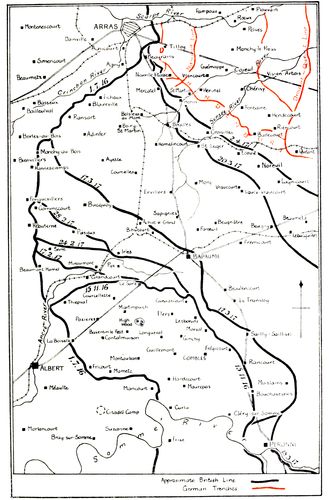
The Main Ridge of the Somme watershed runs east-south-east
from Thiepval, above the Ancre, across the
Albert-Bapaume Road, towards the Péronne-Bapaume
Road. About a mile and a half west of the latter road it
is completely severed by a narrow and deep ravine in which
lies the small township of Combles; and about half way
between Combles and Thiepval it is deeply indented by
a valley which separates the villages of Bazentin-le-Grand
and Bazentin-le-Petit, the head of this valley being
dominated by the high ground on which stands High
Wood. The ridge, therefore, divides itself into three
sections, all on the same general alignment, as follows:
In the west, from Thiepval, astride the Albert-Bapaume
Road to High Wood; in the centre, from High Wood to
the Combles Valley; in the east, the high ground about
Sailly Saillisel on the Péronne-Albert Road.
The German second system of defences followed roughly
the near side of the crest of this Main Ridge, including the
villages (from east to west) of Maurepas, Guillemont,
Longueval (with Delville Wood), the Bazentins and
Pozières. The third system lay on the further slope of
the ridge and included the villages of Morval, Lesbœufs,
Flers and Gueudecourt.
On the 14th July the British attacked the second
system on a front from Bazentin-le-Petit to Longueval.
This attack, which was successful, was pressed forward
to High Wood, of which practically the whole was captured,
and thus secured for us a footing on the Main Ridge,
dividing the German forces on the west and centre portions
of it. The advance was consolidated and rounded off
locally in the direction of Guillemont; but the new
positions formed an abrupt and narrow salient in our line,
and before a further advance to the German third system
could be contemplated it was necessary for the British
hold on the Main Ridge to be widened. It was considered
by G.H.Q. that the Pozières-Thiepval series of fortresses
at the western extremity of the ridge was too powerful to
yield to frontal attack, and it was therefore decided to
extend the hold on the centre portion of the ridge. This
postulated the capture of Guillemont, Ginchy and Combles,
and a swinging-up of the British right flank which rested
on the Combles valley. The French were to co-operate
on the right of the Combles valley by the capture of
Frégicourt and Rancourt. Combles itself, immensely
fortified and strongly garrisoned, was too formidable an
obstacle to be likely to fall into our hands by direct attack,
except at an appalling cost of life; and it was therefore
to be enveloped, the British advancing on the heights west
of it and the French to its east.
It is with this great outflanking movement for the
capture of Combles and the securing of the Main Ridge
immediately west of it that the 56th Division and the
Guillemont was first attacked on the 23rd July, but it
was not until after repeated attempts that it finally fell
into our hands on the 3rd September. On that day the
line was advanced to the outskirts of Ginchy and to the
Wedge Wood-Ginchy Road, Falfemont Farm falling to
us on the 5th.
Meanwhile local improvements had been made in our
positions in various parts of the line, and the bitter fighting
of August, though productive of no very deep advance
was of the greatest value. It not only widened our hold
on the ridge, but also by a series of unrelenting sledgehammer
blows had a cumulative effect on the German
morale and thus paved the way for the greater successes
of September.
The 168th Brigade continued training in the St Riquier
area until the end of August, the 1/4th Londons retaining
their billets at Le Plessiel. The training was rendered
peculiarly interesting by reason of the first appearance
of the "Heavy Section Machine-Gun Corps," better known
as Tanks. These engines of war, which were regarded at
first by the troops with a good deal of wonderment and
not a little misgiving, only arrived in France on the
25th August. No time was lost in testing them and
giving infantry troops an opportunity to co-operate with
them in practice prior to their employment in action.
The 56th Division received the compliment of being
one of the units selected by G.H.Q. to co-operate with
Tanks on the occasion of their first appearance in battle,
and accordingly a series of practice schemes was begun on
the 26th August, the Brigades of the 56th Division being
employed in turn. Needless to say the interest aroused by
the strange appearance of these iron monsters was intense
and speculation was rife as to their potential value in
action, not only among the troops, but also among the
many staff officers who were present at the demonstrations.
Unfortunately the time allowed for "tuning up" the
engines was inadequate, the result being that during the
first practices the Tanks showed a most undesirable
predilection for breaking down—a habit not calculated to
inspire with confidence the infantry who were expected
to follow them. However, these difficulties were largely
overcome, and by the 2nd September, when the 168th
Brigade's turn for practising with them arrived, the Tanks
were working well.
In spite of the misgivings as to the tactical value of
the Tanks which presented themselves to the minds of
those inclined to pessimism, their arrival undoubtedly
gave enormous encouragement to the troops who were
enabled at last to realise that the enemy were not always
to be first in the field with new inventions; and the
anticipation of a great surprise effect when the Tanks
should first appear before the enemy trenches brought all
ranks to the tip-toe of expectation. The strict injunction
which was issued to avoid mention of the Tanks in correspondence
was most loyally obeyed.
On the 2nd September a warning order was received
that the Division would move forward to the battle area,
and the following day the 168th and 169th Brigades moved
to the Corbie area. The Battalion left Le Plessiel in the
afternoon of the 3rd, marching to St Riquier, where it
entrained for Corbie, a town of some size at the confluence
of the Ancre and the Somme. Here the Battalion detrained
at 11.15 p.m., marching, with the Rangers, to
billets at Vaux-sur-Somme. The remainder of the Brigade
was accommodated a mile further forward at Sailly-le-Sec.
The Division now came under the orders of the XIV
Corps (Cavan), the extreme right of the British Army,
consisting of the 5th, 16th and 20th Divisions, which had
this day been operating on the Guillemont front in the
action already alluded to.
On the morning of the 4th orders were received, without
any previous intimation that they might be coming, for
the Battalion to move forward at once. The whole
Battalion, less personnel of the transport and vehicles,
marched out of Vaux-sur-Somme within one hour of the
receipt of these orders—a credit to the high state of
organisation to which the Battalion had been trained since
leaving the Hébuterne area. Boutall writes: "The
march was a long and tedious one and I think I am right
in asserting that not a single man fell out on the way. I
distinctly remember Lieut.-Col. Wheatley congratulating
himself on the fact."
This march terminated at a large concentration camp
known as the Citadel about two miles north of Bray. At
the Citadel the Battalion was able to form a vague idea
for the first time of the enormous effort being put forth
by the British in this already long drawn-out struggle.
The concentration camp covered an enormous area on the
rolling hillsides above the Somme and presented an
astounding spectacle of numbers of units from every
arm of the Service—gunners, infantry, engineers—besides
vast stores of materials of all kinds. The roar of the guns
in the inferno of the battle line seemed to speak to the
troops of the great and yet increasing power of the British
Armies, and filled every heart with hope and confidence.
To many of those who remembered the lean days of 1915
when the British battle line was starved for men and shells,
this first contact with the reality of the Empire's strength
was almost overpowering.
On the 5th September the Division took the place in
Corps Reserve of the 20th Division, which had been withdrawn
from the fighting line, and in the evening of the
same day the relief of the 5th Division in the line began.
The front taken over from the 5th Division was the
extreme right of the line from its junction with the
French, overlooking the Combles valley to the left of
Leuze Wood. The 169th Brigade (relieving the 15th)
took over the right sector and the 168th Brigade (relieving
the 95th) assumed responsibility in the left sector.
September had set in with steady rain which had
already converted all the roads, tracks and camping
grounds into seas of liquid mud. The Battalion, which
since arrival at the Citadel had been held at short notice
to move, advanced during the afternoon of the 5th, in full
battle kit in the direction of the line. The state of the
ground made marching an impossibility, and after sliding
along for some time uncomfortably in the mud, orders
were received for the Battalion to return to the Citadel.
The change of plan was, as usual, received with philosophical
resignation, and the men turned in to take
advantage of the short respite only to be roused again a
few hours later the same evening when the advance to
the line began at 11.15 p.m.
At this hour the Battalion, which with the Rangers
was in Brigade support, left the Citadel, arriving in its
allotted position in Casement Trench at 5.30 a.m. on the
6th September. This trench was now reduced to a series
of shell holes which the bad weather had rendered most
uncomfortable, and was a part of the original German
system opposite Maricourt.
The departure from the Citadel was marked by a most
unfortunate accident. As the column began to move the
explosion of a bomb which had been left buried in the mud
occurred at the head of D Company, and this very seriously
wounded Capt. A. L. Long, the company commander, and
2/Lieut. A. G. Sharp, and caused casualties to 19 N.C.O.'s
and men.
With the advent of daylight the Battalion first came
face to face with the ghastly desolation of the Somme
battlefield. In all directions every sort of landmark
seemed to be obliterated. A few torn stumps marked
what had been Bernafay and Trones Woods, the village
of Guillemont was practically effaced, and the only signs
of life in the neighbourhood of the Battalion were numerous
batteries of artillery in action. Here the nucleus personnel
left the Battalion and returned to the Citadel, where the
Q.M. stores were established. At 2 p.m. the Battalion
changed its position to Chimpanzee Trench in the neighbourhood
of the Brickfield, south of Bernafay Wood, and
here it received a foretaste of the German barrage. After
dark the forward move was resumed, and the Battalion
entered the support trenches in rear of Leuze Wood,
on the Wedge Wood-Ginchy Road, relieving the 4th
Gloucesters. This trench formed a "switch" in the
second German system which had fallen into our hands
on the 3rd September.
The disposition of the Brigade was now as follows:
- In front line, Leuze Wood:—London Scottish.
- In support, Wedge Wood-Ginchy Road:—1/4th Londons.
- In reserve, Maltzhorn Farm:—Rangers.
The Kensingtons were attached to the 169th Brigade, and were
in line to the south of Leuze Wood.
During the night the enemy's bombardment of the
front line and Wedge Wood Valley increased in intensity
and two platoons of the 1/4th Londons, under Lieuts.
Oldrey and Garratt, were ordered forward to reinforce
the Scottish in Leuze Wood. This advance was successfully
accomplished, the platoons managing to get through
an unpleasantly heavy barrage with only one casualty.
No enemy attack materialised, and towards dawn, the
hostile bombardment having subsided, the two platoons
rejoined the Battalion.
Throughout the 7th September and far into the night
the enemy shelled Wedge Wood Valley and the support
line heavily, and the Battalion suffered a good many
casualties, chiefly among ration and water-carrying parties,
while communication with Battalion Headquarters was
exceedingly difficult. The Wedge Wood-Ginchy Road
which ran immediately in front of the trench was sunken
at this point, and the bank was honeycombed with German
dugouts, among them one which had been used as an
aid-post, and which produced an ample supply of bandages,
lint and field-dressings, and also cigars and tobacco—trench
stores which were promptly taken on charge by the
Battalion.
The road itself was littered with German dead, the
remnants of the battle of the 3rd, who had apparently
been caught by our barrage, of the destructive nature of
which evidences were everywhere to be seen. "Unfortunately,"
writes an eyewitness, "the sunken road was
an attraction to countless flies in the daytime. So
numerous were they that from the road arose a continuous
hum which was audible at a considerable distance. They
swarmed over into the trench and settled on our food in
such numbers that they often found their way into our
mouths at mealtimes."
During the afternoon of the 7th orders were issued for
the 56th Division to extend its front to the left by taking
over the sector held by the right Brigade of the 16th
Division. This consisted of a trench following the Leuze
Wood-Guillemont Road, from near the north corner of
Leuze Wood, for about 500 yards to the left. This relief
was to be effected by "side-stepping" the 168th Brigade
to the left, its trenches in Leuze Wood being handed
over to the 169th Brigade. In pursuance of this
scheme the Battalion took over with A and D Companies
the advanced front line—about 200 yards' frontage
on the immediate left of Leuze Wood—from the 7th
Inniskilling Fusiliers. Immediately after relief these companies
began to dig assembly trenches for the impending
continuance of the offensive, and this task was completed
before dawn on the 8th September. The Rangers meanwhile
had come up in line on the left of the 1/4th Londons,
while the Scottish on relief in Leuze Wood by the 169th
Brigade had withdrawn into Brigade support, where they
were joined by the Kensingtons.
The 8th September was occupied in improving the
assembly trenches, and in establishing an advanced report
centre in a German dugout at the south-west corner of
Leuze Wood—by now corrupted by the ever-ready wit of
the Cockney into "Lousy" Wood—while under cover of
darkness the Cheshire Pioneers connected the Wood with
Wedge Wood by a communication trench. In addition a
great deal of work was carried out in collecting advanced
dumps of tools, bombs, ammunition and water, in the
west edge of Leuze Wood. All this work was effected
under very heavy shell fire under which the Battalion
sustained some loss.
Orders had now been received for the resumption of
the offensive on the 9th, and during the night the 1/4th
Londons and Rangers occupied their newly dug assembly
trenches, while the Kensingtons advanced to the Wedge
Wood support trench, the Scottish remaining at Maltzhorn
Farm. The advanced report centre in Leuze Wood was
taken over by the 1/4th Londons and placed under charge
of Capt. Houlder (17th Londons attached). Capt. Houlder,
who could speak German fluently, was instrumental during
the action in gaining from prisoners much useful first-hand
information which he was able to pass back to Battalion
and Brigade Headquarters. The terrifying aspect of this
huge British officer, coupled with the fact that he always
had a loaded revolver conspicuously displayed during his
investigations, no doubt increased the desire of his victims
to respond to his enquiries!
The battle of the 9th September was an attack on the
whole front of the Fourth Army, the French co-operating
on our right. The object of the XIV Corps, of which the
56th and 16th Divisions were in line, was to advance the
British positions from the Combles valley on the extreme
right well to the east of Leuze Wood on a line running
from south-east to north-west as far as the Ginchy-Morval
Road, which formed the left of the 56th Division front.
From this point the 16th Division was to reach a line
which ran due west for some 800 yards along the road
towards Ginchy and then bent northwards to include the
whole of the village.
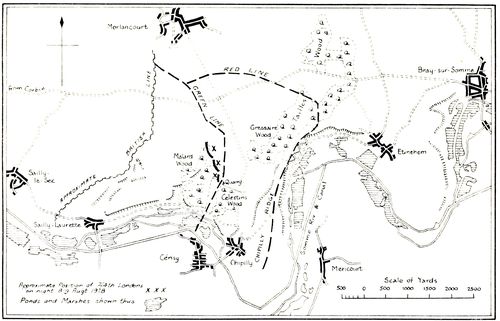
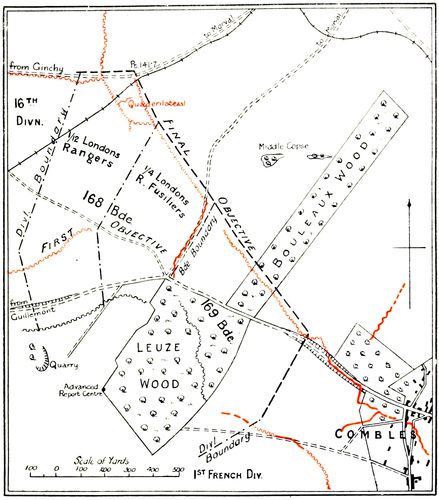
Map No. 5 shows the objectives of the 56th Division,
the 169th Brigade on the right being responsible for forcing
our lines forward of Leuze Wood on its north and east
sides; and the 168th Brigade continuing the line as far as
Point 141·7 on the Ginchy-Morval Road. The map also
indicates that nearly every battalion taking part in the
assault would have to make a change of direction from its
starting point in order to advance to its objective.
So far as the 168th Brigade was concerned the advance
was to be made in two stages, the first objective being a
line of German trenches, running from the north corner of
Leuze Wood towards Ginchy, and the final objective being
as above described. For this purpose the dispositions of
the Brigade remained as they had been on the eve of the
battle, that is:
| Right |
Assaulting Battalion |
—1/4th Londons. |
| Left |
do. |
—Rangers. |
| Support |
Battalion |
—Kensingtons. |
| Reserve |
do. |
—London Scottish. |
The 1/4th Londons were disposed for attack as follows:
- Right—B Company (Lieut. H. W. Vernon).
- Centre—D Company (Lieut. G. H. Davis).
- Left—A Company (Capt. J. R. Webster).
- Support—C Company (2/Lieut. W. E. Osborne).
Each company occupied a two-platoon frontage, so
that the whole Battalion was on a front of six platoons
and in a depth of four waves.
The morning of the 9th September dawned mistily,
but by 10 o'clock the sun's rays had dispersed the haze
and disclosed to the enemy the new earth thrown up in
front of our hastily dug assembly trenches. A heavy
bombardment of the assembly areas on the whole Divisional
front followed, lasting all the morning and causing
a good many casualties. The assaulting companies having
already formed up over night, the trenches were crowded
with troops waiting for the hour of attack, and the experience
of having quietly to endure this remarkably
accurate and heavy shoot was one of the most trying of
the whole engagement.
At 4 o'clock the enemy put down a heavy barrage on
our lines. A quarter of an hour later our preparatory
bombardment, which had opened at 10 a.m., increased to
"hurricane" intensity, and for half an hour the German
positions were subjected to a frightful ordeal under which
it seemed that nothing could live. At 4.45 p.m. the
British columns, on a front of several miles, moved to the
assault.
The 1/4th Londons on getting out of their assembly
trenches had to make a change of direction, pivoting on
their right flank, and this accomplished, they moved
forward steadily, keeping well up to their barrage and
suffering comparatively little loss.
In consequence of the conflicting reports which were
received during the action, the heavy toll of casualties
in all ranks, and the resultant intermingling of companies
in the positions gained, it has been a matter of considerable
difficulty to elucidate the position and to extract from
the mass of evidence a fair and impartial account of what
really occurred.
It seems evident, however, that the position marked
as the 1/4th Londons' first objective was innocent of the
trench which it was expected to find there. At all events
if a trench had ever existed on the line of the Leuze Wood-Ginchy
track it had been so battered by shell fire as to be
no longer recognisable as such; and it appears that the
greater part of the assaulting companies overshot the
mark and moved straight on to what was really the second
objective, which they occupied under the impression that
it was the first objective. It had been arranged that
A Company on the left should consolidate a strong point
on the left of the real first objective at its point of junction
with the sector to be captured by the Rangers. Evidently
2/Lieut. Brodie, to whom was allotted this task, in making
his change of direction to the right took a somewhat wide
sweep and struck the east end of the Rangers' first objective,
where a trench did actually exist, and here he formed
his block practically in the position where it was intended
to be. Subsequently Brodie, finding himself, no doubt,
out of touch with the remainder of the Battalion, who had
gone too far, came forward in the attempt to clear up the
situation, but unhappily was killed, together with all
his men.
The too rapid advance of the Battalion naturally
brought them under the fire of our own barrage, and
during the forty minutes' pause which was ordered after
the capture of the first objective before the resumption
of the advance on to the second, a good many casualties
did in fact occur from our own shells which were dropping
in and uncomfortably close to the trench which was
occupied. This trench—the real second objective—was
subsequently known as Bully Trench. We will therefore
so refer to it in order to avoid confusion.
At 5.25 p.m. the Battalion, now including elements
of all companies, once more advanced in a commendably
steady manner on to a trench just topping the rise of the
Main Ridge. This it occupied with very little opposition.
This advanced position—Beef Trench—was an isolated
trench about 150 yards ahead of Bully (the real second
objective) with both flanks in the air. It was shallow
and evidently only in course of construction. It afforded
magnificent observation over the rearward slopes of the
Main Ridge on to the German third line system in front
of Morval, and in this position the work of consolidation
was begun, two Lewis gun posts being pushed forward
overlooking the Morval-Lesbœufs Road. Middle Copse, a
small spinney about 200 yards to the front, was seen to be
teeming with Bosche who were effectively dealt with by
our Lewis guns.
In the meantime the right platoon of B Company under
2/Lieut. Garratt, which, in keeping touch with the Queen
Victorias, had got ahead of the rest of the Battalion, had
evidently become deflected slightly to the right during
its advance and had dropped into the communication
trench connecting Leuze Wood with Bully Trench. Apparently
somewhat confusing his direction in the total
absence of landmarks, Garratt moved along this trench
and turned the corner to the left along Bully Trench.
Here he came in contact with a Bosche bombing party,
and attacking them vigorously pushed them back for some
considerable distance, and eventually constructed a temporary
block in the trench, probably about the centre of the
Battalion's sector, i.e. about 200 yards short of the Quadrilateral.
In this bomb fighting the men of B Company
displayed great courage and dash, and their accurate
throwing contributed largely to their success. Among these
gallant men Corpl. Udall was conspicuous, and for his
devotion to duty he was awarded the Military Medal.
During the advance of the assaulting companies of
the Battalion from Bully Trench to the advanced position
in Beef, a somewhat determined attack was delivered
against B Company's block by a large party of the enemy
led by an officer. Fortunately the shallowness of the
trench exposed the enemy's advance and after a brisk
exchange of bombs, in the course of which some loss was
inflicted on the attacking party, including the officer who
was shot by Garratt, the survivors surrendered with the
exception of a few who fled pursued by the fire of our men
and the Rangers. Garratt was subsequently awarded
the Military Cross for his good work.
On the Battalion's left the Rangers, whose line of
advance was dominated by the Quadrilateral and a small
spur running from it in a south-westerly direction, had
been faced with a withering machine-gun fire under which
advance was utterly impossible. Their left company was
unable to make progress, and by 8.30 p.m. was compelled
to withdraw to its assembly positions in conjunction with
the right Brigade of the 16th Division who had also been
unable to overcome the German resistance. The right
company of the Rangers pushed gallantly forward losing
heavily, but was finally brought to a stand in the vicinity
of the temporary block which was being held in Bully by
Garratt. Here they were forced to take such cover as shell
craters afforded them, and to reply to the Bosche fire, in
which they were assisted by the party of B Company at
the block. Under the gathering darkness a good many
of the Rangers were able to make their way into Bully
trench.
While all this was taking place two companies of the
Kensingtons had occupied the assembly trenches vacated
by the 1/4th Londons, and the commanders of these,
appreciating the situation of the Rangers, at once made a
gallant attempt to fill the gap on the left. Their gallantry,
however, cost them dear, and the German barrage took a
heavy toll of casualties before they reached Bully Trench.
The bravery of Major Dickens was in particular remarkable.
Mortally wounded some time before he reached his
objective, he continued to advance at the head of his men,
cheering and encouraging them until he collapsed into
the trench. Later in the evening the two remaining companies
of the Kensingtons were also thrown into the fight
and became absorbed into the 1/4th Londons' position in
Bully Trench.
Darkness had now fallen, and the position of the companies
in the advanced trench was far from happy. Both
flanks were in the air and heavy losses had been suffered;
of the officers who had started with these companies, only
four—Cooper, McCormick, Quennell and Burford—were still
standing. News from Garratt showed that he was doubtful
as to whether he could hold out against another attack.
Fearing to lose the advantage already gained, Cooper,
who had assumed command of the force in Beef Trench,
decided to reoccupy Bully temporarily, and finally clear it
of the enemy. The withdrawal was successfully accomplished
in the dark, but the enemy was found to be firmly
established with an apparently ample supply of bombs on
his side of the block, which had now been completed with
the help of the Kensington and Ranger reinforcements;
and further attempts to extend our gains northward in
Bully were abandoned. Communication being now re-established
with Battalion Headquarters, orders were
received in Bully for the reoccupation of the advanced
positions in Beef; and the Bully position being now much
strengthened by Rangers and Kensingtons, the 1/4th
Londons moved forward alone to Beef Trench.
During the remainder of the night a good deal of work
was necessary in reorganising the somewhat mixed force
by which the forward position was now occupied. One or
two enemy patrols approached the position but were fired
on and dispersed, and apart from continued shell fire and
sniping the night passed comparatively peacefully.
Captain Cooper gives the following account of a remarkable
incident which occurred during the night:—
A glow was seen in a shell hole some distance to the
front and on investigation this proved to be from the
cigarette of a battalion N.C.O., a corporal (Fergusson),
who had formed part of one of the forward posts. He
had become separated from his men and wounded in the
back so that he was unable to walk. He stated that he
had been uncertain of his position and so had crawled
into a shell hole. A Bosche patrol had found him and
removed his shoulder badges and taken the contents of
his pockets, but had propped him up in a comfortable
position and had left him his water-bottle, cigarettes and
matches. He was calmly and coolly enjoying a cigarette
when found. He was sent on a stretcher to the Aid Post.
While these events were taking place on the Battalion's
front, the Queen Victorias, the left of the 169th Brigade,
had occupied their objective, and were in touch on the
right of Bully. The enemy, however, had hitherto successfully
resisted all efforts of the London Rifle Brigade to
emerge from the east side of Leuze Wood. At about 7 p.m.
the Bosche at this part of the line had launched a vigorous
bomb attack along the sunken road leading from Combles,
and the L.R.B. had been forced back after a most stubborn
resistance which cost them heavily. During the night the
Queen's Westminsters took over the extreme right of the
Division.
The 16th Division on the left had also met with varied
fortunes. The 47th Brigade on its left had successfully
advanced through Ginchy and established itself on its
objective; but the right brigade, the 48th, whose objective
lay along the Ginchy-Morval Road, met with most stubborn
resistance from the spur already referred to. In spite of
the most gallant efforts the Brigade was unable to make
progress, and eventually fell back with the left wing of the
Rangers at about 8.30 p.m. and reoccupied their original
position on the Wedge Wood-Ginchy Road. About this
time the London Scottish were ordered into the fight in
order to endeavour to clear up the situation in this part of
the field. After the march forward from Maltzhorn their
preparations were completed at about midnight, and
shortly after they attacked from a position to the left of
the Rangers' assembly trenches towards the Quadrilateral.
The enemy was still vigorous in his defence, and after losing
their direction in the intense darkness, the Scottish were
ultimately withdrawn, having first rendered a good account
of themselves in a lively little hand-to-hand fight with a
party of the Bosche. During the night the 16th Division
was relieved by the 3rd Guards Brigade.
Shortly after dawn on the 10th 2/Lieut. McCormick,
who had come back to Battalion Headquarters with a
report of the situation, returned to Beef Trench with
orders for the immediate evacuation of the advanced
position. Accordingly, after establishing two Lewis gun
positions in Beef Trench, the withdrawal was proceeded
with as rapidly as possible, the activity of the German
snipers in the growing daylight making movement difficult
except in the smallest parties. The return of the 1/4th
Londons to Bully Trench caused congestion which was
subsequently intensified by the arrival of a large reinforcement
of London Scottish. This Battalion made efforts
during the day to prolong the line in the direction of the
Quadrilateral, while the Guards, working eastward along
the Ginchy-Morval Road, sought to join hands with them,
but the Germans were well supplied with bombs and put
up a very gallant resistance. The continued occupation
of the spur—which on the previous day had stopped the
16th Division—moreover forced an unpleasantly deep re-entrant
in the British line, leaving the left flank of the
1/4th Londons dangerously exposed. An effort to rout
out the pertinacious defenders of this spur was made
during the afternoon by the 168th Stokes mortars, who
fired 35 rounds with good effect into the enemy trenches.
The position on the right flank of the Battalion was
still less satisfactory than had been hoped for. At 7 a.m.
and again at 3 p.m. the Queen's Westminsters had made
local attempts to gain the previous day's objective, but
each time without success.
Throughout the day the Battalion's position was kept
under heavy German shell fire which caused the already
heavy casualty roll to mount higher and higher, and it was
found necessary to relieve the congestion in Bully by withdrawing
the Rangers and Kensingtons to the rear. Communication
with Headquarters was rendered exceedingly
difficult, though, as always, there was no lack of brave
volunteers to try to pass through the German barrage, and
these in some cases succeeded in reaching the report centre
in Leuze Wood. Moreover the trench, only a shallow and
half-finished work to start with, was becoming badly
shattered and was filled with wounded men, whom there
was no means of evacuating, for all the stretcher-bearers
with companies had themselves become casualties.
Throughout this trying day all ranks displayed magnificent
spirit and clung to their hardly won gains with grim
determination. That night the 168th Brigade was relieved,
the 1/4th Londons handing over their objective
to the 8th Middlesex of the 167th Brigade. Following
the relief, which was complete by midnight, the Battalion
moved by companies—by now sadly reduced in numbers—to
Casement Trench, whence the Battalion moved as a
unit to Billon Farm, near Carnoy, arriving in bivouacs
there at 5.30 a.m. on the 11th September.
The Battle of Ginchy, September 1916
The five days' duty just completed were perhaps the
most strenuous the Battalion had yet experienced. Almost
all the time exposed to bad weather conditions and to
very heavy and accurate artillery fire, the spirit of the
men was magnificent; and their steadiness, after the loss
of 15 out of the 20 officers who led the companies into
action, as well as a large proportion of N.C.O.'s, was
unsurpassed. Their fighting qualities too were firmly
established, for they had taken their objectives up to
time-table and handed them over intact twenty-four
hours later. The total casualties during the five days
amounted to 22 officers and about 250 other ranks.
The officer casualties were as follows:
7th and 8th September—Capts. F. O. J. Read and H. G. Stanham,
2/Lieuts. W. Richards, A. Potton, J. T. Middleton, C. H. T.
Heaver and L. W. Archer, wounded.
9th and 10th September—Capt. J. R. Webster, 2/Lieuts. C. J.
Brodie, F. J. Foden, W. E. Osborne, C. E. Lewis, C. S. G.
Blows and C. F. Mortleman, killed; Lieuts. H. W. Vernon
and G. H. Davis, 2/Lieuts. J. W. Price, V. R. Oldrey, C. F.
English, N. A. Ormiston and J. C. Graddon, wounded; and
2/Lieut. W. H. Davey, D.C.M., missing, presumed killed.
Throughout the 11th and 12th heavy fighting continued
in which the 167th Brigade co-operated with the Guards
on the left in numerous efforts to clear out the re-entrant
and reach the Ginchy Quadrilateral. This magnificently
defended position, however, held out against the most
gallant attempts of the attackers. During the night of
the 11/12th September the 167th Brigade was also relieved,
the line being taken over by the 16th Brigade of
the 6th Division.
The Battalion remained at Billon Farm for three most
welcome days of rest and reorganisation during which the
weather, which now once more became fine and warm,
was of inestimable value in cheering the troops after their
somewhat trying experience. The relief to the men's
spirits on emerging even for a short spell from the
ghastly featureless waste of the battle area to surroundings
where trees still bore their leaves, roads still crossed the
hillsides, and houses were not completely effaced, was
immense; and by the time the period of rest was over
the Battalion was once more braced up to continue the
struggle.
One or two changes occurred during this period among
the officers of the Battalion, of which the most important
was the assumption of the Adjutancy by Lieut. W. J.
Boutall on the evacuation to hospital of Capt. R. L. Herring,
who had occupied this trying position practically since
the Battalion joined the 56th Division. 2/Lieut. Garratt
assumed the duties of Assistant Adjutant almost immediately
afterwards. Capt. J. T. Sykes left the Battalion for
attachment to the Indian Army, and the signalling
officer, Lieut. E. W. Monk, to join the R.A.F. The latter's
duties were taken over by 2/Lieut. S. J. Barkworth, M.M.
In addition to these 2/Lieut. A. C. Knight was evacuated
to hospital.
The renewal of the offensive was not long to be delayed.
The object of the High Command was to follow up the
blows delivered against the German positions as rapidly
as possible, and to leave the enemy little respite for
reorganisation and rest. The constant hammering on his
defences had already had an appreciable effect on his
morale, and it was hoped that before long the strain on
his resources would prove so great that the situation would
develop rapidly in favour of the Allies.
The next general attack was arranged for the 15th
September, the assault being launched on the whole battle
front from Morval to Le Sars on the Albert-Bapaume Road.
The great pivoting movement by which the British right
flank was to be swung forward in line with the left on the
Main Ridge had now reached an important stage, and the
operations of the XIV Corps were now more than ever
bound up with the fortunes of the French south of Combles.
The French were aiming at establishing themselves astride
the Bapaume-Péronne Road at the village of Sailly Saillisel,
about two miles north-east of Combles; but the task presented
unusual difficulties owing to the restriction of the
lines of possible advance between the deep Combles ravine
on the one flank, and the extensive wood of St Pierre
Vaast on the other. The evils of this confinement were
aggravated by the fact that the enemy position about
Morval at the extreme east end of the Main Ridge
dominated the whole of our Allies' line of advance. It
was therefore essential to the success, not only of the
French in their ultimate object but also of the combined
"squeezing-out" process which was being applied to
Combles itself, that the British should at once possess
themselves of such portions of the Main Ridge as remained
in the enemy's hands. This entailed the breaking of the
Third German system on the line Morval-Lesbœufs-Flers,
and this was the task of the XIV and XV Corps on the
15th September.
The positions held by the Division at the opening of
the battle were as follows:
167th Brigade—On the line north of Leuze Wood and intersecting
the south end of Bouleaux Wood which had
been captured on the 9th by the Queen Victorias,
and thence along the south-east edge of Leuze
Wood for about half its length.
169th Brigade—On the right of Leuze Wood, in a line running due
north and south, between the 167th and the
French.
168th Brigade—In reserve bivouacs in Angle Wood Valley, the
Battalion being at the head of the Valley near
Wedge Wood.
The position which the Battalion had captured on the
9th September was now held by the 6th Division, who
formed the centre of the Corps while the Guards were on
the extreme left.
The general idea of the attack was that the Guards and
6th Divisions should attack positions in the German third
line facing Lesbœufs, while the 56th Division was to form
a defensive flank facing the Combles ravine.
To establish this defensive flank the 169th Brigade on
the right was to push forward of Leuze Wood and occupy
a position roughly north and south with its left flank
astride the sunken road from Combles, about 300 yards
east of the edge of Leuze Wood. The 167th was to clear
Bouleaux Wood in two stages and establish a line parallel
to and about 100 yards in front of its east edge. The
1/4th Londons were to follow up the advance of the 167th
Brigade and then "leapfrog" through it on to the German
third line immediately in front of Morval whence they
would connect up between the left of the 167th Brigade
and the right of the 6th Division.
The 15th September was on the greater part of the
battle front a day of big successes. At an early hour
Flers fell before our assault, and by the afternoon the
British line had been pushed far beyond it; the whole of
High Wood was taken, and before nightfall Martinpuich
and Courcelette on the left had been added to the gains
of the day.
On the extreme right, however, the advance suffered a
rather severe check. The Guards, who occupied the left
of the Corps front, were able to make solid advances
between Flers and Lesbœufs, but the 6th Division adjoining
them were held up by the Quadrilateral at Ginchy, whose
brave defenders still maintained their position most
stubbornly; and this failure naturally reacted on the 56th
Division who occupied a narrow wedge between the Quadrilateral
and the Combles ravine.
At 5.50 a.m. the three tanks which were to make their
début with the Division left their departure points for the
first objective, and at 6.20 a.m. the infantry assault was
launched. Almost three hours later, at 9 a.m., the 1/4th
Londons left their bivouacs in Angle Wood Valley and
moved forward in artillery formation towards the battle
position on the crest between the north edge of Leuze
Wood and the west face of Bouleaux Wood. Progress
was not rapid owing to the heavy state of the ground, and
under the German shell fire a good many casualties were
sustained. The advance was made, however, in good
order, and with admirable steadiness.
The 169th Brigade made very slight advances on the
south of Leuze Wood; while the 167th managed to secure
the part of its first objective which lay outside Bouleaux
Wood. The 8th Middlesex of the latter Brigade even
made a heroic attempt to reach the second objective, but
had to be brought back. The enemy barrage was heavy
and fell, as it so often had in the Somme battles, between
the assaulting columns and their starting-point, thus
cutting them off from supplies and reinforcement, while
the accurate intensity of their machine-gun fire from
their positions in the Quadrilateral made advance an utter
impossibility. After ten hours' fighting, during which the
assaulting Brigades did all that men could do, the Corps
Commander telephoned to Gen. Hull that the Division
would make no further attempt against Bouleaux Wood
that day.
The 1/4th Londons luckily avoided the slaughter of the
battle line this day, for a few minutes prior to its advance
from Angle Wood Valley an order had been despatched to
Brigade Headquarters to the effect that in consequence of
the check of the 6th Division in front of the Quadrilateral
the 168th Brigade would not occupy its battle position.
This order was transmitted by Brigade and reached the
Battalion during its advance. Upon receipt of it the
Battalion was at once brought back to its assembly area
at Angle Wood Valley where, in common with the remainder
of the Brigade, it remained in bivouacs till the
early hours of the 18th September. This operation cost
the Battalion a large number of casualties among N.C.O.'s
and men from the German shell fire, and one officer,
2/Lieut. J. W. Chapman, wounded.
During these days Angle Wood Valley was a distinctly
unhealthy locality. The German artillery maintained a
searching fire over the whole area, and exacted a fair toll
of casualties. The weather, which a few days previously
had shown signs of mending, had once more turned wet
and the shell holes, which formed the only available cover,
became not the most desirable resting-place for the troops.
The strain was great, but the situation was as usual not
only borne by all in the Battalion with an almost stoical
resignation, but enlivened occasionally with those rare
flashes of humour which have made the London soldiers
famous during the War in three continents.
The story of the tanks on the 15th September is too
well-known to need elaboration here, and is, moreover, too
much outside the actual experience of the Battalion to
allow of more than a passing reference. The moral effect
on the Germans was immense, and considering that their
employment had scarcely passed the experimental stage,
the success gained by them was conspicuous. As was
anticipated, however, the tanks promptly became a mark
for a tremendous concentration of enemy fire which made
their room far more desirable than their company. Of
the three attached to the 56th Division one did useful work
in the vicinity of the Quadrilateral, and after trampling
down a good deal of wire and putting an enemy machine-gun
team out of action returned to make a personal
report of its adventures. The careers of the other two
were sadly abbreviated, and the end of the day found
them derelict—one west of Bouleaux Wood, and one
south-east of Leuze Wood—though not before they had
dealt out a certain amount of destruction to the German
defences.
Orders were received while the Battalion remained in
Angle Wood Valley for the resumption of the offensive on
the 18th September. The objectives on the XIV Corps
front were on this occasion very much more modest than
they had been three days earlier, and so far as the 56th
Division was concerned were as follows:
169th Brigade—The sunken road from Leuze Wood to Combles,
between the east edge of the wood and the
orchard west of Combles.
67th Brigade—The east edge of Bouleaux Wood for a distance of
600 yards from its southern extremity, and
thence a line through the wood to Middle Copse.
From Middle Copse the objective was continued
in a northerly direction by the 6th Division.
The 168th Brigade remained in reserve in Angle Wood Valley,
but the 1/4th Londons and the London Scottish
were attached to the 167th.
For this operation the Battalion was detailed as the
left assaulting battalion of the 167th Brigade, its objective
being the portion between Middle Copse (which was held
by an advanced post of the 7th Middlesex) and the east
edge of Bouleaux Wood. For this purpose its assembly
position was the old German communication trench connecting
Bully Trench with the north corner of Leuze Wood.
The right of the Brigade frontage was taken up by the
3rd Londons.
The hour of assault was fixed for 6.15 a.m. on the 18th,
and to enable it to reach its assembly position by 5.15 a.m.
as ordered, the 1/4th Londons moved from Angle Wood
Valley at 3.30 a.m. But the ground was impossible. All
vestige of tracks had long since disappeared, and the
countryside in every direction was a vast slippery quagmire
in which so far from keeping any sort of march formation
it was next to impossible for the men, laden as they were
with battle equipment, to stand upright at all.
Zero hour arrived, but the Battalion as well as the 3rd
Londons was still slipping and struggling a long way
short of its assembly area. The British barrage opened
and was at once replied to by a withering machine-gun
fire by the enemy. Seldom has the Battalion been exposed
to so accurate and devastating a fire. The only alternative
to complete destruction was to take cover in the waterlogged
shell holes, which movement was carried out with
alacrity by all ranks: in this unexpected position an order
reached the Battalion abandoning the attack and recalling
it to Angle Wood.
On the right the much suffering 169th Brigade was
able to achieve a series of local bombing successes which
carried their line appreciably nearer Combles. From the
6th Division on the left, shortly after midday came the
cheering news that the Quadrilateral had at last fallen,
together with the trench to the north of it.
This important success, which had so long eluded the
grasp of the successive Divisions who had sought it, paved
the way for the magnificent achievements of the 25th
September, which will be recounted later, its especial
importance being that it was practically the last heavily
fortified stronghold on the central portion of the Main
Ridge to resist the British attacks.
The abortive operation of the 18th cost the Battalion
a good many casualties in N.C.O.'s and men, and one
officer, 2/Lieut. W. H. Calnan, wounded.
The same evening the 168th Brigade relieved the 167th
in the Leuze Wood trenches, the London Scottish occupying
the front system, which comprised Beef and Bully Trenches.
The 1/4th Londons took over from the 3rd Londons the
support line, which ran diagonally through Leuze Wood
in a north and south direction. Leuze Wood was at all
times an unhealthy locality and formed an unfailing source
of attraction for every conceivable sort of German
projectile. The 3rd Londons had already suffered heavily
here, and the night of the relief proved to be no exception
to the rule. Throughout the evening the wood was
plastered with high explosive shell, and even the inadequate
shelter of the trenches hastily dug, damaged and waterlogged
as they were, was exceedingly welcome. The
position was, without exception, the muddiest that had
yet fallen to the lot of the Battalion. "To stand still,"
writes a company commander, "was to sink gradually
until the whole of the legs to well above the knees were
immersed and movement was correspondingly difficult."
Lewis guns and rifles had become choked with mud so as
to render the Battalion practically defenceless, but with
much labour they were cleaned, and some rations which
were found in the trench distributed. Dawn broke on a
chilled but yet remarkably cheerful Battalion. The continued
strain of heavy shell fire and conditions of physical
misery were, however, beginning to have their effect, and
several men who in earlier actions had given ample proof
of their courage, collapsed. "One man of D Company who
had previously shown himself one of the stoutest-hearted,
lost his mental balance and suddenly became possessed
of the idea of killing all the Germans in the German Army,
and had to be forcibly restrained from mounting the
parapet. 2/Lieut. Barkworth, who came up from Battalion
Headquarters, succeeded by sheer strength of personality
in restraining him and getting him back to H.Q."
The 19th September was a day of comparative quiet on
the battle front, though shelling and sniping continued in
a desultory fashion. Rain fell steadily and the condition
of the trenches, appallingly bad to start with, became so
wretched as to defy description.
During the night of the 19th a large working party of
the 5th Cheshire Pioneers, under the supervision of the
Brigade Major (Capt. R. E. Neame, V.C., D.S.O., R.E.),
and covered by a screen of one and a half companies of
the Scottish, dug a new trench 800 yards long. This new
work, Gropi Trench, ran forward from Beef Trench towards
the German line, parallel to the west edge of Bouleaux
Wood, as far as the Morval tram-line. The task was
successfully completed before dawn, but with the advent
of daylight and the consequent exposure of the newly
turned-up earth, the whole brigade area was again subjected
to a heavy bombardment by the enemy's artillery.
The German snipers again became particularly active, and
every rash movement was promptly punished. Under
this gruelling there was nothing for the Battalion to do
but to keep quietly in its trenches and make the best of
an unpleasant state of affairs. That night the Kensingtons
came forward from Angle Wood Valley and took over the
support line from the Battalion, and also Bully Trench in
front of it. The relief was completed by 9.30 p.m., and
never was relief more welcome. The Rangers at the same
time took over the Beef and Gropi system from the London
Scottish. On withdrawal from the trenches the Battalion
moved by companies to bivouacs at Falfemont Farm,
arriving there at 10.45 p.m.
No further movement was made during the 21st and
22nd September, and these two days were fairly quiet as
the principal target for the German guns was provided by
the numerous British batteries in Angle Wood Valley,
which received heavy punishment.
Between the 20th September and the 2nd October the
following reinforcements joined:
Capt. R. N. Keen, Lieuts. W. H. Vernon and A. Bath, 2/Lieuts.
C. A. Speyer, C. Potter, W. R. Gifford, H. W. Spiers, L. C.
Haycraft, L. J. R. Atterbury, C. P. Russell, T. R. Fletcher
and S. A. G. Richardson.
2/Lieut. T. Siddall (25th Londons).
100 N.C.O.'s and men.
A few days after joining Lieut. A. Bath and 2/Lieut. C. P.
Russell were evacuated, the former with a broken ankle,
the latter sick.
The men of this draft represented so far as the 1/4th
Battalion was concerned the firstfruits of the "Derby"
scheme, and it must always be a matter for regret that
the dreadful losses already incurred by the Battalion made
it inevitable to pitchfork this fine material straight into
the inferno of the Somme without any opportunity for it
to become previously assimilated into the ranks of the
Battalion. The Somme battles were a severe ordeal even
to the most veteran soldiers; and the bearing of these
young and inexperienced troops in the trials of the latter
half of the Battalion's Somme fighting stands to their
lasting credit.
As we have already remarked, the Cockney soldier,
however wretched his conditions, is never so depressed by
his surroundings as to be unable to find humour in the
situation of the hour. The Battalion had now spent seven
consecutive days in the desolation of the battle area
practically without shelter from the pitiless torrents of
rain which combined with the German shells to churn the
whole surface of the ground into a disgusting glutinous
mass; the troops were soaked to the skin and plastered
with mud from head to foot; but the unconquerable
spirit of cheerfulness held them together, dirty and
dishevelled as they were, a well-knit and disciplined
fighting unit. The condition of the ground, which added
so vastly to the labours of the troops, is illustrated by a
story told by an officer who was present:
A man attempted to cross the valley and started to
plough his way through the mud, but rashly omitted
to lace up his boots, which he had previously removed.
His negligence was quickly visited upon him, for scarcely
had he begun his journey when the mud claimed one
of his boots, which became stuck fast. His powers of
balance were unequal to the task of putting his foot back
in the boot, and he toppled over, both his hands becoming
firmly embedded. His efforts to regain a standing
position were prolonged and violent, but after a time
successful, and finally, boots in hand, he proceeded on his
way amid the cheers of the onlookers, who accepted his
performance as being arranged for their especial amusement,
and were particularly interested in the man's lurid
observations on the subject of boots, mud and war
generally.
There were a few occasions, however, when circumstances
seemed too strong even for the 1/4th Londons,
and one of them occurred that night when the rum jars
which arrived with the rations were found, alas, to contain—lime
juice!
On the evening of the 22nd September the 168th
Brigade was relieved in the left subsector by the 167th
and the Battalion moved back to the comparative peace
of Casement Trench, where it occupied bivouacs until the
afternoon of the 24th, making preparations for the next
bout in the battle line.
The continuance of the offensive had been arranged
for the 21st, but the weather conditions placed such a
handicap on the chances of success that it was postponed,
first until the 23rd and again till the 25th September, when
once more the battle broke out on a front from the British
right at Combles to a point half-way between Flers and
Martinpuich. The French were to co-operate in this
attack on the right of Combles ravine. The objectives of
the XIV Corps included the villages of Lesbœufs and
Morval, and, as on the occasion of their earlier attempt on
the 15th, the 56th Division was to form a defensive flank
facing south-east over Combles.
A series of local bombing operations was conducted on
the 24th by the 169th Brigade on the extreme right in
conjunction with the French, which gave them an increased
hold on Combles Trench immediately in front of
the village, and appreciably improved their jumping-off
positions for the following day. During the night also
the two tanks allotted to the Division moved forward to
their rendezvous in the quarry west of Leuze Wood.
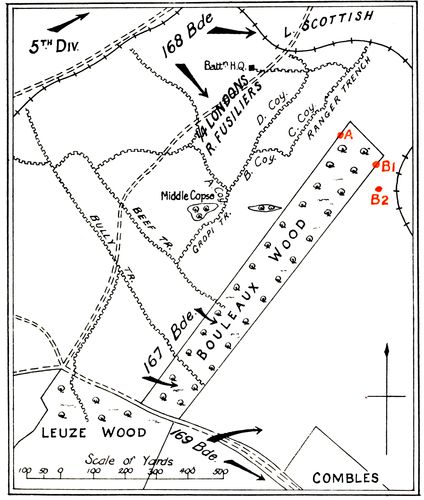
For the battle of the 25th the three Brigades of the
Division were all in line, the 169th on the right, with the
167th in the centre and the 168th on the left. The 1/4th
Londons were the right assaulting Battalion of the 168th,
their duty being to clear the northern end of Bouleaux
Wood and to establish a line of posts overlooking the
ravine, while the London Scottish on the left continued
the defensive flank in the direction of Morval (see
Map No. 6).
At 4.30 p.m. on the 24th the Battalion marched from
Casement Trench to occupy positions of assembly, relieving
the 7th Middlesex in the Gropi-Ranger system
as follows:
C Company—Left front, in Ranger Trench.
B Company—Right front, in Gropi Trench, and the small communication
trench leading forward to Ranger
Trench.
D Company—Support, in Gropi Trench.
A Company—Reserve, in the southern part of Gropi Trench and
Middle Copse.
Battalion Headquarters were established in a dugout west of the
north part of Gropi Trench and the Aid Post in the quarry
west of Leuze Wood.
The evening of relief was fortunately fairly quiet, but
owing to the complete obliteration of all landmarks some
difficulty was experienced by the guides provided for the
companies in locating the positions to be occupied. However,
Middle Copse was eventually reached, and this point
being gained a little prospecting discovered Gropi Trench,
after which the relief proceeded smoothly and was completed
without unusual incident. Gropi Trench, which
had been dug by the Cheshires, was found to be very well
constructed, and the excellent cover it afforded was the
means of sparing the Battalion a good many casualties
from the enemy snipers, who were active from the direction
of Bouleaux Wood during the morning of the 25th.
After a preliminary bombardment by all available
batteries the British attack opened at 12.35 p.m. on the
25th, but the 168th Brigade's positions being well in
advance of those occupied by the 5th Division on its left,
its attack was deferred until seven minutes later in order to
allow the 5th Division to come up into line. The creeping
barrage, under which the Brigade's advance was made,
was supplied by batteries firing from Angle Wood Valley,
and being thus in enfilade was particularly efficient and
accurate; and under its excellent protection the 1/4th
Londons and the London Scottish advanced steadily at
12.42 p.m.
The Battle of Morval, September 1916
The advance of the Battalion was led by C Company
(Grimsdell) in two waves at 50 paces distance, followed by
D Company (Cooper) in similar formation. B Company's
rôle was to conform to the advance and protect the
Brigade's right flank against any possible hostile action
from the southern half of Bouleaux Wood, while A
Company in reserve moved forward to occupy the positions
vacated by the assaulting companies.
The Battalion reached its objectives in the northern
fringe of the Wood with little opposition, and with slight
loss, killing a large number of Germans in the western edge
of the Wood. A great many of the enemy were also put
to flight, and these were caught on the open hillside on
their way to Combles by the Lewis gunners of the Scottish
advancing on our left, who did great execution among
them. The consolidation of the strong posts allotted to
the Battalion at once began, but was considerably interfered
with by German snipers, who were still clinging to
their posts farther south in the Wood. Under their fire
Grimsdell (in charge of C Company) fell, shot through the
head. This harassing fire rendered communication with
Battalion Headquarters a matter of some difficulty, and
continued through the night, as the 167th Brigade on the
right had not been successful in pushing through the
southern extremity of Bouleaux Wood. By nightfall the
new posts were completed and occupied as follows:
- Post A—By 30 men and Lewis gun of C Company.
- Post B1—By 25 men of D Company.
- Post B2—By 30 men and 1 Lewis gun of D Company.
These posts were improved and wired by parties from
the Royal Engineers and the Cheshire Pioneers, while A
Company subsequently constructed an additional post in
the tram-line embankment north of the Wood.
Meanwhile the London Scottish had been equally
successful on our left, and had taken possession of the
German trench running north-east from Bouleaux Wood
in the direction of Morval; and farther still to the north
the Guards Division had captured Lesbœufs, while the
5th Division were hammering at the western outskirts
of Morval.
The positions now occupied by the Brigade were of
immense importance, as they secured excellent observation
over the northern exits of Combles; and information
received through the French from a German officer prisoner
being to the effect that the Combles garrison was making
preparations to fight its way out north-eastwards, the
further operations of the Brigade were directed towards
working round the north side of Combles and cutting off
its communication with Morval. This scheme naturally
affected the left flank of the Brigade more than the right
flank, on which the Battalion was posted.
Shortly after midnight the 167th Brigade gained a
foothold in Bouleaux Wood on the right of the Battalion,
and a reconnaissance made by Lieut.-Col. Wheatley soon
after dawn on the 26th showed that the Wood was finally
cleared of the enemy. Touch was rapidly gained with the
1st Londons and the line established in front of the east
edge of the Wood.
A few hours later definite information was received
that the enemy had evacuated Combles and that troops
of the 56th Division had entered it and had met in its
deserted streets patrols of the 56th French Division.
The remainder of the day passed quietly for the
Battalion, and a distinct lull occurred in the enemy's shell
fire, while owing to the clearance of Bouleaux Wood
the ground west of it, which had been on the previous
afternoon so much swept by snipers, was now quite
peaceful.
Combles having fallen into our hands the most immediate
need was to improve touch with the French and
carry the united line forward east of the village. Early on
the morning of the 26th Sept. the French captured Frégicourt
and succeeded in establishing themselves in touch
with the 169th Brigade south of Combles, thus securing
the whole of Combles Trench; while on the north of the
village they managed to push patrols forward towards the
sunken road leading to Morval. The road was occupied
by the Rangers who had orders to occupy if possible
the main German third line between Morval and Frégicourt.
This was found still to be strongly held and the
assistance of the Division's two tanks were requisitioned.
Unfortunately both these machines became badly
"ditched" before reaching their objective, and the
Rangers' attack was therefore abandoned.
That evening the Battalion was relieved in Bouleaux
Wood by the Kensingtons, and withdrew to Bully and
Beef Trenches with feelings of immense elation at having
contributed materially to this striking and solid success.
During the 27th September the trenches held by the
Battalion were heavily shelled, but no attempt was made
by the enemy to launch a counter-attack on the Brigade's
front, and the Germans were evidently content to accept
the loss of Combles as irretrievable. In the evening the
168th Brigade handed over its positions to the 2nd French
Division, and the Battalion, without relief in Bully and
Beef Trenches, withdrew to Casement Trench.
The casualties sustained by the Battalion during this
highly successful operation were remarkably few, amounting
to 2 officers (2/Lieuts. R. E. Grimsdell, killed, and
E. McD. McCormick, wounded), and about 30 N.C.O.'s
and men killed and wounded.
During the evening of relief reports of the full success
of the battle of the 25th September reached the Battalion,
including the splendid news of the fall of the famous series
of German redoubts on the Thiepval Ridge. This welcome
intelligence, combined with the knowledge of the Combles
success, put all ranks into the highest spirits, and created
the pardonable expectation that a "break-through" on a
large scale was imminent. How premature these high
hopes were the Battalion was to learn to its cost on the
7th October.
Mention should be made here of the tasks performed
by R. S. M. Harris during the period the Battalion was
operating in the Leuze Wood and Bouleaux Wood area.
He was responsible for organising all carrying parties
up to advanced Battalion Headquarters with water,
rations and munitions. These duties he carried out in
a highly praiseworthy manner, both he and his small band
of carriers being continually called upon day and night
to tramp up the long Angle Wood Valley, often in the
rain, on practically impassable tracks and more often than
not under shell fire. "As Adjutant," writes Boutall, "I
highly appreciated the assistance he gave me in thus
relieving me of a considerable amount of additional work
and anxiety. I do not remember a single instance during
this whole period when he failed us, in spite of the difficult
and heavy tasks we were obliged to impose on him."
Owing to the shortening of the line consequent upon
the fall of Combles, and the extension to their left of
the French, the 56th Division was now withdrawn and
moved out of the battle area, the Battalion marching
at 2 p.m. on the 28th Sept. from Casement to Ville-sur-Ancre,
where rough but welcome billets were occupied.
The Division's rest was destined to be short-lived, for the
following day a warning order was received that it would
take the place in the line of the 6th and Guards Divisions,
which had suffered considerably during a prolonged period
in action.
The Battalion at this stage was unfortunate in
losing Lieut.-Col. Wheatley. The prolonged exposure had
already undermined his health, and at this period he was
recommended a rest by the Medical Authorities. He
refused to go to hospital, and compromised by going to
the Divisional Rest Station, Major H. J. Duncan-Teape
taking command, but so keen was the Colonel to be with
his unit, that without having sufficiently recovered he
returned on October 2nd.
The sector to be occupied was about 2000 yards in
frontage, running in a north-west to south-east direction
through the eastern outskirts of Lesbœufs, and was taken
over on the evening of the 30th September with the
169th Brigade on the right, and the 167th on the left, the
dividing line being the Lesbœufs-Le Transloy Road. The
left subsector (or northern half of the line) lay just below
the crest of the ridge above Lesbœufs, and orders were
issued for the advancement of this part of the line to
positions from which direct observation could be obtained
over the German positions in front of Le Transloy, in
preparation for an early renewal of the offensive.
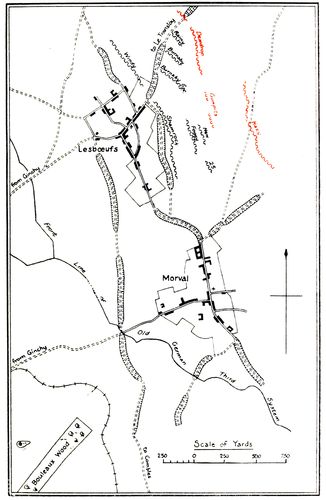
The Battle of the Le Transloy Ridge, October 1916
The 168th Brigade remained in Divisional reserve, and
on the morning of the 30th the Battalion, together with
the London Scottish, moved forward to their former
bivouac area between Trones and Bernafay Woods, the
Kensingtons and Rangers remaining at the Citadel.
The Battalion remained in the Trones Wood area
during the 1st and 2nd October, and a Brigade relief
having been ordered for the following day, moved forward
at 4.30 p.m. to Lesbœufs, relieving the 2nd Londons.
The positions taken over by the Battalion formed the
left subsector of the Brigade front and extended from
the Lesbœufs-Le Transloy Road, which formed the left
boundary, for some 800 yards southwards to the junction
with the London Scottish, who were in line on the right,
the latter battalion being the right flank of the British
Army. The Kensingtons moved into Brigade support in
the old Morval-Flers line, and the Rangers occupied
bivouacs at Ginchy.
The main position taken over by the Battalion was a
roughly constructed trench known as Shamrock, about
50 yards east of the sunken road leading from Lesbœufs
to Morval. In advance of this main position, which was
allotted to A and B Companies, were a number of embryo
trenches in varying stages of construction and quite
isolated from the main line. Of these isolated trenches
the chief was Rainy, which adjoined the Lesbœufs-Le
Transloy Road, about 300 yards ahead of Shamrock, and
Foggy, some distance farther south and separated from
Rainy by a gap of probably 300 yards. C and D Companies
and Battalion Headquarters took up positions in the old
Lesbœufs-Gueudecourt line west of the village.
The resumption of the offensive was imminent; and
it was indeed first fixed for the 5th October, though subsequently
postponed till the 7th owing to the continuance
of adverse weather conditions.
A great deal of constructional work was immediately
necessary in assembly and communication trenches, as
well as in the completion of the necessary advanced dumps
of munitions and stores of all kinds. Working parties
from the Battalion, of the greatest available strength,
began work on part of these tasks on the night of the 4th,
the new trenches to be dug comprising communications
to join Rainy with Shamrock and with a small advanced
position on the crest of the ridge overlooking Le Transloy.
In addition the road at Rainy was barricaded. Large
working parties were also provided by the Kensingtons
to provide an advanced assembly position for the attack
by connecting Rainy and Foggy, and by the Cheshire
Pioneers and the R.E.'s on other tasks. This latter task,
however, could not be completed in one night and was
continued the following evening. The shocking state of
the ground prevented it from ever being finished, and on
the day of the attack only about 150 yards of trench
had been added to Foggy. On the night of the 6/7th
also a fresh assembly trench for the use of the centre
battalion was taped out by the Brigade Major, and dug
by the Kensingtons. This work was called New Trench.
Although the weather once again had embarked on a
dry spell the long continued rains had rendered working
tasks immensely difficult of accomplishment, and the
tenacious character of the mud added incalculably to the
labour of digging and of reaching the site of the work.
The isolation of the various tasks in this appalling swamp,
from which every landmark had been swept out of existence,
and the constant harassing fire of the enemy's
machine-gunners, caused great delays to working parties
in even locating their work, and all these factors together
tended to reduce the work actually carried out far below
expectations.
The Battalion, not being originally detailed for the
assault, was relieved in the trenches on the evening of the
5th by the Rangers and moved by companies on relief
to bivouacs between Ginchy and Guillemont, leaving A
and C Companies in line for the completion of their tasks
begun the previous night. The following day, however,
intimation was received of a change of orders, and the
Battalion returned to the trenches that night as the
centre assaulting battalion of the Brigade, its place in
brigade support being taken by the Kensingtons.
So far as the 56th Division was concerned the attack
of the 7th October was for the purpose of advancing the
line some 1400 yards farther down the reverse slope of
the Main Ridge, in order to provide a suitable "jumping-off"
line for a further offensive to be launched later
against the fourth German line in front of Le Transloy,
which guarded the Bapaume-Péronne Road. The advance
was to be made under a creeping barrage, in two stages,
to objectives which were not marked by enemy trenches,
but on the farther of which the Division would dig itself
in. On the Division's right the French line would also
be advanced by the 56th French Division, with whom
touch was to be gained on the Frégicourt-Le Transloy
Road.
The 168th Brigade's assault was entrusted to the
London Scottish (right), 1/4th Londons (centre) and
Rangers (left), the dispositions for attack of the Battalion
being as follows:
D Company—(W. H. Vernon) two platoons in New Trench and two
platoons in 25 Trench; in touch with London
Scottish.
C Company—(Speyer) in Foggy Extension; in touch with Rangers.
B Company—(Gifford) in Shamrock.
A Company—(Keen) in support in the sunken road.
Battalion Headquarters (Col. Wheatley) were in dugouts south-west
of Lesbœufs, and an advanced report centre (Major
Duncan-Teape) was established in the southern outskirts of
the village.
The plan of attack was for D, C and B Companies to
advance at two minutes after zero to the first objective,
the two platoons of D in New Trench being especially
detailed to the task of "mopping up" some German gun
pits some 150 yards to the front which were believed to
be held by a few enemy snipers. At the same time
A Company was to occupy Foggy Extension. After about
fifteen minutes' pause on the first objective, the assault
on the second objective would be pursued by C and B
Companies only.
Reference has already been made to the difficulty
experienced prior to the attack by working parties
in locating their tasks, and similar difficulty was met
with by all troops throughout the operations. The consistently
bad atmospheric conditions had rendered aerial
photography almost impossible, and all through the
action the doubt which existed in the minds of commanders
as to the exact position of trenches, our own as well as
the enemy's, was a fruitful source of confusion and loss.
The assembly of the companies for attack was indeed only
accomplished after serious delay owing to the extraordinary
but largely justifiable bewilderment of the guides
detailed to the Battalion. C Company only reached its
position just before dawn after having been led several
hundred yards out of its way, to find on arrival that its
assembly trench was only knee deep and already filled
with wounded. Add to these obstacles to success, the
fact that, owing to the previous terrible losses in commissioned
ranks, it was impossible to avoid sending into
the battle as many as nine officers who had not been
previously in action with the Battalion at all, having
only a few days earlier arrived from England, and it will
be appreciated that the probabilities of success were not
great. Zero was fixed for 1.45 p.m., and at that hour the
barrage dropped. Two minutes later the Battalion rose
out of its trenches and made a gallant attempt to advance.
The story of the remainder of the day is a pitiful tragedy.
The gun pits which had been allotted to the two
platoons of D Company in New Trench were found to be
alive with bravely-manned machine-guns, and under their
withering fire D Company simply melted out of existence.
C Company, following slightly to its right, was able to
avoid total extinction by taking cover in shell holes in
dead ground close by, but 2/Lieut. C. M. Taylor fell under
this fire at the head of the leading wave of the Company.
B Company, following on from Shamrock, met the full
blast of the enemy counter-barrage, and suffered heavy
losses, but pushed bravely on and eventually filtered into
the same general line as was already held by C Company
and the remains of D. Under the devastating fire from
the gun pits further advance was impossible, and the
troops continued to suffer loss where they lay. The afternoon
wore on and the Battalion remained clinging to its
position, about 50 yards from its starting-point, until
after dark. Sergt. H. F. Page of D Company displayed
magnificent coolness, and from his shell hole passed a busy
afternoon picking off the German gunners in the pits
with great deliberation. He was subsequently commissioned
to the King's Own Regiment (Royal Lancaster).
All ranks alike were exposed to the fire and all suffered
proportionately. L. C. Haycraft, a promising young
subaltern of D Company who had already proved his
worth with the bombers of the Civil Service Rifles in
the Hairpin at Hulluch, made an attempt after dark to
ascertain the enemy's position, but he never returned
from his reconnaissance.
Gifford, in charge of B Company, also fell, as did his
platoon commanders, Fletcher and Richardson, the two
last wounded; and C.S.M. James, who received the
Military Medal for his good work, took charge of the
Company and brought it out of action at the end of the day.
On the left the Rangers had met with a similar fate at
the hands of the machine-gunners in Dewdrop Trench,
before whose fire they had been stopped dead with ghastly
loss immediately they rose from the assembly trench.
The London Scottish, on the right, gained a little
success, their right flank achieving a maximum advance
of about 400 yards, but their left felt the blast of the
deadly guns in the pits, and they were kept out of all
except the southern extremity of Hazy.
At about 8.30 p.m. the enemy delivered a counter-attack
from Hazy and Dewdrop under heavy artillery
support, which had the effect of forcing the Brigade
definitely back to its starting trenches.
In the meantime a company of the Kensingtons had
been brought up to Burnaby with the idea of forcing the
Dewdrop position by outflanking it from the north, but
the Germans being found still strongly in possession of
Spectrum, north of the road, the attack was cancelled.
It having become obvious that the assaulting battalions
were dangerously weakened, immediate reliefs were arranged,
and the Battalion that night handed over its position to
the Queen Victorias, who were attached to the Brigade, and
withdrew to the bivouacs at Trones Wood. Here it was
joined by the London Rifle Brigade. The withdrawal of
the Battalion was supervised by Major Duncan-Teape,
who managed by great efforts to get the whole of the
remnants of the companies back over the Ridge just before
daylight broke. The roll call at Trones Wood was a
gloomy spectacle, for neither the 1/4th Londons nor the
London Scottish could muster more than the strength of
about one company.
The total losses in all ranks sustained by the Battalion
on this unfortunate day amounted to about 300 all ranks,
the casualties among officers being:
Killed—Lieut. W. H. Vernon, 2/Lieuts. C. M. Taylor, W. H.
Gilford, L. J. R. Atterbury and L. C. Haycraft.
Wounded—Capt. R. N. Keen and 2/Lieuts. T. R. Fletcher, H. W.
Spiers and S. A. G. Richardson.
Of this, the last of the Battalion's actions in the great
Somme battles, but little more need be said. The position
which it had been proposed to carry with three weak
battalions was attempted again the following day with
equal lack of success; and subsequently other Divisions
suffered heavy casualties in the unsuccessful endeavour.
Indeed the position never did fall into our possession until
the enemy deliberately gave it up in his retirement of the
succeeding February on to the Hindenburg line.
Lieut.-Col. L. L. Wheatley, D.S.O., had led the Battalion
through many trying ordeals with the unfailing confidence
of all ranks who had the honour to be under his command;
but as already indicated, the strain of the long-protracted
struggle, especially of the last few days, combined with
continually wet clothes, had proved too much for him,
and he now contracted an acute attack of dysentery and
was evacuated to hospital on the 10th. He never returned
to the Battalion which his compelling personality had
made essentially his own.
On the 11th October the Battalion moved to the
Citadel Camp, the gateway through which thirty-five days
earlier it had entered the inferno of the battle; and
the Division being concentrated here after relief by the
4th Division, it marched the following morning to Ville-sur-Ancre,
moving thence by motor-buses to a rest area
north-west of Amiens, billets being provided for it at
St Vaast-en-Chaussée.
Of all the great series of actions of the War the battles
of the Somme in 1916 stand out perhaps in the public
memory as the most heroic, and at the same time the most
appalling, and we cannot leave the subject finally without
a few remarks generally reviewing the Battalion's experiences.
Of the thirty-five days spent in XIV Corps area
only four had been spent in rest bivouacs, and during the
remaining thirty-one the Battalion had taken part in active
operations five times. The losses incurred amounted to
the enormous total of nearly 700 in all ranks, of whom
40 were officers.
It would be unfitting to close our account of the Somme
battles without paying some tribute to the magnificent
work performed throughout by Rear Headquarters under
Major H. J. Duncan-Teape. The administrative ranks of
a battalion in action are invariably worked to the limits
of human endurance, but usually with inadequate recognition
of their importance; for it is no exaggeration
to say that on the efficiency with which they maintain
the stream of supplies, whether of rations or munitions,
to the fighting ranks, depends not merely the success, but
the very existence of the troops in advanced positions.
On the Somme the consistently atrocious weather increased
tenfold the fatigue and strain of the administrative
portion of the Battalion: the mud swamps which
had to be traversed, the severe shell fire which plastered
all back areas, the wretched misery of the whole struggle,
and above all the vast responsibility which rested on them,
all combined to make the work of Rear Headquarters an
enormous strain both mental and physical. But throughout
the battles Major Duncan-Teape was constantly alert
and constantly at advanced Headquarters, ascertaining
exactly what was wanted, and getting it done. In Lieut.
H. B. A. Balls, the Acting Quartermaster, and in R.S.M.
Harris he found able and devoted lieutenants whose cool
handling of all difficulties was invaluable.
The transport sections of all battalions were brigaded
under Capt. L. G. Rix at the Citadel, and the 1/4th
Londons' transport section under Lieut. G. V. Lawrie
worked throughout magnificently and never once failed to
deliver the day's supplies. Those who were present will
fully appreciate what this means. The work for horses
and men was exhausting and incessant; and oftentimes
the limbers returned from the forward area to the transport
lines only just in time to load up once more for the upward
journey. The results that were obtained could only have
been achieved by the whole-hearted devotion of all ranks.
Of the men in the companies on whom day after day
fell the burden of physical discomfort and mental strain
it is impossible to speak adequately. The record of their
achievements speaks, and can be left to speak, for itself.
The decorations awarded for services rendered between
the 1st July and the 7th October were:
M.C.—Lieut. W. J. Boutall, 2/Lieuts. O. D. Garratt, S. J.
Barkworth, M.M., E. McD. McCormick and Rev.
R. Palmer, C.F.
D.C.M.—C.S.M. R. Davis, Sergt. T. Clark, Ptes. J. O'Brien
and H. S. Payne.
M.M.—C.Q.M.-Sergt. R. Forbes, Sergts. H. C. Gearle, H. H.
Merrell, R. Hebberd, R. R. L. Hyde, C. James
and T. Lock, Corpl. J. Castle, L.-Corpls. H.
Whitehead, A. Sergeant, A. J. Moger and L. R.
Webb, Ptes. H. E. Hyde, W. Buckingham, A. E.
Colvin, F. Hedger, W. Lawrence and C. F. Collins.