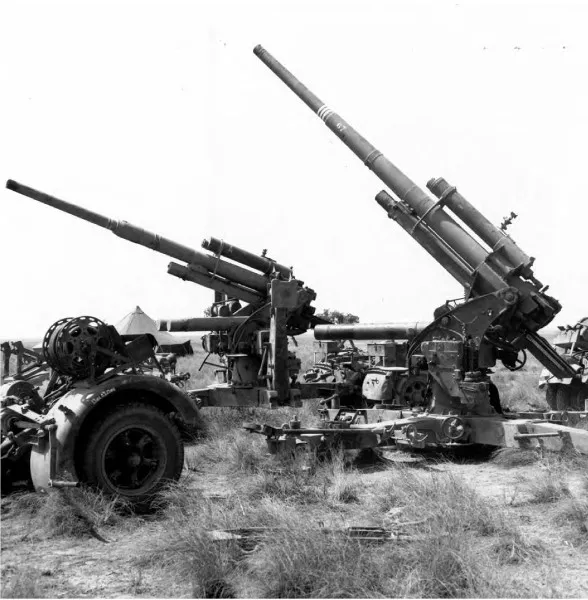
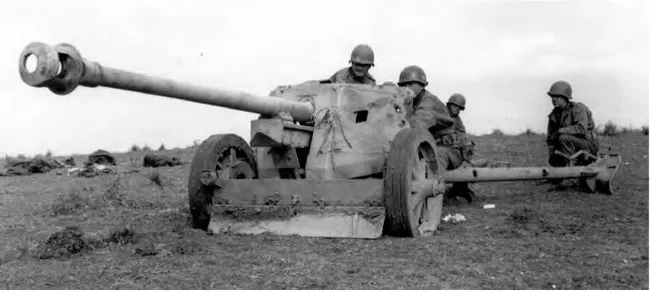
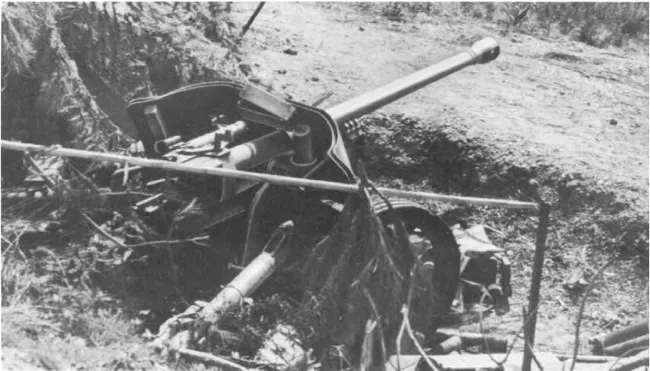
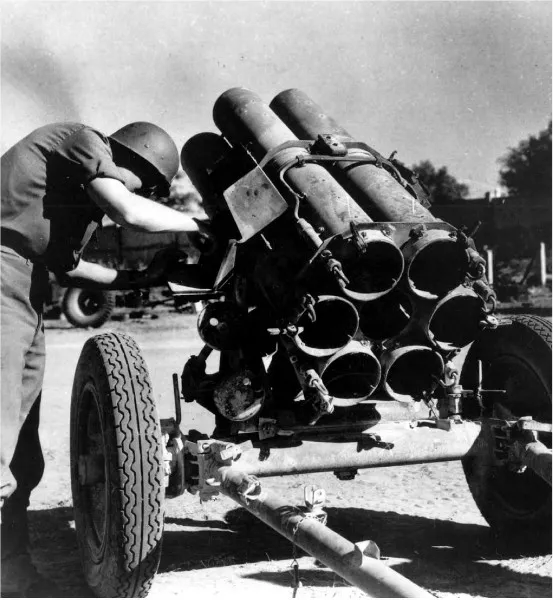
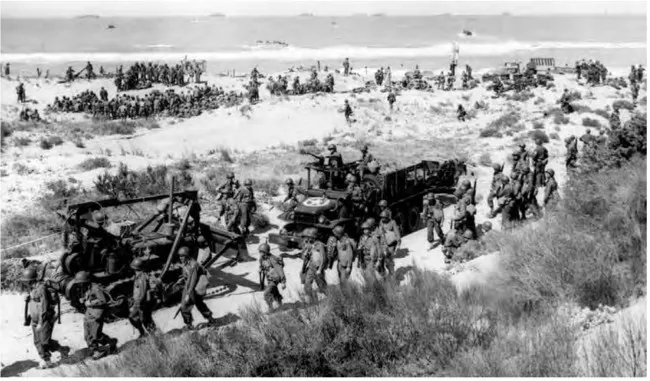
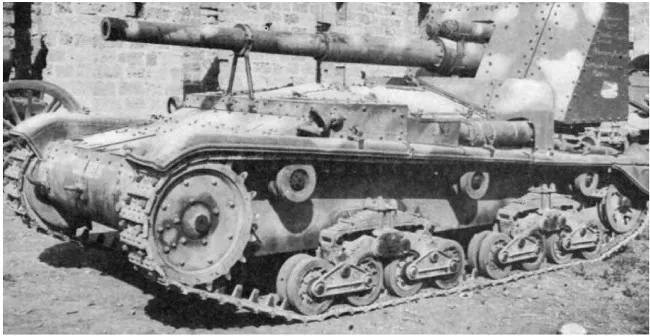
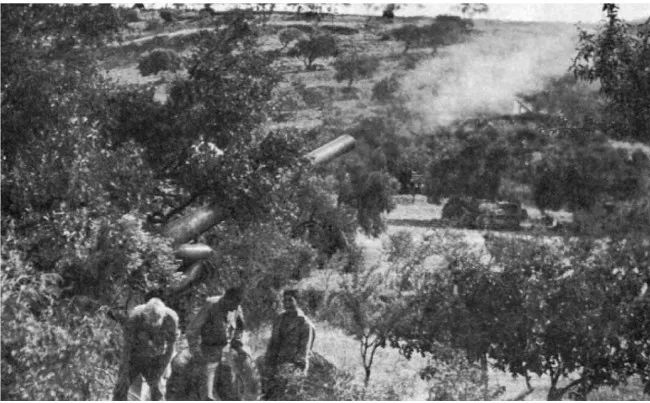
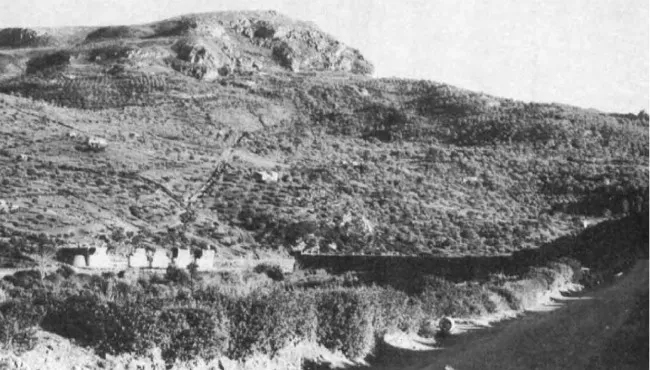
SECTION II Sicily, Corsica, and Sardinia
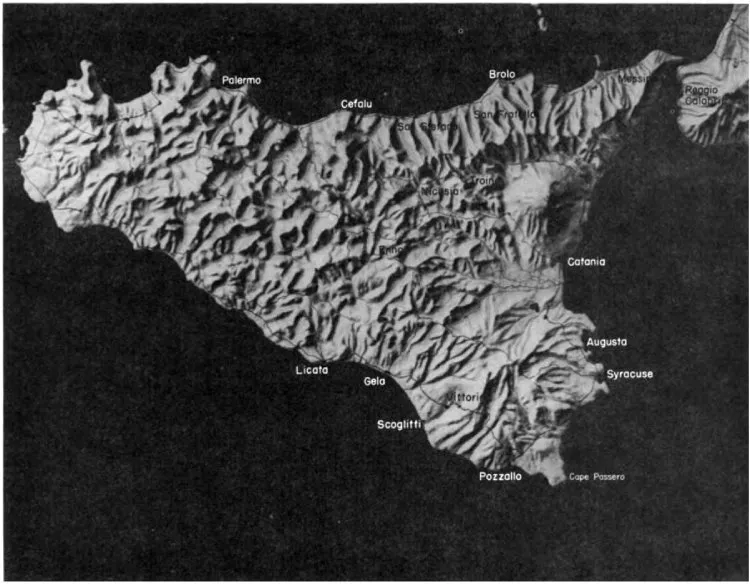
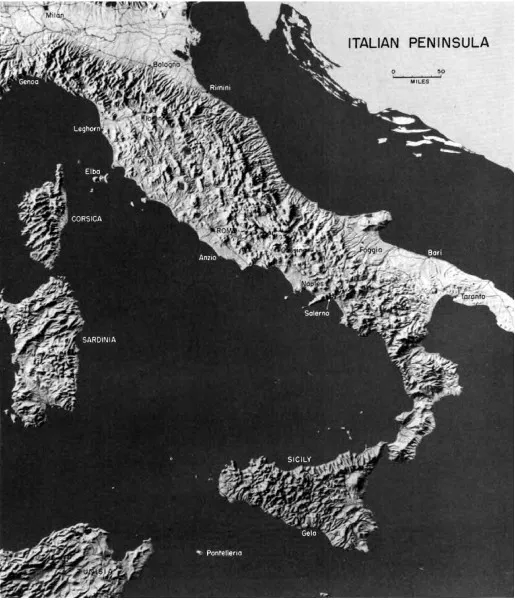
The decision to assault Sicily was made by the Chiefs of Staff at
Casablanca in January 1943. After the conclusion of the Tunisia
Campaign, plans were completed and preparations for the attack were
accelerated (Operation Husky). The island of Pantelleria,
located between North Africa and Sicily, occupied mainly by Italian
troops, was bombarded by Air Forces and Navy units and fell on 11 June.
Troops for the invasion were embarked from the United States, United
Kingdom, Algeria, Tunisia, and the Middle East.
On the night before D Day, a high wind of near gale proportions was
encountered as the convoys approached their rendezvous. Shortly after H
Hour, 10 July, airborne landings, although scattered by the high wind,
were to some extent successful in their effect on our beach assault.
Three hours after the landing, beachheads were established from Licata
to Scoglitti by the Americans and from Capo Passero to Syracuse by the
British.
Despite the problem of supply during the first two days, by 12 July the
Allied armies had seized the port of Syracuse and ten other Sicilian
towns in addition to several airfields. By the 23d, American tanks and
infantry, driving across the western end of the island, took the key
port of Palermo. The enemy, in the east, lodged in rugged mountain
terrain, offered stiff resistance.
On 25 July King Victor Emmanuel III had announced the resignation of
Premier Benito Mussolini and his cabinet, thereby exposing the weakness
of fascist Italy. Italian resistance had crumbled and in August the
German army started to withdraw to the mainland across the Strait of
Messina.
The British Eighth Army succeeded in taking Catania on the east coast
early in August, and Messina was entered by both American and British
units on the 16th. All organized resistance ceased on 17 August after
thirty-nine days of fighting.
Allied Force Headquarters’ plan for the occupation of Corsica and
Sardinia was confirmed at the Quebec conference held in August 1943.
After the withdrawal of the German forces from Sardinia, the island
fell into Allied hands without a struggle. The French army, given
the mission of taking Corsica, met only slight resistance from the
retreating German troops in October 1943.
Air bases established on both islands provided air coverage for future
operations in northern Italy and southern France.
TUNISIA
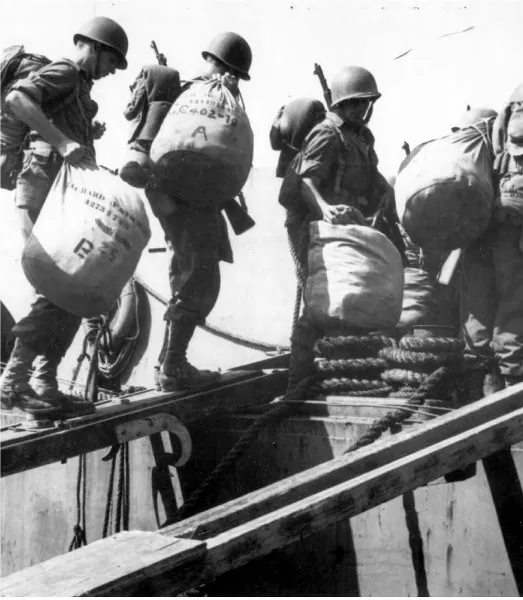
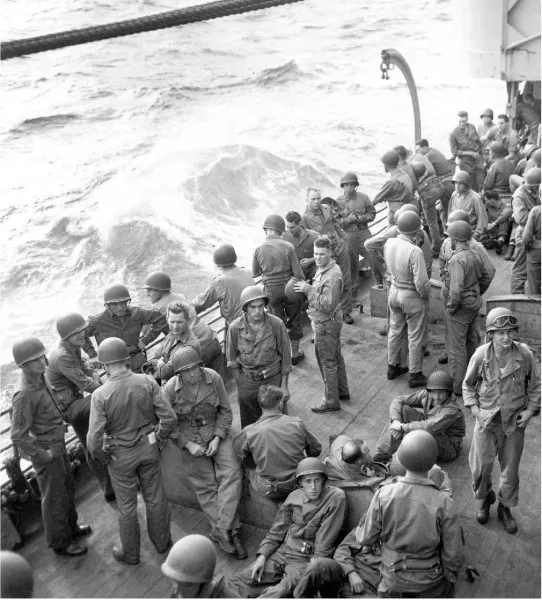
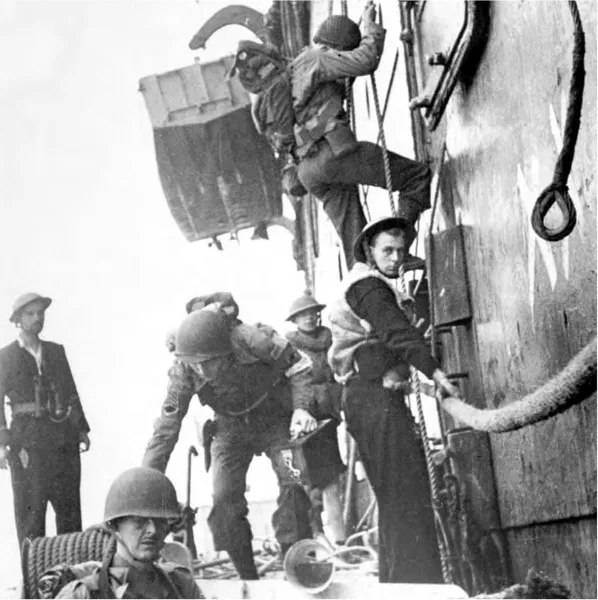
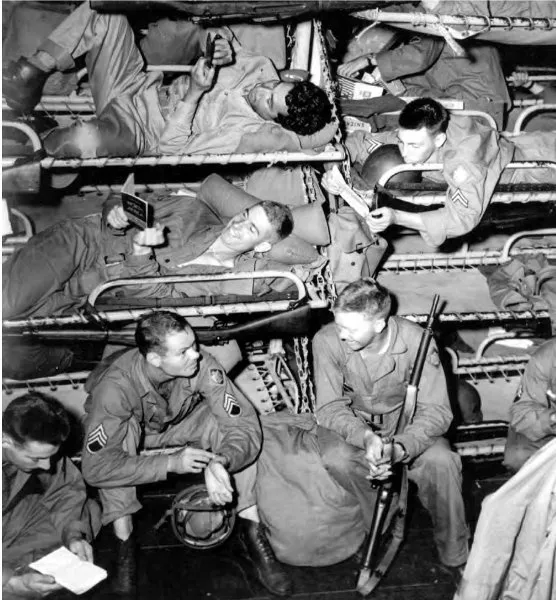
INFANTRY MEN WITH FULL EQUIPMENT boarding ship for the invasion
of Sicily. Extra clothing and personal effects were carried in
the unmanageable barracks bag. The only satisfactory way to
carry this bag was over the shoulder, an impossible feat for a
man with a pack on his back. Later the bag was redesigned; a
shoulder strap and a handle on the side were added. It was then
called a duffel bag.
TUNISIA
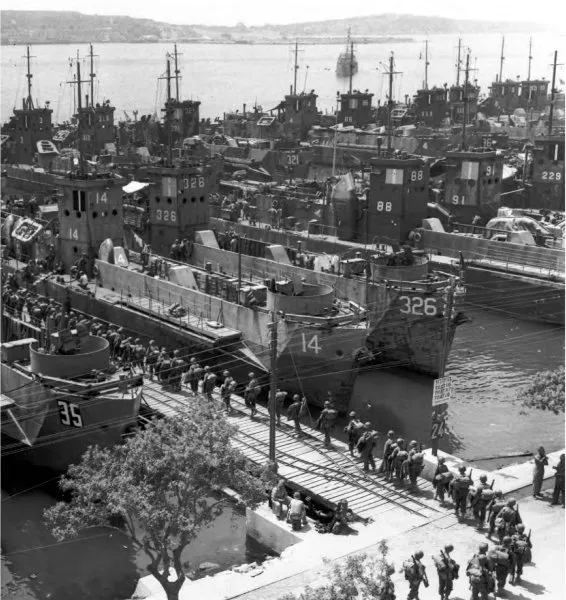
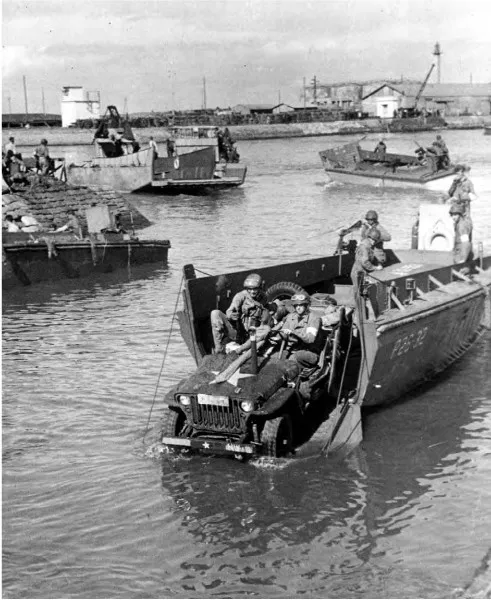
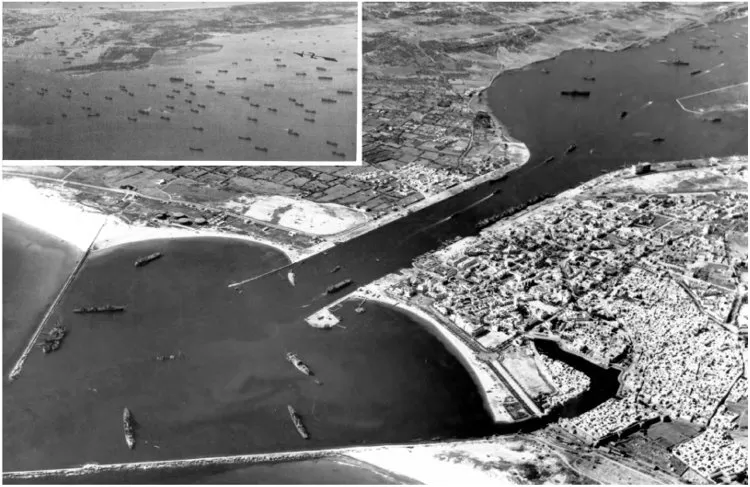
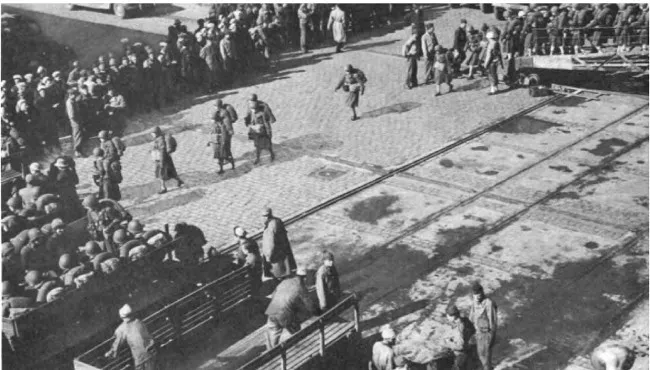
MEN MARCHING ABOARD LANDING CRAFT IN BIZERTE HARBOR. This port
was one of the embarkation points for the invasion of Sicily, an
island strategically important because its geographic location
between Africa and Italy almost divides the Mediterranean Sea in
two. In order to travel from one end of the Mediterranean to the
other it was necessary to pass through the ninety-mile strait
between Sicily and Tunisia. With Sicily in enemy hands, control
of this strait was divided and enemy aircraft and submarines
interfered with Allied shipping to the Middle East. (Landing
craft, infantry, large, LCI (L).)
SICILY
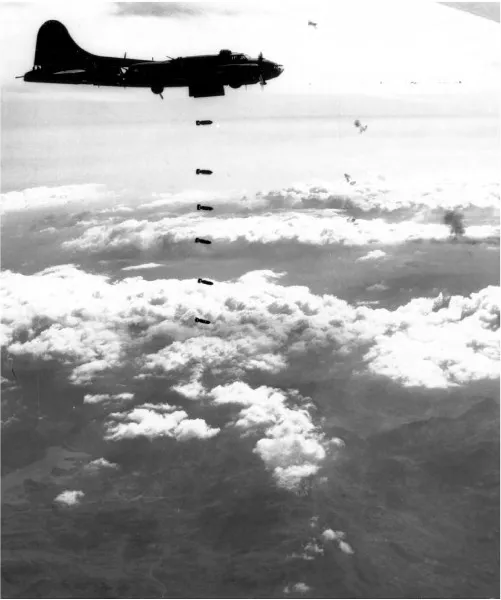
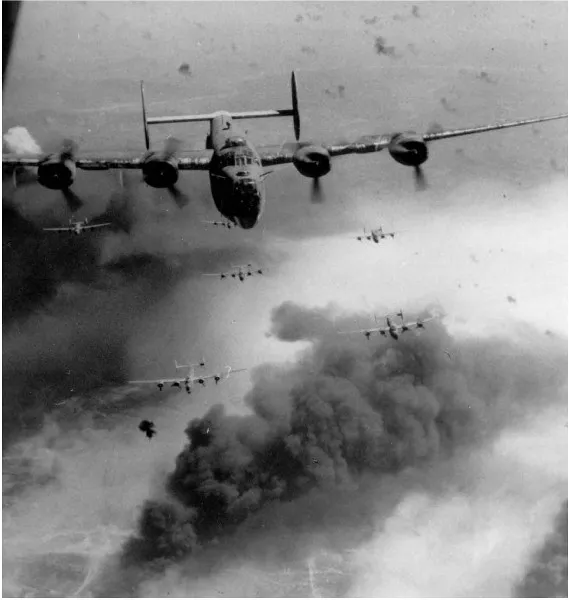
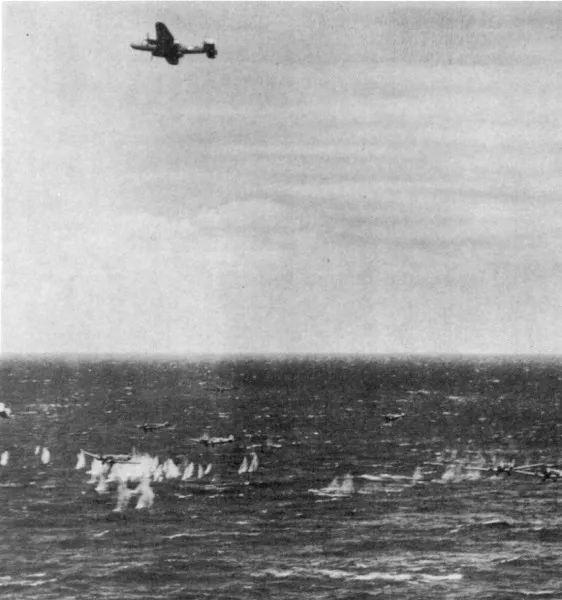
FLYING FORTRESS BOMBING ENEMY INSTALLATIONS in Sicily. For weeks
prior to the invasion of the island, airfields, rail lines, and
ports had been under aerial bombardment by Allied planes. Note
black antiaircraft bursts.
SICILY
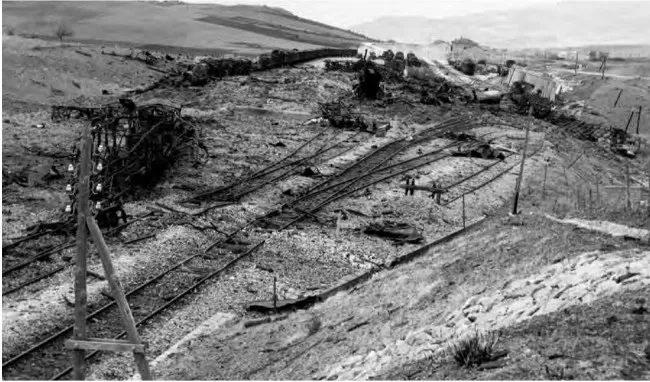
RESULT OF AERIAL BOMBARDMENT ON NAPOLA RAILROAD YARD, near
Trapani in western Sicily. By the time of invasion the railroad
net on the island was crippled and remained so throughout the
campaign.
SICILY
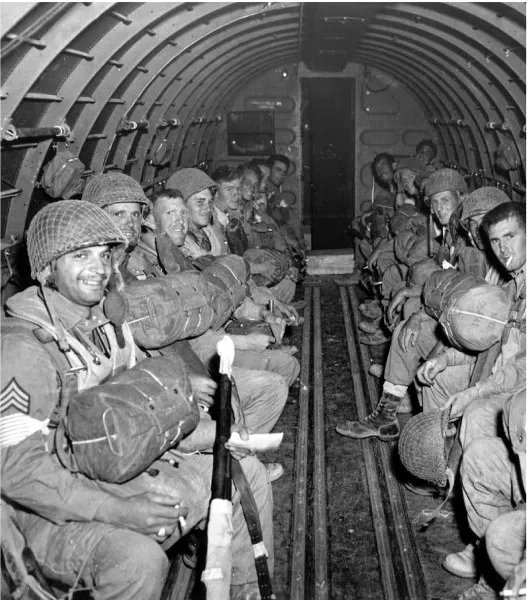
PARATROOPERS HEADED FOR SICILY. On 9 July 1943 U. S.
paratroopers boarded their transports at Kairouan, Tunisia. They
were scheduled to land at 2330 on that day, but a forty-mile
wind blew the planes from their course, and parachutists
were strewn over a large part of southeastern Sicily, but
nevertheless aided in retarding the German counterattack against
the beachheads. (Douglas C-47.)
SICILY
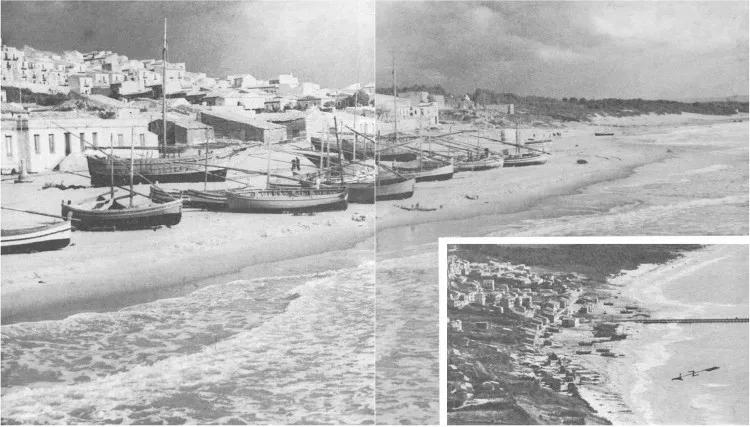
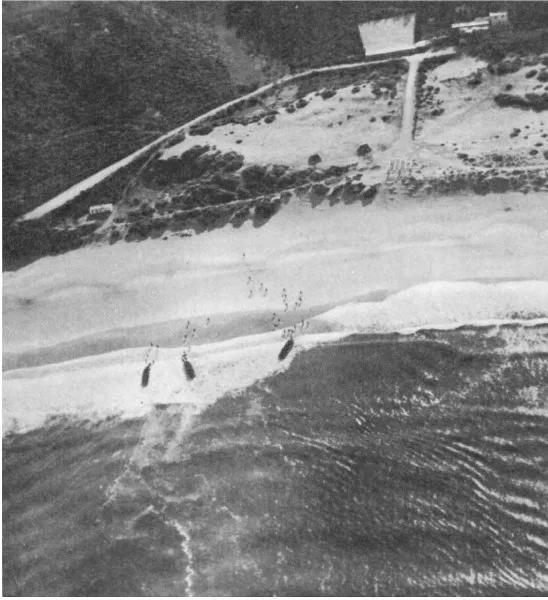
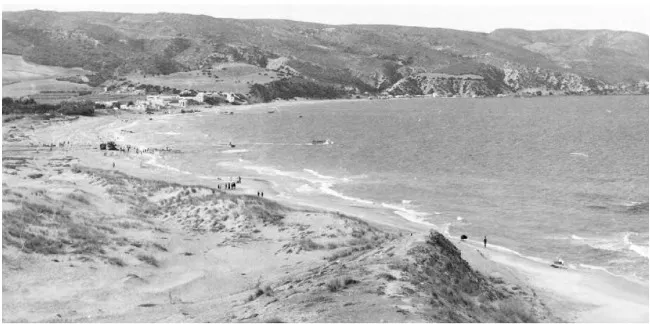
GELA BEACH, SICILY. The invasion of the island took place on 10
July 1943. Gela was the center of the American invasion area
which extended from Licata on the west to Scoglitti on the east.
The British Army landed in the region between Capo Passero and
Syracuse on the east coast of the island. Beach landings in both
areas were preceded by airborne assaults. By sunrise, three
hours after the first landings, the beaches were under control.
SICILY
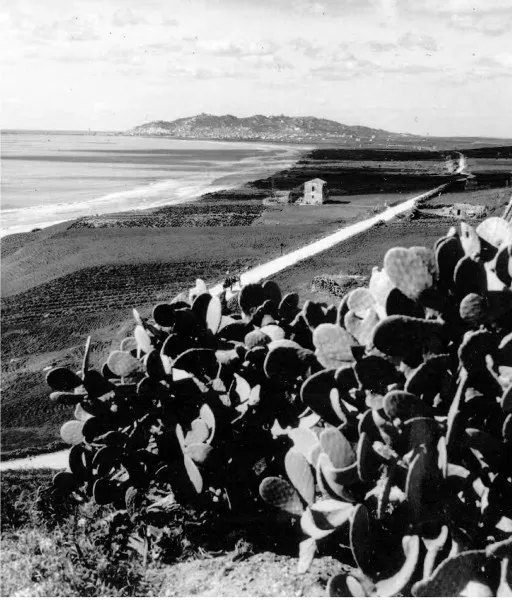
LICATA BEACHES, LOOKING WESTWARD ALONG THE COAST. The highway in
the foreground is the main coastal road. This was the western
portion of the U. S. assault area and Licata, located at the
foot of the hill in the distance, was occupied by 1130 on D Day.
SICILY
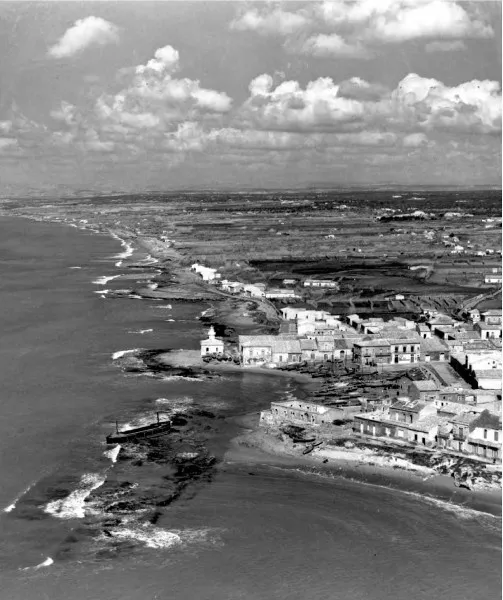
SCOGLITTI, in the eastern section of the U. S. invasion area.
Troops landed here against little opposition and occupied the
important town of Vittoria, a few miles inland, on D Day.
SICILY
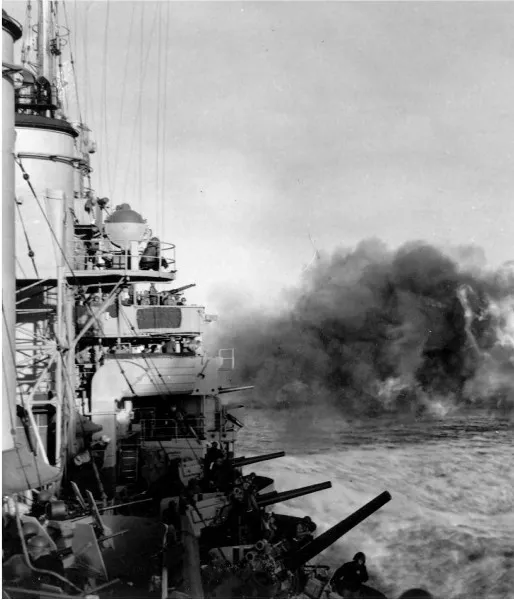
AN AMERICAN CRUISER SHELLING DEFENSES in the Gela beach area
during the early morning of D Day. The naval bombardment,
which started at 0345, silenced the few coastal batteries that
protected the beaches. Large-scale enemy resistance on the
beaches did not materialize during the landings.
SICILY
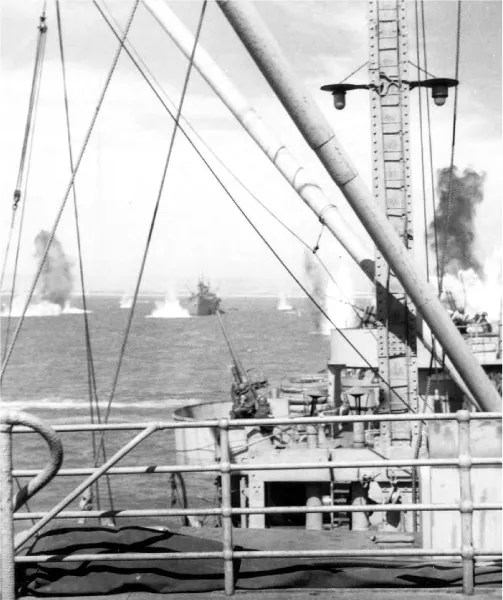
ALLIED SHIPS UNDER AERIAL BOMBARDMENT. At daybreak on D Day
enemy air forces launched a series of bombing and strafing
attacks on the ships offshore and on the troops along the
beaches.
SICILY
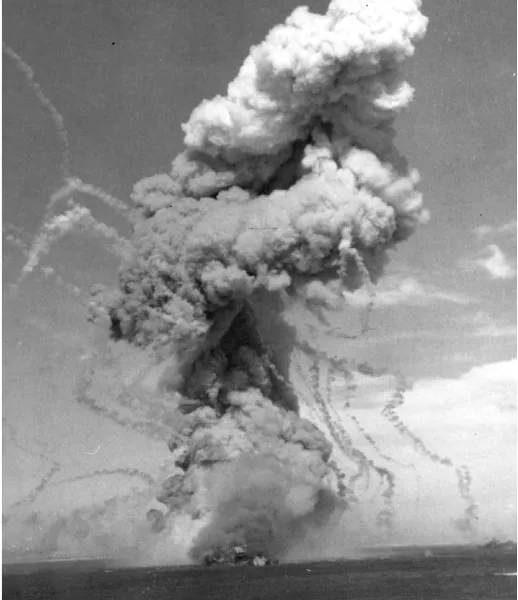
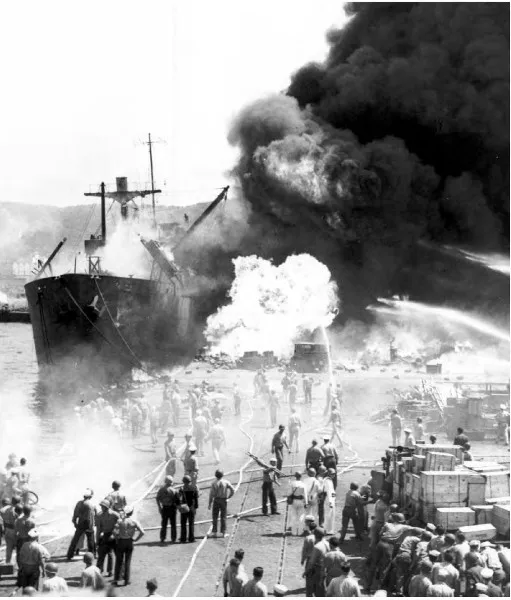
U. S. AMMUNITION SHIP EXPLODING as result of a direct hit by an
enemy bomb during the late afternoon of 11 July 1943. The ship
burned throughout the night, furnishing a brilliant beacon for
enemy aircraft. The Allies made several attempts to sink the
ship, but the water was too shallow.
SICILY
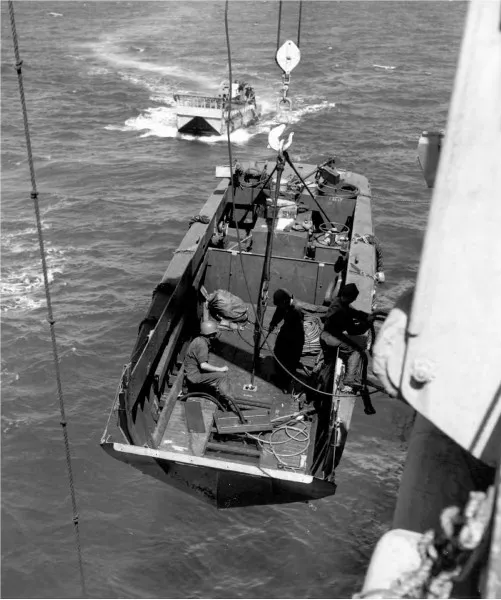
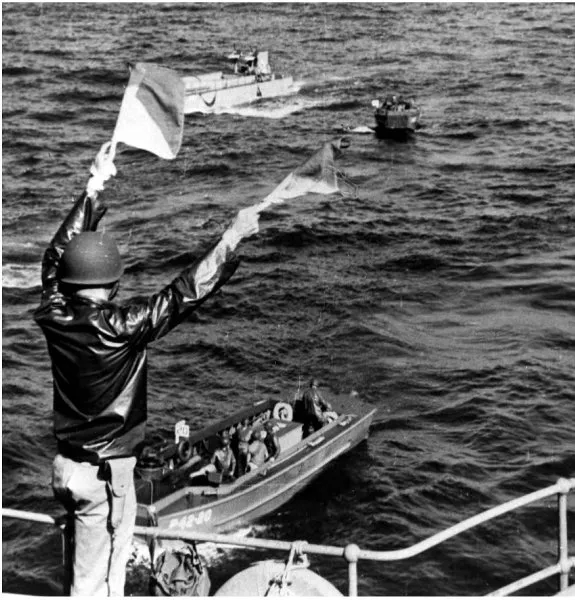
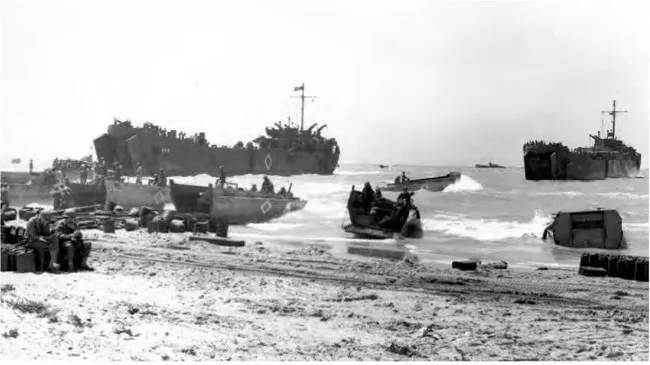
LOWERING LANDING CRAFT OFF GELA BEACH. Troops boarded the
craft after it was afloat. (Foreground, landing craft,
vehicle-personnel, LCVP; background, LCM.)
SICILY
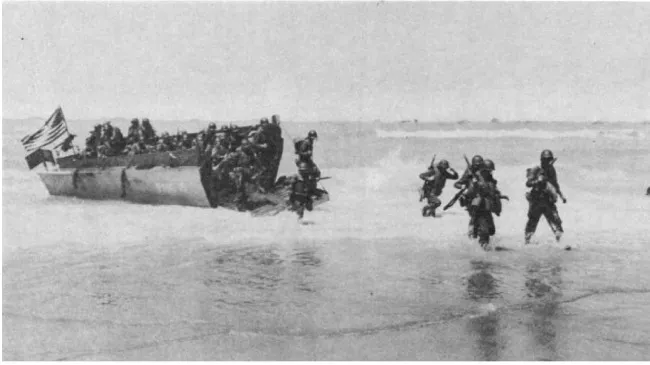
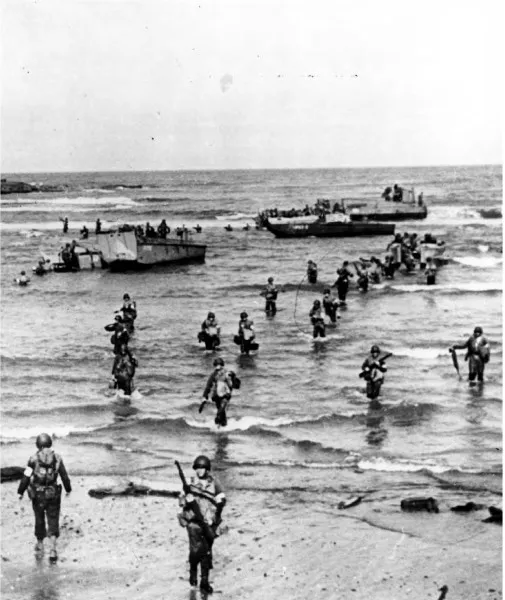
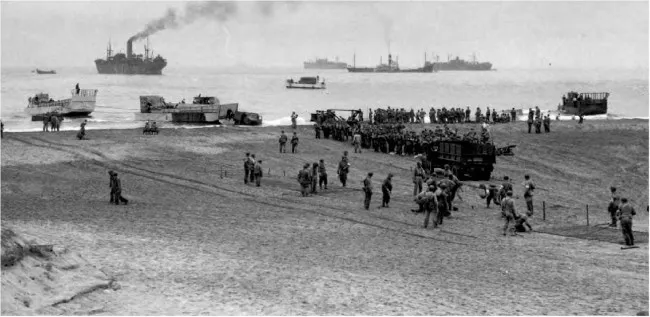
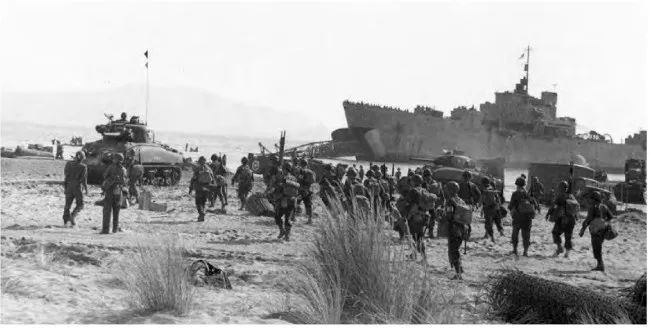
INFANTRY LANDING ON GELA BEACH (top). Unloading equipment and
supplies from LCVP’s (bottom); in the background are two LST’s.
The sea ran so high during the morning of the landings that many
craft were washed up on the beach and could not be refloated in
time for turn-around to mother ships. (LCVP in top picture.)
SICILY
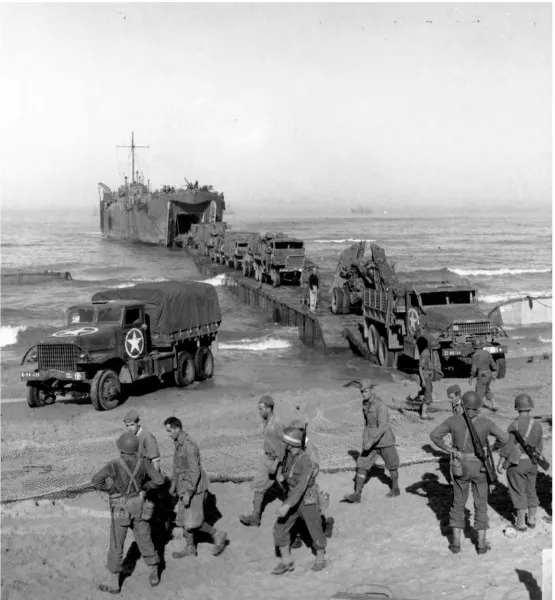
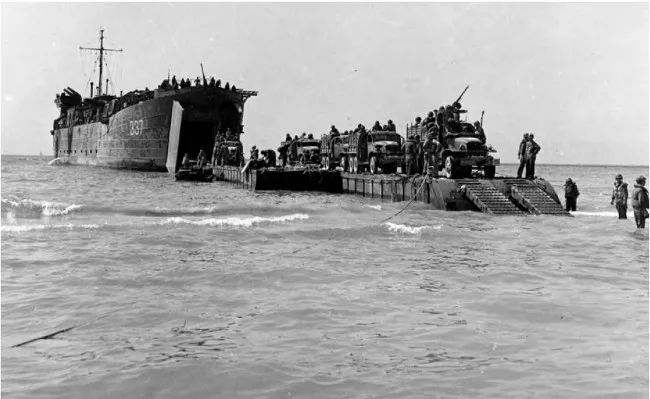
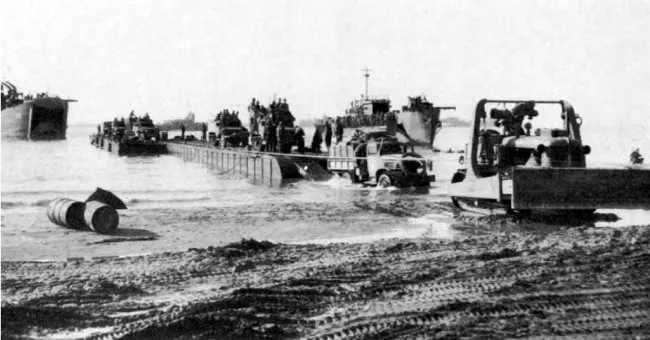
A BATTERY OF ANTIAIRCRAFT GUNS being unloaded from an L S T,
the largest type landing craft used during the operation. The
prototype of the landing ship, tank, was built by the British
and used in the invasion of North Africa. The LST shown is a
seagoing ship. Its payload was from 1,600 to 1,900 tons of which
400 tons were deck-loaded. The ship could carry on each side
sectional ponton ramps for inaccessible landings (in use above).
The first three vehicles are 6-ton 6 x 6 prime mover trucks.
(90-mm. guns.)
SICILY
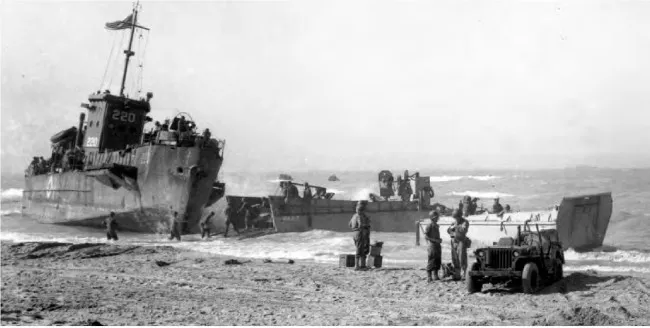
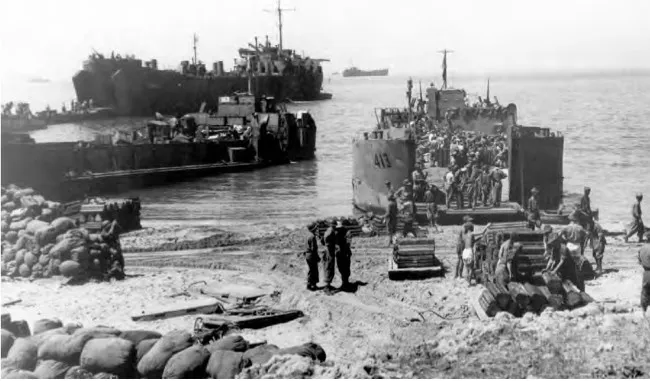
LANDING CRAFT ON BEACH. Top picture from left to right: LCI,
LCM, and LCVP; on beach is a ¼-ton 4 x 4 truck, jeep. Bottom
picture: in middle distance is LST, with bow doors open, ramp
down, and unloading onto a sectional ponton ramp; in the
foreground are two LCT’s. (The LCI (L) (1-350) was an infantry
carrier with side ramps which could be lowered for unloading
directly on the beach. It carried a crew of 3 officers and 21
men.)
SICILY
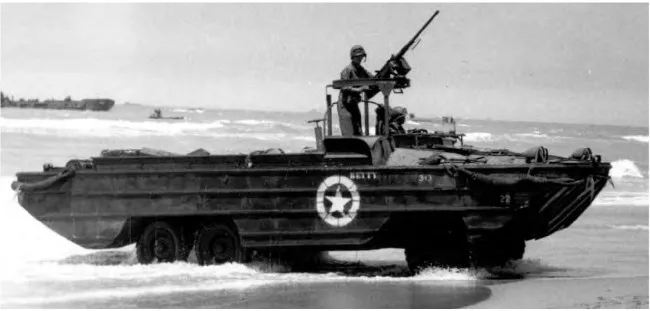
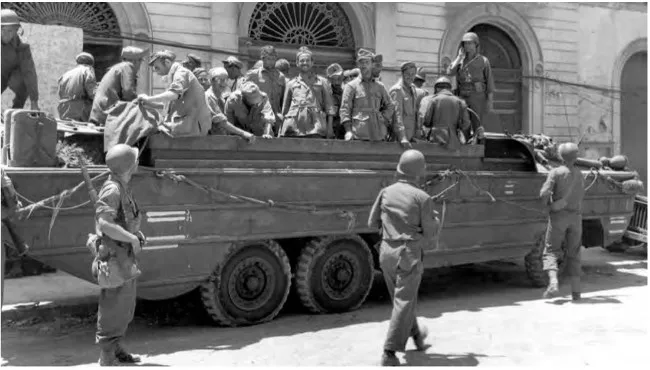
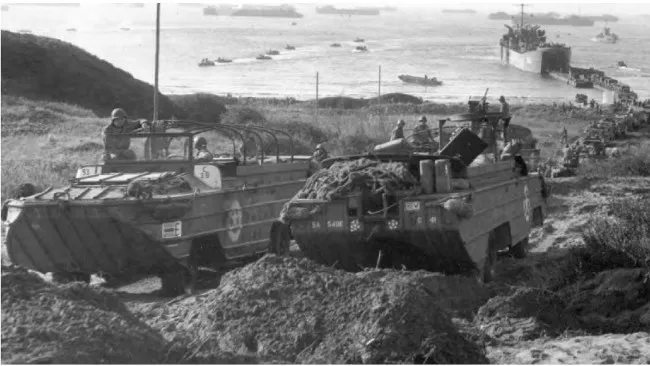
A LOADED DUKW COMING ASHORE ON THE BEACH (top). Prisoners loaded
in a DUKW waiting to be evacuated (bottom). This amphibian
truck, the DUKW, was one of the planned surprises of the
operation. Until ports were captured and prepared for use, this
means of moving all types of fighting equipment from ship to
shore helped to solve a very pressing problem. (The term DUKW
is the manufacturer’s (GMC) code serial number which has no
meaning. The resemblance to the word duck and the purpose for
which this vehicle was used quickly brought about the common
name “duck.”)
SICILY
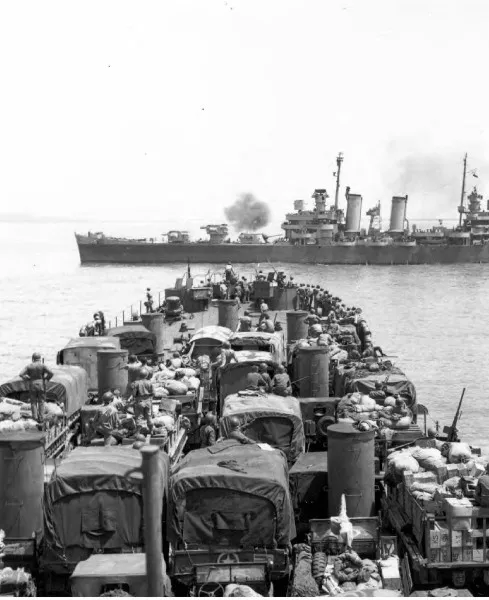
AN LST DECK-LOADED WITH MEN AND EQUIPMENT off Gela awaiting
signal to approach the beach, while a U. S. cruiser fires on an
enemy strong point.
SICILY
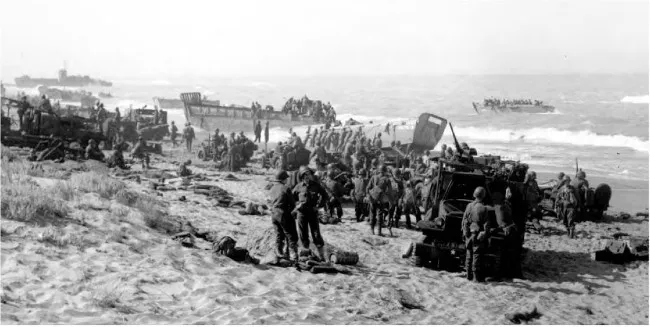
TROOPS ON THE BEACH. During the landing (top) and while
troops were moving inland (bottom), the beaches were strafed
sporadically. At one time, during the German tank-supported
counterattack on D plus 1 in the Gela area, it looked as if the
U. S. forces might be pushed back into the sea. (Top picture,
left to right, center of beach, LCV, LCVP; offshore, LCVP.
Bottom, a truck towing a 105-mm. howitzer is pulled through the
sand by a diesel tractor with angledozer.)
SICILY
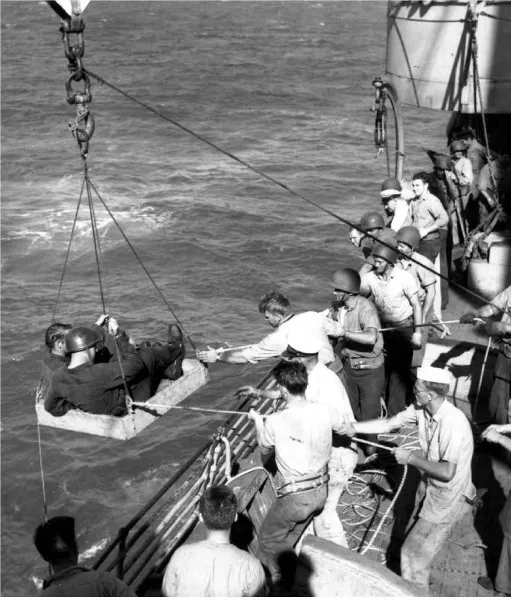
WOUNDED ARRIVING ON BOARD A TRANSPORT. During the first days
of the invasion the seriously wounded were brought back to
transports equipped with surgical and medical facilities. These
ships would then deliver the wounded to base hospitals in
Africa.
SICILY
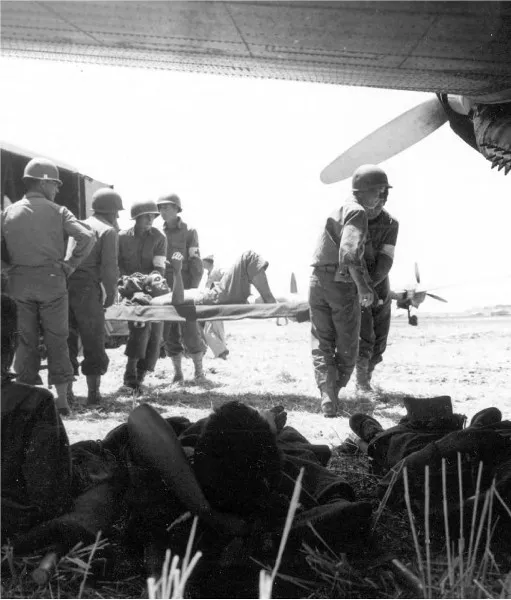
FLYING AMBULANCE. As soon as airfields had been captured many of
the U. S. wounded were evacuated by planes to hospitals in North
Africa. The Douglas C-47 transport was generally used for this
purpose. Medical personnel accompanied wounded.
SICILY
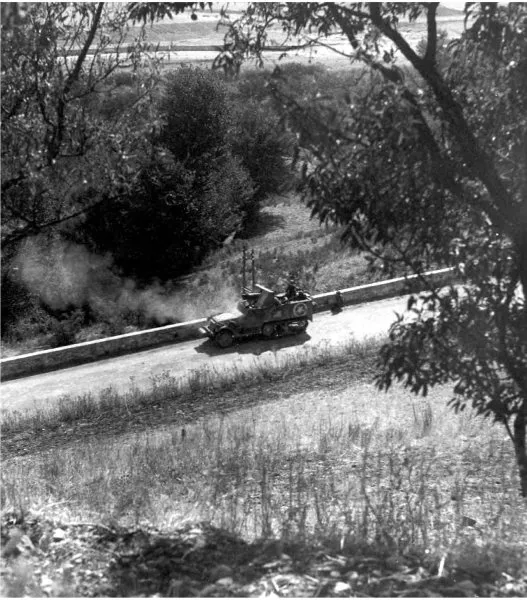
FIRING A HOWITZER INTO ENEMY POSITIONS on the road to Palermo.
After securing the beaches the U. S. forces drove to the west
and north and began the advance on Messina along the north coast
road. Palermo, one of the most important ports in Sicily, fell
to U. S. forces on 22 July 1943. (75-mm. howitzer motor carriage
T30 with a .50-caliber antiaircraft gun mounted in rear.)
SICILY
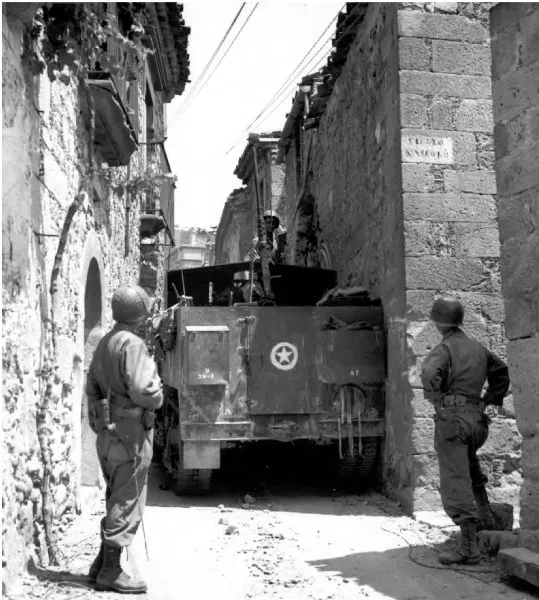
HALF-TRACK DETOURING THROUGH A SIDE STREET. When the enemy
retreated through the Sicilian villages he would often blow up
buildings on both sides of the main street, thus blocking the
passage for vehicles. If he had time he would also mine and
booby-trap the road and ruins. (The 75-mm. gun motor carriage
M3 was the first standardized American self-propelled antitank
weapon used in World War II.)
SICILY
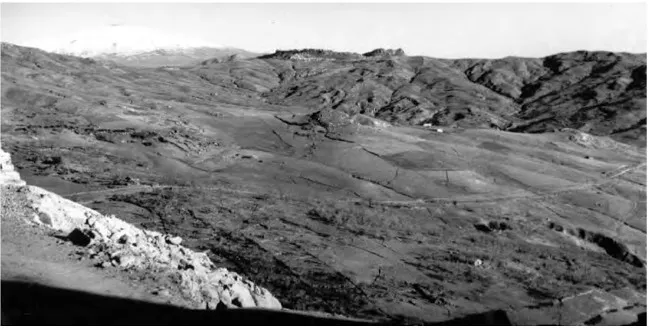
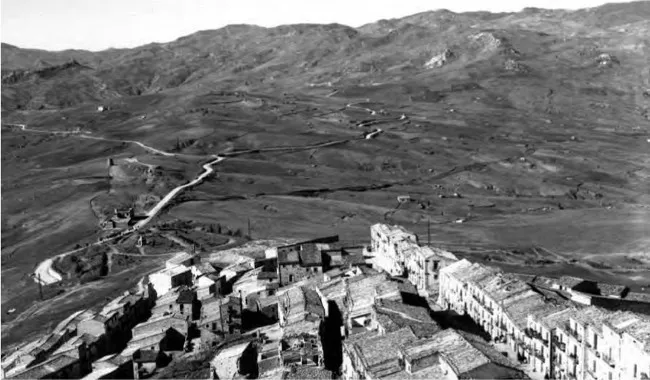
TROINA. View from the northwest with Mt. Etna in the background.
The town is located on top and around the base of the hill in
the center of horizon line (top). View from Troina toward the
northwest showing Highway 120 winding over the hills to Cerami
(upper left corner) (bottom). Troina lies at the junction of
Highway 120 and the road to Adrano and Paterno. The U. S.
Seventh Army took Troina on 6 August after some of the fiercest
fighting of the campaign.
SICILY
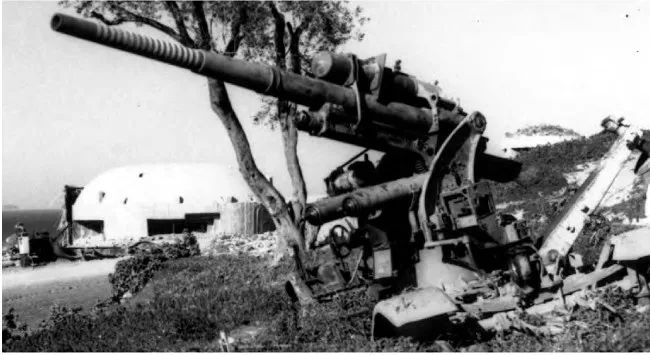
ENEMY ARTILLERY. At top is the famous German 88-mm. gun. The
pillbox in the background was sited to fire both toward the
sea and along the road. The coast of the island was ringed
with pillboxes, some of which had not been completed at the
time of the invasion. The self-propelled gun (bottom) of
Italian manufacture is a 90-mm. cannon. It was used in North
Africa as well as in Sicily. (Top, German 8.8-cm. Flak 18 with
single-piece barrel; bottom, 90/53 Ansaldo self-propelled (SP)
gun on redesigned M 13/40 Ansaldo chassis.)
SICILY
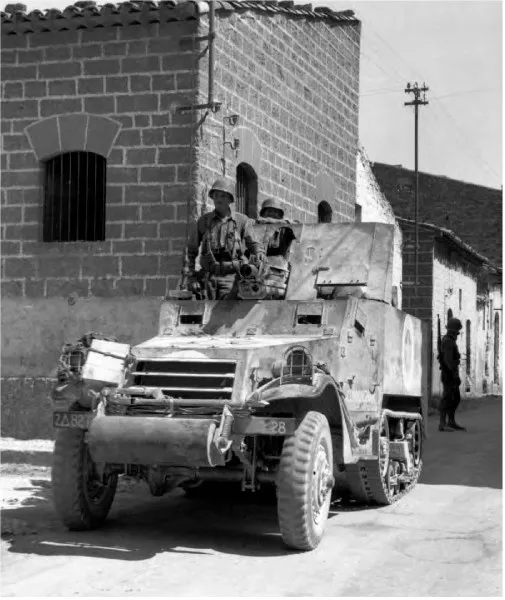
HALF-TRACK MOVING THROUGH A SICILIAN TOWN. The gun is a 75-mm.
howitzer M1A 1 used generally as an infantry support weapon.
(75-mm. howitzer motor carriage T30.)
SICILY
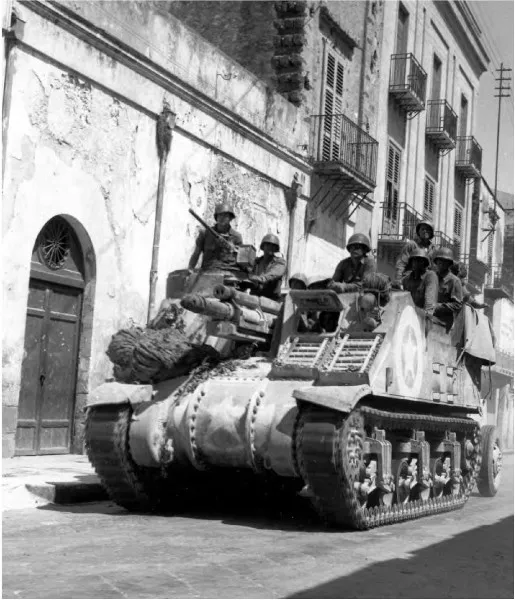
SELF-PROPELLED HOWITZER. This is the M7 howitzer motor carriage
mounting a 105-mm. howitzer which was used for high angle as
well as direct fire. The .50-caliber machine gun is mounted in a
raised pulpit-like structure which gave the vehicle the nickname
Priest. (Mounted on M3 tank chassis.)
SICILY
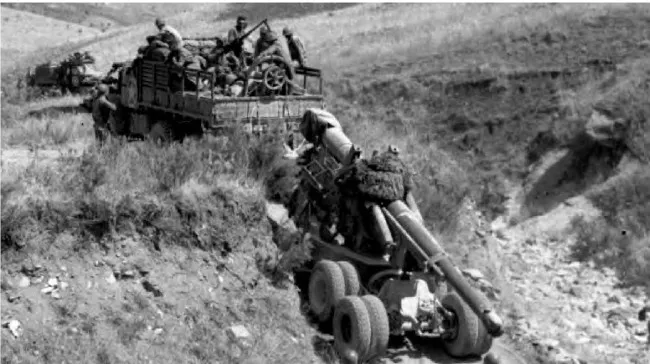
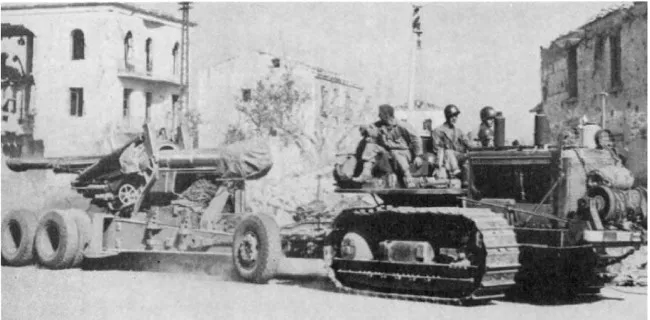
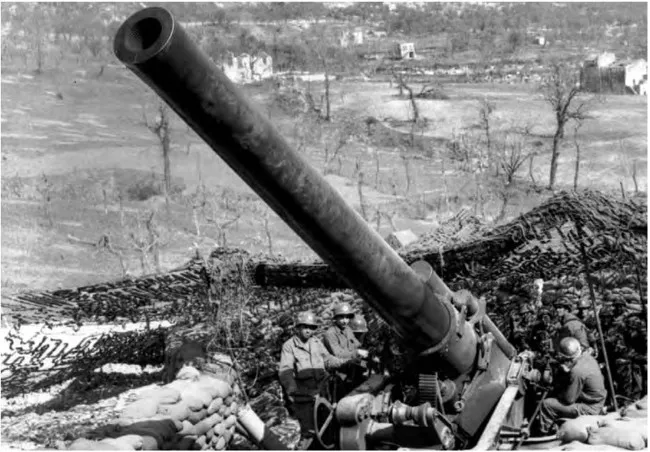
THE LONG TOM. This was the largest U. S. piece of artillery in Sicily.
A 7½-ton 6 x 6 prime mover truck towing a gun into position (top).
Firing from a camouflaged position in an orchard (bottom). (155-mm. gun
with standard carriage.)
SICILY
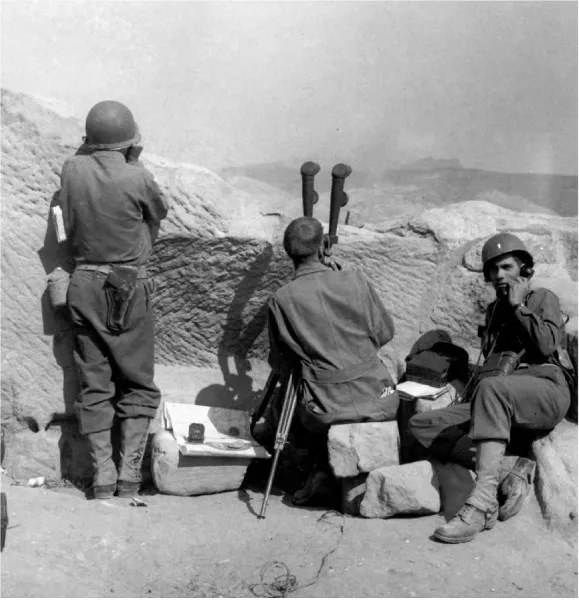
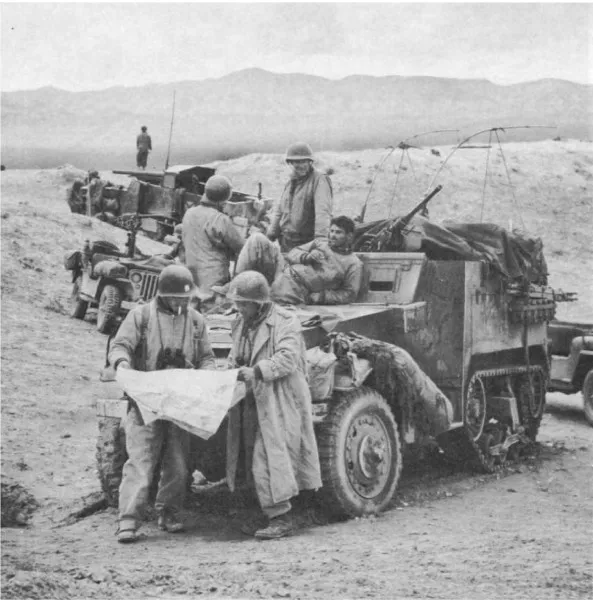
OBSERVING FIRE ON SICILIAN TOWN. The officer at right is in
telephone communication with the artillery command post. The
man in the center is using a battery commander’s telescope
(BC scope). U. S. field glasses and artillery sights of all
kinds were greatly improved by the end of the Tunisian fight.
Fine sand managed to work its way into the moving parts of
optical equipment, obscuring the image and interfering with the
mechanical operation. Moisture condensed on the inside of the
lens elements and, combined with dust, cut down the optical
effectiveness. Corrections were made by sealing the instruments
wherever possible and by placing a moisture-absorbing chemical
between the elements.
SICILY
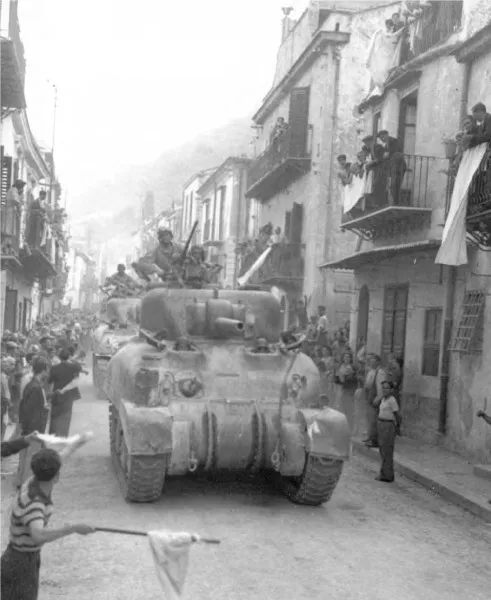
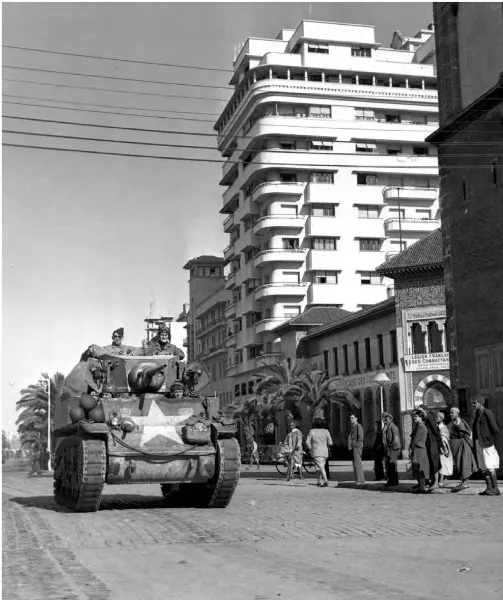
SHERMAN TANKS ENTERING PALERMO on the day the city surrendered,
22 July 1943.
SICILY
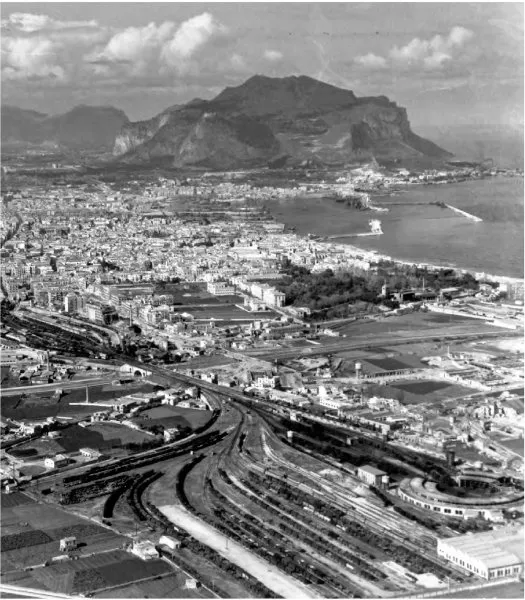
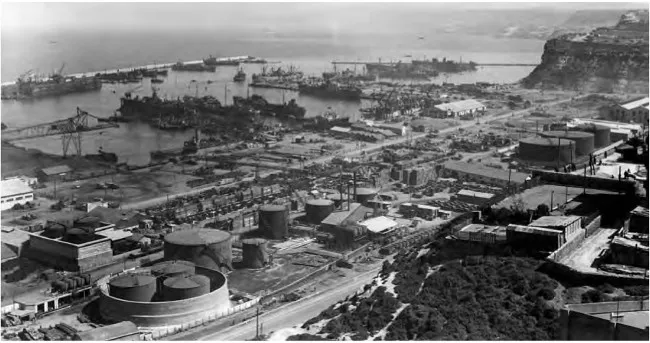
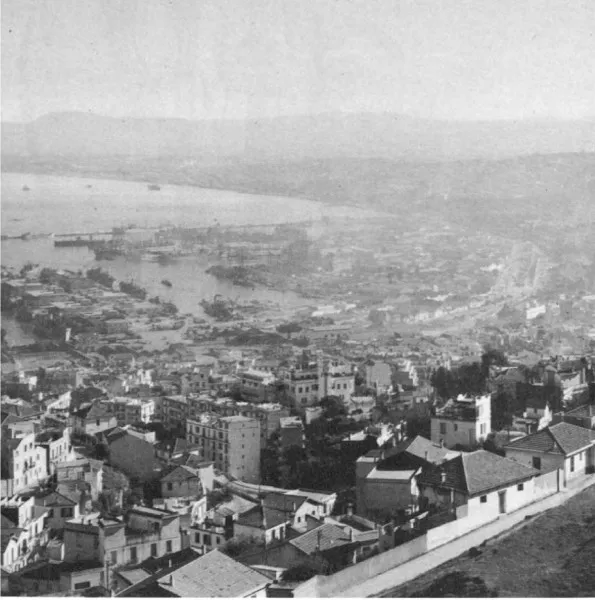
THE CITY OF PALERMO. The port had been damaged by Allied bombing
raids, and the Germans before withdrawing had demolished some
of the installations. After the arrival of U. S. troops the
port was quickly made serviceable and was used as a supply base
for troops advancing from here eastward along the coast toward
Messina. It was later used as one of the embarkation ports for
the invasion of Italy.
SICILY
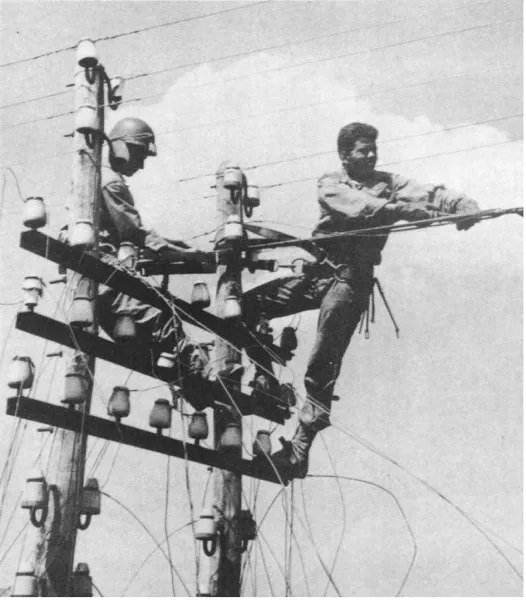
SIGNAL CORPS MEN REPAIRING COMMUNICATIONS LINES. Maintaining
communications and other public utilities behind the lines
were problems that fell within the scope of Allied Military
Government. In Sicily the U. S. Army was called upon to furnish
personnel and supplies, though native labor and materials were
used whenever possible.
SICILY
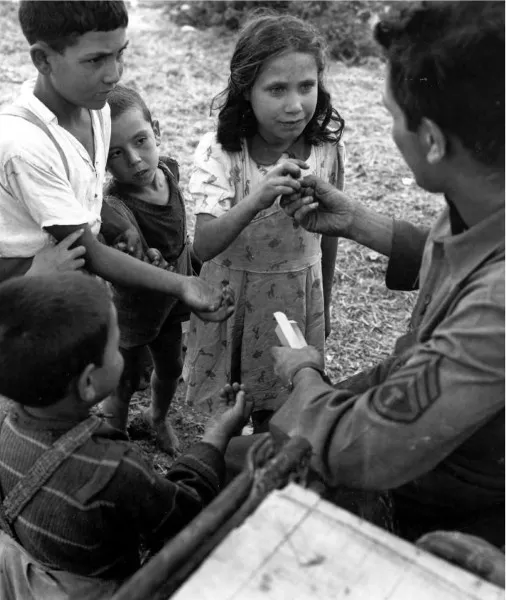
SICILIAN CHILDREN RECEIVING CANDY FROM A SOLDIER. U. S. soldiers
were universally popular with children of all classes. The
individual soldier gave a good portion of his ration of sweets
and chewing gum to native children.
SICILY
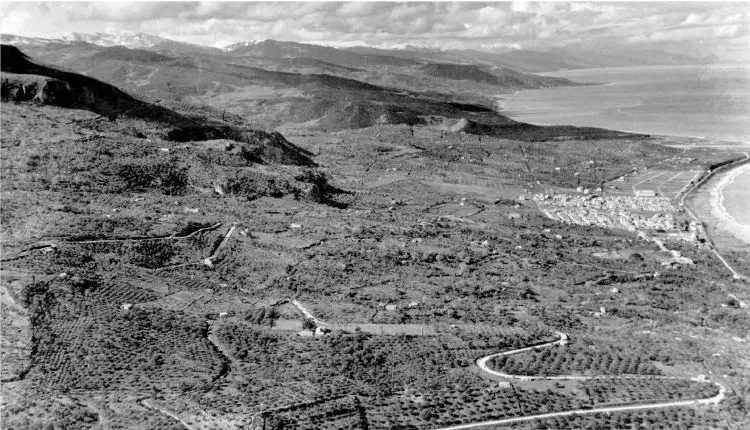
SCENE FROM THE NORTHERN COAST OF SICILY, looking toward the
west. At left is the San Fratello Ridge; at right is the
village of Acquedolci. The fight for the San Fratello Ridge was
unusually severe. Highway 113, the main axis of advance along
the north coast from Palermo to Messina, follows the shore here.
The enemy would blow the bridges, mine the approaches, and hold
the top of each mountain ridge as long as possible, and then
retreat behind the next ridge.
SICILY
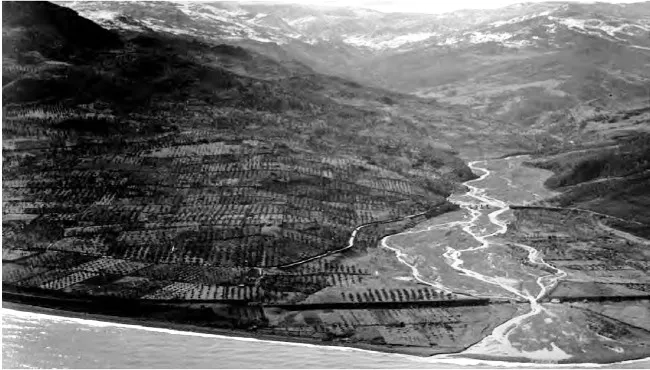
SAN FRATELLO RIDGE. Top: the ridge is in the upper left of the
picture, Torrente Furiano in the right foreground; bottom: view
of the ridge on Highway 113 from the northwest. San Fratello
Ridge was taken on 8 August after bitter enemy resistance.
SICILY
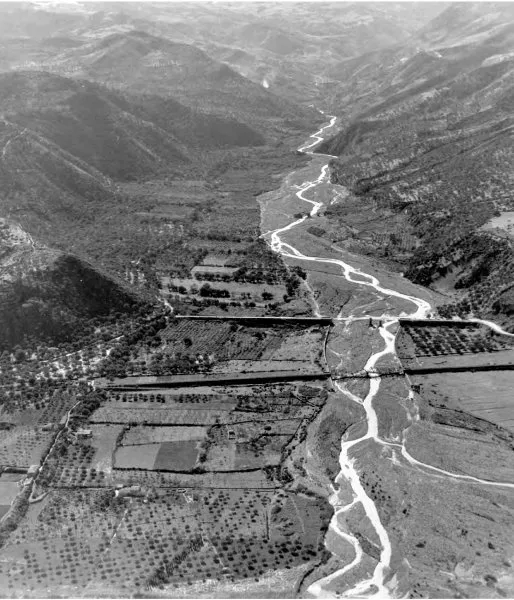
CORONIA VALLEY, typical of the valleys separating the mountain
ridges along the northern coast. The valleys provided little
concealment from the enemy in position on top of the ridges. The
bridge spans were usually long and easily demolished. Note that
both highway and railroad bridges are blown in this picture.
SICILY
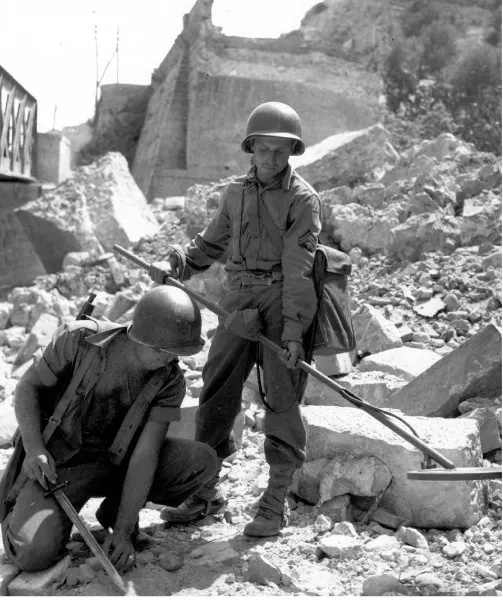
PROBING FOR MINES AT A BRIDGE-CROSSING SITE. The mine detector
reacts to metal; whether the metal was a mine or a shell
fragment had to be determined by probing and digging, usually
with a bayonet. (Mine detector SCR 625.)
SICILY
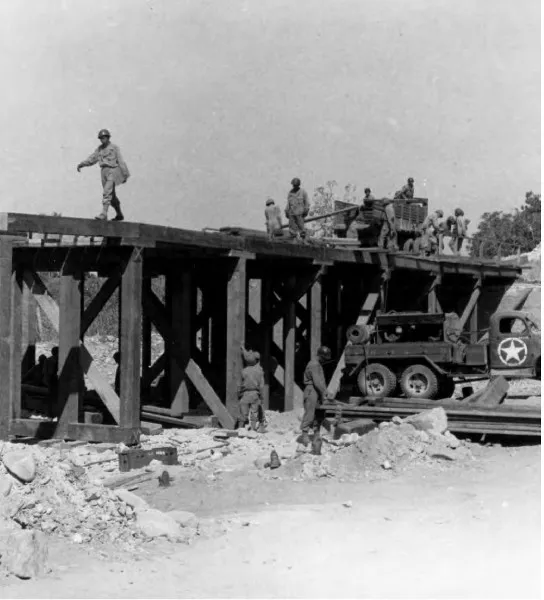
BRIDGE BUILDING. In the valleys this task presented no
particular problem once the enemy had been chased off the
mountain ridge overlooking the bridge site. However, near
Messina, where the road in some places is hewn out of the cliffs
overhanging the sea, the problem was more difficult. The air
compressor (Le Roi) mounted on a 2½-ton truck (in picture above)
was used for operating power-driven saws, hammers, and drills.
SICILY
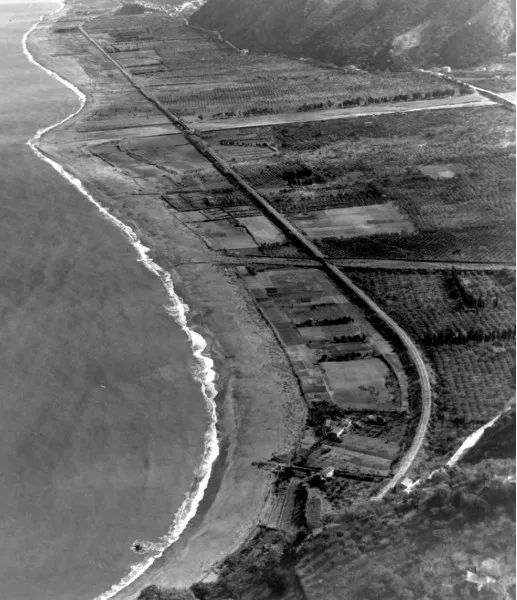
BROLO BEACH ON THE NORTH COAST OF SICILY. This is one of the
several localities where U. S. forces made amphibious landings
behind the enemy lines. Highway 113 runs along the hills, the
railroad near the beach. The village of Brolo is at upper part
of picture. The landing was supported by aircraft and naval
gunfire.
SICILY
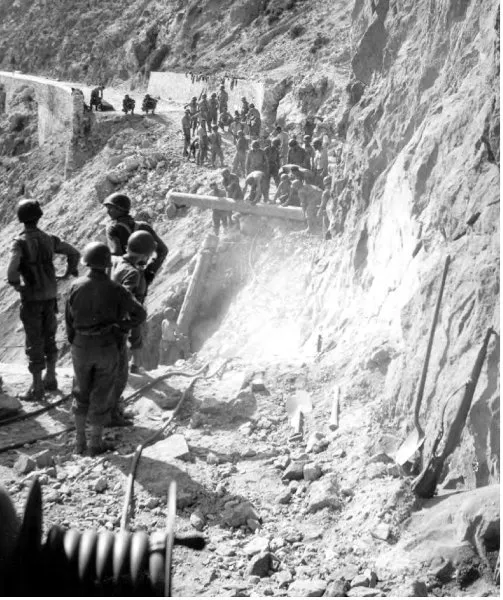
ENGINEERS REPAIRING A BREAK IN HIGHWAY 113, on the north coast,
caused by German demolition. The locality is Capo Calavâ where
the road practically overhangs the sea.
SICILY
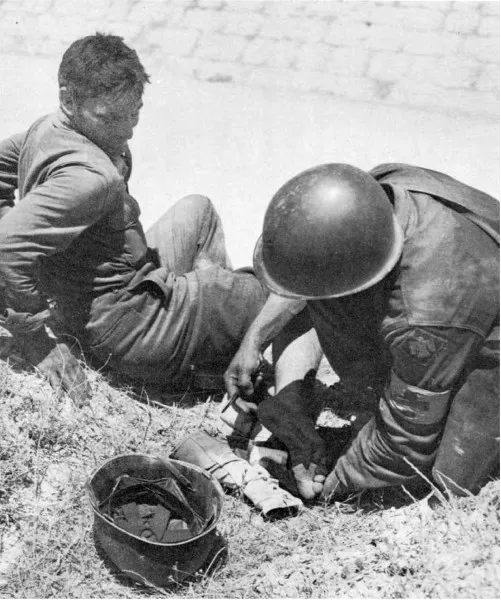
MEDIC TREATING A BLISTER on an infantryman’s foot. Medical aid
men were present at the scene of every action. They were unarmed
and were identified by an arm band with a red cross, or a red
cross painted on the helmet, or both.
SICILY
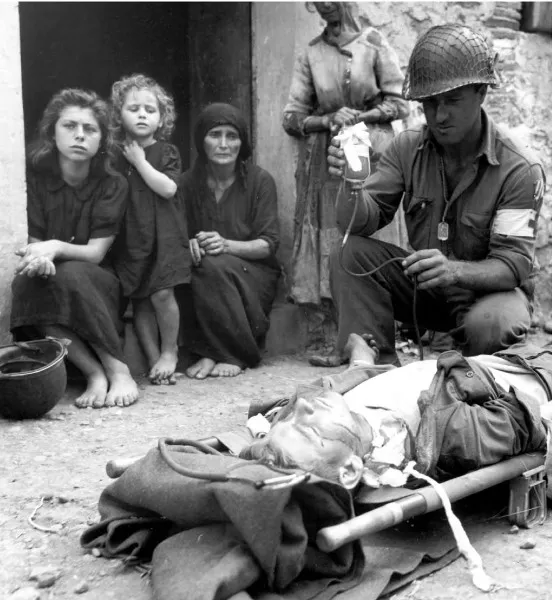
MEDICAL AID MAN GIVING BLOOD PLASMA TO A WOUNDED MAN. Plasma
was dried human blood that could be kept almost indefinitely
under ordinary conditions. It was prepared for use by adding
the required amount of triple-distilled water or a saline
solution containing the same amount of salt as whole human
blood. It was not as effective as whole blood, which retained
its effectiveness for a maximum of only twenty-one days when
properly stored and refrigerated. This made whole blood
difficult to keep and use under field conditions.
SICILY
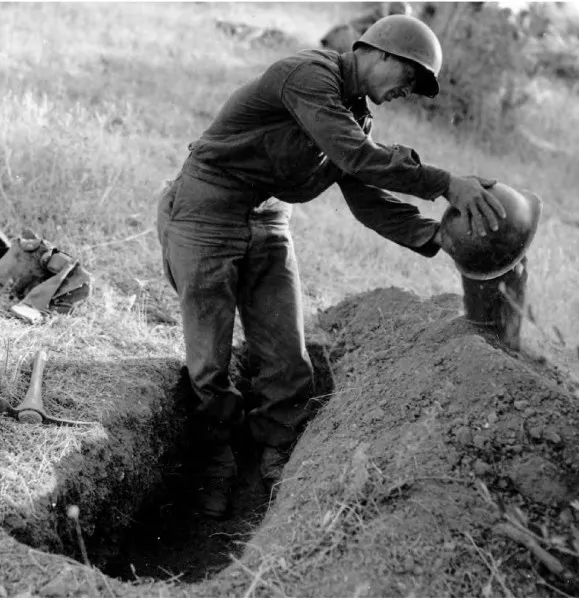
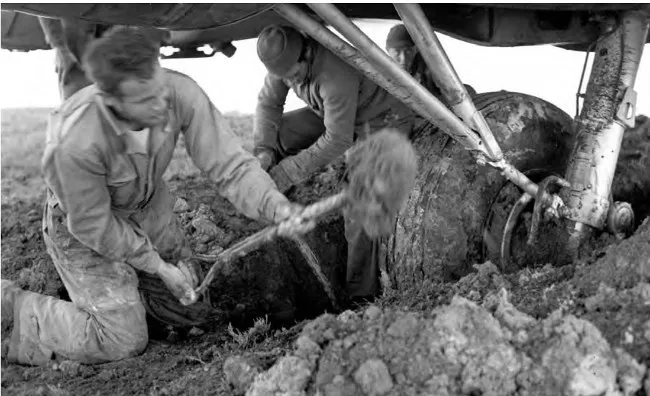
DIGGING A FOXHOLE IN AN OLIVE GROVE using a helmet as a shovel.
These holes provided excellent protection against shell and bomb
fragments. The steel helmet was used for a variety of purposes
besides protecting the head. It made a fine wash basin, was used
as a basket to carry post exchange items (paper bags were not
available), and practically everyone used it as a seat while
living in the field. In some cases it was used as a cooking
utensil in violation of regulations, as excessive heat took the
temper out of the steel, making it useless for the purpose for
which it was originally intended. (The soldier in picture is
wearing the fiber liner while he digs with the steel helmet M1.)
SICILY
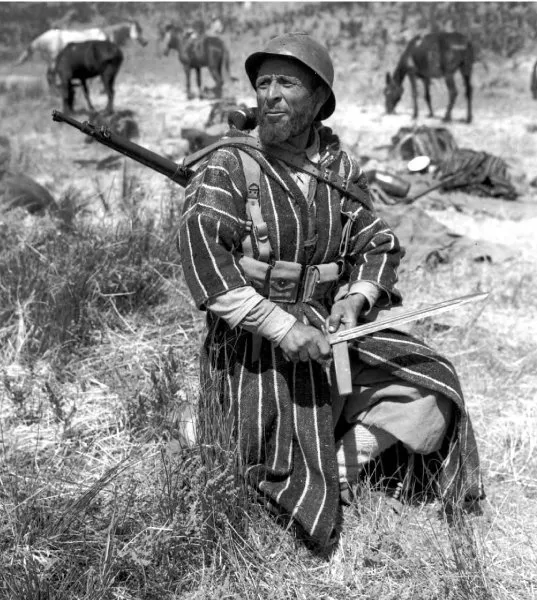
A GOUMIER OF FRENCH MOROCCO. The goumiers, generally called
goums by American soldiers, formed part of the French colonial
troops. Serving with the Americans in Tunisia, Sicily, Italy,
and southern France, they were greatly respected for their
fighting ability. (The term “goum” literally means “company,”
and a goumier is a member of an infantry company. Not all native
infantrymen, however, were known as goumiers, the term applying
only to soldiers of certain Moroccan tribes.)
SICILY
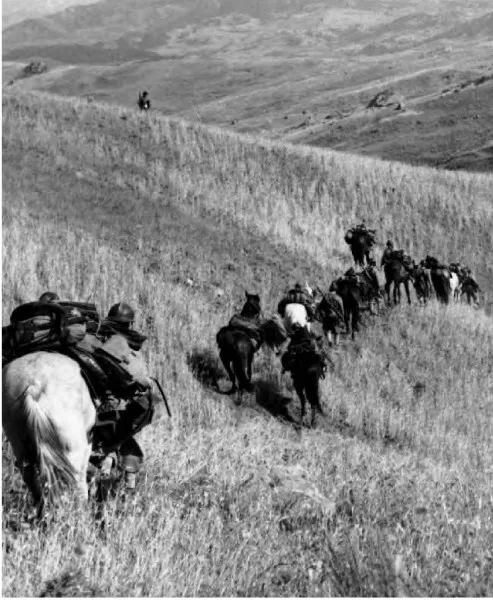
GOUMIERS ADVANCING ACROSS THE HILLS IN SICILY. Their specialty
was mountain fighting, and they used horses and mules to carry
supplies.
SICILY
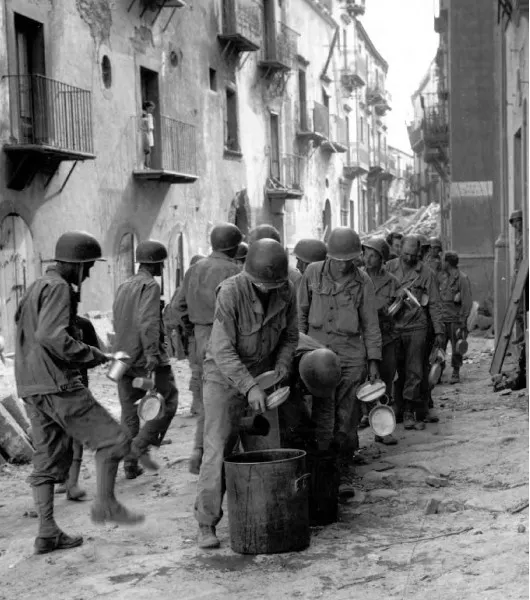
SOLDIERS STERILIZING MESS KITS AFTER EATING. When possible this
was done before and after every meal. Such procedure was of the
greatest importance in Sicily where sanitation as we know it was
little practiced among the population as a whole. In spite of
every precaution, dysentery of one kind or another was common
among Allied forces.
SICILY
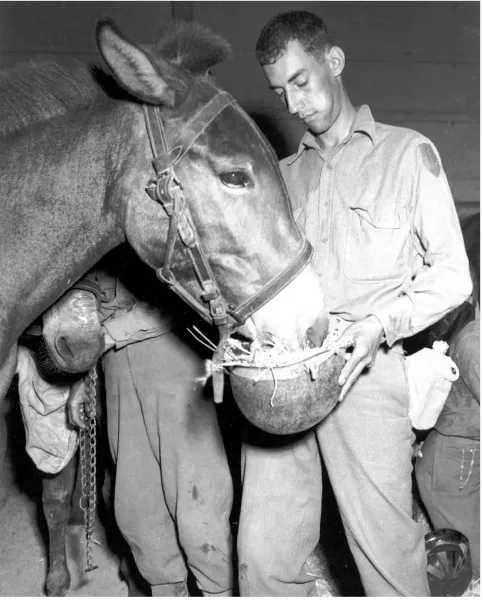
INFANTRYMAN TURNED MULE SKINNER.
SICILY
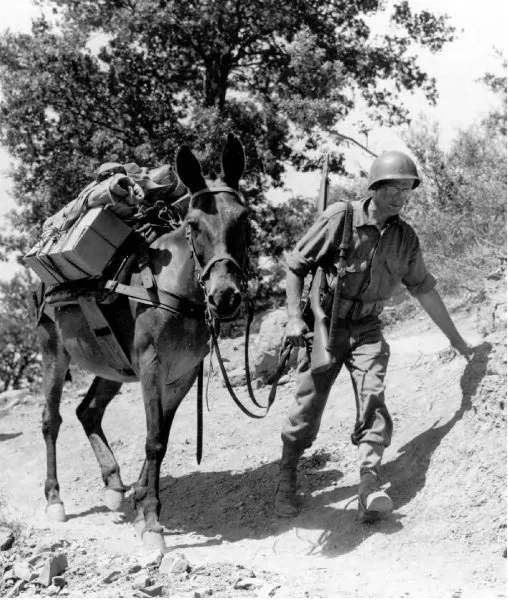
PACK MULE. The interior and northern coast of Sicily were
mountainous and had few roads fit for vehicles. Mules often had
to be used to bring supplies to troops in forward areas.
SICILY
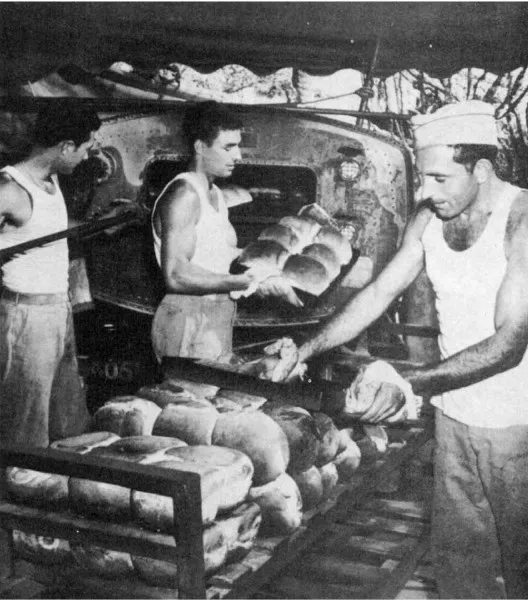
FIELD BAKERY. The men in the picture above are using a British
oven which was built into a trailer. Field ovens of U. S.
troops were separate units and not built in trailer form. In
some instances U. S. troops obtained the British type oven when
previously stationed in the British Isles. Others obtained them
in America. Every attempt was made to vary the rations of the
troops, and fresh bread was baked when possible.
SICILY
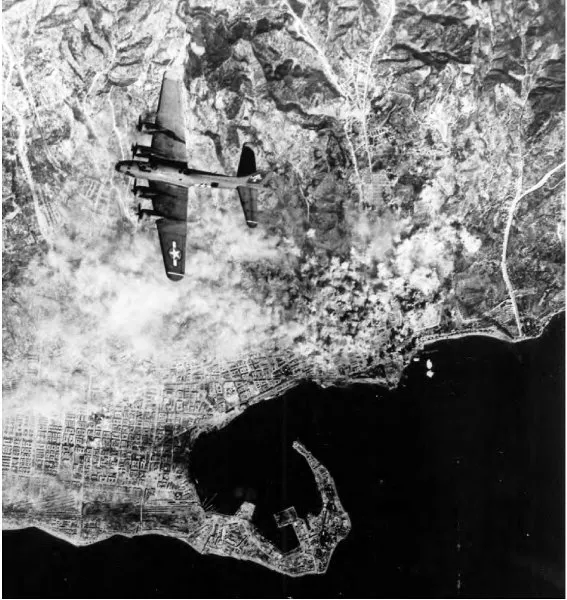
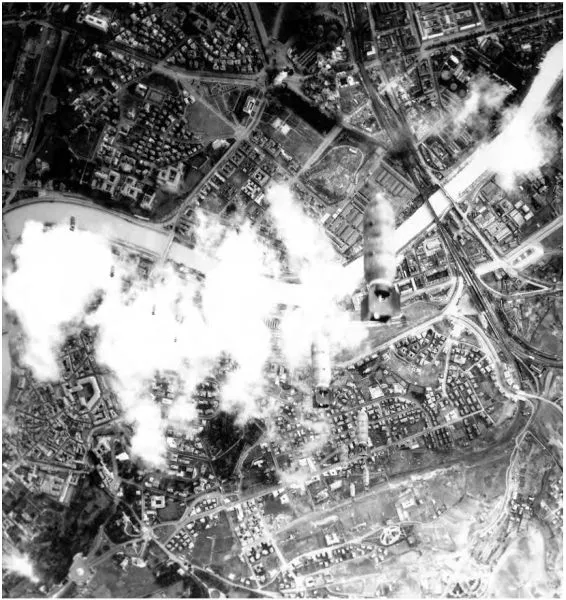
FLYING FORTRESS DURING BOMBING OF MESSINA. In the first two
weeks of August the enemy started to withdraw to Italy across
the narrow Strait of Messina under heavy bombing attacks. By
concentrating antiaircraft guns in and around Messina as a means
of combating these attacks, the Germans managed to ferry across
thousands of their first-line armored and airborne troops, but
much of their heavy equipment was left behind. U. S. patrols
entered the city from the west on 16 August 1943 while British
units entered from the south on the same day. The campaign had
lasted thirty-nine days.
SICILY
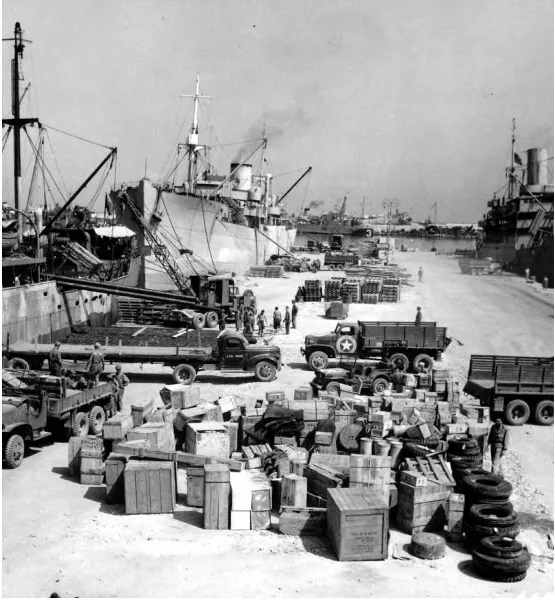
UNLOADING EQUIPMENT IN PALERMO. Even before the fighting
in Sicily had ended, the build-up for the invasion of
Italy started. The crane (left center) unloading pipe is a
truck-mounted crane M2. Designed to handle 240-mm. howitzer
materiel and 8-inch gun materiel in the field, it was a
six-wheeled type with power supplied to all wheels and capable
of accompanying convoy vehicles at a maximum speed of about
thirty miles per hour. It was also used to facilitate unloading
as above. The crew consisted of a chassis operator and a crane
operator.
SICILY
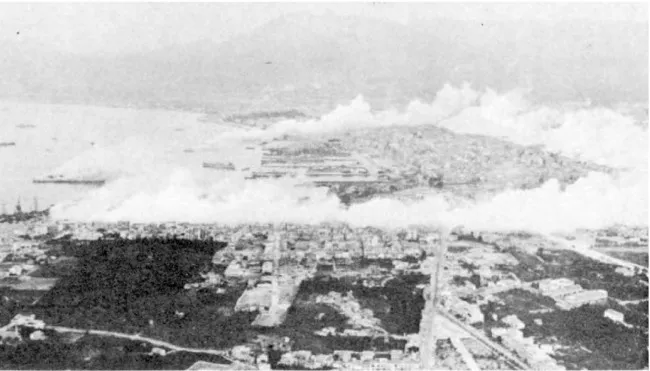
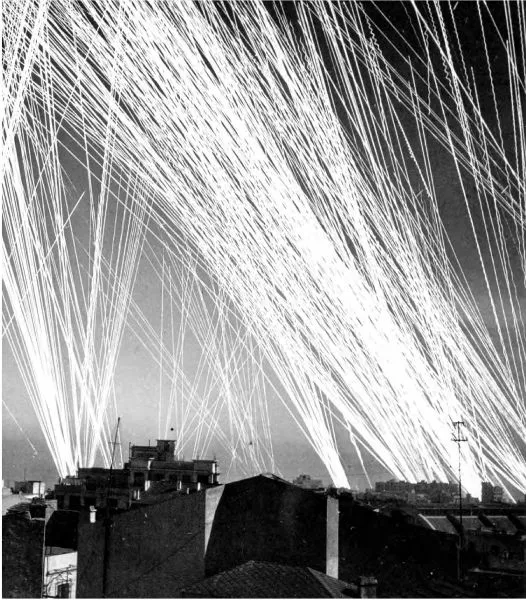
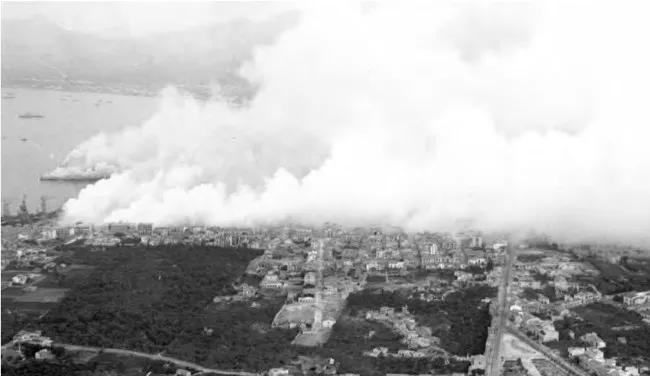
SMOKE SCREEN OVER PALERMO HARBOR AREA. This port, within easy
reach of enemy bombers based in Italy, was subjected to air
raids during the build-up period before the invasion of the
mainland. The smoke screen obscured the port area and kept the
bombardiers from aiming at any specific target.
SICILY
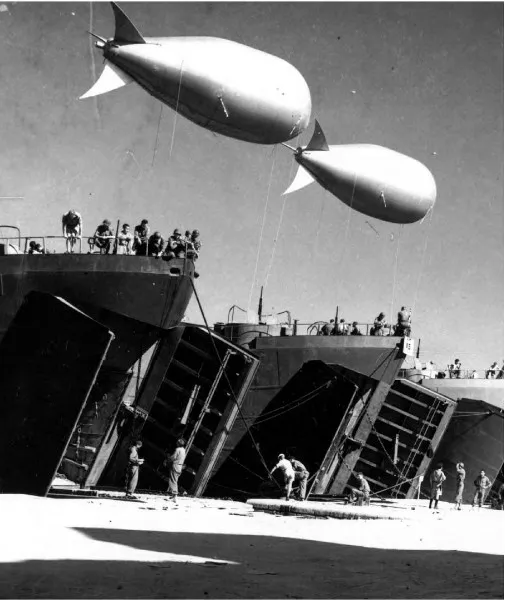
LST’S IN PALERMO HARBOR. The very low altitude barrage balloons
(above) protected the ships from dive-bombing attacks. They were
flown at different altitudes from day to day.
SICILY
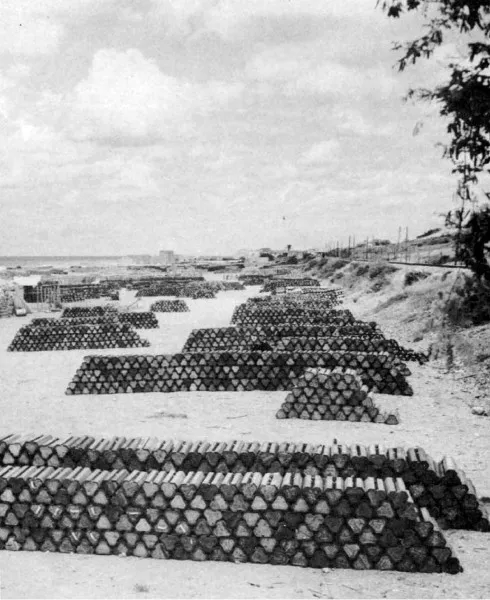
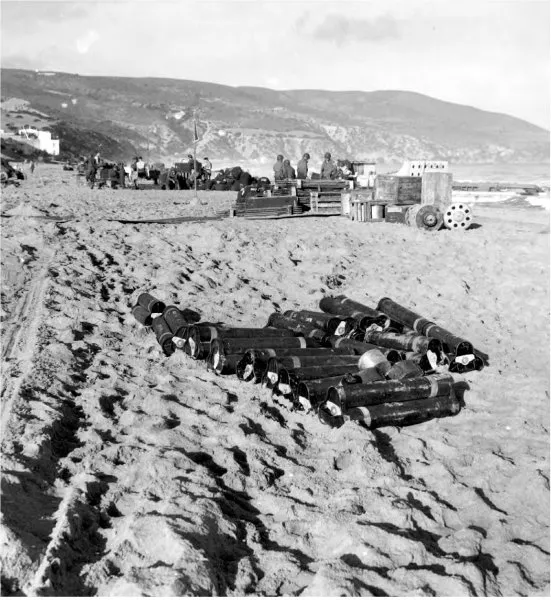
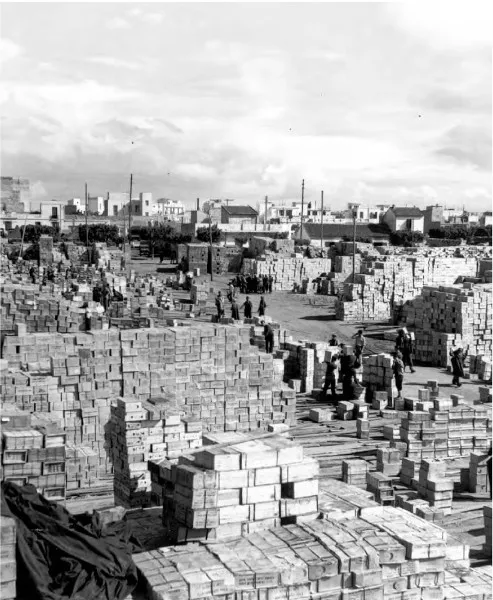
AMMUNITION DUMP NEAR PALERMO during the build-up for the
invasion of Italy.
SICILY
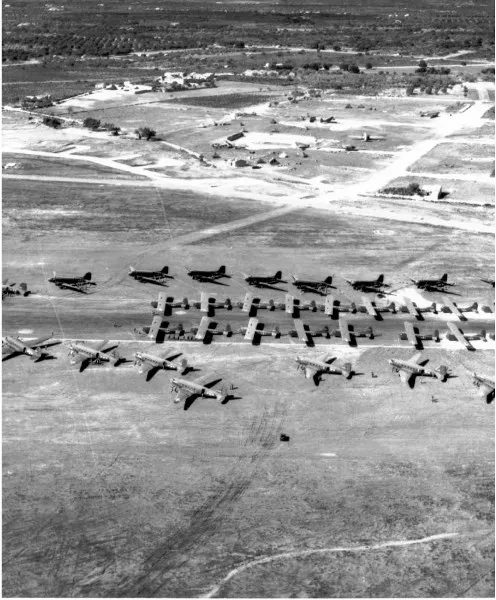
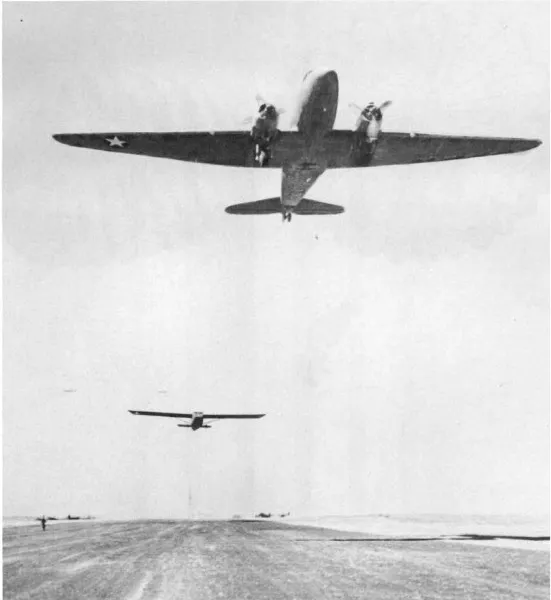
GLIDER TRAINING FIELD IN SICILY. (Douglas C-47 transport with
CG-4 gliders.)
SICILY
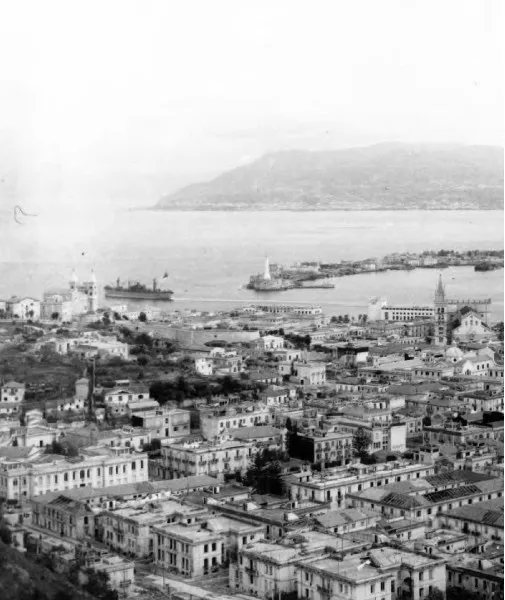
MESSINA WITH THE ITALIAN MAINLAND ACROSS THE STRAIT. On 3
September 1943 British and Canadians of the British Eighth Army
crossed this channel into Italy.
SARDINIA
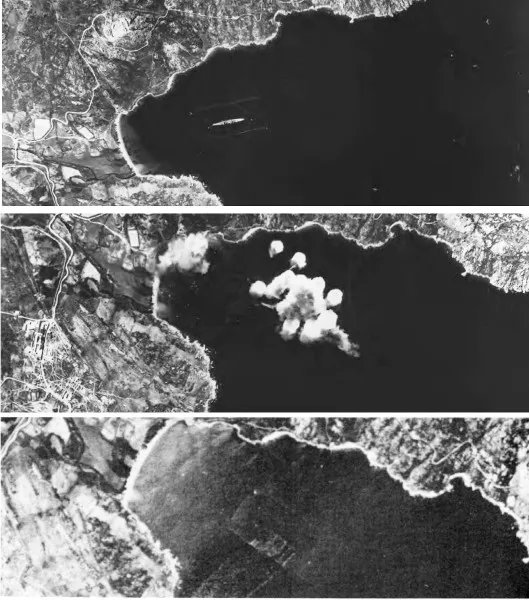
THE SINKING OF THE ITALIAN HEAVY CRUISER TRIESTE in Maddalena
harbor, Sardinia. The cruiser was sunk by twenty-four B-17’s
coming from bases in Africa, 10 April 1943. (Top picture:
cruiser within its protective antitorpedo net; center: salvo of
bombs landing on and near ship; bottom: this photograph was made
within the next few days and shows oil rising from the sunken
cruiser.)
SARDINIA
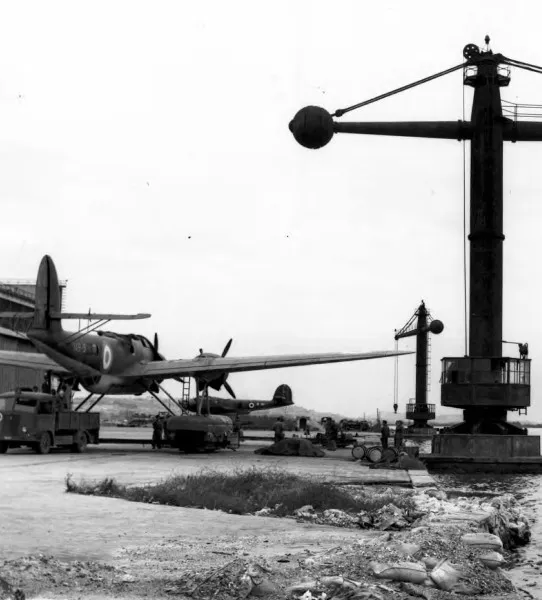
SEAPLANE BASE. The planes are captured Italian seaplanes at
Cagliari on Sardinia. Sardinia was not invaded by U. S. forces,
but the Germans evacuated the island in September 1943. Shortly
thereafter the Allies started basing aircraft there, chiefly
medium bombers. The bases were within range of all central
Italy. (Top plane is an Italian Cant. Z-506-B Airone (Heron)
three-engined bomber torpedo reconnaissance seaplane. The planes
have British RAF markings added after capture.)
CORSICA
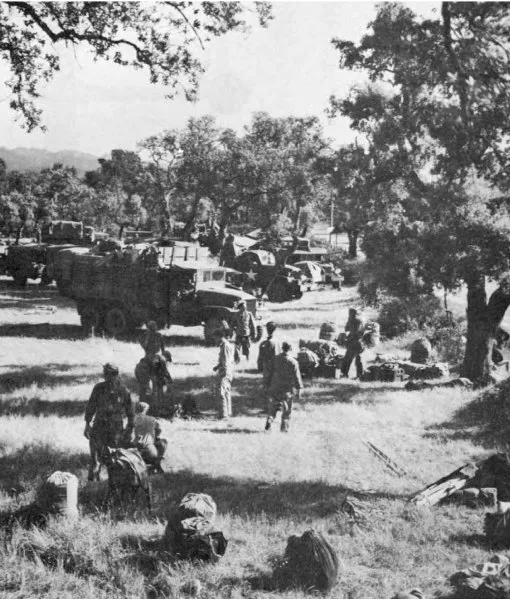
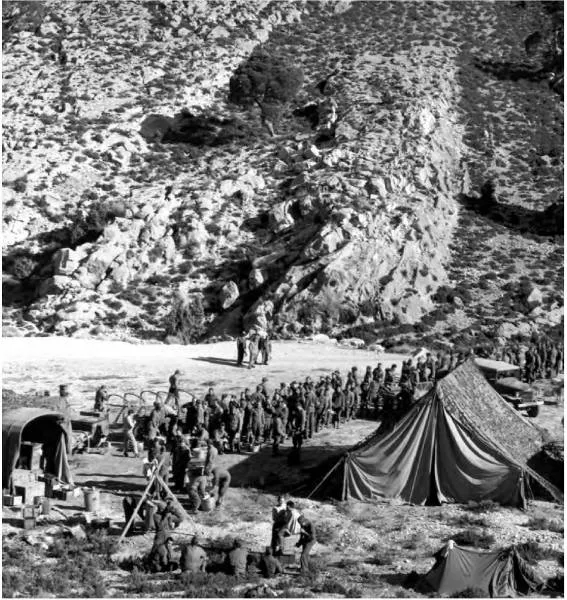
AIR CORPS PERSONNEL SETTING UP CAMP on the French island of
Corsica. On 14 September 1943, French commandos landed to help
patriots who were fighting the Germans. On 4 October the island
was in Allied hands, and soon thereafter the airfields were
being used as bases for fighters and medium bombers.
CORSICA
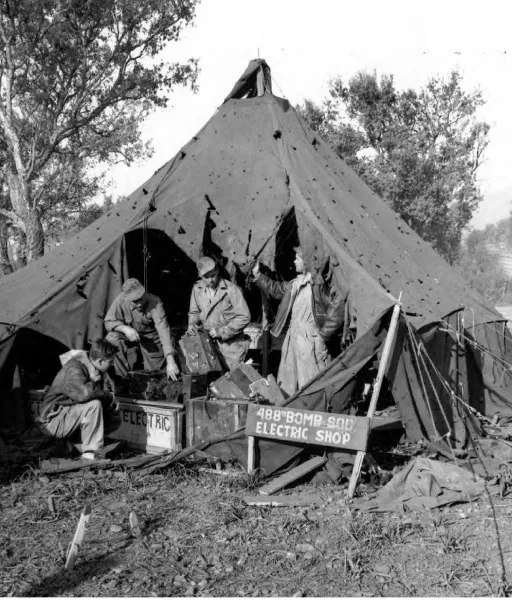
BOMBARDMENT SQUADRON REPAIR TENT in Corsica, riddled by bomb
fragments. U. S. medium bombers based here ranged over all
northern Italy and southern France. Fields in Corsica were
within range of enemy planes based in the Po Valley, and were
bombed and strafed periodically.
CORSICA
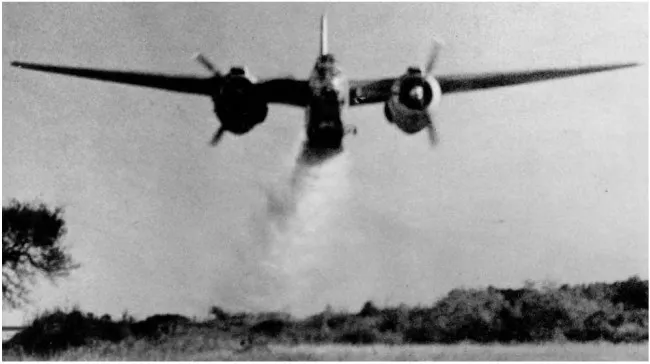
MALARIA CONTROL IN CORSICA. Throughout the Mediterranean
campaign, the malaria problem was ever present. Vigorous
measures were taken to eliminate the disease-carrying mosquito.
Douglas A-20 Havoc light-bomber (top) spreading Paris green dust
over swampland near an Allied military installation; (bottom)
refilling hopper of plane with dust.
SECTION III Italy
(9 September 1943–4 June 1944)
The Allied victory in Sicily helped to bring about the surrender of
Italy. The terms of the Italian surrender were signed on 3 September
1943 and announced on the night of the 8th. Allied troops received the
news on shipboard while under way to invade Italy. Fighting did not
cease with the surrender. Instead, the Germans took over the country
with troops on the spot and sent reinforcements. The defeat of the
Germans in Italy would strengthen Allied control over the Mediterranean
shipping lanes and would provide air bases closer to targets in Germany
and enemy-occupied territory. The Allied troops in Italy would also
engage enemy troops which might otherwise have been employed against
the Russians.
On 3 September, elements of the British Eighth Army crossed into Italy
and advanced up the Italian toe in pursuit of the retreating Germans.
On 9 September the main assault was launched when an Anglo-American
force, part of the U. S. Fifth Army, landed on the beaches near
Salerno, south of Naples. Since the enemy had expected landings in the
vicinity of Naples and had disposed his forces accordingly, the Allies
encountered prompt and sustained resistance. By 15 September, however,
the Germans started to withdraw up the Italian Peninsula, pursued on
the west by the Fifth Army and on the east by the Eighth Army. The port
of Naples fell on 1 October and the Foggia airfields about the same
time.
After crossing the Volturno River against stiff resistance, the
Allies advanced to the Winter Line seventy-five miles south of Rome.
In bitterly cold weather the troops slogged through mud and snow to
breach the series of heavy defenses and advanced to the Gustav Line.
In midJanuary the main Fifth Army launched a new offensive across the
Rapido and Garigliano Rivers to pierce the Gustav Line and advance up
the Liri Valley toward Rome. Bridgeheads were secured across the rivers
and footholds were obtained in Cassino and surrounding hills, but no
break-through of the main German positions was effected. A few days
after the initial attack against the Gustav Line, an Anglo-American
amphibious force landed at Anzio and struck inland with the purpose
of compelling the Germans on the southern front to withdraw. But the
Allied beachhead force was contained by the enemy’s unexpectedly rapid
build-up and was hard pressed to stave off several fierce German
counterattacks.
After the Anzio front became stabilized and the effort to take Cassino
was abandoned, the AAI (Allied Armies in Italy) regrouped and launched
a new offensive on 11 May 1944. Fifth Army, led by French troops and
assisted by American troops, broke through the main German positions
in the Arunci Mountains west of the Garigliano River while the Eighth
Army advanced up the Liri Valley. A few days later the beachhead force
effected a junction with the troops from the southern front, and
advanced almost to Valmontone on Highway 6 before the axis of attack
was shifted to the northwest. After several unsuccessful attacks
toward Lanuvio and along the Albano road, the Fifth Army discovered an
unguarded point near Velletri, enveloped the German positions based on
the Alban Hills, and pushed on rapidly toward Rome, which fell on 4
June 1944 with the Germans in full retreat. Meanwhile preparations were
being rushed for an invasion of southern France by Allied troops, most
of them drawn from forces in Italy.
ITALY
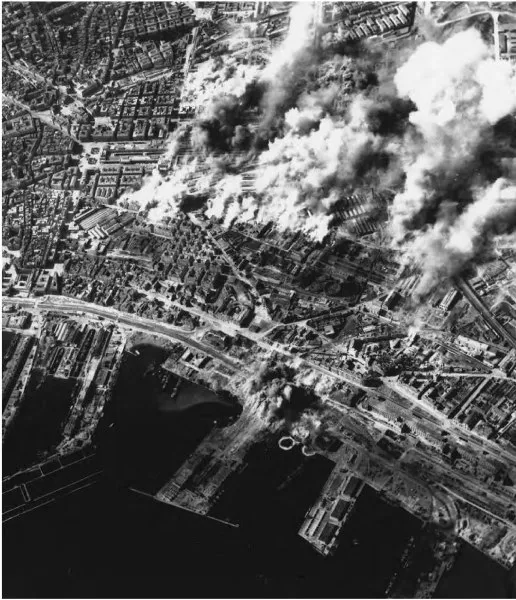
RAILROAD YARDS IN NAPLES burning after bombardment by Allied
bombers from Africa. Before the invasion of Italy the bombing
of enemy rail communications leading into southern Italy had
high priority. Naples and Foggia were the most important rail
centers south of Rome and both were heavily bombed prior to the
landings.
ITALY
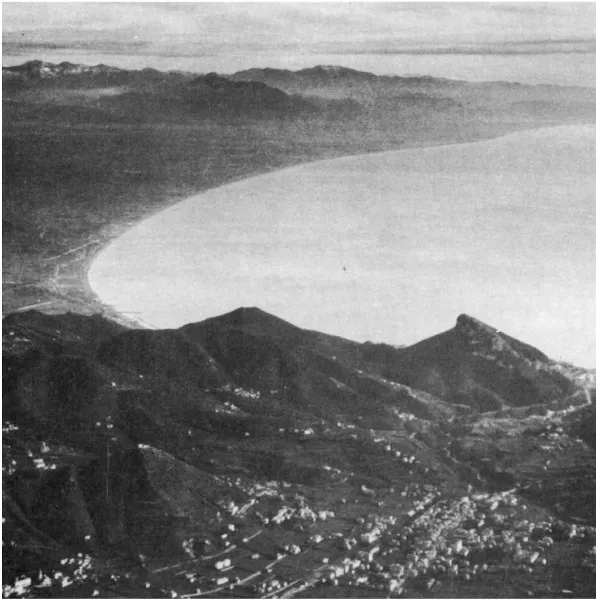
GOLFO DI SALERNO. The plain of Salerno in Italy, ringed
and dominated by mountains, provided observation posts and
commanding positions for the enemy. Here, on 9 September 1943,
landed elements of the U. S. Fifth Army, an Anglo-American
force. The British 10 Corps of this army landed on the
beaches shown in the center of the picture, the U. S. VI
Corps on beaches at Paestum in distance. One division of the
British Eighth Army landed at Taranto in the heel of Italy
simultaneously with the main landings in the Golfo di Salerno.
Just six days before these landings two divisions of the British
Eighth Army had invaded Italy from Sicily. These two armies were
to advance northward: the U. S. army along the west and the
British army along the east side of the peninsula.
ITALY
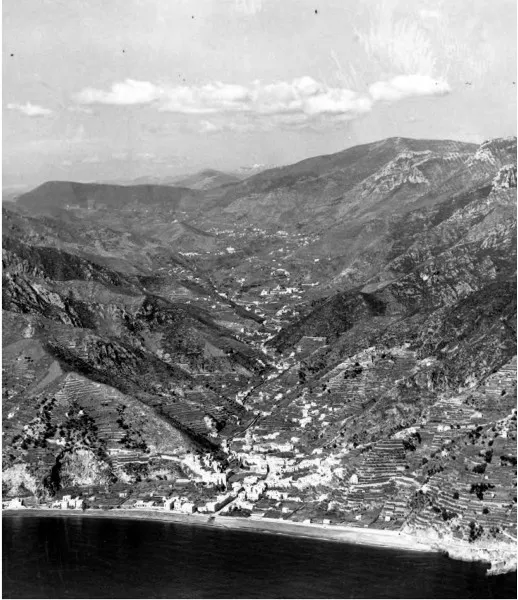
MAIORI BEACH, located a few miles west of the town of Salerno.
Three Ranger battalions landed here unopposed on the morning of
the invasion. Their mission to advance across the mountains and
into the Nocera plain to prevent reinforcements located around
Naples from reaching the invasion area was accomplished.
ITALY
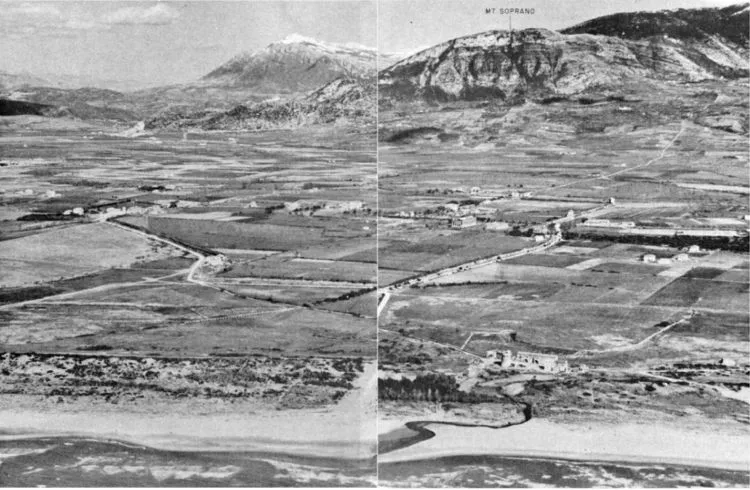
PAESTUM BEACH ON THE GOLFO DI SALERNO. At lower right is Paestum
tower, the most prominent landmark on the beach. This beach was
the scene of the first invasion of U. S. troops on the mainland
of Europe. The landing took place before daylight on 9 September
and the troops reached Monte Soprano before nightfall. The
area did not contain many fixed defenses, but the enemy had a
considerable number of tanks and mobile guns.
ITALY
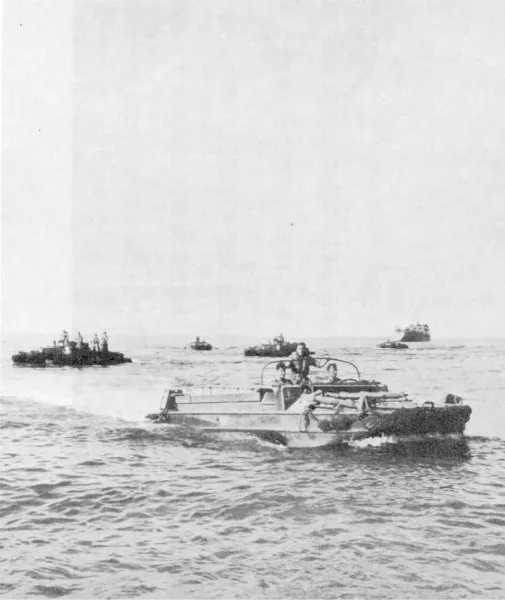
DUKW’S HEADING FOR SALERNO BEACHES. The one in the foreground is
carrying gasoline in five-gallon cans. The maintenance of Allied
forces for the first few days depended largely on craft such as
these “ducks.”
ITALY
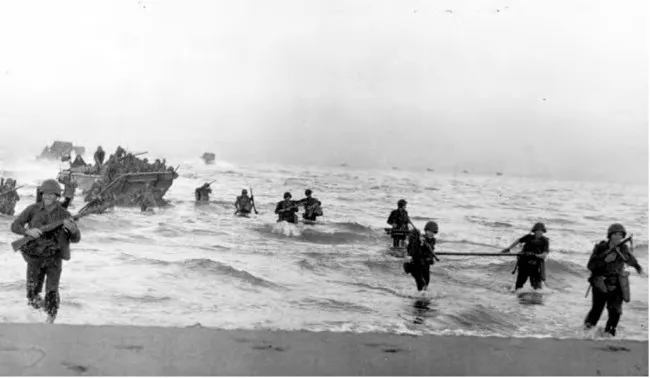
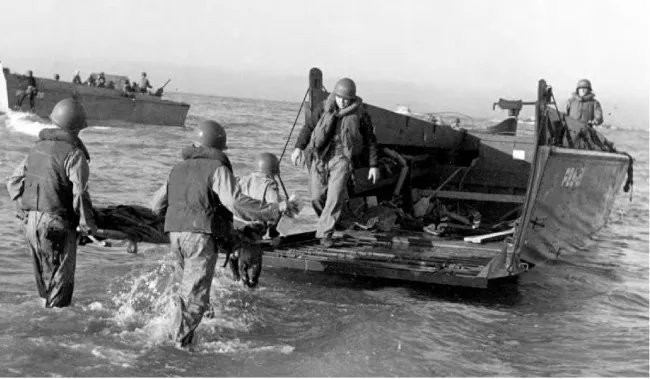
INVASION SCENES AT PAESTUM BEACH. Infantry debarking from
assault craft (top) and naval personnel evacuating wounded
soldiers to a transport for medical care (bottom). The landing
craft shown are all LCVP’s.
ITALY
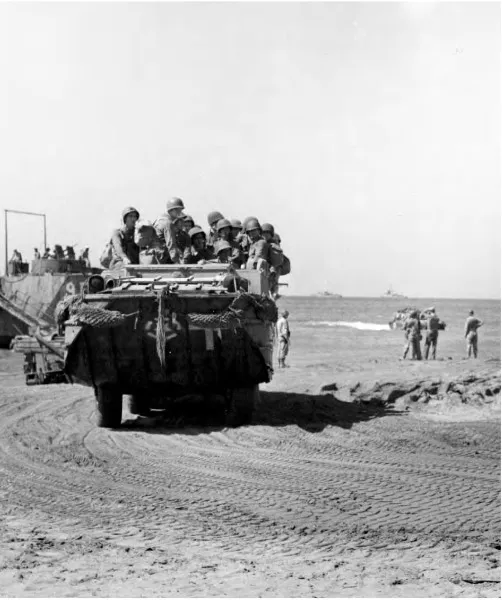
DUKW LANDING AT PAESTUM BEACH. These amphibian trucks brought
light artillery and antitank guns ashore after the first assault
waves had landed and, later in the day, brought men and supplies
ashore.
ITALY
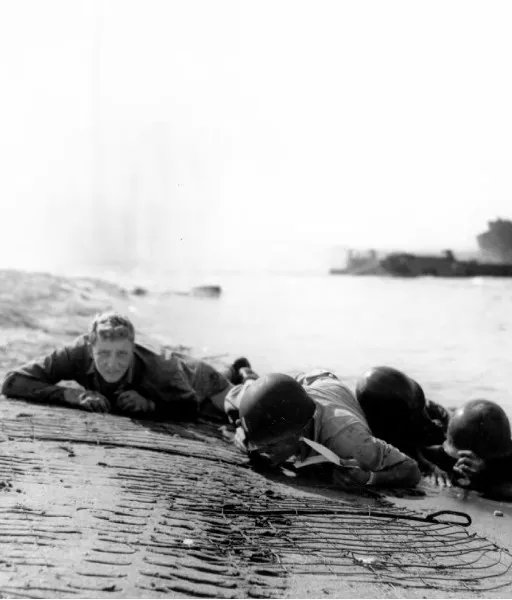
SOLDIERS HUGGING THE BEACH during air strafing and bombing
attack on D Day. Five enemy air raids, each by a formation of
eight fighter-bombers, were made against U. S. troops along
the beach. Several smaller formations were sent against ships
offshore. Casualties and damage caused were relatively slight on
D Day.
ITALY
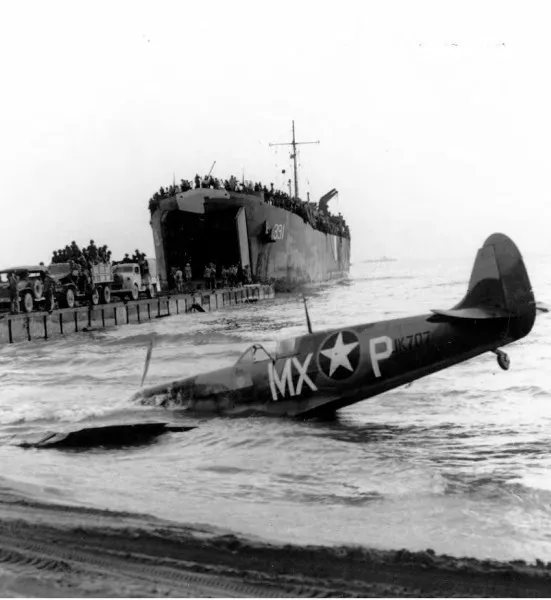
WRECKED SPITFIRE shot down by Allied antiaircraft fire over
Paestum beach. As several U. S. fighter squadrons were equipped
with British Spitfires, the planes bore U. S. markings.
Providing air cover from the Salerno area was a difficult
problem because Allied fighters were based in Sicily. The
longest-range fighter, the P-38, could stay over the beaches for
only one hour, the A-36 (modified North American P-51 Mustang)
thirty minutes, and the Spitfire about twenty minutes. (In
background: LST unloading equipment over sectional ponton ramp.)
ITALY
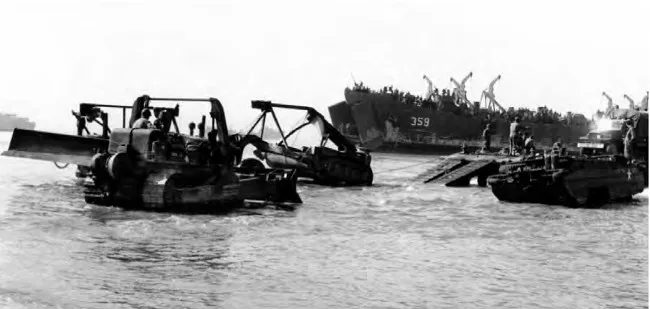
REINFORCEMENTS COMING ASHORE at Paestum beach on D Day. Top:
bulldozer coming ashore—in background is a U. S. type LST,
two-davit design; bottom: infantry, armor, and medical aid
men—in background is British type tank landing ship (LST
(1)). This ship was one of three belonging to the Boxer class.
These were the first ships built specifically for tank landing
purposes after the successful experimentation with the converted
Maracaibo class oil tankers. They could land medium tanks over a
low ramp carried within the ship and extended through low gates
toward the beach. Load: thirteen 40-ton tanks or the equivalent.
(A DUKW also is shown in the top picture; the tanks in the
bottom picture are Sherman M4A1.)
ITALY
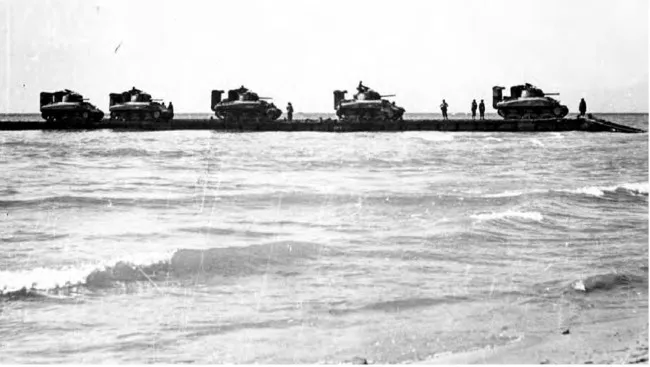
HEAVY EQUIPMENT ROLLING ASHORE ON D DAY. Waterproofed medium
tanks (Shermans) rolling toward shore across sectional ponton
ramp from LST (top), and LST discharging fully loaded trucks
(bottom).
ITALY
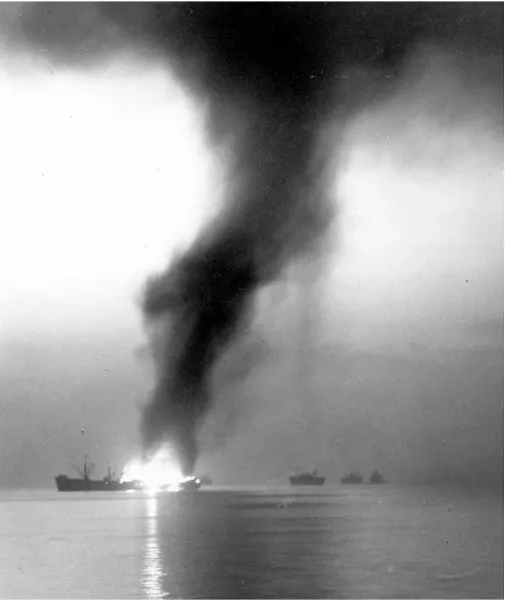
FREIGHTER BURNING AFTER BOMBING ATTACK. The night of 10–11 and
the day of 11 September saw the greatest enemy air activity.
During that time about 120 hostile aircraft raided the beaches
and the transport area.
ITALY
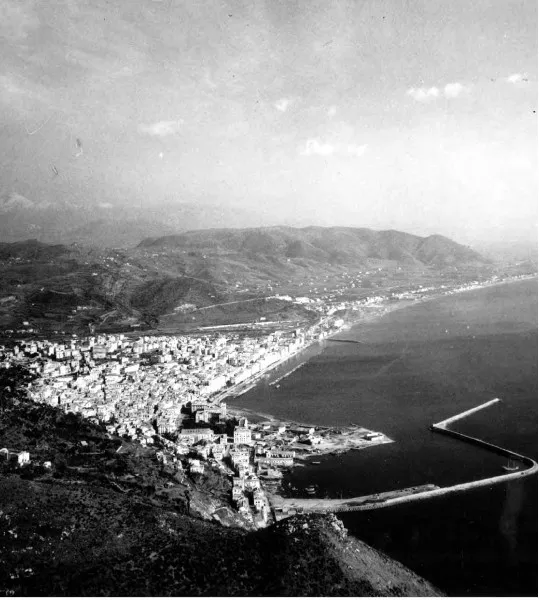
SALERNO, which fell to the British forces of the Fifth Army on
D Day. Until the port of Naples, which fell on 1 October, was
cleared, all reinforcements and supplies for the army came in
over the beaches or through the port of Salerno. On 19 September
the entire Salerno plain was securely in Allied hands. The
German counterattacks which had started on 12 September had been
checked by the 15th. On the 17th the Germans started to withdraw
from the area.
ITALY
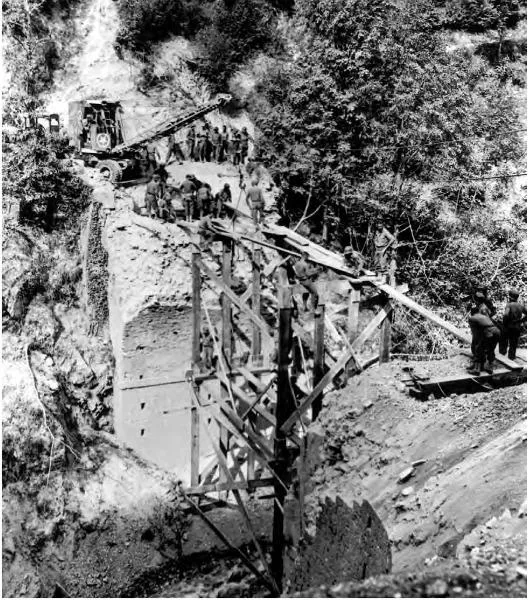
ENGINEERS REPAIRING A BRIDGE NEAR ACERNO. While part of the
invading forces advanced westward toward Naples, part proceeded
toward Benevento to the north. The enemy retreated slowly toward
the river Volturno, the next natural line of defense, leaving
rear guards to delay the advance, mine the roads, and blow the
bridges.
ITALY
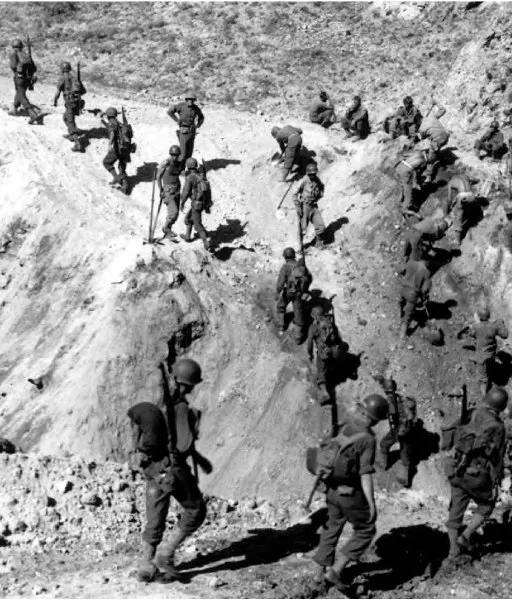
INFANTRY ADVANCING ACROSS BYPASS TO BRIDGE near Avellino on the
way to the Volturno River. Blown bridges caused much delay;
infantry, after crossing, generally ran into opposition that
required the use of tanks, which had to wait until the engineers
could rebuild the bridges.
ITALY
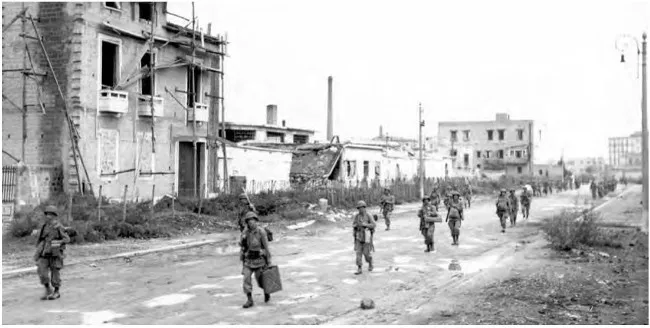
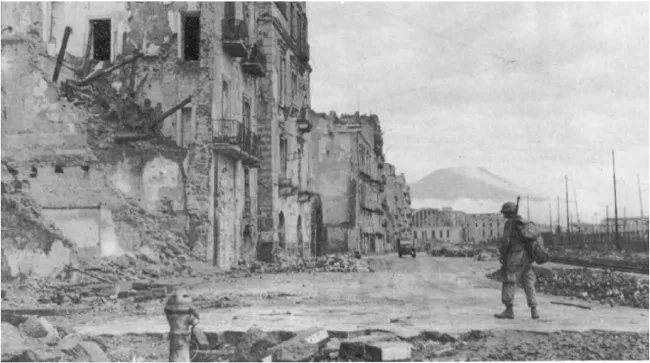
U. S. TROOPS IN NAPLES. The city fell to the British 10 Corps,
assisted by elements of some U. S. units, on 1 October 1943.
When Naples fell, the Allies were in possession of three of
Italy’s best ports, Naples, Bari, and Taranto, as well as two of
the most important airport centers, the Naples area on the west
and the Foggia area on the east of the peninsula. The latter
had fallen to the Eighth Army on 27 September and soon became
the base for the biggest concentration of Allied bombers in the
entire Mediterranean theater.
ITALY
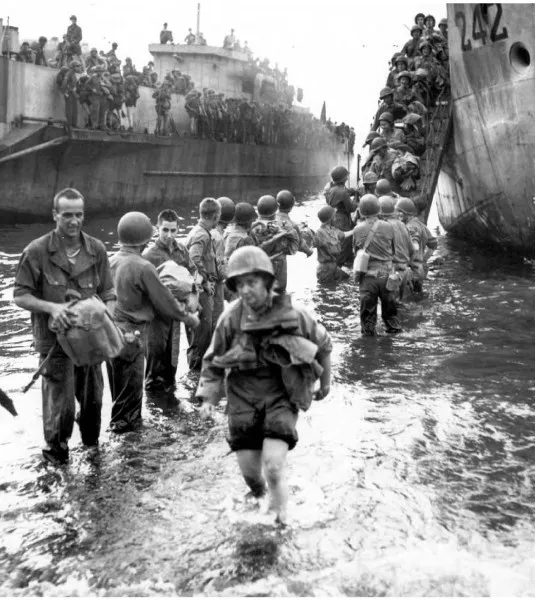
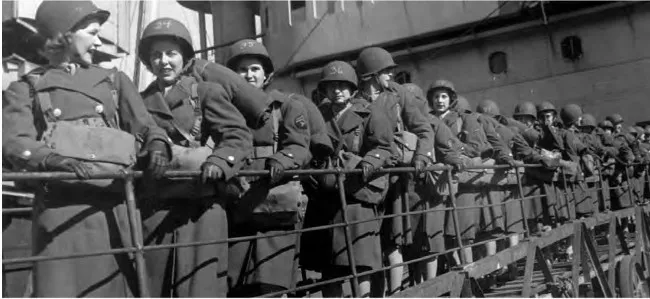
U. S. NURSES DEBARK FROM LCI in the Bay of Naples. Port
facilities in the city had been heavily bombed by the Allies for
months before the invasion and the damage had been increased
by the Germans as they retreated. Much of the cargo coming
into the harbor had to be discharged over beaches in the bay.
However, twelve days after the capture of the city the unloading
facilities were beginning to function and that day 3,500 tons
were discharged.
ITALY
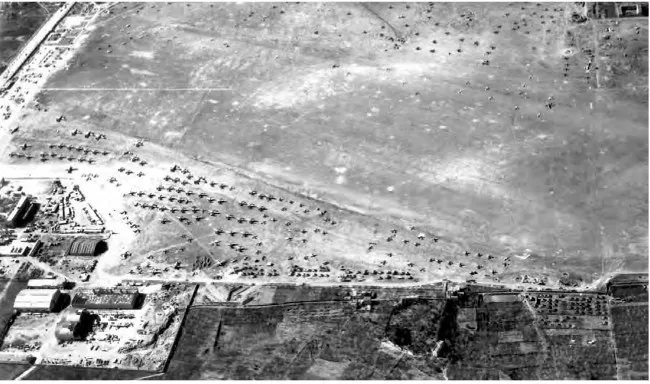
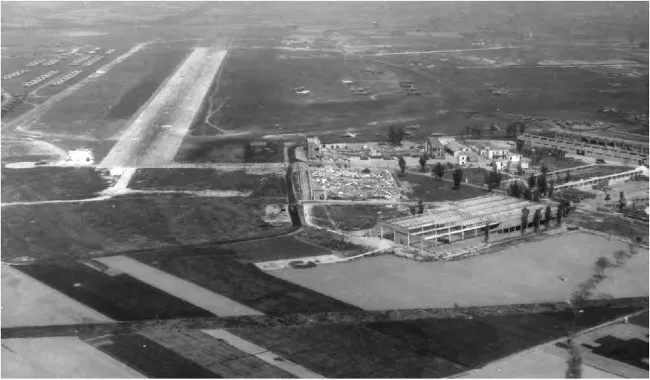
AIRFIELDS NEAR NAPLES. Capodichino (top) and Pomigliano (bottom)
after they had been put to use by the Allies. Both fields had
been severely damaged by Allied bombers before the invasion.
ITALY
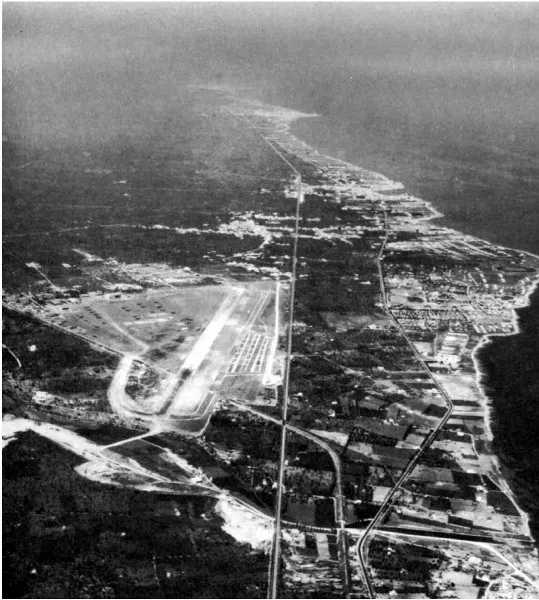
BARI AIRPORT, on the Adriatic just north of the heel of Italy,
was captured by the British on 22–23 September 1943. The enemy
had used this airport as a transport base and for staging
fighters on the way to Africa. The near-by town of Ban became
headquarters for the heavy Allied bombardment units based at
several airfields on the Foggia plain. Both the town of Ban and
the Bari airport were subject to attack by enemy aircraft.
ITALY
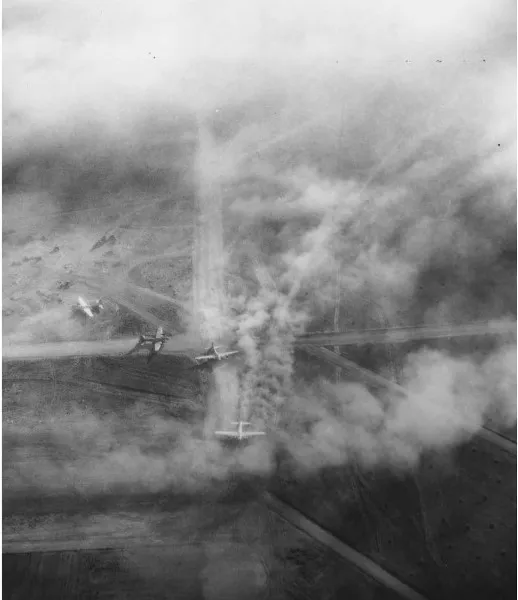
FLYING FORTRESSES taxiing out to runway to take off on a
mission. This picture was taken early in the Italian campaign,
before this airfield in the Foggia area had been improved. Soon
after the Foggia airfields had been captured, Allied bombardment
groups started to move from the African bases.
ITALY
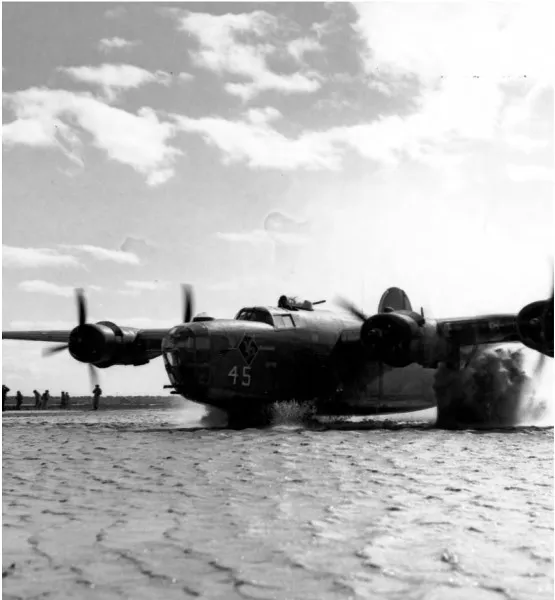
LIBERATOR BOMBER taxiing along flooded runway on one of the
airfields in the Foggia area. When the fall rains started in
October 1943 most of these fields became muddy and some were
flooded. The flying of missions was continued while construction
was in progress, runways being lengthed and raised, and fields
drained. By the end of 1943 most of the fields had been put into
good shape and by that time two heavy bombardment groups, two
medium groups, and two fighter groups were operating out of ten
airfields in the Foggia area.
ITALY
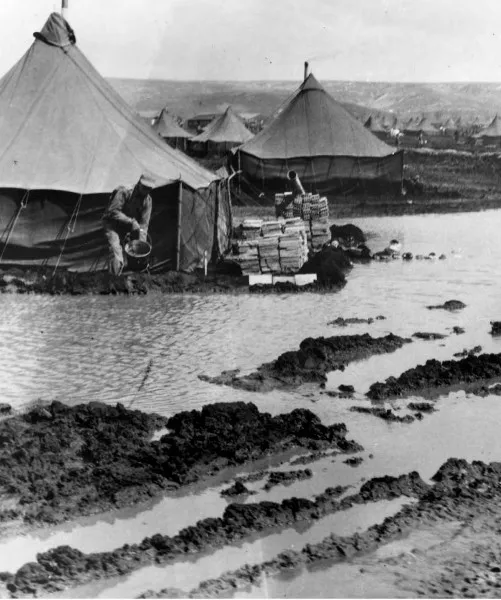
AIRMAN BAILING OUT HIS TENT after a rainstorm in southern Italy.
This was late fall 1943. As time went on conditions improved. By
the end of the year there were 35,000 U. S. combat airmen with
their supporting forces in Italy.
ITALY
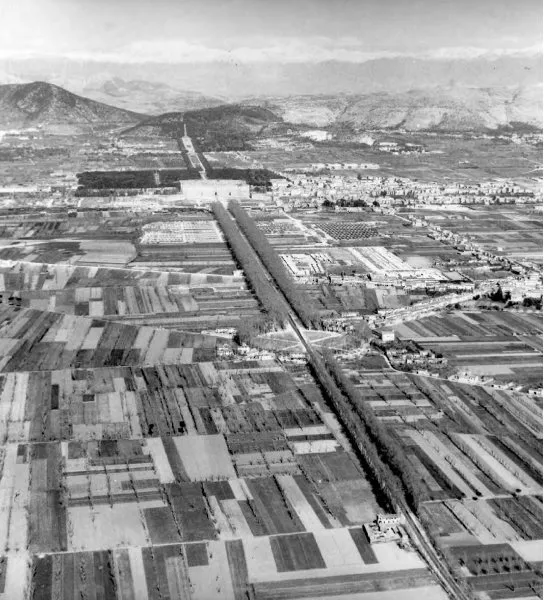
CASERTA, NEAR NAPLES. This area fell to the Fifth Army on 5
October 1943. The palace shown at end of tree-lined road became
headquarters of the Fifth Army soon after the building was
captured. Later it also became headquarters of the 15th Army
Group (Fifth and Eighth Armies) and still later Allied Force
Headquarters, the last named having control over the entire
Mediterranean Theater of Operations. The German surrender in
Italy was signed in the palace.
ITALY
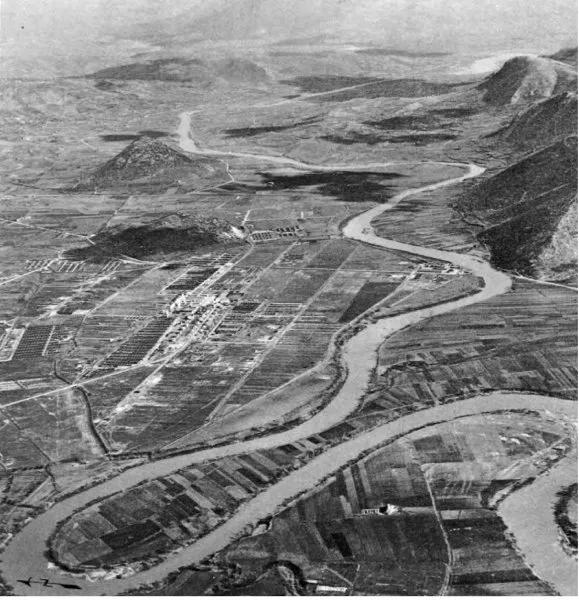
VOLTURNO RIVER ABOVE CAPUA. This was the first natural line of
defense north of the Naples area. The Fifth Army had reached the
southern bank of this river by 6 October. In the period between
the landings on 9 September and the arrival at the Volturno,
the Fifth Army had suffered 12,219 casualties of all kinds;
4,947 were U. S.; 7,272 were British. On 13 October the first
successful crossing of this river took place above and below the
hairpin loop. The river here is from 150 to 200 feet wide, its
depth from 3 to 5 feet. U. S. troops crossed in assault boats
or on rafts; some used life preservers, and some forded the icy
stream with the use of guide ropes.
ITALY
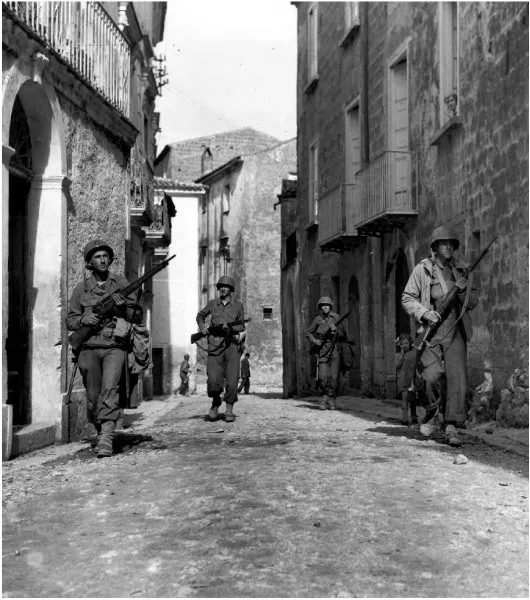
SOLDIERS ENTERING CAIAZZO after crossing the Volturno River. The
two men in foreground are carrying the Springfield rifle with
telescopic sights; those in rear, the Garand. (The Springfield
rifle M1 903A 4, .30-caliber, bolt-action, manually operated,
became the standard U. S. Army rifle in 1903. Garand rifle M1,
.30-caliber, self-loading, semiautomatic, is at present the
standard U. S. Army rifle.)
ITALY
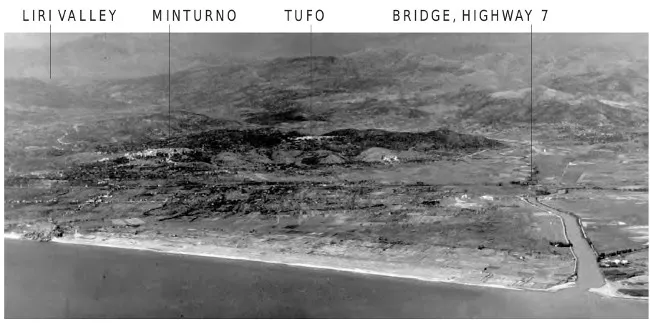
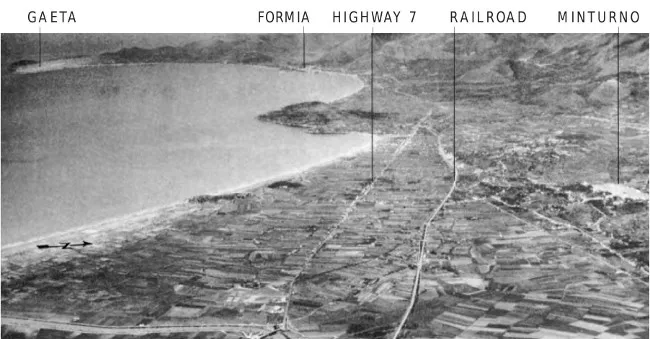
THE GARIGLIANO RIVER AREA on the Golfo di Gaeta. The area shown
was the western anchor of the enemy Gustav Line as well as his
Winter Line. By 15 November 1943 the Fifth Army was halted in
front of the Winter Line, which consisted of well-prepared
positions across the waist of Italy from the mouth of the
Garigliano River on the west, through the mountains in the
center, to the mouth of the Sangro on the east coast. The more
formidable Gustav Line was located farther north except along
the lower Garigliano where the two defense lines generally
coincided. Little fighting took place in the area shown until
the British 10 Corps crossed the river on 17 January 1944 to
support the main Fifth Army effort to drive up the Liri Valley.
Garigliano River is located at right in top picture and at lower
left in bottom picture.
ITALY
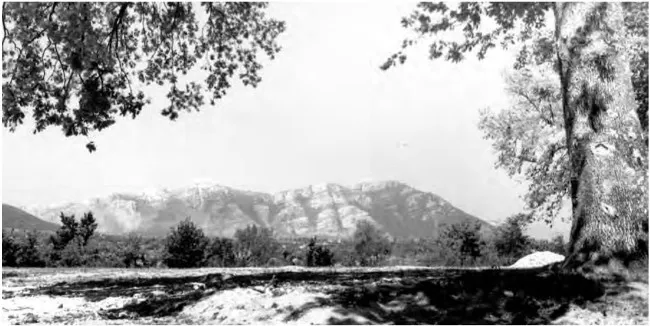
THE CAMINO HILL MASS. Top picture is taken looking toward the
northwest from road fork of Highways 6 and 85. Bottom picture
shows the hill mass with the Rapido River Valley in distance.
The Winter Line continued along the south and east slopes of
these mountains. The Camino Hill area fell to British and
American troops on 9 December 1943, after several days of severe
fighting.
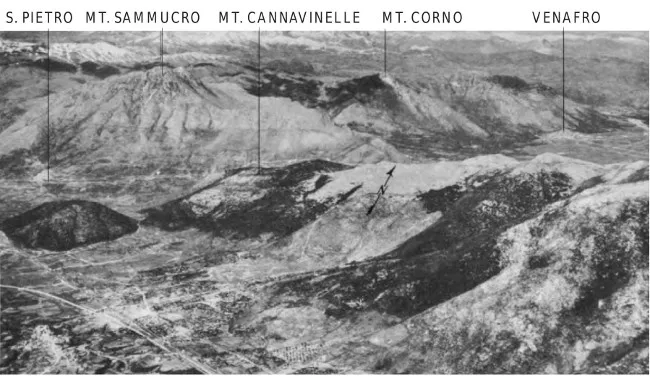
ITALY
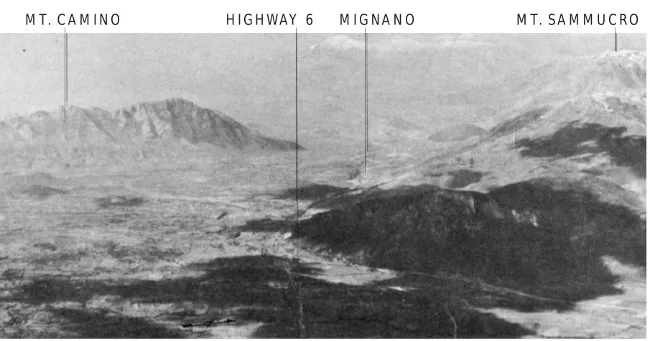
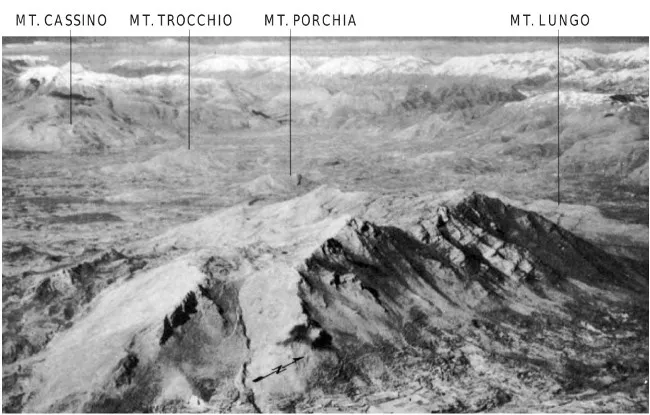
THE MIGNANO GAP. Looking west through the gap toward Monte
Cairo, the snow-covered mountain in distance. Cassino is located
at the foot of this mountain (top). Looking north from the gap;
the village of Mignano, Highway 6, and the railroad are in lower
left hand corner (bottom). San Pietro Infine, the village on the
slope of Monte Sammucro, was the scene of one of the costliest
battles of the Winter Line campaign. Mignano Gap was one of the
few breaks in the mountains of the Winter Line and the main
effort to breach that line was made at this gap.
ITALY
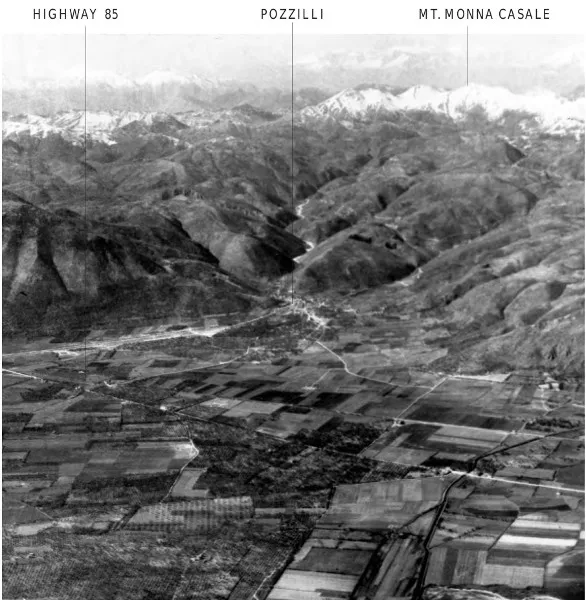
VOLTURNO RIVER VALLEY NORTH OF VENAFRO. River is in foreground.
The valley had been cleared of enemy troops by the middle of
November 1943. While German rear guards carried out delaying
actions, the main enemy forces strengthened the Winter Line
defenses in these mountains, which separate the Volturno River
from the Rapido River. Hard fighting took place for control of
the road leading from Pozzilli through the mountains to San Elia
in the Rapido Valley. Initial attempts made by U. S. forces to
cross the mountains failed because of the exhaustion of the
troops, the difficulty of supply, the unfavorable weather, and
the determined resistance of the enemy. The U. S. units were
replaced by fresh French mountain troops, who in January 1944
fought their way across the mountains.
ITALY
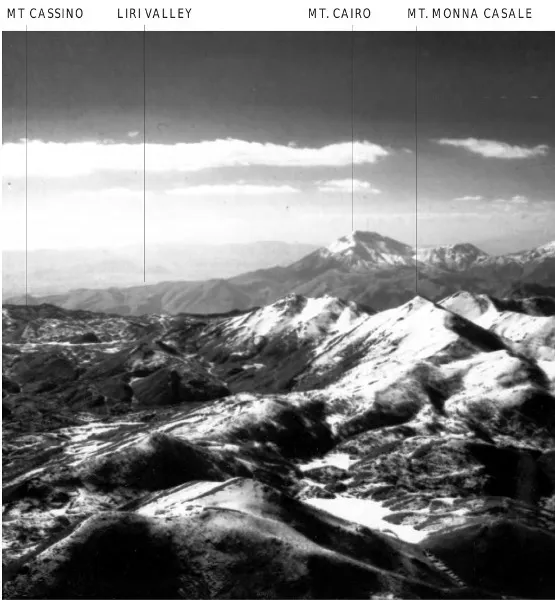
THE MONNA CASALE MOUNTAIN RANGE. These are the highest mountains
in the ridge separating the Volturno and Rapido Valleys. Two
roads across these mountains connect the two valleys: the Colli
al Volturn-Atina road on the north side of the range, the
Pozzilli-San Elia road on the south side. Both were relatively
poor. Hill mass at lower left is Monte Pantano. The battle for
this hill started on the night of 28–29 November and lasted
until 4 December. On that day the U. S. forces withdrew with the
enemy still in possession of most of the area. French troops
seized the rest of Monte Pantano on 17 December.
ITALY
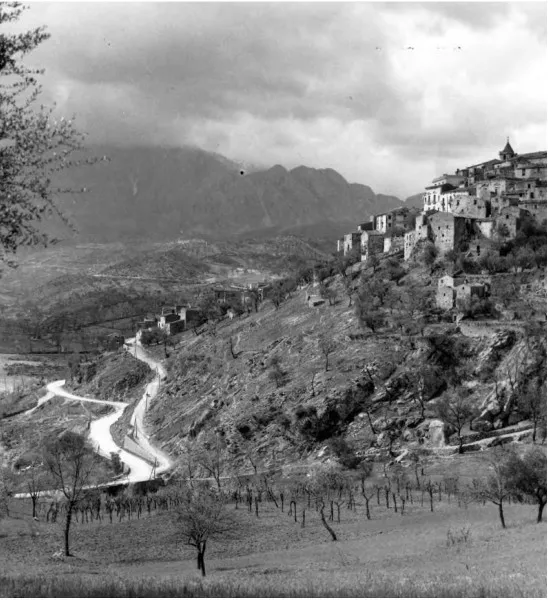
COLLI AL VOLTURNO. This typical Italian mountain village is
located at the headwaters of the Volturno and was on the right
flank of the U. S. Fifth Army. The mountains between this area
and the left flank of the British Eighth Army fighting along
the east coast of Italy were so rugged that no fighting took
place there. Both Allied armies merely maintained small patrols
to keep in contact. The lower road on the left runs through the
mountains separating the Volturno and Rapido River Valleys and
leads to Atina north of Cassino.
ITALY
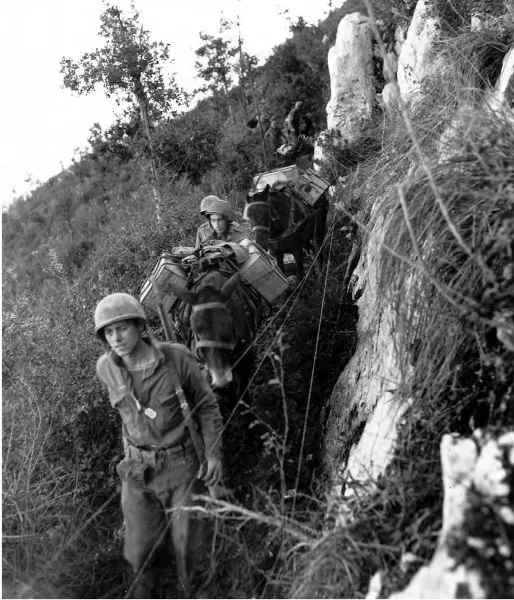
PACK TRAIN IN THE MOUNTAINS. These pack trains consisted mainly
of mules, but horses and donkeys were also used. Without the use
of pack trains the campaign would have been much more difficult.
To supply the basic needs of an infantry regiment in the line
two hundred and fifty animals per day were required.
ITALY
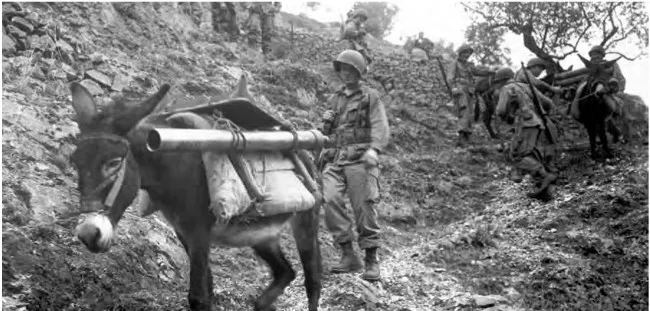
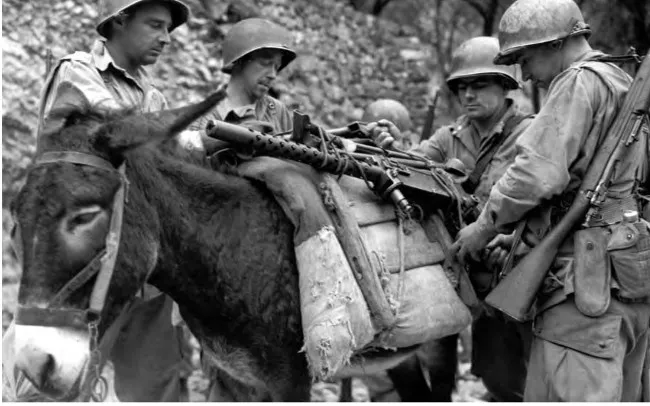
PACK TRAIN IN THE VENAFRO AREA. Top: first donkey is loaded with
an 81-mm. mortar, the second carries the ammunition; bottom:
strapping a light .30-caliber machine gun on a donkey. The pack
animals obtained by the Allies in the Mediterranean area were
of varying sizes, generally smaller than the ordinary American
mule, and standard U. S. pack equipment had to be modified in
the field. Most of the equipment, however, was purchased in
Italy.
ITALY
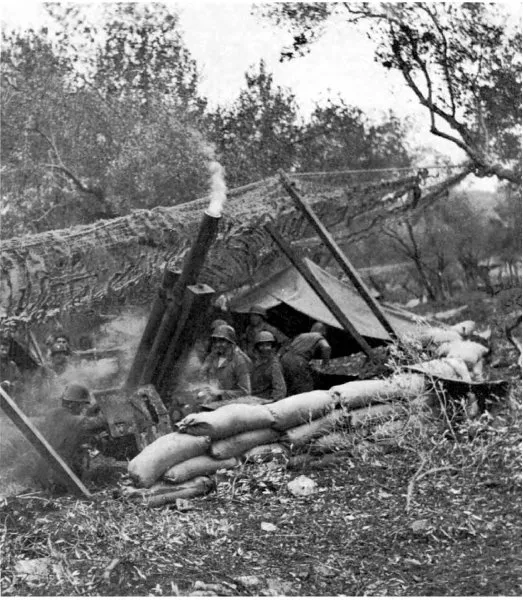
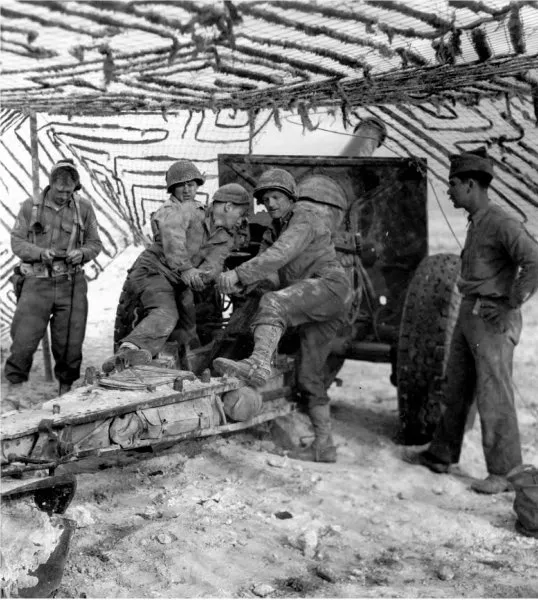
FIRING A HOWITZER ON THE VENAFRO FRONT, with camouflage net
pulled back for firing. While the infantry crouched in foxholes
on the rocky slopes of the mountains, the artillery in the muddy
flats behind them gave heavy supporting fire on enemy positions.
To clear the masks presented by the high mountains ahead,
barrels had to be elevated. (105-mm. howitzer.)
ITALY
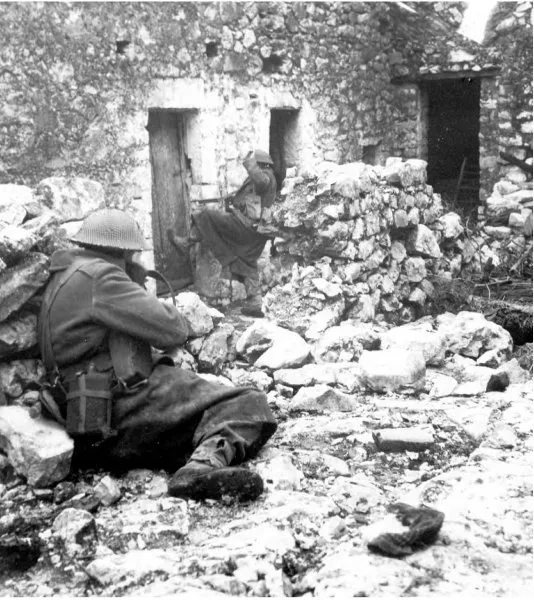
BRITISH SOLDIERS SEARCHING A HOUSE IN COLLE, a village on Monte
Camino. Soldier in foreground is covering his partner while the
latter kicks open the door. The stone houses, typical of those
in the mountain areas, with walls sometimes four feet thick,
made fine strong points. They could be reduced by artillery,
but in the Camino fighting, a joint British-American operation,
there was no close-support artillery.
ITALY
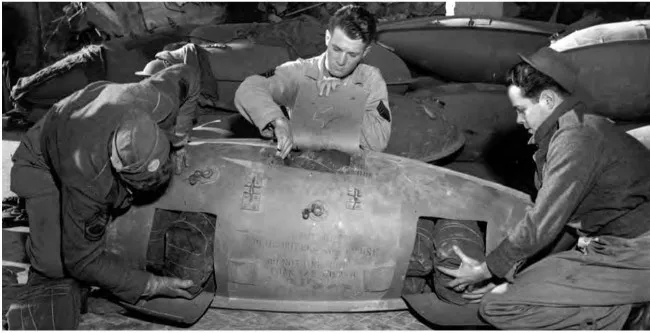
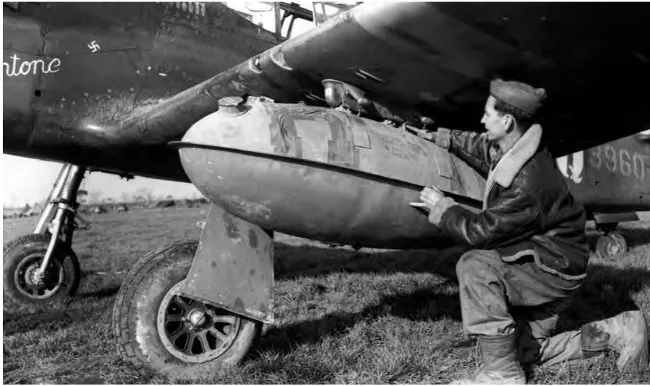
PREPARING AIR DROP OF FOOD AND SUPPLIES. Packing food parcels
into belly tanks of a P-40 (top), and attaching tank to the bomb
rack of A-36 fighter-bomber (bottom). The tank is released like
a bomb. During the fighting on Monte Camino in December several
air drops were attempted, but poor visibility, poor recovery
grounds, and proximity to enemy positions combined to defeat the
attempts on that occasion.
ITALY
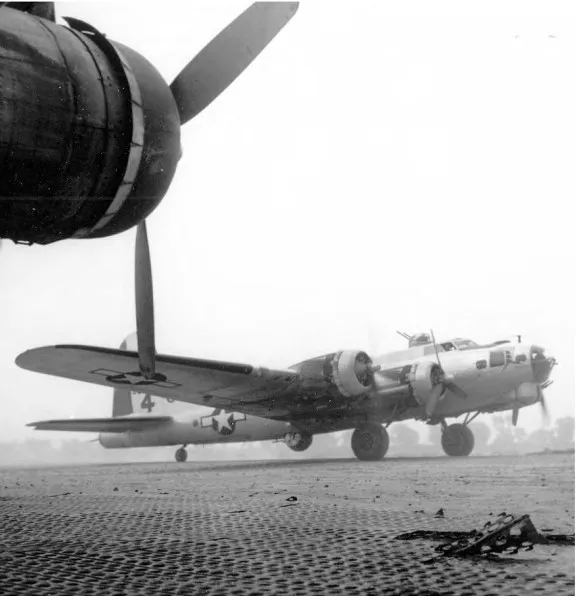
FLYING FORTRESS RETURNING FROM A MISSION. Note part of the
pierced steel plank runway in the foreground. The moving of the
heavy bombers from their bases in Africa to the Foggia area in
Italy was a tremendous undertaking because of the equipment
necessary to establish new runways, pumping plants, pipelines,
repair shops, and warehouses. The move took place during the
late fall and winter of 1943 and required about 300,000 tons of
shipping. This was at a critical time of the ground fighting and
there was not enough shipping to take care of both the air and
the ground fighters. So heavy were the shipping requirements
that the build-up of Allied ground forces was considerably
delayed.
ITALY
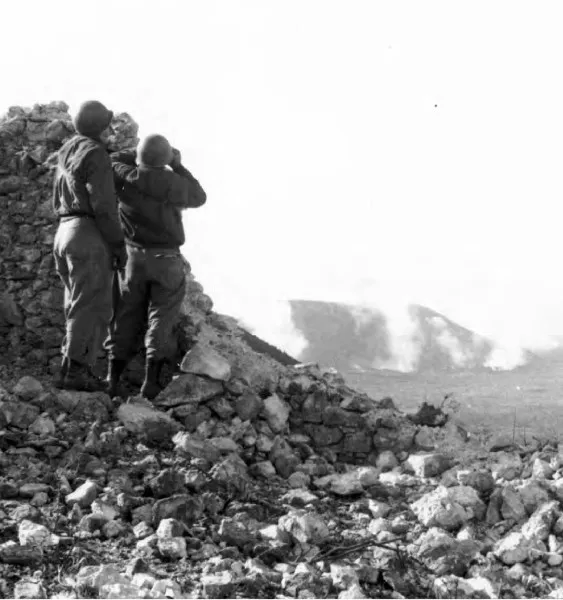
OBSERVING SMOKE SHELLS FALLING on enemy-occupied Monte Lungo
during the second fight for the village of San Pietro Infine on
15 December 1943. The smoke was to prevent enemy observation on
the village, which at this time was under infantry attack. The
first attacks on San Pietro Infine, 8–9 December, were repulsed
by the enemy, as were the attacks of 15–17 December. By this
time, however, the Allies had launched an attack and taken
Monte Lungo, thus outflanking the Germans in the San Pietro
Infine area. This caused the Germans to evacuate the village and
withdraw to the next position a few hundred yards back.
ITALY
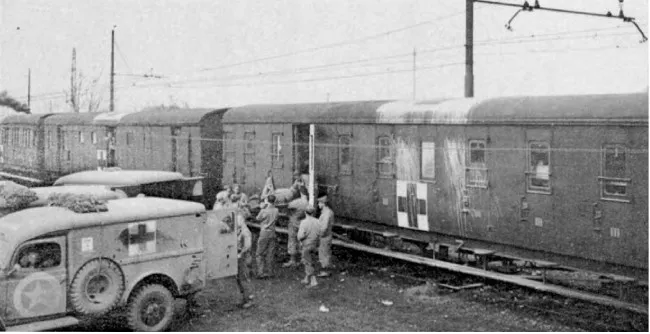
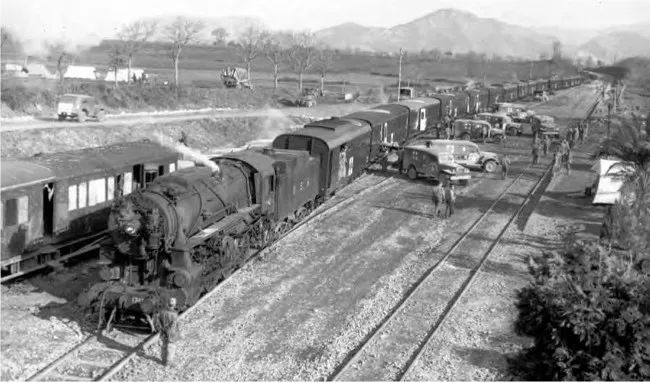
HOSPITAL TRAINS taking men wounded in the 1943–44 winter
campaign to base hospitals in the Naples area. Until the
fighting had advanced beyond Rome, the main Allied hospital area
in Italy was in and around Naples. The trains above have German
and Italian cars and U. S. locomotives. (Ambulances: truck,
¾-ton 4 x 4, crew of 2 with 4 litter patients or 7 sitting
patients.)
ITALY
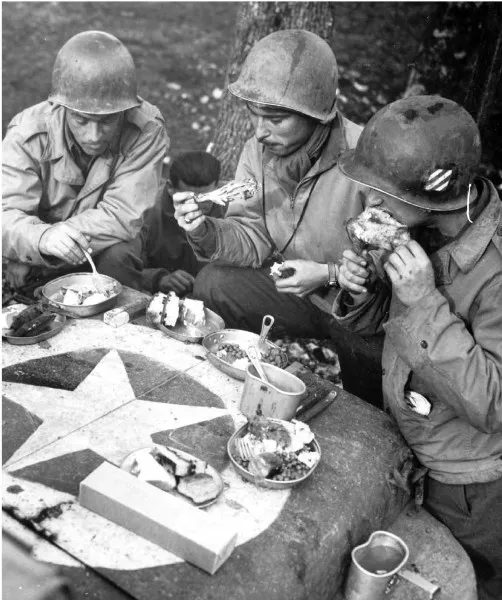
CHRISTMAS TURKEY ON THE HOOD OF A JEEP, Christmas 1943. Every
effort was made to give the troops the traditional holiday
dinners, complete with trimmings.
ITALY
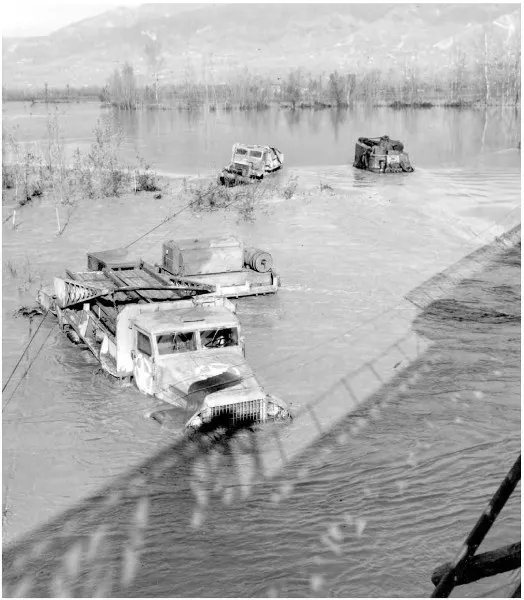
VEHICLES CAUGHT IN FLOODWATERS OF THE VOLTURNO. The fall rains
of 1943 started early and flooded the rivers and streams between
Naples, the main supply base, and the fighting area of the
Winter Line. Just behind the lines, mud, traffic, and enemy
shelling combined to keep roads and bridges in a condition that
required constant work.
ITALY
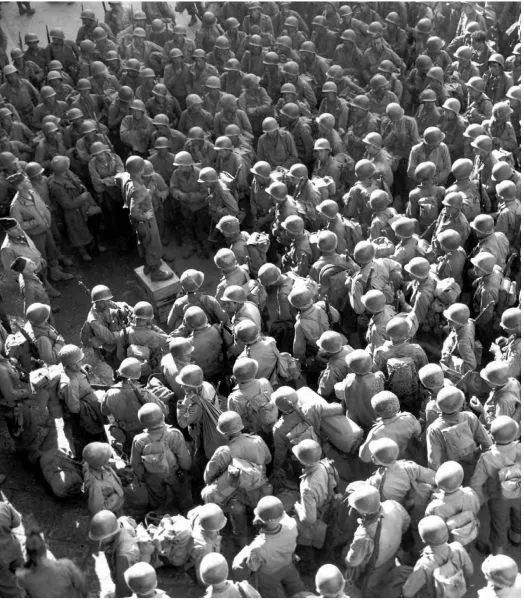
FRONT-LINE SOLDIERS BEING BRIEFED on arrival in rest camp in
Naples. Because of lack of food and housing in Italy it was
found impossible to give a man a pass and let him seek his
own recreation. Military rest camps were set up in several
localities, where the men could sleep late in clean beds, have
good food, and some entertainment.
ITALY
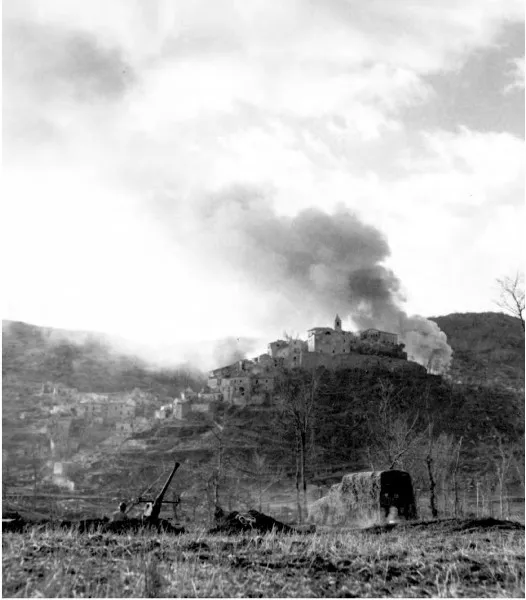
THE TOWN OF ACQUAFONDATA UNDER ENEMY SHELLFIRE. This village was
located on the road between Pozzilli in the Volturno Valley and
San Elia, north of Cassino. The road was on the right flank of
the Fifth Army throughout the Winter Line fighting. Most of the
fighting along this road was done by French mountain troops of
the Fifth Army.
ITALY
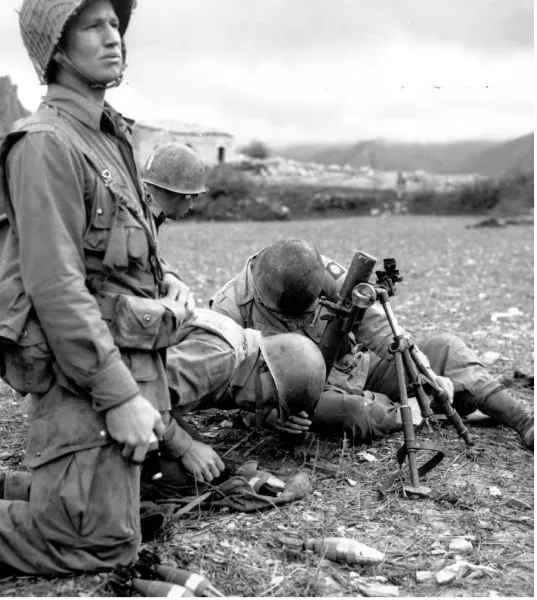
FIRING A MORTAR DURING A TRAINING PROBLEM near Venafro in the
Volturno River Valley. Mortars played an important part during
the drive through the Winter Line mountains and an intensive
training schedule was maintained prior to and during the
drive. (60-mm. mortar M 2, mount M 2, standard, developed by
the French, but manufactured in the United States under rights
obtained from the French.)
ITALY
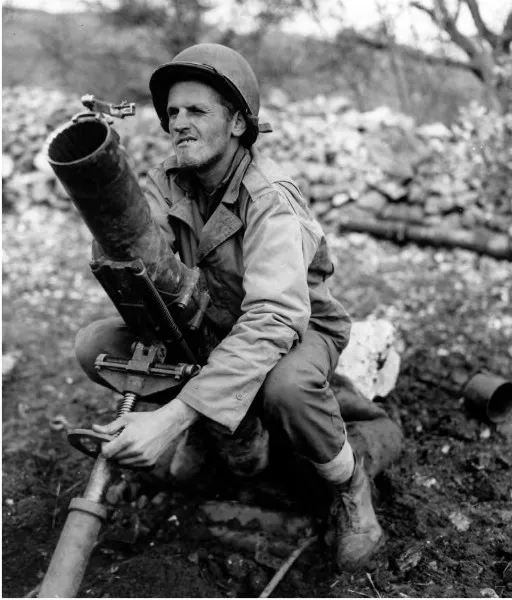
ADJUSTING ELEVATION AND DEFLECTION of 4.2-inch chemical
mortar. This mortar had a rifled barrel and was designed for
high-angle fire. Because of its accuracy (insured by rifled
barrel), mobility, rate of fire, and ease of concealment, it was
particularly suited for close support of attacking units.
ITALY
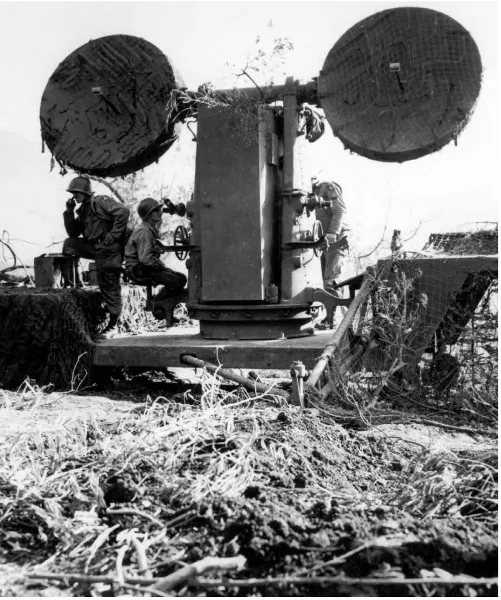
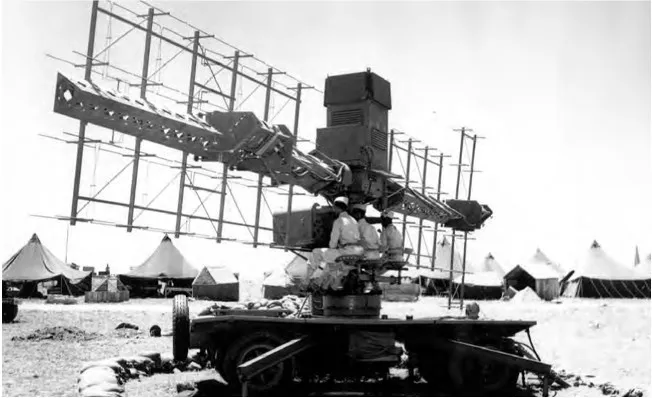
RADAR IN OPERATION NEAR SAN PIETRO INFINE. The operating parts
were mounted on a semitrailer towed by a tractor or truck. A
van-body truck carried a complete stock of spare parts. (Radar
SCR 547.)
ITALY
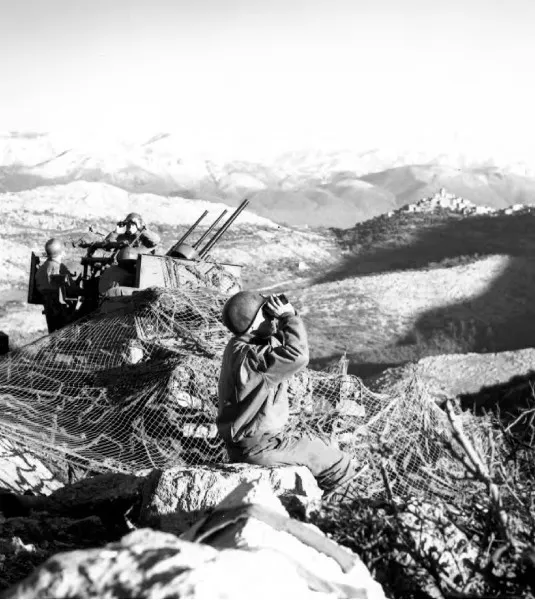
CAMOUFLAGED MOBILE ANTIAIRCRAFT UNIT near San Pietro Infine.
Enemy air attacks were not very numerous during the Winter
Line fight; the Germans had few aircraft to spare and the
weather tended to restrict the use of enemy as well as Allied
aircraft. (Multiple-gun motor carriage M 15 composed mainly of a
half-track personnel carrier with a 37-mm. gun, two .50-caliber
machine guns, and M 6 sighting system.)
ITALY
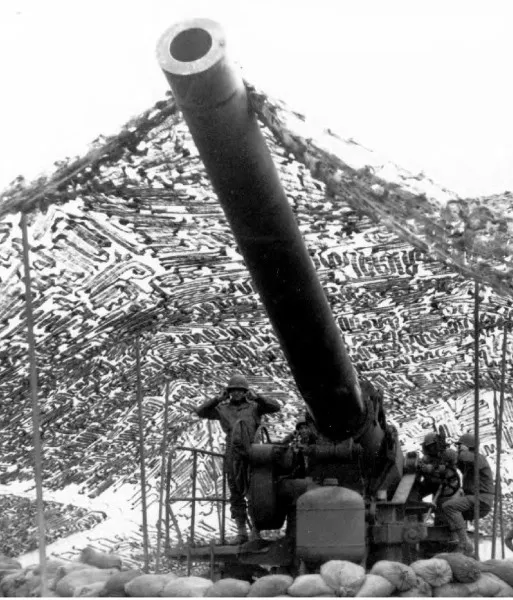
HOWITZER IN THE MIGNANO AREA. This model was the largest U. S.
artillery piece in Italy. It and the 8-inch howitzer were rushed
from the States to help reduce the strong enemy fortifications
of the Gustav Line; the most heavily fortified part of this line
was in the Cassino area. (240-mm. howitzer.)
ITALY
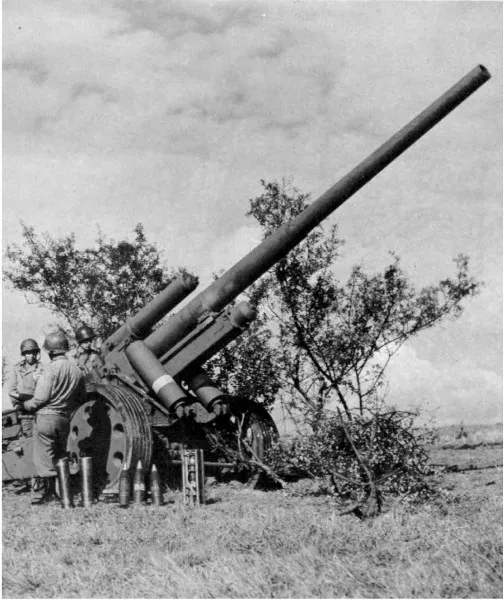
CAPTURED GERMAN ARTILLERY. The standard medium gun of the German
Army. It was a World War I model which was used on all German
fronts and was part of the corps artillery. The caliber was
10-cm.
ITALY
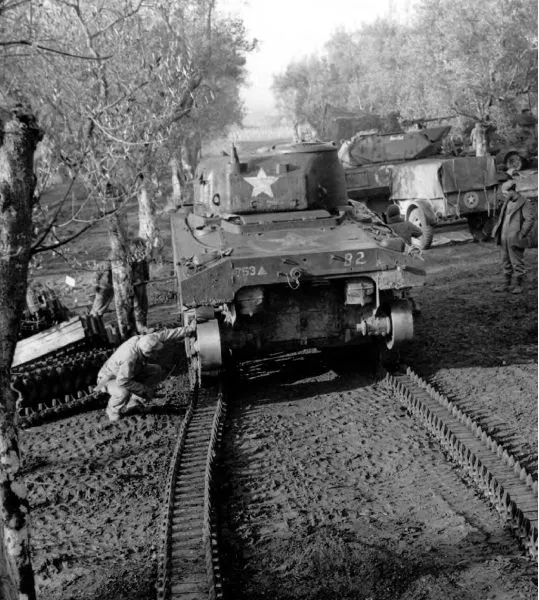
CHANGING TRACKS ON A SHERMAN TANK at Presenzano. This village is
located near Highway 6 a few miles behind the lines in Mignano
Gap. Tanks had not played a big role during the Winter Line
fight because of the mountainous terrain and the muddy lowlands.
Tank units were kept ready for use once the infantry had cleared
the way through Mignano Gap to Cassino and the entrance to the
Liri Valley, the so-called Gateway to Rome.
ITALY
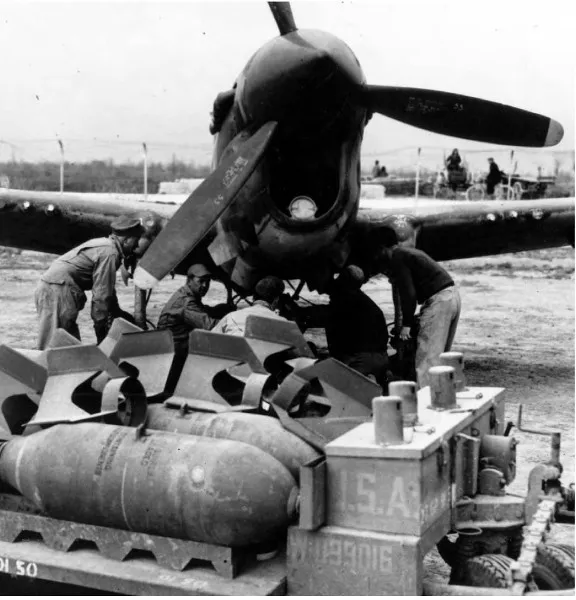
LOADING A CURTISS P-40 Kittybomber for a bombing mission. This
was one of the first U. S. fighter types to get into combat, The
many variations and modifications of this early fighter of World
War II had many names. Those Army planes transported by naval
aircraft carrier to the coast of Africa during the invasion
there were called Tomahawks, those sold by the United States to
the British were called Kittyhawks. Later in the war, as faster
fighters arrived to protect bomber formations, the P-40 became a
fighter-bomber and was called the Kittybomber. The P-40 groups
in Italy were being re-equipped with Republic P-47 Thunderbolt
fighters early in 1944.
ITALY
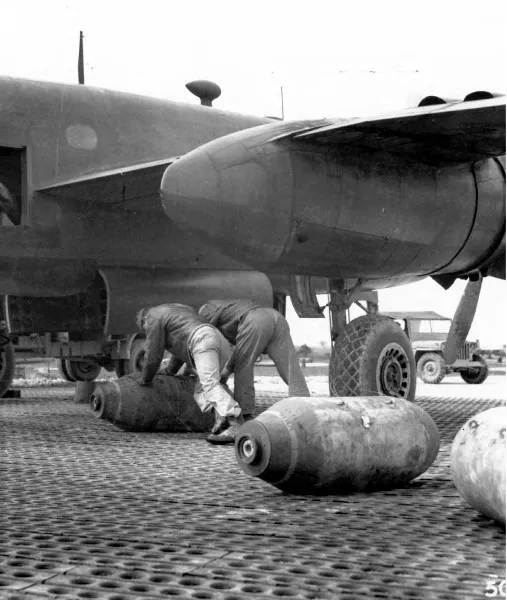
LOADING A MITCHELL MEDIUM BOMBER, North American B-25, with
1,000-pound bombs. Tail fins were attached to the bombs after
they were in position in the bomb bay.
ITALY
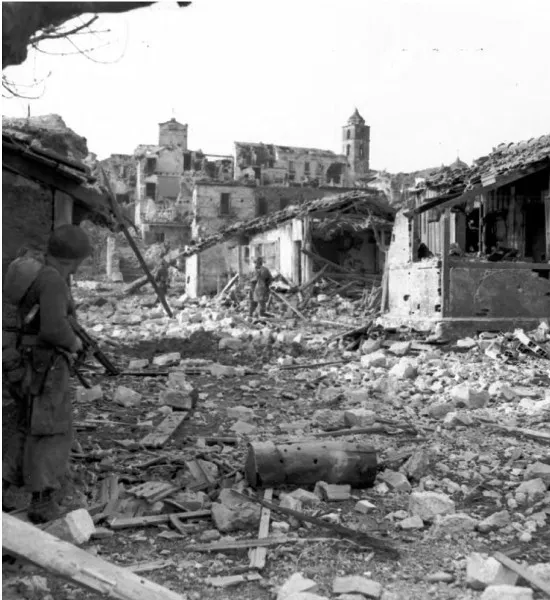
INFANTRY PATROL ENTERING CERVARO on 12 January 1944. The man at
left is carrying a tommy gun and covering the two men in front
as they hunt for snipers. A few minutes after this picture was
made two men of this patrol were killed by Germans hidden in the
ruins. Cervaro is on the western slopes of the Rapido Valley.
By this time the Fifth Army had fought its way through the
Winter Line mountains. Fighting in this area had lasted from 15
November 1943 to 15 January 1944.
ITALY
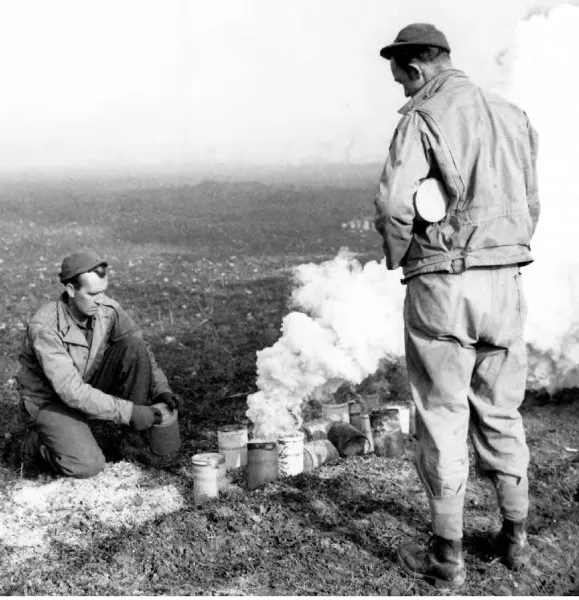
SMOKE POTS USED TO SCREEN INFANTRY crossing the Rapido River
near Cassino. The first attempt to cross was made south of
Highway 6 by a U. S. division on 20 January 1944. It was a
failure. Crossings attempted in the next two days by this
division also failed. By afternoon of 22 January all assault
boats had been destroyed, efforts to bridge the stream had been
unsuccessful, the troops who had managed to cross were isolated,
and supply or evacuation had become impossible. On 23 January
the attack in the sector was ordered halted. Casualties were
1,681: 143 killed, 663 wounded, and 875 reported missing. On 24
January another U. S. division managed to cross the Rapido north
of Highway 6.
ITALY
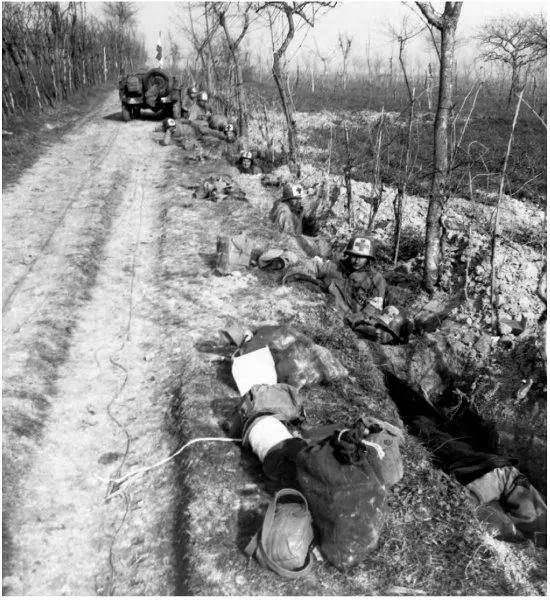
LITTER BEARERS TAKE SHELTER ALONG ROAD near the Rapido River
during the first crossing attempt. Casualties among medics
were high during the Rapido River crossings. Visibility was
generally poor because of mist or artificial smoke and enemy
automatic weapons had been zeroed in on likely crossing sites
and the surrounding areas. The only means of protection for the
litter bearers was the red cross markings on their helmets and
sleeves, but at night and during periods of poor visibility in
the daytime these identifications were not easily seen.
ITALY
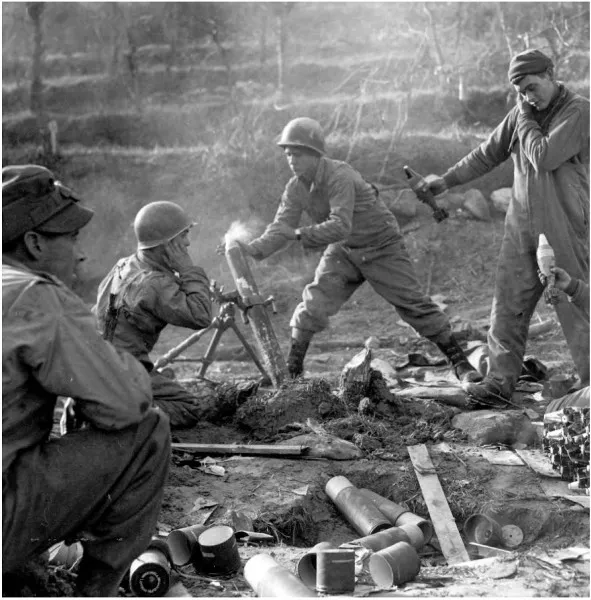
FIRING A MORTAR during the successful Rapido River crossing on
24 January. The attack was made north of Highway 6 and directed
toward the mountains north of Cassino. The outskirts of the
town were entered for the first time on the morning of 26
January. Tanks were not able to help during the first few days
as the ground was too soggy and the engineers were unable to
construct bridges. The entire area was under observation from
Montecassino and the adjacent hills. Four tanks finally managed
to cross during the morning of the 27th, but by noon they were
all out of action. Two days later thirty tanks were across, the
infantry had taken the village of Cairo high in the hills north
of Cassino, and the Allies had made the first dent in the Gustav
Line in the Cassino area. (81-mm. mortar.)
ITALY
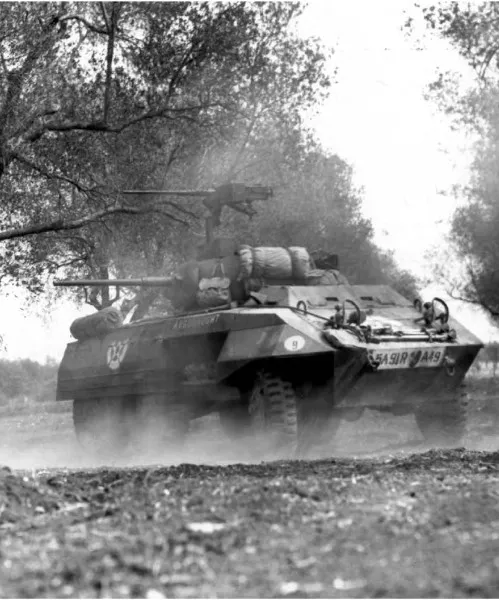
ARMORED CAR FIRING ITS CANNON IN THE CASSINO AREA. (Armored car
M8; principal weapon, 37-mm. gun. The one above is also equipped
with a .50-caliber M2 Browning machine gun in AA mount.)
ITALY
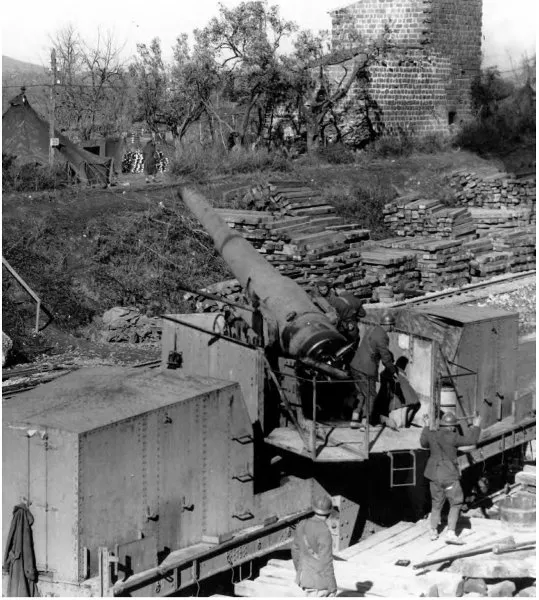
ITALIAN SOLDIERS preparing to fire one of their railway guns
against targets in the Gustav Line. On 7 December 1943, Italian
units first entered the fight on the side of the Allies under
command of Fifth Army. The Italians took over a narrow section
in Mignano Gap with 5,486 combat troops. In addition to the
combat personnel the Italians also provided various service
companies and pack units which proved valuable in solving the
difficult supply problem in the mountains.
ITALY
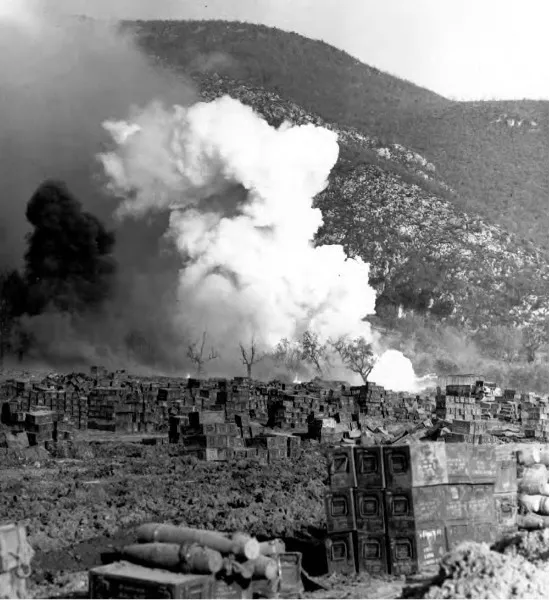
BURNING AMMUNITION DUMP in the Mignano Gap area near Highway 6.
The dump was located about seven miles behind Cassino front. The
fire was accidental and not due to enemy action. Dumps in this
area were not camouflaged because they were too large and Allied
air forces had most of the enemy air grounded. Huge quantities
of ammunition were needed to reduce the defenses of the Gustav
Line. Dispersion was difficult because of the muddy ground.
Vehicles became mired as soon as they left the road.
ITALY
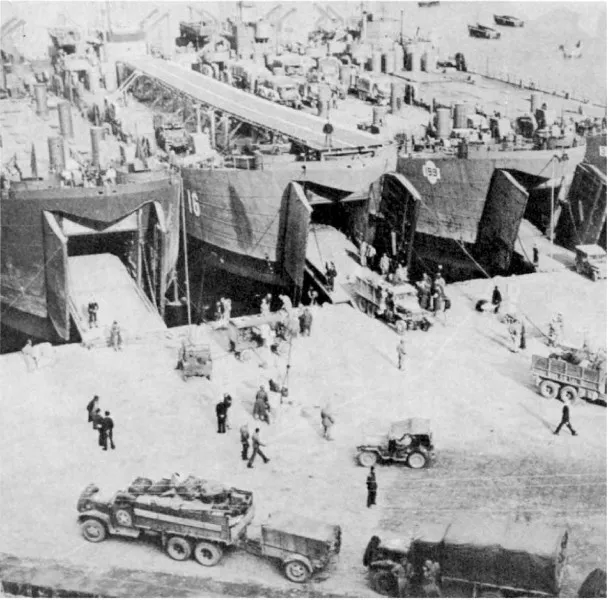
LOADING LST’S IN NAPLES FOR THE INVASION OF ANZIO. Everything
was combat-loaded for quick removal, as plans required the
convoy to be unloaded in twenty-four hours. The slow advance
of the Allies late in 1943 led to the revival of plans for an
amphibious operation south of Rome. Early in January 1944 the
Allies broke through the Winter Line and unless some movement
could be devised to breach the more formidable Gustav Line they
faced another difficult mountain campaign. Enough landing craft
for Anzio were finally assembled, though resources were limited
by requirements for the coming Normandy invasion. (Note LST in
center, with take-off runway for cub observation planes. Planes
could not land on these runways. Two ships were thus equipped
with six planes each which landed on the beachhead shortly after
dawn on D Day, 22 January 1944.)
ITALY
ITALY
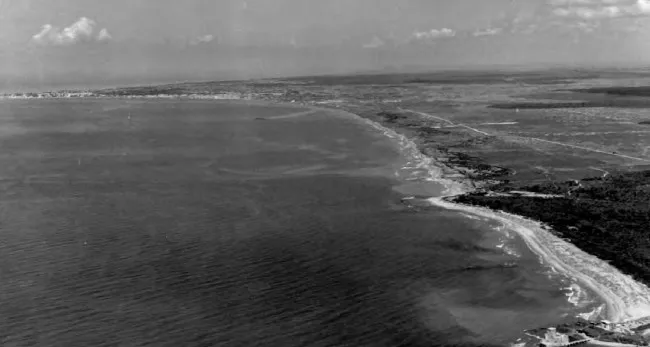
THE ANZIO BEACH AREA. Top: looking westward, Astura tower lower
right; bottom: looking eastward. The beach shown in these
pictures was the U. S. zone of the landing area. The British
landing beach, about six miles northwest of Anzio, proved too
shallow for unloading supplies. It was closed soon after the
British forces had landed there, and supplies were handled
mostly through the port of Anzio. The Anglo-American assault
force consisted of almost 50,000 men and 5,200 vehicles.
ITALY
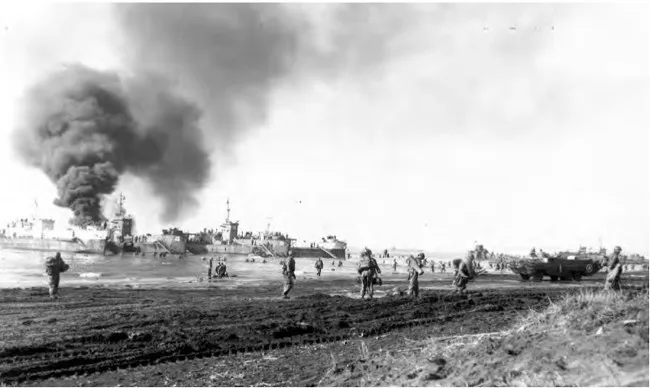
MORNING OF D DAY. Top: men coming ashore from LCI’s. Enemy air
raids started at 0850 and consisted of three separate attacks by
an estimated 18–28 fighter-bombers. One LGI was hit and is shown
burning. Bottom: LST backing away from portable ponton causeway
after having unloaded. Bulldozer is holding causeway in place.
In background is an LGI with a deckload of soldiers waiting to
go ashore.
ITALY
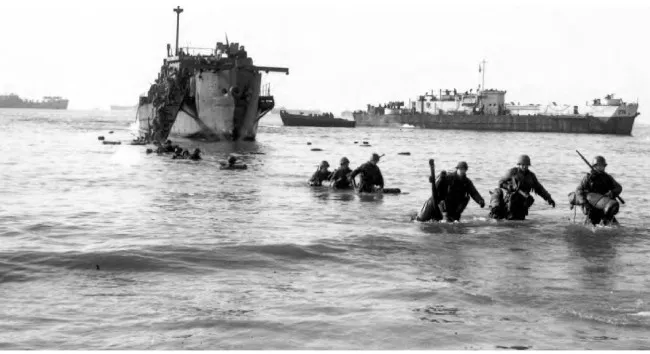
MEN AND EQUIPMENT COMING ASHORE on Anzio beaches on D Day
morning. The first assault craft hit the beaches at 0200,
22 January 1944. There was practically no opposition to the
landings as the enemy had been caught by surprise. Men with
full equipment wading ashore from LCI (top); in foreground are
two DUKW’s near beach, at right is LST unloading equipment over
portable causeway pontons (bottom).
ITALY
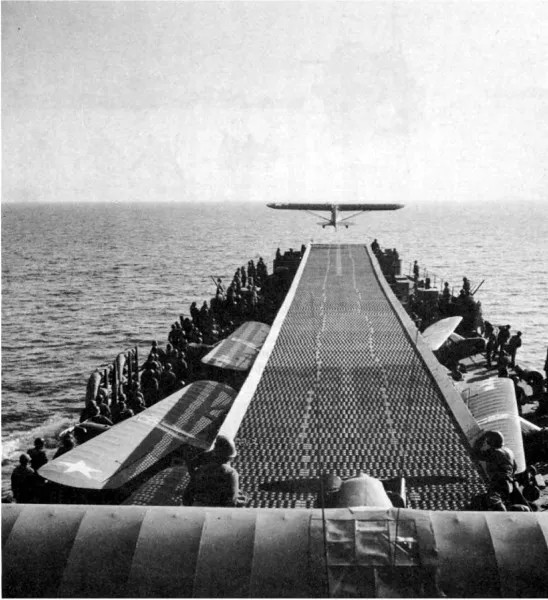
ARTILLERY OBSERVATION PLANE taking off from LST carrier to land
at Anzio beachhead shortly after dawn on D Day. The first use
of an LST carrier for this purpose was during the invasion of
Sicily. Two planes were launched and directed naval fire to the
vicinity of Licata, Sicily. Cub planes were to play an important
part at Anzio. The area of the beachhead and surroundings is
generally flat and featureless and in such terrain observation
was at a premium and it was vital to secure or deny that
observation.
ITALY
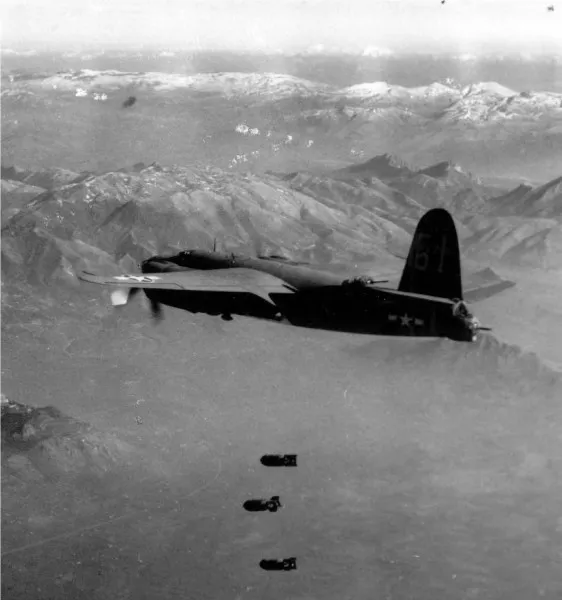
B-26 BOMBING ROADS IN THE LIRI VALLEY behind the Gustav Line on
22 January 1944 in order to hamper the enemy in sending troops
to the Anzio area. The hill at lower left is Montecassino.
The mountains immediately above the plane were the scene of
bitter fighting during the winter of 1943–44. While the Anzio
landing was still in preparation the Allied air forces had been
bombing airfields and communication centers, and the army had
started its drive (on 17 January 1944) to penetrate the Gustav
Line. By the 22d, the date of the Anzio invasion, the attempt
to penetrate the Gustav Line had bogged down in front of the
Cassino defenses.
ITALY
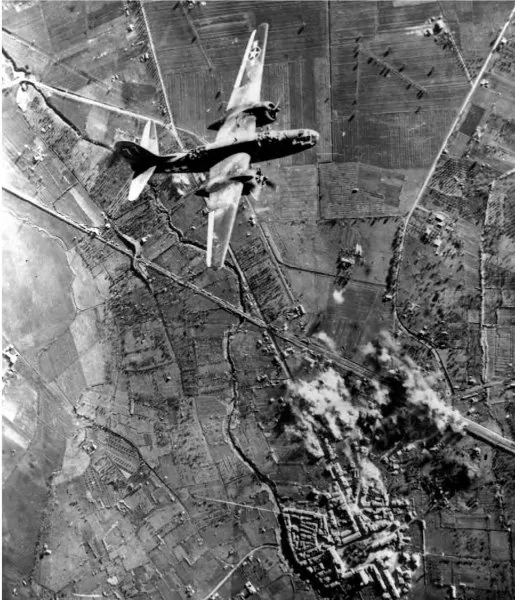
DOUGLAS HAVOC BOMBING RAILROAD BRIDGE and enemy installations at
Cisterna di Littoria. This town became one of the enemy strong
points surrounding the beachhead. It was shelled and bombed for
months, and when it finally fell, on 25 May 1944, it was nothing
but a mass of rubble.
ITALY
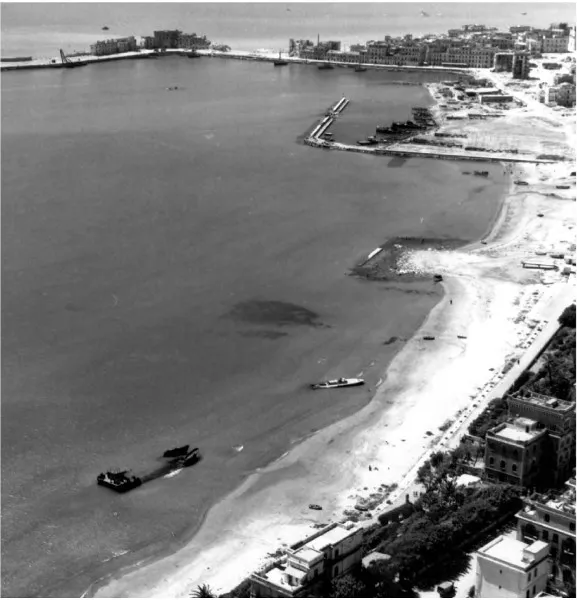
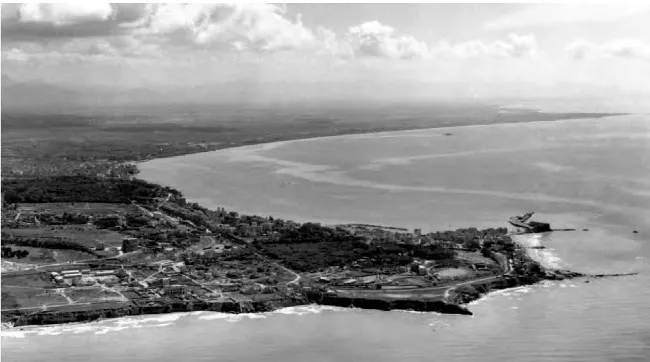
THE PORT OF ANZIO, which was taken intact with very little
opposition on the morning of D Day, 22 January 1944. The
enemy had placed demolition charges to destroy the port and
its facilities, but the assault was so sudden and unexpected
that there was no opportunity to set off the charges. By
early afternoon the port was ready to receive four LST’s
and three LCT’s simultaneously. By midnight on D Day 36,034
men, 3,069 vehicles, and large quantities of supply had been
brought ashore, either through the port or over the beaches.
The unloading area of the port (upper right) was not suitable
for Liberty ships or other freighters; these continued to be
unloaded offshore, mostly by DUKW’s.
ITALY
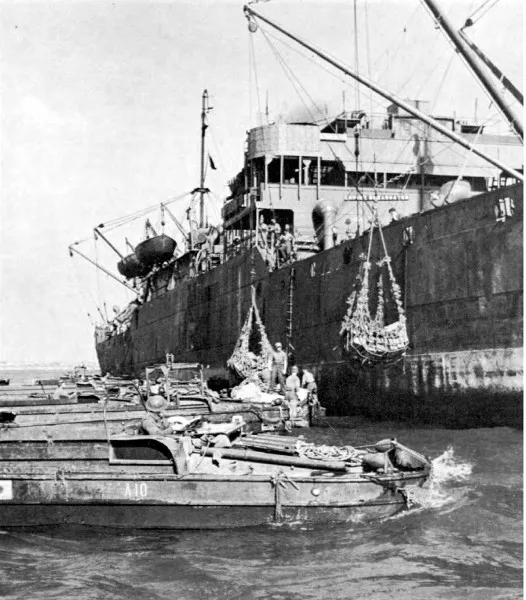
FREIGHTER UNLOADING CARGO INTO DUKW’S. Supplies for Anzio were
carried by two methods: in truck-loaded LST’s from Naples and in
bulk-loaded Liberty ships or other freighters from Africa. After
its capture, the port of Anzio sustained regular shelling by
enemy artillery. The LST’s docked at the port and the freighters
unloaded into smaller craft or DUKW’s offshore.
ITALY
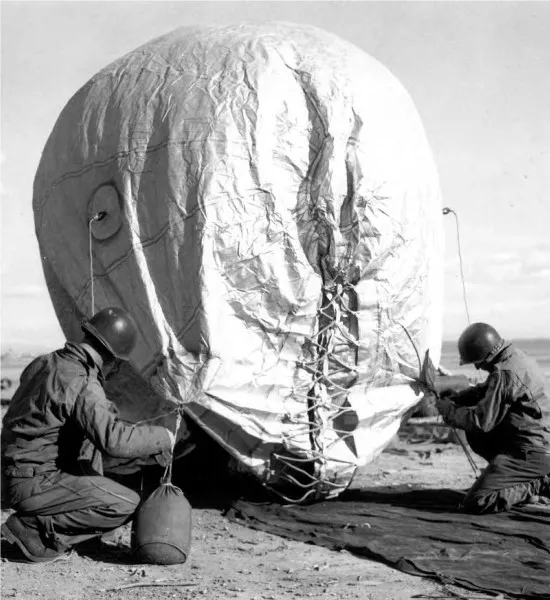
MEN WORKING ON A BARRAGE BALLOON. A number of balloons were
used at the beachhead, chiefly in and around the port area.
Floated at the end of a steel cable, their purpose was to
prevent low-level strafing and dive-bombing attacks and to force
the bombers high enough to give the antiaircraft gunners time
to get on the target. Up to forty balloons were flown at one
time over the port. These were filled with highly inflammable
hydrogen gas, which was manufactured in the field. Helium gas
was sometimes used but was harder to obtain.
ITALY
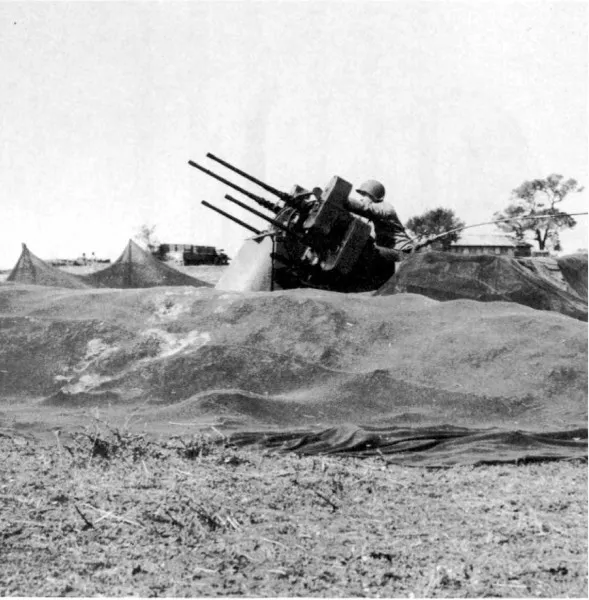
CAMOUFLAGED MULTIPLE-GUN MOTOR CARRIAGE M16 mounting four
.50-caliber machine guns in Maxson turret. Allied antiaircraft
artillery faced its first major test in Italy with the
establishment of the beachhead. The enemy air force now started
on a large-scale, continuous offensive. The offshore shipping,
port, and beach congestion in the Anzio area offered easy
targets. Allied fighter aircraft were based about one hundred
miles to the south and they found it difficult to counter the
enemy’s quick sneak raids and night attacks. Antiaircraft
artillery units were mainly responsible for combatting these
attacks and keeping the flow of supplies constant. By May 1944,
1,051 pieces of antiaircraft artillery were on the beachhead,
including sixty-four 90-mm. guns.
ITALY
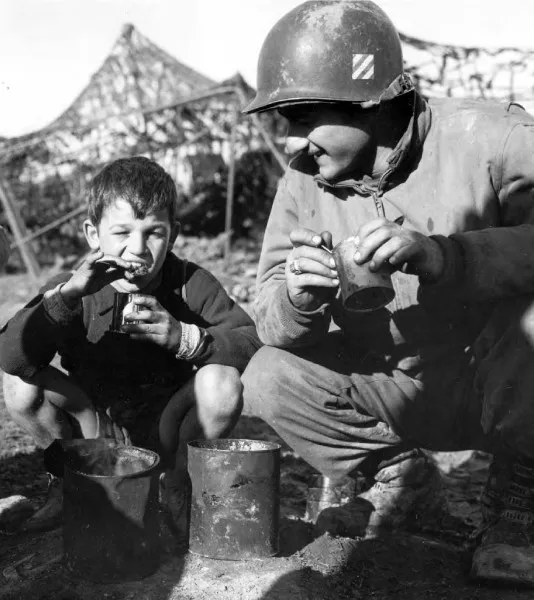
SOLDIER SHARING HIS C RATION WITH NATIVE BOY. A few days after
the landing most of the civilian population, about 22,000, were
evacuated by sea to Naples, leaving only about 750 able-bodied
civilians. Later, as the need for workers increased, an office
was set up in Naples to recruit Italian civilians for work at
the beachhead. (Soldier is wearing a combat jacket, initially
issued with trousers to members of armored units.)
ITALY
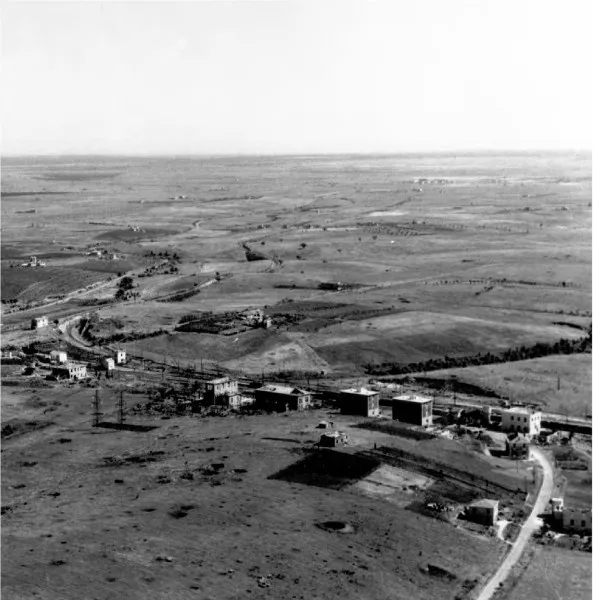
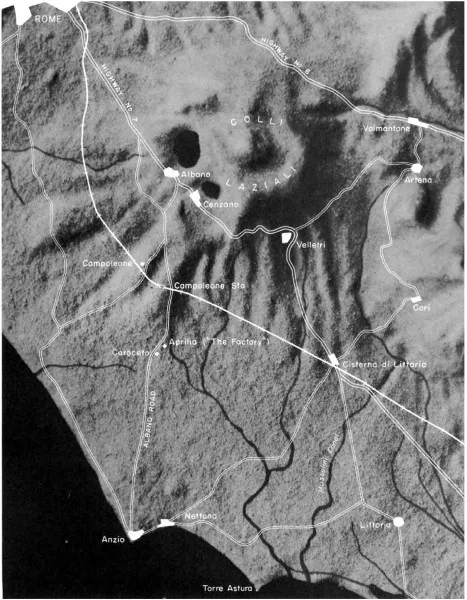
CAMPOLEONE STATION near the Albano highway leading from Anzio
to the Colli Laziali, the mountain mass overlooking the plains
of the beachhead. By 31 January 1944 the Allies had advanced to
Campoleone station, the front line being the railroad bed in
foreground above, but the available forces could not hold the
area. The enemy was bringing reserves toward the Gustav Line
where the Allied drive had stalled. These enemy reserve troops
were rerouted to contain the Anzio beachhead and, if possible,
force the Allies back to the sea. The picture above, looking
toward the sea, gives an idea of the flat, featureless terrain
in the area. The group of buildings in the distance at right is
the “Factory,” scene of hard fighting.
ITALY
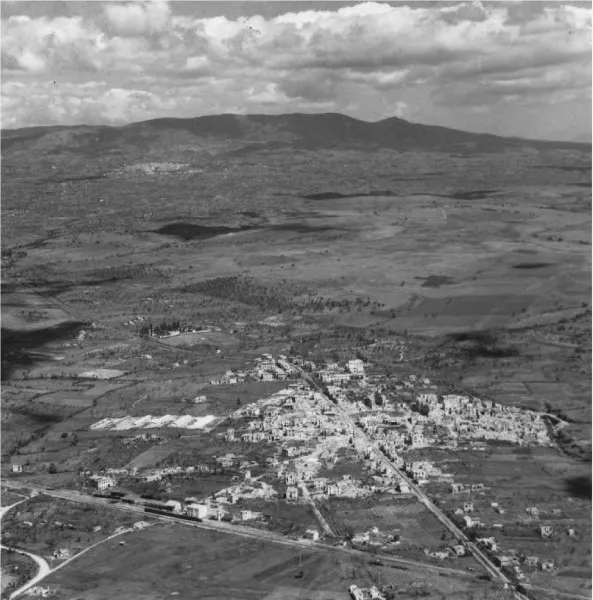
CISTERNA DI LITTORIA. A thrust toward Cisterna di Littoria
was made by the Allies on 25–27 January 1944, but was stopped
about three miles southwest of the town. Another attempt made
on 30 January-1 February met even less success. In the distance
are the Colli Laziali overlooking the beachhead. Below the
mountains is the town of Velletri. Highway 7 through Cisterna
di Littoria leads past the mountains to Rome. Attempts to
extend the beachhead failed: the first attempt along the Albano
road was stopped at Campoleone; the second, the effort to cut
Highway 7 at Cisterna di Littoria, was stopped within sight
of the village. By this time the enemy outnumbered the Allies
and the latter consolidated their positions and waited for the
counterattacks.
ITALY
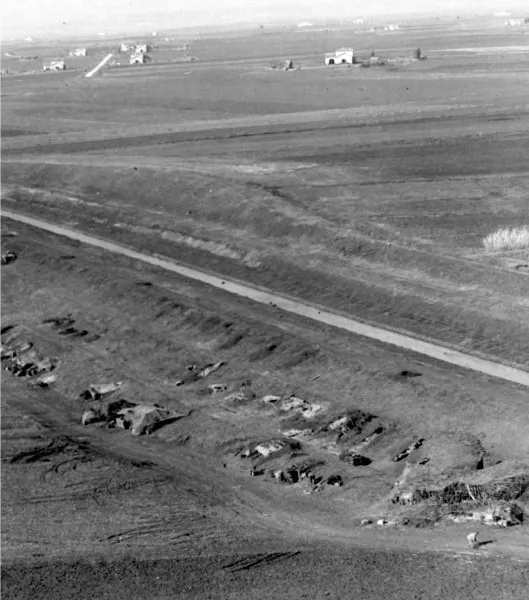
CAMOUFLAGED FOXHOLES AND ARTILLERY POSITIONS along the Mussolini
Canal. On 2 February 1944, after the unsuccessful attempt to
extend the beachhead, the Anzio force received orders to dig in
and prepare for defense. By this date casualties totaled 6,487.
Allied troops were on the defensive in Italy for the first time
since the invasion at Salerno.
ITALY
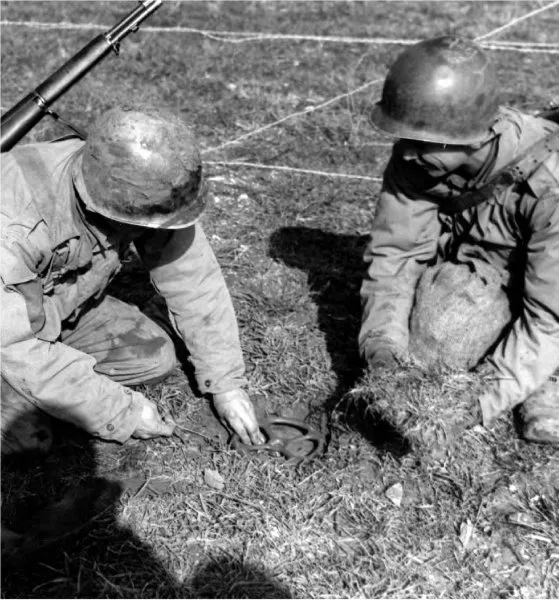
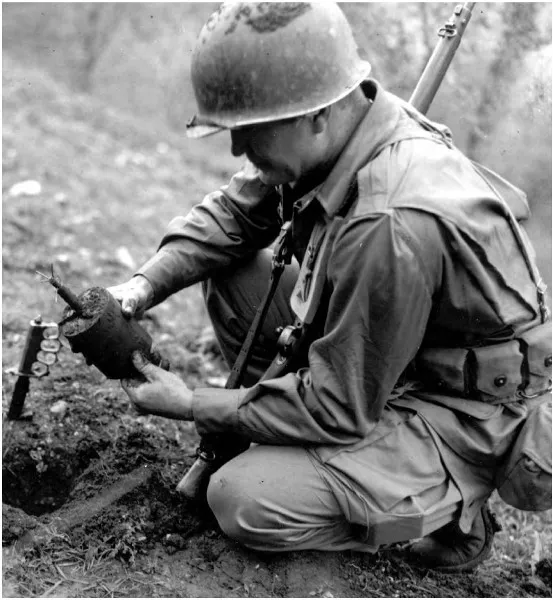
LAYING AN ANTITANK MINE. The man at left is arming the mine by
pulling the safety fork. This type of mine contained 6 pounds of
cast TNT and had a total weight of 10⅔ pounds. The pressure of a
man stepping on the mine would not detonate it, but any vehicle
hitting it would set it off. Mines were generally laid at night
or on foggy days behind a smoke screen. The task of laying mine
fields at night in the open, almost featureless terrain resulted
at first in many improperly marked fields causing accidents.
The practice was finally adopted of first marking a field, then
recording it, and only then laying the mines. (Antitank mine
M1A1.)
ITALY
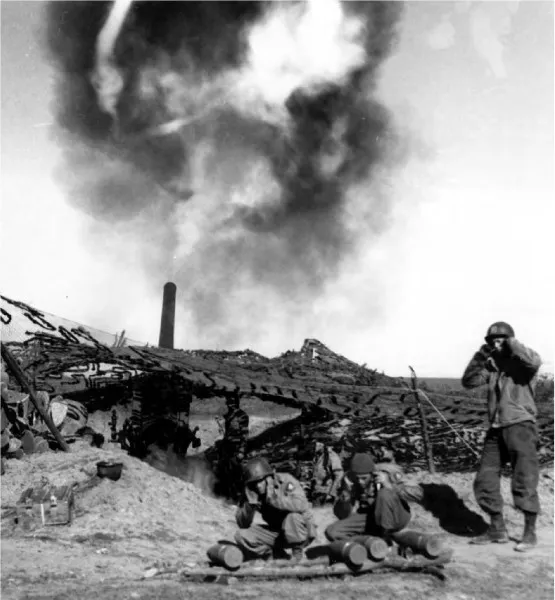
LONG TOM FIRING AT GERMAN POSITIONS. On 3 February 1944 the
enemy started a series of counterattacks to wipe out the
beachhead. There were three main attacks: 3–12 February, 16–20
February, and 28 February–4 March. The stalemate began on the
latter date and lasted until the offensive to break out of the
beachhead got under way on 23 May 1944. Enemy prisoners taken
during the February fighting always commented on the heavy
artillery fire, which caused numerous casualties, shattered
nerves, and demoralized many enemy units.
ITALY
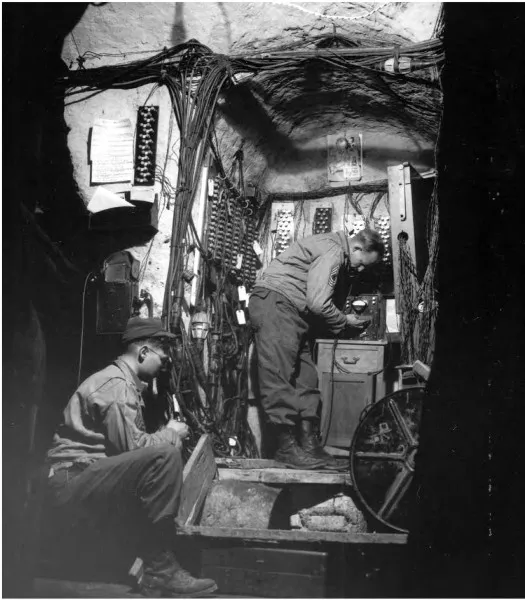
SIGNAL CORPS MEN working in the main frame room of headquarters
switchboard installation. The beach area at Anzio-Nettuno was on
a slightly higher level than the rest of the beachhead area and
was honeycombed with tunnels and caves so far underground that
they were bombproof. Wherever possible the installations along
the shore were put underground.
ITALY
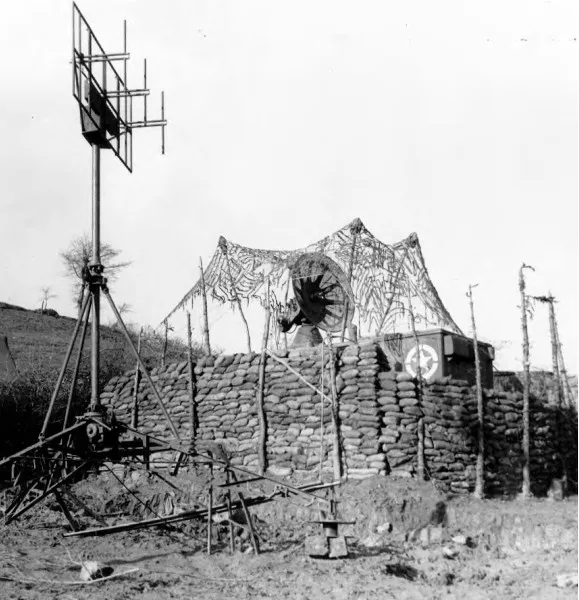
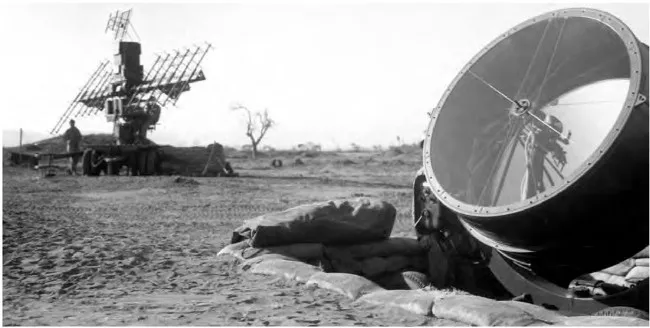
RADAR SET IN OPERATION. By 24 February 1944 the first sets of
this type were in position on the Anzio beachhead. They were
brought in to cope with enemy jamming techniques and “window”
(small strips of metallic paper dropped from attacking planes)
which had reduced the effectiveness of earlier types of radar.
During the night of 24 February a flight of twelve bombers
approached in close formation, using the “window” method of
jamming. Forty-eight 90-mm. guns directed by radar of the
improved type caught them at extreme range over enemy territory
and brought down five with the first salvo. The remainder of the
formation jettisoned their bombs and fled. (Radar SCR 584.)
ITALY
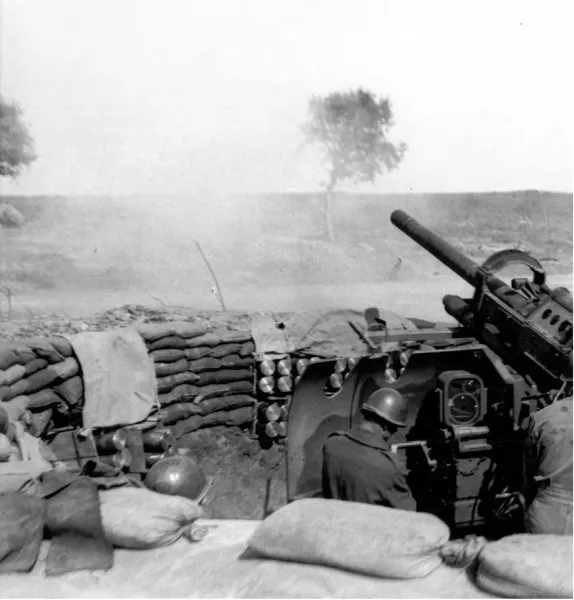
FIRING ANTIAIRCRAFT GUN at ground targets. The enemy
counterattack down the Albano road on 16–20 February 1944 was
the most severe and dangerous of the three main attacks the
Germans made on the Allies at Anzio beachhead. On the 17th
it looked as if the enemy might succeed in driving down the
Albano road from the Campoleone area to Anzio and thus split
the beachhead forces. To aid the hard-pressed infantry, all
the artillery in the area was brought to bear on the enemy.
In addition to 432 guns representing corps and divisional
artillery and three companies of tanks, four batteries of 90-mm.
antiaircraft guns were employed against ground targets. Two
cruisers assisted with fire on the flank of the beachhead.
ITALY
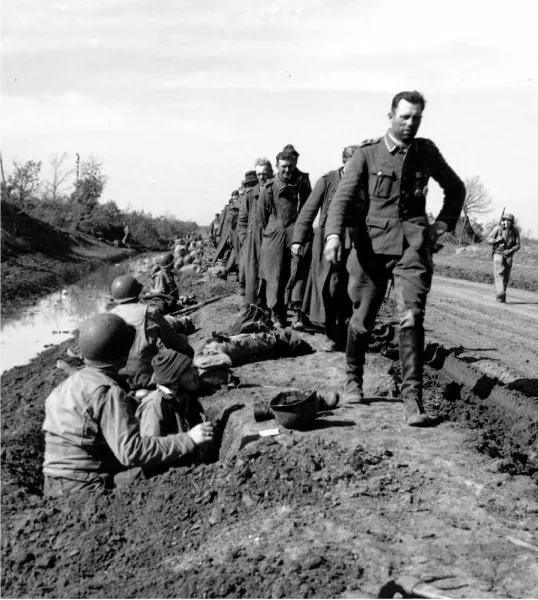
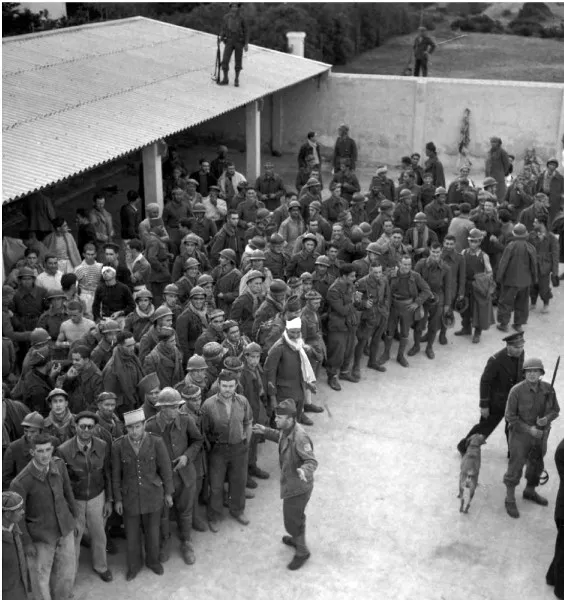
GERMAN PRISONERS TAKEN NEAR THE ALBANO ROAD on 19 February 1944.
The German attack started in the morning hours of 16 February
and relied on smoke to conceal the advancing troops. By 18
February the enemy infantry, strongly supported by tanks, had
pushed the defenders back about three miles. The next day the
Allies counterattacked and halted the advance. Never again was
the enemy to come so close to rolling up the final beachhead
line.
ITALY
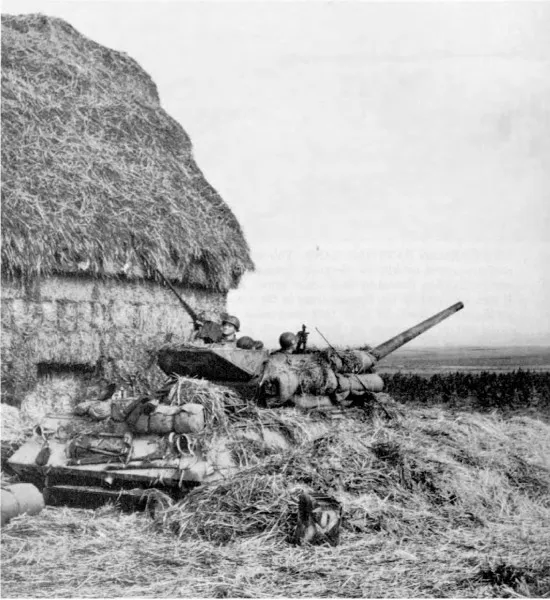
TANK DESTROYER DUG IN BEHIND HAY STACK. These weapons were used
well forward, sometimes dug in, but more often placed behind
a house or other means of concealment. Tanks were also used
well forward, particularly after the front became somewhat
stabilized at the beginning of March. The distribution was about
one company of tanks to one regiment in the line. This practice
violated the principle of employing tanks in mass, but their
usefulness in support of the infantry outweighed the loss of
mobility and dispersion of strength.
ITALY
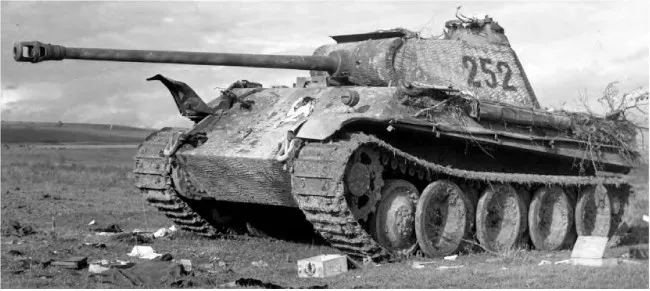
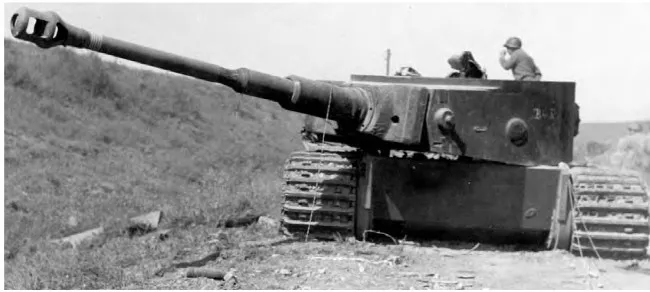
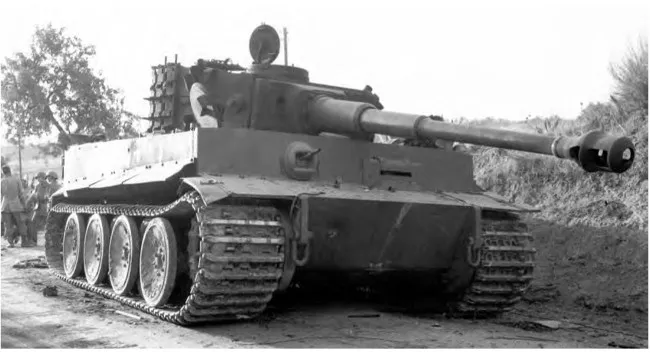
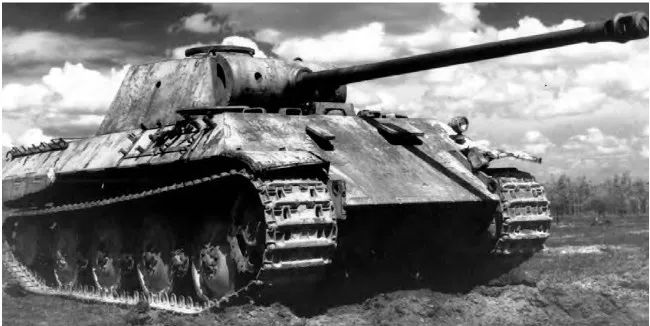
THE GERMAN PANTHER TANK. This heavy tank was probably the
most successful armored vehicle the Germans developed, having
relatively high speed and maneuverability, combined with heavy
armor and a rapid-fire, high-velocity gun. It first appeared on
the Russian front in the summer of 1943, and soon thereafter
on the Italian front. No U. S. tank comparable to it appeared.
The frontal armor could not be penetrated by Sherman tank
guns at ordinary fighting range. In constructing this vehicle
the Germans were influenced by the Russian tank, the T34. The
corrugated surface (top picture) is a plastic coating to prevent
magnetic mines from sticking to the metal. (Pz. Kpfw. Panther,
7.5-cm. Kw. K. 42 (L/70) gun. After Action Reports indicate that
there were a total of 165 enemy tanks surrounding the beachhead
as of 28 February 1944. Of these 32 were Tigers and 53 Panthers,
the rest being mostly Mark IV.)
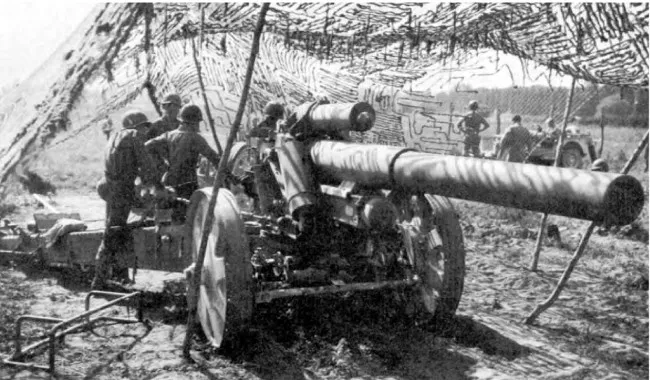
ITALY
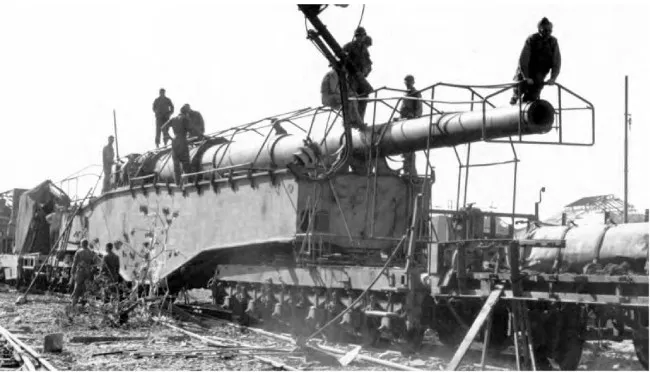
ANZIO ANNIE, 280-mm. railway gun (top). The beachhead faced a
heavy concentration of German artillery. During enemy attacks
in February this was employed mostly in direct support of the
infantry. Standard German divisional medium howitzer (bottom).
The caliber was 150-mm. (15-cm. s. F. H. 18.)
ITALY
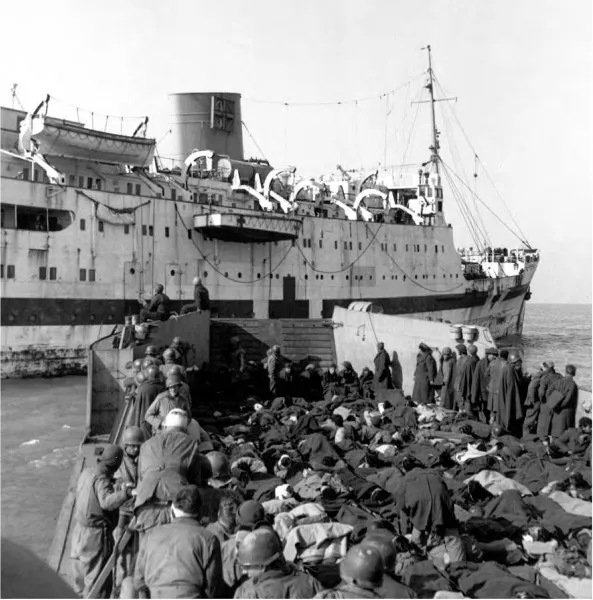
LANDING CRAFT BRINGS WOUNDED TO HOSPITAL SHIP in Anzio bay. On
the night of 24 January 1944 a fully illuminated and marked
British hospital ship was bombed and sunk while taking wounded
on board. All evacuation from the beachhead was by sea. Air
transportation could not be used, since the dust raised by
planes landing or taking off brought on enemy shelling. Hospital
ships were used whenever possible, but as these could not dock
in the shallow port, LCT’s were used to transfer patients from
shore to ships. When storms and high seas interrupted this
procedure the wounded were loaded on board LST’s at the Anzio
docks for the 30-hour trip to Naples. For the period 22 January
to 22 May, 33,063 patients were evacuated by sea.
ITALY
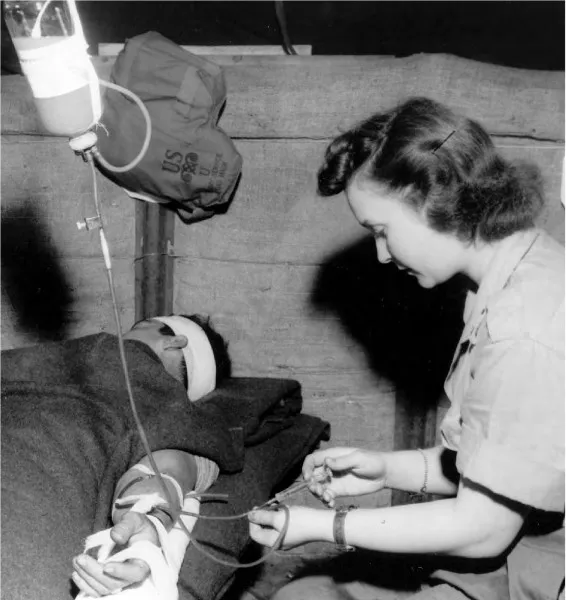
NURSE GIVING INTRAVENOUS INJECTION OF PLASMA to a wounded
soldier. In the period 22 January to 22 May 1944, 18,074
American soldiers suffering from disease, 4,245 from injuries,
and 10,809 battle casualties—33,128 in all—were given medical
care and attention in evacuation hospitals at the beachhead. If
recovery required fourteen days or less, the casualty remained
in the evacuation hospital; if the recovery period was estimated
to take more than two weeks, the patient was evacuated to one
of several base hospitals in the Naples area as soon as he was
strong enough to be moved.
ITALY
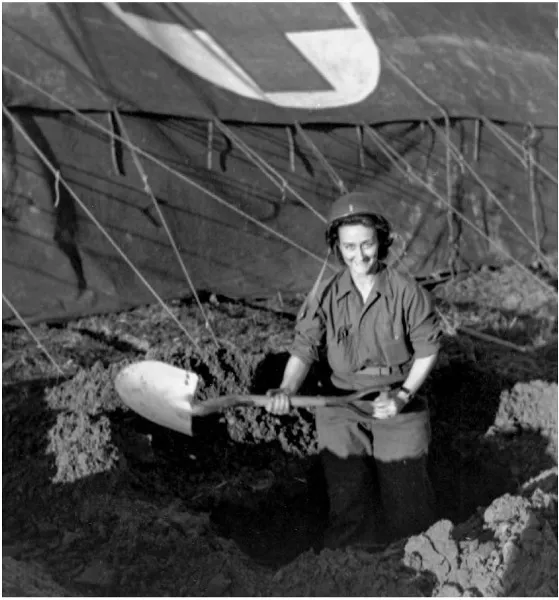
NURSE DIGGING FOXHOLE. The confined area of the beachhead and
the lack of distinction between the front lines and rear areas
were nowhere more noticeable than in the locality of the U.
S. evacuation hospitals. For more than sixteen weeks medical
personnel healed and comforted the sick and wounded in an area
within range of enemy artillery. Soldiers called the hospital
zone “Hell’s Half Acre” and admitted their preference for the
protection of a front-line foxhole to a cot in a hospital tent.
Of the medical personnel at the beachhead, 82 were killed in
action, 387 were wounded, 19 were captured, and 60 were reported
missing in action.
ITALY
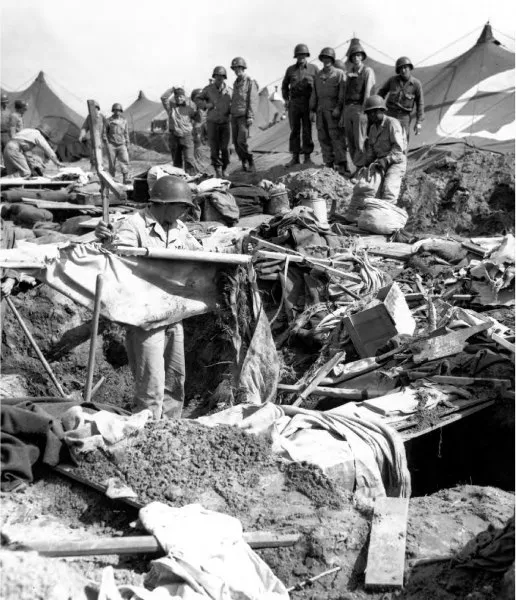
WRECKAGE OF EVACUATION HOSPITAL ON THE BEACHHEAD. Most of the
hospitals were located in the vicinity of Nettuno, and all were
within easy range of enemy artillery. It was impossible, within
the confined area of the beachhead, to locate hospitals in an
area out of reach of enemy artillery.
ITALY
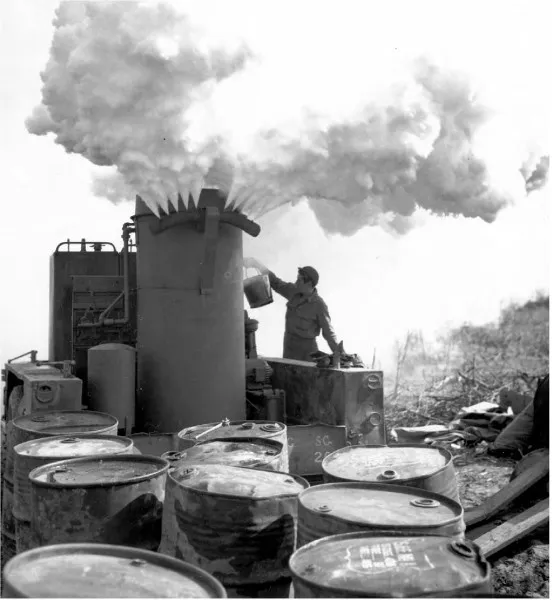
MECHANICAL SMOKE GENERATOR IN ACTION. Generators of this type
were used at ports to prevent accurate bombing and in the field
to conceal movements of troops. Large quantities of oil, about
two 53-gallon drums per hour, were consumed. The generator was
capable of converting hydrocarbon oils of low volatility into a
fog of relatively great persistence. The special oil, usually
referred to as fog oil and used for the generation of large area
screens, was a petroleum by-product. The fog would frequently
extend five miles or more downwind. (Smoke generator M1.)
ITALY
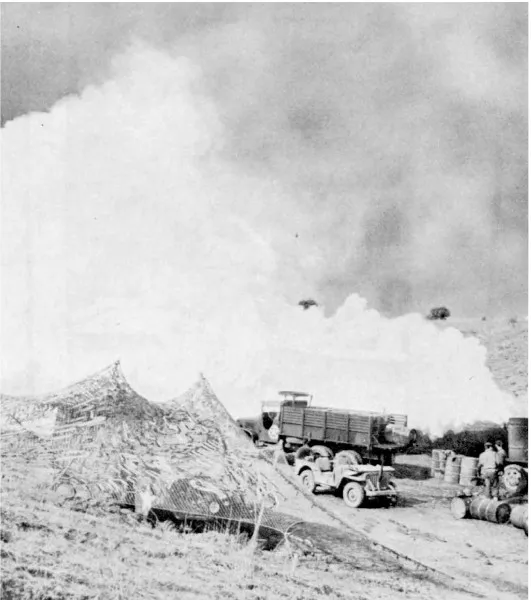
SMOKE SCREEN SHIELDING ALLIED POSITIONS. Smoke was used to a
great extent on the beachhead because the flat terrain which
the Allies occupied was under constant observation from the
enemy-held Colli Laziali. The harbor area was screened by smoke
starting one-half hour before sunset, the time the enemy bombers
usually appeared, and on every air raid alarm.
ITALY
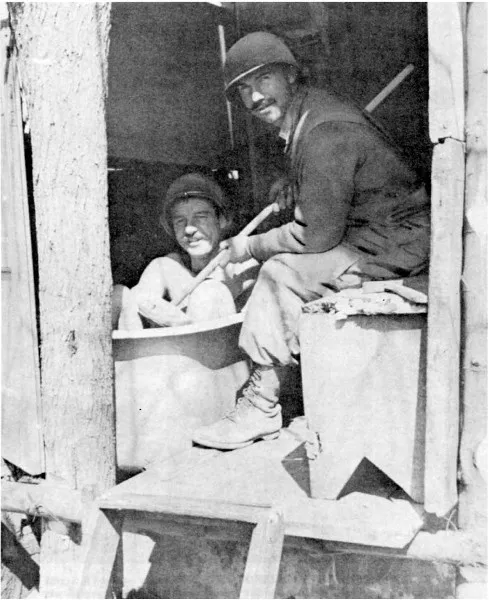
BATHING FACILITIES at the beachhead were limited but those
available were used to the fullest extent.
ITALY
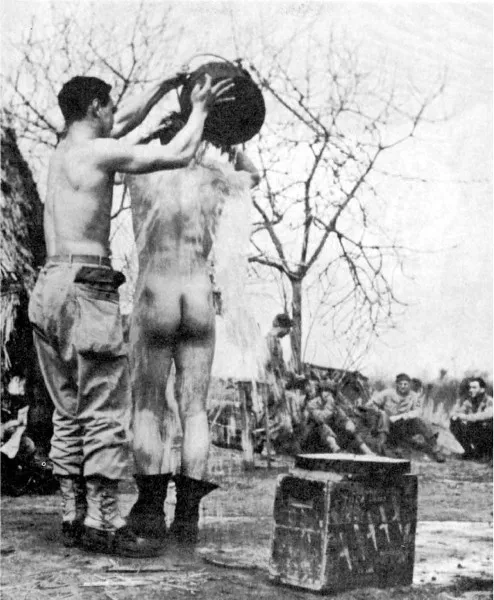
PRIMITIVE SHOWER BATH. Some of the more hardy souls took their
showers directly from the well in winter.
ITALY
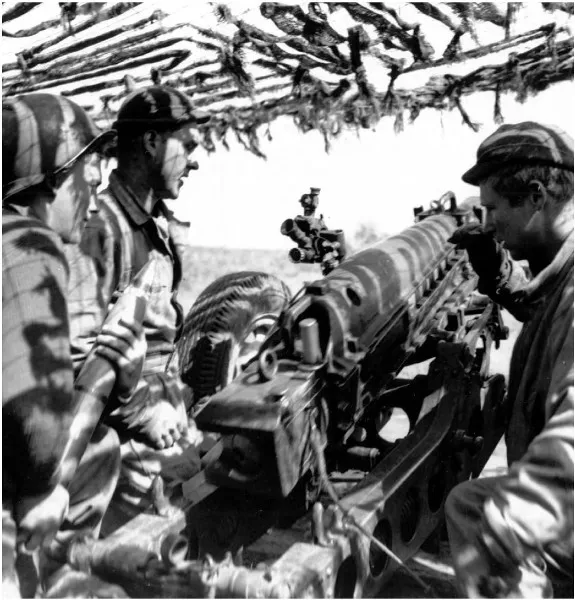
FIRING A PACK HOWITZER. From the establishment of the beachhead
the Allied artillery surpassed that of the enemy. Even with
limitations imposed on some types of ammunition, the artillery
was firing about 25,000 rounds per day. At the same time the
enemy fire falling in the port and the rest of the beachhead
was estimated to be not more than 1,500 rounds. The amount of
Allied artillery increased month by month. At the end of March
a battalion of 8-inch howitzers was brought in with the primary
mission of demolishing houses used by the enemy as observation
posts and strong points. In April a battery of 240-mm. howitzers
was added to the beachhead forces. (75-mm. pack howitzer.)
ITALY
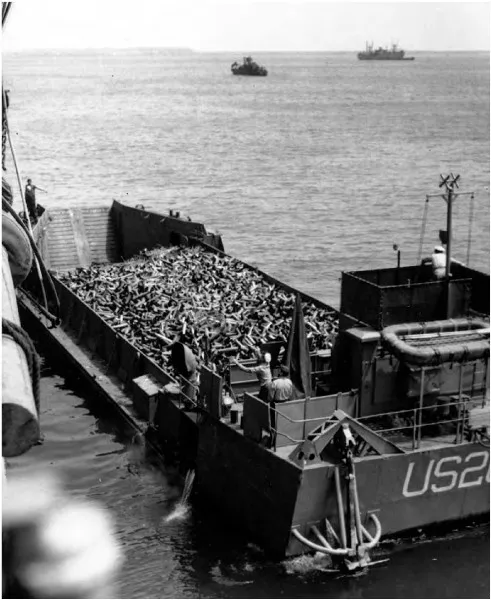
USED SHELL CASES BOUND FOR THE UNITED STATES as scrap are loaded
into a freighter from an LCT.
ITALY
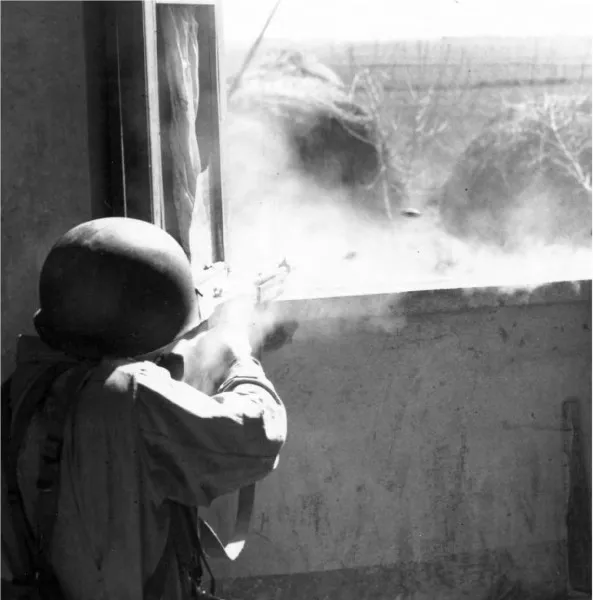
SOLDIER FIRING A SUBMACHINE GUN at a haystack suspected of
concealing enemy soldiers. After the last German attempt to
reduce the beachhead had died out during the first days of March
1944 there began a period of stalemate on the Anzio plain. This
did not mean the end of fighting; it meant the end of pitched
battles by large numbers of men and armor. Artillery duels still
continued and enemy aircraft bombed and strafed positions as
before. There were frequent clashes and fire fights between
infantry patrols. To provide protection against enemy infantry
attacks, stress was laid on the development of self-sustaining,
mutually supporting points of resistance, usually centered on
Italian farmhouses. (.45-caliber Thompson submachine gun.)
ITALY
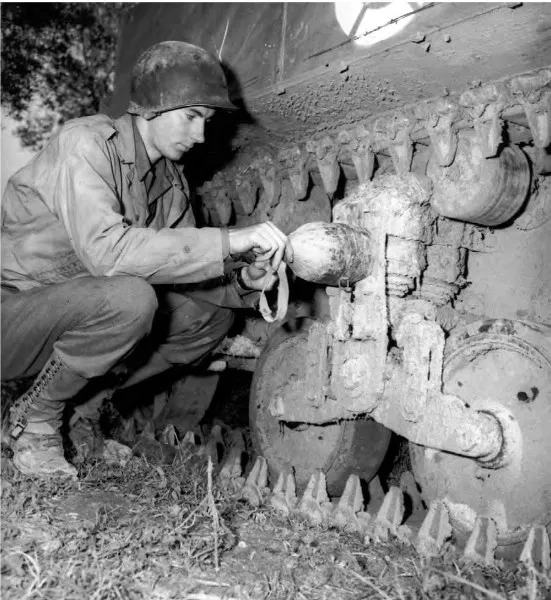
SOLDIER TESTING “STICKY GRENADE” on an armored vehicle. This
was a British weapon used against tanks. It had a hollow-type
charge, and was held to the metal by magnets. Unlike the real
sticky grenade which could be thrown and which stuck to the
target by means of a glue substance, this antitank grenade had
to be hand-placed. During the stalemate period the front-line
troops were equipped with this type of grenade in addition to
bazookas. The charge was a delayed action type and the grenade
was set off by pulling the string attached to it.
ITALY
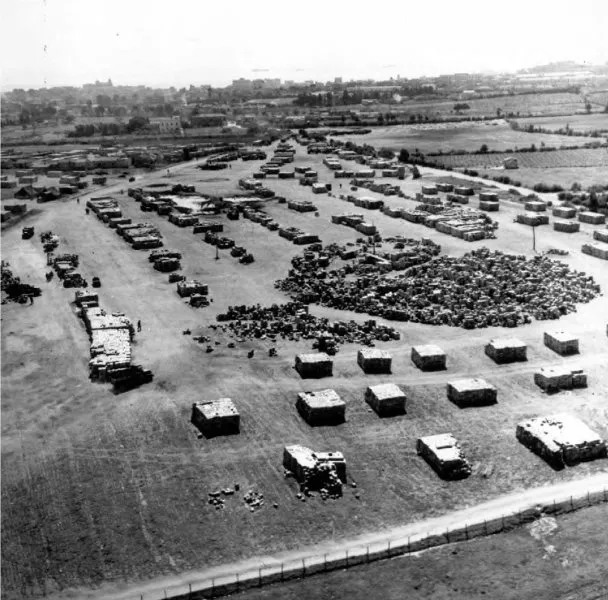
BEACHHEAD RATION DUMP. The failure of the main part of the
army in the south to break through the Gustav Line and join
the troops at Anzio necessitated maintaining the beachhead
by sea for a longer period than planned. Shipping schedules
were revised to take care of the gradually growing forces and
to build up a reserve of food, fuel, ammunition, and other
supplies. Food could be kept in a large dump, but fuel and
ammunition presented problems. The beachhead area was so small
that fuel and ammunition dumps, no matter where placed, were
within enemy artillery range. These dumps were kept small and
dispersed in order to keep losses to a minimum. Between 22
January and 10 March 1944 a little more than 1,000 tons of
ammunition were destroyed, mostly by enemy bombing. Losses never
became critical.
ITALY
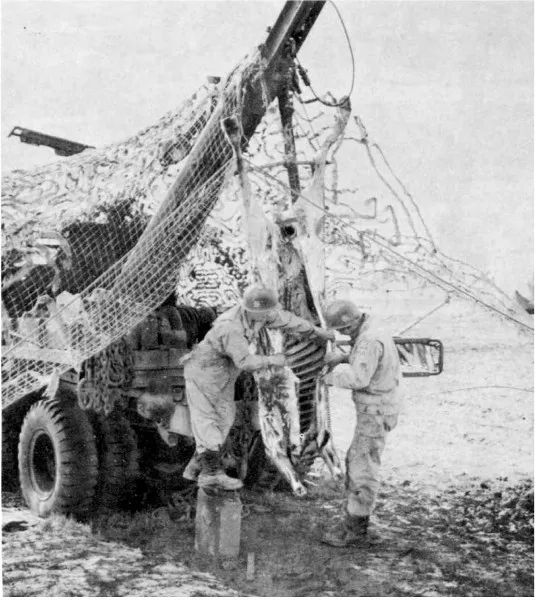
SOLDIERS BUTCHERING A COW. Cattle and sheep would frequently
wander into mine fields and be wounded or killed. The carcasses
presented a welcome change from regular rations. During the
stalemate some soldiers had their own chicken pens, others
bought fresh eggs from the few remaining farmers. Foraging
patrols for homeless livestock and poultry were as carefully
planned as patrols against the enemy.
ITALY
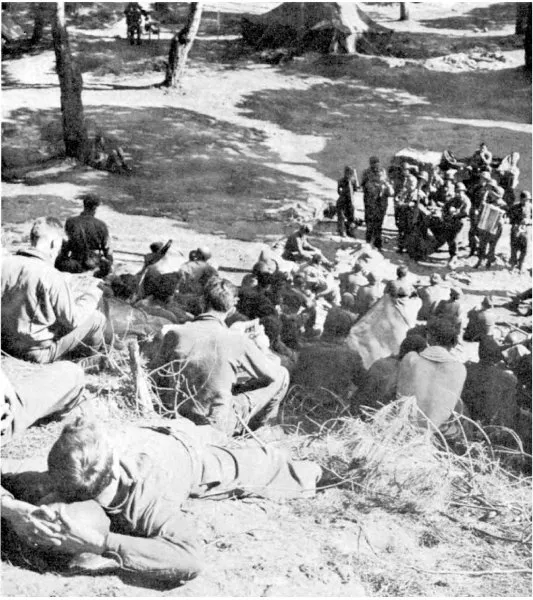
LISTENING TO A CONCERT BY A SOLDIER ORCHESTRA. This is in a
recreation area established by one of the divisions on the
beachhead in March 1944. Only a limited audience could attend
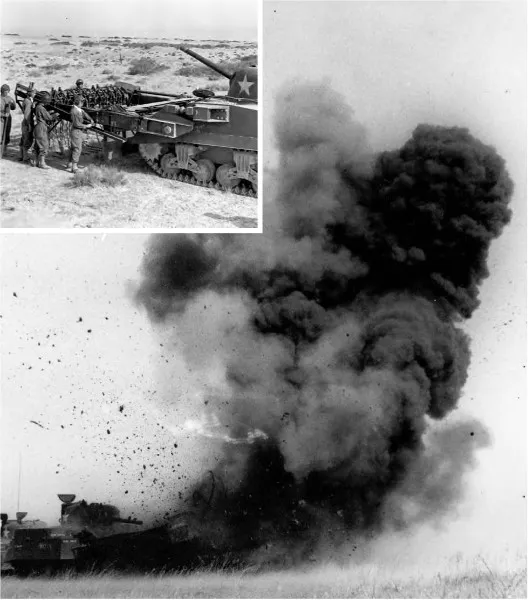
because of the ever-present danger of enemy artillery fire.
During the critical period of enemy counterattacks in February
all troops were needed for defense, but as soon as the front had
become stabilized 750 men every four days were sent by LST to
the rest center at Caserta.
ITALY
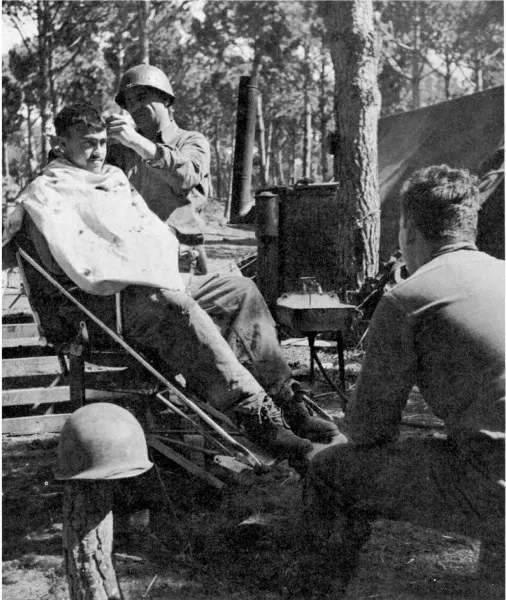
OPEN AIR BARBERSHOP AT THE BEACHHEAD located in one of the
few wooded sectors of the area. Barber service, because of
its uplifting effect on morale, was made available whenever
possible.
ITALY
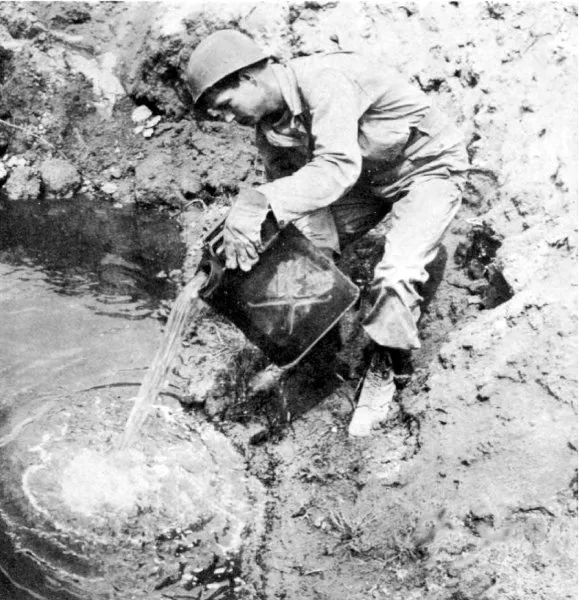
MALARIA CONTROL. Soldier pouring diesel oil in water-filled bomb
crater to kill mosquito larvae. The Pontine Marshes near the
beachhead had for centuries been notorious for the prevalence
of malaria. In April 1944 large-scale draining projects were
started, and patrols were sent out to dust or pour oil on
canals, ditches, and pools. This activity was even carried
right into no man’s land at night. The program, combined with
preventive measures taken by the individual soldier, such as
the use of head nets, mosquito bars, insect repellents, and
atabrine, kept malaria from becoming a medical problem. The
division stationed in the worst area did not develop a single
new case of the disease.
ITALY
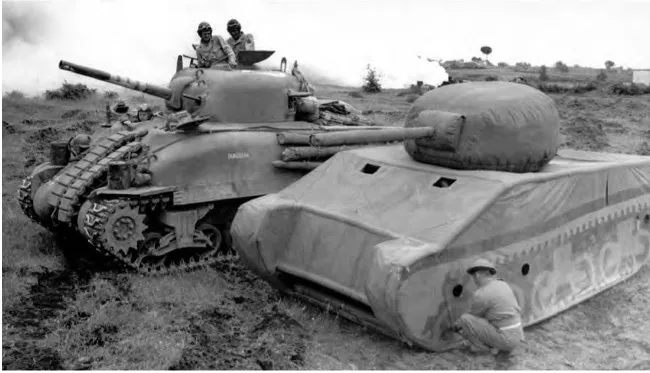
INFLATING RUBBER DUMMY TANK (top). Placing dummy tank in
camouflaged position which had been vacated by a tank moving
toward the front for the coming offensive (bottom). The dummy
tank was designed by the British and manufactured in the United
States.
ITALY
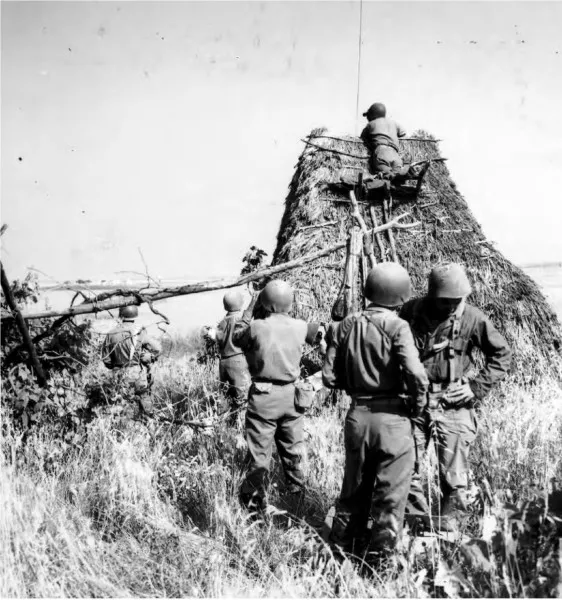
WATCHING THE BATTLE FROM OBSERVATION POINT. The offensive from
the beachhead started at 0545, 23 May 1944, when the artillery
began firing. Allied medium and fighter bombers strafed and
bombed enemy positions. At 0630 the infantry and tanks moved
out. The artillery preparations, the most intensive thus far at
the beachhead, had searched out command posts, assembly areas,
and dumps with the result that enemy communications and supply
lines were severely damaged. The Germans recovered and put up
a strong fight, but they could not make up for the initial
disorganization.
ITALY
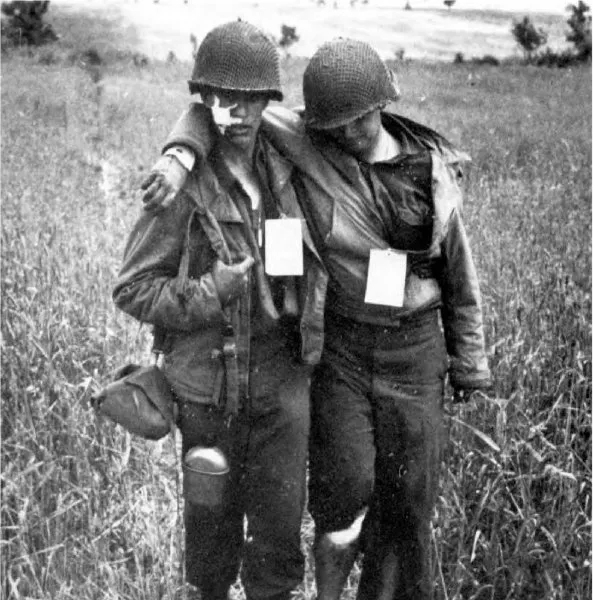
WALKING WOUNDED ON THEIR WAY FROM THE FRONT to a hospital. Tags
tell the nature of the wound and what has been done for it in
the field or at the first aid station. On the first day of the
fight to break out of the beachhead, the Allies suffered the
heaviest casualties of the Anzio Campaign. American combat
casualties for the whole army on that day were 334 killed,
1,513 wounded, and 81 missing, a total of 1,928 and the high
point in the entire Italian campaign. The U. S. and British
combat casualties at the beachhead between 22 January and 22
May numbered about 30,000, including at least 4,400 killed
and 18,000 wounded. The enemy captured about 6,800 prisoners.
The noncombat casualties during this period amounted to about
37,000.
ITALY
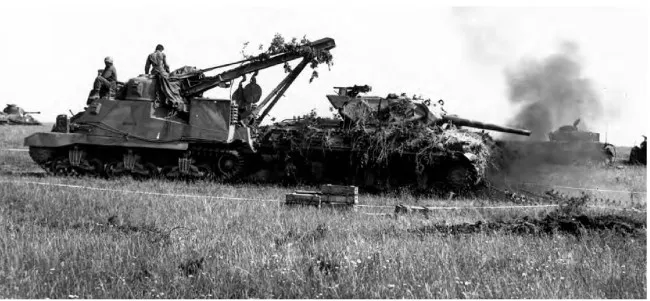
RECOVERING ARMOR. Tank recovery vehicle pulling disabled tank
destroyer M10 out of mine field near Cisterna di Littoria (top).
Many Allied tanks were disabled by running into their own mine
fields. Front of tank destroyer is still smoking from effect of
mine blast. In the left background is a disabled Sherman tank.
To the right are a ruined German Mark IV tank and a personnel
carrier. During the first day’s attack the Allies lost heavily
in tanks and tank destroyers. Those that ran on mines were
generally repairable, those lost as a result of enemy fire were
often wrecked beyond repair. Tank recovery vehicle M31 (same as
at top) towing German 75-mm. assault gun (bottom).
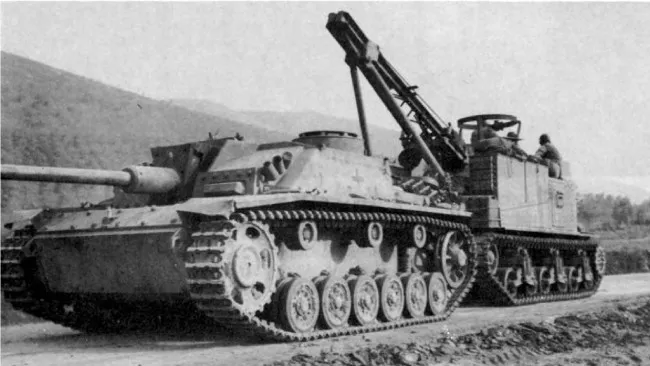
ITALY
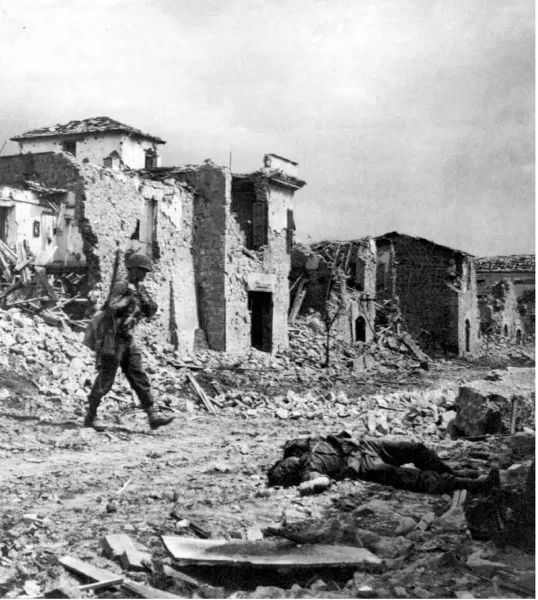
INFANTRY SOLDIER IN GISTERNA DI LITTORIA. This town on Highway
7 had been one of the German strong points facing the beachhead
forces. It fell to tanks and infantry on 25 May. The main
Allied drive had been launched in the direction of Cisterna di
Littoria with the object of continuing straight north to capture
Valmontone on Highway 6 and cut off the enemy forces retreating
toward Rome from the shattered Gustav Line defenses.
ITALY
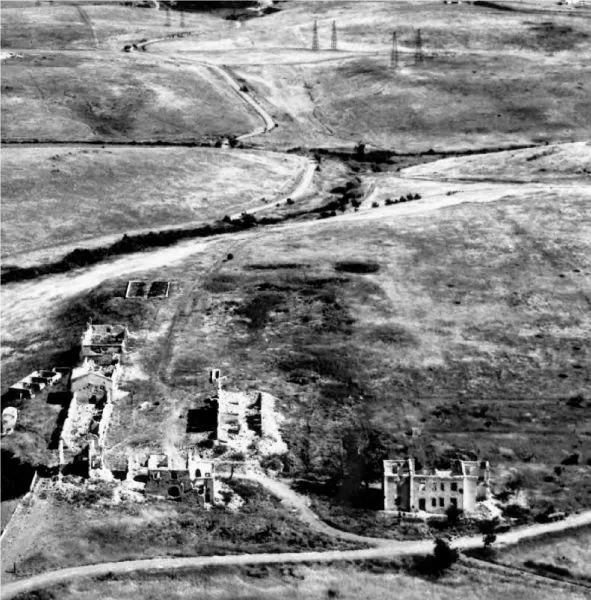
THE VILLAGE OF CAMPOLEONE with Campoleone station in upper
left. The station area was reached on 31 January, when the
first attempt to break out of the beachhead was made, but was
soon lost to enemy counterattacks. It was not retaken by the
Allies until 29 May 1944 during the drive on Rome. Starting
on that day a tank-infantry attack fought a two-day action to
penetrate the German defenses here, but without success. The
area was heavily defended by infantry weapons supported by enemy
tanks, self-propelled guns, artillery, and flak guns. On 31 May
the U. S. armored division making the attack was withdrawn for
maintenance purposes. Losses in both tanks and personnel had
been severe. The break-through, when it came, was made across
the eastern side of the Colli Laziali.
ITALY
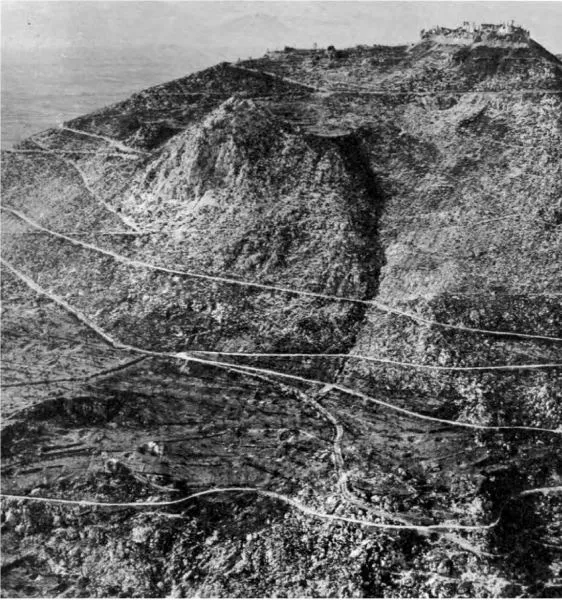
MONTECASSINO ABBEY. Liri Valley, the so-called Gateway to Rome,
is on the left. On 15 February the abbey was bombed and shelled
for the first time. Before that Allied soldiers had orders not
to fire even a rifle shot at the structure. Enemy ammunition
dumps were located close to the building, and gun emplacements
in the vicinity were numerous. It had become a legitimate
military objective. The bombing and shelling destroyed the abbey
as a work of art, but its usefulness to the enemy was scarcely
impaired. The rubble caused by the destruction of the upper
parts of the building only served to strengthen the remaining
lower parts.
ITALY
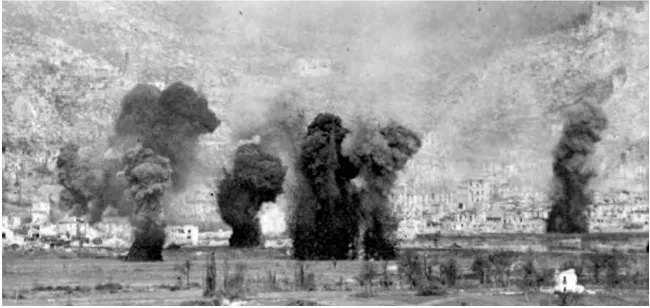
THE BOMBING OF CASSINO on 15 March. Although it had been
repeatedly bombed before, the town was heavily bombed and
shelled that day in preparation for the attack by the New
Zealand Corps, at this time part of the Fifth Army. About 1,200
tons of bombs were dropped and 195,969 rounds were fired by
artillery ranging in size from 3-inch guns to 240-mm. howitzers.
The enemy’s defenses were not destroyed. Protected by cellars,
steel and concrete pillboxes, caves, and tunnels, the German
troops suffered comparatively few casualties. The bombing and
shelling neither overcame the enemy’s resistance nor noticeably
reduced his morale. When the infantry moved in for the attack
they were met by heavy mortar fire; when the Allied tanks
appeared they could not advance because of bomb craters and
debris. The attack was repulsed.
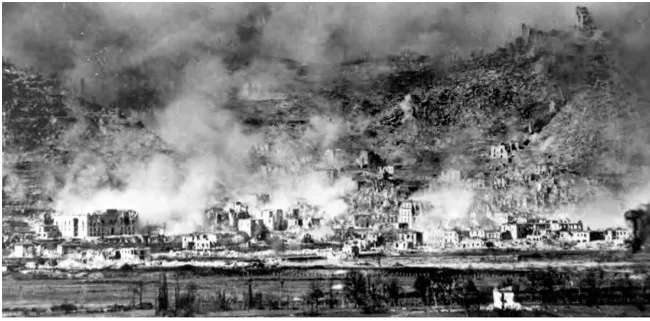
ITALY
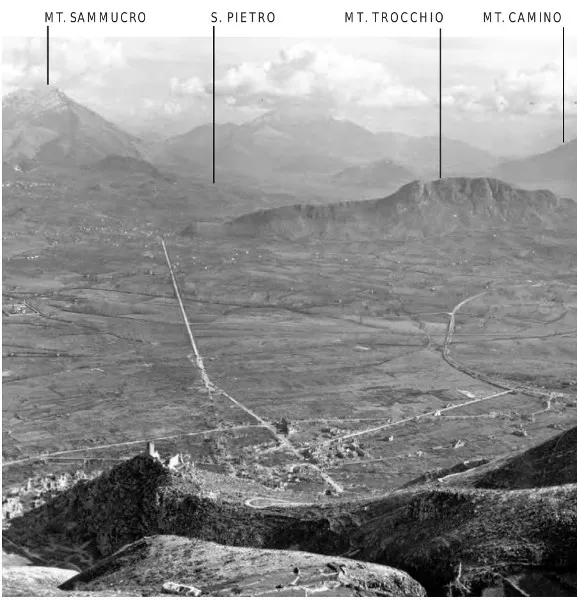
CASSINO AREA, looking along Highway 6. “Castle Hill,” in left
foreground topped by tower, was in Allied hands for weeks
before the town of Cassino fell. Below cliff are ruins of
the town. The picture, made from the vicinity of the abbey,
gives some indication of the enemy’s observation over Allied
positions. The main drive through the Winter Line defenses
started above San Pietro Infine. U. S. forces began the advance
on 15 November 1943 and had fought their way to the outskirts
of Cassino by 26 January 1944, a distance of eight miles in
seventy days. The town fell on 18 May to the Eighth Army after
several unsuccessful attacks. The drive on the southern front,
to penetrate the Gustav Line, started on 11 May 1944, while that
out of the Anzio beachhead started on 23 May.
ITALY
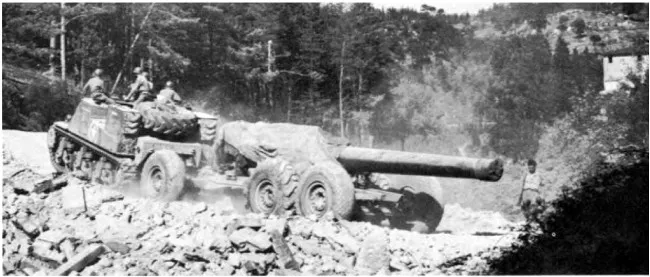
HOWITZER. These pieces fired their first mission in Italy in
Mignano Gap, 30 January 1944. They were used with good effect
during the Gustav Line fight in and around Cassino. Vehicle
towing weapon is converted General Grant tank M3 (top). Howitzer
in position near San Vittore del Lazio, five miles southeast of
Cassino (bottom). (240-mm. howitzer.)
ITALY
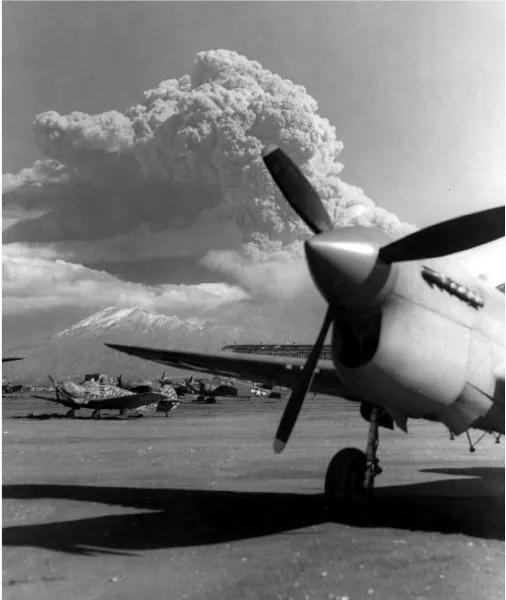
THE ERUPTION OF VESUVIUS in March 1944 damaged a number of
aircraft on fields in the vicinity. Fuselages and wings were
pierced by fragments of rock hurled from the volcano. In
foreground is a P-40 fighter-bomber.
ITALY
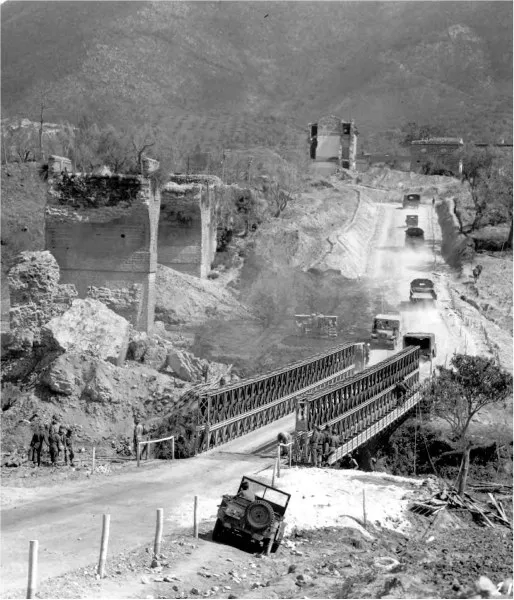
BAILEY BRIDGE over bypass on Highway 7 near Sessa Aurunca. This
is the coastal road between Rome and Naples; the inland road,
through the Mignano Gap, past Cassino and up the Liri Valley
to Rome, is Highway 6. The Bailey bridge was invented by the
British, from whom the U. S. forces obtained it.
ITALY
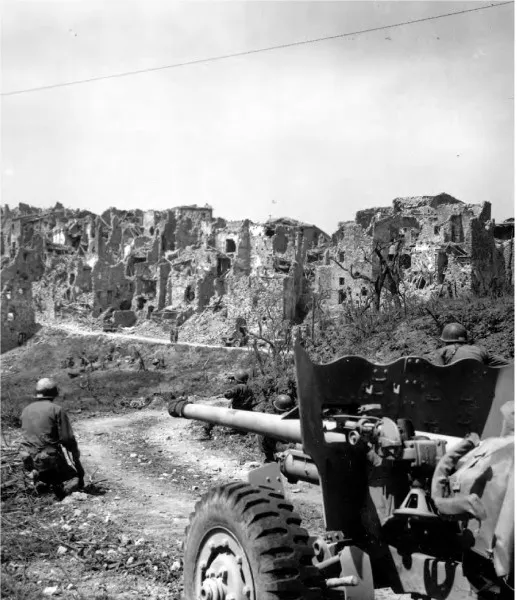
THE RUINS OF SANTA MARIA, INFANTE. This village between the
Aurunci Mountains and the Golfo di Gaeta fell to U. S. forces on
14 May, three days after the attack that was to carry the Allies
to Rome started. The village had been demolished by air and
artillery bombardment. (57-mm. antitank gun.)
ITALY
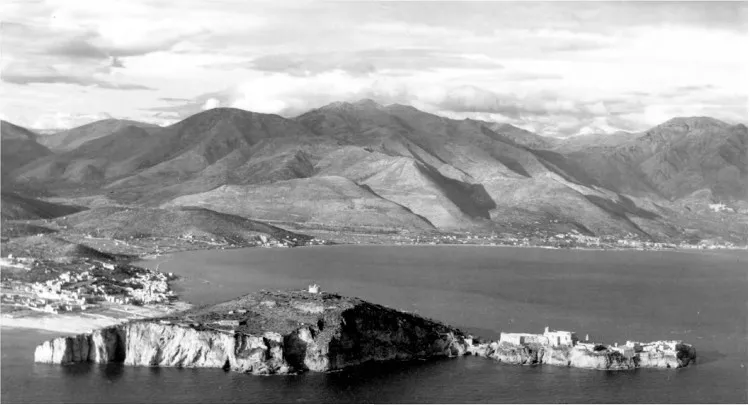
GOLFO Dl GAETA. The high mountain at the right is Monte
Petrella, which is 4,600 feet high; the one in the center is
Monte Ruazzo, which is 4,000 feet high. The drive through the
Gustav Line, started by the left flank of the Fifth Army, had
reached Monte Petrella by 15 May and had advanced to the Itri
Valley on the left of the picture. U. S. forces in general
advanced along the slopes facing the sea.
The French mountain troops advanced across the mountains farther
to the north, then turned right into the Liri Valley on the
other side and threatened to cut off the German forces around
Cassino and in the lower part of Liri Valley. This action by the
French made the German position untenable and the enemy started
a general withdrawal from the Gustav Line.
ITALY
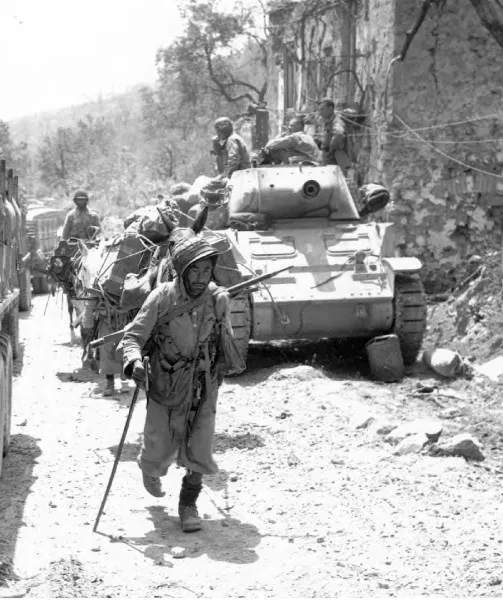
GOUMIERS OF THE FRENCH FORCES leading a pack train into the
Aurunci Mountains during the drive that started 11 May. Tank
is U. S. M5 light tank manned by French crew, and armed with a
75-mm. howitzer.
ITALY
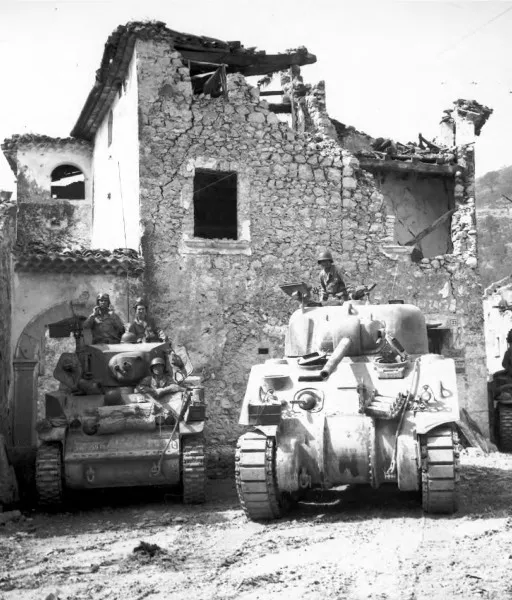
U. S. TANKS IN CORENO AUSONIO on 14 May. The same tanks, manned
by Americans, were attached to the French mountain troops making
a drive from the Castelforte area on the right flank of the
Fifth Army, through the Aurunci Mountains and into the Liri
Valley. (Left, light tank M5; right, medium tank M4.)
ITALY
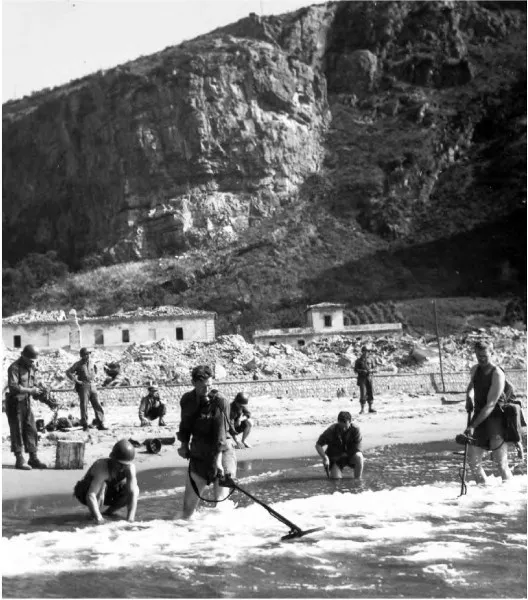
SWEEPING THE TERRACINA BEACH FOR MINES. Terracina is located
on Highway 7. During the drive the road became so overcrowded
that some supplies had to be shipped by sea. Since the small
harbor was cluttered with wreckage of ships, the beach had to be
cleared for landing and unloading. (Mine detector SCR 625.)
ITALY
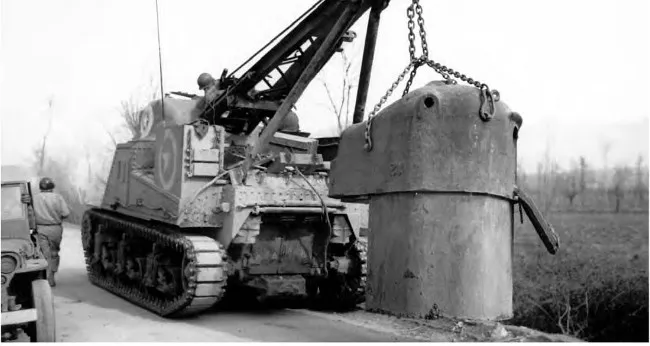
GERMAN PORTABLE PILLBOXES. Some of these were found in the
Gustav Line around Cassino and others were later found in
the Hitler Line in the Liri Valley. These steel pillboxes,
camouflaged and usually connected by communication trenches to
well constructed bunkers, were impregnable to all but direct
hits from artillery fire. (German mobile steel pillbox, being
removed by tank recovery vehicle M31.)
ITALY
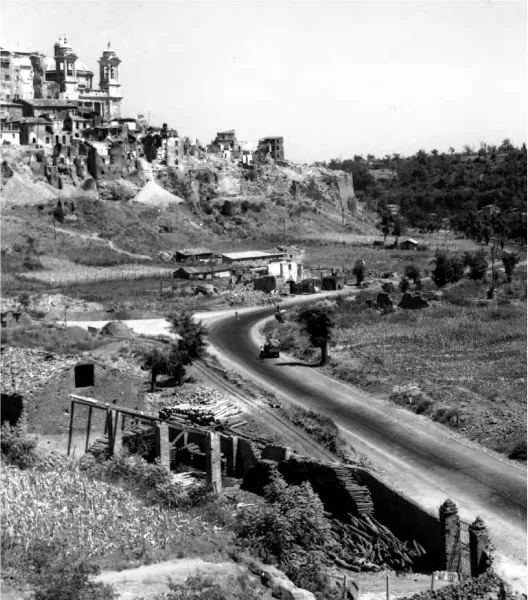
VALMONTONE ON HIGHWAY 6, twenty-five miles southeast of Rome.
This was the main escape route of the enemy forces trying to
retreat toward Rome from the Cassino-Liri Valley area. The enemy
kept the road open until 1 June. U. S. forces found the village
unoccupied on the morning of 2 June when a battle patrol entered
the town.
ITALY
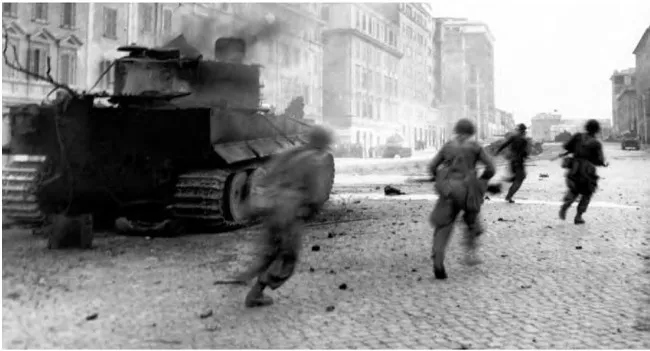
A TANK-INFANTRY TEAM entering Rome on 4 June. The burning
vehicle is a German Tiger tank. The enemy had been evacuating
the city for several days, but had left a strong rear guard
equipped with tanks and artillery to hold the Allies in and
below the city as long as possible. Since the streets of Rome
were not suitable for conventional infantry attacks, small
tank-infantry teams entered the city from several directions and
by early morning of 5 June were in possession of the bridges
across the Tiber.
ITALY
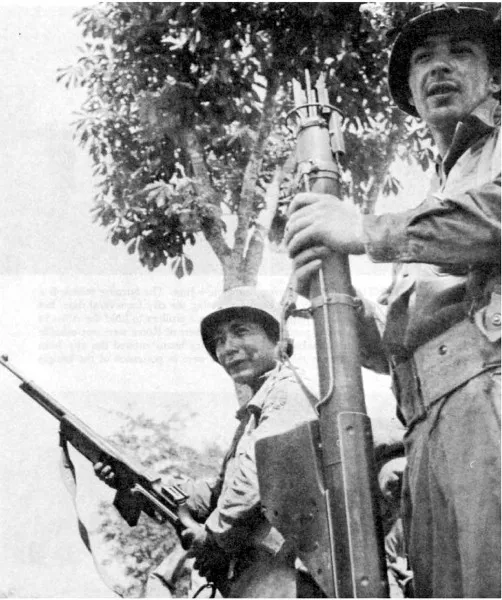
INFANTRYMEN OF ONE OF THE TANK-INFANTRY TEAMS to enter Rome on 4
June. Soldier on left has a Browning automatic rifle. The one on
right holds a bazooka (rocket launcher M1).
ITALY
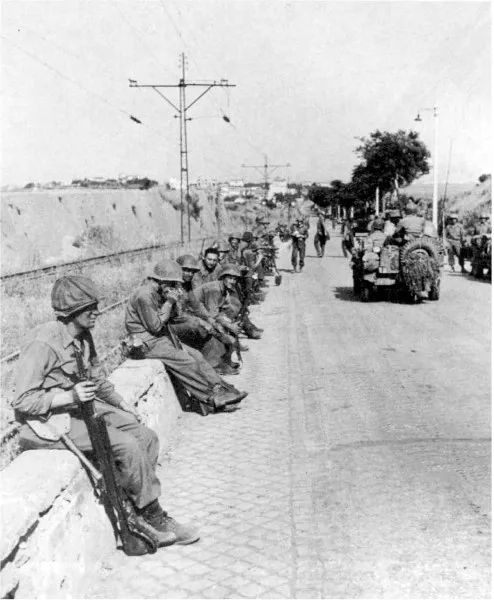
INFANTRY AWAITING SIGNAL TO ENTER ROME on 4 June. At this time
the city was being cleared by small tank-infantry teams.
ITALY
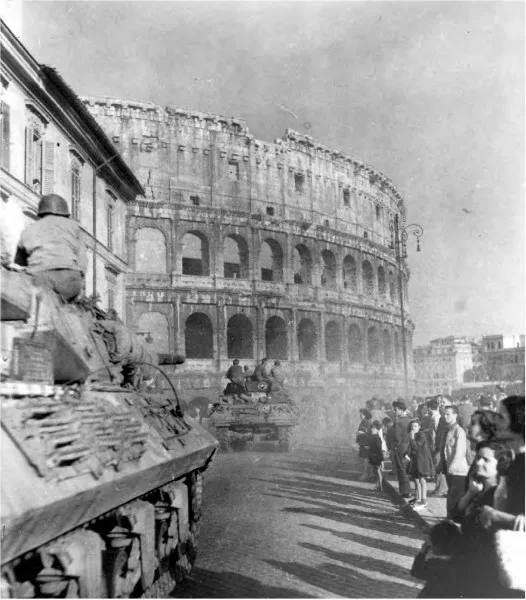
FIFTH ARMY ENTERING ROME on 5 June only to continue through the
city in pursuit of the enemy retreating along the roads north
of Rome. During this retreat the Germans were under constant
bombing and strafing attacks by Allied air forces. The roads of
retreat were littered with vehicles of all kinds. (3-inch gun
motor carriage M10.)
ITALY
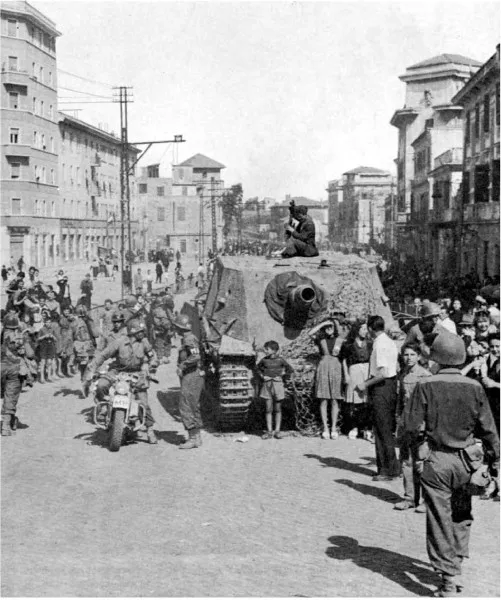
GERMAN GRIZZLY BEAR on a street in Rome. This is a close-support
weapon and mounts a short-barreled howitzer in a high, armored
superstructure (15-cm Stu. H. 43 on Pz. Kpfw. IV chassis.)
ITALY
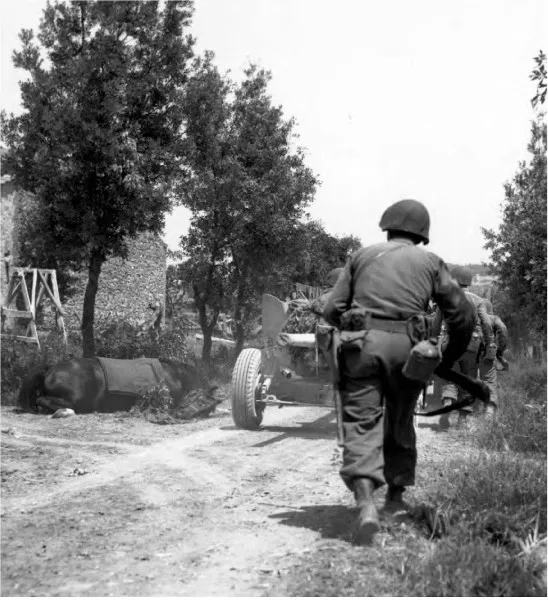
INFANTRY IN PURSUIT OF THE ENEMY north of Rome. Note dead horse
on left. Much of the German equipment was horse-drawn, limiting
the speed of withdrawal. During the pursuit of the enemy from
Rome to the Arno River whole divisions both American and French
were gradually withdrawn from the Fifth Army to train for the
coming invasion of southern France. Army strength dropped from
248,989 on 1 June to 153,323 on 1 August 1944. Three U. S.
divisions, veterans of the Italian campaign, were sent to the
Naples area for invasion training. (57-mm. antitank gun.)
SECTION IV Southern France
The offensive operation in southern France, originally scheduled to
be executed simultaneously with the Normandy landings, was conceived
with the aim of pushing northward from the southern coast, creating
a diversion of enemy troops from the northern assault, and generally
weakening the German Army in France. This operation was given the code
name Anvil.
A serious shortage of landing craft delayed the invasion until 15
August 1944. Meanwhile preparations for such a landing served as a
threat and held a large number of German forces on the southern coast.
Craft, used first for the Normandy landings, were then rushed to the
Mediterranean for use in mounting Anvil.
During June and July three divisions which formed the bulk of the U. S.
VI Corps were withdrawn from the battle in Italy and sent to port areas
for training and for participation in Operation Anvil. At the
same time all the French troops with U. S. Fifth Army were withdrawn
to prepare for the invasion. The Allied strategic air forces began the
process of neutralizing vital enemy communications and installations in
southern France. As D Day approached, a large naval force was amassed
in the Mediterranean, and the ground forces, American and French
troops, were embarked from Italy, North Africa, and Corsica.
An airborne task force of American and British units, with the
mission of preventing the enemy from reinforcing the coastal defense,
successfully jumped astride the Argens River behind the German
lines before H Hour. Landings took place on 15 August 1944 in the
Cannes-Toulon sector against scattered and disorganized resistance
from the enemy. The assault forces, assisted by members of the French
Resistance forces, pressed their attack rapidly, defeated the enemy
along the coast line, and pushed inland. The troops were met with
enthusiasm by the French population.
Toulon and Marseille were captured by units of the French forces. By
the end of August the combined American and French forces had broken
German resistance in southern France, destroyed and put to flight
the enemy, and advanced to Lyons. On 11 September 1944 they made
junction with the Normandy forces west of Dijon, thereby sealing all of
southwestern France.
ITALY
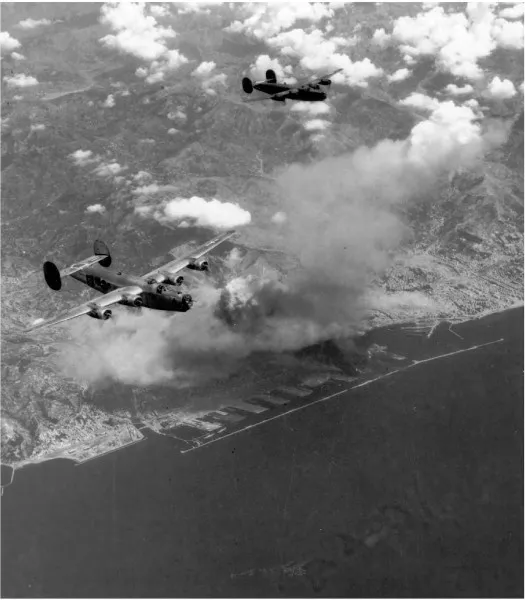
SMOKE RISING FROM WATERFRONT INSTALLATIONS as Liberators bomb
Genoa, Italy, prior to the invasion of southern France. This
was part of a plan to keep the enemy guessing as to where the
assault would come. At the time of the Normandy landings most
of the Allied troops intended for the simultaneous invasion of
southern France were fighting in Italy.
ITALY
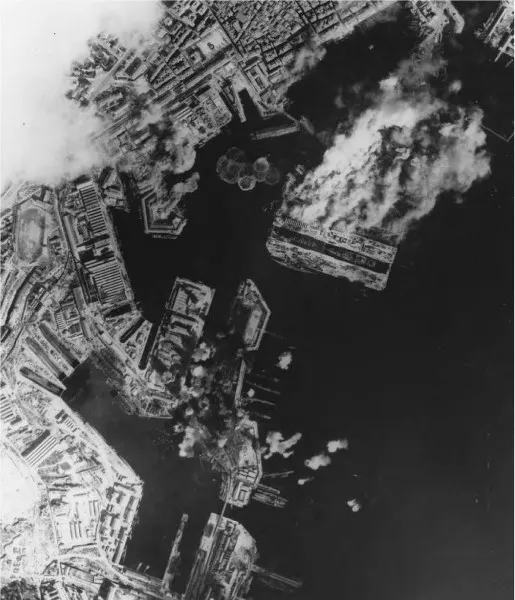
DOCKS AND U-BOAT PENS during an air attack at Toulon, a major
French naval base. Allied air attacks destroyed U-boats awaiting
repairs in their pens and crippled production facilities. By the
end of July 1944 the Mediterranean Sea was almost cleared of
German naval power.
ITALY
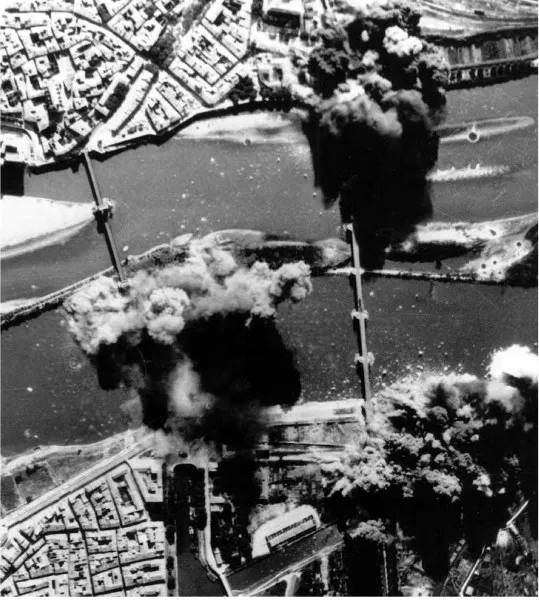
BOMBING OF RHÔNE RIVER BRIDGES at Tarascon by Allied planes.
Pre-D-Day bombardment wrecked all but one bridge across the
Rhône, which helped to hamper large-scale movement of enemy
troops. The Allied forces were to advance through the Rhône
River Valley which passes between two mountain masses, the
Massif Central and the Alps, and forms a great natural corridor
connecting the Mediterranean coast with the Paris basin.
FRANCE
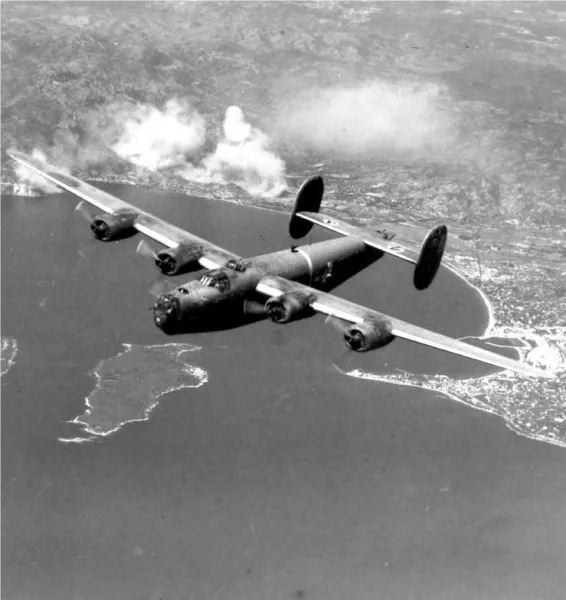
B-24 0VER THE GOLFE DE LA NAPOULE. Smoke rising in distance,
near village of Théoule-sur-Mer, is caused by bombing of
railroad, highway, and bridges. At right is Cannes. The air
offensive in support of the invasion actually began as early as
28 April 1944 when heavy bombers attacked Toulon. Between that
time and August, the Mediterranean Allied air force dropped
more than 12,500 tons of bombs on southern France. Beginning
on 10 August the offensive was continued by attacking coastal
batteries and radar stations, harassing coastal defense troops,
and isolating the target area by destroying bridges across the
Rhône.
ITALY
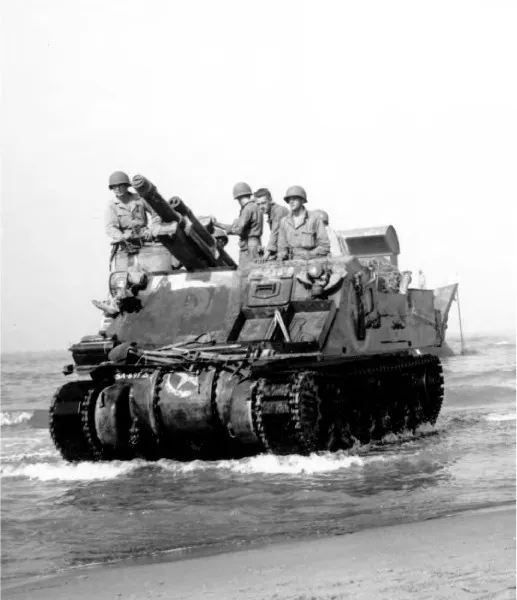
WATERPROOFED PRIEST undergoing test in preparation for the
invasion. The invasion training center at Salerno, Italy,
established a school of one week’s instruction in waterproofing
vehicles for the coming assault. The 105-mm. howitzer motor
carriage M7 was the principal artillery weapon of the U. S.
armored division.
ITALY
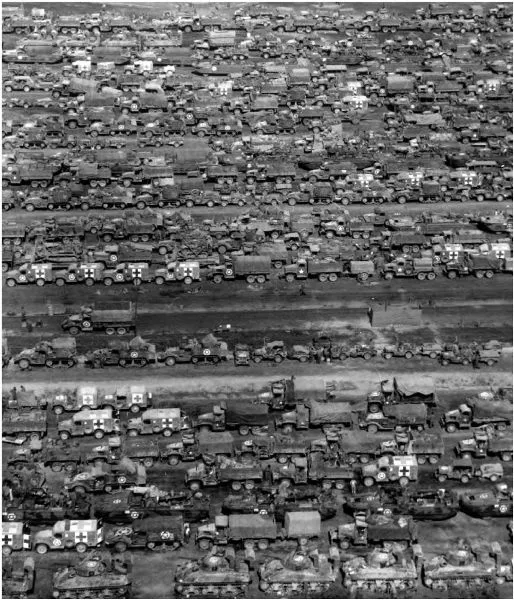
VEHICLES ASSEMBLED AT THE PORT OF NAPLES for the invasion of
southern France. The troop list of those landing during the
first four days included over 155,000 personnel and 20,000
vehicles of all types, including personnel and cargo carriers as
well as armored vehicles.
ITALY
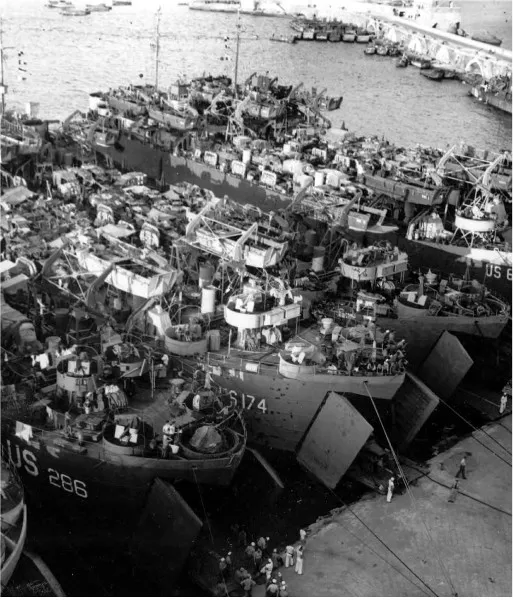
LOADED LST’S IN NAPLES HARBOR in August 1944 before the
invasion. By this time the Germans had been pushed north of
Florence, their air force had been greatly reduced, and their
airfields in the Po Valley were under constant air attacks by
medium and heavy bombers.
ITALY
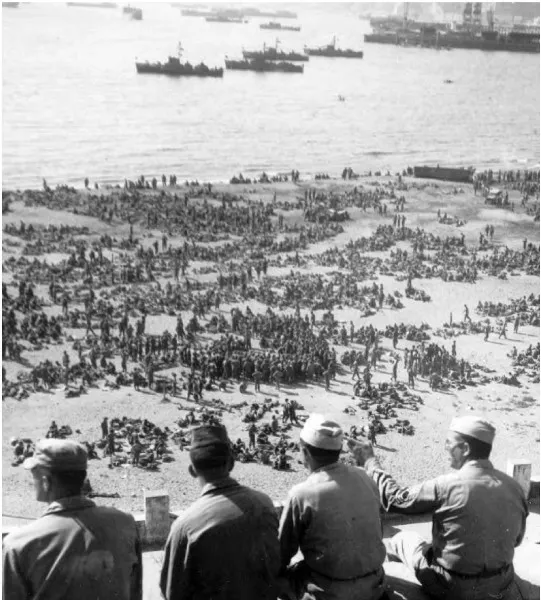
MEN ON A BEACH NEAR NAPLES waiting for water transportation to
take them to near-by landing craft and transports in the Bay of
Naples. This was the final loading before the invasion. Although
the Germans were aware of the concentration of troops and
shipping and knew that the invasion was in preparation, no enemy
bombings interfered with the loading operations. The Allied air
forces had rendered most of their airfields within range of
Naples inoperative for all practical purposes.
ITALY
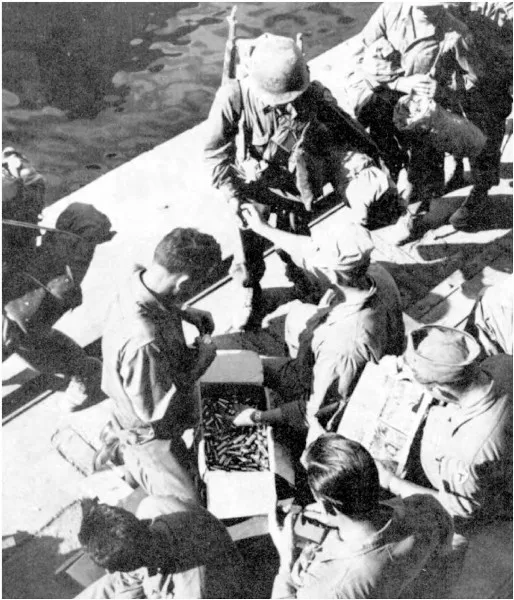
MEN RECEIVING CARTRIDGES OF CARBON DIOXIDE for their life
preservers, prior to boarding ships for the invasion. Rations
for the first days were also issued, each man receiving one K
ration, one D ration, one small bottle of Halazone tablets to
purify water, one bottle of salt tablets, and two packages of
cigarettes.
ITALY
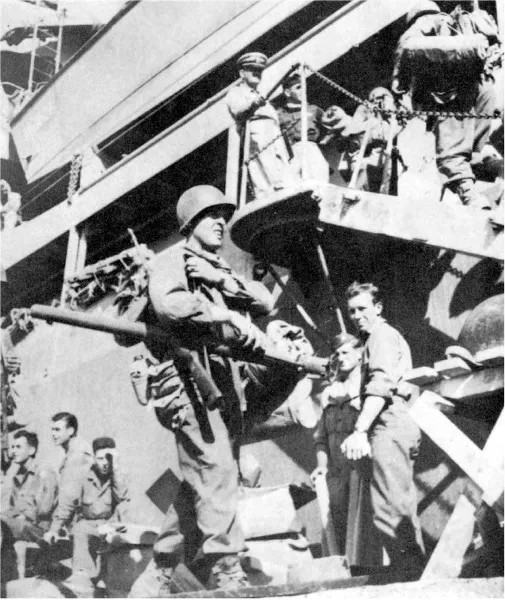
FULLY EQUIPPED INFANTRY SOLDIER, armed with both a carbine and
a rocket launcher, boarding a transport. (2.36-inch rocket
launcher M1A1, known as the bazooka.)
EN ROUTE TO SOUTHERN FRANCE
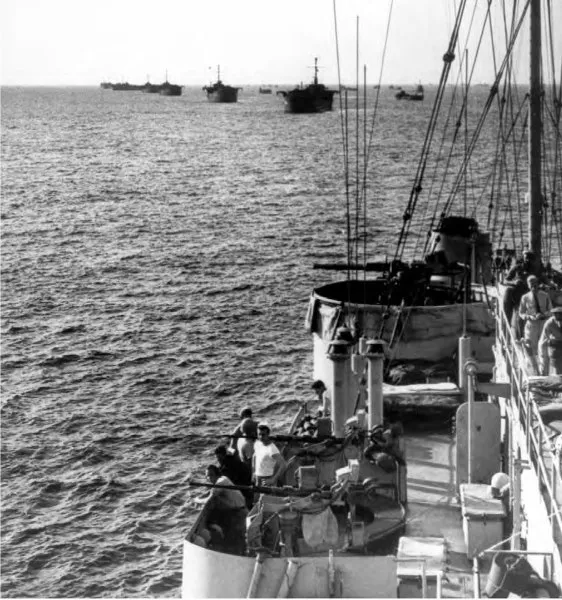
LST’S APPROACHING THE COAST OF FRANCE. Ships carrying men and
equipment for the invasion sailed from ports in Africa, Italy,
and Corsica, the most important loading port being Naples. In
all, 853 vessels from the Allied navies formed the task force
with an additional 1,267 small landing craft, deck-loaded.
Several hours prior to the main assault amphibious landings were
made on both flanks of the invasion area and airborne landings
were made in the rear in order to isolate the beachhead from the
enemy. French commandos landed at Cap Nègre and French marines
landed near Cannes.
EN ROUTE TO SOUTHERN FRANCE
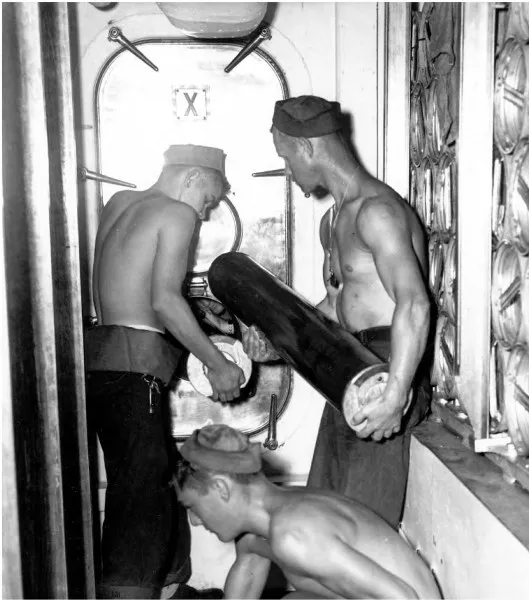
ON BOARD AN AMERICAN CRUISER men pass ammunition to gunners
firing on the beaches of southern France. Naval ships commenced
long-range bombardment of prearranged targets at 0530 on D Day.
Until 0800 this fire was almost continuous, lifting only when
Allied bombers were over the targets. In all, naval guns fired
over 15,900 projectiles into the beach area prior to the assault
landings.
FRANCE
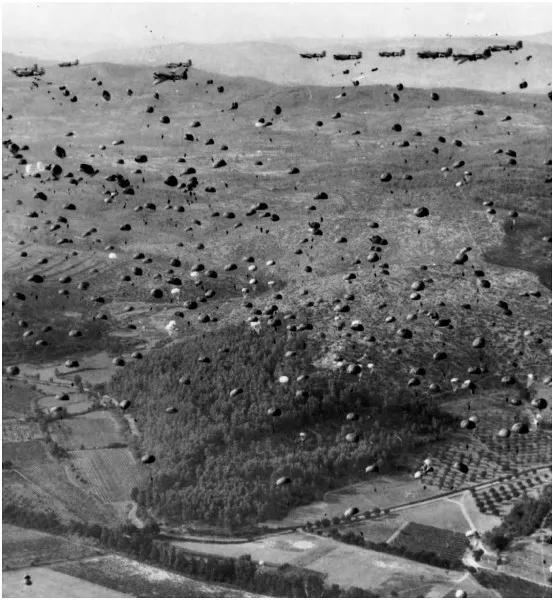
DROPPING SUPPLIES TO PARATROOPERS on D Day, 15 August 1944. An
Anglo-American airborne task force landed at various hours on D
Day beginning at 0430 near le Muy and le Luc to establish road
blocks, to prevent enemy movement toward the beaches, and to
help reduce the defenses in the Frejus area. No air opposition
was encountered and the paratroopers landed and came in contact
with the enemy immediately, but resistance was light, primarily
small arms fire. Preparations were made by the paratroopers for
the landing of the glider-borne elements.
FRANCE
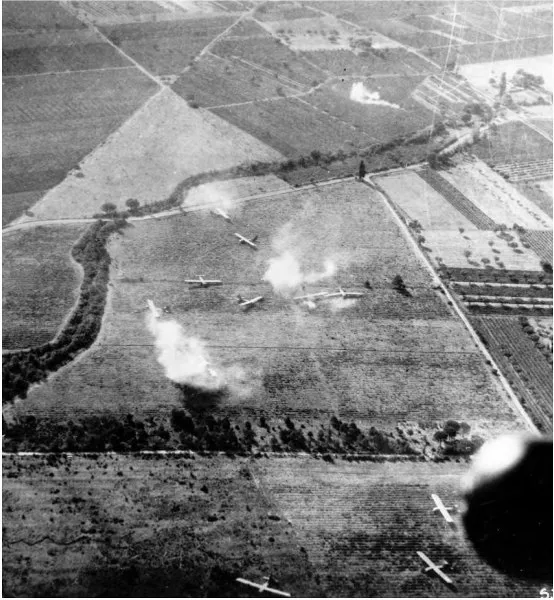
DUST RISING FROM FIELDS AS GLIDERS LAND. The tow planes and
gliders took off from airfields in the Rome area. No gliders
were lost from enemy action, but many were wrecked in landing,
causing some casualties. The first glider serial landed about
0930 on 15 August 1944, and by late afternoon the whole force
had landed. By nightfall four small villages had been occupied
and 103 prisoners taken. A protective screen was established
over the road net connecting the invasion coast with the
interior.
FRANCE
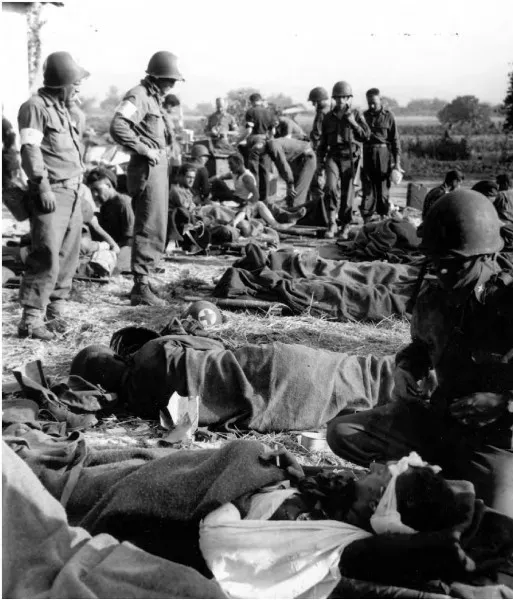
WOUNDED AND INJURED AIRBORNE TROOPS in an aid station at la
Motte. The enemy opposition to the Anglo-American air drops
and glider landings was relatively slight but this method of
warfare, in itself dangerous, resulted in unavoidable accidents
such as broken arms and legs and, in some cases, more serious
injuries.
FRANCE
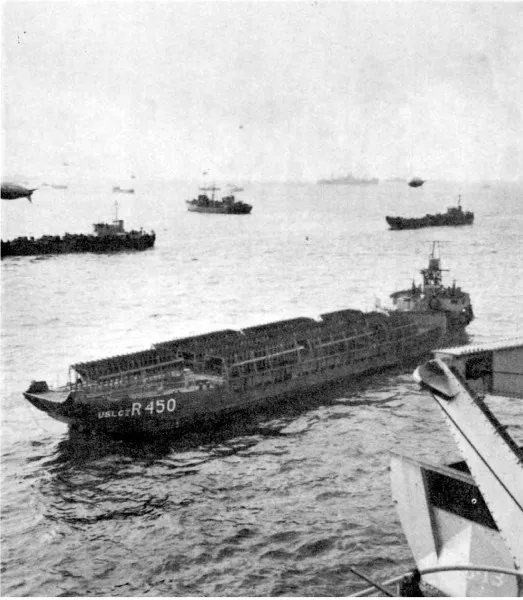
ROCKET SHIP CONVERTED FROM AN LCT. Ahead of the first wave of
assault troops in landing craft were rocket ships mounting tiers
of rocket launchers. As these drew within range of the beach
defenses they discharged their rockets. The first troops landed
immediately afterward. Rocket ships were equipped with launchers
for up to 1,000 rockets.
FRANCE
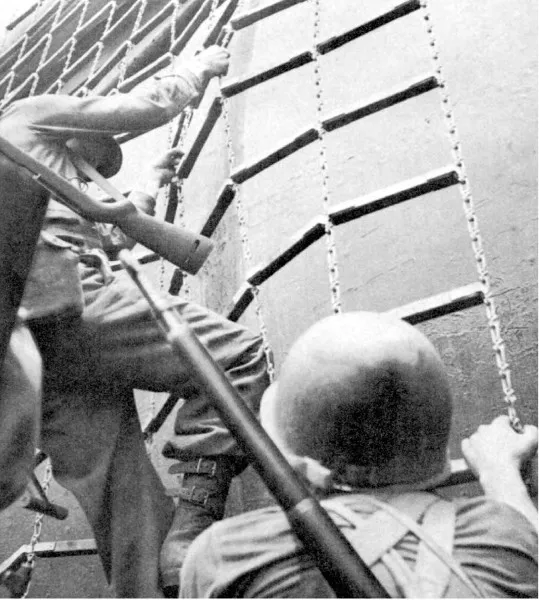
SOLDIERS DESCENDING A LADDER into waiting assault craft.
Climbing down along the high vertical side of a transport into
a heaving and swaying assault craft while loaded down with
ammunition, equipment, and rations was in itself a difficult
task. The ladder shown here, constructed of chains separated by
wooden pieces, was a great improvement over the old rope nets.
The latter tended to bunch and stretch, making the descent
extremely difficult and slow.
FRANCE
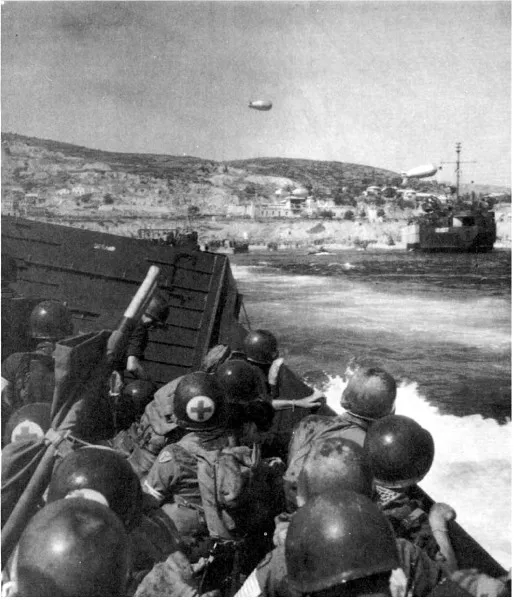
INFANTRY MAN AND MEDICS in the LCVP nearing a beach. Advancing
at full speed, the assault craft approached the beaches in the
immediate wake of the rocket ships. Other landing craft can
be seen on the beach. At right is an LST. Overhead are three
barrage balloons.
FRANCE
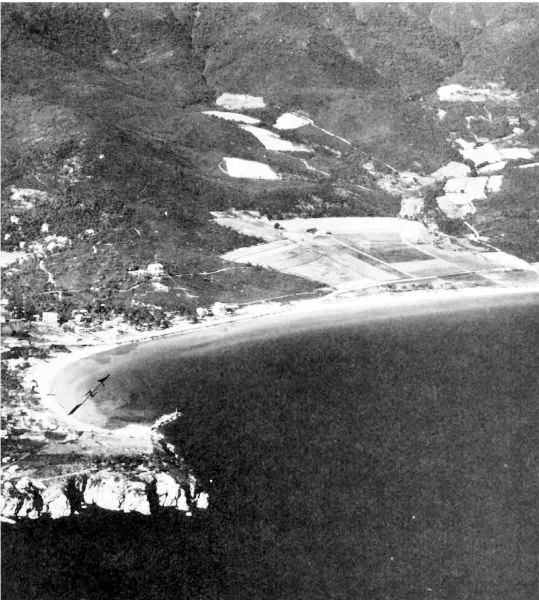
PART OF THE BEACH ON BAIE DE CAVALAIRE. On the left of the
invasion coast in the U. S. sector, one division was to assault
the beach area from Cap Cavalaire to the Cap de Saint-Tropez,
including the town of Saint-Tropez. One battalion landing on the
beach shown above advanced along the coastal road and cleared
the town of Cavalaire-sur-Mer (portion of town is at left in
photo), and by 1330 on D Day reached a road block, in the
vicinity of Cap Negre, held by the French.
FRANCE
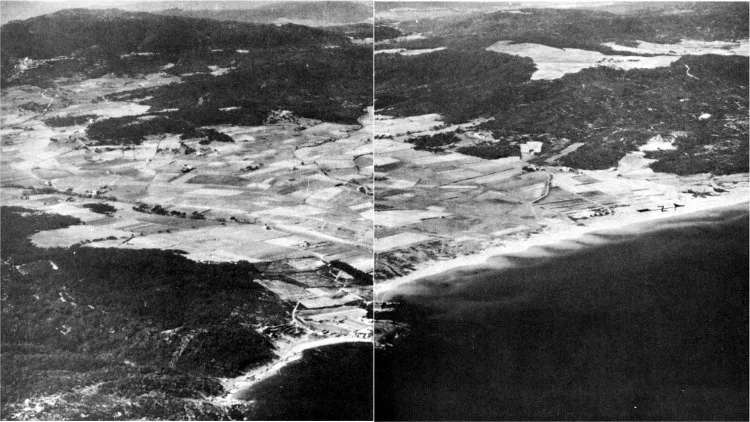
BEACH ON THE ANSE DE PAMPELONE. All beach defenses were reduced
in forty minutes after landings were made. The engineers started
clearing the beaches of mines and laying beach pontons since the
gradient was too shallow for ships to come up to the beach. One
battalion attacked inland and seized the high ground north of
the town of Rainatuelle (upper left). Two battalions moved north
and northeast and seized the hills (upper right). Saint-Tropez
is just behind these hills.
FRANCE
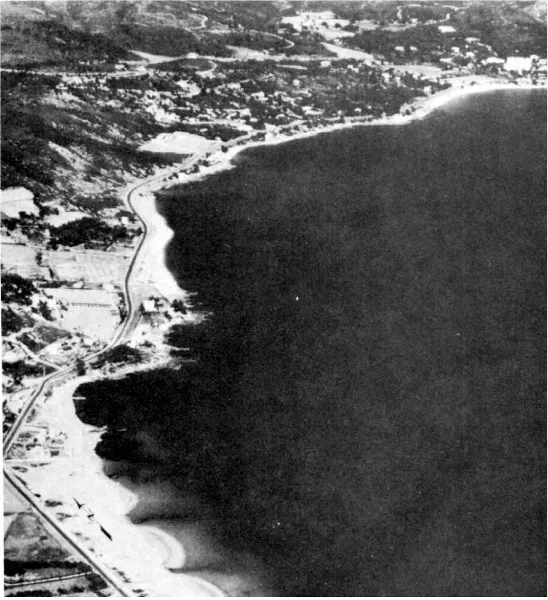
THE CAP SARDINEAU BEACHES. Another of the three assault
divisions landed here in the center of the corps invasion area
at H Hour (0800) on D Day. The three small beaches (shown above)
lay along a curving bay between Cap Sardineau and Pointe de
l’Arpillon. The divisional area extended inland 15 to 20 miles
to le Luc and le Muy where the airborne troops had previously
landed. After clearing the beaches, the division’s mission was
to contact the paratroopers to the north and the divisions on
each flank.
FRANCE
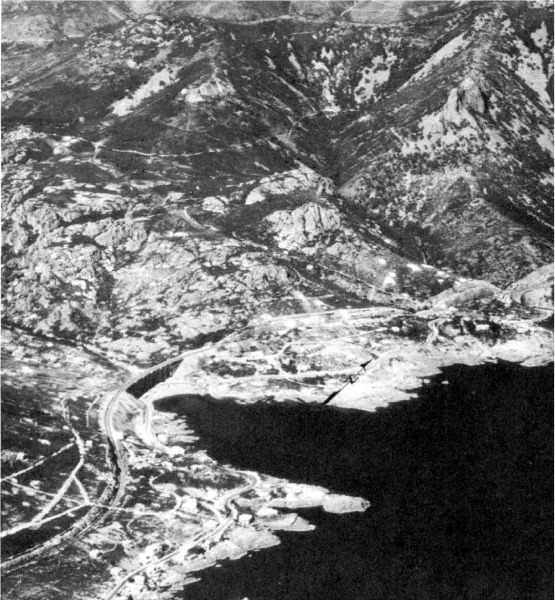
POINTE D’ANTHÉOR BEACH. On the extreme right of the invasion
coast, this beach at an inlet near Pointe d’Anthéor was small
and not well suited for a major landing. The landings took place
on the beaches on both sides of the inlet which ends where
the highway runs beside the railroad bridge. Here the Germans
directed their fire upon the assault boats and made several
direct hits, causing casualties. The assault troops placed a
road block across the coastal highway and occupied the ground
northwest of Rade-d’Agay.
FRANCE
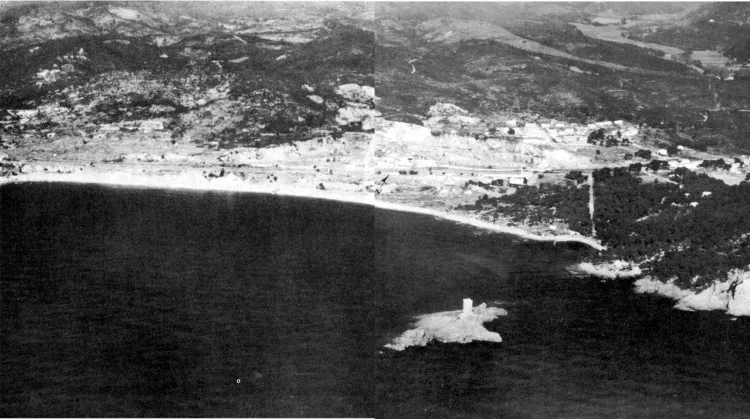
CAP DRAMMONT BEACH. The third division of the three in the U.
S. assault area had the mission of securing the right of the
invasion beaches. The divisional area extended from Pointe de
Saint-Aygulf along the coast line to Théoulesur Mer on the Golfe
de la Napoule. The first assault was over this beach west of Cap
Drammont and was considered large enough only for the initial
operations. The beach consisted of narrow strips of rocky shale
between the water and steep embankments.
FRANCE
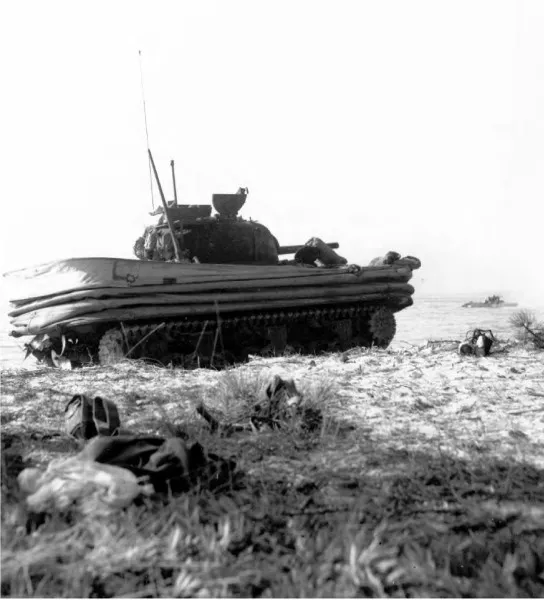
DUPLEX-DRIVE TANK. Amphibian tanks were launched from LCT’s
about 2,000 yards offshore to support infantry on the
Saint-Tropez peninsula assault. By means of the duplex drive
a regular medium tank was converted into an amphibian. When
the canvas screen was raised and held in place by mechanical
means the tank floated. The DD tank was vulnerable to mines and
underwater obstacles. Offshore at right an amphibian 2½-ton
truck is bringing a 105-mm. howitzer to the beach.
FRANCE
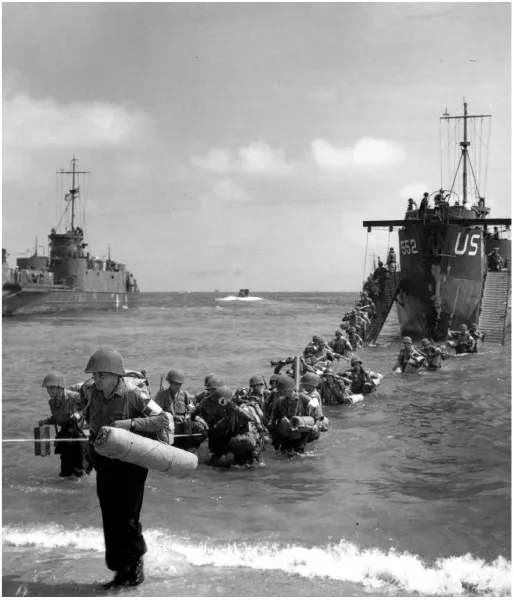
INFANTRYMEN LANDING ON BEACH FROM AN LCI. In the center of the
U. S. assault area troops landed under almost ideal amphibious
conditions, four battalions abreast with little hindrance by
mines and underwater obstacles and with light enemy resistance.
FRANCE
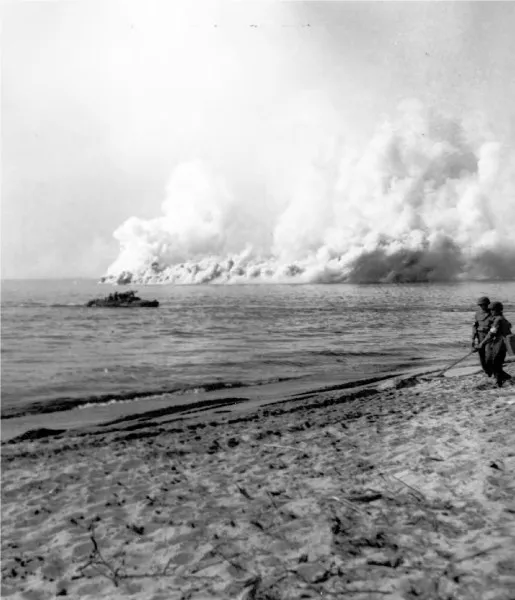
A SMOKE SCREEN is laid to cover landing operations on the left
flank of the American assault area. While engineers, using a
mine detector (SCR 625), clear the beach of enemy mines, a DUKW
with a 105-mm. howitzer approaches the shore.
FRANCE
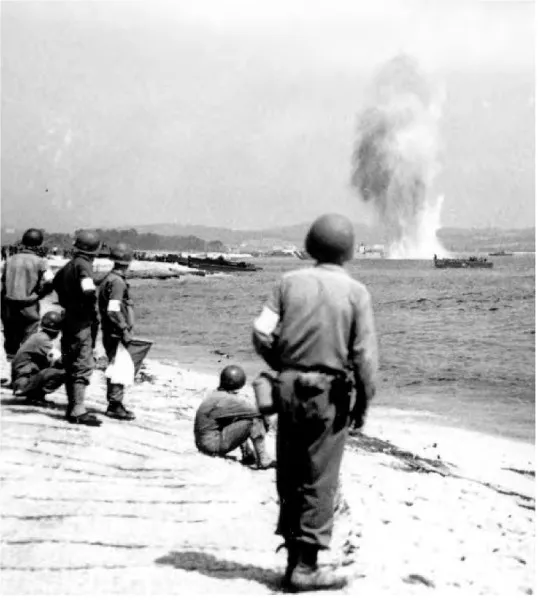
EXPLODING MINE. On D Day morning no fire on ships or craft from
coast defense guns was reported, and on the beaches resistance
consisted mostly of small arms and mortar fire. Underwater
obstacles and land and marine mines were insufficient to delay
the landings materially. The first waves of assault troops
located and removed many of these obstacles. Note wire matting
in lower left used to form a roadbed over loose sand.
FRANCE
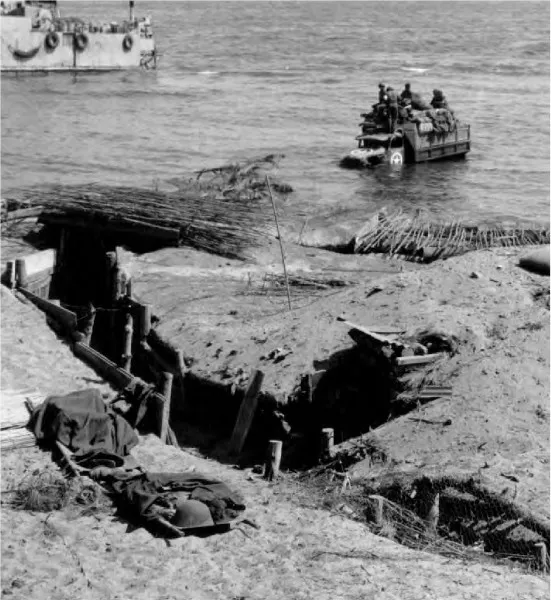
ENEMY TRENCHES ON BEACH and two American casualties. A
waterproofed 2½-ton 6 x 6 truck offshore. Shortly after U. S.
troops landed the enemy came out of shelters and opened fire
with small arms and mortars. However, amphibian tanks, tank
destroyers, and howitzers which had landed from DUKW’s were
in position to meet this fire, and the infantry continued to
advance inland against scattered and light opposition. The first
enemy prisoners seemed dazed and well shaken by the preliminary
naval and aerial bombardment.
FRANCE
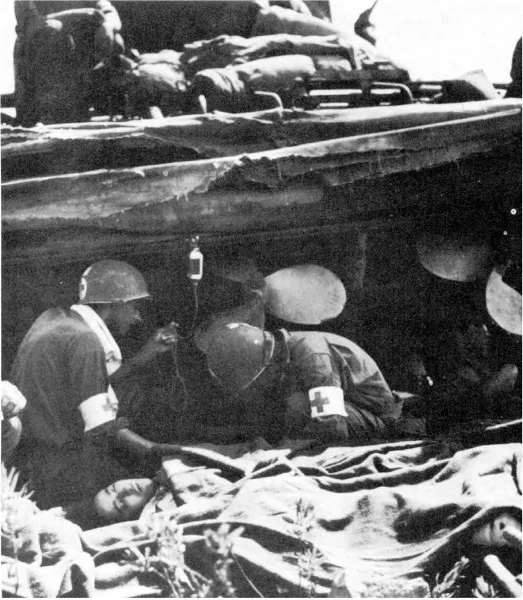
AID MEN ADMINISTER PLASMA TO A FRENCH WOMAN wounded during the
invasion, using the rear of a DD tank for shelter. Men and women
of the French Forces of the Interior assisted the advancing
troops and made the countryside untenable for the isolated
enemy detachments. By midnight, the corps reported that 2,041
prisoners had been taken.
FRANCE
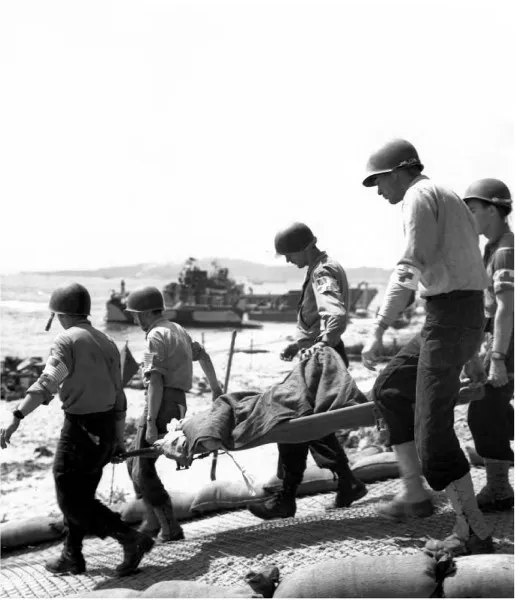
LITTER BEARERS EVACUATING WOUNDED MAN. A medical battalion
attached to the beach group set up collecting, clearing, and aid
stations. The wounded were evacuated from the beach by Army and
Navy medical personnel to hospital ships by LCVP’s. The casualty
rates were low and the inland advance of troops rapid.
FRANCE
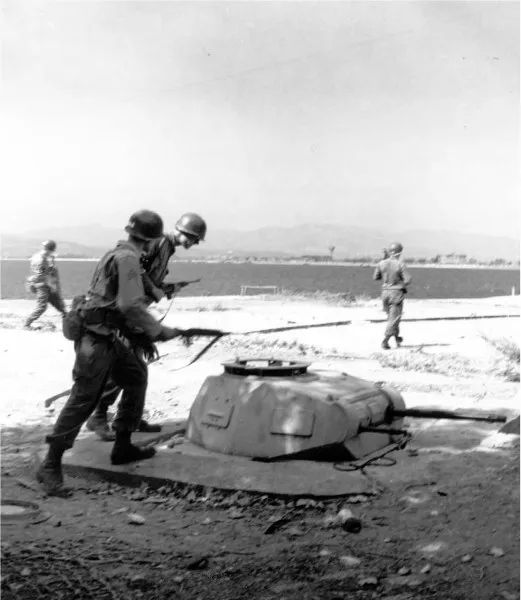
ENEMY PILLBOX. On the morning of 16 August 1944 troops moved
through Saint-Raphaël clearing most of the resistance. There
was considerable improvisation on the part of the enemy, such
as the mounting of tank turrets on concrete to form pillboxes.
(Schmeiser machine gun and 20-mm. cannon mounted in pillbox.)
FRANCE
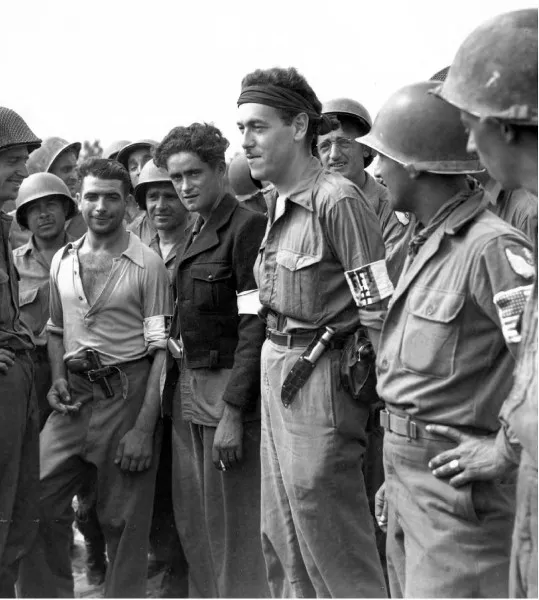
THE FIRST FRENCH PARTISANS (French Forces of the Interior) to
meet the invading U. S. troops at the beach in the Saint-Tropez
area. The partisans had been given a list of priority targets
to be attacked on and after D Day. They were to intensify
their activities in the rear of the enemy forces, with special
emphasis on the destruction of bridges, cutting and blocking
highways and railroads, and seizing or controlling telephone and
telegraph centers.
FRANCE
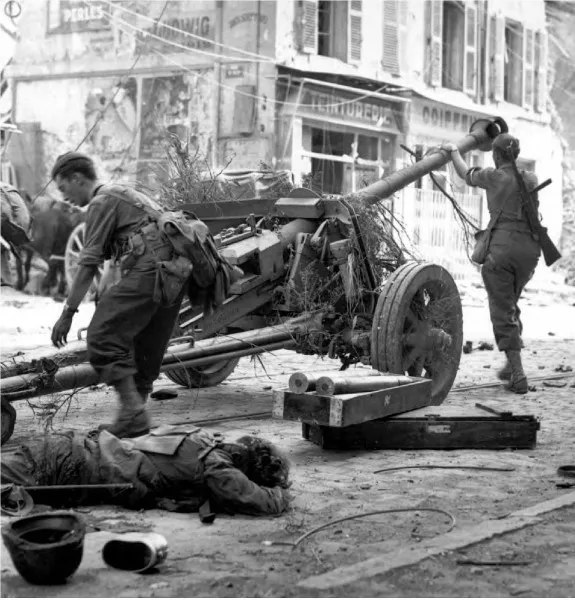
FRENCH TROOPS TAKE OVER A GERMAN GUN IN TOULON. At 2000
on D plus 1 a French army, consisting of seven divisions,
began landing on the beaches in the Saint-Tropez area, with
the initial mission of capturing the port cities of Toulon
and Marseille. The divisions assigned the taking of Toulon
began the encirclement of the city on 20 August. Because of
formidable enemy defenses, the combined efforts of the French
army, the tactical air command, and the Allied naval task
force were required before complete occupation of the city was
accomplished. The German garrison surrendered to the French army
on 28 August 1944. (German gun, 7.5-cm. Pak. 40.)
FRANCE
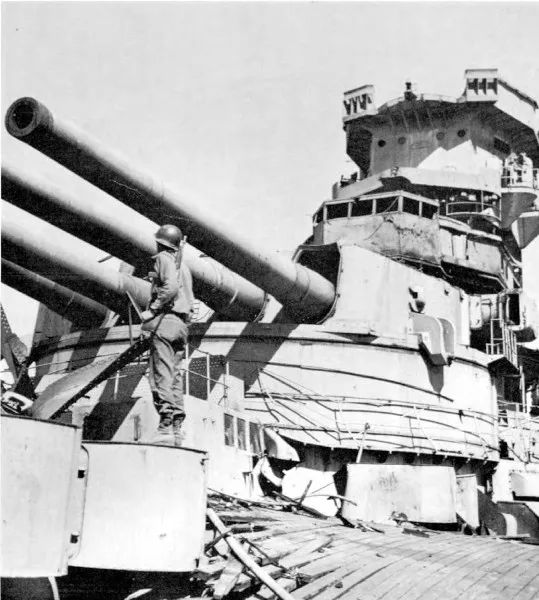
THE FRENCH BATTLESHIP STRASBOURG. This ship was scuttled and
then damaged by Allied bombing on D plus 3, 18 August 1944,
in Toulon harbor. The enemy made maximum use of artillery for
coastal defense purposes. Batteries included railway guns, heavy
coast artillery, German field pieces, old French and Italian
equipment, and even naval guns transferred from French warships
scuttled in Toulon harbor.
FRANCE
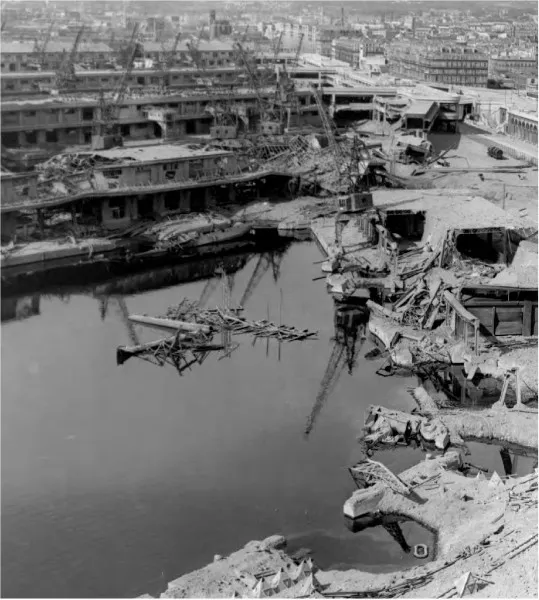
DAMAGED DOCKS AT MARSEILLE, the second largest city in
France, the most important port on the Mediterranean, and one
of the three cities in southern France with facilities for
handling 10,000-ton Liberty ships. (The others are Toulon and
Nice.) Marseille capitulated to the French army on 28 August
1944, particular emphasis being placed on preserving port
installations which the Germans had hoped to render useless by
large-scale demolitions.
FRANCE
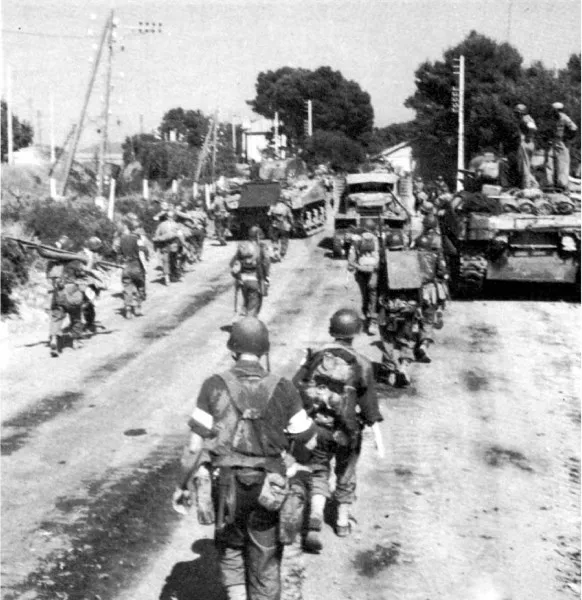
INFANTRY AND TANKS ADVANCE ALONG A COASTAL HIGHWAY. Failure
of the defending forces to hold the invaders in the immediate
coastal area was due to several facts: the enemy had disposed
his divisions too far west; additional troops were committed
in a piecemeal fashion; coastal units in general were weak,
and lacked air support, armor, and heavy artillery. It is
also estimated that about half the enemy troops were Russian,
Czech, Turkish, Polish, and other non-Germanic people who were
not inclined to put up a determined stand. The German corps
headquarters, near Draguignan, became isolated from its command.
The French Forces of the Interior constantly harassed the
defending troops from the rear.
FRANCE
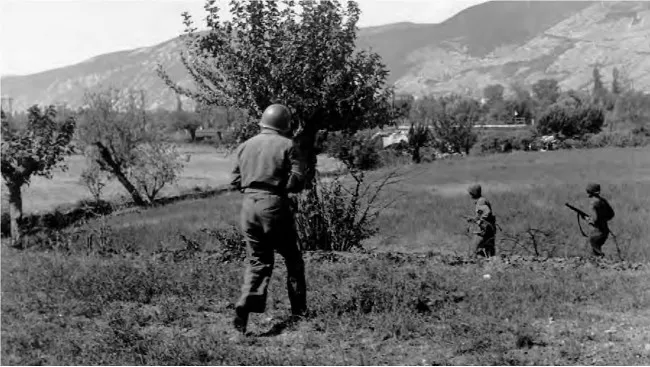
INFANTRYMEN PATROL NORTH OF MONTELIMAR (top). An American tank
passes wrecked German equipment north of Montelimar (bottom).
American troops advanced on Montelimar from the south and
northeast in an attempt to cut off and destroy the German army
in that area. After eight days of hard fighting the town was
taken, but a large portion of the enemy troops had succeeded in
escaping north from the triangle formed by the Rhone, Drome, and
Roubion Rivers, along Highway 86 west of the Rhone River and
Highway 7 east of the river.
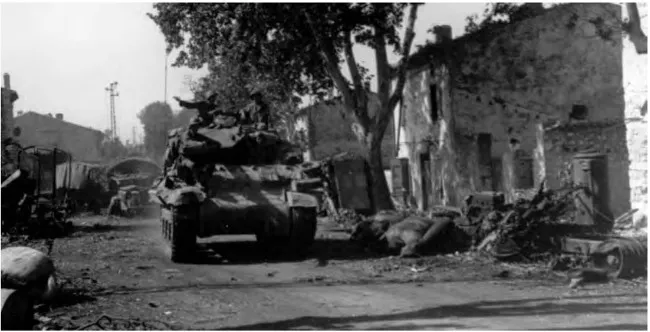
FRANCE
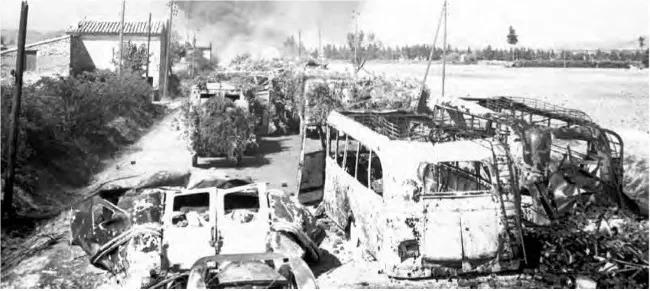
GERMAN EQUIPMENT BURNING IN THE MONTELIMAR AREA as U. S.
artillery shells enemy convoys attempting to withdraw to the
north (top). Wreckage of enemy vehicles after being hit by
artillery fire (bottom). By the end of August the Germans had
succeeded in withdrawing the greater part of their personnel
north of the Drome River, but left behind were destroyed
vehicles, guns, and heavy equipment, which reflected the eight
days of heavy fighting. American destruction of enemy equipment
included between 2,000 and 3,000 vehicles, over 80 artillery
pieces, and 5 large-caliber railway guns.
FRANCE
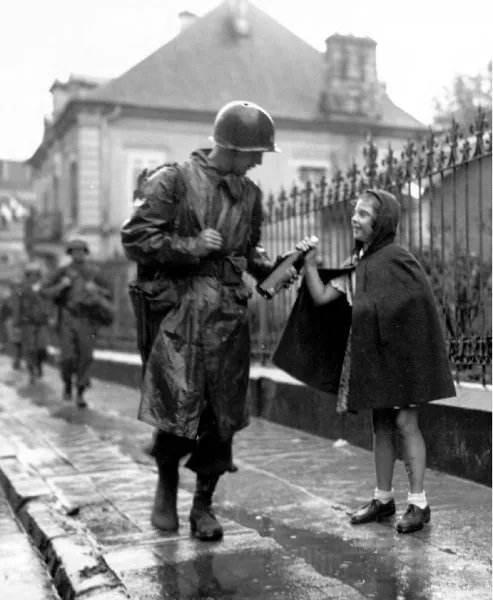
A LITTLE FRENCH GIRL giving a soldier a bottle of wine as a
gesture of welcome as U. S. troops march through the streets of
a liberated French town.
FRANCE
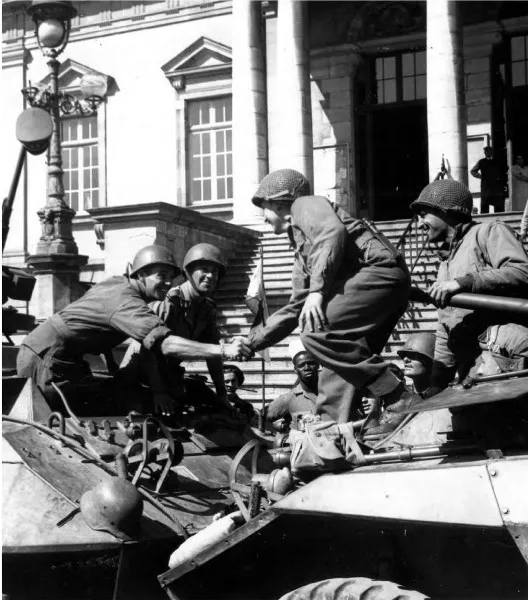
SOLDIERS OF THE SOUTHERN INVADING ARMY meeting soldiers from
the northern invading army. At 1500, 11 September, elements
of a French armored division of the southern forces made
junction with a French armored division near Sombernon, 150
miles southeast of Paris. The two invasion forces thus joined
to form a continuous Allied front from the North Sea to the
Mediterranean.
SECTION V Italy
(5 June 1944–2 May 1945)
The Allies did not halt after taking Rome, but their northward progress
was soon slowed by skillful delaying tactics of the retreating enemy
and by the fact that all the French and some of the American divisions
were being withdrawn from the U. S. Fifth Army for the operation in
southern France. The Germans speeded construction of the Gothic Line
in the north Apennines, and early in August 1944 the Allies paused for
reorganization on a line running approximately from ten miles north
of Ancona on the east through Pisa to the west coast. The Fifth Army
held the territory south of the Arno River from the sea to a few miles
east of Florence; the British Eighth Army was north of Ancona on the
Adriatic.
During August preparations were made by the Allied armies in northern
Italy to penetrate the heavily fortified Gothic Line. This defensive
system of the enemy extended in general from southeast of La Spezia
through the mountains to Rimini. After regrouping and building up
supplies, the Allied armies started their offensive on 26 August. They
succeeded in breaching the Gothic Line in the center and along the
coast, but fierce enemy resistance, bad weather, and a shortage of
ammunition and replacements halted the offensive south of the Po River
plain by the late fall of 1944. The winter of 1944–45 was spent in the
mountains overlooking the Po Valley.
The spring drive by the Allied armies started on 9 April 1945. Bologna
fell on 20 April, and armor and infantry overran the plain and divided
the German forces. On 2 May 1945 the enemy in Italy surrendered
unconditionally.
ITALY
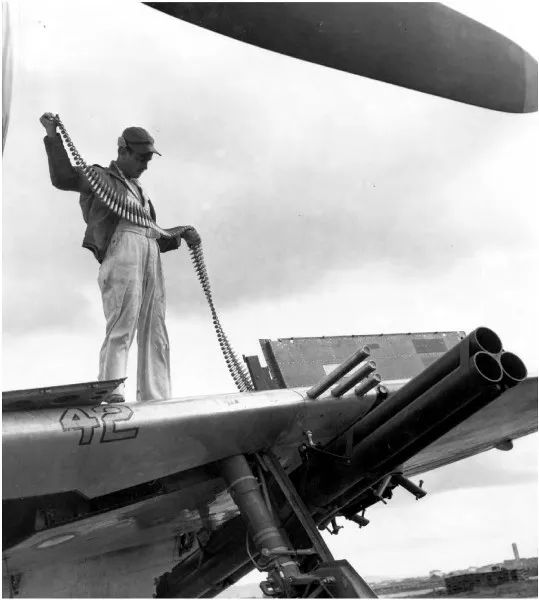
SOLDIER LOADING WING GUNS OF A FIGHTER with .50-caliber
ammunition. In Italy these tough and maneuverable fighters
were used for a variety of purposes, particularly after other
fighter planes with a higher speed and longer range were
available for escorting and protecting bombers. The P-47’s
became fighter-bombers, and were also equipped to use rockets.
(4.5-inch 3-tube AC rocket launcher M15 of a P-47.)
CORSICA
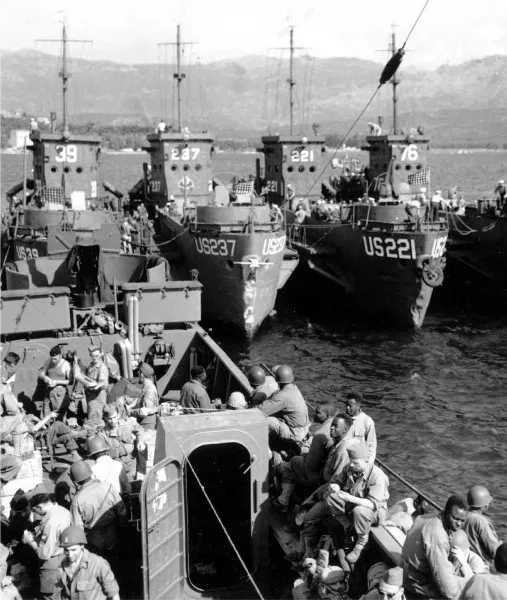
FRENCH COMMANDOS AND SENEGALESE TROOPS on an LCI in a Corsican
harbor prior to the attack on the island of Elba. The troops
were taken to Elba on 17 June 1944 in U. S. landing craft and in
two days the island had been secured.
CORSICA
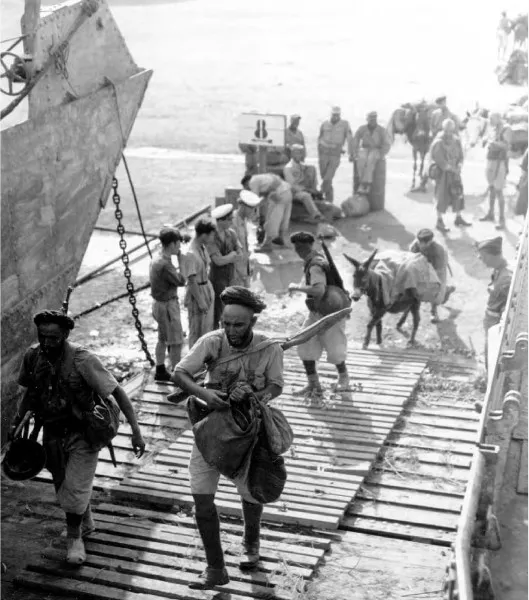
GOUMIERS BOARDING AN LST in Corsica for the attack on Elba.
The attack, though not carried out by Fifth Army troops, was
co-ordinated by Allied Force Headquarters with the advance on
the Italian mainland and was launched when the forces driving
up the mainland were nearly opposite the island. The attacking
force consisted of French, goumiers, and Senegalese.
ITALY
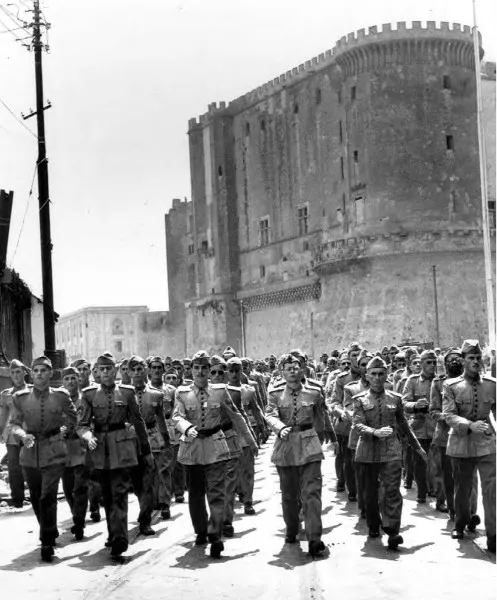
BRAZILIAN SOLDIERS ARRIVING IN NAPLES, July 1944, to serve
with the Fifth Army during the 1944–45 winter campaign in the
northern Apennines.
ITALY
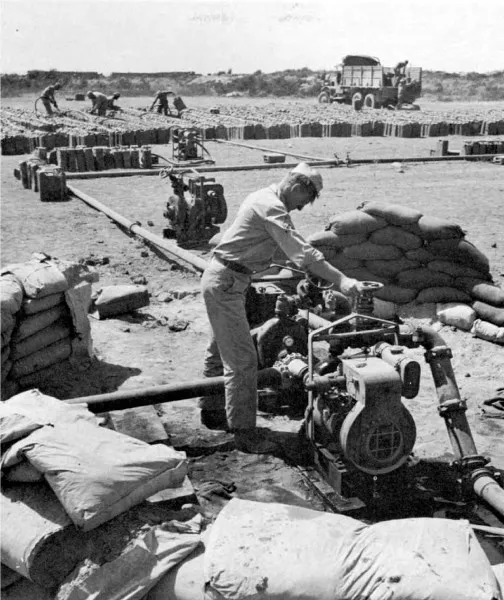
GASOLINE DISTRIBUTION POINT. Oil tankers brought gasoline into
major ports. From there it was transported to storage tanks at
distribution points by pipeline, trucks, or tankers where it was
transferred to five-gallon cans for pickup.
ITALY
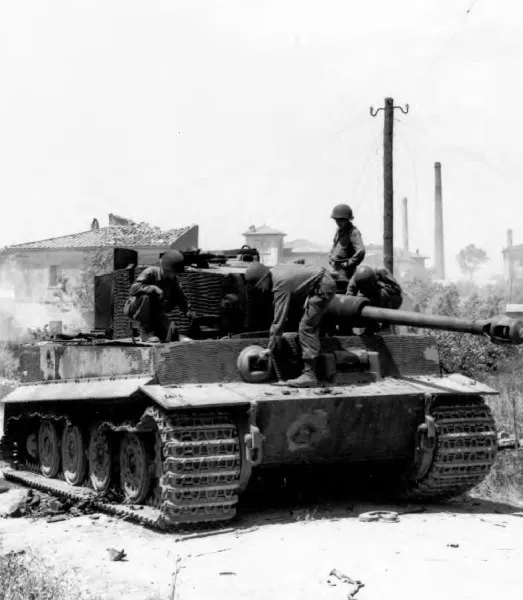
A TIGER TANK, such as was encountered in Tunisia and Sicily, but
with a non-magnetic plastic coating. It is believed that most of
the tanks thus coated were originally destined for the Russian
front where the Germans were greatly troubled by delayed-action
magnetic mines which were stuck onto the armor of their tanks by
Russian infantry.
ITALY
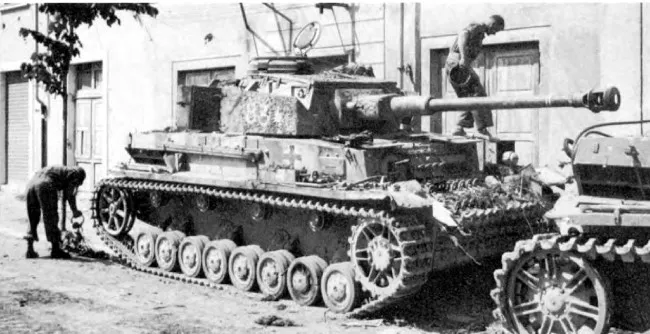
GERMAN ARMOR. Medium tank is the Mark IV (top). Of the four tank
types with which the Germans started the war, only this survived
in service until the end. Originally it had a short-barreled
75-mm. gun which changed its role from a close-support vehicle
to a fighting tank. Assault gun (bottom). The Germans used
this in great numbers, and it was often called a tank, but was
actually an assault gun and tank destroyer on the chassis of a
Mark III tank. (Top: Pz. Kpfw. IV tank with 7.5-cm. Kw. K. 40
(L/43) gun; bottom: Stu. G. III with 7.5-cm. Stu. K. 40 gun.)
ITALY
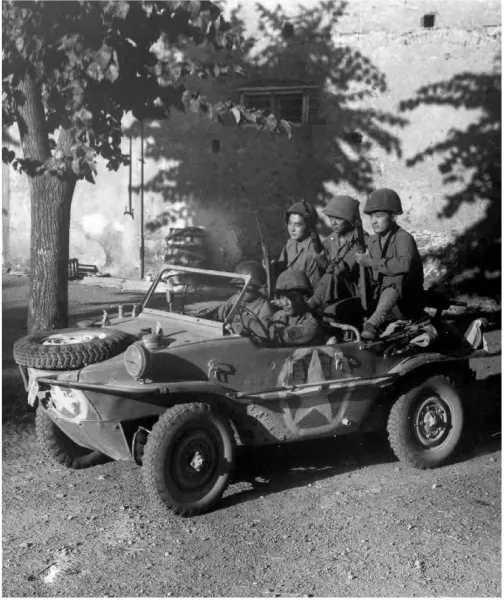
GERMAN AMPHIBIAN JEEP, a version of the light Army car,
Volkswagen. Both versions were inferior in every respect to the
U. S. jeep except in the comfort of the seating accommodations.
(Schwimmwagen, le.P.K w.K.2s.)
ITALY
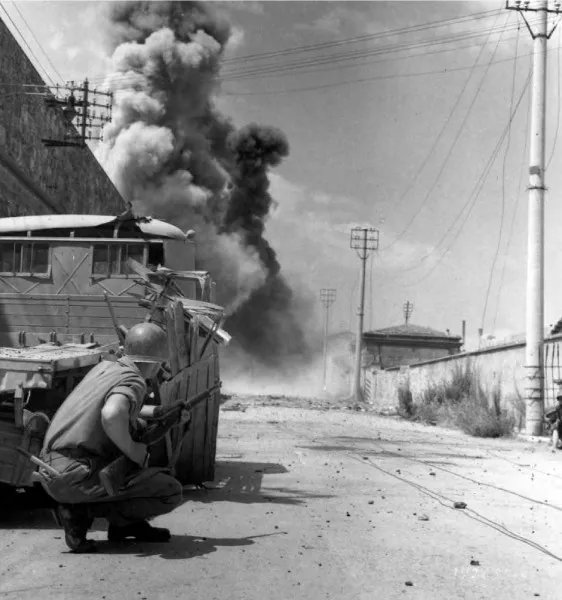
ENGINEERS SETTING OFF ENEMY MINES in a street in Leghorn on
19 July 1944, the day the city fell. The soldier at left is
guarding engineers against snipers. The Germans had destroyed
all the port facilities, mined the buildings in the harbor
area, and made the latter unusable by blocking the entrance
with sunken ships. The drive from Rome to the Arno River was
a pursuit action in which the Germans, by skillful delaying
tactics, slowed the Allied advance so that completion of
the Gothic Line defenses in the northern Apennines could be
expedited. The mouth of the Arno River was reached by 23 July
1944.
ITALY
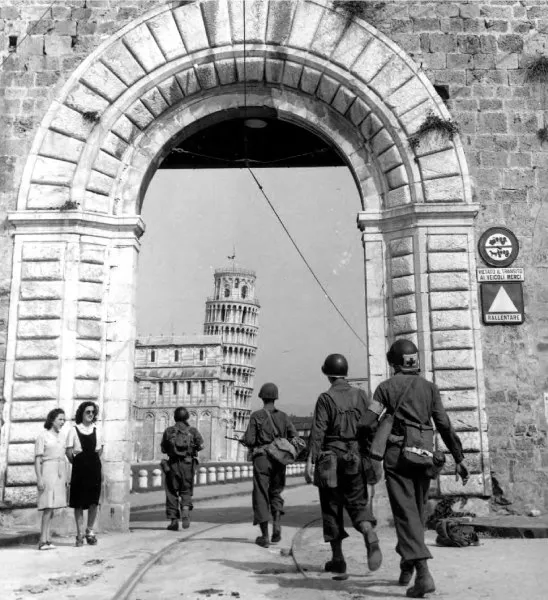
TROOPS IN PISA. The southern outskirts of this town on the Arno
River were entered on 23 July 1944. The enemy had destroyed all
bridges across the river and when the infantry entered the town
they were met by heavy fire from across the river. The southern
half of the city was found heavily mined and booby-trapped.
During the approach to the Arno River plans were being completed
for introduction of antiaircraft units into the lines as
infantry since enemy air activity had decreased to the extent
that many AA units could be more profitably used as infantry.
ITALY
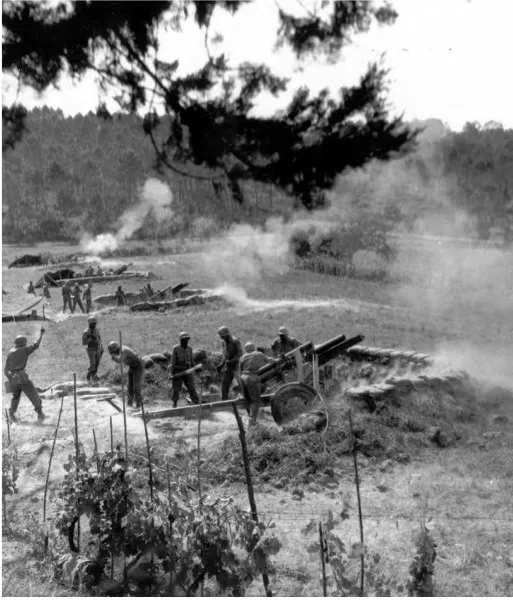
FIRING HOWITZERS across the Arno River in August. The men of
this unit were part of an American all-Negro regimental combat
team, the first to appear in Italy. They entered the line south
of the Arno on 23 August. A few weeks later an entire Negro
infantry division was at the front. (105-mm. howitzer.)
ITALY
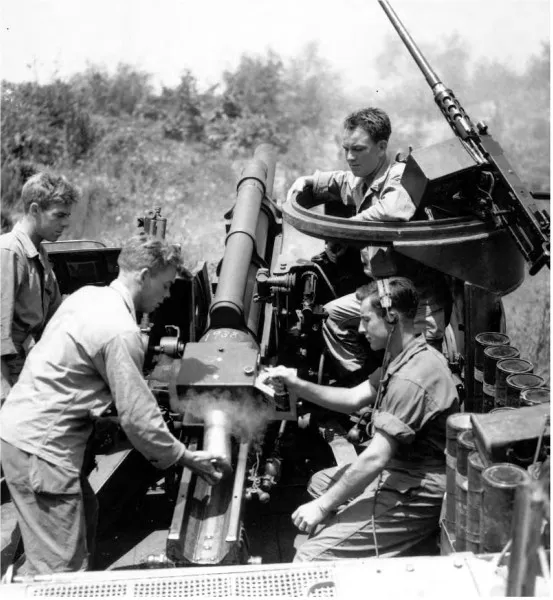
MEMBERS OF AN ARMORED FIELD ARTILLERY UNIT firing a 105-mm.
howitzer during training south of the Arno River. The howitzer
is mounted on a Priest. The Fifth Army reached the Arno at
Pontedera on 18 July and the first week in August found the
forces grouped along the southern bank on a thirty-five-mile
front reaching from the sea on the west to Florence. The month
of August was used for resupplying, resting, and training the
units. (105-mm. howitzer; M7 gun motor carriage.)
ITALY
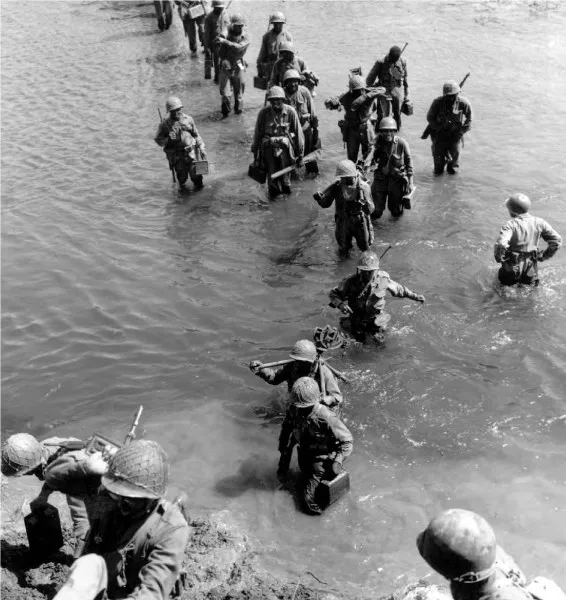
NEGRO TROOPS CROSSING THE ARNO near Pontedera on 1 September,
during the drive toward the Gothic Line. The attack on this line
was started by the Eighth Army along the east coast on the night
of 25–26 August. On 1 September the line had been breached in
that sector but by the 6th the advance had been stopped a few
miles below Rimini on the Adriatic coast. This advance by the
British caused the German High Command to shift three divisions
opposing the Americans to the British sector. The forces
directly opposite the Arno drew back into the Gothic Line, a
distance of about twenty miles.
ITALY
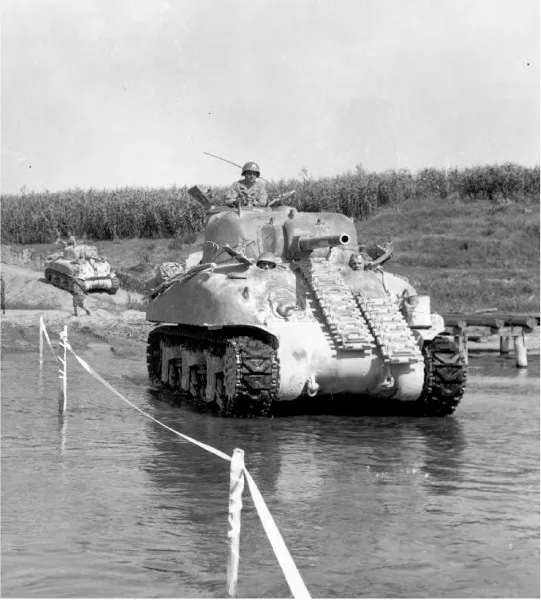
SHERMAN TANK FORDING THE ARNO in the Cascina area on 1
September. Little opposition was met until the Gothic Line
was reached. The Germans had started to withdraw into this
line during the last days of August. Before the withdrawal,
it was estimated that the area between the Arno River and the
Gothic Line contained about 350 enemy tanks, half of which were
Panthers and Tigers. (Sherman tank M 4A 1.)
ITALY
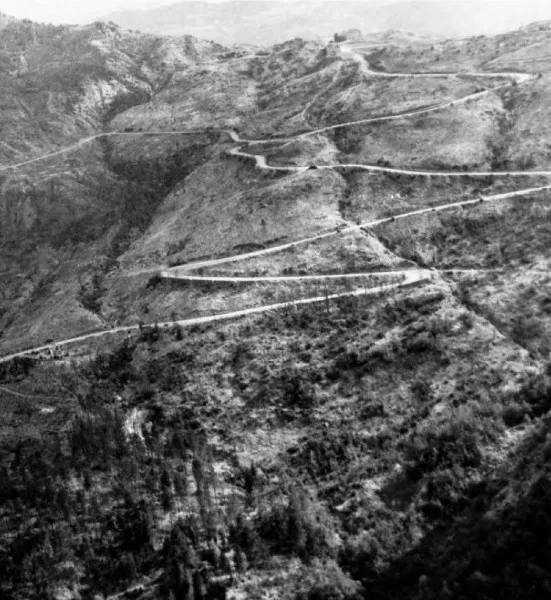
TOP OF IL GIOGO PASS IN THE GOTHIC LINE, looking toward the
north. The Fifth Army broke through this pass in the Gothic Line
defenses outflanking the heavier prepared fortifications at Futa
Pass on Highway 65. The scarcity of roads through the mountains
made it possible for the Germans to concentrate their defensive
works at a few key points such as the Futa and Il Giogo Passes.
Highway 6524 branches off Highway 65 thirteen miles north of
Florence, winds through Il Giogo Pass, and ends at Highway 9 in
Imola (Po Valley).
ITALY
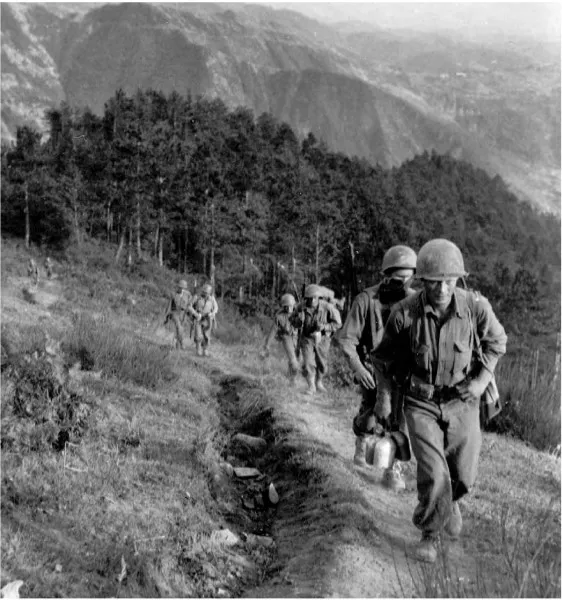
INFANTRY ADVANCING OVER THE HILLS in the area of Il Giogo Pass
on 18 September, the day the pass was taken. The fight for the
area started on the morning of 12 September. The mountains on
each side of Il Giogo Pass are too steep to require antitank
defenses other than road blocks, but other defenses such as
underground fortresses were numerous and well prepared. Barbed
wire and antipersonnel mine fields guarded approaches. Many of
the hills were covered with pine woods which made it difficult
to locate enemy defenses by the use of aerial photographs. Some
information was obtained from partisans who had worked on the
Gothic Line.]
ITALY
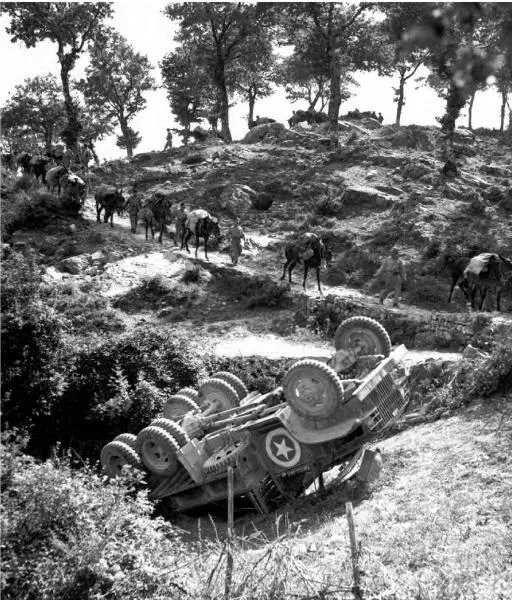
PACK MULE TRAIN approaching the Gothic Line in the area of Il
Giogo Pass. For the difficult task of supplying their troops
through the mountains the Allied forces had 9 Italian Army mule
pack companies, each containing 260 mules. (2½-ton U. S. truck
overturned.)
ITALY
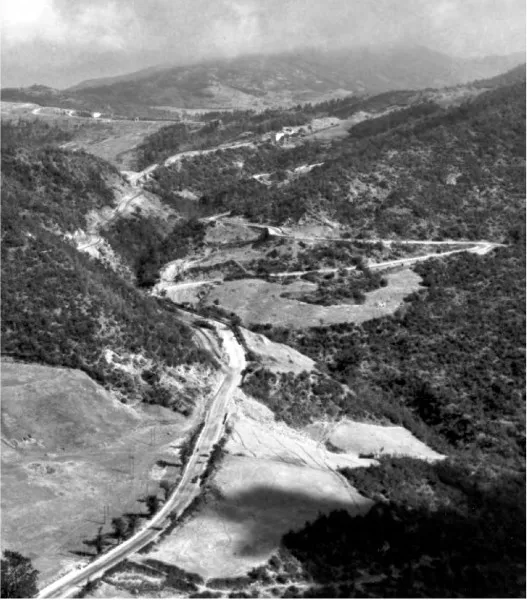
HIGHWAY 65 AT FUTA PASS. This pass, at an altitude of 2,962
feet, is one of the lowest through the northern Apennines.
Highway 65, the most direct route to Bologna and the Po Valley,
became the main supply route and a principal axis of advance in
the Fifth Army area, although the breach in the Gothic Line was
not made here. Futa Pass fell on 22 September.
ITALY
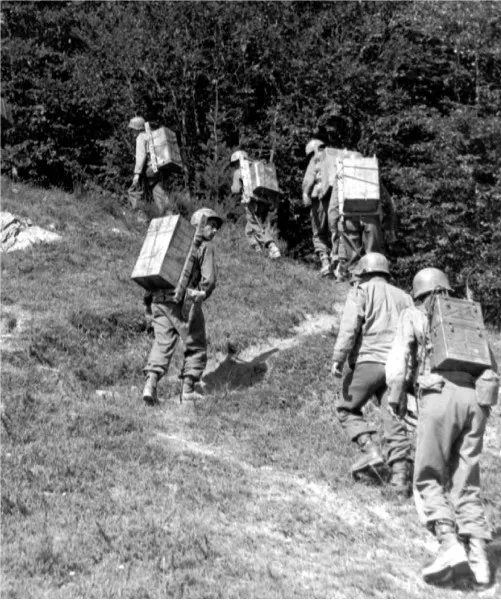
INFANTRY PACK TEAMS bringing supplies to units fighting in the
Gothic Line near Futa Pass. Mule pack teams were available but
some of the paths were too steep even for pack animals.
ITALY
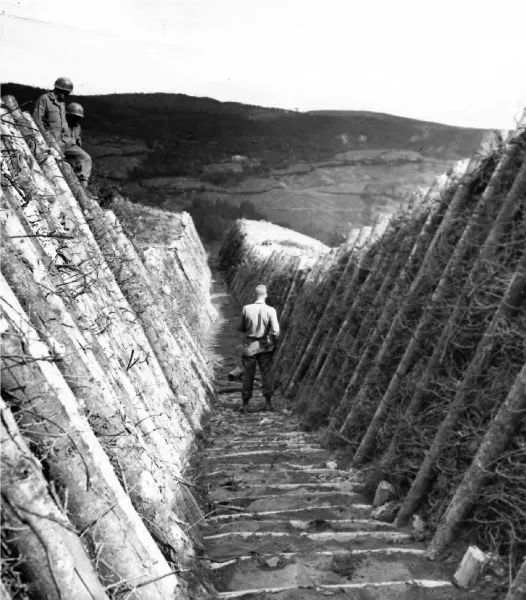
ANTITANK DITCH AT FUTA PASS. This ditch, about three miles long,
crossed the road south of the pass. The ditch was covered with
a network of infantry positions and bunkers for antitank guns.
The area in front of the ditch was mined. Two of the bunkers in
this area were topped by Panther tank turrets with long-barreled
75-mm. tank guns.
ITALY
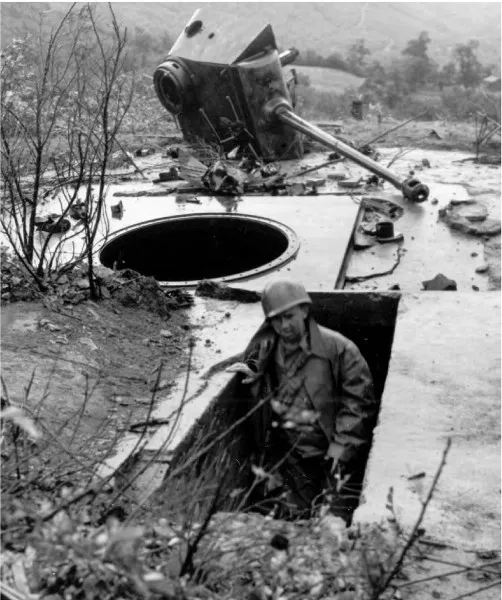
A PANTHER TURRET CASEMATE in the Gothic Line near Futa Pass. The
turret could not be penetrated by the guns of any of our tanks,
but was vulnerable to artillery fire.
ITALY
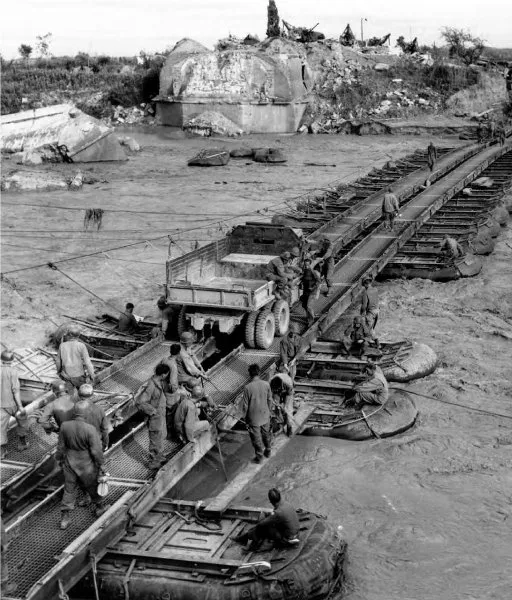
REPAIRING PONTON TREADWAY BRIDGE over the Arno at Pontedera.
The supply situation of Fifth Army troops at the Gothic Line
was made difficult by fall rains which raised the Arno River to
flood level and washed out most of the bridges between Florence
and Pontedera.
ITALY
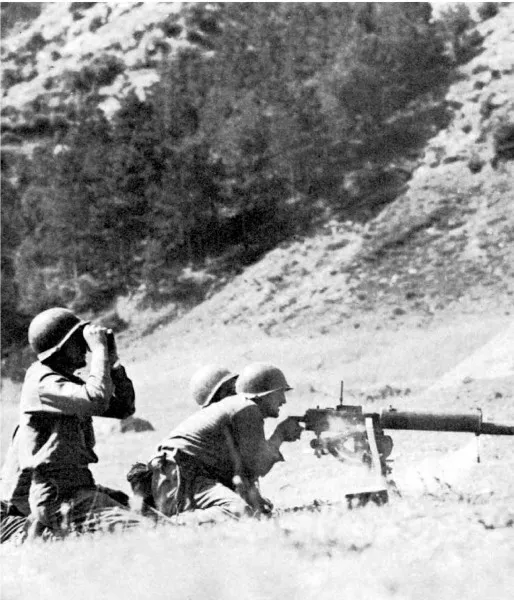
MACHINE GUNNERS FIRING AT GERMANS in the Monticelli area near Il
Giogo Pass. Note flash hider attached to front of machine gun.
The Americans occupied Firenzuola on 21 September. (.30-caliber
Browning machine gun M1917A1, a development of the M1917 which
proved its worth in World War I.)
ITALY
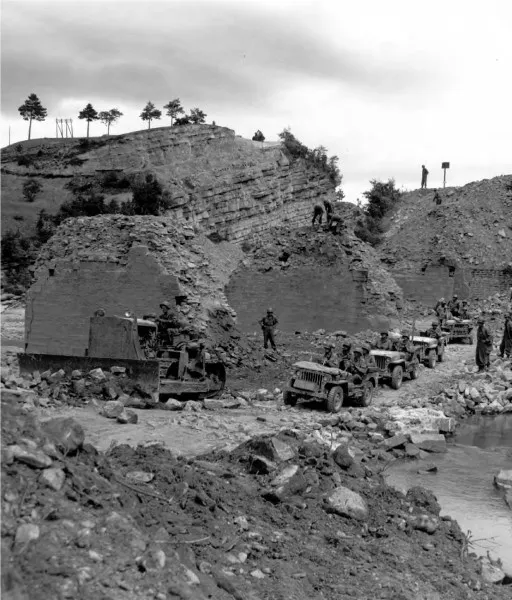
AMERICAN ENGINEERS CONSTRUCTING A BYPASS in the Firenzuola
area during the pursuit of the Germans. The combat engineers,
prepared to bulldoze a bypass or to install temporary bridges,
followed closely behind the leading elements of the infantry and
armor. (Jeep; crawler type diesel tractor with angledozer.)
ITALY
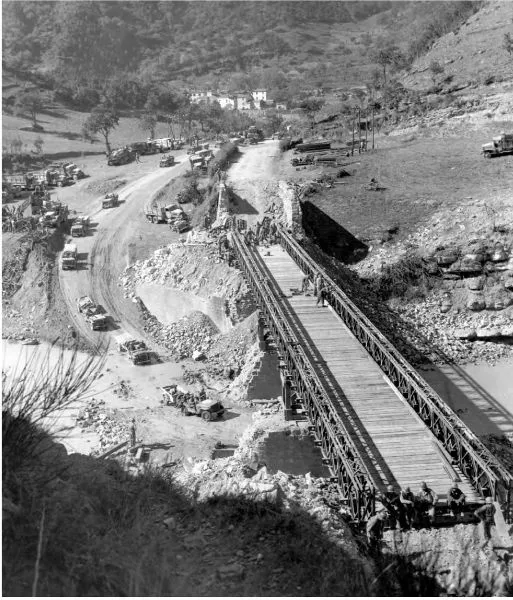
BAILEY BRIDGE in the Firenzuola area. This is the same site as
the scene of the bulldozer constructing a bypass, the picture
being taken two days later. The Bailey bridge was particularly
suitable for operations in the mountains of Italy where sudden
rains would swell the rivers and wash out ponton bridges.
ITALY
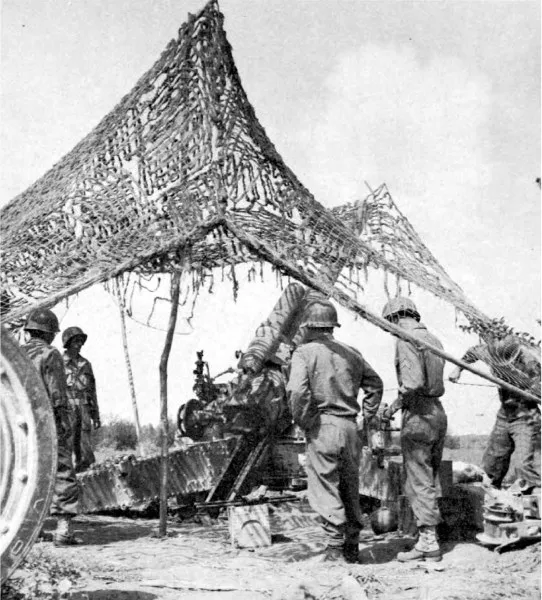
AMERICAN ARTILLERYMEN firing captured German 150-mm. gun near
Lucca. Note small amount of smoke. German ammunition was charged
with smokeless, flash-less powder which in both night and day
fighting helped the enemy tremendously in concealing his fire
positions. All U. S. guns, from the rifle to the large howitzer,
left telltale puffs of smoke during daytime or showed relatively
large and brilliant muzzle flashes at night.
ITALY
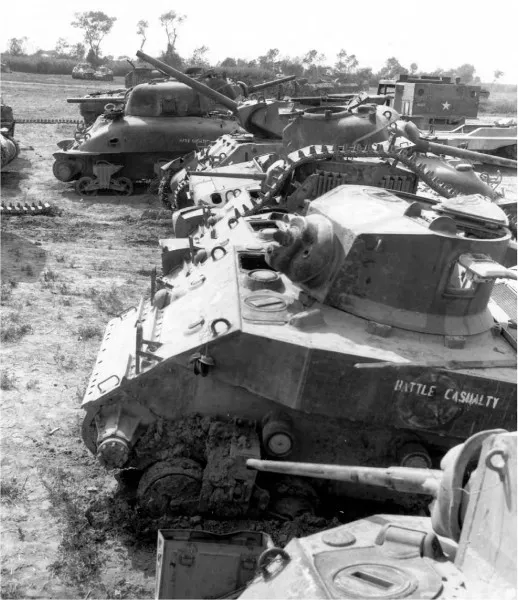
A GROUP OF ARMORED VEHICLES at a salvage yard of a heavy
maintenance company in Italy. (1, 2, and 3, light tanks M5; 4,
medium tank M4; 5, gun motor carriage M10; 6, medium tank M4. A
tractor and tank recovery trailer are partially visible, upper
right.)
ITALY
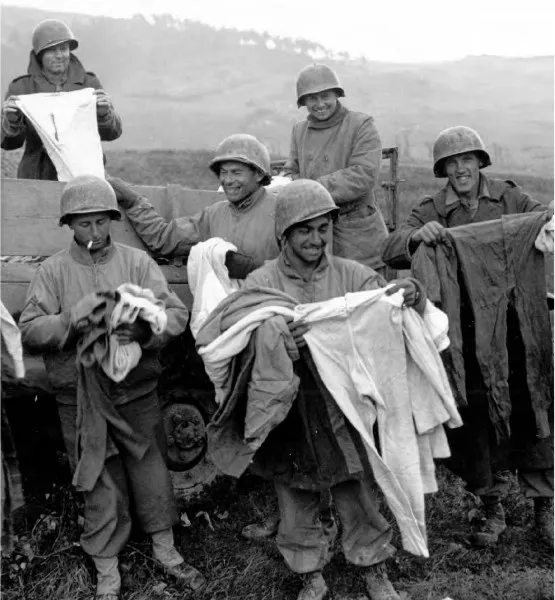
SOLDIERS IN THE APENNINES receiving an issue of woolen
underwear, September 1944. Some of the peaks in the northern
Apennines rise to well over 5,000 feet and the weather is
unpleasantly cold in winter. Fall rains, often turning to sleet,
start in September and the higher peaks are usually snow-covered
by late October. Highway 65, the main axis of advance, runs
mostly on top of the mountain ridges. Here the cold is
particularly severe. There is nothing to break the winter winds
and part of the road is so high that it is often cloud-covered.
ITALY
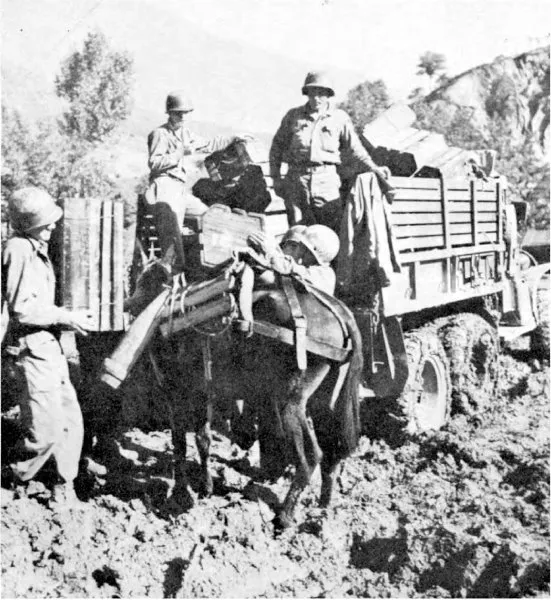
LOADING MULES WITH AMMUNITION for 155-mm. howitzers in the
Castel del Rio area on Highway 6524, between Firenzuola and the
town of Imola in the Po Valley. After breaching the Gothic Line
at Il Giogo Pass an attempt to reach the Po Valley at Imola
was made along the route above. Because of the exposed salient
and stiff enemy resistance, the axis of attack was changed to
Highway 65. On 1 October, the day the picture was made, bloody
fighting for possession of the controlling height of Monte
Battaglia, east of Castel del Rio, was in progress.
ITALY
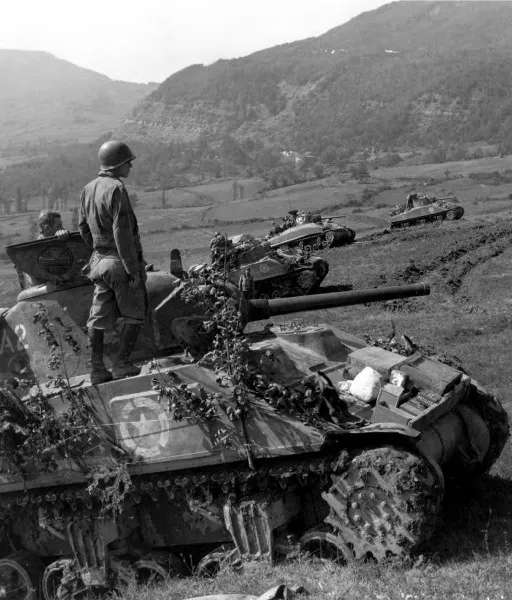
A TANK BATTALION PREPARING TO ATTACK along Highway 65 toward
the village of Monghidoro. The attack started on the morning of
1 October and by evening of the 2d the village was securely in
Allied hands. The Sherman tanks pictured here are all armed with
76-mm. guns.
ITALY
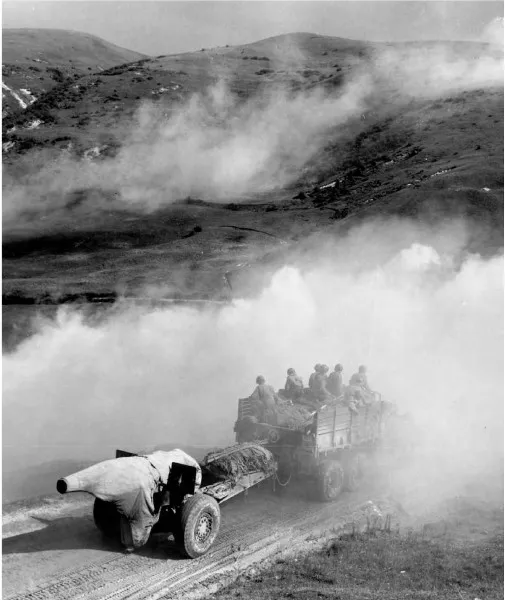
TRUCK TOWING HOWITZER along Highway 65 during the beginning of
the 1 October drive. Smoke is from M2 smoke generators. (6-ton
truck; 155-mm. howitzer.)
ITALY
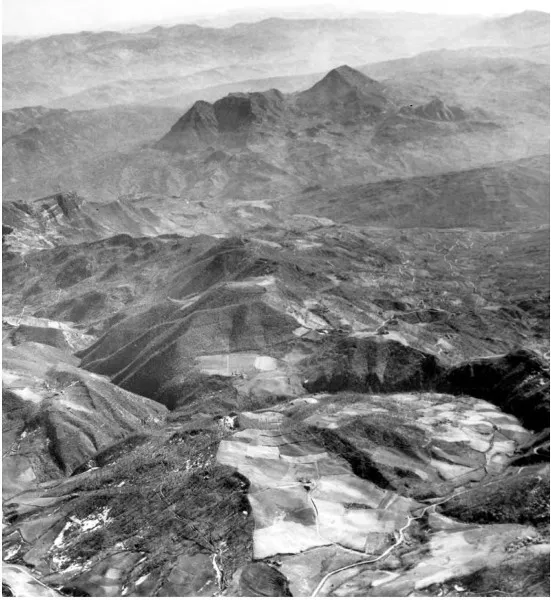
TERRAIN OF THE WINTER STALEMATE in the northern Apennines,
looking toward the southeast. The high mountain peak in distance
is Monte Vigese. This mountain was taken by the South Africans
of the Fifth Army on 6 October 1944 after a three-day fight.
The territory in the foreground was in enemy hands until the
beginning of March 1945 when it was taken by American and
Brazilian troops in a limited offensive to obtain better jumping
off places for the main attack toward the Po Valley.
ITALY
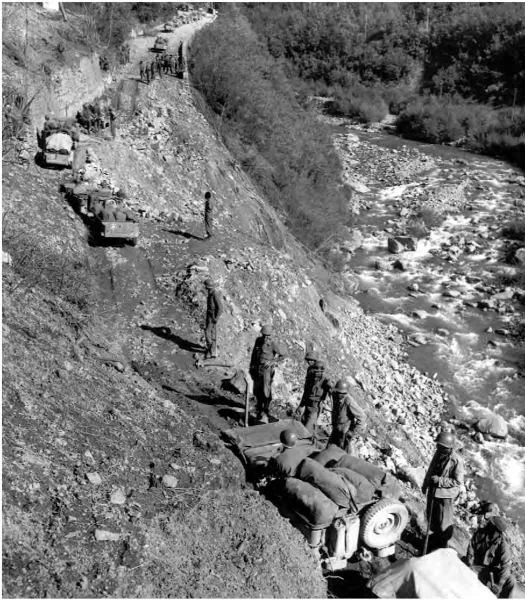
NEGRO TROOPS ADVANCING ON HIGHWAY 12 along the Torrente
Lima. Jeeps with trailers were used and in danger areas the
windshields were folded forward and covered with canvas to
prevent light reflection. The sort of road demolition shown was
common during the fighting in the northern Apennines. Valley
roads were subject to natural landslides, and large-scale
destruction was easy to accomplish.
ITALY
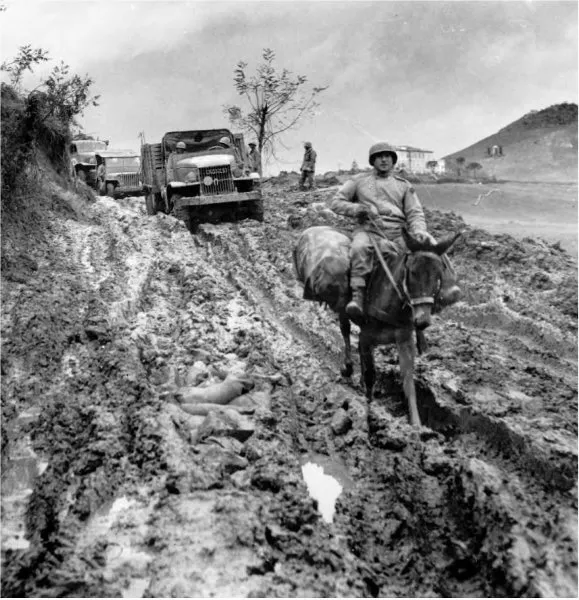
ROAD IN THE APENNINES during the October drive. After the first
week, weather was a contributing factor to the slow pace of the
offensive. Rainy and foggy days worked almost entirely to the
benefit of the enemy. Artillery observation planes were grounded
and few of the planned air missions could be flown. Finally,
with each mile that the troops advanced over the rain-soaked
trails and dirt roads, the problem of keeping supplies moving
forward increased. Engineers kept working night and day pouring
gravel and crushed rock on the roads. They managed to keep
highways open for all types of vehicles and side roads passable
for the four-wheel-drive jeep and the powerful 2½-ton truck.
(Jeep; 2½-ton truck.)
ITALY
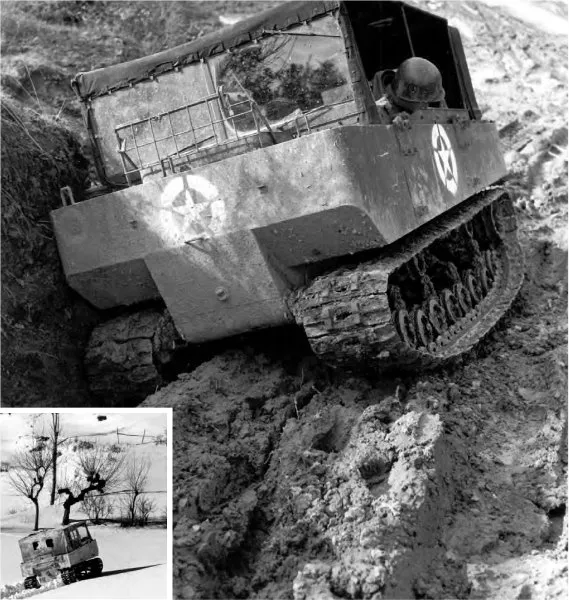
THE WEASEL, officially cargo carrier M29, came into its own
during the campaign in the northern Apennines. It operated
satisfactorily off the roads under mud or snow conditions and
helped to provide lateral communications. Most roads in the
Fifth Army sector of the Apennines ran more or less parallel
in a northerly direction; the area of the winter fighting
was almost completely devoid of east-west roads. The Weasel,
originally designed for use over snow and ice, had low ground
pressure and proved suitable for operation across fields or poor
trails. It had a crew of two and a pay load of approximately
1,000 pounds.
ITALY
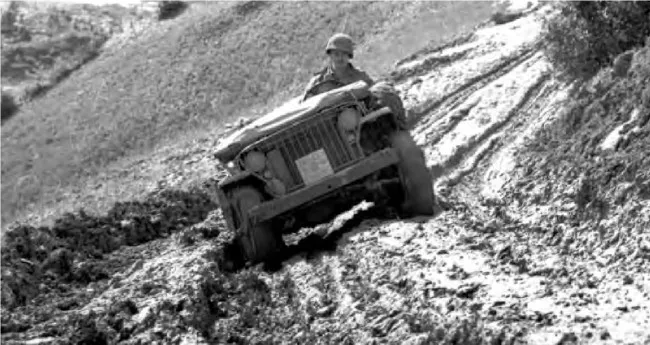
JEEPS ALONG THE SUPPLY ROADS in the northern Apennines. This
vehicle was capable of operating over unimproved roads and
trails and could be shifted into four-wheel drive for steep
grades and muddy or sandy terrain. It could climb a 60 percent
grade and attain a speed of 65 miles per hour over level
highways. The jeep could also ford a stream 18 inches deep while
fully loaded and a deeper stream when especially equipped with
exhaust and air-intake extensions. The jeep, truck, and pack
mule were always important in the advances made.
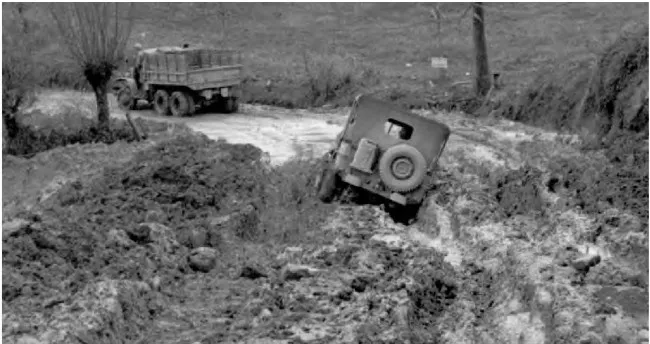
ITALY
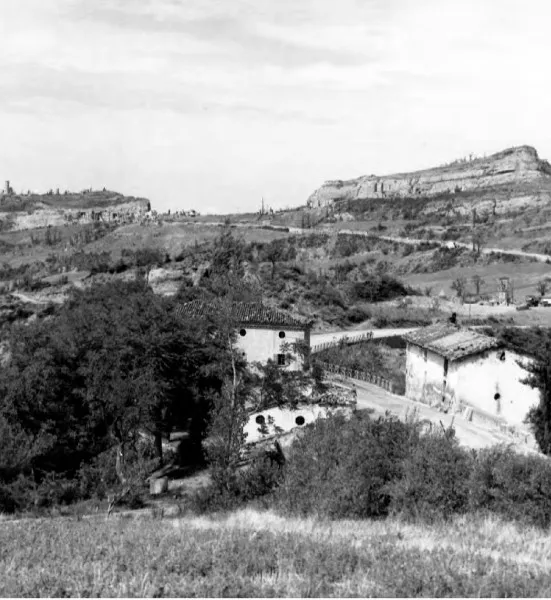
APPROACH TO LIVERGNANO ON HIGHWAY 65, looking from the south
along the highway. The village is the small cluster of ruined
houses below cliff on left. The Germans occupied the houses
as well as the tops and sides of the two hills. The latter
were honeycombed with caves which the enemy had enlarged and
strengthened. The fighting lasted from 9 to 14 October. On the
14th the enemy was still in possession of most of the village
and the two hills but retreated because he had been outflanked
from the west.
ITALY
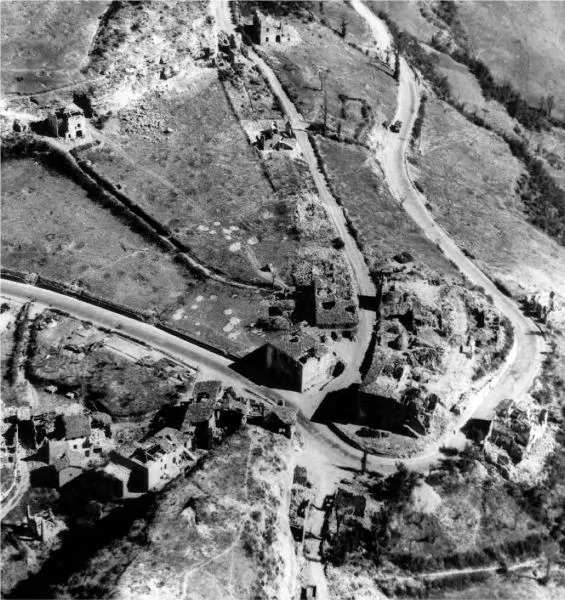
THE RUINS OF LIVERGNANO. The main highway through the village
runs to Florence (upper right), and to Bologna (center left).
Livergnano, taken in a five-day fight, became known as “Liver
and Onions.” During the final attack of this fall offensive
toward Bologna, which started on 16 October and bogged down in
mud toward the end of the month, the enemy concentrated his
artillery fire on this village in an attempt to demolish the
houses along the road and thus block the highway, the supply
road for the area. The enemy managed to knock down some of the
houses but did not succeed in stopping traffic. Bulldozers
filled the craters in the road and pushed aside the rubble.
ITALY
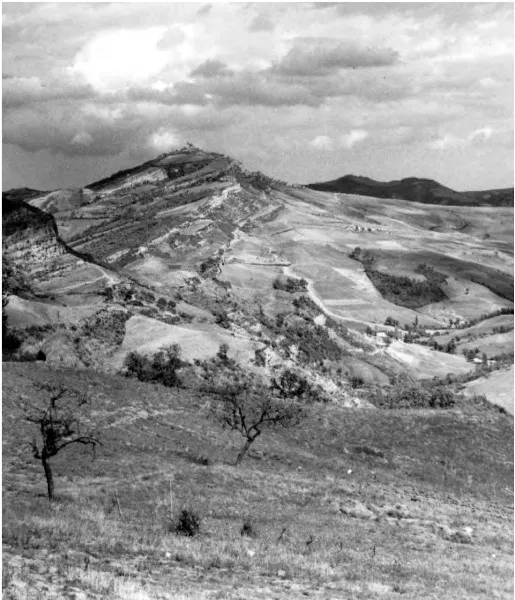
MONTE BELLA FORMICHE, taken after a three-day fight starting on
10 October. This mountain, located east of Highway 65, is 2,092
feet high, the highest of the terrain features in the chain
of enemy defenses stretching east and west across Highway 65
through the village of Livergnano.
ITALY
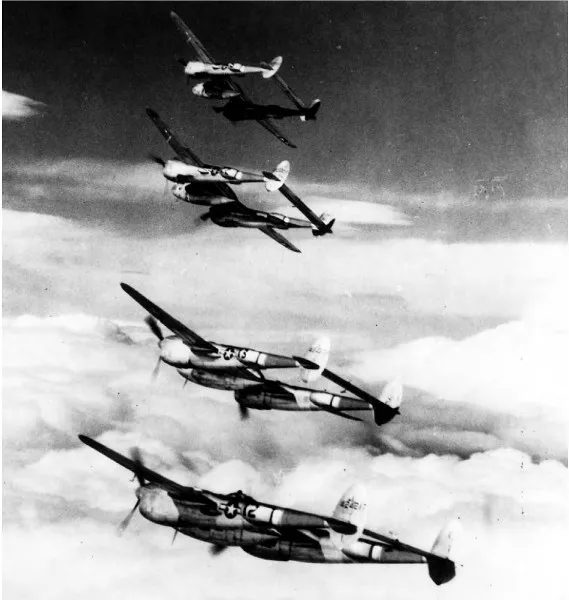
LIGHTNING FIGHTERS. This twin-engined fighter was the first
successful long-range bomber escort developed by the United
States. Most Allied fighter planes in Italy gradually came to
be used as fighter-bombers as the need for protecting bomber
formations from hostile aircraft diminished. In August 1943
the Germans had only about six hundred combat aircraft, mostly
fighters, in Italy. About a third of these were of limited use.
Demands for fighters on the Russian front and the need for
protecting production centers in Germany from Allied bombings
caused some withdrawal of enemy fighters based in Italy. (P-38.)
ITALY
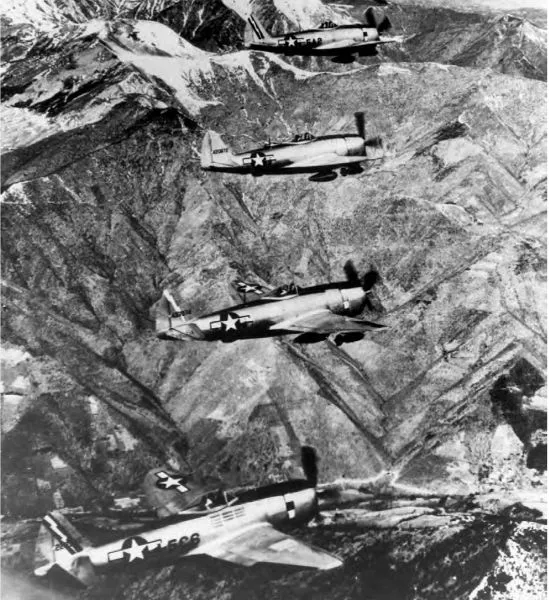
THUNDERBOLT FIGHTER-BOMBERS over the northern Apennines. Note
belly tank to increase range, and bombs under wings. Beginning
in October 1944, extensive use of the 110-gallon fuel tank
incendiary bombs containing a jelly-like mixture called napalm
was made for the first time on the Italian front. The bombs
proved particularly effective against enemy bivouacs and troop
installations in wooded areas where the highly inflammable
fuel, scattered over a wide area, could start numerous fires.
Fighter-bombers co-operated closely with the ground forces.
(P-47.)
ITALY
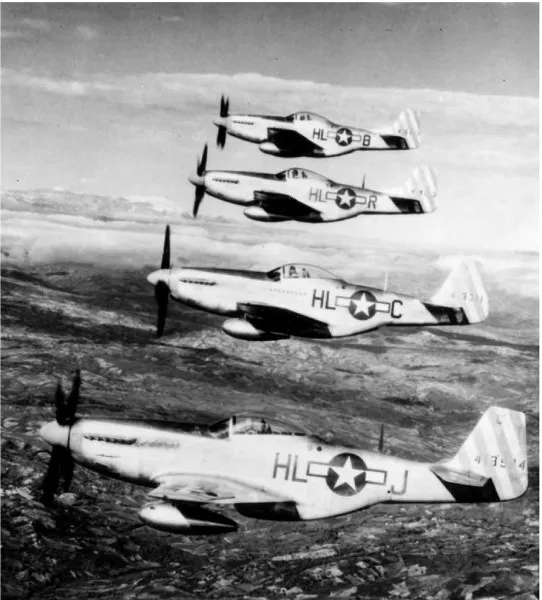
MUSTANG FIGHTERS. This plane, the P-51, was originally made
for the British and was used by the Royal Air Force as early
as November 1941. The Army Air Forces started to use it in
July 1942. The A-36 version of the P-51 was a fighter-bomber,
and except for diving brakes and differences in armament, the
two ships were alike. With the addition of wing tanks the P-51
became a long-range fighter used to escort bombers.
ITALY
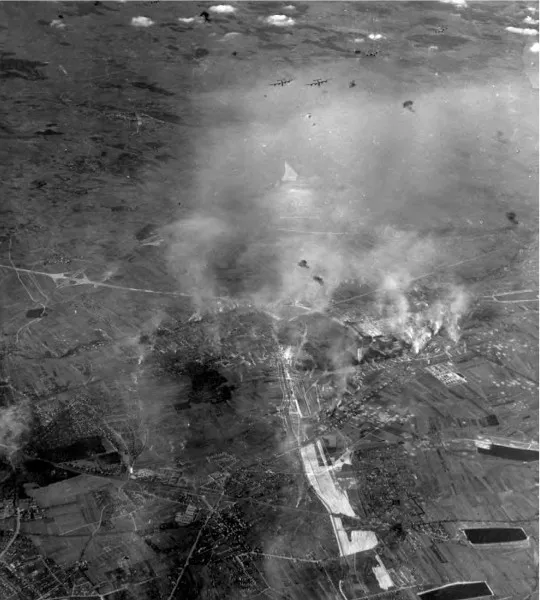
LIBERATOR BOMBERS from Italian bases bombing the Munich area
in southern Germany. Smoke-making generators in operation to
blanket vital areas. Note black bursts of antiaircraft fare.
Heavy bombers from Foggia could easily strike at the passes
in the Alps and attack enemy installations and factories in
southern Germany and Austria as these targets were closer to
Allied bases in Italy than they were to those in England.
ITALY
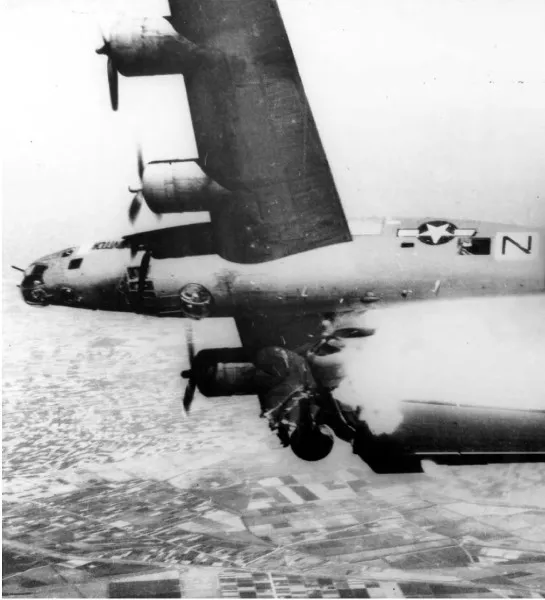
LIBERATOR BEING SHOT DOWN by flak over the Po Valley in northern
Italy. As the war in the Mediterranean progressed the size
and effectiveness of the enemy air forces decreased, while
the antiaircraft defenses increased and became more and more
concentrated around the remaining enemy targets. As various
enemy targets were damaged beyond usefulness, antiaircraft
units defending them were sent to strengthen defenses around
industrial plants still in production.
ITALY
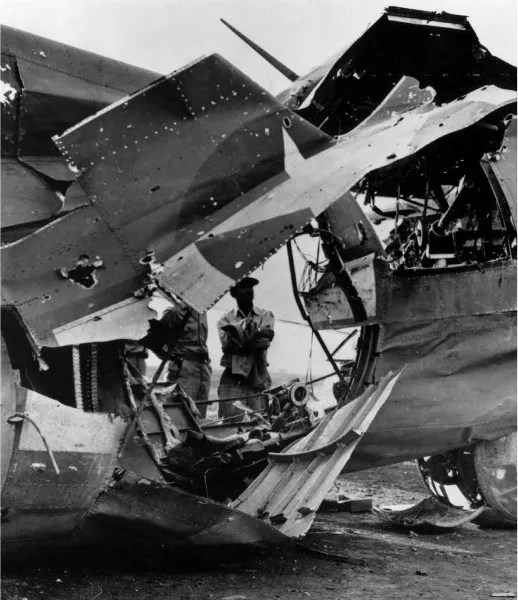
FLAK-DAMAGED FUSELAGE OF A FLYING FORTRESS. This plane received
a direct antiaircraft shell hit while on a mission over Hungary
but managed to fly back to Italy where it collapsed on landing.
In spite of damage to the bomber none of the crew was hurt.
ITALY
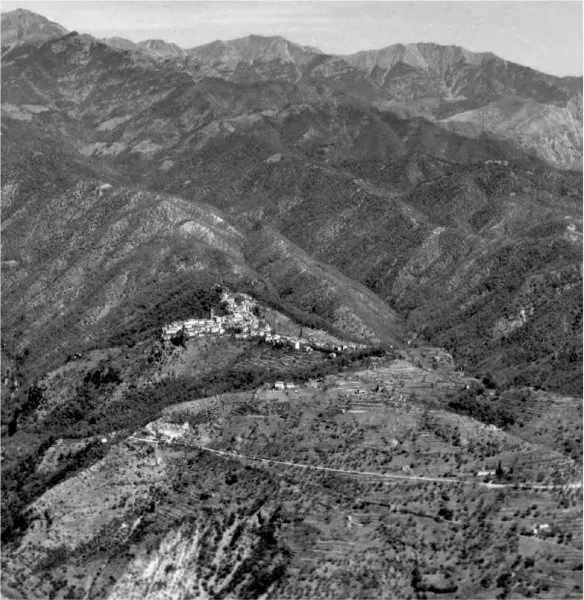
COREGLIA ANTELMINELLI in the mountains west of the Serchio
River. This region was being held by an American Negro infantry
division. On the morning of 26 December 1944 a mixed enemy force
of Germans and Italians started an attack in this vicinity and
pushed the division back several miles. An Indian brigade was
rushed up to halt the advance of the enemy. Since it was feared
that the enemy might break through and threaten the Allied
supply base at Leghorn, reinforcements were rushed to the area
to protect the vital base. On the night of the 27th the Indians
made contact with the enemy who started to retreat. By 31
December almost all the lost territory had been regained and the
line was again stabilized.
ITALY
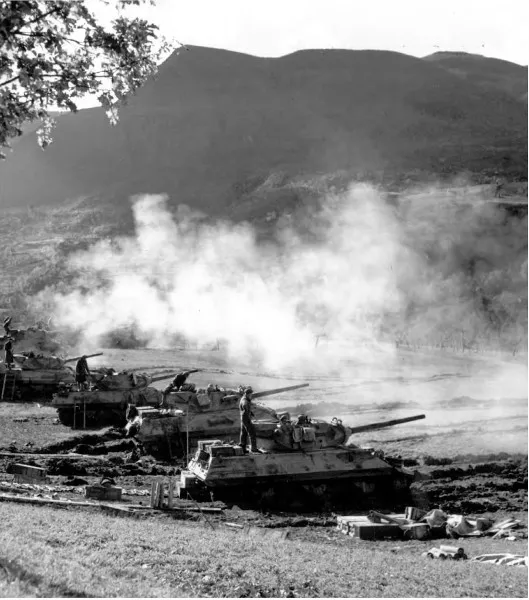
A SOUTH AFRICAN ARMORED UNIT in the Reno River valley firing at
German positions across the river, November 1944. Combat action
in the Fifth Army sector during November and the first half of
December was largely confined to patrol activities and artillery
duels. The South African armored division had been transferred
from the Eighth Army to the Fifth Army in late August 1944.
ITALY
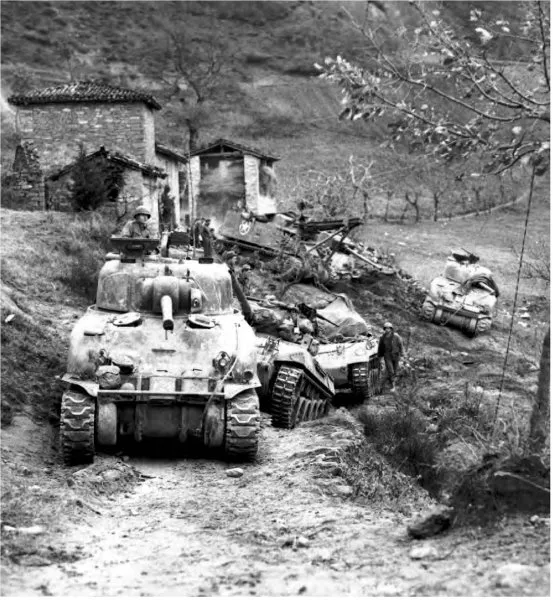
TANK MAINTENANCE POST in abandoned Italian farmhouse. During the
long winter stalemate time was utilized to make major repairs
on armored vehicles. Minor repairs, such as thrown tracks, were
made at forward maintenance posts such as the above which was
located only about 400 yards behind the front lines. (1, medium
tank M4A1; 2 and 3, 76-mm. gun motor carriage M18; 4, medium
tank M4A1; 5, medium tank M4, with 76-mm. gun (note different
gun mount); 6, tank recovery vehicle M31.)
ITALY
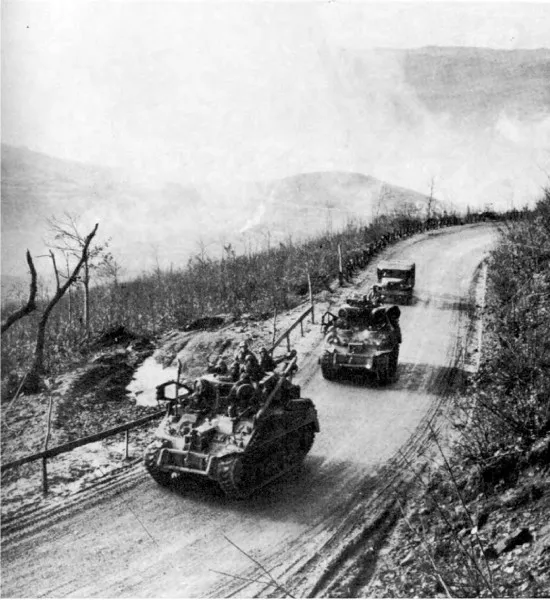
MOBILE FIELD ARTILLERY MAINTENANCE UNIT near the front. These
units were used a great deal during the winter. Artillery off
the main roads could be moved only with difficulty after the
rains started and repairs that were normally made in shops
behind the front had to be done in the field. The first two
vehicles shown above are tank recovery vehicles M32, and are
modifications of the M4 designed primarily for recovery of tanks
from battlefields. The fixed turret replaces the customary tank
turret. Third vehicle is weapons carrier, ¾-ton 4 x 4 truck.
ITALY
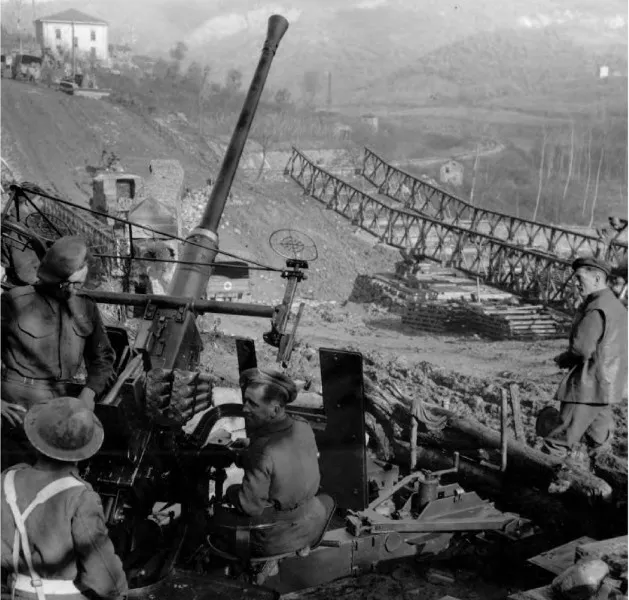
BRITISH ANTIAIRCRAFT GUNNERS protecting U. S. engineers
constructing a Bailey bridge on Highway 64 crossing the Reno
River. This was in preparation for an attack on Monte Belvedere
west of the highway. The 3,600-foot mountain was taken on 24
November 1944 by elements of a U. S. Negro infantry regiment
and members of British and U. S. antiaircraft units serving as
infantry. The enemy counterattacked for five days and the Allies
had to give up the position. During the fall and winter of 1944
most U. S. and British antiaircraft units were being trained
for infantry duty as rapidly as training and the issuance of
appropriate weapons would permit. (The gun shown is the 40-mm.
automatic antiaircraft type, originally made in Sweden and used
by the Allies and the enemy. The gun could be towed at 50 miles
per hour and transferred from traveling to firing position in 25
seconds.)
ITALY
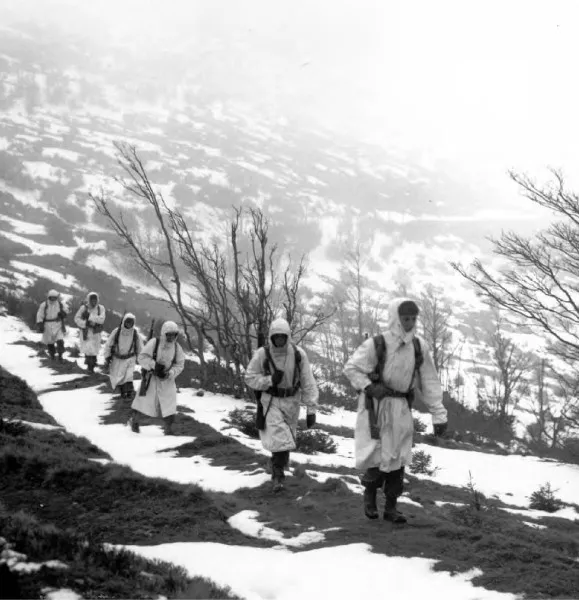
PATROL ACTIVITY, December 1944. During the relatively quiet
period of the first half of December, both sides sent patrols
to probe the front lines and bring back prisoners. When the
cold weather set in, winter clothing was issued, including the
reversible, hooded coat known as the parka shown above. One
side was the conventional olive drab, the other side white for
camouflage in snow. New type shoepacs, combination wool sweaters
and cotton field jackets, and sleeping bags left the troops
better prepared for inclement weather than they were during the
previous winter, but there would be no possibility of keeping
dry at the front during an attack when the rain lasted for days
on end.
ITALY
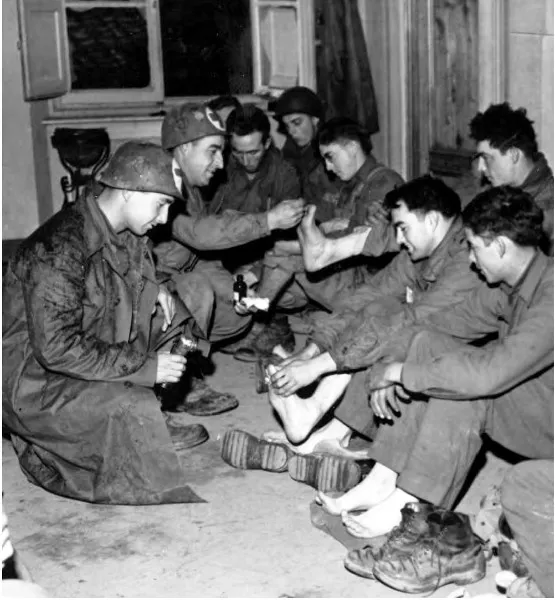
INSPECTING FRONT-LINE TROOPS FOR TRENCH FOOT. The second winter
of fighting in Italy found the Allies better equipped to handle
the trench foot problem which in November 1943 accounted for
20 percent of the casualties at its peak incidence. Units were
gradually being equipped with shoepacs, an important item
in the prevention of trench foot. The shoepac consisted of
a moccasin-shaped foot of rubber, and a laced, waterproofed
leather top, which extended well up the calf of the leg. It was
worn with felt inner soles or woolen ski socks.
ITALY
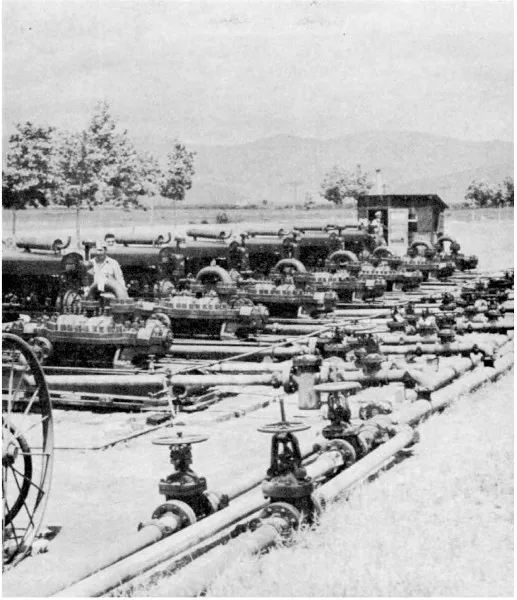
PIPELINE PUMPING STATION AT LEGHORN. Construction of this line
started soon after the capture of the port. By 23 November 1944
the pipeline had reached Highway 65 just a few miles behind the
front, eliminating the trucking of gasoline over this already
overcrowded road.
ITALY
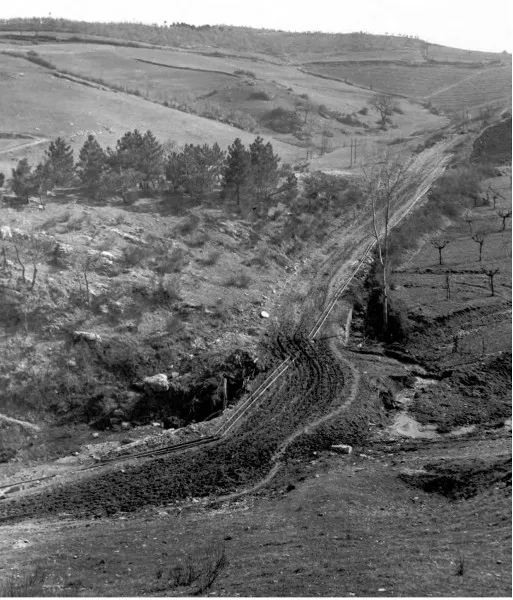
DOUBLE PIPELINE which carried gasoline from the port of
Leghorn to the army front in the Apennines. “Pipeline walking”
to inspect for leakage was done by jeep whenever possible.
Because of hilly terrain several booster pumping stations were
necessary. (4-inch double pipeline.)
ITALY
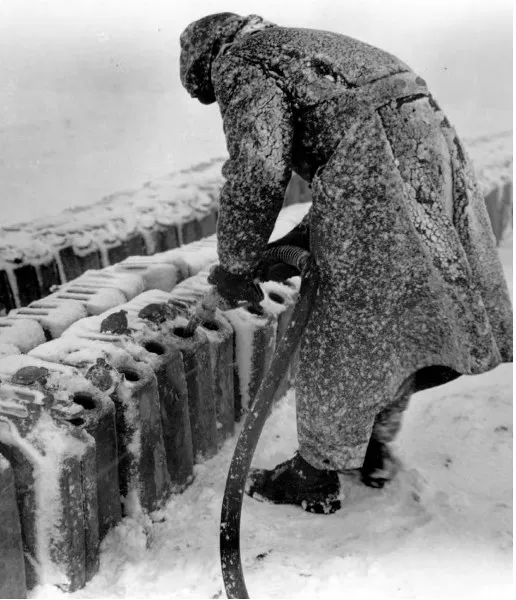
FILLING CANS WITH GASOLINE at the Raticosa Pass on Highway 65,
terminal of the pipeline from Leghorn. These cans were picked
up by truck and distributed to individual units. As the front
moved, the pipeline was extended to keep up with the troops.
(Five-gallon gasoline cans.)
ITALY
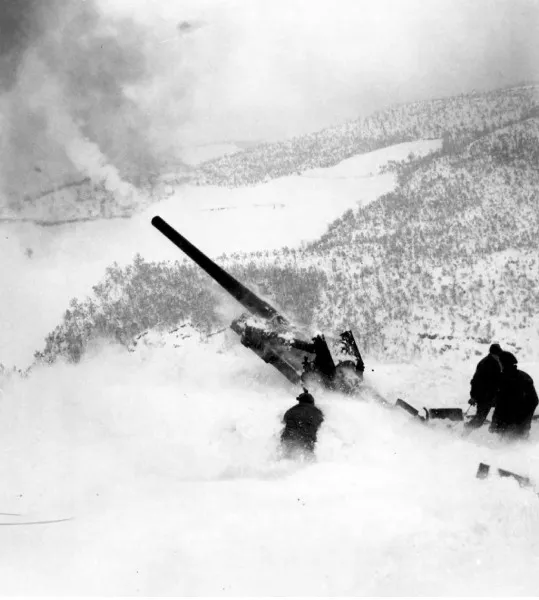
MEMBERS OF A SOUTH AFRICAN UNIT firing a Long Tom. This unit was
stationed along Highway 64. During the winter of 1944–45 the
U. S. Fifth Army roster included Brazilians, South Africans,
British, and Italians as well as U. S. white and Negro troops,
while the British Eighth Army along the east side of the
peninsula contained New Zealanders, Canadians, Poles, Indians,
Italians, and Jewish troops from Palestine in addition to United
Kingdom units.
ITALY
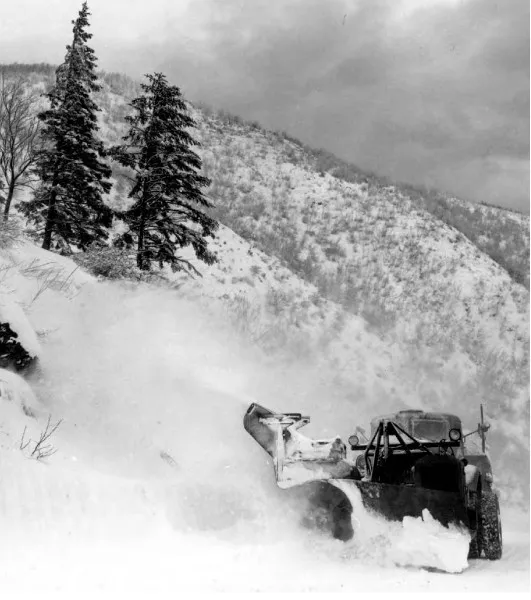
TRUCK WITH ROTARY SNOWPLOW clearing Highway 64 near Collina.
The first snow fell in the mountains on 11 November. Snow,
rain, sleet, and ice-coated curves on the roads leading to the
front made the supply situation a difficult one. The constant
work by snowplows and the hand labor of thousands of soldiers
and Italian civilians kept the main roads open throughout the
winter.
ITALY
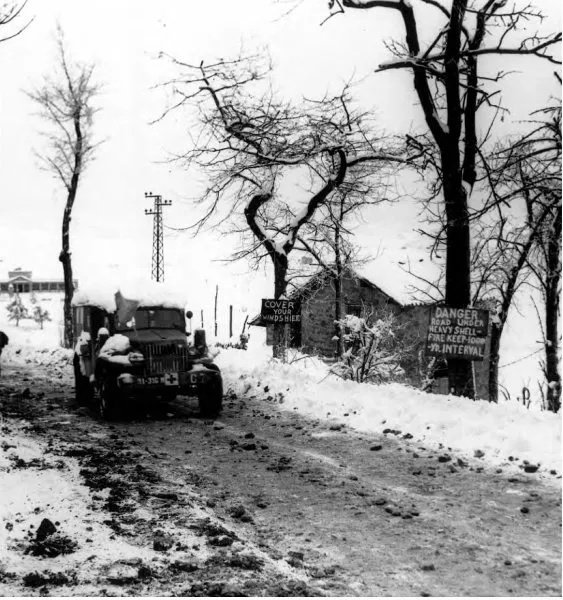
AMBULANCE EVACUATING WOUNDED from the front lines near Highway
65, between Loiano and Livergnano. The flow of wounded from
the battlefield was carefully controlled. Evacuation hospitals
were kept as free of patients as possible, thereby affording
immediate facilities for the most urgent cases. It was found
desirable in daylight hours to direct the main stream of
casualties to hospitals located farther in the rear, while
during the night most of the patients were brought to the
forward hospital units in order to reduce the delay caused
by blackout ambulance driving over icy roads. (¾-ton 4 x 4
ambulance.)
ITALY
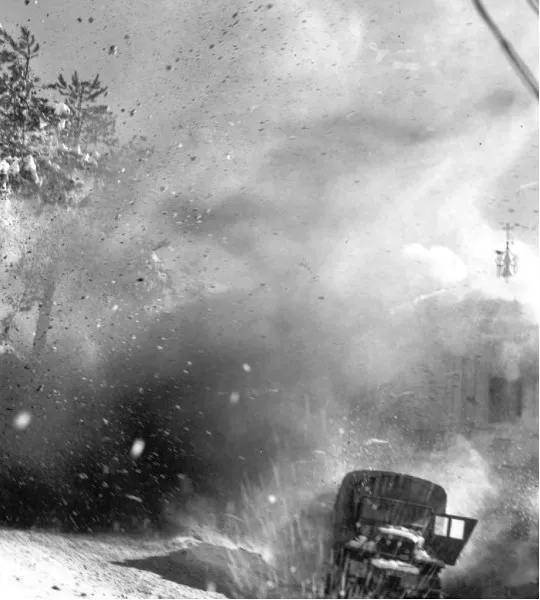
TRUCK ON HIGHWAY 65 near Loiano receives near miss, January
1945. This highway had been the main axis of advance during the
October offensive in the U. S. sector and was the only good road
in this area. During the winter stalemate and build-up for the
spring offensive, a period of about five months, this road was
under observed enemy artillery fire directed from Monte Adone, a
commanding position between Highways 64 and 65.
ITALY
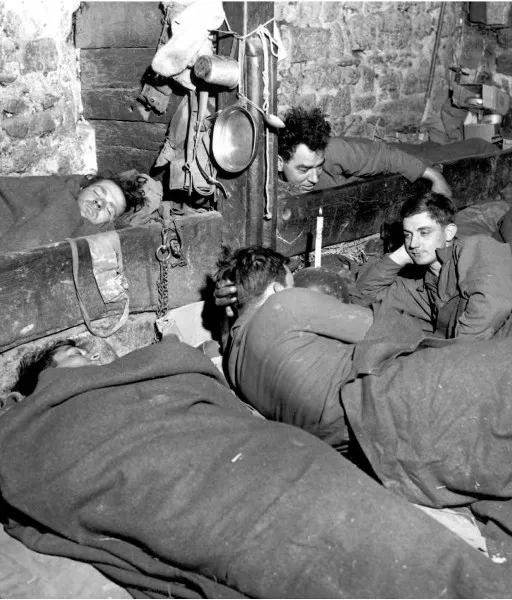
MEN RESTING IN THEIR QUARTERS in an old barn after a day in
foxholes at the front. During cold weather, winterization of
living quarters was carried out on a large scale, although men
in the extreme forward positions usually had to improvise with a
raincoat and a blanket in a foxhole.
ITALY
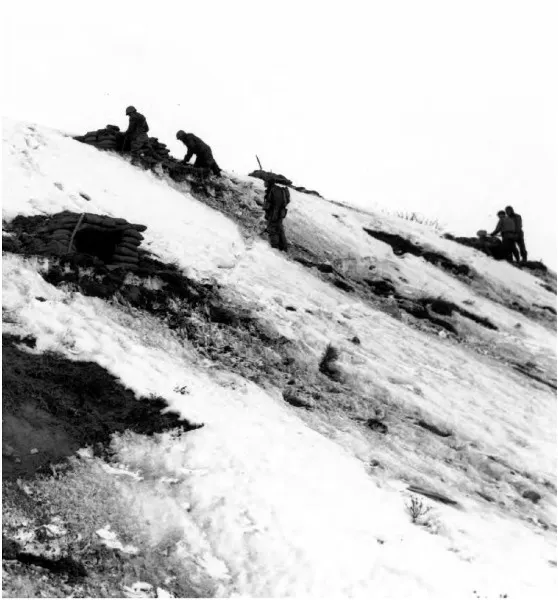
TROOPS IN A DEFENSE POSITION near Highway 65. This area was
thinly populated and houses were few and far between. Those
still standing drew fire, and troops in support or reserve
positions would dig in on the reverse slope of hills and make
their foxholes as comfortable as possible. Roofs and walls were
constructed from empty shell cases, food containers, and the
like and reinforced with sand bags. Keeping warm was a problem:
the area is almost bare of trees; most of the heating of the
foxholes was done by gasoline stoves, sometimes issued, often
improvised.
ITALY
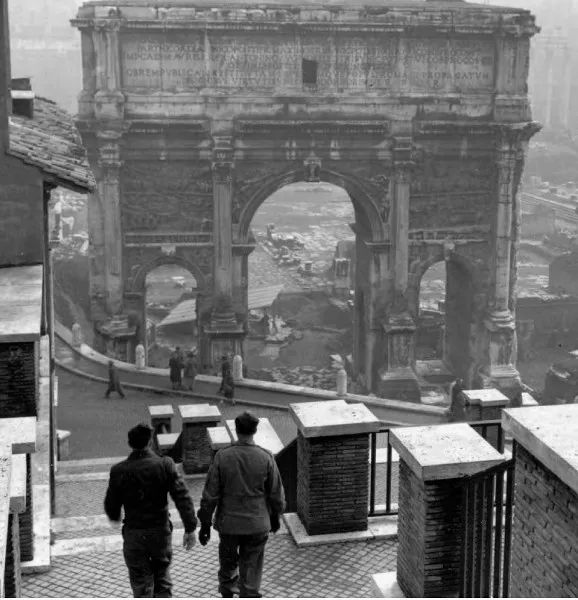
SOLDIERS AT THE ROMAN FORUM during a rest and recreation period
away from the front. The rest-center idea, which had proved
highly successful during the winter fighting of 1943–44, was
carried out on a much larger scale in Rome and in the cities
of the Arno Valley in the fall and winter of 1944–45. Hundreds
of thousands of troops were rotated through the rest and leave
centers set up under military supervision to provide a place
of relaxation where men could forget the rigors and dangers
of the front line, sleep in beds, take baths, visit places of
historic interest, and generally indulge in the pleasures and
entertainment of civilization, if only for a brief period.
ITALY
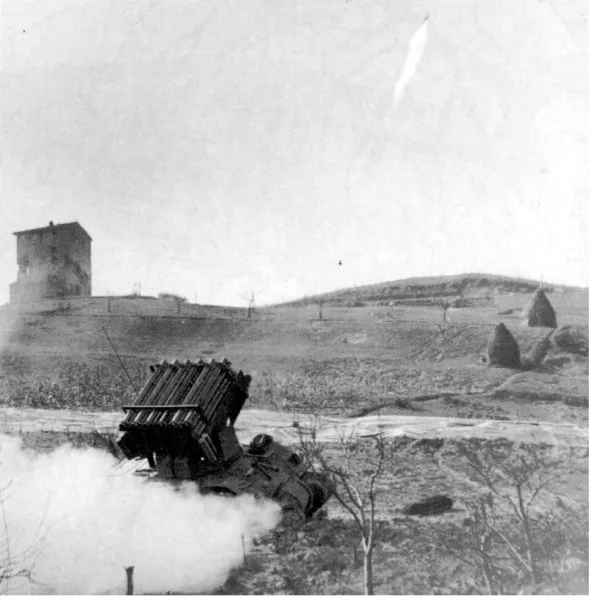
FIRING ROCKET PROJECTILES from a tank mount. Experiments were
carried out in January 1945 in the Arno Valley. Of the several
different mounts tested, one had 54 tubes placed on top of a
medium tank turret, another had 18 tubes mounted on the same
carriage as a towed 37-mm. gun. Because of the great variation
in deflection and range the weapon was not practical against
a point target and the smoke and flame given off when fired
tended to disclose its position. It proved effective for a heavy
concentration over a wide area for a short period. The short
range of the rocket, slightly less than 4,000 yards, was a
limiting factor. (Each cluster of 3 magnesium tubes is a rocket
launcher, aircraft M15, mounted on M17 (T40) modified rocket
launcher frame. 4.5-inch rockets were used.)
ITALY
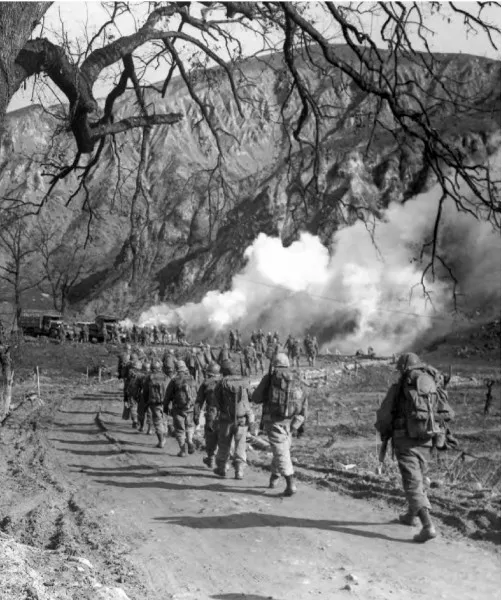
AN INFANTRY COMPANY moves into the line under a smoke screen to
relieve another company. During the five-month static period
starting at the beginning of November 1944, rotation of units
for rest and recreation was a regular procedure.
ITALY
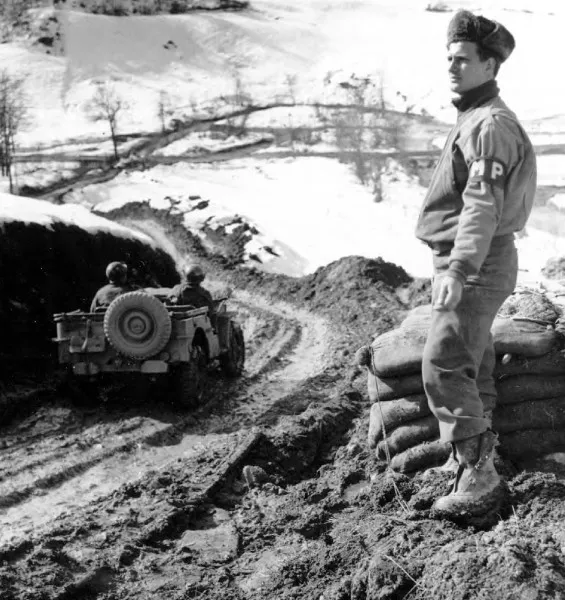
JEEP PASSING A TRAFFIC CONTROL POINT in the northern Apennines.
Rigid supervision of transportation over the crowded mountain
roads was necessary if proper supply was to be made, tactical
movements carried out, and vehicles conserved. To accomplish
this, traffic control points were set up. Road movement
approval was required for all convoys of ten or more vehicles.
The traffic posts also served as a check on unnecessary or
unauthorized use of military vehicles. Military police operated
“chain points” where vehicles going into the mountains were
stopped and beyond which the use of chains was mandatory.
ITALY
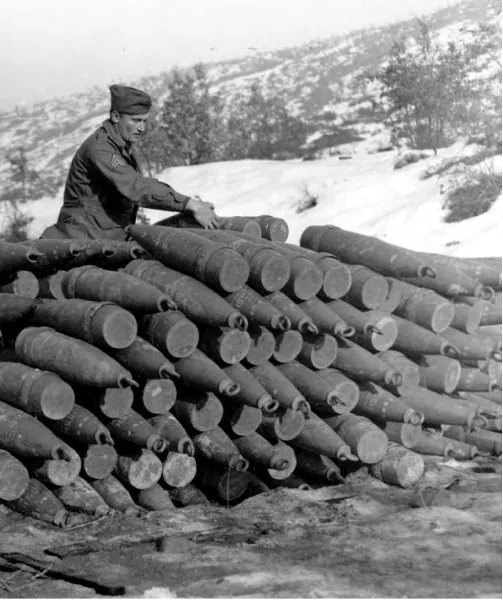
RESTACKING HOWITZER AMMUNITION. German air activity by this time
was so slight that dumps a few miles behind the front were not
camouflaged. (Ammunition for 155-mm. howitzer.)
ITALY
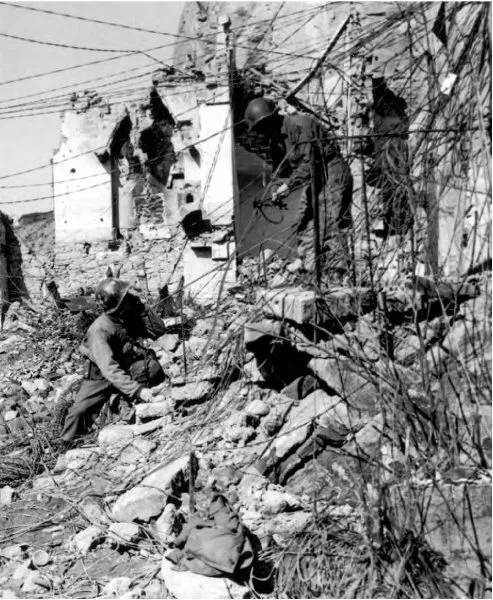
SIGNAL CORPS MEN checking wires outside the telephone exchange
in a cave at Livergnano.
ITALY
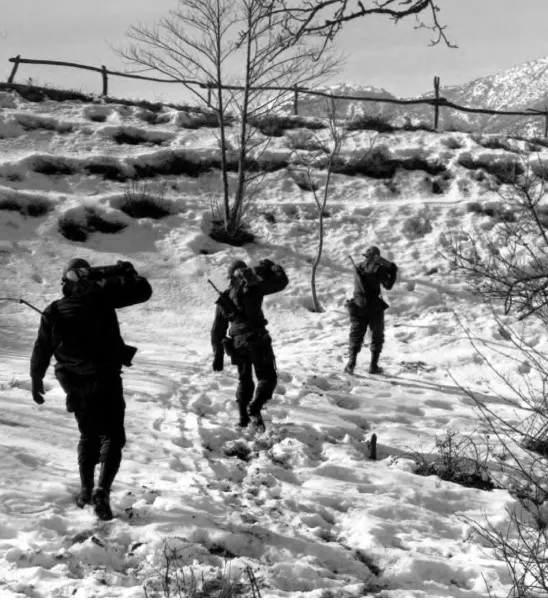
MAN CARRYING HOWITZER AMMUNITION to a battery high in the hills.
These men were members of a division especially trained for
mountain fighting. On 18 February 1945 this division, together
with the Brazilian division under Fifth Army command, started an
assault on German positions in the Monte Belvedere area west of
Highway 64. The Monte Belvedere area dominated about ten miles
of this highway. After severe fighting that lasted until 5 March
1945, the mountain mass was in Allied hands. (Ammunition for
75-mm. howitzer.)
ITALY
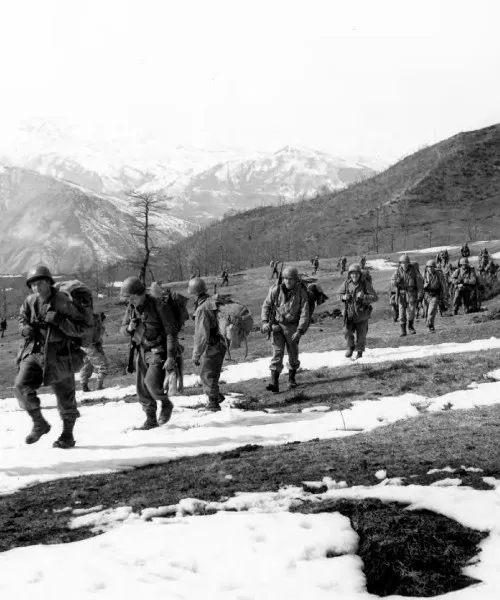
REINFORCEMENTS MOVE UP toward the fighting in the Monte
Belvedere area. The men are equipped with M1 rifles and
carbines, special shoes, and rucksack type pack.
ITALY
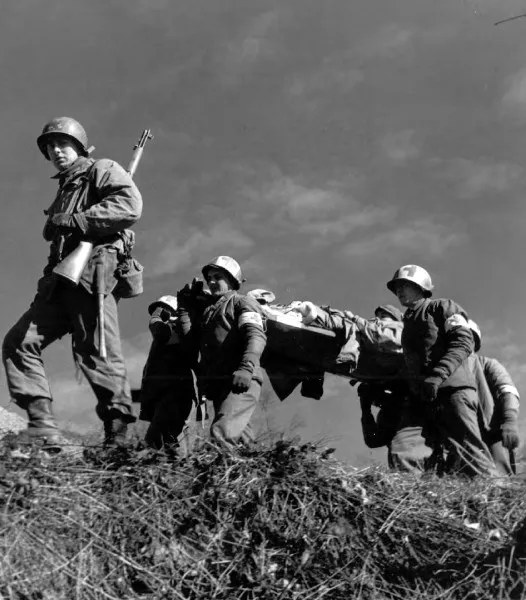
EVACUATING WOUNDED FROM MONTE BELVEDERE. As vehicles could not
negotiate the mountain trails, stretcher bearers had to carry
the wounded. Casualties from mines were numerous as the enemy
had been in position on this dominating hill for several months
and had mined and booby-trapped every likely avenue of approach
as well as many of the farmhouses on the mountain slopes.
ITALY
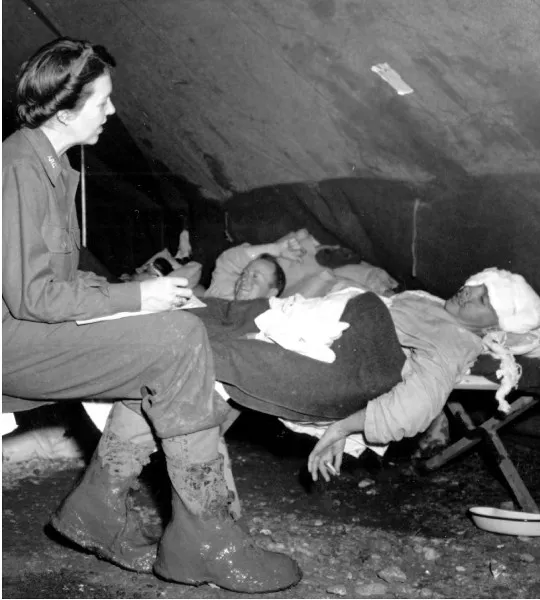
RED CROSS GIRL writing letter for wounded soldier. In addition
to performing duties such as this, the American Red Cross
operated clubs and motion picture theaters for the soldiers. The
clubs served coffee, doughnuts, and ice cream, and sponsored
musical programs, vaudeville shows, and dances. All was free of
charge. The estimated attendance at the Red Cross clubs in the
Arno Valley during February 1945 was 896,000.
ITALY
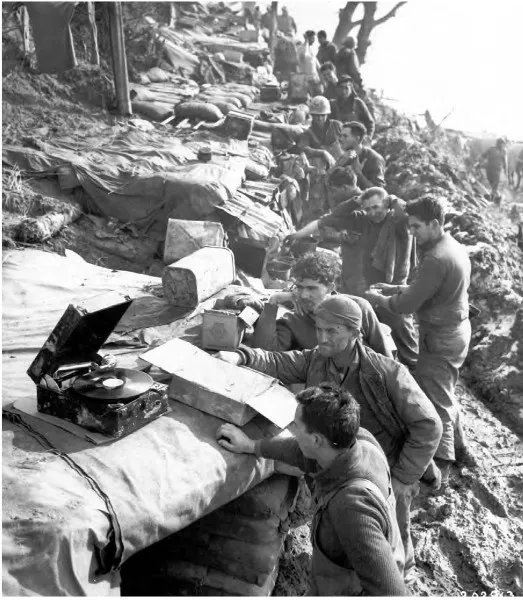
SOLDIERS DURING A LULL IN THE FIGHTING on Monte Grande which was
taken on 20 October 1944 after a tough two-day fight. The city
of Bologna was only about nine miles away and could be plainly
seen from the summit. Because of its commanding position,
the Germans made several local attacks during the winter to
recapture the mountain but were repulsed each time.
ITALY
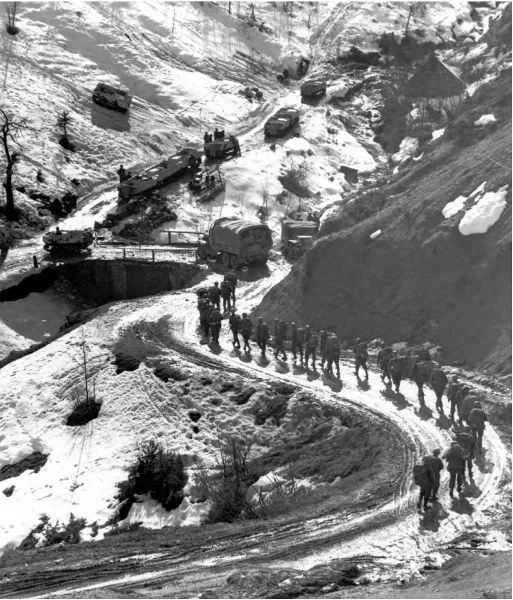
INFANTRY COLUMN passing a supply-transfer point in the Monte
Grande area east of Highway 65, February 1945. Supplies were
transferred from trucks to the tracked Weasels at this point.
Higher in the mountains the mule pack train took over from the
tracked vehicles.
ITALY
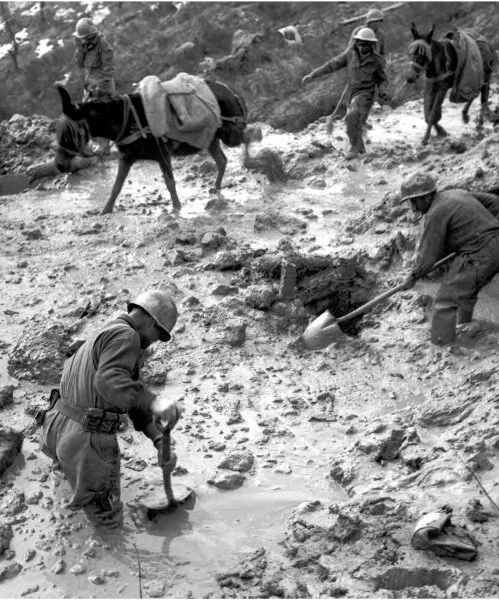
Members of an American Engineer Company working on a trail in
the vicinity of Monte Grande. An Indian pack mule convoy is
returning after taking supplies to the front line.
ITALY
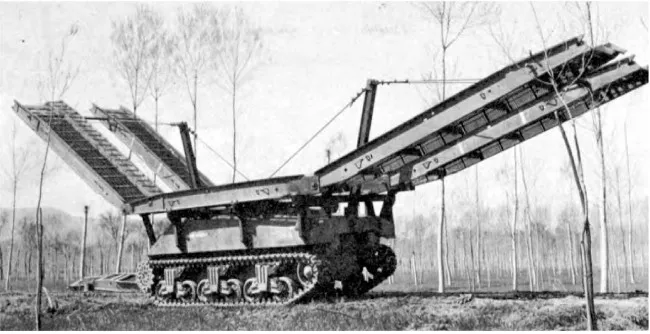
BRIDGING EQUIPMENT. “Ark” with end sections of treadway in
raised position (top). Medium tank M4, crossing canal on Ark
(bottom). With a total span of 54 feet, the treadway would
span a canal about 45 feet wide. After November 1944, when
the offensive in the mountains bogged down, most of the armor
with the Fifth Army was gradually withdrawn to the Arno Valley
where training for the spring offensive took place. New methods
and techniques were developed and tried. The Ark above was
constructed by an ordnance company for use in crossing canals in
the Po Valley.
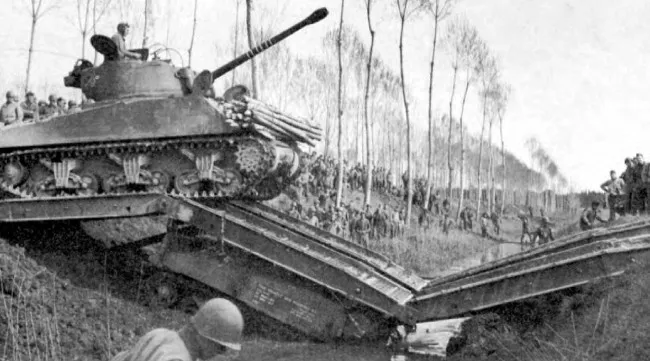
ITALY
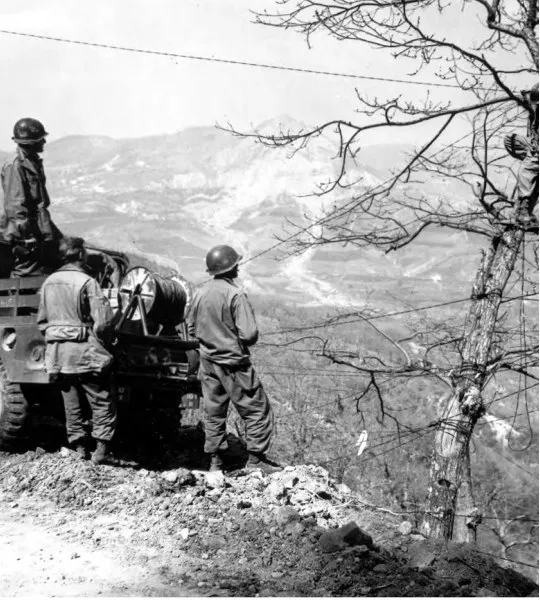
SIGNAL CORPS LINEMEN stringing communication wire in preparation
for the coming spring offensive. During the winter stalemate
many new lines were strung and hookups were made to the Italian
state underground cable system. Circuits linked all units of the
Fifth Army and an eight-mile line containing eight open-wire
circuits was started in February 1945 from Filigare on Highway
65 near Monghidoro to the village of Lagaro Highway 6620.
ITALY
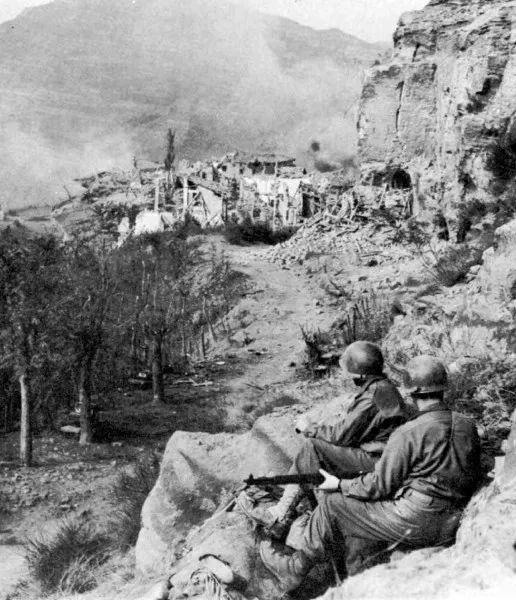
SOLDIERS IN LIVERGNANO watch the shelling of the village by the
enemy, March 1945. Livergnano was taken on 14 October 1944 after
a five-day fight along Highway 65 in an attempt to break through
into the Po Valley. The advance was halted a few miles beyond
this village. (Garand M1, .30-caliber rifle.)
ITALY
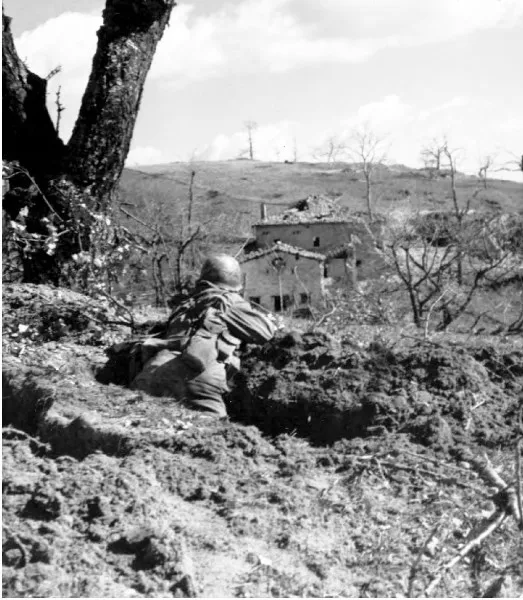
INFANTRY ACTION during the attack toward Monte della Spe. The
soldier in the foreground is covering the house with his rifle
while the other members of his squad approach it. A few minutes
after this picture was made the house and the knoll behind it
were taken, netting 57 German prisoners. Monte della Spe, west
of Highway 64, was taken on 5 March 1945.
ITALY
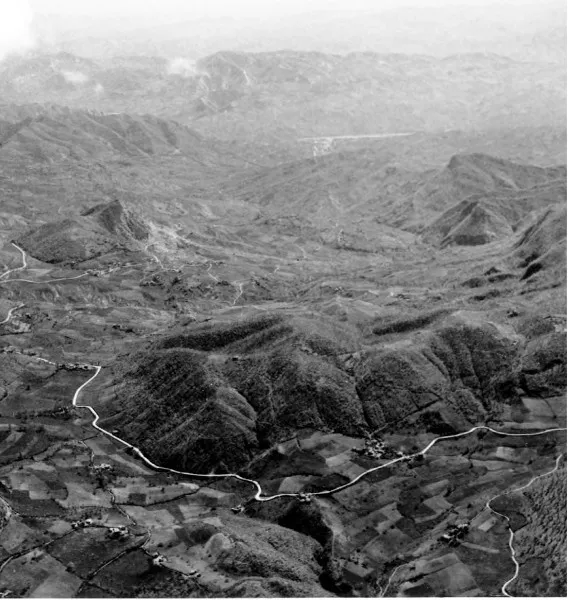
MONTE DELLA SPE AREA, looking toward the east. Highway 64
parallels the Reno River (in distance). The village of Vergato
is shown on the west bank of the river. Monte della Spe is the
rounded hill in foreground. It was taken on 5 March 1945 during
an attack to secure a suitable jumping off place for the spring
offensive. Vergato, which was an enemy strong point, and most
of the surrounding territory remained in enemy hands after the
capture of Monte della Spe. The main offensive, the attack
toward the Po Valley, started from here on 14 April 1945 and by
the 20th Allied troops had broken into the valley.
ITALY
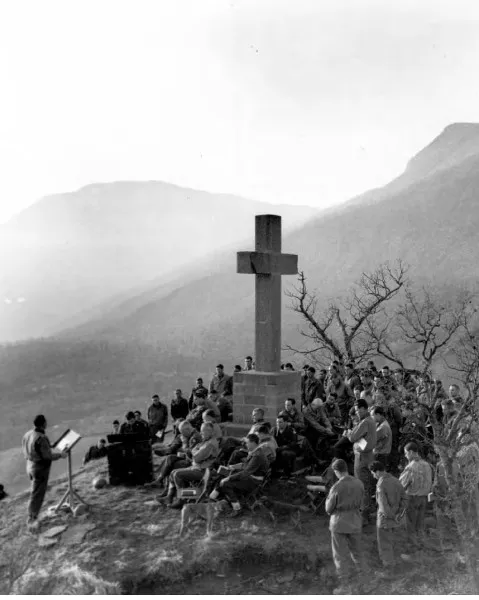
EASTER SERVICE 1 APRIL 1945.
ITALY
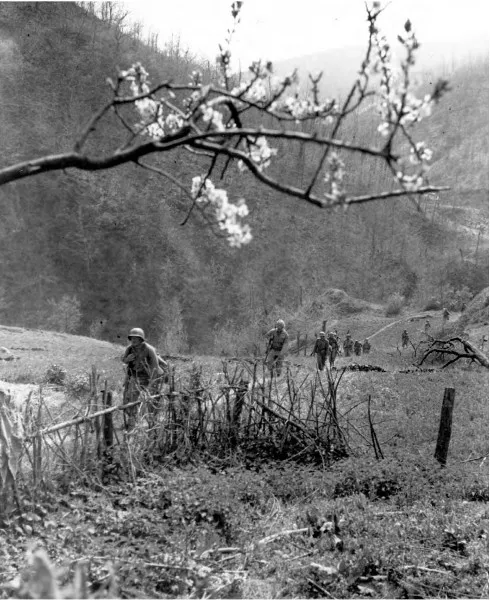
RETURNING PATROL. As the spring offensive became imminent,
patrol activities increased.
ITALY
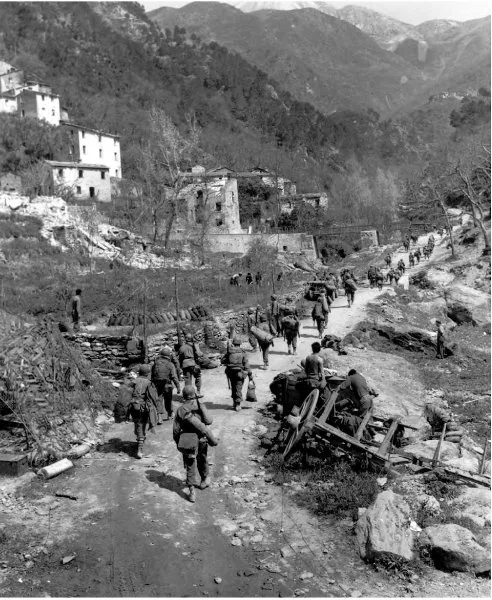
SOLDIERS MOVING UP into the line a few days before the start of
the attack toward the Po Valley.
ITALY
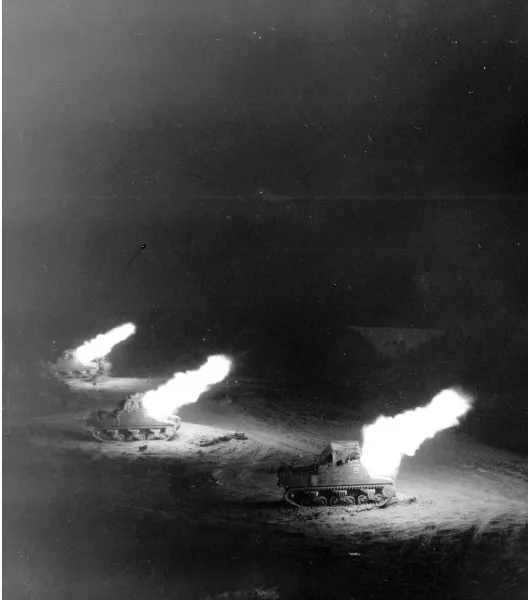
SELF-PROPELLED GUNS of a South African armored unit firing
a mission a few days before the attack to break into the Po
Valley. These vehicles are American Sherman tanks modified by
the British as self-propelled guns. Prior to the jump-off, the
units along the Fifth Army front had been engaged in a series of
deceptive artillery fires.
ITALY
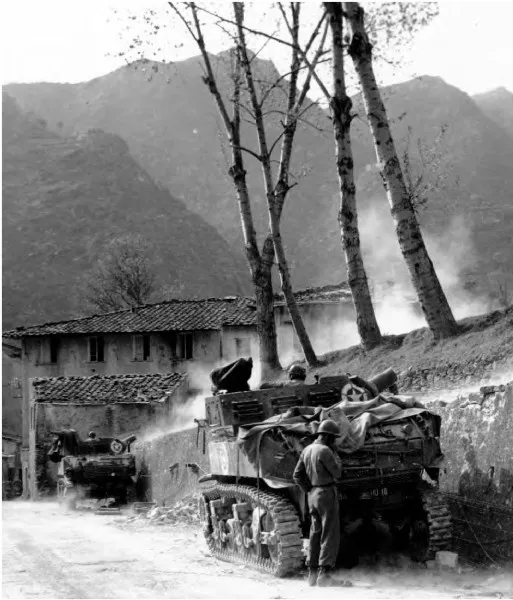
NEGRO SOLDIERS FIRING HOWITZERS in support of the Nisei who were
making an attack northward along the mountain ridges toward the
towns of Massa and Carrara. The attack started on 5 April 1945.
The Nisei were American soldiers of Japanese ancestry. (75-mm.
howitzers.)
ITALY
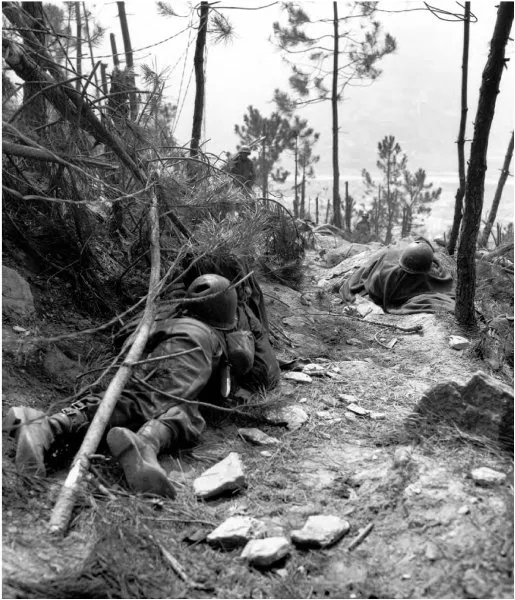
BODIES OF AMERICAN INFANTRYMEN killed during the opening of the
spring offensive. Note stretcher bearer in background looking
for casualties. The infantry was making an attack across the
mountains toward Massa and Carrara on the west coast.
ITALY
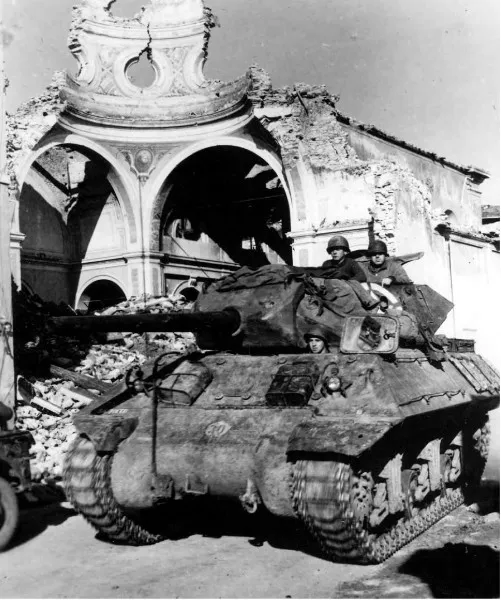
TANK DESTROYER speeding along Highway 1 through the town of
Querceta during the spring offensive. The main effort of the
army was along Highways 64 and 65.
ITALY
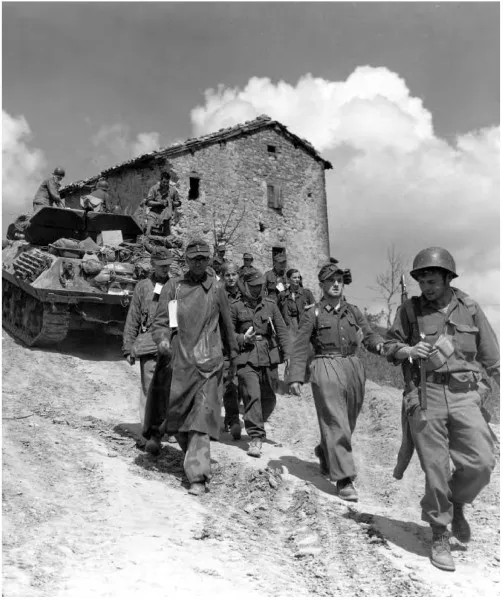
BRINGING IN THE FIRST PRISONERS taken at the start of the main
drive to reach the Po Valley. On 14 April at 0945 the offensive
was started by U. S. mountain troops in the hills west of
Vergato on Highway 64.
ITALY
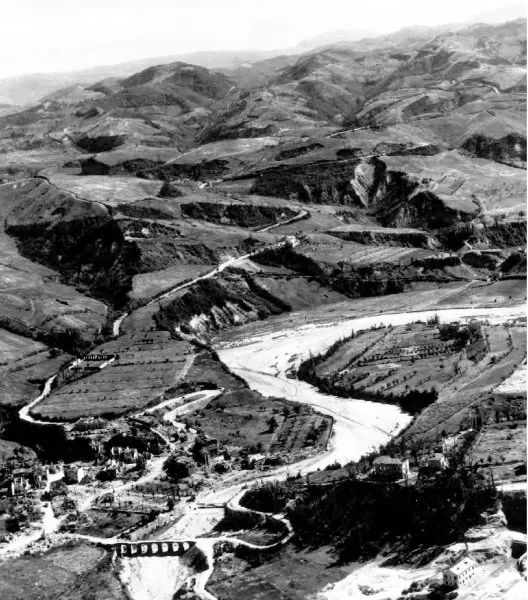
PIANORO ON HIGHWAY 65, looking south toward the hills occupied
by the Allies for almost six months. Pianoro, at lower left, was
one of the keys of the German defense systems barring entrance
to Bologna and the Po Valley. The fight for Pianoro started on
16 April. Entering what was left of the town on the evening of
the 18th, the infantry found it booby-trapped.
ITALY
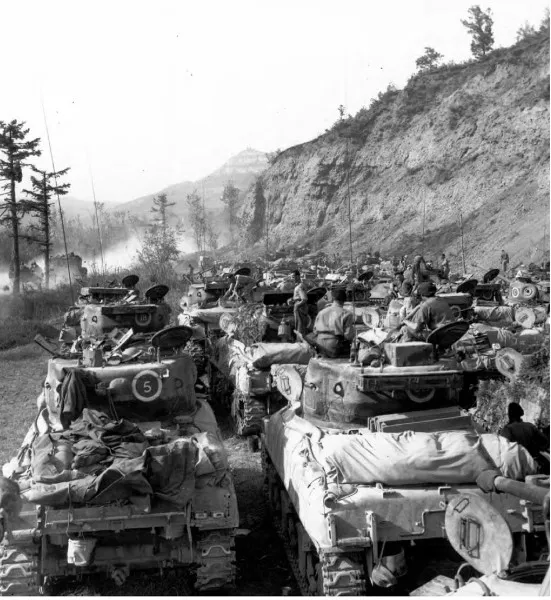
SOUTH AFRICAN ARMOR waiting along Highway 64 for a U. S.
infantry division to pass on its way to the Po Valley, 20
April. On this date the troops in the U. S. zone broke through
the mountains into the Po Valley just west of Bologna. The two
highways in this area, 64 and 65, became congested with troops
and vehicles in pursuit of the fleeing enemy. (Sherman medium
tanks.)
ITALY
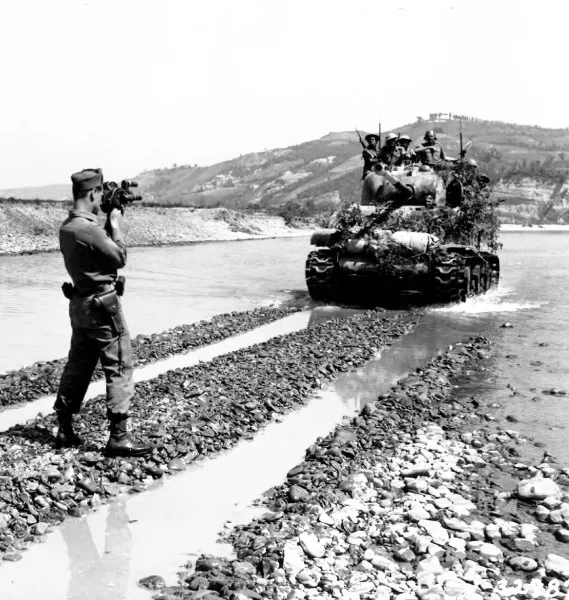
U. S. ARMY MOTION-PICTURE CAMERAMAN photographing the first
tank of the South African armored force to cross the Reno River
southwest of Bologna, 20 April. The practice of infantrymen
riding on tanks while advancing was included in training for
armored units in the United States early in 1944. (Sherman M4A3
tank with British 17-pounder; camera: PH-330 (Sig C), Eyemo,
Bell, and Howell, 35-mm., three lenses mounted in turret.)
ITALY
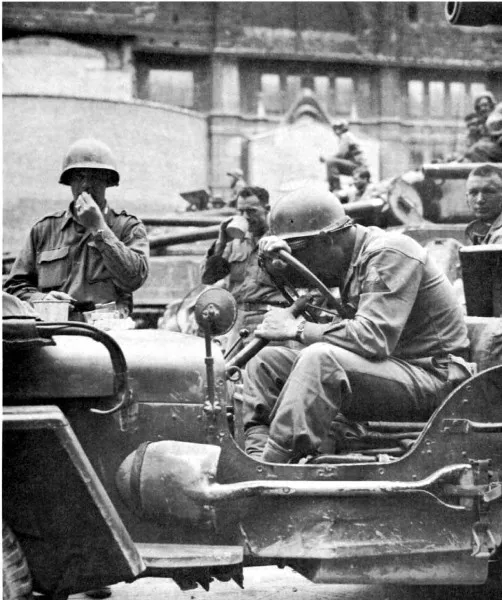
WEARY U. S. TROOPS IN BOLOGNA on the morning of 21 April. The
city, entered from the south by U. S. forces and from the east
by Poles of the Eighth Army, fell that day. Pressing forward the
troops pursued the fleeing Germans.
ITALY
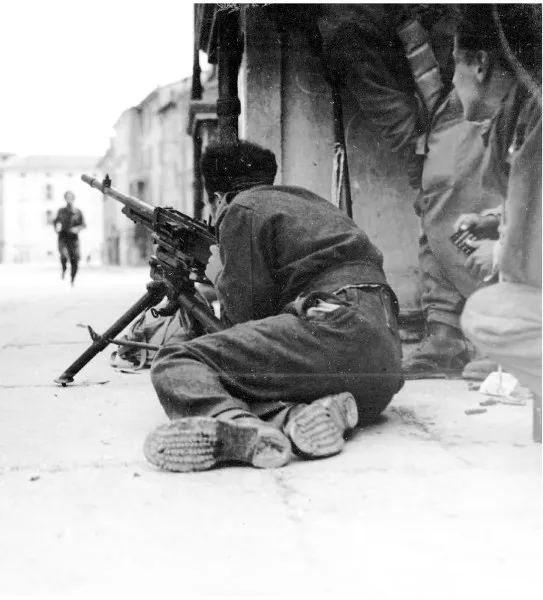
ITALIAN PARTISANS WATCHING FOR SNIPERS. During the winter of
1944–45 Allied officers, arms, and ammunition were dropped
behind the enemy lines to assist partisans in the Po Valley.
Although partisans, armed with equipment obtained from Italian
arsenals or seized from the Germans, first appeared north of
Rome, it was not until the Allies reached Bologna that they met
the efficiently organized groups from the Po Valley. As troops
entered the city, where the Germans were numerous, the partisans
struck, seizing government agencies and public utilities.
ITALY
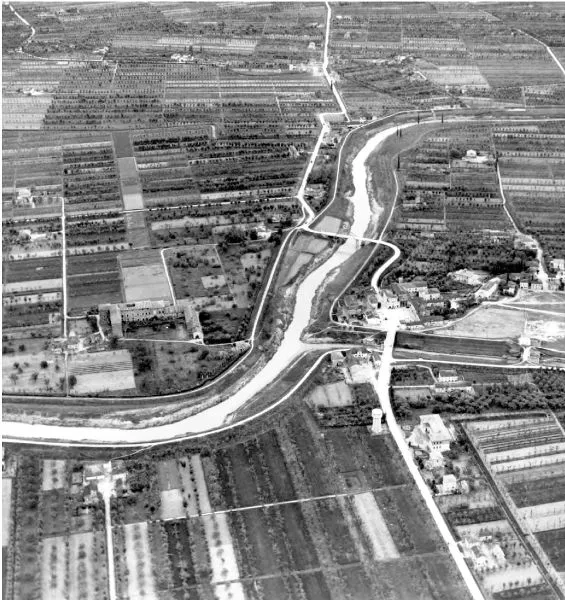
THE PANARO RIVER BRIDGES near Bomporto. After the breakout into
the Po Valley, the next objective was the Po River. The area
south of this river is broken by small streams and numerous
canals. Most of the bridges had been destroyed by the Allied air
forces during the winter. Later air reconnaissance found these
undamaged bridges at Bomporto. A task force, sent to secure
them, passed through the fleeing and disorganized enemy. So
sudden was its appearance that, by 1600 on 21 April, it captured
the bridges before the Germans could detonate previously laid
demolition charges.
ITALY
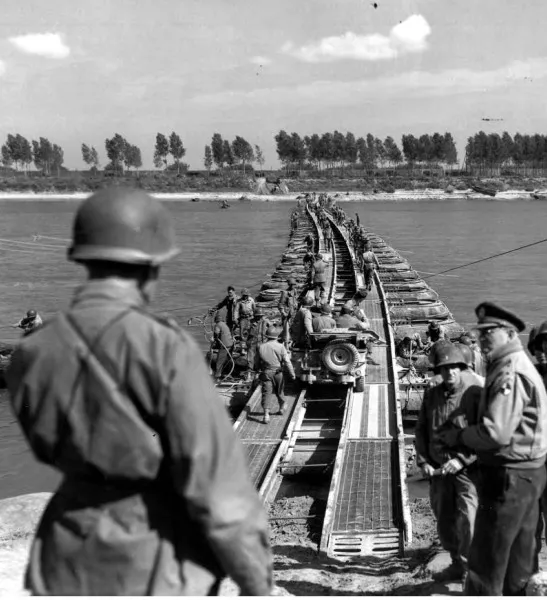
TREADWAY BRIDGE ACROSS THE PO RIVER at San Benedetto. Opened on
the afternoon of 25 April, it was the first bridge across the
river. The infantry had started to cross in this area on the
morning of the 23d in assault boats under heavy machine gun,
mortar, and rifle fire as well as fire from enemy antiaircraft
guns lowered to fire airbursts on a flat trajectory. Casualties
were high, but by 1745 a bridgehead of 2,000 square yards had
been established on the north bank of the Po. The bridge above
is 915 feet long. (Floating treadway bridge M2, class 18.)
ITALY
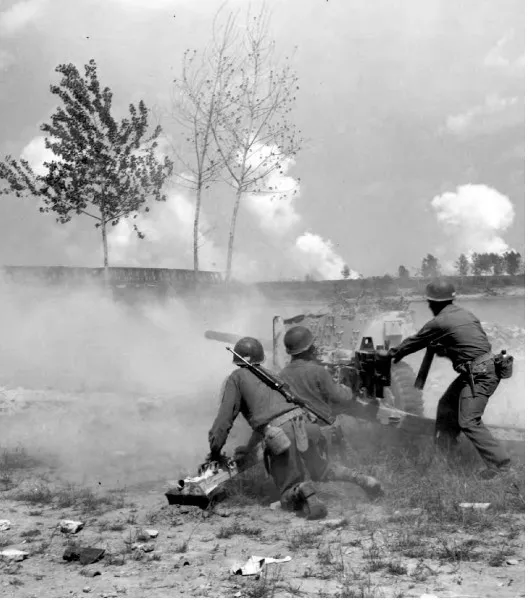
ACTION DURING THE PO RIVER CROSSING at Ostiglia, 24 April. A
57-mm. antitank gun firing in support of an infantry assault
across the railroad bridge to the north bank of the river. (The
British 6-pounder was the forerunner of the 57-mm. gun. It was
adapted for U. S. use and also manufactured for other United
Nations under the lend-lease agreement as the 57-mm. antitank
gun.)
ITALY
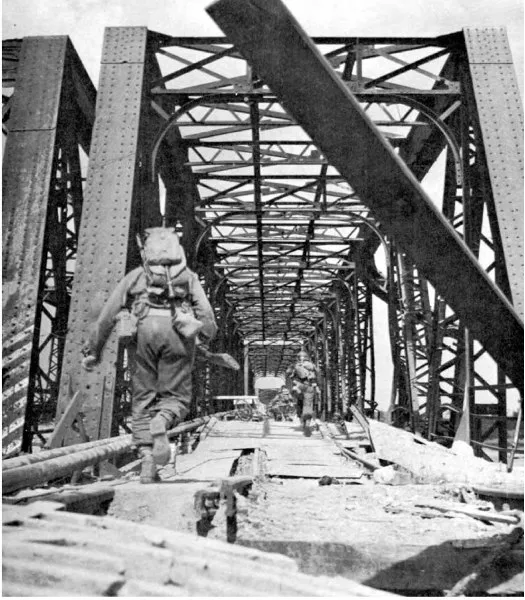
INFANTRY CROSSING PO RIVER UNDER FIRE, Ostiglia railroad bridge,
24 April. The crossing in this zone was opposed by enemy machine
guns and 20-mm automatic weapons. The patrol above worked its
way to the other side and knocked out enemy guns and crews. The
railroad bridge was partially demolished and unfit for vehicles.
ITALY
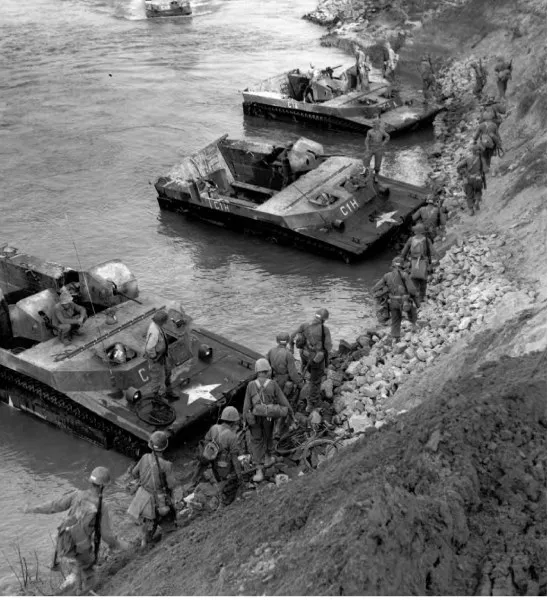
“ALLIGATORS” ABOUT TO CROSS PO RIVER near Ostiglia. Developed by
the U. S. Navy, the first shipment of these amphibian tracked
vehicles arrived in December 1944 and training was begun.
Great secrecy surrounded them and they were kept thoroughly
camouflaged before the dash to the Po. They were armored and
each had socket mounts at four locations for either .30-or
.50-caliber machine guns. A stern ramp could be lowered to take
on a vehicle. Maximum capacity was 8,000 pounds and a crew of
three. (LVT(4).)
ITALY
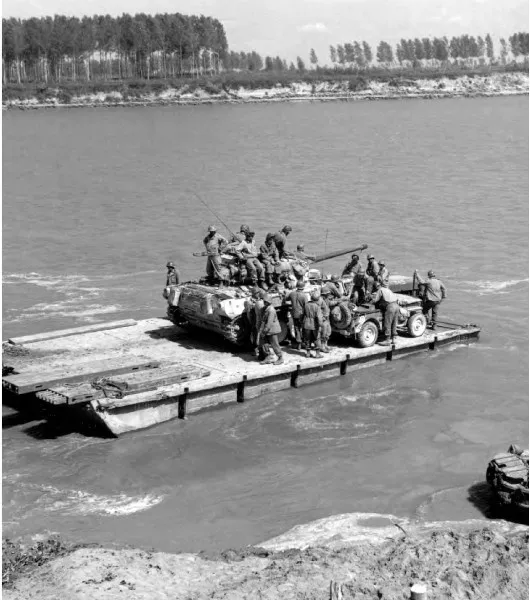
FERRYING EQUIPMENT ACROSS THE PO in support of the infantry
assault, Ostiglia, 25 April. The large vehicle is a 76-mm.
gun motor carriage M18, designed for tank destroyer use. It
was a full track-laying type, using a torsion bar independent
suspension, and was front-sprocket driven. The vehicle was
lightly armored, had a low silhouette, and was highly mobile.
ITALY
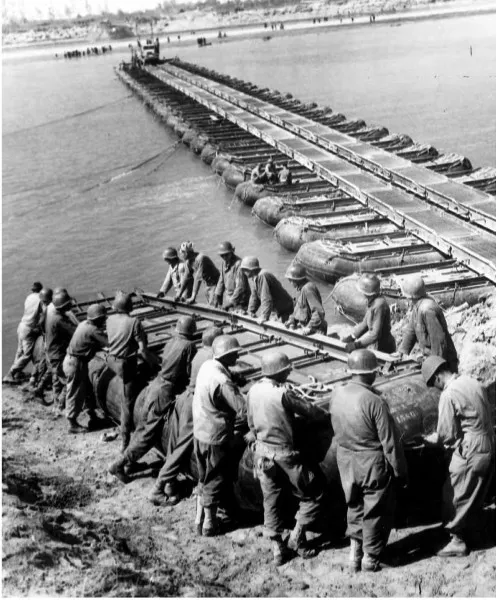
PONTON BRIDGE under construction across the Po River near
Ostiglia. This bridge was opened on 25 April. (M2 treadway
bridge.)
ITALY
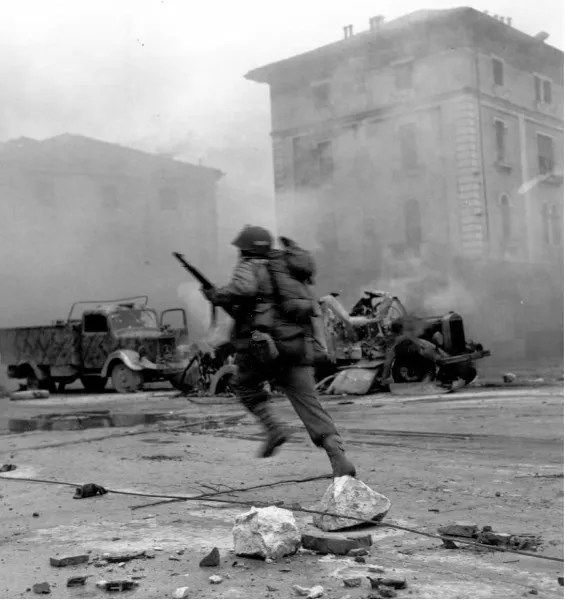
INFANTRY ACTION AT VICENZA, in the foothills of the Alps. The
advance of the Allies across the plain was too fast for the
Germans to halt, reorganize, and make a determined stand behind
either the Po or the other rivers in the Po plain. Speedy
thrusts by infantry-armor columns split the enemy forces and
severed communications. After the crossing of the Po, the action
on both sides developed into a race to the Alps, the enemy
hoping to escape into Germany, the Allies determined to prevent
them. Many isolated pockets of resistance developed behind the
advancing columns and special task forces were organized on 23
April to deal with them.
ITALY
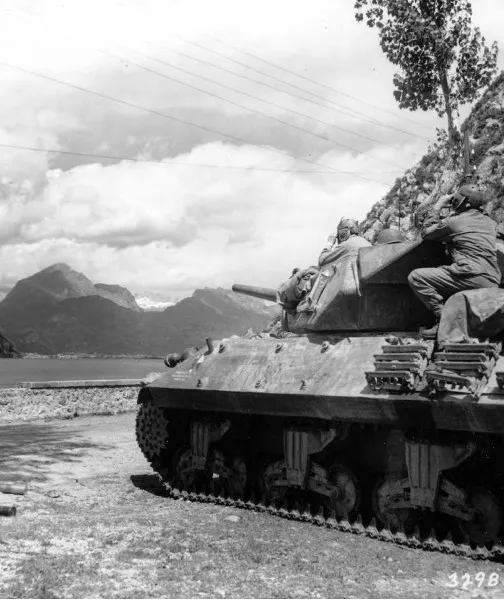
TANK DESTROYER on the shore of Lake Garda blocking one of the
escape routes to Brenner Pass. Heavy fighting took place in the
demolished tunnels on the road along the east shore of this
lake, but on 30 April the area was under Allied control.
ITALY
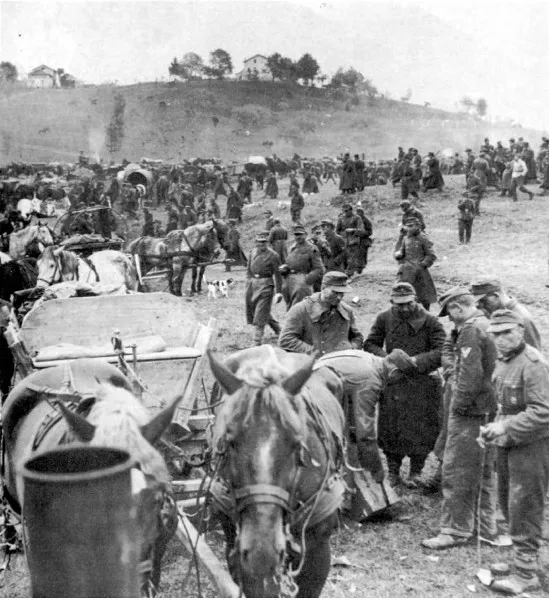
GERMAN PRISONERS and their equipment captured on the Po plain.
For the first time in the Italian campaign, the enemy was
retreating over terrain suitable for swift pursuit. Since the
Germans lacked vehicles and gasoline, they had to rely to a
great extent on horse-drawn transportation. They retreated
across an open valley having a fine network of roads for
mechanized forces and were forced to cross wide rivers by
ferries and ponton bridges under constant attack by Allied air
forces. The retreat became a rout.
ITALY
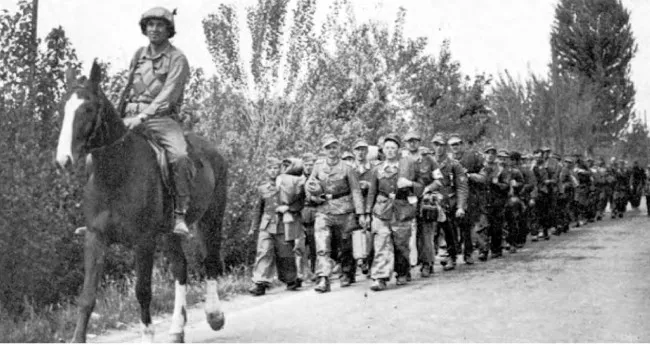
PRISONERS WERE CAPTURED by the tens of thousands in the Po
Valley and marched to the rear, often unguarded, or guarded only
by one or two men. On 2 May 1945, the Germans signed the terms
of the unconditional surrender of their forces in Italy. One
week later the war in Europe was concluded with complete victory
for the Allies. The Italian campaign had been a bitter one,
lasting 607 days (3 September 1943 to 2 May 1945). Casualties of
the Fifth Army, including all nationalities serving with that
army, totaled 188,546. United States losses were 19,475 killed,
80,530 wounded, and 9,637 missing.