LONDON
PUBLISHED AT THE OFFICES OF “COUNTRY LIFE,” LTD.,
20, TAVISTOCK ST., COVENT GARDEN, W.C.2, AND BY
GEORGE NEWNES, LTD., 8-11, SOUTHAMPTON ST., STRAND, W.C.2
NEW YORK: CHARLES SCRIBNER’S SONS MCMXXIII
THE WANDERINGS OF AN ELEPHANT HUNTER — I HUNTING THE BIG BULL ELEPHANT
The most interesting and exciting form of elephant-hunting
is the pursuit of the solitary bull. These fine old patriarchs
stand close on twelve feet high at the shoulder and weigh from
twelve thousand to fourteen thousand pounds or more, and carry
tusks from eighty to one hundred and eighty pounds each. They
are of great age, probably a hundred or a hundred and fifty years
old. These enormous animals spend their days in the densest part
of the bush and their nights in destroying native plantations.
It is curious that an animal of such a size, and requiring such
huge quantities of food, should trouble to eat ground nuts—or peanuts,
as they are called in this country. Of course, he does not pick
them up singly, but plucks up the plant, shakes off the loose earth
and eats the roots with the nuts adhering to them. One can imagine
the feelings of a native when he discovers that during the night his
plantation has been visited by an elephant.
The dense part of the bush where the elephant passes his day is
often within half a mile of his nightly depredations, and it is only
through generations of experience that these wicked old animals are
enabled to carry on their marauding life. Many bear with them the
price of their experience in the shape of bullets and iron spear-heads;
the natives set traps for them also, the deadliest one being the falling
spear. Of all devices for killing elephants known to primitive man
this is the most efficient. The head and shank of the spear are
made by the native blacksmith, and the whole thing probably weighs
about four hundred pounds and requires eight men to haul it into
position. To set the trap a spot is chosen in the forest where an
elephant-path passes under a suitable tree. A sapling of some
twelve feet in length is then cut. One end is made to fit tightly
into the socket of the spear-head and to the other end is attached a
rope. The spear end of the rope is then placed over a high bough
at a point directly over the path, while the other end is taken down
to one side of the path, then across it and made fast to a kind of
trigger mechanism. It is placed at such a height from the ground
as will allow buffalo and antelope to pass under it but not a full-grown
elephant. He will have to push it out of his way. This
part of the rope is generally made of a bush vine or creeper. If all
goes well, an elephant comes along the path, catches the creeper on
his forehead or chest, pushes it sufficiently to snap it off, and then
down hurtles the huge spear, descending point first with terrific
force on neck, shoulder or ribs. I have seen taken from an old
bull’s neck a piece of iron three feet long and almost eaten away.
The wound had completely healed and it may have been there for
years. If, however, the spear strikes the spine, death is instantaneous.
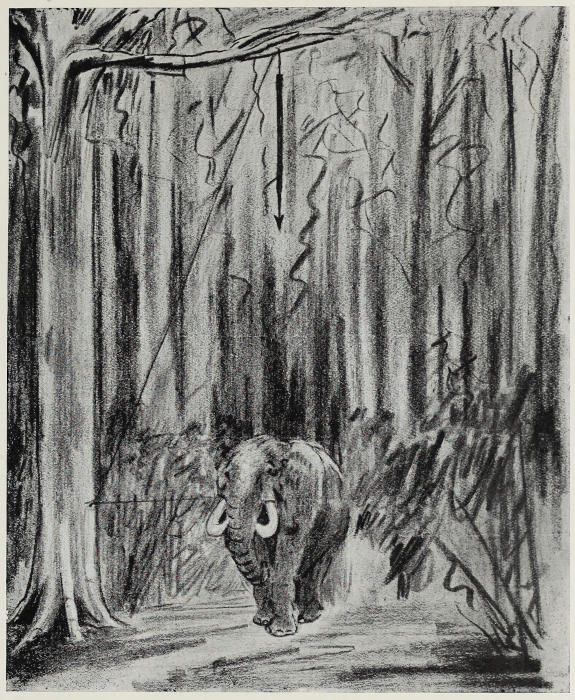
THE FALLING SPEAR: THE DEADLIEST NATIVE ELEPHANT TRAP.
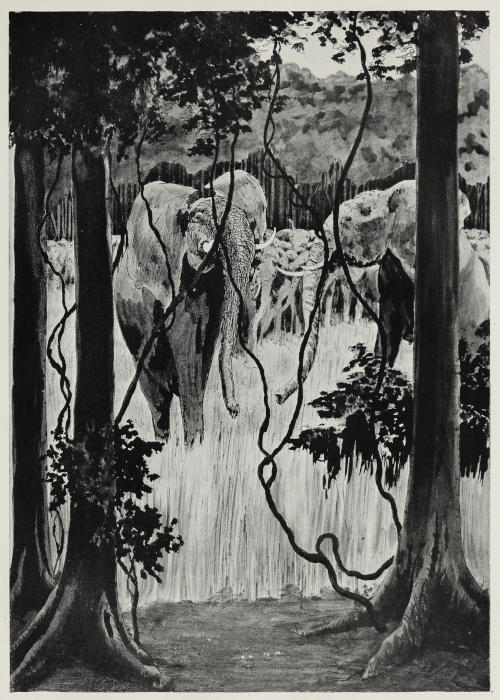
THE MARAUDING BULL.
This spear, weighing about four
hundred pounds and provided with
a twelve-foot shaft, is hung head
downwards from a tree. The rope,
of vine or creeper, which holds
it up, is stretched across an elephant-path,
so that, in passing,
the animal must snap it, liberating
the spear to drop upon his own
head or ribs.
To get within hearing distance of these old elephants is comparatively
easy. You simply pick up the enormous tracks in the
early morning and follow them into their stronghold. Sometimes,
after going quite a short distance through fairly open forest, you
begin to find it more and more difficult to force your way along.
The tracks are still there, but everything gives way before the
elephant and closes in behind him again. Here in the dark cool
parts there are no flies, so that the flapping and banging of ears, the
usual warning of an elephant’s presence, are lacking. The light
begins to fail; air currents are non-existent, or so light they
cannot be felt; the silence is profound. Monkeys and parrots are
away in the more open parts. You may expect to hear your game
at any moment now. You hope to see him, but your luck is in if
you do. At the most you will see a high and ghostly stern flitting
through the undergrowth, sometimes disconcertingly close in front
of you. Literally nothing indicates the presence of such an enormous
animal, and if it were not for the swish of the bush as it closes
in behind him you would find it hard
to believe that he was so close. His
feet, softly cushioned with spongy
gristle, make no sound. He seems to
know that his stern is invulnerable
alike to bullets or spears; while his
huge ears, acting as sound-collecting
discs, catch with their wide expanse
the slightest sound of an enemy. He
shows no sign of panic; there is no
stampede as with younger elephants
when they are disturbed; only a
quiet, persistent flitting away. You
may concentrate on going quietly;
you may, and probably do, discard
your leg gear in order to make less
sound; you redouble your stealth; all
in vain. He knows the game and will
play hide-and-seek with you all day
long and day after day. Not that this
silent retreat is his only resource—by
no means—he can in an instant
become a roaring, headlong devil.
The transformation from that silent,
rakish, slinking stern to high-thrown
head, gleaming tusks and whirling
trunk, now advancing directly upon
you, is a nerve test of the highest
order. The noise is terrific. With
his trunk he lashes the bushes. His
great sides crash the trees down in
every direction, dragging with them in their fall innumerable
creepers. The whole forest is in an uproar. Much of this clatter the
experienced hunter writes off as bluff, for after a short, sharp rush
of this sort he will often come to a dead stop and listen intently.
Here, again, his long experience has taught him that his enemy will
now be in full retreat, and in most cases he is right. Certainly no
native hunter waits to see, and most white men will find they have
an almost uncontrollable desire to turn and flee, if only for a short
way. With the deadliest of modern rifles it is only a very fleeting
chance that one gets at his brain. The fact that the distance at which
his head emerges from the masses of foliage is so small, and the
time so short until he is right over you, in fact, makes this kind of
hunting the most exciting and interesting of any in Africa, or the
world, as I think most men who have experienced it will agree. If
the shot at the brain is successful the monster falls and the hunter
is rewarded with two magnificent tusks. And great will be the
rejoicing among the natives at learning of his death, not only for
the feast of meat, but also to know that their plantations have been
rid of the marauding pest.
II THE BRAIN SHOT AT ELEPHANT
The hunting of the African elephant is now restricted in so
many ways that it is difficult for anyone to gain experience in
the shooting of them. In most of the protectorates or dependencies
of the European powers a licence to kill two in a year costs
from £40 to £80. It therefore behoves the sportsman to make a
good job of it when he does come face to face with these splendid
animals.
Twenty-five years ago parts of Africa were still open to unrestricted
hunting, and it is from a stock of experience—gathered
during years devoted to this fascinating pursuit—that I am about to
draw, in the hope that it may assist the sportsman to bring about a
successful termination to his hunt and perhaps save some unfortunate
animal from a lingering death due to wounds.
In hunting elephant, as in other things, what will suit one man
may not suit another. Every hunter has different methods and
uses different rifles. Some believe in the big bores, holding that
the bigger the bore therefore the greater the shock. Others hold
that the difference between the shock from a bullet of, say,
250 grs. and that from a bullet of, say, 500 grs. is so slight that,
when exercised upon an animal of such bulk as an elephant, it
amounts to nothing at all. And there is no end to the arguments
and contentions brought forward by either side; therefore it should
be borne in mind when reading the following instructions that they
are merely the result of one individual’s personal experience and
not the hard and fast rules of an exact science.
As regards rifles, I will simply state that I have tried the following:
·416, ·450/·400, ·360, ·350, ·318, ·275 and ·256. At the time
I possessed the double ·400 I also had a ·275. Sometimes I used
one and sometimes the other, and it began to dawn on me that when
an elephant was hit in the right place with the ·275 it died just as
quickly as when hit with the ·400, and, vice versa, when the bullet
from either rifle was wrongly placed death did not ensue. In pursuance
of this train of thought I wired both triggers of the double
·450/·400 together, so that when I pulled the rear one both barrels
went off simultaneously. By doing this I obtained the equivalent
of 800 grs. of lead propelled by 120 grs. of cordite. The net result
was still the same. If wrongly placed, the 800 grs. from the ·400
had no more effect than the 200 grs. from the ·275. For years after
that I continued to use the ·275 and the ·256 in all kinds of country
and for all kinds of game. Each hunter should use the weapon he
has most confidence in.
The deadliest and most humane method of killing the African
elephant is the shot in the brain. Its advantages over the body
shot are numerous, but among them may be mentioned that it
causes instantaneous death, and no movement of the stricken animal
communicates panic to others in the vicinity. The mere falling of
the body from the upright to a kneeling or lying position does not
appear in practice to have any other effect than to make the others
mildly curious as to what has happened. On the other hand, if
there are several elephants together and the heart shot is employed,
the one hit almost invariably rushes off with a groan and squirm
for fifty or a hundred yards, taking with him his companions, which
do not stop when he stops, but continue their flight for miles.
Another great advantage that the brain shot has over the heart shot
is that with the former there is no search for the dead animal,
whereas with the latter it is sometimes extremely difficult to find it
in thick bush even when lying within fifty or sixty yards of the spot
from which the shot was fired. Again, the smallest bore rifles with
cartridges of a modern military description, such as the ·256, ·275,
·303 or ·318, are quite sufficiently powerful for the brain shot. The
advantages of these I need hardly enumerate, such as their cheapness,
reliability, handiness, lightness, freedom from recoil, etc.
For the brain shot only bullets with an unbroken metal envelope
(i.e., solids) should be employed; and those showing good weight,
moderate velocity, with a blunt or round-nosed point, are much
better than the more modern high velocity sharp-pointed variety.
They keep a truer course, and are not so liable to turn over as the
latter.
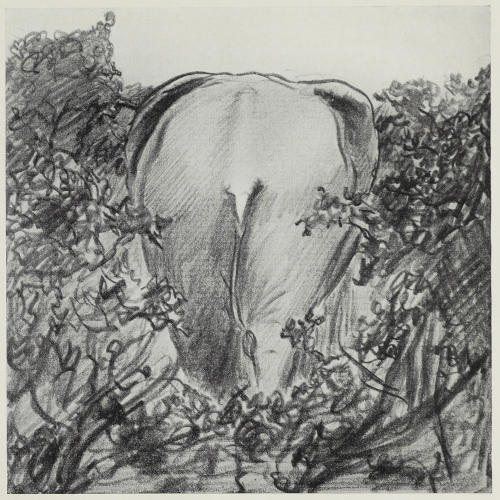
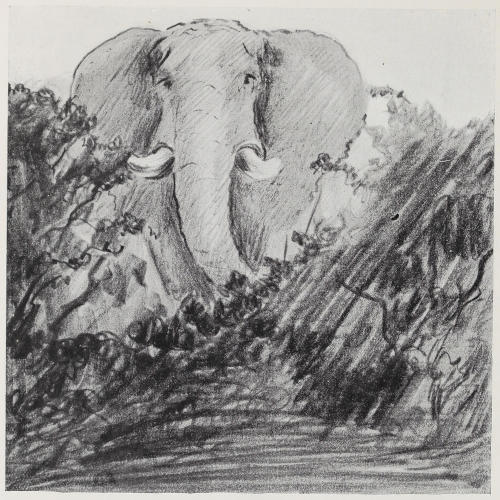
THE DEADLIEST AND MOST HUMANE METHOD OF KILLING
THE AFRICAN ELEPHANT IS THE SHOT IN THE
COMPARATIVELY SMALL BRAIN CONTAINED IN HIS GIGANTIC HEAD.
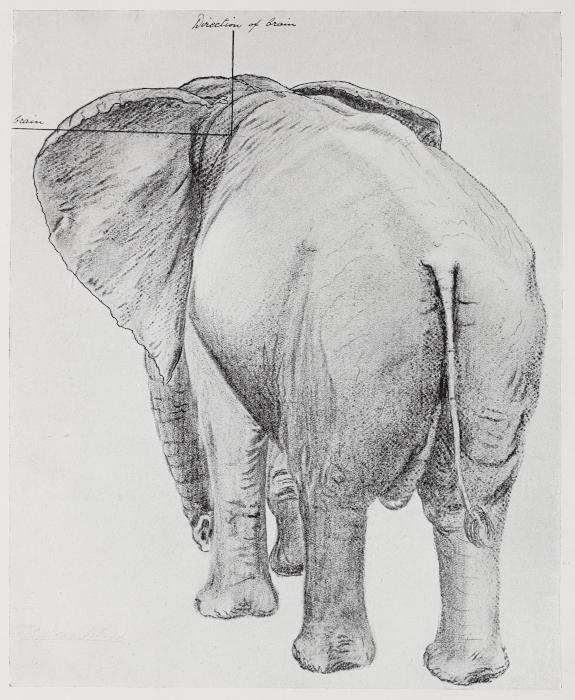
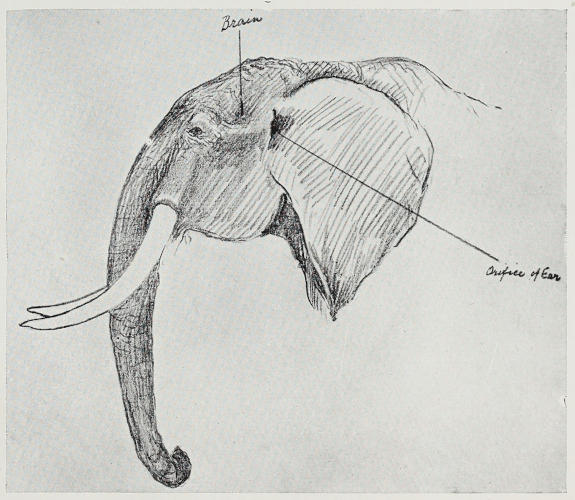
THE BRAIN SHOT FROM BEHIND.
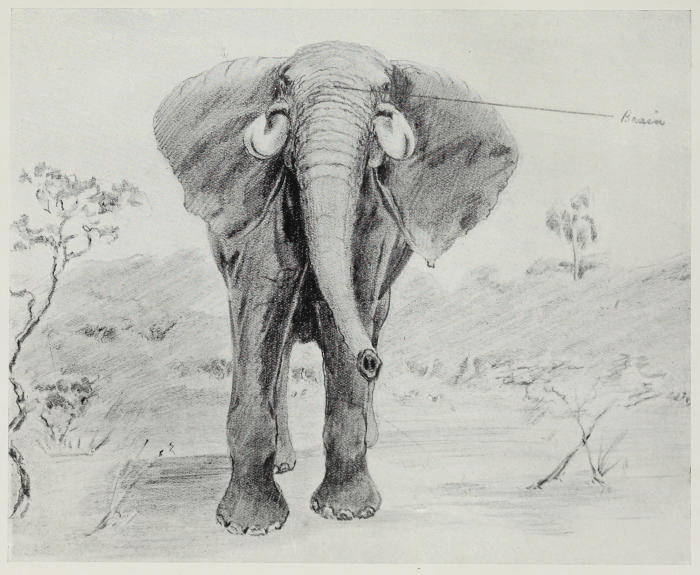
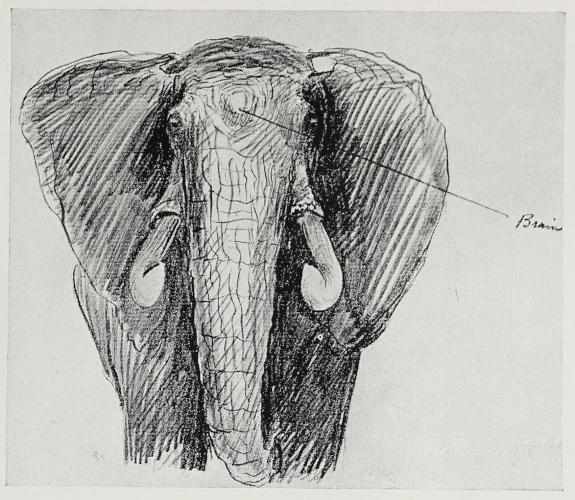
THE POSITION OF THE BRAIN WHEN THE HEAD IS VIEWED
FROM THE FRONT.
LOCATING THE BRAIN WITH THE SIDE OF THE HEAD
TO THE SPORTSMAN.
THE ELEPHANT, AFTER THE BRAIN SHOT, DIES QUIETLY
AND THE OTHERS DO NOT TAKE ALARM.
The greatest disadvantage the brain shot has is the difficulty of
locating the comparatively small brain in the enormous head. The
best way is, of course, to kill an elephant by the heart shot and very
carefully to dissect the head, thereby finding out the position of the
brain in relation to the prominent points or marks on the head, such
as the eyes and ear holes. Unfortunately for this scheme, the head
is never in the same position when the animal is dead as when alive,
as an elephant hardly ever dies kneeling when a body shot has been
given him.
The experienced elephant shot can reach the brain from almost
any angle, and with the head in almost any position. But the
novice will be well advised to try the broadside shot only. Having
mastered this and studied the frontal shot, he may then try it.
When successful with the above two shots he may be able to
reach the zenith of the elephant hunter’s ambition, i.e., to kill
instantaneously any of these huge pachyderms with one tiny
nickel pencil-like bullet when moving or stationary and from
any angle.
From the point of view of danger to the hunter, should a miss
occur, an ineffective shot in the head does not appear to have the
enraging effect a body shot elsewhere than in the vitals sometimes
has. Should the bullet miss the brain, but still pass sufficiently close
to it to stun the animal, he will drop to every appearance dead. If
no convulsive jerking of the limbs is noticed he is only stunned, and
should be given another shot, as otherwise he will soon get up and
make off as if nothing had touched him.
III THE BODY SHOT AT ELEPHANT
Although the brain shot is speedier in result and more
humane if bungled than the body shot, yet the latter is not
to be despised. Many hunters employ no other. These
will generally be found to be adherents to the “Big Bore” school.
The heart and lungs of an elephant present, together with the huge
arteries immediately adjacent, a large enough target for anyone,
provided his or her nerves are sufficiently controlled to allow of the
rifle being aimed at the correct spot. If this is not the case, and
the whole animal is treated as the target, to be hit anywhere, then
the result will be flight or a charge on the part of the elephant.
Should the latter occur in thick stuff or high grass—12 ft. or 14 ft.—the
novice will have a very unpleasant time indeed. An angry bull
elephant is a magnificent sight, but an extremely difficult animal
to deal with, even for the practised shot. For one thing, he is
generally end on and the head is at a high angle and never still. If
the novice comes through the encounter undamaged he will either
leave elephants severely alone for the rest of his life or he will be
extremely careful where he puts his bullet next time.
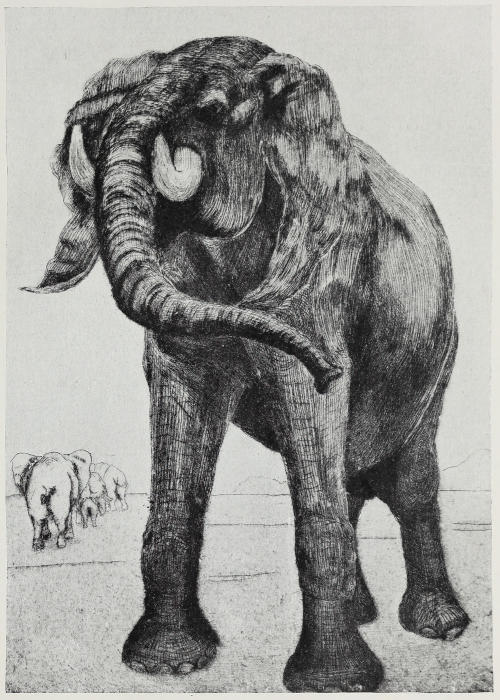
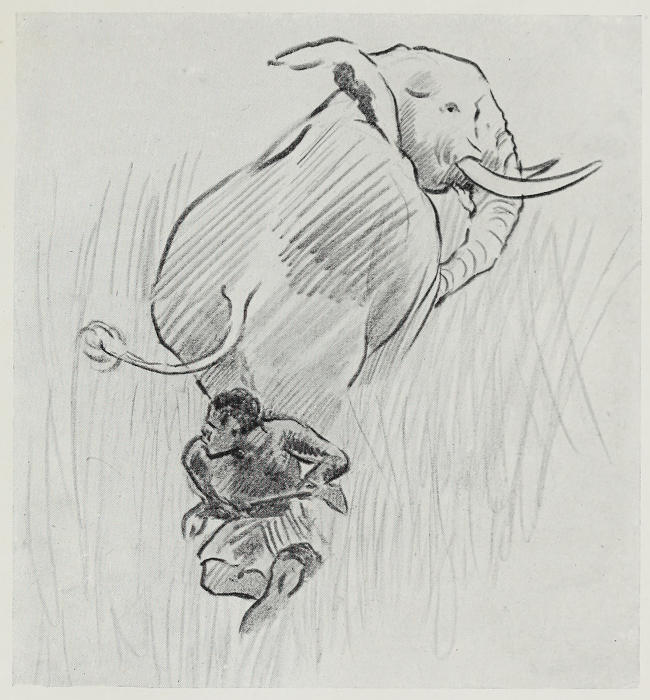
THE ANGRY BULL.
A magnificent sight but extremely difficult to
deal with.
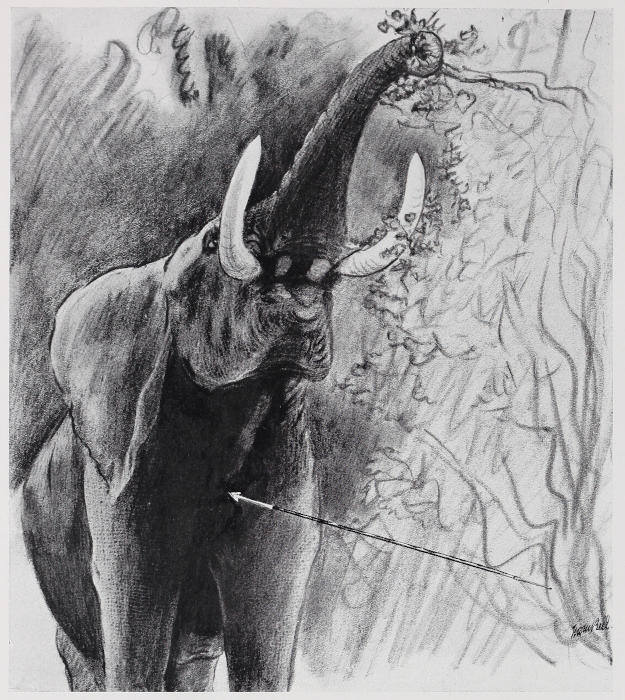
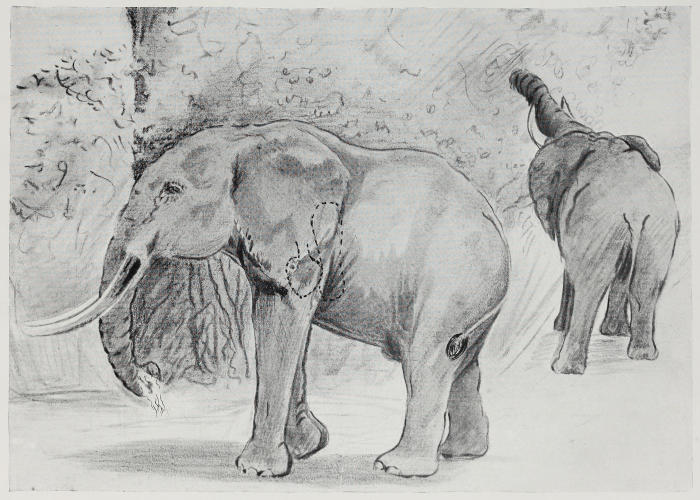
1.—WHERE THE WINDPIPE ENTERS THE BODY IS THE SPOT TO HIT
WHEN THE ANIMAL IS IN THIS POSITION.
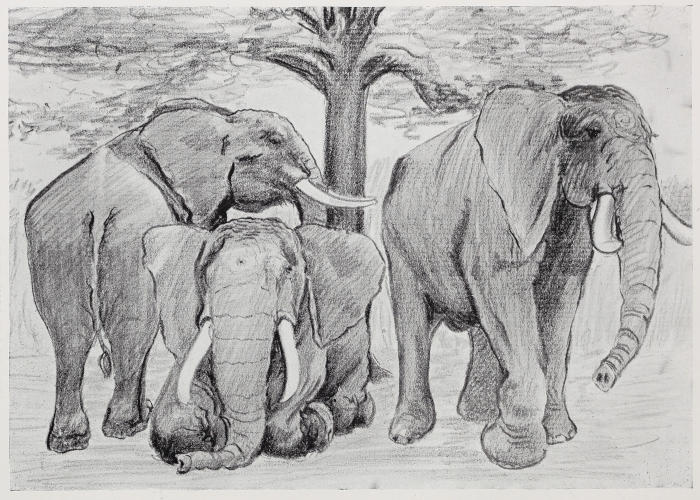
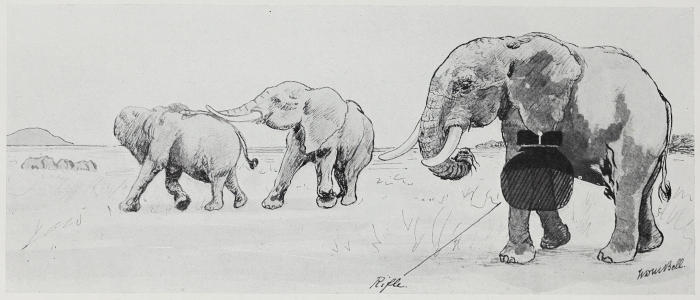
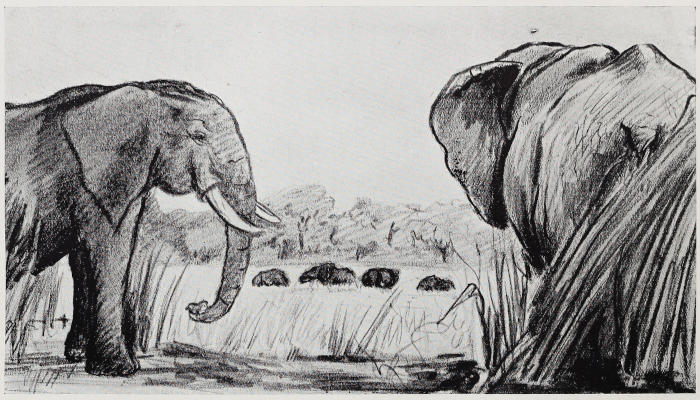
2.—ELEPHANT IN THE COUNTRY MOST SUITED TO THE BODY SHOT.
Even here, on an open grassy plain, if the hunter can
get within thirty or forty yards, the brain shot is to be preferred.
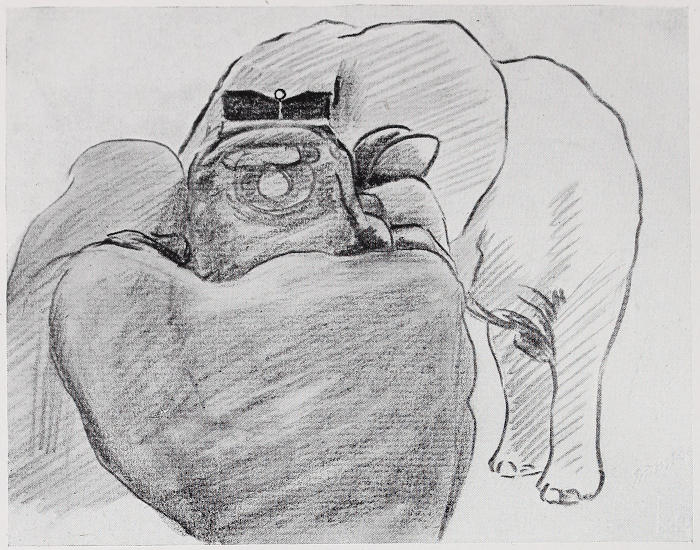
3.—WITH ONE EYE SHUT.
The shaded portion represents the hands holding the
rifle.
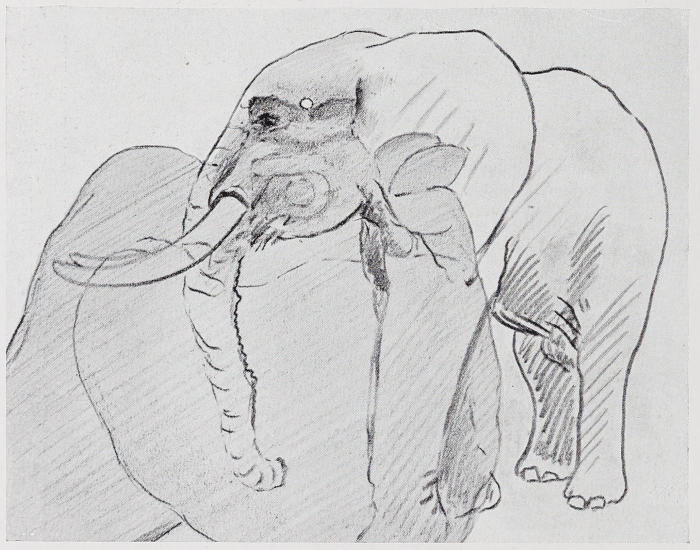
4.—WITH BOTH EYES OPEN.
The whole of the head is visible through the hands
and rifle.
THE DOTTED LINES SHOW THE POSITION OF THE HEART AND LUNGS.
WITH THE HERD IN THE PAIRING SEASON.
The natural inclination of most men is to fire and fire quickly,
straight at the beast, anywhere. This must be resisted at all costs.
If you can force yourself to wait until you have counted ten slowly,
the animal is yours. The mere act of asserting your mentality gives
such ascendency to your powers of judgment and such confidence
that you will be surprised to find yourself coolly waiting for a better
chance than the one you were quite prepared to take a few seconds
before. When you are in this state of mind, try and get to a range
of about thirty yards at right angles to the fore and aft line of the
animal. Now see if the fore leg is clearly visible for the greater
part. If it is and is fairly upright you may use its centre line as
your direction. A third of the distance from the brisket to the top
of the back is the elevation. If struck there or thereabouts either
the top of the heart or the lungs or some of the arteries will be
pierced and the animal cannot live, even when the bullet used is as
small as a ·256. He may run fifteen or twenty yards, subside into a
walk for another forty or fifty yards, stand about for some time and
then subside. This is a pierced artery. He may rush away for
thirty to sixty yards at a great pace and fall in his stride. This is a
heart shot. Or he may rush off spouting bright red blood from
his trunk in great quantities. This is a shot in the lungs.
If you have missed the deadly area and are high, you may have
touched the spinal column. But it is so massive at this spot in a
large elephant that it will rarely be broken, so that even when he
comes down he will soon recover and be up and off. Too far forward
you may get the point of the shoulder and your bullet may have so
weakened the bone that when he starts off it may break. An
elephant can neither trot nor gallop, but can only pace, therefore
one broken leg anchors him. It is true that he may just stagger
along for a few yards by substituting his tusks as a support in place
of the broken leg. In a case of this sort you will naturally dispatch
him as quickly as possible.
If your bullet has gone too far back and got into the stomach
you may be in for a lively time, as nothing seems to anger them
more than a shot so placed. If he comes for you meaning business,
no instructions would help you, simply because you wouldn’t have
time to think of them. Hit him hard quickly and as often as you
can, about a line between the eyes, or in the throat when his head is
up, and see what happens. Never turn your back to him. While
you can see him you know where he is. And besides, you cannot
run in thick stuff without falling. Always stand still and shoot
whichever animal threatens you most is what I have found to be the
best plan.
Should you come upon a good bull in a position such as is shown
in Fig. 1, you may kill him with a shot where the windpipe finally
enters the chest as indicated by the spear. For some reason or
other this is not an easy shot. It may be because the spot is nearly
always in deep shadow. Personally I would wait until he lowered
his head and gave me a chance at his brain. A hunting companion
of mine once shot an elephant in the brain while in a position such
as shown in Fig. 1. The bullet had entered through the top of the
palate, showing that he must have been almost under the animal’s
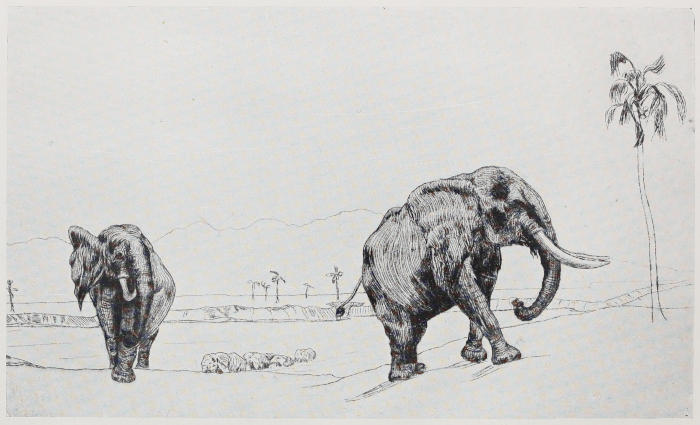
head when he fired. In Fig. 2 we have elephant in country most
suitable for the body shot, that is, open, short grassy plains. The
mature bull on the right is the first choice. Observe his massive
head, short but heavy tusks. He is not old, but his teeth will weigh
well. The second choice is the one on the left which is swinging
his ears. Our friend in the middle which is philandering with the
heavy-looking cow should be spared. Observe how his teeth taper
away to nothing. They would scarcely scale 30 lb. each.
In Fig. 3 I have tried to show what happens when you aim your
rifle with one eye closed at an elephant’s brain. Everything below
the head is obliterated with this form of backsight. This makes it
much more difficult to judge correctly the position of the brain, as
the sight cuts out one or both of the “leading marks,” i.e., the eye
and the earhole. The shaded portion represents the hands holding
the rifle.
Fig. 4 is meant to show what happens when the same sight is
being taken at the same elephant but with both eyes open. Owing
to the left eye seeing the whole image—as its view of it is not
obstructed by the hands—the whole of the elephant’s head appears
visible through the hands and rifle. The advantage is obvious.
Anyone can do it who will take the trouble to practise.
Finally, I would like to warn anyone who may be going out for
his elephant for the first time to beware that the native gun-bearer
does not rush him into firing too soon. They have not our medical
knowledge which teaches us that the brain, heart and lungs are the
best places to hit. They would hit them anywhere and trust to
“medicine” to do the rest. I have been solemnly assured by native
elephant hunters that it is not the bullet which causes the animal’s
death, but the fire from the powder which enters the hole made by
the bullet.
IV AFRICAN “MEDICINE” OR WITCHCRAFT AND ITS BEARING ON SPORT
The ruling factor in the pagan African’s life is witchcraft,
generally called throughout the continent “medicine.” All
his doings are ruled by it. No venture can be undertaken
without it. Should he be going into the bush on some trivial project
he will pick up a stone and deposit it on what has through years
become a huge pile. This is to propitiate some spirit. But this
apparently does not fully ensure the success of the expedition, for
should a certain species of bird call on the wrong side of the road the
whole affair is off and he returns to his village to wait until another
day when the omens are good.
In illness he recognises no natural laws; all is ascribed to medicine
on the part of some enemy. Should his wife fail to produce
the yearly baby, someone is making medicine against him through
her. Hunting or raiding ventures are never launched without
weeks of medicine making. The regular practitioners of this medicine
are called “medicine men” or witch doctors. Their power is
enormous and is hardly fully realised even by the European administrations,
although several African penal codes now contain legislative
efforts to curtail the practice of the evil eye and the black
arts. These medicine men have always appeared to me to be
extremely shrewd and cunning men who yet really believed in their
powers. While all goes well their lot is an enviable one. Gifts of
food are showered upon them. I suspect that they secretly eat the
fowls and goats which are brought as sacrifices to propitiate the
spirits: at any rate, these seem to disappear in a mysterious manner.
Beer and women are theirs for the asking as long as all goes well.
But, should the medicine man have a run of ill luck in his practice
and be not too firmly established, he sometimes comes to grief.
The most frequent cause of their downfall appears to occur in the
foretelling of rain. Supposing a dry year happens to come along,
as it so frequently does in Africa, everyone to save his crops resorts
to the medicine man. They take to him paltry presents to begin
with. No rain. They give him fowls, sheep and goats. Still
no rain. They discuss it among themselves and conclude that he
is not yet satisfied. More presents are given to him and, maybe,
he is asked why he has not yet made the rain come. Never at a
loss, he explains that there is a strong combination up against him,
a very strong one, with which he is battling day and night. If he
only had a bullock to sacrifice to such and such a spirit he might
be able to overcome the opposition. And so it goes on. Cases
are known among rich tribes where the medicine man has enriched
himself with dozens of head of cattle and women. At this stage
should rain appear all is well, and the medicine man is acclaimed
the best of fellows and the greatest of the fraternity. But should
its appearance be so tardy that the crops fail, then that medicine
man has lost his job and has to flee to some far tribe. If he be
caught he will, most probably, be stoned or clubbed to death.
To the elephant hunter the medicine man can sometimes be of
great assistance. I once consulted a medicine man about a plague
of honey-guides. These are African birds about the size of a
yellowhammer, which have the extraordinary habit of locating wild
bees’ nests and leading man to them by fluttering along in front of
him, at the same time keeping up a continuous and penetrating
twittering until the particular tree in which the nest is situated is
reached. After the native has robbed the nest of its honey, by the
aid of smoke and fire, he throws on the ground a portion—sometimes
very small—of the grub-filled comb as a reward for the bird.
My experience occurred just after the big bush fires, when
elephant are so easily tracked, their spoor standing out grey on
the blackened earth. At this season, too, the bees’ nests contain
honey and grubs. Hundreds of natives roam the bush and the
honey-guides are at their busiest. Elephants were numerous, and
for sixteen days I tracked them down and either saw or heard them
stampede, warned of our presence by honey-guides, without the
chance of a shot. Towards the end of this ghastly period my
trackers were completely discouraged. They urged me to consult
the medicine man, and I agreed to do so, thinking that at any
rate my doing so would imbue the boys with fresh hope. Arrived
at the village, in due course I visited the great man. His first
remark was that he knew that I was coming to consult him, and
that he also knew the reason of my visit. By this he thought to
impress me, I suppose, but, of course, he had heard all about the
honey-guides from my boys, although they stoutly denied it when
I asked them after the interview was over. Yes, I said, I had come
to see him about those infernal birds. And I told him he could
have all the meat of the first elephant I killed if he could bring
about that desirable end to my long hunt. He said he would fix it
up. And so he did, and the very next day, too.
In the evening of the day upon which I had my consultation I
was strolling about the village while my boys got food, prepared
for another trip in the bush. Besides these preparations I noticed
a lot of basket mending and sharpening of knives. One woman
I questioned said she was coming with us on the morrow to get
some elephant meat. I spoke to two or three others. They were
all preparing to smoke and dry large quantities of meat, and they
were all going with us. Great optimism prevailed everywhere.
Even I began to feel that the turning in the lane was in sight.
Late that night one of my trackers came to say that the medicine
man wished me to stay in camp in the morning and not to proceed
as I had intended. I asked the reason of this and he simply said
that the medicine man was finding elephant for me and that when
the sun was about so high (9 o’clock) I should hear some news.
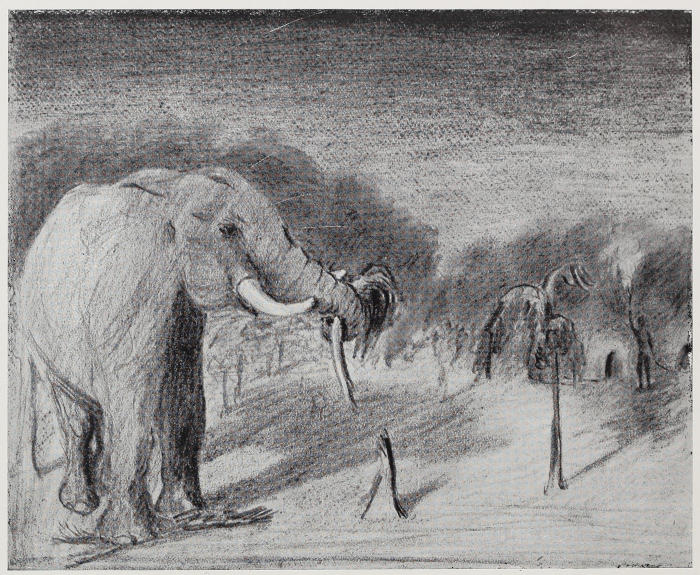
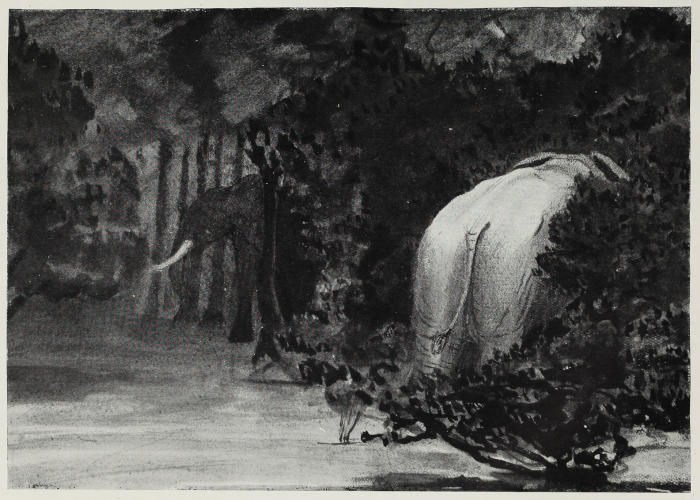
ELEPHANT SLINKING AWAY, WARNED OF THE APPROACH OF
MAN BY HONEY-GUIDES.
MEDICINE INDEED!
Soon after daybreak natives from the village began to arrive in
camp. All seemed in great spirit, and everyone came with knives,
hatchets, baskets and skin bags of food. They sat about in groups
laughing and joking among themselves. Breakfast finished, the
boys got everything ready for the march. What beat me was that
everyone—my people included—seemed certain they were going
somewhere. About 9.30 a native glistening with sweat arrived.
He had seen elephant. How many? Three! Big ones? Yes!
Hurriedly telling the chief to keep his people well in the rear, off
we set at a terrific pace straight through the bush until our guide
stopped by a tree. There he had left his companion watching the
elephants. Two or three hundred yards further on we came to
their tracks. Everywhere were the welcome signs of their having
fed as they went. But, strangest thing of all, not a single honey-guide
appeared. Off again as hard as we could go, the tracks
running on ahead clear and distinct, light grey patches on a burnt
ground with the little grey footmarks of the native ahead of us. In
an hour or so we spotted him in a tree, and as we drew near we
caught the grey glint of elephant. Still no honey-guides; blessings
on the medicine man! Wind right, bush fairly open, it only
remained to see if they were warrantable. That they were large
bulls we already knew from their tracks. Leaving the boys, I was
soon close behind the big sterns as they wandered gently along.
In a few seconds I had seen their ivory sufficiently to know that
one was really good and the other two quite shootable beasts.
Now for the brain shot. Of all thrills in the world give me the
standing within 20 yds. of good elephant, waiting for a head to
turn to send a tiny nickel bullet straight to the brain. From toenail
to top of back they were all a good 11 ft. Stepping a few
yards to the left and keeping parallel with them I saw that the way
to bag the lot was to shoot the leader first, although he was not the
biggest. Letting pass one or two chances at the middle and rearmost
beasts, I finally got a bullet straight into the leader’s brain.
The middle one turned towards the shot and the nearest turned
away from it, so that they both presented chances at their brains:
the former an easy broadside standing, the latter a behind the ear
shot and running. So hard did this one come down on his tusks
that one of them was loose in its socket and could be drawn straight
out. Almost immediately one could hear a kind of rush coming
through the bush. The chief and his people were arriving. There
seemed to be hundreds of them. And the noise and rejoicings! I
put guards on the medicine man’s beast. From first to last no
honey-guide had appeared. The reader must judge for himself
whether there was any magic in the affair or not. What I think
happened was this: knowing that the medicine man was taking
the affair in hand and that he had promised elephant, the natives
believed that elephant would be killed. Believing that, they were
willing to look industriously for them in the bush. Great numbers
of them scattered through the bush had the effect of splitting up
and scattering the honey-guides, besides increasing the chances
of finding elephant. The fact that we did not hear a single bird
must have been mere chance, I think. But you could not convince
an African of that. Natural causes and their effects have
not a place in his mind. I remember once an elephant I had hit
in the heart shook his head violently in his death throes. I was
astounded to see one of his tusks fly out and land twelve paces away.
The boys were awe-stricken when they saw what had happened.
After ten minutes’ silence they started whispering to each other
and then my gun-bearer came to speak to me. He solemnly
warned me with emotion in his voice never to go near another
elephant. If I did it would certainly kill me after what had
occurred. It was quite useless my pointing out that the discarded
tusk was badly diseased, and that it would have probably fallen out
in a short time anyhow. No! No! Bwana, it is medicine! said they.
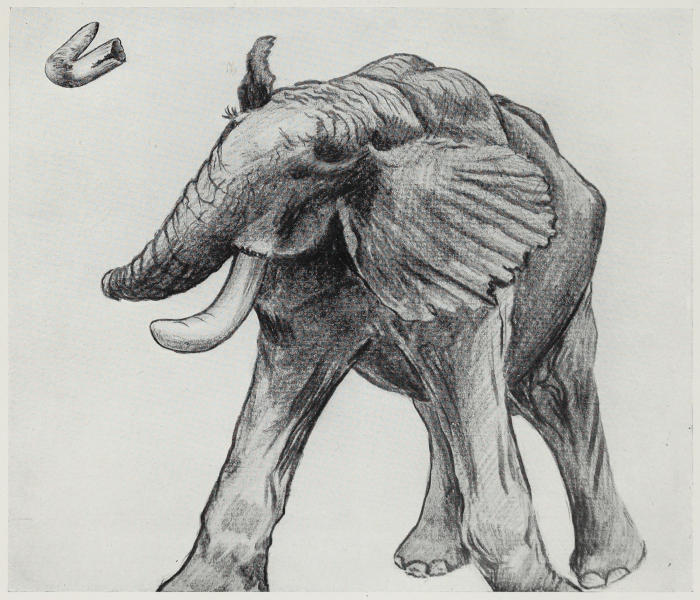
HE SHOOK HIS HEAD SO VIOLENTLY IN THE DEATH THROES
THAT A TUSK FLEW OUT AND LANDED TWELVE PACES AWAY.
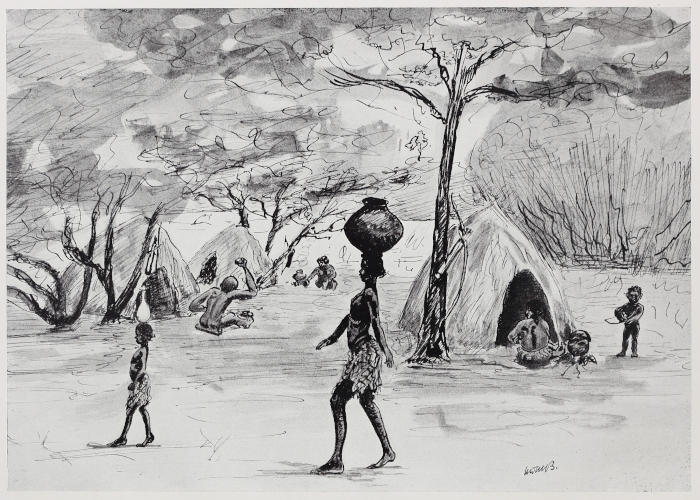
A M’BONI VILLAGE.
Perhaps twenty grass shelters are dotted here
and there under the trees.
Some few years ago I was hunting in the Wa Boni country in
British East Africa. The Wa Boni form an offshoot of the Sanya
tribe and are purely hunters, having no fixed abode and never undertaking
cultivation of any kind. They will not even own stock of
any sort, holding that such ownership leads to trouble in the form
of—in the old days—raids, and now taxation. Living entirely on
the products of the chase, honey, bush fruits and vegetables, they
are perhaps the most independent people in the world. They are
under no necessity to combine for purposes of defence, having
nothing to defend. Owning no plantations, they are independent
of droughts. The limitless bush provides everything they want.
Skins for wearing apparel, meat for eating, fibres of great strength
for making string and ropes for snares, sinew for bowstrings, strong
and tough wood for bows, clay for pottery, grass for shelter, water-tubers
for drinking when water is scarce, fruit foods of all sorts;
and all these for the gathering. No wonder they are reluctant to
give up their roving life. I was living in one of the M’Boni villages,
if village it could be called. It consisted of, perhaps, twenty
grass shelters dotted here and there under the trees. It was the
season when honey is plentiful, and there was a great deal of drinking
of honey mead going on. This is simply made by mixing
honey with water and supplying a ferment to it. There are several
ferments in the bush, but on this particular occasion the seeds of
the wild tree-calabash were being used. On the third day after
brewing the mead is very intoxicating. A native will drink great
quantities before getting really drunk, but when he does reach that
stage he appears to remain so for many hours. I was once among
a very wild and treacherous tribe where drunkenness was very
prevalent. A nude gentleman about 6 ft. 5 ins. in height strolled
into camp one day accompanied by his daughter. In his hand he
carried two beautifully polished thrusting spears. The bartering
of variously coloured beads, brass and iron wire, etc., for native
flour was going on in camp. Watching this, our friend suddenly
stooped down, snatched a handful of beads and made off with them
in a leisurely manner. Immediately there was an uproar from my
people, and a dozen boys gave chase to try to recover the stolen
goods. At the same time the affair was reported to me in my
tent. On emerging, I saw the tall black savage stalking across the
open ground with a howling mob of my porters round him. Without
turning to the right or left and without hurry he kept his two
10 ft. spears darting in all directions, and none could close with
him. Something had to be done. At first I thought of doing
something silly with a rifle, and then I had a brain-wave. I shouted
to the boys to stone him. They jumped to the idea, and in three
seconds that scoffing barbarian had his tail down and was running
for dear life, amid all roars of laughter from both sides. Unluckily
for him a rock weighing several pounds caught him on the back of
the neck and over he went. Like a pack of terriers, my lads were
on him, and presently he was borne back in triumph to camp. His
strength was so prodigious and his naked body so covered in sheep’s
fat that it took a dozen men to hold him. A public thrashing was
now administered, in order to show the tribe that that kind of game
would not do. But being quite drunk the only effect of the thrashing
was to make the victim sing and laugh. This rather spoilt the
effect of the whole thing, so I gave orders to tie him up until he was
sober. Thus he passed the night, singing the whole time. Nothing
could be done to silence him, but the camp guards kept pouring
buckets of cold water over him to try to sober him up. In spite of
this he was still supremely drunk next morning when we let him go.
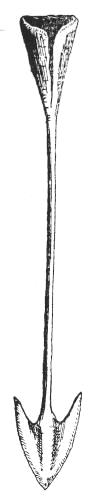
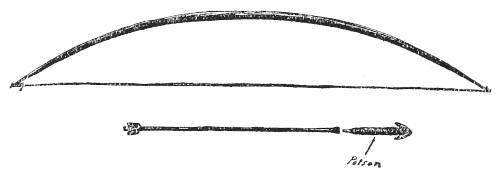
M’SANYA BOW AND POISONED ARROW.
The poisoned part is carried, separately, from
the shank, carefully wrapped in buckskin.
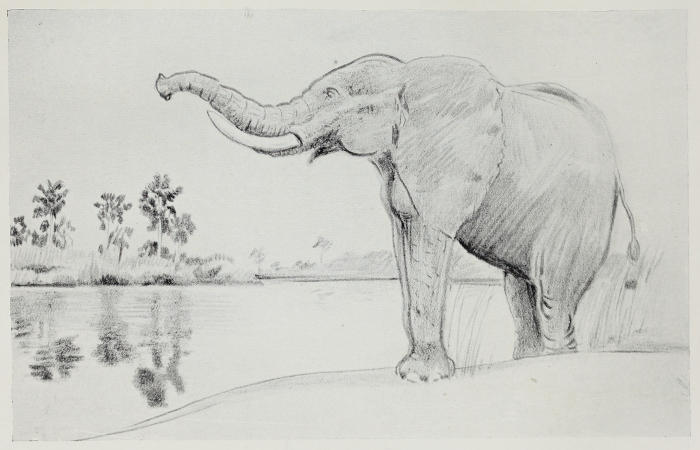
A PATRIARCH.
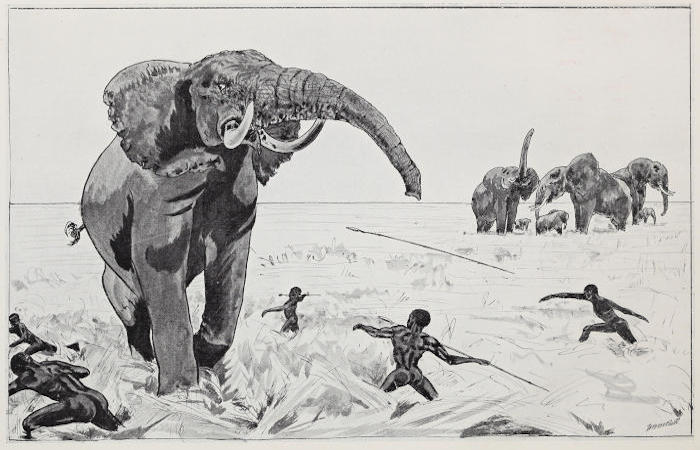
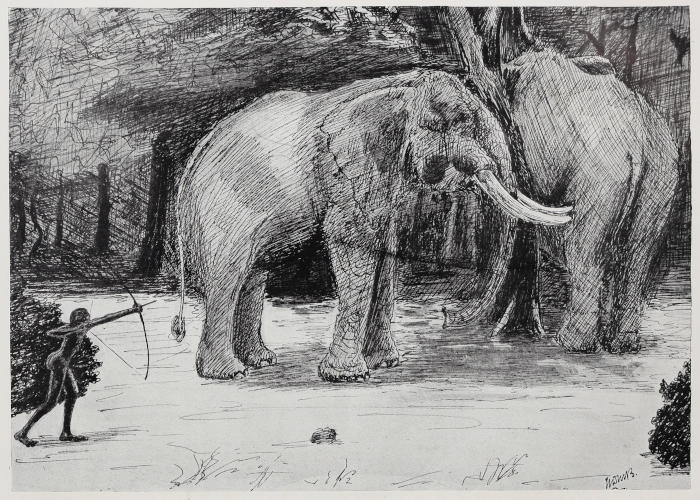
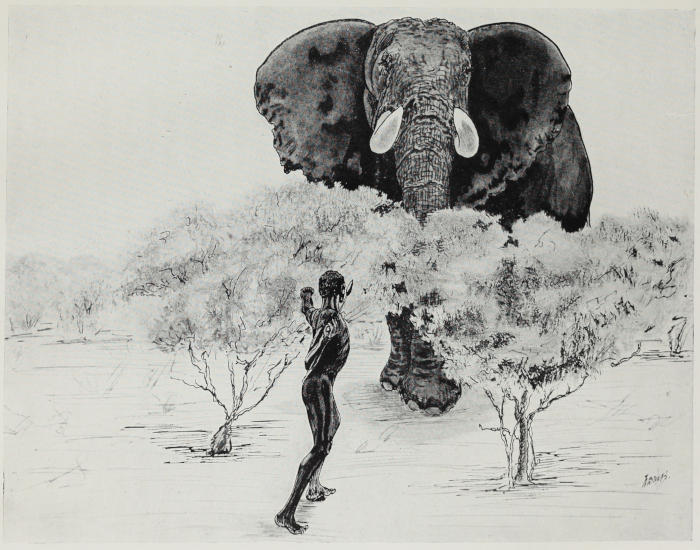
“A SMALL NATIVE BOY WAS IN THE ACT OF PINKING AN ENORMOUS ELEPHANT.”
One morning early, news came in to the Boni village that the
tracks of two large bull elephants were to be seen not far off.
Arrived at the tracks, it was evident that they had passed along
there during the night. Soon the welcome signs of their having
fed as they went were seen. Promising as these signs were, it was
not until midday that we began to come up with them. Presently
the tracks led us into a patch of dense evergreen forest, and here we
expected to find them. Leaving my companions near the edge of the
forest, I went in on the tracks as silently yet as quickly as possible.
I went quickly because the wind was tricky, and it is always better
on these occasions to get to close quarters as soon as you can,
thereby lessening the chances of your game winding you. I was
soon within hearing distance of the elephants. As I lifted my leg
cautiously over some tangle of bush I could hear a deep sigh or an
internal rumble from the dozing animals. Turning a bush the following
scene disclosed itself. A small native boy was in the act of
pinking an enormous elephant with his tiny reed arrow. Aiming
for the big intestine of the father beast he let drive before I could
stop him. In an instant all was uproar. The two elephants stampeded
madly through the forest, crashing everything down in front
of them, disappearing in a cloud of pollen, dust and leaves. The
formerly still and sleepy bush seemed alive with crying monkeys
and calling birds as the little boy proceeded coolly to pick up his
guinea-fowl arrow where it had fallen after failing to pierce the
elephant’s hide.
“Hullo, you little devil,” I said.
A half glance round and he was gone. The little sportsman
had been simply amusing himself. Of course, the grown men of
the Wa Boni kill elephants, but for this they use extraordinarily
heavy arrows which require immensely powerful bows to propel
them. Some of these bows require a pull of 100 lb. to get them
out to the end of the wooden arrow where the poisoned part fits
into a socket. There is some peculiar knack in this, as no other
native I have seen—and certainly no white man—can get them
more than half way, and yet these natives are very small and slight.
V KARAMOJO — I.—Into the Unknown — II.—Ivory and the Raiders — III.—The Coming of Pyjalé
My earliest recollection of myself is that of a child whose
sole ambition in life was to hunt. At a very early age I
conceived the idea of hunting the American bison. With
this end in view I gathered together a few oddments, such as the
barrels of a double-barrelled pistol, a clasp knife, a few bits of
string and all the money—chiefly pennies—that I could lay hands
on. This bison-hunting expedition was prematurely cut short at
the Port of Glasgow by the critical state of its finances, for after
buying a pork pie for twopence its treasury was found to be almost
empty. This was a sad blow, and it was while thinking it over on a
doorstep that a kindly policeman instituted proceedings which
resulted in the lost and crestfallen child being restored to his family.
But the growth of years and the acquirement of the art of reading—by
which I discovered that bison no longer existed in America—my
ambition became fixed on becoming an elephant hunter. The
reading of Gordon Cumming’s books on Africa finished the business.
An elephant hunter I determined to become; this idea never
left me. Finally, after all kinds of vicissitudes I arrived in Africa
and heard of a wonderful new and unexplored country called
Karamojo. Elephants were reported by the black traders to be
very numerous with enormous tusks, and there was no sort of
administration to hamper the hunter with restrictions and game
laws. Above all there appeared to be no other person hunting
elephants in this Eldorado except the natives, and they had no
firearms. My informants told me that the starting point for all
safaris (caravans) was Mumias, a native town and Government Post
at the foot of Mount Elgon, which formed the last outpost of civilisation
for a traveller proceeding North.
At the time of which I write Mumias was a town of some importance.
It was the base for all trading expeditions to the Lake
Rudolph basin, Turkana, Dabossa and the Southern Abyssinia
country. In the first few years of the trade in ivory this commodity
was obtained for the most trifling sums; for instance, a tusk
worth £50 or £60 could be bought for two or three shillings’ worth
of beads or iron wire. As time went on and more traders flocked
to Karamojo to share in the huge profits of the ivory trade, competition
became keener. Prices rose higher and higher. Where
once beads and iron wire sufficed to buy a tusk, now a cow must be
paid. Traders were obliged to go further and further afield to find
new territory until they came in violent contact with raiding
parties of Abyssinians away in the far North.
When most of the dead ivory in the country had been traded
off the only remaining source was the yearly crop of tusks from
the elephants snared and killed by the native Karamojans. For
these comparatively few tusks competition became so keen and
prices so high that there was no longer any profit when as much
as eight or ten cows had to be paid for a large tusk, and the cows
bought down at the base for spot cash and at prices of from £2 to
£5 each. Hence arose the idea in the brains of two or three of
the bolder spirits among the traders to take by force that which
they could no longer afford to buy. Instead of traders they became
raiders. In order to ensure success to a raid an alliance would be
made with some tribe which was already about equal in strength
to its neighbours through centuries of intertribal warfare. The
addition of three or four hundred guns to the tribe’s five or six
thousand spear-men rendered the result of this raid by the combined
forces almost beyond doubt, and moreover, conferred upon
the raiders such complete domination of the situation that they
were able to search out and capture the young girls, the acquisition
of which is the great aim and object of all activity in the Mohammedan
mind.
Complete and magnificent success attending the first raiding
venture the whole country changed magically. The hitherto more
or less peaceful looking trading camps gave place to huge armed
Bomas surrounded by high thorn fences. Everyone—trader or
native—went about armed to the teeth. Footsore or sick travellers
from caravans disappeared entirely, or their remains were found
by the roadside. Native women and cattle were heavily guarded,
for no man trusted a stranger.
Into this country of suspicion and brooding violence I was
about to venture. As soon as my intention became known among
the traders at Mumias I encountered on every side a firm barrage
of lies and dissuasion of every sort. The buying of pack donkeys
was made impossible. Guides were unobtainable. Information
about the country north of Turkwell was either distorted and false
or entirely withheld. I found that no Mohammedan boy would
engage with me. The reason for all this apparently malicious
obstruction on the part of the trading community was not at the
time known to me, but it soon became clear when I had crossed
the Turkwell and found that the peaceful, polite and prosperous
looking trader of Mumias became the merciless and bloody Dacoit
as soon as he had crossed that river and was no longer under European
control. Numbering among them, as they did, some pretty
notorious ex-slavers, they knew how unexpectedly far the arm of
the law could sometimes reach and they no doubt foresaw that
nothing but trouble would arise from my visit to the territory they
had come to look upon as theirs by right of discovery. It surprises
me now, when I think of how much they had at stake, that they
resorted to no more stringent methods than those related above to
prevent my entry into Karamojo. As it was I soon got together
some bullocks and some pagan boys. The bullocks I half trained
to carry packs and the Government Agent very kindly arranged
that I should have eight Snider rifles with which to defend myself,
and to instil confidence among my Baganda and Wanyamwere and
Kavirondo boys. The Sniders looked well and no one knew except
myself that the ammunition for them was all bad. And then I
had my personal rifles, at that time a ·303 Lee-Enfield, a ·275
Rigby-Mauser and a double ·450-·400, besides a Mauser pistol which
could be used as a carbine and which soon acquired the name of
“Bom-Bom” and a reputation for itself equal to a hundred
ordinary rifles.
While searching through some boxes of loose ammunition in
the store at Mumias in the hope of finding at least a few good rounds
for my Snider carbines I picked up a Martini-Henry cartridge, and
while looking at its base it suddenly struck me that possibly it could
be fired from a Snider. And so it proved to be. The base being
·577 calibre fitted perfectly, but the bullet, being only ·450 bore,
was scarcely what you might call a good fit for a ·577 barrel, and
there was, of course, no accuracy to the thing at all. But it went
off with a bang and the propensity of its bullet to fly off at the most
disconcerting angles after rattling through the barrel from side to
side seemed just to suit the style of aiming adopted by my eight
askaris (soldiers), for on several occasions jackal and hyena were
laid low while prowling round the camp at night.
Bright and early next morning my little safari began to get
itself ready for the voyage into the Unknown. The loads were
got out and lined up. First of all an askari, with a Snider rifle
very proud in a hide belt with five Martini cartridges gleaming
yellow in it. He had carefully polished them with sand for the
occasion. Likewise the barrel of the old Snider showed signs of
much rubbing, and a piece of fat from the tail of a sheep dangled
by a short string from the hammer. Then my chop-boxes, and
camp gear borne by porters, followed by my boy Suede and Suliemani,
the cook, of cannibal parentage be it whispered. As usual, all
the small loads seemed to be jauntily and lightly perched on the
massive heads and necks of the biggest porters, while the big loads
looked doubly big in comparison to the spindly shanks which appeared
below them. One enormous porter in particular drew my
attention. He was capering about in the most fantastic manner
with a large box on his head. From the rattle which proceeded
from the box I perceived that this was the cook’s mate, and as I
possessed only a few aluminium cooking pots, his was perhaps the
lightest load of any, and I vowed that he should have a good heavy
tusk to carry as soon as possible. This I was enabled to do soon
after passing the Turkwell, and this splendid head-carrier took
entire charge of a tusk weighing 123 lb., carrying it with pride for
several hundred weary miles on a daily ration of 1 lb. of mtama
grain and unlimited buck meat.
Usually when a safari started from Mumias for the “Barra”—as
the bush or wilderness is called—the townsfolk would turn
out with drums and horns to give them a send off, but in our case
we departed without any demonstration of that sort. We passed
through almost deserted and silent streets, and we struck out for
the Turkwell, the trail skirting the base of Elgon for six days, as
we travelled slowly, being heavily laden. I was able to find and
shoot enough haartebeeste and oribi to keep the safari in meat, and
after two or three days’ march the boys became better and better
and the bullocks more and more docile. I purposely made the
marches more easy at first in order to avoid sore backs, and it was
easy to do so, as there were good streams of water crossing our path
every few miles.
On the seventh day we reached the Turkwell River. After
descending several hundred feet from the high plateau we crossed
by the ford and pitched camp on the opposite or north bank. The
Turkwell has its sources in the crater of Elgon and its slopes. Its
waters reach the dry, hot plains of Karamojo after a drop of about
9,000 ft. in perhaps twenty or thirty miles. In the dry season—when
it is fordable almost anywhere—it totally disappears into its
sandy river bed while still some days’ march from its goal, Lake
Rudolph. It is a queer and romantic river, for it starts in lava
14,000 ft. above sea-level, traverses bitterly cold and often snow-covered
heath land, plunges down through the dense bamboo belt,
then through dark and dripping evergreen forest to emerge on the
sandy plains of Karamojo. From this point to Rudolph its banks
are clothed with a more or less dense belt of immense flat-topped
thorn trees interspersed with thickets of every kind of thorny bush,
the haunt of rhino, buffalo and elephant. Throughout its entire
course its waters were drunk, at the time of which I write, by
immense herds of elephant during the dry season. Even after
disappearing underground, elephant and natives easily procured
water by simply making holes in the soft clean sands of its
river bed.
At that time the Turkwell formed the northern boundary of
European rule. North of it was no rule but disrule. The nearest
cultivated settlement of Karamojo natives was at Mani-Mani, some
150 miles to the north, but scattered about in the bush were many
temporary settlements of poor Karamojans who got their living by
hunting and snaring everything from elephant downwards.
Dreadful tales of murders of peaceful travellers had been related
by Swahilis, and we were careful not to let anyone straggle far from
the main body. At night my eight askaris mounted guard and
kept a huge fire going. Their vigilance was extraordinary, and
their keenness and cheerfulness, fidelity and courage of a very high
order, showing them to be born soldiers. Their shooting was
simply atrocious, in spite of practice with a ·22 I had, but notwithstanding
their inability to align and aim a rifle properly, they used
sometimes to bring off the most brilliant shots under the most
impossible conditions of shooting light, thereby showing a great
natural aptitude to point a gun and time the shot.
While we were drying out the gear that had got wet while
crossing the Turkwell two natives strolled into the camp. These
were the first Karamojans we had seen, and I was very much
interested in them. They showed great independence of bearing
as they stood about leaning on their long thrusting spears. I had
some difficulty in getting into conversation with them, although I
had an excellent interpreter. They seemed very taciturn and suspicious.
However, I got it explained to them that I had come
for one purpose only, i.e., to hunt elephant. They admitted that
there were plenty of elephant, but when I asked them to show
me where to look for them they merely asked me how I proposed
to kill them when I did see them. On showing them my rifle they
laughed, and said they had seen Swahili traders using those things
for elephants and, although they killed men well enough, they were
useless against elephant. My answer to this was that I had procured
some wonderful medicine which enabled me to kill the largest-sized
elephant with one shot, and that if they would like to see this
medicine working all they had to do was to show me where the
elephant were and that I would do the rest and they should have
as much meat as they wanted. They retorted that if my medicine
was truly sufficiently powerful to kill an elephant instantaneously,
then they could not believe that it would fail to show me their
whereabouts also. This grave fault in my medicine had to be explained,
and I could only say that I grieved heartily over the
deficiency, which I attributed to the jealousy of a medicine man
who was a rival of him who had given me the killing medicine.
This left them not altogether satisfied, but a better impression was
produced when I presented them with a quarter of buck meat,
while telling them that I killed that kind of meat every day. They
went off without holding out any hope of showing me elephant, and
I thought that I had seen the last of them. I sat until late in my
long chair by the camp fire under a brilliant sky and wonderful
moon listening to the talk of my Nzamwezi boys and wondering
how we were going to fare in the real wild land ahead of us.
An early start was made next morning and we had covered
perhaps six or seven miles when the two natives, visitors to our
camp of yesterday, came stalking along appearing to cover the
ground at a great rate without showing any hurry or fuss. I
stopped and called the interpreter and soon learned that four large
elephants had that morning passed close to their camp in the bush and
that when they left to call me the elephants could still be heard in
the vicinity. At once I was for going, but the interpreter and the
headman both cautioned me against treachery, declaring that it was
only a blind to separate us preparatory to a general massacre. This
view I thought a bit far fetched, but I ordered the safari to get
under weigh and to travel well together until they reached the
first water, where they were immediately to cut sufficient thorn
trees to completely encircle themselves in camp, to keep a good
look-out and to await my coming.
Taking my small boy and the gigantic cook’s mate—whose
feather-weight load I had transferred to the cook’s head—I hastily
put together a few necessities and hurried off with the two Karamojans
at a great pace. We soon struck off from the main trail
and headed for the Turkwell Valley. Straight through the open
thorn bush we went, the elephant hide sandals of my native guides
crunching innumerable darning-needle-sized thorns underfoot, the
following porters with their light loads at a jog trot, myself at a
fast but laboured walk, while the guides simply soaked along with
consummate ease.
Supremely undemonstrative as natives usually are, there was
yet observable a kind of suppressed excitement about their bearing,
and I noticed that whenever a certain bird called on the right hand
the leader would make a low remark to his companions with an
indescribably satisfied kind of gesture, whereas the same calling on
the left hand drew no notice from them beyond a certain increased
forward resolution and a stiff ignoring of it.
The significance of these signs were lost on me at that time, but
I was to come to learn them well in my later dealings with these
tribes. They were omens and indicated success or failure to our
hunting.
On the whole they were apparently favourable. At any rate,
the pace never slackened, and I was beginning to wish for a slowing
down. As we drew nearer the Turkwell Valley signs of
elephant became more and more numerous. Huge paths worn
perfectly smooth and with their edges cut as clear as those of garden
walks by the huge pads of the ponderous animals began to run
together, forming more deeply worn ones converging towards the
drinking places on the river. Occasionally the beautiful lesser
koodoo stood watching us or loped away, flirting its white fluffed
tail. Once we passed a rhino standing motionless with snout ever
directed towards us. A small detour round him as we did not
wish to get mixed up with his sort and on again. Halt! The little
line bunches up against the motionless natives. A distant rumble
resembling somewhat a cart crossing a wooden bridge, and after a
few seconds of silence the crash of a broken tree.
Elephant! Atome! (in Karamojo). Word the first to be
learned and the last to be forgotten of any native language. A
kind of excitement seizes us all; me most of all, the Karamojans
least. Now the boys are told to stay behind and to make no noise.
They are at liberty to climb trees if they like. I look to my ·303,
but, of course, it had been ready for hours. Noting that the wind—what
there was of it—was favourable, the natives and I go forward,
and soon we come upon the broken trees, mimosa and white
thorn, the chewed fibrous balls of sansivera, the moist patches with
froth still on them, the still steaming and unoxidised spoor, and the
huge tracks with the heavily imprinted clear-cut corrugations of a
very recently passing bunch of bull elephants. In numbers they
were five as nearly as I could estimate. Tracking them was child’s
play, and I expected to see them at any moment. It was, however,
much longer than I anticipated before we sighted their dull
grey hides. For they were travelling as well as feeding. It is
remarkable how much territory elephant cover when thus feeding
along. At first sight they seem to be so leisurely, and it is not
until one begins to keep in touch with them that their speed is
realised. Although they appear to take so few steps, each step
of their lowest gait is about 6 ft. Then, again, in this feeding
along there is always at least one of the party moving forward at
about 3½ miles per hour, although the other members may be stopping
and feeding, then catching up again by extending the stride
to 7 ft. or more.
As soon as they were in sight I got in front of the Karamojans
and ran in to about 20 yds. from the stern of the rearmost animal.
Intense excitement now had me with its usual signs, hard breathing
through the mouth, dry palate and an intense longing to shoot.
As I arrived at this close proximity I vividly remember glancing
along the grey bulging sides of the three rearmost animals, who all
happened to be in motion at the same time in single file, and remarking
a tusk of an incredible length and size sweeping out from the
grey wall. I instantly determined to try for this one first. With
extraordinary precautions against making a noise, and stoopings
and contortions of the body, all of which after-experience taught
me were totally unnecessary, I got away off at right-angles to the
file of elephants and could now grasp the fact that they were all
very large and carried superb ivory.
I was now almost light-headed with excitement, and several
times on the very verge of firing a stupid and hasty shot from my
jumping and flickering rifle. So shaky was it when I once or twice
put it to my shoulder that even in my then state of mind I saw that
no good could come of it. After a minute or two, during which I
was returning to a more normal state, the animal with the largest
tusks left the line slightly, and slowly settled into a halt beside a
mimosa bush. I got a clear glimpse at his broadside at what looked
about 20 yds., but was really 40 yds., and I fired for his heart.
With a flinch, a squirm and a roar he was soon in rapid motion
straight away, with his companions in full flight ahead of him. I
was rather surprised at this headlong flight after one shot as I had
expected the elephant here to be more unsophisticated, but hastily
concluding that the Swahili traders must have been pumping lead
into them more often than one imagined, I legged it for the cloud
of dust where the fleeting animals had disappeared. Being clad in
running shorts and light shoes, it was not long before I almost ran
slap up against a huge and motionless grey stern. Recoiling very
rapidly indeed from this awe-inspiring sight, I saw on one side of it
an enormous head and tusk which appeared to stick out at right-angles.
So drooping were the trunk and ears and so motionless
the whole appearance of what had been a few seconds ago the very
essence of power and activity that it was borne straight to even my
inexperienced mind that here was death. And so it was, for as I
stared goggle-eyed the mighty body began to sway from side to side
more and more, until with a crash it fell sideways, bearing earthwards
with it a fair sized tree. Straight past it I saw another
elephant, turned almost broadside, at about 100 yds. distance,
evidently listening and obviously on the point of flight. Running
a little forward so as to get a clear sight of the second beast, I sat
quickly down and fired carefully at the shoulder, when much the
same performance took place as in the first case, except that No. 2
came down to a slow walk after a burst of speed instead of to a
standstill as with No. 1.
Ranging rapidly alongside I quickly put him out of misery and
tore after the others which were, of course, by this time, thoroughly
alarmed and in full flight. After a mile or two of fast going I
found myself pretty well done, so I sat down and rolled myself a
cigarette of the strong black shag so commonly smoked by the
Swahilis. Presently my native guides came with every appearance
of satisfaction on their now beaming faces.
After a few minutes’ rest we retracked the elephant back to
where our two lay dead. The tusks of the first one we examined
were not long but very thick, and the other had on one side a tusk
broken some 2 ft. outside the lip, while on the other was the magnificent
tusk which had filled me with wonder earlier on. It was
almost faultless and beautifully curved. What a shame that its
companion was broken!
As we were cutting the tail off, which is always done to show
anyone finding the carcase that it has been killed and claimed, my
good fellows came up with the gear and the interpreter. Everyone,
including myself, was in high good humour, and when the
Karamojans said that their village was not far off we were more
pleased than ever, especially as the sun was sinking rapidly. After
what appeared to the natives no doubt as a short distance, but what
seemed to my sore feet and tired legs a very long one, we saw the
welcome fires of a camp and were soon sitting by one while a group
of naked savages stood looking silently at the white man and his
preparations for eating and sleeping. These were simple enough.
A kettle was soon on the fire for tea, while some strips of sun-cured
haartebeeste biltong writhed and sizzled on the embers. Meanwhile
my boys got the bed ready by first of all cutting the grass and
smoothing down the knobs of the ground while another spread grass
on it to form a mattress. Over this the canvas sheet and blankets
and with a bag of cartridges wrapped in a coat for a pillow the bed
was complete. Then two forked sticks stuck in the ground close
alongside the bed to hold the rifle and all was ready for the night.
After a hearty supper of toasted biltong and native flour porridge,
washed down with tea, I cleaned my rifle, loaded it and lay
down utterly tired out and soon dropped off to the music of hyenas’
howling. As soon as ever it was light enough to see, we left for
the dead elephant, and the way did not seem half so long in the
fresh morning air as it had appeared the evening before. We
quickly arrived, followed by all the villagers, men, women and
children, every one in high spirits at the sight of the mountains of
meat. In this country the meat of elephants is esteemed more
highly than that of any other animal, as it contains much more
fat. The Karamojan elephants are distinguished for their bodily
size, the quality and size of their ivory and for the quantity of fat
on them.
I was anxious to get the tusks out as rapidly as possible in order
to rejoin my caravan, so I divided the Karamojans into two gangs
and explained to them that no one was to touch the carcases until
the tusks were out, but that then they could have all the meat.
They set to with a will to get all the skin and flesh off the head.
It is necessary to do this so as to expose the huge bone sockets containing
the ends of the tusks. About a third of their length is so
embedded, and a very long, tedious and hard job it is to get all the
skin and gristle cut away. Nothing blunts a knife more quickly
than elephant hide, because of the sand and grit in its loose texture.
When the skull is clean on one side the neck should be cut.
This alone is a herculean task. The vertebra severed, the head is
turned over by eight or ten men, and the other side similarly
cleaned. When both sockets are ready an axe is used to chop them
away chip by chip until the tusk is free. This chopping should
always be done by an expert, as otherwise large chips off the tusk
itself are liable to be taken by the axe.
This chopping out of ivory is seldom resorted to by natives,
requiring as it does so much hard work. They prefer to leave the
sun and putrefaction to do the work for them. On the third day
after the death the upper tusk can usually be drawn without difficulty
from the socket and the underneath one on the following day.
On this particular occasion no one was at all adept at chopping
out, and it was hours before the tusks were freed. Later on my
Wanzamwezi boys became very expert indeed at this job, and
twelve of them, whose particular job it became, could handle as
many as ten bull elephants in a day provided they were not too
distant one from the other and that they had plenty of native
assistance.
While the chopping out was going on I had leisure to watch the
natives, and what struck me first was the remarkable difference
between the men and the women. The former were tall, some of
them quite 6 ft. 4 ins., slim and well made, while the latter were
distinctly short, broad, beefy and squat. The married ones wore
aprons of dressed buckskin tied round the waist by the legs of the
skin and ornamented with coloured beads sewn on with sinew
thread. The unmarried girls wore no skins at all and had merely
a short fringe of black thread attached to a string round the waist
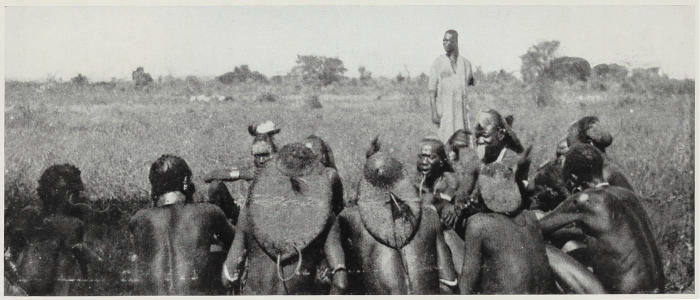
and falling down in front. As regards hair, all the women wore it
plaited and falling down all round the head and giving somewhat
the appearance of “bobbed” hair. Some of the men wore the
most extraordinary-looking periwigs made up of their own and also
their ancestors’ hair mixed with clay so as to form a kind of covering
for the top of the head and falling down the back of the neck.
In this pad of human felt were set neat little woven sockets in such
a way as to hold upright an ostrich feather in each.
The people with whom we are dealing at the moment were poor
and therefore hunters. Africans differ from us entirely on the
question of hunting; whereas among us it is the well-off who hunt,
among them it is the poor. Having nothing but a few goats and
sheep, these hunters inhabit the bush, shifting their village from
site to site according to the movements of the game.
Their system of taking game is the snare; their only weapon a
spear. The art of snaring has been brought to a unique development
by these people, for they have snares varying in size for all
animals from elephant down to dik-dik.
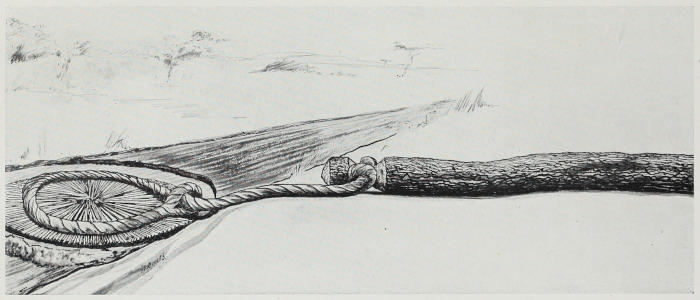
The snare for elephant is a great hawser, 4½ ins. in diameter,
of twisted antelope or giraffe hides. One may find in the same
rope haartebeeste hide, eland, zebra, rhinoceros, buffalo and giraffe
hide. If made of haartebeeste alone no less than eleven or twelve
skins are required. The skins are scraped and pounded with huge
wooden mallets for weeks by the women before being twisted or
“laid” into the rope which is to form the snare. The running
nooses at both ends are beautifully made. Besides the snare there
is a thing like a cart wheel without any hub and with scores of thin
spokes meeting in the centre where their points are sharp. The
snare is laid in the following manner:
A well frequented elephant path is chosen and somewhere near
the spot decided upon for the snare a large tree is cut. Judgment
in the choosing of this must be exercised as if it is too heavy the
snare will break, and if too light the snared elephant will travel
too far. A tree trunk which ten or twelve men can just stagger
along with seems to be the thing. This log is then brought to the
scene of action and at its smaller end a deep groove is cut all round
to take the noose at one end of the rope. After this noose has
been fitted and pulled and hammered tight—no easy matter—the
log is laid at right angles to the path with the smaller end pointing
towards it. A hole a good bit larger than an elephant’s foot is
then dug in the path itself to a depth of two feet or so. Over this
hole is fitted the cart wheel. Round the rim the large noose of
the snare is laid and the whole covered carefully over with earth to
resemble the path again. The snare is now laid, and if all goes
well some solitary old bull comes wandering along at night, places
his foot on the earth borne by the sharp spokes of the hubless wheel,
goes through as the spokes open downwards, lifts his foot and with
it the wheel bearing the noose well up the ankle, strides forward
and tightens the noose. The more he pulls the tighter draws the
noose until the log at the other end of the snare begins to move.
Now alarmed and presently angry, he soon gets rid of the cart
wheel, but as its work is already done, that does not matter. The
dragging log is now securely attached to the elephant’s leg, and
it is seldom that he gets rid of it unless it should jamb in rocks or
trees. Soon he becomes thoroughly alarmed and sets off at a great
pace, the log ploughing along behind him. Should a strong,
vigorous young bull become attached to a rather light log, he may
go twenty or thirty miles.
As soon as it becomes known to the natives that an elephant
has been caught, everyone within miles immediately seizes all his
spears and rushes to the spot where the snare had been set and
from there eagerly takes up the trail of the log. When they come
up with the somewhat exhausted animal they spear it to death.
Then every scrap of meat is shared among the village which owns
the snare, the tusks becoming the property of the man who made
and laid the snare. The spearing of an elephant, with its enormously
thick hide, is no easy matter, as the animal can still make
short active rushes. Casualties are not infrequent, and should
anyone be caught he is, as a rule, almost certain to be killed.
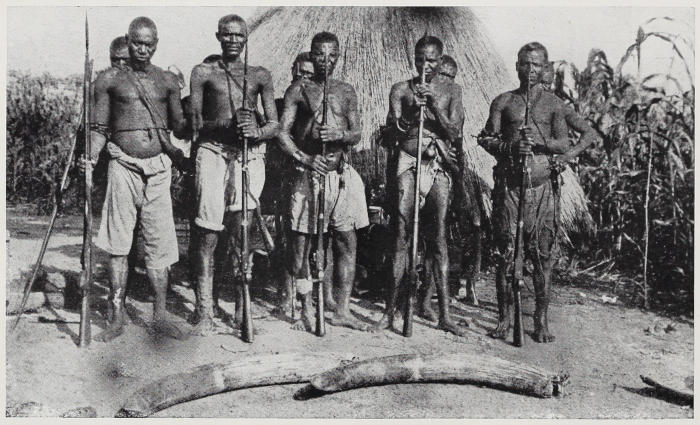
POOR KARAMOJANS, SHOWING PERIWIGS.
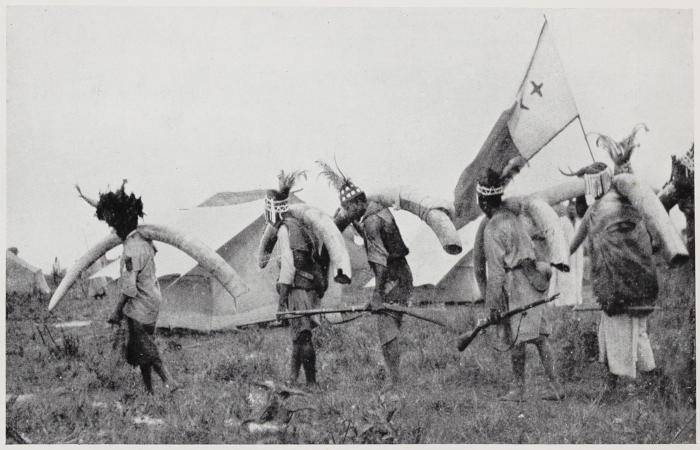
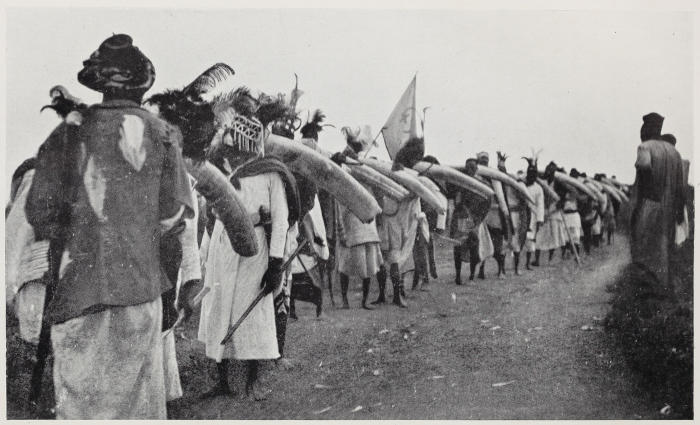
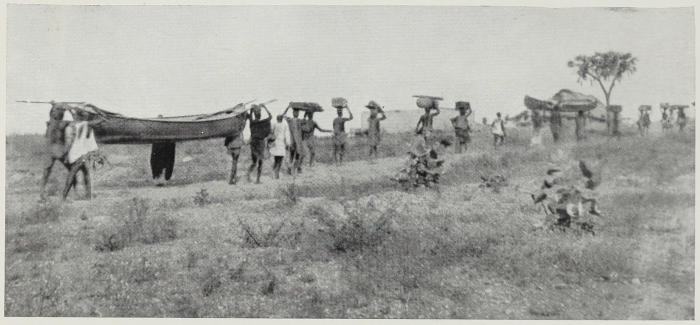
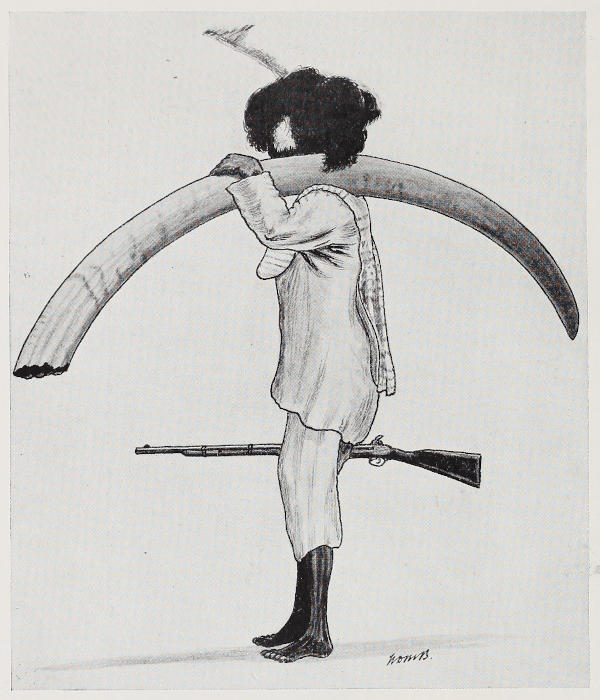
CARRYING THE IVORY.
While the tusk-getting operations were going on I took the
opportunity to examine the respective positions of the heart, lungs
and brain in relation to the conspicuous points of the animal’s
exterior, such as the eye, the ear, the line of the fore leg and the
point of the shoulder. In order to fix the position of the heart
and lungs I made some boys get the stomach and intestines out.
This was a terrific job, but we were ably assisted by the powerful
native women. The “innards” of elephant are very greatly
prized by all natives who eat elephant. The contents of the
stomach must have weighed a ton, I should think, and I saw the
intestine or sack which contains the clear pure water so readily
drunk by the hunter during the dry season when he finds himself
far from water. It is from this internal tank that the elephant can
produce water for the purpose of treating himself to a shower bath
when there is no water. He brings it up into his throat, whence
it is sucked into the trunk and then delivered where required. The
first time I saw an elephant doing this I thought he must be standing
by a pool of water from which he was drawing it. I was many
weary miles from water and the sun was scorching, and I and the
boy with me were very thirsty, so we hastened towards the elephant,
which moved on slowly through the bush. Very soon we arrived
at the spot where we had seen him at his shower bath, but no spring
or pool could I find. I asked the Karamojan about it and he then
told me, with a smile at my ignorance, that the nearest water was
at our camp and that all elephant carried water inside them and
need not replenish their stock for three days. Coming up with
the elephant I killed him and got Pyjalé (my Karamojan tracker)
to pierce its water tank, and sure enough water, perfectly clear
barring a little blood, gushed out, which we both drank greedily.
It was warm certainly, but quite tasteless and odourless and very
wholesome and grateful.
When everything had been got out, except the lungs and heart,
I had spears thrust through from the direction from which a bullet
would come. I meanwhile peered into the huge cavity formed by
the massive ribs and when a spear pierced a lung or the heart, I
immediately examined its situation and tried to commit it to my
memory. One thing I noticed was that with the animal lying on
its side the heart did not occupy the cavity which was obviously
intended for it when upright, therefore an allowance had to be
made. Another thing I was impressed with was the size of the
arteries about the heart. It extended the killing area a considerable
distance above the heart, and I have often since killed elephant
with a shot above the heart. About the situation of the brain I
also learned a lot. I thought I had its position fixed to a nicety in
my mind, but I subsequently found that all I had learned was one
of the many positions the brain does not occupy. And it was by
a series of these misplacings that I finally came to know where the
brain really does lie. It is a small object contained in a very large
head. It lies so far from the exterior that a very slight and
almost unnoticeable change of angle causes the bullet to miss
it completely.
ELEPHANT SNARE NET SET, BUT NOT YET COVERED.
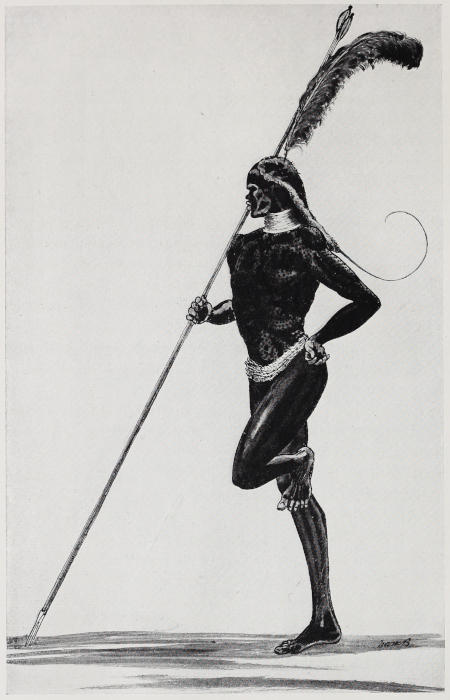
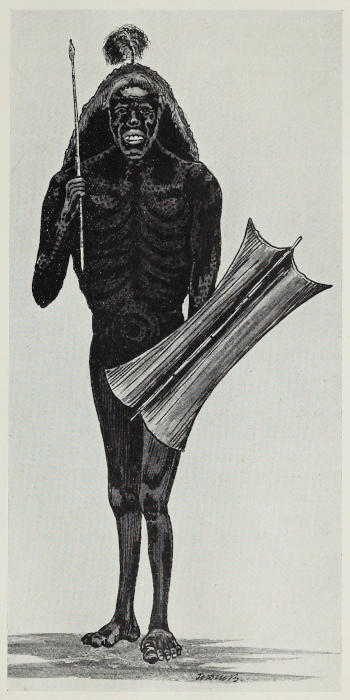
KARAMOJAN WARRIOR.
After a warrior has killed anyone he is entitled
to wear a white ostrich feather dipped blood-red, and tattoo himself on
the right side if the slain was a man and the left if a woman.
From this my first dealing with Karamojans it began to be
borne in on me that they were not so bad as the Swahili traders had
tried to make out. And my subsequent dealings with them confirmed
this impression. As far as I was concerned I had hardly
any trouble with them. But at the same time some terrible massacres
took place while I was in their country. These affairs were
the most completely successful operations I have ever heard of from
the native point of view. On three occasions massacres of well
armed trading caravans were attempted, and on two there were no
survivors among the traders and no casualties among the natives,
while on the third there was one trader survivor who escaped. I
will describe later on the methods employed by the natives so successfully,
for it was not until my Karamojan friend Pyjalé came to
me that I heard the inside of the thing. For the next few days
nothing of note happened except that we passed the remains of
two black men by the roadside—stragglers from some trading
caravan probably, judging by the bits of cloth lying about. Now
here was a state of things requiring explanation. We were now
close to Mani-Mani, the up-country base for all trading caravans.
Mani-Mani was also a populous centre for Karamojans, with whom
the traders were perforce at peace. And yet here on the roads
were two murdered men obviously belonging to the traders. On
my arrival at Mani-Mani I found the explanation. It was thus:
Among Karamojans, as among Masai, Somals and other tribes, a
young man is of no consideration, has no standing with the girls,
until he has killed someone. It does not matter how he kills him,
he may be asleep or unarmed. When he has “done someone in,”
either man or woman, other than Karamojan of course, he has the
right to tattoo the right side of his body for a man victim and the
left side for a woman. Moreover, at the dances he mounts a very
tall ostrich feather dipped blood red, and then he is looked upon
as a man. He may and does now demand anything from the unmarried
girls. He may flog them should they resist. And this
atrocious incitement to murder is the cause of death to any leg-weary
straggler from caravans. That the Swahili leaders never
made these way side murders a casus belli shows them to be what
they are, callous snivellers. That they could have put down this
custom was shown when some of my boys lost their way among
the villages. As soon as it was reported to me I at once got
together five of my askaris and raced off among the herds of Karamojan
cattle. We rounded up a huge mob and held them more
or less in one place. Spearmen rushed about, women holloaed,
and shields were produced from every hut. I was so hot and angry—thinking
that the missing boys had been murdered—that I was
eager to begin by attacking straightaway. It looked as if about
400 spear-men were assembled and I meant to give them a genuine
shaking up with my 10-shot ·303, followed by my 10-shot Mauser
pistol. I felt confident that as soon as I let loose on them and
killed one or two the others would run like rabbits. It never came
to a fight, for some old unarmed men and women came tottering
up, picking grass at every step, biting it in two and casting the bits
to the winds. This meant peace; peace at any price. Where were
my porters? They did not know, really they did not. But they
would be all right. Nobody would harm them. I told them to go
and produce every one of them unharmed or I would take and kill
all their cattle and a lot of them besides. Moreover, if any armed
man approached anywhere near to the cattle I would shoot him
dead. The cattle would remain there—between ourselves we could
not have handled them—until the porters were produced.
And produced they were, very quickly. They had merely lost
their way among the villages and had been guided back.
I did not regret having had this opportunity of showing the
natives that as far as my people were concerned we were prepared
to fight savagely for any member of the safari and not—as did the
traders—let stragglers be murdered without even a protest. The
noise of this affair travelled far and probably saved us a lot of trouble
in our after dealings.
Another reason for this apathy on the part of the Swahili leaders
was, I think, that the certainty of murder awaiting anyone on the
road prevented desertion. They were enabled by this means to
keep their boys for years without payment of wages. So long as
they could prevent the boys from reaching Mumias alive there was
no redress. Hence it was difficult for the Government representative
at Mumias to get reliable information of the internal state of
Karamojo.
On our arrival at Mani-Mani we were met by one Shundi—a
remarkable man. Kavirondo by birth, he had been captured early
in life, taken to the coast and sold as a slave. Being a man of great
force of character he had soon freed himself by turning Mohammedan.
Thence onward fortune had smiled upon him until at
last here he was, the recognised chief Tajir (rich man) of all the
traders. Having naturally the intelligence to recognise the value
of bluff and from his primitive ancestors the nerve to carry it off,
he was at this time the greatest of all the traders. Just as he had
been a leader while slave-raiding was the order of the day, so now
he led when ivory had given place to slaves as a commodity. One
other thing makes him conspicuous, at any rate, in my mind, and
that was the fact that he had owned the slave who had laid low
the elephant which bore the enormous tusks, one of which now
reposes in the South Kensington Museum. These tusks are still,
as far as I know, the record. The one which we have in London
scales 234 lb. or thereabouts. According to Shundi his slave killed
it with a muzzle-loader on the slopes of Kilimandjaro.
Shundi was accompanied by a large body of traders of all sorts.
There were Arabs, Swahilis, one or two Persians and a few African
born Baluchis, and a pretty tough lot they looked. Beside their
mean and cunning air Shundi—the great coal-black Bantu—appeared
like a lion among hyenas. What an extraordinary calm
and dignity some of these outstanding black men have. Here was
a kin spirit to Buba Gida.
They hated my appearing in their country, but did not show
it. Shundi took it in the spirit that what had to be had to be, but
some of the lesser villains were obviously nervous. They pretended
to wish me to camp inside the town, but I preferred to remain outside.
The town was of very considerable size, although the buildings
were of a temporary construction. I remarked an extraordinary
number of women about and thought that I recognised
Masai types among them. This was so, as I afterwards learnt that
Shundi alone had over eighty women, many of whom were Masai
from Kilimandjaro.
With native politeness gifts of food, etc., were offered and
presently all withdrew, intimating that they would return when I
had rested.
They must have been feeling rather uncomfortable about the
appearance in their midst of a white man, possibly an agent of
that detestable Government so troublesome about raiding. I did
not actually know at the time, but learnt afterwards that at the
very moment of my arrival in their midst they had an enormous
raid on the Turkana underway.
In the afternoon they came again and we had the usual ceremonial
palaver. Every one was strictly guarded, but they made a
distinct effort to embroil me with the natives in the hope, I suppose,
of getting me so mixed up in some shooting affair that I would
become more or less one of themselves. I refused to have anything
to do with their intrigues. I got little information regarding
elephant from these people. In fact, neither side could quite overcome
a severely suppressed but quite strong hostility to the other.
I stayed a few days at Mani-Mani as there were repairs to be
attended to and man and beast required a rest. The first sign of
trouble soon appeared, caused, I feel certain, by Swahili intrigue.
It was the dry season and all animals were watered once a day at the
wells dug in the otherwise dry river-bed. My animals were being
watered as usual. That is, water was drawn from the well in
buckets and emptied into a watertight ground sheet laid over a suitable
depression in the sand. Word was suddenly brought to me
that the natives refused to allow my animals to be watered. I
went at once to the scene and asked the natives what all the trouble
was about. There were about forty young bloods leaning against
their spears and they laughed in the most insolent manner without
giving me any answer. I turned to my herds and beckoned them
to bring up the animals. As they began to do so three of the
bloods strode over and began flogging the thirsty bullocks in the
face and driving them off. It was now or never, first impression
and so on. I seized from the nearest Karamojan his cutting-edged
club, sprang over to one of the bullock obstructors and dealt him
the hardest blow on the head I possibly could. I was fairly hefty,
in good training, and meant all I knew. To my astonishment the
native turned on me a smile instead of dropping dead or at least
stunned, while the club flew to atoms. I had hit his shock-absorbing
periwig, previously described. I might as well have hit a
Dunlop Magnum.
I must confess it was rather a set-back. However, one good
effect it had was that everyone, except myself, roared with laughter,
and then when even I began to see the humour of it I spotted a
mischievous devil calmly jabbing his spear through our priceless
waterproof ground sheet. This would not do, so I drew my Mauser
pistol. Now these natives were then at a most dangerous stage of
ignorance with regard to firearms. Their experience of them had
been gathered on raids with the Swahilis, and they all firmly held
the conviction that all you had to do to avoid being struck by the
bullet was to duck when you saw the smoke. While I was fitting
the wooden holster to the Mauser they watched me carefully. They
had probably never seen such a gun before if they even recognised
it as such. When therefore I had it fitted up and was covering
them no one moved. They were waiting, I suspect, for the smoke.
And when they heard the particularly vicious bang of the little
Mauser and saw no smoke, the laugh this time was rather on them,
and especially on the gentleman who had been so busy with his
spear and my ground sheet; for he now stood looking at a half
severed and completely spoilt spear in his hand with a ridiculous
air of surprised injury. In a few seconds the humour of this phase
struck all concerned, although the natives began to edge nervously
away. All their swagger was gone now. I had been approaching
the fellow with the damaged spear, and now suddenly set upon
him, relying upon my herds to help me. Never have I felt anything
like the sinewy strength of that greasy native; he was all but
off when the boys secured him just in time. Seeing some flourishing
of spears going on among the others, I began pasting dust
about them with the little Mauser. Seeing no smoke again, yet
getting whing whang right and left of them, they turned and
bolted. I got in another clip of ten and kept them dodging dust-bursts
for 400 or 500 yds.
On returning I put it out among the natives that our prisoner
would be released when ten goats and sheep had been paid by his
family as a fine. They were soon forthcoming.
Up till now I had been looked upon by the natives as a sort of
poor Arab. In this idea they were no doubt helped by the traders.
They had never seen white men, and they saw my mean little safari
and drew their own conclusions from appearances. But after the
affair at the water hole I was treated with much greater respect,
and with a kind of good-humoured indulgence, much as a very persistent
headstrong child might be looked upon. And eventually,
after a few more “incidents,” we became fast friends and they
would do almost anything for me or for my people. One instance
of this I may as well here record, although it happened long
afterwards.
Away down in civilised parts I had left two aged Wanyamwezi
boys in charge of my cattle ranch. This was situated a few miles
from Nandi Boma (Government Post). At the Boma post office
I had left directions for my letters to be forwarded to another Boma
on the slopes of Elgon, where I used to send every six months or so
to get them. All my letters went as directed until there occurred
a change of District Commissioner. Now one of my old pensioners
looking after the ranch had orders to report every fortnight
to the D.C. that all was well or otherwise. In pursuit of these
instructions the old boy appeared one day before the new D.C.,
who asked him who he was. He said he belonged to me, naming
me. The D.C. said he had some letters for me, and told the boy
to take them to me, thinking that I was at the ranch a few miles
off, instead of which I was actually over 600 miles away. That
dear old man took the letters without a word, went straight back
to the ranch and prepared to follow me into what was much of it
quite unknown country. He told the other boy, who was also
about sixty-five years of age, that he would have to look after everything
himself as he was going after the Bwana (master). Being a
thrifty old soul, he had by him much stock of dry smoked beef from
cows which had died. His preparations were, therefore, almost
complete. An inveterate snuff-taker, he had only to grind up a
good quantity for the journey and he was ready. Shouldering his
Snider and with the packet of letters cunningly guarded against
wet, off he set through the wilderness, steering due north. Sleeping
by night alone by his camp fire and travelling the whole of the
day, he came wandering through what would have been to anyone
else hostile tribe after hostile tribe. Countries where if I sent at
all I sent at least five guns as escort he came through without
trouble. How often he must have been looked upon by the
lecherous eyes of would-be bloods as fair game for their spears and
as means of gaining the coveted tattoo marks and the blood red
ostrich feather. But so sublimely unconscious was he of any feeling
of nervousness and so bold and confident his bearing that
nothing happened. Being old and wise, he courted the routes
which led through the most populous centres instead of dodging
along the neutral zones between tribes as a nervous man would
have done. Had he done this he would to a certainty have been
killed. Wherever he went he slept in the largest village, demanded
and got the best of everything, and eventually reached me intact.
It was a splendid effort. He walked into camp as if he had left it
five minutes before, and he still had smoked beef and snuff when
he arrived. The dear old hoarder had lived to some purpose on the
natives as he passed through. He arrived, if you please, escorted
by a number of Karamojan big-men, this dingy and, I have to say
it, very dirty old man. The letters, alas! proved to be most uninteresting
in themselves, but, nevertheless, they formed a link with
civilisation. They were chiefly bills from unscrupulous Coast merchants
being rendered for the third and fourth time although
already paid at least once.
The newspapers were, of course, very old, but produced an
extraordinary feeling of uneasiness or disquietude. Leading the
life I then was, with its freedom from financial care—money was
valueless and never handled—from responsibility—there was no
law in the land except that of force—it had rather the effect of a
sudden chill to read of strikes, famines, railway accidents, unemployment,
lawsuits, and the other thousand and one unhappinesses
usually contained in newspapers. Although I read them, every
word, including the advertisements—here again remedies for ills—I
felt distinctly perturbed for two or three days after. The happiest
literature I ever had in the bush was “Pickwick Papers,”
and the happiest newspaper the dear old Field.
From Mani-Mani we moved on to Bukora, another section of
Karamojans. I was warned by the Swahilis that Bukora was a
very bad country. The people were very rich in cattle and correspondingly
insolent. Everyone who passed through Bukora had
trouble. Either stock was stolen or porters murdered.
I cannot say that I believed all this, or perhaps I would not have
been so ready to go there. But that there was some truth in their
statements I soon found. In fact, there were moments when it
was touch and go. Looking back on it calmly I can see that
nothing but chance luck saved us. It was thus: We pushed our
way smartly right into the middle of Bukora, intending to camp
near some large village. But to our disappointment the catchments
of water were nearly dry. What remained in them was
merely mud. We were obliged therefore to move on to some wells
on the outskirts of the villages. This is always a bad place to be
attacked in. Natives are much more willing to attack people outside
than when they are right in their midst. When you are close
alongside a village and there is any question of hostilities, the people
of that particular village feel that they will probably come in for
more than their share of the trouble when it begins. They have
their goods and chattels there, their corn, cows, babies, fowls, etc.
For these reasons they are against hostilities. Another advantage
to the travellers when close to stockaded villages—as these were—is
that such a village can be rushed and then held against the rest
of the tribe.
THAT LUNATIC PYJALÉ SPEARS AN ELEPHANT AND MAKES
TROUBLE FOR EVERYONE.
However, I was young and without much thought of anything
in those days, and camp by the wells I would. We accordingly
did so. And presently the camp began to fill with apparently
friendly natives. They dropped in by twos and threes and stood
around, each man with two spears. I thought they seemed a nice
friendly, sociable crowd, and took little further heed of them.
Then comes my headman, a Swahili, to me. “Bwana, there is
no good brewing. These people mean trouble. Look around, do
you see a single woman anywhere?” I laughed and asked him
what he thought they would do. He said that at a given pre-arranged
signal they would start spearing everyone. And then it
dawned on me how absurdly easy it would be for them to do so.
When you came to look around with this thought in your mind it
became apparent that every man was being marked by several
spear-men. If he moved they also lounged about until they were
again close to him. I must say they appeared to me to act the
indifference part very well. When I had convinced myself that
something of this nature really was afoot, I naturally got close to
my shooting irons, ready to take a hand when the fun started. In
those days I always wore fifty rounds in my belt.
Now I thought that if I could only supply something sufficiently
distracting the affair might never begin. There over the plains
were plenty of game. I took my rifle and got the interpreter to
tell the Karamojans to come as I was going killing meat. They
came at once in fair numbers. They had already heard of my wonderful
rifles, and wherever I went I always had an audience eager
to see them or the Bom-bom (Mauser pistol) at work.
Hardly had we gone a few hundred yards, and while we were
still in full view of the camp, when a herd of zebra came galloping
across our front. They had been alarmed by some abnormal movement
of natives and had somehow got mixed up and lost.
They came well spaced apart and just right for my purpose. I
shot one after the other as hard as I could fire. I was using a
10 shot ·303, and when I had fired the ten shots the survivors of the
herd were too far off. I was careful not to reload in the ordinary
way, for I carried another charged magazine. Consequently the
natives thought I might have any number of shots left in this quite
new and terrifying weapon. No smoke and such a rapid fire of
death—they had never seen the like. Bing! bing! bing! bing!
bing! they kept saying to themselves, only much more rapidly
than the actual rate of fire. And the zebras, strong brutes, knocked
right down one after the other. No! this was something new.
They had better be careful about fooling around with this red man.
He was different from those red men among the Swahilis, who used
to fire great clouds of smoke and hit nothing.
After an episode of this kind one feels somehow that a complete
mental transformation has taken place. One is established right
above these, in some ways, finer but less scientific people. But
this knowledge comes to both at the same time. I now ordered
these previously truculent, now almost servile, savages to flay, cut
up and carry to camp every bit of meat and skin. When I saw
anyone sneaking a bit of fat or what-not I blackguarded him
soundly. I rushed the whole regiment back to camp loaded with
several tons of meat, many of them forgetting their spears in their
hurry. But had I ventured to bullyrag them like this before the
zebra incident I would have had a spear thrust for answer and right
quickly too.
I now began to push enquiries about elephant, but with no
great success at first. One day a Bukora boy came to camp and
while in conversation with some of my people casually told them
that he had recently returned from no man’s land, where he and
some friends of his had been looking for Kumamma. The
Kumamma were their neighbours to the west. They had
been looking for them in order to spear them, should things
be right—that meaning should the enemy be in sufficiently
small force for them to easily overcome. When the numbers are
at all equal, both sides retire smartly to the rear. This is the
normal kind of state in which these tribes live. It leads to a few
deaths certainly, but it keeps the young men fit and out of other
mischief. Every young man goes looking for blood frequently,
and as they carry no food except a few handfuls of unground millet
simply soaked in water, and as they never dare to sleep while in the
neutral zone, it acts as a kind of field training.
This youth, then, had seen no Kumamma but had seen elephant.
My boys told me this and I tried to get the lad to go with us to
hunt. He said he would come back and let me know. He did so
and brought a friend. This friend of his was a most remarkable-looking
man. Strange as it may seem, he had a most intellectual
head. He was a man of perhaps thirty-five years of age, most
beautifully made and tattooed for men victims only, I was relieved
to see. Pyjalé was his name, and now began a firm and long friendship
between this distinguished savage and myself. I cannot say
that I have ever had the same feelings for any man as I came to
have for Pyjalé. He was, I found, a thorough man, courageous,
quiet, modest, with a horror of humbug and untiring in our common
pact, the pursuit of elephant. He was with me during the greater
part of my time in Karamojo, and although surrounded by people
who clothed themselves, never would he wear a rag even. Nor
would he sleep comfortably as we did on grass and blankets. The
bare hard ground out by the camp fire with a hole dug for his hip
bone and his little wooden pillow had been good enough for him
before and was good enough now. No one poked fun at Pyjalé
for his nakedness; he was the kind who do not get fun poked
at them.
Pyjalé was game to show us elephants, but said we would have
to travel far. His intelligence was at once apparent by his saying
that we ought to take tents as the rains might come any day. He
was right, for come they did while we were hunting.
I took to Pyjalé right at the start and asked him what I should
do about the main safari. He said I could leave it where it was;
no one would interfere with it. If I liked I could leave the ivory
in one of the villages. This I gathered was equivalent to putting
one’s silver in the bank at home. And so it is, bizarre as it may
seem. You may leave anything with natives—ivory, beads, which
are money, trade goods, stock, anything—and not one thing will
they take provided you place it in their care. But if you leave
your own people to look after it they will steal it, given the chance.
Thinking that it might save trouble I put all my trade goods
and ivory in a village, and leaving the safari with plenty of rations,
I left for a few days’ hunting, taking a sufficient number of porters
to bring home any ivory we were likely to get. This was necessary
at this time as the natives did not yet follow me in hundreds
wherever I went, as they did later on.
We trekked hard for three days and came once more in sight
of the Debasien range, but on its other side. On the night of the
third day the rains burst upon us. The light calico bush tents were
hastily erected in a perfect gale and downpour. Even Pyjalé had
to shelter.
In the morning Pyjalé said we were certain to see elephant if
we could only cross a river which lay ahead of us. When we
reached its banks it was a raging torrent, red with mud and covered
with patches of white froth. There was nothing for it but to camp
and wait until the spate subsided.
While this was being done I saw a snake being carried down
by the swollen river. Then I saw another and another. Evidently
banks were being washed away somewhere.
A boy pointed to my shorts and said that a doodoo (insect) had
crawled up the inside of one of my legs. Thinking, perhaps, it
was a fly, or not thinking at all, perhaps, I slapped my leg hard with
open hand and got a most frightful sting, while a huge scorpion
dropped half crushed to the ground. But not before he had
injected quite sufficient poison into me. “Insect,” indeed! how
I cursed that boy. And then, by way of helping me, he said that
when people were stung by these big black scorpions—like mine—they
always died. He was in a frightful state. And then another
fool boy said: “Yes, no one ever recovered from that kind.” I
shouted for whisky, for you certainly could feel the poison going
through the circulation. I knew that what the boys said was bunkum,
but still I drank a lot of whisky. My leg swelled and I could
not sleep that night, but I was quite all right next day.
The river had gone down somewhat, so I proposed to cross.
No one was very eager to go across with a rope. A rope was necessary,
as some of the boys could not swim and the current was running
too strong for them to walk across the bottom under water,
carrying stones to keep them down, as they usually did.
I carried at that time a Mexican raw hide lariat and thought
that this stretched across would do nicely for the boys to haul themselves
over by. So I took one end to the other side and made it fast,
when the safari began to come over. Once the plunge had been
taken I found that more of them could swim than they had led me
to believe. Then the inevitable—when raw hide gets wet—happened
and the rope parted. As luck would have it there was a boy
about mid-stream at the instant. The slippery end slid through
his fingers and he went rapidly down-stream. His head kept going
under and reappearing I noticed, but thought that, as he had a
smile on his face each time he came up, he was another humbug
pretending to be unable to swim. His friends, who knew perfectly
well that he could not swim a yard, said, of course, not a
word. And it was not until he gushed water at the mouth instead
of air that I realised he was drowning. I ran down the bank while
another boy plunged in at the crossing place. I reached the boy
first by a second and we soon had him towing to bank. Black men
are good to save, they never seem to realise their close call and do
not clutch and try to climb out on you. While towing to the
bank I felt something on my head and put up a hand to brush it
off. Horrors, a snake! It was merely trying to save itself on anything
above water level, but I did not realise this. Whenever I
knocked it off it seemed to come again. Luckily we just then
reached the bank or in another instant I would have abandoned
my drowning porter to save myself from that beastly serpent. It
was all very silly, and the snake was nearly at its last gasp, but I
did not see the humour at the moment. Needless to say, the boy
was perfectly all right in ten minutes after vomiting up a bucket
or two of water.
While we were getting ready again for the march we heard
elephant. To my inexperienced ear the sound seemed to come
from some bush 400 yds. or 500 yds. away. But Pyjalé said, to
my astonishment, that they were a long way off and that unless
we hurried we should not see them before sundown. As the sun
then indicated about one o’clock, I thought he was wrong. But
he was not; for it was half an hour from sunset when we saw them,
still far away. I remember looking industriously about all those
miles expecting momentarily to see elephant, while Pyjalé soaked
along ahead of me without a glance aside. The only explanation
of this extraordinary sound-carrying that has ever occurred to me
is humidity of atmosphere. During the dry season the earth
becomes so hot that when the first rains fall much is evaporated in
steam and the humidity is remarkable.
Here we were face to face with such a gathering of elephant
as I had never dared to dream of even. The whole country was
black with them, and what lay beyond them one could not see as
the country was dead flat. Some of them were up to their knees
in water, and when we reached their tracks the going became very
bad. The water was so opaque with mud as to quite hide the huge
pot-holes made by the heavy animals. You were in and out the
whole time. As we drew nearer I thought that we ought to go
decently and quietly, at any rate make some pretence of stalking
them, if only out of respect to them. But no, that awful Pyjalé
rushed me, splashing and squelching right up to them. He was
awfully good, and I began to learn a lot from him. He treated
elephant with complete indifference. If he were moved at all,
and that was seldom, he would smile.
I was for treating them as dangerous animals, especially when
we trod on the heels of small bogged-down calves and their mothers
came rushing back at us in the most alarming fashion, but Pyjalé
would have none of it. Up to the big bulls would he have me go,
even if we had to go under infuriated cows. He made me kill
seven before sundown stopped the bloodshed.
With great difficulty we found a spot a little higher than the
surrounding country and fairly dry. As usual at these flood times
the little island was crawling with ants of every description. How
comes it that ants do not drown, although they cannot swim?
They appear to be covered with something which repels water.
Scorpions and all kinds of other horrors were there also. One
of the boys was bitten and made a fearful fuss all night about it.
I expected to do well on the morrow, but when it came, behold,
not an elephant in sight. Such are the surprises of elephant hunting.
Yesterday when light failed hundreds upon hundreds in sight
and now an empty wilderness.
We had not alarmed them, as I noticed that when a shot was
fired only the animals in the vicinity ran and that for a short distance
only. There were too many to stampede even had they been
familiar with firearms. And the noise was such as to drown the
crack of a ·303 almost immediately.
I asked Pyjalé what he thought about it. He said that at the
beginning of the rains elephant wandered all over the country.
You could never tell where they might be. With water and mud
and green food springing up everywhere they were under no necessity
to frequent any one district more than another. Pyjalé’s
advice was to get the ivory out and take it home, and then he would
show me a country where we were certain to get big bulls. Accordingly
the boys set about chopping out while I went for a cruise
around to make certain there was nothing about.
I saw nothing but ostrich, giraffe and great herds of common
and Topi haartebeeste. On crossing some black-cotton soil I
noticed that it clung to the boots in a very tiresome way. Each
time you lifted a foot, 10 lb. or 15 lb. of sticky mud came with it.
At this stage the ground was still dry underneath, only the top
few inches being wet. From the big lumps lying about where
antelope had passed it was obvious that they had, too, the same
trouble as I was having, i.e., mud clinging to the feet.
But on watching Pyjalé it appeared that it did not stick to
naked human feet to anything like the same extent. Pyjalé told
me, and I afterwards saw it actually done, that it was possible to
run down ostrich and the heavy antelope, such as eland, when the
ground was in this state.
Returning we found the boys well on with their chopping out.
Towards evening we started for home, being much troubled with
swollen rivers. Most of the boys walked through the rivers when
we could find a place where the current was not too strong. The
heavy tusks, of course, kept them on the bottom. But it was a
curious sight to see them calmly marching in deeper and deeper
until their heads went right under, reappearing again close to the
other bank. Of course, the distance they thus traversed was
only a few yards, but for fellows who cannot swim it was
not bad.
One camp from home (the safari) we slept near some flooded
wells. The boys took their tusks to scrub them with sand and
water, the better to make an appearance on the morrow when
we should rejoin the safari. This is always a source of joy to
Wanyamwezi, to carry ivory to the base. When allowed to do
so they will spend hours dancing and singing their way into the
camp. The women turn out, everybody makes a noise of some
kind, from blowing a reed pipe, to trumpeting on a water buck
horn or beating a drum or a tin, in fact anything so that it produces
noise.
While they were scrubbing the tusks one of these slipped from
the boy’s hands into a well. I heard of it and went to see what
could be done. To test the depth I tried one of Pyjalé’s 9 ft.
spears. No good. Then I tied another to it, but even then I
could not touch bottom. Pyjalé said the bottom was very far.
Then I looked at one of my boys squatting on the edge of the well.
He had been a coast canoe-man shark-fisher—than whom no finer
watermen exist—and knew what I meant without a word passing.
He tied his cloth between his legs and stripped his upper body.
Then jumping into the air he twisted half round and went down
head first into the very middle of the well. It seemed ages before
his head reappeared. At last it did so, but only for an instant.
Down again; apparently he had not found it the first time. After
another long wait he came up with the tusk and swimming or treading
water. Eager hands clutched the tusk and drew it out, the
boy crawled out himself. This particular tusk weighed 65 lb., the
length being almost the diameter of the well, so it had to be brought
up end on. How he did it I cannot imagine. The water was the
colour of pea-soup, and a scrubbed tusk is like a greasy pole to hold.
Of course, it would not weigh 65 lb. when submerged, but it was a
pretty good effort I thought. I know I would not have gone 20 ft.
or 30 ft. down that well for any number of tusks.
These boys have the most extraordinary lungs. I once sent
one of them down to disentangle the anchor of a motor launch,
which had got foul of something. There were about four fathoms
of chain and the boy went down this hand over hand. I only
wanted him to clear the anchor, when we would heave it up in the
ordinary way. But presently up the chain came the boy and the
anchor.
On the morrow we entered Bukora again, with fourteen fine
white tusks. We had a great reception at our camp. The natives,
too, were rather astonished at our rapid success. Pyjalé stalked
along without any show of feeling.
The boys who had stayed behind had nothing to report except
the loss of three of our sheep by theft. Now it was essential to
nip this kind of thing in the bud. I did nothing that day, merely
sending Pyjalé to his home with a handsome present. I knew he
would put it round as to the kind of people we were. Natives
always exaggerate enormously when back from a scurry in the
bush, and his account of our doings would probably have made me
blush had I heard it.
Next day when Pyjalé came with a pot of fresh cow’s milk as
a present, I asked him if he had heard anything about our sheep.
He said no. I asked him to point me out the village which had
stolen them. He said they would kill him if he did so. Therefore
he knew. I then said that he need not go with me, if only
he would indicate it. He said the village with the three tamarind
trees was where the thieves lived.
I went over quietly, as if looking for guinea-fowl, in the evening.
The village was quite close to our camp. When their stock
began to come in I signalled up some boys. We walked up deliberately
to the herds, no one taking any great notice of us. I separated
out a mob of sheep and goats and we started driving them towards
camp, but very quietly and calmly. It is wonderful how imitative
Africans are. If you are excited they at once become so. If you
are calm and deliberate, so are they.
A more dramatic thing would have been to take the cattle.
But these native cattle are not used to boys wearing clothes, as
mine did, and we found at Mani-Mani that they became excited
and difficult to handle unless they see their black naked owners
about. Pyjalé I had carefully left out of this business.
As soon as our object dawned upon the Karamojans there was
the usual commotion. Women wha! wha! wha-ed while rushing
from the huts with shields; warriors seized these and rushed with
prodigious speed directly away from us; while we pushed our two
or three hundred hostages slowly along.
Arrived at camp we just managed to squeeze them all into the
bullock boma. There were noises all round us now. The boys
were uneasy; there is always something in the alarm note when
issued by hundreds of human throats. Dark was soon on us and
we sat up by the camp fires till fairly late. Nothing happened, as
I anticipated. Discretion had won. They hated that little bom-bom
so.
What I wanted now was that they should come. I wanted to
tell them why I had taken their sheep. No one appeared, but I
consoled myself with the thought that they jolly well knew why I
had taken them.
Presently there appeared to be great signs of activity in one of
the nearer villages. Native men kept coming from all directions.
My boys were all eyes for this, to them, impending attack. I
thought they must be born fools to try anything of that sort in
broad daylight. Night was their best chance.
Pyjalé had been absent, so I hoped that he was at the meeting.
Presently he appeared. He said they had had a discussion and
had concluded not to attack us. I told him to go straight back
and invite them all to come; I wanted to be attacked. And moreover,
if my sheep were not instantly brought I would proceed to
kill the hostage sheep we held, and that then I would proceed to
hunt the thieves.
This acted like magic; I suppose they thought that as I had
known the village of the thieves, I also probably knew the actual
men themselves. Our sheep were very soon brought and the
hostages released.
I took the opportunity when the natives were there to impress
upon them that we did not want anything from them. All we
wanted was to hunt elephant in peace, but at the same time I
hinted that we could be very terrible indeed. I got some of the
older men to dry up and sit down, in a friendly way, and we had
a good talk together. I now brought out the card to which I owed
all my success in killing elephant in Karamojo. I offered a cow as
reward for information leading to my killing five or more bull
elephant. This was an unheard of reward. There a cow of breeding
age is simply priceless. Normally natives never kill or sell
she-stock of any kind and cows could only be obtained by successful
raiding. Now among Africans there are numbers of young
men who just lack the quality which brings success to its lucky
owner, just as there are in every community, and to these young
men my offer appealed tremendously. That they believed in my
promise from the very start was, I thought, a great compliment,
not only to me, but to their astuteness in perceiving that there was
a difference between white men and Swahilis.
When my offer had gone the rounds the whole country for
many miles round was scoured for elephant, with the result that I
never could have a day’s rest. Everyone was looking for elephant.
But had the reward been trade goods scarcely a soul would have
bothered about it.
The first man to come was remarkable looking enough to satisfy
anybody. A terrible looking man. A grotesquely hideous face
above a very broad and deep chest, all mounted on the spindliest of
knock-kneed legs. Chest, arms, shoulders, stomach and back
heavily tattooed, denoting much killing. By reputation a terrific
fighter, and very wealthy.
At first I thought that he was come to show me elephant. That
was his intention, he said, but first he wanted to become my blood-brother.
He said he could see that I was a kindred spirit and that
we two should be friends. He said he had no friends. How was
that? I asked. Pyjalé answered in a whisper that the lion never
made friends of jackals and hyenas. And so we became friends.
I was not going through the blood-brotherhood business, with its
eating of bits of toasted meat smeared with each other’s blood,
sawing in two of living dogs or nonsense of that kind. I took his
hand and wrung it hard, and had it explained to him that among
us that was an extraordinarily potent way of doing it. That seemed
to satisfy the old boy, for the act of shaking hands was as strange
to him as the act of eating each other’s blood is to us.
He started off then and I said: “What about those elephant?”
“Wait,” was the answer, and off he went, to return shortly with a
fat bullock. And then I found that my friend was the wealthiest
cattle owner anywhere about—a kind of multi-millionaire. I
thought to myself, well, he will not look for elephant. Nor did
he; but he had sons without number, being much married, whom
he scattered far and wide to look for them. He had arranged the
thing most perfectly. We went with food for a few days and
returned laden with ivory. Besides which we had some of the
jolliest nights in the bush.
LONGELLY-NYMUNG, THE AUTHOR’S BLOOD BROTHER.
One of the best spear-fighters and therefore
wealthy in cattle. He was an exceptional man, would accept no
gifts, but took Mr. Bell’s native name and also called his
male children by it.
THE RETURN OF THE SAFARI.
This great man being now my friend, our troubles were at an
end. Wherever we went we were followed by scores of the young
unmarried girls and one old maid—the only one I have come across
in Karamojo. She was so outstandingly above the average in good
looks, so beautifully made and so obviously still quite young, that
I often asked why she should remain a spinster. They told me
that no man would marry her because she was so beautiful. But
why should that be a bar? we white men like our wives to be beautiful.
They thought this strange, even for white men. They said
they never married very beautiful women as all men wanted them.
They also gave as another reason that these very attractive women
wanted all men. And I must say that our camp beauty gave
decided colour to this latter statement.
No sooner were we arrived back with our imposing line of beautiful
tusks than other natives clamoured to take us to elephant.
They wanted me to go there and then, but I needed a rest.
In the evening I presented my friend with a heifer, when to my
astonishment he refused it. He said he wanted nothing from his
friend. I was rather suspicious about this at first, but I need not
have been, as I subsequently found this man to be thoroughly
genuine. I am convinced that he would have given me anything.
It is a big affair in their lives, this blood-brotherhood. Apparently
we now owned everything in common. He offered me any of his
daughters in marriage, and, thank goodness, never asked me for
my rifle. From now on he followed me about like a faithful dog,
some of his young wives attending to his commissariat arrangements
wherever he was. He even took my name, which was
Longelly-nymung or Red Man. And he began now to call his young
male children, of whom he was very fond, by the same name. He
was a delightfully simple fellow at heart and as courageous as a
lion, as I had proof later.
After a few more journeys to the bush lasting from four to
ten days, I found suddenly that I had as much ivory as I could
possibly move. And this, while still on the fringe of Karamojo.
I decided to return to Mumias, sell my ivory, fit out a real good
expedition capable of moving several tons of ivory, and return to
Karamojo fitted out for several years in the bush.
VI DABOSSA
Having now the wherewithal to fit out a real good safari
from the sale of my ivory, I proceeded to discharge my
Baganda porters and to engage in their place Wanyamweze.
Bagandas being banana-eaters had shown themselves to be good lads
enough, but poor “doers” on ground millet, flour and elephant
meat. Dysentery was their trouble. Whereas Wanyamweze
seemed capable of keeping their condition indefinitely under severe
safari conditions. All my former boys had a good pay-day coming
to them, as, of course, they had been unable to spend anything while
in Karamojo. Consequently they one and all went on the burst.
A few new clothes from the Indian shops and the rest on native
beer was the rule. When drinking largely of native beer no other
food is required as the whole grain is contained in it. My two
Nandi cowherds spent hardly anything of their wages. The only
things I ever saw them buy were a fat sheep and two tins of sweet
condensed milk. They rendered down about two quarts of fat
from the tail of the sheep, poured in the contents of the milk tins,
stirred it well and drank it off.
This time bullocks were not employed, donkeys taking their
place. It was in connection with the buying of these donkeys
that a remarkable feat of foot-travelling came to my notice. A
trader wished to sell to me some donkeys—probably raided—which
he had left at Mani-Mani, about 150 miles away. He offered a
Karamojan a cow as reward for bringing them down in time for
me to buy, and the boy had them there at the end of the fourth
day. As nearly as I could ascertain he had covered 300 miles in
100 hours.
We crossed the Turkwell about 102 strong, this number not
including women and camp followers. At Mani-Mani and Bukora
some of our cows were exchanged for sheep, goats and donkeys.
A decent cow would bring sixty sheep or goats. A donkey was
the equivalent of ten sheep or goats. Having now so many mouths
to feed it was necessary to buy many donkeys. I raised our donkey
strength to 160. This meant that I could have constantly loaded
about eighty. They were chiefly employed in carrying grain to
our base camp in Dodose, sometimes from Mt. Elgon, where
banana flour could be got, over 200 miles away, or from the country
near the Nile, 150 to 200 miles distant. Throughout all this trekking,
with two donkeys to one saddle, they never had a sore back.
On our arrival at Mani-Mani we found the Swahili village almost
deserted. Everyone was out on a raid. They had reckoned that
no one in their senses would return to the wilderness so soon as I
had. They could not conceive how I had spent the proceeds of all
that ivory in so short a time. I learnt that they were out against
the Dabossans in whose country I meant to hunt. I therefore laid
out my route so as to intercept the returning raiders.
Passing through Bukora we were greeted as old friends, a very
different reception from our first. Pyjalé immediately joined up, and
after taking a few good bull elephants from the Bukora-Kumamma
neutral zone we trekked leisurely and heavily laden northwards.
At the last village of Bukora we met commotion and wailing.
The occasion was the murder of three young Bukora girls of marriageable
age at the hands of some roving band of Jiwé bloods.
These affairs were of quite common occurrence, and the natives
could never understand the disgust and abhorrence they drew from
me. I was eventually able to stop the killing of females, at least
while I was in the country.
Pitching camp late one night in the fighting zone between
Bukora and Jiwé, lions were sighted leaving the rocky hills for the
game-covered plains. Although almost dark I succeeded in killing
two within a short distance of camp. I returned and was seated
by the camp-fire when I heard alarming shouts from the direction
of the dead lions. In this kind of life something is constantly
turning up, and one soon learns to be always ready. The occurrences
are so simple as to require but simple remedies. Everything
seems to demand the presence of a rifle and just an ordinary sense
of humour to transform an imminent tragedy into African comedy.
Seizing my ·275 I rushed through the darkness towards the shouts,
and what I found was that one lion had been skinned and the other half
flayed when it had suddenly come to life again. The boys said that
as they were removing its skin it suddenly and without warning
stood up, opened its mouth and rushed at them. But what I
found was a half-skinned lion with its head alive but the rest of it
dead or paralysed. It could open its mouth and growl ferociously.
Its springing at them must have been supplied by the boys’
imaginations or to excuse their headlong flight. Some nerve must
have suffered damage in the lion’s neck, leaving the body paralysed
but the head active. One of the boys had been seated on it when
it growled, and his account of the affair in camp raised bursts of
deep-chested Nyamwezi laughter.
These camps in the wonderful African nights of the dry season
linger in my memory as the most enjoyable I have ever experienced.
Other nights have been more exciting and more exhilarating, but
also more harmful in their after-effects. Poker or flying by night,
sitting up for elephant or lion, provide quicker pulse-beats between
periods of intense boredom, but for level quiet enjoyment give me
the camp-chair by the camp-fire with a crowd of happy and contented
natives about and the prospect of good hunting in front
and the evidence of good hunting by your side. Looking back on
my safaris I can discern that they were quite exceptionally happy
little collections of human beings. For one reason, health was
simply splendid. Everyone was well and amply tented. All
slept warm and dry. Mosquitoes were rare and stomachs full.
Fun was of poor calibre, perhaps, but high animal spirits were
there to make the most of it. The boys had their women—wives
they called them. Tobacco could be traded from the natives or
bought at cost price from the safari slop-chest.
Fighting among the men was always settled in the ring and
with 4 oz. gloves provided by me. When this was found too slow—and
they sometimes pounded each other for an hour on end,
rounds being washed out—sticks were provided and the thing
brought to a head more rapidly with the letting of a little blood.
When the women bickered too persistently a ring would be formed,
permission got and the two naggers dragged in. Each would then
hitch up short her cloth about her ample hips and, after being provided
with a hippo-hide whip, at it they would go with fire almost
equal to that of the men. But with this difference. Where the
men used their heads and tried to prevent the other from injuring
them, the women waited motionless and guardless for each other’s
strokes. It was the most extraordinary form of fighting ever seen.
A. would catch B. a stinging swinger on the back and stand waiting
for B. to give her a frightful cut across the shoulders. And so
on it would go—szwip! szwop!—for about ten minutes, when B.
would suddenly cast her whip on the ground and flee, A. in hot
pursuit, while shouts of laughter greeted the decision, especially
strong when either combatant lost her last shred of cloth. I must
say the women never bore malice and were always great friends
afterwards. Even during the fighting they never showed vice, for
they could as easily as not have cut the eye out of their unguarded
opponent. Yet I never saw anything approaching an injury
inflicted in these affairs.
Then in the evenings there was football. When I first introduced
this game I tried to teach them rugger. They were born
rugger players. Fast, bare-footed, hard, muscular and slippery,
they cared not at all for the ant-heaps, boulders, or thorn bushes
which littered their day’s playground. After carrying a hundredweight
all day, pitching camp, building thorn bomas for the animals
and bringing in firewood for the night, they would go to rugger until
dark. So bad were some of the injuries sustained, owing to the bad
terrain, that a new game had to be evolved more suited to the ground.
After various trials a game was settled upon which seemed to suit.
It was simply a kind of massed rush in which any number could
engage. Goals were marked out at distances one from the other to
suit the ground. Then the ball was placed at half-way and the two
opposing sides drawn up in line about 15 yds. from it. At a signal
both sides charged full tilt at each other, meeting about where the
ball was. Then the object was to get the ball by hook or by crook
to the goal. No off-side, no boundaries, no penalties, no referee
and no half-time. Darkness terminated the game. So hard was
the ground and so incessant the wear on the ball that it was seldom
one lasted a month. How they could kick it without breaking
their toes always puzzled me.
Our reputation had preceded us, and we were welcomed by the
Jiwé people. So much so that they wished for blood-brotherhood,
but I evaded it. We hunted happily in their country for some
time and learnt of an attack on their country by a Nile tribe with
numerous guns of muzzle-loading type. The Jiwé with spears
alone had not only repulsed the attackers but had massacred most
of them. Inadequate supplies of munitions had been their downfall.
The firearms which had been picked up by the Jiwé had
since been traded off to Swahilis.
While chasing elephant in the Jiwé country one day we happened
to start some ostrich running. They took the same line as
the fleeing elephant and soon overhauled them. When close up
the cock bird suddenly began the fantastic dashes here and there
usually seen in the breeding season. One of his speed efforts took
him close past a lumbering bull elephant on the outside of the little
herd. These elephants had already been severely chased and several
of their number had been killed. When, therefore, the black form
of the ostrich raced up from behind him the poor old elephant nearly
fell over with fright. His trunk shot out and his ears looked like
umbrellas turned inside out by a sudden gust. But recovering
almost instantly, he settled back to his steady fast retreat.
Our next country northwards was Dodose, where I proposed
to establish the base camp. On entering it we found it high-lying
country among steep little granite hills. We were well received
and soon became friendly. Some wonderful elephant country was
reached from Dodose, and it was here that I got my heaviest ivory.
Buffalo were also very numerous. It was beautiful hunting country,
as elephant could frequently be found, with glasses, from one of
the numerous hills.
It was now the dry season; there was, for that reason, only one
route to or from Dabossa, where the Swahili raid was on. I therefore
put a look-out post on this route to bring me news of anyone
coming south on this trail. This post consisted of four of my best
Wanyamweze boys with two natives. As soon as any sign of the
returning raiders was seen the boys were to send a native with the
news while they remained to try to keep any Swahilis until my
arrival. I had expected the raiders to have a fore-guard of some
sort and that I would have time to arrive on the scene between its
arrival and the coming of the main body. Instead of this, up
marched the whole body of raiders, cattle and captives, all in charge
of my four stalwarts. What they had told the Swahilis lay in
store for them I never learnt, but it was evidently something
dreadful, judging by the state of panic they were in. I counted
their guns and took their captives—all women—and cattle from
them, warned them that next time they would land up in prison
or be shot, and sent them packing.
After a considerable hunt in and around Dodose, it was now
time, the first rains being imminent, to be moving northwards
towards Dabossa. In entering new country for elephant it is
always best to get there when the first rains are on, as the animals
then desert their dry-season thick haunts for the open country.
“THE ELEPHANT NEARLY FELL OVER WITH FRIGHT: HIS
TRUNK SHOT OUT, HIS EARS LOOKED LIKE UMBRELLAS TURNED INSIDE OUT.”
WATCHING THE NORTHERN TRAIL FOR THE RETURNING RAIDERS.
Before approaching the inhabited part of Dabossa I knew that
it would be necessary somehow to get into communication with the
natives. They had just recently been raided and would be very
nervous and likely to attack any strangers approaching their
country. The Dabossan cattle recently taken from the raiders were
therefore placed in the charge of some of the Dodose notables, while
I and a good little safari headed northwards, taking with us all the
captive women.
When still about forty miles from Dabossa it became evident
from signs that Dabossans were about. We therefore camped by
water and built a strong thorn boma. Everyone was warned not
to leave the boma at night, but one of my personal boys—a brainless
Kavirondo—thinking perhaps that orders were not meant for
him, broke camp and was promptly speared. His cries effectually
roused the camp, but the extent of his hurt bore little resemblance
to the volume of his noise. He had a nice little spear thrust in a
tender spot.
The boy’s misfortune was promptly turned to account, for,
after stilling his cries, we got the Dabossan captives to shout into
the night all our news. Our reason for being there, our intentions,
how we had their cattle ready to return to their owners—so far had
the narrative got when first one voice from the dark and then others
began asking for news of such and such a cow or heifer, so-and-so’s
bull or bullock. Later women or girl captives were asked after.
Eventually men appeared and were persuaded to come to camp.
Relations became friendly almost at once. At daybreak it was
arranged for some of the natives to go at once to Dabossa and
spread the news, while others accompanied some of my boys back
to Dodose in order to identify their cattle. This was thought necessary
as we did not know the cattle from any others, and also because
it was almost certain that the Dodose notables would try to palm off
their duds in place of the good Dabossan animals. Meanwhile I
remained hunting the surrounding country.
In a few days there arrived a runner from Dodose with the news
that my Dodose notables had held a meeting and, courage brewed
by numbers and beer, had flatly refused to give up the Dabossan
cattle left in their charge. Not knowing my native gentlemen
quite as well as I ought to have, and that courage so rapidly got was
as rapidly lost, I was on the point of rushing back to Dodose when
another runner arrived saying that all was well and that notable
after notable had singly and surreptitiously returned the full tally
of cattle left with him. I was relieved to hear this, as these constant
native palavers were taking up a great deal of my hunting
time.
The cattle soon arrived, drank up our small pool of water, and
we pushed off all together for Dabossa. The captive women were
now, of course, quite free to go or stay and, without exception, they
remained with us in idleness until removed by their men folk on our
arrival in Dabossa. Had I allowed it, most of them would have
remained as “wives” to my men rather than go back to the heavy
work of tilling in their home gardens.
We had a huge reception in Dabossa. There must have been
close on 5,000 spears assembled in the huge open space where we
camped. Pow-wows were the order of one long weary day when
the cattle were handed over and the captives returned to their relations.
Peace for us at any rate was assured, but when I told the
Dabossans that no one would attack them and that they ought to
trade peacefully, they swore they would massacre every Swahili
who might venture near their country. After I had explained my
wish to hunt elephant, an old woman got up and made a long speech
to the effect that they owed everything to me and that they ought
to give me a pair of tusks. This they did, not particularly large
ones. But what was better than tusks was guides to the Murua
Akipi (Mountain of Water) country, said to abound in elephant.
This Murua Akipi was the aim of my journey. I had heard of
it from native sources. It was a wonderful country where anything
might happen. Huge elephant lived there. Bad Abyssinians came
there. Elephant cemeteries were to be found there. Water
which killed whoever drank it was there and which looked so cold
and clear. No white man had ever seen it, although every traveller
was supposed to be trying to reach it for the mysterious “thahabu”
(gold) it contained. In fact, if one asked for anything under the
sun anywhere within a radius of one hundred miles he would be
referred to that mysterious blue peak, Murua Akipi.
We trailed along through monotonous cultivated country for
several days. Then coming to the end of Dabossa we entered on
an exceptionally large deserted zone. Here hardly anyone ventured,
as Habashi (Abyssinian) prowlers might be met. For
several days the large open cotton-soil plains, with bands of thorn
bush, were covered with great numbers of ostrich and topi haartebeeste.
Abyssinians had recently raided the outskirts of Dabossa
and all the boys were rather nervous, having heard dreadful tales of
the Habashi.
We were not long in coming on signs of Habashi methods.
Away over the plains some small black objects were seen. Zeiss
showed them to be people, apparently women, seated on the
ground. At closer range there were seven of them, all young
women. Closer still, they appeared to be bound in a sitting posture,
and all were in a very bad state. For one thing, their tongues
all protruded and were black and fly covered. This was thirst.
Their arms were passed inside the knee and were lashed securely to
the outside of the ankle, and so used they were abandoned in this
shameless fashion to rescue on the one hand or death from thirst
on the other.
Having water with us we soon released them and gradually
forced sufficient moisture between tongue and teeth. Contrasted
with those dreadful tongues how perfectly beautiful primitive
man’s teeth appeared. Small, regular and widely set apart from
each other, nothing seems to tarnish their whiteness.
These hardy creatures soon recovered sufficiently to stand up,
and we packed each on a donkey to our next camp, where sufficient
water for all was got. The next day we sent them off to their
homes, feeling pretty certain there could be no Abyssinians between
us and Dabossa, as water was still scarce.
We now sighted Murua Akipi as a minute tooth of pale blue
just cutting the horizon. I thought we would reach it in two days,
but it required four days of long marching to reach a small kopje a
few miles from its base. That tiny tooth grew larger and larger
each day until it looked an enormous size. I daresay it is not more
than 2,000 or 3,000 ft., but being surrounded by huge plains it
shows to great advantage.
One day while crossing the plains we had a smart shower which
turned the black powdery soil into very tenacious mud. Walking
became a trial for anything but naked feet, and I asked Pyjalé if
the conditions were right for running down antelope. He assured
me they were, and I urged him and the Dabossans to try it when
opportunity arose. This was not long, for as we came out of a
thorn belt we surprised a herd of eland and topi. Off went Pyjalé
and the Dabossans, taking off their spear-guards as they ran. Off
went the antelope, too, and for some time Pyjalé and Co. lost
ground. Through my glasses I could see that the eland threw up
much more mud than the topi and the topi much more than the
natives. These latter hardly ever lifted a clod, whereas the galloping
eland hove great masses into the air at every lurch. Consummate
runners as all the natives were, Pyjalé was easily best. He
could probably have closed with his beast sooner than he did but
for his running it in a circle for my benefit. The heavy and fat
eland were soon blown, and Pyjalé presently ranged alongside and
with a neat and lightning dart of his spear thrust it to the heart.
The movement was barely perceptible through the glass.
While on the subject of native runners I would like to tell what
took place at Kampala, the capital of Uganda, in the year when
Dorando won the marathon in England. Everyone was marathon
mad, and the fever spread to Uganda. A marathon for native
runners was organised as part of the attractions of the Show.
Native chiefs were warned to seek out and train any likely talent
they might have. The training consisted of feeding the runners
largely on beef.
The course was from Enteble to Kampala show ground with
one complete circuit of the ground. The course was carefully
marked and two whites on bicycles were told off to ride with the
runners. The distance, I believe, was almost exactly the same as
the English course. About thirty runners started in the hottest
part of the day, experienced heavy rain en route, which turned the
road to mud and washed out the bicycles, and thirty runners arrived
together at the show ground, tore round the ground singing and
leaping in the air, fresh as paint, completed the course still all
together, and went on circling the ground, thinking they were
giving their lady friends a treat I suppose. They had to be stopped
eventually, but the most astonishing thing was that their time for
the course was almost exactly Dorando’s time, if I remember
rightly. They thought it was better fun to come in all together
than by ones and twos.
Camp was pitched at the foot of the kopje, sufficient rain water
being found in the elephant baths for all our requirements. The
next morning I climbed the little hill in pouring rain. From its
top I had a good view of the Murua to the south, while to the north
a river was visible flowing northwards. On its banks were large
verdant green flats which might have been as smooth as tennis
lawns but for the fact that they were thickly speckled with black
dots which the glasses and then the telescope showed to be the
backs and heads of scores of bull elephant. The grass consequently
was young swamp grass and about six or seven feet high. The
big tripod telescope showed some wonderful ivory, and I have never
seen before or since so many old bull elephant in one place.
Bunches of young herd bulls were comparatively common, but here
were numbers of aged bulls.
Knowing how all naked men hate rain, I left Pyjalé in camp
and took instead a well-clad boy whose feet had worn off earlier
in the journey, and who had since been recuperating at the base
camp. Nothing takes condition off a naked African like heavy
rain. Strong as their constitutions are they wilt when constantly
wet once the natural oil of the skin is pierced.
Striking straight for the swamps through the thorny flats we
came out of some very dense wait-a-bit almost under the trunk of
a single old monster. I thought of trying a shot up through the
palate for the brain, but wisely refrained and withdrew quickly a
few paces while the old bull stared straight at us, still unsuspicious,
and affording an easy frontal shot.
Passing on, we were presently on the edge of the green swamp.
And now how different the smooth-looking lawn appeared; huge
broad-leaved grass, still young, but seven or eight feet high in
places. While all the dry country was still parched after the long
dry season, here on this rich flood-land the grass had two or three
months’ start. Hence the numbers of elephant. But why only
bulls? That is known to them only. I had a grand day among
them in spite of the grass. Soaked to the skin, the temperature
just suited the white man, and I returned washed out but happy to
a comfortable tent, hot bath, dry towels and pyjamas, food ready
and good enough for keen appetite and the best of service. Off
with wet and mud-covered things, dump them on the ground-sheet;
good boys are there ready to pick them up, wash them and dry them
by the huge camp-fire. Fresh clothes every day—what real solid
comfort one has in the bush! No laundry bills to face and no
clothes to be careful of. Creases in the trousers not required below
the knee, and the harder the usage the softer the wear. Having
tasted Heaven already I think I must be booked for the other place.
Ten good tails was the count for the day.
Mounting Look-out Hill next morning, no elephant was visible,
so off went the cutting-out gang with their axes, etc., and my
yesterday’s companion as guide to the slain. In the evening they
returned with some magnificent ivory, but having found only nine
carcases. Having the tails of ten, I thought they had failed to find
the tenth, and I turned in, meaning to show them it on the morrow.
I remembered now on looking at the ivory that the missing animal
had exceptionally long tusks. I had measured them with my forearm,
and three and a half lengths had they protruded from the lip.
Resolved to find him, we searched the whole area of that swamp,
but nowhere could he be found. At last I came to the spot from
which I had fired, as I supposed, the fatal shot. After a little
search I found the empty ·275 case. There a few yards away
should have been the elephant. Here was where he lay on his side;
grass flattened, mark of under tusk in mud, all complete. But no
elephant could be found. It was a case of stun and nothing else.
And there on those plains there probably wanders to this day an
elephant distinguished from other tailless elephants by having had
his tail painlessly amputated by human hand and Sheffield cutlery
while under the influence of a unique anæsthetic. Meanwhile I
had lost two grand tusks. One of the other bulls had a single tooth
only, but almost made up for this fraudulent shortage by weighing
in 134 lb. for his single tooth. The weight for the nine bulls
was 1,463 lb., all first-rate stuff, and the value then in London
somewhere about £877.
After some fairly successful hunting in the neighbourhood it
was time to move on to the wonderful mountain. Its wonder had
somewhat eased off by our close contact. Indeed, it now appeared
as just an ordinary-looking African hill, extremely sterile and forbidding-looking.
Although from a distance it had appeared as an
isolated peak, on closer acquaintance there were seen to be not a
few foot-hills of insignificant height. It was on the spur of one
of these that we met with Abyssinians. As we headed across the
plains men were seen scuttling up the rocks, and my glasses showed
mules tethered some way up. We were therefore about to
encounter our first Abyssinians. Everyone was in a twitter.
Habashi have a truly awful reputation for nameless atrocities in
those parts, and had it lain with them my safari would have chosen
instant flight rather than come within rifle-shot of those mounted
terrors. For my part, I felt tolerably all right, as the glasses
showed no sign of the enemy being in any force. And then I
thought that if I were in their place and saw a safari of our size
marching resolutely towards me I should feel pretty anxious. This
thought comforted me to such an extent that I did a foolish thing.
I was at that time trying to get a really good pair of oryx horns,
and when almost under the noses of the Abyssinians lying in the
rocks up got a good oryx and I let drive. Too late, the thought
that the enemy might think I was firing at them flashed through
my mind. I rushed up to the fallen buck and seemed busy with it.
As a matter of fact, we subsequently found that the great, fierce,
bold Abyssinians were in a much greater funk than we were. We
shouted in Arabic that we were friends, and invited them to come
down. We tried everything without success, and at last camped
peacefully beneath them. As evening was drawing on and they
had not yet come I strolled up to the mules without arms in case
they might be scared. Then I sat down and smoked, hoping they
would join me. But no, all I could see of them was their heads
among the rocks. I went slowly towards them, and when I was
quite close I found the poor devils were literally shivering. Good
Heavens! I thought, what devilment have you been up to, to be
in such a state? It was only by sitting down with them in their
funk holes and chewing coffee berries which they offered that they
could be persuaded to come forth. But at last they came to camp
and settled down. It was impossible to talk with them. They
knew no Arabic, and we knew no Abyssinian. However, we
made out that they were ten days’ ride from their base and were
out for elephant. Slaves, in other words, I suspect. They made
me a present of a goodish young mule with saddle and bridle complete
and a French Daudeter rifle, while I gave them in return a
fine tusk. We parted, mutually relieved to see the last of each
other.
FROM THE LOOK-OUT HILL.
“The next morning I climbed the little hill
in pouring rain. From its top I had a good view of the Murua to the
south, while to the north a river was visible flowing northwards.
On its banks were large verdant green flats which might have been
as smooth as tennis lawns but for the fact that they were thickly
speckled with black dots which the glasses and then the telescope
showed to be the backs and heads of scores of bull elephants.”
THE “ELEPHANT CEMETERY.”
At the end of a short march across lava-dust plains we reached
the wonderful mountain Murua Akipi. Skirting the base of it,
we found a fine, well-worn elephant road, which we followed for
some miles, until a branch led us up a gully to a little level plain
surrounded by rocky lava-strewn hill-slopes of a most forbidding
description. For a few yards in the centre of the plain there was
some very short and verdant green grass dotted here and there by
the white bleached skulls of elephant while half-buried leg bones
showed their huge round knuckle ends. In the centre of this
green oasis were three pools of intensely clear green water. All
round the edges of the grass there were glistening lines of white
powder, evidently high-water marks. I tasted the water; it was
certainly very bitter.
Here was what native information called an elephant cemetery,
and at first sight I thought it was. But on looking round and
thinking it over a bit I was first struck by the fact that there were
no recent bones or skulls. Again, all the skulls seemed to have
undergone about the same amount of weathering. I talked it over
with Pyjalé, and he told me that he had heard from the old men
who had had it from others that once there came a dreadful drought
upon the land; that so scarce had water become that springs of
the nature in question were the only ones left running, and that
they then became so strong that animals and men drinking of their
waters immediately died. Even now as we drank it in a normal
season the water was very bitter, although it appeared to have no
after-effect beyond acting as a slight aperient. Natron is, I believe,
the impregnation. So much for the elephant cemeteries.
Still skirting the base of Murua Akipi on well-worn elephant
paths, we next day sighted zebra high up on the mountain side. Halting
the safari I went to investigate and found a pool of fresh water,
sufficiently large for several days. Here we camped, and from this
spot I did the mountain. From its top away to the north-east
could be seen a distant line of hills which I took to be Abyssinia.
To the N.W. I could trace the course of the river which had
afforded such good results in elephant. It meandered away through
huge open plains until lost in the distance. I imagine it must flow
into the Akobo or Pibor. At the time of which I write the maps
were a blank as regards this region.
With my eyes well skinned for gold I washed the gravel in the
pot-holes of the stream beds but without result. Soon tiring of
this prospecting I began to search the surrounding country for
game. With clear atmosphere and good glasses all kinds of game
were seen. The dry lava-dust plains were covered with herds of
oryx, ostrich, giraffe and gazelle. In the thorn belts elephant were
seen. To find game I used prismatic binoculars, and to examine
the animals more closely I had a large telescope on a tripod. With
this I could almost weigh the tusks of elephant seven or eight miles
distant. It was most fascinating to watch the animals through
this glass. Sometimes rhino would be seen love-making. The
inclination was to spend too much time at the eye-piece. But
what dances that glass led me. I would watch two or three heavy
old bull elephant feeding slowly about. It looked absurdly easy
to go down to the plain and walk straight to them. But this I knew
was not so, and I would try to memorise the country which lay
between me and the animals. But however I tried it was always
most difficult to find them once the flat was reached. Everything
altered and looked different.
My hunting round Murua Akipi was so successful that I found
my safari already too heavily laden to attempt the following of the
north-flowing river. Only in these two particulars—the presence
of large elephant and Abyssinians—had the wondermongers been
right about Murua Akipi. Gold was not found. The deadly
waters were merely natron springs. The elephant cemeteries had
been cemeteries during one exceptionally dry season only, or so it
seemed.
For a hunter well equipped with food stuffs a hunt of three
months’ duration in the country surrounding Murua Akipi would
have shown astonishing results. As it was we carried with us flour
traded on Mt. Elgon, some 600 miles south of us. Of course
everyone was on half rations, that is every boy received a condensed
milk tin half filled with banana flour for the one day with the addition
of as much elephant meat and fat or buck meat as he cared to
take. In addition to this everyone got salt. The condition of all
was magnificent. My food was arranged for in the following
manner. There were four milk cows constantly in milk. As they
went dry they were exchanged for others from the native herds.
Two of these cows, with their calves, accompanied me wherever I
went; while two rested at the base camp in Dodose. Hence I
always had milk, the staple of all the native tribes. In time I came
to drink it as they did, that is sour. Mixed with raw blood as they
took it, I could never master, although it then becomes a perfect
food I am convinced. Fresh milk as we drink it at home is regarded
by all pastoral tribes in the light of a slow but sure poison. They
all declare that the drinking of milk in its fresh state leads to anæmia
and loss of power. Under no conditions will they drink it fresh,
but will always stand it in a calabash where it soon sours.
My two cows were milked night and morning. The evening
milking was put to stand in a calabash and was sour by morning.
The calabash was carried by a boy and I drank it about 9 a.m.
after marching from about 6 a.m. This I found did me well
throughout the day without anything else, and no matter how hard
the travelling. It seemed a perfect food. One did not get thirsty
as after a meat meal, neither did one become soon hungry as after
a farinaceous meal. Meanwhile that morning’s milk was carried
in a calabash all day and was “ripe” for the evening’s meal. Then
round the camp fire I would frizzle dry buck-meat in the embers.
A boy’s feeding arrangements were as follows: He would wake
up about 2 a.m., having slept since about 8 p.m. On his camp fire
he would warm up a chunk of smoked elephant or buck meat. This
he would not touch until the first halt in the day’s march, generally
about 9 a.m. He would then have this first meal, consisting entirely
of smoked beef. After that he would perform his hard day’s work.
In the evening at sundown his flour, if on half rations, would be
made into thin gruel with fat added and a pinch of wild tamarind
to “mustard” it. When on full rations thick porridge stiffened
off the fire with raw flour would be made, after that more smoked
meat. Here again absolutely fresh meat was never eaten, always
the smoked or dried meat.
As regards the thirst-resisting qualities of the grain and meat
diet as opposed to the milk and meat diet there was no comparison.
Pyjalé, who shared my milk, once went three days without either
food or drink, whereas a grain-eating boy who became lost was
rescued just in time after only thirty-six hours without water.
THE CAMP CHRONICLER.
ABYSSINIAN SLAVERS.
After consulting the donkey-headman it was decided that we
had almost as much ivory as we could carry. Many of the tusks
were too long for donkeys and should have been taken by porters.
It was decided to return to our base through untouched country.
The news was received with shouts of joy. It is wonderful how
one comes to regard the base camp as home. Whereas, on our
way up, the camps had been rather gloomy—disasters having been
prophesied for this expedition—now all was joy. The safari
chronicler became once more his joyous self and his impromptu verse
became longer and longer each night. The chronicler’s job is to
render into readily chanted metre all the important doings of the
safari and its members. It is a kind of diary and although not
written down is almost as permanent, when committed to the
tenacious memories of natives. Each night, in the hour between
supper and bedtime, the chronicler gets up and blows a vibrating
blast on his waterbuck horn. This is the signal for silence. All is
still. Then begins the chant of the safari’s doings, verse by verse,
with chorus between. It is extraordinarily interesting but very
difficult to understand. The arts of allusion and suggestion are
used most cleverly. In fact, the whole thing is wonderful. Verse
by verse the history rolls out on the night, no one forgetting a single
word. When the well-known part is finished, bringing the narrative
complete up to and including yesterday, there is a pause of
expectation—the new verse is about to be launched. Out it comes
without hesitation or fault, all to-day’s events compressed into four
lines of clever metric précis. If humorous its completion is greeted
with a terrific outburst of laughter and then it is sung by the whole
lot in chorus, followed by a flare-up of indescribable noises; drums,
pipes, horns and human voices. And then to bed, while those
keen-eyed camp askaris mount guard; although they cannot hit a
mountain by daylight they fire and kill by night with a regularity
that always leaves me dumb with astonishment. Remember they
are using ·450 bore bullets in ·577 bore barrels, and explain it who
can. They call it “medicine.”
We traversed some queer country on our return to Dodose. All
kinds were met with. We went thirty days on end without seeing
an elephant, and in the succeeding four days I killed forty-four
bulls. A lioness came within a foot of catching a boy and was
shot. The dried skins of elephant were found occupying much
the same position as when filled with flesh. Now they contained
nothing but the loose bones, all the meat having been eaten away
by maggots and ants, which had entered through nature’s ports.
Why the skin had not rotted as in other parts I could but ascribe
to the dryness of the atmosphere. Finally, we staggered home,
heavily laden with ivory, to our base camp.
That safari was one of my most successful. We “shuka’d,”
or went down country, with over 14,000 lbs. of ivory—all excellent
stuff.
VII THROUGH THE SUDD OF THE GELO RIVER
At the time of which I write, about 1908, the wild countries
lying around the western and south-western base of the
Abyssinian plateau seemed to us to present the most favourable
field of operations. And as the boundaries had not yet been
delimited between Abyssinia and the Sudan on the one hand and
Abyssinia and Uganda on the other, we felt that there would be
more scope for our activities in that region than elsewhere. The
object was elephant hunting.
In order to reach this country we were obliged to cross Abyssinia.
We took steamer to Djibuti on the Red Sea, ascending thence by
railway to the then railhead, Dirré Doua, and then by horse, camel
and mule to Addis Abeba, the capital. Here, the only trouble we
had was from our own legation. Our representative regarded every
English traveller in the light of being a potential source of trouble
to him personally, and was at little pains to conceal his thoughts.
Luckily, we had been recommended financially to the bank, and this
fact smoothed our path. Apparently, in these matters the main
question is whether one is the possessor of a few hundred pounds or
not. If so, zeal in helping the traveller on is forthcoming; but if
not, every obstacle is put in the way of his ever making any progress.
In one of our colonies I was once asked bluntly by the
Government representative if I had any money. Of course, the
poor man was merely trying to do his duty; but before I could think
of this I had replied, “Precious little.” Throughout my stay in his
province he regarded me with the gravest suspicion.
Along the route from Addis Abeba to Goré in the west we were
much pestered for presents by the Abyssinian military governors.
We had been warned about this and were supplied with some automatic
pistols. They invariably turned these down and tried to get
our rifles, but as invariably accepted the pistols. These gentry have
to be reckoned with, as it is within their power to hold up the
traveller by simply declaring the road to be dangerous.
At Goré we came under the rule of the famous chief Ras Tasama.
He reigned over the whole of the western part of Abyssinia, tolerating
no interference from the Emperor, but paying to him a considerable
tribute. This tribute was mainly composed of slaves, gold
dust and ivory. The dust was gathered annually from the river
beds, after the rains, and by the subject races. We were informed
that Goré’s quota amounted to 4,000 oz. Ivory was obtained from
the negro tribes living in the lowlands below the Abyssinian plateau.
One chief with whom we came in contact was required to provide
300 tusks annually, and apparently could do so easily. It will give
an idea of the immense numbers of elephant in the country when I
mention that this chief had under him quite a modest little tribe,
occupying a country which could be traversed in four days of easy
marching.
Slaves were raided from tribes which could not or would not
provide ivory. We gathered that these raids were extremely brutal
affairs, for which the Abyssinian habits of eating raw meat and
drinking rawer alcohol seemed peculiarly to fit them, and that just
before our arrival at Goré a raid had resulted in the capture of 10,000
men, women and children. This figure is probably an exaggeration,
but it was evident from the accounts of witnesses whom we
questioned that the numbers must have been very considerable.
They said that the mules, with children lashed on them like faggots,
required half the day to pass through the town. The only sign of
slaving that we ourselves saw was when we met a body of mounted
Abyssinians guarding some wild-looking natives from some distant
land. Even if their patient phlegm and air of despair had not drawn
our attention to them, the fact that they were completely nude,
very black, and wore ornaments such as necklaces made up of countless
little round discs of ostrich eggshell, otherwise unseen in Abyssinia,
would have done so. We were spared the sight of children.
From information gathered, it now became necessary to obtain
permission from Ras Tasama to proceed off the beaten track for the
purpose of hunting elephant. So far we had followed the well
beaten Addis-Gambela-Khartoum track. We stated our wishes
at the first interview with the Ras. He was an imposing-looking
old man, short of stature, but with the expression of power, authority
and dignity so often found in outstanding Africans. Accompanied
by our one-eared interpreter, who had lost the other as a punishment
for having sided with the Italians in the war, we were received
in the hall of his house, a two-storeyed building of oval shape and a
fine specimen of Abyssinian architecture. The usual compliments
passed between us and the customary present was duly presented
by us. It took the form, on this occasion, of a case of liqueur
brandy and a little banker’s bag containing fifty golden sovereigns.
As is usual in Africa, the gifts were received without demonstration.
We then proceeded to state our business, through our interpreter.
We were elephant hunters and wished to have the Ras’s permission
to hunt and his advice on where to go. Drinks were served. Our
choice was old tedg (honey-mead), the national drink. It was clear
and sparkling, very good and rather like champagne. The Ras told
us it was nine years old. He himself preferred araki, which is
almost pure alcohol flavoured with aniseed. He then remarked
that he knew of a country where there were many elephant. This
remark we thought distinctly promising, but he made no further
reference to the subject of so much importance to us. The visit
ended.
On our return to camp we asked our interpreter what we should
do now. He said we would get what we wanted, but that we should
give the Ras another present. We looked about and finally decided
to give him one of our sporting rifles. Next day, after arranging
to call on him, we duly presented this beautiful weapon together
with a lot of cartridges. More hope was doled out to us, without
anything definite happening. And so on it went for three weeks.
By that time the Ras had become possessed of eight mules, fifteen
camels (he asked for these), several firearms and sundry cases of
liquor, besides the presents first mentioned. We were then at the
end of our resources and in desperation. This the Ras probably
knew as well as we did, for at long last the desired permission was
given. But only verbally and without witnesses. Once he had
given his word, however, the thing was thoroughly well done. A
guide was provided to take us to the hunting grounds. This man
not only guided us, but as long as we remained in country owing
allegiance to the Ras we were provided with everything the country
afforded.
After descending the steep edge of the Abyssinian Plateau we
arrived at the rolling plains, several thousands of feet lower and very
much hotter than Goré. Mosquitoes were to be reckoned with once
more. The natives were now very black, naked, Nilotic and pagan,
but paid tribute to Ras Tasama in ivory.
The guide furnished us by Ras Tasama took us to the chief of
these people. He was a great swell and wore an Abyssinian robe.
While at his village he fêted us and our Abyssinians, and in the
night came secretly to ask if we wished to buy ivory. We replied
guardedly that much depended on the price asked. He then sent
for a tusk and we were overjoyed to see that the ivory of the country
was large and soft. We asked if that was all he had. He said he
had more. Could we see it? Yes, and he led us to a stockade
where he had a considerable amount of tusks hidden in a hole and
covered with mats. One was very large—about 150 lb., I would
say. We then asked him what he wanted for his ivory. “Guineea,”
he said. It took us some time before it dawned on us. He wanted
guineas, as English or Egyptian sovereigns are called. We were
astonished, and wondered how he was acquainted with them. It
appeared that at Gambela there was a Greek trader who apparently
bought ivory and it was there that our friend had dealt in sovereigns.
But of their true value he was ignorant, evidently confusing them
with some smaller coin as he asked for an impossible number for a
tusk. We knew that this chief was in high favour with Ras Tasama
and that he paid tribute of 300 tusks annually. This fact, combined
with the sight before our eyes, seemed to denote enormous numbers
of elephant somewhere, and yet we had seen no tracks so far. We
asked where all this ivory came from. The chief smiled in a superior
way, telling us to wait and he would show us so many elephant that
we would be afraid to look upon them, let alone hunt them.
He was right about their numbers, for a few days after leaving
his village we came upon the trail of a roaming herd. The well-beaten
part of this trail was literally several hundreds of yards wide.
I am afraid to estimate how many animals must have been in that
herd.
Although it was several days old I wanted to follow it. I took it
to be a migration of sorts. But the natives said no, there was no
need to. There were plenty more. And, sure enough, they were
right. We arrived at a small village on the banks of the Gelo.
Looking up our map we found that the Gelo River from Lake
Tata down-stream was marked as unknown. Accordingly, we
made enquiries among the natives about the country down-stream,
and were told that there were no natives for many days, that the
whole country was under water at this season and that no one
would go.
This was good enough for us. We opened negotiations with the
chiefs for some dug-out canoes, which we obtained for various sundries.
They were poor carriers and very crank, so I lashed them
together in rafts of three.
It was now necessary to deal with our followers. All the Abyssinians
would have to return as they were daily becoming more fever-stricken.
With them would go the mules. The guide rightly considered
he had done his job. There remained four of my old Swahili
followers from British East Africa, who had been shipped, through
Thos. Cook and Son, from Mombassa to Djibuti, and four Yemen
Arabs we had picked up on our way through. The Swahilis were
old hands, had been everywhere with me for about ten years, and
cared not a rap where we went. The Arabs were new, but splendid
fellows. They hated the thought of recrossing Abyssinia by themselves
and were, therefore, obliged to go on with us.
On loading up the flotilla it was found impossible to carry all our
stores. We made a huge bonfire of the surplus, and I well remember
how well the ham and bacon burned. We regretted burning all
these good things, but, as a matter of fact, we were better without
them. Laying in a stock of native grain we pushed off into the
current and swung down-stream.
It was the rainy season and the discomforts we suffered were
sometimes acute. Almost immediately on quitting the chief’s village
we entered a region where hard ground rose only a few inches
above water level. Great areas were entirely covered by water,
only the tops of the 12-foot grass showing above it. Whenever we
turned one of the many bends of the river, and these were hard
banks, there would be a continuous line of splashes, which advanced
with us as the crocodiles plunged in. The waters teemed with fish,
especially the lung-fish, which continued rising night and day to
breathe, as we supposed.
In this swamp country every night was a time of horror, and
camping a perfect nightmare. Well before the sun was down the
mosquitoes appeared in myriads. Luckily our boys had each been
provided with a mosquito net. These nets I had procured with a
watertight canvas roof so that they also acted as small tents. They
could be slung between sticks or paddles stuck in the ground.
Without these nets no man could long survive the quite serious
loss of blood and sleep; for, to add to our troubles, firewood was
non-existent. In the hot, sweltering nights, when it was not raining,
the moon would appear almost obliterated by the clouds of
mosquitoes hanging to the net, while the massed hum seemed to be
continuous. And yet there was no fever among us, presumably
because of the lack of infection sources. Several times no dry spot
could be found and we stuck it out as best we could on the canoes.
Of game we saw nothing except elephant. No buck or buffalo
nor even hippo in that desolate region. How numerous elephant
were I cannot say, as we never hunted them unless we actually saw
them from the canoes. Low on the water as we were and with
high grass everywhere, it was necessary for the animals to be within
a few yards of the bank in order to come within our view. Hunting
thus we killed some 30 bulls as we drifted along. Allowing
that we killed half we saw, that would mean that 60 bull elephant
crossed our narrow path at the moment we were there or thereabouts.
If the region were only a few miles deep on either bank
and were frequented on a similar scale, it would indicate an enormous
number of elephant. We took little heed of cows, but of
these quite a hundred came within our view.
All our boys being Mohammedans, we two whites were the only
eaters of elephant meat. Luckily for the others, fish were easily
caught.
At one place where we killed elephant we found a raised piece
of ground perhaps three or four feet above the water. It even had
three trees on it. We were simply delighted to reach shore again,
and as we had killed six good bulls that day the camp was merry—at
any rate, the white portion of it. As we were obliged to wait
here three or four days for the elephant to rot before drawing the
tusks, we pitched our tents and made everything comfortable. In
the night a terrific rain storm blew up, and when it was at its height
red ants invaded us. My companion was got first, and had to
vacate his bed and tent. I could hear him cursing between the
thunder claps. Presently he came into my tent, quite naked, as
they had got into his pyjamas. I told him to lay a trail of paraffin
all round the tent, while I proceeded to tuck my net well in all
round me. As he was laying the trail the rising water came rushing
in, bearing with it thousands of desperate ants. They swarmed
up everything they touched. I lay, as I thought, secure, my companion
fled, slapping and brushing his naked legs and cursing
dreadfully.
For some time the enemy failed to penetrate my fine-mesh net,
but when they did get me they all got me at once. Without two
thoughts I was out in the pouring rain and throwing off my pyjamas.
After brushing off the fiery hot devils I found they were mounting
my legs just as fast. My companion yelled through the storm to
get up on an up-turned bucket. I found one at last and mounted.
And thus we rode it out.
There was bad “medicine” in that camp, for next day my
companion got gassed when he drew a tusk, and was violently sick;
and while carrying the tusk back to camp stepped on a huge fish,
while wading through mud and water, which threw him headlong
into it.
We were now obliged to cast gear in order to carry ivory. Spare
axes, tools and camp gear went first, and finally provisions and
tents. At last we could take nothing more aboard and float. We
left fine ivory standing on the banks. We had formed the idea of
returning, properly equipped, for this inland navigation, and
headed down-stream with about two inches freeboard. Our sluggish
Gelo bore us slowly into the sluggish Pibor which pushed us
gently into the livelier Sobat. On our way down this river to the
Nile we were so short of food and the usual wherewithal to buy it
that we were obliged to part with one of our tusks for native grain,
fowls, and a couple of sheep. We camped frequently by the villages
of the Nuers, and were astonished to learn on our arrival at
the Nile that we were then at war with this tribe.
I am inclined to think that we were rather lucky to have come
through the sudd region of the Gelo so easily. At one place the
open channel divided equally into two, and we debated which one
we should follow. We tossed, and the paddle decided on the right-hand
channel. We followed it, but never saw where the other
channel rejoined.
After reaching the more open waters of the Sobat the lightest
breeze raised sufficient lop on the water to come aboard with our
dangerously low freeboard. As it was, we were caught about mid-stream
once, and before we could reach the bank the whole flotilla
settled down. Luckily, we were only a few yards from shore and
in about ten feet of water. Our boys were magnificent, and got
everything up while we plugged shots into the water to keep off
crocs. Had we foundered further out, the whole of our ivory and
rifles, etc., would have been lost.
The hunting of elephant in this swamp region was of the
severest description. That is the reason of their congregating there
in such numbers, I think. The ground was too rotten for ponies or
mules, even should they survive the myriads of flies and mosquitoes.
The grass was mostly the 12-foot stuff with razor-like edges and
countless, almost invisible spines, which stick into exposed limbs.
Locomotion for humans was only possible when following elephant
tracks. When within even a few paces of the animals it was
generally impossible to see them. I used to mount on a boy’s
shoulder and fire from there, but the stance was so wobbly and the
view so obstructed by grass tops as to make it most unsatisfactory.
Having a large telescope mounted on a stout tripod I fitted a tiny
board to fix on the tripod top, and found it most satisfactory;
although the jump from my rifle, slight as it was, knocked me off
once or twice.
On this safari the health of everyone was excellent, considering
the hard work and poor food. We whites were troubled somewhat
with indigestion, caused I think by our native-grain flour having
got wet, and fermented a bit. There was practically no fever, and
my tough old Swahilis came through without turning a hair. The
Arabs, however, lost condition.
A SHOT FROM THE SHOULDERS OF A TALL NATIVE: A VERY WOBBLY METHOD.
TELESCOPE TRIPOD AS STAND IN HIGH GRASS.
VIII THE LADO ENCLAVE
At the time of which I write the Enclave de Lado comprised
the country bordering the western bank of the Upper Nile
from Lado on the north to Mahazi in the south. It was
leased to Leopold, King of the Belgians, for the duration of his life
and for six months after his death. This extension of the lease
was popularly supposed to be for the purpose of enabling the occupiers
to withdraw and remove their gear.
While the King was still alive and the Enclave occupied by the
Congo authorities, I stepped ashore one day at Lado, the chief
administrative post in the northern part. Luckily for me, the
Chef de Zone was there, and I immediately announced my business,
the hunting of elephant. The Chef was himself a great
shikari, and told me he held the record for the (then) Congo Free
State, with a bag of forty-seven, I think it was. He was most kind
and keenly interested in my project, and promised to help in every
way he could.
As regards permission to hunt, he told me that if I merely
wished to shoot one or two elephants, he could easily arrange that
on the spot, but that if I wanted to hunt elephant extensively, I
should require a permit from the Governor, who lived at Boma, at
the mouth of the Congo. The price of this permit was £20, and
it was good for five months in one year. It was quite unlimited
and, of course, was a gift to anyone who knew the game. The
Belgians, however, seemed to think that the demanding of 500 frs.
for a permit to hunt such dangerous animals was in the nature of
pure extortion; they regarded as mad anyone who paid such a sum
for such a doubtful privilege.
I was, naturally, very eager to secure such a permit, especially
when the Chef told me of the uncountable herds of elephants he
had seen in the interior. By calculation it was found that the
permit, if granted, would arrive at Lado in good time for the opening
of the season, three months hence. I deposited twenty golden
sovereigns with the Treasury, copied out a flowery supplication to
the Governor for a permit, which my friend the Chef drafted for
me, and there was nothing more to do but wait.
My visit to Lado was my first experience of Belgian domestic
arrangements. The Chef de Zone lived entirely apart from the other
officers, but with this exception they all messed together. The
Chef himself was most exclusive; he gave me to understand, in
fact, he regarded his subordinate whites as “scum.” He gave me
many cryptic warnings to have no dealings with them, all of which
were rather lost on me then, as I had never hitherto come in contact
with white men just like that. When, therefore, I was invited to
dine at the mess I accepted, little knowing what I was in for.
The mess-room was a large room, or rather a large thatched
roof standing on many pillars of sun-dried brick. In place of walls
nothing more substantial than mosquito netting interposed itself
between the diners and the gaze of the native multitude, comprising
the station garrison, and so on. This system of architecture suits
the climate admirably, its sole drawback being its publicity. For
when the inmates of such a structure have the playful dinner habits
of our forefathers, without their heads, and try to drink each other
under the table, and when, moreover, the casualties are removed
by native servants from that ignominious position one after the
other, speechless, prostrate and puking, naturally the whole affair
becomes a kind of “movie” show, with sounds added, for the
native population. When, for instance, the Chef de Post, whose
image is intimately connected in most of the spectators’ minds with
floggings, ambitiously tries to mount the table, fails and falls flat,
the “thunders of applause” of our newspapers best describe the
reception of his downfall by the audience.
At the dinner in question we started well. One member of the
mess contributed five dozen of bottled beer. Another a case of
whisky. A demi-john or two of the rough ration table wine rendered
somewhat alcoholic by the vagaries of wine in the Tropics
was also available; but the effort of the evening was when a sporting
Count produced a bottle of Curaçao. We sat down.
Directly in front of me, in the usual position, I found some
plates, a knife, fork and spoon. But on three sides I was surrounded
by eggs. There were, I think, three dozen of them. On
looking round I observed that each diner was similarly provided.
Then soup arrived, very strong, good and liberally flavoured with
garlic. It was made from buffalo killed by the Post’s native
hunters. Meanwhile I noticed my neighbours handing out their
eggs to the boys and giving instructions regarding them. I was at
a loss. Hitherto I had regarded my eggs as being boiled and ready
to eat, all the time mildly wondering how I was to eat so many.
Then I caught the word omelette pass my neighbour’s lips as he
handed a dozen or two to the boy. I tumbled to it. They were
raw and you simply handed them out as you fancied, to be turned
into fried, poached, boiled eggs or omelettes. What a capital
idea! I set aside a dozen for an omelette, a half dozen to be fried,
and a half dozen to be poached. I thought that if I got through
that lot I should have enough.
The next dish appeared and was placed before the senior officer
at the head of the table. It looked to me like a small mountain of
mashed beetroot. Into its sugar-loaf apex the officer dug a large
wooden salad spoon, turning in one rotary motion its perfect sugar-loaf
shape into that of an extinct volcano. With deft and practised
hand he then broke egg after egg, raw, into the yawning
crater. His spare dozen or so were quickly swallowed up and more
were supplied. As well as I could judge, the contents of the eggs
were in no case examined. To anyone acquainted with the average
African egg this means a lot.
On to the sulphur-splotched and quivering mass pepper and
salt were liberally poured; then vinegar and a vigorous stirring
prepared it for presentation to the one bewildered and suffering
guest. I took a moderate helping of the red crater slopes, avoiding
the albuminous morass, wondering how you handled it anyhow
and what would happen if you broke the containing walls. I
watched the dish go the rounds with great interest, hoping someone
would be too bold with the large spoon, prematurely burst the
crater and be engulfed in the ensuing flood. But, alas! with marvellous
dexterity man after man hoicked out a plateful of the
nauseating stuff without accident. They were used to it.
Now I tried a taste of the minced beetroot lying before me.
It wasn’t beetroot at all. It was raw buffalo flesh. I did not
like it awfully. Why, I do not know. I have always admired,
theoretically, men who eat raw meat. When I saw the Abyssinians
eating their meat raw I did not admire them particularly,
and now when I saw the Belgians eating it raw I did not seem to
admire them either. And yet when I read of Sandow and the crack
boxers eating raw meat I admired them. Perhaps it is the sight
of men eating raw meat which stops the admiration, or, perhaps,
the men who can safely eat raw meat must be admirable to begin
with. Anyhow, this lot revolted me, to the complete extinction
of my usually robust appetite. It only recovered when cake was
served up with syrup and you poured wine over it, an excellent
sweet.
Drinking had meanwhile been going steadily on. I would say
that by the time the cake came on each man had absorbed two litres
of 18 per cent. wine. I was diligently pressed to drink, but
managed to avoid more than my share. I excused myself by saying
that I was not used to it, and had rather a light and unreliable head
anyhow. As this was really a fact, I was rather astonished to
notice that already some of the diners were beginning to show unmistakable
signs of deep drinking. I subsequently discovered that
while there was liquor in the station the drinking of it went on
more or less night and day.
Towards the end of the meal some bottles of fine wine were produced
and ran their course. After dinner beer was produced and
diligently dealt with as a preliminary to the drinking of the case of
whisky. This latter was regarded as serious drinking, requiring
careful preparation. I have noticed the same curious attitude
towards whisky in Frenchmen also. They affect to regard it as a
frightfully potent and insidious drink. One will often see an
absinthe-sodden toper take a ludicrously small tot of whisky, drowning
it with a quart of water on the score of its great strength.
They began to taunt me with not drinking level. Stupid
remarks were made about Englishmen and their inability to drink.
I helped myself to a moderately large peg of whisky—which was
good—and drank.
Now, they took this act to be a direct challenge. Here was a
miserable Englishman taking far more whisky and far less water
than they themselves were in the habit of taking. It was enough.
The man to whom I passed the bottle had to go one better, taking
a large peg; and so it went on progressing round the table until,
about half-way, the bottle was finished. More were soon brought,
uncorked and placed ready. When it came to a man opposite me
I could see his hand tremble as with pale determination he poured
out what he believed to be the strongest liquor in the world. With
shouts of defiance the second bottle was drained, having passed up
about four places. From noisy drinking the affair passed into a
disorderly debauch. Diner after diner fell and was removed, until
there remained seated but two men and myself. One was a Dane
of fine physique, and the other was the Belgian Count. We looked
at each other and smiled. We all thought we were strictly sober,
but the Count, at any rate, was mistaken; for, when he rose to
fetch another bottle of Curaçao from his boxes, he, too, joined the
casualties. The Dane and I carried him to his bed, found his keys
in his trouser pocket, unlocked his boxes and found the liquor,
soberly drank the contents round the corpse of the fallen and toasted
the Count with the dregs of his excellent stuff as the sun came blazing
over the horizon and the station sweepers got busy. That Dane
was hard at work an hour afterwards.
I had now some two months to while away somehow until my
hunting permit should arrive. I took a flying trip down through
Uganda and got together a fine lot of Wanyamweze porters ready
for the hunting when it should begin. I took sixty of these boys,
as I was pretty confident of getting the permit, and quite confident
of getting elephant, anyhow. I arrived back at Lado and was glad
to hear from the Treasury man that he had the permit for me all in
order. He pointed out to me that the permit stated that the hunting
of elephants was not to begin until the middle of May. It was
then March, and here was I with a large safari and everything ready
to begin. I was wondering what to do about it when whom should
I see but my friend the Treasurer. I pointed out my difficulty,
which he quite saw. He said it was unfortunate, very, shaking his
head and looking thoughtfully away. The true significance of this
pretty gesture was lost on me at first, and he had to put it pretty
broadly to me that, if he were squared, it would be possible to begin
right away. I did not do so, and thereby made a bitter enemy.
One of the considerations dissuading me from oiling this gentleman’s
palm was that it seemed to me that, if I squared one, I should
have to square all, a somewhat too costly business.
Passing over to the English side of the Nile, I occupied myself
as well as I could obtaining my two elephants allowed on my
Uganda licence from the sporting herd of cow elephant which then
haunted the Gondokoro region. This cow herd was even then
notorious for chasing travellers on the Nimule-Gondokoro road, and
had killed several natives and a gun-bearer of the D.C. who was
trying to scare them from some native gardens. I fell in with them
only a few miles from the post and managed to kill two passable
herd bulls. One of these, shot in the brain, fell upon a large calf,
pinning it to the ground in such a fashion that neither could the calf
release itself nor could I and my boy help it do so. Nothing could
be done without more help, so I sent the boy off to the camp for all
hands. Meanwhile I waited under some trees 100 yds. from the
dead bull and living calf. The latter was crying in a distressing
way, and suddenly the cow herd came rushing along back to it.
They surrounded it and crowded all about it while some of them
made short rushes here and there, trunks and ears tossing about,
with plenty of angry trumpeting. Now, I thought, we shall see a
proof of the wonderful intelligence of the elephant. If elephants
really do help off their wounded comrades, as is so often and so
affectingly described by hunters, surely they will release a trapped
youngster. All they have to do is to give a lift with their powerful
trunks and the trick is done. Nothing of the sort happened. After
a couple of hours of commotion and stamping about all round the
spot my boys arrived, and it was time to drive off the herd. I
found this was not so easy as it looked. First I shouted at them,
man-fashion. Several short angry rushes in our direction was the
answer. The boys did not like it, and I certainly did not want to
do any cow shooting, so I tried the dodge of trying to imitate
hyenas or lions. Whenever I had tried these curious sounds on
elephant before it had invariably made them at first uneasy and then
anxious to go away. But here was tougher material. They drew
more closely round the fallen bulls and more tossing fronts were
presented. As for any moving off there was no sign of it. I
redoubled my efforts; I screeched and boomed myself hoarse, and
I am certain that any other herd of elephants would have rushed
shrieking from the spot. But nothing would move the Gondokoro
herd. Even when I fired repeatedly over their heads nothing much
happened, but when I pasted the dusty ground about their trunks
with bullets they began to move quite slowly and with much stopping
and running back. It was a gallant herd of ladies; very
different its behaviour from that of a bull herd in a similar
situation.
When the ground was clear we seized the head of the dead bull
and with a combined heave raised it sufficiently to release the calf,
but it was too late, he was dead.
Having entered my rifles at Lado and cleared them through the
Douane, it was not necessary again to visit a Belgian post. So
when the hunting season opened, I already had a herd of bull
elephant located. Naturally, I lost no time when the date arrived.
The date, that is, according to my calculations. This matter is of
some importance, as I believe I was afterwards accused of being too
soon. I may have begun a day or even two days before the date,
but to the best of my knowledge it was the opening date when I
found a nice little herd of bulls, several of which I killed with the
brain shot. I was using at that time a very light and sweet-working
Mann-Sch. carbine, ·256 bore and weighing only 5¼ lb. With
this tiny and beautiful little weapon I had extraordinary luck, and
I should have continued to use it in preference to my other rifles had
not its Austrian ammunition developed the serious fault of splitting
at the neck. After that discovery I reverted to my well-tried and
always trusty 7 mm. Mauser.
My luck was right in on that safari. The time of year was just
right. All the elephant for 100 miles inland were crowded into
the swamps lining the Nile banks. Hunting was difficult only on
account of the high grass. To surmount this one required either a
dead elephant or a tripod to stand on. From such an eminence
others could generally be shot. And the best of it was the huge
herds were making so much noise themselves that only a few of
them could hear the report of the small-bore. None of the
elephant could be driven out of the swamps. Whenever they came
to the edge and saw the burnt-up country before them, they
wheeled about and re-entered the swamp with such determination
that nothing I could do would shake it. Later on when the rains
came and the green stuff sprang up everywhere—in a night, as it
were—scarcely an elephant could be found in the swamps.
ELEPHANT IN THE UPPER NILE SWAMP.
IN THE LADO ENCLAVE: WHITE RHINO, LION AND ELEPHANT.
Just when things were at their best tragedy darkened the prospect.
Three of my boys launched and loaded with ivory a leaky
dug-out. The leaks they stopped in the usual manner with clay,
and shoved off. The Nile at this place was about a mile broad, and
when about half way the entire end of the canoe fell out; it had
been stuck in with clay. Down went everything. Now, here is
a curious thing. Out of the three occupants two could swim.
These two struck out for the shore and were drawn under by
“crocs.,” while the one who could not swim clung to the barely
floating canoe, and was presently saved. He kept trying to climb
into it from the side, which resulted, of course, in rolling it over
and over. It may well be that to this unusual form of canoe
manœuvring he owed his life. At any rate, the crocs. never touched
him. A gloom settled on the camp that night certainly; but in
Africa, death in, to us, strange forms produces but little impression
on the native mind, and all was jolly again in a day or two.
After about two months’ hunting it became necessary to bury
ivory. The safari could no longer carry it, so a site was chosen
close to the river bank and a huge pit dug. Large as it was, it
barely took all our beautiful elephant teeth. Ivory has awkward
shapes and different curves, and cannot be stowed closely. Consequently
there was much earth left over after filling the pit, to show
all and sundry where excavating had taken place. Where cattle
or donkeys are available, the spot is enclosed by a fence of bushes,
and the animals soon obliterate all traces, but here we had nothing.
So to guard our precious hoard I erected a symbol which might have
been mistaken by a white man for a cross made in a hurry, while
its objectless appearance conveyed to the African mind the sure
impress of “medicine.” I remember that to one rickety arm I
suspended an empty cartridge and the tip of a hippo’s tail. That
the medicine was good was shown three or four months later when
I sent some boys for the ivory. They found that the soil had been
washed away from the top, exposing completely one tusk and parts
of the others, but that otherwise the cache was untouched. In
spite of my giving to the boy in charge of this party one length of
stick for each tusk contained in the pit, he returned with one short
of the proper number. To convince him of this fact it was necessary
to line out the ivory and then to cover each tusk with one bit
of stick, when, of course, there remained one stick over. Straightway
that party had a good feed and set off for the pit again, well
over a hundred miles away. It never occurred to them that one
tusk might have been stolen. They were right. Through just
feeling that they themselves would not have touched anything,
guarded as our pit was guarded, they judged correctly that no other
native man would do so. At the bottom of the open pit and now
exposed by the rains was found the missing tusk.
After the hot work of the dry season in the swamps the open
bush country, with still short grass, was ideal for the foot-hunter.
The country was literally swarming with game of all sorts. I
remember in one day seeing six white rhino besides elephant,
buffalo and buck of various kinds. Then happened a thing that
will sound incredible to most ears. I ran to a standstill, or rather
to a walking pace, a herd of elephant. It happened thus.
Early one morning I met with a white rhino, carrying a magnificent
horn. I killed him for the horn. At the shot I heard
the alarm rumble of elephant. Soon I was up to a large herd of
bulls, cows, half-growns and calves. They were not yet properly
alarmed, and were travelling slowly along. Giving hasty instructions
to my boy to find the safari and to then camp it at the
water nearest to the white rhino, I tailed on to that elephant herd.
The sun then indicated about 8 a.m., and at sundown (6 p.m.)
there we were passing the carcase of the dead rhino at a footpace.
By pure luck we had described a huge circle, and it was only by
finding the dead rhino that I knew where I was. Throughout that
broiling day I had run and run, sweating out the moisture I took
in at occasional puddles in the bush, sucking it through closed teeth
to keep out the wriggling things. At that time I was not familiar
with the oblique shot at the brain from behind, and I worked hard
for each shot by racing up to a position more or less at right angles
to the beast to be shot. Consequently I gave myself a great deal
of unnecessary trouble. That I earned each shot will become
apparent when I state that although I had the herd well in hand by
about 2 p.m., the total bag for the day was but fifteen bulls. To
keep behind them was easy, the difficulty was that extra burst of
speed necessary to overtake and range alongside them. The
curious thing was that they appeared to be genuinely distressed by
the sun and the pace. In the latter part of the day, whenever I
fired I produced no quickening of the herd’s speed whatever. No
heads turned, no flourishing of trunks, and no attempted rushes by
cows as in the morning. Just a dull plodding of thoroughly beaten
animals. This day’s hunting has always puzzled me. I have
attempted the same thing often since, but have never been able to
live with them for more than a short distance. Although a large
herd, it was not so large but that every individual of it was
thoroughly alarmed by each shot. I think that perhaps they committed
a fatal mistake in not killing me with a burst of speed at the
start. I left them when I recognised the dead rhino, and found
camp soon afterwards. The next two days I rested in camp, while
the cutting-out gang worked back along the trail of the herd, finding
and de-tusking the widely separated bodies of the dead
elephants.
Shortly after leaving this camp four bull elephants were seen in
the distance. As I went for them, and in passing through some
thick bush, we came suddenly on two white rhino. They came
confusedly barging about at very close range, and then headed
straight for the safari. Now, it is usual for all porters familiar with
the black rhino to throw down their loads crash bang whenever a
rhino appears to be heading in their direction. Much damage then
ensues to ivory if the ground be hard, and to crockery and bottles
in any case. To prevent this happening I quickly killed the rhino,
hoping that the shots would not alarm the elephants. We soon
saw that they were still feeding slowly along, but before reaching
them we came upon a lion lying down. I did not wish to disturb
the elephants, but I did want his skin, which had a nice dark mane.
While I hesitated he jumped up and stood broadside on. I fired a
careful shot and got him. He humped his back and subsided with
a little cough, while the bullet whined away in the distance. At
the shot a lioness jumped up and could have been shot, but I let her
go. Then on to our main objective.
This morning’s work shows what a perfect game paradise I was
then in.
Presently King Leopold of Belgium died, and the evacuation
of the Lado began. As I mentioned before, the Belgians had six
months in which to carry this out. Instead of six months they
were pretty well out of it in six weeks, and now there started a kind
of “rush” for the abandoned country. All sorts of men came.
Government employees threw up their jobs. Masons, contractors,
marine engineers, army men, hotel keepers and others came,
attracted by the tales of fabulous quantities of ivory. More than
one party was fired with the resolve to find Emin Pasha’s buried
store. It might almost have been a gold “rush.”
Into the Enclave then came this horde. At first they were for
the most part orderly law-abiding citizens, but soon this restraint
was thrown off. Finding themselves in a country where even
murder went unpunished, every man became a law unto himself.
Uganda could not touch him, the Sudan had no jurisdiction for six
months, and the Belgians had gone. Some of the men went utterly
bad and behaved atrociously to the natives, but the majority were
too decent to do anything but hunt elephants. But the few bad
men made it uncommonly uncomfortable for the decent ones. The
natives became disturbed, suspicious, shy and treacherous. The
game was shot at, missed, wounded or killed by all sorts of people
who had not the rudiments of hunter-craft or rifle shooting. The
Belgian posts on the new frontier saw with alarm this invasion of
heavily armed safaris; in some cases I believe they thought we might
be trying some kind of Jameson raid on the Kilo goldfields, or something
of that sort. Whatever they thought, I know that in one
case their representative was in a highly dangerous state of nerves.
He was at Mahagi on Lake Albert Edward. I happened to be
passing down the lake in my steel canoe. My boys and gear followed
in a large dug-out. With the rising of the sun a breeze
sprang up, and with it a lop on the water sufficient to alarm the
boys in the dug-out. They happened to be passing Mahagi Port
at the moment. I was miles ahead and out of sight. They decided
to wait in the sheltered waters of Port Mahagi until the breeze
should die down. They did so, and on landing were promptly
seized by Belgian soldiery, made to unload my gear, and to carry it
up to the fort.
Some hours later I came paddling along shore searching every
bay for my lost safari. Crossing the mouth of Mahagi Port, and
never dreaming that they would have put in there, what should I
see through my glasses but my large dug-out lying on the beach,
abandoned. I entered to investigate, but could see none of my
boys about. Some natives told me they had been marched up to
the fort.
Now, it was my habit when canoeing in those waters to do so
with bare feet. It suddenly dawned on me that I had left my shoes
with my safari. I thought it would be devilish awkward walking
up to a strange frontier post in bare feet, to say nothing of the discomfort
of climbing four or five hundred yards of stony path. I
sat down and wrote a note on a scrap of paper to the officer in charge
of the post, explaining what had happened, and asking him to send
my safari on to the English side, only a few miles away. I also
mentioned that I was on my way there. I wrote this note in
English, as the Belgians usually have an English-speaking officer in
their frontier posts. Beckoning a native, I sent my note up to the
fort and paddled off. As I was clearing the bay I saw some soldiers
issue from the fort, one of them waving a letter. I returned to
the beach and waited for them to arrive, much against the advice
of my boy, who said there was bad “medicine” about. I took the
precaution to remain out a yard or two from the shore. Soon black
soldiers were approaching. When a few yards from the canoe the
corporal who was carrying the letter, or piece of paper, shoved it
quickly into his pouch, slung his rifle to his shoulder, rushed to the
bow of my canoe, saying to the others “Kamata M’zungu” in
Kiswahili. This means “Catch or seize the white man.”
I had been watching the whole manœuvre carefully, paddle in
hand. When he said those words I knew there was dirty work
afoot. When, therefore, the leader laid hold of the canoe I hit him
a terrific blow on the head with my stout ash steering paddle. At
the same time my boy shoved off, and there we were almost at once
10 yds. from the shore gang. Their leader was not stunned by my
blow—it seems almost impossible to stun black men—and he had
hurriedly unslung his rifle and was feverishly loading it. His companions
were likewise occupied. The first ready raised and levelled
his rifle, and before he could fire I shot him, aiming for the arm.
He yelled and dropped his arm, while the others let fly a volley as
they ducked and ran. I fired no other shot, but was sorely tempted.
My boy and I now paddled vigorously for the open water, bullets
raining around us, but not very close. I could distinguish a small-bore
among the reports of the soldiers’ guns; it was the white man
of the fort taking a hand. I drew a bead on him and was again
tempted, but managed to withstand it. Presently they got their
cannon—a Nordenfelt, I believe—into action, but what they fired
at I cannot conceive, for the shots came nowhere nearer than
100 yds. to us. I feel that one or two good rifle shots might
have taken that post without any great trouble or danger to
themselves.
I wondered now what to do about it. The whole thing was an
infernal nuisance. I thought the best thing I could do was to go to
the nearest English port and report the matter to the authorities,
which I did; and in a day or two all my boys turned up except one.
They said that when the row started down on the beach all the
soldiers and the white man seized their rifles and rushed out to the
heights overlooking the bay. With them went the guards detailed
to look after the prisoners. When the road was clear these latter
simply walked out of the deserted post, spread out, and were quickly
lost in the bush. All except one, who foolishly ran down to the
beach. He was shot. The others soon made their way overland
and arrived safely at the English port.
After reorganising my safari I found myself heading for a new
region, the country lying around Mt. Schweinfurth. Native
information said elephant were numerous and the ivory large. This
time I took all my sporting rifles. This meant that, besides my two
personal rifles, I had five smart boys armed with good rifles. We
all felt ready to take on anything at any time.
A few miles back from the Nile we found an exceptionally dense
and isolated patch of forest. There was no other forest for miles
around, and into this stronghold were crowded all kinds of elephant.
They could not be dislodged or driven out as we very soon found on
trying it. I never saw such vicious brutes. When you had killed
a bull you could not approach it for furious elephant. I devoted
some time to this patch, getting a few hard-earned bulls from it.
Right in its centre there was a clear space of an acre or two in
extent. Here, one day, I found a few cows and one bull sunning
themselves. I had an easy shot at the bull and fired, killing him.
At the shot there arose the most appalling din from the surrounding
forest. Elephant in great numbers appeared from all sides crowding
into the little clearing until it was packed with deeply agitated
animals. Those that could, shoved their way up to the dead bull,
alternately throwing their heads high in the air, then lowering them
as if butting at the prostrate bull. They did not know my whereabouts,
but they knew that the danger lay in the forest, for they
presented a united front of angry heads all along the side within my
view. They seemed to regard this clear spot as their citadel, to be
defended at all cost. Short intimidating rushes out from the line
were frequently made, sometimes in my direction, but more often
not. But when I got a chance at another bull and fired, I really
thought I had done it this time, and that the whole lot were coming.
So vicious was their appearance, and so determined did they seem
as they advanced, that I hurriedly withdrew more deeply into the
forest. Looking back, however, I saw that, as usual, it was mostly
bluff, and that they had stopped at the edge of the clearing. Presently
they withdrew again, leaving, perhaps, 20 yds. between them
and the forest edge. I approached again to try for another bull.
Clumsy white-man fashion I made some noise, which they heard.
A lightning rush by a tall and haggard looking cow right into the
stuff, from which I was peeping at them, sent me off again. I now
began to wonder how I was to reach the two bulls I had shot. I
did not want to kill any of the cows, but thought that it might
become necessary, especially as they seemed to be turning very nasty
indeed. The annoying part was that I had seen several bulls right
out in the sea of cows. Fitting cartridges between my left hand
fingers and with full magazine I approached as quietly as possible,
fully prepared to give anything heading my way a sound lesson.
Looking into the brilliantly lit open space from the twilight of the
forest, I saw over the backs and heads of the cows between us the
towering body of a large bull well out in the centre of the herd.
His tusks were hidden by the cows, but it was almost certain from
his general mass that they would be satisfactory. Just the little
dark slot above the earhole was intermittently uncovered by the
heads, ears or trunks of the intervening cows, which were still much
agitated. At last I got a clear slant and fired. The image was
instantly blocked out by the thrown-up heads of several cows as
they launched themselves furiously towards the shot. I was immediately
engaged with three of the nearest, and sufficiently angry
with them to stand my ground. I hoped also to hustle the herd out
of their fighting mood. I had spent days of trouble in this patch
of forest. My boys had been chased out and demoralised when
they attempted to drive them. I myself had been badly scared
once or twice with their barging about, and it was now time to see
about it. My shot caught the leading cow in the brain and dropped
her slithering on her knees right in the track of two advancing close
to her. One kept on towards me, offering no decent chance at her
brain, so I gave her a bullet in a non-vital place to turn her. With
a shriek she stopped, slewed half round and backed a few steps. Then
round came her head again facing towards me. I was on the point
of making an end of her when a mass of advancing heads, trunks
and ears appeared on both sides of her. From that moment
onwards I can give no coherent description of what followed,
because the images appeared, disappeared and changed with such
rapidity as to leave no permanent impressions. In time the space
was clear of living elephant. So far as that goes, it was my victory;
but as for clearing that patch of forest—No. That was their victory.
I had merely taught them not to use the clear space as their
citadel.
LOOKING INTO THE BRILLIANTLY LIT OPEN SPACE FROM
THE TWILIGHT OF THE FOREST.
Passing on, and climbing all the time, we reached a truly wonderful
country. High, cool and with rolling hills. Running
streams of clear cold water in every hollow, the sole bush a few
forest trees lining their banks. In the wet season covered with
high, strong grass, it was now burned off and the fresh young green
stuff was just coming away. In the far distance could be seen from
some of the higher places a dark line. It was the edge of “Darkest
Africa,” the great primeval forest spreading for thousands of square
miles. Out of that forest, and elsewhere, had come hundreds upon
hundreds of elephants to feed upon the young green stuff. They
stood around on that landscape as if made of wood and stuck there.
Hunting there was too easy. Beyond a few reed buck there was
no other game. Soon natives flocked to our camps, and at one
time there must have been 3,000 of them. They were noisy and
disturbed the game, no doubt, but when it came to moving our
ivory they were indispensable. Without them we could not have
budged.
At a camp close to the edge of the great forest I was sitting on
a little hill one evening. Along one of the innumerable elephant
paths I saw a small bull coming. Suliemani, my faithful servant
and cook, had for years boasted of how he would kill elephant if
he were given the chance. Here it was, and I should be able to see
the fun. I came down to camp, called for Suliemani, gave him a
rifle and thirty rounds, pointed out to him the direction of the
elephant and sent him off. Then I re-climbed the hill from which
I could see both Suliemani and the elephant. The bull, having,
perhaps, caught a whiff of our camp, had turned, and was now
leisurely making towards the forest. Soon Suliemani got his tracks
and went racing along behind him. The elephant now entered some
long dry grass which had escaped the fires, and this stuff evidently
hid him from Suliemani’s view. At the same time it was not sufficiently
high to prevent my seeing what happened through my
glasses. In the high grass the elephant halted and Suliemani came
slap into him. With two frightful starts Suliemani turned and fled
in one direction, the elephant in the other. After half a hundred
yards Suliemani pulled himself together and once more took up the
trail, disappearing into the forest. Soon shot after shot was heard.
There was no lack of friends in camp to carefully count the number
poor Suliemani fired. When twenty-seven had been heard there
was silence for a long time. Darkness fell, everyone supped. Then
came Suliemani stalking empty-handed into camp. A successful
hunter always cuts off the tail and brings it home. Suliemani had
failed after all his blowing. The camp was filled with jeers and
jibes. Not a word from Suliemani as he prepared to eat his supper.
Having eaten it in silence, the whole time being ragged to death by
all his mates, he quietly stepped across the camp, disappeared a
moment into the darkness, and reappeared with the elephant’s tail.
He had killed it after all! There was a shout of laughter, but all
Suliemani said was, “Of course.”
SULIEMANI BUMPS INTO HIS BULL.
THE ARRIVAL IN WEST AFRICA.
If the natives were not very expert watermen a
great portion of the coast trade would cease for lack of harbours and
landing facilities. White sailors are of no use for this work. It will
be noticed that the natives use paddles, which they prefer to oars,
except the steersman, who uses a long sweep.
IX HUNTING IN LIBERIA
In the year 1911 the search for new hunting grounds took me to
Liberia, the Black Republic. I secured a passage by tramp
steamer to Sinoe Town, Greenwood County, some few hundred
miles south of the capital Monrovia. Here I landed with my little
camp outfit and a decent battery, comprising a ·318 Mauser and a
·22 rook rifle.
Right on the threshold I was met by conditions which are unique
in Africa, with possibly the exception of Abyssinia; for here the
white man comes under the rule of the black, and any attempt at
evasion or disregard of it is quickly and forcibly resented, as I witnessed
immediately on stepping ashore. Among a crowd of blacks
was a white man held powerless. His appearance seeming familiar,
I had a nearer look, and was astonished to recognise one of the
officers of the tramp steamer from which I had just landed. I asked
him what the trouble was about, but he could only curse incoherently.
Just then a very polite black man, in blue uniform and
badge-cap, informed me that the officer had struck a native, and that
the officer would have to answer for it to the magistrate. He was
then promptly taken before the beak, who fined him 25 dollars and
the ship’s captain 50 dollars, although the latter had not even been
on shore.
After this episode I began to wonder what I had let myself in
for. I found, however, that my informant in uniform was the
Customs officer, and extremely polite and anxious to help me to
pass my gear through. He seemed to have absolute power in his
department, and let me off very lightly indeed. In all my dealings
I invariably treated the Liberians with the greatest politeness, and
I was invariably received in the same way.
As soon as I had got clear of the Customs I looked out for a
lodging of some sort. There were no hotels, of course, but
eventually I found an Englishman who represented a rubber
company. He very kindly put me up. I found that my host was
the only Englishman, he, with a German trader, comprising the
white community.
My host, whom I will call B., was much interested in my expedition
into the interior. He told me frankly that I would have a devil
of a time. He said that the jurisdiction of the Liberians extended
inland for about ten miles only, and beyond that the country was in
the hands of the original natives. These were all armed with guns
and a few rifles, and were constantly at war with each other. This I
found to be true.
As I was determined to penetrate and see for myself, he advised
me to call on the Governor; also that I should take suitable presents
to him. I resolved to do so. On my friend’s advice I bought a case
of beer and a case of Kola wine, the Governor, it appeared, being
very partial to these beverages mixed. He told me that if I pressed
a golden sovereign into his hand I should get what I wanted, i.e., a
permit to hunt elephant.
I had to engage servants, and B. said I could either buy them or
hire them. He explained that slavery was rampant. Whenever a
tribe in the interior brought off a successful raid on their neighbours
the captives were generally brought to the coast and there sold to
the Liberians, themselves liberated slaves from the United States of
America. Alcoholism was so prevalent and widespread and had
reached such a pitch that scarcely any children are born to the
Liberians proper, in which case they buy bush children and adopt
them as their own.
B. was going to a dance that night, and asked me if I would care
to go with him. I was anxious to see what I could of the people and
agreed to go. Later on I was surprised to see B. in full evening dress.
He explained that everyone dressed. Now, as I had not brought
mine, it was very awkward. But B. said it would be all right. As
we were changing, a fine buxom black girl burst into our house and
marched straight upstairs to B.’s room, throwing wide the door.
There was B. with his white shirt and nothing else. I closed my
door, but could hear the lady engaging B. for some of the dances.
She then asked for the white man who had arrived that day, and then
my door was thrown open. I was far from dressed myself, and something
about my appearance seemed to tickle the lady immensely, for
she went into peals of the jolliest laughter. She spoke English with
a strong American accent, as nearly all the Liberians do. She
made me promise to dance with her that night, in spite of my protests
that I could not dance at all. She turned the place upside down and
then departed. I hastened to ask B. what kind of dances they had,
and he told me they liked waltzing best.
After dinner we sauntered off to a large barn, where a musical
din denoted the dance. Here we found a fine lay-out. Lavish refreshments,
chiefly composed of cakes, cold pork, gin and beer, were
provided for all. Everybody was very jolly, and they could dance, or
so it seemed to me. The girls were nearly all in white or pink dresses,
but not very décolleté. A tall coal-black gentleman in full evening
dress was master of ceremonies, but introductions soon became unnecessary.
Round the refreshments gathered the old men, some in
frock coats of a very ancient cut, others in more modern garments.
I was hospitably pressed to drink. The musicians drank without
pressing. Everybody drank, women and all. What added zest was
the fact that the fines inflicted on the steamer captain and his officer
paid for the feast. German export beer and Hamburg potato spirit
were then only a few pence per bottle, consequently the dance became
a debauch, seasoned drinkers though they were. The din and heat
became terrific. Starched collars turned to sodden rags and things
indescribable happened. Thus ended my first day in the Black
Republic.
As notice had been sent the Governor of my intended visit, and
I had bought the necessary beer and Kola wine, next day I set off to
visit him at his residence, some little way out of town. Bush, with
clearings planted with coffee, describes the country between the town
and the Governor’s residence, itself situated in a large coffee plantation.
The house was of lumber construction and two storeys high,
well built, and the largest I had yet seen. I marched up, followed by
B’s two boys carrying the present, to the front door. I was met
immediately by a splendid-looking old black, very tall, very black,
dressed in a long black frock coat, high starched collar and black
cravat. With snow-white hair and Uncle Sam beard and accent to
match, he received me in a really kind and hearty manner. I must
confess that I felt rather diffident with my two cases of cheap liquor
in the background, while I fingered a few hot sovereigns in my
pocket. However, the bluff old fellow soon put me at my ease.
Seeing the stuff out there on the boys’ heads, he beckoned them in,
helped them to lower their load, shouted to someone to come and
open the boxes, sent the boys in to get a drink, and ushered me into
his sitting-room, all in the jolliest manner possible. Here we talked
a bit, and then I told him what I had come for. A permit to hunt
elephant! Ha! ha! ha! he roared. Of course I should have a permit
to hunt elephant. He wrote it there and then. Would I stop for
dinner? I said I would be delighted. Then we had beer and Kola
wine mixed until lunch was announced. Then the old boy took off
his coat and invited me to do likewise. I did so and followed my host
into the eating-room. Here was a long trestle table laid for about
twenty people—white tablecloth, knives, forks, etc. As we seated
ourselves, in trooped enchanting little black girls, all dressed neatly
in moderately clean print dresses, with arms, necks, and legs bare.
And then Mrs. Governor appeared with some larger girls. After
shaking hands we all sat down to a very substantial meal. It was
perfectly charming. Everyone was at ease. The old man was an
excellent host and the old lady just as good a hostess. Conversation
never flagged. The old man was full of his brother’s doings. It
appeared that his brother was a lazy, good-for-nothing fellow, who
would let his cows stray on to his neighbours’ plantations. My host
had repeatedly remonstrated, but without effect. So that morning,
having discovered some of his brother’s cows meandering about the
plantation, he had gone straight for his shot-gun and had rendered at
least one incapable of further depredations. This act had, it appeared,
stirred the brother profoundly, but in an unusual way, for he
could be heard for miles bawling religious songs from his bedroom
window. Whenever there was a lull during lunch we heard the
monotonous chant, which appeared to amuse my host immensely.
All the little girls were called their children, but I subsequently
found that the old couple were quite childless, and that these were
bush children from the interior and were now adopted.
My host told me that he had been a slave in the Southern States;
he said he could remember well being flogged. He said that elephant
were numerous in the interior, also bush-cow (the little red buffalo),
leopard, and the pigmy hippo. As regards the tribes, he laughed and
said that they were a rough lot. He said that Liberia was almost
continually at war with them. In this connection I heard afterwards
that the bush men had been down on a raid to a neighbouring town.
They had seized, stripped, and tarred and feathered the Governor,
raided and carried off all the liquor in the trading stores, and enjoyed
themselves generally.
Altogether, Liberia was, at the time of which I write, about the
funniest show it has ever been my lot to see. When they set up their
Customs to levy import duty on spirits, etc., they soon discovered
that an extensive and very lucrative trade in smuggling started up.
Steamers used to draw in close to the coast and sell for spot cash and
gold dust whole cargoes of gin, gunpowder, caps, and articles of
general trade. Natives would put off in their canoes in clouds, and
in a very short time the cargo would be sold on deck and landed. In
order to stop this the Republic bought a second-hand steam yacht
which had originally belonged to King Leopold, I believe. For the
following account of the doings of this navy I am indebted to B.; for
its accuracy I cannot vouch.
According to B., then, the yacht was armed with a light gun and
some machine guns. The crew were all blacks, with the exception
of the captain, who was an Englishman. This Englishman was
admiral of the fleet, captain and commander all in one. Evidently
his gunners were so bad that he found it necessary to fire the gun
himself whenever it had to be fired. As his salary was never forthcoming
when due, he used to take it out of the fines he imposed on
ships caught in the act. That he was energetic is shown by his first
encounter with a smuggling ship. This happened to be a German,
well inside the three-mile limit. The Liberian navy signalled her to
stop. She disregarded this and carried on. The admiral jumped to
his gun and let fly a shot across her bows. She still carried on. So
then the admiral let rip and carried away a part of her bridge with
the first shot. One can imagine the guttural curses and funk on that
German bridge. Nothing more was needed, she hove to. The game
ceased to be so popular after this encounter. Smuggling by the shipload
was stopped. Passing through the French West African port,
Dakkar, some time after my visit to Liberia, I saw the Liberian
navy—a beautiful little craft—lying at anchor. In answer to my
enquiries I was told that she had been in dock for repairs, that the
bill for these amounted to some £600, that the Republican Treasury
had been unable to meet it, and that the repairers refused to let her
sail until it was met. How long she remained there I cannot say.
With the acquisition of the hunting permit and the hiring of
some lads from the interior, I was soon ready for the road. For ten
miles or so we passed through lazily-kept coffee plantations, mostly
worked by slave labour. The coffee is excellent, but produced without
system. After this we began to rise gradually through virgin
forests, with no inhabitants. Our road was a mere footpath. There
were no flies, which was pleasant. Throughout the forest country
there were neither flies nor mosquitoes, in spite of the dampness.
The first night we camped in the bush, where there were three
huts. In one of these huts there lived a sort of “medicine” man.
I got hold of him and asked him about my prospects of finding
elephant. He was the most wide-awake business man I had met
since leaving London, for he at once offered to make such
“medicine” as would lead to my killing elephant with large tusks
in great numbers. I told him to fire away, but before doing so he
asked what I would give him. I promised that if I got large tusks I
would give him a case of gin. He was delighted, but wanted a few
heads of tobacco added. This was also agreed to. He said I might
consider the whole thing arranged. Then he asked me if I would
care to buy gold dust. I said yes. He then produced a tiny skin bag
of the stuff. I scoffed and said that I could not be troubled with
quantities so small. Turning indifferently away, I was about to leave
him, when he said he had some more. He produced more of it, little
by little, until there was perhaps £80 worth. Then I became more
interested and asked him what he wanted for it. Gunpowder came
the answer at once. I told him I had none. When he had brought
himself to believe this he said he would exchange it for an equal
weight of golden sovereigns. Had his stuff been pure this “trade”
might have shown a small profit; but as it was obviously not so I, of
course, refused to buy. As a matter of curiosity I bought a pinch of
his dust and subsequently found that it contained about 25 per cent.
of brass filings. There were certainly no flies on that magic-monger.
To his business of making medicine this hoary old rascal added
the, perhaps, more lucrative one of slave dealing; for when I had
retired to my camp-bed my boy came to tell me that the medicine
man wished to see me. I told the boy to tell him to go now and come
in the morning. The answer came that he wanted to see me very
particularly. He was let in and came with a pleasant-looking young
native girl following. She carried a small calabash, which the old
man took from her and gave it to me, saying it was a present of
honey. The girl remained kneeling and sitting on her heels. The
old ruffian kept leering at her and then leering at me. He wished
to sell her.
As we expected to reach the first village of the bush people that
day, we were off early in the morning. As a rule, in forest country
it is as well not to start too early. Until ten or eleven o’clock the
bush bordering the narrow native trails is saturated with moisture
and remains wet even after the passage of several people; then there
is no sun to contend with, as in open country.
On the way we saw monkeys of several kinds and tracks of bush-buck
and bush-cow. Hornbills were common and various kinds of
forest birds. The country was in ridges, heavily wooded, with
running streams of clear cold water in the hollows. Here and there
could be seen scratchings where natives had been looking for gold.
The whole of this country is auriferous, I believe. The gold is
alluvial, and the particles widely separated by dirt; too widely for
Europeans, I expect.
Late in the afternoon we arrived at the village. They knew of
our coming, and the headman met us with a crowd of his people, and
jolly independent in manner they were. Among the crowd there
was quite a sprinkling of trade guns of the percussion cap type.
Almost immediately I was shown to the hut allocated to travellers,
and very grateful its shade and coolness were after the long and hilly
march. Water and firewood were brought, and the cook got busy.
The construction of the huts was new to me and quite excellent.
The floor of the hut was raised some four feet off the ground and
consisted of stout bamboo mats tightly stretched over poles. As the
mats were rather loosely woven, all dirt and water simply fell through
to the ground. If a bath is required you squat on the floor and dash
the water over yourself; it all runs through and soon dries up again.
Then the mats, being springy, make a most excellent bed. Vermin
are absent. One is obliged to have one of the huts, as the bush runs
close up to the villages, leaving no room for a tent, besides which
the ground is so damp as to make a floor well off the ground desirable.
After refreshment I called the headman and told him I had come
to hunt elephant. He asked to see my rifle. I showed it to him, my
·318. He smiled and said it would not do, peering into the small
muzzle. He called for his own to show me, a huge affair, muzzle-loading
and shooting a long wooden harpoon with an iron head
heavily poisoned. But, he said, my rifle might do for bush-cow, of
which there were plenty near at hand. He asked me if I would go
after them next morning. I did not wish to a bit, but I thought it
might be as well to create a good impression by killing something,
so I promised to try. He then left me, and presently a nice present
of food, a couple of fowls and eggs, arrived.
On the morrow I left for the bush with some local guides. We
soon found fresh bush-cow tracks and took them up. They led
through a lot of deadly thick stuff, wet and cold. The guides made
such a noise that I thought any bush-cow that allowed us near enough
to see them would have to be both sound asleep and deaf; and so it
turned out, for presently we heard them stampeding through the
bush. I gave it up at once, and consoled the natives by promising
to kill some monkeys for them on the way back, which I had no
difficulty in doing. Arrived back in the village, I gave the headman
a couple of monkeys and some tobacco in return for the hospitality
we had enjoyed. Then we set off forward for the hunting grounds.
We had a set-back about half way, as our guides deserted us, saying
they were at war with the people we were going to. This is always
awkward in Africa, for the paths are so misleading. There was
nothing for it but to trust to luck and push on.
After some miles of chancing our way along we saw a native on
the path. As soon as we saw him he saw us and dived into the bush,
trailing his long gun dangerously behind him. The alarm was out,
and it was imperative to arrive at the village before anything could
be organised. I gave my rifle to a boy to carry and on we went.
Luckily the village was handy, and we marched straight into the
middle of it and sat down, the natives, who had been having a pow-wow,
scattering right and left. This is always a very disconcerting
thing for natives; they seemed quite lost to see what they had
regarded as an enemy an instant before sitting quietly right in the
middle of their town. It is necessary on these occasions to suppress
any signs of nervousness on the part of one’s followers, which is not
always easy. When this is done and there is no flourishing of lethal
weapons I have never known it to fail. In a short time up came the
headman, in an awful funk, but outwardly composed. He demanded
of me what I wanted. I said, “Sit down!” He continued to stand.
I told one of my boys to bring a mat, and beckoned the headman to
sit down. He did. Then I told him why we were there, and that if
they showed us elephant they should have the meat. He went away
and had a talk with some of his men, who had returned from the
bush. I noticed that nearly all of them were armed with guns.
Presently he came back and led me to a hut. I got the thing made
habitable, and the usual procedure of peaceful travellers went on.
No notice was taken by us of anyone, and presently the native women
began to be once more visible, a pretty fair indication that no hostilities
were intended, for the moment, at any rate. In an hour or
two the headman came in most cordial mood. He had been pushing
enquiries among my boys, I knew. Apparently all was well. He
said I could not have come to a better spot for elephant, or to a better
man than himself. He presumed that I had heard of him; he seemed
to think that London must be ringing with his prowess. I did not
tell him I had never heard of him; I merely smiled.
His news was most inspiring, although I knew enough of Africans
to discount 75 per cent. of it. He said the bush was full of elephant.
I decided to try next day for them, and told the headman so. He
laughed and said we would have to sleep some nights in the bush and
that food would have to be taken. Therefore, the following day was
devoted to preparing food for the journey. In the evening I warned
the people that I was going to fire, and showed them the penetration
of a modern rifle with solid bullet. I chose for this purpose a certain
white-barked tree, the wood of which I knew, from former trials,
set up less resistance to the passage of a bullet than that of other
trees. This particular tree was very thick, and I hoped the bullet
would not fail to come out on the other side. It traversed it easily,
to my relief and the astonishment of the natives, who came in crowds
to see the exit hole. Of course, none of their guns would have looked
at it. It is just this kind of childish little thing that impresses
Africans, and when done quietly and indifferently enough is most
useful. In this case the effect was doubled by the fact that in their
mode of waging war the taking of cover behind trees was more than
half the game. Luckily, no one was sufficiently acute to ask me to
fire through some of the smaller but much tougher trees. They
began to think that my rifle might kill elephant after all.
On the morrow we stored our heavy loads in the headman’s hut
and left for the bush. I took my camp-bed, and a ground-sheet
which could be slung on a stick over it when it rained. These, with
some plain food and 200 rounds of cartridges, comprised the loads,
and, as we had plenty of followers, each man was lightly laden.
After passing through some plantations we were almost immediately
in the virgin forest. We trekked hard all that day without
seeing anything more interesting than monkeys and forest pig, but
on the following day the country began to show signs of game. Bush-cow
tracks became common, and we crossed several elephant paths,
but devoid of recent tracks. This day I saw for the first time the
comparatively tiny tracks of the pigmy hippo. In one place quite a
herd of them had passed in the night. I gathered from the natives
that they sometimes remained throughout the day in the dark pools
of the smaller forest streams, but that usually they passed the daytime
in the larger streams, when they would come up to breathe
under the overhanging banks, only the nostrils emerging from the
water. The reason for this extreme shyness appeared to be that the
natives possessed firearms, the animals were quite defenceless, and
the price of meat was high in all this stockless country. There exists
such a dearth of flesh food that cannibalism is practised. Towards
evening we reached a stream, on the bank of which it was decided
we should camp. While a clearing was being made someone spotted
a python coiled up on a rock a few feet out in the stream. They
called me to come and shoot it. I ran up with my rifle to do so, and
arrived just as the great snake was beginning to uncoil itself. First
its head came, more and more of its body uncoiling behind it until
the head reached the shore, the body bridging the space between it
and the rock, where there still remained several coils. It landed in
face of us, and I was waiting till enough of it had reached hard
ground before firing. Meanwhile the boys, who had been clearing
bush, rushed up with their slashers and attacked the huge serpent
vigorously. It appeared to make no attempt to defend itself and
was soon disabled by a few dozen blows on the head and neck.
Although dead, the body continued to writhe with great force as it
was being cut up into sections. All the natives were in high glee
at securing so much good food. They said it was very good to eat,
and certainly the flesh looked all right. When cooked, it became
as white as boiled cod and seemed to lie in layers in the same way.
The python was about 16 ft. long and contained the almost digested
remains of one or more monkeys.
As I had killed two or three monkeys for them during the day
the boys had a splendid feast with the python added. I noticed that
they ate the python and roasted the monkeys whole to carry forward
cold. I gathered that elephant might be expected next day.
It poured hard most of the night, and it was quite cold. Luckily,
the forest was a splendid wind break, and but little rain reached my
snug camp-bed. The boys made little shelters with under-bush,
kept the fires going and ate python all night.
As soon as we were warmed up a bit next morning we started.
Now, when the bush is wet and the cold of the early morning
is still on, it is very hard to get a native to go ahead. Being
naked, they come in for a shower bath every time they touch a
branch. They simply loathe it. With difficulty one will eventually
be pushed in front, but in a very short time he will pretend to have a
thorn in his foot or some other pressing reason for stopping, and
another has to be pushed forward. This continues until things heat
up with the heightening of the sun. Not that you can see the sun
when in this kind of forest; but, somehow, its heat rays penetrate
the dense roof of foliage, although quite invisible.
We soon reached a lot of fresh elephant tracks. I examined
them carefully, but could find no bull tracks at all. I could not even
find one moderately big cow track. I was puzzled. All the tracks
appeared to have been made by calves and half-grown animals. The
boys were very pleased with them, however, and when I said I was
not going to follow such small stuff they assured me that the smaller
the track the bigger the teeth. This belief I have found to be
common all over Africa, not only among native hunters, but also
among whites. In my experience it has failed to stand the test of
careful observation. But it is so widely held and so firmly believed
in that it may be interesting to state the conclusion I have arrived
at after very many opportunities of testing it. It is, of course,
merely one man’s experience, but I give it for what it is worth.
Very large and bulky elephants appear to carry small tusks.
Why they appear small is this: A tusk reaches a great length and
a great lip diameter in a comparatively small number of years, but
is very hollow and weighs light. At this stage the bearer is still
young and slim, as with man. Therefore, his tusks look enormous
in proportion to his general bulk. Therefore, however, his tusks
gain but little either in length or girth, but the hollows fill up more
and more with the decades; while his body continues to fill out, he
stops chasing the cows, takes less and less exercise, becomes bulkier
and sourer in the temper, suffers from gout, for all I know, gets a
liver—for I have found them diseased in very old elephant—and now
his tusks look small in proportion to his general size. To bear me
out I would point to the enormously heavy tusk in the Victoria and
Albert Museum. It is only some 9 ft. long and only just over 24 ins.
diameter, yet it weighs 234 lb. I have had heaps of tusks 9 ft. long
and 23½ ins. in diameter which weighed a mere 100 lb. to 150 lb.
Pointing to a track which in any other country would have indicated
a young cow, the headman said that its maker would be found
to carry enormous tusks. I knew this was bunkum; all he wanted
was meat. But it began to dawn on me that perhaps the elephant
of Liberia were, like its hippo, a dwarf race. This decided me to
go and have a look, so off we started.
The herd was a fairly large one and the ground soft, consequently
the tracking was easy and the speed good. All were hungering for
meat. What an appalling spectacle we would have been, as we
raced along, for wise, calm, judicious eyes not out for blood—the
natives all eager, searching the ground for tracks here and there like
hounds on the trail. Some, more enterprising, chancing ahead to
find the trail. A slap on the thigh signals this to the more tardy,
while the pale-skinned man rests at the checks, the better to carry
out his deadly work when that should begin. Watch him peering
furtively through the bush in all directions, for human eye cannot
pierce the dense foliage. Far better good ears than good eyes in
this kind of country. Watch him during the checks listening. He
imagines that those terrific vibrations his dull ears faintly gather may
be caused by his quarry. How stupid he is to continue thinking so
when surrounded by living evidence that it is not so, for not one of
the native men has paused even for a second; they know monkeys
when they hear them.
All the same, these were not ordinary “monks,” they were
chimpanzee, a whole colony of them. They were very busy gathering
fruit, and I pointed my rifle at one huge old man “chimp.”
Like a flash my natives disappeared, and with such a clatter that the
chimps heard and also disappeared. I had had no intention of firing,
but I almost began to believe that I must have done it, so rapidly had
the stage cleared. However, up came the headman, relieved that
the chimps had gone. I asked him what was the matter. He told
me then that chimps when in bands will attack if fired at. I don’t
believe it, but I am glad to say I have never tested it. They looked
such jolly old hairy people.
After this we pushed along faster than ever, for the day was
getting on. The quarry led us in every conceivable direction. Had
I got lost or had my natives deserted me, I could not have found my
way back to the village at all. The sun’s position did not help, it
being invisible. A compass would not have helped unless a kind of
rough course had been jotted down with the distances travelled
between changes of direction.
A COLONY OF “CHIMPS” FRUIT-GATHERING.
SMALL ELEPHANT OF LIBERIA.
Towards evening I began to think that it was a rum go. I could
see no reason why the elephant should travel so: food appeared to be
plentiful. There were no signs of man anywhere. But the fact
remains that their signs showed that we had gained but little on them
during our nine hours’ march. We had to camp for the night.
Rain during the night obliterated the tracks to some extent and
made trekking slower. We had not gone far when the unexpected
happened. The natives all stopped, listening. “Only monks,” I
thought. Wrong again, for it was elephant this time. They must
have wandered round back on to their tracks, and we happened along
just in the nick of time to hear them crossing. Had we been a few
minutes earlier we should probably have had another day’s hard
going for nothing.
Some of them were quite close, making all the usual sounds of
feeding elephant. The sighs, the intestinal rumbles, the cracks, the
r-r-r-r-ips as they stripped branches, the little short suppressed
trumpet notes, the wind noises and the thuds of flapping ears—all
were there.
Now, leaving the boys, I approached alone. It was astonishing
how thick the stuff seemed. I was certainly very close indeed to
elephant, but nothing could I see. I started through some bush,
came out sure of seeing something—and did so when I lowered my
eyes. I had completely forgotten my idea about these being dwarf
elephants, and had been unconsciously peering about for a sight at
the elevation of an ordinary elephant’s top parts; whereas here I
was looking straight into the face of an elephant on a level with mine
and only a matter of feet between us. At first I thought it was a
calf, and was about to withdraw when I noticed a number of animals
beyond the near one. All were the same height. None stood over
7 ft. at the shoulder. Their ivory was minute. I withdrew to think
it over calmly. I met the headman, much too close in, and cursed
him soundly. I said there was no ivory and that I was going to look
for a bull among the main body, and that he had better keep well
back. I was intensely annoyed at his pressing up like that and also
with the appearance of the elephant. I was not so interested in the
natural history point of view then as I would be now, and the fact
that these elephant were as out of proportion to the ordinary elephant
as the pigmy hippo is to the ordinary hippo merely irritated me.
Circling round the lot I had first seen, I got up to the bigger herd,
searching vainly for a bull. I had now more leisure to examine the
beasts and to compare them one with another. I soon spotted what
should have been a fair herd bull, judging by the width of his forehead
and the taper of his tusks, but he stood scarcely 6 ins. higher
than the cows about him. His tusks were minute, but yet he had
lost his baby forehead and ears, and looked, what in fact he was, a
full-blown blood. I shot him. But here again I was at fault. I
took a calm, deliberate shot at his brain, or rather where I thought
his brain ought to be, and where it would have been in any decent
elephant. But it was not there. Whether or not he was a brainless
elephant I cannot positively say, for I killed him with the heart shot.
But I am inclined to give him the benefit of the doubt, because I
subsequently found out where others of his race kept their brains,
and their situation in the head was not that of an ordinary elephant’s.
The ears were also different, although this is a poor distinction upon
which to found a pretension to difference of race, for ears differ all
over Africa. Then, the tail hairs were almost as fine as those of
giraffe. As regards bulk, I should say it would take six of them to
balance a big Lakka elephant.
I was thoroughly disgusted, but the boys were jubilant. They
thought he was enormous. I said that I could not think of hunting
such stuff. The tusks looked about 10 lb.—when weighed afterwards
they scaled 15 lb. each, being shorter in the hollow than I had
guessed them. “Well,” I said, “if all your elephant are like this,
I shall have to pull out.” Then came some more surprises. They
said all the “red” elephant were the size of the one I had just killed,
but that the “blue” elephant were much bigger. “And where
were the ‘blue’ elephant to be found?” I asked sarcastically; for I
thought all this just the usual bosh. “There were not many,” they
said, “and they never mixed with the ‘red’ ones, but they were
huge.”
“And how big were they?” I asked. “As high as that,” pointing
with their spears to a height of about 11 ft. or 12 ft. After all,
I thought, it might be so, more especially as I had seen a pair of
tusks of about 25 lb. each on the “beach”—as a shipping port is
always called in West Africa—which were reputed to have come from
this country. We then camped by the dead elephant, and the business
of cutting and drying meat on fires began.
In a way, the smallness of the elephant helped me, for the meat
was soon all cut into strips and hanging over fires, and the boys were
eager for more. Therefore I had no difficulty in getting some of
them to go with me the next day to look for the so-called “blue”
elephant. I thought that if these were as big as the natives said
they were, they were probably wanderers from the interior, where
I knew normal-sized elephant lived, having hunted them in the
hinterland of the Ivory Coast.
We hunted all that day without success, but I saw the old tracks
of an ordinary elephant. These the boys said were made by a
“blue” elephant. We returned, after a long day, to the meat
camp. The headman announced his intention of accompanying
me on the morrow, as his women would arrive that evening and
would take charge of the meat. Now, here is a curious thing about
Africans. If one acquires, say, a lot of meat, he tries to get it into
the charge of his wives as soon as possible. While he remains in
possession everybody cadges from him: friends, relations, everybody
of similar age, the merest acquaintances, all seem to think that he
should share the meat with them. But once the meat is handed
over to his wife it is secure. Whenever anyone asks for some he
refers them to his wife. That ends it, for nobody will cadge from a
woman, knowing, I suppose, that it would be hopeless, for if the wife
were to part with any she would be severely beaten by the husband.
Yet that same husband, while still in charge of the meat, cannot
refuse to share it.
With this in view, the headman had sent a runner to the village
to bring his women to the elephant shortly after death, and in
the night of the second day they arrived. Our rather dismal little
camp became quite lively. Fires were lit all over the place, and
everyone was extremely animated. When natives have recovered
from the effects of their first gorge of meat they become very lively
indeed. If they have a large quantity of meat, requiring several days
to smoke and dry it, they dance all night. The conventional
morality of their village life is cast off, and they thoroughly enjoy
themselves.
Early on the following day we were off for the big elephant.
About twenty natives attached themselves to us. We wandered
about, crossing numerous streams, until someone found tracks. If
they were small I flatly refused to follow them. Late in the afternoon
a real big track of a single bull was found. It was quite fresh
and absurdly easy to follow. We soon heard him, and nothing
untoward took place. The brain was where it ought to be, and he
fell. As I anticipated, he was a normal elephant, about 10 ft. 10 ins.
at the shoulder, with quite ordinary tusks weighing 31 lb. or 32 lb.
The boys thought him a monster, and asked me what I thought of
“blue” elephant. He certainly was much more nearly blue than
the little red-mud coloured ones of the day before.
As it was too late for anyone to return to the village that night
we all camped by the elephant. Being dissatisfied with the numbers
of warrantable bulls about, I decided to return to the village with
the boys. So off we set across country. We travelled and travelled,
as I imagined, straight towards the village. This was far from being
the case, as I discovered when we all stopped to examine a man-trail.
It was ours. We had been slogging it in a huge circle, and here we
were back again. I had often admired and envied the Africans for
their wonderful faculty for finding their way where apparently there
was nothing to indicate it. I have never yet been able to exactly
“place” this extraordinary faculty. They cannot explain it themselves.
They simply know the direction without taking bearings
or doing anything consciously. Always puzzling over this sense
which we whites have to such a poor degree, I have watched closely
leading natives scores of times. The only thing they do, as far as
I could observe, is to look at trees. Occasionally they recognise one,
but they are not looking for landmarks. They are quite indifferent
about the matter. Something, which we have probably lost, leads
them straight on, even in pitch darkness.
The occasion of which I am writing is the exception which proves
the rule, for it is the only instance of natives getting seriously lost
which has come under my observation, and that is more than twenty
years of hunting. For seriously lost we were. We wandered about
in that forest for three days. Leader after leader was tried, only to
end up on our old tracks. Food ran out. The boys had eaten all
the elephant meat they brought with them. My food was finished,
but the cartridges were not, thank goodness. I remember ordering
a cartridge belt from Rigby to hold fifty rounds. He asked me what
on earth I wanted with so many on it. I said I liked them, and here
was the time when it paid to have them. For now we lived entirely
on monkeys, and horrible things they are. Tasting as they smell,
with burning and singeing added, they are the most revolting food
it has ever been my bad luck to have eaten.
At the end of the third day I thought to myself that something
would have to be done. This kind of thing would end in someone
getting “done in” with exhaustion. As it seemed to me that I
should be the first to drop out, it appeared to be up to me to do
something. But what? I had not the foggiest notion where we
were. But one thing I knew: water runs downhill. Brooklets run
down into streams, streams down into rivers, rivers to seas. Next
morning I took a hand. I made the boys follow scrupulously the
winding bed of the first stream we came to. It joined a larger one;
we followed that. Not a word of remonstrance would I listen to,
nor would I tolerate any short cuts. At length we reached a large
river, and I was relieved to see that they all recognised it. Did they
“savvy” it? I asked. Yes, rather. So I sat down for a rest.
The boys were having a fearful argument about something. It
appeared that some held that our village lay up-stream, others that it
was down-stream. They came to me to settle it. I asked the up-streamers
to come out; they numbered seven. I counted the down-streamers;
they numbered nine. I said: “The village lies down-stream”;
and by the merest hazard it did.
The village from which I had done so much hunting and where
I was so profusely “fêted” had acquired great riches with the meat
I had given the people. In spite of this, or, perhaps, because of this,
they showed great opposition to my going. At first I paid no
attention to their protests, continuing calmly my preparations for
departure, weighing and marking my ivory, etc. When my loads
were ready I announced my intention of leaving on the morrow.
This was wrong. What I should have done was to have kept my
intention entirely to myself, then suddenly to have fallen in the boys,
shouldered the loads and marched off. All would then have been
well.
As it was, when the morrow came the boys did not. They could
not be found. I could not move my loads without them.
I found the headman, accused him of playing this mean trick,
and demanded the boys. He then tried all the persuasions he could
think of to get me to stay. He offered me any women I fancied.
That is always the first inducement in the African mind. Slaves,
food, anything I wanted if I would only stay.
I got angry and cursed him and threatened to shoot up the town.
He said quietly that the king was coming and I could talk to him.
THE PALAVER WITH THE KING.
The boy in the foreground, interpreting, was
nearly eaten by the natives, who pleaded, in excuse, that it was their
custom to eat all of that tribe that they came across.
Meanwhile I had to wait. I was simply furious. The suspicion
that they were after my ivory kept poisoning my mind. I argued
with myself that they knew the value of ivory; that they knew what
a lot of gin and “trade” they would get if they took my tusks to the
coast. And a white man, a hunter of elephants, “done in,” what
would it matter? People would say: “Serve him right,” probably.
Then they wanted my rifle. They had seen it kill elephant with one
shot. It had wonderful medicine. Curious how near we are to the
primitive. I thought of shooting someone; I actually wished to
shoot someone. But that would not have helped matters. Then
sense and experience came to help me and—I laughed. As soon as
I laughed they laughed. I felt master of the situation.
Where was the king? Drinking beer. Let me talk to him.
I sat down in front of my hut. In a short time the king arrived
with an escort of some forty guns. He seated himself in front of a
hut directly across the street from me. I wanted to shake hands
with him, but I did not wish to take my rifle with me, nor did I wish
to leave it behind me, as it was to play a part in the comedy I had
thought out.
No one could reach me from the back, as I leant against the wall
of the hut. Therefore I assumed a belligerent attitude from the
first, demanding to know why all my boys had been taken. The old
king was, luckily, still sober—it being early in the day—and very
calm and dignified. When I had stated my demand he started. He
said that his people had shown me elephant; that without them I
could not have found them. He said his people had treated me well.
They had offered me wives of my own choosing. Food I had never
lacked. Elephant were still numerous in the bush. Why should
I wish to desert them in this manner?
I admitted that all he had said was true, but begged to point out
that I was not a black man. I could not live always there among
them. White men died when they lived too long in hot countries,
and so on. Then I pointed to the fact that I had never sold the meat
of the elephant I had killed, although I might have done so and
bought slaves and guns with it. I had given it all freely away to him
among others; and now when I wanted to go they seized my porters.
Then he tried another line. He said I could go freely if I gave
him my rifle. He said I could easily get another in my country.
I turned this down so emphatically that he switched to another
line.
He said, when black men went to the coast they had to pay
custom dues on everything they took to or brought away from it. As
this was entirely a white man’s custom and yet they enforced it upon
black men, putting them in prison if they did not pay, he would be
obliged to make me pay customs on my ivory. He thought that if
he and I divided it equally it would be a fair thing. At this I could
not help laughing. The king smiled and everyone smiled. I suppose
they thought I was going to pay.
But, I said, there is a difference between your country and white
man’s country. When a traveller arrives at the gates of the white
man’s country the very first thing he sees is a long building and on
it the magic sign “Customs.” Now on seeing this sign the traveller
knows what lies before him. If he objects to paying customs, or if
he has not the money with which to pay, he departs without entering
that country. But when the traveller reaches the gates of the
king’s country, he looks in vain for “customs.” Therefore, he
says to himself, what a very wise and good king rules this happy
country. I will enter, for there is no “customs.” But if, having
entered the country on this understanding, the king levies customs
without having a Customs House, that traveller will recall what he
said about the king and will depart, cursing that king and spreading
his ill-fame so that no more travellers or elephant hunters will come
near him. Therefore, I ended, the whole matter resolves itself into
this: Have you a Customs House or have you not? Here I peered
diligently about as if searching among the huts. The whole lot,
king, court, escort and mob roared with laughter.
They were not done yet, though. The palaver ran its usual interminable
length. The king accused me of disposing of the pigmy
hippo meat in an illegal manner. Pigmy hippo were royal game,
and every bit of it should have been sent to him. I had him again
with the same gag as the customs one, i.e., that when he made a law
he should write it down for everyone to read, or if he could not write
he ought to employ some boy who could. And so on and on.
Wearied to exhaustion, I at length decided to try what a little
bluff would do. I had hoped that I would not have to use it, but it
was now or never. If it came off, and the porters were forthcoming,
we could just make the next village, hostile to the king, before dark.
Suddenly seizing my rifle I covered the king. No one moved.
The king took it very well, I must say. I said I was going to fight
for my porters and begin on the king.
He said that to fight was a silly game. However well I shot, I
could not kill more than ten of them before someone got me. I
replied that that was so, but that no one knew if he would be among
the ten or not.
I had them. They gave it up. I kept the old king covered and
told him not to move until the porters arrived. He sent off runners
at once. They came on the run, picked up the loads and marched.
I stopped a moment to shake hands. The insatiable old rascal begged
for at least some tobacco. I felt so relieved and pleased at seeing my
loads on the road at last that I promised him some when we had
caught up with the caravan.
B. told me on my arrival at the coast that during my absence in
the interior the inspector of his company had come on a visit, straight
from London. He had started from the coast with a caravan of head
carriers to visit another of their depots. He had been promptly
arrested, carried before the magistrate and fined twenty-five dollars
for travelling on the Sabbath. The fine had been demanded at once,
and someone sent off to purchase gin. The magistrate knocked the
neck off a bottle, took a pull and offered it to the prisoner!
B. said the inspector had been very haughty with the Liberians
and that they were out to get their own back.
It must not be thought that they are unfriendly towards whites.
If treated politely they are very nice people indeed; they will do
anything to help. But they must be treated just as if they were
ordinary white foreigners. I liked them immensely, and regretted
having to leave their country owing to the smallness of the ivory.
And so ended my dealings with the citizens of Liberia and the natives
of the hinterland.
X BUBA GIDA, THE LAST AFRICAN POTENTATE
Now situated in the French sphere of influence can still be
found a remarkable relic of the old slave-dealing days. The
country goes by the name of its despotic ruler, Buba Rei on
maps, Buba Gida to everyone cognisant of it. The principal town
is also so called. And the whole organisation is an example of what
can be done by courage, energy, force of character and extreme
cunning allied to ferocity and cruelty; for the redoubtable Buba
Gida, the owner—body and soul—of tens of thousands of slaves, is
no scion of a kingly race. Mothered by a slave of the Lakka tribe
and fathered by a Scrub Fulani of sorts, everything he has and is
he owes entirely to his own ability.
In early life he left his humble home and started out into the wild
no man’s land with some companions of a like spirit. Slaves at all
costs were what Buba Gida and company were out for. Perhaps it
was mere chance that led them towards the Lakka country, whence
Buba Gida’s mother had been raided, or perhaps it was information
from her. However that may be, in close proximity to the Lakka
country they found what they were looking for—a fine country, well
watered and obviously good for cattle. Pagan Lakkas and other
bush tribes were in plenty within raiding distance. Their first raid
set them up in labour. Their tiny camp became a village. More
raids were planned and carried out with invariable success. The
village became a town.
THE SILENT TOWN: VULTURES THE ONLY SCAVENGERS.
OUTSIDE THE WALLS.
Buba now ruled supreme. By pursuing the system of “putting
away” all those who obstructed him, judiciously mixed with
generous treatment in the matter of women—to acquire which the
African will do anything—he obtained such a power over his
people that none, not even the white man, has been able to
overthrow it.
I will now try to describe how my companion and I fared when
the pursuit of elephants took us into Buba Gida’s country. To
reach this country we traversed some very rich cattle districts
inhabited by Fulani, a tribe akin to the Somals. At Buba Gida’s
boundary we were met by some forty or fifty of his smaller fry, for
it must be understood that we were simple elephant hunters and not
“big” white men. Everything about us was known to Buba Gida
days before our arrival at his boundary by his wonderful system of
intelligence. We remembered noticing casual horsemen about our
caravan; they were Buba Gida’s intelligence. From the boundary
to the king’s town was six days’ march, and the headman of every
village we slept at was under orders to escort us to Buba Rei. As
each headman in turn was escorted by five or six men, all being
mounted, it will be seen that we formed quite a little army by the
time we got to the capital. Had we been “big” white men, doubtless
we should have been several hundred strong by that time. At
the end of the sixth day we were camped within sight of the mysterious
city. And mysterious it certainly is, for, surrounded as it
is by well-known, if somewhat distant countries, and within 120 miles
of a large Government post, nothing is known of this curious
mediæval city or its despotic tyrant, Buba Gida; and yet every white
man wishes to know more about it. Countless thousands of questions
must have been asked about Buba Gida. He even visits the
Government station Garua; and sufficiently foolish to us he appears
when he does so, for he goes with thousands of followers, women and
men. Special beds and tents are carried with all kinds of paraphernalia;
in fact, anything for show. He even must buy the whole
contents of the stores he honours with a visit, much of them quite
useless to him.
It was not clear to us why we had to camp so near the city, so we
asked why we did not proceed. The answer was that the king had
ordered us to sleep at that spot. There are few remaining places in
Africa where a white man’s actions are governed by a black man’s
wishes. Abyssinia under Menelik was one. Liberia and Buba Rei
are still among them.
On the following morning we all sallied forth in our very best
paint. As all the riding horses are stallions and some of them alarmingly
vicious, and all of them ready at any time to bite, kick, strike,
rear and prance, and, indeed, taught to do so, it is easy to imagine
the scene as we drew near the capital. Right in the thick of it, in the
middle of the prancing mêlée, on a very high rakish-looking stallion
over which he appeared to have no control, was a gentleman with a
very white and anxious face. He seemed to be somewhat insecurely
seated on a flat saddle and appeared to be trying to do something to
his horse by means of a snaffle. I know all this because I was he.
My companion looked much more at ease, but I must confess I felt
thoroughly alarmed lest I should fall off and disgrace the whole show.
This will be better understood when I explain that all the riders
except ourselves were in saddles with great high horns in front and
high canties behind. Most of them clung openly to the horns; and
besides this, their mounts were bitted Arab fashion, with great
spades and a ring round the lower jaw, so that they really had control
over their beasts.
COMMANDERS OF REGIMENTS.
CHIEFS IN ARMOUR WITH ARROW-PROOF QUILTS.
Luckily, I did not fall off, and presently we halted about a mile
from one of the great gates in the wall which surrounds the town.
We were told we should have to wait here until the king gave the
order to enter. After waiting about two hours—done chiefly to
impress the people with the greatness of the king, to see whom even
the white men had to wait—a mob of mounted men about two
hundred strong was seen to come forth from the city gate and to
approach. We now hastily mounted, and I remember having more
trouble with my infernal beast. The two opposing bodies of horsemen
now began to approach one another until there remained
perhaps forty yards separating us. Some very impressive speeches
were made. Luckily for us, the king had lent us a speech-maker,
and he held up our end in a very creditable manner, judging by the
amount of talking he did. I thought it would never end, my horse
becoming more and more restive. Every time he squealed and bit
one of the neighbouring horses the whole mob began playing up. I
was awfully afraid he might take charge and go barging in among the
knights, for such they were. Genuine knights—if not in armour, at
any rate all clothed in arrow-proof quilted cloth—horses and all. On
their heads the knights had bright native iron caskets. They carried
long bamboo spears with iron heads. At their sides were Arab
swords. Beneath the bright little caskets were faces of such revolting
ugliness and ferocity as to be almost ludicrous. We had the
speeches of the opposition translated to us, and the gist of them was
to the effect that we were about to have the honour of entering the
town of the greatest king on earth—a king who was, if not immortal,
next door to it, and so on. Then we were requested to count the
knights. Before we had time to count more than twenty or so we
were told that they numbered 500. An obvious lie; 200 at the outside.
Then we were told that each of these knights had under him
500 other knights, armed and mounted as he was. After that our
attention was drawn to a foot rabble in leopard skins and large quivers
full of arrows. I had failed to notice these before owing to anxiety
about my steed’s capers. They looked a pretty nasty crowd. Never
have I seen so many hideous men together.
After the speeches we proceeded slowly towards the gates,
gallopers continuously going off to report progress to the king. The
wall totally encloses the town, and the gates are wide enough to allow
of six men riding abreast. The wall itself is perhaps 20 ft. high and
made of sun-baked mud. The thickness at the gateway is about
50 ft., but this is chiefly to impress the visitor and to shelter the
guard. The rest of the wall is no more than perhaps 6 ft. at the base.
The buildings in the town are simply the ordinary grass and mud-and-wattle
huts of that part of Africa, any more pretentious style
of architecture not being allowed. Even pretentious or costly
clothing, ornaments or style of any sort are forbidden. Music is
forbidden. The drinking of intoxicants within the town is punishable
by death. Outside it is allowed. No child must cry, none may
laugh loudly or sing or shout. Noises of any sort are forbidden in this
dismal city. The filth is indescribable. The obvious healthiness of
its dwellers may be due to the fact that Buba Gida has every one of
them out of it hard at work in his immense plantations every day and
all day long, and also perhaps to the fact that everyone is well
nourished. Where all belongs to the king who but he can make a
ring in corn! Who but he can raise the cost of living! The only
approach to a grumble that we heard from his people was the wish
that they might own their own children.
Near about the centre of the town a great high inner wall became
visible. This, we were informed, surrounded the king and his
palaces. Few townsmen had ever been inside, and the king seldom
comes out. Under this wall our quarters were situated, two unpretentious
grass huts. In front of our huts, besides our usual ration,
there were mountains of prepared foods. The things for us two
white men would have fed thirty. With the food came a taster.
That is a man who, by tasting everything before you, thereby
guarantees it free from poison. This is the usual thing in Africa.
Generally the chief of the village does it. Everything was most
comfortable, and we began to think highly of our chances of coming
to some arrangement with the king about elephant hunting. We
were left alone for about two hours.
When the time came for our audience we were led through streets
partly round the wall, and it became evident that the inner wall
encircled an enormous area. It was from 40 ft. to 50 ft. high, and
enormously thick at the base and in very good repair. Arrived at
the gate itself, we got some idea of the immense thickness of the
walls, the opening in them forming a high and very long guard-room,
with huge doors of black timber at each end. This guard-room was
filled with men—soldiers I suppose they were.
AN ENORMOUS MAN, FULLY SEVEN FEET HIGH, ROSE FROM
A PILE OF RAGS AND EXTENDED HIS RIGHT HAND, SWINGING
A STRING OF HUGE AMBER BEADS IN THE OTHER.
WHENEVER THE KING SNEEZES, COUGHS OR SPITS THE
ATTENDANT SLAVES BREAK INTO LOUD WAILING.
Arrived at the inner doors we were halted. Our guide entered
alone. After some twenty minutes’ waiting—again done to
impress, I suppose—a slave appeared at the door and beckoned us
in. He talked in a whisper and was almost nude. We entered and
the great doors were closed behind us. Now we were in a courtyard
with more huge doors in front of us. Another wait, but shorter.
Presently appears our guide. Up till now he had seemed to us to
be rather an important fellow. He had been decently dressed, at
all events. But now here he was as nude as the other slaves.
Another of the rules of this strange court. Everyone, barring white
men, but not excepting the king’s own sons, must approach the
Presence almost nude, and on all fours. They must never look at
the king’s face, but must keep their foreheads to the ground. And
you can bet these rules are strictly observed. Even our man—who
must be in and out continually—was several shades more ashen than
when outside. Our interpreter then stripped himself, and a very
trembly wretch he looked. At last all was ready for our entry to
the Presence. We passed through the door into a large and spotlessly
clean courtyard. Along one side ran what was evidently the
reception house, a lofty building beautifully thatched, with a low
verandah. Lolling on a pile of cushions on the floor of the verandah
was a huge and very black negro. We walked quickly towards him,
passing two nude slaves with their heads glued to the ground, while
our interpreter and the functionary crawled on all fours behind us.
This at last was Buba Gida, and a very impressive creature he
looked. As we drew near he got up. A fine specimen indeed, 7 ft.
high if an inch, and wide in proportion. Soft, of course, but otherwise
in fine condition. He extended a hand like a bath sponge for
size and almost as flabby, swinging a string of enormous amber beads
in the other. Having shaken hands white-man fashion, he waved us
to two European chairs while he subsided on his cushions and commenced
to stoke up a small charcoal fire, throwing incense on to it.
Silence had the stage for some moments and then the king sneezed.
At once there was a wail from the two bowed slaves in the middle of
the courtyard. This was instantly taken up and drowned by a
chorus of wails from the precincts. Whenever, throughout all our
interviews, the king thought we were approaching the familiar or
asking awkward questions, he would sneeze or cough or spit, or even
clear his throat, and there would follow this uproar from his wailing
chorus.
The first question he asked was about our rifles. He was very
anxious to buy them. We were overjoyed to hear that he would be
pleased to help us to a good elephant country, at the same time mentioning
the fact that he was very fond of ivory.
Presently the conversation drifted to fever. And here we were
astounded to find that he really appeared to believe that he was
immortal. He naïvely told us he was a great friend of God’s, and
that sickness of any sort never touched him. After many polite
speeches on both sides we departed from our first visit to this
remarkable man.
XI BUBA GIDA AND THE LAKKAS
After the usual interminable delays inseparable from dealings
with African potentates, we were at last ready for the trek
to our hunting grounds. Report had it that these lay fifteen
days’ march to the south. The king had been most generous. He
lavished upon us food, carriers, guides, horses and even milk-cows to
accompany us. He sent with us his most renowned elephant
hunters, from whom I tried to get information regarding the country
we were going to. The tales of countless numbers of immense
elephant told us by Buba Gida himself we frankly disbelieved, as he
had shown us forest tusks from his ivory store as having come from
the Lakka country, which we knew lay well to the east of the great
forest belt. There is no mistaking the difference between forest
ivory and that from grass or scrub bush country, and, from all
accounts, the Lakka country was of the latter description.
For some twelve days or so we followed narrow winding native
trails through good but almost totally deserted country. Only on
two occasions did we camp by human habitations, and these were
merely outposts of Buba Gida’s. The contrast between this well
watered and healthy but uninhabited country and the miles of
plantations and teeming thousands of the immediate vicinity of
Buba Rei was most striking. Enquiry elicited the fact that all the
former inhabitants of these rolling plains had been “gathered in”
by Buba Gida, and that he was surrounded similarly on all sides by
broad uninhabited belts. Game was wild and scarce. Giraffe, haartebeeste
and oribi we saw in the flesh, while pig and buffalo tracks were
infrequently met. Lion we heard once only. Buba’s hunters told
us that at one time elephant were numerous all over this country.
One of them showed us where he had killed his last one. I asked him
what reward he had got from the king. He told me that the tusks
were only so high, indicating a length of about 3 ft., which would
correspond to a weight of perhaps 20 lbs. or 25 lbs. Continuing he
said what other king would have given him so much as Baba (i.e.,
Father), for, in spite of the smallness of the tusks, Baba had given
him another woman, making his fourth, and had filled his hut with
corn sufficient to keep him drunk on beer for two months. Few
indeed are the Sovereigns who could have rewarded their gamekeeper
in such a fashion. This man was firmly loyal to his king, and it may
be of interest to enquire into this loyalty to a cruel and despotic
tyrant, for it was shared by all of his subjects, as far as we could see.
Now, in this kingdom everyone and everything belongs to the
king. He farms out his female slaves to all and sundry as rewards
for meritorious services rendered the king. All children born as a
result of these operations belong to the king, just as the parents do.
It must be remembered that this is “domestic” slavery and not at
all the horrible affair commercial slavery once was. There is no
export of slaves, as the coming of the white man has prevented it.
Domestic slavery entails upon the master certain duties towards the
slave. Should the slave work well and faithfully for the master, the
latter is bound to find for him a wife. The slave may, should he
choose, become a freeman after sufficiently long and good service.
At any time, should he possess sufficient intelligence to embrace
the Mohammedan religion, he automatically becomes a freeman, for
it is forbidden to enslave one of the Faith, and Buba Gida himself
was a Mohammedan. To my mind the only explanation of the
undoubted devotion shown by slaves to their masters is—women.
IN BUBA REI.
A FOOT SOLDIER.
To the African a wife is everything. It is equivalent in Western
life to having a living pension bestowed on you. For your wife
builds your house, provides wood and water, grows your food, makes
the cooking utensils, mats, beds, etc., not only for your use, but also
for sale. You sell them and pocket the proceeds. Not only this,
for she brews beer from the corn which she grows, and you drink it.
She drinks it and likes it, too, but naturally, you see that she does
not overdo it. Then, again, she bears you children, who also work
for you, and you sell the females. It really amounts to selling,
although it is very bad manners to speak of the transaction as such.
Marriage they call it, and dowry they call the price paid. Here
again you are the lucky recipient of this dowry, and not the girl.
True, you have to provide your daughter with certain things, such
as a few mats, cloths, cooking pots, etc., most of which your wife
makes. From all this it will be seen what very desirable creatures
women are in Africa. There, as elsewhere, will be found bad wives,
but where we have to grin and bear them, or divorce them, or be
divorced by them, the African can send his back to her father and
demand her sister in her place. This procedure is only resorted to in
the case of a wife failing to bear children; any other fault, such as
flirting, nagging, quarrelling, impudence, neglect or laziness, being
cured at home by means best known to themselves. It is not so
surprising, after all, that a man will work for the better part of his
life to serve a master who will, in the course of time, bestow upon
him that priceless possession—a wife.
So far our attempts to gain the confidence of our escort had
always been met with great reserve on their part. In the evenings
round the camp fire is where the African usually unburdens himself,
but our lot had evidently been warned not to open their mouths to
the white men. These orders they very faithfully obeyed until we
approached the boundaries of what might be called Buba Gida’s
sphere of influence. Gradually they became less secretive, and we
began to hear of strange doings. In a moment of excitement,
brought on by the death of a fine buck, one of the old elephant
hunters disclosed to me that the king’s people were in the habit of
raiding slaves from the Lakka country. As we would enter this
country in another day or two’s march for the peaceful purpose of
hunting elephants, and as I hoped for the usual and invaluable help
from the natives, this news was rather disconcerting, accompanied as
we were by fifty or sixty slavers. In reply to the question, What
will the natives do when they see us? came the cheering reply, Run
like hell!
Where elephant frequent settled country, and especially where
they are in the habit of visiting plantations, it is essential for the
hunter to be on the most friendly terms with the natives. He must
at all costs avoid frightening them. The natural suspicion with
which all strangers are regarded must somehow be allayed.
Generally speaking, the hunter’s reputation precedes him from
country to country, and, if that reputation be a good one, he is
welcomed and helped. Only when tribes are at serious war with
each other is there a break in this system of intelligence.
On entering the Lakkas’ country, therefore, we were severely
handicapped, firstly, by not having previously visited either it or
its neighbours, and, secondly by having as our safari a villainous band
of slave-raiders, already well known as such to the Lakkas. I anticipated
trouble, not so much from the natives as from our own band
of thieves. I could see that it would be necessary to take the first
opportunity of impressing upon the king’s people in as forcible a
manner as possible that we white men were running the show and
not they.
To my astonishment, on arriving at the first Lakka village we and
our raiders were received in quite a friendly way. On enquiring
into this, I found that this section of the Lakkas admitted allegiance
to Buba Gida and were at war with the section further on, where
we hoped to meet with elephant. Hence our welcome.
A chance to assert ourselves occurred on the first day of our
arrival among the Lakkas, for no sooner had the camp been fixed
up than our merry band had a Lakka youth caught and bound and
heavily guarded. On enquiring into this affair it transpired that
this youth had been taken in a previous raid, but had escaped and
returned to his country. We had the lad straight away before us,
asked him if he wished to go back to Buba Gida, and, on his saying
that this was the last thing he desired, at once liberated him. He
did not wait to see what else might happen; he bolted. Of course,
the king’s people were furious with us. We, on our part, were
thoroughly disgusted with Buba Gida for having designed to carry
on his dirty work under the cloak of respectability afforded by the
presence of two Englishmen on a shooting trip. We had all of
them before us, and explained that the very first time we found any
one of them attempting anything in the slaving line we would tie
him up and march him straight to the nearest military post. We
let them see that we were thoroughly determined to take complete
command of the expedition from now on, and had little further
trouble from them. Later on, it is true, we were annoyed to find
that small native boys attached themselves as camp followers to our
safari. They rather embarrassed us by saying that they wished to
go with us, but they quickly disappeared when their probable future
was explained to them. I reckon that we must have spoiled Buba
Gida’s scheme to the extent of at least a round dozen of valuable
slaves.
After all our trekking and the fussing with semi-civilised
Africans, it was a great relief to find ourselves one day at the entrance
to a village of the real genuine wild man. We had been passing
through No Man’s Land—as we may call the neutral zone between
tribes at war—for the last few hours. As the grass was high at this
season we had not been spotted, and our arrival at the village was a
complete surprise. Amid terrific excitement women and children
rushed for the bush, fowls raced about, dogs barked, while the young
men appeared from the huts with their shields and spears, and faces
dangerously scared. This is the moment of all others when anything
but a perfectly tranquil outward appearance generally precipitates a
tragedy. Either a native bloods his spear or arrow in the body of
one of the visitors or some strung-up visitor fires his gun, when the
situation gets out of hand at once. At these tense moments the
appearance of a perfectly cool white man, for preference unarmed,
acts in a most extraordinary manner. But duck or dodge, or get
close to cover, or put up your rifle, and the thing is spoiled. There
is no finer instance of this than when Boyd-Alexander went to visit
the Sudan chief who had sworn to do him in. Without rifle or
escort Boyd-Alexander voluntarily strolled up to this man’s stronghold,
knowing, as he must have done, having been warned by the
Sudan authorities, that his only chance was to appear perfectly
unafraid, or to avoid the country altogether. He visited the chief
and, in due course, left the village, closely followed by him. In
full view of the inhabitants of his village it was certainly “up to”
the chief to show his hand, and I am convinced that he was on the
very point of murdering Boyd-Alexander when he turned a perfectly
unmoved face upon the chief and fixed him with a steady look.
The chief slunk back to his village, while Boyd-Alexander pursued
his way. From those who can read between the lines his description
in “From the Niger to the Nile” of this little incident is an
epic.
LAKKAS, SHY AND NERVOUS.
BUBA GIDA’S ELEPHANT HUNTERS.
On the occasion of our first introduction to the Lakkas luckily
nothing serious happened. After a few seconds of very nervous
demonstrating with spears and shields, our friends-to-be rushed off
in a panic, one fat youth getting a spear crossed between his legs
and falling flat. As we required a guide, and as our only chance
of getting one was to seize him, we secured him before he had quite
recovered. He at once showed his sense by yielding quietly, although
he must have been in an awful funk. This lad eventually became our
voluntary guide and introducer, but for the moment we were compelled
to hold him prisoner. Keeping a sharp eye on our ruffians
to see that they took nothing from the huts, we passed through and
finally reached the village of a man who was supposed to be the best
able to show us elephant. The village, of course, was deserted, so
we pitched camp bang in the centre of it. We also got our captive
to shout to his friends that all was well, that we were friends and had
come to hunt elephant only. This latter statement required some
believing, judging by the time it took to get any answer to our overtures—which
was not surprising, accompanied as we were by
notorious slavers. But at last an old woman came, nosed about a
bit, and left again, returning presently with the man we wanted.
I have often admired the infinite capacity of the African to take
things as they come with composure, but never more so than on
this occasion. Here was his village in the hands of his enemies,
added to this the complication and anxiety caused by the presence
in their midst of two white men. So far, his dealings with white
men had been anything but pleasant—a German military expedition
had passed through. Yet here he was, ready for anything that
might turn up, unarmed and with a face of brass—for a day or so
willing to please, but, above all, willing to speed the parting guest.
Elephants? Rather! Hundreds of them, all round So-and-So’s
village fifteen miles further on. None here? Oh, no! They were
here, but all have gone to ⸺. And what about those tracks we
saw as we neared his village? Oh! those were made by some
elephant which came from ⸺, but which returned to ⸺ the
next morning.
It was obvious that this eagerness to get rid of us would last just
as long as we remained unwelcome; that is, until we had killed an
elephant and shared the meat with the natives. After that event
relations might reasonably be expected to become more cordial,
provided that meanwhile we could avoid fighting in any shape or
form. Now, this avoiding of fighting must necessarily depend
largely on the natives themselves, for of course if one is attacked
one must defend oneself. Especially so among these Lakkas was
this the case, for they had no powerful chiefs whom they obeyed.
Indeed, they were what my companion and myself called, loosely
enough, I dare say, Bolsheviks. Every man was out for himself,
and to hell with everything else. No authority of any kind was
obeyed. And to this total lack of cohesion or combination we
undoubtedly owed the fact that we were not attacked seriously
before we became friendly with them. They had developed the art
of running away to a fine point by storing their grain and beer-making
appliances in the thick part of the bush, by building huts,
the loss of which by fire at the hands of an enemy would occasion
least labour to repair, by keeping all livestock, such as goats and
sheep, tethered at a convenient distance from the village, and in
many other ways assisting their one trump card—instant flight.
Few people who have not experienced it can have any conception
of how effective such a “barrage” can be. You perhaps wish to
traverse the country. You arrive at a village. Nobody there.
You proceed along a path which seems to lead in the direction in
which you wish to go. It lands you in another deserted village.
Now you have to camp, and water has to be found. Sometimes in
the dry season this may be miles from the camp. The drawers of
water must be escorted. Then you wish to purchase food for your
carriers. No one to sell it. You think to take it and leave the value
in kind in its place, only to discover that no food of any kind is kept
in the village. All this time not a soul is seen or even heard. You
give it up and pass on to some actively hostile or friendly tribe, as
the case may be.
As we appeared to be so unwelcome in this village we decided
to move on the next day. The chief man of the village promised
to provide us with a guide to the village where elephant were reported
as visiting the gardens every night. Anxious as he was to get rid
of us, we reasoned that, to attain that object, he would surely provide
the guide or lead us himself. We consequently liberated our
captive guide, loading him with presents and promising him mountains
of meat when and wherever we should kill an elephant if he
would come to claim it. He stayed around for some time, and I
began to hope that he would accompany us further, but he presently
disappeared.
On the morrow our reasoning about the guide was completely
confounded, as white men’s reasoning so often is when applied to
African affairs. No guide was forthcoming, nor could the village
headman be found. The village was once more completely deserted.
As, however, we had been able to get the general direction from the
headman before he went to bush, we broke camp and took a likely-looking
path.
After much wandering from one deserted village to another we
arrived in the afternoon at a large one on the edge of a slough. As
usual there was not a soul to be seen, but I have no doubt that our
every movement was being carefully watched. On the march some
kob had been shot and a good portion of the meat reserved for any
native who might venture to approach us. After we had had our
meal an old man came in. He was taken no notice of by anybody—far
the best way to allay suspicion. When he seemed more at his
ease I gave him some buck meat. He took it and at once began to
cook it, as he had seen it cut from a leg with the skin still on it. It
was unlikely, therefore, to be poisoned, and besides, if he took the
meat away with him he would have to share it with others. To
avoid this he evidently purposed eating it in our camp.
When he had fairly got the taste of meat on his palate, I got the
interpreter to work on him about elephant. At first he said there
were none. We did not worry him, although we knew this to be a
lie, as we had seen recent tracks that day. After some time he
volunteered the information that elephant had been in the gardens
the night before. I said to him that I thought I would go and kill
one or two, in as indifferent a tone as I could, and that if he cared
to come along he would certainly get some meat. He became quite
excited then, saying he would fetch me a man who would show me
where the elephant had been eating the corn in the night. Off he
hurried and soon came back with several men. We were ready for
them, and as they preceded us some of them ran on ahead to pick up
the freshest tracks, blowing as they went their curious little signalling
whistles. With these whistles they can talk over quite a distance—in
fact, it is a sort of short-range wireless telegraph. We found it
subsequently of great assistance, as the notes of these whistles were
familiar to elephant, and they appeared not to mind them in the least.
Although the sun was already half-way between the vertical and
the sundown, we judged from the air of suppressed excitement about
our guides that the game was not far off. This surmise proved to be
correct, for about a mile from our camp we entered a large plantation
literally ploughed up by elephant. My companion, who was
naturally the most stoical of men, showed signs of great interest.
This was his first safari in real wild country, and he had never yet
seen a wild elephant. All the tracks were those of bulls, and some
of them were colossal. Plenty of 63-in. and 64-in. feet had been
there, and one with a circumference of 70 ins. This meant that the
owner had a shoulder height not far short of 12 ft. We thought
that if their tusks were in proportion to their feet we had indeed
struck lucky.
The elephant had evidently been visiting this plantation nightly
for some time, and the damage must have appeared terrible in the
eyes of the owners. Bananas had been stripped, broken off, or
completely uprooted. Sugar cane ceased to exist. Much of the
millet had been eaten and more trampled down. But it was the
ground-nuts which had suffered most. These nuts grow in clusters
on the roots of a clover-like plant and are barely covered with soil.
The shell is quite fragile and cracks on the least pressure being
applied. When it is remembered that the foot of an elephant covers
some two square feet of ground, and that he has four of them, and
that when feeding he is seldom still for long, one begins faintly to
appreciate the devastating effect two or three dozen of them would
have on any garden.
Wasting no more time than was necessary to unravel the tracks,
we were soon hot on the trail of a large bull. This trail led us
among other gardens for a time, all similarly raided. But presently
we left cultivation and plunged into high bush, fairly dense in parts,
with long grass in the more open places. I stopped and told the
crowd of natives who had tagged themselves on to us that no one was
to follow us on any account, hinting with my rifle what would happen
if they did so. Then we took with us one native and followed the
trail. In a very short time we heard noises ahead of us. We
stopped to listen. Sure enough it was elephant. Leaving the
native, we walked carefully but rapidly toward the noises. It had
been arranged between us that, as I had had previous experience of
this game, I was to do the shooting, while my companion picked up
what tips he could. I was leading when I suddenly saw through the
clearer ground-stems of the bush the feet and parts of the legs of a
motionless elephant. At the same time the noises we had been
approaching appeared to come from beyond this quiet elephant. A
glance through the leaves revealed nothing of his body. This was
awkward. He was only a few paces distant, and the wind was all
over the place, as is usual in thick stuff. If we ran into him and
killed him the chances were that the shot would stampede the others.
And then, he might have little or no ivory, although his legs and feet
were massive enough. Relying on these elephants being quite
familiar with human smell, I slipped round behind him, making
plenty of unavoidable noise, and so got between him and the noisy
bunch. We were rewarded for this manœuvre by reaching an opening
in the bush which gave us not only a view of the noisy ones, but
also a glance at our first friend as he moved off. This glance showed
that he had short but thick ivory. I instantly put a shot into him
and another into what appeared to be the largest among the noisy
ones. Both were heart shots, as in this type of bush the lower half
of an elephant is generally more clearly disclosed than the upper half.
At the shot there was the usual terrific commotion, crashing trees
and dust. Hot on the vanishing sterns we raced and jumped to a
standstill, face to face with the first elephant I had fired at. Head
on, there he stood, perfectly motionless, about ten yards away. To
me, of course, he was merely a stricken animal and would topple
over in a few moments; but to my companion he must have appeared
quite sufficiently grim and menacing. I dropped him with the
frontal brain shot, and showed my companion the direction and
elevation for this shot, and then off we raced again on the trail of
the others. We soon came upon the second elephant; he was down,
but not yet quite dead. As he raised his head my companion tried
a shot at his brain with his ·450, but failed to find it. I finished him
with a ·318.
Leaving W. to wait for the natives, I tried on alone. I had not
gone a quarter of a mile when I caught sight of a large bull elephant.
He was moving towards an abandoned plantation through nice open
stuff, and had I been able to reach him before he arrived at the
densely bushed plantation I would have got him easily. But he
reached and disappeared into the thick stuff without offering a
chance. One would imagine that so massive an animal would leave
behind him a passage clear enough for a man to pass along with ease
and speed. This is by no means the case; everything rises up and
closes in behind him again, and the trail remains almost as difficult
to follow as before. I plunged into the horrible stuff and was soon
close up to his stern. All I could do was to keep close up and wait
until either we reached an open patch, when I might be able to range
up alongside, or until he turned so as to give a chance at the brain.
The rifle cartridge is not yet invented which will rake a full-grown
elephant from stern to vitals.
HE DISAPPEARED INTO THE THICK STUFF.
THERE HE WAS NOW FACING ME.
As I stumbled and clambered and pushed and sweated along behind
this fellow he suddenly stopped, stood for an instant, then threw his
head up, backed sharply towards me and to my left, at the same time
bringing his front end round with a swing, and there he was now
facing me. This manœuvre was so unexpected and done so swiftly—all
in one movement, as it were—as to be perfectly amazing. The
transformation from that massive but rather ridiculous-looking stern
to the much higher head, with its broad forehead, gleaming tusks
and squirming trunk, was so sudden and disconcerting that I missed
the brain and had barely time to reload and fire again—this time
into his body and from the hip, with the muzzle perhaps only a few
inches from his hide—as he rushed over the very spot I had occupied
an instant before. Whew! But I thought I had him, although I
suspected I had placed my shot too low. This was wrong, for I just
then heard a crash and knew he was down. He was stone dead when
I reached him. It was almost sundown, and I called up the natives.
W. came with them. I was very exhausted and thirsty, having done
no elephant hunting since before the war, so we demanded beer from
the Lakkas, who were now our bosom friends. This was soon forthcoming
from the bush, and very refreshing we both found it. We
had three very large elephants, which would supply everyone with
meat, and we expected that it would bring the natives in from other
parts with further news of elephant. The ivory was very disappointing;
it was of good quality, but very short and hollow. After the
death of the first elephant, runners had gone to bring up the safari to
a nearer village, so that we had not the long and deadly trek so common
after an elephant hunt. In fact, we had barely gone a mile
when we saw the welcome reflection of our fires on the trees, and we
were soon as comfortable as possible.
After a substantial meal of buck-meat and rice, I asked W. what
his impressions had been like. He told me the most vivid occurred
when I fired the first shot. He said it appeared for all the world as
if the elephant were motionless and the trees rushing past them.
As anticipated, the Lakkas became much more friendly after
enjoying such mountains of meat, to say nothing of the riddance of
the marauders from their gardens. They never became of very
much use to us in the capacity of carriers, and always bolted to the
bush when the subject was mentioned. Even when we offered lavish
payment in trade goods for the carrying of our ivory from one village
to another they invariably bolted. They could never quite trust our
following, I think.
We hunted elephant for some time in this country. There were
numerous bull herds scattered about, living chiefly upon native
plantations, and we ridded the Lakkas of a fair number, although
the nature of the country was against big bags. When the time
came for us to return to Buba Rei to get our canoes we parted firm
friends with the Lakkas. The return journey was accomplished
without incident more alarming than a poor abortive attempt by
some Lakkas to spear some of our following. No one was hurt, and
we were overjoyed to receive news while on the return journey that
our canoes had arrived. The short rains had begun, and we had
some trouble crossing some of the rivers. We could now begin the
real expedition, which had as its object the ascent of the practically
unknown and quite unexplored Bahr Aouck.
On our arrival at Buba Rei for the second time we again visited
the king to thank him for all he had done for us. This time relations
were rather frigid. To begin with, the king remained lolling on his
couch when he received us. He had, of course, heard all about our
refusing to allow any “recruiting” of slaves to be carried out, and
I daresay he was furious with us. He remained polite but cold, and
we noticed a great falling off in the presents of food, etc., which are
demanded by custom. Among other things we were distinctly
annoyed to find that we were classed by the king as third-class white
men. To Buba Gida there were three classes of European. In the
first category were French governors, French administrators, and
French military officers. For these sweet champagne was forthcoming,
in quantities to suit the individual importance of the visitor.
Class two comprised minor French officials, important American or
English travellers, scientific expeditions, surveys, etc.; these got
whisky, while ginger beer was reserved for elephant hunters, clerks,
or small commercial people. We were Ginger Beerites.
In spite of this we calculated what we owed the king, and paid
him by presenting him with three tusks. He seemed only tolerably
pleased with these. It was with a feeling of relief that we departed
from Buba Rei and its atmosphere of intrigue and cruelty.
XII THE ASCENT OF THE BAHR AOUCK
It was from native sources that I first heard of the Bahr Aouck.
While hunting elephant both to the north and south of its junction
with the Shari River I had repeatedly heard of a large river.
But I had noticed that whenever I tried to get a native to give
definite information about this mysterious river he at once became
very reserved. For some time I treated the existence of this river
as being rather mythical, until I came across a vague reference to it
in Kumm’s book on Africa. I made more enquiries both among
white men and natives, and at last I came to the conclusion that there
was nothing for it but to go and see. Some accounts said it existed,
some that it existed for some distance, but then disappeared into the
ground; some pooh-poohed its existence altogether, while others had
it that no one could penetrate in face of the opposition that would be
encountered. Another authority on the subject—he was military
governor of the whole country in which the mysterious river was
supposed to exist—held the view that all the remnants of the
Khalifa’s die-hards and the riff-raff from all parts had a kind of last
stronghold on this river, and that nothing short of a well-equipped
military expedition could go through. Another account said there
was no water during the dry season.
All these conflicting accounts proved to be wrong. There was
enough water to float a river steamer at the height of the dry season.
There were no die-hards or riff-raff of any sort—indeed, there were
no inhabitants at all, for the very good reason that the whole country
became inundated during the wet season. And as for its disappearance
into the ground, all that we who ascended it can say is that it
was not doing it while we were there. The outbreak of war prevented
any attempt on my part to probe the mystery. Here I
might as well confess that it was not so much a desire to probe the
mystery as the hope of finding some good elephant country which
decided me to attempt an ascent.
Obviously some kind of water craft would have to be employed.
If there was a river there would probably be sufficient water to float
a canoe. At the same time there would probably be shallows where
even a native canoe would ground. Native canoes are very heavy
to portage, therefore it seemed to me that Canadian canoes of the
“freight” type were the only means of transport holding out any
hope of proving successful. Hence, when the war was over, my
friend W. and myself decided to try our luck. With this end in
view we ordered two canoes from the Peterborough Canoe Company
of Canada to be shipped direct to Africa from New York. One of
these canoes was 18 ft. by 44 ins., and carried an enormous amount
of stuff, while the other was smaller. Their construction was vertical
strip covered with canvas. The big one weighed 150 lb. and could
be carried by two men easily. I may say at once that these canoes
were the greatest success. We had with us quick-repair outfits, and
whenever a hole was knocked in them we patched it up in a few
minutes. As regards propulsion, they proved to be by far the
cheapest form of transport I have ever had, for one’s ordinary boys,
cook, and gun-bearers could and did paddle and push them along
against the current at a rate of twenty miles a day, and that without
great fatigue, so easily do these delightful, graceful, fine-lined and
efficient little craft slip through the water. Out of all our boys only
one was what could be called a waterman; the others had no previous
experience whatever of canoes or water.
GALLERY FOREST AND BABOON.
CAMP ON LAKE LÉRÉ.
To reach the watershed to which our mystery river belonged—if it
existed at all—it was necessary to travel many hundreds of weary
miles. First 500 miles against the current. Then a land portage
of eighty miles. Then a descent with the current of 200 miles, and
then an ascent against the current of some 450 miles. Incredible
as it may seem in these days of quick transport, this trek took four
months to accomplish, and that before reaching the beginning of the
unknown river. Long before we arrived there our scanty store of
European provisions was finished, and we lived entirely upon the
country. We had left England very poorly provided with provisions,
as there were regulations still in force prohibiting the export
of foodstuffs.
On our way and while waiting for our canoes, which had got
sadly delayed among the shippers, we visited the native Sultan Buba
Gida, as I described in Chapter X. On our return from Buba’s
country—where we had some interesting shooting—we found our
canoes ready for us. It did not take us long to get our gear ready,
and off we started up-stream for the long and arduous journey before
us. We made sails and fitted masts to the canoes, as we often had
a following wind, and they assisted tremendously. W. was an
accomplished waterman and steered one canoe, while I steered the
big one. So as to be handy to our fleet we had been camped on a
beautiful sand-bank while preparing for the start, and every evening
we practised the boys in paddling. When the day came, when all
was stowed neatly away, we rattled off up-stream at a great pace,
passing easily any craft on the river.
As our way now lay for hundreds of miles through more or less
well-known country, I will merely recount the incidents of more
than ordinary interest. One of these happened when we made a halt
for washing clothes. One of our boys—who could not swim—calmly
walked into a very deep and dangerously swift part of the
river to recover his shirt which had blown in. To his astonishment
he found that he could not keep his head above water. Judging by
the expression on the face which every now and again bobbed up at
a rapidly increasing distance, this—to him—curious fact did not seem
to alarm him at all. The perfect fool kept grinning every time his
head came out. It suddenly dawned upon me that I had seen this
kind of thing before, and that the boy was really drowning. I
immediately shoved the naked headman—a clever swimmer—into
the river, telling him to save the lad. But long before he reached
him the gallant W. had towed him to the bank, where he continued
to grin foolishly.
Another was when I pipped an enormous “croc.” He was
floating lazily down the centre of the current when I shot him. Hit
in the brain, he happened to float until some natives got their fish-harpoons
into him. They towed him ashore and cut him up, and
there in his inside was what I had read of in travellers’ tales, but had
never before seen—a native woman’s brass bangle. The natives of
the place claimed to know this croc. well, and even to know the name
of the bangle’s former owner. The finding of the bangle did not at
all prevent the natives from eating the croc. In connection with the
finding of bangles in crocs.’ insides, a missionary we met advanced
a theory that the crocs. picked up and swallowed a lot of these from
the river bed. But he could not explain how the bangles got there.
Throughout this expedition W. and I lived for the most part on
what we shot and on what we could buy from the natives. Almost
everywhere we got whistling teal with great ease. One shot from
W.’s 12-bore would usually provide enough for all hands. He
seldom picked up less than five or six, and once we gathered twenty-nine
from a single discharge. They were tender and fat enough to
cook in their own juice, and their flavour was exquisite. They were
literally in tens of thousands in some places. There were many other
fowl in thousands also, but none were so good to eat as the whistlers,
except the tiny and beautiful “butter-ball” teal. These were
rather rare. The spur-winged goose and the Egyptian goose were
also very numerous, but tough and strong in the pot. Guinea-fowl
were very common, and the young ones were delicious, while the
old ones made capital soup. On one occasion we heard guinea-fowl
making a tremendous clatter in the bush by the river bank. We
paddled over to shoot some for the pot. W. fired at one in a tree
from the canoe. At the report a large lioness slunk away through
the bush. This occurred on our way home, and as we were by that
time satiated with lion we let her go unmolested.
A MAN-EATER, FROM WHOSE INSIDE A WOMAN’S BANGLE WAS TAKEN.
Besides all the fowl there were fish in abundance. W. was a
great fisherman, and had brought a good assortment of hooks and
strong sea lines. We were seldom out of fish. As soon as we arrived
at the camping ground W. and the boys would bait their hooks with
teal-guts or a piece of buck meat, and in a very short time either the
tackle was broken or a fine fish landed. W. could never resist for
long the temptation to bait a hook with a small fish of ½ lb. or so, in
the hope of catching that most sporting and excellent fish the tiger
or “capitaine.” It always ended in his hooking a tiger, but it also
ended in the complete loss of hook and most of the line. No gear,
however strong, seemed capable of holding this fish. We often
admired them as they leapt feet into the air when in hot pursuit of
some smaller fish. They presented such an air of activity and energy
on these occasions as to make the movements of running salmon
appear quite tame and slow in comparison. That they are equally
good on the table we had many opportunities of testing, as we
always chose them in preference to the others when buying from the
natives, who catch them in clever traps. We once had a “capitaine”
served up with mayonnaise and the most perfect wine; this
was when we lunched with the Governor, and a more delicious fish
could not be imagined. We were told, as a tribute to its excellent
qualities, that it derived its name from the fact that it was considered
that no one below the rank of “capitaine” was worthy to eat it.
Time accomplishes wonders even in Africa, and at last we were
actually about to enter the Bahr Aouck. We were deeply laden
with foodstuffs, ready for anything that might turn up. W. had a
·318 Mauser, a ·450 D.B., and a 12-bore shot-gun. I had a ·318 and
a ·22. Stacks of ammunition for these lay snugly packed in tins in
the canoe hold. Then we had six “boys,” all pretty expert with
canoes by this time. We had these boys in splendid order. They
were of no particular tribe or caste—in fact, they were all of different
tribes or castes. We paid them well, but, what was of far greater
importance, we kept them in tip-top condition. Living ourselves,
as we were by this time, entirely upon native food, we appreciated
at their correct value the many and various grains, nuts, oils, etc.,
and whatever we had our boys also shared. Fish and meat, millet
or maize meal, rice and ground-nuts, palm oil, sim-sim oil, ground-nut
meal and honey, all were to be found in the capacious hold of
our cargo canoe, and all at a trifling cost. Whenever we were compelled
to replenish our store of foodstuffs we killed a hippo or two,
rolled it up on a sand-bank, and immediately a market would
spring up.
The consequence of this high living was a state of high efficiency
and contentment among the crew. As none of them had ever been
with white men except the cook, who had been with a German, they
were all unspoiled and all willing to do anything that turned up.
The cooks were boys one day, tusk-choppers the next, canoe carriers
the next, and so on. Everybody had to turn their hands to anything,
and all were crew.
When, therefore, we sighted the junction of the Bahr Aouck
with the Shari, against whose sluggish current we had paddled so
many weary miles, we all felt keen and ready to tackle anything that
might turn up. We had been careful to keep our destination secret,
so that when we actually steered our canoes into the Bahr Aouck our
boys had not the slightest inkling of our intention to ascend this
river. All being strangers to this country they had never heard of
the Bahr Aouck—or, indeed, of any other of the many “bahrs”
there. But had they known the name, through our having mentioned
that we were going there, it is almost certain that they would
have made enquiries among the natives we had already met with, and
that from them they would have received such dreadful reports as
would have led them to desert rather than penetrate the unknown.
Consequently, when we paddled vigorously into the swifter current
of the Bahr Aouck we were all a merry crew; the boys were merry
because they did not know where they were, and W. and I were
merry because we did know where we were, and also because the
water which bore us at that moment was obviously that of a considerable
river, and we thought that if it did not split up into many
smaller streams we would go far, and perhaps discover something
worth while. I do not know what W. would have considered worth
while, as he never showed feeling of any sort and he did not tell me.
Although all this was quite new to him, one would have said, on
seeing him at this moment, that he must have been exploring unknown
country all his life and had grown tired of it. To me, the
moment of our entry into the Bahr Aouck was most exhilarating.
I had visions of immense herds of unsophisticated elephant with
enormous ivory; perhaps new tribes, gold, diamonds, stores of dead
ivory waiting for someone to pick them up, new animals, water-elephants,
and a thousand and one other visions. As usual with
visions, none of these materialised.
NATIVE DECOYS: BUNDLES OF GRASS, THE ENDS WHITEWASHED,
STUCK ON STICKS. SHARI RIVER.
WHISTLING TEAL AND LOCUST STORKS: BAHR AOUCK.
ROLLING UP HIPPO.
THE SMALL CANOE UP-STREAMING: BAHR AOUCK. THE PACKAGE
IS DRIED FISH.
As we poled up-stream I took soundings. There were eight feet
of water in some places, in spite of it being the dry season. For the
first few days we saw very little game. A few kob and water buck,
baboons and duiker. Once we saw some fishing natives with their
traps. They sold us some excellent smoked fish, and told us that
there was one village ahead of us, but beyond that nothing. The
next day we saw where a herd of elephant had crossed the river some
days before. Hippo now became more common, and at one place
where the river formed a large pool there must have been about a
hundred of them bobbing up and down. A mile or two further and
we came to the village mentioned by the fishermen. It was not
actually on the banks, but we knew we were close to it by the canoes
and paths. Here we camped, hoping to get some information of the
river ahead of us. This was not forthcoming to any extent. When
asked, the natives generally appeared uneasy, said they had never
been up-stream, or muttered something vague about bad people
further on. All agreed, however, that there were no more villages.
This determined us to lay in a large cargo of foodstuffs. In order to
do this I dropped down-stream to the hippo pool with the small
Canadian, now empty. I paddled to a sand-spit which stuck out conveniently
into the pool. It was literally covered with fowl of various
kinds as we approached. From the sand-spit I proceeded to shoot
hippo in the brain, and had no difficulty in killing enough to provide
us with sufficient food for a month or two, when the meat had been
exchanged for flour, etc. Hippo sink to the bottom when shot in
the brain, remaining there for a variable time, depending on the
temperature of the water, the stage of fermentation reached by the
stomach contents, the inflation or otherwise of the lungs at the
moment of death, and the state of the river bottom. Generally this
period ranges between twenty minutes and one and a half hours.
Shortly after the first carcase had floated to the surface the natives
began to arrive. Some of these I sent off hot-foot to tell the whole
village that there was meat and fat for all who should bring food in
exchange. Meanwhile the carcases were towed to land and rolled
up as soon as they floated. When the last had been so dealt with the
cutting up commenced, and when that was completed there were
already dozens of women waiting with calabashes of meal, etc., to
exchange for meat. Such a feast I dare say they had never seen
before. It is seldom that more than one hippo is killed at one time
by native methods, except on the Upper Nile, where they have a
kind of grand battue in which hundreds of canoes take part. Presently
our market became very big. No sooner did the natives see
the size of the chunks of reeking beef given in exchange for the
various commodities than they rushed off to their homes to bring
something to barter. We obtained every conceivable kind of native
produce. Among the items was a canoe-load of smoked fish. This
must have weighed about 200 lb. and was bartered for half a hippo.
We also got some curious tobacco. Only the very small leaves and
the tobacco flowers were in this particular mixture. We both
smoked it regularly and became very fond of it. But it was very
potent indeed, and had a far more drug-like effect than ordinary
tobacco.
HIPPOPOTAMUS IN THE SHALLOWS.
W., IN THE SMALL CANOE, RUNS INTO A RISING
HIPPO BUT DIGS HER IN THE NECK WITH HIS PADDLE
AND SHE DISAPPEARS WITH A SPLASH, NEARLY SWAMPING THE CANOE.
The slaughter of these hippo and the subsequent bartering had
brought us into touch with the natives very nicely indeed, and all
were most friendly. So much so was this the case that I ventured to
approach one of their canoe-men with the suggestion that he should
accompany us up-stream. Rather to my surprise he agreed to do
so. Encouraged by this, I suggested that perhaps he had a friend
who might like to go with him. He said that he thought one of his
friends would go also. We were very glad indeed to have these
fellows. The first was quite a youth but a good waterman, while
the second was a hard-bitten man of middle age. I thought he
would make a good tracker for W. when we should reach elephant
country. He was not a waterman at all; in fact, he fell overboard
from the small canoe—which was W.’s—so often that I was obliged
to put him in the larger and more stable one.
When all was ready we pushed off, very deeply laden. All was
now new river ahead of us. As we progressed day by day hippo
became more and more numerous. In some places they formed
almost a complete barrage across the river. Sometimes it was
ticklish work steering between them. Their heads often came up
quite close to the canoes, and then they stared at us goggle-eyed with
astonishment. Once W.’s canoe ran its stem on to the neck of a
rising hippo, the fore part being lifted clean out of the water, canting
over dangerously, and then let down with a whack as the old hippo
dived. They shipped a deal of water, but there was no damage done.
We soon found that if we kept on the shallow side of the pools we
ran less chance of bumping into them, our only danger then being
from hippo asleep on the bank suddenly waking up and rushing
blindly towards deep water. Had we ever had the ill luck to have
been across their way, I believe they would have rushed clean into or
over us.
For many days we saw no sign of elephant. Kob and water buck
were fairly numerous on the banks, and whistling teal, guinea-fowl,
Egyptian geese, spoonbills and egrets were common, while inland
giraffe, rhino, buffalo, haartebeeste, topi, oribi, roan, and duiker
were numerous. Lion were frequently heard, and W. shot a fine
male on the carcase of a hippo which was pretty far gone. This
hippo must have been wounded by man somewhere, as it was full
grown and quite beyond a lion’s ability to kill. Fish became so
unsophisticated as to take anything you liked to put on a hook, and
that right alongside the canoe. So tame were they that our boys
used to dangle buck gralloch in the water and spear the fish which
immediately swarmed round it. Why fish were so numerous I do
not rightly understand. It may have been because there were no
natives, who, with their gigantic traps, must destroy countless fish.
A curious thing was that the enormous “crocs.” we saw appeared to
prefer buck to fish. One which we shot was dragging a dead haartebeeste
into the water. The haartebeeste was full grown and had
evidently been kept under water for some time. We often spotted
these monsters lying motionless in the grass, waiting for buck to
come along, I imagine. Another large crocodile whom we were
tempted to photograph was taken by W. at only about 8 yds. range.
He had sustained damage to one eye—the one nearest the photographer—and
probably that was why W. could approach him so
closely.
So far we had not met with great numbers of tsetse. But now
we began to reach a very flat country which was evidently all under
water in the wet season. Half submerged evergreen forests became
more and more common. These cool, damp forests were full of
tsetse, and in a few days we were overjoyed to find that elephant
frequented them in goodly numbers. Buffalo also seemed fond of
them. Had it not been for the swarms of tsetse I think we would
have found these groves of evergreen standing full of elephant and
buffalo. As it was they came to them only by night, withdrawing
to the open bush and dry grass lands in the daytime. Only once
did we actually see elephant from the canoes in the daytime, although
we frequently did so by night.
SPUR-WINGED GEESE: SHARI RIVER.
MALE EGYPTIAN GEESE IN BREEDING SEASON: BAHR AOUCK.
One day we saw ahead of us what appeared like pure white trees.
When we drew near we saw that the white on the trees was caused
by a colony of egrets sitting on their nests, the surrounding foliage
being covered with their droppings. A curious fact in connection
with this colony was that when we repassed it on our way down-stream
some six weeks after, white spoonbills had taken over the
nests and were busy sitting on them, while their earlier occupants,
the egrets, were all over the sand-banks, teaching their half-grown
progeny how to catch fish, etc.
At the time of our up-stream journey the Egyptian goose was
also breeding. On every sand-bank there were scores of ganders,
while the geese were hidden away in the vegetation, sitting on their
nests. These we found, but always with great difficulty, so well
were they hidden.
Fly and game became more and more plentiful as we journeyed
on. When I speak of fly I mean tsetse; there were other flies in
plenty, but they appeared of no importance beside the fiendish tsetse.
We began to see buffalo now, and one day we saw where the river
bank had been trampled down. As we approached it became clear
that a very large herd of elephants had been there. It was soon
evident that the tracks were quite recent, having been made the night
before. We found a nice site for camp on an island, where our fires
would not be seen by elephant revisiting their drinking place. We
hoped that they would come in the night, and sure enough they did
so, soon after sundown—such a splashing and rumbling, trumpeting
and crashing. Lions were also busy, roaring on both sides of the
river. It was a busy spot and one of our happiest camps. From it
as base we hunted in all directions. And what a long way the
elephant used to go in the daytime from the river. They would come
to the river just after sundown when the flies were quiet. There
they would spend the night, crashing the evergreen gallery-forest,
plastering themselves with mud as a protection against fly on the
following day, eating acres of the still green river grass, and generally
enjoying themselves. It must be remembered that at this season
everything a few yards back from the river is burnt up either by sun
or fire. The dry season in these tropical parts is the winter of the
Northern Hemisphere, in its effects upon vegetation. Instead of
dying off the grass is burnt off. The grass fires wither the leaves on
the trees and they fall immediately after. All temporary water,
such as pools, puddles, etc., dries up. Fly desert the dry parts and
congregate in myriads in the shade of the river forest. But they will
follow man or beast for miles into the dry country. It is astounding
to look behind one as one leaves the vicinity of the river. Behind
each man there is a small cloud of tsetse; they keep about two or
three feet from the ground. Each traveller keeps flicking away fly
that settle on the man in front of him. It is rather startling at first
to receive a hard slap on the back when one is not expecting it. Fly
generally got us under the brims of our hats and, when near to
buffalo, one would be bitten every thirty seconds. Lucky for us that
there were no natives about with sleeping sickness. During the dry
season there is not much for elephant to eat away from the river.
They pick up a fair lot of tamarind fruit, dig up roots, and chew aloes
and sansivera fibre, spitting out the fibre in balls. But it is on the
river that they depend for the bulk of their green food and water,
and, were it not for fly, they would doubtless remain there day and
night.
Early on the following morning W. and I separated, he taking
one bank while I took the other. I tracked a large herd back from
the river for about five hours’ fairly slow going, as the tracking
was difficult. Dry season tracking is difficult because the ground
becomes so hard, also because all the old tracks remain, as there is no
rain to obliterate them.
About fifteen miles back from their drinking place there were
signs of the elephant having left their huge and well-worn trails,
scattering right and left into small groups, the better to find their
scanty food. We saw plenty of fresh rhino spoor, but this
was one of the few days upon which we did not encounter them
in the flesh.
SKY BLACK WITH WILDFOWL.
RHINO NEARLY HAVE OUR COOK.
We had been disentangling the trail of a large bull and had
brought it, through the scores of other tracks, right from the river
bank. We were rewarded presently by sighting him by himself,
wandering gently on. The country was altogether in favour of the
rifle, and he had no chance. But after the shot I was astonished to
see elephant emerge from the bushy parts, strolling aimlessly about,
apparently quite unscared by the sound of a rifle. I went through
crowds and crowds of them, getting a bull here and there. It was
many years since I had seen elephant so unacquainted with firearms.
They appeared to take the crack of the ·318 for the crack of a breaking
tree-stem or something of that sort.
As our hunting operations were all rather similar to the above,
except in result, I will pass them over and merely remark on the
extraordinary numbers of rhino we met. They were so stupid and
so numerous as to be a perfect nuisance. On sighting one we
generally tried to avoid him by making a detour, but even then they
would sometimes follow us. On several occasions our boys got into
trouble with them and they had to be shot in order to avoid accidents.
Once, on leaving camp for a few days’ tour in the bush, we started
a big cow and a bull from the river bush. They trotted away and I
thought no more about them. About an hour afterwards I heard
a frantic shout behind me. I looked round, and there was my boy
legging it straight towards me, with our two friends of the morning
close behind him. The big cow was leading and was quite close to the
boy. They were all going their hardest, and really appeared bent
on mischief, so I was compelled to shoot the cow and, shortly afterwards,
the bull also, as he went barging stupidly about. I sent
afterwards for the horns of these rhino when I thought they would be
sufficiently rotten to disengage easily. The boy who went for them
found the bodies in the possession of three lions, which refused to
budge when shouted at. We had provided the boy with a rifle. He
said that he fired it at the lions, who took no notice of it, but continued
to growl at him. He then had another shot, which hit one of
them. They all withdrew a little distance, when the boy had another
shot at the wounded one and killed him. He said that the others
remained about in the vicinity while he skinned the lion and pulled
off the horns of the now putrid rhino.
Besides rhino there were many lions, some of immense size,
although with poor manes. Although I knew the Athi Plains in
British East Africa in the old days, and many other parts of Africa,
I have never seen such numbers of lions. I believe I am correct in
stating that every carcase of elephant that we shot during the entire
time was found in the possession of at least one lion when visited for
the purpose of drawing the tusks. The greatest number that I
personally saw round a carcase was five, but when I camped a few
hundred yards to windward of some dead elephants we all had a very
lively time indeed. Some boys had meat hung up and drying round
huge fires too close, as it turned out, to the dead animals. I am safe
in saying that from one hour after sundown until one hour before
dawn nothing could approach the carcases because of the lions about
them. Hyenas and jackals were constantly trying to sneak up to
them, only to be chased off with the most terrific growls and rushes
by the lions. So impertinent did they become that eventually they
occupied with impunity one of the carcases which lay only 15 yds.
from the nearest fire. Here they were clearly visible to the boys in
the meat camp, and when they first came the boys had tried to drive
them off by throwing burning sticks at them. This offensive was
so effectually countered by the lions as to cause it to cease at once.
The arrival of the first firebrand was greeted with such an appalling
outburst of growls, snarls, and showing of teeth as veritably to scare
the throwers almost to the point of flight. The lions were not again
molested and pursued their scavenging in peace. I spent some days
at this spot, as it held the only water for miles around, and one could
hear the lions approaching each evening. They commenced to roar
about an hour before sundown and continued until they arrived.
Where they all disappeared to in the daytime was a mystery, though
dogs would have shown them.
MUSGUM VILLAGE: INUNDATED AREA.
MUD HUTS: MUSGUM.
Constructed without wooden supports of any
kind, and with holes in the top for exit during floods.
This particular camp was also remarkable for the extraordinary
number of marabou storks. I had often before seen hundreds of
these huge birds collect on a carcase, and I had seen large numbers
assembled for the fish which were left high and dry by a receding
river, but here they were literally in tens of thousands. And what
digestions they have! Huge lumps of elephant offal are snapped up
and swallowed. Then when the interior mechanism has received all
that it can handle, the foul provender is passed into the great flesh-red
sack which depends from the neck. This sack bulges and
lengthens until it nearly touches the ground. But what a weary air
they have as they flap slowly and heavily away, completely gorged,
to a convenient perch, there to digest the putrid mass. As
scavengers I should say that five or six marabou would about equal
a full-blown incinerator.
As we were so short-handed we found it impossible to cut out
the tusks of the elephant we got. Consequently we were obliged
to leave them until the action of putrification loosened them in the
socket, when they could be drawn. We found that four days were
required before this could be done. On the third day the topmost
tusk would generally come away, but the under one remained fast.
It was owing to this fact that some of our little party had to visit the
carcases when they were in a highly advanced state of putrification,
and they were invariably found in the possession of one or more lions.
Why the lions were such dirty feeders was not apparent. The whole
country was seething with game; kob and haartebeeste, giraffe,
buffalo, topi and smaller antelope were all numerous. Nearly all
cover, such as grass, was burnt off, and it is possible that this made
it more difficult for lions to kill.
The skins of these lions were of a peculiarly dark olive tinge for
the most part, with the scanty mane of a slightly lighter tint. Some
of them were of immense size, and all that we shot were in good
condition.
One day our Kabba boy divulged the fact that he had been up
the river before. He had come at high water with some companions
to gather the leaves of the Borassus palm for making mats. He said
that the highest point they had reached lay about a day’s travel ahead
of us, and then we should reach a country of palms.
We did so. The whole country became covered with these
beautiful palms. The huge fruit hung in dozens from the crowns,
while the vultures were nesting among the leaves. As our food consisted
chiefly of meat and grain, anything in the shape of fruit was
eagerly eaten. We used to stew these palm fruits, each the size of
a grape fruit. Although the flesh was almost too stringy to swallow,
the juice mixed with honey was excellent.
As we plunged along up-stream one day, what did we see in mid-stream
ahead of us but a floating hippo spear, travelling slowly along
with the current towards us. These spears are so constructed that
the buoyancy of the shank is sufficient to float about one-third of the
spear standing straight up out of the water. This enables the hunter
to recover his spear when he misses a hippo.
From this floating evidence it was clear that there were natives
in the vicinity, and as we were about to pick up the spear we saw its
owner’s head watching us from the bank. We salvaged his spear
and rested easy, while we tried to talk across the river to him. We
tried him in all the native languages known to any member of the
safari, but it was not until we tried the Sango tongue of Ubangui
watershed that he answered. But he was shy and frightened, and
we made little headway. When we offered to bring him his spear
he quietly disappeared from view. However, we hoped we had
sown good seed by telling him that we were come to hunt elephant,
and that all who helped were welcome to the meat. On we went on
our way, our progress, as usual, impeded at every pool by
hippo. That night we camped on the bank opposite to that of the
natives.
Nothing happened. In the morning as we drew out a young
water buck was shot for food for the boys—we whites preferred teal.
While on the subject of teal I would like to say that we never tired
of these birds. We ate them stewed at regular meal times, and we
ate them roasted on the spit between meals, cold. We ate them
not as we do here, a mere slice or two from the breast; but we each
ate one or two whole birds at a sitting.
A WATER BUCK.
FEMALE WATER BUCK ON SANDBANK.
As the buck was being skinned we heard a shout from the
opposite bank, and there were some natives. This was splendid.
On these occasions it is best to show no haste or eagerness, so the
skinning and loading of the buck went on methodically. Everything
of the buck was taken, as we did not want our newly-found natives
to get any meat until we had come to some understanding as to their
showing us elephant.
When all were aboard we paddled slowly across to the natives,
who were obviously shy. Anchoring the canoe by clinging to the
grass, we held a kind of introduction ceremony. Among the natives
we were glad to see our friend of yesterday’s hippo-spear incident.
We laid bare to them our object in ascending this river, and asked in
return with whom we had to deal. They said that they came from
the south, to reach their village requiring four days’ travelling without
loads. Knowing the kind of thing they meant by this, I
estimated the distance at about 180 or 200 miles. They disclosed
also that they had originally been under Senussi at Ndélé, that they
still paid taxes and found labour for that post, but that since the
occupation of the country by the French, following upon the killing
of the old Sultan Senussi, they now lived three or four days’ march
to the north of the post Ndélé. While Senussi reigned they had
been obliged to live in the capital; as with Buba Gida, all the
inhabitants of the country for 300 miles round had been “gathered
in.” Meanwhile, they said, elephant were now in the neighbourhood
and that they could show us them. We were ready in a very
few moments to accompany them, merely taking a mosquito net, a
small packet of tea and sugar and a kettle. Presently we joined up
with some more natives, some of whom were armed with the enormous
elephant spear of the Arab elephant hunters, whose country
lay to the north. These spears have a leaf-shaped head from 7 ins.
to 9 ins. across, and are kept razor-edged. The system of hunting
is this. In the dry season, when most of the grass has been burnt
off and the harmatan is blowing, all the young bloods arrange an
expedition. The harmatan is the north-east monsoon of the Indian
Ocean, and is a hard breeze at midday of a velocity of about
30 m.p.h., dry and hot when it comes off the desert, and constant as
regards direction. At this season so dry is the air that sound carries
no distance, and one may walk up to within a few feet of elephant
without fear of discovery. These expeditions sometimes number
300 spears. All the old crocks of horses are raked up. The rich are
represented on the expedition by slaves, mostly on foot. All are
armed with the huge spears, with their bamboo shanks 10 ft. or 12 ft.
long. Off they set for the south, poorly supplied with food, as they
reckon to live “tough” on what they can kill. When they set out
they and the horses are in very good condition, but when they return
the men are haggard and thin, leg-weary and footsore, while most
of the horses are bleached and well gnawed skeletons in the bush.
Few survive the hard work, poor food, and constant attacks of the
tsetse fly. When they meet with the fairly recent trail of a herd of
elephant they take it up with tremendous vigour, push along it without
a stop until dark, camp, on again next day without a stop, perhaps
camp again and eventually sight their quarry. Then those on horses
dismount, the protectors are taken off the razor-sharp spear-heads,
and all advance shoulder to shoulder, spears held projecting 6 ft. or
7 ft. in front, the flat of the spear-head lying in a horizontal direction.
With the harmatan blowing its hardest it is possible for the line of
spear-men to come within thrusting distance of the elephants’ sterns,
and at a signal the spears are driven in with the aim of cutting the
large tendons and arteries. Hence the width of spear-head. In the
consequent commotion casualties among the spear-men are frequent,
as might be expected. Off go the unwounded animals, the horses
are brought, and the chase is again taken up. Now the elephant will
not stop for miles and miles, so they must be ridden to a standstill,
or nearly so, before another assault on them can be attempted.
Away into desperately dry and waterless country they go, but, try
as they may, those human devils are always with them. The hardships
these latter bear are almost incredible. They seldom have
water or food with them. Often they are starving, and their only
hope, the death of an elephant. Kill, or die miserably in the bush,
is not a bad system and, as might be expected, leads to perfectly
awful destruction of elephant life. Ivory is primarily the object,
but, as the hunt develops, water and meat become of more importance.
Water, I must explain, is obtained from the elephants’
intestines and, although warm, is quite good to drink. In the
average herd cows and calves predominate, consequently they suffer
most. In the case of this country the coming of the white man is
the indirect cause of the destruction of elephant, and not, as in other
parts of Africa, the direct cause of their protection. Natives are
permitted to hunt elephant in the above manner on payment of a
small fee, in order that they may acquire the wherewithal to pay their
taxes—a policy short-sighted indeed, when we remember Darwin’s
calculation that in 900 years two elephants become a million.
DOE KOB AND CALF WELL CAMOUFLAGED.
COW HIPPO AND CALF.
With our newly-found friends as guides we were soon on the trail
of our game, and by their aid we ran into and killed late in the afternoon.
Our friends were simply overjoyed at the sight of so much
meat. They became extremely friendly, cutting grass for my bed,
fetching wood and water, ready to do anything. From being rather
surly and reserved they became very communicative. As they
roasted tit-bits from the elephants on their fires nothing but shouts
of laughter and merry chatter could be heard. And when, later, we
had all eaten and everyone was smoking—for they carried tobacco—they
told me more of themselves. I found that they all talked
Sango. They said that every dry season they came to the Bahr
Aouck to hunt hippo or elephant, but that so far they had had no
luck. During the rains the whole country for miles on either side
was under water. No villages existed nearer the river than theirs.
They knew the river up to the point where it issued from Lake
Mamun. This item was a complete surprise to me, for I had never
heard it even suggested that the Bahr Aouck issued from that lake.
I pressed my enquiries among the older men, and arrived at the
information that shortly after leaving the lake the Bahr Aouck was
joined by another river which came from a country I knew to be
within the Egyptian Sudan border. I asked after the natives of
Lake Mamun, who were supposed to live on the waters themselves,
constructing for that purpose huts on piles. They told me that since
the slave-raids had ceased, when Senussi was shot by the French, the
natives had abandoned their lake dwellings and now lived on the
shores like normal people. They said that the whole country ahead
was teeming with game. I had learnt more in half an hour round
the camp-fire with full bellies than weeks of intercourse in the
ordinary way would have yielded. Such is the power of meat on
the African.
ARAB SPEAR FOR HAM-STRINGING ELEPHANT.
This system of penetrating the country by feeding the natives
has the disadvantage that if you kill a large animal they dry the meat
they cannot eat and take it home to their villages, when it can be
bartered for all kinds of commodities. Therefore you have constantly
to be making new acquaintances. Everything else is entirely in its
favour, not the least being its economy. They will carry light loads
for you for days through the bush, hunt diligently for game, chop out
and carry to the base any ivory you may get. If you are within fifty
miles or so of villages the women bring food of all sorts, and it is
seldom that a few eggs—more or less fresh—are not forthcoming for
the white man. Then they hold dances in the camps. When there
are plenty of young girls about these dances become rather loose
affairs. The usual restraints of village life seem to be relaxed in
the bush, and everyone enjoys himself or herself to the utmost.
Abundance of animal food has a curious effect on natives. Where
they inhabit stockless country they go months without flesh, with the
exception of an occasional rat or mongoose or bird. The craving
for meat becomes intense, and is, in my opinion, the cause of
cannibalism. Then when they suddenly become possessed of almost
unlimited meat they simply gorge themselves. A man will eat
15 lb. or 20 lb. in the twenty-four hours. All night long he eats
and dozes, then eats again. This turns him a peculiar dull matt
colour and yellow in the eyes. On the third day he has completely
recovered from this and is again full of energy. In a very short
time he wants his grain food again, and if he has the choice will eat
a large portion of grain to a small portion of meat. If, as with
elephant, there is a good proportion of fat, natives become extremely
fit on these rations. As an example of this I can cite the case of a
“kilangozi,” or head porter, of mine. This man, of slight build,
carried a tusk weighing 148 lb. plus his mat, blanket and rations,
another 15 lb., for sixty-three days’ consecutive marching. The
shortest day was five hours, and some were very long indeed. He
had as rations throughout this march 2 lb. of native grain each day
and as much meat as he cared for with elephant fat. His condition
was magnificent throughout.
PORTAGING CANOES.
THE KILANGOZI OR HEAD PORTER WHO CARRIED THIS TUSK
(148 LBS.) FOR SIXTY-THREE CONSECUTIVE MARCHING DAYS.
In the morning I pushed off to look for elephant. The natives
promised to cut out the tusks and to bring them to the canoes, which
they faithfully did.
After hunting in this region for some days, during which we saw
many lion and killed six, we pushed on up-stream again. We were
soon held up by more elephant and more natives. The news of our
doings had already reached the villages south of us, and we had a
continuous stream of natives coming hungry to us, carrying our bush
loads all over the country, to be rewarded eventually with meat, and
then stopping to smoke it while their places were taken by newcomers.
So prolific in game was the country that we never reached
Lake Mamun, as we had intended. Our time was up, food exhausted
and canoes laden. So one fine day we decided to return.
XIII BUFFALO
There is no animal in Africa with such a sinister reputation
as the buffalo, whether the bush cow of West Africa or the
great black Cape buffalo be under discussion. It has been
repeatedly accused of dreadful cunning and great ferocity, and it has
undoubtedly caused many deaths and maulings among both white
and native hunters. Among the cases which have come under my
own observation or of which I have heard from reliable sources, the
maulings have been far more numerous than the deaths. The
wounds caused by buffalo horns seem to heal better than lion bites;
the latter, when made by old lions with dirty teeth, can be very
troublesome.
Why the buffalo should have got such an evil name has always
rather puzzled me. I have shot hundreds of both kinds during my
hunting career, and I have never been charged. And yet I have
constantly read of fierce encounters between hunters and their game.
Two white men were killed recently in Nigeria by a bush cow, and
I have frequently asked for certain natives by name on revisiting
villages and have been told that they have been killed by buffalo.
Yet, even when I came suddenly on a buffalo bull lying wounded in
thick stuff, he did not charge. This animal had been mauled by
lion, and according to all the rules should have charged as soon as he
became aware of my approach. What he would have done had I
not put a bullet through his neck I do not know. Perhaps he might
have charged.
IN THICK STUFF.
WORTHY GAME.
SOME RETREATING CLEVERLY BACKWARDS AND RECEIVING
THE CHARGING ANIMALS’ RUSHES ON THEIR SHIELDS, WHILE
OTHERS JABBED SPEARS INTO THEIR VITALS FROM THE SIDES.
I well remember the mixed awe and apprehension with which I
approached a herd of buffalo in my early hunting efforts. I had read
of all the hair-breadth escapes hunters usually had with these animals,
of their diabolical cunning, etc., and I was quite determined not to
wound any. I was also very cautious not to approach too near.
There were many of them out in fairly short grass. I could see them
all clearly, and as we wanted meat I thought I would select a nice
fat cow. With me were about forty young bloods from the tribe
with which I was hunting. They were all fully armed in their
fashion—each man carried two thrusting spears and a rhino or giraffe
hide shield. The reason they carried shields was that we had been
hunting elephant in no man’s land, where prowlers from the enemy,
i.e., the neighbouring tribe, might have been met. Telling this
mob to get away back while I did the shooting I left them and
approached the browsing and unsuspicious herd. Selecting what I
thought would be a fat one, I fired. Without pausing or wavering
the whole herd started straight for me, closing together as they came.
I fired again at one of the leaders and then started to get out of their
way. As I ran to the side I met and ran through the forty spear-men,
who were now rushing straight to meet the herd. Stopping
and turning, I was astounded to see these fellows right in among
the buffalo, some retreating cleverly backwards and receiving the
charging animals’ rushes on their shields, while others jabbed spears
into their vitals from the sides. No sooner was an animal down than
off they went after the retreating herd. And here, again, all my
preconceived notions were upset, for the natives caught up with the
buffalo again and killed several more. But for the herd’s arrival at
a belt of forest, perhaps they would all have been speared. Not a
native was touched. I must say I was rather staggered by what had
taken place; the awe-inspiring charge was apparently a simple
running away; the terrific speed, strength and agility of the story-book
buffalo all shown up by a handful of nimble lads armed with soft
iron spears; the formidable buffalo made to cut a very poor figure,
and the white man with his wonderful gun made to look extremely
foolish.
This incident put me right about buffalo, I think, for I have
killed scores and scores since, and I have never had any trouble with
them. I have shot them in West Africa, where they are usually met
in thick stuff and in long grass, and also in the Liberian forests, east
of the Nile and in the Congo—and invariably with small bores. The
most killing bullet I found to be the solid.
The stampede or rush straight towards the shot was a fairly frequent
occurrence in my experience; and if one were convinced that
the animals were charging, one would have to write down the buffalo
as an extremely dangerous animal were it not for the ease with which
they are killed with end-on delivered solid bullets. Of course, flesh
wounds are no good. The vitals must be raked. But in thick stuff
the target is so close and so big that no one should miss it, as for all
game of this nature a reliable magazine rifle is streets ahead of a
double. In a mix-up with buffalo in bush it is sometimes necessary
to fire four or even five shots in rapid succession, and for this the
double is mere handicap.
Much has been written about the difference in colour among
buffalo, and there have been attempts to separate them into different
races. How all the colours may be found in one herd may be
witnessed on the Shari River in the dry season when the grass has
been burned. I have shot a grey bull, a black bull, a red and a
fawn-coloured bull from the same herd, all fully adult. And I shot
them after watching the herd through glasses for fully half an hour,
during which time I saw many of each of the above colours. It
must not be supposed that this was an isolated instance of these
colours happening in the same herd, for every time I saw any considerable
number of big buffalo in open country I have observed the
same sprinkling of colours.
The jet black is the colour of the solitary bulls one meets casually,
and I imagine from that that black is the final colour.
As with the semi-wild domesticated cattle of the ranching
districts of America, the sight or smell of blood seems to infuriate
buffalo more than anything. On one occasion when in want of meat
I hit a cow buffalo in the lungs with a ·22 high-velocity bullet. She
was one of a small herd, and as she staggered about in her death
agony all the others, including the calves and yearlings, went for
her, goring her and knocking her about and completely hiding her
from me. They were dreadfully excited, bellowing and roaring and
even butting at one another.
Natives of almost all tribes have far less respect for buffalo than
the white hunters. They will attack buffalo with very primitive
weapons. I remember once going after an old bull buffalo which
had spent the night in a native garden. Two middle-aged natives
tracked for me. Each carried an abnormal number of short spears,
for what purpose I did not understand until later. They tracked
well and quickly as the dew was still on the ground, and wherever
the buffalo had passed was a perfectly plain track. We presently
came to a large depression filled with high reeds well over a man’s
head. Here, the natives said, we were sure to find our game. Now,
at this time I was still in my novitiate as regards buffalo, and my head
was stuffed with the nonsense one is usually told about these animals.
Consequently, I was rather surprised that the natives should be still
willing to go out into the reed-bed. However, I thought it was up
to me to lead the way, and I did so for a few yards, when we got into
such a maze of buffalo tracks and runs and tunnels that I was obliged
to let one of the natives re-find the tracks and lead the way. This he
did quite cheerfully, handing to his companion his surplus spears.
On we went into the most appalling stuff—reeds fourteen feet or
fifteen feet high, and so strong and dense that one could not force one’s
way along except in the buffalo runs. Visibility was good for about
two yards ahead. I felt very uncomfortable indeed, but what gave
me confidence was that the leading native was quite at ease, and I
kept thinking that he ought to know all about buffalo, if anyone did.
Personally I expected to see infuriated buffalo suddenly appearing
at a yard’s range at any moment.
We went very quietly, and after prowling for half an hour the
leader stopped. We stood listening, and there, as it were almost at
arm’s length, was a heavy breathing. The tracker leant gently to
one side to let me pass, and I crept cautiously forward. I must confess
that I was in a mortal funk. I felt sure that a frightful charge
was imminent. The breathing could not be more than eight yards
or ten yards distant, and yet nothing was visible. When I had
covered, I suppose, five yards or so there was a terrific snort and a
rushing kind of crash. I had my rifle up covering the noise, ready
in an instant to loose off. Nothing appeared because the buffalo was
in as great a state of terror as I was, and was off. This fact gave me
great confidence, as did also the eagerness with which my companions
took up the trail. We tracked and tracked that wretched buffalo
until he must have been in a frightful state of nerves. We came to
within hearing distance of him frequently, but never saw him. My
confidence grew by leaps and bounds, and I tried rushing at him as
soon as we knew he was close. This almost succeeded as I saw the
reeds still in motion where they had closed after his passage.
On the way home I stopped with a spear point almost touching
my shirt front. The cheery fellows with me had planted their spears
in the buffalo runs pointing in the direction from which they thought
the buffalo might come—and extraordinarily difficult they were to
see, presented, as they were, point on.
My experience of buffalo is that they are worthy game in thick
stuff, but ludicrously easy things to kill in open country. Any form
of expanding bullet should not be used, although for a broadside shot
any kind of bullet is good enough. But if one carries mixed bullets
one is certain sooner or later to find oneself loaded with just the
wrong type of bullet, and, perhaps, with no time to change. I have
always found the solid very deadly for all kinds of game. An end-on
shot suits this type of bullet to perfection, as the vitals are certain to
be raked if the holding is as it should be. Blind terror-stricken
rushes by buffalo are not uncommonly straight towards the gun, but
the brutes are easily dropped with a well planted shot. I believe that
buffalo can be very nasty when in thick stuff with a flesh wound, but
there is no earthly reason with modern firearms why one should miss
such a target as is presented by a buffalo’s vitals. Always know
where you are sending your bullet, I have found to be an excellent
maxim.
XIV AFRICAN LIONS
African lions may be placed in two categories—those which
kill their game, and those which live largely on carrion, as
hyenas do. Among the former, carrion-eaters will sometimes
be found, but this foul feeding is generally due to old age or broken
teeth, and it is among these that the habit of man-eating takes place.
While in robust health and full possession of their power these lions
will never touch dead meat, preferring to kill zebra, haartebeeste,
wildebeeste, or even buffalo or giraffe; whereas the pig-eaters—as
the lions of the second category are called—prey upon much smaller
stuff, such as warthog, reedbuck, duiker, etc., failing which they will
eat anything dead they may find. There are, therefore, lions and
pig-eating lions.
Lions are much finer, bolder and more courageous than the pig-eaters.
At night they will attack cattle inside strong zerebas in spite
of fires, shouts and shots. When they take to man-eating they do
it thoroughly, as, for instance, the two or three old lions which
terrorised the coolie camps at Tsavo during the construction of the
Uganda Railway. These accounted for some scores of victims in
spite of colossal thorn zerebas, fires and armed guards. Their doings
are recounted in the “Man Eaters of Tsavo,” and I will only add to
that able account the doings of an old Sikh ex-soldier and his son.
It was when the Government had offered a large reward for every
lion killed within a mile on either side of the railway. Fired with
the prospect of immediate wealth, this old man obtained a Rigby-Mauser
·275, and he and his son took to hunting lions. There were
then in East Africa troops of lions sometimes over twenty strong.
Knowing from the permanent-way gangs of coolies the likeliest spots,
the hunters began their operations. These consisted of building
shelters from which to fire by night, and they were generally situated
close to reed beds known to be used by lions. At first the shelters
were quite elaborate affairs affording considerable protection.
Familiarity taught them that no protection was necessary, and
latterly the cache was merely a ring of boulders over which one could
fire from the prone position. The old man could imitate a goat or a
cow to perfection, but whether it was desire on the part of the lions
to eat goat or cow, or merely curiosity to find out what the strange
noise was, must remain a mystery. Certain it is, though, that the
Sikhs’ cache was a sure draw. The young fellow shot straight and
true, and lion after lion succumbed. In nine months these two men
claimed the reward on some ninety skins. On about forty-five the
reward was actually paid, there being some doubt as to whether the
remainder were killed within the mile limit.
As East Africa became better known, sportsmen came in greater
numbers for big game, and many lions were killed. At this period
some extraordinary bags were made. The hunting was done entirely
on foot, and it was not until later that the use of ponies and dogs for
hunting lions became common. Sometimes the natives could be
induced to drive them out of their strongholds, the great reed beds
of the Stony Athy. To do this armed only with spears requires some
nerve, as most men who have entered these reed beds will admit,
even when armed with modern rifles. The reeds are not the little
short things we know in this country, but great high strong grass
well over a man’s head.
DRIVEN OUT OF THE REED BEDS.
As a game animal the lion affords first-class sport,
and sportsmen will be glad that some protection has been given lions in East
Africa. This, combined with the large stock in the game reserves, should
ensure good sport for many years to come.
“A MAGNIFICENT MALE DELIBERATELY TURNED AND STOOD FACING ME.”
CHASING OFF AN INTRUDER.
SPOTTED!
This hunting of lions by men who were novices at the game was
attended by many casualties. I was told that in one year out of
about forty visiting sportsmen who devoted themselves seriously to
lion hunting, twenty were mauled. Of these twenty, more than
half were killed or died from the effects of wounds. The lions
of that period were extraordinarily bold and courageous. In the
early morning on those huge plains I have walked steadily towards
a troop of lions numbering a score. Just as steadily walked away the
troop—no hurry or fear of man. When I ran, a magnificent male
deliberately turned and stood facing me. As I approached he
advanced quietly towards me, while the others idled along in the
opposite direction. One could hardly imagine a finer sight than this
great bold fellow facing the rising sun on the dead open plain. But
it was futile swagger on his part, for he was not a man-eater. He
had killed and eaten to repletion like all the lions on those plains.
And yet, there he was, deliberately advancing without cause or
reason. This is the only instance in my experience of a lion, as it
were, meeting one; more often they are off to cover, although when
pursued and pressed they will sometimes turn.
The reason of the high mortality among those who hunt lions
casually is, I think, the simple one of not holding straight enough.
Buck-fever or excitement, coupled with anxiety lest the animal
should slip away, is probably the cause of much of the erratic shooting
done at lions. This frequently results in flesh wounds or stomach
wounds, which very often cause the lion to make a determined
charge; and there are a great many things easier to hit than a
charging lion. Great care should be taken to plant the bullet right.
The calibre does not matter, I am convinced, provided the bullet is
in the right place. Speaking personally, I have killed sixteen lions
with ·256 and ·275 solid bullets, and, as far as I can recollect, none
of them required a second shot. One showed no sign of having been
hit. This was a lioness which galloped across my front. I was
carrying a Mannlicher-Schonauer ·256 loaded with solids. I let
drive at her and she carried on as if untouched. I thought that I
had missed her clean, until I found her some way further on, stone
dead. Search as I would, nowhere could I find either entrance or
exit bullet hole, and it was not until she was skinned that I found
the tiny wound channel through the kidneys. This lioness had had
a companion lioness, and in the evening as I was pottering about I
was astonished to see her walking round the flayed carcase of her
dead friend: both of them were very old. When lions have cubs
and are disturbed they will sometimes show fight. I have seen a
native severely chased in one direction while the cubs scuttled away
in the other. I do not think that the lioness really meant business,
as it would have been an easy matter for her to have caught the
native. She merely scared the wits out of the lad by bounding
leisurely along, growling and snarling in an alarming manner.
Lions in their encounters with game frequently come by nasty
wounds, as almost any old lion skin will show. They are often
bested by buffalo, and this is not surprising when one considers the
weight and strength of an adult Cape buffalo. The surprising thing
is that an animal weighing 300 lb. to 400 lb. should ever be capable
of overcoming such a powerful, active and heavy one as the buffalo.
But, probably—as Selous observed—lions attack buffaloes en masse
and not singly.
The oryx, with their scimitar-like horns, occasionally kill lions
outright. These beautiful antelope are extraordinarily dexterous in
getting their 3-ft. horns down from the normal position, where they
almost sweep their backs, until the points are presented almost
straight in front. This movement is so quick as to be scarcely
visible. Lions have been found pierced from side to side.
In country where game is very plentiful lions are distinctly casual
in their hunting. I have seen one rush at a zebra, stop when within
about ten paces of it, and turn indifferently away. When I first
saw him he was about thirty or forty paces from the zebra, and he
covered the twenty or so yards at terrific speed.
As a game animal the lion affords first-class sport, and sportsmen
will be glad that some protection has been given lions in East Africa.
This, combined with the large stock in the game reserves, should
ensure good sport for many years to come.
XV RIFLES
The question of which rifles to use for big-game hunting is for
each individual to settle for himself. If the novice starts off
with, say, three rifles: one heavy, say a double ·577; one
medium, say a ·318 or a ·350; and one light, say a ·256 or a ·240 or
a ·276, then he cannot fail to develop a preference for one or other
of them.
For the style of killing which appeals to me most the light calibres
are undoubtedly superior to the heavy. In this style you keep perfectly
cool and are never in a hurry. You never fire unless you can
clearly see your way to place the bullet in a vital spot. That done
the calibre of the bullet makes no difference. But to some men of
different temperament this style is not suited. They cannot or will
not control the desire to shoot almost on sight if close to the game.
For these the largest bores are none too big. If I belonged to this
school I would have had built a much more powerful weapon than
the ·600 bores.
Speaking personally, my greatest successes have been obtained
with the 7 mm. Rigby-Mauser or ·276, with the old round-nosed
solid, weighing, I believe, 200 grs. It seemed to show a remarkable
aptitude for finding the brain of an elephant. This holding of a true
course I think is due to the moderate velocity, 2,300 ft., and to the
fact that the proportion of diameter to length of bullet seems to be
the ideal combination. For when you come below ·276 to ·256 or
6·5 mm., I found a bending of the bullet took place when fired into
heavy bones.
Then, again, the ballistics of the ·275 cartridge, as loaded in
Germany at any rate, are such as to make for the very greatest
reliability. In spite of the pressures being high, the cartridge construction
is so excellent that trouble from blowbacks and split cases
and loose caps in the mechanism are entirely obviated. Why the
caps should be so reliable in this particular cartridge I have never
understood. But the fact remains that, although I have used almost
every kind of rifle, the only one which never let me down was a ·276
with German (D.W.M.) ammunition. I never had one single hang-fire
even. Nor a stuck case, nor a split one, nor a blowback, nor a
miss-fire. All of these I had with other rifles.
I often had the opportunity of testing this extraordinary little
weapon on other animals than elephant. Once, to relate one of the
less bloody of its killings, I met at close range, in high grass, three
bull buffalo. Having at the moment a large native following more
or less on the verge of starvation, as the country was rather gameless,
I had no hesitation about getting all three. One stood with head up
about 10 yds. away and facing me, while the others appeared as
rustles in the grass behind him. Instantly ready as I always was,
carrying my own rifle, I placed a ·276 solid in his chest. He fell
away in a forward lurch, disclosing another immediately behind him
and in a similar posture. He also received a ·276, falling on his nose
and knees. The third now became visible through the commotion,
affording a chance at his neck as he barged across my front. A
bullet between neck and shoulder laid him flat. All three died
without further trouble, and the whole affair lasted perhaps four or
five seconds.
Another point in favour of the ·276 is the shortness of the motions
required to reload. This is most important in thick stuff. If one
develops the habit by constant practice of pushing the rifle forward
with the left hand while the right hand pulls back the bolt and then
vice versa draws the rifle towards one while closing it, the rapidity
of fire becomes quite extraordinary. With a long cartridge, necessitating
long bolt movements, there is a danger that on occasions
requiring great speed the bolt may not be drawn back quite sufficiently
far to reject the fired case, and it may become re-entered into
the chamber. This once happened to me with a ·350 Mauser at very
close quarters with a rhino. I did not want any rhino, but the
villagers had complained about this particular one upsetting their
women while gathering firewood. We tracked him back into high
grass. I had foolishly allowed a number of the villagers to come
with me. When it was obvious that we were close to our game these
villagers began their African whispering, about as loud, in the still
bush, as a full-throated bass voice in a gramophone song. Almost
immediately the vicious old beast could be heard tearing through the
grass straight towards us. I meant to fire my first shot into the
movement as soon as it became visible, and to kill with my second as
he swerved. At a very few paces’ distance the grass showed where
he was and I fired into it, reloading almost instantaneously. At the
shot he swerved across, almost within kicking range, showing a
wonderful chance at his neck. I fired, but there was only a click.
I opened the bolt and there was my empty case.
I once lost a magnificent bull elephant through a ·256 Mannlicher
going wrong. I got up to him and pulled trigger on him, but click!
a miss-fire. He paid no attention and I softly opened the bolt.
Out came the case, spilling the flake powder into the mechanism and
leaving the bullet securely fast in the barrel lead. I tried to ram
another cartridge in, but could not do so. Here was a fix. How to
get that bullet out. Calibre ·256 is very small when you come to try
poking sticks down it. Finally I got the bullet out, but then the
barrel was full of short lengths of sticks which could not be cleared
out, as no stick could be found sufficiently long, yet small enough.
So I decided to chance it and fire the whole lot into the old elephant,
who, meanwhile, was feeding steadily along. I did so from sufficiently
close range, but what happened I cannot say. Certainly that
elephant got nothing of the charge except perhaps a few bits of stick.
That something had touched him up was evident from his anxiety
to get far away, for he never stopped during the hours I followed
him.
At one time I used a double ·450-·400. It was a beautiful
weapon, but heavy. Its drawbacks I found were: it was slow for
the third and succeeding shots; it was noisy; the cartridges weighed
too much; the strikers broke if a shade too hard or flattened and cut
the cap if a shade too soft; the caps of the cartridges were quite
unreliable; and finally, if any sand, grit or vegetation happened to
fall on to the breech faces as you tore along you were done; you could
not close it. Grit especially was liable to do this when following an
elephant which had had a mud bath, leaving the vegetation covered
with it as he passed along. This would soon dry and tumble off at
the least touch.
I have never heard any explanation of the undoubted fact that
our British ammunition manufacturers cannot even yet produce a
reliable rifle cartridge head, anvil and cap, other than that of the
service ·303. On my last shoot in Africa two years ago, when W.
and I went up the Bahr Aouck, the very first time he fired at an
elephant he had a miss-fire and I had identically the same thing.
We were using ·318’s with English made cartridges. Then on the
same shoot I nearly had my head blown off and my thumb severely
bruised by an English loaded ·256. There was no miss-fire there.
The cartridge appeared to me almost to detonate. More vapour
came from the breech end than from the other. I have since been
told by a great authority that it was probably due to a burst case, due
to weak head. On my return I complained about this and was
supplied with a new batch, said to be all right. But whenever I fire
four or five rounds I have a jamb, and on investigating invariably
find a cap blown out and lodging in the slots cut for the lugs of the
bolt head. Luckily these cartridges are wanting in force; at one
time they used fairly to blast me with gas from the wrong end. The
fact that these faults are not conspicuously apparent in this country
may be traced to the small number of rounds fired from sporting
rifles, or, more probably, to the pressures increasing in a tropical
temperature.
I have never been able to appreciate “shock” as applied to
killing big game. It seems to me that you cannot hope to kill an
elephant weighing six tons by “shock” unless you hit him with a
field gun. And yet nearly all writers advocate the use of large bores
as they “shock” the animal so much more than the small bores.
They undoubtedly “shock” the firer more, but I fail to see the
difference they are going to make to the recipient of the bullet. If
you expect to produce upon him by the use of big bores the effect a
handful of shot had upon the Jumping Frog of Calaveras County, you
will be disappointed. Wounded non-vitally he will go just as far
and be just as savage with 500 grains of lead as with 200. And 100
grains in the right place are as good as ten million.
The thing that did most for my rifle shooting was, I believe, the
fact that I always carried my own rifle. It weighed about 7 lb., and
I constantly aligned it at anything and everything. I was always
playing with it. Constant handling, constant aiming, constant
Swedish drill with it, and then when it was required there it was
ready and pointing true.
XVI AFRICAN ADMINISTRATIONS
My object in writing this is to contrast the different administrations
I have come in touch with during my hunting. I
have made no deep study of the matter and simply record
the impressions I received. The French system of administering
native races in Africa appears to differ fundamentally from the
British. They look upon country they occupy as conquered territory,
and anyone may buy it or lease it who wishes; whereas, in West
Africa at any rate, the British consider the country as belonging to
the natives, and it is extremely difficult for a white man to acquire
land.
When the French take over a new country they occupy it most
efficiently. We frequently are contented to paint it red on the map,
close it up to trade and leave it simmering, as it were, in its own juice
of savagery. This appears to lead to considerable trouble ultimately,
for firearms are liable to find their way in, or the country gets raided
white. When the French have to deal with a new country a special
force of military character—Colonial Army it is called—takes it over
by marching into it and establishing posts. If this force encounters
obstruction, so much the sooner will the country be subjugated.
Terrorise or kill the present generation and educate the next generation,
and in course of time you have a race of black Frenchmen. In
the fullness of time perfect equality is given her black citizens, as
anyone may see at Dakar in West Africa.
Here we have a modern town which might be anywhere in
France. Remarkable docks and landing arrangements strike one
first. Then the houses and cafés. French whites and French blacks
apparently on perfect equality. I was told that Dakar elected a
black Deputy to send to France. Every black speaks French—real
French, not like our pidgin English. And their blacks are so polite;
perfect manners. Contrast this with the following; it happened to
me at Sierra Leone, one of our most “advanced” black possessions:
I was travelling by tramp steamer—the only passenger. As we
dropped anchor I was leaning on the rail looking at the town and
shipping, when, directly below me, I saw a black stoker crawl slowly
out of the coaling port and coolly dive into the sea, when he struck
out for the land. I thought he was a stowaway and wished him luck
and thought nothing more about it. Some time after, the captain
asked me if I had seen a boy jump overboard, and I admitted I had.
He then told me that that boy had been to the magistrate, had sworn
that he had been thrown overboard and much more to the effect that
he had been half murdered, etc. The magistrate had summoned the
captain and the chief engineer, and they asked me to go as a witness.
We went ashore at the appointed time, and never have I seen natives
so badly out of hand. At the landing place we were met by a mob
of sympathisers of the boy’s, or, in reality, a mob of natives actively
hostile to whites and not afraid to show it. In the Court House
itself there was more or less peace. At any rate, the howling was
confined to the outside of the building. I gave evidence to the effect
that I had seen the boy drop quietly into the water apparently of his
own volition. The result was given against the ship, whether justly
or not I do not pretend to judge. But when we three proceeded to
leave the Court our appearance was greeted in such a way by the
mob outside as to send the captain back in alarm. Under police
escort we went, with perhaps two hundred howling blacks baiting us
the whole way. Now this scene would be unthinkable under any
other flag. It may be the result of even-handed justice, but, I ask,
what good does it do? Those blacks hated us and had no respect for
us or any other white man.
Lest from the above remarks on French administrative methods
it be thought that I am in favour of them, I would like to say that,
on the contrary, I think that all wild tribes suffer by contact with any
Western culture. All their old customs, many of which were good
and all binding, go, and in their place we substitute English or
Indian law, which is entirely unsuited to the African. But if we
must go there, I honestly think that the French method entails least
suffering in the long run.
It was my lot to travel in the German Cameroons while still under
German rule. There every black was required to remove his hat
when any white passed. This simple little law was undoubtedly
good, at any rate for the first few generations of contact; and the
natives appeared to me to be happier and much more contented in
the Cameroons than anywhere else I have been. We say that we do
not tolerate the brutality which French and German methods entail.
And we do not do so directly. But under our system of employing
and paying native chiefs and kings to gather taxes and to settle disputes
we blind ourselves if we do not recognise that far worse
injustices and cruelties go on than could ever happen under direct
white administration, however corrupt.
In the Sudan I came in contact with, to me, quite a new idea of
governing native races. It happened thus: I and a companion had
arrived from Abyssinia by native dug-out. We came down the
Gelo into the Pibor and then down the Sobat until that river joined
the Nile. Just before its junction there was an American Mission
Station. As we were floating leisurely down towards this, the boy
steering one of our canoes was seized by a crocodile and pulled off
the stern. The other occupant had a gun and let fly in the air. The
crocodile abandoned his victim, who swam back and clambered on to
the canoe. When we arrived we saw at once that the boy was very
badly mauled, and we paddled him down to the Mission Station.
There the doctor did what he could for him; but the poor fellow died
soon afterwards. The Mission people told us that if we wished to
dispose of our canoes they would gladly buy them, as wooden canoes
were almost priceless on the Nile. In return for their kindness we
promised to give them our canoes after we had unloaded them at
Tewfikia Post.
We proceeded to Tewfikia and found it a large and well-laid-out
military post. One of the crack Sudanese regiments, picked officers,
grand mess, band; altogether a show place. Sentries on the bank,
too. Well, we were most hospitably received, and I hasten to add
here that no one there was to blame for the ridiculous thing that now
happened. It was the fault of the man or men who had evolved
this unique and wonderful system of governing native tribes.
We drew our flotilla of canoes up to the bank at a spot indicated,
where there was a sentry who would keep an eye on our gear, which
was mostly ivory. We off-loaded this, so that the canoes should be
ready for our friends of the Mission. As the band was playing in
the evening the natives came and stole all our canoes under the very
noses of not only the sentry, but numerous other people. They were
certainly lying not more than thirty yards from the mess.
The theft created a tremendous flutter, but no one seemed to
know what to do. All was utter chaos. Eventually someone was
found who knew of a chief, and he was sent for. He refused to come
in. And then I heard that the policy of the Government (sic) was
to leave the natives alone. I was told that this was carried out to
the extent of allowing pitched battles between tribes to be fought on
the large plain opposite the post, and the wounded of both sides were
left to be tended in Tewfikia hospital.
We never heard that the canoes were recovered. This is the
kind of thing that makes for trouble in the future, in my humble
opinion. Far better clear out and let someone else have a try.