We had a favourable journey across the Bay and
came without adventure to Gibraltar, that strange
crag, Arabic by name, African in type, Spanish
by right, and British by might. I trust that my
whole record has shown me to be a loyal son of
the Empire, and I recognise that we must have a
secure line of communications with the East, but
if any change could give us Ceuta, on the opposite
African coast, instead of this outlying corner of
proud old Spain, it would be good policy as well
as good morality to make the change. I wonder
how we should like it if the French held a garrison
at Mount St. Michael in Cornwall, which would
be a very similar situation. Is it worth having
a latent enemy who at any time might become an
active one, or is it wiser to hold them to us by the
memory of a great voluntary act of justice?
They would pay, of course, for all quays, breakwaters
and improvements, which would give us
the money to turn Ceuta into a worthy substitute,
which could be held without offending the pride
of a great nation, as old and proud as ourselves.
The whole lesson of this great war is that no
nation can do what is unjust with impunity, and
that sooner or later one's sin will find one out.
How successful seemed all the scheming of
Frederick of Prussia! But what of Silesia and
of Poland now? Only on justice can you build
with a permanent foundation, and there is no
justice in our tenure of Gibraltar. We had only
an hour ashore, a great joy to the children, and
carried away a vague impression of grey-shirted
Tommies, swarthy loungers, one long, cobblestoned
street, scarlet blossoms, and a fine Governor's
house, in which I picture that brave old
warrior, Smith-Dorrien, writing a book which
will set all the critics talking, and the military
clubs buzzing a year or two from now. I do not
know if he was really forced to fight at Le Cateau,
though our sympathies must always go to the man
who fights, but I do feel that if he had had his way
and straightened the salient of Ypres, there would
have been a mighty saving of blood and tears.
There were sentimental reasons against it, but I
can think of no material ones—certainly none
which were worth all the casualties of the Salient.
I had only one look at the place, and that by
night, but never shall I forget the murderous
loop, outlined by star shells, nor the horrible
noises which rose up from that place of wrath and
misery.
On August 19th we were running up the eastern
Spanish coast, a most desolate country of high
bare cliffs and barren uplands, studded with aged
towers which told of pirate raids of old. These
Mediterranean shore dwellers must have had a
hellish life, when the Barbary Rover was afloat,
and they might be wakened any night by the
Moslem yell. Truly, if the object of human life
was chastening by suffering, then we have given
it to each other in full measure. If this were the
only life I do not know how the hypothesis of the
goodness of God could be sustained, since our
history has been one hardly broken record of
recurring miseries, war, famine, and disease,
from the ice to the equator. I should still be a
materialist, as I was of yore, if it were not for the
comfort and teaching from beyond, which tells
me that this is the worst—far the worst—and that
by its standard everything else becomes most
gloriously better, so long as we help to make
it so. "If the boys knew what it was like
over here," said a dead soldier, "they would
just jump for it." He added however, "If
they did that they would surely miss it." We
cannot bluff Providence, or short-circuit things
to our liking.
We got ashore once more at Marseilles. I saw
converted German merchant ships, with names
like "Burgomeister Müller," in the harbour, and
railway trucks with "Mainz-Cöln" still marked
upon their flanks—part of the captured loot.
Germany, that name of terror, how short is the
time since we watched you well-nigh all-powerful,
mighty on land, dangerous on the sea, conquering
the world with your commerce and threatening it
with your arms! You had everything, numbers,
discipline, knowledge, industry, bravery, organisation,
all in the highest—such an engine as the world
has never seen. And now—Ichabod! Ichabod!
Your warships lie under the waves, your liners
fly the flags of your enemies, your mother Rhine
on either bank hears the bugles of your invaders.
What was wanting in you to bring you to such a
pass? Was it not spirituality? Had not your
churches become as much a department of State
as the Post Office, where every priest and pastor
was in State pay, and said that which the State
ordained? All other life was at its highest, but
spiritual life was dead, and because it was dead
all the rest had taken on evil activities which could
only lead to dissolution and corruption. Had
Germany obeyed the moral law would she not
now be great and flourishing, instead of the ruin
which we see? Was ever such an object lesson
in sin and its consequence placed before the
world? But let us look to it, for we also have
our lesson to learn, and our punishment is surely
waiting if we do not learn it. If now after such
years we sink back into old ruts and do not make
an earnest effort for real religion and real active
morality, then we cumber the ground, and it is
time that we were swept away, for no greater
chance of reform can ever come to us.
I saw some of the Senegal troops in the streets
of Marseilles—a whole battalion of them marching
down for re-embarkation. They are fierce, hard
soldiers, by the look of them, for the negro is a
natural fighter, as the prize ring shows, and these
have long service training upon the top of this
racial pugnacity. They look pure savages, with
the tribal cuts still upon their faces, and I do not
wonder that the Germans objected to them,
though we cannot doubt that the Germans would
themselves have used their Askaris in Europe as
well as in Africa if they could have done so. The
men who had as allies the murderers of the Armenians
would not stick at trifles. I said during the
war, and I can clearly see now, that the way in
which the war was fought will prove hardly second
to the war itself as a misfortune to the human
race. A clean war could end in a clean peace.
But how can we ever forget the poison gas, the
Zeppelin bombardments of helpless cities, the
submarine murders, the scattering of disease
germs, and all the other atrocities of Germany?
No water of oblivion can ever wash her clean.
She had one chance, and only one. It was to at
once admit it all herself and to set to work purging
her national guilt by punishing guilty individuals.
Perhaps she may even now save herself and
clear the moral atmosphere of the world by
doing this. But time passes and the signs are
against it. There can be no real peace in the
world until voluntary reparation has been made.
Forced reparation can only make things worse,
for it cannot satisfy us, and it must embitter
them. I long for real peace, and should love
to see our Spiritualist bodies lead the van. But
the time is not yet and it is realities we need, not
phrases.
Old travellers say that they never remember
the Mediterranean so hot. We went down it
with a following breeze which just neutralised
our own head wind, the result being a quivering
tropical heat. With the Red Sea before us it was
no joke to start our trials so soon, and already the
children began to wilt. However, Major Wood
kept them at work for the forenoons and discipline
still flourished. On the third day out we
were south of Crete, and saw an island lying there
which is surely the same in the lee of which Paul's
galley took refuge when Euroclydon was behaving
so badly. I had been asked to address the first-class
passengers upon psychic religion that evening,
and it was strange indeed to speak in those waters,
for I knew well that however ill my little pip-squeak
might compare with that mighty voice,
yet it was still the same battle of the unseen
against the material, raging now as it did 2,000
years ago. Some 200 of the passengers, with the
Bishop of Kwang-Si, turned up, and a better
audience one could not wish, though the acoustic
properties of the saloon were abominable. However,
I got it across, though I was as wet as if I
had fallen overboard when I had finished. I was
pleased to learn afterwards that among the most
keen of my audience were every colored man and
woman on the ship, Parsees, Hindoos, Japanese
and Mohammedans.
"Do you believe it is true?" they were asked
next day.
"We know that it is true," was the answer, and
it came from a lady with a red caste-mark like a
wafer upon her forehead. So far as I could learn
she spoke for all the Eastern folk.
And the others? At least I set them talking
and thinking. I heard next morning of a queue
of six waiting at the barber's all deep in theological
discussion, with the barber himself, razor
in hand, joining warmly in. "There has never
been so much religion talked on a P. & O. ship
since the line was started," said one old traveller.
It was all good-humoured and could do no harm.
Before we had reached Port Said all my books on
the subject were lent out to eager readers, and I
was being led aside into remote corners and cross-questioned
all day. I have a number of good
psychic photographs with me, some of them of my
own taking, and all of them guaranteed, and I find
these valuable as making folk realise that my
words do in truth represent realities. I have the
famous fairy photos also, which will appear in
England in the Christmas number of the Strand.
I feel as if it were a delay-action mine which I had
left behind me. I can imagine the cry of "Fake!"
which will arise. But they will stand investigation.
It has of course nothing to do with
Spiritualism proper, but everything which can
shake the mind out of narrow, material grooves,
and make it realise that endless worlds surround
us, separated only by difference of vibration,
must work in the general direction of truth.
"Difference of Vibration"—I have been trying
lately to get behind mere words and to realise
more clearly what this may mean. It is a fascinating
and fruitful line of thought. It begins with
my electric fan whizzing over my head. As it
starts with slow vibration I see the little propellers.
Soon they become a dim mist, and finally I can
see them no more. But they are there. At any
moment, by slowing the movement, I can bring
them back to my vision. Why do I not see it all
the time? Because the impression is so fast that
my retina has not time to register it. Can we
not imagine then that some objects may emit the
usual light waves, long enough and slow enough
to leave a picture, but that other objects may send
waves which are short and steep, and therefore
make so swift an impression that it is not recorded?
That, so far as I can follow it, is what we mean
by an object with a higher rate of vibration. It
is but a feeling out into the dark, but it is a hypothesis
which may serve us to carry on with, though
the clairvoyant seems to be not a person with a
better developed physical retina, but rather one
who has the power to use that which corresponds
with the retina in their own etheric bodies which
are in harmony with etheric waves from outside.
When a man can walk round a room and examine
the pictures with the back of his head, as Tom
Tyrrell has done, it is clear that it is not his
physical retina which is working. In countless
cases inquirers into magnetic phenomena have
caused their subjects to read with various parts
of their bodies. It is the other body, the etheric
body, the "spiritual" body of Paul, which lies
behind all such phenomena—that body which is
loose with all of us in sleep, but only exceptionally
in waking hours. Once we fully understand the
existence of that deathless etheric body, merged
in our own but occasionally detachable, we have
mastered many a problem and solved many a
ghost story.
However, I must get back to my Cretan lecture.
The bishop was interested, and I lent him one of
the Rev. Charles Tweedale's pamphlets next day,
which shows how sadly Christianity has wandered
away from its early faith of spiritual gifts and
Communion of Saints. Both have now become
words instead of things, save among our ranks.
The bishop is a good fellow, red and rough like a
Boer farmer, but healthy, breezy, and Apostolic.
"Do mention his kind grey eyes," says my wife.
He may die a martyr yet in that inland diocese
of China—and he would not shrink from it. Meanwhile,
apart from his dogma, which must be
desperately difficult to explain to an educated
Chinaman, he must always be a centre of civilisation
and social effort. A splendid fellow—but he
suffers from what all bishops and all cardinals and
all Popes suffer from, and that is superannuation.
A physiologist has said that few men can ever
entertain a new idea after fifty. How then can any
church progress when all its leaders are over that
age? This is why Christianity has stagnated and
degenerated. If here and there one had a new
idea, how could it survive the pressure of the
others? It is hopeless. In this particular
question of psychic religion the whole order is an
inversion, for the people are ahead of the clergy
and the clergy of the bishops. But when the
laymen lead strongly enough the others will follow
unless they wish to see the whole Church organisation
dissolve.
He was very interesting upon the state of
Christianity in China. Protestantism, thanks to
the joint British and American Missions, is gaining
upon Roman Catholicism, and has now far outstripped
it, but the Roman Catholic organisations
are very wealthy on account of ancient valuable
concessions and well-invested funds. In case of
a Bolshevist movement that may be a source of
danger, as it gives a reason for attack. The
Bishop made the very striking remark that if the
whites cleared right out of China all the Christian
Churches of divers creeds would within a generation
merge into one creed. "What have we to
do," they say, "with these old historical quarrels
which are hardly intelligible to us? We are all
followers of Christ, and that is enough." Truly,
the converted seem far ahead of those who converted
them. It is the priesthoods, the organisations,
the funds and the vested interests which
prevent the Churches from being united. In the
meanwhile ninety per cent. of our population shows
what it thinks by never entering into a church
at all. Personally, I can never remember since
I reached manhood feeling myself the better for
having gone into one. And yet I have been an
earnest seeker for truth. Verily, there is something
deep down which is rotten. It is want of
fact, want of reality, words instead of things.
Only last Sunday I shuddered as I listened to the
hymns, and it amazed me to look around and see
the composed faces of those who were singing
them. Do they think what they are saying, or
does Faith atrophy some part of the brain? We
are "born through water and blood into the true
church." We drink precious blood. "He hath
broken the teeth in their jaw." Can such phrases
really mean anything to any thoughtful man?
If not, why continue them? You will have your
churches empty while you do. People will not
argue about it—they will, and do, simply stay
away. And the clergy go on stating and restating
incredible unproved things, while neglecting
and railing at those which could be proved
and believed. On our lines those nine out of
ten could be forced back to a reconsideration of
their position, even though that position would
not square with all the doctrines of present-day
Christianity, which would, I think, have offended
the early Christians as much as it does the earnest
thinkers of to-day.
Port Said came at last, and we entered the Suez
Canal. It is a shocking thing that the entrance
to this, one of the most magnificent of the works of
man, are flanked by great sky advertisements of
various brands of whisky. The sale of whisky
may or may not be a tolerable thing, but its
flaunting advertisements, Dewar, Johnny Walker,
and the rest, have surely long been intolerable.
If anything would make me a total prohibitionist
those would. They are shameless. I do not
know if some middle way could be found by which
light alcoholic drinks could remain—so light that
drunkenness would be hardly possible—but if this
cannot be done, then let us follow the noble
example of America. It is indeed shameful to
see at the very point of the world where some
noble sentiment might best be expressed these
huge reminders of that which has led to so much
misery and crime. To a Frenchman it must seem
even worse than to us, while what the abstemious
Mohammedan can think is beyond my imagination.
In that direction at least the religion of Mohammed
has done better than that of Christ. If all those
Esquimaux, South Sea Islanders and others who
have been converted to Christianity and then
debauched by drink, had followed the prophet
instead, it cannot be denied that their development
would have been a happier and a higher one,
though the cast-iron doctrines and dogmas of the
Moslem have dangers of their own.
Has France ever had the credit she deserves
for the splendid faith with which she followed that
great beneficent genius Lesseps in his wonderful
work? It is beautiful from end to end, French
in its neatness, its order, its exquisite finish.
Truly the opposition of our people, both experts
and public, was a disgrace to us, though it sinks
into insignificance when compared with our colossal
national stupidity over the Channel tunnel. When
our descendants compute the sums spent in
shipping and transhipping in the great war, the
waste of merchant ships and convoys, the sufferings
of the wounded, the delay in reinforcements,
the dependence upon the weather, they will agree
that our sin had found us out and that we have
paid a fitting price for our stupidity. Unhappily,
it was not our blind guides who paid it, but it was
the soldier and sailor and taxpayer, for the nation
always pays collectively for the individual blunder.
Would a hundred million pounds cover the cost of
that one? Well can I remember how a year
before war was declared, seeing clearly what was
coming, I sent three memoranda to the Naval
and Military authorities and to the Imperial
Council of Defence pointing out exactly what the
situation would be, and especially the danger to
our transports. It is admitted now that it was
only the strange inaction of the German light
forces, and especially their want of comprehension
of the possibilities of the submarine, which
enabled our Expeditionary Force to get across at
all, so that we might have lost the war within the
first month. But as to my poor memoranda,
which proved so terribly correct, I might as well
have dropped them into my own wastepaper
basket instead of theirs, and so saved the postage.
My only convert was Captain, now General,
Swinton, part inventor of the tanks, who acted
as Secretary to the Imperial Defence Committee,
and who told me at the time that my paper had set
him thinking furiously.
Which leads my thoughts to the question of the
torpedoing of merchant vessels by submarines.
So sure was I that the Germans would do this,
that after knocking at official doors in vain, I
published a sketch called "Danger," which was
written a year before the war, and depicted all
that afterwards occurred, even down to such small
details as the ships zig-zagging up Channel to
escape, and the submarines using their guns to
save torpedoes. I felt as if, like Solomon Eagle,
I could have marched down Fleet Street with a
brazier on my head if I could only call people's
attention to the coming danger. I saw naval
officers on the point, but they were strangely blind,
as is shown by the comments printed at the end of
"Danger," which give the opinions of several
admirals pooh-poohing my fears. Among others
I saw Captain Beatty, as he then was, and found
him alive to the possible danger, though he did not
suggest a remedy. His quiet, brisk personality
impressed me, and I felt that our national brain-errors
might perhaps be made good in the end by
the grit that is in us. But how hard were our tasks
from our want of foresight. Admiral Von Capelle
did me the honour to say during the war, in the
German Reichstag, that I was the only man who
had prophesied the conditions of the great naval
war. As a matter of fact, both Fisher and Scott
had done so, though they had not given it to the
public in the same detail—but nothing had been
done. We know now that there was not a single
harbour proof against submarines on our whole
East Coast. Truly the hand of the Lord was over
England. Nothing less could have saved her.
We tied up to the bank soon after entering the
Canal, and lay there most of the night while a
procession of great ships moving northwards swept
silently past us in the ring of vivid light cast by
their searchlights and our own. I stayed on
deck most of the night to watch them. The
silence was impressive—those huge structures
sweeping past with only the slow beat of their
propellers and the wash of their bow wave on
either side. No sooner had one of these great
shapes slid past than, looking down the Canal, one
saw the brilliant head light of another in the
distance. They are only allowed to go at the
slowest pace, so that their wash may not wear
away the banks. Finally, the last had passed, and
we were ourselves able to cast off our warps and
push southwards. I remained on deck seeing the
sun rise over the Eastern desert, and then a
wonderful slow-moving panorama of Egypt as the
bank slid slowly past us. First desert, then green
oases, then the long line of rude fortifications from
Kantara downwards, with the camp fires smoking,
groups of early busy Tommies and endless dumps
of stores. Here and to the south was the point
where the Turks with their German leaders
attempted the invasion of Egypt, carrying flat-bottomed
boats to ford the Canal. How they
were ever allowed to get so far is barely comprehensible,
but how they were ever permitted
to get back again across one hundred miles of
desert in the face of our cavalry and camelry
is altogether beyond me. Even their guns got
back untaken. They dropped a number of mines
in the Canal, but with true Turkish slovenliness
they left on the banks at each point the
long bamboos on which they had carried them
across the desert, which considerably lessened the
work of those who had to sweep them up. The
sympathies of the Egyptians seems to have been
against us, and yet they have no desire to pass
again under the rule of the Turk. Our dominion
has had the effect of turning a very poor country
into a very rich one, and of securing some sort of
justice for the fellah or peasant, but since we get
no gratitude and have no trade preference it is
a little difficult to see how we are the better for all
our labours. So long as the Canal is secure—and
it is no one's interest to injure it—we should be
better if the country governed itself. We have
too many commitments, and if we have to take
new ones, such as Mesopotamia, it would be well
to get rid of some of the others where our task
is reasonably complete. "We never let the
youngsters grow up," said a friendly critic.
There is, however, I admit, another side to
the question, and the idea of permitting a
healthy moral place like Port Said to relapse
into the hotbed of gambling and syphilis which
it used to be, is repugnant to the mind. Which
is better—that a race be free, immoral and
incompetent, or that it be forced into morality
and prosperity? That question meets us at every
turn.
The children have been delighted by the fish on
the surface of the Canal. Their idea seems to be
that the one aim and object of our excursion is to
see sharks in the sea and snakes in Australia.
We did actually see a shark half ashore upon
a sandbank in one of the lower lakes near
Suez. It was lashing about with a frantic
tail, and so got itself off into deep water. To
the west all day we see the very wild and
barren country through which our ancestors
used to drive upon the overland route when they
travelled by land from Cairo to Suez. The smoke
of a tiny mail-train marks the general line of that
most desolate road. In the evening we were
through the Canal and marked the rugged shore
upon our left down which the Israelites pursued
their way in the direction of Sinai. One wonders
how much truth there is in the narrative. On the
one hand it is impossible to doubt that something
of the sort did occur. On the other, the impossibility
of so huge a crowd living on the rare
wells of the desert is manifest. But numbers are
not the strong point of an Oriental historian.
Perhaps a thousand or two may have followed
their great leader upon that perilous journey. I
have heard that Moses either on his own or
through his wife was in touch with Babylonian
habits. This would explain those tablets of stone,
or of inscribed clay burned into brick, which we
receive as the Ten Commandments, and which only
differ from the moral precepts of other races in
the strange limitations and omissions. At least
ten new ones have long been needed to include
drunkenness, gluttony, pride, envy, bigotry, lying
and the rest.
The weather grows hotter and hotter, so that
one aged steward who has done 100 voyages
declares it to be unique. One passenger has died.
Several stewards have collapsed. The wind still
keeps behind us. In the midst of all this I had an
extensively signed petition from the second class
passengers that I should address them. I did so,
and spoke on deck for forty minutes to a very
attentive audience which included many of the
officers of the ship. I hope I got my points across
to them. I was a sad example of sweated labour
when I had finished. My wife tells me that the
people were impressed. As I am never aware of
the presence of any individual when I am speaking
on this subject I rely upon my wife's very quick
and accurate feminine impressions. She sits
always beside me, notes everything, gives me her
sympathetic atmosphere which is of such psychic
importance, and finally reports the result. If any
point of mine seems to her to miss its mark I
unhesitatingly take it out. It interests me to hear
her tell of the half-concealed sneer with which
men listen to me, and how it turns into interest,
bewilderment and finally something like reverence
and awe as the brain gradually realises the
proved truth of what I am saying, which upsets
the whole philosophy on which their lives are
built.
There are several Australian officers on board
who are coming from the Russian front full of
dreadful stories of Bolshevist atrocities, seen with
their own eyes. The executioners were Letts
and Chinese, and the instigators renegade Jews,
so that the Russians proper seem to have been the
more or less innocent dupes. They had dreadful
photographs of tortured and mutilated men as
corroboration. Surely hell, the place of punishment
and purgatorial expiation, is actually upon
this earth in such cases. One leader seems to have
been a Sadic madman, for after torturing his
victims till even the Chinese executioners struck,
he would sit playing a violin very exquisitely
while he gloated over their agonies. All these
Australian boys agree that the matter will burn
itself out, and that it will end in an immense
massacre of Jews which may involve the whole
seven millions now in Russia. God forbid, but
the outlook is ominous! I remember a prophecy
which I read early in the war that a great figure
would arise in the north and have power for six
years. If Lenin was the great figure then he has,
according to the prophet, about two years more
to run. But prophecy is fitful, dangerous work.
The way in which the founders of the Christian
faith all foretold the imminent end of the world
is an example. What they dimly saw was no
doubt the destruction of Jerusalem, which seems to
have been equally clear to Ezekiel 600 years
before, for his picture of cannibalism and dispersion
is very exact.
It is wonderful what chances of gaining direct
information one has aboard a ship of this sort,
with its mixed crowd of passengers, many of
them famous in their own lines. I have already
alluded to the officers returning from Russia with
their prophecies of evil. But there are many
other folk with tales of deep interest. There is a
Mr. Covell, a solid practical Briton, who may
prove to be a great pioneer, for he has made
farming pay handsomely in the very heart of
the Indian plains. Within a hundred miles of
Lucknow he has founded the townlet of Covellpore,
where he handles 3,000 acres of wheat and cotton
with the aid of about the same number of natives.
This is the most practical step I have ever heard
of for forming a real indigenous white population
in India. His son was with him, going out to
carry on the work. Mr. Covell holds that the
irrigation of the North West of India is one of the
greatest wonders of the world, and Jacob the
engineer responsible. I had never heard of him,
nor, I am ashamed to say, had I heard of Sir
Leonard Rogers, who is one of those great men
like Sir Ronald Ross, whom the Indian Medical
Service throws up. Rogers has reduced the
mortality of cholera by intravenous injections of
hypertonic saline until it is only 15 per cent.
General Maude, I am informed, would almost
certainly have been saved, had it not been that
some false departmental economy had withheld
the necessary apparatus. Leprosy also seems in
a fair way to yielding to Rogers' genius for
investigation.
It is sad to hear that this same Indian Medical
Service which has produced such giants as Fayrer,
Ross, and Rogers is in a fair way to absolute ruin,
because the conditions are such that good white
candidates will no longer enter it. White doctors
do not mind working with, or even under, natives
who have passed the same British examinations
as themselves, but they bar the native doctor who
has got through a native college in India, and is
on a far lower educational level than themselves.
To serve under such a man is an impossible
inversion. This is appreciated by the medical
authorities at home, the word is given to the
students, and the best men avoid the service.
So unless a change is made, the end is in sight of
the grand old service which has given so much to
humanity.
Aden is remarkable only for the huge water
tanks cut to catch rain, and carved out of solid
rock. A whole captive people must have been
set to work on so colossal a task, and one wonders
where the poor wretches got water themselves
the while. Their work is as fresh and efficient as
when they left it. No doubt it was for the
watering, not of the population, but of the Egyptian
and other galleys on their way to Punt and
King Solomon's mines. It must be a weary life
for our garrison in such a place. There is strange
fishing, sea snakes, parrot fish and the like. It is
their only relaxation, for it is desert all round.
Monsoon and swell and drifting rain in the
Indian Ocean. We heard that "thresh of the
deep sea rain," of which Kipling sings. Then at
last in the early morning the long quay of Bombay,
and the wonderful crowd of men of every race who
await an incoming steamer. Here at least half
our passengers were disgorged, young subalterns,
grey colonels, grave administrators, yellow-faced
planters, all the fuel which is grown in Britain and
consumed in the roaring furnace of India. So
devoted to their work, so unthanked and uncomprehended
by those for whom they work! They
are indeed a splendid set of men, and if they withdrew
I wonder how long it would be before the
wild men of the frontier would be in Calcutta and
Bombay, as the Picts and Scots flowed over
Britain when the Roman legions were withdrawn.
What view will the coming Labour governments
of Britain take of our Imperial commitments?
Upon that will depend the future history of great
tracts of the globe which might very easily relapse
into barbarism.
The ship seemed lonely when our Indian friends
were gone, for indeed, the pick of the company
went with them. Several pleased me by assuring
me as they left that their views of life had been
changed since they came on board the "Naldera."
To many I gave reading lists that they might look
further into the matter for themselves. A little
leaven in the great lump, but how can we help
leavening it all when we know that, unlike other
creeds, no true Spiritualist can ever revert, so
that while we continually gain, we never lose.
One hears of the converts to various sects, but
one does not hear of those who are driven out by
their narrow, intolerant doctrines. You can
change your mind about faiths, but not about
facts, and hence our certain conquest.
One cannot spend even a single long day in
India without carrying away a wonderful
impression of the gentle dignity of the Indian
people. Our motor drivers were extraordinarily
intelligent and polite, and all we met gave the same
impression.
India may be held by the sword, but it is certainly
kept very carefully in the scabbard, for we
hardly saw a soldier in the streets of this, its
greatest city. I observed some splendid types
of manhood, however, among the native police.
We lunched at the Taj Mahal Hotel, and got back
tired and full of mixed impressions.
Verily the ingenuity of children is wonderful.
They have turned their active minds upon the
problem of paper currency with fearsome results.
Baby writes cheques in quaint ways upon odd bits
of paper and brings them to me to be cashed.
Malcolm, once known as Dimples, has made a
series of pound and five pound notes of his own.
The bank they call the money shop. I can trace
every sort of atavism, the arboreal, the cave
dweller, the adventurous raider, and the tribal
instinct in the child, but this development seems
a little premature.
Sunday once more, and the good Bishop
preaching. I wonder more and more what an
educated Chinaman would make of such doctrines.
To take an example, he has quoted to-day with
great approval, the action of Peter in discarding
the rite of circumcision as a proof of election.
That marked, according to the Bishop, the broad
comprehensive mind which could not confine the
mercies of God to any limited class. And yet
when I take up the œcumenical pronouncement
from the congress of Anglican bishops which he
has just attended, I find that baptism is made the
test, even as the Jews made circumcision. Have
the bishops not learned that there are millions
who revere the memory of Christ, whether they
look upon him as God or man, but who think that
baptism is a senseless survival of heathendom,
like so many of our religious observances? The
idea that the Being who made the milky way can
be either placated or incensed by pouring a splash
of water over child or adult is an offence to reason,
and a slur upon the Divinity.
Two weary days upon the sea with drifting rain
showers and wonderful scarlet and green sunsets.
Have beguiled the time with W. B. Maxwell's
"Lamp and the Mirror." I have long thought
that Maxwell was the greatest of British novelists,
and this book confirms me in my opinion. Who
else could have drawn such fine detail and yet so
broad and philosophic a picture? There may have
been single books which were better than Maxwell's
best—the "Garden of Allah," with its gorgeous
oriental colour would, for example, make a bid for
first place, but which of us has so splendid a list
of first class serious works as "Mrs. Thompson,"
"The Rest Cure," "Vivian," "In Cotton Wool,"
above all, "The Guarded Flame"—classics, every
one. Our order of merit will come out very
differently in a generation or so to what it stands
now, and I shall expect to find my nominee at the
top. But after all, what's the odds? You do
your work as well as you can. You pass. You
find other work to do. How the old work compares
with the other fellow's work can be a matter
of small concern.
In Colombo harbour lay H.M.S. "Highflyer,"
which we looked upon with the reverence which
everybody and everything which did well in the
war deserve from us—a saucy, rakish, speedy craft.
Several other steamers were flying the yellow
quarantine flag, but our captain confided to me
that it was a recognised way of saying "no
visitors," and did not necessarily bear any pathological
meaning. As we had nearly two days
before we resumed our voyage I was able to
give all our party a long stretch on shore, finally
staying with my wife for the night at the Galle
Face Hotel, a place where the preposterous charges
are partly compensated for by the glorious rollers
which break upon the beach outside. I was
interested in the afternoon by a native conjurer
giving us what was practically a private performance
of the mango-tree trick. He did it so
admirably that I can well understand those who
think that it is an occult process. I watched the
man narrowly, and believe that I solved the little
mystery, though even now I cannot be sure. In
doing it he began by laying several objects out in a
casual way while hunting in his bag for his mango
seed. These were small odds and ends including
a little rag doll, very rudely fashioned, about six
or eight inches long. One got accustomed to the
presence of these things and ceased to remark
them. He showed the seed and passed it for
examination, a sort of large Brazil nut. He then
laid it among some loose earth, poured some water
on it, covered it with a handkerchief, and crooned
over it. In about a minute he exhibited the same,
or another seed, the capsule burst, and a light
green leaf protruding. I took it in my hands,
and it was certainly a real bursting mango seed,
but clearly it had been palmed and substituted
for the other. He then buried it again and kept
raising the handkerchief upon his own side, and
scrabbling about with his long brown fingers
underneath its cover. Then he suddenly whisked
off the handkerchief and there was the plant, a
foot or so high, with thick foliage and blossoms,
its root well planted in the earth. It was certainly
very startling.
My explanation is that by a miracle of packing
the whole of the plant had been compressed into
the rag doll, or little cloth cylinder already mentioned.
The scrabbling of the hands under the
cloth was to smooth out the leaves after it was
freed from this covering. I observed that the
leaves were still rather crumpled, and that there
were dark specks of fungi which would not be there
if the plant were straight from nature's manufactory.
But it was wonderfully done when you
consider that the man was squatting in our
midst, we standing in a semi-circle around him,
with no adventitious aid whatever. I do not
believe that the famous Mr. Maskeleyne or any of
those other wise conjurers who are good enough
occasionally to put Lodge, Crookes and Lombroso
in their places, could have wrought a better
illusion.
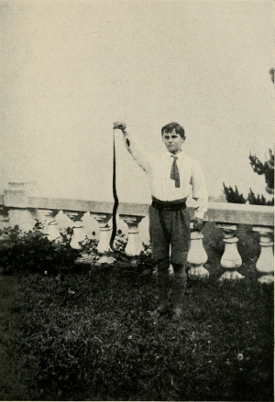
The fellow had a cobra with him which he
challenged me to pick up. I did so and gazed into
its strange eyes, which some devilry of man's had
turned to a lapis lazuli blue. The juggler said it
was the result of its skin-sloughing, but I have my
doubts. The poison bag had, I suppose, been
extracted, but the man seemed nervous and slipped
his brown hand between my own and the swaying
venomous head with its peculiar flattened hood.
It is a fearsome beast, and I can realise what was
told me by a lover of animals that the snake was
the one creature from which he could get no return
of affection. I remember that I once had three
in my employ when the "Speckled Band" was
produced in London, fine, lively rock pythons,
and yet in spite of this profusion of realism
I had the experience of reading a review
which, after duly slating the play, wound up
with the scathing sentence, "The performance
ended with the production of a palpably artificial
serpent." Such is the reward of virtue. Afterwards
when the necessities of several travelling
companies compelled us to use dummy snakes we
produced a much more realistic effect. The real
article either hung down like a pudgy yellow bell
rope, or else when his tail was pinched, endeavoured
to squirm back and get level with the stage
carpenter, who pinched him, which was not in the
plot. The latter individual had no doubts at all
as to the dummy being an improvement upon
the real.
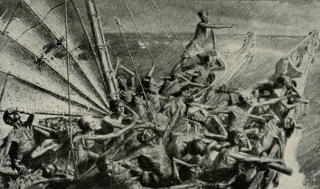
Never, save on the west coast of Africa, have I
seen "the league-long roller thundering on the
shore," as here, where the Indian Ocean with its
thousand leagues of momentum hits the western
coast of Ceylon. It looks smooth out at sea, and
then you are surprised to observe that a good-sized
boat has suddenly vanished. Then it scoops upwards
once more on the smooth arch of the billow,
disappearing on the further slope. The native
catamarans are almost invisible, so that you see
a row of standing figures from time to time on the
crest of the waves. I cannot think that any craft
in the world would come through rough water as
these catamarans with their long outriggers can
do. Man has made few more simple and more
effective inventions, and if I were a younger man
I would endeavour to introduce them to Brighton
beach, as once I introduced ski to Switzerland,
or auto-wheels to the British roads. I have other
work to do now, but why does not some sportsman
take the model, have it made in England, and then
give an exhibition in a gale of wind on the south
coast. It would teach our fishermen some possibilities
of which they are ignorant.
As I stood in a sandy cove one of them came
flying in, a group of natives rushing out and
pulling it up on the beach. The craft consists only
of two planks edgewise and lengthwise. In the
nine-inch slit between them lay a number of great
twelve-pound fish, like cod, and tied to the side of
the boat was a ten-foot sword fish. To catch that
creature while standing on a couple of floating
planks must have been sport indeed, and yet the
craft is so ingenious that to a man who can at a
pinch swim for it, there is very small element of
danger. The really great men of our race, the
inventor of the wheel, the inventor of the lever,
the inventor of the catamaran are all lost in the
mists of the past, but ethnologists have found that
the cubic capacity of the neolithic brain is as great
as our own.
There are two robbers' castles, as the unhappy
visitor calls them, facing the glorious sea, the one
the Galle Face, the other the Mount Lavinia
Hotel. They are connected by an eight-mile
road, which has all the colour and life and variety
of the East for every inch of the way. In that
glorious sun, under the blue arch of such a sky,
and with the tropical trees and flowers around,
the poverty of these people is very different from
the poverty of a London slum. Is there in all
God's world such a life as that, and can it really
be God's world while we suffer it to exist! Surely,
it is a palpable truth that no one has a right to
luxuries until every one has been provided with
necessities, and among such necessities a decent
environment is the first. If we had spent money
to fight slumland as we spent it to fight Germany,
what a different England it would be. The world
moves all the same, and we have eternity before
us. But some folk need it.
A doctor came up to me in the hotel and told
me that he was practising there, and had come
recently from England. He had lost his son in
the war, and had himself become unsettled.
Being a Spiritualist he went to Mrs. Brittain, the
medium, who told him that his boy had a message
for him which was that he would do very well in
Colombo. He had himself thought of Ceylon, but
Mrs. B. had no means of knowing that. He had
obeyed the advice thus given, and was glad that he
had done so. How much people may miss by
cutting themselves away from these ministers of
grace! In all this opposition to Spiritualism the
punishment continually fits the crime.
Once again we shed passengers and proceeded in
chastened mood with empty decks where once it
was hard to move. Among others, good Bishop
Banister of Kwang-si had gone. I care little
for his sacramental and vicarious doctrines, but
I am very sure that wherever his robust, kindly,
sincere personality may dwell is bound to be a
centre of the true missionary effort—the effort
which makes for the real original teaching of his
Master, submission to God and goodwill to our
fellow men.
Now we are on the last lap with nothing but a
clear stretch of salt water between our prow and
West Australia. Our mission from being a sort
of dream takes concrete form and involves definite
plans. Meanwhile we plough our way through a
deep blue sea with the wind continually against
us. I have not seen really calm water since we
left the Canal. We carry on with the usual
routine of ship sports, which include an England
and Australia cricket match, in which I have the
honour of captaining England, a proper ending
for a long if mediocre career as a cricketer. We
lost by one run, which was not bad considering
our limited numbers.
Posers of all sorts are brought to me by thoughtful
inquirers, which I answer when I can. Often
I can't. One which is a most reasonable objection
has given me a day's thought. If, as is
certain, we can remember in our next life the
more important incidents of this one, why is it
that in this one we can remember nothing of that
previous spiritual career, which must have existed
since nothing can be born in time for eternity?
Our friends on the other side cannot help us there,
nor can even such extended spiritual visions as
those of Vale Owen clear it up. On the whole we
must admit that our Theosophical friends, with
whom we quarrel for their absence of evidence,
have the best attempt at an explanation. I
imagine that man's soul has a cycle which is complete
in itself, and all of which is continuous and
self conscious. This begins with earth life. Then
at last a point is reached, it may be a reincarnation,
and a new cycle is commenced, the old one
being closed to our memory until we have reached
some lofty height in our further journey. Pure
speculation, I admit, but it would cover what we
know and give us a working hypothesis. I can
never excite myself much about the reincarnation
idea, for if it be so, it occurs seldom, and at long
intervals, with ten years spent in the other spheres
for one spent here, so that even admitting all that
is said by its supporters it is not of such great
importance. At the present rate of change this
world will be as strange as another sphere by the
time we are due to tread the old stage once more.
It is only fair to say that though many spiritualists
oppose it, there is a strong body, including
the whole French Allan Kardec school, who support
it. Those who have passed over may well
be divided upon the subject since it concerns their
far future and is a matter of speculation to them
as to us.
Thrasher whales and sperm whales were seen
which aroused the old whaling thrill in my
heart. It was the more valuable Greenland whale
which I helped to catch, while these creatures are
those which dear old Frank Bullen, a childlike
sailor to the last, described in his "Cruise of the
Cachelot." How is it that sailors write such
perfect English. There are Bullen and Conrad,
both of whom served before the mast—the two
purest stylists of their generation. So was Loti
in France. There are some essays of Bullen's,
especially a description of a calm in the tropics,
and again of "Sunrise seen from the Crow's Nest,"
which have not been matched in our time for
perfection of imagery and diction. They are both
in his "Idyls of the Sea." If there is compensation
in the beyond—and I know that there is—then
Frank Bullen is in great peace, for his whole
earthly life was one succession of troubles. When
I think of his cruel stepmother, his dreadful
childhood, his life on a Yankee blood ship, his
struggles as a tradesman, his bankruptcy, his
sordid worries, and finally, his prolonged ill-health,
I marvel at the unequal distribution of such
burdens. He was the best singer of a chanty
that I have ever heard, and I can hear him now
with his rich baritone voice trolling out "Sally
Brown" or "Stormalong." May I hear him once
again! Our dear ones tell us that there is no
great gap between what pleases us here and that
which will please us in the beyond. Our own
brains, had we ever used them in the matter,
should have instructed us that all evolution,
spiritual as well as material, must be gradual.
Indeed, once one knows psychic truth, one can,
reasoning backwards, perceive that we should
unaided have come to the same conclusions, but
since we have all been deliberately trained not to
use our reason in religious matters, it is no wonder
that we have made rather a hash of it. Surely it
is clear enough that in the case of an artist the
artistic nature is part of the man himself. Therefore,
if he survives it must survive. But if it
survives it must have means of expression, or it is
a senseless thing. But means of expression implies
appreciation from others and a life on the
general lines of this one. So also of the drama,
music, science and literature, if we carry on they
carry on, and they cannot carry on without actual
expression and a public to be served.
To the east of us and just beyond the horizon
lie the Cocos Islands, where Ross established his
strange little kingdom, and where the Emden
met its end—a glorious one, as every fair minded
man must admit. I have seen her stern post
since then in the hall of the Federal Parliament at
Melbourne, like some fossil monster, once a terror
and now for children to gaze at. As to the Cocos
Islands, the highest point is, I understand, about
twenty feet, and tidal waves are not unknown upon
the Pacific, so that the community holds its tenure
at very short and sudden notice to quit.
On the morning of September 17th a low coast
line appeared upon the port bow—Australia at
last. It was the edge of the West Australian
State. The evening before a wireless had reached
me from the spiritualists of Perth saying that they
welcomed us and our message. It was a kind
thought and a helpful one. We were hardly
moored in the port of Fremantle, which is about
ten miles from the capital, when a deputation of
these good, kind people was aboard, bearing great
bunches of wild flowers, most of which were new
to us. Their faces fell when they learned that I
must go on in the ship and that there was very
little chance of my being able to address them.
They are only connected with the other States by
one long thin railway line, 1,200 miles long, with
scanty trains which were already engaged, so that
unless we stuck to the ship we should have to pass
ten days or so before we could resume our journey.
This argument was unanswerable, and so the idea
of a meeting was given up.
These kind people had two motors in attendance,
which must, I fear, have been a strain upon their
resources, for as in the old days the true believers
and practical workers are drawn from the poor and
humble. However, they certainly treated us
royally, and even the children were packed into
the motors. We skirted the Swan River, passed
through the very beautiful public park, and,
finally, lunched at the busy town, where Bone's
store would cut a respectable figure in London,
with its many departments and its roof restaurant.
It was surprising after our memories of England
to note how good and abundant was the food.
It is a charming little town, and it was strange,
after viewing its settled order, to see the mill
where the early settlers not so very long ago had
to fight for their lives with the black fellows.
Those poor black fellows! Their fate is a dark
stain upon Australia. And yet it must in justice
to our settlers be admitted that the question was
a very difficult one. Was colonisation to be
abandoned, or were these brave savages to be
overcome? That was really the issue. When
they speared the cattle of the settlers what were
the settlers to do? Of course, if a reservation
could have been opened up, as in the case
of the Maoris, that would have been ideal.
But the noble Maori is a man with whom
one could treat on equal terms and he belonged
to a solid race. The Aborigines of Australia
were broken wandering tribes, each at war
with its neighbours. In a single reservation
they would have exterminated each other. It
was a piteous tragedy, and yet, even now in
retrospect, how difficult it is to point out what
could have been done.
The Spiritualists of Perth seem to be a small
body, but as earnest as their fellows elsewhere.
A masterful looking lady, Mrs. McIlwraith, rules
them, and seems fit for the part. They have
several mediums developing, but I had no chance
of testing their powers. Altogether our encounter
with them cheered us on our way. We had the
first taste of Australian labour conditions at
Fremantle, for the men knocked off at the given hour,
refusing to work overtime, with the result that we
carried a consignment of tea, meant for their own
tea-pots, another thousand miles to Adelaide, and
so back by train which must have been paid for out
of their own pockets and those of their fellow
citizens. Verily, you cannot get past the golden
rule, and any breach of it brings its own
punishment somehow, somewhere, be the sinner a
master or a man.
And now we had to cross the dreaded Bight,
where the great waves from the southern ice come
rolling up, but our luck was still in, and we went
through it without a qualm. Up to Albany one
sees the barren irregular coast, and then there
were two days of blue water, which brought us at
last to Adelaide, our port of debarkation. The
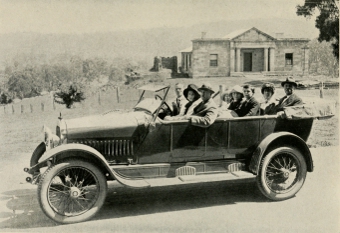
hour and the place at last!