PERSONS of importance like our travellers land at Seraglio Point instead
of travelling round to the bridge of Galata. Byzas did so, we have it in
black and white a few pages back, so it must be true. We can without
much fear of contradiction suppose that Constantine the Great landed
here also, though perhaps he went to one of the harbours on the Sea of
Marmora. Indeed, he is more likely to have done so, for the current runs
pretty strongly and the sea is more than a little choppy at this point.
Byzas had no harbour to turn into except the Golden Horn, and he must
have been too eager to land and survey his new property to have followed
that waterway any considerable distance. Just a little west of the point
is perhaps the best place to land, somewhere near the Turkish Custom
House.
It is, of course, very interesting to land at the bridge of Galata,
passing through crowded shipping on the way up the Golden Horn. On one
hand, to the south, one sees the irregular mass of buildings, mosques,
and public offices which go to form Stamboul. You may descry that vast
square of solid ugliness owned by the international creditors of the
Ottoman Empire and known as the Public Debt. Close by you catch sight of
the head-quarters of Government—the Sublime Porte. Drowsy fox-hunting
squires, to whom their wives read the paper of an evening, must often
have started at the reiteration of this familiar phrase, and wondered to
what year the marvellous Eastern vintage belonged.
Opposite the business quarter of Galata, crowned by its tower. The life,
the colour ever changing, on the highway across the Golden Horn is
extraordinarily fascinating. Sons of every race and nation upon earth
are freely mingled here. The Western official or the business man, whose
garb is allowed to betray no ease or originality, here brave the fierce
suns of summer clad in the drab discomfort of business attire, with the
Perote or native of Pera and Levantines of European origin who have
imbibed some longing for oriental display without the requisite taste.
Western ladies unveiled, Eastern ladies veiled, the latter in many cases
beautifully shod and gloved. Also the Artist raves about a little hand
he has seen ungloved, such a dainty, beautiful hand, and according to
his own estimate he is an expert in such matters. Then there are Turks,
Western Turks, whose costume is also Western, the fez and seldom-shaven
cheeks being the only things in which they differ from others, for many
are fair and most are fine, handsome men with every sign of the
self-control good breeding gives. Hamals, the porters, push their way
with backs bent double and their packs joined upon the leather rests
provided for that purpose. Great men in carriages drawn by dashing,
spirited Arab steeds roll by you, a servant in gorgeous livery beside
the driver on the box. Asiatics of all kinds and colours, fantastically
yet harmoniously clad, move past with silent, unhurried footsteps. And
then a batch of soldiers, fine, upstanding fellows in business-like
khaki, march past on their way to embark for the Yemen, the Sierra Leone
of the Turkish Empire, for which men even volunteer nowadays, since the
bad old order changed.
But we have landed our travellers on the northern extremity of the
promontory on which stands Constantine’s ancient city. This part serves
as a public promenade, and here people take the air, admire the glorious
view, and generally behave like people do everywhere else, when they
find time for a leisurely stroll, the only difference being that here
men find time for one more often. The point is open to the sea, for
there is no further occasion for the walls and towers that encircled
this the starting-point of Byzantine history. Here was the first
settlement of Byzas that grew into an Acropolis, walled, and strongly
held, the heart of a growing empire. So we go inland, crossing by a
bridge the railway that discreetly hides its unloveliness in a cutting
before running into a terminus that might have been picked up from one
of the Hanseatic towns and planted here by some malignant fairy.
The road leads upwards to the Seraglio buildings, and here is much of
interest. There is the Museum containing many treasures, among them two
of wondrous beauty—two sarcophagi, one of which claims to have held the
remains of Alexander the Great, the other is presumed to be the last
resting-place of one of Alexander’s higher officers, and is known as
“Les Pleureuses,” from the beautifully-sculptured female figures in
mourning garb that adorn it. Within these precincts is the School of
Art, where much good, earnest work is being done under the guidance of
Humdi Bey, to whose efforts the recovery of the sarcophagi and other
monuments is due as the result of excavations in Asia Minor.
A broad road leads us with park-like plantations on either hand up from
the sea towards the Seraglio buildings. These buildings stand on a
height, the first of the seven hills that form the immovable
foundations of the city.
The Seraglio no longer serves its original purpose, the Imperial Museums
and School of Art have taken up a considerable portion of them, and
others find accommodation for troops. Here you may see the stalwart
Anatolian peasant being made into a soldier after the German pattern,
and a very good pattern too. Bugle-calls, reminiscent of those heard in
Germany, tells the Turkish soldier the time for all the many duties he
should attend to. Sergeants in manner emphatic and teutonesque impart
the mysteries of that solemn, high-stepping march which takes the place
of route marching in an army that has to train its men to reach
perfection in two years’ time. Slim-waisted subalterns, whose moustaches
follow Imperial precept, superintend these operations, and an anxious
company commander may be seen in conference with his colour-sergeant.
It would sound invidious, it would savour of interference, to wonder
which is the better use for the Seraglio buildings, that of the present
or the past. The Artist doth profess loudly on this point, that no
building can serve a higher purpose than that of housing in comfort
those who are taken from their homes to learn how to defend the honour
of their

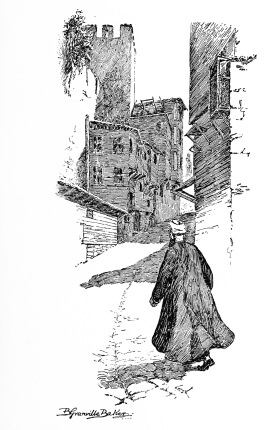
The Landward Walls of the Seraglio.
Romance and mystery cling to the place and live in the name Seraglio. It
is jealously walled in, the wall being of Turkish construction and
comparatively recent, and to it may be seen clinging quaint wooden
houses.
country, and that again the honour and glory of a community is well
served by making ample provisions for the encouragement of art. Both
Author and Artist wish these Seraglio buildings a glorious future in
their present warlike and peaceful missions.
But romance and mystery cling to the place and live in the name
Seraglio. It is jealously walled in, the wall being of Turkish
construction and comparatively recent, and to it may be seen clinging
quaint wooden houses.
No doubt Byzas dwelt somewhere about here, though the exact spot is
possibly beyond the ken of the keenest archæologist. Remains of solid
masonry, huge blocks of stone, have been discovered near the Seraglio
kitchens, of which a fine view is offered from the railway, peeps of the
massive, high-standing building through the ranks of its solemn escort
of cypress-trees.
When Byzantium became the City of Constantine it was found necessary to
extend the enceinte of the older fortifications, as the number of
inhabitants had grown prodigiously, and this first rampart was of
greater extent than the present Seraglio walls. The many improvements
made by Constantine, the palace he built unto himself, the Forum and
Hippodrome he laid out, and the churches he erected, are nearly all
within the immediate neighbourhood of the Seraglio, if not inside its
precincts. So here again was the centre of the civic and religious life
of the city, rising rapidly to the zenith of its power, and here it has
remained until most recent times.
There were walls and towers round the point to guard the city both
against her enemies and the violence of the elements, and, sooth to say,
it was the latter caused more damage than the former. These had need to
be constantly repaired. Of the very earliest walls no trace remains, yet
they too had their page in history. Not far from where our distinguished
travellers landed, just round the eastern point and looking east, is Top
Kapoussi, which means cannon-gate, for here stood a gate dedicated to
St. Barbara, who is the patron saint of gunners. But a more likely
reason for the Turks to retain the memory of the original name is that
close by stood a magazine or military arsenal when they conquered the
city, and may have stood for years after. It seems that there was a yet
older gate at this spot, a gate through which the Spartan admiral
Anaxibius entered the Acropolis when he escaped from the city by boat
along the Golden Horn, what time Xenophon and his truculent Greeks were
in possession.
After Constantine had led his people, or at least those under his
immediate influence, into the fold of the Christian community, many
churches sprang up about this northern extremity of the promontory.
(There are, no doubt, those who will differ from the Author on the
subject of Constantine’s conversion, who may say that his people led
Constantine to adopt Christianity, and that reasons of policy rather
than the conviction born of a sudden inspiration guided him, but the
Artist will on no account allow such a prosaic version.) Five churches
stood about here, one dedicated to St. Barbara, as we have seen, another
to St. Demetrius, a third to St. Saviour, yet another to St. Lazarus,
and a fifth one built to St. George on the highest ground available just
there, according to custom, for in former times all churches dedicated
to the warrior’s patron saint were built on higher ground, as if to give
the saint an opportunity of keeping a good look-out from his sanctuary.
This church gave to the Sea of Marmora its mediæval name of Braz St.
George.
There were evidently other buildings in connection with St. George’s
Church, a monastic institution most probably, for here under the name of
Joasaph the Emperor John Cantacuzene dwelt in seclusion after his
abdication until he withdrew altogether from among his former subjects
to a monastery on Mount Athos. Another great feature of this
neighbourhood was its holy well, which may be springing still, though
for this the Author cannot vouch, as he has not seen it. The Church of
St. Saviour guarded this holy spring—its water had healing qualities,
and pilgrimages were made to it on the Festival of the Transfiguration.
The life of the capital of an empire stirred the precinct of what is now
the Seraglio enclosure and the vicinity outside it for close on twenty
centuries. We have seen the city rise under the fostering care of Byzas
its founder, and followed those dim paths of remotest history when the
world was young, though no doubt the sad young cynics of the period
thought it as old and foredone as they do to-day. Then came the glorious
epoch of Constantine and his successors—glorious indeed in the new
light of Christianity, but in that name much evil was done, and by it
murder and violence and civil war were held to be excused. But through
it all the city, this seat of empire, exhibited a most astounding
elasticity and power of recovery. True the Palace of Cæsar built by
Constantine was not within the precincts enclosed by the Seraglio walls
of to-day, but the brain of the empire held its sway hard by here, and
its tumultuous heart beat everywhere among the ruins and decay that now
mark the site of palaces.
Constantine in his glory and genius passes, and others follow him in an
unbroken sequence, some good, many bad, all human, and thus surrounded
by the romance that envelops those that played their part in history
and did their share in making it. A noble sequence taking them all in
all from Constantine, who reigned from 306 to 337, then his successors
down to the last emperor, another Constantine of the house of
Palæologus, twelfth of the name who fell before his city walls to be
succeeded by a conqueror of the house of Ottoman, the house that has
filled the throne of the Eastern Empire until to-day.
If we take but a few of this unbroken line of sovereigns, more than one
hundred altogether, such names stand out in the world’s history as
Valens, whose aqueduct still stands as a monument to perpetuate his
name. Then Theodosius II, whose master mind gave to the city its
furthest limit in those proud walls that have encircled it since the
beginning of his reign, and still stand as testimony to the genius of
man. Justinian the Great, too, first of that name of whom we must say
more when we come to the ruins of the lordly palace he inhabited. Leo V
the Armenian who entered the city as a poor groom, they say, but served
his Imperial master, Michael I the Drunkard, so well that he then
ascended his throne and restored the expelled Government of the Empire.
And there are many others of whom mention will be made elsewhere in
connection with fortifications and palaces that were erected far beyond
the first narrow limits of the city that Byzas had founded and the great
Constantine made his own.
About this neighbourhood centred the life of the city; there was a broad
esplanade near where the Church of St. Lazarus stood, down by the Sea of
Marmora, its site probably not far from the foot of the Seraglio
kitchens. This esplanade was called the Atrium of Justinian the Great,
for it was his creation. And a fair place it was, all built of white
marble. Here the good citizens might walk and breathe the soft air,
looking out towards the Prince’s Islands and the coast of Asia, across
the Sea of Marmora, reflecting in its translucent depths the glorious
colours of an Eastern sunset. And here they walked and talked, and no
doubt discussed all subjects upon earth, religion, politics, those chief
incentives to resultless argument, and the news, with all its
variations, which were nothing uncommon even in the days before a daily
paper first appeared. How portly burghers must have smiled with
satisfaction at the sight of bellying sails that drove their galleys
back from the shores of many countries to the great market.
Or a racing craft under full sail with all its rows of glittering oars
rising and dipping in strict accord would round the point into the
Golden Horn, leaving the gazers in the Atrium the prey to many
conjectures, until a gentle sound coming from the north, round by the
Senate, growing to a roar conveyed the news of some great victory.
Perhaps an anxious heart of mother, wife or sister would beat against
the coping of the Atrium, as tearful eyes followed the swift sails of
departing war fleets that pressed onward into the morning. And the sun
would rise to arouse the golden glories of the city, and yet leave that
heart unlightened.
Here, too, good folk would meet to discuss the pomp and splendour of the
escort that had brought the Emperor’s bride-elect to the sea-gate of
Eugenius down by the Golden Horn. How Cæsar there had met her with great
pomp and ceremony, and had himself invested her with the insignia of her
exalted rank. The talk would then go on to the high doings at the
palace, and all those good things that had been brought together from
every quarter of the earth for the delectation of the wedding guests.
When lowering clouds obscured the brightness of the sun of Cæsar what
whisperings, what anxious glances out to sea! Yes, and perhaps what
black looks when an alliance was proposed, and indeed consummated,
between a princess of their royal house and the polygamist ruler of
their enemies the Turks, Amurath I.
What troublous times and discontents when every messenger brought news
of fresh disaster, of yet another portion of the Empire torn from its
enfeebled grasp. What grumbling at the supineness of the Christian world
that looked on with apathy when it could find the time to spare from its
own internal quarrels, while the most Eastern bulwark of the faith was
being hard pressed by those who carried Islam with fire and sword
wherever they went. And then a ray of hope when as a last resource John
VI Palæologus betook himself to Rome to implore the Pope to exert his
influence on behalf of his expiring fortunes, and to stir up another
crusade among the nations of the West. Though at the same time the
Emperor sent one of his sons to serve in the Turkish army and learn
those secrets of success which that host alone seemed to know.
Intrigue flourished at Constantinople more perhaps than anywhere, unless
it be in Rome, and we well imagine how rumours of such matters filtered
down among the populace, giving rise to conjecture and wild, inaccurate
statements, the food that intrigue fattens on, rumour also of private
feuds and family dissensions not only among nobles and leaders of the
State, but among its lowliest citizens. So when John Palæologus betrayed
his weakness and the weakness of his Empire, many among those who walked
the Atrium of an evening might search their minds for some one who
could save them from the threatening devastation, and would gladly turn
to any who promised to strengthen the shaky edifice and re-establish
that sense of security without which all private enterprise was
crippled. For here, as in the time before Saxon England fell to the Duke
of Normandy, the conqueror’s influence permeated, and attachments were
formed between the highest of both nations.
So Andronicus, another son of John Palæologus, entered into friendship
with Saoudji, one of the sons of Amurath. Saoudji was jealous of the
favour shown to Bajazet, his brother, and resented the latter’s
popularity—well deserved too, for he was valiant and successful in the
field, and through the rapidity and vigour of his charges acquired the
epithet of Yilderim, or Lightning.
So while Amurath was away in Asia, Saoudji and Andronicus, with the
assistance of a band of Greek nobles and retainers, organized a combined
revolt against the Byzantine and Turkish Governments. Amurath got
tidings of this, and forthwith recrossed the Hellespont.
Suspecting Palæologus of complicity, Amurath compelled him to join in
his proceedings to quell the revolt. The rebel forces were encamped near
the town of Apicidion, and Amurath marched against them.
Unattended and under cover of night he rode to the entrenchments of
their camp and called aloud to the Turkish insurgents, commanding them
to return to their allegiance, promising a general amnesty. All these on
hearing the familiar voice deserted their new leader and their Byzantine
allies, and rejoined the forces of Amurath. Saoudji and Andronicus with
his Greek followers were speedily taken. Saoudji was brought before his
father, who commanded first that his eyes should be put out as unworthy
to look his last upon the day, and then that he should be slain. The
Greek insurgents were tied together and flung two or three at a time
into the Maritza, while Amurath sat by until the last was drowned. The
fathers of some of the rebels were ordered to slay their children before
him; those who refused were themselves destroyed. Amurath ended by
sending Andronicus in fetters to his father, commanding him to deal with
him even as he had dealt with his own.
And after all the suppliant Emperor’s journey to Rome failed to arouse
the Western nations to undertake a new crusade. All that was achieved
was a confederacy to resist the future progress of the Ottoman power,
and if possible to dispossess it of its European territories. The
Sclavonic nations, at the confines of whose territories the Turks had
arrived, joined together at the instigation of Servia. Servians, then
the best troops and the most formidable the Turks had met in Europe,
Bosnians, Albanians and Bulgarians, and with them Magyars and men from
Wallachia took the field. Though at times successful, the alliance
failed eventually in its purpose, and not until most recent times have
those nations emerged from Turkish suzerainty to national independence.
The Battle of Kossova broke the power of the Sclavonic race in the
Balkans and led to their disappearance from the arena of the polity of
nations for many centuries. A fierce fight it was that raged all day
with varying fortunes and glorious display of chivalry and knightly
daring, where Bajazet the Lightning struck swift and sure, though a
Christian noble ended the conqueror’s career when the fortunes of the
day had just turned in his favour.
It happened thus, one Milosh Kabilovitch galloped forth as if a deserter
from the Servian ranks and sought the royal presence of Amurath. He
alleged important intelligence concerning the plans of the allies.
Kneeling before Amurath, he suddenly leapt up and by one stroke buried
his dagger in the monarch’s heart. By a miraculous exercise of strength
he beat off all the attendants who surrounded him again and again, but
finally fell under the sabres of the Janissaries just as he had reached
the spot where he had left his horse. Amurath survived but to the close
of the battle. His last act was to order the death of the captured
Lazarus, king of Servia, who had commanded the centre of the Christian
force, and who, standing in chains, regaled the dying eyes of his
conqueror.
News of this momentous happening reached Constantinople, and we can
guess that the faces of those who frequented the Atrium grew gloomier.
Was there no one who could help? The horns of the Crescent were closing
in on the City of Constantine, the Empire was shorn of most of its
former glory and its vast possessions. Little but the city and its
immediate surroundings were left unsubdued, all escape from the
conquering Turk seemed hopeless. And then what were their prospects? to
be conquered, and by such ruthless hands! The death of Saoudji may have
been reckoned an act of justice, but rumours came to them, and proved
true, of other deeds more cruel, of how Bajazet ascended the throne,
like Richmond on Bosworth field, of how his brother Yakoub, who had
fought valiantly in the Battle of Kossova, and had contributed largely
to its success, was summoned to the regal tent and there saw his
father’s body, the first intimation of his death. How then and there in
the presence of that body Bajazet had immediately ordered his sorrowing
brother to be strangled. This act was done, says Seaddedin, the Turkish
historian, in conformity with the precept of the Koran, “Disturbance is
worse than murder.” Surely a gloomy outlook for the watchers on the
wall.
But how awful would be the fate of their city which had so long resisted
the sacred Scimitar of Ottoman! What mercy could they expect? Help there
was none, and Bajazet was making preparations to submit Constantinople
to yet another siege. But he was diverted by hostilities on his western
frontier, and hope revived again in the hearts of those that looked over
the city walls across the Sea of Marmora. For the Christian natives of
the West had at last begun to realize the danger threatening them from
the East. They were moved not by the recommendation of a heretic Greek
emperor, but urged by the supplications of the King of Hungary, a
spiritual vassal of the Roman See. Pope Boniface IX proclaimed a crusade
against the Turks, and promised plenary indulgence to those who should
engage in an expedition for the defence of Hungary, and the neighbouring
Catholic States.
There were fewer sinners in need of indulgence in those days than there
are now; but the population of Europe was proportionately smaller. Yet
many rallied to the banners of Philip of Artois; Comte d’Eu, Constable
of France; Vienne, Admiral; and Bourcicault, Marshal of France. The
Count of Hohenzollern, Grand Prince of the Teutonic order, led a force
of Germans; the Knights of St. John of Jerusalem, led by their Grand
Master Naillac, joined the force of some 120,000 allies, all, as
Froissart says, “of tried courage and enterprise.” Their aim was to
break the power of Bajazet in Hungary, and when this was done to advance
on Constantinople, cross the Hellespont, enter Syria, gain the Holy
Land, and deliver Jerusalem with its Holy Sepulchre from the hands of
infidels.
How anxiously those citizens of Constantinople must have longed for news
of the enterprise, how hope revived as the fall of Widdin, Orsova, and
Raco were reported. What a heavy time of waiting it must have been while
the Christian host lay before Nicopolis. Still hope held on, for Bajazet
was in Asia, and was never expected back. But suddenly he appeared
within six leagues of the Crusaders’ camp. The news was brought in by
foragers, and the impetuous French knights, sitting at their evening
meal, at once buckled on their arms, and demanded to be led against the
foes. Against the advice of Sigismund of Hungary the French charged
impetuously. They charged and broke the ranks of the Akindgi, the
advanced guard of the Janissaries and of the heavy regular cavalry, and
pressed on till they encountered the main body of the Turks under the
command of the Sultan himself. Meanwhile the disordered ranks of the
Akindgi and Janissaries left behind, reformed and attacked the French in
their rear. All gallantry was unavailing—they were almost all killed or
taken. The German knights fell around their sacred banners. The day was
lost; of the ten thousand prisoners taken, nearly all were massacred on
the following day by Bajazet, who sat out from dawn till evening
watching, according to the custom of his race, the gratifying spectacle
of slaughter.
This dashed the hopes of the Greek Christians, and they began to prepare
for the last hours of their Imperial City. But Bajazet was called away
to his Eastern Asiatic frontier, where the Mongols were making fierce
inroads on his territory, under their famous leader Tamerlane. A respite
was thus granted while thus occupied, for the army of Bajazet was
annihilated at Angora, and he himself was slain. No doubt the news of
Bajazet’s defeat and death was welcome to those who took their walks on
the Atrium, no doubt many a good bargain was concluded then and there
in a friendly way, when the news from Asia promised better security, and
at least a postponement of the Eastern terror. And indeed the Ottoman
power was prostrate for awhile after the Battle of Angora, and to make
matters worse the sons of Bajazet quarrelled about the succession. In
the chaos that ensued even the Greek Empire profited directly, for
several portions of lost property were recovered, and no doubt hopes ran
high that a turning-point in its fortunes had arrived, that the dark
clouds of Eastern predominance so long threatening were to be finally
dispelled, and that the sun of Rome would shine again over Byzantium.
But the old terror revived again, though not perhaps to the same extent.
Certainly, ere long the Turks were knocking at the city gates again.
This time under Musa, a son of Bajazet, who on being released from
captivity in Tamerlane’s tents, joined in the fray of brothers, and laid
siege to Constantinople, because the emperor supported the claims of the
eldest brother Solyman, who had taken unto himself the Sultanate of his
father’s European possession, but had been overcome and slain by Mahomed
the younger son.
Manuel II Palæologus, Greek emperor, besought the protection of
Mahomed, and for a time a Turkish army actually garrisoned the Castle of
Cæsar. But Mahomed had to take his troops back to Asia. There he
overcame and slew his brother Musa, and then, all rival claimants having
been removed, became Sultan of his father’s dominions.
But a few years longer was the respite granted to the failing power of
Byzantium. John VII Palæologus retained some semblance of Imperial
dignity; but under his successor, a bearer of Constantine’s illustrious
name, the death-knell sounded alike to the house of Palæologus and to
the Roman Empire of the East. The curtain rang down on what may be
called the second act of the drama of Byzantium—the reign of the
Christian emperors. The curtain rose again on a scene strewn with ruins
of Imperial splendour, on heaps of slain, the victims of the conqueror’s
lust of blood, and the succession of emperors in the Imperial City of
the East was restored by one of the greatest and perhaps the most cruel
of the able sons of Othman.
Mahomed II the Conqueror broke the proud record of those stout walls of
Constantinople, and made the place his own. The ancient capital of the
Ottomans, Broussa, and the more recent one, Adrianople, receded into the
background; the former to become a relic of satisfied ambitions,
treated with the respect usually meted out to a stepping-stone, the
latter a mere base for frontier defence. Mahomed transformed all the
life of his nation, and centred it in the City of Constantine, choosing
that part of it where Byzas first landed, the point of the promontory.
For here he separated a space of eight furlongs from the point to the
triangle and built his Seraglio.
And here the history of Constantinople continued its course with just
that break of a few days when ownership was forcibly transferred. Nor
did the religious life of the city suffer any lengthy interruption.
True, the monasteries disappeared, the Cross fell from the Christian
churches, the Crescent added minarets, and due ceremony made them into
mosques. But who can say that the religious life had ceased with the
alteration in creed and dogma. And the Turks with some exceptions,
usually political, have always respected the faith of others.
It must have been one of the most marvellous and astounding scenes ever
witnessed by mortal eyes that took place not long after the city fell,
and long before the sights and signs of the desolation there wrought had
been removed. The Greek remnant had gathered together and returned in
crowds as soon as they had sufficiently been assured of their lives,
their liberties, and the free exercise of their religion. To solemnize
this fast the Sultan held an investiture on old Byzantium lines, with
all the pomp and traditional splendour of the ceremony, an investiture
of the Patriarch of Greek Orthodoxy. With his own hand the Conqueror
delivered into the hands of Gennodius the crosier or pastoral staff, the
symbol of his ecclesiastical office. His Holiness was then conducted to
the Gate of the Seraglio, presented with a horse richly caparisoned, and
led by viziers and pashas to the palace allotted for his residence.
And this happened within the Seraglio walls! Surely an astounding event.
The successor to the throne and empire of the Cæsars, the conqueror
whose hands were red with the blood of massacred Christians, the
victorious leader of that fanatic race whose life is more influenced by
their creed than that of perhaps any other human community, himself
approved the chosen Patriarch, the head of his new subjects’ religion,
and with his own hands elevated him to that high office. Thus from the
centre of Constantine’s city in its new aspect of purely oriental
colouring, the Seraglio, the latticed prison of those whose privilege it
is to give birth to the sons of Islam, new life was given to Greek
Orthodoxy by him whose sword had hitherto been raised against it.
So the life of the old city, the heart of a new empire continued, and
one ruler followed another, and like those of the second act, some were
good, others bad, but none wholly indifferent. Another Bajazet followed
on Mahomed the Conqueror and carried on the victorious traditions of his
house. Mahomed died suddenly among his soldiers, leaving two sons, who
contested for the sovereignty, as has so often happened in the history
of empires raised by the hand of one strong man. Zizimes, the younger
son, suggested a division of the empire, Bajazet to rule over Roumelia,
Zizimes to govern Anatolia with the Hellespont as boundary between their
realms. But Bajazet would none of it. “The Empire is a bride whose
favours cannot be shared,” he said, and Zizimes was defeated and had to
seek refuge at the Courts of other rulers, some Christian, but none of
them favourable to the furtherance of his hopes. His death was caused by
poison, administered by a servant of the Pope, Alexander Borgia, who
thereby gained a reward of 300,000 ducats from the brother Bajazet, the
sum that Borgia had agreed to for the deed, and would probably have
earned himself had not Charles VIII of France invaded Italy and carried
off Zizimes from the guardianship of the Roman Pontiff.
And the romantic history of this chosen spot of Byzas continues within
the walls of the Seraglio, one Sultan following another and making his
throne secure by murdering others that stood near it. Thus did Selim I
to his brethren. He was the youngest, the ablest and most daring of the
sons of Bajazet, and in his father’s lifetime intrigued against him for
possession of the throne. His efforts proved successful. A rabble of
soldiers and citizens surrounded the Seraglio and demanded audience of
the Sultan. “What is your desire?” inquired Bajazet. “Our Padishah is
old and sickly, and we will that Selim shall be our Sultan.” So Bajazet
abdicated, to die a few days afterwards, and Selim reigned in his stead.
Having secured the throne Selim bent his mind on conquest and the
suppression of schism among the followers of the Prophets. The Shiites
repudiated the claim to the caliphate of Mahomed’s immediate successors,
Abu-Dekr, Omar and Othman. So for reasons probably as much political as
religious, Selim proclaimed himself champion of Orthodoxy, and sullied
his reign by the St. Bartholomew of Ottoman history. In all there were
70,000 of his subjects who held to the Shii doctrine within the Ottoman
dominion in Europe and Asia, 40,000 of these were massacred and 30,000
sentenced to perpetual imprisonment. And Selim became Caliph of the
Moslem faith.
Then follows one whose name looms large in history, Solyman I the Great,
his title nobly earned not only by valour in the field, but by wisdom in
the council—and he was great among a galaxy of great Christian
sovereigns, Charles V, Francis I, Henry VIII and Pope Leo X. The world
was then entering on modern times, and many changes were in progress.
But who will deny to this the first inception of the modern spirit, the
glamour of Romance. The art and practice of war was undergoing a change,
the arts of peace were reviving. Holbein was making illustrious
sovereigns yet more illustrious by his cunning hand, and the bold
spirits of a new Europe found yet newer countries across the seas.
The name of Solyman conjures up visions of the glowing glory of the
Eastern Empire, of the force and vigour of Islam, for Selim had enjoined
upon his son to carry war into the countries that professed the faith of
the Cross. Through this monarch’s enterprise was Romance enriched by the
story of his wars, as when against Hungary he penetrated even as far as
Vienna, which he besieged, what time the Poles came stoutly to the help
of Europe, to be rewarded later in history by the partition of Poland
and a period of oppression which is not yet ended. With him we connect
another glorious name, who brought to his master, victorious on land,
new laurels won at sea, Barbarossa, Solyman’s great admiral.
Yet another name that rings out from within the walls of the Seraglio,
and is known by all who love Romance, is that of Roxalana. Solyman’s
favourite Sultana in the earlier part of his reign had been a beautiful
Circassian. Her son Mustapha inherited his mother’s beauty, and was a
pattern of manly and chivalrous excellence.
But the Circassian Sultana lost the Imperial favour. A lovely Russian
girl, Khourrem (“The joyous one”), enkindled anew the passion of love in
the Sultan’s breast. She was a slave, she obtained her freedom from her
royal lover and induced him to wed her. Khourrem, or as the Christians
called her “Roxalana” became Sultana. Her aims and ambition was to
forward the chances of her own children, and to that end Mustapha had to
be removed. She ruled Solyman to the day of her death, and had the
satisfaction of bringing about the murder of Mustapha before she died.
He was appointed Governor of Carmania, and so skilfully did Roxalana
work upon Solyman that he was at last induced to believe that Mustapha
was plotting to usurp the throne. Mustapha was ordered to enter the
Sultan’s presence alone, and Solyman looking on from an inner chamber
saw seven mute executioners carry out his command to strangle his son
with the bowstring.
And so the Romance that sheds a glamour over the history enacted within
the Seraglio walls flows on, while fortune favours those who merit it,
and wrong-doing is often punished by those drastic measures to which
these grey embattlements had long become accustomed. Roxalana herself
was buried in all due state not a stone’s throw from the spot where her
sovereign lord afterwards found his rest. But in the two chambers where
they lie you will notice a difference. To enter that of Solyman you must
take off your shoes, the place is holy ground—the grave of a warrior
who is almost a saint. You may, however, pass to the chamber of the
“Joyous one” shod as you are. She has no soul, that makes all the
difference.
They tell of Selim, Solyman’s successor, Roxalana’s son, who broke the
Law of the Prophet and died drunk; Othman II, of the revolt of the
Janissaries and their choice of Sultan—until the seat of Government was
moved from the place where Byzas first made his choice and Constantine
and his successors reigned, until they in due time gave way to those of
the house of Ottoman.
But is the present state of this Seraglio less romantic than in those
days of fierce passion untrammelled and only expressed in blood? The
head priest, the Sheik-ul-Islam, has decreed that there is no
infringement of the Laws of Islam in its sons expressing higher thoughts
by means artistic. And so the life of the Seraglio goes on, peaceful,
more beautiful, and just as much Romance as heretofore.