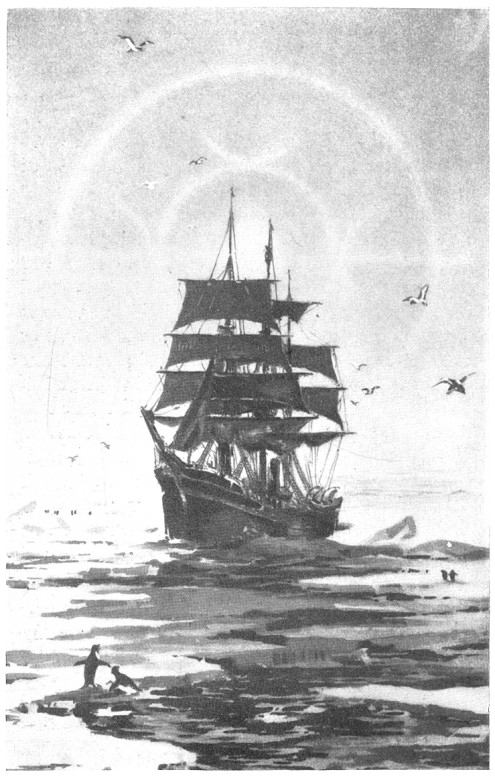
THE 'DISCOVERY'.
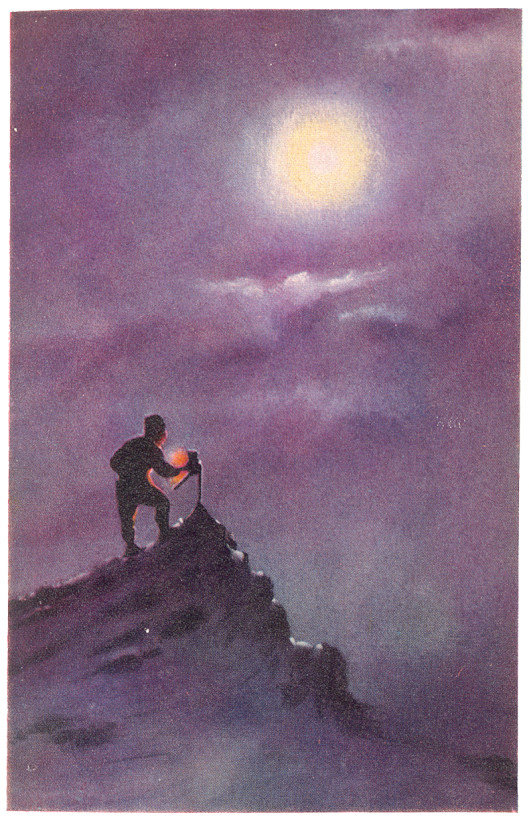
Reproduced from a drawing by Dr. E. A. Wilson.
THE DISCOVERY
Do ye, by star-eyed Science led, explore
Each lonely ocean, each untrodden shore.
|
In June, 1899, Robert Falcon Scott was spending his short leave in
London, and happened to meet Sir Clements Markham in the Buckingham
Palace Road. On that afternoon he heard for the first time of a
prospective Antarctic expedition, and on the following day he called
upon Sir Clements and volunteered to command it. Of this eventful
visit Sir Clements wrote: 'On June 5, 1899, there was a remarkable
coincidence. Scott was then torpedo lieutenant of the Majestic.
I was just sitting down to write to my old friend Captain Egerton[1]
about him, when he was announced. He came to volunteer to command
the expedition. I believed him to be the best man for so great a
trust, either in the navy or out of it. Captain Egerton's reply
and Scott's testimonials and certificates most fully confirmed
a foregone conclusion.'
The tale, however, of the friendship between Sir
Page 16
Clements and Scott began in 1887, when the former was the guest of
his cousin, the Commodore of the Training Squadron, and made the
acquaintance of every midshipman in the four ships that comprised
it. During the years that followed, it is enough to say that Scott
more than justified the hopes of those who had marked him down
as a midshipman of exceptional promise. Through those years Sir
Clements had been both friendly and observant, until by a happy
stroke of fortune the time came when he was as anxious for this
Antarctic expedition to be led by Scott as Scott was to lead it. So
when, on June 30, 1900, Scott was promoted to the rank of Commander,
and shortly afterwards was free to undertake the work that was
waiting for him, one great anxiety was removed from the shoulders
of the man who had not only proposed the expedition, but had also
resolved that nothing should prevent it from going.
Great difficulties and troubles had, however, to be encountered
before the Discovery could start upon her voyage. First
and foremost was the question of money, but owing to indefatigable
efforts the financial horizon grew clearer in the early months of
1899. Later on in the same year Mr. Balfour expressed his sympathy
with the objects of the undertaking, and it was entirely due to him
that the Government eventually agreed to contribute £45,000,
provided that a similar sum could be raised by private subscriptions.
In March, 1900, the keel of the new vessel, that the
Page 17
special Ship Committee had decided to build for the expedition,
was laid in the yard of the Dundee Shipbuilding Company. A definite
beginning, at any rate, had been made; but very soon after Scott had
taken up his duties he found that unless he could obtain some control
over the various committees and subcommittees of the expedition, the
only day to fix for the sailing of the ship was Doomsday. A visit
to Norway, where he received many practical suggestions from Dr.
Nansen, was followed by a journey to Berlin, and there he discovered
that the German expedition, which was to sail from Europe at the same
time as his own, was already in an advanced state of preparation.
Considerably alarmed, he hurried back to England and found, as
he had expected, that all the arrangements, which were in full
swing in Germany, were almost at a standstill in England. The
construction of the ship was the only work that was progressing,
and even in this there were many interruptions from the want of
some one to give immediate decisions on points of detail.
A remedy for this state of chaos had to be discovered, and on November
4, 1900, the Joint Committee of the Royal Society and the Royal
Geographical Society passed a resolution, which left Scott practically
with a free hand to push on the work in every department, under a
given estimate of expenditure in each. To safeguard the interests
of the two Societies the resolution provided that this expenditure
should be supervised by a Finance Committee,
Page 18
and to this Committee unqualified gratitude was due. Difficulties
were still to crop up, and as there were many scientific interests
to be served, differences of opinion on points of detail naturally
arose, but as far as the Finance Committee was concerned, it is mere
justice to record that no sooner was it formed than its members
began to work ungrudgingly to promote the success of the undertaking.
In the meantime Scott's first task was to collect, as far as possible,
the various members of the expedition. Before he had left the
Majestic he had written, 'I cannot gather what is the intention
as regards the crew; is it hoped to be able to embody them from
the R.N.? I sincerely trust so.' In fact he had set his heart on
obtaining a naval crew, partly because he thought that their sense
of discipline would be invaluable, but also because he doubted
his ability to deal with any other class of men.
The Admiralty, however, was reluctant to grant a concession that
Scott considered so necessary, and this reluctance arose not from
any coldness towards the enterprise, but from questions of principle
and precedent. At first the Admiralty assistance in this respect
was limited to two officers, Scott himself and Royds, then the
limit was extended to include Skelton the engineer, a carpenter and
a boatswain, and thus at least a small naval nucleus was obtained.
But it was not until the spring of 1901 that the Admiralty, thanks to
Sir Anthony Hoskins and Sir Archibald Douglas, gave in altogether,
and as the selection of
Page 19
the most fitting volunteers had not yet been made, the chosen men
did not join until the expedition was almost on the point of sailing.
For many reasons Scott was obliged to make his own headquarters
in London, and the room that had been placed at his disposal in
Burlington House soon became a museum of curiosities. Sledges,
ski, fur clothing and boots were crowded into every corner, while
tables and shelves were littered with correspondence and samples
of tinned foods. And in the midst of this medley he worked steadily
on, sometimes elated by the hope that all was going well, sometimes
depressed by the thought that the expedition could not possibly
be ready to start at the required date.
During these busy months of preparation he had the satisfaction
of knowing that the first lieutenant, the chief engineer and the
carpenter were in Dundee, and able to look into the numerous small
difficulties that arose in connection with the building of the
ship. Other important posts in the expedition had also been filled
up, and expeditionary work was being carried on in many places.
Some men were working on their especial subjects in the British
Museum, others were preparing themselves at the Physical Laboratory
at Kew, and others, again, were traveling in various directions
both at home and abroad. Of all these affairs the central office
was obliged to take notice, and so for its occupants idle moments
were few and very far between. Nansen said once that the hardest work
Page 20
of a Polar voyage came in its preparation, and during the years
1900-1, Scott found ample cause to agree with him. But in spite
of conflicting interests, which at times threatened to wreck the
well-being of the expedition, work, having been properly organized,
went steadily forward; until on March 21, 1901, the new vessel
was launched at Dundee and named the 'Discovery' by Lady
Markham.
In the choice of a name it was generally agreed that the best plan
was to revive some time-honoured title, and that few names were more
distinguished than 'Discovery.' She was the sixth of that name,
and inherited a long record of honourable and fortunate service.
The Discovery had been nothing more than a skeleton when it
was decided that she should be loaded with her freight in London;
consequently, after she had undergone her trials, she was brought
round from Dundee, and on June 3, 1901, was berthed in the East
India Docks. There, during the following weeks, all the stores
were gathered together, and there the vessel, which was destined
to be the home of the expedition for more than three years, was laden.
Speaking at the Geographical Congress at Berlin in 1899, Nansen
strongly recommended a vessel of the Fram type with fuller
lines for South Polar work, but the special Ship Committee, appointed
to consider the question of a vessel for this expedition, had very
sound reasons for not following his advice. Nansen's
Page 21
celebrated Fram was built for the specific object of remaining
safely in the North Polar pack, in spite of the terrible pressures
which were to be expected in such a vast extent of ice. This object
was achieved in the simplest manner by inclining the sides of the
vessel until her shape resembled a saucer, and lateral pressure
merely tended to raise her above the surface. Simple as this design
was, it fulfilled so well the requirements of the situation that
its conception was without doubt a stroke of genius. What, however,
has been generally forgotten is that the safety of the Fram
was secured at the expense of her sea-worthiness and powers of
ice-penetration.
Since the Fram was built there have been two distinct types
of Polar vessels, the one founded on the idea of passive security
in the ice, the other the old English whaler type designed to sail
the high seas and push her way through the looser ice-packs. And
a brief consideration of southern conditions will show which of
these types is more serviceable for Antarctic exploration, because
it is obvious that the exploring ship must first of all be prepared
to navigate the most stormy seas in the world, and then be ready
to force her way through the ice-floes to the mysteries beyond.
By the general consent of those who witnessed her performances,
the old Discovery (the fifth of her name) of 1875 was the
best ship that had ever been employed on Arctic service, and the
Ship Committee eventually decided that the new vessel should be
built on more
Page 22
or less the same lines. The new Discovery had the honour
to be the first vessel ever built for scientific exploration, and
the decision to adopt well-tried English lines for her was more
than justified by her excellent qualities.
The greatest strength lay in her bows, and when ice-floes had to
be rammed the knowledge that the keel at the fore-end of the ship
gradually grew thicker, until it rose in the enormous mass of solid
wood which constituted the stem, was most comforting. No single
tree could provide the wood for such a stem, but the several trees
used were cunningly scarfed to provide the equivalent of a solid
block. In further preparation for the battle with ice-floes, the
stem itself and the bow for three or four feet on either side were
protected with numerous steel plates, so that when the ship returned
to civilization not a scratch remained to show the hard knocks
received by the bow.
The shape of the stem was also a very important consideration. In
the outline drawing of the Discovery will be seen how largely
the stem overhangs, and this was carried to a greater extent than
in any former Polar vessel. The object with which this was fitted
was often fulfilled during the voyage. Many a time on charging a
large ice-floe the stem of the ship glided upwards until the bows
were raised two or three feet, then the weight of the ship acting
downwards would crack the floe beneath, the bow would drop, and
gradually the ship would forge ahead to tussle against the
Page 23
next obstruction. Nothing but a wooden structure has the elasticity
and strength to thrust its way without injury through the thick
Polar ice.
In Dundee the building of the Discovery aroused the keenest
interest, and the peculiar shape of her overhanging stern, an entirely
new feature in this class of vessel, gave rise to the strongest
criticism. All sorts of misfortunes were predicted, but events
proved that this overhanging rounded form of stem was infinitely
superior for ice-work to the old form of stem, because it gave
better protection to the rudder, rudder post and screw, and was
more satisfactory in heavy seas.
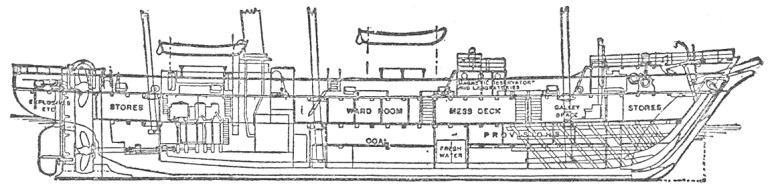
PROFILE DRAWING OF 'DISCOVERY'.
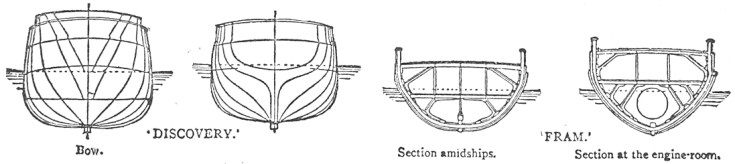
OUTLINE DRAWINGS OF 'DISCOVERY' AND 'FRAM'.
Both in the building and in the subsequent work of the Discovery
the deck-house, marked on the drawing 'Magnetic Observatory,' was
an important place. For the best of reasons it was important that
the magnetic observations taken on the expedition should be as
accurate as possible, and it will be readily understood that magnetic
observations cannot be taken in a place closely surrounded by iron.
The ardor of the magnetic experts on the Ship Committee had led
them at first to ask that there should be neither iron nor steel
in the vessel, but after it had been pointed out that this could
scarcely be, a compromise was arrived at and it was agreed that
no magnetic materials should be employed within thirty feet of
the observatory. This decision caused immense trouble and expense,
but in the end it was justified, for the magnetic observations
taken on board throughout the voyage
Page 25
required very little correction. And if the demands of the magnetic
experts were a little exacting, some amusement was also derived from
them. At one time those who lived within the circle were threatened
with the necessity of shaving with brass razors; and when the ship was
on her way home from New Zealand a parrot fell into dire disgrace,
not because it was too talkative, but because it had been hanging
on the mess-deck during a whole set of observations, and the wires
of its cage were made of iron.
The Discovery was, in Scott's opinion, the finest vessel
ever built for exploring purposes, and he was as enthusiastic about
his officers and men as he was about the ship herself.
The senior of the ten officers who messed with Scott in the small
wardroom of the Discovery was Lieutenant A. B. Armitage,
R.N.R. He brought with him not only an excellent practical seamanship
training in sailing ships, but also valuable Polar experience;
for the P. and O. Company, in which he held a position, had in
1894 granted him leave of absence to join the Jackson-Harmsworth
Expedition to Franz-Josef Land.
Reginald Koettlitz, the senior doctor, had also seen Arctic service
in the Jackson-Harmsworth Expedition. As his medical duties were
expected to be light, he combined them with those of official botanist.
The task of Thomas V. Hodgson, biologist, was to collect by hook
or crook all the strange beasts
Page 26
that inhabit the Polar seas, and no greater enthusiast for his work
could have been chosen.
Charles W. R. Royds was the first lieutenant, and had all to do
with the work of the men and the internal economy of the ship in
the way that is customary with a first lieutenant of a man-of-war.
Throughout the voyage he acted as meteorologist, and in face of
great difficulties he secured the most valuable records.
Michael Barne, the second naval lieutenant, had served with Scott in
the Majestic. 'I had thought him,' Scott wrote after the expedition
had returned, 'as he proved to be, especially fitted for a voyage
where there were many elements of dangers and difficulty.'
The original idea in appointing two doctors to the Discovery
was that one of them should be available for a detached landing-party.
This idea was practically abandoned, but the expedition had reason
to be thankful that it ever existed, for the second doctor appointed
was Edward A. Wilson. In view of the glorious friendship which arose
between them, and which in the end was destined to make history, it
is of inestimable value to be able to quote what is believed to
be Scott's first written opinion of Wilson. In a letter headed 'At
sea, Sept. 27,' he said: 'I now come to the man who will do great
things some day—Wilson. He has quite the keenest intellect
on board and a marvelous capacity for work. You know his artistic
talent, but would be surprised at
Page 27
the speed at which he paints, and the indefatigable manner in which
he is always at it. He has fallen at once into ship-life, helps
with any job that may be in hand... in fact is an excellent fellow
all round.
Wilson, in addition to his medical duties, was also vertebrate
zoologist and artist to the expedition. In the first capacity he
dealt scientifically with the birds and seals, and in the second
he produced a very large number of excellent pictures and sketches
of the wild scenes among which he was living.
One of Scott's earliest acts on behalf of the expedition was to
apply for the services of Reginald W. Skelton as chief engineer.
At the time Skelton was senior engineer of the Majestic, and his
appointment to the Discovery was most fortunate in every
way. From first to last there was no serious difficulty with the
machinery or with anything connected with it.
The geologist, Hartley T. Ferrar, only joined the expedition a
short time before the Discovery sailed, and the physicist,
Louis Bernacchi, did not join until the ship reached New Zealand.
In addition there were two officers who did not serve throughout
the whole term. Owing to ill-health Ernest H. Shackleton was obliged
to return from the Antarctic in 1903, and his place was taken by
George F. A. Mulock, who was a sub-lieutenant in the Navy when
he joined.
Apart from Koettlitz, who was forty, and Hodgson,
Page 28
who was thirty-seven, the average age of the remaining members
of the wardroom mess was just over twenty-four years, and at that
time Scott had little doubt as to the value of youth for Polar
service. Very naturally, however, this opinion was less pronounced
as the years went by, and on August 6, 1911, he wrote during his
last expedition: 'We (Wilson and I) both conclude that it is the
younger people who have the worst time... Wilson (39) says he never
felt cold less than he does now; I suppose that between 30 and
40 is the best all-round age. Bower is a wonder of course. He is
29. When past the forties it is encouraging to remember that Peary
was 52!'
The fact that these officers lived in complete harmony for three
years was proof enough that they were well and wisely chosen, and
Scott was equally happy in his selection of warrant officers, petty
officers and men, who brought with them the sense of naval discipline
that is very necessary for such conditions as exist in Polar service.
The Discovery, it must be remembered, was not in Government
employment, and so had no more stringent regulations to enforce
discipline than those contained in the Merchant Shipping Act. But
everyone on board lived exactly as though the ship was under the
Naval Discipline Act; and as the men must have known that this
state of affairs was a fiction, they deserved as much credit as
the officers, if not more, for continuing rigorously to observe it.
Page 29
Something remains to be said about the Discovery's prospective
course, and of the instructions given to Captain Scott.
For purposes of reference Sir Clements Markham had suggested that
the Antarctic area should be divided into four quadrants, to be
named respectively the Victoria, the Ross, the Weddell, and the
Enderby, and when he also proposed that the Ross quadrant should
be the one chosen for this expedition, his proposal was received
with such unanimous approval that long before the Discovery
was built her prospective course had been finally decided. In fact
every branch of science saw a greater chance of success in the
Ross quadrant than in any other region. Concerning instructions
on such a voyage as the Discovery's it may be thought that,
when once the direction is settled, the fewer there are the better.
Provided, however, that they leave the greatest possible freedom
to the commander, they may be very useful in giving him a general
view of the situation, and in stating the order in which the various
objects are held. If scientific interests clash, it is clearly to
the commander's advantage to know in what light these interests
are regarded by those responsible for the enterprise. Of such a
nature were the instructions Scott received before sailing for
the South.
During the time of preparation many busy men gave most valuable
assistance to the expedition; but even with all this kindly aid
it is doubtful if the Discovery would ever have started
had it not been
Page 30
that among these helpers was one who, from the first, had given
his whole and undivided attention to the work in hand. After all
is said and done Sir Clements Markham conceived the idea of this
Antarctic Expedition, and it was his masterful personality which
swept aside all obstacles and obstructions.
SOUTHWARD HO!
They saw the cables loosened, they saw the gangways cleared,
They heard the women weeping, they heard the men who cheered.
Far off-far off the tumult faded and died away.
And all alone the sea wind came singing up the Bay.
—NEWBOLT.
|
On July 31, 1901, the Discovery left the London Docks, and
slowly wended her way down the Thames; and at Cowes, on August 5,
she was honoured by a visit from King Edward VII and Queen Alexandra.
This visit must be ever memorable for the interest their Majesties
showed in the minutest details of equipment; but at the same time
it was natural for the members of the expedition to be obsessed
by the fear that they might start with a flourish of trumpets and
return with failure. The grim possibilities of the voyage were
also not to be forgotten—a voyage to the Antarctic, the very
map of which had remained practically unaltered from 1843-93.
With no previous Polar experience to help him, Scott was following
on the track of great Polar explorers, notably of James Cook and
James Ross, of whom it has been well said that the one defined the
Antarctic region and the other discovered it. Can it be wondered
therefore that his great anxieties were
Page 32
to be off and doing, to justify the existence of the expedition at
the earliest possible moment, and to obey the instructions which
had been given him?
Before the Discovery had crossed the Bay of Biscay it was
evident that she did not possess a turn of speed under any conditions,
and that there must be none but absolutely necessary delays on
the voyage, if she was to arrive in the Antarctic in time to take
full advantage of the southern summer of 1901-2 for the first
exploration in the ice. This proved a serious drawback, as it had
been confidently expected that there would be ample time to make
trial of various devices for sounding and dredging in the deep
sea, while still in a temperate climate. The fact that no trials
could be made on the outward voyage was severely felt when the
Antarctic was reached.
On October 2 the Discovery arrived within 150 miles of the
Cape, and on the 5th was moored off the naval station at Simon's
Bay. The main object of staying at the Cape was to obtain comparisons
with the magnetic instruments, but Scott wrote: 'It is much to
be deplored that no permanent Magnetic Station now exists at the
Cape. The fact increased the number and difficulty of our own
observations, and it was quite impossible to spare the time for
such repetitions and verifications as, under the circumstances,
could alone have placed them beyond dispute.' Armitage and Barne,
however, worked like Trojans in taking observations, and received
so much valuable assistance 'that they were able to accomplish
a maximum
Page 33
amount of work in the limited time at their disposal.' In every
way, indeed, the kindliest sympathy was shown at the Cape.
The magnetic work was completed on October 12, and two days later
the Discovery once more put out to sea; and as time went on
those on board became more and more satisfied with her seaworthy
qualities. Towards the end of October there was a succession of
heavy following gales, but she rose like a cork to the mountainous
seas that followed in her wake, and, considering her size, she was
wonderfully free of water on the upper deck. With a heavy following
sea, however, she was, owing to her buoyancy, extremely lively, and
rolls of more than 40º were often recorded. The peculiar shape of
the stern, to which reference has been made, was now well tested.
It gave additional buoyancy to the after-end, causing the ship to
rise more quickly to the seas, but the same lifting effect was
also directed to throwing the ship off her course, and consequently
she was difficult to steer. The helmsmen gradually became more
expert, but on one occasion when Scott and some other officers were
on the bridge the ship swerved round, and was immediately swept by
a monstrous sea which made a clean breach over her. Instinctively
those on the bridge clutched the rails, and for several moments
they were completely submerged while the spray dashed as high as
the upper topsails.
On November 12 the Discovery was in lat. 51 S., long. 131
E., and had arrived in such an extremely
Page 34
interesting magnetic area that they steered to the south to explore
it. This new course took them far out of the track of ships and
towards the regions of ice, and they had scarcely arrived in those
lonely waters when Scott was aroused from sleep by a loud knocking
and a voice shouting, 'Ship's afire, sir.' Without waiting to give
any details of this alarming news the informant fled, and when
Scott appeared hastily on the scenes he found that the deck was
very dark and obstructed by numerous half-clad people, all of whom
were as ignorant as he was. Making his way forward he discovered
that the fire had been under the forecastle, and had been easily
extinguished when the hose was brought to bear on it. In these
days steel ships and electric light tend to lessen the fear of
fire, but in a wooden vessel the possible consequences are too
serious not to make the danger very real and alarming. Henceforth
the risk of fire was constantly in Scott's thoughts, but this was
the first and last occasion on which an alarm was raised in the
Discovery.
On November 15 the 60th parallel was passed, and during the following
morning small pieces of sea-ice, worn into fantastic shape by the
action of the waves, appeared and were greeted with much excitement
and enthusiasm. As the afternoon advanced signs of a heavier pack
were seen ahead, and soon the loose floes were all about the ship,
and she was pushing her way amongst them and receiving her baptism
of ice.
Page 35
This was Scott's first experience of pack-ice, and he has recorded
how deeply he was impressed by the novelty of his surroundings.
'The wind had died away; what light remained was reflected in a
ghostly glimmer from the white surface of the pack; now and again
a white snow petrel flitted through the gloom, the grinding of the
floes against the ship's side was mingled with the more subdued
hush of their rise and fall on the long swell, and for the first
time we felt something of the solemnity of these great Southern
solitudes.'
The Discovery was now within 200 miles of Adélie
Land, and with steam could easily have pushed on towards it. But
delays had already been excessive, and they could not be added to
if New Zealand was to be reached betimes. Reluctantly the ship's
head was again turned towards the North, and soon passed into looser
ice.
One great feature of the tempestuous seas of these southern oceans
is the quantity and variety of their bird life. Not only are these
roaming, tireless birds to be seen in the distance, but in the
majority of cases they are attracted by a ship and for hours gather
close about her. The greater number are of the petrel tribe, and
vary in size from the greater albatrosses, with their huge spread
of wing and unwavering flight, to the small Wilson stormy petrel,
which flits under the foaming crests of the waves. For centuries
these birds have been the friends of sailors, and as Wilson was
able to distinguish and
Page 36
name the various visitors to the Discovery, the interest
of the voyage was very greatly increased.
'At 11 A.M. on the 22nd,' Scott wrote in his official report of
the Proceedings of the expedition, 'we sighted Macquarie Island,
exactly at the time and in the direction expected, a satisfactory
fact after so long an absence from land. As the island promised so
much of interest to our naturalists I thought a delay of the few
hours necessary for landing would be amply justified.... A landing
was effected without much difficulty, and two penguin rookeries which
had been observed from the ship were explored with much interest.
One proved to be inhabited by the beautifully marked King penguin,
while the other contained a smaller gold-crested broad-billed
species.... At 8 P.M. the party returned to the ship, and shortly
after we weighed anchor and proceeded. Including those collected
in the ice, we had no fewer than 50 birds of various sorts to be
skinned, and during the next few days several officers and men
were busily engaged in this work under the superintendence of Dr.
Wilson. The opportunity was taken of serving out the flesh of the
penguins for food. I had anticipated considerable prejudice on
the part of the men to this form of diet which it will so often
be essential to enforce, and was agreeably surprised to find that
they were by no means averse to it. Many pronounced it excellent,
and all seemed to appreciate the necessity of cultivating a taste
for it. I found no prejudice more difficult to conquer than my own.'
Page 37
Perhaps the most excited member of the party over this visit to
Macquarie Island was Scott's Aberdeen terrier 'Scamp,' who was most
comically divided between a desire to run away from the penguins,
and a feeling that in such strange company it behooved him to be very
courageous. This, however, was Scamp's first and last experience
of penguins, for it was felt that he would be unable to live in
the Antarctic, and so a comfortable home was found for him in New
Zealand.
Late on November 29 the Discovery arrived off Lyttelton
Heads, and on the following day she was berthed alongside a jetty
in the harbor. For both the private and the public kindness which was
shown to the expedition in New Zealand, no expressions of gratitude
can be too warm. On every possible occasion, and in every possible
way, efficient and kindly assistance was given, and this was all
the more valuable because a lot of work had to be done before the
ship could sail from Lyttelton. The rigging had to be thoroughly
overhauled and refitted; the magneticians had to undertake the
comparison of their delicate instruments, and as this was the last
occasion on which it could be done special attention was necessary;
and a large quantity of stores had to be shipped, because some
of those in the Discovery had been damaged by the leaky
state of the ship. This leak had never been dangerous, but all the
same it had entailed many weary hours of pumping, and had caused
much waste of time and of provisions. Among the many skilled
Page 38
workmen, whose united labour had produced the solid structure of
the Discovery's hull, had been one who had shirked his task,
and although the ship was docked and most determined and persistent
efforts were made to find the leak, it succeeded in avoiding detection.
As the month of December advanced the scene on the ship was a very
busy one, but at last the day for sailing from Lyttelton arrived,
though not for the final departure from civilization, because a
short visit was to be paid to Port Chalmers in the south to complete
the stock of coal. On Saturday, December 21, the ship lay alongside
the wharf ready for sea and very deeply laden. 'One could reflect
that it would have been impossible to have got more into her, and
that all we had got seemed necessary for the voyage, for the rest
we could only trust that Providence would vouch-safe to us fine
weather and an easy passage to the south.'
New Zealand, to the last, was bent on showing its enthusiasm for
the expedition. Two men-of-war steamed slowly out ahead of the
Discovery, while no fewer than five steamers, crowded with
passengers, and with bands playing and whistles hooting, also
accompanied her, until the open sea was reached and the Discovery
slowly steamed out between the war-ships that seemed to stand as
sentinels to the bay. And then, before the cheers of thousands of
friends were hardly out of the ears of those on board, a tragedy
happened. Among the ship's company who had crowded into the rigging to
wave their farewells was one young seaman, named Charles Bonner, who,
Page 39
more venturesome than the rest, had climbed above the crow's-nest
to the top of the main-mast. There, seated on the truck, he had
remained cheering, until in a moment of madness he raised himself
into a standing position, and almost directly afterwards he fell
and was instantaneously killed. On the Monday the ship arrived
at Port Chalmers, and Bonner was buried with naval honours.
By noon on the following day the Discovery was clear of
the harbor bar, and was soon bowling along under steam and sail
towards the south. The last view of civilization, the last sight
of fields and flowers had come and gone on Christmas Eve, 1901, and
Christmas Day found the ship in the open expanse of the Southern
Ocean, though after such a recent parting from so many kind friends
no one felt inclined for the customary festivities.
In good sea trim the Discovery had little to fear from the
worst gales, but at this time she was so heavily laden that had
she encountered heavy seas the consequences must have been very
unpleasant. Inevitably much of her large deck cargo must have been
lost; the masses of wood on the superstructure would have been in
great danger, while all the sheep and possibly many of the dogs
would have been drowned. Fine weather, however, continued, and on
January 3 Scott and his companions crossed the Antarctic Circle,
little thinking how long a time would elapse before they would
recross it. At length they had entered the Antarctic regions; before
them lay
Page 40
the scene of their work, and all the trials of preparation, and
the anxiety of delays, were forgotten in the fact that they had
reached their goal in time to make use of the best part of the
short open season in these icebound regions.
Soon the pack was on all sides of them, but as yet so loose that
there were many large pools of open water. And then for several
days the ship had really to fight her way, and Scott gave high
praise to the way she behaved: 'The "Discovery" is a perfect gem
in the pack. Her size and weight behind such a stem seem to give
quite the best combination possible for such a purpose. We have
certainly tried her thoroughly, for the pack which we have come
through couldn't have been looked at by Ross even with a gale of
wind behind him.'
Necessarily progress became slow, but life abounds in the pack, and
the birds that came to visit the ship were a source of perpetual
interest. The pleasantest and most constant of these visitors was
the small snow petrel, with its dainty snow-white plumage relieved
only by black beak and feet, and black, beady eye. These little
birds abound in the pack-ice, but the blue-grey southern fulmar
and the Antarctic petrel were also to be seen, and that unwholesome
scavenger, the giant petrel, frequently lumbered by; while the skua
gull, most pugnacious of bullies, occasionally flapped past, on
his way to make some less formidable bird disgorge his hard-earned
dinner.
The squeak of the penguin was constantly heard, at
Page 41
first afar and often long before the birds were seen. Curiosity
drew them to the ship, and as she forced her way onward these little
visitors would again and again leap into the water, and journey
from floe to floe in their eagerness to discover what this strange
apparition could be. Some of the sailors became very expert in
imitating their calls, and could not only attract them from a long
distance, but would visibly add to their astonishment when they
approached. These were busy days for the penguins.
In all parts of the pack seals are plentiful and spend long hours
asleep on the floes. The commonest kind is the crab-eater or white
seal, but the Ross seal is not rare, and there and there is found
the sea-leopard, ranging wide and preying on the penguins and even
on the young of its less powerful brethren. It is curious to observe
that both seals and penguins regard themselves as safe when out of
the water. In the sea they are running risks all the time, and in
that element Nature has made them swift to prey or to avoid being
preyed upon. But once on ice or land they have known no enemy,
and cannot therefore conceive one. The seal merely raises its head
when anyone approaches, and then with but little fear; whereas it
is often difficult to drive the penguin into the water, for he
is firmly convinced that the sea is the sole source of danger.
Several seals were killed for food, and from the first seal-meat
was found palatable, if not altogether the form of diet to recommend
to an epicure. The great drawback to the seal is that there is no
fat except blubber,
Page 42
and blubber has a very strong taste and most penetrating smell.
At this time blubber was an abomination to everyone both in taste
and smell, and if the smallest scrap happened to have been cooked
with the meat, dinner was a wasted meal. Later on, however, this
smell lost most of its terrors, while seal-steaks and seal-liver
and kidneys were treated almost as luxuries.
On the morning of January 8 a strong water sky could be seen, and
soon afterwards the officer of the watch hailed from aloft the glad
tidings of an open sea to the south. Presently the ship entered
a belt where the ice lay in comparatively small pieces, and after
pushing her way through this for over a mile, she reached the hard
line where the ice abruptly ended, and to the south nothing but
a clear sky could be seen. At 10.30 P.M. on the same evening the
joy of being again in the open sea was intensified by a shout of
'Land in sight,' and all who were not on deck quickly gathered
there to take their first look at the Antarctic Continent. The
sun, near the southern horizon, still shone in a cloudless sky, and
far away to the south-west the blue outline of the high mountain
peaks of Victoria Land could be seen. The course was now directed for
Robertson Bay, and after some difficulty, owing to the reappearance
of loose streams of pack-ice, the ship was eventually steered into
the open water within the bay.
Robertson Bay is formed by the long peninsula of Cape Adare, within
which, standing but slightly above the level of the sea, is a curious
triangular
Page 43
spit, probably the morainic remains of the vaster ice conditions
of former ages. It was on this spit that the expedition sent forth
by Sir George Newnes and commanded by Borchgrevink spent their
winter in 1896, the first party to winter on the shores of the
Antarctic Continent. Here Scott decided to land for a short time,
and very soon Armitage, Bernacchi and Barne were at work among
the thousands of penguins that abounded, while the naturalists
wandered further afield in search of specimens. In the center of
Cape Adare beach the hut used by the members of Borchgrevink's
party was still found to be standing in very good condition, though
at the best of times deserted dwellings are far from cheerful to
contemplate. Bernacchi had been a member of this small party of
eight, and on the spot he recalled the past, and told of the unhappy
death of Hanson—one of his comrades.
Later on Bernacchi and some others landed again to visit Hanson's
grave, and to see that all was well with it. They took a tin cylinder
containing the latest report of the voyage with them, and were told
to place it in some conspicuous part of the hut. In the following
year this cylinder was found by the Morning,[1] and so the
first information was given that the Discovery had succeeded
in reaching these southern regions.
On January 10, when the weather was still calm and bright, the ship
again stood out to sea, and was steered close around Cape Adare
in the hope of finding
Page 44
a clear channel near at hand. Very soon, however, the tidal stream
began to make from the south, and the whole aspect of the streams
of heavy pack-ice rapidly changed. Almost immediately the pack was
about the ship, and she was being rapidly borne along with it.
Across the entrance to the bay was a chain of grounded icebergs,
and it was in this direction that she was being carried. For the
first time they faced the dangers of the pack, and realized its
mighty powers. Little or nothing could be done, for the floes around
them were heavier than anything they had yet encountered. Twist and
turn as they would no appreciable advance could be made, and in
front of one colossal floe the ship was brought to a standstill for
nearly half an hour. But they still battled on; Armitage remained
aloft, working the ship with admirable patience; the engine-room,
as usual, answered nobly to the call for more steam, and the
Discovery exerted all her powers in the struggle; but, in
spite of these efforts, progress was so slow that it looked almost
certain that she would be carried down among the bergs. 'It was
one of those hours,' Scott says, 'which impress themselves for
ever on the memory. Above us the sun shone in a cloudless sky, its
rays were reflected from a myriad points of tire glistening pack;
behind us lay the lofty snow-clad mountains, the brown sun-kissed
cliffs of the Cape, and the placid glassy waters of the bay; the air
about us was almost breathlessly still; crisp, clear and sun-lit,
it seemed an atmosphere in which all Nature should rejoice;
Page 45
the silence was broken only by the deep panting of our engines
and the slow, measured hush of the grinding floes; yet, beneath
all, ran this mighty, relentless tide, bearing us on to possible
destruction. It seemed desperately unreal that danger could exist
in the midst of so fair a scene, and as one paced to and fro on
the few feet of throbbing plank that constituted our bridge, it was
difficult to persuade oneself that we were so completely impotent.'
With the exception of Scott himself only those who were actually
on watch were on deck during this precarious time, for the hour was
early, and the majority were asleep in their bunks below, happily
oblivious of the possible dangers before them. And the fact that
they were not aroused is a proof that a fuss was rarely made in the
Discovery, if it could by any conceivable means be avoided.
At last, however, release came from this grave danger, and it came
so gradually that it was difficult to say when it happened. Little
by little the tidal stream slackened, the close-locked floes fell
slightly apart, and under her full head of steam the ship began
to forge ahead towards the open sea and safety. 'For me,' Scott
adds, 'the lesson had been a sharp and, I have no doubt, a salutary
one; we were here to fight the elements with their icy weapons,
and once and for all this taught me not to undervalue the enemy.'
During the forenoon the ship was within seven or eight miles of
the high bold coast-line to the south of Cape Adare, but later
she had to be turned outwards
Page 46
so that the heavy stream of pack-ice drifting along the land could
be avoided. By the morning of the 11th she was well clear of the
land, but the various peaks and headlands which Sir James Ross
had named could be distinctly seen, and gave everyone plenty to
talk and think about. Progress, however, was slow, owing to a brisk
S. E. wind and the fact that only one boiler was being used.
Of all economies practiced on board the most important was that of
coal, but Scott was not at all sure that this decision to use only
one boiler was really economical. Certainly coal was saved but time
was also wasted, and against an adverse wind the Discovery
could only make fifty-five miles on the 11th, and on the 12th she
scarcely made any headway at all, for the wind had increased and
a heavy swell was coming up from the south.
To gain shelter Scott decided to turn in towards the high cliffs
of Coulman Island, the land of which looked illusively near as
they approached it. So strong was this deception that the engines
were eased when the ship was still nearly two miles away from the
cliffs. Later on, in their winter quarters and during their sledge
journeys, they got to know how easy it was to be deluded as regards
distance, and what very false appearances distant objects could
assume. This matter is of interest, because it shows that Polar
explorers must be exceedingly cautious in believing the evidence
of their own eyes, and it also explains the errors which the
Discovery expedition found to
Page 47
have been made by former explorers, and which they knew must have
been made in all good faith.
During the night of the 13th the ship lay under the shelter of
Coulman Island, but by the morning the wind had increased to such
a furious gale, and the squalls swept down over the cliffs with
such terrific violence, that in spite of every effort to keep her
in her station she began to lose ground. In the afternoon the wind
force was ninety miles an hour, and as they continued to lose ground
they got into a more choppy sea, which sent the spray over them
in showers, to freeze as it fell.
Again the situation was far from pleasant; to avoid one berg they
were forced to go about, and in doing so they ran foul of another. As
they came down on it the bowsprit just swept clear of its pinnacled
sides, and they took the shock broad on their bows. It sent the
ship reeling round, but luckily on the right tack to avoid further
complications. The following night was dismal enough; again and
again small bergs appeared through the blinding spray and drift, and
only with great difficulty could the unmanageable ship be brought
to clear them. Even gales, however, must have an end, and towards
morning the wind moderated, and once more they were able to steam
up close to the island. And there, between two tongues of ice off
Cape Wadworth, they landed on the steep rocks and erected a staff
bearing a tin cylinder with a further record of the voyage. By
the time this had been done the wind had fallen completely, and in
Page 48
the evening the ship entered a long inlet between Cape Jones and
the barrier-ice, and later turned out, of this into a smaller inlet
in the barrier-ice itself. She was now in a very well-sheltered
spot, and night, as often happened in the Antarctic regions, was
turned into day so that several seals could be killed. 'It, seemed
a terrible desecration,' Scott says, 'to come to this quiet spot
only to murder its innocent inhabitants, and stain the white snow
with blood.' But there was the best of all excuses, namely necessity,
for this massacre, because there was no guarantee that seals would
be found near the spot in which the ship wintered, and undoubtedly
the wisest plan was to make sure of necessary food.
While the seal carcasses and some ice for the boilers were being
obtained, Scott turned in to get some rest before putting out to
sea again, and on returning to the deck at 7.30 he was told that
the work was completed, but that some five hours before Wilson,
Ferrar, Cross and Weller had got adrift of a floe, and that no one
had thought of picking them up. Although the sun had been shining
brightly all night, the temperature had been down to 18°, and
afar off Scott could see four disconsolate figures tramping about,
and trying to keep themselves warm on a detached floe not more
than fifteen yards across.
When at length the wanderers scrambled over the side it was very
evident that they had a grievance, and not until they had been warmed
by hot cocoa could they talk with ease of their experiences. They
Page 49
had been obliged to keep constantly on the move, and when they
thought of smoking to relieve the monotony they found that they
had pipes and tobacco, but no matches. While, however, they were
dismally bemoaning this unfortunate state of affairs Wilson, who
did not smoke, came to the rescue and succeeded in producing fire
with a small pocket magnifying glass—a performance which
testified not only to Wilson's resource, but also to the power of
the sun in these latitudes.
On the 17th the ship had to stand out farther and farther from
the land to clear the pack, and when on the 18th she arrived in
the entrance to Wood Bay it was also found to be heavily packed. A
way to the N. and N.W. the sharp peaks of Monteagle and Murchison,
among bewildering clusters of lesser summits, could be seen; across
the bay rose the magnificent bare cliff of Cape Sibbald, while
to the S.W. the eye lingered pleasantly upon the uniform outline
of Mount Melbourne. This fine mountain rears an almost perfect
volcanic cone to a height of 9,000 feet, and with no competing
height to take from its grandeur, it constitutes the most magnificent
landmark on the coast. Cape Washington, a bold, sharp headland,
projects from the foot of the mountain on its eastern side, and
finding such heavy pack in Wood Bay, Scott decided to turn to the
south to pass around this cape.
From this point the voyage promised to be increasingly interesting,
since the coast to the south of Cape Washington was practically
unknown. Pack-ice was
Page 50
still a formidable obstacle, but on the 20th the Discovery
pushed her way into an inlet where she met ice which had been formed
inside and but recently broken up. The ice was perfectly smooth, and
as it showed absolutely no sign of pressure there was no doubting
that this inlet would make a secure wintering harbor. Already a
latitude had been reached in which it was most desirable to find
safe winter quarters for the ship. In England many people had thought
that Wood Bay would be the most southerly spot where security was
likely to be found, but Scott had seen enough of the coast-line to
the south of that place to realize the impossibility of traveling
along it in sledges, and to convince him that if any advance to
the south was to be made, a harbor in some higher latitude must
be found.
This inlet was afterwards named Granite Harbor, and so snug and
secure a spot was it to winter in that Scott expressed his thankfulness
that he did not yield to its allurements. 'Surrounded as we should
have been by steep and lofty hills, we could have obtained only the
most local records of climatic conditions, and our meteorological
observations would have been comparatively valueless; but the greatest
drawback would have been that we should be completely cut off from
traveling over the sea-ice beyond the mouth of our harbor.... It
is when one remembers how naturally a decision to return to this
place might have been made, that one sees how easily the results
of the expedition might have been missed.'
Page 51
It was, however, consoling at the time to know that, in default
of a better place, a safe spot had been found for wintering, so
with Granite Harbor in reserve the ship again took up her battle
with the ice; and on the 21st she was in the middle of McMurdo
Sound, and creeping very slowly through the pack-ice, which appeared
from the crow's-nest to extend indefinitely ahead. They were now
within a few miles of the spot where they ultimately took up their
winter quarters, but nearly three weeks were to pass before they
returned there. 'At 8 P.M. on the 21st,' Scott says, 'we thought
we knew as much of this region as our heavy expenditure of coal
in the pack-ice would justify us in finding out, and as before
us lay the great unsolved problem of the barrier and of what lay
beyond it, we turned our course with the cry of Eastward ho!'
IN SEARCH OF WINTER QUARTERS
Beholde I see the haven near at hand
To which I mean my wearie course to bend;
Vere the main sheet and bear up to the land
To which afore is fairly to be ken'd.
—SPENSER, Faerie Queene.
|
In their journey from Cape Washington to the south something had
already been done to justify the dispatch of the expedition. A
coast-line which hitherto had been seen only at a great distance,
and reported so indefinitely that doubts were left with regard to
its continuity, had been resolved into a concrete chain of mountains;
and the positions and forms of individual heights, with the curious
ice formations and the general line of the coast, had been observed.
In short the map of the Antarctic had already received valuable
additions, and whatever was to happen in the future that, at any
rate, was all to the good.
At 8 P.M. on the 22nd the ship arrived off the bare land to the
westward of Cape Crozier, where it was proposed to erect a post
and leave a cylinder containing an account of their doings, so
that the chain of records might be completed. After a landing had
Page 53
been made with some difficulty, a spot was chosen in the center
of the penguin rookery on a small cliff overlooking the sea, and
here the post was set up and anchored with numerous boulders. In
spite of every effort to mark the place, at a few hundred yards it
was almost impossible to distinguish it; but although this small
post on the side of a vast mountain looked a hopeless clue, it
eventually brought the Morning into McMurdo Sound.
While Bernacchi and Barne set up their magnetic instruments and
began the chilly task of taking observations, the others set off
in twos and threes to climb the hillside. Scott, Royds and Wilson
scrambled on until at last they reached the summit of the highest
of the adjacent volcanic cones, and were rewarded by a first view
of the Great Ice Barrier.[1]
'Perhaps,' Scott says, 'of all the problems which lay before us in
the south we were most keenly interested in solving the mysteries
of this great ice-mass.... For sixty years it had been discussed
and rediscussed, and many a theory had been built on the slender
foundation of fact which alone the meager information concerning it
could afford. Now for the first time this extraordinary ice-formation
was seen from above.... It was an impressive sight and the very
vastness of what lay at our feet seemed to add to our sense of
its mystery.'
Early on the 23rd they started to steam along the
Page 54
ice-face of the barrier; and in order that nothing should be missed
it was arranged that the ship should continue to skirt close to the
ice-cliff, that the officers of the watch should repeatedly observe
and record its height, and that three times in the twenty-four
hours the ship should be stopped and a sounding taken. In this
manner a comparatively accurate survey of the northern limit of
the barrier was made.
On steaming along the barrier it was found that although they were
far more eager to gain new information than to prove that old
information was incorrect, a very strong case soon began to arise
against the Parry Mountains, which Ross had described as 'probably
higher than we have yet seen'; and later on it was known with absolute
certainty that these mountains did not exist. This error on the part
of such a trustworthy and cautious observer, Scott ascribes to
the fact that Ross, having exaggerated the height of the barrier,
was led to suppose that anything seen over it at a distance must
be of great altitude. 'But,' he adds, 'whatever the cause, the
facts show again how deceptive appearances may be and how easily
errors may arise. In fact, as I have said before, one cannot always
afford to trust the evidence of one's own eyes.' Though the ship
was steaming along this ice-wall for several days, the passage was
not in the least monotonous, because new variations were continually
showing themselves, and all of them had to be carefully observed and
recorded. This work continued for several days until, on January
29, they arrived at a particularly interesting place, to
Page 55
the southward and eastward of the extreme position reached by Ross
in 1842. From that position he had reported a strong appearance
of land to the southeast, and consequently all eyes were directed
over the icy cliffs in that direction. But although the afternoon
was bright and clear, nothing from below or from aloft could be
seen, and the only conclusion to be made was that the report was
based on yet another optical illusion.
But in spite of the disappointment at being unable to report that
Ross's 'appearance of land' rested on solid foundations, there was
on the afternoon of the 29th an indescribable sense of impending
change. 'We all felt that the plot was thickening, and we could not
fail to be inspirited by the fact that we had not so far encountered
the heavy pack-ice which Ross reported in this region, and that
consequently we were now sailing in an open sea into an unknown
world.'
The course lay well to the northward of east, and the change came at
8 P.M. when suddenly the ice-cliff turned to the east, and becoming
more and more irregular continued in that direction for about five
miles, when again it turned sharply to the north. Into the deep bay
thus formed they ran, and as the ice was approached they saw at
once that it was unlike anything yet seen. The ice-foot descended
to various heights of ten or twenty feet above the water, and behind
it the snow surface rose in long undulating slopes to rounded ridges,
the heights of which could only be guessed. Whatever doubt remained
in their minds that this was snow-covered land, a sounding of 100
fathoms quickly removed it.
Page 56
But what a land! On the swelling mounds of snow above them there
was not one break, not a feature to give definition to the hazy
outline. No scene could have been more perfectly devised to produce
optical illusions. And then, while there was so much to observe,
a thick fog descended, and blotted out all hope of seeing what
lay beyond the ice-foot. During the afternoon of January 30 the
fog was less dense, but still no sign of bare land could be seen,
and it was not until the bell had sounded for the evening meal that
two or three little black patches, which at first were mistaken
for detached cloud, appeared. 'We gazed idly enough at them till
someone remarked that he did not believe they were clouds; then all
glasses were leveled; assertions and contradictions were numerous,
until the small black patches gradually assumed more and more definite
shape, and all agreed that at last we were looking at real live
rock, the actual substance of our newly discovered land.... It is
curious to reflect now on the steps which led us to the discovery
of King Edward's Land, and the chain of evidence which came to us
before the actual land itself was seen: at first there had been
the shallow soundings, and the sight of gently rising snow-slopes,
of which, in the nature of things, one is obliged to retain a doubt;
then the steeper broken slopes of snow, giving a contrast to convey
a surer evidence to the eye; and, finally the indubitable land
itself, but even then surrounded with such mystery as to leave us
far from complete satisfaction with our discovery.'
Page 57
The temptation to push farther and farther to the east was almost
irresistible, but with the young ice forming rapidly around them,
Scott, on February 1, decided to return, and on their way back
along the barrier they experienced much lower temperatures than
on the outward journey. During the return journey they landed on
the barrier, and on February 4 preparations for a balloon ascent
were made. 'The honour,' Scott says, 'of being the first aeronaut to
make an ascent in the Antarctic Regions, perhaps somewhat selfishly,
I chose for myself, and I may further confess that in so doing
I was contemplating the first ascent I had made in any region,
and as I swayed about in what appeared a very inadequate basket
and gazed down on the rapidly diminishing figures below, I felt
some doubt as to whether I had been wise in my choice.'
If, however, this ascent was not altogether enjoyed by the aeronaut,
it, at any rate, gave him considerable information about the barrier
surface towards the south; and, to his surprise, he discovered
that instead of the continuous level plain that he had expected,
it continued in a series of long undulations running approximately
east and west, or parallel to the barrier surface. Later on, however,
when the sledge-party taken out by Armitage returned, they reported
that these undulations were not gradual as had been supposed from
the balloon, but that the crest of each wave was flattened into a
long plateau, from which the descent into the succeeding valley
was comparatively sharp. On the evening of the 4th they put out
Page 58
to sea again, and on the 8th they were once more in McMurdo Sound,
with high hopes that they would soon find a sheltered nook in which
the Discovery could winter safely, and from which the
sledge-parties could set forth upon the task of exploring the vast
new world around them.
Without any delay they set out to examine their immediate surroundings,
and found a little bay which promised so well for the winter that
Scott's determination to remain in this region was at once strengthened.
The situation, however, was surrounded with difficulties, for although
the ice had broken far afield it refused to move out of the small
bay on which they had looked with such eager eyes; consequently
they were forced to cling to the outskirts of the bay with their
ice-anchors, in depths that were too great to allow the large anchors
to be dropped to the bottom. The weather also was troublesome,
for after the ship had lain quietly during several hours a sudden
squall would fling her back on her securing ropes, and, uprooting
the ice-anchors, would ultimately send her adrift.
In spite, however, of the difficulty of keeping the ship in position,
steady progress was made with the work on shore, and this consisted
mainly in erecting the various huts which had been brought in pieces.
The original intention had been that the Discovery should
not winter in the Antarctic, but should land a small party and
turn northward before the season closed, and for this party a large
hut had been carried south. But even when it had been decided to
keep the
Page 59
ship as a home, it was obvious that a shelter on shore must be
made before exploring parties could be safely sent away; since
until the ship was frozen in a heavy gale might have driven her off
her station for several days, if not altogether. In seeking winter
quarters so early in February, Scott had been firmly convinced that
the season was closing in. 'With no experience to guide us, our
opinion could only be based on the very severe and unseasonable
conditions which we had met with to the east. But now to our
astonishment we could see no sign of a speedy freezing of the bay;
the summer seemed to have taken a new lease, and for several weeks
the fast sea-ice continued to break silently and to pass quietly
away to the north in large floes.'
In addition to the erection of the main hut, two small huts which
had been brought for the magnetic instruments had to be put together.
The parts of these were, of course, numbered, but the wood was
so badly warped that Dailey, the carpenter, had to use a lot of
persuasion before the joints would fit.
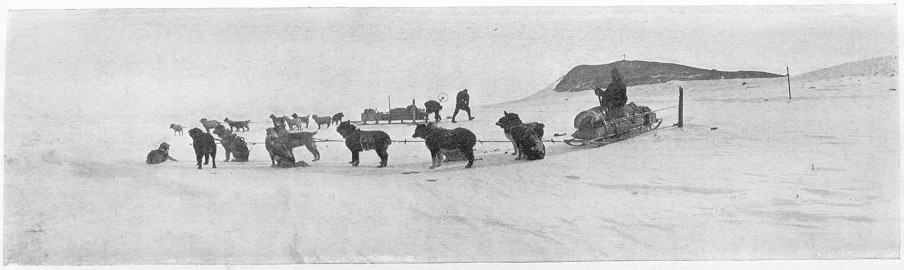
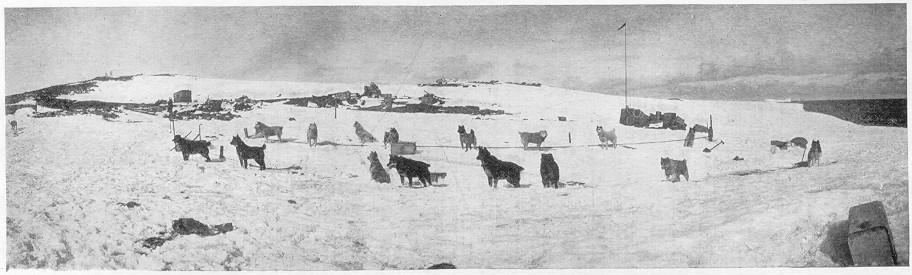
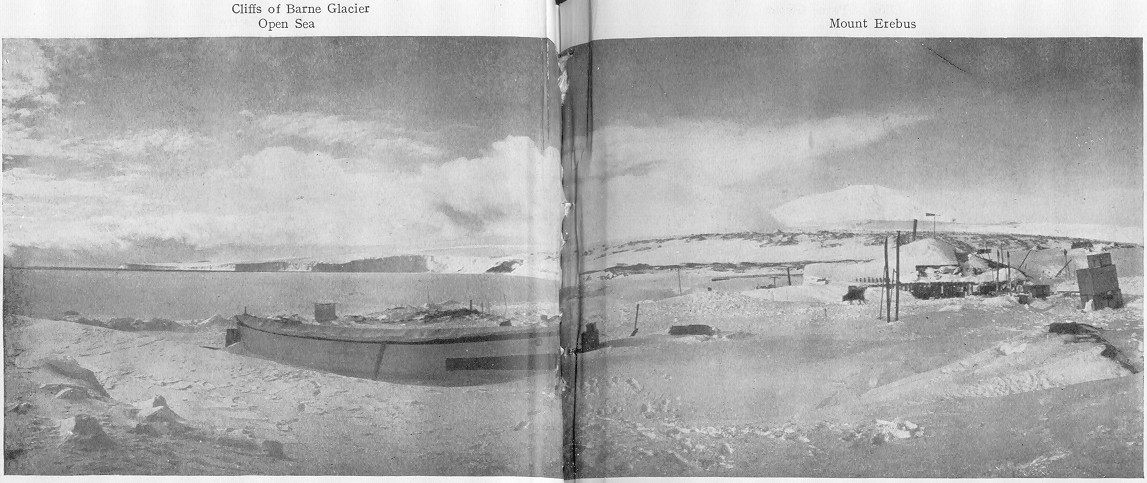
On February 14 Scott wrote in his diary: 'We have landed all the
dogs, and their kennels are ranged over the hillside below the
huts.... It is surprising what a number of things have to be done,
and what an unconscionable time it takes to do them. The hut-building
is slow work, and much of our time has been taken in securing the
ship.... Names have been given to the various landmarks in our
vicinity. The end of our peninsula is to be called "Cape Armitage,"
after our excellent navigator. The sharp hill above it
Page 60
is to be "Observation Hill."... Next comes the "Gap," through which
we can cross the peninsula at a comparatively low level. North
of the "Gap" are "Crater Heights," and the higher volcanic peak
beyond is to be "Crater Hill"; it is 1,050 feet in height. Our
protecting promontory is to be "Hut Point," with "Arrival Bay" on
the north and "Winter Quarter Bay" on the south; above "Arrival
Bay" are the "Arrival Heights," which continue with breaks for
about three miles to a long snow-slope, beyond which rises the most
conspicuous landmark on our peninsula, a high, precipitous-sided
rock with a flat top, which has been dubbed "Castle Rock"; it is
1,350 feet in height.
'In spite of the persistent wind, away up the bay it is possible
to get some shelter, and here we take our ski exercise.... Skelton
is by far the best of the officers, though possibly some of the
men run him close.'
On the 19th the first small reconnoitering sledge party went out,
and on their return three days later they were so excited by their
experiences that some time passed before they could answer the
questions put to them. Although the temperature had not been severe
they had nearly got into serious trouble by continuing their march
in a snowstorm, and when they did stop to camp they were so exhausted
that frost-bites were innumerable. The tent had been difficult to
get up, and all sorts of trouble with the novel cooking apparatus
had followed. 'It is strange now,' Scott wrote three years later,
'to look back on
Page 61
these first essays at sledding, and to see how terribly hampered
we were by want of experience.'
By February 26 the main hut was practically finished, and as a
quantity of provisions and oil, with fifteen tons of coal, had been
landed, the ship could be left without anxiety, and arrangements for
the trip, which Scott hoped to lead himself, were pushed forward.
The object of this journey was to try and reach the record at Cape
Crozier over the barrier, and to leave a fresh communication there
with details of the winter quarters. On the following day, however,
Scott damaged his right knee while skiing, and had to give up all
idea of going to Cape Crozier. 'I already foresaw how much there
was to be learnt if we were to do good sledding work in the spring,
and to miss such an opportunity of gaining experience was terribly
trying; however, there was nothing to be done but to nurse my wounded
limb and to determine that never again would I be so rash as to
run hard snow-slopes on ski.'
By March 4 the preparation of the sledge party was completed. The
party consisted of four officers, Royds, Koettlitz, Skelton and
Barne, and eight men, and was divided into two teams, each pulling
a single sledge and each assisted by four dogs. But again the want
of experience was badly felt, and in every respect the lack of system
was apparent. Though each requirement might have been remembered, all
were packed in a confused mass, and, to use a sailor's expression,
'everything was on top and nothing handy.'
Page 62
Once more Scott comments upon this lack of experience: 'On looking
back I am only astonished that we bought that experience so cheaply,
for clearly there were the elements of catastrophe as well as of
discomfort in the disorganized condition in which our first sledge
parties left the ship.'
The days following the departure of the sledge party were exceptionally
fine, but on Tuesday, March 11, those on board the ship woke to
find the wind blowing from the east; and in the afternoon the wind
increased, and the air was filled with thick driving snow. This
Tuesday was destined to be one of the blackest days spent by the
expedition in the Antarctic, but no suspicion that anything untoward
had happened to the sledge party arose until, at 8.30 P.M., there
was a report that four men were walking towards the ship. Then the
sense of trouble was immediate, and the first disjointed sentences
of the newcomers were enough to prove that disasters had occurred.
The men, as they emerged from their thick clothing, were seen to
be Wild, Weller, Heald and Plumley, but until Scott had called
Wild, who was the most composed of the party, aside, he could not
get any idea of what had actually happened, and even Wild was too
exhausted, and excited to give anything but a meager account.
Scott, however, did manage to discover that a party of nine, In
charge of Barne, had been sent back, and early in the day had reached
the crest of the hills somewhere by Castle Rock. In addition, Wild
told him, to the four who had returned, the party had
Page 63
consisted of Barne, Quartley, Evans, Hare and Vince. They had thought
that they were quite close to the ship, and when the blizzard began
they had left their tents and walked towards her supposed position.
Then they found themselves on a steep slope and tried to keep close
together, but it was impossible to see anything. Suddenly Hare
had disappeared, and a few minutes after Evans went. Barne and
Quartley had left them to try to find out what had become of Evans,
and neither of them had come back, though they waited. Afterwards
they had gone on, and had suddenly found themselves at the edge
of a precipice with the sea below; Vince had shot past over the
edge. Wild feared all the others must be lost; he was sure Vince had
gone. Could he guide a search party to the scene of the accident?
He thought he could—at any rate he would like to try.
The information was little enough but it was something on which
to act, and though the first disastrous news had not been brought
until 8.30 P.M. the relieving party had left the ship before 9
P.M. Owing to his knee Scott could not accompany the party, and
Armitage took charge of it.
Subsequently the actual story of the original sledge party was
known, and the steps that led to the disaster could be traced.
On their outward journey they had soon come to very soft snow,
and after three days of excessive labour Royds had decided that
the only chance of making progress was to use snow-shoes; but
unfortunately there were only three pairs of ski
Page 64
with the party, and Royds resolved to push on to Cape Crozier with
Koettlitz and Skelton, and to send the remainder back in charge
of Barne.
The separation took place on the 9th, and on the 11th the returning
party, having found an easier route than on their way out, were
abreast of Castle Rock. Scarcely, however, had they gained the
top of the ridge about half a mile south-west of Castle Rock, when
a blizzard came on and the tents were hastily pitched.
'We afterwards weathered many a gale,' Scott says, 'in our staunch
little tents, whilst their canvas sides flapped thunderously hour
after hour.... But to this party the experience was new; they expected
each gust that swept down on them would bear the tents bodily away,
and meanwhile the chill air crept through their leather boots and
ill-considered clothing, and continually some frost-bitten limb
had to be nursed back to life.'
At ordinary times hot tea or cocoa would have revived their spirits,
but now the cooking apparatus was out of order, and taking everything
into consideration it was small wonder that they resolved to make
for the ship, which they believed to be only a mile or so distant.
'Before leaving,' Barne wrote in his report, 'I impressed on the
men, as strongly as I could, the importance of keeping together, as
it was impossible to distinguish any object at a greater distance
than ten yards on account of the drifting snow.' But after they
had struggled a very short distance, Hare, who
Page 65
had been at the rear of the party, was reported to be missing,
and soon afterwards Evans 'stepped back on a patch of bare smooth
ice, fell, and shot out of sight immediately.'
Then Barne, having cautioned his men to remain where they were,
sat down and deliberately started to slide in Evans's track. In
a moment the slope grew steeper, and he was going at such a pace
that all power to check himself had gone. In the mad rush he had
time to wonder vaguely what would come next, and then his flight was
arrested, and he stood up to find Evans within a few feet of him.
They had scarcely exchanged greetings when the figure of Quartley
came hurtling down upon them from the gloom, for he had started on
the same track, and had been swept down in the same breathless
and alarming manner. To return by the way they had come down was
impossible, and so they decided to descend, but within four paces
of the spot at which they had been brought to rest, they found
that the slope ended suddenly in a steep precipice, beyond which
nothing but clouds of snow could be seen. For some time after this
they sat huddled together, forlornly hoping that the blinding drift
would cease, but at last they felt that whatever happened they
must keep on the move, and groping their way to the right they
realized that the sea was at their feet, and that they had been
saved from it by a patch of snow almost on the cornice of the cliff.
Presently a short break in the storm enabled them to see Castle
Rock above their heads, and slowly making their way
Page 66
up the incline, they sought the shelter of a huge boulder; and there,
crouched together, they remained for several hours.
Meanwhile the party had remained in obedience to orders at the
head of the slope, and had shouted again and again in the lulls
of the whirling storm. But after waiting for a long time they felt
that something was amiss, and that it was hopeless to remain where
they were. 'As usual on such occasions,' Scott says, 'the leading
spirit came to the fore, and the five who now remained submitted
themselves to the guidance of Wild, and followed him in single file
as he again struck out in the direction in which they supposed the
ship to lie.' In this manner they descended for about 500 yards,
until Wild suddenly saw the precipice beneath his feet, and far
below, through the wreathing snow, the sea. He sprang back with
a cry of warning, but in an instant Vince had flashed past and
disappeared.
Then, horror-stricken and dazed, they vaguely realized that at all
costs they must ascend the slope down which they had just come. All
of them spoke afterwards of that ascent with horror, and wondered
how it had ever been made. They could only hold themselves by the
soles of their boots, and to slip to their knees meant inevitably
to slide backwards towards the certain fate below. Literally their
lives depended on each foothold. Wild alone had a few light nails
in his boots, and to his great credit he used this advantage to
give a helping hand in turn to each
Page 67
of his companions. When, after desperate exertions, they did reach
the top of the slope their troubles were not finished, for they
were still ignorant of the position of the ship. Wild, however,
again took the lead, and it was largely due to him that the party
eventually saw the ship looming through the whirl of snow. 'It
is little wonder that after such an experience they should have
been, as I have mentioned, both excited and tired.'
The hours following the departure of Armitage and his search party
on this fatal night were unforgettable. Scott, hatefully conscious
of his inability to help on account of his injured leg, admits that
he could not think of any further means to render assistance, but
he says, 'as was always my experience in the Discovery, my
companions were never wanting in resource.' Soon the shrill screams
of the siren were echoing among the hills, and in ten minutes after
the suggestion had been made, a whaler was swinging alongside ready
to search the cliffs on the chance of finding Vince.
But for Scott and those who had to wait inactively on board there
was nothing to do but stand and peer through the driving snow, and
fully three hours passed before there was a hail from without,
and Ferrar appeared leading three of the lost—Barne, Evans
and Quartley. An hour later the main search party returned, having
done all that men could do in such weather. A more complete search
was impossible, but it had to be admitted that the chance of seeing
Page 68
Hare or Vince again was very small. Sadly it had to be realized
that two men were almost certainly lost, but there was also no
disguising the fact that a far greater tragedy might have happened.
Indeed, it seemed miraculous that any of the party were alive to
tell the tale, and had not Barne, Evans and Quartley heard the
faint shrieks of the siren, and in response to its welcome sound
made one more effort to save themselves, the sledge party would
in all probability not have found them. All three of them were
badly frost-bitten, and one of Barne's hands was in such a serious
condition that for many days it was thought that his fingers would
have to be amputated.
The end of this story, however, is not yet told, for on March 13
Scott wrote in his diary: 'A very extraordinary thing has happened.
At 10 A.M. a figure was seen descending the hillside. At first we
thought it must be some one who had been for an early walk; but
it was very soon seen that the figure was walking weakly, and,
immediately after, the men who were working in the hut were seen
streaming out towards it. In a minute or two we recognized the figure
as that of young Hare, and in less than five he was on board.... We
soon discovered that though exhausted, weak, and hungry, he was in
full possession of his faculties and quite free from frost-bites.
He went placidly off to sleep whilst objecting to the inadequacy
of a milk diet.'
Later on Hare, who like Vince had been wearing fur boots, explained
that he had left his companions
Page 69
to return to the sledges and get some leather boots, and had imagined
that the others understood what he intended to do. Soon after he had
started back he was wandering backwards and forwards, and knew that
he was walking aimlessly to and fro. The last thing he remembered
was making for a patch of rock where he hoped to find shelter, and
there he must have lain in the snow for thirty-six hours, though
he required a lot of persuasion before he could be convinced of
this. When he awoke he found himself covered with snow, but on
raising himself he recognized Crater Hill and other landmarks,
and realized exactly where the ship lay. Then he started towards
her, but until his intense stiffness wore off he was obliged to
travel upon his hands and knees.
But though Hare was safe, Vince was undoubtedly gone. 'Finally
and sadly we had to resign ourselves to the loss of our shipmate,
and the thought was grievous to all.... Life was a bright thing
to him, and it is something to think that death must have come
quickly in the grip of that icy sea.'
This fatal mishap naturally caused increased anxiety about the
three men who had gone on, and anxiety was not diminished when,
on the 19th, Skelton was seen coming down, the hill alone. The
others, however, were close behind him, and all three of them were
soon safely on board.
On the 15th Royds had been compelled to abandon the attempt to
reach the record at Cape Crozier, but he did not turn back until
it was evident that a better
Page 70
equipped party with more favorable weather would easily get to
it. On comparing notes with his party, Scott recognized what a
difference there might be in the weather conditions of places within
easy reach of the ship, and not only in temperature but also in
the force and direction of the wind. It had not occurred to anyone
that within such a short distance of the ship any large difference
of temperature was probable, and as the summer was barely over,
Royds, Koettlitz and Skelton had only taken a light wolf-skin fur
suit for night-wear. This, however, had proved totally inadequate
when the thermometer fell to -42°, and on the night of the
16th uncontrollable paroxysms of shivering had prevented them from
getting any sleep. The value of proper clothing and the wisdom of
being prepared for the unexpected rigors of such a fickle climate,
were two of the lessons learnt from the experiences of the Cape
Crozier party.
As the days of March went by Scott began really to wonder whether
the sea ever intended to freeze over satisfactorily, and at such an
advanced date there were many drawbacks in this unexpected state of
affairs. Until the ship was frozen in, the security of their position
was very doubtful; economy of coal had long since necessitated the
extinction of fires in the boilers, and if a heavy gale drove the
ship from her shelter, steam could only be raised with difficulty
and after the lapse of many hours. There was, too, the possibility
that the ship, if once driven off, would not be able to return,
and so it was obviously unsafe
Page 71
to send a large party away from her, because if she went adrift
most of them would be needed.
Another annoying circumstance was that until they had a solid sheet
of ice around them they could neither set up the meteorological
screen, nor, in short, carry out any of the routine scientific
work which was such an important object of the expedition.
At this time Scott was eager to make one more sledding effort before
the winter set in. The ostensible reason was to layout a depôt
of provisions to the south in preparation for the spring, but 'a
more serious purpose was to give himself and those who had not been
away already a practical insight into the difficulties of sledge
traveling. But as this party would have to include the majority of
those on board, he was forced to wait until the ship was firmly
fixed, and it may be said that the Discovery was as reluctant
to freeze-in as she was difficult to get out when once the process
had been completed.
On March 28, however, Scott was able to write in his diary: 'The
sea is at last frozen over, and if this weather lasts the ice should
become firm enough to withstand future gales. We have completed
the packing of our sledges, though I cannot say I am pleased with
their appearance; the packing is not neat enough, and we haven't
got anything like a system.'
Three days later a party of twelve, divided into two teams, each
with a string of sledges and nine dogs, made a start. Their loads
were arranged on the theory
Page 72
of 200 lbs. to each man, and 100 lbs. to each dog, but they very
quickly discovered that the dogs were not going to have anything
to do with such a theory as this. The best of them would only pull
about 50 lbs., and some of the others had practically to be pulled.
Later on Scott learned that it was a bad plan to combine men and
dogs on a sledge, because the dogs have their own pace and manner
of pulling, and neither of these is adapted to the unequal movement
caused by the swing of marching men. And on this occasion another
reason for the inefficiency of the dogs was that they were losing
their coats, and had but little protection against the bitterly
cold wind. 'As a matter of fact, our poor dogs suffered a great
deal from their poorly clothed condition during the next week or
two, and we could do little to help them; but Nature seemed to
realize the mistake, and came quickly to the rescue: the new coats
grew surprisingly fast, and before the winter had really settled
down on us all the animals were again enveloped in their normally
thick woolly covering.
The refusal of the dogs to work on this trip meant that the men
had to do far more than their share, and from the first they had
no chance of carrying out their intentions. Each hour, however,
was an invaluable experience, and when a return was made to the
ship Scott was left with much food for thought. 'In one way or
another each journey had been a failure; we had little or nothing
to show for our labours. The errors were patent; food, clothing,
everything was
Page 73
wrong, the whole system was bad. It was clear that there would
have to be a thorough reorganization before the spring, and it
was well to think that before us lay a long winter in which this
might be effected.'
But in a sense even these failures were successful, for everyone
resolved to profit by the mistakes that had been made and the experience
that had been gained, and the successful sledge journeys subsequently
made in the spring were largely due to the failures of the autumn.
THE POLAR WINTER
The cold ice slept below,
Above the cold sky shone,
And all around
With a chilling sound
From caves of ice and fields of snow
The breath of night like death did flow
Beneath the sinking moon.—SHELLEY.
|
The sun was due to depart before the end of April, and so no time
could be wasted if the outside work, which had been delayed by
the tardy formation of the ice-sheet, was to be completed before
the daylight vanished.
One of the most urgent operations was to get up the meteorological
screen, which had been made under the superintendence of Royds.
The whole of this rather elaborate erection was, placed about 100
yards astern of the ship, and consequently in a direction which,
with the prevalent south-easterly winds, would be to windward of
her. To obtain a complete record of meteorological observations
was one of the most important scientific objects of the expedition,
and it was decided that the instruments should be read and recorded
every two hours. Consequently in calm or storm
Page 75
some member of the community had to be on the alert, and every
other hour to make the rounds of the various instruments. On a
fine night this was no great hardship, but in stormy weather the
task was not coveted by anyone. On such occasions it was necessary
to be prepared to resist the wind and snowdrift, and the round
itself was often full of exasperating annoyances. In fact the trials
and tribulations of the meteorological observers were numerous,
and it was arranged that throughout the winter each officer should
take it in turn to make the night observations from 10 P.M. to 6
A.M. Wilson nobly offered always to take the 8 A.M. observation,
but the lion's share of the work fell on Royds himself, since besides
taking his share of the night work he also, throughout the first
winter and a great part of the second, took all the observations
between 10 A.M. and 10 P.M.
The magnetic huts and all that appertained to them were Bernacchi's
special business, and many times daily he was to be seen journeying
to and fro in attendance upon his precious charge. The general
reader may well ask why so much trouble should be taken to ascertain
small differences in the earth's magnetism, and he can scarcely be
answered in a few words. Broadly speaking, however, the earth is
a magnet, and its magnetism is constantly changing. But why it is
a magnet, or indeed what magnetism may be, is unknown, and obviously
the most hopeful way of finding an explanation of a phenomenon is to
study it. For many reasons the Discovery's winter station in the
Page 76
Antarctic was an especially suitable place in which to record the
phenomenon of magnetism.
Besides establishing the routine of scientific work many preparations
had to be made for the comfort and well-being of the ship during
the winter, and long before the sun had disappeared the little
company had settled down to a regular round of daily life.
Later in the year Scott wrote in his diary: 'The day's routine for
the officers gives four clear hours before tea and three after;
during these hours all without exception are busily employed except
for the hour or more devoted to exercise.... It would be difficult
to say who is the most diligent, but perhaps the palm would be
given to Wilson, who is always at work; every rough sketch made
since we started is reproduced in an enlarged and detailed form,
until we now possess a splendid pictorial representation of the
whole coastline of Victoria Land.... At home many no doubt will
remember the horrible depression of spirit that has sometimes been
pictured as a pendant to the long polar night. We cannot even claim
to be martyrs in this respect; with plenty of work the days pass
placidly and cheerfully.'
Nearly seven months before Scott wrote in this cheerful spirit of
the winter, he had expressed himself warmly about those who were
to spend it with him. 'I have,' he said in a letter dispatched
from Port Chalmers on the voyage out, 'the greatest admiration for
the officers and men, and feel that their allegiance to me is a
thing assured. Our little society in the
Page 77
wardroom is governed by a spirit of good fellowship and patience
which is all that the heart of man could desire; I am everlastingly
glad to be one of the company and not forced to mess apart.... The
absence of friction and the fine comradeship displayed throughout
is beyond even my best expectation.'
This spirit of good-fellowship and give-and-take was a remarkable
feature of life during the time spent in the Discovery, and
the only man Scott had a word to say against was the cook. 'We
shipped him at the last moment in New Zealand, when our trained
cook became too big for his boots, and the exchange was greatly
for the worse; I am afraid he is a thorough knave, but what is
even worse, he is dirty—an unforgivable crime in a cook.'
Under such circumstances it is obvious that tempers might have
been overstrained, and apart from the sins of the cook the weather
was unexpectedly troublesome. Almost without exception the North
Polar winter has been recorded as a period of quiescence, but in
the Antarctic the wind blew with monotonous persistency, and calm
days were very few and far between. Nevertheless Scott had little
reason to change his original opinion about his companions, all of
whom were prepared to put up with some unavoidable discomforts,
and to make the best of a long job.
During the winter a very regular weekly routine was kept up, each
day having its special food and its special tasks. The week's work
ended on Friday, and Saturday was devoted to 'clean ship,' the
officers doing
Page 78
their share of the scrubbing. In the forenoon the living-spaces
were thoroughly cleaned, holes and corners were searched, and while
the tub and scrubber held sway the deck became a 'snipe marsh.'
At this time the holds also were cleared up, the bilges pumped
out, the upper deck was 'squared up,' and a fresh layer of clean
snow was sprinkled over that which had been soiled by the traffic
of the week. Then a free afternoon for all hands followed, and
after dinner in the wardroom the toast was the time-honoured one
of 'Sweethearts and Wives.'
On Sunday a different garment was put on, not necessarily a newer or
a cleaner one, the essential point being that it should be different
from that which had been worn during the week. By 9.30 the decks
had been cleared up, the tables and shelves tidied, and the first
lieutenant reported 'All ready for rounds.' A humble imitation of
the usual man-of-war walk-round Sunday inspection followed, and
Scott had the greatest faith in this system of routine, not only
because it had a most excellent effect on the general discipline and
cleanliness of the ship, but also because it gave an opportunity
to raise and discuss each new arrangement that was made to increase
the comfort of all on board.
After this inspection of both ship and men, the mess-deck was prepared
for church; harmonium, reading-desk and chairs were all placed
according to routine, and the bell was tolled. Scott read the service,
Koettlitz the lessons, and Royds played the harmonium.
Page 79
Service over, all stood off for the day and looked forward to the
feast of mutton which was limited to Sunday. 'By using it thus
sparingly the handsome gift of the New Zealand farmers should last
us till the early spring. But it is little use to think of the
sad day when it will fail; for the present I must confess that
we always take an extra walk to make quite sure of our appetites
on Sunday.'
On June 23 the festival of mid-winter was celebrated, and the mess-deck
was decorated with designs in coloured papers and festooned with
chains and ropes of the same materials. Among the messes there was
a great contest to have the best decorations, and some astonishing
results were achieved with little more than brightly coloured papers,
a pair of scissors and a pot of paste. On each table stood a grotesque
figure or fanciful erection of ice, which was cunningly lighted up
by candles from within and sent out shafts of sparkling light.
'If,' Scott wrote in his diary, 'the light-hearted scenes of to-day
can end the first period of our captivity, what room for doubt
is there that we shall triumphantly weather the whole term with
the same general happiness and contentment?'
During the winter months the South Polar Times, edited by
Shackleton, appeared regularly, and was read with interest and
amusement by everyone. At first it had been decided that each number
should contain, besides the editorial, a summary of the events and
meteorological conditions of the past month, some scientifically
instructive articles dealing with the work
Page 80
and surroundings, and others written in a lighter vein; but, as the
scheme developed, it was found that such features as caricatures
and acrostics could be added. One of the pleasantest points in
connection with the Times was that the men contributed as
well as the officers; in fact some of the best, and quite the most
amusing, articles were written by the occupants of the mess-deck.
But beyond all else the journal owed its excellence to Wilson,
who produced drawings that deserved—and ultimately
obtained—a far wider appreciation than could be given to
them in the Antarctic. So great was the desire to contribute to
the first number of the S. P. T. that the editor's box was
crammed with manuscripts by the time the date for sending in
contributions had arrived. From these there was no difficulty in
making a selection, but as there was also some danger of hurting
the feelings of those whose contributions had been rejected, a
supplementary journal named The Blizzard was produced. This
publication, however, had but a brief career, for in spite of some
good caricatures and a very humorous frontispiece by Barne, it
was so inferior to the S. P. T. that even its contributors
realized that their mission in life did not lie in the paths of
literary composition. The Blizzard, in short, served its
purpose, and then ceased to exist.
In considering the arrangements to make the ship comfortable during
the dark months, the question of artificial light was as difficult
as it was important. Paraffin had from the first been suggested
as the most
Page 81
suitable illuminant, its main disadvantage being that it is not
a desirable oil to carry in quantities in a ship. 'Our luckiest
find,' Scott says, 'was perhaps the right sort of lamp in which to
burn this oil. Fortunately an old Arctic explorer, Captain Egerton,
presented me with a patent lamp in which the draught is produced
by a fan worked by clockwork mechanism, and no chimney is needed.
One can imagine the great mortality there would be in chimneys
if we were obliged to employ them, so that when, on trial, this
lamp was found to give an excellent light, others of the same sort
were purchased, and we now use them exclusively in all parts of
the ship with extremely satisfactory results.'
There was, however, a still brighter illuminant within their reach
in the shape of acetylene, but not until it became certain that
they would have to spend a second winter in the Antarctic, did
their thoughts fly to the calcium carbide which had been provided
for the hut, and which they had not previously thought of using.
'In this manner the darkness of our second winter was relieved by
a light of such brilliancy that all could pursue their occupations
by the single burner placed in each compartment. I lay great stress
on this, because I am confident that this is in every way the best
illuminant that can be taken for a Polar winter, and no future
expedition should fail to supply themselves with it.'
As has already been said, the meteorological observations had to
be read and recorded every two hours, and on July 21 Scott gave
in his diary a full and
Page 82
graphic account of the way he occupied himself during his 'night
on.' 'Each of us has his own way of passing the long, silent hours.
My own custom is to devote some of it to laundry-work, and I must
confess I make a very poor fist of it. However, with a bath full
of hot water, I commence pretty regularly after the ten o'clock
observation, and labour away until my back aches. There is little
difficulty with the handkerchiefs, socks and such-like articles,
but when it comes to thick woolen vests and pajamas, I feel ready
to own my incapacity; one always seems to be soaping and rubbing
at the same place, and one is forced to wonder at the area of stuff
which it takes to cover a comparatively small body. My work is
never finished by midnight, but I generally pretend that it is,
and after taking the observations for that hour, return to wring
everything out. I am astonished to find that even this is no light
task; as one wrings out one end the water seems to fly to the other;
then I hang some heavy garment on a hook and wring until I can wring
no more; but even so, after it has been hung for a few minutes
on the wardroom clothes-line, it will begin to drip merrily on
the floor, and I have to tackle it afresh. I shall always have
a high respect for laundry-work in future, but I do not think it
can often have to cope with such thick garments as we wear.
'Washing over, one can devote oneself to pleasanter occupations.
The night-watchman is always allowed a box of sardines, which are
scarce enough to be a great luxury, and is provided with tea or
cocoa and a spirit-lamp.
Page 83
Everyone has his own ideas as to how sardines should be prepared...
and I scarcely like to record that there is a small company of
gourmets, who actually wake one another up in order that
the night-watchman may present his fellow epicures with a small
finger of buttered toast, on which are poised two sardines "done
to a turn." The awakened sleeper devours the dainty morsel, grunts
his satisfaction, and goes placidly off into dreamland again.
'I find that after my labours at the wash-tub and the pleasing supper
that follows, I can safely stretch myself out in a chair without
fear of being overcome by sleep, and so, with the ever-soothing pipe
and one's latest demand on the library book-shelves, one settles
down in great peace and contentment whilst keeping an eye on the
flying hours, ready to sally forth into the outer darkness at the
appointed time.
'The pleasure or pain of that periodic journey is of course entirely
dependent on the weather. On a fine night it may be quite a pleasure,
but when, as is more common, the wind is sweeping past the ship,
the observer is often subjected to exasperating difficulties, and
to conditions when his conscience must be at variance with his
inclination.
'Sometimes the lantern will go out at the screen, and he is forced
to return on board to light it; sometimes it will refuse to shine on
the thin threads of mercury of the thermometer until it is obvious
that his proximity has affected the reading, and he is forced to
stand off until it has again fallen to the air temperature....
Page 84
These and many other difficulties in taking observations which may
be in themselves valueless are met in the right spirit. I think
we all appreciate that they are part of a greater whole whose value
must stand or fall by attention to detail.'
At the end of July a most unpleasant fact had to be faced in a
mishap to the boats. Early in the winter they had been hoisted
out to give more room for the awning, and had been placed in a
line about a hundred yards from the ice-foot on the sea-ice. The
earliest gale drifted them up nearly gunwale high, and thus for
the next two months they remained in sight. But then another gale
brought more snow, and was so especially generous with it in the
neighborhood of the boats, that they were afterwards found to be
buried three or four feet beneath the surface. With no feelings
of anxiety, but rather to provide occupation, Scott ordered the
snow on the top of them to be removed, and not until the first
boat had been reached was the true state of affairs revealed. She
was found lying in a mass of slushy ice with which she was nearly
filled, and though for a moment there was a wild hope that she
could be pulled up, this soon vanished; for the air temperature
promptly converted the slush into hardened ice, and so she was
stuck fast.
Nothing more could be done at that time to recover the boats, because
as fast as the sodden ice could be dug out, more sea-water would
have come in and frozen. But to try and prevent bad going to worse
before the summer brought hope with it, parties were
Page 85
engaged day after day in digging away at the snow covering, and in
the course of months many tons must have been removed. The danger
was that fresh gales bringing more snow might have sunk the boats
so far below the surface that they could never be recovered, and
after each gale the diggers were naturally despondent, as to all
appearances they had to begin all over again. The prospect, however,
of having to leave the Antarctic without a single boat in the ship,
and also the feeling that so much labour must tell in the end, spurred
on the diggers to renewed vigour, but it was not until December
that the boats were finally liberated.
Early in August another gale with blinding drift was responsible for
an experience to Bernacchi and Skelton that once again emphasized the
bewildering effect of a blizzard. They were in the smaller compartment
of the main hut completing a set of pendulum observations, while
Royds was in the larger compartment—the hut was used for
many and various purposes—rehearsing his nigger minstrel
troupe. Either because nigger minstrelsy and scientific work did
not go hand in hand, or because their work was finished, Bernacchi
and Skelton, soon after the rehearsal began, left the hut to return
to the ship. Fully an hour and a half afterwards Royds and his
troupe, numbering more than a dozen, started back, and found that
the gale had increased and that the whirling snow prevented them
from seeing anything. Being, however, in such numbers, they were
able to join hands and sweep along until they caught the guide-rope
leading to the gangway;
Page 86
and then as they traveled along it they heard feeble shouts, and
again extending their line suddenly fell upon Bernacchi and Skelton,
who, having entirely lost their bearings, had been reduced to shouting
on the chance of being heard and rescued.
The hut was scarcely 200 yards from the ship, and the latter was not
only a comparatively big object but was surrounded by guide-ropes and
other means of direction, which if encountered would have informed
the wanderers of their position. Additionally Bernacchi and Skelton
could be trusted to take the most practical course in any difficulty,
and so it seems the more incredible that they could actually have
been lost for two hours. Both of them were severely frostbitten
about the face and legs, but bitter as their experience was it
served as yet another warning to those who were to go sledding
in the spring that no risks could be taken in such a capricious
climate. Had not Royds been rehearsing his troupe on this occasion
the results to Bernacchi and Skelton must have been more disastrous
than they were; consequently the idea of using the large hut as
a place of entertainment was fortunate in more ways than one.
During the first week of May a concert had been given in the hut,
but this was more or less in the nature of an experiment; for Royds,
who took infinite pains over these entertainments, had arranged
a long program with the object of bringing to light any possible
talent. The result of this was that even the uncritical had to
confess that most of the performers would have
Page 87
been less out of place among the audience. So much dramatic ability,
however, was shown that Barne was entrusted with the work of producing
a play, which, after many rehearsals conducted with due secrecy,
was produced on June 25.
This play was entitled 'The Ticket of Leave,' 'a screaming comedy
in one act,' and was produced with unqualified success. 'I for
one,' Scott says, 'have to acknowledge that I have rarely been so
gorgeously entertained.'
Later on Royds began to organize his nigger minstrel troupe, and
when the doors of the Royal Terror Theatre opened at 7.30 on August
6, the temperature outside them was -40°, while inside it was
well below zero. Under these conditions it is small wonder that
the audience was glad when the curtain went up.
'There is no doubt,' Scott says in reference to this performance,
'that sailors dearly love to make up; on this occasion they had
taken an infinity of trouble to prepare themselves.... "Bones" and
"Skins" had even gone so far as to provide themselves with movable
top-knots which could be worked at effective moments by pulling a
string below.... To-night the choruses and plantation-songs led
by Royds were really well sung, and they repay him for the very
great pains he has taken in the rehearsals.'
So with entertainments to beguile the time, and with blizzards
to endure, and with preparations to make for sledding, the days
passed by until on August 21 the sun was once more due to return.
But on that
Page 88
day a few hours of calm in the morning were succeeded by whirling
snow-squalls from the south, and each lull was followed by a wild
burst of wind. Scott was glad enough to have everyone on board in
such weather, and at noon when he had hoped to be far over the
hills only vast sheets of gleaming snow could be seen. The following
day, however, was an ideal one for the first view of the long-absent
sun, and Scott went to the top of Crater Hill to watch and welcome.
'Over all the magnificent view the sunlight spreads with gorgeous
effect after its long absence; a soft pink envelops the western
ranges, a brilliant red gold covers the northern sky; to the north
also each crystal of snow sparkles with reflected light. The sky
shows every gradation of light and shade; little flakes of golden
sunlit cloud float against the pale blue heaven, and seem to hover
in the middle heights, whilst far above them a feathery white cirrus
shades to grey on its unlit sides.'
But when the men were told that the sun could be seen from Hut Point,
to Scott's astonishment they displayed little or no enthusiasm.
Everyone seemed glad to think that it had been punctual in keeping its
appointment, but after all they had seen the sun a good many times
before, and in the next few months they would in all probability
see it a good many times again, and there was no sense in getting
excited about it. Some of them did set off at a run for the point,
while others, since it seemed the right thing to do, followed at
a walk, but a good
Page 89
number remained on board and had their dinner. On August 25 the
Feast of the Sun was duly celebrated, and the days that followed
were fuller than ever with preparations for the spring journeys. The
only sewing-machine clattered away all day long, and the whole company
plied their needles as if they were being sweated by iron-handed
taskmasters. The long winter was at an end, and everyone, in the
best of spirits, was looking forward eagerly to the spring sledge
journeys, and making garments in which to bid defiance to the wind
and the weather. As regards the actual sledge equipment which was
taken to the south, Scott had depended on the experience of others,
and especially on that of Armitage, but owing to a variety of reasons
the difficulty of providing an efficient sledding outfit had been
immense.
In England twenty-five years had passed since any important sledding
expedition had been accomplished, and during that time not a single
sledge, and very few portions of a sledge equipment, had been made
in the country. The popular accounts of former expeditions were
not written to supply the minute details required, and no memory
could be expected to retain these details after such a lapse of
time. In fact the art of sledge-making was lost in England, but
fortunately the genius of Nansen had transferred it to Norway.
In the autumn of 1900 Scott had visited Christiania, and there
received much advice and assistance from Nansen himself. It was
not, however, until Armitage agreed to serve as second in
Page 90
command of the expedition that Scott had anyone on whom he could
rely to provide the sledding outfit.
In making these preparations for long journeys in the south, there
was no previous experience to go upon except that which had been
gained in the north; indeed it was necessary to assume that southern
conditions would be more or less similar to those of the north,
and in so far as they proved different the sledding outfit ran
the risk of failure. Experience taught Scott that in many respects
the sledding conditions of the south were different from those of
the north, and so it is only fair to consider the sledge journeys
taken by the Discovery expedition as pioneer efforts. These
differences are both climatic and geographical. For instance, the
conditions in the south are more severe than those in the north, both
in the lowness of the temperatures and in the distressing frequency
of blizzards and strong winds. And the geographical difference
between the work of the northern and the southern sledge-traveler
is as great as the climatic, if not greater, for the main part of
northern traveling has been and will be done on sea-ice, while
the larger part of southern traveling has been and will be done
over land surfaces, or what in this respect are their equivalents.
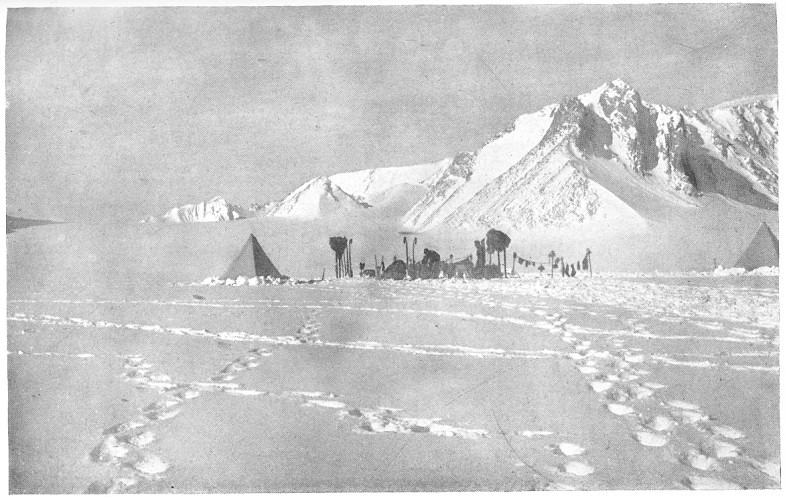
LOOKING UP THE GATEWAY FROM PONY DEPÔT.
Photo by Capt. R. F. Scott.
So impressed was Scott by the impossibility of dragging a sledge
over the surfaces of the Great Barrier to the South at the rate
maintained by the old English travelers on the northern sea-ice,
that he began seriously to think that the British race of explorers
Page 91
must have deteriorated rapidly and completely in stamina. But later
on, in carrying out exploration to the west, he had to travel over
the sea-ice of the strait, and then he discovered that—given
the surface there was nothing wrong with the pace at which his sledge
parties could travel. Probably, however, the distances recorded by
the northern travelers will never be exceeded in the south, for
the Antarctic explorer has to meet severer climatic conditions,
and while pulling his sledge over heavier surfaces he is not likely
to meet with fewer obstacles in his path. To make marching records
is not, of course, the main purpose of sledge-travelers, but all the
same, where conditions are equal, speed and the distance traveled
are a direct test of the efficiency of sledding preparations, and
of the spirit of those who undertake this arduous service.
The main differences between the sledges used by the Discovery
expedition and those used by other explorers were a decrease in
breadth and an increase in runner surface. Measured across from
the center of one runner to the center of the other Scott's sledges
were all, with one exception, 1 foot 5 inches. The runners themselves
were 3-3/4 inches across, so that the sledge track from side to
side measured about 1 foot 8-3/4 inches. The lengths varied from
12 feet to 7 feet, but the 11-foot sledges proved to be by far
the most convenient—a length of 12 feet seeming to pass just
beyond the limit of handiness.
Taking then 11 feet as about the best length for this type of sledge,
it will be seen that it differed
Page 92
considerably from the old Arctic type, which was 10 feet long and
3 feet broad. The weight of such all 11-foot sledge was anything
between 40 and 47 lbs., and this was none too light when the full
strength of the structure was required. Generally speaking, the
full load that could be put upon them was about 600 lbs. The most
important part of the sledge is the runner, in which the grain must
be perfectly straight and even, or it will splinter very easily;
but it surprised Scott to find what a lot of wear a good wood runner
would stand, provided that it was only taken over snow. 'Some of
our 9-foot sledges must,' he says, 'have traveled 1,000 miles,
and there was still plenty of wear left in the runners.'
In point of numbers the Discovery's crew was far behind
the old Northern expeditions; and it was this fact that made Scott
decide, in arranging a sledge equipment where men and not dogs would
do most of the haulage, to divide his parties into the smallest
workable units. The old Northern plan had allowed for parties of at
least eight, who, having a common tent and cooking arrangements,
could not be subdivided. Scott's plan was not necessarily to limit
the number of men in his parties, but to divide them into units
of three, which should be self-contained, so that whenever it was
advisable a unit could be detached from the main party. Under such
a system it is obvious that each unit must have its own tent,
sleeping-bag, cooker, and so on; and therein lay a disadvantage,
as economy of material and weight can
Page 93
be better carried out with a large unit than with a small one.
The weights of a party naturally divide themselves under two headings:
the permanent, which will not diminish throughout the trip, and the
consumable, including food, oil, &c. The following is a list
of the permanent weights carried on Scott's journey to the west,
and it will give some idea of the variety of articles, exclusive
of provisions. The party numbered six.
| | lbs. |
| 2 |
Sledges with fittings complete |
130 |
| |
Trace |
5 |
| 2 |
Cookers, pannikins and spoons |
30 |
| 2 |
Primus lamps, filled |
10 |
| 2 |
Tents complete |
60 |
| 2 |
Spades |
9 |
| 2 |
Sleeping-bags with night-gear |
100 |
| |
Sleeping jackets, crampons, spare finnesko[1] |
50 |
| |
Medical bag |
6 |
| 3 |
Ice-axes |
8 |
| |
Bamboos and marks |
11.5 |
| |
Instruments and camera |
50 |
| |
Alpine rope |
9 |
| |
Repair and tool bags, sounding-line, tape, sledge brakes |
15 |
| |
Ski boots for party |
15 |
| |
Ski for party |
60 |
| |
| | Total |
568.5 |
Page 94
Roughly speaking, a man can drag from 200 to 240 lbs., but his load
was rarely above 200 lbs. This for six men gave a total carrying
capacity of 1,200 lbs. and hence about 630 lbs. could be devoted
to provisions.
Again, speaking very roughly, this amount is about six weeks' food
for a party of six, but as such a short period is often not long
enough to satisfy sledge-travelers, they are compelled to organize
means by which their journey can be prolonged. This can be done
in two ways; they may either go out earlier in the season and lay
a depôt at a considerable distance towards their goal, or
they may arrange to receive assistance from a supporting party,
which accompanies them for a certain distance on the road and helps
their advance party to drag a heavier load than they can accomplish
alone.
Both of these plans were adopted by Scott on the more important
journeys, and his parties were able to be absent from the ship
for long periods and to travel long distances.
THE START OF THE SOUTHERN JOURNEY
Hold hard the breath and bend up every spirit
To its full height...
|
...Shew us here
That you are worth your breeding, which I doubt not.
For there is none so mean or base
That have not noble lustre in your eyes.
I see you stand like greyhounds in the slips,
Straining upon the start.
—SHAKESPEARE.
During the later months of the dark season all thoughts had been
turned to the prospects of the spring journeys, and many times the
advantages and disadvantages of dogs for sledding were discussed.
This question of the sacrifice of animal life was one on which
Scott felt strongly from the time he became an explorer to the end
of his life. Argue with himself as he might, the idea was always
repugnant to his nature.
'To say,' he wrote after his first expedition, that dogs do not
greatly increase the radius of action is absurd; to pretend that
they can be worked to this end without pain, suffering, and death, is
equally futile. The question is whether the latter can be justified
by the gain, and I think that logically it may be;
Page 96
but the introduction of such sordid necessity must and does rob
sledge-traveling of much of its glory. In my mind no journey ever
made with dogs can approach the height of that fine conception
which is realized when a party of men go forth to face hardships,
dangers, and difficulties with their own unaided efforts, and by
days and weeks of hard physical labour succeed in solving some
problem of the great unknown. Surely in this case the conquest is
more nobly and splendidly won.'
When the spring campaign opened in 1902 the original team of dogs
had been sadly diminished. Of the nineteen that remained for the
southern journey, all but one—and he was killed at an earlier
period—left their bones on the great southern plains. This
briefly is the history of the dogs, but the circumstances under
which they met their deaths will be mentioned later on.
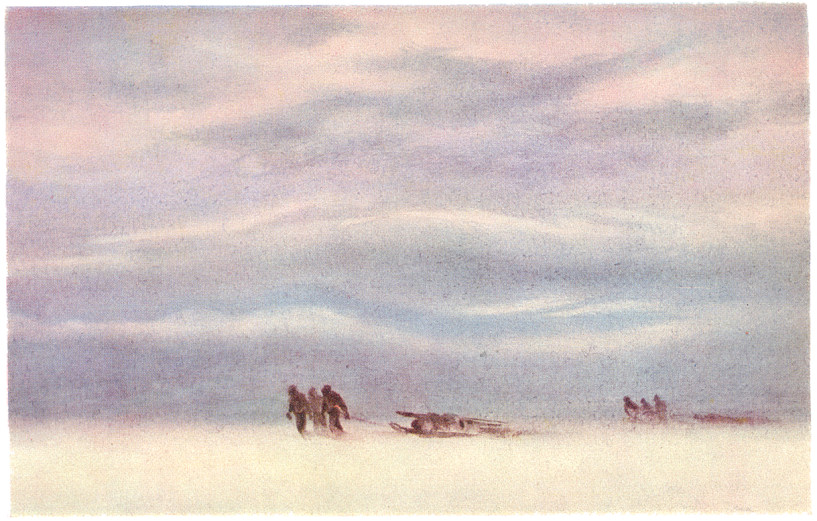
SLEDDING.
Before Scott started on the southern journey he decided to make a
short trip to the north with the dogs and a party of six officers
and men, his main purposes being to test the various forms of harness,
and to find out whether the dogs pulled best in large or small
teams. During part of this journey, which only lasted from September
2 to 5, the four sledges were taken independently with four dogs
harnessed to each, and it was discovered that if the first team
got away all right, the others were often keen to play the game
of 'follow my leader.' Sometimes, indeed, there was a positive
spirit of rivalry, and on one occasion two
Page 97
competing teams got closer and closer to each other, with the natural
result that when they were near enough to see what was happening,
they decided that the easiest way to settle the matter was by a
free fight. So they turned inwards with one accord and met with
a mighty shock. In a moment there was a writhing mass of fur and
teeth, and an almost hopeless confusion of dog traces. But even
in this short trip some experience had been gained; for results
showed how unwise it was to divide the dogs into small parties,
and also there was no mistaking which were the strong and which
the weak dogs, and, what was of more importance, which the willing
and which the lazy ones.
On September 10, Royds and Koettlitz started off to the south-west
with Evans, Quartley, Lashly and Wild. And of this party Scott
wrote: 'They looked very workmanlike, and one could see at a glance
the vast improvement that has been made since last year. The sledges
were uniformly packed.... One shudders now to think of the slovenly
manner in which we conducted things last autumn; at any rate here
is a first result of the care and attention of the winter.'
Armitage and Ferrar with four men left for the west on the following
day, but owing to the necessity of making fresh harness for the
dogs and to an exasperating blizzard, Scott was not able to start
on his southern reconnaissance journey until September 17.
On the morning of that day he and his two companions,
Page 98
Barne and Shackleton, with thirteen dogs divided into two teams,
left the ship in bright sunshine; but by 1.15 P.M., when they camped
for lunch, the wind was blowing from the east and the thermometer
was down to -43°.
The sledges carried a fortnight's food for all concerned, together
with a quantity of stores to form a depôt, the whole giving
a load of about 90 lbs. per dog; but this journey was destined
to be only a short and bitter experience.
The reason was that on the night of the 17th the travelers were
so exhausted that they did not heap enough snow on the skirting
of the tent, and when Scott woke up on the following morning he
found himself in the open. 'At first, as I lifted the flap of my
sleeping-bag, I could not think what had happened. I gazed forth
on a white sheet of drifting snow, with no sign of the tent or my
companions. For a moment I wondered what in the world it could
mean, but the lashing of the snow in my face very quickly awoke
me to full consciousness, and I sat up to find that in some
extraordinary way I had rolled out of the tent.'
At the time a violent gale was raging, and through the blinding
snow Scott could only just see the tent, though it was flapping
across the foot of his bag; but when he had wriggled back to the
tent the snow was whirling as freely inside as without, and the
tent itself was straining so madly at what remained of its securing,
that something had to be done at once to prevent it from blowing
away altogether.
Page 99
So with freezing fingers they gripped the skirting and gradually
pulled it inwards, and half sitting upon it, half grasping it,
they tried to hold it against the wild blasts of the storm, while
they discussed the situation. Discussion, however, was useless. An
attempt to secure the tent properly in such weather was impossible,
while they felt that if once they loosed their grip, the tent would
hasten to leave them at once and for ever. Every now and then they
were forced to get a fresh hold, and lever themselves once more over
the skirt. And as they remained hour after hour grimly hanging on
and warning each other of frostbitten features, their sleeping-bags
became fuller and fuller of snow, until they were lying in masses
of chilly slush. Not until 6 P.M. had they by ceaseless exertions
so far become masters of the situation, that there was no further
need for the tent to be held with anything except the weight of
their sleeping-bags. Then an inspection of hands showed a number
of frostbites, but Barne, whose fingers had not recovered from
the previous year, had suffered the most. 'To have hung on to the
tent through all those hours must have been positive agony to him,
yet he never uttered a word of complaint.'
By 10 P.M. the worst of the storm had passed, and after a few hours'
sleep and a hot meal, they soon decided that to push on after this
most miserable experience was very unwise, since by returning to
the ship they would only lose one day's march and everything could
be dried for a fresh start.
Page 100
Apart from 'Brownie,' who spent his time inside the tent, the rest
of the dogs never uttered a sound during the storm, and were found
quite happily sleeping in their nests of snow. On the journey back the
thermometer recorded -53°, and the effect of such a temperature
upon wet clothing may be imagined. 'I shall remember the condition
of my trousers for a long while; they might have been cut out of
sheet iron. It was some time before I could walk with any sort of
ease, and even when we reached the ship I was conscious of carrying
an armor plate behind me.... It will certainly be a very long time
before I go to sleep again in a tent which is not properly secured.'
On September 24 Scott was ready to start again, but Barne's fingers
had suffered so severely that his place was taken by the boatswain,
Feather, who had taken a keen interest in every detail of sledding.
Owing to the dogs refusing to do what was expected of them, and
to gales, slow progress was made, but the wind had dropped by the
morning of September 29, and Scott was so anxious to push on that
he took no notice of a fresh bank of cloud coming up from the south,
with more wind and drift. Taking the lead himself, he gave orders
to the two teams to follow rigidly in his wake, whatever turns and
twists he might make. Notwithstanding the bad light he could see
the bridged crevasses, where they ran across the bare ice surface,
by slight differences in shade, and though he could not see them
where they dived into the valleys, he found that the bridges were
strong enough to bear. In
Page 101
his desire to use the snowy patches as far as possible, the course
he took was very irregular, and the dogs invariably tried to cut
corners. In this manner they proceeded for some time, until Scott
suddenly heard a shout, and looking back saw to his horror that
Feather had vanished. The dog team and sledges were there all right,
but their leader was lost to sight. Hurrying back he found that
the trace had disappeared down a formidable crevasse, but to his
great relief Feather was at the end of the trace, and was soon
hauled up. One strand of Feather's harness was cut clean through
where it fell across the ice-edge, and although, being a man of
few words, he was more inclined to swear at 'Nigger' for trying to
cut a corner than to marvel at his own escape, there is no doubt
that he had a very close call.
After this accident the dog teams were joined, and reluctant to
give up they advanced again; but very soon the last of the four
sledges disappeared, and was found hanging vertically up and down
in an ugly-looking chasm. To the credit of the packing not a single
thing had come off, in spite of the jerk with which it had fallen.
It was, however, too heavy to haul up as it was, but, after some
consultation, the indefatigable Feather proposed that he should
be let down and undertake the very cold job of unpacking it. So
he was slung with one end of the Alpine rope, while the other was
used for hauling up the various packages; and at last the load
was got up, and the lightened sledge soon followed.
After this incident they thought it prudent to treat these numerous
crevasses with more respect, and on
Page 102
proceeding they roped themselves together; but although no more
mishaps occurred, Scott afterwards was more inclined to attribute
this to good luck than to good judgment. 'Looking back on this day,
I cannot but think our procedure was extremely rash. I have not
the least doubt now that this region was a very dangerous one, and
the fact that we essayed to cross it in this light-hearted fashion
can only be ascribed to our ignorance. With us, I am afraid, there
were not a few occasions when one might have applied the proverb
that "Fools rush in where angels fear to tread."'
The depôt, leaving six weeks' provision for three men and
150 lbs. of dog-food, was made on the morning of October 1, and
besides marking it with a large black flag, Scott was also careful
to take angles with a prismatic compass to all the points he could
see. Then they started home, and the dogs knowing at once what was
meant no longer required any driving. On the homeward march the
travelers went for all they were worth, and in spite of perpetual
fog covered eighty-five statute miles in less than three days.
On returning to the ship Scott admits that he found it a most delightful
place. The sense of having done what he wanted to do had something
to do with this feeling of satisfaction, but it was the actual
physical comfort after days of privation that chiefly affected him.
The joy of possessing the sledding appetite was sheer delight, and
for many days after the travelers returned from their sledding-trips,
they retained a hunger which it seemed impossible to satisfy.
Page 103
In short Scott, on the night of his return, was very pleased with
himself and the world in general, but before he went to bed all
his sense of comfort and peace had gone. For he had discovered
what Armitage, wishing to give him some hours of unmixed enjoyment,
had not meant to mention until the following morning, and this
was that there had been an outbreak of scurvy—the disease
that has played a particularly important, and often a tragic, part
in the adventures of Polar travelers, and the seriousness of which
everyone who has read the history of Polar explorations cannot
fail to realize.
This outbreak had occurred during Armitage's journey, and when
he, after much anxiety, had got his men back to the ship, Wilson's
medical examination proved that Ferrar, Heald and Cross were all
attacked, while the remainder of the party were not above suspicion.
Very soon, however, symptoms of the disease began to abate, but
the danger lurking around them was continually in Scott's thoughts,
and he was determined not to give the dreaded enemy another chance
to break out.
Everything possible was done to make the ship and everything in
her sweet and clean, and after a large seal-killing party, sent
out at Wilson's suggestion, had returned, the order was given that
no tinned meat of any description should be issued. By October 20
this grave disease had to all intents and purposes passed away,
but although evidence showed that it was
Page 104
caused by tinned meats which were to all appearances of the best
quality, and by apparently fresh mutton taken in small quantities,
there was no positive proof that these were the causes of the trouble.
This attack of scurvy came as a great surprise to everyone, for
when the long winter was over and all of them were in good health
and high spirits, they had naturally congratulated themselves on
the effectiveness of their precautions. The awakening from this
pleasant frame of mind was rude, and though the disease vanished
with astonishing rapidity, it was—quite apart from the benefit
lost to medical science—very annoying not to be able to say
definitely from what the evil had sprung.
But although the seriousness of this outbreak was not underrated,
and every precaution was taken to prevent its recurrence, preparations
for the various journeys were pushed on with no less vigour and
enthusiasm. The game to play was that there was nothing really to
be alarmed about, and everyone played it with the greatest success.
Scott's journey to the south had indicated that the main party
would have to travel directly over the snow-plain at a long distance
from, and perhaps out of sight of, land; and as in all probability
no further depôts could be established, it was desirable that
this party should be supported as far as possible on their route.
To meet these requirements it was decided that Barne, with a party
of twelve men, should accompany the dog-team, until the weights
were reduced to an amount
Page 105
which the dogs could drag without assistance. Then Barne was to
return to the ship, and after a short rest start again with six
men, to follow the coast-line west of the Bluff. As soon as this
was in train, Armitage was to have at his disposal all the men and
material left in the ship for his attack on the western region.
On Friday, October 24, Royds, who had left the ship three weeks
before with Skelton, Lashly, Evans, Quartley and Wild, returned
with the good news that he had been able to communicate with the
'Record' post at Cape Crozier. If a relief ship was going to be
sent out, Scott now had the satisfaction of knowing that she had
a good prospect of being guided to the winter quarters of the
expedition. It was also a great source of satisfaction to find
that although Royds and his party had left almost immediately after
the outbreak of scurvy, they had all returned safe and with no
symptom of the disease.
From the 13th to the 18th this party had been kept in their tents
by a most persistent blizzard, and before the blizzard ceased they
were practically buried in the heart of a snowdrift; in fact one
tent had literally to be dug out before its occupants could be
got into the open, while the sledges and everything left outside
were completely buried. As the snow gradually accumulated round
the tents it became heavier and heavier on every fold of canvas,
and reduced the interior space to such an extent that those inside
were obliged to lie with their knees bent double. Royds, whose
reports were invariably very brief and to
Page 106
the point, dismissed the tale of these five days in half a page,
but no great effort of imagination is needed to grasp the horrible
discomforts everyone must have endured. And yet when this party
recounted their adventures on board the ship, the hardships were
scarcely mentioned, and all that the men seemed to remember were
the amusing incidents that had happened.
On this journey a colony of Emperor penguins was discovered, and
among them were several which were nursing chicks. 'I will only
testify,' Scott says, 'to the joy which greeted this discovery
on board the ship. We had felt that this penguin was the truest
type of our region. All other birds fled north when the severity
of winter descended upon us: the Emperor alone was prepared to
face the extremest rigors of our climate; and we gathered no small
satisfaction from being the first to throw light on the habits
of a creature, which so far surpasses in hardihood all others of
the feathered tribe.'
Before the end of October everything was prepared for the southern
journey; every eventuality seemed to be provided for, and as it
was expected that the dogs would travel faster than the men Barne
and his party started off on October 30, while the dog team left a
few days later. 'The supporting party started this morning, amidst
a scene of much enthusiasm; all hands had a day off, and employed
it in helping to drag the sledges for several miles... Barne's
banner floated on the first, the next bore a Union Jack, and
Page 107
another carried a flag with a large device stating "No dogs
needs apply"; the reference was obvious. It was an inspiriting
sight to see nearly the whole of our small company step out on
the march with ringing cheers, and to think that all work of this
kind promised to be done as heartily.'
And then the day that Scott had been so eagerly looking forward
to arrived, and at ten o'clock on the morning of November 2, he,
Shackleton and Wilson, amidst the wild cheers of their comrades,
started on the southern journey. 'Every soul was gathered on the
floe to bid us farewell, and many were prepared to accompany us
for the first few miles.' The dogs, as if knowing that a great
effort was expected of them, had never been in such form, and in
spite of the heavy load and the fact that at first two men had
to sit on the sledges to check them, it was as much as the rest
of the party could do to keep up. By noon the volunteers had all
tailed off, and the three travelers were alone with the dogs, and
still breathlessly trying to keep pace with them. Soon afterwards
they caught sight of a dark spot ahead and later on made this out
to be the supporting party, who, when they were overtaken on the
same evening, reported that they had been kept in their tents by
bad weather. Having relieved them of some of their loads, Scott
camped, while they pushed on to get the advantage of a night march.
During the next few days the two parties constantly passed and re-passed
each other, since it was
Page 108
impossible for Scott to push on ahead of Barne's party, and the
latter's progress was very slow, as they could get no hold with
their fur boots, and they found their ski leather boots dreadfully
cold for their feet. To add to the slowness of the journey the
weather was very unfavorable, and the greater parts of the 8th and
9th were entirely wasted by a blizzard. On the 10th Depôt A,
that had previously been laid, was reached and Scott wrote: 'Already
it seems to me that the dogs feel the monotony of a long march over
the snow more than we do; they seem easily to get dispirited, and
that it is not due to fatigue is shown when they catch a glimpse
of anything novel.... To-day, for instance, they required some
driving until they caught sight of the depôt flag, when they
gave tongue loudly and dashed off as though they barely felt the
load behind them.'
The names of the dogs were:
| Nigger | Birdie | Wolf |
| Jim | Nell | Vic |
| Spud | Blanco | Bismarck |
| Snatcher | Grannie | Kid |
| Fitzclarence | Lewis | Boss |
| Stripes | Gus | Brownie |
| | Joe | |
Each of them had his peculiar characteristics, and what the Southern
party did not already know concerning their individualities, they
had ample opportunities of finding out in the course of the next
few weeks.
Page 109
Nigger was the leader of the team; a place he chose naturally for
himself, and if he was put into any other position he behaved so
unpleasantly to his neighbors, and so generally upset things, that
he was quickly shifted. A more perfect sledge-dog could scarcely
be imagined. He seemed to know the meaning of every move, and in
camp would be still as a graven image until he saw the snow being
shoveled from the skirting of the tent, when he would spring up
and pace to and fro at his picket, and give a low throaty bark
of welcome if anyone approached him. A few minutes later, when
the leading man came to uproot his picket, he would watch every
movement, and a slow wagging of the tail quite obviously showed
his approval: then, as the word came to start, he would push
affectionately against the leader, as much as to say, 'Now come
along!' and brace his powerful chest to the harness. At the evening
halt after a long day he would drop straight in his tracks and
remain perfectly still, with his magnificent black head resting
on his paws. Other dogs might clamor for food, but Nigger knew
perfectly well that the tent had first to be put up. Afterwards,
however, when the dog-food was approached his deep bell-like note
could always be distinguished amid the howling chorus, and if
disturbance was to be avoided it was well to attend to him first
of all.
Of the other dogs Lewis was noisily affectionate and hopelessly
clumsy; Jim could pull splendidly when he chose, but he was up
to all the tricks of the trade and was extraordinarily cunning at
pretending to pull;
Page 110
Spud was generally considered to be daft; Birdie evidently had been
treated badly in his youth and remained distrustful and suspicious
to the end; Kid was the most indefatigable worker in the team; Wolf's
character possessed no redeeming point of any kind, while Brownie
though a little too genteel for very hard work was charming as a pet,
and it may also be said of him that he never lost an opportunity
of using his pleasant appearance and delightful ways to lighten his
afflictions. The load for this dog team after Depôt A had
been passed was 1,850 lbs., which, considering that some of the
dogs were of little use, was heavy. But it must not be forgotten
that the men also expected to pull, and that each night the weight
would be reduced by thirty or forty pounds. By the 13th the travelers
were nearly up to the 79th parallel, and therefore farther south
than anyone had yet been. 'The announcement of the fact caused
great jubilation, and I am extremely glad that there are no fewer
than fifteen of us to enjoy this privilege of having broken the
record.' A photograph of the record-breakers was taken, and then
half of the supporting party started to return, and the other half
stepped out once more on a due south line, with the dogs following.
By the 15th, however, when the rest of the supporting party turned
back, Scott had begun to be anxious about the dogs. 'The day's
work has cast a shadow on our high aspirations, and already it is
evident that if we are to achieve much it will be only by extreme
toil, for the dogs have not pulled well to-day....
Page 111
We have decided that if things have not improved in the morning
we will take on half a load at a time; after a few days of this
sort of thing the loads will be sufficiently lightened for us to
continue in the old way again.'
On the following day an attempt to start with the heavy loads promptly
and completely failed, and the only thing to do was to divide the
load into two portions and take half on at a time. This meant, of
course, that each mile had to be traveled three times, but there
was no alternative to this tedious form of advance. Even, however,
with the half-loads the dogs seemed to have lost all their spirit,
and at the end of the march on the 18th they were practically 'done.'
Only five geographical miles[1] were gained on that day, but to
do it they had to cover fifteen.
On the night of the 19th matters had gone from bad to worse, and
it had to be acknowledged that the fish diet the dogs were eating
permanently disagreed with them. Originally Scott had intended
to take ordinary dog-biscuits for the animals, but in an unlucky
moment he was persuaded by an expert in dog-driving to take fish.
The fish taken was the Norwegian stock-fish, such as is split,
dried and exported from that country in great quantities for human
food. But one important point was overlooked, namely the probability
of the fish being affected on passing through the tropics. The
lesson, Scott said, was obvious, that in future travelers in the
south should safeguard their
Page 112
dogs as carefully as they do their men, for in this case it was
the dogs that called the halts; and so the party had to spend hours
in their tent which might have been devoted to marching.
Day after day relay work continued, the only relief from the monotony
of their toil being that land was sighted on the 21st, and as the
prospects of reaching a high latitude were steadily disappearing,
it was decided to alter their course to S. S. W. and edge towards
it. Then the surface over which they were traveling showed signs
of improvement, but the travelers themselves were beginning to
suffer from blistered noses and cracked lips, and their eyes were
also troubling them. Appetites, however, were increasing by leaps
and bounds. 'The only thing to be looked to on our long marches
is the prospect of the next meal.'
On November 24 a new routine was started which made a little variation
in the dull toil of relay work. After pushing on the first half-load
one of the three stopped with it, and got up the tent and prepared
the meal while the other two brought up the second half-load. And
then on the following day came one of those rewards which was all the
sweeter because it had been gained by ceaseless and very monotonous
toil.
'Before starting to-day I took a meridian altitude,' Scott wrote,
'and to my delight found the latitude to be 80° 1'. All our
charts of the Antarctic region show a plain white circle beyond
the eightieth parallel... It has always been our ambition to get
inside that white
Page 113
space, and now we are there the space can no longer be a blank;
this compensates for a lot of trouble.'
A blizzard followed upon this success, but the dogs were so exhausted
that a day's rest had been thought of even if the weather had not
compelled it. Wilson, to his great discomfort, was always able to
foretell these storms, for when they were coming on he invariably
suffered from rheumatism; so, however reluctant, he could not help
being a very effective barometer.
After the storm had passed an attempt was made on the morning of
the 27th to start with the full load, but it took next to no time
to discover that the dogs had not benefited by their rest, and
there was nothing to do except to go on with the old routine of
relay work. As the days passed with no signs of improvement in
the dogs, it became more and more necessary to reach the land in
hopes of making a depôt; so the course was laid to the westward
of S. W., which brought the high black headland, for which they
were making, on their port bow. 'I imagine it to be about fifty
miles off, but hope it is not so much; nine hours' work to-day
has only given us a bare four miles.'
Then for some days the only change in the toil of relay work and
the sickening task of driving tired dogs on and on was that they
marched by night, and rested by day. The breakfast hour was between
4 and 5 P.M., the start at 6 P.M., and they came to camp somewhere
between three and four in the morning. Thus they rested while the
sun was at its greatest
Page 114
height; but although there were certainly advantages in this, Scott
could not get rid of a curious feeling that something was amiss
with such a topsy-turvy method of procedure.
By December 3 they were close enough to the land to make out some
of its details. On their right was a magnificent range of mountains,
which by rough calculations Scott made out to be at least fifty miles
away. By far the nearest point of land was an isolated snow-cape,
an immense, and almost dome-shaped, snow-covered mass. At first
no rock at all could be seen on it, but as they got nearer a few
patches began to appear. For one of these patches they decided to
make so that they might establish a depôt, but at the rate
at which they were traveling there was little hope of reaching
it for several days.
By this time the appetites of the party were so ravenous that when
the pemmican bag was slung alongside a tin of paraffin, and both
smelt and tasted of oil, they did not really mind. But what saddened
them more than this taste of paraffin was the discovery, on December
5, that their oil was going too fast. A gallon was to have lasted
twelve days, but on investigation it was found on an average to
have lasted only ten, which meant that in the future each gallon
would have to last a fortnight. 'This is a distinct blow, as we
shall have to sacrifice our hot luncheon meal and to economize
greatly at both the others. We started the new routine to-night,
and for lunch ate some frozen seal-meat and our allowance of sugar
and biscuit.'
Page 115
It was perhaps fortunate that their discovery about the oil was
not delayed any longer, but nevertheless it came at a time when
the outlook was dreary and dispiriting enough without additional
discomforts. On the 6th Spud gnawed through his trace, and when
Scott went outside before breakfast, one glance at the dog's
balloon-like appearance was enough to show how he had spent his
hours of freedom. He had, in fact, eaten quite a week's allowance
of the precious seal-meat, and though rather somnolent after his
gorge, he did not seem to be suffering any particular discomfort
from the enormous increase of his waist. On the next day there was
a blizzard, duly predicted by Wilson's twinges of rheumatism, and
on the 8th Scott reluctantly records that the dogs were steadily going
downhill. 'The lightening of the load is more than counter-balanced
by the weakening of the animals, and I can see no time in which
we can hope to get the sledges along without pulling ourselves.'
By the 10th they were within ten or twelve miles of the coast, but
so exhausted that they felt no certainty of reaching it; and even
supposing they did get there and make a depôt, they doubted
very much if they would be in any condition to go on. One dog,
Snatcher, was already dead, and some of the others had only been got
to move with the second load by the ignominious device of carrying
food in front of them. To see the dogs suffering was agony to those
who had to drive and coax them on, and though Scott refers often
in these days to the hunger that was nipping him,
Page 116
no one can read his diary without seeing how infinitely more he
was concerned over the suffering of the dogs than about his own
troubles. 'It is terrible,' he says, 'to see them.'
At last, on December 14, they arrived, when they were almost spent,
at a place where dog-food could be left. In their march they had
only managed to do two miles after the most strenuous exertions,
for the snow became softer as they approached the land, and the
sledge-runners sank from three to four inches. On any particularly
soft patch they could do little more than mark time, and even to
advance a yard was an achievement.
No wonder that Scott, after they had left three weeks' provisions
and a quantity of dog-food in Depôt B and had resumed their
march, sounded a note of thankfulness: 'As I write I scarcely know
how to describe the blessed relief it is to be free from our relay
work. For one-and-thirty awful days we have been at it, and whilst
I doubt if our human endurance could have stood it much more, I
am quite sure the dogs could not. It seems now like a nightmare,
which grew more terrible towards its end.' The sense of relief
was, however, not destined to last, for on December 21 the dogs
were in such a hopeless condition that they might at any moment
have completely collapsed. This was a fact that had to be faced,
and the question whether under such circumstances it was wise to
push on had to be asked and answered. The unanimous answer was
that the risk
Page 117
of going on should be taken, but on that same night Wilson, in view
of future plans, reported to Scott that his medical examinations
revealed that Shackleton had decidedly angry-looking gums, and that
for some time they had been slowly but surely getting worse. It
was decided not to tell Shackleton of these symptoms of scurvy,
and as the bacon they were using seemed likely to be the cause of
them, it was discarded and an increased allowance of seal given
in its place. This was a loss in weight which was serious, for
already they were reduced almost to starvation rations of about
a pound and a half a day.
Supper was the best meal, for then they had a hoosh which
ran from between three-quarters to a whole pannikin apiece, but
even this they could not afford to make thick. While it was being
heated in the central cooker, cocoa was made in the outer, but the
lamp was turned out directly the hoosh boiled, and by that
time the chill was barely off the contents of the outer cooker.
Of course the cocoa was not properly dissolved, but they were long
past criticizing the quality of their food. All they wanted was
something to 'fill up,' but needless to say they never got it.
Half an hour after supper was over they were as hungry as ever.
When they had started from the ship, there had been a vague idea
that they could go as they pleased with the food, but experience
showed that this would not do, and that there must be a rigid system
of shares. Consequently they used to take it in turn to divide
Page 118
things into three equal portions, and as the man who made the division
felt called upon to take the smallest share, the game of 'shut-eye'
was invented to stop all arguments and remonstrances. The shares
were divided as equally as possible by someone, then one of the
other two turned his head away and the divider pointed to a portion
and said, 'Whose is this?' He of the averted head named the owner,
and thus this simple but useful game was played.
Wilson's examination of Shackleton on December 24 was not encouraging,
but they had reached a much harder surface and under those conditions
Scott and Wilson agreed that it was not yet time to say 'Turn.'
Besides, Christmas Day was in front of them, and for a week they
had all agreed that it would be a crime to go to bed hungry on that
night. In fact they meant it to be a wonderful day, and everything
conspired to make it so.
The sun shone gloriously from a clear sky, and not a breath of
wind disturbed the calmness of the morning, but entrancing as the
scene was they did not stay to contemplate it, because for once
they were going to have a really substantial breakfast, and this
was an irresistible counter-attraction.
And afterwards, when they felt more internally comfortable than
they had for weeks, the surface continued to be so much better
that the sledges could be pulled without any help from the dogs.
On that day they had the satisfaction of covering nearly eleven
miles, the longest march they had made for a long
Page 119
time. So when camp was pitched they were thoroughly pleased with
the day, and ready to finish it off with a supper to be remembered.
A double 'whack' of everything was poured into the cooking-pot,
and in the hoosh that followed a spoon would stand without
any support, and the cocoa was also brought to boiling-point.
'I am writing,' Scott says, 'over my second pipe. The sun is still
circling our small tent in a cloudless sky, the air is warm and quiet.
All is pleasant without, and within we have a sense of comfort we
have not known for many a day; we shall sleep well tonight—no
dreams, no tightening of the belt.
'We have been chattering away gaily, and not once has the conversation
turned to food. We have been wondering what Christmas is like in
England... and how our friends picture us. They will guess that
we are away on our sledge journey, and will perhaps think of us
on plains of snow; but few, I think, will imagine the truth, that
for us this has been the reddest of all red-letter days.'
THE RETURN
How many weary steps
Of many weary miles you have o'ergone,
Are numbered to the travel of one mile.
SHAKESPEARE.
i |
Some days passed before the pleasing effects of Christmas Day wore
off, for it had been a delightful break in an otherwise uninterrupted
spell of semi-starvation, and the memories lingered long after
hunger had again gripped the three travelers. By this time they
knew that they had cut themselves too short in the matter of food,
but the only possible alteration that could now be made in their
arrangements was to curtail their journey, and rather than do that
they were ready cheerfully to face the distress of having an enormous
appetite, and very little with which to appease it.
Thinking over the homeward marches after he had returned to the
ship, Scott expresses his emphatic opinion that the increasing
weariness showed that they were expending their energies at a greater
rate than they could renew them, and that the additional
Page 121
weight, caused by carrying a proper allowance of food, would have
been amply repaid by the preservation of their full strength and
vigour.
Apart, however, from the actual pangs of hunger, there was another
disadvantage from this lack of food, for try as they would it was
impossible not to think and talk incessantly of eating. Before
they went to sleep it was almost certain that one of them would
give a detailed description of what he considered an ideal feast,
while on the march they found themselves counting how many footsteps
went to the minute, and how many, therefore, had to be paced before
another meal.
But if, during these days of hunger, thoughts of what they could
eat if only the chance was given to them kept constantly cropping
up, there were also very real compensations for both their mental
and physical weariness. Day by day, as they journeyed on, they knew
that they were penetrating farther and farther into the unknown.
Each footstep was a gain, and made the result of their labours more
assured. And as they studied the slowly revolving sledge-meter
or looked for the calculated results of their observations, it
is not surprising that above all the desires for food was an
irresistible eagerness to go on and on, and to extend the line
which they were now drawing on the white space of the Antarctic
chart.
Day by day, too, the magnificent panorama of the Western land was
passing before their eyes. 'Rarely a march passed without the disclosure
of some new
Page 122
feature, something on which the eye of man had never rested; we
should have been poor souls indeed had we not been elated at the
privilege of being the first to gaze on these splendid scenes.'
From the point of view of further exploration their position on
December 26 was not very hopeful. On their right lay a high undulating
snow-cap and the steep irregular coast-line, to the south lay a cape
beyond which they could not hope to pass, and to all appearances
these conditions were likely to remain to the end of their journey.
But on that night they had christened a distant and lofty peak
'Mount Longstaff,' in honour of the man whose generosity had alone
made the expedition possible, and although they thought that this
was the most southerly land to which they would be able to give a
name, they were in no mood to turn back because the outlook was
unpromising. Arguing on the principle that it was impossible to tell
what may turn up, they all decided to push on; and their decision was
wise, for had they returned at that point one of the most important
features of the whole coast-line would have been missed.
On the 26th and 27th Wilson had a very bad attack of snow-blindness,
which caused him the most intense agony. Some days before Scott had
remarked in his diary upon Wilson's extraordinary industry: 'When
it is fine and clear, at the end of our fatiguing days he will
spend two or three hours seated in the door of the tent sketching
each detail of the splendid mountainous coast-scene to the west.
His sketches
Page 123
are most astonishingly accurate; I have tested his proportions by
actual angular measurements and found them correct.... But these
long hours in the glare are very bad for the eyes; we have all
suffered a good deal from snow-blindness of late, though we generally
march with goggles, but Wilson gets the worst bouts, and I fear
it is mainly due to his sketching.'
The attack, however, after Christmas was very much worse than anything
that had gone before, and all day long during the 27th Wilson was
pulling alongside the sledges with his eyes completely covered.
To march blindfold with an empty stomach must touch the bottom
of miserable monotony, but Wilson had not the smallest intention
of giving in. With Scott walking opposite to him and telling him
of the changes that were happening around them he plodded steadily
on, and during the afternoon of the 27th it happened that a most
glorious mountainous scene gradually revealed itself. With some
excitement Scott noticed that new mountain ridges were appearing
as high as anything they had seen to the north, and his excitement
increased when these ridges grew higher and higher. Then, instead
of a downward turn in the distant outline came a steep upward line,
and as they pressed on apace to see what would happen next, Scott
did his best to keep Wilson posted up in the latest details. The
end came in a gloriously sharp double peak crowned with a few flecks
of cirrus cloud, and all they could think of in camp that night
was this splendid twin-peaked mountain, which even in such
Page 124
a lofty country looked like a giant among pigmies. 'At last we
have found something which is fitting to bear the name of him whom
we must always the most delight to honour, and "Mount Markham"
it shall be called in memory of the father of the expedition.'
Wilson, in spite of his recent experiences, did not mean to miss
this, and however much his eyes had to suffer the scene had to
be sketched. Fortunately a glorious evening provided a perfect
view of their surroundings, for very soon they knew that the limit
of their journey would be reached, and that they would have but
few more opportunities to increase their stock of information.
After a day that had brought with it both fine weather and most
interesting discoveries, they settled down in their sleeping-bags,
full of hope that the morrow would be equally kind. But instead
of the proposed advance the whole day had to be spent in the tent
while a strong southerly blizzard raged without, and when they
got up on the following morning they found themselves enveloped
in a thick fog.
Reluctantly the decision was made that this camp must be their
last, and consequently their southerly limit had been reached.
Observations gave it as between 82.16 S. and 82.17 S., and though
this record may have compared poorly with what Scott had hoped for
when leaving the ship, it was far more favorable than he anticipated
when the dogs had begun to fail. 'Whilst,' he says, 'one cannot help
a deep sense of disappointment in reflecting on the "might have been"
Page 125
had our team remained in good health, one cannot but remember that
even as it is we have made a greater advance towards a pole of
the earth than has ever yet been achieved by a sledge party.'
With less than a fortnight's provision to take them back to Depôt
B, they turned their faces homewards on the last day of the year,
and it was significant of the terrible condition of the surviving
dogs that the turn did not cause the smallest excitement. Many
of them were already dead, killed to keep the others alive, but
those which remained seemed to guess how poor a chance they had
of getting back to the ship. Again and again Scott refers to the
suffering of the dogs on the homeward march, and how intensely he
felt for them is proved beyond all manner of doubt. 'January 3.
This afternoon, shortly after starting, "Gus" fell, quite played
out, and just before our halt, to our greater grief, "Kid" caved
in. One could almost weep over this last case; he has pulled like
a Trojan throughout, and his stout little heart bore him up till
his legs failed beneath him.' Only seven of the team now remained,
and of them Jim seemed to be the strongest, but Nigger, though
weak, was still capable of surprising efforts. But at the end of
a week on the return journey, all of the remaining dogs were asked
to do nothing except walk by the sledges.
For several hours on January 7 the men pulled steadily and covered
ten good miles. But the distance they succeeded in traveling was as
nothing compared with the relief they felt at no longer having to
Page 126
drive a worn-out team. In the future no more cheering and dragging
in front would be needed, no more tangled traces would have to be
put straight, and above all there would be no more whip. So far
steady though rather slow progress had been made, but January 8
brought an unpleasant surprise. Try as they would the sledge could
scarcely be made to move, and after three hours of the hardest
work only a mile and a quarter had been gained. Sadly they were
compelled to admit that the surface had so completely changed that
the only thing to do was to remain in camp until it improved. But
whether it would improve was an anxious matter, for they had less
than a week's provisions and were at least fifty miles from Depôt
B.
The next day, however, saw an improvement in the surface, and a
fairly good march was done. By this time only four dogs were left,
Nigger, Jim, Birdie and Lewis, and poor Nigger was so lost out
of harness that he sometimes got close to the traces and marched
along as if he was still doing his share of the pulling. But this
more or less ordinary day was followed on the 10th by a march in
a blizzard that exhausted Scott and Wilson, and had even a more
serious effect upon Shackleton. With the wind behind them they
had gained many miles, but the march had tired them out, because
instead of the steady pulling to which they were accustomed they
had been compelled sometimes to run, and sometimes to pull forwards,
backwards, sideways, and always with their senses keenly alert
and their muscles strung up for instant action.
Page 127
On that night Scott in no very cheerful frame of mind wrote: 'We
cannot now be far from our depôt, but then we do not exactly
know where we are; there is not many days' food left, and if this
thick weather continues we shall probably not be able to find it.'
And after two more days of bad surface and thick weather he wrote
again: 'There is no doubt we are approaching a very critical time.
The depôt is a very small spot on a very big ocean of snow;
with luck one might see it at a mile and a half or two miles, and
fortune may direct our course within this radius of it; but, on
the other hand, it is impossible not to contemplate the ease with
which such a small spot can be missed.... The annoying thing is that
one good clear sight of the land would solve all our difficulties.'
At noon on January 13 the outlook was more hopeless than ever.
Three hours' incessant labour had gained only three-quarters of a
mile, and consequently they had to halt though their food-bag was a
mere trifle to lift, and they could have finished all that remained
in it at one sitting and still have been hungry. But later on Scott
caught a glimpse of the sun in the tent, and tumbled hastily out of
his sleeping-bag in the hope of obtaining a meridional altitude;
and after getting the very best result he could under the very
difficult conditions prevailing, he casually lowered the telescope
and swept it round the horizon. Suddenly a speck seemed to flash
by, and a vehement hope as suddenly arose. Then he brought the
telescope slowly back, and there it was again, and accompanied this
Page 128
time by two smaller specks on either side of it. Without a shadow
of doubt it was the depôt which meant the means of life to
them. 'I sprang up and shouted, "Boys, there's the depôt."
We are not a demonstrative party, but I think we excused ourselves
for the wild cheer that greeted this announcement.'
In five minutes everything was packed on the sledges, but though
the work was as heavy as before the workers were in a very different
mood to tackle it. To reach those distant specks as quickly as
possible was their one desire and all minor troubles were forgotten
as they marched, for before them was the knowledge that they were
going to have the fat hoosh which would once more give them an
internal sense of comfort. In two hours they were at the depôt,
and there they found everything as they had left it.
On that same morning they had stripped off the German silver from
the runners of one of their sledges, and now fortified by the fat
hoosh of their dreams they completed the comparison between
the two sledges, which respectively had metal and wood runners.
Having equalized the weights as much as possible they towed the
sledges round singly, and found that two of them could scarcely
move the metalled sledge as fast as one could drag the other.
Of course they decided to strip the second sledge, and with only
about 130 miles to cover to their next depôt, a full three
weeks' provisions, and the prospect of better traveling on wood
runners, they went to bed
Page 129
feeling that a heavy load of anxiety had been lifted. The chief
cause of worry left was the question of health, and the result
of a thorough medical examination on the morning of the 14th did
nothing to remove this. Shackleton was found to be very far indeed
from well, but although Scott and Wilson both showed symptoms of
scurvy they still felt that, as far as they were concerned, there
was no danger of a breakdown.
On that day they made a fairly good march, but at the end of it
Wilson had to warn Scott that Shackleton's condition was really
alarming. Commenting on this Scott wrote: 'It's a bad case, but
we must make the best of it and trust to its not getting worse;
now that human life is at stake, all other objects must be
sacrificed.... It went to my heart to give the order, but it had
to be done, and the dogs are to be killed in the morning.
'One of the difficulties we foresee with Shackleton, with his restless,
energetic spirit, is to keep him idle in camp, so to-night I have
talked seriously to him. He is not to do any camping work, but
to allow everything to be done for him.... Every effort must be
devoted to keeping him on his legs, and we must trust to luck to
bring him through.'
With the morning of the 15th came the last scene in the tragic
story of the dogs, and poor Nigger and Jim, the only survivors
of that team of nineteen, were taken a short distance from the
camp and killed. 'I think we could all have wept.... Through our
most troublous time we always looked forward to getting
Page 130
some of our animals home. At first it was to have been nine, then
seven, then five, and at the last we thought that surely we should
be able to bring back these two.'
During the part of the return journey which was now beginning,
they had promised themselves an easier time, but instead of that it
resolved itself into days of grim struggle to save a sick companion.
The weather also added to their troubles, because it was so overcast
that steering was extremely difficult. For nearly ten consecutive
days this gloomy weather continued to harass them, but on the 20th
it cleared as they were on their march, and on the following day
with a brisk southerly breeze and their sail set they traveled
along at a fine rate. The state of Shackleton's health was still
a source of acutest anxiety, but each march brought safety nearer
and nearer, and on the 23rd Scott was able to write in a much more
hopeful spirit. Next day a glimpse of the Bluff to the north was
seen, but this encouraging sight was accompanied by a new form
of surface which made the pulling very wearisome. An inch or so
beneath the soft snow surface was a thin crust, almost, but not
quite, sufficient to bear their weight. The work of breaking such
a surface as this would, Scott says, have finished Shackleton in
no time, but luckily he was able to go on ski and avoid the jars.
'In spite of our present disbelief in ski, one is bound to confess
that if we get back safely Shackleton will owe much to the pair
he is now using.'
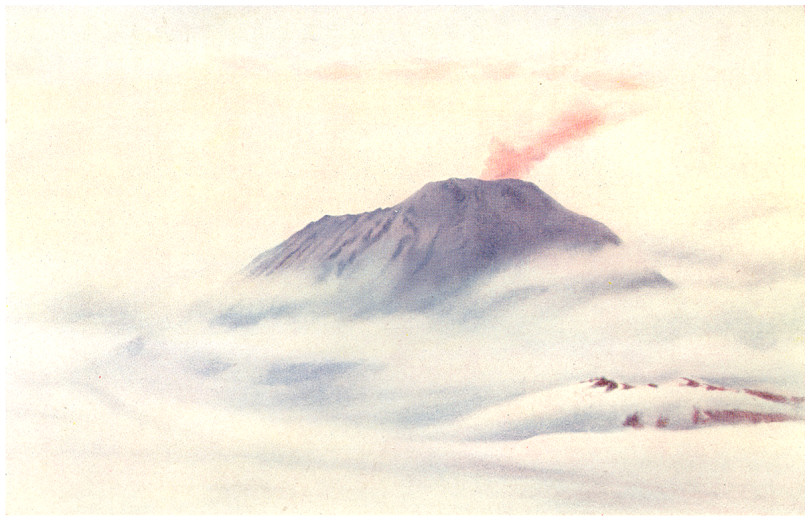
MOUNT EREBUS.
Page 131
But in spite of bad surfaces and increasingly heavy work, Scott and
Wilson were determined to leave as little as possible to chance,
and to get their invalid along as quickly as his condition would
allow. Directly breakfast was over Shackleton started off and got
well ahead, while Scott and Wilson packed up camp; and after lunch
the same procedure was adopted. By this means he was able to take
things easily, and though eager to do his share of the work he
was wise enough to see that every precaution taken was absolutely
necessary.
Encouragements in this stern struggle were few and far between,
but when the smoke of Erebus was seen on the 25th, it cheered them
to think that they had seen something that was actually beyond the
ship. Probably it was more than a hundred miles away, but they
had become so accustomed to seeing things at a distance that they
were not in the least astonished by this.
January 26, too, had its consolations, for while plodding on as usual
the travelers suddenly saw a white line ahead, and soon afterwards
discovered that it was a sledge track. There was no doubt that
the track was Barne's on his way back from his survey work to the
west, but it was wonderful what that track told them. They could
see that there had been six men with two sledges, and that all of
the former had been going strong and well on ski. From the state
of the track this party had evidently passed about four days before
on the homeward route, and from
Page 132
the zig-zagging of the course it was agreed that the weather must
have been thick at the time. Every imprint in the soft snow added
some small fact, and the whole made an excellent detective study.
But the main point was that they knew for certain that Barne and
his party were safe, and this after their own experiences was a
great relief.
Another day and a half of labour brought them to the depôt,
and the land of plenty. 'Directly,' Scott wrote on the 28th, 'our
tent was up we started our search among the snow-heaps with childish
glee. One after another our treasures were brought forth: oil enough
for the most lavish expenditure, biscuit that might have lasted
us for a month, and, finally, a large brown provision-bag which
we knew would contain more than food alone. We have just opened
this provision-bag and feasted our eyes on the contents. There
are two tins of sardines, a large tin of marmalade, soup squares,
pea soup, and many other delights that already make our mouths
water. For each one of us there is some special trifle which the
forethought of our kind people has provided, mine being an extra
packet of tobacco; and last, but not least, there are a whole heap
of folded letters and notes—billets-doux indeed. I
wonder if a mail was ever more acceptable.'
The news, too, was good; Royds, after desperate labour, had succeeded
in rescuing the boats; Blissett had discovered an Emperor penguin's
egg, and his messmates expected him to be knighted. But the meal
itself, though 'pure joy' at first, was not an
Page 133
unqualified success, for after being accustomed to starvation or
semi-starvation rations, they were in no condition either to resist
or to digest any unstinted meal, and both Scott and Wilson suffered
acutely.
On the next morning they awoke to find a heavy blizzard, and the first
thought of pushing on at all hazards was abandoned when Shackleton
was found to be extremely ill. Everything now depended upon the
weather, for should the blizzard continue Scott doubted if Shackleton
would even be well enough to be carried on the sledge. 'It is a
great disappointment; last night we thought ourselves out of the
wood with all our troubles behind us, and to-night matters seem
worse than ever. Luckily Wilson and I are pretty fit, and we have
lots of food.' By great luck the weather cleared on the morning
of the 30th, and as Shackleton after a very bad night revived a
little it was felt that the only chance was to go on. 'At last
he was got away, and we watched him almost tottering along with
frequent painful halts. Re-sorting our provisions, in half an hour
we had packed our camp, set our sail, and started with the sledges.
It was not long before we caught our invalid, who was so exhausted
that we thought it wiser he should sit on the sledges, where for
the remainder of the forenoon, with the help of our sail, we carried
him.'
In Wilson's opinion Shackleton's relapse was mainly due to the
blizzard, but fortune favored them during the last stages of the
struggle homewards, and the glorious weather had a wonderful effect
upon the
Page 134
sick man. By the night of February 2 they were within ten or twelve
miles of their goal, and saw a prospect of a successful end to their
troubles. During the afternoon they had passed round the corner
of White Island, and as they did so the old familiar outline of the
friendly peninsula suddenly opened up before them. On every side
were suggestions of home, and their joy at seeing the well-known
landmarks was increased by the fact that they were as nearly 'spent
as three persons can well be.'
Shackleton, it is true, had lately shown an improvement, but his
companions placed but little confidence in that, for they knew
how near he had been, and still was, to a total collapse. And both
Scott and Wilson knew also that their scurvy had again been advancing
rapidly, but they scarcely dared to admit either to themselves or
each other how 'done' they were. For many a day Wilson had suffered
from lameness, and each morning had vainly tried to disguise his
limp, but from his set face Scott knew well enough how much he
suffered before the first stiffness wore off. 'As for myself, for
some time I have hurried through the task of changing my foot-gear
in an attempt to forget that my ankles are considerably swollen.
One and all we want rest and peace, and, all being well, tomorrow,
thank Heaven, we shall get them.'
These are the final words written in Scott's sledge-diary during
this remarkable journey, for on the next morning they packed up
their camp for the last time and set their faces towards Observation
Hill. Brilliant
Page 135
weather still continued, and after plodding on for some hours two
specks appeared, which at first were thought to be penguins, but
presently were seen to be men hurrying towards them. Early in the
morning they had been reported by watchers on the hills, and Skelton
and Bernacchi had hastened out to meet them.
Then the tent was put up, and while cocoa was made they listened to
a ceaseless stream of news, for not only had all the other travelers
returned safe and sound with many a tale to tell, but the relief
ship, the Morning, had also arrived and brought a whole
year's news.
So during their last lunch and during the easy march that followed,
they, gradually heard of the events in the civilized world from
December, 1901, to December, 1902, and these kept their thoughts
busy until they rounded the cape and once more saw their beloved
ship.
Though still held fast in her icy prison the Discovery looked
trim and neat, and to mark the especial nature of the occasion
a brave display of bunting floated gently in the breeze, while
as they approached, the side and the rigging were thronged with
their cheering comrades.
With every want forestalled, and every trouble lifted from their
shoulders by companions vying with one another to attend to them,
no welcome could have been more delightful, and yet at the time
it appeared unreal to their dull senses. 'It seemed too good to
be true that all our anxieties had so completely ended,
Page 136
and that rest for brain and limb was ours at last.' For ninety-three
days they had plodded over a vast snow-field and slept beneath the
fluttering canvas of a tent; during that time they had covered 960
statute miles; and if the great results hoped for in the beginning
had not been completely achieved, they knew at any rate that they
had striven and endured to the limit of their powers.
A SECOND WINTER
As cold waters to a thirsty soul,
So is good news from a far country.
PROVERBS.
|
In a very short time Scott discovered that the sledding resources
of the ship had been used to their fullest extent during his absence,
and that parties had been going and coming and ever adding to the
collection of knowledge.
On November 2 Royds had gone again to Cape Crozier to see how the
Emperor penguins were faring, and in the meantime such rapid progress
had been made in the preparations for the western party that November
9, being King Edward's birthday, was proclaimed a general holiday
and given up to the eagerly anticipated athletic sports.
Of all the events perhaps the keenest interest was shown in the
toboggan race, for which the men entered in pairs. Each couple
had to provide their own toboggan, subject to the rule that no
sledge, or part of a sledge, and no ski should be used. The start
was high up the hillside, and as the time for it approached the
Page 138
queerest lot of toboggans gradually collected. The greater number
were roughly made from old boxes and cask staves, but something of
a sensation was caused when the canny Scottish carpenter's mate
arrived with a far more pretentious article, though built from the
same material. In secret he had devoted himself to making what
was really a very passable sledge, and when he and his companion
secured themselves to this dark horse, the result of the race was
considered a foregone conclusion. But soon after the start it was
seen that this couple had laboured in vain; for although they shot
ahead at first, their speed was so great that they could not control
their machine. In a moment they were rolling head-over-heels in
clouds of snow, and while the hare was thus amusing itself a tortoise
slid past and won the race.
By the end of November everything was ready for the western journey,
and a formidable party set out on the 29th to cross McMurdo Sound and
attack the mainland. In Armitage's own party were Skelton and ten
men, while the supports consisted of Koettlitz, Ferrar, Dellbridge
and six men. Excellent pioneer work was done by Armitage and his party
during their seven weeks' journey. Without a doubt a practicable
road to the interior was discovered and traversed, and the barrier
of mountains that had seemed so formidable an obstruction from the
ship was conquered. It was equally certain that the party could
claim to be the first to set foot on the interior of Victoria Land
but they had been forced to turn back at an extremely
Page 139
interesting point, and in consequence were unable to supply very
definite information with regard to the ice-cap. They had, however,
fulfilled their main object, and in doing so had disclosed problems
that caused the deepest interest to be focussed upon the direction
in which they had traveled.
Perhaps the most promising circumstance of all was that among the
rock specimens brought back were fragments of quartz-grits. These,
with other observations, showed the strong probability of the existence
of sedimentary deposits which might be reached and examined, and
which alone could serve to reveal the geological history of this
great southern continent. At all hazards Scott determined that
the geologist of the expedition must be given a chance to explore
this most interesting region.
The extensive preparations for the western journey had practically
stripped the ship of sledge equipment, and those who went out on
shorter journeys were obliged to make the best of the little that
remained. This did not, however, balk their energies, and by resorting
to all kinds of shifts and devices they made many useful expeditions.
While these efforts at exploration were being carried out the ship
was left in the charge of Royds, who employed everyone on board
in the most important task of freeing the boats. Drastic measures
had to be taken before they could be released from their beds of
ice, and with sawing and blasting going on in the unseen depths,
it was not possible
Page 140
that the task could be accomplished without doing considerable
damage. When at length all of them had been brought to the surface
their condition was exceedingly dilapidated; indeed only two of
them were in a condition to float; but although it was evident
that the carpenter would be busy for many weeks before they would
be seaworthy, their reappearance was a tremendous relief.
Long before his departure to the south, Scott had given instructions
that the Discovery should be prepared for sea by the end
of January. Consequently, after the boats had been freed, there
was still plenty of employment for everybody, since 'preparations
for sea' under such circumstances meant a most prodigious amount
of labour. Tons and tons of snow had to be dug out from the deck
with pick-axes and shoveled over the side; aloft, sails and ropes
had to be looked to, the running-gear to be re-rove, and everything
got ready for handling the ship under sail; many things that had
been displaced or landed near the shore-station had to be brought
on board and secured in position; thirty tons of ice had to be
fetched, melted, and run into the boilers; below, steam-pipes had
to be rejointed, glands re-packed, engines turned by hand, and
steam raised to see that all was in working order.
Not doubting that the ice would soon break up and release the ship,
this work was carried on so vigorously that when the southern travelers
returned all was ready for them to put to sea again.
Page 141
But eleven days before Scott and his companions struggled back to
safety the great event of the season had happened in the arrival
of the Morning. How the funds were raised by means of which
this ship was sent is a tale in itself; briefly, however, it was
due to the untiring zeal and singleness of purpose shown by Sir
Clements Markham that the Morning, commanded by Lieutenant
William Colbeck, R.N.R., was able to leave the London Docks on
July 9, 1902.
Long before the Discovery had left New Zealand the idea
of a relief ship had been discussed, and although Scott saw great
difficulties in the way, he also felt quite confident that if the
thing was to be done Sir Clements was the man to do it. Obviously
then it was desirable to leave as much information as possible
on the track, and the relief ship was to try and pick up clues
at the places where Scott had said that he would attempt to leave
them. These places were Cape Adare, Possession Islands, Coulman
Island, Wood Bay, Franklin Island and Cape Crozier.
On January 8 a landing was effected at Cape Adare, and there Colbeck
heard of the Discovery's safe arrival in the south. The
Possession Islands were drawn blank, because Scott had not been
able to land there, and south of this the whole coast was so thickly
packed that the Morning could not approach either Coulman
Island or Wood Bay.
Franklin Island was visited on January 14, but
Page 142
without result; and owing to the quantities of pack ice it was not
until four days later that a landing was made at Cape Crozier. Colbeck
himself joined the landing party, and after spending several hours
in fruitless search, he was just giving up the hunt and beginning
despondently to wonder what he had better do next, when suddenly a
small post was seen on the horizon. A rush was made for it, and
in a few minutes Colbeck knew that he had only to steer into the
mysterious depths of McMurdo Sound to find the Discovery,
and practically to accomplish the work he had set out to do.
On board the Discovery the idea had steadily grown that
a relief ship would come. For no very clear reason the men had
begun to look upon it as a certainty, and during the latter part of
January it was not uncommon for wild rumors to be spread that smoke
had been seen to the north. Such reports, therefore, were generally
received without much excitement, but when a messenger ran down the
hill on the night of the 23rd to say that there was actually a ship
in sight the enthusiasm was intense. Only the most imperturbable
of those on board could sleep much during that night, and early on
the 24th a large party set out over the floe. The Morning
was lying some ten miles north of the Discovery, but it
was far easier to see her than to reach her. At last, however,
the party, after various little adventures, stood safely on deck
and received the warmest of welcomes.
During the last week of January the weather was
Page 143
in its most glorious mood, and with some of the treacherous thin
ice breaking away the Morning was able to get a mile nearer.
Parties constantly passed to and fro between the two ships, and
everyone—with unshaken confidence that the Discovery
would soon be free—gave themselves up to the delight of fresh
companionship, and the joy of good news from the home country. To
this scene of festivity and cheeriness Scott, Wilson and Shackleton
returned on February 3, and though the last to open their letters
they had the satisfaction of knowing that the Morning had
brought nothing but good news.
By a curious coincidence Colbeck chose the night of the Southern
party's return to make his first visit to the Discovery,
and soon after Scott had come out of his delicious bath and was
reveling in the delight of clean clothes, he had the pleasure of
welcoming him on board. 'In those last weary marches over the barrier,'
Scott says, 'I had little expected that the first feast in our
home quarters would be taken with strange faces gathered round our
festive table, but so it was, and I can well remember the look of
astonishment that dawned on those faces when we gradually displayed
our power of absorbing food.'
But however difficult the appetites of the party were to appease,
for a fortnight after they had reached the ship their condition
was very wretched. Shackleton at once went to bed, and although
he soon tried to be out and about again, the least exertion caused
a return of his breathlessness, and he still suffered from
Page 144
the violent fits of coughing that had troubled him so much on the
journey. With Wilson, who at one time had shown the least signs
of scurvy, the disease had increased so rapidly at the end that
on his return he wisely decided to go to bed, where he remained
quietly for ten days. 'Wilson,' Scott wrote on February 16, 'is a
very fine fellow, his pluck and go were everything on our southern
journey; one felt he wouldn't give in till he dropped.' And this
collapse when he got back to the ship was in itself a proof of the
determination which must have upheld him during the last marches.
Scott, though the least affected of the three, was also by no means
fit and well. Both his legs were swollen and his gums were very
uncomfortable, but in addition to these troubles he was attacked
by an overwhelming feeling of both physical and mental weariness.
'Many days passed,' he says, 'before I could rouse myself from this
slothful humour, and it was many weeks before I had returned to
a normally vigorous condition. It was probably this exceptionally
relaxed state of health that made me so slow to realize that the
ice conditions were very different from what they had been in the
previous season.... The prospect of the ice about us remaining fast
throughout the season never once entered my head.' His diary, however,
for the month shows how he gradually awakened to the true state of
affairs, and on February 13 he decided to begin the transport of
stores from the Morning to the Discovery, so that
the former ship 'should run no risk of being detained.' And on
the 18th when
Page 145
he paid his first visit to the Morning and found the journey
'an awful grind,' he had begun to wonder whether the floe was ever
going to break up.
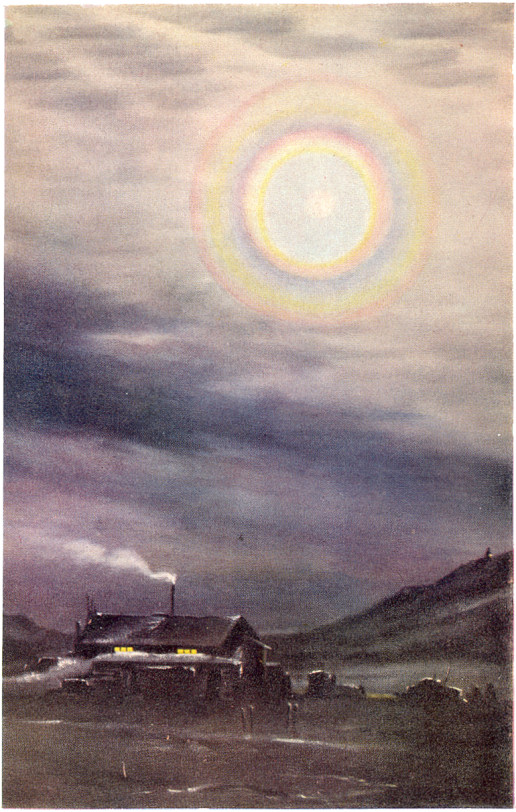
LUNAR CORONA.
A week later he was clearly alive to the situation. 'The Morning
must go in less than a week, and it seems now impossible that we
shall be free by that time, though I still hope the break-up may
come after she has departed.' Some time previously he had decided
that if they had to remain the ship's company should be reduced,
and on the 24th he had a talk with the men and told them that he
wished nobody to stop on board who was not willing. On the following
day a list was sent round for the names of those who wanted to
go, and the result was curiously satisfactory—for Scott had
determined that eight men should go, and not only were there eight
names on the list, but they were also precisely those which Scott
would have put there had he made the selection. Shackleton also
had to be told that he must go, as in his state of health Scott
did not think that any further hardships ought to be risked; but
in his place Scott requisitioned Mulock who by an extraordinary
chance is just the very man we wanted. We have now an immense amount
of details for charts... and Mulock is excellent at this work and
as keen as possible. It is rather amusing, as he is the only person
who is obviously longing for the ice to stop in, though of course
he doesn't say so. The other sporting characters are still giving
ten to one that it will go out, but I am bound to confess that
I am not sanguine.'
Page 146
The letter from which the last extract is taken was begun on February
16, and before the end of the month all hope of the Discovery
being able to leave with the Morning had been abandoned. On
March 2 nearly the whole of the Discovery's company were
entertained on board the Morning, and on the following day
the relief ship slowly backed away from the ice-edge, and in a few
minutes she was turning to the north, with every rope and spar
outlined against the black northern sky. Cheer after cheer was
raised as she gathered way, and long after she had passed out of
earshot the little band stood gazing at her receding hull, and
wondering when they too would be able to take the northern track.
In the Morning went a letter from Scott which shows that
although in a sense disappointed by the prospect of having to remain
for another winter, both he and his companions were not by any
means dismayed. 'It is poor luck,' he wrote, 'as I was dead keen
on getting a look round C. North before making for home. However we
all take it philosophically, and are perfectly happy and contented
on board, and shall have lots to do in winter, spring and summer.
We will have a jolly good try to free the ship next year, though
I fear manual labour doesn't go far with such terribly heavy ice
as we have here; but this year we were of course unprepared, and
when we realized the situation it was too late to begin anything
like extensive operations. I can rely on every single man that
remains in the ship and I gave them all the option of leaving...
Page 147
the ship's company is now practically naval-officers and men—it
is rather queer when one looks back to the original gift of two
officers.'
Referring to the Southern journey he says, 'We cut our food and
fuel too fine.... I never knew before what it was to be hungry;
at times we were famished and had to tighten our belts nightly
before going to sleep. The others dreamt of food snatched away at
the last moment, but this didn't bother me so much.'
But characteristically the greater part of this long letter refers
not to his own doings, but to the admirable qualities of those who
were with him. Wilson, Royds, Skelton, Hodgson, Barne and Bernacchi
are all referred to in terms of the warmest praise, and for the
manner in which Colbeck managed the relief expedition the greatest
admiration is expressed. But in some way or other Scott discovered
good points in all the officers he mentioned, and if they were
not satisfactory in every way his object seemed to be rather to
excuse than to blame them. He was, however, unaffectedly glad to
see the last of the cook, for the latter had shown himself far
more capable at talking than at cooking, and had related so many
of his wonderful adventures that one of the sailors reckoned that
the sum total of these thrilling experiences must have extended
over a period of five hundred and ninety years—which, as
the sailor said, was a fair age even for a cook.
By March 14 even the most optimistic of the company were compelled
to admit the certainty of a second winter, and orders were given
to prepare the
Page 148
ship for it. Compared with the previous year the weather had been
a great deal worse, for there had been more wind and much lower
temperatures, and under such conditions it was hopeless to go on
expecting the ice to break up. But it was not to be wondered at
that they found themselves wondering what their imprisonment meant.
Was it the present summer or the last that was the exception? For
them this was the gravest question, since on the answer to it their
chance of getting away next year, or at all, depended.
While, however, the situation as regards the future was not altogether
without anxiety, they sturdily determined to make the best of the
present. To ward off any chance of scurvy, it was determined to
keep rigidly to a fresh-meat routine throughout the winter, and
consequently a great number of seals and skuas had to be killed.
At first the skua had been regarded as unfit for human food, but
Skelton on a sledding trip had caught one in a noose and promptly
put it into the pot. And the result was so satisfactory that the
skua at once began to figure prominently on the menu. They had,
however, to deplore the absence of penguins from their winter diet,
because none had been seen near the ship for a long time.
On Wednesday, April 24, the sun departed, but Scott remarks upon
this rather dismal fact with the greatest cheerfulness: 'It would be
agreeable to know what is going to happen next year, but otherwise
we have no wants. Our routine goes like clock-work;
Page 149
we eat, sleep, work and play at regular hours, and are never in
lack of employment. Hockey, I fear, must soon cease for lack of
light, but it has been a great diversion, although not unattended
with risks, for yesterday I captured a black eye from a ball furiously
driven by Royds.'
Of the months that followed little need be said, except that Scott's
anticipations were fully realized. In fact the winter passed by
without a hitch, and their second mid-winter day found them even
more cheerful than their first. Hodgson continued to work away
with his fish-traps, tow-nets and dredging; Mulock, who had been
trained as a surveyor and had great natural abilities for the work,
was most useful, first in collecting and re-marking all the
observations, and later on in constructing temporary charts; while
Barne generally vanished after breakfast and spent many a day at
his distant sounding holes.
Throughout the season the routine of scientific observations was
carried out in the same manner as in the previous year, while many
new details were added; and so engaged was everyone in serviceable
work that when the second long Polar night ended, Scott was able to
write: 'I do not think there is a soul on board the Discovery
who would say that it has been a hardship.... All thoughts are turned
towards the work that lies before us, and it would be difficult to
be blind to the possible extent of its usefulness. Each day has
brought it more home to us how little we know and how much there
is to be learned, and we
Page 150
realize fully that this second year's work may more than double
the value of our observations. Life in these regions has lost any
terror it ever possessed for us, for we know that, come what may,
we can live, and live well, for any reasonable number of years
to come.'
THE WESTERN JOURNEY
Path of advance! but it leads
A long steep journey through sunk
Gorges, o'er mountains in snow.—M. ARNOLD.
|
During the second winter much time and attention had to be given
to the sledge equipment, for there was scarcely an article in it
that did not need to be thoroughly overhauled and refitted. But in
spite of all their efforts, the outfit for the coming season was
bound to be a tattered and makeshift affair. Skins of an inferior
quality had to be used for sleeping-bags; the tents were blackened
with use, threadbare in texture, and patched in many places; the
cooking apparatus was considerably the worse for wear; the wind
clothes were almost worn out, while for all the small bags, which
were required for provisions, they were obliged to fall back on any
sheets and tablecloths that could be found. This state of things,
however, was very far from daunting their spirits, and long before
the winter was over the plan of campaign for the next season had
been drawn up.
In making the program Scott knew that extended
Page 152
journeys could only be made by properly supported parties, and it
was easy to see that his small company would not be able to make
more than two supported journeys, though it might be just possible
to make a third more or less lengthy journey without support. The
next thing to decide was in what direction these parties should
go, and in this connection the greatest interest undoubtedly lay
in the west. To explore the Ferrar Glacier from a geological point
of view and find out the nature of the interior ice-cap must, Scott
determined, be attempted at all costs, and this journey to the
west he decided to lead himself.
In the south it was evident that without dogs no party could hope
to get beyond the point already reached. But Scott's journey had
been made a long way from land, and consequently had left many
problems unsolved, chief among which were the extraordinary straits
that had appeared to run through the mountain ranges without rising
in level. It was therefore with the main object of exploring one
of them that the second supported party, under the leadership of
Barne and Mulock, was to set out.
The credit in arranging the direction in which the unsupported
party should go belongs to Bernacchi, who was the first to ask
Scott what proof they had that the barrier surface continued on
a level to the eastward; and when Scott began to consider this
question, he discovered that there was no definite proof, and decided
that the only way to get it was to go and see.
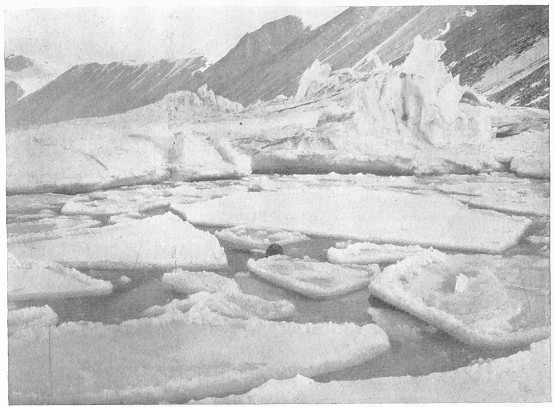
PINNACLED ICE AT MOUTH OF FERRAR GLACIER.
Photo by F. Debenham.
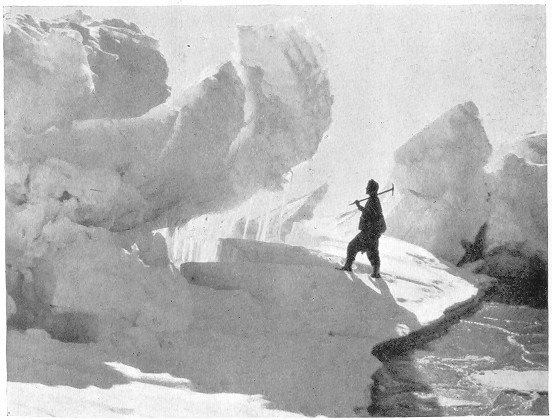
PRESSURE RIDGES NORTH SIDE OF DISCOVERY BLUFF.
Photo by F. Debenham.
Page 153
Besides the longer journeys, the program included a number of shorter
ones for specific purposes, and the most important of these were
the periodic visits to the Emperor penguin rookery, as it was hoped
that Wilson would be able to observe these birds from the beginning
of their breeding season.
Finally, one important factor was to dominate all the sledding
arrangements, for although the Discovery was mainly at the
mercy of natural causes, Scott made up his mind that everything
man could do to free her from the ice should be done. As soon as
they could hope to make any impression upon the great ice-sheet
around them, the whole force of the company was to set to work
at the task of extrication, and so all sledding journeys were to
start in time to assure their return to the ship by the middle
of December.
On September 9 Scott got away with his own party of Skelton, Dailey,
Evans, Lashly and Handsley, their object being to find a new road
to the Ferrar Glacier, and on it to place a depôt ready for
a greater effort over the ice-cap. The Ferrar Glacier descends
gradually to the inlet, which had been named New Harbor, but Armitage
had reported most adversely on this inlet as a route for sledges, and
in conducting his own party had led it across the high foot-hills.
As yet Scott had not been to this region, but in the nature of
things he could not help thinking that some practical route must
exist up the New Harbour inlet, and that if it could be found the
journey to the west would be much easier. And the result of this
little journey
Page 154
was really important, for whereas Armitage, at the foot of the
Ferrar Glacier, had seen the disturbance on the south side, and
had concluded that it must extend right across, Scott's party
fortunately pushed over this disturbance and found much easier
conditions beyond it.
The fact thus discovered, and which was amply supported by further
observations, was that invariably in the Antarctic regions where
glaciers run more or less east and west, the south side will be
found to be much broken up and decayed, while the north side will
be comparatively smooth and even. The reason of this, of course,
is simple enough, for the sun achieves its highest altitude in the
north, and consequently its warmest and most direct rays fall on
the south side of a valley. Here, therefore, the greater part of
the summer melting takes place, and a wild chaos of ice disturbance
is caused.
Scott's party, by taking a different route, laid a depôt at
a spot which Armitage had taken three weeks to reach, and was back
again at the ship in less than a fortnight.
'We were,' Scott says, 'inclined to be exceedingly self-satisfied;
we had accomplished our object with unexpected ease, we had done
a record march, and we had endured record temperatures—at
least, we thought so, and thought also how pleasant it would be to
tell these things in front of a nice bright fire. As we approached
the ship, however, Hodgson came out to greet us, and his first
question was, "What temperatures
Page 155
have you had?" We replied by complacently quoting our array of
minus fifties, but he quickly cut us short by remarking that
we were not in it.'
In fact during those few days there had been a very cold snap throughout
the region. Barne's party on the barrier, where they had been laying
a depôt, had the coldest time, and after their thermometer had
fallen lower and lower its spirit-column broke at -67.7°. Royds
and his party also had to endure -62°, but in other respects they
were in luck. For on arriving at Cape Crozier they found that the
Emperor penguins had already hatched out their young, and Wilson
was delighted to get the opportunity of studying the chicks at
such a tender age. Commenting upon this and another journey to
Cape Crozier, Wilson wrote: 'The Emperor penguin stands nearly
four feet high, and weighs upward of eighty to ninety pounds....
I think the chickens hate their parents, and when one watches the
proceedings in a rookery it strikes one as not surprising. In the
first place there is about one chick to ten or twelve adults, and
each adult has an overpowering desire to "sit" on something. Both
males and females want to nurse, and the result is that when a
chicken finds himself alone there is a rush on the part of a dozen
unemployed to seize him. Naturally he runs away, and dodges here
and there till a six-stone Emperor falls on him, and then begins
a regular football scrimmage, in which each tries to hustle the
other off, and the end is too often disastrous to the chick....
I think it is not
Page 156
an exaggeration to say that of the 77 per cent. that die no less
than half are killed by kindness.'
From Cape Crozier Cross resolved to try to bring two chickens back
to the ship, and by giving up his sleeping jacket to keep them
warm and tending them with the utmost care, he succeeded in his
attempt. But eventually they died from unnatural feeding, and Wilson
says: 'Had we even succeeded in bringing them to the age when they
put on their feathers, I fear that the journey home through the
tropics would have proved too much for them, as we had no means
of making a cool place for them on the ship.'
September 21 brought with it a grievous disappointment, as on that
day the nautical almanac announced that nine-tenths of the sun would
be obscured. For this event Bernacchi had made the most careful
preparations, and everyone was placed under his orders during the
day. Telescopes and the spectroscopic camera were trained in the
right direction, magnetic instruments were set to run at quick
speed, and observers were told off to watch everything on which the
absence of sun could possibly have the smallest effect. Everything,
in short, was ready except the sun itself which obstinately refused
to come out. 'There may,' Scott says, 'have been an eclipse of
the sun on September 21, 1903, as the almanac said, but we should
none of us have liked to swear to the fact.'
The next three weeks or so were spent in preparations for the long
journeys, and on October 12 Scott
Page 157
left the ship with a party of twelve, and four 11-foot sledges. First
came his own party, which included Skelton, Feather, Evans, Lashly
and Handsley; secondly there was a small party for the geologist,
Ferrar, who was accompanied by Kennar and Weller; and thirdly there
were the supports, consisting of Dailey, Williamson and Plumley.
Scott guessed rightly that in many respects this was going to be the
hardest task he had yet undertaken, but he knew also that experience
would be a thing to be reckoned upon, and that it would take a
good deal to stop the determined men whom he had chosen. At the
start their loads were a little over 200 lbs. per man, but most
of the party were by this time in thoroughly good condition, and
by hard marching they covered the forty-five miles to New Harbour
and reached the snow-cape early on the 14th.
This snow-cape in future was to be known as Butter Point, for here
on their return journey they could hope to obtain fresh seal-meat,
and in preparation for this great event a tin of butter was carried
and left at the point for each party.
At first all went well with the travelers, and it was not until
the evening of the 17th, when they were camped amid indescribably
beautiful scenery, that the first cloud of trouble arose. Then
Dailey the carpenter reported that the German silver had split
under the runners of two sledges, and this was a most serious blow;
for although the wood runners were capable of running on snow without
protection, on
Page 158
hard, sharp ice, especially if the sledge was heavily laden, they
would be knocked to pieces in a very short time. It was, therefore,
absolutely necessary to protect the runners on this journey, but
unfortunately the German silver protection had already stood a
season's work, and had worn thin without giving any outward sign.
From start to finish of the Ferrar Glacier about ninety miles of
hard ice were to be expected, and the problem that immediately
arose was how to get the sledges over this without damage.
By lunch-time on the 18th they had achieved a height of over 6,000
feet, and by that time the sledges were in such a parlous state
that Scott had all of them unpacked and the runners turned up for
inspection. Horrid revelations followed; one sledge remained sound,
and Scott promptly decided that there was one course and only one to
take, and that was to return to the ship as fast as they could. Had
two sledges been available the advance party might have struggled on,
but with one they could do nothing; so they left the sound sledge
with everything else except the half-week's provisions necessary
to take them back, and on the following days they 'came as near
flying as is possible with a sledge party.' On the morning of the
19th they had eighty-seven miles to cover, and by 8.30 P.M. on
the 21st they had reached the ship.
During this march Scott had determined to test his own party to
the utmost, but seeing no necessity
Page 159
for the supports to be dragged into this effort he told them to
take their own time. The supporting party, however, did not mean
to be left behind if they could help it, and later on the night
of the 21st they also reached the ship. In the hard struggle of
the last hours some of the members of the supporting party, though
determined not to give in, had been comically astounded by the
pace which was set, and Kennar, presumably referring to Scott,
kept on repeating, 'If he can do it, I don't see why I can't: my
legs are as long as his.
Five days after their flying return they were off again, and although
the material for repairing sledges was very scanty, one sound 11-foot
sledge had been made and also a 7-foot one for Ferrar's glacier
work. Trouble, however, almost at once began with the runners,
and on the 29th Ferrar's sledge gave out and caused a long delay.
But in spite of being held up by wind for two days, they reached
their depôt on November 1, and thought at first that everything
was safe. On examination, however, they discovered that a violent
gale had forced open the lid of the instrument box, and that several
things were missing, among which Scott found to his dismay was
the 'Hints to Travelers.'
'The gravity of this blow,' he wrote in his diary on November 1,
'can scarcely be exaggerated; but whilst I realized the blow I
felt that nothing would induce me to return to the ship a second
time; I thought it fair, however, to put the case to the others,
Page 160
and I am, as I expected, fortified by their willing consent to take
the risks of pushing on.'
In traveling to the west, Scott expected to be—as indeed
he was—out of sight of landmarks for some weeks. In such a
case as this the sledge-traveler is in precisely the same position
as a ship or a boat at sea: he can only obtain a knowledge of his
whereabouts by observation of the sun or stars, and with the help
of these observations he finds his latitude and longitude, but to
do this a certain amount of data is required. 'Hints to Travelers'
supplies these necessary data, and it was on this book that Scott had
been relying to help him to work out his sights and fix accurately
the position of his party. Unless he went back to the ship to make
good his loss, he was obliged to take the risk of marching into
the unknown without knowing exactly where he was or how he was to
get back. 'If,' he says, 'the loss of our "Hints to Travelers" did
not lead us into serious trouble it caused me many a bad half-hour.'
Having, however, decided to push on, they wasted no time about
it, and although the sledge-runners continued to need constant
attention they arrived at the base of the upper glacier reach on
the 2nd, and on the following day gained a height of 7,000 feet.
So far nothing exceptionally eventful had occurred, but November
4 was destined to begin a time that Scott described afterwards as
'the most miserable week I have ever spent.' In the morning of
the 4th there was bright sunshine with a cold, increasing wind,
Page 161
but later on the sun disappeared and the weather became very
threatening. Still, however, they battled on and were half-way
up the bare, icy slope they were climbing, when the air became
thick with driving snow and the full force of the gale burst upon
them. Pushing on at almost a run they succeeded in reaching the
top, and hurriedly started to search for a patch of snow on which
to camp, but nothing could be found except bare, blue ice. By this
time the position was becoming serious, all of them were frost-bitten
in the face, and although the runners of the sledges were split
again so badly that they could barely pull them over the surface,
they did not dare to leave the sledges in the thick drift.
At last a white patch was seen and a rush was made for it, but the
snow discovered was so ancient and wind-swept that it was almost
as hard as the ice itself. Nevertheless they knew it was this or
nothing, and Scott seized a shovel for his own tent-party, and
dug for all he was worth without making the least impression. At
this moment Feather, the boatswain, luckily came to help him, and
being more expert with the shovel managed to chip out a few small
blocks. Then they tried to get up a tent, but again and again it
and the poles were blown flat, and at least an hour passed before
the tents were erected. 'Nothing,' Scott wrote, 'but experience
saved us from disaster to-day, for I feel pretty confident that
we could not have stood another hour in the open.'
Little, however, did they expect when shelter
Page 162
was gained that a week would pass before they could resume their
march. From November 4-11 the gale raged unceasingly, and meanwhile
not a vision of the outer world came to them, for they were enveloped
continuously in a thick fog of driving snow.
In Scott's tent there was one book, Darwin's 'Cruise of the
Beagle,' and first one and then another would read this
aloud, until frozen fingers prevented the pages from being turned
over. Only one piece of work were they able to perform, and this
on the first day when, thinking the storm would soon blow over,
they hauled the sledges beneath one of the tents and stripped the
German silver ready for the onward march.
By the fifth day of their imprisonment sleep began to desert them,
and Scott, realizing that the long inactivity was telling on the
health of the party, determined that whatever the conditions might
be he would try to start on the following morning.
This attempt, however, resulted in complete failure. In ten minutes
both of Scott's hands were 'gone,' Skelton had three toes and the
heel of one foot badly frost-bitten, and Feather lost all feeling
in both feet. 'Things are looking serious,' Scott wrote after this
unsuccessful effort to be up and doing, 'I fear the long spell of
bad weather is telling on us. The cheerfulness of the party is
slowly waning; I heard the usual song from Lashly this morning,
but it was very short-lived and dolorous.... Something must be
done to-morrow, but what it will be, to-morrow only can show.'
Fortunately the next morning brought a lull in the
Page 163
storm, and though the air was still as thick as a hedge it was
possible at last to break away from 'Desolation Camp.' Then Scott's
party separated from Ferrar's, the former making for the ice-fall
and eventually and miraculously reaching the top without accident.
On starting they could not see half-a-dozen yards ahead, and at
once went as nearly as possible into an enormous chasm; and when
they began to ascend they crossed numerous crevasses without waiting
to see if the bridges would bear. 'I really believe that we were
in a state when we none of us really cared much what happened;
our sole thought was to get away from that miserable spot.'
But during the succeeding days fortune was with them, and by the
night of the 13th the fight was won and the summit reached. With
five weeks' provisions in hand, and the prospect of covering many
miles before a return to the glacier would be necessary, they were,
as they camped at the elevation of 8,900 feet, a very different
party from the one which had struggled out of 'Desolation Camp'
on the morning of the 11th.
But they had scarcely gained the summit of the icecap and started the
journey to the west before troubles again began to gather round them.
The long stay in 'Desolation Camp' had covered their sleeping-bags
and night-jackets with ice, and with falling temperatures this ice
had so little chance to evaporate that camping arrangements were
acutely uncomfortable; and as each night the thermometer fell a
little lower,
Page 164
the chance of relief from this state of things could scarcely be
said to exist. The wind, too, was a constant worry, for though it
was not very strong, when combined with the low temperature and
rarefied air its effect was blighting.
'I do not think,' Scott wrote, 'that it would be possible to conceive
a more cheerless prospect than that which faced us at this time,
when on this lofty, desolate plateau we turned our backs upon the
last mountain peak that could remind us of habitable lands. Yet
before us lay the unknown. What fascination lies in that word!
Could anyone wonder that we determined to push on, be the outlook
ever so comfortless?'
So they plodded forward with all their strength, but in spite of
every effort their progress gradually became slower. By the 17th
the sledges had been divided, Scott, Feather, and Evans leading
with one, while Skelton, Handsley, and Lashly followed with the
other. But Scott found very soon that the second sledge had great
difficulty in keeping up, and that although he himself felt thoroughly
strong and well, some of his companions were beginning to fail. As
was natural with such men not one of them would own that he was
exhausted, and in consequence it was only by paying the keenest
attention that he could detect those who from sheer incapacity
were relaxing their strain on the traces. And his position was not
pleasant even when he knew, for to tell any of these brave people
that they must turn back was a most unenviable
Page 165
task. Thus it came about that all six of them marched on, though
Scott was sure that better progress would have been made had the
party been divided.
Something like a climax was reached on the 20th, when Handsley
more or less broke down. Not for a moment, however, did he mean
to give up, and when he was relieved of some part of his work he
begged Scott not again to make an example of him. In Handsley's
opinion his breakdown was a disgrace, and no arguments would make
him change it. Small wonder then that Scott wrote in his diary:
'What children these men are, and yet what splendid children! The
boatswain has been suffering agonies from his back; he has been
pulling just behind me, and in some sympathy that comes through the
traces I have got to know all about him, yet he has never uttered a
word of complaint, and when he knows my eye is on him he straightens
up and pretends he is just as fit as ever. What is one to do with
such people?'
What Scott did was to try for another day to go on as before, but
on November 22 he had to tell Skelton, Feather, and Handsley that
they must turn back, and though 'they could not disguise their
disappointment, they all seemed to understand that it had to be.'
From the date on which Scott reluctantly came to this decision,
three weeks of the hardest physical toil followed for him and his
companions, Evans and Lashly. Nevertheless Scott looked back upon
this strenuous time with unmixed satisfaction, and paid a
Page 166
high tribute of praise to his companions for their part in the
successful work that was done.
'With these two men behind me,' he says, 'our sledge seemed to be
a living thing, and the days of slow progress were numbered....
Troubles and discomforts were many, and we could only guess at
the progress we made, but we knew that by sticking to our task
we should have our reward when our observations came to be worked
out on board the ship.'
Regularly each night the temperature fell to -40° or below,
while during the marching hours it rarely rose much above -25°,
and with this low temperature there was a constant wind. In fact
the wind was the plague of their lives and cut them to pieces.
So cracked were their faces that laughing hurt horribly, and the
first half-hour of the morning march, before they were warmed up
to the work, was dreadful, as then all their sore places got
frost-bitten. In short the last week of their outward march was
a searching test of endurance, but they had resolved to march on
until November 30, and in spite of the miserable conditions there
was no turning back before the month had ended.
Scott, however, was most undisguisedly glad when November 30 had
come and gone. 'We have finished our last outward march, thank
heaven! Nothing has kept us going during the past week but the
determination to carry out our original intention of going on to
the end of the month, and so here we have pitched our last camp.'
THE RETURN FROM THE WEST
Ceaseless frost round the vast solitude
Bound its broad zone of stillness.—SHELLEY.
|
'We are all,' Scott wrote in his diary, 'very proud of our march
out. I don't know where we are, but I know we must be a long way to
the west from my rough noon observation of the compass variation.'
But not for anything in the world did he want again to see the
interior of Victoria Land. Writing two years after this great march
he says: 'For me the long month which we spent on the Victoria Land
summit remains as some vivid but evil dream. I have a memory of
continuous strain on mind and body, lightened only by the unfailing
courage and cheerfulness of my companions.'
From first to last the month of November had been a struggle to
penetrate into this barren, deserted, wind-swept, piercingly cold,
and fearfully monotonous region, and although on turning homewards
the travelers were relieved by having the wind at their backs, the
time of trial was by no means over. Only by utilizing all their
powers of marching could they hope
Page 168
to retreat in safety from their position, and December opened with
such overcast weather that valuable time had to be spent in the
tent. During the next few days, however, good marches were made,
until on December 9 everything changed abruptly for the worse.
On the afternoon of the 9th the surface became so abominably bad,
that by pulling desperately they could not get the sledge along
at more than a mile an hour. Oil was growing short, and in view
of the future Scott had to propose that marching hours should be
increased by one hour, that they should use half allowance of oil,
and that if they did not sight landmarks within a couple of days
their rations should be reduced. 'When I came to the cold lunch
and fried breakfast poor Evans' face fell; he evidently doesn't
much believe in the virtue of food, unless it is in the form of
a hoosh and has some chance of sticking to one's ribs.'
Land was sighted on the 10th, 11th, and 12th, but the weather was
as overcast as ever, and Scott was still in dreadful uncertainty
of their whereabouts, because he was unable to recognize a single
point. Ten hours' pulling per day was beginning to tell upon them,
and although apart from the increasing pangs of hunger there was
no sign of sickness, Scott remarks, on the 12th, that they were
becoming 'gaunt shadows.'
During the morning of the 13th Evans' nose, which had been more
or less frost-bitten for some weeks, had an especially bad attack.
His attitude
Page 169
to this unruly member was one of comic forbearance, as though,
while it scarcely belonged to him, he was more or less responsible
for it and so had to make excuses. On this occasion when told that
it had 'gone,' he remarked in a resigned tone, 'My poor old nose
again; well, there, it's chronic!' By the time it had been brought
round a storm was blowing, and though they continued to march,
the drift was so thick that at any moment they might have walked
over the edge of a precipice—a fitting prelude to what, by
general consent, was admitted to be the most adventurous day in
their lives.
Prospects, when they started to march on the next morning, were at
first a little brighter, but soon a bitterly cold wind was blowing and
high ice hummocks began to appear ahead of them. In this predicament
Scott realized that it was both rash to go forward, as the air was
becoming thick with snow-drift, and equally rash to stop, for if they
had to spend another long spell in a blizzard camp, starvation would
soon be staring them in the face. So he asked Evans and Lashly if
they were ready to take the risk of going on, and promptly discovered
that they were. Then they marched straight for the ice disturbance,
and as the surface became smoother and the slope steeper their
sledge began to overrun them. At this point Scott put Evans and
Lashly behind to hold the sledge back, while he continued in front
to guide its course, and what happened afterwards is described
most graphically in the diary of the 15th.
Page 170
'Suddenly Lashly slipped, and in an instant he was sliding downward
on his back; directly the strain came on Evans, he too was thrown
off his feet. It all happened in a moment, and before I had time
to look the sledge and the two men hurtled past me; I braced myself
to stop them, but might as well have attempted to hold an express
train. With the first jerk I was whipped off my legs, and we all
three lay sprawling on our backs and flying downward with an
ever-increasing velocity. For some reason the first thought that
flashed into my mind was that someone would break a limb if he
attempted to stop our mad career, and I shouted something to this
effect, but might as well have saved my breath. Then there came
a sort of vague wonder as to what would happen next, and in the
midst of that I was conscious that we had ceased to slide smoothly
and were now bounding over a rougher incline, sometimes leaving
it for several yards at a time; my thought flew to broken limbs
again, for I felt we could not stand much of such bumping.
'At length we gave a huge leap into the air, and yet we traveled
with such velocity that I had not time to think before we came
down with tremendous force on a gradual incline of rough, hard,
wind-swept snow. Its irregularities brought us to rest in a moment
or two, and I staggered to my feet in a dazed fashion, wondering
what had happened.
'Then to my joy I saw the others also struggling to their legs, and
in another moment I could thank heaven that no limbs were broken.
But we had by
Page 171
no means escaped scathless; our legs now show one black bruise from
knee to thigh, and Lashly was unfortunate enough to land once on
his back, which is bruised and very painful.... I, as the lightest,
escaped the easiest, yet before the two men crawled painfully to
their feet their first question was to ask if I had been hurt.
'As soon as I could pull myself together I looked round, and now to
my astonishment I saw that we were well on towards the entrance of our
own glacier; ahead and on either side of us appeared well-remembered
landmarks, whilst behind, in the rough broken ice-wall over which we
had fallen, I now recognized at once the most elevated ice cascade
of our valley....
'I cannot but think that this sudden revelation of our position
was very wonderful. Half an hour before we had been lost; I could
not have told whether we were making for our own glacier or any
other, or whether we were ten or fifty miles from our depôt;
it was more than a month since we had seen any known landmark.
Now in this extraordinary manner the curtain had been raised...
and down the valley we could see the high cliffs of the Depôt
Nunatak where peace and plenty awaited us.'
The sledge had not capsized until they all rolled over at the end,
but the jolting had scattered their belongings and broken open the
biscuit box, with the result that they had no provisions left,
except the few scraps they could pick up and the meager contents
of their food bag. As quickly as stiffening limbs would
Page 172
allow they collected their scattered articles, repacked the sledge
and marched on towards the depôt. Before them lay a long plateau,
at the edge of which Scott knew that they would find a second cascade,
and beneath it the region of Desolation Camp and a more gradual
icy surface down to the depôt.
Fortune favored them in descending the second cascade, and quite
unsuspicious of any further danger they joined up their harness to
their usual positions in front of the sledge. This brought Scott
in the middle and a little in advance, with Lashly on his right
and Evans on his left. Presently the sledge began to skid, and
Scott told Lashly to pull wide to steady it. Scarcely had this
order been obeyed when Scott and Evans stepped on nothing and
disappeared, while Lashly miraculously saved himself from following
and sprang back with his whole weight on the trace. The sledge
flashed by him and jumped the crevasse down which Scott and Evans
had gone, one side of the sledge being cracked by the jerk but
the other side mercifully holding. 'Personally,' Scott says, 'I
remember absolutely nothing until I found myself dangling at the
end of my trace with blue walls on either side and a very horrid
looking gulf below; large ice-crystals dislodged by our movements
continued to shower down on our heads. As a first step I took off
my goggles; I then discovered that Evans was hanging just above
me. I asked him if he was all right, and received a reassuring
reply in his calm, matter-of-fact tones.'
Page 173
Then Scott began to grope about on every side with his cramponed
feet, but not until his struggles set him swinging did his leg
suddenly strike a projection. At a glance he saw that by raising
himself he could get a foothold on this, and after a short struggle
he stood upon a thin shaft of ice, which was wedged providentially
between the walls of the chasm, and could look about him. To the
right or left, above or below, there was not the vestige of another
such support, nothing, in fact, but the smooth walls of ice. The
projection seemed to have got there by a miracle, but miracle or
not the thing to do was to help Evans, and when the latter had
slipped his harness well up beneath his arms Scott found that he
could pilot his feet to the bridge.
'All this had occupied some time, and it was only now that I realized
what had happened above us, for there, some twelve feet over our
heads, was the outline of the broken sledge. I saw at once what a
frail support remained, and shouted to Lashly to ask what he could
do, and then I knew the value of such a level-headed companion;
for whilst he held on grimly to the sledge and us with one hand,
his other was busily employed in withdrawing our ski. At length
he succeeded in sliding two of these beneath the broken sledge,
and so making our support more secure.'
But clever as this device was it still left them without Lashly's
active assistance, because directly he relaxed his hold the sledge
began to slip. The only
Page 174
possible course, therefore, was for Scott and Evans to climb out
unaided, and, after a word with Evans Scott decided to try first;
though he confessed afterwards that he never expected to reach
the top. Not for a longtime had he swarmed a rope, and to do so
in thick clothing, heavy crampons, and with frost-bitten fingers
seemed to him impossible. Of the struggle that followed he remembered
little except that he got a rest when he could plant his foot in
the belt of his own harness, and again when his feet held on the
rings of the belt. 'Then came a mighty effort, till I reached the
stirrup formed by the rope span of the sledge, and then, mustering
all the strength that remained, I reached the sledge itself and
flung myself on to the snow beyond. Lashly said, "Thank God!" and
it was perhaps then that I realized that his position had been
the worst of all.'
But having arrived at the top he was completely out of action for
several minutes, for his hands were white to the wrists, and not
until their circulation came back could he get to work. With two on
top and only one below the position, however, was very different,
and presently Evans, badly frost-bitten, was landed on the surface.
For a minute or two they could only stand and look at one another.
Then Evans said, 'Well, I'm blowed,' which was the first sign of
surprise he had shown.
By six o'clock on that same evening they reached their depôt,
and passed from abject discomfort to rest and peace. Bruised, sore
and tired as they were,
Page 175
Lashly sang merrily as he stirred the pot, while Scott and Evans
sat on the sledge, shifted their foot-gear, spread out their clothes
to dry, and talked cheerily about the happenings of the day.
From this time onward their camp-life was wholly, pleasant, except
to Lashly who had an attack of snow-blindness. Apart from that they
were in the best of condition for the hard marching in front of
them, and when on the night of the 20th they reached their second
depôt and could look out towards the sea, they did not care
how far round they might have to walk if only that stubborn sheet
of ice had broken away. But it was too evident that their homeward
track might be as straight as they chose, as only in the far distance
was open water to be seen, and with sorrow they realized that there
must still be many miles of ice between it and the Discovery.
Late on Christmas Eve they were once more on board the ship after
an absence of fifty-nine days, during which they had traveled 725
miles. Taking the eighty-one days of absence which had constituted
the whole sledding season, Scott, Evans and Lashly had covered
1,098 miles, and, not including minor undulations, had climbed
heights which totaled to 19,000 feet. On getting back to the
Discovery Scott found only Koettlitz, Handsley and Quartley
on board, because all the rest of the company had gone to the north
to saw through the ice; and during the few days of rest that he
allowed himself before going to the sawing-camp, he was able to
read the reports of the
Page 176
officers who had led the other journeys, and to see what excellent
work had been done during his absence.
Ferrar's survey and Skelton's photographic work had added materially
to the value of the western journey; the party led by Barne and
Mulock to the south had met with ill-fortune from the start, but
throughout the journey Mulock used the theodolite indefatigably,
with the results that this stretch of coast-line was more accurately
plotted than any other part of Victoria Land, and that the positions
and height of over two hundred mountain peaks were fixed. Barne
also obtained a very good indication of the movement of the Great
Barrier ice-sheet. During Royds' journey, on which the party went
on very short food allowance, Bernacchi took a most interesting
series of magnetic observations. And although to Bernacchi himself
belongs the greatest credit, some reflected glory, at any rate, fell
upon his companions, because they had to stay shivering outside
the tent while he was at work inside it.
Wilson had not only been busy with the penguins at Cape Crozier, but
had also made a complete examination of the enormous and interesting
pressure ridges which form the junction of the Great Barrier ice-mass
with the land, and subsequently had spent much time in studying the
windless area to the south of Ross Island. Also, with Armitage and
Heald, he had made an excellent little journey, on which Armitage
obtained some very good photographs,
Page 177
sufficient in themselves to prove the receding glacial conditions
of the whole continent.
In short during Scott's absence his companions had been working
strenuously to increase the supply of information; so when the
second sledding-season ended, they could with reason congratulate
themselves that the main part of their work was done.
RELEASE
And Thor
Set his shoulder hard against the stern
To push the ship through...
...and the water gurgled in
And the ship floated on the waves and rock'd.
M. ARNOLD.
|
After a few days on board Scott became restless to see what was
going on in the sawing-camp, and on the morning of the 31st he
started off with Evans, Lashly and Handsley to march the ten and
a half miles to the north. When the instructions for this attempt
to free the Discovery were drawn up, there had been, of
course, no telling how broad the ice-sheet would be when operations
began, and Scott had been obliged to assume that it would be nearly
the same as in the previous year, when the open water had extended
to the Dellbridge Islets about eleven miles from the ship. There
he directed that the camp should be made, and Armitage, on whom
in Scott's absence the command had devolved, made all preparations
in accordance with the instructions he had received.
At the outset, however, a difficulty awaited him,
Page 179
as in the middle of December the open water, instead of being up
to the islets, ended at least ten miles farther to the north. Under
the circumstances he considered it dangerous to take the camp out to
the ice-edge, and so the sawing work had been begun in the middle
of the ice-sheet instead of at its edge.
Thirty people were in the camp when Scott arrived, and though at
first the work had been painful both to arms and backs they were
all in splendid condition and spirits. Fortunately this was a land
of plenty, penguins and seals abounded, and everyone agreed that,
apart from the labour, they were having a most enjoyable time,
though no one imagined that the work would be useful.
In two days Scott was as convinced as anyone that the work must be
in vain, and ordered the sawing to stop. 'I have been much struck,'
he wrote, 'by the way in which everyone has cheerfully carried on
this hopeless work until the order came to halt. There could have
been no officer or man among them who did not see from the first
how utterly useless it was, and yet there has been no faltering
or complaint, simply because all have felt that, as the sailor
expresses it, "Them's the orders."'
With twenty miles of ice between the Discovery and freedom,
the possibility of yet another winter had to be considered, so
although most of the company returned to the ship, Lashly, Evans,
Handsley and Clarke were left behind to make sure of an adequate
stock of penguins. And then Scott being unable
Page 180
to do any good by remaining in the ship started off to the north
with Wilson, the former being anxious to watch the ice-edge and see
what chance there was of a break-up, while Wilson wanted to study
the life of that region. This journey was to be 'a real picnic,' with
no hard marching and plenty to eat; and, pursuing their leisurely
way, on January 4 they were within half a mile of the open water
when Wilson suddenly said, 'There they are.' Then Scott looked
round, and on the rocks of Cape Royds saw a red smudge dotted with
thousands of little black and white figures. Without doubt they
had stumbled upon a penguin rookery, but interesting as it was to
have made the discovery, it was at the same time exasperating to
think of the feast of eggs they had missed in the last two years.
During the rest of the day they watched the penguins and the skua
gulls which were nesting around them; and before supper they took
soap and towels down to a rill of thaw-water that ran within a few
yards of their tent, and washed in the warm sunlight. 'Then,' Scott
says, 'we had a dish of fried penguin's liver with seal kidneys;
eaten straight out of the frying-pan, this was simply delicious.
I have come to the conclusion that life in the Antarctic Regions
can be very pleasant.'
Still in the proper picnic spirit they dawdled over their breakfast
on the following day, and were lazily discussing plans when Scott,
looking through the open door of the tent to the clear sea beyond,
suddenly caught sight of a ship. In a moment haste and bustle reigned
supreme, and while they were searching for
Page 181
boots and other things necessary for the march, Wilson said, 'Why,
there's another,' and without any doubt two vessels were framed in
the doorway. It had at once been taken for granted that the first
ship was the Morning, but what in the name of fortune was
the meaning of the other neither Scott nor Wilson could imagine.
The easiest and quickest way to find out was to go straight on
board, for the ships were making for the ice-edge some five miles
to the westward, but if they had followed this simple plan their
companions on the Discovery would have known nothing about
it, and would have been compelled to wait for their mails. So they
started southward to find the penguin hunters, and then to send
them to establish communications with the ship. For a long time
no sight of the men could be seen, but after traveling about six
miles Scott and Wilson saw the tent, though without any signs of
life about it; indeed they were within a hundred yards before in
answer to their shouts four very satisfied figures emerged, still
munching the remains of a meal. 'Of course,' Scott says, 'I thought
they had not seen the ships, but they had, only, as they explained,
they didn't see there was any cause for them to do anything in the
matter. I said, "But, good heavens, you want your mails, don't
you?" "Oh, yes, sir," they replied, "but we thought that would be
all right." In other words, they as good as said that life was so
extremely easy and pleasant that there was no possible object in
worrying over such a trifle as the arrival of a relief expedition.'
When, however, they
Page 182
had got their orders they were off at once, and Scott and Wilson went
back to the ships and soon found out from Colbeck why the Terra
Nova had accompanied the Morning, and how strangely the
aspect of affairs had altered. Writing in his diary on that night
Scott says, 'I can only record that in spite of the good home news,
and in spite of the pleasure of seeing old friends again, I was
happier last night than I am to-night.'
Briefly the reasons for the sending of the two ships instead of
one were these. Scott's report taken by the Morning had left
the strong impression that the relief ship must again be sent to
the south in 1903. The 'Morning' fund, however, was inadequate to
meet the requirements of another year, and there was not time enough
to appeal to the public and to explain the full necessities of the
case. In these circumstances there was nothing for the Societies
to do but to appeal to the Government, and eventually the latter
agreed to undertake the whole conduct of the relief expedition,
provided that the Morning, as she stood, was delivered over
to them. The Government naturally placed the management of affairs in
the hands of the Admiralty, and once having taken the responsibility
it was felt that two ships must be sent, in order that there should
be no risk of the pledge being unfulfilled.
The Terra Nova, one of the finest of the whaling ships,
was bought, and a whaling crew, under the command of Captain Harry
MacKay, was engaged to navigate her. Towards the end of November
1903 she layoff Hobart Town in Tasmania, and in
Page 183
December she was joined by the Morning, Captain Colbeck
being directed to take charge of this joint venture until both ships
could come under Scott's command.
Thus it happened that, much to every one's surprise, two ships
arrived off the edge of the fast ice on January 4, 1904. It was
not, however, the arrival of the Terra Nova, whose captain
from the first was anxious to help in every way, but quite another
matter that made Scott so sad—and naturally sad—at
this time.
In England the majority of those competent to judge the situation
had formed the opinion that the Discovery was stuck fast
in the ice for all time. Whether the Admiralty held this opinion
or not is of no consequence, because in any case it was their duty
to see that the expense of another relief expedition should be
avoided. Consequently there was no other course open to them except
to tell Scott to abandon the Discovery, if she could not
be freed in time to accompany the relief ships to the north. But
necessary as this order was, it placed Scott and his companions
in a very cruel position. Under the most ordinary conditions a
sailor would go through much rather than abandon his ship, but
the ties which bound Scott and his company to the Discovery
were very far beyond the ordinary; indeed they involved a depth
of sentiment not in the least surprising when their associations
with her are remembered.
In spite of their long detention in the ice, the thought of leaving
her had never entered their heads.
Page 184
Some time she would be free again, and even if they had to spend
a third winter in her they had determined to go through with it,
and make themselves as comfortable as possible.
It was from this passably contented frame of mind that they were
rudely awakened. Now they were obliged to face the fact that unless
a twenty-mile plain of ice broke up within six weeks, they must bid
a long farewell to their beloved ship and return to their homes
as castaways. So with the arrival of the relief ships there fell
the first and last cloud of gloom which was ever allowed on board
the Discovery. And as day followed day with no improvement
in the ice conditions, the gloom deepened until anyone might easily
have imagined that an Antarctic expedition was a most dismal affair.
On January 10 Scott wrote: 'Reached the ship this morning, and
this afternoon assembled all hands on the mess-deck, where I told
them exactly how matters stood. There was a stony silence. I have
not heard a laugh in the ship since I returned.'
For some time a flagstaff had been erected on Tent Islet, ten miles
to the north, and a system of signals had been arranged to notify
any changes in the ice, but day after day the only signal was 'No
change in the ice conditions.'
On the 15th to relieve the weariness of waiting for something that
did not happen, Scott arranged that their collections and instruments
should be transported to the relief ships. Whatever the future
held in
Page 185
store he saw no reason why this should not be done, and to have
anything at all to do during this trying time was a blessing; though
he had by no means given up hope that the Discovery would be freed.
After a long spell at Cape Royds camp, Wilson returned to the ship
on the night of the 21st with news that was all the more welcome at
such an anxious time. Strolling over the beach one day to inspect
what he thought was a prodigiously large seal he saw that it was
quite different from any of the ordinary seals, and went back to
the camp for his gun. Two of the Morning officers were in
camp with him, and all three of them proceeded to stalk this strange
new beast. Their great fear was that they might only succeed in
wounding it and that it might escape into the sea; so in spite
of the temperature of the water they waded round it before they
attacked. These tactics were successful, but their quarry when
dispatched was far too heavy for them to move, or for Wilson to
examine where it lay. On the following day, however, Colbeck came
over in the Morning, and with the aid of boats and ropes the
carcass was landed on his decks. Then Wilson came to the conclusion
that the animal was a sea-elephant commonly found at Macquarie
Island, but never before seen within the Antarctic circle.
No change in the ice occurred until the 18th when some large pieces
broke away, and by the 23rd Scott reckoned that the relief ships were
four or five miles nearer than they had been a fortnight before. But,
Page 186
if the conditions were to be as they had been two years before,
thirteen or fourteen miles of ice must go out in fifteen days,
a far more rapid rate than it had been going during the previous
fortnight. On the 28th, however, the first sign of real promise
occurred, for the whole ice-sheet began to sway very slightly under
the action of a long swell, its edge against the land rising and
falling as much as 18 inches. 'We are all very restless, constantly
dashing up the hill to the lookout station or wandering from place
to place to observe the effects of the swell. But it is long since
we enjoyed such a cheerful experience as we get on watching the
loose pieces of ice jostling one another at Hut Point.'
Days of hope and anxiety followed, until the 14th of February arrived
and brought the best of news with it. During the day nothing unusual
happened, and it was not until Scott was at dinner that the excitement
began. Then he heard a shout on deck, and a voice sang out down
the hatchway, 'The ships are coming, sir!'
'There was no more dinner, and in a moment we were racing for Hut
Point, where a glorious sight met our view. The ice was breaking
up right across the strait, and with a rapidity which we had not
thought possible. No sooner was one great floe borne away. Than
a dark streak cut its way into the solid sheet that remained and
carved out another, to feed the broad stream of pack which was
hurrying away to the north-west.
'I have never witnessed a more impressive sight;
Page 187
the sun was low behind us, the surface of the ice-sheet in front
was intensely white, and in contrast the distant sea and its forking
leads looked almost black. The wind had fallen to a calm, and not a
sound disturbed the stillness about us. Yet, in the midst of this
peaceful silence, was an awful unseen agency rending that great
ice-sheet as though it had been none but the thinnest paper.'
But fast as the ice was breaking, it was not fast enough for the
relief ships. Evidently there was a race between them to be the
first to pass beyond the flagstaff round which the small company
of spectators had clustered; although the little Morning,
with her bluff bows and weak engines, could scarcely expect to
hold her own against such a powerful competitor. By half-past ten
those on shore could see the splintering of the ice as the ships
crashed into the floes, and the shouts of the men as with wild
excitement they cheered each fresh success, could be distinctly
heard.
Scarcely half a mile of ice remained and the contest became keener
and keener. On came the Terra Nova, but in spite of all
her mighty efforts the persistent little Morning, dodging
right and left and seizing every chance opening, kept doggedly at
her side, and still seemed to have a chance of winning the race.
Meanwhile the spectators, in their nondescript tattered garments,
stood breathlessly watching this wonderful scene.
'For long intervals we remained almost spell-bound, and then a burst
of frenzied cheering broke out. It
Page 188
seemed to us almost too good to be real. By eleven o'clock all
the thick ice had vanished, and there remained only the thin area
of decayed floe which has lately made the approach to the ships so
dangerous; a few minutes later the Terra Nova forged ahead
and came crashing into the open, to be followed almost immediately
by her stout little companion, and soon both ships were firmly
anchored to all that remains of the Discovery's prison, the
wedge that still holds in our small bay....
'And so to-night the ships of our small fleet are lying almost side
by side; a rope from the Terra Nova is actually secured to
the Discovery. Who could have thought it possible? Certainly
not we who have lived through the trying scenes of the last month.'
The small wedge of sea-ice that still remained in the bay was cracked
in many places, and would doubtless have departed of its own accord
in a few days; but Scott, naturally impatient to get away, decided
to hasten matters by explosions. Consequently at 1 A.M. on February
16 there was an explosion which shook the whole bay, and rudely
disturbed not only the ice but also the slumbers of those who were
not members of the explosion party.
A few hours later another explosive charge was borne out, and when
all was ready Scott pressed the firing key. 'There was a thunderous
report which shook the ship throughout, and then all was calm again.
For a brief moment one might have imagined that nothing had happened,
but then one saw that each
Page 189
crack was slowly widening; presently there came the gurgle of water
as it was sucked into our opening ice-bed, and in another minute
there was a creaking aft and our stern rose with a jump as the
keel was freed from the ice which had held it down. Then, as the
great mass of ice on our port hand slowly glided out to sea, our
good ship swung gently round and lay peacefully riding to her anchors
with the blue water lapping against her sides.... Thus it was that
the Discovery came to her own again—the right to ride
the high seas.'
On that day it would have been impossible to find a prouder or
happier ship's company, but with all their feelings of elation
they did not imagine that everything would run smoothly after such
a long period of disuse, and they knew also that much hard work lay
in front of them if they were to carry out the remainder of their
program. If the Discovery was free before the navigable season
closed Scott had resolved to spend the remaining time in exploring
the region to the westward of Cape North, but now after two years'
imprisonment coal was lacking for such a scheme. Directly the relief
ships had arrived he had asked them for as great a quantity as
possible, but although the replies had at first been satisfactory,
a long month's fight with wind and ice had sadly reduced the amount
they could afford to give. The only thing to do was to get without
any delay what could be spared, and on the afternoon of the 16th
the Terra Nova came alongside to hand over her supply. 'The
afternoon,' Scott says, 'was beautifully calm and
Page 190
bright, and the weather seemed to smile peacefully on the termination
of our long and successful struggle with the ice.... We little
guessed what lay before us.'
On the 15th a large wooden cross, bearing a simply carved inscription
to the memory of poor Vince, was erected on the summit of Hut Point,
and on the following day the small company landed together and
stood bareheaded round this memorial, while Scott read some short
prayers.
The water was oily calm and the sky threatening as they pulled back
to the ship after paying this last tribute of homage to their shipmate,
but weather of this kind had been too common to attract attention.
On that night Captain MacKay was dining in the Discovery for
the first time, and a great effort had been made to show him how
good an Antarctic feast could be. In the middle of dinner, however,
word came down to Scott that the wind had sprung up, and although
he expected nothing serious he went up to see what was happening.
Then he saw they were in for a stiff blow, and reluctantly had to
inform his guests of the fact. One glance at the sky satisfied
MacKay, who was over the rail like a shot, and in a few minutes
the Terra Nova was steaming for the open and lost in the
drift.'
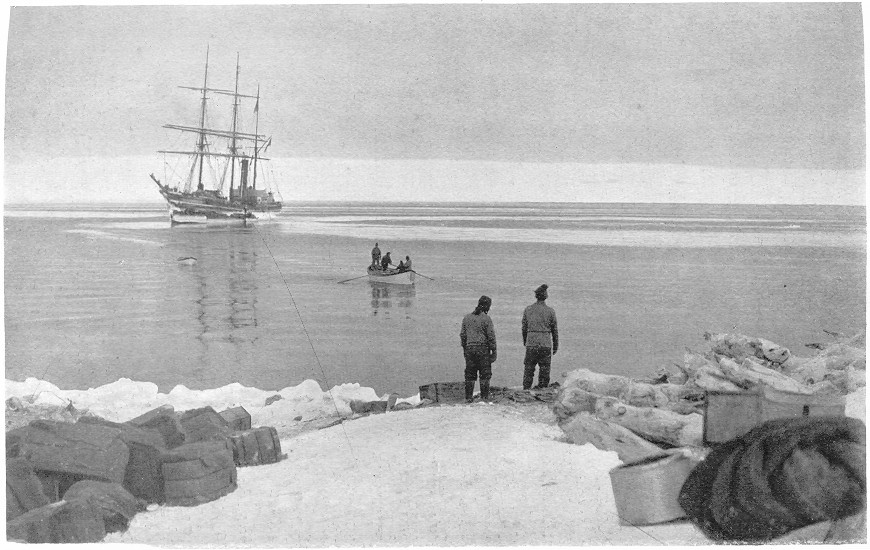
THE 'TERRA NOVA' LEAVING THE ANTARCTIC.
Photo by F. Debenham.
Very soon both wind and sea had risen, but although Scott did not
altogether like the look of things and determined to get up steam as
soon as possible, he did not want to hurry those in the engine-room
after such a long period of disuse. But early in the morning
Page 191
of the 17th the situation became really dangerous, and the
Discovery began to jerk at her cables in the most alarming
manner.
'I knew,' he wrote on the night of that eventful day, 'that in
spite of our heavy anchor the holding ground was poor, and I watched
anxiously to see if the ship dragged.
'It came at last, just as Skelton sent a promise of steam in half
an hour. The sea was again breaking heavily on the ice-foot astern
and I walked up and down wondering which was coming first, the
steam or this wave-beaten cliff. It was not a pleasant situation,
as the distance grew shorter every minute, until the spray of the
breaking waves fell on our poop, and this was soon followed by
a tremendous blow as our stern struck the ice. We rebounded and
struck again, and our head was just beginning to falloff and the
ship to get broadside on (heaven knows what would have happened
then) when steam was announced.'
Then the ship just held her own and only just; the engines alone
would not send her to windward in the teeth of the gale. Once around
Hut Point, Scott knew that they would be safe with open sea before
them; and the end of the Point was only a quarter of a mile out,
though off the end there was a shallow patch which had to be cleared
before safety could be reached. So finding that no headway was
being made he began to edge out towards the Point, and all seemed
well until, nearly opposite to the Point itself, he saw to his
alarm that a strong current was sweeping past.
Page 192
'Nothing remained but to make a dash for it, and I swung the helm
over and steered for the open. But the moment our bows entered the
fast-running stream we were swung round like a top, and the instant
after we crashed head foremost onto the shoal and stopped dead with
our masts shivering. We were in the worst possible position, dead
to windward of the bank with wind, sea, and current all tending to
set us faster ashore.
'We took the shore thus at about 11 A.M., and the hours that followed
were truly the most dreadful I have ever spent. Each moment the
ship came down with a sickening thud which shook her from stem
to stern, and each thud seemed to show more plainly that, strong
as was her build, she could not long survive such awful blows.'
Hour after hour passed while the ship quivered and trembled and
crashed again and again into her rocky bed. Nothing more could be
done for her until the gale abated, but seeing the impossibility
of doing anything at the time, Scott recognized that the next best
thing was to be prepared to act promptly when the weather moderated.
Then he discovered once more how absolutely he could rely on the
support and intelligence of his companions. Skelton already had
made a list of weights by the removal of which the ship could be
lightened, and when the boatswain was summoned to discuss the manner
in which the anchors could be laid out he also had his scheme cut
and dried.
The first sign of a lull came at 7 P.M., and soon after
Page 193
they assembled to the dreariest dinner ever remembered in the
Discovery. But when they were half-way through this silent
meal Mulock, the officer of the watch, suddenly burst in and said,
'The ship's working astern, sir.'
In record time Scott reached the bridge, and found that both wind
and sea had dropped in the most extraordinary manner. But what
surprised him even more was that the current, which had been running
strongly to the north, had turned and was running with equal speed
to the south. Each time that the ship lifted on a wave she worked
two or three inches astern, and though she was still grinding heavily
she no longer struck the bottom with such terrific force. Scarcely,
however, had these facts been observed when Skelton rushed up to
say that the inlets were free again.
'Every soul was on deck and in a moment they were massed together
and running from side to side in measured time. The telegraphs
were put full speed astern; soon the engines began to revolve, and
the water foamed and frothed along the side. For a minute or two
the ship seemed to hesitate, but then there came a steady grating
under the bottom, which gradually traveled forward, and ceased as
the ship, rolling heavily, slid gently into deep water.... Rarely,
if ever, can a ship have appeared in such an uncomfortable plight as
ours to find herself free and safe within the space of an hour....
To be in ten feet of water in a ship that draws fourteen feet cannot
be a pleasant position—nor can there be a doubt
Page 194
that the shocks which the Discovery sustained would have
very seriously damaged a less stoutly built vessel.'
None too soon were they clear of the shoal, for in a very short
time the wind was again blowing from the south; but as, on the
18th, the wind though still blowing strong had gone round to the
southeast and brought smoother water in the Sound, it was decided
to make for the inlets of the glacier tongue to the north, and
complete the coaling operations.
On occasions when haste was necessary there was, by mutual consent,
no distinction between officers and men. And Scott mentions 'as a
sight for the gods' the scene of biologists, vertebrate zoologists,
lieutenants, and A.B.'s with grimed faces and chafed hands working
with all their might on the coaling whips.
The Morning handed over twenty-five tons of coal, and this
was all the more a generous gift since it reduced Colbeck to the
narrowest margin, and compelled him to return directly homeward
without joining in any attempt at further exploration. 'His practical
common sense told him he could be of little use to us, and with his
usual loyalty he never hesitated to act for the best, at whatever
sacrifice to his own hopes and wishes.'
Before they left the glacier in McMurdo Sound it was arranged that
the three ships should journey up the coast together and then separate,
the Morning proceeding to the north, while the Discovery
and the Terra Nova turned west. The companies of both relief
Page 195
ships, however, expressed a strong desire to be with the
Discovery when she entered her first civilized port; so
Scott fixed upon Port Ross, in the Auckland Islands, as a spot
at which they might meet before the final return to New Zealand.
February 20 saw the Discovery speeding along a stretch of
coast that had been quite unknown until she had two years previously
made her way south along it, and at that time she had been obliged
to keep a long distance out on account of the pack-ice. But now
gaps which had been missed could be filled in; and even more than
this was done, for Mulock remained on deck night and day taking
innumerable angles to peaks and headlands, while Wilson, equally
indefatigable, transferred this long panorama of mountain scenery
to his sketch-book.
Two days later the pumps refused to act, and the whole of the
engine-room staff were on duty for twenty-four hours on end; and on
the 24th the carpenter called attention to the rudder. On inspection
Scott saw that the solid oak rudder-head was completely shattered,
and was held together by little more than its weight; as the tiller
was moved right or left the rudder followed it, but with a lag of
many degrees, so that the connection between the two was evidently
insecure. In such a condition it was obvious that they could not
hope to weather a gale without losing all control over the ship,
and that no time was to be lost in shipping their spare rudder
in place of the damaged one. So Scott determined to seek shelter
in Robertson
Page 196
Bay, and by night the damaged rudder had been hoisted on deck and
the spare one prepared for lowering into its place. Since the
Discovery had left winter quarters an almost incredible
amount of work had been done to bring her into sea trim. Difficulty
after difficulty had arisen, but the energy of the company had
never slackened, and by February 25 Scott was able to say that
everything was once more in order, though he was a little doubtful
about the steering power of their spare rudder.
At this time it was all the more important that the ship should
give no further trouble, because according to their program they
were about to penetrate a new region, and expected to find quite
enough to do without considering internal difficulties. With high
hopes that steam power would enable them to pass beyond the point
reached by Sir James Ross in his sailing ships they turned to the
west, and at first all went well with them. Pack-ice, however, was
destined to be an insuperable obstacle to their advance, and on
the 26th they decided to turn to the north-east and try to find a
way around this formidable barrier. 'It is grievously disappointing
to find the pack so far to the east; Ross carried the open water
almost to Cape North.' And again on March 1, Scott sounds a note
of lamentation: 'There can be no doubt that since leaving Victoria
Land we have been skirting a continuous mass of pack, which must
cover the whole sea south of the Balleny Islands. That it should
have lain so far to the eastward this year is very annoying;
Page 197
however, if we can push on upon this course we ought to strike the
islands.'
Early in the morning of the following day land was reported, and
by noon they were abreast of it; but what this island, and others
that were dimly to be seen to the north, could be, puzzled them
considerably, and not until some time later was the problem solved.
In 1839 Balleny discovered a group of islands in this region, and
three years later Ross saw land which he imagined was to the southward
of Balleny's discoveries, and believing it to be divided into three
distinct masses named it the Russell Islands. Consequently Scott
arrived expecting to see two groups of islands, and was naturally
perplexed when only one group was to be seen. After, however, studying
the accounts of these islands and comparing them with what he could
actually see, he recognized that they had just passed Balleny's
Sturge Island, which Balleny had seen from the north, and so could
have had no idea of its length in a north-and-south line. Later
Ross must have seen this same island, and, as Scott saw to be quite
possible, from a great distance must have thought that it was divided
into three, and hence made the mistake of naming it as a separate
group. Fortunately Mulock was able to obtain sufficient bearings
to fix accurately the position of each island.
Now that the knotty question as to the geography of the Balleny
Islands was settled, they went on to look for the land that Wilkes
claimed to have discovered in 1840, but not a glimpse nor a vestige
of it could they
Page 198
see; and, on March 4, they had to conclude that Wilkes Land was
once and for all definitely disposed of. With this negative, but
nevertheless important, result, the exploring work ended, and although
a lack of coal had prevented their cherished plan of rounding Cape
North, they had at least the satisfaction of clearing up some
geographical misconceptions in a more northerly latitude.
From the 6th to the 14th continuous gales brought conditions of
greater physical discomfort than had ever been experienced on board
the Discovery, for she was in very light trim and tossed
about the mountainous seas like a cork. It was, therefore, the
greatest relief to furl their sails off the entrance of Ross Harbour
on the 15th, and to steam into the calm waters of the Bay.
Neither the Terra Nova nor the Morning had yet arrived,
and the days of waiting were spent in making their ship as smart
as possible before the eyes of the multitude gazed upon her. Thus,
in a few days, the Discovery looked as though she had spent
her adventurous years in some peaceful harbor.
On March 19 the Terra Nova hove in sight, and was followed
on the next day by the Morning. Both ships had experienced
the most terrible weather, and everyone on board the little
Morning declared that she had only been saved from disaster
by the consummate seamanship of Captain Colbeck.
A few days later the small fleet again set sail, and after a most
favorable voyage was at daybreak on April 1
Page 199
off the Heads of Lyttelton Harbor; and before noon they were safely
berthed alongside the jetty, from which they had sailed with such
hearty wishes more than two years before.
'New Zealand,' Scott said, 'welcomed us as its own, and showered
on us a wealth of hospitality and kindness which assuredly we can
never forget, however difficult we may have found it to express
our thanks. In these delightful conditions, with everything that
could make for perfect rest and comfort, we abode for two full
months before we set out on our last long voyage.'
June 8, however, found them at sea again, and a month or so later they
anchored in Port Stanley (Falkland Islands), where they replenished
their stock of coal and took the last series of magnetic observations
in connection with their Southern Survey. And from the Falkland
Islands, Scott wrote a letter which is yet another testimony of
the admiration he felt for his companions. 'The praise,' he wrote,
'for whatever success we have had is really due to the ship's company
as a whole rather than to individuals. That is not very clear,
perhaps; what I mean is that the combination of individual effort
for the common good has achieved our results, and the absence of
any spirit of self-seeking. The motto throughout has been "share
and share alike," and its most practical form lies, perhaps, in the
fact that throughout our three years there has been no distinction
between the food served to officers and men.
Page 200
'Under these circumstances I naturally feel that I can claim no
greater share of achievement than those who have stood by me so
loyally, and so I regard myself merely as the lucky figure-head.
'But it is good news to hear that the Admiralty are sympathetic,
for I feel that no effort should be spared to gain their recognition
of the splendid qualities displayed by officers and men.'
Early on the morning of September 9 the homeland was sighted, and
for those who gazed longingly over the bulwarks and waited to welcome
and be welcomed, there was only one cloud to dim the joy of their
return. For with the happiness came also the sad thought that the
end had come to those ties, which had held together the small band of
the Discovery in the closest companionship and most unswerving
loyalty.