Perhaps we were pretty big boys--Jack and I. In fact, I'm afraid we
were so big that we haven't grown much since.
But Ollie was a boy, anyhow; he couldn't have been more than a dozen
years old, and we looked upon him as being
a very small boy indeed; though when folks saw us starting off, some of
them seemed to think that we were as boyish
as he, because, they said, it was such a foolish thing to do; and in
some way, I'm sure I don't know how, boys
have got the reputation of always doing foolish things. "They're three
of a kind," said Grandpa Oldberry,
as he watched us weigh anchor; "their parents oughter be sent fer."
Well, it's hard to decide where to begin this true history. We
didn't keep any log on this voyage of the Rattletrap.
But I'll certainly have to go back of the time when Grandpa Oldberry
expressed his opinion; and perhaps I ought
to explain how we happened to be in that particular port. As I said,
we--Jack and I--were pretty big boys, so big
that we were off out West and in business for ourselves, though, after
all, that didn't imply that we were very
old, because it was a new country, and everybody was young; after the
election the first fall it was found that
the man who had been chosen for county judge wasn't quite twenty-one
years of age yet, and therefore, of course,
couldn't hold office; and we were obliged to wait three weeks till he
had had his birthday, and then to have a
special election and choose him again. Everybody was young except
Grandpa Oldberry and Squire Poinsett.
But I was trying to account for our being in the port of Prairie
Flower. Jack had a cheese-factory there, and
made small round cheeses. I had a printing-office, and printed a small
square newspaper. In my paper I used to
praise Jack's cheeses, and keep repeating how good they were, so people
bought then; and Jack used, once in a while,
to give me a cheese. So we both managed to live, though I think we
sometimes got a little tired of being men, and
wished we were back home, far from thick round cheeses and thin square
newspapers.
One evening in the first week in September, when it was raining as
hard as it could rain, and when the wind
was blowing as hard as it could blow, and was driving empty boxes and
barrels, and old tin pails, and wash-boilers,
and castaway hats and runaway hats and lost hats, and other things
across the prairie before it, Jack came into
my office, where I was setting type (my printer having been blown away,
along with the boxes and the hats), and
after he had allowed the rain to run off his clothes and make little
puddles like thin mud pies on the dusty floor,
he said: 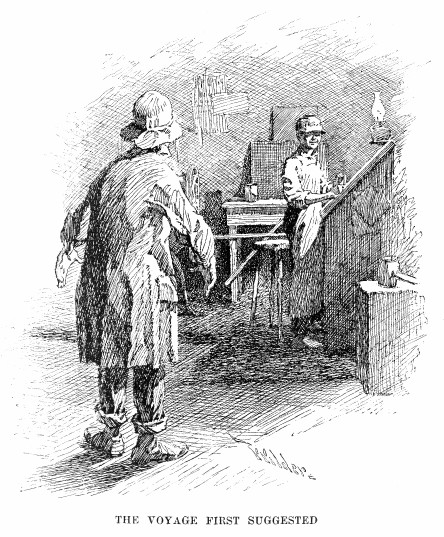
"I'm tired of making poor cheeses."
"Well," I answered, "I'm tired of printing a poor newspaper."
"Let's sell out and go somewhere," continued Jack.
"All right," I said. "Let's."
So we did.
Of course the Rattletrap wasn't a boat which sailed on the water,
though I don't know as I thought to mention
this before. In fact, a water boat wouldn't have been of any use to us
in getting out of Prairie Flower, because
there wasn't any water there, except a very small stream called the Big
Sioux River, which wandered along the prairie,
sometimes running in one direction and sometimes in the other, and at
other times standing still and wondering
if it was worth while to run at all. The port of Prairie Flower was in
Dakota. This was when Dakota was still a
Territory, three or four years, perhaps, before it was cut into halves
and made into two States. So, there being
no water, we of course had to provide ourselves with a craft that could
navigate dry land; which is precisely what
the Rattletrap was-namely, a "prairie schooner."
"I've got a team of horses and a wagon," went on Jack, that rainy
night when we were talking. "You've
got a pony and a saddle. We've both got guns. When we drive out of town
some stray dog will follow us. What more
'll we want?"
"Nothing," I said, as I clapped my stick down in the space-box. "We
can put a canvas cover on
the wagon and sleep in it at night, and cook our meals over a
camp-fire, and--and--have a time."
"Of course--a big time. It's a heavy spring-wagon, and there is just
about room in it behind the seat for
a bed. We can put on a cover that will keep out rain as well as a tent,
and carry a little kerosene-oil stove to
use for cooking if we can't build a fire out-doors for any reason. We
can take along flour, and-and--and salt,
and other things to eat, and shoot game, and--and--and have a time."
We became so excited that we sat down and talked till midnight about
it. By this time the rain had stopped,
and when we went out the stars were shining, and the level ground was
covered with pools of water.
"If it was always as wet as this around here we could go in a
genuine schooner," said Jack.
"Yes, that's so. But what shall we call our craft?"
"I think 'Rattletrap' would be a good name," said Jack.
"I don't think it's a very pretty name," I replied.
"You wait till you get acquainted with that wagon, and you will say
it's the best name in the world, whether
it's pretty or not. You don't know that wagon yet. The tongue is
spliced, the whiffletrees are loose, the reach
is cracked, the box is tied together with a rope, the springs creak,
the wheels wabble, lean different ways, and
never follow one another."
"Do they all turn in the same direction?" I asked.
"I don't believe they do. It would be just like one to turn backward
while the other three were going forward."
"We'll call our craft the Rattletrap, then. Good-night."
"Good-night," said Jack; and we parted, each to dream of our
approaching cruise. 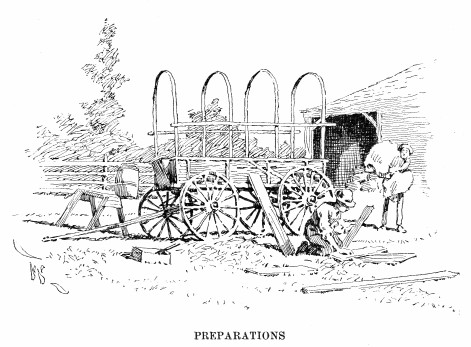
In a week we were busy getting ready to start. I found, when I
looked over the wagon as it stood back of the
cheese-factory, that it was much as Jack had described it, only I
noticed that the seat as well as the springs
creaked, and that a corner was broken off the dash-board. But we set to
work upon it with a will. We tightened
up the nuts and screws all over it, and wound the broken pole with
wire. We nailed together the box so that the
rope could be taken off, and oiled the creaking springs. We had no
trouble in finding a top, as half the people
in the country had come in wagons provided with covers only a year or
so before. We got four bows and attached
them to the box, one at each end, and the other two at equal distances
between. These bows were made of hard-wood,
and were a quarter of an inch thick and an inch and a half wide. They
ran up straight on either side for two or
three feet, and then rounded over, like a croquetwicket, being high
enough so that as we stood upright in the wagon-box
our heads would just nicely clear them. Over this skeleton we stretched
our white canvas cover, and tied it down
tightly along the sides. This made what we called the cabin. There was
an ample flap in front, which could be let
down at night and fastened back inside during the day. At the rear end
the cloth folded around, and was drawn together
with a "puckering-string," precisely like a button-bag. By drawing the
string tightly this back end could
be entirely closed up; or the string could be let out, and the opening
made any size wanted. After the cover was
adjusted we stood off and admired our work.
"Looks like an elephant on wheels," said Jack.
"Or an old-fashioned sun-bonnet for a giantess," I added.
"Anyhow, I'll wager a cheese it'll keep out the rain, unless it
comes down too hard," said Jack. "Now
for the smaller parts of our rigging, and the stores."
On the back end we fastened a feed-box for the horses, as long as
the wagon-box was wide, and ten or twelve
inches square, with a partition in the middle. We put stout iron rings
in the corners of this, making a place to
tie the horses. On the dash-board outside we built another box, for
tools. This was wedge-shaped, about five inches
wide at the top, but running down to an inch or two at the bottom, and
had a hinged cover. We put aboard a satchel
containing the little additional clothing which we thought we should
need. Things in this line which did not seem
to be absolutely necessary were ruled out--indeed, for the sake of
lightness we decided to take just as little
of everything that we could. We made another box, some two feet long, a
foot deep, and fourteen inches wide, with
a hinged cover, which we called the "pantry," for our supply of food.
This we stood in the wagon with
the satchel. Usually in the daytime after we started each of these rode
comfortably on the bed back of the seat.
This bed was a rather simple affair, made up of some bed-clothing and
pillows arranged on a thick layer of hay
in the bottom of the wagon-box. Our small two-wick oil-stove we put in
front next to the dash-board, a lantern
we hung up on one of the bows, and a big tin pail for the horses we
suspended under the wagon.
"Since you're going to be cook," I said to Jack, "you tend to
getting the dishes together."
"They'll be few enough," he answered. "I don't like to wash 'em. Tin
mostly, I guess; because
tin won't break."
So he put a few knives and forks and spoons, tin plates and cups, a
frying-pan, a small copper kettle, and a
few other utensils in another box, which also found a home on the bed.
Other things which we did not forget were
a small can of kerosene; two half-gallon jugs, one for milk and one for
water; a basket for eggs; a nickel clock
(we called it the chronometer); and in the tool-box a hatchet, a
monkey-wrench, screw-driver, small saw, a piece
of rope, one or two straps, and a few nails, screws, rivets, and
similar things which might come handy in case
of a wreck.
"Now for the armament and the life-boat," said Jack.
For armament Jack contributed a double-barrelled shot-gun and a
heavy forty-five-calibre repeating rifle, and
I a light forty-four-calibre repeating rifle, and a big revolver of the
same calibre (though using a slightly shorter
cartridge), with a belt and holster. This revolver we stored in the
tool-box, chiefly for use in case we were boarded
by pirates, while the guns we hung in leather loops in the top of the
cover. In the tool-box we put a good supply
of ammunition and plenty of matches. We also each carried a match-box,
a pocket compass, and a stout jack-knife.
"Now, how's your life-boat?" asked Jack.
I led her out. She was a medium-sized brown Colorado pony, well
decorated with brands, and with a white face
and two white feet. She wore a big Mexican saddle and a horse-hair
bridle with a silver bit.
"She'll do," said Jack. "In case of wreck, we'll escape on her, if
possible. She'll also be very
handy in making landings where the harbor is poor, and in exploring
unknown coasts."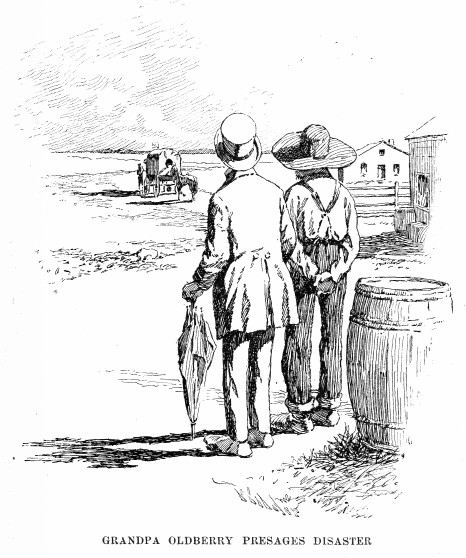
All of this work took several days, but when it was done the
Rattletrap was ready for the voyage, and we decided
to start the next morning.
"She's as prairie-worthy a craft as ever scoured the plain," was
Jack's opinion; "and if we can
keep the four wheels from starting in opposite directions we'll be all
right."
But where was Ollie all this while? And who was Ollie, anyhow? Ollie
was Jack's little nephew, and he lived
back East somewhere--I don't remember where. The nearer we got ready to
start, the more firmly Jack became convinced
that Ollie would like to go along, so at last he sent for him to come,
and he arrived the night before our start.
Ollie liked the idea of the trip so much that he simply stood and
looked at the wagon, the guns, the pony, and
the horses, and was speechless. At last he managed to say:
"Uncle Jack, it'll be just like a picnic, won't it?"
The next morning we started as early as we could. But it was not
before people were up.
"Where be they going?" asked Grandpa Oldberry.
"Oh, Nebraska, and Wyoming, and the Black Hills, and any crazy place
they hear of," answered Squire
Poinsett.
"They'll all be scalped by Injuns," said Grandpa Oldberry. "Ain't
the Injuns bad this fall?"
"So I was a-reading," returned the Squire. "And in the hills I
should be afeared of b'ar."
"Right," assented Grandpa. "B'ar and sim'lar varmints. And more
'specially hossthieves and sich-like
cutthroats. I disremember seeing three scalawags starting off on such a
fool trip since afore the war."
 to table
of contents
to table
of contents
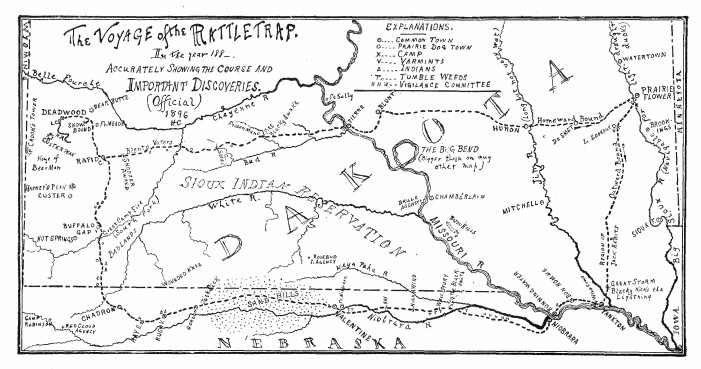
The port of Prairie Flower was in the eastern part of the Territory of
Dakota. It stood out on an open plain a
half-dozen miles wide, which seemed to be the prairie itself, though it
was really the valley of the Big Sioux
River, that funny stream which could run either way, and usually stood
still in the night and rested. To the east
and west the edges of this valley were faintly marked by a range of
very low bluffs, so low that they were mere
wrinkles in the surface of the earth, and made the valley but very
little lower than the great plain which rolled
away for miles to the east and for leagues to the west.
It was a beautiful morning a little after the middle of September
that the Rattletrap got away and left Prairie
Flower behind. The sun had been up only half an hour or so, and the
shadow of our craft stretched away across the
dry gray plain like a long black streak without end. The air was fresh
and dewy. The morning breeze was just beginning
to stir, and down by the river the acres of wild sunflowers were
nodding the dew off their heads, and beginning
to roll in the first long waves which would keep up all day like the
rolling of the ocean. We shouted "Good-bye"
to Grandpa Oldberry and Squire Poinsett, but they only shook their
heads very seriously. The cows and horses picketed
on the prairie all about the little clump of houses which made up the
town looked at us with their eyes open extremely
wide, and no doubt said in their own languages, like Grandpa Oldberry,
that they had no recollection of seeing
any such capers as this for many years.
"See here," I said, suddenly, to Jack, "where's that dog you said
was going to follow us?"
"You just hold on," answered Jack.
"Oh, are we going to have a dog, too?" asked Ollie.
"You wait a minute," insisted Jack.
Just then we passed the railroad station. Jack craned his head out
of the front end of the wagon. Ollie and
I did the same. Lying asleep on the corner of the station platform we
saw a dog. He was about the size of a rather
small collie; or, to put it another way, perhaps he was half as big as
the largest-size dog. If dogs were numbered
like shoes, from one to thirteen, this would have been about a No. 7
dog. He was yellow, with short hair, except
that his tail was very bushy. One ear stood up straight, and the other
lopped over, very much wilted. Jack whistled
sharply. The dog tossed up his head, straightened up his lopped ear,
let fall his other ear, and looked at us.
Jack whistled again, and the dog came. He ran around the wagon, barked
once or twice, sniffed at the pony's heels
and got kicked at for his familiarity, yelped sharply, and came and
looked up at us, and wagged his bushy tail
with a great flourish.
"He wants to get in. Give him a boost, Ollie," said Jack.
Ollie clambered over the dash-board and jumped to the ground. He
pushed the dog forward, and he leaped. up and
scrambled into the wagon, jumped over on the bed, where he folded his
head and tail on his left side, turned around
rapidly three times, and lay down and went to sleep, one ear up and one
ear down.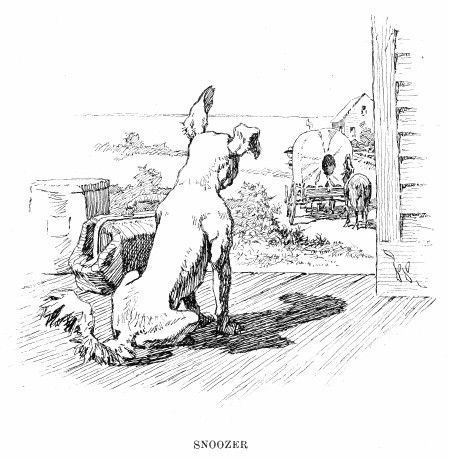
"He's just the dog for the Rattletrap," said Jack. "We'll call him
Snoozer."
"That looks a good deal like stealing to me, Uncle Jack," said
Ollie. "Doesn't he belong to somebody?"
"No," said Jack, "he doesn't belong to anybody but us. He came here
a week ago with a tramp.
The tramp deserted him, and rode away on the trucks of a freight train;
but Snoozer didn't like that way of travelling,
because there wasn't any place to sleep, so he stayed behind. Since
then he has tried to follow every man in town,
but none of them would have him. He's a regular tramp dog, not good for
anything, and therefore just the dog for
us."
Snoozer was the last thing we shipped, and after taking him aboard
we were soon out of the harbor of Prairie
Flower, and bearing away across the plain to the southwest. In twenty
minutes we ware among the billowing sunflowers,
standing five or six feet high on other side of the road, which seemed
like a narrow crack winding through them.
Ollie reached out and gathered a handful of the drooping yellow
blossoms. The pony was tied behind carrying her
big saddle, and tossing her head about, and showing that she was very
suspicious of the whole proceedings, and
especially of a small flag which Ollie had fastened to the top of the
wagon-cover, which fluttered in the fresh
morning breeze. Snoozer slept on and never stirred. At last the road
came to the river, and then followed close
along beside its bank, which was only a foot or so high. Ollie was
interested in watching the long grass which
grew in the bottom of the stream and was brushed all in one direction
by the sluggish current, like the silky fur
of some animal. After a while we came to a gravelly place which was a
ford, and crossed the stream, stopping to
let the horses drink. The water was only a foot deep. As we came up on
the higher ground beyond the river we met
the south wind squarely, and it came in at the front of the cover with
a rush. We heard a sharp flutter behind,
and then the wagon gave a shiver and a lurch, and the horses stopped;
then there was another shock and lurch, and
it rolled back a few inches.
"There," exclaimed Jack, "some of those wheels have begun to turn
backward! I told you!"
I looked back. Our puckering-string had given way, and the rear of
the cover had blown out loosely. This had
been more than the pony could stand, and she had broken her rope and
run back a dozen rods, where she stood snorting
and looking at the wagon.
"First accident!" I cried. "She'll run home, and we'll have to go
back after her."
"Perhaps we can get around her," said Jack. "We'll try."
We left Ollie to hold the horses, and I went out around among the
sunflowers, while Jack stood behind the wagon
with his hat half full of oats. I got beyond her at last, and drove her
slowly toward the wagon. She snorted and
stamped the ground angrily with her forward feet; but at last she
ventured to taste of the oats, and finding more
in the feed-box on the rear of the wagon, she began eating them and
forgot her fright.
"I guess we'd better not tie her, but let her follow," said Jack.
"As soon as we have gone a
little ways she'll come to think the wagon is home, and stick to it."
"Yes," I said. "I think she is really as great a tramp as Snoozer,
and just the pony for us."
"Are we all tramps?" asked Ollie.
"Well," said Jack, "I'm afraid Grandpa Oldberry thinks we don't lack
much of it. He says varmints
will catch us."
"Do you think they will?" went on Ollie, just a little bit anxiously.
"Oh, I guess not," said Jack. "You see, we've got four guns. Then
there's Snoozer."
"But will they try to catch us?"
"Well, I don't know. Grandpa Oldberry says the varmints are awfully
thick this fall."
"But what are varmints?"
"Oh, wolves, and b'ars, and painters, and--"
"What are painters?"
"Grandpa means panthers, I guess. Then there's Injuns, and
hoss-thieves, and--"
"There's a prairie-chicken!" I cried, as one rose up out of the long
grass.
"Perhaps we can get one for dinner," said Jack.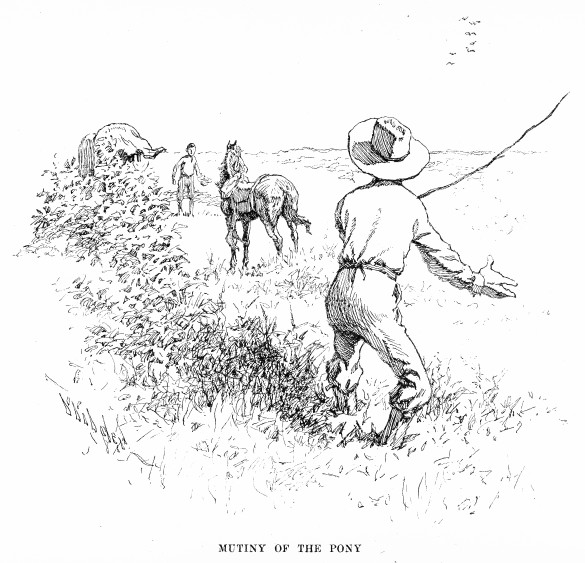
He took his gun and went slowly toward where the other had been.
Another whirred away like a shot. Jack fired,
but missed it. We started on, leaving the pony tossing her head and
stamping her feet in a great passion on account
of the report of the gun; but when she saw that we paid no attention to
her and were rapidly going out of sight
she turned, after taking a long look back at distant Prairie Flower,
and came trotting along the road, with her
stirrups dangling at her sides, and soon was following close behind.
Before we realized it the chronometer showed that it was almost
noon. By this time we had left the sea of sunflowers
and crept over the wrinkle at the western edge of the valley, and were
off across the rolling prairie itself. Still
Snoozer never stirred.
"I wonder when he'll wake up?" said Ollie.
"You'll see him awake enough at dinnertime," said Jack.
"Well, you'll see me awake enough then, too," answered Ollie. "I'm
hungry."
"We hardy pioneers plunging into the trackless waste of a new and
unexplored country never eat but one
meal a day," said Jack. "And that's always raw meat--b'ar-meat,
generally."
"Well," said Ollie, "I don't see any b'ar-meat, or even
prairie-chicken-meat. Why didn't you
hit the prairie-chicken, Uncle Jack?"
"I'm not used to shooting at such small game," answered Jack,
solemnly. "My kind of game is b'ar--b'ar
and other varmints."
Just then we passed a house, and down a little way from it, close to
the road, was a well.
"Here's a good place to have dinner," said Jack; so we drove out by
the side of the road and stopped.
"If I'm to be cook," said Jack to me, "then you've got to take care of
the horses and do all the
outside work. I'll be cook; you'll be rancher. That's what we'll call
you--rancher."
I unhitched the horses, tied them behind the wagon, and gave them
some oats and corn in the feed-box. The pony
I fed in the big tin pail near by. The grass beside the road was so
dry, and it was so windy, that we decided it
was not safe to build a fire outdoors, so Jack cooked pancakes over the
oil-stove inside. These with some cold
meat he handed out to Ollie and me as we sat on the wagon-tongue, while
he sat on the dash-board. We were half-way
through dinner when we heard a peculiar whine, followed by a low bark,
in the wagon, and then Snoozer leaped out,
stretched himself, and began to wag his tail so fast that it looked
exactly like a whirling feather duster. We
fed him on pancakes, and he ate so many that if Jack had not fried some
more we'd have certainly gone hungry.
"I told you he was a true tramp," said Jack. "Just see his appetite!"
After we had finished, and the horses had grazed about on the dry
grass some time, we started on. We hoped to
reach a little lake which we saw marked on the map, called Lake
Lookout, for the night camp; so we hurried along,
it being a good distance ahead. All the afternoon we were passing
'between either great fields where the wheat
had been cut, leaving the stubble, or beside long stretches of prairie.
There were a few houses, many of them built
of sod. Not much happened during the afternoon. Ollie followed the
example of Snoozer, and curled up on the bed
and had a long nap. We saw a few prairie-chickens, but did not try to
shoot any of them. The pony trotted contentedly
behind. Just before night I rode her ahead, looking for the lake. I
found it to be a small one, perhaps a half-mile
wide, scarcely below the level of the prairie, and generally with
marshy shores, though on one side the beach was
sandy and stony, with a few stunted cottonwood-trees, and here I
decided we would camp. I went back and guided
the Rattletrap to the spot. Soon Jack had a roaring fire going from the
dry wood which Ollie had collected. I fed
the horses and turned them loose, and they began eagerly on the green
grass which grew on the damp soil near the
lake. The pony I picketed with a long rope and a strap around one of
her forward ankles, between her hoof and fetlock,
as we scarcely felt like trusting her all night. Snoozer got up for his
supper, and after that stretched himself
by the fire and blinked at it sleepily. The rest of us did much the
same. After a while Ollie said.
"I think that bed in the wagon looks pretty narrow for two. How are
three going to sleep in it?"
"I don't think three are going to sleep in it," said Jack.
"Where are you going to sleep, then, Uncle Jack?"
Jack laughed. "I think," he said, "that the rancher and the cook
will sleep in the wagon, and
let you sleep under the wagon. Nothing makes a boy grow like sleeping
rolled up in a blanket under a wagon. You'll
be six inches taller if you do it every night till we get back."
"Well, I don't think so," said Ollie, just a little alarmed at the
prospect. "I'd prefer to sleep
in the wagon. Maybe what Grandpa Oldberry said about wild animals is
so. You say you like to shoot 'em, so you
stay outside and do it--I don't."
At last it was arranged that Ollie and I should sleep inside and
Jack under the wagon. We were surprised to
find how early we were ready for bed. The long ride and the fresh air
had given us an appetite for sleep. So we
soon turned in, the dog staying outside with Jack.
"Good-night, Uncle Jack!" called Ollie, as we put out the lantern
and covered up in the narrow bed.
"Look out for painters!"
I was almost asleep when Ollie shook me, and whispered, "What's that
noise?"
I listened, and heard a regular, hollow, booming sound, something
like the very distant discharge of cannon.
"It's the horses walking on the ground-always sounds that way in the
night," I answered.
Again I was almost asleep when Ollie took hold of my arm, and said,
"What's that?"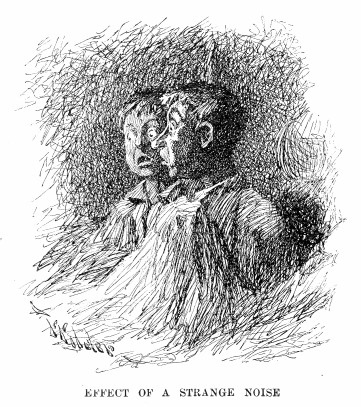
I once more listened, and recognized a peculiar creaking noise as
that made by the horses cropping off the grass.
I explained to Ollie, and then dropped off sound asleep. I don't know
how long it was, but after some time I was
again roused up by a nervous shake.
"Listen to that," whispered Ollie. "What can it be?"
I sat up cautiously and listened. It was a strange, rattling,
unearthly sound, which I could not account for
any better than Ollie.
"It's a bear," he whispered. "I heard them make that noise at the
park back home."
I was puzzled, and concluded that it must be some wild animal. I
took down one of the guns, crept softly to
the front end of the wagon, raised the flap, and looked out. The wind
was still, and the night air met my face
with a cool, damp feeling. The moon had just risen and the lake was
like silver. I could see the horses lying asleep
like dark mounds. But the mysterious noise kept up, and even grew
louder. I grasped the gun firmly, and let myself
cautiously out of the front end of the wagon. Then I climbed back in
less softly and hung up the gun.
"Wh-what is it?" asked Ollie, in a faint whisper.
"It's your eloquent Uncle Jack snoring," I said. "He's one of
Grandpa Oldberry's sim'lar varmints."
to table
of contents
Our first night in the Rattletrap passed without further incident--that
is, the greater part of it passed, though
Ollie declared that it lacked a good deal of being all passed when we
got up. The chief reason for our early rise
was Old Blacky, a member of our household (or perhaps wagonhold) not
yet introduced in this history. Old Blacky
was the mate of Old Browny, and the two made up our team of horses. Old
Browny was a very well-behaved, respectable
old nag, extremely fond of quiet and oats. He invariably slept all
night, and usually much of the day; he was a
fit companion for our dog. It was the firm belief of all on board that
Old Browny could sleep anywhere on a fairly
level stretch of road without stopping.
But Old Blacky was another sort of beast. He didn't seem to require
any sleep at all. What Old Blacky wanted
was food. He loved to sit up all night and eat, and keep us awake. He
seldom even lay down at night, but would
moon about the camp and blunder against things, fall over the
wagon-tongue, and otherwise misbehave. Sometimes
when we camped where the grass was not just to his liking he would put
his head into the wagon and help himself
to a mouthful of bedquilt or a bite of pillow. He was little but an
appetite mounted on four legs, and next to
food he loved a fight. Besides the name of Old Blacky, we also knew him
as the Blacksmith's Pet; but this will
have to be explained later on.
On this first morning, just as it was becoming light in the east,
Old Blacky began to make his toilet by rubbing
his shoulder against one corner of the wagon. As he was large and
heavy, and rubbed as hard as he could, he soon
had the wagon tossing about like a boat; and as the easiest way out of
it, we decided to get up. It was cool and
dewy, with the larger stars still shining faintly. We found Jack under
the wagon. Ollie stirred him up, and said: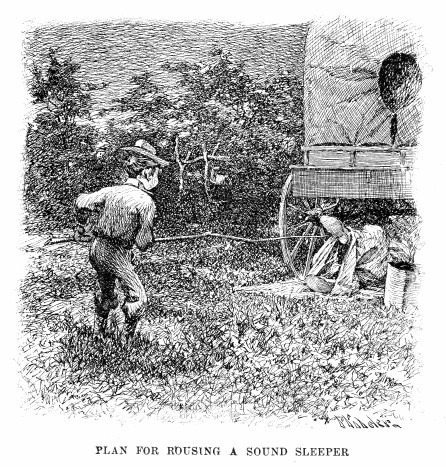
"See any varmints in the night, Uncle Jack?"
"Yes," answered Jack, as he unrolled himself from his blanket. "Or
at least I felt one. That
disgraceful Old Blacky nibbled at my ear twice. The first time I
thought it was nothing less than a bear."
"Did he disturb Snoozer?"
"I guess nothing ever disturbs Snoozer. He never moved all night.
How's the firewood department, Ollie?"
"All right," replied Ollie. "Got up enough last night."
"Then build the fire while I get breakfast."
This pleased Ollie, and he soon had a good fire going. I caught Old
Blacky, who had started off to walk around
the lake, woke up Old Browny, who was sleeping peacefully with his nose
resting on the ground, quieted the pony,
who was still suspicious, with a few pats on the neck, and gave them
all their oats. Soon the rest of us also had
our breakfast, including Snoozer, who seemed to wake up by instinct,
and after waiting a little for somebody to
come and stretch him, stretched himself, and began waving his tail to
attract our attention to his urgent need
of food.
"Before we get back home that dog will want us to feed him with a
spoon," said Jack.
It was only a little while after sunrise when we were off for
another day's voyage. We were headed almost due
south, and all that day and the three or four following (including
Sunday, when we stayed in camp), we did not
change our general direction. We were aiming to reach the town of
Yankton, where we intended to cross the Missouri
River and turn to the west in Nebraska. The country through which we
travelled was much of it prairie, but more
was under cultivation, and the houses of settlers were numerous. The
land on which wheat or other small grains
had been grown was bare, but as we got farther south we passed great
fields of corn, some of it standing almost
as high as the top of our wagon-cover.
For much of the way we were far from railroads and towns, and got
most of our supplies of food from the settlers
whose houses we passed or, indeed, sighted, since the pony proved as
convenient for making landings as Jack had
predicted she would. Ollie usually went on these excursions after milk
and eggs and such like foods. The different
languages which he encountered among the settlers somewhat bewildered
him, and he often had hard work in making
the people he found at the houses understand what he wanted. There Were
many Norwegians, and the third day we passed
through a large colony of Russians, saw a few Finns, and heard of some
Icelanders who lived around on the other
side of a lake.
"It wouldn't surprise me," said Ollie one day, "to find the man in
the moon living here in a
sod house."
Perhaps a majority--certainly a great many--of all these people
lived in houses of this kind. Ollie had never
seen anything of the sort before, and he became greatly interested in
them. The second day we camped near one for
dinner.
"You see," said Jack, "a man gets a farm, takes half his front yard
and builds a house with it.
He gains space, though, because the place he peels in the yard will do
for flowerbeds, and the roof and sides of
his house are excellent places to grow radishes, beets, and similar
vegetables."
"Why not other things besides radishes and beets?" asked Ollie.
"Oh, other things would grow all right, but radishes and beets seem
to be the natural things for sod-house
growing. You can take hold of the lower end and pull 'em from the
inside, you know, Ollie."
"I don't believe it, Uncle Jack," said Ollie, stoutly. "Ask the
rancher," answered Jack.
"If you're ever at dinner in a sod house, and want another radish, just
reach up and pull one down through
the roof, tops and all. Then you're sure they're fresh. I'd like to
keep a summer hotel in a sod house. I'd advertise'
fresh vegetables pulled at the table.'"
"I'm going to ask the man about sod houses," returned Ollie. He went
up to where the owner of the
house was sitting outside, and said:
"Will you please tell me how you make a sod house?"
"Yes," said the man, smiling. "Thinking of making one?"
"Well, not just now," replied Ollie. "But. I'd like to know about
them. I might want to build
one--sometime," he added, doubtfully.
"Well," said the man, "it's this way: First we plough up a lot of
the tough prairie sod with
a large plough called a breaking-plough, intended especially for
ploughing the prairie the first time. This turns
it over in a long, even, unbroken strip, some fourteen or sixteen
inches wide and three or four inches thick. We
cut this up into pieces two or three feet long, take them to the place
where we are building the house, on a stone-boat
or a sled, and use them in laying up the walls in just about the same
way that bricks are used in making a brick
house. Openings are left for the doors and windows, and either a
shingle or sod roof put on. If it's sod, rough
boards are first laid on poles, and then sods put on them like
shingles. I've got a sod roof on mine, you see."
Ollie was looking at the grass and weeds growing on the top and
sides of the house. They must have made a pretty
sight when they were green and thrifty earlier in the season, but they
were dry and withered now.
"Do you ever have prairie-fires on your roofs?" asked Ollie, with a
smile.
"Oh, they do burn off sometimes," answered the man. "Catch from the
chimney, you know. Did you
ever see a hay fire?"
"No."
"Come inside and I'll show you one."
In the house, which consisted of one large room divided across one
end by a curtain, Ollie noticed a few chairs
and a table, and opposite the door a stove which looked very much like
an ordinary cook-stove, except that the
place for the fire was rather larger. Back of it stood a box full of
what seemed to be big hay rope. The man's
wife was cooking dinner on the stove.
"Here's a young tenderfoot," said the man, "who's never seen a hay
fire."
"Wish I never had," answered the woman. The man laughed. "They're
hardly as good as a wood fire
or a coal fire," he said to Ollie; "but when you're five hundred miles,
more or less, from either wood
or coal they do very well." The man took off one of the griddles and
put in another "stick" of hay.
Then he handed one to Ollie, who was surprised to find it almost as
heavy as a stick of wood. "It makes a
fairly good fire," said the man. "Come outside and I'll show you how to
twist it."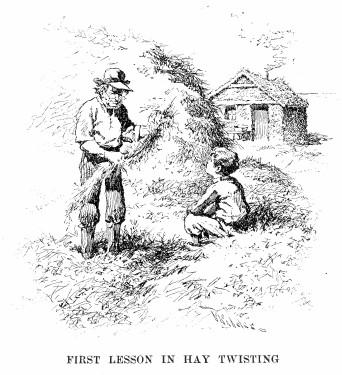
They went out to a haystack near by, and the man twisted a rope
three or four inches in diameter, and about
four feet long. He kept hold of both ends till it was wound up tight;
then he brought the ends together, and it
twisted itself into a hard two-strand rope in the same way that a bit
of string will do when similarly treated.
There was quite a pile of such twisted sticks on the ground. "You see,"
said the man, "in this country,
instead of splitting up a pile of fuel we just twist up one." Ollie
bade the man good-bye, took another look
at the queer house, and came down to the wagon.
"So you saw a hay-stove, did you?" said Jack. "I could have told you
all about 'em. I once stayed
all night with a man who depended on a hay-stove for warmth. It was in
the winter. Talk about appetites! I never
saw such an appetite as that stove had for hay. Why, that stove had a
worse appetite than Old Blacky. It devoured
hay all the time, just as Old Blacky would if he could; and even then
its stomach always seemed empty. The man
twisted all of the time, and I fed it constantly, and still it was
never satisfied."
"How did you sleep?" asked Ollie.
"Worked right along in our sleep--like Old Browny," answered Jack.
The last day before reaching Yankton was hot and sultry. The best
place we could find to camp that night was
beside a deserted sod house on the prairie. There was a well and a
tumble-down sod stable. There were dark bands
of clouds low down on the southeastern horizon, and faint flashes 'of
lightning.
"It's going to rain before morning," I said. "Wonder if it wouldn't
be better in the sod house?"
We examined it, but found it in poor condition, so decided not to
give up the wagon. "The man that lived
there pulled too many radishes and parsnips and carrots and such things
into it, and then neglected to hoe his
roof and fill up the holes," said Jack. "Besides, Old Blacky will have
it rubbed down before morning.
'When I sleep in anything that Old Blacky can get at, I want it to be
on wheels so it can roll out of the way."
We went to bed as usual, but at about one o'clock we were awakened
by a long rolling peal of thunder. Already
big drops of rain were beginning to fall. Ollie and I looked out, and
found Jack creeping from under the wagon.
"That's a dry-weather bedroom of mine," he observed, "and I think
I'll come up-stairs."
The flashes of lightning followed each other rapidly, and by them we
could see the horses. Old Browny was sleeping
and Old Blacky eating, but the pony stood with head erect, very much
interested in the storm. Jack helped Snoozer
into the wagon, and came in himself. We drew both ends of the cover as
close as possible, lit the lantern, and
made ourselves comfortable, while Jack took down his banjo and tried to
play. Jack always tried to play, but never
quite succeeded. But he made a considerable noise, and that was better
than nothing.
The wind soon began to blow pretty fresh, and shake the cover rather
more than was pleasant. But. nothing gave
way, and after, as it seemed, fifty of the loudest claps of thunder we
had ever heard, the rain began to fall in
torrents.
"That is what I've been waiting for," said Jack. "Now we'll see if
there's a good cover on this
wagon, or if we've got to put a sod roof on it, like that man's house."
The rain kept coming down harder and harder, but though there seemed
to be a sort of a light spray in the air
of the wagon, the water did not beat through. In some places along the
bows it ran down on the inside of the cover
in little clinging streams, but as a household we remained dry. Jack
was still experimenting on the banjo, and
the dog had gone to sleep. Suddenly a flash of lightning dazzled our
eyes as if there were no cover at all over
and around us, with a crash of thunder which struck our ears like a
blow from a fist. Jack dropped the banjo, and
the dog shook his head as if his ears tingled. We all felt dizzy, and
the wagon seemed to be swaying around.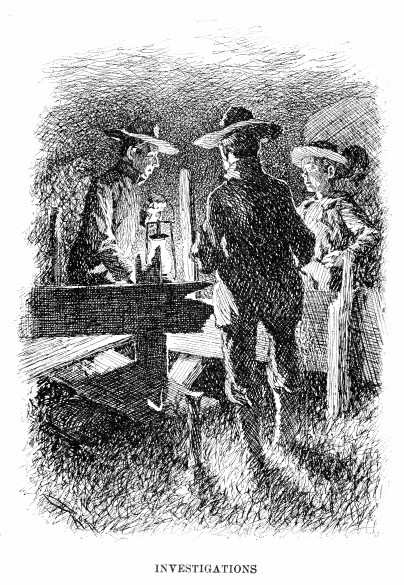
"That struck pretty close," I said. "I hope it didn't hit one of the
horses." "If it
hit Old Blacky, I'll bet a cooky it got the worst of it," answered
Jack, taking up his banjo again. "Look
out, Ollie, and maybe you'll see the lightning going off limping."
It was still raining, though not so hard. Soon we began to hear a
peculiar noise, which seemed to come from
behind the wagon. It was a breaking, splintering sort of noise, as if a
board was being smashed and split up very
gradually.
"Sounds as if a slow and lazy kind of lightning was striking our
wagon," said Jack.
Ollie's face was still white from the scare at the stroke of
lightning, and his eyes now opened very wide as
he listened to the mysterious noise. Jack pulled open the back cover an
inch and peeped out. Then he said:
"I guess Old Blacky's tussle with the lightning left him hungry;
he's eating up one side of the feed-box."
Then we laughed at the strange noise, and in a few minutes, the rain
having almost ceased, we put on our rubber
boots and went out to look after the other horses. Old Browny we found
in the lee of the sod house, not exactly
asleep, but evidently about to take a nap. The pony had pulled up her
picket-pin and retreated to a little hollow
a hundred yards away. We caught her and brought her back. By the light
of the lantern we found that the great stroke
of lightning had struck the curb of the well, shattering it, and making
a hole in the ground beside it. The storm
had gone muttering off to the north, and the stars were again shining
overhead.
"What a stroke of lightening that must have been to do that!" said
Ollie, as he looked at the curb
with some awe.
"It wasn't the lightning that did that," returned his truthful Uncle
Jack. "That's where Old
Blacky kicked at the lightning and missed it."
Then we returned to the wagon and went to bed. The next morning at
ten o'clock we drove into Yankton. We found
the ferry-boat disabled, and that we should have to go forty miles up
the river to Running Water before we could
cross. We drove a mile out of town, and went into camp on a high bank
overlooking the milky, eddying current of
the Missouri.
to table
of contents
We were a good deal disappointed in not getting over into Nebraska,
because we had seen enough of Dakota, but there
was no help for it. A log had got caught in the paddlewheel of the
ferry-boat and wrecked it, and there was no
other way of crossing.
"Old Blacky could swim across," said Jack, "but Browny would go to
sleep and drown."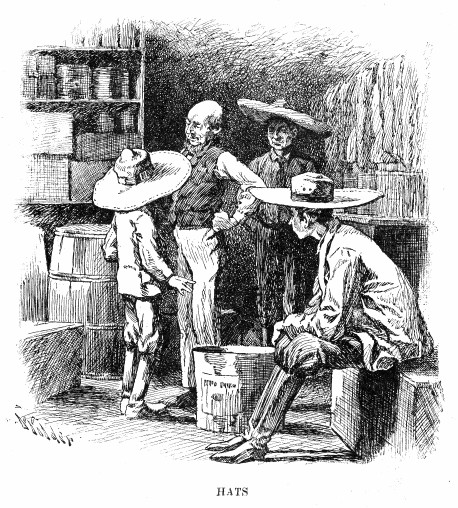
It is rather doubtful, however, about even Blacky's ability to have
swum the river, since it was a half-mile
wide, and with a rather swift current. In the afternoon we walked back
to Yankton and bought the biggest felt hats
we could find, with wide and heavy leather bands. We knew that we
should now soon be out in the stock-growing country,
and that, as Jack said, "the cowboys wouldn't have any respect for us
unless we were top-heavy with hat."
We were camped on the high bank of the river, opposite a farm-house.
It was getting dusk when we got back to
the wagon, with our heads aching from our new hats, which seemed to
weigh several pounds apiece. Jack, as cook,
announced that there was no milk on hand, and sent Ollie over to the
neighboring house to see if he could get some.
Ollie returned, and reported that the man was away from home, but that
the woman said we could have some if we
were willing to go out to the barn-yard and milk one of the cows. The
others decided that it was my duty to milk,
but I asked so many foolish questions about the operation that Jack
became convinced that I didn't know how, and
said he would do it himself. We all went over to the house, borrowed a
tin pail from the woman, and went out to
the yard.
We found about a dozen cows inside, of various sizes, but all
long-legged and long-horned.
"Must be this man belongs to the National Trotting-Cow Association,"
said Jack, as he crawled under
the barbed-wire fence into the yard. "That red beast over there in the
corner ought to be able to trot a mile
in less than three minutes."
He cautiously went up to a spotted cow which seemed to be rather
tamer than. the rest, holding out one hand,
and saying, "So, bossy," in oily tones, as if he thought she was the
finest cow he had ever seen. When
he was almost to her she looked at him quickly, kicked her nearest
hind-foot at him savagely, and walked off, switching
her tail, and shaking her head so that Ollie was afraid it would come
off and be lost.
"Can't fool that cow, can I?" said Jack, as he turned to another.
But he had no better luck this time,
and after trying three or four more he paused and said:
"These must be the same kind of cows Horace Greeley found down in
Texas before the war. When he came back
he said the way they milked down there was to throw a cow on her back,
have a nigger hold each leg, and extract
the milk with a clothes-pin."
But at last he found a brindled animal in the corner which allowed
him to sit down and begin. He was getting
on well when, without the least warning, the cow kicked, and sent the
pail spinning across the yard, while Jack
went over backwards, and his new hat fell off. There was one calf in
the yard which had been complaining ever since
we came, because it had not yet had its supper. The pail stopped
rolling right side up, and this calf ran over
and put his head in it, thinking that his food had come at last. Jack
picked himself up and ran to rescue the pail.
The calf raised his head suddenly, the pail caught on one of his little
horns, and he started off around the yard,
unable to see, and jumping wildly over imaginary objects. Jack
followed. A cow, which was perhaps the mother of
the calf, started after Jack. The family dog, hearing the commotion,
came running down from the house and began
to pursue the cow. This wild procession went around the yard several
times, till at last the pail came off the
calf's head, and Jack secured it. Then he picked up his hat, the brim
of which another calf had been chewing, rinsed
out the pail at the pump, and tried another cow.
This time he selected the worst-looking one of the lot, but to the
surprise of all of us she stood perfectly
still, only switching him a few times with her tail. As soon as he got
a couple of quarts of milk he stopped and
came out of the yard. Ollie and I had, of course, been laughing at him
a good deal, but Jack paid no attention
to it. As we walked towards the house he said:
"Well, there's one consolation: after all of that work and trouble,
the woman can't put on the face to
charge us for the milk." A moment later he said to her: "I've got about
two quarts; how much is it?"
"Ten cents," answered the woman. "Didn't them cows seem to take
kindly to you?"
"Well, they didn't exactly crowd around me and moo with delight,"
replied Jack, as he handed over
a dime with rather bad grace.
That evening a neighbor called on us as we sat about our camp-fire,
and we told him the experience with the
cows.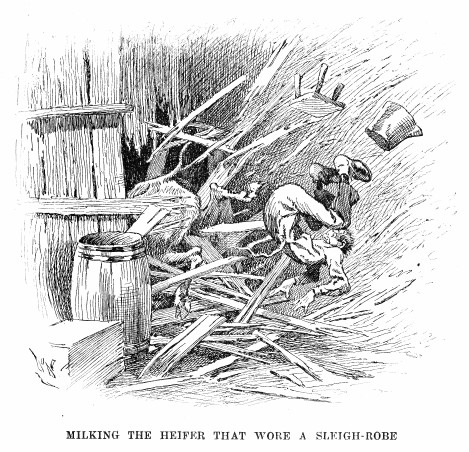
"Puts me in mind of the time a fellow had over at the Santee Agency
a year or so ago," said our visitor.
"There's a man there named Hawkins that's got a tame buffalo cow. Of
course you might as well try to milk
an earthquake as a buffalo. Well, one day a man came along looking for
work, and Hawkins hired him. Milking-time
came, and Hawkins sent the man out to milk, but forgot to tell hint
about the buffalo. The man was a little green,
and it was sort of dark in the barn, and the first thing he tried to
milk was the buffalo cow. She kicked the pail
through the window, smashed the stall, and half broke the man's leg the
first three kicks. He hobbled to the house,
and says to Hawkins: 'Old man, that there high-shouldered heifer of
yourn out there has busted the barn and half
killed me, and I reckon I'll quit and go back East, where the cows
don't wear sleigh-robes and kick with four feet
at once.'"
Bright and early the next morning we got off again. Nothing of
importance happened that day. We were travelling
through a comparatively old-settled part of the country, and the houses
were numerous. A young Indian rode with
us a few miles, but he was a very civilized sort of red man. He had
been at work on a farm down near Yankton, and
was on his way to the Ponca Reservation to visit his mother. As an
Indian he rather disgusted Ollie.
"If I were a big six-foot Indian," he said, after our passenger had
gone, "I think I'd carry
a tomahawk, and wear a feather or two at least. I don't see what's the
advantage of being an Indian if you're going
to act just like a white man."
We camped that night in a beautiful nook in a bluff near a little
stream. The next day we reached Running Water.
The ferry-boat was a little thing, with a small paddle-wheel on each
side operated by two horses on tread-mills.
A man stood at the stern with a long oar to steer it. The river was not
so wide here as at Yankton, but the current
was swifter, which no doubt gave the place its name. It looked very
doubtful if we should ever get across in the
queer craft, but after a long time we succeeded in doing so. It gave us
a good opportunity to study the water of
the river, which looked more like milk than water, owing to the fine
clay dissolved in it. The ferry-man thought
very highly of the water, and told us proudly that a glass of it would
never settle and become clear.
"It's the finest drinking-water in the world," he said. "I never
drink anything else. Take a
bucket of it up home every evening to drink overnight. You don't get
any of this clear well-water down me."
We tasted of it, but couldn't see that it was much different from
other water.
"Boil it down a little, and give it a lower crust, and I should
think it would make a very good custard-pie,"
said Jack.
We found Niobrara to be a little place of a few hundred houses. We
went into camp on the edge of the town, where
we stayed the next day, as it was Sunday. Early Monday morning we were
out on the road which led along the banks
of the Niobrara River. We were somewhat surprised at the smallness of
this stream. It was of considerable width
but very shallow, and in many places bubbled along over the rocks like
a wide brook. We spoke of its size to a
man whom we met. Said he:
"Yes, it ain't no great shakes down here around its mouth, but you
just wait till you get up in the neighborhood
of its head-waters. It's a right smart bit of a river up there."
"But I thought a river was usually bigger at its mouth than at its
source," I said.
"Depends on the country it runs through," answered the man. "Some
rivers in these parts peter
out entirely, and don't have no mouth a' tall--just go into the ground
and leave a wet spot. This here Niobrara
comes through a dry country, and what the sun don't dry up and the wind
blow away the sand swallers mostly, though
some water does sneak through, after all; and in the spring it's about
ten times as big as it is now. The Niobrara
goes through the Sand Hills. Anything that goes through the Sand Hills
comes out small. You fellers are going through
the Sand Hills--you'll come out smaller than you be now."
This was the first time we had heard of the Sand Hills, but after
this everybody was talking about them and
warning us against them.
"Why," said one man, "you know that there Sarah Desert over in
Africa somewhere? Well, sir, that
there Sarah is a reg'lar flower-garden, with fountains a-squirting and
the band playing 'Hail Columbia,' 'longside
o' the Newbraska Sand Hills. You'll go through 'em for a hundred miles,
and you'll wish you'd never been born!"
This was not encouraging, but as they were still several days'
travel ahead, we resolved not to worry about
them.
But the country rapidly began to grow drier and more sandy,
especially after the road ceased to follow the river.
Before we left the river valley, however, Ollie made an important
discovery in a thicket on the edge of the bank.
This was a number of wild plum-trees full of fruit. We gathered at
least a half-bushel of plums, and several quarts
of wild grapes.
About the middle of the afternoon we came up on a great level
prairie stretching away to the west as far as
we could see. There seemed to be but few houses, and the scattering
fields of corn were stunted and dried up. It
had apparently been an extremely dry season, though the prospects for
rain that night were good, and grew better.
It was hot, and a strong south wind was blowing. Night soon began to
come on, but we could find no good camping-place.
We had not passed a house for four or five miles, nor a place where we
could get water for the horses. As it grew
dark, however, it began to rain. It kept up, and increased to such an
extent that in half an hour there were pools
of water standing along the road in many places, and we decided to
stop. It was wet work taking care of the horses,
but the most discouraging thing was the report from the cook that there
was no milk with which to make griddle-cakes
for supper, and as he did not know how to make anything else, the
prospect was rather gloomy. But through the rain
we finally discovered a light a quarter of a mile away, and Ollie and I
started out to find it. Jack refused to
go, on the plea that he was still lame from his Yankton trip after milk.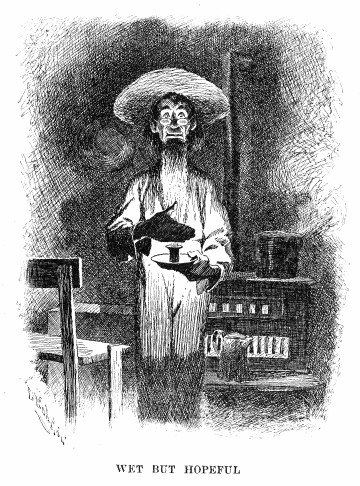
We blundered away through the rain and darkness, and after stumbling
in a dozen holes, running into a fence,
and getting tangled up in an abandoned picket-rope, at last came up to
the house. It was a little one-room board
house such as the settlers call a "shack." The door was open, and
inside we could see a man and woman
and half a dozen children and a full dozen dogs. We walked up, and when
the man saw us he called "Come in!"
tossed two children on the bed in the corner, picked up their chairs,
which were home-made, and brought them to
us.
"Wet, ain't it?" he exclaimed. "Rainy as the day Noah yanked the
gang-plank into the Ark. I was
a-telling Martha there was a right smart chance of a shower this
afternoon. What might you-uns' names be, and where
might you be from, and where might you be going?"
We told him all about ourselves, and he went on:
"Rainy night. Too late to help the co'n, though. Co'n's poor this
year; reckon we'll have to live on taters
and hope. Tater crop ain't no great shakes, though. Nothing much left
but hope, and dry for that. Reckon I'll go
back to old Missouri in the spring, and work in a saw-mill. No
saw-mills here, 'cause there ain't nothing to saw.
Hay don't need sawing. Martha," he added, turning to his wife, "was it
you said our roof didn't need
mending?"
"I said it did need it a powerful sight," answered the woman, as she
put another stick of hay in the
stove, and a stream of rain-water sputtered in the fire.
"Mebby you're right," said the man. "There's enough dry spots for
the dogs and children, but
when we have vis'tors somebody has got to get wet. Reckon I oughter put
on two shingles for vis'tors to set under.
You fellers will stay to supper, of course. We 'ain't got much but
bacon and taters, but you're powerful welcome."
"No," I said, "we really mustn't stop. What we wanted was to see if
we couldn't get a little
milk from you."
"Well, I'll be snaked!" exclaimed the man. "That makes me think I
ain't milked the old cow yet."
"I milked her more'n two hours ago, while you was cleaning your
rifle," said his wife.
"That so?" replied the man. "Where's the milk?"
The woman looked around a little. "Reckon the dogs or the young Uns
must 'a' swallered it. 'Tain't in sight,
nohow."
"Oh, we can milk 'er again!" exclaimed the man. "Old Spot sometimes
comes down heavier on the
second or third milking than she does on the first."
He took a gourd from a shelf, and told us to "come on;" and started
out. He wore a big felt hat, but
no coat, and he was barefooted. Just outside the door stood a bedstead
and two or three chairs. "We move 'em
out in the daytime to make more room," explained the man. The rain was
still pouring down. The man took our
lantern and began looking for the cow. He soon found her, and while I
held the lantern, and Ollie our jug, he went
down on his knees beside the cow and began to milk with one hand,
holding the gourd in the other. The cow stood
perfectly still, as if it was no new thing to be milked the second
time. We had on rubber coats, but the man was
without protection, and as he sat very near the cow a considerable
stream ran off of her hip-bone and down the
back of his neck. When the gourd was full he poured it in our jug, and
at my offering to pay for it he was almost
insulted. "Not a cent, not a cent!" he exclaimed. "Al'ays glad to
'commodate a neighbor. Good-night;
coming down in the morning to swap hosses with you."
He went back to the house, and we started for the wagon.
"He wouldn't have got quite so wet if he hadn't kept so close to the
cow," said Ollie, as we walked
along.
"What he needs," said I, "are eave-troughs on his cow."
to table
of contents
The next morning dawned fair. We were awakened by Old Blacky kicking
the side of the wagon-box with both hind-feet.
"If that man with the ever-blooming cow comes down," said Jack,
"I'll swap him Old Blacky."
Just then we heard a loud "Hello!" and, looking out, we found the
man leading a small yellow pony.
"I just 'lowed I'd come down and let you fellers make something out
of me on a hoss-trade," said the
man.
"Well," answered Jack, "we're willing to swap that black horse over
there. He's a splendid animal."
"Isn't he rather much on the kick?" the man asked. "He does kick a
little," admitted Jack,
"but only for exercise. He wouldn't hurt a fly. But he is so high-lifed
that he has to kick to ease his nerves
once in a while."
"Thought I seen him whaling away at your wagon," returned the man.
"Couldn't have him round my
place, 'cause my house ain't very steady, and I reckon he'd have it
kicked all to flinders inside of a week."
He talked for some time, but finally went off when he found that
Jack was not willing to part with any horse
except Old Blacky.
The road was so sandy that the rain had not made much difference
with it, and we were soon again moving on at
a good rate. We were travelling in a direction a little north of west,
and from one to half a dozen miles south
of the Niobrara River. It would have been nearer to have kept north of
the river, but we were prevented by the
Sioux and Ponca Indian reservations, through which no one was allowed
to go. Our intention was to cross to the
north of the river at Grand Rapids and get into the Keya Paha country,
about which we heard a great deal, keep
Straight west, and, after crossing the river twice more, reach Fort
Niobrara and the town of Valentine, beyond
which were the Sand Hills. This route would keep us all the time from
twenty to thirty miles north of the railroad..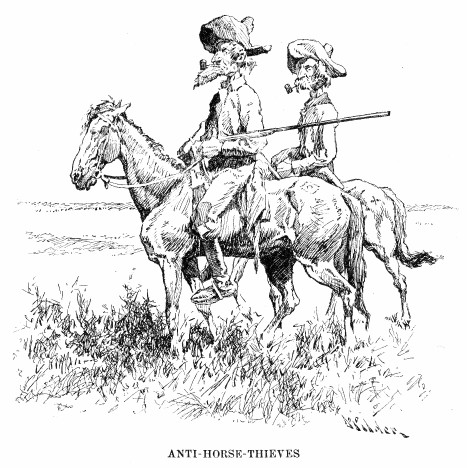
We had not gone far this morning when we met two men on horseback
riding side by side. They looked like farmers,
only we noticed that each carried a big revolver in a belt and one of
them a gun. They simply said "Good-morning,"
and passed on. In about half an hour we met another pair similarly
mounted and armed, and in another half-hour
still two more.
"Must be a wedding somewhere, or a Sunday--school picnic," said Jack.
"But why do they all have the guns?" asked Ollie, innocently.
"Oh, I don't know," answered Jack. "Varmints about, I suppose."
In a few minutes we came to a man working beside the road, and asked
him what it all meant. He looked around
in a very mysterious manner, and then half whispered the one word
"Vigilantees!" with a strong accent
on each syllable.
"Oh!" said Jack, "vigilance committee."
"Correct," returned the man.
"After horse-thieves, I suppose?" went on Jack.
"Exactly," replied the man. "Stole two horses at Black Bird last
night at ten o'clock. Holt County
Anti-Horse-thief Association after 'em this morning at four. That's the
way we do business in this country!"
We drove on, and Jack said:
"What the Association wants to do is to buy Old Blacky and put him
in a pasture for bait. In the morning
the members can go out and gather up a wagon-load of disabled
horse-thieves that have tried to steal him in the
night and got kicked over the fence."
We either met or saw a dozen other men on horseback, always in
pairs; but whether or not they caught the thief
we never heard.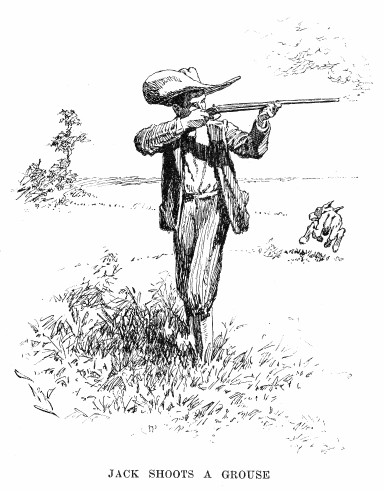
So far we had had very poor luck in finding game; but in the
afternoon of this day Jack shot a grouse, and we
camped rather earlier than usual, so that he might have ample time to
cook it. There were also the plums and grapes
to stew. We made our camp not far from a house, and, after a vast
amount of extremely serious labor on the part
of the cook, had a very good supper.
The next day passed with but one incident worth recalling. In the
afternoon we crossed the Niobrara at Grand
Rapids on a tumbledown wooden bridge, and turned due west through the
Keya Paha country. This is so called from
the Keya Paha River (pronounced Key-a-paw), a branch of the Niobrara
which comes down out of Dakota and joins it
a few miles below Grand Rapids. The country seemed to be much the same
as that through which we had travelled,
perhaps a little flatter and sandier. Just across the river we saw the
first large herd of stock, some five or
six hundred head being driven east by half a dozen cowboys.
A short distance beyond the river we came to a little blacksmith
shop beside the road. As soon as Jack saw it
he said:
"We ought to stop and get the horses shod. I was looking at the
holes the calks of Old Blacky's shoes made
in the wagon-box last night, and they are shallow and irregular. He
needs new shoes to do himself justice. If this
blacksmith seems like a man of force of character, we'll see what he
can do."
Jack looked at the blacksmith quizzically when we drove up, and
whispered to us, "He'll do," and we
unhitched. The pony had never been shod, and did not seem to need any
artificial aids, so we left her to graze
about while the others were being attended to.
"Just shoe the brown one first, if it doesn't make any difference,"
said Jack.
"All right," answered the blacksmith, and he went to work on this
decent old nag, who slept peacefully
throughout the whole operation.
He then began On Old Blacky. He soon had shoes nailed on the old
reprobate's forward feet, and approached his
rear ones. Old Blacky had made no resistance so far, and had contented
himself with gnawing at the side of the
shop and switching his tail. He even allowed the blacksmith to take one
of his hind-feet between his knees and
start to pull off the old shoe. Then he began to struggle to free his
leg. The blacksmith held on. Old Blacky saw
that the time for action had arrived, so he drew his leg, with the
foolish blacksmith still clinging to it, well
up forward, and then threw it back with all his strength. 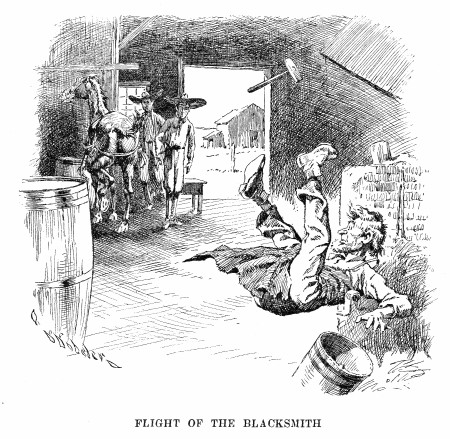 The leg did not fly off, but the
blacksmith did, and half-way across the shop. He picked himself up,
and, after looking at the horse, said:.
The leg did not fly off, but the
blacksmith did, and half-way across the shop. He picked himself up,
and, after looking at the horse, said:.
"'Pears's if that ain't a colt any more."
"No," answered Jack; "he's fifteen or sixteen."
"Old enough to know better," observed the blacksmith. "I'll try him
again."
He once more got the leg up, and again Old Blacky tried to throw him
off. But this time the man hung on. After
the third effort Blacky looked around at him with a good deal of
surprise. Then he put down the leg to which the
man was still clinging, and with the other gave him a blow which was
half a kick and half a push, which sent the
man sprawling over by his anvil.
"The critter don't seem to take to it nohow, does he?" said the
blacksmith, cheerfully, as he again
got up.
"He's a very peculiar horse," answered Jack. "Has violent likes and
dislikes. His likes are for
food, and his dislikes for everything else."
"I'll tackle him again, though," said the man.
But Blacky saw that he could no longer afford to temporize with the
fellow, and now began kicking fiercely with
both feet in all directions, swinging about like a warship to get the
proper range on everything in sight, and
finally ending up by putting one foot through the bellows.
"Reckon I've got to call in assistance," said the man, as he started
off. He came back with another
man, who laid hold of one of Blacky's forward legs and held it up off
the floor. The blacksmith then seized one
of his hind ones and got it up. This left the old sinner so that if he
would kick he would have to stand on one
foot while he did it, and this was hardly enough for even so bad a
horse as he was. He did not wholly give up,
however, but after a great amount of struggling they at last got him
shod.
"We'll call him the Blacksmith's Pet," said Jack.
Good camping-places did not seem to be numerous, and just after the
sun had gone down we turned out beside the
road near a half-completed sod house. There was no other house in
sight, and this had apparently been abandoned
early in the season, as weeds and grass were growing on top of the
walls, which were three or four feet high. There
was also a peculiar sort of well, a few of which we had seen during the
day. It consisted of four one-inch boards
nailed together and sunk into the ground. The boards were a foot wide,
thus making the inside of the shaft ten
inches square. This one was forty or fifty feet deep, but there was a
long rope and slender tin bucket beside it.
The water was not good, but there was no other to be had. Near the
house Ollie found the first cactus we had seen,
which showed, if nothing else did, that we were getting into a dry
country. He took it up carefully and stowed
it away in the cabin to take back home as evidence of his extensive
travels.
For several days we had not been able to have a camp-fire, owing to
the wind and dryness of the prairie, for
had we started a prairie fire it might have done great damage.
"We don't want the Holt County Anti-Prairie Fire Society after us,"
Jack had said; so we bad been
using our oil-stove.
But this evening was very still, and there seemed to be no danger in
building a camp-fire within the walls of
the house, and we soon had one going with wood which we had gathered
along the river, since to have found wood
enough for a camp-fire in that neighborhood would have been as
impossible as to have found a stone or a spring
of water.
We were sitting about on the sods after supper when a man rode up on
horseback, who said he was looking for
some lost stock. We asked him to have something to eat, and he accepted
the invitation, and afterwards talked a
long time, and gave us much information which we wished about the
country. Somebody mentioned the little well,
and the man turned to Ollie and said:
"How would you like to slip down such a well?"
"I'm afraid I'm too big," answered Ollie. "Well, perhaps you are;
but there was a child last
summer over near where I live who wasn't too big. He was a little
fellow not much over two years old. The well
was a new one, and the curb was almost even with the top of the ground.
He slipped down feet first. It was a hundred
and twenty feet deep, with fifteen feet of water at the bottom; but he
fitted pretty snug, and only went down about
fifty feet at first. His mother missed him, saw that the cover was gone
from the well, and listened. She heard
his voice, faint and smothered. There was no one else at home. She
called to him not to stir, and went to the barn,
where there was a two-year-old colt. He had never been ridden before,
but he was ridden that afternoon, and I guess
he hasn't forgotten the lesson. She came to my place first, told me,
and rode away to another neighbor's. In half
an hour there were twenty men there, and soon fifty, and before morning
two hundred.
"There was no way to fish the child out-the only thing was to dig
down beside the small shaft. We could
hear him faintly, and we began to dig. We started a shaft about four
feet square. The sandy soil caved badly, but
men with horses running all the way brought out lumber from Grand
Rapids for curbing.
"The child's father came too. He listened a second at the small
shaft, and then went down the other. Two
men could work at the bottom of it. One of the men was relieved every
few minutes by a fresh worker, but the father
worked on, and did more than the others, not-withstanding the changes.
All of the time the mother sat on the ground
beside the small shaft with her arms about its top. At four o'clock in
the morning we were down opposite the prisoner.
He was still crying faintly. We saw that to avoid the danger of causing
him to slip farther down we must dig below
him, bore a hole in the board, and push through a bar. But a few
shovelfuls more were needed. The work jarred the
shaft, and the child slipped twenty---five feet deeper. At seven
o'clock we were down to where he was again, though
we could no longer bear him. We dug a little below, bored a bole, and
the father slipped through a pickaxe handle,
and fainted away as he felt the little one slide down again but rest on
the handle. We tore off the boards, took
the baby out, and drew him and his father to the surface. There were
two doctors waiting for them, and the next
day neither was much the worse for it."
The man got on his horse and rode away. We agreed that he had told
us a good story, but the next day others
assured us that it had all happened a year before.
to table
of contents
Besides the cactus, another form of vegetation which began to attract
more and more of Ollie's attention was the
red tumbleweed. Indeed, Jack and I found ourselves interested in it
also. The ordinary tumbleweed, green when growing
and gray when tumbling, had long been familiar to us, but the red
variety was new. The old kind which we knew seldom
grew more than two feet in diameter; it was usually almost exactly
round, and with its finely branched limbs was
almost as solid as a big sponge, and when its short stem broke off at
the top of the ground in the fall it would
go bounding away across the prairie for miles. The red sort seemed to
be much the same, except for its color and
size. We saw many six or seven feet, perhaps more, in diameter, though
they were rather flat, and not probably
over three or four feet high.
The first one we saw was on edge, and going at a great rate across
the prairie, bounding high into the air,
and acting as if it had quite gone crazy, as there was a strong wind
blowing.
"Look at that overgrown red tumbleweed!" exclaimed Jack. "I never
saw anything like that before.
Jump on the pony, Ollie, and catch the varmint and bring it back here!"
Ollie was willing enough to do this, and the pony was willing enough
to go, so off they went. I think if the
weed had had a fair field that Ollie would never have overtaken it, but
it got caught in the long grass occasionally,
and he soon came up to it. But the pony was not used to
tumbleweed-coursing, and shied off with a startled snort.
Ollie brought her about and made another attempt. But again the
frightened pony ran around it. Half a dozen times
this was repeated. At last she happened to dash around it on the wrong
side just as it bounded into the air before
the wind. It struck both horse and rider like a big dry-land wave, and
Ollie seized it. If the poor pony had been
frightened before, she was now terror-stricken, and gave a jump like a
tiger, and shot away faster than we had
ever seen her run before. Ollie had lost control of her, and could only
cling to the saddle with one hand and hold
to the big blundering weed with the other. Fortunately the pony ran
toward the wagon. As they came up we could
see little but tumbleweed and pony legs, and it looked like nothing so
much as a hay-stack running away on its
own legs. When the pony came up to the wagon she stopped so suddenly
that Ollie went over her head.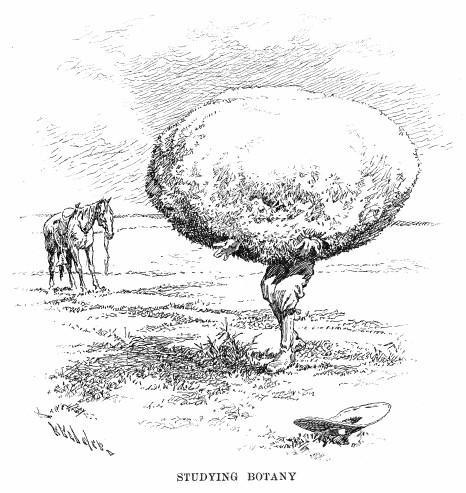 But
he still clung to the weed, and struck the ground inside of it. He
jumped up, still in the weed, so that it now
looked like a hay-stack on two legs. We pulled him out of it, and found
him none the worse for his adventure. But
he was a little frightened, and said:
But
he still clung to the weed, and struck the ground inside of it. He
jumped up, still in the weed, so that it now
looked like a hay-stack on two legs. We pulled him out of it, and found
him none the worse for his adventure. But
he was a little frightened, and said:
"I don't think I'll chase those things again, Uncle Jack--not with
that pony."
"Oh, that's all right, Ollie," said Jack. "I'm going to organize the
Nebraska Cross-Country Tumbleweed
Club, and you'll want to come to the meets. We'll give the weed one
minute start, and the first man that catches
it will get a prize of--of a watermelon, for instance."
"Well, I think I'll take another horse before I try it," returned
Ollie.
"Might try Old Browny," I said. "If he ever came up to a tumbleweed
he would lie right down
on it and go to sleep."
"Yes, and Blacky would hold it with one foot and eat it up," said
Jack. "Unless he took a notion
to turn around and kick it out of existence."
We looked the queer plant over carefully, and found it so closely
branched that it was impossible to see into
it more than a few inches. The branched were tough and elastic, and
when it struck the ground after being tossed
up it would rebound several inches. But it was almost as light asa
thistle-ball, and when we turned it loose it
rolled away across the prairie again as if nothing had happened.
"They're bad things sometimes when there is a prairie tire," said
Jack. "No matter how wide the
fire-break may be, a blazing tumbleweed will often roll across it and
set tire to the grass beyond. They've been
known to leap over streams of considerable width, too, or fall in the
water and float across, still blazing. Two
years ago the town of Frontenac was burned up by a tumbleweed, though
the citizens had made ah approved fire-break
by ploughing two circles of furrows around their village and burning
off the grass between them. These big red
ones must be worse than the others. I believe," he went on, "that
tumbleweeds might be used to carry
messages, like carrier-pigeons. The next one we come across we'll try
it."
That afternoon we caught a fine specimen, and Jack securely fastened
this message to it and turned it adrift:
"Schooner Rattletrap, September --, 188-:
Latitude.
42.50; Longitude, 99.35. To Whom it may Concern:
From Prairie Flower, bound for Deadwood. All well
except Old Blacky, who has an appetite."
The night after our stop by the unfinished house we again camped on
the open prairie, a quarter of a mile from
a settler's house, where we got water for the horses. This house was
really a "dugout," being more of
a cellar than a house. It was built in the side of a little bank, the
back of the sod roof level with the ground,
and the front but two or three feet above it.
"I'd be afraid, if I were living in it, that a heavy rain in the
night might fill it up, and float the
bedstead, and bump my nose on the ceiling," said Jack.
Ir had been a warm afternoon, but when we went to bed it was cooler,
though there was no wind stirring. The
smoke of our camp-fire went straight up. There was no moon, but the sky
was clear, and we remarked that we had
not seen the stars look so bright any night before. The front of our
wagon stood toward the northwest. We went
to bed, but at two o'clock we were awakened by a most violent shaking
of the cover. The wind was blowing a gale,
and the whole top seemed about to be going by the board. We scrambled
up, and I heard Jack's voice calling for
me to come out. The cover-bows were bent far over, and the canvas
pressed in on the side to the southwest till
it seemed as if it must burst. The front end of the top had gone out
and was cracking in the wind. I crept forward,
and us I did so I felt the wagon rise up on the windward side and bump
back on the ground. I concluded we were
doomed to u wreck, and called to Ollie to get out as fast us he could.
I supposed a hard storm had struck us, but
as I went over the dash-board I was astonished to see the stars shining
us brightly as ever in the deep, dark sky.
Jack was clinging to the rear wagon wheel on the windward side, which
was all that had saved it from capsizing.
He called to me to take hold of the tongue and steer the craft around
with the stern to the gale. I did so, while
he turned on the wheel. 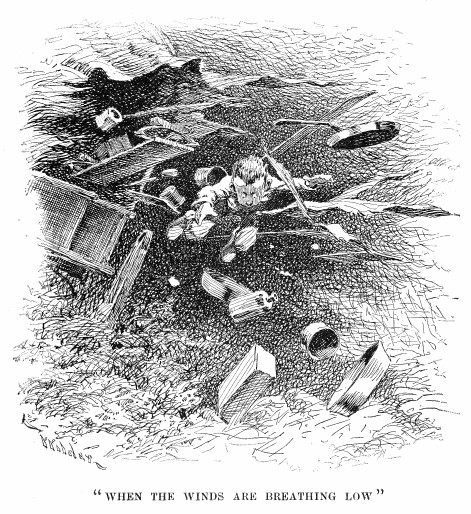 As it
came around the loose sides of the cover began
to flutter and crack, while the puckering-string gave way, and the wind
swept through the wagon, carrying everything
that was loose before it, including Ollie, who was just getting over
the dash-board. He was not hurt, but just
then we heard a most pitiful yelping, as Jack's blankets and pillow
went rolling away from where the wagon had
stood. It was Snoozer going with them. The yelping disappeared in the
darkness, and we heard frying-pans, tin plates,
and other camp articles clattering away with the rest. The Rattletrap
itself had tried to run before the gale,
but I had put on the brake and stopped it. The three of us then
crouched in front of it, and waited for the wind
to blow itself out. We could see or hear nothing of the horses. There
was nota cloud in sight, and the stars still
shone down calmly and unruffled, while the wind cut and hissed through
the long prairie grass all about us. It
kept up for about ten minutes, when it began to stop as suddenly as it
had begun. In twenty minutes there was nothing
but a cool, gentle breeze coming out of the southwest. We lit the
lantern and tried to gather up our things, but
soon realized that we could not do much that night. We found the
unfortunate Snoozer crouched in a little depression
which was perhaps an old buffalo wallow, but could see nothing of the
horses. We concluded to go to bed and wait
for morning.
As it
came around the loose sides of the cover began
to flutter and crack, while the puckering-string gave way, and the wind
swept through the wagon, carrying everything
that was loose before it, including Ollie, who was just getting over
the dash-board. He was not hurt, but just
then we heard a most pitiful yelping, as Jack's blankets and pillow
went rolling away from where the wagon had
stood. It was Snoozer going with them. The yelping disappeared in the
darkness, and we heard frying-pans, tin plates,
and other camp articles clattering away with the rest. The Rattletrap
itself had tried to run before the gale,
but I had put on the brake and stopped it. The three of us then
crouched in front of it, and waited for the wind
to blow itself out. We could see or hear nothing of the horses. There
was nota cloud in sight, and the stars still
shone down calmly and unruffled, while the wind cut and hissed through
the long prairie grass all about us. It
kept up for about ten minutes, when it began to stop as suddenly as it
had begun. In twenty minutes there was nothing
but a cool, gentle breeze coming out of the southwest. We lit the
lantern and tried to gather up our things, but
soon realized that we could not do much that night. We found the
unfortunate Snoozer crouched in a little depression
which was perhaps an old buffalo wallow, but could see nothing of the
horses. We concluded to go to bed and wait
for morning.
When it came we found our things scattered for over a quarter of a
mile. We recovered everything, though the
wagon-seat was broken. The horses had come back, so we could not tell
how far they had gone before the wind.
"I've read about those night winds on the plains," said Jack, "and
we'll look out for 'em in
the future. We'll put an anchor on Snoozer at least."
This intelligent animal had not forgotten his night's experience,
and stuck closely in the wagon, where he even
insisted on taking his breakfast.
The road we were following was gradually drawing closer to the
Niobrara, and we began to see scattering pine-trees,
stunted and broken, along the heads of the cañons or ravines
leading down to the river. There was less sand,
and we made better progress. The country was but little settled, and
game was more plentiful. We got two or three
grouse. We went into camp at night by the head of what appeared to be a
large cañon, under a tempest-tossed
old pine-tree, through which the wind constantly sighed. There was no
water, but we counted on getting it down
the ca¤on. A man went by on horseback, driving some cattle, who
told us that we could find a spring down
about half a mile.
"Can we get any hay down there?" I asked him. "We're out of feed for
the horses, and the grass
seems pretty poor here."
"Down a mile beyond the spring I have a dozen stacks," answered the
man, "and you're welcome
to all you can bring up on your pony. Just go down and help yourselves."
We thanked him and he went on. As soon as we could we started down.
It was beginning to get dark, and grew darker
rapidly as we went down the ravine, as its sides were high and the
trees soon became numerous. There was no road,
nothing but a mere cattle-path, steep and stony in many places. We
found the spring and watered all the horses,
left Blacky and Browny, and went on after the hay with the pony, Jack
leading her, and Ollie and I walking ahead
with the lantern. It seemed a long way as we stumbled along in the
darkness, all the time downhill. "I guess
that man wasn't so liberal as he seemed," said Jack. "The pony will be
able to carry just about enough
hay up here to make Snoozer a bed."
We plunged on, till at last the path became a little nearer level.
It crossed a small open tract and then wound
among bushes and low trees. Suddenly we saw something gleam in the
light of the lantern, and stopped right on the
river's bank. The water looked deep and dark, though not very wide. The
current was swift and eddying.
"We've passed the hay," I said. "Ir must be on that open flat we
crossed."
We went back, and, turning to the right, soon found it. I set the
lantern down and began to pull hay from one
of the stacks, when the pony made a sudden movement, struck the lantern
with her foot, and smashed the globe to
bits.
"There," exclaimed Jack, "we'll have a fine time going up that
badger-hole of a ca¤on
in the dark!"
But there was nothing else to do, and we made up two big bundles of
hay and tied them to the pony's back.
"She'll think it's tumbleweeds," said Ollie.
"If she's headed in the right direction I hope she will," answered
Jack.
We started up, but it was a long and toilsome climb. In many places
Jack and I had to get down on our hands
and knees and feel out the path. The worst place was a scramble up a
bank twenty feet high, and covered with loose
stones. I was ahead. The heroic little pony with her unwieldy load
sniffed at the prospect a little, and then started
bravely up, "hanging on by her toe-nails," as Ollie said. When she was
almost to the top she stepped
on a loose stone, lost her footing, went over, and rolled away into the
darkness and underbrush. Jack stumbled
over a little of the hay which had come off in the path, hastily rolled
up a torch, and lit it with a match. By
this light we found the pony on her back, like a tumble-bug, with her
load for a cushion and her feet in the air,
and kicking wildly in every direction. While Ollie held the torch, Jack
and I went to her rescue, and, after a
vast deal of pulling and lifting, got her to her feet just as the hay
torch died out. Again she scrambled up the
bank, and this time with success. We went on, found the other horses,
and were soon at the wagon. We voted the
pony all the hay she wanted, and went to bed tired.
The next day, the ninth out from Yankton, though it was a long run,
brought us to Valentine, the first town
on the railroad which we had seen since leaving the former place.
Before we reached it we went several miles along
the upper ends of the cañons, down a long hill so steep that we
had to chain both hind wheels, forded the
Niobrara twice, followed the river several miles, went out across the
military reservation, which was like a desert,
saw six or eight hundred negro soldiers at Fort Niobrara, and finally
drove through Valentine, and went into camp
a mile west of town. On the way we saw thousands of the biggest and
reddest tumbleweeds, and two or three new sorts
of cactus. The colored troops surprised Ollie, as he had never seen any
before.
"It's the western winds and the hot sun that's tanned those
soldiers," said Jack. "We'll look
just that way, too, before we get back."
Ollie was half inclined to believe this astonishing statement at
first, but concluded that his uncle was joking.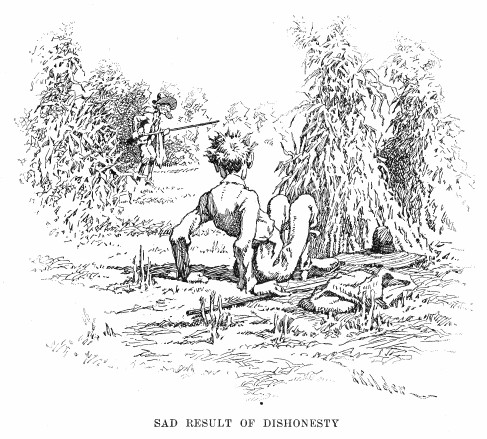
We went into camp on the banks of the Minichaduza River, a little
brook which flows into the Niobrara from the
northwest. All night it gurgled and bubbled almost under our wheels. A
man stopped to chat with us as we sat around
our camp-fire after supper. We told him of our experience in getting
the hay the night before. He laughed and said:
"Ever steal any of your horse feed?"
"We haven't yet," answered Jack. "We try to be reasonably honest."
"Some don't, though," replied the man. "Most of 'em that are going
West in a covered wagon seem
to think corn in the field is public property. A fellow camped right
here one afternoon last fall. He was out of
feed, and took a grain sack on one arm and a big Winchester rifle on
the other, and went over to old Brown's cornfield.
He took the gun along not to shoot anybody, but to sort of intimidate
Brown if he should catch him. Suddenly he
saw an old fellow coming towards him carrying a gun about a foot longer
than his own. The young fellow wilted right
down on the ground and never moved. He happened to go down on a big
prickly cactus, but he never stirred, cactus
or no cactus. He thought Brown had caught him, and that he was done
for. The old man kept coming nearer and nearer.
He was almost to him. The young fellow concluded to make a brave fight.
So he jumped up and yelled. The old man
dropped his gun and ran like a scared wolf. Then the young fellow
noticed that the other also had a sack in which
he had been gathering corn. He called him back, they saw that they were
both thieves, shook hands, and went ahead
and robbed old Brown together."
The man got up to go. "Well, good-night, boys," he said. "Rest as
hard as you can tomorrow. You'll
strike into the Sand Hills at about nine o'clock Monday morning. Take
three days' feed, and every drop of water
you can carry; and it you waste any of it washing your hands you're
bigger fools than I think you are."
to table
of contents
"Come, stir out of that and get the camels ready for the desert!"
This was Jack's cheery way of warning Ollie and me that it was time
to get up on the morning of our start into
the Sand Hills.
"Any simooms in sight?" asked Ollie, by way of reply to Jack's
remark.
"Well, I think Old Browny scents one; he has got his nose buried in
the sand like a camel," answered
Jack.
It was only just coming daylight, but we were agreed that an early
start was best. It was another Monday morning,
and we knew that it would take three good days' driving to carry us
through the sand country. We had learned that,
notwithstanding what our visitor of the first night had said, there
were several places on the road where we could
get water and feed for the horses. We should have to carry some water
along, however, and had got two large kegs
from Valentine, and filled them and all of our jugs and pails the night
before. We also had a good stock of oats
and corn, and a big bundle of hay, which we put in the cabin on the bed.
"Just as soon as Old Blacky finds that there is no water along the
road he will insist on having about
a barrel a day," said Jack. "And if he can't get it he will balk, and
kick the dash-board into kindling-wood."
A little before sunrise we started. It was agreed, owing to the
increase in the load and the deep sand, that
no one, not even Snoozer, should be allowed to ride in the wagon. If
Ollie got tired he was to ride the pony. So
we started off, walking beside the wagon, with the pony lust behind, as
usual, dangling her stirrups, and the abused
Snoozer, looking very much hurt at the insult put upon him, following
behind her.
For three or four miles the road was much like that to which we had
been accustomed. Then it gradually began
to grow sandier. We were following an old trail which ran near the
railroad, sometimes on one side and sometimes
on the other; and this was the case all the way through the hills. The
railroad was new, having been built only
a year or two before. There was a station on it every fifteen or twenty
miles, with a side-track, and a water-tank
for the engines, but not much else.
There was no well-marked boundary to the Sand Hills, but gradually,
and almost before we realized it, we found
ourselves surrounded by them. We came to a crossing of the railroad,
and in a little cut a few rods away we saw
the sand drifted over the rails three or four inches deep, precisely
like snow.
"Well," said Jack, "I guess we're in the Sand Hills at last if we've
got where it drifts."
"I wonder if they have to have sand-ploughs on their engines?" said
Ollie.
"I've heard that they frequently have to stop and shovel it off,"
answered Jack.
As we got farther among the sand dunes we found them all sizes and
shapes, though usually circular, and from
fifteen to forty feet high. Of course the surface of the county was
very irregular, and there would be places here
and there where the grass had obtained a little footing and the sand
had not drifted up. There were also some hills
which seemed to be independent of the sand piles.
We stopped for noon on a little flat where there was some struggling
grass, This flat ran off to the north,
and narrowed into a small valley through which in the spring probably a
little water flowed. We had finished dinner
when we noticed a flock of big birds circling about the little valley,
and, on looking closer, saw that some of
them were on the ground.
"They are sand-hill cranes," said Jack. "I've seen them in Dakota,
but this must be their home."
They were immense birds, white and gray, and with very long legs.
Jack took his rifle and tried to creep up
on them, but they were too shy, and soared away to the south.
We soon passed the first station on the railroad, called Crookston.
The telegraph-operator came out and looked
at us, admitted that it was a sandy neighborhood, and went back in. We
toiled on without any incident of note during
the whole afternoon. Toward night we passed another station, called
Georgia, and the man in charge allowed us to
fill our kegs from the water-tank. .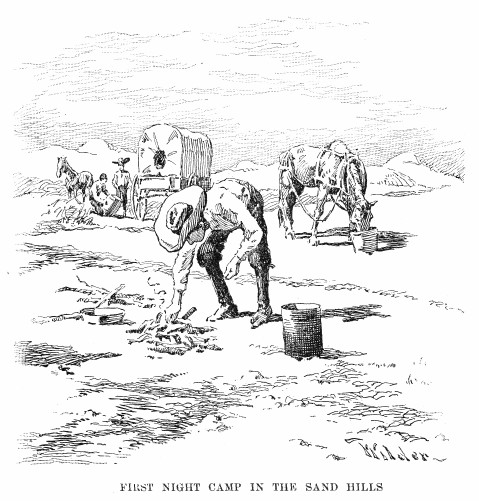 We went on
three or four miles and
stopped beside the trail, and a hundred yards from the railroad, for
the night. The great drifts of sand were all
around us, and no desert could have been lonelier. We had a little wood
and built a camp-fire. The evening was
still and there was not a sound. Even the Blacksmith's Pet, wandering
about seeking what he could devour, and finding
nothing, made scarcely a sound in the soft sand. The moon was shining,
and it was warm as any summer evening. Jack
sat on the ground beside the wagon and played the banjo for half an
hour. After a while we walked over to the railroad.
We could hear a faint rumble, and concluded that a train was
approaching.
We went on
three or four miles and
stopped beside the trail, and a hundred yards from the railroad, for
the night. The great drifts of sand were all
around us, and no desert could have been lonelier. We had a little wood
and built a camp-fire. The evening was
still and there was not a sound. Even the Blacksmith's Pet, wandering
about seeking what he could devour, and finding
nothing, made scarcely a sound in the soft sand. The moon was shining,
and it was warm as any summer evening. Jack
sat on the ground beside the wagon and played the banjo for half an
hour. After a while we walked over to the railroad.
We could hear a faint rumble, and concluded that a train was
approaching.
"Let's wait for it," proposed Jack. "It will be along in a moment."
We waited and listened. Then we distinctly heard the whistle of a
locomotive, and the faint roar gradually ceased.
"It's stopped somewhere," I said.
"Don't see what it should stop around here for," said Jack, "unless
to take on a sand-hill crane."
Then we heard it start up, run a short distance, and again stop;
this it repeated half a dozen times, and then
after a pause it settled down to a long steady roar again.
"It isn't possible, is it, that that train has been stopped at the
next station west of here?" I said.
"The next station is Cody, and it's a dozen miles from here,"
answered Jack. "It doesn't seem
as if we could hear it so far, but we'll time it and see."
He looked at his watch and we waited. For a long time the roar kept
up, occasionally dying away as the train
probably went through a deep cut or behind a hill. It gradually
increased in volume, till at last it seemed as
if the train must certainly be within a hundred yards. Still it did not
appear, and the sound grew louder and louder.
But at the end of thirty-five minutes it came around the curve in sight
and thundered by, a long freight train,
and making more noise, it seemed, that any train ever made before.
"That's where it was!" exclaimed Jack--"at Cody, twelve miles from
here; and we first heard
it I don't know how far beyond. If I ever go into the telephone
business I'll keep away from the Sand Hills. A
man here ought to be able to hold a pleasant chat with a neighbor two
miles off, and by speaking up loud ask the
postmaster ten miles away if there is any mail for him."
We were off ploughing through the sand again early the next morning.
We could not give the horses quite all
the water they wanted, but we did the best we could. We were in the
heart of the hills all day. There were simply
thousands of the great sand drifts in every direction. Buffalo bones
half buried were becoming numerous. We saw
several coyotes, or prairie wolves, skulking about, but we shot at them
without success. We got water at Cody,
and pressed on. In the afternoon we sighted some antelope looking
cautiously over the crest of a sand billow. Ollie
mounted the pony and I took my rifle, and we went after them, while
Jack kept on with the wagon. They retreated,
and we followed them a mile or more back from the trail, winding among
the drifts and attempting to get near enough
for a shot. But they were too wary for us. At last we mounted a hill
rather higher than the rest, and saw them
scampering away a mile or more to the northwest. We were surprised more
by something which we saw still on beyond
them, and that was a little pond of water deep down between two great
ridges of sand.
"I didn't expect to see a lake in this country," said Ollie.
I studied the lay of the land a moment, and said: "I think it's
simply a place where the wind has scooped
out the sand down below the water-line and it has filled up. The wind
has dug a well, that's all. You know the
telegraph-operator at Georgia told us the wells here were shallow--that
there's plenty of water down a short distance."
We could see that there was considerable grass and quite an oasis
around the pond. But in every other direction
there was nothing but sand billows, all scooped out on their northwest
sides where the fierce winds of winter had
gnawed at them. The afternoon sun was sinking, and every dune cast a
dark shadow on the light yellow of the sand,
making a great landscape of glaring light covered with black spots. A
coyote sat on a buffalo skull on top of the
next hill and looked at us. A little owl flitted by and disappeared in
one of the shadows.
"This is like being adrift in an open boat," I said to Ollie. "We
must hurry on and catch the
Rattletrap."
"I'm in the open boat," answered Ollie. "You're just simply swimming
about without even a life-preserver
on."
We turned and started for the trail. We found it, but we had spent
more time in the hills than we realized,
and before we had gone far it began to grow dark. We waded on, and at
last saw Jack's welcome camp-fire. When we
came up we smelled grouse cooking, and he said:
"While you fellows were chasing about and getting lost I gathered in
a brace of fat grouse. What you want
to do next time is to take along your hat full of oats, and perhaps you
can coax the antelope to come up and eat."
The camp was near another railroad station called Eli. We had been
gradually working north, and were now not
over three or four miles from the Dakota line; but Dakota here
consisted of nothing but the immense Sioux Indian
Reservation, two or three hundred miles long.
The next morning Jack complained of not feeling well.
"What's the matter, Jack?" I asked.
"Gout," answered Jack, promptly. "I'm too good a cook for myself.
I'm going to let you cook for
a few days, and give my system a rest."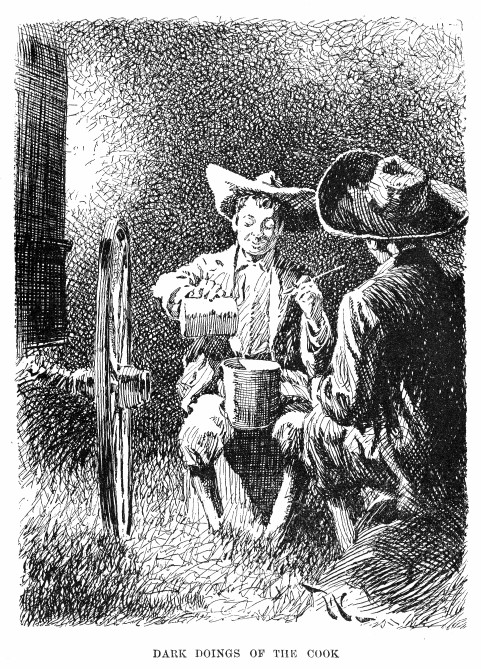
This seemed very funny to Ollie and me, who had been eating Jack's
cooking for two or three weeks. The fact
was that the gouty Jack was the poorest cook that ever looked into a
kettle, and he knew it well enough. He could
make one thing--pancakes--nothing else. They were usually fairly good,
though he would sometimes get his recipes
mixed up, and use his sour-milk one when the milk was sweet, or his
sweet-milk one when it was sour; but we got
accustomed to this. Then it was hard to spoil young and tender fried
grouse, and the stewed plums had been good,
though he had got some hay mixed with them; but the flavor of hay is
not bad. We bought frequently of "canned
goods" at the stores, and this he could not injure a great deal.
We did not pay much attention to Jack's threat about stopping
cooking. He got breakfast after a fashion, mixing
sour and sweet milk as an experiment, and though he didn't eat much
himself, we did not think he was going to be
sick. But after walking a short distance he declared he could go no
farther, and climbed into the cabin and rolled
upon the bed.
Ollie and I ploughed along with the sand still streaming, like long
flaxen hair, off the wagon-wheels as they
turned. In a little valley about ten o'clock Ollie shot his first
grouse. We saw more antelope, and met a man with
his wife and six children and five dogs and two cows and twelve
chickens going east. He said he was tired of Nebraska,
and was on his way to Illinois. At noon we stopped at Merriman, another
railroad station. Jack got up and made
a pretence of getting dinner, but he ate nothing himself, and really
began to look ill.
We made but a short stop, as we were anxious to get out of the worst
of the sand that afternoon. We asked about
feed and water for the horses, and were told that we could get both at
Irwin, another station fifteen miles ahead.
We pressed on, with Jack still in the wagon, but it was almost dark
before we reached the stationWe found a man
on the railroad track.
"Can we get some feed and water here?" I asked of him.
"Reckon not," answered the man.
"Where can we find the station agent?"
"He's gone up to Gordon, and won't be back till midnight."
"Hasn't any one got any horse-feed for sale?".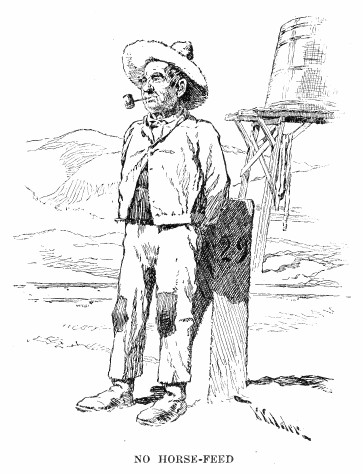
"There isn't a smell of horse-feed here," said the man. "I've got
the only well, except the railroad's,
but it's 'most dry. I'll give you what water I can, though. As for
feed, you'd better go on three miles to Keith's
ranch. It's on Lost Creek Flat, and there's lots of haystacks there,
and you can help yourself. At the ranch-house
they will give you other things."
We drove over to the man's house, and got half a pail of water
apiece for the horses. They wanted more, but
there was no more in the well. The man said we could get everything we
wanted at the ranch, and we started on.
The horses were tired, but even Old Blacky was quite amiable, and
trudged along in the sand without complaint.
Jack was still in the wagon, and we heard nothing of him. It was
cloudy and very dark. But the horses kept in
the trail, and after, as it seemed to us, we had gone five miles, we
felt ourselves on firmer ground. Soon we thought
we could make out something, perhaps hay-stacks, through the darkness.
I sent Ollie on the pony to see what it
was. He rode away, and in a moment I heard a great snorting and a
stamping of feet, and Ollie's voice calling for
me to come. I ran over with the lantern, and found that he had ridden
full into a barbed-wire fence around a hay-stack.
The pony stood trembling, with the blood flowing from her breast and
legs, but the scratches did not seem to be
deep.
"We must find that ranch-house," I said to Ollie. "It ought to be
near."
For half an hour we wandered among the wilderness of hay-stacks,
every one protected by barbed wire. At last
we heard a dog barking, followed the sound, and came to the house. The
dog was the only live thing at home, and
the house was locked.
"Well, what we want is water," I said, "and here's the well."
We let down the bucket and brought up two quarts of mud.
"The man was right," said Ollie. "This is worse than the Sarah
Desert."
"Fountains squirt and bands play 'The Old Oaken Bucket' in the Sarah
Desert 'longside o' this," I
answered.
It was eleven o'clock before we found the wagon. We could hear Jack
snoring inside, and were surprised to find
Snoozer on guard outside, wide awake. He seemed to feel his
responsibility, and at first was not inclined to let
us approach.
We unharnessed the horses, and Ollie crawled under the fence around
one of the stacks of hay and pulled out
a big armful for them.
"The poor things shall have all the hay they want, anyhow," he said.
"I'm afraid they'll think it's pretty dry," I returned, "but I don't
see what we can do."
Then I called to Jack, and said: "Come, get up and get us some
supper!"
After a good deal of growling he called back: "I'm not hungry."
"But we are, and you're well enough to make some cakes."
"Won't do it," answered Jack. "You folks can make 'em as well as I
can."
"I can't. Can you?" I said to Ollie. He shook his head.
"You're not very sick or you wouldn't be so cross," I called to Jack:
"Roll out and get supper,
or I'll pull you out!"
"First follow comes in this wagon gets the head knocked off 'm!"
cried Jack. "Besides, there's
no milk! No eggs! No nothing! Go 'way! I'm sick! That's all there is,"
and something which looked like a cannon-ball
shot out of the front end of the wagon, followed by a paper bag which
might have been the wadding used in the Cannon.
"That's all! Lemme 'lone!" And we heard Jack tie down the front of the
cover and roll over on the bed
again.
"See what it is," I said to Ollie.
He took the lantern and started. "Guess it's a can of Boston baked
beans," he said. "Oh, then
we're all right," I replied.
He picked it up and studied it carefully by the light of the lantern.
"No," he said, slowly, "it isn't that. G--g, double
o--gooseberries--that's what it is--a can
of gooseberries we got at Valentine."
"And this is a paper bag of sugar," I said, picking it up. "No gout
to-night!"
I cut open the can and poured in the sugar. We stirred it up with a
stick, and Ollie drank a third of it and
I the rest. Then we crawled under the wagon, covered ourselves with the
pony's saddle-blanket, and went to sleep.
But before we did so I said:
"Ollie, at the next town I am going to get you a cook-book, and
we'll be independent of that wretch in
the wagon."
"All right," answered Ollie.
to table
of contents
The next morning the condition of the tempers of the crew of the
Rattletrap was reversed. Jack was feeling better
and was quite amiable, and inclined to regret his bloodthirsty language
of the night before. But Ollie and I, on
our diet of gooseberries, had not prospered, and woke up as cross as
Old Blacky. The first thing I did was to seize
the empty gooseberry can and hit the side of the wagon a half-dozen
resounding blows.
"Get up there," I cried, "and 'tend to breakfast! No pretending
you're sick this morning."
"All right!" came Jack's voice, cheerfully. "Certainly. No need of
your getting excited, though.
You see, I really wasn't hungry last night, or I'd have got supper."
"But we were hungry!" answered Ollie. "I don't think I was ever much
hungrier in my life; and
then to get nothing but a pint of gooseberries! I could eat my hat this
morning!"
"I'm sorry," said Jack, coming out; "but I can't cook unless I'm
hungry myself. The hunger of
others does not inspire me. I gave you all there was. Your hunger ought
to have inspired you to do something with
those gooseberries."
"I'd like to know what sort of a meal you'd have got up with a can
of gooseberries?"
"Why, my dear young nephew," exclaimed Jack, "if I'd been awakened
to action I'd have fricasseed
those gooseberries, built them up into a gastronomical poem; and made a
meal of them fit for a king. A great cook
like I am is an artist as much as a great poet. He--"
"Oh, bother!" I interrupted; "the gooseberries are gone. There's the
grouse Ollie shot yesterday.
Do something with that for breakfast."
Jack disappeared in the wagon, and began to throw grouse feathers
out the front end with a great flourish. The
poor horses were much dejected, and stood with their heads down. They
had eaten but little of the hay. Water was
what they wanted.
"We must hitch up and go on without waiting for breakfast," I said
to Ollie. "It can't be far
to water now, and they must have some. Jack can be cooking the grouse
in the wagon."
So we were soon under way, keeping a sharp lookout, for any signs of
a house or stream of water. We had gone
five or six miles, and were descending into a little valley, when there
came a loud whinny from Old Blacky. Sure
enough, at the foot of the hill was a stream of water. The pony ran
toward it on a gallop, and as soon as we could
unhitch the others they joined her. They all waded in, and drank till
we feared they would never be able to wade
out again. Then they stood taking little sips, and letting their lips
rest just on the surface and blinking dreamily.
We knew that they stood almost as much in need of food as of water, as
they had had nothing but the hay since the
noon before. There was a field of corn half a mile away, on a
side-hill, but no house in sight.
"I'm going after some of that corn," I said to the others. "If I
can't find the owner to buy
it, then I'll help myself."
I mounted the pony and rode away. There was still no house in sight
at the field, and I filled a sack and returned.
The horses went at their breakfast eagerly. But twice during the meal
they stopped and plunged in the brook and
took other long drinks; and at the end Old Blacky lay down in a shallow
place and rolled, and came out looking
like a drowned rat.
In the meantime Jack had got the grouse ready, and we ate it about
as ravenously as the horses did their corn.
We had just finished, and were talking about going, when a tall man on
a small horse almost covered with saddle
rode up, and began to talk cheerfully on various topics. After a while
he said: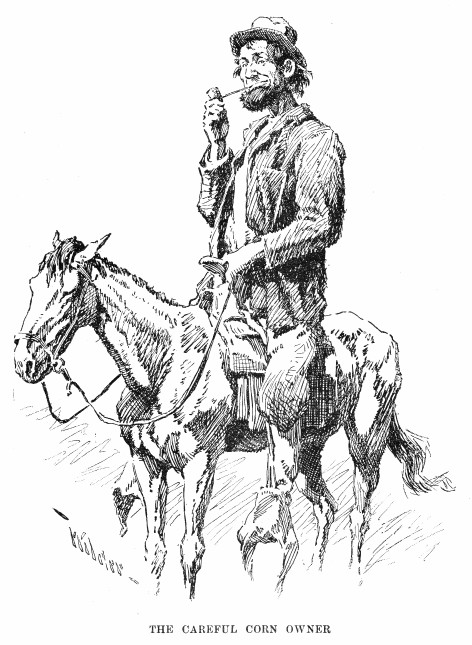
"Well, boys, was that good corn?"
We all suspected the truth instantly.
"He did it!" exclaimed Jack, pointing at me. "He did it all alone.
We're going to give him up
to the authorities at the next town."
The man laughed, and said: "Don't do it. He may reform."
There seemed to be but one thing to do, so I said: "It was your
corn, I suppose. Our only excuse is that
we were out of corn. Tell us how much it is, and we'll pay you for it."
"Not a cent," answered the man, firmly. "It's all right. I've
travelled through them Sand Hills
myself, and I know how it is. You're welcome to all you took, and you
can have another sackful if you want to go
after it."
I thanked him, but told him that we expected to get some feed at
Gordon, the next town. After wishing us good-luck,
he rode away.
We started on, and made but a short stop for noon, near Gordon. We
found ourselves in a fairly well-settled
country, though the oldest settlers had been there but two or three
years. The region was called the Antelope Flats,
and was quite level, with occasional ravines. The trail usually ran
near the railroad, and that night we camped
within three or four rods of it. Long trains loaded with cattle
thundered by all night. We were somewhat nervous
lest Old Blacky should put his shoulder against the wagon while we
slept, and push it on the track in revenge for
the poor treatment we gave him in the Sand Hills, but the plan didn't
happen to occur to him. It was at this camp
that we encountered a remarkable echoing well. It was an ordinary open
well, forty or fifty feet deep, near a neighboring
house, but a word spoken above it came back repeated a score of times.
We failed to account for it.
The next forenoon we jogged along much the same as usual and stopped
for noon at Rushville. This was not far
from the Pine Ridge Indian Agency and the place called Wounded Knee,
where the battle with the Sioux was fought
three or four years later. We saw a number of Indians here, and though
they came up to Ollie's idea of what an
Indian should be a little better than the one that rode with us, they
still did not seem to be just the thing.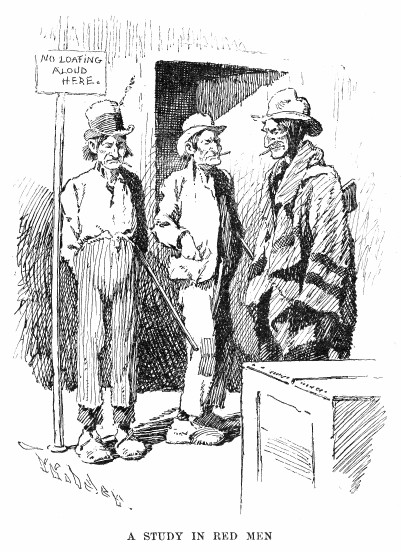
"I don't think," he said, "that they ought to smoke cigarettes."
"It does look like rather small business for an Indian, doesn't it?"
answered Jack. "But then
smoking cigarettes is small business for anybody. What's your idea of
what an Indian ought to smoke?"
"Well, I'm not sure he ought to smoke anything, except of coarse the
peace-pipe occasionally. And he oughtn't
to smoke that very much, because an Indian shouldn't make peace very
often."
"Right on the war-path all the time, flourishing a scalping-knife
above his head, and whooping his teeth
loose--that's your notion of an Indian."
"Well, I don't know as that is exactly it," returned Ollie,
doubtfully. "But it seems to me these
are hardly right. Their clothes seem to be just like white people's."
"I don't know about that," said Jack. "I saw one when I went around
to the post-office wearing
bright Indian moccasins, a pair of soldier's trousers, a fashionable
black coat, and a cowboy hat. I never saw
a white man dressed just like that."
"Well, I think they ought to wear some feathers, anyhow," insisted
Ollie. "An Indian without
feathers is just like a--a turkey without 'em."
The Indians were idling all over town, big, lazy, villanous-looking
fellows, and very frequently they were smoking
cigarettes, and often they were dressed much as Jack had described,
though their clothes varied a good deal. There
were two points which they all had in common, however--they were all
dirty, and all carried bright, clean repeating-rifles,
We wondered why they needed the rifles, since there was no game in the
neighborhood.
The chief business of Rushville seemed to be shipping bones. We went
over to the railroad to watch the process.
There were great piles of them about the station, and men were loading
them into freight-cars.
"What's done with them?" we asked of a man.
"Shipped East, and ground up for fertilizer," he answered.
"Where do they all come from?"
"Picked up about the country everywhere. Men make a business of
gathering them and bringing them in at
so much a load. Supply won't last many months longer, but it's good
business now."
They were chiefly buffalo bones, though there were also those of the
deer, elk, and antelope. We saw some beautiful
elk antlers, and many broad white skulls of the buffalo, some of them
still with the thick black horns on them.
As we were watching the loading of the bones Ollie suddenly exclaimed:
"Oh, see the pretty little deer!"
We looked around, and saw, in the front yard of a house, a young
antelope, standing by the fence, and also watching
the bone-men as they worked.
"It is a beautiful creature, isn't it?" said Jack. "And how happy
and contented it looks!"
"I guess it's happy because it isn't in the bone-pile," said Ollie.
We went over to it, and found it so tame that it allowed Ollie to
pet it as much as he pleased. The man who
owned it told us that he had found it among the Sand Hills, with one
foot caught in a little bridge on the railroad,
where it had apparently tried to cross. He rescued it just before a
train came along.
We left Rushville after a rather longer stop for noon than we
usually made. Nothing worthy of mention occurred
during the afternoon, and that night we camped on the edge of another
small town, called Hay Springs.
"I don't know," said Jack, "whether or not they really have springs
here that flow with water
and hay, or how it got its funny name. If there are that kind of
springs, I think it's a pity there can't be some
of them in the Sand Hills."
Jack went over town after supper for some postage-stamps, and came
back quite excited.
"Found it at last, Ollie!" he exclaimed. "Grandpa Oldberry was
right."
"What--a varmint?" asked Ollie.
"A genuine varmint," answered Jack. "A regular painter. It's in a
cage, to be sure, but it may
get out during the night."
We all went over to see it. It was in a big box back of a hotel, and
the man in charge called it a mountain-lion,
and said it was caught up in the Black Hills. "Right where we're
going," whispered Ollie. The animal
was, I presume, really a jaguar, and was a big cat three or four feet
long.
We were off again the next morning, looking forward eagerly to the
camp for the night, which we expected would
be at Chadron, and where our course would change to the north into
Dakota again, this time on the extreme western
edge, and carry us up to the mountains. Most of the day we travelled
through a rougher country, and saw many buttes--steep-sided,
flat-topped mounds; and in the neighborhood of Bordeaux the road wound
among scattering pine-trees. 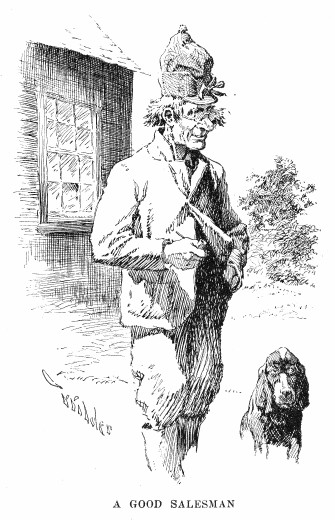 We
camped at noon near the house of a settler who seemed to have a dog
farm, as the place was overrun with the animals.
We needed some corn for the horses, and asked him if he had any to
sell. He was a queer looking man, with hair
the color of molasses candy, and skim-milk eyes.
We
camped at noon near the house of a settler who seemed to have a dog
farm, as the place was overrun with the animals.
We needed some corn for the horses, and asked him if he had any to
sell. He was a queer looking man, with hair
the color of molasses candy, and skim-milk eyes.
"Waal, now, stranger, I jess reckon I have got some co'n to sell,"
he said. "The only trouble
with that there co'n o' mine is that it ain't shucked. If you wouldn't
mind to go out into the field and shuck
it out, we can jess make a deal right here."
We finally gave him fifty cents for all our three sacks would hold,
and he pointed out the field a quarter of
a mile away and went back to the house. We noticed that he very soon
mounted a pony and rode away towards Hay Springs,
but thought nothing of it. When we were ready to start we drove over to
the cornfield to get what we had paid for.
Jack put his head out of the wagon, took a long look, and said:
"That's the sickest-looking cornfield I ever saw!"
We got out, and found a sorry prospect. The corn was poor and
scattering and choked with weeds.
"And the worst of it," called Jack, as he waded out into the weeds,
"is that it has been harvested
about twelve times already. The scoundrel has been selling it to every
man that came along for a month, and I don't
believe there were three sackfuls in the whole field to start with."
We went to work at it, and found that he was not far from right.
"No wonder the old skeesicks went off to town soon as he got his
money," I said. "He won't show
himself back here till he is sure we have gone."
We worked for an hour, and managed to fill one bag with "nubbins,"
and gave up, promising ourselves
that we wouldn't be imposed upon in that way again.
We reached Chadron in due time, and went into camp a little way
beyond, on the banks of the White River, a stream
which flows through Dakota and finally joins the Missouri. Our camp was
on a little flat where the river bends
around in the shape of a horseshoe. It seemed to be a popular
stopping-place, and there were half a dozen other
covered wagons in camp there. The number of empty tin cans scattered
about on that piece of ground must have run
up into the thousands. But there had not been a mile of the road since
we left Valentine which had not had from
a dozen to several hundred cans scattered along it, left by former
"movers." We had contributed our share,
including the gooseberry can. From the labels we noticed on the can
windrow along the road it seemed that peaches
and Boston baked beans were the favorite things consumed by the
overland travellers, though there were a great
many green-corn, tomato, and salmon cans.
"You can get every article of food in tin cans now," observed Jack
one day, "except my pancakes.
I'm going to start a pancake cannery. I'll label my cans 'Jack's
Celebrated Rattletrap Pancakes--Warranted Free
from Injurious Substances. Open this end. Soak two weeks before using.'"
It was a pretty camping-place on the little can-covered fiat, and we
sat up late, visiting with our neighbors
and talking about the Black Hills.
"I think," said Jack, as we stumbled over the cans on our way to the
Rattletrap, "that I'll go
into the mining business up there myself. I'll just back the
Blacksmith's Pet up to the side of a mountain, tickle
his heels with a straw, and he'll have a gold-mine kicked out inside of
five minutes."
to table
of contents
The next day was Sunday, so we did not leave the White River camp till
Monday morning. We found Chadron (pronounced
Shadron) an extremely lively town, in which all of the citizens wore big
hats and immense jingling Mexican spurs.
We had the big hats, but to be in fashion and not to attract attention
we also got jingling spurs.
"I shall wear 'em all night," said Jack, as he strapped his on.
"Only dudes take off their spurs
when they go to bed, and I'm no dude."
Our next objective point was Rapid City. It was a beautiful morning
when we turned to the north. The sand had
disappeared, and the soil was more like asphalt pavement.
"The farmers fire their seed into the ground with six-shooters,"
said a man we fell in with on the
road. "Very expensive for powder."
"The soil's what you call gumbo, isn't it?" I said to him.
"Yes. Works better when it's wet. One man can stick a spade into it
then. Takes two to pull it out, though."
It was not long before we passed the Dakota line, marked by a post
and a pile of tin cans. Shortly before noon
Ollie made a discovery.
"What are those little animals?" he cried. "Oh, I
know--prairie-dogs!"
There was a whole town of them right beside the road, with every dog
sitting on top of the mound that marked
his home, and uttering his shrill little bark, and marking each bark by
a peculiar little jerk of his tail.
"How do you know they are prairie-dogs?" asked Jack.
"They had some of them in the park at home," said Ollie. "But last
fall they all went down in
their burrows for the winter, and in the spring they didn't come up.
Folks said they must have frozen to death."
"Nonsense," said Jack. "They got turned around somehow, and in the
spring dug down instead of
digging up. They may come out in China yet if they have good-luck."
"I can hardly swallow that," replied Ollie. "But, anyhow, these seem
to be all right."
There must have been three or four hundred of them, and not for a
moment did one of them stop barking till Snoozer
jumped out of the wagon and charged them, when, with one last bark,
each one of them shot down his hole so quick
that it was almost impossible to see him move.
"Now that's just about the sort of game that Snoozer likes!"
exclaimed Jack. "If they were badgers,
or even woodchucks, you couldn't drive him at them."
"I don't think there is much danger of his getting any of them,"
said Ollie.
We called Snoozer back, and soon one of the little animals
cautiously put up his head, saw that the coast was
clear, gave one bark, and all the rest came up, and the concert began
as if nothing had happened.
"I suppose that was the mayor of the town that peeped up first?"
said Ollie. "Yes, or the chief
of police," answered Jack. We camped that night by the bed of a dry
creek, and watered the horses at a settler's
house half a mile away.
"That's the most beautiful place for a stream I ever saw," observed
Jack. "If a man had a creek
and no bed for it to run in, he'd be awfully glad to get that."
The next day was distinctly a prairie-dog day. We passed dozens of
their towns, and were seldom out of hearing
of their peculiar chirp.
"I wonder," said Ollie, "if the bark makes the tail go, or does the
tail set off the bark."
"Oh, neither," returned Jack. "They simply check off the barks with
their tails. There's a National
Prairie-Dog Barking Contest going on, and they are seeing who can yelp
the most in a week. They keep count with
their tails."
At the little town of Oelrichs we saw a number of Indians, since we
were again near the reservation. One little
girl nine or ten years old must have been the daughter of an important
personage, since she was dressed in most
gorgeous clothes, all covered with beads and colored
porcupine-quill-work. 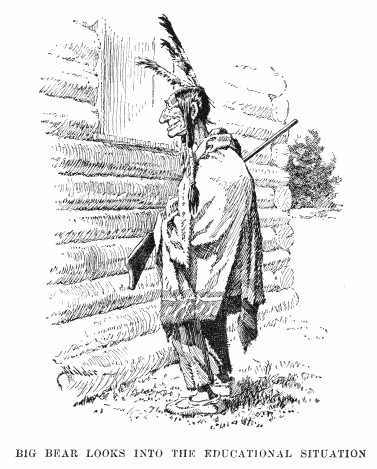 And
at last Ollie saw an Indian wearing feathers. Three eagle feathers
stuck straight up in his hair. He was standing
outside of a log house looking in the window. By-and-by a young lady
came to the door of the house, and as we were
nearer than anybody else, she motioned us to come over.
And
at last Ollie saw an Indian wearing feathers. Three eagle feathers
stuck straight up in his hair. He was standing
outside of a log house looking in the window. By-and-by a young lady
came to the door of the house, and as we were
nearer than anybody else, she motioned us to come over.
"I wish," she said, "that you'd please go around and ask Big Bear to
go away. He keeps looking
in the window and bothering the scholars."
We stepped around the corner, and Jack said: "See here, neighbor Big
Bear, you're impeding the cause of
education."
The Indian looked at him stolidly, but did not move.
"Teacher says vamoose--heap bother pappooses," said Jack.
The Indian grunted and walked away. "Nothing like understanding the
language," boasted Jack, as we
went back to the wagon.
At noon we camped beside a stream, but thirty feet above it. There
was a clay bank almost as hard as stone rising
perpendicularly from the water's edge. With a pail and rope we drew up
all the water we needed. In the afternoon
we got our first sight of the Black Hills, like clouds low on the
northern horizon. About the same time we struck
into the old Sidney trail, which, before the railroad had reached
nearer points, was used in carrying freight to
the Hills in wagons. In some places it was half a mile wide and
consisted of a score or more of tracks worn into
deep ruts. There was a herd of several thousand Texas cattle crossing
the trail in charge of a dozen men, and we
waited and watched them go by. Ollie had never seen such a display of
horns before.
Shortly after this we came upon the first sage-bush which we had
seen. It was queer gray stuff, shaped like
miniature trees, and had the appearance of being able to get along with
very little rain.
Toward night we found ourselves winding down among the hills to the
Cheyenne River. They were strange-looking
hills, most of them utterly barren on their sides, which were nearly
perpendicular, the hard soil standing almost
as firm as rock. They were ribbed and seamed by the rain--in fact, they
were not hills at all, properly speaking,
but small bluffs left by the washing out of the ravines by the rain and
melting snows. Just as the sun was sinking
among the distant hills we came to the river. It was shallow, only four
or five yards wide, and we easily forded
it and camped on the other side. The full moon was just rising over the
eastern hills. There was not a sound to
be heard except the gentle murmur of the stream and the faint rustle of
the leaves on a few cottonwood-trees. There
was plenty of driftwood all around, and after supper we built up the
largest camp-fire we had ever had. The flame
leaped up above the wagon-top, and drifted away in a column of sparks
and smoke, while the three horses stood in
the background with their heads close together munching their hay, and
the four of us (counting Snoozer) lay on
the ground and blinked at the fire.
"This is what I call the proper thing," remarked Jack, after some
time, as he roiled over on his blanket
and looked at the great round moon.
"Yes," I said, "this will do well enough. But it would be pretty
cool here if it wasn't for that
fire."
"Yes, the nights are getting colder, that's certain. I was just
wondering if that cover will withstand
snow as well as it does rain?"
"Why," said Ollie, "do you think it's going to snow?"
"Not to-night," returned Jack. "But it may before we get out of the
mountains. The snow comes
pretty early up there sometimes. I think I'll get inside and share the
bed with the rancher after this, and you
and Snoozer can curl up in the front end of the wagon-box. It would be
a joke if we got snowed in somewhere, and
had to live in the Rattletrap till spring."
"I wouldn't care if we could keep warm," said Ollie. "I like living
in it better than in any
house I ever saw."
"I'm afraid it would get a little monotonous along in March,"
laughed Jack. "Though I think myself
it's a pretty good place to live. Stationary houses begin to seem tame.
I hope the trip won't spoil us all, and
make vagabonds of us for the rest of our lives."
We were reluctant to leave this camp the next morning, but knew that
we must be moving on. It was but a few
miles to the town of Buffalo Gap, and we passed through it before noon.
"There are more varmints," cried Ollie, as we were driving through
the town. They were in a cage in
front of a store, and we stopped to see them.
"What are they?" one of us asked the man who seemed to own them.
"Bob-cats," he answered, promptly.
"Must be a Buffalo Gap name for wild-cats," said Jack, as we drove
on, "because that's what they
are."
Ollie had gone into a store to buy some cans of fruit, and when he
came out he looked much bewildered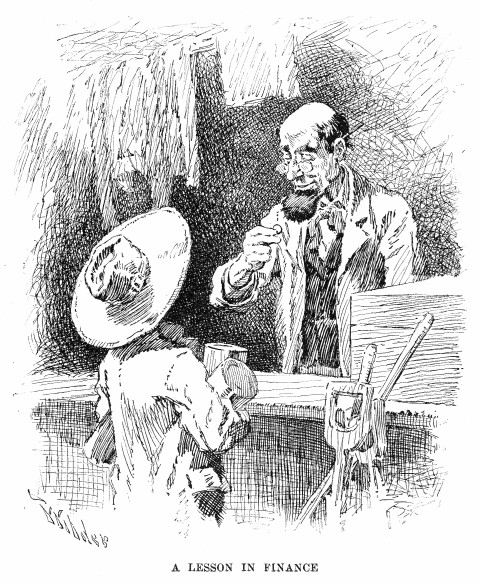 .
.
"I think," he said, "that that man must be crazy, or something.
There were thirty cents coming
to me in change. He tossed out a quarter and said, 'Two bits,' and then
a dime and said, 'Short bit--thank you,'
and closed up the drawer and started off. I didn't want more than was
coming to me, so I handed out a nickle and
said, 'There, that makes it right.' The man looked at it, laughed, and
pushed it back, and said, 'Keep it, sonny;
I haven't got any chickens.' Now, I'd like to know what it all meant."
We both laughed, and when Jack recovered his composure he said:
"It means simply that we're getting out into the mining country,
where no coin less than a dime circulates.
He didn't happen to have three dimes, so the best he could do was to
give you either twenty-five or thirty-five
cents, and he was letting you have the benefit of the situation by
making it thirty-five. A bit is twelve and a
half cents, and a short bit is ten cents. A two-bit piece is a quarter."
"Yes; but what about his not keeping chickens?"
"Oh, that was simply his humorous way of saying that all coins under
a dime are fit only for chicken-feed."
We camped that night beside the trail near a little log store. "What
you want to do," said the man
in charge, "is to take your horses down there behind them trees to park
'em for the night. Good feed down
there."
"'To park,'" said Jack, in a low voice. "New and interesting verb.
He mean's turn 'em out to
grass. We mustn't appear green." Then he said to the man:
"Yes, we reckoned we'd park 'em down there to-night."
The next day was the coldest we had experienced, and we were glad to
walk to keep warm. We were getting among
the smaller of the hills, with their tops covered with the peculiarly
dark pine-trees which give the whole range
its name. We camped at night under a high bank which afforded some
protection from the chilly east wind. Now that
we were all sleeping in the wagon there was no room in it to store the
sacks of horse-feed which we had, and we
knew that if we put them outside Old Blacky would eat them up before
morning.
"There's nothing to do," said Jack, "but to carry them around up on
that bank and hang them down
with ropes. Leave 'em about twelve feet from the bottom and ten feet
from the top, and I don't think the Pet can
get them."
We accordingly did so, and went to bed with the old scoundrel
standing and looking up at the bags wistfully,
though he had just had all that any horse needed for supper. But in the
morning we found that he had clambered
up high enough to get hold of the bottom of one of the sacks and pull
it down and devour fully half of it. He was,
as Jack said, "the worst horse that ever looked through a collar."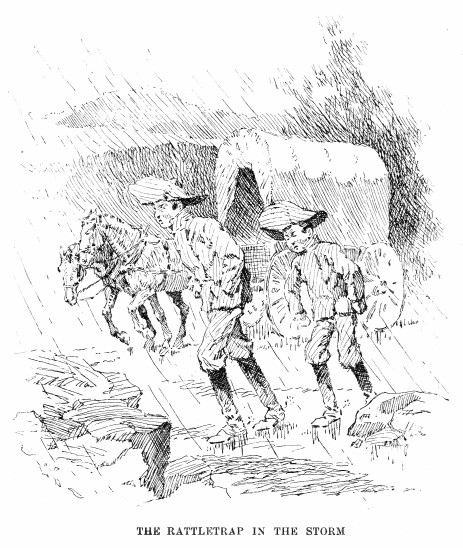
But the weather in the morning gave us more concern than did the
foraging of the ancient Blacky. It was even
colder than the night before, and the raw east wind was rawer, and with
it all there was a drizzling rain. It was
not a hard rain, but one of the kind that comes down in small clinging
drops and blows in your face in a fine spray.
Jack got breakfast in the wagon, and we ate the hot cakes and
warmed-over grouse with a good relish. Then we loaded
in what was left of the horsefeed, and started.
It was impossible to keep warm even by walking, but we plodded on
and made the best of it. The road was hilly
and stony; but by noon we had got beyond the rain, and for the rest of
the way it was dry even if cold. The hills
among which we were winding grew constantly higher, and the quantity of
pine timber upon their summits greater.
Just as dusk was beginning to creep down we came around one which might
fairly have been called a small mountain,
and saw Rapid City spread out before us, the largest town we had seen
since leaving Yankton. We skirted around
it, and came to camp under another hill and near a big stone quarry a
half-mile west of town. There was a mill-race
just below us, and plenty of water. We fed the horses and had supper.
There was a road not much over a hundred
yards in front of our camp, along which, through the darkness, we could
hear teams and wagons passing.
"I wonder where it goes to?" said Ollie.
"I think it's the great Deadwood trail over which all the supplies
are drawn to the mines by mule or horse
or ox teams," said Jack. "There's no railroad, you know, and everything
has to go by wagon--goods and
supplies in, and a great deal of ore out. Let's go over and see."
The moon was not yet risen and the sky was covered with clouds, so
it was extremely dark. We took along our
lantern, but it did not make much impression on the darkness. When we
reached the road we found that everywhere
we stepped we went over our shoe-tops in the soft dust. We beard a
deep, strange creaking noise, mixed with what
sounded like reports of a pistol, around the bend in the trail. Soon we
could make out what seemed to be a long
herd of cattle winding towards us, with what might have been a circus
tent swaying about behind them.
"What's coming?" we asked of a boy who was going by.
"Old Henderson," he replied.
"What's he got?"
"Just his outfit."
"But what are all the cattle?"
"His team."
"Not one team?"
"Yes; eleven yoke."
"Twenty-two oxen in one team?"
"Yes; and four wagons."
The head yoke of oxen was now opposite to us, swaying about from
side to side and swirling their tails in the
air, but still pressing forward at the rate of perhaps a mile and a
half or two miles an hour. Far back along the
procession we could dimly see a man walking in the dust beside the last
yoke, swinging a long whip which cracked
in the air like a rifle. Behind rolled and swayed the four great
canvas-topped wagons, tied behind one another.
We watched the strange procession go by. There was only one man,
without doubt Henderson, grizzled and seemingly
sixty years old. The wagon wheels were almost as tall as he was, and
the tires were four inches wide. The last
wagon disappeared up the trail in the dust and darkness.
"Well," said Jack, "I think when I start out driving at this time of
night with twenty-two guileless
oxen and four ten-ton wagons that I'll want to get somewhere pretty
badly." Then we went back to the Rattletrap.
to table
of contents
After we got back to the Rattletrap we promised ourselves plenty of
Sport the next day watching the freighters
with their long teams and wagon trains. Jack could not recover from his
first glimpse of Henderson.
"Rather a neat little turnout to take a young lady out driving
with," he said, after we had gone to
bed. "Twenty-two oxen and four wagons. Plenty of room. Take along her
father and mother. And the rest of the
family. And her school-mates. And the whole town. Good team to go after
the doctor with if somebody was sick--mile
and a half an hour. That trotting-cow man at Yankton ought to come up
here and show Henderson a little speed. Still,
I dare say Henderson could beat Old Browny on a good day for sleeping,
and when he didn't have Blacky to pall him
along."
But we got small sight of the trail the next day, as the rain we had
left behind came upon us again in greater
force than ever. It began toward morning, and when we looked out, just
as it was becoming light, we found it coming
down in sheets--"cold, wet sheets," as Ollie said, too. The horses
stood huddled together, wet and chilled.
We got on our storm-coats and led them up to a house a sort distance
away, which proved to be Smith's ranch. There
we found large, dry sheds, under which we put them and where they were
very glad to go. Once back in the cabin
of the Rattletrap, we scarcely ventured out again.
It certainly wasn't a very cheerful day. We would not have minded
the rain much, because we were dry enough;
but the cold was disagreeable, and we were obliged to wear our
overcoats all day. We could watch the road from
the front of the wagon, and saw a number of freighters go by, usually
with empty wagons, as it soon became too
muddy for those with loads. We saw one fourteen-ox team with four
wagons, and another man with twelve oxen and
three wagons. There were also a number of mule teams, and we noticed
one of twelve mules and five wagons, and several
of ten mules and three or four wagons. With these the driver always
rode the nigh wheel animal--that is, the left-hand
rear one.
"I'm going to put a saddle on Old Blacky and ride him after this,"
said Jack. "Bound to be in
the fashion. Wonder how Henderson is getting along in the mud? A mile
in two hours, I suppose. Must be impossible
for him to see the head oxen through this rain."
The downpour never stopped all day. We tried letter-writing, but it
was too cold to hold the pen; and Jack's
efforts at playing the banjo proved equally unsuccessful. We fell back
on reading, but even this did not seem to
be very satisfactory. So we finally settled down to watching the rain
and listening to the wind.
When evening came we shut down the front of the cover and tried to
warm up the cabin a little by leaving the
oil-stove burning, but it didn't seem to make much difference. So we
soon went to bed, rather damp, somewhat cold,
and a little dispirited. I think we all stayed awake for a long time
listening to the beating of the rain on the
cover, and wondering about the weather of the morrow.
When we awoke in the morning it did not take long to find out about
the weather. The rain had ceased and the
sky was clear, but it was colder. Outside we found ice on the little
pools of water in the footprints of the horses.
We were stiff and cold. Some of us may have thought of the comforts of
home, but none of us said anything about
them.
"This is what I like," said Jack. "Don't feel I'm living unless I
find my shoes frozen in the
morning. Like to break the ice when I go to wash my face and hands, and
to have my hair freeze before I can comb
it."
But we observed that he kept as close to the camp-fire which we
started as any of us. We went up to Smith's
to look after the horses. While Jack and I were at the sheds Ollie
stayed in the road watching the freight teams.
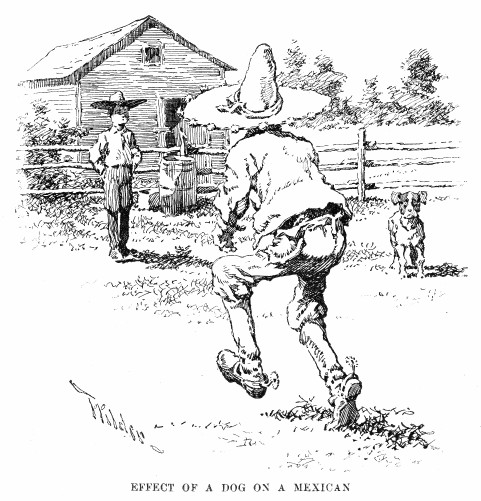 A big swarthy man, over six feet in height,
came along, and after looking over the fence
at Smith's house some time, said to Ollie:
A big swarthy man, over six feet in height,
came along, and after looking over the fence
at Smith's house some time, said to Ollie:
"Do you s'pose Smith's at home?"
"Oh, I guess so," answered Ollie.
"I'd like to see him," went on the man, with an uneasy air.
"Probably you'll find him eating breakfast," said Ollie.
"I don't like to go in," said the man.
"Why not?"
"I'm--I'm afraid of the dog."
"Oh!" replied Ollie. "Well, I'm not. Come on," and he stalked ahead
very bravely, while
the man followed cautiously behind.
"He's a Mexican," said Smith in explanation afterwards. "All
Mexicans are afraid of dogs."
"That's a pretty broad statement," said Jack, after Smith had gone.
"I believe, if there was
a good reward offered, that I could find a Mexican who isn't afraid of
dogs. Though perhaps it's the hair they're
afraid of; Mexican dogs don't have any, you know."
"Don't any of them have hair?" asked Ollie.
"Not a hair," answered his truthful uncle. "I don't suppose a
Mexican dog would know a hair if
he saw it."
"I think that's a bigger story than Smith's," said Ollie.
It was Sunday, and we spent most of the day in the wagon, though we
took a long walk up the valley in the afternoon.
The first thing Ollie said the next morning was, "When are we going to
see the buffaloes?"
Smith had been telling us about them the evening before. They were
down-town, and belonged to a Dr. McGillicuddie.
They had been brought in recently from the Rosebud Indian Agency, and
had been captured some time before in the
Bad Lands.
We followed the trail, now as deep with mud as it had been with
dust, meeting many freighters on the way, and
found the buffaloes near the Deadwood stage barn.
"See!" exclaimed Ollie; "there they are, in the yard."
"Don't say 'yard,'" returned Jack; "say 'corral,' with a good,
strong accent on the last syllable.
A yard is a corral, and a farm a ranch, and a revolver a
six-shooter--and a lot more. Don't be green, Oliver."
"Oh, bother!" replied Ollie. "There's ten of 'em. See the big
fellow!"
"They're nice ones, that's so," answered Jack. "I'd like to see the
Yankton man we heard about
try to milk that cow over in the corner."
After we had seen the buffaloes we wandered about town and jingled
our spurs, which were quite in the fashion.
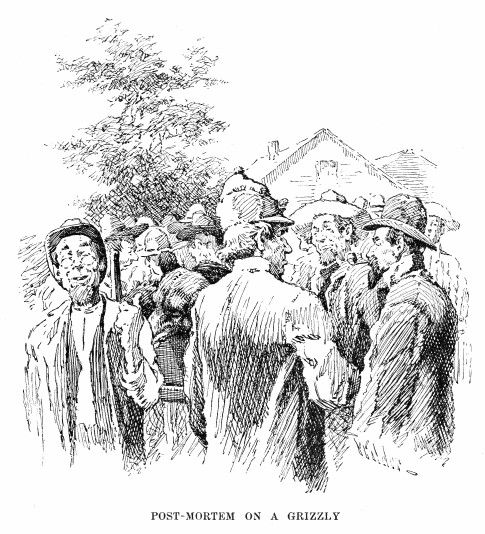 We encountered a big crowd in front of one of
the markets, and found that a hunter had just
come in from the mountains to the west with the carcass of the biggest
bear ever brought into Rapid City. Some
said it was a grizzly, and others a silvertip, and one man tried to
settle the difficulty by saying that there
wasn't any difference between them. But it was certainly a big bear,
and filled the whole wagon-box. Ollie sidled
through the crowd and asked so many questions of the man, who was named
Reynolds, that he good-naturedly gave Ollie
one of the largest of the claws. It was five inches long.
We encountered a big crowd in front of one of
the markets, and found that a hunter had just
come in from the mountains to the west with the carcass of the biggest
bear ever brought into Rapid City. Some
said it was a grizzly, and others a silvertip, and one man tried to
settle the difficulty by saying that there
wasn't any difference between them. But it was certainly a big bear,
and filled the whole wagon-box. Ollie sidled
through the crowd and asked so many questions of the man, who was named
Reynolds, that he good-naturedly gave Ollie
one of the largest of the claws. It was five inches long.
At noon we went down to the camp of the freighters on the outskirts
of town, near Rapid Creek. There must have
been fifty "outfits"--Jack said that was the right word--and several
hundred mules, as many oxen, and
a few horses. The animals were, most of them, wandering about wherever
they pleased, the mules and horses taking
their dinner out of nosebags, and the mules keeping up a gentle
exercise by kicking at one another. It seemed a
hopeless confusion, but the men were sitting about on the ground,
calmly cooking their dinners over little camp-fires.
One man, whom we had got acquainted with in the morning at Smith's,
asked us to have dinner with him, and made
the invitation so pressing that we accepted. He had several gallon's of
coffee and plenty of bacon and canned fruit,
and a peculiar kind of bread which he had baked himself.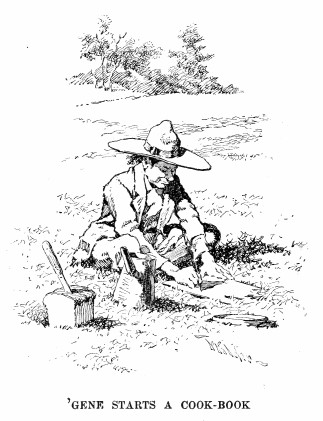
"I'm a-thinking," he said, "there ain't enough sal'ratus in that
there bread; but I'm a poor
cook, anyhow."
The bread seemed to us to be already composed chiefly of saleratus,
so his apology struck us as unnecessary.
He very kindly wrote out the receipt on a shingle for Jack, but I stole
it away from him after we got home and
burned it in the camp-fire; so we escaped that.
"Your pancakes are bad enough," I said to him. "We don't care to try
your saleratus bread."
Jack was a good deal worked up about the loss of his receipt, and
experimented a long time to produce something
like the freighter's bread without it; but as Snoozer wouldn't try the
stuff he made, and he was afraid to do so
himself, nothing came of it.
We enjoyed our dinner with the man, however, and Jack added further
to his vocabulary in finding that the drivers
of the ox teams were called "bullwhackers," and those of the mules and
horses "muleskinners."
In the afternoon we climbed the hill above our camp. It gave us a
long view off to the east across the level
country, while away to the west were the mountain-peaks rising higher
and higher. It was still cold, and the raw
northeast wind moaned through the pines in a way that made us think of
winter.
We went to bed early that night, so as to get a good start for
Deadwood the next day. We brought the horses
down from the ranch in the evening, blanketed them, and stood them out
of the wind among some trees.
"Four o'clock must see us rolling out of our comfortable beds and
getting ready to start," said Jack,
as we turned in. "We must play we are freighters."
Jack planned better than he knew; we really "rolled out" in an
exceedingly lively manner at three
o'clock. We were sleeping soundly at that hour, when we were awakened
by the motion of the wagon. Jack and I sat
up. It was swaying from side to side, and we could hear the wheels
bumping on the stones. The back end was considerably
lower than the front.
"It's running down the bank!" I cried, and we both plunged through
the darkness for the brake-handle.
We fell over Ollie and Snoozer, and were instantly hopelessly tangled.
It seemed an age, with the wagon swaying
more and more, before we found the handle. Jack pushed it up hard, we
heard the brake grind on the wheels outside;
then there was a great bump and splash, and the wagon tilted half over
and stopped. We found Ourselves lying on
the side of the cover, with cold water rising about us. We were not
long in getting out, and discovered that the
Rattletrap was capsized in the mill-race.
"Old Blacky did it!" cried Jack, as he danced around and shook his
wet clothes. "I know he did.
The old sinner!"
We got out the lantern and lit it. Only the hind end of the wagon
was really in the race; one front wheel still
clung to the bank, and the other was up in the air. Ollie got in and
began to pass things out to Jack, while I
went up the hill after the horses. Jack was right. Old Blacky was
evidently the author of our misfortune. He had
broken loose in some manner, and probably begun his favorite operation
of making his toilet on the corner of the
wagon by rubbing against it. The brake had carelessly been left off, he
had pushed the wagon back a few feet, and
it had gone over the bank. I soon had the harness on the horses, and
got them down the hill. We hitched them to
the hind wheel with a long rope, Jack wading in the water to his waist,
and pulled the wagon upright. Then we attached
them to the end of the tongue, and after hard work drew it out of the
race. By this time we were chilled through
and through. Our beds and nearly everything we had were soaking with
water.
"How do you like it, Uncle Jack?" inquired Ollie. "Do you feel that
you are living now?"
Jack's teeth were chattering. "Y--yes," he said; "but I won't be if
we don't get a fire started
pretty quick."
There were some timbers from an old bridge near by, and we soon had
a good fire, around which we tramped in
a procession till our clothes were fairly dry. The wind was chilly, and
it was a dark, cloudy morning. The unfortunate
Snoozer had gone down with the rest of us, and was the picture of
despair, till Ollie rubbed him with a dry corner
of a blanket, and gave him a good place beside the fire.
By the time two or three hours had elapsed we began to feel
partially dry, and decided to start on, relying
on exercise to keep ourselves warm. We had had breakfast in the
meantime, and, on the whole, were feeling rather
cheerful again. We opened the cover and spread out the bedding, inside
and outside, and hung some of it on a long
pole which we stuck into the wagon from the rear. Altogether we
presented a rather funny appearance as we started
out along the trail, but no one paid much attention to us. The
freighters were already astir, and we were constantly
passing or meeting their long trains. Among others we passed Eugene
Brooks, the man with whom we had taken dinner.
We told him of our mishap, and he laughed and said:
"That's nothing in this country. Something's always happening here
which would kill folks anywhere else.
You stay here awhile and you'll be as tough as your old black horse."
Brooks had an outfit of five spans of mules and two wagons. We
stayed with him a half-hour, and then went on.
As we could not reach Deadwood that day, he advised us to camp that
night where the trail crossed Thunder Butte
Creek, a branch of La Belle Fourche.
The trail led for the most part through valleys or along the sides
of hills, and was generally not far from
level, though there was, of course, a constant though hardly
perceptible rise as we got farther into the mountains.
We camped at noon at Elk Creek, and made further progress at drying our
household effects. We pressed on during
the afternoon, and passed through the town of Sturgis, where we laid in
some stores of provisions to take the place
of those spoiled by the water, and also a quantity of horse-feed. Later
we congratulated ourselves on our good-luck
in doing this.
As the afternoon wore away we found ourselves getting up above the
timber-line. The mountains began to shut
in our view in all directions, and the valleys were narrowing. As night
drew nearer, Jack said:
"Seems to me it's about time we got to this Thunder Butte Creek.
'Gene said that if we passed Sturgis we'd
have to go on to that if we wanted water."
We soon met a man, and inquired of him the distance to the desired
stream. "Two miles," he replied,
promptly. We went on as much as a mile and met another man, to whom we
put the same question. "Three miles,"
he answered, with great decision.
"That creek seems to be retreating," said Jack, after the man had
gone on. "We've got to hurry
and catch it, or it will run clean into Deadwood and crawl down a gold
mine."
It was growing dark. We forged ahead for another mile, and by this
time it was quite as dark as it was going
to be, with a cloudy sky, and mountains and pines shutting out half of
that. I was walking ahead With the lantern,
and came to a place where the trail divided.
"The road forks here," I called. "Which do you suppose is right?"
"Which seems to be the most travelled?" asked Jack.
"Can't see any difference," I replied. "We'll have to leave it to
the instinct of the horses."
"Yes, I'd like to put myself in the grasp of Old Blacky's instinct.
The old scoundrel would go wrong if
he knew which was right."
"Well," I returned, "come on and see which way he turns, and then go
the other way." (Jack
always declared that the old fellow understood what I said.)
He drove up to the forks, and Blacky turned to the right. Jack drew
over to the left, and we went up that road.
We continued to go up it for fully three miles, though we soon became
convinced that it was wrong. It constantly
grew narrower and apparently less travelled. We were soon winding along
a mountain-side among the pines, and around
and above and below great rocks.
"We'll go till we find a decent place to camp, and then stop for the
night," said Jack. We finally
came to a little level bench covered with giant pines, and we could
hear water beyond. I went on with the lantern,
and found a small stream leaping down a gulch.
"This is the place to stop," I said, and we soon had our camp
established, and a good fire roaring
up into the tree-tops. Ollie found plenty of dry pine wood, and we
blanketed the horses and stood them under a
protecting ledge. It was cold, and the wind roared down the gulch and
moaned in the pines, but we scarcely felt
it below. We finished drying our bedding and had a good supper. Jack
got out his banjo and tried to compete with
the brook and the pines. We went to bed feeling that we were glad we
had missed the road, since it had brought
so delightful a camping-place.
Ollie was the first to wake in the morning. It was quite light.
"What makes the cover sag down so?" he asked. Jack opened his eyes,
reached up with the whipstock
and raised it. Something slid off the outside with a rush.
"Open the front and you'll see," answered Jack.
Ollie did so, and we all looked out. The ground was deep with snow,
and it was still falling in great feathery
flakes. Old Blacky was loose, and looked in at us with a wicked gleam
in his eyes.
to table
of contents
"You're a miserable, sneaking, treacherous old equine scoundrel!" cried
Jack, shaking his fist violently
at Old Blacky. "You knew you were making us come the wrong road."
Old Blacky answered never a word, but turned, hit the wagon-tongue a
kick, and joined the other horses.
"Well, close down the front and let's talk this thing over," said
Jack. "In the first place,
we are snowed in."
"In the second place," said I, "we may stay snowed in a week."
"I don't think we're prepared for that," said Ollie, very solemnly.
"Let's see," went on Jack. "There are two sacks of ground feed under
Ollie's bed. By putting
the horses on rather short rations that ought to last pretty nearly or
quite a week. But for hay we're not so well
provided. There's one big bundle under the wagon, if Blacky hasn't
eaten it up. The pony won't need any, because
she knows how to paw down to the dry grass. The others don't know how
to do this, and the hay will last them, after
a fashion, for about three days."
"Perhaps by that time the pony will have taught them how to paw," I
said.
"Wouldn't be surprised," returned Jack. "Perhaps by that time we'll
all be glad to learn from
her. We've got flour enough to last a fortnight, so we needn't be
afraid of running out of water-pancakes at least.
You don't grow fat on 'em, but, on the other hand, there is no gout
lurking in a water-pancake as I make it."
"No, Jack, that's so," I said, feelingly. "We've got enough bacon for
several meals, a can of
chicken, and two earls of beans. Also a loaf of bread and a pound of
crackers. Then there's three cans of fruit,
a dozen potatoes, six eggs, a quart of milk, and half a pound of
pressed figs. After that we'll paw with the pony."
"I wonder if we couldn't get some game?" inquired Ollie.
"Snow-birds, maybe," said Jack. "Or perhaps an owl. I've heard
b'iled owl spoken of."
After all, the prospect was not so bad. Besides, it was so early in
the season that it did not seem at all likely
that we should be snowbound a week. Still, we knew little about the
mountain climate.
We got on our overcoats and went out and gave the horses their
breakfast. Old Blacky was still cross, but Jack
contented himself by calling him a few names. We also got up what wood
we could and piled it against the wagon,
for use in case our kerosene became exhausted, though we decided to
cook in the wagon for the present. The snow
was seven or eight inches deep, and still falling rapidly. After
breakfast we took the pony down to a little open
fiat and turned her loose. The old instinct of her wild days came back
to her, and she began to paw away the snow
and gnaw at the scanty grass beneath.
After giving the other horses a little hay we returned to the wagon,
where we stayed most of the day. I'm afraid
we were a little frightened by the prospect. Of course, we knew that if
it came to the worst we could leave the
wagon and make our way back along the trail on foot, but we did not
want to do that. But as for getting the wagon
back along the narrow road, now blotted out by the snow, we knew it
would be foolish to attempt it. It was not
very cold in the wagon, and Jack played the banjo, and we were fairly
cheerful. The snow kept coming down all day,
and by night it was a foot deep. The pony came in from the flat as it
began to grow dark, and we gave the horses
their supper and left them in the shelter of the rocks. Then we brushed
the snow off the top of the cover, as we
had done several times before, and went in to spend the evening by the
light of the lantern. When bedtime came,
Jack looked up and said:
"The cover doesn't seem to sag down. It must have stopped snowing."
We looked out, and found that it was so. We could even see the
stars; and, better yet, it did not seem to be
growing colder. We went to bed feeling encouraged.
The next morning the sun peeped in at us through the long trunks of
the pines, and Ollie soon discovered that
the wind was from the south.
"Unless it turns cold again, this will fix the snow," said Jack.
He was right, and it soon began to thaw. By noon the little stream
in the gulch was a torrent, and before night
patches of bare ground began to appear. We decided not to attempt to
leave camp that day, but the next morning
saw us headed back along the tortuous road. In two hours we were again
on the main trail. Just as we turned in,
Eugene Brooks came along, having also been delayed by the snow, though
the fall where he was had not been nearly
so great. 'Gene laughed at us, and told us that we had been following a
trail to some lead mines which had been
abandoned several months before.
Half a mile farther on we came to the Thunder Butte Creek which we
had sought. The water was almost blood-red,
which 'Gene told us came from the gold stamp-mills on its upper course.
If the water had been gray it would have
indicated silver-mining. 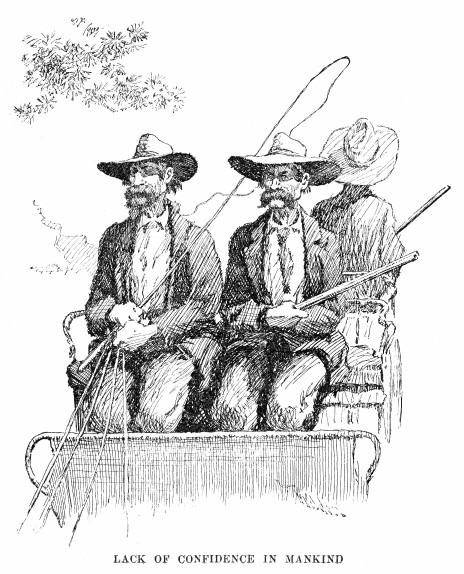 Just
beyond we met the Deadwood Treasure Coach. It was
an ordinary four-horse stage, without passengers, but carrying two
guards, each with a very short double-barrelled
shot-gun resting across his lap. The stage was operated by the express
company, and was bringing out the gold bricks
from the mines near Deadwood.
Just
beyond we met the Deadwood Treasure Coach. It was
an ordinary four-horse stage, without passengers, but carrying two
guards, each with a very short double-barrelled
shot-gun resting across his lap. The stage was operated by the express
company, and was bringing out the gold bricks
from the mines near Deadwood.
"I suppose," said Ollie, musingly, "if anybody tried to rob the
coach, those fellows would shoot
with their guns?"
"Oh no," replied Jack. "Oh no; they carry those guns to fan
themselves with on hot days."
But Ollie did not seem to be misled by this astonishing information.
As we went on the road grew constantly more mountainous. Sometimes
the trail ran along ledges, and sometimes
near roaring streams and waterfalls, and the great pine-trees were
everywhere. We passed two grizzly old placer-miners
working just off the trail, and stopped and watched them "pan out" a
few shovelfuls of dirt. They were
rewarded by two or three specks of gold, and seemed satisfied. 'Gene
told us afterward that one of them was an
old California '49er, who had used the same pan in every State and
Territory of the West.
It was a little after noon when we drove into Deadwood--the last
point outward bound at which the Rattletrap
expected to touch. It was a larger town than Rapid City, and was wedged
in a little gulch between two mountains,
with the White Wood Creek rushing along and threatening to wash away
the main street. We noticed that the only
way of reaching many of the houses on the mountain-side was by climbing
long flights of stairs. We drove on, and
camped near a mill on the upper edge of town.
In the afternoon we wandered about town, and, among other places,
visited the many Chinese stores. We also clambered
up the mountain-sides to the two cemeteries, which we could see far
above the town. It seemed to us that on rather
too many of the head-stones, (which were in nearly every case boards,
by-the-way) it was stated that the person
whose grave it marked was "assassinated by" so-and so, giving the name
of the assassin; but these were
of the old days, when no doubt there were a good many folks in Deadwood
who left the town just as well off after
they had been assassinated. "Killed by Indians" was also the record on
some of the boards. Ollie was
greatly interested in the Chinese graves, with dishes of rice and
chicken on them, and colored papers covered with
curious characters--prayers, I suppose. We climbed on up to the White
Rocks, almost at the top of the highest peak
overlooking Deadwood, and had a good view of the town and gulch below,
and of the great Bear Butte standing out
alone and bold miles to the east. We were tired, and glad to go to bed
as soon as we got back to the wagon.
The next day we decided to visit Lead City (pronounced not like the
metal, but like the verb to lead). Here
were most of the big gold mines, including the great Homestake Mine. It
was only two or three miles, and we drove
over early. It was a strange town, perched on the side of a mountain,
and consisted of small openings in the ground,
which were the mines, and immense shed-like buildings, which contained
the ore-reducing works. The noise of the
stamp-mills filled the whole town, and seemed to drown out and cover up
everything else. We soon found that there
was no hope of our getting into the mines.
"They'd think you were spies for the other mines, or something of
that sort," said a man to us. "Nobody
can get down. Nobody knows where they are digging, and they don't mean
that anybody shall. They may be digging
under their own property exclusively, and they may not. For all I know,
they may be taking gold that belongs to
me a thousand feet, more or less, under my back yard."
"If I had a back yard here," said Jack, after we had passed on, "I'd
put my ear to the ground
once in a while and listen, and if I heard anybody burrowing under it
I'd--well--I'd yell scat at 'em."
We found no difficulty in getting in the stamp-mills, and a man
kindly told us much about them.
"The Homestake Mills make up the largest gold-reducing plant in the
world," said the man. "Where
do you suppose the largest single stamp-mill in the world is?" We
guessed California.
"No," he said; "it's in Alaska--the Treadwell Mill."
We decided that the stamp-mills were the noisiest place we were ever
in. There were hundreds of great steel
bars, three or four inches in diameter and a dozen feet long, pounding
up and down at the same time on the ore
and reducing it to powder. It was mixed with water, and ran away as
thin red mud, the gold being caught by quicksilver.
The openings of the shafts and tunnels were in or near the mills, and
there were the smallest cars and locomotives
which we had ever seen going about everywhere on narrow tracks,
carrying the ore. Ollie walked up to one of the
locomotives and looked down at it, and said:
"Why, it seems just like a Shetland-pony colt. I believe I could
almost lift it."
The engineer sat on a little seat on the back end, and seemed bigger
than his engine. As we looked at them we
constantly expected to see them tip up in front from the weight of the
engineer. There was also a larger railroad,
though still a narrow gauge, winding away for twenty miles along the
tops of the hills, which was used principally
for bringing wood for the engines and timbers for propping up the mines.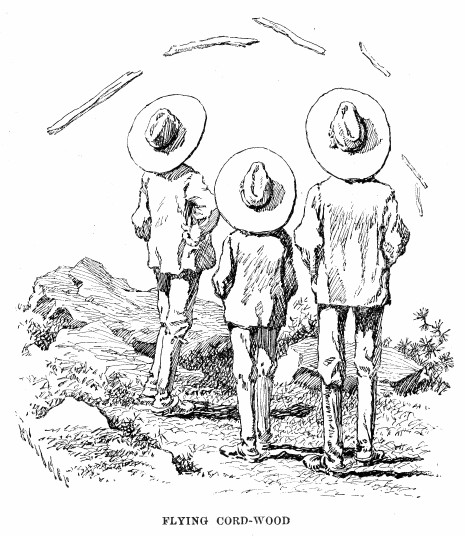
We were walking along a connecting shed, and happened to look out a
window, when we saw a four-foot stick of
cord-wood shoot up fifty feet from some place behind us, and after
sailing over a wide curve, like a "fly-ball,"
alight on a great pile of similar sticks on the lower ground, which was
much higher than an ordinary house, and
must have contained thousands of cords.
"Good gracious!" exclaimed Jack. "Wish I could throw a stick of wood
like that fellow."
Another and another shot after the first one in quick succession.
Sometimes there were two almost together,
and we noticed the bigger and heavier the stick the higher and farther
it was shot. We saw some almost a foot in
diameter soaring like straws before the wind.
"What a baseball pitcher that man would make!" went on Jack,
enthusiastically. "Think of his
arm! Look at that big one go--it must weigh two hundred pounds!"
"Let's get out of this shed and investigate the mystery," I said.
Outside it was all clear. The narrow-gauge wood railroad ended on
the edge of the steep hill overlooking the
mills. Down this was a long wooden chute, or flume, like a big trough,
which for the last thirty or forty feet
at its lower end curved upward. Men were unloading wood from a train at
the upper end. Each stick shot down the
flume like lightning, up the short incline at the end, and soared away
like a bird to the pile beyond and below
the shed. A little stream of water trickled constantly down the chute
to keep the friction of the logs from setting
it on fire.
"That's the most interesting thing here," said Jack. "I'd like to
send the Blacksmith's Pet down
the thing and see what he would do. I'll wager he'd kick the wood-pile
all over the town after he alighted."
We spent nearly the whole day in wandering about the stamp-mills.
The great steam engines which operated them
were some of the largest we had ever seen.
"And think," observed Jack, "of the fact that all of this heavy
machinery, including the big
engines and the locomotives and cars, and, in fact, everything, was
brought overland on wagons, probably most of
it nearly three hundred miles. No wonder people got to driving such
teams as Henderson's."
Toward night we returned to Deadwood by the way of Central City.
Here were more great mines and mills, but they
did not Seem to be so prosperous, and part of the town was deserted,
and consisted of nothing but empty houses.
Just as the sun set we drove in through the Golden Gate, and east
anchor at our old camp near the mill.
The next morning was wintry again, with snowflakes floating in the
air. The ground was frozen, and the wind
seemed to come through the wagon-cover with rather more freedom than we
enjoyed.
"It's time we began the return voyage," said Jack. "We're a long way
from home, and we won't
get there any too soon if we go as fast as we can and take the shortest
out." So we started that afternoon.
The shortest cut was to return to Rapid City, and then, instead of
going south into Nebraska, to go straight
east, through the Sioux Indian Reservation, crossing the Missouri at
Pierre, and then on across the settled country
of eastern Dakota to Prairie Flower, over against the Minnesota line.
We followed the same road between Deadwood and Rapid City, with the
exception that we turned out in one place,
and went around by Fort Meade. Here we found a beautiful camping-place
the first night near a little stream and
great overhanging rocks, and not far from Bear Butte. We reached Rapid
late the next night, which was Saturday,
and stopped at the old camp near the mill-race. Here we stayed over
Sunday, but Monday noon saw us under sail again.
As we went through the town we stopped at the freighter's camp, and
told 'Gene Brooks good-bye, and then drove
away across the wide rolling plain to the east.
'Gene had warned us that we had a lonesome road before us to Pierre,
one hundred and seventy miles, nearly all
of it across the reservation.
"You'll follow the old freight trail all the way," he said, "but you
may not see three teams
the whole distance, because since the railroad got nearer it isn't
used. You'll find an old stage station about
every fifteen or seventeen miles, with probably one man in charge. You
may see a horse-thief or two, or something
of that sort. S'ciety ain't what it ought to be 'round a reservation
gen'rally."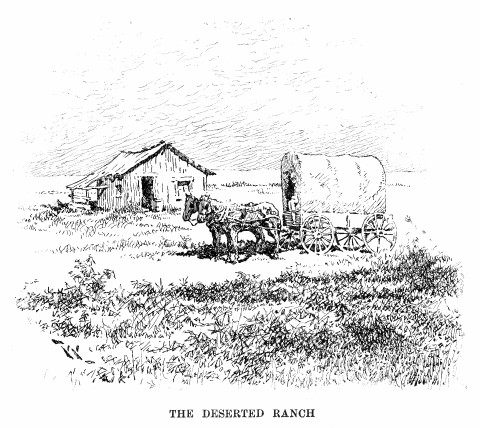
Just before the sun sank behind the mountains, which lay like low
black clouds to the west, we came to a little
ranch standing alone on the prairie. The door was open, and it seemed
to be deserted, though there was a rude bed
inside. There was a good well of water, and we decided to camp near it
for the night, especially as the grass was
good. There was no other house in sight. Bedtime arrived, and no one
came to the ranch.
"I think I'll just sleep in that house tonight," said Jack, "and see
how it seems. I'll leave
the door open, so as not to have too much luxury at first."
So he went to bed in the shanty, taking Snoozer along, and leaving
the wagon to Ollie and me.
We must have been asleep three or four hours when I was awakened by
the loud barking of a dog. I started up
and began unfastening the front end of the cover. Just then I heard the
pony snort in terror; and then followed
a shot from a gun and the sound of horses galloping away. As I put my
head out, Jack called, excitedly:
"Some men were trying to get the pony. They'd have done it, too, if
Snoozer hadn't barked and scared them
away."
I was out of the wagon by this time, and found the pony trembling at
the end of her picket-line as near the
wagon as she could get. Snoozer kept barking as if he couldn't stop.
"Did they shoot at you, Jack?" I asked.
"No, I guess not. I think they just blazed away for fun. They went
off toward the Reservation. Some of
Gene's poor s'ciety, I suppose."
It took half an hour to get the frightened pony and indignant dog
quieted; and perhaps it was longer than that
before we again got to sleep.
to table
of contents
"Snoozer shall have a pancake medal."
This was the first thing Ollie and I heard in the morning, and it
was Jack's voice addressing the hero of the
night before. We speedily rolled out, and agreed with Jack that Snoozer
must be suitably rewarded, he seemed fully
to understand the importance of his action in barking at the right
moment, and for the first morning on the whole
trip he was up and about, waving his bushy tail with great industry,
and occasionally uttering a detached bark,
just to remind us of how he had done it. He walked around the pony
several times, and looked at her with a haughty
air, as much as to say, "Where would you be now if it hadn't been for
me?"
"He shall have a pancake," continued Jack--"the biggest and best
pancake which the skilful hand
of this cook can concoct."
Jack proceeded to carry out his promise, and when breakfast was
ready presented a griddlecake, all flowing with
melted butter, to the dog, which was as big as could be made in the
frying-pan.
"I always knew," said Jack, "that Snoozer would do something some
day. He's lazy, but he's got
brains. He would never bark at the moon, because he knows the moon
isn't doing anything wrong, but when it comes
to horse-thieves it's different."
Snoozer munched his pancake, occasionally stopping to give a grand
swing to his tail and let off a little yelp
of pure joy.
As we were getting ready for a start, and speculating on the
prospect for water, a man came along, riding a
mule, and we asked him about it<.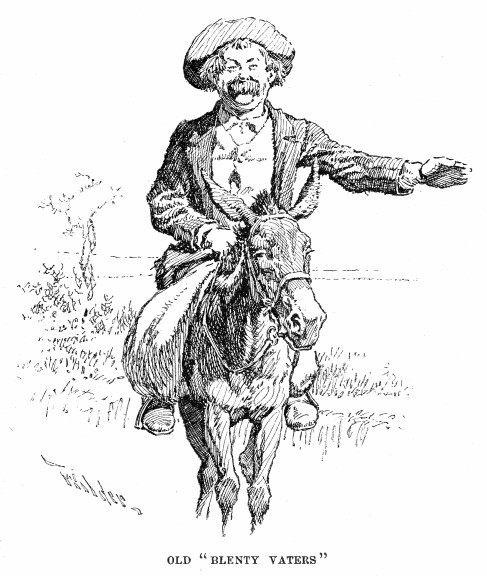
"Yah, blenty vaters," said the man. "Doan need to dake no vaters
along.'
"Any houses on the road?" asked Jack.
"Blenty houses," answered the stranger "houses, vaters, efferydings."
We thanked him and started. Notwithstanding this assurance, I had
intended to fill a jug with water, but forgot
it, and we went off without a drop. We were going down what was called
the Ridge Road, along the divide between
Elk and Elder creeks, and hoped to reach the crossing of the Cheyenne
at Smithville Post-office that evening, and
get on the Reservation the next morning. In half an hour we passed some
trees which marked the site of the Washday
Springs, but there was no house there, nor had we seen one at eleven
o'clock. We met an Indian on foot, and Jack
said to him:
"Where can we get some water?"
The Indian shook his head. "Cheyenne River," he replied.
"Isn't there any this side?"
"No," with another jerk of the head. Then he stalked on.
"Yes, and the Indian's right, I'll warrant," exclaimed Jack.
"'Blenty raters,' indeed! Why, that
Dutchman doesn't know enough to ache when he's hurt."
"Well, we're in for it," said I. "We can't go back. Maybe it'll
rain," though there was
not a cloud in sight, and there was more danger of an earthquake than
of a shower.
So we went on, ,'rod a little after dark wound down among the black
baked bluffs to the crossing, without any
of us having had a drop to drink since before sunrise. After we had
"lowered the river six inches," as
Jack declared, we went into camp.
We were up early in the morning, and Jack went down the river with
his gun and got a brace of grouse. There
was one house near the crossing, which was the post-office. The man who
lived there told us it was a hundred and
twenty-five miles across the Reservation to Pierre, and twenty miles to
Peno Hill, the first station at which we
should find any one. The ford was deep, the water coming up to the
wagon-box, and there was ice along the edges
of the river. It was a fine clear day, however, and the cold did not
trouble us much. We wound up among the bluffs
on the other side of the river, and at the top had our last sight of
the Black Hills. We went on across the rolling
prairie, black as ink, as .the grass had all been burned off, and
reached Peno Hill at a little after noon. There
was a rough board building, one end of it a house and the other a barn.
All of the stage stations were built after
this plan. We camped here for dinner, and pressed on to reach Grizzly
Shaw's for the night. About the middle of
the afternoon we passed Bad River Station, kept by one Mexican Ed.
"I'm going to watch and see if he runs when he sees Snoozer," said
Ollie. Snoozer had insisted on
walking most of the time since his adventure with the horse-thieves;
but, greatly to Ollie's disappointment, Mexican
Ed showed no signs of fear even when Snoozer went so far as to growl at
him.
As it grew dark we passed among the Grindstone Buttes--several small
hills. A prairie fire was burning among
them, and lit up the road for us. We came to Shaw's at last, and went
into camp. We visited the house before we
went to bed, and found that Shaw was grizzly enough to justify his
name, and that he had a family consisting of
a wife and daughter and two grandchildren.
"Pierre is our post-office," said Shaw, "eighty-five miles away."
"The postman doesn't bring out your letters, then?" returned Jack.
"We ain't much troubled with postmen, nor policemen, nor hand-organ
men, nor no such things," answered
Shaw. "Still, once in a while a sheriff goes by looking for somebody."
We told him of our experience with thieves, and he said:
"It's a wonder they didn't get your pony. There's lots of 'em
hanging about the edge of the Reserve, because
it's a good place for 'em to hide."
"Must make a very pleasant little walk down to the post-office when
you want to mail a letter," said
Jack, after we got back to the wagon--"eighty-five miles. And think of
getting there, and finding that you
had left the letter on the hall table, and having to go back!"
We were off again the next morning, as usual. At noon we stopped at
Mitchell Creek, where we found another family,
including a little girl five or six years old, who carried her doll in
a shawl on her back, as she had seen the
Indian women carry their babies. We had intended to reach Plum Creek
for the night, but got on slower than we expected,
owing partly to a strong head-wind, so darkness overtook us at Frozen
Man's Creek.
"Not a very promising name for a November camping-place," said Jack,
"but I guess we'll have
to stop. I don't believe it's cold enough to freeze anybody to-night."
There was no house here, but there was water, and plenty of tall,
dry grass, so it made a good place for us
to stop. Frozen Man's Creek, as well as all the others, was a branch of
the Bad River, which flowed parallel with
the trail to the Missouri. We camped just east of the creek. The grass
was so high that we feared to build a camp-fire,
and cooked supper in the wagon.
"I'm glad we've got out of the burned region," said Jack. "It's
dismal, and I like to hear the
wind cutting through the dry grass with its sharp swish."
There was a heavy wind blowing from the southeast, but we turned the
rear of the wagon in that direction, saw
that the brake was firmly on, and went to bed feeling that we should
not blow away.
"I wonder who the poor man was that was frozen here?" was the last
thing Jack said before he went
to sleep. "Book agent going out to Shaw's, perhaps, to sell him a copy
of Every Man his Own Barber; or,
How to Cut your Own Hair with a Lawn-Mower."
We were doomed to one more violent awakening in the old Rattletrap.
At two o'clock in the morning I was roused
up by the loud neighing of the horses. Old Blacky's hoarse voice was
especially strong. As I opened my eyes there
was a reddish glare coming through the white cover. "Prairie fire!"
flashed into my mind instantly, and
I gave Jack a shake and got out of the front of the wagon as quickly as
I could. I had guessed aright; the flames
were sweeping up the shallow valley of the creek before the wind as
fast as a horse could travel. 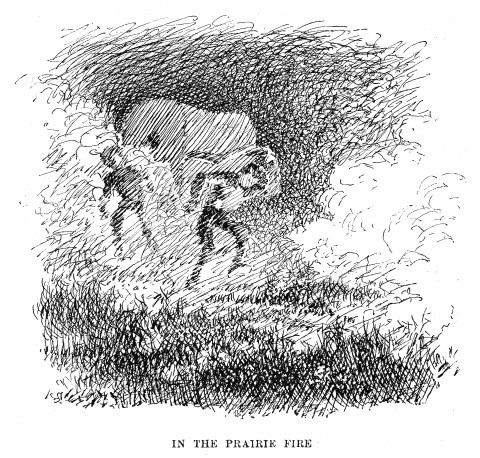 Jack came
tumbling out, and we knew instantly what to do. We both ran a few yards
ahead of the wagon and knelt in the grass,
and struck matches almost at the same moment. Jack's went out, but mine
caught, and a little flame leaped up, reached
over and to both sides, and then rolled away before the wind, spreading
wider and wider. I beat out the feeble
blaze which tried to work to windward, and ran back to the wagon, while
Jack went after the horses. The coming
flames were almost upon us by this time; but Ollie was out, and
together, aided by the wind, we rolled the wagon
ahead on our little new-made oasis of safety. Jack pulled up the pony's
picket-pin, and brought her on also, while
the other horses, being loose, sought the place themselves. The flames
came up to the edge of the burned place,
reached over for more grass, did not find it, and died out. But on both
sides of us they rushed on, and soon overtook
our little fire, and went on to the northwest. The wind, first hot from
the fire, now came cool and fresh, though
full of the odor of the burned grass.
Jack came
tumbling out, and we knew instantly what to do. We both ran a few yards
ahead of the wagon and knelt in the grass,
and struck matches almost at the same moment. Jack's went out, but mine
caught, and a little flame leaped up, reached
over and to both sides, and then rolled away before the wind, spreading
wider and wider. I beat out the feeble
blaze which tried to work to windward, and ran back to the wagon, while
Jack went after the horses. The coming
flames were almost upon us by this time; but Ollie was out, and
together, aided by the wind, we rolled the wagon
ahead on our little new-made oasis of safety. Jack pulled up the pony's
picket-pin, and brought her on also, while
the other horses, being loose, sought the place themselves. The flames
came up to the edge of the burned place,
reached over for more grass, did not find it, and died out. But on both
sides of us they rushed on, and soon overtook
our little fire, and went on to the northwest. The wind, first hot from
the fire, now came cool and fresh, though
full of the odor of the burned grass.
"Closest call we've had," said Jack. "Yes," I replied; "been pretty
warm for us if we
hadn't waked up. Our animals are doing better; first Snoozer
distinguished himself, and now I think we've to thank
Old Blacky mainly for this alarm."
We were pretty well frightened, and though we went back to bed, I do
not believe that any of us slept again
that night. At the first touch of dawn we were up. As it grew lighter,
the great change in the landscape became
apparent. The gray of the prairie was turned to the blackest of black.
Only an occasional big staring buffalo skull
relieved the inkiness. Far away to the northwest we could see a low
hanging cloud of smoke where the fire was still
burning.
"Blacky ought to have a hay medal," said Jack at breakfast. "If I
had any hay I'd twist him up
one as big as a door-mat."
But Blacky, unlike Snoozer, seemed to have no pride in his
achievement, and he wandered all around the neighborhood
trying to find a mouthful of grass which had been missed by the fire;
but he was not successful.
"If the frozen man had been here last night he'd have been thawed
out," I said.
"Yes; and if Shaw had been here, what a good time it would have been
for him to let the fire run over his
hair and clear off the thickest of it!" returned Jack.
We started on, but the long wind had brought bad weather, and before
noon it began to snow. It kept up the rest
of the day, and by night it was three or four inches deep. We stopped
at noon at Lance Creek, and made our night
camp at Willow Creek; at each place there was a stage station in charge
of one man. It cleared off as night came
on, but the wind changed to the north, and it grew rapidly colder.
Shortly after midnight we all woke up with the
cold. We already had everything piled on the beds, but as we were too
cold to sleep, there was nothing to do but
to get up and start the camp-fire again. This we did, and stayed near
it the rest of the night, and in this way
kept warm at the expense of our sleep.
The morning was clear, but it was by far the coldest we had
experienced. The thermometer at the station marked
below zero at sunrise. We almost longed for another prairie fire. It
grew a little warmer after we started, and
at about eleven o'clock we reached Fort Pierre, on the Missouri,
opposite the town Of Pierre. The ferry-boat had
not yet been over for the day, but was expected in the afternoon.
"You're lucky to get it at all," said a man to us. "It is liable to
stop any day now, and then,
till the ice is thick enough for crossing, there will be no way of
getting over."
The boat came puffing across toward night, and we were safely landed
east of the Missouri once more. But we
were still two hundred miles from home; the country was well settled
most of the way, however, and we felt that
our voyage was almost ended. Little happened worthy of mention in the
week which it took us to traverse this distance.
The weather became warmer and was pleasant most of the way. On the last
night out it snowed again a little and
grew colder. We were still a long day's drive from Prairie Flower, but
we determined to make that port even if
it took half the night.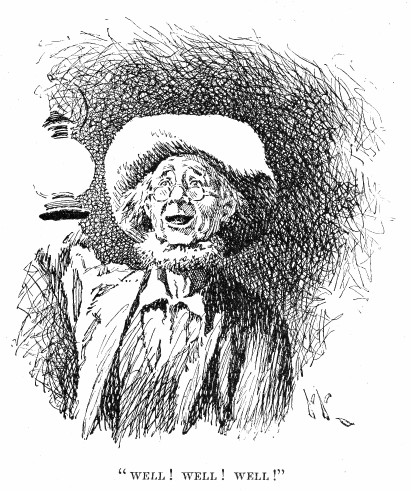
It was ten o'clock when we saw the lights of the town.
"Here we are," said Jack, "and I vote we've had a good time, and
that we forgive Old Blacky his
temper, and old Browny and Snoozer their sleepiness, and Ollie his
questions, and the rancher his general incompetence."
"And the cook his pancakes!" cried Ollie. We stopped a little way in
front of Squire Poinsett's grocery,
and Jack picked up the big revolver and fired the six shots into the
air. The pony had come alongside the wagon,
and Snoozer had his head over the dash-board. Half a dozen people came
running out, including Grandpa Oldberry,
wearing red yarn mittens and carrying a lantern. He held up the light
and looked at us.
"Well, I vum," he exclaimed, "if it ain't them three pesky
scallawags back safe and sound! I've
said all along that varmints would get ye sure, and we'd never see hide
nor hair of ye again! Well, well, well!"
It was clear that Grandpa was just a little disappointed to see that
his predictions hadn't been fulfilled.
So the voyage of the good schooner Rattletrap was ended. It had been
over a thousand miles in length, and had
lasted for more than two months.
to table of
contents