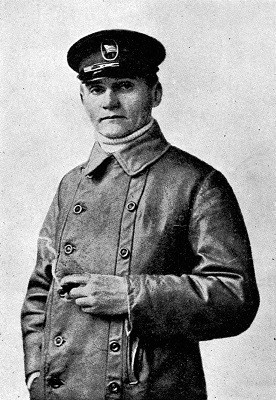
At last we were out in the open.
The Atlantic did not receive us in a very friendly
manner it must be confessed.
We had grown used to a good deal in the last few
days, but I was anxious to spare the nerves of the
crew as much as possible, on account of the long
journey that lay before us. I decided therefore
to take a more southerly direction, in order to try
and hit on fairer weather if possible. Unfortunately
we were to be disappointed in this, as will be
seen.
As I glance to-day through my notes of those
first days in the Atlantic, I continually come across
remarks of this kind: "Heavy Sea," "Stiff wind
from the W.N.W., Strength 8," "Wind blowing
up for a storm," "Heavy seas rolling over the
whole boat and even over the conning-tower,"
"Boat travelling almost continuously under water,"
etc. In these few curt sentences lies the history
of the hard and nerve-racking existence of twenty-nine
men, shut up in the body of a steel fish, as
she made her way untiringly through the wild
tossing seas.
I know of no better opportunity of praising the
excellently thought-out construction and the perfect
seafaring qualities of our "Deutschland"
than in calling to mind those stormy days in the
Atlantic. The elements certainly did not help to
make our journey to America an easy one. The
highest possible demands were made on the body
and machinery of the boat, which had to be continually
at work day after day in order that we
might reach our destination.
And here I cannot help thinking with gratitude
of the dockyard and all the men whose work had
contributed to help us complete our journey by
giving this wonderful piece of sea-craft mechanism
into our hands.
It is easy to wax enthusiastic over a fine ship, that
delights the eye of every onlooker when in harbour
by her elegance, and extracts the admiration of
the expert and the uninitiated by her rapid movement
in smooth waters. But the real inner worth
of a ship is only to be discovered when she has
completed her test on the high seas. Then, and
only then, you learn her best qualities and gain
that real confidence in her trustworthiness and seafaring
capabilities, when the wind is blowing with
a strength 10, and the sea has a roughness 8, during
which you must go head on. And this not only for
a couple of hours, but day after day, week after week.
Only then can a ship prove what she is really worth.
This is particularly the case with a U-Boat in
war time. A merchantman in peace time has very
often a severe strain in holding out, but she has
always the possibility of seeking a port of refuge,
or of hailing assistance. At the worst, she can
drift a few days and wait for smoother weather.
None of this is possible with the U-Boat. To the
dangers of the sea are added the dangers from the
enemy, the cruellest and most pitiless of enemies.
No haven of refuge beckons to her, and if she were
to lie for a few minutes helpless and be discovered,
her adversaries, who would have helped a damaged
steamer in distress, would loosen the greedy bloodhounds
at her throat.
No one is so lonely and entirely dependent on
himself as a U-Boat captain. If he cannot absolutely
rely on his vessel, then he is lost.
It is for this reason that we realised how much
we owed to the Germania docks and to the chief
engineer, Erbach, the inventor of our boat. It was
his plans combined with the splendid co-operation
of the submarine builders and shipping officials that
had given birth to this wonderful seafaring vessel.
The boat which in the winter of 1915 arose on the
slips at Kiel, in so short a space of time and yet
with the precision of accurate workmanship, and
which Herr Erbach taught me to work and understand
on that memorable test voyage early in the
year, was now two months later bravely ploughing
her way through the stormy seas, carrying the fame
of German shipbuilding across the ocean.
The "Deutschland" had therefore been severely
tested, and had come through with flying colours.
For several days the weather remained the same,
with hurricane gusts lashing up the water into
crashing mountains of waves.
All the deck hatches were, of necessity, closed,
and at times even the conning-tower hatch, which
was so well sheltered by the "bath-tank," had
to be closed by the watch-officer at every onrush
of the waves.
It was far from pleasant in the conning-tower.
But below deck, where the men were suffering
badly from sea-sickness in the close atmosphere
and with the incessant rolling of the boat, it was a
thousand times worse. Many an experienced
seaman made his first offering to Neptune on this
occasion.
On the third day it grew calmer. The sea became
smoother and we were able to open the hatches in
order to air and dry the boat.
All the men of the off duty watch came on deck
and stretched themselves out in the sun, seeking a
much-needed relaxation.
Worn out and pale faced they appeared through
the hatches; and hardly had they inhaled the
fresh sea breeze before their beloved pipes were
lighted.
As we met very few steamers on our present
course, we set to work to give everything a good
drying. All the wet articles that could not be dried
down below were brought up into the air.
The whole deck was packed with beds, coverlets,
clothes, and boots. The clothes were fastened
securely to the deck rails, where they fluttered
merrily in the wind, as if from a washing line.
In between them the crew reposed in the
strangest positions, sunning themselves like lizards.
In order to increase the artificial ventilation of the
rooms by means of a draught of air, wind-sails were
hung up in all the hatches. With their jagged side
wings they looked rather like the fins of a fish, and
made the rounded green superstructure of the
"Deutschland" look like the back of a fantastic
monster whale. We must truly have presented a
strange spectacle.
No one was near, however, to notice it. We
sighted one steamer only, whose smoke appeared
towards evening on the horizon, and we were easily
able to steer clear of her.
The spirits of the crew were excellent, as was
shown by the merry warbling of the gramophone
from the men's room.
In our mess-room, likewise, we enlivened the time
with classical music, without which life on a U-Boat
would not bear thinking of. Moreover, the monotonous
part of our journey was now to begin.
The fine weather continued, and we met with few
encounters.
I find in my journal only the following notes:
"The dull period of our journey is commencing.
The boat is making her way, rolling slightly, but
bearing herself bravely. Now and then we go out
of our way to avoid a steamer. For several days
there is nothing to be seen; the gramophones play
gaily, and everyone is in the best of humours.
On the open sea we are entirely dependent on the
weather for our comfort."
It was, as a matter of fact, the first moment that
we had been able to breathe freely. Looking round
on all sides one became almost incorporated with
the everlasting sameness of the sea.
One day I was standing on the fore-deck. Near
me Humke, our giant boatswain, squatted in the
wooden scaffolding of the small central upper-deck
under which we had snugly stored our lifeboat.
Several lashings had been loosened during the
stormy weather, and had to be repaired.
I had stood there for some time, gazing westward,
my thoughts fixed on America, our destination.
Suddenly I took it into my head to broach the
subject to the sturdy Humke. I asked him what he
thought of our voyage to America in these days of
war. What were his impressions as to the object
of our enterprise?
The rascal grinned broadly and replied:
"Why, to earn money, of course."
This reply was a little too summary for my taste,
and I proceeded to explain to him the real significance
of renewing our commercial relations with
America in war time, in defiance of the English
blockade. I then proceeded to make clear to him
exactly what the blockade meant.
He grasped the idea quickly, and said:
"Well, now I understand what the English are
after."
I went further, and explained to him as fully as
I could the meaning and exigencies of an effective
blockade, and was surprised at the directness of his
answer, which expressed so naively and with such
confidence the feelings of the people in the simple
language of our sea-folk.
"Well, they won't get us, any'ow! And so
there ain't no sense in the English blockade, as I
can see!"
In the meantime several of the watch off duty had
strolled up and gathered around to listen. There
they stood, broad-legged, on the narrow deck of our
little submarine in the middle of the Atlantic, a
handful of sturdy, unabashed German seamen.
"Men," I said, "you have heard now the reason
of our voyage, but I will tell you something more.
My good fellows, you have no idea what our cruise
really signifies. Our gallant 'Deutschland' is
much more than a mere U-Boat merchant-trader.
By her means we are bringing German goods to
America; goods which the commercial jealousy
and trickiness of the English have so far prevented
from reaching that country. And this not only to
injure Germany's exports, but in order to continue
their gloomy fishing over yonder they do their
utmost to harm American industry and commerce.
"That is all a thing of the past. We are seeing
to that. But this is not all. The appearance of
the first U-Boat trader is of far deeper significance.
Without even a gun or torpedo on board, the
'Deutschland' is revolutionising the entire methods
of navigation, overseas trade and international
rights, a revolution whose effects can hardly be
fully realised as yet.
"How, in these days of warfare, have our
armed U-Boats fared? We wanted to use them as
a means to prevent this barbaric starvation blockade,
which violates every right of humanity, and what
did the English do? They armed their merchantmen
and shot down every U-Boat that approached
them with the object of sinking their contraband.
"That is what they call 'defending themselves.'
And what is the result? We proceed to defend
our skin and our U-Boats,—knowing that in every
fishing vessel a 'Baralong' murderer lies in wait,—by
sinking the armed English merchant ships
without warning in order to save ourselves from
being rammed or fired on.
"Thereupon the English shriek for help, and by
reason of the existing conventions of sea warfare
they win the Americans over to their side, for under
the present laws of sea warfare there are no definite
conditions laid down for U-Boats. We wish to
maintain friendly relations with the great American
people, and therefore give in. The Government
which rewarded the 'Baralong' commanders has
triumphed apparently, and the command goes
forth: merchant ships are not to be sunk without
warning.
"Then our 'Deutschland' appears on the scenes,
a U-Boat and merchantman combined. Now
merchantmen must not be sunk without warning,
and, moreover, the present laws of sea warfare contain
no definite conditions for U-Boats. A U-Boat
trader, however, that must be searched before
sinking would be difficult to recognise, if still
capable of submerging. For then the swiftest
torpedo-boat is powerless.
"The English are caught in their own trap, for
the 'Deutschland' throws the whole one-sided
interpretation of the rules of naval warfare on
the rubbish heap. The weapon that was at first
used against us must now speak in our favour.
"For the matter stands thus. If merchantmen—which
can at the same time be U-Boats—may
not be sunk without warning, then according to the
laws and formalities of sea warfare the 'Deutschland'
has rendered the English blockade futile. For I
should like to see the German U-Trader that would
allow an English patrol vessel to approach near
enough to examine her!
"Or supposing she is not searched. Then, in
that case, merchant traders can be sunk without
warning—English traders likewise. And thus the
rights of warfare will be evenly balanced once more
by means of a peaceful, unarmed U-Boat trader.
And this, my men, is where the enormous significance
of our 'Deutschland' lies."
Thereupon I concluded my speech, which was by
far the longest I had ever made.
The fine weather still continued. The barometer
remained steady, the air was dry and clear. We were
gradually approaching the latitudes in which fine
weather is the rule at that time of the year. The
warmth of the sun's rays began to be felt, and our
thoughts turned towards refreshment.
This was provided us by our "wave-bath," a
discovery of the observation engineer, Herr Kiszling,
who otherwise showed no interest in anything but
his beloved engines. For these he was full of the most
touching and undeviating solicitude. Often, during
a heavy sea, when all the deck hatches were closed,
he would suddenly appear through the conning-hatch
and push hastily through into the "bath-tank,"
regardless of the exigencies of higher
navigation in process there.
When the officer on duty looked round, annoyed
at the disturbance, there was our sturdy Kiszling,
in his oldest oilskins, leaning over the side of
the dripping deck—filled with care for the welfare
of his engines, trying to get a glimpse of the
exhaust. At the same time he must see if the
ignition was working properly, if the heart-beats of
his engines were carrying out their functions, and
if the explosions were quite regular. He was
wrapped up in his beloved machinery and lived on
its rhythmical music. He noticed at once the least
irregularity in its working, and spared no trouble in
getting to the bottom of it.
It must have been during one of these special
tours of his, which were by no means without
danger, over the rounded slippery side-deck, that
the inspiration came to him. In brief, he opened
to us the joyful possibility of the "wave-bath."
In order to understand this, it is first necessary
to know the construction of the upper part of the
"Deutschland." Above the cylindrical hull, on the
sides of which are the submersion tanks and oil
bunkers, rises the outer ship, which gives the
vessel its real ship form.
In this upper part of the outer ship, the so-called
"outer tanks" are placed which, when the ship is
laden, are always flooded, as water and air may
penetrate to their interior by numerous openings,
holes and slits, in order that a rapid filling and
emptying may be achieved. The "outer tanks,"
therefore, have no connection with the floating
capacity of the boat; they are only the result of
the outer construction which above water does not
follow the line of the heavy hull and tanks. In
spite of their relatively unimportant functions the
"outer tanks" must, of course, be accessible from
the upper parts of the vessel. This is made possible
by large movable steel lids and by ladders on the
upper surface of the deck. Standing on the so-called
tank-deck, therefore, you have a slight elevation
to the upper deck surface. The sea water is continually
rushing into these big spaces during the
voyage. You have only to climb in through the
opened plate lids to enjoy an absolutely safe and
delightful sea-water bath.
We did not fail to put this into practice pretty
often, and found our bath delightful. There was
only one drawback to the business. If, for instance,
you entered the sea-water bath for the first time,
soon after the boat had risen to the surface, you
found yourself not in sea-water, but in an oil
bath!
The bunkers, as a matter of fact, never hold quite
tight, especially after a long strain of travelling,
and so it often happens that as the boat rises to the
surface a curious layer of oil breaks through before
she reaches the top. This layer of oil is then to be
found in the "bath tank," on the lids of the hatches
and on deck. Inside the "outer tanks" it naturally
remains on the surface of the water, for there it is
not able to mix and disperse quickly. It generally
remains there a day, sometimes longer, till the oily
water is drained off and replaced by new water
again. The unlucky man, therefore, who took a
bath during this period, emerged but little refreshed
and with a shiny nickel-coated skin. This metamorphosis,
as can be imagined, caused great amusement
among the crew.
The fine weather now was very favourable for
submerging tests, which were made practically every
day. Everything worked perfectly smoothly, and
we felt we could safely approach the American
coast and submerge within the three-mile zone.
During one of these submerging tests a wonderful
and fairy-like spectacle was presented to us. I had
caused the boat to be steered so that the conning-tower
lay nearly two fathoms under water. Above,
the sun shone brightly and filled the deeps with
radiant light. The water was lit by many colours.
Around us the sea was of brightest azure blue of an
almost dazzling clearness, and transparent as glass.
From the window of the conning-tower I could see
the whole length of the boat, round which rose
twinkling air bubbles, like pearls. In strange,
fantastic distinctness the deck lay stretched out
before me, even the furthest bow end was visible.
Further ahead was a dim-coloured twilight. It
seemed as if the bow of the boat was gliding silently
through a wall of opal green, which opened up as
she moved, and broke into a dazzling radiant-coloured
transparency of light.
We were spellbound at this wonderful sight, and
the strangeness of the effect was increased by the
jelly-fish as they floated through the transparent
blue and were caught in the wires of the deck
rails, where they shimmered first rose colour, then
pale yellow, changing slowly to purple.
We were not able at that slight depth to observe
any fish.
The next day a little incident occurred which
afforded us much amusement, though it turned out
rather differently from what we had expected.
My ambition was to follow in the tracks of my
comrades of the merchant service and the navy,
who had disguised their ships from the enemy by
painting and clever alterations in their outward
structure.
During the previous fine spell of weather we had
made a wonderful trap for steamers, in order to
disguise our identity as a U-Boat from ships passing
in the distance. We had rigged up a funnel out of
some sail-cloth, which could be fixed to the periscope
with several wire rings, till it rose proudly in the
air.
The conning-tower was also provided with a
covering of sail-cloth to make it resemble the upper
middle deck of a small trading vessel.
Thus, ready for all emergencies, we travelled on
in the brilliant sunshine, till at 7.30 in the evening
a steamer appeared in the distance to starboard.
We soon realised that she must pass quite near to
us if we continued on our present course. We
held aloof from her therefore and proceeded to try
the effects of our disguise.
The "funnel" is fixed up on to the periscope
and rises proudly erect in the wind. In order to
give it a more realistic appearance we burn some
cotton waste steeped in oil at its base. Then the
conning-tower disappears under the rather flattering
"middle deck."
But the disobliging cotton-wool only smoulders
horribly and refuses to give out any smoke. Everyone
stands round puffing out their cheeks, but in
vain, till the wireless operator, a shrewd Berliner,
fetches an air-pump, which produces a powerful
glow in our imaginary boiler. A cheer greets his
handiwork, and sure enough from the upper edge
of the "funnel" a delicate cloud of smoke appears,
only to vanish immediately into thin air!
Laughing, we decide to continue on our way
smokeless, when up comes the boatswain, Humke,
with a jam-pot full of tar. The air-pump is
again brought into play, and at last our funnel can
really be said to smoke!
The effect is certainly startling. For the steamer
suddenly alters her course and bears straight down
on us!
This is not exactly our intention. The masts
are immediately hauled down and everything
cleared for submerging; the middle deck disappears,
and with a deep bow our beautiful funnel
falls together in a heap.
No sooner does the steamer observe this than
she is seized with wild amazement and horror. She
turns round again abruptly and seeks flight, puffing
out thick black clouds of smoke which we eye not
without a certain feeling of envy.
Once more we raise our indefatigable funnel.
The masts are lifted high, and while the steamer
hastens away in wildest flight we stand and laugh
till the tears come.
The situation was really humorous beyond
description.
Our beautiful disguise, which was to screen us
from observation, had been the very means of
bringing the gallant steamer's attention to bear
upon us. She obviously took us for a wreck, or
some ship in distress, and approached probably
with the best intentions, to find herself face to face
with the devilish tricks of one of those rascally
submarines.
What must the people on board have thought
when they had recovered from the first effects of
the shock? Undoubtedly they would pride themselves
greatly on having escaped so cleverly this
new piece of "piratical" cunning.
And we should have been so proud if our disguise
had only worked a little better! We were not discouraged,
however, but set to work to improve on
our invention, with the result that two days later
we steamed by an approaching vessel unrecognised
under our own powerful smoke!