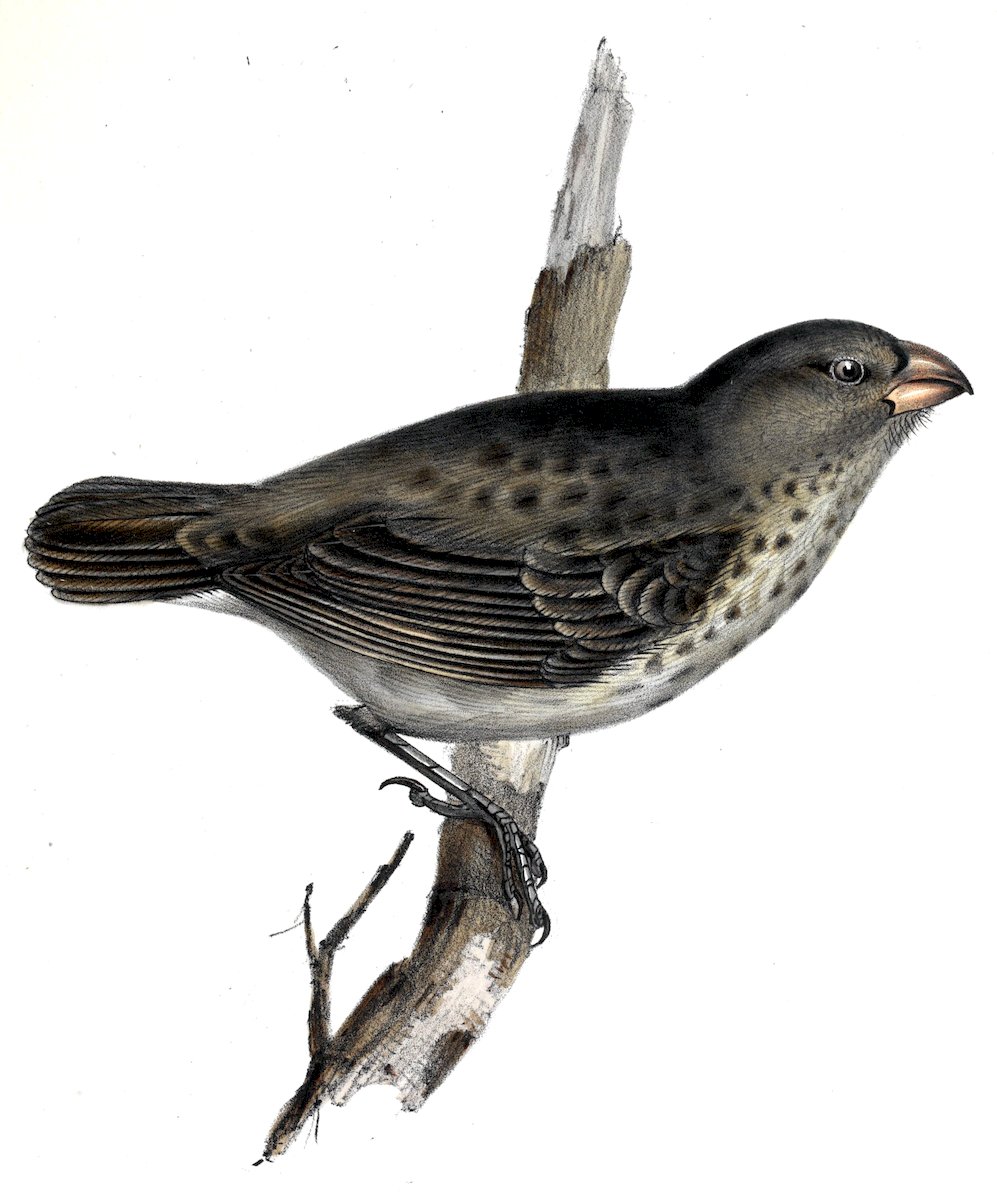
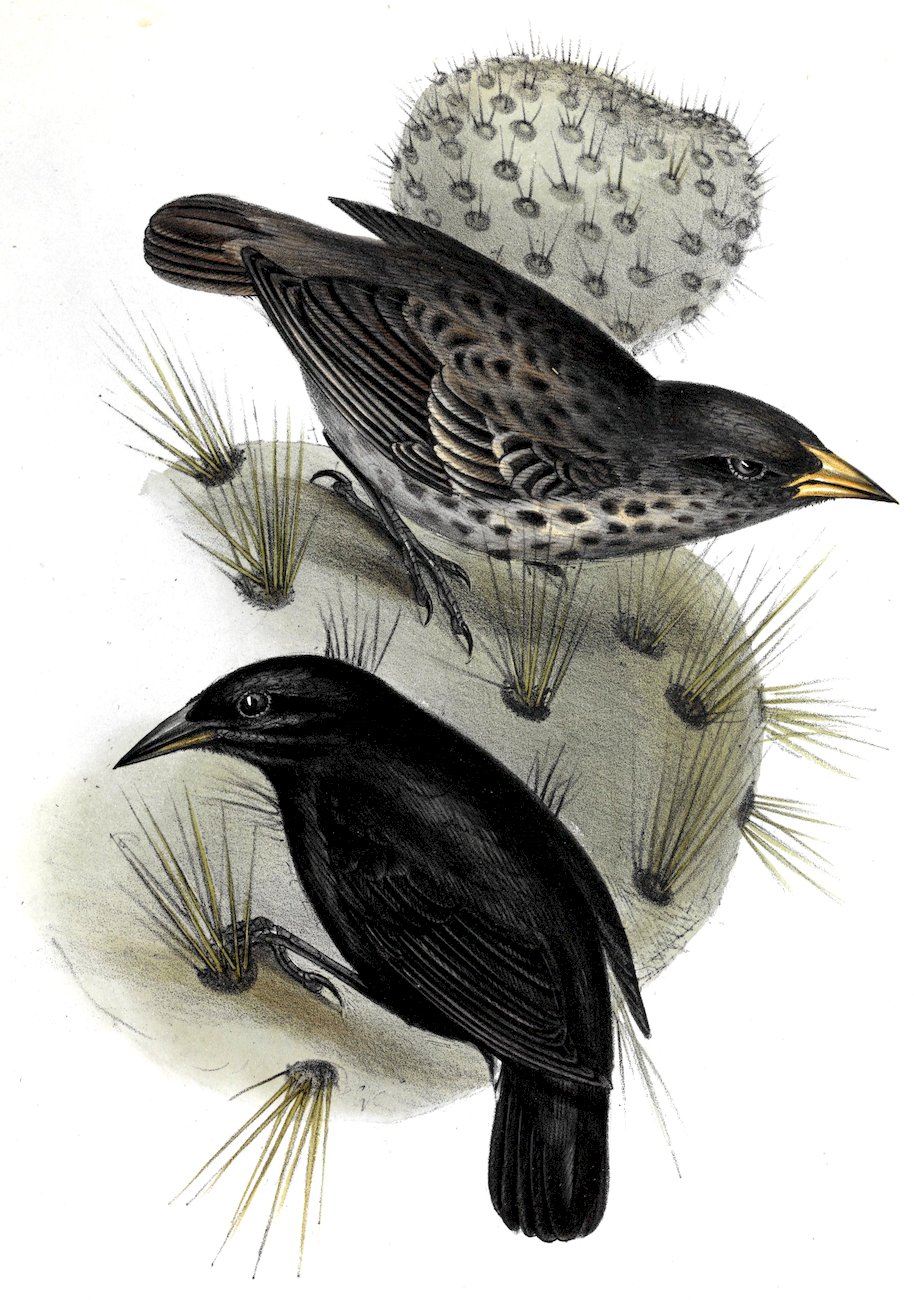
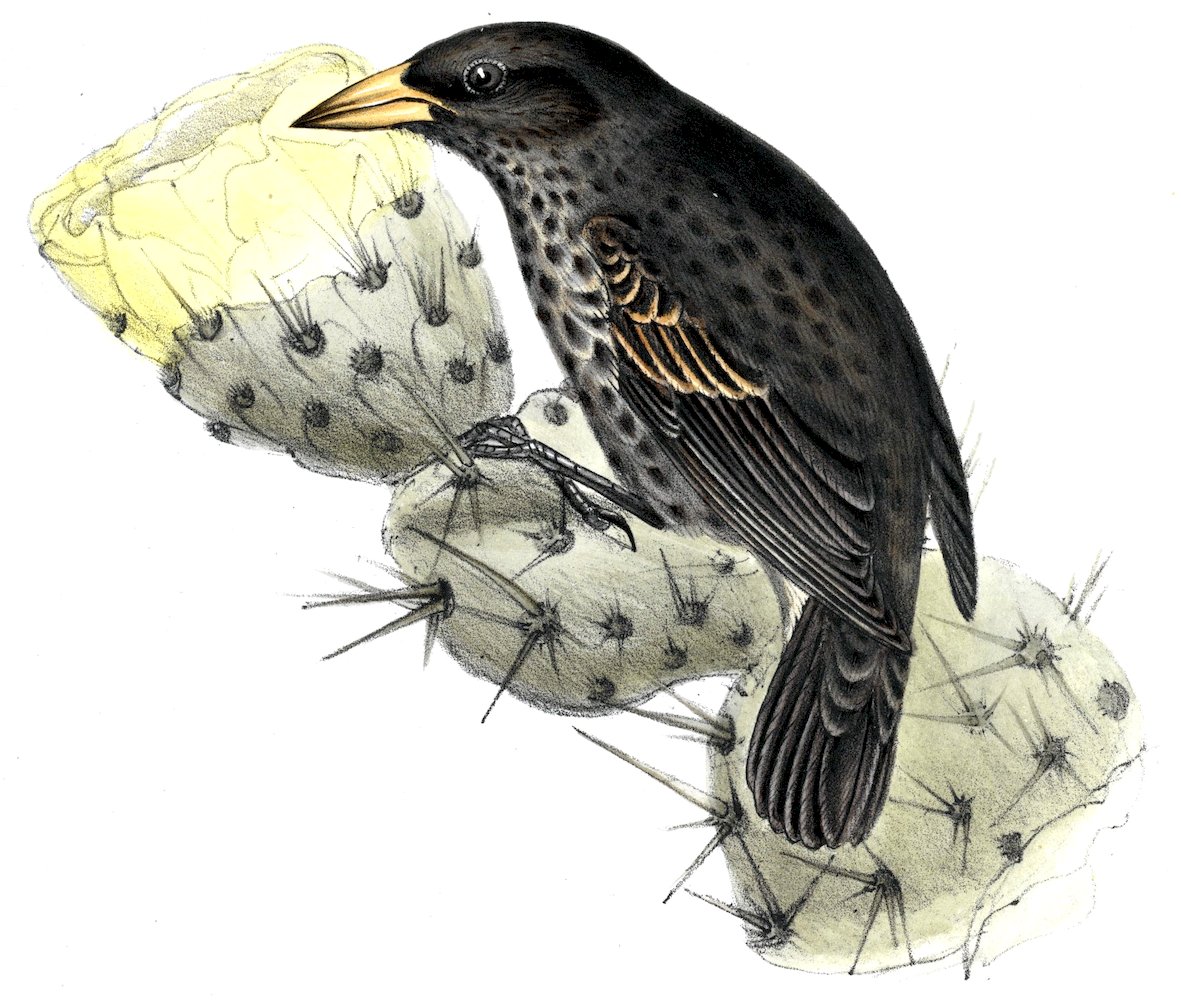
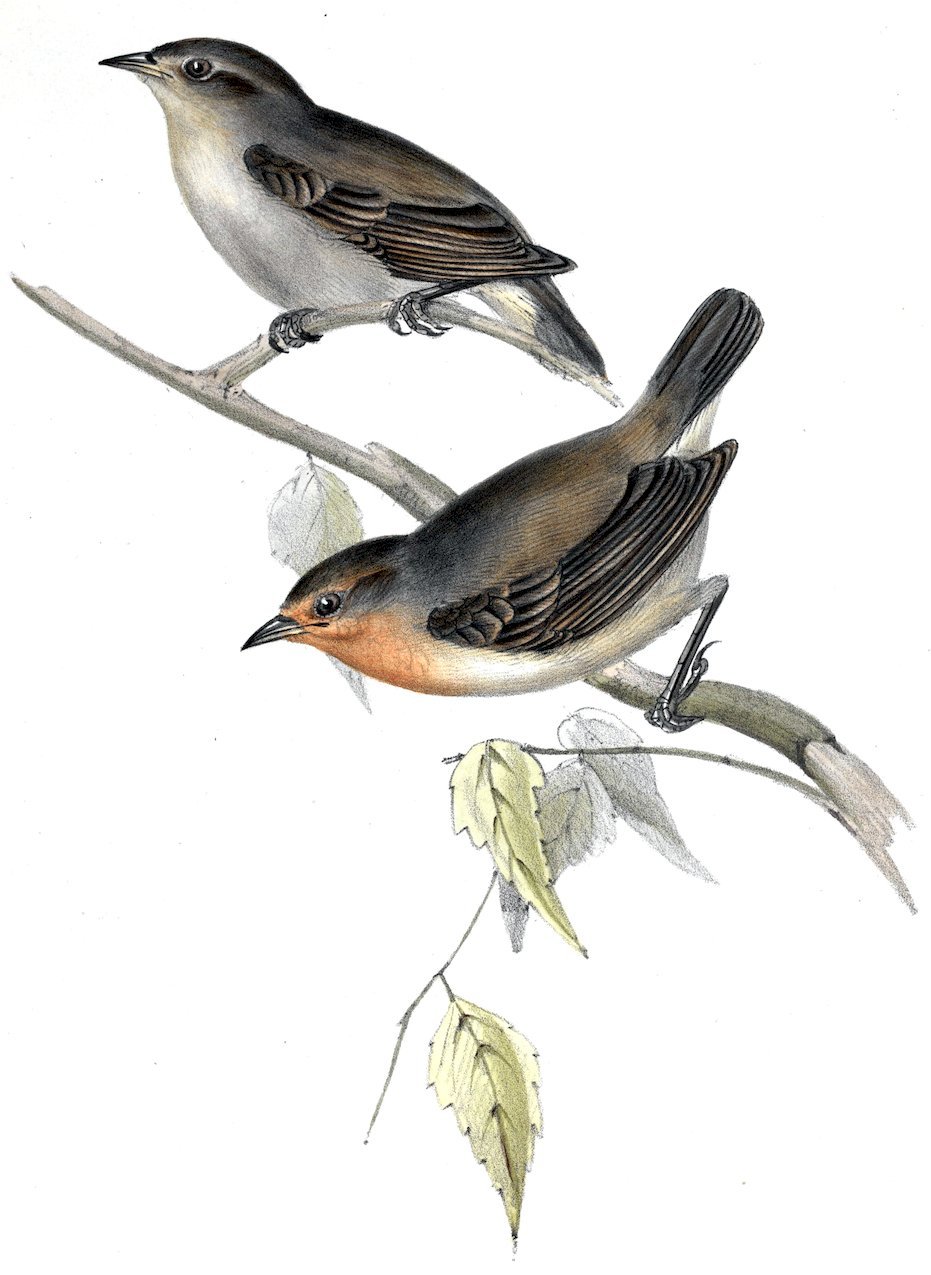
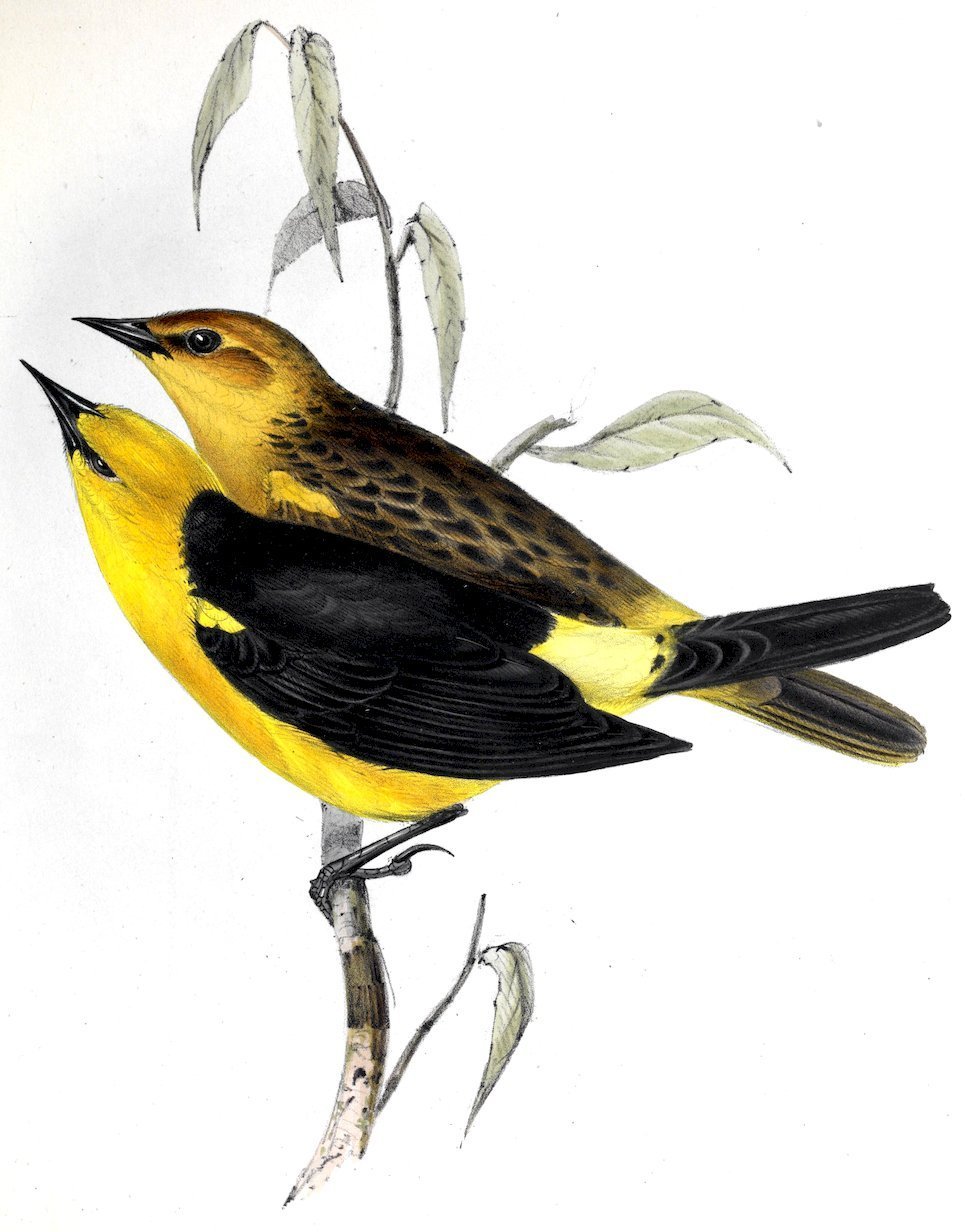
Monte Video.—November. Not abundant.
Edwards’ Gleanings.
Vieill. Ois. dores, t. 1.
Ornismya Kingii, Less. Trochilidees, pl. 38.
This species is found over a space of 2,500 miles on the west coast, from the
hot dry country of Lima to the forests of Terra del Fuego, where it has been
described by Captain King as flitting about in a snow-storm. In the wooded
island of Chiloe, which has an extremely damp climate, this little bird, skipping
from side to side amidst the humid foliage, and uttering its acute chirp, is
perhaps more abundant than any other kind. It there very commonly
frequents open marshy ground, where a kind of bromelia grows: hovering near
the edge of the thick beds, it every now and then dashes in close to the ground;
but I could not see whether it ever actually alighted. At that time of the year
there were very few flowers, and none whatever near the beds of bromelia.
Hence, I was quite sure that they did not live on honey; and on opening the
stomach and upper intestine, by the aid of a lens, I could plainly distinguish in a
yellow fluid, morsels of the wings of diptera,—probably Tipulidæ. It is evident
that these birds search for minute insects in their winter quarters under the thick
foliage. I opened the stomachs of several specimens which were shot in different
parts of the continent, and in all remains of insects were numerous, forming a
black comminuted mass. In one killed at Valparaiso, I found portions of an ant.
Amongst the Chonos Islands, at a season when there were flowers in open places,
yet the damp recesses of the forests appeared their favourite haunt. In central
111Chile these birds are migratory; they make their appearance there in autumn;
the first arrival which I observed was on the 14th of April (corresponding to our
October) but by the 20th they were numerous. They stay throughout the winter,
and begin to disappear in September: on October 12th, in the course of a long
walk, I saw only one individual. During the period of their summer migration,
nests were very common in Chiloe and the Chonos Island, countries south of
Chile. When this species of Trochilus migrates southward, it is replaced in Chile
by a larger kind, which will be presently described. The migration of the
humming birds on both the east[20] and west coasts of North America, exactly
corresponds to that which takes place in the southern half of the continent. In
both they move towards the tropic during the colder parts of the year, and retreat
poleward before the returning heat. Some, however, remain during the whole
year in Tierra del Fuego; and in northern California,—which in the northern
hemisphere, has this same relative position which Tierra del Fuego has in the
southern,—some, according to Beechey, likewise remain. Near the south end of
Chiloe, I found on the 8th of December, a nest with eggs nearly hatched. It was
of the ordinary form of nests; rather more than an inch in internal diameter, and
not deep, composed externally of coarse and fine moss, neatly woven together,
and lined with dried confervæ, now forming a very fine reddish fibrous mass.
I feel no doubt regarding the nature of this latter substance, as the transverse
septa are yet quite distinct: hence this humming bird builds its nest entirely
of cryptogamic plants. Egg perfectly white, elongated, or rather almost
cylindrical, with rounded ends; length ·557 of an inch, and transverse diameter
·352 of an inch. In January, at the Chonos Islands, when there were young in
the nest, a considerable number of old birds were shot; of these, however, few or
scarcely any had the shining crest of the male. In the only specimen, which I
carefully examined, the metallic tips of the young feathers of the crest, were just
beginning to protrude. Several of these males without their crest, had a yellowish
gorge; and I saw some with a few light brown feathers on their backs. I
presume these appearances are connected with their state of moult.
Orsimya tristis, Less., Oiseaux Mouches, pl. 3.
This species is common in central Chile. It is a large bird for the delicate
family to which it belongs. At Valparaiso, in the year 1834, I saw several of
these birds in the middle of August, and I was informed they had only lately
arrived from the parched deserts of the north. Towards the middle of September
112(the vernal equinox) their numbers were greatly increased. They breed in central
Chile, and replace, as I have before said, the foregoing species, which migrates
southward for the same purpose. The nest is deep in proportion to its width;
externally three inches and a half deep; internal depth a little under one inch
and three quarters; width within one inch and two-tenths; mouth slightly contracted.
Externally it is formed of fine fibrous grass woven together, and attached
by one side and bottom to some thin upright twigs; internally it is thickly lined
with a felt, formed of the pappus of some composite flower. When on the wing,
the appearance of this bird is singular. Like others of the genus, it moves from
place to place, with a rapidity which may be compared to that of Syrphus
amongst diptera, and Sphinx among moths; but whilst hovering over a flower,
it flaps its wings with a very slow and powerful movement, totally different from
that vibratory one common to most of the species, which produces the humming
noise. I never saw any other bird, where the force of its wings appeared (as in a
butterfly) so powerful in proportion to the weight of its body. When hovering by
a flower, its tail is constantly expanded and shut like a fan, the body being kept
in a nearly vertical position. This action appears to steady and support the bird,
between the slow movements of its wings. Although flying from flower to
flower in search of food, its stomach generally contained abundant remains of
insects, which, I suspect, are much more the object of its search than honey is.
The note of this species, like that of nearly the whole family, is extremely shrill.
In the Appendix an anatomical description of this bird by Mr. Eyton is
given.
Psittacus murinus, Gmel.
Perruche, Pernet, voy. 1. p. 312.
This parrot feeds in large flocks on the grassy plains of Banda Oriental, where
not a tree can be seen. They are very destructive to the corn-fields. I was
assured that in one year, near Colonia del Sacramiento, on the north bank of the
Plata, 2,500 were killed, a reward being given for each dozen heads. Many of
these birds build their nests close together in trees, the whole composing a vast
mass of sticks. I saw several of their compound nests on the islands in the river
Parana.
113
Psittacus Patagonus, Vieill. Ency. Meth. p.
Psittacara Patagonica, Less. Voy. de la Coquille Zool. pl. 35 bis.
Psittacara Patachonica, Lear’s Ill. Psitt.
Le Patagon, Azara, No. 277.
Pattagonian maccaw, Lath. Hist. 11, 105.
I obtained specimens of this bird at Bahia Blanca in Northern Patagonia,
where there is not a single tree, and the country is dry and very sterile. I did
not meet with this species in the southern parts of Patagonia, but it is common
near Concepcion in Chile, in nearly the same latitude. They build their nests in
holes in cliffs of earth or gravel, together with the Hirundo cyanoleuca. In
September, at Bahia Blanca, they were laying: their eggs are quite white, and
small in proportion to the bird. Several usually rush forth from their holes at
the same instant, and utter a noisy scream.
Picus melanocephalus, King, Proc. Zool. Soc. 1830, p. 14.
I procured specimens at Valparaiso, and at the Peninsula of Tres Montes
(Lat. 46° S.) At the latter place, I killed in January a pair, male and female.
Captain King’s specimens were obtained from Chiloe. The male has its whole
head scarlet with only the nape black, so that Captain King’s specific name
is unfortunately not applicable for the species; therefore Mr. G. R. Gray thinks
it should be named after the first describer. The head of the female is black,
with some short reddish brown feathers over nostrils. There appears to be no
other difference in the plumage of the sexes.
Picus campestris, Licht. Cat. p. Spix, Av. Br. pl. 116.
Le charpentier des champs, Azara, No. 253.
My specimens were obtained from Banda Oriental and Buenos Ayres; I saw
it no further southward. Spix says (Birds of Brazil, vol. i. p. 51.) it inhabits
Minas Geraes. They frequent open plains and especially rocky ground. They
are rather wild, and generally live three or four together. The tail of these ground
woodpeckers seems but little used; their beaks, however, were generally muddy
to the base: in the stomach of one I found only ants. Their flight is undulatory
like that of the English woodpecker, and their loud cry is likewise similar, but
114each note more separate. They alight on the branch of a tree, horizontally, in
the manner of ordinary birds; but occasionally I have seen one clinging in an
upright position to a post. They appear to feed exclusively on the ground.
Picus Chilensis, Garnot, Voy. de la Coquille, Zool. pl. 52.
This bird frequents the dry stony hills of central Chile, on which only a few
bushes and trees grow. It is closely related in habits and structure to the foregoing
species, and appears to be its representative on the western side of the
Cordillera; hence I cannot but think the institution of the above two genera
unfortunate. It is the “Pitui” of Molina, which name, I imagine, it derives from
its peculiar cry. Molina states, that it builds its nest in holes in banks.
Cuculus nævius, Lath. Ind. 220.
Rio de Janeiro. April.
Cuculus guira, Linn.
Crotophaga Piririgua, Vieil. Gal. des Ois. pl. 44.
Ptiloleptus cristatus, Swains.
Buenos Ayres. In small flocks; a noisy, chattering bird.
Petit Bout-de-Petun, pl. enl. 102. f. 2.
Rio de Janeiro. May. The stomach of several specimens contained remains
of numerous Orthopterous, and some Coleopterous insects.
Columba Fitzroyii, King., in Proc. of Zool. Soc. part 1, 1830, p. 14.
Columba denisea, Temm. pl. col. 502.
Columba araucana, Less. Voy. de Coqu. pl. 40.?
Peninsula of Tres Montes. Lat. 46° S. January. Captain King’s specimens
were obtained at Chiloe, three degrees northward. I procured other specimens
near Valparaiso. This bird therefore frequents dry rocky land, and damp
impervious forests.
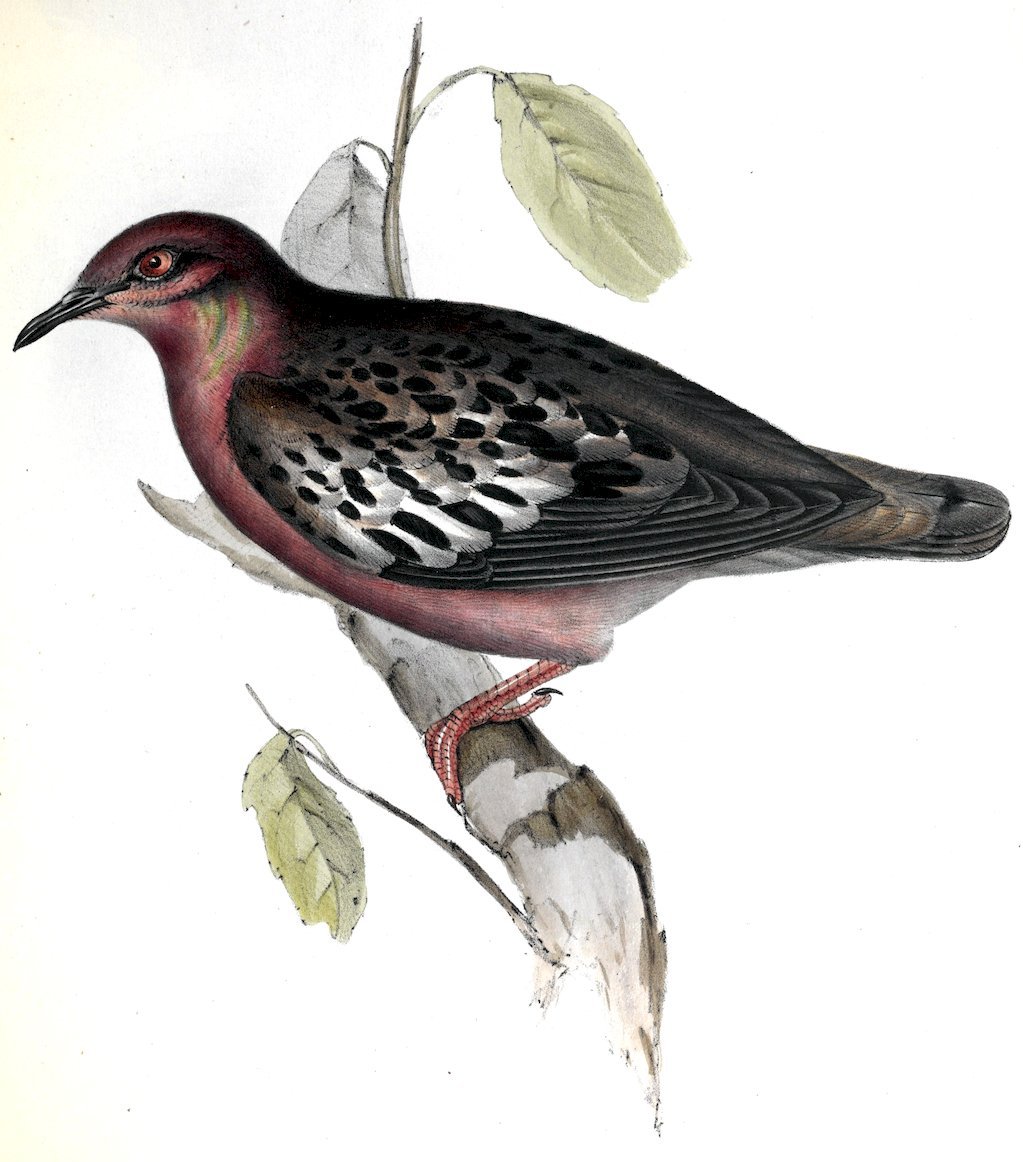
Birds. Pl. 46.
Zenaida Galapagoensis.
115
Columba gymnophthalmus, Temm., Pig. i. 18.
—— leucoptera, Pr. Max. Reise, 2, p. 242.
—— picazuro, Temm. Pig. p. 111.
Picazuro, Azara, Voy. No. 317.
Frequents in large flocks the fields of Indian corn in the neighbourhood of
Maldonado. Legs dull “carmine red.” This, probably, is the representative on
the eastern side of the Andes of the foregoing or Chilian species.
Columba aurita, Temm. Pig. p. 60. Wagl. sp. 70.
I procured specimens of this bird at Maldonado (where it was very abundant)
in La Plata, and at Valparaiso in Chile.
Z. vertice, cervice, dorso caudæque tegminibus obscurè fuscis vinaceo-tinctis; dorso
nigro-guttato; alarum tegminibus fuscis, plumâ singulâ pallidè vinaceo-fusco terminatâ,
pogonii utriusque margine, maculâ oblongâ magnâ nigrâ, lineâ albâ
separatâ; remigibus primariis et secundariis nigrescenti-fuscis, cinerascenti-albo
angustè marginatis; caudâ fuscescenti cinereo ad apicem fasciâ latâ irregulari
nigra; loris lineâque angustâ supra et infra oculari nigris pallidè fusco mixtis;
gulâ pectoreque vinaceis, colli lateribus ærato tinctis; crisso, caudæque tegminibus
inferioribus cinerascentibus, rostro nigro, pedibus rufescenti aurantiacis.
Long. tot. 8½ unc.; alæ, 5¼; caudæ, 3¼; tarsi, ⅞; rostri, 1.
Crown of the head and back of the neck, dark chocolate brown, with a vinous
tinge; back and tail-coverts the same, the former spotted with black; wing-coverts
brown, each feather having a large oblong spot of black on the
margin of either web, separated by a line of white, and tipped with light
vinous brown, the white predominating on the larger coverts, primaries and
secondaries blackish brown, finely edged with greyish white; tail brownish grey,
crossed near the extremity with a broad irregular band of black; lores
and a narrow line above and beneath the eye black, interrupted with light
brown: throat and chest rich vinous, glossed on the sides of the neck with
metallic bronze, and fading into greyish on the vent and under tail-coverts;
bill black; feet reddish orange.
116Habitat, Galapagos Archipelago. (Sept. and Oct.)
This species may at once be distinguished from the Z. aurita, by the redder
tint of its breast,—the greater number of black marks on the wing coverts and
back—the outer half of some of the feathers on the wing coverts being white—the
marks on the under side of the tail being grey (instead of white as in the
Z. aurita) and by the larger size of its beak.
This dove is one of the most abundant birds in the Archipelago. It frequents
the dry rocky soil of the low country, and often feeds in the same flock with the
several species of Geospiza. It is exceedingly tame, and may be killed in
numbers. Formerly it appears to have been much tamer than at present.
Cowley,[21] in 1684, says that the “Turtle doves were so tame that they would often
alight upon our hats and arms, so as that we could take them alive: they not
fearing man, until such time as some of our company did fire at them, whereby
they were rendered more shy.” Dampier[22] (in the same year) also says that a
man in a morning’s walk might kill six or seven dozen of these birds. At the
present time, although certainly very tame, they do not alight on people’s arms; nor
do they suffer themselves to be killed in such numbers. It is surprising that the
change has not been greater;—for these islands during the last hundred and fifty
years, have been frequented by buccaneers and whalers; and the sailors,
wandering through the woods in search of tortoises, take delight in knocking
down the little birds.
Columba Boliviana, D’Orb. & Lafr. Mag. de Zool. 1836. Ois. p. 33. pl. 75.
My specimen was obtained (end of August) at Valparaiso.
I procured specimens at Maldonado (where it was not common), on the banks
of the Plata, and at Rio Negro, in Northern Patagonia.
Columba Talpacoti, Temm. Pig. p. 22. t. 12.
Columbina Cabocolo, Spix, Av. pl. 75a. f. 1.
Le Pigeon rougeatre, Azara, No. 323.
My specimens were obtained at Rio de Janeiro.
117
Tetrao Falklandicus, Gmelin, Syst. 1. 762.
La Caille des Isles Malouines, Buff. pl. enl. 222.
Coturnix Falklandica, Bonn. Ency. Meth. Orn. 220.
Perdix Falklandica, Lath. Ind. Orn. 11, 652.
Ortyx Falklandica, Steph. Shaw’s Zool. xi. 386.
This bird is not uncommon on the mountains in the extreme southern parts
of Tierra del Fuego. It frequents, either in pairs or small coveys, the zone of
alpine plants above the region of forest. It is not very wild, and lies very close
on the bare ground.
Attagis Gayii, Less. Cent. Zool. pl. 47, p. 155.
A specimen was given me, which was shot on the lofty Cordillera of Coquimbo,
only a little below the snow-line. At a similar height, on the Andes, behind
Copiapo, which appear so entirely destitute of vegetation, that any one would have
thought that no living creature could have found subsistence there, I saw a covey.
Five birds rose together, and uttered noisy cries; they flew like grouse, and were
very wild. I was told that this species never descends to the lower Cordillera.
These two species, in their respective countries, occupy the place of the ptarmigan
of the northern hemisphere.
Thinocorus rumicivorus, Eschsch. Zool. Atl. pl. 2.
Tinochorus Eschscholtzii, Less. Cent. Zool. pl. 50.
This very singular bird, which in its habits and appearance partakes of the
character both of a wader and one of the gallinaceous order, is found wherever
there are sterile plains, or open dry pasture land, in southern South America.
We saw it as far south as the inland plains of Patagonia at Santa Cruz, in lat. 50°.
On the western side of the Cordillera, near Concepcion, where the forest land
changes into an open country, I saw this bird, but did not procure a specimen of
it: from that point throughout Chile, as far as Copiapo, it frequents the most
desolate places, where scarcely another living creature can exist: it thus ranges
over at least twenty-three degrees of latitude. It is found either in pairs or in
small flocks of five or six; but near the Sierra Ventana I saw as many as thirty and
forty together. Upon being approached they lie close, and then are very difficult
to be distinguished from the ground; so that they often rise quite unexpectedly.
When feeding they walk rather slowly, with their legs wide apart. They dust
themselves in roads and sandy places. They frequent particular spots, and may
118be found there day after day. When a pair are together, if one is shot, the other
seldom rises; for these birds, like partridges, only take wing in a flock. In all
these respects, in the muscular gizzard adapted for vegetable food, in the arched
beak and fleshy nostrils, short legs, and form of foot, the Tinochorus has a close
affinity with quails. But directly the bird is seen flying, one’s opinion is changed;
the long pointed wings, so different from those in the gallinaceous order, the high
irregular flight, and plaintive cry uttered at the moment of rising, recall the idea
of a snipe. Occasionally they soar like partridges when on the wing in a flock.
The sportsmen of the Beagle unanimously called it the short-billed snipe. To
this genus, or rather to that of the sandpiper, it approaches, as Mr. Gould informs
me, in the shape of its wing, the length of the scapulars, the form of the tail, which
closely resembles that of Tringa hypoleucos, and in the general colour of the
plumage. The male bird, however, has a black mark on its breast, in the form of
a yoke, which may be compared to the red horseshoe on the breast of the English
partridge. Its nest is said to be placed on the borders of lakes, although the bird
itself is an inhabitant of the parched desert. I was told that the female lays five
or six white eggs, spotted with red. I opened the stomachs of many specimens
at Maldonado, and found only vegetable matter, which consisted of chopped pieces
of a thick rushy grass, and leaves of some plant, mixed with grains of quartz.
The contents of the intestine and the dung were of a very bright green colour.
At another season of the year, and further south, I found the craw of one full of
small seeds and a single ant. Those which I shot were exceedingly fat, and had
a strong offensive game odour; but they are said to be very good eating, when
cooked. Pointers will stand to them. In the Appendix Mr. Eyton has given an
anatomical description of this bird, which partly confirms that affinity both to the
Grallatores and Razores, which is so remarkable in its habits and external
appearance.
Shaw’s Nat. Miscel. pl. 481.
I opened the stomach of a specimen killed at the Falkland Islands, and found
in it small shells, chiefly Patellæ, pieces of sea-weed, and several pebbles. The
contents of the stomach and body smelt most offensively. Forster remarked this
circumstance; but since his time, other observers, namely, Anderson, Quoy,
Gaimard, and Lesson (Manuel d’Ornithologie, tom. ii, p. 342) have found that this
is not always the case, and they state that they have actually eaten the Chionis.
I was not aware of these observations, but independently was much surprised at
the extraordinary odour exhaled. We, like other voyagers in the Antarctic seas,
were struck at the great distance from land, at which this bird is found in the
119open ocean. Its feet are not webbed, its flight is not like that of other pelagic
birds, and the contents of its stomach, and structure of legs, show that it is a coast-feeder.
Does it frequent the floating icebergs of the Antarctic ocean, on which
sea-weed and other refuse is sometimes cast?
Nothura major, Wagl. Syst. Av. p. sp. 4.
Tinamus major, Spix, Av. pl. 80.
These birds are very common on the northern shores of the Plata. They do
not rise in coveys, but generally by pairs. They do not conceal themselves nearly
so closely as the English partridge, and hence great numbers may be seen in
riding across the open grassy plains. Note, a shrill whistle. It appears a very
silly bird: a man on horseback, by riding round and round in a circle, or rather
in a spire, so as to approach closer each time, may knock on the head almost as
many as he pleases. The more common method is to catch them with a running
noose, or little lazo, made of the stem of an ostrich’s feather, fastened to the end
of a long stick.[23] A boy on a quiet old horse will frequently thus catch thirty
or forty in a day. The flesh of this bird, when cooked, is most delicately white,
but rather tasteless.
The egg of this species, I believe, closely resembles that of the two following.
Nothura minor, Wagl. Syst. Av. p. sp. 4.
Tinamus minor, Spix, Av. Br. pl. 82.
I procured a specimen of this bird at Bahia Blanca, in northern Patagonia,
where it frequented the sand-dunes and the surrounding sterile plains. Its habits
appear similar to those of the N. major, but it lies closer and does not so readily
take to the wing. It is the smallest of the species mentioned in this work, and its
plumage is less distinctly spotted. The egg of this bird is described below.
Spix’s specimens were obtained at Tijuco in Brazil. The figure in his work on the
Birds of Brazil, differs slightly from mine, in being less marked on the breast.
Crypturus perdicarius, Kittlitz, Vögel von Chili.
This species closely resembles, in its general appearance and habits, the
120N. major, of which probably it is the analogue on the western side of the Cordillera.
It is larger and has a considerably longer beak than the N. major; its
breast is not spotted, and its abdomen has a less fulvous tinge. The N. perdicarius
runs on the open ground, generally a pair together, in the same unconcealed
manner, as its analogue, and does not readily lie close. Flight similar, but on
rising it utters a shriller whistle, of a different tone. It does not appear to be
so easily caught as the Plata species. It is tolerably abundant in all parts of Chile,
as far north as the valley of Guasco; but I was assured, that it has never been
seen in the valley of Copiapo, although only seventy miles north of Guasco, and
of a similar character. The egg is very glossy and of a peculiar colour, which,
according to Werner’s nomenclature, is a palish chocolate red: length in longer
axis 2·07 of an inch; shorter axis 1·495 of an inch. The egg of the N. minor is
of a similar colour, but a shade paler, and rather smaller; its length being
1·815, and its transverse diameter 1·3 of an inch.
Rhynchotus rufescens, Wagl. Av. Syst.
Tinamus rufescens. Temm. Gall. iii. p. 552.
Rhynchotus fasciatus. Spix, Av. Br. pl. 76.
Cryptura Guaza. Vieill.
Crypturus rufescens. Licht. Vög. Verz. s. 67.
My specimens were procured at Maldonado, where it is a much rarer bird
than the Nothura major; I met with it also in the sterile country near Bahia
Blanca. At Maldonado it frequented swampy thickets on the borders of lakes.
It lies very close, and is unwilling to rise, but often utters, whilst on the ground,
a very shrill whistle. When on the wing, it flies to a considerable distance. Several
are generally found together, but they do not rise at the same instant, like a
covey of partridges. Flesh, when cooked, perfectly white. Spix’s specimens
were procured in the country between St. Paul’s and Minas Geraes; so that this
bird, as well as the Nothura minor, has a considerable range.
This bird is well known to abound on the plains of La Plata. To the north it
is found, according to Azara, in Paraguay, where, however, it is not common; to the
south its limit appears to be from 42° to 43°. It has not crossed the Cordillera; but
121I have seen it within the first range of mountains on the Uspallata plain, elevated
between six and seven thousand feet. The ordinary habits of the ostrich are well
known. They feed on vegetable matter, such as roots and grass; but at Bahia
Blanca, I have repeatedly seen three or four come down at low water to the
extensive mud-banks which are then dry, for the sake, as the Gauchos say, of
catching small fish. Although the ostrich in its habits is so shy, wary, and
solitary, and although so fleet in its pace, it falls a prey, without much difficulty,
to the Indian or Gaucho armed with the bolas. When several horsemen appear
in a semicircle, it becomes confounded, and does not know which way to escape.
They generally prefer running against the wind; yet at the first start they expand
their wings, and like a vessel make all sail. On one fine hot day I saw several
ostriches enter a bed of tall rushes, where they squatted concealed, till quite
closely approached. It is not generally known that ostriches readily take to the
water. Mr. King informs me that in Patagonia, at the Bay of San Blas and at
Port Valdes, he saw these birds swimming several times from island to island.
They ran into the water, both when driven down to a point, and likewise of their
own accord, when not frightened: the distance crossed was about 200 yards.
When swimming, very little of their bodies appear above water, and their necks
are extended a little forward: their progress is slow. On two occasions, I saw
some ostriches swimming across the Santa Cruz river, where it was about four
hundred yards wide, and the stream rapid. Captain Sturt,[24] when descending the
Murrumbidgee, in Australia, saw two emus in the act of swimming.
The inhabitants who live in the country readily distinguish, even at a distance,
the male bird from the female. The former is larger and darker coloured,[25] and
has a larger head. The ostrich, I believe the cock, emits a singular, deep-toned,
hissing note. When first I heard it, standing in the midst of some sand-hillocks,
I thought it was made by some wild beast, for it is a sound that one cannot tell
whence it comes, or from how far distant. When we were at Bahia Blanca in the
months of September and October, the eggs were found, in extraordinary numbers,
all over the country. They either lie scattered single, in which case they
are never hatched, and are called by the Spaniards, huachos, or they are collected
together into a shallow excavation, which forms the nest. Out of the four nests
which I saw, three contained twenty-two eggs each, and the fourth twenty-seven.
In one day’s hunting on horseback sixty-four eggs were found; forty-four of these
were in two nests, and the remaining twenty scattered huachos. The Gauchos
unanimously affirm, and there is no reason to doubt their statement, that the male
122bird alone hatches the eggs, and for some time afterwards accompanies the young.
The cock when on the nest lies very close; I have myself almost ridden over
one. It is asserted that at such times they are occasionally fierce, and even
dangerous, and that they have been known to attack a man on horseback, trying
to kick and leap on him. My informer pointed out to me an old man, whom he
had seen much terrified by one chasing him. I observe, in Burchell’s Travels in
South Africa, that he remarks, “having killed a male ostrich, and the feathers
being dirty, it was said by the Hottentots to be a nest bird.” I understand that
the male emu, in the Zoological Gardens, takes care of the nest: this habit therefore
is common to the family.[26]
The Gauchos unanimously affirm that several females lay in one nest. I have
been positively told, that four or five hen birds have been actually watched and
seen to go, in the middle of the day, one after the other, to the same nest. I may
add, also, that it is believed in Africa, that two or more females lay in one nest.[27]
Although this habit at first appears very strange, I think the cause may be
explained in a simple manner. The number of eggs in the nest varies from
twenty to forty, and even to fifty; and according to Azara to seventy or eighty.
Now although it is most probable, from the number of eggs found in one district
being so extraordinarily great, in proportion to that of the parent birds, and likewise
from the state of the ovarium of the hen, that she may in the course of the
season lay a large number, yet the time required must be very long. Azara
states,[28] that a female in a state of domestication laid seventeen eggs, each at the
interval of three days one from another. If the hen were obliged to hatch her
own eggs, before the last was laid, the first probably would be addled; but if
each laid a few eggs at successive periods, in different nests, and several
hens, as is stated to be the case, combined together, then the eggs in one
collection would be nearly of the same age. If the number of eggs in one of
these nests is, as I believe, not greater on an average than the number laid by one
female in the season, then there must be as many nests as females, and each cock
bird will have its fair share of the labour of incubation; and this during a period
when the females probably could not sit, on account of not having finished
laying.[29] I have before mentioned the great numbers of huachos, or scattered
eggs; so that in one day’s hunting the third part found were in this state.
It appears odd that so many should be wasted. Does it not arise from some
difficulty in several females associating together, and in finding a male ready to
undertake the office of incubation? It is evident that there must at first be some
degree of association, between at least two females; otherwise the eggs would
remain scattered at distances far too great to allow of the male collecting them
into one nest. Some authors believe that the scattered eggs are deposited for the
young birds to feed on. This can hardly be the case in America, because the
huachos, although often found addled and putrid, are generally whole.
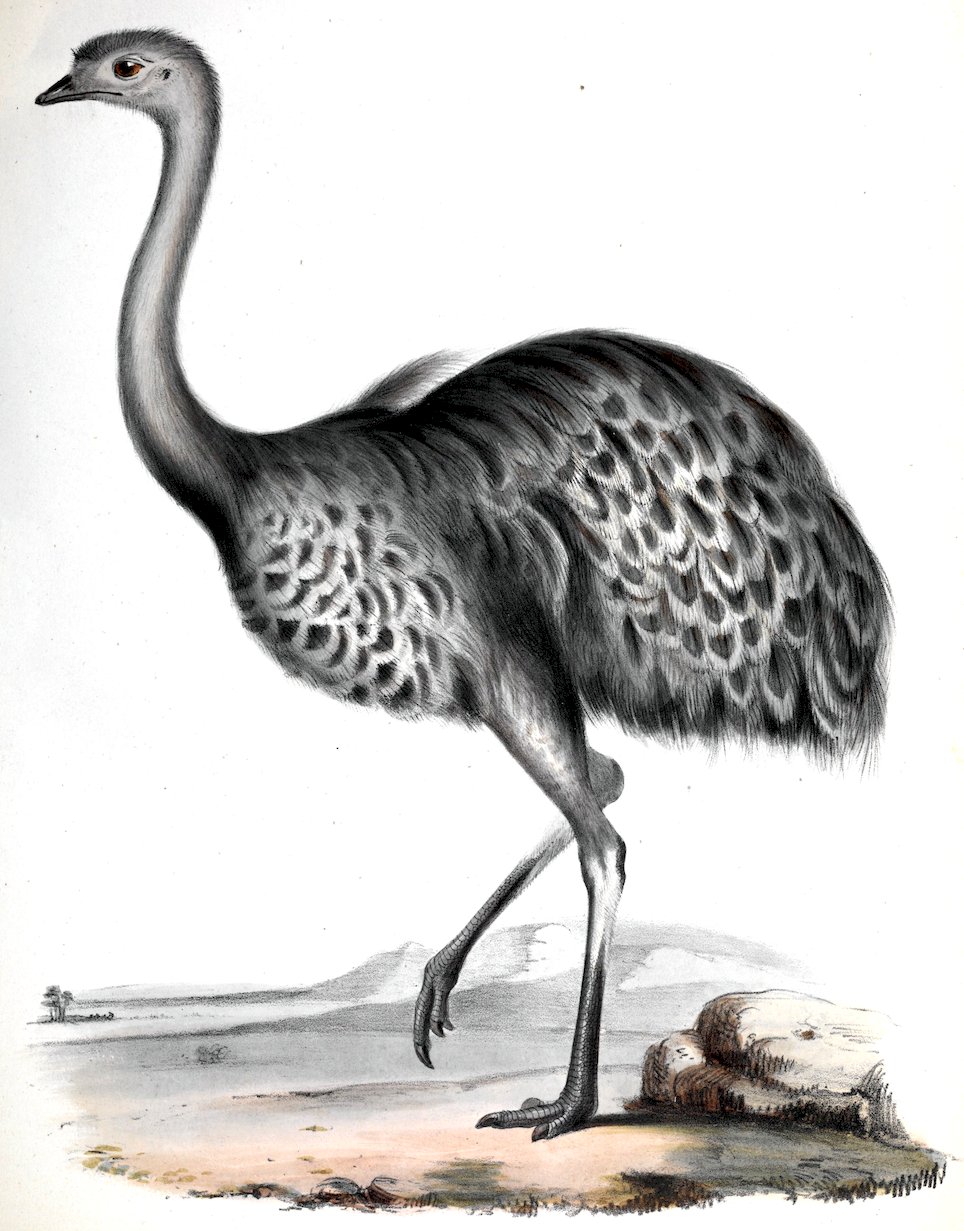
Birds. Pl. 47.
Rhea Darwinii.
123
Gould, in Proceedings of Zoological Soc. 1837, p 35.
R. pallide fusca, plumâ singulâ distinctâ semilunari notâ candidâ terminatâ; capite
collo, femoribusque pallidioribus: rostri culmine augusti, ad apicem latiore, frontes
plumis parvis setosis anticè directis et supra nares extensis; tarsi lateribus in
dimidiam partem plumis parvis mollibus tectis; tarso ⅔ anticè posticeque toto,
squamis reticulatis tecto.
Long. tot. 52 unc.; alæ, 30; tarsi, 11; rostri, 2.
The whole of the plumage light brown, each feather with a decided crescent-shaped
mark of pure white at the extremity; head, neck, and thighs lighter;
base of the neck blackish; culmen of the bill narrow, becoming a little
broader towards apex; front with small bristly feathers, pointing forwards
and reaching over the nostrils. Tarsus with small downy feathers on sides,
extending half way downwards; upper two-thirds of front of tarsus, and
whole hinder side, with reticulated scales.
Habitat, Eastern Patagonia (Lat. 40° S. to 54° S.)
This species, which Mr. Gould, in briefly characterizing it at a meeting of
the Zoological Society, has done me the honour of calling after my name, differs
in many respects from the Rhea Americana. It is smaller, and the general tinge
of the plumage is a light brown in place of grey; each feather being conspicuously
tipped with white. The bill is considerably smaller, and especially less broad at
its base; the culmen is less than half as wide, and becomes slightly broader
towards the apex, whereas in the R. Americana it becomes slightly narrower; the
extremity, however, of both the upper and the lower mandible, is more tumid in
the latter, than in the R. Darwinii.
| 124 |
|
R. Darwinii.
inches |
R. Americana,
inches |
| Length of beak, from edge of membrane at base to the apex |
2 |
2⁶⁄₈ |
| Length, from anterior margin of eye to apex |
3⁴⁄₁₂ |
5⁶⁄₁₂ |
| Width of upper mandible, measured across middle of nostrils |
1¹⁄₂₀ |
1⁶⁄₂₀ |
The skin round and in front of the eyes is less bare in R. Darwinii; and
small bristly feathers, directed forwards, reach over the nostrils. The feet and
tarsi are nearly of the same size in the two species. In the R. Darwinii, short
plumose feathers extend downwards in a point on the sides of the tarsus, for about
half its length. The upper two-thirds of the tarsus, in front, is covered with
reticulated scales in place of the broad transverse band-like scales of the R. Americana;
and the scales of the lower third are not so large as in the latter. In the
R. Darwinii the entire length of the back of the tarsus is covered with reticulated
scales, which increase in size from the heel upwards: in the common Rhea, the
scales on the hinder side of the tarsus are reticulated only on the heel, and about
an inch above it; all the upper part consisting of transverse bands, similar to
those in front.
The first notice I received of this species was at the Rio Negro, in Northern
Patagonia, where I repeatedly heard the Gauchos talking of a very rare bird,
called Avestruz Petise. They described it as being less than the common ostrich
(which is there abundant), but with a very close general resemblance. They
said its colour was dark and mottled, and that its legs were shorter, and feathered
lower down than those of the common ostrich. It is more easily caught by the
bolas than the other species. The few inhabitants who had seen both kinds,
affirmed that they could distinguish them apart, from a long distance. The eggs,
however, of the small species appeared more generally known, and it was
remarked with surprise, that they were very little less than those of the common
Rhea, but of a slightly different form, and with a tinge of pale blue. Some eggs
which I picked up on the plains of Patagonia, agree pretty well with this description;
and I do not doubt are those of the Petise. This species occurs most rarely
in the neighbourhood of the Rio Negro; but about a degree and a half further
south they are tolerably abundant. One Gaucho, however, told me he distinctly
recollected having seen one, many years before, near the mouth of the Rio
Colorado, which is north of the Rio Negro. They are said to prefer the plains
near the sea. When at Port Desire in Patagonia (Lat. 48°), Mr. Martens shot an
ostrich; I looked at it, and from most unfortunately forgetting at the moment,
the whole subject of the Petises, thought it was a two-third grown one of the
common sort. The bird was skinned and cooked before my memory returned.
But the head, neck, legs, wings, many of the larger feathers, and a large part of
the skin, had been preserved. From these a very nearly perfect specimen has
125been put together, and is now exhibited in the museum of the Zoological
Society. M. A. D’Orbigny, a distinguished French naturalist, when at the Rio
Negro, made great exertions to procure this bird, but had not the good fortune to
succeed. He mentions it in his Travels (vol. ii. p. 76.) and proposes (in case, I
presume, of his obtaining a specimen at some future time, and thus being able to
characterize it,) to call it Rhea pennata. A notice of this species was given long
since (A.D. 1749) by Dobrizhoffer, in his account of the Abipones (vol. i. Eng.
Trans. p. 314). He says, “You must know, moreover, that Emus differ in size
and habits in different tracts of land; for those that inhabit the plains of Buenos
Ayres and Tucuman are larger, and have black, white, and grey feathers; those
near to the Strait of Magellan are smaller, and more beautiful, for their white
feathers are tipped with black at the extremity, and their black ones in like
manner terminate in white.”
Among the Patagonian Indians in the Strait of Magellan, we found a half-bred
Indian, who had lived some years with this tribe, but had been born in the
northern provinces. I asked him if he had ever heard of the Avestruz Petise? He
answered by saying, “Why there are none others in these southern countries.”
He informed me that the number of eggs in the nest of the Petise is considerably
less than with the other kind, namely, not more than fifteen on an average; but
he asserted that more than one female deposited them. At Santa Cruz we saw
several of these birds. They were excessively wary: I think they could see a
person approaching, when he was so far off as not to distinguish the ostrich. In
ascending the river few were seen; but in our quiet and rapid descent, many, in
pairs and by fours or fives, were observed. It was remarked by some of the
officers, and I think with truth, that this bird did not expand its wings, when first
starting at full speed, after the manner of the northern kind. The fact of these
ostriches swimming across the river has been mentioned. In conclusion, I may
repeat that the R. Americana inhabits the eastern plains of S. America as far as
a little south of the Rio Negro, in lat. 41°, and that the R. Darwinii takes its
place in Southern Patagonia; the part about the Rio Negro being neutral territory.
Wallis saw ostriches at Bachelor’s river (lat 53° 54′), in the Strait of Magellan,
which must be the extreme southern possible range of the Petise.
Oreophilus totanirostris, Jard. & Selb. Illustr. of Orn. iii. pl. 151.
My specimens were obtained at Maldonado and at Valparaiso. At the
former, it was common, feeding on the open grassy plains in small flocks,
mingled with the icteri and the thrush-like Xolmis variegata. When these birds
126rise on the wing, they utter a plaintive cry. Legs “crimson red;” toes leaden
colour, with their under surface remarkably soft and fleshy. Iris dark brown.
Charadrius virgininus, Borkh. Act. Acad. Cæs. Leop. Car. Nat. Cur. 1834. xvi. pl. 18.
Charadrius marmoratus, Wagl.
This representative of the golden plover of Europe and North America, is
common on the banks of the Plata in large and small flocks. It is found also,
according to Meyer, in Chile.
Tringa Urvillii, Garnot, Ann. Ic. Nat. Jan. 1826.
Vanellus cinctus, Less. Voy. de la Coqu. Zool. p. 720. pl. xliii.
Squatarola cincta, Jard. & Selby’s Illust. Orn. pl. 110.
Charadrius rubecola, Vig. Journ. iv. p. 96.
I obtained specimens of this bird in Tierra del Fuego, where it inhabited
both the sea shore and the bare stony summits of the mountains; at the Falkland
Islands, where it frequented the upland marshes; and at Chiloe, where I met
with large flocks in the fields, not near the coast.
S. vertice corporeque supra fuscis, dorsi parapterique plumis pallidiore marginatis;
remigibus primariis nigrescenti fuscis, pogoniis externis albo angustè marginatis
rhachibus albis; uropygio caudâque obscurè fuscis, remigibus externis albo latè marginatis
et terminatis; fronte, genis, gulâ, abdomine postico, caudæeque tegminibus
inferioribus flavescenti albis, colli pectorisque lateribus fuscis, colli plumis fusco
pallido terminatis; pedibus nigris.
Long. tot. 8 unc.; alæ, 5⅝; caudæ, 3; tarsi, 1⅜; rostri, ⅞.
Crown of the head, all the upper surface brown, the feathers of the back and the
scapularies, margined with paler; primaries blackish brown, finely edged on
their inner margins with white, and with white shafts; rump and tail dark
brown, the outer feathers largely margined and tipped with white; forehead
and sides of the face sandy white; throat, lower part of the abdomen, and
under tail coverts, buffy white; sides of the neck and chest brown; the
feathers of the latter tipped with still lighter brown; bill and feet black.
Habitat, Maldonado; inland grassy plains.
This species is most closely allied to the foregoing. I obtained only one
specimen, which, on comparison with several of the S. cincta, appears a little larger
in all its dimensions, especially in the length of the tarsi. Its back and scapularies
127are of a more uniform brown, the feathers being less edged with pale brown.
Its feet are black, whereas those of S. cincta are brown.
Charadrius Cayanus, Lath. Ind. Orn. 11. 748.
I met with this bird from latitude 30° to 45° S. on both sides of S. America.
In La Plata it is called “Teru-tero,” in imitation of its cry; and in Chile, according
to Molina, “Theghel.” These birds, which in many respects resemble in habits our
peewits (Vanellus cristatus), frequent, generally in pairs, open grassy land, and
especially the neighbourhood of lakes. As the peewit takes its name from the
sound of its voice, so does the teru-tero. While riding over the grassy plains,
one is constantly pursued by these birds, which appear to hate mankind, and I
am sure deserve to be hated, for their never-ceasing, unvaried, harsh screams.
The stillness of the night is often disturbed by them. To the sportsman they are
most annoying, by announcing to every other bird and animal his approach: to
the traveller in the country, they may possibly, as Molina says, do good, by
warning him of the midnight robber. During the breeding season, they attempt,
like our peewits, by feigning to be wounded, to draw away from their nests dogs
and other enemies. Their eggs are of a pointed oval form; of a brownish olive
colour, thickly spotted with dark brown. Their eggs, like those of the peewit,
are esteemed particularly good eating.
Charadrius Azaræ, Temm. pl. col. 184.
—— collaris, Vieill.
Albatuitui à collier noir, Azara, No. 392.
My specimens were obtained on the banks of the Plata and at Valparaiso.
The specimen from the latter country differs from those procured at the former,
in the absence of the black collar on the breast, of the black streak running from
the eye to the corner of the mouth; in the plumage of the back and back of head
having a lesser tinge of red; and especially in the feet being black, and tarsi
blackish, instead of both being orange, as is the case with those killed on the
shores of the Plata. I have not, however, thought it desirable to make two
species of these birds, not having a larger series of specimens for comparison.
Charadrius bifasciatus, Licht. Vog. Verz. p. 71.
—— trifasciatus, Wagl. Syst. Av. sp. 31.
I procured two specimens of this bird at Bahia Blanca, in Northern
Patagonia.
128
Tringa semipalmata, Temm.
Charadrius semipalmatus, Caup. Isis. 1825, p. 1375, t. 14. Wagl. Syst. Av. sp. 23.
Bonap. Am. Orn. iv. pl. 25, f. 4.
Galapagos Archipelago.
Rio Plata.
Ardea Leuce, Ill.
Ardea Egretta, Wils. Am. Orn. pl. 61, f. 4.
My specimen was procured at Maldonado. I saw it also in Patagonia.
Galapagos Archipelago. Frequents the sea-coast and salt-lagoons. There
are no fresh water pools in any of these islands.
Ardea violacea, Linn.
Ardea callocephala, Wagl. Syst. Av.
Mr. G. R. Gray has thought it advisable to give the following description of
this specimen, from the Gallapagos Archipelago. It appears to be a young bird,
and is small in all its dimensions.
Upper part blackish grey; each feather marked down the middle with a broad
stripe of black, and tinged on the margins with shining bronze brown;
beneath the body blueish grey, with the front of the neck, top of the head,
and margins of the feathers on the thighs rufous; the sides of the head and
throat deep black, the former divided in the middle on each side with a patch
of white; the bill black, and feet of a pale reddish colour.
Ardea nycticorax, Wils. (young bird.)
Valparaiso, Chile.
Ibis melanops, Lath. Hist. ix. pl. 150.
This bird frequents the desert gravelly plains of Patagonia, as far south as
lat. 48°: in the British Museum there are specimens which Captain Clapperton
brought from central Africa; so that this bird has an extraordinarily wide range.
It generally lives in pairs, but during part of the year in small flocks. Its cry
is very singular and loud: when it is heard at a distance it closely resembles the
neighing of the guanaco. I opened the stomach of two specimens, and found in
them remains of lizards, cicadæ, and scorpions. It builds in rocky cliffs on the
129sea shore: egg dirty white, freckled with pale reddish brown; its circumference
over longer axis is seven inches. The legs are carmine and scarlet-red: iris
scarlet-red.
Tantalus Mexicanus, Ord. Journ. Acad. Phil.
Tantalus chalcopterus? Temm.
Ibis Falcinellus, Bonap. Am. Orn. iii.
My specimen was obtained at the Rio Negro: it is very numerous in large
flocks on the vast swampy plains between Bahia Blanca and Buenos Ayres. Its
flight when soaring is singularly graceful; the whole flock moving in precise
concert.
Numenius Hudsonicus, Lath. Ind. Orn. ii. 712.
This curlew is very abundant on the tidal mud-banks of Chiloe. When the
flock rises, each bird utters a shrill note.
Numenius brevirostris, Licht. Cat. 75, sp. 774 a.
Buenos Ayres.
Scolopax Hudsonica, Lath. Ind. Orn. ii. 720.
My specimens were obtained from the Falkland Islands and from Chiloe,
where it frequented the tidal mud-banks in flocks.
Totanus flavipes, Vieill. Ency. Meth. 1106.
Yellow shanks snipe, Penn. Arct. Zool. ii. 468.
—— Wills. Am. Orn. pl. 58. f. 4.
Monte Video, Rio Plata.
Tringa macroptera, Spix, Av. n. sp. pl. 92.
Monte Video, Rio Plata.
130
Scolopax melanoleuca, Gmel.
Scolopax vociferus, Wils. Am. Orn. pl. 58, f. 5.
Chorlito à croupion blanc, Azara, No. 394.
Totanus solitarius, Vieill.
White-rumped snipe, Lath.
Maldonado, Rio Plata.
T. corpore supra caudâque fuliginoso-griseis; alis fuscis; gutture albo; pectore
hypochondriisque plumbeo-griseis; abdomine medio, caudæ tegminibus inferioribus
albis, illis obscure, bis plane grisescenti fusco fasciatis; rostri rubescenti fusco;
pedibus obscurè olivaceo fuscis.
Long. tot. 9½ unc.; alæ, 6⅝; caudæ, 3; tarsi, 1¼; rostri, ⅝.
The whole of the upper surface and tail sooty-grey; wings dull brown; throat
white; chest and flanks leaden grey; centre of the abdomen and under
tail coverts white, the former indistinctly, and the latter distinctly, barred
with greyish brown; bill, reddish brown; feet, dark olive brown.
Habitat, Galapagos Archipelago (October).
This species appear quite distinct from any described one.
Himantopus nigricollis, Vieill. Ency. Meth. 340.
Recurvirostra himantopus, Wils. Am. Orn. pl. 58. f. 2.
My specimens were obtained from the provinces bordering the Plata. On
the great swampy plains and fens which lie between Buenos Ayres and Bahia
Blanca, it is very numerous in small, and occasionally, in large flocks. This
plover, which appears as if mounted on stilts, has been wrongfully accused of
inelegance; when wading about in shallow water, which is its favourite resort, its
gait is far from awkward. In a flock it utters a noise, which singularly resembles
the cry of a pack of small dogs in full chase: when I travelled across the
above mentioned plains, I was more than once startled, when lying awake at
night, at the distant sound, and thought the wild Indians were coming.
Tringa rufescens, Vieill., N. Dict. d’Hist. Nat. 34. p. 470.
—— Ency. Meth. Orn. p. 1090.
—— Gal. des Ois. pl. 238.
—— Yarrel, Lin. Trans.
—— Gould; Birds of Europe, pl.
Monte Video, Rio Plata.
131
Tringa Schinzii, Brehm. Bonap. Am. Orn. iv. pl. 24. f. 2.
Pelidna cinclus, var. Say.
Flocks of this species were common on the shores of the inland bays in the
southern parts of Tierra del Fuego.
Tringa minutilla, Vieill. Ency. Meth. 1089.
Galapagos Archipelago. Both the specimens which I procured here are
smaller than the ordinary size of this bird, but do not differ in other respects.
Vieillot says it ranges from the Antilles to Canada.
Totanus semicollaris, Vieill., Ency. Meth. p. 1100.
Rhynchæa Hilairea, Valenc. Less. Ill. de Zool. pl. 18.
Rhynchæa occidentalis, King, Zool. Journ. iv. 94.
Le chorlito a demi colliers blanc et noiratre, Azara, No. 409.
Monte Video, Rio Plata. Frequents swamps; habits like the Scolopax
Gallinago.
Scolopax Paraguai, Vieill. Ency. Meth. p. 1160.
—— Brasiliensis, Swains, Faun. Bor. Am. Birds, p. 400.
Becassine 1st Espece, Azara.
Valparaiso and Maldonado, Rio Plata.
Scolopax Magellanicus, King, Zool. Journ.
My specimens were obtained from Maldonado and East Falkland Island.
Flight a very little less irregular and rapid than the English snipe. I several
times in May observed this, as well as the foregoing species, flying in lofty circles,
and suddenly stooping downwards, at the same time that it uttered a peculiar
drumming noise, similar to that made by the English snipe in summer, when
breeding. This species is most closely allied to the foregoing, but I have no
doubt it is distinct; because at the time when I procured specimens of both at
Maldonado, I perceived a difference between them. This species is there more
abundant than the S. Paraguaiæ. Its beak is nearly three-tenths of an inch
shorter, and the culmen rather broader. The plumage of its back is of a decidedly
less dark tint; each separate feather having much less black in it.
132
I obtained specimens from Iquique, on the coast of Peru, and from the
Galapagos Archipelago.
Crex lateralis, Licht., Cat. p.
—— Griff. An. King. Aves.
Maldonado, Rio Plata. On being disturbed readily takes wing. Base of
the bill, especially of the lower mandible, bright green.
Z. corpore toto supra nigrescenti-fusco, plumâ singulâ medio albo-guttatâ et olivaceo-fusco
latè marginatâ; remigibus fuscis, mento albo, corpore infra fuscescenti-nigro,
gutture pectoreque albo-striatis; abdomine tegminibusque caudæ inferioribus albo
irregulariter transverè strigato; rostro obscure corneo; pedibus olivaceo-viridibus.
Long. tot. 5⅝ unc.; alæ, 3¼; caudæ, 1⅜; tarsi, ⅞; rostri, ½.
The whole of the upper surface blackish brown, each feather spotted with white
down the centre, and largely margined with olive brown; quills plain brown;
chin white; the remainder of the under surface brownish black, striated with
white on the throat and chest, and crossed by irregular bars of the same on
the abdomen and under tail coverts; bill dark horn colour; feet olive green.
Habitat, Rio Plata. (Shot on board the Beagle.)
Z. capite corporeque infra, nigrescenti-griseis; corpore supra obscure rubrofusco,
uropygio obscurè grisescenti-nigro; alis hypochondriis postice, tegminibusque caudæ
inferioribus albo parciter sparsis; rostro nigrofusco; pedibus rubescentibus; iridibus
carmineis.
Long. tot. 5¼ unc.; alæ, 2¾; caudæ, 1; tarsi, ⅞; rostri, ¾.
Head and all the under surface blackish grey; all the upper surface dark reddish
brown, fading off on the rump into deep greyish black; the wings, hinder
part of the flanks, and under tail coverts slightly sprinkled with white; bill,
blackish brown; feet, reddish; iris, bright scarlet.
Habitat, Galapagos Archipelago.
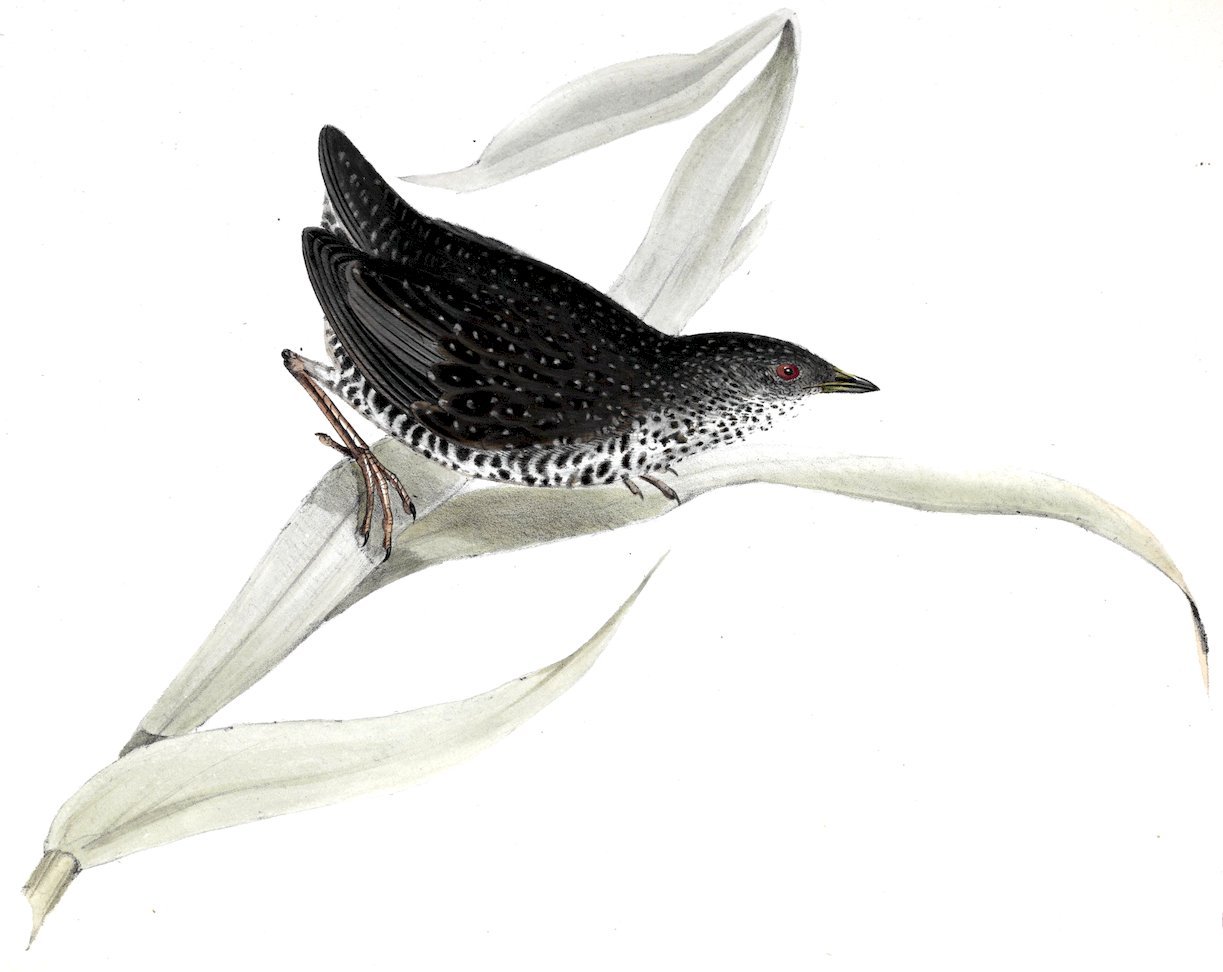
Birds. Pl. 48.
Zapornia notata.
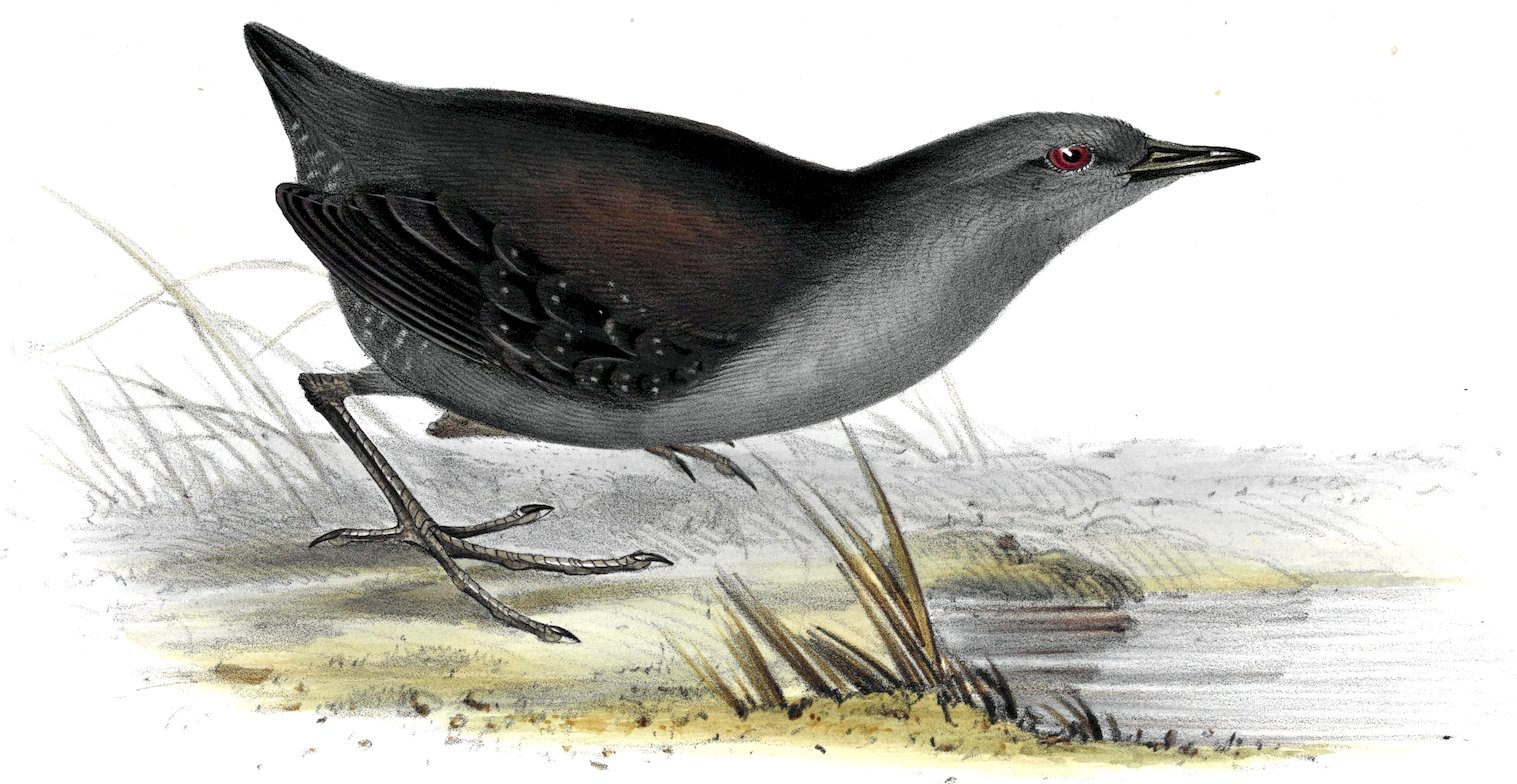
Birds. Pl. 49.
Zapornia spilonota.
133This bird frequents in large numbers the high and damp summits of the
islands. It lives in the thick beds of carex and other plants, which, from the
condensed vapour of the clouds, are constantly kept rather humid. It is tame,
but lives concealed; it often utters a loud and peculiar cry. The female is said to
lay from eight to twelve eggs. It is, I believe, the only bird in this archipelago
which is exclusively confined to the upper parts of the islands. With respect to
the specific description, I must observe, that in one of the specimens, the few and
small white spots on the wings and abdomen are wanting. This is not a sexual
distinction, but possibly may be owing to immaturity.
Common on the low coral islets, forming the Keeling or Cocos Atoll in the
Indian ocean. With the exception of a snipe, this was the only bird without webfeet
which inhabited this group.
Rallus ypecaha, Vieill. Ency. Meth. p. 1071.
Crex melampyga, Licht. Cat. Sp.
L’Ypacaha, Azara, No. 367.
Buenos Ayres.
Rallus sanguinolentus, Swains, 2 cent. and a quart.
Valparaiso.
Gallinula crassirostris, J.E. Gray, in Griff. An. Kingd.
I obtained specimens on the banks of the Plata and at Valparaiso.
Crex galeata, Licht. Cat. 80. sp. 826.
Yahana proprement dit, Azara, No. 379.
Gallinula galeata, Bonap.
Concepcion, Chile.
P. vertice, remigibus primariis obscurè olivaceo-viridibus, harum apicibus flavescenti
albo angustè marginatis; corpore supra obscure olivaceo-viridi, plumâ singulâ
134obscurè fulvo late marginatâ; genis gutture, corporeque infra flavescentibus; rostro
rubro; pedibus viridescenti-flavis.
Long. tot. 9 unc.; alæ, 5½; caudæ, 2½; tarsi, 1⅞; rostrio, ⅞.
Habitat, Ascension Island, Atlantic Ocean. (July.)
This specimen was killed with a stick near the summit of the Island. It
was evidently a straggler, which had not long arrived. There is no aboriginal
land bird at Ascension.
Anser melanopterus, Eyton, Monog. Anatidæ, p. 93.
Captain FitzRoy purchased a skin of this fine goose at Valparaiso, which he
has presented to the British Museum. There is another specimen at the Zoological
Society, which Mr. Pentland procured from the lake of Titicaca, in Bolivia.
Anas Magellanica, Gmel. Syst. i. 505.
Chloephaga Magellanica, Eyton, Monog. Anatidæ, p. 82.
Bernicla leucoptera, Less. Trait d’Ornith. 627.
This goose is found in Tierra del Fuego, and at the Falkland Islands; at the
latter it is common. They live in pairs and in small flocks throughout the interior
of the island, being rarely or never found on the sea-coast, and seldom even near
fresh water lakes. I believe this bird does not migrate from the Falkland Islands;
it builds on the small outlying islets. This latter circumstance is supposed to be
owing to the fear of the foxes; and it is perhaps from the same cause, that
although very tame by day, they are much the contrary in the dusk of the
evening. These geese live entirely on vegetable matter; they are called by the
seamen, the “upland geese.” Mr. Eyton, in his excellent Monograph on the
Anatidæ, has described the trachea of this bird, which I brought home in spirits.
Bernicla antarctica, Steph. Sh. Zool. xii. 59.
—— Eyton, Monograph, p. 84.
Anas Antarctica, Gmel. Syst. i. 505.
This goose is common in Tierra del Fuego, the Falkland Islands, and on the
western coast, as far north as Chiloe. It is called by the sailors the “rock goose,”
as it lives exclusively on the rocky parts of the sea-coast. In the deep and retired
channels of Tierra del Fuego, the snow-white male, invariably accompanied by
his darker consort, and standing close by each other on some distant rocky point,
is a common feature in the landscape. Mr. Eyton has described the treachea of
this species, which I brought home.
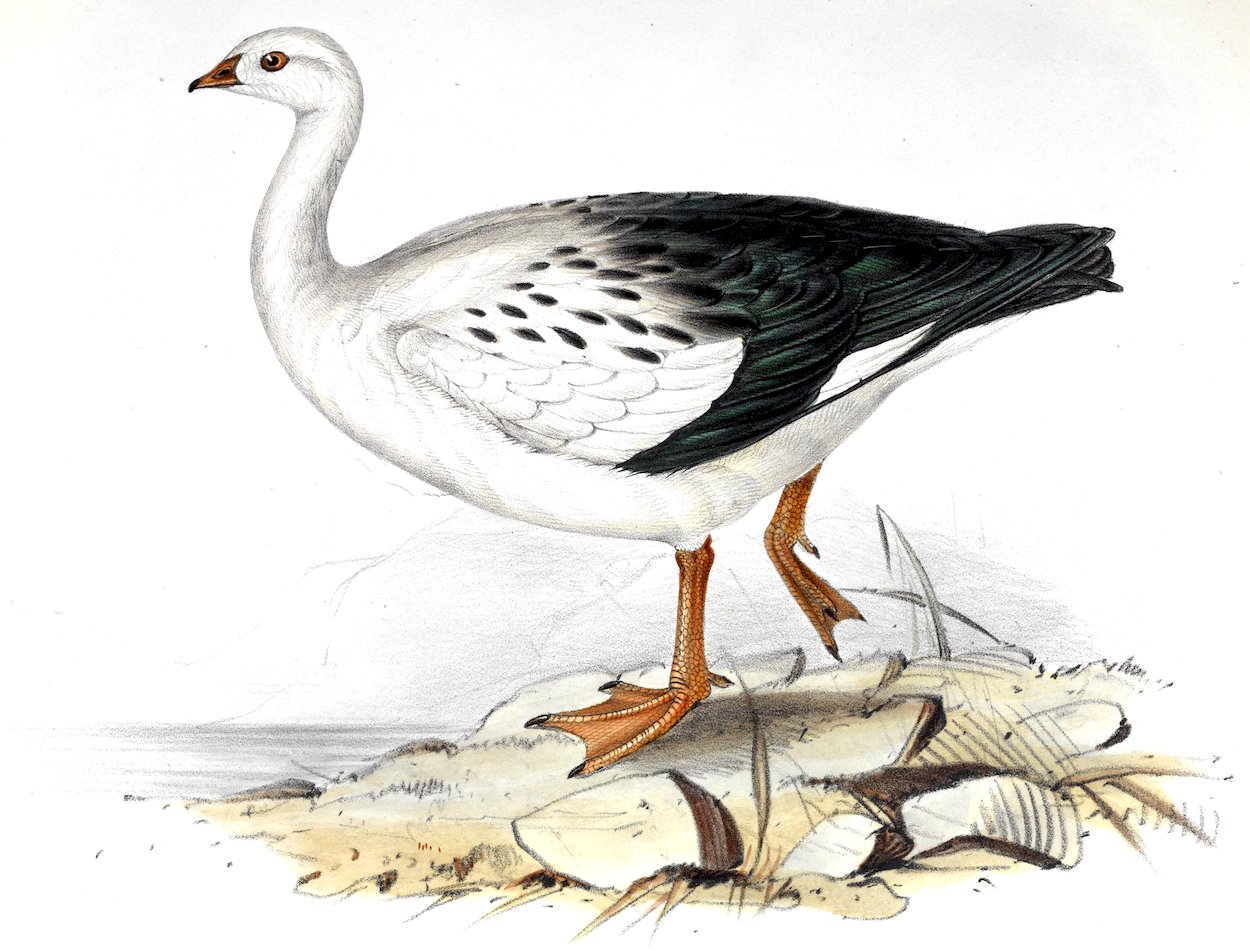
Birds. Pl. 50.
Anser melanopterus.
135
Pæcilonitta Bahamensis, Eyton, Monog. p. 116.
Anas Bahamensis, Linn. Syst. i. 199.
Mareca Bahamensis, Steph. Gen. Zool. xii. p. 137.
A specimen was procured from a small salt-water lagoon in the Galapagos
Archipelago (October.)
It was a male; bill, lead colour; base of superior mandible purple, with a black
mark in the upper part.
Dafila urophasianus, Eyton, Monog. Anatidæ. p. 112.
Anas urophasianus, King, Zool. Journ. iv. 351.
Bahia Blanca, Northern Patagonia.
Rhynchaspis maculatus, Gould, in Jard. & Selby Illust. Orn. p. 147. pl. 147.
Mr. Gould observes that, “A good figure of this beautiful shoveller may be
found in the 3rd vol. of Messrs. Jardine and Selby’s Illustrations of Ornithology.
Their figure was taken from an example which I forwarded to those gentlemen
with the name of maculata attached: my specimen was received from the Rio Plata,
and this is also the locality whence (in October) Mr. Darwin’s specimen was
procured. The numerous and conspicuous spots distributed over the body,
renders this species readily distinguishable from all the other members of the
genus.”
Querquedula erythrorhyncha, Eyton, Monog. Anatidæ, p. 127.
Anas erythrorhyncha, Spix, Av. Nov. sp. pl.
My specimens were obtained from Buenos Ayres (October) and the Straits
of Magellan (February.)
Querquedula creccoïdes, Eyton, Monog. Anatidæ, p. 128.
Anas creccoides, King, Zool. Journ. iv. 99.
Mr. Gould observes that, “This species was first described by Mr. Vigors,
136from a specimen in the collection brought from the Straits of Magellan, by Capt.
P. P. King. It is a true teal, and in size and form closely assimilates to the
common teal of Europe, and to the species inhabiting North America (Querquedula
Carolinensis, Bonap.) to both of which it is evidently an analogue, and doubtless
represents those birds in the southern half of the American continent.”
My specimens were procured from the Rio Plata, and from the Straits of
Magellan.
Micropterus brachypterus, Eyton, Monog. Anat. p. 144.
Anas brachytera, Lath., Ind. Orn. ii. 834.
These great logger-headed ducks, which sometimes weigh as much as twenty-two
pounds, were called by the old navigators, from their extraordinary manner
of paddling and splashing over the water, race-horses, but now much more
properly steamers. Their wings are too small and weak to allow of flight, but by
their aid, partly swimming and partly flapping the surface of the water, they move
very quickly. The manner is something like that by which the common house
duck escapes, when pursued by a dog; but I am nearly sure that the steamer
moves its wings alternately, instead of, as in other birds, both together. These
clumsy birds make such a noise and splashing, that the effect is most curious.
The steamer is able to dive but a very short distance. It feeds entirely on shellfish
from the floating kelp and tidal rocks; hence the beak and head are surprisingly
heavy and strong, for the purpose of breaking them. So strong is the
head, that I have sometimes scarcely been able to fracture it with my geological
hammer; and all our sportsmen soon discovered how tenacious these birds were
of life. When pluming themselves in the evening in a flock they make an odd
mixture of sounds, somewhat like bull-frogs within the tropics.
My specimens were obtained from Bahia Blanca (September), Northern
Patagonia, and the Falkland Islands. In the former place it lived in small flocks
in the salt-water channels, extending between the great marshes at the head of
the harbour. At the Falkland Islands I saw (March) very few individuals; and
these only in one small fresh water lake. Tarsi of the same colour as the plumage
of the back; iris of a beautiful tint, between “scarlet and carmine red;” pupil
black. Mr. Gould remarks that, “This beautiful species of Podiceps is equal in
size, and has many of the characters of the P. auritus, but is at once distinguished
from that species by the silvery colouring of the plumes that adorn the sides of
the head; which in P. auritus are deep chestnut.”
137
Podiceps Rolland, Quoy et Gaim. Voy. de l’Uranie, pl. 36. p. 133.
I obtained specimens from the Falkland Islands (March), where it was common
at the head of the tortuous bays which intersect those islands; from a fresh water
lake near the Strait of Magellan (February); and from the eastern coast of Chiloe.
The male and female have the same plumage. Iris of a fine red colour. Mr.
Gould adds that, “this species appears to be as nearly related to the Podiceps
cornutus, as the preceding species is to P. auritus, but is readily distinguishable
from it, by the white spot in the centre of the tuft of feathers that spring from the
sides of the face.”
Le macas cornu, Azara, No. 443.
This specimen was procured in a fresh water lake near Buenos Ayres.
Capt. P. King brought home specimens from the salt-water channels in Tierra
del Fuego, where it is excessively numerous. It often makes a very melancholy
cry, which suits the gloomy climate of those desolate shores.
Spheniscus Humboldtii, Meyen. Nov. Act. Acad. Cæs. Leop. Car. Nat. Cur. 1834, 110. pl. 21.
My specimen was obtained near Valparaiso. Meyen, who first described
this bird, procured it from the coast of Peru.
Puffinus cinereus, Steph. Gen. Zool. xiii. p. 227.
Procellaria puffinus, Linn.
This bird frequents the seas on the whole coast of South America. I
obtained specimens from Tierra del Fuego, Chiloe, the mouth of the Plata, and Callao
Bay on the coast of Peru. It is likewise known to be common in the Northern
Hemisphere; this species, therefore, has a most extensive range. It generally
frequents the retired inland sounds in very large flocks; although, occasionally,
two or three may be seen out at sea. I do not think I ever saw so many birds of
any other sort together, as I once saw of these petrels, behind the Island of
Chiloe. Hundreds of thousands flew in an irregular line, for several hours in one
direction. When part of the flock settled on the water, the surface was blackened;
and a cackling noise proceeded from them, as of human beings talking in the
distance. At this time, the water was in parts coloured by clouds of small
crustacea. The inhabitants of Chiloe told me that this petrel was very irregular
138in its movements;—sometimes they appeared in vast numbers, and on the next
day not one was to be seen. At Port Famine, every morning and evening, a long
band of these birds continued to fly with extreme rapidity, up and down the
central parts of the channel, close to the surface of the water. Their flight was
direct and vigorous, and they seldom glided with extended wings in graceful
curves, like most other members of this family. Occasionally, they settled for a
short time on the water; and they thus remained at rest during nearly the whole
of the middle of the day. When flying backwards and forwards, at a
distance from the shore, they evidently were fishing: but it was rare to see them
seize any prey. They are very wary, and seldom approach within gun-shot of a
boat or of a ship;—a disposition strikingly different from that of most of the other
species. The stomach of one, killed near Port Famine, was distended with seven
prawn-like crabs, and a small fish. In another, killed off the Plata, there was
the beak of a small cuttle-fish. I observed that these birds, when only slightly
winged, were quite incapable of diving. There is no difference in the plumage of
the sexes. The web between the inner toes, with the exception of the margin, is
“reddish lilac-purple;” the rest being blackish. Legs and half of the lower mandible
blackish purple. From accounts which I have received, the individuals of
this species, which live in the Northern Hemisphere, appear to have exactly
the same habits as those above described.
Puffinuria Berardi, Less. Tr. d’Orn. p. 614.
Procellaria Berardi, Quoy et Gaim. Voy. de pl. 31
This bird is common in the deep and quiet creeks and inland seas of Tierra
del Fuego, and on the west coast of Patagonia, as far north as the Chonos
Archipelago. I never saw but one in the open sea, and that was between Tierra
del Fuego and the Falkland Islands. This bird is a complete auk in its habits,
although from its structure it must be classed with the Petrels. To the latter Mr.
Gould informs me, its affinity is clearly shewn by the form of its beak and
nostrils, length of foot, and even by the general colouring of its plumage. To the
auks it is related in the general form of its body, its short wings, shape of tail,
and absence of hind-toe to the foot. When seen from a distance and undisturbed,
it would almost certainly be mistaken, from its manner of swimming and frequent
diving, for a grebe. When approached in a boat, it generally dives to a distance,
and on coming to the surface, with the same movement takes flight: having flown
some way, it drops like a stone on the water, as if struck dead, and instantaneously
dives again. No one seeing this bird for the first time, thus diving
139like a grebe and flying in a straight line by the rapid movement of its short wings
like an auk, would be willing to believe that it was a member of the family
of petrels;—the greater number of which are eminently pelagic in their habits,
do not dive, and whose flight is usually most graceful and continuous. I
observed at Port Famine, that these birds, in the evening, sometimes flew in
straight-lines from one part of the sound to another; but during the day,
they scarcely ever, I believe, take wing, if undisturbed. They are not very wild:
if they had been so, from their habit of diving and flying, it would have been
extremely difficult to have procured a specimen. The legs of this bird are of a
“flax-flower blue.”
Puffinuria Garnotii, Less. Voy. de l’Coqu. pl. 46.
Procellaria urinatrix, Gm. ?
My specimen was obtained at Iquique (lat. 20° 12′), on the coast of Peru.
M. Lesson, who first described this species, says (Manuel d’Ornithologie, vol. ii.
p. 394.), “Le puffinure de Garnot habite par grandes troupes le long des côtes du
Pérou. Il vole médiocrement bien, d’une manière précipitée et en rasant la
mer; mais il préfère se tenir en repos sur la surface des eaux, et plonge très
frequemment à la manière des grèbes, sans doute pour saisir les petits poissons
qui forment sa pâture.” An anatomical description of this bird is there given.
This bird, which is called by the English, “Nelly,” and by the Spaniards,
“Quebranta-huesos,” (properly an osprey,) is common in the southern latitudes of
South America. It frequents both the inland sounds, and the open ocean far
from the coast. It often settles and rests on the water. The Nelly, in its flight
and general appearance on the wing, has many points of resemblance with the
Albatross; but, as in the case of that bird, it is in vain to attempt observing on
what it feeds; both seem to hunt the waters for days together, in sweeping
circles, with no success. In the stomach, however, of one which I opened, there
was the beak of a large cuttle-fish. The Nelly, moreover, is a bird of prey: it was
observed at Port St. Antonio, by some of the officers of the Beagle, to kill a diver.
The latter tried to escape, both by diving and flying, but was continually struck
down, and at last was killed by a blow on its head. At Port St. Julian, also,
these great petrels were seen killing and devouring young gulls. The Nelly breeds
on several of the small islands off the coast of Patagonia; for instance, Sea-Lion
Island, in the mouth of the Santa Cruz. Most other species of the family retire
for the purpose of breeding to the Antarctic Islands.
140I have often observed in the southern seas, a bird similar in every respect to the
Nelly, excepting in its plumage, being of a much more intense black, and its bill
rather whiter. I procured a specimen thus coloured, at Port Famine, and had
concluded that it was a distinct species, until Mr. Low, (an excellent practical
observer, long acquainted during his sealing voyages with the productions of
these seas,) assured me that he positively knew, that these black varieties were
the one-year-old birds of the common greyish black Nelly.
Procellaria glacialoïdes, A. Smith, Illust. of Zool. of S. Africa, Aves, pl. 51.
I saw this petrel on both sides of the Continent south of lat. 30°; but seldom
more than two or three together. I am informed that it arrives in Georgia in
September for the purpose of breeding, and that it lays its eggs in holes in the
precipices overhanging the sea. On the approach of winter it is said to retire
from that island. My specimen was caught in the Bay of St. Mathias (lat. 43° S.)
by a line and bent pin, baited with a small piece of pork; the same means by
which the Pintado (Dapt. Capensis)is so easily caught. It is a tame, sociable, and
silent bird; and often settles on the water: when thus resting it might from a distance
be mistaken, owing to the general colour of its plumage, for a gull. One or
two often approached close to the stern of the Beagle, and mingled with the
Pintados, the constant attendants on vessels traversing these southern seas.
Procellaria Capensis, Linn. Syst. i. 213.
This petrel is extremely numerous over the whole southern ocean, south of the
Tropic of Capricorn. On the coast, however, of Peru, I saw them in lat. from 16° to 17°
S., which is considerably farther north than they are found on the shores of Brazil.
Cook, in sailing south in the meridian of New Zealand, first met this bird
in lat. 43° 30′. The Pintados slightly differ in some of their habits from
the rest of their congeners, but, perhaps, approach in this respect nearest to
P. glacialoïdes. They are very tame and sociable, and follow vessels navigating
these seas for many days together: when the ship is becalmed, or is moving slowly,
they often alight on the surface of the water, and in doing this they expand their
tails like a fan. I think they always take their food, when thus swimming.
When offal is thrown overboard, they frequently dive to the depth of a foot or two.
They are very apt to quarrel over their food, and they then utter many harsh but
not loud cries. Their flight is not rapid, but extremely elegant; and as these
prettily mottled birds skim the surface of the water in graceful curves, constantly
following the vessel as she drives onward in her course, they afford a spectacle
141which is beheld by every one with interest. Although often spending the whole
day on the wing, yet on a fine moonlight night, I have repeatedly seen these birds
following the wake of the vessel, with their usual graceful evolutions. I am
informed that the Pintado arrives in Georgia for the purpose of breeding, and
leaves it, at the same time with the P. glacialoïdes. The sealers do not know
any other island in the Antarctic ocean excepting Georgia, where these two birds
(as well as the Thalassidroma oceanica) resort to breed.
Thalassidroma oceanica, Bonap. Journ. Acad. Nat. Scien., Philadelphia, vol. iii. p. 233.
Procellaria oceanica, Forster.
Pétrel échasse. Temm.
I obtained this bird at Maldonado, near the mouth of the Plata, where it was
blown on shore by a gale of wind. These birds, although seeming to prefer on most
occasions the open ocean, and to be most active, walking with their wings
expanded on the crest of the waves, when the gale is heaviest, yet sometimes visit
quiet harbours, in considerable numbers. At Bahia Blanca I saw many, when
there was nothing in the weather to explain their appearance. I was informed
by a sealer, that they build in holes on the sea cliffs of Georgia, where they arrive
very regularly in the month of September. No other place is known to be
frequented by them for the purpose of breeding.
Procellaria Vittata, Gmelin. Syst. i. 560.
I did not procure a specimen of this bird, although I saw numbers on both
sides of the Continent from about lat. 35° S. to Cape Horn. It is a wild solitary
bird, appears always to be on the wing: flight extremely rapid. Mr. Stokes
(Assistant surveyor of the Beagle) informs me that they build in great numbers on
Landfall Island, on the west coast of Tierra del Fuego. Their burrows are about
a yard deep: they are excavated on the hill-sides, at a distance even of
half a mile from the sea shore. If a person stamps on the ground over their
nests, many fly out of the same hole. Mr. Stokes says the eggs are white,
elongated, and of the size of those of a pigeon.
L. Mas. corpore toto obscurè plumbeo-griseo, tegminibus caudæ superioribus inferioribusque
pallidioribus; rostro basi rubro, apice nigro; pedibus nigris.
Long. tot. 16½ unc.; alæ, 13½: caudæ, 6; tarsi, 2⅛; rostri 2⅜.
142The whole of the plumage deep leaden grey; the upper and under tail coverts
being lightest; bill red at the base, black at the tip; feet black.
Habitat, Galapagos Archipelago (October).
This species of gull has many characters in common with the Larus hæmatorhynchus
of King, from the continent of S. America; but may at once be distinguished
from it by the general extreme duskiness of its plumage, feet, tarsi, and
bill; and by the more elongated form of the latter. My specimen was killed at
James Island. I observed nothing particular in its habits. It is the only species
of gull frequenting this Archipelago.
Larus hæmatorhynchus, King, Zool. Journ. iv. 103.
—— Jard. & Selb. Ill. Orn. p. 106.
This bird was killed at Port St. Julian on the coast of Patagonia. Beak
(when fresh killed) of a pale “arterial blood red,” legs “vermilion red.”
Larus dominicanus, Licht. Cat. 82. sp. 846.
Grande Mouette, Azara, No. 409.
This gull abounds in flocks on the Pampas, sometimes even as much as fifty
and sixty miles inland. Near Buenos Ayres, and at Bahia Blanca, it attends
the slaughtering-houses, and feeds, together with the Polybori and Cathartes, on
the garbage and offal. The noise which it utters is very like that of the common
English gull (Larus canus, Linn.)
Larus cirrocephalus, Vieill. Nov. Dict. d’Histoire, 21. p. 502.
Larus maculipennis, Licht. Cat. 83. sp. 855.
Larus glaucodes, Meyen, Nov. Act. 1839, p. 115. pl. 24.
Mouette cendréc, Azara, No. 410.
This species so closely resembles the Xema ridibundum, Boie, that Mr. Gould
observes, he should have hardly ventured to have characterized it as distinct;
but as M. Vieillot and Meyen have deemed this necessary, he adopts their view.
I have compared a suite of specimens, which I procured from the Rio Plata, the
coast of Patagonia, and the Straits of Magellan, with several specimens of the
Xema ridibundum; the only difference which appears to me constant, is that the
primaries of the X. cirrocephalum, in the adult winter plumage, both of male and
female, are tipped with a white spot (a character common to some other species),
whereas in the X. ridibundum the points are black. The beak of the latter species,
143especially the lower mandible, is also a little less strong, or high in proportion to
its length. In the immature stage, I could perceive no difference whatever in the
plumage of these birds. The proportional quantity of black and white in the
primaries, given by Meyen as the essential character, varies in the different states
of plumage. The specimens described by this author were procured from Chile.[30]
The soles of the feet of my specimens were coloured, deep “reddish orange,”
and the bill dull “arterial blood red” of Werner’s nomenclature.
In the plains south of Buenos Ayres I saw some of these birds far inland,
and I was told that they bred in the marshes. It is well known that the blackheaded
gull (Xema ridibundum), which we have seen comes so near the X. cirrocephalum,
frequents the inland marshes to breed. It appears to me a very interesting
circumstance thus to find birds of two closely allied species preserving the
same peculiarities of habits in Europe and in the wide plains of S. America.
Near Buenos Ayres this gull as well as the L. dominicanus sometimes attends
the slaughter-houses to pick up bits of meat.
I saw this bird both on the East and West coast of South America, between
latitudes 30° and 45°. It frequents either fresh or salt water. Near Maldonado
(in May), on the borders of a lake, which had been nearly drained, and which
in consequence swarmed with small fry, I watched many of these birds flying
backwards and forwards for hours together, close to its surface. They kept their
bills wide open, and with the lower mandible half buried in the water. Thus
skimming the surface, generally in small flocks, they ploughed it in their course;
the water was quite smooth, and it formed a most curious spectacle, to behold a
flock, each bird leaving its narrow wake on the mirror-like surface. In their
flight they often twisted about with extreme rapidity, and so dexterously managed,
that they ploughed up small fish with their projecting lower mandibles, and
secured them with the upper half of their scissor-like bills. This fact I repeatedly
witnessed, as, like swallows, they continued to fly backwards and forwards, close
before me. Occasionally, when leaving the surface of the water, their flight was
wild, irregular, and rapid; they then also uttered loud harsh cries. When these
birds were seen fishing, it was obvious that the length of the primary feathers
was quite necessary in order to keep their wings dry. When thus employed, their
forms resembled the symbol, by which many artists represent marine birds. The
tail is much used in steering their irregular course.
These birds are common far inland, along the course of the Rio Parana; and
144it is said they remain there during the whole year, and that they breed in the
marshes. During the day they rest in flocks on the grassy plains, at some
distance from the water. Being at anchor in a small vessel, in one of the deep
creeks between the islands in the Parana, as the evening drew to a close, one of
these scissor-beaks suddenly appeared. The water was quite still, and many
little fish were rising. The bird continued for a long time to skim the surface;
flying in its wild and irregular manner up and down the narrow canal, now dark
with the growing night and the shadows of the overhanging trees. At Monte
Video, I observed that large flocks remained during the day on the mud banks,
at the head of the harbour; in the same manner as those which I observed on the
grassy plains near the Parana. Every evening they took flight in a straight line
seaward. From these facts, 1 suspect, that the Rhynchops frequently fishes by
night, at which time, many of the lower animals come more abundantly to the
surface than during the day. I was led by these facts to speculate on the
possibility of the bill of the Rhynchops, which is so pliable, being a delicate organ
of touch. But Mr. Owen, who was kind enough to examine the head of one,
which I brought home in spirits, writes to me, (August 7, 1837,) that—
“The result of the dissection of the head of the Rhynchops, comparatively with
that of the head of the duck, is not what you anticipated. The facial, or sensitive
branches of the fifth pair of nerves, are very small; the third division in particular,
is filamentary, and I have not been able to trace it beyond the soft integument at
the angles of the mouth. After removing with care, the thin horny covering of
the beak, I cannot perceive any trace of those nervous expansions which are so
remarkable in the lamelli-rostral aquatic birds; and which in them supply the
tooth-like process, and soft marginal covering of the mandibles. Nevertheless,
when we remember how sensitive a hair is, through the nerve situated at its
base, though without any in its substance, it would not be safe to deny
altogether, a sensitive faculty in the beak of the Rhynchops.”
M. Lesson (Manuel d’Ornithologie, vol. ii. p. 385.) has stated, that he has
seen these birds opening the shells of the Mactræ, buried in the sandbanks on the
coast of Chile. From their weak bills, with the lower mandible so much
produced, their short legs and long wings, it seems very improbable that this can
be a general habit, although it may sometimes be resorted to. Wilson, who was
well acquainted with this bird, does not believe “the report of its frequenting
oyster beds, and feeding on these fish.” The existence, however, of this same
report in the United States, makes the question, whether the Rhynchops does not
sometimes turn the peculiar structure of its beak to this purpose, worthy of further
investigation.
145
Sterna aranea, Wils. Am. Orn. pl. 72. f. 6.
My specimen was procured at Bahia Blanca, in Northern Patagonia. I may
here observe, that many navigators have supposed that terns, when met with out
at sea, are a sure indication of land. But these birds seem not unfrequently to be
lost in the open ocean; thus one (Megalopterus stolidus) flew on board the Beagle
in the Pacific, when several hundred miles from the Galapagos Archipelago. No
doubt, the remark made by navigators, with respect to the proximity of land where
terns are seen, refers to birds in a flock, fishing, or otherwise showing that they
are familiar with that part of the sea. I, therefore, more particularly mention,
that off the mouth of the Rio Negro, on the Patagonian shore, I saw a flock
(probably the Viralva aranea) fishing seventy miles from land: and off the coast
of Brazil a flock of another species, 120 from the nearest part of the coast. The
latter birds were in numbers, and were busily engaged in dashing at their
prey.
Sterna stolida, Linn. Syst. i. 227.
My specimens were procured from the Galapagos Archipelago. It is well
known to be an inhabitant of the seas in the warmer latitudes over the whole
world. The Rocks of St. Paul’s, nearly under the equator, in the Atlantic ocean,
were almost covered with the rude and simple nests of this bird, made with a few
pieces of sea-weed. The females were sitting upon their eggs (in February), and
by the side of many of their nests, parts of flying-fish were placed, I suppose, by
the male bird for his partner to feed on during the labour of incubation.
Phalacrocorax carunculatus, Steph. Gen. Zool.
Pelecanus carunculatus, Gm. Syst. i. 576.
Phalacrocorax imperialis, King, Zool. Proc. vol. i. pt. 1. 30.
I procured a specimen of this bird at Port St. Julian, on the coast of
Patagonia, where, during January, many were building. I merely mention it
here, for the purpose of describing the singularly bright colours of the naked skin
about its head. Skin round the eyes “campanula blue;” cockles at the base of
the upper mandible, “saffron mixed with gamboge yellow.” Marks between the
eye and the corner of the mouth, “orpiment orange;” tarsi scarlet.
146
I had an opportunity, at the Galapagos Archipelago, of watching, on several
occasions, the habits of this bird, which are very interesting in relation to its
peculiar structure. The Frigate bird, when it sees any object on the surface of
the water, descends from a great height, in an inclined plane, head foremost, with
the swiftness of an arrow; and at the instant of seizing with its long beak and
outstretched neck, the floating morsel, it turns upwards, with extraordinary dexterity,
by the aid of its forked tail, and long, powerful wings. It never touches
the water with its wings, or even with its feet; indeed I have never heard of one
having been seen on the surface of the sea; and it appears that the deeply
indented web between its toes is of no more use to it, than are the shrivelled wings
beneath the wing cases of some coleopterous beetles. The Frigate bird has a
noble appearance when seen soaring in a flock at a stupendous height (at which
time it merits the name of the Condor of the ocean), or when many together are
dashing, in complicated evolutions, but with the most admirable skill, at the same
floating object. They seem to scorn to take their food quietly, for between each
descent they raise themselves on high, and descend again with a swift and true
aim. If the object (such as offal thrown overboard) sink more than six or eight
inches beneath the surface, it is lost to the Frigate bird. I was informed at
Ascension, that when the little turtles break through their shells, and run to the
water’s edge, these birds attend in numbers, and pick up the little animals (being
thus very injurious to the turtle fishery) off the sand, in the same manner as they
would from the sea.