There are 18,000 seamen in our Royal Navy, and nearly a
quarter of a million persons of various kinds are employed on
board of British registered vessels. On the subject of
training boys for sea, full and interesting information is given
in ‘British Seamen,’ by Mr. T. Brassey, M.P. In
former editions of ‘The Voyage Alone,’ some of the
Boys’ Training Ships were briefly described, and the
author’s profits from the book have been distributed yearly
in prizes and medals among some hundreds of lads in these ships,
approved for excellence in Seamanship, Smartness,
Scripture-knowledge, Swimming, and “Sums.” In
connection with the continuance of this pleasant work, a brief
description is given here of all the Training Ships for boys,
with the best wishes of the author for their prosperous sail over
the sea of life, and their safe arrival on the happy shore
above.
There are Five regular Boys’ Training Ships for the
Royal Navy, accommodating 3400 boys.
The ‘Impregnable,’ and ‘Implacable’
(with ‘Lion’), at Devonport (for 700 boys);
‘Ganges,’ at Falmouth (500 boys); ‘St.
Vincent,’ at Portsmouth (700 boys); and
‘Boscawen,’ at Portland (500 boys). To each is
attached a brig for cruising during the summer months. The
boys go through a regular course of instruction at school, in
seamanship and in gunnery, till they are “rated,”
after a year or a little more, as 1st Class boys, when they have
a cruise in the brig. With respect to the school
instruction, the principle is to give the more backward boys more
schooling than the more advanced, and to this end the boys are
divided into Upper School and Lower School: the Upper School boys
have one forenoon and one afternoon a week in school, and the
Lower School boys twice that amount. The educational
attainments of the Upper School correspond to Standards VI., V.,
IV. of the New Code, and those of the Lower School to Standards
III. and II. Of course there is the division into watches,
as the routine of the ships is modelled on that of a
man-of-war.
With the exception of the band boys entered from industrial
schools, no boys are received who have been before a
magistrate. It is gratifying to find that as many good and
respectable lads as are wanted can be had for this glorious
patriotic service. “The expense incurred in training
seamen amounts on an average to not less than £300 to
£400 for every seaman in the navy:” ‘British
Seamen,’ by T. Brassey, M.P. Longmans, 1877, page
158.
For training young officers there is the
‘Britannia’ (with the ‘Hindostan’) at
Dartmouth, and two sons of the Commodore of the Royal Canoe Club
are among the pupils.
Established 1856.
The vessel is managed by “The Liverpool Juvenile
Reformatory Association,” which has also a girls’
reformatory and a farm school. The report for December 31,
1877, shews that during the year 79 boys were
admitted between 11 and 17 years of age (all of them under
sentence of a magistrate), and 59 were discharged (of whom 43
went to sea), leaving 198 in the ship and about 100 besides
“under detention,” or on license elsewhere. The
total number admitted since 1856 was 1393, of whom 731 went to
sea, 130 went to friends, 73 were transferred, and 59 died.
In January, 1878, the ship parted from her moorings in a gale,
and this and repairs caused an expense of about £500.
The ordinary expenditure of the year is about £3800; the
average number on board is 190, and of these 134 could swim.
Opened August, 1874.
This vessel is the new sister ship of the
‘Chichester,’ and is described below with the other
vessel.
Established 1866.
This vessel, together with the ‘Arethusa’ (already
mentioned above), is managed by a committee in connection with
the “National Refuges,” an institution which
comprises a Refuge for homeless boys, a Refuge for homeless
girls, a “Farm school and Shaftesbury school,” at
Bisley, Surrey, a “Working Boys’ Home,” and
“Girls’ Home” at Ealing and Sudbury. In
these six homes and two ships are more than 1000 inmates, and the
expense is defrayed by voluntary contributions. The Earl of
Shaftesbury, K. G., is President of the Institution, and Mr. W.
Williams (9, Southampton Street, Bloomsbury Square), is the
Secretary.
The ‘Chichester’ was fitted up in 1866, and opened
in January, 1867, for training homeless boys between 13 and 16 years of age for sea life. By the munificent
gift of the Baroness Burdett Coutts, the ‘Arethusa’
was presented to the committee fully fitted up as an additional
Training Ship, in 1874, and the two vessels are moored close
together near the pleasant hills of Greenhithe, in Kent.
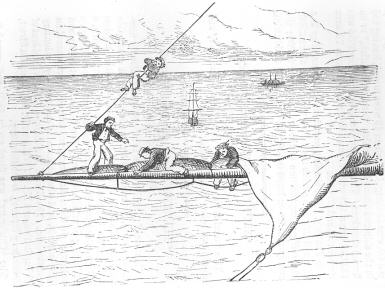
The woodcut on the preceding page, representing some boys on the
topsail-yard of the ‘Chichester,’ appeared in the
Leisure Hour as one of the illustrations of an article on
‘Ragamuffins’ by the present writer.
The number of boys sent to sea from the
‘Chichester’ in the year 1877 was 117, and the number
on board 176. The total number of boys received on the
‘Chichester,’ up to the 31st of December, 1877, was
2165. Number discharged, 2092; sent to sea, 1797.
Besides the number sent on a first voyage, the following
numbers were re-shipped, not counting those who after their first
voyage got ships without coming to the ‘Chichester’
ship-master. Shipped for second voyage, 686; for third,
451; fourth, 291; fifth, 180; sixth, 108; seventh, 72; eighth
voyage, 55.
The total number of boys received on board the
‘Arethusa’ from 1874 to end of 1877, was 659;
discharged, 450; sent to sea, 386, of whom 102 were so sent in
1877. In July, 1878, there were 400 boys on the two ships
when the annual presentation of prizes took place. The
total expenses for the two ships for the year 1877 amounted to
£10,494 10s. 8d.
I had again the privilege of presenting the sailor boys
‘Rob Roy’ prizes in the Guildhall, in the presence of
the veteran philanthropist the Earl of Shaftesbury, in 1880.
Established 1863.
This is a Reformatory School Ship for Roman Catholic
boys. The average number on board this vessel is 200, and
the cost £20 per head per annum, paid chiefly by
the Treasury. In the year 1877, 80 boys had been admitted,
of whom 54 were from Liverpool, and the rest from 15 other towns;
47 of them had not been previously convicted, 58 were sent to sea
“on license.” In the preceding three years 192
had been discharged, of whom 150 were “doing well” at
the beginning of 1878, while 5 were “doubtful,” 8
reconvicted, 10 dead, and 19 “unknown.”
Certified February, 1878.
This vessel is for 200 boys (from 11 to 15 years of age), sent
under the Industrial Schools Act, or partly paid for otherwise,
and the ship is managed by “The North Wales, City of
Chester, and Border Counties Industrial School Training Ship
Society.” The first boy was admitted in September,
1877, and on the 13th of July, 1878, there were 197 boys on
board; of these, 8 are “voluntary.” About 80
were from London, 50 from Manchester, 26 from Liverpool, and the
rest from ten other places.
Established 1859.
A new vessel (late the ‘Nile’) was substituted in
1877 for the old ‘Conway,’ but it was rechristened
with the old name, and the cost of alterations was
£6000.
It is managed by “The Mercantile Marine
Association,” and is intended chiefly to supply officers
for the merchant navy. Boys are received from 12 to 16
years of ago. The average number of boys on board was 138,
of whom 54 joined the merchant service. The number of boys
received since the commencement up to 1877, was
1290, of whom 40 entered the Royal Navy, and almost all the
others went into the Merchant Service.
The report gives no balance-sheet, but says that the school
fees (40 guineas per annum for each boy) “covered the
expenses” (presumably the ordinary expenses), and left a
balance of £283.
Established 1859.
This is a Reformatory Ship, managed by “The School Ship
Society.” The boys enter between 13 and 15 years of
age, sentenced to 3 years’ detention under the Reformatory
Schools Act. The average number of boys maintained on board
in 1877 was 218. Comparative cost per head on ordinary
maintenance and management £32. Industrial profits,
£329. Of cases discharged in 1874, 1875, and 1876,
there were doing well (December, 1877) 198, doubtful 5, convicted
of crime 4, unknown 18, dead 12. In July, 1878, the Captain
had heard of 114 boys at sea service, all doing well, and 26 boys
visited in June, equally satisfactory, one of them in command of
a large ship.
An epidemic in 1875–76 caused much trouble and
expense.
Established June, 1869.
This is an Industrial School Ship. At the beginning of
1877 there were 385 boys on board, and during the year 133 were
admitted, 105 were sent to sea, 11 to shore employment, 5 to
their friends, 1 to a school, 6 absconded, and 1 died, leaving
389 on the roll for January 1, 1878. From the establishment up to that time, 1343 boys had been
admitted, and 954 had left. Of 432 discharged in 1874,
1875, and 1876, 345 were known to be doing well, 10
indifferently, 3 convicted of crime, and 16 died of disease and
casualties. The receipts for the year were £7280,
including £500 on contingency account. The ship is
managed by a committee, of which the President is Mr. John Burns,
of Castle Wemyss, who is well known for his important position as
chairman of The Cunard Company (Limited), and for his hearty
liberal efforts on behalf of boys who need a friend.
Established 1866.
This is a “land ship,” with boats on the river,
and the following description of it is from a paper by Captain
Brookes, Royal Marines, the Superintendent of the
“Middlesex Industrial Schools at Feltham,” where
about 800 boys sent by magistrates are trained for the Army, the
Navy, and various other modes of life:—
“The 150 boys composing the Nautical Section are dressed
as sailors, and their everyday life is assimilated as much as
possible to what it would be in a stationary Training
Ship—they sleep in hammocks, live in messes, and are daily
exercised in seamanship on board the full-sized model brig
‘Endeavour,’ built on play-ground. Boats are
provided on the river at Staines for instruction in rowing, and
the boys are taught to swim in a large swimming bath in the
grounds.
“The brig was built in 1866, between which date and the
end of last year 748 boys (about an average of 70 per annum) have
been trained and sent to sea.
“There is a home at Poplar for the reception and care of
boys about to be sent to sea under the charge of the shipping
officer, who is duly licensed by the Board of
Trade. This is a most valuable branch of the school,
offering a home to lads returning from sea, who would otherwise
fall into the hands of low lodging-house keepers.
“The school authorities constantly receive the most
favourable accounts of the lads thus sent to sea, who are well
reported on by captains of ships both as regards character and
ability in seamanship.
“The result of this experiment, now extending over a
period of ten years, proves beyond question that boys can be as
speedily and efficiently trained on board a model training ship
built on land, as on board a stationary one moored in a harbour
or river.
“This opinion has been fully and publicly endorsed by
Captain Burney, R.N., Superintendent of the Royal Hospital School
at Greenwich, where a large model full-rigged ship (most complete
and thorough in all its arrangements) has been built, and by
means of which, he maintains, he can prepare boys for sea as
efficiently as on board a floating training ship.
“In this, as in many other matters, there is a great
deal of popular prejudice to overcome, and perhaps the most
effective way to do so would be by inducing the governing bodies
of such schools as Eton, Harrow, and Rugby to erect model
training ships on their grounds for the use of their boys.
It cannot be doubted that these ships would be as popular amongst
them as their present School Volunteer Corps undoubtedly
are.”
* * * * *
[After many visits to the floating training ships, and
inspection of the ‘Endeavour,’ and of the Greenwich
School, where 1000 boys are trained for sea without the expense
and inconveniences of a ship, I fully concur in the opinions of
Captain Brookes and Capt. Burney, C.B., and I consider that the
best mode of training boys for the commercial navy is to have a
light and roomy building on shore with one or more
“tender” brigs for cruising, and plenty of boats, and
a good gymnasium and swimming bath. A floating hulk is more
costly to maintain. It is inconvenient for education from
want of light below, and for exercise all the winter from wet
decks above, and moreover, the need of a “tender” for
each hulk is already acknowledged, so that her sheet anchor is
only sentiment.]
J. Macgregor.
About thirty-five years ago, this land-ship, with masts and
sails and guns, was set up at the Norwood Poor Law Establishment,
by the exertions of the late Sir J. K. Shuttleworth, Bart., and
one somewhat similar and useful (to a certain extent) was
established in a Union School at Stepney. Of the boys
instructed by this means, 95 out of 100 voluntarily entered the
Army or Navy, but doubtless the supply for sea life is now better
obtained from establishments more distinctly nautical. In
the report of the North Surrey District Schools “the mast
and shrouds” of the Land Ship there are said to be useful
in inducing boys to go to sea. (Times, September 3,
1878.)
This vessel accommodates 600 boys, and was substituted for
‘The Goliath,’ which was burned two years ago (as was
also the old ‘Warspite’ at Charlton). The
latest report (which is more full and clear than that of several
other ships) deals with the ten months ending the 31st of
December, 1877, when 545 boys were under training. These
were sent from the Poor Law Unions of Poplar, St. Pancras,
Stepney, Marylebone, Woolwich, and others, under the special Act,
which very properly requires Metropolitan Parishes to
contribute towards the maintenance of the ship, whether they use
it or not. A brigantine, the ‘Steadfast,’ is
attached as a “training tender,” and accommodates
thirty boys, who cruise in the Mouth of the Thames for a week at
a time, when ten of them are changed. A causeway from the
shore improves the approach to the ‘Exmouth,’ and a
small house and office near the London Docks enables eight boys
to be taken daily for engagement in ships.
From March, 1876, to December, 1877, 689 boys were admitted,
seventy-nine were discharged to sea service, twenty-one to the
Army as musicians, forty-three to their respective Unions, and
one absconded.
“Every boy in the ship soaps and washes himself all
over every morning with carbolic soap, and then goes through
a plunge bath under inspection, having a clean towel every time
he washes.” The lads are remarkably
healthy—there was not one death in the year. The
charge for maintenance and clothing has been at the rate of
1s. per head per day. The swimming bath is sixty
feet long by thirty feet broad, and the boys are classed by the
number of “bath-lengths” they can swim at a
stretch. At the beginning of the swimming season, 340 could
not swim at all, but there were only 56 in this predicament at
the end of the season. Music is taught carefully, and a
band of about 60 boys plays twice a week for the other boys to
dance. Of 242 boys absent from one to seven days to see
their friends, only one broke his leave, and he absconded
altogether.
Established 1872.
This land ship is part of the splendid establishment at
Greenwich for training sons of seamen and marines of the Royal
Navy. Candidates must be between 10½; and 13 years
of age, physically fit, able to read an easy sentence,
and with some knowledge of arithmetic.
The origin of the school was in 1692, when, after the victory
of “La Hogue,” an asylum was established for
seamen’s widows and orphans at the suggestion of Queen
Mary, who died before it was accomplished.
In 1712 ten boys were instructed (in the buildings of the
present Naval College, part of which had been erected in 1618),
and in 1783 there were 60 boys. In 1805, there were 200
boys, and the institution was no longer a charity, but admitted
officers’ sons.
Another school, “The British Endeavour,” started
in 1798 as a private venture in London, was transferred to public
management in Greenwich.
The “Royal Naval Asylum,” for 680 boys and 200
girls, aided by Parliamentary grant, was amalgamated in 1821 with
the other (the Royal Hospital School), forming a “Lower
School” and “Upper School” for 1000 boys, in
the quadrangle now occupied opposite the Royal Naval
College. In 1841 the girls’ school ceased. In
1860 the distinction between “Upper” and
“Lower” School was given up.
In 1870 industrial work was introduced in addition to the
other instruction, and the splendid land ship ‘Fame’
was erected in 1872, which, with boats on the river, large sized
moveable models in lofty halls, and a fine swimming bath,
gymnasium, class-rooms, and workshops, are the means for
instructing 1000 boys most admirably under the supervision of
Captain Burney, C.B., and an energetic staff. From the
report of July, 1878, it appears that there were 39 pupil
teachers, and 958 boys between 10 and 15 years of age.
Total 997 in the school. The number of boys admitted during
the year was 334, number discharged 333, of whom 99 went into Her
Majesty’s Service, and 4 died; 329 boys between 13 and 15
years of age now in the School, have signed continuous service
engagements to serve in the Royal Navy for 10
years from the age of 18. The boys’ industrial work
in about 30 departments of useful labour is of great value to the
school, so that the annual cost (exclusive of new buildings, but
including all repairs) is under £18 per head.
The punishments are under 1 per cent., and 45 per cent. of the
boys can swim.
Established 1869.
This is an “Industrial School Ship” for boys
between the ages of 11 and 14 years. During the eighteen
months ending December 31, 1877, 84 boys had been admitted
(including 41 from the London School Board), 18 from Bristol, and
the rest from ten other towns, with 2 “volunteer”
boys.
Of these there had been discharged during the eighteen months,
81 to the Merchant Service, 2 to the Royal Navy, 26 to friends, 5
to the Army, 13 elsewhere, and 2 died. The number of boys
on board December 31, 1877, was 324. From the commencement
of the ship, 800 boys had been admitted, including 50
“volunteers,” and of these 366 had gone to the
Merchant Service, and 27 to the Royal Navy, while 11 died.
The receipts for the year, including £1500 from the
Treasury, and £600 from annual subscriptions, amounted to
£8213.
Established 1872.
This Industrial School Ship for Protestant boys is called
“The Ulster Training Ship for Homeless and Destitute
Boys.” The number on board the 31st of December,
1877, was 289, of whom about half could read, write, and cipher
well; 64 had been admitted during the year, nearly all of them
from Antrim, and of these, 33 could not read or
write at all, while only 7 could read, write, and cipher well; 32
of these had lost their fathers, and 18 were orphans.
Established 1855.
This is an old “man-of-war,” banked round, so as
to be a “land ship,” with a causeway to the shore,
and it accommodates about 70 boys, many of whom have industrial
employment in gardening and as porters, &c. Of the 66
boys discharged in the three years, 1874, 1875, 1876, 58 were
known to be earning honest livelihoods, 2 were convicted, 2
unknown, and 4 have died. According to the report of
August, 1878, 68 boys were in the ship, of whom 61 were sent
under the Industrial Schools Act. There were 2 on license,
and 7 appeared to be voluntary cases. The expenditure in
1876 was about £1500, but £200 was earned by the
Industrial Department. In that year 3 boys went to sea, and
in 1878 6 boys.
This vessel was established in 1864 to train orphan and
destitute boys for sea—boys from the port of Liverpool
having a preference. The report issued in March, 1878,
shewed the average number on board to be 250, of whom 80 had lost
both parents. About 50 boys go out to life each year.
The funds are from voluntary contributions, and about £5000
a year is expended.
Established 1869.
This is an “Industrial School Ship,” under the Act
of Parliament, and it has a “tender,” “which
makes men of the youngsters; she has just brought 100 tons of
coals to us from Shields (July 5, 1878).”
The accommodation is for 350 boys. In 1877, 122 boys were
admitted and 95 discharged, leaving 350 on the register, while
“there is great pressure for admission.” Of the
95 boys, 6 entered the Royal Navy, 55 the Merchant Service as
first class boys, 27 went to shore trades (but seven of these
returned and went to sea), and 7 died. One-third of the
boys admitted were unable to read at all; of 309 discharged
during 3 years, 248 were “doing well.”
The expenses in 1877 were about £6800.
Donations and subscriptions about £1700.
Established June, 1877.
An Industrial School Ship for boys from Devonshire and
Cornwall. The boys admitted up to July, 1878, were 201; 1
had been discharged, 6 transferred, and 2 died. The number
of “voluntary cases” (from 12 to 14 years old) was 3,
and the number of all on board 195. Half of these could
read “fairly.”
Established 1878.
The School Board for London has found it necessary to have a
training ship of its own. More than 500 boys sent at the
instance of the Board were in training on board the
‘Formidable,’ ‘Wellesley,’
‘Southampton,’ &c., at distant ports, where
visitation and supervision could not be readily exercised.
After more than six years of experience in regard to training
boys for sea, the Board decided to establish their own ship in
the Thames. The Admiralty was unable or at least declined
to lend one of the few old hulks at their disposal, so the School
Board purchased for £7000 the P. and O. iron
steamship ‘Nubia,’ and at an additional expense of
more than £30,000, she was fitted up and moored in a berth
prepared for her in July, 1878, close to the Poor Law ship
‘Exmouth,’ so as to accommodate 450 boys to be sent
under the Industrial Schools Act at the instance of the
Board. She is ‘certified’ for 350 boys, of whom
70 may be Roman Catholics. The first 6 boys were sent on
board her on August 15, 1878. The vessel was rechristened
with the name of ‘Shaftesbury,’ in honour of one who
is everywhere known as the friend of the hapless and the patron
of everything good. The vessel is longer and narrower than
those of the old “man-of-war” type, and her four
decks are lofty, giving plenty of light and air for educational
and sanitary purposes, although the wider space for drill above
all is necessarily curtailed. The cost of the vessel
(including purchase) is repayable in 50 years by annual
instalments, with interest at 3½ per cent.
The Shaftesbury has now her full number of 500 boys (May
1880.)
Established 1868.
The management is amalgamated with that of “The Hull
Ragged and Industrial Schools.” At the beginning of
1877, 234 boys were on board (all of them under the Industrial
Schools Act), and 62 were admitted during the year (30 from 10 to
12, and 32 from 12 to 14 years of age), while 56 were discharged,
of whom 27 went to sea, and 23 were returned to friends. Up
to the end of that year 426 boys had been finally discharged from
the ship. Half of these on entry could not read, write, or
cipher, but all learned to do so. Many of the boys were
sent at the instance of the School Board for London and eight
other School Boards. The expenditure for the year was
£6000.
The Marine Society established its first ship the
‘Beatty,’ with a crew of 40 boys, 120 years ago, and
it has since sent to sea about 60,000 boys trained for
sailors’ life. The new ship, a fine two decker (late
‘Conqueror’), in substitution for the old
‘Warspite’ (which was burned), and rechristened with
that name, had 156 boys on board in January, 1877. 304 were
afterwards admitted, 43 were sent to the Royal Navy, and 137 to
the Merchant Service, leaving 269 on board at the beginning of
the year 1878. Most of these are orphans or boys deserted
by their parents. Out of 123 boys who returned in that year
from first voyages, 117 had “very good” on their
certificates. The age for admission is from 13 to 16,
height from 4 feet 8 inches; 93 boys learned to swim last
summer. The expenditure during the year was £11,000,
including £3000 for fitting up the new ship.
Established 1868.
This vessel is for homeless and destitute boys unconvicted of
crime, but who are sent under the Industrial Schools Act, at the
instance of one of the ten or more School Boards which have
agreements with “The ‘Wellesley’ Training Ship
Institution,” or who come individually. From the
report in June, 1877, it appears that in the twelve months
preceding, 91 boys had been received, and 59 were discharged, of
whom 45 went to sea. This left 307 boys on board. Of
the boys discharged during 3 years, 83 per cent. were
“doing well.” Since the commencement of the
Institution 702 boys had been received. About £1000
had been contributed by the School Boards during the year, and
£90 for “voluntary boys,” each of whom is
received for £20 per annum. The maintenance
account for the year was about £5000.
This vessel was moored at Greenhithe in 1862; a larger vessel,
a 72-gun frigate of 5000 tons, and rechristened
‘Worcester,’ was substituted in 1877. The
‘Worcester’ provides properly qualified officers for
merchant vessels, and accommodates 200 boys. The terms are,
for boys from 13 to 16 years old, 50 guineas, and for boys from
11 to 13 years old, 45 guineas per annum.
The Board of Trade allows two years passed on the
‘Worcester’ to count as one year’s sea service,
and Her Majesty gives annually a gold medal to the boy most noted
for good conduct. About 30 boys passed through the ship
last year.
|
|
Ships
|
Boys
|
Royal Naval (besides those for young Officers, see page
306)
|
5
|
3400
|
Voluntary, including two for Officers and one land
ship
|
7
|
1500
|
Poor-law ship
|
1
|
600
|
Industrial School ships, including one “School
Board” ship and two “land ships”
|
11
|
2800
|
Reformatory ships
|
3
|
640
|
Total
|
27
|
8940
|
[In this estimate the ‘Fame’ is reckoned for 250
boys.]
This has been designed after numerous experiments with the
various portable cooking-machines which I could procure for
trial, and, as it succeeds better than any of them, and has been
approved by trial in five of my own voyages, and in another to
Iceland, besides shorter trips, and in the Abyssinian
campaign, &c., &c., it may be of some use to describe the
contrivance here.
The object proposed was to provide a light but strong
apparatus which could speedily boil water and heat or fry other
materials even in wet and windy weather, and with fuel enough
carried in itself for several days’ use.
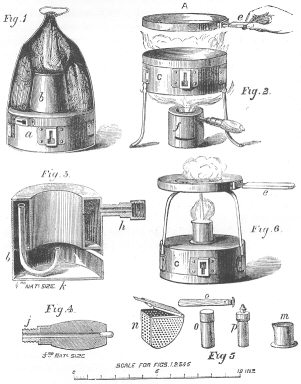
Fig. 1 is a section of the Rob Roy cuisine as it is made up
for carrying. There is first a strong waterproof bag about
one foot high, and closed at the top by a running cord. At
the bottom is the cuisine itself, a, which occupies a
space of only six inches by three inches (when of smaller size),
and has the various parts packed inside, except the drinking cup
b.
Provisions, such as bread and cold meat or eggs, may bestowed
in the bag above the cuisine, and if the string of it be then
attached to a nail fixed in the boat, the whole will be kept
steady.
For use, when it is desired to boil water, the cuisine being
opened, the lower part is a copper pan, c, fig. 2, with a
handle, e, which can be fixed either into a socket in the
side of the pan, or another socket in the side of the lid, as
represented in figs. 2 and 6.
Three iron legs also fix into sockets and support the pan over
the spirit-lamp, f, by which the pan, two-thirds full of
liquid, will be boiled in five minutes.
The lamp is the main feature of the apparatus, and it is
represented in section in fig. 3. It consists of two
cylinders, one within the other. The space between these
(shaded dark) is closed at top and bottom, and a tube b,
fixed through the bottom, rises with one open end inside, and
another (a small nozzle) curved upwards in the open internal
cylinder. Another tube, h, opens into the annular
chamber between the cylinders, and it has a funnel-shaped mouth
at the outer end, through which the chamber may be filled, while
a screw in the inside allows a handle, fig. 4 (in section), to
have its end, i, screwed in. A small hole in the
upper surface is closed by a little cork, which will be expelled
if the pressure within is so high as to
require escape by this safety-valve. The hole may be in any
part of the annular cover (but is not shown in the sketch), and
in such case the hole shown in the handle is omitted.
The outer cylinder of the lamp, being larger than the inner
one, has a bottom, k, fig. 3, which forms a circular tray
of about two inches wide and half an inch deep.
The original form of the lamp which was first brought
to notice [325] by the Cook of the Royal Canoe Club,
had a detached tray for the bottom, but now, instead of this plan
for the admission of air into the lamp, two saw cuts are made,
each about an inch long. One of them is shown below
f, fig. 2, and thus the lamp and tray are united in one
compact piece while still there is access for air.
To put the lamp in operation, unscrew its handle from the
position in fig. 2, so that it will be as in figs. 3 and 4.
Then from a tin flask (which has been packed with the rest of the
things in the pan) pour spirits of wine—or, if the odour is
not objected to, methylated spirit, into the measure m,
fig. 5, and from that into the interior of the lamp through the
opening at h. Next screw in the handle, and place
the lamp level under the pan, and pour nearly another measure
full into the interior tray. Set fire to this, and shelter
it for a few seconds if there be much wind. I used this
always with complete success on the Jordan, Nile, Danube, and
many other rivers.
In a short time the flame heats the spirits in the closed
chamber, and the spirituous steam is forced by pressure down the
tube, and inflames at the nozzle, from which it issues with much
force and some noise in a lighted column, which is about one foot
in height when unimpeded.
This powerful flame operates on the whole of the bottom and
lower edge of the pan, and it cannot be blown out by wind nor by
a blast from the mouth, but may be instantly extinguished by
sharply placing the flat bottom of the measure upon it.
The cover may be put on so as to rest with the flat bottom
downwards, and with or without the handle. If tea is to be
made with the water when it boils, the requisite quantity is to
be placed in the tea vessel n, fig. 5, which has
perforated sides, and, its lid being closed,
this is placed in the water, where it will rest on the curved
side, and can be agitated now and then for a minute, after which
insert the handle in the socket of the pan and remove the lamp,
allowing the tea to infuse for four minutes, when the tea vessel
may be removed and the made tea may be poured out into the
cup. The dry tea can be conveniently carried in a paper
inside the tea vessel. Salt is carried in the box o,
and the matches are in the box p. Coffee may be best
carried in the state of essence in a bottle. An egg-spoon
and a soup-spoon are supplied. A flat clasp knife and fork
may be had extra.
If bacon is to be fried, or eggs to be poached or cooked
sur le plat, they may be put into the lid and held by hand
over the lamp-flame, so as to warm all parts equally, or the
slower heat of a simple flame may be employed by lighting the
measure full of spirits and then placing it on the bottom of the
upturned pan as shown at fig. 6, where it will be observed that
the three legs are placed in their sockets with the convex curve
of each turned outward, so that the lid, as a frying-pan, can
rest upon their three points.
The spirit-flask contains enough for six separate charges of
the lamp, and the cost of using methylated spirits at 4s.
6d. a gallon is not one penny a meal. The lamp-flame
lasts from ten to fifteen minutes, and the weight of the
cuisine, exclusive of the bag and cup, is about two
pounds.
These cuisines, improved by the suggestions obtained in their
use, are made at 93, Chancery Lane, London, of the best materials
and workmanship, and at the price of two and a half guineas; or
if with tin boiler instead of copper, and brass lamp, £1
12s. 6d. Many of much larger size (to cook
for twenty men) have been used in Australia.
The lamp above described was used daily in my yawl, but the
other fittings were on a more enlarged scale, as extreme
lightness was not then required.
The Norwegian Cooking Apparatus of another kind entirely will be a valuable adjunct to the yachtsman’s
stores. By means of this, meat or pudding after being
heated for only five minutes, and then enclosed in a box
which retains the heat, will be found to be perfectly cooked
after three hours, though no more heat has been applied to
it.
Mr. Dent, of the Strand, has made the Life Boat Liquid Compass
with several improvements suggested from the Rob Roy yawl, and
after experiments permitted by the Life Boat Institution.
These relate to the diagram on the card, the lamp with oil or
candle, the reflectors, the ventilation, and the interior
colouring of the binnacle, as well as other minor matters.
In a second cruise of the yawl with my new binnacle, the great
advantages desired were found to be attained. A
fac-simile of the new Rob Roy card is given in “The
Rob Roy on the Jordan,” 6th edition.
After six long voyages alone, a few remarks may be made on
water toggery.
Flannel all over to begin with. One grey flannel suit of
“Norfolk jacket” and trousers lasted for three trips,
but at sea the blue colour answers. Straw hat in sun, red
woollen cap in wind, sou’wester in rain, thick boating
jacket, and the life-belt over it, and above that an oilskin coat
with overall trousers of the same, will defy wind and
water. Woven waistcoat expanding limitless. Shoes and
not boots for work, white canvas boots with spring sides for show
in port. No braces. Blue seamless yacht jersey a
bore, though smart. Collar only with a calico shirt, and on
Sundays, when that cylinder of discomfort, a black hat, is
exhumed. Watch hanging in cabin, never on the person
afloat. Purse with keys in the shelf. Knife
and etceteras in leather pockets of the boat. So clad ye
shall be ready to sail or to swim.
The following appeared in the Times, July 3rd,
1878:—
Hundreds of girls in London are learning to swim, but many
hundreds more would gladly learn if teachers could be had.
A healthful, cleanly, life-saving exercise like this ought not to
be stinted of teachers.
The boys have twenty public baths to learn in and the open
water in Victoria Park, besides the dangerous, dirty
canals. More than 1500 boys are learning to swim as paying
members of the London Schools Swimming Club, which is open to all
public elementary schools.
Last year a class for thirty girls was begun late in the
season, yet twenty-five of these were taught to swim in six
lessons, and six of them won prizes.
Only five of the public baths are available for girls and
female school teachers. At some of these the charge is
threepence for a bathe, and at one it is a penny for members of
the club. Twelve girls can be well taught in a class.
For a lesson of two hours, one teacher charges fifteen shillings
and another receives ten shillings, while others are paid two
shillings for each girl who is taught to swim twenty-five yards,
and the rest are rewarded by watches and other prizes for those
who teach the most girls to swim.
Mothers and sisters who can swim will not let their boys be
unwashed on the land and drowned in the water.
J. M.
The “London Schools Swimming Club” was formed in
1875, and it has already (a.d. 1880)
given instruction in swimming to 12,000 boys and girls, and male
and female teachers.


