This is the story of the Virginia Company and only indirectly
of the Virginia colony. Those who seek an account of the early
years at Jamestown should turn to another number in this same
series. Here the focus belongs to the adventurers in England
whose hopes gave shape to the settlement at Jamestown, and
whose determination brought the colony through the many disappointments
of its first years. In terms of time, the story is short,
for it begins with the granting of the first Virginia charter in
1606 and ends with the dissolution of the company in 1624.
It thus covers a period of only eighteen years, but during these
years England's interest in North America was so largely expressed
through the agency of the Virginia Company that its
story constitutes one of the more significant chapters in the history
both of the United States and of the British Empire.
In the beginning there were two companies of the Virginia
adventurers, the one having its headquarters in London and the
other in the western outport of Plymouth. Englishmen at that
time used the name Virginia to designate the full sweep of the
North American coast that lay above Spanish Florida. In the
original Virginia charter the adventurers were granted rights of
exploration, trade, and settlement on the "Coast of Virginia or
America" within limits that reached from 34° of latitude in the
south to 45° in the north, which is to say from the mouth of
the Cape Fear River in lower North Carolina to a point midway
through the modern state of Maine. The Plymouth grantees
had a primary interest in the northern area that Captain John
Smith would later name New England, and there they established
a colony at Sagadahoc in August 1607, only a few weeks
after the settlement of Jamestown. But the colony barely survived
the winter, and was abandoned in the spring of 1608.
Thereafter, the Plymouth adventurers gave up. In contrast, the
London adventurers persisted, and their persistence served to tie
the name of Virginia increasingly to them and to their more southerly
settlement. As a result, the London adventurers became in
common usage the Virginia adventurers, their company the Virginia
Company, and their colony Virginia.
The Virginia colony was especially fortunate in having the
backing of London. Indeed, it may not be too much to suggest
that the chief difference between the stories of Roanoke Island
and of Jamestown was the difference that London made. Consistently,
the leadership of Elizabethan adventures to North America,
including those of Gilbert and Raleigh, had come from the western
counties and outports of England, and with equal consistency
hopeful projects had foundered on the inadequacy of their financial
support while London favored other ventures—to Muscovy,
to the Levant, and more recently to the East Indies. It was not
merely that London had the necessary capital and credit for a
sustained effort; it also had experience in the management of
large and distant ventures, such as those of the East India Company
over which Sir Thomas Smith presided, as he would preside
through many years over the Virginia Company. London
had too the advantage of its proximity to the seat of government
in nearby Westminster, where King James had his residence,
where the highest courts of the realm sat periodically, and where
England's parliament customarily met. Already, in 1606, it was
possible to trace in the immediate environs of the ancient City
of London, itself still medieval in appearance and in the organization
of much of its life, the broad outlines of the great metropolis
that has been increasingly the focal point of England's development
as a modern state.
In thus emphasizing the importance of London to the early
history of Virginia, one runs the risk of misrepresenting the true
character of the Virginia adventure. Contrary to the impression
that will be gained from many of our modern textbooks, the Virginia
Company represented much more than the commercial interests
of the port of London. Its membership included many
gentlemen and noblemen of consequence in the kingdom. Some
of them, no doubt, became subscribers to a Virginia joint-stock
for the same reason that often led members of the landed classes
in England into commercial ventures. But others, quite evidently,
subscribed because of a sense of public responsibility, or simply
because skilfully managed propaganda had put pressure on them
to accept a responsibility of social or political position. For the
Virginia adventure was a public undertaking, its aim to advance
the fortunes of England no less than the fortunes of the adventurers
themselves.
It would be helpful if we knew more about the original Virginia
adventurers than we do. The records are so incomplete as to make
impossible anything approaching a full list of the first subscribers.
However, enough is known to suggest the broad range of experience
and interest belonging to those who now joined in a common
effort to build an empire for England in America. The original
charter of 1606 lists only eight of the adventurers by name,
they being the ones in whose names the petition for the charter
had been made. This list omits Sir John Popham, Lord Chief
Justice of the Kings Bench, who may well have been the prime
mover in the enterprise, and Sir Thomas Smith, who was an active
leader from an early date. Four of the eight men listed are
identified as belonging to the London group. Sir Thomas Gates
was a soldier and veteran of campaigns in the Netherlands who
would later serve as the colony's governor. Sir George Somers had
led many attacks against Spanish possessions in Queen Elizabeth's
day, was a member of parliament, and would meet his death four
years later in Bermuda while on a mission of rescue for Virginia.
Edward Maria Wingfield was another soldier who had fought
in the Netherlands. He belonged to a family which had acquired
extensive estates in Ireland, and he too would go to Virginia,
where he served as first president of the colony's council. The
most interesting of the four was Richard Hakluyt, a clergyman
whose chief mission in life had been the encouragement of overseas
adventures by his fellow countrymen. To them he had literally
given a national tradition of adventure by compiling and editing
one of the more influential books in England's history—The
Principall Navigations, Voyages, and Discoveries of the English
Nation, whose reading, in Michael Drayton's words, inflamed
"Men to seeke fame." Hakluyt had been advisor to both Gilbert
and Raleigh in their ventures, and since then he had consistently
promoted the idea that England might best find in North America
the opportunities that were needed for her prosperity and her
security.
A significant indication of the extent to which the public interest
was considered to be involved in the Virginia project is
found in the provision that was first made for the government
of the two colonies. The powers of government, which is to say
the ultimate right to decide and to direct, were vested in a royal
council, commonly known as the Virginia Council and having
its seat in London. Its membership was probably drawn exclusively
from the two groups of Virginia adventurers, but the members
were appointed by the king and were sworn to his special service.
Among the first members were Sir Thomas Smith, chief of the
London merchants; Sir William Wade, lieutenant of the London
Tower; Sir Walter Cope, member of parliament for Westminster
and adventurer in a variety of overseas enterprises; Sir Henry
Montague, recorder of the City of London; Solicitor General
John Doderidge, subsequently justice of the Kings Bench; Sir
Ferdinando Gorges, who later would lead a reviving interest in
the settlement of New England and still later would become an
enemy of the Puritans who so largely accomplished that task;
Sir Francis Popham, son and heir to the Lord Chief Justice; and
John Eldred of London, Thomas James of Bristol, and James
Bagge of Plymouth, each of these three being described as a merchant.
This assignment of the powers of government proved to
be awkward, and it denied the adventurers direct control over
the more important questions affecting their adventures, as in
the choice of a plan of government for the colony or in the appointment
of its key officers. Consequently, the adventurers secured
a change in the second Virginia charter, granted in 1609.
It was then specified that members of the council thereafter
should be "nominated, chosen, continued, displaced, changed,
altered and supplied, as death, or other several occasions shall
require, out of the Company of the said Adventurers, by the
voice of the greater part of the said Company and Adventurers,
in their Assembly for that purpose." In language less repetitious
than that used by the company's lawyer, this meant that the
council now became an agent primarily of the adventurers. Even
so, the king retained a veto over any choice they might make, for
members of the council were still required to take a special oath
administered by one of the high officers of state, and refusal to
give the oath could mean disqualification for the office. The
company's later history would show, whatever its legal advisor
may have assumed in 1609, that this requirement was no mere
formality.
It is not easy for the modern American to read with full assurance
the scanty record of Virginia's first years. How, for example,
should he interpret the suggestion at the beginning of the
first charter that the adventurers sought chiefly to propagate the
"Christian Religion to such people, as yet live in darkness and
miserable ignorance of the true knowledge and worship of God?"
It is simple enough to point out that the first adventurers in
Jamestown showed very little of the missionary's spirit, that they
included only one minister, and that he had enough to do in
ministering to the English settlers. It is also easy to draw an obvious
contrast between the dedicated missionaries who so frequently
formed the vanguard of Spanish and French settlement
in America and the adventurous and often unruly men who first
settled Virginia. In the absence of immediate and continuing
missionary endeavors, one is naturally inclined to dismiss professions
of a purpose to convert the Indian as nothing more than
a necessary gesture toward convention in an age that was still
much closer to the medieval period than to our own. And yet,
on second thought, one begins to wonder just how sophisticated
such a conclusion may be. He remembers how deep was the rift
between Protestantism and Catholicism at that time, how fundamental
to the patriotism of an Englishman was his long defense
of a Protestant church settlement against the threat of Catholic
Spain, and how largely the issues of religious life still claimed
the first thoughts of men. He then may feel inclined to observe
that the English adventurers, after all, did undertake to establish
a mission in Virginia at a relatively early date. True, ten years
elapsed before the effort to provide a school and college for the
Indians had its beginning, but these were years of a continuing
struggle for the very life of the colony itself. In the circumstances,
perhaps ten years should be viewed as a short time.
Be that as it may, there are other questions that have been even
more bothersome, if only because they have seemed more pertinent
to the modern interest in Virginia's history. The American
has been accustomed to view the Virginia colony as the first permanent
settlement in his country, as the point at which his own
history has its beginning, but he finds in the Jamestown colony
a pattern of activity somewhat different from that he associates
with the later development of the country. What kind of a colony
was it? Was it really a colony? Just what were the adventurers
trying to accomplish in Virginia? Were they actually interested
in colonization, in the proper sense of the term, or were their objectives
commercial? These and other such questions have claimed
much of the attention of those who have sought to interpret for
their fellow countrymen the early history of Virginia. The difficulty
arises partly from the American's insistence that the later
history of his country be taken as the standard for judging every
action of the first adventurers, and partly from a failure to appreciate
the extent to which the earlier ventures in Virginia were
necessarily exploratory in character.
If one of us could ask the adventurers in 1606 what it was they
hoped to accomplish in America, he probably would be told that
it depended very much on what they might find there. Although
Richard Hakluyt had been most industrious in collecting available
information from the earlier explorations of North America,
including those by Spanish and French explorers, the specific
information at hand was quite definitely limited. By the close
of the sixteenth century European explorers had charted the
broad outlines of the North American coast, and here and there
they had filled in much of the detail, as had the French in Canada,
the Spaniard and the Frenchman on the coast of Florida,
and the Englishman along the coastal regions to be later known
as Carolina and New England. But the information at the command
of the adventurers in one country was not always available
to those of another; indeed, within any one country there were
shipmasters who carried in their heads working charts of coastal
waters wholly unknown to the geographers and cartographers
who sought to serve the larger interests of the nation. Thus the
London adventurers in 1606, though having at hand a substantial
body of useful information regarding the coasts, the winds,
and the currents running northward from the West Indies past
St. Augustine to Cape Hatteras, and comparable information
regarding the more northern waters explored by Frobisher, Davis,
Gilbert, and others, had only a sketchy knowledge of the intervening
coastline that would soon be explored by Captain Samuel
Argall on commission from the Virginia Company and by Henry
Hudson, an Englishman temporarily in the service of Dutch
merchants. Even Chesapeake Bay, to which the London adventurers
dispatched their first expedition, was known to them chiefly
by the reports of Indians interrogated by Raleigh's agents as
they worked out from Roanoke Island. The first colonists in Virginia
gave to London detailed information regarding the lower
Chesapeake and the James River, but not until 1608 did Captain
John Smith find the time to explore the upper reaches of the bay
and to identify the great rivers emptying into it there. It hardly
seems necessary to argue the utility of such explorations, to which
eloquent testimony exists in the new bounds immediately fixed
for the colony in the second charter. But many have been the
attempts to pass judgment on the success or failure of the first
settlers at Jamestown that have been written as though their
primary assignment had not been to explore.
Exploration and fortification—these two terms are consistently
linked in the papers on which the early English adventurers jotted
notes for their guidance or for the instruction of their agents in
America. The very first objective of the explorers was to locate a
suitable site for fortification, in order that further explorations
might be conducted from a secure base. The fortifications to be
raised had to meet exacting standards, such as would be approved
by the military engineers with whom the adventurers consulted
along with the geographers, the cartographers, and the shipmasters
who also possessed useful information. For these fortifications
were intended to provide security not so much against the
native Indian as against the ships and soldiers of Spain. Over
the years there had been some debate as to how the fort might
be best located, with the result that in 1607 it was decided to
locate it some distance up a river that would afford navigation
for an ocean-going vessel but would force the enemy to fight his
way inland against the disadvantage of the warning that could
be given by an outer guard at the mouth of the river. Such were
the considerations that shaped the choice of Jamestown as the
site of the first permanent English settlement in North America.
To stand in the middle of the Jamestown peninsula for contemplation
of its many disadvantages for the purposes of agricultural
settlement, and even for the health of its people, is to lose sight
of the main point. One should walk over against the river, and
consider there the field of fire that was open for well placed guns.
And just what was the Jamestown fort supposed to guard?
Was it the few acres of the modern county of James City, or the
right of Englishmen to possess the Virginia peninsula, where so
much of importance to our national history has found its place?
Not at all. It was the right of Englishmen to be in North America,
to fish the waters that lay off its coast, to trade with its inhabitants,
and to exploit such other opportunities as an unexplored and
undeveloped continent might offer. How far these opportunities
might lead no one could tell in advance—perhaps even to China.
A trade with China had been a major objective of English adventure
since the middle of the sixteenth century, when the Muscovy
Company had had its origins in an attempt to find a northeast
passage around the Scandinavian peninsula leading to Cathay—Marco
Polo's fabulous kingdom of northern China. The
explorers found instead a profitable trade with the territories
of Ivan the Terrible, but the Muscovy merchants continued to
support a variety of ventures seeking the establishment of an
Oriental trade. Their agents looked into the possibilities of an
overland trade through Russia to Cathay, and experimented none
too profitably with a trans-Russia trade with Persia. They gave
their support to renewed attempts to find a northeast passage
and claimed a right of license for the numerous efforts that were
made in Elizabeth's reign to find a northwest passage around or
through North America. Failing in these efforts, the English
merchants finally had challenged Portugal's monopoly of trade
with the East Indies by way of the Cape of Good Hope. The
East India Company, chartered by Elizabeth in 1600, had gotten
off to a good start, and was destined to become one of the great
empire builders of Britain's history. In 1606, however, the East
India merchants had had just enough experience with the new
trade to begin to appreciate some of its difficulties, as in the need
to employ larger and more expensive ships than were standard
in England's maritime trade and the great distance to China by
way of the Cape of Good Hope. Perhaps, after all, some route
through America might have the advantage over the Cape route.
In the opinion of the late Sir William Foster, through many years
historiographer of the India Office, this was a chief reason for
the interest Sir Thomas Smith took in Virginia.
Let it be noted that Sir Thomas' interest in Virginia outlasted
the hope that a successful search for a passage to China might
be based on Jamestown. Nevertheless, the point may help to
explain the marked emphasis on this hope that one finds at the
beginning of the project. Instructions to the first expedition directed
the choice of a seat on some navigable river, and added,
"if you happen to discover divers portable rivers, and mongst
them any one that hath two main branches, if the difference be
not great make choice of that which bendeth most toward the
North-West, for that way you shall soonest find the other sea."
The other sea, of course, was the Pacific, or as Englishmen were
likely to say, the South Seas, whose waters also washed the shores
of China. Vain as was this hope of trade with the Orient through
America, it was destined for survival, in one form or another,
through many years. As late as the middle of the nineteenth
century, it would be a principal argument for the construction of
a trans-continental railway.
In 1606 the supposition was that the river system of North
America might be like that of Russia, where easy portages joining
rivers flowing in different directions made it possible to travel,
most of the way by boat, from the north to the south of the country
and return. "You must observe," advised the adventurers,
"whether the river on which you plant doth spring out of mountains
or out of lakes; if it be out of any lake, the passage to the
other sea will be the more easy, and [it] is like enough that out
of the same lake you shall find some spring which runs the contrary
way toward the East India Sea; for the great and famous
rivers of Volga, Tanis and Dwina have three heads near joynd,
and yet the one falleth into the Caspian Sea, the other into the
Euxine Sea, and the third into the Polonian Sea." For this information,
the Virginia adventurers were indebted to the Muscovy
Company, with which Captain Christopher Newport, who
commanded the ships dispatched to Virginia, had formerly served.
It was a good enough working theory, based partly on knowledge
of the geography of Russia and partly on interrogation of the
Indians in Carolina by Raleigh's men. And the rivers of that part
of North America which lies east of the Mississippi form just
such a system as the Virginia adventurers envisaged, except for
the fact that the Ohio and other westward flowing streams do
not empty into the Pacific.
The modern American has usually looked upon such a venture
as this as something distinctly apart from an agricultural
type of endeavor, but there is good reason for believing that the
London adventurers took a different view. They understood the
dependence of agriculture upon an opportunity to market its
products, and they considered the success of their commercial
ventures to be the surest and the quickest way of providing easy
access to a market. If a new and practicable route to China could
be found in America, any colony located close at hand to the
portage along which the goods of the Orient were moved for
transshipment to England would find a ready market for food
and other provisions by supplying the ships engaged in a highly
profitable trade. More than that, the plenty and the regularity
of this shipping would provide easy freightage for the encouragement
of a variety of agricultural and horticultural experiments
looking to the production of such commodities as sugar, ginger,
wine, or vegetable dyes and oils. The adventurers well understood
the advantage to be gained by duplicating the success
previously won by the Portuguese and Spaniards with such experiments
in the Azores, in Madeira, in the Canaries, and more
recently in the West Indies.
To put the point briefly, Virginia was founded upon many different
hopes for profitable undertakings—some of them commercial,
some agricultural, and some industrial. The records show
an early interest in several extractive industries, including mining,
not just for gold but for copper and iron as well. First instructions
for trade with the native Indians reveal an immediate concern
for the establishment of good relations with them and for laying
in a good stock of Indian corn as a food reserve, but they show
too a concern for the policies that would shape the development
of a wider trade. Provision in the charter, and in the instructions
of the royal council, for the creation of individual estates according
to the laws and customs of England, not to mention the
guarantee of full legal rights for the inhabitants of the colony
and for their children, leave no more room for speculation as to
the intended permanence of the settlement than there is doubt
as to the expected diversity of its economic activity. But for the
time being, first things must take first place. Until it had been
demonstrated that Virginia could provide profitable freightage
for the ships of England, her future rested upon an insecure
foundation. Hence, the initial emphasis on the type of activity
which promised the more immediate or the greater return.
Newport's fleet of the Susan Constant, the Godspeed, and the
Discovery sailed for Virginia in December 1606. While the adventurers
waited for his return and report on the first discoveries,
the Spanish ambassador excitedly reported to Spain that the
English intended to send two vessels to Virginia each month
until "they have 2,000 men in that country." Actually the plan
seems to have been quite different. Lord Chancellor Egerton is
reported to have declared in 1609: "We ... thought at first
we would send people there little by little." Whatever the plan,
this was the practice. Newport's total complement in the first
fleet was 160 men of whom 104 remained in the colony. He
was back at Plymouth by late July 1607, and from Plymouth he
came on to London in August. For cargo he carried clapboard,
and his sailors had picked up so much sassafras root that the
leaders of the colony feared that the market for this established
staple of the American trade might be ruined. He brought with
him also ore which he hoped an assay would prove to be gold,
and he declared the country to be rich in copper. With some
exaggeration, he announced explorations "into the country near
two hundred miles" and the discovery of "a river navigable for
great shippes one hundred and fifty miles." The adventurers
responded by sending him out again, in October 1607, with 120
prospective settlers and what would be greeted in Jamestown as
the first supply.
All told, Captain Newport would make five round trips between
England and Virginia before ending a career that included
service of the Muscovy Company by dying on the island of Java
as an agent of the East India Company. He has found no important
place in the American tradition, partly because Captain
John Smith, the Virginia colony's first historian, took care to see
that Captain Newport did not have a hero's role. But those of
us who would understand the context in which our history first
developed will do well to consider the career of Christopher
Newport.
In carrying out the second supply, which reached Jamestown
in September 1608, Newport had aboard 70 new colonists, including
two women and eight Polish and German experts in
the manufacture of glass, tar, pitch, and soap ashes. He had a
broad commission for completing the exploration of the James
River above the falls that much later would fix the site of Richmond,
and for determining the fate of Raleigh's lost colony. He
found no answer to that riddle, which remains to our own day
an intriguing mystery; indeed, he seems not to have found the
time for any real investigation of the problem. As a result, he
brought back only rumors of four survivors living on the Chowan
River. The instruction gains its chief interest from the suggestion
it conveys of a renewed interest on the part of the adventurers
in the area previously explored by Raleigh's men. Perhaps the
adventurers anticipated the further disappointments resulting
from the additional exploration of the James, and so thought
again of the Roanoke River, which Captain Ralph Lane had
partly explored in 1585 and 1586 with the hope that it might
lead to China. Perhaps they had an eye mainly for the publicity
that could be had for any news of Raleigh's colonists. Whatever
the fact, a renewed interest in the Carolina region would find
very concrete expression in a new charter the adventurers secured
shortly after Newport's return to England in January 1609.
The actual bounds of the Jamestown colony under the first
Virginia charter ran 100 miles along the coast and 100 miles
inland from the coast. This, at any rate, was the area to which
title was promised by the charter. The second charter gave title
to an area reaching 200 miles both northward and southward
along the coast from Point Comfort, at the mouth of the James,
and "up into the Land throughout from Sea to Sea, West and
Northwest." In these greatly enlarged bounds one immediately
detects three major interests: (1) a desire to control the entire
extent of any passage that might be found to the South Seas, (2)
the hope that something might be accomplished in Carolina, and
(3) the need for a title to the whole of the Chesapeake, whose
exploration had been completed by Captain John Smith in the
preceding summer. In this exploration Captain Smith had pointed
the way for the colony's later expansion, but at the moment the
adventurers seem to have viewed the Chesapeake as having
value chiefly for its fish and trade and for further exploration.
Dissatisfied with Jamestown, as a place that was both unhealthy
and exposed to attack from the sea, they advised Sir Thomas
Gates, on the eve of his departure for Virginia in the spring of
1609 as the newly appointed lieutenant governor of the colony,
to move his principal city above the falls on the James, where he
would enjoy every advantage in an attack by a European foe, or
better still, that he locate it on the Chowan River in modern
North Carolina, "foure dayes Journey from your forte Southewards."
In an earlier passage of his instructions, he had already
been advised that he should be guided by the general principle
of seeking the sun, "which is under God the first cause both of
health and Riches."
Those who bother to read Gates' instructions will notice the
emphasis they place on the choice of a principal seat. There
were to be other towns, and Jamestown would be kept as the
chief port of entry, though not as the site of the main magazine
and storehouse. All told, perhaps three "habitations" would be
enough for the settlers now to be transported. Their number
was nothing less than 600 persons, men, women, and children—more
than all the men who had been sent to Virginia in the
preceding two years. If the reported statement of Lord Chancellor
Egerton be accepted, the adventurers after two years of exploratory
effort had come to feel that "the proper thing is to fortify
ourselves all at once, because when they will open their eyes in
Spain they will not be able to help it, and even tho' they may
hear it, they are just now so poor that they will have no means
to prevent us from carrying out our plan." It was indeed a poor
year for Spain, which in 1609 had to agree to a truce in the
long struggle with the Dutch that ultimately brought legal recognition
of the independence of Holland. This was the year
which also witnessed the exploration by Henry Hudson of the
river that has ever since borne his name, a river on which the
Dutch would soon lay the foundations of a shortlived North
American empire. Only the year before had the French built
their fort at Quebec. And now the English were determined to
fortify Virginia "all at once." A once proud monopoly of the
new world, and of its opportunities, was to be finally broken.
The London to which Newport returned late in January, 1609,
was already astir with preparations for an adventure such as
England had never seen before. He sat in consultation with Sir
Thomas Smith, as did Richard Hakluyt, and Thomas Hariot,
who as a young man just out of Oxford had gone to Roanoke
Island for Raleigh in 1585, and whose True Report of Virginia,
published in 1588, still remained a chief dependence of the
London adventurers. Hakluyt was preparing for publication a
translation of the Gentleman of Elva's account of De Soto's expedition
through the southeastern part of the later United
States, an account published in April as Virginia Richly Valued.
To this he added in June a translation from Marc Lescarbot's
Histoire de la Nouvelle-France for the purpose of demonstrating
that Virginia "must be far better by reason it stands more southerly
nearer to the sun." Broadsides scattered about London announced
the special opportunities awaiting those who would
join in the new venture, while clergymen in their pulpits lent
the aid of divine sanction, as in Robert Gray's Good Speed to
Virginia. The broad outlines of the new plan had been presented
to the public in February by Alderman Robert Johnson in a tract
entitled Nova Britannia: Offering Most Excellent Fruites by
Planting in Virginia. By the end of that month the adventurers
had also completed negotiations for the granting of the second
charter, and had opened their books for subscription to a new
joint-stock fund.
The device of the joint-stock fund had been increasingly relied
upon by English adventurers as they sought the means for financing
more distant and more expensive ventures. It had the advantage
of pooling the resources of more than one individual, and
of distributing the risk, and the Virginia adventure had depended
upon joint-stock methods of finance from the beginning. It is
impossible to speak with exactness regarding the financial arrangements
of the first years. A provision in the first instructions
directing the settlers to live, work, and trade together in a common
stock through a period of five years suggests the possibility
of a five-year terminable stock, i.e., a fund that would be invested
and reinvested through a term of five years before it was divided,
together with the earnings thereon. But other evidence indicates
that there may have been a separate stock for each of Newport's
voyages, as was the case with each of the early voyages of the
East India Company to the Orient. The so-called joint-stock
company of that day rarely had a permanent joint-stock of the
sort identified with the modern corporation. Instead, it functioned
as a governing body representing all of the merchants
engaged in a particular trade, who traded individually or through
a variety of joint-stocks invested under the general regulation of
the company. And such was the character of the Virginia Company.
Whatever may have been the specific terms offered earlier
investors, those offered in 1609 are clear enough. It was proposed
that men subscribe at the rate of £12 10s. per share to a common
stock that would be invested and reinvested over the term of
the next seven years. Although special good fortune might justify
a dividend of some part of the earnings at an earlier date, there
would be no final dividend, which at that time meant a division
of capital as well as the earnings thereof, until 1616. The dividend
promised then would include a grant of land in Virginia
as well as a return of the capital with profit. How much land
depended, like the profit, on the degree of success that had
attended the venture meantime.
One of the inducements for subscription was a promise that
all adventurers would have a voice in determining the policies of
the company. Again, it is impossible to say just what had been
the organization through which the adventurers had previously
functioned. They probably followed custom by meeting in
assemblies or courts (both terms were common) when some
joint decision was needed, and no doubt they relied on the
designation of such committees and officers as were necessary
for the execution of decisions reached in their assembly. It may
be that the adventurers sitting on the Virginia Council functioned
also in the character of an executive committee for their fellows.
In view of the well known tendency for institutions to evolve out
of earlier practices, with such adjustments as experience may
dictate, there is reason for believing that important features of
the organization outlined in the second charter were older than
the charter itself. But the charter of 1609 offers the first unmistakable
evidence as to the organization upon which the adventurers
depended.
They were there incorporated by the name of "The Treasurer
and Company of Adventurers and Planters of the City of London,
for the first Colony in Virginia." Sir Thomas Smith was
designated treasurer with power to warn and summon the
members of the council and of the company "to their courts and
meetings." The adventurers, "or the major part of them which
shall be present and assembled for that purpose" were empowered
to make grants of land according to "the proportion of
the adventurer, as to the special service, hazard, exploit, or merit
of any person so to be recompenced, advanced, or rewarded."
They were to meet also as occasion required for the election of
members of the council, which was charged with the management
of the enterprise on the ground that it was not convenient
"that all the adventurers shall be so often drawn to meet and
assemble." The members of the council were listed by name,
more than fifty of them, beginning with Henry, Earl of Southampton,
and including the Lord Mayor of London, the Lord
Bishop of Bath and Wells, Thomas, Lord De la Warr, Sir
William Wade, Sir Oliver Cromwell, Sir Francis Bacon, Sir
Maurice Berkeley, Sir Thomas Gates, Sir Walter Cope, Sir
Edwin Sandys, Sir Thomas Roe, Sir Dudley Digges, John Eldred,
and John Wolstenholme. These and their colleagues of the
council, which included of course Sir Thomas Smith, were the
great men of the company, not necessarily the heaviest investors
but those whose experience, or social and political position,
argued that they should be on the managing board. In short, the
subscribers had a basic right to choose the directors of the business
and to determine the division of its rewards, but the great men
would run it.
For the assurance of the adventurers, each of them was listed
by name in the charter—all told, some 650 of them. In addition
to the individuals there named, the charter listed some fifty
London companies which had subscribed in their corporate capacity
in response to the appeals of London's clergymen and the
Lord Mayor. To list all these companies would be tedious, but
some of them should be named, if only for the picture they give
of London itself. Here were "the Company of Mercers, the Company
of Grocers, the Company of Drapers, the Company of
Fishmongers, the Company of Goldsmiths, the Company of
Skinners, the Company of Merchant-Taylors, the Company of
Haberdashers, the Company of Salters, the Company of Ironmongers,
the Company of Vintners, the Company of Clothworkers,
the Company of Dyers, the Company of Brewers, the Company
of Leathersellers, the Company of Pewterers, the Company
of Cutlers," and others, including the companies to which belonged
the city's cordwainers, barber-surgeons, masons, plumbers,
innholders, cooks, coopers, bricklayers, fletchers, blacksmiths,
joiners, weavers, plasterers, stationers, upholsterers, musicians,
turners, and glaziers. This was a national effort, but in a special
way it was London's effort to serve the nation in response to a
call from its leaders.
There is reason to believe that the terms of the charter had
been agreed upon by the end of February, but the document remained
unsealed until May, when all who had subscribed could
be listed. By that date, too, some 600 subjects of the king had
agreed to make the adventure in person to Virginia. Some of
them were smart enough to discount the propaganda that had
persuaded them, and so they settled for the wages offered by
the company. But others agreed to go on adventure, i.e. to accept
the adventurers' offer that their personal adventure to Virginia
would be counted as one share, at the minimum, in the
common joint-stock. This was to say that they would be entitled
to whatever rewards in 1616 might belong to any subscriber in
England for £12 10s.; and if the personal adventure of the settler
in Virginia was considered to be worth more, as in the case of a
surgeon or one of the high officers of the colony, then might the
rights of an adventurer in Virginia run as high as any belonging
to the great adventurers in England. The colonists who came to
America in 1609 were thus encouraged to view themselves as
being in no way inferior to those who sent them.
Sir George Somers had been selected as admiral of the great
fleet which dropped down the Thames from London on May 15
and sailed from Plymouth on the second of June with a full
complement of nine vessels. Somers rode aboard the Sea Adventure,
whose master was Newport and whose passengers included
Sir Thomas Gates and William Strachey, the newly appointed
secretary of the colony. Ahead of them had gone Captain
Samuel Argall, to find a new route to Virginia running north
of the Spanish West Indies, and to make a test of the Chesapeake
fisheries. Somers guided his ships along a route that had long
been familiar to him, the route discovered by Columbus for Spain
and the route that Newport and other English adventurers had
consistently followed to the more southern parts of Virginia, but
he tried to stay above the channels regularly followed by the
ships of Spain. Such, at any rate, were his instructions, and for
seven weeks out of Plymouth all went well. But then a storm
struck, no doubt an early hurricane of the sort so familiar to residents
of the east coast today, a storm which separated the Sea
Adventure from the other vessels and carried it to destruction
off the coast of Bermuda. Providence brought crew and passengers,
all 150 of them, safely ashore to begin an idyll that would
be celebrated in Shakespeare's Tempest and would be turned to
advantage by the adventurers in their later propaganda. In Bermuda
they found food in plenty—fish, fowl, and hogs that ran
wild—and a most healthful climate. But for almost a year Virginia
would struggle without the leadership of Somers, Newport,
or Gates, and without the sure authority of instructions and commissions
they had carried aboard the Sea Adventure.
After ten months the shipwrecked colonists had fashioned from
the cedars of Bermuda, which reminded them of the cedars of
Lebanon, two small vessels named the Patience and the Deliverance.
The ships were stoutly enough built to carry the full company
to Virginia in May 1610, but at Jamestown they found
only want and confusion. The other vessels in Somers' fleet had
straggled into the bay the preceding summer with their storm-tossed
passengers, but the following winter had been a nightmare.
This was the winter that was destined long to be remembered
as the starving time, the time when one man was reported even
to have eaten his wife. Only a handful of the settlers, new and
old, had survived, and Somers and Gates saw no choice but to
abandon the colony. It was saved by the providential arrival early
in June of Lord De la Warr, who brought with him 150 new
colonists and a commission as the colony's governor. Somers went
back to Bermuda in the hope of laying in a stock of pork for
Virginia, but there he died and his seamen ran for England.
The disturbing news of these tragic events reached London
piecemeal. First came the news in the fall of 1609 that the Sea
Adventure, with Somers, Gates, Newport, and Strachey, had
been lost. This was a severe blow to the leaders of the company,
who had planned to send De la Warr out with perhaps as many
colonists as Somers had carried. Already the enthusiasm engendered
by the promotional campaign of the preceding spring had
begun to decline, as some men took second thought. Subscriptions
at that time had been enlisted on an understanding that
they might be paid in installments, and the adventurers now often
found it difficult to collect what had been promised. During the
winter they published an extraordinarily frank promotional piece,
A True and Sincere Declaration of the Purpose and Ends of the
Plantation Begun in Virginia. In this pamphlet, they did the best
they could to stir again the high hopes of the preceding spring,
but they had to admit what all London knew, that the news was
not encouraging. And so they appealed to the honor of the subscribers,
that they remember those in Virginia who had staked
their lives on the promises made by other men. It must be said
that the adventurers did very well indeed, in the circumstances,
to get De la Warr away in the spring with three vessels and 150
recruits for the colony.
Had he been able to send back a favorable report on the situation
in Virginia, the adventurers probably would have found their
position not too difficult. Instead, Sir Thomas Gates returned
to London in September 1610 with a report that caused the adventurers
to consider seriously whether the whole project should
not be abandoned. Gates himself was subsequently credited with
having clinched the decision in favor of continuance by arguing
that sugar, wine, silk, iron, sturgeon, furs, timber, rice, aniseed,
and other valuable commodities could be produced in Virginia,
given the necessary time and support. The adventurers saw also
the promotional possibilities of Somers' shipwreck at Bermuda,
or rather, the remarkable experience which had followed it. Was
this not an encouraging sign of God's providential care? Of His
willingness to support the English in Virginia? This was a question
London was invited to contemplate again and again during
the months that followed.
No doubt, the courage of a few key leaders, among whom Sir
Thomas Smith was now quite definitely the chief, had a large
part in the decision to continue. Certainly, it took courage to
launch the new campaign for funds to which the adventurers
committed themselves in the fall of 1610. The estimated need
ran to £30,000. All former subscribers were urged to subscribe
another £37 10s. on agreement that the subscription would be
paid in at the rate of £12 10s. per year over the next three years.
Others were invited to subscribe on the same terms. The Lord
Mayor appealed once more to the London companies, and plans
were made for inviting the other towns of England to contribute.
In November the Company published A True Declaration of the
Estate of the Colonie in Virginia for the purpose of refuting
"scandalous reports" tending to discourage subscriptions. Richard
Rich presented, probably at the suggestion of the adventurers,
his Newes from Virginia, the Lost Flocke Triumphant, a poem
celebrating the shipwreck of the Sea Adventure and the providential
survival of its passengers. And to this Silvanus Jourdan added
his Discovery of the Barmudas, a pamphlet recounting the experience
of Somers and his colleagues in the islands. It was written,
declared the author, "for the love of my country; and ...
the good of the plantation in Virginia."
It is not so remarkable that the adventurers failed to achieve
their goal of £30,000 as that they actually secured the subscription
of approximately £18,000 by the spring of 1611. The records
of the company are so incomplete for any time prior to 1619,
when the only surviving court minutes have their beginning,
that it is impossible to give the comparative figures one would
like to have. But there is evidence suggesting that the fund raised
in 1609 may not have been larger than £10,000. If this be true,
the success of this second campaign for funds becomes all the
more remarkable. One can hardly explain it in terms of the ordinary
calculations of a business community. Perhaps the adventurers
believed their own propaganda, were themselves responsive
to the kind of patriotic appeal that was made in the spring of
1610, when they were trying to get Lord De la Warr's expedition
ready. "The eyes of all Europe," said the adventurers, "are looking
upon our endeavours to spread the Gospell among the heathen
people of Virginia, to plant an English nation there, and
to settle a trade in those parts, which may be peculiar to our nation,
to the end we may thereby be secured from being eaten out
of all profits of trade by our more industrious neighbors."
With the new funds, the adventurers equipped two expeditions
which sailed for Virginia in the spring of 1611. The first to leave
carried 300 men, in three ships, under the command of Sir Thomas
Dale, another veteran of the Netherlands fighting who had
been commissioned as marshal of the colony. It was impossible
not to be impressed by the evidence that a lack of discipline had
contributed to the colony's woes, and Dale, who sailed in March,
undoubtedly was intended to draw upon his experience as a soldier
for the better discipline of the colonists. Sir Thomas Gates,
who followed Dale out in May, had a broader task. He would
continue to serve as the lieutenant governor under Lord De la
Warr, and, like Dale, he carried 300 passengers. But his six ships
also carried much more. One of the basic problems of original
colonization, though it has often been lost sight of, was to stock
the colony with cattle, hogs, poultry, etc. Later colonists, in Maryland
or Carolina, would buy these essentials in Virginia, but
the Virginia colonists had no established neighbor of their own
nation on which to rely, and during the starving time they had
literally eaten themselves out of stock. Nothing could better illustrate
the fact that the Virginia adventurers in 1611 had to begin
all over again than the 100 cattle, the 200 swine, and the
poultry in unspecified numbers Gates had aboard his ships as they
set their course westward. And if any one wishes to estimate the
value of a cow that had been transported across the Atlantic, let
him notice the penalty imposed by Dale's laws, so called, for
killing one.
As Gates dropped down the Thames in May, the adventurers
must have relaxed with the satisfaction that comes from real
achievement. Twice now, within the span of two years, they had
raised a great fund with which they sent each time nine vessels
and 600 colonists to Virginia. Indeed, they had done even more.
Counting Argall's ship, which sailed ahead of Somers in the
spring of 1609, and the three vessels going over with De la Warr
in 1610, the company had dispatched to Virginia no less than
22 vessels and close to 1,400 colonists in a two year period. But
Gates had hardly cleared the coasts of England before Lord De la
Warr, of all persons, turned up in London, to the great consternation
of his fellow adventurers.
A general assembly of the adventurers on June 25 listened to
his explanation, which was promptly published by order of the
council. The story briefly was this. Ever since he had reached
Virginia the preceding June he had suffered a succession of violent
sicknesses—fevers, the flux, gout, and finally scurvy, "till I
was upon the point to leave the world." In preference to this he
left Virginia in a vessel commanded by Argall, and in the hope
that he might recover his health with the aid of hot baths in the
West Indies. Contrary winds had forced him to alter his course
to the Azores, where oranges and lemons had cured him of the
scurvy. He then resolved to return to his post, but was persuaded
to seek first a full recovery of health "in the naturall ayre of my
countrey." He deplored the ill effects on the Virginia project of
his return home, but argued that it would have been far worse
for Virginia had he remained there only to die.
A nice advertisement this for the healthfulness of Virginia's
climate. One might wonder at the council's decision to publish
the report were it not for the obvious fact that the alternative
would have been worse still. Some explanation had to be given
the public, for the adventurers had counted heavily on the presence
of Lord De la Warr in Virginia to offset the discouragement
of earlier reports from Jamestown, as their promotional literature
amply demonstrates. He was a nobleman, the head of a great
family, and a member of His Majesty's Council for Virginia.
"Now know yee," reads the commission he had received in February
1610, "that we his Majesties said Councell upon good advise
and deliberation and upon notice had of the wisedome, valour,
circumspection, and of the virtue and especiall sufficiencie
of the Right Honourable Sir Thomas West, Knight Lord la Warr
to be in principall place of authoritie and government in the said
collonie, and finding in him the said Lord la Warr propensness
and willingness to further and advance the good of the said
plantation, by virtue of the said authoritie unto us given by
the said letters pattents have nominated, made, ordained and
apointed ... the said Sir Thomas West, Knight Lord la Warr
to be principall Governor, Commander and Captain Generall
both by land and sea over the said colonie and all other collonies
planted or to be planted in Virginia or within the limits specified
in his Majesties said letters pattents and over all persons, Admiralls
Vice-Admirals and other officers and commanders whether
by sea or land of what qualitie soever for and during the term
of his natural life, and do hereby ordaine and declare that he
the said Lord la Warr during his life shall be stiled and called
by the name and title of Lord Governor and Captain General
of Virginia." And now, after little more than a year and before
the subscribers to the new joint-stock fund had paid in their second
installment, the Lord Governor and Captain General of
Virginia was back in London to make a public confession that
in Virginia he had nearly died of the ague, flux, and scurvy.
From time to time thereafter the company publicly suggested
that the Lord Governor might soon return to his post, but he did
not undertake to do so until 1618 and then he died on the way.
Once more the leaders of the company showed determination.
Delinquent subscribers were carried to court in a series of chancery
actions extending into 1614. How much was collected in
this way cannot be said, but the complaints entered in chancery
have provided most helpful clues to an understanding of the
company's financial history. It seems unlikely that anything collected
as a result of these actions served to do more than reduce
an indebtedness incurred by the company in 1611 on the promise
of its subscribers. One thing is certain: there was no chance of
floating another subscription. By 1612 the adventurers were complaining
that only the name of God was more frequently profaned
in the streets and market places of London than was the name of
Virginia. After that year the Virginia lottery, its winning tickets
entitling the holder to an exchange for shares in the Virginia
joint-stock, became the company's chief dependence. Now and
again there would also be found some person who wanted to go
to Virginia at his own cost, and was willing to pay the cost in
return for shares of stock guaranteeing an ultimate title to land
in the colony. These transactions, at a time when Virginia's name
had lost its magic, were perhaps too few to suggest to any one of
the adventurers that here was the future, not only of the company,
but of English colonization in North America. Although
the Virginia Company continued to be active for thirteen years
after 1611, the last of its great joint-stock funds was the one to
which men made their subscriptions just before Lord De la Warr
came home.
To this statement perhaps a qualification should be added. Virginia
at first had been to Englishmen America itself, and so it
had remained in a very real sense, despite an obvious tendency
since 1609 for the adventurers to pin their hopes increasingly
on what might be found within the reach of Jamestown. The
continuance of the Virginia adventure became thus not simply
a matter of keeping the Jamestown colony alive. What mattered
was that somewhere in North America the great task to which
the company had committed itself should go forward. And where
better, after 1611, could this be tried than in the Bermudas?
Divine providence had pointed the way, so clearly that it might
even be possible to raise the needed funds in London. Moreover,
Sir George Somers, by being shipwrecked there and subsequently
by dying there, had provided a name for the islands that was
both English and suggestive of a climate so healthful that even
Lord De la Warr might prosper there. Accordingly, the leading
members of the Virginia Company in 1612 undertook the colonization
of the Somers Islands, a designation often written as the
Summer Islands, and for that purpose they subscribed to a new
joint-stock fund. The Bermuda joint-stock, however, seems to
have been a much more modest fund than that subscribed either
in 1609 or 1611.
There was nothing unusual in thus creating within the framework
of the Virginia Company a special stock for investment
under the direction of its own officers and committees in the
colonization of Bermuda. In the great companies of London it
was customary that each stock should be separately administered.
The only technical difficulty lay in the fact that Bermuda was
located outside the geographical limits granted the Virginia adventurers.
Under the second of their charters, rights at sea (on
both seas) had extended out from the coasts for only 100 miles,
which for the purposes of 1612 was not far enough. The adventurers,
therefore, sought and secured a third charter granting
them rights along the coast of Virginia, within the limits of 41°
and 30° of northerly latitude, to a distance of 300 leagues, in
order to include "divers Islands lying desolate and uninhabited,
some of which are already made known and discovered by the
industry, travel, and expences of the said Company, ... all and
every of which it may import the said Colony [of Virginia] both
in safety and policy of trade to populate and plant."
This extension of bounds undoubtedly represents the chief
reason for seeking the third Virginia charter, but the leaders of
the company, while they had the opportunity, also included other
significant provisions. Especially significant was a decision to enlarge
the authority belonging to the general assembly of the adventurers.
To its former prerogatives, which had been chiefly
to elect members of the council and to determine the apportionment
of lands, the third charter added three fundamental rights:
to elect all officers of either company or colony, to admit new
members to the fellowship of the company, and to draft laws
and ordinances for the welfare of the plantation. Heretofore,
the council had been the true governing body, though subject to
a right of election and displacement by the adventurers in general
assembly. Now the general court of the adventurers was to
govern, with the council as its executive agency. Since voting
in the Virginia courts, as in those of other companies at the time,
was by head rather than by share, this provision of the charter
can be interpreted only as an attempt by the great men of the
company to encourage a renewed interest on the part of the general
body of adventurers by enlarging their influence on the conduct
of the company's affairs. It was the third charter which also
authorized the establishment of the Virginia lottery—the first of
many attempts in American history to exploit the gambler's instinct
for the support of a worthy cause. In the charter the king
also gave assurance that his courts would view favorably the company's
suits against delinquent subscribers.
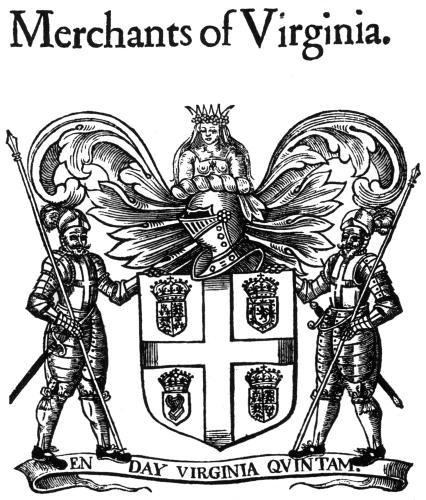 The Company of Merchants, called Merchants of Virginia,
Bermudas, or Summer-Ilands, for (as I heare) all these additions
are given them. I know not the time of their incorporating
neither by whom their Armes, Supporters, and Crest were granted,
and therefore am compelled to leaue them abruptly.
The Company of Merchants, called Merchants of Virginia,
Bermudas, or Summer-Ilands, for (as I heare) all these additions
are given them. I know not the time of their incorporating
neither by whom their Armes, Supporters, and Crest were granted,
and therefore am compelled to leaue them abruptly.
From John Stow, Survey of London, 1632
Photo by Virginia State Library.
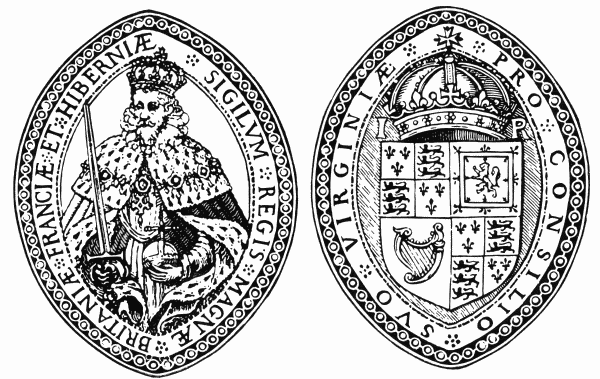 Virginia Seal
Courtesy Mrs. L. T. Jester and Mrs. P. W. Hiden
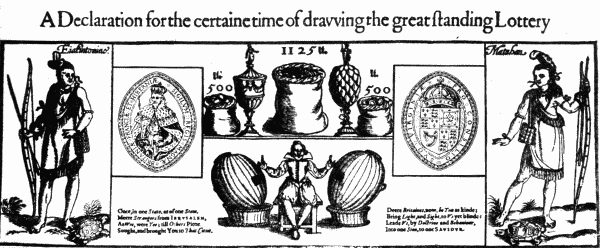 Heading for the Broadside issued by The Virginia Company, London, 1615
[Click image for larger view]
Photo by Virginia State Library. From photograph in Virginia Historical Society.
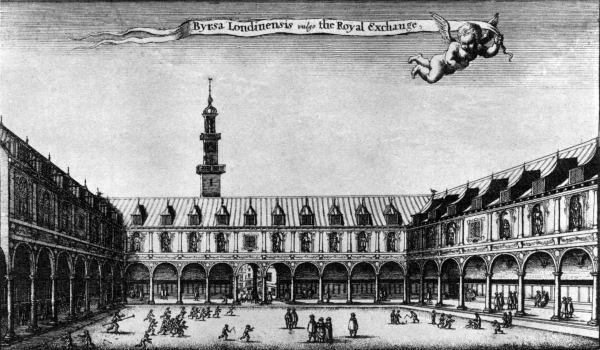 Royal Exchange, London. As it was in the time of the Virginia Company.
Photo by New York Public Library.
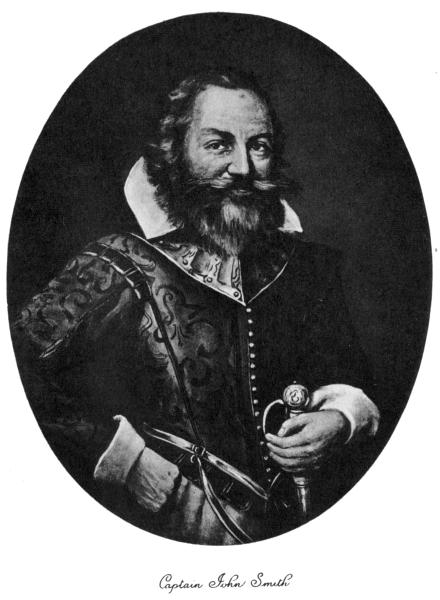 Captain John Smith
From The London Company of Virginia (New York and London, 1908)
Photo by Virginia State Library.
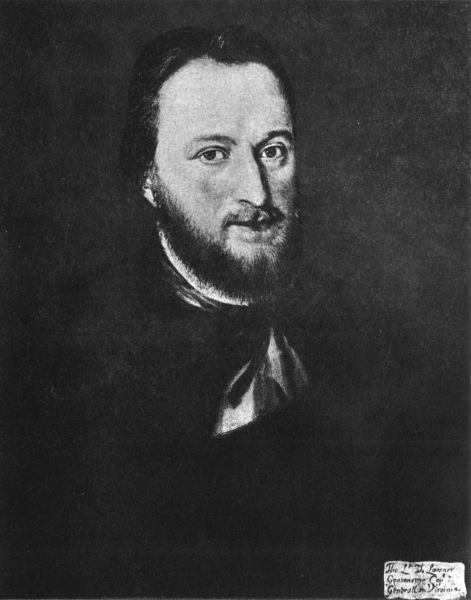 Thomas West, Third Lord de la Warr
From Alexander W. Weddell, Virginia Historical Portraiture
Photo by Virginia State Library.
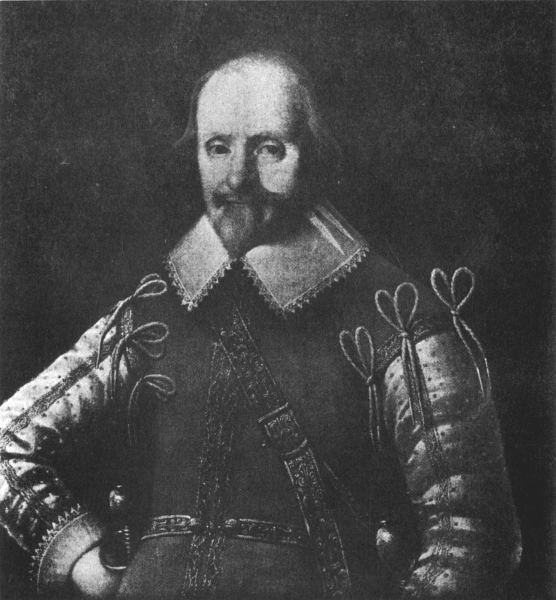 Sir Thomas Smith (or Smythe)
"The Right Worshipful Sir Thomas Smith, of London, Knight, one of his Maiesties Councell
for Virginia, and Treasurer for the Colonie, and Gouernour of the Companies of
the Moscovia and East India Merchants"
From the Original Portrait by an Unknown Artist, now in the possession
of The Skinners' Company, London.
From Alexander W. Weddell, Virginia Historical Portraiture
Photo by Virginia State Library.
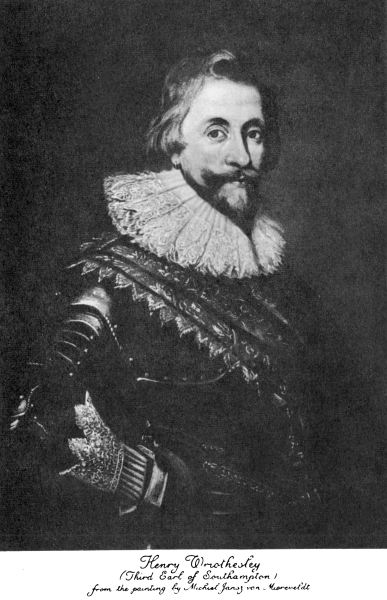 Henry Wriothesley
(Third Earl of Southampton)
From the painting by Michiel Jansz van Miereveldt
From The London Company of Virginia (New York and London, 1908)
Photo by Virginia State Library.
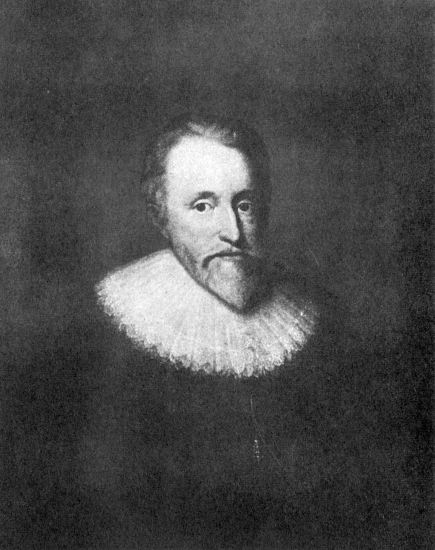 Sir Edwin Sandys
From the Original Portrait by an Unknown Artist, now in the possession
of Sir Edmund Arthur Lechmere, Bart, Bramham Gardens,
London, England
From Alexander W. Weddell, Virginia Historical Portraiture
Photo by Virginia State Library.
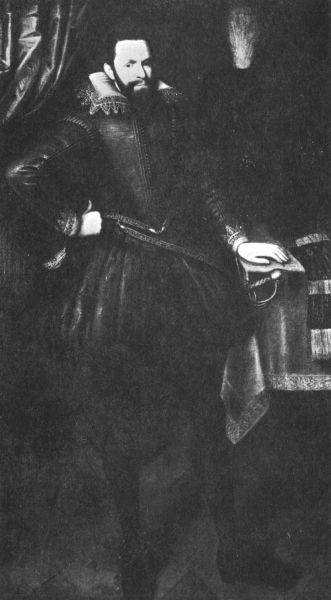 Sir Thomas Dale
Portrait by an unknown artist of the Anglo-Flemish
School painted in oils early in the 17th Century. The
original portrait is preserved in the Virginia Museum
of Fine Arts, Richmond, Virginia
Photo by Virginia State Library.
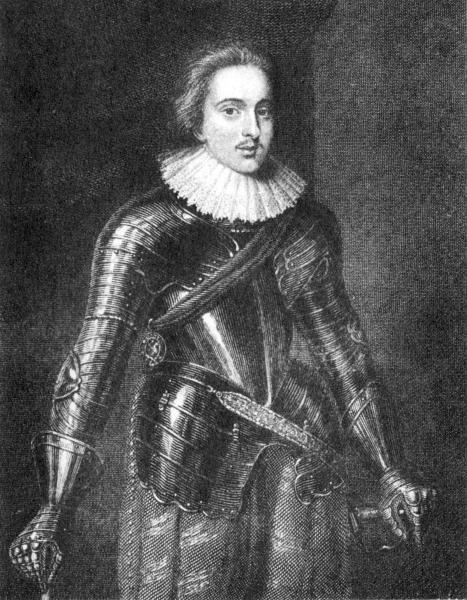 HENRY STUART
Prince of Wales
From Alexander Brown, The Genesis of the United States
Photo by Virginia State Library.
The new charter having received the final seal in March
1612, a new colony was established in Bermuda in the following
July. Its early history has a double significance for the later history
of Virginia. In the first place, the Bermuda colony emphasizes
the growing interest of the adventurers in what might
be produced in America as against what might be found by way
of America. The occupation of the Bermuda Islands might almost
be described as a retreat from the earlier search for a passage to
China. The move could be viewed also as a reassertion of an old
interest in plundering the Spaniard, for the Bermudas lay
athwart the homeward route of Spain's treasure fleets. But in
any case the primary interest was in America and its own peculiar
opportunities, and the attention given by the early settlers
in Bermuda to experiments with tobacco, sugar, wine, ginger,
and other such commodities suggests that their purpose was not
so much to plunder the Spaniard as rather to emulate his success
as a planter in the West Indies. Secondly, the adventurers showed
a marked inclination to encourage each adventurer to meet his
own costs. Provision was made for an early survey and division
of the land, with the result that men put their money chiefly
into the development of their own estates. A final survey was
not completed until 1617, but at that date some of the Bermuda
adventurers at least had known who their tenants were and
approximately where their land would lie for three full years.
Whether for these or for other reasons, Bermuda grew while
Virginia languished. By 1616 over 600 colonists had reached the
Somers Islands, where most of them survived. In contrast, Virginia
had that year 350 people.
The Bermuda subscribers had been separately incorporated as
the Somers Island Company with its own royal charter in 1615.
Indeed, ever since 1612, when the Bermuda adventurers helped
to relieve the financial embarrassment of the Virginia Company
by paying £2,000 for its newly acquired title to Bermuda, the
Somers Island adventurers seem to have functioned increasingly
as a separate corporation. But the membership of the two companies
was much the same. It had been the more active and
interested of the Virginia adventurers who subscribed to the
Bermuda joint-stock in 1612, and for twelve years thereafter the
active membership of the Virginia Company came so close to
duplicating the membership of the Bermuda Company that the
two bodies often met virtually as one. Until 1619 Sir Thomas
Smith served as governor of both companies.
The growing interest of the London adventurers after 1612
in the colonization of Bermuda did not mean that Virginia was
wholly neglected. Funds secured from the lottery and from suits
against delinquent subscribers were enough to keep the project
alive. In 1612 the adventurers even sent out a stock of silkworms
for a test of silk production. Needless to say, returning ships
brought back no silk; nor did they bring sugar or wine. Lumber,
including the valuable black walnut, seems to have provided the
chief cargo for return voyages. A shipment of tobacco, Virginia's
first, in 1614 gave some ground for arguing that the agricultural
experimentation to which the colonists had been committed for
several years now would pay off eventually. So argued Sir Thomas
Gates on his return home this same year after three years of
service in the colony, but the fact that he had come back from
Virginia apparently made more of an impression than did his
argument. Others also came home, their contracted term of
service ended, and rarely did they bring any news from Virginia
which added good to its name. Instead, they talked of the severe
discipline under which they had been forced to live, and made
sport of the too hopeful propaganda which had first persuaded
them to become adventurers in Virginia. The discipline, chiefly
associated with Dale's office as marshal, made his loyal decision
to remain in the colony for another two years as lieutenant governor
a further contribution to the ill repute of Virginia's name.
Dale finally came home in 1616, the year in which the dividend
on the 1609 joint-stock fell due. The contrast between
the high hopes of 1609 and the reality of 1616 was all too painfully
apparent. Six hundred men, women, and children had
sailed for Virginia in the first of these years under a plan to live
and work together for a seven year period. They would share,
each according to his particular skill or aptitude, in the common
task of planting a colony, and they would live out of a common
store. By 1616, towns were to have been built, churches and
houses raised, and an increasing acreage brought under cultivation.
A variety of profitable crops would have been tested, and
markets established for them. The original stock of cattle would
have increased through care until there were enough for all. At
the same time, the trade with the Indians would have been put
on a profitable basis, as would have mining operations and perhaps
even a trade to Cathay. Such was the general prospect to
which so many adventurers had responded in 1609. To the
modern student all this seems so unrealistic as to be almost unbelievable,
but unless one grasps the reality of the original dream
he cannot hope to comprehend the extent of a later disillusionment.
There were no funds to be divided in 1616, but the company
did declare a dividend of land—not the 500 acres per share that
Alderman Johnson had suggested as a possibility in 1609 but
the more modest total of 50 acres. This 50 acres, however, was
designated as a first dividend. Others would follow, for an ultimate
total of perhaps 200 acres per share, as the area in the
colony's "actual possession" was enlarged. Plans were announced
for dispatching a new governor to Virginia with instructions for
completing the necessary surveys, and the adventurers were urged
to seize the opportunity to gain a desirable priority in the location
of their shares by contributing £12 10s. toward meeting the necessary
costs. In return for this contribution, the adventurer would
be entitled to an additional 50 acres. The land now to be divided
was that lying along the James River, and only those adventurers
who submitted to the additional levy would be entitled to share
in the division, except apparently for adventurers then living in
the colony. These were the old planters, as they came to be
called, whose rights paralleled those of the old adventurers in
England. It is evident that the adventurers were in no position
to claim a monopoly as the just reward of their past sacrifices,
for they also offered an immediate dividend, on terms no different
from those governing the rights of the old adventurers, to any
new adventurer who wished to join by paying £12 10s. per
share. Such was the estate to which the Virginia Company had
been reduced after ten years of effort.
To employ a term that was destined to become common at a
later period of American history, the Virginia Company had
become nothing more than a land company. Its one asset was the
land that had been bought with the sacrifices of the first ten
years, and after 1616 all of its plans depended upon the hope
that it might use its power to give title to that land as an inducement
for investment in the colony. In its advertisement in 1616
adventurers, both old and new, were invited to take up shares
for occupancy by themselves or for development by tenants sent
for the purpose. Perhaps because the first response to this appeal
was disappointing, the company provided an additional inducement
in 1617 by promising 50 acres per head for every person
sent to the colony, the payment being due to the one who bore
the cost. This was the Virginia headright, as it came to be called,
which was destined to remain the chief feature of the colony's
land policy through many years after the demise of the company
itself. Intended at first to encourage the adventurers in England
to send the labor that was necessary for the development of the
land, it served thereafter as a land subsidy of the immigration on
which the colony lived and grew.
By 1618 the fortunes of Virginia were taking a turn for the
better. The adventurers, or some of them at least, found encouragement
in continued shipments of tobacco. These shipments were
small and the quality of the tobacco could not be compared with
the Spanish leaf of West Indian production which was finding
a growing market in London despite King James's known disapproval
of the habit on which the market grew. But the quality
of Virginia tobacco, for which Sir Thomas Smith seems to have
found a first market in the East Indies, no doubt could be improved
as the planters learned the art of its cultivation and the
adventurers found for them a better weed. No doubt, too, this
success with tobacco, whatever the imperfections of the current
product, could be viewed as a harbinger of other successful attempts
to produce commodities the Spaniard had for so long and
so profitably grown in his West Indian plantations.
Further encouragement came from the willingness of the handful
of planters already in Virginia to remain there, and from
the decision of Ralph Hamor and Samuel Argall, both of whom
had formerly served the company in the colony, to return there.
Especially significant were the arrangements under which Hamor
and Argall planned their return early in 1617. One of the problems
that had undoubtedly discouraged the adventurers from
taking up the company's offer of a land grant in 1616 was the
question of the supervision that could be provided for such tenants
as they might elect to put on the land. In Bermuda, the adventurers
had found an answer, or rather thought they had, by
dividing the land into tribes, later designated as parishes, over
which a bailif would exercise an office that was partly civil and
partly traditional on the landed estates of England. In Virginia,
Hamor and Argall pointed the way to a solution by entering into
an association with several of the adventurers in England for
the development of a jointly held plantation. Thus, in January
1617, the company awarded 16 bills of adventure to Hamor and
six associates for the 16 men they proposed to transport to Virginia
at their own charge. The following month saw a similar transaction
with Captain Argall and his associates, five adventurers
who had joined with this seasoned veteran to send out a total of
24 men. Argall went also as lieutenant governor in succession
to George Yeardley, who had been left as deputy by Dale on
his return to England in 1616, but the cost of getting the new
governor out to his post seems to have been met entirely by his
own associates. The arrangement has an obvious pertinence to
an understanding of Argall's unhappy experience as governor,
for he was later charged with neglect of the public interest through
too great concern for his own personal interests. But here the
emphasis belongs to the equally obvious fact that some of the
adventurers were responding to an opportunity to send out tenants
who would work under the management and direction of an
experienced colonist.
In 1618 George Yeardley was back in London consulting with
other adventurers, including some of the leading members of the
company, who were interested in forming associations for the
development of "particular plantations." Late in the year he sailed
for the colony as the newly designated governor of Virginia.
With him he carried instructions which record for us further
developments in the company's land policy. All adventurers, including
delinquents who would pay up their subscription, were
now promised 100 acres of land on the first dividend for each
share of stock, and another 100 acres as a second dividend after
the first had been occupied. Such of the ancient planters as had
paid their own way to Virginia, which was to say those who had
settled at their own cost before Dale's departure in 1616, were
also to receive grants in like amount. The adventurers were encouraged
to pool their rights for a common grant of land by the
promise that their estate could be developed under their own
management and would be treated as a separate administrative
unit for civil and military purposes. What the company had in
mind were the larger associations already formed or on the point
of being formed, such as that for the settlement of Southampton
Hundred, which eventually embraced a nominal area of perhaps
as much as 100,000 acres and in which the associated adventurers
invested a total of some £6,000. Another example is the association
of Sir William Throckmorton, Sir George Yeardley, Richard
Berkeley, George Thorpe, and John Smyth of North Nibley
which early in 1619 received a first joint grant of 4,500 acres
and which founded above Jamestown the plantation known as
Berkeley Hundred. These new associations were very much the
same as the association of the Virginia adventurers which in 1612
had undertaken the colonization of Bermuda. For the development
of their common grant they pooled the necessary capital in
their own joint-stock fund and directed its investment through
their own courts, assemblies, or committees as they saw fit. For
every tenant sent to the plantation, the associated adventurers
were entitled to an additional headright of 50 acres. They were
awarded also an additional 1,500 acres for the support of public
charges in the hundred, such as those incurred for the maintenance
of a church and minister.
How many of the colonists who migrated to Virginia between
1618 and 1624 went by agreement with such associations as
these is difficult to say, but there can be no doubt that they were
a very large part of the total. The Virginia Company, which
had served theretofore as the immediate colonizing agent, was
becoming more and more a supervisory body for the encouragement
of individual and associated adventurers in their own
colonizing efforts. For itself, the company looked forward to a
continuing revenue from quitrents to be paid, at the rate of two
shillings per hundred acres after a term of seven years from the
original grant, by all save the ancient adventurers and the planters
who had migrated before 1616 at their own costs. To this
revenue from quitrents could be added the benefit to be expected
from the company's control of the colony's trade.
As in 1609, there seems to be no doubt that all plans looked
ultimately to the establishment of individual land titles. Where
the record has survived, the associated adventurers clearly intended
that their common grant would in time be divided. In
the case of Berkeley Hundred, the evidence suggests too that the
associates used the promise of a share in this division for the
recruitment of their first tenants. Yeardley's instructions reaffirmed
the company's promise of a headright in terms inviting
the migration of individual settlers at their own cost.
To understand the plans of 1618, the modern American needs
to dismiss any idea that the isolated farm house of later America
represented the ideal toward which men looked at this time. He
should think rather of the English village community, or of the
New England town, where men lived together with the advantages
of a close social relationship and where the land they cultivated
lay close at hand to the village and its church. If the
associated adventurers continued to depend for a time on variations
of the original joint-stock plan, it was not merely because
they wanted to share the risk of a still uncertain venture or because
they were seeking some useful device for meeting the problems
of management. It was also because the plantation they
hoped to establish was to have at its heart a town, and it was
thought that the town could best be built through some common
effort.
What has been said above is not intended to suggest that the
company's role after 1618 was to be purely supervisory. Although
it had an accumulated debt of some £9,000, or possibly because
of this debt, the company agreed for the encouragement of individual
adventurers to assume heavy responsibilities of leadership.
It directed Yeardley to lay out four towns, or boroughs,
along the James in which grants to individuals or the lesser associations
would fall—Kecoughtan at the mouth of the James,
Henrico at the head of its navigation, and in between Charles
City and James City. From the Bermuda adventurers the company
borrowed the idea of establishing a public estate intended
to meet as nearly as possible all costs of government. In each
borough 3,000 acres were to be set aside as the company's land
for cultivation by its own tenants, who would work at half shares.
Out of the company's moiety would come the support of all superior
officers, excepting the governor, for whom an additional
3,000 acres would be set aside in James City. The company thus
committed itself to a not inconsiderable program of colonization
on its own responsibility.
One wonders what it was that inspired this renewed, and most
ambitious, venture in Virginia—a venture that would carry to
Virginia over the next five years something like 4,500 colonists.
Several possibilities can be suggested. First of all, it should be
noted that the interest of the London adventurers in the colonization
of America had never faltered, despite repeated disappointment,
since they had originally laid their hands to the task in
1606. This, at any rate, is true of the adventurers who led, and
more especially of Sir Thomas Smith. After it had become no
longer possible to push the adventure in Virginia, they had turned
to Bermuda, where an initial success seems to have encouraged
another try in Virginia. The plans adopted for Bermuda and
later for Virginia indicate that the adventurers shrewdly capitalized
on the desire of Englishmen in many different walks of life
for title to the undeveloped lands of America. A newly stirring
missionary impulse had its part to play, if only by giving to the
name of Virginia more helpful associations. Argall had captured
Pocahontas, the favored daughter of Powhatan, and with her as
hostage the colonists had forced a peace with a heretofore implacable
foe. More than that John Rolfe had married the Princess
Pocahontas, as the English liked to call her, and Sir Thomas Dale
as his last major service to the colony had brought her to England
in 1616. In London, at court, and elsewhere, she and her entourage
of Indian maidens had been a most effective advertisement
of Virginia. Even after her own death in 1617, her maiden
consorts had stayed on for many months before being finally returned
to Virginia by way of Bermuda. Since 1613 the Virginia
Company had leaned heavily on the missionary appeal in its
efforts to encourage continued support of the colony, and it may
well have been the company itself which prompted the bishops
of the Church of England in the year of Pocahontas' death to
sponsor a collection of funds for an Indian mission in Virginia.
In any case, the approximately £1,500 raised for the purpose
were turned over to the company, which in 1618 ordered
Yeardley to set aside 10,000 acres at Henrico for the support of
an Indian college.
The adventurers in 1618 also decreed certain legal and political
reforms that were helpful in giving Virginia a better name than
it had enjoyed for several years past. Disgruntled colonists returning
from Jamestown had brought exaggerated stories of Dale's
discipline, with the result that Virginia had gained the reputation
almost of a penal colony. The company's renewed guarantee
that the settlers would enjoy the full common law rights of Englishmen
at home was coupled with provision for a general assembly
of the colonists, a body which first met at Jamestown in
1619. In short, the company had the benefit in 1618, as so frequently
in the past, of leadership of the highest quality.
Sir Thomas Smith was still the governor of the company in
1618, and without question his leadership must be considered
to be a major factor shaping the new life then being infused into
the colony. But a factional strife that would soon help to destroy
the company already had made its appearance. The sources of
this factionalism were varied, and some of them had little to do
with the affairs of Virginia. Thus, at this time Sir Thomas found
a determined enemy in the Rich family, headed by the wealthy
Earl of Warwick and represented most ably by Sir Nathaniel
Rich, who for many years was an active leader in the House of
Commons. Warwick had a way of investing in voyages which
bordered closely on piracy, and as a result of one such investment
had become involved in a long and bitter conflict with
Smith as the governor of the East India Company. Unquestionably
of more fundamental importance was a growing opposition
to Smith that was based upon discontent with the former management
of the Virginia project. It seems almost as though the Virginia
adventurers, before they could place full confidence in the
new program for the colony's development, had to find some
more satisfying explanation for the company's previous failures
by charging gross mismanagement of its affairs. Such, at any rate,
was the conviction to which many adventurers came, chiefly it
would seem the lesser adventurers who were easily prejudiced
against the great merchants of London, of whom Sir Thomas
was the chief. In a company where the ultimate power to decide
had been vested since 1612 in a general assembly of the adventurers
voting by head rather than by share, the discontent of the
lesser adventurers could become under the guidance of an effective
leader a very potent force.
The leader was found in Sir Edwin Sandys, one of the ablest
parliamentarians of seventeenth century England. Sandys himself
was not one of the lesser adventurers. He had been a member
of the Virginia Council since 1607, and in 1611 he had
responded to the company's appeal for a subscription of £37 10s.
by subscribing double that amount, thereby matching the subscription
of Sir Thomas Smith. With the aid of other prominent
adventurers, including the Earl of Southampton, and by making
common cause for the moment with the Rich faction, Sir Edwin
won election to the governorship of the company in the spring
of 1619. In the absence of anything approaching a full record,
it is impossible to say what justification there may have been for
the charges of mismanagement that were brought against Smith's
administration. It would not be surprising if over the long and
frequently discouraging years of his leadership, and especially
in the period since 1612, some irregularities, some carelessness
had crept into the conduct of the company's business. A very
noticeable result of Sandys' election was an effort to systematize
the company's procedures by adoption of new standing orders
and regulations, and to bring order out of an alleged confusion
of the company's records, especially those pertaining to the rights
of the adventurers to land in Virginia. But it is possible to speak
with full assurance on only one point: no other of the adventurers
had shown more courage or more devotion to the colony, no other
of them deserves to be better remembered than Sir Thomas Smith.
There can be no question, however, that the reviving interest
in Virginia received an additional stimulant from the fact that
the business now had a new management. At the close of 1618,
and largely as the result of emigration during that year, the population
of the colony stood at approximately 1,000 persons. During
the year after Sandys' election, a total of 1,261 emigrants left
England for Virginia, over 800 of them at the company's charge.
This substantial evidence of the company's determination to assume
the lead encouraged additional associations of adventurers
to take up patents for their own plantations, with the result that
by the summer of 1622 the council could announce that over
3,500 people had migrated to Virginia since the spring of 1619.
This was a remarkable record, testifying to the very great gifts
Sir Edwin possessed as a leader and the confidence men placed
in his leadership.
The minutes of the company's courts have survived for the
period after the election of Sandys, and so it is possible to get
a clearer picture of the company's organization and procedures
than can be had for any earlier date. Further help comes from the
"Orders and Constitutions" drawn up after Sandys' election and
published in 1620 as part of a pamphlet skilfully written to convey
the impression that Virginia's affairs were then being managed
much better than in the past. The company depended basically
upon decisions reached in four great quarter courts, which
were general assemblies of all the adventurers who wished to attend
and which were scheduled for regular meeting on next to
the last Wednesday of each of the quarterly terms in which the
king's courts sat at Westminster. Only a quarter court could
elect officers, either of the colony or of the company, enact laws
and ordinances, or determine policies governing the distribution
of lands in the colony and the conduct of its trade. On the Monday
preceding each meeting of the quarter court, a preparatory
court would settle the agenda for the following Wednesday,
in order that the members might have warning of the business
to be taken up at that time. Each fortnight, except in the "long
vacations" between court terms, an ordinary court would meet,
again on Wednesday, with a quorum that required the presence
of at least five members of the council, the treasurer or his deputy,
and "fifteene of the generality." The hour of meeting for all
courts was 2 P.M., and at no court could a question be put after
6 P.M. A decision reached by any lesser court, including the extraordinary
court that might be called in case of special emergency,
could be overridden by a quarter court. This was the governing
body of the company, a popular assembly in which Sir Edwin
often demonstrated his special talent as a parliamentary tactician.
Attendance varied according to the importance of the business at
hand, but as many as 150 might attend.
The quarter court meeting in Easter term was a court of elections,
where the members cast their votes for all principal officers
by secret ballot. Except for members of the council, all offices
of the company were held by annual election. The chief office
was that of the treasurer, as the governor of the company was still
officially designated. As frequently as not, in common usage he
was known as the governor, but the charters had fixed the title
of his office and in so doing had pointed up a primary responsibility
of the office. The governor of the Virginia Company was
in fact its treasurer. After 1619 no man could hold the position
for longer than three years, and no man was eligible for election
to it if already he was serving as the governor of another company,
except that he might also serve as the governor of the Somers
Island Company. The election court might vote a reward for
services rendered, but the treasurer, like other principal officers,
served without fixed compensation.
His chief assistant, and the second officer in rank, was the
deputy. As the title suggests, he might be deputized to perform
virtually any function of the governor, including that of presiding
at courts in the governor's absence. But he also had important
functions of his own. He is perhaps best described as the chief
administrative officer of the company. He was specifically charged
with superintendence over all lesser officers, and he had a primary
responsibility for contracts and other business arrangements relating
to the dispatch of shipping, provisions, and passengers
to Virginia and to the receipt, storage, and marketing of cargoes
returned from the colony. At all times, he acted, or was supposed
to act, in accordance with instructions from the court, council,
or treasurer, but all such instructions were necessarily general
in character. Many were the opportunities to use his own judgment,
or to confer a favor, as he handled business transactions
involving hundreds or even thousands of pounds. For his assistance
and perhaps to keep a watch on him, he had a committee
of sixteen men chosen by the court under a provision requiring
that a fourth of the number should be changed each year "to the
end [that] many be trained up in the businesse." The committee
may have been new, but the deputy's office was old. It had been
occupied for many years before the spring election of 1619 by
Alderman Johnson. Some of the more serious charges brought
against Smith's administration related to the management of
the magazine, as the stock of supplies periodically forwarded
to the colony was generally described. Johnson had managed the
successive magazines, each separately financed by its own joint-stock,
until in 1619 he was replaced by John Ferrar.
The council, still described as His Majesty's Council for Virginia,
had become a large and unwieldy body, with many of its
members inactive. Its influence on the conduct of Virginia's affairs
was now decidedly less important than in the earlier years. According
to the Orders and Constitutions, no one "under the degree
of a Lord or principall magistrate" was thereafter to be elected to
the council except "such as by diligent attendance at the courts
and service of Virginia for one year at least before, have approved
their sufficiency and worth to the Companie." As this statement
strongly suggests, a place on the council was for many members
an honorary post through which one might lend the prestige of
a great name to a worthy undertaking without assuming much
real responsibility. Nevertheless, the legal powers of the council
under the Virginia charters made its services indispensable, and
made it desirable that at least a few of its members should be
intimately acquainted with the business. The treasurer was supposed
to consult with the council on important occasions, and
especially on matters pertaining to the government of the colony.
All formal instructions to officers in the colony had to be sent in
the name of the council and over its seal. In any case of removal
from office, in London or at Jamestown, the cause had to be considered
in council before it could be taken before the adventurers.
But any seven members made a quorum giving full power to
actions taken in council, and the treasurer, who was always a
member of the council, had the custody of its seal.
Two of the seven auditors now required for annual review of
disbursements and receipts had to be members of the council.
The auditors' office had grown out of the disputes over the accounts
of Sir Thomas Smith, and in addition to the annual auditing
of the treasurer's report, which had to be submitted to the
Easter court, they were charged with responsibility for a close
review of all earlier records of the company. The primary purpose
was to establish a full and exact list of all subscriptions, with
notation especially of delinquencies. Salaried officers of the company
were a secretary, a bookkeeper, a husband (or as we would
say, an accountant), and a bedel or messenger. The secretary
served all courts held by the adventurers, the council, and the
auditors, or by standing and special committees, of which last
the adventurers appointed quite a number. In addition, the secretary
was custodian of the company's records.
Although Sir Edwin Sandys continued to be the actual leader
of the company until its dissolution in 1624, his tenure of the
treasurer's office was limited to a single year. When the adventurers
assembled for the annual elections in the spring of 1620,
they were much disturbed to receive instruction from the king
that Sir Edwin was not to be re-elected. Instead, the king suggested
the choice of some merchant of means and wide experience—perhaps
Sir Thomas Smith, Sir Thomas Roe, Alderman
Robert Johnson, or Mr. Maurice Abbott.
Whether Sandys could have been elected in the absence of
this interference by the king, which the adventurers protested
as an unwarranted invasion of their liberty, is itself an interesting
and debatable question. By his many criticisms of the previous
conduct of the company's affairs, Sandys had won the undying
enmity of Sir Thomas Smith and his important friends. More
than that, he had quarreled with his ally of the preceding year,
the Earl of Warwick, who had connections hardly less impressive
than those enjoyed by Sir Thomas. The quarrel with Warwick
was over a question of piracy, as Sir Edwin chose to regard it.
One of Warwick's ships, the Treasurer, had sailed from England
in April 1618 with a license to capture pirates, which was one
way of getting a ship cleared from English ports for depredations
against the Spaniard at a time when the king had set his face
against all such activity. The Treasurer had called at Jamestown,
where Governor Argall, who had rendered important services to
the colony but who had special reason to understand that his
position in Virginia depended upon the good will of important
members of the company, helped to outfit the vessel for a raid
on the West Indies. Recent studies, and especially those of
David Quinn, a British scholar, argue strongly that the earlier
ventures of Gilbert and Raleigh had been inspired very largely
by the desire to establish some base on the North American
coast that would be useful in attacks upon Spanish possessions
and the trade routes which joined them to Spain. But it is evident
enough that by this time the leaders of the Virginia Company
were chiefly fearful that Spain might attack their colony before
it was securely fortified, and before it had fulfilled the promise
of rewards far greater than anything freebooting ventures could
offer. As a result, Governor Yeardley, on instruction from London,
denied the courtesies of Jamestown to the Treasurer on its
return in 1619, and won for Sandys thereby the bitter resentment
of the Rich family.
The king's interference in the election of 1620 has naturally
become a celebrated incident in the history of Virginia. Sir
Edwin was a leader in parliament, which before the century
was out would establish its supremacy in the government of
England, and the Virginia Company in 1620 had only recently
established the first representative assembly in North America.
To historians who have sought the larger meaning of the American
experiment, it has often seemed that the king must have
been guided by a fear of representative government—in other
words, that his motives were largely political. No doubt, he was
more easily persuaded to enter an objection to Sandys' re-election
because of Sir Edwin's opposition to royal policies in the house
of commons, but there is no contemporary evidence to suggest
that the king had even noticed the Assembly which met at
Jamestown in 1619. Moreover, that Assembly had been authorized
before Sandys' election, at a time when Sir Thomas Smith
was still in the chair, and anyone who thinks the motion had
been carried over Smith's opposition should take note that the
same kind of representative assembly was established in 1620
for Bermuda, over whose fortunes Sir Thomas would continue
to preside until 1621. Not until the middle of the seventeenth
century, at the time of Cromwell, does it appear that anyone
even suggested that the primary reason for the king's interference
was fear of a significant development in the history of representative
government.
What actually happened in 1620 would seem to be clear
enough. Sir Thomas Smith had connections that reached all the
way into the king's bedchamber, and there he effectively argued
that Sandys did not know his business. It was an argument that
found not a little justification in the fact that the company had
to admit by a broadside published in the very month of the election
court that hundreds of the colonists sent to Virginia in the
preceding year had died within a short time of their arrival
there, and it may be that Sir Thomas apprehended the even
greater disasters soon to overtake the colony. A more likely supposition,
however, is that he seized upon this news from the
colony as an opportunity to vent his resentment against Sandys,
a resentment that must have become more bitter with each of
Sir Edwin's promotional releases advertising the great improvements
now to be found in the management of Virginia's affairs.
The legal basis on which the king acted was probably debatable.
No doubt, he depended upon the provision in the charter requiring
that all members of the council, of which the treasurer
was the head, be sworn to the king's service. But membership
on the council was for life, and Sir Edwin had taken his oath as
a member of the council as early as 1607. Perhaps the king took
advantage of the company's regulations requiring an annual
election and that the treasurer be sworn following his election.
Whether this was a new requirement cannot be said. It can only
be suggested that the king intended to say that if Sir Edwin were
re-elected he would not give him a necessary oath of office. It may
be, too, that he stood quite simply on the prerogative of his office
to insist that his subjects in Virginia were entitled to royal protection.
In any case, the adventurers chose not to defy the king's
wish.
Having protested his interference as unwarranted, the quarter
court in May 1620 adjourned without electing a treasurer.
Instead, the adventurers appointed a special committee to call
on the king for the purpose of acquainting him with the true
facts regarding "the managing of their business this last year"
and to ask for a free election. Sandys himself appealed to the
royal favorite, the young Duke of Buckingham, but with no effect
on the king's decision. When the adventurers reassembled late
in June, they elected the Earl of Southampton as treasurer. Thus,
in a sense both parties to the dispute emerged victorious. Sandys
was no longer treasurer, but the adventurers had refused to elect
a merchant and Southampton would preside thereafter in behalf
of Sandys. There can be no doubt that Sandys continued to be
the leader of the company. Moreover, in 1621 he extended his
power by gaining control of the Somers Island Company through
the election of Southampton to its governorship.
A question that naturally arises is that of how, or why, Sir
Edwin was able to survive this challenge to his leadership. The
news from Virginia was by no means encouraging. Given the
long record of disappointment there, and the many men who
previously had died there, the fact that several hundred of the
most recent settlers had succumbed might have been expected
to unsettle any administration. Perhaps it was the king's interference,
serving as it did to rally the adventurers in defence
of the company's liberty. Perhaps Sir Thomas was guilty of too
naked a display of his power, with the result that the lesser adventurers,
who already had been taught to view the great merchants
of the company with suspicion, rallied to the support of
Sandys. Perhaps it was because the Earl of Warwick and Sir
Thomas had not learned yet the need for effective teamwork;
both men disliked Sandys, but they had their own quarrels and
they would not form a real coalition against him for another two
years. All these possibilities must be given consideration, but
there would seem to be still another reason, possibly the most
important of all.
Sir Edwin Sandys was a man of remarkable gifts, and nowhere
are these gifts better demonstrated than in his ability to stimulate
the highest hopes for Virginia. Before him only Richard Hakluyt,
a patriot now dead four years, had managed better to depict the
promise America held for Englishmen. Sandys wrote no major
work on the subject, and even the company's promotional pamphlets,
which he undoubtedly shaped in some large part, lacked
the fire that Hakluyt, or even Alderman Johnson, could impart to
that branch of literature. It must be said also that Sandys added
no new idea to those which for a generation past had guided
Englishmen in their American ventures. His program included
not a single objective that the Virginia Company had not theretofore
tried to realize; the chief contrast with former programs
was the absence of any emphasis on the prospect that a route to
the South Seas might be found, an objective the adventurers had
dropped for all practical purposes a good many years before Sandys
became their treasurer. But Sandys had confidence, a systematic
and orderly mind, and a persuasive way of talking in the quarter
court or in conference with the individual adventurer who contemplated
some new risk of capital. As a result, he managed to
convey the impression that plans had now been so well thought
through that Hakluyt's objectives in America had at last become
attainable.
Leaving aside the search for a passage to China, which may
never have been so important to Hakluyt as it was to the people
whose interest in America he sought to enlist, Sandys undertook
to carry through, all at once, the program Hakluyt had outlined
for Queen Elizabeth as early as 1584 in his famous "Discourse
on Western Planting." It was a program that looked to the development
in America of products that would free England of dependence
upon trades with other parts of the world which were in
any way disadvantageous to England, and that would guarantee
to any Englishmen who developed such products a sure profit on
their investment. It was a program that had taken its shape first
from the prospect, in Raleigh's day, of an early war with Spain,
and perhaps it should be noted that when Sandys came to office
in 1619 the Thirty Years War had only recently had its beginning
with the king's own son-in-law a central figure. The war has
gone down in our history books as the last of the great religious
wars, and many were the Englishmen who thought that England
should be, or would be soon involved.
In Virginia, Sandys promised to produce iron. It is strange
that the attempt to develop an iron industry in Virginia, on which
the company spent all told something like £5,000, should have
made less impression on modern historians than has an early and
brief search for gold that was incidental to other explorations. The
iron industry in England was suffering from the depletion of the
island's wood supply, which was still depended upon for smelting,
and Virginia promised an unlimited supply. Other industries
that he hoped to develop in the colony are suggested by a list of
tradesmen the company invited to adventure to Virginia in 1620:
among them, sawyers, joiners, shipwrights, millwrights, coopers,
weavers, tanners, potters, fishermen, fishhookmakers, netmakers,
leather dressers, limeburners, and dressers of hemp and flax. Even
more important because so much depended upon persuading the
individual adventurers to invest their own money in the development
of their land, were plans for the production of sugar, wine,
indigo, silk, cotton, olive oil, rice, etc. In the development of these
products Sandys intended the public lands—those cultivated under
the direct supervision of the company and by its own tenants—to
serve more or less in the capacity of experimental farms. For
their planting he sought seeds and plants from various parts of
the world. On the college land he had some 10,000 grapevines
set out, and sent for their care foreign experts imported from
the continent. To make sure that private estates would not be
devoted wholly to tobacco, as yet the colony's only proven staple,
he wrote into land patents a stipulation that other staples would
be given a trial.
To find the money for investment in the public lands was no
easy task. No common joint-stock fund could be raised in 1619,
if only because the company's plans depended chiefly upon the
hope of inducing the adventurers to invest in their own lands.
It cannot be said how successful were the renewed attempts to
collect from delinquent subscribers, but perhaps some help came
from that source. Sandys depended also, as had Smith before
him, on the Virginia lottery, perhaps more than upon any other
source, for the lottery was terminated early in 1621 by order of
the privy council on grounds that included the complaint of parliament
that the lottery had become a public nuisance. A very
substantial help to Sir Edwin was the bishops' fund for an Indian
college and additional funds raised for the support of an Indian
school in the colony. The total ran to better than £2,000. It had
been decided in 1618, well before Sandys' election, that the money
from the bishops' fund would be invested in an estate to be known
as the College Land, and the precedent thus set was followed
in disposing of funds subsequently made available to the company
for an Indian school. In practical terms, these decisions meant
that all mission funds were used to send out tenants on the promise
that a half-share of the wine and other such commodities as
they might produce would in time provide a permanent endowment
for the school and the college. The decision reflects both
the extraordinary poverty of the company and the extraordinary
confidence with which its leaders approached their new ventures
in Virginia.
By the spring of 1621, when the bulk of the college funds had
been expended and the lottery was terminated, Sir Edwin's financial
resources had become even more skimpy and uncertain.
Some projects, such as that for the settlement of Italian glass-workers
who were to manufacture pottery and beads for use in
the Indian trade, could be financed by subscriptions to a special
joint-stock, but this device offered no help in meeting general
expenses. As a result, Sandys continued to take certain shortcuts,
or perhaps the blame should rest rather on Deputy John Ferrar.
In any case, the colonists complained that shipping came out so
overloaded with passengers as to invite the epidemic disease with
which they usually suffered on landing, and which made of
newcomers a useless burden on the colony for some time after
their arrival. The deathrate among the colonists continued to be
high. The time and energy required to house them, or to feed
them, unavoidably forced delay with projects on which Sandys
had pinned his chief hopes. He was especially disappointed over
the slow progress of agricultural experimentation. Accordingly,
when Yeardley's three year term was ended in 1621 and Sir
Francis Wyatt was sent as his replacement, Sir Edwin also sent
his brother, George Sandys, as appointee to a new office of treasurer.
He was given special charge of all projects looking to the development
of new staple commodities and was intrusted with the
collection of rents, of which the company claimed £1,000 were
presently due. These rents, which were to be collected largely from
half-share tenants who had migrated within the preceding three
years, undoubtedly now constituted the company's main hope for
an immediate revenue. Except in a very few instances, no quitrents
would be payable until 1625, and so general had been the disappointment
experienced so far with special projects that further
time would have to be allowed before any return from them could
be expected. In short, the company had exhausted its very limited
resources in getting Wyatt and George Sandys out to Virginia,
and had nothing left but hopes for the future and the anticipation
of a small immediate revenue from the rents of its own tenants,
most of which had already been assigned to such special charges
as the support of public officers in the colony. In London, virtually
the only asset left to the company was the will and determination
of Sir Edwin Sandys.
In these circumstances, Sandys necessarily devoted his main
energies after 1621 to the problem of tobacco, the only marketable
staple the colony had as yet produced. It was an old problem, but
one now filled with new difficulties. In earlier days, when it had
been hoped that tobacco might be one of a variety of staples produced
in the colony, the Virginia Company, like the Bermuda
Company, had lent encouragement to efforts looking to its production.
But hardly had early experiments proved successful
before the adventurers faced the risk that tobacco would take
over the colony entirely. There is nothing surprising in this development,
for a tobacco plant, unlike a grapevine or an olive
tree, matures within a few months of its planting, and the tobacco
habit at this time was a thing of comparably rapid growth in many
parts of the world. To settlers who had been staked by adventurers
ever insistent upon a prompt return of their capital, or who
wondered how best to procure the means to make payment for
the supplies brought in the next magazine ship, the obvious answer
was to plant the land to tobacco. After doing this, if time
and energy remained, they might try some of Sir Edwin Sandys'
ideas—maybe set out a few grapevines or mulberries, as they had
been instructed to do. There was good reason for the growing fear
among the leading adventurers in London that tobacco might put
a blight on all other projects.
More than that, the increasing shipments of tobacco, especially
in view of the still relatively poor quality of the Virginia leaf,
gave the colony a bad name just when its good name was so important
to the promotional efforts of the company. The tobacco
habit did not yet have the respectable associations it would later
acquire in the eighteenth century. Instead, it was associated with
tippling or bawdy houses, where in truth a pipe was most easily
had by the contemporary resident of London. Moral considerations
were reinforced by an additional concern for the public interest.
So much of the weed consumed came from Spain that thoughtful
men were inclined to consider how much England paid out, to
the profit of the Spaniard, for a commodity which added nothing
to the well being of the country. Had it not been for the influence
of Virginia and Bermuda adventurers in the House of Commons,
Parliament in 1621 might well have prohibited all importation
of tobacco into England. And in all England there was no more
vigorous opponent of tobacco than the king himself. Indeed, the
king had even written a book on the subject.
The attitude of King James had a most important bearing on
another angle of the problem. Under its charter, the company
had been allowed a seven year exemption from import duties on
cargoes brought from Virginia. When this exemption expired in
1619, the government immediately imposed a duty that was
fixed early in 1620 at 1s. per pound of tobacco. Though this was
only half the duty paid by Spanish tobacco, it was nonetheless
a heavy burden to be imposed upon leaf that was declared never
to have sold at more than 5s. a pound and that brought an average
of only 2s. for the better grade in 1620.[A] The adventurers'
attempted escape by shipping their tobacco to Holland won them
a sharp reprimand from the privy council, and an order to bring
all of Virginia's tobacco to England for payment of his majesty's
customs. As negotiations with the king's ministers for some relief
continued, it was proposed in 1622 that the Virginia and Bermuda
adventurers might take over the tobacco monopoly, which was a
grant of the sole right to import tobacco of any sort into the
kingdom in return for a fixed contribution to the royal revenues.
The holder of such a monopoly—a very common device at the
time—was entitled to collect the customs and to hope that what
he collected, plus the advantage of a monopolistic control of the
market, might enable him to clear a profit on the transaction.
Here, in other words, was a proposal that might provide the
needed relief, even some income for the company's hard pressed
treasury. The Virginia Company by 1622 was in no position to
ignore such an opportunity and fortunately, the Sandys faction
was now in control of the Somers Island Company. A joint committee
of the two companies, headed by Sir Edwin himself, entered
into negotiations for what was known as the tobacco contract.
The bitterest factional strife in the history of the London adventurers
soon followed. It is a complicated story, too complicated
and too long to be told fully here. Briefly, both the terms agreed
upon by Sandys and his proposals for the management of the
contract, proposals which left Sandys and his cohorts in full
control, touched too closely the vital interests of some of his
bitterest enemies. In Bermuda, as in Virginia, the hope of an
early profit from the production of sugar, silk, wine, indigo, and
other such commodities had proved vain, and like Virginia,
Bermuda lived by the tobacco it grew. The Earl of Warwick and
members of his family had made especially heavy investments in
their Bermuda properties, and Sir Nathaniel Rich became the
floor leader, as it were, of an attempt to defeat the contract. Sir
Thomas Smith and his friends joined in the effort. Especially
objectionable in the view of the opposition were plans for placing
the management of the contract in the hands of salaried officials,
with Sir Edwin as director at a salary of £500. At one Virginia
court, meeting early in December, the debate got so out of hand
that it required several additional sessions to straighten out the
minutes in order that appropriate penalties might be imposed
upon Mr. Samuel Wrote, a member of the Virginia council whose
unrestrained charges of graft violated the company's rules and
offended the court's sense of its own dignity. In the end the
opposition elected to make the final test in a Bermuda court, whose
consent was necessary to close the contract and where Sandys'
opponents included the more substantial investors in that colony.
The test came in February 1623, and Sandys won. But it could
be demonstrated that had the vote been by share rather than by
head, as was the rule in both companies, he would have been
defeated. Sandys' opponents in the Bermuda Company all along
had complained of a plan to distribute the charges of the contract
equally between the two companies, arguing that the Virginia
tobacco had a greater value and should therefore carry a
proportionately larger charge. And now they were in a position
to argue that the Virginia Company, in whose courts for some
time they had steadfastly refused even to vote on the salary question,
sought to exploit the younger plantation, as was evidenced
by the opposition of the adventurers to whom Bermuda's tobacco
chiefly belonged. With this argument, Sandys' opponents promptly
carried the whole question before the privy council.
This was in the spring of 1623. During the course of the preceding
debate, news had come of an Indian massacre in Virginia
that had cost the lives of over 350 colonists. The faction-ridden
and bankrupt company had stirred itself to send such aid as it
could, but now came the word that this had not been enough.
By the testimony of Sandys' own brother, though this testimony
may not have been immediately available to his enemies, another
500 colonists had died before the year was out as a result of the
dislocations occasioned by the massacre, and as a result of the
failure of the company to send enough aid. The tobacco contract
dropped into a position of secondary importance as Sandys' opponents,
with Alderman Johnson taking the lead, petitioned the
king for a full investigation of the situation in Virginia and of
the recent conduct of its affairs.
Whatever one may think of Sir Edwin Sandys, or of the motives
which inspired his opponents, there can be no question as to the
correctness of the action taken by the government. The leaders
of the two factions were called before the privy council on April
17, where they displayed so "much heat and bitterness" toward
one another as to make it difficult to get on with the business. In
the end, the council won agreement that a special commission
should be established for an investigation of the state of the colony's
affairs, the agreement coming finally when the council conceded
the demand of Sandys' supporters that the investigation
should begin with the administration of Sir Thomas Smith. Accordingly,
on May 9, a commission was issued to Sir William
Jones, justice of the Court of Common Pleas, and six other gentlemen
"to examine the carriage of the whole business." Meantime,
a letter had been prepared by the privy council to acquaint the
colonists with the fact that their affairs had been taken into "His
Majesty's pious and princely care" and to encourage them "to go
on cheerfully in the work they have in hand." The central issues
all pertained to Virginia, but in the circumstances there was no
choice but to include both companies in the province of the Jones
commission.
The appointment of the Jones commission ended, for all practical
purposes, the control of the Virginia Company over the
colony. The company lingered on as an agency chiefly through
which the Sandys faction prepared its briefs for the attention of
the commissioners, or through which orders from the commissioners
might be implemented. All of the company's records were
impounded by the commission, which also took charge of all correspondence
with the colony. The records of the company demonstrated
all too clearly the bankrupt state of its finances. The
hearings before the commissioners demonstrated with equal clarity
the hopeless division of the adventurers by bitter factional strife.
Correspondence from the colony brought evidence of a desperate
situation. Even Sandys had to admit that no more than 2,500
colonists were still alive in the colony, which was to confess an
attrition, mainly by death, of something over 40 percent of the
colonists residing in Virginia, or sent to Virginia, since he had
assumed responsibility for the management of its affairs. Actually,
the situation was much worse than these figures suggested, for
a census taken in Virginia early in 1625 showed a total population
of only 1,275. In the fall of 1623 the privy council invited
the company to surrender its charter on the promise that a new
one would be issued to cover all individual rights and grants, but
with a revision of the plan of government that would place the
control of the colony under the more immediate supervision of
the king. In effect, the proposal was to return to something close
to the original plan of 1606. When the adventurers, in a court
from which Sandys' enemies largely absented themselves, rejected
this proposal, the government began quo warranto proceedings
against the company in the court of Kings Bench. On May 24,
1624, that court gave its decision for recall of the Virginia charters.
And so ended the Virginia Company.
The Bermuda Company had been dragged into the investigation
chiefly because of the close ties joining it to the older company.
There was no emergency in the colony, and its debts were
not beyond the capacity of Sir Thomas Smith and other leading
adventurers to pay. As a result, the Somers Island Company
lasted on for another sixty years.
One who looks back from 1624 over the brief and frequently
troubled history of the Virginia Company may debate, as historians
have often done in the past, just what should be said by way
of conclusion. Perhaps it is this: here were men who out of their
disappointment quarreled bitterly and by their quarrels helped
to destroy an agency through which in the past they had worked
together, with a remarkable devotion to the public interest, for
the achievement of great objectives. No doubt, their greatest fault
had been to set their goals too high. Certainly, their greatest
virtue was persistence in the faith that great things could be done
for England in America, a faith destined in time to be justified
by the course of history.
