The most important epoch of Italian violoncello playing
came to a close with Boccherini. His early withdrawal from
his native land caused a loss all the more sensibly felt because
there was no one of equal importance to compensate for him
in the further development of the art, from the point to which
he had attained both in its executive and productive aspect.
This task fell principally to Germans, French, and Belgians,
whilst Italy was deprived of the position of pre-eminence in
regard to violoncello playing which she is asserted to have
held for a long time in the previous century. The same
phenomenon consequently was repeated here as in regard to
violin playing.
Already towards the end of the eighteenth century Art, and
especially instrumental music, in which the Italians had
accomplished so much that was praiseworthy, fell into decline
on the Apennine Peninsula—although Italy brought out some
important productions, particularly in the department of
opera compositions. The Musical Almanack for Germany, of
1783, contains the correspondence of an anonymous German
artist who travelled in Italy in the year 1782. It is there
said: “At Naples I found in the Conservatoire[97] a veritable
horror. Caffaro[98] is here with Milico, whose music gave me
the most pleasure. As for the rest it is all miserable, heavy,
modern Italian opera music, as well as in the churches. I
hoped to find a great deal at Venice, but it is no better there.
Above all, the execution in the whole of Italy is less good than
formerly.... But what astonishes me most is the extraordinarily
little appreciation of music in Italy now. It is
almost a miracle to see people of position who have a love of
music. It created a great sensation when we gave concerts
in Rome which were frequented by sincere admirers and friends.
Instrumental music is at such a low ebb that it is almost
beneath any criticism.”
At the beginning of the present century things were not
changed in this respect. Louis Spohr, who was in Italy in
1816, expresses himself in his autobiography concerning the
condition of music there much in the same manner as the
anonymous writer cited above, and, a little later, Felix
Mendelssohn Bartholdy likewise.
Under these conditions it cannot excite surprise if Italy
in consequence did not produce so many representatives
of violoncello playing in the highest sense of the word as
hitherto.
Luigi Venzano must be mentioned as one of the first
distinguished Italian cellists of this century. He was born in
Genoa about 1815, and was solo cellist in the orchestra of the
Theatre Carlo Felice, as well as teacher at the musical
institute of his native town. He died on January 27, 1878.
As a composer he devoted himself to vocal and stage
compositions.
An incomparably more important player than the preceding
artist, or his countrymen to be subsequently mentioned,
is Alfredo Piatti, born at Bergamo on January 8, 1822, and
not in 1823, as Fétis says. His father, who died on
February 27, 1878, and who early instructed him in music,
was not a singer but a violin player.[99] The boy soon decided
for the violoncello, on which he received his first lessons from
his great uncle, Zanetti, who was engaged as music master at
Bergamo.
Later he was sent to Milan for the benefit of the Conservatoire.
Here the excellent violoncellist, Merighi, conducted
his further education. Piatti attended the above-named
Institution until September, 1837, after having appeared previous
to this date at one of the concerts with decided success.
In April, 1838, he gave a concert of his own in the Teatro
della Scala, at Milan, with the profits of which he supplied
himself with the means of undertaking a concert tour. Soon
after he was heard very favourably at Venice and Vienna. In
the latter town he remained some time; then he returned to
Italy and gave concerts at Milan and Padua. In 1843 he
went to Munich and joined in a concert with Liszt there. In
the following year he presented himself at Frankfort-on-the-Maine,
Berlin, Breslaw, and Dresden, when he afterwards
visited Paris. In 1845 he was in St. Petersburg, where his
performances met with unusual appreciation. Having returned
to Milan, the post of teacher was offered to him, in 1846, at
the Conservatoire. He did not, however, accept the offer, but
established himself in the same year in the English capital,
which from that time he has only left occasionally, either to
undertake concerts or journeys to recruit his health. In
London he soon became one of the most distinguished artistic
celebrities, and he still remains in full favour with the public.
His performances are proportionably marked by fine tone, the
greatest purity, tasteful rendering, as well as by a perfect
mastery of all technical difficulties. He is not only the most
important cellist in England, but belongs altogether to the
highest rank of artists of the present time. He wrote for his
instrument two Concertos (Op. 24 and 26), a Concertino
(Op. 18), a “Fantasia romantica,” Capriccios (Op. 22 and 25),
a “Sérénade Italienne” (Op. 17), “Airs Baskyrs” (Op. 8), as
well as a long list of other works, consisting of Themes with
variations and drawing-room pieces of various kinds. Further
he has brought out new editions of old cello compositions and
six Sonatas by Boccherini. He has also published original
songs with violoncello obbligato.
Two other pupils of the Milan Conservatoire are Guglielmo
Quarenghi and Alessandro Pezze. The first, born on
October 22, 1826, in Casal Maggiore, was pursuing his studies
during the years 1839-1842. Arrived at maturity he was
first violoncellist at the Teatro della Scala, at Milan, and
from 1851 he gave instruction also at the Conservatoire to
which he was indebted for his education. In February, 1879,
he took the place of Boucheron as Choirmaster at the
Cathedral. He enjoyed this position only a few years, for he
died February 3 or 4, 1882. Amongst his compositions the
most noteworthy are—Six Capriccios, a “Chant elégiaque,”
with piano accompaniment; two Romances, a Scherzo, “Un
pensiero al lago,” and some Fantasias on Motifs from Italian
operas.
Alessandro Pezze, born 1835, at Milan, received from his
father, a clever dilettante, his first musical instruction, after
which, in 1846, he went to the Conservatoire of his native
town. Merighi directed his violoncello studies. After he had
been for some time first cellist at the Teatro della Scala, he
was engaged by the English impresario, Lumley, for
Her Majesty’s Theatre in London. Pezze belonged to it
until 1867, in which year the theatre was destroyed by fire.
Later this artist was employed in the orchestras of the Philharmonic
Society and Covent Garden. He is still living in
London.
The Naples Conservatoire produced Gaetano Braga, born
on June 9, 1829, at Guilianuova in the Abruzzi. He was
originally destined for the church, but the inclination for
music came out so strongly that he could not be kept back from
it. His parents now wished that he should be educated as a
singer; he, however, decided for the violoncello, on which
Gaetano Ciandelli directed his studies. He soon became a
pupil of Mercadante for composition. In the year 1852 he
had finished his studies at the Conservatoire. Soon after he
undertook a concert journey to the North of Italy, and from
thence to Vienna, where he formed a connection with Mayseder,
and was a member of his String Quartet for a short time. In
1855 he betook himself to Paris, where he was much in
request as a favourite solo player. He is at present living in
Florence. As a composer Braga devoted himself by preference
to stage compositions. For the violoncello he only
wrote a Concerto, and some smaller pieces with piano
accompaniment, and a Serenade for voice with cello accompaniment.
Other Italian violoncellists at the present time worthy of
notice are—Ronchini and G. Magrini in Milan, Pini in Venice,
Serato in Bologna, Toscanini in Parma, Sbolci and Castagnoli
in Florence, Furino in Rome, Centola in Naples, Montecchi
(who lives at present at Rennes in Bretagne as a music
teacher), and Mattioli, now in Cincinnati.[100]
German violoncello playing had, during the second half of
last century, found unusual opportunities for expansion in
consequence of the demand for numberless competent artists
for the various princely households, as well as for the larger
towns. Amongst the cellists mentioned in the second part
of this work, there were already some specially prominent personages
to distinguish. The branch of art, however, to which
this book is devoted first received a really important and
sustained impulse through means of Bernhard Romberg. This
artist acquired for German violoncello playing a significance
similar to that which Louis Spohr gained for German violin
playing, only with this difference—that the latter master was
far superior to the former as a composer. While certain
violin compositions of Spohr (not to speak of his other works),
on account of their intrinsic worth, are calculated to appear in
concert programmes, and will presumably do so in the future,
the cello pieces by Romberg have already for some time completely
disappeared from them. Yet they have, from a scholastic
point of view, proved to be of value even to the present day. In
regard to this, what Romberg did for the cultivation and
perfecting, as well as the fine manipulation of his instrument,
merits for him the appellation of founder of the German
school of violoncello playing. His Concertos and concert
pieces have been of more importance, however, for taking such
a direction than his violoncello school, which by no means
belongs to the best instruction books of the kind, and is a
proof that a man can be a distinguished teacher—and Romberg
was in any case this—without having the capacity for the
production of a thoroughly satisfactory instruction book.
The examples and music pieces in Romberg’s violoncello
school are indeed excellent, but some of the maxims which he
enunciates seem peculiar, and he goes too much into
extraneous matter, instead of bringing forward the more
substantial principles with the necessary precision and
accuracy.
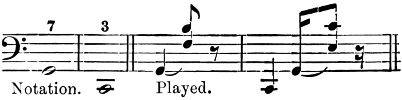
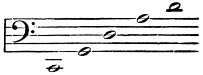
It is noteworthy that Romberg advocated a simplified
notation for violoncello music. Primarily (besides the bass
clef), in Italy and Germany, only the tenor clef was used, and
the alto clef in France. But as the compass of violoncello
playing was more and more extended up to the high parts of
the scale, by the use of the thumb positions, keys used for the
discant and violin were added. Boccherini, for the notation
of many of his compositions, made use altogether of five clefs,
sometimes indeed in one and the same piece—as, for example,
at the opening Allegro of his Concerto (C major). There was
nothing arbitrary in this procedure. Boccherini had far
more in view the object of giving to the player starting-points
for the finger positions to be used in each case. In his
later compositions, however, he abandoned this, as the use of
so many different clefs had its inconveniences; and he
restricted himself to the use of the bass, tenor, and violin clef.
This notation was subsequently generally accepted, particularly
also by Romberg, and is still in use up to the present
time. In opposition to the earlier favourite manner of
writing the notes—by the use of the violin clef an octave too
high for the violoncello, as is the case in Mozart’s and
Beethoven’s compositions—Boccherini, by the application of
the clefs mentioned, wrote everything as it would sound. By
this means he gained the advantage that he was not obliged
to make so much use of ledger lines in the writing of his
passages—which were continually moving in the soprano part—as
he must have done if he had followed the custom of his
contemporaries and had adhered to the higher system of
notation. It is readily understood why Romberg in his
cello school should declare himself in favour of the change
introduced by Boccherini, for he also, with special predilection,
made use of the higher regions of the fingerboard for his
playing; wherefore it was said of him that his handling of
the violoncello was often after the manner of the violin.
From this point of view it is thoroughly rational that
Romberg, in regard to notation, should follow the example given
by Boccherini. In later times the too frequent and continuous
use of the soprano clef—in which a broad, energetic
volume of tone, full of expression, is nearly excluded—has been
abandoned without, however, being neglected entirely; while
to the most beautiful and effective clef—namely, the tenor—has
been accorded its right place.
Bernhard Romberg was the son of the bassoon player,
Anton Romberg, of some note in his time, and was born on
November 11, 1767, in the village of Dinklage, near the little
Prussian town of Quakenbrück. It is unknown whom he had
as teacher for the violoncello. It was probably an orchestra
musician in Münster, to which place his parents had removed
their home. In any case, Romberg’s talent caused him to
make the most of it, for before he had passed his youth he
was able to undertake with his cousin, Andreas Romberg,[101]
who was about the same age, a concert tour which led them
through Holland, and was extended to Paris, where they were
both heard with such success in the house of Baron Bagge[102]
that they were engaged in 1787 for the “Concert Spirituel.”
After his return from Paris Romberg devoted himself eagerly
to progressive studies, and at the same time worked in the
orchestra at Münster.
Münster belonged then, as is known, to the Electorate of
Cologne. The Elector Maximilian Franz, who on his
accession to his dominions (April 27, 1784) resided often in the
Westphalian town, had his attention drawn to the two
Romberg artists, and engaged them for his Royal band at
Bonn. The announcement of the appointment bears the date
of December 19, 1790.
When the Elector, in the autumn of the following year,
went to reside at Mergentheim, then the seat of the German
order—whose Grand Master he was—he caused about twenty
members of his band to follow him from Bonn. Amongst
them, besides Beethoven, who in addition to his office as
organist was also tenor player at the Court, were also the two
Rombergs. In one of the musical entertainments which took
place in the apartments of the Elector, Bernhard Romberg
was heard in a Concerto. Boszler’s Musical Correspondence
of the year 1791 contains a notice of it in which is said[103]:
“Romberg, the younger, combines in his violoncello playing
extraordinary rapidity with charming rendering; this rendering
is the more marked and decided when he is heard in
connection with the greater number of violoncellists. The tone
which he produces from his instrument is, moreover—especially
in the expressive parts—extremely clear, firm, and penetrating.
Taking into consideration the difficulty of the instrument, a
thoroughly marked purity of tone, in the extraordinarily quick
rendering of the Allegro, must be attributed to him in the
highest degree. Yet this after all is mere mechanical readiness;
the connoisseur has another standard by which he
measures the greatness of artists; and this is, the manner of
playing, the perfection of expression or the spiritual interpretation.
Once on this point, the connoisseur will pronounce
in favour of the expressive Adagio. It is impossible more
deeply to penetrate into the more delicate hues of feeling—impossible
to colour them with more variety—to enhance them,
moreover, by greater light and shade—impossible to hit more
exactly the very tones through which this feeling has utterance,
tones which appeal more directly to the heart than Romberg
succeeds in doing in his Adagio.”
“How acquainted he is with all the beauties of detail, which
lie in the nature of the piece in the peculiar kind of expression
to be given, and for which the composer has no signs for
recognition? What effects he is able to produce by the
crescendo of his tone, swelling up to the strongest fortissimo,
and then again by its dying away to a scarcely audible
pianissimo!!”
From this enthusiastic announcement we must conclude
that Romberg’s playing at that time—he was in his twenty-fourth
year—showed already a high degree of perfection. It
is therefore quite conceivable that he cherished the wish of
obtaining a position in life adequate to the merit of his performances,
for in Bonn he received only a yearly salary of 600
florins, and, moreover, the existence of the Cologne Electorate,
the complete dissolution of which was accomplished in the
autumn of the year 1794, had fallen into a very doubtful
condition from the time of the appearance of the revolutionary
army on the Rhine (October, 1792).
Romberg therefore accepted with his cousin, Andreas, at
Easter, 1794, an engagement at the Schröder Theatre in
Hamburg, but he did not long remain there. Three years
later they undertook together a concert journey into Italy,
gave concerts on their return at Vienna, supported by
Beethoven, and again betook themselves to Hamburg, whence,
after a two years’ residence, Bernhard Romberg visited
London. He next travelled in Portugal and Spain, in 1800
returned again to Paris, and performed this time at the
concerts of “La Rue de Cléry” and the “Théâtre des Victoires”
with such great success that he became teacher at the
Conservatoire. Romberg does not, however, appear to have
felt comfortable in this position, for after two years he
withdrew from it and again turned to Hamburg. In 1805 he
responded to an invitation to be solo cellist at the Berlin
Hofcappelle. The calamities of war, which broke over Prussia
in the following year, compelled him once more to become a
wanderer. He next visited the Austrian States. After the
conclusion of the peace of Tilsit, he found himself again in
Berlin, remained there up to the year 1810, and then undertook
a journey through Silesia, Poland, and Russia. At
St. Petersburg he met with Ferd. Ries, and in conjunction
with him gave concerts in the Southern provinces of the
Czar’s dominions. The artists wished to arrange a visit to
Moscow, but were prevented by the memorable burning of the
Kremlin which compelled the French army to retreat. They
then turned to Stockholm, and from thence went to Copenhagen
and Hamburg. Here they separated—Ries went to
London, which he reached in March, 1813, and Romberg took
his way by Bremen to Holland and Belgium. From the
latter country he again visited Paris for a short time.
Returned to Germany, Romberg prepared for a second journey
to Russia. On this occasion he lingered two years at Moscow.
After he had been, from 1815-1819, in the service of the Berlin
Court, he chose Hamburg as his settled residence. Wherever
Romberg played his highly finished performances excited
great enthusiasm. In this his violoncello compositions—which
were entirely in accordance with the taste of that period
in a virtuoso point of view, and which, moreover, were distinguished
by their solid quality above all other cello
compositions of the time—had a substantial share.
During his many journeys through European countries,
Romberg had collected national airs, of which he availed himself
in various ways for his compositions under different
names. Amongst them are to be found Caprices on Swedish,
Polish, Moldavian, Wallachian, and Spanish songs, as well as
a “Fantaisie” on Norwegian and a “Rondo brilliant” on Polish
melodies, besides four books of Variations on Russian national
airs. He further wrote ten Concertos, three Concertinos, a
Fantasia with orchestra, Polonaises, as well as Duets and
Sonatas, with bass accompaniment for the cello. He was
also very productive in the sphere of chamber music, and
composed also for the stage. These last compositions have,
however, not survived him, while, on the other hand, his cello
pieces, as already noticed, maintain even at this time a
certain value for teaching.
There have been certain famous artists who in advanced
age, in spite of a considerable decay in their capacity for
performance, have unwisely indulged the inclination of still
endeavouring to attract admiration. Bernhard Romberg was
one of these. In his seventy-third year he again had a desire
to visit Paris in order—though not in public—to appear in
artistic circles as a solo player. The failure which he experienced
appears to have had a prejudicial effect on his health,
for he died soon after his return home, on August 13, 1841.
Romberg promoted the advancement of German violoncello
playing chiefly by his activity as a soloist, and also
by his compositions, for, on account of his many concert
journeys, which led him sometimes in one direction and
sometimes in another, he had not sufficient leisure for
continuous and regular teaching. A few young artists,
however, enjoyed the benefit of his instruction. Of these we
will mention only here his nephew, Cyprian, and Julius
Schapler. Some others will be noticed farther on.
Julius Schapler was born on August 21, 1812, in
Graudenz.[104] He received his musical education in Berlin.
Cyprian Romberg, born in 1807 (according to other accounts,
1810), in Hamburg, made himself known, after he had
finished his studies, by his journeys in Germany and Austria,
and was then a member of the Imperial band at St. Petersburg.
In Hamburg, where he spent the last years of his life, he
was, unfortunately, drowned while bathing in the Elbe in 1865.
B. Romberg was at first his master for the violoncello, on
which also he received instruction from the pensioned
chamber musician, Hansmann.[105] After his education was
concluded Schapler was heard as solo player in the Opera
House at Berlin, as well as in the Gewandhaus at Leipsic, with
great applause. He declined offers for engagements, which
were in consequence proposed to him, as he wished to make
himself known by concerts. Soon after, however, when
the position of solo player in the Court band of the
Duke of Nassau was offered to him he accepted it. In
Wiesbaden, besides his official duties, he was much occupied
with composition. The fruits of it were not only several
cello pieces, but also three greater chamber music works—namely,
a String Quartet, a Trio for piano and violoncello,
as well as a Quintet for piano, violin, tenor violoncello, and
contra-basso. These last compositions were all crowned with
success. A warm and appreciative critique of the String
Quartet appeared in 1842 from the pen of Robert Schumann,
in his musical paper.
The unquiet year, 1848, caused the Duke of Nassau
to dismiss the members of his Kapelle (without pensions).
Schapler returned to his home and created for himself
a lucrative field of work as music teacher in Thorn,
to which he devoted himself for many years. At the present
time he is living privately in Berlin.
Schapler belonged in his prime to the best violoncellists
of Germany. With fine tone-rendering he had complete
mastery over his instrument. Unfortunately, he did not
succeed, after his departure from Wiesbaden, in obtaining
a post worthy of his excellent performances.
While Bernhard Romberg was raising to a position of
high honour the art of violoncello playing in Germany,
several important centres were forming for it in Dresden
and Vienna.
The Dresden Court, which had always done a great deal for
music, was continually taking into consideration the means of
attracting into its neighbourhood distinguished instrumentalists;
and if for some time a succession of foreign, but specially
Italian artists found a place there, a certain amount of gain
was the result in connection with it—for the artist youth of
Germany received thereby a progressive impulse to their own
endeavours. The Dresden Court orchestra had already, in the
last century, a distinguished reputation, and this was more and
more enhanced by the continual influx of talented and highly
gifted musicians. As regarded the violoncello especially, it
gained not long after the beginning of our century an exemplary
representative in Dotzauer. From that time until the present
day Dresden has remained an important centre for violoncello
playing.
Justus Johann Friedrich Dotzauer, born on January 20,
1783, at Häselrieth, near Hildburghausen, was the son of a
minister there. Instructed early in music, he devoted himself
to the piano, violin, and violoncello playing. The latter
soon gained the ascendancy, and as the inclination for an
artistic career showed itself decisively in him, his father sent
him, in the year 1799, to Kriegk,[106] at Meiningen, under whose
direction he studied two years. After the expiration of that
period he found a post in the Meiningen Kapelle until 1805,
when he went to Leipsic, and from 1805-1811 he was a
member of the orchestra.
From Leipsic he visited Berlin. Here he heard Romberg,
with advantage for the pursuit of his studies. In the year
1811 he accepted an honourable position in the Dresden Court
orchestra, to which he belonged, from 1821-1850, as first solo
cellist. He then lived in retirement, which he enjoyed for ten
years. He died in the place where he had successfully
worked for so many years on March 6, 1860.
Dotzauer was also well-skilled in composition, and attempted
it in various forms. He wrote an Opera, Overtures,
Symphonies, a Mass, and several chamber pieces. All these
productions have long been forgotten. Not so his violoncello
works, which consist of nine Concertos, three Concertinos, two
Sonatas with bass, Variations, Divertissements, Potpourris,
and a great number of Duets, some of these at least are still
prized as objects of study. This is especially the case with
regard to his books of instruction, to which belong two violoncello
schools,[107] as well as a number of exercises of various kinds.[108]
Amongst these the most commendable on account of their
excellence are the eighteen “Exercices d’une difficulté progressive”
(Op. 120), for beginners (with the exception of the
two last numbers), and the “Twenty-four Daily Studies for
the acquiring and keeping of Virtuosität.” The latter work
is in every respect by far the best of Dotzauer’s many studies.
He also published a School for Flageolet playing (Op. 147).
His performances combined the gifts of great solidity and
fascinating sweetness. Of his two sons, the younger, Carl
Ludwig, devoted himself to the violoncello under the direction
of his father. In 1820 he was member of the Hofkapelle at
Cassel. He was born on December 7, 1811, at Dresden.
Dotzauer was distinguished not only as an executant artist
but also as a teacher. The most remarkable of his scholars
are—Kummer, Schuberth, Voigt, and Drechsler.
Friedrich August Kummer was born on August 15, 1797, at
Meiningen. His father, an accomplished oboist, belonged to
the Ducal band there. At the beginning of the century he
entered the Hofkapelle at Dresden, and here his son, who
at first had taken up his father’s instrument, became Dotzauer’s
pupil. When his education was completed on the violoncello,
Kummer should have been admitted into the Dresden Hofkapelle;
but as there was just then no vacancy for his
instrument he was obliged for a while to content himself with
being received as oboist. This was in 1814. Three years
later he was enrolled among the cellists. By diligently
prosecuted studies, Kummer gradually reached such a high
degree of artistic cultivation that when Dotzauer was pensioned,
he was appointed in his place as first violoncellist of the
Royal band. In 1864 he celebrated his fiftieth Jubilee, and
then gave himself up to his well-deserved retirement. During
his long tenure of office he displayed a most extraordinary
activity as soloist, quartet, and orchestra player, as well as
teacher. In the latter capacity he worked both privately and
at the Dresden Conservatoire, to which he belonged, until his
death, which took place on May 22, 1879. At the same time
he wrote a good deal for his instrument, a Concerto, two
Concertinos, instructive Duets (some easy and others more
difficult), Variations, Etudes, Caprices, Studies (amongst them,
daily ones), diverse musical “Divertissements,” which were
formerly much in request amongst dilletanti, some of which
are still used as subjects for the practice of youthful players.
He also produced a violoncello school. It is at present the
most generally used work of the kind, short and clear, though
only extending to a moderate degree of difficulty; finally,
Kummer published a useful compendium: “Repertorium and
Orchestral Studies,” containing important and difficult cello
pieces from oratorios, symphonies, overtures, and operas.
Kummer’s playing bore the stamp of great precision and
correctness, united to powerful and solid intonation. His
technique “was in every point thoroughly cultivated, but to
acquire the ‘finesses’ of a virtuoso he was of too simple a
nature, which was better calculated to occupy itself with the
sphere of music in its intellectual aspect than in brilliant
display. All that he produced on his instrument was most
correct and defined, in which he was greatly assisted by his
quiet and cautious temperament. He was unable indeed
to raise himself to the height of poetical inspiration and
unrestrained warmth of expression, though he never did
violence to a good composition. His manner of rendering
was always strictly objective and according to rule.” Amongst
Kummer’s pupils Cossmann and Julius Goltermann are
prominent.
Bernhard Cossmann, born on May 17, 1822, in Dessau,
studied at first under Theodore Müller, the cellist of the
formerly famous Müller String Quartet, at Brunswick, and then
under Kummer. During the years 1840-1841 he worked in
the orchestra of the Grand Opéra in Paris, after which he went
to London. In 1848 he was engaged as solo player for the
Leipsic (Gewandhaus) Concert, in 1852 taken to Weimar by
Franz Liszt, and in 1866 appointed teacher of cello playing to
the Conservatoire at Moscow. From 1870 to 1878 Cossmann
lived privately in Baden-Baden and only appeared to play at
concerts. When the Conservatoire at Hoch was founded in
1878, the office of teacher of his instrument was entrusted to
him, which post he now occupies. Cossmann belongs to the
best cellists of the present time. He has a fine, distinct tone,
manages the fingerboard with ease, and is not only a distinguished
solo player but also an excellent quartet player.
Amongst his compositions the most worthy of notice are
a Concert piece with piano accompaniment, three “Fantasias”
on Motifs from the “Freischütz,” “Tell,” and
“Euryanthe,” six Solos in two parts, a Swiss Melody and a
Neapolitan Canzonet, three Pieces (Op. 8), Etudes de Concert
(Op. 10), and Violoncello Studies.
Johann August Goltermann, born on July 25, 1825, in
Hamburg, after he had perfected himself under Kummer, was
appointed to the Prague Conservatoire, to which he belonged
from 1850 to 1862. In the latter year he exchanged this
employment for that of first solo cellist in the Stuttgart
orchestra. In 1870 he was pensioned, and on April 4, 1876, he
died. He was an able artist in his branch of it.
The next pupil of Dotzauer to be mentioned is Carl
Schuberth, born on February 25, 1811, in Magdeburg. He
received at first, from a musician of his native town named
Hesse, six years instruction, and then repaired to Dresden to
Dotzauer, with whom he remained two years. On his return
home he made his début with success as a soloist at a concert
organised by Catalani, in Magdeburg. At the end of 1828 he
undertook a concert tour to the North. The destination was
Copenhagen, where, in the spring of 1829, he arrived and
made a prolonged sojourn. Later on Schuberth occupied the
position of first violoncellist at the Magdeburg Theatre, gave
it up, however, in 1833, and undertook, in the autumn of the
same year, a journey through Western Germany and Belgium.
From the latter place he visited Paris. In the following year
he went to Holland, and during the season of 1835 he was
heard in London. Schuberth then went to St. Petersburg,
where he found, as elsewhere, a brilliant reception, and
immediately a permanent position, for he was not only named
Director of the Imperial band, but also Inspector of the
Music School affiliated to the Court Theatre and Director of
Music at the University. He filled these posts until 1863, in
which year death overtook him during a journey for the
benefit of his health, on July 22, at Zurich. Schuberth’s
playing was exceedingly clever, but in expression more elegant
and ornamental than impressive. His cello pieces give
evidence of this, which, with the exception of a Concerto,
belong to the description of so-called conversazione music;
but they have not survived their author. Amongst his pupils
the most remarkable is Carl Davidoff.[109]
Carl Louis Voigt, the third of Dotzauer’s pupils above-mentioned,
was born on November 8, 1792, at Zeitz; he was
the son of the organist at St. Thomas’s Church, Leipsic, Joh.
Georg Hermann Voigt. He played several instruments, and
amongst others the violoncello also, on which his grandfather,
Johann Heinr. Viktor Rose,[110] had given him instruction at
Quedlinburg. Besides his work as organist, he played the
violoncello with the orchestra of the theatre in the Gewandhaus
at Leipsic. He imparted to his son what he knew and
was able to do as cellist, who, in order to perfect himself,
studied under Dotzauer’s direction some time, and in 1811 took
the latter’s place in the Leipsic Orchestra, to which he had
belonged since the winter of 1809-1810. Voigt filled this post
until his death, which took place on February 21, 1831. His
violoncello compositions extant, consisting of Sonatas, Duets,
Exercises, and a diversity of Drawing-room Pieces, are feeble,
but may be used for instruction—as, for example, the three
Sonatas (Op. 40).
Carl Drechsler, finally, born on May 27, 1800, at Camenz,
in the kingdom of Saxony, early studied violoncello playing.
He began his career as a military musician at Dessau. At the
same time he assisted as cellist in the orchestra there. Through
the recommendation of Friedrich Schneider, who discerned the
young man’s talent, the Duke of Dessau granted him the
means, in 1824, of placing himself under Dotzauer’s direction
for further cultivation. After this he undertook a long concert
tour. The great success of this caused his name to be well
known, with the result that, in the year 1826, he was permanently
established in the orchestra at Dessau, with the title
of Concertmaster.
Drechsler’s performances were characterised as much by
faultless purity and refinement as by feeling and tasteful
rendering. His playing was not powerful, but pleasing by
its grace and delicacy. He was everywhere received with
welcome, and, as he responded to all that was demanded
as an excellent leader of his instrument in the orchestra,
he was an eagerly sought guest at all musical festivals.
After he was pensioned, in 1871, he chose Dresden as
his residence. He did not, however, long enjoy the amenities
of retirement, for he died in the year 1873.
His son, Louis, born on October 5, 1822, at Dessau, formed
himself under the direction of his father as a clever violoncellist.
He lived and worked as such for a long time in
Edinburgh.
Drechsler, the father, was an excellent teacher. Through
him Dessau was for a time affiliated to the Dresden school of
cello playing, in which he educated excellent artists, amongst
whom the best known are Lindner and Grützmacher.
August Lindner,[111] born on October 29, 1820, at Dessau,
after he had completed his studies, was appointed, in the year
1837, to the Hofkapelle at Hanover, to which he belonged
until his death (June, 1878). He enjoyed the reputation of a
distinguished violoncellist. Of his compositions we must
mention a Concerto (Op. 34), Nine Drawing-room Pieces
(Op. 18), Six Fantasias (Op. 38), Divertissements for young
cellists (two parts, Op. 32), Concert au Salon (two parts),
Three Paraphrases on Motifs from Meyerbeer’s “Huguenots”
and “Le Prophète,” as well as Verdi’s “Ernani” (Op. 12),
and a long list of Opera Potpourris. Besides these, Lindner
produced a new edition of L. Duport’s “Essai sur le doigter
du Violoncelle.”[112]
His pupil, Bernhard Thieme, born on June 11, 1854, in
Altenburg, began his musical career after he left school,
under the town musician at Penig, in Saxony, and when at
eighteen he returned home from there, he received cello
instruction, for a short time, from the Kapellmeister, Toller.
He very soon found employment in the Berlin Orchestra.
He then went, as first cellist, with the Fliegen Orchestra, for
a summer, to St. Petersburg, in the same capacity; a few months
later he entered the Bückeburg Kapelle. He was subsequently
occupied in the Hofkapelle at Hanover for two years, and
during this period he enjoyed the excellent teaching of Aug.
Lindner. Since 1879 he has filled the place of solo cellist in
the town orchestra at Baden-Baden.
The Dresden school of cello playing, founded by Dotzauer,
and continued by Kummer, received a still greater forward
impulse through Friedrich Wilhelm Ludwig Grützmacher.
This far-famed artist, whose efficiency was a great
ornament to the Dresden “Kapellinstitute,” was born on
March 1, 1832, in Dessau, and after he had learned from his
father, who was an esteemed member of the Ducal band,
the elements of music, benefited from the instruction of Carl
Drechsler. Thus the teaching of Dotzauer, whose pupil Carl
Drechsler was at the place whence it had emanated, was
further developed—a most valuable gain for the artistic life
of the Court of Saxony.
Grützmacher came to Leipsic in the year 1848, fundamentally
well prepared for his vocation, and entered a private
choral society in order to be thoroughly conversant with the
necessary routine in orchestra playing. He was soon invited
to take part in the Gewandhaus and the Euterpe Concerts.
In the latter he made his début at the beginning of
February, 1849, as solo player, with Variations by Franchomme.
The first violoncellist of the Leipsic Gewandhaus
was a certain Wittmann. As, however, his performances
did not fully satisfy, Bernhard Cossmann was engaged in
1848 for the solo parts and for the cello teaching at the
Conservatoire. Then when Cossmann responded to the
invitation to go to Weimar, Grützmacher took his place,
although at the same time he was a regular member of the
opera orchestra. From that period he was the chief representative
of his instrument in Leipsic. Not the less however
did he strive indefatigably to progress in his Art, keeping
unceasingly in view the goal of perfection. How well he
succeeded in reaching it is proved by the dominant position
which he gained and maintained. Julius Rietz, who was
himself an able violoncellist, and had had during his Directorship
in Leipsic many opportunities of observing Grützmacher’s
extraordinary executive capacity, rated him very
highly, and was in the habit of admiringly expressing himself
with regard to the incomparable, exemplary and thorough
training of his left hand. It is, therefore, the more intelligible
that he made him every offer possible in order to gain him
for the Dresden Hofkapelle, after he had undertaken its
direction. This happened in 1860, and in the same year
Grützmacher was summoned to Dresden as Kummer’s successor.
From this time he travelled through Germany,
Holland, England, Austria, Hungary, Italy, Denmark, Sweden,
and Russia, and was received everywhere with triumph; but
he was also distinguished in many ways at the place of his
work. In course of time he received from the King of Saxony
the title of Chamber Virtuoso, later he was appointed Royal
Concert leader, and on his twenty-fifth jubilee of service he
was honoured far and wide in manifold ways.
In Grützmacher’s playing were happily united the endowments
of a finished mastery of complex technical difficulties
and delicate manner of expression, more especially in the
rendering of Cantilena. He is not only a virtuoso of the first
rank, but also an excellent interpreter of classical chamber
music. For this latter qualification the foundation had
already been laid by a careful musical education under his
father’s roof, to which Friedrich Schneider had substantially
contributed. He pursued his theoretical studies under the
direction of this master.
Grützmacher published a great number of compositions.
Those which have had the widest circulation are the two
Concertos, Op. 10 (A minor) and Op. 46 (E minor); the Hungarian
Fantasia (Op. 7), the Nocturne (Op. 32), the Scherzo (Op.
30), the Transcriptions of Classical Music (Op. 60), the “Daily
Studies,” the Twenty-four Studies (Op. 38), as well as three
Songs with Violoncello obbligato (Op. 50). He added considerably
to the enrichment of violoncello literature by his
transcriptions of Haydn’s, Mozart’s, Beethoven’s, and Schumann’s
Sonatas, as well as of two of Beethoven’s Violin
Romances, and of Schumann’s “Kinderscenen.” He further
arranged for the Violoncello the Thirty-six “Songs without
Words” of Mendelssohn, about twelve selected Piano pieces by
Schumann and Chopin, the Violin Sonata (Op. 19) and the
Romance (Op. 44) by Rubinstein, the “Pensées fugitives”
by Steph. Heller and Ernst, and many other pieces of music.
Grützmacher also brought out new editions of classical and
modern compositions, with the addition of careful annotations.
We must here mention the two Gamba Sonatas of Joh. Seb.
Bach, as well as his six Violoncello Suites; a Gamba Sonata
by Handel and by Phil. Em. Bach, six Boccherini Sonatas
with the addition of a piano accompaniment, a Sonata by
Bonifazio Asioli, some Violoncello Compositions of Beethoven,
Mendelssohn, Schumann, and Chopin; a “Thème Russe
varié” by Ferd. Ries, the ten Concertos and six easy Instruction
Pieces for Violoncello by Bernhard Romberg, as well as
twelve Exercises by Dotzauer (Op. 107), with the addition of
a second violoncello part.
In a special manner Grützmacher is deserving of merit by
his highly successful method of instruction in violoncello
playing. Even during his active work in Leipsic he formed
several excellent cellists, whose names are Leopold Grützmacher,
Kahnt, Wilfert, Hilpert, and Hegar.
Leopold Grützmacher, a younger brother of the cello
master already mentioned, born on September 4, 1835, at
Dessau, was taught cello playing first by Drechsler and then
by his brother, while Fr. Schneider conducted his theoretical
education.
Leopold Grützmacher belonged successively to the Theatre
and Gewandhaus orchestras in Leipsic, to the Court band
at Schwerin, to the orchestra of the German National Theatre
in Prague, and to the Meiningen Court band. From the
latter he was called, in 1876, to Weimar, as solo cellist to
the Grand Ducal Kapelle. Like his brother he was also
distinguished by the title of “Chamber Virtuoso” and “Concertmaster.”
He published for the violoncello two Concertos (Op.
6 and 9) and several smaller, pleasing, and well worked out
compositions.
Leopold Grützmacher educated his son, whose Christian
name was Friedrich, as a cellist. He has already afforded
agreeable proofs of his executive capacity in his public
appearances, and is a member of the Weimar Royal orchestra.
Moritz Kahnt, born on April 27, 1836, in Löbnitz (near
Leipsic), received instruction in his parents’ house from his
seventh to his fourteenth year not only on the violin and the
piano, but also on several wind instruments. Later he
devoted himself by preference to violoncello playing, in which
he was Grützmacher’s pupil for three years in the Leipsic
Conservatoire. During the same time he received instruction
at the above-named Institution in composition and the organ.
From the year 1855 he has been first cellist of the Concert
Orchestra, as well as teacher in the school of music at Basle.
Besides his post as organist he superintends the direction of a
Musical Union there.
Bruno Wilfert, born on July 26, 1836, at Schmalzgrube,
in Saxony, began his education first as violinist under the
town musical director at Kirchberg (in the neighbourhood of
Zwickau), then went with him to Glauchau, and there began
cello playing. Twice a week he journeyed, with his violoncello
under his arm, to the town of Zwickau, three hours distant,
in order to get instruction from the violoncellist, Fr.
Herrmann, a pupil of F. A. Kummer, who belonged to the
town orchestra. Later on he became Grützmacher’s pupil
at Leipsic. By his unceasing industry Wilfert succeeded so
well that in the year 1864 he was appointed solo cellist to the
German Theatre at Prague. Since the foundation of the
Prague Musical Union (1876) he has belonged as a co-operating
member to the Quartet Society. The cello compositions
of Wilfert which have appeared are Two Pieces (Op. 1),
Hungarisch (Op. 2), Fantasia on Airs from the “Masked
Ball” (Op. 3), Two Drawing-room Pieces (Op. 4), and a
“Nocturne” for four Violoncellos (Op. 5).
Friedrich Hilpert, born March 4, 1841, at Nuremburg, went
to the Leipsic Conservatoire, was there pupil of Grützmacher,
and having finished his studies found an appointment in the
Karlsruhe orchestra. He then went to Zurich, where he made
the acquaintance of the distinguished violinist, Jean Becker
(who died on October 10, 1884); with him, in 1866, in
connection with the Italians Masi and Chiostri as second
violin and tenor, he founded that artistic union which, as the
“Florentine String Quartet,” attained to such great reputation
on account of its excellent performances. In 1875
Hilpert separated from his Quartet companions in order to
take the place, hitherto filled by Röver, which had been offered
to him in the Grand Opéra and the Conservatoire at Vienna.
After the lapse of a year, he gave up this appointment
again, and became, under the title of Chamber Virtuoso, a
member of the Meiningen Hofkapelle, and was employed as
soloist in the concert tours under the direction of Hans v.
Bülow. When he relinquished this undertaking, he entered
the Royal orchestra at Munich, to which he still belongs.
Hilpert is reckoned one of the best German cellists of the
present day. The publication arranged by him of a collection
of “classical studies” by Couperin, Rameau, Bach, and
Martini are worthy of notice.
Emil Hegar also, born on January 3, 1843, at Basle,
received his education, like the above-named cellists, from
Grützmacher, at the Leipsic Conservatoire. In the year
1866 he was appointed, on account of his much esteemed
performances, first Violoncellist of the Academy Orchestra,
as well as teacher at the Conservatoire at Leipsic. Compelled
by a nervous affection to abandon entirely, a few
years later, Violoncello playing, he devoted himself to the
study of singing, and became a singing master. He worked
with success as such in the school of music in his native town.
The loss which cello playing sustained in him is proved by his
pupil,
Julius Klengel, one of the most excellent and purest
violoncello players of the younger generation. He was born
on September 24, 1859, at Leipsic, and is now working in his
native town as first cellist in the Gewandhaus Concerts and as
teacher at the Conservatoire. Klengel has not only made
himself known outside the sphere of his work by his remarkable
playing, but also as a most attractive composer for his
instrument. Amongst his works we will mention only the
compositions published, as Op. 1, 3, 4, 5, 7, 9, 10, 11, 15, and
20. Of those of his works not numbered must be named a
collection of “Unsere Lieblinge,” which contains “the most
charming melodies of ancient and modern times,” cleverly
arranged with piano accompaniment.
A second pupil of Hegar’s is Hermann Heberlein, who also
had the advantage of Carl Schröder’s and Bernhard
Cossmann’s instruction. Born on March 29, 1859, at Marckneukirchen,
in the kingdom of Saxony, Heberlein went, from
1873-1877, to the Leipsic Conservatoire. In the last years of
that period he gave concerts in South Germany, and finally was
appointed to be solo cellist at the town theatre of Königsberg.
In 1883 he undertook the office of teacher of his instrument
at the music school there. He wrote “Elementary Studies”
for the Violoncello, “Practical Cello Studies” (2 books, Op. 5),
Variations for the Violoncello, with piano accompaniment
(Op. 2), Two Cello Pieces (Op. 3), four Pièces de Salon (Op. 6),
and also published a Violoncello school.
The favourable results which had been attained in Leipsic
by Friedrich Grützmacher in the training of his pupils made
him very soon the most attractive teacher in Germany. As
already mentioned, after he had accepted the flattering
invitations made to him to go to Dresden, pupils came to him
from all parts. Only the most famous amongst them are
noticed below.
Oscar Eberle, born June 5, 1841, at Krossen, on the Oder,
received from his father, who was town music director, his
first instruction on the cello. At fourteen he had already
made such progress that he was taken into the Bilse
Orchestra, which at that time had its headquarters at Liegnitz.
He belonged to it for five years, in the course of which he was
also employed as soloist in the concerts of the Society. He
was then for two years Grützmacher’s pupil in Dresden;
advancing rapidly under his direction, he attained to artistic
maturity. In 1867 Eberle was summoned to Rotterdam as
teacher to the music school there, as well as solo cellist at
the concerts given by the “Matchappy tot bevordering der
Toonkunst.” He was immediately engaged as soloist for the
German Opera at Rotterdam. He retired from the latter post
in 1886. Eberle is an honorary member of the Concert
Society, with which he worked, as well as of the Society
of Students, “Sempre crescendo,” at Leyden, a proof of how
highly his talent is appreciated in Holland.
Richard Bellmann, born on June 8, 1844, at Freiburg, in
the kingdom of Saxony, at first benefited by the instruction
of F. A. Kummer, and then went through a course under
Grützmacher, after having for three years frequented
the Conservatoire at Dresden. He then went to Paris, in
order to study composition under the direction of Franchomme.
This connection, however, did not last long, as
Bellmann was soon summoned to the Grand Ducal Kapelle at
Schwerin, as first solo cellist. His performances met with such
high appreciation that he was distinguished by the Grand
Duke with the bestowal of the title of Chamber Virtuoso.
In 1878 Bellmann gave up his position at Schwerin, which
he had occupied for twelve years, took up his residence at
Bonn, and was engaged chiefly as a concert player. A short
time after was formed at Cologne the Heckmann String
Quartet, which gained such reputation in recent years during
its tours in Germany, England, and Italy, which Bellmann
joined, and to which he still belongs as a special ornament.
Bellmann must be considered one of the most accomplished
violoncellists of the present time, not only as a soloist, but also
as a quartet player. With complete technical training, his
playing is distinguished by its exemplary purity, rarely fine
tone, its elegance, and its noble and accurate musical
rendering.
Emil Boerngen spent his youth in Emden, where his father
was music director. He was born on February 2, 1845, at
Verden. He received his first instruction in music from his
father. He then began the study of violoncello playing under
the direction of the chamber virtuoso, C. Mattys, in Hanover.
He obtained, however, his higher education under the direction
of Grützmacher, and had the benefit of his tuition for
three years. In 1870 Boerngen went to Helsingfors. He there
undertook the post of cellist at the theatre. At the same time
he was frequently a much appreciated player both as soloist and
in quartets. Two years after he accepted the invitation to
Strasburg Theatre as solo cellist. After several years of
activity he relinquished his post and went to Salzburg, where
he was engaged for the Mozarteum. Since 1875 he has been
teacher of violoncello playing at the Royal Music School
at Würzburg. In consideration of his successful work at that
Institute, in 1883 he received the title of Professor as a mark
of distinction. During his official activity he was also
occupied as solo and quartet player.
Richard Vollrath was born on December 16, 1848, in the
Thuringian town of Sonneberg, belonging to Saxe-Meiningen,
where his father filled the office of town musician. The
boy early tried several instruments, till he at length showed
his preference for the violoncello. His first teacher was the
royal chamber musician, Roda, at Rudolstadt. During the
years 1865-1867, he studied under the direction of Grützmacher.
Having fulfilled his military term at Coblenz, Vollrath belonged,
from 1871-1873, to the Royal orchestra at Ems as
cellist. In the following winter he joined the Mannsfeld first
orchestra at Dresden. He made use of his residence there to
renew his studies under Grützmacher. He then went as
first cellist for two years into the Wiesbaden orchestra. Since
September, 1876, he has belonged in the same capacity to the
Municipal orchestra at Mainz. Besides his official post he is
also prominent as a solo player and an appreciated teacher.
Carl. Friedr. Wilh. Fitzenhagen was educated under the
guidance of Grützmacher as a violoncello virtuoso of eminent
rank. This distinguished artist was born on September 15,
1848, in the little town of Seesen, in Brunswick, where his
father was music director. He early began his practice—in
his fifth year on the piano, in his eighth on the violoncello, in
his eleventh year on the violin. Besides these instruments,
he learned by degrees several wind instruments in order to
take part in his father’s musical entertainments when a
vacancy occurred in his orchestra. By means of this
many-sided capacity, Fitzenhagen gained, even in early
youth, a certain routine in musical matters which, later
on, stood him in good stead.
Fitzenhagen received the first regular cello instruction,
besides making progress in piano and violin playing, from
the Ducal chamber musician, Plock, in Brunswick. But he
soon made his appearance there as soloist. His really
serious study, however, was in the beginning of October of
the year 1862, when he became Theodore Müller’s pupil.
After a lapse of three years, Fitzenhagen was heard by the
Duke of Brunswick in the Theatre Royal. The trial performance
was so satisfactory that the Duke, in order to forward him
in his artistic career, released him entirely from military service.
Patrons of high standing immediately supplied him with the
means of prosecuting his cello studies under Grützmacher.
This occurred in May, 1867. A year later, notwithstanding his
youth, he was named a member of the Hofkapelle of Saxony.
From that time he frequently made his appearance as a solo
player; took part, in 1869, in the general musical gathering
in Leipsic, and in 1870 at the Beethoven Festival. Franz
Liszt wished to gain him for the orchestra at Weimar, but
Fitzenhagen preferred to accept an offer made to him to be
Professor at the Imperial Conservatoire in Moscow. From
that time he has developed an uncommonly active and
successful artistic capability as a concert player as well as
chamber music performer. He gained striking results in his
professorial relations, for he is at present looked upon as the
cello master of greatest repute in Russia. The best of his
pupils will be mentioned in the last section of this book.
After Fitzenhagen had been appointed Concertmaster to the
Russian Imperial Musical Society, the direction of the Moscow
Music and Orchestral Union, which organises annually some
concerts, was made over to him some three years ago.
Fitzenhagen was very industrious as a composer. Besides a
String Quartet, which gained the prize of the St. Petersburg
Chamber Musical Union, he wrote four Cello Concertos, a
Suite for Violoncello and orchestra, a “Fantasia” on Motifs
from Rubinstein’s “Dämon,” with orchestra; a long list of
drawing-room pieces, amongst them twelve little pieces which
embraced a Quarto, a Ballade with orchestra, and a book
containing technical Cello Studies.
Albert Petersen, born on October 23, 1856, in Lübeck,
after he had studied under Grützmacher, was first cellist in
the private bands at Dresden, Kreuznach, and Cassel;
accepted engagements for America and Pawlowsk, near St.
Petersburg, and has since filled for ten years the position of
solo cellist in Magdeburg, as well as that of cello master at the
Musical Institute there.
Carl Monhaupt, born on March 9, 1856, in Hamburg,
began his musical studies with piano playing. In his fifteenth
year he decided for the violoncello, of which he learnt the
elements from the cellist named Katerbaum, of the Central
Hall orchestra of his native town. In 1872 he betook himself
to Sondershausen, in order to pursue his studies under the
direction of his brother Fritz,[113] who at that time belonged to
the Royal orchestra of Sondershausen as first cellist. Here he
remained three years, when he went to Dresden in order to
perfect his education under Grützmacher’s guidance. At the
present time he is first violoncellist of the Musical Society and
of the Orchestral Union at Berne, as well as teacher at the
music school there.
Oscar Brückner, born on January 2, 1857, at Erfurt,
received his first cello instruction from the Concertmaster,
Herlitz, in Ballenstedt, after he had been prepared by his
father for the musical career. But he completed the most
important part of his studies under Fr. Grützmacher, in
Dresden, where he also received instruction in the theoretical
portion from Felix Dräseke.
After he had finished his course of study, Brückner
undertook concert tours in Russia, Poland, and Holland.
Wherever he was heard he was marked by well-merited
success. Besides his clever “technique” he made a
great impression by his broad and full tone. From 1882-1884
he was engaged as violoncellist at the Grand Ducal
Court Theatre in Neustrelitz. On retiring from this post he
received the title of Chamber Virtuoso. Since 1886 he has
been solo cellist at the Theatre Royal, Wiesbaden. At the
same time he takes part in the Violoncello teaching at the
Wiesbaden Conservatoire.
Brückner’s official successor in Neustrelitz, Otto Köhler,
was born December 21, 1861, at Neuhaldensleben (in the
district of Merseburg). He went to school at Chemnitz
and having performed his military service, he entered the
Regiment of Life Grenadiers at Dresden. He there remained
until 1882, in order to perfect himself, under
Grützmacher, in Violoncello playing, which he had already
pursued by himself. In January, 1883, Köhler was engaged
for the Kapelle of the Duke of Coburg Gotha. He remained
two years at this post, during which he went through a
theoretical course under the direction of the Court Kapellmeister,
Langert. In 1885 he was offered the post of solo
cellist at Neustrelitz. In this position he is at present.
A German-American is also amongst Grützmacher’s pupils.
Emil Schenk, born at the beginning of the sixties at
Rochester, North America. In 1879 his father, a native of
Baden, who had settled as music teacher in the above-mentioned
American town, sent him to Dresden to complete
his studies under Grützmacher’s direction. He made rapid
progress, and soon attracted the attention of the Dresden
musical circle to so great a degree that at the end of the
same year he was appointed to the Hofkapelle there. His
engagement, however, was only temporary, for as soon as
Schenk had completed his studies under Grützmacher, he
returned to America. On his frequent public appearances in
New York he has had brilliant success. The well-known
Director of the Philharmonic Concerts, Theod. Thomas, did
not let the favourable opportunity escape of gaining over the
highly gifted young artist as solo cellist for his orchestra.
He attained to ever-increasing appreciation and popularity.
But as Thomas so frequently undertook tours with his
orchestra in the States of the Union, this occupation became
at length too irksome to him; he released himself from the
contract, and from that time, encouraged by the sympathy of
the public, he lives in New York as an independent artist, and
works not only as a concert player, but also as a teacher of
great repute.
Another excellent pupil of Grützmacher is Hugo Becker,
son of the famous Violinist who founded the Florentine
Quartet, but who unhappily died in the flower of his age, in
1884. Hugo Becker was born on February 13, 1863, at
Strasburg, in Alsace, and at the beginning of the sixth year
of his life received instruction from his father on the piano
and the violin. When he was nine years old, he heard a
Violoncello played in church, and this made such an impression
on him, that he decided in favour of that instrument.
A pupil of Menter’s, the cellist Kündinger, of Mannheim,
whither Becker’s parents had gone in 1869, undertook his
education. At fifteen he had made such progress, that the
place of second cellist was offered to him in the orchestra of
the Mannheim Court Theatre, which he accepted. At the end
of nine months he gave this up in order to go through a
course under Grützmacher, from whose instruction he
benefited for five months. Having returned home, his father
undertook his further tuition, and used to play to him studies
and concert pieces on the Violin which greatly assisted his
progress in regard to their comprehension and rendering.
The circumstance that he was constantly hearing in the
parental home a great deal of chamber music in the best
manner and himself took part in it, was of great value for
the young man’s musical education. In the year 1880
Jean Becker resolved to undertake concert tours with his son
Hugo and his brother and sister Jeanne (a pianist) and Hans
(tenor), during which the young Cello virtuoso, then seventeen
years of age, gained his first laurels. While the Becker
family quartet was performing in London, Hugo Becker had
the opportunity of being brought a good deal in contact with
Piatti, which was not without producing some influence on his
playing. The practices at the De Swert Violoncello Concerts,
under the direction of their founder, also contributed to his
progress.
For two years, from October, 1884, till the autumn of 1886,
Becker filled the office of solo cellist at the Frankfort Opera.
From that time he accepted no other post, in order to leave
his time quite free for concert engagements. Frankfort-on-the-Main
has continued to be his place of residence. We
must mention that he has the title of Grand Ducal Chamber
Virtuoso of Baden.
Karl Lübbe, born on February 11, 1839, in Halberstadt,
began his musical career as a member of the regimental band
at Magdeburg, was appointed to the Grand Ducal Berneburg
orchestra at Ballenstedt, and came to Dessau on the union
of the Anhalt Duchies. As he showed himself very assiduous
the Duke of Dessau granted him the means of perfecting
himself still more under the guidance of Grützmacher.
He gained great dexterity and skill, but was inclined to
the various experiments of a virtuoso, which he carried out
also in his compositions. His cello pieces have not been
published. After Drechsler was pensioned Lübbe became his
successor as first Violoncellist in the Court Chapel at Dessau.
He died in his prime on January 7, 1888.
Hugo Jäger took his place, born on May 17, in Warmbrunn.
He profited by the instruction of Popper and
Grützmacher, became then a member of the Hofcapelle of
the Prince of Hohenzollern, in Löwenberg, and after
relinquishing this was employed in Ems, Altenburg, and
Brunswick. Since 1874 he has belonged to the Ducal band
in Dessau.
Aurel v. Czerwenka, born on December 31, 1860, at
Karánsebes, in the Hungarian state, Szöreny, was first a
pupil of the Steiermark Musical Union at Gratz. In 1882 he
came to Dresden and frequented the Conservatoire as a
pupil of Grützmacher, under whose direction he afterwards
studied privately. On the completion of his education he
worked for a time as first cellist in the Mannsfeld orchestra
in Dresden, and then he undertook the office of solo cellist at
the Land Theatre, as well as that of teacher at the Steiermark
Musical Union at Gratz. His performances show genuine
artistic talent and training.
Two other pupils of Grützmacher’s must be here mentioned
concerning whom there is very defective information. The
first to be considered is Theodor Krumbholz, who unfortunately
died while still young. He was first Violoncellist at the
Stuttgard Court Kapelle, with the title of Royal Wurtemburg
Chamber Virtuoso.
H. Ruhoff became, after he had finished his studies, first
cellist at the Theatre Royal at Pesth, but was obliged to give
up his place on account of a nervous affection, and still lives
as a music master at Zurich, where he teaches chiefly at his
brother’s Musical Institute.
A. Heyn, born in Dresden, is exclusively a pupil of Grützmacher.
After his training he was first occupied in the
orchestra of German Opera at Rotterdam. He is now
working as first Violoncellist in the Grand Ducal band in
Darmstadt. As regards the Violoncellists, Smith and Rüdinger,
who were likewise Grützmacher’s pupils, information will
be given among the Dutch and Danish cellists. As a third
pupil of Drechsler—
Karl Schröder, born on December 18, 1848, in Quedlinburg,
must be here noticed with distinction. He had already
made such progress in cello studies at fourteen years of age
that he was able to be received into the Hofkapelle at
Sondershausen. After he had joined his brothers in forming a
string quartet, which was distinguished by his performances, he
accepted, in 1873, the place offered to him as first cellist in
the Brunswick Kapelle. Only a year later, however, he
consented to go as first representative of his instrument
to Leipsic, and he also superintended at the same time
the cello instruction in the Conservatoire there. From
Leipsic Schröder went, in 1881, as Hof-Capellmeister to
Sondershausen. He worked at this post for five years; he
then undertook the direction of German Opera in Rotterdam.
Thence he went, in 1887, as Hof-Capellmeister to Berlin.
Since the autumn of 1888 he has been occupied as Capellmeister
at the Stadt-Theatre at Hamburg.
Schröder published the following Cello compositions:
Three Concertos (Op. 32, 36, and 55), three concerted
pieces (Op. 38, 51, and 56), an Allegro di Sonatina (Op.
13), Pieces of National Airs (Op. 14), a Song without
Words (Op. 15), and a Nocturne (Op. 42). Besides these
he produced a Violoncello school (Op. 16), a school of
scales and chords (Op. 29), a school of shakes and staccatos
(Op. 39), a practical course for Violoncello playing,
as well as a long series of Etudes and Exercises. The
latter bear the Nos. 22, 25, 35, 40, 44, 45, 46, 48, and 57. He
also edited orchestral and concert studies as well as five
classical pieces.
The same continuity of Violoncello playing as that of the
Dresden school cannot be traced in Vienna because, though
at the beginning of our century several cello masters were
actively working at the same time, a similar connection did
not exist amongst them as in Dresden. But the Austrian
capital had the advantage of a richly endowed musical life
by means of the heroes of instrumental music, which had a
quickening and progressive effect on all branches of executive
art, and specially on Violoncello playing. Although this
influence was not confined to Vienna alone—since the works
of these highly-gifted men, after their publication, spread over
an ever-widening circle—still the musical world of Vienna was
the chief gainer thereby.
It was at the source and therefore had the opportunity
of knowing and studying the creations of these master composers
at first hand. We need only recall the Schuppanzigh
Art Society, which practised and produced Beethoven’s
Quartets before they were published. The Violoncello was
represented at the end of last century and the beginning of
the present one by Anton Kraft and, later, by Joseph Linke.
For the first Beethoven composed the Cello part of the Triple
Concerto (Op. 56). The Sonatas (Op. 5, 69, and 102) of the
great master may be here mentioned as important works of
Violoncello Literature.
Anton Kraft was born on December 30, 1752, in the little
Bohemian town of Rokitzan. After his school education was
finished he entered the University of Vienna, in order to study
law. There he soon began his musical career, and, as he had
already diligently practised Violoncello playing in his father’s
house, and had acquired remarkable proficiency, he did not find
it difficult to procure a position in the Imperial Hofkapelle.
Joseph Haydn, to whom he was introduced as clever, appointed
him, in 1778, to the orchestra of the Prince Esterhazy. As,
however, this artist-patron died at the end of September,
1790, the band was done away with, and Kraft returned
again to Vienna, where, in the year 1793, by his conjunction
with it, the Schuppanzigh String Quartet was founded, which
used to play every Friday morning in the house of Prince
Lichnowsky. Kraft was himself occupied, however, until
1795, in the band of Prince Grassalkowitz, and later on in
that of the Prince Lobkowitz. He died at Vienna on
August 20, 1820.
Of Kraft’s compositions were published—six Sonatas for
Violoncello, with Bass (Op. 1 and 2); three concerted Duets
for Violin and Violoncello (Op. 3); a Violoncello Concerto,
with orchestra (Op. 4); two Duets for two Violoncellos (Op. 5
and 6), and a Divertissement with Bass.
Amongst Kraft’s pupils his son, Nicolas, and Birnbach must
be mentioned.
Henrich August Birnbach, born 1782 at Breslaw, went in
1792 to Berlin, and there learnt Piano and Violoncello
playing. The year 1802 found him at Vienna, where he
enjoyed the instructions of Kraft and was employed in the
opera orchestra. Two years later Count Lubomirski engaged
him for his private band in Galicia. But in 1806 he returned
to Vienna, and in 1812 he accepted an engagement as first
Violoncellist at the Theatre of Pesth. From 1822 to 1824 he
remained at Vienna, occupied himself zealously with the
“Chitarra coll’arco,” invented by a certain Stauffer, wrote a
Concerto for it, and played it in a public assembly. In the
year 1825 he at length received an appointment in the Hofkapelle
at Berlin. He seems to have belonged to it until his
death.
Nicolas Kraft, born at Esterhazy, in Hungary, on
December 14, 1778, began his musical practice in his fourth
year, on a large tenor which he possessed, something like a
Violoncello. Two years later he played a solo before the
Prince Esterhazy, which his father had written specially for
him with this object in view. At eight years of age he made
a tour, accompanied by his father, and performed at concerts
favourably in Vienna, Presburg, Dresden, and Berlin. On
his return, the young Kraft sought to fill up the gaps in his
general education, which, until then, had been neglected, and
this took up five years. During the time he only occupied
himself with his instrument as a recreation. In 1796 he
entered with his father into the Lobkowitz band. The
prince, who took a great interest in the youth, and cherished
the wish that he should cultivate still further his art, granted
him the means of going through a course with Louis Duport
at Berlin. This happened in the year 1801. He afterwards
went to Holland, in order to be heard there. Prince Esterhazy
meantime desired his speedy return, so that he could not
pursue farther the journey he had begun. On his way home,
he went to Leipsic, Dresden, and Prague, exciting great
enthusiasm everywhere by his performances.
Nicolas Kraft was engaged in the year 1809 as solo cellist
for the Imperial Opera, but retained also his connection with
Prince Lobkowitz, who offered him a permanent salary, under
the condition that he should never play anywhere without his
permission, except in his Palace. This, however, did not continue,
because the Prince fell into serious money difficulties
from the year 1811, and was no longer free to dispose of his
ruined fortune. But Kraft was indemnified in another manner.
At the Congress of Princes in 1814, he played before an
assemblage of crowned heads in Vienna, and the King of
Wurtemburg experienced such great pleasure at his performances,
that he named him his Chamber Virtuoso. He now
settled at Stuttgard, and thence took a journey, in 1818, to
the Rhine, which he extended as far as Hamburg. Here he
became acquainted with Bernard Romberg, who gave him
every encouragement, and showed it by giving with him two
concerts publicly, when he went to Stuttgard in 1820. In the
year 1824 Kraft wounded the first finger of his right hand, on
account of which, after futile attempts at curing it, he was
obliged to retire. He spent his pension in Stuttgard, where
he died on May 18, 1853. Kraft composed for his instrument
four Concertos, nine Duets (three of which are marked as
“Divertissements”), a Polonaise, a Bolero, a “Scène pastorale,”
a “Rondo à la chasse,” and two Fantasias, of which
one is an arrangement of airs from the “Freischütz.” Nicolas
Kraft had a son whose Christian name was Friedrich, whom
he likewise educated as a clever cellist. He was born on
February 12, 1807, in Vienna, and belonged to the Stuttgard
band as chamber musician. Nothing further is known of
him.
About the same time as Anton Kraft, Friedrich’s grandfather,
Joseph Linke, the violoncellist already mentioned, was
at work in Vienna for some years as a distinguished quartet
player. He was born on June 8, 1783, in the Silesian town of
Trachenberg, received his first instruction from his father,
and after his death pursued his studies under a certain Oswald.
In his twelfth year he went to the Dominicans at Breslaw.
There his teachers in cello playing were Lose and Flemming;
for theory he studied under the organist Hanish. Lose was a
member of the theatre orchestra, and when he relinquished
the post Linke took his place. He remained there, however,
only until 1808, when he went to Vienna. He was engaged
immediately by Schuppanzigh for the house quartet of
Count Rasoumowski, which existed until the year 1816. After
the dissolution of this Society, Linke was attracted to Croatia
by the family of Count Erdödisch. Two years later he again
appeared in Vienna, in order to work at the theatre there
as soloist. Thirteen years later he received an appointment
in the same capacity at the Imperial Grand Opera. His
death took place on March 20, 1837.
Linke’s published cello compositions consist of a Concerto,
three books of Variations, a Polonaise, a “Rondoletto,” and
a “Caprice” on Rossini airs. Whilst the elder Kraft and Linke,
whom Beethoven likewise held in great esteem, represented in
Vienna violoncello playing from a purely artistic point of
view,
Joseph Merk did so more especially on the virtuoso
side. This artist, born on January 18, 1795, at Vienna,
who was originally to have been a violinist, and had
already in his younger years made great progress,
had the misfortune to be bitten so severely by a dog that,
even after the wound was healed, he was never able again to
bring his left arm into the requisite position for violin
playing. He therefore took up the Violoncello, on which he
received instruction from Philippe Schindlocker.[114] Under his
direction, Merk made such rapid progress that already after
the lapse of a year he was engaged as quartet player by a
Hungarian magnate. He remained at this post two years,
when he made a tour through the Austrian dominions in
order to make himself known in a wider circle. In 1816 he
was appointed first Violoncellist to the Grand Opera at
Vienna. Three years later he entered the Imperial Kapelle,
and, in 1821, the Professorship for the Violoncello was entrusted
to him at the Vienna Conservatoire, which institution later
on acquired such importance in regard to instrumental music.
He retained the latter office until 1848. In 1834 the Emperor
named him his chamber virtuoso. Soon after he undertook a
prolonged tour, visited Prague, Dresden, Leipsic, Brunswick,
Hanover, Hamburg, and from the last-mentioned town
went to London. In Vienna, Merk enjoyed great favour.
“He was,” C. Hanslick says, in his “History of Vienna
Concerted Music” (p. 245), “indefatigable as an industrious
concert-giver, and continually encouraged by public sympathy.
He frequently performed at Concerts with Mayseder, whose
compositions he played by preference, and might properly be
called the Mayseder of the Violoncello.... Merk
also performed, as cellist, in Böhm’s quartet productions.
As virtuoso he soon surpassed Linke as well as Friedrich
Wranitzky. The latter, who was a son of the violinist
and Kapellmeister, Anton Wranitzky, held a respectable
position among the Viennese cellists of that period, and,
about his twentieth year, frequently played Duets with his
brother, the violinist, Anton Wranitzky, at concerts.”
Merk died in Vienna on July 16, 1852. Of his Violoncello
compositions were published—one Concerto, one Concertino,
one Adagio and Rondo, one Polonaise, four books of Variations,
“Vingt Exercices” (Op. 11), and Six Etudes (Op. 20).
Formerly these compositions were much played, but, in course
of time, they have gradually gone out of fashion, like most of
the Cello productions of that period.
Amongst Merk’s numerous pupils, the most remarkable
are—Böhm, Träg, Marx, and the Dutchman, Franco-Mendez.
Karl Leopold Böhm, born November 4, 1806, at Vienna,
profited by Merk’s instruction in the Conservatoire there.
He was successively member of the orchestras of Josephstadt
Theatre and of the Vienna Theatre. In September of the
year 1824 he went to Donaueschingen, where he was appointed
musician to the Prince of Fürstenburg. Thence he undertook
a successful concert tour to Switzerland and Germany.
When in August, 1849, he was released from his engagement
in the Donaueschingen Kapelle, he went to Strasburg
and entered the theatre orchestra, and also undertook a
series of concerts at Vichy. At the beginning of 1851 the
amateur Prince of Fürstenburg recalled some of the members
of his former band, in order to organize some chamber
music. Amongst them was Böhm, who now concluded his
artistic career at Donaueschingen. Of his Cello compositions
he published a Concerto, Duets, Fantasias, Variations,
Polonaises, and some smaller pieces.
Anton Träg, son of a Viennese composer, Andreas Träg,
was born in 1818, at Schwechat, near Vienna; began his
musical education at six years of age, and went to the
Conservatoire at Vienna as a pupil of Merk’s. On February
28, 1845, he was engaged as teacher of Cello playing for
the Conservatoire at Prague. Ten years later however
he gave up the post and returned to Vienna, where he died
on July 7, 1860. Träg devoted himself by special preference
to classical music. He had abundant opportunity of occupying
himself with it in the Palace at Clam. Of his pupils,
Heinrich Röver distinguished himself, who was born May 27,
1827. Röver belongs to the number of those violoncellists
who were at first violinists. As early as eight years of age
he decided in favour of the violoncello. Fétis says of him:
“He was about 1863 the cleverest player of his instrument in
Vienna.” Of his compositions may be cited—Idyll (Op. 1),
Mazurka (Op. 8), and “Sérénade du Savoyard” (Op. 11).
Röver died in 1876.
Joseph M. Marx, born in 1792 at Würzburg, where he also
received his musical education, began his artistic career as
member of the Theatre orchestra at Frankfort-on-the-Main,
whence he went to Vienna, in order to study under Merk.
Later on he worked in the Stuttgard orchestra, until he was
appointed first Violoncellist at Carlsruhe. He finally was
musical director there, and died while working in this
capacity on November 11, 1836. His daughter, Pauline,
made her appearance on the stage as a singer during the
years 1830-40. Concerning Franco-Mendez, see the Cello
players of Holland.
To the best Viennese violoncellists about the middle of our
century belongs Carl Schlesinger, born on August 19, 1813.
The violin was originally his instrument. After the lapse of
three years he devoted himself to the Violoncello. Who his
master was is unknown. In 1838 he was appointed solo
cellist to the Pesth National Theatre. He gave up this place
in 1846, as the opportunity presented itself of entering the
Imperial Opera orchestra in the same capacity at Vienna.
In 1862 the office of cello teacher at the Conservatoire there
was committed to him. Schlesinger’s most noted pupils are:
Udel, Sulzer, Hummer, and Hegyesi.
Carl Udel, born on February 6, 1844, at Warasdin, in
Croatia, was early directed to the study of music by his father,
who was Kapellmeister, and went in September, 1859, to the
Conservatoire at Vienna. He next occupied himself there
with violin playing under the guidance of Professor Carl
Heissler. Twelve months after he took up the Violoncello, and
for five years received instruction from Schlesinger. In 1867
he was first Cellist at the opera in Pesth; a year later, however,
he returned to Vienna and was engaged there, in 1869,
for the orchestra of the new opera house. By degrees he rose
in his profession, and in May, 1876, he entered the Conservatoire
as substitute for Röver, whose duties were then
performed by Hilpert for a year. After the resignation of the
former, Udel was again elected in his place. In 1878 Cello
instruction at the Conservatoire was divided between him and
Hummer, who in the interval had been nominated first Cello
player of the Imperial Hofkapelle. Hummer received the
three upper and Udel the three lower classes. After three
years of work the latter obtained the title of Professor. On
account of an injured hand, Udel was obliged to give up his
place as member of the opera house, since when he has not
played in public. He now devotes himself entirely to
teaching.
Joseph Sulzer, born on February 11, 1850, at Vienna,
emerged in 1869 from the Conservatoire as one of Schlesinger’s
best pupils, and was engaged for the Italian Opera, and
as master for the Conservatoire at Bucharest. He remained
there four years. In 1875 Sulzer received an appointment
in the Vienna Opera orchestra. Illness, brought on by over-exertion,
compelled him for three years to withdraw from
his employment in the orchestra. On his recovery he still
further endeavoured to perfect himself, in which the friendly
advice of Popper was of service to him, and in 1880 he was
appointed solo player at the Imperial Opera. At the same time
he gave concerts and taught. He belonged to the Helmsberg
Quartet from 1882 to 1885. Sulzer published various compositions
and productions for the Violoncello at Breitkopf &
Härtel’s, and D. Rahter’s, and Cranz’.
Reinhold Hummer, born on October 7, 1855, at Linz, on the
Danube, began his career with violin playing very early at
Vienna, where he was brought up, and pursued it with great
eagerness for six years. Then an ardent desire was awakened
in him to learn the Violoncello. He forthwith began the
study of that instrument at the Vienna Conservatoire under
Schlesinger’s guidance. At his death, H. Röver became his
master. On the whole he was four years at the Conservatoire.
His progress was so rapid that he carried off the first prize
against his fellow students by unanimous consent. After he
had left the establishment to which he was indebted for his
education, he immediately received an appointment in the
opera orchestra to which he has belonged since the year
1873. Four years later he was appointed teacher at the
Conservatoire, and in 1878 solo Cellist in the Imperial
Court band; he was also given the title of Professor.
Besides his official employments, this much-favoured artist
worked at Vienna and elsewhere as concert and quartet
player.
Hegyesi will be mentioned among the Hungarian violoncellists.
As an older pupil of the Vienna Conservatoire (1835
to 1839), Joseph Huber must be mentioned, who was
born about 1816 at Vienna. According to Fétis, he was
heard during the years 1836 and 1837 at the Conservatoire
Concerts. Several of his Violoncello compositions appeared
at Vienna.
A succession of excellent German cellists emanated from the
Prague Conservatoire, opened in the year 1811. At this
Institution Johann Nepomuk Hüttner, born on January 1, 1793,
was actively engaged as Violoncello teacher from 1822. He
pursued his studies under J. Zimmermann. After they were
concluded Hüttner joined the orchestra at the Pesth Theatre.
Two years later he went to Lemberg. Thence he undertook,
in 1820, a concert tour in Poland and Russia, after which
he was appointed to the Prague Conservatoire, and the place
of first cellist was immediately given to him at the theatre.
His playing was distinguished by remarkable skill and delicate
tone. In the Adagio his rendering was full of feeling. Hüttner
was specially appreciated as a quartet player.
Hüttner formed an excellent cellist in his pupil, Franz
Hegenbarth, born on May 10, 1818, at Gersdorf, in Bohemia.
On May 1, 1831, he entered the Prague Conservatoire, and
remained there as student until May 16, 1837. Count Kinsky
provided him with the means for his artistic education. In
May, 1865, the Professorship at the Prague Conservatoire was
given to Hegenbarth; it had until then been in the hands of
Moritz Wagner, Goltermann’s successor. He devoted himself
to this until his death, which occurred on December 20, 1887.
Besides several other compositions, Hegenbarth wrote a
Violoncello school, though nothing at all of his has been
published. Amongst his pupils the following are distinguished:
Lang, Grünfeld, and Wihan.
Anton Lang, born on November 10, 1850, at Carlsbad, from
his tenth year played both the Piano and Violin, but decided
at thirteen in favour of the Violoncello. In 1865 he became
Hegenbarth’s pupil in the Prague Conservatoire. When his
training was ended Lang was employed as solo player in
several concert orchestras. Since 1877 he has been attached
to the Grand Ducal Kapelle in Schwerin as first cellist, with
the title of “Kammer Virtuoso.”
Heinrich Grünfeld, born on April 21, 1855, at Prague,
went to the Conservatoire there, and profited by the instructions
of Hegenbarth. In 1873 he became solo cellist at the comic
opera at Vienna and filled this place for two years. In
1876 he went to Berlin, where he worked as teacher of
his instrument. From time to time he undertook some
successful concert tours in Germany, Russia, and Austria,
with his brother Alfred. Everywhere his beautiful tone and
his tasteful rendering were appreciated.
Hans Wihan, born on June 5, 1855, at Politz, in Bohemia,
is likewise a pupil of the Prague Conservatoire, which he
frequented from 1868 until 1873. At the end of this period he
studied for awhile under the direction of Davidoff. His
excellent performances procured for him the position of first
Violoncellist in the Hofkapelle at Munich, which he filled for
eight years with honour. In the spring of 1888 he was
nominated to the Professorship of the Prague Conservatoire
as successor to his master, Hegenbarth.
Another of Hüttner’s pupils, Selmar Bagge, must be cited,
born on June 30, 1823, at Coburg.[115] He received his musical
education from the year 1837 at the Prague Conservatoire,
and after he had pursued a course of composition under
Simon Sechter, became a teacher of the theory at the Vienna
Conservatoire. He relinquished this post in the year 1855,
and from that time was chiefly engaged in composition, until
in 1868 he was summoned to Basle as Director of the music
school.
Amongst Hüttner’s pupils there is also a gifted dilettante,
Joseph Edler von Portheim, born on January 6, 1817, at
Prague. For many years he has deserved the thanks of the
musical world in his native town by his zealous encouragement
of chamber music, not only in his hospitable house,
frequented by native and foreign artists, but also abroad.
Since the foundation of the Prague Chamber Music Society
(1876), he has been at the head of the undertaking, to which
he devotes his indefatigable care.
Three other pupils of the Prague Conservatoire must be
noticed in this place. Ebert, Cabisius, and Popper. They
all had the benefit of Joh. August Jul. Goltermann’s[116]
instruction, who from 1850-1862, as successor to Träg, was
teacher at the above-named establishment. (See page 123.)
Ludwig Ebert, born on April 13, 1834, at Schloss Kladrau,
in Bohemia, began early his musical training in the home of
his father, who was royal treasurer of Windischgratz, and
was sent in 1846 to Prague in order to study at the
Conservatoire.
At first he received instruction from Träg. But when he
went to Vienna, Ebert studied two years more under
Goltermann’s direction. From the autumn of 1852 until
Easter, 1854, he was cellist at the opera in Temesvar, and
was then engaged as first performer of his instrument for the
Oldenburg Hofkapelle, where he worked up to the year
1874. Invested with the title of Concertmaster by the
Grand Duke, as a mark of distinction, Ebert, in the same
year, accepted the offer of being first cellist of the Gürzenich
orchestra in Cologne, and teacher at the Conservatoire of the
Rhenish metropolis. In this place he remained until April 1,
1888. At present Ebert is living at Wiesbaden, where he
devotes himself to teaching. He has published “Four pieces”
for Violoncello and Piano in the form of a Sonata (Op. 3), and
three “Charakterstücke” (Op. 7).
Julius Cabisius, born October 15, 1841, at Halle-on-the-Saal,
received his first instruction from his father. During
the years 1855-1861, he studied under Goltermann at the
Prague Conservatoire. He then became a member of the
Court Kapelle at Löwenberg and Meiningen. From the latter
place he was summoned, in 1877, to be first Cellist in the
royal band at Stuttgard.
David Popper, born on June 18, 1845 or 1846, in Prague,
soon gained for himself, after leaving the Conservatoire of his
native town, a remarkable reputation during the concert tours,
which he began in the year 1863 as an excellent and cultivated
solo player. He received special honour, in 1865, at the
Carlsruhe Musical Festival, and in 1867, in Vienna, where,
from 1868, he was engaged as first cellist at the Imperial Opera.
In 1873 he gave up this post, in order to undertake, in company
with his wife, the famous pianist, Sophie Menter, some
concert tours, which led him into Germany, France, England,
and Russia. He is at present teacher at the Pesth Conservatoire.
Popper’s playing is distinguished by its very pure and
extremely clever technique, as well as by a refined, graceful
manner of rendering. He published for the Violoncello two
Concertos (Op. 8 and 24), two Suites (Op. 16 and 50), as well
as a considerable number of smaller drawing-room pieces,
which are in much favour among cellists.
In Berlin, as we saw, a great influence was exercised by
France through the brothers Duport,[117] but in consequence of
the political events of the years 1806-1807, which were the
cause of so much suffering in Prussia, it was almost paralysed,
for Louis Duport returned to France on the outbreak of the
war declared by Napoleon Buonaparte; and his elder brother,
who on account of his advanced age could no longer occupy
himself with Violoncello playing, went at the same time into
retirement. It is, however, possible and even probable that
the Violoncellist,
Johann Friedrich Kelz, born on April 11, 1786, at
Berlin, if he did not actually take regular lessons from him,
was able to profit by his occasional advice.[118]
His first years of study were spent by Kelz chiefly with
the town musician, Fuchs, under whose direction he occupied
himself with well-nigh every kind of musical instrument,
amongst which the Violoncello attracted him most. His uncle,
Ad. Friedrich Milke, who was himself not a bad cellist,
assisted his progress on that instrument. He also provided
for his reception into the band of Prince Frederick August of
Brunswick-Öls, to which he belonged, from the year 1801, for
four years. When this prince died, in 1805, Kelz returned to
Berlin, and was nominated, in 1811, Royal Chamber Musician.
In 1857 he went into retirement, and died in January, 1862.
He must have been much in request as teacher of his instrument.
His compositions, the number of which it is pretended
extend to about three hundred, are of a very superficial
description, and have long fallen into oblivion.
More remarkable than Kelz in Violoncello playing was Moritz
Ganz, who was born at Mayence in the year 1804, and
learnt the elements of music from his father. In Violoncello
playing he made further progress under the Bohemian
Cellist, Stiastny, who at that time was residing at
Frankfort-on-the-Maine. Ganz then joined the orchestra
at Mayence until, in 1826, he was appointed first
Violoncellist in the Berlin Kapelle. During this engagement
he undertook, in the years 1833-1837, concert tours
to Paris and London. In appreciation of his performances
he received from the King of Prussia the title of Concertmaster.
His playing, which gave proof of solid cultivation,
was artistic and in every respect made an advantageous
impression, without, however, electrifying. His compositions
are unpretending, and consist of Concertos, Duets, and
Variations.
Among the pupils educated by Ganz the most remarkable
are—Rietz, Lotze, Giese, and Klietz.
Julius Rietz, born on December 28, 1812, at Berlin, had,
besides Ganz, also Bernhard Romberg for a short time as
master, and developed so rapidly that, as early as sixteen
years of age, he was received into the orchestra of the Royal
Stadt-Theatre of his native town.
Six years later he went to Düsseldorf, and worked as
assistant-director at the theatre managed by Immermann,
with Mendelssohn at its head; when the latter retired he
undertook the sole conduct of the opera, and became also, when
Mendelssohn was summoned to Leipsic, town Music Director.
He filled this place until 1847, in which year he went to settle
at Leipsic, in order to work as “Capellmeister” at the theatre.
His work so greatly increased at Leipsic—for he not
only undertook the direction of the Academy of Singing,
but also, in 1848, the conducting of the Gewandhaus
Concerts—that he was obliged more and more to neglect cello
playing. In Dresden, whither Rietz went in 1860 as Court
Kapellmeister, he almost entirely discontinued performing.
In private circles only he now and then caused his instrument
to be heard, as his time was wholly taken up by his official
occupations, as well as by the direction of the Dresden
Conservatoire, which was given over to him, and by the
editorial labours connected with the publication of the collected
works of the great classical composers, set on foot by Breitkopf
and Härtel. In the midst of this varied artistic activity
he died on September 17, 1877.
Rietz’s Violoncello playing was of an able but simply
deserving kind and was limited entirely to the more classical
sphere of music. His compositions consist of two Concertos
and a Fantasia with orchestral accompaniment. He
produced the latter on February 15, 1844, in the Gewandhaus,
at Leipsic.
Wilhelm Lotze, born on January 17, 1817, at Berlin,
acquired the first elements of cello playing under the royal
chamber musician, Töpfer (1865), and then Ganz was his
master. In 1837 he received an appointment in the Royal
Kapelle of his native town, and from 1838-1852 belonged to
the excellent Zimmermann String Quartet. Lotze was
pensioned in 1872.
Joseph Giese, born on November 24, 1821, at Coblenz on
the Rhine, undertook concert journeys through France and
Switzerland after he had for some time profited by the
instruction of Ganz; he then went to the Hague, where he
became teacher at the Royal School of Music and first
Violoncellist at the French Theatre. He educated a large
number of pupils. Amongst them we shall mention only
his son,
Fritz Giese, who was born on January 2, 1859, at the
Hague. At ten years of age he was so forward that he was
able publicly to perform Romberg’s second Concerto. He
completed his studies under Grützmacher in Dresden and
under Jacquard in Paris. After he had made a journey
through Sweden and Denmark, he was for a year soloist in
the Amsterdam Park orchestra, and then entered, as a
member, into the Mendelssohn Quintet Club of Boston. As
one of the chief supporters he took part for a long time in
the annual concert journeys of the Society, which extended to
North America and Australia. At present he is living as a
soloist at Boston.
The fourth of the above-mentioned pupils of Ganz, Magnus
Klietz, born on April 29, 1828, at Altenkirchen, on the Island
of Rügen, began his musical career at fourteen as a pupil of
the Greifswalder town music director, Abel. After a
year’s instruction on the violin and various wood-wind
instruments, he decided on learning the Violoncello, which he
chose as his principal instrument. In 1848 he went to
Berlin to the Concertmaster Ganz, pursued his studies under
him for a year, and then selected Hamburg as his settled
place of residence. In 1850 he was appointed first cellist at
the Stadt-Theatre as successor to Joh. Aug. Jul. Goltermann.
In this position he remained seventeen years, giving lessons
as well. He then joined the Philharmonic orchestra and
was one of the founders of the Quartet Union now existing
in Hamburg.
After him, as a remarkable Berlin violoncellist, must
be mentioned Julius Stahlknecht, born on March 17,
1817, in Posen. Both Drews and Wranitzki were his
masters. Their method of instruction must have been
good, for as early as twenty-one years of age (1838)
Stahlknecht was so far educated that he was admitted into
the Berlin Hofkapelle. He undertook later, in company
with his brother Adolf, who was a respectable violin player,
a concert tour; and with him and the addition of the pianist
Carl Albert Löschhorn, from 1844 or 1846, he gave for some
years, Trio Soirées, which were very popular with the
Berlin public. After the death of Ganz he stepped into his
place with the title of “Concertmeister.” In 1881 he was
pensioned. He had as his successor the Cello virtuoso,
Louis Lübeck. Of Cello compositions he published two
Concertos and several smaller pieces besides—as, for example,
Divertissements (Op. 3), a Fantasia (Op. 6), Three Pieces
with Piano (Op. 8) and a “Serénade Espagnole” (Op. 11).
Stahlknecht formed an excellent cellist in Albert Rüdel,
who was born on February 29, 1840, at Wittstock in
East Priegnitz, where his father was musical Director. During
the years 1859-1867 he pursued his studies at Berlin, under
Stahlknecht. On June 1, 1867, he was appointed Royal
Chamber Musician, and in the year 1880 solo Cellist of the
Hofkapelle. Rüdel often had the honour from that time of
being admitted to take part in the Royal Concerts. Kaiser
William I. liked his playing, and repeatedly expressed to him
his approbation. Amongst Rüdel’s compositions for the
Violoncello must be mentioned: Romance (B major), Elegie
(D minor), Introduction, Andante e Tempo di Valse, four
Fantasias for Concert-room, and many little Drawing-room
pieces for pupils. All these productions have a piano accompaniment.
Violoncello playing received a fresh impulse in Berlin by
the opening, under the direction of Joachim, of a section of
the Royal High School, on October 1, 1869, for executive
music. The Belgian cellist, Jules de Swert, was one of the
first to give the necessary instruction at the above-named
Institute. Wilhelm Müller succeeded him from 1873-1876
in this office. Both masters were, however, at the establishment
too short a time to pave the way for any important
results. These were first attained by means of Hausmann’s
appointment, who since the year 1876 has been working as
teacher of Violoncello playing at the Berlin High School.
Robert Hausmann, born on August 23, 1852, at Rottleberode,
in the Harz, frequented the Gymnasium at Brunswick,
and benefited there, from 1861-1867, by the Violoncello
instruction of Theodor Müller, who advanced him considerably.
He was then Elève of the Berlin High School for Music, and
there prosecuted his studies for three years, under the direction
of Wilhelm Müller, nephew of the Brunswick master just
mentioned. Finally, he went to Piatti, and under him
pursued a course in London, and later on at his property at
Caddenabia, on Lake Como. Shortly after Hausmann took
an engagement with Count Hochberg, in Silesia, as Cellist of
the string quartet formed by him, and after this was dissolved,
in 1876, he was named second master of Cello playing at the
Berlin High School for Music; three years later he rose to
the position of regular teacher, and from that time he fulfilled
the duties alone in his own department. In 1884 he received
the title of Professor in acknowledgment of his deserving work.
Hausmann at the present time belongs to the most eminent
masters of his instrument. He is not only a distinguished
solo player, but also an excellent quartet player,
which is evident from the fact that Joachim has chosen him
as his usual quartet associate. Of the pupils formed by
Hausmann, until now the following have specially distinguished
themselves: Roth, Dechert, Prill, Koch, and
Lüdemann.
Philipp Roth, born on October 25, 1853, at Tarnowitz, in
Upper Silesia, occupied himself in his father’s house from his
eighth to his twelfth year with violin playing, and then went
over to the Violoncello. After he had for some time applied
himself to quartet playing with his brothers, he became the
pupil of Wilhelm Müller, and later on of Robert Hausmann,
at the Berlin High School for Music. He soon took part in
the lessons, conducted by Joachim, in quartet and orchestra
playing, and also pursued the study of composition under
Wilh. Taubert and Woldemar Bargiel. Settled in Berlin for
eighteen years, he only left the capital in order to make
concert tours, of which he undertook one three years ago into
Russia. He, however, has devoted his powers chiefly to
teaching. Roth has also been zealous in the publication of
Cello literature. Besides his original compositions, he has
published a long list of various kinds of attractive music
pieces as arrangements for Violoncello and Piano, as well as
a Violoncello school and a “Guide to Violoncello Literature,”
which latter has also been published separately.[119] This list,
which ought to be recommended, will, it is hoped, be continued
and completed in later editions without delay.
Hugo Dechert, born September 16, 1860, in Potschappel,
near Dresden, received from his father, who is a musician,
instructions in violin playing at six years of age, and from
his twelfth year in Cello playing. Until 1875 he profited by
the instruction of the chamber musician, Heinrich Tietz, in
Dresden. Then began Dechert’s practical work. At first he
was for a year first Cellist in the orchestra of the Belvedere,
on the Brühl Terrace, at Dresden, and then, after some
concert tours in Saxony and Silesia, he was engaged at a
Concert Orchestra in Warsaw. In 1887 he went to Berlin.
There he had the good fortune, by the acquisition of a
scholarship as well as by getting free instruction in the High
School for Music, to pursue and complete his studies under
the direction of Rob. Hausmann. Since 1881 he has belonged
to the Royal Kapelle at Berlin, and he is also occupied as a
much-appreciated concert and quartet player as well as
teacher.
Paul Prill, born October 1, 1860, at Berlin, received
from his father, a royal Prussian military bandmaster, his
first lessons both in piano and violin playing. Later on the
musical director, W. Handwerg, undertook his instruction on
the piano, and the chamber musician, W. Sturm, the theoretical
part. At the same time Paul Prill occupied himself in
learning the “Cornet à piston” with his father. Only in his
seventeenth year, after he had been performing at concerts
with his brother and sister under the conduct of his father in
Germany, was fulfilled his cherished wish to devote himself
to Violoncello playing. In this the chamber musician,
Mahnecke, assisted him by giving him gratuitous instruction.
After a lapse of nine months he had made such rapid progress
on the Violoncello that, having undergone a previous examination,
he was received as a free pupil into the High School
for Music. He frequented it for four years, and then entered
the so-called master class, conducted by Bargiel, in order to
perfect himself in the theoretical department; but at the same
time he also benefited further by Hausmann’s tuition.
He soon found an appointment as solo cellist in the
Berlin Symphony Kapelle, as well as in the orchestra of the
Italian Opera. From the beginning of September, 1882,
until the end of April, 1885, he worked as solo cellist in
the “Bilse Orchestra.” Such occupation did not suit him
for a continuance; he aimed higher, and desired to devote
himself to the conducting branch of music. After Bilse had
dissolved his orchestra, he found an engagement as Director
at the Belle Alliance Theatre, in Berlin. Occasionally
also he performed the office of Conductor at the Wallner
Theatre. This work, however, did not have the hoped-for result,
as there seemed no prospect of a more remunerative sphere
of conducting. Paul Prill then determined to accept the
place of solo cellist at the German Opera at Rotterdam. With
this the advantageous offer was made to him of performing at
concerts in and around Rotterdam, yet he did not lose
sight of his ambition in regard to the career of Conductor.
His wish was fulfilled, for during some time he has been
second Kapellmeister of the Rotterdam Opera.
Friedrich Koch, descended from a well-known Berlin family
of painters, was born on July 3, 1862, and began his musical
studies in his eleventh, but Violoncello playing only in his fourteenth
year. From 1879-1882 he was pupil of the Royal High
School of Music, and specially under Hausmann, as well as
Succo and Bargiel for theory and composition. In the summer
of 1883 he was named Royal Chamber Musician, after he
had been submitted to a trial performance. In 1886 he
founded, with three of his colleagues, a string quartet, which
within a short period has gained a respected position in the
Berlin musical world. Of Koch’s Cello compositions only two,
Op. 1 and 2, up to the present time have appeared.
Otto Lüdemann, born on September 7, 1864, at Bernkastel,
on the Mosel, after his father had prepared him, was from 1876-1880
Ebert’s pupil in the Cologne Conservatoire, to whom he
is indebted for part of his other artistic education. At the beginning
of 1880 he went to the Berlin High School of Music, and
benefited by Hausmann’s instruction, not only in compulsory
piano playing but in the theory of music until 1883. In this
year he took part in the playing competition for the possession
of a vacant cello place in the Royal Prussian Kapelle, in which
he succeeded so well that in the autumn of the year 1884 he
was nominated Royal Chamber Musician. Besides his official
duty he was selected by his master, Hausmann, to be his
assistant in the High School of Music, and also commissioned
to prepare his advanced Cello pupils for the upper
classes—a proof of how highly his performances were appreciated.
Amongst others belonging to the older and more
modern of Berlin violoncellists are Griebel and Espenhahn.
Julius Griebel, born on October 25, 1809, at Berlin, learnt
cello playing of his father, who was bassoon player in the
Hofkapelle there. As Max Bohrer belonged to it, he also
received instruction from him. At the beginning of the year
1827 Griebel was taken into the orchestra and rose to be
solo cellist next to Ganz. During the years 1835-1841 he
undertook successful journeys to Holland, and later on he
visited also Denmark. As chamber music player he found
opportunity of distinguishing himself in the Zimmermann
Quartet, of which he had been permanent cellist for many
years since 1835. He died in 1865.
His pupil, Hermann Jacobowsky, born on October 19,
1846, in Neustrelitz, received instruction in piano playing
during his school years from his father, who was clarinetist
of the Mecklenburg-Strelitz Court band. At sixteen years
of age he decided for the musical profession, chose the
Violoncello as his instrument, and went to Berlin in order
to take lessons from Griebel; at the same time Rich.
Wuerst was his master in theory. In 1864 Jacobowsky
entered as solo cellist into the Liebig “Symphonie Kapelle.”
Six years later he was summoned to Jassy as teacher of
cello playing at the music school, but when the Franco-German
War broke out he had to hasten to the standard,
and took part in the campaign. When it was over, he
received a place as Chamber Musician in the Royal orchestra,
which had already been promised to him in 1868, consequent
on a successful competition.
Jacobowsky has not only made himself known to advantage
as solo player, but also in connection with the
Soirées in which he takes part with Hans Bishoff and Waldemar
Meyer. Besides some Drawing-room Pieces for Violoncello,
he published “Tonleiterübungen in fünf Stufen” and twenty-two
Elementary Exercises in the first position.
L. Espenhahn, born at Sandersleben, was at first member
of the Dessau Court band, but entered as assistant into the
Prussian Hofkapelle, after he had appeared in Berlin as a
solo player. He did not, however, remain in this place, but
accepted an invitation to join the private band of the Russian
Prince Narischkin. After the death of the latter, he was
again received into the Berlin Kapelle. Since 1852 he has
belonged to the Zimmermann String Quartet, as successor to
Griebel. He was also occupied as teacher in Berlin.
Espenhahn died in the year 1879.
For Munich during the first quarter of our century the chief
representative of Violoncello playing was Philipp Moralt.[120]
He belonged to a gifted Bavarian musical family, whose
members were employed in the Munich Court Kapelle. This
family possessed in Joseph Moralt a second younger Cellist.
Nothing further is known about him except the fact of his
performing so well that he was admitted into the Leipsic
Gewandhaus Concert on January 21, 1847, for solo playing.
Joseph Menter, however, who received his education from
the elder of the two Moralts just named, had a greater artistic
importance. Born on January 17, 1808, in the Bavarian
village of Daudenkofen, near Landshut, he began as so many
of his colleagues did, with the violin, but soon abandoned it
to take up the Violoncello. He had scarcely completed his
twenty-first year before he found a position in the Hohenzollern-Hechingen
band. In 1833 his vocation took him to
Munich. He belonged to the Kapelle there until his death,
which occurred on April 18, 1856. Menter—he is the father
of the well-known Piano virtuosa of that name—made himself
known outside his sphere of work by concert tours in
Germany, Austria, Holland, Belgium, and England, as well
as by several Cello compositions, of which a few were
published after his decease.
Menter formed several good Cellists, amongst them the
best is—
Hippolyte Müller. He was born on May 16, 1834, at
Hilburghausen, and received his first instruction from his
father. His development was so rapid that, at eleven years
of age, he already appeared as soloist. He was assigned to
Menter for further cultivation, by whose assistance he became
a master of his art. In 1854 Müller joined the Munich Court
Band as first Cellist. He also undertook the tuition at the
Conservatoire. On August 23, 1876, he died at Munich.
His pupil,
Gebhard Graf, for fourteen years first Violoncellist in the
Grand Ducal Kapelle at Brunswick, was born on February 4,
1843, at Waal, near Buchloe, in Bavaria, and attended, from
his fifteenth year, the Royal Conservatoire at Munich. He was
dismissed from it at the end of four years with a certificate
of merit, and then held concerts in Hamburg, Warsaw,
Amsterdam, Frankfort, and Munich. Later, he was six years as
solo Cellist in the Princes’ Kapelle at Sondershausen, worked
with the Bilse Orchestra for one year as first Cellist, and
after that time had elapsed he took an engagement in the
Grand Ducal Kapelle at Strelitz. Thence he was summoned
to Brunswick.
Ferdinand Büchler is also an excellent pupil of Menter’s,
born on March 17, 1817, at Darmstadt, where his father was
Grand Ducal chamber musician. As his first instructor
he had the Darmstadt Concertmaster, August Daniel
Mangold, born in July, 1775, at Darmstadt. He was a very
distinguished artist on his instrument, of the Romberg school,
and belonged to the Darmstadt orchestra from 1814 until his
death, which happened in 1842. Büchler got on well under
Mangold’s training, but went, in order to perfect himself, to
Jos. Menter, whom he had met during the winter of 1838-1839,
at the Munich Quartet Soirées, when he had undertaken
a concert tour to Vienna. Having returned to Darmstadt
he again found an appointment in the band there to which
he had belonged previous to his absence in Munich, and was
named first Cellist. An injured arm, which was never entirely
cured, compelled Büchler to withdraw from playing in public
as a soloist, though he still continued as a chamber music
player. In 1881, after forty-six years’ service, he was
pensioned.
Büchler pursued his theoretical studies under the guidance
of the Darmstadt Cantor, Rinck. They enabled him to compose
a few cello pieces which may be favourably distinguished
from amongst others. This is especially the case with regard
to his five Studies; they are of value particularly for the
purposes of teaching, and consequently are admitted into
many music schools. Besides these, he wrote two pieces for
four Violoncellos, and transcribed also three pieces from
Alessandro Stradella’s Cantatas. At present there are now
in the press arrangements of twenty-five pieces of ancient
and modern masters with the title “Bunte Reihe.”
Valentin Müller, born on February 14, 1830, at Münster,
in Westphalia, studied with Menter, and continued under
Servais, in Brussels, in 1848. During his many years’
residence in the Belgian capital, he performed for some time
the functions of Deputy-Professor at the Conservatoire.
In 1858 he betook himself to Paris and filled the place
of Chevillard[121] in the Maurin Quartet. Ten years later
he accepted a post at Frankfort-on-the-Maine, where he
worked as member of the Quartet of the Museum Society,
and as master at the Hoch Conservatoire.
Joseph Werner, born on June 25, 1837, at Würzburg, was,
in 1852, Elève of the Munich Conservatoire, and educated
himself there as Violoncellist under Menter’s direction. In
the year 1867 he went to Dresden to Fr. Grützmacher in order
to become better acquainted with his method of instruction.
After he had been solo cellist in the Court Kapelle at
Munich, he became teacher at the music school, and later
on he received the title of Royal Chamber Musician and
Professor, which proves that he was particularly esteemed
in the music world of Munich.
In compositions Werner published a Quartet for four
Violoncellos, Studies, Etudes, Caprices, Solos, a book of Songs,
as well as an instruction book, with Piano accompaniment,
under the title of “Practical Violoncello School.” With regard
to this the Munich Allgemeine Zeitung, of September 12, 1886,
remarks: “Concerning this School, which is entirely devoid of
theory—i.e., thoroughly practical—there exist a whole list of
witnesses from celebrated authorities of that branch of Art, such
as C. Davidoff, in St. Petersburg, Jos. Rheinberger, Louis Abel,
and so forth, as well as many recommendations (from the
Bavarian Ministry of Instruction) and acknowledgments in the
musical periodicals of the time on the subject. All are
unanimous that the above-named work must be considered
in every way the best instruction book amongst those of the
highest rank.” The Cello School of Werner has gone through
five editions already since its appearance.
Amongst Werner’s numberless pupils we can only here cite
Heinrich Schübel, at Carlsruhe; H. Schönchen, in Munich;
Emil Herbeck, at St. Petersburg; Frl. Marie Geist and Carl
Ebner, in Munich. The last-named artist, born on November 6,
1857, in Deggendorf, near Munich, is Royal Bavarian Chamber
Musician, and takes part in the Trio Soirées, which are held
annually with the co-operation of Bussmayer and Walter, in
Munich. His Violoncello compositions, published as Op. 5,
6, 8, 9, 10, and 14, belong to the Salon genre.
Meiningen possessed a very distinguished Violoncellist in
Gustave Knoop, who was born at Göttingen in 1805, and
was member of the Meiningen Court orchestra. He must have
been, in regard to beauty of tone, a successful rival of Romberg.
It is related of him that he only married in order to get into
his possession a valuable Violoncello which belonged to his
wife; that soon after the wedding he set out on a journey with
the instrument, and did not return home again. It is a fact
that Knoop went to North America in 1843, and on December
25, 1849, he ended his life at Philadelphia.
Of Knoop’s pupils two are worth mentioning: Grabau and
Mollenhauer.
Johan Andreas Grabau, born October 19, 1809, had, after
benefiting by Knoop’s instruction, Fr. Kummer as his master
for a time. He chose Leipsic as his settled residence, but
only worked at his vocation until his marriage, which made
it possible for him to pursue music for his pleasure only. He
remained, however, until his death, which occurred in
August, 1886, a member of the Gewandhaus Orchestra.
Grabau was less occupied with solo than with quartet playing,
in which he was a much esteemed performer.
Heinrich Mollenhauer, born on September 10, 1825, at
Erfurt, was from his fourth year taught piano and violin
playing, and when only a half-grown boy he made, with his
brothers, under his father’s guidance, a concert tour through
Germany. He later devoted himself, under Knoop’s direction,
to Violoncello playing with great success. Mollenhauer
belonged for three years, from 1853, to the Royal band at
Stockholm, and then turned to New York. After he had
travelled through the North American States as a Concert-giver,
he settled down, in 1867, at Brooklyn, and founded
there a music school.
In the sphere of chamber music the best performer
was the Cellist of the formerly famous Müller String
Quartet, whose name was Theodore. He was born on
September 27, 1802, in Brunswick, and died there on
May 22, 1875. He is described as the very soul of the Quartet
Band, which with his brothers Carl (1st Violin), Georg
(2nd Violin), and Gustave (Tenor), he so carefully kept together
for so many years, the most brilliant period of which was from
1831-1855. During this time the brothers Müller undertook
journeys into Germany, Holland, Denmark, and Russia, which
were crowned with fame. They were also heard in Paris.
As is known, the Müller String Quartet was continued by
the sons of Charles, the eldest of the brothers, who
belonged as Concert Master to the Ducal Kapelle of Brunswick.
The Violoncellist of the junior Quartet Band was—
William Müller, born on June 1, 1834, in Brunswick. He
had his uncle, Theodore, as his master. After he had been
working with his brothers in the Meiningen orchestra, as well
as in Wiesbaden and Rostock, he entered the Berlin Court
Kapelle as solo cellist, and also undertook the Cello instruction
in the Royal High School for Music. In this position he
remained three years, when he went to America. From that
time there is no more account of him.
His pupil, Eugen Sandow, born on September 11, 1856, in
Berlin, occupied himself from his sixth to his eighth year,
under the direction of his father, with violin playing; gave it
up however in favour of the Violoncello, and had as his next
teacher the royal chamber musician, A. Rohne. In 1870 he
was taken into the High School for Music, and was there,
from 1873 to 1876, Müller’s pupil. In April of the year 1879
ensued his appointment as Chamber Musician in the Royal
band.
Since the beginning of the present century Hamburg has
been distinguished by excellent cellists. Foremost must be
brought forward here—
Johann Nikolaus Prell. He was born on November 6,
1773, in Hamburg, and earned the thanks of the musical
world there especially by the institution of regular Quartet
Academies. He died on March 18, 1849. His son—
August Christian Prell, under Romberg’s direction, whose
last pupil he was, reached a high degree of art. An extremely
beautiful and grand style of playing lent his performance a
classic stamp. Already at twelve years old he could perform
in public. Four years later the post of Chamber Musician in
Meiningen was offered to him, and in 1824 he received a
summons to Hanover as first Cellist of the Hofkapelle there,
to which he belonged until February 1, 1869, when he went
into retirement. He was born on August 1, 1805, and died on
September 3, 1885, in Hanau. His fine Amati Violoncello
passed into the possession of Grützmacher.
In Georg Eduard Goltermann, born on August 19, 1824, at
Hanover, A. Ch. Prell formed a distinguished Cellist. He
received the last touch from Joseph Menter during his two
years’ residence in Munich (1847-1849). He there also had
instruction in composition from Lachner. After he had made
some journeys from 1850-1852, he became music director in
Würzburg, but remained there only a year, for he was
summoned, in 1853, to be second Kapellmeister at the
Frankfort Theatre, and became in 1854 first Director.
Goltermann has also made himself eminent as a composer
for his instrument. For the Violoncello, besides
seven Concertos, he wrote a tolerable list of Drawing-room
Pieces, which have received a considerable degree of favour.
Two other famous Hamburg Cellists are the Brothers Lee.
The elder, whose Christian name was Sebastian, was born on
December 24, 1805, in Hamburg, and was educated by Prell,
the father. At twenty-five years of age he made his first début
as solo player in his native town, as well as in Leipsic, and
then undertook a journey, by Cassel and Frankfort, to Paris,
where he arrived in April, 1832. He was heard then with
approbation in the Théâtre Italien. In 1836 he went to
London, and again returned to Paris, in order to join, as solo
cellist, in the orchestra of the “Grand Opéra.” He devoted
himself to this work from 1837-1868, when he returned to
Hamburg, and died there on January 4, 1887. Seb. Lee
published a considerable number of compositions for his
instrument. Amongst them are Divertissements, Fantasias,
Variations, Etudes, as well as a great number of easy and
more difficult Duets, of which three books, under the title of
“Ecole du Violoncelliste à l’usage du Conservatoire de Paris,”
have been published.
Two scholars of Seb. Lee worthy of mention are Böckmann
and Bieler.
Ferdinand Böckmann, born January 28, 1843, at Hamburg,
enjoyed Lee’s instruction; and then Magnus Klitz,[122] who was
at the time first Cellist at the Hamburg Stadt-Theatre,
was his master. In the autumn of 1861 he found an
appointment in the Dresden Court band, and was then,
for a time, Kummer’s pupil. Böckmann is a clever Violoncellist,
who made himself known extensively by the editing
of old Violoncello music.
August Bieler, born on May 9, 1863, at Hamburg, began
his Cello studies under Lee, in his fourteenth year, and
continued them in Leipsic, where he went in January, 1879,
to be under Karl Schröder[123]; at Easter, in 1881, he was
received into the Sondershausen band, of which he has been
first Cellist since 1885. He is at the same time giving
instruction on his instrument at the Conservatoire of Sondershausen.
Bieler, who is possessed of a remarkable technique,
has distinguished himself both as a solo and quartet player.
His tone is powerful and full of energy, but, at the same time,
flexible and melodious, his manner of rendering full of
expression and extremely musical.
Lee’s younger brother, Louis, who is reputed to have had
great skill in bowing, was born in Hamburg in 1819. He
also undertook several journeys, during which he appeared
at Leipsic, Cassel, Frankfort, Paris, and Copenhagen. He
published and wrote but very few cello compositions; amongst
them, “Trois Pièces gracieuses,” with piano accompaniment,
must have a prominent place.
Finally, another much valued Violoncellist of Hamburg,
Albert Gowa, must be mentioned, who obtained his education
in the Leipsic Music School, but on the Violoncello especially
shared the instruction of F. Grützmacher and Davidoff. He
made himself advantageously known by his public appearances,
not only in German towns, but also in Copenhagen and
London; accepted an engagement from 1867-1868 at the
Philharmonic Society in his native town, and at the expiration
of this he was appointed solo cellist at the Bückeburg Court;
he then returned to Hamburg, where he is still living and
working. He was born on April 14, 1843.
Some other German distinguished Violoncellists of modern
times are Ripfel, Gross, Bockmühl, Néruda, and Alwin Schröder.
Karl Ripfel was a character, and moreover in his youth
was a so-called piano phenomenon, until the Minister of
Baden, de Touche, persuaded him to devote himself to Cello
playing, and himself gave him instruction. In regard to the
technical branch of his art he made great progress, but he
was so nervous that he could never make up his mind, except
during his youth, to appear in public. His manner of rendering
must have been bizarre. Nevertheless he was a distinguished
orchestra player; assisted by an extraordinary memory he was
able to play the cello part in the opera without music on an
occasion when his colleague would not turn over the page at
the right moment. He belonged to the Frankfort Theatre
orchestra for forty-five years. His grave has the inscription:
“Carl Ripfel, of Mannheim, died March 8, 1876, at
the age of seventy-seven years.” He must accordingly have
been born in the year 1799. In the “Signalen für die
Musikalische Welt,” of March 19, 1876, the following is
asserted of him: “Although not known in an extensive
circle, he was esteemed by Bernhard Romberg to be the
greatest master of technique on his instrument, which he was
at last able to manipulate almost as well as Paganini.”
Ripfel was also a composer, but never published any of his
compositions. When the Violin virtuoso, Jean Becker, asked
him to let him have one of his string trios, he was roughly
refused.
Johann Benjamin Gross, born at Elbing, on September 12,
1809, went in his youth to Berlin in order to devote himself
there to the study of the Cello. It was not long before he
found a position in the orchestra of the Königstadt Theatre,
which he gave up in 1831. He now turned to Leipsic, was
often heard there, even in the Gewandhaus, and in 1833
joined the Liphart String Quartet, at Dorpat, at the head of
which was Ferdinand David. In 1835 he was engaged for
the Imperial Theatre in St. Petersburg as first Cellist, where
he continued until 1847. He then returned with a pension to
Germany, but soon appeared in St. Petersburg again, the
Grand Duke Michael having summoned him to his neighbourhood.
He did not long enjoy the pleasures of this intercourse,
for on September 1, 1848, he died of cholera. Of his compositions,
the number of which extend to about forty, there
appeared for the Violoncello a Concerto, Etudes, Duets,
Variations, and a variety of Drawing-room Pieces. He wrote
also a Concerto for Piano and Violoncello, as well as a Sonata
for these two instruments.
Robert Emil Bockmühl, born 1820, in Frankfort-on-the-Maine,
died on November 3, 1881, was a clever Violoncellist,
and an industrious composer for his instrument. He published
about seventy works, consisting of “Fantasias,”
Variations, Divertissements, and Rondos on opera themes or
national songs. Also an extensive book of studies under the
title: “Études pour le développement du mécanisme du violoncelle;
adoptées pour l’étude élémentaire de cet instrument au
Conservatoire royal de musique de Bruxelles, et au Conservatoire
de musique de Bavière à Munich” (Op. 17), in five
parts. At the beginning of his fiftieth year, Bockmühl settled
in Düsseldorf. At that time Robert Schumann was composing
his Violoncello Concerto, for which he solicited Bockmühl’s
advice in regard to the technical questions.
Franz Néruda, born on December 3, 1843, at Brünn,
occupied himself from his fifth year with Violin, and from his
twelfth year with Violoncello playing, to which latter he
eventually devoted himself exclusively. In the year 1855 he
appeared publicly for the first time at Ischl. He then made
concert journeys in Germany and Russia, during which he
attained his twentieth year. In 1864 he was appointed to the
Copenhagen Court Kapelle, to which he belonged for twelve
years. During this time he was frequently heard as soloist
in Copenhagen, as well as in London, where he often took
Piatti’s place at the Popular Concerts. He also performed at
Concerts in Manchester and Liverpool. Latterly he appeared
at Vienna. Néruda studied under his father, although he was
indebted to Servais for many good hints. He published about
thirty of his Violoncello compositions, amongst them a Violoncello
Concerto, and some little pieces for Cello with Piano
accompaniment. It may be further remarked that he is
brother to the famous Violinist, Wilma Néruda.
Alwin Schröder, brother to Karl Schröder,[124] was born at
Neuhaldensleben in 1855, where his father was music
director. He devoted himself to Violoncello playing only,
after he had pursued from the seventh year of his age piano,
violin, and tenor playing, and had attained to remarkable
proficiency in them. In his youth he was engaged in several
orchestras in Berlin as tenor performer. During a visit to his
father’s house he conceived a great desire to take up the
Violoncello, and practised on his own account the Cello
solo in the Introduction to Rossini’s “Tell” Overture. He
succeeded so well that his brother Karl, to whom he played it,
urged him to occupy himself further with the Violoncello,
which he did. In 1875 he had reached such a degree of proficiency
that he was engaged in the autumn of the same year
as first Cellist for the Liebig Orchestra. This position he
exchanged for one in the Fliegen Band. After he had been
a member of the Laube Kapelle, he chose Leipsic as his place
of residence in 1880, and occasionally took his brother Karl’s
work in the orchestra. When the latter accepted the post of
Royal Kapellmeister in Sondershausen, he was appointed in
his brother’s stead, together with Klengel,[125] as first Cellist of
the Gewandhaus and Theatre Orchestra, as well as teacher in
the Conservatoire. Besides this, he is permanent member of
the Peter String Quartet. He received the title of Chamber
Virtuoso from the reigning Prince of Sondershausen. His
playing is famous for its clever technique, fine tone, perfect
accuracy, and most expressive rendering. He has been heard
in the capitals of Germany, Belgium, and Russia with
remarkable success.
The prominent position which the French attained in respect
to Violoncello playing in the second half of the last century
was maintained by them subsequently. They exercised, however,
with few exceptions, no real influence in Germany after
the period signalised by Romberg’s appearance. On the contrary,
this master influenced in a certain way French Cello
playing, as appears from a remark in Baudiot’s school,
mentioned on page 104, that Romberg had introduced the
use of the fourth finger in the thumb position. The
sign Ϙ, by which Romberg denoted the thumb position, also
was adopted in France, where, as in other places, it had been
necessary until then to use a variety of indications for it. In
other respects the aim of the French Violoncellists greatly
inclined in the virtuoso direction, as was the case with regard
to violin playing, whereas in Germany greater stress was
laid on the more solidly musical aspect, without neglecting the
virtuoso side.
Taking up the thread again from the preceding section with
France, the first to be mentioned is
Auguste Franchomme. This artist, who belongs to the
most important masters of his department, was born at Lille
on April 10, 1808, and learnt the first elements of his
instrument from a mediocre teacher of his native town,
whose name was Mas. In 1825 he went to the Paris
Conservatoire as pupil of Levasseur, and, after the latter
retired from his professorship, Norblin undertook his further
instruction. Franchomme’s great talent developed so rapidly,
under the guidance of these two masters, that immediately,
during the first year of his attendance at the Conservatoire,
he gained the first prize at the musical competition of the
pupils of the establishment. He understood how to extract
from the instrument a full, sympathetic tone, and possessed
with an extraordinary intonation the rare gift of an
expressive and tasteful reading. He specially distinguished
himself by a charming Cantilena. It is easily understood
that on his public appearances he always aroused
the greatest enthusiasm.
Franchomme filled various places successively in Paris.
He at first belonged, during the years 1825 and 1826, to
the orchestra of the Theatre “Ambigüe-Comique.” He
then went over, in 1827, to the “Grand Opéra,” but
remained there only one year. He belonged for a longer
period to the Italian Opera, but he relinquished this position
after a few years. Instead, he established regular quartet
evenings with the famous violinist, Delphin Alard; and
in 1846 he undertook the Cello instruction at the Paris
Conservatoire. He died on January 21 or 22, 1884. His
compositions, consisting of a Concerto, Nocturnes, Etudes,
Variations, and a variety of smaller Drawing-room pieces, have
still some value for cello players. His best productions are
the Twelve Caprices (Op. 7), which for pieces of that kind
have every claim to consideration.
The best known pupils of Franchomme are Vidal (the
younger), Jacquard, and Barbot.
Louis Antoine Vidal, born at Rouen on July 10, 1820,
devoted himself by preference to the literary branch of music
after he had finished his Cello studies. By his valuable work,
“Les instruments à archet,” he attained to a prominent
position among the French writers on music of modern
times.
The younger Jacquard, whose Christian name was Louis
Auguste, born on December 26, 1832, at Pont-le-Roy, so distinguished
himself as a scholar of the Paris Conservatoire, that
he gained in 1850 the second, and in 1852 the first prize. He
is a permanent member of the Orchestra of the Conservatoire
Concerts.
Jean François Barbot, born in 1847 at Toulouse, settled
down in his native town after he had completed his studies at
the Paris Conservatoire, and is still at the present time
working there at his profession as an artist. Other modern
French cellists are—Battanchon, Seligmann, Dancla, Lebouc,
and Jacquard the elder. They were all Norblin’s pupils.[126]
Felix Battanchon, born on April 9, 1814, in Paris,
frequented the Conservatoire of his native town, and studied
there under Vaslin and Norblin, who turned him out as a
clever Cellist. After he had worked in various ways as a solo
player, he was appointed in 1840 to the orchestra at the
Grand Opéra. His compositions consist of Etudes, which are
fully adapted to the object in view and of which several books
have been published; Caprices, Duets, Trios (for three
Violoncellos), and light pieces of various kinds. His Op. 4,
which contains twenty-four Studies, has been introduced into
the Paris Conservatoire.
Hippolyte Prosper Seligmann, whose name suggests a
German origin, was born on July 28, 1817, in Paris, entered
the Conservatoire there on December 2, 1829, and had
Norblin as his master for the Violoncello, and Halévy for
Composition. In 1834 he received the second prize and, two
years later, the first prize. After he left the Conservatoire,
in the middle of 1838, he played a great deal in public, and
in course of time made concert tours through Southern
France, Italy, Spain, Belgium, and Germany. For the
beauty of his tone he is indebted to a valuable Amati Cello of
large size. As a composer, Seligmann only cultivated the
lighter kind of music. His Violoncello pieces are no longer
used in solo playing.
Arnaud Dancla, born January 1, 1820, at Bagnères-de-Bigorre,
was likewise Norblin’s pupil at the Paris Conservatoire.
He was dismissed, in 1840, with the first prize.
Dancla distinguished himself especially as a quartet player.
In Cello compositions, he published Etudes (Op. 2), two
books of Duets, a “Fantasia” on Themes from Auber’s
“Sirène,” “Melodies,” and a Cello School, “Le Violoncelliste
moderne.”
Charles Joseph Lebouc, born on December 22, 1822, at
Besançon, attended the Conservatoire in Paris, and at first
had Vaslin as his teacher for a short time, but subsequently
Norblin. He also distinguished himself in playing chamber
music. Besides some pieces for Violoncello, with piano
accompaniment, he composed a “Methode complète et
pratique de Violoncelle.”
Leon Jean Jacquard, the elder, born on November 3, 1826,
in Paris, passed his youth at Pont-le-Roy, near Blois. Hus-Desforges
had retired thither, and from him Jacquard received
his first cello instruction. When Hus-Desforges died, at the
beginning of 1838, a certain Levacq undertook the further
direction of Jacquard, until he went to Paris to attend the
Conservatoire. Here he was in Norblin’s classes. He so
distinguished himself amongst his fellow scholars that he
received, in 1842, the second prize, and, in 1844, the first.
Jacquard enjoyed the reputation of a virtuoso-trained
player. He was, however, much appreciated as a member of
the orchestra of the Conservatoire Concerts, as well as of
the chamber music concerts instituted by the violinist,
Armingaud, in which also the violinist, Mas, and the tenor,
Sabatier, took part. It is a proof of his extraordinary ability,
that in 1877 he was appointed teacher in that institution as
Chevillard’s successor, whose pupil he had been. Nine years
later (March 27, 1886) death summoned him away.
Jacques Offenbach, the creator of the Stage productions
which are known by the name of “Bouffes Parisiens,” was born
on June 21, 1819, at Cologne, and occupied himself zealously
with Violoncello playing in his younger years. Partly to
make himself more widely known, and partly to perfect
himself on his instrument, he went to Paris in 1842, and
shared for a time the instruction of the Vaslin Classes in the
Conservatoire. His efforts, however, to succeed as a Cellist
were in vain; according to the opinion of Fétis, because his
bowing was inefficient. In fact, he only succeeded in assisting
in the orchestra of the Comic Opera. This occupation did
not please him for any length of time; he withdrew and undertook
the office, in 1847, of Chef d’Orchestre at the Théâtre
Français. But Offenbach cherished more extensive plans,
which aimed at becoming a composer for the theatre. It is
known that he successfully attained to this, though not in the
way of gaining a very high reputation. Here, however, we
are considering Offenbach solely as a Violoncellist. Although
he did not perform as such in any very extraordinary manner,
yet he possesses claims to be noticed in this place, because
he wrote a number of Cello compositions which gained a
certain amount of favour. Besides some light pieces he
composed a considerable list of Duets.
Auguste Tolbecque, whose father was a distinguished pupil
of Rudolphe Kreutzer in violin playing, was born on March 30,
1830, in Paris, and went in his eleventh year to the Conservatoire
as a pupil of Vaslin. In 1849 he obtained the
first prize. Since 1858 he has been living and working
at Niort, the chief town of the Department Deux-Sèvres.
Two other French cellists are Lasserre and Boubée.
Jules Lasserre, born on July 29, 1838, at Tarbes, went
from 1852-1855 to the Paris Conservatoire, and was dismissed
from there with the first prize. He then successfully undertook
journeys in France and Spain. In 1869 he settled down
in London as his permanent residence, and became first
Cellist in the “Musical Union” as well as in Costa’s Orchestra.
He wrote several things for his instrument.
Albert Boubée, born in 1850, at Naples, was originally
destined for commerce, and failing to persevere in this, it
was intended he should devote himself to teaching. But
neither in this could he succeed, and Boubée finally decided
for the musical profession. The enthusiasm excited in him
by his cello teacher, Gaetano Ciandelli, and later on by
Servais and Piatti’s playing, really induced him to pursue the
study of music. In 1867 Boubée chose London as his
residence, where since then he has become completely
naturalised, though from time to time he has accepted
engagements abroad. He worked on several occasions with
the orchestras at Spa and Scarborough, and travelled in Sweden,
Norway, and Denmark as a concert player, but he devotes
himself chiefly to the sphere of work which he has made for
himself in the English capital. Of his Cello compositions,
which consist of several solo pieces, the best known in England
is “La Gymnastique du Violoncelliste.”
France possessed also a Violoncello virtuosa of reputation
about the middle of the century in Lisa B. Cristiani, whose
name really points to an Italian descent. She played with
delicate intonation charming little pieces, pleasantly and
gracefully, and performed them on her journeys through
Germany and Denmark to Russia, and also on October 18,
1845, at Leipsic. The general approbation which was everywhere
lavished upon her was substantially increased by her
beautiful and imposing appearance. Felix Mendelssohn
considered it worth while to accompany her performances on
the piano at her Leipsic Concert, and to compose a “Song
without Words” for her. She was appointed Chamber Virtuosa
by the King of Denmark. In 1853 she died at Tobolsk, of
cholera. She was born at Paris, on December 24, 1827.
At the present time the best French cellists are: Jules
Delsart, Rabaud (both teachers at the Paris Conservatoire),
Liègeois, Loeb, and Becker. Information regarding them is
lacking up to the present time.
In Belgium and Holland the Violoncello was introduced
about the same time as in France, though it made, indeed,
but slow progress in both these countries. This may be
concluded by the very modest number of Belgian and Dutch
Cellists worthy of mention in the last century, of which there
are only four to notice. The oldest of these,
Wilhelm de Fesch, born in the Netherlands towards the
end of the seventeenth century, was not only cellist, but
organist. In the latter capacity he worked at the Antwerp
Cathedral until 1725, when he undertook, as d’Eve’s[127] successor,
the office of Choirmaster. But as he treated somewhat
roughly the boys of the church choir entrusted to his direction,
he was dismissed in 1731, when he betook himself to London.
He was still living there in 1757, as appears from the portrait
of him in that year by Lacave. Amongst his published
compositions mentioned by Burney as dry and uninteresting,
there are also six Violoncello solos printed at Amsterdam
(Op. 8). After Fesch,
Peter Wilhelm Winkis must be mentioned. Born in 1735
at Liège, he did not remain at home, but travelled to
Germany, where for a few years he was in the service
of the Cassel Court, and then (at the beginning of 1788), as
Gerber notices, became Chamber Musician and Violoncellist
to the “Kapellinstitut” of the Queen of Prussia. He well
understood how to accompany with “much taste and
observation.”
The third Violoncellist of consideration is
Jean Arnold Dammen (Fétis calls him Jean André Dahmen),
who belonged to a large Dutch musical family, was born
in 1760, at the Hague, and had the reputation of being a clever
player. About 1769 he was living in London. Of his
compositions, several books of Duets and Sonatas appeared.
In 1794 he was appointed to Drury Lane, and in the years
1796 and 1797 he travelled in South Germany.
Finally we must here mention Joseph Müntzberger. He
was of German extraction, and was born in Brussels in 1769,
where his father, Wenzeslaus Müntzberger, was chamber
musician in the service of Prince Charles of Lorraine, Governor
of the Netherlands. Fétis informs us that the young Müntzberger
at six years of age played a Concerto before the
Prince, on a tenor viol, handled somewhat like the
Violoncello. On account of this performance he was
induced to have the boy instructed by the violinist, Van
Maldere. This account must be erroneous, for Van Maldere
died on November 3, 1768, a year before Müntzberger’s birth.
In his fourteenth year he went to Paris. He there advanced
himself—with the sole assistance of Tillière’s Violoncello School—so
far that he was able to play the most difficult pieces of the
Cello literature of that period. In 1790 he accepted a place
in the orchestra of the “Théâtre Lyrique et Comique,” but
after a time gave it up and entered the orchestra of the “Théâtre
Feydeau,”[128] of which he became first cellist after Cardon’s
resignation. Besides this, he was a member of Napoleon the
First’s band, as well as, later, of the King’s. During his
official occupation he often assisted at concerts, and specially
at those of the “Rue de Cléry,” which at the beginning of
this century were in great favour with the Parisians. In 1830
he retired on a pension, and died in January, 1844.
Müntzberger, who, during his long residence in Paris, had
not only Gallicised himself as an artist, but also in regard to
the pronunciation of his name, composed a good deal for the
Violoncello—namely, five Concertos, a “Symphonie Concertante,”
Trios, in which, besides the Cello obbligato, the violin
and bass take part; a great number of Duets, Fantasias, and
Variations; two books of Sonatas, with bass; three of Etudes
and Caprices, as well as a “Nouvelle Méthode pour le Violoncelle.”
The latter work in all probability appeared before 1800,
as in it, as in Boccherini’s compositions, besides the bass and
tenor and violin clefs, the alto and soprano clefs are used,
which do not occur in French books of instruction after this
date.
Violoncello playing received a remarkable impulse in Belgium
towards the middle of our century. Platel (mentioned already
on p. 101) greatly contributed to this by founding the school of
Violoncello playing which subsequently gained such reputation.
From it came out prominently,
Adrien François Servais, born on June 6, 1807, at Hal,
near Brussels. He began his career, like so many of his
colleagues, with violin playing, in which his father, who was
a musician in the church at Hal, first gave him instruction,
and under whom he became acquainted with the elements of
theory. The child’s rare talent inspired the art-loving
Marquis de Sayve, who possessed an estate in the neighbourhood
of Hal, with so great an interest that he granted him
the means of beginning to study in earnest under the direction
of the first violinist of that time in the Brussels Theatre, of
the name of Van der Planken. In Brussels, Servais soon
found an opportunity of hearing Platel, whose playing made
a deep impression on him, and excited in him the desire of
devoting himself to Violoncello playing. In order to become
Platel’s pupil, he applied for admission to the Brussels Conservatoire.
His development was so rapid that he surpassed all
his fellow-students, and gained, before the year was over, the
first prize in the competition. Platel made him his assistant in
the Conservatoire, and at the same time he was placed in the
opera orchestra, to which he belonged for three years.
During this period, however, he did not succeed in gaining
from his fellow countrymen the appreciation which he soon
after gained in Paris.
In the year 1834 Servais went to London. He acquired
there also remarkable success; but the applause of the public
did not excite in him self-satisfied content, for when he returned
home he gave himself up to renewed study, by means of which
he attained to the highest degree of masterly performance.
In the beginning of 1836 he went to Paris—the following year
he travelled in Holland, and in 1839 visited St. Petersburg,
where he met with a brilliant reception. Such was the case
also when he re-appeared in his native land, and performed at
Brussels and Antwerp, after his return from Russia. In the
beginning of 1841 he undertook a second journey to the East,
in which he aroused great applause at St. Petersburg, Moscow,
Warsaw, Prague, and Vienna by his performances. In 1843
he gave concerts again in Holland, and the following year in
Germany, after which he again went to Russia. In the winter
of 1847 he was in Paris and later on he travelled into Scandinavia.
Now a quieter time was in store for him, for in 1848,
after he had been nominated solo violinist to the King of the
Belgians, he undertook the Professorship at the Brussels Conservatoire,
which for a time attached him to the place. At the
beginning of 1866 he made another journey to Russia, which
he extended to Siberia. It is supposed that by these unceasing
efforts Servais laid the seeds of his death, which took
place on November 26 of the same year, at his birthplace,
whither he had resorted to recruit his health.
Servais was not only a virtuoso of the first rank, but also
a thoroughly original artist who was the means of effecting
an important advance in Cello playing, by opening out for it
new lines. His performance was distinguished by broad,
energetic, and rich intonation, as well as by the most
careful finish and effective manipulation, for he understood
how to bring out into the clearest light all the advantages of
his instrument. Many connoisseurs consider him the first
cellist of his time; in any case, he competed successfully with
his French colleagues, and raised the Belgian school of
Violoncello playing to extraordinary reputation.
Servais as a composer for his instrument is well-deserving
of notice. Besides three Concertos, he wrote ten Fantasias,
with orchestral accompaniment. He united with J. Grégoire
in composing fourteen Duets for Piano and Violoncello, and
with the violinist Léonard three Duets for Violin and Violoncello,
upon opera themes. In conjunction also with Henri
Vieuxtemps, a Duet of the same kind was produced. Finally,
he composed six Caprices in the Etude form, which, however,
are not so attractive as many of his other Cello pieces.
Amongst these the “Souvenir de Spa” and Variations on
Schubert’s Sehnsucht Valses have had the widest circulation.
Of the numerous pupils whom Servais formed, the best
known are—Meerens, Deswert, Fischer, and Bekker.
Charles Meerens, born at Bruges on December 26, 1831,
is the son of a clever flutist, who in 1845 settled in Antwerp,
where young Meerens received his first Cello instruction from
Joseph Bessems. Later, a certain Dumon, in Ghent, was his
teacher. Having returned to his birthplace, Bruges, he
founded an amateur musical society, “Les Francs-Amis,” and
superintended a music warehouse established by his father.
In 1855 he went to Brussels in order to study music under
Servais’s direction, but subsequently devoted his chief attention
to writing on music, especially in relation to acoustics.
Jules Deswert, the most prominent pupil of Servais, and
altogether one of the best of Belgian cellists, was born on
August 1, 1843, at Louvain, and made himself a name, after
having completed his studies under Servais, by several concert
journeys. In 1865 he stopped at Düsseldorf, and was for a time
engaged there. Three years later he entered the Weimar Hofkapelle
as first Cellist, whence he was summoned to Berlin, in
1869, with the title of Concertmaster, as solo cellist of the Royal
band and teacher in the High School of Music. He gave up
this in 1873 in order to devote himself to composition. After
he had remained a few years in Wiesbaden, he chose Leipsic
as his residence in 1881. Besides two operas, of which
the one called “The Albigenses” was brought out in 1878 at
Wiesbaden, and the other, “Graf Hammerstein,” in 1884
in Mayence, he wrote three Cello Concertos, as well as an
important number of Drawing-room Pieces, re-edited a
collection of old Violoncello music and arrangements of
classical compositions, and published three books of Etudes
under the title of “Le Mecanisme du Violoncelle.” He also
produced a Cello school, which was brought out by Novello,
in London. Servais also formed a very distinguished artist in
the Cellist,
Adolphe Fischer, born November 22, 1850, in Brussels,
whose name implies a German origin. His father, who
worked in the Belgian capital as conductor, and founded the
first Society for men-singers, prepared him for attending
the Brussels Conservatoire. His education, under the
guidance of Servais, went rapidly forward. At sixteen years
of age the first prize was conferred on him. After his
studies were completed, Fischer chose Paris as his residence,
and soon met with general appreciation. Since then he
has undertaken several concert tours in the larger towns of
Germany.
The violoncellist, P. R. Bekker, born on May 23, 1839,
in the Dutch town of Winschoten, was pupil of the Brussels
School of Music from 1852-1855. He progressed so far
under Servais that he soon received the first prize at
the playing competition. Bekker sought and found a sphere
of work as music teacher at Utrecht. A testimony to the
excellence of his performances is the circumstance that, in
1861, he was granted the title of solo Violoncellist by the King
of Holland. He did not, however, long enjoy the fruits of his
industry, for he died in 1875.
Servais educated also the elder of his two sons, whose
Christian name was Joseph, as a very good cellist. From
1869-1870 he belonged to the Weimar orchestra. In the year
1872 he was nominated professor of his instrument at the
Brussels Conservatoire. He was born November 23, 1850, at
Hal, the home of his father, where he died August 28 or 29,
of the year 1885.
Returning to Platel’s pupils, we have, after the elder
Servais, François Demunck (De Munck) to mention, who was
born on October 6, 1815, in Brussels, where his father was
teacher of music. Instructed by him in the first elements of
the art, he entered the Conservatoire of his birthplace as a boy
of ten years of age, and soon had Platel as his master. In 1834
he left the Institution with the first prize, and in the following
year he was nominated as his master’s assistant. When
the latter died a few months after, Demunck was appointed his
successor. His star was gradually in the ascendant. Fétis
says of him that, about 1840, the hope was cherished that he
was destined to be at the head of the Violoncellists of his time,
for his playing was distinguished not only by the opposite fine
qualities of energetic and delicate intonation, but also by an
expression full of feeling, and ease in surmounting all
difficulties. This hope was not, however, to be fulfilled.
Demunck fell into relations which had a paralysing effect
on the work of his profession. He neglected more and
more the study of the Cello; consequently his performances
were deprived of their precision and brilliancy; and, further,
he ruined his health. Notwithstanding this he still excited
some consideration in London. Soon after, in the year
1845, he resigned his official work, in order to perform
at concerts, in company with a singer, in Germany.
His performances, however, no longer came up to the
cherished expectations. In the year 1848 Servais stepped
into Demunck’s place as teacher at the Brussels Conservatoire,
which induced him to go to London, and labour for a time
in the orchestra of “Her Majesty’s” Theatre. But only
too soon the results of his dissolute life became apparent.
He fell into doubtful circumstances, and, broken in body and
mind, he returned, in the spring of 1853, to Brussels, where,
on February 28 of the following year, he died.
Demunck published only a “Fantasia” with variations on a
Russian theme (Op. 1).
Of his two sons he brought up the younger, by name
Ernest, as cellist, who was born in Brussels on December 21,
1840. As early as eight years of age he was able to
appear as a solo player in his native place, and at ten
in London. He then became, for a time, Servais’s pupil in
the Brussels Conservatoire. Later, in company with Julien,
he travelled all over Great Britain, then settled in London,
but in 1868 went to Paris, was there for two years member
of the Maurin String Quartet, and accepted, in 1871, the
invitation made to him to be first Cellist of the Weimar
orchestra. His work for many years suffered impediment
from an injury to his left hand. Since his marriage with
Carlotta Patti he has resided in America.
As one of the elder Demunck’s pupils deserving notice,
Guillaume Paque must be mentioned, born at Brussels
on July 24, 1825. At ten years of age he became a pupil
of the Conservatoire, where, during a course of six years,
he received his entire artistic training. Dismissed from the
institution with the first prize, he entered the orchestra of
the Royal Theatre in his native town. After he had belonged
to it for some years, he took up his abode in Paris, with
the intention of permanently settling there. But an offer
which he received in 1840, of entering, as solo cellist, the
Italian Opera at Barcelona, induced him to leave the French
capital. Scarcely had he arrived at Barcelona, when the
Professorship of the Musical School was committed to him.
In 1849 he played before the Queen of Spain in Madrid, and
in 1850 he travelled in the South of France giving concerts.
In the same year he fixed his residence in London, where he
gained popularity as a chamber music player. He found his
particular sphere of work as solo cellist at the Royal Italian
Opera, as well as teacher at the London Academy of Music,
until his death on March 3, 1876. Amongst his compositions
he published several “Fantasias,” Variations, and Drawing-room
pieces.
The elder Demunck had a second famous pupil in
Isidore Deswert, not to be confounded with the Violoncellist
of the same name already mentioned. Isidore
Deswert, the son of a musician established at Louvain, was
born there on January 6, 1830, and, after he had completed
his studies at the Brussels Conservatoire, he received
the first prize at the playing competition. In 1850 he found
a position as teacher at the music school of his native town,
and six years later he was invested with the office of solo
cellist at the “Théâtre de la Monnaie,” in Brussels. Since
December 3, 1866, he has been occupied as Director of the
Violoncello Class at the Conservatoire there.
Of Platel’s pupils we have still to mention Batta and Van
Volxem.
Alexander Batta, born on July 9, 1816, at Maestricht,
received from his father, a singing master, his first instruction
in music, and at first practised violin playing. After
some time his father was appointed “professeur de solfège”
at the Brussels Conservatoire, and in consequence the family
Batta took up their abode in the Belgian capital. There the
talented boy heard the Cello master, Platel, play, and the
desire of emulating him was awakened. He succeeded
in inducing his father to let him share Platel’s instruction at
the Conservatoire. By persevering industry he succeeded in
gaining the first prize with Demunck at the competition of
his class in 1834. In 1835 he went to Paris, where he found
a good reception. This decided him to make it his home.
At this time the tenor, Rubini, was flourishing in Paris.
All vied in doing him homage, and Batta became such an
unbounded admirer of him, that he copied his manner of
rendering. It is known that instrumentalists can learn a
great deal from good singers. Rubini, however, with all the
advantages of his manner of singing, had the failing of making
excessive contrasts of forte and piano without the use of intermediate
gradations, in order to produce startling effects upon
the public. Batta appropriated this merely for the sake of
attaining an easy effect, and therefore became for a time the
recognized darling of the Parisian public, and especially of
the ladies, whom he knew how to captivate by his sweetly
coquettish style of playing. He naturally possessed also
valuable artistic qualities, but an apparently virtuoso tendency
ever after clung to him.
Batta published a respectable list of Drawing-room pieces
and transcriptions, as well as a Concerto and a couple of
Concert Etudes for his instrument. These productions were
for a time made use of by violoncellists: now they have
ceased to excite any interest.
J. B. Van Volxem, born on November 30, 1817, at Ucclelès-Bruxelles,
became, in 1833, a student of the Brussels
Conservatoire as a pupil of Platel. At the competition he
gained the second prize for Cello playing and composition.
Later on he was Chorus Director in the Brussels Royal Theatre.
Since then he has by preference devoted himself to chorus
singing, and has deserved considerable merit for its diffusion
in Belgium.
Three other Belgian violoncellists must be added to those
artists already mentioned, namely: Chevillard, Warot, and
Vieuxtemps, of whom the first-named is distinguished as by
far the most important and most famous.
Pierre Alexandre François Chevillard, born on January 15,
1811, at Antwerp, received—after he had been prepared for the
musical profession in the parental home—his higher education,
as a pupil of Norblin, in the Paris Conservatoire, to which he
belonged from March 15, 1820, until the year 1827. Dismissed
from thence with the first prize, he undertook the duties of
solo cellist in the orchestra of the “Théâtre Gymnase.” In
this position, which afforded him abundant leisure for pursuing
the study of composition under Fétis’s direction, he remained
until 1831. He then became member of the orchestra of the
Italian Opera. In the year 1859 he undertook the Professoriate
at the Paris Conservatoire in Vaslin’s place.
Chevillard distinguished himself not only as a trained
virtuoso player, but also as a musician animated by a high
artistic aim, which he proved by his efforts to introduce the
last String Quartets of Beethoven into Parisian musical circles,
for whom these magnificent “tone poems” had until then
been an unknown world. After repeated fruitless attempts,
which failed on account of the insufficient intelligence of his
associate players, he at length succeeded by means of the artists
Maurin, Sabattier, and Mas, who had the same aim in view,
in gaining the requisite force by which he was able to carry
out his ideas. At first the quartet confederates established
private performances before a few connoisseurs only. By
degrees, however, the number of the audience increased, so
that they ventured on a public hearing, which took place in the
Pleyel Saloon. During the years 1855 and 1856 the four
players undertook tours in Germany in order to perform the last
Beethoven Quartet at Cologne, Frankfort, Darmstadt, Leipsic,
Berlin, and Hanover. Everywhere they found the appreciation
which they deserved. In the year 1868 Demunck the younger
joined the Quartet in the place of Chevillard, who died at the
end of 1877.
Chevillard’s cello compositions were a “Concerto, Quinze
Mélodies, Morceaux developpés pour Violoncelle et Orchestre
ou Piano,” a “Fantasia” on Themes from Marino Falliero
“Lamenti, Adagio and Finale,” and “Andante et Barcarolle.”
Besides these he published a Cello school which bears the
title: “Méthode complète de Violoncelle, contenant la théorie
de l’instrument, des gammes, leçons progressives, études, airs
variés et leçons pour chacune des positions.”
Constant Noël Adolphe Warot, born on November 28, 1812,
at Antwerp, began early the practice of music on the violin,
but gave up this instrument in favour of the violoncello. In
1852 he was appointed teacher at the Brussels Conservatoire.
Besides a Violoncello School, which was introduced as a work
of instruction to the Art Institute mentioned, he wrote Duets
for two Violoncellos, and an “Air Varié” with piano accompaniment.
He died on April 10, 1875, at the place of his work.
Concerning Jules Joseph Ernest Vieuxtemps, the younger
brother of the celebrated Violin virtuoso of the same name,
nothing more is known than the fact that he was for a long
time solo cellist at the Italian Opera in London, and that he
is at present solo player in Hallé’s Orchestra at Manchester.
Amongst the Dutch Violoncellists we have—
Andreas Ten Cate, born in 1796, at Amsterdam. He was
originally destined for a commercial calling, but at the age of
fourteen he decided for the musical career, and became Jan
Georg. Bertelmann’s pupil. In his riper years he devoted
himself chiefly to composition for the stage. He wrote,
however, some instrumental pieces; amongst them a couple
of Violoncello Concertos. He died on July 27, 1858.
Jacques Franco-Mendès, who descends from a Portuguese
family settled for a long time in Amsterdam, has exercised a
great, indeed the greatest influence on Dutch cello playing.
He was born in 1816[129] in the said town, and in his earliest
years began the practice of music. He received instruction
from Präger on the Violoncello, from Bertelmann in theory,
and, in order to educate himself still further in cello playing,
he went to Merk, at Vienna, in 1829.
Until then Franco-Mendès was undecided as to whether he
should pursue music for his pleasure or as his career. He
soon decided for the latter, and undertook with his brother
Joseph, who was a gifted violin player, a journey to London
and Paris in the year 1831. He made his début in the
former city at a concert given by Nepomuk Hummel and on
his return to Amsterdam he received from the King of
Holland the title of Chamber Violoncellist. In 1833 the
brothers Franco-Mendès undertook together a concert tour
in Germany, and were heard with success in Frankfort,
Leipsic, and Dresden. In the following year Jacques was
nominated first solo Cellist of the King of Holland. In 1836
he again went with his brother to Paris. The latter died in
1841, and this loss so heavily affected Jacques that for a
long time he could not resolve to undertake any more art
journeys but played only at a few concerts in the chief towns
of Holland. In 1845 the desire was again aroused in him of
making further efforts. He took part, in that year, in the
musical festival which was held at Bonn to celebrate the
unveiling of the Beethoven memorial, but on account of the
overwhelming number of musical productions he gained no
success. In 1860 he took up his permanent abode in Paris.
As a composer, Franco-Mendès proved that to a certain extent
his aim was worthy of respect, for he occupied himself with
chamber music in its more serious aspect. He wrote two
Quintets and a String Quartet, one of which was distinguished
by receiving a prize from the Netherlands “Society for the
advancement of Music.” He has also composed a long list of
Drawing-room pieces for his instrument, amongst them a grand
Duo for two Violoncellos, an Elégie, “Fantasias,” “Caprices,”
and more pieces of the same kind; some of them are still
performed, as, for example, the Adagio (Op. 48).
Among Franco-Mendès’ pupils,
Charles Ernest Appy must be cited, who, springing from
French parentage, was born on October 25, 1834, at the Hague.
His father was a tenor player in the Royal band, but
went away with his family to Amsterdam, where his son at
fourteen years of age began with piano playing under Richard
Hol. A year after he gave it up for the Violoncello, on which
the Belgian, Charles Montigny, and later, Merlen, the first
cellist at Amsterdam, gave him instruction. He received
the final finish from Franco-Mendès, under whom he also
studied composition.
Appy began his work as a musician in 1851, as member of
the Concert orchestra at Zaandam. He soon received
invitations to the provincial towns of his Fatherland to assist
as a solo player at concerts, and in 1854 he was engaged for
six months by Joseph Gungl, as solo cellist for Scotland.
Two years later he was member of the Amsterdam Park
orchestra, as well as of the orchestra of the “Felix Meritis”
Society. In 1857 he worked for six months at the concerts
of the London Crystal Palace, and after his return he joined
the orchestra of the “Cäcelia” Society in Amsterdam. From
1862 he has belonged to the String Quartet of the excellent
violinist, Franz Coenen, for nine years, by which means he
has enjoyed the opportunity of playing with distinguished
artists, such as Ernst Lübeck, Alfred Jaël, and Madame
Clara Schumann.
In the year 1864 Appy was appointed Cello teacher to the
“Maatschappij tot Bevordering van Toonkunst,” in which office
he remained till 1883. During this time, in 1871, he went
for six months to New York, in order to join in the Thomas
Concerts as soloist. His substitute as teacher at the
Amsterdam Maatschappij was, meantime, Daniel de Lange.
Returned to Holland, Appy took up his residence in Haarlem,
where he gave lessons on the Cello and Piano. Thence
he again went to Amsterdam and opened there a prosperous
music school, which he continues to superintend at the
present time. His cello compositions consist of “Fantasias”
on Motifs from the “Freischütz” and “Robert le Diable,” as
well as some smaller light pieces.
The above-mentioned Daniel de Lange, born about 1840,
at Rotterdam, was educated as a cellist by Simon Ganz and
Servais, while Verhulst was his master in theory. On the
completion of his studies he travelled with his brother, the
pianist and organist, Samuel de Lange, through Austria and
went to the music school at Lemberg, to which he belonged
for three years. In 1863 he returned home and undertook the
Cello instruction at the Rotterdam Music School, which his
master Ganz had until then carried on. There is no further
information regarding him.
Jacques Rensburg, born May 22, 1846, at Rotterdam, also
began his cello studies under Ganz in his ninth year, and
continued them under Giese, Daniel de Lange, and Emil
Hegar.[130] Rensburg was destined for a commercial and not
an artistic career, but his inclination for music so increased
with time, that in 1867 he received permission from his
father to devote himself to Art. He now went about the
middle of the year named to Cologne, in order to pursue
a course under the talented Violoncellist, Schmitt. The
latter, however, was already, in consequence of a chest
malady which, later, carried him off, so suffering that
Rensburg’s wish was not fulfilled of learning from him.
Instead of becoming Schmitt’s pupil he was his temporary
assistant, as first Cellist in the orchestra of the Gürzenich
Concerts, as well as teacher in the Rhenish School of Music
at Cologne. Both offices were given over to him definitely on
April 1, 1868, on account of his valuable services, for,
in the meantime, Schmitt had died. Besides his official duty,
Rensburg frequently performed with favourable success in the
tours of the Rhenish Provinces, as well as in North Germany,
and in 1872, also, in the Leipsic Gewandhaus as a soloist;
but the ceaseless application with which he practised his profession
brought on a nervous affection, which compelled him
to retire into private life. In the autumn of 1874 he went to
his native town, and since the spring of 1880 he has been
living at Bonn, where he is partner in a mercantile undertaking.
Of his compositions have appeared: “Recitative,
Adagio, and Allegro, in the form of a Concerto.”
An excellent Dutch Violoncellist is Louis Lübeck, born on
February 14, 1838, at the Hague. His father, the “Hof-Kapellmeister,”
Johann Heinr. Lübeck, so highly esteemed by the
Dutch musical world (died on February 7, 1865, at the Hague),
gave him his first regular instruction, after he had up to his
seventeenth year occupied himself with music as a dilettante.
In order still further to perfect himself he studied from
1857-1859 under Léon Jacquard’s direction in Paris. He then
made successful journeys through France and Holland, took
up his residence in Colmar, where he often joined in concerts
with Clara Schumann and Jul. Stockhausen; in 1866 he
was summoned to Leipsic as first cellist at the Gewandhaus
Concerts and teacher at the Conservatoire. He fulfilled
these duties until 1868, in which year he occupied a similar
position in Frankfort-on-the-Maine, and he also undertook fresh
concert journeys through Germany, Holland, and England.
In the year 1871 Lübeck was a member of the Carlsruhe
“Capelle.” He did not, however, remain long in this position,
but he next went, in 1873, to Berlin and St. Petersburg. From
the latter place he went to Sondershausen, where he
belonged to the Ducal Band as soloist, and afterwards to
North America. In the year 1881 he returned to Europe, and
was engaged as successor to the Concertmaster, Jul. Stahlknecht,
for the Berlin Royal Band, to which he still
belongs as solo cellist. Besides a collection of small pieces,
amongst which are some transcriptions, Lübeck has written
two Concertos, of which, however, only one has until now been
published.
Bouman and Maaré belong to the younger Dutch Violoncellists
who have become prominent by their performances.
Antoon Bouman, born in Amsterdam, in the year 1855,
received his first instruction from one of his brothers, with
whom he later for some time established regular Quartet
Conversaziones. As a boy of twelve years he was able to
appear before the King, William III., as well as at the public
Concerts of his native city. In order to make further progress
he attended the Rotterdam Conservatoire and enjoyed there
the cello instruction of O. Eberle.[131] Returning home he again
played before the King, who granted him the means of
continuing his studies. He thus was able to work for some
years in order to perfect himself, and had the advantage of
the advice of Aug. Lindner, in Hanover; Fr. Grützmacher, in
Dresden; Joseph Servais, in Brussels; and Léon Jacquard,
in Paris. He then travelled in Southern France and England,
where, during a residence of four years, he gave concerts with
success. Since then he has acquired for himself a lucrative
sphere of work in Utrecht as Director of the municipal
concerts, as solo player and cello teacher. Besides several
smaller compositions, Bouman has written two Concertos
for his instrument.
From Eberle, who, as we have just seen, was for a time
Bouman’s master, Th. C. de Maaré, born on January 14,
1863, also received his education as a Violoncellist. In his
twenty-second year he received the appointment at the
“Amsterdamsche Orkestvereenigung” of solo cellist, when
the place of first solo player at the Royal “Fransche Opera”
was also given to him, which position he still holds.
The two youngest cellists of Holland, of talent worth
mentioning, are Snoer and Smith.
Johan Snoer was born on June 28, 1868, in Amsterdam,
and received his first instruction from Alexander Pohle, a
pupil of Fr. Grützmacher. After Pohle’s death the younger
Giese[132] was his master, and, when the latter went out to
America, Henry Bosman undertook his training. Later on
he learned the harp from Edm. Schuëcker, now teacher at the
Leipsic Conservatoire. Snoer began his active career as a
volunteer in the Amsterdam Park Orchestra. When he was
dismissed from this he was appointed Violoncellist and
Harpist at the newly-erected Park Theatre at Amsterdam.
Since 1885 he has been first solo cellist and harpist at the
Amsterdam Orchestra Union.
Johannes Smith, born on January 27, 1869, at Arnheim,
received his first Cello instruction from Heyn,[133] in Maestricht,
where his father had been placed in the Dutch service.
Later on the Smith family resided in Amsterdam and there
Ernest Appy was the teacher of the artist boy, who went to
Dresden in 1883 in order to complete his training on the
Violoncello under Fr. Grützmacher and, in theory, under
Felix Draeseke. Since then Smith has appeared with great
success in Leipsic, Dresden, Berlin, and the Hague, as concert
player.
The special attention which had been devoted to the Viola da
Gamba in England during the seventeenth century[134] was not
paid, in similar measure, to the Violoncello. This instrument,
like the Gamba, was introduced into musical circles in
London by Italians. Ariosti, Bononcini, Cervetto, and
Caporale—all contributed to make it familiar in the English
capital and other places. But it does not appear that
Violoncello playing was taken up by English artists at first
with the same alacrity as it was abroad—at all events, as a
profession—and this left the field open chiefly to foreign
Violoncellists, who came to England with the hope of a rich
harvest, in which, says M. Wasielewski, they were too
often disappointed. The number of professional English
cellists is small as compared with those of other countries,
though there are a few to be mentioned who, in talent and
proficiency, will bear comparison with any of the great players
of their time.
One of the first is
Barthol. Johnson, probably born in 1710, as he is said
to have celebrated his hundredth birthday at Scarborough,
October 3, 1810, when Lord Mulgrave and many distinguished
persons were present in the Freemasons’ Hall. During the
evening the centenarian played the Bass of a Minuet on the
cello, which he had composed sixty years before. (See
Appendix.)
John Hebden, who is supposed to have played the Violoncello,
was probably born at the beginning of the eighteenth
century, since his portrait was engraved by Faber in 1741.
He is represented in this playing the Gamba. Gerber, at
least, seems to have thought it worth while to mention him as
a cellist, though Burney writes of a certain Hebden as playing
the Bassoon at a concert in London where the best performers
of the Italian opera were employed.
William Paxton also was a violoncellist, the composer of
the well-known glee “Breathe soft, ye winds,” besides other
pieces. Burney praises his “full and sweet tone, as well as
his judicious manner of accompanying the voice.” He
published amongst his other compositions also six Duos
for two Violoncellos (Op. 1), eight Duos for Violin and
Violoncello (Op. 2), six solos for Violin (Op. 3), four
solos for Violin and two for the Violoncello (Op. 4), twelve
easy lessons for Violoncello (Op. 6), and six solos for Violoncello
(Op. 8). His brother Stephen also composed for the
Cello.
John Crosdill, born in London in 1755,[135] whom Gerber
mentions as an extraordinarily clever Violoncellist, and Fétis
as distinguished, notwithstanding the presence of Mara in
England, had a high reputation in his time. He was
educated in the choir of Westminster Abbey under Robinson
and Cooke; on leaving the choir he studied the violoncello
under his father, and is said to have had instruction
from Jean Duport. He soon acquired a considerable
proficiency, and in 1768 he was elected a member of the
Royal Society of Musicians. In the following year he played
at the Gloucester Festival, and was appointed first cellist, an
appointment which he held until his retirement. In 1776 he
was engaged as first Violoncellist at the Concerts of Ancient
Music, and in 1778 as Violist of the Chapel Royal. He
probably went to Paris 1778-9, and remained nine months,
studying under the elder Janson. In 1782 he was appointed
chamber musician to Queen Charlotte, and he also gave
lessons to the Prince of Wales. About 1788 he married a
lady of fortune, and retired from the practice of his profession,
appearing publicly for one day only, in 1821, at the coronation
of George IV. He died at Escrick, in Yorkshire, leaving
a considerable fortune to his son, who, by his father’s desire,
presented a donation of £1,000 to the Society of Musicians.
Four other English Cellists of the second half of last
century are—Hardy, Reinagle I. and II., and Gunn.
Little is known of Hardy, Henry (of Oxford), beyond the
fact that about 1800 he published an instruction book with
the title, “The Violoncello Preceptor, with a compleat set of
Scales for fingering in the various keys,” &c.
Joseph Reinagle, born in 1762, at Portsmouth, was the
son of a German music teacher who emigrated to England.
He was originally intended for the navy, but gave it up after
his first voyage. He was apprenticed then to a goldsmith
in Edinburgh, but neither in this did he persevere, and his
father resolved to let him be a musician. He at first chose
the trumpet as his instrument, on which he acquired some
skill, and entered the service of the king as trumpeter. He
was obliged to give up the wind instrument on account of his
health, and was then Violoncellist, Violinist, and finally
Violoncellist again. For a while he was Concert Director in
Edinburgh. In 1789 he went to Dublin, and in 1791 to
London, where, besides obtaining a good position in the best
orchestras, he was principal cello at Salomon’s concerts. He
finally settled at Oxford, where he died in 1836. He published,
for the Violoncello, thirty Duos in four books, as Op. 2, 3, 4,
and 5, as well as a School “Concise Introduction to the Art
of playing the Violoncello,” which went through four editions.
Reinagle’s younger brother, named Hugh, born at Portsmouth
in 1766, received his education from Crosdill, and was
distinguished for his unwonted skill. He died while still
young, at Lisbon, whither he had gone for the restoration of
his failing health. Of his compositions appeared three works:
two of them, Op. 1 and 2, consist of six Cello solos, and Op. 3
contains six Duets for two Violoncellos.
John Gunn, said to have been born in Edinburgh about
1765, was not only a clever cellist, but also a remarkable
writer on music. In the year 1790 he went to London as
a cello teacher. He there published, in 1793, an instruction
book for his instrument, under the title of “The Theory and
practice of fingering the Violoncello, containing rules and
progressive lessons for attaining the knowledge and command
of the whole compass of the instrument.” Fétis observes,
with regard to the preface of this work, consisting of two
parts, that it contains a remarkable account of the origin
of the Violoncello, as well as of old and modern stringed
instruments.
Gunn wrote another work, published in London in 1801,
which has reference to the Violoncello. The title of it is,
“Essay theoretical and practical on the application of
Harmony, Thorough-bass, and Modulation to the Violoncello.”
Besides this he published, in 1794, a “School of the German
flute,” and in 1807 he brought out his most important work—viz.,
“An Historical Inquiry respecting the performance on
the Harp in the Highlands of Scotland from the earliest
times until it was discontinued about the year 1734.”
In the year 1795 Gunn returned to Edinburgh to take up
an advantageous post that was offered to him, and which
he apparently held until his death.
The English possessed in Robert Lindley a Violoncellist
of extraordinary capacity, who up to the present time has not
been equalled, far less excelled, by his countrymen. He
was born on March 4, 1775,[136] at Rotherham, and began his
musical studies when he was about five years of age, with his
father, an amateur performer, who began by teaching him the
violin, and, at nine years of age, the violoncello. At sixteen
he had made considerable progress, and the younger Cervetto,
hearing him play, undertook his gratuitous instruction, and
brought him to the South of England. Even at this age he
had commenced to compose for himself, and was sent for to
take the place of the professor who was to have played the
violoncello solo at one of the Brighton concerts, and who had
been taken suddenly ill. Lindley’s performance was rapturously
applauded; he played Concertos at several subsequent
concerts with the same result, and was then engaged for the
Theatre, frequently playing before the Prince Regent.
In 1794 he succeeded Sperati at the Opera and was principal
Violoncellist at all the concerts of any importance in London.
In the following year began the intimacy with Dragonetti,
the celebrated double-bass player, which lasted for fifty-two
years. Forster quotes Chorley’s remark that “Nothing
could be compared with the intimacy of their mutual musical
sympathy.” They played together at the same desk at the
Opera and every orchestral concert of any importance, and
Lindley’s performance of the accompaniment to Recitative
from figured bass was most “elaborate and ingenious.”
Concerning Lindley’s playing, he was probably the greatest
violoncellist of his time; he was distinguished for the beauty,
richness, and extreme purity of his tone, and his great
technical skill was remarkable, though probably in this and
his manner of rendering he did not equal Romberg.
The story is well-known how, when Romberg, during his
residence in England, heard him play, and was asked by
Salomon what he thought of his performance, replied: “He
is the devil.” He retired in 1851, and died June 13, 1855.
His son, William, born in 1802, was also a violoncellist,
and gave promise of future excellence, but nervousness and
delicate health prevented his attaining to any great distinction,
and he was compelled to withdraw from public appearances.
Lindley is less remarkable as a composer. He wrote four
Concertos, Duets for Violin and Violoncello (Op. 5), Duos for
two Violoncellos (Op. 6, 8, 10, and 27), Solos for Violoncello
(Op. 9), and several Variations on Airs, as well as Potpourris.
Amongst Lindley’s pupils, Charles Lucas, born 1808, in
Salisbury, was the most remarkable. He received his first
musical instruction as chorister of the Cathedral, under
Arthur Thomas Corfe, after which he attended the Royal
Academy of Music in London. In 1830 he was named
Composer and Violoncellist to Queen Adelaide, and performed
the duties of Organist at St. George’s Chapel. Two years
later he was entrusted with the duties of Orchestra Conductor
at the Royal Academy of Music, and succeeded Cipriani
Potter as Principal in 1859. He had already taken the place
of his master, Lindley, as first Violoncellist of the Italian
Opera. He died on March 23, 1869, in London. His successor
in the Opera was the cellist, Collins.
To Lindley’s contemporaries must be added Cudmore,
Crouch, and Powell.
Richard Cudmore, born in 1787, at Chichester, in Sussex,
practised not only as cellist, but also as a violin player and
pianist. The organist, Forgett, of Chichester, was his first
instructor, and from him he learned the violin, acquiring such
proficiency that at nine years of age he played a solo at a
concert in his native town. At ten years the elder Reinagle
was his master for the Cello, and a year after he appeared
again at a concert and played his own compositions. He
then for two years pursued his studies under Salomon’s
guidance, in London, when he returned to his native town,
and remained there for the next nine years. The desire of
giving himself up anew to the study of the Piano drove him
again to London, where he subsequently appeared frequently
as a Pianist. He accomplished an artistic feat of a remarkable
description in Liverpool by appearing there at a concert,
which he himself organised, successively as Piano, Violin, and
Violoncello performer. The solos which he executed were by
Kalkbrenner, Rode, and Cervetto. He was also engaged as
Director of the orchestra of the “Gentlemen’s Concerts,” in
Manchester, for some years. His diversity of talent was
naturally an impediment to his distinguishing himself
specially in one department.
Frederick William Nicholls Crouch, best known as the
author of the popular air “Kathleen Mavourneen,” was born
on July 31, 1808, at Devizes. He studied under Bochsa and
W. Hawes and at the Royal Academy, under Lindley. He played
the cello at Her Majesty’s Theatre, and was appointed principal
cellist at Drury Lane, as well as member of Queen Adelaide’s
band. He went to America with Maretzek, the German
composer, and has fallen into indigent circumstances “through
all appearance by unavoidable misfortune.” Besides numerous
other compositions, “Songs of Erin,” “Echoes of the Lakes,”
&c., he produced a “Complete Treatise on the Violoncello,”
Lond., 1827.
Thomas Powell, born in 1776, in London, early devoted
himself to music, and studied, besides Violoncello playing,
the piano and the harp. In 1805 he appeared with success
in his native town as solo cellist, in a Concerto which he
had composed. He then established himself in Dublin as a
teacher of music. He devoted his leisure to composition and
earnest study of his instrument. His contemporaries considered
him equal to Romberg, though this was probably going
somewhat too far, as Powell’s name was scarcely known out
of England, while Romberg, by his performances, acquired
a world-wide renown.
After several years’ residence in Dublin, Powell took up his
permanent abode in Edinburgh. His published compositions—amongst
which is a “Grand Duo” for Violin and Violoncello—belong
for the most part to the sphere of chamber music.
With regard to national English Violoncello playing,
modern times have not been more productive than the past.
Three names come before us for consideration—namely,
Howell, Whitehouse, and Ould.
Edward Howell, born on February 5, 1846, in London, is a
pupil of the Royal Academy, and specially a pupil of Piatti’s.
He belongs to the Italian Opera as cellist, and since 1872
to Covent Garden Theatre. Besides this he is Musician in
Ordinary to the Queen, Member of the Royal Academy of
Music, and of the Philharmonic Society. He works as a
teacher at the Royal College of Music and at the Guildhall
School. He is for the most part at all the musical Festivals
in London and in the provinces, taking an active part.
William Edward Whitehouse was born on May 20, 1859,
in London, and received instruction at eleven years of age on
the violin from Adolphe Griesbach. At thirteen he showed a
decided preference for the violoncello and was placed for four
years under Walter Pettit. In 1877 he was received into the
Royal Academy of Music and studied under Piatti and Pezze
for the violoncello and Banister for harmony. He has on
various occasions gained prizes and medals, and, in 1882,
was appointed Assistant-Professor, and, in the following year,
Professor of the Royal Academy of Music. In 1883 he was
elected Associate of the same Institution and, in 1884,
member of the Royal Society of Musicians. He is also
Professor of Cambridge University, of the Royal College of
Music, of King’s College, London, and Manchester New
College of Music under Sir Charles Hallé. During Piatti’s
absence Mr. Whitehouse has frequently taken his place at
the Saturday and Monday Popular Concerts and has for
some years been connected with Josef Ludwig’s annual series
of chamber concerts. The instrument on which Whitehouse
plays is one of the finest specimens of Francisco Ruggierius.
Charles Ould, born at Romford, in Essex, came as quite
a child to London, where he has remained ever since. Until
he was sixteen years of age he practised flute playing and
singing; but the wind instrument was abandoned for the
Violoncello. He received his first instruction from a member
of the orchestra of the Italian Opera in London. A few
years later the Belgian cellist, Paque, was his master. Ould
is Musician in Ordinary to Her Majesty, and also works as
first Cellist at the Richter Concerts, as well as at all concerts
of any importance.
Scandinavia has, up to the present, only produced a very
modest number of noteworthy Violoncellists, and these belong
exclusively to modern times. It must, indeed, not be overlooked
that the serious encouragement of instrumental music
was taken up much later in the North than in Italy, Germany,
and France. Denmark set a good example to her Northern
neighbours, Sweden and Norway. The middle of the last
century produced a noteworthy Violin player, who belonged
to the Royal band in Copenhagen. About the same period
there was no lack of able Cellists. But their names did not
attain to any great publicity. This was the case with
Christian Kellerman. He is a native of Randers, in
Jutland, and was born on January 27, 1815. It was his
father’s wish that he should devote himself to commerce, but
in this he was disappointed. Young Kellerman had inclinations
for Art and, in order to gratify them, he went, in his
fifteenth year, to Merk, in Vienna, whose pupil he was from
1830-1835. After having finished his studies he was heard
with success in Vienna and visited with good result the other
large cities of Austria and Hungary. In the year 1837 he gave
concerts at St. Petersburg. Further tours increased his reputation
and, after his return, he was summoned to be first
Violoncellist in the Royal Danish orchestra. During the year
1861 he made a journey which led him into Upper
Italy and then to Germany, where he remained until
1864. In Mayence he was, unfortunately, stricken with
paralysis. He was, indeed, able to return again in a helpless
condition to Copenhagen, but he died there two years after,
on December 3, 1866. Kellerman composed a few things for
his instrument, but nothing of much importance. His
successor was F. Rauch, whose pupil, Rüdinger, filled the
place of first Violoncellist in the Copenhagen Band.
Fritz Albert Christian Rüdinger was born in 1838 at
Copenhagen. After he had gone through a preparatory
course under Rauch, he received an appointment in the
Royal Orchestra, but two years later he went to Dresden,
to F. Grützmacher, whose pupil he was for some time. Having
returned home, he again filled his former place as chamber
musician, from which he was transferred, in 1874, to be first
Cellist. He at the same time accepted the Professorship at
the Copenhagen Conservatoire and he also takes part in the
regular concerts and chamber music soirées of his birthplace.
Next to Rüdinger, Siegfried Nebelong must be mentioned
as a Scandinavian artist. He went as a boy of five to
Copenhagen, and later received his training as Cellist from
Friedrich Grützmacher, in Dresden.
The Violoncello was brought to Russia, as already pointed
out (p. 67), by means of the Duke of Holstein-Gottorp’s private
band. Joh. Adam Hiller’s Wöchentliche Nachrichten die Musikbetreffend
of May 21, 1770, contains the following: “When the
Duke Carl Ulrich of Holstein-Gottorp (Peter the Great’s
future son-in-law) fled to the Russian Imperial Court, during
the distressed condition of his country, in the year 1720, he
conveyed with him the members of his small private band.
It consisted of about a dozen German well-trained musicians,
of whom the most famous were two brothers, Hübner—the
one was Kapellmeister and the other Concertmeister. The
selection of music, until then unheard in Russia, consisted of
Sonatas, Solos, Trios, and Concertos, by Telemann, Keiser,
Heinichen, Schulz, Fuchs, and other famous Germans of the
time, as well as by Corelli, Tartini, Porpora, and various Italian
composers; but the instruments were a Piano, some Violins,
besides a Viol d’Amore, an Alto, a Violoncello or Bassetto, a
Contra-Basso, or great Bass Violin, a couple of Hautboys, a
couple of German Flutes, two French Horns, two Trumpets,
and Kettle Drums. Peter the Great was not only very often
present at these ducal chamber concerts, but almost every
week had them to play once at his Court. This music,
therefore, met with general approbation, as it appeared to
distinguished Russians more novel and more agreeable, when
compared with other music, than any they had hitherto heard....
From that time many Russians offered themselves to be
taught by these German musicians, in order to study music
on various instruments. The Emperor Peter II. also took
lessons on the Violoncello, from the clever master of that
instrument, Riedel, a Silesian, who was also a good fencing
master, and instructed the young Emperor likewise in that
knightly art.”
During the life of the Empress Anna, the chamber
music once introduced into the Russian Court was retained
there, and in the absence of national artists was strengthened
by drawing into it foreign talent. King August II. of Poland
also contributed to this by giving up “some Italian virtuosi
from his superfluity.” Amongst these was the Violoncellist,
Gasparo. Later on Giuseppe dall’Oglio, from Padua,
was attracted to the Russian Court. In the place of this artist—who,
in 1763, after a twenty years’ service took his leave in
order to return home—came the Italian, Cicio Polliari. To
this period belongs the first Russian Violoncellist, named
Chorschevsky, who received a place in the Imperial band. Up
to the present, however, in regard to the Violoncello, and
especially with respect to orchestral instruments, Russia has
remained mainly dependent for supply from abroad. Nevertheless,
since the middle of last century, the Cello has been
cultivated with success by some Russian amateurs. Their
names are—Prince Trubetzkoi, Baron Stroganow, and more
recently Count Matthew Wielhorski. The latter, a pupil
of Bernhard Romberg, specially distinguished himself by his
performances. One of his nephews also, Count Joseph
Wielhorski, who, with his talented brother Michael, a pupil
of Kieseweter and Romberg, lived in Moscow, played uncommonly
well both the Violoncello and the Piano. Robert
Schumann, who in 1844, during his residence in the Kremlin,
had intercourse with both Counts, expressed himself most
enthusiastically in a letter to Fr. Wieck concerning Michael
Wielhorski, declaring he was the most highly gifted dilettante
he had ever met with.[137] Michael Wielhorski was born in
Volhynia in 1787, and died in 1856. The Wielhorski family
was of Polish descent, and took up their residence in Russia
after the third division of Poland.
At the present time amongst Russian amateurs who
play the Violoncello, Prince Tenischeff and the Senator
Markewitsch are distinguished; the Grand Duke Constantine
Nikolajewitsch also, a pupil of J. Seifert already mentioned,
is a zealous Violoncello player.
The first really remarkable cellist whom Russia can call
her own is
Karl Davidoff. He may be reckoned amongst the most
famous representatives of his instrument at the present time.
He was born on March 15, 1838, in the little Courland town,
Goldingen, where he only spent, however, the two first years
of his life, as his parents went to Moscow in 1840. He there
began his studies with H. Schmidt, who was first Cellist at the
Moscow Theatre. He carried on his further studies under
H. Schuberth, in St. Petersburg. He received his theoretical
training from Moritz Hauptmann, in Leipsic, where he appeared
at the Gewandhaus Concert towards the end of 1859. This was
such a brilliant début that, when Fried. Grützmacher was called
away from Leipsic to Dresden in 1860, Davidoff was offered his
place, which he accepted. He did not, however, long fill it,
having conceived the desire of undertaking a tour, which led
him into Holland. He then travelled through Russia, when
he returned to St. Petersburg. Not long after he was
appointed Imperial solo cellist, and somewhat later (1862)
teacher at the Imperial Conservatoire. In 1874 he took part
in the concerts of the Paris Conservatoire. Two years after
he was named Director of the Russian Imperial Musical
Society in St. Petersburg, as well as Director of the Conservatoire
there. He gave up the latter about two years ago.
Davidoff’s playing is especially distinguished for its perfect
accuracy, as well as by a clever and easy mastery of the
greatest difficulties. His Cello compositions consist of several
Concertos and a collection of agreeable Drawing-room Pieces.
Amongst his pupils are Albrecht, Kousnetzoff, Gleen, and
Wergbilowitsch. The latter is famous for a fine, full tone.
He played the Violoncello in the Auer String Quartet at St.
Petersburg, and is also appreciated as a solo player.
To the most noteworthy cellists of St. Petersburg belongs
also Arved Poorten, born at Riga in 1835. He was Kummer’s
pupil in Dresden, and attended the Brussels Conservatoire
afterwards. When he had played during tours in Russia,
Belgium, and Holland, he became a member of the Russian
Imperial band and teacher at the St. Petersburg Conservatoire.
Six “Morceaux caractéristiques” for his instrument
appeared in print by him.
Amongst the younger Russian Cello players of importance
must be mentioned: Brandoukoff, Danielschenko, and
Saradscheff. These owe their training to William Fitzenhagen,[138]
in Moscow.
Anatole Brandoukoff, born in 1859 at Moscow, was
Fitzenhagen’s pupil in the Imperial Conservatoire of his
birthplace, from September, 1870, to May, 1878, and received as
an acknowledgment on his departure from the said institution
for the distinction he had gained, a gold medal together with
an honourable diploma. His first journey was to Switzerland,
where he gave concerts in Berne and Geneva with success.
He afterwards went to Paris in 1879, appeared there and in
other French towns, and then proceeded to London. He
everywhere experienced favourable receptions. He gave
concerts with extraordinary success during the winter of
1887-1888 at Moscow and St. Petersburg. He chose Paris as
his permanent residence, where he is greatly appreciated not
only as a solo player, but also as a quartet player. Until now
only a Concerto of his Cello compositions has appeared and a
few small pieces.
Peter Danielschenko, born at Kiev in 1860, pursued his
studies under Fitzenhagen, in the Moscow Conservatoire, from
1873-1880. He was dismissed from there with the small gold
medal as well as an honourable diploma, and, besides, received
a special prize for composition. For a year he was then
teacher of Cello playing and theory at the Imperial Music
School in Charkow. During that time he appeared at
concerts successfully in South Russia, and had a brilliant
success in 1881 at the Great Exhibition in Moscow. He now
entered the Imperial Band and undertook the Cello instruction
at the Institute of Music of the Philharmonic Society.
He remained in that position until 1887. Since then he has
travelled in Switzerland, France, and South Russia.
Ivan Saradscheff, born at Tiflis, in the Caucasus, in 1863,
received his training as cellist from Fitzenhagen at the Imperial
Conservatoire in Moscow, during the years 1879-1886. Distinguished
by the grant of the great silver medal together with a
diploma, after his departure from the Conservatoire he
undertook the direction of the Imperial Music School at
Tambov, but soon exchanged this place, in 1887, for that
offered to him of teacher to the Imperial Music School of his
birthplace.
Amongst the Slavonian people, the Bohemians take the
most prominent place, having ever distinguished themselves
above others of their race in all that relates to music.
The Bohemian Violoncellists of German extraction have
already been noticed in the fifth section of this work.
We shall now consider those of distinctly Slavonic descent.
The oldest Bohemian Cellist of whom we have any information,
is
Ignaz Mara, born about 1721 in Deutschbrod. He united
to a fine intonation an execution full of expression. In 1742
he went to Berlin, was there married, and was received,
apparently through the recommendation of his countryman,
the Concertmaster, Franz Benda, into the Royal band, to
which he belonged for more than thirty years. Mara died in
Berlin in 1783. Of his Cello compositions, consisting of Concertos,
several solo pieces and Duets, nothing has been printed.
His son, Johann Baptist, was more widely known. This was
not due to his artistic endowments only, but to the dissipated
wild life into which he fell from middle age in consequence of
intemperate habits. Endowed with extraordinary musical
talent, under the guidance of his father, he developed, during
a proportionately short time, into such an excellent Cellist
that Prince Henry of Prussia named him Chamber Musician.
As he possessed a talent for mimicry, he had also to assist on
the stage at the theatrical representations which took place in
the Castle of Rheinsberg, inhabited by the Prince.
Mara was born on July 20, 1744. In the year 1773 he
married the celebrated singer, Elizabeth Schmeling, who, at
that time, belonged to the Berlin Opera. He made use of the
large sums paid to his wife to gratify his passions, which led
to many disasters and to matrimonial disturbances. Besides
this he contracted debts. These irregularities increased to such
an extent that his creditors were called together against him
by the supreme court. As he had otherwise incurred the
king’s displeasure, he resolved, in agreement with his wife,
to get away secretly by night, but the attempted flight of
the married couple was stopped, and Mara condemned to
imprisonment. After he had again been set at liberty by the
intercession of his wife, he succeeded once more, in 1780, in
escaping with her, to avoid the tyranny of the King. They
took the road by Vienna and Paris to London, where
they arrived in 1784. During the year 1788-1789, they
travelled in Italy, returned to London in 1790, went
from thence to Venice, and then lived in London until
1792, where Frau Mara, wearied with the restless, wandering
life of her husband, finally separated from him in 1799. Mara
now returned to Berlin, but fell into straitened circumstances
from having become unaccustomed to work and having
neglected his art. He appeared, however, at one concert and
then went to Sondershausen, where Gerber heard him, the
author of the well-known Musical Lexicon, who said of him
that he so finely rendered his Adagio, no orchestra need be
ashamed of his playing; “and if, so continues Gerber, any one
of his tones was out of tune, it was not the fault of his
handling, but the bad and unequal stringing of his instrument.
Perhaps his show pieces deserved less credit, which,
however, appeared to be entirely in accordance with the taste
of forty years ago. In other ways he conducted himself,
while he was there, as a serious, accomplished, and thoroughly
educated man, and gave not the slightest sign of inclination
to intemperance. But he was in needy circumstances, and
although his noble-minded wife had been frightfully disgusted
at what she had suffered from him, yet in spite of this he
was, from time to time, supplied by her with considerable
sums of money.” Mara’s end was a sad one. He went, as
Gerber further says, to Holland, where “his unhappy inclination
for drink so gained the upper hand, that after having
lost all sense of honour, he used to play for dancing, day and
night, in sailors’ inns and miserable beer-houses, until at
last, in the summer of 1808, at Schiedam, near Rotterdam,
death set him free from this wretched life.” The Violoncello
compositions of Mara, which consist of two Concertos, twelve
Solos with Bass accompaniment, a Duet with Violin, and
a Sonata with Bass, remained unpublished.
The Bohemian, Joseph Zyka,[139] was about twenty years
older than Jos. Baptist Mara. He received his education as
Violoncellist at Prague, and belonged, from 1743-1764,
to the Electoral band in Dresden. He then went with
his son Freiderich, who was likewise a good cellist, as
chamber musician to Berlin, where, according to Fétis, in
1791, he died; but, according to Fürstenau, at the beginning
of our century. He is said to have left behind him, in manuscript,
several Concertos.
Johann Hettisch is distinguished as a remarkable Violoncellist.
Born in 1748, in the Bohemian town Liblin, he was
educated at the Piaristi College at Schlan, and then went to
Prague in order to train as a musician. There he still was in
the year 1772. Later, and indeed in 1788, he was, as
Gerber asserts, employed at Lemberg in the Imperial civil
service, from which it appears that in the flower of his age he
had abandoned the practice of Art as a vocation. His playing
seems to have been distinguished especially for its rich tone.
According to Fétis, he left several Concertos and Cello Solos
in manuscript.
The Catholic priest, Franz Mensi, born on March 27,
1753, at Bistra, where his father was tutor to Count
Hohenems, early occupied himself with music, and when his
parents went to Prague he became Joseph Reicha’s pupil for
Violoncello playing while Cajetan Vogel instructed him in
theory. Mensi also played the Violin. On both instruments
he was considered clever, and not less so in composition.
Some of his works, which consist of church music, Symphonies,
and Quartets, are said to be preserved in the convent
at Strahow. In the year 1808, Mensi was still living and
working as curé at Pher. He also had some pupils, amongst
these were Joh. Brodeczky, Wenzel Czižek, and Count
Spork.
J. Stiastny (Stiasny) should be mentioned as one of the
most distinguished Bohemian Cellists. He was born in
Bohemia (according to Fétis at Prague) in 1774. The information
regarding his education and his life are very limited. He
is said to have been in the Prague Orchestra in 1800. On the
title-page of his Op. 3, consisting of a Divertimento for
Violoncello, he describes himself as Violoncellist to the
Grand Duke at Frankfort. As the brief existence of the
Grand Duchy of Frankfort, of which the Regent was Prince
Primate of Dalberg, occurred within the years 1810-1814,
there can scarcely be a doubt that Stiastny resided at Frankfort
during that time. Later, about 1820, he bore the title of
“Musical Director of Nuremberg,” and in that year lived at
Mannheim. He appears to have gone from there to Great
Britain, for many of his later works—as, for example, the
“Trois Duos Concertans” (Op. 8) and the “Six pièces faciles”
(Op. 9)—are dedicated to Englishmen. Amongst these compositions
the Concertino (Op. 7), dedicated to Robert
Lindley, may be favourably distinguished from similar productions
among the Cello compositions at that period.
The remaining Cello pieces of J. Stiastny, which consist of
Variations (Op. 10), Rondo and Variations (Op. 12), two
Sonatas with Bass (Op. 2), twelve light pieces for two Cellos
(Op. 4), six similar ones (Op. 5), three Concerted Duos (Op. 6),
and Six Solos with Bass (Op. 11) are qualified to be placed
amongst the best productions of the older Cello literature, as
they contained effects which for that period were entirely
novel.
Amongst Stiastny’s pupils, Joseph Valentin Dont was
remarkable for his performances as quartet and orchestra
player. Born on April 15, 1776, at Nieder-Georgenthal, in
Bohemia, he received instructions from Stiastny in Prague,
where he attended the school. In the year 1804 he was
enrolled into the opera orchestra of the Vienna Kärnthnerthor
Theatre, from which he was transferred to the Burg Theatre
orchestra in 1828. On December 14, 1833, he died. His son,
named Jacob, is the Viennese violinist, who died on November 18,
1888, and who was well known by the publication of his
excellent practical works for the Violin.
Stiastny’s elder brother, Bernhard Wenceslaus, born at
Prague, 1770, was also a Violoncellist, and was employed as first
performer of his instrument in the orchestra of the Prague
Theatre. Six Sonatas for two Violoncellos, and two instruction
works were published by him. The first, entitled “Il
maëstro e lo scolare, 8 imitazioni e 6 pezzi con fughe per due
violoncelli”; the other is a cello school, entitled “Méthode
de Violoncelle,” in two parts. This school is carefully worked
out, though somewhat too elaborately, and yet not exhaustively;
for the complicated technique of cello playing, especially as
regards the thumb position, has not received adequate consideration.
Among the younger Bohemian cellists, Wladislaw Alois
is distinguished, who was born June 15, 1860, at Prague,
and received his artistic education at the Conservatoire
there. At the end of 1878 he went to Kiev, where he
gave instruction in the Institute of Music of the Musical
Society on the Violoncello and Piano. In this place he
remained for seven years. Since September, 1887, he has
been occupied as Solo Cellist at the Imperial Theatre, as well
as at the Conservatoire in Warsaw.
The Poles have produced a longer list of violoncellists.
They began with Franz Xaver Woczitka, a most distinguished
artist in his department, who was born in Vienna about 1730.
In 1756 he entered the service of the Court of Mecklenburg-Schwerin.
He was subsequently member of the Electoral
band at Munich, where he died. He left behind him in
manuscript Concertos and Sonatas for Violoncello, which were
highly prized in their time.
Nicol Zygmantowski, born in 1770, in Poland. Gerber
asserts that already, as a child of six years and nine months,
he attracted the admiration of all who were witnesses of his
artistic proficiency; he died young. The Polish Count
Oginski,[140] who was formerly much noted as a composer of
Polonaises, says in his “Lettres sur la Musique,” that he
had heard Zygmantowski when he was twelve years old,
and adds that he possessed a wonderful talent.
Anton Heinrich Radziwill, Count of Otyka and Nieswicz,
born on June 13, 1775, in the Grand Duchy of Posen, had a
great musical talent, and was not only an agreeable Violoncellist
but also a Composer. In the latter capacity he was
extensively known through his music to Goethe’s “Faust.”
For the Violoncello he published only one work, “Complainte
de Marie Stuart,” with Piano accompaniment. The remainder
of his published compositions consist of vocal pieces, of which
one is arranged with guitar and cello accompaniment. He
was appointed by the King of Prussia, in 1815, Governor of
the Grand Duchy of Posen, and died in this prominent
position on April 7, 1833. He spent a part of the year
generally at Berlin. His house there was the centre of
artist celebrities.
Korczmiet, properly Kaltschmidt, of German descent, an
accomplished virtuoso player, lived and worked, from 1811 to
1817, at Wilna. He had in his possession a magnificent
Stradivarius Cello, which had formerly belonged to Count
Michael Wielhorsky. This instrument is now in the possession
of Davidoff. There are no more particulars extant concerning
Korczmiet.
Adam Hermann, born in 1800, at Warsaw, likewise of
German descent, was member of the Imperial Opera orchestra,
and teacher at the Conservatoire at Warsaw, where, about
1875, he died. During the years 1830-1875 he formed a great
number of pupils, of whom, besides his son Adam, only
Komorowski, Thalgrün, Moniuszko, and Kontski will be
mentioned.
Adam Hermann, the son, who changed his name into the
Polish form of Hermanowski, was born at Warsaw in 1836,
received the first Cello instruction from his father, and in
1852 attended the Brussels Conservatoire for further training
as a pupil of Servais. Dismissed from there after two years
with the first prize, he returned home and undertook successful
tours in Poland and Russia. He is at present living in
the most absolute retirement at Warsaw.
Ignaz Komorowski, born on February 24, 1824, at Warsaw,
belonged for many years to the theatre orchestra there, after
which he benefited by the instruction of Adam Hermann, the
father. As a composer he attained great popularity in his
native land by his charming songs, full of poetical sentiment.
He died on October 14, 1857.
Stanislaus Thalgrün, of German descent, was born on
August 16, 1843, at Warsaw, and is member of the theatre
orchestra in his own country.
Boleslaw Moniuszko, born on October 25, 1845, son of the
well-known Polish composer Moniuszko, belongs at the
present time to the Warsaw Theatre orchestra.
Finally, Sigismund Kontski settled in St. Petersburg, after
having finished his training under Hermann.
In chronological order, after Hermann (senior), follows
Samuel Kossowski, born in Galicia in 1805. He was almost
entirely self-taught and, notwithstanding, reached a high
degree as a virtuoso on the Violoncello. During the years
1842-1852 he performed at concerts, with success, in Vienna,
Berlin, Warsaw, Kiev, &c. He died in 1851 at Kobryn,
in the province of Grodno.
Joseph Szablinski, born on June 18, 1809, at Warsaw, was
employed as first Cellist at the Imperial Theatre for more
than forty years. He was distinguished for his fine tone and
pure musical rendering. He was especially famous as a
quartet player.
Stanislaus Szczepanowski, born, 1814, at Cracow, was so
accomplished as a Violoncello and Guitar player that
during the year 1839 he was able to present himself as a
Concert-giver with unusual success on both instruments in
France and England. He was also favourably heard in
Berlin. He died in 1875.
Moritz Karasowski, born on September 22,[141] 1823, at
Warsaw, was a pupil of Valentin Kratzer, at that time
director of music there, for Violoncello and Piano playing, and
was, in 1852, member of the Warsaw Theatre orchestra. In
the years 1858 and 1860 he travelled for the sake of study and
visited Berlin, Vienna, Dresden, Munich, Cologne, and Paris.
Since 1864 he has belonged to the Dresden band as Royal
Chamber Musician. Besides some compositions for the voice
and Violoncello with piano accompaniment, of which “Rêverie
du soir,” a Nocturne, and an Elegy are the most important,
he published several books in the Polish language—as, for
example: “A History of the Polish Opera” (1859), “Haydn’s
and Mozart’s Life” (1860 and 1868), “Chopin’s Youth” (Part
I. in 1862, Part II. in 1869), and Biographical Sketches of
Robert Schumann, Franz Liszt, and Edmund Kretschmer.
His most important work in musical literature is “Friedrich
Chopin: his Life, his Works, and his Letters.” A German
translation of the latter appeared in 1877 which went through
two revised and enlarged editions.
Johann Karlowicz, born on May 28, 1836, in Lithuania,
received his training as Cellist from Julius Lyko in Wilna,
Göbella in Moscow, Sebastian Lee, finally from Servais also
in Brussels. For some years he assisted in the instruction
at Warsaw Conservatoire. In his native land Karlowicz
enjoys the reputation of a learned linguist.
Joseph Adamowski, born in 1862 in Warsaw, perfected his
studies—after he had attended the music school in his native
city for some time—under Fitzenhagen, at the Moscow
Conservatoire, in the years 1877-1883. On his leaving he
was distinguished by the presentation of a diploma and of
the great silver medal. After he had made some Concert
journeys in Poland and Galicia, he was appointed teacher at
the Cracow Conservatoire, to which he belonged until 1887.
Since then he has been without a post and is only engaged as
a Concert player. Adamowski has the reputation of being a
clever Violoncellist.
Of Hungarian Violoncellists, only Kletzer and Hegyesi have
made themselves known beyond their own country.
Fery Kletzer, born in 1830 in Hungary, travelled during
his sixteenth year giving concerts. His performances showed
more than ordinary talent, but were wanting in the higher
artistic training. He attained, however, to a certain reputation,
as his name was at the time frequently mentioned in the
newspapers. Since then he has disappeared from public life.
Louis Hegyesi holds a much higher position. He was born
on November 3, 1853, at Arpas; at eight years of age he
went to Vienna, and there received his first instruction from
the Violoncellist, Denis. Later on, he was received into
the Vienna Conservatoire and thus became Schlesinger’s
pupil. In order still further to prosecute his training he
went, in 1865, to Franchomme in Paris. The outbreak of
the Franco-German war obliged him, in the summer of 1870,
to return to Vienna, where he found a post in the orchestra of
the Grand Opera. Five years later he took Hilpert’s place in
the Florentine Quartet, to which he belonged until it was
dissolved. From that time Hegyesi has travelled as a soloist.
In 1887 he responded to an invitation to Cologne as first
Cellist of the Gürzenich Concerts and teacher at the Rhenish
School of Music.


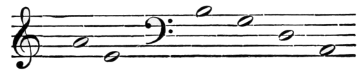
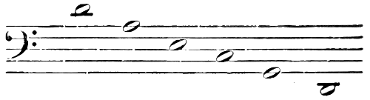


 to
to
 We conclude from this that Schenk, like the French gambist
Marais, used a gamba with seven strings, and, indeed, the
highest of them must have been tuned up to the one-lined G.
Schenk must have gone considerably above the seventh fret of
the fingerboard in order to reach the twice-lined B flat. With
regard to the artistically musical quality of Schenk’s compositions
for the gamba, they are mediocre; they bear no
comparison with the violin compositions of Corelli of the same
period. He succeeded best in the dances, compared with
which the more elaborate productions appear poor and are in
some measure incorrect. Especially is this true of the two
so-called fugues, which do not rise above feeble attempts at
fugues. It is, however, interesting to know what position
Schenk took as one of the best reputed gamba virtuosos at
that time with regard to composition, for his productions give
an average idea of the executive capabilities of his contemporaries.
At the same time, Schenk’s works prove very surely
what double-stoppings, chords, and figures were possible on
the gamba, and in this respect reveal a remarkable richness
in various styles of playing.
We conclude from this that Schenk, like the French gambist
Marais, used a gamba with seven strings, and, indeed, the
highest of them must have been tuned up to the one-lined G.
Schenk must have gone considerably above the seventh fret of
the fingerboard in order to reach the twice-lined B flat. With
regard to the artistically musical quality of Schenk’s compositions
for the gamba, they are mediocre; they bear no
comparison with the violin compositions of Corelli of the same
period. He succeeded best in the dances, compared with
which the more elaborate productions appear poor and are in
some measure incorrect. Especially is this true of the two
so-called fugues, which do not rise above feeble attempts at
fugues. It is, however, interesting to know what position
Schenk took as one of the best reputed gamba virtuosos at
that time with regard to composition, for his productions give
an average idea of the executive capabilities of his contemporaries.
At the same time, Schenk’s works prove very surely
what double-stoppings, chords, and figures were possible on
the gamba, and in this respect reveal a remarkable richness
in various styles of playing.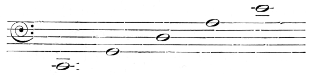
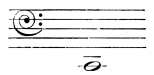 to the thrice-accented G
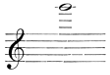 However,
the “Viola pomposa” did not attain to general use. It scarcely
survived its inventor, and disappeared, as it seems, even before
the gamba, out of the musical sphere.
However,
the “Viola pomposa” did not attain to general use. It scarcely
survived its inventor, and disappeared, as it seems, even before
the gamba, out of the musical sphere.