ETC.
First seat him somewhere, and derive his race.—Dryden.
The Fiddle Family, like other tribes that have succeeded
in making a noise in the world, has given exercise
to the ingenuity of learned theorists and time-seekers,
who have laboured to discover for it an origin as remote
from our own era, as it is, I fear, from any kind of truth.
It has probably been conceived that the Fiddle, associated
as he has been, from generation to generation,
with jigs, country-dances, fairs, junketings and other
rusticities, had descended too low in the scale of society—that
he had rendered himself, as Shakspeare for a while
did his own genius, “stale and cheap to vulgar company”—and
that he required to be reminded of his primitive
dignity, and of his very high ancestral derivation—if
he had any. This latter point was of course to be
first established; but, as your zealous antiquary is a
wholesale dealer in time, and is never at a loss for a
few centuries to link his conjectures to, the matter was
easy enough; indeed, the more doubtful, the better,
since doubt is the very life of theory. Accordingly, we
have been invited to fall back upon “the ancients,” and
to recognize the Epigonion as the dignified and classic
prototype of our merry and somewhat lax little friend,
the Fiddle. To certain ancient Greek tablets relative
to music, which have been somewhere brought to light,
Professor Murchard has minutely assigned the date of
709 years before the Christian era; and the following
passage, Englished from his translation, is stoutly alleged
by the antiquarian advocates of the glories of the violin
race:—“But Pherekydes began the contest, and sat
himself down before all the people, and played the
Epigonion;—for he had improved the same; and he
stretched four strings over a small piece of wood, and
played on them with a smooth stick. But the strings
sounded so, that the people shouted with joy.”
This is plausible enough, but far from conclusive.
It is but the outline of a description, and admits of various
modes of filling up. If the instrument partook
at all of the violin character, it might seem, from the
reference which its name bears to the knees, to have
been the rude progenitor of either the double-bass or the
violoncello, which have both, as is well known, their
official post between the knees: but then, the prefix of
ἐπί would denote that it was played upon the knees of
the artist. “Very well,” says the antiquarian; “it
was a fiddle reversed.” “Nay, Dr. Dryasdust, if you
yourself overturn what you are about, I have no need
to say more.” Au reste, let any body stretch four
strings over a small piece of wood, and play on them
with a smooth stick, and then take account of what it
comes to. No, no; whatever the Epigonion may have
been to the Greeks, he is nothing to us: he may have
been a respectable individual of the musical genus of his
day, when people blew a shell or a reed, and called it
music; but we cannot for a moment receive him as the
patriarch of the Fiddle Family. As soon should we
think of setting up Pherekydes against Paganini.
Dismissing the Epigonion, we come to the Semicon,
another pretender of Greek origin. This also, we are
farther told, was a kind of violin: but we deny that he
was father to the violin kind. The Semicon is said to
have been played on with a bow; and yet a learned
German (Koch), in the fulness of his determination to
have strings enough to his bow, has claimed no less
than thirty-five, as the complement of the Semicon.
How could any bow pay its devoirs distinctly to thirty-five
strings? Here, then, the dilemma is this: either
to translate the thing in question into a bow is to traduce
the term, or else the strings are an impertinence. Utrum
horum mavis, accipe.
If the word plectrum could, by any ingenuity, be
established to mean a bow, quotations enough might be
accumulated to prove that instruments played with bows
had their origin in a very remote period. But the translation
of the word into a bow, or such like thing, as we
find it in the Dictionaries, arises simply from the want
of a known equivalent—a deficiency which makes it
necessary to adopt any term that offers even the shadow
of a synonym.
It has been stated, on the authority of a passage
from Euphorion’s book on the Isthmian Games, that there
was an ancient instrument called magadis, which was
surrounded by strings; that it was placed upon a pivot,
upon which it turned, whilst the performer touched it
with the bow (or, at least, the plectrum); and that this
instrument afterwards received the name of sambuce.
The hieroglyphics of Peter Valerian, page 628, chap.
4, present the figure of a muse, holding, in her right hand,
a kind of bass or contra-violin, the form of which is not
very unlike that of our violins or basses.
Philostratus, moreover, who taught at Athens, during
the reign of Nero, gives a description of the lyre, which
has been thus translated:—
“Orpheus,” he says, “supported the lyre against his
left leg, whilst he beat time by striking his foot upon the
ground; in his right hand he held the bow, which he
drew across the strings, turning his wrist slightly inwards.
He touched the strings with the fingers of his
left hand, keeping the knuckles perfectly straight.”
From this description (if bow it could be called, which
bow was none), it would appear as if the lyre to which
Philostratus alludes were, forsooth, the same instrument
which the moderns call the contra-violin, or viola di
gamba! To settle the matter thus, however, would be
indeed to beg the question.
As before observed, the word plectrum is, in the
dictionaries, translated by bow; but, even if this were
a warranted rendering of the word, it remains to be
ascertained not only whether the bows of the ancients
were of a form and nature corresponding with ours, but
also whether they were used in the modern way. Did
the ancients strike their bow upon the strings of the instrument—or
did they draw forth the sound by means
of friction? These questions are still undecided; but
opinions preponderate greatly in favor of the belief that
the plectrum was an implement of percussion, and
therefore not at all a bow, in our sense.
A recent French writer, Monsieur C. Desmarais, in
an ingenious inquiry into the Archology of the Violin,
takes us back to the ancient Egyptians, to whom he
assigns the primitive violin, under the name of the
chélys, and suggests that its form must have resulted
from a studious inspection of one of the heavenly constellations!
M. Baillot, in his Introduction to the Méthode de
Violon du Conservatoire, speculating on the origin of
the instrument, has a passage which, in English, runs
thus:—
“It is presumed to have been known from the remotest
times. On ancient medals, we behold Apollo
represented as playing upon an instrument with three
strings, similar to the violin. Whether it be to the God
of Harmony that we should attribute the invention of
this instrument, or whether it claim some other origin,
we cannot deny to it somewhat that is divine.
“The form of the violin bears a considerable affinity
to that of the lyre, and thus favors the impression of its
being no other than a lyre brought to perfection, so as
to unite, with the facilities of modulation, the important
advantage of expressing prolonged sounds—an advantage
which was not possessed by the lyre.”
This is pretty and fanciful, but far too vague to be
at all satisfactory. Apollo might appear to play on an
instrument, in which antiquarian ingenuity might discover
some latent resemblance to the violin; but where
was his bow? M. Baillot has not ventured to assert
that he had one—and we may safely conclude that he
had not, if we except the bow that was his admitted
attribute. As for the affinity to the lyre, it is indeed as
faint as the most determined genealogist, studious of an
exercise, could wish.
It has been remarked, by some curious observer, that,
among the range of statues at the head of the canal at
Versailles, an Orpheus is seen (known by the three-headed
dog that barks between his legs), to whom the
sculptor has given a violin, upon which he appears
scraping away with all the furor of a blind itinerant.
But is the statue, or its original, an antique? We may
rest in safe assurance that it is a modern-antique; as
much so, as the ingenious figment of Nero’s fiddling a
capriccio to the roaring accompaniment of the flames of
Rome!
As for the fidicula of the Romans (or rather, of the
Latin Dictionary), it is evidently, as far as it has been
made to apply to the fiddle, no legitimate family name.
The violin very positively disowns all relationship with
it, and leaves it to settle its claims with the guitar.
As far as the mere name goes, however, it is not
impossible that a connection may exist, and that the
word-hunting Skinner may be right in deriving the
Anglo-Saxon word fithele from the older German vedel,
and thence from the Latin fidicula, which, it is hardly
necessary to state, was any thing but a fiddle, and therefore
“had no business” to lend its appellation in the
way here noticed.
On the whole, as regards the pretensions alleged on
the side of the ancients for the honor of having had the
violin in existence among them, it may be safely remarked,
that, if nothing like the bow, which is obviously
connected most essentially with the expression and character
of the violin, can be traced to their days, the
violin itself, à fortiori, cannot be said to have belonged
to them; and all those questionable shapes which have
been speculatively put forward as possible fiddles, must
be thrown back again into the field of antiquarian conjecture,
to await some other appropriation. The following
remarks by Dr. Burney may be taken as a fair
summary of all that needs to be observed on this head:
“The ancients seem to have been wholly unacquainted
with one of the principal expedients for producing
sound from the strings of modern instruments:
this is the bow. It has long been a dispute among the
learned whether the violin, or any instrument of that
kind, as now played with a bow, was known to the ancients.
The little figure of Apollo, playing on a kind
of violin, with something like a bow, in the Grand Duke’s
Tribuna at Florence, which Mr. Addison and others
supposed to be antique, has been proved to be modern
by the Abbé Winkelmann and Mr. Mings: so that, as
this was the only piece of sculpture reputed ancient, in
which any thing like a bow could be found, nothing more
remains to be discussed relative to that point.”—(Hist.
of Music, 4to. vol. i, p. 494.)
The Welch, who are notoriously obstinate genealogists,
have not failed to mark the Fiddle for their own,
and to assign him an origin, at some very distant date,
among their native mountains. In support of this pretension,
they bring forward a very ugly and clownish-looking
fellow, with the uncouth name of crwth. This
creature certainly belongs to them, and is so old as to
have sometimes succeeded in being mistaken, in this
country, for the father of the violin tribe—a mistake to
which the old English terms of crowd for fiddle, and
crowder for fiddler, seem to have lent some countenance.
A little investigation, however, shows us that it was
merely the name, and not the object itself, that we borrowed,
for a time, from our Welch neighbours; and that,
by a metonymy, more free than complimentary, we fastened
the appellation of crowd upon the violin, already
current among us by transmission from the continent.
The confusion thence arising has occasioned considerable
misapprehension: nor has the effect of it been limited
to our own island boundaries; for a French writer, M.
Fétis, in one of his Letters on the State of Music in
England, reports the error, without any apparent consciousness
of its being such. Let us quote his passage
in English:
“The cruth is a bowed instrument, which is thought
to have been the origin of the viola and violin. Its form
is that of an oblong square, the lower part of which forms
the body of the instrument. It is mounted with four
strings, and played on like a violin, but is more difficult
in the treatment, because, not being hollowed out at
the side, there is no free play for the action of the
bow.”
“What!” exclaims the enquiring virtuoso, “is this
box of a thing, this piece of base carpentry, this formal
oblong square, to be supposed the foundation of that neat
form and those graceful inflections which make up the
‘complement externe’ of what men call the violin? Can
dulness engender fancy—and can straight lines and
right angles have for their lineal descendant the ‘line of
beauty?’” The soberest person would answer, this is
quite unlikely; the man of taste would deny it to be in
the nature of things. No, no; our Cambrian codger
may have been a tolerable subject in his way—a good
fellow for rough work among the mountains, and instrumental
enough in the amusement of capering rusticity—but
he must not be allowed, bad musician though we
freely admit he may have been, to give himself false airs,
and to assume honors to which his form and physiognomy
give the lie. Let him be satisfied to be considered “sui
generis,” unless he would rashly prefer illustrious illegitimacy,
and be styled the base violin.1
If we were disposed, in England proper, to get up a
claim for the first local habitation afforded to the violin,
we might put together a much better case for the instrument
that was familiar to the Anglo-Saxon gleemen, as
early as the 10th century, than can be shown in behalf
of the candidate just dismissed. We could produce an
individual that should display a far better face, and
should appear with, at least, no great disgrace to the
Fiddle Family, though bearing about him none of the
refinements of fashion. It may be as well to exhibit
him at once:—
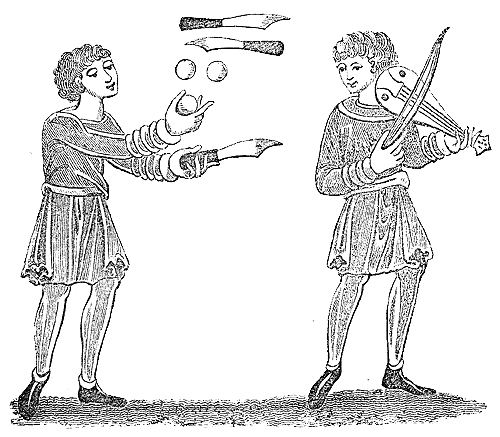
In this representation (borrowed from “Strutt’s
Sports and Pastimes of the People of England”) we
discern something which it is possible to call a fiddle,
without much violence to our notions “de rerum natura.”
There is grotesqueness, but not deformity: there is much
of the general character of the true violin, though some
of its most particular beauties are wanting. It is true
that the sound-holes look as if no notes save circulars
were to be permitted to issue through them—that the
tail-piece seems forced to do duty for a bridge—that the
sides have no indented middle, or waist, to give the aspect
of elegance, and accommodate the play of the bow
over the two extreme strings—that the finger-board is
non-existent—and that the scroll, that crowning charm
of the fiddle’s form, is but poorly made amends for by
the excrescent oddity substituted at the end of the neck.
With all this, however, there is visible warrant for
calling it a sort of fiddle. Though even a forty-antiquary
power might fail to prove it the origin of the
stock, it has claims to be regarded as exhibiting no very
remote analogy to the violin; and thus far, therefore,
it may defy the competition of the Crwth. Whether it
was really born in Saxon England, however, or introduced
from Germany, might be a point for nice speculation,
were it worth while to agitate the enquiry.
Whither, then, are we to turn, after all, for the solution
of this problem in musical genealogy? That the
violin is of a respectable age, though not so old as what
is commonly called antiquity, is a fact apparent to the
least laborious of enquirers; and it seems to have been
the practice, with those who have had occasion to touch
on this point, either to announce the said fact simply,
and leave the reader to make the most of it, or to mix
up with it, by way of elucidation, some general remark
about the absence of light on the matter. “The origin
of the violin,” observes one of these authorities, “like
that of most of the several musical instruments, is involved
in obscurity. As a species of that genus which
comprehends the viola, violoncello, and violone, or double-bass,
it must be very ancient.” Similarly indefinite
are the conclusions of others who have approached the
subject; so that it becomes necessary to dispense with
such embarrassing aid, and to help oneself to the truth,
if it is, peradventure, to be gathered. To me, much
meditating on this matter (if I may borrow Lord
Brougham’s classic form of speech), there seems reason
to fix on Italy as the quarter to which we must look for
the “unde derivatur” required. Say, thou soft “Ausonia
tellus,” mother of inventions and nurse of the
arts, say,
soft and sunny Italy, is it not to thee that belongs
the too modest merit of having produced and cherished
the infancy, even as thou hast confessedly supported and
developed the after-growth and advancement, of the interesting
musical being whose history, in its more secret
passages, we are here exploring? Is it a world (as Sir
Toby feelingly asks), is it a world to hide virtues in?
Well, if we cannot obtain direct satisfaction, let us pursue
the investigation of our point a little more circuitously.
The perfect instrument which we now delight to
honor by the name of the violin—the instrument complete
in form and qualities—“totum in se teres atque
rotundum”—appears to have been the result of a highly
interesting series of improvements in the art of producing
musical sounds from strings. How long a duration
of time was occupied by the elaboration of these
improvements respectively, is not readily to be ascertained,
nor, perhaps, would the enquiry repay the trouble—but
the general order of progression in the improvements
themselves, is as clear as it is agreeable to contemplate.
The first great advancement consisted in the
sounding-board, by means of which invention a tone
was produced, through the vibration of the wood, that
was incomparably better and fuller than what was previously
procured, through the mere vibration of the
strings. As the human voice is evolved from the mouth
under a concave roof, which serves it as a sounding-board,
and gives additional grace and vigour to its inflections,
so does the upper shell of the violin add a
power of its own to the language of the strings. The
next improvement in the instrument, thus extended in
capability, was the neck or finger-board, which increased
the range and variety of the sounds, by giving
to each string the power of producing a series of notes.
The bow was the next great step of advancement; and
this, like other important inventions, has provoked much
learned dispute as to the time and place of its origin,
which however we shall not here more particularly revert
to, for indeed, “non nostrum tantas componere
lites.” With all these additions and appliances, we
come not yet to the instrument par excellence, the true
violin; for an intermediate and inferior state remains to
be gone through. The consideration of that state brings
us to the regular construction of the several instruments
known by the general name of viol (for we pass by the
rebec, as being only a spurious or illegitimate kind of
fiddle), that were in the most common use during the
16th, and till about the middle of the 17th, century.
These were similar to each other in form, but in size
were distinguished into the treble-viol, tenor-viol, and
bass-viol. They had six strings, and a finger-board
marked with frets, like that of the lute or guitar2.
Finally, as the crowning change, the glorious consummation,
came the conversion of the viol into the violin,
effected by a diminution of size, a reduction of strings,
from six to four, and the abolition of those impediments
to smoothness, and helps to irritation, the frets. The
same reformation attended the other instruments of the
viol tribe, which now became, mutato nomine, the viola
and the violoncello.
In former days, we had the viol in,
’Ere the true instrument had come about:
But now we say, since this all ears doth win,
The violin hath put the viol out.
Thus, through a considerable tract of indefinite time,
and a succession of definite changes, we reach the matured
and accomplished instrument, the Violin proper;
and then, if we recur to the question, to whom does it
belong? the answer becomes less difficult. It is to this
instrument, this perfected production, that the Italians
may, I think, exultingly point as their own; and, in
doing so, they may well afford to be indifferent to all
disputes about the title to those earlier apparitions,
those crude and half-made-up resemblances to the fiddle,
that were but as the abortions which, in human experience,
sometimes precede a perfect birth. It is of
sufficient notoriety that the earliest instruments of excellence,
bearing the name of Violin, as well as the
earliest players of eminence, were Italian. The Cremona
fiddles of Hieronymus Amati (to go no farther
back) were sent into this breathing world about two
centuries and a half ago; and Baltazarini, the earliest
great player of the genuine Violin on record, is known
to have been imported as a curiosity from Italy, by
Catherine de Medicis, in 1577. It is tolerably clear,
too, that, as a court favourite, the Violin began its career
in Italy—its progress, in that capacity, having been, as
Burney observes, from Italy to France, and from France
to England.
But the tie of Italian connection may be drawn more
closely than this. Galilei, in his Dialogues (p. 147),
states that both the Violin and the Violoncello were invented
by the Italians; and he suggests more precisely
the Neapolitans, as the rightful claimants of this honor.
Dr. Burney, who does not attempt to settle the point,
quotes the passage, to the above effect, from Galilei, and
admits his own inability to confute it. Montaigne, whose
travels brought him to Verona in 1580, has recorded,
that there were Violins as well as organs there, to accompany
the mass in the great Church. Corelli’s Violin,
an instrument specially Italian, which afterwards passed
into the possession of Giardini, was made in 1578, and
its case was decorated by the master-hand of Annibale
Caracci, probably several years after the instrument
was finished; as Caracci at that date had numbered but
eight of his own years.
Towards the end of the 16th century, the Violin is
found indicated in some Italian scores, thus:—piccoli
Violini alla Francese; which circumstance has been
sometimes alleged as rendering it probable, that the reduction
of the old viol or viola to the present dimensions
of the Violin took place in France, rather than in Italy:
but the fact does not seem to offer a sufficient basis for
the conjecture, when it is considered that no instruments
of French construction, corresponding with the Violin
in its present form, and of as early a date as those
which can be produced of Italian make, are known to
exist. It is reasonable to suppose, therefore, that these
piccoli Violini, or little Violins, were not identical with
the Violin proper;—although Mr. Hogarth3 (from whose
respectable authority I am rather loth to differ) quotes
the phrase as one tending to the support of the French
claim. The term in question, which occurs, particularly,
in Monteverdi’s Opera of Orfeo, printed at Venice in
1615, seems to me to imply merely some French modification
of the already invented Italian model—a modification
applying to the size, and possibly also to some
minor details in the form.
The French writer, Mersennus, who designates all
instruments of the violin and viol class under the term
barbiton, describes one of them, the least of the tribe, as
the lesser barbiton. This latter was a small violin invented
for the use of the dancing-masters of France, and
of such form and dimensions as to be capable of being
carried in a case or sheath in the pocket. It is the
origin of the instrument which in England is called a
Kit, and which is now made in the form of a violin.—Is
it too great a stretch of conjecture, to hint, that this
may, possibly, have been the kind of thing intended by
the term above quoted?
That curious enquirer, Mr. Gardiner, in his “Music
of Nature,” assigns to Italy the local origin of the Violin,
but without placing the date as near to exactness as it
might have been. He makes it to have been “about
the year 1600.” He might safely have gone thirty or
forty years farther back, at least, notwithstanding that
the shape of the instrument, towards the end of the 16th
century, has been supposed, by Hawkins, to have been
rather vague and undetermined4. The transition from
the old shapes to the new had occurred, though it was
as yet far from universal. It is sufficient that the
change had commenced.
Admitting the genuine and perfect violin to be rightfully
assignable to the Italians, it may be of some interest,
now, to present a few more records relating, principally,
to the instrument in its imperfect character,
when it bore only that sort of analogy to the true instrument,
that the ‘satyr’ is said to have borne to ‘Hyperion.’
The “Musurgia, seu Praxis Musicæ,” of the Benedictine
Monk Luscinius, published in 1542, represents
(coarsely cut in wood) as the bowed instruments then in
use, the rebec, or three-stringed violin, and the viol di
gamba. The instruments of the viol tribe, however,
which are supposed to have been those that led more
immediately to the construction of the true violin, considerably
precede the above period in their date of
origin. Violars, or performers on the viol, whose business
it was to accompany the Troubadours in their singing
of the Provençal poetry5, were common in the 12th
century; and, in a treatise on music, written by Jerome
of Westphalia in the 13th century, there is particular
mention made of the instrument known by the name of
viol.
Under various modifications of the term fiddle, there
are to be found many very early allusions to an instrument,
such as it was, bearing some resemblance to the
violin. Fidle is a Saxon word of considerable antiquity;
and from the old Gothic are traced the derivations
of
1. Middle High German. Videl (noun), Videlœre
(noun personal), Videln (verb, to fiddle),
Videl-boge (fiddle bow).
2. Icelandic. Fidla.
3. Danish. Fedel.
Then we have Vedel, Veel, Viool (Dutch); Vedel,
Vedele (Flemish), Fiedel, Fidel, Geige (Modern
German).
Fythele, Fithele,—and Fythelers (fiddlers) are alluded
to in the Old English Romances. In the legendary
life of St. Christopher, written about the year 1200,
is this passage:—
.............Cristofre hym served longe;
The Kynge loved melodye of fithele and of songe.
The poet Lidgate, at the beginning of the 15th century,
writes of
Instrumentys that did excelle,
Many moo than I kan telle:
Harpys, Fythales, and eke Rotys, &c.
Chaucer, in his “Canterbury Tales,” says of the
Oxford Clerk, that he was so fond of books and study,
as to have loved Aristotle better
Than robes rich, or fidel, or sautrie—
and his Absolon, the Parish-Clerk, a genius of a different
cast, and exquisitely described, is a spruce little
fellow, who sang, danced, and played on the species of
fiddle then known. An instrument remotely allied to
the fiddle—the ribible, a diminutive of rebec, a small
viol with three strings—is also alluded to by Chaucer.
Referring to a later period, there is evidence to show
that an instrument of the violin kind was used in England
before the dissolution of monasteries, in the time of
our eighth Henry, in the fact that something similar to
it in shape is seen depicted upon a glass window of the
chancel of Dronfield church, in the county of Derby;
an edifice which was erected early in the sixteenth
century.
At what period the legitimate violin may have found
its way from Italy into this country, it would, I fear, be
very difficult to ascertain with exactness; but it is easy
to suppose that, when once that event had occurred, the
neater shape and superior qualities exhibited by the new
comer, would speedily render him the model for imitation,
and lead to the multiplication of his species here,
and to the displacement of the baser resemblances to
him. The true instrument, however, was for a long
while among us, ere its merits came into just appreciation.
Until the period of the Restoration, it was held,
for the most part, in very low esteem, and seldom found
in less humble hands than those of fiddlers at fairs, and
such like itinerant caterers of melody for the populace6.
Its grand attribute, the superior power of expressing almost
all that a human voice can produce, except the
articulation of words, was at first so utterly unknown,
that it was not considered a gentleman’s instrument, or
worthy of being admitted into “good company.” The
lute7, the harp, the viol, and theorbo, were in full possession
of the public ear, and the poetic pen; nor has
this latter authority ever been thoroughly propitiated
by the later-born child of Melos, whose first screams on
coming into the world may perhaps have irrecoverably
alarmed the sensitive sons of Apollo. Moreover, poetry
is ever apt to prefer the old to the new, and often recoils
with distaste from what is modern. “Though the violin
surpasses the lute,” says a recent ingenious writer, “as
much as the musket surpasses the bow and arrow, yet
Cupid has not yet learned to wound his votaries with a
bullet, nor have our poets begun to write odes or stanzas
to their violins.”
In the 39th Queen Elizabeth, a statute was passed
by which “Ministrels, wandering abroad,” were included
among “rogues, vagabonds, and sturdy beggars,” and
were adjudged to be punished as such. “This act,”
says Percy, in his Reliques of English Poetry, “seems
to have put an end to the profession.” That writer
suggests, however, that although the character ceased
to exist, the appellation might be continued, and applied
to fiddlers, or other common musicians; and in this
sense, he adds, it is used in an ordinance in the time of
Cromwell (1656), wherein it is enacted that if any of
the “persons commonly called Fiddlers or Minstrels
shall at any time be taken playing, fiddling, and making
music in any inn, alehouse, or tavern, or shall be taken
proffering themselves, or desiring or intreating any
... to hear them play or make music in any of the
places aforesaid,” they are to be “adjudged and declared
to be rogues, vagabonds, and sturdy beggars8.” By a
similar change or declension, according to Mr. Percy,
John of Gaunt’s King of the Minstrels came, at length,
to be called, like the Roi des Violons in France, King
of the Fiddles—it being always to be borne in mind,
nevertheless, that it was only as yet a baser kind of instrument
which brought its professors into such scrapes9.
The term crowd, as well as that of fiddle, was commonly
used in England before the appearance of the
perfect Violin, but appears to have been soon disused
(along with the barbarous instrument it designated)
after that period. Butler, in his “Hudibras,” employs
both terms indiscriminately, and seems to find enjoyment
in linking them with mean and ludicrous associations—a
tendency which must be allowed to have been
quite in keeping with the feeling of the times he describes.
His motley rabble, whom he puts in the way
of the knight and his squire, were special affecters of
the instrument he delights to dishonour,
And to crack’d fiddle, and hoarse tabor,
In merriment did drudge and labor.
He makes contemptuous allusion, also, to certain persons
That keep their consciences in cases,
As fiddlers do their crowds and bases.
Crowdero, the fiddle-noted agent in the story, is
made to cut, on the whole, a very sorry figure. Thus,
as to his instrument, and his manner of calling it into
exercise:
A squeaking engine he applied
Unto his neck, on north-east side,
Just where the hangman does dispose,
To special friends, the knot of noose.
When the knight, in the outset of his career, meets
the aforesaid rabble, with the aggravating accompaniment
of the bear and fiddler, and counsels them to peace
and dispersion, he says
But, to that purpose, first surrender
he prime offender!
It is true that the mettle put forth by Crowdero, in
the ensuing general fight, raises him a little out of the
mire of meanness: but then, the weapon with which he
batters the cranium of the prostrate Hudibras—to wit,
his own wooden leg—has the effect of disturbing the
small dignity which his gleam of valour might have
shed over him; and, besides, he is speedily exhibited in
reverse, being vanquished in turn by Ralpho the Squire,
and forced into the ignominious confinement of the
stocks; while Ralpho exultingly says to Hudibras, the
fiddle is your trophy,
And, by your doom, must be allow’d
To be, or be no more, a crowd.
In France, certain ancient and respectable monuments,
and particularly a figure on the portico of the
venerable Cathedral of Notre Dame at Paris, representing
King Chilperic with a sort of Violin in his hand,
have been referred to as proofs that an instrument of
this nature was very early held in esteem in that
country; and the minstrels in the highest estimation
with the public, were at all times the best Violists of
their age. Among the instruments represented in the
beautiful illuminations of the splendid copy of the
Roman d’Alexandre, in the Bodleian library at Oxford,
are Viols with three strings, played upon with a clumsy
bow.
In Italy, as in France, the viol appears to have enjoyed
earlier favour than in England, where the fiddle
or crowd (the descendant, probably, of the Welsh instrument
crwth) was its predecessor. The instruments
chiefly used by the ladies and gentlemen in the Decameron,
are the lute and the viol—upon which latter
some of the ladies are represented as performing.
An ingenious Piedmontese, Michele Todini, published
a pamphlet at Rome, 1676, wherein are described various
musical inventions of his own, “of special merit, though
of little note.” Amongst them were two Violins, the
pitch of one of which could, by an adroit mechanical
contrivance, be at once heightened a whole tone, a third,
or even a fifth; while the other, under the usual strings,
had a second set of strings, like those of a kit, tuned in
the octave above, and was so contrived that the Violin
and kit might either be played separately, or both together,
at the pleasure of the performer. In the 23rd
Chapter of this little tract is a description of a Viola di
gamba, so constructed, that, without shifting the neck,
all the four kinds of Violins, namely, the treble Violin,
the contralto (or Viola bastarda), and the tenor and
bass viol, could be played upon it. Todini had originally
given the bass of this instrument an unusual depth; but
he abandoned that, when he invented the double bass,—which
instrument he was the first to introduce and
play upon in oratorios, concerts, and serenades.
The arms and seal of the town of Alzei, in the neighbourhood
of Worms, consist of a crowned lion rampant,
holding a fiddle in his paws. The fiddle alone appears
to have been the original bearing; for the palatine lion
was first joined to the fiddle when Duke Conrad of
Hohenstauffen was enfeoffed by the Emperor Frederick I
with the Palatinate of the Rhine. His son-in-law,
the Palsgrave Henry, calls the Steward (Trucksess) of
Alzei, his vassal, in a bill of feoffment, dated in 1209,
and in another document, 1211. This Steward, however,
and Winter of Alzei, bore the fiddle as their arms.
On account of these arms, the inhabitants of Alzei are
mockingly called fiddlers by their neighbours10.
Connected with the history of the instrument in
England, there is a curious old custom, now “invisible,
or dimly seen,” and I know not when commenced, which
is thus described in Hone’s Table Book:—
“The concluding dance at a country wake, or other
general meeting, is the ‘Cushion Dance;’ and if it be
not called for, when the company are tired with dancing,
the fiddler, who has an interest in it, which will be seen
hereafter, frequently plays the tune to remind them of it.
A young man of the company leaves the room, the poor
young women, uninformed of the plot against them,
suspecting nothing; but he no sooner returns, bearing a
cushion in one hand and a pewter pot in the other, than
they are aware of the mischief intended, and would
certainly make their escape, had not the bearer of cushion
and pot, aware of the invincible aversion which young
women have to be saluted by young men, prevented
their flight by locking the door, and putting the key in
his pocket. The dance then begins.
“The young man advances to the fiddler, drops a
penny in the pot, and gives it to one of his companions.
Cushion then dances round the room, followed by pot,
and when they again reach the fiddler, the cushion says,
in a sort of recitative, accompanied by the music, ‘This
dance it will no farther go.’
“The fiddler, in return, sings or says (for it partakes
of both), ‘I pray, kind Sir, why say you so?’
“The answer is, ‘Because Joan Sanderson won’t
come to.’
“‘But,’ replies the fiddler, ‘she must come to, and
she shall come to, whether she will or no.’
“The young man, thus armed with the authority of
the village musician, recommences his dance round the
room, but stops when he comes to the girl he likes best,
and drops the cushion at her feet. She puts her penny
in the pewter pot, and kneels down with the young man
on the cushion; and he salutes her.
“When they rise, the woman takes up the cushion,
and leads the dance, the man following, and holding the
skirt of her gown; and, having made the circuit of the
room, they stop near the fiddler, and the same dialogue
is repeated, except that, as it is now the woman who
speaks, it is John Sanderson who won’t come to, and
the fiddler’s mandate is issued to him, not to her.
“The woman drops the cushion at the feet of her
favourite man: the same ceremony and the same dance
are repeated, till every man and woman (the pot-bearer
last) have been taken out, and all have danced round
the room in a file. The pence are the perquisite of the
fiddler. There is a description of this dance in Miss
Hutton’s ‘Oakwood Hall.’”
Then follows, in Hone’s Book, a further illustration
of this curious custom, in “numerous verse”—but the
prose account is here sufficient.
The dialogue in the old puppet dramas (says Strutt)
were mere jumbles of absurdity and nonsense, intermixed
with low immoral discourses passing between Punch
and the fiddler, for the orchestra rarely admitted of
more than one minstrel; and these flashes of merriment
were made offensive to decency by the actions of the
puppet. In the reign of James II, there was a noted
merry-andrew named Philips; “This man,” says Granger,
“was some time fiddler to a puppet-show; in which
capacity he held many a dialogue with Punch, in much
the same strain as he did afterwards with the mountebank
doctor, his master upon the stage. This zany,
being regularly educated, had confessedly the advantage
of his brethren.”
The following may be seen in volume the 1st of
Purcell’s Catches, on two persons of the name of Young,
father and son, who lived in St. Paul’s Churchyard—The
one was an excellent instrument-maker, and the
other an excellent performer on the fiddle.
You scrapers that want a good fiddle, well strung,
You must go to the man that is old, while he’s Young;
27
But if this same fiddle you fain would play bold,
You must go to his son, who’ll be Young when he’s old.
There’s old Young and young Young, both men of renown,
Old sells, and Young plays, the best fiddle in town;
Young and old live together, and may they live long,
Young, to play an old fiddle; old, sell a new song!
The zealous, ingenious, minute and gossiping Anthony
Wood, to whose journalizing propensity we are
indebted for a free insight into the state of music at
Oxford, during the time of the Civil War (when musical
sounds were scarcely any where else to be heard in the
kingdom), was an ardent admirer of the violin, while its
admirers were yet scarce; and has left us, in his life,
written by himself, some particulars relating to the instrument,
that are too pleasant, as well as curious, to be
here passed by. Let me introduce this quaint worthy,
speaking of himself in the third person, and under the
abridged designation of A. W.
In 1651, “he began to exercise his natural and insatiable
genie to music. He exercised his hand on the
violin, and, having a good eare to take any tune at first
hearing, he could quickly draw it out from the violin,
but not with the same tuning of the strings that others
used. He wanted understanding, friends and money,
to pick him out a good master; otherwise he might
have equalled in that instrument, and in singing, any
person then in the University. He had some companions
that were musical, but they wanted instruction
as well as he.”
The next year, being obliged to go into the country,
for change of air and exercise, with a view to rid himself
of an ague, he states that “while he continued
there, he followed the plow on well-days, and sometimes
plowed: and, having had, from his most tender years, an
extraordinary ravishing delight in music, he practised
there, without the help of an instructor, to play on the
Violin. It was then that he tuned his strings in fourths,
and not fifths, according to the manner; and having a
good eare, and being ready to sing any tune upon hearing
it once or twice, he could play it also in a short time,
with the said way of tuning, which was never knowne
before.
“After he had spent the summer in a lonish and retired
condition, he returned to Oxon; and, being advised
by some persons, he entertained a Master of Musick to
teach him the usual way of playing on the violin, that
is, by having every string tuned five notes lower than
the one going before. The master was Charles Griffith,
one of the musicians belonging to the City of Oxon,
whom he then thought to be a most excellent artist:
but when A. W. improved himself on that instrument,
he found he was not so. He gave him 2s. 6d. entrance,
and so quarterly. This person, after he had extremely
wondered how he could play so many tunes as he did
by fourths, without a director or guide, tuned his violin
by fifths, and gave him instructions how to proceed,
leaving then a lesson with him to practice against his
next coming.
“Having, by 1654, obtained a proficiency in musick,
he and his companions were not without silly frolicks,
not now to be maintained.”—What should these frolics
be, but to disguise themselves in poor habits, and, like
country fiddlers, scrape for their livings! After strolling
about to Farringdon Fair, and other places, and gaining
money, victuals and drink for their trouble, they were
overtaken, in returning home, by certain soldiers, who
forced them to play in the open field, and then left them
But if this same fiddle you fain would play bold,
You must go to his son, who’ll be Young when he’s old.
There’s old Young and young Young, both men of renown,
Old sells, and Young plays, the best fiddle in town;
Young and old live together, and may they live long,
Young, to play an old fiddle; old, sell a new song!
The zealous, ingenious, minute and gossiping Anthony
Wood, to whose journalizing propensity we are
indebted for a free insight into the state of music at
Oxford, during the time of the Civil War (when musical
sounds were scarcely any where else to be heard in the
kingdom), was an ardent admirer of the violin, while its
admirers were yet scarce; and has left us, in his life,
written by himself, some particulars relating to the instrument,
that are too pleasant, as well as curious, to be
here passed by. Let me introduce this quaint worthy,
speaking of himself in the third person, and under the
abridged designation of A. W.
In 1651, “he began to exercise his natural and insatiable
genie to music. He exercised his hand on the
violin, and, having a good eare to take any tune at first
hearing, he could quickly draw it out from the violin,
but not with the same tuning of the strings that others
used. He wanted understanding, friends and money,
to pick him out a good master; otherwise he might
have equalled in that instrument, and in singing, any
person then in the University. He had some companions
that were musical, but they wanted instruction
as well as he.”
The next year, being obliged to go into the country,
for change of air and exercise, with a view to rid himself
of an ague, he states that “while he continued
there, he followed the plow on well-days, and sometimes
plowed: and, having had, from his most tender years, an
Proctor, a young man and a new comer:—John Packer,
one of the university musitians. But Mr. Low, a proud
man, could not endure any common musitian to come to
the meeting, much less to play among them. Of this
kind I must rank Joh. Haselwood, an apothecary, a
starch’d formal clister-pipe, who usually played on the
base-viol, and sometimes on the counter-tenor. He was
very conceited of his skill (though he had but little of
it), and therefore would be ever and anon ready to take
up a viol11 before his betters; which being observed by
all, they usually called him Handlewood. The rest
were but beginners. Proctor died soon after this time;
he had been bred up by Mr. John Jenkins, the mirrour
and wonder of his age for musick, was excellent for the
lyra-viol and division-viol, good at the treble-viol, and
violin, and all comprehended in a man of three or four
and twenty yeares of age. He was much admired at
the meetings, and exceedingly pitied by all the facultie
for his loss.”
“A. W. was now advised to entertain one William
James, a dancing-master, to instruct him on the violin,
who, by some, was accounted excellent on that instrument,
and the rather because it was said that he had
obtained his knowledge in dancing and music in France.
He spent, in all, half a yeare with him, and gained some
improvement; yet at length he found him not a compleat
master of his facultie, as Griffith and Parker were not:
and, to say the truth, there was no compleat master in
Oxon for that instrument, because it had not been hitherto
used in consort among gentlemen, only by common
musitians, who played but two parts. The gentlemen
in private meetings, which A. W. frequented, played
three, four, and five parts with viols12—as treble-viol,
tenor, counter-tenor, and bass, with an organ, virginal,
or harpsicon joined with them; and they esteemed a
violin to be an instrument only belonging to a common
fiddler, and could not endure that it should come among
them, for feare of making their meetings to be vain and
fiddling. But, before the restoration of King Charles II,
and especially after, viols began to be out of fashion,
and only violins used, as treble violin, tenor, and base
violin; and the King, according to the French mode,
would have twenty-four violins playing before him
while he was at meals, as being more airie and brisk
than viols.”
Under the year 1658, he tells us that “Tho. Baltzar,
a Lubecker borne, and the most famous artist for the
violin that the world had yet produced (!), was now in
Oxon, and this day, July 24, A. W. was with him, and
Mr. Ed. Lowe, at the house of Will. Ellis. A. W. did
then and there, to his very great astonishment, heare
him play on the violin. He then saw him run up his
fingers to the end of the finger-board of the violin, and
run them back insensibly; and all with alacrity and
very good tune, which he nor any in England saw the
like before. A. W. entertained him and Mr. Low with
what the house could then afford, and afterwards he invited
them to the taverne; but they being engaged to
goe to other company, he could no more heare him play
or see him play at that time. Afterwards he came to
one of the weekly meetings at Mr. Ellis’s house, and he
played to the wonder of all the auditory, and exercising
his finger and instrument several wayes to the utmost of
his power. Wilson thereupon, the public Professor, the
greatest judge of musick that ever was, did, after his
humoursome way, stoope downe to Baltzar’s feet, to see
whether he had a huff (hoof) on, that is to say, to see
whether he was a devil or not, because he acted beyond
the parts of man.”
“About this time it was that Dr. John Wilkins, warden
of Wadham, the greatest curioso of his time, invited
him (Baltzar) and some of the musitians to his lodgings
in that Coll. purposely to have a consort, and to see and
heare him play. The instruments and books were carried
thither, but none could be persuaded there to play
against him in consort on the violin. At length the
company perceiving A. W. standing behind in a corner
neare the dore, they haled him in among them, and play,
forsooth, he must against him. Whereupon he, being
not able to avoid it, took up a violin, as poor Troylus
did against Achilles13. He abashed at it, yet honour he
got by playing with and against such a grand master as
Baltzar was.”
The restoration of monarchy and episcopacy in England
(observes Dr. Burney) seems to have been not only
favorable to sacred music, but to secular; for it may be
ascribed to the particular pleasure which Charles II
received from the gay and sprightly sound of the violin,
that this instrument was introduced at Court, and the
houses of the nobility and gentry, for any other purpose
than country-dances, and festive mirth. Hitherto there
seem to have been no public concerts; and, in the music
of the chamber, in the performance of Fancies on instruments,
which had taken place of vocal madrigals and
motets, the violin had no admission, the whole business
having been done by viols. Charles II, who, during
the usurpation, had spent a considerable time on the
continent, where he heard nothing but French music—upon
his return to England, in imitation of Louis XIV,
established a band of violins, tenors and bases, instead
of the viols, lutes and cornets, of which the Court Band
used to consist. Soon after the establishment of this
band, Matthew Lock held the appointment of master to
it; and the same title was conferred, about 1673, on
Cambert, a French musician, who had preceded Lulli in
composing for, and superintending, the Opera at Paris,
and who came over to England after Lulli had obtained
the transfer of his patent.
From this time, the Violin Family began to rise in
reputation among the English, and had an honorable
place assigned them, in the music of the Court, the theatres
and the chamber; while the succession of performers
and compositions, with which the nation was afterwards
supplied from Italy and elsewhere, stimulated the
practice and established the character of this class of
instruments, which have ever since been universally
acknowledged to be the pillars of a well-ordered orchestra,
and more capable of perfect intonation, expression,
brilliancy, and effect, than any other that have ever been
invented. It should be observed, however, that, although
the revival of the theatres at the Restoration was followed
by the introduction of what were termed act-tunes
(short compositions played betwixt the acts of the drama),
whereby the public services of the violin were brought
into requisition, yet the state of dramatic music was, for
some years, too low to admit of those services being very
important. The music of the drama had attained
scarcely any separate development, but was still confounded
with that of the church, to the disadvantage of
both. All the most noted composers for the theatre, for
several years after the Restoration, were members of
cathedral and collegiate churches—a circumstance which
encouraged a jester, Tom Brown, to remark that “men
of the musical profession hung betwixt the church and
the play-house, like Mahomet’s tomb betwixt two load-stones.”
A general passion for the violin, and for pieces expressly
composed for it, as well as a taste for Italian
music, seem to have been excited in this country about
the end of Charles the Second’s reign, when French
music and French politics became equally odious to a
great part of the nation. The hon. Mr. North, who
listened attentively to every species of performance, says
that “the decay of French music, and favor of the
Italian, came on by degrees. Its beginning was accidental,
and occasioned by the arrival of Nicola Matteis;
he was an excellent musician; performed wonderfully
on the violin. His manner was singular; but he excelled,
in one respect, all that had been heard in England
before: his arcata, or manner of bowing, his shakes,
divisions, and indeed his whole style of performance,
was surprising, and every stroke of his bow was a mouthful.
When he first came hither, he was very poor; but
not so poor as proud, which prevented his being heard,
or making useful acquaintance, for a long time, except
among a few merchants in the City, who patronized him;
and, setting a high value on his condescension, he made
them indemnify him for the want of more general favor.
By degrees, however, he was more noticed, and was introduced
to perform at Court. But his demeanor did
not please, and he was thought capricious and troublesome,
as he took offence if any one whispered while he
played; which was a kind of attention which had not
been much in fashion at our Court. It was said that
the Duke of Richmond would have settled a pension
upon him, though he wished him to change his manner
of playing, and would needs have one of his pages show
him a better. Matteis, for the sake of the jest, condescended
to take lessons of the page; but learned so
fast, that he soon outran him in his own way. But he
continued so outrageous in his demands, particularly for
his solos, that few would comply with them, and he remained
in narrow circumstances and obscurity a long
while; nor would his superior talents ever have contributed
to better his fortune, had it not been for the
zeal and friendly offices of two or three dilettanti, his
admirers. These, becoming acquainted with him, and
courting him in his own way, had an opportunity of
describing to him the temper of the English, who, if
humoured, would be liberal; but, if uncivilly treated,
would be sulky, and despise him and his talents; assuring
him that, by a little complaisance, he would neither
want employment nor money. By advice so reasonable,
they at length brought him into such good temper, that
he became generally esteemed and sought after; and,
having many scholars, though on moderate terms, his
purse filled apace, which confirmed his conversion.
After this, he discovered a way of acquiring money
which was then perfectly new in this country: for, observing
how much his scholars admired the lessons he
composed for them (which were all duos), and that most
musical gentlemen who heard them wished to have copies
of them, he was at the expense of having them neatly
engraved on copper plates, in oblong octavo, which was
the beginning of engraving music in England; and these
he presented, well bound, to lovers of the art and admirers
of his talents, for which he often received three,
four and five guineas. And so great were his encouragement
and profits in this species of traffic, that he
printed four several books of Ayres for the Violin, in
the same form and size.”
Of the jealousy which attended the progress of the
violin in public favor among the English, there occurs
some amusing evidence in the “Musick’s Monument”
of that rich, exuberant and right pleasant egotist, Thomas
Mace, published in 1676. This worthy, who exalted
the lute and viol, his own peculiar instruments,
looked with distrust on the growing importance and
credit of that which had been before so imperfectly understood
and insufficiently employed. In speaking of
the instruments till then in chief use, and the propriety
of balancing their relative proportions of sound in concerted
pieces, he remarks, complainingly—“the scoulding
violins will out-top them all.” In a sort of dialogue,
in rhyme, between the author and his lamenting
lute, he makes the latter exclaim:—
The world is grown so slight! full of new fangles,
And takes its chief delight in jingle-jangles,
With fiddle-noises, &c.
“Oh! known the earliest, and esteemed the most”
Byron.
Having shown, on such evidence as I have been able
to adduce, that the Italians are, most probably, the rightful
claimants of the distinction which attaches to the
invention of the modern or true violin, it is now to be
considered by what bright array of names, by what successive
efforts of skill and genius, they have likewise
become entitled to the greater distinction of having been
the first to develop the wonderful powers of the instrument,
and the chief agents through whom its charming
dominion in the realms of music was diffused, ere the
great German composers, in more recent days, applied
their powers to the extension and enrichment of the field
for stringed instruments.
In casting a glance over the catalogue of bright Italian
names, we find two, that demand to be especially
noted for their great influence in advancing the progress
of the “leading instrument,” and that serve indeed to
mark two main epochs in its history. These are Corelli
and Viotti—the first constituting the head of the
old school, the last that of the modern; and each (it
may be parenthetically said) almost as interesting to
contemplate in personal character, as in professional
eminence. The intermediate names, most entitled to
attention, are Tartini, Geminiani and Giardini. These,
with others of considerable celebrity, though of less
effective influence in the formation of what we have designated
the Italian School, will be here noticed critically
and biographically, according to their several pretensions
and proceedings. Before we come to Corelli,
however, there are some few to be treated of in the character
of his predecessors, and as having prepared the
way for his more dignified and important career.
Baltazarini has been already designated as the
earliest violin-player of real eminence that the annals of
music present to notice. His celebrity was much extended
by the transplanting of his talent into France,
where he acquired the new appellation of De Beaujoyeux,
by virtue of the delight he afforded to a people whose
natural gaiety of temperament could not but assort happily
with the lighter range of sounds so readily evoked
from the violin. It was in 1577, that Baltazarini, with
a band of violins, was sent from Piedmont by Marshal
Brissac to Queen Catherine de Medicis, who appointed
him her “Premier Valet de Chambre,” and Master of
her Band. France has reason to be grateful to his memory,
and Italy may fairly be proud of it.
Giuseppe Guami, organist of Lucca Cathedral, who
published, in 1586, some voluminous compositions belonging
to the class of cantiones sacræ, or motetts, is
cited by Draudius, in his “Bibliotheca Classica,” as an
excellent performer on the violin.
Another early violinist, Agostino Aggazzari, born
of a noble family at Siena, and a scholar of Viadana,
appears to have been the first who introduced instrumental
Concertos into the Church; though Dr. Burney
supposes that these Concertos must only be understood
in the very qualified sense of Salmi Concertati, or
psalms accompanied with violins; and he adds, that
Concertos merely instrumental, either for the church or
chamber, seem to have had no existence till about the
time of Corelli.
Carlo Farina, of Mantua, who published, in 1628,
a Collection of “Pavans and Sonatas” for the violin, is
recorded by Walther (in his Musical Lexicon), as having
figured in the service of the Elector of Saxony, as a celebrated
performer on the instrument.
Michael Angelo Rossi, a composer, as well as an
able violinist, signalized himself somewhat oddly at
Rome, in 1632, by performing the part of Apollo, in a
musical drama, with the violin as the expressive symbol
and exponent of his melodial powers, instead of the classically
attributed lyre. The strangeness of the anomaly
was doubtless lost sight of amidst the enjoyment it was
the means of conferring: nor would the example, were it
taken up in our own times, by a competent artist, be likely
to fail in producing a similar subserviency of taste to
pleasure.
If, in these days, the man who plays Apollo
Like charms could conjure from the fiddle’s hollow,
We, too, should find the heaven-descended lyre
Omitted “by particular desire!”
And Phœbus, fitted with a fiddle so,
Would dart fresh wonders from his newer bow!
Though there was only one violin employed (observes
Dr. Burney) in the first operas by Jacopo Peri and Monteverdi,
yet, as the musical drama improved, and the
orchestra was augmented, the superiority of that instrument
was soon discovered by its effects, not only in the
theatre, but in private performances; and the most eminent
masters, without knowing much of its peculiar genius
or powers, thought it no degradation to compose
pieces expressly for the use of its votaries. Among the
most early of these productions, may be ranked the
Suonate per Chiesa of Legrenzi, published at Venice,
1655; Suonate da Chiesa e Camera, 1656; Una Muta
di Suonate (a Variety of Sonatas), 1664; and Suonate
a due Violini e Violone, 1677.
The next individual of eminence in connexion with
the instrument is Giambattista Bassani, of Bologna,
whose name derives additional lustre from his having
been the violin-master of Corelli. Bassani was a man
of extensive knowledge and abilities in his art, having
been a successful composer for the church, the theatre
and the chamber, between the years 1680 and 1703, as
well as an excellent performer on the violin. His sonatas
for that instrument, and his accompaniments for it
to his masses, motetts, psalms and cantatas, manifest a
knowledge of the finger-board and the bow, which appears
in the works of no other composer anterior to
Corelli; and the lovers of the pure harmony and simple
melody of that admirable master, would still receive great
pleasure from the performance of Bassani’s sonatas for
violins and a bass. Specimens of Bassani’s music may
be found in Latrobe’s and Stephens’s Selections.
The names of Torelli, Valentini, and the elder
Veracini, may be dismissed with a brief mention; because,
though of eminence in their day, they are not connected
with any very marked influence on the art; and
the published works which they have given to the world
have long since attained a dormant state. It should be
observed, however, as illustrating the very capricious
nature of fashion, that Valentini for a while eclipsed
Corelli himself in popularity.
Arcangelo Corelli, under whose able direction
the violin may be said to have first acquired the definite
character and regulated honors of a school,14 was a
native of Fusignano, a town situated near Imola, in the
territory of Bologna, and was born in the month of
February, 1653. His first instructor was Matteo Simonelli,
by whom he was taught the rudiments of music,
and the art of practical composition; but, the genius of
Corelli leading him to prefer secular to ecclesiastical
music, he afterwards became a disciple of Bassani.
Corelli entertained an early propensity for the violin,
and, as he advanced in years, laboured incessantly in
the practice of it. It has been said, though without
authority, that, in the year 1672, he went to Paris, and
was driven thence by the jealousy and violence of Lully,
who could not brook so formidable a rival.
In 1680, he visited Germany, and met with a reception
suitable to his merit, from most of the German
princes, but particularly from the Elector of Bavaria,
in whose service he was retained, and continued for
some time. After a few years’ residence abroad, he returned
to Rome, and there pursued his studies with
assiduity. It was at Rome that he published (about
1683) his first twelve Sonatas. In 1685, the second
set appeared, under the title of Balletti da Camera.
In 1690, he gave to the press the third “Opera” of his
Sonatas; and in 1694, the fourth, which, consisting of
movements fit for dancing, like the second, he called
Balletti da Camera. This species of instrumental composition,
the sonata, first imagined in the course of the
17th century, has been fixed, in many respects, by
Corelli.
The proficiency of Corelli on his favourite instrument
became so great, that his fame was extended throughout
Europe, and the number of his pupils grew very considerable;
for, not only his own countrymen, but even
persons from distant kingdoms, resorted to him for instruction,
as the greatest master of the violin that had,
at that period, been heard of in the world. It does not
appear, indeed, that he had attained a power of execution
in any degree comparable to that of later professors.
The style of his performance was, however, learned,
elegant, and occasionally impressed with feeling; while
his tone was firm and even. Geminiani, who was well
acquainted with it, used expressively to compare it with
that of a sweet trumpet. One of those who heard him
perform, has stated that, during the whole time, his
countenance was distorted, his eyes were as red as fire,
and his eye-balls rolled as if he were in agony. This
was the enthusiasm of genius—the influence of the
“præsens divus,” Apollo—the exalted state so well
characterized by the poet’s exclamation,
“Est Deus in nobis—agitante calescimus illo!”
About the year 1690, the Opera had arrived at a
flourishing state in Rome, and Corelli led the band as
principal Violin15. It was not till ten years after this
date, that he published his Solos,16 the work by which he
acquired the greatest reputation during his life-time,
and to which, in its established character of a text-book
for students, the largest share of attention on the whole
has been directed. It was the fifth in the series of his
publications, and was issued at Rome under the following
title:—“Sonate a Violini e Violone o Cimbalo: Opera
Quinta, Parte prima, Parte seconda: Preludii, Allemande,
Correnti, Gighe, Sarabande, Gavotte, e Follia.” This
work was dedicated to Sophia Charlotte, Electress of
Brandenburgh; and it was these Solo Sonatas that the
author himself was accustomed to perform on particular
occasions.
Corelli’s great patron at Rome was Cardinal Ottoboni,
the distinguished encourager of learning and the
polite arts, to whom, in 1694, he dedicated his Opera
Quarta,17 and in whose palace he constantly resided,
“col spezioso carrattere d’attuale Servitore” of his
Eminence, as he expresses himself in the dedication—with
more of the humility of gratitude, by the by, than
of the independence of genius. Crescembini, speaking
of the splendid and majestic “Academia,” or Concert,
held at Cardinal Ottoboni’s every Monday evening,
observes that the performance was regulated by Arcangelo
Corelli, that most celebrated professor of the violin—“famosissimo
professore di violino.” Another title,
expressive of the high consideration in which he was
held by his contemporaries, is that applied to him by
Francesco Gasparini, who calls him “Virtuosissimo di
violino, e vero Orfeo di nostro tempo.”
It was at Cardinal Ottoboni’s that Corelli became acquainted
with Handel, of whom the following anecdote
is related. On one of the musical evenings given there,
a Serenata, written by the latter, entitled Il Trionfo
del Tempo, was ordered to be performed, out of compliment
to this great composer. Whether the style of the
overture was new to Corelli, or whether he attempted to
modify it according to his taste and fancy, does not
appear18; but Handel, giving way to his natural impetuosity
of temper, snatched the violin from his hand.
Corelli, with that gentleness which always marked his
character, simply replied:—“Mio caro Sassone, questa
musica è nello stile Francese, di che io non m’intendo.”—“My
dear Saxon, this music is in the French style,
with which I am not acquainted.”
The biography of Corelli has received the accession
of several interesting anecdotes, through one of his
most illustrious pupils, Geminiani, who was himself an
eye and an ear witness of the matters he has related.
These may find a fitting place here.
At the time when Corelli was at the zenith of his
reputation, a royal invitation reached him from the
Court of Naples, where a great curiosity prevailed to
hear his performance. The unobtrusive Maestro, not a
little loth, was at length induced to accept the invitation;
but, lest he should not be well accompanied, he took
with him his own second violin and violoncello players.
At Naples he found Alessandro Scarlatti and several
other masters19, who entreated him to play some of his
concertos before the king. This he, for a while, declined,
on account of his whole band not being with him, and
there was no time, he said, for a rehearsal. At length,
however, he consented, and, in great fear, performed the
first of them. His astonishment was very great to find
that the Neapolitan band executed his concertos almost
as accurately at sight as his own band after repeated
rehearsals, and when they had almost got them by
heart. “Si suona (said he to Matteo, his second violin)
a Napoli!”—“They play, at Naples!”
After this, he being again admitted into his Majesty’s
presence, and desired to perform one of his sonatas, the
king found the adagio so long and dry, that, being tired
of it, he quitted the room, to the great mortification of
Corelli. Afterwards, he was desired to lead, in the performance
of a masque composed by Scarlatti, which was
to be executed before the king. This he undertook, but,
owing to Scarlatti’s very limited acquaintance with the
violin, Corelli’s part was somewhat awkward and difficult;
in one place it went up to F, and when they came to
that passage, Corelli failed, and could not execute it;
but he was astonished, beyond measure, to hear Petrillo,
the Neopolitan leader, and the other violins, perform
with ease that which had baffled his utmost skill. A
song succeeded this, in C minor, which Corelli led off
in C major. “Ricomminciamo” (let us begin again),
said Scarlatti, good-naturedly. Still, Corelli persisted
in the major key, till Scarlatti was obliged to call out
to him, and set him right. So mortified was poor Corelli
with this disgrace, and the deplorable figure which he
imagined he had made at Naples, that he stole back to
Rome, in silence. Soon after this, a hautboy-player
(whose name Geminiani could not recollect) acquired
such applause at Rome, that Corelli, disgusted, would
never again play in public. All these mortifications,
superadded to the success of Valentini, whose Concertos
and performance, though infinitely inferior to those of
Corelli, were become fashionable, threw him into such a
state of melancholy and chagrin, as was thought to have
hastened his death.
The account thus furnished by Geminiani, of Corelli’s
journey to Naples, is something beyond mere personal
anecdote; for, as Dr. Burney fitly observes, it throws
light upon the comparative state of music at Naples and
at Rome in Corelli’s time, and exhibits a curious contrast,
between the fiery genius of the Neapolitans, and the
meek, timid and gentle character of Corelli, so analogous
to the style of his music. To this reflection it might
have been added, that the latter part of the narrative
forms a painful contribution to the catalogue of instances
in which public caprice has done the work of ingratitude,
and consigned the man of genius to a neglect which his
sensitive nature must render the worst of cruelties.
In 1712, the Concertos of Corelli were beautifully
engraved, at Amsterdam, by Etienne Roger, and Michael
Charles La Cène, and dedicated to John William, Prince
Palatine of the Rhine. The author survived the publication
of this admirable work but six weeks; the Dedication
bearing date at Rome, the 3rd of December,
1712, and he dying on the 18th of January, 1713.
Corelli was interred in the church of the Rotunda,
otherwise called the Pantheon, in the first chapel on the
left hand of the entrance of that beautiful temple. Over
the place of his interment, there is a sepulchral monument
with a marble bust, erected to his memory, at the
expense of Philip William, Count Palatine of the Rhine,
under the direction of Cardinal Ottoboni. The monument
bears an inscription in tributary Latin, and the
bust represents him with a music-paper in his hand, on
which are engraved a few bars of that celebrated air, the
Giga, in his 5th Sonata. It is worthy of remark, that
this monument is contiguous to that of the greatest of
painters, Raffaelle20.
During many years after Corelli’s decease, a solemn
service, consisting of selections from his own works, was
performed in the Pantheon by a numerous band, on the
anniversary of his funeral. This custom was not discontinued,
until there were no longer any of his immediate
scholars surviving to conduct the performance.
Sir John Hawkins and Dr. Burney, who have both cited
testimony as to this practice, concur in representing, that
the works of the great master used to be performed, on
this occasion, in a slow, firm and distinct manner, just
as they were written, without changing the passages in
the way of embellishment: and this, it is probable, was
the manner in which he himself was wont to play them.
Of the private life and moral character of this celebrated
musician, no new information is now likely to be
obtained; but the most favorable impression on this
head is derived from analogy, in addition to what we
possess of fact. If we may judge of his natural disposition
and equanimity by the mildness, sweetness and
even tenor of his musical ideas, the conclusion must be
that his temper and his talents had pretty equal share
in the office of endearing him to all his acquaintance.
It appears, moreover, that his facile habit did not always
render him insensible of that respect which was due to
his character as well as to his skill. It is said that,
when he was once playing a solo at Cardinal Ottoboni’s
house, he observed the Cardinal and another person in
discourse, on which he laid down his instrument; and,
being asked the reason, answered that he “feared the
music interrupted the conversation”—a reply in which
modesty and dignity were nicely blended. He is related,
also, to have been a man of humour and pleasantry.
Some who were acquainted with him have censured him
for parsimonious habits, but on no better ground than
his accustomed plainness of dress, and his disinclination
to the use of a carriage.
His taste, which was not limited to the circle of his
own art, evinced itself enthusiastically in favor of pictures;
and he lived in habits of intimacy with Carlo
Cignani and Carlo Maratti. It seems that he had accumulated
a sum equal to £6000. The account that
is given of his having bequeathed the whole of this
amount, besides a valuable collection of pictures, to his
patron, Cardinal Ottoboni, has been observed to savour
more of vanity than of true generosity; and, indeed, the
Cardinal evinced the most considerate appreciation of
the bequest, by reserving only the pictures, and distributing
the remainder of Corelli’s effects among his indigent
relations.
In regard to the peculiar merits of Corelli’s productions,
it may be briefly said, that his Solos (or Opera
Quinta), as a classical book for forming the hand of a
young practitioner on the violin, has ever been regarded,
by the most eminent masters of the instrument, as a
truly valuable work; and it is said, of this elaborate
work (on which all good systems for the instrument
have since been founded), that it cost him three years
to revise and correct it. Indeed, all his compositions
are said to have been written with great deliberation, to
have been corrected by him at many different times, and
to have been submitted to the inspection of the most
skilful musicians of his day. Of his Solos, the second,
third, fifth, and sixth are admirable; as are the ninth,
tenth, and, for the elegant sweetness of its second movement,
the eleventh. The ninth is probably the most
perfect, as a whole; and the Solos, generally, seem to
have been drawn from the author’s native resources, more
extensively than any of his other productions. The
most emphatic evidence of the value of these Solos
lies in the fact of their adoption by the highest instructors.
Tartini formed all his scholars on them; and it
was the declaration of Giardini, that, of any two pupils
of equal age and abilities, if the one were to begin his
studies by Corelli, and the other by Geminiani, or any
other eminent master whatever, the first would become
the better performer. Let it be observed, however,
that it is not from Corelli, that the niceties and dexterities
of bowing, which characterize the modern state of
the art, are derived. The qualities he is capable of
imparting are tone and time: or, in other words, he
teaches the full extraction of sound, and the utmost
steadiness of hand.
The Concertos of Corelli (the sixth and last of his
works) appear to have withstood the attacks of time
and fashion with more firmness than any of his other
productions. The harmony is so pure; the parts are
so clearly, judiciously, and ingeniously disposed; and
the effect of the whole, from a large band, is so majestic,
solemn and sublime, that they nearly preclude all criticism,
and make us forget that there is any other music
of the same kind existing. They are still performed,
now and then, at the Philharmonic Concerts. Though
composed at a time when the faculties of the author
might be supposed to have been on the decline, they
exhibit the strongest proof of the contrary. To speak
more definitely of their merits, nothing can exceed, in
dignity and majesty, the opening of the First Concerto,
nor, for its plaintive sweetness, the whole of the Third;
and that person must have no feeling of the power of
harmony, or the effects of modulation, who can listen to
the Eighth without rapture.
The following further comments on them are from
the pen of a sensible anonymous writer in a periodical
work:—“Though they are no longer calculated to show
off the bow and fingers of the principal violin-player, yet
their effect, as symphonies for a numerous orchestra, is
excellent, and never fails to delight the audience. Their
melody is flowing and simple, and of a kind which is
independent of the changes of fashion: the harmony is
pure and rich, and the disposition of the parts judicious
and skilful. The Eighth of these Concertos, composed
for the purpose of being performed on Christmas Eve,
has probably had more celebrity than any piece of music
that ever was written. It is exquisitely beautiful, and
seems destined to bid defiance to the attacks of time.
The whole is full of profound religious feeling; and the
pastoral sweetness of the movement descriptive of the
‘Shepherds abiding in the fields,’ has never been surpassed—not
even by Handel’s movement of the same
kind in the ‘Messiah.’ If ever this music is thrown
aside and forgotten, it will be the most unequivocal sign
of the corruption of taste, and the decay of music, in
England.”
The compositions of Corelli, taken altogether, are
celebrated for the harmony resulting from the union of
all the parts; but the fineness of the airs is another
distinguishing characteristic of them. The Allemande,
in the Tenth Solo, is as remarkable for spirit and force,
as that in the Eleventh is for its charming delicacy. His
jigs are in a style peculiarly his own; and that in the
Fifth Solo was, perhaps, never equalled. In the gavot
movements, in the Second and Fourth Operas, the melody
is distributed, with great judgment, among the several
parts. In his Minuets alone, he seems to fail;
Bononcini, Handel, Haydn, Martini and others, have
excelled him in this kind of air.
The music of Corelli is, generally speaking, the
language of nature. It is equally intelligible to the
learned and to the unlearned. Amidst the numerous
innovations which the love of change had introduced,
it still continued to be performed, and was heard with
delight in churches, in theatres, and at public solemnities
and festivals, in all the cities of Europe, for nearly
forty years. Persons remembered and would refer to
passages of it, as to a classic author; and, even at this
day, the masters of the science do not hesitate to pronounce,
of the compositions of Corelli, that, for correct
harmony, and for elegant modulation, they are scarcely
to be exceeded. Yet there is one deficiency, that should
not be passed over in a review of the compositions of
this master: and it is one that may suggest itself from
what has been already said of him. They want that
stirring quality of passion, which ministers so importantly
to the life of a production, whether in the world
of music, of poetry, or of painting. They lose, through
this omission, nearly all the benefits of the principle of
contrast, on which effect, in so material a degree, depends.
Their beauties, wanting this relief, are scarcely
able, sometimes, to escape the charge of insipidity. The
absence of intensity in the works of Corelli, seems to be
partly a consequence of the natural character of the
man: but it is doubtless also partly owing to the state
of musical taste at that period. There was little or no
melody in instrumental music before his time; and although,
considering how much slow and solemn movements
abound in his works, they display but a slender
portion of the true pathetic, yet has he considerably
more grace and elegance in his Cantilena, more vocality
of expression, than his predecessors. Indeed, when we
recollect that some of his productions are more than a
hundred and fifty years old, we must regard, with some
admiration and astonishment, the healthy longevity of his
fame, which can only be accounted for on the principle
of the ease and simplicity that belong characteristically
to his works.
The following summary of the character of Corelli’s
music has been given by Geminiani. Dr. Burney’s
remark, that it seems very just, may be very fairly assented
to.—“His merit was not depth of learning, like
that of his contemporary, Alessandro Scarlatti; nor great
fancy, nor a rich invention in melody or harmony; but
a nice ear, and most delicate taste, which led him to select
the most pleasing melodies and harmonies, and to
construct the parts so as to produce the most delightful
effect upon the ear.”
An extensive and rapidly diffused impression in favor
of the Violin, and the larger homogeneous instruments,
was produced in Europe by the publication of the works
of Corelli, who indeed must be considered as the author
of the greatest improvements which music, simply instrumental,
underwent at the commencement of the 18th
century. As a consequence of the impulse thus communicated,
there was scarcely a town in Italy, about that
period, where some distinguished performer on the violin
did not reside. Dr. Burney enumerates about a dozen
of these, in one paragraph; but the apparent similarity
of their merits, which does not encourage any circumstantial
commemoration, may serve to bring to the mind
of the classical reader the “fortemque Gyan fortemque
Cloanthum” of Virgil. One of these locally great individuals,
Nicola Cosimo, who came to England about
1702, has derived some little accession of fame, from the
fact of his portrait having been painted by Kneller, and
coppered by Smith. It is probable, that he is now more
known to print-collectors than to musicians, although
his Twelve Solos, published in this country, possess
considerable merit, for the time—a merit not free, however,
from pretty large obligations to Corelli.
Don Antonio Vivaldi, Chapel-master of the Conservatorio
della Pietà, at Venice, seems to have enjoyed,
in his day, a popularity of the most animated and unhesitating
kind, both as composer and performer. Besides
a number of dramatic compositions, in the form of
Opera, he published eleven instrumental works, exclusively
of his pieces called Stravaganze, which, among
flashy players, whose chief merit was the novelty of
rapid execution, occupied the highest place of favor.
To be loud and brisk, appears to have been the chief
ambition of this exhibitor; no bad method of ensuring
a predominance of applause in all “mixed company.”
His Cuckoo Concerto was once the wonder and delight
of all frequenters of English country concerts; and
Woodcock, one of the Hereford Waits, was sent for, far
and near, to perform it. If Vivaldi’s musical fame were
to rest on this production, it would figure but poorly;
for the thing, though reprinted in London a few years
ago, is indeed, when put to the test, “full of sound and
fury, signifying nothing.” It is just of the order of stuff
that might serve to agitate the orchestral elbows in a
pantomime. Doubtless, it found a fitting exponent in
“Mr. Woodcock, of the Hereford Waits:” Vivaldi’s own
playing must have been too good for it. Of the pieces
styled his Solos, it has been critically remarked, that
they are extremely tame and vapid, while the characteristic
of his Concertos is a singular wildness and irregularity,
in which he oftentimes transgresses the bounds
both of melody and modulation. Though, in some of his
compositions, the harmony and the artful contexture of
the parts are their least merit, there is one (the eleventh
of his first twelve concertos) which is esteemed a solid
and masterly composition, and is an evidence that the
writer possessed a greater portion of skill and learning
than his works in general discover. To account for the
singularity of Vivaldi’s style, it should be observed that
he had been witness to the dull imitations of Corelli
that prevailed among the masters of his time; and that,
for the sake of variety, he unfortunately adopted a style
which had little but novelty to recommend it, and could
serve for little else but “to please the itching vein of idle-headed
fashionists.”
The title of Don, prefixed to Vivaldi’s name, was
derived from the clerical character which belonged to
him; and he must, indisputably, have been one of the
most lively of priests. Mr. Wright, in his “Travels
through Italy, from 1720 to 1722,” has a passage indicative
of this union of the clerical and musical functions:—“It
is very usual to see priests play in the orchestra.
The famous Vivaldi, whom they call the Prete Rosso,
very well known among us for his concertos, was a topping
man among them at Venice.”
Vivaldi, together with Albinoni, Alberti, and Tessa
rini,
is to be classed among the light and irregular
troops. For the more disciplined and efficient forces,
we must look to the Roman school, formed by Corelli,
in which were produced the greatest composers and performers
for the violin that Italy could boast, during the
first half of the 18th century.
Francesco Geminiani, the ablest of Corelli’s scholars,
and who forms one of the brightest parts in the chain of
Violinists
“In linked sweetness long drawn out,”
was born at Lucca, about the year 168021. His first instructions
in music were derived from Alessandro Scarlatti;
and his study of the violin was commenced under
Lunati (surnamed Il Gobbo), and completed under the
great archetype, Corelli.
On leaving Rome, where Corelli was then flourishing,
Geminiani went to Naples, preceded by a degree of fame
which secured his most favorable reception, and placed
him at the head of the orchestra. If, however, we are
to credit Barbella, the impetuosity of his feelings, and
the fire of his genius, too ardent for his judgment, rendered
him, at this period, so vague and unsteady a
timeist, that, instead of guiding, combining, and giving
concinnity to the performers under his direction, he disordered
their motions, embarrassed their execution, and,
in a word, threw the whole band into confusion.
In the year 1714, he came to England, where his
exquisite powers, as a solo performer, commanded universal
admiration, and excited, among the nobility and
gentry, a contention for the honor of patronising such
rare abilities. The German Baron, Kilmansegge, was
then chamberlain to George the First, as Elector of
Hanover, and a great favorite of the King. To that
nobleman Geminiani particularly attached himself, and,
accordingly, dedicated to him his first work—a set of
Twelve Sonatas, published in 1716. The style of these
pieces was peculiarly elegant; but many of the passages
were so florid, elaborate and difficult of execution, that
few persons were adequate to their performance; yet all
allowed their extraordinary merit, and many pronounced
them superior to those of Corelli. They had, indeed,
such an effect, that it became a point of eager debate,
whether skill in execution, or taste in composition, constituted
the predominant excellence of Geminiani; and
so high was the esteem he enjoyed, among the lovers of
instrumental music, that it is difficult to say, had he
duly regarded his interest, to what extent he might not
have availed himself of public and private favor. Kilmansegge,
anxious to procure him a more effective
patronage than his own, represented his merits to the
notice of the King, who, looking over his works, became
desirous to hear some of the pieces performed by their
author; and soon after, accompanied, at his own earnest
request, by Handel on the harpsichord, Geminiani so
acquitted himself, as at once to delight his royal auditor,
and to give new confirmation of the superiority of the
violin over all other stringed instruments.
In 1726, he arranged Corelli’s first six Solos, as Concertos;
and, soon after, the last six, but with a success
by no means equal to that which attended the first. He
also similarly treated six of the same composer’s Sonatas,
and, in some additional parts, imitated their style with
an exactitude that at once manifested his flexible ingenuity,
and his judicious reverence for his originals.
Encouraged, however, as he might be considered, by the
success of this undertaking, to proceed in the exercise of
his powers, six years elapsed before another work appeared—when
he produced his own first set of Concertos;
these were soon followed by a second set; and the merits
of these two productions established his character as an
eminent master in that species of composition. The
opening Concerto in the first of these two sets is distinguished
for the charming minuet with which it closes;
and the last Concerto in the second set is esteemed one
of the finest compositions known of its kind.
His second set of Solos (admired more than practised,
and practised more than performed) was printed
in 1739: and his third set of Concertos (laboured, difficult
and fantastic), in the year 1741. Soon after this,
he published his long-promised, and once impatiently-expected
work, entitled “Lo Dizionario Armonico.”
In this work, after giving due commendation to Lully,
Corelli and Bononcini, as having been the first improvers
of instrumental music, he endeavours to refute
the idea, that the vast foundations of universal harmony
can be established upon the narrow and confined modulation
of these authors; and makes many remarks on the
uniformity of modulation apparent in the compositions
that had appeared in different parts of Europe for several
years previously.
This didactic production possessed many recommendatory
qualities; many combinations, modulations
and cadences, calculated to create, and to advance the
science and taste of a tyro; but it appeared too late.
Indolence had suffered the influence of his name to
diminish, and his style and ideas (new as, in some
respects, they were) to be superseded by the more
fashionable manner, and more novel conceptions, of fresh
candidates for favour and fame.
This work was succeeded by his “Treatise on Good
Taste,” and his “Rules for playing in Good Taste;”
and, in 1748, he brought forward his “Art of Playing
on the Violin;” at that time a highly useful work, and
superior to any similar publication extant. It contained
the most minute directions for holding the instrument,
and for the use of the bow; as well as the graces, the
various shifts of the hand, and a great number of applicable
examples.
About 1756, Geminiani was struck with a most
curious and fantastic idea; that of a piece, the performance
of which should represent to the imagination
all the events in the episode of the thirteenth book of
Tasso’s Jerusalem. It is needless to say, that the
chimera was too extravagant, of attempting to narrate
and instruct, describe and inform, by the vague medium
of instrumental sounds. Musical sounds may possibly,
according to a conjecture sometimes entertained, constitute
the language of heaven; but as we, on earth, are
possessed of no key to their meaning in that capacity,
we must be content to employ, for our purposes of intercommunion,
the articulate, which alone is, to us, the
definite.
In 1750, Geminiani went to Paris, where he continued
about five years; after which, he returned to
England, and published a new edition of his first two
sets of Concertos. In 1761, he visited Ireland, in order
to spend some time with his favourite and much-attached
scholar, Dubourg, master of the King’s band in Dublin.
Geminiani had spent many years in compiling an
elaborate Treatise on Music, which he designed for
publication; but, soon after his arrival in Dublin, by
the treachery of a female servant (who, it has been said,
was recommended to him for no other purpose than that
she might steal it), the manuscript was purloined out of
his chamber, and could never afterwards be recovered.
The magnitude of this loss, and his inability to repair
it, made a deep impression on his mind, and seemed to
hasten fast his dissolution. He died at Dublin on the
17th of September, 1762, in the eighty-third year of
his age.22
Endowed with feeling, a respectable master of the
laws of harmony, and acquainted with some of the
secrets of fine composition, Geminiani can hardly be
said to have been unqualified either to move the soul,
or to gratify the sense: yet truth, after being just to his
real deserts, will affirm that his bass is not uniformly
the most select; that his melody is frequently irregular
in its phrase and measure; and that, on the whole, he
is decidedly inferior to Corelli, with whom, by his admirers,
he has been too frequently and too fondly
compared.
For what was deficient in his compositions, as well
as for what was unfavourable in his fortune, the unsettled
habits of his life, and his inherent inclination for
rambling, may perhaps partly account. His fondness
for pictures (a taste very strongly developed in him)
was less discreetly exercised than it had been by his
prototype, Corelli. On the contrary, to gratify this
propensity, he not only suspended his studies, and neglected
his profession, but oftentimes involved himself in
pecuniary embarrassments, which a little prudence and
foresight would have enabled him to avoid. To gratify
his taste, he bought pictures; and, to supply his wants,
he sold them. The consequence of this kind of traffic
was loss, and its concomitant, necessity. Under such
circumstances, the concentration of thought, requisite
for giving to his productions the utmost value derivable
from the natural powers of his mind, was almost impossible.
A trait creditable to his character, on a graver score,
presents itself in the following transaction. The place
of Master and Composer of the state-music in Ireland
became vacant in the year 1727, and the Earl of Essex
obtained from Sir Robert Walpole, the minister, a
promise of it. He then told Geminiani that his difficulties
were at an end, as he had provided for him a place
suited to his profession, which would afford him an
ample provision for life. On enquiry into the conditions
of the office, Geminiani found that it was not tenable
by a member of the Romish communion. He therefore
declined accepting, assigning this as a reason, and at
the same time observing that, although he had never
made any great pretensions to religion, yet to renounce
that faith in which he had been first baptized, for the
sake of temporal advantages, was what he could in no
way answer for to his conscience. The post was given
to Matthew Dubourg, who had formerly been the pupil
of Geminiani, and whose merits were not excluded by
similar grounds for rejection.
Lorenzo Somis, chapel-master to the King of
Sardinia, was recorded in Italy as an imitator of Corelli,
but in a style somewhat modernized, after the model of
Vivaldi.
He printed, at Rome, in 1722, his “Opera Prima di
Sonate à Violino e Violoncello, o Cembalo,” the pieces
contained in which are much in Corelli’s manner; some
of them with double-stopped fugues, like those of his
model, and some without. Somis was one of the greatest
masters of the violin of his time; but his chief professional
honour,—“the pith and marrow of his attribute,”—is
the having formed, among his scholars, such
a performer as Giardini.
Stefano Carbonelli, who had studied the violin
under Corelli, was one of the Italian Artists who contributed
to diffuse the celebrity of the instrument in
this country. About the year 1720, he was induced
by the Duke of Rutland to come to England, and was
received into the house of that nobleman. During
his residence there, he published Twelve Solos for a
Violin and Bass, which he frequently played in public
with great applause. In each of the first six of these,
there is a double-stopped fugue; and the rest, it has
been observed, have pleasing melodies, with correct and
judicious counterpoint. In the progress of his success
in England, Carbonelli was placed at the head of the
opera band, and soon became celebrated for his excellent
performance.
About the year 1725, he quitted the opera orchestra
for an employment in Drury Lane Theatre, where he
also led, and frequently played select concert pieces
between the acts. After continuing there some time,
he engaged himself with Handel, as a performer in his
oratorios. For several years, he played at the rehearsal
and performance at St. Paul’s, for the benefit of the
Sons of the Clergy.
In the latter part of his life, he in a great measure
neglected the profession of music, having become a
merchant, and an importer of wine from France and
Germany. He obtained the place of one of the purveyors
of wine to the King; and died in that employment
in the year 1772.
At the time of Carbonelli’s relaxing in his homage
to Apollo, for the sake of becoming a minister of Bacchus,
the following lines (which have been admirably
set, for two voices, by Dr. Cooke) were made up for the
occasion:—
Let Rubinelli charm the ear,
And sing, as erst, with voice divine,—
To Carbonelli I adhere;
Instead of music, give me wine!
But yet, perhaps, with wine combin’d,
Soft music may our joys improve;
Let both together, then, be join’d,
And feast we like the gods above!23
Pietro Locatelli, another of Corelli’s pupils, but
one who made the boldest innovations upon the manner
of that great master, and deviated, exploringly, into remarkable
paths of his own, was born at Bergamo, about
1693. Being still a youth, at the time of Corelli’s
decease, and full of ardent impulses in relation to the
art he had embraced, Locatelli gave way to these, and
soon became conspicuous for a boldness and originality
which, even in our own days, would not pass unacknowledged.
He developed new combinations, and made
free use of arpeggios and harmonic sounds. The compositions
of this master, as well as those of Mestrino,
who flourished somewhat later, and was the more graceful
of the two in his style of playing, are supposed to
have furnished hints of no small profit to the penetrating
genius of Paganini.
Locatelli died in Holland, in 1764. The crabbed
passages in which he delighted to display his force, are
to be found in his work entitled “Arte di nuova Modulazione,”
or, as it is termed in the French editions,
“Caprices Énigmatiques.”
We now approach one of those names on which the
biographer may fairly delight to dwell, for its association
not only with the great and beautiful in art, but
with the interesting in personal character, and the romantic
in incident.
Giuseppe Tartini, of Padua, the last great improver
(save Viotti) of the practice of the violin, was
born in April, 1692, at Pirano, a sea-port town in Istria.
His father had been ennobled, in recompense of certain
substantial benefactions, exercised towards the Cathedral
Church at Parenza. Giuseppe was originally intended
for the law; but, mixing the more seductive study of
music with the other objects of his education, it soon
gained the ascendant over the whole circle of the sister
sciences. This is not so surprising as another strong
propensity, which, during his youth, much fascinated
him. This was the love of fencing—an art not likely to
become necessary to the safety or honor of one possessed
of the pious and pacific disposition that belonged to him,
and one engaged, too, in a civil employment: yet he is said,
even in this art, to have equalled the master from whom
he received instructions. In 1710, he was sent to the
University of Padua, to pursue his studies as a civilian;
but, before he was twenty, having committed the sin of
sacrificing prudence to love, in a match which he entered
into without the parental fiat, he was forsaken, in return,
and reduced to wander about in search of an asylum.
This, after many hardships, he found in a convent at
Assisi, where he was received by a monk, his relative,
who, commiserating his misfortunes, let him remain there
till something better might be done for him. While
thus secluded and sorrowful, he took up the violin, to
“manage it against despairing thoughts”—an expedient
which the devotion of his soul to music must have lent
some efficacy to. Not only his solace, but, by a singular
turn of fortune, his rescue also, was connected with
his violin. On a certain great festival, when he was in
the orchestra of the convent, he was discovered, through
the accident of a remarkably high wind, which, forcing
open the doors of the church, blew aside the orchestral
curtain, and exposed all the performers to the sight of
the congregation. His recognition, under these circumstances,
by a Paduan acquaintance, led to the accommodation
of differences; and he then settled with his wife,
for some time, at Venice24. This lady proved to be of
that particular race which has never been wholly extinct
since the time of Xantippe; but as, fortunately, poor
Tartini was more than commonly Socratic in wisdom,
virtue and patience, her reign was unmolested by any
domestic war, or useless opposition to her supremacy.
His residence at Venice was rendered memorable to
him, by the arrival of the celebrated Veracini (the
younger) in that city. The performance of this “homme
marquant” awakened a vivid emulation in Tartini, who,
though he was acknowledged to have a powerful hand,
had never heard a great player before, nor conceived it
possible for the bow to possess such varied capabilities
for energy and expression. Under this feeling, he
quitted Venice with prompt decision, and proceeded to
Ancona, in order to study the use of the bow in greater
tranquillity and with more convenience than at Venice,
as he had a place assigned him in the operatic orchestra,
of that city. In the same year (1714), his studious application
enabled him to make a discovery—that of the
phenomenon of the third sound—which created a great
sensation in the musical world, both in his own time
and long afterwards, though it has led to no important
practical results. This phenomenon of the third sound
is the sympathetic resonance of a third note, when the
two upper notes of a chord are sounded. Thus, if two
parts are sung in thirds, a sensitive ear will feel the
simultaneous impression of a bass or lower part. This
effect may be more distinctly heard, if a series of consecutive
thirds be played on the violin perfectly in tune.
“If you do not hear the bass,” said Tartini to his pupils,
“the thirds or sixths which you are playing are not perfect
in the intonation25.” This mysterious sympathy, by
which sound is enabled to call up a fellowship of sound,
may be fancifully expressed in a line from the old poet,
Drayton:—
“One echo makes another to rejoice!”
His diligence and exemplary devotion to his art,
while at Ancona, led also to another prominent occurrence
in his career—the appointment, in 1721, to the
distinguished place of first violin, and master of the
band, to the church of St. Anthony, of Padua. To St.
Anthony, as his patron saint, he consecrated himself and
his instrument, with a species and a constancy of attachment,
that may find not only their excuse, but their
credit, in the nature and sentiment of the times he lived
in. His extending fame brought him repeated offers
from Paris and London, to visit those capitals; but,
holding to his conscientious allegiance, he uniformly declined
entering into any other service, and was, like St.
Anthony himself, a pattern of resistance to temptation.
By the year 1728, he had made many excellent
scholars, and established a system of practice, for
students on the violin, that was celebrated all over
Europe, and increased in reputation to the end of his
life. Great numbers of young men resorted to Padua
from different countries, in order to receive instruction
from him in music, but chiefly in the practice of the
violin.
In the early part of his life, he published “Sonate a
Violino e Violoncello, o Cembalo, Opera Prima.”
This, and his Opera Seconda, of Six Sonatas or Solos
for the same instrument, and another work entitled
“XVIII Concerti a cinque Stromenti,” were all published
by Le Cène, of Amsterdam, and prove him to
have been a truly excellent composer. Such, however,
was the ascendancy of Corelli’s name, and so ambitious
was Tartini of being thought a follower of the precepts
and principles of that master, that, during the zenith of
his own reputation, he refused to teach any other music
to his pupils, till they had studied the Opera Quinta,
or Solos, of Corelli; and the excellence of this foundation
was made manifest by the result. His favorite pupils
were Bini and Nardini. These, as well as others of Tartini’s
élèves, formed, in their turn, scholars of great
abilities, who contributed to spread his reputation and
manner of playing all over Europe.
Tartini’s own first master was an obscure musician,
of the name of Giulio di Terni, who afterwards made a
fitting change of position, and descended into the pupil
of his own scholar—a circumstance related by Tartini
himself, who used to say that he had studied very little
till after he was thirty years of age26. At the age of
fifty-two, Tartini made a marked alteration in his style
of playing, from extreme difficulty (or what was then so
considered) to grace and expression. His method of
executing an adagio has been represented by his contemporaries
as inimitable, and was almost, in their idea,
supernatural—an impression to which the idea of the
patron saint must have not a little conduced.
The particulars that have been preserved respecting
his scholar, Pasquale Bini, are not without interest.
Recommended to him at the age of fifteen, by Cardinal
Olivieri, Tartini found him a youth after his own heart,
possessing excellent moral dispositions, as well as musical;
and he accordingly cherished a very marked regard
for him. This young musician practised with such assiduity,
that, in three or four years, he vanquished the
most difficult of Tartini’s compositions, and executed
them with greater force than the author himself. When
he had finished his studies, his patron, Cardinal Olivieri,
took him to Rome, where he astonished all the Professors
by his performance,—particularly Montagnari, at
that time the principal violinist there; and it is generally
believed, that Montagnari was so mortified by the superiority,
as to have died of grief! When informed that
Tartini had changed his style and taste in playing, Bini
returned to Padua,
“Nil actum reputans, si quid superesset agendum,”—
and placed himself for another year under that excellent
and worthy master; at the end of which period, so intense
had been his application, that he played with a
degree of certainty and expression truly wonderful.
On a certain occasion, in recommending a scholar to
him, after his return to Rome, Tartini expressed his sense
of Bini’s powers and character, and gave evidence of his
own modest and ingenuous disposition, in the following
words:—“Io lo mando a un mio scolare chi suona più
di me; e me ne glorio, per essere un angelo di costume,
e religioso.”—“I recommend him (the applicant) to a
scholar of mine, who plays better than myself; and I
am proud of it, as he is an angel in religion and morals.”
Such praise has its value enhanced by the source whence
it proceeds; for it was truly “laudari a laudato viro.”
The death of Tartini occurred at Padua, on the 26th
of February, 1770, to the general regret of the people
of that city, where he had resided nearly fifty years, and
not only was regarded as its most attractive ornament,
but, owing to the serious and contemplative turn of his
mind, had attained the estimation of being a saint and a
philosopher.
Of the general character of Tartini’s compositions,
Dr. Burney, who appears to have studied them closely,
has given the following judgment:—“Though he made
Corelli his model in the purity of his harmony and simplicity
of his modulation, he greatly surpassed that composer
in the fertility and originality of his invention;
not only in the subjects of his melodies, but in the truly
cantabile manner of treating them. Many of his adagios
want nothing but words, to be excellent pathetic
opera-songs. His allegros are sometimes difficult; but
the passages fairly belong to the instrument for which
they were composed, and were suggested by his consummate
knowledge of the finger-board, and the powers of
the bow. As a harmonist, he was perhaps more truly
scientific than any other composer of his time, in the
clearness, character and precision of his bases, which
were never casual, or the effect of habit or auricular
prejudice and expectation, but learned, judicious and
certain. And yet I must, in justice to others, own that,
though the adagio and solo playing, in general, of his
scholars are exquisitely polished and expressive, yet it
seems as if that energy, fire, and freedom of bow, which
modern symphonies and orchestra-playing require, were
wanting.”
The applicability of the latter remark is, of course,
considerably greater in these days than in the Doctor’s
time. Another and more recent critical opinion is subjoined:—
“Tartini’s compositions, with all the correctness and
polish of Corelli’s, are bolder and more impassioned.
His slow movements, in particular, are remarkably vocal
and expressive; and his music shows a knowledge of
the violin, both in regard to the bow and the finger-board,
which Corelli had not been able to attain. His
works, therefore, though no longer heard in public, are
still prized by the best musicians; a proof of which is,
that some of them have been recently reprinted for the
use of the Conservatoire of Paris. He has frequently
injured their effect, to modern ears, by the introduction
of trills and other ornaments, which, like the flounces
and furbelows of the female dress of his day, have become
old-fashioned; but, at the same time, his compositions
are full of beauties, which, belonging to the musical
language of nature and feeling, are independent of the
influence of time.”
Few of my readers have failed, probably, to hear or
read of “The Devil’s Sonata,” that forms so singular a
“passage” in the experience of this remarkable man,
and is to be met with in Records, Musical, Literary, and
Pictorial. Monsieur De Lalande informs us that he had,
from Tartini’s own mouth, the following singular anecdote,
which conveys an account of it, and shows to what
a degree his imagination was inflamed by the genius of
composition. “He dreamed, one night, in the year 1713,
that he had made a compact with the Devil, who promised
to be at his service on all occasions; and, during
this vision, every thing succeeded according to his mind;
his wishes were anticipated, and his desires always surpassed,
by the assistance of his new servant. At length,
he imagined that he presented to the Devil his violin,
in order to discover what kind of a musician he was;
when, to his great astonishment, he heard him play a
solo, so singularly beautiful, and executed with such
superior taste and precision, that it surpassed all the
music he had ever heard or conceived in his life! So
great was his surprise, and so exquisite his delight,
upon this occasion, as to deprive him of the power of
breathing. He awoke with the violence of his sensations,
and instantly seized his instrument, in hopes of
expressing what he had just heard; but in vain. He,
however, then composed a piece, which is, perhaps, the
best of all his works, and called it the Devil’s Sonata;
but it was so inferior to what his sleep had produced,
that he declared he would have broken his instrument,
and abandoned music for ever, if he could have subsisted
by any other means.”
This remarkable legend, under its obvious associations
with the fearful and the grotesque, is so inviting
for poetic treatment, that I have ventured on the following
attempt:—
TARTINI’S DREAM.
Grim-visag’d Satan on the Artist’s bed
Sat—and a cloud of sounds mirific spread!
Wild flow’d those notes, as from enchantment’s range,
“Wild, sweet, but incommunicably strange!”
Soft Luna, curious, as her sex beseems,
Shot through the casement her enquiring beams,
Which, entering, paler grew, yet half illum’d
The shade so deep that round the Arch-One gloomed:
And listening Night her pinions furled—for lo!
The Devil’s Soul, O!27 breathed beneath that bow!
Tranquil as death Tartini’s form reclin’d,
And sealing sleep was strong his eyes to bind;
But the wild music of the nether spheres
Was in a key that did unlock his ears.
Squat, like a toad or tailor, sat the Fiend,
And forward, to his task, his body leaned.
His griffin fingers, with their horny ends,
Hammer the stops; the bow submissive bends:
His lengthy chin, descending, forms a vice
With his sharp collar-bone, contrariwise,
To grasp the conscious instrument, held on
With ’scapeless gripe;—and, ever and anon,
As flows the strain, now quaint, and now sublime,
He marks, with beatings of his tail, the time!
Snakes gird his head; but, in that music’s bliss,
Enchanted, lose the discord of their hiss,
And twine in chords harmonic, though all mute,
As if they owned the sway of Orpheus’ lute.
Satan hath joy—for round his lips awhile
Creeps a sharp-set, sulphuric-acid smile;
And, at the mystic notes, successive sped,
Pleas’d, winketh he those eyes of flickering red,
And shakes the grizzly horrors of that head!
List! what a change! Soft wailings fill the air:
Plaintive and touching grows the demon-play’r.
Doth Satan mourn, with meltings all too late,
The sin and sorrow of his own sad state?
* * * * *
Night flies—the dream is past—and, pale and wan,
Starts from his spell-freed couch the anxious man.
Is it a marvel greater than his might,
Those winged sounds to summon back from flight?
To clutch them whole, in vain fond Hope inclin’d,
For Memory, overburthen’d, lagged behind,
Partly the strain fell ’neath Oblivion’s pall,
But it had partly “an un-dying fall;”
And, in that state defective, to the light
Brought forth—it lives—a relic of that night!
The next name for notice, in connexion with the
Italian School of the instrument, is that of
Francesco Maria Veracini (the younger), a great,
but somewhat eccentric performer, who was born at
Florence, at the close of the 17th century. Unlike his
contemporary, Tartini, whose sensitive and modest disposition
led him to court obscurity, Veracini was vain,
ostentatious, and haughty. Various stories have been
current in Italy about his arrogance and fantastic tricks,
which obtained for him the designation of Capo pazzo.
The following anecdote is sufficiently characteristic of
him.
Being at Lucca at the time of the annual “Festa
della Croce,” on which occasion it was customary for
the principal professors of Italy, vocal and instrumental,
to meet, Veracini put down his name for a Solo Concerto.
When he entered the choir, to take possession of the
principal place, he found it already occupied by the
Padre Girolamo Laurenti,28 of Bologna, who, not knowing
him, as he had been some years absent, asked him whither
he was going? “To the place of first violin,” was
the impetuous answer. Laurenti then explained that he
had been always engaged to fill that post himself; but
that if he wished to play a concerto, either at vespers
or during high mass, he should have a place assigned
to him. Veracini turned on his heel with contempt, and
went to the lowest place in the orchestra. When he
was called upon to play his concerto, he desired that the
hoary old father would allow him, instead of it, to play
a solo at the bottom of the choir, accompanied on the
violoncello by Lanzetti. He played this in so brilliant
and masterly a manner as to extort an e viva! in the
public church; and, whenever he was about to make a
close, he turned to Laurenti, and called out, Così si
suona per fare il primo violino—“This is the way to
play the first fiddle!”
Another characteristic story respecting this performer
is the following:—
Pisendel, a native of Carlsburg, and one of the best
violinists of the early part of the eighteenth century,
piqued at the pride and hauteur of Veracini, who thought
too highly of his own powers not to disdain a comparison
of them with those of any performer then existing,
determined, if possible, to mortify his conceit and self-consequence.
For this purpose, while both were at
Dresden, he composed a very difficult concerto, and engaged
a ripienist, or inferior performer, to practise it
till he had conceived the whole, and rendered the most
intricate passages as familiar to his bow and finger as
the more obvious and easy parts of the composition.
He then took occasion, the practitioner being present, to
request Veracini to perform it. The great executant
condescended to comply; but did not get through the
task without calling into requisition all his powers.
When he had concluded, the ripienist, agreeably to his
previous instructions, stepped up to the desk, and began
to perform the same piece; upon which Veracini, in a
passion, tore him away, and would have punished on the
spot his perilous presumption, had not Pisendel actively
interfered, and persuaded him, were it only for the jest
of the thing, to “let the vain creature expose himself.”
Veracini became pacified, the ripienist began again, and
executed the whole even more perfectly than his precursor,
who stamped on the floor with rage, swore he would
never forgive Pisendel, and, scarcely less abashed than
tormented, immediately quitted Dresden.
Veracini would give lessons to no one, except a
nephew, who died young. The only master he himself
had was his uncle, Antonio Veracini, of Florence; but,
by travelling all over Europe, he formed a style of
playing peculiar to himself. Besides being in the service
of the King of Poland, he was for a considerable
time at the various courts of Germany, and twice in
England, where he composed several operas, and where
Dr. Burney had the opportunity of witnessing and commenting
on the bold and masterly character of his violin
performance. Soon after his being here (about 1745),
he was shipwrecked, and lost his two famous Steiner
violins, reputed the best in the world, and all his effects.
In his usual light style of discourse, he used to call one
of these instruments St. Peter, and the other St. Paul.
As a composer, he had certainly a great share of
whim and caprice; but he built his freaks on a good
foundation, being an excellent contrapuntist; and indeed
it is probable enough that these very freaks, if tested
by a contact with some of the fiddle capriccios and
pots-pourris of our own day, would fall very much in
the measure of extravagance, and leave us to wonder
at what constituted a wonder in the more sober musical
times of Burney and Hawkins. The peculiarities in
his performance were his bow-hand, his shake, his learned
arpeggios, and a tone so loud and clear that it could be
distinctly heard through the most numerous band of a
church or theatre29.
Pietro Nardini, a noted Tuscan Violinist, was born
at Leghorn, in 1725. Instructed by Tartini, he soon
became his most distinguished pupil;—nor as such only
was he regarded by that great master, who, besides
loving and admiring his rising genius, found in him a
congeniality of character and sentiment, that served to
establish a firm mutual friendship. In this instance, as
in that of his other favourite pupil, Bini, we may remark
the exemption of Tartini’s mind from that sordid spot of
jealousy, that too often dims the lustre of professional
talent. Attached, in 1763, to the Chapel of the Duke
of Wirtemberg, Nardini soon evinced abilities that made
him conspicuous. On the reduction or suppression of
that establishment, a few years afterwards, he returned
to Leghorn, where he composed almost all his works.
In 1769, he went to Padua, to revisit Tartini, whom he
attended in his last illness, with attachment truly filial.
On his return to Leghorn, the generous offers of the
Grand Duke of Tuscany determined him to quit that city,
and enter the Duke’s service. Joseph the Second, when
he visited Italy, was greatly struck with the execution
of this distinguished virtuoso, and made a curious gold
snuff-box the memorial of his admiration. In 1783, the
president, Dupaty, being in Italy, listened to him with a
rapture which occasioned his exclaiming, “His violin is
a voice, or possesses one. It has made the fibres of my
ear to tremulate as they never did before. To what a
degree of tenuity Nardini divides the air! How exquisitely
he touches the strings of his instrument! With
what art he modulates and purifies their tones!”
Michael Kelly makes reference to this distinguished
artist, in speaking of a private concert at Florence.
“There,” observes he, “I had the gratification of hearing
a sonata on the violin played by the great Nardini.
Though very far advanced in years, he played divinely.
He spoke with great affection of his favourite scholar,
Thomas Linley, who, he said, possessed powerful abilities.”—Kelly
adds, that Nardini, when appealed to on
that occasion, as to the truth of the anecdote about
Tartini and the Devil’s Sonata, gave distinct confirmation
of it, as a thing he had frequently heard the relation of
from Tartini himself.
Like some other masters of the old school, Nardini
exhibited his powers to most advantage in the performance
of adagios; and a high tribute to his capacity
for expression is conveyed in what has been recorded of
the magic of his bow—that it elicited sounds, which,
when the performer was concealed from view, appeared
rather those of the human voice than of a violin. Of
his Sonatas, now almost consigned to oblivion, the style
is ably sustained, the ideas are clear, the motive well
treated, and the expression natural, though of a serious
cast, as was the character of the composer.
Nardini died at Florence, in 1796, or, according to
others, in 1793. Among the compositions of this pupil
of Tartini, are to be reckoned six concertos for the
violin; six solos for the same instrument (opera seconda);
six trios for the flute; six other solos for the
violin; six quartetts, six duetts; and, in manuscript,
many concertos for the same instrument.
Luigi Boccherini, a composer of distinguished
talents, to whom, and to Corelli, stands assigned the
honour of being considered the fathers of chamber-music
for stringed instruments, was a native of Lucca, and born
in the year 1740. His first lessons in music and on
the violoncello were imparted by the Abbate Vanucci.
His disposition for music was early and strong; and his
father, himself an ingenious musician, after attending
with care to the cultivation of his son’s talent, sent him
to Rome, where he soon acquired a high reputation for
the originality and variety of his productions. Returning,
a few years afterwards, to Lucca, he gave there the
first public performance of his Sonatas. It chanced that
another Lucchese, Manfredi, a pupil of Nardini’s, was
also present at the time of Boccherini’s return from
Rome; and they executed together, with great public
success, the Sonatas of the latter for violin and violoncello—his
seventh work. The two professors, becoming
further associated in friendship, as well as in the
musical art, quitted Italy together for Spain, where
they met with such encouragement as determined
Boccherini to establish himself in that country. Basking
in the sunshine of royal favour, the only condition
required of Boccherini for the continuance of its rays,
was that he should work enough to produce, annually,
nine pieces of his composition, for the use of the Royal
Academy at Madrid; and he adhered faithfully to the
engagement. He appears to have passed through life
smoothly, as well as with honour. His death occurred
at Madrid, in 1806, at the age of 66.
The compositions of this master, which have been of
marked importance in connection with the progress of
stringed instruments, are characterized by a noble sweetness,
a genuine pathos, deep science and great nicety
of art. It belongs to him, as a distinction, to have
first fixed (about 1768) the character of three several
classes of instrumental composition—the trio, the quartett,
and the quintett. In the trio, he was followed by
Fiorillo, Cramer, Giardini, Pugnani, and Viotti; and in
the quartett, by Giardini, Cambini, Pugnani, and, in
another style, by Pleyel, Haydn, Mozart, and Beethoven;
while, in his quintetts for two violoncellos, he
may be said to have no successor but Onslow. His productions
of this last species, of which he has left no fewer
than ninety-three—for he was little inferior to Haydn in
fecundity of genius—are particularly deserving of study;
and it was the remark of Dr. Burney, that he had
supplied the performers on bowed instruments, and
the lovers of music in general, with more excellent
compositions than any other master belonging to that
time, except Haydn. His manner, as the same writer
adds, “is at once bold, masterly and elegant; and there
are movements in his works of every style, and in the
true genius of the instruments for which he wrote, that
place him high in rank among the greatest masters who
have ever written for the violin or violoncello.”
“As in the symphonies of Haydn,” says a writer in
the Harmonicon, “so in the quintetts of Boccherini, we
observe the genuine stamp of genius, differing in the
manner, but alike in the essence. Boccherini had studied,
profoundly and thoroughly, the nature and capabilities
of the violoncello. He composed nearly the whole of
his music for this instrument, and was the first who
wrote quintetts for two violoncellos. Striving to
impart to these productions the sweet, pathetic, and, if
the expression may be allowed, the religious character
which distinguished most of his works, he conceived
the idea of giving the leading part to the violoncello, and
of throwing the harmony into the violin, alto and bass;
the second violoncello, in the mean time, sometimes
accompanying the first, and occasionally playing the air
in concert with it.”
The beautiful style of his quintetts, and the exquisite
manner in which, in some of them, he has thus combined
the two violoncellos, constrained an impassioned amateur
to compare them to the music of the angels. Boccherini’s
first work was published at Paris, where it excited the
highest admiration: his Stabat Mater is worthy of being
placed by the side of that of Pergolesi, of Durante, or
of Haydn; and to his genius for composition he added
so much executive skill on the violin, violoncello and
pianoforte, that a musical enthusiast said (with a rapture
probably too honest to be regarded as altogether profane),
“If God chose to speak to man, he would employ the
music of Haydn; but, if he desired to hear an earthly
musician, he would select Boccherini:”—and Puppo, the
celebrated violinist, has described him thus:—“The
tender Boccherini is the softer second self of Haydn.”
It is said, indeed, that Boccherini kept up a regular correspondence
with Haydn,—these two great musicians
endeavouring to enlighten each other respecting their
compositions.
Felici Giardini, by the novel powers and grace of
his execution, appears to have made, in England, almost
as great a sensation as that created, eighty years later,
by Paganini, with whom, also, he may be placed in competition,
on the score of a capricious and difficult temper.
He was born at Turin, in 1716; his musical education
was received, at Milan, under Paladini, and subsequently,
for the violin in particular, at Turin, under Somis, one
of the best scholars of Corelli. At the age of 17, animated
by the hope of fame, he went to Rome, and afterwards
to Naples. At the latter city, he obtained, by the
recommendation of Jomelli, a post far too humble for
his large ambition—that of one of the ripieni, or make-weights,
in the opera orchestra. Here his talents, nevertheless,
began to appear, and he was accustomed to flourish
and change passages, much more frequently than he ought
to have done. “However,” said he himself, in relating
the circumstance to Dr. Burney, “I acquired great reputation
among the ignorant for my impertinence; till,
one night, during the opera, Jomelli, who had composed
it, came into the orchestra, and seated himself close by
me, when I determined to give the Maestro di Capella
a touch of my taste and execution. In the symphony
of the next song, which was in a pathetic style, I gave
loose to my fingers and fancy; for which I was rewarded
by the composer with—a violent slap in the face; which
(added Giardini) was the best lesson I ever received
from a great master in my life.” Jomelli, after this,
was very kind, in a different and less indirect way, to
this young and wonderful musician.
After a short continuance at Naples, followed by
visits professional to the principal theatres in Italy, and
by an enthusiastic reception at Berlin, Giardini came to
England, and arrived in London in the year 1750.
Here his performance on the violin, in which, at that
time, he was considered to excel every other master in
Europe, was heard, both in public and in private, with
the most rapturous applause. His first public performance
in London afforded a scene memorable among
the triumphs of art. It was at a benefit Concert for old
Cuzzoni, who sang in it with a thin, cracked voice,
which almost frightened out of the little Theatre in the
Haymarket the sons of those who had, perhaps, heard
her, at the Great Theatre of the same street, with ecstacy
supreme. But when Giardini came forward, and made
a display of his powers in a solo and concerto, the applause
was so long, loud and furious, as nothing but
that bestowed on Garrick had probably ever equalled.
His tone, bowing, execution, and graceful carriage of
himself and his instrument, formed a combination that
filled with astonishment the English public, unaccustomed
to hear better performers than Festing, Brown and
Collett.
Such was the estimation accruing to Giardini from
his talents, that, in 1754, he was placed at the head of
the opera orchestra. Two years afterwards, he joined
the female singer Mingotti in attempting that labyrinth
of disaster, the management of the Italian Opera; but,
although they acquired much fame, their management
was not attended with success. During this time,
Giardini composed several of the dramas that were performed.
In leading the Opera band, he had the merit
of introducing improved discipline, and a new style of
playing, much finer in itself, and more congenial with
the poetry and music of Italy, than the level and languid
manner of his predecessor, Festing, who had succeeded
Castrucci (Hogarth’s “Enraged Musician”), and had
since, with inadequate powers, continued to maintain the
post, with the exception of one or two seasons, during
which Veracini had been in the ascendant.
Fashion, in the folly of its excess, has not often been
seen to cut so extravagant a figure as on the occasion
of the associated performances in private by Giardini
and Mingotti, during the “high and palmy state” of
their credit. The absolutism of Mrs. Fox Lane (afterwards
Lady Bingley) over the fashionable world, as the
enthusiastic patroness of these two artists, is a thing
that satire might feast on. Rank, wealth, manhood,
and beauty, prostrate before the domination of this
“pollens matrona,” were content (lest, forsooth! they
should have “argued themselves unknown”) to pay tax
and tribute to her two favourites, and take a passport to
the notice of “the town,” in the shape of a benefit-ticket.
At such scenes, it is not using too strong a figure to say
that Folly must have clapped her hands, displayed her
broadest grin, and given an extra jingle to the bells on
her cap. To all who reflect, it scarcely needs to be observed
that the false raptures and artificial stimulus,
belonging to a system like this, are nearly as injurious
as they are absurd; that to pamper thus the artist, is
not only to spoil him, but to injure the interests of the
art, by making it the object of popular ridicule or
disgust.
The contrast afforded by the close of Giardini’s
career with the brilliancy of its middle course, makes
one think of Johnson’s bitter association of “the patron
and the jail.” Those were, truly, the days when patronage
was a thing of rank luxuriance, that sometimes overgrew
and choked the flowers of genius to which it
fastened itself. The case is now, happily, become somewhat
different—the free and fostering breath of general
opinion being the air in which talent has learned to seek
and attain its full growth; and a more limited resort
being had to the forcing influence of the aristocratic
temperature.30
The losses that Giardini had sustained on that ready
road to ruin, the Italian Opera, drove him back to the
resources of his own particular talent; and he entered
upon the occupation of teaching in families of rank and
fashion, at the same time continuing unrivalled as a
leader, a solo-player, and a composer for his favourite
instrument.
Mr. Gardiner, of Leicester, has made the following
record concerning him, in his “Music and Friends,” on
the occasion of a concert at the above town, in 1774:—“There
I heard the full and prolonged tones of Giardini’s
violin. He played a concerto, in which he introduced
the then popular air “Come, haste to the wedding,” which
moved the audience to a state of ecstacy, but now would
disgust every one by its vulgarity. He was a fine-figured
man, superbly dressed in green and gold; the
breadth of the lace upon his coat, with the three large
gold buttons on the sleeve, made a rich appearance,
which still glitters on my imagination.”
Giardini resided in England until the year 1784, when
he went to Naples, under the protection and patronage of
Sir William Hamilton. There he continued five years,
and then returned to this country; but his reception
was not what it had formerly been. Fashion is a goddess
of so gay a turn as cannot assort with infirmity;
and an old favourite is but too likely to find that favour
easily gets a divorce from age. The health of the
Italian was greatly impaired, and sinking fast under a
confirmed dropsy. With a dimmer eye, a feebler hand,
and doubtless an aching heart, he found himself still
doomed to the prosecution of his calling, when all his
former excellence was lost. Instead of leading in all
the most difficult parts, he now played in public only
the tenor in quartetts that he had recently composed.
After attempting, unsuccessfully, a burletta opera at the
little Theatre in the Haymarket, he was at length (in
1793) induced to go to St. Petersburgh, and afterwards
to Moscow, with his burletta performers. The most
cruel disappointment, however, attended him in each of
these cities; in the latter of which, he died, at the age
of 80, in a state (as far as it could be discovered) of
poverty and wretchedness.
It is certain that the wayward and splenetic character
evinced by this brilliant artist, was his bane
through the greater part of his life. To enquire how
much of that character was indigenous to the man, and
how much the evil fruit of the private-patronage system,
were, perhaps, to consider too curiously. That he was
careless of his own interest, and that he quarrelled
with some of his most valuable friends, can excite little
surprise, when we note the furor of favoritism, the perversity
of petting, that were thrust upon him. We
must not expect, in the morale of the musician
“Made drunk with honor, and debauch’d with praise,”
that “sterner stuff,” which we look for in the philosopher.
As a composer for the instrument on which he shone,
Giardini is not entitled to rank very high. His Solos
and Concertos, numerous, pleasing and of neat effect,
were not of so marked a character as to ensure any
great duration to their popularity; nor did they admit
of any severe analysis as to science in their structure.
It is from his playing that his high reputation is derived;
and he confirmed into triumph, by more than
thirty years of brilliant performance, the previously
growing favour of the instrument in England, where
indeed he may be said to have completely reformed the
Violin system. A living testimony to the excellence of
his playing, with a few words as to its manner, has been
given, not long since, by Parke, the oboist, who heard him
in 1776, and states that he displayed a fund of grace
and expression—that his tone united sweetness with
power—and (an odd addendum) that he made use of
strings so large as to give rise to the idea that his fingers
must have been blistered by the necessary pressure he
gave them.
Antonio Lolli, born at Bergamo, in 1728, attained
eminence in his own country, and afterwards (from 1762
to 1773) became Concert-Master to the Duke of Wurtemburg.
Subsequently he went to Russia, where he
obtained, from the Empress, Catherine II, a signal token
of her admiration, in the shape of a violin-bow, made
for him by her order, and bearing on it an inscription in
her own potential autograph:—“Archet fait par ordre
de Catherine II, pour l’incomparable Lolli.” In 1785,
he visited England, whence he proceeded to Spain, and
thence to Paris, where he performed at the Spirituel
and other Concerts. In 1788, he returned to Italy,
where he glorified his own name with the title of Concert-Master
to the Empress of Russia; and in 1794, he
was at Vienna, ascribing himself under the same
character to the King of Naples. He died, after a
lingering illness, at Naples, in 1802. His excellence in
practice was chiefly evinced in quick movements: he
was rarely inclined to exhibit in an adagio.31 An anecdote
in proof of his professional assiduity is recorded by
Gerber. When he entered on his engagement at Stuttgard,
in 1762, he found a superior there, in the person
of Nardini. This circumstance roused all his energies,
which speedily took a settled purpose. He requested
the Duke to allow him a year’s leave of absence, to
travel; instead of which, he retired, diligent, but disingenuous,
to a secluded village, and applied himself indefatigably
to his instrument. At the end of the accorded
absence, he returned from his pretended journey, “clarior
è tenebris,” and shone forth with such effect, that Nardini
gave up the contest, and returned to Italy.
With regard to the compositions of Lolli, it is known
that he never wrote more than the theme, and obtained
from other hands the bass, or the parts for the several
instruments: yet it is curious to note that he gives difficult
passages, of considerable compass, to be executed
on the fourth string only. There are extant various
sets of his Solos, a Preceptive Treatise on the Violin, &c.
Gaetano Pugnani, first violinist to the King of
Sardinia, was born at Turin, in the year 1728. At a
very early age, he began to practise the instrument on
which he was destined to excel. His first tutor was
Somis, his countryman, already named as one of the
most distinguished scholars of Corelli. After displaying
his extraordinary abilities at the Sardinian Court, Pugnani
went to Paris, and received the highest applause
at the Concert Spirituel, as an admitted rival of J. Stamitz,
Gavinies, and Pagin.
Pugnani afterwards visited many parts of Europe,
and remained a considerable time in England. It was
here that he composed a great portion of his violin music.
In 1770, he returned to Italy; and, at Turin, founded a
school for violinists, as Corelli had at Rome, and Tartini
at Padua. From this practical academy issued the
first performers of the latter part of the eighteenth century;
among whom were Viotti, Bruni and Oliveri.
Pugnani’s style of execution is recorded to have been
broad and noble, and characterized by that commanding
sweep of the bow which afterwards formed so grand a
feature in the performance of Viotti; the germs of whose
high qualities are clearly traceable to his master. It
has been remarked, that all the pupils of Pugnani proved
excellent leaders. To lead well, was his most distinguishing
excellence; and he possessed the art of transmitting
it to others. In the orchestra, says Rangoni,
he commanded like a general in the midst of his soldiers.
His bow was the baton of authority, which every performer
obeyed with the most scrupulous exactitude.
With a single stroke of this bow, he could correct the
erroneous, or animate the lethargic. He even indicated
to the actors the tone and sentiment in which they ought
to deliver, their respective melodies, and brought every
thing to that harmony of expression, without which the
operatic scene fails of its most powerful charm. His
strong and acute mind possessed with the great object
to which every leader ought to attend, he promptly and
powerfully seized all the grand points, the character,
the style and taste of the composition, and impressed it
upon the feelings of the performers, both vocal and instrumental.
Pugnani, in addition to the display of brilliant and
powerful abilities as a performer, gave, in his compositions,
evidence of a free and elegant imagination. His
several instrumental pieces, which consist of solos, trios,
quartetts, quintetts and overtures, were published variously,
in London, Amsterdam and Paris. On the
Continent, they are still in some request, but are become
very scarce. They display an eloquence of melody, and
an animated and nervous manner. The ideas are natural,
both in themselves and in their succession; and,
however pointed and striking, never desert the style of
the motivo. The operas of this distinguished master,
seven or eight in number, were all highly successful;
and there is scarcely a theatre in Italy, at which some
of them have not been performed.
Amongst the anecdotes that have been related of
Pugnani, are the following. In his early youth, but
when already much advanced on the violin, feeling far
from satisfied with the degree of excellence he had
attained, he resolved to quit Paris for Padua, in order
to see Tartini, to consult him on his playing, and to improve
himself under his instruction. Desired by that
great master to give him a specimen of his performance,
he requested of him, beforehand, to express frankly his
opinion of his style and manner. Before he had played
many bars, Tartini suddenly seized his arm, saying,
“Too loud, my good friend; too loud!” Pugnani began
afresh; when, arriving at the same passage, his
auditor again stopped him short, exclaiming, “Too soft,
my good friend; too soft!” He immediately laid down
his instrument, and solicited Tartini to admit him among
his scholars. His request was granted; and, excellent
violinist as he really already was, he began his practice
de novo, and, under the guidance of his new instructor,
soon became one of the first performers of his time.
Not long after this, at the house of Madame Denis,
Pugnani heard Voltaire recite a poetical composition, in
a style that enchanted him; and he, in his turn, at the
lady’s request, began to perform on his violin; when,
vexed at the interruption and ill-breeding of Voltaire’s
loud conversation,32 he suddenly stopped, and put his
violin into the case, saying, “M. Voltaire fait très-bien
les vers, mais, quant à la musique, il n’y entend pas le
diable.” Once, in performing a concerto before a numerous
company, he became so excited, on arriving at an
ad libitum passage, and so lost in attention to his playing,
that, thinking himself alone, he walked about the
room, “turbine raptus ingenii,” till he had finished his
very beautiful cadence.
Pugnani died at the city of his birth, in 1798. The
violinist, Cartier, has written his eulogium in few words,
but of strong import:—“He was the master of Viotti.”
Giovanni Mane Giornovichi (or Giarnovick, or
Jarnowick, as he has been variously called) was born at
Palermo, in 1745, and had Antonio Lolli for his preceptor.
Resorting to Paris for his first public display, he
appeared at the Concert Spirituel, with indifferent success,
but, by perseverance, soon turned the scale of
opinion in his favour so effectually, that, during a space
of ten years, the style of Giornovichi was in fashion in
the French capital. His sway there was terminated by
the superior power of Viotti, and he quitted France
about the year 1780, proceeding to Prussia, where, in
1782, he was engaged as first violin in the Royal Chapel
of Potsdam. He was, subsequently, for some time in
Russia.33 Between the years 1792 and 1796, he was
in high vogue in various parts of England, but lost his
popularity through a dispute with an eminent professor,
in which the sense of the public went against him. A
residence of some years in Hamburgh, a shorter stay at
Berlin, and then a change to St. Petersburgh, brought
him to the end of his career. He died of apoplexy, in
1804.
The eccentricity which marked the character of this
artist, is shown in various anecdotes that have been
current respecting him. On one occasion, at Lyons, he
announced a concert, at six francs a ticket, but failed to
collect an audience. Finding the Lyonnese so retentive
of their money, he postponed his performance to the following
evening, with the temptation of tickets at half
the price. A crowded company was the result; but
their expectations were suddenly let down by the discovery
that “the advertiser” had quitted the town sans
cérémonie. At another time, being in the music-shop
of Bailleux, he accidentally broke a pane of glass.
“Those who break windows must pay for them,” said
Bailleux. “Right,” replied the other; “how much is
it?” “Thirty sous.” “Well, there’s a three-franc
piece.” “But I have no small change.” “Never
mind that,” Giornovichi replied; “we are now quits!”
and immediately dashed his cane through a second
square—thus taking double panes to make himself disagreeable.
The authoress of the “Memoirs of the Empress
Josephine” has furnished an anecdote connected with
his sojourn in London. He gave a concert, which was
very fully attended. On the commencement of a concerto
which he had to perform, the company continued
conversing together, while their whispering was intermingled
with the clattering of tea-cups and saucers—for
it was then customary to serve the company with
tea throughout the evening, during the performance as
well as in the intervening pauses. Giornovichi turned
to the orchestra, and desired the performers to stop.
“These people,” said he, “know nothing about music.
I will give them something better suited to their taste.
Any thing is good enough for drinkers of warm water.”
So saying, he immediately struck up the air, “J’ai du
bon tabac.” The best of the matter was, he was overwhelmed
with applause; the second piece was listened
to with great attention, and the circulation of the tea-cups
was actually suspended until its conclusion.
“Giornovick,” says Michael Kelly, again, in his
“Reminiscences,” “was a desperate duellist, quarrelled
with Shaw, the leader of the Drury Lane orchestra, at
an oratorio, and challenged him. I strove all in my
power to make peace between them. Giornovick could
not speak a word of English34, and Shaw could not speak
a word of French. They both agreed that I should be
the mediator between them. I translated what they
said to each other, most faithfully; but, unfortunately,
Shaw, in reply to one of Giornovick’s accusations, said,
“Pooh! pooh!”—“Sacre!” said Giornovick, “what
is the meaning of dat ‘pooh! pooh?’ I will not hear a
word until you translate me ‘pooh! pooh!’” My good
wishes to produce harmony between them, for some
time, were frustrated, because I really did not know
how to translate ‘pooh! pooh!’ into French or Italian.
I, however, at last succeeded in making them friends;
but the whole scene was truly ludicrous.”35
The mettlesome vivacity of this strange being was
further shown in his intercourse with the Chevalier St.
George, who was expert at the sword, as well as the
bow. Giornovichi often disagreed with this formidable
master of fence, and, one day, in the heat of a dispute,
dealt him a box on the ear. Instead of resenting it,
however, by means of his “so potent art,” St. George
turned round, with laudable self-restraint, to a person
who was present, and said, “J’aime trop son talent
pour me battre avec lui!” (“I am too fond of his
talent, to fight him.”)
“Jarnowick,” says a recent critic, “was a sort of
erratic star or meteor, which cannot be brought into the
system of the regular planets of the violin. Slightly
educated, and shallow as a musician, his native talent,
and the facility with which he was able to conquer mechanical
difficulties, rendered him so brilliant and powerful
a player, that, for a time, he was quite the rage,
both in France and England. We have been told, by
a gentleman who knew him well,” adds this writer,
“that he has seen him, with his violin in his hand,
walking about his room, and groping about on the strings
for basses to the melodies he was composing. His concertos
are agreeable and brilliant, but destitute of profundity
and grandeur, and are, therefore, totally thrown
aside. His performance was graceful and elegant, and
his tone was pure. He was remarkably happy in his
manner of treating simple and popular airs as rondos,
returning ever and anon to his theme, after a variety of
brilliant excursions, in a way that used to fascinate his
hearers. But, both as a composer and a performer, the
effect he produced was ephemeral, and has left no trace
behind it. He contributed nothing either to the progress
of music, or to that of the instrument which he
cultivated.”
In giving the reverse side of the picture, there appears
to be here a little exaggeration of its defects.
That so eminent a performer should have contributed
nothing to the progress of his instrument, is scarcely to
be held probable. The crowds he drew, and the admiration
he excited, must surely have been the means of
diffusing some increased regard for the instrument of
whose single powers he made such brilliant exhibition.
To the steady advancement of the art, through the formation
of pupils, he might contribute nothing; but he
must have added something to its success, by stimulating
the public disposition to encourage it. To create admirers,
is of less importance than to make proficients;
and yet it is an achievement of some value, inasmuch
as it promotes the demand for proficients. Even when
the public, for personal reasons, withdrew their patronage
from Giornovichi, they only transferred, in favor
of others, the admiration for violin solo-playing, which
he had been one of the agents to instil into them: and
thus it is that no performer of great abilities, unless, by
introducing a vicious style, he corrupts taste (which has
not been charged upon Giornovichi), can be justly said
to be destitute of advantageous influence upon his art.
Giovanni Battista Viotti, the first violinist of
his age, and the enlightened originator of the modern
order of violin-playing, was born in 1755, at Fontaneto,
a small village in Piedmont. Possessing the happiest
dispositions for his art, the progress he made under Pugnani
was so rapid, that, at the age of twenty, he was
chosen to fill the situation of first violinist to the Royal
Chapel of Turin. After about three years’ residence
there, he proceeded on his travels, having already attained
maturity of excellence. From Berlin, he directed
his course towards Paris, where he displayed his talents in
the Concert Spirituel, and speedily obliged Giornovichi,
who was then figuring as a star of the first pretensions,
to “pale his ineffectual fire.” The concertos of Giornovichi,
agreeable and brilliant as they were, and supported
by his graceful and elegant playing, lost their attraction
when brought into rivalry with the beauty and grandeur
of Viotti’s compositions, aided by the noble and powerful
manner in which he executed them.
Viotti’s fame very soon drew on him the notice of
the French Court; and he was sent for to Versailles by
Marie Antoinette. A new concerto of his own composition,
to be performed at a courtly festival, was to
afford a treat worthy of Royalty; and every one of the
privileged was impatient to hear him. At the appointed
hour, a thousand lights illumined the magnificent musical
saloon of the Queen; the most distinguished symphonists
of the chapel-royal, and of the theatres (ordered for the
service of their Majesties) were seated at the desks
where the parts of the music were distributed. The
Queen, the Princes, the ladies of the royal family, and
all the persons belonging to their Court, having arrived,
the concert commenced. The performers, in the midst
of whom Viotti was distinguished, received from him
their impulse, and appeared to be animated by the same
spirit. The symphony proceeded with all the fire and
all the expression of him who conceived and directed it.
At the expiration of the tutti, the enthusiasm was at its
height; but etiquette forbade applause; the orchestra
was silent. In the saloon, it seemed as if every one
present was forewarned by this very silence to breathe
more softly, in order to hear more perfectly the solo
which he was about to commence. The strings, trembling
under the lofty and brilliant bow of Viotti, had already
sent forth some prelusive sounds, when suddenly a great
noise was heard from the next apartment. Place à
Monseigneur le Comte d’Artois! His Highness entered,
preceded by servants carrying flambeaux, and accompanied
by a numerous train of bustling attendants. The
folding-doors were thrown open, and the concert was
interrupted. A moment after, the symphony began
again; “Silence! Viotti is going to play.” In the meantime,
the Comte d’Artois cannot remain quietly seated:
he rises, and walks about the room, addressing his discourse
loudly to several ladies. Viotti looks round with
indignant surprise at the interruption, puts his violin
under his arm, takes the music from the stand, and
walks off, leaving the concert, her Majesty and his
Royal Highness, to the reproaches of all the audience—and
leaving his biographers, afterwards, in some doubt
whether a just independence of spirit, or a petulance
beyond the occasion, should be regarded as the motive
to this premature finale. Of those who read the anecdote,
some may associate it with the story of “the bear and
fiddle,” while others, siding with Viotti, may consider
the interruption that provoked him as something parallel
to Beranger’s ironical summons of
Bas, bas!
Chapeau bas!
Place au Marquis de Carabas!
It has never been satisfactorily discovered what were
the reasons which induced Viotti, at an early period of
his life, to relinquish all idea of ever performing in
public. Some have referred to the incident above narrated,
as the cause of this; but they who pretended to
be well acquainted with his character, have asserted
that he disdained the applause of the multitude, because
it was afforded, almost indiscriminately, to superiority
of talent, and to presumptuous mediocrity. It is well
known that he rejected the solicitations of people who
were termed of the great world, because he would have
no other judges than such as were worthy of appreciating
him; and that, notwithstanding the pretensions asserted
by the great and fashionable persons of his day, on the
score of knowing every thing, and of being the supreme
arbiters of arts, of artists, and of taste, he observed
that it was very rare to find among them men capable
of a profound sentiment, or who could discover in others
any thing beyond their exterior, and judge of things
otherwise than by the same superficial admeasurement.
He, however, yielded again to the eagerness which was
evinced for hearing him,—but on two occasions only;
of which the one did honour to his heart; and the other,
as it serves to acquaint us more intimately with his
character, may be here related.
On the fifth story, in a little street in Paris, not far
from the Place de la Révolution, in the year 1790,
lodged a deputy of the Constituent Assembly, an intimate
and trusty friend of Viotti’s. The conformity of their
opinions, the same love of the arts and of liberty, an
equal admiration of the genius and works of Rousseau,
had formed this connection between two men who thenceforward
became inseparable. It was during the exciting
times of enthusiasm and of hope, that the ardent heart
of Viotti could not remain indifferent to sentiments
which affected all great and generous minds. He shared
them with his friend. This person solicited him strongly
to comply with the desire which some of the first
personages in the kingdom expressed to hear him—if
only for once. Viotti at last consented, but upon one
condition—namely, that the concert should be given in
the modest and humble retreat of the fifth floor! La
fortune passe par tout—‘We have,’said he, ‘long enough
descended to them: but the times are changed; they
must now mount, in order to raise themselves to us.’
This project was no sooner thought of, than prepared
for execution. Viotti and his friend invited the most
celebrated artists of the day to grace this novel festival:—Garat,
whom nature had endowed with a splendid
voice, and a talent of expression still more admirable—Herman,
Steibelt, Rode (the pupil of Viotti). To
Puppo was confided the direction of the orchestra; and
to Bréval, the office of seconding Viotti. Among the
great female artistes of the day, were Madame Davrigny,
with Mandini, Viganoni, and Morichelli, a lady as
celebrated for her talents as for her charms. On the
appointed day, all the friends arrived. The bust of
Rousseau, encircled with garlands of flowers, was uncovered,
and formed the only ornament of this novel
music-saloon. It was there that Princes, notwithstanding
the pride of rank; great ladies, despite the vanity of
titles; pretty women, and superannuated fops, clambered
for the first time up to the fifth story, to hear the
almost celestial music of Boccherini, performed by
Viotti; and, that nothing might be wanting to complete
the triumph of the artist, there was not one of these
persons who, after the concert, descended without regret,
although it was the lot of some of them to return to
sumptuous palaces, and into the midst of etiquette,
luxury and splendour.
Among those friends who enjoyed the envied privilege
of hearing this great artist in private, was Madame
Montgerault, who had a country-house in the valley of
Montmorency. Some of his most brilliant ideas had
their access in the society of this amiable and gifted
woman, in whom he found an enthusiasm for the art
equal to his own. She would frequently seat herself
at the piano, and begin a Concerto all’improvviso;
while Viotti, catching in an instant the spirit of the
motivo, would accompany her extemporaneous effusions,
and display all the magic of his skill.
The spirit and honesty of Viotti’s character are not
ill shewn in the following anecdote. Giuseppe Puppo,
who possessed no mean command over the violin, and
whose talents were acknowledged by Viotti with the
readiest candour, cherished the more than foolish vanity
of boasting himself a scholar of the great Tartini, which
was known to be an untruth, or, as a French term
leniently expresses such deviations, “une inexactitude.”
On some public occasion, when M. Lahoussaye chanced
to be present (who was really a disciple, and an enthusiastic
one, of Tartini’s), Viotti begged him, as a
favor, to give him a specimen of Tartini’s manner of
playing. “And now,” said he, in a tone loud enough
to be heard by all the company—“now, Signor Puppo,
listen to my friend, Monsieur Lahoussaye, and you will
be enabled to form an idea as to how Tartini played!”
Viotti’s stay in Paris was abruptly terminated by
the bursting of the revolutionary storm in 1790, which
drove him to England. His debût in London, at the
memorable concerts under the management of Salomon,
was as brightly marked as it had been in Paris. The
connoisseurs were delighted by his originality and
felicitous boldness, tempered as these qualities were by
a pure and exalted taste. In the years 1794 and 1795,
he had some share in the management of the King’s
Theatre, and subsequently became leader of the band in
that Temple of (occasional) Concord. But, as an
ancient author has said, success is a thing of glass, and,
just when it begins to wear its brightest looks, it provokingly
meets with a fracture. The quiet and blameless
habits of life of the great musician had not sufficed
to exempt him from the officious visitations of political
suspicion, prompted, it has been supposed, by some
whispering tale of slander, from professional envy. The
result was, that poor Viotti suddenly received an order
from the Government to leave England immediately.
By what subtle ingenuity of apprehension, the proceedings
of a violin-player came to be associated, at the
Home-Office, with the Revolutions of Empires, is as yet
a mystery more dark than Delphos. Possibly some
future D’Israeli, enquiring for “farther particulars within,”
may find the means of enlightening the world on
this transaction, which certainly does seem, at present,
to afford scantier material for the historian than for the
epigrammatist.
Thus expelled from the country which had evinced
towards others so many generous proofs of hospitality,
Viotti passed over to Holland, and subsequently fixed
himself in the seclusion of a beautiful spot near Hamburgh,
named Schönfeld. Here he gave up his mind
to the cares of composition, as most likely to displace
or diminish those more painful ones which harassed his
sensitive mind, on account of the treatment he had been
subjected to. Some of his best works were the product
of this retreat; including his celebrated Six Duetts
Concertante, for two violins; in the preface to which,
he touches on the circumstance that was still affecting
him:—“Cet ouvrage est le fruit du loisir que le malheur
me procure. Quelques morçeaux ont été dictés
par la peine, d’autres par l’espoir;”—and indeed it has
been justly remarked that it would be difficult to find
any musical work that should seem to have proceeded
more directly from a feeling heart, than these exquisite
Duetts.
In Hamburgh, he met with his former competitor,
Giornovichi, who, like himself, had been compelled to
fly from Paris, the scene of his pristine glories. The
latter gave two concerts in this place, attended with the
meed of money, as well as that of praise; but the
graver-minded Viotti could not be persuaded to appear
in public, and imitate his example.
In 1801, Viotti found himself at liberty to return to
London. Having determined to relinquish the musical
profession, he devoted his resources, like Carbonelli of
foregone fame, to the ministry of Bacchus, and associated
himself with a respectable member of the wine-trade.
Disappointment was the issue, however, of this
undertaking; and, after years of endeavour, he discovered
that his whole fortune was gone. Thus reduced,
he prevailed with his own struggling spirit to
solicit some appointment from the French Court, and
received, from Louis XVIII, the nomination to the
management of the Grand Opera. Impelled anew by
what Byron calls
“The various joltings of life’s hackney coach,”
he proceeded to Paris, and entered upon the office; but
neither his age, nor his quiet character, was congenial
with the temper of such a scene; and he retired, unsuccessful,
but with the grant of a pension. He then came
over to end his days in England, loving rather to be an
habitué of London, than a citizen of the world; for he
had become closely familiarized with the ways and
habits of our metropolis, and seemed to have cherished
an almost Johnsonian attachment to it. His previous
cares and misfortunes, however, had left him little
power to continue the race of life, already a protracted
one; and, after visibly declining for some time, he died
on the 3rd of March, 1824.
Viotti’s long retirement from the profession of that
art on which his fame was built, had not impaired his
love of it, nor his inclination to support it. On the institution
of the Philharmonic Society, that “decus et
tutamen” of instrumental music in this country, he was
one of the original members, and, as an honorary performer,
not only led the band in turn with Salomon,
F. Cramer, Yaniewicz, Spagnoletti and Vaccari, but,
like them, interchanged direction and submission, by
taking his seat, on the other nights, among the ripieni;
thus assisting to form an orchestral phalanx that certainly
never was witnessed before, and is little likely to be
surpassed.
Viotti was a person of feelings and sentiments far
less artificial than are commonly produced in men whose
intercourse with society is fostered by their powers of
contributing to its amusement. Mixing, of necessity, a
great deal with the world, he seems, nevertheless, in a
remarkable degree, to have preserved himself from its
corrupting influence; and though, as just remarked, he
loved London much, there is very interesting evidence to
shew that he loved nature more. The purity and rectitude
of his taste—its association with the poetic and the
true—stand thus recorded by one who had good opportunities
of appreciating him:—“Never did a man attach
so much value (says M. Eymar) to the simplest gifts of
nature; and never did a child enjoy them more passionately.
A simple violet, discovered in its lowly bed
among the grass, would transport him with the liveliest
joy; a pear, a plum, gathered fresh by his own hands,
would, for the moment, make him the happiest of mortals.
The perfume of the one had always something new
to him, and the taste of the other something more
delicious than before. His organs, all delicacy and
sensibility, seemed to have preserved, undiminished,
their youthful purity. In the country, everything was,
to this extraordinary man, an object of fresh interest
and enjoyment. The slightest impression seemed communicated
to all his senses at once. Every thing affected
his imagination; every thing spoke to his heart, and he
yielded himself at once to its emotions.”
The natural bias of his character receives further
illustration in the sketch which he himself has given,
descriptive of his picking up one of the varieties of the
popular Ranz des Vaches, among the mountains of
Switzerland.
“The Ranz des Vaches which I send you,” says
he to a friend, “is neither that with which our friend
Jean Jacques has presented us, nor that of which M.
de la Borde speaks, in his work upon Music. I cannot
say whether it is known or not; all I know is, that I
heard it in Switzerland, and, once heard, I have never
forgotten it since.
“I was sauntering alone, towards the decline of day,
in one of those sequestered spots where we never feel a
desire to open our lips. The weather was mild and
serene; the wind (which I detest) was hushed; all
was calm—all was unison with my feelings, and tended
to lull me into that melancholy mood which, ever since
I can remember, I have been accustomed to feel at the
hour of twilight.
“My thoughts wandered at random, and my footsteps
were equally undirected. My imagination was
not occupied with any particular object, and my heart
lay open to every impression of pensive delight. I
walked forward; I descended the valleys, and traversed
the heights. At length, chance conducted me to a certain
valley, which, on rousing myself from my waking dream,
I discovered to abound with beauties. It reminded me
of one of those delicious retreats so beautifully described
by Gesner: flowers, verdure, streamlets, all united to
form a picture of perfect harmony. There, without
being fatigued, I seated myself mechanically on a
fragment of rock, and again fell into that kind of profound
reverie, which so totally absorbed all my faculties,
that I seemed to forget whether I was upon earth.
“While sitting thus, wrapped in this slumber of the
soul, sounds broke upon my ear, which were sometimes
of a hurried, sometimes of a prolonged and sustained
character, and were repeated, in softened tones, by the
echoes around. I found they proceeded from a mountain-horn;
and their effect was heightened by a plaintive
female voice. Struck, as if by enchantment, I started
from my lethargy, listened with breathless attention,
and learned, or rather engraved upon my memory, the
Ranz des Vaches which I send you. In order to understand
all its beauties, you ought to be transplanted to
the scene in which I heard it, and to feel all the enthusiasm
that such a moment inspired.”
This susceptibility of pure and simple emotions,
which it is delightful to recognize as one of the attributes
of real genius, was in Viotti associated with a clear and
cultivated intellect. He passed much of his life in the
society of the accomplished, the literary, and the
scientific; and his active mind gathered strength and
refinement from the intercourse. If the Horatian dictum
be right, that
“Principibus placuisse viris haud ultima laus est,”
it may be added to the sum of Viotti’s personal merits,
that he gained the respect and esteem of the great, with
whom he mixed on proper terms, not forgetful of their
rank as persons of birth and fortune, nor of his own,
as a man of rare talent. The strictest integrity and
honour regulated his transactions; and his feelings were
kind and benevolent. Thus it may be seen that his
character, as a man, was calculated to give increased
dignity and influence to his name as a musician.
In the latter capacity, it has, with great truth, been
remarked of him, that though the virtuosi of the present
day contrive to execute manual difficulties exceeding
those which were attempted in his time, he has never
been surpassed in all the highest qualities that belong
to performance on his instrument. His compositions
for it remain, to this day, unrivalled in spirit and
grandeur of design, graceful melody, and variety of
expression; and they still furnish, when performed by
the surviving disciples of his school, one of the most
delightful treats which a lover of the great and beautiful
in music can receive. The Concerto, in particular,
which attained some of its improvements in the hands
of the elegant Jarnowick, and the sweetly-expressive
Mestrino, derived a marked advancement from Viotti,
who gave to this style the character which seems so
peculiarly its own, and brought it to a degree of elevation
which it seems incapable of surmounting. The specimens
of his composition in this line, that principally claim
the attention of the amateurs of instrumental music,
are those in G, in A minor, in D, and in E minor. The
theme of the Concerto in D is in the highest degree
brilliant, though it must not be forgotten that it is taken
from a trio of Pugnani’s in E flat.
It has been well suggested, as a hint to the solo-players
at our London Concerts, that Viotti’s Concertos
offer material far more desirable for their use than those
eternal “Airs with Variations,” which convey to the
feelings of the auditor so little sense of variety, and in
general tend to exhibit nothing beyond the dexterity of
what the Italians call a spacca-nota, or note-splitter.
The most popular of his Trios are Op. 16, 17, and
18. The whole of his Duos are admirable, as respects
both invention and energy: they may be called Concertos
in miniature36.
Among the disciples of the school of this great master,
may be enumerated Rode (on the whole regarded as the
best), Alday, Labarre, Vacher, Cartier, Pixis, Madame
Paravicini, Mademoiselle Gerbini, and our countryman,
Mori.
Francesco Vaccari, born at Modena, about the
year 1772, commenced his practice of the instrument
at the infantine age of five years, under the tutelage of
his father, who, delighted with his quickness of apprehension,
would frequently encourage him to play at
sight, not by the gauds and “immoment toys” that are
the common habits of childhood, but by gifts of new
music. After four years of domestic study, he was introduced
by his father to Pugnani, who, with a natural
mistrust of precocious powers, did not like, at first, to
be troubled with “child’s-play,” although, on hearing
him, he could not refrain from applauding his execution.
The boy went afterwards to Florence, and had instructions
from Nardini. The habit so early instilled
into him by his father, of playing at first sight, procured
him a triumph at Mantua, when he was yet but thirteen;
for he was enabled to execute, without hesitation, a new
Concerto which Pichl, its composer, placed before him.
In 1804, after he had visited most of the great towns
in Italy, he obtained from the King of Spain the appointment
of First Violin of his chamber-band. The
disturbed state of that country drove him into Portugal;
and he was, at two several periods, performing in
England. Vaccari was distinguished by purity of tone
and of taste, a tender expression, execution without
trick, and a nice exactitude of intonation.
Masoni, a Florentine, born 1799, attained very
brilliant powers of execution, which he displayed chiefly
in foreign countries—quitting Italy in 1817, for South
America, from whence, after various migratory musical
labours, he passed over to India, and stirred to liveliest
emotion the languid people of Calcutta. In the spring
of 1834, he visited England, where his tours de force,
and surprising dexterities of bowing, would have won
for him a more copious admiration than they did, if,
instead of coming so closely in the rear of the Genoese
“Miracle of Man,” who had well nigh exhausted our
stock of musical sympathies, he had been his antecedent.
I would here ask the gentle reader’s indulgence towards
the following bit of measured hyperbole, perpetrated at
the above time, and admitted into a weekly publication
of Mr. Leigh Hunt’s:—
If your soul be not too drony,
Haste, to hear renowned Masoni!
Scarce Napoleon (nick-named Boney)
Was more wondrous than Masoni!
‘Pollo’s pet, Euterpe’s crony,
Is the exquisite Masoni.
All the sweets that live in honey
Are concentred in Masoni!
Fiddlers should be rich and toney—
This—and more, is great Masoni.
Swifter, far, than hare or poney,
Run the triplets of Masoni—
And Astonishment bends low knee
To the flights of high Masoni!
Utterly himself unknown he
Should be, who not knows Masoni.
Dead must be the heart, and stony,
That is moved not by Masoni!
Money, without ceremony,
Shower’d should be on Masoni!
E’en from Greece Colocotroni
Well might come, to hear Masoni!
So, again I tell ye, on’y
Go, and listen to Masoni!
The length to which these notices of the artists of
Italy has already extended, is one of the reasons precluding
detail with respect to some others of the later
names belonging to that country. Paganini, however,
is neither to be thus dismissed, nor to be here briefly
treated of at the end of a chapter. To him, as standing
alone in the history and practice of his art, and as
forming an object of very widely-diffused curiosity, I
propose devoting a separate notice in the ensuing
chapter. I cannot, in the mean time, omit wholly to
advert to the name of Spagnoletti, whose taste and refinement,
in the conspicuous situation which he filled
for so many years in London, rendered him a highly
valued model for the attention of our own cultivators of
the instrument. Who is there amongst those who were
frequenters of the King’s Theatre, during his time of
office, that will not recollect, with feelings of interest,
the delicate grace of Spagnoletti’s playing—his obviously
intense, yet not obtrusive, enthusiasm—and his oft-repeated
sidelong depressions of the head, as if to drink
in more fully, at the left ear, the delicious tones which he
enticed from his own instrument? His peculiar sensitiveness
under the impression of a false note, and
his liberality of spirit, and readiness to speak commendingly
of his brethren of the bow, are among the
further traits which denoted him to those who had the opportunity
of closer observation. Spagnoletti’s original
name is said to have been Paolo Diana. I have heard
an anecdote which, if it may be depended on, exemplifies
his quickness of temper. It was to the effect that
Spagnoletti, having chanced to quarrel one morning with
Ambrogetti, challenged him on the spot; and that the
singer put aside the abrupt invitation, by the phlegmatic
remark that he had not breakfasted!
“Natura il fece, e poi ruppe la stampa.”—Ariosto.
“The glory, jest, and riddle of the world.”—Pope.
Who has not heard of Paganini—and who, that
boasts of an ear, has not heard Paganini himself?
Fame, catching up the echoes of his glory, has caused
them to reverberate through her trump, and to far
furore even to the uttermost parts of the civilized world;
and the hero himself, following in her rear, has gone
forth to fulfil her proclamations, to reap his laurels, to
achieve the general conquest of ears, and to receive in
gold the tribute of admiring nations! Tongues and pens
have vied with each other in celebrating his name; and
‘Ercles’ vein has been drawn upon in his behalf, till its
exhausted stream could no further go.
Nicolo Paganini came into this breathing world at
Genoa. The date of his birth, like most of the circumstances
of his life, has been variously represented; but
the most probable account fixes it on the 18th of February,
1784. His parents were of humble rank, but not
so low as has been pretended in some of the “supposures
hypothetical” that have been mixed up with the
history of their marvel-moving son. To suit the humor
of these fancies, the conjectured father has been depressed
to the condition of a street-porter, bearing (along with his
burdens) some name too obscure to be recorded; while
the person known as Paganini père has been asserted
to possess no other rights of paternity than what are
conferred by adoption. This story, were it a true one,
would reflect no discredit on an artist who has owed to
his own genius the wide celebrity attaching to his name.
“Miserum est aliorum incumbere famæ,” says the
Roman poet; and the feeling of modern times is daily
more and more confirming the sentiment. By another
version, the father of Paganini has been styled a small
trader, with a large tendency to seek his fortune through
the calculation of lottery-chances. His actual station,
as appears most likely, was originally that of a mercantile
clerk; and it is concurrently allowed that this
father, putative or positive, had music enough in his
soul, or in his head, to perceive the indications of the
faculty in his infant son, and to resolve on its full development;
although the means he took for this purpose
were as little creditable to his paternal pretensions, as
they were injudicious with reference to their object.
Ere yet the boy, however, had received into his tiny
hands the instrument that was destined to make him
“a miracle of man,” the world, it appears, was very
near being deprived of him altogether! It is stated
that, at the age of four years, he was attacked by the
measles, attended, in his case, with unusually aggravated
symptoms. So extraordinary an influence did
the disease exercise on his nervous system, that he remained
during an entire day in the state of catalepsy,
or apparent death, and had actually been enveloped in
a shroud, when a slight movement fortunately revealed
the fact of his existence, and saved him from the horrors
of a premature interment.
The musical discipline adopted by his father appears
to have begun in pretty close sequence to this shock;
and the days of hard work for poor little Paganini were
made to commence, by a shameful perversion, before he
could plainly speak. As soon as he could hold a violin,
his father put one into his hands, and made him sit beside
him from morning till night, to practise it. The
willing enthusiasm of the child, as well as the tenderness
of his age, might have disarmed the severity of any
ordinary preceptor; but the rigor of a stern father,
when sharpened by ambition and avarice, can forget the
measure of an infant’s powers. The slightest fault, the
most pardonable inadvertence, was harshly visited upon
the Liliputian performer; and even the privation of food
was sometimes resorted to, as part of the barbarous system
to enforce precocity. A lasting influence of baneful
kind was thus wrought upon a constitution naturally
delicate and sensitive: the sickly child, incapable of
attaining a healthful maturity, was merged into the
suffering man.
His mother, with equal but more tender zeal for the
development of the talent of young Paganini, succeeded
in inspiring him with no slight portion of her own enthusiasm,
by persuading him that an angel had appeared
to her in a vision, and had assured her that he should
outstrip all competition as a performer on the violin.
Whether this vision was the result of a pardonable stratagem,
or whether it was really the dream of a southern
imagination, it is certain that it had the greatest effect
on the mind of the infant artist, whose instinctive and
irresistible inclination for the art made him an easy
recipient of this maternal tale of encouragement. He
began also to relish the domestic plaudits which were
occasionally awarded to him for the boldness wherewith
he produced new, if not legitimate, effects, indicative of
future mastery over the powers of the instrument; for
the instinct of his mind towards the extraordinary was,
even thus early, a thing clearly discernible. He speedily
outstripped his father’s slender reach of musical knowledge,
as well as that of a minor violinist named Cervetto,
who, for a short time, attempted to teach him.
Giacomo Costa, director of the orchestra, and first violin
in the principal churches, at Genoa, was next charged
with his musical direction, and led him more rapidly
onwards. At this period (when he was about eight
years old), he was to be seen performing some three
times a week in the churches, and at private musical
parties, upon a fiddle that looked nearly as large as
himself. At this time, too, he composed his first Violin
Sonata, which, with others of his early musical pennings,
is, unfortunately, not extant. A year later, he made
what was considered his public début, in the great theatre
of Genoa, at the request of the noted singers, Marchesi
and Albertinotti, who begged of his father to allow
the youthful artist to play for their benefit, undertaking,
in return, to sing for Paganini at the first concert he
should offer to the public. On both occasions, he played
a series of variations, believed to be his own, on the
French republican air, “La Carmagnole,” which were
received with a force of approbation that seemed to carry
with it the conviction of his future fame. Already,
indeed, had his native genius urged him into a new
path, both as to fingering and the management of the
bow.
Stimulated by the opening prospects of solid advantage,
his father next carried him to Parma, then the
residence of Alessandro Rolla, in order to place him
under the care of that celebrated composer. It so happened
on their arrival, that Rolla was confined to his
room by indisposition; and the strangers, having been
shown into a neighbouring apartment, found there, on a
table, the score of a work which the composer had just
finished. At the suggestion of his father, Paganini
took up the violin which lay by the manuscript, and
performed the new concerto at sight, with so much point
and precision as to raise the sick composer from his bed,
that he might ascertain to what master’s hand he owed
this agreeable surprise! The father, having explained
the object of their visit, was assured by Rolla that he
was incapable of adding any thing to his son’s acquirements:
he advised them to go to Paër, who was then
the director of the Conservatory at Parma. Paër, in
his turn, directed his visitors to his old master, Giretti,
who received young Paganini as one of his pupils, and
for six months gave him regular lessons in counterpoint.
The good use which he made of this short apprenticeship
is proved by the four-and-twenty fugues which he
composed in the course of it. His rapid progress inspired
Paër with so lively an interest in his success,
that he also devoted several hours a day to his instruction,
and, at the end of four months, entrusted him with
the composition of a duo, which was eminently successful.
But these advantages were interrupted by the
removal of Paër to Venice, where he had undertaken
the composition of an opera.
Thus additionally qualified for the gratification of
the “auri sacra fames” in the paternal breast, Paganini
was now hawked about the country in a professional
tour (at the commencement of 1797), through the principal
cities of Lombardy; after which the father and son
returned to Genoa, where the youthful artist was again
subjected to those daily toils which had previously been
forced on him with such wanton rigor: but the bonds
were not to be of much longer endurance. In his 14th
year, he was permitted, under the protection of an elder
brother, to attend the Musical Festival of St. Martin,
which is annually celebrated at Lucca, in the month of
November; and, after meeting with a very flattering
reception in all his public appearances, he extended his
tour among the towns in the neighbourhood. The extreme
degree of severity and restraint, with which his
education had hitherto been conducted, was now beginning
to work its natural result. At the age of fifteen,
finding himself relieved from all effectual control by
means of the ascendancy of his talent, and capable of
attaining, through the same means, unlimited pecuniary
supplies, he commenced the itinerant system on his own
account; and soon, by a reaction of mind, that is in no
degree surprising, acquired a decided partiality for a
course of life that was accompanied by freedom from the
trammels of such a father. The bonds of affection towards
that persecuting parent were only loosened, however,
not severed; for, after acquiring, by his independent
exertions, a sum equal to about a thousand pounds,
he proposed to assign a portion of it towards the maintenance
of his father and mother. The cupidity of the
former rejected this, and demanded the whole. The
interest of the capital was then offered, equally in vain;
and the violence of the father proceeded to the extent (as
it has been asserted) of threatening Paganini with instant
death, unless the whole of the principal were relinquished
to him. This outrage, supposing it true, appears but
a concentration, as it were, of the ill usage more diffusely
applied before. To procure peace—perhaps to save
his life—Paganini gave up the greater part of the sum.
Resuming the exercise of his emancipated powers,
Paganini visited many parts of Italy, and was flattered
and rewarded in all. The intoxication of his rapid successes,
combined with his joy at the escape from domestic
fetters, seem to have led him into some youthful
excesses at this period, and to have made the roving
course of his travel rather too close a type of his moral
career—
Erring here, and wandering there,
Pleas’d with transgression every where.
The increased celebrity which he afterwards acquired,
or rather, perhaps, the jealous envy by which such celebrity
is commonly pursued, has exercised a magnifying
effect upon these early aberrations, and presented them
as crimes of a serious and disgraceful nature. Whenever
duly examined, they will be probably found to
shrink back into something not greatly beyond peccadillo
proportions. The feverish and unhealthy excitement
besetting his peculiar position should be taken into
full account, in forming a moral estimate of his youthful
course. That the seductions of the gaming-table for a
while swayed his fancy, and checquered his fortunes, is
made clear by his own confession, which I will here extract
from the interesting “Notice Biographique” by
Monsieur Fétis (written as a pendant to the Collection
of Paganini’s Compositions, about to appear in Paris),
to which pamphlet I am indebted for some of the additional
facts in the present sketch.
“I shall never forget,” says Paganini, “that I once
placed myself in a position which was to form the turning
point of my whole career. The Prince De * * * * *
had long felt a desire to become the possessor of my
excellent violin, which I still retain, and which was then
the only one I had. He sent to me one day, in the endeavour
to make me fix a price for it; but, reluctant to
part with my instrument, I declared that I would only
do so for 250 gold Napoleons. The Prince remarked to
me, shortly afterwards, that I was probably joking when I
asked so much, but that he was disposed to go as far as
2000 francs. I was, that very day, in much embarrassment
as to funds, owing to a considerable loss encountered
at play; so that I was on the point of resolving
to give up my violin for the sum offered, when a friend
came in, with an invitation to join a party in the evening.
My whole supply amounted to thirty francs; and
I had already stripped myself of my watch, jewels, rings,
pins, &c. I formed the instant resolve to hazard my
last pittance, and then, if fortune were adverse, to sell
the violin for what had been offered, and set off for
Petersburgh, without either instrument or property, there
to re-establish my circumstances. My thirty francs were
presently reduced to three,—and I fancied myself already
on the road towards the great city, when fortune, shifting
like the glance of an eye, turned my petty remainder
into a gain of 160 francs. That favorable moment
rescued my fiddle, and set me on my feet. From that
day, I renounced gaming, to which a portion of my
youth had been sacrificed; and, in the conviction that
a gambler is universally despised, I abandoned for
ever that fatal passion.”
The imperilled instrument above referred to, appears
to have been the same that figures in the following anecdote,
as related by M. Fétis. Whilst the youthful
artist was still under the dominion of the passion for
play, that sometimes robbed him, in a single evening,
of the produce of more than one concert, and sometimes
did not leave to him even his violin, he had recourse
(at Leghorn) to the kindness of a French merchant,
Monsieur Livron, a zealous musical amateur, who very
readily lent him a fine Guarnerius instrument. After
the concert for which it had been required, Paganini
took it back to the owner, who, however, declined to
receive it, saying, “I shall take good care how I profane
the strings that your fingers have touched! It is
to you that my violin now belongs.” The instrument
was afterwards used by Paganini at all his concerts.
A similar incident occurred to him at Parma, though
under different circumstances. Pasini, a painter, with
musical propensities, had refused to credit the prodigious
facility attributed to Paganini, in the way of playing
the crabbedest music at sight, like one who had
fully studied it. The sceptic therefore placed before
him a manuscript concerto, in which all manner of difficulties
had been brought together, and, handing to him
an excellent Straduarius instrument, exclaimed, “This
is yours, if you play that at sight, like a master.” “In
that case,” observed Paganini, “you may say farewell
to it at once;” and, in fact, his fulminating execution
presently threw the convinced Pasini into an ecstasy of
admiration.
To those earlier days belongs also the fact of Paganini’s
transient passion for the guitar, or rather for a
certain fair Tuscan lady, who incited him to the study
of that feebler instrument—of which she was herself a
votary. Applying his acute powers to the extension of
its resources, he soon made the guitar an object of astonishment
to his fair friend; nor did he resume in earnest
that peculiar symbol of his greatness, the violin, till after
a lapse of nearly three years. Paganini tickling the
guitar, may almost suggest, for analogy, Hercules dallying
with the distaff!
After declining, for the freer indulgence of his
rambles, various offers of profitable engagement on per
manent
grounds, he was induced to enter, in 1805, the
service of Napoleon’s sister with the exquisite name
(Elisa Bacciocchi), then Princess of Lucca and Piombino,
to whose elegant little court several distinguished
artists were at that time attracted. Paganini became
concertist and director of the orchestra there; and it
was in this situation that he first attempted the execution
of those triumphs of art under diminished resources,
that have had, in the sequel, so large a share in the
production of his success with the multitude. I allude
to his acquired habit, displayed from time to time, of
dispensing with the aid of two or even three of the
strings of his instrument, and working apparent impossibilities
with the remaining two or one—a habit which,
owing to his occasional abuse of it, has laid him open
to a charge of charlatanism, even from the Italians.
His incredible address in these extraordinary efforts,
produced a degree of astonishment which may probably
have given rise to some of those rumours, both romantic
and ludicrous, that have been so freely associated with
his name. The explanation he has himself given of the
origin of these performances, in the following letter to
a friend, seems so consistent with his disposition at the
period, that it may very readily command the preference
in point of credibility:—
“At Lucca,” he says, “I led the orchestra whenever
the Reigning Family attended the opera. I was
often sent for also to the court circle,—and once a
fortnight I gave a grand concert,—but the Princess
Eliza retired always before the conclusion, declaring
that her nerves were too keenly affected by the sounds
of my instrument. A certain lady, on the contrary,
whom I had long adored in secret, was constant and
assiduous in her attendance at these musical meetings.
I thought I could perceive that some secret influence
attracted her towards me. Our mutual passion insensibly
increased; but, as motives of prudence made secrecy
indispensable, and forbade any open declaration, the
idea occurred to me of surprising her with a piece of
musical gallantry, which would convey to her the
expression of my feelings. Having announced my
intention to produce a novelty at Court, under a title
(that of “A Love Scene”) well calculated to excite the
general curiosity, I could observe that that feeling was
not diminished on my entering the music-room, with a
violin provided with only two strings, the first and the
fourth. The first was intended to express the sentiments
of a lady; the fourth, those of a despairing lover.
Between the two, I established a sort of impassioned
dialogue, in which the tenderest accents succeeded
the violence of repeated fits of jealousy. Alternately
plaintive and insinuating, there was at one moment a
cry of grief or anger, and the next, of joyful reconciliation.
The whole scene was eminently successful;
the lady to whom it referred rewarded me by looks full
of delighted amiability; and the princess Eliza, after
loading me with praises, enquired if, after doing the
impossible with two strings, one might not possibly
suffice me. I instantly gave my promise to make the
attempt; and, a few weeks afterwards, I produced a
Sonata on the fourth string, which I entitled “Napoleon,”
and executed it on the 25th of August, before
a brilliant and numerous Court. Its success having far
surpassed my expectation, I may date from that period
my predilection for the lower string; and, as my audience
seemed never to tire of the pieces I had composed for
it, I have at length arrived at that degree of facility
which appears to have so much surprised you.”
To find out sufficient scope for an entire field of
melody, as the produce of a single musical string, must
have demanded great study, as well as unremitting
manual practice. Paganini extended the capability of
the string to three octaves, including the harmonic
sounds, which he developed into a most important resource.
The success of this novelty was prodigiously
increased, after he had presented it beyond the courtly
circle, and made it public37.
When the Princess Eliza became Grand Duchess of
Tuscany, Paganini followed her to Florence, where he
became an object of even fanatic admiration. His talent
developed itself daily in new forms; but he had as yet
very imperfectly learned to regulate its exercise. The
amount of study, however, to which he had subjected
himself, after ceasing to be the slave of his father, is a
thing to excite astonishment. He had abandoned himself,
in solitude, to the research with which his mind was
occupied; and had then formed the plan of the Studies
which are known under his name, and wherein he proposed
difficulties that he himself could not surmount
without immense labour. It is a remarkable fact, also,
that he suddenly interrupted his enquiries as to the
possibility of augmenting the resources of the violin, in
order to study seriously the works of Corelli, Vivaldi,
Tartini, Pugnani and Viotti, and to ascertain the successive
progress of his instrument. He afterwards
familiarized himself with the works of the Violinists of
France.
In the summer of 1808, after three years passed at
Lucca, Paganini, with the consent of his patroness,
visited Leghorn, which city had been a scene of triumph
to him seven years previously. How, at his first concert
on this re-appearance, a cloud was converted into sunshine,
has been pleasantly enough recorded by himself:—
“Having accidentally run a nail into my heel, I
came on the stage limping—and the public greeted me
with a laugh. At the moment when I was beginning
my concerto, the tapers fell from my music-stand,
drawing a fresh burst of laughter from the audience.
Again, after the first few bars of the solo, my upper
string broke—which raised the merriment to a climax:—but
I went through the piece upon three strings—and
the laughter was turned into shouts of enthusiasm.”
Still retaining his engagement in the service of the
Princess Bacciocchi, who was now become Grand Duchess
of Tuscany, and established at Florence with her court,
the great artist made professional excursions to various
Italian cities—including one to Turin (where he was
first attacked by the abdominal ailment which, in the
sequel, so much enfeebled his health, and so often interrupted
his travels, and disturbed the order of his
concerts)—and another to Ferrara, where his grotesque
mode of retaliation for an affront received in public, led
to such a misunderstanding with the townspeople, as
caused some jeopardy to his life.
About the commencement of 1813, his position at
the Court of the Grand Duchess Eliza was suddenly
and disagreeably abolished. On a certain state occasion,
Paganini appeared in the orchestra in the full-blown
uniform of a Captain of the Gendarmerie Royale, which,
as a general privilege, his fair patroness had authorized
him to wear. He was now requested, however, to exchange
it immediately for a suit of plain black. The
sudden shock to his dignity was met by a refusal to comply
with the order, and the result of this bearding of
authority was his precipitate retreat from Florence, with
(it is probable) a resolution to decline all future offers
of a “fixed position.”
In the city of Milan, where Paganini found many
congenial attractions, he passed a considerable time, at
various epochs of his life. There he first saw, and
entered into friendship with, Rossini. There, too (in
March 1816), occurred, within the walls of La Scala,
his contest with Lafont, the champion of French renown
in the fiddle field. The story has been variously represented.
It appears that Lafont challenged Paganini to
join him in a concert, and conceived great hopes of
beating him, when, after acceptance of the proposal, the
wary Italian was found to make a very indifferent exhibition
of power at the previous rehearsal. When the
rival display came on in earnest, however, the impression
produced by Lafont, with his fine tone, and his graceful
and elegant performance, was presently eclipsed in toto
by the superlative mastery shewn in the performance of
the Genoese enchanter, who purposely followed in the
track of his competitor, to establish his superiority at
all points—outweighing him in the deliberate adagio,
and outstripping him in all the agile feats of execution,
besides transcending him wholly in the nicer arcana of
the art. Of this purport, at least, is the more common
and probable account of the affair. But, if the Frenchman
was thus conspicuously beaten, it would seem that
(as in the case of Falstaff) it would “discolor too much
the complexion of his greatness” to acknowledge it:
Monsieur Lafont wrote a letter of negation to a French
journal, some fourteen years after the momentous day.
In this letter he even decides himself to have obtained
a partial advantage, alluding to some particular “phrase
de chant,”—and he indulges in this passage:—“On all
occasions I have taken pleasure in rendering homage
to his great talent but I have never said that he was
the first violinist in the world: I have not done such
injustice to the celebrated men, Kreutzer, Rode, Baillot,
and Habeneck and I declare now, as I have always
done, that the French school is the first in this world
for the violin!”—To this self-and-country-vaunting
epistle, as translated in the Harmonicon, Lafont found
a respondent (April 7, 1830) in Signor Francesco Cianchettini,
who asserts, as one present on the occasion,
that the public decision was in favour of the Italian, and
compares the vain glory of French fiddlers, in their talk
of Paganini, to the empty freedom of the gladiators of
the Neronian age, in speaking of Hercules.
Paganini’s own account of the affair exhibits a
modest simplicity, tending to confirm any previous impressions
of his having been the victor. After quoting it,
however, Monsieur Fétis, who has repeatedly heard
Lafont’s relation of the circumstances, offers some remarks,
which it is but right here to subjoin:—“It is not
to be denied,” says he, “that Lafont displayed much
imprudence on that occasion. Doubtless he possessed
qualities of a classic order, more pure, and more analogous
to the French taste of his time, than those of
Paganini. Doubtless he had greater volume and evenness
of tone: but, with respect to original fancy, the
poetry of playing, and the mastery over difficulties, he
could place himself in no comparison with his antagonist.
In a concert at the Paris Conservatoire, the palm, in
1816, would perhaps have been awarded to him (Lafont):
but, in presence of an Italian audience, eager for novelty,
originality, and impulsion, he must needs have succumbed.
”
To continue our narrative of Paganini’s “life,
behaviour and conversation,”—the French musical
Amateur, Count de Stendhal (Monsieur Beyle) has alluded
to him descriptively at two periods. In 1814, he
observes, “Paganini, the Genoese, is, it appears to me,
the first violinist in Italy. He cultivates an exceeding
softness of expression. He plays concertos as unmeaning
as those which set us gaping at Paris; but his
delicate softness is always a distinction in his favour.
I love especially to hear him execute variations on the
fourth string of his instrument.” And again, in 1817,
he writes of him, as of a Genoese who played very finely
on the violin—being “equal to the French in execution,
and superior in fire and originality!”—Mathews, the
author of the “Diary of an Invalid,” offers the following
remarks on him in the year 1818:—“He is a man of
eccentric character and irregular habits. Though generally
resident at Turin, he has no fixed engagement,
but, as occasion may require, makes a trading voyage
through the principal cities of Italy, and can always
procure a theatre, upon the condition of equal participation
in the receipts. Many stories are told of the
means by which he has acquired his astonishing style;
such as having been imprisoned ten years, with no other
resource. His performance bears the stamp of the
eccentricity of his character. His tone, and the thrilling
intonation of his double stops, are electric. His bow
moves as if it were part of himself, and endued with life
and feeling.”
In proof of the extensive sphere of his attraction,
the following anecdote, having reference to the year
1824, has been published. A northern traveller, and
passionate lover of music, M. Bergman, reading accidentally,
the evening before, in the Journal, at Leghorn,
an announcement of Paganini’s concert, instantly set
out for Genoa, a distance of 100 miles, and luckily
reached the spot just half an hour before the concert
began! He came with his expectations raised to the
utmost; but, to use his own expression, the reality was
as far above his anticipations, as the heavens are above
the earth. Nor could this enthusiastic amateur rest
content with once hearing Paganini, but actually followed
him to Milan, to hear him de novo. Of the two concerts
which the great artist gave at La Scala at that
time, the first consisted entirely (as far as regarded his
own performance) of exhibitions on the fourth string!
and may be said to form a remarkable antithesis to the
case of the man so specially indicated by the late
Charles Mathews, as having lost his G! The public
were in ecstacies; but it was observed, with some regret,
by the judicious among Paganini’s auditors at these two
concerts, that he was neglecting the cantabile, and the
nobler powers of his instrument, for the difficult and
astonishing. Yet it was to no want of sensibility in
the soul of the artist, that this deviation was to be attributed;
for he had before expressed his high admiration
of Spohr, the German violinist, so celebrated for the
excellence of his cantabile, and had given him full
credit for being the greatest and most perfect singer
upon his instrument—retaining, however, the satisfactory
consciousness, as it has been supposed, of his own immeasurable
superiority in the aggregate of the qualities
for which all the greatest masters have been distinguished.
At Pavia, Paganini likewise gave two concerts, and
was received with no less enthusiasm than at Milan.
The bill which set forth the pieces to be performed was
headed with the following autocratical annunciation:—
PAGANINI.
Farà sentire il suo Violino!
(“Paganini will cause his violin to be heard!”)
In the bills of a concert he gave at Naples, in 1825,
his name was announced with the style and title of
Filarmonico; and various sage debates and conjectures
were the consequence, among the idlers of the place.
But it is needless to go thrice over the map of Italy,
and detail all the triumphs of our acoustic hero among
his own countrymen. Let us shift the scene to Germany,
and the time to the year 1828, when he was exhibiting
before the people at Vienna, and exciting the admiration
and astonishment of the most distinguished professors
and connoisseurs of that critical city. His inducement
to quit his native Italy had been furnished, it appears,
by Prince Metternich, who had witnessed his performances
in the preceding year at Rome, when the
Pope (soit dit en passant) had conferred on our Artist
the order of the Golden Spur, an honor which had
formerly been awarded to Gluck and Mozart.
All notion of rivalling the foreigner was at once
banished from among the Germans; and it is said that
Mayseder, their violinist of then highest fame, with an
ingeniousness that did him honor, intimated, in a letter
to a London friend, that he felt he might now lock up
his violin as soon as he liked!
The successes of Paganini gave new currency to the
tales of crime and diablerie which inventive fame, “ficti
pravique tenax,” had so often circulated in connection
with him. A captain of banditti—a Carbonaro—a
dungeon-détenu—a deadly duellist—a four-mistress man—a
friend of Beelzebub—a “bowl-and-dagger” administrator—these
are some of the characters that were
freely assigned to him. Over the mouth of his aged
mother, in articulo mortis, he was asserted to have
placed a leathern tube, and to have caught her last breath
at the S holes of his fiddle!—He was made out, in
short, the very beau idéal of a fellow that might do the
“First Murderer” in a Melodrama. These romantic
rumours, however they might assist his success with the
public, could not be passed by in silence. The injured,
yet profited, object of them, made a public manifesto of
his innocence in the leading Journals of Vienna, and
appealed to the magistrates of the various States under
whose protection he had lived, to say if he had ever
offended against the laws. This was all very well;
but, what was still better, enough of the pleasing
delusion remained, in spite of all disavowals, to render
Paganini the continued pet of the public. Indeed, a
general intoxication with regard to him prevailed for
some time with the Viennese public. Verses were daily
poured forth in honour of him—medals were struck—and
Fashion made profuse appropriation of his name
to her various objects. Hats, gloves, gowns, stockings,
were à la Paganini:—purveyors of refreshment fortified
their dishes with his name; and if a brilliant stroke
were achieved at billiards, it was likened unto a stroke
of his bow! snuff-boxes and cigar-cases displayed his
portrait—and his bust was carved upon the walking-stick
of the man of mode.
Amid the glare of the enchanter’s triumphs, it is
pleasing to discover, in a record of a concert given for
the benefit of the poor, that the cause of benevolence
was not forgotten;—nor will it be uninteresting to bestow
a moment’s attention on the following little anecdote,
which certainly reveals something not unlike a heart:—
One day, while walking in the streets of Vienna,
Paganini saw a poor boy playing upon his violin, and,
on entering into conversation with him, found that he
maintained his mother, and an accompaniment of little
brothers and sisters, by what he picked up as an itinerant
musician. Paganini immediately gave him all
the money he had about him; and then, taking the boy’s
violin, commenced playing, and, when he had got together
a crowd, pulled off his hat, and made a collection,
which he gave to the poor boy, amid the acclamations
of the multitude.
The following fact will give some idea of the hearty
love of music, the real dilettantism, prevailing among
the peasants of Germany. In the autumn of 1829,
Paganini was summoned to perform before the Queen
Dowager of Bavaria, at the Castle of Tegernsee, a magnificent
residence of the Kings of Bavaria, situated on
the banks of a lake. At the moment when the concert
was about to begin, a great bustle was heard outside.
The Queen, having enquired the cause, was told that
about sixty of the neighbouring peasants, informed of
the arrival of the famous Italian violinist, were come,
in the hope of hearing some of his notes, and requested
that the windows should be opened, in order that they
also might enjoy his talent. The Queen went beyond
their wishes, and, with truly royal good nature, gave
orders that they should all be admitted into the saloon,
where she had the pleasure of marking their discernment,
evidenced by the judicious manner in which they
applauded the most striking parts of the performance.
Prague, Dresden, Berlin and Warsaw were successively
visited by the triumphant ear-charmer. Great
was the excitement he produced at Berlin—but somewhat
contradictory the opinions about him. “Most
assuredly,” said one journalist, “Paganini is a prodigy;
and all that the most celebrated violinists have executed
heretofore is mere child’s play, compared with the inconceivable
difficulties which he has created, in order
to be the first to surmount them.” The same writer
declared that Paganini executed an air, quite sostenuto,
on one string, while, at the same time, a tremolo accompaniment
upon the next was perfectly perceptible, as
well as a very lively pizzicato upon the fourth string:
that he executed runs of octaves on the single string of
G with as much promptitude, precision and firmness, as
other violinists on two. Nay, his celebrator went so
far as to say that, in order to produce this latter effect,
he employed one finger only; and further declared him
able to render the four strings of the instrument available
to such a degree, as to form concatenations of
chords that could be heard together, and that produced
as full and complete harmony as that of six fingers of a
pianoforte-player on the key-board; adding, moreover,
that, in moments of the most daring vivacity, every one
of his notes had all the roundness and sonorousness of
a bell! Another journalist averred that he was incapable
of producing a grand tone, but that he executed
the adagio, and impassioned cantilenas, with profound
sensibility and great perfection of style. It was
the remark of another critic, that “whoever had not
heard Paganini, might consider that there existed a
lacuna in the chain of his musical sensations.”
Lipinski, a Pole, had ventured to seek, at Placentia,
in 1818, a contest with Paganini, such as Lafont had
previously sought. Whilst at Berlin, he met with a
third challenge to a trial of skill. Sigismund Von Praun,
an ambitious youth, asserting claims to universal genius—a
counterfeit Crichton—attempted to dispute the palm
with him, and paraded a public defiance in the papers:
but, this time, Apollo would not compete with Marsyas
Praun, who had made some impression, a few years
before, at Malta and other places, appears to have had
talents far from contemptible, although immature, but
his presumption exposed him to merited ridicule:—
Low sinks, where he would madly rise,
This most pretentious imp!
See! while with Paganin’ he vies,
Praun looketh less than shrimp!
After returning from Warsaw, Paganini visited Frankfort.
It is related that, while he was in this latter city, an
actor from the Breslau Theatre, taking advantage of his
marked peculiarities of look, manner and gesture, made
successful public mimicry of him; and that he had the
good sense, himself, to attend one of these performances,
and join in the general laugh with the best grace imaginable.
He remained for a year at Frankfort; and it
seemed as if he had renounced the previously well-circulated
notion of his visiting Paris and London, when
he suddenly made his appearance at Strasbourg, and soon
afterwards arrived upon the banks of the Seine, to delight
and astonish those idolators of novelty, the inhabitants
of the French metropolis.
Of the impression produced by Paganini among the
Parisians, as well as of his personal and musical characteristics,
I find so graphic and picturesque an account
in a French journal (Le Globe), that I am induced to
translate, for my purpose, the chief portion of it, under
the conviction that the length of passages leading to
what is so far the reverse of “nothing” will be easily
pardoned. Whether the writer’s moral estimate of the
spectacle-hunting branch of the Parisian public be not
a little overcharged with severity, is a point which I
have no pretensions to determine. That there is some
eloquence in the thoughts of the French writer, whoever
he might be (and, alas! for common sense, he is, or was, a
St. Simonian), will be, I think, admitted, even by those
who would not so far admire his composition as to
“mark it for a rapture nobly writ.” Here follows his
sketch, however; and Paganini himself (in pictorial
effigy) shall attend, and give it a sort of personal confirmation.
“The Artist is about to make his appearance—silence
begins to be restored—the overture is over,
without having been listened to—somewhat less of coldness
and unconcern is expressed on the faces around—and
the hands of the white-gloved are all armed with
the double opera-glass. Enter Paganini and his Violin!
“A universal clapping of hands attends his first advent
on the scene. He advances, with sundry awkward
and heavy steps; he makes obeisance, and the applause
is renewed: he moves forward, with increased oddity of
gait, and the noise of hands is prolonged on all sides.
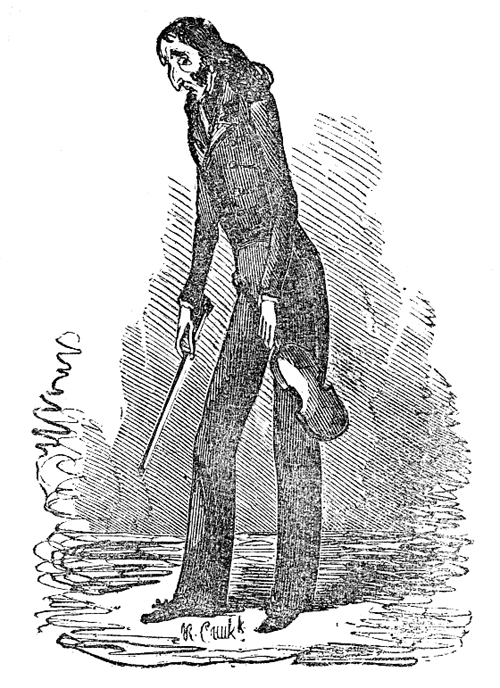
“He makes several further salutations—he endeavours
to animate his countenance with a smile of acknowledgment,
which is instantly succeeded by a look
of icy coldness.... He makes a halt, and, with
still greater eccentricity of manner, it may be, than in
his reverences and his walk, he seizes his fiddle, hugs it
betwixt chin and chest, and fixes on it a look at once of
pride, penetration and gentleness. Thus resteth he
several seconds, leaving the public at leisure to examine
and make him out in his strange originality—to note
with curiosity his gaunt body, his lengthy arms and
fingers, his dark hair descending to his shoulders, the
sickness and suffering denoted in his whole frame, his
sunken mouth, his long eagle nose, his wan and hollow
cheeks, his large, fine, manifest forehead, such as Gall
would have delighted to contemplate,—and, beneath the
shelter and shadow of that front, eyes that dilate, sparkle
and flash at every instant!
“Such doth Paganini show himself, formed, at every
point of his person, to catch the greatest possible quantum
of applause from a public whom it is his office to
amuse. Behold him, a compound of chill irony and
electric enthusiasm,—of haughtiness, with seeming humility,—of
sickly languor, and fitful, nervous, fatal
exultings,—of wild oddity, chastened by some hidden
and unconscious grace—of frank abandonment, of charming
attractiveness, of a superiority of talent that might
fix the most indifferent,—but, above all this, a very
man-fiddle—a being of extraordinary nature, created as
if expressly for the gratification of a public delighting,
before all things, in the extraordinary!
“‘Sufficient for the eyes!’ seems he now to say
within himself, as he notes in their operation the incoherent
reveries and speculations of his beholders.
Promptly his looks descend from his violin to the orchestra—he
gives the signal—he raises his right hand
briskly into the air, and dashes his bow down upon the
instrument!
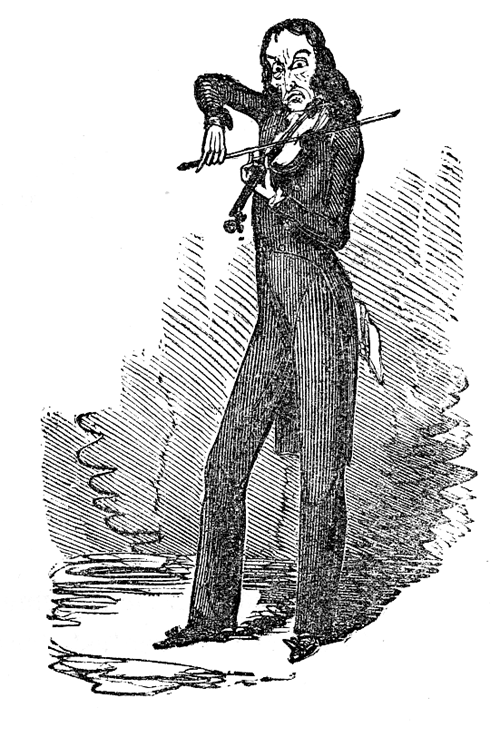
“You anticipate the rupture of all its strings! On
the contrary, the lightest, the finest, the most delicate of
sounds comes forth to win your surprise. He continues
for some moments to sport with your pre-conceptions,
to look askance at you, to irritate you; and every whim
that occurs to him, is employed to draw you out from
your supposed indifference. He teases you, he pleases
you: he springs, he runs, he wanders from tone to tone,
from octave to octave; achieves, with incredible lightness
and precision, the widest intervals; ascends and
descends the chromatic and diatonic scales; touches
harmonic accompaniments in his way; extracts unknown
sounds; searches, with easy success, for difficulties and
tricks of skill; exhausts, within the space of a few bars,
the whole range of chords and sounds possible upon the
instrument—discourses, sings, bewails, ejaculates, describes!
’Tis suddenly a murmur of waves, a whistling
in the air, a warbling of birds; a something undefinably
musical, in the most acute as well as the lowest tones—an
unrestricted impulse of caprices, and contrasts, without
guide or measure! ’Tis, in a word, a perfect union
of incoherence and nameless clatter, beyond which, the
world-worn and vitiated beings around, the worshippers
of singularity, can see nothing, imagine nothing, desire
nothing!
“The great Artist has, nevertheless, resources other
than those of phantasy, by which to captivate the public—and
presently there succeeds to this musical phantasmagoria
a broad, stately, harmonious (albeit somewhat
too bare) simplicity. The fatigue of the public and of
the Artist now gives place to a species of joy, that visibly
blooms on every countenance. Chords that are pure
sweet, melodious, brilliant, stream from beneath the bow;
and then come accents of nature that seem to flow from
the heart itself, and affect you with a perspiring thrill of
delight; and then (prodigy of harmony!) the vague
moans and unfinished plainings of a melancholy abandonment!
You sympathize, in gentle pain, with the
touching and melodious artist; you dispose yourself to
follow, at his direction, the course of (as it should seem)
some mournful, fleeting, intangible vision—when instantly
a fit of violent distress, a sort of shuddering
fury, seizes him, and we are startled, chilled, tormented,
by cries which pierce the inmost recesses of our frame,
and make us tremble for the hapless being whom we
behold and hear! We dare not breathe—we are half
suffocated;—fearfully the head burns, and the heart
aches.
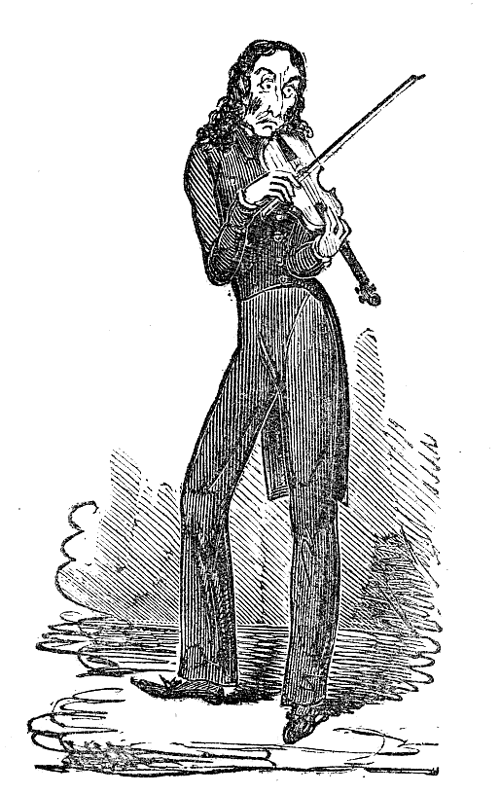
“And yet—and yet, despite this too positive pain
which the unfortunate artist has forced both upon us and
himself, he bethinketh him mindfully that ’tis his vocation
to serve for sport to the public that does him the
honor to come and listen to him. He snatches away,
therefore, your ladies with delicate nerves, and your
men of effeminacy, from the suffocation and syncope that
threaten them. Truce to the cries of agony! truce to
despair! A fantastic chaunt, a wild laugh, springs up—and
then succeeds a sort of buffoon dance, to complete
the relief of these people, and restore them to life.
Encore he sings, he laughs, he dances: each face is
completely reassured, and its owner, to prove to the
rest, and to his own satisfaction, that he has not so far
forgotten himself as to quit the precincts of bon ton and
eternal frigidity, smiles listlessly upon his neighbour,
strokes his cravat adjustingly, and throws a careless
glance from side to side! Amidst this returning indifference,
let there come a new passage of arduous brilliancy,
some more or less astonishing sleight of hand—and
a reiterated clapping of palms convinces the unhappy
purveyor of diversion that he has but too well
served the public according to their taste!
“And now, should the rondo come, in its light and
laughing gaiety—should the hymn of love and delight
succeed, ’twill be the same case as with the cry of grief
or despair. Each burst of simple gaiety must be followed
by an air in the coquettish style, an impulse from
the head, to give it stimulus. Amid the passionate harmonies
of love, you shall hear interspersed the accents
of coldness, of disdain, of raillery. After a voluptuous
transport, you shall have mincings and caprices:—
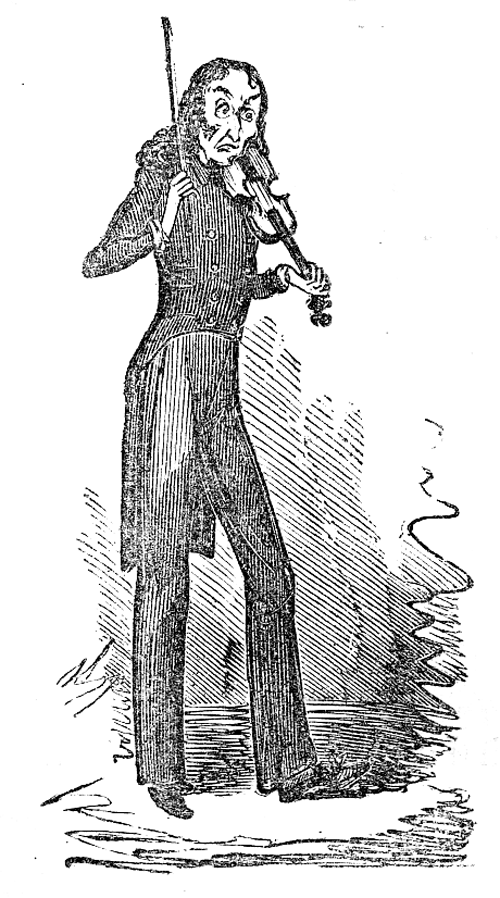
for there is no gaiety, whether for him, or for the listening
public, of a natural, fresh and youthful character;
there is no frank and confiding attachment; there is no
serene and grateful pleasure; there is no sadness that
pours itself out for the sake of consolation; no joys but
such as are like scentless flowers, that one picks to pieces
in sport; no passion save what is akin to delirium, debauchery,
or deadly poison! What the public must
have, and the artist, are your pizzicati, your contrasts,
your satanic schooleries, your touches of the extravagant;—’tis
a dose of madness or despair,—’tis an agony—the
sensation of a man suspended over a bottomless
abyss;—’tis a violin, which is at once a flute, a bass, a
guitar, and a whole orchestra, intermixed, confounded,
and getting into harmony only by fits;—’tis a professional
visage, revealing a wounded and withered heart;
’tis a human skeleton—death, in grotesque attire; ’tis
the “talented exhibition” of a rebellious angel, who
gnashes his teeth, and howls, and jeers! And so the
public, seeing their artist hold forth to them, under convenient
forms, all possible monstrosities, seem to applaud
themselves inwardly, and to exclaim instinctively, ‘Here
is our interpreter, our plaything, and our own handywork!‘
“Of such a public, and such an artist, how saddening
the sight!... The public, made up of idlers—of
beings isolated, selfish, cold, corrupt—must be amused,
forsooth! and the artist exhausts his taste and his sentiment,
and well nigh perspires blood and water, to comply
with their exactions—to amuse them!—and if he
attain this end, the public clap their hands, the manager
of the theatre counts out to him a heap of gold, and he
goes away, with his ears deafened at the noise which
has surrounded him, and which, for a moment, (it may
be), has made his heart beat high;—he goes away, with
a loving grasp tightened over the coin he has so hardly
won; and inwardly exclaims, with a smile of pity, ‘The
blockheads—the barbarians! Who is there among them
that can comprehend me—that can feel my intentions?’—and
then the home-returning public, selfish to the
very soul, indemnify themselves for their fingers’-end
applause, by sottish contempt, by remarks that are
empty, or worse—that are scornful, bitter, shocking,
disgusting even—such as those which may have been
buzzed into one’s ears in Italy or in Paris, but varied in
a hundred ways, and aggravated at will, just as he varies
and enlarges, twists and turns, beneath his magic bow,
a subject of apparently the most simple and insignificant
kind. And now the voices most distinguishable among
the ebbing crowd murmur out the words, ‘Gambler!
Libertine!’ or worse.... And the privileged public
resort again to the theatre, to admire the talent of him
whom they comprehend not; and the artist returns in
like manner, to amuse those who provoke his pity, and
whom he beholds so far below him! Thus, we have
contempt on one side, compassion on the other—applause
from hands chilled with the touch of gold, on the one
part,—on the other, sounds that borrow their animation
from no social sympathy! Such are the relations between
the public and the professor—such the bonds that
connect them!”
So much for the pungently descriptive, as regards
this singular being. It is less difficult, however, to exhibit
effects and appearances, than to analyze the causes
or means which produce them—and it is in this latter
endeavour, accordingly, that there has been least success
attained by those who have made Paganini their theme,
in Paris, as elsewhere. That which was already obscure
in relation to him, has been forced into denser
obscurity by the attempted demonstrations of certain
pompous literary showmen, who have succeeded only in
illustrating the proverb of “ignotum per ignotius.”
Mystification and generalization, the resources of ambitious
ignorance, have been copiously employed in these
endeavours. Of a less unsatisfactory character, however,
are the pretensions of M. Guhr, the able violinist,
of Frankfort, who has attempted an analysis of the
means employed, and the effects produced, by Paganini.
Like most professors of a secret, the arch Italian was
always studious of maintaining the mystery so provocative
of curiosity and admiration. He assumed the
air cabalistic, and, with a severe front and sullen eye,
would stimulate and foster the impression of his being
“profited in strange concealments.” M. Guhr, though
he had the seeming advantage of personal and friendly
access to him, found he could make nothing of him by the
interrogatory system, and therefore adopted the alternative
of becoming a silent student of his peculiarities, till
he made certain discoveries of more or less importance,
which he shaped into five heads, to show that Paganini’s
chief points of difference from other violinists were—
1. In his manner of tuning the instrument.
2. In a management of the bow, entirely peculiar to
himself.
3. In his mode of using the left hand in the passages
chantans, or passages of a singing character.
4. In the frequent employment of harmonic sounds.
5. In the art of putting the violin into double employ,
so as to make it combine with its own usual office
the simultaneous effects of a mandolin, harp, or other
instrument of the kind, whereby you seem to hear two
different performers.
As to the first of these points, “his manner of tuning
the instrument,” observed M. Guhr, “is wholly original,
and to me appears incomprehensible in many respects.
Sometimes he tunes the first three strings half a tone
higher, while that of G is a third lower, than ordinary.
Sometimes he changes this with a single turn of the peg,
and he invariably meets the due intonation, which remains
sure and firm. Whoever is aware how much
the higher strings stretch with the least relaxation
of the G, and how much all the strings generally lose,
by a sudden change in tuning, the faculty of remaining
with certainty at one point, will join me in the lively
desire that Paganini may decide on communicating his
secret in this respect. It was surprising to find, especially
on one occasion, when he played for nearly an hour and
a half in the most opposite keys—without its being
perceptible that he had changed his tuning—that none
of the strings became disturbed. In an evening concert,
between the Andante and the Polacca, his G string
snapped, and that which he substituted, though afterwards
tuned to B, remained firm as a rock. His manner
of tuning his instrument contains the secret of many
of his effects, of his succession of chords, and striking
vibrations, which ordinarily appear impossible to the
violinist.”
According to this statement, “curious, if true,” Paganini
improved his effects by playing on an instrument
out of tune, and, with something like a miracle of creative
power, produced harmony out of discord. Paganini must
of a surety have “pegged hard,” and with a screwing
that was inscrutable, to have attained such a management
of his pegs! Was M. Guhr a misty demonstrator, or was
Paganini inexplicable? As to the G, that can bear to
be pulled about in this fashion without resenting it, we
must suppose it to possess a passive virtue, a habit of
accommodation, quite beyond the custom of the stringy
tribe.38
In expatiating on the second point, M. Guhr seems
content to describe effects, rather than to labour (in
vain) for the indication of a cause—but his description
is not infelicitous:—
“Paganini’s management of the bow is chiefly remarkable
by the tripping movement which he imparts to it
in certain passages. His staccato is no way similar to
that ordinarily produced. He dashes his bow on the
strings, and runs over a succession of scales with incredible
rapidity, while the tones proceed from beneath
his fingers, round as pearls. The variety of his strokes
with the bow is wonderful. I had never before heard
marked with so much precision, and without the slightest
disturbance of the measure, the shortest unaccented
notes, in the most hurried movements. And again,
what force he imparts in prolonged sounds! With what
depth, in the adagio, he exhales, as it were, the sighs of
a lacerated heart!”
However he might sometimes err in his doctrine, M.
Guhr was at least right in his faith. The supremacy,
which he assigned to the great Genoese genius, was expressed
in the language of a handsome enthusiasm:—
“Rode, Kreutzer, Baillot, Spohr—those giants among
violinists—seemed to have exhausted all the resources
of the instrument. They had extended its mechanism,
introduced the greatest imaginable variety in the use of
the bow, which was made subservient to all the shades
of expression and execution: they had succeeded, by the
magic of their sounds, which rivalled the human voice,
in painting all passions and all the movements of
sentiment. In short, advancing rapidly in the path
marked out by Corelli, Tartini, and Viotti, they had
raised the violin to that rank which ensures to it
the dominion of the human soul. In their style, they
are, and remain, great and unsurpassed. But, when we
hear Paganini, and compare him with the other masters,
it must be confessed that he has passed all the barriers
which custom had hitherto raised, and that he has
opened a way peculiar to himself, and which essentially
separates him from those great Artists; so much so,
that whoever hears him for the first time, is astonished
and transported at hearing what is so completely new
and unexpected;—astonished by the fiend-like power
with which he rules over his instrument;—transported
that, with a mechanical facility which no difficulty resists,
he at the same time opens to the fancy a boundless space,
gives to the violin the divinest breathings of the human
voice, and deeply moves the inmost feelings of the soul.”
But we have left Paganini himself at Paris, where
we must now rejoin him and his fortunes. As for the
latter, in the moneyed meaning, they grew with a ratio
of increase that would have been more wonderful, had
it not been afterwards outdone by that of his gains in
London. As it was, they were sufficient to inspire one
of the Parisian dilettanti, a nicer worker in figures, with
a special access of passion for calculating the value of
notes—that is to say, of Paganini’s musical “notes of
hand.” The result, based upon a concert given at the
Opera at Paris, producing 16,500 francs, and presenting
1365 bars of the fiddling, indicated a quotient of 12
francs for each bar, and was still more curiously distributed
into proportions as follows:—for a semibreve,
12 francs; a minim, 6 francs; a crotchet, 3 francs; a
quaver, 1 franc, 50 centimes; a semiquaver, 15 sous;
a demisemiquaver, 7½ sous. This exemplary calculation
did not overlook, moreover, the cash value of each of
the occurring sorts of rests; besides working out a
“contingent remainder” of 420 francs—that residue
happening to be, by the most curious coincidence, exactly
the price of such a violin as the Conservatory usually
awards by way of prize to its most successful pupils!39
The provoking impertinence of Rumour, with her
thousand busy tongues darting conjecture and accusation,
drew forth, at Paris, as at Vienna, some effort at self-defence
on the part of the assailed Artist. His letter
to the Editor of the Révue Musicale may claim a place
here (in translated form), as well for its pleasantry and
ingenuity, as for the clue it affords to the origin of some
of the slanderous liberties which had and have been
taken with his character. Of this letter, it subsequently
appears that the materials were furnished by Paganini,
and the diction arranged by his friend, M. Fétis:—
Paris, 21 April, 1831.
“Sir,
“So many marks of kindness have been lavished
on me by the Parisian public,—so many plaudits have
been awarded to me,—that I am bound to give credit
to that celebrity which is said to have preceded my
arrival. But, if any doubt on the subject could have
remained, it must have been dissipated by the care I
see taken by your artists to make representations of
my likeness,—by the numerous portraits of Paganini,
more or less like the original, with which the walls of
your capital are covered. It is not, however, to simple
portraits, Sir, that their speculations are confined.
While walking yesterday along the Boulevard des
Italiens, I saw, in a print-shop, a lithograph representing
Paganini in prison. “Well!” said I to myself, “here
have we some worthy citizen who, in imitation of Don
Bazilio, has been turning to account the calumny which
has pursued me for the last fifteen years.” While
smilingly examining all the details of this mystification
with which the fancy of the artist had furnished him, I
perceived that a numerous circle had gathered around
me, and that every one, as he compared my features
with those of the young man represented in the lithograph,
was taking pains to satisfy himself as to the
degree in which I was altered since the period of my
imprisonment! Thus I found that the thing was taken
au sérieux, and that the speculation, at least, was no
bad one. It occurred to me that, as every one must live,
I might as well, of myself, furnish a few anecdotes to
those enterprising persons who take so much interest in
me and my affairs; so that, if so disposed, they may
have a few more subjects for prints, as good, and quite
as true, as that in question. It is with this view that
I beg you, Sir, to do me the favour of inserting this
letter in your Musical Review.
“These gentlemen have represented me in prison,
but they do not seem to know what took me there; and,
so far, they are about as wise as myself, or as those who
have brought the story into circulation. It bears, in
fact, a great many versions, and presents a corresponding
variety for the designer. It has been said, for instance,
that, having surprised a rival in the chamber of my
mistress, I had bravely stabbed him from behind, when
he was incapable of defending himself. By others, it
has been pretended that it was against the person of
my mistress herself, that my fury had been directed;
but they are not agreed as to the mode I had adopted
to accomplish her destruction,—some contending for the
poniard, and others for poison; so that, as each has indulged
his imagination in describing the affair, it would
be hard to deny a similar license to the dealers in lithographs.
I will relate what occurred to me at Padua
some fifteen years ago.
“I had given a concert there, and had met with considerable
success. On the following day, I was one of
sixty at a table d’hôte, where I had entered the room
without being recognized. One of the guests was pleased
to express himself in very flattering terms on my public
appearance the evening before. Another concurred in
the praise thus bestowed, but added, by way of explanation,
“There is nothing in the talent of Paganini which
ought to excite surprise. He is indebted for it to the
sojourn he has made for eight years of his life within
the walls of a dungeon, with nothing but his violin
to mitigate the rigors of his captivity. He was condemned
to this long confinement for having basely assassinated
a friend of mine, who was his rival.”
“The whole company, as you may well believe, exclaimed
against the enormity of the offence. For my
part, I got up, and, addressing the person who seemed
so well acquainted with my previous history, begged
him to tell me where, when and how, the adventure had
taken place. Every eye was turned towards me as I
spoke, and you may judge of the general astonishment,
when one amongst themselves was thus recognized as
the chief actor in the tragedy. The historian was sadly
embarrassed. It was no longer one of his friends who
had fallen; “he had heard it said,”—“he had been
credibly informed,”—“he had believed,—but it was
possible that he might have been mistaken!”
“It is thus, Sir, that the reputation of an artist is
trifled with, because others, of more indolent habits, are
at a loss to understand how a man should apply himself
as effectually to study, while at full liberty in his own
house, as within the walls of a dungeon!
“At Vienna, a still more preposterous rumour put
the credulity of the inhabitants to the test. I had been
playing those variations known by the name of Le
Stregghe (the Witches). A young man, who was described
to me as of a pale and melancholy aspect, with
eyes of the most inspired cast, said that he saw nothing
surprising in my performance, for, while I was executing
my variations, he had distinctly perceived the devil at
my elbow, guiding my fingers, and directing my bow;
that the said devil was dressed in red; had horns and
a tail; and that, moreover, the striking likeness of
our countenances plainly established the relationship
between us! It was impossible to refuse credence to so
circumstantial and descriptive an account: and the
curious became satisfied that this was the true secret of
what are called my tours de force.
“For a long time, I was weak enough to allow my
tranquillity to be disturbed by such idle rumours. I
tasked myself to demonstrate their absurdity. I called
attention to the fact, that, from the age of fourteen, I had
been constantly under the public eye, and giving concerts;
that I had been employed, for sixteen years, as
chief of the orchestra and director of the music, to the
Court; and that, if it were true that I had been eight
years in prison for killing my mistress or my rival, it
must have been before my first appearance in public; so
that I must have had a mistress, and a rival, before I was
seven years of age. I invoked even the testimony of my
country’s ambassador at Vienna, who declared that he
had known me, for nearly twenty years, in the situation
which became an honest man; and I thus succeeded,
for the moment, in silencing the calumny; but calumny
is never totally extinguished, and it does not surprise me
to find it revive in this city.
“Under such circumstances, Sir, what ought I to do?
I see nothing for it but to submit with resignation, and
give free scope to the exercise of an ingenious malignity.
Before concluding, however, I may as well communicate
an anecdote, which has probably given rise to some of
these injurious rumours about me. It is as follows:
“A performer on the violin, named D . . . ,40 who
was at Milan in 1798, had connected himself with two
men of bad character, who persuaded him to go with
them during the night to a neighbouring village, to
assassinate the clergyman, who was reported to have been
possessed of great wealth. Happily, the heart of one
of the associates failed him at the decisive moment, and
he resolved to denounce his confederates. The gendarmerie
went to the spot, and arrested D...i, and
his friend, at the moment of their arrival at the house
of the curé. They were condemned to twenty years’
confinement, and thrown into prison; but General
Menou, then Governor of Milan, at the end of the second
year, set the artist at liberty.
“Would you believe it, Sir? It was on this foundation,
that all my history has been raised. A performer
on the violin was in question, and his name ended in i—so
that it must have been Paganini. It was I who had
been in prison, and the assassination became that of my
mistress, or my rival. Thus, to explain the discovery
of my new style of performance, they encumber me with
fetters which would but add to the difficulty. Let me
hope, Sir, that if I must yield to the propagators of a
calumny so obstinately persevered in against all verisimilitude,
they will at least consent to abandon their
prey after death,—and that those who so cruelly avenge
themselves of my success, will leave my ashes to rest
in peace. Accept, Sir, the assurance, &c.
“Paganini.”
Largely profited in honours and revenue, through his
exertions in France, the great artist directed his course
to the shores of England, where the reception which
awaited him was destined to form a climax to his
previous triumphs. Fame, that most eager, but inexact
lady-usher, who had introduced him to the French with
so many whispers of wild import, took similar liberties
when she presented him to the marvelling Londoners.
“The page will be a strange one in the history of Art,
to be written some fifty years hence (says a writer in
the Athenæum), which shall contain all the rumours that
heralded Paganini’s first appearance in England, and
were quoted in explanation of his outward eccentricities
of person and manner. Our children will laugh at the
credulity of their fathers, when they read of a magician
who strung his instrument with the heart-strings of his
mistress—a sort of demon Orpheus, who had been
initiated into his power by the gentle ordeals of murder
and solitary confinement;—and yet such reports were
widely spread, and, strange to say, believed! The writer
of this notice remembers having heard it gravely said in
society, “that Paganini could play upon his violin when
all its strings were taken off!” and, when another of the
party, to expose the absurdity of the tale, declared that
this wonder of the world had done more, having once
actually strung a gridiron (his own violin not arriving
in time), on which he performed a concerto with immense
applause—this second and surpassing marvel (of
course fabricated in the humour of the moment) was not
only swallowed, but absolutely retailed, as an accredited
fact!”
The capacious area of the King’s Theatre, scarcely
adequate to the large expectations founded upon his
fame, was selected as the scene of his London début.
An awkward collision with public opinion marked, how
ever,
the interval immediately preceding his appearance.
An endeavour to elevate the prices of admission above
the usual concert-pitch, raised a storm of opposition, that
was only allayed by prompt and necessary concession.
To attribute the attempt, thus properly frustrated, to an
extortionate spirit on the part of Paganini, as was pretty
generally done at the time, seems hardly fair. It is more
reasonable to suppose that his ignorance of the English
customs was taken advantage of, for the sordid purposes
of others; and on this point it may be worth while here
to say a few words. There is in London a class of needy
and adventurous foreigners, who, with no available
talent of their own, have just industry enough to make
them beset those of their countrymen, whose genius or
good fortune enables them to figure successfully in our
metropolis. Whoever, at the period here referred to, has
had occasion to direct his course through the Regent’s
Quadrant, either in the twilight of a departing day, or
during the brighter reign of gas and night, must have
noted the loose, idle, swaggering gait, the tawdry and
outré habiliments, and the dark and dirty looks, of
certain figures who loitered about in obstructive knots,
or sauntered on in pairs or threes, among the more
regulated passengers. Their equipment was ordinarily
completed by a reeking cigar, which added to their sense
of importance, and was an auxiliary to their impertinencies
of demeanour towards the females, of whatever
grade, who chanced to pass within their track. But
their “high and palmy state” was in the gallery of the
King’s Theatre, where their pertinacious “manual exercise,”
and their laudatory vociferations, in favour of the
dancers who successively occupied the stage during the
ballet, were a serious annoyance to all around them.
Under this character, which seems to have no English term
that will exactly fit it, they were (and still are) known as
the claqueurs. Externally, they are altogether the personification
of impudent pretence—and, to enable them
to support their equivocal character, they seek out the
private quarters of the great singer, or the fortunate
artist, in whatever line, and, by all the arts of the
meanest flattery, contrive to extract from his purse such
tribute as his vanity, or his complaisance, may be willing
to afford. It is no unnatural conjecture to suppose that,
on the occasion just named, Paganini acted under a
mistake produced by influence of this kind.41
Perhaps no achievement in the musical art, performed
by one person, has ever been attended with more enthusiasm
than marked the exhibition made by Paganini at
his first concert in London, given on the 3rd of June,
1831. Certain it is that nothing in the way of musical
performance, that had ever preceded it in this country,
had exceeded it in novelty. It was the prevalent theme
of talking wonder; and all the ingenuities of written
criticism were tasked to describe and estimate it. Allowing
for the difficulty of appreciating, where the singularity
was so great, there was a remarkable acuteness shewn
in some of the accounts that appeared in the journals of
the day. From these I propose to make a few extracts,
selecting such as seem best to illustrate the peculiarities
with which they had to deal. Let us commence with a
statement given in the first person, by Mr. Gardner, of
Leicester.
“At the hazard of my ribs, I placed myself at the
Opera door, two hours and a half before the concert
began; presently, the crowd of musicians and violinists
filled the Colonnade to suffocation, all anxious to get the
front seat, because they had to pay for their places,
Paganini not giving a single ticket away. The Concert
opened with Beethoven’s Second Symphony, admirably
performed by the Philharmonic band; after which Lablache
sang Largo al Factotum, with much applause,
and was encored. A breathless silence then ensued, and
every eye was watching the action of this extraordinary
violinist: and, as he glided from the side scenes to the
front of the stage, an involuntary cheering burst from
every part of the house, many rising from their seats
to view the spectre during the thunder of this unprecedented
cheering—his gaunt and extraordinary appearance
being more like that of a devotee, about to suffer
martyrdom, than one to delight you with his art. With
the tip of his bow, he set off the orchestra, in a grand
military movement, with a force and vivacity as surprising
as it was new. At the termination of this introduction,
he commenced with a soft streamy note of
celestial quality: and, with three or four whips of his
bow, elicited points of sound that mounted to the third
heaven, and as bright as the stars. A scream of astonishment
and delight burst from the audience at the novelty
of this effect. Immediately, an execution followed, that
was equally indescribable, in which were intermingled
tones more than human, which seemed to be wrung from
the deepest anguish of a broken heart. After this, the
audience were enraptured by a lively strain, in which
you heard, commingled with the tones of the instrument,
those of the voice, with the pizzicato of the guitar,
forming a compound of exquisite beauty. If it were
possible to aim at a description of his manner, we should
say that you would take the violin to be a wild animal
which he is endeavouring to quiet in his bosom, and
which he occasionally, fiend-like, lashes with his bow;
this he dashes upon the strings as you would whip with
a walking switch; tearing from the creature the most
horrid as well as delightful tones. He has long legs
and arms, and his hands, in his playing, often assume the
attitude of prayer, with the fingers pointed upwards.
The highest notes (contrary to every thing we have learnt)
are produced as the hand recedes from the bridge; overturning
all our previous notions of the art. During these
effects, a book caught fire upon one of the desks, which
burned for some time unobserved by the musicians, who
could neither see nor hear (though repeatedly called to
by the audience) any thing but the feats of this wonderful
performer. Some few pieces were played by the
orchestra, that gave repose to the admiring audience.
He then entered upon his celebrated performance of the
single string, introducing the air of Nel cor più (Hope
told a flattering tale), to which he imparted a tone so
‘plaintive and desolate that the heart was torn by it;’
in the midst of this he was so outré—so comic—as to
occasion the loudest bursts of laughter! This feat was
uproariously encored. He then retired to put on three
other strings, and ended this miraculous performance
with the richest arpeggios and echoes, intermingled with
new effects that no language can describe! Though he
retired amidst a confusion of huzzas and bravos that
completely drowned the full orchestra, yet he was called
for to receive the homage of the audience. There was no
trick in his playing; it was all fair, scientific execution,
opening to us a new order of sounds, the highest of
which ascended two octaves above C in alt.”
Our next demonstration is from the able pen that
gave life and eloquence to the new “Tatler:”—
“Those of our readers who have heard the most
eminent of violin performers, eminent for strength, sweetness,
and purity of tone, will hear all these requisites to
absolute perfection in Paganini. They who have heard
difficulties in the way of execution overcome, which it
seemed bordering on desperation to attempt, may tax
their faculties to invent new enormities, and they will
not only fall short in their imaginings, but he will perform
all, and more, not merely without show of effort, but as
if they were a fanciful prelude, or pastime, to some laborious
undertaking. In the course of the concert given last
evening at the Opera-house, he performed four pieces, in
which, we conceive, he exhibited every feature that the
instrument can display, and many more than it has
hitherto been thought capable of. The first was a concerto
of the most florid character, varied with movements
of exquisite expression and tenderness. The second was
a composition in the minor key, and which, for its own
intrinsic merit, made the strongest appeal to our feelings.
In it he satisfied at once any doubt we might have that
he would prove unequal in a cantabile.—His expression
in this piece was the most genuine display of passionate
feeling we ever remember to have heard on any instrument.
It required no explanatory chorus, no voice of
accompaniment—it was the perfection of musical sighing,
and gentle sorrow. The third performance was a
military rondo, the whole of which he played upon one
string—the fourth. In it he introduced the subject of
‘Non più andrai’ from Figaro, with variations of the
most astonishing description. He introduced passages of
imitation in octaves, with wonderful rapidity and neatness,
and with a purity of tone that was delicious. The
precision, too, with which he dashed from the lowest note
of the string to the opposite extreme, and all with the
utmost indifference of manner, was one of the commonest
of his achievements. The last piece, which was a brilliant
rondo, he played entirely without the orchestral accompaniment;
and this was the triumph of the evening. It
consisted of an air with variations, crowded with enharmonic
passages. The subject, now legato, and now
hurried, was at one time attended with a florid, and at
another with a pizzicato accompaniment; and, as he drew
to a close, he accelerated his time to a prestissimo, the
air and the pizzicato moving on together, and ending
with a rapid shake upon the latter! The violin-player
will fully appreciate the difficulty of this achievement.
It is scarcely necessary to state that the audience were
satisfied. The applause was showered upon him in
torrents.”
Another commentator thus expresses himself:—
“Paganini’s playing is in a very high degree intellectual.
It is mental, as well as physical and mechanical.
The instant he seizes his violin, which he usually coquets
with for a time before bringing it up to its proper place,
a sudden animation passes over his countenance. He
has the advantage, which all concerto players, by the
way, ought to adopt, of never using a book. This mode,
in itself, has as much the superiority as a speech delivered
has over one that is read. When the first bow
is drawn, Paganini is evidently lost to every other
thought, and is revelling probably in a world of his own
creation. All his passages seem free and unpremeditated,
as if conceived on the instant. One has no impression
of their having cost him either forethought or
labour. The word difficulty has no place in his vocabulary,
so completely is all brought under his subjection
and mastery.
“Nothing can be more intense in feeling than his
conception and delivery of an adagio passage. His tone
is not, perhaps, so full and round as that of some other
players—as Baillot, or De Beriot, for example: it is
delicate, rather than strong; but that delicacy is inconceivable,
unless one has heard it, and was probably
never possessed equally by any other player. His
touch is occasionally so fine, that the note seems to float
in the air, and not to spring from any instrument. In
point of expression, it is impossible to imagine any thing
more perfect. The melancholy or tender (as should be
the case in slow movements) mostly predominates; but
there is no shade or form of expression which the genius
of Paganini does not draw forth. His adagios are intermixed
with passages of rapid execution, which go off
with the rapidity of a rocket, or a falling star—a break
of the subject, or an impertinence, in any hands but his
own—but, if analyzed, all is in perfect keeping.
“The only thing that can be said to lessen the
wonder of Paganini’s powers in the way of mere mechanism,
is that he is indebted for them, in some measure,
to his own peculiar conformation. His long arms, and
slender frame, allow him to place the instrument in the
most advantageous position that is possible; and his left
arm is brought so completely under it, that his hand
seems to cover the whole extent of the finger-board.
Such is the flexibility, besides, of his joints, that he can
throw his thumb nearly back upon his wrist, and extend
his little finger, at the same time, in the opposite direction.
By these means, when in the first position, as it
is called, of the violin, he can reach, without shifting, to
the second octave. His extreme high notes—for he
contrives to play three octaves on each string—are given,
consequently, with a precision and certainty never heard
before. This flexibility, without doubt, is indispensable
to the execution of many of the passages, though it is,
probably, not wholly natural to him, but acquired, in
part, by his long and severe practice. His solo on the
fourth or G string (the other three being discarded for
the occasion) we consider among the most charming, as
well as the most wonderful, specimens. There are few
players, we apprehend, who, in point of mere difficulty,
could do on four strings what Paganini does on one;
but that is nothing. The charm lies in the peculiar
effect—in the soft and silvery tone of that string, which
one almost imagines to be increased, though, perhaps,
without reason, by taking the others away. No defect
is felt, as regards compass, in this piece. There appear
to be as many notes as in the violin in its ordinary state;
and, in fact, by the aid of the harmonics, he does make
nearly as many.”
Such were the wonders achieved, and such the impressions
created, by this superlative master of the most
versatile of instruments. After he had performed at
this his first concert, Mori went about with the jesting
enquiry, “Who’ll buy a fiddle and bow for eighteen-pence?”
and John Cramer exclaimed, “Thank Heaven,
I am not a violin-player!” It seemed, in short, to be
commonly admitted, that, as nothing had been heard
before, in violin performance, equal to this exhibition,
so nothing could be expected ever to exceed it—that
“the force of fiddling could no further go.” One of the
numerous critics whom he kindled into rapture, observed
that in the style of Paganini were united the majesty
of Rode, the vigour of Baillot, the sentiment of Spohr,
the sensibilité of Kiesewetter, the suavity of Vaccari,
the mastery of Maurer, the justesse of Lafont, and the
elegant expression of De Beriot!
The excitement produced by the first public display
of these powers in our metropolis was fully sustained
on the subsequent occasions. It would fill a volume of
itself, were I to treat, “avec circonstance,” of the successive
concerts at theatres and other places, in which
the Genoese genius electrified attending mortals
“With heav’nly touch of instrumental sounds.”
With no intention to be thus particular, I must beg permission,
nevertheless, to extract a few more passages of
contemporary notice. The celebrated Capriccio, in
which he introduced the air from the Carnaval de
Venise, merits a separate description:—
“On reaching his position in the centre of the stage,
he seemed at once to lose all consciousness of the
presence of mortals, and to live and breathe for his
violin alone. He touched its strings lightly and trippingly,
as if to awaken it, and then, after having given
it three or four of those sweeping, switching strokes,
which almost justify the expression that he thinks to
lash it into submission to his spirit, he threw off a most
singular mutilation of the Venetian Air, “Oh! come to
me!” in which, while he appeared to retain only the
sad part of the original, he communicated to it an odd
wailing character. On this subject he capriccio’d some
four or five variations, all in a consistent style, in which
he introduced most of his peculiar movements of hand
and bow. At the end, he was rapturously applauded,
and he retired as he had entered. The applause, however,
being continued, mixed with some cries of encore,
he came forth again, but without his violin, and, making
a most eloquent bow, retired once more. The plaudits
were, however, now redoubled, and the wicked audience,
having got the crotchet into their heads, pretty unanimously
vociferated encore; when, after some delay, the
good Signor absolutely did make his appearance with
his second self—or his pickaninney—his violin; and
did vouchsafe two little variations more, of the wizard
strain:—the last was altogether performed by the hand
which held the instrument, and without the aid of the
bow. On the whole, so strange, so whimsical an outpouring
of melancholy we never heard before, and
probably never shall again:—one really did not know
whether to laugh or cry at it. Nothing upon record, that
we know of, comes near it, with the exception of Corporal
Trim’s pathos in the kitchen.”
In the region of the harmonic notes, which was
before (comparatively speaking) almost a “terra incognita,”
Paganini may claim the undoubted merit of
having made extensive discoveries:—
“The staccato runs, performed with the bow and
concluded with a guitar note, are quite original with
Paganini; and this is one of the few novelties in which
he may find successful imitators. But his manner of
producing the harmonic notes, which ascend to a height
never before imagined, will probably remain a perpetual
mystery42; it is not their least marvellous characteristic
that, exquisitely attenuated as they are, the distinctness
and strength of the sound is not, in the smallest degree,
impaired. In performing on the fourth string only, he
introduces the harmonics as part of the regular scale,
thus obviating, in effect, all deficiency as to compass.
The introduction of pizzicato runs, on this solitary
string, is another inexplicable mechanical feat.”
And again, as to these wonder-working harmonics:—
“Signor Paganini having, through vast exertion,
procured himself the aid of two entire additional octaves
with their half-notes, making in all 28 notes on the
fourth string, by means of the harmonics, is able to
execute pieces of a very extensive scale on that string
alone. The labour he must have gone through, before
he could so completely obtain the command of the harmonic
notes, none but violin performers of experience
can form a notion of. The most surprising part of the
use he makes of them is in the clearness and strength
of their tone, which render them as audible as the full
notes, at any distance.”
At his (so called) farewell Concert at the King’s
Theatre, on the 20th of August, two of the pieces he
selected for his display were especially remarkable in
the treatment. One of them, a fandango of very bizarre
character, performed on the fourth string, consisted, in
part, of a sort of whiningly amorous colloquy between
two birds. An incidental crowing, like that of a cock,
was privately conjectured, by one of the musical men
present, to be the artist’s medium of conveying an
oblique satire upon the audience, as the subdued vassals
of his will. No impression of the kind, however, existed
with them, for they demanded the repetition of the
affair. The other piece was our National Anthem of
God save the King, certainly an ill-selected subject for
exhibition on a single instrument, and, in the treatment
of it (if I may venture to advance my own impressions
experienced at the time), too full of sliding, and, as it
were, puling, to satisfy the pre-conceptions derived
from the fullness, steadiness and grandeur, characteristic
of the original composition. Indeed, as it appeared to
my own humble judgment, there was intermixed in the
general performances of this wonderful artist, “something
too much” of this sliding and tremulous work, the result,
seemingly, of an overstraining at expression—of an
attempt, if I may so speak, to make the note carry
more than it could bear. The effect, in such cases, was
in some degree analogous to that of Velluti’s singing;
it bespoke intentions outstripping the possibility of
execution. But then, amid so much splendid achievement,
must we not always expect to find some mark or
other of the imperfection belonging to that poor human
nature which is the agent?
Whatever may have been, in the artistic sense, the
relative appreciation of Paganini’s talent, in the various
European countries that had witnessed its display—it is
certain that he was no where so highly estimated, according
to the monetary scale, as in England, where it
has been supposed (though the exact computation of
such matters is difficult) that his receipts amounted to
about twenty-four thousand pounds. Whilst the golden
shower was descending on him, he was not so absorbed
in its fascination, as to forget the silent claims of the
penny-less;—nor would it be fair to measure his impulses
in this direction, by the side of that largeness of
soul which we have all so greatly delighted to honour
in the excellent Jenny Lind.
In the summer of 1834, after an absence of six
years, spent partly in Europe and partly in America,
Paganini revisited Italy—where, looking wistfully towards
the sweets of retirement, he invested a portion of
his accumulated funds in the purchase of an agreeable
country-residence in the environs of Parma, called the
Villa Gajona. Among the projects he at that time
entertained, was the thought of preparing his various
compositions for publication—a measure towards which
the eager curiosity, of those especially interested in the
violin, had long been pointedly turned, under the impression
that all which was mysterious in the production
of his extraordinary effects would thus be freely elucidated.
Exaggerated notions, however, as to the pecuniary
value of such a work, seem to have possessed
the mind of Paganini; for, an enterprising Parisian
publisher, who had made hopeful approaches to him
whilst in London, had been frightened away by the
discovery, that if he were to enter on the speculation by
payment of the sum expected, he must look through a
vista of ten years, for the commencement of his profits!
Received every where with honour in his own country,
as the result of his foreign ovations, and decorated, by
Maria Louisa, Duchess of Parma, with the Imperial
Order of St. George, the caressed Artist was, nevertheless,
incapable of any continuous enjoyment, for the
want of that health which his restless and transitive
spirit had no where been able to attain. A speculation
of no sound character, with which he was induced to
connect himself (in ignorance, as it is believed, of its
real nature), drew him away to Paris, in 1838, and, in
the result, damaged his pocket, and did not wholly spare
his reputation. In that project, designed professedly
for concerts, but covertly for gambling, he became
involved, through a legal verdict, to the extent of
50,000 francs.
In the midst of the troubles associated with that
affair, his ailments had deepened into consumption; and
he made a painful journey through France, under medical
prescription, to reach Marseilles. There, in retirement,
beneath the roof of a friend, a brief return of energy
enabled him to take up, now and then, his violin or his
guitar; and he one day showed so much animation as
to join effectively in a certain quartett of Beethoven’s,
which he passionately admired. The necessity for change,
so peculiarly felt by consumptive patients, impelled
him again to his own Genoa; but the great change was
at hand—and another journey brought him to his last
earthly scene, which was at Nice. The closing process
was rapid. His voice became hardly distinguishable
from silence itself—and sharp attacks of cough, that
grew daily more obstinate, completed the exhaustion of
his strength.
Of the final moments of this memorable man, an
Italian writer has furnished some account, in terms
which, touching as they are, yet leave in the heart a
sense of something to be desired—something which no
reflecting mind will be at any loss to understand. The
account is (in English) as follows:—
“During the evening that was his last, he manifested
more tranquillity than was habitual to him. On
awaking, after a short slumber, he had the curtains of
his bed drawn aside, that he might contemplate the full
moon, serenely marching through the immensity of the
clear heaven. In the midst of that contemplation, he
again sank into drowsiness; but the whispering of the
contiguous trees excited in his bosom that stir of gentle
emotion, which is the very life of the beautiful. As if he
would have rendered back to Nature the sweet sensations
he was receiving from her in that final hour—he extended
his hand toward his charm-haunted violin—toward
the faithful companion of his wanderings—toward
the magic thing that had been as an opiate to his
troubles;—and then—he sent up to heaven, along with
its expiring sounds, the last sigh of a life that had been
all melody!”
The date of the event was the 27th May, 1840—and
the age of the deceased, fifty-six. The great
Artist left considerable wealth, together with the title
of Baron (conferred on him in Germany) to his only son,
Achilles, the offspring of a union with a certain vocalist,
named Antonia Bianchi—a union which, not having
been secured and sanctioned by the church’s testimony,
was soon severed by the lady’s temper.
The life of Paganini had been a “fitful fever”—and
the desire to “sleep well” may indeed be conceived
to have been as an abiding thirst within him. Even
his cold remains, however, were not permitted, by
jealous and jaundiced authority, to repose undisturbed.
Slander had been furtively busy with his name—he had
died without the stamp conferred by official religious
ministrations—his Catholicity was dubious—his mortal
relics could not (so decided the Bishop of Nice) be committed
to consecrated ground. In vain did his son, his
friends, and the chief professors of art in that city,
make solicitation of leave for a solemn service to be
performed in behalf of his eternal repose, under the plea
that, like many another victim of consumption, he had
not supposed his death to be imminent, and had departed
this life suddenly;—the leave was refused; and
all that could be obtained, was the offer of an authentic
declaration of demise, with license to transport the
corpse whithersoever it might be wished. This was
declined—and the affair was brought before a public
tribunal, which gave verdict in favour of the Bishop.
Appeal was then had to Rome, where the Bishop’s decision
was cancelled, and the Archbishop of Turin was
charged, conjointly with two Canons of the Cathedral
at Genoa, to make enquiry into Paganini’s Catholicity.
During all this time, the corpse had remained in a room
at the Hospital at Nice. It was then transferred, by
sea, from the lazaretto of Villa Franca, near that city,
to a country-seat in the neighbourhood of Genoa. There,
a report soon got into circulation, of strange and lamentable
sounds being heard by night. To arrest these
popular impressions, the young Baron Paganini undertook
the cost of a solemn service to the memory of his
father, which was celebrated in one of the churches at
Parma. After this expenditure, the friends of the
deceased had permission from the Bishop of Parma to
bring the corpse within that Duchy—to transfer it to
the Villa Gajona—and to inter it near the village
church:—and this funeral homage was at length
rendered to the remains of the man of celebrity, in
May 1845, but without any display, in conformity with
orders from the government.
The sum bequeathed by Paganini to his son (for
whom a documentary legitimacy had been procured)
amounted to two millions of francs (about £80,000),
charged with legacies of fifty, and sixty thousand francs,
respectively, to his two sisters, and with an annual
pittance of 1200 francs to the mother of his loved
Achilles. He left also some valuable instruments, including
an incomparable Straduarius, a charming
Guarnerius, of the small pattern, an excellent Amati,
a bass of Straduarius, agreeing with the violin by the
same maker, and his large and favourite Guarnerius.
This latter, the sole instrument associated entirely with
his travels, he bequeathed to the city of Genoa, being
unwilling that any other artist should possess it after
him.
Some further particulars, to illustrate chiefly the
habits of the man, may not be deemed superfluous.
Paganini’s existence was a series of alternations betwixt
excitement and exhaustion; and it is not surprising
to find that his moods of mind were variable
and uneven, and that he would sometimes sit, for hours
together, in a sealed and sombre taciturnity, whilst, at
other times, he would surrender himself to a wild effervescence
of gaiety,—without any apparent motive in
either case. Most commonly silentious, he was talkative
when travelling. The weak state of his health made
him averse from loud conversation; and yet, when the
rattle of the wheels over the pavement became deafening,
he would talk loud and fast. To the scenic charms
out-spread before his eyes, he was insensible—his urgent
impulse being to move rapidly, and to reach his journey’s
end. In his later years, a low bodily temperature was
habitual to him, insomuch that he would wrap a furred
pelisse around him, in summer-time, and huddle himself
up in a corner of his carriage, with every window closed.
In-doors, on the contrary, he would have all the windows
open, and called it taking an air-bath! He anathematized
the climates of Germany and France, but, above
all, that of England; and declared that Italy was the
only country to live in. The intensity of his internal
sufferings transmuted, at times, his ordinary pallor into
a livid, or even a greenish hue; but his recourse was
to quackery—to one empirical remedy, in which he had
faith, and not to doctors, in whom he had none. Before
commencing a day’s journey, he took no tea, nor
coffee, but either soup or a cup of chocolate. If it
were early in the morning, he would start without
taking anything, and sometimes continue fasting the
greater part of the day. For the encumbrances of
baggage, he had almost the contempt of a Napier. A
small shabby box, in which he placed his beloved Guarnerius
instrument, his jewels, money, and meagre stock
of linen,—a carpet bag—and a hat-box—these were his
accompaniments, and were all stowed inside the vehicle.
Careless of all that goes by the name of comfortable,
he was also very little solicitous about his toilet. His
wardrobe might have gone into a napkin. As for his
papers, they were thrust into a small red portfolio, in
“most admired disorder,” such as himself alone could
penetrate for any immediate purpose. Arithmetician
he was not, in the ordinary sense—but he managed his
business calculations in a way of his own, that answered
all his need. To the style of his accommodations on
the road, he was quite indifferent, provided only that
his rooms were quiet. At the day’s end, a light supper,
or (sometimes) a cup of camomile tea, sufficed him.
In his own quarters, Paganini maintained usually the
strictest solitude, and seemed always to quit his room
with regret. His violin, as silent as himself, was not
touched, save when he tuned it for a concert, or a rehearsal.
He had worked enough—his labours had long
before carried him to the summit;—his want, his craving
want, was repose. There is a floating story about his
having been dodged and watched for six months, from
one halting-place to another, by an enthusiastic English
amateur, who hoped to “pluck out the heart of his
mystery,” to grasp the secret of his studies, by lodging
at the same hotels, and occupying (whenever possible),
a contiguous chamber. Vain expectation! a profound
silence always enveloped the great Professor. At length,
however, the crisis of discovery seemed imminent.
Paganini was seen (through a key-hole) to seat himself
on a couch—to take the incomparable fiddle from
its case—to raise it to his left shoulder! Still, the
silence was unbroken—not the whisper of a note could
be distinguished! Paganini, absorbed doubtless in the
composition of some new piece, only shifted his left
hand about, upon the neck of the instrument, to study
his positions, without the help of the bow—and then restored
the un-awakened fiddle to its resting-place. The
Englishman (says the story) renounced his hapless
pursuit, and returned home in despair!
Enchained to music and its toils, from his earliest
youth, Paganini had acquired very little general knowledge.
Books were strange things to him and history
and science, almost nullities. Political events had no
interest for him: he looked at the newspapers merely
for what personally concerned him. His mind was
much engaged with his own projects for the future—such
as forming a Musical Conservatory in Italy, publishing
his compositions, writing operas, and ceasing to
travel. He had a Byronic mistrust of friends, and
proneness to regard them as secret plotters against his
peace. As for visitors (by whom he was sometimes
besieged), as many as he was not constrained to see,
were passed over to his Secretary. To those Artists
who sought his converse, that they might enucleate his
professional secrets, he listened patiently—but maintained
his reserve. Invitations to dine or sup, which
at every large town came in a shower upon him, were
sparingly and reluctantly accepted. On rising from the
table, if he could escape unperceived, he would immediately
retire, to take repose. He was more lively
before than after dinner—an ill compliment, perhaps, to
his host, but no bad way of signifying the real sacrifice
he had made, in accepting his invitation. In evening
society, he was cheerful, in the absence of music; but,
if that were started, either in practice, or as a conversational
topic, his good humour instantly vanished;—nor
is this at all wonderful, when we remember that his
public life was one enormous compound of music, and
that to forget that art, when in his more private moments,
must have been to him as a want and a refuge. His
eyes, weakened by the glare of stage lamps, had an
owl-like propensity to shun the light, as was manifest
in his custom of turning his back to the chandeliers
&c. in evening society, and sitting in total darkness at
home. He had a faculty, like that of George the Third,
for unfailing recollection of the persons and names of
those who had been once presented to him; and yet
(strange to say) the names of the towns, wherein he gave
his concerts, would slip from his memory, as soon as he
had quitted them.
On the mornings of his concert-days, he allowed
himself a liberal time for quiet—lounging at ease upon
a sofa, as if conscious that composure is the cradle of
strength—and then he would start up, full of decision
for business. Amid the ensuing preparations, he
took a good deal of snuff—the sure sign of his being
earnestly engaged. At rehearsal, he was careful to
exclude strangers. If they found their way in, however,
he touched his solo passages almost inaudibly, or
indicated them by a slight pizzicato. With the orchestra,
he was rigorous in the extreme—exacting the minutest
attention to every point. When he came to some special
passage of display, in expectation of which, the members
of the band were on their legs, all eagerness to
catch what was coming, he would sometimes carelessly
throw off a few notes only, and then turn towards them
with a smile, and the words, Et cœtera, Messieurs!
It was for the evening—for the public—that he reserved
all the wonders of his talent. He always took away
with him the various orchestral parts, which he would
entrust to no one else. As for the principal part, it
was never seen, as he played from memory, and sought
to prevent the copying of his compositions. He had a
way—the caprice of conscious power—of keeping the
public a long time waiting, before he would show him
self,
and begin to play. His departure from a concert-room
was the picture of a triumph. The curious
and the enthusiastic formed a dense lane, extending to
his carriage, and welcomed him with transports of admiration.
At his hotel, a similar assemblage awaited
him with their acclamations. Elate with such marks of
general favour, he would then join the table-d’hôte, not
without an appetite for supper, though, perhaps, depression
and indigestion might constitute the experience
of the following day.
Such, then, as artist and as man, was Nicholas Paganini—whom
let none envy, nor deem that a world-wide
fame was well acquired by the sacrifices he made for its
attainment—sacrifices involving, almost of necessity, much
oblivion of the higher purposes of life, along with the forfeiture
of some of its best comforts. Measuring the toils
and sufferings of his career against its triumphs, surely we
may say, “le jeu ne valait pas la chandelle!”—the precious
flame of life was too dearly expended on a perfection
that allowed nothing else to be perfected!” For a fitting
wreath to the memory of Paganini, the cypress should
bear equal part with the laurel; since pity and admiration
can hardly be dissevered, in our thoughts of him. The
consummation of the artist was the spoiling of the man.
To render himself, in so absolute a sense, the master of
his instrument, it was essential to become, what he emphatically
was—its slave. Bodily health, and moral
vigour, withered alike under a dedication to one object
of ambitious study, so early sighed for, and with such
prolonged severity pursued. That the success, however,
(be its relative worth what it may) was complete—that
the bold and wild adventurer reached the highest attainable
summit in those regions of art that he explored and
illustrated—is a point which seems hardly capable of
rational dispute. Allowing some of his eccentricities to
weigh against him as defects, there will yet remain
sufficient ground for regarding him, on the whole, as the
greatest of all violinists, past or present; nor would he
be the most hardy of prognosticators, who should venture
to assign him the like pre-eminence over all future individuals
of his calling;—for how can we anticipate
another such happy union of the inventive with the executive
power—another case in which there shall be so
strange a concurrence in the various requisites of pre-disposing
organization,43 inflexible will, and co-operating
circumstance? The same causes, however, which have
placed him so far above the level of the crowd of instrumentalists,
would seem to deny to him the production
of any permanent or important impression on the general
state of his Art. He could hardly have been followed
by others, even if he had undertaken to be their teacher,
and to “ungird his strangeness” to their toiling apprehensions,
disclosing to them the most subtle principles
of what he himself delighted to call la filosofia del
violino. His means would still have been above their
means, and the end would never be reached. Thus, although
the greatest of artists, he must be reckoned, as
a director and propagator of his art, far less considerable
than Viotti of the modern school, Corelli of the old, or
even others less distinguished than these two men of
fame. “In considering the discoveries of Paganini,”
said once an able French critic, “as regards their application
to the progress of the art, and of genuine music,
I think that their influence will be very limited, and
that what arises out of them is only good in his hands;
for, indifferently executed, it would be insupportable.
The art of Paganini stands alone: it was born and it
will die with him.” It is true that we have had subsequent
experience, in various instances, of a certain
degree of approximation to the feats of Paganini; but,
were this even closer than it is, it would not invalidate
what has been here suggested as to the almost incommunicable
nature of such skill as his.
Potent to stir the vibratory string,
And wonders from the realms of sound to bring!
Skilled, through the ear, to reach the awakened heart,
Or bid the Fancy play her picturing part!
Conqu’ror, whose captives, gladdened with soft strains,
Clung to thy sway, and revelled in their chains,
And came in crowds, their homage to renew,
And heaped the tribute still, as still thy due!
How void the space that thou were wont to fill!
Thy throne, how vacant, now—and mute thy skill!
Hast thou—hast found, far, far from earthly din,
The rest thy glittering triumphs could not win?
—Farewell!—What chief soe’er may seek to reign,
Thy like we shall not look upon again!
The compositions of Paganini, replete as they are
with the most surprising difficulties, and the boldest in
novations,
form prominent examples of what may be
called the romance of instrumental music. The design
entertained by their author, of giving them to the world
in his own life-time, as well as of imparting the secret
that should make their execution seem no longer super-human,
was destined to have no fulfilment; and it is to
be regretted that his death rendered impossible the complete
publication of all that he had composed, as not a
few of the manuscript pieces were left by him in an imperfect
state. Of twenty-four several pieces, enumerated
as forming the whole of the MS. original works of Paganini,
preserved by his son, nine only were discovered
to be in a completed state. An edition of all that is
presentable, however, has been undertaken in Paris, to
gratify at length a twenty-years expectation but it is
very doubtful whether a London edition will be ventured
on, since it is only for the higher class of professors—for
a very select minority—that such a collection can
have any attractiveness, beyond that of mere curiosity.
Monsieur Fétis, in his literary notice, written to
accompany the Collection just referred to, has given
some able critical remarks on the compositions in detail.
His pamphlet may be consulted with advantage by the
enquiring reader. Alluding to the compositions in
their general character, M. Fétis observes that great
merit is displayed in them—novelty as to the ideas,
elegance as to the forms, richness of harmony, and
variety in the effects of instrumentation. These qualities
(he adds) shine out particularly in the Concertos, however
much they may differ from the classic type of those
of Viotti, which, with all their charming sentiment, left
something yet to be desired, on the score of variety, in
the more rapid passages.
In his own compositions (which he always played
with more satisfaction to himself than those of any
other master) the mind of the great artist was highly
developed; but to execute his peculiar intentions, in all
their complexity, he needed the beautiful, exemplary,
unfailing accuracy of intonation, that so distinguished
him. How nicely exact, in the softest passages, his
double notes! With what marvellous certainty did his
bow pitch down upon the strings, no matter what the
relative distance of the intervals! His hand (says M.
Fétis) was a geometrical compass, that divided, with
mathematical exactness, the neck of the violin—and his
fingers always came plump upon the very point at
which the intonations of his double-note intervals were
to be obtained.
As some sort of antidote to positive despair, I will
conclude this chapter with a passage in which, despite
their thorny intricacies, the above-named writer recommends
the practical study of Paganini’s Works:—
“It will perhaps be asked, what can be the advantage
of introducing fresh difficulties into Art! In
Music, it will be reasonably contended, the object is not
to astonish, by the conquest of difficulties, but to charm,
by means of sentiment. Against this principle, I would
be the last to declaim; but I would observe, first, that
there is no preventing those cases of exception, in which
certain artists will seek the triumphs of their talent in extreme
perils of execution, which, if successful, the public
will as surely applaud;—and, secondly, that the study of
what is most arduous, leads to certainty in what is
more simple. A violinist who should attain the power
of playing the Concertos of Paganini, with truth of tune,
and in perfect proportion, would possess, à fortiori, an
undeviating accuracy in ordinary music.
”
... furnished out with arts.—Dryden.
Next in importance to the Italian School of Violinists,
that of France now offers its claims to our notice. If
the palm, indeed, were to be awarded according to the
comparative merits of the living (or recently living)
Masters of each School, it must be given in favour of
France; for, though we might admit the Italian Paganini to
have been “facile princeps,” the greatest of all performers—and
though we might overlook the consideration of
his belonging, in fact, to no class or acknowledged system
whatever—he is, still, but one man of might,—a Goliah,
without an army to back him, since his qualified countrymen,
in modern days, are few—whereas the French have
a redoubtable band of champions, present or recent,
whose united force is able to defy living competition. It
is in the aggregate of the past with the present, however,
that the Italians are found to predominate. The
probable originators of the art of violin-playing (in so
far, at all events, as it was worthy to be called such),
they have been likewise its steady and decisive improvers
in every department, from the days of Corelli
to those of Viotti, a space of about a century;—while
the excellence of the French is of more modern growth,
and, it should be remarked, of more limited character.
Brilliancy of style, neatness and finish of execution, are
their distinguishing traits. They are a gay and a polished
nation—they are gay and polished fiddlers. They
animate you in the vivace, they dazzle you in the allegro
brillante—but they commonly fail to reach your heart
through the adagio appassionato. Their violinists have
all the skill that is independent of deep feeling. In
expression, they fall short of what is required: they
catch its lesser graces, but they seem rarely to attain its
higher powers. The violin, considered more particularly
as the fiddle, is an instrument too congenial to the temperament
of the French, to have escaped their especial
notice and close cultivation. To all that is mercurial
in their tendencies, as well as to much that is artificial
in their habits, it lends itself with the utmost readiness:
it is the best instrument to dance to; it is the best instrument
to protect from ennui your sitters at a theatre:
it sharpens the pungency of an air de vaudeville; it
sets off the ceremonial of a ballet. In this sense, the
French have “marked it for their own,” and achieved
wonders with it. Out of this sphere—this lower empire—their
power has been less considerable. It must
be confessed, however, that this limitation applies with
greater force and distinctness to the time preceding
their great Revolution, than to later days. That mighty
event, which stirred up the depths of the national mind,
and opened the channels of thought in every direction,
could not but exert some degree of influence, even on
those arts that have least connection with the ordinary
business of men. The French taste in music—formalistic,
ungenial, and anti-catholic as it was—has undergone
some change for the better, through the convulsions
sions
that have overthrown Kings, and scattered Courts.
It still retains, albeit, much of its old, hard idiosyncrasy.
French music is still, for the most part, “caviare to the
general.” It lacks cosmopolitan character. To ensure
it a full and hearty welcome, it needs a French education.
If these observations be just, it follows that our
lively neighbours, in dealing with stringed instruments,
as well as with others, would not attain first-rate success
in the way of composition for them—and such has
been (I submit) the fact. Their real forte lies in exposition—in
giving outward manifestation and effect to the
ideas of others.
It is the remark of one of their own countrymen
(the able Mons. Choron), that the principal merit of the
French School of Music, taken altogether, lies in the
various branches of execution. And, with reference
always to this quality, execution, he adds, “the style
in which the French have real and undisputed merit,
and indeed, in many respects, have a marked superiority,
is the instrumental in general, and especially that of the
violin. On this point, the French have always had great
pretensions, and often founded in justice.” After alluding
to the alleged excellence of early French violinists,
and, in particular, of the twenty-four petits violons of
Louis XIV, formed by Lully, M. Choron has the candour
to acknowledge that he knows not how to reconcile
this with the following statement, given by Corette (a
furious partisan, by the way, of the French School of
Music), in the Preface to his Méthode d’Accompagnement,
published at Paris about 1750.—“At the commencement
of this century,” says that author, “music
was very dull and slow, &c.... When Corelli’s Sonatas
were first brought from Rome (about 1715),
nobody in Paris could play them. The Duke of Orleans,
then Regent, being a great amateur of music, and wishing
to hear them, was obliged to have them sung by
three voices. The violinists then began to study them,
and, at the expiration of some years, three were found
who could play them. Baptiste, one of these, went to
Rome to study them under Corelli himself.”—Having
quoted this embarrassing passage, M. Choron thus continues:—“Be
this as it may; since that period, instrumental
music has been studied with ardour by the
French, and they have made astonishing progress in it.
France has now an excellent school for the violin,
founded upon that of Italy.”
The excellence of the school, thus defined as to its
peculiar character, and thus denoted as to its origin,
none will probably be disposed to deny, who are conversant
with the general state of instrumental performance
at the present time. Adverting again to the
question of composition, we may assert, and that also
on M. Choron’s authority, that the French have only
been imitators, although they are not without names of
some celebrity there likewise. M. Castil-Blaze,44 in a
passage wherein he takes a rapid glance at a few of the
French violinists, presents us with a tolerable notion of
the characteristics of the French system, both as to
playing and writing:—“Kreutzer excels in voluble
touches, whether continuous or detached into pointed
notes. Rode is distinguished by traits of coquettish
character, as well as by a free vocal effect conveyed by
full notes, whose whole charm is in the quality of the
tone. Lafont exhibits an admirable shake, with much
grace and refinement in his style. Baillot dazzles in
rapid passages, and surprises by the boldness of his
double-stringed effects, and the magic of his bow.”
Here we find, albeit expressed in the most favorable
terms, far more of the pretty and the glittering, than of
the solid or the elevated.
“Each of these masters,” continues M. Castil-Blaze,
“has lavished upon his compositions those peculiar
traits which he most affected, and has made sparing use
of such as were remote from his own style of execution.
It is certain that those favorite traits would not come
beneath his hand, in equal proportion, in a composition
of Viotti’s; nay, he would there meet with some that
would not admit of his displaying all the extent of his
resources, &c. It is therefore indispensable that the
virtuoso, who desires to show himself in the most favorable
light, should compose his own music, or, at least,
should direct him who is charged with its composition.”—This,
it needs scarcely to be observed, may be well
enough calculated to favor the triumphs of individual
vanity, by giving prominence to mechanical dexterity;
but it is obviously not founded on a regard for the higher
principles of art.
Having glanced at the great national Revolution,
as to its agency in modifying French musical taste, let
us give a momentary attention, likewise, to another influential
agency—that of the Conservatoire de Musique—an
institution which has done much, during the last
half century, to foster and develop merit in the Art
under consideration. M. Castil-Blaze, in his work, “De
l’Opéra en France,” thus notifies its origin and effects:—
“In 1793, a union took place of all which France
possessed that was most illustrious in the line of composers,
singers, and instrumentalists. The Conservatoire
of France, that monument of our musical glory, was
raised on the foundation of the old Ecole de Chant.
All the scattered documents, the varying and sometimes
contradictory theories, the principles professed by each
master, were brought together, examined, revised;—and
then was formed a universal code of music, a system
of instruction clear in its elements, methodical as well
as rapid in its progression, and certain in its results.
* * * * * * * * Then, and only then, were heard in
France the sublime productions of Haydn and Mozart,
which came forth with all the charms of novelty, though
our predecessors had been essaying them for twenty
years before.”
It may be here incidentally mentioned, that, in 1802,
there sprang up so violent a dissention among the
professors at the above valuable Institution, as to excite
some fears about the continuation of its existence. Subjoined
is an epigram that was born of that occasion:—
“J’admire leurs talents, et même leur génie,
Mais, au fait, ils ont un grand tort;
C’est de s’intituler professeurs d’harmonie,
Et de n’être jamais d’accord.”
Or, as we might phrase it in our own tongue:—
The force, the skill, for which they’re fam’d,
I praise;—yet one great fault I see:
Of harmony Professors nam’d,
How comes it that they can’t agree?
Let us now proceed to consider the principal French
violinists in their order—commencing with Lully, who,
though not a Frenchman, but rather (as Burney styles
him) a Frenchified Tuscan, belonged entirely to France,
both by his education, and the results of it. It has been
already observed that Baltazarini, the Italian (who became,
Gallicè, Monsieur de Beaujoyeux, and who flourished
about eighty years earlier than Lully), was the
first who introduced the violin to Court favour and
fashion in France; where, however, till the time of
Lully, it appears to have had no higher province than
that which it enjoyed in association with the dance and
the ballet—a condition which may, perhaps, be termed
“frivolous and vexatious,” but which must be allowed
to have coincided pretty exactly with the national taste,
at the time.
Jean Baptiste de Lully was born of obscure
parents at Florence, in 1633 or 34. The bias towards
music which he shewed, while yet a child, induced a
worthy Cordelier, from no other consideration than the
hope of his some time becoming eminent in the art, to
undertake his tuition on the guitar—an instrument
which, in the sequel, he was always fond of singing to.
The Chevalier de Guise, a French gentleman, who had
been travelling, brought Lully into France, in 1646, as
a present to his sister, according to Dr. Burney’s phrase
and statement, or, in the more qualified language of
another account, to serve as a page to Mademoiselle de
Montpensier, a niece of Louis XIV, who had commissioned
the Chevalier to find her out some pretty little
Italian boy for this latter purpose. If such were the
lady’s instructions, the countenance of the youth did
not answer to them; but his vivacity and ready wit,
in addition to his skill on the guitar, determined the
Chevalier, as it appears, to engage him. On his arrival
and presentation to the lady, he found her so dissatisfied
with his looks, as to induce a change in her intentions—and,
instead of her page, he was made to fill the office
of her under-scullion!
Neither the disappointment he experienced, however,
nor the employment to which he was destined, affected
the spirits of Lully. In the moments of his leisure from
the kitchen, he used to scrape upon a wretched fiddle,
which he had contrived to procure. That fiddle it was
which caused him to emerge from his obscurity! A
person employed about the Court, happening one day
to hear him, informed the Princess that the youth had
an excellent taste for music. She directed that a master
should be employed to teach him the violin; and, in the
course of a few months, he became so great a proficient,
that he was elevated to the rank of Court Musician.
In consequence of an unlucky accident, he was dismissed
from this situation; he afterwards, however, found means
to get admitted into the King’s band of violins, and
applied himself so closely to the study of music, that,
in a little time, he began to compose. Some of his airs
having been noticed by the King, Louis XIV, the author
was sent for, and his performance of them was thought
so excellent, that a new band was formed, called “Les
petits Violons,” and he was placed at the head of it.
Under his direction, they soon surpassed the famous
band of twenty-four, which had previously enjoyed an
extent of reputation attributable rather to the low state
of musical taste and knowledge among the French, at
that period, than to the skill of the performers; for they
were incompetent (according to De la Borde) to play
any thing they had not made a special study of, and
gotten by heart. This was about the year 1660, at
which time the favorite diversion of the French Court
was a species of ballet, that consisted of dancing, intermixed
with dramatic action, and musical recitative.
The agency of Lully’s musical talent in these entertainments
soon procured him the favor of le Grand Monarque,
who liked music in so far as it conduced to
dancing, and had a taste which found its satisfaction in
airs de rigueur, containing a stated number of bars,
accented with the utmost reference to saltatory convenience.45
In the soul of Louis, vanity supplied the place of
musical ardour, and led him to consider the establishment
of an Opera necessary to the splendour of his
Court. Lully became, after that event, the great dramatic
musician of France. Of his importance in that
relation, however, and of his fortunate league with the
lyrical genius of Quinault, &c. it is not within my purpose
to treat. Possessing, now, the situation of Composer
and joint Director to the French Opera, he
relinquished the connection with his former Band, and
instituted one of his own. On becoming appointed
superintendent of the King’s private music, he neglected
almost entirely the practice of the violin; yet, whenever
he could be prevailed on to play, his excellence
astonished all who heard him. The Maréchal de
Grammont had a valet named Lalande, who afterwards
attained some distinction as a violin-player. One day,
after dinner, the Maréchal desired Lully to hear Lalande,
and to bestow on him a few directions. Lalande accordingly
played; but Lully, whenever he did not please
him, snatched the instrument out of his hand, made use
of it himself preceptively, and, at length, became warmed
into such excitement, through the train of ideas produced
by his own playing, that he did not lay down the
violin for three hours.46
In the year 1686, the King was seized with an indisposition
that threatened his life; and on his recovering
from it, Lully was required to compose a Te Deum,
in grateful celebration of the deliverance. Accordingly
he wrote one, which was not more remarkable for its
excellence, than for the unhappy accident with which
its performance was attended. Nothing had been neglected
in the preparations for the execution of it, and,
the more to demonstrate his zeal, Lully himself beat the
time. With the cane that he used for this purpose, in
the heat of action (from the difficulty of keeping the
band together), he struck his foot; this caused a blister
to arise, which increasing, his physician advised him
immediately to have a toe taken off, and, after a delay
of some days, his foot, and at length the whole limb.
At this dreadful juncture, an empiric offered to perform
a cure without amputation. Two thousand pistoles
were promised him, if he should accomplish it; but all
his efforts were in vain. Lully died on the 22nd of
March, 1687, and was interred at Paris, where an elegant
monument was erected to his memory.
A strange story is extant, in relation to the closing
scene of Lully’s life. His confessor prescribed to him,
as the condition of his absolution, that he should commit
to the flames his latest opera. Lully, after many excuses,
at length acquiesced, and, pointing to a drawer in
which the rough draught of Achille et Polixène was
deposited, it was taken out and burnt, and the confessor
went away satisfied. Lully grew better, and was
thought out of danger, when one of the young Princes
came to visit him. “What, Baptiste,” says he to him,
“have you thrown your opera into the fire? You
were a fool for thus giving credit to a gloomy Jansenist,
and burning good music.”—“Hush, hush!” answered
Lully, in a whisper, “I knew well what I was about—I
have another copy of it!” Unhappily, this ill-timed
pleasantry was followed by a relapse; and the prospect
of inevitable death threw him into such pangs of remorse,
that he submitted to be laid on a heap of ashes, with a
cord round his neck; and, in this situation, he expressed
a deep sense of his late transgression. On being replaced
in his bed, he became more composed, and (as the
relation goes) he expired singing, to one of his own airs,
the emphatic words, “Il faut mourir, pécheur, il faut
mourir!”
The high estimation which the once sous-marmiton,
and afterwards regenerator of the music of France, had
enjoyed, enabled him to amass considerable money. In
natural disposition, he was gay and cheerful; and,
although he was rather thick and short in person, somewhat
rude in speech, and little able to shape his manners
to the formal refinements of the French Court, he was
not without a certain dignity, which intellect succeeds
in conferring.
The musical style of Lully was characterized by
vivacity and originality; by virtue of which qualities,
his compositions, chiefly operas, and other dramatic entertainments,
kept possession of the French stage till the
middle of the last century, when Rameau came into
vogue. Lully is considered to have invented the overture,
or at least to have given to it its most distinctive
marks of character. He composed symphonies for
violins, in three parts; but these are not to be met with
in print.
If we may judge of the old French violin-players,
en masse, from the kind of business assigned to them by
Lully, in his operas, we must draw a very moderate conclusion
as to their proficiency; or, to borrow the words
of Dr. Burney, we must regard them as “musicians not
likely, by their abilities, to continue the miraculous
powers ascribed to Orpheus and Amphion.” Even for
half a century after Lully’s time, the French progress on
the instrument appears to have been far from considerable.
Their performers had as yet borrowed but little
of the true spirit of their great Italian originals; nor do
we come to any very important name among them until
that of
Jean Marie le Clair (or Lecler), who was born
at Lyons, in 1697. This artist may, perhaps, be regarded
as presenting, in his performance and his compositions,
a distinct commencement of the French Violin-school,
as divaricating from that of Italy. His father was a
musician, and, from his instructions, aided by assistance
from other masters (and from Somis, in particular), he
became an excellent performer. He went abroad for
several years, to reap improvement from the professors
and performances in other countries; after which, on an
invitation from the Duke de Grammont, who had been
his pupil, he went to Paris, and was allowed a handsome
pension from him. By the recommendation of this nobleman,
Le Clair obtained the situation of symphonist to
Louis the Fifteenth, in which he laboured incessantly
to improve the practice of the violin among his countrymen.
With this view, he composed, and published in
the year 1723, a collection of solos for the violin; and
soon afterwards another of the same kind, in both of
which he has displayed much knowledge of the instrument,
combined with the resources of a well-regulated
fancy. Besides these two Collections of Solos, Le Clair
was the author of Six Sonatas for two violins and a bass;
two books of Duos, two of Trios, two of Concertos, and
two under the title of Recreations.
The character and conduct of Le Clair were of a
nature to attract the attention and esteem of all who
knew him. He lived, for the most part, a retired and
contemplative life; yet, he at last fell a sacrifice, as it
has been supposed, to envy. He was assassinated
whilst walking alone in the streets of Paris, in the
evening of the 22nd of October, 1764.
Le Clair was celebrated for the spirit and energy of
his performance; and his compositions afford, in some
measure, a proof of his powers. At least, it may be
said, that, for boldness and dignity of style, there are no
instrumental compositions by any of the older French
authors, not excepting those of Lully, which can be
compared with them. It is true that they are difficult
of execution, and this, for some time, was an obstacle to
their currency. The modern school, which laughs at
any impediments in the way of execution, would do
ample justice of hand to his hardest passages, were it
now the fashion to present them to the public ear.
Jean Baptiste Senaillé, who may also be considered
as having had some share in the foundation of the
French Violin School, was a contemporary of the artist
just recorded; and drew his first breath in Paris. His
early lessons were received from Queversin, one of the
four-and-twenty who formed the King’s band of violinists.
His next instructor was Baptiste Anet; but the completion
of his studies took place in Italy, whither he was
attracted by the high celebrity of the artists there.
He returned to Paris in 1719, with a well-earned reputation,
and subsequently formed some good pupils, among
whom were Guignon, and (probably) Guillemain.
Jean Pierre Guignon was born, in 1702, at Turin,
probably of French parents, and became further Gallicized
by going early into France, where he had a long
career of distinction. He brought to the exercise of his
art a liberality conducive to its diffusion and repute, as
well as redounding to his own honor—for he gave gratuitous
lessons to many young violinists whom the “res
angusta domi” might else have left to struggle on
without encouragement. His talents gave further aid
to the fidicinal cause by the valuable compositions which
they enabled him to devote to it, consisting of Sonatas,
Duetts, Trios and Concertos. Guignon had the support
of courtly patronage, and gave instructions to the
Dauphin, father of Louis XVI. During thirty years,
he held an appointment rather suggestive of mock-heroic
associations, than either flattering or useful—that of Roi
des Violons, et Maître des Ménestriers, an office which,
as already stated in these recording pages, had given
rise to our English dignity, more ridiculed than respected,
of King of the Fiddlers. Guignon died at
Versailles in 1774.
Gabriel Guillemain, born at Paris, in 1705, produced
some sonatas for the instrument that have been
held in considerable estimation, and was also admired
as a performer. In the decline of his life, he lost his
faculties, and, in that melancholy state, became his own
destroyer (in 1770), inflicting on his person no less than
fourteen wounds.
Pierre Gaviniès, a native of Bordeaux, claims
some distinction, both as composer and as performer.
So great was his aptitude for the latter character, that
he made his début at the Concert Spirituel in Paris,
when he had attained but fourteen years of age; nor
were his pretensions those of mere vulgar precocity,
that makes a dash at music, as parrots do at language;
for he gained the approbation of the best of all judges,
Viotti. The estimation in which the talents of Gaviniès
were held, procured for him, in 1794, the honour of
being appointed Professor of the Violin at the then newly
formed institution, the Paris Conservatoire. His works
consist of three collections (or operas) of Sonatas,
several Concertos, and a series of violin music entitled
Les vingt-quatre Matinées, the pieces in which are, for
the most part, very difficult. He died in 1799, at the
advanced aged of 73.
François Joseph Gossec, a composer of some eminence,
though not expressly for the violin, fixed his residence
at Paris in 1751, and was soon afterwards attached
to the suite of the Prince de Condé, as leader of his band.
In 1770, he founded the Concert of Amateurs, which
enjoyed a marked success during ten seasons, and had
the accomplished but volatile Chevalier de St. George
for its “premier violon.” Gossec subsequently filled
an important post at the Conservatoire, and was, in
other respects, actively connected with the progress of
music in France. He died “full of days.” The symphonies
of this master, and the Quartetts of Davaux,
which preceded, in France, those of Haydn, are cited as
advantageous specimens of French instrumental music
of the concerted kind; and some of them are still heard
with pleasure.
Pagin, who drew his excellence from that best
fountain, the Italian school, was born in France, in the
year 1730. Addicting himself early to the violin, and
prompted by the desire to form his style on the purest
model, he travelled into Italy, expressly to receive instructions
from Tartini. His happy disposition for the
art was turned to speedy advantage by that master, and
Pagin had scarcely reached his twentieth year ere he
returned to Paris, where the success that attended him,
in various performances at the Concert Spirituel, attested
the value of the means which he had taken for
his proficiency. His enthusiasm, however, in relation
to his great preceptor, occasioned a check to his career.
He chose to play, exclusively, the music of Tartini
and the French musicians, resenting his choice, set
about to oppose him. Their jealousy, whether alarmed
for national or for individual credit, took an ingenious
method of working out its purpose: it was by the ironical
applauses and sinister compliments which he received,
at one of the above concerts, that the unwelcome innovator
was compelled to forego appearing at any more
of them. He was subsequently engaged in the suite of
the Count de Clermont. Dr. Burney, who heard him in
1770, has recorded his admiration of the expression and
lightness that distinguished his performance.
Pierre Lahoussaye, another venerator and follower
of Tartini, commenced his date of life at Paris, in 1735.
At a still earlier age than Pagin, he gave public manifestation
of his talent. He first found his infant way
upon the instrument, unaided, and then, after some
tuition from the solo-player, Piffet (styled le grand nez),
made his début at the Concert Spirituel, when only
nine years old. Shortly afterwards, the little Lahoussaye
had the fortunate opportunity of hearing, at a musical
party where he was introduced, the greatest violinists
of the time, including especially—Pugnani, Giardini,
Pagin, Gaviniès, Vanmalder, Domenico Ferrari, &c.
A solo was played by each of these men of mark:
and the eager astonishment with which the “tender
juvenal” listened to their successive outpourings of expression,
or feats of dexterity, could not but attract the
attention of all. On Ferrari’s putting a violin into the
boy’s hand, he not only made some brilliant preludings,
but repeated from memory several passages in a sonata
of Tartini’s that Pagin had just before played. An
enthusiast himself, Pagin was so delighted with the
boy, that he at once undertook his further instruction,
and prevailed on the Count de Clermont to assign to
him a post as his chamber-musician. Thus advantageously
placed, the young Lahoussaye was, however,
restless till he could accomplish his favorite wish—that
of seeing Tartini. Under this impulse, he attached
himself to the suite of the Prince of Monaco, and went
with him to Italy. Repairing with all speed to Padua,
he found the wondrous master in the church, in the act
of commencing a concerto. To express the surprise and
admiration of the young Frenchman, at the purity of
tone, spirit and accuracy of execution, truth and delicacy
of expression, that triumphed in the performance of the
Italian, would be difficult indeed. He felt at once so
humbled as to the sense of his own powers, as almost
to abandon the hazardous wish for an introduction to
him whom he had so eagerly sought out. Creditable
as was this diffidence to the character of the aspirant,
the kind disposition of Tartini rendered it unnecessary.
He received him favourably, was gratified to observe in
his performance something of the manner of his own
school, and engaged to advance him in it. Lahoussaye
was reluctantly drawn away to Parma, through his
situation with the Prince of Monaco: but, after delighting
the court there by his talent, he found means
to return to Tartini at Padua, and continued for a long
time under his tuition, remaining in Italy, altogether,
for the space of fifteen years. In 1769, he visited
London; and, after passing three years there, returned
to his native Paris, to diffuse, according to his means,
and as far as the musical habit of his countrymen
might admit it, the benefits of the Italian style. He
arrived at the situation of Chef d’Orchestre to the
Concert Spirituel, and to the Italian Opera in Paris.
In 1789, he had the honor to succeed Mestrino as Chef-d’Orchestre
of the Theatre of Monsieur; and he afterwards
filled the same post at the Feydeau Theatre. On
the establishment of the Paris Conservatoire, he was
appointed Professor of the First Class. The compositions
of Lahoussaye are numerous, and have had some
celebrity, although, for the most part, they have remained
in the manuscript state.
Paisible (pupil of Gaviniès) whose gentle name
contrasts painfully with his violent end, was born in
1745, at Paris, and was one of those able artists who
contributed to give éclat to the Concert Spirituel. Full
of youthful hope derived from the impression he had
there created, he made a musical “progress” through a
part of France, the Netherlands, Germany, and as far
as St. Petersburg. Here, however, the tide of his
success was suddenly turned. His desire to exhibit his
talents before the Russian Empress was baffled, owing,
as it has been supposed, to the intrigues of Antonio
Lolli, who was then in the service of the Imperial Court.
Failing also in his endeavour to obtain notice by means
of public concerts, Paisible engaged in the service of a
Russian Count, with whom he went to Moscow. This
resource did not last long; and the concerts he attempted
at Moscow were even more discouraged than those at
St. Petersburgh. Distracted by misfortune and debt,
he closed his career in 1781, by the act of his own hand—having
written a touching letter of farewell to his
friends, in which he desired them to sell his violin (a
valuable one), with the object of defraying the claims
against him.
Simon Leduc, another distinguished pupil of Gaviniès,
and one of the directors of the Concert Spirituel,
was born in 1748. Two books of Solos, and several
Concertos and Symphonies, are his works as a composer.
There is extant, in connection with his name, a little
anecdote of some interest. About a month after his
decease, in 1777, there was a rehearsal of one of his
symphonies for the Concert des Amateurs. In the
middle of the adagio, the Chevalier de St. George, who
had been his friend, and was then leading the orchestra,
was so affected by the expression of the movement,
combined with his recollection of the composer, that he
let fall his bow, and burst into tears!
F. Hippolite Barthélémon, a fine performer of
the old school, was born at Bordeaux, in 1741. In the
early part of his life, he served awhile as a midshipman
in the navy of the King of Spain; but Apollo soon asserted
his claims above those of Mars, and Barthélémon
resigned himself to that softer sway. After pursuing
his new career for a time in Paris, where he composed
an opera for the Italian Theatre, he came over to England
in 1765. Here also he produced an opera for the Italian
stage, through the success of which he became acquainted
with Garrick, and received from him a musical
commission, which was settled for in a way that evinced
the accustomed parsimony of that great actor and little
manager. As leader of the Opera band for several
seasons, and solo performer on various public occasions,
Barthélémon gave ample proofs of his mastery over
the violin. His adagios in particular were much admired,
and his extempore cadences were so scientific and appropriate
as, to seem like the natural continuation of the
composer’s own ideas. Among his engagements while
in London, was that of leading the band at Vauxhall
Gardens; in which situation he once figured as a principal
in a whimsical occurrence. It chanced, one night,
when the gardens were full of fashionable company, and
the stream of music was at high tide, that a bewildered
bat, which had winged its eccentric course for some time
about the walks, to the discomposure of the visitors,
found its way into the illuminated orchestra, and, after
having made two or three circuits there, flew into
Barthélémon’s face, with so forcible a familiarity as to
unseat him from his eminence, and precipitate him,
wholly frighted from his propriety, to the floor. He
fell on his ceremonial sword, which, in breaking his
fall, was itself broken; and he was picked up in a
condition which fortunately did not forbid his joining in
the general chorus of laughers; nor did he fail to congratulate
himself, that, in falling on his own sword, he
had not done so after the old Roman fashion47.
One of Barthélémon’s points of excellence consisted
in his solo performances of Corelli’s music, in which his
sweetness and polished taste were charmingly manifested.
He and Salomon are supposed to have been the
last, who made it a regular habit to study, and to perform
in public, the compositions of Corelli. Barthélémon
died in London, in the year 1808.
Dismissing, with the tribute of a simple mention, the
names of Mondonville, Bertheaume, Jadin, and Grasset,
we come now to the more recent time when the genius
of Viotti, diffusing its influence over the whole modern
system of violin performance, lent an especial lustre to
a number of musical satellites who are marked in the
French nomenclature. The Italian Viotti infused new
life into the French School, which, seeking its resources
more from fancy than from feeling, and (with few exceptions)
relying rather upon the small excellencies of
nice execution, than upon the sympathies which expression
can command, had become somewhat exhausted.
Viotti communicated to the French Violinists a share of
the vigour and the intellectual character that animated
his own style, and taught them
“To fill the languid pause with finer joy.”
Louis Julien Castels de Labarre, one of the
pupils who were modelled by the above great master,
was born at Paris, 1771, of a noble family of Picardy.
When finished as an instrumentalist, from the hands of
Viotti, he went, at the age of twenty, to Naples, where
he studied composition under Sala, at the Conservatory
of La Pietà, as he did afterwards in France, under
Méhul. After two years of success as “premier violon”
at the Théâtre Français, he entered the orchestra of the
Grand Opera. The published works of Labarre for his
instrument are of the lighter kind.
Of a year later in date of birth than the preceding
artist, is Pierre Jean Vacher, also of Paris. At
eight years of age he commenced his labours on the
violin, under Monin, of whom fame is nearly silent;
and a few years later, his second master (albeit “nulli
secundus”) was Viotti. From the age of fourteen to
nineteen, Vacher was engaged as violinist at the great
Theatre at Bordeaux. In the early part of the French
Revolution, he went to Paris, where he remained several
years in the orchestra of the Vaudeville Theatre, and
became known as a composer by means of some popular
airs, suited to the demands of that establishment. He
was afterwards employed in the orchestras of the
Théâtre Feydeau, and of the Académie de Musique, &c.
He published several operas (or works) of violin music.
Pierre Rode, another of the eminent players formed
by Viotti, was born at Bordeaux, in 1774. His musical
tendencies were manifested from his infancy; and, after
some instructions bestowed on him in compliance with
his early bias, he was sent, while yet but thirteen years
old, to Paris, which city has always been considered, in
modern times, as the centre of the musical art in France,
and enjoys indeed something approaching to a monopoly
of it48. Here he was introduced to Viotti, who made
kindly estimate of his capacity, and interested himself
much in directing and improving its exercise. His first
public appearance was in 1790, before a Parisian audience—one
of his master’s concertos being the subject
of the display. Shortly after this, he was appointed
principal second violin at the Théâtre Feydeau, and
obtained further notice by means of his performance of
other concertos of Viotti’s, on selected occasions.
In 1796, Rode commenced professional travelling,
and went through Holland and Hamburgh to Berlin.
Returning homewards, he was shipwrecked on the English
coast. This accident gave him an opportunity of visiting
his great preceptor Viotti (who was as yet receiving
English shelter and hospitality),—but it did not enable him
to make the impression of his talents felt here; for, after
one attempt, in which (probably through the disadvantage
of being hardly known to us islanders) he met with
slender encouragement, the solemn terrors then prevalent
at the Alien Office intervened to arrest his ambitious
bow-arm. In those really perilous days, our green-eyed
government certainly saw more perils than had either
existence or probability. It would seem as if the plague
of democracy had been by them considered to infest the
very garments of a Frenchman, and the air that surrounded
his person. It mattered not in what shape, or
with what business, he presented himself; suspicion
whispered an aliàs against them all. If he professed
to amuse, he was but the more likely to be intent on
deceiving. Viewed by the help of this principle, a
fiddler became obviously a highly dangerous character.
If discord was confessedly mingled with his strains,
surely revolution might lurk in his fiddle-case. “Let
no such man be trusted;” and, accordingly, Rode was
invited to discontinue his sojourn, “parmi nous autres
Anglais.” His countryman, Mons. Fétis, in recording
the particulars of Rode’s career, has fallen into the
error of attributing to the English public, instead of
their political directors, his unhonored departure.
Re-embarking for Hamburgh, the disappointed artist
travelled through Germany, and again reached Paris,
the scene of his first triumphs. Here he was appointed
Professor of the Violin at the Conservatory, and played
with renewed success at the Feydean Concerts;—but,
with a continued disposition for travelling, he went soon
after to Madrid. Boccherini, then established in that
city, entered into friendship with him, and scored several
of his concertos for him.
In 1800, Rode returned to Paris, and was at once
nominated Solo Violin to the private band of Bonaparte,
Chief Consul. His fame and his excellence were by
this time alike matured. He was invited to St. Petersburg
in 1803, receiving the appointment of First
Violin to the Emperor’s band, with the sole duty of
playing at the Court Concerts, and at those given in
the Imperial Theatre. After five years thus passed
with high credit, he returned to Paris, and gave what
was professedly his last public concert. Great was the
disappointment, however, among the discerning Parisian
Amateurs, at finding that a great change had come over
the spirit of his performance—that he had no longer at
command the brilliancy and fire which had marked him
for one of Viotti’s own, but that a premature decay
seemed to be upon him, although the purity of tone, the
taste, the elegant style of bowing, were yet remaining.
This exhibition appears to have had a chilling effect
upon the artist himself, who, for a long time afterwards,
was heard by his friends alone. In this latter way, his
quartett-playing, accompanied by Baillot and Lamarre,
created real gratification.
His love of fame, meanwhile, did not decline with
the powers which had formerly attended and balanced it.
He undertook a further course of travel in 1811, and
went through Austria, Hungary, Styria, Bohemia, Bavaria,
and Switzerland. In 1814, he was resident at
Berlin, whence he returned to his native Bordeaux.
He could not yet reconcile his mind, however, to the
relinquishment of a career which his abated energies
forbade him to continue. It was reserved for another
(and a most mortifying) visit to Paris, to convince him
that the hope of shining was now but a morbid feeling
within him. He quitted that scene in a state of grievous
and irrecoverable depression. The wanderer came back
to his home, only to languish onwards to his grave.
Towards the close of 1829, a paralytic stroke affected
both his body and his intellect. In this state he lingered
nearly twelve months, and died in November, 1830.
Monsieur Fétis has recently referred49, with a just
exultation, to the days wherein the triple force of Rode,
Kreutzer, and Baillot, threw its lustre over the French
School of Violin-players. He characterizes the talent
of Rode as subtle, delicate, brilliant, and frequently
suggestive, in its effects, of the great master who had
called it forth. “There are few living,” he observes,
“who have heard that admirable talent in all its beauty,
as it was displayed at the concerts of the Rue Feydeau,
and at those of the Opera; but the artists who have
enjoyed that pleasure, will never forget the model of
perfection which then astonished them.”
As a writer for his instrument (it has been remarked),
Rode merits a distinguished place. His musical education,
as regards the principles of composition, had been
neglected, so that he was at first obliged to derive from
his friends the accompaniments to his Concertos; but
his melodies are remarkable for sweetness; the plans of
his compositions are well conceived; and he is not without
originality. His Concertos are well known and
admired, wherever the violin is played. Paganini has
performed them at his concerts. His quartetts—which,
are, in fact, brilliant solos for the first violin, accompanied
by a second violin, tenor and bass—have also had great
success, especially when his own skilful hand lent its
aid to their execution.
Ten Concertos,—four Quartetts for two violins, tenor
and bass,—three Airs with variations, for a full orchestra,
and the same arranged as quartetts—three sets of violin
Duetts—and a share in the compilation of the celebrated
“Méthode d’Instruction,” adopted for the violin-students
at the French Conservatory—are the principal
labours of this master. He also wrote some detached
pieces, as Andantes, Rondos, &c.
Rodolphe Kreutzer, the son of a German musician
in the service of the King of France, was born at Versailles,
in 1767, and, in consequence of his French birth-place
and career, is claimed with superior right by the
French School, although something of German intermixture,
besides that of the blood, must be distinguished
in the early lessons he received on his instrument, both
from his father, and from a far more important preceptor,
Anthony Stamitz.—Under the latter, his advancement
was so rapid as to induce his début, at the age of thirteen,
at the Concert Spirituel, where he performed a concerto,
either of his own, or his master’s composition, as has
been variously represented. From that time to the age
of twenty, his compositions for the violin became frequent,
though rather directed by innate genius than by the
prescriptive rules of composition, of which he had acquired
very little. His desires extended meanwhile towards
the condition of a theatrical Composer, in which
object he was assisted by the patronage of the Queen,
Marie Antoinette, as well as by the appointment he
received, in 1790, of First Violin at the Opéra Comique.
Of his Lodoiska, and other achievements in operatic
music, it is needless here to treat: but it may be noted
as a curious fact, that his neglect of the study of harmony
continued till after he had been the composer of
at least three successful operas. He seemed to write by
instinct; and his custom, while composing, was to walk
about his room, singing his melodies, and playing on his
violin, till he found an accompaniment which pleased him.
When afterwards appointed a Professor at the newly-established
Conservatoire, he fancied that to be a learned
contrapuntist was necessary to the performance of his
duties, and so entered, somewhat too late in life, on a
course of study which had little other effect than to
cripple his imagination. As a Professor, however, he
is distinguished by the number of excellent pupils whom
he has produced. His mode of instruction was signalized
by the enthusiasm and confidence he instilled into
his scholars. An energy that shrank from no difficulties,
lived in the master, and was reflected in his disciples,
who became distinguished, in general, for a brilliant
execution.
Kreutzer made a tour, in 1798, through the north
of Italy and Germany, and returned to Paris by the
way of Hamburg and Holland, giving concerts in all the
principal cities. After this, he wielded his instrument
in the immediate service of Napoleon; and, on Rode’s
departure for Russia, he succeeded him as Solo Violin
at the Opera; which situation he exchanged, in 1810,
for that of Chef d’Orchestre. Fourteen years afterwards,
decorated with the insignia of the Legion of
Honour, he changed his post to that of general Director
of the Music at the Opera; and, after this accumulation
of credit, he retired in 1826. Declining health led him
to Geneva, where he died, in January, 1831.
Kreutzer’s compositions, independently of those for
the stage (which exceed thirty in number), consist of
two “sinfonie concertanti” for two violins—one sinfonia
for violin and violoncello concertante—upwards of fifty
concertos, duetts, trios and quartetts—five sets of sonatas
for violin and bass—eight sets of studios and
capriccios—and several airs with variations. The compilation
of the Violin-system for the Conservatory was
also in part effected by him.
Charles Philippe Lafont, one of the most excellent
of recently living violinists, was born at Paris,
where the beauties of his execution long continued to
draw numerous audiences to the concerts he was in the
habit of giving. His first lessons in the art were
received from his uncle, Bertheaume. After having,
successively, Berton, and Navoigille the elder, as masters
in composition, and acquiring, by unaided study, a
knowledge of singing, he travelled with his uncle, who
procured him occasions for exhibiting his various powers
in the principal cities of Europe. Returning to France
in 1794, he first appeared at Paris as a vocalist; but
was most admired as a violin performer, in which character
he shone at the Opera concerts, and the Salle
Olympique. He completed his studies under Kreutzer
and Rode—to the latter of whom, in the sweet qualities
of his style, he mainly inclined. His next journey was
to Petersburg, where he resided several years, as
the Emperor’s First Violin. In 1805 or 1806, he returned
to his native city; and was appointed leader at
the King’s Chapel.
A suavity and elegance, especially in cantabile movements—a
tasteful selection of ornament—and an exemplary
purity of tone—have been remarked as denoting
this artist. The scene in his career which exhibits him in
an indiscreet rivalry with Paganini, will be found under
the memoir given of that extraordinary person.
Pierre Baillot, of high name in the French School,
which he was partly enabled to acquire through Italian
instruction, was born about the year 1770, near Paris,
to which city the curious in coincidences will be delighted
to find that they can trace the local origin of so many
of those eminent violinists who have made it, also, the
scene of their brilliant exertions. Baillot repaired early
to Rome, where he remained some years under the tuition
of Polani, an excellent Professor of the school of Tartini.
His own feeling and intellect appear to have done more
for his advancement, however, than the lessons of preceptors.
An artist of a very high order, well versed
in the mechanical resources of his instrument, he was
also thoroughly embued with musical sentiment, and
was a discriminating judge in matters of composition.
After his return from Italy, the sound and excellent
qualifications he evinced were the cause of his succeeding
Rode, about the year 1795, as Professor of the violin
at the Paris Conservatory. He was the editor, and (with
Rode and Kreutzer) a joint compiler, of the noted
System of Instruction which has contributed so important
an aid towards the successful formation of, perhaps, all
the living French violinists. The System for the Violoncello,
in use at the same institution, was likewise produced
under his editorship.
Fine taste, variety of manner, admirable bowing,
and forcible tone, marked the performance of Baillot.
In playing solos, to accompany the dancers at the Opera,
Baillot was, consciously, out of his element; but at the
annual quartett-meetings, where the business was that
of giving manifestation to the genius of Boccherini,
Haydn, Mozart, and Beethoven, his soul was kindled,
and his powers came forth.—His pupils have been many—including
Habeneck and Mazas.
Alexandre Jean Boucher, born, “comme tant
d’autres” of his class, in fiddler-fostering Paris, came
into the world in 1770, and arrived at early excellence
on “the leading instrument.” When seventeen years
old, he went to Spain, where he was appointed Violinist
of the Chamber and Chapel of Charles IV. During
the time that monarch resided in France, Boucher was
also in his suite. His mode of obtaining introduction
to the “Majesty of Spain” was as remote from all the
prescriptions of courtly etiquette as can well be imagined.
It forms the subject of a good anecdote, thus translated
from the “Souvenirs” of Blangini, the well-known musical
composer:—
“Boucher, when a very young man, at Madrid, was
without friends, nor had anything to depend on, save his
bow and his strings. He knew that the King of Spain
was passionately fond of music, and he was anxious
that his Majesty should hear him play; but, having no
friend who could help him to obtain an introduction at
Court, he fell upon the following scheme for the attainment
of his object. One day, he stationed himself in
the doorway of the palace gate-keeper’s lodge. The
man at first scrupled to allow him to remain there; but
he at length consented, and Boucher began to play in
his most exquisite style. After a little time, the rolling
of the King’s carriage was heard at a distance; his
Majesty was going out to take a drive, and, as he
approached, Boucher played with increased energy and
delicacy. The King, surprised at what he heard, stopped
and enquired who was playing. On being informed, he
ordered that Boucher should be presented to him. He
directed him to go to the palace on the following day.
Boucher of course obeyed the mandate. The King was
enchanted with his talent, and, shortly after, he was appointed
first violin of his Majesty’s Chamber Band.”
Shortly after the second restoration of the Bourbons
to the throne of France, Boucher proceeded to St. Petersburgh,
where he was engaged to give some concerts.
Here again we derive from Signor Blangini an anecdote,
which he states himself to have received from an individual
of undoubted veracity, who had it from the
violinist himself.
“Every one who has seen Boucher, must have been
struck by his singular resemblance to the Emperor
Napoleon: this resemblance was remarkable, not only
in his countenance, but in his figure. During his stay
at St. Petersburgh, he was one evening engaged to
perform at a concert given by the Grand Chamberlain,
Prince Narishkin. The Emperor Alexander was present,
and in the course of the evening his Majesty stepped up
to Boucher, and said, with the affability for which he was
distinguished,
“Monsieur Boucher, I have a favour to ask of you.”
Boucher bowed.
“It is an affair,” continued the Emperor, “quite unconnected
with the exercise of your profession.”
“I am wholly at your Majesty’s service.”
“Well, come to the palace to-morrow morning, at
twelve precisely. You shall be immediately shown into
my cabinet, and I will tell you what I have to request.
It is a favour which will greatly oblige me.”
“Boucher puzzled himself the whole night, but without
being able to form any probable conjecture of what
the Emperor wanted. Next day, he repaired to the
palace at the appointed hour. When he was ushered
into the Emperor’s cabinet, the persons there, among
whom was the Grand Duke Constantine, immediately
withdrew. Alexander desired Boucher to follow him
into an adjoining apartment. There he saw, on a sofa,
a small three-cornered hat, a sword, a Colonel’s uniform
of the chasseurs of the French Imperial Guard, and a
cross of an officer of the Legion of Honour.
“Now,” said the Emperor Alexander, “I will explain
to you the favour I have to request. All those objects
which you see there, belonged to the Emperor Napoleon;
they were taken during the campaign of Moscow. I
have frequently heard of your resemblance to Napoleon;
but I did not expect to find the likeness so strong as it
is. My mother often regrets that she never saw Napoleon;
and what I wish you to do—is to put on that
dress—and I will present you to her.”
“The Emperor withdrew, and left Boucher to array
himself in the imperial costume. When he had completed
his toilette, he was conducted to the apartment
of the Empress. The Emperor assured his mother that
the illusion was complete, and that she might now say
she had seen the great man. These were Alexander’s
words.”
—Libon, born in 1775, was one of the pupils of Viotti.
He became first violinist at the Chapel of the King of
Portugal—and subsequently held a similar appointment
at Madrid, under Charles IV. In this our Protestant
country, where the violin holds no place in the musical
service of the church, the mention of such engagements
as these, represents hardly any definite idea to the mind.
“What can the fiddle possibly have to do with religion?”
is a question very likely, here, to precipitate itself from
the lips of some honest mystified Englishman. It is a
question which I do not undertake to answer, having
no such experience on the subject as would give any
value to my reply; but I recommend those who are
anxious for a solution of the point, to travel abroad—to
witness personally this kind of conjunction, as it
exists there—and to test it by its effects upon heart and
mind.—In 1803, Libon returned to Paris, and was successively
first violinist to the Empresses Josephine and
Maria Louisa, and to Charles X. He was the composer
of several much-admired Studies, and of various pieces
played at the Conservatoire. He died in 1838.
—Bellon, who presents oddly the example of a fine
artist made out of a man of commerce, is one of the
French violinists who have displayed their talents in
our metropolis. The following notice of him was given
in the Harmonicon, on the occasion of his performing,
in 1826, a Concerto of Kreutzer’s, at the Philharmonic
Concert:—
“The composition denotes a rich invention, united
to great practical knowledge, and was played with a
feeling, a firmness, a length of bow, and a breadth of
tone, which, in these squeaking days, were as unexpected
as delightful. M. Bellon is already a highly distinguished
disciple of that fine school of the violin which boasts of
Viotti as its head, and enumerates among its members,
Rode, Baillot and Kreutzer; the latter of whom—the
well-known composer of many admired operas—is his
master, and has so well seconded his natural inclinations,
that he has enabled him, in the short space of four
years, to stand forward and be acknowledged as one of
the greatest violinists of the day. His history is rather
curious: he was a respectable tradesman in Paris, and
was offered a violin in barter for one of his commodities,
an umbrella. He agreed to the exchange, acquired some
little knowledge of the instrument, became a pupil of
Kreutzer, was accepted (though beyond the prescribed
age) at the Conservatoire, and is now what we have
described him.”
François-antoine Habeneck (the eldest of three
brothers of this name) was born at Mezières, June 1st,
1781. Being the son of a performer in a regimental
band who was a native of Manheim, but had taken
service in France, he learned from his father to play
the violin, and at the age of ten he played Concertos in
public. After residing in several towns where his
father’s regiment was in garrison, he went to Brest, and
passed many years there, solely occupied with the care
of developing his faculties, as far as he could do so,
without model, and without master. While there, he
wrote several Concertos and even Operas, without any
other guide than his instinct, and without possessing
any notions of the art of writing. He was more than
twenty years of age when he arrived in Paris. Being
admitted to the Conservatoire, as a pupil of M. Baillot,
he was not long in placing himself in the first rank
amongst the violinists who proceeded from that school;
and, after a brilliant competition, he obtained the first
prize in 1804, and was appointed répétiteur of his
Master’s class. The Empress Josephine, after having
heard him in a solo, testified her satisfaction by
a pension of 1200 francs. About the same epoch,
he obtained, as the result of a competition, a place
among the first violins at the opera. Less fortunate in
a second competition, which was shortly after opened, for
the post of leader of the second violins at the same
theatre, Habeneck saw preferred to himself a violinist
of moderate ability, of the name of Chol, a very respectable
man, but by no means equal to the young
artist in talent. In a short time, however, this injustice
was repaired, for he was trusted with the post of first
violin adjoint for the solos; and when Kreutzer took
the direction of the orchestra, after the retirement of
Persuis, Habeneck succeeded him as first violin.
In 1806, he had become distinguished for that happy
organization which specially qualified him for the
direction of a concert-orchestra. At this period, it was
the practice, for the violinists who had obtained a first
prize at the concerts of the Conservatoire, alternately
to direct the concerts of that school for a year. But
the superior capabilities of Habeneck for this undertaking
soon became so evident, that he remained in possession
of the appointment till the temporary close of the Conservatory
in 1815, after the entry of the allied armies
into Paris. It was in these concerts that he caused
to be played, for the first time, Beethoven’s First Symphony
(in C). At a later period, when he was charged
with the direction of the sacred concerts at the Opera,
he continued to make the works of this great artist
known to the few enlightened amateurs who came to
hear them. But it was, especially, when a new Concert
Society was organized at the Conservatory, in 1828,
that these grand compositions excited the liveliest enthusiasm
by the warmth and energy which M. Habeneck
was able to impress upon the execution of them.
Appointed director of the Opera in 1821, Habeneck
discharged the functions of that office until 1824. At
this period, the Viscount of Rochefoucault changed the
administration of that theatre; but, in order to indemnify
M. Habeneck, he created for him the place of Inspector-General
of the Conservatoire, which he never filled, and
a third violin class; and caused Kreutzer to retire, in
order to give to M. Habeneck his post of chef-d’orchestre
to the Opera. After the revolution of 1830, M. Habeneck
added to these appointments that of first violin
in the King’s band. His best pupils at the Conservatory
were M. Cavillon and M. Allard.
M. Tolbecque is one of the artists who have acquired
reputation in France. In the season of 1831,
he visited England, and performed at the Philharmonic
Concert; since which time, he has become familiarized
among us, with a reputation that stands higher for
solidity than for brilliancy. M. Tolbecque has a younger
brother, who is also a violinist of some skill, and is
known in England.
Prosper Sainton, whose talents have been advantageously
known to British audiences for several
seasons past, was born at Boulogne, in 1814, being the
son of a merchant in that town. His parents, who
were no votaries of music, gave him an education that
looked towards the law. His maternal grandfather,
however, discerning something of the youth’s real bias,
gave him some initiatory musical notions, and then succeeded,
though with difficulty, in obtaining the paternal
consent that his grandson should be provided, at college,
with an instructor for the violin. Opposing fears represented
that such an indulgence would wholly turn
aside the pupil from his severer studies. Notwithstanding
these prognostications, he gained an eminent
position in his class, and was afterwards admitted
Bachelor of Letters, with the fullest credit.
In 1830, the period at which young Sainton passed
his examination for the University, the Revolution of
July burst forth, and proved nearly the ruin of his
father (then President of the Tribunal of Commerce at
Toulouse), who became deeply involved in the commercial
crisis that ensued. In spite of this disaster, he was
anxious that his son should still maintain the jurisprudential
complexion of his studies; but filial respect
could not always hold in suppression the tendencies of
struggling nature—and the son’s vocation for music
became more and more manifest. The notion of entering,
one day, the Paris Conservatory, had taken root
in his mind. A permission to repair to the capital for
legal purposes, led to the fulfilment of the cherished
vision. In the trustful idea of being able, by his progress
in a new direction, to furnish ground for a reversal
of the paternal decree, he entered, with a beating heart,
within the resonant walls of the Conservatoire. There,
received, in 1832, into Monsieur Habeneck’s class, he
commenced the only career that could satisfy his long-baffled
inclination. For the first year, indeed, he
managed to pursue his law-course, along with the very
dissimilar course prescribed at the Conservatory;—but,
after that vain trial of a somewhat Mezentian process,
he surrendered himself entirely to his passion for the
violin, and declined all further concern with Justinian
and the Pandects. The dry was thus exchanged for
the delectable—hard fact, for tender feeling. Law,
by this arrangement, had one reluctant follower the
less—and Music, one loving disciple the more.
Fortified with a potent plea—that of the second
prize, which he obtained in 1833—the young aspirant
succeeded in reconciling his father to his engagement in
the artistic arena; and then, with powers fully emancipated,
his progress was rapid, and the following year
brought him to the attainment of the first prize.
The débût of Sainton in Paris was of a most encouraging
success; but, without waiting to construct a
fixed reputation there, he quitted the capital, to enter
on a course of professional travel, to which mode of life,
a youthful imagination, unshaded by experience, was
lending the usual irresistible attractions. The result,
however, shewed no disheartening contrast with hopes
thus sanguine; for he met with favour everywhere.
After visiting Italy, Germany, Russia, Sweden, Denmark
and Spain, he returned to the place of his nativity,
to share with parents, of whom he was then become the
sole support, the fruits of his persevering labours.
In 1844, after the decease of his mother, Sainton
made his first appearance in London, where his reception
at the concerts of the Philharmonic Society was such as
to induce his return in the year following;—since which
time, he has only quitted our shores to add one more
country to his travelling list—namely, Holland,—where
new successes, crowned with presents from Royalty, gladdened
his career. His residence in England has been
followed by various appointments—those of Violin-Professor
at the Royal Academy of Music, Leader at the
Italian Opera and at the Philharmonic, and (in 1848)
Conductor and Violin Solo-player in Her Majesty’s
State Band.
Monsieur Sainton’s works for the violin, to the
present time, comprise:—1. A Fantasia in A.—2. An
Air with Variations, in D.—3. A Capriccio, with Piano
Accompaniment.—4. A Concert Waltz.—5. A Concerto in
A, Op. 9.—6. An Italian Thema, with Variations, Op. 10.—7.
A Fantasia on Lindpaintner’s “Standard-Bearer.”—8.
Fantasia on Lucrezia Borgia.—9. Souvenirs from
the “Figlia del Reggimento.”—10. Air with Variations,
in G.—11. Concerto in D minor.—12. Concerted Solo
in E major.
Under the French School, as most nearly assimilating
with it in character, may be included the able
artists who, in recent days, have contributed to the
honour of Belgium. At the head of these, stand De
Beriot and Vieuxtemps;—of whom, as well as of their
compatriot, Artot, some account shall here be introduced.
Charles Auguste De Beriot, conspicuous for the
perfection of the qualities by which his playing has
been distinguished—for remarkably just intonation—grace—refined
taste—rich and charming tone—and for
elegant bowing and wonderful execution, was born at
Louvain, of noble parentage, in 1802. Left an orphan
at the age of nine, he found, in M. Tiby, professor of
music in that town, a tutor, a second father, and a
master who laboured with zeal to develop his happy
dispositions for music. Already had he arrived at a
certain degree of skill on the violin; and his progress
had been so rapid, that he was able to play Viotti’s Concerto
in A flat (letter H) in such mode as to excite the
admiration of his compatriots. Endued, besides, with a
contemplative mind (says M. Fétis), and having no
model immediately at hand that he could imitate, he
sought within himself for that principle of the beautiful,
whereof he could have no notion, except through the
spontaneous strivings of his own individuality. As to
the report that he was the pupil of Jacotot, it appears that
the general attention of the Belgians had been directed
for years to the prodigious results which were said to
be derived from “Jacotot’s Method;” and that De Beriot,
wishing to know what advantage he might obtain from
its processes, had some conversations with its inventor,
and then learned from it little more than two things, of
gravity rather than of novelty; viz. that perseverance
triumphs over all obstacles—and that, in general, we
are not willing to do all that we are able to do. The
young artist comprehended the truth contained in these
oracular propositions, and turned it to his own profit.
To this extent only can De Beriot be called the pupil of
Jacotot.
A happy organization, moral as well as physical,
an
education well commenced—and labour regulated
with the greatest judgment—could not fail to ensure for
De Beriot the acquisition of a very remarkable talent.
Nothing was still necessary but contact with fine talents
of other kinds, in order to finish, to adjust, and to give
determined character. De Beriot was nineteen years old,
when (in 1821) he quitted his native town, and repaired
to Paris; where his first object of care was to play
before Viotti, at that time Director of the Opera. After
hearing him with attention, “You have,” said the renowned
artist, “a fine style; give yourself up to the
business of perfecting it; hear all the men of talent;
profit by everything, and imitate nothing.” This advice
seemed to imply the recommendation to have no master.
De Beriot, however, thought it necessary to take lessons
of Baillot, and entered the Conservatory with this view;
but he was not long in discovering that his talent had
already a character of its own, which it would be difficult
to modify, without injuring its originality. He continued
therefore but a few months in the classes of the Conservatory,
resumed the control of his own labours, and
soon appeared at concerts with brilliant success. His
first Airs with Variations, compositions full of grace
and novelty, augmented his rising reputation.
From a brilliant career in Paris, De Beriot passed,
in 1826, into England, where he met with a corresponding
reception. In London, as well as in some of our provincial
cities, he gave concerts, that were attended with
transports of applause. Besides engagements at the
Philharmonic Society, he was heard at some of the
Musical Festivals, which take place annually in the
principal towns of England. Of the impression he produced
among ourselves, a marked individual instance is
on record, in the fact (stated in the Harmonicon) of a
certain gentleman travelling from Glasgow expressly to
hear him play a Concerto at the Birmingham Musical
Festival, and declaring himself amply recompensed by
the result, for his trouble, time, expense and fatigue!
To his performance during one of his later visits to
England, the Harmonicon thus alluded:—
“We knew not which most to admire—his tone, his
vigor, the determined manner in which he sprang to his
extreme shifts, his staccato passages, the bow bounding
from the string with an elasticity almost magical, or the
boldness and certainty of his double stops.”
Returning to his native land, with a now brilliant
renown, De Beriot was presented to King William, who,
although he had little love for music, understood the
necessity of assuring the independence of a young artist
who gave such promise of becoming an honour to his
country. He granted him a pension of 2000 florins, with
the title of “first violin solo” in his private band. The
Revolution of 1830 deprived De Beriot of these advantages.
It was at one time objected to this artist, that, bounding
the scope of his talent to the composing and playing of
Airs with Variations, he shut himself up within too
confined a sphere. Of this reproach he cleared himself,
by the composition of Concertos, which he played on
various occasions, and wherein he discovered grander
proportions, both as to conception and execution. The
last of these Concertos is full of originality.
A marked incident in the life of this artist, was his
hymeneal engagement with the celebrated Malibran; and
the close opportunities thus possessed of hearing that accomplished
woman, appear to have exercised the happiest
influence on his own talent. At Naples, where he appeared
at a concert given at the Theatre San Carlos, he obtained
an enthusiastic success, very uncommon among the
Italians; for that nation, passionate in its admiration of
song, pays usually a lower degree of homage to instrumentalists.—An
anecdote or two may serve to close our
notice of this eminent artist. One of our own violinists,
more noted for his execution than his feeling, was once
complaining to him that he found he could produce very
little effect with his (De Beriot’s) airs variés.—“C’est
qu’il y faut de l’âme!” (“What they require, is soul”)
was the laconic reply of the Belgian.
An auditor at one of the concerts here, in which
De Beriot was to exhibit his powers being previously
unacquainted with the person of the great artist, inquired
of a neighbouring sitter (apparently French)
whether that were De Beriot—indicating, at the same
time, the individual on whom his supposition rested.
The foreign gentleman made answer in the affirmative;
adding, with enthusiasm, and in English of his own
modification, “Sare, you may be sure dat dere is bot
won De Ber-r-r-riot!”
Henri Vieuxtemps was born at Verviers, in 1820.
His father, a soldier retired from the service, practised
as a maker and tuner of musical instruments; and
little Henry evinced, at an early date, his natural taste
for music, by the pleasure he found in listening to the
performances of his father on the violin. At two
years of age, he amused himself for hours together by
rubbing the hair of a violin-bow on the strings of a little
instrument. At the age of four and a half, he began to
read music. A zealous amateur, charmed with the child’s
happy indications, offered to defray the expenses of his
musical education, and placed him under the tuition of
M. Ledoux, an able professor of the violin, who, by his
lessons, developed the talents of the young violinist,
destined soon to become one of the most distinguished
artists of his day. So rapid was his progress, that he
was enabled, at the age of eight years, to undertake, with
his master, a tour for the purpose of giving concerts in
the principal towns of Belgium. While at Brussels, he
met with De Beriot, who, struck with his precocious
skill, gratuitously gave him lessons for several months,
In the spring of 1830, he went with his new master to
Paris, and performed at a concert given in the Salle
of the Rue de Cléry. The future eminence of the
artist-child was then confidently predicted. Returning
to Verviers, a short time after, Vieuxtemps resumed his
studies. In 1833, he engaged with his father in a tour
through Germany, during which he acquired, by the
custom of playing in public, the assurance necessary to
the unembarrassed display of talent. It was at Vienna
that he obtained his first really important success.
While there, he took some lessons of Simon Sechter,
Organist to the Court, and then returned to Brussels,
where he only stayed a few months. At the end of
1834, he went to Paris, and, finding no opportunity of exhibiting
his talents in that city, he proceeded to London,
where, however, his reception fell somewhat short of his
expectations. Returning to Paris in the summer of 1835,
he resolved to perfect his knowledge of music, and entered
on a course of studies in composition, under Reicha. The
superficial but rapid method of this professor was
exactly that which best suited an instrumentalist, little
anxious to acquire a profound knowledge of the forms
of counterpoint, for which he considered he had no use.
After this, he began writing his first compositions, and
played them in the course of a tour in Holland, which
he made in 1836;—he then went again to Vienna, and
published his first works.
In 1838, Vieuxtemps played with success at the
theatre at Brussels, and also in a concert given in the
Church of the Augustins by the Philanthropic Society.
His performances were “fantaisies” and fragments of
Concertos, in which some happy ideas were noticeable, but
mixed with incoherences. Immediately after this, he set
out for Russia, giving concerts, by the way, at Prague
Leipsig, Dresden, and Berlin. On quitting this last
city for Petersburgh, he was seized with a serious illness,
in a little Russian village, and was detained there more
than two months. On his arrival at Petersburgh, he
met with splendid success, as he did also at Moscow.
It was in Russia that he wrote a new Violin Concerto, and
a Grand “Fantaisie” (orchestral), the superiority of which,
when compared with his foregoing productions, is so
marked, that his detractors, both at Paris and Brussels,
availed themselves of this fact to dispute the authorship.
It is no unreasonable supposition, that his future
works will give an emphatic denial to these jealous
insinuations. After a stay of more than a year in
Russia, Vieuxtemps returned to Brussels in 1840, and,
the 7th of July following, he played his new Concerto
and his “Fantaisie” in a grand concert given for the benefit
of the musicians of the orchestra at the theatre. These
pieces, in the execution of which the artist displayed the
finest talent, excited transports of enthusiasm. Vieuxtemps
played them again, with similar result, at the
concerts given at Antwerp, on the inauguration of the
statue of Rubens.
A Parisian success formed now the object of Vieuxtemps’
advancing ambition. This he obtained in the
winter following, exciting no less interest by the merit of
his later productions, than by his skill upon his instrument.
He afterwards made a second tour in Holland, and
then revisited Germany, and appeared, for the third
time, at Vienna. Having travelled through Poland,
he returned to Brussels in June 1843, and, in the fall
of that year, was heard in America. His subsequent
career has confirmed all the anticipations formed by
the judicious as to the distinction he would attain.
Joseph Artot, born at Brussels in 1815, had for
his first music-master his father, a player of the first
horn at the theatre of that city. At the age of five, he
solfa-ed with facility; and, with less than eighteen-months’
study on the violin, he was able to play at the
theatre, in a Concerto of Viotti’s. Charmed with the
felicitous aptitude of the child, M. Snel, at that time
first violin-solo, undertook the task of developing it by
his instructions, and not long afterwards sent him to
Paris. There, Artot was admitted as a page at the
Chapel-Royal; and when he had attained his ninth year,
he passed under the direction of the elder Kreutzer, for
the study of the violin. This distinguished artist conceived
a regard for him, and often gave him lessons, out
of class, at the Conservatory. On the retirement of
Kreutzer, in 1826, his brother Augustus Kreutzer, who
replaced him, evinced for Artot no less kindness than
his predecessor. Artot had just completed his twelfth
year, when the second violin-prize was awarded him,
in the competition at the Conservatory. In the year
following, he obtained the first prize. He then quitted
Paris, to visit his own country—playing with success at
Brussels, and making, some months after, a journey to
London, where he was not less fortunate. Returning
subsequently to Paris, Artot became attached to the
orchestras of various theatres; but the desire of making
himself known caused him to renounce these appoint
ments,
and travel in the south of France. The result
was successful everywhere. He has written quatuors
for the violin, and a quintett for piano, two violins,
alto and bass, two airs with variations for the violin,—and
other works.
Shifting the ground, and giving a fresh stir to our
attention, let us now pass “from gay to grave, from
lively to severe”—or, in other words, from France to
Germany; in which latter country, will be found ample
matter for observation and comment, as relates to the
theme we are pursuing.
“Plain, without pomp—and rich, without a show.”—Dryden.
Germany and Italy may each be regarded as an
abiding realm of sweet sounds, a special nursery and
home of music. They are the two countries from which,
since the days of modern civilization, the great supplies
of musical thought and feeling have been diffused abroad,
for the delight of nations;—the feeling, for the most
part, proceeding from Italy, and the thought from Germany,
comformably to the characteristics of the two
people respectively. Impulse and passion predominate
on the Italian side—intellect and fancy on the German,
and the division into two great schools, or systems,
marked severally by these opposite qualities, takes its
date from about the commencement of the 18th century.
The two musical natures, thus distinguished from each
other, have found each a different channel for its expression—that
of Italy becoming essentially vocal, that of
Germany, instrumental. Italian music is fresh from the
heart, spontaneous, and glowing with melody: German
music, true to the spirit of its birth-place, is either grave
and solid, or wild and fantastic. Less simple than the
Italian in its elements, the German musical genius has
sought its chief glory amid the intricate combinations of
orchestral science, where its laborious and meditative
turn can have fullest exposition.
Passing from these general remarks to a consideration
of the German School of the Violin, in particular,
we may observe, that, although derived originally, like
all the others, from that of Italy, and contracting no
inconsiderable obligations to it in its progress, it has
been, on the whole, much less indebted to the Italians
for resources and support, than the School either of
France or England. The cause of this arises out of the
admitted fact, that the Germans are essentially a more
musical people50—are more deeply imbued with a musical
character of their own—than the natives of the two
latter countries. They have been less willing, as well
as less needing, than these, to incur the debt to Italy—and
certainly less willing to add to its amount. The
love of the instrument diffused itself very speedily
among them (the Germans), and their own powerful
musical organization enabled them not only to modify
more promptly, after their own character, the hints
which they received from its original Italian cultivators,
but to be satisfied with a smaller quantity of confirmation
from the same source. Their comparative independence,
however, or disinclination to borrow, has been
somewhat unfavourable to the completeness of their
success as performers on the violin. They have, as it
were, impressed their own stamp and character upon it
—that is to say, they have attained an honest solidity
of execution, of high value in orchestral playing; but,
with a few prominent exceptions, such as Kiesewetter
and Mayseder, they seem to have neglected, as uncongenial
to them, the lighter graces and refinements which
have been so readily caught up by the more imitative
Frenchman. As violinists of display, therefore, they
must be content to rank below the French. They are
below them in that which their dignity has not thought
proper to make the subject of competition—the “manual
exercise” of the instrument. They are inferior in execution,
and therefore less effective as solo-players; for
though the German violinists have, in recent times,
enjoyed some repute for their skill in fingering difficult
passages with the left hand, they have frequently been
deficient with the right; that is to say, indifferently
versed in the dexterities of the bow.
The ingenious author of “A Ramble among the
Musicians of Germany” has considered the Violin School
of that country, at present, to be inferior, not only to the
French—which there is no contesting—but also to that
of England. In this latter notion I cannot help thinking
him mistaken—and I would appeal to his own declaration,
that although in Germany “one may find no band
equal to that of the Philharmonic Society, fifty may be
found, only inferior to it.” This fact supposes of necessity
a very large body of good sound violin-players,
whose united merits render it scarcely possible to regard
the state of the art in their country as inferior to what
it is in ours.
The Germans have, after all admitted drawbacks, a
high renown in connection with that leading instrument
which it is the business of these pages to celebrate. They
have the renown that justly attaches to the production of
the greatest writers of all for the Violin Family. Their
compositions for the instrument, in its single state, are
perhaps over-laboured, over-full of chromatic passages,
and wanting in the broad, simple, vocal character of the
Italian music of the same class;—they have been content,
individually, to talk with the violin, whilst the Italians
have sung with it;—but—they have tasked their own
genius to find scope for its powers in the aggregate—to
develop its resources in combination with those instruments
that are its immediate relatives; and, in this
collective character, they have given new triumphs to it.
The names of Haydn, Mozart and Beethoven, at once
suggest themselves, and assert for their country, under
this view, a superiority which the world does not seek to
dispute. In the quartetts, and other instrumental pieces,
up to symphonies inclusive, which have been produced
by these great men, all the higher capabilities of bowed
instruments are consulted and brought forward, with a
nicety of discernment, and a richness, variety, and
grandeur of effect, which excite equally our surprise and
gratification.—Let us now consider, in their order, the
principal German masters whose eminence relates particularly
to the violin.
It is hardly necessary to enumerate all the early
performers mentioned with commendation by Walther in
his Dictionary, since their fame and influence do not appear
to have travelled beyond their own country. We
will therefore commence with David Funk, originally
a singer at Reichenbach, where he was born in the early
part of the seventeenth century. He was an excellent
musician, and a capital performer on the violin and the
viol-da-gamba, besides displaying talent on the harpsichord
and the guitar. He was, moreover, a general
scholar, and one of the most elegant versifiers in
Germany. Independently of his excellence as a practical
musician, he obtained credit as a composer, in a
variety of styles; and his compositions for the church
and the chamber were much admired. His talents,
brilliant and diversified as they were, suffered some
tarnish from his immoral conduct. It was in 1670 that
he began to shine as a composer, by the publication of a
collection of pieces for the viol-da-gamba. He was
under the patronage of the Princess of Ostfrise, during
seven years. That Princess, however, dying in 1689,
Funk, then more than sixty years old, returning to the
place of his nativity, succeeded in obtaining several appointments;
but these he had scarcely retained for a
year, when the extreme irregularity of his life deprived
him of them, and reduced him to the necessity of quitting
the town as hastily as possible. It was in the depth
of winter; and in his flight, through frost and snow, he
arrived at the gate of the castle of Schleitz. The sordid
state of his habiliments made so repulsive an impression
on the porter, that he refused him admittance; but his
good fortune, prevailing, brought to the spot the chapel-master,
Liebich, who, acquainted with his merit, though
previously a stranger to his person, expressed his desire
for the honor of his friendship, and, in the name of the
lord of the castle, whose favour and protection he himself
enjoyed, invited the fugitive to his patron’s table.
The Count was so delighted with his musical talents and
various knowledge, that he retained him as his friend
and companion, till letters arrived from Wohnsiedel,
claiming him as a moral delinquent, to answer for some
part of his past conduct. The Count, disposed to favour
him as much as the nature of the case would admit, advised
him to depart secretly, and afforded him every assistance
for his journey. Funk, once more a wanderer, with
out
knowing whither to go, was, a few days afterwards,
found dead, behind a hedge, in a field near Arnstadt!
It is doubtful whether any of the violin compositions
of this master are extant; but, among his sacred instrumental
pieces, there is one which has received the encomium
of all real judges of music: it is a drama passionale,
the words of which, as well as the music, were
his own.
Thomas Baltzar, born at Lubeck about 1630, was
esteemed the finest performer on the violin of his time.
He came to England in 1658, at which time the instrument
had not yet been enabled to manifest its real powers
among us, nor to emerge (as it shortly afterwards did)
from the low estimation in which it was held. Baltzar
may be considered as having helped in no small degree
to prepare the way for its rescue from humility in this
country. He lived, for about two years after his arrival
here, in the house of Sir Anthony Cope, of Hanwell, in
Oxfordshire. He is said to have first taught the English
the practice of shifting (that is to say, of what is termed
the whole-shift), and the use of the upper part of the
finger-board—in like manner as Geminiani is believed
to have been our first instructor in the half-shift.51 It
is certain that the power of execution and command of
the instrument, exhibited by Baltzar, were matter of
novelty among us, although we had a native performer,
of no mean abilities at that period, in the person of
Davis Mell, who, in delicacy of tone and manner, seems
even to have exceeded the more potent and renowned
German. Baltzar was of a Bacchanalian turn in his
habits, and was believed to have brought his end somewhat
the nearer thereby. His remains obtained the
honor of a place in Westminster Abbey, in the year
1663. Dr. Burney has characterized his compositions
as discovering “genius and a strong hand.”
Henry John Francis Biber, vice-chapel-master
to the Bishop of Salzburg, seems to have been one of
the best violin-players of his time; and his solos, which
he published in 1681 (with a bass), are stated by Dr.
Burney to comprise more of fancy, as well as of difficulty,
than any music of the same period. One of the
pieces is written on three staves, as a score for two
violins and bass, but is designed to be played (as regards
the violin) in double stops. Others are played in
different tunings of fourths and fifths, as for a treble
viol.
Godfrey Finger, a Silesian, was a voluminous
composer for the violin; in a style of less power than
that of Baltzar, but of more polish, and approaching
somewhat to the Italians, Bassani and Torelli. He was
some years resident in England, having received, in
1685, the appointment of chapel-master to King James
II. On returning to Germany, he became chamber-musician
to the Queen of Prussia in 1702, and, in
1717, chapel-master to the Court of Gotha.
John Gottlieb Graun, brother of the celebrated
chapel-master of that name, and born about the year
1700, was an excellent performer on the violin, and a
respectable composer, of the old school. He was concert-master
to the King of Prussia, and there are extant
of his writings, several overtures, symphonies, concertos,
a “Salve Regina,” and some masses. He
transmitted, through several good pupils, the serviceable
solidity of his talent.
Francis Benda, usually commemorated as the
originator of a distinct style of violin-performance in
Germany, was a native of Bohemia, and born in the
year 1709. At the age of seven, he commenced vocal
studies, and, two years afterwards, became a sopranist
in the choir of St. Nicholas, at Prague. He soon afterwards
went to Dresden, where he was immediately
received among the élèves of the Chapelle Royale, in
which situation he continued eighteen months. About
this period he began to practise the violin, and had no
other resource than that of engaging himself with a
company of itinerant musicians, who attended fêtes and
fairs. While thus situated, he formed an acquaintance
with a blind Jew, of the name of Loebel, a virtuoso of
no mean order, who became his master and his model.
At length, tired of this wandering life, he returned to
Prague, and took lessons of Kouyezek, an excellent
violinist of that town. He was now eighteen; and,
eager in the pursuit of professional excellence, resolved
to visit Vienna, where he soon found an opportunity of
profiting by the example of the then celebrated Franciscello.
After a residence of two years in that city, he
went to Warsaw, where he was nominated Chapel-Master.
In 1732, at the recommendation of Quantz,
the Prince Royal of Prussia (afterwards Frederic II)
received him into his band. Anxious for further improvement
in his art, he became the pupil of Graun, for
the violin; then studied harmony under his brother;
and afterwards learned composition of Quantz himself.
In 1732, he replaced Graun as the King’s Concert-Master,
which situation he held till his death, at Potsdam,
1786.
Of the peculiar qualities of Benda, as a violinist,
Dr. Burney, in his Travels, thus speaks:—“His manner
was neither that of Tartini, nor of Veracini, nor
that of any other leader; it was purely his own, though
founded on the several models of the greatest masters:”—and
Hillar, in his Biography, tells us “that his tones
were of the finest description, the clearest and most
euphonious that can be imagined. The rapidity of his
execution, and the mellow sweetness of his altissimo
notes, were unequalled. With him, the violin had no
difficulties. He was master of all its powers, and
knew when to use them.”
John Stamitz, Concert-Master and Chamber-Musician
at Mannheim, and regarded, like the preceding
artist, as the founder of a distinct class of German
violinists, was born in 1719, at a small town in Bohemia,
where his father was a school-master. Besides
the high repute he enjoyed as regards the formation of
pupils, Stamitz has attained a just celebrity by his
written works. These (which include a curiosity in
art—a duett for one violin) consist principally of
symphonies or overtures, concertos, quartetts and trios.
Though exhibiting a masterly character, they convey
the impression, at this period, of belonging too peculiarly
to the old school, and have been considered, by
some critics, to savour too much of the Church style.
The successors of Benda and Stamitz, still adding
some improvements to the precepts or the practice inculcated
by those eminent directors, may be said to
have created a school of their own, at the head of which
we should place Leopold Mozart (author of “Der
Violinschule”), Fraenzl, and Cramer, who made some
approach to Tartini, his contemporary, and flourished
long in England, as a concerto-performer and leader.
Of the first and the last of these three professors, some
account shall here be subjoined.
Leopold Mozart, father of him who, in the fullest
sense permitted to sublunary credit, may be called,
“The Undying One,” was born at Augsburg in 1719.
After having completed his studies, and particularly a
course of jurisprudence, at Salzburg, young Leopold
entered the family of the Count of Thurn, in the somewhat
odd quality of Valet-de-Chambre Musicien. The
situation of a violinist having become vacant in the
chapel of the Prince Bishop of Salzburg, he obtained
it in 1743. His compositions made him favourably
known in Germany but his reputation was extended
principally by the Method for the Violin, which he published
in 1756, and which, for half a century, was considered
as the best work of the kind.
In 1762, Leopold Mozart obtained the post of Second
Chapel-Master at the Court of Salzburg. Of seven
children whom he had by his marriage, there remained
to him only the son, afterwards so famous, and a
daughter, whose success in childhood promised a talent
which was never realized. The musical education of
the children occupied all the time which his duties and
his works left to the father. A little while after his
nomination as Second Chapel-master, he commenced
long tours with his son and daughter, visiting the
principal courts of Germany, Holland, England and
France, and passed many years in Italy. Returning
to Salzburg, rich in the hopes that centered on his son,—but
with an exchequer nearly exhausted by the
charges attendant on so much itinerancy—he did not
again quit the residence of his Prince till 1775. Anxiously
careful about ameliorating the condition of his
family, he failed to secure that object, and became
more and more impoverished. The forms and practices
of a scrupulous devotion furnished him, however, with
some consolation in his griefs, and alleviated his sense of
suffering from the gout. He died at Salzburg, in 1787.
Of the Symphonies composed by Leopold Mozart,
it suffices for their commendation to say, that some of
them have been attributed to his son. His Method
for the violin is entitled “Versuch einer Gründlichen
Violinschule,” Augsburg, 1756, 4to., with a portrait of
the author, and four plates representing the different
positions for holding the bow and the violin. This
work, composed according to the doctrine of Tartini,
contains (says M. Fétis) some excellent things, and
will always be read with profit by such violinists as are
disposed to reflection on the subject of their art. The
second edition, completed, appeared, under the title
“Gründliche Violinschule,” in 1770. A third edition
was published in 1785. It has since been frequently
reprinted, and translated into several languages.
William Cramer was a native of Mannheim, and
born in the year 1730. Influenced by an early passion
for music, and aided by the bounty of Prince Maximilian,
he soon acquired excellence on his favourite instrument,
and, at the age of twenty, obtained a situation in
the chapel of the Elector Palatine. Not, however, receiving
on the Continent encouragement commensurate
with his continual and rapid improvement, he, in 1770,
came to England, where he soon obtained the situations
of Leader of the Opera-House band, and of the King’s
Concerts. In 1787, under John Bates, the Conductor,
he led the performances given at Westminster Abbey
in commemoration of Handel, and led them in a style
that proved his thorough comprehension of the music of
that great master. Though Cramer failed to obtain
in Germany sufficient patronage to induce his remaining
in that country, his claims were admitted there by all
real judges of executive talent; and in England he was
esteemed the first violinist of his time. It used to be
asserted of him that he joined the emphatical expression
of Benda with the brilliancy of Lolli. The decision and
spirit which characterized his playing, gave him great
advantage as a leader.—The latter days of Cramer
were somewhat clouded. The emoluments arising to
him from the Opera House, and from his employment as
a private teacher of the violin, had been considerable
during many years; but talent is too frequently a bad
economist, and his was one of the cases in which it
proved so. The embarrassment he sustained in his
affairs, and the transfer of the post of leader of the Opera-band
to the greater Viotti, combined to exercise an injurious
effect on his health and spirits. His death occurred
in October 1799. Cramer was twice married, and had
two sons by his first wife—John-Baptist the great
Pianiste, and François, of whom presently.52
John Peter Salomon was born at Bonn, in 1745.
Director, purveyor, composer and performer, he was
one of those whom the musical historian must delight to
honour. He was educated for the law; but the voice
of music was too powerful within him to be restrained.
While very young, he became a performer in the Electoral
Chapel at Bonn. In 1781 he went to Paris, with
a result of more fame than profit. His enterprising
spirit, regulated by discretion, found a happier field in
London, where his cheerful disposition, polished manners,
good sense, and general attainments, soon obtained
for him the friendship of all who at first patronized him
for his professional talents. His concerts in 1791 form
an epoch in musical history—for, to them we are indebted
for the production of Haydn’s twelve Grand Symphonies,
known everywhere as “composed for Salomon’s
Concerts.” Salomon had formed his project, and
digested its details, in the previous year. In order to
give every possible effect, as well as éclat, to his concerts,
he determined to engage that “par nobile,” Haydn and
Mozart, not only to write exclusively for them, but to
conduct their compositions in person. For this purpose
he went to Vienna, where, after several interviews with
both these great musicians, it was mutually agreed that
Haydn should go to London the first season, and Mozart
the next. They all dined together on the day fixed for
the departure of the two travellers. Mozart attended
them to the door of their carriage, wishing them every success,
and repeating, as they drove off, his promise to complete
his part of the agreement the following year. This,
however, was an abortive hope. L’homme propose, Dieu
dispose:—Mozart, who had filled a short life with
durable deeds, was carried, within that stipulated interval,
to the grave!—The terms on which Haydn
undertook so long a journey and so responsible a duty,
were, £300 for composing six grand Symphonies, £200
for the copyright of them, and a benefit, the profits
guaranteed at £200. Salomon re-engaged Haydn for
the season 1792, on the same terms, except that, for
the copyright of the last six Symphonies, the increased
sum of £300 was paid. In the first concert of this
year, Yaniewicz played a Violin Concerto. At the first
of the series in 1793, Viotti made his début in London,
in his favourite Violin Concerto. In 1794 and 95,
Haydn, having visited London a second time, was again
at the same post of pianoforte president. In 1796,
Salomon’s discriminating judgment brought out of
obscurity, and placed in their proper sphere, the extraordinary
vocal powers of Braham. Of Salomon’s
subsequent subscription concerts, engagements at private
music parties, attendances at the Prince of Wales’s
Carlton-House Concerts, compositions of canzonets,
songs, glees, &c. it is not requisite here to treat. His
public career extended to the period of the formation of
the Philharmonic Society, in 1813, of which he was one of
the original and most zealous promoters and assistants.
He died Nov. 28th, 1815. His remains, followed to the
grave by a long train of professional and other friends,
were interred in the great Cloister of Westminster
Abbey.
Salomon was one of the few whose right to contend
for the honour of being considered the greatest performer
in Europe on the violin, was manifest. His
taste, refinement, and enthusiasm, as Dr Burney has
observed, were universally admitted. His profound
knowledge of the musical art served to add solidity to
his fame. His judgment and vigour, as a leader, are
traditionally well known. Among his pupils, Pinto
proved the extent of his master’s skill, and his ability
in communicating it. Unfortunately, this extraordinary
young man, whose musical progress reflected so much
honour on his teacher, possessed qualities that are but
too frequently the regretted concomitants of genius, and
he perished just as he was ripening into finished excellence.
Salomon, besides other works, published two
Violin Concertos, arranged for the pianoforte, with full
accompaniments; and six Solos for the violin, printed
first in Paris, afterwards in London. Among his unpublished
compositions, are some Violin Quartetts, Trios,
and Concertos.
Charles Stamitz, eldest son of Stamitz the famous,
was born at Mannheim, in 1746. He was made a violinist
by his father, and his father’s pupil, Cannabich; and was
afterwards engaged in the chapel of a German Prince, till
the year 1770, when he went to Paris, and made a
durable impression there, both as a concerto-player on
the violoncello and tenor, and as an instrumental composer.
His writings had all the fire and spirit of those
of his father, as well as an admixture of later improvements,
without servility of imitation, as relating to any
style. Many of them were published at Paris, Berlin,
and Amsterdam. This artist died at Jena, on his journey
to Russia, in 1801.
John Frederick Eck, born at Mannheim, in 1766,
became Concert Director to the Court of Munich. Noted
as an artist in his day, he is further noted as having
assisted to develop the great faculty of Louis Spohr.
Andreas and Bernard Romberg, cousins to each
other, and scions of a family of some note in the annals
of music, were for several years joint participants in
labours connected, immediately or incidentally, with the
violin. About the year 1790, the two cousins held situations
in the court-chapel of the Elector of Cologne, at
Bonn, where Andreas was already distinguished by his
excellent performance on the violin, and his compositions,
both vocal and instrumental; and Bernard no less for
his violoncello-playing, and the pieces he had written,
either for his own instrument, or the full orchestra53.
When the French armies entered Bonn, at the commencement
of the revolutionary war, the Elector’s musical
establishment was broken up, and the two cousins
proceeded to Hamburgh, where they readily obtained
engagements in the orchestra of the German Theatre.
In 1795, they left Hamburgh, and, continuing their
mutually beneficial compact, made journeyings together
through several cities of Germany and Italy, establishing
everywhere the reputation of being among the best violin
and violoncello players of the day. Their duetts and
concertante performances, in particular, had that perfect
harmony of finish which the constant habit of studying
and playing together could perhaps alone bestow. The
familiar interchange of ideas was likewise of advantage
to them in the compositions which they produced, whether
conjointly or separately. They may be styled, by no
very forced parallel, the “Beaumont and Fletcher” of
the musical world.
In 1797, they returned to Hamburgh, where Andreas
remained; while Bernard, two years afterwards, made
a separate excursion through England and Spain, to Lisbon,
and, returning to Hamburgh about 1803, obtained
subsequently a situation in the Royal Chapel at Berlin.
Andreas had, in the mean time, turned his attention more
extensively towards composition, and produced works
involving larger combinations, and full orchestral agency,
such as it is not requisite here to specify. Both the
cousins, moreover, are best known as voluminous, and
at one time highly popular, composers for their own particular
instruments. Their chief instrumental works,
as an English critic has remarked, will always be heard
with pleasure, although without the excitement which
attends Beethoven, or the deep admiration which waits
upon Mozart. Of these works it may suffice here to
enumerate:—
Four Concertos for the violin—two Quintetts—twenty-four
Quartetts (comprised in eight sets)—a Quartett for the pianoforte
and stringed instruments—nine Duetts—and a set of three Studios,
or Sonatas for the violin—by Andreas Romberg.
A set of three Quartetts—four single Quartetts—a Trio for violin,
tenor, and violoncello obligato, in F—six Concertos, and
several Concertantes and Airs with Variations, for the violoncello—two
Quartetts for pianoforte and stringed instruments—by
Bernard Romberg.
François Cramer, second son of William Cramer,
was born near Mannheim, in 1772. He commenced his
labours on the violin under regular tuition, at a very
tender age, and was no novice in the art of handling it,
when, in his eighth year, he left his native country, to
join his father and his brother John, who were settled
in England. A long suspension of his practice, however,
was rendered necessary by feeble health; and the
extent of delay prescribed by Horace with regard to a
poem—“nonum prematur in annum”—was nearly enforced
as to young Cramer’s violin, which he had to keep
in reserve during a lapse of seven years. On recommencing,
he found himself under the disadvantage of
having to toil over all the elementary ground anew.
He did this, however, with good heart, and then worked
his way into close acquaintance with the Solos of Geminiani
and Tartini, and the Capriccios of Benda and
old Stamitz. At the age of seventeen, he was placed,
as a gratuitous member, in the Opera band, by his father,
who was its leader. In the course of a few years, he
rose in the ranks of the orchestra, and was appointed
principal second violin under his father, not only at the
Opera, but at all the principal concerts, as the King’s
Concerts of Ancient Music, the Ladies’ Concerts, and the
great provincial musical festivals. On the death of his
father, he was appointed leader of the Ancient Concerts,
and came into very general employment as an orchestral
leader, during many years—a position for which
his steadiness of direction, and his solid style of playing,
well qualified him. It was on his capacity as a leader,
especially for the lofty music of Handel, that his fame
rested. As a solo-player, he never had much importance—his
powers of execution not being of the kind that
ensures the uniform triumph over difficult passages.
Friedrich Ernst Fesca, born at Magdeburg, in
1789, was brought up in the midst of music, and took
to the study of the violin in his ninth year, under M.
Lohse, first violinist of the Magdeburg Theatre. Fesca
made rapid progress, and was speedly delighted at being
enabled to join in quartetts of Haydn, Boccherini and
Mozart. In his eleventh year, he exhibited in a concerto
on the violin, publicly, at Magdeburg. His first essay
in composition was a concerto for the violin, performed
by himself at Leipsig. Introduced by Marshal Victor
to Jerome Buonaparte, he became first violinist at
Cassel. His forte in instrumentalizing lay principally
in the adagio, that true touchstone of a performer’s
abilities and it was in giving effect to this that his
inmost soul shone forth. His compositions, also,
showed superior delicacy in the adagio. Fesca afterwards
became first violin of the Court Theatre at Carlsruhe,
and at a later period was concert-master to the
Grand Duke of Baden. He died in 1825, leaving a
character highly esteemed and respected, especially for
its exemption from the alloy of professional envy. He
was distinguished in other compositions besides the instrumental.
His quartetts possess great merit, but are
by no means to be ranked with those of Haydn, Mozart
and Beethoven. They are marked by grace and feeling,
more than by invention.
Christoph Gottfried Kiesewetter was born in
1777, at Anspach, where his father was first violinist at
the Royal Chapel. His own devotion to the instrument
was repaid by the high reputation he acquired,
rather than by pecuniary success;—for music in Germany,
like virtue everywhere, is, in a certain qualified
sense, its own reward. In that country, where the
practice of the musical art is so extensively diffused,
the individual professor has not the opportunity of
rendering it so lucrative to himself, as it is where talent
is concentrated among a very few of the community.
Holding the appointment of leader of the band to the Hanoverian
Court, Kiesewetter found himself too poor for
the maintenance of a wife and eight children. In 1821,
he came to London, and at once established a reputation
here by his spirited playing at the Philharmonic
Concerts. His execution was considered to be sometimes
quite amazing, but not always perfect. It was
particularly remarked that in quick playing he had a
sort of jerking squeak in his high notes, that was somewhat
anti-musical, and was one of the consequences of
his too frequent use of the extra shifts. These squeaking
notes, and marked slidings of the finger up the
strings, as it has justly been observed, may shew a certain
kind of mechanical skill that partakes of the nature
of practical wit, but they also betray the weaker part
in the instrument, and are apt to be (except when insured
by the skill of a Paganini) more provoking than
pleasing. There existed a similar cause of deduction
from the praise due to another German violinist, M.
Hauman, who played at the Philharmonic in 1829. Kiesewetter,
when in Germany, was fond of introducing
Russian airs into his performances, which he did with
happy effect. His action in playing was not graceful:
this was probably to be attributed, in some degree, to
the effect of a pulmonary complaint under which he
suffered.
Mr. Gardiner has described the painful circumstances
attendant on the last two performances of this accomplished
artist, which took place at Leicester.
On both occasions he was supported into the orchestra,
and placed in a chair, by his brother professors,—his
debility being so distressingly apparent that many persons
apprehended he would expire in the room. The
audience, with one voice, entreated that he would abandon
the idea of playing; but he persisted; and though
the withering hand of death had so visibly touched him,
he had yet enough of energy remaining, to exhibit a few
scintillations of his taste and style; but his fire and
vigor were gone. He died in London, in September
1827, receiving unremitting attentions at the close of
his career from his pupil, Oury. His death may be
in some sort regarded as a loss to our English violinists—for
the animation of his performance, beyond what is
common either in his own country or here, afforded a
useful example, which might have been prolonged with
advantage.
Louis Spohr, the most highly gifted and accomplished
of living German musicians, is the son of a
physician at Seesen, in the Brunswick territory, where
he was born in 1784. In his juvenile days, he was less
forward in the exhibition of the musical faculty than has
been the case with many whose powers, at maturity,
have been far below his. The late Duke of Brunswick,
however, who was himself a performer on the violin,
interested himself in the success of young Spohr, and
received him as a musician in the Chapel Royal. The
Duke afterwards enabled him to accompany a distinguished
player, Francis Eck, on a tour to Russia, by
which means he acquired much important musical
knowledge. On his return, he applied himself very
closely to violin-practice, and then travelled through
various parts of Germany, exciting enthusiasm by the
fine qualities of his playing; for by that time he had
already impressed on the instructions derived from his
master the seal of his own organization and fine meditative
powers. In 1805, he became concert-master,
violinist, and composer, to the Duke of Saxe Gotha.
In 1814, Spohr was in Vienna during the Congress, on
which conspicuous occasion Rode and Mayseder had
likewise resorted thither; and a story was current
which represented each of these eminent performers as
having played in succession, in a quartett of his own composition,
at a private party, with the result of a unanimous
preference for Mayseder, both as to the composition
and the performance. This tale is not accredited
by the judgment formed of the respective competitors
by the public: and any belief of it must be greatly at
the expense of the musical discernment among the “private
party.”—A tour through the principal Italian
cities, where he gained general applause, occupied
Spohr in 1817; and he was subsequently director of
the music at the Theatre of Frankfort-on-the-Main.
In 1820, he was in England, exhibiting his admirable
powers at the Philharmonic Concerts, where he introduced
two fine symphonies and an overture, of his composition;
but, neither here nor in France, which country
he also visited, was he appreciated to the full extent
of his merits: The cause of this has been well suggested
by an able English critic, whose remarks, somewhat
abridged, I here subjoin:—
“We had the traces, in Spohr’s execution, of a mind
continually turning towards refinement, and deserting
strength for polish. His tone was pure and delicate,
rather than remarkable for volume or richness; his
taste was cultivated to the highest excess; and his execution
was so finished, that it appeared to encroach, in
a measure, upon the vigour of his performance. But he
was very far from being deficient in the energy necessary
to make a great player. The fact seems to be,
that this quality, which for its inherent pre-eminence is
most distinguishable in other violinists, was, in Spohr, cast
into secondary importance, and rendered less discernible,
by the predominating influence of his superior
refinement. His delicacy was so beautiful, and so frequent
an object of admiration, that his force was lowered
in the comparison. And as it is frequently the consequence
of a too subtle habit of refining to obliterate
the stronger traces of sensibility, so his expression was
more remarkable for polished elegance, than for those
powerful and striking modifications of tone that are the
offspring of intense feeling. It is probably owing to this
softening-down of the bright and brilliant effects, that
he failed (if such a man could be ever said to fail) in
eliciting the stronger bursts of the public approbation
which attend those exhibitions of art that are directed
against, and that reach, the affections of a mixed audience.
Thus, though in the very first rank of his
profession and of talent, Spohr perhaps excited a lower
degree of interest than has frequently attended the performance
of men whose excellences were far below
standard. Such is the common fate of all extreme cultivation
and polish. It transcends the judgment of the
million. The Roman critics remarked the pre-eminent
beauty with which Spohr enriched his playing, by a
strict imitation of vocal effects. They said he was the
finest singer upon the violin that ever appeared. This,
perhaps, is the highest praise that can be bestowed.
The nearer an instrument approaches the voice, the
nearer is art to the attainment of its object.”
In the autumn of 1839, Spohr was at the Norwich
Musical Festival, where his appearance, after a lapse
of sixteen years, excited much interest. He was then
described as “a tall and stout man, with a noble head,
a pleasing aspect, and a presence in which much simple
dignity was engagingly blended with gentleness and modesty.”
His Violin Concerto, played on that occasion
was a newly-written work, exhibiting no mean share
of his genius as a composer. It was remarked that in
his playing he made no use of the more artificial resources
of the modern school—not introducing into any
of his highest flights a single “harmonic note,” a single
touch of the instrumental falsetto—but producing every
note in those flights by fairly stopping the string, in perfect
tune, and with the utmost parity of tone. Great command
of the bow, and lively rapidity of fingering, were
also obvious.
Broad and large in dimensions as in design, and
marked by high creative genius, are some of the works
that illustrate the name of this potent artist—works
that summon to their exposition vocal and instrumental
multitude:—but these it is hardly requisite here to
particularize. It more concerns me to state that, of
his active and intelligent career, one of the best results
has been the formation of many a well-trained pupil,
now holding honorable position in this or that great
city of Europe. The principles and details of his mode
of instruction—so far as the breathing soul could convey
them through the medium of inanimate paper—are
found in his great didactic work, “Der Violin-Schule”
published at Vienna by Haslinger, and subsequently
translated into French. For the benefit of English
students, a version, prepared by Mr. John Bishop, of Cheltenham,
and bearing the author’s own attestation of its
fidelity, has been issued by Messrs. Robert Cocks and Co.
With reference to the violin-compositions of this
great master, the following warm (and perhaps but
little exaggerated) tribute has been rendered by a critic
in the “Spectator:”—
“The writers of violin concertos are, for the most
part, only known as such; but Spohr’s compositions
for his instrument display not only the brilliancy of
their author’s execution, but the elevated character of
his mind: we listen not only to the principal performer
with wonder, but to the whole composition with delight.
They have a character of their own—unlike and beyond
that of any similar productions of any age or
country.”
Charles William Ferdinand Guhr, “Chef-d’Orchestre”
of the Theatre of Frankfort-on-the-Main,
was born at Militsch, in Silesia, in 1787. His father, a
singer at the principal church of that city, undertook the
musical education of his son. At fourteen years of age,
Guhr entered, as a violinist, the chapel in which his father
was employed. His youth, and want of experience in
the art of writing, did not deter his ambition from
composing many concertos, quatuors and other pieces
for the violin. When he had attained the age of fifteen,
his father sent him to Breslau, to continue his studies
there, under the direction of the chapel-master, Schnabel,
and the violinist, Janitschek. His progress was rapid,
and he soon returned to Militsch. When Reuter took
the direction of the theatre of Nuremberg, he placed
Guhr in the post of Chef-d’Orchestre. His talents in
the art of directing introduced in a short time considerable
ameliorations into the state of music in that
town. He performed several concertos of his own composition,
and had some of his operas performed with
success at the theatre. Having passed several years at
Nuremberg, and having, while there, married Mademoiselle
Epp, a singer at the theatre, Guhr accepted the direction
of the music at the theatre of Wisbaden; but the
war of 1815 having ruined this as a place of residence,
Guhr went to Cassel, where the Prince named him director
of the music of his chapel, as well as of the theatre.
Vacating this post in the year following, he remained
without employ up to the year 1821. At that period,
an engagement for 22 years was offered him as director
of the orchestra of the theatre at Frankfort-on-the-Main
with a salary of 5,000 florins, which he accepted.
In Germany, M. Guhr was very advantageously
known as a violinist; and he is said also to have possessed
considerable skill on the piano. In the earlier
steps of his progress on the violin, following the example
of Rode, he aimed principally at precision and purity
in his playing; but, after having heard Paganini, he entirely
changed his model, and made a special study of
the peculiarities of that extraordinary man’s execution.
We are specially indebted to him for a work (already
alluded to) on this subject, which was received with
much interest; it is entitled “Ueber Paganini’s Kunst,
die Violine zu spielen.”
Joseph Mayseder, a violinist of a high order, and,
in a certain limited line, an original composer of acknowledged
merit, acquired a considerable share of popularity
in a comparatively short time. Residing principally
at showy and dazzling Vienna, where the present
musical taste does not conform, in point of solidity, to
the accustomed German standard, he exercised the
peculiarities of his style with unchecked freedom. As
a composer, his ambition was generally to sparkle, and
his habit was nearly all gaiety, or, as one of our musical
critics has termed it, a tricksy mixture of gaiety and
melancholy. His writings, full as they are of ingenuity,
and containing much that cannot fail to please, are
chargeable with a somewhat too flimsy character, and
with too evident a tinge of what may be called the
coquetry of composition. His playing, which was
touched with the jerking manner observed in Kiesewetter,
was also distinguished by much brilliancy and
great powers of rapidity.
Bernhard Molique, Concert-master to the Court, and
second leader of the orchestra to the Opera, at Stuttgard,
was born at Nuremberg, Oct. 7, 1803. His father, a
town musician, was his first master, and taught him to
play, not one, but many instruments; the violin was,
however, that which the young artist preferred, and on
which his progress was most rapid. At the age of fourteen,
he was sent to Munich, and placed under the direction
of Rovelli, first Violin of the Chapel Royal. Two
years afterwards, he went to Vienna, where he obtained
a place in the orchestra of the theatre “An der Wien.”
In 1820, he returned to Munich, where, although but
seventeen years of age, he succeeded his master, Rovelli,
as First Violin to the Court. During the two subsequent
years, Molique laboured to impart to his talent
a graceful and energetic character. In 1822, he found
himself sufficiently advanced in his art to be in a condition
to travel, in the quality of artist, and give performances
in great cities. He obtained leave of absence,
and visited with good success, Leipzig, Dresden, Berlin,
Hanover and Cassel.
In 1826, Molique was engaged at the Court of
Stuttgard, as Concert-Master. There he obtained renown
for the development of a new talent, the direction
of an orchestra, in which post he was equally remarkable
for precision, sentiment, and accurate appreciation
of the slightest effects of instrumental colouring.
In 1836, M. Molique made a journey to Paris, and
executed one of his concertos for the violin, at the Concerts
of the Conservatoire. The journals which spoke
of the effect of this composition, did justice to its beauty:
but, according to their account, the execution does not
appear to have produced upon the audience such an
effect as ought to have resulted from the talent of the
artist. It has been a subject of remark, that something
of the same sort has happened in the case of most of the
violinists of the German School who have performed before
audiences at Paris; and that Spohr and Lipinski,
who have had a great reputation elsewhere, produced
but little sensation in that city. Must not the cause of
this be sought in the diversity of national taste?—The
published works of M. Molique have for many years
contributed to the extension of his renown.
Vainly, oh, Pen! expectant here thou turn’st
To trace the doings of Teutonic Ernst—
To shew what praise he won, what hearts he moved,
What realms he traversed, and what trials proved.
Wanting the records that should speak his fame,
Prose fails—and Verse, alas! but gives his name.
So, in life’s common round, when just aware
That one whom we have longed to know, is near—
To see him, hear him, chat with him, prepared,
We find he’s gone, and has but left his card!
Under the German branch of our subject, as more
analogous to that than to any one of the others, may
perhaps be most fitly presented some particulars concerning
the remarkable Norwegian artist, Ole (or
Olaus) Bull, who, in 1836, came hither to dazzle and
animate us, like a coruscation from those “northern
lights” that are often so conspicuous in his own land.
His advent to our shores was immediately preceded by
a visit to our lively neighbours on the southern side of
the Channel. The following sketch—of which the
earlier and more picturesque portion is chiefly derived
from a French account, written by a medical professor
and musical amateur at Lyons—will furnish some idea
of the powers and peculiarities of this individual.
It chanced, on a certain day, during the time when
the cholera was ravaging the French capital, that one of
the numerous diligences which were then wont to make
their return-journey in an almost empty state, deposited,
in the yard of a coach-office, a young northern traveller,
who came, after the example of so many others, to seek
his fortune at Paris. Scarcely arrived at his twentieth
year, he had quitted his family, his studies, and Norway,
the land of his home, to give himself wholly up to
a passion which had held sway within him from his
infancy. The object of this pervading passion was
music, and the violin. Deeply seated, active, and irresistible,
the bias had seized him when he quitted his
cradle, and had never ceased from its hold upon him.
At six years old, he would repeat, on a little common
fiddle bought at a fair, all the airs which he had heard
sung around him, or played in the streets: and, two
years afterwards, he had astonished a society of professional
men, by playing at sight the first violin-part in a
quartett of Pleyel’s—though he had never taken a
lesson in music, but had found out his way entirely
alone! Destined afterwards by his family to the ecclesiastic
life, and constrained to the studies which it imposes,
he had still kept his thoughts fixed on his beloved
violin, which was his friend, his companion, the central
object of his attachment. At the instance of his father,
the study of the law became subsequently his unwilling
pursuit: and, at length, these struggles ended in his
yielding to the impulse of his love for the violin; and
banishing himself from Norway, in order to devote all
his days to the cultivation of music.
In the midst of a mourning city—a mere atom in the
region of a world—what is to become of the young
artist? His imagination is rich, but his purse is meagre:
his whole resource lies in his violin—and yet he has
faith in it, even to the extent of looking for fortune and
renown through its means. Friendless and patronless,
he comes forward to be heard. At any other moment,
his talent must have forced public attention in his behalf;
but, in those days of desolation, when death was threatening
every soul around, who could lend his ears to the
charmer? The young artist is left alone in his misery—yet
not quite alone, for his cherished violin remains
like a friend to console him. The cup of bitterness was
soon, however, to be completely filled. One day, in returning
to his miserable apartment in an obscure lodging-house,
he found that the trunk, in which his last slender
means were contained, had disappeared. He turned his
eyes to the spot where he had placed his violin ... it
was gone! This climax of disaster was too much for the
poor enthusiast, who wandered about for three days in
the streets of Paris, a prey to want and despair, and
then—threw himself into the Seine!
But the art which the young Norwegian was called
to extend and to embellish, was not fated to sustain so
deplorable a loss. The hand of some humane person
rescued him from this situation. His next encounter
seemed like another special interposition of Providence;
for he became the object of benevolent attention to a
mother who had just lost her son through the cholera,
and who found in the young stranger so remarkable a
resemblance to him, that she received him into her house,
and, though possessed but of moderate means herself,
furnished relief to his necessities. The cholera, in the mean
time, ceased its ravages, and Paris resumed its habitual
aspect. Supplied with bread and an asylum, and soon
afterwards with the loan of a violin, Ole Bull was again
enabled to gratify his devotion for music. By degrees
his name began to be heard, and he arrived at some
small reputation. Thus encouraged, he ventured the
experiment of a Concert; and fortune smiled on him
for the first time, for he gained 1200 francs—a large
sum, considering the position in which he then was.
Possessed of this unexpected, and almost unhoped-for,
little fortune, he set out for Switzerland, and went
thence into Italy.
At Bologna, where his first great manifestation appears
to have been made, he had tried vainly to obtain
an introduction to the public, until accident accomplished
what he had begun to despair of. Full of painful
emotion at the chilling repression which his simple,
inartificial, unfriended endeavours had been fated to meet
with, he one day sat down with the resolution to compose
something; and it was partly amidst a flow of obtrusive
tears that his purpose was fulfilled. Taking up his
instrument, he proceeded to try the effect of the
ideas he had just called into life. At that moment, it
chanced that Madame Rossini was passing by the house
in which his humble apartment was situated. The impression
made on her was such, that she spoke in emphatic
terms upon it to the director of a Philharmonic
Society, who was in a critical predicament, owing to
some failure in a promise which had been made him by
De Beriot, and the syren, Malibran. Madame Rossini’s
piece of intelligence was a burst of light for the “Manager
in distress:” he had found his man. The artist
was induced to play before the dilettanti of Bologna,
and his success was complete.
At Lucca, Florence, Milan, Rome, and Venice, the
impression he made was yet greater and more decisive.
On each occasion, he was recalled several times before
the audience, and always hailed with the utmost enthusiasm.
At the Neapolitan theatre of San Carlo, he
was summoned back by the public no less than nine
times—thrice after the performance of his first piece,
and six times at the end of the second. It was a perfect
furore.
Our Norwegian artist now revisited Paris, under
happier auspices. Welcomed and introduced with eager
kindness by the composer of “Robert le Diable,” he was
several times listened to with delight on the stage of the
Opera, and obtained the greatest success that has been
known since the displays made by Paganini.
Opinions were not agreed as to the extent to which
Ole Bull was to be considered an imitator of Paganini.
It appears certain that the example of the latter first
led him to attempt the more strange and remote difficulties
of the instrument. It was during the time of his
distressed condition, that he found means to hear the
great Italian artist, by actually selling his last shirt,
with the produce of which he joined the crowd in the
saloon of the French Opera. Every one around him,
after the electrifying strains of the magical performer,
was exclaiming that he had reached the farthest limits
of what was possible on the violin. Ole Bull (says the
writer of the French account), after applauding like the
rest, retired in thoughtful mood, having just caught the
notion that something beyond this was yet possible; nor
did the idea cease to occupy his mind, but gathered
fresh strength during his rambles in Switzerland and
Italy, until it impelled him, at Trieste, to abandon the
old track, and resign himself to the dictates of his own
genius.
In justice to Paganini, it must never be forgotten
that he was the first who, in modern days, conceived the
principle of its being possible to extract a variety of
new effects from the versatile instrument that had been
supposed to have surrendered all its secrets to the great
antecedent Masters; and that his practice lent marvellous
illustration to what he proceeded, under that
impulse, to explain;—nor does the supremacy of
Paganini in the nouveau genre, for the reasons previously
touched upon in these pages, seem likely to be
seriously shaken by any who may seek the encounter
of a comparison. It may certainly be averred, how
ever,
that, of all who have attempted to follow in the
direction taken by the great Genoese genius, Ole Bull
has been, owing to the fire and enthusiasm of his own
temperament, decidedly the farthest removed from servility
of imitation. It speaks much for the originality
of the Norwegian artist, that, in the early practice of his
instrument, instead of a fostering excitement, he had to
encounter the decided opposition of adverse views;
and, instead of the open aid of a master, had only for
his guide the secret impulses of his own mind. On the
whole, he must be acknowledged a man of fine genius,
who forced his way through no common difficulties to a
distinguished rank in the musical art, and who presents,
to the contemplation of the persevering student, one of the
most cheering of those examples which the history of human
struggles in pursuit of some absorbing object is so
useful to enforce. It must add not a little to our admiration
of him, to find that, in the mysteries of composition,
he has discovered and shaped his own course. The ingenuity
of construction evident in the orchestral accompaniments
to his pieces, would suggest a methodical study
of the harmonic art: yet it was said, on the contrary, that
he was quite unacquainted with even the elementary rules
of that art; and that it would have puzzled him to tell
the conventional name of any one chord. How then did
he arrive at the power of writing music in parts? He
opened a score, studied it, thought over it, made a relative
examination of its parts after his own way, and
then, setting to work, as the result of this progress, became
a composer himself. In the character of his compositions,
we may trace the effect of this unusual and
(it must be confessed) somewhat too self-dependent
“moyen de parvenir.” They are impulsive and striking—enriched
with occasional passages of fine instrumentation,
and touched with sweet visitations of melody—but
they are deficient in coherence of structure, and in
the comprehensiveness of a well-ordered design. They
may serve as fresh examples to illustrate the old
maxim—that genius itself cannot with safety neglect
that ordinary discipline which gives familiarity with the
rules and methods of art.
The most surprising thing (amounting indeed to an
enigma), in connection with Ole Bull’s powers of execution,
was the very small amount of manual practice which
he stated himself to have been in the habit of bestowing
on the instrument—a thing quite at variance with all
the received notions, as well as usage, on the subject.
His labour was, it appears, in by far the greater part,
that of the head; and a very limited application of the
hands sufficed to “carry out” what he ex-cogitated—to
work out his purposes and “foregone conclusions.” It
sounds nobly, as a proposition, that it is “the mind’s
eye,” and not the blind gropings of practice, that should
shew the violinist the way to greatness, and give him
the knowledge which is power: but, alas! common
natures—nay, all that are not marvellously uncommon—find
it necessary to draw to the utmost on both these
resources, and cannot spare their hands from the neck
of the instrument. This comparatively trifling amount
of manual cultivation, however, while it remains on the
whole “a marvel and a mystery,” may be accepted as
a proof in itself of how little trick (setting aside his extravagant
“quartett on one string”) there was in Ole
Bull’s performance: for the successful display of tricks
is essentially dependent on the most assiduous manipulation;—the
charlatanerie of the instrument being the
triumph of the hand, as distinguished from that of the
mind. To particularize the various merits which
belong to his execution, would lead beyond the limit
here proposed—else might his sweet and pure tone—his
delicate harmonics—his frequent and winning duplicity
of notes and shakes—his rapid and exact staccato, &c.
be severally dwelt upon in terms of delight.—I cannot
forbear referring, however, to the “ravishing division”
of his consummate arpeggios, forming a finely regulated
shower of notes, rich, round, and most distinct, although
wrought out by such slight undulations of the bow, as
to leave in something like a puzzle our notions of cause
and consequence. To suit the wide range of effects
which his fancy sometimes dictated, it appears (another
marvel!) that he subjected his violin to some kind of
alterative process; for which purpose he would open it
(to use his own expression) like an oyster!
The manners and conversation of this young artist,
at the time when he was exciting attention in England,
bore an impress of genius which it was impossible
to mistake; and his occasional sallies of enthusiasm
served to impart an increased interest to the abiding
modesty which tempered and dignified his character.
In describing the state of his own mind, under the immediate
domination of musical ideas, he pictured it
under the forcible figure of an alternate heaven and
hell; while he would speak of the object and intention
of his playing as being to raise a curtain, for the
admission of those around him, as participants in the
mysteries open to himself. In his habits, he was very
temperate—wisely avoiding to wear out, by artificial excitements,
the spontaneous ardour of his eminently vital
temperament.
All the ordinary arts and intrigues by which it is so
common, and is sometimes thought so necessary, for
men to seek professional advancement, seemed completely
alien to the nature of this child of the north. In
person, he was tall, with a spare but muscular figure,
light hair, a pale countenance, and a quick, restless eye,
which became extremely animated whilst he was in the
act of playing. When I add that he entertained an invincible
antipathy to cats—exhibiting unequivocal signs
of distress whenever one of those sleek and sly animals
was discovered in the social circle—I shall have furnished
all the information I am able to give (his latter
career being unknown to me) concerning a man well
entitled to commemoration.
Before concluding this chapter, a few words of record
are due to the two sons of one of the most gifted musicians
of the present day. I allude to the associate
brothers Labitsky, who, after a training in the Musical
Conservatory at Prague, and subsequent studies prosecuted
at Leipsig, have become candidates for public
favour in England, where (for the present, at least) they
appear to be settled. Their first appeal to notice in this
country took place at Her Majesty’s Theatre, during
the progress of the late Grand National Concerts.
Their style is said to be characterized by firmness and
evenness in the bowing, with a correspondent fulness
and purity of intonation.
... a crescent; and my auguring hope
Says it will come to the full.—Shakspeare.
Climate, and the national habits of life, have in
England presented no light obstacles to the progress and
well-being of the musical art, as collectively regarded.
The fogs and lazy vapours that so oft obscure, in our
dear country, the genial face of the sun, must needs
check and chill our animal spirits, and beat back into
the heart the feelings that else would seek fellowship
with the ear, by uttering the language of sweet sounds.
The eager pursuit of business, on the other hand—the
continuity of action, rigorously self-imposed, in order
to satisfy both our material wants and our ambition—leaves
us little opportunity—even when our sky and
our land are not mutually frowning and exchanging
sullen looks—for the liberation and development of
our half-stifled musical impulses. The consequence
of this two-fold opposition is—in multitudinous instances—that
the music which is in us, comes not out;
and hence it happens that we are too often suspected,
by foreigners, of organic deficiency in this matter, and
too often induced to doubt of ourselves. With the
luxurious climate, however, and the leisurely life, that
combine to make the people of Italy as vocal as grasshoppers,
we, too, should burst forth into the raptures
of song, and overflow with melodial honey;—so at
least I venture to believe, when I think of our stock,
actually hived, in the way of glees and ballads—a not
contemptible little store.
In addition to the two sources of impediment just
noticed, may we venture to glance at a third? There
is another gloom, besides that of our skies, that has
had its obstructive influence, and still, in some degree,
retains it. England, happily for her own comfort, has
now left far behind her those puritanic days wherein all
persons who ministered to the amusement of their fellow-beings
were stigmatized as the “caterpillars of a common-wealth,”
and found law and opinion alike arrayed
against them;—but the spirit of Puritanism, once so
tyrannically exclusive, has never since departed wholly
from among us—and we have, to this day, many sincere
and well-meaning compatriots, whose peculiar
notions of what constitutes piety, lead them to look with
distrust and suspicion upon all that is beautiful in Nature
or in Art, and so, to consider musical talent rather as a
snare to be shunned, than as a resource to be cherished.
These movers-in-a-mist, and extra-burden-bearers, confounding
into one the two ideas of cultivation and corruption,
as if the terms were synonymous, refuse all
countenance to music, as an art. Its secular forms, in
particular, are their aversion; for they have a strong
impression that music is then, only, in its right place,
when directly employed in the service of the sanctuary.
They discover, even in an Oratorio, copious matter for
reprobation. They have no sympathy with the practice
of the sweetly majestic Psalmist of Israel, who
brought together, to aid in the solemnities of public
worship, all that was best in vocal and instrumental
skill. Vociferated dissonance, exempt from rule, and
from accompaniment, has their approval, far above any
tempered and balanced harmony; because (as they persuade
themselves) the one comes from the heart, and
the other does not. To such persons, I can only (in
the words of the Archbishop of Granada to Gil Blas)
wish all happiness, and a little more taste—regretting
that the influence of what I conceive to be their mistake
should have helped, with the other cited causes, to
lessen the diffusion among us of the most delightfully
recreative of all the arts, which, thus discouraged, has
been driven to become the spoiled favourite of the great
and rich, instead of being the constant friend and solace
of the whole community.
Adverting now specifically to the English School of
the violin, I would remind the reader of what has been
previously observed respecting the very low estimation
in which that instrument was for some time held, after its
first advent to this country. To raise it into favorable
regard, and to stimulate the efforts of our native professors,
successive importations of foreign talent (chiefly
from Italy) were required, and supplied. Our debt of
this kind to the Italians has been larger than that of
our continental neighbours, either of France or of Germany.
Indeed the very fact of our possessing a School
of our own, in this branch of art, has, I believe, been
commonly overlooked by the musical writers of the continent:
nor is this very surprising, when it is considered
how the great masters from Italy, taking the lead in
concerts and public performances, became “the observed
of all observers,” and the sole marks, or at least the
principal ones, for the pen of the writer. It may be
demonstrated, nevertheless, that we, too, as violinists,
have our separate credit to assert for the past, and yet
more for the present, though we may not aspire to an
equal amount of merit, in this sense, with Germany or
France. We have certainly not caught, so effectually
as the French, the various dexterities and felicities of
execution; but it is perhaps not too much to say that we
possess more “capability” for the development of the
graver and better sort of expression. Your Englishman,
with all his lumpish partiality for beef and pudding, is
generally allowed to be a being of profounder sensibilities
than your Frenchman. He is a better recipient of the
more intense emotions that lie within the province of the
“king of instruments,” although its more brilliant
characteristics are less within his reach. The violin is
a shifting Proteus, which accommodates itself to almost
every kind and shade of emotion that may actuate the
human mind: but then, the lighter emotions more frequently
dispose us to seek the aid of music for their
audible sign, than the graver ones: therefore your
Frenchman, “toujours gai,” is oftener impelled to
practise the violin than your Briton; and therefore he
becomes, after his own fashion, a better player. But,
after all, those who would appreciate all the capabilities
of the violin as an individual instrument, should watch
its “quick denotements, working from the heart,” under
all manner of hands—Italian, German, French, English,
Dutch, and the rest.
With regard to compositions for the instrument, generally,
it must be admitted that those to which merit, as
well as custom, has given the greatest currency in this
country, have been of foreign production—chiefly Italian
or German. Truth requires the acknowledgment, that in
this matter we stand far from high in the scale of
national comparison. It is the remark of Burney, that,
for more than half a century preceding the arrival of
Giardini, the compositions of Corelli, Geminiani, Albinoni,
Vivaldi, Tessarini, Veracini, and Tartini, supplied
all our wants on the violin. Though somewhat poor in
this point of view, we are, however, not destitute. Let
us advert here to two instances only, that is to say,
Boyce and Purcell. Dr. Boyce’s “Twelve Sonatas, or
Trios, for two Violins and a Bass,” were longer and
more generally purchased, performed, and admired
(says Dr. Burney) than any productions of the kind in
this kingdom, except those of Corelli. They were not
only in constant use as chamber-music, in private concerts—for
which they were originally designed—but in
our theatres as act-tunes, and at the public gardens as
favourite pieces, for many years.
“Purcell’s Sonatas and Trios (observes Mr. Hogarth,
in his ‘Memoirs of the Musical Drama’) belong to the
same school as those of Corelli. The Trios of the
great Italian composer were published in the same year,
and could not have served as a model to Purcell, who,
in acknowledging his obligation to ‘the most famed
Italian masters’ in this species of composition, must
have alluded to Torelli and Bassani, the latter of whom
was Corelli’s master. Purcell’s Sonatas, in some
respects, are even superior to those of the great Italian
composer; for they contain movements which, in depth
of learning and ingenuity of harmonical combination,
without the least appearance of labour or restraint,
surpass anything to be found in the works of Corelli:
but Corelli had the advantage of being a great Violinist,
while Purcell, who was not only no performer himself,
but probably had never heard a great performer, had
no means, except the perusal of Italian scores, of forming
an idea of the genius and powers of the instrument.
This disadvantage prevented Purcell from striking out
new and effective violin passages, and produced mechanical
awkwardness, which a master of the instrument
would have avoided: but it did not disable him from
exhibiting taste and fancy; and every admirer of the
works of Corelli will take pleasure in these Sonatas
of Purcell.”
The first Englishman who seems to have attained distinction
as a professional Violinist, was John Banister,
successor of Baltzar, the Lubecker, in the conduct of
Charles the Second’s new band of twenty-four violins.
Davis Mell, the clock-maker, should, however, if we
are to “keep time,” be first introduced, since, although
but an Amateur, he was an eminent hand at the violin,
and was an agent of some little importance in the diffusion
of a taste for the instrument, ere it had yet
struggled into general notice. The merits of Davis Mell
may be best described in the language of an already
familiar friend, honest Anthony Wood:—
“In the latter end of this yeare (1657), Davis Mell,
the most eminent Violinist of London, being in Oxon,
Peter Pett, Will. Bull, Ken. Digby, and others of Allsowles,
as also A. W. (Anthony à Wood) did give him
a very handsome entertainment in the Tavern cal’d The
Salutation, in St. Marie’s Parish, Oxon, own’d by Tho.
Wood, son of —— Wood of Oxon, sometimes servant
to the father of A. W. The company did look upon
Mr. Mell to have a prodigious hand on the Violin, and
they thought that no person (as all in London did)
could goe beyond him. But when Tho. Baltzar, an
outlander, came to Oxon in the next yeare, they had
other thoughts of Mr. Mell, who tho’ he play’d farr
sweeter than Baltzar, yet Baltzar’s hand was more
quick, and could run it insensibly to the end of the
finger-board.”54 And in another place, the same writer
says, “After Baltzar came into England, and shew’d
his most wonderful parts on that instrument, Mell was
not so admired; yet he play’d sweeter, was a well-bred
gentleman, and not given to excessive drinking, as
Baltzar was.”
It is worthy of notice that in the year of that event
(the Restoration) which proved so favourable to the
march of fiddling in this country, there was published
by John Jenkins (who had been a voluminous composer
of fancies for viols) a set of twelve sonatas for two violins
and a bass, professedly in imitation of the Italian
style, and the first of the kind which had ever been
produced by an Englishman. “It was at this time”
(observes Burney) “an instance of great condescension
for a musician of character to write expressly for so
ribald and vulgar an instrument as the violin was
accounted by the lovers of lutes, guitars, and all the
fretful tribe.” This John Jenkins is designated by
Wood as a little man with a great soul. He died in
1678.
John Banister was the son of one of the waits of
the parish of St. Giles; yet, under this humble condition,
he was enabled, by obtaining the rude commencement
of a musical education from his father, to work his
entrance into a successful career. He manifested, in a
short time, such ability on the violin, as to gain the
marked encouragement of being sent into France by
our vivacious Charles II, for improvement, and of being
appointed, on his return, leader of the royal band.
From this service he was dismissed, for an offence of
the tongue, such as the French partialities of the
English King could not brook. He had ventured to tell
Charles that the English performers on the violin were
superior to those of France. Pity that a potentate so
expert at a jest could not (or would not) find one
wherewith to excuse the frankness of his man-in-office!
Banister was one of the first who established lucrative
concerts in London. In the announcement of one of
these (in 1677), it is stated that the musical performance
will begin “with the parley of instruments, composed
by Mr. Banister, and performed by eminent
masters.” Banister died in 1679, and was interred in
the cloister of Westminster Abbey. A contemporary,
of some celebrity for his musical zeal, the Hon. Mr.
North, has made a flattering allusion to this individual:—“It
would be endless to mention all the elegant
graces, vocal and instrumental, which are taught by the
Italian Masters, and perhaps outdone by the English
Banister.”
John Banister, Jun. son of the preceding artist,
and trained, by his father to his own profession, obtained
a post as one of King William’s band, and also played
the first violin at Drury Lane, when operas were first
performed there. In this latter post he continued for a
number of years, and was succeeded in it by Carbonelli.
He was the composer of several grounds with divisions,
inserted in the publication called the “Division Violin;”
and a collection of music for the instrument, jointly
written by himself and the German, Godfrey Finger, was
published by him, and sold at his house in Brownlow-street,
Drury Lane. This Banister died about the year 1729.
Obadiah Shuttleworth, organist of St. Michael’s,
Cornhill, and afterwards of the Temple Church, manifested
such powers on the violin as to be ranked among
the first performers of his day. He was the son of a
person who lived in Spitalfields, and who had acquired
a small fortune, partly by teaching the harpsichord, and
partly by copying Corelli’s music for sale, before it was
printed in England. Shuttleworth was the leader at
the Swan Concert in Cornhill, from the time of its institution
till his death, about the year 1735. He was
likewise a respectable composer, and produced twelve
concertos and several sonatas, for violins. Of his compositions,
however, if any are now extant in print, they
are only two of the concertos, which were formed from the
first and eleventh solos of Corelli.
Henry Eccles, an English Violinist of considerable
eminence, dedicated himself to foreign service, owing
either to the want of due encouragement in his native
country, or to the disappointment of expectations too
loftily pitched. He went to Paris, and succeeded in
attaching himself to the band of the King of France.
His father, Solomon, had been also a professor of the
instrument, and had some hand in the second part of
the “Division Violin,” published in London, 1693.
Henry Eccles was the composer of twelve esteemed
Violin Solos, published at Paris in 1720.
In treating of the progress of the violin in England,
let us here again refer to the great name of Purcell.
The colouring and effects of an orchestra, as Dr. Burney
has remarked, were but little known in Purcell’s time,
yet he employed them more than his predecessors; and,
in his sonatas, he surpassed whatever our country had
produced or imported before. The chief part of his
instrumental music for the theatre is included in a publication
which appeared in 1697, two years after his
death, under the title of “A Collection of Ayres composed
for the Theatre, &c.” These airs were in four
parts, for two violins, tenor and bass, and were in continual
requisition as overture and act-tunes, till they were
superseded by Handel’s hautbois Concertos, as were
those also by his overtures, while Boyce’s Sonatas and
Arne’s compositions served as act-tunes55. Purcell
lived, however, somewhat too early, or died too young,
for the attainment, even by his genius, of any very high
success is instrumental composition. Bassani and Torelli,
others inferior to them, formed his models of
imitation for violin-music—the works of Corelli being
hardly then known in this country; and indeed he was
so imperfectly acquainted with the extensive powers of
the violin, as to have given occasion to Dr. Burney to
remark that he had scarcely ever seen a becoming
passage for that instrument in any of his (Purcell’s) works.
His Sonatas, which contain many ingenious, and, at the
time when they were composed, new traits of melody
and modulation, must yet be admitted to discover no
great knowledge of the bow, or of the peculiar genius of
the instrument and, if they are compared with the
productions of his contemporary, Corelli, they will
hardly escape being characterized as barbarous. This,
the substance of Burney’s remarks on this matter, though
according somewhat fainter praise to Purcell than is
assigned to him by Mr. Hogarth, does not seem to differ
much from the latter, in the essential points.
The arrival of Geminiani and Veracini, which took
place in 1714, formed the commencement of an important
epoch in the progress of the violin in England.
The abilities of those eminent foreign masters established
them as models for the study of our own artists,
and confirmed the sovereignty of the instrument over all
others, in our theatres and concerts. The next English
performer to be noticed is—
William Corbett, a member of the King’s band, and
a violinist of celebrity, who was the leader of the first
Opera orchestra in the Haymarket, at the time when
“Arsinoe” was performed there. In the year 1710,
when the Italian Opera, properly so called, was established
(with “Rinaldo” for its initiatory piece), a set of
instrumental performers were expressly introduced, and
Corbett, though in the service of the King, was permitted
to go abroad. Visiting Rome, where he resided
many years, he made a valuable collection of music and
musical instruments. Some persons, professing to be
acquainted with his circumstances, and fidgetting themselves
to account for his being able to lay out such sums
as he was observed to do, in the purchase of books and
instruments, asserted pretty roundly that he had an
allowance from Government, besides his salary, with the
commission to watch the motions of the Pretender!
This anxiety to construe fiddling into politics, and to find
the heart of a state-mystery in the head of a violinist,
is of a piece with what has been already related as to
Rode and Viotti.—Returning from Italy about the year
1740, Corbett brought over with him a great quantity
of music which he had composed abroad. Full of ambition
to print, and desire to profit, he issued proposals for
publishing by subscription a work entitled “Concertos,
or universal Bizarreries, composed on all the new gustos,
during many years’ residence in Italy.” This strange
medley he dragged into publication; but buyers were
few and shy. It was in three books, containing thirty-five
Concertos of seven parts, in which he professed to have
imitated the style of the various kingdoms in Europe,
and of several cities and provinces in Italy. In his earlier
days, before he left England, he published, in a
soberer vein, two or three sets of Sonatas for Violins
and Flutes,—twelve Concertos for all Instruments,
and several sets of what were called Tunes for the Plays.
Corbett died, at an advanced age, in the year 1748, bequeathing
by his will the best of his instruments to
Gresham College, with a salary of ten pounds a-year to
a female servant, who was to act in the demonstrative
character. Her expositions of the merits of this collection,
are not to be confounded with the “Gresham Lectures.”
Michael Christian Festing, performer and composer,
but coming short of the summit in either capacity,
was, I believe, of German birth, but nurtured to his art
in England, under the direction of Geminiani. He filled
the place of first violin at a musical meeting called the
Philharmonic Society, and chiefly composed of noblemen
and gentlemen performers, who met on Wednesday
nights, during the winter season, at the Crown and Anchor
Tavern, in the Strand. On the building of the
Rotunda in Ranelagh Gardens, he was appointed sole
conductor of the musical performances there. By his
zeal and indefatigable exertion, he also contributed very
essentially to the establishment of the fund instituted
for the support of decayed musicians and their families;
and for several years discharged, without any remuneration,
the office of secretary to that excellent institution.
Its rise occurred in the year 1738, from the
following circumstance. Festing, happening to be seated
one day at the window of the Orange Coffee-House, at
the corner of the Haymarket, observed, in the act of
driving an ass, and selling brick-dust, a boy whose intelligent
countenance, contrasting with the humility of his
rags, strongly excited his interest. On enquiry, the lad
was found to be the son of a musician, who had fallen
under the blight of adversity. Struck with sorrow and
mortification that the object before him should be the
child of a brother-professor, Festing determined to
attempt some plan for his support. In this worthy
purpose he was assisted by Dr. Maurice Greene—and
from this germ of benevolence, sprang eventually the
enlarged and estimable charity which has since flourished
from season to season.
Inferior, as a performer on the violin, to several others
of his time, Festing had nevertheless sufficient talent,
in association with gentlemanly manners and conduct, to
obtain considerable influence in the musical profession,
and to derive an ample and constant support from the
patrons of the art among the nobility. Though not
eminent as a composer, he has shewn some merit in his
solos, and a very fair understanding of the nature and
resources of the instrument. These solos are but little
known, having been originally sold only by private subscription.
Festing died in 1752. He was succeeded
at Ranelagh, and at some of the Concerts, by Abraham
Brown, a performer who had a clear, sprightly, and loud
tone, but had no sense of expression.
Thomas Pinto, who attained the honor of dividing
with Giardini the leadership of the band at the King’s
Theatre, was born in England, of Italian parents. His
early genius for the Violin was so well directed as to
render his playing, as a boy, a theme of astonishment;
and, long before he was of age, he was employed as the
leader of large bands at Concerts. At this time, however,
he fell into a train of idle habits, and began to
affect the fine gentleman rather than the musical student—keeping
a horse, and sporting a special pair of boots,
as his custom of a morning, while a switch in his hand
displaced the forgotten fiddle-stick. From this devious
course he was reclaimed by the accident of the arrival
of Giardini, whose superiority to all the performers he
had ever heard, inclined him to think it necessary that
he should himself recur to practice; and this he did,
for some time, with great diligence. A very powerful
hand, and a wonderfully quick eye, were the masterly
possessions of Pinto, and enabled him to perform the
most difficult music at sight. He played thus, indeed,
with more advantage than after studying his subject;
for then, in his carelessness, he would trust to his memory,
and frequently commit mistakes—missing the
expression of passages, which, if he had thought them
worth looking at, he would have executed with certainty.
After leading at the Italian Opera whenever Giardini’s
more extensive avocations caused him to lay down the
truncheon, Pinto was engaged as First Violin at Drury-Lane
Theatre, where he led for, many years. On the
death of his first wife, Sybilla, a German singer, he
married another singer, Miss Brent (the celebrated
pupil of Dr. Arne), and settled in Ireland, where he
died in the year 1773.
Matthew Dubourg, recorded to have been one of
the most eminent of the race of English Violinists, was
born in the year 1703, and gave very early evidence of
his musical propensities. It does not appear from whom
he derived his first instructions on the instrument; but,
when quite a child, he played his first solo (a sonata of
Corelli’s) at one of the concerts of the eccentric Britton,
the musical small-coal man. To make his infantine
person sufficiently visible on that occasion, he was made
to borrow elevation from a joint-stool; and so much was
the “tender juvenal” alarmed at the sight of the splendid
audience assembled for music and coffee in Britton’s dingy
apartment, that at first he was near falling to the ground,
from dismay. When about eleven years of age, he
was placed under the tuition of Geminiani, who was
then recently arrived in this country; and, thus tutored,
he was enabled fully to confirm the promise which his
first attempts had exhibited. At the age of twelve, he
was again before the public—having a benefit concert
at what was called the Great Room in James Street.
Before he had completed his seventeenth year, he had
acquired sufficient power and steadiness to lead at several
of the public concerts; the fulness of his tone, and the
spirit of his execution, being generally noticed. A few
years more sufficed to establish thoroughly his reputation;
and, in 1728, he was honoured with the appointment
of Master and Composer of the State-Music in
Ireland. This situation had been previously offered to
his late preceptor, Geminiani, and by him declined on
account of its not being tenable, in those jealously
restrictive days, by a member of the Romish Communion.
As the duties of this employment did not require
Dubourg’s constant residence in Ireland, he passed much
of his time in England, where he was chosen instructor
in music to the Prince of Wales, the Duke of Cumberland,
and other amateurs, whose names might belong to a
“Dictionary of Etiquette.” On the death of Festing,
in 1732, he was appointed Leader of the King’s Band,
which situation, together with his Irish post, he was so
far a musical pluralist as to retain until his death, which
occurred in London in the year 1767. As a member
of society, according to the testimony about him which
remains, few men of his profession have rendered themselves
more generally respected than he did.
A considerable share of originality appears to have
marked the style of this artist, who, if he derived essential
aid from the great man that called him pupil, was
any thing but his slavish imitator. “Dubourg’s performance
on the violin,” says Sir John Hawkins, “was
very bold and rapid—greatly different from that of
Geminiani, which was tender and pathetic;-and these
qualities, it seems, he was able to communicate; for
Clegg, his disciple, possessed them in as great perfection
as himself.” According to the same authority, the talent
of Dubourg won for him many admirers, and among
them a Mrs. Martin, who had become, from a Dutch
widow, an English wife, and, being possessed of a large
fortune, came to reside in London, where, during the
winter season, she had frequent Concerts, resorted to by
citizens of the first rank, and at times by some of the
nobility. A picture of Dubourg, painted when he was a
boy, was, it seems, a conspicuous object in Mrs. Martin’s
Concert-Room.56
As a composer, Dubourg is, or rather was, known by
the odes he officially set to music in Ireland, and by a
great number of solos and concertos for the violin, which
he wrote for his own public performances. Though
alleged to have possessed much intrinsic merit, none
of these appear hitherto to have been printed; nor is it
likely that they will ever now meet with that honour,
as the change of fashion in music would hardly admit of
their being rescued from “the dreary fuimus of all
things human.” For a long time, however, his works
(in their aforesaid manuscript state) continued in the
possession of one of his pupils; and perhaps they are
not yet scattered, but may be at this moment reposing
in some dark old chest, undisturbed, save by the nibblings
of the worms. In the faint hope of yet bringing some
of them to the light, although with no view towards their
multiplication, I have had recourse (but without success)
to the friendly aid of that oft-times efficacious doubt-cleaver
and knot-cracker, known by the name of “Notes
and Queries.” As to the odes above referred to, they
were ex-officio celebrations of royal virtue, from the
now-forgotten hand of Benjamin Victor, the poet-laureate,
who has achieved for himself no realization of the
classic wish, “victorque virûm volitare per ora.” Of
several of these stately effusions, I have the words now
before me. They might serve to provoke the smiles of
another and a very different laureate, the living Tennyson;
but, as a stimulus to music, I can say nothing
for them—and can only hope that my progenitor’s
attempts, in association with them, may have been worthy
of better company.
While in Ireland, Dubourg was honoured with the
intimacy of Pope’s Giant, the Briarean Handel; and an
anecdote, in which they are both concerned, serves to
shew, amusingly enough, that tendency to expatiate
discursively on their own peculiar instrument, by which
most performers of eminence are distinguished. Handel,
in a spirit of charity that harmonized fortunately with
his interest, but is not to be suspected of being on that
account the less sincere, commenced his career in Ireland
by presiding at the performance of the Messiah,
for the benefit of the Dublin City-Prison. On a subsequent
evening, Dubourg, as leader of the band, having a
close to make ad libitum, wandered about so long, in a fit
of abstract modulation, as to seem a little uncertain about
that indispensable postulate, the original key. At
length, however, he accomplished a safe arrival at the
shake which was to terminate this long close, when
Handel, to the great delight of the audience, cried out,
loud enough to be heard in the remotest parts of the
theatre—“Welcome home, welcome home, Mr. Dubourg!”
One of the evidences of Handel’s friendship for him, is
to be found among his testamentary arrangements,
which included a bequest of £100 in his favour.
During his location in Ireland, Dubourg was also
visited (in 1761) by his master Geminiani, towards
whom he always evinced the utmost regard, and who
died in his house, at the great age of 96.
Garrett, Earl of Mornington, noted for his fine
musical taste, no less than for his lineal antecedence to
the Duke of Wellington, took the interest of a patron in
this modest man of art, of whose ability he shewed a
precocious discernment, in his very infancy—as the
following little tale will explain.
The father of the Earl played well, as an amateur,
on the violin, so as to give frequent delight to his child,
whilst in the nurse’s arms, and long before he could
speak. Dubourg, happening on some occasion to be at
the family seat, was not permitted by the child to take
the violin from his father nor was the opposition overcome
till his little hands were held. After having heard
Dubourg, however, the case was altered, and there was
then much more difficulty in persuading him to let
Dubourg give the instrument back to his father; nor
would the infant ever afterwards permit the father to
play, whilst Dubourg was in the house.
It appears that the name of this artist is the first on
record in connection with the performance of a violin
concerto on the stage of an English theatre. At the
oratorios given by Handel at Covent Garden in 1741
and 42, Dubourg occupied the ears and eyes of the
public, in that way, for many successive nights. Several
other performers took the hint, and started upon the
same footing soon after57. This sort of exhibition, after
some years, seems to have grown too common, to satisfy
the public appetency; wherefore a Signor Rossignol, in
1776, undertook to perform after a mode which we
should now style à la Paganini: indeed he seemed to
go beyond the modern “miracle of man,” for he advertised
“a concerto on the violin, without strings.” Whether
the joke turned on the plural number, in particular,
or (as the lawyers say) how otherwise, it is now impossible
to ascertain.
Dubourg—peace to his gentle memory!—was interred
in the church-yard of Paddington, where his
calling in life, and his summons to death, were denoted
in the following gracefully reflective epitaph:—
“Though, sweet as Orpheus, thou couldst bring
Soft pleadings from the trembling string,
Uncharmed the King of Terror stands,
Nor owns the magic of thy hands.”
John Clegg, a name as closely linked to misery as
to talent, was, as already observed, a pupil of the last-named
professor. He also travelled with Lord Ferrers
into Italy, and much advanced his taste during his stay
in that special home of the violin.
Castrucci, leader of the Opera-band in London during
the early part of the last century, growing old, and
losing much of his former vigour of execution, Handel,
then at the head of the management, was desirous of
placing Clegg in his station: but, knowing Castrucci to
be in no exalted circumstances, and not wishing to
wound his feelings, by making the intended change,
without convincing him of his insufficiency, he adopted
the following method for effecting his object:—He composed
a violin concerto, in which the concertino (or
second) part was purposely made as difficult of execution
as the first. This piece he gave to Clegg, to be
performed by him, accompanied by Castrucci; when the
former executed his part with grace and facility, while
the latter laboured through his portion of the performance,
in a lame and imperfect manner. Castrucci, backward
as he had been to admit the rival pretensions of
Clegg, was constrained to yield to him the palm of
victory; and Handel obtained his wish—but nevertheless
retained Castrucci in the band, and was otherwise his
friend, in subsequent days.
The beauty of Clegg’s tone, and the graces of his
execution, won for him many admirers as a performer;
but, alas! he purchased at far too dear a sacrifice the
fame for which he strove. About the year 1742, he had
so deranged his faculties by intense study and practice,
that it became necessary to confine him in Bedlam.
There, during lucid intervals, he was allowed the use of
his instrument; and it was long an amusement, as
fashionable as it was inhuman, to visit him, among other
lunatics, in the hope of encountering him at some
moment of security from his “battle of the brain,” in
order to be entertained, either by his fiddle, or his folly!
Barbarity like this has now happily ceased to disgrace
the movements of fashion, and only leaves a feeling of
wonder, to qualify the indignation which its remembrance
excites.
Thomas Collet, of eccentric memory, enjoyed the
reputation of being one of our principal native performers
about the year 1745, when he led the orchestra of
Vauxhall Gardens; an appointment then more highly
considered than in these days. Possessing very little,
however, either of taste or of musical knowledge, he was
always an inelegant player, and owed his success to his
powers of execution alone; yet these must have been
exerted within a very confined compass, for Parke, in
his “Musical Memoirs,” asserts Collet to have had such
an aversion to playing high, that he dismissed one of
his violin-performers for flourishing on the half-shift!
Parke has added an anecdote about him, which must be
confessed to savour not a little of the marvellous.
“Although this gentleman, who was a great pigeon-fancier
(continues Parke), did not go aloft on the fiddle,
he went every day up to the top of his house, to see his
pigeons fly; and on one occasion he was so lost in admiration
of them, that, while clapping his hands and
walking backwards, he walked over the leads of the
house, and in the fall must have been dashed to pieces,
had not his clothes been caught by a lamp-iron, to
which he remained suspended (more frightened than
hurt) until taken down by the passers-by.”
Francis Hackwood, whose convivial and entertaining
qualities assisted his professional talent, in procuring
for him the notice and support of the most
influential among the patrons of music, was born in
1734. He attained some distinction among violin-performers;
but the play of his wit and humour seems to
have outlasted that of his instrument, in the impression
produced—and no wonder, considering how much farther
wit can be transmitted, than sound. It is one of the
anecdotes related of this artist, that, at the conclusion of
an Evening Concert given by Lord Hampden to a large
assemblage of rank and fashion, when the performers
had been taxed to exert themselves till a most unreasonable
hour in the morning, his Lordship addressed to
him the question, “Hackwood, will you stay and sup
with us?”—and that the answer was, “No, my Lord, I
can’t; for I think (taking out his watch) my wife must
be waiting breakfast for me.”—In another anecdote,
Hackwood figures as the cause of a jest, which is the
next good thing to being its utterer. He was intimate
with the late Sir C——r W——e, a Lincolnshire
Baronet of large fortune, who, when not laid up by the
gout, was a man of three-bottle capacity. At a gentlemen’s
party given by this free votary of the grape,
Hackwood, who had some pressing business to transact
early in the ensuing day, and had heard the clock strike
one, arose to depart. “Where are you going so soon?”
inquired Sir C——r. “Home, Sir,” replied Hackwood;
“it has struck one.”—“One!” exclaimed the
Baronet; “pooh, pooh! Sit down, sit down! What’s
one, among so many?”—Parke, the oboist, who gives
this story, spoils the close of it by a bottle of Hollands
gin, which he makes the two interlocutors to have
drunk out between them, on the stairs, pour prendre
congé. The gin lends no genuine spirit to the anecdote,
and had better have been omitted by the narrator, who,
besides, was probably in error as to its existence at all
in the case. The man who, flushed with generous
wine, has succeeded in saying a tolerably good thing,
may fairly be considered as too happy, to be in any need
of such extra stimulus as half a bottle of gin. Potation of
that character is the resource of the dull. Parke has
alluded generally, in no liberal temper, to the eccentricities
of this professor, whose disposition he has mistaken,
when attributing meanness to it. This charge
he founds particularly on the fact of Hackwood’s having
once shouldered his own violoncello (for he played that
instrument also) on his way home from Apsley-House,
to save expense of coach or porter, though he was himself
attired “in an elegant suit of blue silk and silver.”
Those who knew him better, could have furnished his
detractor with a fairer reason for the proceeding in
question, by suggesting that it arose from that anxious
care for the safety of his instrument, which many a performer
is well known to entertain, and which, in the
instance of the individual now under notice, prevailed
to such an extent as even to form one of his eccentricities.
So far, indeed, from being of an illiberal spirit,
he was a considerable loser by the too ready advance of
money to the necessitous.
Hackwood lived till 1821, and was for some years
father (as the term goes) of the Royal Society of
Musicians.
It may be incidentally mentioned that a great
benefit to our English performers on bow-stirred instruments
in general, was produced by Abel’s residence
here for about a quarter of a century. That fine
musician and performer, the pupil and friend of Sebastian
Bach, though he handled an instrument (the viol-da-gamba)
of a species which was not in common use, and
was even about to be completely laid aside, became
nevertheless the model, in adagio-playing, of all our
young professors on bowed instruments, who, taught
by his discretion, taste, and pathetic manner of expressing
a few notes, became more sparing of notes in a
cantabile, and less inclined to attempt such flourishes
as have no higher purpose than to display mechanical
readiness. The wonders achieved by Abel in the extraction
of tone from an instrument which, albeit possessed
of some sweetness, was radically so crude and
nasal, as the viol-da-gamba (that remnant of the old
“chest of viols”), are something truly memorable
among the triumphs of art. The Robert Lindley of our
own day and country, transcendant in the quality of
tone which he could elicit, stands a minor marvel, as
compared in this sense with Abel,—his instrument
being one that is naturally so much more grateful and
practicable.
Richard Cudmore, a native of Chichester, was born
in 1787. His success began with his juvenile days, for
he performed a solo in public when only nine years old;
and at eleven, with still higher ambition, he played a
concerto at Chichester, composed by himself! Such a
thing is of course only marvellous with reference to the
means which it is possible for a child to possess:
accordingly, on these occasions, there is always “a
liberal discount allowed”—the indulgent auditor forming
his estimate on the Horatian plan of “contentus
parvo.” At twelve years of age, young Cudmore
attained the provincial triumph of leading the band at
the Chichester Theatre—played a concerto for the
comic actor, Suett, at his benefit—and performed a
violino primo part amongst the “older strengths” of
the Italian Opera-band in London. In the mean time
he was introduced to Salomon, and had the advantage
of some training from that noted Master. After the
subsequent enjoyment of some years of country fame,
Cudmore changed the scene of his operations to London,
and, giving scope to the versatility of his talent, became
a pupil of Woelfl’s on the pianoforte, and, in the sequel,
a public performer on that instrument also.—A striking
proof of his musical ability is shewn in an anecdote
recorded of him. On one occasion a performance took
place at Rowland Hill’s Chapel, in Blackfriars Road,
for which Salomon had rehearsed, in conjunction with
Dr. Crotch and Jacobs. Salomon, however, being unexpectedly
subpœnaed on a trial, requested Cudmore to
become his substitute at the chapel, when he performed
the music at sight, before from two to three thousand
persons.—Another extraordinary instance of his skill in
sight-playing, or what the French call l’exécution à
livre ouvert, was given in a private concert at Mr. C.
Nicholson’s, where he executed at sight a new and difficult
manuscript concerto, which was accidentally brought
thither.
At Liverpool, where he occasionally conducted the
public concerts, he once performed a concerto on the
violin by Rode; one on the piano by Kalkbrenner; and
a third, by Cervetto, on the violoncello! At a later
period, he became leader of the band at the establishment
called the Manchester Amateur Concert.
G. F. Pinto, grandson of the performer of that name
already noticed (whose ardent temperament he seems to
have inherited, with no countervailing discretion), affords
a remarkable instance of premature musical genius. He
studied the violin under Salomon and Viotti, and, at
fifteen years of age, had attained such accomplishment
on that instrument, that he could lead an orchestra, in
the performance of the symphonies of Haydn, with no
very discernible inferiority to Salomon. He became
also a proficient on the pianoforte, and evinced good
knowledge of counterpoint, in several vocal publications
of merit and originality, which he sent forth when about
the age of seventeen. The syren voice of Pleasure,
however, lured this promising genius to his destruction.
Possessed of a fine person, and a mischievous store of
vanity, he became a martyr to dissipation about the
year 1808, before he had completed his twenty-first
year.
Thomas Linley (Junior), eldest son of the vocal
composer of that name, was born at Bath, in 1756, and
displayed, at a very early age, extraordinary powers on
the violin—performing a concerto in public when but
eight years old. To qualify him more effectually for a
musical career, through a due acquaintance with theory,
his father placed him under the able tuition of Dr. Boyce;
after which he was sent to Florence, chiefly to prosecute
the study of his favourite instrument, under the eye of
Nardini. Through the kind agency of the Italian
violinist, Linley acquired the advantageous friendship
of Mozart, then a youth of about his own age. On his
return from his studies on the continent, young Linley
repaired to Bath, to lead his father’s concerts and oratorios,
which he did with such precision and animation
as to gain high credit. His manner of performing the
concertos of Handel and Geminiani was also much admired;
nor did he fail to exhibit marks of opening
excellence as a composer, in his own solos and concertos,
occasionally introduced, as well as in several vocal
dramatic productions, which evinced considerable imagination
and spirit. The brilliant professional hopes
founded on these achievements were destined, however,
to be suddenly darkened: for the object of them met
with an untimely death in the year 1778, by the upsetting
of a pleasure-boat.
Thomas Cooke—who is there, having open ears,
that does not know something of the versatile and ingenious
Tom Cooke?—was born in Dublin, and was ready
with his violin, at the age of seven, to play a concerto
in public. Expert with hand, tongue, and pen, he has
performed three times three successive solos, on as many
different instruments, in one night, for his benefit—and,
in moments of composure, has written for all of
them. At a very early age, he became director and
leader of the music at the Theatre Royal, Dublin; from
which condition he suddenly transformed himself into
that of a singer, and enjoyed a success of several seasons
at the English Opera-House, in London, as vocalist and
composer. His next course of exertion was at Drury
Lane, as singer, and afterwards as musical director,
leader, and composer, in which latter triple capacity he
pursued a long and steady career. The violin was
eminently useful in his hands, if it cannot be said to
have been, in the highest degree, brilliant.
“Tom Cooke,” observed a chronicler, some time
since, in one of the magazines, “is certainly the most
facetious of fiddlers, and is the only person at present
connected with theatres, who smacks of the olden days
of quips and cranks. Some of his conundrums are most
amusing absurdities.” After assigning to him, by a
somewhat venturesome decision, the authorship of the
receipt for getting a vial-in at a chemist’s58, the same
writer gave two other specimens of Cooke’s powers of
jest, as thus:—
Once, whilst rehearsing a song, Braham said to
Cooke, who was leading, “I drop my voice there, at
night”—intimating that he wished the accompaniment
to be more piano. “You drop your voice, do you?”
said Cooke; “I should like to be by, and pick it up.”
During the run of the Tragedy of Manfred, he remarked,
“How Denvil keeps sober through the play, I
can’t think; for he is calling for spirits, from the first
scene to the last!”
Some few years have now elapsed, since this well-remembered
professor was borne to that spot where—instead
of the achievements of talent, or the humours of
character—a few meagre words, and a date or two,
comprise usually all that is told to the stray pedestrian,
or the passing wind!
Nicholas Mori, who, in certain respects, is entitled
to rank high among English Violinists, was born in
London, in 1796. The instrument that became the
medium of his success in maturer years, was the object
of his regard even in infancy—for, at three years of age,
he was clutching a contracted specimen of it in his
little grasp, and receiving some initiatory hints from
Barthélemon. At eight, prepared and advertised as a
prodigy, he was publicly playing that Professor’s difficult
concerto, styled “The Emperor.” A few years
later, his aspiring hand was conspicuous at the Concerts
given by Mr. Heaviside, the Surgeon. To add
the solid to the showy, the aid of Viotti (then almost a
seceder from the profession) was wisely invoked; and
nearly six years of his valuable guidance were obtained.
Meanwhile, the active youth, still boyishly habited in
jacket and frill, was careering through an engagement
in the Opera orchestra. There, at the age of twenty,
he became leader of the Ballet, on the retirement of
Venus, which post he held until, in 1834, he succeeded
to that of the silvery Spagnoletti.
The Philharmonic Concerts, which commenced in
1813, had opened a new field for the display of high talent
in almost every department of the musical art. The
interest and advancement of Mori, in that quarter,
were zealously undertaken by Viotti; and he became
one of the Directors of the Society, for several seasons.
In 1819, he married the widow of Mr. Lavenu—an
alliance which made him the successor to a lucrative
business.
Another native Establishment, instituted in his time,
afforded further opportunity for the indefatigable exertions
of Mori. The Royal Academy of Music received
him within its walls, as one of its principal teachers of
the violin. Among his pupils there, were Oury, Patey,
Richards, Musgrove, and his own younger son, Nicholas.
The success of his Concert-speculations, meanwhile, was
attested by the overflowing audiences they constantly
drew together; but such a result was not accomplished
without great attendant labour and anxiety. His Classical
Chamber-Concerts, commenced in 1836, in sequence to
those of Blagrove’s party, kept his name still prominent
before the public until his death, which took place on the
14th June, 1839.
Few professional men have possessed equal influence
in our musical circles, with that which was attained by
this distinguished artist; and few have succeeded in
acquiring so large a share of public patronage. Yet,
favourite of the public as he was, from first to last, it
must be regretfully added that he failed to secure the
cordial sympathy of his professional brethren, to whom
his irritability of temper, and brusquerie of manner,
rendered his official government no halcyon reign. For
all that was thus unpleasant, however, a cause was
discovered, that left his real character untouched. Physical
disturbance, existing and accumulating for some
length of time, before his sudden decease, had impaired
the functions of the brain, and unsettled the moral impulses.
With such ground for acquittal of the agent,
offence was at once forgotten, and sympathy alone entertained.
As to the too eager pursuit of pecuniary advantage,
which has been sometimes charged upon this artist, it
may not be quite so easy to award entire absolution.
It is very possible, however, that what seemed the love
of money, was really the love of family, urging to provident
collection. Should this plea be deemed inconclusive,
there would still remain much excuse for the individual,
in a certain bias, or tendency, that is notoriously far too
prevalent among us. I mean that inveterate habit of
referring all things to the commercial principle, which,
causing the musical art, in this country, to be regarded
mainly as an object of gain—is bitterly unfavourable
to the growth of a kindly feeling among its members
(each of whom too often learns to consider his neighbour
as a rival to be repressed, rather than a friend to be
assisted)—and wears down the enthusiasm for high
art, by a vexatiously incessant attrition with common
arithmetic.
“Non bene conveniunt, nec in unâ sede morantur,
Plutus et Euterpe!”
In Germany, on the contrary, where art is loved chiefly
for itself, and where moderate desires attend its exercise,
the social feeling among musical men—a thing
delightful to witness—is as beneficial in its influence on
the character of the individual professor, as in its effect
on the general interests of the art. The same remark
applies, in a lesser degree, to the credit of the musical
profession in France. It is not too much to hope that
the now obviously increasing diffusion of musical taste
and intelligence among ourselves, will bring, as its ultimate
consequences, a diminished care for emolument,
and a closer fraternal feeling among our artists.
To advert more minutely to Mori’s powers as a
Violinist—since he was not great in all the requisites,
it follows that he can scarcely be regarded as an artist
of the very highest order. That mechanical command
over the executive difficulties of the instrument, for
which he was so remarkable, and which enabled him,
when yet a boy, to delight the lovers of the surprising—was
his chief merit—“the pith and marrow of his
attribute.” The tuition he received from Viotti, that
most vigorous of Violinists, was of great importance in
directing and maturing his great manual capacity; but,
though he derived from him, and from his own assiduous
study, a full, free tone, a dashing execution, and the
most accurate neatness,—his temperament, somewhat
hard and ungenial, seems to have been too little in
accordance with Viotti’s, to admit of his fully acquiring
all the advantages which that great preceptor was fitted
to impart. He caught most felicitously the art of triumphing
over difficult passages—the perfection of mere
fiddling—but he had not the soul
“To snatch a grace beyond the reach of art—”
to awaken, through the magic of expression, those deeper
sensibilities in which music finds the truest source of its
empire. Mori’s playing, with its powers and its deficiencies,
was admirably suited to the apprehension and
desires of a fashionable audience. It was showy, but
not profound; striking, but not moving; full of artificial
neatness, with little of natural grace. His hand wrought
to more purpose than his mind. He was (before the
malady that finally subdued him) a man of rigid nerve,
and had all the advantages that confidence could bestow,—and
these, especially in solo playing, are far
from inconsiderable—but then, for want of the sensitiveness
pertaining to a more delicate organization, he lost
the finest part of what might have been accomplished.
He has occupied a very marked place amongst English
instrumentalists; but, for the reasons here alleged, the
impression he produced seems not likely to prove of
a very durable character, so as to secure to him any
considerable future importance in musical annals. As
a composer for his instrument, he possessed very slender
pretensions. His performance itself, admirable as it
was in some points, sufficiently shewed why he could
not hope to distinguish himself in composition. The
few manifestations he made in that way have given no
cause for regretting his general habit of trusting to the
works of others, for the musical ideas which he had to
convey59.
Mr. Loder, of Bath, long prominent among provincials,
and not unknown in the metropolis, was justly
esteemed for his knowledge of the orchestra, and his
utility as an able leader.
Mr. Henry Gattie, welcomed in his youthful days
as a charming solo-player, in which capacity he ran for
a time a pretty close race with Mori, has since contented
himself, for the most part, with the less ambitious employment
of orchestral playing; but his finished taste,
and true musical feeling, ensured him a very favourable
attention, when, on the memorable occasion of the experiment
at Quartett performances (to be presently
referred to), he took the Second Violin part among the
confraternity at the Hanover Square Rooms.
Antonio James Oury was born in London, in the year
1800. His father, a native of Nice, of noble descent, left
home to follow the early campaigns of the then General
Buonaparte—was taken prisoner by the English, and
lodged near Southampton, at which place he married, in
1799, the daughter of a Mr. Hughes, not unknown in
literary circles—and then followed the joint profession
of musician and dancing-master, possessing, at the
same time, great natural capacity for several branches
of the fine arts.
The subject of our present sketch, at the age of three
years, commenced his infantine attentions to the violin,
under the tuition of his own father, and of the father of our
talented composer, George Macfarren. In 1812, young
Oury became the pupil of three eminent professors—Mori,
Spagnoletti, and Kiesewetter. In 1820, he heard
Spohr for the first time: as a result of the impression
then received, his perseverance became so great, that,
for the space of seven months, he practised no less than
fourteen hours a-day! In the same year, he went to
Paris, to study under those magnates of the modern
French School of the Violin—Baillot, Kreutzer, and
Lafont. From each of these masters (and without the
knowledge of the others) our young artist managed to
take two lessons a week, for several successive winters,
at the same time studying composition under Monsieur
Fétis. He then made his début at the London Philharmonic
Society, at the Concert given for the widow and
family of his late master, Kiesewetter. He also became
a member of the “Ancient Concerts,” Philharmonic,
and Opera orchestras, and joint leader with François
Cramer, at the Birmingham, York, Leicester, and Derby
Musical Festivals—and also made several operatic
tours in Ireland and elsewhere.
In 1826, Oury was engaged as Leader of the Ballet,
Sub-Leader of the Opera, and Solo-Violin, at the King’s
Theatre; and, as successor of Mori and Lacy, he held
this tripartite post for five years—displaying, whensoever
the occasion permitted, the graces of a light and free
execution.
In 1831, Mr. Oury married the distinguished
pianiste, Madlle. Belleville, whose father had also been
an officer of Napoleon’s, and was afterwards French
Tutor to the Princesses of Bavaria. His first trip
with Madame Oury was to Liverpool, as Leader
of De Begnis’ Italian Opera, where they gave, conjointly
with Paganini, a grand Concert at the
Theatre Royal, in behalf of the local poor. In 1832,
they left England for Hamburgh, Berlin, St. Petersburgh,
and Moscow, giving (in all) twenty-three Concerts,
during a residence of two years, in Russia, and
returning (after playing at the Imperial Court) to
Berlin. They next visited Leipzig, Dresden, Prague,
and Vienna—making a brilliant sojourn of two years in
the Austrian capital. Mr. Oury visited Pesth and
Buda, alone and gave seven Concerts, with great success
and profit; played in presence of the Imperial
Court, at the Bourge Theatre, Vienna, and returned to
Munich. Again (accompanied by Madame Oury) he
gave Concerts in all the principal towns of the
Rhine, till they arrived in Holland, where Madame
Oury was attacked by a serious illness, which interrupted
a number of professional engagements. After a successful
tour, however, to all the chief towns of Holland,
they returned to Dusseldorf, on the occasion of the first
performance of Mendelssohn’s Oratorio of “Paulus.” At
Aix-la-Chapelle, they gave Concerts in conjunction with
their friends Malibran and De Beriot—visited Belgium—played
at the Court—and then resided two years in
Paris, with Paganini, at the Neotherme. During this
period, Mr. Oury entered the orchestra of “Les Italiens”
(then performing at the Odéon), and made himself conversant
with the operas of Donizetti, under the author’s
own conducting. Subsequently, he returned to England,
after an absence of nine years.
In 1846 and 47, again visiting Italy, Mr. Oury
and his accomplished partner gave Concerts at Rome,
Naples, Venice and Milan, and returned to England in
1848. Mr. Oury next accepted the post of Leader of
the Seconds, on the notable occasion of Mr. Balfe’s
forming a new orchestra (to meet the opposition of the
Royal Italian Opera), at Covent Garden.
Before taking leave of the subject of this notice, a
few particulars remain to be added. Mr. Oury, with
his accomplished wife, has composed a number of brilliant
Drawing-Room Duetts Concertante, for piano and
violin, which have procured their entrée to most of the
musical saloons and Courts of Europe. Mr. Oury has
had no scanty share of honours bestowed on him—such
as the being appointed one of the Professors at the
Royal Academy of Music in London, at the time of its
foundation—a member of several Continental Philharmonic
Societies—and an honorary member of the
Academy and Congregation of St. Cecilia, at Rome.
By these distinctions, it is sufficiently denoted that he
has secured to himself a reputation through a large part
of musical Europe.
It has been said, that a sense of injustice during the
encounter with professional jealousies in the home field
of exertion, first drove this clever artist to take a wider
range, and visit continental cities. If so, he has no
reason to regret the event, having abundantly “seen
the world,” and gathered of its laurels to any reasonable
heart’s content.
Among the professional pupils whom Mr. Oury has
had the honour of aiding in their early practice, may be
mentioned the well-known composers, George Macfarren
and Sterndale Bennett, and (of amateurs) that distinguished
dilettante and classical violinist, the present
Earl Falmouth.
Joseph Haydon Bourne Dando, well-entitled to
honourable mention among English violin-players, was
born at Somers Town, in the year 1806. At an early
age he had developed a taste for music, and, under the
guidance of his uncle, Signor Brandi, attained to considerable
facility of execution on his instrument.
In 1819, he was placed under the tuition of Mori
with whom he continued his studies (off and on) for
about seven years, although no great cordiality appears
to have been established between them. They were,
in fact, of essentially different temperaments. After
some years of practical training, during which he had
mastered most of the difficulties written as concertos
and studies for the violin—finding the influence, as well
as the disposition, of his master, opposed to the display
of his acquirements in what may be termed musical
gymnastics, our young artist wisely (and, for the advancement
of musical taste in this country, fortunately)
turned his genius and talents to useful account, in
studying and illustrating the higher order of beauties
contained in those charming works which had been
written, by some of the great masters in composition,
for “chamber-performance;” more especially the quartetts
of Haydn, Mozart, Beethoven, Spohr, &c.
Although opportunities for exhibiting his proficiency,
as a solo-player, were restricted, they could not be
entirely suppressed. Enough has transpired to warrant
us in the conclusion, that, with a fair field, Mr. Dando
might, in that branch of his art, at the present day,
have stood second to none. As a quartett-player, he
has achieved a reputation which places him in the front
rank of contemporary violinists.
Any notice of Mr. Dando’s professional career,
which should pretend to throw a light on his progress
and present position as an artist, must necessarily
include much that properly belongs to a history of the
rise and progress of Quartett-performances in England.
It is to him, probably, that we are indebted, not only
for the first public introduction of the Quartett in
London, but also, in a great degree, for our present
familiar acquaintance with those elegant works, which
have of late years so largely contributed to the increase
of our musical enjoyment. A license may therefore
be reasonably solicited for diverging into matter which,
under other circumstances, might appear foreign to the
purpose of a mere biographical sketch. It is presumed,
however, that no apology will be required for crossing
the strict boundary line, by stating some of the following
particulars; seeing that they, in reality, are quite
apropos of the general design of this work, and come
with propriety under the present section of it.
From his youth upwards, Mr. Dando’s society
appears to have been courted, and his talents appreciated,
by most of the amateurs of music in that part of
our metropolis designated as the City, where more intimately
he was known, owing to early introduction;
and where his agreeable manners, added to his professional
merits, contributed to the formation of some
lasting friendships, as well as valuable connexions. Of
these gentlemen, some were well skilled in the performance
of the favourite works of the great quartett
writers; and a larger number were qualified to form an
accurate estimate of their merits. The charm of
Mr. Dando’s style, as a quartett-player, had in due time
(about the year 1834-5) rendered the fact apparent to
his friends, that the choice works of those masters,
which were the delight of the initiated, still remained
“a sealed book,” not only to the general public, but
even to the ordinary habitué of the concert-room; and
it was thought that they only required a fair introduction,
to secure to them that favour in public, which they
so largely attracted in those private musical circles
where they were familiarly known. Accordingly, in the
year 1835, a subscription was opened amongst the
amateurs—Mr. Dando’s more immediate admirers—for
the purpose of submitting some of these works to more
open notice. An occasion of distress was selected as
an excuse for an evening’s public performance of
quartetts, trios, &c. the profits of which were to be
presented to a worthy individual who had fallen into
pecuniary difficulties, and was about to quit our shores,
to better his fortunes in America. A party was formed,
with Mr. Dando at its head, and the First (as far as we
have been able to ascertain) Public Quartett Concert
in this country, was given on the 23rd September, 1835,
at the Horn Tavern, Doctors’-Commons. This presentation
was the commencement of an epoch in the musical
history of this country. On the occasion, the amateurs
mastered in force, and brought their friends, to support
the two-fold object they had espoused. The evening
passed away in raptures. A second public trial was
immediately undertaken, and announced for the 12th
October, in the same year; and then a third (on the
26th October), each, in succession, proving more widely
attractive than its predecessors. So unequivocal was
the success of these experiments on public taste, and
such was the furore excited in the musical world by
them, that from these performances may be dated the
establishment of Quartett Concerts in this country.
As might be expected, the first blow so effectively
struck, led, by its own impulse, to a regular series,
which followed at rapid intervals (first at the same
rooms, and afterwards at the London Tavern), between
the 13th January, 1836, and the 31st January, 1838,
two consecutive seasons.
In the mean time, an early spark had fired the train,
and the idea extended to the west end of the town,
where a company of talented professors combined to set
on foot a sequence of similar attractions; and four had
been quickly announced under the title of “Concerti da
Camera,” at the Hanover Square Rooms, for the 7th
and 21st of November, 5th and 19th of December, 1835.
At the fourth of these meetings, Mr. Dando was engaged
to play the principal viola part in Spohr’s Third Double
Quartett. The effect of his performance of the part
was notable; inasmuch as it led to an immediate invitation
from Messrs. H. G. Blagrove and Lucas (the
principal Violin and Violoncello on that occasion) to
join them in the formation of a select party, for the
more perfect study and presentation of Quartetts and
other chamber instrumental compositions, which, by this
time, were beginning to attract universal attention.
Mr. Dando acceded to the proposition, and enrolled
himself as the tenor-player of a party which was completed
by the subsequent adhesion of Mr. Henry Gattie,
as second violinist. The party, thus constituted, brought
before the public the first of their “Quartett Concerts”
at the Hanover Square Rooms, on the evening of the
17th March, 1836, with a completeness of effect in the
ensemble, that threw all prior performances of their
kind into the shade.
Under the impression produced by an audience of
these interesting confederates, was penned the piece of
panegyric that here-under asks the indulgent attention
of such of my readers as are tolerant of verse:—
Happy the man of taste that’s led
Hither, to have his cravings fed!
He who this dainty circle nears,
Takes in ambrosia at the ears,
Through a new sense, revives a fable,
And finds a feast that needs no table!
When thus as one are met these four,
What treat can Music yield us more?
Ye birds, that haunt by night or day grove,
Yield, yield in dulcetry to Blagrove!
Say, is he not, while warbling now,
Well worthy of a topmost bough?
And do not these, that add their claim,
Put all your “sylvan choirs” to shame?
What think ye, feathered ones! of notes
So ravishing—and not from throats?
298
How sweet, and exquisitely natty,
Those trills ancillary, from Gattie!
And list! t’ enhance our joy what can do
The “even tenor” of smooth Dando.
Then, in the stream of sound to hook us
“Deeper, and deeper still,” comes Lucas.
Felicity, with clearest voice,
Calls here on Echo to rejoice!
Desire may here, with resting feet,
Sit still—nor care to shift her seat.
—Who-e’er thou art, that long’st to feel,
Psha! Twitch no more “the electric eel!”
Nor dream thy languor to dispel
By bathos of “the diving bell!”
If in thy brain one corner yet
To dozing dulness be unlet—
If ’scape thou would’st from stupor’s net,
And, like a man just free from debt,
Thy load of lumpishness forget—
Come! for one hour be Pleasure’s pet!
Oh, come, and hear a choice Quartett
Diffused60 by this consummate set!
About the time that gave birth to the intentions of
this party, Mori—then at the zenith of his powers—finding
that his juniors in the profession were taking
steps in advance of him61, and determining upon the
maintenance of his position, organized a party in which
Messrs. Watts, Moralt, and Lindley were his coadjutors.
Without much prelude, they commenced operations on
the growingly attractive Quartett, by giving three
“Classical Chamber Concerts” at Willis’s Rooms, on
the 6th and 20th January, and 3rd February, 1836.
The flood-tide of public favor had now set in. We
find no less than four distinct parties of leading professors
embarked in serial quartett-performances; with
others, occasionally launching on the swelling current,
just for a little cruize. “Chamber Concerts” became
the fashion; “Musical Réunions,” “Soirées Musicales,”
and “Classical Instrumental Concerts,” multiplied
almost ad infinitum. “The Beethoven Society” was
formed, and a host of others followed suit—their names
“legion”—all under favour of the absorbing interest in
the Quartett. In short, since the season of 1836, these
deserving works have become recognized and claimed as
Public Property—witness the advertising columns of the
diurnal and periodical press, which teem with announcements,
in every form of allurement, inviting support.
Of all these associated parties, none has attained
such distinguished popularity, and secured such unqualified
approbation, as that of Messrs. Blagrove,
Gattie, Dando, and Lucas. At an early stage of their
career (the 23rd May, 1836), they were invited to perform
at the “Philharmonic,” where they produced a
sensation which at once established them on the pinnacle
of public favour. From that date up to the 29th April,
1842 (the close of their seventh season), they continued
their combined operations, with unabated éclat, at the
Hanover Square Rooms. About that period, Mr. Blagrove,
being desirous of investing his interest in a
private undertaking of his own, withdrew from the association.
The retirement of Mr. Blagrove did not,
however, affect the stability of the “Quartett Concerts.”
The veteran Loder, of Bath, recruited the party,
undertaking to perform the viola part; Mr. Dando
resumed the principal violin; Messrs. Gattie and Lucas
retained their original appointments. Thus remodelled,
the party removed its attractions to Crosby Hall, in the
City, where, with Mr. Dando at its head, “The Quartett
Concerts” continue to be carried on up to the present
day.
It has been less the purpose, in this retrospect, to
eulogize individuals, or to make comparisons between
parties, than to set forth premises wherefrom we may
reasonably conclude that the modus operandi adopted
by that party to which we have more particularly
pointed attention, must have been the best, if not the
only, road to true excellence. The Quartett demands,
not only individual efficiency in its execution, but collective
agreement in the expression of its parts; the
nicest discrimination in delineating its delicacies; and
an ensemble animated, as it were, by one mind. To
produce this unity of parts in one completeness, it is not
sufficient that parties should merely play together;—they
absolutely must meet for frequent practice together,
and (according to the light that is in them) fixing upon
the best interpretation of the author’s meaning, proceed to
its exemplification with simultaneous feeling and decision.
We have it from undoubted authority—and record
the fact for the benefit of all aspirants to public applause—that
the Quartett-party, which has run the most
brilliant and extended course, has devoted to the object
which called it into existence the largest amount of industry
and energy, in private preparation for its public
exhibitions—these qualities being by them considered necessary
additions to a well-digested experience, which, as
the ground to begin upon, they previously possessed. Instead
of rushing into public the moment they had formed
their compact with each other, and trusting to the
novelty of their introduction, or relying on a name
already inscribed in capitals, indicative of honours
achieved in another branch of the art, more dependent
on manual dexterity than on mental cultivation—we
find these (then young) professors patiently submitting
themselves to the drudgery of preparation. There is
the best authority for stating that they did not think
six or eight rehearsals, previous to the production of a
work in public, too much trouble, or time and application
thrown away, or even unnecessarily bestowed. The
success of their undertakings has been commensurate
with the pains which they underwent to secure it. This
accounts for their having achieved the vantage-ground
in the general competition for distinction, while others,
of more matured reputation as individual performers,
failed to attain the preference which they were equally in
quest of, by apparently the same path. How otherwise,
it might be asked, could ... But lest some
should consider the digression to be growing tedious,
let us at once resume the object with which we started,
and complete our biographical sketch—leaving the facts
and hints that have been incidentally recorded, to the
further (private) meditation of such as are more particularly
interested in them.
Mr. Dando first appeared as a member of the Philharmonic
orchestra, in 1831: since which time he has
held an uninterrupted engagement in its front rank of
violins. As an orchestral leader, himself, he has had a
long and honourable career, as well in the provinces as
in London and its suburban offshoots. In the City, he
has almost exclusively occupied that post. At the great
concerts given by the amateurs at the London Tavern;
at those of the “Classical” and “Choral Harmonists
”
Societies; also at others brought out on a less extensive
scale, at the “Horn Tavern,” Doctors’ Commons, the
“Albion,” and “London” Tavern, his qualifications
have been fully admitted, and the highest credit
awarded. As to his peculiar manner, or style, it may
doubtless be averred that, as a pupil, he must have
profited largely by the example of his master, Mori;
although, finally, his talents have become conspicuous
in a very distinct school. Fire and vigour, more than
feeling, were the characteristics of style in the one,
while the other has become remarkable for the elegance
of his expression, and the neatness of his execution—a
neatness which is by no means unattended by the
amount of vigour occasionally requisite to express the
passion of an inspired author. In his hands, the violin
has oftentimes become almost vocal, and his performance
on that most expressive of instruments has been
very characteristically described by an accomplished
public critic, as “soul-satisfying in the extreme.”
Henry C. Cooper, a fine solo-player, indoctrinated
by Spagnoletti, holds a distinguished place among our
Violinists. In the absence of materials for treating of
him in extenso, his laurels, green and vigorous as they
are, can at present only be recognized—not displayed—in
these ministering pages.
Edward William Thomas, of Welsh parentage,
was born in 1814. His commencement with the Violin
was under Mr. W. Thomas, formerly Leader of Covent
Garden Theatre. It was said that he was too old to
“do any good” (being then twelve years of age), but
the prediction—like many other such familiar croakings—came
happily to nothing.
Leaving Mr. W. Thomas, his young name-sake was
placed at the Royal Academy of Music, under Oury,
Cramer, Mori, and Spagnoletti; the result of which
multiplication of masters was, that he no sooner began to
feel the good effects of the endeavours of one, than he
lost them under the different system pursued by another.
To remedy this, he became a resident pupil in the house
of the kind-hearted Spagnoletti, to whom, as well as to
his first master (Thomas), he always evinced a feeling
of grateful attachment.
His first appearance, as a Solo-player, was at
“Russian Field’s” Concert, at Her Majesty’s Theatre,
in 1832, when he played Spohr’s Dramatic Concerto:
this was also the year of his first engagement (by Mr.
Monck Mason) at Her Majesty’s Theatre, where he
remained until the establishment of the Royal Italian
Opera, which he left in 1850, to become the Leader of
the Liverpool Philharmonic.
Bream Thom, a native of Portsmouth, dating his
days from 1817, made his first approaches to the Violin
at eight years of age, having from infancy evinced a
predilection for music, although no other member of his
family was that way inclined. He studied hard, and,
at seventeen, was appointed Leader of the Orchestra at
the Portsmouth Theatre. He appeared, in 1838, at
the Hanover Square Concert-Room, in London, and was
favourably received. Shortly afterwards (by the advice
of Mr. Oury), he went to Paris, and placed himself
under Monsieur Robretch, a professor to whom belongs
the credit of having had some share in the tuition of
De Beriot, and of Artot. Returning to England, he
settled eventually at Brighton, where he has for some
time officiated as Leader at the Theatre, Amateur Concerts,
&c.
Charles Frederick Hall, five years a member
of Her Majesty’s Theatre, and the present Musical
Director of the Royal Marionette Theatre, London,
was born at Norwich, in 1820.
When a mere child, his melodious voice attracted
the attention of the Norwich denizens; but his early
predilection for the stage induced his family to accept
an engagement for him from Elliston, in 1829, for the
purpose of bringing him out in juvenile operas (at the
Surrey Theatre, London), in which Master Burke, Miss
Coveney, Miss Vincent, and Master Henry Russell, &c.
shared with our youthful vocalist the favours of the
public. Eighteen months after this period, his friends
recalled him to his birth-place, and articled him to
Mr. Noverre, a dancing-master in high repute, by whose
advice he immediately commenced the study of the
Violin—upon which instrument he made such rapid
progress, that his friends were urged to cancel their
agreement with Noverre, and destine the youth exclusively
for the musical profession.
Although his attainments in singing, as well as on the
piano and violin, seemed to point with sufficient clearness
to his proper path, a passion for the stage developed
itself in 1833, when he appeared on the boards of
the Norwich Theatre, in the character of “Little
Pickle,” in the farce of the Spoiled Child; by which
personation he attracted such notice, that the manager
of the Theatre engaged him to appear in that character
at all the theatres belonging to the Norwich Circuit.
The family of our youthful musician, being anxious
to wean him from a theatrical career, usually so trying
to the principles of a young mind, placed him with a
German Violinist (Herr Müller), of whose experience
he availed himself to such extent as to become, in 1835,
(when only 15 years of age) the Leader of the Norwich
Theatre.
While on a tour with the Norwich Company, our
young Violinist made acquaintance with Edmund Kean;
and, but for the sudden demise of that rare but very
rambling genius, would, in all probability, have been so
fascinated by his society, as to have relinquished the
steady pursuit of music. Soon after this event, however
(in 1837), we find him residing at Norwich, as a Professor
of the Violin, Piano, Guitar, and Singing, in which
accomplishments he had the honour of instructing
several families of distinction. He was also appointed
Organist of one of the churches, and became the most
eminent solo violinist of his own county, and its neighbourhood.
The Rev. R. F. Elwin (for many years sole
manager of the Norwich Festivals, and a great admirer
of musical talent), was influential in placing the youthful
Violinist at the head of the musical department in
his native city.
Anxious to emulate the best musicians of the capital,
Charles Hall, much against the wish of his family,
repaired to London, in 1840, and became a student at
the Royal Academy of Music, in which establishment
he availed himself of the valuable instruction of the best
masters belonging to the institution.
The late Mr. T. Cooke, when Musical Director of
Drury Lane Theatre, induced Mr. Hall to accept an
engagement there as Leader of the Ballets and Pantomimes,
in which position he continued for the space of
five years.
In 1844, this enterprising artist wrote and delivered
some entertaining Musical Lectures at the Holborn
Literary Institution, under the title of “Poesy and
Minstrelsy.”
Mr. Balfe, the Composer and Musical Director of
Her Majesty’s Theatre, being much pleased with
Mr. Hall’s performance on the violin during the Jenny
Lind Concerts, took great notice of him, and engaged
him for five years at that large and fashionable establishment.
In the first year of this engagement,
Mr. Hall offered the “Swedish Nightingale” the sum
of £1000 to sing at two Concerts in Norwich. That
enchanting warbler accepted the offer—the Concerts
were given, upon the most liberal scale—and our adventurous
artist cleared nearly £800 by the speculation.
The Lord Bishop of Norwich appropriated his palace to
the use of the Queen of Song, and the whole city was a
scene of excitement and rejoicing, during the lady’s
sojourn. After recording Mr. Hall’s well-deserved
profits on this occasion, it must be added, with regret,
that a large musical speculation, in 1848, deprived him
of the chief portion of what he had so acquired.
With an undaunted spirit, our persevering artist
wrote another musical entertainment, entitled “The
Romance of Village Life,” which he gave, in 1850, at
various London Literary Institutions, and which was
warmly applauded on each occasion. Mr. Hall is the
author of an amusing burlesque description of the well-known
opera of The Bohemian Girl. He is also the
author and composer of several favourite ballads: and
some of the finest musicians of the day, among whom are
Mr. Balfe and Mr. Wallace, have wedded his verse to
music. His last production, now in course of publication,
is entitled “Sacred Lays on the Ten Commandments.”
To attempt a notice in detail of all the English
Professors of the Violin who are yet pursuing their
career, and seeking occasions to make, or to confirm, a
reputation, is alike beyond my power, and beside my
purpose. A few general remarks that here occur, shall
be subjoined.
So little had instrumental chamber-music (until
within the last sixteen years) been cultivated among us,
that the Solo-player and the orchestral Leader were
those to whom the public attention had been almost
exclusively confined. To fill these two offices to the
extent of all possible occasion, requires but a small
number of individuals. Some musicians, possessing
talents which, directed by an assiduous singleness of
purpose, might qualify them to shine in either of these
two capacities, were unwilling to encounter the toil of a
competition, in which so very few of the candidates can
meet with the recompense of election. Others, gifted
with fine musical feeling and taste, and having sound
notions of the art generally, but not fully possessed of
the strength of nerve which gives confidence, or the
manual suppleness essential for brilliant execution, were
naturally still less willing to court the rarely accorded
honours of prominent employ. Of these two classes,
principally, were the men who filled the ranks of our
best orchestras. In the Opera Band were found the
names of Watts, Ella (well-known also for his taste
and resources, as a caterer for the delight of our higher
musical circles), Reeve, and Pigott,—in the Philharmonic,
Wagstaff, Dando, Griesbach, and Moralt—good
violinists, accomplished musicians, and forming an
invaluable acquisition in an orchestra. It was one of
the consequences to be anticipated from the Chamber
Concerts at length introduced (and to which Fashion
soon began to lend the stamp of her currency), that a
clearer and higher appreciation of such men as these
should be formed. That expectation has been partly
realized; and, with its fuller accomplishment, we shall
be sure to have good orchestras in goodly number.
—For its connection with the state and prospects of
the Violin School in England, the institution of the
“Royal Academy of Music” calls for a few words of
notice in this place. The vocal art, through some
unexplained defects in the system pursued there—certainly
not from the want of fine voices in the country—has
hitherto derived no very conspicuous advantage from
the establishment in question; but the instruction communicated
to instrumentalists must have been of a better
kind, for results of some importance have been manifested.
Of several of the students who have cultivated
the powers of the violin with marked success, the most
distinguishable, perhaps, in point of genius, is Mawkes,
a performer of very great promise, who had the benefit
of aid from the master-hand of Spohr. Suddenly, however,
and much to the regret of those who were watching
with interest the development of his fine capacity, he
seceded from playing in public, and is now living in
seclusion. To this strange sequestration of a valuable
gift, he is said to have been induced by scruples of a
religious nature. Why any branch whatsoever of the
refined arts may not be followed, as a profession, in
perfect compatibility with the higher and ulterior purposes
of life, it is difficult to discover. A man does not,
commonly, take his principles from his worldly calling:
he brings them to it, and finds in it a field for their due
employment and exercise. Objections, however, that
refer us to the conscience, as their seat and source,
must ever be respected, even when (as in this case)
their essential force is not apparent.
Blagrove is another name that claims especial
mention, among the trophies of the Academy. This
professor, also, has fortunately enjoyed the highest
means of accomplishment in his art, having superadded
to his noviciate at the Academy, a later prosecution of
his studies under the direction of Spohr, of the purity
and refinement of whose style he exhibited delightful
traces in the quartett-performances at the head of which
he figured, when the merits of that delightful class of
compositions were as yet but imperfectly known. Mr.
Blagrove enjoys the unquestioned reputation of being
one of the best of our living artists.—Seymour is
another of the Academy pupils whose talent has become
favourably known to the public. As leader of the
“younger strengths” forming the Academy orchestra,
he has shewn much steadiness and ability.
When it is remembered how large an amount of instrumental
talent in France has owed its development
to the fostering care and excellent system of the Conservatoire,
a very happy augury may be drawn from the
results in this kind that have as yet followed the institution
of the English Royal Academy of Music. Supposing
this establishment to be rightly and effectively
conducted, one of its beneficial consequences as regards
the Violin-Students (and that by no means the smallest)
will be found in the harmonious unity of feeling and
execution that will pervade our orchestras, supplied as
they will then mainly be, from the same source. As a
general fact, it has been remarked with regret by Spohr,
the great German master, that the Violinists of an
orchestra never originate from the same School;—the
exceptions to this being in the Conservatories of Paris,
Prague, and Naples, where the orchestras have been
enabled to produce surprising effects, through this unity
among the Violinists.
By way of tail-piece to this chapter, I am tempted
to present a brief sketch of an individual in whose hands
the Violin, as respects its lower range of capabilities, was
long, and most conspicuously, illustrated. Having devoted
our attention at some length to the instrument, under its
English aspect, shall we refuse a passing glance at the
Scotch Fiddle, in the person of one of its most restless
and remarkable expositors?
Neil Gow—the head of a race of north-country
instrumentalists, and one of the most zealous in the line
where Music is the special handmaid of the Dance—was
born in Strathband, Perthshire, in the year 1727, of
humble parentage. His first efforts were made at the
age of nine; but he had no instructor till, at thirteen,
he was taken in hand by one John Cameron. Whilst
yet a youth, he carried off the prize at a trial of skill
among the best performers in that rather out-of-the-way
district—on which occasion, one of the minstrels who
was the umpire (a blind man) declared that he could
distinguish the stroke of Neil’s bow among a hundred
players! In process of time, while thus vigorously
engaged in working his way, Neil obtained the patronage
of the Athol family, and the Duchess of Gordon, whereby
he became noticed and sought after in the fashionable
world. He was eminent in one department of Scotch
national music—the livelier airs belonging to the class
of what are called the strathspey and the reel. The
characteristic expression of the Highland reel depends
materially on the power of the bow, and particularly on
the upward (or returning) stroke; and herein Neil was
truly great—“un homme marquant,” in a two-fold
sense. His mode of bowing, indeed, by which he imparted
the native Highland gout to certain Highland
tunes (such as “Tulloch Gorum” for instance), was
never fully attained by any other player. He was
accustomed to throw in a sudden shout, as an addendum
in the quick tunes, so as to electrify the dancers! In
short, his fiddling—for its communication of saltatory
fury to the heels of his countrymen—was like the bite
of a tarantula.
This active promoter of activity was also a compiler
of national airs and tunes, and dabbled occasionally in
composition—his son Nathaniel arranging and preparing
the whole for publication. Forcible humour, strong
sense, knowledge of the world, propriety of general
conduct, and simplicity in carriage, dress, and manners,
were combined recommendations of Neil Gow, who has
figured on the canvas of Raeburn and of Allan. His
brother Donald, a “fidus Achates,” was of good service
to him as his steady and constant Violoncello. Neil
died in 1807, at Inver, near Dunkeld.
“Ah! who can tell how hard it is to climb?”—Beattie.
It is as plain to the understanding, as it is palpable
to the ear, that Amateurs, or dilettante performers, on
an instrument like the violin, so rich in its capabilities,
but so exacting in its demands, are in a very trying
situation. The amount of mere mechanical labour—the
simple manipulation—which it is essential to employ,
before the very finest mental disposition can express itself
even passably on the violin, is a thing to startle the
coolest enquirer. Giardini, when asked how long it
would take to learn to play on the fiddle, answered,
“twelve hours a day, for twenty years together.”
There may be hyperbole in this—but it is only truth in
too swelling a garb. There is the strongest meaning
and reality in the sentiment of difficulty which the reply
was intended to convey.62 It has been said of a professor
of some eminence, who was current some years
ago in London, that he has devoted himself for a month
together, during the whole disposable hours of each day,
to the practice of the passages contained in one single
page of music; and many remarkable instances might
be adduced (were the point sufficiently doubtful to require
it) in proof of the prodigious exertions in private,
that have indispensably preceded those public displays
by which the excellence of great performers has been
established. “Nocturnâ versate manu, versate diurnâ,”
is indeed that precept whose spirit is the guide of the
destined Violinist.
Ilium non rutilis veniens Aurora capillis
Cessantem vidit, non Hesperus!
His fiddle must be his inseparable companion, cultivated
before all other society, beloved before all other
worldly objects—the means and the end, the cause and
the reward, of his assiduous toils. Such are the conditions
on which the mastery of this “so potent art”
depends. Through this road must they travel, who
aspire to real excellence. Alas! what sort of compliance
with such discipline are we to expect from the miscellaneous,
fitful gentleman whom we designate too roundly
by the term Amateur! What full conquest can we anticipate
for him, who is the volatile lover of a mistress so
jealous that she was never yet entirely won, save by
the most refined arts of study, and by attentions the most
persevering and the most delicate? No—there is no
sane hope of consummate swam upon easy terms; and
accordingly we find that, although Amateurs are sufficiently
abundant, good players among them are not
very numerous—and accomplished ones, positively few.
The Duke of Buckingham, Charles the Second’s
rattling favourite, so noted for the versatility of his
acquirements, is characterized, in one of Pope’s summary
lines, as
Chemist, Fiddler, Statesman, and Buffoon;
and the amount of his qualification in the two latter
respects has been pretty nicely weighed and exhibited;
but what kind of a fiddler was he? History is ashamed
to say—but her silence is well understood by philosophy
to signify contempt: it is a silence more expressive
than words—than even those memorable words,
“So much for Buckingham!”
Dr. Johnson, whose habit of sound judgment has
marked itself on almost every subject that came within
the grasp of his comprehensive mind, appears to have
duly appreciated the exemplary labours which distinguish
the Violinist by profession. We all know how
little music there was in the great Doctor’s soul; but,
even as regards the mechanical part of musical practice,
few of us have given him credit for such a readiness to
estimate fairly, as he has been really recorded to have
shewn. The fact is, that he was a prodigiously hard-working
man himself, and had an honest admiration
for hard work, in whatever career manifested. “There
is nothing, I think” (quoth he) “in which the power of
art is shewn so much as in playing on the fiddle. In
all other things, we can do something at first. Any
man will forge a bar of iron, if you give him a hammer;
not so well as a smith, but tolerably. A man will saw
a piece of wood, and make a box, though a clumsy one;
but—give him a fiddle and a fiddle-stick, and he can
do nothing.”
If a learned man can thus calculate the value of
professional application, a child can feel its results, and,
feeling, can discern between the practised player and
the deficient dilettante—as we have already seen in the
little story which had for its hero the infant Earl of
Mornington.
From the very marked disparity subsisting, of necessity,
between the Professor and the Amateur—a disparity
greater as respects the Violin, than is observable
as to any other instrument—it should follow that
modesty was a general characteristic of the non-professional
class. Yet, as if to confirm the truth of the
current axiom, that “a little knowledge is a dangerous
thing,” it occurs too often that the deference due to
laborious attainment is withheld, and that the Amateur,
content with a mode of playing as noisy as it is shallow,
assumes a prominence which exposes him to ridicule,
and gives pain to his friends, on his account, if not on
their own. If he do not err after this fashion, he will
perhaps affect to hold cheap the talent which he finds it
were dear to imitate. It has been found, in the matter
of hand-writing, that lordly personages have sometimes
scrawled illegibly, rather than write in such fairer
characters as might make them seem to possess a
knowledge in common with clerks and schoolmasters.
In like manner, certain dandy dilettanti, so far from
regarding the interval of merit between themselves and
the accomplished professor as a “hiatus valde deflendus,”
or at least as a reason for becoming diffidence on
their own part, have curled the lip of disdain, while
hinting that their style of playing was not that of people
who played to live;—as if, by a strange contrariety of
ideas, it were depreciation to perform for a price! There
is something to our purpose on this head in the first
volume of Anecdotes, &c. by Miss Hawkins: and here
is the passage:—
“Dr. Cooke, the composer, was giving lessons on
the violin to a young man of a noble family. The
young man was beginning to play; but, in the common
impetuosity of a novice, he passed over all the rests.
He therefore soon left his master far behind him.
‘Stop, stop, Sir!’ said the Doctor, ‘just take me with
you!’ This was a very unpleasant check to one who
fancied he was going on famously; and it required to
be more than once enforced; till at length it was necessary
to argue the point, which the Doctor did with his
usual candour, representing the necessity of these observances.
The pupil, instead of shewing any sign of
conviction, replied rather coarsely, ‘Ay, ay, it may be
necessary for you, who get your living by it, to mind
these trifles; but I don’t want to be so exact!’”
The strong contrast afforded by the glare of pretension,
against the opaqueness of incapacity, may often
furnish forth a diverting picture. Michael Kelly, in
his “Reminiscences,” has drawn such a one, from an
original who flourished about sixty years since. “The
Apollo, the Orpheus, of the age,” says he, “was the
redoubted and renowned Baron Bach, who came to
Vienna to be heard by the Emperor. He, in his own
conceit, surpassed Tartini, Nardini, &c. This fanatico
per la musica had just arrived from Petersburg, where
he went to make his extraordinary talents known to
the Royal Family and Court. Now, I have often heard
this man play, and I positively declare that his performance
was as bad as any blind fiddler’s at a wake
in a country-town in Ireland: but he was a man of
immense fortune, and kept open house. In every city
which he passed through, he gave grand dinners, to
which all the musical professors were invited: at Vienna,
myself among the rest. One day, having a mind to
put his vanity to the test, I told him that he reminded
me of the elder Cramer. He seemed rather disappointed
than pleased with my praise;—he acknowledged Cramer
had some merit, adding that he had played with him
out of the same book at Mannheim, when Cramer was
First Violin at that Court; but that the Elector said his
tone was far beyond Cramer’s, for Cramer was tame
and slothful, and he was all fire and spirit—and that,
to make a comparison between them, would be to compare
a dove to a game cock! In my life, I never knew
any man who snuffed up the air of praise like this discordant
idiot. After he had been heard by the Emperor
(who laughed heartily at him), he set off for London, in
order that the King of England might have an opportunity
of hearing his dulcet strains!”
Another curious story is that related elsewhere of
an Amateur in Paris, who began each day of his existence
by studying practically a sonata, but, in doing so,
did not give himself the trouble to quit his bed, or to
lay aside his cotton night-cap and its pertaining yellow
ribbon, which might seem to represent on his brow the
laurels and crown of the Cynthian Apollo!
The more clumsy and hard-going sort of those who
play pour se distraire, ought not to distract their friends
with their playing; but, when an Amateur is so bad as
to be insensible of the fact, he is only the more apt to
appeal to his acquaintance—not for advice, of course,
but approval. If, in that state, he have any discernment
connected with the object of his grand mistake, it
is just of that kind and degree which enables him to
select, for auditors, those of his friends who happen to
be the most distinguished for patience and mildness of
character. They, poor souls! at each preparatory screw
of the fiddle-pegs, conscious of coming torture, wince
and draw in their breath; at every saw of the sharp-set
bow, they sigh with fear, or perspire with agony; for
well do they know that
Some are sometimes correct, through chances boon,
But Ruffman never deviates into tune!
Their sufferings, however, are silent; until peradventure,
when ‘the operation’ is at length over, they do
such discredit to their conscience as to stammer out a
tremulous “bravo!” or a “very well!” in accents of
courtesy that seem to sicken at their own import.
Your very bad player, be it remarked, is hardly ever
content with plain toleration—he must have the sugared
comfits of praise63.
Admitting, as a reluctant principle, that we should
lend our ears at all to those fanciers of the instrument
who are so bad as to be out of sight of mediocrity, and
below the point where improvement begins, it is clearly
of urgent consequence that we should demand (or beseech)
to be indulged with the shortest infliction that
may be—an air without the variations, or a quick movement
without the prefatory adagio. The Horatian precept,
‘Esto brevis,’ was never more applicable than
here; but, alas! in no case is it less heeded. “As you
are strong, be merciful,” says Charity; but the spirit of
this fine recommendation is reversed by the Amateur
belonging to “le genre ennuyeux”—reversed in conformity
with his own predicament. As he is weak, he
is cruel. He will not abate one minim, nor afford a
single bar’s rest. He goes on and on, with no other
limit, oftentimes, than that which is eventually imposed
by the laws of physics, in the shape of personal fatigue.
Such, in his worst state, is the Young Pretender!
But if so much is to be endured from an individual
tormentor—from one exercise of a
“violon faux, qui jure sous l’archet,”
what are the sufferings which may be produced by
a combination of such barbarous bowmen—all eager
and emulous, all rough and ready?—The multiplication
of discord thus generated, who shall calculate? It is
past all understanding: it is the Babel of the tongues
of instruments! This species of compound misery is
too painful to dwell upon, unless in mollified association
with the ludicrous. Under this impression, I will proceed
to give a sketch of an affair of Amateur Chamber-Music—being
the description of a Quartett-Party, freely
drawn from the French of an eminent living writer,
whose lively and graphic powers in the delineation of
familiar scenes have procured him very extensive admiration
among his own countrymen, and some share of
credit parmi nous autres Anglais. Here then is the
exposition: but let imagination first draw up the curtain,
and place us in view of the convened guests at a musical
soirée, given by some people of middling condition, but
somewhat ambitious pretensions, in a private apartment
somewhere in Paris:—
“After several hours of the evening had worn away
in lengthened expectation, till the assembled party,
tired of speculating and talking, began to yawn, the old
gentleman who usually undertook the bass instrument,
was seen to look at his watch, and was heard to murmur
between his teeth, ‘What a bore is this! How am
I to get home by eleven, if the time goes on in this do-nothing
way—and I here since seven o’clock, too! So
much for your early invitations;—but they sha’nt catch
me again.’
“At length, the host, who had been passing the evening
in running about to borrow instruments, and collect
the ‘disjecta membra’ of the music, reappears, with a
scarlet countenance, and in the last state of perspiring
exhaustion—his small and feeble figure tottering beneath
the weight of sundry large music-books and a tenor
fiddle. ‘Here I am again,’ exclaims he, with an air
that is rendered perfectly wild by his exertions: ‘I’ve
had a world of trouble to get the parts together; but
I’ve managed the business. Gentlemen, you may commence
the quartett.’
“‘Ay, ay,’ said Mons. Pattier, the bass-fiddle man,
‘let us begin at once, for we’ve no time to lose—but
where’s my part?’
“‘There, there, on the music-desk.’—
“‘Come, gentlemen, now let us tune.’
“The constituent Amateurs proceed accordingly to
the labour of getting into mutual agreement; during
which process, the auditory shuffle about, and insert
themselves into seats as they can. Already are yawn
ing
symptoms of impatience visible among the ladies,
to whom the very mention of a quartett furnishes a
pretence for the vapours, and who make no scruple to
talk, for diversion’s sake, with the loungers behind their
chairs. Whispering, laughing, quizzing, are freely indulged
in, and chiefly at the special expense of the
musical executioners themselves.
“The enterprising four, at length brought into
unison, plant themselves severally before their desks.
The elderly basso has stuck his circlet of green paper
round the top of his candle, for optical protection from
the glare: the tenor has mounted his spectacles: the
second violin has roughened his bow with a whole
ounce of rosin; and the premier has adjusted his cravat
so as to save his neck from too hard an encounter with
his instrument.
“These preliminaries being arranged, and the host
having obtained something of a ‘lull’ among the assembly,
by dint of loud and repeated exclamations of
hush!—the First Violin elevates his ambitious bow-arm,
directs a look of command to his colleagues, and
stamps with his foot. ‘Are we ready?’ he enquires,
with a determined air.—
“‘I have been ready any time these two hours,’
replies Mons. Pattier, with a malcontent shrug of his
shoulders.—
“‘Stay a moment, gentlemen,’ cries the Second
Fiddle; ‘my treble string is down. ’Tis a new string—just
let me bring it up to pitch again.’
“The Tenor takes advantage of this interval, to
study a passage that he fears is likely to ‘give him
pause;’ and the Bass takes a consolatory pinch of snuff.
“‘I’ve done it now,’ ejaculates at length the Second
Violin.—
“‘That’s well, then; attention again, gentlemen, if
you please! Let us play the allegro very moderately,
and the adagio rather fast—it improves the effect.’—
“‘Ay, ay, just as you like; only, you must beat the
time.’
“The signal is given; the First Violin starts off,
the rest follow, after their peculiar fashion. It becomes
presently evident that, instead of combination, all is
contest; notwithstanding which evidence of honorable
rivalry, somebody has the malice to whisper, pretty
audibly, ‘The rogues are in a conspiracy to flay our
ears!’
“Presently, the First Violin makes a dead halt—‘There’s
some mistake: we’re all wrong.’
“‘Why, it seems to go well enough,’ observes the
Tenor.
“‘No, no, we’re out somewhere.’—
“‘Where is it then?’
“‘Where? That’s more than I can tell.’—
“‘For my part,’ says the Second Violin, ‘I have
not missed a note.’—
“‘Nor I either.’—
“‘Nor I.’—
“‘Well, gentlemen, we must try back.’
“‘Ay, let us begin again; and pray be particular
in beating the time.’
“‘Nay, I think I mark the time loud enough.’
“‘As for that,’ exclaims the hostess, ‘the person
who lodges below has already talked about complaining
to the landlord.’
“The business is now resumed, but with no improved
success, although the First Violin works away
in an agitation not very dissimilar to that of a maniac.
The company relax into laughter—and the performers
come to a stand-still!
“‘This is decidedly not the thing,’ says the conducting
violinist, Monsieur Longuet,—‘There is doubtless
some error—let us look at the bass part.—Why,
here’s a pretty affair!—you are playing in B flat, and
we are in D.’
“‘I only know that I’ve been playing what you
told me—the first quartett in the first book’—replies
old Monsieur Pattier, florid with rage.
“‘How on earth is it then? let us see the title-page.
Why, how is this? a quartett of Mozart’s, and
we are playing one of Pleyels! Now really that is too
good!’
“Renewed laughter is the result of this discovery,
and the abortive attempt ends with a general merriment,
the contagion of which, however, fails to touch
old Monsieur Pattier, who can by no means turn into
a joke his indignation at a mistake that has effectually
put a stop to the performance of the Quartett.”
For the credit of English Amateurs, it is to be hoped
that so elaborate a display of incompetence—so complete
a fiasco—as is presented in the foregoing sketch,
has very rarely its parallel among ourselves.
Apropos of quartetts, it is related that His Most
Catholic Majesty, Charles the Fourth, King of Spain,
piqued himself not a little on his abilities as a violin-performer.
Summer and winter, did this royal and
reiterating practitioner perform, every morning, at six
precisely, his quatuor, with three other violins; himself,
of course, the violin par excellence: and, with the
trifling drawbacks of missing his notes, and breaking
his time (as if to mark his royal independence), he may
indeed be said to have approved himself a king among
fiddlers.
Another quartett-player of the class which Flattery
herself can scarcely help frowning at, was the late Sir
William Hamilton, whose acquirements in other ways
must have contrasted oddly enough with his feebleness
as a fiddler. “Sir William Hamilton, who was now
at an advanced age,” says Ferrari, in his gossipping
book, “was a kind and good-humoured man; but he used
to bore us with his performance on the viola, especially
in Giardini’s quartetts, which I verily believe derived
their greatest value in his eyes from the circumstance
of Giardini’s having been his master.”—Doubtless, with
all his amiable qualities, Sir William had something of
the obstinacy which belongs so closely to evil-doers on
stringed instruments; doubtless there was no deterring
him from “the uneven tenor of his way.”
The about-to-be subjoined sestett of condemnatory
lines is not intended to apply to Sir William Hamilton
(who had, at least, the merit of fostering Giardini), but,
generally, to him who, having no sort of summons from
Apollo, no musical vocation whatsoever from Nature,
has persisted, nevertheless, to the end of his days, in
being what is called a tormentor of catgut. A person
of this peculiar turn of mistake, may be said to fright
the fiddle from its propriety—for surely, in his hands,
it wholly loses its temper and character. Making his
fiddle-bow the stalking-horse of his vanity, he walks
over the strings in an adagio, or curvets in an andante,
with action that has nothing of the graceful, and much
of the ludicrous. Such a being is in the extreme of the
wrong. He hunts after a shadow: like Ixion, he embraces
a cloud. His pursuit is frivolous, because it is
without a chance of attaining its object. Unable to
play in time, he is perpetually out of season: unable to
stop in tune, he is ever in a false position. He wears
out his existence in an unconscious dream; and his
harsh discords and unpleasing sharps are as the snoring
thereof. He dies in a delusion; his ricketty crotchets
and uneasy quavers are exchanged for one long rest;
and here is the amount of his value, in six lines—
ON AN AGED MUSICAL TRIFLER.
The silly dilettante, who
A thankless violin doth woo,
Till old he looks as Saturn,
Can (to denote just what he is)
No name receive so fit as this—
A spoon, of fiddle-pattern.
By way of disporting a little further on this theme,
I have spun a few lines in which the reference is to
that incongruous identity so often found within the
circle of private life—a good man, and bad fiddler:—
Ralph Rasper is an honest man,
Prone to do all the good he can;
He never lets the piteous poor
Go meatless from his open door:
He loves his wife—he pays his bills—
And with content his household fills.
He seeks, in short, the rule of right,
And keeps his conscience pretty white:
But save, oh, save us from his fiddling!
It is so very—very middling!
Enough, however, of the indicative kind, as concerning
the sins and follies of the Amateur species.
Are they unpardonable? Nay—they claim indulgence
through the very cause which produces them. It
is the inspiring motive—the instrumental love, or love
of the instrument—which redeems, in some sort, the
errors to which it gives birth. We must not be too
severe on the zeal which is indiscreet, lest we discountenance
good faith, and nip affection in the bud. Shall
we excommunicate our brother, for that he is too fond
of fiddling? Nay, rather, let us reserve our censure
for him who hath no fiddling in his soul. Cease we,
then, to dwell on deficiencies—let us “leave off discourse
of disability,”—except so far as may be necessary
towards administering any little further wholesome
advice, with a friendly view to practical improvement.
In the past observations, let me not be thought to have
had no better purpose than that of playing the cynic
for my own indulgence. Myself an Amateur, and one
of by no means large calibre, I should indeed be doing
what were equally graceless and witless, did I seek the
damage of the class to which I belong—that is, to
which I have belonged, in practice, and still belong, by
inclination and sympathy. My object is reform—the
reform of acknowledged errors and proved abuses—but,
while advocating the principles of that reform to the
utmost extent that is compatible with reason and propriety,
I will never consent to abandon my “order.”
Allusion has been made, at the commencement of
this chapter, to the very large amount of time which
the Professor must devote to his art, as one of the
absolute conditions of eminence. The ends of the
Amateur may, of course, be answered with a smaller
expenditure of his moments. If he possess the requisite
predisposition for the instrument, two hours a day will
suffice him. This must be regarded as the minimum—and
with this, according to Spohr (a very high authority),
he may make such progress as to afford himself and
others great enjoyment of music, in quartett-playing,
in accompanying the pianoforte, or in the orchestra.
The principal error against which Amateurs have
to guard themselves, is that species of ambition which
impels them to imitate the showy and more external
quality of professional playing, called execution64. It
is natural enough that what is most obvious should
make the greatest impression at first, and should most
readily attract imitation; but it is, on the other hand,
certain, that this same superficial principle addresses
itself rather to the senses than to the imagination, and
that the pleasure which it affords is trivial and evanescent.
If execution do not come recommended by the
superior associations of accurate tune, fine tone, and
characteristic expression, it is unworthy of a welcome,
and can only impose on the most shallow-minded
auditor. In that poor and bald state, it is like the
verbiage in a silly oral discourse, or the language of
un-respective parrots. If it come, moreover, unaccompanied
by the common regulator, time, it is still more
absurd and insignificant, and may be likened to a fit of
the insanely capricious activity called St. Vitus’s dance.
Nothing, in fact, can make amends for the grievous sin
of
“Omitting the sweet benefit of time.”
It should never be forgotten that, in the playing of
the most simple piece of music—the commonest air
—there
is much more required than merely to render, or
deliver, the notes that are dotted over the page. It too
often occurs, however, that the Amateur, who chances
to have heard at some Concert a fantasia or a potpourri,
performed by the agile bow of a De Beriot or a
Sainton, returns home fascinated exclusively by the
brilliant execution he has witnessed, and stimulated by
vague aspirations after similar power of display. He
calls next day at a Music-shop, and just “happens to
enquire” whether the said piece is in print. It is
handed to him, and he finds, to his agreeable surprise,
that the passages, with a few exceptions, do not look so
difficult as their dashing effect the evening before would
have led him to anticipate. He buys the piece, and,
with uncased fiddle, sits down before it, in his own
chamber. He picks out the passages with which he is
best able to tickle his own ear; hammers them over
till his hand gets some familiarity with them; hurries
the time, to encourage his mind in the favourite idea of
“execution;” slurs over those passages that threaten to
puzzle him; and, having got through the thing à tort
et à travers, hastens to shew his friends what he can
do (in reality what he can not do) as a performer of
De Beriot’s celebrated fantasia! A little applause,
from the over-complaisant or unthinking, deludes him,
already too confident, into the belief that he has succeeded
in that piece; and the same ambition of display,
coupled with the eager and unrepressed love of novelty,
leads him on to attempt another, and another, and to
spoil himself with more triumphs of the same unfortunate
and mistaken kind. Thus, everything is done
most imperfectly—no satisfaction is given to a single
soul of the commonest musical notions—and no real
progress whatever is made. In short, when once the
unhappy Amateur abandons himself exclusively to
execution—it is all over with him!
It is impossible to build without the frequent use of
the ladder. The scales are the ladders of music; and,
without constant and diligent recourse to them, there
is no true edification—no reaching to “perfection’s
airiest ridge.” Slowly and cautiously must they be
ascended and descended, at first, till the acquisition of
a firm hold, and a nice habit of measurement; then
comes the dexterity that enables the practitioner to
run up and down with a safe celerity of precision, such
as the curious beholder may witness in the movements
of those Hibernian hod-iernal ministrants of mortar,
who are so powerfully instrumental towards the construction
of houses.
Let not the young Amateur, then, be diverted from
the practice of his scales, which are the regular steps
to improvement. Let him not commit the error of
jumping about among those broken and irregular flights,
consisting of bits of airs, and snatches of tunes. These
will not help to raise the musical edifice; and the
expectations which they may assist to build, will prove
mere castles in the air. The dryness and sameness of
the labour are apt to be alleged as the excuse for omitting
this essential practice of the scales and intervals;
while the love of melody is pleaded in behalf of the
more eccentric course. Now, what should be desiderated
for the student is, not to love melody less, but
improvement more. He should not, by reason of the
tedium experienced in working at the scales, cast them
aside—for, while he perseveres, on the contrary, in
daily exercise upon them, are there not the immortal
Solos of Corelli, to furnish him with all that is needful
of the recreative principle? Here he will find refresh
ment
enough, after the perhaps fatiguing iteration of
the ladder-work. Here, in connexion with passages
that will form his hand—here, along with modulation
not dull and crabbed, but graceful and natural—he will
find enough of melody to sweeten his toil, without impairing
it—to cheer his progress, without retarding it.
Here he will find fascination for his ear, with no corruption
for his taste—
“Airs and sweet sounds, that give delight, and hurt not.”
Yes, when the tyro, tired, makes yawning complaint
of the want of encouragement, we would point to the
Solos of Corelli, and say to him, Hæc tibi dulcia sunto—let
these be unto thee for sweet-meats.
This distinction, however, should be noted that
while Corelli is recommended for the acquisition of
tone and steadiness, he is not a sufficient authority as
to the varieties and subtleties of bowing; for (as heretofore
observed) much that relates to these has been
added since his time to the province of the violin. But
the cultivation of these graces and refinements of the
bow is, after all, in its natural order, a thing for later
attention. The simplicity of Corelli is always admirable
for the earlier purposes; and then, for the niceties
of the bow, and for the communication of modern resources,
there are various special guides of good value—as
the studies of Fiorillo—the elaborate, systematic, and
explanatory “Violin-School” of Spohr, as edited for
English students by Mr. John Bishop—and that justly-cited
boast of the French Conservatoire, the combined
system of Rode, Kreutzer, and Baillot65.
Among the consequences of that ambition of display
which I have had occasion to refer to as a root of evil
among Amateurs, is the tendency to throw off prematurely
the salutary restraints of professional aid. This
is a mistake of the most injurious kind. The violin, as
the most difficult of all instruments, demands more than
any other the prolonged assistance of the Master.
There is no such being to be met with as a real self-taught
Violinist. Scrapers and raspers there may be,
of various degrees of roughness and wretchedness, who
have found out the art of tormenting, by themselves;
but that is quite another matter. Paganini himself,
the most wild and singular of players, did not acquire
his excellence independently of magisterial rule. He
was amply tutored during the early years of his study;
and, when he had become a great Master, he still proceeded
by calculations founded partly on what he had
already been taught, though transcending it in reach
and refinement. Let not the aspiring student, therefore,
seek to fly before he can run, and reject the preceptor
while his state is essentially that of pupilage. They
who, at a very early period, discontinuing the study of
the instrument, think of playing to amuse their friends,
will fail inevitably, and be considered as the very reverse
of what is agreeable or, to present the same
notable truth at the point of an indifferent epigram:
Beginners, lab’ring at the fiddle,
Are apt to flounder in the middle:
Such, when our comfort they diminish,
Are wisely prayed to make a finish!
With reference to the collective efforts of non-professional
players, it may be remarked that, as individual
vanity is there held in some check, and as
something like a painstaking preparation is customary,
the auditor is in a less hazardous condition than where
one exhibitor has undisputed hold upon him,—besides
which, the alternative of an escape is more decidedly
open. The single cacophonist, secretly intending a
“polacca,” may take you at unawares, after a quiet cup
of tea, that has treacherously served to mask his purpose.
He may suddenly draw his lurking fiddle-case
from beneath the very sofa whereon you are at ease—may
summon that passive accomplice, his sister, to subservient
office at the piano—and, putting his bow-arm into full
exercise, bring you to “agony-point,” before you have had
time to recover from your surprise. From the quartett
or symphony-party, on the contrary, you have due
notice beforehand and, if suspicious of discords that
are not within the boundary of science, you can decline
the invitation, and maintain the tranquillity of
your nerves.
The most desirable attainment for confederate Amateurs,
next to a familiar acquaintance with their respective
instruments, is that self-knowledge which enables
each to find contentedly his proper place, and ensures
that all shall be “correspondent to command, and do
their spiriting gently.” Then, by good discipline, under
the direction of a well-educated musician, whose practical
knowledge, added to his intimacy with the compositions
of the best masters, gives him a moral
influence and authority over an organized body of
Amateurs, it is surprising what excellence of effect in
musical execution may be produced. It has been sometimes,
however, the bane of Amateur Societies to be
subject to the control of some unwarrantably officious
member, whose musical qualifications in nowise render
him a proper person for the assumed dictatorial capacity:
or, it may happen that accident brings into the
employ of a Society of Amateurs one of those mere
practical and executive professional Fiddlers, whose notions
of art are only on a level with the quality of their
manners. In either case, little benefit, and much less
pleasure, is derived from submitting to such directorship.
The Amateur, and the Fiddler, will each exercise
alike his own weak judgment in the general appeal for
the “time” of the music—each (the composer being
least thought of) preferring the time of an allegro in
the ratio of its adaptation to his own powers of execution.
Of the two, the Professor is the more mischievous,
as regards the production of bad consequences. Vain
of his advantage over the Amateur, he never neglects
to shew it by the rapidity with which he will time the
quick movements; creating thereby a bad habit in the
Amateur, who, to keep up with the first-fiddle, is
obliged so to scramble through his part, as if it were
the purpose of the composer to represent a race. A
musician with a cultivated mind, on the contrary, whose
enthusiasm for art renders “self” a secondary consideration,
and whose perseverance has enabled him really
to conquer the difficulties of his calling, is sure to effect
very great good amongst private Amateurs. His remarks
on the merits of composers and players are
listened to with attention; his authority is respected;
and the encouragement he patiently bestows on the ingenuous
efforts of the young player, is sure to obtain
the utmost confidence of the party.
In the practice of instrumental music, the chief
obstacles (besides the difficulty of playing passages in
tune and time) are those which attach to reading,
and to feeling the rhythm of the phrase, as well as to
the executing of passages without hurry. Young
novices, adults, and bands, are in one common predicament,
as to partaking, more or less, of a certain two-fold
error—that of producing a disproportionate acceleration
of time in a quick and loud passage, and a
disproportionate delay in a slow and piano movement.
By the advantage of the skilful tact of a clever maestro,
this error is either altogether corrected, or the tendency
is so well kept in check as never to become offensive.
In order to conquer the naturally strong influence of
rhythmetical impulse in playing, the Amateur should
seek every occasion to play with others in concert.
The excitement in first playing with other instruments
is similar, in its origin, to that of which we have everyday
proof in the case of young ladies, who have devoted
years of practice to playing the pianoforte, and are yet
unable to accompany a song, or solo, in time and with
proper feeling—the too common consequence, by the
by, of an English musical education. In Germany and
France, every lady takes alternate lessons, of her pianoforte
master, and of an experienced and well-educated
musician, employed in the best orchestras; and thus
she imperceptibly loses those impediments which are
the consequences of nervous and timid inexperience.
One of the chief advantages of the Professor is his
capacity of reading onwards. Whilst occupied in executing
one bar, his eyes and attention are partly bestowed
on the three or four subsequent ones—nay, on
the next line, and even the next page. All this is best
acquired by perusing music, without an instrument. By
practice, the eye and mind seize at once the construction
of a simple phrase, so that, whilst the operation of
playing it is going on, you have time to prepare for the
fingering and execution of the following passage, without
at once bursting on it, and becoming confused. In
overtures and sinfonias, the time of the several movements
is seldom subject to alteration; and, beyond the
mere reading of the passages, the Amateur has only to
attend to the various signs used for the modification of
sound.
The highest test of the discipline of a band is in
playing “piano,” and in attacking points of imitation
and fugue with vigour. Whatever constitutes the test
of the excellence of a band, in execution and effect,
applies also to the individual performers.—The coarse,
vulgar, pantomime fiddler would make sad havoc in
accompanying a trio of Beethoven’s, where the most
delicately subdued tone, and the most vigorous expression,
are alternately required. It must never be
forgotten, that the utmost strictness of subordination is
an essential requisite in an orchestra. In fact, it is one
of the principal merits of a good orchestra-player to
practise uniformly this quality of subordination, whereby
the perfection of the whole is importantly promoted.
Dramatic music is the most difficult to give effect
to; whether it be orchestral, for the action of a ballet,
or as an accompaniment to the voice—the license shewn
in the numerous changes of a movement, and of time,
rendering this species of music by far the most embarrassing
to both Professor and Amateur. The attention
of the performer must here be divided between his
instrument, and the singer, or the director; whilst, in
other music, his whole soul is wrapt up in his own performance.
Hence it follows that, on his first attempt
to play opera-music, he is embarrassed at every page!
This difficulty is only conquered, like every other, by
habitual practice.
In the more advanced stage of his progress, there is
nothing so beneficial to the Amateur as to listen,
“arrectis auribus,” to the performance of genuine
classical quartetts by accomplished masters of the bow.
This will do him far more good than all the Capriccios
and Fantasias with which the most brilliant of the solo-players,
or single-handed exhibitors at concerts, can
dazzle his discernment. It will exalt his standard of
taste, and enlarge his sense of the beautiful—fully
directing his perception, at the same time, to the legitimate
powers of the violin and its cognate instruments.
The remark has been well made by Spohr, that perfect
quartett-playing, while it requires perhaps less of mechanical
skill than is called for in a concerto, yet
demands more of refined sentiment, taste, and knowledge.
No opportunity (adds the same great Master)
of joining a good quartett-party, ought to be lost.
The occasions afforded for such mode of improvement
were for a long while, however, in our English
metropolis, as rare as they might have been advantageous.
The experiments of the London Concerti da
Camera, and “Quartett Concerts,” happily occurred,
at length, to test the feeling of our musical circles,
and open a new path to the career of the art in this
country. Following that new path, and developing further
resources to which it led, the “Beethoven Quartett
Society,” originated and managed by a Committee of
enlightened Amateurs, with the Earl of Falmouth for
their President, came into honourable existence in 1845,
to render the justice of a too tardy notoriety to some of
the most perfect and original of musical compositions,
and thereby to erect a higher standard of taste for the
benefit of our musical circles. The intentions of this
most laudable Association, practically wrought out by
Professors of the first ability, have had some, at least,
of the success that should belong to well-directed ambition66.
With the stimulus and the enlightenment that may
be derived from such a school of observation as this,
and others to the establishment of which it may possibly
lead, is it a thing to be altogether despaired of,
that we may hereafter be enabled to enjoy the rational
luxury, here as in Germany, of a quartett performed
within the evening family circle, and competently performed,
by its own members? Already, indeed, in
some of our provincial towns, there have been examples
of a disposition this way67. It is to be hoped that our
London Amateurs will no longer be slow to adopt so
laudable a practice, nor be deterred from the pleasant
advantages of family fiddling by any poor jokes about
“the brothers Bohrer,” or the like. That there is good
capacity in them, which occasion may bring out, was
made evident at the Musical Festival held at Exeter
Hall, towards the end of 1834, as well as at more
recent celebrations there. A somewhat large amount
of single practice, and more working by fours, together
with such exercise of observation as has been here
alluded to, would develop their capabilities into real
means of conferring pleasure upon their friends—whether
in the snug and smiling little domestic circle, or in
the wider area, and amid the more stimulative accessories,
of the hired music-room.
There is a little story, illustrating so pointedly that
love for his peculiar pursuit, which gives to the Amateur
his very name, that I cannot resist the temptation
to introduce it here. With that little story—and a few
special hints to the younger and earlier class of students,
conveyed in familiar verse, by way of a spur to the
attention—I propose to wind up the present chapter.
A certain Amateur, whose fondness for fiddling was
his liveliest passion, had two instruments—his best, on
which he would by no means have permitted his own
father to draw a bow—and his second best. In the
course of his business, which was commercial, he was
preparing to quit England for South America, as super-cargo
in a certain vessel, and to make a long stay in
the latter country. Concern for his two violins—(he had
no wife)—was uppermost in his mind. Should he commit
them, along with himself, to the perils of the ocean’s
bosom? Should he, suspending or sacrificing his own
enjoyment, leave them behind, in the custody of friendship
that might prove fickle, or negligent? Much he
pondered—and much hesitated. At length, unable to
endure the thoughts of a separation from both, he came
to a resolution that was, at the same time, a compromise.
He determined that he would take with him
his second best, and tear himself away from his principal
darling, his beloved best—not, however, to leave
it behind—that were quite too much!—but to export it,
highly insured, to the scene of his own destination, in
another (because, as he conceived it, a safer) vessel
than that in which he was himself about to embark!
FRIENDLY ADVICE TO THE YOUNG AMATEUR.
First, let a rear-ward attic of your labours be the scene—
For, such seclusion best for you (and others) is, I ween.
In comfort, there, assume a chair, and be therein at ease,
And not as if, un-garmented, you sat upon hard pease.
Your fiddle in sinister hand, and in your right the bow,
Scan, next, the dotted page awhile, or ere to work you go.
Firm as a forceps be your wrist, but flexile as an eel!
And—for that struggling shoulder-joint—just teach it to be still;
For, mark! the motion of the arm must be ’twixt wrist and elbow,
Or else, howe’er you moil and toil, be sure you’ll never well bow!
To guide each movement of the bow—to give it vital spring—
To send it bounding on its way—the wrist, the wrist’s the thing!
Your bow’s relation to the bridge, must keep a just right angle,
Or harshly else, and out of tune, your tortured notes will jangle.
340
From heel to point that bow now draw, with action slow and steady—
Then back again—and so repeat, till in such practice ready.
The same in quicker time then try—and next proceed to draw
From middle (with a shorter scope) to point, and back, see-saw.
This, too, in swifter time rehearse;—and then, like justice deal
Unto the other half of bow, from middle to the heel.
There is a word—too seldom heard—not dear to young Ambition—
But wholesome in its discipline,—that word is “repetition.”
Content to glimmer ere you shine, leap not beyond your bounds!
From small beginnings rise great ends—’tis pence that make up pounds.
From exercise to exercise, progressive, through your book
Work on-scales, intervals, and all—how dry soe’er they look;
Nor jerk forth scraps, or odds and ends, of ev’ry tune that floats;—
Can any foolery be worse than scatt’ring of loose notes?
Let not thy steps untutored move! A master’s ready skill
For safety and for succour seek, to curb or point thy will!
Plain work precedes all ornament: keep graces for a late
Achievement, since you first must build, ere you can decorate.
Think elegance a pretty thing, but breadth a vast deal better;
Nor, for the sake of lesser charms, your larger movements fetter.
It is the pride of players great, a free and dashing bow,
As, borne along on waves of sound, to their success they go!
Corelli old, contemn thou not! Substantial, good, and plain,
He’s like a round of British beef—he’s “cut-and-come-again!”
But, as the interval is wide, you need not—nota bene—
You need not travel all the road ’twixt him and Paganini.
In fiddle-practice, as in life, are difficulties gifts?
Yes—double stops are just the thing to drive thee to thy shifts!
“Bating no jot of heart or hope,” toil, till, in time’s process,
The music that is in thy soul, thy fiddle shall express!
It is a very natural curiosity which engages us to look
minutely into the structural peculiarities of that which
is a medium for awakening pleasurable sensations
within us. The balloon that has borne us aloft into
aerial altitudes—and the violin that, under the management
of a Vieuxtemps or a Sivori, has transported us,
through varying acoustic currents, into the sublimer
regions of harmony—are, each, the object of a close
and willingly conceded attention.
Quitting the balloon, however, and confining ourselves
to the violin—what (let us enquire) are the
component parts that make up the “form and pressure,”
the “complement extern” and intern, of this material
ministrant to our joys and sympathies;—what, also,
are the several most remarkable patterns, or models, of
the completed instrument;—and who were the originators,
respectively, of those varieties of conformation?
This latter point of enquiry will lead us to advert,
before concluding this chapter, to certain innovations
that have been attempted, with more or less felicity, in
our own days.
A curious little work on the Construction, Preservation,
Repair, &c. of the Violin, written in German by
Jacob Augustus Otto, appeared in 1817, and was
translated into English some years afterwards. The
author, himself an instrument-maker, professes to have
studied “music, mathematics, physics, and acoustics,”
which respectable preparation certainly adds not a little to
his claims to attention, in undertaking to be instructive.
It may be worth while here to present, in a condensed
form, some portion of his matter, which is both indicative
and preceptive. Such of my readers as, with
a stronger impulse of curiosity, may desire to possess the
whole of the information furnished by his treatise, are
referred to the latest English edition of it, which, supplied
with an appendix by the translator, Mr. John
Bishop, has been issued by the publishers of the present
work.
Otto states that the Violin, when complete, consists
of fifty-eight different parts—a fact, by the by, which
the ordinary observer would be little inclined to suspect68,
and of which, indeed, many a good player is
probably not aware. The author makes general complaint,
indeed, of the ignorance on the part of many
Violinists of celebrity, as to the construction of the
instrument. Then, as to the wood—for, “ex quovis
ligno non fit Mercurius;” that is to say, a fellow so
mercurial as your fiddle is not to be created out of any
chance piece of timber;—the wood that is generally
used is of three sorts: sycamore for the back, neck,
sides and circles: Tyrolese soft red deal for the belly,
bass-bar, sound-post, and six internal blocks: and
ebony for the finger-board and tail-piece. The greatest
care and judgment, it seems, are requisite in the selection
of the material for the belly of the instrument, on
which its tone entirely depends. The wood for this
purpose is prescribed to be cut only in December or
January, and only that part to be used which has been
exposed to the sun.
As to the Cremonas (a word of fondest association
to all votaries of the violin!), the oldest of them are
those from the hands of Hieronymus (or Jerome) Amati,
at the beginning of the seventeenth century, or rather
earlier. Next come those of Antonius Amati, belonging
to the middle of that century; and then those of
Nicholas Amati, towards the end of it. To these
makers are to be added Antonius Straduarius, and
afterwards (at the commencement of the eighteenth
century) Joseph Guarnerius. All these men of Cremona,
so renowned for the products of their ingenuity were
(according to M. Otto), mathematical builders, and nice
observers of the proportions best calculated for imparting
a full, powerful, sonorous tone. The instruments
by the three Amati are rather higher, or less flat, in
the model, than those of Straduarius. Of all the
Italian Violins, Hieronymus Amati’s are the handsomest
in shape, and the best in make. They are now more
than two centuries and a half old, strongly constructed,
and likely to retain their excellence another century.
Nicholas Amati’s are of rather small size, and somewhat
abrupt in the swell of the form. The instruments
of Straduarius are most esteemed by Concert performers
for the power of their tone. Those of Guarnerius
are beautifully constructed, and with a good deal
of similarity to those of Nicholas Amati.
The fine Tyrolese instruments—those of the celebrated
Jacob Steiner—differ much from the Cremonese,
both in shape and tone. In the latter respect, they
are of sharper and more penetrating quality. The
later Tyrolese makers have been rendered the great
source of deception by dealers, &c.—their instruments
having been made to pass as classics. The best among
them are those of Klotz. The Tyrolese imitations of
the Steiners and Cremonese are chiefly distinguishable
by the coarse and wide grain of the deal, and by the
thin spirit varnish upon them, instead of the Italian
strong amber varnish.
The author treats individually of the principal German
makers. Statelmann, of Vienna, of high fame as
a studious maker, was a close imitator of Jacob Steiner;
as were also Withalm of Nuremberg, and Riess of
Bamberg. The flat model of Straduarius has been
imitated by Buckstädter of Ratisbon, and Jauch of
Dresden. Martin Hoffman, and Hunger, both of Leipsig,
were excellent as tenor-makers, and good in violins.
The instruments by Eberle of Prague, one of the most
celebrated German makers, are like the Cremonese,
but less round and full in their tone. Bachmann of
Berlin, also very eminent, was strictly careful as to
proportions.
Against the class of repairers in general, as so
many botchers, tinkers, and spoilers, the author is emphatically
severe; and he points the especial finger of
scorn at one Kirchlag, who, about 1787, made a visit
of destruction, under pretence of repair, to most of the
towns in Germany.
Instruments, it appears, should be sufficiently well-timbered;
their durability is much affected when they
are finished off too weak in wood. The bass-bar and
sound-post are not inserted to strengthen the instrument
(as many have supposed), but to increase the
vibration. The vibratory principle, according to M.
Otto, has been as yet but imperfectly investigated, and
is little understood. Recent experiments, however, have
somewhat further extended our knowledge of it. Great
nicety is requisite as to the erection and proportions of
the bridge: when it is too high, the effect is a dull
tone, difficult to be brought out—when too low, a shrill
sharp, and thin tone. In good instruments, the sound-post
stands half an inch below the left foot of the bridge:
in defective ones, it may be placed rather nearer, to
increase the strength, and assist the tone. The screw-holes
must not be rubbed with rosin to tighten them:
the best appliance is chalk. Some wise-acres pretend
that a violin is to be improved in tone by breaking it to
pieces, and mending it again! Others disturb and shift
about the bridge and sound-post, till the tone is almost
gone. Others again, with a taste worthy of Hottentots,
have daubed over the “belly part” with a coat of glue,
mixed with powdered glass; and some there are, who
have tampered with instruments by an absurd plaster
of varnish and white of eggs, under the unwholesome
idea of closing up the pores! It is suggested that flies
should not be allowed to introduce themselves into the
f holes. (Children say, by the by, that f “stands for
fly:” and, in the case in question, it stands open; so
there seems, at least, a pretty good excuse for the intruders.)
The inside of the instrument is to be cleaned
out once in six months, by means of a handful of barley,
made warm, poured in at these f holes, and well shaken.
The best strings are those from Milan (called Roman),
which are clear and transparent as glass, and should
have as much recoil, when opened out, as a watch
spring.
A very important article of requirement is
good refined rosin: the common brown rosin of commerce
is quite unfit, because of its thickness and clamminess.
The author, deflecting entirely from the prevalent
notion on the subject, asserts that it is not age, but
constant use, that is the means of producing a smooth,
clear tone. He lays it down as a position, which he
has himself verified in various experiments, that any
instrument is to be greatly improved by working at it
daily for three months together, with a strong bow—taking
two tones at a time, fourths or fifths. This
method of improvement, it is clear, must be somewhat
costly, and infinitely tedious—but it is much
recommended by our author. Hapless indeed must be
the condition of the human being destined to labour at
fourths and fifths, with a strong bow, for three months
together! If such a system were introduced among us,
it is to be feared that the announcement of “Improvers
wanted” would frequently be made in vain. What
(we may ask) would become of the intellects of a
human being so employed? As for the reason why so
beneficial an effect belongs to this peculiar practice,
M. Otto has declined unfolding it—his “duty to his
family” forbidding such divulgement.
Thus far, Jacob Augustus Otto—dismissing whom,
with thanks for the information picked out of him, we
proceed to other details, derived from other sources.
To the names of the Amati family already mentioned,
should be added that of Andreas, brother of
Nicholas. These two brothers, as well as the other
makers in that family, constructed instruments of a
soft and rich tone, but deficient in the brilliancy which
modern players regard as so great a requisite. They
(the two above specified) supplied, about the year 1570,
some violins of large pattern for the chamber-music of
Charles IX, King of France, which are remarkable for
beauty of shape, and nicety of finish.
Contemporary with Andreas and Nicholas Amati,
was Gaspar de Salo, of Lombardy. He was especially
renowned for his instruments of the viol species, at that
time more in request than violins. His instruments of
this latter kind, somewhat larger in pattern, have more
power than those of the Amati; but their tone has
been said to be too analogous to that of the tenor. Of
a similar quality are the violins of Giovanni Granzino,
who operated at Milan, from about 1612 to 1635.
Another noted Italian fabricator, whose doings
come within about the same range of time as those of
Granzino, was Giovanni Paolo Magini, who established
his factory at his native town, Brescia. Magini’s
violins are usually large, although he produced a few
of small pattern. Their convexity is very positive;
and the back is a good deal flattened towards its upper
and lower extremities. The sides are softened off, at
the various points of angular projection. A broad
double fillet sweeps round the belly and back, and, on
the latter, sometimes terminates in an ornament, situated
near the neck of the instrument, and having the shape
of a large clover-leaf. He made use of spirit-varnish,
of a fine golden colour. The tone of his violins, less
soft than that of a Straduarius, and less potent than a
Guarnerius, approaches that of the viol, and has in its
character a touch of melancholy. Magini’s instruments
came (or rather, returned) into high consideration some
years ago, from the fact of De Beriot’s having adopted
the custom of playing on one of them. There are but
few of them in existence. One, that was pretty loud in
tone, was sold, years ago, by an ingenious fiddle-fancier
at Kensington, to Reeve, principal “Second
Violin” at the Italian Opera House. It had been long
in the possession of old Baumgarten, who was orchestra-leader
at Covent Garden for forty years, and died at
Kensington Gravel-pits.
From about the middle of the seventeenth to that of
the eighteenth century, the Italian renown for instrument-making
attained its climax by the productions of those two
Cremonese “men of pith,” Straduarius and Guarnerius—or
to give them their local names, Antonio Stradivari,
and Giuseppe Guarneri. Violins—tenors—basses—all
was admirable, that came from their hands; but
they are distinguished from each other by qualities that
are sufficiently appreciable. In the large Concert-hall,
the Guarnerius has the greater sonorous power; while,
for the combination of brilliancy with suavity, nothing
can equal, in a private music-room (and especially
where a quartett is in hand), a well-conditioned Straduarius.
Born in 1664, and employed for years in the factory
of the Amati, Straduarius began his own separate
career, by imitating their models; but, at the commencement
of the eighteenth century, taking leave of
his masters, he changed the proportions of his instruments—adopted
a larger size, with a diminished convexity—and
was as studious about the gradations of
thickness, as in the choice of his wood. Nothing was
omitted, that the careful mind of this artist could
devise, for the production of the finest quality of tone.
His instruments, nicely-balanced, provoke no unseemly
opposition of character among the four strings. Add
to these advantages, a graceful outline—high finish in
the details—a brilliant harmony in the varnish—and
you have the accomplished, the complete Straduarius.
Giuseppe (Joseph) Guarnerius, the most distinguished
among a family noted for the construction of
bowed instruments, belongs, in date of birth, to the
latter end of the seventeenth century. He is said to
have studied his art in the factory of Straduarius,
although the products of his hand shew none of the
high finish characteristic of that maker. His build is
often very slovenly; the f holes are cut almost straight,
and with angularity about the ends; the fillets are
badly traced—and, indeed, there is so little in the look
of his violins to proclaim the master, that one might be
tempted to attribute their fine quality to the excellence
of the materials he used, rather than to any bestowed
workings of his mind. Close examination, however,
has decided that he must have been guided by some
positive principles, howsoever attained, and that his
productions have an originality derived from these.
Of his violins of the large pattern, there are but few: those
of the smaller size, which are more numerous, exhibit
very little convexity, and are thicker, in the thick parts,
than those of Straduarius. The effect of his instruments
is more gratifying at a little distance, than at
“close quarters.”
The art under consideration seems to have gone on
in Italy with hardly any change, since the time of
the above two celebrated makers—their successors
having been content with one or the other of them, for
model. Lorenzio Guadagnini, of Placentia, a pupil or
apprentice of Straduarius, copied the small-pattern
fiddles of his master. His instruments give a round
and clear tone from the first and second strings—but
are dull on the third. He had a son, who worked at
Milan, till about 1770, after his father’s mode, but with
smaller success. The Gagliani were also imitators of
Straduarius, but were far from equalling his instruments,
and were not very scrupulous in their selection
of wood. Ruggeri and Alvani, who were among the
copyists of Joseph Guarnerius, have produced good
violins, but none that could attain the estimation enjoyed
by their prototype.
Of the noted Tyrolese fiddle-fabricants, Jacob
Steiner, a man of chequered fortunes, was the ingenious
chief. Born about 1620, at Absom, a village near
Inspruck, he had, as an instrument-maker, a career
marked by three distinct epochs. At first, under the
Amati at Cremona, he produced some violins of admirable
finish, but now very rarely to be met with. Their
convexity is still more decided than that of the Amati;
while the heads, or volutes, are less prolonged, and
broader in the anterior part—and the labels within
them are written and signed by the artist’s own hand.
His second epoch is when, married, and settled at
Absom, he produced, from 1650 to 1667, a prodigious
number of instruments, constructed with little care.
Even then, however, after languishing for some years in
misery, and personally hawking about his violins, for
which he could get no better price than six florins, he
regained his position through some rays of aristocratic
patronage that suddenly shone upon him; and, with his
genius thus revived, again produced some fine instruments,
distinguished by their scrolls, ornamented with
heads of animals—by the close fibres of the belly-wood—and
by the varnish of red mahogany-colour, browned
by time. Steiner’s third epoch commences when, on
losing his wife, he retired to a monastery. In that
tedious seclusion, he resolved to signalize the end of his
artistic career by some first-rate doings. Having obtained,
through the influence of the Superior, a supply
of most exemplary wood, he made sixteen violins—the
intended concentrations of every gathered perfection—and
sent one to each of the twelve Electors of the Empire,
presenting to the Emperor himself the remaining four.
These sixteen instruments, whereof but three are (so
far as is known) extant, have acquired the name of
Elector Steiners. A pure, ringing, ethereal tone, comparable
to that of a woman’s perfect voice—a shape of
elegance—studied finish in every detail—a diaphanous
varnish, of golden hue—such are the characteristics of
these productions of Steiner’s third, or last epoch.
Their labels, unlike those of his second period, which
are printed, bear his autograph inscription and signature.
The imitations of the instruments of Steiner by the
brothers Klotz have reference to his second epoch, and
are distinguishable from his own manufacture by the
varnish, which, instead of being red, is of a dark body,
with a tinge of yellow. From the pupils of the Klotzes,
likewise, have resulted numerous Tyrolese imitations of
the Cremona patterns—but always discernible by the
inferior quality of the wood, by the duskiness of the
varnish, and the want of clearness and power in the
tone.
The high market-value borne by the best instruments
of the best Italian and Tyrolese makers, is a
point well known to those who take a particular interest
in the violin. It has formed the subject of admiration
to all, of exultation to a few, and of disappointment to
many. The money that would buy a house, has been
sometimes demanded for a fiddle! The subjoined
passage from Mr. Gardiner’s “Music and Friends,
”
will serve (among other purposes) to illustrate in some
degree this exorbitancy:—
“Mr. Champion, an Amateur, had just purchased a
Stradivari violin and tenor (in one case), for which he
gave three hundred guineas. They seemed to have
been untouched since the day they were made. They
were of a beautiful yellow colour, inclining to orange,
and appeared to have ripened and mellowed into excellence.
Mr. Salomon’s violin was the celebrated one
that belonged to Corelli, with his name elegantly embossed
in large capital letters on the ribs. Probably
three such valuable Cremonas were never before
brought together. There can be no question that the
instruments made by Stradivari are superior to those of
any other Maker in the world. Dragonetti’s double-bass
was made by the same artist. Mr. Salomon, the
Jew, has offered him eight hundred guineas for it; but
he will not part with it for less than a thousand.”
As in their own country, so in others, the great
Italian and German Makers have had their “servum
pecus,” their crowd of imitative followers, who have
sometimes copied with a plausible neatness, and sometimes
caricatured with a coarse barbarity. The most prominent
names in France are, successively, those of
Bocquay, Pierret, Despons, Véron, Guersan, Castagnery,
Saint-Paul, Salomon, Médard, Lambert (whose
rough and ready doings got for him the name of “Le
Charpentier de la Lutherie”), Saunier, Piete (whose
instruments were given as prizes to the pupils of the
Paris Conservatory, at the commencement of the present
century)—and, lastly, Lupot, a studious artist,
whose instruments, finished with a loving care, have a
real value in the eyes of the discerning, and are in request
where a good Cremona is unattainable. For one
of Lupot’s best instruments, an offer equal to sixty
guineas has been known to be refused.—Of the English
Constructors, a scanty knowledge limits me to a slender
account. Richard Duke, who belongs to the middle of
the last century, flourished in Red Lion Street, near
Gray’s Inn Passage. The Forsters, old and young,
grandfather and grandson, have, in their department of
art, a name that lives. Banks, of Salisbury, also claims
notice. His violoncellos (observes Mr. Gardiner) are
of the finest quality of tone—not so strong and fiery as
old Forster’s, but, in sweetness and purity, excelling
them. Banks’s are more adapted to the chamber, and
Forster’s to the orchestra. The names of Betts, Davis,
Corsby, Kennedy, and Hart (all London Makers) are
likewise entitled to respect.
Although the great Italian and German Constructors,
who have so long served as models and guides,
did unquestionably somehow arrive at certain proportions
highly favourable to the development of beautiful
sound, it does not appear that those proportions, observed
(as they were) with mathematical exactness,
were founded upon any clearly understood philosophic
principles. “Until recently,” says Monsieur
Fétis, from whose ingenious labours are derived some
of the details in this chapter, “the art of making bowed
instruments has perceptibly been cultivated, in turn,
by inspiration, and imitation. Science, as an element,
did not enter into their construction. We have now
reached an epoch of transformation in this respect,
though perhaps rather, as yet, in the way of establishing
principles, than of attaining results.” Into this
subject, it behoves us to enter with some particularity.
At about the same time as that of the publication of
Otto’s little book in Germany, an ingenious Frenchman
made known the results of some experiments he had
undertaken with reference to the principles of construction.
M. Chanot, officer of maritime engineers, and
amateur of music, professed to have discovered a method
for determining invariably the processes to be employed
in the construction of bow-played instruments.
His views are contained in a Memorial addressed to
the French Academy, during its sitting of the 27th of
May, 1817. This memorial was submitted to the consideration
of the musical section of the Academy, to
whose labours, in making the investigation required by
the committee, were added those of MM. Charles and
De Prony.
The first part of this memorial advocated the division
of the Monochord, so as to split the interval
between the key-note and its octave into twelve equal
semi-tones. The short algebraic formula employed by
M. Chanot was found correct. Thus, a violin with a
finger-board graduated after this method, like the finger-board
of a guitar, would be fit to accompany all
instruments which make no difference between the
sharp and flat through the enharmonic division. But the
imperfection of these instruments precisely consists in
this equality: to confine the violin to the same limits,
would therefore be to deprive it of its superiority over
them. The committee accordingly disapproved of this
innovation, and M. Chanot renounced it with readiness.
The second and most important part of the memorial
points out the ordinary construction of the grooved
violin, with a view to produce more sonorous vibrations,
or to multiply the vibrations in the fibres of the wood,
and to obtain, as an accessary, a greater degree of
solidity in the body of the instrument. Projecting
edges and grooves were employed in the new example,
and the angles covered with hard wood, in order to
resist concussions. This simple form enables the maker
to employ one single piece for the side curvatures, and
to dispense with the use of blocks, which diminish the
general elasticity. This construction was considered
favorable to the production of some vibrations which
otherwise would not exist. M. Chanot chiefly attributed
the sonorous quality, in the vibrations of his new violin,
to the method of cutting the sounding-board;—to the
form of the parallel holes on each side, which were made
to approximate as closely as possible to the curvatures,
and were therefore straighter than what are called the
f holes:—to the situation of the bar in the centre of the
sounding-board, in the form of a splint—and likewise to
the geometrical cutting of the instrument.
In consequence of these supposed improvements,
there were, in an equal degree of thickness, many more
vibrating fibres than usual, under the immediate pressure
of the bridge. To give to the holes of common
violins the form of the letter f, was regarded by M.
Chanot as generally bad. The turnings of this letter
render it necessary to cut a considerable number
of fibres, which no longer vibrate under the immediate
pressure of the bridge; whilst, in the new
violin, without augmenting the mass of fibres, the parallel
holes on the sides allowed the attainment of the
maximum of the vibrations.
The memorialist insisted on a certain simple principle,
as having been confirmed by various positive
experiments; namely, that the long fibres are favorable
to the production of low tones, and the shorter fibres
to the production of high tones. This, he said, should be
the guiding principle in the construction of instruments
such as the violin. By fixing the sounding-post at the
back of the bridge, the fibres of the sounding-board are
divided into two arcs, instead of being cut in two on the
side of the E string. This division is necessary, because,
the high tones being produced on that side, the
bridge acts on the shorter arcs like a small lever, whilst,
on the side of the large strings, the fibres are enabled to
vibrate in the long arcs necessary to produce low tones.
This explanation of the play or action of the instrument
is rendered probable by the experiment of
placing the sounding-post behind the foot of the bridge,
on the side of the thicker strings. These, as well as
the E string, then exhibit a greatly diminished power
of sound, and the tone of the instrument is considerably
damped. It was supposed, therefore, that M. Chanot’s
new model, from the fact of its possessing in its texture
a greater number of long arcs for producing deep tones, as
well as of short ones for high tones, must produce, under
a parity of size and principal dimensions, a more powerful
effect than the violin of the usual construction,
and must be better calculated for the performance of
sostenuto passages.
This theory, founded on principles apparently satisfactory,
received such confirmation from direct experiment
as was held, by the French Committee, to
establish the superiority of the structure of the new
violin over all others. The ordeal resorted to was a
hazardous one. Monsieur Boucher, the eminent player,
was requested to bring to the sitting one of the best
Straduarius instruments: and, to counteract any effect
unfavourable to impartiality of decision, that might
arise from the notorious prepossession existing for these
fine violins, M. Boucher stepped into an adjoining apartment,
and there played alternately the same passages
on both instruments.
The whole committee, during three successive
experiments, thought they were listening to the Straduarius,
whilst M. Boucher was playing on the new
violin, and, vice versâ, supposed he was playing on the
new instrument, when it was otherwise. This repeated
mistake—this double illusion—was considered by the
Academy to decide the question in favour of M. Chanot’s
violin, which, though made of new wood, partly of two
years and partly of six months’ cut, sustained so perilous
a competition in the manner described.
Thus, the mystification of the “authorities” was
complete—but not so the ulterior success of the innovation,
for it found no favour among the musical profession,
and soon became a thing of the past. It amounted,
in fact, to little more than a return to the old discarded
viol shape of the middle ages, with its flatness of face
and back, and its less indented outline.
A similar fate to that which attended M. Chanot’s
attempt, followed the first experiments of M. Savart,
who soon afterwards devised, and with his own hand
executed, another example of new construction, on principles
which he considered philosophic. Flatness of
surface, and straightness of line, were by him also
adopted, instead of the curve and flow, which give beauty
and distinction to the instrument in ordinary use; while
the cross-bar and sounding-post were altered in position,
and the two holes or perforations on the face were cut
in straight parallel lines, instead of the graceful f form.
A more perfect and equable vibration was supposed by
M. Savart to result from these new arrangements, and
success was claimed for the innovation; but an interval
of what seemed more like failure, was observed to take
place, until, abandoning his advocacy of an ugly, bluff,
box-like pattern, and returning to the beautiful and
classic proportions of Straduarius, M. Savart wisely
entered into association with an intelligent practical
man, Vuillaume, of Paris, a musical instrument-maker.
Then—the long-studied and well-digested acoustic
theories of the man of science being brought into operation,
and tested in experience, by the skilful man of art,
a brighter result was obtained—so much brighter, indeed,
that there seems little reasonable doubt of its being
possible, henceforward, to produce any required number
of instruments, equal in primitive merit to those of the
great Italian Constructors, and only awaiting the indispensable
accession of time, for the consummation of their
value; nor are we much disposed to charge Monsieur
Fétis with madness, when, under a lively sense of what
has been already achieved by Savart and Vuillaume,
he points exultingly to Paris, as the Cremona of the
nineteenth century!
Into those deductions, drawn from his study of the
phenomena of sound, which became to Savart the guiding
principles towards the right construction of bowed
instruments, it were too long here to enter;—but our
English Makers would do well to look into those principles,
as detailed in the French scientific journal,
“L’Institut”—and to consider curiously the practical
result, as shewn in the handywork of Vuillaume,
whose instruments, to the number of more than two
thousand, have gone forth into the world, to attest the
value of the system that has guided his operations.
The adventures of this indefatigable mechanician,
in quest of wood for his purpose,—wood of sufficient age
and capable of giving out the proper pitch of sound—might
fill a chapter. He ransacked Switzerland, entering
into the meanest of her hovels, and buying-up
the furniture or the wood-work of the châlets, wherever
he could detect in it the right resonance, “les conditions
d’une bonne sonorité.” He one day went so far as to
persuade the curate of a small parish to let him take
away the cieling of his sitting-room, and replace it by
another. Making his way back to Paris with his
“strange-achievéd heap”—his wooden wealth—he
forthwith betook himself to the completion of certain
machinery, by means of which, as it is asserted, he is
enabled to form and hollow out, at will, a “belly” of
Straduarius, of Guarnerius, of Amati, or of Magini—with
a nicety which the hand, at its very best, can never
accomplish. Resolved to omit nothing, he studied
finally the varieties of varnish, till he hit upon the
exact reflex of that clear, bright, most self-commendatory
super-fusion, which we observe as the crowning grace
of the fine old instruments.
Of the marvellous accuracy, as a copyist of the old
models, that was attained years since by Vuillaume,
there is amusing proof, in a story related by M. Fétis,
on the authority of the great Violinist himself, who
figures in it:—
“On his return-journey from a visit to England,
Paganini, with dismay, observed the case containing his
admirable Guarnerius to fall from the roof of the diligence.
The instrument had sustained manifest injury;—but
Vuillaume was in Paris; and Paganini, fixing
on him all his hopes, entrusted his violin to him, on
descending from the vehicle. The repairs were made
with all the care demanded by the beauty of the instrument,
and the immense talent of its owner. Every
minutest trace of the accident was obliterated—and
that which had been the confidant of Paganini’s inspirations
was restored to its full charm and power. Whilst
yet the depositary of so excellent an instrument, Monsieur
Vuillaume was tempted by opportunity to make
a copy of it—such a copy as nobody might distinguish
from the original. On the day appointed for putting
the renowned performer again in possession of his instrument,
Vuillaume went to him, and, placing two
violins on the table, thus addressed him: “I have so
completely succeeded in obliterating every vestige of
the accident sustained by your fiddle, as to be quite
unable to distinguish it from the other Guarnerius,
now beside it, which has been entrusted to me, and
which bears a striking resemblance to it. You, who
are well acquainted with your own instrument, will
relieve me from this embarrassment.” At these words,
Paganini changed countenance—stood up in haste—seized
a fiddle with each hand—scrutinized and compared
them both—and was struck dumb by their perfect
similitude. One hope remains;—he snatches up
his bow—sends it dancing alternately over the strings
of the two instruments—draws prodigies from each.
Instead of dissipating his anxiety, this experiment does
but increase it. He strides about the room—his hands
are clenched—his eyes are on fire! Vuillaume’s triumph
had reached its acme. “Compose yourself,” said
he,—“here is your violin!—and there—is the copy I
have made of it. Keep them both, as memorials of this
adventure—and think, sometimes, on the restorer of
your instrument!”
Fortunately, the probity of Monsieur Vuillaume is
known to equal his talent; else were imitation, by so
cunning an artificer, a very ticklish thing. Instruments
of his, in fact, have been bought and sold, by musical-instrument-makers
themselves, as those of Straduarius,
or Guarnerius: law-proceedings have resulted; and
Vuillaume’s own invoked testimony has established, by
certain undetected private marks, that he was the real
author of the instruments in question.
The services rendered to the musical community by
the successful labours of Vuillaume, will be best appreciated
by those who bear in mind the commercial rarity
of the genuine old instruments, and the difficult prices
at which it is usual to value them. Their acquisition,
in fact, belongs rigidly to the rich; and it often occurs
that the best part of an artist’s life has gone by, before
his savings have enabled him to possess that which is
wanted for the full manifestation of his talent. The
substitutes presented by the hand of the modern Frenchman,
bear a price somewhat analogous to the modesty
of merit itself. Of their real value, the recent “Great
Exhibition” in our metropolis gave connoisseurs the
opportunity to form some estimate; and the conclusion
arrived at is sufficiently denoted by the awarded gold
medal. Specimens creditable to the skill of our English
Makers, though not resulting from the like diligent investigation
into principles, were also displayed on the above-named
grand occasion. The names of Betts, Purdy
and Fendt, and Simon Forster, occur in connection with
these. Examples claiming notice on the convenient
score of cheapness, too, were not wanting among the
foreign instruments there exhibited. The best of these
were from the Tyrol—while others were of the workmanship
of Mericourt, in the Vosges, a place which has
been denominated the Manchester of musical instrument-making—and
not without some show of reason,
seeing that, for about four shillings, it supplies the
fiddler with a complete instrument, strings and bow
included! In the way of “a bargain,” surely nothing
can beat this; unless, indeed, they were to throw in the
case!
The latest improvement attempted in construction,
is, I understand, a discovery patented by an American.
It is designed to give greater freedom to the vibration,
by omitting the end (or top and bottom) blocks, and
substituting an extra bass-bar, which runs longitudinally
in contiguity to the back, but without touching it.
The possession of a good bow may be readily conceived
to be a matter of no slight importance. With
whatever reason the art of making violins may be considered
(with the exceptions noticed in this chapter) to
have declined since the days of the old makers, it is
certain that the bow has been altered much for the
better: so much, indeed, as to seem hardly susceptible
of further improvement. The bows of Tourte, of Paris,
have acquired a European celebrity. Their superiority
lies in their diminished weight, with increased elasticity
in the stick; in the beautiful uniformity of their bend,
which is so regulated as to cause the nearest approach
made by the stick to the hair to be exactly in the
middle, between the head and the nut; and in the very
exact and finished workmanship of the whole. Here,
too, acknowledgment is due to the ability of Vuillaume,
who has contrived a bow in which two inconveniences,
attendant on the previous method, are remedied; so
that the hand of the performer is no longer disturbed
by those variations in the length, and consequently in
the weight, of the stick, which arose from the necessity
of making the thumb to follow the shiftings of the nut,
whenever the bow was altered as to its tension; while
the hair, firmly fixed to a kind of cylindrical nippers,
is so arranged as to form a perfectly even surface
throughout its length, and to be renewable by the
performer himself, when he may desire it.
Let me point the termination of this chapter with
a bit of cautionary advice, which, though it concerns
bodies politic, invalids, and picture-owners, is not the
less suited to the possessors of valuable instruments
that require, through some casualty, the aid of a restorative
hand:—
If, in some unhappy, incautious moment, you confide
your cherished Steiner or Stradivari to the barbaric
hands of one of these profane pretenders, its recovery is
hopeless—its constitution is gone!
“Quæ quibus ante-feram?”
Characteristics of the Fiddle Species.—In the
variety of expression, as well as in its quality, the
violin has often been signalized for its approximation
to the human voice. The finesse of perception of a
clever woman has discovered in that remarkable instrument,
and its ligneous family, a yet closer approach to
human character. The ingenious parallels which this
lady has drawn are described by Monsieur Beyle, in a
passage which I here translate from his curious and
amusing work on Haydn and Mozart.—“In listening
to the quartetts of Haydn, this lady felt as if present
at a conversation held by four agreeable persons. She
found in the First Violin the semblance of a man of
considerable intelligence, of the middle time of life, an
accomplished talker, and equally capable of sustaining
the conversation, as of furnishing the subject of it. In
the Second Violin, she recognized a friend of the First,
who endeavoured by every possible method to draw out
his brilliant qualities,—was rarely occupied about himself,—and
kept up the discourse rather by his approbation
of what fell from the others, than by advancing any
ideas of his own. The Tenor was a solid, profound, and
sententious personage, who gave support to the remarks
of the First Violin, by maxims of a laconic turn, but of
striking truth. As for the Violoncello, ’twas a good
woman, of a somewhat babbling inclination, who said
nothing to signify overmuch, but yet would not be without
her share in the conversation. She contributed a
certain grace to it, however, and, whilst she was talking,
the other interlocutors got time to breathe! One thing,
with respect to her, was not difficult to discover—namely,
that she cherished a secret bias for the Tenor,
and gave him the preference over his instrumental
brethren.”
If these comparisons should appear too fanciful, let
it be remembered that the subject is inviting, and
might even be carried a good deal further. We should
only wonder that Monsieur Beyle’s clever female friend,
having contrived to make up so snug a little party,
did not still further develop their capabilities, and
explain, “avec circonstance,” the matter of their amiable
chit-chat. Why she should have chosen, by the by,
to assign to the Violoncello the feminine gender, is by
no means obvious. According to the general rules of
proportion, which govern sex, it would be otherwise.
Perhaps the creation of that instrument subsequently
to the fiddle, as a help-mate to it, may have suggested
this notion to our speculatist; but, n’importe; let us
be content, rather than differ with a lady, to allow personification
under the softer sex to the instrument in
question, which may then figure characteristically, like
one of Byron’s heroines, as
“Somewhat large, and languishing, and lazy.”
Apropos of personification—a curious little pamphlet,
of a dozen pages only, but containing some ingenious
turns of fancy, was printed by Dove, in 1828, from the
pen of a Mr. K——, a gentleman of refined taste in
various matters of art and literature. It is entitled,
“Carluccio and Signora Violina; a musical jeu d’esprit
for the benefit of Violinists, in the manner of Lucian;”
and it consists of a sort of dialogue between a lover and
his mistress—the latter being represented by the Violin.
In assigning the feminine gender to the instrument, the
author thus accounts for the innovation he has hazarded:—“We
have Viola in Shakspeare, and Viola in music.
Why not, then, Violina—especially as her voice is
treble?”
Sit juvenis quondam, nunc fæmina.—Virg.
To the foregoing hints on distinctive peculiarities
among the Fiddle tribe, I am tempted to add a few
words about the two extremes that constitute, respectively,
the giant and the dwarf of the race; namely,
the double-bass (or contra-basso) and the kit. The
former of these, then—the double-bass—is a fellow
of imposing appearance, with the weight and strength
of an Ajax, and a voice that you might conceive him to
have borrowed from a thunder-cloud. In the assembled
circle, he is dogmatical, slow, and heavy; yet one is
forced to confess that there is a depth in all he utters,
and that what he wants in brilliancy, is amply made up
in profundity. He hears the flourishes of those around
him, but seems to take little heed of them—and sometimes
makes a solemn pause, as if in meditation, while
the rest are chattering away. His manner, even when
he perfectly agrees with what is advanced by others,
has a bluffness in it, that is not very unlike dissent.
His arguments are of the sledge-hammer kind, knocking
down contradiction. He is the Doctor Johnson of
the society—he settles matters with a growl. With all
his surliness, however, he is a thoroughly good fellow
at bottom, and, as he is well-understood, and pretty
much humoured, by his associates, the general harmony
is none the worse for his presence—nay, rather, would
be very sensibly subtracted from, were he absent.—As
for the kit, he is a pert little whipper-snapper, with a
voice as uppish as his notions of himself, and a figure
any thing but symmetrical, since it is, at once, by an
odd contrariety, stunted in height, and lanky in appearance.
He is hardly ever seen in the company of his
own kith and kin, his own fraternity of the larger
growth—for his vanity leads him to seek distinction on
any terms, and so he goes into dancing academies, or among
family step-hop-and-jump-learners, where he is a sort
of cock-of-the-walk, and where, to judge from the quaint
and abruptly intermitted strains that proceed from him,
he seems to crow and chuckle at the absurdities of the
“awkward squad” whom he delights to set in motion.
As he is prone to imitation, and proud of his squeaking
voice, you will sometimes hear him mimic the style and
accents of his bigger brethren, behind their backs; but
these attempts incline you only to a smile—which he
mistakes for approbation. On the whole, though tolerated,
he is never respected. The very person who
introduces him into such society as that just mentioned,
makes a mere convenience of him; but, because he is
usually carried thither in the pocket of his introducer,
he fancies himself, forsooth, a prodigious pet! Was
there ever such impudence?
If there be, by a strange possibility, any special
admirers of the Pigmy, who shall think him too sharply
dealt with in the above sketch, let them turn for comfort
to Sir John Hawkins, in whose pages they will find
mention of a certain London dancing-master, named
Pemberton, who was so consummate a handler of the
kit, as to be able to play entire solos on it, and to
exhibit in his performance (so declares the statement)
all the graces and elegancies of the violin, although
himself a man of the most corpulent make! Besides
this consolatory reference, let me hint to the affecters
of the kit, that possibly the classic term “lyra jocosa”
might, without much violence, be appropriated to the
honour of their queer little favourite!
A Caricature repudiated.—A correspondent of the
Harmonicon, who has played on the violin amusingly
enough with his pen, but appears, from sundry indicative
points, to have been no bowman, has designated
the instrument as “a box, half beech, half fir, on which
are stretched the entrails of a cat,” and from which,
sounds are drawn “with a few horse-hairs,” and which,
moreover, “cannot be held without a distortion of the
frame, and obliges us to assume an attitude so disagreeable
to the head, by the chin of which, it is held.”—This
is a description wherewith the true Amateur will
hold no sympathy: he will regard it no otherwise than
with “hatefullest disrelish.” He will not fail to remember,
too, that it is the sheep’s interior which is laid
under contribution, and not the cat’s. Then, again,
doubtless, the depression of the chin is sometimes the
reverse of agreeable; but this is an objection rarely in
great force, except with those round-headed gentlemen
who have short chins. A little punchy man, with a broad,
baffling, double chin, cannot be great upon the fiddle—and
should not aim at it. It is the business of a perfect
performer to have a long chin—a chin whose inclination
or “facilis descensus” amounts to a fixed welcome
towards the instrument, which it embraces with a continuity
that in no degree compromises the head. Such
a chin is the fiddler’s firm friend;—its holdfast properties
entitle it, as fitly as the virtuous man in Horace, to the
appellation of “tenax propositi.” Such a chin, for
example, had Paganini.
Ambition let down.—During the last year of Spagnoletti’s
Saturnian rule at the Opera-House, when the
reins of leadership were somewhat relaxed in the hands
of that good senior, it chanced that one of his subjects,
scarcely less ambitious than was Jove of old, and equally
hopeful of his own succession, aspired prematurely to a
position in the orchestral realm as elevated as the
throne of the great directing power. In plainer language,
a certain noted First Violinist, scarcely satisfied
with being second to the Leader, sought to magnify his
importance by the help of a stool that was considerably
more stilted in its proportions than that occupied by
his brethren of the band. Thus raised into notice, he
managed, with many flourishes of his bow-arm, to
divide the public attention with the Leader himself,
and was enabled to look down on all besides. But
pride does not triumph thus to the end. Spagnoletti
himself, perhaps indisposed, through his then feebler
condition, to contend with usurpation, took no notice of
this upstart proceeding; but the members of the band,
feeling it to be an indignity to their Leader, still more
than to themselves, took counsel together for the purpose
of putting it down. The expedient they hit upon was
equally ingenious and successful. One of the carpenters
of the establishment had private instructions to saw off
a small bit from the lanky legs of the stool, previously to
each night’s sitting in the orchestra; and, by this graduated
system of reduction, or what musicians would
term a “sempre diminuendo,” the obnoxious pretender
was “let down easy,” and brought to a reasonable level.
Thus, though not going down, in his own estimation, he
was much depressed, in the eyes of all beside. Whether
he thought it worth while, when he discovered his
situation, to enquire how it happened, is more than
remains on record—but, if he did so, it is easy to conceive
the sort of vague reply by which his mystification
would be “made absolute.”
A new resource in difficulty.—The following
graphic sketch—a piece of what our American brethren
delight to designate as the real grit—is from Colonel
Crockett’s “Adventures in Texas:”—
“As we drew nigh to the Washita, the silence was
broken alone by our own talk and the clattering of our
horses’ hoofs; and we imagined ourselves pretty much
the only travellers, when we were suddenly somewhat
startled by the sound of music. We checked our horses,
and listened, and the music continued. ‘What can all
that mean?’ says I. We listened again, and we now
heard, ‘Hail, Columbia, happy land!’ played in first-rate
style. ‘That’s fine,’ says I. ‘Fine as silk,
Colonel, and leetle finer,’ says the other; ‘but hark,
the tune’s changed.’ We took another spell of listening,
and now the musician struck up, in a brisk and lively
manner, ‘Over the water to Charley.’ ‘That’s mighty
mysterious,’ says one; ‘Can’t cipher it out, no-how,’
says a third. ‘Then let us go ahead,’ says I, and off
we dashed at a pretty rapid gait, I tell you—by no
means slow.
“As we approached the river, we saw, to the right
of the road, a new clearing on a hill, where several men
were at work, and running down the hill like wild
Indians, or rather like the office-holders in pursuit of
the depositees. There appeared to be no time to be
lost; so they ran, and we cut ahead for the crossing.
The music continued all this time stronger and stronger,
and the very notes appeared to speak distinctly, ‘Over
the water to Charley!’
“When we reached the crossing, we were struck all
of a heap at beholding a man seated in a sulky, in the
middle of the river, and playing for his life on a fiddle.
The horse was up to his middle in the water: and it
seemed as if the flimsy vehicle was ready to be swept
away by the current. Still the fiddler fiddled on composedly,
as if his life had been insured, and he was
nothing more than a passenger! We thought he was
mad,—and shouted to him. He heard us, and stopped
his music. ‘You have missed the crossing,’ shouted
one of the men from the clearing.—‘I know I have,’
returned the fiddler.—‘If you go ten feet farther, you
will be drowned.’—‘I know I shall,’ returned the fiddler.—‘Turn
back,’ said the man.—‘I can’t,’ said the
other. ‘Then how will you get out?’—‘I’m sure I
don’t know.’
“The men from the clearing, who understood the
river, took our horses, and rode up to the sulky, and,
after some difficulty, succeeded in bringing the traveller
safe to shore, when we recognised the worthy parson
who had fiddled for us at the puppet-show at Little
Rock. They told him that he had had a narrow escape;
and he replied, that he had found that out an hour ago!
He said he had been fiddling to the fishes for a full hour,
and had exhausted all the tunes that he could play
without notes. We then asked him what could have
induced him to think of fiddling at a time of such peril;
and he replied, that he had remarked, in his progress
through life, that there was nothing in universal natur
so well calculated to draw people together, as the sound
of a fiddle; and he knew that he might bawl until he
was hoarse for assistance, and no one would stir a peg;
but they would no sooner hear the scraping of his catgut,
than they would quit all other business, and come
to the spot in flocks.”
A prejudice overcome.—Another story of a clergyman
fond of fiddling—in this instance, a Scotchman—is
to be found in Tait’s Magazine.—“A number
of his parishioners considered it as quite derogatory to
his calling, that he should play upon the fiddle; so a
deputation of them waited upon him, and remonstrated
against this crying enormity. He said—“Gentlemen,
did you ever see my fiddle, or hear me play?”—“No!”—“You
shall do both,” said he; and immediately
brought a violoncello, on which he struck up a Psalm
tone, asking if they had any objection to join him with
their voices. They complied; and, when all was over,
they expressed themselves perfectly satisfied of his
orthodoxy. “A muckle, respectable, releegious-sounding
fiddle like that, there was nae harm in. Na, na!
it was nane o’ yer scandalous penny-weddin’ fiddles that
they had heard o’!”
It will not have been forgotten, by some of my
readers, that the musical propensities of the Rev. Charles
Wesley were made a subject of stringent comment by
the poet Cowper, who pointed his remarks by the line—
“With wire and catgut he concludes the day.”
It is recorded, however (if I rightly remember), that
the candid and kind-hearted Cowper saw reason, afterwards,
to alter his impressions on that head, and to
regret that he had reflected, with such freedom of pen,
on the harmless recreations of the earnestly pious
minister.
——From the foregoing incidental references to men
of the sacred calling, we pass, by no violent transition,
into the church-yard. On a stone, in the porch at the
southern entrance of the collegiate church, Wolverhampton,
is the following singular epitaph. “Near
this place lies Claudius Phillips, whose absolute contempt
of riches, and inimitable performance upon the
violin, made him the admiration of all that knew him.
He was born in Wales, made the tour of Europe, and,
after the experience of both kinds of fortune, died in
1733.”
Belonging to the same equivocal species of association
with the grave, and by no means to be commended
for its admixture of the quaint with the solemn, is the
following “musician’s epitaph,” from whence gotten, I
am unable to say:—
Ah! what avails, when wrapped in shroud and pall,
Who jigged, who fiddled, or who sang the best?
What are to me the crotchets, quavers, all,
When I have found an everlasting rest?
Fifty Years’ Fiddling.—“An interesting jubilee
was lately kept here (Mannheim). The scholars of our
venerable Orchestra Director, M. Erasmus Eisenmenger,
now in his 70th year, met to celebrate the fiftieth year
of his life spent as an artist. It is worthy of remark
that he played, in the same musical saloon, the same
concerto on the violin that he had executed fifty years
ago—as well as a double concerto of Viotti, which he
played with his pupil, Chapel-master Frey, with a spirit
and vigour quite wonderful at his age.” (Harmonicon,
1830.)—[The curious in coincidences ought to be informed
whether it was also the same fiddle, as formerly,
that was thus eloquent in the hands of the worthy old
gentleman.]
Another fifty years of it!—Teobaldo Gatti, a
native of Florence, died at Paris in 1727, at a very
advanced age, after having been, for rather more than
half a century, a performer on the bass-viol in the
orchestra of the Opera there. Is it possible to be more
completely identified with one’s instrument?
Glory made out of Shame.—A stranger, visiting
Greenwich Hospital, saw a pensioner in a yellow coat,
which is the punishment for disorderly behaviour.
Surprised at the singularity of the man’s appearance,
he asked him what it meant? “Oh, sir,” replied the
fellow, “we who wear yellow coats are the music, and
it is I who play the first fiddle.” (Hawkins’s anecdotes.)
Discrimination.—“Gentlemen,” said an auctioneer,
addressing the bargain-hunters by whom his sale-room
was crammed—“the next lot is a very fine-toned
violin.”—“A violin, sir!” exclaimed his clerk, in surprise—“You
must have made some mistake, sir,—the
next lot is the fiddle!”
The Cremona Fiddle.—Messrs. Schramm and
Karstens, the principals of a wealthy house of agency at
Hamburg, were eager practitioners of the arts of accumulation.
In the month of May, 1794, their extensive
warehouse received the honour of a visit from an individual
of unexceptionable appearance and costume,
who, after bargaining for a certain number of ells of
cloth, and ordering them to be cut off from the piece,
found, on examination of his purse, that his instant
coin was somewhat short of the sum required. He
handed over, however, all the cash he had—took an
acknowledgment for it—ordered the cloth to be laid
aside for him, and arranged to return in a couple of
hours with the balance of the money. “By the by,
”
added he, “I may just as well leave with you this
Cremona, which is rather in my way, while I’m running
about the town. It is an instrument of particular value,
for which I refused yesterday a matter of 300 ducats:
place it there in the corner, on the top of the cloth, and
it will be quite safe till my return.”
It happened, about an hour afterwards, that a handsome
carriage stopped at the door of Messrs. S. and K.’s
warehouse. A personage, dressed with the utmost attention
to effect, and decorated with various knightly
insignia, alighted under an escort of three lacqueys in
livery. Mons. Schramm pressed forward to receive
him, and conducted him into the warehouse. His highness
purchased several small articles, and, whilst expressing
his satisfaction at the arrangement and variety
of the goods before him, chanced to rest his eyes on the
violin. Caught by its appearance, he took it up, turned
it over and over, contemplated it with a kindling eye,
and, calling forward one of his lacqueys, ordered him to
make trial of it. The domestic proceeded to do so in a
masterly manner, and drew forth sounds of such harmony
as to bring together, by the ears, a listening
crowd of mute gapers at so extraordinary a virtuoso.
Mons. Schramm and the clerks were warmed up into an
admiration far above the commercial temperature; and
the whole scene appeared to partake of enchantment.
Presently, motioning his domestic to stop, the great man
enquired of him, in the presence of all, what he thought
of the instrument, and what estimate he should incline
to form of its value. “Why, certainly,” said the livery-man,
after a pause of examination, “if your Excellency
could make it your Excellency’s own for 500 ducats, I
should say that your Excellency would be in possession
of the finest Cremona fiddle in the world!” The man
of distinction took Mons. Schramm aside, and offered
him 400: from that he ascended to 500; but the man
of commerce told the man of distinction that the instrument
belonged to a stranger, and explained the circumstances
under which it had been left there. “Now,
mark me, Mons. Schramm,” said the great man; “if
you can secure me this violin, you shall not repent
your having obliged me: do your utmost to make the
purchase for me, and go to 500 ducats, if necessary;
there’s my address, and I shall expect to see you at five,
with the fiddle and the account.”—Mons. Schramm, full
of protestations of his readiness to do all in his power,
respectfully bows out his visitor.
In an hour or two, the impatiently-expected owner
of the instrument makes his re-appearance, takes up
his parcel and violin, and is about to depart. “Stay,
sir,” said Mons. Schramm, a little embarrassed—“one
word with you, if you please—would you feel inclined
to s—, to sell that violin? I could make you a good
offer for it—say 350 ducats, cash.” The proposition,
however, is met by a short and dry answer in the negative,
and a renewed movement to depart. Mons.
Schramm then offers him 360, and so on, till in short,
after considerable discussion, the stranger consents to
part with the object of solicitation,—but still as a
matter of regret,—for the sum of 470 ducats, and to
give a receipt for 500. The bargain is completed, and
Mons. Schramm, receiving the fiddle with a chuckle of
delight, takes leave of the stranger with lavish civility.
Full of satisfaction at the idea of having made
thirty ducats, and the friendly acquaintance of a great
man, Mons. Schramm, at the exact hour of five, presented
himself at the hotel of St. Petersburg, situated
on the Jungfernstieg. With the violin in his hand, and
the receipt for 500 ducats in his pocket, he demanded
to speak to his Excellency the Baron De Strogonoff,
Ambassador from Russia, to the Court of St. James’s—such
being the address given him in the morning by
the gentleman with the equipage. He was informed
by the porter that he knew nothing of the said nobleman,
inasmuch as he had not come to their hotel.
Mons. Schramm hereupon insists and grows warm; the
servants gather round, and the dispute at length
draws forth the master of the hotel, who pledges
his word, in positive terms, that the Ambassador
in question is not at his establishment! Enquiry is
then made at all the large hotels in the town—and, at
all, the Baron De Strogonoff is unknown!
It was now high time for Mons. Schramm to consider
himself as having been played upon! As for the
rogues, they had so well concerted their measures, that
all subsequent efforts to discover them proved abortive.
Mons. Schramm had full leisure for maledictions upon
his own credulity and ultra-commercial spirit; nor did
he very speedily get rid of the jests and gibes of his
fellow-townsmen, at the piquant fact of his having paid
so handsome a sum, for a fiddle that was not worth
much more than a ducat!
An apt Quotation.—The felicitous power of allusion
which Dean Swift had at his command, was never more
pointedly shown, than in his seizure of a line from
Virgil, to fit the circumstances of a certain domestic
disaster. Relating from memory, I give but the outline
of the story. A lady’s gown (or mantua) accidentally
caught fire, and damaged a gentleman’s fiddle,
which was lying unfortunately near it. The Dean,
either witnessing the accident, or informed of it, exclaimed
pathetically,
“Mantua, væ! miseræ nimiùm vicina Cremonæ!”
The “Leading Instrument” victorious.—Anseaume,
a French gentleman, of very limited income,
hired a small house at Bagnolet, and invited his friends
once or twice a-week to come and amuse themselves
there. On these occasions, each brought some provisions:
one, wine; another, cold meat; another,
patties; another, game. It unluckily happened that
Anseaume, as absent in mind as straitened in his
finances, had forgotten, for a whole year, to pay his rent.
The landlord made a descent upon him, precisely on the
day when his friends Collé, Panard, Piron, Gillet, the
painter Watteau, the musician Degueville, and other
epicures, had assembled there. These gentlemen, according
to custom, had brought plenty of provender,
but no money; and the landlord imperiously demanded
his rent of two hundred crowns. What was to be done,
in order to assist their friend? They immediately set
about cooking the meat and poultry; they levied contributions
on the fruit and vegetables of the gardens;
Watteau drew a beautiful and inviting sign, and Degueville
borrowed a violin of the parish beadle; in short,
they got up a cabaret and fête Champêtre. The appearance
of these new cooks, who served their customers
in habits of embroidered velvet, with swords by their
sides, had a curious effect, and greatly diverted the
company, which was so numerous, that the receipts
amounted to five hundred crowns! Anseaume paid his
landlord, and his distress was converted into joy and
gladness. But now a question arose, that was discussed
with no small earnestness and interest:—To
which of his guests was the host most indebted? Those
who played the part of cooks, declared that, without
their labours, there would have been nothing for the
public to eat; Watteau laid no little stress on the invitation
held out by his sign; and Degueville insisted
that, without his music, the people’s attention would
not have been drawn to the sign; and that, even if they
had noticed it, and come in, there would have been no
mirth and spirit, little eaten, and that little scantily and
reluctantly paid for. The dispute began to grow warm,
when Degueville seized the violin, played them all into
good humour, and was, at length, allowed to be the
victor!
Sending for Time-Keepers.—In treating of the importance
of adjusting the time of a composition to the
sentiment and intention of the author, it is stated by
Kandler, an able German writer, that Haydn was so
offended at the rude and hurried manner in which he
found his music driven by us English, when he first
visited our country, as to send for the family of the
Moralts from Vienna, to shew the Londoners the time
and expression with which he intended his quartetts to
be played.—Kiesewetter also, in leading Beethoven’s
symphonies at the Philharmonic Concert (although
himself a performer who particularly shone in rapid
playing), is said to have insisted upon their being executed
more slowly than that orchestra had been accustomed
to perform them.
Musical Exaction.—A rich, but penurious personage,
who somehow aspired to be thought a man of taste,
was resolved, on one occasion, to make exhibition of this
quality, by giving to his friends an entertainment of instrumental
music. While the musicians were all at
work, he seemed satisfied with the performance—but
when the principal Violin came to be engaged upon an
incidental solo, he enquired, in a towering passion, why
the others were remaining idle? “It is a pizzicato for
one instrument,” replied the operator. “I can’t help
that,” exclaimed the virtuoso, who was determined to
have the worth of his money—“Let the trumpets pizzicato
along with you!”—This hopeful amateur may
serve to recall the not unfamiliar anecdote about old
Jacob Astley, of “horse-theatre” celebrity, who observed
a violinist in his band to be in a state of temporary
cessation from playing, during the continued
activity of the others, and asked him what he meant
by it. “Why, sir, here’s a rest marked in my part—a
rest of several bars.”—“Rest!” shouted Astley
(who had always a great horror of being imposed upon),
“don’t tell me about rest, sir. I pay you to come here
and play, sir, and not to rest!”
A Device for a Dinner.—Doctor Arne once went
to Cannons, the seat of the late Duke of Chandos, to
assist at the performance of an oratorio in the Chapel
of Whitchurch, but such was the throng of company,
that no provisions were to be procured at the Duke’s
house. On going to the Chandos Arms, in the town of
Edgeware, the Doctor made his way into the kitchen,
where he found only a leg of mutton on the spit. This,
the waiter informed him, was bespoken by a party of
gentlemen. The Doctor (rubbing his elbow—his usual
habit) exclaimed, “I’ll have that mutton—give me a
fiddle-string.” He took the fiddle-string, cut it in
pieces, and, privately sprinkling it over the mutton,
walked out of the kitchen. Then, waiting very patiently
till the waiter had served it up, he heard one of the
gentlemen exclaim—“Waiter! this meat is full of maggots:
take it away!” This was what the Doctor expected.—“Here,
give it me.”—“O, sir,” says the waiter,
“you can’t eat it—’tis full of maggots.”—“Nay, never
mind,” cries the Doctor, “fiddlers have strong stomachs.”
So, bearing it away, and scraping off the catgut, he got
a hearty dinner.
A “Practising” Coachman.—Too true it is that
Nature has not gifted all mortals with a taste for music.
Shakspeare tells us that the man who hath not music
in his soul is fit for “broils;” and the Duchess of
Ragusa appears to have inclined to his opinion, if we
may judge from an occurrence in which she was concerned
some years since. Finding herself offended that
the coachman of a certain Miss Ozenne, her neighbour,
should practise the violin too much in the vicinity of
her ducal ears, she summoned the lady, the coachman,
and the violin, before the Tribunal de Police, for making
a “tapage injurieux et nocturne.” In vain the lady
pleaded the right of her domestics to make musicians of
themselves, if they could: the Duchess declared it was
done solely and purely for her annoyance; the Commissaire
du Quartier declared that the noise consisted
of “sons aigus, bruyans, et dissonans;” and Miss
Ozenne was condemned to be imprisoned one day, and
to be fined to the amount of ten shillings.—(New
Monthly Magazine.)
A Footman, to match.—“The following curiously
illustrative anecdote may be relied on. A few days
since, a footman went into Mori’s music-shop to buy a
fiddle-string. While he was making his choice, a gentleman
entered the shop, and began to examine various
compositions for the violin. Among the rest, he found
Paganini’s celebrated “Merveille—Duo pour un seul
Violon,” and, perceiving the difficulties in which it
abounded, asked the shopman if he thought that Mori
himself could play it. The young man, a little perplexed,
and unwilling to imply that his master’s powers
had any limit, replied that he had no doubt he could
perform it, provided he practised it for a week; upon
which the footman, who stood intent on the conversation,
broke in on the discourse, and swore that Mori could do
no such thing, for that he himself had been practising
the piece for three weeks, and could not play it yet!”—(Harmonicon,
May, 1830.)
A Royal “Whereabout.”—Salomon, who gave some
lessons on the violin to George the Third, said one
day to his august pupil, “Fiddlers may be divided into
three classes: to the first belong those who cannot play
at all; to the second, those who play badly; and to
the third, those who play well. You, Sire, have already
reached the second.”
Precocious Performers.—The violin, in the hands
of children, has been often rendered the theme of
astonishment. In the foregoing pages, many instances
have been given of eminent players, whose powerful
maturity was prefigured, in the display of genius made
in their tender youth. Many blossoms there are, however,
which never pay their promise afterwards in fruit;
and many an “acute juvenal, voluble and full of grace,”
has made early flourishes on the fiddle, that have led to
nothing of value in his fuller years. Apropos of this
too commonly observable disproportion, a French writer
has the following epigram:—
SUR LES PRODIGES À LA MODE.
Plus merveilleux que nos ancêtres,
Ou peut-être plus singuliers,
A dix ans nous avons des maîtres,
Qui sont à vingt des écoliers!
Which may be thus freely paraphrased:—
Our’s is an age of wonders;—we behold
Precocious prodigies, in passing plenty:
We have our masters, now, at ten years old,—
But then—they sink to scholars, when they’re twenty!
The Germans have an expressive denomination for
these very early and forced exhibitants. They style
them wunderkind, or wonder-children.
After hearing some violin variations rattled through
at a Vienna Concert by a six-year old performer, son of
a M. Birnbach, a prognosticator was heard to say, with
a gravity that scarcely seemed unreasonable: “Well!
I foresee that, before many years are passed, we shall
have a symphony of Haydn’s performed by babes in
swaddling-clothes!”
As a matter of curiosity, I will here subjoin a few
records of early feats, without attempting to distinguish
those which may belong simply to the class of wunder-kinde.
Weichsel, the brother of Mrs. Billington, played in
public with his sister, when she was six years old, and
himself a year older—their instruments being the
violin and the pianoforte.—Balfe, the singer and composer,
made a kind of début as a juvenile violin-player
(according to the Harmonicon) at a theatrical benefit.—Two
Hungarian boys, of the name of Ebner, one ten
and the other eleven, played some of Mayseder’s difficult
variations at a Concert at Berlin, in 1823.—A boy of
twelve years of age, named Khayll, pupil of Jansa, introduced
by Moscheles at a Concert at Vienna in 1827,
played some admirable variations on the violin, in which
he displayed an ease and solidity far beyond his years,
and a great knowledge of his instrument.—At Limberg,
in 1831, Apollinarino Conski, five years old, surprised
all hearers by his execution of a concerto of Maurer’s;
and the son of this last-named Artist, at the age of
twelve, performed in the same year some of Mayseder’s
variations, at his father’s Concerts at Berlin.
At Stutgardt, in 1831, the brothers Eickhorn, the
elder nine, and the younger seven years of age, gave a
Concert at one of the saloons, and astonished not only
the public in general, but the connoisseurs, by their
early proficiency on that most difficult of instruments
here under notice. The elder played variations by
Mayseder and Rode, and a potpourri with his younger
brother, composed by Jacobi—and some variations of
Kummer’s.
In various towns of Switzerland, during the same
year, the four brothers Koella, of Zurich, gave Concerts
with great success. These boys were then respectively
twelve, ten, nine, and seven years of age—“small by
degrees, and beautifully less.” The elder played the
violin and violoncello with great spirit and power; the
third was a good tenor-player; and the youngest executed
concertos of Viotti’s! Their quartett-playing,
however, was their strongest point.
Dr. Crotch, when about five years old, was capable
of fiddling, and after a fashion, too, by no means common
to others—that is to say, left-handed.
Fiddlers’ Tricks.—In 1731, a Concert was announced
at Hickford’s room, for the benefit of Signor
Castrucci, first violin of the Opera, who, as the advertisement
stated, was to play, amongst other pieces, a
solo, in which he would execute “twenty-four” notes
with one bow.” On the following day, this advertisement
was burlesqued by another, in which was promised
a solo by the last violin of Goodman’s Fields’
Playhouse, who would perform twenty-five notes with
one bow. Such a feat as either of these, would, in our
own days, be nothing at all.
A Signor Angelo Casirola, of Tortona, mystified the
good people of Milan, in 1825, by playing the reverse
way—that is, playing with a fiddle upon a bow! His
plan was to fasten the bow in an upright position upon
a table, and play upon it with the violin, according to
the best manner in which he could manage to “rub on.”
The effect was unpleasing, both to ear and eye. Another
of his tricks was a sonata scherzosa, for which he
had two violins fixed, with the heads screwed on a
table, and then worked away right and left, with a
bow in each hand, accompanied by a full orchestra.
He fooled his audience to the top of their bent, and
was applauded to the very echo! It might assist the
gratification of the gapers after novelty, if the thaumaturgist,
operating with his left hand, as usual, on the
finger-board of his instrument, were to have the bow
held and worked by another person. The Chinese
flutists have done something like this in principle—one
blowing the flute which another has played on!
More wonderful still—at some entertainments given by
their Emperor, two musicians played together the same
air, each having one hand on his own flute, and the
other on that of his companion!
At Munich, in 1827, M. Féréol Mazas raised a
public astonishment somewhat akin to that created in
London more recently by Paganini, as an operator on
one string: and, indeed, all the more obvious peculiarities
in the performance of the great Italian artist—those
pertaining to mechanical dexterity—have been
copied, more or less successfully. Assuming to be
“the English Paganini,” a certain individual, of no
distinction at that time as a legitimate player, was particularly
prominent in this business of imitation. He
presented, sooth to say, but a soul-less exhibition,
having some of the externals of similitude, indeed, but none of
that which “passeth show.” Upon the auditors scraped
together, however, his “ad captandum” tricks appeared
to tell abundantly—more especially when he worked
with his left hand the pizzicato accompaniment to the
bowed passages; when he brought out some harmonics
from below, instead of above, the finger-stops; when
(by way of going beyond Paganini) he thrust the instrument
between the hair and stick of the relaxed
bow, and thus played on the strings with the inner
hair: and, above all, when he placed the bow between
his knees, and, taking the fiddle in both hands, rubbed
the strings against it, so as to execute some difficulties
of which a judicious observer might have well regretted
the possibility! One of the least pardonable of the
faults attending this display, was that his instrument
did not always tell the truth: in other words, its intonation
was sometimes false.
ECCENTRIC VARIETIES OF THE VIOLIN KIND.
The Fiddle of Iceland.—“Sir Joseph Banks and
Dr. Solander, when they visited this island in 1773,
brought thence a very ancient musical instrument, of a
long and narrow form, which used to be played on with
a bow; and of which they did me the honour to make
me a present. It is called by the natives the Long-Spiel,
and has four strings of copper, one of which is
used as a drone. Pieces of wood are placed at different
distances upon the finger-board, to serve as frets.
Though this individual instrument has the appearance
of great antiquity, yet, rude and clumsy as it is, there
can be no doubt but that it was still more imperfect in
its first invention: for, to have placed these frets, implies
some small degree of meditation, experience, and
a scale; and as to the bow, that wonderful engine!
which the ancients, with all their diligence and musical
refinements, had never been able to discover, it seems,
from this instrument, to have been known in Iceland at
least as early as in any other part of Europe. Sir
Joseph Banks and Dr. Solander, when they found the
Long-Spiel on the island, had very great difficulty in
discovering a person among the inhabitants who either
could, or would dare to play on it. At length a wicked
Icelander was found, who, being rendered more courageous
and liberal than the rest, by a few glasses of
generous gin, ventured, in secret, to exhilarate these
philosophers ... with a psalm-tune.”—Burney’s
Hist. of Music, v. iii, p. 40, 41.
Fiddle of Tartary.—The Tartars have an instrument
peculiar to themselves, which they denominate a
koba. It is a kind of violin, half open at the top, in
shape somewhat resembling a boat, having two hair-strings,
which are swept with a bow, the notes being
stopped by the fingers of the left hand, as in performing
on the recognized violin.
African Fiddle.—The Mosees, Mallowas, Burnous,
and natives from the more remote parts of the interior,
play on a rude violin. The body is a calabash; the
top is covered with deer-skin, and two large holes are
cut in it for the sound to escape: the strings, or rather
the string, is composed of cow’s hair, and broad, like
that of the bow with which they play, which resembles
the bow of a violin. Their grimace equals that of an
Italian buffo: they generally accompany themselves
with the voice, and increase the humour by a strong
nasal sound.—Bowdich’s Mission to Ashantee.
“At parting, he (Bee Simera, a king in the Kooranko
Country) sent his griot, or minstrel, to play before
me, and sing a song of welcome. This man had a sort
of fiddle, the body of which was formed of a calabash,
in which two small square holes were cut, to give it a
tone. It had only one string, composed of many twisted
horse-hairs, and, although he could only bring from it
four notes, yet he contrived to vary them so as to produce
a pleasing harmony(!) He played at my door
till I fell asleep, and, waking at day-break, his notes
still saluted my ears; when, finding that his attendance
would not be discontinued without a douceur, I gave
him a head of tobacco, and told him to go home and
thank his master.”—Major Laing’s Travels in Western
Africa.
“The admirers of Paganini (says Dr. Hogg, in his
“Visit to Alexandria”) may learn with surprise that a
species of Violin, with a single string, is not only well-known
in Egypt, but is frequently played in the streets,
with extraordinary skill. Of the celebrated Italian,
the Egyptians never heard; but they often listen with
delight to the melodious sounds drawn forth from a
single string by a wild untutored Arab.”
Greek Fiddle.—M. Fauriel, in his “Chants Populaires
de la Grèce Moderne,” says that the Greeks
accompany their songs by an instrument with strings,
which is played with a bow, and that this is exactly the
ancient lyre of the Greeks, of which it retains the name
as well as the form. This lyre, he adds, when perfect,
consists of five strings, but it has frequently but two or
three.
The bow is of course a modern accessory, and must
have changed, materially, the mode of playing the instrument,
as well as its effect.
An Eight-Stringed Violin.—Prinz, in his History,
assures us that, about the year 1649, Lord Somerset
invented a new kind of violin, which had eight strings,
instead of four; and that, in the hands of a master who
knew how to avail himself of its advantages, it was
productive of very extraordinary effects. To the truth
of this, Kircher bears witness. A violin, with eight
strings, was also played on by a M. Urhan, at a concert
at the French Conservatoire Royal, in 1830.
An intermediate Instrument.—With the plausible
view of filling up a void in the range of stringed instruments—that
which occurs through the interval of an
octave between the pitch of the viola and the violoncello—a
new instrument of the violin class was invented,
a few years ago, by a French Amateur, who proposed
to designate it the Contralto. Its four strings were
tuned an octave below those of the violin, and, consequently,
a fourth below the common viola, or tenor, and
a fifth above the violoncello. In quartetts (according
to the inventor) the second violin might in future be
replaced by the viola, and the viola by the Contralto;
which latter would possess the further advantage of
enabling its player to execute with ease those high
passages that are so difficult on the violoncello.—That
an instrument thus designed might sometimes participate
effectively in orchestral business, is extremely
probable; but that it should displace in quartetts the
second violin, the importance of which, as an aid, arises
so much from its brilliancy, is not at all to be supposed.
The truth appears to be, that what is here referred to
as an invention, possesses little claim to that character;
for it was preceded by the baryton, a stringed instrument
of a character between the tenor and violoncello,
which has now entirely fallen into disuse. Prince
Nicholas Esterhazy, an ardent musical Amateur, was
very fond of this instrument: and Haydn, who composed
a great number of pieces for it, in order to supply
the Prince’s incessant demand for novelty, frequently
said that the necessity he was under of composing so
much for the baryton, contributed greatly to his improvement.
Something more than a Violin!—M. Vincenti, a
lute-master at Florence, invented, some years ago, a
violin with eighteen strings and two bows, and called it
the Violon-Général, because it combined (or professed
to combine), with the tones of the violin, those of the
contra-basso, the violoncello, and the viola!
An Air Violin.—A new and ingeniously invented
instrument was presented, some years since, to the
“Académie des Sciences” of Paris, by M. Isoard. It
resembled the common violin, with the strings extended
between two wooden (or metal) blades. It was vibrated
upon at one end by a current of air, while, at the other,
the player shortened the strings by the pressure of the
finger. In fact, the strings of this instrument were
acted upon by the current of air, instead of the common
bow. The sounds were said to vary between those of
the French horn and bassoon. Were it possible for
this invention to come into ordinary use, the violin
would have to be classed as a wind-instrument!
Automaton Violinist.—“After the extraordinary performance
of Paganini and Ole Bull, our readers will not
be surprised at any new development of the powers of
this instrument, however great; but there are few in the
world who will hear, without wonder and admiration, of
the unequalled performance of Monsieur Marreppe’s
automaton violin-player, which was recently exhibited
before the Royal Conservatory at Paris. Our informant,
M. Bruyère, who was present, thus describes this
wonderful piece of mechanism: “On entering the saloon,
I saw a well-dressed handsome figure of a man, apparently
between forty and fifty, standing with a violin
in his hand, as if contemplating a piece of music which
lay on a desk before him; and, had I not gone to see an
automaton, I should have believed the object before me
to have been endowed with life and reason, so perfectly
natural and easy were the attitudes and expression of
countenance of the figure! I had but little time for observation,
before the orchestra was filled by musicians,
and, on the leader taking his seat, the figure instantly
raised itself erect, bowed with much elegance two or
three times, and then, turning to the leader, nodded, as if
to say he was ready, and placed his violin to his shoulder.
At the given signal, he raised his bow, and, applying it
to the instrument, produced, à la Paganini, one of the
most thrilling and extraordinary flourishes I ever heard,
in which scarcely a semitone within the compass of the
instrument was omitted; and this, executed with a degree
of rapidity and clearness perfectly astonishing. The
orchestra then played a short symphony, in which the
automaton occasionally joined in beautiful style: he
then played a most beautiful fantasia in E natural, with
accompaniments, including a movement allegro molto
on the fourth string solo, which was perfectly indescribable.
The tones produced were like any thing but a
violin; and expressive beyond conception. I felt as if
lifted from my seat, and burst into tears, in which predicament
I saw most persons in the room. Suddenly, he
struck into a cadenza, in which the harmonics, double
and single, arpeggios on the four strings, and saltos, for
which Paganini was so justly celebrated, were introduced
with the greatest effect; and, after a close shake
of eight bars’ duration, commenced the coda, a prestissimo
movement, played in three parts throughout. This
part of the performance was perfectly magical. I have
heard the great Italian—I have heard the Norwegian—I
have heard the best of music—but I never heard
such sounds as then saluted my ear. It commenced
p p p, rising by a gradual crescendo to a pitch beyond
belief, and then, by a gradual morendo and calando,
died away, leaving the audience absolutely enchanted.
Monsieur Marreppe, who is a player of no mean order,
then came forward amidst the most deafening acclamations,
and stated that, emulated by the example of Vaucanson’s
flute-player, he had conceived the project of
constructing this figure, which had cost him many years
of study and labour before he could bring it to completion.
He then showed to the company the interior of
the figure, which was completely filled with small cranks,
by which the motions are given to the several parts of
the automaton, at the will of the conductor, who has the
whole machine so perfectly under control, that Monsieur
Marreppe proposes that the automaton shall perform any
piece of music which may be laid before him, within a
fortnight. He also showed that to a certain extent the
figure was self-acting, as, on winding up a string,
several of the most beautiful airs were played, among
which were “Nel cor più,” “Partant pour la Syrie,”
“Weber’s last Waltz,” and “La ci darem la mano,”
all with brilliant embellishments. But the chef-d’œuvre
is the manner in which the figure is made to obey the
direction of the conductor, whereby it is endowed with a
sort of semi-reason.”—Galignani’s Messenger.
The Street Fiddler.—Behold the poor fellow, as
he stands there in the sun, against that dead wall, with
a face that betrays many a foregone year of patient
endurance, and a figure that is the very index to “narrow
circumstances.” His old brown great coat, loose
and hard-worn—his battered hat—his shoes unconscious
of blacking—are the vouchers of his low estate. He
wears “the hapless vesture of humility.” He is half-blind,
and will be wholly so before long, for blindness
is the badge of his sad tribe;—but then—he will have a
companion, in the dog that will lead him about!
See, how sobered is his style of execution—how passive
his action! The fire of enthusiasm is not for him:
he can but shew the plodding of a quiet spirit. He
holdeth his bow, not as your topping players do, but
with a third part of its length below his hand. He
finds this plan the easiest, because it is his wont to work
more from the shoulder than the wrist! Think no
scorn of him, ye great artists—ye triumphant euphonists!
He is self-taught,—or, which is the same thing, hath
learned of his father, who was alter ipse, and who himself
got his knowledge “in the family.” Yet, though
his bow-arm hath none of the sweep that belongs to
science, behold how he puts mettle into the heels of infancy,
and even peradventure brings a wriggle into the
sides of old age: such power is there in the notes of a
fiddle, even in the hands of decrepitude itself! The
nursery-maids, who cannot condescend to talk with a
street-fiddler, as they would with a young policeman,
accord a smile, nevertheless, to some of his “passages,”
and a halfpenny to his pauperism. Musician as he is,
or would be called (for poverty has its pride), do not
test him with terms, or ask him the meaning of a
“common chord:” he will think you design to insult
his misery with a dependent allusion! Him harmony
concerneth not, nor counterpoint either;—he is a simple
melodist, and, to him, a few old tunes are the entire world
of music. After all, too, the finest melody in his ear,
is the sound of human sympathy; and the best of music
is the rattle of frequent halfpence in his hat—a hat by
night, a money-box by day! His daily gains, what are
they? A sorry pittance, truly; yet the poor old fellow,
albeit no classic, manages to live on the Horatian plan,
“contentus parvo,” and is very far from being the most
thankless of mortals, although
“For all his shifts, he cannot shift his clothes.”
It is not always people of the finest ear, who are the
most intolerant of ambulating fiddlers. There are some
dull persons who have little other notion of music in
any shape, than as so much noise. The complaint of
these against the poor starveling here described, is that
he makes so loud a noise. Let us only (with sly allusion
to the early name for the barbarous instrument) ask
them one question—although even a bad joke may be
quite thrown away upon the dull:
Say, wherefore should it not be loud,
The noise proceeding from a crowd?
And, while employing this kind of excuse, which will
perhaps be received as better than none, in behalf of a
fraternity, who, if they torment a little, unquestionably
do much more suffer, I may as well go on to offer the
following such-as-it-is
APOLOGY FOR MATTHEW MARKIT,
A “COMMON FIDDLER.”
Let not wrath against him gather—
Call him not a useless bore!
Would you not, this dirty weather,
Have a scraper at your door?
Such is he;—nay, more than that,
He’s a Scraper, and a—Mat!
I do remember an itinerant, who used to sing a piece
of dismal merriment, with a squeaking violin accompaniment,
to the appropriate burden of “Heigh ho! fiddle
de dee!” and a very wry face at each recurrence of this
peculiar interjection. He much affected Knightsbridge
and Hyde Park Corner, but was likewise visible at other
points of the metropolis. His wife, a diminutive body,
with a small whine by way of voice, helped to make
“variety of wretchedness” in the exhibition. They
looked as if familiar with none but the copper coinage
of the realm. Yet they had generally their côterie
around them—their “assistance admirative.” To be
musical, any how, passes for a talent!
I will not suppose my readers so oblivious of an
elderly joke, as not to recognize the face of that which is
about to greet them; but, having found a version of it
“turned to numbers,” I present it—a little “rubbed
up” for the occasion—to the indulgent attention of those
who have only met with it in prosaic statement:
A blind man, fed by fiddling,
Was known through many a street;
His “style,” far short of “middling,”
With some did pass for sweet.
He priz’d his fiddle greatly;
The case had fainter praise—
The case by “wife” made lately,
With half a yard of baize.
One day, when, led by Rover,
He had a bridge to pass,
His fiddle tumbled over,
Stick, case, and all, alas!
He straight set up a roaring,
And added such grimace,
That folks around came pouring,
And pitied his sad case.
“Sad case! Psha! twiddle diddle!”
Cried he, with scornful face;
“Could I but get my fiddle
D’ye think I’d mind the case?”
Having thus made ourselves familiar with the street
fiddler, and thereby, as it were, “sounded the very
base-string of humility,” may we not be fairly supposed
to have reached the fag-end of our subject? Whilst
on this lower level, however—or, in what may be termed
the Vale of Cacophony—I cannot conclude, without
offering to the patience of my kind readers two more
scraps of verse, wherein I have sought to exhibit a pair
of specimens that belong, equally with the poor street
fiddler, to the class of—those that might be dispensed with:
EPIGRAM
ON AN UNFORTUNATE MAN, AND BAD FIDDLER.
Though Dibble is feeble in all that he’s at,
Few fools ever fondled a failure before, so.
In love, as in music, he stands for a flat—
(For his Fanny is false, and his fiddle is more so),
While he still ignoreth—what none can dispute—
That his suit’s out of tune, and his tune doesn’t suit!
ANOTHER, ON ANOTHER BAD FIDDLER.
When Screechley on that noise-box harshly grates,
What, what’s the supposition that must follow?
This—that by some odd shifting of the Fates,
’Tis Marsyas’ turn to flay alive Apollo!
“Place aux dames!”
[This section of the Work, which should have formed Chapter
VIII, having been accidentally omitted in the printing, there
remained no other course than, either to insert it here (as is
actually done), or, by a dismissal utterly at variance with the
laws of gallantry and of justice, to exclude it altogether, and so
to debar the fairer portion of the community from all participation
in the honours connected with the “King of Instruments”—an
idea not to be for a moment entertained. If, in this volume,
as in a campaigning army, the ladies find themselves placed
altogether in the rear—let them attribute the position, in this
case as in that, to any-thing but disrespect.]
Instead of a bow-arm, must ladies be allowed only
the arm of a beau? Why should not a lady play on the
Violin? The common objection is, that it is ungraceful.
The ladies in Boccaccio’s Decameron, however—and
who shall charge them with want of grace?—played on
the viol, a bowed instrument requiring from the performer
a similar position and handling to those exacted
by the violin. If this latter instrument, considered in
relation to a lady, should be admitted to be somewhat
deficient in grace,—has not the lady, out of the overflowing
abundance of this quality, which is her sex’s
characteristic, some of it to spare for communication to
the instrument? Can she not impart some of it to
whatsoever object she chooses to associate with herself?
Surely, she who can transform the rudest of beings from
a bear to a man, and from a man to a gentleman, can
lend a few spare charms to so grateful a receiver as the
fiddle, which is found to repay in so eloquent a manner
the attentions bestowed on it. But if the doubters continue
to shake their heads at this, I would ask them
whether, after all, we are to expect grace in every act
and habit of a lady’s life, and call on her to reject
every thing that may be thought inconsistent with it?
Our modern respected fair one may, like Eve, have
“heaven in her eye;” but really, looking at some of the
offices which we are content to thrust upon her, it seems
rather too much to insist that she shall also, like our
original mother, have “grace in all her movements.”
Is there grace in making a pie, or cutting bread and
butter, or darning a stocking? If we have grace in the
effect, shall we be rigid to require it in the means also?
Now, the grace which belongs to violin-playing is audible
rather than visible, residing in the effect more than
in the means: nor ought we to be such cormorants of
pleasure, as to demand that the person who is filling our
ears with rapture, shall, at the same time, be enchanting
to the utmost our eyes. If, then, a lady, full of soul and
intelligence, is capable of expressing these through the
fine medium which this instrument offers, should she be
debarred from it, and restricted perhaps to the harp,
because, forsooth, the grace that is merely external is
found most in association with the latter? Let us only
be reasonable enough to be satisfied, on principle, with
the delicious effect that visits us through the ears, and
we shall then give no hyper-critical heed to the rapid
action of a lady’s arm in a presto movement, or to the
depression of her head in holding the instrument; nor
shall we continue to demand, with a pertinacity more
nice than wise, that a feminine fiddler be
“Graceful as Dian when she draws her bow.”
That exquisite sensibility which is one distinguishing
charm of the female character, has its fittest musical
exponent in the powers of the violin, which, therefore,
in this particular sense, might even be styled the
women’s own instrument: but, without going so far as
this, there seems no sufficient reason why it should not,
occasionally, be honored by figuring in the hands of the
fair. Should these defensive remarks, however, be found
unsatisfactory by your anti-women’s-playing-the-violin-at-all
sort of people, I have nothing farther to say to
them, but leave them to quote, undisturbed, their “quæ
sunt virorum, mascula dicas,” &c. For my own part,
I think so highly both of the ladies and the violin, that
I rejoice at every opportunity of their being introduced
to each other, and am delighted to know that, from time
to time, certain clever and spirited women have been
found ready to overcome the prejudices that have so long
kept them asunder. Let us by all means enquire who
these are.
A very high name meets us at the outset of our investigation—no
less a one than that of Queen Elizabeth.
This exalted personage, who is recorded to have
been musical “so far forth as might become a princess,”
appears to have amused herself not only with the lute,
the virginals, and her own voice, but with the violin.
An instrument of this denomination, of the old and imperfect
fashion, but splendidly “got up,” has been
traced to her possession. If any particulars of Her
Majesty’s style of performance could now be obtained,
it would doubtless be found that she displayed, in no
common degree, what is called “a powerful bow-arm,”
but that she neglected the “sweet little touches” that
give delicacy to execution.
To arrive at instances nearer to our own time, let
us go at once from the Queen of England to Madame
Mara, the Queen of Song. Her first musical studies
were directed to the violin. When yet an infant, the
little Gertrude Elizabeth Smaling (such was her name)
discovered so strong an inclination for the violin, that
her father was induced to give her a few lessons on that
instrument. Her progress was so rapid, that, as early
as her tenth year, she excited the public surprise. It is
certain that the development of her vocal powers was
not a little aided by this cultivation of an instrument
that may be called the friendly rival of the human
voice. She herself was known to declare, that, if she
had a daughter, she should learn the fiddle before she
sang a note; for (as she remarked) how can you convey
a just notion of minute variations in the pitch of a note?
By a fixed instrument? No! By the voice? No! but,
by sliding the fingers upon a string, you instantly make
the slightest variations visibly, as well as audibly, perceptible.
It was by her early practice of the violin,
that this celebrated woman had acquired her wonderful
facility of dashing at all musical intervals, however
unusual and difficult. She married a violoncellist, of no
great capacity, except for drinking.
Maddalena Lombardini Sirmen, who united to
high accomplishment as a singer such an eminence in
violin-playing, as enabled her, in some degree, to rival
Nardini, had an almost European reputation towards the
end of the last century. She received her first musical
instructions at the Conservatory of the Mendicanti at
Venice, and then took lessons on the violin from Tartini.
About the year 1780, she visited France and England.
This feminine artist composed a considerable quantity
of violin music, a great part of which was published at
Amsterdam. A curious document is extant as a relic
of the correspondence between this lady and Tartini. It
consists of a perceptive letter from the great master,
the original of which, along with a translation by Dr.
Burney, was published in London in 1771. From this
pamphlet, which is now among the rarities of musical
literature, I shall here give the Doctor’s English version
of the letter:
“My very much esteemed
“Signora Maddalena,
“Finding myself at length disengaged from the
weighty business which has so long prevented me from
performing my promise to you, I shall begin the instructions
you wish from me, by letter; and if I should
not explain myself with sufficient clearness, I entreat
you to tell me your doubts and difficulties, in writing,
which I shall not fail to remove in a future letter.
“Your principal practice and study should, at present,
be confined to the use and power of the bow, in
order to make yourself entirely mistress in the execution
and expression of whatever can be played or sung,
within the compass and ability of your instrument.
Your first study, therefore, should be the true manner
of holding, balancing, and pressing the bow lightly, but
steadily, upon the strings, in such manner as that it
shall seem to breathe the first tone it gives, which
must proceed from the friction of the string, and not
from percussion, as by a blow given with a hammer
upon it. This depends on laying the bow lightly upon
the strings, at the first contact, and on gently pressing
it afterwards; which, if done gradually, can scarce have
too much force given to it—because, if the tone is begun
with delicacy, there is little danger of rendering it afterwards
either coarse or harsh.
“Of this first contact, and delicate manner of beginning
a tone, you should make yourself a perfect
mistress, in every situation and part of the bow, as well
in the middle as at the extremities; and in moving it
up, as well as in drawing it down. To unite all these
laborious particulars into one lesson, my advice is, that
you first exercise yourself in a swell upon an open
string—for example, upon the second, or la: that you
begin pianissimo, and increase the tone by slow degrees
to its fortissimo; and this study should be equally
made, with the motion of the bow up, and down; in
which exercise you should spend at least an hour every
day, though at different times, a little in the morning,
and a little in the evening; having constantly in mind
that this practice is, of all others, the most difficult, and
the most essential to playing well on the Violin. When
you are a perfect mistress of this part of a good performer,
a swell will be very easy to you—beginning
with the most minute softness, increasing the tone to
its loudest degree, and diminishing it to the same point
of softness with which you began; and all this in the
same stroke of the bow. Every degree of pressure upon
the string, which the expression of a note or passage
shall require, will, by this means, be easy and certain;
and you will be able to execute with your bow whatever
you please. After this, in order to acquire that light
pulsation and play of the wrist from whence velocity in
bowing arises, it will be best for you to practise, every
day, one of the allegros, of which there are three, in
Corelli’s solos, which entirely move in semiquavers.
The first is in D, in playing which you should accelerate
the motion a little each time, till you arrive at the
greatest degree of swiftness possible. But two precautions
are necessary in this exercise. The first is, that
you play the notes staccato, that is, separate and detached,
with a little space between every two, as if
there was a rest after each note. The second precaution
is, that you first play with the point of the bow;
and, when that becomes easy to you, that you use that
part of it which is between the point and the middle;
and, when you are likewise mistress of this part of the
bow, that you practise in the same manner with the
middle of the bow. And, above all, you must remember,
in these studies, to begin the allegros or flights sometimes
with an up-bow, and sometimes with a down-bow,
carefully avoiding the habit of constantly practising one
way.
“In order to acquire a greater facility of executing
swift passages in a light and neat manner, it will be of
great use if you accustom yourself to skip over a string
between two quick notes in divisions. Of such divisions
you may play extempore as many as you please, and in
every key, which will be both useful and necessary.
“With regard to the finger-board, or carriage of
the left hand, I have one thing strongly to recommend
to you, which will suffice for all, and that is the taking
a violin part—either the first or second of a concerto,
sonata, or song (any thing will serve the purpose)—and
playing it upon the half-shift; that is, with the first
finger upon G on the first string, and constantly keeping
upon this shift, playing the whole piece without moving
the hand from this situation, unless A on the fourth
string be wanted, or D upon the first but, in that case,
you should afterwards return again to the half-shift,
without ever moving the hand down to the natural
position. This practice should be continued till you
can execute with facility upon the half-shift any violin
part, not intended as a solo, at sight. After this, advance
the hand on the finger-board to the whole-shift,
with the first finger upon A on the first string, and
accustom yourself to this position, till you can execute
every thing upon the whole shift with as much ease as
when the hand is in its natural situation; and when
certain of this, advance to the double-shift, with the
first finger upon B on the first string. When sure of
that likewise, pass to the fourth position of the hand,
making C with the first finger, upon the first string:
and, indeed, this is a scale in which, when you are firm,
you may be said to be mistress of the finger-board.
This study is so necessary, that I most earnestly recommend
it to your attention.
“I now pass to the third essential part of a good
performer on the Violin, which is the making a good
shake; and I would have you practise it slowly, moderately
fast, and quickly; that is, with the two notes
succeeding each other in these three degrees of adagio,
andante, and presto; and, in practice, you have great occasion
for these different kinds of shakes; for the same
shake will not serve with equal propriety for a slow
movement as for a quick one. To acquire both at once
with the same trouble, begin with an open string—either
the first or second, it will be equally useful:
sustain the note in a swell, and begin the shake very
slowly, increasing in quickness by insensible degrees,
till it becomes rapid. You must not rigorously move
immediately from semiquavers to demisemiquavers, or
from these to the next in degree; that would be doubling
the velocity of the shake all at once, which would be a
skip, not a gradation; but you can imagine, between a
semiquaver and a demisemiquaver, intermediate degrees
of rapidity, quicker than the one, and slower than the
other of these characters. You are, therefore, to increase
in velocity, by the same degrees, in practising
the shake, as in loudness, when you make a swell.
“You must attentively and assiduously persevere
in the practice of this embellishment, and begin at first
with an open string, upon which, if you are once able to
make a good shake with the first finger, you will, with
the greater facility, acquire one with the second, the
third, and the fourth or little finger, with which you
must practise in a particular manner, as more feeble
than the rest of its brethren.
“I shall at present propose no other studies to your
application: what I have already said is more than
sufficient, if your zeal is equal to my wishes for your
improvement. I hope you will sincerely inform me
whether I have explained clearly thus far; that you
will accept of my respects, which I likewise beg of you
to present to the Princess, to Signora Teresa, and to
Signora Clara, for all whom I have a sincere regard;
and believe me to be, with great affection,
“Your obedient and most humble servant,
“Giuseppe Tartini.”
Regina Schlick, wife of a noted German Violoncellist
and Composer, was celebrated under her maiden
name of Sacchi, as well as afterwards, for her performance
on the violin. She was born at Mantua in 1764,
and received her musical education at the Conservatorio
della Pietà, at Venice. She afterwards passed some
years at Paris. This lady was a particular friend of
Mozart’s, and, being in Vienna, about the year 1786,
solicited the great composer to write something for their
joint performance at her concert. With his usual kindness,
Mozart promised to comply with her request, and,
accordingly, composed and arranged in his mind the
beautiful Sonata for the piano and violin, in B flat minor,
with its solemn adagio introduction. But it was necessary
to go from mind to matter—that is, to put the
combined ideas into visible form, in the usual way. The
destined day approached, and not a note was committed
to paper! The anxiety of Madame Schlick became excessive,
and, at length, the earnestness of her entreaties
was such, that Mozart could no longer procrastinate.
But his favorite and seductive game of billiards came in
the way; and it was only the very evening before the
concert, that he sent her the manuscript, in order that
she might study it by the following afternoon. Happy
to obtain the treasure, though so late, she scarcely
quitted it for a moment’s repose. The concert commenced:
the Court was present, and the rooms were
crowded with the rank and fashion of Vienna. The
sonata began; the composition was beautiful, and the
execution of the two artists perfect in every respect.
The audience was all rapture—the applause enthusiastic:
but there was one distinguished personage in the
room, whose enjoyment exceeded that of all the other
auditors—the Emperor Joseph II, who, in his box, just
over the heads of the performers, using his opera-glass
to look at Mozart, perceived that there was nothing upon
his music-desk but a sheet of white paper! At the conclusion
of the concert, the Emperor beckoned Mozart to
his box, and said to him, in a half-whisper, “So, Mozart,
you have once again trusted to chance!”—“Yes,
your Majesty,” replied the composer, with a smile that
was half triumph and half confusion. Had Mozart—not
studied—but merely played over, this music once
with the lady, it would not have been so wonderful: but
he had never even heard the Sonata with the violin69.
Louise Gautherot, a Frenchwoman, was also distinguished
on this instrument. In 1789 and 1790, she
performed concertos at the London Oratorios, making
great impression by the fine ability she manifested. In
referring to this lady’s professional achievements, one of
those who refuse to consider violin-playing as “an excellent
thing in woman,” has indulged in the following
remarks: “It is said, by fabulous writers, that Minerva,
happening to look into a stream whilst playing her
favorite instrument, the flute, and perceiving the distortion
of countenance it occasioned, was so much disgusted,
that she cast it away, and dashed it to pieces! Although
I would not recommend, to any lady playing on a valuable
Cremona fiddle, to follow the example of the goddess,
yet it strikes me that, if she is desirous of enrapturing
her audience, she should display her talent in a
situation where there is only just light enough to make
darkness visible.”—Shall we reply, ladies, to a detractor
who is forced to seek support for his opinions in “fabulous
writers,” and, even then, drags forward that which
is no parallel case? Nay, nay, let him pass! Let him
retire into the darkness which he so unwarrantably
recommends to others!
Luigia Gerbini, who ranks among the pupils of
Viotti, attained considerable credit as a performer. In
1799, her execution of some violin concertos, between
the acts, at the Italian Theatre in Lisbon, was attended
with marked success; as were afterwards her vocal exertions
at the same Theatre. This lady visited Madrid
in 1801; and, some years later, gave evidence of her
instrumental talent at some public concerts in London.
Signora Paravicini, another pupil of Viotti’s,
earned a widely spread fame as a violinist. At Milan,
where various fêtes were given in celebration of the
battle of Lodi, the wife of Bonaparte was very favorably
impressed, during one of these, by the talents of Madame
Paravicini. Josephine, a woman of generosity as well
as taste, became the patroness of this lady, engaged her
to instruct her son, Eugène Beauharnois, and afterwards
took her to Paris. However, for some reason not publicly
known, Madame Paravicini was, after a time, neglected
by Josephine; in consequence of which, and of
other misfortunes, she became so distressed in her circumstances,
as to be compelled to live on the money
produced by the sale of her wearing-apparel. Driven
at last to the utmost exigence, she had no remaining
resource, except that of applying to the benevolence of
the Italians then in Paris, who enabled her to redeem
her clothes, and return to Milan. There, her abilities again
procured her competence and credit. Her performance
was much admired also at Vienna, where, in 1827, she
“Flourished her bow, and showed how fame was won.”
According to the report which travelled in her favour
from thence, she evinced a full and pure tone—a touch
possessing the solidity and decision of the excellent school
in which were formed a Kreutzer and a Lafont—and a
mode of bowing so graceful, as to triumph over all preconceived
ideas of the awkwardness of the instrument in
a female hand. Madame Paravicini, in the course of her
professional migrations, was performing at Bologna in
the year 1832.
Catarina Calcagno, born at Genoa in 1797, received,
as a child, some instructions from the potential
Paganini; and, at the age of fifteen, astonished Italy by
the fearless freedom of her play—but seems to have left
no traces of her career, beyond the year 1816.
Madame Krahmen, in 1824, executed a violin concerto
of Viotti’s, with great spirit and effect, at a concert
in Vienna. At Prague, in the same year, a young lady
named Schulz gave public delight as a violin performer.
Mademoiselle Eleanora Neumann, of Moscow, pupil
of Professsor Morandi, also astonished the public in like
manner at Prague, and at Vienna, when she had
scarcely reached her tenth year! She is said to have
treated the instrument with great effect, and with a precision
and purity of tone not always to be found in those
“children of larger growth” who are content to substitute
feats of skill, in place of these essential requisites.
Madame Filipowicz, of Polish derivation, has given
us evidence, in London, not many years since, of the
success with which feminine sway may be exercised
over the most difficult of instruments.
The instances I have thus brought forward will
probably be deemed sufficient—else were it easy to go
backward again in date, and to mention Horace Walpole’s
visit to St. Cyr, in one of the apartments of
which serious establishment, he beheld the young
ladies dancing minuets and country-dances, while a
nun, albeit “not quite so able as St. Cecilia,” played
on the violin!—Or, I might allude to the threefold
musical genius of Mrs. Sarah Ottey, who, in 1721-22,
frequently performed solos at concerts, on the harpsichord,
violin, and base-viol! Enough, however, has
been produced, to shew “quid femina possit”—what
the fair sex can achieve, upon the first and most fascinating
of instruments.
the end
PRINTED BY J. MALLETT, 59, WARDOUR STREET, LONDON.
| 1 |
| WORKS FOR VIOLINISTS. |
| ————— |
Otto on the Structure and Preservation of
the Violin, enlarged Edition, 8vo. Boards, by
John Bishop, |
| (With Illustrations). |
| PRICE THREE SHILLINGS. |
| ~~~~~~~~~~~~~~ |
| A TREATISE |
| ON THE |
| STRUCTURE AND PRESERVATION |
| OF THE |
| VIOLIN, |
| AND |
| ALL OTHER BOW INSTRUMENTS; |
| TOGETHER WITH |
An Account of the most celebrated Makers, and of the genuine
Characteristics of their Instruments; |
| BY |
| JACOBUS AUGUSTUS OTTO, |
Instrument Maker to the Court of the Grand Duke of Wiemar.
Translated from the Original, with Additions and Illustrations, |
| BY |
| JOHN BISHOP, |
| OF CHELTENHAM. |
| ————— |
| ROBERT COCKS & CO. LONDON. |
| 2 |
| Otto on the Construction and Preservation of
the Violin, enlarged Edition, by John Bishop. |
| From the Author’s Preface. |
| “I have been induced to draw up a minute description of the
construction of the Violin and all other bow instruments, together
with a careful explanation of the forms of the genuine
Italian instruments, by which they may be clearly distinguished
from the spurious imitations. I shall specify those makers who,
next to the Cremonese, have produced the best instruments and
worked on the most correct mathematical principles, and shall
treat at large of the rules which should be observed in repairing;
because, through this, most of the good Italian violins, and those
of other celebrated makers, have been spoiled.” |
| “... many good Violinists are unacquainted with the
construction and the various component parts of their instruments....”
Chap. II, p. 4. |
| ————— |
| From the Morning Herald. |
| “The famous Treatise of Otto on the Violin has been ably
translated by Mr. John Bishop, whose book will be welcome to
those who are curious in the history of the instrument, in the
biographies of its most renowned makers, and in its mechanism
philosophically considered.” |
| ————— |
| “The appendix (only found in this edition) contains a valuable
article on the proportions, &c. of the several parts of the violin,
illustrated by elaborate diagrams; and also another upon the
bow, which was a desideratum in the original work—thus completing
the necessary circle of information which every violinist
should possess respecting the mechanism of his instrument—and
which will prove an effectual safeguard against the mischievous
practices of so-called restorers and repairers.” |
| ————— |
| “The study of this book will show any unfair dealing on the
part of dealers in old violins.”—Harmonicon. |
| ————— |
| See also Chap. IX, p. 342, of “The Violin”. |
| —————3 |
| A LIST |
| OF |
| BOOKS OF INSTRUCTION |
| FOR THE |
| VIOLIN, |
| INCLUDING |
| THE METHODS OF THE MOST CELEBRATED MASTERS. |
| ————— |
| STANDARD EDITION OF DR. SPOHR’S GREAT WORK, |
| With the Author’s own Sanction. |
| LOUIS SPOHR’S CELEBRATED VIOLIN SCHOOL, |
translated by John Bishop, with two portraits of the Author
—large music folio, whole cloth boards, £1 11s. 6d. |
| TESTIMONIAL FROM THE AUTHOR. |
| “London, June, 1843. |
| “I have carefully looked over the English edition of my
Violin School, published by Messrs. Cocks and Co. and have no
hesitation in recommending it as a faithful translation of the original
work. |
| “Louis Spohr.” |
| ————— |
| The following is the reply to the Inscription Letter of the
Publishers, received by them from the Secretary to the |
| Royal Academy of Music: |
| “Royal Academy of Music, February 13th, 1843. |
| “Sir,—I am directed by the Committee of Management of
this Institution, to state that they have much pleasure in granting
your wish to publish their names as patronizing your edition of
Spohr’s Violin School. I am farther instructed to return you
their best thanks for your donation of a copy of the above Work,
and which they have felt much pleasure in directing to be placed
in the Library of the Academy. |
| “I am, Sir, your obedient Servant, “J. Gimson, Secretary.” |
| 4 |
| LOUIS SPOHR’S VIOLIN SCHOOL |
| From the Morning Chronicle. |
| “This edition is fully equal in value to the original German;
or, indeed, superior to it, when we consider the useful notes added
by the Translator, and the correct and beautiful manner in which
the Volume has been brought out by the Publishers.” |
| ————— |
| From the Spectator. |
| “Any criticism on a work of such standing and repute as
Spohr’s Violin School would now be superfluous, if not impertinent.
Its reputation has long been established throughout
Europe; and the testimony of the best judges has stamped it as
the most perfect work of its kind.” |
| ————— |
| Instruction Books for the Violin. |
| Campagnoli’s New and Progressive Method for the Violin,
translated by John Bishop, and dedicated to His late
Royal Highness the Duke of Cambridge—large music
folio, whole cloth boards |
£1 4 0 |
| Paganini’s Method of Playing the Violin, by Charles Guhr,
translated by James Clarke |
12 0 |
| Rode, Baillot, and Kreutzer’s Method of Learning the
Violin, as adopted by the Conservatoire de Musique,
in Paris, translated by J. A. Hamilton |
10 6 |
| Supplement to Rode, Baillot, and Kreutzer’s Method |
8 0 |
| Hamilton’s Catechism of the Violin, with an Appendix
by John Bishop, 6th Edition |
1 0 |
| Pacini’s Easy Method, with 50 Airs, 13th Edition, revised
by Hamilton |
2 0 |
| Abbé’s (fils) Treatise on Harmonics |
1 6 |
| Guhr’s Treatise on Single and Double Harmonics |
4 0 |
| Praeger’s Elementary and Practical School for the Violin,
in Three Parts. |
|
| Easy Method, with 28 Airs, &c. |
5 0 |
| Part 2. The Indispensable, containing Scales, &c. |
5 0 |
| Part 3. Studies selected from Beethoven, Haydn, &c.
&c. &c. fingered |
5 0 |
| 5 |
| T. Goodban’s Violin Method |
10 6 |
| Howell’s Instruction Book |
10 6 |
| Howell’s Elementary Examples |
6 0 |
| Muller’s Twenty Lessons for the acquirement of Time,
for one or two Violins |
4 0 |
| |
| FOR THE VIOLA, OR TENOR VIOLIN. |
| INSTRUCTION BOOKS, SCALES, &c. |
| Brunt’s Method for the Tenor, followed by 12 Studies |
4 0 |
| Praeger’s (H. A.) Scales and Chords in all the Keys, with
their proper fingering, at one view |
1 0 |
| Praeger’s (H. A.) 12 easy Preludes in different keys, fingered
for the use of those who wish to play with feeling
and expression |
2 0 |
| Praeger’s (H. A.) 18 Easy Studies, fingered |
3 0 |
| The Viola for Solo Performers.—“Why is the Viola
so little cultivated among amateurs in comparison with the rest
of the Violin Family? It would seem, in my judgment, to be
especially adapted for them, as it does not embrace that wide
range and execution that the violin does, but depends on the
sweetness and volume of tone. For the performance of Notturnos,
perhaps no instrument is more suitable, as any one, who has heard
Mr. Hill on it, will confess.”—Correspondent of Cocks’s Musical
Miscellany, July, 1851. |
|
| ————— |
| FOR THE VIOLONCELLO. |
| Baillot, Levasseur, Catel, and Baudiot’s Method for
the Violoncello, adopted by the Conservatoire, translated
by A. Merrick—fingered by T. Binfield |
12 0 |
| Supplement to ditto |
6 0 |
| Hus-Desforges’ Instruction Book for the Violoncello |
10 6 |
| Hamilton’s Catechism for the Violoncello |
1 0 |
| Duport’s celebrated Essay for the Violoncello, translated
by John Bishop (in the press). |
|
| ————— |
| FOR THE CONTRE-BASSO, OR DOUBLE BASS. |
| Mine and Frolich’s Method for the Double Bass (edited
by Hamilton) |
8 0 |
| 6 |
| STANDARD CLASSICAL WORKS |
| FOR VIOLIN, &c. |
| ————— |
| CORELLI’S TRIOS AND SOLOS. |
| Corelli’s Forty-eight Trios for Two Violins and Violoncello,
Four Books, each |
8 0 |
| Or, complete in Three Volumes |
£1 4 0 |
| Corelli’s 12 celebrated Solos, newly arranged by Czerny |
10 6 |
| Corelli’s 12 Solos, printed from the plates (copper) originally
belonging to Walsh |
10 6 |
| ————— |
| De Beriot’s Six Airs, varied for the Violin, with accompaniment
for the Pianoforte: |
|
| Nos. 1 to 5, each |
4 0 |
| 8th Air |
5 0 |
| ————— |
| VIOTTI’S DUETTS AND TRIOS. |
| Viotti’s complete Collection of Duetts, Op. 1. 12 Duetts,
2 books, each |
8 0 |
| Viotti’s Six Duetts, Op. 5, 2 books, each |
8 0 |
| Viotti’s Six Duetts, Op. 6, 2 books, each |
8 0 |
| Viotti’s Three Duetts, Op. 18 |
8 0 |
| Viotti’s Three Duetts, Op. 21 |
8 0 |
| Viotti’s Three Duetts, Homage à l’Amitié |
8 0 |
| Viotti’s complete Collection of Trios, |
|
| First Set, Six Trios, Op. 2 |
10 6 |
| Second Set, Op. 16 |
8 0 |
| Third Set, Op. 17 |
8 0 |
| Fourth Set, Op. 20 |
8 0 |
| Viotti’s Three Airs, with Variations (Violin & Piano), each |
2 0 |
| ————— |
| Beethoven’s Four Grand Trios, edited by Scipion Rousselot: |
|
| Nos. 1, 2, 3 (Op. 4) |
12 0 |
| No. 4 (Op. 3) |
8 0 |
| (The only complete Edition). |
| Mozart’s Original Trio for Violin, Tenor, and Bass |
6 0 |
| Trios by Pleyel, Hummel, &c. for Violin, Tenor, and
Violoncello, or Pianoforte. |
| 7 |
| QUARTETTS. |
| TWO VIOLINS, TENOR, AND VIOLONCELLO. |
| Beethoven’s 17 Quartetts for Two Violins, Tenor, and
Violoncello, edited by M. Scipion Rousselot, as performed
at the Beethoven Quartett Society in London,
with a Portrait and Memoir of the Composer. The
entire set, engraved in the best style, on extra large
plates, and printed on fine stout paper |
£6 6 0 |
| Separately. |
| Nos. 1, 2, 3, 4, 5, 6, composed for, and dedicated to,
Prince Lichnowsky (Op. 18), each |
9 0 |
| Nos. 7, 8, 9, dedicated to Prince Rasumowsky
(Op. 58), each |
10 6 |
| Nos. 10, 11, 12, and 14 (Ops. 74, 95, 97, and 133), each |
10 6 |
| Nos. 13, 15, 16, 17 (Ops. 130, 131, 132, and 135), each |
12 0 |
| |
| Haydn’s 83 Quartetts for Two Violins, Tenor, and Violoncello;
a new edition, revised and corrected, with
Portrait of the Author, and a Catalogue Thématique,
4 vols. bound in cloth |
£6 6 0 |
| The Quartetts may be had singly, at 2s. 6d. 3s. and 4s. each;
or in Operas, or Sets of Six, at from 12s. to 16s. each set. |
|
| N.B.—A Catalogue Thématique may be had, on application,
gratis and postage free. |
| Mozart’s Ten Quartetts, 4 vols. boards |
£2 2 0 |
| First Set of Three |
15 0 |
| Second Set of Three |
15 0 |
| Third Set of Three, dedicated to the King of Prussia |
15 0 |
| Single Quartett |
6 O |
| The Ten Quartetts in Score, 8vo. 10 Nos. |
1£ 0 0 |
| These unique and splendid Editions are |
| THE ONLY UNIFORM EDITIONS EXTANT |
| of the Quartetts of Haydn, Mozart, & Beethoven. |
| 8 |
| QUINTETTS. |
| TWO VIOLINS, TWO TENORS, AND VIOLONCELLO. |
| Beethoven’s Quintetts, complete edition, as performed by
the Beethoven Society; edited by Scipion Rousselot—engraved in the same style as the Quartetts, on large
sized plates, and printed on extra paper: |
|
| Grand Quintett—No. 1, in E flat (Op. 4) |
10 6 |
| No. 2, in C (Op. 29) |
10 6 |
| No. 3, in E flat (Op. 20) |
10 6 |
| No. 4, in B flat (Op. 20) |
10 6 |
| (The only complete English Edition,) |
| Beethoven’s Grand Quintett, in E flat, for Piano, Violin,
Tenor, Flute, and Violoncello |
6 0 |
| Dussek’s Quintett for Piano, Violin, Tenor, Violoncello,
and Double Bass (Op. 41) |
7 0 |
| Haydn’s Twelve Grand Symphonies, arranged by
Dr. Hague for Flute, two Violins, Tenor, and Violoncello, 4 books, each |
15 0 |
| Pianoforte parts, each |
4 0 |
| Mozart’s Six Quintetts for two Violins, two Tenors, and
Violoncellos—6 books, each |
8 6 |
| Or, the Six complete in 5 volumes, boards |
£2 2 0 |
| The first Five Quintetts, in score |
£1 2 6 |
| The only correct editions of these Quintetts extant.. |
| A. Romberg’s Quintetts for Violin, Flute, two Tenors,
and Violoncello |
| Six Quintetts, each |
5 0 |
| Three Quintetts, each |
6 0 |
| ————— |
| SEPTETTS, &c. |
| All the Symphonies and Overtures of Auber, Beethoven, Haydn,
Mozart, Romberg, Rossini, &c. |
| (Catalogues gratis and postage free.) |
| ————— |
| SYMHONIES AND OVERTURES FOR A
FULL ORCHESTRA. |
| Beethoven’s Grand Symphony. No. 1, in C (Op. 21) |
12 0 |
| Haydn’s Grand Symphony, The Surprise |
7 6 |
| Haydn’s Grand Military Symphony |
7 6 |
| Mozart’s Grand Symphonies, each |
10 6 |
| A. Romberg’s Grand Symphony in E flat (Op. 6) |
10 6 |
| *** Duplicate Violin, Tenor, and Bass Parts, each |
1 0 |
| 9 |
| OVERTURES FOR A FULL ORCHESTRA |
| Beethoven’s Overture to Prometheus (Op. 48) |
7 0 |
| Cherubini’s Overtures to Anacreon and Lodoiska, each |
6 0 |
| Mozart’s Overtures—viz. Le nozze di Figaro, Il Flauto
Magico, Il Don Giovanni, Idomeneo, La Clemanza
di Tito, Cosi fan Tutti, La Vilanella Rapita, each |
7 0 |
| B. Romberg’s Overture in D (Op. 11) |
7 6 |
| C. M. von Weber’s Overture to Der Freyschütz |
10 6 |
| Duplicate Violin, Tenor, and Bass parts, each |
1 6 |
| ————— |
| DANCE MUSIC |
| All Lanner, Strauss, Labitzky, and Musard’s Dances may be
had for a Full Orchestra. |
| ————— |
| VIOLIN AND PIANOFORTE |
| (with accompaniments.) |
| Haydn’s Twelve Grand Symphonies, arranged for the Pianoforte
by Czerny, with Accompaniments for Violin, &c. Mozart’s
Symphonies, arranged by Clementi, with similar Accompaniments.
Brilliant Duetts for Pianoforte and Violin
Concertante, by Mozart, Beethoven, Rossini, Auber, Mayseder,
Weber, Spohr, &c. with a large collection of Music
for Violin, &c. and Pianoforte. |
| ————— |
| Just Published |
| A Catalogue of Standard and New Music for the Violin, Tenor,
and Violoncello. 11th Edition. |
| ☞ This catalogue is not equalled throughout Europe for the
number, variety, and value of the Works it contains. It will be
furnished on application, gratis and postage free. |
| Applicants may also have, free by post, a List of Violins,
Tenors, Violoncellos, and other Instruments; including some
undoubted originals by the Italian Makers, with the Prices
affixed. |
| also |
| A Catalogue of the Original Works of Louis van Beethoven,
with various arrangements. |
| 10 |
| CATALOGUES, &c. FREE BY POST. |
| General Catalogues of Music for all Instruments, embracing a
stock printed from no less than a quarter of a million of
plates, may be had, on application, gratis and postage free. |
| A Miscellaneous Catalogue of Standard and other Musical
Works, ancient and modern, including Treatises on the Theory
of Music, Historical Treatises, &c. with rare and curious
works, printed, and in manuscript, including a copious selection
from the Musical Library of His late R. H. the Duke of
Cambridge (gratis and postage free). |
| Select Catalogue of Sacred Music, Vocal, and for the Organ,
with tables of the contents of the several works (gratis and
postage free). |
| ————— |
| In course of Publication. |
| Organ Works, by W. T. Best; viz. The Organ Student, in
Parts, at 2s. 6d. each; Six Adagios for the Organ, 5s.; Pedal
Exercises, &c. 12s. |
| Several Copies of Handel’s Complete Works, £25 to £42. |
| Dr. Boyce’s Collection of Cathedral Music, with Portrait,
and Memoirs of the Composers, by Joseph Warren, dedicated
to H. R. H. Prince Albert—3 vols. extra music folio, £6 6s. |
| A Large Collection of Portraits of Musical Men, at various
prices. Also Busts in bisque China of Haydn, Mozart, Beethoven,
Handel, J. S. Bach, Mendelssohn, and Weber,
each 2s. 6d. |
| ————— |
| Just Published, |
| Vol. I. in Royal 8vo. Price £1 1s. of |
| (cocks’s edition of) |
| THE SCHOOL OF MUSICAL COMPOSITION, |
| By Dr. ADOLPH MARX. |
| This Edition, under the supervision of the Author himself (with
additions exclusively for the English translation), is published
simultaneously with the Fourth German Edition, now in course
of issue at Liepzig. |
| ————— |
| VIOLINS, BOWS, &c. |
| Vuillaume’s Copies of Straduarius, Guarnerius, the Amatis,
Magini, &c. price £14 each instrument. |
| Brazil Wood Violin, Tenor, and Violoncello Bows, by Vuillaume,
at the uniform price of thirty shillings; Moveable Hair, by
the same, eighteen-pence each hank; and his Patent Rosin, one
shilling the box. |
| ————— |
| ROBERT COCKS & Co. NEW BURLINGTON STREET, |
| Music Publishers, by Special Warrant, to the Queen. |