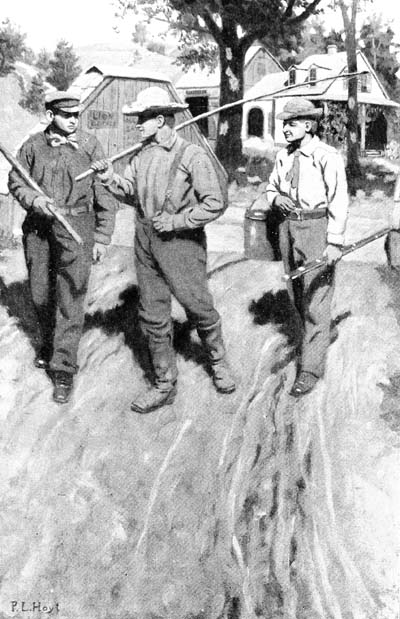
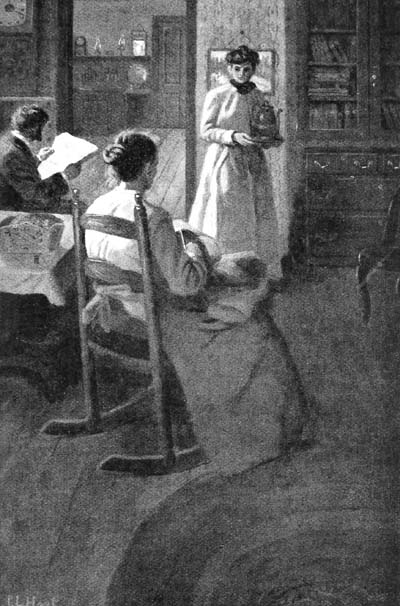
A very pretty village was Ogleport, stuck
away off there in that fertile valley among the
hills. Mountains these latter grew into within a
few miles, with ravines and rocky gorges instead
of valleys, and beyond them was the great, mysterious,
rugged wilderness, with its tall peaks
and its forests full of wild animals.
Excellent people were those of Ogleport, with
no small opinion of their village and themselves,
and their “Academy” was their especial
pride.
There it stood, in the middle of the great,
tree-bordered “village green,” while on either
hand of it were the “meeting houses” of the
half-dozen denominations among which the people
of Ogleport and the surrounding country
were divided.
A large, steeple-crowned structure of wood,
painted white, with the staring windows of its
two lofty stories unshaded by any such nonsensical
things as blinds, the Academy had evidently
been planned by the same architect who had
designed the church building, and it was as sober
and ugly-looking as any of them.
Back of the row of meeting houses and the
Academy were long, shadowy rows of ample
sheds, for the accommodation of the teams and
wagons of the country people on Sundays, and
back of that again was the badly kept and
tangled-looking “graveyard.”
Those sheds were great places for the conclaves
of the “boys” of Ogleport, but their larks
rarely carried them, even in broad daylight, beyond
or through or over the shattered picket
fence of the graveyard.
Not that they were particularly superstitious,
but then, as a general thing, they deemed it just
as well to “go around,” and it was, indeed, a
queer place to get into alone after sundown.
If, however, the boys had any reverence for
the bit of land where the village buried its dead,
they had none whatever for the big, white building
where they were themselves compelled to
bury so much of the valuable time they might
otherwise have usefully employed in fishing,
hunting, and other matters of equal importance.
The benches of the several rooms, not excepting
those of the “chapel” or lecture-room in the
rear, or the great hall in the second story, the
frames of the doors, the pine wainscoting, the
desks, every reachable piece of wood about the
whole concern was notched and scarred by the
sharp and busy knives of the boys of Ogleport.
More than one busy man, there and elsewhere,
if he ever came back again on a visit, could trace
his deeply-cut initials, three times painted over,
among the innumerable scars of that institution
of learning.
Zeb Fuller’s generation had done at least their
share of this particular kind of improvement,
and the oldest inhabitants of the village freely
declared their opinion that there had never been
such a lot of unreclaimed young savages since
the Indians cleared out.
Perhaps they were right, and then again perhaps
they had forgotten something, but the boys
did not trouble their minds much about it, either
way.
Still, it was a great comfort to the Rev. Dr.
Solomon Dryer to meet with so liberal an
amount of human sympathy, especially as it had
helped him that summer to carry into effect his
design of securing an additional assistant.
There had always been Mrs. Ross with two or
three ambitious young ladies to help her in the
male department, and a long and variegated line
of “young men preparing for college,” who had
acted for the time being as “tutors” under Dr.
Dryer, but never before had the Academy trustees
ventured on the outlay required for a full-grown,
thoroughly educated, competent man to
do the doctor’s heavy work for him.
Perhaps a certain feeling of jealousy on the
doctor’s part; a dread of having any second person
so near his own throne of authority, had had
something to do with it; but now there had
appeared a new element of danger which he
found himself compelled to meet.
Some mischievous friend and patron of the
Academy, mindful, perhaps, of how much he had
done towards whittling down the old building,
had made it a present of a very complete set of
chemical and other instructive apparatus, and
what Dr. Dryer himself would do with such
new-fangled trash was a good deal more than he
could tell.
And so—and so—there had been no end of
solemn talk about it, but the new assistant had
been hired, and was to begin his labors with the
fall term, soon to begin.
An additional feather in the cap of Dr. Dryer
had been the fact that an unusually large number
of “boarders” was expected. That is, boys
from a distance, who were to find homes among
the villagers and drink in daily wisdom at the
Academy.
Some were to come from even the great city,
where the men all know so much and the boys
were all so ignorant and so wicked, but wore
such good clothes and paid their bills so
promptly.
Zeb and his crowd were by no means unaware
of all these things, and one of the curious results
of the spring-board business was that it set Zeb
to thinking.
“If he sets his face against me and won’t let
me come in,” said Zeb, to himself, “I’ll miss all
the new experiments. Besides, I really want to
study some. There is a good deal in books. I
wonder if we couldn’t coax the new man to put
us into a course of Scott’s Novels and history?
Wonder if he’ll be got up on the same plan as
old Sol? Pity him if he is, that’s all. Tell you
what, I must manage to get straight with the
doctor.”
So saying, Zeb wandered off—for it was the
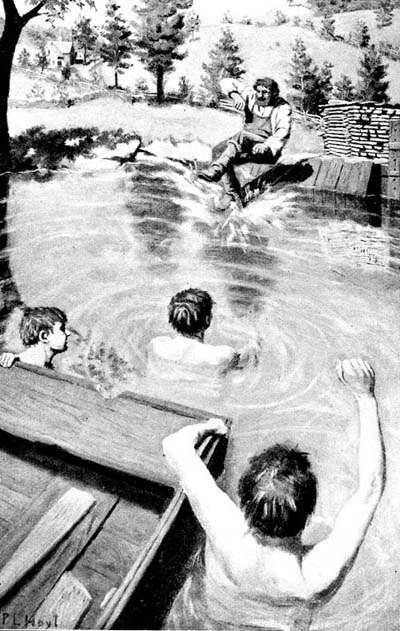
very morning after the miller’s dip in the pond—down
to the mill-dam.
When he got there, he found Pat Murphy just
finishing up a piece of work into which he had
put all his heart for an hour.
“New spring-board, eh?” said Zeb. “Now
go and get your saw.”
“And what for should I do that same?”
asked Pat.
“To set your drowning trap,” replied Zeb,
calmly. “I want to see how you do it. You
cut it three-quarters through, don’t you?”
“Now, Zeb, ye spalpeen, get out wid yer nonsense,”
growled Pat, with a very uneasy expression
on his dusty face. “The boord’s all right.
Jist shtrip an’ thry it wanst.”
“No, thank you,” said Zeb. “Did you really
mean to murder old Gershom? And now you’re
going to try it again. I’d never thought that of
you, Pat.”
“Go ’long wid yez!” laughed the Irishman.
“Yer at the bottom of all the mischief there is.
I hope there’ll be young gintlemin from the city,
the now, that’ll tache ye manners. It’s waitin’
for thim, I am.”
“Drown ’em, shall you?” said Zeb. “But
what’ll Gershom say to that? I’ll have to be
down here in my boat all the while.”
“I owe ye one, Zeb Fuller!” exclaimed Pat,
with a sudden and very warm burst of grateful
recollection. “Ave yer iver in a schrape and
want a frind, just come to owld Pat Murphy,
that’s all. It was mesilf didn’t want to shpile
the fun of yez. That’s all.”
“If we hadn’t been on hand it would have
been spoiled pretty badly,” moralized Zeb. “I’m
going for a pull in the boat now, myself. Give
my love to Gershom when he comes, and tell
him he’s a nice boy.”
A queer duck was Zeb Fuller, but, by the time
he had floated vaguely up and down the pond
two or three times, he had very fairly matured
his plans for operating upon Dr. Dryer and preventing
the doors of the Academy from being
closed against him.
That day was an unusually busy one for Ogleport,
in vacation-time, for every gossip in the
village had notes to compare with every other,
but Zeb Fuller was among the invisible all day,
and he retired to rest at an hour which gave his
father renewed hopes of the bright future which
lay before his heir.
No pains were taken, however, to ascertain
whether Zeb’s pillow was constantly occupied
through the night-watches, and all the deacon
was absolutely sure of was, that he had some
difficulty in stirring him up in the morning.
“How’s this, Zeb?” asked his father, as Zeb
came sleepily poking down the stairs. “I’m sure
you went to bed early enough.”
“That’s it,” said Zeb. “The longer I sleep
the better I seem to know how. If I keep on
learning, I may be able to sleep a week, some of
these long nights.”
“Get away with the cows, then. You won’t
get any breakfast, now, till you come back.
Hullo, there’s Dr. Dryer at the gate. What’s
up now?”
Quite enough, one would think, and it was a
very natural instinct which led the doctor to
that particular house with his story.
Not a hoof had his red-headed errand-boy
found in his lot back of his barn, that morning.
Gate wide open. Cows gone, nobody knew
whither.
“Something sure to happen in this place every
time I oversleep myself,” exclaimed Zeb. “Do
you think they’re stolen, Doctor, or did that little
scamp of yours leave your gate open and let ’em
run away?”
“Run away? Hope that’s all,” said the
deacon.
“Have you looked for them?”
“Everywhere,” replied the doctor, who had
been narrowly eying Zebedee.
The latter did not flinch a hair’s breadth, however,
although he now seemed wide awake
enough.
“Father,” said he, suddenly, “I see what the
doctor’s after. I’ll just put our cows in the
pasture—not half an hour’s work. Then you
have the bay saddled, and I’ll ride off after his
critters. Get a lot of the boys to help me.
We’ll find ’em for you, Doctor. You threatened
to drown me, day before yesterday, and I’m glad
to have a chance of returning good for evil.”
He was off like a shot, and even his grim-visaged
father more than half smiled, as he remarked:
“Best you can do, Doctor. I’ll have
the bay colt ready for him when he gets back.
Not another boy in the whole valley’d be so sure
to make a find of it.”
Dr. Dryer looked more solemn than ever, and
shook his head ominously, for the thought which
had brought him to Deacon Fuller’s had hardly
been permitted a fair expression.
Halfway down the path to the barn, Zeb was
met by still another interested party, who rose
lazily from the ground at his approach, cocked
one dilapidated ear at him, and mutely inquired:
“Well, and what’s to be done now?”
“All right, Bob,” said Zeb, “but it’s too soon
to wag your tail yet. We must take all day to
it. If we should find ’em right off, it’d look bad.
We’ll tend our own cows first.”
Bob stopped the tail-wagging, though there
could have been very little effort required to wag
such a stump as that, and trotted off after his
master with a thoroughly canine faith that there
was fun to come of some kind.
A large, mastiff-built brindled dog was Bob,
for whom all the other village dogs had an unbounded
respect, if not esteem. He was one of
those dogs that no sane human being ever tries
to steal.
Zeb’s usual morning “chores” were finished
up in rapid style, even for him, and by that time,
too, he had succeeded in getting messages to half
a dozen of his most trusted friends.
It looked very much, even to the watching
eyes of Dr. Dryer, as if the “hunt” were to be
made in earnest, and Effie stood behind him and
Mrs. Dryer at the window, thinking what a
grand time of it the boys would have, and half
wishing she could join them.
“It’s the least he can do,” remarked Mrs.
Dryer. “I do hope nothing has happened to
that dun heifer. Those cows never ran away of
their own accord.”
If they had only been near enough to Deacon
Fuller’s front gate a few minutes later, they
could have heard as well as seen.
“You see, boys,” said Zeb, “you’re all to hunt
for ’em, but I’m going on horseback, and of
course I’ll find ’em.”
“We might, some of us.”
“No, you mightn’t,” responded Zeb. “Bill
Jones, you and Hy Allen scout out towards the
lake. Take your hooks and lines in your pockets
and be gone all day. If you catch any fish,
you can give ’em away to somebody.”
“Not if we don’t get back till after dark,” said
Hy Allen.
“That’s so,” said Zeb. “Now, the rest of you
might try the East hill. I’m going on the North
road, over into Rodney.”
“We might go for woodchucks,” suggested
one of the smaller boys.
“We might,” said another, “but then the old
sweet tree in the Parker’s orchard’s about ripe.”
“That’s it,” said Bill Jones, “and I saw him
going through the village this very morning.
Both his dogs with him.”
“All right,” replied Zeb. “Bob and I and the
bay colt don’t mean to come back till we bring
Sol Dryer’s cows along with us.”
“Hurrah for Zeb Fuller!” shouted Hy Allen,
and, with a yell of general approbation and
acquiescence in the plans of their chief, for such
he seemed to be, that squad of “the worst boys
in Ogleport,” as Dr. Dryer would have called
them, separated, each to his own especial usefulness.
In five minutes more, Zeb was in the saddle,
and he and Bob were off to seek their fortune.
Just a little after noon of that eventful day it
might fairly have been said that the plans of Zeb
Fuller had fairly begun to ripen.
Bill Jones and Hy Allen were busily at work
under a tree by the lake shore, building a fire to
aid them in the preparation of their lunch. The
borrowed boat they had pulled up on the beach
had a very fine show of fish in it, but not a sign
of a cow, and the pair of them seemed just as
well contented.
Miles away, on the eastern hillside, another
detachment of Zeb’s faithful army were admiring
the furry coats of no less than three woodchucks
which they and their attendant curs had dug out
and captured, while not a boy among them all
could have got his hands into his pockets or put
his hat on his head until he should have eaten
more half-ripe sweet apples than any one boy
could have the slightest hope of holding.
Long miles away, again to the northward, the
bay colt, without one flake of perspiration upon
his glossy sides to indicate that he had been
driven around the country very extensively, was
pulled up in the middle of an open, unfenced bit
of woodland, while his rider sat looking wistfully
in all directions.
“Not a hoof or a horn!” exclaimed Zeb. “I’d
no notion they’d wander out of this. Gone on
North, anyhow. Come, Bob, we’ll come up with
’em before long.”
Not quite so soon as he thought, however, for
one mile, two miles, and then a third, vanished
under the now quickened pace of the bay colt,
and the merry face of his rider was growing
longer and longer, before a bark from Bob and a
shout from his master greeted the discovery of
cattle ahead.
And there they were, surely enough, the dun
heifer and the two older cows, but not by any
means feeding leisurely at the wayside, as they
should have been.
On the contrary, they were being driven
steadily along northward, in the charge of three
ragged, disreputable-looking, vagabond boys, two
of them of about Zeb’s size and one younger, and a
big, mangy-looking yellow dog.
“Hullo!” shouted Zeb, as he galloped up and
passed them, reining in the bay colt across the
road. “What are you doing with them
cows?”
“Drivin’ ’em to the paound,” exclaimed one of
the larger boys, with a malicious grin. “That’s
wot we dew with stray critters over here in
Rodney.”
“Over here in Rodney!” exclaimed Zeb.
“Why, those cows belong to Ogleport. Stolen
last night out of the Rev. Dr. Solomon Dryer’s
own yard. I’ll have you all arrested and sent to
jail. Pound! I’ll pound ye. Give ’em up, right
off.”
There was a little spasm of uncertainty on the
faces of the vagabonds, but the “pound reward”
for stray cattle in Rodney was a dollar a head,
and they could not bear the thought of surrendering
wealth like that to a boy of Zeb’s size
from a rival township.
They said as much in a moment more, and that
in such a dogged and threatening manner, and
with such a profusion of unsavory epithets, that
Zeb Fuller’s valor got the better of his discretion.
He was no cavalryman.
All his fighting had hitherto been done on
foot.
So he wisely cantered a few rods up the road,
sprang from the saddle, hitched the bay, shouted
to Bob, and started back for the duty that so
plainly lay before him, cudgel in hand.
It was one against three, to be sure, for Bob
recognized at once his mission to that yellow dog,
but Zeb had special reasons of his own for not
flinching.
Perhaps it was even less a sense of duty to the
Rev. Dr. Solomon Dryer than of unexpressed
remorse.
If those three vagabonds looked for an easy
victory, however, they were sorely mistaken.
The dun heifer had been “hard to drive” all
along, and she headed her mates in a vigorous
break backward at the first rush of Zeb and his
faithful ally.
It was all in vain that the smaller of the three
“impounders” rushed so wildly after them, and
that lessened the odds against Zeb.
They were hard fighters, though, those two
vagabonds of Rodney, and Deacon Fuller’s hopeful
heir had all his work cut out for him.
He was no scientific boxer, nor was either of
his opponents, but Bob was more of an expert,
and by the time Zeb began to really find himself
in difficulty so did that unlucky yellow dog.
The worst of it was, however, that Bob deemed
it his duty to make a clean finish of his particular
job instead of coming to the help of his master.
Alas, for Zeb!
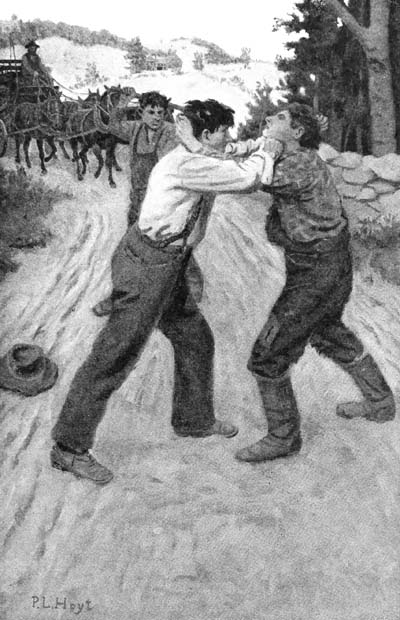
His cudgel was wrenched from his panting
grasp, at last, though not till he had used it to
excellent effect, and while he grappled with one
of his foes the other was free to belabor him to
his heart’s content. The result might have been
bad for Dr. Dryer’s cows, but, just then, there
came a sound of heavy wheels on the road above,
and over the nearest “rise” of ground the daily
stage-coach that plied up and down the valley
came lumbering down to the field of battle.
Zeb’s Fight with the Rodney Boys
So intent were the combatants, however, that
the driver was compelled to pull in his horses to
keep from going over them in spite of his angrily
shouted warnings.
For a wonder, the stage contained but three
passengers, two old ladies and a fine-looking, tall,
athletic young man.
The latter, however, had his head out of the
window instantly, with:
“What’s the matter, driver?”
“Boys fightin’ in the road, sir.”
“Fighting? I declare!”
And the stranger was out on level ground immediately.
Even the vagabonds loosened their hold in
consideration of the new arrival, and his sternly
uttered reproofs and expostulations were replied
to with a sullen:
“None of yer bisness. He’s a-takin’ away
aour paound caows, an’ we’re a-lickin’ of him,
that’s all.”
“Not much, they ain’t,” said Zeb, sturdily.
“Bob, come here. There now, I’m ready
again.”
“Ready for what, my young friend?” asked
the stranger, for he could not but see the difference
between Zeb and the other two, for all his
bloody nose and disordered apparel. “You don’t
mean to fight any more?”
“Don’t I?” exclaimed Zeb. “I mean to drive
home Dr. Dryer’s cows if I fight all day.”
“Dr. Dryer’s cows? Dr. Dryer, of the Ogleport
Academy?” asked the stranger.
“Yes, Solomon,” said Zeb. “That’s the man.
Those are his cows down the road there. Got
away last night. I came after ’em and found
these Rodney rascals driving ’em to the pound.
Of course they can’t have ’em.”
“Of course not!” exclaimed the stranger.
“You’re perfectly right, my young friend. If
that’s your horse yonder, just mount him and
we’ll see if there’ll be any more trouble.”
The three vagabonds, for the smaller one had
now come running up, took a good look at the
stranger, another at the pugnacious attitude of
Zeb, another at Bob, who was evidently getting
dangerously impatient.
They looked with one accord at what was left
of their big, yellow dog, now limping and yelping
up the road, and then, with many a threat and
whine and morsel of smothered abuse, they slowly
sneaked away after their dog.
Zeb was on the bay colt’s back quickly enough,
and the dun heifer and her friends moved cheerfully
on before him in the direction of Ogleport.