McKenzie drove the Amy Anderson for Porto Rico in a manner that gave
his small crew some trepidation whenever there was more than ordinary
wind blowing. He felt that he had to give vent to his feelings—to
blow off steam as it were—and as he was too good-natured a man to
take it out of his crew, he took it out of the vessel, and kept sail
on her at times when prudence suggested otherwise.
On these occasions, he twirled the wheel himself and seemed to take a
savage pleasure in hounding the schooner along, and several times he
had her with half the deck under lee water and threatening to jump the
masts over the side. Try as he might, he could not erase Ruth
Nickerson from his mind, and with harassing persistence, the memory of
the night in Halifax and the afternoon at Salvage Island kept rising
before him—odious and inexplicable comparisons which tormented his
thoughts and wrung his heart. He couldn’t fathom the complex feminine
nature which was capable of shifting around so quick. In his opinion,
Ruth had led him on; he had bared his soul to her, and she had spurned
him, cut him adrift, and given her heart and hand to another two
months after he concluded she was his, and his alone.
When he thought of this, and of the visions, dreams and ambitions in
which Ruth played so prominent a part, he endured mental agony which
demanded relief. As he had neither taste nor inclination for drink or
brutality, he found a counter distraction in driving the vessel. And
under such pressure, the Amy Anderson arrived off San Juan nine days
after leaving Eastville, with her foretopmast gone and all her light
sails split through sail-dragging in one or two hard breezes.
In the Porto Rican city, he sought solace in riding into the
country—leaving the schooner early in the morning and returning late
at night. During these solitary excursions he debated his future
course of action, and finally concluded to carry on as though nothing
had interfered with his peace of mind. Ruth Nickerson would live in
Halifax after she was married and he would see but little of her in
Eastville. He loved that town; liked its people, and the Bank
fisheries gave him a vocation and a livelihood which he enjoyed and
which catered to his fascination for the sea and the myriad life which
dwelt within it. In future, he would live and act as though Ruth
Nickerson never existed. This was his resolution, but he found it
terribly hard to forget.
An hour before sailing for Halifax with a cargo of barrelled molasses,
the agent brought him three letters which came in the morning’s
mail-boat from New York. One was from his mother, the other from
Judson Nickerson, but the hand-writing on the third—a small pink
envelope—made his heart leap. His first impulse was to tear it open,
but pride arrested him. “She’s not worth it,” he growled. “Mother
comes first.” And he thrust Ruth’s letter into his pocket, adding
under his breath, “Explanations, most likely ... or an announcement.”
Mrs. McKenzie’s letter was a long one and it bubbled over with news.
“You are a regular hero here,” she wrote, “and I have a bone to pick
with you for not telling me about your swimming ashore through the
surf and saving all those people. I am both proud and vexed with you,
but I think my pride will overcome any vexation I may have at your
failure to tell me more about the wreck and what you did. Everybody is
talking about you, and, oh, sonny, but I’m proud. To-day, a cablegram
came addressed to you from your friend Mr. McGlashan in Glasgow. I
opened it and it runs: Remain in Eastville. Will arrive Halifax July
fifteenth. Very important. McGlashan. I suppose you know what it is
about. I saw Ruth Nickerson this morning. She was quite ill after the
wreck and doesn’t look very well yet.”
He folded the letter up and placed it in his pocket for a second
perusal later, but one item in it seemed to run in his mind. “Ruth ...
ill?” he murmured, and slowly and deliberately, he reached into his
pocket and took out her letter. For a space he gazed at the familiar
handwriting on the envelope, then he broke it open and took out a
sheet of pale pink paper folded in half, and with a firm-set mouth and
cold eyes, he straightened it out. For a moment, the writing danced
before his eyes, with the excited blood pounding from heart to brain,
then his self-possession returned and he read the two or three lines
which it contained.
Donald:—
If you can forgive me, and trust me to renew your faith in
women—ask me again.
Ruth.
The grim look faded from his face and gave place to one of perplexed
astonishment. Scarcely believing he had read the note aright, he
perused it a second time—reading the words out aloud. “If you can
forgive me ... and trust me ... ask me again!” And he stared at the
little pink sheet—now trembling in his hand with the agitation of
conflicting feelings—and murmured, “Ask me again!”
With a joyful cry he jumped to his feet—his dark eyes sparkling with
a gladness which scarcely knew expression—and he stepped under the
sky-light and re-read the letter for the third time. “Whoop-ee!” he
cried in excess of new-found delight. “Will I forgive her? Why, she
never did anything wrong! It must have been a mistake—all a
mistake—for she’s the dearest, sweetest, darlingest girl in the
world!”
A tousled, sun-burned face peered down the cabin companionway, and a
hoarse voice enquired, “Did I hear ye sing aout, Skipper?” Donald
wheeled and laughed confusedly. “No, Anson, I didn’t sing out, but if
you’re all ready to slip, get the stops off the sails and we’ll slide
right away for home. Everybody aboard? Cook get his water tanks
filled? Good boy! Then we’ll get under way!” And when Anson vanished,
he kissed the little pink note, folded it carefully, and slipped it
into the breast pocket of his shirt. Within thirty minutes the Amy
Anderson, with the Canadian ensign flying from the main-gaff, and the
four lowers on her, was slipping out of San Juan harbor to the urge of
the steady north-east trade.
Running out to the nor’ad, the green hills of the Island soon changed
into the blue of distance as they left it astern. McKenzie paced the
weather quarter with his brain in a whirl of exhilaration and the
tinkling bell of the patent log recording the knots sounded gloriously
in his ears as evidence of the ever-shortening distance between him
and the girl he loved. He trod the deck with a strange springiness,
and when he scanned the bubbling broil of the wake astern, he could
not restrain a joyous chuckle and an encouraging word to the man at
the wheel, “Sock it to her, Billy old son! She’s travelling home and
the girls have got hold of the tow-rope! Give her a good full and let
’er slide!”
He paced the deck for an hour, then he had to go below and read those
magical words once more to make sure that his eyes were not deceiving
him.
No, by Jupiter! There it was—plain as a hand-spike in her own dear
hand-writing. “Ask me again.” Would he ask her again? Why, the Amy
Anderson couldn’t travel fast enough to give him the opportunity! In
his excitement, he paced the narrow cabin, staggering and swaying with
the rolling of the vessel, and murmuring to himself, “Ask me again!”
He suddenly remembered Judson’s letter and opened it quickly.
Stretching out on the locker, he composed himself to read it. Good old
Juddy! What did he have to say, the old bucko! “Dear Don,” it ran.
“Congratulate me! I’m the happiest man in the world, old timer.
Helena has said the word and we’re going to sail dory-mates just as
soon as the Devil-dodger makes a long splice of it. I’m waiting for
her to name the day, then, old son, you can polish up your
gaff-topsail hat and overhaul your square-mainsail coat and stand
beside your old skipper and see everything all clear for my getting
under way on a new voyage. If it wasn’t for Eben Westhaver’s old
packet bumping the ledges, I reckon I’d still be guessing, but I’ve no
hard feelings against that sorry old coaster now. And, bye the bye,
Don, you pulled out in a hell of a hurry that night. You seemed to
think it was of more importance to get Cal Heneker’s old scow to Porto
Reek than it was to see all us shipwrecked folks ashore. However, the
town will have a band playing for you when you get home. The Ladies’
Aid of the Church and the Young People’s Society are both squabbling
among themselves as to how they’ll honor you, while Tom Daley, the
Mayor, is prating to the Council about recognizing Eastville’s
esteemed citizen, Captain Donald McKenzie, with something worthy of
your plucky work that night. They’ve petitioned the Royal Humane, the
Government and Lloyd’s to honor you, and I tell you, son, they had
scare-heads in the Halifax papers about ‘the thrilling rescue.’ But
enough of that. You are going to get no more soft-soap from me on that
subject. My sister Ruth was quite sick after the affair, but she’s
chased that nut Moodey back to where he belongs. On the steamer that
night she asked him to swim ashore with a line—he’s bragged a whale
of a lot about his swimming abilities to her—but he got a sudden
attack of Cape Horn fever and balked at the job. I always said that
joker had a yellow streak in him somewhere, and that was where he
showed it. If he wasn’t such an able swimmer and such a mouth about
it, I wouldn’t have felt so mad about the blighter. But, believe me,
Don, I gave him an earful when we got ashore that night. It took me a
while to square myself with the girls for the language which they said
I used towards him. Now, you know, Donny-my-lad, that I’d only
express my feelings in good old sailor fashion, but shore-folks don’t
understand our particular lingo, though I’ll bet Moodey did. Now, old
shippy, I’m going out again in the morning, but I’ll look for you in
September, and you can bet my bullies will hump some this time. We’ll
spin ’em out when the gulls can’t fly to wind’ard, and I plan to wet a
pile of salt and bait small and catch ’em large from now out.” When he
finished reading, McKenzie chuckled happily.
On a windy July morning, the Amy Anderson stormed up Halifax harbor
and came to an anchor in the stream. McKenzie went ashore and got
Caleb Heneker on the telephone and was over-joyed when that worthy
told him to deliver his cargo to a certain Agent and pay off. The
schooner would load dry fish in Halifax later in the month and sail
for Demerara, and if he cared to do so, he could take her down when
ready. Next day, late in the afternoon, Donald drove into Eastville,
and slipping along the hill road, he got home before any of the
town’s-people were aware of his arrival.
“And Donny, my son,” said his mother, after the welcoming and exchange
of news, “they’re planning a public reception to you for that rescue.
It was a wonderfully brave thing you did that night, laddie—” And she
chatted joyfully in the same strain, but Donald wasn’t listening. He
was thinking of just how soon he could call upon Ruth Nickerson.
“Have I any decent clothes, Mother?” he asked suddenly—interrupting
her in the middle of an announcement of what the Ladies’ Aid were
proposing to do.
“Only an old suit, dear,” she replied. “Your best suit you left on the
wreck—”
He rose and patted her on the shoulder. “Then, Mother dear, if you
will be sweet enough to give it a bit of a press while I’m cleaning
up, I’ll wear it.”
After supper, he kissed his mother. “I’m going down the road, Mater
dear—”
Mrs. McKenzie gave a knowing smile. “Oh, yes, laddie, and you might
give my regards to Ruth and tell her I hope she’s feeling better.”
Donald blushed under his tan. “Who said I was going to see Ruth?” he
asked confusedly. The mother turned him around and gently pushed him
through the door. “Run along, Donny,” she said with a laugh. “You
can’t hide anything from your mother. Give her my love!”
Ruth was not at home when he called, but Mrs. Nickerson thought she
had taken a walk in the direction of the Cape. For several precious
minutes the old lady detained him to talk about the wreck (Donald was
inwardly damning the wreck) but at last he managed to break away by
saying he would stroll along and meet Ruth and come home with her. As
soon as he was out of sight from the houses, he broke into a run.
He spied her at last, in the half-light of declining day, sitting on
the grass alone and watching the sea. It was in his favorite spot in
the little hollow behind the head-land, and he trotted up behind
her—his foot-falls making no sound on the green sod. A short space
away from where she sat with her face turned away from him, he stopped
and cried softly, “Ruth!”
She was on her feet in an instant and facing him—her cheeks flaming
rose and a wonderful light in her deep blue eyes. “Donald!” Sweet and
low the name sounded from her lips and his heart thrilled. He advanced
towards her and took her hand. “Will we sit down again?”
She nodded shyly and dropped to the grass and he still retained his
clasp of her hand. He scanned her face. How beautiful it seemed in the
rosy glow from the westering sun. “I got your letter,” he said simply.
She made no reply, but sat nervously plucking at a wild flower, and
her eyes were lowered to the ground.
There came into Donald’s soul at this moment the thrill of splendid
hours—vistas of momentous events in his young life; reefing down jobs
on the topsail yards of the Kelvinhaugh in the wild squalls of the
Horn; the storming excitement of “running the easting” in the Helen
Starbuck; delirious drives for port on fishermen in pelting winds and
heavy seas, and all the exhilarating sensations which come to sailors
every now and again. He could remember his feelings at those
times—the quickening pulse, the rapid heart-beats, the alertness of
eye, mind and muscle and the expectancy of ultimate conquest. He was
feeling that way now. “And I’ve come to ask you again,” he said at
last and with something of a tremor in his voice. Taking a full
breath, he asked boldly, “Ruth! will you be my wife?”
She looked up slowly—very slowly it seemed—and her eyes looked clear
and glowing into his. Then softly, very softly, she answered, “Yes!”
And Donald’s arm was around her and he was pressing her to him and his
kisses were upon her lips.
“And you’ll be content to marry me—a fisherman?” enquired he when the
first ecstacy of love had passed. “You know what I am and what I have.
Will you make the sacrifice?”
She smiled happily. “It’s no sacrifice, dear,” she replied. “I’m proud
and glad to be yours, no matter what you are. It’s not the occupation
that counts ... it’s the man!”
The rosy glow in the west faded and the azure of the summer night
claimed the sky from nadir to zenith, while the glorious host of
stellar worlds aloft spangled the heavens in myriad twinklings of
diamond lights. The earth exhaled the scent of wild flowers and the
warm wind wafted the odors of spruce and pine to where they sat. A
night bird warbled a happy song to its mate, and its paean of love
found a responsive chord in the hearts of the two who listened.
“Isn’t this just lovely, Don?” ventured Ruth. “The night, the stars,
the flowers, the world, everything...!” Donald pressed her to him and
looked into her upturned face, his dark eyes radiant with the joy that
was his. “Not half so lovely as you, dear!”
Donald got to bed very late that night and next morning he confided
his secret to his mother. “And I hope you won’t be jealous, Mater
dear,” he added, “for you are still my lovely sweet mother, and Ruth
will not usurp any of the love I bear for you. She’ll share it with
you, and we should all be very happy.”
She flashed him a look of infinite tenderness. It didn’t seem so very
long ago when he was a pale, shrinking, sensitive lad whom she
comforted and petted and caressed. Here he was a lithe, strong,
sun-tanned, capable man starting out on the high-road of love’s
adventure. “You’ll both be my children, laddie. You’ve brought me
another one, and I’ll love her for her own sake as well as yours.
She’s a dear lassie, and I’m glad—oh, so glad!” Then a shade of worry
crossed her face and Donald noted it.
“What are you thinking about, Mater?” he asked.
She hesitated before replying, “Are you sure—do you think Ruth will
be content to live here, and—and get along on your earnings? It’s
quite a drop from what she’s been used to.” Anxious concern was
reflected in her eyes.
He squared his shoulders. “Don’t you worry about that, Mater dear,” he
said confidently. “I’ll be skipper of a fishing vessel next Spring and
I’ll make enough to keep us comfortable. I know my work. I’m
ambitious. I’ll invest in vessels and build up a competence just as
the others around here have done. Ruth knows our circumstances and
position, and she’ll tuck in. She’s cultured and well-educated, but
she can cook and sew and do housework as well as the best. That’s the
sort of a girl I’m taking for a wife—a girl in a thousand!” And he
spoke the last words proudly. The mother watched him swing out into
the garden—strong, optimistic and full of the confidence of youth.
Aye, she mused, he had done well. Master of a vessel at twenty-two and
earning more than many a commander on a liner, and successful in love
and ambitious.... He would be alright ... if the sea and the Almighty
willed it so.
Two or three days later, and while Donald was chopping wood at the
back of the house, he heard a familiar voice in the kitchen talking to
his mother. It had a strong Scotch burr there was no mistaking, and
Don hove down the axe and strode hastily into the house to find Joak
McGlashan seated in the parlor. There was a stranger with him—a
dapper looking gentleman, middle-aged, clean-shaven, and wearing good
clothes of an unmistakable English cut. When McKenzie walked in, Joak
sprung to his feet, his face beaming. “Hulloh, there, Donal’!” he
shouted. “My! but I’m gled tae see ye! Ye got ma cable, eh?”
The important happenings of recent days had driven all thought of the
cable out of Donald’s mind, and he stammered a wondering affirmative.
He had regarded the matter as being of no particular importance. Joak
wanted to secure a berth as cook with him, possibly, and he would
certainly get it if McKenzie had the ordaining of it. The other turned
and indicated the stranger who was standing gravely waiting. “This is
Mistur Montgomery o’ Glesca’,” he observed, “and he come oot here tae
Novy Scotia tae see you and yer mither here aboot verra important
business.” And having made the introduction, Joak sat down and
nervously lit a clay pipe.
Mr. Montgomery extended a hand to mother and son, and he lifted a
despatch case on to the table and opened it. “I’m a solicitor,” he
said briefly. And while the two McKenzies stared at him wonderingly,
he pulled a sheaf of documents out on the table and adjusted a pair of
pince nez on his nose. Clearing his throat, he began, “Er—I have a
disagreeable task to perform, Captain”—he addressed Donald—“in
telling you that your respected uncle has passed away. Died very
suddenly—very tragic affair!” He looked over his glasses at mother
and son, and sighed. Mrs. McKenzie clasped and unclasped her fingers
nervously and her eyebrows went up in consternation at the
announcement, but Donald’s tanned face was unmoved. “Too bad,” he
remarked calmly. He took a packet of cigarettes from his pocket and
lit one.
The legal gentleman nodded. “Yes ... too bad.” Then he enquired with a
corrugation of his forehead and in a mildly suggestive tone,
“You—er—haven’t kept in touch with your relatives in Scotland, have
you?”
“No, sir,” answered Donald coolly, and he blew a smoke ring, “nor they
with us.”
The other gave a respectful cough and drew his chair closer to the
table. “Possibly, I’d better go into the matter and explain the object
of my visit to British North America.” McKenzie smiled at the
appellation. With the tips of his fingers together, Mr. Montgomery
leaned with his elbows on the table and said, “Your husband, Mrs.
McKenzie, was a nephew of the late Sir Alastair McKenzie, Baronet, of
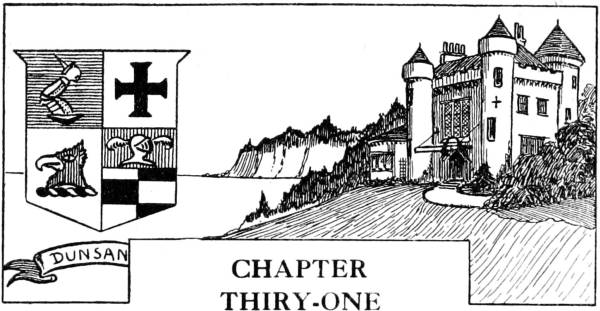
Dunsany Castle, Scotland. You, of course, were aware of that.” Janet
nodded. “Now,” he continued, “Sir Alastair had but one son—his wife
died many years ago—and when Sir Alastair passed away, the title and
estate naturally went to the son Roderick. This young man, I regret to
say, was in very poor health—in fact, he was a consumptive—and he
never married. He knew, that having no direct issue, the title and
estate would have to pass to another branch of the family; namely, his
father’s nephew or his issue—”
“That would be David McKenzie,” interrupted Janet interestedly.
The lawyer shook his head. “No, Madam! It would be your late
husband—Alexander McKenzie!”
A blank look came over the mother’s face and for a moment she couldn’t
speak. At last she stuttered, “How—how could—could—that be, sir?
David was the elder!”
“No, Madam! On the contrary, Alexander was the elder by an extremely
narrow margin. You knew, of course, that David and Alexander were
twins?”
Mrs. McKenzie gasped. “No, I didn’t! This is the first time I ever
knew of it! Poor Alec never once told me that he and David were twin
brothers, and I always thought David was years older than my
husband—”
The other shook his head. “No, that is not so. David may have looked
older. Possibly his sedentary and rigorous manner of living made him
appear that way, but your husband was older than David by a few
minutes, and the birth, date and time is thus recorded in the
Edinburgh Registrar’s records.” And while Donald and his mother were
puzzling over what they had heard and wondering what was coming, Mr.
Montgomery continued.
“Your unfortunate husband having been drowned at sea, the heir to the
baronetcy was, of course, your son the Captain there. Under Sir
Roderick’s instructions, an investigation was made for the next of kin
some years ago, and we found that your son Donald had gone to sea in a
Glasgow sailing ship and was supposed to have been drowned in
Vancouver. That being the case, David McKenzie would succeed on Sir
Roderick’s demise, and then would come David’s son Alastair the
second,” Donald was blowing smoke-rings and smiling strangely. It was
as if he had guessed something.
“Now we come to the particularly tragic aspect of this affair.” The
legal gentleman paused for a fresh start. “Some ten weeks ago, Mrs.
David McKenzie, the boy Alastair, Sir Roderick and a chauffeur were
motoring down from Dunsany to Glasgow when the steering apparatus of
the motor car broke or jammed and it plunged over the high bank into
Loch Velaig. I regret to say that both Mrs. McKenzie and the boy were
drowned. Sir Roderick was saved by the chauffeur, but died within a
few days from the exposure in the chilly water. The chauffeur went
direct to Glasgow to Mr. David’s office and told him the sad news. The
shock was too much for him, evidently, for he was found dead in his
chair a half an hour afterwards.”
Mrs. McKenzie was listening with horror-struck features and Donald was
visibly affected at the recital of the ghastly retribution which had
come to his uncle. Retribution it was ... and Donald shuddered at the
horror of it. Mr. Montgomery continued with legal deliberation and
calmness. “We could find no heirs, of course, and the matter was
advertised in the papers. The whole story was given, and it stated
that you, Captain, had been drowned in Vancouver harbor. A few days
after publication in the Glasgow press, Mr. McGlashan comes to us
stating that Donald McKenzie was alive and in Canada, and he told us
of your running away from the ship and making believe you were
drowned. He produced evidence so convincing that we got in touch with
two men who had been shipmates with you, Thompson and Jenkins, and, as
a result, I am here in the colonies to settle this business.” The
quizzical expression came on Donald’s face again and he calmly lit
another cigarette.
Turning to Mrs. McKenzie, the solicitor enquired, “You have your
marriage certificate and your son’s birth certificate, I presume? Yes?
Very good!” The mother produced them and when Mr. Montgomery had
finished examining them, he rose to his feet and walked towards
Donald. “There are, of course, some legal details to be gone into, but
the case is pretty clear.” He held out his hand and in his most
cordial professional manner exclaimed, “Allow me to congratulate you,
Sir Donald!”
The mother gasped audibly, but her son was calmer and in control of
his feelings. With a queer smile on his face, he asked: “The Dunsany
estate? It is mortgaged, is it not?”
“To the hilt, sir,” answered the other. “There is no revenue from
it—”
Blowing a series of smoke rings, McKenzie laughed a little and said
very calmly, “I’m very much obliged to you, Mr. Montgomery. But I
don’t know as I can thank you for coming out to Canada and handing me
a title. As a sailor, I don’t know what to do with it. The estate, I
understand, brings no income. What’s the use of a title to me? I’m a
skipper of a fishing vessel and I’m certainly not going to accept a
title and have my crew calling me ‘Sir’ or have people observing that
‘Sir Donald struck a big jag of hake on Western this time,’ or have my
gang joking about being skippered by a baronet. It would be the
biggest joke on the Banks. All the trawlers would be swinging off to
have a look at me to see if I wore a coronet!” He became serious
again. “No, sir, I think I’ll let it drop. Pass it on to someone with
the money to keep up the style which should go with the thing. At the
present time, to me, it would be as useful as the Dutchman’s anchor—”
He stopped at his mother’s reproachful “Oh, Donald!” Poor woman! Her
pride was being sorely tried by her son’s perversity. “Sir Donald!” It
had a rare impressive sound and she was just beginning to feel that
life was sweet, joyous and tremendously portentous. Her son a
baronet! And so he should be.
Montgomery smiled and raised his hand. “You should permit me to
finish,” he said. “Your uncle, David McKenzie, has no heirs, and you
are the next of kin. He was a wealthy man—one of Glasgow’s merchant
princes—and the value of his estate, including cash, bonds, stocks
and shares, his ships, and so on, which will come to you, is in the
neighborhood, I should judge, of eight hundred thousand pounds!”
Joak’s clay pipe broke between his teeth, and as it clattered to the
floor, he ejaculated, “Ma guid gracious! Eight hunner thoosan’
pounds!” Mrs. McKenzie looked dazed, and Donald sat quietly plucking
at the fringes of the tablecloth.
The solicitor departed for the hotel after examining certain papers
which Mrs. McKenzie produced for his inspection, and before he left he
said, “It will be necessary for you both to come to Scotland in order
that we might settle up the estate. I will leave you a draft to cover
the necessary expenses, and it would be well for you to leave as soon
as possible.” He bowed gravely, “I am at your service, Sir Donald, and
I trust we may have the pleasure of handling your business in future.
I bid you a very good evening!” And he and McGlashan went out
together, but not before Donald had warned Joak. “See here, you old
Turk, not a word to anyone about this affair ... yet. And furthermore,
I don’t want any of that damned sir-ing from you. Cut it out in
future!” And he gave his old chum a slap on the back and had him
chuckling in unfeigned delight.
For an hour, mother and son discussed the matter—Janet excited and
exuberant; Donald, calm and thoughtful. “You know, Mater,” he said at
last, “I’ve been putting two and two together and I’ve figured out
Uncle Davey’s little plans. He knew that Roderick McKenzie was a
lunger and not likely to live long, and he knew that I stood in the
way of his succession to the Dunsany baronetcy. Knowing those things,
he worked those schemes to get rid of me aboard the Kelvinhaugh. The
idea just struck him when we went to his office that time. And, do you
know, I don’t believe he was thinking of himself. It was all for his
son and his family pride that he toiled and scrimped and did shady
tricks so that when the time came he could restore the family fortunes
and uphold the dignity of the house. But, you see, after all, he lost
out in the end. Aye, the mills of the gods grind slowly, but they
grind exceedingly small!” He sighed and rose to his feet. “Mater dear,
if you’ll rustle the grub on the table the baronet and his mamma will
have supper. I want to go over and see Ruth. I have a very interesting
evening ahead of me.”
He dressed himself with particular care that night—particular in the
selection of his clothes. With a blue flannel shirt, a cheap tie,
faded coat and pants, and a pair of heavy boots on his feet, he
surveyed himself in the glass and chuckled boisterously, “Now, Sir
Donald,” he said to himself, “you look the part as right as rain. A
poor trawl-hauler dolled up to see his girl. If Ruth’ll love me in
this rig, she’ll love me in anything. I’ll test her affections
to-night for sure!”
A few minutes later, he clumped upon the veranda of the Nickerson
home. Old Mr. Nickerson was reading a paper and looked up over his
glasses. “Waal, young feller,” he boomed cordially, “an’ haow does it
feel to be a hero? The old taown certainly gave ye a good reception
t’other night, eh? And I cal’late that young girl of aours is as proud
as a dog with two tails to hev a man all Eastville is makin’ a fuss
of. Cal Heneker tells me he’s agoin’ to give ye his best vessel to
take afishin’ next Spring.... Aye! aye! ye’re a lucky young feller all
’raound. Ruth? She’s inside washin’ up the supper things.” And he
resumed his reading again—thinking for a moment of the days when he,
too, was young.
McKenzie led Ruth off to his favorite spot behind the headland, and
they sat down on the grass. “Whatever’s on your mind, Donald?” asked
the girl. “You’ve been looking so mysterious and acting as though you
were suppressing something that I’m sure you’ve got a surprise hidden.
Be kind, now, and let your poor curious little Ruthie in on the
secret.”
He looked smiling into her eyes. “Yes, Ruthie, dear, I have
something—something to ask you. Will you marry me right away?”
She recoiled. “Right away? Good gracious, Don, how can I?”
“How can’t you, sweetheart?” He asked the question with a laugh.
“Why—why, I—I have to get a hundred and one things ready, Don,” she
answered. “You can’t expect a girl to marry you the day after the
engagement. I’ve a host of things to get ready. I haven’t got a full
Hope Chest. There’s linen to make up and embroider; dresses to be
made, and—and—” She paused in confusion at the mental vista of
nuptial concomitants.
“And?”
“And—and lots of things you have no business to know anything about,”
she added hastily, while an embarrassed flush crept into her cheeks.
Donald pretended not to notice, and made a careless gesture. “Oh, you
could get all those things afterwards, dear. You know, the Amy
Anderson sails for Demerara next week. Don’t you think a trip down
there would make an ideal honeymoon? I may not get a chance to take
you on the trip I’m thinking of unless you marry me right away.” It
was a carefully worded series of sentences. There was no accommodation
for a woman on the Amy Anderson.
Ruth thought for a moment, then, with sparkling eyes, she cried, “That
would be lovely, Donald, I’m willing, but—but—let’s go home and talk
it over with mother first.”
For answer he caught her around the shoulders and turned her towards
him. Looking down into her eyes, he said earnestly, “Ruthie, darling,
are you sure you love me? Will you be content to marry me—a
fisherman—and be a fisherman’s wife? Would you, if your mother
consented, marry me in a few days, and sail with me adown the seas on
a sailor’s honeymoon? Would you?” With heart thumping wildly, he
waited for her answer, and when it came—a soft-spoken “Yes!”—he saw
her face alight with the pure flame of love and her blue eyes smiling
with adoration of him. Then he kissed her fervidly and laughed with
the joy of realization and triumph.
“So we shall, sweetheart,” he cried joyously. “We shall get married
and you’ll sail with me—not to Demerara—but to auld, grey Scotland.
And you’ll sail as a sailor’s bride, for I am of the sailor breed, but
not as a fisherman’s wife, for you’ll be Lady Ruth McKenzie! Aye,
sweetheart, Lady Ruth McKenzie, wife of Sir Donald McKenzie of
Dunsany, and heir to eight hundred thousand pounds!”
The sun glow flared in the golden west and the whispering spruce and
pines stirred in the evening breeze as the night-bird gave tune to his
nocturnal serenade. On the bold head-land, facing the eternal sea, two
deliriously happy souls gazed out upon the waters, and the man
murmured, “I’ve seen it in murmuring calms and crooning under the
stars, and I’ve seen it when the hail and sleet and the big graybacks
went roaring down the wind. It has been cruel and kind; it has
scourged me and inspired me; it took my father ruthlessly from me, but
it made of me a man! It has taken much, but it has given much. It
brought me to you, and I love it, as I love you, for it has given me
the greatest blessing in all the wide, wide world ... you!”